WO2021037205A1 - Compound and drug conjugate, and preparation method and use thereof - Google Patents
Compound and drug conjugate, and preparation method and use thereof Download PDFInfo
- Publication number
- WO2021037205A1 WO2021037205A1 PCT/CN2020/112105 CN2020112105W WO2021037205A1 WO 2021037205 A1 WO2021037205 A1 WO 2021037205A1 CN 2020112105 W CN2020112105 W CN 2020112105W WO 2021037205 A1 WO2021037205 A1 WO 2021037205A1
- Authority
- WO
- WIPO (PCT)
- Prior art keywords
- alkyl
- formula
- group
- drug conjugate
- compound
- Prior art date
- Legal status (The legal status is an assumption and is not a legal conclusion. Google has not performed a legal analysis and makes no representation as to the accuracy of the status listed.)
- Ceased
Links
- 0 CCN(C(C)(C)C(*)(*)*(C)N(C(C(C)C)*(C(*)(*)C=C)C=N)IS)ISC*(C)* Chemical compound CCN(C(C)(C)C(*)(*)*(C)N(C(C(C)C)*(C(*)(*)C=C)C=N)IS)ISC*(C)* 0.000 description 15
- KVGAIMHIFZHUJT-UHFFFAOYSA-N CC(C)(C)OC(N(CC1)CC(C(NCC(CO)O)=O)N1C(OC(C)(C)C)=O)=O Chemical compound CC(C)(C)OC(N(CC1)CC(C(NCC(CO)O)=O)N1C(OC(C)(C)C)=O)=O KVGAIMHIFZHUJT-UHFFFAOYSA-N 0.000 description 1
- DEVGLXXPCHEYGJ-UHFFFAOYSA-N CC(C)(C)OC(N(CCN(C)C1)C1C(O)=O)=O Chemical compound CC(C)(C)OC(N(CCN(C)C1)C1C(O)=O)=O DEVGLXXPCHEYGJ-UHFFFAOYSA-N 0.000 description 1
- UBERLXYRZNEDEB-UHFFFAOYSA-N CCC(C)CNC(C)=O Chemical compound CCC(C)CNC(C)=O UBERLXYRZNEDEB-UHFFFAOYSA-N 0.000 description 1
- ISQFPHHMMUUAQR-UHFFFAOYSA-N CCC(CC)CCCCN(C)C(C)=O Chemical compound CCC(CC)CCCCN(C)C(C)=O ISQFPHHMMUUAQR-UHFFFAOYSA-N 0.000 description 1
- HCVUPSCIJNGLJG-CSJJFBISSA-N CCC(N/C=N/C1N=CC(CN(C(C(F)(F)F)=O)c(cc2)ccc2C(N[C@@H](CCC(OCc2ccccc2)=O)C(OCC2c(cccc3)c3-c3c2cccc3)=O)=O)=NC1C(N)=O)=O Chemical compound CCC(N/C=N/C1N=CC(CN(C(C(F)(F)F)=O)c(cc2)ccc2C(N[C@@H](CCC(OCc2ccccc2)=O)C(OCC2c(cccc3)c3-c3c2cccc3)=O)=O)=NC1C(N)=O)=O HCVUPSCIJNGLJG-CSJJFBISSA-N 0.000 description 1
- JOXIMZWYDAKGHI-UHFFFAOYSA-N Cc(cc1)ccc1S(O)(=O)=O Chemical compound Cc(cc1)ccc1S(O)(=O)=O JOXIMZWYDAKGHI-UHFFFAOYSA-N 0.000 description 1
Images


Classifications
-
- C—CHEMISTRY; METALLURGY
- C12—BIOCHEMISTRY; BEER; SPIRITS; WINE; VINEGAR; MICROBIOLOGY; ENZYMOLOGY; MUTATION OR GENETIC ENGINEERING
- C12N—MICROORGANISMS OR ENZYMES; COMPOSITIONS THEREOF; PROPAGATING, PRESERVING, OR MAINTAINING MICROORGANISMS; MUTATION OR GENETIC ENGINEERING; CULTURE MEDIA
- C12N15/00—Mutation or genetic engineering; DNA or RNA concerning genetic engineering, vectors, e.g. plasmids, or their isolation, preparation or purification; Use of hosts therefor
- C12N15/09—Recombinant DNA-technology
- C12N15/11—DNA or RNA fragments; Modified forms thereof; Non-coding nucleic acids having a biological activity
- C12N15/111—General methods applicable to biologically active non-coding nucleic acids
-
- C—CHEMISTRY; METALLURGY
- C07—ORGANIC CHEMISTRY
- C07D—HETEROCYCLIC COMPOUNDS
- C07D405/00—Heterocyclic compounds containing both one or more hetero rings having oxygen atoms as the only ring hetero atoms, and one or more rings having nitrogen as the only ring hetero atom
- C07D405/14—Heterocyclic compounds containing both one or more hetero rings having oxygen atoms as the only ring hetero atoms, and one or more rings having nitrogen as the only ring hetero atom containing three or more hetero rings
-
- A—HUMAN NECESSITIES
- A61—MEDICAL OR VETERINARY SCIENCE; HYGIENE
- A61K—PREPARATIONS FOR MEDICAL, DENTAL OR TOILETRY PURPOSES
- A61K47/00—Medicinal preparations characterised by the non-active ingredients used, e.g. carriers or inert additives; Targeting or modifying agents chemically bound to the active ingredient
- A61K47/50—Medicinal preparations characterised by the non-active ingredients used, e.g. carriers or inert additives; Targeting or modifying agents chemically bound to the active ingredient the non-active ingredient being chemically bound to the active ingredient, e.g. polymer-drug conjugates
- A61K47/51—Medicinal preparations characterised by the non-active ingredients used, e.g. carriers or inert additives; Targeting or modifying agents chemically bound to the active ingredient the non-active ingredient being chemically bound to the active ingredient, e.g. polymer-drug conjugates the non-active ingredient being a modifying agent
- A61K47/54—Medicinal preparations characterised by the non-active ingredients used, e.g. carriers or inert additives; Targeting or modifying agents chemically bound to the active ingredient the non-active ingredient being chemically bound to the active ingredient, e.g. polymer-drug conjugates the non-active ingredient being a modifying agent the modifying agent being an organic compound
-
- A—HUMAN NECESSITIES
- A61—MEDICAL OR VETERINARY SCIENCE; HYGIENE
- A61K—PREPARATIONS FOR MEDICAL, DENTAL OR TOILETRY PURPOSES
- A61K47/00—Medicinal preparations characterised by the non-active ingredients used, e.g. carriers or inert additives; Targeting or modifying agents chemically bound to the active ingredient
- A61K47/50—Medicinal preparations characterised by the non-active ingredients used, e.g. carriers or inert additives; Targeting or modifying agents chemically bound to the active ingredient the non-active ingredient being chemically bound to the active ingredient, e.g. polymer-drug conjugates
- A61K47/51—Medicinal preparations characterised by the non-active ingredients used, e.g. carriers or inert additives; Targeting or modifying agents chemically bound to the active ingredient the non-active ingredient being chemically bound to the active ingredient, e.g. polymer-drug conjugates the non-active ingredient being a modifying agent
- A61K47/54—Medicinal preparations characterised by the non-active ingredients used, e.g. carriers or inert additives; Targeting or modifying agents chemically bound to the active ingredient the non-active ingredient being chemically bound to the active ingredient, e.g. polymer-drug conjugates the non-active ingredient being a modifying agent the modifying agent being an organic compound
- A61K47/549—Sugars, nucleosides, nucleotides or nucleic acids
-
- A—HUMAN NECESSITIES
- A61—MEDICAL OR VETERINARY SCIENCE; HYGIENE
- A61K—PREPARATIONS FOR MEDICAL, DENTAL OR TOILETRY PURPOSES
- A61K47/00—Medicinal preparations characterised by the non-active ingredients used, e.g. carriers or inert additives; Targeting or modifying agents chemically bound to the active ingredient
- A61K47/50—Medicinal preparations characterised by the non-active ingredients used, e.g. carriers or inert additives; Targeting or modifying agents chemically bound to the active ingredient the non-active ingredient being chemically bound to the active ingredient, e.g. polymer-drug conjugates
- A61K47/51—Medicinal preparations characterised by the non-active ingredients used, e.g. carriers or inert additives; Targeting or modifying agents chemically bound to the active ingredient the non-active ingredient being chemically bound to the active ingredient, e.g. polymer-drug conjugates the non-active ingredient being a modifying agent
- A61K47/54—Medicinal preparations characterised by the non-active ingredients used, e.g. carriers or inert additives; Targeting or modifying agents chemically bound to the active ingredient the non-active ingredient being chemically bound to the active ingredient, e.g. polymer-drug conjugates the non-active ingredient being a modifying agent the modifying agent being an organic compound
- A61K47/55—Medicinal preparations characterised by the non-active ingredients used, e.g. carriers or inert additives; Targeting or modifying agents chemically bound to the active ingredient the non-active ingredient being chemically bound to the active ingredient, e.g. polymer-drug conjugates the non-active ingredient being a modifying agent the modifying agent being an organic compound the modifying agent being also a pharmacologically or therapeutically active agent, i.e. the entire conjugate being a codrug, i.e. a dimer, oligomer or polymer of pharmacologically or therapeutically active compounds
- A61K47/551—Medicinal preparations characterised by the non-active ingredients used, e.g. carriers or inert additives; Targeting or modifying agents chemically bound to the active ingredient the non-active ingredient being chemically bound to the active ingredient, e.g. polymer-drug conjugates the non-active ingredient being a modifying agent the modifying agent being an organic compound the modifying agent being also a pharmacologically or therapeutically active agent, i.e. the entire conjugate being a codrug, i.e. a dimer, oligomer or polymer of pharmacologically or therapeutically active compounds one of the codrug's components being a vitamin, e.g. niacinamide, vitamin B3, cobalamin, vitamin B12, folate, vitamin A or retinoic acid
-
- A—HUMAN NECESSITIES
- A61—MEDICAL OR VETERINARY SCIENCE; HYGIENE
- A61P—SPECIFIC THERAPEUTIC ACTIVITY OF CHEMICAL COMPOUNDS OR MEDICINAL PREPARATIONS
- A61P1/00—Drugs for disorders of the alimentary tract or the digestive system
- A61P1/16—Drugs for disorders of the alimentary tract or the digestive system for liver or gallbladder disorders, e.g. hepatoprotective agents, cholagogues, litholytics
-
- C—CHEMISTRY; METALLURGY
- C07—ORGANIC CHEMISTRY
- C07D—HETEROCYCLIC COMPOUNDS
- C07D519/00—Heterocyclic compounds containing more than one system of two or more relevant hetero rings condensed among themselves or condensed with a common carbocyclic ring system not provided for in groups C07D453/00 or C07D455/00
-
- C—CHEMISTRY; METALLURGY
- C07—ORGANIC CHEMISTRY
- C07H—SUGARS; DERIVATIVES THEREOF; NUCLEOSIDES; NUCLEOTIDES; NUCLEIC ACIDS
- C07H15/00—Compounds containing hydrocarbon or substituted hydrocarbon radicals directly attached to hetero atoms of saccharide radicals
- C07H15/26—Acyclic or carbocyclic radicals, substituted by hetero rings
-
- C—CHEMISTRY; METALLURGY
- C07—ORGANIC CHEMISTRY
- C07H—SUGARS; DERIVATIVES THEREOF; NUCLEOSIDES; NUCLEOTIDES; NUCLEIC ACIDS
- C07H21/00—Compounds containing two or more mononucleotide units having separate phosphate or polyphosphate groups linked by saccharide radicals of nucleoside groups, e.g. nucleic acids
-
- C—CHEMISTRY; METALLURGY
- C07—ORGANIC CHEMISTRY
- C07H—SUGARS; DERIVATIVES THEREOF; NUCLEOSIDES; NUCLEOTIDES; NUCLEIC ACIDS
- C07H21/00—Compounds containing two or more mononucleotide units having separate phosphate or polyphosphate groups linked by saccharide radicals of nucleoside groups, e.g. nucleic acids
- C07H21/02—Compounds containing two or more mononucleotide units having separate phosphate or polyphosphate groups linked by saccharide radicals of nucleoside groups, e.g. nucleic acids with ribosyl as saccharide radical
-
- C—CHEMISTRY; METALLURGY
- C12—BIOCHEMISTRY; BEER; SPIRITS; WINE; VINEGAR; MICROBIOLOGY; ENZYMOLOGY; MUTATION OR GENETIC ENGINEERING
- C12N—MICROORGANISMS OR ENZYMES; COMPOSITIONS THEREOF; PROPAGATING, PRESERVING, OR MAINTAINING MICROORGANISMS; MUTATION OR GENETIC ENGINEERING; CULTURE MEDIA
- C12N15/00—Mutation or genetic engineering; DNA or RNA concerning genetic engineering, vectors, e.g. plasmids, or their isolation, preparation or purification; Use of hosts therefor
- C12N15/09—Recombinant DNA-technology
- C12N15/11—DNA or RNA fragments; Modified forms thereof; Non-coding nucleic acids having a biological activity
- C12N15/113—Non-coding nucleic acids modulating the expression of genes, e.g. antisense oligonucleotides; Antisense DNA or RNA; Triplex- forming oligonucleotides; Catalytic nucleic acids, e.g. ribozymes; Nucleic acids used in co-suppression or gene silencing
-
- C—CHEMISTRY; METALLURGY
- C12—BIOCHEMISTRY; BEER; SPIRITS; WINE; VINEGAR; MICROBIOLOGY; ENZYMOLOGY; MUTATION OR GENETIC ENGINEERING
- C12N—MICROORGANISMS OR ENZYMES; COMPOSITIONS THEREOF; PROPAGATING, PRESERVING, OR MAINTAINING MICROORGANISMS; MUTATION OR GENETIC ENGINEERING; CULTURE MEDIA
- C12N15/00—Mutation or genetic engineering; DNA or RNA concerning genetic engineering, vectors, e.g. plasmids, or their isolation, preparation or purification; Use of hosts therefor
- C12N15/09—Recombinant DNA-technology
- C12N15/11—DNA or RNA fragments; Modified forms thereof; Non-coding nucleic acids having a biological activity
- C12N15/113—Non-coding nucleic acids modulating the expression of genes, e.g. antisense oligonucleotides; Antisense DNA or RNA; Triplex- forming oligonucleotides; Catalytic nucleic acids, e.g. ribozymes; Nucleic acids used in co-suppression or gene silencing
- C12N15/1131—Non-coding nucleic acids modulating the expression of genes, e.g. antisense oligonucleotides; Antisense DNA or RNA; Triplex- forming oligonucleotides; Catalytic nucleic acids, e.g. ribozymes; Nucleic acids used in co-suppression or gene silencing against viruses
-
- C—CHEMISTRY; METALLURGY
- C12—BIOCHEMISTRY; BEER; SPIRITS; WINE; VINEGAR; MICROBIOLOGY; ENZYMOLOGY; MUTATION OR GENETIC ENGINEERING
- C12N—MICROORGANISMS OR ENZYMES; COMPOSITIONS THEREOF; PROPAGATING, PRESERVING, OR MAINTAINING MICROORGANISMS; MUTATION OR GENETIC ENGINEERING; CULTURE MEDIA
- C12N2310/00—Structure or type of the nucleic acid
- C12N2310/10—Type of nucleic acid
- C12N2310/14—Type of nucleic acid interfering nucleic acids [NA]
-
- C—CHEMISTRY; METALLURGY
- C12—BIOCHEMISTRY; BEER; SPIRITS; WINE; VINEGAR; MICROBIOLOGY; ENZYMOLOGY; MUTATION OR GENETIC ENGINEERING
- C12N—MICROORGANISMS OR ENZYMES; COMPOSITIONS THEREOF; PROPAGATING, PRESERVING, OR MAINTAINING MICROORGANISMS; MUTATION OR GENETIC ENGINEERING; CULTURE MEDIA
- C12N2310/00—Structure or type of the nucleic acid
- C12N2310/30—Chemical structure
- C12N2310/35—Nature of the modification
- C12N2310/351—Conjugate
-
- C—CHEMISTRY; METALLURGY
- C12—BIOCHEMISTRY; BEER; SPIRITS; WINE; VINEGAR; MICROBIOLOGY; ENZYMOLOGY; MUTATION OR GENETIC ENGINEERING
- C12N—MICROORGANISMS OR ENZYMES; COMPOSITIONS THEREOF; PROPAGATING, PRESERVING, OR MAINTAINING MICROORGANISMS; MUTATION OR GENETIC ENGINEERING; CULTURE MEDIA
- C12N2320/00—Applications; Uses
- C12N2320/30—Special therapeutic applications
- C12N2320/32—Special delivery means, e.g. tissue-specific
-
- Y—GENERAL TAGGING OF NEW TECHNOLOGICAL DEVELOPMENTS; GENERAL TAGGING OF CROSS-SECTIONAL TECHNOLOGIES SPANNING OVER SEVERAL SECTIONS OF THE IPC; TECHNICAL SUBJECTS COVERED BY FORMER USPC CROSS-REFERENCE ART COLLECTIONS [XRACs] AND DIGESTS
- Y02—TECHNOLOGIES OR APPLICATIONS FOR MITIGATION OR ADAPTATION AGAINST CLIMATE CHANGE
- Y02P—CLIMATE CHANGE MITIGATION TECHNOLOGIES IN THE PRODUCTION OR PROCESSING OF GOODS
- Y02P20/00—Technologies relating to chemical industry
- Y02P20/50—Improvements relating to the production of bulk chemicals
- Y02P20/55—Design of synthesis routes, e.g. reducing the use of auxiliary or protecting groups
Definitions
- the present disclosure relates to a compound for conjugation with an active drug, a corresponding drug conjugate, and a preparation method and use thereof.
- the present disclosure also relates to methods of using the drug conjugate to prevent and/or treat pathological conditions or diseases.
- the delivery system is one of the core key technologies in the development of small nucleic acid drugs.
- the most widely researched type of delivery system for small nucleic acid delivery systems in the world is the targeted conjugate delivery technology.
- the inventors have invented a compound for conjugation with an active drug, a corresponding active drug conjugate, and its preparation with higher delivery efficiency in vivo, lower toxicity and/or better stability. Methods and applications.
- the present disclosure provides a compound having a structure represented by formula (101):
- a 0 has the structure shown in formula (312):
- n 1 is an integer of 1-4, and n 2 is an integer of 0-3;
- Each S 1 is independently M 1 , in which any active hydroxyl and/or amino group, if any, is protected by a protecting group;
- Each M 1 is independently selected from ligands capable of binding to cell surface receptors
- Each R 1 is independently selected from H, substituted or unsubstituted C 1 -C 4 hydrocarbyl or halogen;
- R j is a linking group
- R 7 is any functional group that can react with a hydroxyl group to form a phosphate linkage, phosphorothioate linkage, borophosphate linkage, or carboxylate linkage, or any functional group capable of reacting with an amino group to form an amide bond linkage;
- R 8 is a hydroxyl protecting group.
- the present disclosure provides a compound having a structure represented by formula (111):
- each A 0 , each R j and R 8 are the same as above;
- W 0 is a linking group;
- X is selected from O or NH;
- SPS represents a solid phase carrier;
- n is 0-7 Integer.
- X is O, and W 0 and X together form a phosphate linkage, a phosphorothioate linkage, or a phosphoroboronate linkage.
- the present disclosure provides a drug conjugate having a structure represented by formula (301):
- A has the structure as shown in (302) of the formula, the formula, Rj, R 1, L 1 , M 1, n, n 1 and n 2 are each as defined and selectable range previously described.
- R 16 and R 15 are each H or an active drug group, and at least one of R 16 and R 15 is an active drug group.
- the active drug group has a structure represented by formula A60.
- W is a linking group.
- W has a structure represented by formula (A61) or formula (C1').
- E 1 is OH, SH or BH 2
- n4 is an integer selected from 1-4. Indicates the site where the group is connected, and Nu is a functional oligonucleotide.
- the present disclosure provides the use of the drug conjugate of the present disclosure in the preparation of a medicament for treating and/or preventing pathological conditions or diseases caused by the expression of genes in target cells.
- the present disclosure provides a method for treating a pathological condition or disease caused by the expression of a gene in a target cell, the method comprising administering the drug conjugate of the present disclosure to a patient suffering from the disease.
- the present disclosure provides a method of regulating gene expression in a cell, the regulation including inhibiting or enhancing the expression of the gene, and the method includes contacting the drug conjugate of the present disclosure with the cell.
- the present disclosure provides a kit comprising the drug conjugate of the present disclosure.
- the compound represented by formula (101) or the compound represented by formula (111) provided in the present disclosure can be conjugated with various active drug groups, such as small molecule drugs, monoclonal antibodies or functional oligonucleotides, to obtain the drugs of the present disclosure Acid conjugates.
- the drug conjugate can specifically deliver the above-mentioned active drugs to target organs or tissues, bind to specific targets, regulate the content or function of proteins in the body, or inhibit or enhance the mRNA corresponding to genes that need to be inhibited or enhanced. Expression, regulating the expression of cell-related genes, so as to prevent and/or treat related pathological conditions or diseases.
- the active drug in the drug conjugate provided in the present disclosure is an oligonucleotide
- the drug conjugate is an oligonucleotide conjugate
- the drug conjugate has a relatively high in vivo delivery efficiency, Lower toxicity, better stability and/or higher activity.
- the drug conjugate provided in the present disclosure can effectively target the liver.
- the active drug is an siRNA that inhibits hepatitis B virus (HBV) gene expression
- the drug conjugate provided in the present disclosure can effectively target the liver.
- the inhibition rate of HBV gene expression can be as high as 91.96%;
- the drug conjugate of the present disclosure can also Effectively reduce the expression of HBV surface antigen in hepatitis B model mice.
- it can achieve 97.80% HBV surface antigen expression inhibition rate and 85.7% HBV DNA inhibition rate.
- at a dose of 3 mg/kg it continued to show an excellent HBV expression inhibitory effect for an experimental period of up to 140 days.
- the drug conjugate provided in the present disclosure can effectively deliver the siRNA to the liver and exhibit excellent inhibition Characteristics of HBV gene expression. It can inhibit at least 68.3%, even 78.7-88.5% of HBV gene expression in the liver of hepatitis B model mice at a dose of 1 mg/kg.
- the drug conjugate of the present disclosure can also effectively reduce the expression of HBV surface antigen in hepatitis B model mice, and can achieve 98.1% HBV surface antigen expression inhibition rate and 93.5% HBV DNA inhibition at a dose of 3 mg/kg. Moreover, at a dose of 3 mg/kg, it continued to show an excellent HBV expression inhibitory effect for up to 84 days of the experiment.
- the active drug when the active drug is an siRNA that inhibits hepatitis B virus gene expression, the drug conjugate provided in the present disclosure can effectively deliver the siRNA to the liver and exhibit excellent inhibition Characteristics of HBV gene expression. It can inhibit at least 50.4%, in some embodiments, 76.2-84.6% of HBV gene expression in the liver of hepatitis B model mice at a dose of 1 mg/kg.
- the drug conjugate of the present disclosure can also effectively reduce HBV surface antigen expression in hepatitis B model mice, even at a dose of 3 mg/kg, it can achieve 82.5% HBV surface antigen expression inhibition rate and 83.9% HBV DNA Inhibition rate, and, at a dose of 3 mg/kg, it continued to show a high HBV expression inhibitory effect during the 21-day experimental period.
- the active drug when the active drug is an siRNA that inhibits hepatitis B virus gene expression, the drug conjugate provided in the present disclosure can effectively deliver the siRNA to the liver and exhibit excellent inhibition Characteristics of HBV gene expression. It can inhibit at least 65.8%, even 76.3-84.1% of HBV gene expression in the liver of hepatitis B model mice at a dose of 1 mg/kg.
- the drug conjugate of the present disclosure can also effectively reduce HBV surface antigen expression in hepatitis B model mice, even at a dose of 3 mg/kg, it can achieve 95.6% HBV surface antigen expression inhibition rate and 93.1% HBV DNA Inhibition rate, and, at a dose of 3 mg/kg, it continued to show an excellent HBV expression inhibitory effect over a 56-day experimental period.
- the drug conjugate provided in the present disclosure can effectively deliver the siRNA to the liver and exhibit excellent inhibition Characteristics of HBV gene expression. It can inhibit more than 80% of HBV gene expression in the liver of hepatitis B model mice at a dose of 1 mg/kg.
- the drug conjugate of the present disclosure can also effectively reduce the HBV surface antigen expression in hepatitis B model mice, even at a dose of 3 mg/kg, it can achieve a maximum HBV surface antigen expression inhibition rate of over 99% and over 90%.
- the drug conjugate provided in the present disclosure can effectively deliver the siRNA to the liver, and Shows excellent properties of inhibiting the expression of ANGPTL3 gene.
- ANGPTL3 angiopoietin-like protein 3
- the drug conjugate provided in the present disclosure can effectively deliver the siRNA to the liver, and Shows excellent properties of inhibiting the expression of ANGPTL3 gene.
- At a dose of 1 mg/kg at least 53.2% of ANGPTL3 gene expression in the liver of high-fat model mice was inhibited; at a dose of 3 mg/kg, the mRNA inhibition rate of ANGPTL3 was as high as 86.4%, and at a dose of 3 mg/kg
- the active drug when the active drug is an siRNA that inhibits the expression of apolipoprotein C3 (ApoC3) gene, the drug conjugate provided in the present disclosure can effectively deliver the siRNA to the liver and exhibit Excellent inhibition of APOC3 gene expression characteristics.
- the drug conjugate provided in the present disclosure can effectively deliver the siRNA to the liver and exhibit Excellent inhibition of APOC3 gene expression characteristics.
- At a dose of 3 mg/kg at least 71.4% of APOC3 gene expression in the liver of high-fat model mice was inhibited, and at a dose of 3 mg/kg, in the case of a single administration, it could last up to 65 days Continued to show excellent blood lipid inhibitory effect within the experimental period.
- the drug conjugates described in the present disclosure also exhibit low animal-level toxicity and good safety.
- the conjugates of the present disclosure even in C57BL/ The 6J mice were given up to 100 times the effective concentration (based on the effective concentration of 3 mg/kg), and no obvious toxic reaction was observed.
- the drug conjugates provided in the present disclosure can effectively deliver functionally active drugs to target organs or tissues and maintain their activity in the body for a long time, so that they can effectively treat and/or prevent the expression of genes in cells. Pathological conditions and diseases.
- Figure 1 is a semi-quantitative test result of the stability of drug conjugates in human plasma in vitro
- Figure 2 is a semi-quantitative test result of the stability of the drug conjugate in monkey plasma in vitro
- Figure 3 is a time-dependent metabolic curve of PK/TK concentration in rat plasma after administration of 1 mg/kg and 0.5 mg/kg of drug conjugates;
- Figure 4 is a time-dependent metabolic curve of PK/TK concentration in rat liver after administration of 1 mg/kg and 0.5 mg/kg of drug conjugates;
- Figure 5 shows the inhibition rate of HBV mRNA in the mouse body (in vivo) after administration of 1 mg/kg and 0.1 mg/kg drug conjugates to C57BL/6J-Tg(Alb1HBV)44Bri/J mice;
- Figure 6 is a time-correlation curve of the effect on serum HbsAg levels in M-Tg HBV transgenic mice after administration of 3 mg/kg and 1 mg/kg of drug conjugates;
- Figure 7A shows the inhibition rate of HBV mRNA in C57BL/6J-Tg(Alb1HBV)44Bri/J mice after administration of 1mg/kg and 0.1mg/kg drug conjugates;
- Figure 7B shows the inhibition rate of HBV mRNA in C57BL/6J-Tg(Alb1HBV)44Bri/J mice in vivo after administration of 1mg/kg and 0.1mg/kg of different drug conjugates;
- Figure 8A is a time-correlation curve of the effect on serum HbsAg levels in M-Tg HBV transgenic mice after administration of 3 mg/kg and 1 mg/kg of drug conjugates;
- Fig. 8B is a time-correlation curve of the effect on serum HBV DNA levels in M-Tg HBV transgenic mice (in vivo) after administration of 3 mg/kg and 1 mg/kg drug conjugates;
- Figure 9 shows the inhibition rate of HBV mRNA in M-Tg HBV transgenic mice on the 70th day after administration of 1 mg/kg and 3 mg/kg of the drug conjugate.
- capital letters C, G, U, A or T indicate the base composition of nucleotides; lowercase letter d indicates that the adjacent nucleotide to the right of the letter d is deoxygenated Ribonucleotides; lowercase letter m indicates that the adjacent nucleotide to the left of the letter m is a methoxy-modified nucleotide; lowercase letter f indicates that the adjacent nucleotide to the left of the letter f is fluoro Modified nucleotides; lowercase letter s indicates that the two adjacent nucleotides to the left and right of the letter s are connected by phosphorothioate groups; P1 indicates that the adjacent nucleotide to the right of P1 is 5'- Phosphate nucleotides or 5'-phosphate analogues modified nucleotides, especially vinyl phosphate modified nucleotides (indicated by VP in the following examples), 5'-phosphate nucleo
- fluoromodified nucleotides refer to nucleotides in which the hydroxyl group at the 2'position of the ribose group of nucleotides is replaced by fluorine
- non-fluoromodified nucleotides refer to nucleosides. Nucleotides or nucleotide analogues formed by the substitution of a non-fluorine group for the hydroxyl group at the 2'position of the ribose group of an acid.
- Nucleotide analogues refer to nucleotides that can be substituted for nucleotides in nucleic acids, but the structure is different from adenine A group of ribonucleotides, guanine ribonucleotides, cytosine ribonucleotides, uracil ribonucleotides, or thymine deoxyribonucleotides. Such as heteronucleotides, bridged nucleotides (BNA) or acyclic nucleotides.
- the methoxy-modified nucleotide refers to a nucleotide formed by replacing the 2'-hydroxyl group of the ribose group with a methoxy group.
- the terms "complementary” or “reverse complement” can be used interchangeably, and have the meaning well known to those skilled in the art, that is, in a double-stranded nucleic acid molecule, the bases of one strand and the other strand The bases on the pair are paired in a complementary manner.
- the purine base adenine (A) is always paired with the pyrimidine base thymine (T) (or uracil (U) in RNA);
- the purine base guanine (C) is always paired with the pyrimidine base Cytosine (G) matches.
- Each base pair includes a purine and a pyrimidine.
- mismatch in the art means that in a double-stranded nucleic acid, the bases at the corresponding positions are not paired in a complementary manner.
- substantially reverse complementary means that there are no more than 3 base mismatches between the two nucleotide sequences involved; “substantially complete reverse Complementary” or “substantially reverse complementary” means that there is no more than 1 base mismatch between two nucleotide sequences; “completely complementary” means that there is no base mismatch between two nucleotide sequences Match.
- nucleotide difference between a nucleotide sequence and another nucleotide sequence, which means that the base type of the nucleotide at the same position has changed compared with the latter, for example, in When one nucleotide base in the latter is A, and the corresponding nucleotide base at the same position in the former is U, C, G or T, it is considered that the two nucleotide sequences are between the There is a nucleotide difference at the position. In some embodiments, when an abasic nucleotide or its equivalent is substituted for the nucleotide at the original position, it can also be considered that there is a nucleotide difference at that position.
- nucleoside monomer refers to the modified or unmodified nucleus used in the solid phase synthesis of phosphoramidites according to the type and sequence of nucleotides in the functional oligonucleotide or drug conjugate to be prepared Glycoside phosphoramidite monomer (unmodified or modified RNA phosphoramidite, sometimes RNA phosphoramidite is also called Nucleoside phosphoramidite).
- Phosphoramidite solid phase synthesis is a method used in RNA synthesis well known to those skilled in the art.
- the nucleoside monomers used in the present disclosure are all commercially available.
- conjugate means that two or more chemical moieties each having a specific function are connected to each other in a covalent manner; correspondingly, “conjugate” is Refers to the compound formed by covalent linkage between the various chemical moieties.
- drug conjugate refers to a compound formed by covalently linking one or more chemical moieties with specific functions to an active drug.
- conjugate should be understood as a general term of drug conjugate or a specific drug conjugate represented by a specific structural formula according to the context.
- a dash that is not between two letters or between two symbols is used to indicate the position of the point of attachment of substituents.
- -C 1 -C 10 alkyl-NH 2 is connected through C 1 -C 10 alkyl.
- alkyl refers to straight and branched chains having a specified number of carbon atoms, the number is usually 1 to 20 carbon atoms, such as 1 to 10 carbon atoms, such as 1 to 8 Or 1 to 6 carbon atoms.
- C 1 -C 6 alkyl groups include straight and branched chain alkyl groups of 1 to 6 carbon atoms.
- alkyl residue When naming an alkyl residue with a specific number of carbons, it is intended to cover all branched and straight-chain forms with that number of carbons; therefore, for example, "butyl” means including n-butyl, sec-butyl Group, isobutyl and tert-butyl; “propyl” includes n-propyl and isopropyl.
- Alkylene is a subset of alkyl and refers to residues that are the same as alkyl but have two points of attachment.
- alkenyl refers to an unsaturated branched or unbranched alkyl group having at least one carbon-carbon double bond, which is obtained from adjacent carbon atoms of the parent alkyl group. Obtained by removing one molecule of hydrogen. The group can be in the cis or trans configuration of the double bond.
- alkenyl groups include but are not limited to: vinyl; propenyl, such as prop-1-en-1-yl, prop-1-en-2-yl, prop-2-en-1-yl (allyl Group), prop-2-en-2-yl; butenyl, such as but-1-en-1-yl, but-1-en-2-yl, 2-methylprop-1-ene-1- But-2-en-1-yl, but-2-en-2-yl, but-1,3-dien-1-yl, but-1,3-dien-2-yl, etc.
- alkenyl groups have 2 to 20 carbon atoms, while in other embodiments, 2 to 10, 2 to 8, or 2 to 6 carbon atoms.
- Alkenylene is a subset of alkenyl and refers to the same residue as alkenyl but with two points of attachment.
- alkynyl refers to an unsaturated branched or unbranched alkyl group having at least one carbon-carbon triple bond, which is obtained from adjacent carbon atoms of the parent alkyl group. Obtained by removing two hydrogen molecules.
- Typical alkynyl groups include but are not limited to: ethynyl; propynyl, such as prop-1-yn-1-yl, prop-2-yn-1-yl; butynyl, such as but-1-yn- 1-yl, but-1-yn-3-yl, but-3-yn-1-yl and the like.
- alkynyl groups have 2 to 20 carbon atoms, while in other embodiments, 2 to 10, 2 to 8, or 2 to 6 carbon atoms.
- Alkynylene is a subset of alkynyl and refers to residues that are the same as alkynyl but have two points of attachment.
- alkoxy refers to an alkyl group with a specified number of carbon atoms connected through an oxygen bridge, for example, methoxy, ethoxy, propoxy, isopropoxy, n-butoxy, S-butoxy, tert-butoxy, pentyloxy, 2-pentyloxy, isopentyloxy, neopentyloxy, hexyloxy, 2-hexyloxy, 3-hexyloxy, 3-methyl Pentyloxy and so on.
- Alkoxy groups generally have 1 to 10, 1 to 8, 1 to 6, or 1 to 4 carbon atoms connected by oxygen bridges.
- aryl refers to a group derived from an aromatic monocyclic or polycyclic hydrocarbon ring system by removing hydrogen atoms from ring carbon atoms.
- the aromatic monocyclic or polycyclic hydrocarbon ring system contains only hydrogen and carbons of 6 to 18 carbon atoms, wherein at least one ring in the ring system is completely unsaturated, that is, contains a ring according to Hückel's theory , Delocalized (4n+2) ⁇ -electronic system.
- Aryl groups include, but are not limited to, groups such as phenyl, fluorenyl, and naphthyl.
- Arylene is a subset of aryl and refers to residues that are the same as aryl but have two points of attachment.
- cycloalkyl refers to a non-aromatic carbocyclic ring, usually having 3 to 7 ring carbon atoms. The ring can be saturated or have one or more carbon-carbon double bonds.
- cycloalkyl groups include cyclopropyl, cyclobutyl, cyclopentyl, cyclopentenyl, cyclohexyl, and cyclohexenyl, as well as bridged and caged ring groups such as norbornane.
- halogen substituent or “halo” refers to fluoro, chloro, bromo, and iodo, and the term “halogen” includes fluoro, chloro, bromo, and iodo.
- haloalkyl refers to an alkyl group as defined above in which the specified number of carbon atoms is replaced by one or more halogen atoms up to the maximum allowable number.
- haloalkyl include, but are not limited to, trifluoromethyl, difluoromethyl, 2-fluoroethyl, and pentafluoroethyl.
- Heterocyclyl refers to a stable 3 to 18 membered non-aromatic cyclic group containing 2-12 carbon atoms and 1-6 heteroatoms selected from nitrogen, oxygen and sulfur. Unless otherwise stated in the specification, heterocyclic groups are monocyclic, bicyclic, tricyclic, or tetracyclic ring systems, and may include fused or bridged ring systems. The heteroatoms in the heterocyclic group may be optionally oxidized. One or more nitrogen atoms (if present) are optionally quaternized. The heterocyclic group is partially saturated or fully saturated. The heterocyclic group can be connected to the rest of the molecule through any ring atom.
- heterocyclic groups include, but are not limited to: dioxanyl, thienyl[1,3]dithianyl (thienyl[1,3]dithianyl), decahydroisoquinolinyl, imidazolinyl, imidazolidine Group, isothiazolidinyl, isoxazolidinyl, morpholinyl, octahydroindolyl, octahydroisoindolyl, 2-oxapiperazinyl, 2-oxapiperidinyl, 2-oxa Pyrrolidinyl, oxazolidinyl, piperidinyl, piperazinyl, 4-piperidinone, pyrrolidinyl, pyrazolidinyl, quinuclidinyl, thiazolidinyl, tetrahydrofuranyl, trithianyl (trithianyl) ), tetrahydropyranyl, thiomorph
- Heteroaryl refers to a group derived from a 3 to 18 membered aromatic ring radical, containing 2 to 17 carbon atoms and 1 to 6 heteroatoms selected from nitrogen, oxygen, and sulfur.
- a heteroaryl group can be a monocyclic, bicyclic, tricyclic or tetracyclic ring system, wherein at least one ring in the ring system is fully unsaturated, that is, the ring contains a cyclic ion according to Hückel's theory. Domain (4n+2) ⁇ -electronic system.
- Heteroaryl groups include fused or bridged ring systems. The heteroatoms in the heteroaryl group are optionally oxidized.
- heteroaryl group is connected to the rest of the molecule through any ring atom.
- heteroaryl groups include, but are not limited to: azepinyl, acridinyl, benzimidazolyl, benzindolyl, 1,3-benzodiaxazolyl, benzofuranyl, benzene Oxazolyl, benzo[d]thiazolyl, benzothiadiazolyl, benzo[b][1,4]dioxepinyl (benzo[b][1,4]dioxepinyl), benzo[ b][1,4]oxazinyl (benzo[b][1,4]oxazinyl), 1,4-benzodioxanyl (1,4-benzodioxanyl), benzonaphthofuranyl, benzo Oxazolyl, benzodioxolyl, benzodioxin
- the protective group makes the chemical functional group insensitive to specific reaction conditions, and can be added and removed from the functional group in the molecule without substantially damaging the rest of the molecule.
- the protecting groups used in the present disclosure include, but are not limited to, hydroxyl protecting groups and/or amino protecting groups. Representative hydroxyl protecting groups are disclosed in Beaucage et al., Tetrahedron 1992, 48, 2223-2311, and Greene and Wuts, Protective Groups in Organic Synthesis, Chapter 2, 2d, John Wiley & Sons, New York, 1991, as cited in In this way, the above-mentioned documents are incorporated into this article.
- the hydroxyl protecting group is stable under basic conditions, but can be removed under acidic conditions.
- non-exclusive examples of hydroxyl protecting groups that can be used herein include dimethoxytrityl (DMT), monomethoxytrityl, 9-phenylxanthin-9-yl ( Pixyl) and 9-(p-methoxyphenyl)xanthin-9-yl (Mox).
- non-exclusive examples of hydroxyl protecting groups that can be used herein include Tr (trityl), MMTr (4-methoxytrityl), DMTr (4,4'-dimethoxy Trityl) and TMTr (4,4',4"-trimethoxytrityl).
- non-exclusive examples of amino protecting groups that can be used herein include benzyloxycarbonyl (Cbz), Tert-butoxycarbonyl (Boc), fluorenylmethyloxycarbonyl (Fmoc), allyloxycarbonyl (Alloc), trimethylsilylethoxycarbonyl (Teoc), optionally substituted haloacyl (such as acetyl or trifluoroacetyl) Group) and benzyl (Bn).
- benzyloxycarbonyl Cbz
- Tert-butoxycarbonyl Boc
- fluorenylmethyloxycarbonyl Fmoc
- allyloxycarbonyl Alloc
- Trimethylsilylethoxycarbonyl Teoc
- optionally substituted haloacyl such as acetyl or trifluoroacetyl
- subject refers to any animal, such as a mammal or marsupial.
- Subjects of the present disclosure include, but are not limited to, humans, non-human primates (for example, rhesus monkeys or other types of macaques), mice, pigs, horses, donkeys, cattle, sheep, rats, and any kind of poultry .
- treat can be used interchangeably herein. These terms refer to methods for obtaining beneficial or desired results, including but not limited to therapeutic benefits.
- therapeutic benefit means eradicating or improving the underlying barriers being treated.
- therapeutic benefit is obtained by eradicating or improving one or more physiological symptoms associated with the underlying disorder, thereby observing improvement in the subject, although the subject may still be afflicted by the underlying disorder.
- prevent and “prevent” are used interchangeably. These terms refer to methods of obtaining beneficial or desired results, including but not limited to preventive benefits.
- the conjugate or composition can be administered to a subject who is at risk of suffering from a specific disease, or to a subject who reports one or more physiological symptoms of the disease, even if the diagnosis of the disease is possible Not yet made.
- the present disclosure provides a compound having a structure represented by formula (101):
- R j is a linking group
- R 7 is any functional group that can react with a hydroxyl group to form a phosphate linkage, phosphorothioate linkage, borophosphate linkage or carboxylate linkage, or a functional group capable of reacting with an amino group to form an amide bond linkage;
- R 8 is a hydroxyl protecting group
- a 0 has the structure shown in formula (312):
- n 1 is an integer of 1-4, and n 2 is an integer of 0-3;
- L 1 may be selected from the group consisting of A1-A26 groups or any combination thereof:
- Rb is a C 1 -C 10 alkyl group; Represents the point at which the group is covalently attached.
- L 1 is defined as a linear alkyl group for convenience, it may not be a linear group or have a different name, such as an amino or alkenyl group due to the above substitutions and/or substitutions.
- the length of L 1 is the number of atoms in the chain connecting the two attachment points.
- a ring (such as a heterocyclylene or heteroarylene) obtained by replacing the carbon atom of the linear alkylene group is counted as one atom.
- each S 1 is independently M 1 , wherein any active hydroxyl and/or amino group, if any, are protected by a protecting group; each M 1 is independently selected A ligand capable of binding to cell surface receptors.
- each R 1 is independently selected from H, a substituted or unsubstituted C 1 -C 4 hydrocarbon group or halogen; n 1 may be an integer of 1-4, and n 2 may It is an integer of 0-3; in some embodiments, n 1 is an integer of 1-2, and n 2 is an integer of 1-2, which can make the structure of the drug conjugate more stable. Considering the ease of synthesis, structure/process cost, and delivery efficiency, in some embodiments, n 1 is 2 and n 2 is 1. At this time, A 0 has the structure shown in formula (120):
- each R 1 is independently selected from one of H, a substituted or unsubstituted C 1 -C 4 hydrocarbon group or a halogen, it will not change the performance of the compound represented by formula (101) Nature, can achieve the purpose of the present disclosure.
- each R 1 is H.
- R j is a linking group containing three covalent linking sites, and plays a role of linking formula A 0 in the compound represented by formula (101) to provide an appropriate spatial position.
- R j is any group capable of achieving linkage to A 0 , OR 7 and OR 8.
- R j may have an amide bond structure or an ester bond structure.
- R j is selected from one of the groups of formula A62-A67:
- R j can be arbitrarily connected to A 0 , OR 7 and OR 8.
- each "*" in formula A62-A67 represents a site connected to A 0
- each "**" or "#” independently represents a site connected to OR 7 or OR 8 .
- R j has chirality.
- R j is racemic.
- R j is chiral pure.
- the active drug conjugated with the compound represented by formula (101) is a functional oligonucleotide.
- R 7 is any functional group capable of forming a phosphate linkage, phosphorothioate linkage, borophosphate linkage or carboxylate linkage through a reaction with a hydroxyl group, or a functional group capable of forming an amide linkage linkage with an amino group through a reaction.
- the compound represented by formula (101) can be connected to a solid-phase carrier having a hydroxyl group via the above-mentioned phosphoric acid ester linkage, phosphorothioate linkage, carboxylate linkage, or amide linkage linkage, so as to facilitate subsequent interactions with nucleoside monomers.
- the connection provides a suitable reaction environment; alternatively, the compound represented by formula (101) and the nucleotide connected to the solid-phase carrier can be connected through the above-mentioned phosphate linkage, phosphorothioate linkage, carboxylate linkage, or amide linkage linkage.
- the hydroxyl groups on the sequence are connected to conjugate the compound represented by formula (101) to the active drug, especially the functional oligonucleotide.
- R 7 is a phosphoramidite functional group-containing group having a structure represented by formula (A46):
- B 1 is selected from substituted or unsubstituted C 1 -C 5 hydrocarbon groups
- B 2 is selected from one of C 1 -C 5 alkyl, ethylcyano, propionyl and butyrcyano.
- the phosphoramidite functional group-containing group has a structure represented by formula (C3):
- R 7 is a group containing a carboxyl or carboxylate functional group having a structure represented by formula (C1) or formula (C2).
- n4 is an integer of 1-4
- M + is a cation, Indicates the point where the group is attached.
- the choice of the hydroxyl protecting group R 8 is to replace the hydrogen on the hydroxyl group to form a non-reactive group.
- the protecting group R 8 can be removed in the subsequent reaction process to release the active hydroxyl group again to participate in the subsequent reaction.
- the type of the hydroxyl protecting group is well known to those skilled in the art, for example, it can be Tr (trityl), MMTr (4-methoxytrityl), DMTr (4,4'-bismethyl Oxytrityl) or TMTr (4,4',4"-trimethoxybenzyl).
- R 8 can be DMTr, that is, 4,4'-bismethoxytriphenyl Methyl (4,4'-dimethoxytrityl).
- L 1 is to connect the M 1 ligand that can bind to the cell surface receptor or the S 1 group obtained by protecting the M 1 ligand with the N atom on the heterocyclic structure in formula (312), thus The disclosed drug conjugate provides a targeting function.
- one or more connection combinations selected from the groups of formula A1-A26 can all achieve the above-mentioned purpose.
- L 1 is selected from A1, A2, A4, A connection combination of one or more of A5, A6, A8, A10, A11, and A13.
- L 1 is selected from a connection combination of at least two of A1, A2, A4, A8, A10, and A11
- L 1 is selected from a connection combination of at least two of A1, A2, A8, and A10.
- the length of L 1 may be 3-25 atoms, 3-20 atoms, 4-15 atoms, or 5-12 atoms. Unless otherwise specified, in the above and below herein, the length of L 1 refers to the atom connected to the N atom on the heterocyclic structure in formula (302) to the atom connected to S 1 (or the suffix described later) The number of chain-forming atoms in the longest chain of atoms formed by M 1 ) in the compound.
- the range of j1, j2, R', Ra, Rb each selected is also to realize that in the drug conjugate, the M 1 ligand is connected to the N atom on A, and the M 1 ligand The spatial position of is more suitable for the binding of M 1 ligand to cell surface receptors. Therefore, in some embodiments, j1 is an integer of 2-10, and in some embodiments, j1 is an integer of 3-5. In some embodiments, j2 is an integer from 2-10, and in some embodiments, j2 is an integer from 3-5.
- R' is a C 1 -C 4 alkyl group, and in some embodiments, R'is one of methyl, ethyl, and isopropyl.
- Ra is one of A27, A28, A29, A30, and A30, and in some embodiments, Ra is A27 or A28.
- Rb is a C 1 -C 5 alkyl group. In some embodiments, Rb is one of a methyl group, an ethyl group, an isopropyl group, and a butyl group.
- the pharmaceutically acceptable targeting group may be selected from one or more of the following targeting molecules or ligands formed by their derivatives: lipophilic molecules, such as cholesterol, bile acids , Vitamins (such as vitamin E), lipid molecules of different chain lengths; polymers, such as polyethylene glycol; polypeptides, such as membrane-permeable peptides; aptamers; antibodies; quantum dots; carbohydrates, such as lactose, polylactose, Mannose, galactose, N-acetylgalactosamine (GalNAc); endosomal lysate (endosomolytic component); folic acid (folate); receptor ligands expressed by liver parenchymal cells, such as asialoglycoprotein, asialoacid Sugar residues, lipoproteins (such as high-density lipoprotein, low-density lipoprotein, etc.), glucagon, neurotransmitters (such as adrenaline), growth factors, transferrin, etc.
- each of the ligands is independently selected from a ligand capable of binding to cell surface receptors.
- at least one ligand is a ligand capable of binding to a receptor on the surface of hepatocytes.
- at least one ligand is a ligand capable of binding to a receptor on the surface of mammalian liver cells.
- at least one ligand is a ligand capable of binding to human hepatocyte surface receptors.
- at least one ligand is a ligand capable of binding to the liver surface asialoglycoprotein receptor (ASGPR).
- At least one ligand is a ligand capable of binding to a receptor on the surface of lung cells.
- At least one ligand is a ligand capable of binding to tumor cell surface receptors.
- the types of these ligands are well known to those skilled in the art, and their role is generally to bind to specific receptors on the cell surface and mediate the delivery of double-stranded oligonucleotides linked to the ligand to the cells.
- the pharmaceutically acceptable targeting group may be any ligand that binds to the asialoglycoprotein receptor (ASGPR) on the surface of mammalian liver cells.
- each ligand is independently an asialoglycoprotein, such as asialoorosomucoid (ASOR) or asialofetuin (ASF).
- the ligand is a sugar or a sugar derivative.
- the pharmaceutically acceptable targeting group may be any ligand bound to a receptor on the surface of tumor cells.
- the ligand is folic acid or a derivative of folic acid.
- At least one ligand is a sugar. In some embodiments, each ligand is a sugar. In some embodiments, at least one ligand is a monosaccharide, polysaccharide, modified monosaccharide, modified polysaccharide, or sugar derivative. In some embodiments, at least one of the ligands may be monosaccharides, disaccharides or trisaccharides. In some embodiments, at least one ligand is a modified sugar. In some embodiments, each ligand is a modified sugar.
- each ligand is independently selected from polysaccharides, modified polysaccharides, monosaccharides, modified monosaccharides, polysaccharide derivatives, or monosaccharide derivatives.
- each or at least one ligand is selected from the group of glucose and its derivatives, mannan and its derivatives, galactose and its derivatives, xylose and its derivatives, ribose and its derivatives, Fucose and its derivatives, lactose and its derivatives, maltose and its derivatives, arabinose and its derivatives, fructose and its derivatives, and sialic acid.
- each M 1 may be independently selected from D-mannanose, L-mannanose, D-arabinose, D-xylofuranose, L-xylofuranose, D-glucose, L-glucose, D-galactose, L-galactose, ⁇ -D-mannanose, ⁇ -D-mannanose, ⁇ -D-mannanose, ⁇ -D-mannanose, ⁇ - D-glucopyranose, ⁇ -D-glucopyranose, ⁇ -D-glucopyranose, ⁇ -D-glucopyranose, ⁇ -D-fructose furanose, ⁇ -D-fructose pyranose, ⁇ -D-glucopyranose half Lactose, ⁇ -D-galactosamine, ⁇ -D-galactofuranose, ⁇ -D-galactosamine, glucosamine, sialic acid, galactosamine, N
- each M 1 is N-acetylgalactosamine (GalNAc).
- GalNAc N-acetylgalactosamine
- each S 1 is independently a group formed by protecting all active hydroxyl groups in M 1 by a hydroxyl protecting group, and the hydroxyl protecting group is removed in a subsequent step to obtain an M 1 ligand.
- the hydroxyl protecting group is an acyl group having a YCO- structure.
- each S 1 is independently selected from one of the groups of formula A51-A59:
- S 1 is formula A54 or A55.
- Each Y is independently selected from methyl, trifluoromethyl, difluoromethyl, monofluoromethyl, trichloromethyl, dichloromethyl, monochloromethyl, ethyl, n-propyl, isopropyl
- Y is a methyl group.
- each M 1 is independently selected from lipophilic molecules, carbohydrates, vitamins, polypeptides, endosomal lysing substances, steroid compounds, terpene compounds, integrin receptor inhibitors, and cationic lipid molecules One of the ligands formed by the molecule or derivative.
- each M 1 is independently selected from cholesterol, cholic acid, adamantaneacetic acid, 1-pyrenebutyric acid, dihydrotestosterone, 1,3-bis-O (hexadecyl)glycerol (1, 3,-Bis-O(hexadecyl)glycerol), hexadecylglycerol, menthol, menthol, 1,3-propanediol, palmitic acid, myristic acid, O3-(oleoyl)lithocholic acid, benzoxazine, folic acid, A ligand formed by a compound of folic acid derivatives, vitamin a, vitamin B7 (biotin), pyridoxal, ursitol, triterpenes, cork triterpene ketones, and epitylitol-derived lithocholic acid.
- each M 1 is independently selected from geranyloxyhexyl, heptadecyl, dimethoxytrityl, agave sapogenin, diosgenin, smilagein One of them.
- each M 1 is independently a ligand formed by folic acid and its derivatives.
- the derivative of folic acid may be, for example, a folic acid analog or a folic acid mimetic.
- each M 1 is independently a ligand formed from one of the following compounds: folic acid, folic acid analog, or folic acid mimic.
- the folate analog is a group that has a main chain structure similar to folate, and the folate has a similar functional group at the same receptor binding site.
- the folic acid mimetics are groups that have the same main functional groups as folic acid, and these main functional groups are also similar in steric configuration to the corresponding functional groups of folic acid.
- each M 1 is independently selected from one of the groups of formula H1-H5:
- n3 is selected from an integer of 1-5.
- M 1 is a group represented by formula (H1).
- each S 1 is independently selected from one of the groups of formula A71-A75:
- n3 is selected from an integer of 1-5, and Fm means 9-fluorenylmethyl.
- S 1 is a group represented by formula (A71).
- the compound represented by formula (101) has a structure represented by formula (403), (404), (405), (406), (407) or (408):
- the compound represented by formula (101) can be prepared by the following method, and the preparation method includes:
- R 7 is a phosphoramidite functional group-containing group represented by formula (C3).
- the compound represented by formula (103) can be obtained commercially, or can be synthesized by a person skilled in the art by a known method.
- the compound of formula (103) is commercially available bis(diisopropylamino)(2-cyanoethoxy)phosphine.
- the substitution reaction conditions include a reaction temperature of 0-100°C and a reaction time of 1-20 hours. In some embodiments, the substitution reaction conditions include a reaction temperature of 10-40°C and a reaction time of 2-8 hours.
- the organic solvent may be one of epoxy solvents, ether solvents, haloalkane solvents, dimethyl sulfoxide, N,N-dimethylformamide and N,N-diisopropylethylamine or Many kinds.
- the epoxy-based solvent may be, for example, dioxane and/or tetrahydrofuran
- the ether-based solvent may be, for example, diethyl ether and/or methyl tert-butyl ether
- the halogenated alkane solvent may be, for example, dichloromethane, trihydrofuran, etc.
- the organic solvent is methylene chloride. Relative to the compound represented by the formula (102), the amount of the organic solvent can be 3-50 L/mol, for example, 5-20 L/mol.
- the activator may be pyridinium trifluoroacetate. Relative to the compound represented by formula (102), the amount of the activator can be 0.1:1 to 5:1, for example, 0.5:1 to 3:1.
- the catalyst may be N-methylimidazole or N-methylimidazole, for example, it may be N-methylimidazole.
- the amount of the catalyst can be 0.1:1 to 5:1, for example, 0.5:1 to 3:1.
- the molar ratio of the compound represented by formula (103) to the compound represented by formula (102) may be 0.5:1 to 5:1, for example, 0.5:1 to 3:1.
- any suitable separation method can be used to separate the compound of formula (101) from the reaction mixture.
- the solvent can be removed by evaporation, and then the compound of formula (101) can be separated by chromatographic methods.
- the solvent can be directly removed to obtain a crude product of the compound of formula (101), which can be directly used in subsequent reactions.
- the compound represented by formula (102) can be obtained by the following preparation method: the method includes in an organic solvent, under amidation reaction conditions, and in the presence of an activator and a tertiary amine organic base, the formula The compound represented by (104) is contacted with the compound represented by formula (105) to isolate the compound represented by formula (102):
- n 1 , n 2 , R 1 , R 8 , and R j are as described above.
- the compound of formula (105) is commercially available or can be prepared by a person skilled in the art by various methods.
- certain compounds of formula (105) can be prepared by referring to the method disclosed in Example 1 of US8106022B2. All its contents are incorporated into this article as a whole.
- the amidation reaction conditions include: a reaction temperature of 0-100°C and a reaction time of 8-48 hours. In some embodiments, the amidation reaction conditions are a reaction temperature of 10-40°C and a reaction time of 8-20. hour.
- the organic solvent may be one of epoxy solvents, ether solvents, haloalkane solvents, dimethyl sulfoxide, N,N-dimethylformamide and N,N-diisopropylethylamine or Many kinds.
- the epoxy-based solvent may be, for example, dioxane and/or tetrahydrofuran
- the ether-based solvent may be, for example, diethyl ether and/or methyl tert-butyl ether
- the halogenated alkane solvent may be, for example, dichloromethane, trihydrofuran, etc.
- the organic solvent is methylene chloride. Relative to the compound of formula (104), the amount of organic solvent can be 3-50 L/mol, for example, 5-20 L/mol.
- the activator can be 3-diethoxyphosphoryloxy-1,2,3-benzoxazole 4(3H)-one, O-benzotriazole-tetramethylurea hexafluorophosphate, 2 -(7-benzotriazole oxide)-N,N,N',N'-tetramethylurea hexafluorophosphate, one of dicyclohexylcarbodiimide.
- it may be 3-diethoxyphosphoryloxy-1,2,3-benzoxazole 4(3H)-one (DEPBT).
- the amount of the activator can be 0.1:1-10:1, for example, it can be 1:1-5:1.
- the tertiary amine organic base may be one of triethylamine, tripropylamine, tributylamine, and diisopropylethylamine, for example, it may be diisopropylethylamine.
- the amount of the tertiary amine organic base can be 0.5:1-20:1, for example, it can be 1:1-10:1.
- the molar ratio of the compound represented by the formula (105) to the compound represented by the formula (104) may be 0.5:1-100:1, for example, it may be 2:1-10:1.
- any suitable separation method can be used to separate the compound of formula (102) from the reaction mixture.
- the solvent can be removed by evaporation, and then the compound of formula (102) can be separated by chromatographic methods.
- the solvent can be directly removed to obtain a crude product of the compound of formula (102), and the crude product can be directly used in subsequent reactions.
- the compound represented by formula (104) can be obtained by the following preparation method: the method includes contacting and reacting the compound represented by formula (106) with a basic reagent in an organic solvent under substitution reaction conditions, and separating The compound represented by formula (104):
- n 1 , n 2 , R 1 , R 8 , and R j are as described above.
- R 9 is an amino protecting group, which can be selected from formula A69 or A70:
- K in formula A70 represents halogen, and each K is selected from one of F, Cl, Br, and I; in some embodiments, K is F or Cl.
- the substitution reaction conditions include: a reaction temperature of 0-100° C., and a reaction time of 5 minutes to 5 hours. In some embodiments, the substitution reaction conditions are a reaction temperature of 10-40° C., and a reaction time of 0.3-3. hour.
- the organic solvent may be one of epoxy solvents, ether solvents, halogenated alkanes solvents, dimethyl sulfoxide, N,N-dimethylformamide and N,N-diisopropylethylamine or Many kinds.
- the epoxy-based solvent may be, for example, dioxane and/or tetrahydrofuran
- the ether-based solvent may be, for example, diethyl ether and/or methyl tert-butyl ether
- the halogenated alkane solvent may be, for example, dichloromethane, trihydrofuran, etc.
- the organic solvent is N,N-dimethylformamide.
- the amount of organic solvent can be 1-50 L/mol, for example, 1-20 L/mol.
- the alkaline reagent may be one or more of piperidine, ammonia or methylamine.
- the ammonia is provided in the form of 25-28% by weight aqueous solution
- the methylamine is provided in the form of 30-40% by weight aqueous solution.
- the alkaline reagent is piperidine, and the The molar ratio of the alkaline reagent to the compound represented by the formula (106) may be 1:1-100:1, for example, it may be 10:1-50:1.
- any suitable separation method can be used to separate the compound of formula (104) from the reaction mixture.
- the solvent can be removed by evaporation, and then the compound of formula (104) can be separated by chromatographic methods.
- the solvent can be directly removed to obtain a crude product of the compound of formula (104), which can be directly used in subsequent reactions.
- the compound represented by formula (106) can be obtained by the following preparation method: the method includes contacting the compound represented by formula (107) with a hydroxyl protecting reagent in an organic solvent under substitution reaction conditions to isolate Compound represented by formula (106):
- n 1 , n 2 , R 1 , R j , and R 9 are as described above.
- the substitution reaction conditions include: a reaction temperature of 0-100°C and a reaction time of 8-48 hours. In some embodiments, the substitution reaction conditions are a reaction temperature of 10-40°C and a reaction time of 8-24 hours. .
- the organic solvent may be pyridine. Relative to the compound of formula (107), the amount of the organic solvent may be 1-50 L/mol, for example, 1-20 L/mol.
- the hydroxy protecting reagent can be any reagent that can protect the hydroxy group, and some hydroxy protecting reagents are well known to those skilled in the art.
- the two hydroxyl groups connected to R j have the same chemical environment.
- the degree of reaction is controlled by controlling the molar ratio of the hydroxyl protecting agent to the compound represented by formula (107), so that the main reaction is
- the product is a product in which only one hydroxyl group is protected; in some embodiments , only one of the two hydroxyl groups connected to R j is a primary alcohol hydroxyl group. In this case, by selecting the hydroxyl protection reagent, the main reaction product is Only one hydroxyl group is protected.
- the hydroxyl protecting reagent is trityl chloride, 4-methoxytrityl chloride, 4,4'-bismethoxytrityl chloride and 4,4',4 "-Trimethoxytrityl chloride.
- the hydroxyl protecting agent is 4,4'-bismethoxytrityl chloride (DMTrCl).
- DMTrCl 4,4'-bismethoxytrityl chloride
- the molar ratio with the compound represented by formula (107) can be 1:1-50:1, and in some embodiments, 1.2:1-2:1. Similar to the above, any suitable separation method can be used to separate the reaction
- the compound of formula (106) can be separated from the mixture.
- the solvent can be removed by evaporation, and then the compound of formula (106) can be separated by chromatography.
- the solvent can be directly removed to obtain the crude product of the compound of formula (106), and the crude product can be directly used in the subsequent reaction.
- the compound represented by formula (107) can be obtained by the following preparation method: the method includes combining the compound represented by formula (108) with a compound selected from formula B62-B67 in an organic solvent under amidation reaction conditions. The amino diol, which is one of the compounds, is contacted with an amidation activator to isolate the compound represented by formula (107):
- R j is selected from one of the groups of formula A62-A67.
- the amino diol can be obtained commercially, or synthesized by a person skilled in the art through a well-known method.
- the aminodiol is 3-amino-1,2-propanediol represented by formula (B62).
- the amidation reaction conditions include a reaction temperature of 0-100°C and a reaction time of 8-48 hours. In some embodiments, the amidation reaction conditions include: a reaction temperature of 40-80°C, and a reaction time of 10-48 hours. 30 hours.
- the organic solvent may be an amide solvent, an alcohol solvent or an ether solvent.
- the amide solvent is, for example, dimethylformamide
- the alcohol solvent is methanol and/or ethanol. Relative to the compound represented by formula (108), the amount of the organic solvent can be 1-50 L/mol, for example, 1-20 L/mol.
- the molar ratio of one of the formulas B62-B67 to the compound represented by the formula (108) can be 0.1:1-20:1, for example, 0.5:1-5:1;
- the amidation activator may be 1-(3-dimethylaminopropyl)-3-ethylcarbodiimide hydrochloride, 2-ethoxy-1-ethoxycarbonyl -1,2-Dihydroquinoline or 4-(4,6-dimethoxytriazin-2-yl)-4-methylmorpholine hydrochloride, for example, 1-(3-dimethylamino) Propyl)-3-ethylcarbodiimide hydrochloride (EDCl) or 2-ethoxy-1-ethoxycarbonyl-1,2-dihydroquinoline (EEDQ).
- the molar ratio of the amidation activator to the compound represented by formula (108) can be 0.1:1-20:1, for example, 0.5:1 to 5:1.
- any suitable separation method can be used to separate the compound of formula (107) from the reaction mixture.
- the solvent can be removed by evaporation, and then the compound of formula (107) can be separated by chromatographic methods.
- the solvent can be directly removed to obtain a crude product of the compound of formula (107), which can be directly used in subsequent reactions.
- the compound represented by formula (108) can be obtained by the following preparation method: the method includes contacting the compound represented by formula (109) with an amino protecting agent in the presence of an organic solvent under substitution reaction conditions to isolate Compound represented by formula (108):
- n 1 , n 2 , and R 1 are as described above.
- the substitution reaction conditions include a reaction temperature of 0-100°C and a reaction time of 4-48 hours. In some embodiments, the substitution reaction conditions are a reaction temperature of 10-40°C and a reaction time of 8-30 hours.
- the amino protective agent may be fluorenyl methoxycarbonyl chloride, trifluoroacetyl chloride or trichloroacetyl chloride.
- the amino protecting agent is fluorenyl methoxycarbonyl chloride (Fmoc-Cl).
- the ratio of the amount of the amino protecting agent to the substance of the compound represented by formula (109) can be 0.1:1-20:1, for example, it can be 1:1-10:1.
- the organic solvent may be one of epoxy solvents, ether solvents, halogenated alkanes solvents, dimethyl sulfoxide, N,N-dimethylformamide and N,N-diisopropylethylamine or Many kinds.
- the epoxy-based solvent may be, for example, dioxane and/or tetrahydrofuran
- the ether-based solvent may be, for example, diethyl ether and/or methyl tert-butyl ether
- the halogenated alkane solvent may be, for example, dichloromethane, trihydrofuran, etc.
- the organic solvent is dioxane.
- the organic solvent is a mixture of water and dioxane.
- the volume ratio of the water and dioxane may be 5:1 to 1:5, and in some embodiments, 3:1 to 1:3.
- the total amount of organic solvent can be 0.1-50 L/mol, for example 0.5-10 L/mol.
- any suitable separation method can be used to separate the compound of formula (108) from the reaction mixture.
- the solvent can be removed by evaporation, and then the compound of formula (108) can be separated by chromatographic methods.
- the solvent can be directly removed to obtain a crude product of the compound of formula (108), which can be directly used in subsequent reactions.
- the compound represented by formula (109) can be prepared by various methods, or obtained commercially.
- all R 1 is hydrogen, n 1 is 2, and n 2 is 1.
- the compound represented by formula (109) is piperazine-2-carboxylic acid dihydrochloride which is easily commercially available. .
- the present disclosure provides a compound and a preparation method thereof, the compound having the compound represented by the structure (111) represented by the formula (111).
- each A 0 , each R j , and R 8 are as described above, W 0 is a linking group; X is selected from O or NH; SPS represents a solid phase carrier, and n is An integer of 0-7.
- W 0 The role of W 0 is to provide a covalent connection between the compound represented by the formula (111) and the solid support and between multiple R j groups.
- W 0 can be any connection structure.
- W 0 has a structure as shown in formula (C1') or formula (A81):
- n4 is an integer from 1 to 4
- each E 0 is independently O, S or BH
- each B 2 is independently selected from C 1 -C 5 alkyl, ethyl cyano, propyl cyano and butyl cyano , Indicates the point where the group is attached.
- the solid-phase support SPS in the compound represented by formula (111) can be based on solid-phase supports known in the art that can be used for nucleic acid solid-phase synthesis.
- W 0 groups can be substituted for commercially available general solid-phase supports ( UnyLinker TM 300 Oligonucleotide Synthesis Support, Kinovate Life Sciences company, the structure is shown as the solid phase carrier part of DMTr in formula B80):
- W 0 is that R 7 in the compound of formula (101) reacts with the hydroxyl group on the solid support or the hydroxyl group produced after deprotection of the compound of formula (101) to form a phosphoramidite link, and the phosphoramidite link
- E 1 is OH, SH or BH 2 respectively .
- B 2 is cyanoethyl
- E 0 is O.
- W 0 is that R 7 in the compound of formula (101) reacts with the hydroxyl or amino group on the solid support, or the hydroxyl or amino group generated after deprotection of other compounds of formula (101) to form an ester bond or an amide bond. And the resulting linking group.
- n can be an integer from 0 to 7, so as to ensure that the number of S 1 groups in the compound represented by formula (111) is at least 2; in some embodiments, M 1 ligands are independently selected from One of the ligands that has affinity for the asialoglycoprotein receptor on the surface of mammalian liver cells, and n ⁇ 1, so that the number of M 1 ligands in the drug conjugate is at least 4 , Thereby making it easier for the M 1 ligand to bind to the asialoglycoprotein receptor on the liver surface, thereby promoting the drug conjugate to enter the cell through endocytosis.
- n is an integer of 1-4. In some embodiments, n is an integer of 1-2.
- the compound represented by formula (111) can be used to replace the solid phase carrier used in the conventional phosphoramidite nucleic acid solid phase synthesis method as a starting point.
- the phase synthesis method sequentially connects the nucleoside monomers to conjugate the compound represented by formula (111) to the nucleotide sequence.
- the compound represented by formula (101) conjugated to the nucleotide sequence can be cleaved from the solid support, and then subjected to steps such as separation and purification, and according to the structure of the target functional oligonucleotide, An optional annealing step is performed to finally obtain the drug conjugate of the present disclosure.
- the compound represented by formula (111) has the formula (503), (504), (505), (506), (507), (508), (509) or (510). Structure shown:
- n4 is an integer selected from 1-4.
- R 8 in the compounds of formulas (503)-(510) above is a hydroxyl group.
- the protecting group is trityl, 4-methoxytrityl, 4,4'-bismethoxy One of trityl and 4,4',4"-trimethoxybenzyl, each B 2 is an ethyl cyano group, and each E 0 is O.
- X is O, and W 0 and X together form a phosphate linkage, a phosphorothioate linkage, or a borophosphate linkage.
- the compound represented by formula (111) can use the following method Preparation, the method includes:
- the preparation method of the compound represented by formula (111) may further include: (IIa) contacting the compound represented by formula (101) with the compound represented by formula (101) for n times (the definition of n is the same as that in formula (111)) according to the method of (Ia) Each time, the product obtained in the previous step is deprotected, and then it is contacted with the compound represented by formula (101) for capping reaction, and oxidation, sulfidation or borohydride reaction is carried out.
- the deprotection, coupling, capping, oxidation, sulfurization, or borohydride reaction can use the same conditions and reagents as in the conventional phosphoramidite solid-phase synthesis method, and some typical reaction conditions and reagents will be described in detail later.
- X is O or N
- W 0 and X together form a carboxylate linkage or an amide linkage.
- the compound represented by formula (111) can be prepared by the following method, which includes: (Ib) removing the band
- the protective group on the solid phase carrier with protected hydroxyl or amino group is obtained by contacting the compound represented by formula (101) with the solid phase carrier in an organic solvent, in the presence of condensation reaction conditions and a condensation reagent Contains the compound represented by formula (111) via carboxylic acid ester bond or amide bond.
- each S 1 is independently selected from one of the groups represented by the formula A71-A75, and each S 1 is via a carboxylate bond or an amide bond
- the compound represented by formula (111) can be prepared by the following method, which includes: (Ic) in an organic solvent, under condensation reaction conditions, and in an amino hydrochloride, a condensing agent and hetero In the presence of a cyclic organic base, the compound represented by the formula (121) and the compound represented by the formula (401) are contacted, and the compound represented by the formula (111) is obtained by isolation.
- a 100 has the structure shown in formula (402):
- X 401 is hydroxyl, amino, halogen or O - M + , where M + is a cation;
- X 402 is O or NH, and L 2 and X 402 group together form a L 1 linking group; that is, L 2 is L 1 Remove the part of the X 402 group.
- the dosage ratio (molar ratio) of the compound represented by the formula (401) and the compound represented by the formula (121) may be 1:1-5:1, for example, 2:1-3:1.
- the organic solvent may be one or more of halogenated alkane solvents or organic nitrile compounds.
- the halogenated alkane solvent may be, for example, dichloromethane, chloroform, and 1,2-dichloroethane
- the organic nitrile compound may be, for example, acetonitrile.
- the organic solvent is dichloromethane.
- the amount of the organic solvent can be 3-100 L/mol, for example, 5-80 L/mol.
- the amino hydrochloride may be, for example, 1-ethyl-(3-dimethylaminopropyl)carbodiimide hydrochloride (EDCl). Relative to the compound represented by the formula (121), the amount (molar ratio) of the amino hydrochloride may be 1:1-5:1, for example, 2:1-4:1.
- the condensing agent can be, for example, 1-hydroxybenzotriazole (HOBt), 4-dimethylaminopyridine, dicyclohexylcarbodiimide, and in some embodiments, the condensing agent is 1-hydroxybenzotriazole (HOBt). Azole (HOBt). Relative to the compound represented by formula (121), the amount (molar ratio) of the condensing agent may be 3:1-10:1, for example, 4:1-7:1.
- the heterocyclic organic base may be, for example, N-methylmorpholine, and the amount (molar ratio) of the heterocyclic organic base may be 1:1-5:1 relative to the compound represented by the formula (121), For example, it can be 2:1-4:1.
- the condensation reaction conditions include a reaction temperature of 0-100°C and a reaction time of 10-30 hours. In some embodiments, the condensation reaction conditions are a reaction temperature of 10-40°C and a reaction time of 15-20 hours.
- any suitable separation method can be used to separate the compound represented by formula (111) from the reaction mixture.
- the reagent can be removed by suction filtration to obtain a crude product of the compound represented by formula (111), and the crude product can be directly used in subsequent reactions.
- the compound represented by formula (401) can be commercially obtained by those skilled in the art, or can be easily prepared by known methods.
- S 1 is a group represented by formula (A71)
- X 401 is a hydroxyl group.
- the compound represented by formula (401) can refer to the preparation of compound 152 in Example 2 of the specification of WO2009082607 The method is prepared.
- the compound represented by formula (121) can be obtained commercially or synthesized by a person skilled in the art through a known method.
- the compound represented by formula (121) can be prepared by the following method: the method includes making the compound represented by formula (122) in an organic solvent, under deprotection reaction conditions, and in the presence of a heterocyclic organic base The compound shown is subjected to a deprotection reaction to isolate the compound represented by formula (121):
- a 101 has the structure shown in formula (403):
- Y 402 is a protecting group.
- X 402 is an amino group
- Y 402 is an amino protecting group.
- Y 402 is benzyloxycarbonyl (Cbz), tert-butoxycarbonyl (Boc), fluorenylmethyloxycarbonyl (Fmoc), allyloxycarbonyl (Alloc), trimethylsilylethoxycarbonyl (Teoc) And benzyl (Bn).
- Y 402 is an Fmoc protecting group.
- the organic solvent may be a halogenated alkane solvent.
- the halogenated alkane solvent include dichloromethane, trichloromethane, and 1,2-dichloroethane.
- the organic solvent is dichloromethane. Relative to the compound represented by the formula (122), the amount of the organic solvent can be 10-80 L/mol, for example, 20-40 L/mol.
- the heterocyclic organic base may be, for example, pyridine or piperidine. In some embodiments, the heterocyclic organic base may be piperidine. Relative to the compound of formula (122), the amount of the heterocyclic organic base can be 2-20 L/mol, for example, 5-10 L/mol.
- the deprotection reaction conditions include: a reaction temperature of 0-100°C and a reaction time of 2-20 hours. In some embodiments, the deprotection reaction conditions are a reaction temperature of 10-40°C and a reaction time of 3-10. hour.
- any suitable separation method can be used to separate the compound of formula (121) from the reaction mixture.
- the solvent can be removed by suction filtration to obtain a crude product of the compound of formula (121), which can be directly used in subsequent reactions.
- the compound represented by formula (122) can be prepared by the following method: the method includes in an organic solvent, under condensation reaction conditions, and in the presence of a condensing agent and a tertiary amine, making the formula (123 The compound represented by) is contacted with a solid-phase carrier with a hydroxyl or amino group to isolate the compound represented by formula (122):
- the solid-phase carrier may be one of the carriers used in solid-phase synthesis of siRNA, and this solid-phase carrier is well known to those skilled in the art.
- the solid phase carrier may be selected from solid phase carriers containing active hydroxyl groups or amino functional groups.
- the solid phase carrier is an amino resin or a hydroxyl resin.
- the amino or hydroxyl resin has the following parameters: the particle size is 100-400 mesh, and the surface amino or hydroxyl loading can be 0.2-0.5 mmol/g.
- the dosage ratio of the compound represented by the formula (123) to the solid phase carrier can be 10-800 ⁇ mol compound per gram of solid phase carrier ( ⁇ mol/g). In some embodiments, the dosage ratio of the compound represented by formula (321) to the solid phase carrier may be 100-600 ⁇ mol/g.
- the organic solvent may be any suitable solvent known to those skilled in the art.
- the organic solvent is one or more of halogenated alkane solvents or organic nitrile compounds.
- the halogenated alkane solvent may be, for example, dichloromethane, chloroform, and 1,2-dichloroethane
- the organic nitrile compound may be, for example, acetonitrile.
- the organic solvent is acetonitrile.
- the amount of the organic solvent can be 3-50 L/mol, for example, 5-30 L/mol.
- the condensing agent may be, for example, benzotriazol-1-yl-oxytripyrrolidino phosphonium hexafluorophosphate (PyBop), 3-bis Ethoxyphosphoryl-1,2,3-benzotriazin-4(3H)-one (3-(Diethoxyphosphoryloxy)-1,2,3-benzotriazin-4(3H)-one, DEPBT) and/or O-benzene O-benzotriazol-1-yl-tetramethyluronium hexafluorophosphate (HBTU), in some embodiments, the condensing agent is O-benzotriazol-1-yl-tetramethyluronium hexafluorophosphate Hexafluorophosphate salt. Relative to the compound of formula (123), the amount (molar ratio) of the condensing agent may be 1:1-20:1, for example, 1:1-5:1.
- the tertiary amine may be, for example, triethylamine and/or N,N-diisopropylethylamine (DIEA), and in some embodiments, it is N,N-diisopropylethylamine.
- DIEA N,N-diisopropylethylamine
- the amount (molar ratio) of the tertiary amine may be 1:1-20:1, for example, 1:1-5:1.
- the condensation reaction conditions include a reaction temperature of 0-100°C and a reaction time of 10-30 hours. In some embodiments, the condensation reaction conditions are a reaction temperature of 10-40°C and a reaction time of 15-30 hours.
- any suitable separation method can be used to separate the compound of formula (122) from the reaction mixture.
- the reagent can be removed by suction filtration to obtain a crude product of the compound of formula (122), and the crude product can be directly used in subsequent reactions.
- the method for preparing the compound of formula (122) may also include contacting the obtained condensation product with a capping reagent and an acylation catalyst in an organic solvent under capping reaction conditions to obtain the formula (122).
- the function of the capping reaction is to remove any reactive functional groups that have not yet been completely reacted, so as to avoid unnecessary by-products in subsequent reactions.
- the conditions of the capping reaction include a reaction temperature of 0-50°C, in some embodiments 15-35°C, and a reaction time of 1-10h, in some embodiments 3-6h.
- the capping reagent can be the capping reagent used in siRNA solid-phase synthesis, and the capping reagent used in siRNA solid-phase synthesis is well known to those skilled in the art.
- the capping reagent is composed of capping reagent A (capA) and capping reagent B (capB), wherein capping reagent A is N-methylimidazole, and in some embodiments, it is composed of capping reagent A (capA) and capping reagent B (capB).
- Pyridine/acetonitrile is provided as a mixed solution, where the volume ratio of pyridine to acetonitrile can be 1:10-1:1, and in some embodiments, it is 1:3-1:1.
- the total volume of pyridine and acetonitrile is compared with N-form.
- the volume ratio of the base imidazole may be 1:1-10:1, and in some embodiments, 3:1-7:1.
- the capping reagent B is acetic anhydride.
- the capping reagent B is provided in the form of a solution of acetic anhydride in acetonitrile, wherein the volume ratio of acetic anhydride and acetonitrile may be 1:1-1:10, and in a further embodiment, 1:2- 1:6.
- the ratio of the volume of the pyridine/acetonitrile mixed solution of N-methylimidazole to the mass of the compound of formula (122) may be 5ml/g-50ml/g, in some embodiments 15ml/g -30ml/g.
- the ratio of the volume of the acetonitrile solution of acetic anhydride to the mass of the compound of formula (122) may be 0.5 ml/g-10 ml/g, and in some embodiments, 1 ml/g-5 ml/g.
- the capping reagent uses equimolar amounts of acetic anhydride and N-methylimidazole.
- the organic solvent may be acetonitrile, epoxy-based solvent, ether-based solvent, halogenated alkane-based solvent, dimethyl sulfoxide, N,N-dimethylformamide, and N,N-diisopropyl.
- the organic solvent is acetonitrile.
- the amount of the organic solvent may be 10-50 L/mol, and in some embodiments, 5-30 L/mol.
- the acylation catalyst may be selected from any catalyst that can be used for esterification condensation or amidation condensation, such as basic heterocyclic compounds.
- the acylation catalyst is 4-dimethylaminopyridine.
- the mass ratio of the catalyst to the compound represented by formula (122) may be 0.001:1 to 1:1, and in some embodiments, 0.01:1 to 0.1:1.
- any suitable separation method may be used to separate the compound of formula (122) from the reaction mixture.
- the compound of formula (122) can be obtained by fully washing with an organic solvent and filtering to remove unreacted reactants, excess capping reagents and other impurities.
- the organic solvent is selected from acetonitrile and dichloromethane. , One or more of methanol. In some embodiments, it is acetonitrile.
- W 0 contains a diacyl structure, and the compound represented by formula (123) can be prepared by the following method: the method includes in an organic solvent, under esterification reaction conditions, and in a base and an esterification catalyst. In the presence, the compound represented by the formula (125) is contacted with the cyclic acid anhydride to isolate the compound represented by the formula (123):
- the organic solvent includes epoxy-based solvents, ether-based solvents, halogenated alkane-based solvents, dimethyl sulfoxide, N,N-dimethylformamide, and N,N-diisopropylethylamine One or more of.
- the epoxy solvent may be dioxane and/or tetrahydrofuran
- the ether solvent may be diethyl ether and/or methyl tert-butyl ether
- the halogenated alkane solvent may be dichloromethane.
- the organic solvent is dichloromethane. Relative to the compound represented by formula (125), the amount of the organic solvent can be 3-50 L/mol, for example, 5-20 L/mol.
- the cyclic anhydride may be one of succinic anhydride, glutaric anhydride, adipic anhydride, or pimelic anhydride, and in some embodiments, succinic anhydride.
- the amount (molar ratio) of the acid anhydride compound may be 1:1-10:1, for example, 2:1-5:1.
- the esterification catalyst may be any catalyst that catalyzes the esterification reaction.
- the catalyst may be, for example, 1-hydroxybenzotriazole (HOBt), 4-dimethylaminopyridine, or dicyclohexyl carbon. Diimine.
- the condensing agent may be 4-dimethylaminopyridine. Relative to the compound represented by formula (125), the amount (molar ratio) of the condensing agent may be 1:1-10:1, for example, 2:1-5:1.
- the base may be any inorganic base, organic base or a combination thereof.
- the base may be, for example, a tertiary amine.
- the tertiary amine may be triethylamine or N,N-diisopropylethylamine.
- the molar ratio of the tertiary amine to the compound represented by formula (125) may be 1:1-20:1, for example, 3:1-10:1.
- the esterification reaction conditions include a reaction temperature of 0-100°C and a reaction time of 8-48 hours. In some embodiments, the esterification reaction conditions are a reaction temperature of 10-40°C and a reaction time of 20-30. hour.
- the obtained compound represented by formula (123) can also be subjected to an optional ion exchange reaction as needed.
- the ion exchange effect is to convert the compound represented by formula (123) into the desired form of carboxylic acid or carboxylate.
- the method of ion exchange is well known to those skilled in the art, and suitable ion exchange solutions and exchange conditions can be used.
- the compound represented by formula (101) with M + cation is obtained, which will not be described in detail here.
- the ion exchange reaction is performed using a triethylamine phosphate solution, and the concentration of the triethylamine phosphate solution may be 0.2-0.8M. In some embodiments, the triethylamine phosphate The concentration of the solution is 0.4-0.6M, relative to the compound represented by formula (123), the amount of the triethylamine phosphate solution can be 3-6L/mol, in a further embodiment 4-5L/mol .
- any suitable separation method can be used to separate the compound represented by formula (123) from the reaction mixture.
- the solvent can be removed by evaporation, and then the compound represented by formula (123) can be separated by chromatographic methods.
- the solvent can be directly removed to obtain a crude product of the compound of formula (123), which can be directly used in subsequent reactions.
- the compound represented by formula (125) can be prepared by the following method: the method includes making the compound represented by formula (126) in an organic solvent, under hydroxyl protection reaction conditions, and in the presence of a condensing agent The compound is contacted with the hydroxyl protecting agent to isolate the compound represented by formula (125):
- the condensing agent can be, for example, 1-hydroxybenzotriazole (HOBt), 4-dimethylaminopyridine and/or dicyclohexylcarbodiimide. In some embodiments, the condensing agent is 4-dimethylaminopyridine and/or dicyclohexylcarbodiimide. Aminopyridine. Relative to the compound represented by the formula (126), the amount of the condensing agent can be 0.01:1 to 1:1, for example, it can be 0.1:1 to 0.5:1.
- the organic solvent may be, for example, an organic base solvent.
- the organic base solvent may be pyridine. Relative to the compound represented by formula (126), the amount of the organic solvent can be 2-20 L/mol, for example, 3-10 L/mol.
- the hydroxyl protecting agent may be various hydroxyl protecting agents known to those skilled in the art.
- the hydroxyl protecting reagent is trityl chloride, 4-methoxytrityl chloride, 4,4'-bismethoxytrityl chloride and 4,4',4 "-Trimethoxytrityl chloride.
- the hydroxyl protecting agent may be 4,4'-dimethoxytrityl chloride (DMTrCl), for example.
- DMTrCl 4,4'-dimethoxytrityl chloride
- the amount (molar ratio) of the hydroxyl protecting agent can be 1:1 to 1.5:1, for example, can be 1.1:1 to 1.3:1.
- the hydroxyl protection reaction conditions include a reaction temperature of 0-100°C and a reaction time of 5-30 hours. In some embodiments, the hydroxyl protection reaction conditions are a reaction temperature of 0-40°C and a reaction time of 8-20. hour.
- any suitable separation method can be used to separate the compound represented by formula (125) from the reaction mixture.
- the solvent can be removed by evaporation, and then the compound represented by formula (125) can be separated by chromatographic methods.
- the solvent can be directly removed to obtain the crude compound represented by formula (125), and the crude product can be directly used in subsequent reactions.
- the compound represented by formula (126) can be obtained by the following preparation method: the method comprises in an organic solvent, in the presence of an activator and a tertiary amine, under condensation reaction conditions, the formula (104) The compound shown is contacted with the compound shown by formula (127), and then separated:
- R j , R 8 , R 1 , n 1 , n 2 , Y 402 , X 402 , and L 2 are as described above.
- the organic solvent may be one of epoxy solvents, ether solvents, halogenated alkanes solvents, dimethyl sulfoxide, N,N-dimethylformamide and N,N-diisopropylethylamine or Many kinds.
- the epoxy-based solvent may be, for example, dioxane and/or tetrahydrofuran
- the ether-based solvent may be, for example, diethyl ether and/or methyl tert-butyl ether
- the halogenated alkane solvent may be, for example, dichloromethane, trihydrofuran, etc.
- the organic solvent is methylene chloride. Relative to the compound represented by formula (104), the amount of organic solvent can be 3-50 L/mol, for example, 5-20 L/mol.
- the L 2 linking group is connected to the hydroxyl group through an acyl group.
- the condensation reaction is an amidation reaction
- the amidation reaction conditions include: a reaction temperature of 0-100° C., and a reaction time of 8 -48 hours.
- the amidation reaction conditions are a reaction temperature of 10-40° C., and a reaction time of 8-20 hours.
- the activator may be 3-diethoxyphosphoryloxy-1,2,3-benzoxazole 4(3H)-one, O-benzotriazole-tetramethylurea One of hexafluorophosphate, 2-(7-benzotriazole oxide)-N,N,N',N'-tetramethylurea hexafluorophosphate, and dicyclohexylcarbodiimide.
- it may be 3-diethoxyphosphoryloxy-1,2,3-benzoxazole 4(3H)-one (DEPBT).
- the molar ratio of the activator to the compound represented by formula (104) may be 2:1-5:1, and in some embodiments, 2.1:1-3.5:1.
- the tertiary amine may be N-methylmorpholine, triethylamine or N,N-diisopropylethylamine, in some embodiments it is N,N-diisopropylethylamine (DIEA);
- DIEA N,N-diisopropylethylamine
- the molar ratio of the tertiary amine to the compound represented by formula (104) may be 2:1-10:1, and in some embodiments, 4:1-8:1.
- the compound represented by formula (127) can be a commercially available 6-(( (9H-Fluoren-9-yl)methoxy)carbonyl)amino)hexanoic acid.
- the dosage ratio of the compound represented by formula (127) to the compound represented by formula (104) can be 2:1-5:1, and in some embodiments, 2:1-3:1.
- the method for obtaining the compound of formula (104) is the same as described above.
- any suitable separation method can be used to separate the compound represented by formula (126) from the reaction mixture.
- the solvent can be removed by evaporation, and then the compound represented by formula (126) can be separated by chromatography.
- the solvent can be directly removed to obtain a crude compound represented by formula (126), which can be directly used in subsequent reactions.
- the present disclosure provides a drug conjugate having a structure represented by formula (301):
- a in formula (301) has the structure shown in formula (302):
- R 16 and R 15 are each H or an active drug group, and at least one of R 16 and R 15 is an active drug group.
- the "active drug group” refers to a group formed by an active drug molecule that can be delivered by the compounds disclosed herein.
- the active drug is a drug agent that is desired to be delivered to hepatocytes or a drug agent that is desired to be delivered to a tumor.
- active drugs or pharmaceutical reagents can be small molecule drugs, monoclonal antibodies, and nucleic acid drugs.
- the active drug is a functional oligonucleotide, particularly those disclosed herein, such as siRNA.
- a large number of functional oligonucleotides, such as siRNA are used for active drugs in the present disclosure, those skilled in the art predict that other active drugs, such as small molecule drugs or monoclonal antibody drugs, can also be used with the drugs provided in the present disclosure.
- active ingredient of the drug in the conjugate As the active ingredient of the drug in the conjugate.
- the active drugs may be drugs for treating and/or preventing various diseases, for example, drugs for treating and/or preventing symptoms or diseases caused by viral infections, such as drugs for treating and/or preventing viral hepatitis such as hepatitis B or C, Drugs for the treatment and/or prevention of Ebola hemorrhagic fever, drugs for the treatment and/or prevention of coronavirus disease, especially severe acute respiratory syndrome (SARS) or COVID-19; treatment and/or prevention Drugs for metabolic diseases, such as drugs for the treatment and/or prevention of diseases related to abnormal blood lipid metabolism, drugs for the treatment and/or prevention of non-alcoholic steatohepatitis, drugs for the treatment and/or prevention of diseases related to abnormal hormone metabolism, treatment and/ Or drugs for preventing diseases related to abnormal glucose metabolism, drugs for treating and/or preventing diseases related to abnormal uric acid metabolism, etc.; drugs for treating and/or preventing blood diseases, such as drugs or treatments for treating and/or preventing diseases related to abnormal blood coagulation function / Or drugs for
- At least one of R 16 and R 15 has a structure represented by formula A60.
- E 1 is OH, SH or BH 2
- Nu is a functional oligonucleotide.
- W may be any linking group as long as it can play a linking role.
- W may be W 0 , for example, a group represented by formula (C1′).
- W may be a product obtained by hydrolysis of W 0 , such as a group represented by formula (A61).
- E 1 is OH, SH or BH 2 , and based on the availability of raw materials for preparation, it can be OH or SH.
- the compound represented by formula (101) has formula (303), (304), (305), (306), (307), (308), (309), (310) Or the structure shown in (311):
- the active drug in the drug conjugate of the present disclosure is a functional oligonucleotide.
- a functional oligonucleotide refers to an oligonucleotide that can generate stable and specific hybridization with a target sequence, and utilize RNA activation (RNAa), RNA interference (RNA Principles such as interference, RNAi), antisense nucleic acid technology, and exon skipping technology, up-regulate or down-regulate the expression of target genes, or lead to alternative splicing of mRNA.
- the functional oligonucleotide can also be a nucleic acid structure that produces stable and specific binding with the target protein.
- polynucleotides such as mRNA itself or fragments thereof
- mRNA is also suitable for conjugates with the drug provided in the present disclosure to achieve targeted liver delivery, thereby regulating the protein transcription of mRNA. expression. Therefore, in this context, the concept of "functional oligonucleotide” can also encompass mRNA or fragments thereof.
- the functional oligonucleotide can interact with the target sequence, thereby affecting the normal function of the target sequence molecule, such as causing mRNA fragmentation or translation repression or exon skipping to trigger mRNA alternative splicing, etc. .
- the functional oligonucleotide may be substantially complementary to the base of the target sequence.
- the functional oligonucleotide can be complementary to more than 80% of the bases of the target sequence, or more than 90% of the bases of the target sequence, or they can be completely complementary.
- the functional oligonucleotide may contain 1, 2, or 3 bases that are not complementary to the target sequence.
- the functional oligonucleotide includes deoxyribonucleotides or ribonucleotides, and nucleotides with modifications.
- the functional oligonucleotide may be single-stranded DNA, RNA, or DNA-RNA chimera, or double-stranded DNA, RNA, or DNA-RNA hybrids (hybrids).
- suitable functional oligonucleotides can be small interfering RNA (siRNA), microRNA (microRNA), anti-microRNA (antimiR), microRNA antagonist (antagomir), microRNA mimics (microRNA mimics), Decoy, immune stimulatory, G-quadruplex, splice altering, single-stranded RNA (ssRNA), antisense , Nucleic Acid Aptamer, small activating RNA (saRNA), stem-loop RNA (stem-loop RNA) or DNA.
- siRNA small interfering RNA
- microRNA microRNA
- anti-microRNA anti-microRNA
- antiagomir microRNA mimics
- Decoy immune stimulatory, G-quadruplex, splice altering, single-stranded RNA (ssRNA), antisense , Nucleic Acid Aptamer, small activating RNA (saRNA), stem-loop RNA (stem-loop RNA) or DNA.
- a suitable functional oligonucleotide may be an oligonucleotide disclosed in WO2009082607A2, WO2009073809A2 or WO2015006740A2, the entire contents of which are incorporated herein by reference.
- the active drug is a functional oligonucleotide.
- the drug conjugate of the present disclosure can improve the targeted delivery of the functional oligonucleotide, and then interact with the target sequence in the cell through the functional oligonucleotide, thereby preventing the abnormality of the gene in the cell.
- Expression is regulated.
- Genes that are abnormally expressed in cells may be, for example, ApoB, ApoC, ANGPTL3, PCSK9, SCD1, TIMP-1, Col1A1, FVII, STAT3, p53, HBV, HCV and other genes.
- the gene abnormally expressed in liver cells is HBV gene, ANGPTL3 gene or APOC3 gene.
- HBV gene refers to a gene whose sequence is shown in Genbank registration number NC_003977.1; ANGPTL3 gene refers to a gene whose mRNA sequence is shown in Genbank registration number NM_014495.3; APOC3 gene refers to a gene whose mRNA sequence is shown in Genbank The gene shown in the registration number NM_000040.1.
- the "target sequence” is a target mRNA.
- target mRNA refers to the mRNA corresponding to a gene that is abnormally expressed in a cell. It can be either the mRNA corresponding to the over-expressed gene, the mRNA corresponding to the under-expressed gene, or the foreign The mRNA corresponding to a source gene (such as a viral gene). Since most diseases result from overexpression of mRNA, in this disclosure, target mRNA especially refers to the mRNA corresponding to the overexpressed gene.
- the target mRNA may also be an mRNA that itself is expressed at a normal level, but its expression level needs to be regulated to obtain other desired therapeutic and/or preventive effects.
- the target mRNA may be ApoB, ApoC, ANGPTL3, PCSK9, SCD1, TIMP-1, Col1A1, FVII, STAT3, p53, HBV, HCV, FXI , FXII, KNG, PNP, XO, PKK, PLG, C9, SARS, SARS-Cov-2, ACE-2 and other genes corresponding to mRNA.
- the target mRNA may be mRNA transcribed from the corresponding HBV gene, or mRNA corresponding to the ANGPTL3 gene, or mRNA corresponding to the APOC3 gene.
- the P atom in formula A60 can be connected to any possible position in the oligonucleotide sequence through a phosphate bond, for example, it can be connected to any nucleotide of the oligonucleotide.
- the functional oligonucleotides in the drug conjugates of the present disclosure are single-stranded oligonucleotides (for example, single-stranded RNA or aptamers).
- the P atom in formula A60 can be Connected to the end of the single-stranded oligonucleotide, and the end of the single-stranded oligonucleotide refers to the first 4 nucleotides from one end of the single-stranded oligonucleotide. In some embodiments, the P atom in formula A60 is attached to the end of the single-stranded oligonucleotide.
- the functional oligonucleotide in the drug conjugate of the present disclosure is a double-stranded oligonucleotide (for example, siRNA, microRNA, or DNA), and the double-stranded oligonucleotide includes a sense strand and Antisense strand, the P atom in the formula A59 is connected to the end of the sense strand or the antisense strand in the double-stranded oligonucleotide, and the end refers to the sense strand or the antisense strand from The first 4 nucleotides from one end, in some embodiments, the P atom in formula A60 is connected to the end of the sense strand or the antisense strand; in some embodiments, the P atom in formula A60 Connected to the 3'end of the sense strand.
- the double-stranded oligonucleotide includes a sense strand and Antisense strand
- the P atom in the formula A59 is connected to the end of the sense
- the drug conjugate provided in the present disclosure enters the cell and can release a single double-stranded oligo when unwinding. Nucleotide antisense strand to block the process of protein translation of target mRNA and inhibit gene expression.
- the P atom in formula A60 can be connected to any possible position on the nucleotide in the oligonucleotide sequence, for example, the 5'position of the nucleotide, the 2'position of the nucleotide, and the 3'position of the nucleotide. Or on the base of a nucleotide.
- the P atom in formula A60 can be connected to the 2'position, 3'position or 5'position of the nucleotide in the oligonucleotide sequence by forming a phosphate bond.
- the P atom in formula A60 is connected to the oxygen atom formed after dehydrogenation of the 3'hydroxyl group of the 3'terminal nucleotide of the sense strand in the double-stranded oligonucleotide sequence (in this case, the The P atom and the corresponding phosphate group are regarded as belonging to the P atom and the phosphate group in the double-stranded oligonucleotide), or the P atom in formula A60 is substituted in the sense strand in the double-stranded oligonucleotide sequence
- the hydrogen in the 2'-hydroxyl group of one of the nucleotides is connected to the nucleotide, or the P atom in formula A60 is substituted for the 5'-hydroxyl group in the 5'-terminal nucleotide of the sense strand in the double-stranded oligonucleotide sequence
- the hydrogen is connected to the nucleotide.
- the active drug in the drug conjugate of the present disclosure is small interfering RNA (siRNA)
- the drug conjugate of the present disclosure is a drug conjugate.
- the drug conjugates in these embodiments are also referred to as the drug conjugates of the present disclosure.
- the present disclosure only illustrates the present disclosure in the form of specific embodiments or examples, and does not mean that the active drugs in the drug conjugates of the present disclosure can only be oligonucleotides or siRNAs. It is predictable for those skilled in the art to replace siRNA with other active drugs, such as small molecule drugs, monoclonal antibodies or other functional oligonucleotides, according to the target location and actual effect requirements.
- siRNA contains a nucleotide group as a basic structural unit, and the nucleotide group has a phosphate group, a ribose group and a base, which will not be repeated here.
- functional siRNA is about 12-40 nucleotides in length, and in some embodiments about 15-30 nucleotides, each nucleotide in the siRNA can be independently They are modified or unmodified nucleotides. In order to increase stability, at least part of the nucleotides in the siRNA are modified nucleotides.
- siRNA described in the following embodiments have higher activity and/or stability, and thus can be used as siRNA in some specific embodiments of the present disclosure.
- each nucleotide in the siRNA (hereinafter, also referred to as the siRNA of the present disclosure) in the drug conjugate of the present disclosure is independently a modified or unmodified nucleotide
- the siRNA Contains a sense strand and an antisense strand, wherein the sense strand includes nucleotide sequence 1, the antisense strand includes nucleotide sequence 2, and the lengths of nucleotide sequence 1 and nucleotide sequence 2 Both have 19 nucleotides and are at least partially reverse complementary to form a complementary double-stranded region. At least a part of the nucleotide sequence 2 is complementary to the first nucleotide sequence, and the first nucleotide sequence It is a nucleotide sequence in the target mRNA.
- the siRNA of the present disclosure means that at a concentration of 3 mg/kg, it can inhibit at least 50% hepatitis B virus gene expression, at least 50% angiopoietin-like protein 3 gene expression, or at least 50% apolipoprotein. SiRNA for C3 gene expression.
- the length of the nucleotide sequence 1 is equal to the length of the first nucleotide sequence, and no more than 3 nucleotide differences; the length of the nucleotide sequence 2 and the nucleotide sequence B Equal and no more than 3 nucleotide differences; the nucleotide sequence B is a nucleotide sequence that is completely reverse complementary to the first nucleotide sequence.
- nucleotide sequence 1 and the nucleotide sequence 2 are substantially reverse complementary, substantially completely reverse complementary, or completely reverse complementary.
- the nucleotide sequence 1 does not differ from the first nucleotide sequence by more than 1 nucleotide, and/or the nucleotide sequence 2 differs from the nuclear
- the nucleotide sequence B does not differ by more than 1 nucleotide.
- the nucleotide difference between the nucleotide sequence 2 and the nucleotide sequence B includes in the direction from the 5'end to the 3'end, the first nucleotide sequence on the nucleotide sequence 2 A difference in the Z'position of a nucleotide.
- the last nucleotide Z on the nucleotide sequence 1 is a nucleotide complementary to Z'.
- the sense strand further contains a nucleotide sequence 3
- the antisense strand further contains a nucleotide sequence 4, and the lengths of the nucleotide sequence 3 and the nucleotide sequence 4 are independent of each other.
- the ground is 1-4 nucleotides, and the positions of the nucleotide sequence 3 and the nucleotide sequence 4 correspond to each other.
- the nucleotide sequence 4 is at least partially complementary to the nucleotide at the corresponding position of the target mRNA, and in some embodiments, the nucleotide sequence 4 is completely complementary to the nucleotide at the corresponding position of the target mRNA.
- the nucleotide sequence 3 is linked to the 5'end of the nucleotide sequence 1
- the nucleotide sequence 4 is linked to the 3'end of the nucleotide sequence 2.
- the nucleotide sequence 3 and the nucleotide sequence 4 are equal in length and reverse complementary. Therefore, the length of the sense strand and antisense strand can be 19-23 nucleotides.
- the siRNA of the present disclosure further contains nucleotide sequence 5, which is 1 to 3 nucleotides in length, and is connected to the 3'end of the antisense strand, thereby It constitutes the 3'overhang of the antisense strand; in some embodiments, the length of the nucleotide sequence 5 is 1 or 2 nucleotides. In this way, the ratio of the length of the sense strand and the antisense strand of the siRNA of the present disclosure can be 19/20, 19/21, 20/21, 20/22, 21/22, 21/23, 22/23, 22/24 , 23/24 or 23/25.
- the length of the nucleotide sequence 5 is 2 nucleotides, and in the direction from the 5'end to the 3'end, the nucleotide sequence 5 is two consecutive deoxythymidine nuclei.
- Nucleotide, two consecutive uracil nucleotides, or complementary to the third nucleotide sequence the third sequence refers to the target mRNA adjacent to the first nucleotide sequence, or and The second nucleotide sequence is adjacent and a nucleotide sequence equal in length to the 5 nucleotide sequence.
- the ratio of the length of the sense strand and the antisense strand of the siRNA of the present disclosure is 19/21 or 21/23. At this time, the siRNA of the present disclosure has better cellular mRNA silencing activity.
- the nucleotides in the siRNA of the present disclosure are each independently a modified or unmodified nucleotide.
- the siRNAs of the present disclosure do not contain modified nucleotides; in some embodiments, the siRNAs of the present disclosure have modified nucleotides, and siRNAs containing these modified nucleotides have higher stability And target mRNA silencing activity.
- the siRNA in the conjugate contains at least one modified nucleotide.
- modified nucleotides refers to nucleotides or nucleotide analogs formed by replacing the 2'hydroxyl group of the ribose group of nucleotides with other groups, or nucleosides
- the base on the acid is the nucleotide of the modified base.
- Drug conjugates containing these modified nucleotides have high stability and target mRNA silencing activity. For example, you can choose JKWatts, GFDeleavey, and MJDamha, Chemically modified siRNA: tools and applications.
- At least one nucleotide in the sense strand or the antisense strand is a modified nucleotide
- at least one phosphate group is a phosphate group with a modified group
- at least a part of the phosphate group and/or ribose group in the phosphate-sugar backbone of at least one single chain in the sense strand and the antisense strand is a phosphate group with a modified group and/or has Modification of the ribose group of the group.
- all nucleotides in the sense strand and/or the antisense strand are modified nucleotides.
- each nucleotide in the sense strand and the antisense strand is independently a fluorinated modified nucleotide or a non-fluorinated modified nucleotide.
- the fluoro-modified nucleotides are located in nucleotide sequence 1 and nucleotide sequence 2, and there are no more than 5 fluoro-modified nucleotides in nucleotide sequence 1.
- the nucleotides at positions 7, 8, and 9 of the nucleotide sequence 1 are fluorinated modified nucleotides; the nucleotide sequence 2 has fluorine There are no more than 7 modified nucleotides, and according to the direction from the 5'end to the 3'end, the nucleotides at positions 2, 6, 14, and 16 of the nucleotide sequence 2 are fluoro-modified Of nucleotides.
- the 7th, 8th and 9th positions or the 5th, 7th, 8th and 9th positions of the nucleotide sequence 1 The nucleotides at the position are fluorinated modified nucleotides, and the nucleotides at the remaining positions in the sense strand are non-fluorinated modified nucleotides; in the antisense strand, the nucleotide sequence 2
- the nucleotides at positions 2, 6, 14, 16 or 2, 6, 8, 9, 14, and 16 are fluoro-modified nucleotides, and the nucleotides at the remaining positions in the antisense strand are Non-fluorinated modified nucleotides.
- Fluoro-modified nucleotides refer to nucleotides formed by replacing the hydroxyl group at the 2'position of the ribose group of nucleotides with fluorine, and have a structure represented by formula (207).
- Non-fluorinated modified nucleotides refer to nucleotides or nucleotide analogs formed by replacing the hydroxyl group at the 2'position of the ribose group of a nucleotide with a non-fluorine group.
- each non-fluorinated modified nucleotide is independently selected from among nucleotides or nucleotide analogues formed by the substitution of a non-fluorinated group for the hydroxyl group at the 2'position of the ribose group of the nucleotide.
- nucleotides or nucleotide analogues formed by the substitution of a non-fluorinated group for the hydroxyl group at the 2'position of the ribose group of the nucleotide One kind. Nucleotides formed by replacing the hydroxyl group at the 2'position of the ribose group with a non-fluorine group are well known to those skilled in the art.
- nucleotides can be selected from 2'-alkoxy-modified nucleotides, 2'-Substituted alkoxy modified nucleotides, 2'-alkyl modified nucleotides, 2'-substituted alkyl modified nucleotides, 2'-amino modified nucleotides, 2'-modified nucleotides One of substituted amino-modified nucleotides and 2'-deoxynucleotides.
- the 2'-alkoxy modified nucleotide is a methoxy modified nucleotide (2'-OMe), as shown in formula (208).
- the 2'-substituted alkoxy-modified nucleotide may be, for example, a 2'-O-methoxyethyl modified nucleotide (2'-MOE), as shown in formula (209).
- the 2'-amino modified nucleotide (2'-NH 2 ) is represented by formula (210).
- 2'-deoxynucleotide (DNA) is represented by formula (211).
- Nucleotide analogs refer to nucleotides that can replace nucleotides in nucleic acids, but the structure is different from adenine ribonucleotides, guanine ribonucleotides, cytosine ribonucleotides, uracil ribonucleotides, or thymine deoxynucleotides
- the group of ribonucleotides such as heteronucleotides, bridged nucleotides (BNA) or acyclic nucleotides.
- BNA refers to nucleotides that are constrained or inaccessible.
- BNA can have a five-membered ring, a six-membered ring, or a seven-membered ring bridge structure with "fixed" C3'-endosugar condensed.
- the bridge is incorporated into the 2'- and 4'- positions of the ribose to provide a 2', 4'-BNA nucleotide, such as LNA, ENA, cET BNA, etc., where LNA is represented by formula (212)
- ENA is shown in equation (213)
- cET BNA is shown in equation (214).
- Acyclic nucleotides are a type of nucleotides formed by opening the sugar ring of nucleotides, such as unlocked nucleic acid (UNA) or glycerol nucleic acid (GNA), where UNA is represented by formula (215) and GNA is represented by formula ( 216) shown.
- UNA unlocked nucleic acid
- GNA glycerol nucleic acid
- R is selected from H, OH or alkoxy (O-alkyl).
- Isonucleotide refers to a compound formed by changing the position of a base in a nucleotide on the ribose ring, for example, a base moved from the 1'-position of the ribose ring to the 2'-position or 3'-position.
- the compound is represented by formula (217) or (218).
- Base represents a base, such as A, U, G, C or T; R is selected from H, OH, F or the non-fluorine group as described above.
- the nucleotide analog is selected from one of heteronucleotides, LNA, ENA, cET, UNA, and GNA.
- each non-fluorinated modified nucleotide is a methoxy modified nucleotide.
- the methoxy modified nucleotide refers to the 2'of the ribose group. -Nucleotides formed by the substitution of hydroxy groups with methoxy groups.
- the siRNA in the drug conjugate of the present disclosure is an siRNA with the following modifications: in the direction from the 5'end to the 3'end, in the sense strand, the first nucleotide sequence of the nucleotide sequence 1
- the nucleotides at positions 7, 8, 9 or 5, 7, 8, and 9 are fluoro-modified nucleotides, and the nucleotides at the remaining positions in the sense strand are methoxy-modified nucleotides;
- the nucleotides at positions 2, 6, 14, 16 or 2, 6, 8, 9, 14, and 16 of the nucleotide sequence 2 are fluorinated modified nucleosides Acid, the nucleotides at the remaining positions in the antisense strand are methoxy-modified nucleotides.
- the siRNA of the present disclosure is an siRNA with the following modifications: in the direction from the 5'end to the 3'end, in the sense strand of the siRNA, the 7th and 8th nucleotide sequence 1 ,
- the nucleotide at position 9 is a fluoro-modified nucleotide, and the nucleotides at the remaining positions in the sense strand are methoxy-modified nucleotides; in the antisense strand, the nucleotides
- the nucleotides at positions 2, 6, 14, and 16 of sequence 2 are fluoro-modified nucleotides, and the nucleotides at the remaining positions in the antisense strand are methoxy-modified nucleotides; or according to 5 From the'end to the 3'end, in the sense strand, the nucleotides at positions 5, 7, 8, and 9 of the nucleotide sequence 1 are fluorinated modified nucleotides, and the sense strand Nucleotides at the remaining
- the modified siRNA is not only low in cost, but also makes the ribonuclease in the blood difficult to cleave the nucleic acid, thereby increasing the stability of the nucleic acid and making the nucleic acid more resistant to nuclease hydrolysis.
- the nucleotide has a phosphate group modification.
- the phosphate group modification may be a phosphorthioate modification as shown in formula (201), that is, a sulfur atom is substituted for the phosphodiester as a linkage between adjacent nucleotides.
- the non-bridging oxygen atom in the bond replaces the phosphodiester bond with a phosphorothioate bond. This modification can stabilize the structure of siRNA and maintain the high specificity and affinity of base pairing.
- At least one of the group consisting of linkages between the following nucleotides is a phosphorothioate linkage:
- connection between the second nucleotide and the third nucleotide of the 5'end of the antisense strand
- connection between the second nucleotide and the third nucleotide of the 3'end of the antisense strand
- the 5'terminal nucleotide of the antisense strand sequence of the siRNA molecule is a 5'-phosphate nucleotide or a 5'-phosphate analog modified nucleotide.
- 5'-phosphate nucleotides can have a structure represented by formula (202):
- nucleotides modified by 5'-phosphate analogues are well-known to those skilled in the art, for example, Anastasia Khvorova and Jonathan K. Watts, The chemical evolution of oligonucleotide therapies of clinical utility. Nature Biotechnology, 2017,35(3):238-48 disclosed 4 kinds of nucleotides as shown in formulas (203)-(206):
- R represents a group selected from the group consisting of H, OH, F and methoxy
- Base represents a base selected from A, U, C, G, or T.
- 5'-phosphate nucleotides or 5'-phosphate analog modified nucleotides are represented by formula (203) with E-vinylphosphonate (E-VP) Nucleotides, nucleotides with 5'-phosphate represented by formula (202) or nucleotides with 5'-phosphorothioate modification represented by formula (205).
- E-VP E-vinylphosphonate
- the drug conjugate of the present disclosure has significantly improved stability in plasma, while also exhibiting target mRNA silencing activity that is not significantly reduced and an excellent gene expression inhibitory effect. Thus, it is shown that the drug conjugate of the present disclosure has higher delivery efficiency in vivo.
- the drug conjugate of the present disclosure is a drug conjugate comprising the following siRNA, for example, the siRNA shown in Tables 1A-1H:
- S represents the sense strand
- AS represents the antisense strand
- capital letters C, G, U, A represent the base composition of nucleotides
- lowercase letter m represents that the adjacent nucleotide to the left of the letter m is 2' -Methoxy-modified nucleotides
- the lowercase letter f indicates that the adjacent nucleotide to the left of the letter f is a 2'-fluoro-modified nucleotide
- the lowercase letter s indicates the two adjacent to the left and right of the letter s
- the connection between nucleotides is a phosphorothioate connection
- P1 indicates that the adjacent nucleotide on the right side of P1 is a 5'-phosphate nucleotide or a 5'-phosphate analog modified nucleotide
- vinyl phosphate modified nucleotides indicated by VP in the following examples
- 5'-phosphate modified nucleotides indicated by P in the following examples
- modified nucleotide groups can be introduced into the siRNA described in the present disclosure by using nucleoside monomers with corresponding modifications, and methods for preparing nucleoside monomers with corresponding modifications and The method of introducing modified nucleotide groups into siRNA is also well known to those skilled in the art. All modified nucleoside monomers are commercially available or prepared by known methods.
- any reasonable synthetic route can be used to prepare the drug conjugates of the present disclosure.
- the following takes the active drug as an oligonucleotide as an example to illustrate the preparation method of the drug conjugate provided in the present disclosure.
- active drugs can also be prepared by referring to the following method, but the core is omitted.
- the preparation process of the nucleotide sequence, or, according to the structural characteristics of the specific active drug, can be changed accordingly on the basis of the following methods.
- the preparation method of the drug conjugate includes: under the conditions of phosphoramidite solid-phase synthesis, according to the nucleotide type and sequence of the functional oligonucleotide, according to 3'to
- the nucleoside monomers are connected in sequence in the 5'direction.
- the connection of each nucleoside monomer includes four-step reactions of deprotection, coupling, capping, oxidation or vulcanization; the method also includes replacing with a compound represented by formula (111)
- the solid phase carrier connects the first nucleotide to the compound represented by formula (111).
- the method further comprises after forming the nucleotide sequence connected to the solid-phase support, in the presence of coupling reaction conditions and coupling reagents, connecting the compound represented by formula (101) to the solid-phase support Contact with the nucleotide sequence and perform a capping reaction, and then perform oxidation, sulfurization or borohydride reactions.
- contact with the compound of formula (101) for n times (the definition of n is the same as in formula (301)), each time the product obtained in the previous step is deprotected, and then with formula (101)
- the compounds are in contact with each other to carry out a capping reaction, and carry out oxidation, sulfidation or borohydride reactions.
- the method further includes the steps of removing the protecting group and cleaving with the solid support, and the step of separation and purification.
- the oligonucleotide is a double-stranded oligonucleotide
- the preparation method of the drug conjugate includes combining the formula (111) in the presence of coupling reaction conditions and a coupling reagent
- the compound contacts the first nucleoside monomer at the 3'end of the sense strand or the antisense strand, so that the compound represented by formula (111) is connected to the first nucleotide in the sequence, and the conditions for phosphoramidite solid-phase synthesis
- nucleoside monomers are sequentially connected in the 3'to 5'direction to synthesize the sense strand or antisense strand of the oligonucleotide;
- the compound represented by formula (111) is deprotected; the connection of each nucleoside monomer includes four steps of deprotection, coupling, capping, oxidation or
- the oligonucleotide is a double-stranded oligonucleotide
- the preparation method of the drug conjugate includes according to the nucleotide type of the sense strand or the antisense strand in the double-stranded oligonucleotide.
- the sequence according to the 3'to 5'direction, connect the nucleoside monomers in sequence to synthesize the sense strand and the antisense strand.
- the connection of each nucleoside monomer includes four steps of deprotection, coupling, capping, oxidation or vulcanization.
- the P atom in formula A59 is connected to the 3'end of the sense strand in the siRNA, and the preparation method of the drug conjugate of the present disclosure includes:
- the method for removing the protective group R 8 in the compound represented by formula (111) includes contacting the compound represented by formula (111) with a deprotection reagent under deprotection conditions.
- the deprotection conditions include a temperature of 0-50°C, in some embodiments 15-35°C, a reaction time of 30-300 seconds, and in some embodiments 50-150 seconds, the deprotection reagent may be selected from trifluoroacetic acid One or more of trichloroacetic acid, dichloroacetic acid, and monochloroacetic acid, in some embodiments, dichloroacetic acid.
- the molar ratio of the deprotection reagent to the compound represented by formula (111) may be 10:1-1000:1, and in some embodiments, 50:1-500:1.
- the coupling reaction conditions and coupling reagents can use any conditions and reagents capable of realizing the aforementioned coupling reaction.
- the same conditions and reagents as the coupling reaction in the adopted solid-phase synthesis method can be used.
- the conditions of the coupling reaction include a reaction temperature of 0-50°C, and in some embodiments, 15-35°C.
- the molar ratio of the compound of formula (321) to the nucleoside monomer can be 1:1-1:50, and in some embodiments it is 1:2-1:5; the molar ratio of the compound of formula (321) and the coupling reagent is 1:1-1:50, in some embodiments 1:3-1:10.
- the reaction time can be 200-3000 seconds, and in some embodiments 500-1500 seconds.
- the coupling reagent is selected from one or more of 1H-tetrazole, 5-ethylthio 1H-tetrazole, 5-benzylthio 1H-tetrazole, in some embodiments 5-ethylsulfide Base 1H-tetrazolium.
- the coupling reaction can be carried out in an organic solvent, and the organic solvent is selected from one or more of anhydrous acetonitrile, anhydrous DMF, and anhydrous dichloromethane, and in some embodiments is anhydrous acetonitrile.
- the amount of the organic solvent may be 3-50 L/mol, and in some embodiments, 5-20 L/mol.
- step (2) by the method of phosphoramidite nucleic acid solid-phase synthesis, the nucleoside monomer prepared by the above-mentioned steps is connected to the solid-phase carrier by the compound of the present disclosure, and the synthesis is carried out in the 3'-5' direction.
- the compound represented by formula (101) is connected to the 3'end of the resulting sense chain.
- conditions for solid-phase synthesis described in steps (2) and (3) include deprotection conditions of nucleoside monomers, types and amounts of deprotection reagents, coupling reaction conditions, types and amounts of coupling reagents, and capping reaction conditions.
- the conditions, the type and amount of the capping reagent, the oxidation reaction conditions, the type and amount of the oxidizing reagent, the vulcanization reaction conditions, and the vulcanization reagent and the amount adopt various reagents, amounts and conditions conventionally used in the art.
- the compound represented by formula (101) also has a phosphoramidite group and a hydroxyl protecting group Therefore, the compound of formula (101) can be regarded as a nucleoside monomer, and it can be connected to the stationary phase by deprotection, coupling, capping, oxidation or vulcanization by applying phosphoramidite solid-phase synthesis methods known in the art. , And then continue to connect another compound of formula (101) or another nucleoside monomer until the nucleotide sequence of the target product is obtained.
- reaction conditions and reagents involved in the phosphoramidite nucleic acid solid-phase synthesis method known in the art are also applicable to these reactions.
- Exemplary reaction conditions and reagents are as follows.
- the solid-phase carrier may be a solid-phase carrier known in the art that can be used for solid-phase nucleic acid synthesis, for example, it may be a commercially available general solid-phase carrier ( UnyLinker TM 300 Oligonucleotide Synthesis Support, Kinovate Life Sciences company, structure shown in formula B80):
- the following conditions can be used for the solid-phase synthesis in the above method:
- the deprotection conditions include a temperature of 0-50°C, such as 15-35°C, and a reaction time of 30-300 seconds, such as 50-150 seconds.
- the deprotection reagent can be selected from one or more of trifluoroacetic acid, trichloroacetic acid, dichloroacetic acid, and monochloroacetic acid. In some embodiments, the deprotection reagent is dichloroacetic acid.
- the molar ratio of the deprotection reagent to the 4,4'-dimethoxytrityl protecting group on the stationary phase can be 2:1-100:1, for example, 3:1-50:1.
- the nucleic acid sequence on the surface of the solid-phase carrier, the compound represented by formula (101) attached to the solid-phase carrier, or the nucleic acid sequence connected to the solid-phase carrier through the compound represented by formula (101) Reactive free hydroxyl groups are obtained on the terminal nucleosides, which facilitates the next coupling reaction.
- the coupling reaction conditions include a temperature of 0-50°C, for example 15-35°C.
- the molar ratio of the nucleic acid sequence linked to the solid-phase carrier (in the early stage of solid-phase synthesis, the reactive free hydroxyl formed in the above deprotection step is included in the calculation) and the nucleoside monomer or the compound of formula (101) can be: 1:1-1:50, for example, 1:5-1:15.
- the molar ratio of the nucleic acid sequence connected to the solid-phase carrier and the coupling reagent can be 1:1-1:100, for example, 1:50-1:80.
- the reaction time can be 200-3000 seconds, for example, 500-1500 seconds.
- the coupling reagent is selected from one or more of 1H-tetrazole, 5-ethylthio 1H-tetrazole, 5-benzylthio 1H-tetrazole, for example, 5-ethylthio 1H-tetrazole Azole.
- the coupling reaction can be carried out in an organic solvent, and the organic solvent is selected from one or more of anhydrous acetonitrile, anhydrous DMF, and anhydrous dichloromethane, for example, anhydrous acetonitrile. Relative to the compound of formula (101), the amount of the organic solvent can be 3-50 L/mol, for example, 5-20 L/mol.
- the function of the capping reaction is to inactivate the reactive functional groups that have not yet been completely reacted in the aforementioned coupling reaction by excess capping reagent, so as to avoid unnecessary by-products in subsequent reactions.
- the capping reaction conditions include that the temperature can be 0-50°C, for example, 15-35°C, the reaction time can be 5-500 seconds, for example, 10-100 seconds, and the capping reaction is performed in the presence of a capping reagent.
- the capping reagent can be the capping reagent used in siRNA solid-phase synthesis, and the capping reagent used in siRNA solid-phase synthesis is well known to those skilled in the art.
- the capping reagent can be, for example, capping reagent A (capA) and capping reagent B (capB), wherein capping reagent A is N-methylimidazole, and in some embodiments, N-methylimidazole
- the base imidazole is provided in the form of a pyridine/acetonitrile mixed solution of N-methylimidazole, wherein the volume ratio of pyridine to acetonitrile is 1:10-1:1, for example, 1:3-1:1, the total volume of pyridine and acetonitrile The volume with N-methylimidazole is 1:1-10:1, for example, 3:1-7:1.
- the capping reagent B is acetic anhydride.
- acetic anhydride is provided in the form of an acetonitrile solution of acetic anhydride, wherein the volume of acetic anhydride and acetonitrile is 1:1-1:10, for example, 1:2-1 :6.
- the ratio of the volume of the pyridine/acetonitrile mixed solution of N-methylimidazole to the sum of the masses of the compound of formula (101) and the solid phase carrier may be 5ml/g-50ml /g, for example, 15ml/g-30ml/g.
- the ratio of the volume of the acetonitrile solution of acetic anhydride to the mass sum of the compound of formula (101) and the solid phase carrier may be 0.5 ml/g-10 ml/g, for example, 1 ml/g-5 ml/g.
- the capping reagent uses equimolar amounts of acetic anhydride and N-methylimidazole. In the steps (iii) and (iv), the molar ratio of the total amount of the capping reagent to the nucleic acid sequence linked to the solid-phase carrier is 1:100-100:1, for example, 1:10-10:1.
- the capping reagent uses equimolar amounts of acetic anhydride and N-methylimidazole
- the molar ratio of acetic anhydride, N-methylimidazole and the nucleic acid sequence linked to the solid support can be 1:1:10-10: 10:1, for example, 1:1:2-2:2:1.
- the oxidation reaction is carried out in the presence of oxidation reaction conditions and oxidizing reagents.
- the oxidation reaction conditions include a temperature of 0-50°C, such as 15-35°C, a reaction time of 1-100 seconds, such as 5-50 seconds, and an oxidizing reagent such as iodine (in some embodiments, Provided in the form of iodine).
- the molar ratio of the oxidizing reagent to the nucleic acid sequence connected to the solid support in the coupling step can be 1:1-100:1, for example, 5:1-50:1.
- the vulcanization reaction is carried out in the presence of vulcanization reaction conditions and vulcanization reagents .
- the vulcanization reaction conditions include a temperature of 0-50°C, for example, 15-35°C, a reaction time of 50-2000 seconds, for example, 100-1000 seconds, and the vulcanizing reagent may be, for example, hydroxanthin.
- the molar ratio of the vulcanizing reagent to the nucleic acid sequence connected to the solid support in the coupling step may be 10:1-1000:1, for example, it may be 10:1-500:1.
- the method further includes separating the sense strand and antisense strand of the siRNA.
- the separation method is well known to those skilled in the art, and generally includes cutting the synthesized nucleotide sequence from the solid support, removing the protective group on the base, phosphate and ligand, purification and desalting .
- Cleaving the synthesized nucleotide sequence from the solid-phase carrier and removing the protective groups on the base, phosphate and ligand can be carried out according to the conventional cleavage and deprotection methods in siRNA synthesis.
- the obtained nucleotide sequence connected to the solid-phase carrier is contacted with concentrated ammonia; in the process of deprotection, the protective group in the A51-A59 group is removed, and A 0 is converted to A, and the original The nucleotide sequence of the disclosed compound is cleaved from the solid support.
- the concentrated ammonia refers to 25-30% by weight of ammonia, and the amount of concentrated ammonia is 0.2ml/ ⁇ mol-0.8ml/ ⁇ mol compared with the target siRNA sequence.
- the method further includes contacting the nucleotide sequence removed from the solid support with triethylamine trihydrofluoride to remove In addition to the 2'-O-TBDMS protection.
- the obtained target siRNA sequence has a corresponding nucleoside with a free 2'-hydroxyl group.
- the amount of pure triethylamine trihydrofluoride can be 0.4ml/ ⁇ mol-1.0ml/ ⁇ mol.
- a preparative ion chromatography purification column can be used to complete the purification of nucleic acid through gradient elution of NaBr or NaCl; after the product is collected and combined, a reversed-phase chromatography purification column can be used for desalination.
- the purity and molecular weight of the nucleic acid sequence can be detected at any time, so as to better control the synthesis quality.
- the detection method is well known to those skilled in the art.
- the purity of the nucleic acid can be detected by ion exchange chromatography, and the molecular weight can be determined by liquid mass spectrometry.
- the annealing method is also well known to those skilled in the art.
- the synthesized sense chain (S chain) and antisense chain (AS chain) can be mixed in an equimolar ratio, heated to 70-95°C in water for injection, and then cooled at room temperature to form a double-stranded structure through hydrogen bonding. .
- the drug conjugate of the present disclosure can be obtained.
- methods such as liquid mass spectrometry chromatography can also be used to characterize the synthesized drug conjugate by means of molecular weight detection, etc., to determine the synthesized drug
- the conjugate is a target designed drug conjugate, and the sequence of the synthesized oligonucleotide is consistent with the sequence of the oligonucleotide to be synthesized, for example, consistent with the sequence listed in Table 1 above.
- the siRNA in the drug conjugate of the present disclosure may be the following first siRNA.
- Each nucleotide in the first siRNA is independently a modified or unmodified nucleotide, and the siRNA contains a sense strand and an antisense strand, wherein the sense strand includes nucleotide sequence 1, so
- the antisense strand includes a nucleotide sequence 2, and the nucleotide sequence 1 and the nucleotide sequence 2 are at least partially reverse complementary to form a double-stranded region, and the nucleotide sequence 1 is identical to SEQ ID NO:1
- the length of the nucleotide sequence shown is equal, and no more than 3 nucleotide differences, and the length of the nucleotide sequence 2 and the nucleotide sequence shown in SEQ ID NO: 2 are the same, and no more than 3 Nucleotide differences:
- Z is A, Z'is U, the nucleotide sequence 1 contains the nucleotide Z A whose position corresponds to Z, and the nucleotide sequence 2 contains the nucleotide whose position corresponds to Z' Z 'B, the Z' B is the antisense strand 5 'end of the first nucleotide.
- the nucleotide sequence 1 and the nucleotide sequence shown in SEQ ID NO: 717 have no more than one nucleotide difference, and/or the nucleotide sequence 2 and SEQ ID NO: : The nucleotide sequence shown in 2 does not have more than one nucleotide difference.
- nucleotide sequence of SEQ ID NO: nucleotide differences between nucleotide sequence 718 includes a Z 'difference at position B, and Z' B is selected from A, G or C; in some embodiments, the difference of the nucleotide Z 'difference at the position B, Z' B is selected from a, C or G, and Z a is Z 'B complementary to nucleotides.
- nucleotide differences do not significantly reduce the target gene suppression ability of the drug conjugate, and these drug conjugates containing specific nucleotide differences are also within the protection scope of the present disclosure.
- nucleotide sequence 1 and the nucleotide sequence 2 are substantially reverse complementary, substantially completely reverse complementary, or completely reverse complementary.
- the sense strand further contains a nucleotide sequence 3
- the antisense strand further contains a nucleotide sequence 4, and the lengths of the nucleotide sequence 3 and the nucleotide sequence 4 are independent of each other.
- the ground is 1-4 nucleotides, and the positions of the nucleotide sequence 3 and the nucleotide sequence 4 correspond to each other.
- the nucleotide sequence 4 is at least partially complementary to the nucleotide at the corresponding position of the target mRNA, and in some embodiments, the nucleotide sequence 4 is completely complementary to the nucleotide at the corresponding position of the target mRNA.
- the nucleotide sequence 3 is linked to the 5'end of the nucleotide sequence 1
- the nucleotide sequence 4 is linked to the 3'end of the nucleotide sequence 2.
- the nucleotide sequence 3 and the nucleotide sequence 4 are equal in length and reverse complementary. Therefore, the length of the sense strand and antisense strand can be 19-23 nucleotides.
- the length of the nucleotide sequence 3 and the nucleotide sequence 4 are both 1 nucleotide, and the base of the nucleotide sequence 3 is A.
- the double The length of the chain region can be 20 nucleotides, that is, the ratio of the length of the siRNA sense strand and antisense strand of the present disclosure can be 20/20; or,
- the lengths of the nucleotide sequence 3 and the nucleotide sequence 4 are both 2 nucleotides. According to the direction from the 5'end to the 3'end, the bases of the nucleotide sequence 3 are G and A in sequence, At this time, the length of the double-stranded region may be 21 nucleotides, that is, the ratio of the length of the siRNA sense strand and antisense strand of the present disclosure may be 21/21; or,
- the lengths of the nucleotide sequence 3 and the nucleotide sequence 4 are both 3 nucleotides. According to the direction from the 5'end to the 3'end, the bases of the nucleotide sequence 3 are C, G and A, at this time, the length of the double-stranded region can be 22 nucleotides, that is, the ratio of the length of the siRNA sense strand and antisense strand of the present disclosure can be 22/22; or,
- the lengths of the nucleotide sequence 3 and the nucleotide sequence 4 are both 4 nucleotides. According to the direction from the 5'end to the 3'end, the bases of the nucleotide sequence 3 are C, C, G and A, at this time, the length of the double-stranded region may be 23 nucleotides, that is, the ratio of the length of the siRNA sense strand and antisense strand of the present disclosure may be 23/23.
- the length of the nucleotide sequence 3 is 2 nucleotides, and in the direction from the 5'end to the 3'end, the bases of the nucleotide sequence 3 are G and A.
- the nucleotide sequence 3 and the nucleotide sequence 4 have the same length and are completely reverse complementary. Therefore, the base of the nucleotide sequence 3 is given, The base of nucleotide sequence 4 is confirmed.
- the siRNA of the present disclosure further contains a nucleotide sequence 5, which is 1 to 3 nucleotides in length, and is connected to the 3'end of the antisense strand to form The 3'overhang of the antisense strand.
- the length of the nucleotide sequence 5 is 1 or 2 nucleotides. In this way, the ratio of the length of the sense strand and the antisense strand of the siRNA of the present disclosure can be 19/20, 19/21, 20/21, 20/22, 21/22, 21/23, 22/23, 22/24 , 23/24 or 23/25.
- the length of the nucleotide sequence 5 is 2 nucleotides, and in the direction from the 5'end to the 3'end, the nucleotide sequence 5 is two consecutive thymine deoxyriboses. Nucleotides, two consecutive uracil ribonucleotides, or two nucleotides complementary to the target mRNA. Therefore, in some embodiments, the ratio of the length of the sense strand and the antisense strand of the siRNA of the present disclosure is 19/21 or 21/23. At this time, the siRNA of the present disclosure has better HBV mRNA silencing activity and/or Effectively reduce the activity of surface antigen HBsAg expression.
- nucleotide sequence 1 contains the nucleotide sequence shown in SEQ ID NO: 1
- nucleotide sequence 2 contains the nucleotide sequence shown in SEQ ID NO: 3 :
- the siRNA of the present disclosure is siHBa1 or siHBa2:
- Antisense strand 5'-Z'UUGAAGUAUGCCUCAAGGUU-3' (SEQ ID NO: 2),
- Antisense strand 5'-Z'UUGAAGUAUGCCUCAAGGUCGG-3' (SEQ ID NO: 4),
- Z is A and Z'is U.
- the nucleotides in the first siRNA are each independently modified or unmodified nucleotides.
- the nucleotides in the first siRNA are unmodified nucleotides; in some embodiments, some or all of the nucleotides in the first siRNA are modified cores. These modifications on the nucleotide and nucleotide groups will not cause the drug conjugate of the present disclosure to significantly weaken or lose the function of inhibiting HBV gene expression.
- the nucleotides in the first siRNA are modified as described above.
- the first siRNA may be any siRNA listed in Table 1A.
- the drug conjugate of the present disclosure has excellent targeting specificity, and therefore can efficiently deliver the conjugated functional oligonucleotide to target organs or tissues, thereby effectively regulating intracellular gene expression. Therefore, the drug conjugate of the present disclosure has broad application prospects.
- the present disclosure provides the use of the drug conjugate of the present disclosure in the preparation of a medicament for treating and/or preventing pathological conditions or diseases caused by the expression of genes in cells.
- the gene may be an endogenous gene expressed in the cell, or a pathogen gene that reproduces in the cell.
- the gene is selected from ApoB, ApoC, ANGPTL3, PCSK9, SCD1, TIMP-1, Col1A1, FVII, STAT3, p53, HBV, HCV and other genes.
- the gene is selected from hepatitis B virus gene, angiopoietin-like protein 3 gene, or apolipoprotein C3 gene.
- the disease is selected from chronic liver disease, hepatitis, liver fibrotic disease, liver proliferative disease and dyslipidemia.
- the dyslipidemia is hypercholesterolemia, hypertriglyceridemia, or atherosclerosis.
- the gene is selected from Signal Transducer and Activator of Transcription 3 (STAT3).
- the present disclosure provides a method for treating a pathological condition or disease caused by the expression of a gene in a cell, the method comprising administering the drug conjugate of the present disclosure to a patient.
- the gene is selected from ApoB, ApoC, ANGPTL3, PCSK9, SCD1, TIMP-1, Col1A1, FVII, STAT3, p53, HBV, HCV and other genes.
- the gene is selected from hepatitis B virus gene, angiopoietin-like protein 3 gene, apolipoprotein C3 gene, or signal transduction and activation protein 3 (STAT3).
- the disease is selected from chronic liver disease, hepatitis, liver fibrotic disease, liver proliferative disease, dyslipidemia and tumor.
- the dyslipidemia is hypercholesterolemia, hypertriglyceridemia, or atherosclerosis.
- the present disclosure provides a method for regulating gene expression in a cell, where the regulation includes inhibiting or enhancing the expression of the gene, and the method includes combining the drug conjugate of the present disclosure with the Cell contact.
- the drug conjugates of the present disclosure can be used to prevent and/or treat the pathological conditions or diseases, or to prepare drugs for the prevention and/or treatment of the pathological conditions or diseases.
- administration/administration refers to a method or route of placing the drug conjugate into a patient's body by at least partially positioning the drug conjugate at a desired site to produce a desired effect.
- routes of administration suitable for the method of the present disclosure include local administration and systemic administration. Generally speaking, local administration results in delivery of more drug conjugates to specific sites than the patient's entire body; while systemic administration results in delivery of the drug conjugates to substantially the entire body of the patient.
- the patient can be administered to the patient by any suitable route known in the art, including but not limited to: oral or parenteral routes, including intravenous, intramuscular, subcutaneous, transdermal, Airway administration (aerosol), pulmonary administration, nasal administration, rectal administration and topical administration (including buccal administration and sublingual administration).
- oral or parenteral routes including intravenous, intramuscular, subcutaneous, transdermal, Airway administration (aerosol), pulmonary administration, nasal administration, rectal administration and topical administration (including buccal administration and sublingual administration).
- the frequency of administration can be one or more times per day, weekly, monthly or yearly.
- the dosage of the drug conjugate described in the present disclosure may be a conventional dosage in the art, and the dosage may be determined according to various parameters, especially the age, weight, and gender of the patient. Toxicity and efficacy can be measured in cell culture or laboratory animals through standard pharmaceutical procedures, such as determining LD50 (the dose that makes 50% of the population lethal) and ED50 (in quantitative response, it refers to the dose that can cause 50% of the maximum response intensity, in qualitative response) Medium, refers to the dose that caused a positive reaction in 50% of the test subjects).
- LD50 the dose that makes 50% of the population lethal
- ED50 in quantitative response, it refers to the dose that can cause 50% of the maximum response intensity, in qualitative response
- Medium refers to the dose that caused a positive reaction in 50% of the test subjects).
- the range of human doses can be derived based on data obtained from cell culture analysis and animal studies.
- the drug conjugate is Oligonucleotide meter:
- the amount of oligonucleotide can be 0.001-100 mg/kg body weight , In some embodiments, 0.01-50 mg/kg body weight, in some embodiments, 0.05-20 mg/kg body weight, and in a specific embodiment, 0.1-10 mg/kg body weight.
- the above-mentioned dosage can be referred to.
- the cells are hepatitis cells, in some embodiments HepG2.2.15 cells.
- the cell may be selected from liver cancer cell lines such as Hep3B, HepG2, Huh7, or isolated primary liver cells, and in some embodiments, Huh7 liver cancer cells.
- the amount of functional oligonucleotide in the drug conjugate provided can be easily determined by those skilled in the art according to the desired effect.
- the drug conjugate is a drug conjugate
- the amount of siRNA in the drug conjugate provided is such an amount that it is sufficient to reduce the expression of the target gene and cause the An extracellular concentration of 1 pM to 1 ⁇ M, or 0.01 nM to 100 nM, or 0.05 nM to 50 nM, or to about 5 nM.
- the amount required to achieve this local concentration will vary with various factors including the delivery method, the delivery site, the number of cell layers between the delivery site and the cells or tissues, whether the delivery is local or systemic, and so on.
- the concentration at the delivery site can be significantly higher than the concentration at the surface of the cell or tissue.
- the present disclosure provides a kit comprising the drug conjugate as described above.
- the drug conjugate may be stored in a container; there may or may not be at least another container for providing or not providing pharmaceutically acceptable excipients.
- the kit may also contain other ingredients, such as stabilizers or preservatives. The other ingredients may be included in the kit, but are present in a container different from the container that provides the drug conjugate and optional pharmaceutically acceptable excipients.
- the kit may include instructions for mixing the drug conjugate with pharmaceutically acceptable excipients (in the case of excipients) or other ingredients.
- the drug conjugate and optional pharmaceutically acceptable excipients can be provided in any form, such as a liquid form, a dried form or a lyophilized form.
- the drug conjugate and optional pharmaceutically acceptable excipients are substantially pure and/or sterile.
- sterile water can be provided in the kit of the present disclosure.
- the drug conjugate provided in the present disclosure may have higher stability, lower toxicity, and/or higher activity in vivo.
- the siRNA, siRNA composition or drug conjugate provided in the present disclosure exhibits at least 20%, 30%, 40%, 50%, 60%, 70%, 80%, 90% or 95% in vivo % Inhibition rate of target gene expression.
- the siRNA, siRNA composition or drug conjugate provided in the present disclosure exhibits at least 20%, 30%, 40%, 50%, 60%, 70%, 80%, 90% or 95% in vivo % Inhibition rate of target gene expression in the liver.
- the siRNA, siRNA composition or drug conjugate provided in the present disclosure exhibits at least 20%, 30%, 40%, 50%, 60%, 70%, 80%, 90% or 95% in vivo % Of the target gene expression inhibition rate in the liver in animal models. In some embodiments, the siRNA, siRNA composition or drug conjugate provided in the present disclosure exhibits at least 20%, 30%, 40%, 50%, 60%, 70%, 80%, 90% or 95% in vivo % Inhibition rate of target surface antigen expression. In some embodiments, the siRNA, composition or drug conjugate provided in the present disclosure does not show significant off-target effects. Off-target effects may be, for example, suppression of normal expression of genes other than target genes. It is believed that if the binding/inhibition of off-target gene expression is less than 50%, 40%, 30%, 20%, or 10% compared to the target gene effect, the off-target effect is not significant.
- the drug conjugates provided in the present disclosure have lower animal-level toxicity.
- the drug conjugate provided in the present disclosure has not degraded in human plasma until 72 hours, and exhibits excellent stability in human plasma.
- the drug conjugate provided in the present disclosure has not been degraded in the plasma of cynomolgus monkeys until 72 hours, showing excellent stability in the plasma of monkeys.
- the drug conjugates provided in the present disclosure exhibit satisfactory stability, whether in human-derived lysosomal lysates or mouse-derived lysosomal lysates, and can maintain at least 24 hours of stability. degradation.
- the drug conjugate provided in the present disclosure can be specifically and significantly enriched in the liver and remain stable, and has a high degree of targeting.
- the drug conjugates provided in the present disclosure have shown high target mRNA inhibitory activity in mice in multiple tests with different test time points.
- the drug conjugates provided in the present disclosure all show long-lasting and high-efficiency target mRNA inhibition efficiency in different animal models, and exhibit a regular dose dependence.
- the drug conjugates provided in the present disclosure have high activity in vitro, while also having low off-target effects.
- the reagents and culture media used in the following examples are all commercially available products, and the nucleic acid electrophoresis, real-time PCR and other operations used are all performed according to protocols well known to those skilled in the art. For example, it can be performed according to the method described in Molecular Cloning (Cold Spring Harbor LBboratory Press (1989)).
- HepG2.2.15 cells were purchased from ATCC and cultured in DMEM complete medium (Gibco) containing 10% fetal bovine serum (FBS, Gibco), 2mM L-glutamine (Gibco) and 380 ⁇ g/ml G418 at 37°C Incubate in an incubator containing 5% CO 2 /95% air.
- DMEM complete medium Gibco
- FBS fetal bovine serum
- 2mM L-glutamine Gibco
- 380 ⁇ g/ml G418 37°C Incubate in an incubator containing 5% CO 2 /95% air.
- Huh7 cells were purchased from ATCC. The cells were cultured in DMEM complete medium (Gibco) containing 10% fetal bovine serum (FBS, Gibco), 2mM L-glutamine (Gibco) and 380 ⁇ g/ml G418. Culture in an incubator with 5% CO2/95% air.
- HBV transgenic mouse C57BL/6J-Tg(Alb1HBV)44Bri/J purchased from the Laboratory Animal Science Department of Peking University Health Science Center. Before the experiment, select mice with S/COV>10, sometimes referred to as 44Bri model mice;
- HBV transgenic mice named M-Tg HBV, purchased from the Department of Animals of Shanghai Public Health Center, the preparation method of transgenic mice is as described in Ren J. et al., J. Medical Virology. 2006, 78:551-560, as follows Sometimes referred to as the M-Tg model for short;
- AAV-HBV transgenic mice AAV-HBV model mice were prepared according to literature methods (Dong Xiaoyan et al., Chin J Biotech 2010, May 25; 26(5): 679-686). Dilute rAAV8-1.3HBV, type D (ayw) virus (purchased from Beijing Wujiahe Institute of Molecular Medicine Co., Ltd., 1 ⁇ 10 12 viral genome (vg)/mL, batch number 2016123011) with sterile PBS to 5 ⁇ 10 11 vg/mL, each mouse was injected with 200 ⁇ L of diluted rAAV8-1.3HBV, (that is, each mouse was injected with 1 ⁇ 10 10 vg). On the 28th day after virus injection, all mice were collected blood from the orbit (about 100 ⁇ L) to collect serum to detect HBsAg and HBV DNA, sometimes referred to as AAV-HBV model mice;
- AAV-HBV transgenic mice Use the same modeling method as above, the difference is that the virus is diluted with sterile PBS to 1 ⁇ 10 11 (vg)/mL before the experiment, and each mouse is injected with 100 ⁇ L Virus, that is, each mouse is injected with 1 ⁇ 10 10 vg, sometimes referred to as AAV-HBV low-concentration mouse model;
- HBV transgenic mouse C57BL/6-HBV strain name: B6-Tg HBV/Vst (1.28copy, genotype A), purchased from Beijing Weitongda Biotechnology Co., Ltd. Selection before experiment COI> the mouse 104, hereinafter abbreviated as 1.28copy model.
- GAL-1 N-acetyl-D-galactosamine hydrochloride, CAS number: 1772-03-8, purchased from Ningbo Hongxiang Biochemical Company, 92.8mmol
- acetic anhydride purchased from Enox Company, 1113 mmol
- the solid product GAL-2 30.6g.
- TMSOTf Trimethylsilyl sulfonate
- step (1-1b) The GAL-3 (9.5g, 28.8mmol) obtained in step (1-1b) was dissolved in 50ml of anhydrous 1,2-dichloroethane, and the dried 10g molecular sieve powder, then add 3.2g 5-hexen-1-ol (CAS number: 821-41-0, purchased from Adamas-beta company, 31.7mmol), stir at room temperature for 30 minutes, add under ice bath and nitrogen protection 2.9ml TMSOTf (14.4mmol), stirred and reacted overnight at room temperature.
- 3.2g 5-hexen-1-ol CAS number: 821-41-0, purchased from Adamas-beta company, 31.7mmol
- the GAL-4 (17.5g, 40.7mmol, obtained by combining the two batches of products) obtained according to the method described in step (1-1c) was dissolved in a mixed solvent of 80ml of dichloromethane and 80ml of acetonitrile, and 130ml was added respectively Deionized water and 34.8g sodium periodate (CAS number: 7790-28-5, purchased from Aladdin Company, 163mmol), stirred under ice water bath for 10 minutes, added ruthenium trichloride (CAS number: 14898-67-0) , Purchased from Anaiji Company, 278mg, 1.34mmol), control the temperature of the system not to exceed 30°C, and react at room temperature overnight.
- the reaction solution was diluted with 300 ml of water and stirred, and saturated sodium bicarbonate was added to adjust the pH to about 7.5.
- the organic phase was separated and discarded.
- the aqueous phase was extracted with dichloromethane three times, 200 ml each time, and the organic phase was discarded. Adjust the pH of the aqueous phase to about 3 with citric acid solid, extract three times with 200 ml of dichloromethane, combine the organic phases, dry with anhydrous sodium sulfate, and evaporate the solvent under reduced pressure to obtain 6.5 g of white foamy solid product GAL-5 .
- Piperazine-2-carboxylic acid (33.2g, 163.3mmol, purchased from Alfa Aesar (China) Chemical Co., Ltd., CAS number: 2762-32-5) was dissolved in 200ml dioxane and 50ml 10% sodium carbonate
- fluorenyl methoxycarbonyl chloride (100.0 g, 391.9 mmol) dissolved in 50 ml of dioxane was added under ice-water bath, and the reaction was stirred at room temperature for 24 hours.
- the reaction solution was poured into water, filtered under reduced pressure, and the filter cake was acidified with an acidic aqueous solution and then extracted once with dichloromethane.
- step (1-2) The N-1 (13.9g, 24.28mmol) obtained in step (1-2), 3-amino-1,2-propanediol (2.5g, 27.4mmol) and 2-ethoxy-1-ethoxycarbonyl- 1,2-Dihydroquinoline (7.3g, 29.6mmol) was added to 120ml of ethanol, and the reaction was stirred at room temperature for 5 minutes. Then the oil bath was changed to 60°C and the reaction was stirred for 18 hours.
- N-5 synthesized according to step (1-6) (1.365g, 1.0mmol, obtained by combining two batches of products), pyridinium trifluoroacetic acid ( 0.232g, 1.2mmol), N-methylimidazole (0.099g, 1.2mmol), bis(diisopropylamino)(2-cyanoethoxy)phosphine (0.452g, 1.5mmol, purchased from ACROS reagent, CAS number: 102691-36-1), the reaction was stirred at room temperature for 5 hours.
- the GAL-C7-1 (18.6g, 40.7mmol, obtained by combining the two batches of products) synthesized according to step (2-1a) was dissolved in a mixed solvent of 80ml of dichloromethane and 80ml of acetonitrile, and 130ml of water and The solid sodium periodate (34.8g, 163mmol) was stirred for 10 minutes under ice-water bath, and then the catalyst ruthenium trichloride (278mg, 1.34mmol) was added, and the reaction was stirred at room temperature for 16 hours.
- X-1 synthesized according to step (2-2) (1.421g, 1.0mmol, obtained by combining the two batches of products), pyridinium trifluoroacetic acid ( 0.232g, 1.2mmol), N-methylimidazole (0.099g, 1.2mmol), bis(diisopropylamino)(2-cyanoethoxy)phosphine (0.452g, 1.5mmol), stirred at room temperature for reaction 5 hour.
- W-1 synthesized according to step (3-2) (1.479g, 1.0mmol, obtained from the combination of the two batches), pyridinium trifluoroacetic acid ( 0.232g, 1.2mmol), N-methylimidazole (0.099g, 1.2mmol), bis(diisopropylamino)(2-cyanoethoxy)phosphine (0.452g, 1.5mmol), stirred at room temperature for reaction 5 hours.
- the compound connected to the solid support of the present disclosure was prepared by the same method as (6-1), except that the two formulas (W-2), (V-2), (X-2) Or, instead of the compound represented by formula (N-6) in (6-1), the compound represented by (O-2) is sequentially connected to the solid phase support.
- the resulting X-2 2 compound connected to the solid-phase support, the W-2 2 compound connected to the solid-phase support, the V-2 2 compound connected to the solid-phase support, and the O-2 2 compound connected to the solid-phase support It has the structure shown in formula (504), (505), (506) or (507) in sequence.
- the compound connected to the solid phase support was prepared by the same method as (6-1), except that: starting from the general solid phase support, only one contact with the compound represented by formula (N-6) was carried out, and then The capping reaction and the oxidation reaction are carried out to obtain the N-6 1 compound in which only one compound represented by formula (N-6) is attached to the solid support; or, the N-6 2 compound attached to the solid support is removed The hydroxyl protecting group is then contacted again with the compound represented by formula (N-6), followed by capping and oxidation reactions, to obtain three compounds represented by formula (N-6) sequentially connected to the solid phase support N-6 3 compounds.
- the above-mentioned N-6 1 compound attached to the solid phase support and the N-6 3 compound attached to the solid phase support sequentially have a structure represented by formula (508) or (509).
- the N6-siHBa1 conjugate (conjugate 13) was prepared according to the following method:
- siRNA of the drug conjugate is the sequence numbered siHBa1:
- Antisense strand 5'-UUUGAAGUAUGCCUCAAGGUU-3' (SEQ ID NO: 332);
- nucleoside monomers are connected one by one in the 3'-5' direction according to the above sequence sequence.
- Each connection of a nucleoside monomer includes four steps of deprotection, coupling, capping, and oxidation.
- the synthesis conditions are given as follows:
- the nucleoside monomer is provided in an acetonitrile solution with a concentration of 0.1M.
- the conditions of the deprotection reaction in each step are the same, that is, the temperature is 25°C, the reaction time is 70 seconds, and the deprotection reagent is dichloroacetic acid in dichloromethane (3%). v/v), the molar ratio of dichloroacetic acid to the 4,4'-dimethoxytrityl protecting group on the solid support is 5:1.
- each step of the coupling reaction is the same, including the temperature of 25°C, the molar ratio of the nucleic acid sequence connected to the solid-phase carrier to the nucleoside monomer is 1:10, the molar ratio of the nucleic acid sequence connected to the solid-phase carrier and the coupling reagent The ratio is 1:65, the reaction time is 600 seconds, and the coupling reagent is a 0.5 M acetonitrile solution of 5-ethylthio-1H-tetrazolium.
- the capping conditions in each step are the same, including a temperature of 25°C and a reaction time of 15 seconds.
- the oxidation reaction conditions for each step are the same, including a temperature of 25°C, a reaction time of 15 seconds, and an oxidizing reagent of 0.05M iodine water.
- the molar ratio of iodine to the nucleic acid sequence connected to the solid-phase carrier in the coupling step is 30:1.
- the cleavage and deprotection conditions are as follows: the synthesized nucleotide sequence connected with the carrier is added to ammonia water with a concentration of 25% by weight, the amount of ammonia water is 0.5ml/ ⁇ mol, the reaction is carried out at 55°C for 16h, the liquid is removed, and it is concentrated to dryness in vacuo. After ammonia treatment, relative to the amount of single-stranded nucleic acid, dissolve the product with 0.4ml/ ⁇ mol N-methylpyrrolidone, and then add 0.3ml/ ⁇ mol triethylamine and 0.6ml/ ⁇ mol triethylamine trihydrofluoride to remove In addition to the 2'-O-TBDMS protection on ribose.
- eluent A 20mM sodium phosphate (pH 8.1)
- eluent B 1.5M sodium chloride, 20mM sodium phosphate (pH 8.1)
- elution gradient: eluent A: eluent B 100:0-50:50 gradient elution.
- the product eluates are collected and combined, and desalted using a reversed-phase chromatography purification column.
- the specific conditions include using a Sephadex column for desalting, the filler is Sephadex G25, and elution with deionized water.
- IEX-HPLC Ion exchange chromatography
- LC-MS liquid mass spectrometry
- the N-6 2 compound is connected to the 3'end of the resulting sense strand, and the N-6 2 compound is conjugated to the 3'end of the siRNA sense strand S.
- a universal solid phase carrier (UnyLinker TM loaded Solid Supports, Kinovate Life Sciences Company), synthesized the antisense strand AS of the N6-siHBa1 conjugate.
- the deprotection, coupling, capping, oxidation reaction conditions, deprotection and cleavage in the solid phase synthesis method are the same as the synthesis of the sense strand, and the antisense strand AS is obtained.
- Detection The purity was detected by ion exchange chromatography (IEX-HPLC). As a result, the purity was 93.2%; the molecular weight was analyzed by liquid-mass spectrometry (LC-MS). Theoretical value is 6675.04, and the measured value is 6674.18.
- the sense strand synthesized in step (7-1) and the antisense strand synthesized in (7-2) are mixed in an equimolar ratio, dissolved in water for injection and heated to 95°C. After cooling at room temperature, they are allowed to pass through hydrogen bonding Form a double-stranded structure.
- the drug conjugates of each title were prepared by the same method as Preparation Example 7, except that: 1) The conjugated siRNA has the conjugate 14-184 and the comparative conjugate shown in Table 2A-Table 2G. The sequence of 1; 2) For the conjugates 38-42, 60-64, 77-81, 94-98, 116-120, 154-158 and 179-184, respectively connect to the solid phase obtained in the above preparation example 6.
- the X-2 2 compound of the carrier, the W-2 2 compound connected to the solid-phase carrier, the V-2 2 compound connected to the solid-phase carrier, or the O-2 2 compound connected to the solid-phase carrier instead of the solid-phase carrier N-6 2 compound 6 (for example, when the X-2 2 compound connected to the solid phase carrier is substituted for the N-6 2 compound connected to the solid phase carrier, the obtained conjugates 38, 60, 77, 94, 116 And 154, when the W-2 2 compound connected to the solid phase carrier is substituted for the N-6 2 compound connected to the solid phase carrier, the conjugates 39, 61, 78, 95, 117 and 155 are obtained, and so on ); 3)
- the following sulfurization reaction step is used to replace the oxidation reaction step in the linkage of the latter one of the two nucleotides; each The conditions of the one-step vulcanization reaction are the same, including the temperature is 25°C, the
- the molar ratio of the vulcanizing reagent to the nucleic acid sequence connected to the solid-phase carrier in the coupling step is 120:1.
- the drug conjugate 14-183 of the present disclosure and the comparative conjugate 1 were prepared, and they were respectively numbered according to Tables 2A-2G.
- the molecular weight was detected by liquid-mass spectrometry, and it was confirmed that the above-mentioned conjugates respectively have the structures represented by formulas (303), (304), (305), (306), (307) or (308).
- FC-10 compound was synthesized according to the following method:
- the compound represented by formula F-SM (purchased from Beijing Coupling Technology Co., Ltd., CAS number: 5793-73-8, 5.0g), (9H-fluorene-9-yl) methanol (purchased from Beijing Coupling Technology Co., Ltd., CAS No. 24324-17-2, 3.2g) and 4-Dimethylaminopyridine (DMAP, CAS No. 1122-58-3, purchased from Beijing Coupling Technology Co., Ltd., 0.4g) were dissolved in 80mL of anhydrous dichloromethane, Under the condition of 0°C and nitrogen protection, dicyclohexylcarbodiimide (DCC, 3.7g, purchased from Beijing Coupling Technology Co., Ltd., CAS No.
- DCC dicyclohexylcarbodiimide
- step (1B-1-1a) The compound F-a (4.6g) obtained in step (1B-1-1a) was dissolved in 40ml 4mol/L hydrogen chloride dioxane solution. The mixture was stirred at room temperature for 2 hours. The mixture was concentrated under reduced pressure to obtain 4.3 g of white gum-like product F-b.
- Fm in formula F-b represents 9-fluorenylmethyl.
- step (1B-1-1b) compound Fc (4.0g, CAS No. 252847-30-6, prepared by referring to the preparation method described in compound 151 to compound 152 on page 113 in WO2009082607) , 1-(3-Dimethylaminopropyl)-3-ethylcarbodiimide hydrochloride (EDCl, CAS No. 25952-53-8, purchased from Beijing Coupling Technology Co., Ltd., 1.9g) and 1-hydroxy Benzotriazole (HOBt, CAS No.
- Pd/C 200 mg, 10% w/w
- FC-10 compound was synthesized through the following process route:
- FC-1 (27.70g), 1-hydroxybenzotriazole (HOBt, 13.60g) and triethylamine (TEA, 34.00g, Beijing Coupling Technology Co., Ltd., CAS No. 121) obtained in step (1B-2) -44-8)
- TEA triethylamine
- step (1B-2) -44-8
- Dissolve in 150ml anhydrous dimethylformamide keep stirring, add 1-(3-dimethylaminopropyl)-3- to the stirred mixture in portions when the temperature is 0°C Ethylcarbodiimide hydrochloride (EDCl, 19.30 g), and then 3-aminopropane-1,2-diol (8.40 g, Beijing Coupling Technology Co., Ltd., Cas No. 616-30-8) was added.
- Ethylcarbodiimide hydrochloride Ethylcarbodiimide hydrochloride
- succinic anhydride (CAS No. 108-30-5, purchased from Beijing Coupling Technology Co., Ltd., 0.43g) was added to 60ml of dry dichloromethane, and the FC-5 obtained in step (1B-6) ( 3.60g), N,N-diisopropylethylamine (DIEA1.97g) and 4-dimethylaminopyridine (DMAP37.30mg) were added to the mixed solution, and then the mixture was stirred overnight at room temperature under nitrogen protection .
- DIEA1.97g N,N-diisopropylethylamine
- DMAP37.30mg 4-dimethylaminopyridine
- amino resin (4.1 g, 400 ⁇ mol/g, purchased from Tianjin Nankai Hecheng Technology Co., Ltd., product model: HC4025) was added to the mixture, and the mixture was rotated and reacted for 21 hours by shaking the reactor.
- the mixture was filtered, washed with 50 ml of dichloromethane and 50 ml of acetonitrile each time, and the filter cake was dried under reduced pressure to obtain 5.4 g of a yellow solid product FC-7, with a sample load of 269 ⁇ mol/g.
- CapA is a pyridine/acetonitrile mixed solution of 20% by volume N-methylimidazole, The volume ratio of pyridine to acetonitrile is 3:5; CapB is 20% by volume acetic anhydride in acetonitrile; then it is added to 4-dimethylaminopyridine (DMAP, 67.5mg, 0.0125g/g) and acetonitrile (13.5ml, 2.5ml/g) in the mixture.
- DMAP 4-dimethylaminopyridine
- step (1B-8) FC-7 (5.4 g, 1.0 g/g) obtained in step (1B-8) was added.
- the resulting mixture was rotated and reacted for 5 hours by shaking the reactor at room temperature.
- the reaction mixture was separated by filtration, the filter cake was washed once with 50 ml of acetonitrile, and the filter cake was dried under reduced pressure to obtain 5.6 g of a light yellow solid product FC-8.
- step (1B-9) Add 5.6 g of FC-8 obtained in step (1B-9) to 44 ml of piperidine in dichloromethane solution (20% v/v), and rotate the resulting mixture for 5 hours by shaking the reactor. The mixture was filtered, washed with 150 ml of acetonitrile once, and the filter cake was dried under reduced pressure to obtain 5.0 g of a yellow solid product FC-9.
- FC-9 obtained in step (1B-10) (0.86g), the compound Fe obtained in step (1B-1-1d) (400mg), 1-hydroxybenzotriazole (HOBt, 78mg), N-methyl Morpholine (151 mg) and 1-ethyl-(3-dimethylaminopropyl) carbodiimide hydrochloride (EDCl, 112 mg) were dissolved in 12 ml of anhydrous 1,2-dichloroethane. At room temperature, the resulting mixture was rotated by shaking the reactor for 18 hours.
- HOBt 1-hydroxybenzotriazole
- EDCl 1-ethyl-(3-dimethylaminopropyl) carbodiimide hydrochloride
- siRNA of the drug conjugate is the sequence numbered siSTAT1:
- Antisense strand
- the 3'end of the sense strand is conjugated with an FC-10 compound, and the 5'end of the antisense strand is connected with a Cy5 fluorescent group.
- each connection of a nucleoside monomer includes four steps of deprotection, coupling, capping, and oxidation. Among them, when two nucleotides are connected by phosphate ester, when the next nucleoside monomer is connected, there are four steps of deprotection, coupling, capping, and oxidation. When two nucleotides are connected by phosphorothioate, when the next nucleoside monomer is connected, there are four steps of protection, coupling, capping, and vulcanization.
- the synthesis conditions are given as follows:
- the nucleoside monomer is provided in an acetonitrile solution with a concentration of 0.1M.
- the conditions of the deprotection reaction in each step are the same, that is, the temperature is 25°C, the reaction time is 70 seconds, and the deprotection reagent is dichloroacetic acid in dichloromethane (3%). v/v), the molar ratio of dichloroacetic acid to the 4,4'-dimethoxytrityl protecting group on the solid support is 5:1.
- each step of the coupling reaction is the same, including the temperature of 25°C, the molar ratio of the nucleic acid sequence connected to the solid-phase carrier to the nucleoside monomer is 1:10, the molar ratio of the nucleic acid sequence connected to the solid-phase carrier and the coupling reagent The ratio is 1:65, the reaction time is 600 seconds, and the coupling reagent is a 0.5 M acetonitrile solution of 5-(Ethylthio)-1H-tetrazole (ETT).
- ETT Ethylthio-1H-tetrazole
- the capping conditions in each step are the same, including a temperature of 25°C and a reaction time of 15 seconds.
- the oxidation reaction conditions for each step are the same, including a temperature of 25°C, a reaction time of 15 seconds, and an oxidizing reagent of 0.05M iodine water.
- the molar ratio of iodine to the nucleic acid sequence connected to the solid-phase carrier in the coupling step is 30:1.
- each step of the vulcanization reaction includes a temperature of 25°C, a reaction time of 300 seconds, and a vulcanizing reagent is hydroxanthin.
- the molar ratio of the vulcanizing reagent to the nucleic acid sequence connected to the solid-phase carrier in the coupling step is 120:1.
- the nucleic acid sequence connected on the solid-phase carrier is cut, deprotected, purified, and desalted in sequence, and then lyophilized to obtain the sense strand.
- the cutting and deprotection conditions are as follows: The nucleotide sequence connected to the carrier was added to 25wt% ammonia water, the amount of ammonia water was 0.5ml/ ⁇ mol, reacted at 55°C for 16h, filtered to remove the remaining carrier, the supernatant was vacuum concentrated to dryness, and then added to the excess 20% piperidine in dichloromethane, incubated for 4h at room temperature to remove the Fm group, then concentrated in vacuo to dryness.
- eluent A 20mM sodium phosphate (pH 8.1)
- elution gradient: eluent A: eluent B 100:0-50:50
- the product eluates are collected and combined, and desalted using a reversed-phase chromatography purification column.
- the specific conditions include using a Sephadex G25 (Sephadex G25) filler, and eluting with deionized water.
- Detection The purity measured by ion exchange chromatography (IEX-HPLC) is 92.4%; the molecular weight is analyzed by liquid mass spectrometry (LC-MS), the theoretical value is 7253.96, and the measured value is 7253.12.
- the FC-10 compound is connected to the 3'end of the resulting sense strand, and the siRNA sense strand S in which the FC-10 compound is conjugated to the 3'end of the siRNA is obtained.
- the antisense strand of the FC-siSTAT1 conjugate was prepared by the same method as the preparation of the antisense strand in Conjugate 29, except that: (1) After connecting the last nucleoside monomer of the antisense strand, the Cy5 fluorescence was added. The group is connected to the antisense strand; (2) The cleavage and deprotection conditions of the antisense strand are different.
- the deprotection, coupling, capping, and oxidation reaction conditions used are the same as those in step (7-2) for the synthesis of antisense strands, except that: 1) the deprotection reaction time is extended to 300 seconds; 2) the Cy5 coupling reaction time is extended To 900 seconds.
- the cleavage and deprotection conditions are as follows: the synthesized nucleotide sequence connected with the carrier is added to the AMA solution (a mixed solution of 40wt% methylamine aqueous solution and 25wt% ammonia water in a volume ratio of 1:1), AMA The amount of the solution is 0.5ml/ ⁇ mol, and the reaction is carried out at 25°C in a water bath for 2h. The remaining carrier is removed by filtration, and the supernatant is vacuum concentrated to dryness.
- the purification and desalting conditions of the antisense strand are the same as the purification and desalting of the antisense strand in step (7-2). Subsequently, it was lyophilized to obtain the antisense strand AS of the FC-siSTAT1 conjugate.
- the drug conjugate FC-siSTAT1 conjugate is obtained, the 5'end of the siRNA antisense strand of the drug conjugate is covalently linked to the Cy5 fluorescent group, and the drug conjugate FC-siSTAT1 corresponding to the drug conjugate FC is shown in Table 2H. -The sense strand and antisense strand sequences of the siSTAT1 conjugate.
- Detection The purity measured by ion exchange chromatography (IEX-HPLC) was 93.2%; the molecular weight was analyzed by liquid mass spectrometry (LC-MS). The theoretical value is 6675.04, and the measured value is 6674.50.
- the sense strand obtained in step (2B-1) and the antisense strand obtained in (2B-2) were respectively dissolved in an aqueous solution for injection to obtain a 40 mg/ml solution. They were mixed in an equimolar ratio, heated at 50°C for 15 minutes, and cooled to room temperature to form a double-stranded structure through hydrogen bonding.
- the conjugate is diluted to a concentration of 0.2 mg/mL with ultrapure water (Milli-Q ultrapure water meter self-made, resistivity 18.2M ⁇ *cm (25°C)).
- ultrapure water Meli-Q ultrapure water meter self-made, resistivity 18.2M ⁇ *cm (25°C)
- a liquid chromatography-mass spectrometry (LC-MS, Liquid Chromatography-Mass Spectrometry, purchased from Waters, model: LCT Premier) was used for molecular weight detection.
- FC-siSTAT1 conjugate conjugate 185.
- S represents the sense strand
- AS represents the antisense strand
- capital letters C, G, U, A represent the base composition of nucleotides
- lowercase letter m represents that the adjacent nucleotide to the left of the letter m is 2' -Methoxy-modified nucleotides
- the lowercase letter f indicates that the adjacent nucleotide to the left of the letter f is a 2'-fluoro-modified nucleotide
- the lowercase letter s indicates the two adjacent to the left and right of the letter s
- the connection between nucleotides is a phosphorothioate group connection
- VP indicates that a nucleotide on the right side of the VP is a nucleotide modified by vinyl phosphate
- P indicates a nucleotide on the right side of the letter P It is a phosphate-modified nucleotide
- Ps indicates that a nucleotide on the right side of the Ps is
- the VP-U-2 molecule was synthesized according to the following method:
- the 2'-methoxy modified uracil nucleotide (2'-OMe-U, 51.30g, 91.6mmol), tert-butyldiphenylchlorosilane (TBDPSCl, 50.35g, 183.2mmol), imidazole (12.47) g, 183.2mmol) was mixed and dissolved in 450ml N,N-dimethylformamide (DMF), and the reaction was stirred at room temperature for 20h. Evaporate DMF, dissolve with 600ml of dichloromethane and add 300ml of saturated sodium bicarbonate to wash. The aqueous phase is then extracted with dichloromethane (DCM) 3 times, 300ml each time. Combine the organic phases and wash with 5% oxalic acid until the pH of the aqueous phase ⁇ 5, after evaporating the solvent to dryness, the crude VP-U-1 is obtained directly for the subsequent synthesis of VP-U-2.
- DMF dichloromethane
- VP-U-2 (19.84g, 40.0mmol), dicyclohexylcarbodiimide (DCC, 16.48g, 80.0mmol), pyridine (4.20g, 53.2mmol), trifluoroacetic acid (6.61g, 53.2mmol) Mix and dissolve in 200ml dimethyl sulfoxide (DMSO), stir and react at room temperature for 20h.
- DMSO dimethyl sulfoxide
- the raw material is a phosphorylated structural monomer with the structure of the formula CPR-I, provided by Suzhou Jima, catalog number Cat#13-2601-XX:
- the CPR-I monomer is connected to the 5'of the antisense strand through a four-step reaction of deprotection, coupling, capping, and oxidation according to the method of phosphoramidite nucleic acid solid-phase synthesis. End. Then cut and deprotect according to the following conditions to obtain the antisense strand:
- the synthesized nucleotide sequence connected with the carrier was added to 25wt% ammonia water, the amount of ammonia water was 0.5ml/ ⁇ mol, the reaction was carried out at 55°C for 16h, the liquid was removed, and it was concentrated to dryness in vacuo.
- ammonia treatment relative to the amount of single-stranded nucleic acid, dissolve the product with 0.4ml/ ⁇ mol N-methylpyrrolidone, and then add 0.3ml/ ⁇ mol triethylamine and 0.6ml/ ⁇ mol triethylamine trihydrofluoride to remove In addition to the 2'-O-TBDMS protection on ribose.
- eluent A 20mM sodium phosphate (pH 8.1)
- eluent B 1.5M sodium chloride, 20mM sodium phosphate (pH 8.1)
- elution gradient: eluent A: eluent B 100:0-50:50 gradient elution.
- the product eluates are collected and combined, and desalted using a reversed-phase chromatography purification column.
- the specific conditions include using a Sephadex column for desalting, the filler is Sephadex G25, and elution with deionized water.
- the same steps as above are used, except that when connecting, the vulcanization reaction conditions are used instead of the above oxidation reaction conditions to carry out the vulcanization reaction.
- IEX-HPLC ion exchange chromatography
- LC-MS liquid mass spectrometry
- Conjugate 32 (provided in the form of a 0.9% sodium chloride aqueous solution with a siRNA concentration of 20 ⁇ M, 12 ⁇ l per group) and 108 ⁇ L 90% human plasma (purchased from Jiangsu Institute of Blood, 1 ⁇ PBS (pH7. 4) Dilution) Mix well to obtain a mixed solution, and incubate at 37°C. During the incubation process, 10 ⁇ L of the mixed solution was taken out at each time point of 0, 2, 4, 6, 8, 24, 48, and 72 hours, and then quickly frozen in liquid nitrogen and stored in a refrigerator at -80°C.
- 0 hour refers to the time when 10 ⁇ L of the mixed solution is taken out immediately after mixing the conjugate solution with 90% human plasma.
- each mixture was diluted 5 times with 1 ⁇ PBS (pH 7.4), and 10 ⁇ L of each diluted mixture was prepared for electrophoresis.
- 2 ⁇ l of an equimolar amount of the drug conjugate 32 solution was taken and mixed with 8 ⁇ l 1 ⁇ PBS (pH 7.4) to prepare a 10 ⁇ L sample without human plasma treatment (denoted as Con).
- Antisense strand 5'-UUUGAAGUAUGCCUCAAGGUU-3' (SEQ ID NO: 2)
- Figure 1 shows the semi-quantitative test results of the stability of the tested drug conjugates in human plasma in vitro. The results show that the conjugate of the present disclosure has not degraded in human plasma for up to 72 hours, showing excellent stability in human plasma.
- Conjugate 32 and comparative sequence 1 (respectively provided in the form of a 0.9 wt% sodium chloride aqueous solution with a siRNA concentration of 20 ⁇ M, 12 ⁇ L per group) and 108 ⁇ L 90% cynomolgus plasma (Monkey plasma, purchased from Hongquan Biotechnology, HQ70082, diluted with 1 ⁇ PBS), mix well to obtain a mixed solution and incubate at 37°C. During the incubation process, 10 ⁇ L samples were taken out at each time point of 0, 2, 4, 6, 8, 24, 48, and 72 hours, and immediately subjected to liquid nitrogen quick freezing in a refrigerator at -80°C.
- 0 hour refers to the time when 10 ⁇ L of the mixed solution is taken out immediately after mixing the conjugate solution with 90% cynomolgus monkey plasma.
- each mixture was diluted 5 times with 1 ⁇ PBS (pH 7.4), and 10 ⁇ L of each diluted mixture was prepared for electrophoresis.
- 2 ⁇ l of an equimolar amount of conjugate 32 concentration as siRNA is 2 ⁇ M
- 8 ⁇ l 1 ⁇ PBS pH 7.4
- Figure 2 shows the results of semi-quantitative detection of the stability of the tested drug conjugates in monkey plasma in vitro. It can be seen that the conjugate 32 of the present disclosure has not been degraded in the plasma of cynomolgus monkeys for up to 72 hours, showing excellent stability in the plasma of monkeys.
- the rats in each experimental group (10 rats in each group, half male and female) were injected subcutaneously with conjugate 32, and the single dose was 1 mg/kg and 0.5 mg/kg rat Weight implementation. Subsequently, the plasma drug concentration and liver tissue drug concentration of rats at each time point were measured.
- the SD rats were randomly divided into groups according to the weight of the rats by sex using the PRISTIMA version 7.2.0 data system, and then the conjugates were administered separately according to the designed dose. All animals were dosed according to their body weight. The doses were 1 and 0.5 mg/kg subcutaneously in a single dose, in the form of 1 mg/ml and 5 mg/ml 0.9% sodium chloride aqueous solutions, with a volume of 10 ml/kg.
- Rat whole blood was collected from the jugular vein at ⁇ 10 minutes), 48 hours ( ⁇ 20 minutes), 72 hours ( ⁇ 20 minutes), 120 hours ( ⁇ 30 minutes), and 168 hours ( ⁇ 30 minutes). After that, the whole blood sample was centrifuged at 2 ⁇ 8°C for 10 minutes at a centrifugal force of 1800 ⁇ g to separate the plasma. The plasma sample was placed about 70 ⁇ L in one tube, and the rest of the same sample was placed in another tube, both of which were at -70 ⁇ - Store frozen at 86°C for inspection. Rat liver tissues were collected at about 24, 48, 72, 120, and 168 hours after administration.
- the collection method included anesthesia with sodium pentobarbital (60 mg/kg intraperitoneal injection) according to the weight of the rat, and blood was collected from the abdominal aorta to increase the size of the rat’s liver.
- the mouse was euthanized and grossly dissected.
- the liver of each rat was sampled and stored in a 1mL cryopreservation tube, stored below -68°C until detection and analysis.
- HPLC-FLD High Performance Liquid Fluorescence Chromatography
- tissue and cell lysate Tissue and Cell Lysis Solution, supplier: Epicentre, item number: MTC096H
- tissue samples For each group of tissue samples, take 75 ⁇ L of tissue samples and add them to different culture wells of a 96-well PCR plate, and add 5 ⁇ L of proteinase K (supplier: Invitrogen, article number: 25530-015) and 10 ⁇ L to each culture well. 10wt% acetonitrile and 0.01wt% Tween 20 mixed aqueous solution;
- Figure 3 is a time-dependent metabolic curve of PK/TK plasma concentration of conjugate 32 in rat plasma when the doses are 1 mg/kg and 0.5 mg/kg.
- Fig. 4 is a time-dependent metabolic curve of PK/TK tissue concentration of conjugate 32 in rat liver when the doses are 1 mg/kg and 0.5 mg/kg.
- the HBV transgenic mouse C57BL/6J-Tg(Alb1HBV)44Bri/J used in this experimental example was purchased from the Department of Laboratory Animal Science, Peking University Health Science Center.
- C57BL/6J-Tg(Alb1HBV) 44Bri/J mice (hereinafter also referred to as 44Bri mice) were randomly grouped according to the serum HBsAg content (all females). Each group of 4 mice was given different doses of conjugate Object 32 and increase the PBS control group. All animals were dosed according to their body weight, and were given a single subcutaneous injection. Each conjugate was given in the form of a 0.9% sodium chloride aqueous solution of 2mg/ml or 0.2mg/ml (both as siRNA), and the administration volume was 5ml/kg mouse body weight, that is, the dosage of each conjugate (in terms of siRNA) is 1 mg/kg and 0.1 mg/kg.
- RNA later Sigma Aldrich
- ⁇ -actin ( ⁇ -actin) gene is used as an internal reference gene, and a primer for HBV and a primer for ⁇ -actin are used to detect HBV and ⁇ -actin, respectively. See Table 3A for the sequence of the detection primers.
- ⁇ Ct (test group) Ct (test group target gene)-Ct (test group internal reference gene)
- ⁇ Ct (control group) Ct (control group target gene)-Ct (control group internal reference gene)
- ⁇ Ct (test group) ⁇ Ct (test group)- ⁇ Ct (average of control group)
- ⁇ Ct (control group) ⁇ Ct (control group)- ⁇ Ct (control group average)
- ⁇ Ct control group average
- ⁇ Ct control group average
- control group normalize the expression level of HBV mRNA in the test group, and define the HBV mRNA expression level of the blank control group as 100%.
- HBV mRNA inhibition rate of the test group (1-Relative expression level of HBV mRNA of the test group) ⁇ 100%
- Fig. 5 is a scatter diagram of the expression level of HBV mRNA in the liver tissue of mice in the control group and after the drug conjugate 32 was administered at 1 mg/kg and 0.1 mg/kg, respectively. It can be seen from the results of Fig. 5 that conjugate 32 showed an excellent inhibition rate of HBV gene mRNA in 44Bri mouse liver tissue in in vivo experiments, and the inhibition rate showed a significant dose-dependence, and after the administration, the conjugate 32 showed an excellent inhibition rate of HBV gene mRNA in the liver tissue of 44Bri mice. At 14 days, the inhibition rate can be as high as 89.86% at a dose of 1 mg/kg.
- Experimental example 2-5 This experiment illustrates the time-correlation test of the inhibitory efficiency of siRNA on serum HBsAg expression and HBV DNA expression in HBV transgenic mice of the drug conjugate of the present disclosure
- M-Tg HBV mice were used, purchased from the Animal Department of Shanghai Public Health Center. The preparation method of transgenic mice was described in Ren J. et al., J.Medical Virology.2006,78:551-560; the AAV virus used It is rAAV8-1.3HBV, type D (ayw), purchased from Beijing Wujiahe Institute of Molecular Medicine Co., Ltd., 1 ⁇ 10 12 viral genome (vg)/mL, batch number 2016123011. Before the experiment, the AAV virus was diluted with sterile PBS to 5 ⁇ 10 11 vg/mL. Each mouse was injected with 200 ⁇ L, that is, each mouse was injected with 1 ⁇ 10 11 vg.
- each conjugate was given in the form of a 0.9% sodium chloride aqueous solution of 0.2 mg/ml or 0.6 mg/ml (both as siRNA). It is 5ml/kg of mouse body weight, that is, the dosage of each conjugate (calculated as siRNA) is 1mg/kg and 3mg/kg.
- the blank control group was given 5ml/kg of 1 ⁇ PBS. Blood was taken from the mouse orbital venous plexus before administration and on the 7, 14, 21, 28, 35, 42, 49, 63, and 70 days after administration, and the serum HBsAg level was detected at each time point.
- the blood is taken from the orbit about 0.1ml each time, and the serum after centrifugation is not less than 20 ⁇ l.
- HBsAg CLIA kit (Antu Biotech, CL0310) to detect the expression level of HBsAg in the serum according to the instructions provided by the manufacturer;
- the HBsAg inhibition rate is calculated according to the following equation:
- HBsAg inhibition rate (1-HBsAg content after administration/HBsAg content before administration) ⁇ 100%.
- the content of HBsAg is expressed by the equivalent of HBsAg (UI) per milliliter (ml) of serum.
- Fig. 6 is a graph of HbsAg levels in the serum of transgenic mice given different doses of conjugate 32 at different time points after administration and a blank control group of transgenic mice. It can be seen from Figure 6 that at different time points after administration, the PBS negative control group did not show any inhibitory effect; in comparison, the conjugate 32 at different doses (3mg/kg, 1mg/kg) had both effects on HBsAg. Reflects an excellent HBsAg inhibitory effect. Especially at a dose of 3mg/kg, it showed a high serum HBsAg inhibition rate for up to 70 days, up to 97.80%, indicating that it can stably and efficiently inhibit HBV genes in HBV transgenic mice for a long time expression.
- C57BL/6J-Tg(Alb1HBV)44Bri/J mice were randomly grouped according to serum HbsAg content (all females, 5 mice in each group), and numbered respectively, and the NS group was added as a control group. All animals calculate the dose based on body weight.
- Conjugate 32 was administered subcutaneously at doses of 1 mg/kg and 0.1 ml/kg, respectively, and the conjugate was administered in the form of 0.9% sodium chloride aqueous solution at 0.2 mg/ml and 0.02 mg/ml (concentrations are calculated as siRNA). Medicine, the administration volume is 5ml/kg.
- the animals were sacrificed on the 7th day after the administration, and the liver tissues of each mouse were collected separately and preserved with RNA Later (Sigma Aldrich); the liver tissues were homogenized with a tissue homogenizer. Then use Trizol to extract total RNA according to the standard operating procedure for total RNA extraction.
- Real-time fluorescent quantitative PCR was used to detect the expression level of HBV mRNA in the liver tissue of each mouse. Specifically: Use ImProm-II TM Reverse Transcription Kit (Promega) to extract the total RNA from the liver tissue of each mouse according to its instructions Reverse transcription into cDNA, and then use a fluorescent quantitative PCR kit (Beijing Kangwei Century Biotechnology Co., Ltd.) to detect the expression of HBV mRNA in liver tissue and calculate the inhibition efficiency. In this fluorescence quantitative PCR method, GAPDH gene is used as an internal reference gene, and HBV and GAPDH primers are used to detect HBV and GAPDH respectively.
- ⁇ Ct (test group) Ct (test group target gene)-Ct (test group internal reference gene)
- ⁇ Ct (control group) Ct (control group target gene)-Ct (control group internal reference gene)
- ⁇ Ct (test group) ⁇ Ct (test group)- ⁇ Ct (average of control group)
- ⁇ Ct (control group) ⁇ Ct (control group)- ⁇ Ct (control group average)
- ⁇ Ct control group average
- ⁇ Ct control group average
- control group normalize the expression level of HBV mRNA in the test group, and define the HBV mRNA expression level in the control group as 100%.
- the relative expression level of HBV mRNA in the test group 2- ⁇ Ct (test group) ⁇ 100%.
- the average relative expression level of HBV mRNA in the test group at each concentration is the arithmetic average of the relative expression levels of three culture wells at that concentration.
- control group is the control group mice given PBS in the experiment
- each test group is the administration group mice given different drug conjugates.
- Figure 7A The results are shown in Figure 7A:
- Fig. 7A is a scatter diagram of the relative expression level of HBV mRNA in mouse liver tissue on day 7 after administration of blank control and different doses of conjugate 32. It can be seen from the results in Figure 7A that conjugate 32 showed excellent inhibition rate of HBV gene mRNA in 44Bri mouse liver tissue in in vivo experiments. On the 7th day of administration, the inhibition rate was at a dose of 1 mg/kg. It can be as high as 91.96%; and the relatively high concentration of conjugate 32 showed significantly higher inhibition rate of HBV gene mRNA in liver tissue of 44Bri hepatitis B mice compared with the low concentration conjugate dose in in vivo experiments.
- conjugates 38, 39 and 40 (X2-siHBa1M2SVP, W2-siHBa1M2SVP and V2-siHBa1M2SVP) were tested at doses of 1 mg/kg and 0.1 mg/kg. The only difference is that the conjugates used The conjugates are conjugates 38, 39 and 40, respectively. The results are shown in Figure 7B.
- Fig. 7B is a scatter diagram of the relative expression levels of HBV mRNA in mouse liver tissue on day 7 after administration of blank control and different doses of conjugates 38, 39 and 40. It can be seen from the results in Figure 7B that the different conjugates of the present disclosure have shown excellent inhibition rate of HBV gene mRNA in 44Bri mouse liver tissue in in vivo experiments. On the 7th day of administration, at 1 mg/kg The inhibition rate can be as high as 90.37-95.03% under the dose.
- AAV-HBV low concentration model mice Use AAV-HBV low concentration model mice. After the animal model was successfully established, randomly divided into groups according to the serum HBsAg content (5 mice per group). Each group was given two groups of different doses of conjugate 32, and PBS was used as a blank control. All animals calculate the dose based on body weight. Single administration by subcutaneous injection, the administration dose is 3mg/kg or 1mg/kg in two groups, using the 0.9% sodium chloride aqueous solution of the conjugate with the concentration of 0.6mg/ml or 0.2mg/ml respectively , The administration volume is 5ml/kg. The blank group was given only 5ml/kg of 1 ⁇ PBS.
- Blood was taken from the mouse orbital venous plexus before administration and on the 14, 28, 42, 56, 70, 84, 98, 112, 126, 140, 154, 168, 182, 196 days after administration. At each time point Detect serum HBsAg level.
- HBsAg CLIA kit (Antu Bio, CL0310) to detect the HBsAg content in the serum according to the instructions provided by the manufacturer; refer to the QIAamp 96 DNA Blood Kit instructions to extract the DNA from the serum, perform quantitative PCR, and detect the expression level of HBV DNA.
- Normalized expression level of HBsAg (HBsAg content after administration/HBsAg content before administration) ⁇ 100%.
- HBsAg inhibition rate (1-HBsAg content after administration/HBsAg content before administration) ⁇ 100%.
- the content of HBsAg is expressed by the equivalent of HBsAg (UI) per milliliter (ml) of serum.
- Normalized HBV DNA expression level (HBV DNA content after administration/HBV DNA content before administration) ⁇ 100%.
- HBV DNA inhibition rate (1-HBV DNA content after administration / HBV DNA content before administration) ⁇ 100%.
- the HBV DNA content is expressed by the number of copies of HBV DNA per milliliter (ml) of serum.
- FIGS. 8A and 8B are graphs showing the relative levels of HBsAg and HBV DNA in HBV transgenic mice after administering different doses of conjugate 32 or PBS, respectively. It can be seen from the results of Fig. 8A and Fig. 8B that at different time points after administration, the NS negative control group did not show an inhibitory effect; in contrast, the conjugate 32 at a concentration of 3 mg/kg lasted as long after administration. During the 100-day period, high HBsAg inhibition rate and excellent HBV DNA inhibition effect were demonstrated at different time points. Conjugate 32 at a dose of 3 mg/kg can inhibit serum HBsAg up to 90.9%. , HBV DNA inhibition rate is up to 85.7%, and its inhibitory effect is higher than that of the lower concentration of 1mg/kg Conjugate 32 at different time points, indicating that it can inhibit HBV stably and efficiently for a long time Gene expression.
- H-DMEM complete medium to inoculate HepG2.2.15 cells in a 24-well plate at 7 ⁇ 10 4 cells/well. After 16 hours, when the cell growth density reaches 70-80%, exhaust the H-DMEM complete medium in the culture well. , Add 500 ⁇ l Opti-MEM medium (GIBCO company) to each well and continue culturing for 1.5h.
- each 3B solution contains 1 ⁇ l Lipofectamine TM 2000 and 50 ⁇ l Opti-MEM medium.
- each transfection complex was transfected into 3 culture wells respectively, and the transfection mixture containing the drug conjugate was obtained, which was recorded as the test group.
- the transfection complex 3X4 was added respectively, and the addition amount was 100 ⁇ l/well to obtain the transfection mixture without siRNA, which was recorded as the blank control group.
- each well was supplemented with 1 ml of H-DMEM complete medium containing 20% FBS. Place the 24-well plate in a CO 2 incubator and continue to incubate for 24 hours.
- RNeasy Mini Kit QIAGEN company, Cat.74106 was used to extract the total RNA from the cells in each well according to the detailed steps described in the instructions.
- RNA For each cell, take 1 ⁇ g of total RNA and use the reagent provided by the reverse transcription kit GoldenstarTM RT6 cDNA Synthesis Kit (purchased from Beijing Kinco Xinye Biotechnology Co., Ltd., catalog number TSK301M), among which GoldenstarTM Oligo(dT)17 As a primer, configure 20 ⁇ l of the reverse transcription reaction system according to the reverse transcription operation steps in the kit instructions to reverse transcription of the total RNA of the cell.
- the conditions for reverse transcription are: incubate the reverse transcription reaction system at 50°C for 50 minutes, then incubate at 85°C for 5 minutes, and finally incubate at 4°C for 30 seconds. After the reaction is over, add 80 ⁇ l of DEPC water to the reverse transcription reaction system to obtain cDNA solution.
- each reverse transcription reaction system For each reverse transcription reaction system, take 5 ⁇ l of the above-mentioned cDNA-containing solution as a template, and use SYBR qPCR SuperMix Plus kit (purchased from Nearshore Protein Technology Co., Ltd., item number E096-01B) provides a reagent configuration of 20 ⁇ l qPCR reaction system, of which the PCR primer sequences used to amplify the target gene HBV and the internal reference gene GAPDH are shown in Table 3B As shown, the final concentration of each primer is 0.25 ⁇ M. Place each qPCR reaction system on the ABI StepOnePlus Real-Time PCR instrument, and use the three-step method for amplification.
- the amplification program is 95°C pre-denaturation for 10 minutes, then 95°C denaturation for 30s, 60°C annealing for 30s, and 72°C extension for 30s.
- the product W1 containing the amplified target gene HBV and the internal reference gene GAPDH is obtained.
- the product W1 was incubated at 95°C for 15s, 60°C for 1 min, and 95°C for 15s.
- the real-time fluorescent quantitative PCR instrument collected the melting curves of the target gene HBV and the internal reference gene GAPDH in the product W1 to obtain the Ct of the target gene HBV and the internal reference gene GAPDH. value.
- ⁇ Ct (test group) Ct (test group target gene)-Ct (test group internal reference gene)
- ⁇ Ct (control group) Ct (control group target gene)-Ct (control group internal reference gene)
- ⁇ Ct (test group) ⁇ Ct (test group)- ⁇ Ct (average of control group)
- ⁇ Ct (control group) ⁇ Ct (control group)- ⁇ Ct (control group average)
- ⁇ Ct control group average
- ⁇ Ct control group average
- control group normalize the expression level of HBV mRNA in the test group, and define the HBV mRNA expression level in the control group as 100%.
- the relative expression level of HBV mRNA in the test group 2- ⁇ Ct (test group) ⁇ 100%.
- the average relative expression level of HBV mRNA in the test group at each concentration is the arithmetic average of the relative expression levels of three culture wells at that concentration.
- each test group is HepG2.2.15 cells treated with the drug conjugates listed in Table 2B, and the drug conjugates include the drug conjugates of conjugates 43-64 and the comparative conjugate 1. Control drug conjugate.
- Table 4B shows the detection results of the test drug conjugate and the control drug conjugate listed in Table 2B on the inhibitory activity of HBV mRNA expression in HepG2.2.15 cells.
- each drug conjugate in Table 2B has high HBV mRNA inhibitory activity in HepG2.2.15 cells in vitro, and the highest HBV mRNA inhibitory rate can reach 57.4% when the siRNA concentration is 50 nM. .
- the drug conjugates of conjugates 43-57 and 60-64 (provided in the form of a 0.9 wt% sodium chloride aqueous solution with a siRNA concentration of 20 ⁇ M, 12 ⁇ l per group) and 108 ⁇ L 90% human plasma (Human plasma, purchased from Jiangsu Provincial Institute of Blood, mixed with 1 ⁇ PBS (pH 7.4) to obtain a mixed solution, which was incubated at 37°C at a constant temperature. Take out 10 ⁇ L of the mixed solution at 0, 8, 24, and 48 hours, and immediately perform liquid nitrogen quick freezing in a refrigerator at -80°C.
- 0 hour refers to the time when 10 ⁇ L of the mixed solution is taken out immediately after mixing the conjugate solution with 90% human plasma.
- each mixture was diluted 5 times with 1 ⁇ PBS (pH 7.4), and 10 ⁇ L of each diluted mixture was prepared for electrophoresis.
- the equimolar amount of the above conjugate solution concentration as siRNA is 2 ⁇ M
- 2 ⁇ l and 8 ⁇ l 1 ⁇ PBS pH 7.4 were mixed to prepare 10 ⁇ L sample without human plasma treatment, and it was recorded as untreated sample. Process and prepare for electrophoresis.
- Table 5B shows the semi-quantitative test results of the stability of the drug conjugates listed in Table 2B in human plasma in vitro. The result is expressed as the ratio (RL) of the longest fragment remaining after incubation of the drug conjugate with human plasma to the longest untreated siRNA fragment.
- the HBV transgenic mouse C57BL/6J-Tg(Alb1HBV)44Bri/J used in this experimental example was purchased from the Department of Laboratory Animal Science, Peking University Health Science Center.
- C57BL/6J-Tg(Alb1HBV)44Bri/J mice were randomly grouped according to serum HbsAg content (all females), 5 mice in each group, numbered according to the drug conjugates in Table 2B, and PBS was added Control group. All animals were dosed according to their body weight, and were given a single subcutaneous injection. Each conjugate was given in the form of a 0.9% sodium chloride aqueous solution of 0.2mg/ml (all as siRNA), and the administration volume was 5ml/kg. The body weight of the mouse, that is, the dose (calculated as siRNA) of each conjugate is 1 mg/kg. For each mouse in the control group, only 5ml/kg of 1 ⁇ PBS was given.
- RNA later Sigma Aldrich
- liver tissue of each mouse take 1 ⁇ g of total RNA, and use ImProm-IITM Reverse Transcription Kit (Promega) to reverse transcribe the extracted total RNA into cDNA according to its instructions to obtain a cDNA-containing solution, and then use fluorescence Quantitative PCR kit (Beijing Kangwei Century Biotechnology Co., Ltd.) detects the expression of HBV mRNA in liver tissue.
- fluorescence Quantitative PCR kit Beijing Kangwei Century Biotechnology Co., Ltd.
- ⁇ -actin ( ⁇ -actin) gene is used as an internal reference gene, and a primer for HBV and a primer for ⁇ -actin are used to detect HBV and ⁇ -actin, respectively. See Table 6B for the sequences of the detection primers.
- ⁇ Ct (test group) Ct (test group target gene)-Ct (test group internal reference gene)
- ⁇ Ct (control group) Ct (control group target gene)-Ct (control group internal reference gene)
- ⁇ Ct (test group) ⁇ Ct (test group)- ⁇ Ct (average of control group)
- ⁇ Ct (control group) ⁇ Ct (control group)- ⁇ Ct (control group average)
- ⁇ Ct control group average
- ⁇ Ct control group average
- control group normalize the expression level of HBV mRNA in the test group, and define the HBV mRNA expression level of the blank control group as 100%.
- HBV mRNA inhibition rate of the test group (1-Relative expression level of HBV mRNA of the test group) ⁇ 100%
- Table 7B shows the inhibition rate of HBV mRNA in the liver tissue of mice in the control group and after administration of 1 mg/kg of drug conjugate 43-64.
Landscapes
- Health & Medical Sciences (AREA)
- Chemical & Material Sciences (AREA)
- Organic Chemistry (AREA)
- Life Sciences & Earth Sciences (AREA)
- Engineering & Computer Science (AREA)
- Bioinformatics & Cheminformatics (AREA)
- General Health & Medical Sciences (AREA)
- Molecular Biology (AREA)
- Biochemistry (AREA)
- Genetics & Genomics (AREA)
- Animal Behavior & Ethology (AREA)
- Veterinary Medicine (AREA)
- Public Health (AREA)
- Pharmacology & Pharmacy (AREA)
- Medicinal Chemistry (AREA)
- Biotechnology (AREA)
- Biomedical Technology (AREA)
- Epidemiology (AREA)
- Chemical Kinetics & Catalysis (AREA)
- Nuclear Medicine, Radiotherapy & Molecular Imaging (AREA)
- General Chemical & Material Sciences (AREA)
- Gastroenterology & Hepatology (AREA)
- Wood Science & Technology (AREA)
- Zoology (AREA)
- General Engineering & Computer Science (AREA)
- Microbiology (AREA)
- Plant Pathology (AREA)
- Physics & Mathematics (AREA)
- Biophysics (AREA)
- Pharmaceuticals Containing Other Organic And Inorganic Compounds (AREA)
- Medicinal Preparation (AREA)
- Medicines That Contain Protein Lipid Enzymes And Other Medicines (AREA)
- Saccharide Compounds (AREA)
Abstract
Description
本公开涉及一种用于与活性药物缀合的化合物、相应的药物缀合物及其制备方法以及用途。本公开还涉及使用该药物缀合物预防和/或治疗病理状况或疾病的方法。The present disclosure relates to a compound for conjugation with an active drug, a corresponding drug conjugate, and a preparation method and use thereof. The present disclosure also relates to methods of using the drug conjugate to prevent and/or treat pathological conditions or diseases.
递送系统是小核酸药物开发中的核心关键技术之一,目前全球范围内对小核酸递送系统研究最广泛的一类递送系统是靶向缀合递送技术。开发一种新的具有较高活性药物体内递送效率、较低的毒性、较高活性的药物缀合物,在本领域中仍存在迫切需求。The delivery system is one of the core key technologies in the development of small nucleic acid drugs. At present, the most widely researched type of delivery system for small nucleic acid delivery systems in the world is the targeted conjugate delivery technology. There is still an urgent need in the art to develop a new drug conjugate with higher drug delivery efficiency in vivo, lower toxicity, and higher activity.
发明内容Summary of the invention
针对上述需求,发明人发明了一种具有较高体内递送效率、较低的毒性和/或较好的稳定性的用于与活性药物缀合的化合物、相应的活性药物缀合物、其制备方法及应用。In response to the above-mentioned needs, the inventors have invented a compound for conjugation with an active drug, a corresponding active drug conjugate, and its preparation with higher delivery efficiency in vivo, lower toxicity and/or better stability. Methods and applications.
在一些实施方式中,本公开提供了一种化合物,该化合物具有式(101)所示的结构:In some embodiments, the present disclosure provides a compound having a structure represented by formula (101):

其中,A 0具有如式(312)所示的结构: Among them, A 0 has the structure shown in formula (312):

式中,n 1为1-4的整数,n 2为0-3的整数; In the formula, n 1 is an integer of 1-4, and n 2 is an integer of 0-3;
每个L
1是长度为1-70个碳原子的直链亚烷基,其中一个或多个碳原子任选地被选自于以下基团所组成的组中的任何一个或多个所替换:C(O)、NH、O、S、CH=N、S(O)
2、C
2-C
10亚烯基、C
2-C
10亚炔基、C
6-C
10亚芳基、C
3-C
18亚杂环基和C
5-C
10亚杂芳基;并且其中,L
1任选地具有由以下基团所组成的组中的任何一个或多个的取代基:C
1-C
10烷基、C
6-C
10芳基、C
5-C
10杂芳基、C
1-C
10卤代烷基、-OC
1-C
10烷基、-OC
1-C
10烷基苯基、-C
1-C
10烷基-OH、-OC
1-C
10卤代烷基、-SC
1-C
10烷基、-SC
1-C
10烷基苯基、-C
1-C
10烷基-SH、-SC
1-C
10卤代烷基、卤素取代基、-OH、-SH、-NH
2、-C
1-C
10烷基-NH
2、-N(C
1-C
10烷基)(C
1-C
10烷基)、-NH(C
1-C
10烷基)、-N(C
1-C
10烷基)(C
1-C
10烷基苯基)、-NH(C
1-C
10烷基苯基)、氰基、硝基、-CO
2H、-C(O)O(C
1-C
10烷基)、-CON(C
1-C
10烷基)(C
1-C
10烷基)、-CONH(C
1-C
10烷基)、-CONH
2,-NHC(O)(C
1-C
10烷基)、-NHC(O)(苯基)、-N(C
1-C
10烷基)C(O)(C
1-C
10烷基)、-N(C
1-C
10烷基)C(O)(苯基)、-C(O)C
1-C
10烷基、-C(O)C
1-C
10烷基苯基、-C(O)C
1-C
10卤代烷基、-OC(O)C
1-C
10烷基、-SO
2(C
1-C
10烷基)、-SO
2(苯基)、-SO
2(C
1-C
10卤代烷基)、-SO
2NH
2、-SO
2NH(C
1-C
10烷基)、-SO
2NH(苯基)、-NHSO
2(C
1-C
10烷基)、-NHSO
2(苯基)和-NHSO
2(C
1-C
10卤代烷基)。
Each L 1 is a linear alkylene group having a length of 1 to 70 carbon atoms, wherein one or more carbon atoms are optionally replaced by any one or more selected from the group consisting of the following groups : C(O), NH, O, S, CH=N, S(O) 2 , C 2 -C 10 alkenylene, C 2 -C 10 alkynylene, C 6 -C 10 arylene, C 3- C 18 heterocyclylene and C 5 -C 10 heteroarylene; and wherein, L 1 optionally has any one or more substituents in the group consisting of: C 1- C 10 alkyl, C 6 -C 10 aryl, C 5 -C 10 heteroaryl, C 1 -C 10 haloalkyl, -OC 1 -C 10 alkyl, -OC 1 -C 10 alkylphenyl, -C 1 -C 10 alkyl -OH, -OC 1 -C 10 haloalkyl, -SC 1 -C 10 alkyl, -SC 1 -C 10 alkyl phenyl, -C 1 -C 10 alkyl -SH , -SC 1 -C 10 haloalkyl, halogen substituent, -OH, -SH, -NH 2 , -C 1 -C 10 alkyl -NH 2 , -N (C 1 -C 10 alkyl) (C 1 -C 10 alkyl), -NH (C 1 -C 10 alkyl), -N (C 1 -C 10 alkyl) (C 1 -C 10 alkyl phenyl), -NH (C 1 -C 10 Alkylphenyl), cyano, nitro, -CO 2 H, -C(O)O (C 1 -C 10 alkyl), -CON (C 1 -C 10 alkyl) (C 1 -C 10 Alkyl), -CONH (C 1 -C 10 alkyl), -CONH 2 , -NHC(O) (C 1 -C 10 alkyl), -NHC(O) (phenyl), -N(C 1 -C 10 alkyl) C (O) (C 1 -C 10 alkyl), -N (C 1 -C 10 alkyl) C (O) (phenyl), -C (O) C 1 -C 10 Alkyl, -C(O)C 1 -C 10 alkylphenyl, -C(O)C 1 -C 10 haloalkyl, -OC(O)C 1 -C 10 alkyl, -SO 2 (C 1 -C 10 alkyl), -SO 2 (phenyl), -SO 2 (C 1 -C 10 haloalkyl), -SO 2 NH 2 , -SO 2 NH (C 1 -C 10 alkyl), -SO 2 NH (phenyl), - NHSO 2 (C 1 -
每个S 1独立地为M 1,其中任何活性羟基和/或氨基,如果有的话,都被保护基团保护; Each S 1 is independently M 1 , in which any active hydroxyl and/or amino group, if any, is protected by a protecting group;
每个M 1独立地选自能够和细胞表面受体结合的配体; Each M 1 is independently selected from ligands capable of binding to cell surface receptors;
每个R 1各自独立地选自H、取代或未取代的C 1-C 4烃基或卤素; Each R 1 is independently selected from H, substituted or unsubstituted C 1 -C 4 hydrocarbyl or halogen;
R j为连接基团; R j is a linking group;
R 7是任何能经过反应与羟基形成磷酸酯连接、硫代磷酸酯连接、硼代磷酸酯连接或羧酸酯连接、 或者任何能经过反应与氨基形成酰胺键连接的官能团; R 7 is any functional group that can react with a hydroxyl group to form a phosphate linkage, phosphorothioate linkage, borophosphate linkage, or carboxylate linkage, or any functional group capable of reacting with an amino group to form an amide bond linkage;
R 8是羟基保护基团。 R 8 is a hydroxyl protecting group.
在一些实施方式中,本公开提供了一种化合物,该化合物具有式(111)所示的结构:In some embodiments, the present disclosure provides a compound having a structure represented by formula (111):

其中,每个A 0、每个R j和R 8各自的定义与选择范围与上述相同;W 0为连接基团;X选自O或NH;SPS表示固相载体;n为0-7的整数。 Wherein, the definition and selection range of each A 0 , each R j and R 8 are the same as above; W 0 is a linking group; X is selected from O or NH; SPS represents a solid phase carrier; n is 0-7 Integer.
在一些实施方式中,X是O,W 0与X共同形成磷酸酯连接、硫代磷酸酯连接或硼代磷酸酯连接。 In some embodiments, X is O, and W 0 and X together form a phosphate linkage, a phosphorothioate linkage, or a phosphoroboronate linkage.
在一些实施方式中,本公开提供了一种药物缀合物,该缀合物具有式(301)所示的结构:In some embodiments, the present disclosure provides a drug conjugate having a structure represented by formula (301):

其中,A具有如式(302)所示的结构,式中,Rj、R
1、L
1、M
1、n、n
1和n
2各自的定义和可选择的范围如前所述。
Wherein, A has the structure as shown in (302) of the formula, the formula, Rj, R 1, L 1 ,


R 16和R 15各自为H或活性药物基团,并且R 16和R 15中的至少一个为活性药物基团。在一些实施方式中,所述活性药物基团具有式A60所示的结构。W为连接基团。在一些实施方式中,W具有如式(A61)或式(C1')所示的结构。 R 16 and R 15 are each H or an active drug group, and at least one of R 16 and R 15 is an active drug group. In some embodiments, the active drug group has a structure represented by formula A60. W is a linking group. In some embodiments, W has a structure represented by formula (A61) or formula (C1').

其中,E
1为OH、SH或BH
2,n4选自1-4的整数。

在一些实施方式中,本公开提供了本公开的药物缀合物在制备用于治疗和/或预防由靶细胞中基因的表达而引起的病理状况或疾病的药物中的用途。In some embodiments, the present disclosure provides the use of the drug conjugate of the present disclosure in the preparation of a medicament for treating and/or preventing pathological conditions or diseases caused by the expression of genes in target cells.
在一些实施方式中,本公开提供了一种治疗由靶细胞中基因的表达而引起的病理状况或疾病的方法,所述方法包括向患有该疾病的患者给予本公开的药物缀合物。In some embodiments, the present disclosure provides a method for treating a pathological condition or disease caused by the expression of a gene in a target cell, the method comprising administering the drug conjugate of the present disclosure to a patient suffering from the disease.
在一些实施方式中,本公开提供了一种调控细胞中基因表达的方法,所述调控包括抑制或增强所述基因的表达,该方法包括将本公开的药物缀合物与所述细胞接触。In some embodiments, the present disclosure provides a method of regulating gene expression in a cell, the regulation including inhibiting or enhancing the expression of the gene, and the method includes contacting the drug conjugate of the present disclosure with the cell.
在一些实施方式中,本公开提供了一种试剂盒,所述试剂盒包含本公开的药物缀合物。In some embodiments, the present disclosure provides a kit comprising the drug conjugate of the present disclosure.
本公开提供的式(101)所示化合物或式(111)所示化合物可以和各种活性药物基团,例如小分子药物、单抗或功能性寡核苷酸缀合,得到本公开的药物酸缀合物。该药物缀合物可以特异性地将上述活性药物递送至目标器官或组织,与特定的靶点结合,调控蛋白质的的体内含量或功能,或者抑制或者加强需要抑制或加强的基因对应的mRNA的表达,对细胞相关基因的表达进行调节,从而对相关病理状况或疾病进行预防和/或治疗。在一些实施方式中,本公开提供的药物缀合物中活性药物为寡核苷酸,该药物缀合物为寡核苷酸缀合物,该药物缀合物具有较高的体内递送效率、较低的毒性、较好的稳定性和/或较高的活性。The compound represented by formula (101) or the compound represented by formula (111) provided in the present disclosure can be conjugated with various active drug groups, such as small molecule drugs, monoclonal antibodies or functional oligonucleotides, to obtain the drugs of the present disclosure Acid conjugates. The drug conjugate can specifically deliver the above-mentioned active drugs to target organs or tissues, bind to specific targets, regulate the content or function of proteins in the body, or inhibit or enhance the mRNA corresponding to genes that need to be inhibited or enhanced. Expression, regulating the expression of cell-related genes, so as to prevent and/or treat related pathological conditions or diseases. In some embodiments, the active drug in the drug conjugate provided in the present disclosure is an oligonucleotide, the drug conjugate is an oligonucleotide conjugate, and the drug conjugate has a relatively high in vivo delivery efficiency, Lower toxicity, better stability and/or higher activity.
根据本公开的一些实施方式,当所述活性药物为一种抑制乙型肝炎病毒(hepatitis B virus,HBV)基因表达的siRNA时,本公开提供的药物缀合物能够有效地靶向肝脏,在1mg/kg的剂量下,抑制乙肝模型小鼠肝脏中至少65.77%的HBV基因表达;1mg/kg剂量下,HBV基因表达量抑制率可高达91.96%;同时,本公开的药物缀合物还能够有效地降低乙肝模型小鼠中的HBV表面抗原表达,在3mg/kg的剂量下最高可以达到97.80%的HBV表面抗原表达抑制率和85.7%的HBV DNA抑制率。并且,在给药剂量为3mg/kg的剂量下,在高达140天的实验时间内持续显示出优异的HBV表达抑制作用。According to some embodiments of the present disclosure, when the active drug is an siRNA that inhibits hepatitis B virus (HBV) gene expression, the drug conjugate provided in the present disclosure can effectively target the liver. At a dose of 1 mg/kg, at least 65.77% of HBV gene expression in the liver of hepatitis B model mice is inhibited; at a dose of 1 mg/kg, the inhibition rate of HBV gene expression can be as high as 91.96%; meanwhile, the drug conjugate of the present disclosure can also Effectively reduce the expression of HBV surface antigen in hepatitis B model mice. At a dose of 3mg/kg, it can achieve 97.80% HBV surface antigen expression inhibition rate and 85.7% HBV DNA inhibition rate. Moreover, at a dose of 3 mg/kg, it continued to show an excellent HBV expression inhibitory effect for an experimental period of up to 140 days.
根据本公开的一些实施方式,当所述活性药物为一种抑制乙型肝炎病毒基因表达的siRNA时,本公开提供的药物缀合物能够有效地将siRNA递送到肝脏,并表现出优异的抑制HBV基因表达的特性。能够在1mg/kg的剂量下抑制乙肝模型小鼠肝脏中至少68.3%、甚至78.7-88.5%的HBV基因表达。同时,本公开的药物缀合物还能够有效地降低乙肝模型小鼠中的HBV表面抗原表达,在3mg/kg的剂量下可以达到98.1%的HBV表面抗原表达抑制率和93.5%的HBV DNA抑制率,并且,在给药剂量为3mg/kg的剂量下,在高达84天的实验时间内持续显示出优异的HBV表达抑制作用。According to some embodiments of the present disclosure, when the active drug is an siRNA that inhibits hepatitis B virus gene expression, the drug conjugate provided in the present disclosure can effectively deliver the siRNA to the liver and exhibit excellent inhibition Characteristics of HBV gene expression. It can inhibit at least 68.3%, even 78.7-88.5% of HBV gene expression in the liver of hepatitis B model mice at a dose of 1 mg/kg. At the same time, the drug conjugate of the present disclosure can also effectively reduce the expression of HBV surface antigen in hepatitis B model mice, and can achieve 98.1% HBV surface antigen expression inhibition rate and 93.5% HBV DNA inhibition at a dose of 3 mg/kg. Moreover, at a dose of 3 mg/kg, it continued to show an excellent HBV expression inhibitory effect for up to 84 days of the experiment.
根据本公开的一些实施方式,当所述活性药物为一种抑制乙型肝炎病毒基因表达的siRNA时,本公开提供的药物缀合物能够有效地将siRNA递送到肝脏,并表现出优异的抑制HBV基因表达的特性。能够在1mg/kg的剂量下抑制乙肝模型小鼠肝脏中至少50.4%、在一些实施方式中为76.2-84.6%的HBV基因表达。同时,本公开的药物缀合物还能够有效地降低乙肝模型小鼠中的HBV表面抗原表达,甚至在3mg/kg的剂量下可以达到82.5%的HBV表面抗原表达抑制率和83.9%的HBV DNA抑制率,并且,在给药剂量为3mg/kg的剂量下,在21天的实验时间内持续显示出较高的HBV表达抑制作用。According to some embodiments of the present disclosure, when the active drug is an siRNA that inhibits hepatitis B virus gene expression, the drug conjugate provided in the present disclosure can effectively deliver the siRNA to the liver and exhibit excellent inhibition Characteristics of HBV gene expression. It can inhibit at least 50.4%, in some embodiments, 76.2-84.6% of HBV gene expression in the liver of hepatitis B model mice at a dose of 1 mg/kg. At the same time, the drug conjugate of the present disclosure can also effectively reduce HBV surface antigen expression in hepatitis B model mice, even at a dose of 3 mg/kg, it can achieve 82.5% HBV surface antigen expression inhibition rate and 83.9% HBV DNA Inhibition rate, and, at a dose of 3 mg/kg, it continued to show a high HBV expression inhibitory effect during the 21-day experimental period.
根据本公开的一些实施方式,当所述活性药物为一种抑制乙型肝炎病毒基因表达的siRNA时,本公开提供的药物缀合物能够有效地将siRNA递送到肝脏,并表现出优异的抑制HBV基因表达的特性。能够在1mg/kg的剂量下抑制乙肝模型小鼠肝脏中至少65.8%、甚至76.3-84.1%的HBV基因表达。 同时,本公开的药物缀合物还能够有效地降低乙肝模型小鼠中的HBV表面抗原表达,甚至在3mg/kg的剂量下可以达到95.6%的HBV表面抗原表达抑制率和93.1%的HBV DNA抑制率,并且,在给药剂量为3mg/kg的剂量下,在长达56天的实验时间内持续显示出优异的HBV表达抑制效果。According to some embodiments of the present disclosure, when the active drug is an siRNA that inhibits hepatitis B virus gene expression, the drug conjugate provided in the present disclosure can effectively deliver the siRNA to the liver and exhibit excellent inhibition Characteristics of HBV gene expression. It can inhibit at least 65.8%, even 76.3-84.1% of HBV gene expression in the liver of hepatitis B model mice at a dose of 1 mg/kg. At the same time, the drug conjugate of the present disclosure can also effectively reduce HBV surface antigen expression in hepatitis B model mice, even at a dose of 3 mg/kg, it can achieve 95.6% HBV surface antigen expression inhibition rate and 93.1% HBV DNA Inhibition rate, and, at a dose of 3 mg/kg, it continued to show an excellent HBV expression inhibitory effect over a 56-day experimental period.
根据本公开的一些实施方式,当所述活性药物为一种抑制乙型肝炎病毒基因表达的siRNA时,本公开提供的药物缀合物能够有效地将siRNA递送到肝脏,并表现出优异的抑制HBV基因表达的特性。能够在1mg/kg的剂量下抑制乙肝模型小鼠肝脏中80%以上的HBV基因表达。同时,本公开的药物缀合物还能够有效地降低乙肝模型小鼠中的HBV表面抗原表达,甚至在3mg/kg的剂量下可以达到最高99%以上的HBV表面抗原表达抑制率和90%以上的HBV DNA抑制率,并且,在给药剂量为3mg/kg的剂量下,在长达112天的实验时间内持续显示出优异的HBV表达抑制效果。According to some embodiments of the present disclosure, when the active drug is an siRNA that inhibits hepatitis B virus gene expression, the drug conjugate provided in the present disclosure can effectively deliver the siRNA to the liver and exhibit excellent inhibition Characteristics of HBV gene expression. It can inhibit more than 80% of HBV gene expression in the liver of hepatitis B model mice at a dose of 1 mg/kg. At the same time, the drug conjugate of the present disclosure can also effectively reduce the HBV surface antigen expression in hepatitis B model mice, even at a dose of 3 mg/kg, it can achieve a maximum HBV surface antigen expression inhibition rate of over 99% and over 90%. HBV DNA inhibition rate, and, at a dose of 3 mg/kg, it continued to show excellent HBV expression inhibition effects for up to 112 days of experimental time.
根据本公开的一些实施方式,当所述活性药物为一种抑制血管生成素样蛋白3(ANGPTL3)基因表达的siRNA时,本公开提供的药物缀合物能够有效地将siRNA递送到肝脏,并表现出优异的抑制ANGPTL3基因表达的特性。在1mg/kg的剂量下抑制高脂模型小鼠肝脏中至少53.2%的ANGPTL3基因表达;3mg/kg剂量下,ANGPTL3的mRNA抑制率高达86.4%,并且,在给药剂量为3mg/kg的剂量下、单次给药的情况下,在长达49天的实验时间内持续显示出优异的ANGPTL3表达抑制及降血脂作用。According to some embodiments of the present disclosure, when the active drug is an siRNA that inhibits the expression of angiopoietin-like protein 3 (ANGPTL3) gene, the drug conjugate provided in the present disclosure can effectively deliver the siRNA to the liver, and Shows excellent properties of inhibiting the expression of ANGPTL3 gene. At a dose of 1 mg/kg, at least 53.2% of ANGPTL3 gene expression in the liver of high-fat model mice was inhibited; at a dose of 3 mg/kg, the mRNA inhibition rate of ANGPTL3 was as high as 86.4%, and at a dose of 3 mg/kg In the case of low and single administration, it continued to show excellent ANGPTL3 expression inhibition and blood lipid-lowering effects for up to 49 days.
根据本公开的一些实施方式,当所述活性药物为一种抑制载脂蛋白C3(ApoC3)基因表达的siRNA时,本公开提供的药物缀合物能够有效地将siRNA递送到肝脏,并表现出优异的抑制APOC3基因表达的特性。在3mg/kg的剂量下抑制高脂模型小鼠肝脏中至少71.4%的APOC3基因表达,并且,在给药剂量为3mg/kg的剂量下、单次给药的情况下,在长达65天的实验时间内持续显示出优异的血脂抑制作用。According to some embodiments of the present disclosure, when the active drug is an siRNA that inhibits the expression of apolipoprotein C3 (ApoC3) gene, the drug conjugate provided in the present disclosure can effectively deliver the siRNA to the liver and exhibit Excellent inhibition of APOC3 gene expression characteristics. At a dose of 3 mg/kg, at least 71.4% of APOC3 gene expression in the liver of high-fat model mice was inhibited, and at a dose of 3 mg/kg, in the case of a single administration, it could last up to 65 days Continued to show excellent blood lipid inhibitory effect within the experimental period.
在某些实施方式中,本公开所述的药物缀合物还表现出低的动物水平毒性和良好的安全性,例如,在一些实施方式中,对于本公开的缀合物,即使在C57BL/6J小鼠中给予高达起效浓度的100倍(按起效浓度3mg/kg计),也未观察到明显的毒性反应。In some embodiments, the drug conjugates described in the present disclosure also exhibit low animal-level toxicity and good safety. For example, in some embodiments, for the conjugates of the present disclosure, even in C57BL/ The 6J mice were given up to 100 times the effective concentration (based on the effective concentration of 3 mg/kg), and no obvious toxic reaction was observed.
上述实例说明,本公开提供的药物缀合物能够有效地将功能性活性药物递送到目标器官或组织并在体内长时间保持活性,从而可有效治疗和/或预防由细胞中基因的表达而引起的病理状况和疾病。The above examples illustrate that the drug conjugates provided in the present disclosure can effectively deliver functionally active drugs to target organs or tissues and maintain their activity in the body for a long time, so that they can effectively treat and/or prevent the expression of genes in cells. Pathological conditions and diseases.
本公开的其他特征和优点将在随后的具体实施方式部分予以详细说明。Other features and advantages of the present disclosure will be described in detail in the following specific embodiments.
以引用的方式并入本说明书中提及的所有出版物、专利以及专利申请均以引用的方式并入本文,其程度与每一单独的出版物、专利以及专利申请均专门并且单独地以引用的方式并入本文的程度相同。Incorporated by reference. All publications, patents, and patent applications mentioned in this specification are incorporated herein by reference to the extent that each individual publication, patent, and patent application is specifically and individually cited Is incorporated into this article to the same extent.
图1是药物缀合物在体外人血浆中的稳定性半定量检测结果;Figure 1 is a semi-quantitative test result of the stability of drug conjugates in human plasma in vitro;
图2是药物缀合物在体外猴血浆中的稳定性半定量检测结果;Figure 2 is a semi-quantitative test result of the stability of the drug conjugate in monkey plasma in vitro;
图3是给予1mg/kg和0.5mg/kg的药物缀合物后,在大鼠血浆中PK/TK浓度的经时代谢曲线;Figure 3 is a time-dependent metabolic curve of PK/TK concentration in rat plasma after administration of 1 mg/kg and 0.5 mg/kg of drug conjugates;
图4是给予1mg/kg和0.5mg/kg的药物缀合物后,在大鼠肝脏中PK/TK浓度的经时代谢曲线;Figure 4 is a time-dependent metabolic curve of PK/TK concentration in rat liver after administration of 1 mg/kg and 0.5 mg/kg of drug conjugates;
图5是给予C57BL/6J-Tg(Alb1HBV)44Bri/J小鼠1mg/kg和0.1mg/kg的药物缀合物后,在小鼠体内(in vivo)中HBV mRNA的抑制率;Figure 5 shows the inhibition rate of HBV mRNA in the mouse body (in vivo) after administration of 1 mg/kg and 0.1 mg/kg drug conjugates to C57BL/6J-Tg(Alb1HBV)44Bri/J mice;
图6是给予3mg/kg和1mg/kg的药物缀合物后,在M-Tg HBV转基因小鼠体内(in vivo)对血清HbsAg水平影响的时间相关性曲线;Figure 6 is a time-correlation curve of the effect on serum HbsAg levels in M-Tg HBV transgenic mice after administration of 3 mg/kg and 1 mg/kg of drug conjugates;
图7A是给予1mg/kg和0.1mg/kg的药物缀合物后,在C57BL/6J-Tg(Alb1HBV)44Bri/J小鼠体内(in vivo)中HBV mRNA的抑制率;Figure 7A shows the inhibition rate of HBV mRNA in C57BL/6J-Tg(Alb1HBV)44Bri/J mice after administration of 1mg/kg and 0.1mg/kg drug conjugates;
图7B是给予1mg/kg和0.1mg/kg的不同的药物缀合物后,在C57BL/6J-Tg(Alb1HBV)44Bri/J小鼠体内(in vivo)中HBV mRNA的抑制率;Figure 7B shows the inhibition rate of HBV mRNA in C57BL/6J-Tg(Alb1HBV)44Bri/J mice in vivo after administration of 1mg/kg and 0.1mg/kg of different drug conjugates;
图8A是给予3mg/kg和1mg/kg的药物缀合物后,在M-Tg HBV转基因小鼠体内(in vivo)对血清HbsAg水平影响的时间相关性曲线;Figure 8A is a time-correlation curve of the effect on serum HbsAg levels in M-Tg HBV transgenic mice after administration of 3 mg/kg and 1 mg/kg of drug conjugates;
图8B是给予3mg/kg和1mg/kg的药物缀合物后,在M-Tg HBV转基因小鼠体内(in vivo)对血清HBV DNA水平影响的时间相关性曲线;Fig. 8B is a time-correlation curve of the effect on serum HBV DNA levels in M-Tg HBV transgenic mice (in vivo) after administration of 3 mg/kg and 1 mg/kg drug conjugates;
图9是给予1mg/kg和3mg/kg的药物缀合物后第70天时,在M-Tg HBV转基因小鼠中HBV mRNA的抑制率。Figure 9 shows the inhibition rate of HBV mRNA in M-Tg HBV transgenic mice on the 70th day after administration of 1 mg/kg and 3 mg/kg of the drug conjugate.
以下对本公开的具体实施方式进行详细说明。应当理解的是,此处所描述的具体实施方式仅用于说明和解释本公开,并不用于限制本公开。The specific embodiments of the present disclosure will be described in detail below. It should be understood that the specific embodiments described herein are only used to illustrate and explain the present disclosure, and are not used to limit the present disclosure.
在上文及下文中,如无特别说明,大写字母C、G、U、A或T表示核苷酸的碱基组成;小写字母d表示该字母d右侧相邻的一个核苷酸为脱氧核糖核苷酸;小写字母m表示该字母m左侧相邻的一个核苷酸为甲氧基修饰的核苷酸;小写字母f表示该字母f左侧相邻的一个核苷酸为氟代修饰的核 苷酸;小写字母s表示与该字母s左右相邻的两个核苷酸之间为硫代磷酸酯基连接;P1表示该P1右侧相邻的一个核苷酸为5'-磷酸核苷酸或5'-磷酸类似物修饰的核苷酸,尤指乙烯基磷酸酯修饰的核苷酸(以下实施例中以VP表示)、5'-磷酸核苷酸(以下实施例中以P表示)或5'-硫代磷酸酯修饰的核苷酸(以下实施例中以Ps表示)。In the above and below, unless otherwise specified, capital letters C, G, U, A or T indicate the base composition of nucleotides; lowercase letter d indicates that the adjacent nucleotide to the right of the letter d is deoxygenated Ribonucleotides; lowercase letter m indicates that the adjacent nucleotide to the left of the letter m is a methoxy-modified nucleotide; lowercase letter f indicates that the adjacent nucleotide to the left of the letter f is fluoro Modified nucleotides; lowercase letter s indicates that the two adjacent nucleotides to the left and right of the letter s are connected by phosphorothioate groups; P1 indicates that the adjacent nucleotide to the right of P1 is 5'- Phosphate nucleotides or 5'-phosphate analogues modified nucleotides, especially vinyl phosphate modified nucleotides (indicated by VP in the following examples), 5'-phosphate nucleotides (in the following examples Denoted by P) or 5'-phosphorothioate modified nucleotides (denoted by Ps in the following examples).
在上文及下文中,“氟代修饰的核苷酸”指核苷酸的核糖基2'位的羟基被氟取代形成的核苷酸,“非氟代修饰的核苷酸”指核苷酸的核糖基2'位的羟基被非氟基团取代形成的核苷酸或核苷酸类似物,“核苷酸类似物”指能够在核酸中代替核苷酸,但结构不同于腺嘌呤核糖核苷酸、鸟嘌呤核糖核苷酸、胞嘧啶核糖核苷酸、尿嘧啶核糖核苷酸或胸腺嘧啶脱氧核糖核苷酸的基团。如异核苷酸、桥联的核苷酸(bridged nucleic acid,简称BNA)或无环核苷酸。所述甲氧基修饰的核苷酸指核糖基的2'-羟基被甲氧基取代而形成的核苷酸。In the above and below, "fluoromodified nucleotides" refer to nucleotides in which the hydroxyl group at the 2'position of the ribose group of nucleotides is replaced by fluorine, and "non-fluoromodified nucleotides" refer to nucleosides. Nucleotides or nucleotide analogues formed by the substitution of a non-fluorine group for the hydroxyl group at the 2'position of the ribose group of an acid. "Nucleotide analogues" refer to nucleotides that can be substituted for nucleotides in nucleic acids, but the structure is different from adenine A group of ribonucleotides, guanine ribonucleotides, cytosine ribonucleotides, uracil ribonucleotides, or thymine deoxyribonucleotides. Such as heteronucleotides, bridged nucleotides (BNA) or acyclic nucleotides. The methoxy-modified nucleotide refers to a nucleotide formed by replacing the 2'-hydroxyl group of the ribose group with a methoxy group.
在本文的上下文中,“互补”或“反向互补”一词可互相替代使用,并具有本领域技术人员周知的含义,即,在双链核酸分子中,一条链的碱基与另一条链上的碱基以互补的方式相配对。在DNA中,嘌呤碱基腺嘌呤(A)始终与嘧啶碱基胸腺嘧啶(T)(或者在RNA中为尿嘧啶(U))相配对;嘌呤碱基鸟嘌呤(C)始终与嘧啶碱基胞嘧啶(G)相配对。每个碱基对都包括一个嘌呤和一个嘧啶。当一条链上的腺嘌呤始终与另一条链上的胸腺嘧啶(或尿嘧啶)配对,以及鸟嘌呤始终与胞嘧啶配对时,两条链被认为是彼此相互补的,以及从其互补链的序列中可以推断出链的序列。与此相应地,“错配”在本领域中意指在双链核酸中,对应位置上的碱基并未以互补的形式配对存在。In the context of this article, the terms "complementary" or "reverse complement" can be used interchangeably, and have the meaning well known to those skilled in the art, that is, in a double-stranded nucleic acid molecule, the bases of one strand and the other strand The bases on the pair are paired in a complementary manner. In DNA, the purine base adenine (A) is always paired with the pyrimidine base thymine (T) (or uracil (U) in RNA); the purine base guanine (C) is always paired with the pyrimidine base Cytosine (G) matches. Each base pair includes a purine and a pyrimidine. When adenine on one chain always pairs with thymine (or uracil) on the other chain, and guanine always pairs with cytosine, the two chains are considered to be complementary to each other, and from their complementary chain The sequence of the chain can be inferred from the sequence. Correspondingly, "mismatch" in the art means that in a double-stranded nucleic acid, the bases at the corresponding positions are not paired in a complementary manner.
在上文及下文中,如无特别说明,“基本上反向互补”是指所涉及的两段核苷酸序列之间存在不多于3个的碱基错配;“基本上完全反向互补”或者“实质上反向互补”是指两段核苷酸序列之间存在不多于1个的碱基错配;“完全互补”指两段核苷酸序列之间不存在碱基错配。In the above and below, unless otherwise specified, "substantially reverse complementary" means that there are no more than 3 base mismatches between the two nucleotide sequences involved; "substantially complete reverse Complementary" or "substantially reverse complementary" means that there is no more than 1 base mismatch between two nucleotide sequences; "completely complementary" means that there is no base mismatch between two nucleotide sequences Match.
在上文及下文中,一个核苷酸序列与另外一个核苷酸序列存在核苷酸差异,指前者与后者相比,相同位置的核苷酸的碱基种类发生了改变,例如,在后者中一个核苷酸碱基为A时,在前者的相同位置处的对应核苷酸碱基为U、C、G或者T的情况下,认定为两个核苷酸序列之间在该位置处存在核苷酸差异。在一些实施方式中,以无碱基核苷酸或其等同物代替原位置的核苷酸时,也可认为在该位置处产生了核苷酸差异。In the above and below, there is a nucleotide difference between a nucleotide sequence and another nucleotide sequence, which means that the base type of the nucleotide at the same position has changed compared with the latter, for example, in When one nucleotide base in the latter is A, and the corresponding nucleotide base at the same position in the former is U, C, G or T, it is considered that the two nucleotide sequences are between the There is a nucleotide difference at the position. In some embodiments, when an abasic nucleotide or its equivalent is substituted for the nucleotide at the original position, it can also be considered that there is a nucleotide difference at that position.
在上文及下文中,特别是在描述本公开的式(101)所示的化合物、式(111)所示的化合物或式(301)所示的药物缀合物的制备方法或用途时,有时会涉及核苷单体(nucleoside monomer)的使用。除非特别说明,所述核苷单体指,根据欲制备的功能性寡核苷酸或药物缀合物中核苷酸的种类和顺序,亚磷酰胺固相合成中使用的修饰或未修饰的核苷亚磷酰胺单体(unmodified or modified RNA phosphoramidites,有时RNA phosphoramidites也称为Nucleoside phosphoramidites)。亚磷酰胺固相合成为本领域技术人员所公知的RNA合成中所用的方法。本公开所用的核苷单体均可商购得到。In the above and below, especially when describing the preparation method or use of the compound represented by formula (101), the compound represented by formula (111) or the drug conjugate represented by formula (301) of the present disclosure, Sometimes it involves the use of nucleoside monomers. Unless otherwise specified, the nucleoside monomer refers to the modified or unmodified nucleus used in the solid phase synthesis of phosphoramidites according to the type and sequence of nucleotides in the functional oligonucleotide or drug conjugate to be prepared Glycoside phosphoramidite monomer (unmodified or modified RNA phosphoramidite, sometimes RNA phosphoramidite is also called Nucleoside phosphoramidite). Phosphoramidite solid phase synthesis is a method used in RNA synthesis well known to those skilled in the art. The nucleoside monomers used in the present disclosure are all commercially available.
在本公开的上下文中,除非另有说明,“缀合”是指两个或多个各自具有特定功能的化学部分之间以共价连接的方式彼此连接;相应地,“缀合物”是指该各个化学部分之间通过共价连接而形成的化合物。进一步地,“药物缀合物”表示一个或多个具有特定功能的化学部分共价连接至活性药物上而形成的化合物。在下文中,有时,特别是在实施例中,也将本公开的药物缀合物简称为“缀合物”。药物缀合物应根据上下文,理解为药物缀合物的总称或由特定结构式表示的具体药物缀合物。In the context of the present disclosure, unless otherwise specified, "conjugate" means that two or more chemical moieties each having a specific function are connected to each other in a covalent manner; correspondingly, "conjugate" is Refers to the compound formed by covalent linkage between the various chemical moieties. Further, "drug conjugate" refers to a compound formed by covalently linking one or more chemical moieties with specific functions to an active drug. Hereinafter, sometimes, especially in the Examples, the drug conjugate of the present disclosure is also referred to simply as "conjugate". A drug conjugate should be understood as a general term of drug conjugate or a specific drug conjugate represented by a specific structural formula according to the context.
如本文所使用的,不介于两个字母之间或两个符号之间的短横(“-”)是用于指示取代基连接点的位置。例如:-C 1-C 10烷基-NH 2通过C 1-C 10烷基而连接。 As used herein, a dash ("-") that is not between two letters or between two symbols is used to indicate the position of the point of attachment of substituents. For example: -C 1 -C 10 alkyl-NH 2 is connected through C 1 -C 10 alkyl.
如本文所使用的,“任选的”或“任选地”是指其后描述的事件或状况可以发生或不发生,并且所述描述包括事件或状况发生的情况和其中不发生的情况。例如,“任选地取代”的“烷基”包括下面定义的“烷基”和“取代烷基”。本领域技术人员将理解的是,对于包含一个或多个取代基的任何基团,这些基团不打算引入空间上不切实际、合成上不可行和/或本身不稳定的任何取代或取代模式。As used herein, "optional" or "optionally" means that the event or condition described thereafter may or may not occur, and the description includes situations in which the event or situation occurs and situations in which it does not occur. For example, "optionally substituted" "alkyl" includes "alkyl" and "substituted alkyl" defined below. Those skilled in the art will understand that for any group containing one or more substituents, these groups are not intended to introduce any substitution or substitution pattern that is sterically impractical, synthetically impractical, and/or inherently unstable. .
如本文所使用的,“烷基”是指具有指定数量的碳原子的直链和支链,所述数量通常为1到20个碳原子,例如1至10个碳原子,如1至8个或1至6个碳原子。例如,C 1-C 6烷基包含1至6个碳原子的直链和支链烷基。当对具有特定数量的碳的烷基残基进行命名时,旨在涵盖所有具有该数量的碳的支链和直链形式;因此,例如,“丁基”意味着包括正丁基、仲丁基、异丁基和叔丁基;“丙基”包括正丙基和异丙基。亚烷基是烷基的子集,指与烷基相同、但具有两个附着点的残基。 As used herein, "alkyl" refers to straight and branched chains having a specified number of carbon atoms, the number is usually 1 to 20 carbon atoms, such as 1 to 10 carbon atoms, such as 1 to 8 Or 1 to 6 carbon atoms. For example, C 1 -C 6 alkyl groups include straight and branched chain alkyl groups of 1 to 6 carbon atoms. When naming an alkyl residue with a specific number of carbons, it is intended to cover all branched and straight-chain forms with that number of carbons; therefore, for example, "butyl" means including n-butyl, sec-butyl Group, isobutyl and tert-butyl; "propyl" includes n-propyl and isopropyl. Alkylene is a subset of alkyl and refers to residues that are the same as alkyl but have two points of attachment.
如本文所使用的,“烯基”是指具有至少一个碳-碳双键的不饱和支链或直链烷基,所述碳-碳双键是通过从母体烷基的相邻碳原子中除去一分子氢而获得的。该基团可以处于双键的顺式或反式构型。典型的烯基基团包括但不限于:乙烯基;丙烯基,如丙-1-烯-1-基、丙-1-烯-2-基、丙-2-烯-1-基(烯丙基)、丙-2-烯-2-基;丁烯基,例如丁-1-烯-1-基、丁-1-烯-2-基、2-甲基丙-1-烯-1-基、丁-2-烯-1-基、丁-2-烯-2-基、丁-1,3-二烯-1-基、丁-1,3-二烯-2-基等等。在某些实施方式中,烯基基团具有2到20个碳原子,而在其他实施方式中,具有2至10个、2至8个或2至6个碳原子。亚烯基是烯基的一个子 集,指与烯基相同、但具有两个连接点的残基。As used herein, "alkenyl" refers to an unsaturated branched or unbranched alkyl group having at least one carbon-carbon double bond, which is obtained from adjacent carbon atoms of the parent alkyl group. Obtained by removing one molecule of hydrogen. The group can be in the cis or trans configuration of the double bond. Typical alkenyl groups include but are not limited to: vinyl; propenyl, such as prop-1-en-1-yl, prop-1-en-2-yl, prop-2-en-1-yl (allyl Group), prop-2-en-2-yl; butenyl, such as but-1-en-1-yl, but-1-en-2-yl, 2-methylprop-1-ene-1- But-2-en-1-yl, but-2-en-2-yl, but-1,3-dien-1-yl, but-1,3-dien-2-yl, etc. In certain embodiments, alkenyl groups have 2 to 20 carbon atoms, while in other embodiments, 2 to 10, 2 to 8, or 2 to 6 carbon atoms. Alkenylene is a subset of alkenyl and refers to the same residue as alkenyl but with two points of attachment.
如本文所使用的,“炔基”是指具有至少一个碳-碳三键的不饱和支链或直链烷基,所述碳-碳三键是通过从母体烷基的相邻碳原子中除去两个氢分子而获得的。典型的炔基基团包括但不限于:乙炔基;丙炔基,如丙-1-炔-1-基,丙-2-炔-1-基;丁炔基,例如丁-1-炔-1-基,丁-1-炔-3-基,丁-3-炔-1-基等。在某些实施方式中,炔基具有2到20个碳原子,而在其他实施方式中,具有2至10、2至8或2至6个碳原子。亚炔基是炔基的子集,指的是与炔基相同、但具有两个连接点的残基。As used herein, "alkynyl" refers to an unsaturated branched or unbranched alkyl group having at least one carbon-carbon triple bond, which is obtained from adjacent carbon atoms of the parent alkyl group. Obtained by removing two hydrogen molecules. Typical alkynyl groups include but are not limited to: ethynyl; propynyl, such as prop-1-yn-1-yl, prop-2-yn-1-yl; butynyl, such as but-1-yn- 1-yl, but-1-yn-3-yl, but-3-yn-1-yl and the like. In certain embodiments, alkynyl groups have 2 to 20 carbon atoms, while in other embodiments, 2 to 10, 2 to 8, or 2 to 6 carbon atoms. Alkynylene is a subset of alkynyl and refers to residues that are the same as alkynyl but have two points of attachment.
如本文所使用的,“烷氧基”是指通过氧桥连接的指定数量碳原子的烷基,例如,甲氧基、乙氧基、丙氧基、异丙氧基、正丁氧基、仲丁氧基、叔丁氧基、戊氧基、2-戊氧基、异戊氧基、新戊氧基、己氧基、2-己氧基、3-己氧基、3-甲基戊氧基等。烷氧基通常具有1至10个、1至8个、1至6个,或1至4个通过氧桥连接的碳原子。As used herein, "alkoxy" refers to an alkyl group with a specified number of carbon atoms connected through an oxygen bridge, for example, methoxy, ethoxy, propoxy, isopropoxy, n-butoxy, S-butoxy, tert-butoxy, pentyloxy, 2-pentyloxy, isopentyloxy, neopentyloxy, hexyloxy, 2-hexyloxy, 3-hexyloxy, 3-methyl Pentyloxy and so on. Alkoxy groups generally have 1 to 10, 1 to 8, 1 to 6, or 1 to 4 carbon atoms connected by oxygen bridges.
如本文所使用的,“芳基”是指通过从环碳原子中除去氢原子而衍生自芳香族单环或多环烃环系统的基团。所述芳香族单环或多环烃环系统仅含有氢和6至18个碳原子的碳,其中所述环系统中的至少一个环是完全不饱和的,即,包含根据Hückel理论的环状、离域的(4n+2)π-电子系统。芳基包括但不限于苯基、芴基和萘基等基团。亚芳基是芳基的子集,指与芳基相同、但具有两个连接点的残基。As used herein, "aryl" refers to a group derived from an aromatic monocyclic or polycyclic hydrocarbon ring system by removing hydrogen atoms from ring carbon atoms. The aromatic monocyclic or polycyclic hydrocarbon ring system contains only hydrogen and carbons of 6 to 18 carbon atoms, wherein at least one ring in the ring system is completely unsaturated, that is, contains a ring according to Hückel's theory , Delocalized (4n+2)π-electronic system. Aryl groups include, but are not limited to, groups such as phenyl, fluorenyl, and naphthyl. Arylene is a subset of aryl and refers to residues that are the same as aryl but have two points of attachment.
如本文所使用的,“环烷基”是指非芳香族碳环,通常具有3至7个环碳原子。环可以是饱和的,或具有一个或多个碳-碳双键。环烷基的实例包括环丙基、环丁基、环戊基、环戊烯基、环己基和环己烯基,以及桥联和笼状环基团,如降冰片烷(norbornane)。As used herein, "cycloalkyl" refers to a non-aromatic carbocyclic ring, usually having 3 to 7 ring carbon atoms. The ring can be saturated or have one or more carbon-carbon double bonds. Examples of cycloalkyl groups include cyclopropyl, cyclobutyl, cyclopentyl, cyclopentenyl, cyclohexyl, and cyclohexenyl, as well as bridged and caged ring groups such as norbornane.
如本文所使用的,“卤素取代基”或“卤代”指氟代、氯代、溴代和碘代,术语“卤素”包括氟、氯、溴和碘。As used herein, "halogen substituent" or "halo" refers to fluoro, chloro, bromo, and iodo, and the term "halogen" includes fluoro, chloro, bromo, and iodo.
如本文所使用的,“卤代烷基”是指指定数量的碳原子被一个或多个、直至最大允许数量的卤素原子取代的如上述所定义的烷基。卤代烷基的实例包括但不限于三氟甲基、二氟甲基、2-氟乙基和五氟乙基。As used herein, "haloalkyl" refers to an alkyl group as defined above in which the specified number of carbon atoms is replaced by one or more halogen atoms up to the maximum allowable number. Examples of haloalkyl include, but are not limited to, trifluoromethyl, difluoromethyl, 2-fluoroethyl, and pentafluoroethyl.
“杂环基”是指稳定的3至18元非芳香族环基,包含2-12个碳原子和选自氮、氧和硫的1-6个杂原子。除非说明书中另有说明,否则杂环基是单环、双环、三环或四环系统,可包括稠环或桥环系统。杂环基中的杂原子可以任选地被氧化。一个或多个氮原子(如果存在的话)任选地被季铵化。杂环基是部分饱和或完全饱和的。杂环基可以通过任何环原子连接至分子的其余部分。此类杂环基的实例包括但不限于:二噁烷基、噻吩基[1,3]二硫酰基(thienyl[1,3]dithianyl)、十氢异喹啉基、咪唑啉基、咪唑烷基、异噻唑烷基、异噁唑烷基、吗啉基、八氢吲哚基、八氢异吲哚基、2-氧杂哌嗪基、2-氧杂哌啶基、2-氧杂吡咯烷基、噁唑烷基、哌啶基、哌嗪基、4-哌啶酮基、吡咯烷基、吡唑烷基、奎宁环基、噻唑烷基、四氢呋喃基、三硫酰基(trithianyl)、四氢吡喃基、硫代吗啉基(thiomorpholinyl)、硫杂吗啉基(thiamorpholinyl)、1-氧代硫吗啉基(1-oxo-thiomorpholinyl)和1,1-二氧代硫吗啉基(1,1-dioxo-thiomorpholinyl)。"Heterocyclyl" refers to a stable 3 to 18 membered non-aromatic cyclic group containing 2-12 carbon atoms and 1-6 heteroatoms selected from nitrogen, oxygen and sulfur. Unless otherwise stated in the specification, heterocyclic groups are monocyclic, bicyclic, tricyclic, or tetracyclic ring systems, and may include fused or bridged ring systems. The heteroatoms in the heterocyclic group may be optionally oxidized. One or more nitrogen atoms (if present) are optionally quaternized. The heterocyclic group is partially saturated or fully saturated. The heterocyclic group can be connected to the rest of the molecule through any ring atom. Examples of such heterocyclic groups include, but are not limited to: dioxanyl, thienyl[1,3]dithianyl (thienyl[1,3]dithianyl), decahydroisoquinolinyl, imidazolinyl, imidazolidine Group, isothiazolidinyl, isoxazolidinyl, morpholinyl, octahydroindolyl, octahydroisoindolyl, 2-oxapiperazinyl, 2-oxapiperidinyl, 2-oxa Pyrrolidinyl, oxazolidinyl, piperidinyl, piperazinyl, 4-piperidinone, pyrrolidinyl, pyrazolidinyl, quinuclidinyl, thiazolidinyl, tetrahydrofuranyl, trithianyl (trithianyl) ), tetrahydropyranyl, thiomorpholinyl, thiamorpholinyl, 1-oxo-thiomorpholinyl and 1,1-dioxothio Morpholinyl (1,1-dioxo-thiomorpholinyl).
“杂芳基”指由3至18元芳香族环自由基衍生的基团,包含2个至17个碳原子和选自氮、氧和硫的1至6个杂原子。如本文所使用的,杂芳基可以是单环、双环、三环或四环系统,其中环系统中的至少一个环是完全不饱和的,即,所述环包含根据Hückel理论的环状离域(4n+2)π-电子体系。杂芳基包括稠环或桥环系统。杂芳基中的杂原子被任选地氧化。一个或多个氮原子(如果存在的话)任选地被季铵化。杂芳基通过任何环原子连接至分子的其余部分。杂芳基的实例包括但不限于:氮杂环庚三烯基、吖啶基、苯并咪唑基、苯并吲哚基、1,3-苯并二噁唑基、苯并呋喃基、苯并噁唑基、苯并[d]噻唑基、苯并噻二唑基、苯并[b][1,4]二噁庚英基(benzo[b][1,4]dioxepinyl)、苯并[b][1,4]噁嗪基(benzo[b][1,4]oxazinyl)、1,4-苯并二噁烷基(1,4-benzodioxanyl)、苯并萘并呋喃基、苯并噁唑基、苯并间二氧杂环戊烯基(benzodioxolyl)、苯并二噁英基(benzodioxinyl)、苯并吡喃基、苯并吡喃酮基、苯并呋喃基、苯并呋喃酮基、苯并噻吩基、苯并噻吩并[3,2-d]嘧啶基、苯并三唑基、苯并[4,6]咪唑并[1,2-a]吡啶基、咔唑基、噌啉基(cinnolinyl)、环戊烷并[d]嘧啶基、6,7-二氢-5H-环戊烷并[4,5]噻吩并[2,3-d]嘧啶基、5,6-二氢苯并[h]喹唑啉基(5,6-dihydrobenzo[h]quinazolinyl)、5,6-二氢苯并[h]噌啉基(5,6dihydrobenzo[h]cinnolinyl)、6,7-二氢-5H-苯并[6,7]环庚烷并[1,2-c]哒嗪基、二苯并呋喃基、二苯并噻吩基、呋喃基、呋喃酮基、呋喃并[3,2-c]吡啶基、5,6,7,8,9,10-六氢环辛烷并[d]嘧啶基、5,6,7,8,9,10-六氢环辛烷并[d]哒嗪基、5,6,7,8,9,10-六氢环辛烷并[d]吡啶基、异噻唑基、咪唑基、吲唑基(indazolyl)、吲哚基、异吲哚基、二氢吲哚基、异二氢吲哚基、异喹啉基、吲哚嗪基(indolizinyl)、异噁唑基、5,8-甲醇-5,6,7,8-四氢喹唑啉基(5,8-methano-5,6,7,8-tetrahydroquinazolinyl)、萘啶基(naphthyridinyl)、1,6-萘啶酮基(1,6-naphthyridinonyl)、噁二唑基、2-氧杂吖庚因基(2-oxoazepinyl)、噁唑基、氧杂环丙烷基(oxiranyl)、5,6,6a,7,8,9,10,10a-八氢苯并[H]喹唑啉基、1-苯基-1H-吡咯基、吩嗪基、吩噻嗪基、吩噁嗪基、酞嗪基(phthalazinyl)、蝶啶基(pteridinyl)、嘌呤基、吡咯基、吡唑基、吡唑并[3,4-d]嘧啶基、吡啶基、吡啶并[3,2-d]嘧啶基、吡啶并[3,4-d]嘧啶基、吡嗪基、嘧啶基、哒嗪基、吡咯基、喹唑 啉基、喹喔啉基(quinoxalinyl)、喹啉基、四氢喹啉基、5,6,7,8-四氢喹唑啉基、5,6,7,8-四氢苯并[4,5]噻吩并[2,3-d]嘧啶基、6,7,8,9-四氢-5H-环庚烷并[4,5]噻吩并[2,3-d]嘧啶基、5,6,7,8-四氢吡啶并[4,5-c]哒嗪基、噻唑基、噻二唑基、三唑基、四唑基、三嗪基、噻吩并[2,3-d]嘧啶基、噻吩并[3,2-d]嘧啶基、噻吩并[2,3-c]吡啶基(thieno[2,3-c]pridinyl)和噻吩基(thiophenyl/thienyl)。"Heteroaryl" refers to a group derived from a 3 to 18 membered aromatic ring radical, containing 2 to 17 carbon atoms and 1 to 6 heteroatoms selected from nitrogen, oxygen, and sulfur. As used herein, a heteroaryl group can be a monocyclic, bicyclic, tricyclic or tetracyclic ring system, wherein at least one ring in the ring system is fully unsaturated, that is, the ring contains a cyclic ion according to Hückel's theory. Domain (4n+2)π-electronic system. Heteroaryl groups include fused or bridged ring systems. The heteroatoms in the heteroaryl group are optionally oxidized. One or more nitrogen atoms (if present) are optionally quaternized. The heteroaryl group is connected to the rest of the molecule through any ring atom. Examples of heteroaryl groups include, but are not limited to: azepinyl, acridinyl, benzimidazolyl, benzindolyl, 1,3-benzodiaxazolyl, benzofuranyl, benzene Oxazolyl, benzo[d]thiazolyl, benzothiadiazolyl, benzo[b][1,4]dioxepinyl (benzo[b][1,4]dioxepinyl), benzo[ b][1,4]oxazinyl (benzo[b][1,4]oxazinyl), 1,4-benzodioxanyl (1,4-benzodioxanyl), benzonaphthofuranyl, benzo Oxazolyl, benzodioxolyl, benzodioxinyl, benzopyranyl, benzopyranone, benzofuranyl, benzofuranone , Benzothienyl, benzothieno[3,2-d]pyrimidinyl, benzotriazolyl, benzo[4,6]imidazo[1,2-a]pyridinyl, carbazolyl, serotonin Cinnolinyl, cyclopenta[d]pyrimidinyl, 6,7-dihydro-5H-cyclopenta[4,5]thieno[2,3-d]pyrimidinyl, 5,6- Dihydrobenzo[h]quinazolinyl (5,6-dihydrobenzo[h]quinazolinyl), 5,6-dihydrobenzo[h]cinnolinyl (5,6dihydrobenzo[h]cinnolinyl), 6,7 -Dihydro-5H-benzo[6,7]cycloheptano[1,2-c]pyridazinyl, dibenzofuranyl, dibenzothienyl, furanyl, furanonyl, furo[ 3,2-c]pyridyl, 5,6,7,8,9,10-hexahydrocyclooctano[d]pyrimidinyl, 5,6,7,8,9,10-hexahydrocyclooctane And [d]pyridazinyl, 5,6,7,8,9,10-hexahydrocyclooctano[d]pyridinyl, isothiazolyl, imidazolyl, indazolyl, indolyl, Isoindolyl, indolinyl, isoindolinyl, isoquinolinyl, indolizinyl, isoxazolyl, 5,8-methanol-5,6,7,8- Tetrahydroquinazolinyl (5,8-methano-5,6,7,8-tetrahydroquinazolinyl), naphthyridinyl, 1,6-naphthyridinonyl, oxadiazole Group, 2-oxoazepinyl (2-oxoazepinyl), oxazolyl, oxiranyl (oxiranyl), 5,6,6a,7,8,9,10,10a-octahydrobenzo[ H)quinazolinyl, 1-phenyl-1H-pyrrolyl, phenazinyl, phenothiazinyl, phenoxazinyl, phthalazinyl, pteridinyl, purinyl, pyrrolyl , Pyrazolyl, pyrazolo[3,4-d]pyrimidinyl, pyridyl, pyrido[3,2-d]pyridine Iridinyl, pyrido[3,4-d]pyrimidinyl, pyrazinyl, pyrimidinyl, pyridazinyl, pyrrolyl, quinazolinyl, quinoxalinyl, quinolinyl, tetrahydroquinoline Group, 5,6,7,8-tetrahydroquinazolinyl, 5,6,7,8-tetrahydrobenzo[4,5]thieno[2,3-d]pyrimidinyl, 6,7, 8,9-tetrahydro-5H-cycloheptano[4,5]thieno[2,3-d]pyrimidinyl, 5,6,7,8-tetrahydropyrido[4,5-c]pyridine Azinyl, thiazolyl, thiadiazolyl, triazolyl, tetrazolyl, triazinyl, thieno[2,3-d]pyrimidinyl, thieno[3,2-d]pyrimidinyl, thieno[ 2,3-c]pyridyl (thieno[2,3-c]pridinyl) and thiophenyl/thienyl.
在本公开中可以使用各种保护基团。一般来说,保护基团使化学官能团对特定的反应条件不敏感,并且可以在分子中的该官能团上附加以及去除,而实质上不损害分子的其余部分。在一些实施方式中,本公开中使用的保护基团包括但不限于羟基保护基团和/或氨基保护基团。代表性的羟基保护基团公开于Beaucage等人,Tetrahedron 1992,48,2223-2311,以及Greeneand Wuts,Protective Groups in Organic Synthesis,Chapter 2,2d ed,John Wiley&Sons,New York,1991中,以引用的方式将上述文献整体并入本文。在一些实施方式中,羟基保护基团在碱性条件下稳定,但可以在酸性条件下脱除。在一些实施方式中,本文可使用的羟基保护基的非排他性实例包括二甲氧基三苯甲基(DMT)、单甲氧基三苯甲基、9-苯基黄嘌呤-9-基(Pixyl)和9-(对甲氧基苯基)黄嘌呤-9-基(Mox)。在一些实施方式中,本文可使用的羟基保护基的非排他性实例包括Tr(三苯甲基)、MMTr(4-甲氧基三苯甲基)、DMTr(4,4’-二甲氧基三苯甲基)和TMTr(4,4’,4”-三甲氧基三苯甲基)。在一些实施方式中,本文可使用的氨基保护基的非排他性实例包括苄氧羰基(Cbz)、叔丁氧羰基(Boc)、芴甲氧羰基(Fmoc)、烯丙氧羰基(Alloc)、三甲基硅乙氧羰基(Teoc)、任选取代的卤代酰基(如乙酰基或三氟乙酰基)和苄基(Bn)。Various protecting groups can be used in this disclosure. Generally speaking, the protective group makes the chemical functional group insensitive to specific reaction conditions, and can be added and removed from the functional group in the molecule without substantially damaging the rest of the molecule. In some embodiments, the protecting groups used in the present disclosure include, but are not limited to, hydroxyl protecting groups and/or amino protecting groups. Representative hydroxyl protecting groups are disclosed in Beaucage et al., Tetrahedron 1992, 48, 2223-2311, and Greene and Wuts, Protective Groups in Organic Synthesis,
“受试者”一词,如本文所使用的,指任何动物,例如哺乳动物或有袋动物。本公开的受试者包括但不限于人类、非人灵长类(例如,恒河猴或其他类型的猕猴)、小鼠、猪、马、驴、牛、绵羊、大鼠和任何种类的家禽。The term "subject", as used herein, refers to any animal, such as a mammal or marsupial. Subjects of the present disclosure include, but are not limited to, humans, non-human primates (for example, rhesus monkeys or other types of macaques), mice, pigs, horses, donkeys, cattle, sheep, rats, and any kind of poultry .
如本文所使用的,“治疗”、“减轻”、或“改善”可在此处互换使用。这些术语指的是获得有益的或期望的结果的方法,包括但不限于治疗益处。“治疗益处”意味着根除或改善被治疗的潜在障碍。此外,治疗益处通过根除或改善与潜在障碍相关的一个或多个生理症状,从而在受试者中观察到改善而获得,尽管受试者可能仍然受到潜在障碍的折磨。As used herein, "treat", "relief", or "improve" can be used interchangeably herein. These terms refer to methods for obtaining beneficial or desired results, including but not limited to therapeutic benefits. "Therapeutic benefit" means eradicating or improving the underlying barriers being treated. In addition, the therapeutic benefit is obtained by eradicating or improving one or more physiological symptoms associated with the underlying disorder, thereby observing improvement in the subject, although the subject may still be afflicted by the underlying disorder.
如本文所使用的,“防止”和“预防”可互换使用。这些术语指获得有益或期望的结果的方法,包括但不限于预防性益处。为了获得“预防性益处”,可将缀合物或组合物给予有罹患特定疾病风险的受试者,或给予报告疾病的一种或多种生理症状的受试者,即便可能该疾病的诊断尚未作出。As used herein, "prevent" and "prevent" are used interchangeably. These terms refer to methods of obtaining beneficial or desired results, including but not limited to preventive benefits. In order to obtain a "preventive benefit", the conjugate or composition can be administered to a subject who is at risk of suffering from a specific disease, or to a subject who reports one or more physiological symptoms of the disease, even if the diagnosis of the disease is possible Not yet made.
第一种化合物The first compound
在一个方面,本公开提供了一种化合物,该化合物具有式(101)所示的结构:In one aspect, the present disclosure provides a compound having a structure represented by formula (101):

其中,R j为连接基团; Wherein, R j is a linking group;
R 7是任何能经过反应与羟基形成磷酸酯连接、硫代磷酸酯连接、硼代磷酸酯连接或羧酸酯连接、或者能经过反应与氨基形成酰胺键连接的官能团; R 7 is any functional group that can react with a hydroxyl group to form a phosphate linkage, phosphorothioate linkage, borophosphate linkage or carboxylate linkage, or a functional group capable of reacting with an amino group to form an amide bond linkage;
R 8是羟基保护基团; R 8 is a hydroxyl protecting group;
A 0具有如式(312)所示的结构: A 0 has the structure shown in formula (312):

式(312)中,n 1为1-4的整数,n 2为0-3的整数; In formula (312), n 1 is an integer of 1-4, and n 2 is an integer of 0-3;
每个L 1是长度为1-70个碳原子的直链亚烷基,其中一个或多个碳原子任选地被选自于以下基团所组成的组中的一个或多个所替换:C(O)、NH、O、S、CH=N、S(O) 2、C 2-C 10亚烯基、C 2-C 10亚炔基、C 6-C 10亚芳基、C 3-C 18亚杂环基和C 5-C 10亚杂芳基,并且其中,L 1可任选地具有由以下基团所组成的组中的任何一个或多个的取代基:C 1-C 10烷基、C 6-C 10芳基、C 5-C 10杂芳基、C 1-C 10卤代烷基、-OC 1-C 10烷基、-OC 1-C 10烷基苯基、-C 1-C 10烷基-OH、-OC 1-C 10卤代烷基、-SC 1-C 10烷基、-SC 1-C 10烷基苯基、-C 1-C 10烷基-SH、-SC 1-C 10卤代烷基、-卤素取代基、-OH、-SH、-NH 2、-C 1-C 10烷基-NH 2、-N(C 1-C 10烷基)(C 1-C 10烷基)、-NH(C 1-C 10烷基)、-N(C 1-C 10烷基)(C 1-C 10烷基苯基)、-NH(C 1-C 10烷基苯基)、氰基、硝基、-CO 2H、-C(O)O(C 1-C 10烷基)、-CON(C 1-C 10烷基)(C 1-C 10烷基)、-CONH(C 1-C 10烷基)、-CONH 2,-NHC(O)(C 1-C 10烷基)、-NHC(O)(苯基)、-N(C 1-C 10烷基)C(O)(C 1-C 10烷基)、-N(C 1-C 10烷基)C(O)(苯基)、-C(O)C 1-C 10烷基、-C(O)C 1-C 10烷基苯基、-C(O)C 1-C 10卤烷基、-OC(O)C 1-C 10烷基、-SO 2(C 1-C 10烷基)、-SO 2(苯基)、-SO 2(C 1-C 10卤代烷基)、-SO 2NH 2、-SO 2NH(C 1-C 10烷基)、-SO 2NH(苯基)、-NHSO 2(C 1-C 10烷基)、-NHSO 2(苯基)和-NHSO 2(C 1-C 10卤代烷基)。 Each L 1 is a linear alkylene group with a length of 1 to 70 carbon atoms, wherein one or more carbon atoms are optionally replaced by one or more selected from the group consisting of the following groups: C(O), NH, O, S, CH=N, S(O) 2 , C 2 -C 10 alkenylene, C 2 -C 10 alkynylene, C 6 -C 10 arylene, C 3 -C 18 heterocyclylene and C 5 -C 10 heteroarylene, and wherein L 1 may optionally have any one or more substituents in the group consisting of: C 1- C 10 alkyl, C 6 -C 10 aryl, C 5 -C 10 heteroaryl, C 1 -C 10 haloalkyl, -OC 1 -C 10 alkyl, -OC 1 -C 10 alkylphenyl, -C 1 -C 10 alkyl -OH, -OC 1 -C 10 haloalkyl, -SC 1 -C 10 alkyl, -SC 1 -C 10 alkyl phenyl, -C 1 -C 10 alkyl -SH , -SC 1 -C 10 haloalkyl, -halogen substituent, -OH, -SH, -NH 2 , -C 1 -C 10 alkyl -NH 2 , -N (C 1 -C 10 alkyl) (C 1 -C 10 alkyl), -NH (C 1 -C 10 alkyl), -N (C 1 -C 10 alkyl) (C 1 -C 10 alkyl phenyl), -NH (C 1 -C 10 alkyl phenyl), cyano, nitro, -CO 2 H, -C (O) O (C 1 -C 10 alkyl), -CON (C 1 -C 10 alkyl) (C 1 -C 10 alkyl), -CONH (C 1 -C 10 alkyl), -CONH 2 , -NHC(O)(C 1 -C 10 alkyl), -NHC(O)(phenyl), -N(C 1 -C 10 alkyl) C (O) (C 1 -C 10 alkyl), -N (C 1 -C 10 alkyl) C (O) (phenyl), -C (O) C 1 -C 10 alkyl group, -C(O)C 1 -C 10 alkylphenyl group, -C(O)C 1 -C 10 haloalkyl group, -OC(O)C 1 -C 10 alkyl group, -SO 2 ( C 1 -C 10 alkyl), -SO 2 (phenyl), -SO 2 (C 1 -C 10 haloalkyl), -SO 2 NH 2 , -SO 2 NH (C 1 -C 10 alkyl), -SO 2 NH (phenyl), - NHSO 2 (C 1 -C 10 alkyl), - NHSO 2 (phenyl), and -NHSO 2 (C 1 -C 10 haloalkyl).
在一些实施方式中,L 1可选自于由A1-A26基团或其任意组合所组成的组: In some embodiments, L 1 may be selected from the group consisting of A1-A26 groups or any combination thereof:


其中,j1为1-20的整数;j2为1-20的整数;R’为C 1-C 10烷基;Ra选自式A27-A45基团中的一种: Wherein, j1 is an integer of 1-20; j2 is an integer of 1-20; R'is a C 1 -C 10 alkyl group; Ra is selected from one of the groups of formula A27-A45:


Rb为C
1-C
10烷基;

技术人员会理解的是,尽管为了方便起见,L 1被定义为线性烷基,但是它可能不是线性基团或者名称不同,例如由于上述置换和/或置换而产生的氨或烯基。为了本公开内容的目的,L 1的长度是连接两个附着点的链中的原子数。为此目的,将替换所述直链亚烷基的碳原子而得到的环(如亚杂环基或亚杂芳基)计为一个原子。 The skilled person will understand that although L 1 is defined as a linear alkyl group for convenience, it may not be a linear group or have a different name, such as an amino or alkenyl group due to the above substitutions and/or substitutions. For the purposes of this disclosure, the length of L 1 is the number of atoms in the chain connecting the two attachment points. For this purpose, a ring (such as a heterocyclylene or heteroarylene) obtained by replacing the carbon atom of the linear alkylene group is counted as one atom.
在一些实施方式中,式(312)中,每个S 1独立地为M 1,其中任何活性羟基和/或氨基,如果有的话,都被保护基团保护;每个M 1独立地选自能够和细胞表面受体结合的配体。在一些实施方式中,式(312)中,每个R 1各自独立地选自H、取代或未取代的C 1-C 4烃基或卤素;n 1可以为1-4的整数,n 2可以为0-3的整数;在一些实施方式中,n 1为1-2的整数,n 2为1-2的整数,这样可以使得药物缀合物结构更加稳定。从合成容易程度、结构/工艺成本和递送效率等多方面考虑,在一些实施方式中,n 1为2,n 2为1,此时,A 0具有如式(120)所示的结构: In some embodiments, in formula (312), each S 1 is independently M 1 , wherein any active hydroxyl and/or amino group, if any, are protected by a protecting group; each M 1 is independently selected A ligand capable of binding to cell surface receptors. In some embodiments, in formula (312), each R 1 is independently selected from H, a substituted or unsubstituted C 1 -C 4 hydrocarbon group or halogen; n 1 may be an integer of 1-4, and n 2 may It is an integer of 0-3; in some embodiments, n 1 is an integer of 1-2, and n 2 is an integer of 1-2, which can make the structure of the drug conjugate more stable. Considering the ease of synthesis, structure/process cost, and delivery efficiency, in some embodiments, n 1 is 2 and n 2 is 1. At this time, A 0 has the structure shown in formula (120):

本领域技术人员可以理解,当每个R 1各自独立地选自H、取代或未取代的C 1-C 4烃基或卤素中的一种时,不会改变式(101)所示的化合物的性质,均可以实现本公开的目的。但是,为了简化本公开提供的化合物,并且为了合成方便,在一些实施方式中,每个R 1均为H。 Those skilled in the art can understand that when each R 1 is independently selected from one of H, a substituted or unsubstituted C 1 -C 4 hydrocarbon group or a halogen, it will not change the performance of the compound represented by formula (101) Nature, can achieve the purpose of the present disclosure. However, in order to simplify the compounds provided in the present disclosure, and for the convenience of synthesis, in some embodiments, each R 1 is H.
R j为含有三个共价连接位点的连接基团,起到在式(101)所示的化合物中连接式A 0、提供适当的空间位置的作用。在一些实施方式中,R j为能够实现与A 0、OR 7和OR 8的连接的任意基团。基于便于合成的考虑,在一些实施方式中,R j中可具有酰胺键结构或者酯键结构。在一些实施方式中,R j选自式A62-A67基团中的一种: R j is a linking group containing three covalent linking sites, and plays a role of linking formula A 0 in the compound represented by formula (101) to provide an appropriate spatial position. In some embodiments, R j is any group capable of achieving linkage to A 0 , OR 7 and OR 8. In consideration of ease of synthesis, in some embodiments, R j may have an amide bond structure or an ester bond structure. In some embodiments, R j is selected from one of the groups of formula A62-A67:

其中,R j可以任意地与A 0、OR 7以及OR 8连接,在一些实施方式中,式A62-A67中的每个“*”表示连接到A 0的位点,式A62-A67中的每个“**”或“#”各自独立地表示连接到OR 7或OR 8的位点。在一些实施方式中,R j具有手性。在一些实施方式中,R j是外消旋的。在一些实施方式中,R j是手性纯的。 Wherein, R j can be arbitrarily connected to A 0 , OR 7 and OR 8. In some embodiments, each "*" in formula A62-A67 represents a site connected to A 0 , and in formula A62-A67 Each "**" or "#" independently represents a site connected to OR 7 or OR 8 . In some embodiments, R j has chirality. In some embodiments, R j is racemic. In some embodiments, R j is chiral pure.
在一些实施方式中,期望与式(101)所示的化合物缀合的活性药物是功能性寡核苷酸。在一些实施方式中,R 7是任何能经过反应与羟基形成磷酸酯连接、硫代磷酸酯连接、硼代磷酸酯连接或羧酸酯连接、或者能经过反应与氨基形成酰胺键连接的官能团。从而,经上述磷酸酯连接、硫代磷酸酯连接、羧酸酯连接或者酰胺键连接,可将式(101)所示的化合物连接至具有羟基的固相载体,从而为后续与核苷单体的连接提供合适的反应环境;或者,可通过上述磷酸酯连接、硫代磷酸酯连接、羧酸酯连接或者酰胺键连接将式(101)所示的化合物与连接至固相载体的核苷酸序列上的羟基相连接,从而将式(101)所示的化合物缀合至活性药物、特别是功能性寡核苷酸。 In some embodiments, it is desired that the active drug conjugated with the compound represented by formula (101) is a functional oligonucleotide. In some embodiments, R 7 is any functional group capable of forming a phosphate linkage, phosphorothioate linkage, borophosphate linkage or carboxylate linkage through a reaction with a hydroxyl group, or a functional group capable of forming an amide linkage linkage with an amino group through a reaction. Therefore, the compound represented by formula (101) can be connected to a solid-phase carrier having a hydroxyl group via the above-mentioned phosphoric acid ester linkage, phosphorothioate linkage, carboxylate linkage, or amide linkage linkage, so as to facilitate subsequent interactions with nucleoside monomers. The connection provides a suitable reaction environment; alternatively, the compound represented by formula (101) and the nucleotide connected to the solid-phase carrier can be connected through the above-mentioned phosphate linkage, phosphorothioate linkage, carboxylate linkage, or amide linkage linkage. The hydroxyl groups on the sequence are connected to conjugate the compound represented by formula (101) to the active drug, especially the functional oligonucleotide.
在一些实施方式中,R 7为具有式(A46)所示结构的含亚磷酰胺官能团的基团: In some embodiments, R 7 is a phosphoramidite functional group-containing group having a structure represented by formula (A46):

其中,B 1选自取代或未取代的C 1-C 5烃基;B 2选自C 1-C 5烷基、乙氰基、丙氰基和丁氰基中的一种。在一些实施方式中,所述含亚磷酰胺官能团的基团具有式(C3)所示的结构: Wherein, B 1 is selected from substituted or unsubstituted C 1 -C 5 hydrocarbon groups; B 2 is selected from one of C 1 -C 5 alkyl, ethylcyano, propionyl and butyrcyano. In some embodiments, the phosphoramidite functional group-containing group has a structure represented by formula (C3):

在一些实施方式中,R
7为具有式(C1)或式(C2)所示结构的包含羧基或羧酸盐官能团的基团。其中,n4为1-4的整数,M
+为阳离子,


羟基保护基团R 8的选择是为了取代羟基上的氢,形成不具有反应活性的基团,该保护基团R 8可在后续反应过程中脱除,从而重新释放出活性羟基参与后续反应。所述羟基保护基团的种类为本领域技术人员所公知,例如,可以是Tr(三苯甲基)、MMTr(4-甲氧基三苯甲基)、DMTr(4,4’-双甲氧基三苯甲基)或TMTr(4,4’,4”-三甲氧基苯甲基)。在一些实施方式中,R 8可以是DMTr,即4,4’- 双甲氧基三苯甲基(4,4’-dimethoxytrityl)。 The choice of the hydroxyl protecting group R 8 is to replace the hydrogen on the hydroxyl group to form a non-reactive group. The protecting group R 8 can be removed in the subsequent reaction process to release the active hydroxyl group again to participate in the subsequent reaction. The type of the hydroxyl protecting group is well known to those skilled in the art, for example, it can be Tr (trityl), MMTr (4-methoxytrityl), DMTr (4,4'-bismethyl Oxytrityl) or TMTr (4,4',4"-trimethoxybenzyl). In some embodiments, R 8 can be DMTr, that is, 4,4'-bismethoxytriphenyl Methyl (4,4'-dimethoxytrityl).
根据上述描述,本领域技术人员容易理解的是,相较于本领域公知的亚磷酰胺固相合成方法而言,可通过上述R 7以及R 8,将式(101)所示的化合物连接至核苷酸序列的任意可能的位置,例如,式(101)所示的化合物连接至核苷酸序列的端部,式(101)所示的化合物连接至核苷酸序列的末端。相应地,除非另有说明,以下涉及式(101)所示的化合物的反应的描述中,当提及“脱保护”、“偶联”、“盖帽”、“氧化”、“硫化”等反应时,应当理解为本领域公知的亚磷酰胺核酸固相合成方法中所涉及的反应条件和试剂也同样适用于这些反应。示例性的反应条件和试剂将在后文详细描述。 According to the foregoing description, one skilled in the art will readily appreciate that the terms phosphoramidite method of solid phase synthesis as compared to the known in the art, may be connected to the above-described compound through R 7 and R 8, the formula (101) At any possible position of the nucleotide sequence, for example, the compound represented by formula (101) is attached to the end of the nucleotide sequence, and the compound represented by formula (101) is attached to the end of the nucleotide sequence. Correspondingly, unless otherwise specified, in the description of the reaction of the compound represented by formula (101) below, when referring to reactions such as "deprotection", "coupling", "cap", "oxidation", and "vulcanization" At this time, it should be understood that the reaction conditions and reagents involved in the phosphoramidite nucleic acid solid-phase synthesis method known in the art are also applicable to these reactions. Exemplary reaction conditions and reagents will be described in detail later.
L 1的作用是将能够与细胞表面受体结合的M 1配体或M 1配体经保护后得到的S 1基团与式(312)中杂环结构上的N原子连接,从而为本公开的药物缀合物提供靶向功能。在一些实施方式中,选自式A1-A26基团中的一种或多种的连接组合均能够实现上述目的。为了使药物缀合物中,M 1配体之间的空间位置更适合M 1配体与细胞表面受体结合,并节省成本,在一些实施方式中,L 1选自A1、A2、A4、A5、A6、A8、A10、A11和A13中的一种或多种的连接组合,在一些实施方式中,L 1选自A1、A2、A4、A8、A10和A11中至少2个的连接组合,在一些实施方式中,L 1选自A1、A2、A8、A10中至少2个的连接组合。 The function of L 1 is to connect the M 1 ligand that can bind to the cell surface receptor or the S 1 group obtained by protecting the M 1 ligand with the N atom on the heterocyclic structure in formula (312), thus The disclosed drug conjugate provides a targeting function. In some embodiments, one or more connection combinations selected from the groups of formula A1-A26 can all achieve the above-mentioned purpose. In order to make the spatial position between the M 1 ligand in the drug conjugate more suitable for the binding of the M 1 ligand to the cell surface receptor, and save cost, in some embodiments, L 1 is selected from A1, A2, A4, A connection combination of one or more of A5, A6, A8, A10, A11, and A13. In some embodiments, L 1 is selected from a connection combination of at least two of A1, A2, A4, A8, A10, and A11 In some embodiments, L 1 is selected from a connection combination of at least two of A1, A2, A8, and A10.
为了实现L 1的上述功能,在一些实施方式中,L 1的长度可以为3-25个原子,3-20个原子、4-15个原子或5-12个原子。除非另有说明,在本文的上文及下文中,所述L 1的长度是指与式(302)中杂环结构上的N原子连接的原子到与S 1(或在后文所述缀合物中的M 1)连接的原子形成的最长的原子链上的成链原子的个数。 In order to achieve the aforementioned functions of L 1 , in some embodiments, the length of L 1 may be 3-25 atoms, 3-20 atoms, 4-15 atoms, or 5-12 atoms. Unless otherwise specified, in the above and below herein, the length of L 1 refers to the atom connected to the N atom on the heterocyclic structure in formula (302) to the atom connected to S 1 (or the suffix described later) The number of chain-forming atoms in the longest chain of atoms formed by M 1 ) in the compound.
式A1-A26中,j1、j2、R’、Ra、Rb各自选择的范围,也是为了实现药物缀合物中,M 1配体与A上的N原子连接,并使M 1配体之间的空间位置更适合M 1配体与细胞表面受体结合。因此,在一些实施方式中,j1为2-10的整数,在一些实施方式中,j1为3-5的整数。在一些实施方式中,j2为2-10的整数,在一些实施方式中,j2为3-5的整数。在一些实施方式中,R’为C 1-C 4烷基,在一些实施方式中,R’为甲基、乙基和异丙基中的一种。在一些实施方式中,Ra为A27、A28、A29、A30和A30中的一种,在一些实施方式中,Ra为A27或A28。Rb为C 1-C 5烷基,在一些实施方式中,Rb为甲基、乙基、异丙基和丁基中的一种。 In formulas A1-A26, the range of j1, j2, R', Ra, Rb each selected is also to realize that in the drug conjugate, the M 1 ligand is connected to the N atom on A, and the M 1 ligand The spatial position of is more suitable for the binding of M 1 ligand to cell surface receptors. Therefore, in some embodiments, j1 is an integer of 2-10, and in some embodiments, j1 is an integer of 3-5. In some embodiments, j2 is an integer from 2-10, and in some embodiments, j2 is an integer from 3-5. In some embodiments, R'is a C 1 -C 4 alkyl group, and in some embodiments, R'is one of methyl, ethyl, and isopropyl. In some embodiments, Ra is one of A27, A28, A29, A30, and A30, and in some embodiments, Ra is A27 or A28. Rb is a C 1 -C 5 alkyl group. In some embodiments, Rb is one of a methyl group, an ethyl group, an isopropyl group, and a butyl group.
在一些实施方式中,所述药学上可接受的靶向基团可以选自以下靶向分子或其衍生物形成的配体中的一种或多种:亲脂类分子,例如胆固醇、胆汁酸、维生素(例如维生素E)、不同链长的脂质分子;聚合物,例如聚乙二醇;多肽,例如透膜肽;适配体;抗体;量子点;糖类,例如乳糖、聚乳糖、甘露糖、半乳糖、N-乙酰半乳糖胺(GalNAc);内涵体裂解物质(endosomolytic component);叶酸(folate);肝实质细胞表达的受体配体,例如去唾液酸糖蛋白、去唾液酸糖残基、脂蛋白(如高密度脂蛋白、低密度脂蛋白等)、胰高血糖素、神经递质(如肾上腺素)、生长因子、转铁蛋白等。In some embodiments, the pharmaceutically acceptable targeting group may be selected from one or more of the following targeting molecules or ligands formed by their derivatives: lipophilic molecules, such as cholesterol, bile acids , Vitamins (such as vitamin E), lipid molecules of different chain lengths; polymers, such as polyethylene glycol; polypeptides, such as membrane-permeable peptides; aptamers; antibodies; quantum dots; carbohydrates, such as lactose, polylactose, Mannose, galactose, N-acetylgalactosamine (GalNAc); endosomal lysate (endosomolytic component); folic acid (folate); receptor ligands expressed by liver parenchymal cells, such as asialoglycoprotein, asialoacid Sugar residues, lipoproteins (such as high-density lipoprotein, low-density lipoprotein, etc.), glucagon, neurotransmitters (such as adrenaline), growth factors, transferrin, etc.
在一些实施方式中,所述的每个配体独立地选自一个能够与细胞表面受体结合的配体。在一些实施方式中,至少一个配体是能够与肝细胞表面受体结合的配体。在一些实施方式中,至少一个配体是能够与哺乳动物肝细胞表面受体结合的配体。在一些实施方式中,至少一个配体是能够与人肝细胞表面受体结合的配体。在一些实施方式中,至少一个配体是能够与肝表面去唾液酸糖蛋白受体(ASGPR)结合的配体。至少一个配体是能够与肺部细胞表面受体结合的配体。在一些实施方式中,至少一个配体是能够与肿瘤细胞表面受体结合的配体。这些配体的种类为本领域技术人员所公知,其作用一般是与细胞表面的特异性受体相结合,介导与配体连接的双链寡核苷酸递送至细胞。In some embodiments, each of the ligands is independently selected from a ligand capable of binding to cell surface receptors. In some embodiments, at least one ligand is a ligand capable of binding to a receptor on the surface of hepatocytes. In some embodiments, at least one ligand is a ligand capable of binding to a receptor on the surface of mammalian liver cells. In some embodiments, at least one ligand is a ligand capable of binding to human hepatocyte surface receptors. In some embodiments, at least one ligand is a ligand capable of binding to the liver surface asialoglycoprotein receptor (ASGPR). At least one ligand is a ligand capable of binding to a receptor on the surface of lung cells. In some embodiments, at least one ligand is a ligand capable of binding to tumor cell surface receptors. The types of these ligands are well known to those skilled in the art, and their role is generally to bind to specific receptors on the cell surface and mediate the delivery of double-stranded oligonucleotides linked to the ligand to the cells.
在一些实施方式中,所述药学上可接受的靶向基团可以是与哺乳动物肝细胞表面上的去唾液酸糖蛋白受体(ASGPR)结合的任意一种配体。在一些实施方式中,每个配体独立地为去唾液酸糖蛋白,例如去唾液酸血清类粘蛋白(asialoorosomucoid,ASOR)或去唾液酸胎球蛋白(asialofetuin,ASF)。在一些实施方式所述配体为糖或糖的衍生物。在一些实施方式中,所述药学上可接受的靶向基团可以是肿瘤细胞表面受体结合的任意一种配体。在一些实施方式中,所述配体为叶酸或叶酸的衍生物。In some embodiments, the pharmaceutically acceptable targeting group may be any ligand that binds to the asialoglycoprotein receptor (ASGPR) on the surface of mammalian liver cells. In some embodiments, each ligand is independently an asialoglycoprotein, such as asialoorosomucoid (ASOR) or asialofetuin (ASF). In some embodiments, the ligand is a sugar or a sugar derivative. In some embodiments, the pharmaceutically acceptable targeting group may be any ligand bound to a receptor on the surface of tumor cells. In some embodiments, the ligand is folic acid or a derivative of folic acid.
在一些实施方式中,至少一个配体是糖。在一些实施方式中,每个配体均是糖。在一些实施方式中,至少一个配体是单糖、多糖、修饰的单糖、修饰的多糖或糖衍生物。在一些实施方式中,至少一个所述配体可以是单糖,双糖或三糖。在一些实施方式中,至少有一个配体是修饰的糖。在一些实施方式中,每一个配体均为修饰的糖。在一些实施方式中,每个配体均独立地选自多糖、修饰的多糖、单糖、修饰的单糖、多糖衍生物或单糖衍生物。在一些实施方式中,每一个或至少一个配体选自由葡萄糖及其衍生物组、甘露聚糖及其衍生物、半乳糖及其衍生物、木糖及其衍生物、核糖及其衍生物、岩藻糖及其衍生物、乳糖及其衍生物、麦芽糖及其衍生物,阿拉伯糖及其衍生物、果糖及其衍生物和唾液酸组成的组。在一些实施方式中,每个M 1可以独立地选自D-吡喃甘露糖、L-吡喃甘露糖、D-阿拉伯糖、D-呋喃木糖、L-呋喃木糖、D-葡萄糖、L-葡萄糖、D-半乳糖、L-半乳糖、α-D-呋喃甘露糖、β-D-呋喃甘露糖、α-D-吡喃甘露糖、β-D-吡喃甘露糖、α-D-吡喃葡萄糖、β-D-吡喃葡萄糖、α-D-呋喃 葡萄糖、β-D-呋喃葡萄糖、α-D-呋喃果糖、α-D-吡喃果糖、α-D-吡喃半乳糖、β-D-吡喃半乳糖、α-D-呋喃半乳糖、β-D-呋喃半乳糖、葡糖胺、唾液酸、半乳糖胺、N-乙酰基半乳糖胺、N-三氟乙酰基半乳糖胺、N-丙酰基半乳糖胺、N-正丁酰基半乳糖胺、N-异丁酰基半乳糖胺、2-氨基-3-O-[(R)-1-羧乙基]-2-脱氧-β-D-吡喃葡萄糖、2-脱氧-2-甲基氨基-L-吡喃葡萄糖、4,6-二脱氧-4-甲酰胺基-2,3-二-O-甲基-D-吡喃甘露糖、2-脱氧-2-磺氨基-D-吡喃葡萄糖、N-乙醇酰基-α-神经氨酸、5-硫代-β-D-吡喃葡萄糖、2,3,4-三-O-乙酰基-1-硫代-6-O-三苯甲基-α-D-吡喃葡萄糖苷甲酯、4-硫代-β-D-吡喃半乳糖、3,4,6,7-四-O-乙酰基-2-脱氧-1,5-二硫代-α-D-吡喃葡庚糖苷乙酯、2,5-脱水-D-阿洛糖腈、核糖、D-核糖、D-4-硫代核糖、L-核糖或L-4-硫代核糖。在一些实施方式中,每个M 1均为N-乙酰基半乳糖胺(GalNAc)。配体的另外的选择可参见例如CN105378082A的记载,以引用的方式将其全部公开内容并入本文。 In some embodiments, at least one ligand is a sugar. In some embodiments, each ligand is a sugar. In some embodiments, at least one ligand is a monosaccharide, polysaccharide, modified monosaccharide, modified polysaccharide, or sugar derivative. In some embodiments, at least one of the ligands may be monosaccharides, disaccharides or trisaccharides. In some embodiments, at least one ligand is a modified sugar. In some embodiments, each ligand is a modified sugar. In some embodiments, each ligand is independently selected from polysaccharides, modified polysaccharides, monosaccharides, modified monosaccharides, polysaccharide derivatives, or monosaccharide derivatives. In some embodiments, each or at least one ligand is selected from the group of glucose and its derivatives, mannan and its derivatives, galactose and its derivatives, xylose and its derivatives, ribose and its derivatives, Fucose and its derivatives, lactose and its derivatives, maltose and its derivatives, arabinose and its derivatives, fructose and its derivatives, and sialic acid. In some embodiments, each M 1 may be independently selected from D-mannanose, L-mannanose, D-arabinose, D-xylofuranose, L-xylofuranose, D-glucose, L-glucose, D-galactose, L-galactose, α-D-mannanose, β-D-mannanose, α-D-mannanose, β-D-mannanose, α- D-glucopyranose, β-D-glucopyranose, α-D-glucopyranose, β-D-glucopyranose, α-D-fructose furanose, α-D-fructose pyranose, α-D-glucopyranose half Lactose, β-D-galactosamine, α-D-galactofuranose, β-D-galactosamine, glucosamine, sialic acid, galactosamine, N-acetylgalactosamine, N-trifluoro Acetylgalactosamine, N-propionylgalactosamine, N-butyrylgalactosamine, N-isobutyrylgalactosamine, 2-amino-3-O-[(R)-1-carboxyethyl ]-2-deoxy-β-D-glucopyranose, 2-deoxy-2-methylamino-L-glucopyranose, 4,6-dideoxy-4-carboxamido-2,3-di-O -Methyl-D-mannanose, 2-deoxy-2-sulfoamino-D-glucopyranose, N-glycolyl-α-neuraminic acid, 5-thio-β-D-glucopyranose, 2,3,4-Tri-O-acetyl-1-thio-6-O-trityl-α-D-glucopyranoside methyl ester, 4-thio-β-D-pyran half Lactose, 3,4,6,7-tetra-O-acetyl-2-deoxy-1,5-dithio-α-D-glucopyrano-heptanoside ethyl ester, 2,5-anhydro-D-A Loose nitrile, ribose, D-ribose, D-4-thioribose, L-ribose or L-4-thioribose. In some embodiments, each M 1 is N-acetylgalactosamine (GalNAc). For additional selection of ligands, see, for example, the description of CN105378082A, the entire disclosure of which is incorporated herein by reference.
在一些实施方式中,每个S 1独立地是M 1中全部活性羟基被羟基保护基团保护而形成的基团,所述羟基保护基团在后续步骤中脱除,获得M 1配体。在一些实施方式中,所述羟基保护基团为具有YCO-结构的酰基基团。 In some embodiments, each S 1 is independently a group formed by protecting all active hydroxyl groups in M 1 by a hydroxyl protecting group, and the hydroxyl protecting group is removed in a subsequent step to obtain an M 1 ligand. In some embodiments, the hydroxyl protecting group is an acyl group having a YCO- structure.
在一些实施方式中,每个S 1各自独立地选自式A51-A59基团中的一种: In some embodiments, each S 1 is independently selected from one of the groups of formula A51-A59:

在一些实施方式中,S 1为式A54或A55。 In some embodiments, S 1 is formula A54 or A55.
每个Y独立地选自甲基、三氟甲基、二氟甲基、一氟甲基、三氯甲基、二氯甲基、一氯甲基、乙基、正丙基、异丙基、苯基、卤代苯基以及烷基苯基中的一种;出于简化本公开的式(101)所示的化合物的目的,在一些实施方式中,Y为甲基。Each Y is independently selected from methyl, trifluoromethyl, difluoromethyl, monofluoromethyl, trichloromethyl, dichloromethyl, monochloromethyl, ethyl, n-propyl, isopropyl One of, phenyl, halophenyl, and alkylphenyl; for the purpose of simplifying the compound represented by formula (101) in the present disclosure, in some embodiments, Y is a methyl group.
在一些实施方式中,每个M 1独立地选自亲脂类分子、糖类、维生素、多肽、内涵体裂解物质、类固醇化合物、萜烯化合物、整合素受体抑制剂和阳离子脂质分子中的分子或衍生物形成的配体中的一种。在一些实施方式中,每个M 1独立地选自胆固醇、胆酸、金刚烷乙酸、1-芘丁酸、二氢睾酮、1,3-双-O(十六烷基)甘油(1,3,-Bis-O(hexadecyl)glycerol)、六甘油、薄荷醇、薄荷脑、1,3-丙二醇、棕榈酸、肉豆蔻酸、O3-(油酰基)石胆酸、苯恶嗪、叶酸、叶酸的衍生物、维生素a、维生素B7(biotin)、吡哆醛、熊果醇、三萜烯、软木三萜酮、表木栓醇衍生石胆酸中的一种化合物所形成的配基。在一些实施方式中,每个M 1独立地选自香叶基氧基己基、十七烷基、二甲氧基三苯甲基、龙舌兰皂苷配基、薯蓣皂苷元、菝葜皂苷元中的一种。在一些实施方式中,每个M 1均独立地为叶酸及其衍生物所形成 的配基。叶酸的衍生物例如可以是叶酸类似物或叶酸模拟物。在一些实施方式中,每个M 1均独立地为由以下化合物中的一种形成的配基:叶酸、叶酸类似物或叶酸模拟物。在一些实施方式中,叶酸类似物为与主链结构与叶酸相似、并且叶酸在同一受体结合位点上具有类似官能团的基团。在一些实施方式中,叶酸模拟物为与叶酸具有相同的主要官能团、并且这些主要官能团与叶酸的对应官能团在空间构型方面也相似的基团。 In some embodiments, each M 1 is independently selected from lipophilic molecules, carbohydrates, vitamins, polypeptides, endosomal lysing substances, steroid compounds, terpene compounds, integrin receptor inhibitors, and cationic lipid molecules One of the ligands formed by the molecule or derivative. In some embodiments, each M 1 is independently selected from cholesterol, cholic acid, adamantaneacetic acid, 1-pyrenebutyric acid, dihydrotestosterone, 1,3-bis-O (hexadecyl)glycerol (1, 3,-Bis-O(hexadecyl)glycerol), hexadecylglycerol, menthol, menthol, 1,3-propanediol, palmitic acid, myristic acid, O3-(oleoyl)lithocholic acid, benzoxazine, folic acid, A ligand formed by a compound of folic acid derivatives, vitamin a, vitamin B7 (biotin), pyridoxal, ursitol, triterpenes, cork triterpene ketones, and epitylitol-derived lithocholic acid. In some embodiments, each M 1 is independently selected from geranyloxyhexyl, heptadecyl, dimethoxytrityl, agave sapogenin, diosgenin, smilagein One of them. In some embodiments, each M 1 is independently a ligand formed by folic acid and its derivatives. The derivative of folic acid may be, for example, a folic acid analog or a folic acid mimetic. In some embodiments, each M 1 is independently a ligand formed from one of the following compounds: folic acid, folic acid analog, or folic acid mimic. In some embodiments, the folate analog is a group that has a main chain structure similar to folate, and the folate has a similar functional group at the same receptor binding site. In some embodiments, the folic acid mimetics are groups that have the same main functional groups as folic acid, and these main functional groups are also similar in steric configuration to the corresponding functional groups of folic acid.
在一些实施方式中,每个M 1各自独立地选自式H1-H5基团中的一种: In some embodiments, each M 1 is independently selected from one of the groups of formula H1-H5:

其中,n3选自1-5的整数。在一些实施方式中,M 1为式(H1)所示的基团。 Wherein, n3 is selected from an integer of 1-5. In some embodiments, M 1 is a group represented by formula (H1).
在一些实施方式中,每个S 1独立地选自式A71-A75基团中的一种: In some embodiments, each S 1 is independently selected from one of the groups of formula A71-A75:


其中,n3选自1-5的整数,Fm是指9-芴甲基。在一些实施方式中,S 1为式(A71)所示的基团。 Wherein, n3 is selected from an integer of 1-5, and Fm means 9-fluorenylmethyl. In some embodiments, S 1 is a group represented by formula (A71).
根据本公开的一些实施方式,式(101)所示化合物具有式(403)、(404)、(405)、(406)、(407)或(408)所示的结构:According to some embodiments of the present disclosure, the compound represented by formula (101) has a structure represented by formula (403), (404), (405), (406), (407) or (408):


式(101)所示化合物的制备Preparation of compound represented by formula (101)
可以采用任意合理的合成路线制备本公开的式(101)所示化合物。Any reasonable synthetic route can be used to prepare the compound represented by formula (101) of the present disclosure.
在一些实施方式中,式(101)所示化合物可以采用如下方法制备,该制备方法包括:In some embodiments, the compound represented by formula (101) can be prepared by the following method, and the preparation method includes:
在有机溶剂中,在取代反应条件下,以及在活化剂和催化剂存在下,将式(102)所示化合物与式(103)所示的亚磷酰二胺接触,分离出式(101)所示化合物:In an organic solvent, under substitution reaction conditions and in the presence of an activator and a catalyst, the compound represented by formula (102) is contacted with the phosphorodiamide represented by formula (103) to separate the compound represented by formula (101) Show compound:

A 0、R j、R 8各自的定义和可选择的范围如前所述,每个B 1独立地为C 1-C 5烷基;B 2选自C 1-C 5烷基、乙氰基、丙氰基和丁氰基中的一种。此时,所获得的式(101)化合物中,R 7为式(C3)所示的含亚磷酰胺官能团的基团。 The definitions and selectable ranges of A 0 , R j and R 8 are as described above, and each B 1 is independently a C 1 -C 5 alkyl group; B 2 is selected from C 1 -C 5 alkyl group and cyanide One of cyano group, cyano group and butyl cyano group. At this time, in the obtained compound of formula (101), R 7 is a phosphoramidite functional group-containing group represented by formula (C3).
式(103)所示化合物可通过商购得到,或可由本领域技术人员通过公知的方法合成获得。在一些实施方式中,式(103)化合物为可通过商购得到的双(二异丙基氨基)(2-氰基乙氧基)膦。The compound represented by formula (103) can be obtained commercially, or can be synthesized by a person skilled in the art by a known method. In some embodiments, the compound of formula (103) is commercially available bis(diisopropylamino)(2-cyanoethoxy)phosphine.
所述取代反应条件包括反应温度为0-100℃,反应时间为1-20小时,在一些实施方式中,所述取代反应条件包括反应温度为10-40℃,反应时间为2-8小时。The substitution reaction conditions include a reaction temperature of 0-100°C and a reaction time of 1-20 hours. In some embodiments, the substitution reaction conditions include a reaction temperature of 10-40°C and a reaction time of 2-8 hours.
所述有机溶剂可以是环氧类溶剂、醚类溶剂、卤代烷类溶剂、二甲基亚砜、N,N-二甲基甲酰胺和N,N-二异丙基乙胺中的一种或多种。所述环氧类溶剂例如可以为二氧六环和/或四氢呋喃,所述醚类溶剂例如可以为乙醚和/或甲基叔丁基醚,所述卤代烷类溶剂例如可以为二氯甲烷、三氯甲烷和1,2- 二氯乙烷中的一种或多种,在一些实施方式中,所述有机溶剂为二氯甲烷。相对于所述式(102)所示化合物,所述有机溶剂的用量可以是3-50L/mol,例如可以为5-20L/mol。The organic solvent may be one of epoxy solvents, ether solvents, haloalkane solvents, dimethyl sulfoxide, N,N-dimethylformamide and N,N-diisopropylethylamine or Many kinds. The epoxy-based solvent may be, for example, dioxane and/or tetrahydrofuran, the ether-based solvent may be, for example, diethyl ether and/or methyl tert-butyl ether, and the halogenated alkane solvent may be, for example, dichloromethane, trihydrofuran, etc. One or more of methyl chloride and 1,2-dichloroethane. In some embodiments, the organic solvent is methylene chloride. Relative to the compound represented by the formula (102), the amount of the organic solvent can be 3-50 L/mol, for example, 5-20 L/mol.
所述活化剂可以是三氟乙酸吡啶盐。相对于所述式(102)所示化合物,所述活化剂的用量可以是0.1:1-5:1,例如可以为0.5:1-3:1。The activator may be pyridinium trifluoroacetate. Relative to the compound represented by formula (102), the amount of the activator can be 0.1:1 to 5:1, for example, 0.5:1 to 3:1.
所述催化剂可以是N-甲基咪唑或N-甲基咪唑,例如可以为N-甲基咪唑。相对于所述式(102)所示化合物,所述催化剂的用量可以是0.1:1-5:1,例如可以为0.5:1-3:1。The catalyst may be N-methylimidazole or N-methylimidazole, for example, it may be N-methylimidazole. Relative to the compound represented by formula (102), the amount of the catalyst can be 0.1:1 to 5:1, for example, 0.5:1 to 3:1.
所述式(103)所示化合物与式(102)所示化合物的摩尔比可以是0.5:1-5:1,例如可以为0.5:1-3:1。The molar ratio of the compound represented by formula (103) to the compound represented by formula (102) may be 0.5:1 to 5:1, for example, 0.5:1 to 3:1.
可使用任何合适的分离方法从反应混合物中分离式(101)化合物。在一些实施方式中,可通过蒸发除去溶剂、随后通过色谱方法分离式(101)化合物,例如,可使用如下色谱条件进行分离:正相纯化硅胶:200-300目硅胶填料,使用石油醚:乙酸乙酯=2:1-1:2梯度洗脱;反相纯化:C18、C8反相填料,使用甲醇:乙腈=0.1:1-1:0.1梯度洗脱。在一些实施方式中,可以直接除去溶剂得到式(101)化合物粗产品,该粗产品可以直接用于后续反应。Any suitable separation method can be used to separate the compound of formula (101) from the reaction mixture. In some embodiments, the solvent can be removed by evaporation, and then the compound of formula (101) can be separated by chromatographic methods. For example, the following chromatographic conditions can be used for separation: normal phase purification silica gel: 200-300 mesh silica gel filler, petroleum ether: acetic acid Ethyl acetate = 2:1-1:2 gradient elution; reverse phase purification: C18, C8 reverse phase packing, using methanol: acetonitrile = 0.1:1-1:0.1 gradient elution. In some embodiments, the solvent can be directly removed to obtain a crude product of the compound of formula (101), which can be directly used in subsequent reactions.
在一些实施方式中,式(102)所示化合物可以通过以下制备方法得到:该方法包括在有机溶剂中,在酰胺化反应条件下,以及活化剂和三级胺类有机碱存在下,将式(104)所示化合物与式(105)所示化合物接触,分离出式(102)所示化合物:In some embodiments, the compound represented by formula (102) can be obtained by the following preparation method: the method includes in an organic solvent, under amidation reaction conditions, and in the presence of an activator and a tertiary amine organic base, the formula The compound represented by (104) is contacted with the compound represented by formula (105) to isolate the compound represented by formula (102):

其中,n 1、n 2、R 1、R 8、R j各自的定义和可选择的范围如前所述。 Wherein, the respective definitions and selectable ranges of n 1 , n 2 , R 1 , R 8 , and R j are as described above.
式(105)化合物可通过商购得到,或可由本领域技术人员通过各种方法制备,例如,可参照US8106022B2实施例1中所公开的方法制备某些式(105)化合物,以引用的方式将其全部内容整体并入本文。The compound of formula (105) is commercially available or can be prepared by a person skilled in the art by various methods. For example, certain compounds of formula (105) can be prepared by referring to the method disclosed in Example 1 of US8106022B2. All its contents are incorporated into this article as a whole.
所述酰胺化反应条件包括:反应温度为0-100℃,反应时间为8-48小时,在一些实施方式中,所述酰胺化反应条件为反应温度10-40℃,反应时间为8-20小时。The amidation reaction conditions include: a reaction temperature of 0-100°C and a reaction time of 8-48 hours. In some embodiments, the amidation reaction conditions are a reaction temperature of 10-40°C and a reaction time of 8-20. hour.
所述有机溶剂可以是环氧类溶剂、醚类溶剂、卤代烷类溶剂、二甲基亚砜、N,N-二甲基甲酰胺和N,N-二异丙基乙胺中的一种或多种。所述环氧类溶剂例如可以为二氧六环和/或四氢呋喃,所述醚类溶剂例如可以为乙醚和/或甲基叔丁基醚,所述卤代烷类溶剂例如可以为二氯甲烷、三氯甲烷和1,2-二氯乙烷中的一种或多种,在一些实施方式中,所述有机溶剂为二氯甲烷。相对于式(104)化合物,有机溶剂用量可以为3-50L/mol,例如可以为5-20L/mol。The organic solvent may be one of epoxy solvents, ether solvents, haloalkane solvents, dimethyl sulfoxide, N,N-dimethylformamide and N,N-diisopropylethylamine or Many kinds. The epoxy-based solvent may be, for example, dioxane and/or tetrahydrofuran, the ether-based solvent may be, for example, diethyl ether and/or methyl tert-butyl ether, and the halogenated alkane solvent may be, for example, dichloromethane, trihydrofuran, etc. One or more of methyl chloride and 1,2-dichloroethane. In some embodiments, the organic solvent is methylene chloride. Relative to the compound of formula (104), the amount of organic solvent can be 3-50 L/mol, for example, 5-20 L/mol.
所述活化剂可以为3-二乙氧基磷酰氧基-1,2,3-苯唑4(3H)-酮、O-苯并三氮唑-四甲基脲六氟磷酸盐、2-(7-氧化苯并三氮唑)-N,N,N',N'-四甲基脲六氟磷酸盐、二环己基碳二亚胺中的一种。例如可以为3-二乙氧基磷酰氧基-1,2,3-苯唑4(3H)-酮(DEPBT)。相对于所述式(104)所示化合物,所述活化剂的用量可以为0.1:1-10:1,例如可以为1:1-5:1。The activator can be 3-diethoxyphosphoryloxy-1,2,3-benzoxazole 4(3H)-one, O-benzotriazole-tetramethylurea hexafluorophosphate, 2 -(7-benzotriazole oxide)-N,N,N',N'-tetramethylurea hexafluorophosphate, one of dicyclohexylcarbodiimide. For example, it may be 3-diethoxyphosphoryloxy-1,2,3-benzoxazole 4(3H)-one (DEPBT). Relative to the compound represented by the formula (104), the amount of the activator can be 0.1:1-10:1, for example, it can be 1:1-5:1.
所述三级胺类有机碱可以为三乙胺、三丙胺、三丁胺、二异丙基乙胺中的一种,例如可以为二异丙基乙胺。相对于所述式(104)所示化合物,所述三级胺类有机碱的用量可以为0.5:1-20:1,例如可以为1:1-10:1。The tertiary amine organic base may be one of triethylamine, tripropylamine, tributylamine, and diisopropylethylamine, for example, it may be diisopropylethylamine. Relative to the compound represented by the formula (104), the amount of the tertiary amine organic base can be 0.5:1-20:1, for example, it can be 1:1-10:1.
所述式(105)所示化合物与所述式(104)所示化合物的摩尔比可以为0.5:1-100:1,例如可以为2:1-10:1。The molar ratio of the compound represented by the formula (105) to the compound represented by the formula (104) may be 0.5:1-100:1, for example, it may be 2:1-10:1.
与上述类似地,可使用任何合适的分离方法从反应混合物中分离式(102)化合物。在一些实施方式中,可通过蒸发除去溶剂、随后通过色谱方法分离式(102)化合物,例如,可使用如下色谱条件进行分离:正相纯化硅胶:200-300目硅胶填料,使用石油醚:乙酸乙酯:二氯甲烷:甲醇=1:1:1:0.05~1:1:1:0.2梯度洗脱;反相纯化:C18、C8反相填料,使用甲醇:乙腈=0.1:1-1:0.1梯度洗脱。在一些实施方式中,可以直接除去溶剂得到式(102)化合物粗产品,该粗产品可以直接用于后续反应。Similar to the above, any suitable separation method can be used to separate the compound of formula (102) from the reaction mixture. In some embodiments, the solvent can be removed by evaporation, and then the compound of formula (102) can be separated by chromatographic methods. For example, the following chromatographic conditions can be used for separation: normal phase purification silica gel: 200-300 mesh silica gel filler, petroleum ether: acetic acid Ethyl:dichloromethane:methanol=1:1:1:0.05~1:1:1:0.2 gradient elution; reversed-phase purification: C18, C8 reversed-phase packing, using methanol:acetonitrile =0.1:1-1: 0.1 gradient elution. In some embodiments, the solvent can be directly removed to obtain a crude product of the compound of formula (102), and the crude product can be directly used in subsequent reactions.
在一些实施方式中,式(104)所示化合物可以通过以下制备方法得到:该方法包括在有机溶剂中,在取代反应条件下,将式(106)所示化合物与碱性试剂接触反应,分离出式(104)所示化合物:In some embodiments, the compound represented by formula (104) can be obtained by the following preparation method: the method includes contacting and reacting the compound represented by formula (106) with a basic reagent in an organic solvent under substitution reaction conditions, and separating The compound represented by formula (104):

其中,n 1、n 2、R 1、R 8、R j各自的定义和可选择的范围如前所述。 Wherein, the respective definitions and selectable ranges of n 1 , n 2 , R 1 , R 8 , and R j are as described above.
R 9为氨基保护基团,可以选自式A69或A70: R 9 is an amino protecting group, which can be selected from formula A69 or A70:

其中,式A70中的K表示卤素,每个K选自F、Cl、Br、I中的一种;在一些实施方式中,K为F或Cl。Wherein, K in formula A70 represents halogen, and each K is selected from one of F, Cl, Br, and I; in some embodiments, K is F or Cl.
所述取代反应条件包括:反应温度为0-100℃,反应时间为5分钟-5小时,在一些实施方式中,所述取代反应条件为反应温度为10-40℃,反应时间为0.3-3小时。The substitution reaction conditions include: a reaction temperature of 0-100° C., and a reaction time of 5 minutes to 5 hours. In some embodiments, the substitution reaction conditions are a reaction temperature of 10-40° C., and a reaction time of 0.3-3. hour.
所述有机溶剂可以为环氧类溶剂、醚类溶剂、卤代烷类溶剂、二甲基亚砜、N,N-二甲基甲酰胺和N,N-二异丙基乙胺中的一种或多种。所述环氧类溶剂例如可以为二氧六环和/或四氢呋喃,所述醚类溶剂例如可以为乙醚和/或甲基叔丁基醚,所述卤代烷类溶剂例如可以为二氯甲烷、三氯甲烷和1,2-二氯乙烷中的一种或多种,在一些实施方式中,所述有机溶剂为N,N-二甲基甲酰胺。相对于式(106)化合物,有机溶剂用量可以为1-50L/mol,例如可以为1-20L/mol。The organic solvent may be one of epoxy solvents, ether solvents, halogenated alkanes solvents, dimethyl sulfoxide, N,N-dimethylformamide and N,N-diisopropylethylamine or Many kinds. The epoxy-based solvent may be, for example, dioxane and/or tetrahydrofuran, the ether-based solvent may be, for example, diethyl ether and/or methyl tert-butyl ether, and the halogenated alkane solvent may be, for example, dichloromethane, trihydrofuran, etc. One or more of methyl chloride and 1,2-dichloroethane. In some embodiments, the organic solvent is N,N-dimethylformamide. Relative to the compound of formula (106), the amount of organic solvent can be 1-50 L/mol, for example, 1-20 L/mol.
所述碱性试剂可以为哌啶、氨或甲胺中的一种或多种。在一些实施方式中,所述氨以25-28wt%水溶液的形式提供,所述甲胺以30-40wt%水溶液的形式提供,在一些实施方式中,所述碱性试剂为哌啶,所述碱性试剂与式(106)所示化合物的摩尔比可以为1:1-100:1,例如可以为10:1-50:1。The alkaline reagent may be one or more of piperidine, ammonia or methylamine. In some embodiments, the ammonia is provided in the form of 25-28% by weight aqueous solution, and the methylamine is provided in the form of 30-40% by weight aqueous solution. In some embodiments, the alkaline reagent is piperidine, and the The molar ratio of the alkaline reagent to the compound represented by the formula (106) may be 1:1-100:1, for example, it may be 10:1-50:1.
与上述类似地,可使用任何合适的分离方法从反应混合物中分离式(104)化合物。在一些实施方式中,可通过蒸发除去溶剂、随后通过色谱方法分离式(104)化合物,例如,可使用如下色谱条件进行分离:正相纯化硅胶:200-300目硅胶填料,使用乙酸乙酯:甲醇=1:1-1:10梯度洗脱;反相纯化:C18、C8反相填料,使用甲醇:乙腈=0.1:1-1:0.1梯度洗脱。在一些实施方式中,可以直接除去溶剂得到式(104)化合物粗产品,该粗产品可以直接用于后续反应。Similar to the above, any suitable separation method can be used to separate the compound of formula (104) from the reaction mixture. In some embodiments, the solvent can be removed by evaporation, and then the compound of formula (104) can be separated by chromatographic methods. For example, the following chromatographic conditions can be used for separation: normal phase purified silica gel: 200-300 mesh silica gel filler, using ethyl acetate: Methanol=1:1:1 to 1:10 gradient elution; reverse phase purification: C18, C8 reverse phase packing, using methanol:acetonitrile=0.1:1 to 1:0.1 gradient elution. In some embodiments, the solvent can be directly removed to obtain a crude product of the compound of formula (104), which can be directly used in subsequent reactions.
在一些实施方式中,式(106)所示化合物可以通过以下制备方法得到:该方法包括在有机溶剂中,在取代反应条件下,将式(107)所示化合物与羟基保护试剂接触,分离出式(106)所示化合物:In some embodiments, the compound represented by formula (106) can be obtained by the following preparation method: the method includes contacting the compound represented by formula (107) with a hydroxyl protecting reagent in an organic solvent under substitution reaction conditions to isolate Compound represented by formula (106):

其中,n 1、n 2、R 1、R j、R 9各自的定义和可选择的范围如前所述。 Wherein, the respective definitions and selectable ranges of n 1 , n 2 , R 1 , R j , and R 9 are as described above.
所述取代反应条件包括:反应温度为0-100℃,反应时间为8-48小时,在一些实施方式中,所述取代反应条件为反应温度为10-40℃,反应时间为8-24小时。所述有机溶剂可以为吡啶,相对于式(107)化合物,有机溶剂用量可以为1-50L/mol,例如可以为1-20L/mol。The substitution reaction conditions include: a reaction temperature of 0-100°C and a reaction time of 8-48 hours. In some embodiments, the substitution reaction conditions are a reaction temperature of 10-40°C and a reaction time of 8-24 hours. . The organic solvent may be pyridine. Relative to the compound of formula (107), the amount of the organic solvent may be 1-50 L/mol, for example, 1-20 L/mol.
所述羟基保护试剂可以是任何可以起到羟基保护作用的试剂,有些羟基保护试剂为本领域技术人员所公知。在一些实施方式中,与R j连接的两个羟基具有相同的化学环境,此时,通过控制所述羟基保护剂与式(107)所示化合物的摩尔比,来控制反应程度,使得主要反应产物为仅有一个羟基被保护的产物;在一些实施方式中,与R j连接的两个羟基中仅有一个为伯醇羟基,此时,通过对羟基保护试剂进行选择,使得主要反应产物为仅有一个羟基被保护的产物。在一些实施方式中,所述羟基保护试剂为三苯甲基氯、4-甲氧基三苯甲基氯、4,4'-双甲氧基三苯甲基氯和4,4',4”-三甲氧基三苯甲基氯中的一种。在一些实施方式中,所述羟基保护试剂为4,4'-双甲氧基三苯甲基氯(DMTrCl)。所述羟基保护剂与式(107)所示化合物的摩尔比可以为1:1-50:1,在一些实施方式中,为1.2:1-2:1。与上述类似地,可使用任何合适的分离方法从反应混合物中分离式(106)化合物。在一些实施方式中,可通过蒸发除去溶剂、随后通过色谱方法分离式(106)化合物,例如,可使用如下色谱条件进行分离:正相纯化硅胶:200-300目硅胶填料,使用石油醚:乙酸乙酯=1:1混合液洗脱;反相纯化:C18、C8反相填料,使用甲醇:乙腈=0.1:1-1:0.1梯度洗脱。在一些实施方式中,可以直接除去溶剂得到式(106)化合物粗产品,该粗产品可以直接用于后续反应。 The hydroxy protecting reagent can be any reagent that can protect the hydroxy group, and some hydroxy protecting reagents are well known to those skilled in the art. In some embodiments, the two hydroxyl groups connected to R j have the same chemical environment. In this case, the degree of reaction is controlled by controlling the molar ratio of the hydroxyl protecting agent to the compound represented by formula (107), so that the main reaction is The product is a product in which only one hydroxyl group is protected; in some embodiments , only one of the two hydroxyl groups connected to R j is a primary alcohol hydroxyl group. In this case, by selecting the hydroxyl protection reagent, the main reaction product is Only one hydroxyl group is protected. In some embodiments, the hydroxyl protecting reagent is trityl chloride, 4-methoxytrityl chloride, 4,4'-bismethoxytrityl chloride and 4,4',4 "-Trimethoxytrityl chloride. In some embodiments, the hydroxyl protecting agent is 4,4'-bismethoxytrityl chloride (DMTrCl). The hydroxyl protecting agent The molar ratio with the compound represented by formula (107) can be 1:1-50:1, and in some embodiments, 1.2:1-2:1. Similar to the above, any suitable separation method can be used to separate the reaction The compound of formula (106) can be separated from the mixture. In some embodiments, the solvent can be removed by evaporation, and then the compound of formula (106) can be separated by chromatography. For example, the following chromatographic conditions can be used for separation: normal phase purification silica gel: 200-300 Mesh silica filler, eluted with a mixture of petroleum ether: ethyl acetate=1:1; reversed-phase purification: C18, C8 reversed-phase filler, using methanol: acetonitrile = 0.1:1-1:0.1 gradient elution. In some implementations In the method, the solvent can be directly removed to obtain the crude product of the compound of formula (106), and the crude product can be directly used in the subsequent reaction.
在一些实施方式中,式(107)所示化合物可以通过以下制备方法得到:该方法包括在有机溶剂中,在酰胺化反应条件下,将式(108)所示化合物与选自式B62-B67化合物中的一种的氨基二醇以及酰胺化活化剂接触,分离出式(107)所示化合物:In some embodiments, the compound represented by formula (107) can be obtained by the following preparation method: the method includes combining the compound represented by formula (108) with a compound selected from formula B62-B67 in an organic solvent under amidation reaction conditions. The amino diol, which is one of the compounds, is contacted with an amidation activator to isolate the compound represented by formula (107):

其中,n 1、n 2、R 1、R 9各自的定义和可选择的范围如前所述。此时,所获得的式(107)化合物中,R j选自式A62-A67基团中的一种。 Wherein, the respective definitions and selectable ranges of n 1 , n 2 , R 1 , and R 9 are as described above. At this time, in the obtained compound of formula (107), R j is selected from one of the groups of formula A62-A67.
所述氨基二醇可通过商购获得,或者由本领域技术人员通过公知的方法合成获得。在一个具体的实施方式中,所述氨基二醇为式(B62)所示的3-氨基-1,2-丙二醇。The amino diol can be obtained commercially, or synthesized by a person skilled in the art through a well-known method. In a specific embodiment, the aminodiol is 3-amino-1,2-propanediol represented by formula (B62).
所述酰胺化反应条件包括反应温度为0-100℃,反应时间为8-48小时,在一些实施方式中,所述酰胺化反应条件包括:反应温度为40-80℃,反应时间为10-30小时。The amidation reaction conditions include a reaction temperature of 0-100°C and a reaction time of 8-48 hours. In some embodiments, the amidation reaction conditions include: a reaction temperature of 40-80°C, and a reaction time of 10-48 hours. 30 hours.
所述有机溶剂可以是酰胺类溶剂、醇类溶剂或醚类溶剂。在一些实施方式中,所述酰胺类溶剂为例如二甲基甲酰胺,所述醇类溶剂为甲醇和/或乙醇。相对于式(108)所示化合物,所述有机溶剂的用量可以为1-50L/mol,例如1-20L/mol。The organic solvent may be an amide solvent, an alcohol solvent or an ether solvent. In some embodiments, the amide solvent is, for example, dimethylformamide, and the alcohol solvent is methanol and/or ethanol. Relative to the compound represented by formula (108), the amount of the organic solvent can be 1-50 L/mol, for example, 1-20 L/mol.
式B62-B67中的一种与式(108)所示化合物的摩尔比可以为0.1:1-20:1,例如可以为0.5:1-5:1;The molar ratio of one of the formulas B62-B67 to the compound represented by the formula (108) can be 0.1:1-20:1, for example, 0.5:1-5:1;
在一些实施方式中,所述酰胺化活化剂可以为1-(3-二甲氨基丙基)-3-乙基碳二亚胺盐酸盐、2-乙氧基-1-乙氧碳酰基-1,2-二氢喹啉或4-(4,6-二甲氧基三嗪-2-基)-4-甲基吗啉盐酸盐,例如可以为1-(3-二甲氨基丙基)-3-乙基碳二亚胺盐酸盐(EDCl)或2-乙氧基-1-乙氧碳酰基-1,2-二氢喹啉(EEDQ)。所 述酰胺化活化剂与式(108)所示化合物的摩尔比可以为0.1:1-20:1,例如可以为0.5:1-5:1。In some embodiments, the amidation activator may be 1-(3-dimethylaminopropyl)-3-ethylcarbodiimide hydrochloride, 2-ethoxy-1-ethoxycarbonyl -1,2-Dihydroquinoline or 4-(4,6-dimethoxytriazin-2-yl)-4-methylmorpholine hydrochloride, for example, 1-(3-dimethylamino) Propyl)-3-ethylcarbodiimide hydrochloride (EDCl) or 2-ethoxy-1-ethoxycarbonyl-1,2-dihydroquinoline (EEDQ). The molar ratio of the amidation activator to the compound represented by formula (108) can be 0.1:1-20:1, for example, 0.5:1 to 5:1.
与上述类似地,可使用任何合适的分离方法从反应混合物中分离式(107)化合物。在一些实施方式中,可通过蒸发除去溶剂、随后通过色谱方法分离式(107)化合物,例如,可使用如下色谱条件进行分离:正相纯化硅胶:200-300目硅胶填料,使用石油醚:乙酸乙酯:二氯甲烷:甲醇=1:1:1:0.05-1:1:1:0.15梯度洗脱;反相纯化:C18、C8反相填料,使用甲醇:乙腈=0.1:1-1:0.1梯度洗脱。在一些实施方式中,可以直接除去溶剂得到式(107)化合物粗产品,该粗产品可以直接用于后续反应。Similar to the above, any suitable separation method can be used to separate the compound of formula (107) from the reaction mixture. In some embodiments, the solvent can be removed by evaporation, and then the compound of formula (107) can be separated by chromatographic methods. For example, the following chromatographic conditions can be used for separation: normal phase purification silica gel: 200-300 mesh silica gel filler, using petroleum ether: acetic acid Ethyl:dichloromethane:methanol=1:1:1:0.05-1:1:1:0.15 gradient elution; reversed-phase purification: C18, C8 reversed-phase packing, using methanol:acetonitrile =0.1:1-1: 0.1 gradient elution. In some embodiments, the solvent can be directly removed to obtain a crude product of the compound of formula (107), which can be directly used in subsequent reactions.
在一些实施方式中,式(108)所示化合物可以通过以下制备方法得到:该方法包括有机溶剂存在下,在取代反应条件下,将式(109)所示化合物与氨基保护剂接触,分离出式(108)所示化合物:In some embodiments, the compound represented by formula (108) can be obtained by the following preparation method: the method includes contacting the compound represented by formula (109) with an amino protecting agent in the presence of an organic solvent under substitution reaction conditions to isolate Compound represented by formula (108):

其中,n 1、n 2、R 1各自的定义和可选择的范围如前所述。 Wherein, the respective definitions and selectable ranges of n 1 , n 2 , and R 1 are as described above.
所述取代反应条件包括反应温度为0-100℃,反应时间为4-48小时,在一些实施方式中,所述取代反应条件为反应温度为10-40℃,反应时间为8-30小时。The substitution reaction conditions include a reaction temperature of 0-100°C and a reaction time of 4-48 hours. In some embodiments, the substitution reaction conditions are a reaction temperature of 10-40°C and a reaction time of 8-30 hours.
所述氨基保护剂可以为芴甲氧羰酰氯、三氟乙酰氯或三氯乙酰氯。在一些实施方式中,所述氨基保护剂为芴甲氧羰酰氯(Fmoc-Cl)。氨基保护剂与式(109)所示化合物的物质的量的比例可以为0.1:1-20:1,例如可以为1:1-10:1。The amino protective agent may be fluorenyl methoxycarbonyl chloride, trifluoroacetyl chloride or trichloroacetyl chloride. In some embodiments, the amino protecting agent is fluorenyl methoxycarbonyl chloride (Fmoc-Cl). The ratio of the amount of the amino protecting agent to the substance of the compound represented by formula (109) can be 0.1:1-20:1, for example, it can be 1:1-10:1.
所述有机溶剂可以为环氧类溶剂、醚类溶剂、卤代烷类溶剂、二甲基亚砜、N,N-二甲基甲酰胺和N,N-二异丙基乙胺中的一种或多种。所述环氧类溶剂例如可以为二氧六环和/或四氢呋喃,所述醚类溶剂例如可以为乙醚和/或甲基叔丁基醚,所述卤代烷类溶剂例如可以为二氯甲烷、三氯甲烷和1,2-二氯乙烷中的一种或多种,在一些实施方式中,所述有机溶剂为二氧六环。在一些实施方式中,所述有机溶剂为水和二氧六环的混合物。在一些实施方式中,所述水和二氧六环的体积比可以为5:1-1:5、在一些实施方式中为3:1-1:3。相对于式(109)化合物,有机溶剂的总用量可以为0.1-50L/mol,例如0.5-10L/mol。The organic solvent may be one of epoxy solvents, ether solvents, halogenated alkanes solvents, dimethyl sulfoxide, N,N-dimethylformamide and N,N-diisopropylethylamine or Many kinds. The epoxy-based solvent may be, for example, dioxane and/or tetrahydrofuran, the ether-based solvent may be, for example, diethyl ether and/or methyl tert-butyl ether, and the halogenated alkane solvent may be, for example, dichloromethane, trihydrofuran, etc. One or more of methyl chloride and 1,2-dichloroethane. In some embodiments, the organic solvent is dioxane. In some embodiments, the organic solvent is a mixture of water and dioxane. In some embodiments, the volume ratio of the water and dioxane may be 5:1 to 1:5, and in some embodiments, 3:1 to 1:3. Relative to the compound of formula (109), the total amount of organic solvent can be 0.1-50 L/mol, for example 0.5-10 L/mol.
与上述类似地,可使用任何合适的分离方法从反应混合物中分离式(108)化合物。在一些实施方式中,可通过蒸发除去溶剂、随后通过色谱方法分离式(108)化合物,例如,可使用如下色谱条件进行分离:正相纯化硅胶:200-300目硅胶填料,使用石油醚:乙酸乙酯:二氯甲烷=1:1:1混合液洗脱;反相纯化:C18、C8反相填料,使用甲醇:乙腈=0.1:1-1:0.1梯度洗脱。在一些实施方式中,可以直接除去溶剂得到式(108)化合物粗产品,该粗产品可以直接用于后续反应。Similar to the above, any suitable separation method can be used to separate the compound of formula (108) from the reaction mixture. In some embodiments, the solvent can be removed by evaporation, and then the compound of formula (108) can be separated by chromatographic methods. For example, the following chromatographic conditions can be used for separation: normal phase purification silica gel: 200-300 mesh silica gel filler, petroleum ether: acetic acid Ethyl acetate: dichloromethane=1:1:1 mixed solution elution; reverse phase purification: C18, C8 reverse phase packing, using methanol: acetonitrile = 0.1:1 to 1:0.1 gradient elution. In some embodiments, the solvent can be directly removed to obtain a crude product of the compound of formula (108), which can be directly used in subsequent reactions.
在一些实施方式中,式(109)所示化合物可通过各种方法制备得到,或者通过商购获得。在一些实施方式中,全部R 1为氢、n 1为2、n 2为1,此时,式(109)所示的化合物是容易商购获得的哌嗪-2-羧酸二盐酸盐。 In some embodiments, the compound represented by formula (109) can be prepared by various methods, or obtained commercially. In some embodiments, all R 1 is hydrogen, n 1 is 2, and n 2 is 1. In this case, the compound represented by formula (109) is piperazine-2-carboxylic acid dihydrochloride which is easily commercially available. .
第二种化合物The second compound
在一些实施方式中,本公开提供了一种化合物及其制备方法,该化合物具有式(111)所示的结构(111)所示化合物。In some embodiments, the present disclosure provides a compound and a preparation method thereof, the compound having the compound represented by the structure (111) represented by the formula (111).

式中,每个A 0、每个R j、R 8各自的定义和可选择的范围如前所述,W 0为连接基团;X选自O或NH;SPS表示固相载体,n为0-7的整数。 In the formula, the definition and selectable range of each A 0 , each R j , and R 8 are as described above, W 0 is a linking group; X is selected from O or NH; SPS represents a solid phase carrier, and n is An integer of 0-7.
W 0的作用是为式(111)所示化合物与固相载体之间、以及多个R j基团之间提供共价连接,W 0可以是任意的连接结构。在一些实施方式中,W 0具有如式(C1’)或式(A81)所示的结构: The role of W 0 is to provide a covalent connection between the compound represented by the formula (111) and the solid support and between multiple R j groups. W 0 can be any connection structure. In some embodiments, W 0 has a structure as shown in formula (C1') or formula (A81):

其中,n4为1-4的整数,每个E
0独立地为O、S或BH,每个B
2独立地选自C
1-C
5烷基、乙氰基、丙氰基和丁氰基,

式(111)所示化合物中的固相载体SPS可以基于本领域中公知的可用于核酸固相合成的固相载体,例如,可以是以W
0基团取代市售的通用固相载体(


在一些实施方式中,W 0是式(101)化合物中的R 7与固相载体上的羟基或其它式(101)化合物脱保护后产生的羟基反应形成亚磷酰胺连接,该亚磷酰胺连接再经过氧化、硫化或硼氢化反应后得到的连接基团。因此,B 2的选择与式(101)中的对应基团相同,而E 0则可以是O、S或BH。在后续反应中,B 2基团可水解脱除形成羟基,形成的羟基随后与E 0经构型互变形成磷酰氧基和式(A60)和式(A61)中的E 1,对应的E 1则分别为OH、SH或BH 2。综合考虑成本与反应简便的需要,在一些实施方式中,B 2为氰乙基,而E 0是O。 In some embodiments, W 0 is that R 7 in the compound of formula (101) reacts with the hydroxyl group on the solid support or the hydroxyl group produced after deprotection of the compound of formula (101) to form a phosphoramidite link, and the phosphoramidite link The linking group obtained after oxidation, sulfidation or borohydride reaction. Therefore, the choice of B 2 is the same as the corresponding group in formula (101), and E 0 can be O, S or BH. In the subsequent reaction, the B 2 group can be hydrolyzed and removed to form a hydroxyl group. The formed hydroxyl group subsequently undergoes configurational interconversion with E 0 to form a phosphoryloxy group and E 1 in formula (A60) and formula (A61), corresponding E 1 is OH, SH or BH 2 respectively . Considering the needs of cost and simple reaction, in some embodiments, B 2 is cyanoethyl, and E 0 is O.
在一些实施方式中,W 0是式(101)化合物中的R 7与固相载体上的羟基或氨基、或者其它式(101)化合物脱保护后产生的羟基或氨基反应形成酯键或酰胺键而得到的连接基团。 In some embodiments, W 0 is that R 7 in the compound of formula (101) reacts with the hydroxyl or amino group on the solid support, or the hydroxyl or amino group generated after deprotection of other compounds of formula (101) to form an ester bond or an amide bond. And the resulting linking group.
根据本公开,n可以是0-7的整数,从而保证述式(111)所示化合物中S 1基团的个数至少为2;在一些实施方式中,M 1配体是独立地选自对哺乳动物肝脏细胞表面上的去唾液酸糖蛋白受体具有亲合力的配体中的一种,并且n≥1,这样可以使得药物缀合物中,M 1配体的个数至少为4,从而使得M 1配体与肝表面去唾液酸糖蛋白受体更容易结合,进而促进药物缀合物通过内吞作用进入细胞。实验表明,当M 1配体的个数大于4个时,M 1配体与肝表面去唾液酸糖蛋白受体结合的容易程度增加并 不明显,因此,从合成容易程度、结构/工艺成本和递送效率等多方面综合考虑,在一些实施方式中,n为1-4的整数。在一些实施方式中,n为1-2的整数。 According to the present disclosure, n can be an integer from 0 to 7, so as to ensure that the number of S 1 groups in the compound represented by formula (111) is at least 2; in some embodiments, M 1 ligands are independently selected from One of the ligands that has affinity for the asialoglycoprotein receptor on the surface of mammalian liver cells, and n≥1, so that the number of M 1 ligands in the drug conjugate is at least 4 , Thereby making it easier for the M 1 ligand to bind to the asialoglycoprotein receptor on the liver surface, thereby promoting the drug conjugate to enter the cell through endocytosis. Experiments have shown that when the number of M 1 ligands is greater than 4, the ease of binding of M 1 ligands to the asialoglycoprotein receptor on the liver surface does not increase significantly. Therefore, from the ease of synthesis, structure/process cost Considering multiple aspects such as delivery efficiency, in some embodiments, n is an integer of 1-4. In some embodiments, n is an integer of 1-2.
在一些实施方式中,M 1配体是叶酸或其衍生物形成的配基,并且n=0。 In some embodiments, the M 1 ligand is a ligand formed by folic acid or a derivative thereof, and n=0.
参见后述,当活性药物为功能性寡核苷酸时,式(111)所示化合物可用于代替常规亚磷酰胺核酸固相合成方法所使用的固相载体作为起始,按照亚磷酰胺固相合成方法依次连接核苷单体,从而将式(111)所示化合物缀合至核苷酸序列。在连接结束后,可将缀合至核苷酸序列的式(101)所示化合物从固相载体上切割下来,并随后经分离纯化等步骤,并且根据目标功能性寡核苷酸的结构,进行可选的退火步骤,最终获得本公开的药物缀合物。See below, when the active drug is a functional oligonucleotide, the compound represented by formula (111) can be used to replace the solid phase carrier used in the conventional phosphoramidite nucleic acid solid phase synthesis method as a starting point. The phase synthesis method sequentially connects the nucleoside monomers to conjugate the compound represented by formula (111) to the nucleotide sequence. After the ligation is completed, the compound represented by formula (101) conjugated to the nucleotide sequence can be cleaved from the solid support, and then subjected to steps such as separation and purification, and according to the structure of the target functional oligonucleotide, An optional annealing step is performed to finally obtain the drug conjugate of the present disclosure.
根据本公开的一些具体实施方式,式(111)所示化合物具有式(503)、(504)、(505)、(506)、(507)、(508)、(509)或(510)所示的结构:According to some specific embodiments of the present disclosure, the compound represented by formula (111) has the formula (503), (504), (505), (506), (507), (508), (509) or (510). Structure shown:


其中,n4为选自1-4的整数。在一些实施方式中,上述式(503)-(510)化合物中的R 8为羟基保护基团为三苯甲基、4-甲氧基三苯甲基、4,4’-双甲氧基三苯甲基和4,4’,4”-三甲氧基苯甲基中的一种,每个B 2均为乙氰基,每个E 0均为O。 Wherein, n4 is an integer selected from 1-4. In some embodiments, R 8 in the compounds of formulas (503)-(510) above is a hydroxyl group. The protecting group is trityl, 4-methoxytrityl, 4,4'-bismethoxy One of trityl and 4,4',4"-trimethoxybenzyl, each B 2 is an ethyl cyano group, and each E 0 is O.
在一种实施方式中,在一些实施方式中,X是O,W 0与X共同形成磷酸酯连接、硫代磷酸酯连接或硼代磷酸酯连接,式(111)所示化合物可以采用如下方法制备,该方法包括: In one embodiment, in some embodiments, X is O, and W 0 and X together form a phosphate linkage, a phosphorothioate linkage, or a borophosphate linkage. The compound represented by formula (111) can use the following method Preparation, the method includes:
(Ia)脱除带有经保护的羟基的固相载体上的保护基团,在偶联反应条件和偶联试剂存在下,将式(101)所示的化合物与固相载体接触,随后,进行盖帽反应,再进行氧化、硫化或硼氢化反应。(Ia) Remove the protecting group on the solid-phase carrier with the protected hydroxyl group, and contact the compound represented by formula (101) with the solid-phase carrier in the presence of coupling reaction conditions and coupling reagents, and then, Carry out capping reaction, and then carry out oxidation, sulfuration or borohydride reaction.
式(111)所示化合物的制备方法还可以包括:(IIa)按照(Ia)的方法再进行n次(n的定义与式(111)中相同)与式(101)所示的化合物的接触,每次均是对前一步骤得到的产物进行脱保护,随后与式(101)所示的化合物相接触,进行盖帽反应,并进行氧化、硫化或硼氢化反应。The preparation method of the compound represented by formula (111) may further include: (IIa) contacting the compound represented by formula (101) with the compound represented by formula (101) for n times (the definition of n is the same as that in formula (111)) according to the method of (Ia) Each time, the product obtained in the previous step is deprotected, and then it is contacted with the compound represented by formula (101) for capping reaction, and oxidation, sulfidation or borohydride reaction is carried out.
所述脱保护、偶联、盖帽、氧化、硫化或硼氢化反应可使用与常规亚磷酰胺固相合成方法中相同的条件与试剂,部分典型的反应条件和试剂将在后文详细描述。The deprotection, coupling, capping, oxidation, sulfurization, or borohydride reaction can use the same conditions and reagents as in the conventional phosphoramidite solid-phase synthesis method, and some typical reaction conditions and reagents will be described in detail later.
在一些实施方式中,X是O或者N,W 0与X共同形成羧酸酯连接或者酰胺键连接,式(111)所示化合物可以采用如下方法制备,该方法包括:(Ib)脱除带有经保护的羟基或氨基的固相载体上的保护基团,在有机溶剂中,在缩合反应条件和缩合试剂存在下,使式(101)所示的化合物与该固相载体接触,分离获得含有经羧酸酯键或酰胺键式(111)所示化合物。 In some embodiments, X is O or N, and W 0 and X together form a carboxylate linkage or an amide linkage. The compound represented by formula (111) can be prepared by the following method, which includes: (Ib) removing the band The protective group on the solid phase carrier with protected hydroxyl or amino group is obtained by contacting the compound represented by formula (101) with the solid phase carrier in an organic solvent, in the presence of condensation reaction conditions and a condensation reagent Contains the compound represented by formula (111) via carboxylic acid ester bond or amide bond.
在一些实施方式中,由式A 0表示的基团中,每个S 1独立地选自式A71-A75所示基团中的一种,并且每个S 1经由羧酸酯键或酰胺键连接至L 1基团,式(111)所示化合物可以采用如下方法制备,该方法包括:(Ic)在有机溶剂中,在缩合反应条件下,以及在胺基盐酸盐、缩合剂和杂环有机碱的存在下,使式(121)所示的化合物和式(401)所示的化合物接触,分离获得式(111)所示化合物。 In some embodiments, in the group represented by the formula A 0 , each S 1 is independently selected from one of the groups represented by the formula A71-A75, and each S 1 is via a carboxylate bond or an amide bond Connected to the L 1 group, the compound represented by formula (111) can be prepared by the following method, which includes: (Ic) in an organic solvent, under condensation reaction conditions, and in an amino hydrochloride, a condensing agent and hetero In the presence of a cyclic organic base, the compound represented by the formula (121) and the compound represented by the formula (401) are contacted, and the compound represented by the formula (111) is obtained by isolation.

其中,A 100具有如式(402)所示的结构: Among them, A 100 has the structure shown in formula (402):

其中,X 401为羟基、氨基、卤素或O -M +,其中M +为阳离子;X 402为O或NH,并且L 2与X 402基团共同形成L 1连接基团;即L 2是L 1去掉X 402基团的部分。 Wherein, X 401 is hydroxyl, amino, halogen or O - M + , where M + is a cation; X 402 is O or NH, and L 2 and X 402 group together form a L 1 linking group; that is, L 2 is L 1 Remove the part of the X 402 group.
SPS、X、W 0、R j、n 1、n 2、R 8和每个R 1的各自的定义与选择范围与上述相同。 The respective definitions and selection ranges of SPS, X, W 0 , R j , n 1 , n 2 , R 8 and each R 1 are the same as described above.
式(401)所示化合物与式(121)所示化合物的用量比(摩尔比)可以是1:1-5:1,例如可以为2:1-3:1。所述有机溶剂可以为卤代烷类溶剂或有机腈化合物中的一种或多种。卤代烷类溶剂例如可以为二氯甲烷、三氯甲烷和1,2-二氯乙烷,有机腈化合物例如可以为乙腈。在一些实施方式中,所述有机溶剂为二氯甲烷。相对于所述式(121)所示化合物,所述有机溶剂的用量可以为3-100L/mol,例如可以为5-80L/mol。The dosage ratio (molar ratio) of the compound represented by the formula (401) and the compound represented by the formula (121) may be 1:1-5:1, for example, 2:1-3:1. The organic solvent may be one or more of halogenated alkane solvents or organic nitrile compounds. The halogenated alkane solvent may be, for example, dichloromethane, chloroform, and 1,2-dichloroethane, and the organic nitrile compound may be, for example, acetonitrile. In some embodiments, the organic solvent is dichloromethane. Relative to the compound represented by formula (121), the amount of the organic solvent can be 3-100 L/mol, for example, 5-80 L/mol.
所述胺基盐酸盐例如可以为1-乙基-(3-二甲基氨基丙基)碳二亚胺盐酸盐(EDCl)。相对于所述式(121)所示化合物,所述胺基盐酸盐的用量(摩尔比)可以为1:1-5:1,例如可以为2:1-4:1。The amino hydrochloride may be, for example, 1-ethyl-(3-dimethylaminopropyl)carbodiimide hydrochloride (EDCl). Relative to the compound represented by the formula (121), the amount (molar ratio) of the amino hydrochloride may be 1:1-5:1, for example, 2:1-4:1.
所述缩合剂例如可以为1-羟基苯并三唑(HOBt)、4-二甲氨基吡啶、二环己基碳二亚胺,在一些实施方式中,所述缩合剂为1-羟基苯并三唑(HOBt)。相对于所述式(121)所示化合物,所述缩合剂的用量(摩尔比)可以为3:1-10:1,例如可以为4:1-7:1。The condensing agent can be, for example, 1-hydroxybenzotriazole (HOBt), 4-dimethylaminopyridine, dicyclohexylcarbodiimide, and in some embodiments, the condensing agent is 1-hydroxybenzotriazole (HOBt). Azole (HOBt). Relative to the compound represented by formula (121), the amount (molar ratio) of the condensing agent may be 3:1-10:1, for example, 4:1-7:1.
所述杂环有机碱例如可以为N-甲基吗啉,相对于所述式(121)所示化合物,所述杂环有机碱的用量(摩尔比)可以为1:1-5:1,例如可以为2:1-4:1。The heterocyclic organic base may be, for example, N-methylmorpholine, and the amount (molar ratio) of the heterocyclic organic base may be 1:1-5:1 relative to the compound represented by the formula (121), For example, it can be 2:1-4:1.
所述缩合反应条件包括反应温度为0-100℃,反应时间为10-30小时,在一些实施方式中,所述缩合反应条件为反应温度为10-40℃,反应时间为15-20小时。The condensation reaction conditions include a reaction temperature of 0-100°C and a reaction time of 10-30 hours. In some embodiments, the condensation reaction conditions are a reaction temperature of 10-40°C and a reaction time of 15-20 hours.
可使用任何合适的分离方法从反应混合物中分离式(111)所示化合物。在一些实施方式中,可通过抽滤除去试剂得到式(111)所示化合物粗产品,该粗产品可以直接用于后续反应。Any suitable separation method can be used to separate the compound represented by formula (111) from the reaction mixture. In some embodiments, the reagent can be removed by suction filtration to obtain a crude product of the compound represented by formula (111), and the crude product can be directly used in subsequent reactions.
在一些实施方式中,式(401)所示的化合物可由本领域技术人员商购获得,或通过已知方法容易地制备获得。例如,在一些实施方式中,S 1为式(A71)所示的基团,X 401为羟基,此时,式(401)所示的化合物可参照WO2009082607说明书实施例2中,化合物152的制备方法制备获得。 In some embodiments, the compound represented by formula (401) can be commercially obtained by those skilled in the art, or can be easily prepared by known methods. For example, in some embodiments, S 1 is a group represented by formula (A71), and X 401 is a hydroxyl group. In this case, the compound represented by formula (401) can refer to the preparation of compound 152 in Example 2 of the specification of WO2009082607 The method is prepared.
在一些实施方式中,式(121)所示的化合物可通过商购获得,或者由本领域技术人员通过公知的方法合成获得。在一些实施方式中,式(121)所示的化合物可通过以下方法制备获得:该方法包括在有机溶剂中,在脱保护反应条件下,以及杂环有机碱存在下,使式(122)所示的化合物进行脱保护反应,分离出式(121)所示化合物:In some embodiments, the compound represented by formula (121) can be obtained commercially or synthesized by a person skilled in the art through a known method. In some embodiments, the compound represented by formula (121) can be prepared by the following method: the method includes making the compound represented by formula (122) in an organic solvent, under deprotection reaction conditions, and in the presence of a heterocyclic organic base The compound shown is subjected to a deprotection reaction to isolate the compound represented by formula (121):

其中,A 101具有如式(403)所示的结构: Among them, A 101 has the structure shown in formula (403):

其中,Y 402是保护基团,在一些实施方式中,X 402是氨基,Y 402是氨基保护基团。在一些实施方式中,Y 402是苄氧羰基(Cbz)、叔丁氧羰基(Boc)、芴甲氧羰基(Fmoc)、烯丙氧羰基(Alloc)、三甲基硅乙氧羰基(Teoc)和苄基(Bn)中的一种。在一些实施方式中,Y 402是Fmoc保护基。 Wherein, Y 402 is a protecting group. In some embodiments, X 402 is an amino group, and Y 402 is an amino protecting group. In some embodiments, Y 402 is benzyloxycarbonyl (Cbz), tert-butoxycarbonyl (Boc), fluorenylmethyloxycarbonyl (Fmoc), allyloxycarbonyl (Alloc), trimethylsilylethoxycarbonyl (Teoc) And benzyl (Bn). In some embodiments, Y 402 is an Fmoc protecting group.
X 402、L 2、SPS、X、W 0、R j、R 8、n 1、n 2和每个R 1的各自的定义与选择范围与上述相同。 The respective definitions and selection ranges of X 402 , L 2 , SPS, X, W 0 , R j , R 8 , n 1 , n 2 and each R 1 are the same as described above.
所述有机溶剂可以为卤代烷类溶剂。卤代烷类溶剂例如可以为二氯甲烷、三氯甲烷和1,2-二氯乙烷。在一些实施方式中,所述有机溶剂为二氯甲烷。相对于所述式(122)所示化合物,所述有机溶剂的用量可以为10-80L/mol,例如可以为20-40L/mol。The organic solvent may be a halogenated alkane solvent. Examples of the halogenated alkane solvent include dichloromethane, trichloromethane, and 1,2-dichloroethane. In some embodiments, the organic solvent is dichloromethane. Relative to the compound represented by the formula (122), the amount of the organic solvent can be 10-80 L/mol, for example, 20-40 L/mol.
所述杂环有机碱例如可以为吡啶或哌啶。在一些实施方式中,所述杂环有机碱可以为哌啶。相对于所述式(122)化合物,所述杂环有机碱的用量可以为2-20L/mol,例如可以为5-10L/mol。The heterocyclic organic base may be, for example, pyridine or piperidine. In some embodiments, the heterocyclic organic base may be piperidine. Relative to the compound of formula (122), the amount of the heterocyclic organic base can be 2-20 L/mol, for example, 5-10 L/mol.
所述脱保护反应条件包括:反应温度为0-100℃,反应时间为2-20小时,在一些实施方式中,所述脱保护反应条件为反应温度10-40℃,反应时间为3-10小时。The deprotection reaction conditions include: a reaction temperature of 0-100°C and a reaction time of 2-20 hours. In some embodiments, the deprotection reaction conditions are a reaction temperature of 10-40°C and a reaction time of 3-10. hour.
可使用任何合适的分离方法从反应混合物中分离式(121)化合物。在一些实施方式中,可通过抽滤除去溶剂得到式(121)化合物粗产品,该粗产品可以直接用于后续反应。Any suitable separation method can be used to separate the compound of formula (121) from the reaction mixture. In some embodiments, the solvent can be removed by suction filtration to obtain a crude product of the compound of formula (121), which can be directly used in subsequent reactions.
在一些实施方式中,式(122)所示的化合物可通过以下方法制备获得:该方法包括在有机溶剂中,在缩合反应条件下,以及缩合剂和三级胺的存在下,使式(123)所示的化合物和带有羟基或氨基的固相载体接触,分离出式(122)所示化合物:In some embodiments, the compound represented by formula (122) can be prepared by the following method: the method includes in an organic solvent, under condensation reaction conditions, and in the presence of a condensing agent and a tertiary amine, making the formula (123 The compound represented by) is contacted with a solid-phase carrier with a hydroxyl or amino group to isolate the compound represented by formula (122):

其中,A 101、R j、R 8、W 0各自的定义和可选择的范围如前所述。 Wherein, the respective definitions and selectable ranges of A 101 , R j , R 8 , and W 0 are as described above.
所述固相载体可以为固相合成siRNA中所用的载体中的一种,这固相载体为本领域技术人员所公知。例如,所述固相载体可以选自含有活性羟基或氨基官能团的固相载体,在一些实施方式中,所述固相载体为氨基树脂或羟基树脂。在一些实施方式中,所述氨基或羟基树脂具有如下参数:粒径100-400目(mesh),表面氨基或羟基载量可以为0.2-0.5mmol/g。所述式(123)所示化合物与固相载体的用量比可以为10-800μmol化合物/每克固相载体(μmol/g)。在一些实施方式中,所述式(321)所示化合物与固相载体的用量比可以为100-600μmol/g。The solid-phase carrier may be one of the carriers used in solid-phase synthesis of siRNA, and this solid-phase carrier is well known to those skilled in the art. For example, the solid phase carrier may be selected from solid phase carriers containing active hydroxyl groups or amino functional groups. In some embodiments, the solid phase carrier is an amino resin or a hydroxyl resin. In some embodiments, the amino or hydroxyl resin has the following parameters: the particle size is 100-400 mesh, and the surface amino or hydroxyl loading can be 0.2-0.5 mmol/g. The dosage ratio of the compound represented by the formula (123) to the solid phase carrier can be 10-800 μmol compound per gram of solid phase carrier (μmol/g). In some embodiments, the dosage ratio of the compound represented by formula (321) to the solid phase carrier may be 100-600 μmol/g.
所述有机溶剂可以是本领域技术人员已知的任何合适的溶剂。在一些实施方式中,所述有机溶剂为卤代烷类溶剂或有机腈化合物中的一种或多种。卤代烷类溶剂例如可以为二氯甲烷、三氯甲烷和1,2-二氯乙烷,有机腈化合物例如可以为乙腈。在一些实施方式中,所述有机溶剂为乙腈。相对于所述式(123)所示化合物,所述有机溶剂的用量可以为3-50L/mol,例如可以为5-30L/mol。The organic solvent may be any suitable solvent known to those skilled in the art. In some embodiments, the organic solvent is one or more of halogenated alkane solvents or organic nitrile compounds. The halogenated alkane solvent may be, for example, dichloromethane, chloroform, and 1,2-dichloroethane, and the organic nitrile compound may be, for example, acetonitrile. In some embodiments, the organic solvent is acetonitrile. Relative to the compound represented by formula (123), the amount of the organic solvent can be 3-50 L/mol, for example, 5-30 L/mol.
在一些实施方式中,所述缩合剂例如可以为苯并三唑-1-基-氧基三吡咯烷基鏻六氟磷酸盐(benzotriazol-1-yl-oxytripyrrolidino phosphonium hexafluorophosphate,PyBop)、3-二乙氧基磷酰基-1,2,3-苯唑4(3H)-酮(3-(Diethoxyphosphoryloxy)-1,2,3-benzotriazin-4(3H)-one,DEPBT)和/或O-苯并三唑-四甲基脲六氟磷酸盐(O-benzotriazol-1-yl-tetramethyluronium hexafluorophosphate,HBTU),在一些实施方式中,所述缩合剂为O-苯并三氮唑-四甲基脲六氟磷酸盐盐。相对于所述式(123)化合物, 所述缩合剂的用量(摩尔比)可以为1:1-20:1,例如可以为1:1-5:1。In some embodiments, the condensing agent may be, for example, benzotriazol-1-yl-oxytripyrrolidino phosphonium hexafluorophosphate (PyBop), 3-bis Ethoxyphosphoryl-1,2,3-benzotriazin-4(3H)-one (3-(Diethoxyphosphoryloxy)-1,2,3-benzotriazin-4(3H)-one, DEPBT) and/or O-benzene O-benzotriazol-1-yl-tetramethyluronium hexafluorophosphate (HBTU), in some embodiments, the condensing agent is O-benzotriazol-1-yl-tetramethyluronium hexafluorophosphate Hexafluorophosphate salt. Relative to the compound of formula (123), the amount (molar ratio) of the condensing agent may be 1:1-20:1, for example, 1:1-5:1.
所述三级胺例如可以为三乙胺和/或N,N-二异丙基乙胺(DIEA),在一些实施方式中,为N,N-二异丙基乙胺。相对于所述式(123)化合物,所述三级胺的用量(摩尔比)可以为1:1-20:1,例如可以为1:1-5:1。The tertiary amine may be, for example, triethylamine and/or N,N-diisopropylethylamine (DIEA), and in some embodiments, it is N,N-diisopropylethylamine. Relative to the compound of formula (123), the amount (molar ratio) of the tertiary amine may be 1:1-20:1, for example, 1:1-5:1.
所述缩合反应条件包括反应温度为0-100℃,反应时间为10-30小时,在一些实施方式中,所述缩合反应条件为反应温度为10-40℃,反应时间为15-30小时。The condensation reaction conditions include a reaction temperature of 0-100°C and a reaction time of 10-30 hours. In some embodiments, the condensation reaction conditions are a reaction temperature of 10-40°C and a reaction time of 15-30 hours.
可使用任何合适的分离方法从反应混合物中分离式(122)化合物。在一些实施方式中,可通过抽滤除去试剂得到式(122)化合物粗产品,该粗产品可以直接用于后续反应。Any suitable separation method can be used to separate the compound of formula (122) from the reaction mixture. In some embodiments, the reagent can be removed by suction filtration to obtain a crude product of the compound of formula (122), and the crude product can be directly used in subsequent reactions.
在一些实施方式中,式(122)化合物的制备方法还可以包括在盖帽反应条件下,在有机溶剂中,将得到的缩合产物与盖帽试剂和酰化催化剂接触,分离得到式(122)所示化合物。所述盖帽反应的作用在于除去任何尚未反应完全的活性反应官能团,以避免在后续反应中产生不必要的副产物。所述盖帽反应的条件包括反应温度为0-50℃,在一些实施方式中为15-35℃,反应的时间为1-10h,在一些实施方式中为3-6h。盖帽试剂可以使用siRNA固相合成中所使用的盖帽试剂,siRNA固相合成中所使用的盖帽试剂为本领域技术人员所公知。In some embodiments, the method for preparing the compound of formula (122) may also include contacting the obtained condensation product with a capping reagent and an acylation catalyst in an organic solvent under capping reaction conditions to obtain the formula (122). Compound. The function of the capping reaction is to remove any reactive functional groups that have not yet been completely reacted, so as to avoid unnecessary by-products in subsequent reactions. The conditions of the capping reaction include a reaction temperature of 0-50°C, in some embodiments 15-35°C, and a reaction time of 1-10h, in some embodiments 3-6h. The capping reagent can be the capping reagent used in siRNA solid-phase synthesis, and the capping reagent used in siRNA solid-phase synthesis is well known to those skilled in the art.
在一些实施方式中,所述盖帽试剂由盖帽试剂A(capA)和盖帽试剂B(capB)组成,其中,盖帽试剂A为N-甲基咪唑,在一些实施方式中以N-甲基咪唑的吡啶/乙腈混合溶液形式提供,其中,吡啶与乙腈的体积比可以为1:10-1:1,在一些实施方式中为1:3-1:1,吡啶与乙腈的总体积与N-甲基咪唑的体积比可以为1:1-10:1,在一些实施方式中为3:1-7:1。所述盖帽试剂B为乙酸酐。在一些实施方式中,所述盖帽试剂B以乙酸酐的乙腈溶液形式提供,其中,乙酸酐和乙腈的体积比可以为1:1-1:10,在进一步的实施方式中为1:2-1:6。In some embodiments, the capping reagent is composed of capping reagent A (capA) and capping reagent B (capB), wherein capping reagent A is N-methylimidazole, and in some embodiments, it is composed of capping reagent A (capA) and capping reagent B (capB). Pyridine/acetonitrile is provided as a mixed solution, where the volume ratio of pyridine to acetonitrile can be 1:10-1:1, and in some embodiments, it is 1:3-1:1. The total volume of pyridine and acetonitrile is compared with N-form. The volume ratio of the base imidazole may be 1:1-10:1, and in some embodiments, 3:1-7:1. The capping reagent B is acetic anhydride. In some embodiments, the capping reagent B is provided in the form of a solution of acetic anhydride in acetonitrile, wherein the volume ratio of acetic anhydride and acetonitrile may be 1:1-1:10, and in a further embodiment, 1:2- 1:6.
在一些实施方式中,所述N-甲基咪唑的吡啶/乙腈混合溶液的体积与式(122)化合物的质量之比可以为5ml/g-50ml/g,在一些实施方式中为15ml/g-30ml/g。所述乙酸酐的乙腈溶液的体积与式(122)化合物的质量之比可以为0.5ml/g-10ml/g,在一些实施方式中为1ml/g-5ml/g。In some embodiments, the ratio of the volume of the pyridine/acetonitrile mixed solution of N-methylimidazole to the mass of the compound of formula (122) may be 5ml/g-50ml/g, in some embodiments 15ml/g -30ml/g. The ratio of the volume of the acetonitrile solution of acetic anhydride to the mass of the compound of formula (122) may be 0.5 ml/g-10 ml/g, and in some embodiments, 1 ml/g-5 ml/g.
在一些实施方式中,盖帽试剂使用等摩尔量的乙酸酐与N-甲基咪唑。在一些实施方式中,所述有机溶剂可以为乙腈、环氧类溶剂、醚类溶剂、卤代烷类溶剂、二甲基亚砜、N,N-二甲基甲酰胺和N,N-二异丙基乙胺中的一种或多种。在一些实施方式中,所述有机溶剂为乙腈。相对于式(122)化合物,所述有机溶剂的用量可以为10-50L/mol,在一些实施方式中为5-30L/mol。In some embodiments, the capping reagent uses equimolar amounts of acetic anhydride and N-methylimidazole. In some embodiments, the organic solvent may be acetonitrile, epoxy-based solvent, ether-based solvent, halogenated alkane-based solvent, dimethyl sulfoxide, N,N-dimethylformamide, and N,N-diisopropyl. One or more of ethylamine. In some embodiments, the organic solvent is acetonitrile. Relative to the compound of formula (122), the amount of the organic solvent may be 10-50 L/mol, and in some embodiments, 5-30 L/mol.
在一些实施方式中,所述酰化催化剂可以选自任何可用于酯化缩合或酰胺化缩合的催化剂,例如碱性杂环化合物。在一些实施方式中,所述酰化催化剂为4-二甲氨基吡啶。所述催化剂与式(122)所示化合物的质量之比可以为0.001:1-1:1,在一些实施方式中为0.01:1-0.1:1。In some embodiments, the acylation catalyst may be selected from any catalyst that can be used for esterification condensation or amidation condensation, such as basic heterocyclic compounds. In some embodiments, the acylation catalyst is 4-dimethylaminopyridine. The mass ratio of the catalyst to the compound represented by formula (122) may be 0.001:1 to 1:1, and in some embodiments, 0.01:1 to 0.1:1.
在一些实施方式中,可使用任何合适的分离方法从反应混合物中分离式(122)化合物。在一些实施方式中,可通过以有机溶剂充分洗涤,并过滤,去除未反应的反应物、过量的盖帽试剂及其它杂质,得到式(122)化合物,所述有机溶剂选自乙腈、二氯甲烷、甲醇中的一种或多种。在一些实施方式中为乙腈。在一些实施方式中,W 0包含二酰基结构,式(123)所示的化合物可通过以下方法制备获得:该方法包括在有机溶剂中,在酯化反应条件下,以及在碱和酯化催化剂存在下,使式(125)所示的化合物与环状酸酐接触,分离得到式(123)所示化合物: In some embodiments, any suitable separation method may be used to separate the compound of formula (122) from the reaction mixture. In some embodiments, the compound of formula (122) can be obtained by fully washing with an organic solvent and filtering to remove unreacted reactants, excess capping reagents and other impurities. The organic solvent is selected from acetonitrile and dichloromethane. , One or more of methanol. In some embodiments, it is acetonitrile. In some embodiments, W 0 contains a diacyl structure, and the compound represented by formula (123) can be prepared by the following method: the method includes in an organic solvent, under esterification reaction conditions, and in a base and an esterification catalyst. In the presence, the compound represented by the formula (125) is contacted with the cyclic acid anhydride to isolate the compound represented by the formula (123):

其中,A 101、R j、R 8各自的定义和可选择的范围如前所述。 Wherein, the respective definitions and selectable ranges of A 101 , R j and R 8 are as described above.
在一些实施方式中,所述有机溶剂包含环氧类溶剂、醚类溶剂、卤代烷类溶剂、二甲基亚砜、N,N-二甲基甲酰胺和N,N-二异丙基乙胺中的一种或多种。在一些实施方式中,所述环氧类溶剂可以为二氧六环和/或四氢呋喃,所述醚类溶剂可以为乙醚和/或甲基叔丁基醚,所述卤代烷类溶剂可以为二氯甲烷、三氯甲烷和1,2-二氯乙烷中的一种或多种。在一些实施方式中,所述有机溶剂为二氯甲烷。相对于所述式(125)所示化合物,所述有机溶剂的用量可以为3-50L/mol,例如可以为5-20L/mol。In some embodiments, the organic solvent includes epoxy-based solvents, ether-based solvents, halogenated alkane-based solvents, dimethyl sulfoxide, N,N-dimethylformamide, and N,N-diisopropylethylamine One or more of. In some embodiments, the epoxy solvent may be dioxane and/or tetrahydrofuran, the ether solvent may be diethyl ether and/or methyl tert-butyl ether, and the halogenated alkane solvent may be dichloromethane. One or more of methane, chloroform and 1,2-dichloroethane. In some embodiments, the organic solvent is dichloromethane. Relative to the compound represented by formula (125), the amount of the organic solvent can be 3-50 L/mol, for example, 5-20 L/mol.
在一些实施方式中,所述环状酸酐可以为丁二酸酐、戊二酸酐、己二酸酐或庚二酸酐中的一种,在一些实施方式中为丁二酸酐。相对于所述式(125)化合物,所述酸酐类化合物的用量(摩尔比)可以为1:1-10:1,例如可以为2:1-5:1。In some embodiments, the cyclic anhydride may be one of succinic anhydride, glutaric anhydride, adipic anhydride, or pimelic anhydride, and in some embodiments, succinic anhydride. Relative to the compound of formula (125), the amount (molar ratio) of the acid anhydride compound may be 1:1-10:1, for example, 2:1-5:1.
所述酯化催化剂可以是任何对该酯化反应起到催化作用的催化剂,例如该催化剂可以是例如可以为1-羟基苯并三唑(HOBt)、4-二甲氨基吡啶、二环己基碳二亚胺。在一些实施方式中,所述缩合剂可以为4-二甲氨基吡啶。相对于所述式(125)所示化合物,所述缩合剂的用量(摩尔比)可以为1:1-10:1,例如可以为2:1-5:1。The esterification catalyst may be any catalyst that catalyzes the esterification reaction. For example, the catalyst may be, for example, 1-hydroxybenzotriazole (HOBt), 4-dimethylaminopyridine, or dicyclohexyl carbon. Diimine. In some embodiments, the condensing agent may be 4-dimethylaminopyridine. Relative to the compound represented by formula (125), the amount (molar ratio) of the condensing agent may be 1:1-10:1, for example, 2:1-5:1.
在一些实施方式中,所述碱可以是任意的无机碱,有机碱或者它们的结合。考虑溶解性和产物稳 定性,所述碱可以是例如三级胺。在一些实施方式中,所述三级胺可以为三乙胺或N,N-二异丙基乙胺。所述三级胺与式(125)所示化合物的摩尔比可以为1:1-20:1,例如可以为3:1-10:1。In some embodiments, the base may be any inorganic base, organic base or a combination thereof. Considering solubility and product stability, the base may be, for example, a tertiary amine. In some embodiments, the tertiary amine may be triethylamine or N,N-diisopropylethylamine. The molar ratio of the tertiary amine to the compound represented by formula (125) may be 1:1-20:1, for example, 3:1-10:1.
所述酯化反应条件包括反应温度为0-100℃,反应时间为8-48小时,在一些实施方式中,所述酯化反应条件为反应温度为10-40℃,反应时间为20-30小时。在上述反应完成后,还可根据需要,使所得到的式(123)所示的化合物进行任选的离子交换反应。所述离子交换作用是将式(123)所示的化合物转化为期望的羧酸或羧酸盐的形式,离子交换的方法为本领域技术人员所公知,可以使用合适的离子交换溶液和交换条件,得到具有M +阳离子的式(101)所示的化合物,在此不做详述。在一些实施方式中,所述离子交换反应使用三乙胺磷酸盐溶液进行,所述三乙胺磷酸盐溶液的浓度可以为0.2-0.8M,在一些实施方式中,所述三乙胺磷酸盐溶液的浓度为0.4-0.6M,相对于式(123)所示的化合物,所述三乙胺磷酸盐溶液的用量可以为3-6L/mol,在进一步的实施方式中为4-5L/mol。 The esterification reaction conditions include a reaction temperature of 0-100°C and a reaction time of 8-48 hours. In some embodiments, the esterification reaction conditions are a reaction temperature of 10-40°C and a reaction time of 20-30. hour. After the above reaction is completed, the obtained compound represented by formula (123) can also be subjected to an optional ion exchange reaction as needed. The ion exchange effect is to convert the compound represented by formula (123) into the desired form of carboxylic acid or carboxylate. The method of ion exchange is well known to those skilled in the art, and suitable ion exchange solutions and exchange conditions can be used. , The compound represented by formula (101) with M + cation is obtained, which will not be described in detail here. In some embodiments, the ion exchange reaction is performed using a triethylamine phosphate solution, and the concentration of the triethylamine phosphate solution may be 0.2-0.8M. In some embodiments, the triethylamine phosphate The concentration of the solution is 0.4-0.6M, relative to the compound represented by formula (123), the amount of the triethylamine phosphate solution can be 3-6L/mol, in a further embodiment 4-5L/mol .
可使用任何合适的分离方法从反应混合物中分离式(123)所示的化合物。在一些实施方式中,可通过蒸发除去溶剂、随后通过色谱方法分离式(123)所示的化合物,例如,可使用如下色谱条件进行分离:正相纯化硅胶:200-300目硅胶填料,先以含0.1%三乙胺(v/v)的石油醚平衡柱子,随后以二氯甲烷:甲醇=20:1-10:1梯度洗脱;反相纯化:C18、C8反相填料,使用甲醇:乙腈=0.1:1-1:0.1梯度洗脱。在一些实施方式中,可以直接除去溶剂得到式(123)化合物粗产品,该粗产品可以直接用于后续反应。Any suitable separation method can be used to separate the compound represented by formula (123) from the reaction mixture. In some embodiments, the solvent can be removed by evaporation, and then the compound represented by formula (123) can be separated by chromatographic methods. For example, the following chromatographic conditions can be used for separation: normal phase purified silica gel: 200-300 mesh silica gel filler, first Equilibrate the column with petroleum ether containing 0.1% triethylamine (v/v), then elution with a gradient of dichloromethane: methanol = 20:1-10:1; reverse phase purification: C18, C8 reverse phase packing, use methanol: Acetonitrile = 0.1:1-1:0.1 gradient elution. In some embodiments, the solvent can be directly removed to obtain a crude product of the compound of formula (123), which can be directly used in subsequent reactions.
在一些实施方式中,式(125)所示的化合物可通过以下方法制备获得:该方法包括在有机溶剂中,在羟基保护反应条件下,以及缩合剂存在下,使式(126)所示的化合物与羟基保护剂接触,分离出式(125)所示的化合物:In some embodiments, the compound represented by formula (125) can be prepared by the following method: the method includes making the compound represented by formula (126) in an organic solvent, under hydroxyl protection reaction conditions, and in the presence of a condensing agent The compound is contacted with the hydroxyl protecting agent to isolate the compound represented by formula (125):

其中,A 101、R j各自的定义和可选择的范围如前所述。 Wherein, the respective definitions and selectable ranges of A 101 and R j are as described above.
所述缩合剂例如可以为1-羟基苯并三唑(HOBt)、4-二甲氨基吡啶和/或二环己基碳二亚胺,在一些实施方式中,所述缩合剂为4-二甲氨基吡啶。相对于所述式(126)所示化合物,所述缩合剂的用量可以为0.01:1-1:1,例如可以为0.1:1-0.5:1。The condensing agent can be, for example, 1-hydroxybenzotriazole (HOBt), 4-dimethylaminopyridine and/or dicyclohexylcarbodiimide. In some embodiments, the condensing agent is 4-dimethylaminopyridine and/or dicyclohexylcarbodiimide. Aminopyridine. Relative to the compound represented by the formula (126), the amount of the condensing agent can be 0.01:1 to 1:1, for example, it can be 0.1:1 to 0.5:1.
所述有机溶剂例如可以是有机碱溶剂。在一些实施方式中,所述有机碱溶剂可以为吡啶。相对于所述式(126)所示化合物,所述有机溶剂的用量可以为2-20L/mol,例如可以为3-10L/mol。The organic solvent may be, for example, an organic base solvent. In some embodiments, the organic base solvent may be pyridine. Relative to the compound represented by formula (126), the amount of the organic solvent can be 2-20 L/mol, for example, 3-10 L/mol.
与前述类似地,所述羟基保护剂可以是本领域技术人员已知的各种羟基保护剂。在一些实施方式中,所述羟基保护试剂为三苯甲基氯、4-甲氧基三苯甲基氯、4,4'-双甲氧基三苯甲基氯和4,4',4”-三甲氧基三苯甲基氯中的一种。在一些实施方式中,所述羟基保护剂例如可以为4,4’-二甲氧基三苯甲基氯(DMTrCl)。相对于所述式(126)化合物,所述羟基保护剂的用量(摩尔比)可以为1:1-1.5:1,例如可以为1.1:1-1.3:1。Similar to the foregoing, the hydroxyl protecting agent may be various hydroxyl protecting agents known to those skilled in the art. In some embodiments, the hydroxyl protecting reagent is trityl chloride, 4-methoxytrityl chloride, 4,4'-bismethoxytrityl chloride and 4,4',4 "-Trimethoxytrityl chloride. In some embodiments, the hydroxyl protecting agent may be 4,4'-dimethoxytrityl chloride (DMTrCl), for example. For the compound of formula (126), the amount (molar ratio) of the hydroxyl protecting agent can be 1:1 to 1.5:1, for example, can be 1.1:1 to 1.3:1.
所述羟基保护反应条件包括反应温度为0-100℃,反应时间为5-30小时,在一些实施方式中,所述羟基保护反应条件为反应温度为0-40℃,反应时间为8-20小时。The hydroxyl protection reaction conditions include a reaction temperature of 0-100°C and a reaction time of 5-30 hours. In some embodiments, the hydroxyl protection reaction conditions are a reaction temperature of 0-40°C and a reaction time of 8-20. hour.
与上述类似地,可使用任何合适的分离方法从反应混合物中分离式(125)所示的化合物。在一些实施方式中,可通过蒸发除去溶剂、随后通过色谱方法分离式(125)所示的化合物,例如,可使用如下色谱条件进行分离:正相纯化硅胶:200-300目硅胶填料,先以含0.1%三乙胺(v/v)的石油醚平衡柱子,随后以石油醚:乙酸乙酯:二氯甲烷:甲醇=1:1:1:0.1-1:1:1:0.3梯度洗脱;反相纯化:C18、C8反相填料,使用甲醇:乙腈=0.1:1-1:0.1梯度洗脱。在一些实施方式中,可以直接除去溶剂得到式(125)所示的化合物粗产品,该粗产品可以直接用于后续反应。Similar to the above, any suitable separation method can be used to separate the compound represented by formula (125) from the reaction mixture. In some embodiments, the solvent can be removed by evaporation, and then the compound represented by formula (125) can be separated by chromatographic methods. For example, the following chromatographic conditions can be used for separation: normal phase purified silica gel: 200-300 mesh silica gel filler, first Equilibrate the column with petroleum ether containing 0.1% triethylamine (v/v), and then eluate with a gradient of petroleum ether: ethyl acetate: dichloromethane: methanol=1:1:1:0.1-1:1:1:1:0.3 ; Reverse phase purification: C18, C8 reverse phase packing, using methanol:acetonitrile=0.1:1 to 1:0.1 gradient elution. In some embodiments, the solvent can be directly removed to obtain the crude compound represented by formula (125), and the crude product can be directly used in subsequent reactions.
在一些实施方式中,式(126)所示的化合物可以通过以下制备方法得到:该方法包括在有机溶剂中,在活化剂和三级胺存在下,在缩合反应条件下,将式(104)所示的化合物与式(127)所示的化合物接触,随后进行分离:In some embodiments, the compound represented by formula (126) can be obtained by the following preparation method: the method comprises in an organic solvent, in the presence of an activator and a tertiary amine, under condensation reaction conditions, the formula (104) The compound shown is contacted with the compound shown by formula (127), and then separated:


其中,R j、R 8、R 1、n 1、n 2、Y 402、X 402、L 2各自的定义和可选择的范围如前所述。 Wherein, the definitions and selectable ranges of R j , R 8 , R 1 , n 1 , n 2 , Y 402 , X 402 , and L 2 are as described above.
所述有机溶剂可以为环氧类溶剂、醚类溶剂、卤代烷类溶剂、二甲基亚砜、N,N-二甲基甲酰胺和N,N-二异丙基乙胺中的一种或多种。所述环氧类溶剂例如可以为二氧六环和/或四氢呋喃,所述醚类溶剂例如可以为乙醚和/或甲基叔丁基醚,所述卤代烷类溶剂例如可以为二氯甲烷、三氯甲烷和1,2-二氯乙烷中的一种或多种,在一些实施方式中,所述有机溶剂为二氯甲烷。相对于式(104)所示的化合物,有机溶剂用量可以为3-50L/mol,例如可以为5-20L/mol。The organic solvent may be one of epoxy solvents, ether solvents, halogenated alkanes solvents, dimethyl sulfoxide, N,N-dimethylformamide and N,N-diisopropylethylamine or Many kinds. The epoxy-based solvent may be, for example, dioxane and/or tetrahydrofuran, the ether-based solvent may be, for example, diethyl ether and/or methyl tert-butyl ether, and the halogenated alkane solvent may be, for example, dichloromethane, trihydrofuran, etc. One or more of methyl chloride and 1,2-dichloroethane. In some embodiments, the organic solvent is methylene chloride. Relative to the compound represented by formula (104), the amount of organic solvent can be 3-50 L/mol, for example, 5-20 L/mol.
在一些实施方式中,L 2连接基团通过酰基与羟基相连接,此时,所述缩合反应为酰胺化反应,所述酰胺化反应条件包括:反应温度为0-100℃,反应时间为8-48小时,在一些实施方式中,所述酰胺化反应条件为反应温度10-40℃,反应时间为8-20小时。 In some embodiments, the L 2 linking group is connected to the hydroxyl group through an acyl group. At this time, the condensation reaction is an amidation reaction, and the amidation reaction conditions include: a reaction temperature of 0-100° C., and a reaction time of 8 -48 hours. In some embodiments, the amidation reaction conditions are a reaction temperature of 10-40° C., and a reaction time of 8-20 hours.
在一些实施方式中,所述活化剂可以为3-二乙氧基磷酰氧基-1,2,3-苯唑4(3H)-酮、O-苯并三氮唑-四甲基脲六氟磷酸盐、2-(7-氧化苯并三氮唑)-N,N,N',N'-四甲基脲六氟磷酸盐、二环己基碳二亚胺中的一种。例如可以为3-二乙氧基磷酰氧基-1,2,3-苯唑4(3H)-酮(DEPBT)。所述活化剂与式(104)所示化合物的摩尔比可以可以为2:1-5:1,在一些实施方式中为2.1:1-3.5:1。In some embodiments, the activator may be 3-diethoxyphosphoryloxy-1,2,3-benzoxazole 4(3H)-one, O-benzotriazole-tetramethylurea One of hexafluorophosphate, 2-(7-benzotriazole oxide)-N,N,N',N'-tetramethylurea hexafluorophosphate, and dicyclohexylcarbodiimide. For example, it may be 3-diethoxyphosphoryloxy-1,2,3-benzoxazole 4(3H)-one (DEPBT). The molar ratio of the activator to the compound represented by formula (104) may be 2:1-5:1, and in some embodiments, 2.1:1-3.5:1.
所述三级胺可以为N-甲基吗啉、三乙胺或N,N-二异丙基乙胺,在一些实施方式中为N,N-二异丙基乙胺(DIEA);所述三级胺与式(104)所示化合物的摩尔比可以为2:1-10:1,在一些实施方式中为4:1-8:1。The tertiary amine may be N-methylmorpholine, triethylamine or N,N-diisopropylethylamine, in some embodiments it is N,N-diisopropylethylamine (DIEA); The molar ratio of the tertiary amine to the compound represented by formula (104) may be 2:1-10:1, and in some embodiments, 4:1-8:1.
本领域技术人员可通过已知的方法容易地制备获得式(127)所示的化合物,或者可商购获得特定结构的式(127)所示化合物。例如,当Y 402为Fmoc保护基、X402为NH、L 2为亚己酰基时,式(127)所示的化合物可以为可商购(例如购自北京偶合科技公司)获得的6-(((9H-芴-9-基)甲氧基)羰基)氨基)己酸。式(127)所示的化合物与式(104)所示的化合物的用量比可以为2:1-5:1,在一些实施方式中为2:1-3:1。获得式(104)化合物的方法与前述相同。 Those skilled in the art can easily prepare and obtain the compound represented by formula (127) by known methods, or can obtain the compound represented by formula (127) with a specific structure commercially. For example, when Y 402 is the Fmoc protecting group, X402 is NH, and L 2 is hexamethylene group, the compound represented by formula (127) can be a commercially available 6-(( (9H-Fluoren-9-yl)methoxy)carbonyl)amino)hexanoic acid. The dosage ratio of the compound represented by formula (127) to the compound represented by formula (104) can be 2:1-5:1, and in some embodiments, 2:1-3:1. The method for obtaining the compound of formula (104) is the same as described above.
与上述类似地,可使用任何合适的分离方法从反应混合物中分离式(126)所示的化合物。在一些实施方式中,可通过蒸发除去溶剂、随后通过色谱方法分离式(126)所示的化合物。例如,可使用如下两种色谱条件进行分离:(1)正相纯化硅胶:200-300目硅胶填料,使用乙酸乙酯:石油醚:二氯甲烷:甲醇=1:1:1:0.2至1:1:1:0.4梯度洗脱;以及(2)反相纯化:C18、C8反相填料,使用甲醇:乙腈=0.1:1-1:0.1梯度洗脱。在一些实施方式中,可以直接除去溶剂得到式(126)所示的化合物粗产品,该粗产品可以直接用于后续反应。Similar to the above, any suitable separation method can be used to separate the compound represented by formula (126) from the reaction mixture. In some embodiments, the solvent can be removed by evaporation, and then the compound represented by formula (126) can be separated by chromatography. For example, the following two chromatographic conditions can be used for separation: (1) Normal phase purification silica gel: 200-300 mesh silica gel filler, using ethyl acetate: petroleum ether: dichloromethane: methanol=1:1:1:0.2 to 1 :1:1:0.4 gradient elution; and (2) reverse phase purification: C18, C8 reverse phase packing, using methanol:acetonitrile=0.1:1 to 1:0.1 gradient elution. In some embodiments, the solvent can be directly removed to obtain a crude compound represented by formula (126), which can be directly used in subsequent reactions.
药物缀合物Drug conjugate
在一些实施方式中,本公开提供了一种药物缀合物,该缀合物具有式(301)所示的结构:In some embodiments, the present disclosure provides a drug conjugate having a structure represented by formula (301):

其中,式(301)中的A具有如式(302)所示的结构:Among them, A in formula (301) has the structure shown in formula (302):

式中,R j、R 1、L 1、M 1、n、n 1和n 2各自的定义和可选择的范围如前所述,W为连接基团。R 16和R 15各自为H或活性药物基团,并且R 16和R 15中的至少一个为活性药物基团。 In the formula, the definitions and selectable ranges of R j , R 1 , L 1 , M 1 , n, n 1 and n 2 are as described above, and W is a linking group. R 16 and R 15 are each H or an active drug group, and at least one of R 16 and R 15 is an active drug group.
所述“活性药物基团”是指能够通过本文公开的化合物递送的活性药物分子形成的基团。在一些实施方式中,活性药物为期望递送到肝细胞的药物试剂或期望递送至肿瘤的药物试剂。The "active drug group" refers to a group formed by an active drug molecule that can be delivered by the compounds disclosed herein. In some embodiments, the active drug is a drug agent that is desired to be delivered to hepatocytes or a drug agent that is desired to be delivered to a tumor.
这些活性药物或者药物试剂可以是小分子药物、单抗类药物、核酸类药物。在一些实施方式中,所述活性药物为功能性寡核苷酸,特别是本文公开的那些,例如siRNA。虽然,在本公开中活性药物大量使用了功能性寡核苷酸,如siRNA,但是,本领域技术人员预知,其它活性药物,如小分子药物或者单抗药物也可以用与本公开提供的药物缀合物中作为药物活性成分。These active drugs or pharmaceutical reagents can be small molecule drugs, monoclonal antibodies, and nucleic acid drugs. In some embodiments, the active drug is a functional oligonucleotide, particularly those disclosed herein, such as siRNA. Although a large number of functional oligonucleotides, such as siRNA, are used for active drugs in the present disclosure, those skilled in the art predict that other active drugs, such as small molecule drugs or monoclonal antibody drugs, can also be used with the drugs provided in the present disclosure. As the active ingredient of the drug in the conjugate.
所述活性药物可以是治疗和/或预防各种疾病的药物,例如,治疗和/或预防病毒感染引发的症状或疾病的药物,如治疗和/或预防病毒性肝炎如乙肝或丙肝的药物、治疗和/或预防埃博拉出血热的药物、治疗和/或预防冠状病毒病、特别是严重急性呼吸综合征(SARS)或2019冠状病毒病(COVID-19)的药物;治疗和/或预防代谢类疾病的药物,例如治疗和/或预防血脂代谢异常相关疾病的药物、治疗和/或预防非酒精性脂肪性肝炎的药物、治疗和/或预防激素代谢异常相关疾病的药物、治疗和/或预防糖代谢异常相关疾病的药物、治疗和/或预防尿酸代谢异常相关疾病的药物等;治疗和/或预防血液疾病的药物,例如治疗和/或预防凝血功能异常相关疾病的药物或治疗和/或预防血液组成异常相关疾病的药物;治疗和/或预防癌症或肿瘤的药物,例如治疗和/或预防上皮细胞癌(carcinoma)的药物、治疗和/或预防实体瘤(sarcoma)的药物、治疗和/或预防白血病的药物、治疗和/或预防淋巴瘤的药物、治疗和/或预防骨髓瘤的药物等;治疗和/或预防中枢神经系统相关疾病的药物,例如治疗和/或预防脊髓相关疾病的药物、治疗和/或预防脑相关疾病的药物等。The active drugs may be drugs for treating and/or preventing various diseases, for example, drugs for treating and/or preventing symptoms or diseases caused by viral infections, such as drugs for treating and/or preventing viral hepatitis such as hepatitis B or C, Drugs for the treatment and/or prevention of Ebola hemorrhagic fever, drugs for the treatment and/or prevention of coronavirus disease, especially severe acute respiratory syndrome (SARS) or COVID-19; treatment and/or prevention Drugs for metabolic diseases, such as drugs for the treatment and/or prevention of diseases related to abnormal blood lipid metabolism, drugs for the treatment and/or prevention of non-alcoholic steatohepatitis, drugs for the treatment and/or prevention of diseases related to abnormal hormone metabolism, treatment and/ Or drugs for preventing diseases related to abnormal glucose metabolism, drugs for treating and/or preventing diseases related to abnormal uric acid metabolism, etc.; drugs for treating and/or preventing blood diseases, such as drugs or treatments for treating and/or preventing diseases related to abnormal blood coagulation function / Or drugs for preventing diseases related to abnormal blood composition; drugs for treating and/or preventing cancer or tumors, such as drugs for treating and/or preventing epithelial cell carcinoma (carcinoma), drugs for treating and/or preventing solid tumors (sarcoma), Drugs for the treatment and/or prevention of leukemia, drugs for the treatment and/or prevention of lymphoma, drugs for the treatment and/or prevention of myeloma, etc.; drugs for the treatment and/or prevention of central nervous system related diseases, such as treatment and/or prevention of spinal cord Drugs for related diseases, drugs for treating and/or preventing brain related diseases, etc.
在一些实施方式中,R 16和R 15中的至少一个具有式A60所示的结构。 In some embodiments, at least one of R 16 and R 15 has a structure represented by formula A60.

其中,E 1为OH、SH或BH 2,Nu为功能性寡核苷酸。 Among them, E 1 is OH, SH or BH 2 , and Nu is a functional oligonucleotide.
式(301)中,W可以是任意的连接基团,只要能够起到连接作用。在一些实施方式中,W可以是W 0,例如,式(C1')所示的基团。在一些实施方式中,W可以是W 0水解得到的产物,如式(A61)所示的基团。 In formula (301), W may be any linking group as long as it can play a linking role. In some embodiments, W may be W 0 , for example, a group represented by formula (C1′). In some embodiments, W may be a product obtained by hydrolysis of W 0 , such as a group represented by formula (A61).

其中,E 1为OH、SH或BH 2,基于制备原料易获取性的考虑,可以为OH或SH。 Among them, E 1 is OH, SH or BH 2 , and based on the availability of raw materials for preparation, it can be OH or SH.
根据本公开的一些具体实施方式,式(101)所示的化合物具有式(303)、(304)、(305)、(306)、(307)、(308)、(309)、(310)或(311)所示的结构:According to some specific embodiments of the present disclosure, the compound represented by formula (101) has formula (303), (304), (305), (306), (307), (308), (309), (310) Or the structure shown in (311):


在一些实施方式中,本公开的药物缀合物中的活性药物是功能性寡核苷酸。功能性寡核苷酸是指这样的寡核苷酸:所述寡核苷酸能够通过与靶序列之间产生稳定且特异性的杂交,利用RNA激活(RNA activation,RNAa)、RNA干扰(RNA interference,RNAi)、反义核酸技术、外显子跳跃(exon skipping)技术等原理,上调或下调靶基因的表达,或导致mRNA可变剪接。在一些方面,功能性寡核苷酸还可以是与靶蛋白之间产生稳定且特异性地结合的核酸结构。此外,本领域技术人员容易理解的是,多核苷酸(例如mRNA本身或其片段)也同样适用于与本公开提供的药物缀合物,实现肝靶向递送,从而调节mRNA转录出的蛋白质的表达。因此,在上下文中,“功能性寡核苷酸”的概念也可涵盖mRNA或其片段。In some embodiments, the active drug in the drug conjugate of the present disclosure is a functional oligonucleotide. A functional oligonucleotide refers to an oligonucleotide that can generate stable and specific hybridization with a target sequence, and utilize RNA activation (RNAa), RNA interference (RNA Principles such as interference, RNAi), antisense nucleic acid technology, and exon skipping technology, up-regulate or down-regulate the expression of target genes, or lead to alternative splicing of mRNA. In some aspects, the functional oligonucleotide can also be a nucleic acid structure that produces stable and specific binding with the target protein. In addition, it is easily understood by those skilled in the art that polynucleotides (such as mRNA itself or fragments thereof) are also suitable for conjugates with the drug provided in the present disclosure to achieve targeted liver delivery, thereby regulating the protein transcription of mRNA. expression. Therefore, in this context, the concept of "functional oligonucleotide" can also encompass mRNA or fragments thereof.
在一些实施方式中,所述功能性寡核苷酸能够与靶序列发生相互作用,从而影响靶序列分子的正常功能,如导致发生mRNA断裂或翻译阻遏或外显子跳跃引发mRNA可变剪接等。为了实现上述相互作用,所述功能性寡核苷酸可以大体上与靶序列的碱基互补。在一些实施方式中,所述功能性寡核苷酸可以与靶序列80%以上的碱基互补,或者与靶序列90%以上的碱基互补,也可以二者完全互补。在一些实施方式中,所述功能性寡核苷酸可以含有1个、2个或3个不与靶序列互补的碱基。在一些实施方式中,所述功能性寡核苷酸包括脱氧核糖核苷酸或核糖核苷酸、以及具有修饰的核苷酸。在一 些实施方式中,所述功能性寡核苷酸可以是单链的DNA、RNA或DNA-RNA嵌合体(chimera),或者是双链的DNA、RNA或DNA-RNA杂交体(hybrids)。In some embodiments, the functional oligonucleotide can interact with the target sequence, thereby affecting the normal function of the target sequence molecule, such as causing mRNA fragmentation or translation repression or exon skipping to trigger mRNA alternative splicing, etc. . In order to achieve the aforementioned interaction, the functional oligonucleotide may be substantially complementary to the base of the target sequence. In some embodiments, the functional oligonucleotide can be complementary to more than 80% of the bases of the target sequence, or more than 90% of the bases of the target sequence, or they can be completely complementary. In some embodiments, the functional oligonucleotide may contain 1, 2, or 3 bases that are not complementary to the target sequence. In some embodiments, the functional oligonucleotide includes deoxyribonucleotides or ribonucleotides, and nucleotides with modifications. In some embodiments, the functional oligonucleotide may be single-stranded DNA, RNA, or DNA-RNA chimera, or double-stranded DNA, RNA, or DNA-RNA hybrids (hybrids).
由此,适合的功能性寡核苷酸可以是小干扰RNA(siRNA)、微小RNA(microRNA)、抗微小RNA(antimiR)、微小RNA拮抗剂(antagomir)、微小RNA模拟物(microRNA mimics)、诱饵寡核苷酸(decoy)、免疫刺激物(immune stimulatory)、G-四极子(G-quadruplex)、可变剪接体(splice altering)、单链RNA(ssRNA)、反义核酸(antisense)、核酸适配体(Nucleic Acid Aptamer)、小激活RNA(small activating RNA,saRNA)、茎环RNA(stem-loop RNA)或DNA中的一种。在进一步的实施方式中,适合的功能性寡核苷酸可以是WO2009082607A2、WO2009073809A2或WO2015006740A2中公开的寡核苷酸,以引用的方式将其整体内容并入本文。Therefore, suitable functional oligonucleotides can be small interfering RNA (siRNA), microRNA (microRNA), anti-microRNA (antimiR), microRNA antagonist (antagomir), microRNA mimics (microRNA mimics), Decoy, immune stimulatory, G-quadruplex, splice altering, single-stranded RNA (ssRNA), antisense , Nucleic Acid Aptamer, small activating RNA (saRNA), stem-loop RNA (stem-loop RNA) or DNA. In a further embodiment, a suitable functional oligonucleotide may be an oligonucleotide disclosed in WO2009082607A2, WO2009073809A2 or WO2015006740A2, the entire contents of which are incorporated herein by reference.
在一些实施方式中,所述活性药物为功能性寡核苷酸。本公开的药物缀合物可通过提高所述功能性寡核苷酸的靶向递送,进而通过所述功能性寡核苷酸在细胞中与靶序列发生相互作用,从而对细胞中基因的异常表达进行调控。在细胞中异常表达的基因可以是例如ApoB、ApoC、ANGPTL3、PCSK9、SCD1、TIMP-1、Col1A1、FVII、STAT3、p53、HBV、HCV等基因。在一些实施方式中,所述在肝细胞异常表达的基因是HBV基因、ANGPTL3基因或APOC3基因。在本公开的上下文中,HBV基因是指序列如Genbank注册号NC_003977.1所示的基因;ANGPTL3基因是指mRNA序列如Genbank注册号NM_014495.3所示的基因;APOC3基因是指mRNA序列如Genbank注册号NM_000040.1所示的基因。In some embodiments, the active drug is a functional oligonucleotide. The drug conjugate of the present disclosure can improve the targeted delivery of the functional oligonucleotide, and then interact with the target sequence in the cell through the functional oligonucleotide, thereby preventing the abnormality of the gene in the cell. Expression is regulated. Genes that are abnormally expressed in cells may be, for example, ApoB, ApoC, ANGPTL3, PCSK9, SCD1, TIMP-1, Col1A1, FVII, STAT3, p53, HBV, HCV and other genes. In some embodiments, the gene abnormally expressed in liver cells is HBV gene, ANGPTL3 gene or APOC3 gene. In the context of the present disclosure, HBV gene refers to a gene whose sequence is shown in Genbank registration number NC_003977.1; ANGPTL3 gene refers to a gene whose mRNA sequence is shown in Genbank registration number NM_014495.3; APOC3 gene refers to a gene whose mRNA sequence is shown in Genbank The gene shown in the registration number NM_000040.1.
在一些实施方式中,“靶序列”是靶mRNA。在本公开的上下文中,“靶mRNA”是指在细胞中异常表达的基因对应的mRNA,它既可以是过量表达的基因对应的mRNA,也可以是表达不足的基因对应的mRNA,或者是外源性基因(如病毒基因)对应的mRNA。由于大部分疾病源于mRNA的过量表达,因此,在本公开中,靶mRNA尤其指过量表达的基因对应的mRNA。在一些实施方式中,靶mRNA也可以是自身虽然以正常水平表达,但需要调控其表达水平、以获得期望的其它治疗和/或预防效果的mRNA。在本公开的一些实施方式中,相应于上述异常表达的基因,所述靶mRNA可以是ApoB、ApoC、ANGPTL3、PCSK9、SCD1、TIMP-1、Col1A1、FVII、STAT3、p53、HBV、HCV、FXI、FXII、KNG、PNP、XO、PKK、PLG、C9、SARS、SARS-Cov-2、ACE-2等基因对应的mRNA。在一些实施方式中,所述靶mRNA可以是由对应HBV基因转录而得的mRNA、或者ANGPTL3基因所对应的mRNA、或者APOC3基因所对应的mRNA。In some embodiments, the "target sequence" is a target mRNA. In the context of the present disclosure, “target mRNA” refers to the mRNA corresponding to a gene that is abnormally expressed in a cell. It can be either the mRNA corresponding to the over-expressed gene, the mRNA corresponding to the under-expressed gene, or the foreign The mRNA corresponding to a source gene (such as a viral gene). Since most diseases result from overexpression of mRNA, in this disclosure, target mRNA especially refers to the mRNA corresponding to the overexpressed gene. In some embodiments, the target mRNA may also be an mRNA that itself is expressed at a normal level, but its expression level needs to be regulated to obtain other desired therapeutic and/or preventive effects. In some embodiments of the present disclosure, corresponding to the above-mentioned abnormally expressed genes, the target mRNA may be ApoB, ApoC, ANGPTL3, PCSK9, SCD1, TIMP-1, Col1A1, FVII, STAT3, p53, HBV, HCV, FXI , FXII, KNG, PNP, XO, PKK, PLG, C9, SARS, SARS-Cov-2, ACE-2 and other genes corresponding to mRNA. In some embodiments, the target mRNA may be mRNA transcribed from the corresponding HBV gene, or mRNA corresponding to the ANGPTL3 gene, or mRNA corresponding to the APOC3 gene.
式A60中的P原子可以通过磷酸酯键连接到寡核苷酸序列中任何可能的位置,例如,可以连接到寡核苷酸的任何一个核苷酸上。在一些实施方式中,本公开的药物缀合物中的功能性寡核苷酸是单链寡核苷酸(例如,单链RNA或者适配体),此时,式A60中的P原子可以连接到所述单链寡核苷酸的端部,所述单链寡核苷酸的端部指所述单链寡核苷酸中从一端起算的前4个核苷酸。在一些实施方式中,式A60中的P原子连接到所述单链寡核苷酸的末端。The P atom in formula A60 can be connected to any possible position in the oligonucleotide sequence through a phosphate bond, for example, it can be connected to any nucleotide of the oligonucleotide. In some embodiments, the functional oligonucleotides in the drug conjugates of the present disclosure are single-stranded oligonucleotides (for example, single-stranded RNA or aptamers). In this case, the P atom in formula A60 can be Connected to the end of the single-stranded oligonucleotide, and the end of the single-stranded oligonucleotide refers to the first 4 nucleotides from one end of the single-stranded oligonucleotide. In some embodiments, the P atom in formula A60 is attached to the end of the single-stranded oligonucleotide.
在一些实施方式中,本公开的药物缀合物中的功能性寡核苷酸是双链寡核苷酸(例如,siRNA、microRNA或者DNA),所述双链寡核苷酸包含正义链和反义链,所述式A59中的P原子连接到所述双链寡核苷酸中正义链或反义链的端部,所述端部指所述正义链或所述反义链中从一端起算的前4个核苷酸,在一些实施方式中,式A60中的P原子连接到所述正义链或所述反义链的末端;更在一些实施方式中,式A60中的P原子连接到所述正义链的3'末端。在式A60中的P原子连接至双链寡核苷酸的正义链的上述位置的情况下,本公开提供的药物缀合物进入细胞后,在解旋时,可以释放出单独的双链寡核苷酸反义链,以阻断靶mRNA翻译蛋白质的过程,抑制基因的表达。In some embodiments, the functional oligonucleotide in the drug conjugate of the present disclosure is a double-stranded oligonucleotide (for example, siRNA, microRNA, or DNA), and the double-stranded oligonucleotide includes a sense strand and Antisense strand, the P atom in the formula A59 is connected to the end of the sense strand or the antisense strand in the double-stranded oligonucleotide, and the end refers to the sense strand or the antisense strand from The first 4 nucleotides from one end, in some embodiments, the P atom in formula A60 is connected to the end of the sense strand or the antisense strand; in some embodiments, the P atom in formula A60 Connected to the 3'end of the sense strand. In the case where the P atom in formula A60 is connected to the above-mentioned position of the sense strand of the double-stranded oligonucleotide, the drug conjugate provided in the present disclosure enters the cell and can release a single double-stranded oligo when unwinding. Nucleotide antisense strand to block the process of protein translation of target mRNA and inhibit gene expression.
式A60中的P原子可以连接到寡核苷酸序列中的核苷酸上任何可能的位置,例如,核苷酸的5'位、核苷酸的2'位、核苷酸的3'位或核苷酸的碱基上。在一些实施方式中,式A60中的P原子可通过形成磷酸酯键而连接至所述寡核苷酸序列中的核苷酸的2'位、3'位或5'位。在一些具体实施方式中,式A60中的P原子连接在双链寡核苷酸序列中正义链3'末端核苷酸的3'羟基脱氢后形成的氧原子上(此时,可将该P原子及相应的磷酸酯基团视为归属于双链寡核苷酸中的P原子和磷酸酯基团),或者式A60中的P原子通过取代双链寡核苷酸序列中正义链中的一个核苷酸的2'-羟基中的氢与核苷酸连接,或者式A60中的P原子通过取代双链寡核苷酸序列中正义链5'末端核苷酸的5'羟基中的氢与核苷酸连接。The P atom in formula A60 can be connected to any possible position on the nucleotide in the oligonucleotide sequence, for example, the 5'position of the nucleotide, the 2'position of the nucleotide, and the 3'position of the nucleotide. Or on the base of a nucleotide. In some embodiments, the P atom in formula A60 can be connected to the 2'position, 3'position or 5'position of the nucleotide in the oligonucleotide sequence by forming a phosphate bond. In some embodiments, the P atom in formula A60 is connected to the oxygen atom formed after dehydrogenation of the 3'hydroxyl group of the 3'terminal nucleotide of the sense strand in the double-stranded oligonucleotide sequence (in this case, the The P atom and the corresponding phosphate group are regarded as belonging to the P atom and the phosphate group in the double-stranded oligonucleotide), or the P atom in formula A60 is substituted in the sense strand in the double-stranded oligonucleotide sequence The hydrogen in the 2'-hydroxyl group of one of the nucleotides is connected to the nucleotide, or the P atom in formula A60 is substituted for the 5'-hydroxyl group in the 5'-terminal nucleotide of the sense strand in the double-stranded oligonucleotide sequence The hydrogen is connected to the nucleotide.
下面的实施方式和实施例中,详细描述了本公开的药物缀合物中的活性药物为小干扰RNA(siRNA)的情况。此时,本公开的药物缀合物为药物缀合物。在本文的上下文中,也将这些实施方式中的药物缀合物称为本公开的药物缀合物。但这仅是为了描述方便,本公开仅是以具体实施方式或实施例的形式说明本公开,而并不代表本公开的药物缀合物中的活性药物仅可以是寡核苷酸或者siRNA。根据靶向位置和实际效果需要,用其它活性药物,例如,小分子药物,单抗或其它功能性寡核苷酸代替siRNA对于本领域技术人员而言是可以预知的。In the following embodiments and examples, the case where the active drug in the drug conjugate of the present disclosure is small interfering RNA (siRNA) is described in detail. At this time, the drug conjugate of the present disclosure is a drug conjugate. In this context, the drug conjugates in these embodiments are also referred to as the drug conjugates of the present disclosure. However, this is only for the convenience of description. The present disclosure only illustrates the present disclosure in the form of specific embodiments or examples, and does not mean that the active drugs in the drug conjugates of the present disclosure can only be oligonucleotides or siRNAs. It is predictable for those skilled in the art to replace siRNA with other active drugs, such as small molecule drugs, monoclonal antibodies or other functional oligonucleotides, according to the target location and actual effect requirements.
本领域技术人员公知,siRNA含有核苷酸基团作为基本结构单元,所述核苷酸基团具有磷酸基团、核糖基团和碱基,在此不再赘述。通常具有活性的,即功能性的siRNA的长度约为12-40个核苷酸,在一些实施方式中约为15-30个核苷酸,所述siRNA中的每个核苷酸可以独立地是修饰或未修饰的核苷酸,为了增加稳定性,所述siRNA中至少部分核苷酸是修饰的核苷酸。It is well known by those skilled in the art that siRNA contains a nucleotide group as a basic structural unit, and the nucleotide group has a phosphate group, a ribose group and a base, which will not be repeated here. Generally active, that is, functional siRNA is about 12-40 nucleotides in length, and in some embodiments about 15-30 nucleotides, each nucleotide in the siRNA can be independently They are modified or unmodified nucleotides. In order to increase stability, at least part of the nucleotides in the siRNA are modified nucleotides.
本公开的发明人发现,下面的实施方式中所述的siRNA具有较高的活性和/或稳定性,因而可以作为本公开一些具体实施方式中的siRNA。The inventors of the present disclosure have discovered that the siRNA described in the following embodiments have higher activity and/or stability, and thus can be used as siRNA in some specific embodiments of the present disclosure.
按照本公开一些实施方式,本公开的药物缀合物中的siRNA(以下,也称为本公开的siRNA)中的每个核苷酸各自独立地为修饰或未修饰的核苷酸,该siRNA含有正义链和反义链,其中,所述正义链包含核苷酸序列1,所述反义链包含核苷酸序列2,所述核苷酸序列1和所述核苷酸序列2的长度均为19个核苷酸,并且至少部分地反向互补形成互补双链区,所述核苷酸序列2的至少一部分与第一段核苷酸序列互补,所述第一段核苷酸序列为靶mRNA中的一段核苷酸序列。According to some embodiments of the present disclosure, each nucleotide in the siRNA (hereinafter, also referred to as the siRNA of the present disclosure) in the drug conjugate of the present disclosure is independently a modified or unmodified nucleotide, and the siRNA Contains a sense strand and an antisense strand, wherein the sense strand includes
在一些实施方式中,本公开的siRNA是指在3mg/kg的浓度下,能够抑制至少50%乙型肝炎病毒基因表达、至少50%血管生成素样蛋白3基因表达或者至少50%载脂蛋白C3基因表达的siRNA。In some embodiments, the siRNA of the present disclosure means that at a concentration of 3 mg/kg, it can inhibit at least 50% hepatitis B virus gene expression, at least 50% angiopoietin-like protein 3 gene expression, or at least 50% apolipoprotein. SiRNA for C3 gene expression.
在一些实施方式中,所述核苷酸序列1与所述第一段核苷酸序列长度相等,且不超过3个核苷酸差异;所述核苷酸序列2与核苷酸序列B长度相等,且不超过3个核苷酸差异;所述核苷酸序列B为与所述第一段核苷酸序列完全反向互补的核苷酸序列。这些特定的核苷酸差异并不会显著降低药物缀合物的靶基因抑制能力,而这些包含特定核苷酸差异的药物缀合物也在本公开的保护范围之内。In some embodiments, the length of the
在一些实施方式中,所述核苷酸序列1和所述核苷酸序列2基本上反向互补、基本上完全反向互补或完全反向互补。In some embodiments, the
在本公开的一些实施方式中,所述核苷酸序列1与所述第一段核苷酸序列不多于1个核苷酸差异,和/或所述核苷酸序列2与所述核苷酸序列B不多于1个核苷酸差异。在一些实施方式中,所述核苷酸序列2与所述核苷酸序列B之间的核苷酸差异包括按照5'末端到3'末端的方向,所述核苷酸序列2上的第一个核苷酸Z'位置上的差异。在一些实施方式中,按照5'末端到3'末端的方向,所述核苷酸序列1上的最后一个核苷酸Z是与Z'互补的核苷酸。In some embodiments of the present disclosure, the
在一些实施方式中,所述正义链还含有核苷酸序列3,所述反义链还含有核苷酸序列4,所述核苷酸序列3和所述核苷酸序列4的长度各自独立地为1-4个核苷酸,并且所述核苷酸序列3和所述核苷酸序列4的位置相对应。在一些实施方式中,核苷酸序列4与靶mRNA相应位置的核苷酸至少部分互补,在一些实施方式中,核苷酸序列4与靶mRNA相应位置的核苷酸完全互补。In some embodiments, the sense strand further contains a nucleotide sequence 3, the antisense strand further contains a nucleotide sequence 4, and the lengths of the nucleotide sequence 3 and the nucleotide sequence 4 are independent of each other. The ground is 1-4 nucleotides, and the positions of the nucleotide sequence 3 and the nucleotide sequence 4 correspond to each other. In some embodiments, the nucleotide sequence 4 is at least partially complementary to the nucleotide at the corresponding position of the target mRNA, and in some embodiments, the nucleotide sequence 4 is completely complementary to the nucleotide at the corresponding position of the target mRNA.
在一些实施方式中,所述核苷酸序列3连接在所述核苷酸序列1的5'末端,并且所述核苷酸序列4连接在所述核苷酸序列2的3'末端。在一些实施方式中,所述核苷酸序列3和所述核苷酸序列4长度相等并且反向互补。因此,所述正义链和反义链的长度可以是19-23个核苷酸。在一个一些实施方式中,本公开的siRNA还含有核苷酸序列5,所述核苷酸序列5的长度为1至3个核苷酸,连接在所述反义链的3'末端,从而构成所述反义链的3'突出端;在一些实施方式中,所述核苷酸序列5的长度为1或2个核苷酸。这样,本公开的siRNA的正义链和反义链的长度之比可以是19/20、19/21、20/21、20/22、21/22、21/23、22/23、22/24、23/24或23/25。In some embodiments, the nucleotide sequence 3 is linked to the 5'end of the
在一些实施方式中,所述核苷酸序列5的长度为2个核苷酸,并且按照5'末端到3'末端的方向,所述核苷酸序列5为连续的2个脱氧胸腺嘧啶核苷酸、连续的2个尿嘧啶核苷酸、或者与第三段核苷酸序列互补,所述第三段序列是指靶mRNA中与所述第一段核苷酸序列相邻、或者和所述第二段核苷酸序列相邻,并且长度与所述核苷酸序列5相等的核苷酸序列。在一些实施方式中,本公开的siRNA的正义链和反义链的长度之比为19/21或21/23,此时,本公开的siRNA具有更好的细胞mRNA沉默活性。In some embodiments, the length of the nucleotide sequence 5 is 2 nucleotides, and in the direction from the 5'end to the 3'end, the nucleotide sequence 5 is two consecutive deoxythymidine nuclei. Nucleotide, two consecutive uracil nucleotides, or complementary to the third nucleotide sequence, the third sequence refers to the target mRNA adjacent to the first nucleotide sequence, or and The second nucleotide sequence is adjacent and a nucleotide sequence equal in length to the 5 nucleotide sequence. In some embodiments, the ratio of the length of the sense strand and the antisense strand of the siRNA of the present disclosure is 19/21 or 21/23. At this time, the siRNA of the present disclosure has better cellular mRNA silencing activity.
在一些实施方式中,本公开的siRNA中的核苷酸各自独立地为修饰或未修饰的核苷酸。在一些实施方式中,本公开的siRNA不含修饰的核苷酸;在一些实施方式中,本公开的siRNA具有修饰的核苷酸,含有这些修饰的核苷酸的siRNA具有较高的稳定性和靶mRNA沉默活性。In some embodiments, the nucleotides in the siRNA of the present disclosure are each independently a modified or unmodified nucleotide. In some embodiments, the siRNAs of the present disclosure do not contain modified nucleotides; in some embodiments, the siRNAs of the present disclosure have modified nucleotides, and siRNAs containing these modified nucleotides have higher stability And target mRNA silencing activity.
在一些实施方式中,缀合物中的siRNA至少含有1个修饰的核苷酸。在本公开的上下文中,所使用的术语“修饰的核苷酸”是指核苷酸的核糖基2'位羟基被其他基团取代形成的核苷酸或核苷酸类似物,或者核苷酸上的碱基是经修饰的碱基的核苷酸。含有这些修饰的核苷酸的药物缀合物具有较高的稳定性和靶mRNA沉默活性例如,可以选择J.K.Watts,G.F.Deleavey,and M.J.Damha,Chemically modified siRNA:tools and applications.Drug Discov Today,2008,13(19-20):842-55中公开的修饰的核苷酸。在本公开的一些实施方式中,所述正义链或所述反义链中的至少一个核苷酸为修饰的核苷酸,和/或至少一个磷酸酯基为具有修饰基团的磷酸酯基。换句话说,所述正义链和所述反义链中至少一条单链的磷酸-糖骨架中的磷酸酯基和/或核糖基的至少一部分为具有修饰基团的磷酸酯基和/或具有修饰基团的核糖基。在本公开的一些实施方式中,所述正义链和/或所述反义链中的全部核苷酸均为修 饰的核苷酸。In some embodiments, the siRNA in the conjugate contains at least one modified nucleotide. In the context of the present disclosure, the term "modified nucleotides" used refers to nucleotides or nucleotide analogs formed by replacing the 2'hydroxyl group of the ribose group of nucleotides with other groups, or nucleosides The base on the acid is the nucleotide of the modified base. Drug conjugates containing these modified nucleotides have high stability and target mRNA silencing activity. For example, you can choose JKWatts, GFDeleavey, and MJDamha, Chemically modified siRNA: tools and applications. Drug Discov Today, 2008 , 13(19-20): 842-55 modified nucleotides disclosed. In some embodiments of the present disclosure, at least one nucleotide in the sense strand or the antisense strand is a modified nucleotide, and/or at least one phosphate group is a phosphate group with a modified group . In other words, at least a part of the phosphate group and/or ribose group in the phosphate-sugar backbone of at least one single chain in the sense strand and the antisense strand is a phosphate group with a modified group and/or has Modification of the ribose group of the group. In some embodiments of the present disclosure, all nucleotides in the sense strand and/or the antisense strand are modified nucleotides.
在一些实施方式中,正义链和反义链中的每一个核苷酸独立地为氟代修饰的核苷酸或非氟代修饰的核苷酸。In some embodiments, each nucleotide in the sense strand and the antisense strand is independently a fluorinated modified nucleotide or a non-fluorinated modified nucleotide.
在一些实施方式中,所述核苷酸序列1中氟代修饰的核苷酸不多于5个;在一些实施方式中,所述核苷酸序列2中氟代修饰的核苷酸不多于7个。In some embodiments, there are no more than 5 fluoro-modified nucleotides in the
在一些实施方式中,所述氟代修饰的核苷酸位于核苷酸序列1和核苷酸序列2中,所述核苷酸序列1中氟代修饰的核苷酸不多于5个,并且,按照5'末端到3'末端的方向,所述核苷酸序列1的第7、8、9位的核苷酸为氟代修饰的核苷酸;所述核苷酸序列2中氟代修饰的核苷酸不多于7个,并且,按照5'末端到3'末端的方向,所述核苷酸序列2的第2、6、14、16位的核苷酸为氟代修饰的核苷酸。In some embodiments, the fluoro-modified nucleotides are located in
在一些具体的实施方式中,按照5'末端到3'末端的方向,在所述正义链中,所述核苷酸序列1的第7、8、9位或者第5、7、8、9位的核苷酸为氟代修饰的核苷酸,所述正义链中其余位置的核苷酸为非氟代修饰的核苷酸;在所述反义链中,所述核苷酸序列2的第2、6、14、16位或者第2、6、8、9、14、16位的核苷酸为氟代修饰的核苷酸,所述反义链中其余位置的核苷酸为非氟代修饰的核苷酸。In some specific embodiments, according to the direction from the 5'end to the 3'end, in the sense strand, the 7th, 8th and 9th positions or the 5th, 7th, 8th and 9th positions of the
氟代修饰的核苷酸指核苷酸的核糖基2'位的羟基被氟取代形成的核苷酸,其具有以式(207)所示的结构。非氟代修饰的核苷酸指核苷酸的核糖基2'位的羟基被非氟基团取代形成的核苷酸或核苷酸类似物。在一些实施方式中,每一个非氟代修饰的核苷酸独立地选自核苷酸的核糖基2'位的羟基被非氟基团取代形成的核苷酸或核苷酸类似物中的一种。核糖基2'位的羟基被非氟基团取代形成的核苷酸是本领域技术人员所公知的,这些核苷酸可以选自2'-烷氧基修饰的核苷酸、2'-经取代的烷氧基修饰的核苷酸、2'-烷基修饰的核苷酸、2'-经取代的烷基修饰的核苷酸、2'-氨基修饰的核苷酸、2'-经取代的氨基修饰的核苷酸、2'-脱氧核苷酸中的一种。Fluoro-modified nucleotides refer to nucleotides formed by replacing the hydroxyl group at the 2'position of the ribose group of nucleotides with fluorine, and have a structure represented by formula (207). Non-fluorinated modified nucleotides refer to nucleotides or nucleotide analogs formed by replacing the hydroxyl group at the 2'position of the ribose group of a nucleotide with a non-fluorine group. In some embodiments, each non-fluorinated modified nucleotide is independently selected from among nucleotides or nucleotide analogues formed by the substitution of a non-fluorinated group for the hydroxyl group at the 2'position of the ribose group of the nucleotide. One kind. Nucleotides formed by replacing the hydroxyl group at the 2'position of the ribose group with a non-fluorine group are well known to those skilled in the art. These nucleotides can be selected from 2'-alkoxy-modified nucleotides, 2'- Substituted alkoxy modified nucleotides, 2'-alkyl modified nucleotides, 2'-substituted alkyl modified nucleotides, 2'-amino modified nucleotides, 2'-modified nucleotides One of substituted amino-modified nucleotides and 2'-deoxynucleotides.
在一些实施方式中,2'-烷氧基修饰的核苷酸为甲氧基修饰的核苷酸(2'-OMe),如式(208)所示。2'-经取代的烷氧基修饰的核苷酸,例如可以是2'-O-甲氧基乙基修饰的核苷酸(2'-MOE),如式(209)所示。2'-氨基修饰的核苷酸(2'-NH 2)如式(210)所示。2'-脱氧核苷酸(DNA)如式(211)所示。 In some embodiments, the 2'-alkoxy modified nucleotide is a methoxy modified nucleotide (2'-OMe), as shown in formula (208). The 2'-substituted alkoxy-modified nucleotide may be, for example, a 2'-O-methoxyethyl modified nucleotide (2'-MOE), as shown in formula (209). The 2'-amino modified nucleotide (2'-NH 2 ) is represented by formula (210). 2'-deoxynucleotide (DNA) is represented by formula (211).

核苷酸类似物指能够在核酸中代替核苷酸,但结构不同于腺嘌呤核糖核苷酸、鸟嘌呤核糖核苷酸、胞嘧啶核糖核苷酸、尿嘧啶核糖核苷酸或胸腺嘧啶脱氧核糖核苷酸的基团,如异核苷酸、桥联的核苷酸(bridged nucleic acid,简称BNA)或无环核苷酸。Nucleotide analogs refer to nucleotides that can replace nucleotides in nucleic acids, but the structure is different from adenine ribonucleotides, guanine ribonucleotides, cytosine ribonucleotides, uracil ribonucleotides, or thymine deoxynucleotides The group of ribonucleotides, such as heteronucleotides, bridged nucleotides (BNA) or acyclic nucleotides.
BNA是指受约束的或不能接近的核苷酸。BNA可以具有五元环、六元环、或七元环的具有“固定的”C3'-内切糖缩拢的桥联结构。通常将该桥掺入到该核糖的2'-、4'-位处以提供一个2',4'-BNA核苷酸,如LNA、ENA、cET BNA等,其中,LNA如式(212)所示,ENA如式(213)所示,cET BNA如式(214)所示。BNA refers to nucleotides that are constrained or inaccessible. BNA can have a five-membered ring, a six-membered ring, or a seven-membered ring bridge structure with "fixed" C3'-endosugar condensed. Usually the bridge is incorporated into the 2'- and 4'- positions of the ribose to provide a 2', 4'-BNA nucleotide, such as LNA, ENA, cET BNA, etc., where LNA is represented by formula (212) As shown, ENA is shown in equation (213), and cET BNA is shown in equation (214).

无环核苷酸是核苷酸的糖环被打开形成的一类核苷酸,如解锁核酸(UNA)或甘油核酸(GNA),其中,UNA如式(215)所示,GNA如式(216)所示。Acyclic nucleotides are a type of nucleotides formed by opening the sugar ring of nucleotides, such as unlocked nucleic acid (UNA) or glycerol nucleic acid (GNA), where UNA is represented by formula (215) and GNA is represented by formula ( 216) shown.

上述式(215)和式(216)中,R选自H、OH或烷氧基(O-烷基)。In the above formula (215) and formula (216), R is selected from H, OH or alkoxy (O-alkyl).
异核苷酸是指核苷酸中碱基在核糖环上的位置发生改变而形成的化合物,例如,碱基从核糖环的1'-位移动至2'-位或3'-位而形成的化合物,如式(217)或(218)所示。Isonucleotide refers to a compound formed by changing the position of a base in a nucleotide on the ribose ring, for example, a base moved from the 1'-position of the ribose ring to the 2'-position or 3'-position. The compound is represented by formula (217) or (218).

上述式(217)-式(218)化合物中,Base表示碱基,例如A、U、G、C或T;R选自H、OH、F或者如上所述的非氟基团。In the compound of formula (217) to formula (218), Base represents a base, such as A, U, G, C or T; R is selected from H, OH, F or the non-fluorine group as described above.
在一些实施方式中,核苷酸类似物选自异核苷酸、LNA、ENA、cET、UNA和GNA中的一种。在一些实施方式中,每一个非氟代修饰的核苷酸均为甲氧基修饰的核苷酸,在上文和下文中,所述甲氧基修饰的核苷酸指核糖基的2'-羟基被甲氧基取代而形成的核苷酸。In some embodiments, the nucleotide analog is selected from one of heteronucleotides, LNA, ENA, cET, UNA, and GNA. In some embodiments, each non-fluorinated modified nucleotide is a methoxy modified nucleotide. In the above and below, the methoxy modified nucleotide refers to the 2'of the ribose group. -Nucleotides formed by the substitution of hydroxy groups with methoxy groups.
在上文及下文中,“氟代修饰的核苷酸”、“2'-氟修饰的核苷酸”、“核糖基团的2'-羟基被氟取代的核苷酸”和“包含2'-氟代核糖基的核苷酸”意义相同,均指核苷酸的2'-羟基被氟取代而形成的具有如式(207)所示结构的化合物;“甲氧基修饰的核苷酸”、“2'-甲氧基修饰的核苷酸”、“核糖基团的2'-羟基被甲氧基取代的核苷酸”和“包含2'-甲氧基核糖基的核苷酸”意义相同,均指核苷酸核糖基团的2'-羟基被甲氧基取代而形成的具有如式(208)所示结构的化合物。In the above and below, "fluoro-modified nucleotides", "2'-fluoro-modified nucleotides", "nucleotides in which the 2'-hydroxyl group of the ribose group is substituted with fluorine" and "comprising 2 '-Fluororibose nucleotides' have the same meaning, and both refer to the compounds with the structure shown in formula (207) formed by the substitution of fluorine on the 2'-hydroxyl group of the nucleotides; "methoxy-modified nucleosides "Acid", "2'-methoxy-modified nucleotides", "nucleotides in which the 2'-hydroxyl group of the ribose group is substituted by a methoxy group" and "nucleosides containing 2'-methoxyribose groups" "Acid" has the same meaning, and both refer to the compound having the structure shown in formula (208) formed by replacing the 2'-hydroxyl group of the nucleotide ribose group with a methoxy group.
在一些实施方式中,本公开的药物缀合物中的siRNA是具有以下修饰的siRNA:按照5'末端到3'末端的方向,在所述正义链中,所述核苷酸序列1的第7、8、9位或者第5、7、8、9位的核苷酸为氟代修饰的核苷酸,所述正义链中其余位置的核苷酸为甲氧基修饰的核苷酸;在所述反义链中,所述核苷酸序列2的第2、6、14、16位或者第2、6、8、9、14、16位的核苷酸为氟代修饰的核苷酸,所述反义链中其余位置的核苷酸为甲氧基修饰的核苷酸。In some embodiments, the siRNA in the drug conjugate of the present disclosure is an siRNA with the following modifications: in the direction from the 5'end to the 3'end, in the sense strand, the first nucleotide sequence of the
在一些具体的实施方式中,本公开的siRNA是具有以下修饰的siRNA:按照5'末端到3'末端的方向,所述siRNA的正义链中,所述核苷酸序列1的第7、8、9位的核苷酸为氟代修饰的核苷酸,所述正义链中其余位置的核苷酸为甲氧基修饰的核苷酸;在所述反义链中,所述核苷酸序列2的第2、6、14、16位的核苷酸为氟代修饰的核苷酸,所述反义链中其余位置的核苷酸为甲氧基修饰的核苷酸;或者按照5'末端到3'末端的方向,在所述正义链中,所述核苷酸序列1的第5、7、8、9位的核苷酸为氟代修饰的核苷酸,所述正义链中其余位置的核苷酸为甲氧基修饰的核苷酸;在所述反义链中,所述核苷酸序列2的第2、6、8、9、14、16位的核苷酸为氟代修饰的核苷酸,所述反义链中其余位置的核苷酸为甲氧基修饰的核苷酸;或者按照5'末端到3'末端的方向,在所述正义链中,所述核苷酸序列1的第5、7、8、9位的核苷酸为氟代修饰的核苷酸,所述正义链中其余位置的核苷酸为甲氧基修饰的核苷酸;在所述反义链中,所述核苷酸序列2的第2、6、14、16位的核苷酸为氟代修饰的核苷酸,所述反义链中其余位置的核苷酸为甲氧基修饰的核苷酸。In some specific embodiments, the siRNA of the present disclosure is an siRNA with the following modifications: in the direction from the 5'end to the 3'end, in the sense strand of the siRNA, the 7th and 8th nucleotide sequence 1 , The nucleotide at position 9 is a fluoro-modified nucleotide, and the nucleotides at the remaining positions in the sense strand are methoxy-modified nucleotides; in the antisense strand, the nucleotides The nucleotides at positions 2, 6, 14, and 16 of sequence 2 are fluoro-modified nucleotides, and the nucleotides at the remaining positions in the antisense strand are methoxy-modified nucleotides; or according to 5 From the'end to the 3'end, in the sense strand, the nucleotides at positions 5, 7, 8, and 9 of the nucleotide sequence 1 are fluorinated modified nucleotides, and the sense strand Nucleotides at the remaining positions in the sequence are methoxy-modified nucleotides; in the antisense strand, the nucleotides at positions 2, 6, 8, 9, 14, and 16 of the nucleotide sequence 2 Are fluoro-modified nucleotides, and the nucleotides at the remaining positions in the antisense strand are methoxy-modified nucleotides; or in the direction from the 5'end to the 3'end, in the sense strand, The nucleotides at positions 5, 7, 8, and 9 of the nucleotide sequence 1 are fluoro-modified nucleotides, and the nucleotides at the remaining positions in the sense strand are methoxy-modified nucleotides In the antisense strand, the nucleotides at positions 2, 6, 14, and 16 of the nucleotide sequence 2 are fluorinated modified nucleotides, and the nucleosides at the remaining positions in the antisense strand The acid is a methoxy modified nucleotide.
具有上述修饰的siRNA不仅成本低,而且可使血液中的核糖核酸酶不易切割核酸,由此增加核酸的稳定性,使核酸具有更强的抵抗核酸酶水解的性能。The modified siRNA is not only low in cost, but also makes the ribonuclease in the blood difficult to cleave the nucleic acid, thereby increasing the stability of the nucleic acid and making the nucleic acid more resistant to nuclease hydrolysis.
在一些实施方式中,所述核苷酸具有磷酸基团修饰。在本公开的上下文中,磷酸基团修饰可以是如式(201)所示的硫代磷酸(phosphorthioate)修饰,即,用一个硫原子取代作为相邻核苷酸间的键联的磷酸二酯键中的非桥接氧原子,从而以硫代磷酸二酯键替换磷酸二酯键。该修饰能稳定siRNA的结构,保持碱基配对的高特异性和高亲和力。In some embodiments, the nucleotide has a phosphate group modification. In the context of the present disclosure, the phosphate group modification may be a phosphorthioate modification as shown in formula (201), that is, a sulfur atom is substituted for the phosphodiester as a linkage between adjacent nucleotides. The non-bridging oxygen atom in the bond replaces the phosphodiester bond with a phosphorothioate bond. This modification can stabilize the structure of siRNA and maintain the high specificity and affinity of base pairing.

在一些实施方式中,所述siRNA中,由以下核苷酸之间的连接所组成的组中的至少一个为硫代磷酸酯基连接:In some embodiments, in the siRNA, at least one of the group consisting of linkages between the following nucleotides is a phosphorothioate linkage:
所述正义链的5'末端端部第1个核苷酸和第2个核苷酸之间的连接;The connection between the first nucleotide and the second nucleotide at the 5'end of the sense strand;
所述正义链的5'末端端部第2个核苷酸和第3个核苷酸之间的连接;The connection between the second nucleotide and the third nucleotide of the 5'end of the sense strand;
所述正义链的3'末端端部第1个核苷酸和第2个核苷酸之间的连接;The connection between the first nucleotide and the second nucleotide at the 3'end of the sense strand;
所述正义链的3'末端端部第2个核苷酸和第3个核苷酸之间的连接;The connection between the second nucleotide and the third nucleotide of the 3'end of the sense strand;
所述反义链的5'末端端部第1个核苷酸和第2个核苷酸之间的连接;The connection between the first nucleotide and the second nucleotide at the 5'end of the antisense strand;
所述反义链的5'末端端部第2个核苷酸和第3个核苷酸之间的连接;The connection between the second nucleotide and the third nucleotide of the 5'end of the antisense strand;
所述反义链的3'末端端部第1个核苷酸和第2个核苷酸之间的连接;以及The connection between the first nucleotide and the second nucleotide at the 3'end of the antisense strand; and
所述反义链的3'末端端部第2个核苷酸和第3个核苷酸之间的连接。The connection between the second nucleotide and the third nucleotide of the 3'end of the antisense strand.
在一些实施方式中,所述siRNA分子的反义链序列5'末端核苷酸为5'-磷酸核苷酸或5'-磷酸类似物修饰的核苷酸。In some embodiments, the 5'terminal nucleotide of the antisense strand sequence of the siRNA molecule is a 5'-phosphate nucleotide or a 5'-phosphate analog modified nucleotide.
如本领域技术人员所熟知的,5'-磷酸核苷酸可具有以式(202)所示的结构:As is well known to those skilled in the art, 5'-phosphate nucleotides can have a structure represented by formula (202):

同时,常用的所述5'-磷酸类似物修饰的核苷酸的种类是本领域技术人员公知的,例如,Anastasia Khvorova and Jonathan K.Watts,The chemical evolution of oligonucleotide therapies of clinical utility.Nature Biotechnology,2017,35(3):238-48中公开的如式(203)-(206)所示的4种核苷酸:At the same time, the commonly used types of nucleotides modified by 5'-phosphate analogues are well-known to those skilled in the art, for example, Anastasia Khvorova and Jonathan K. Watts, The chemical evolution of oligonucleotide therapies of clinical utility. Nature Biotechnology, 2017,35(3):238-48 disclosed 4 kinds of nucleotides as shown in formulas (203)-(206):

其中,R表示选自于由H、OH、F和甲氧基所组成的组的基团;Wherein, R represents a group selected from the group consisting of H, OH, F and methoxy;
Base表示选自A、U、C、G或T的碱基。Base represents a base selected from A, U, C, G, or T.
在一些具体的实施方式中,5'-磷酸核苷酸或5'-磷酸类似物修饰的核苷酸为式(203)所示的具有乙烯基磷酸酯(E-vinylphosphonate,E-VP)的核苷酸、式(202)所示的具有5'-磷酸的核苷酸或式(205)所示的具有5'-硫代磷酸修饰的核苷酸。In some specific embodiments, 5'-phosphate nucleotides or 5'-phosphate analog modified nucleotides are represented by formula (203) with E-vinylphosphonate (E-VP) Nucleotides, nucleotides with 5'-phosphate represented by formula (202) or nucleotides with 5'-phosphorothioate modification represented by formula (205).
本公开的发明人意外发现,本公开所述药物缀合物在具有显著提高的血浆中稳定性的同时,还表现出并未明显降低的靶mRNA沉默活性以及优异的基因表达抑制效果。从而显示出,本公开的药物缀合物具有较高的体内递送效率。按照本公开的一些实施方式,本公开的药物缀合物为包含以下siRNA的药物缀合物,所述siRNA例如为表1A-1H中示出的siRNA:The inventors of the present disclosure unexpectedly discovered that the drug conjugate of the present disclosure has significantly improved stability in plasma, while also exhibiting target mRNA silencing activity that is not significantly reduced and an excellent gene expression inhibitory effect. Thus, it is shown that the drug conjugate of the present disclosure has higher delivery efficiency in vivo. According to some embodiments of the present disclosure, the drug conjugate of the present disclosure is a drug conjugate comprising the following siRNA, for example, the siRNA shown in Tables 1A-1H:
表1一些实施方式中的siRNA序列Table 1 siRNA sequences in some embodiments
表1ATable 1A


表1BTable 1B


表1CTable 1C

表1DTable 1D

表1ETable 1E


表1FTable 1F


表1GTable 1G


表1HTable 1H

其中,S表示正义链,AS表示反义链;大写字母C、G、U、A表示核苷酸的碱基组成;小写字母m表示该字母m左侧相邻的一个核苷酸为2'-甲氧基修饰的核苷酸;小写字母f表示该字母f左侧相邻的一个核苷酸为2'-氟修饰的核苷酸;小写字母s表示与该字母s左右相邻的两个核苷酸之间的连接为硫代磷酸酯基连接;P1表示该P1右侧相邻的一个核苷酸为5'-磷酸核苷酸或5'-磷酸类似物修饰的核苷酸,在一些实施方式中为乙烯基磷酸酯修饰的核苷酸(以下实施例中以VP表示)、5'-磷酸修饰的核苷酸(以下实施例中以P表示)或硫代磷酸酯修饰的核苷酸(以下实施例中以Ps表示)。Among them, S represents the sense strand, AS represents the antisense strand; capital letters C, G, U, A represent the base composition of nucleotides; lowercase letter m represents that the adjacent nucleotide to the left of the letter m is 2' -Methoxy-modified nucleotides; the lowercase letter f indicates that the adjacent nucleotide to the left of the letter f is a 2'-fluoro-modified nucleotide; the lowercase letter s indicates the two adjacent to the left and right of the letter s The connection between nucleotides is a phosphorothioate connection; P1 indicates that the adjacent nucleotide on the right side of P1 is a 5'-phosphate nucleotide or a 5'-phosphate analog modified nucleotide, In some embodiments, vinyl phosphate modified nucleotides (indicated by VP in the following examples), 5'-phosphate modified nucleotides (indicated by P in the following examples), or phosphorothioate modified Nucleotide (denoted as Ps in the following examples).
本领域技术人员清楚知晓的是,可以通过使用具有相应修饰的核苷单体来将修饰的核苷酸基团引入本公开所述的siRNA中,制备具有相应修饰的核苷单体的方法及将修饰的核苷酸基团引入siRNA的方法也是本领域技术人员所熟知的。所有修饰的核苷单体均可以商购得到或者采用已知方法制备得到。It is clear to those skilled in the art that modified nucleotide groups can be introduced into the siRNA described in the present disclosure by using nucleoside monomers with corresponding modifications, and methods for preparing nucleoside monomers with corresponding modifications and The method of introducing modified nucleotide groups into siRNA is also well known to those skilled in the art. All modified nucleoside monomers are commercially available or prepared by known methods.
药物缀合物的制备Preparation of drug conjugates
可以采用任意合理的合成路线制备本公开的药物缀合物。下面以活性药物为寡核苷酸为例,说明了本公开提供的药物缀合物的制备方法,本领域技术人员可以预知,其它活性药物也可以参照下述方法制备,只不过省去了核苷酸序列的制备过程,或者,可以根据具体的活性药物的结构特点,在下述方法的基础之上进行相应的改变。Any reasonable synthetic route can be used to prepare the drug conjugates of the present disclosure. The following takes the active drug as an oligonucleotide as an example to illustrate the preparation method of the drug conjugate provided in the present disclosure. Those skilled in the art can foresee that other active drugs can also be prepared by referring to the following method, but the core is omitted. The preparation process of the nucleotide sequence, or, according to the structural characteristics of the specific active drug, can be changed accordingly on the basis of the following methods.
在一些实施方式中,所述药物缀合物的制备方法包括:在亚磷酰胺固相合成的条件下,分别按照所述功能性寡核苷酸的核苷酸种类和顺序,按照3'到5'的方向将核苷单体依次连接,每个核苷单体的连接包括脱保护、偶联、盖帽、氧化或硫化四步反应;所述方法还包括用式(111)所示化合物代替固相载体,将第一个核苷酸与式(111)所示化合物连接。或者,所述方法还包括形成连接在固相载体上的核苷酸序列后,在偶联反应条件和偶联试剂存在下,将式(101)所示的化合物与该连接在固相载体上的核苷酸序列接触,并进行盖帽反应,再进行氧化、硫化或硼氢化反应。可选地,再进行n次(n的定义与式(301)中相同)与式(101)化合物的接触,每次均是对前一步骤得到的产物进行脱保护,随后与式(101)化合物相接触,进行盖帽反应,并进行氧化、硫化或硼氢化反应。In some embodiments, the preparation method of the drug conjugate includes: under the conditions of phosphoramidite solid-phase synthesis, according to the nucleotide type and sequence of the functional oligonucleotide, according to 3'to The nucleoside monomers are connected in sequence in the 5'direction. The connection of each nucleoside monomer includes four-step reactions of deprotection, coupling, capping, oxidation or vulcanization; the method also includes replacing with a compound represented by formula (111) The solid phase carrier connects the first nucleotide to the compound represented by formula (111). Alternatively, the method further comprises after forming the nucleotide sequence connected to the solid-phase support, in the presence of coupling reaction conditions and coupling reagents, connecting the compound represented by formula (101) to the solid-phase support Contact with the nucleotide sequence and perform a capping reaction, and then perform oxidation, sulfurization or borohydride reactions. Optionally, contact with the compound of formula (101) for n times (the definition of n is the same as in formula (301)), each time the product obtained in the previous step is deprotected, and then with formula (101) The compounds are in contact with each other to carry out a capping reaction, and carry out oxidation, sulfidation or borohydride reactions.
在一些实施方式中,该方法还包含脱除保护基并与固相载体切割的步骤、分离纯化步骤。In some embodiments, the method further includes the steps of removing the protecting group and cleaving with the solid support, and the step of separation and purification.
在一些实施方式中,所述寡核苷酸为双链寡核苷酸,所述药物缀合物的制备方法包括在偶联反应条件和偶联试剂存在下,将式(111)所示的化合物与正义链或反义链的3'端的第一个核苷单体接触,使式(111)所示的化合物连接上序列中第一个核苷酸,在亚磷酰胺固相合成的条件下,按照期望的正义链或反义链核苷酸种类和顺序,按照3'到5'的方向将核苷单体依次连接,合成寡核苷酸的正义链或反义链;其中,与第一个核苷单体连接前,式(111)所示化合物经过脱保护;每个核苷单体的连 接包括脱保护、偶联、盖帽、氧化或硫化四步反应,得到核酸的正义链或反义链;在亚磷酰胺固相合成的条件下,按照反义链或正义链核苷酸种类和顺序,按照3'到5'的方向将核苷单体依次连接,合成核酸的反义链或正义链;每个核苷单体的连接包括脱保护、偶联、盖帽、氧化或硫化四步反应;脱除保护基并与固相载体切割,分离纯化获得核酸的正义链和反义链,退火。In some embodiments, the oligonucleotide is a double-stranded oligonucleotide, and the preparation method of the drug conjugate includes combining the formula (111) in the presence of coupling reaction conditions and a coupling reagent The compound contacts the first nucleoside monomer at the 3'end of the sense strand or the antisense strand, so that the compound represented by formula (111) is connected to the first nucleotide in the sequence, and the conditions for phosphoramidite solid-phase synthesis Next, according to the desired sense strand or antisense strand nucleotide species and sequence, nucleoside monomers are sequentially connected in the 3'to 5'direction to synthesize the sense strand or antisense strand of the oligonucleotide; Before the connection of the first nucleoside monomer, the compound represented by formula (111) is deprotected; the connection of each nucleoside monomer includes four steps of deprotection, coupling, capping, oxidation or vulcanization to obtain the sense strand of nucleic acid Or antisense strand; under the conditions of phosphoramidite solid-phase synthesis, according to the type and sequence of the antisense strand or sense strand nucleotides, the nucleoside monomers are sequentially connected in the 3'to 5'direction to synthesize the anti-nucleic acid Sense strand or sense strand; the connection of each nucleoside monomer includes four steps of deprotection, coupling, capping, oxidation or sulfurization; deprotection group and cutting with solid phase carrier, separation and purification to obtain the sense strand and reverse of nucleic acid Sense strand, annealed.
在一些实施方式中,所述寡核苷酸为双链寡核苷酸,所述药物缀合物的制备方法包括按照该双链寡核苷酸中正义链或反义链的核苷酸种类和顺序,按照3'到5'的方向将核苷单体依次连接,合成正义链和反义链,每个核苷单体的连接包括脱保护、偶联、盖帽、氧化或硫化四步反应,得到连接在固相载体上的正义链和连接在固相载体上的反义链;脱除连接在固相载体上的正义链和连接在固相载体上的反义链上末端核苷的羟基保护基团,在偶联反应条件和偶联试剂存在下,将式(101)所示的化合物与连接在固相载体上的正义链或连接在固相载体上的反义链接触,从而将式(101)化合物连接至正义链或反义链;脱除保护基并与固相载体切割,分别分离纯化,获得寡核苷酸的反义链或正义链,退火。In some embodiments, the oligonucleotide is a double-stranded oligonucleotide, and the preparation method of the drug conjugate includes according to the nucleotide type of the sense strand or the antisense strand in the double-stranded oligonucleotide. And the sequence, according to the 3'to 5'direction, connect the nucleoside monomers in sequence to synthesize the sense strand and the antisense strand. The connection of each nucleoside monomer includes four steps of deprotection, coupling, capping, oxidation or vulcanization. , Get the sense strand attached to the solid phase carrier and the antisense strand attached to the solid phase carrier; remove the sense strand attached to the solid phase carrier and the terminal nucleoside on the antisense strand attached to the solid phase carrier Hydroxyl protecting group, in the presence of coupling reaction conditions and coupling reagents, the compound represented by formula (101) is brought into contact with the sense strand attached to the solid phase carrier or the antisense strand attached to the solid phase carrier, thereby The compound of formula (101) is connected to the sense strand or the antisense strand; the protective group is removed and cut with the solid phase carrier, separated and purified respectively, to obtain the antisense strand or sense strand of the oligonucleotide, and then annealed.
在一个具体实施方式中,式A59中的P原子连接至siRNA中的正义链的3'末端,本公开的药物缀合物的制备方法包括:In a specific embodiment, the P atom in formula A59 is connected to the 3'end of the sense strand in the siRNA, and the preparation method of the drug conjugate of the present disclosure includes:
(1)脱除式(111)所示化合物中的羟基保护基团R 8;在偶联反应条件和偶联试剂存在下,将该化合物与核苷单体接触,得到通过本公开的化合物连接至固相载体的核苷单体; (1) Remove the hydroxyl protecting group R 8 in the compound represented by formula (111); contact the compound with a nucleoside monomer in the presence of coupling reaction conditions and a coupling reagent to obtain the compound connected by the present disclosure Nucleoside monomer to solid phase carrier;
(2)以该通过本公开的化合物连接至固相载体的核苷单体起始,按照3'-5'的方向通过亚磷酰胺固相合成方法合成siRNA的正义链;(2) Starting from the nucleoside monomer connected to the solid-phase carrier by the compound of the present disclosure, synthesize the sense strand of siRNA by phosphoramidite solid-phase synthesis in the 3'-5' direction;
(3)通过亚磷酰胺固相合成方法,合成siRNA的反义链;(3) Synthesize the antisense strand of siRNA by solid phase synthesis of phosphoramidite;
(4)分离出siRNA的正义链和反义链并退火,获得本公开的药物缀合物。(4) The sense strand and antisense strand of the siRNA are separated and annealed to obtain the drug conjugate of the present disclosure.
其中,在步骤(1)中,脱除式(111)所示的化合物中的保护基团R 8的方法包括在脱保护条件下,将式(111)所示化合物与脱保护试剂接触。脱保护条件包括温度为0-50℃,在一些实施方式中为15-35℃,反应时间为30-300秒,在一些实施方式中为50-150秒,脱保护试剂可以选自三氟乙酸、三氯乙酸、二氯乙酸、一氯乙酸中的一种或多种,在一些实施方式中为二氯乙酸。脱保护试剂与式(111)所示化合物的摩尔比可以为10:1-1000:1,在一些实施方式中为50:1-500:1。 Wherein, in step (1), the method for removing the protective group R 8 in the compound represented by formula (111) includes contacting the compound represented by formula (111) with a deprotection reagent under deprotection conditions. The deprotection conditions include a temperature of 0-50°C, in some embodiments 15-35°C, a reaction time of 30-300 seconds, and in some embodiments 50-150 seconds, the deprotection reagent may be selected from trifluoroacetic acid One or more of trichloroacetic acid, dichloroacetic acid, and monochloroacetic acid, in some embodiments, dichloroacetic acid. The molar ratio of the deprotection reagent to the compound represented by formula (111) may be 10:1-1000:1, and in some embodiments, 50:1-500:1.
所述偶联反应条件和偶联试剂可使用任何能够实现上述偶联反应的条件和试剂。出于简化工艺的考虑,可在一些实施方式中使用与所采用的固相合成方法中的偶联反应相同的条件与试剂。The coupling reaction conditions and coupling reagents can use any conditions and reagents capable of realizing the aforementioned coupling reaction. For the sake of simplifying the process, in some embodiments, the same conditions and reagents as the coupling reaction in the adopted solid-phase synthesis method can be used.
一般来说,所述偶联反应的条件包括反应温度为0-50℃,在一些实施方式中为15-35℃。式(321)化合物与核苷单体的摩尔比可以为1:1-1:50,在一些实施方式中为1:2-1:5;式(321)化合物和偶联试剂的摩尔比为1:1-1:50,在一些实施方式中为1:3-1:10。反应时间可以为200-3000秒,在一些实施方式中为500-1500秒。偶联试剂选自1H-四氮唑、5-乙硫基1H-四氮唑、5-苄硫基1H-四氮唑中的一种或多种,在一些实施方式中为5-乙硫基1H-四氮唑。所述偶联反应可在有机溶剂中进行,所述有机溶剂选自无水乙腈、无水DMF、无水二氯甲烷中的一种或多种,在一些实施方式中为无水乙腈。相对于式(321)化合物,所述有机溶剂的用量可以为3-50L/mol,在一些实施方式中为5-20L/mol。Generally, the conditions of the coupling reaction include a reaction temperature of 0-50°C, and in some embodiments, 15-35°C. The molar ratio of the compound of formula (321) to the nucleoside monomer can be 1:1-1:50, and in some embodiments it is 1:2-1:5; the molar ratio of the compound of formula (321) and the coupling reagent is 1:1-1:50, in some embodiments 1:3-1:10. The reaction time can be 200-3000 seconds, and in some embodiments 500-1500 seconds. The coupling reagent is selected from one or more of 1H-tetrazole, 5-ethylthio 1H-tetrazole, 5-benzylthio 1H-tetrazole, in some embodiments 5-ethylsulfide Base 1H-tetrazolium. The coupling reaction can be carried out in an organic solvent, and the organic solvent is selected from one or more of anhydrous acetonitrile, anhydrous DMF, and anhydrous dichloromethane, and in some embodiments is anhydrous acetonitrile. Relative to the compound of formula (321), the amount of the organic solvent may be 3-50 L/mol, and in some embodiments, 5-20 L/mol.
在步骤(2)中,通过亚磷酰胺核酸固相合成的方法,利用上述步骤制备的通过本公开的化合物连接至固相载体的核苷单体起始,按照3'-5'的方向合成药物缀合物的正义链S。此时,式(101)所示的化合物连接至所得到的正义链的3'末端。In step (2), by the method of phosphoramidite nucleic acid solid-phase synthesis, the nucleoside monomer prepared by the above-mentioned steps is connected to the solid-phase carrier by the compound of the present disclosure, and the synthesis is carried out in the 3'-5' direction. The sense strand S of the drug conjugate. At this time, the compound represented by formula (101) is connected to the 3'end of the resulting sense chain.
步骤(2)和(3)中所述固相合成的其它条件,包括核苷单体脱保护条件,脱保护试剂种类和用量,偶联反应条件,偶联试剂的种类和用量,盖帽反应的条件,盖帽试剂的种类和用量,氧化反应条件,氧化试剂种类和用量,硫化反应条件,硫化试剂和用量采用本领域中常规使用的各种试剂、用量和条件。Other conditions for solid-phase synthesis described in steps (2) and (3) include deprotection conditions of nucleoside monomers, types and amounts of deprotection reagents, coupling reaction conditions, types and amounts of coupling reagents, and capping reaction conditions. The conditions, the type and amount of the capping reagent, the oxidation reaction conditions, the type and amount of the oxidizing reagent, the vulcanization reaction conditions, and the vulcanization reagent and the amount adopt various reagents, amounts and conditions conventionally used in the art.
本领域技术人员容易理解的是,由于与亚磷酰胺固相合成方法中所使用的核苷单体类似地,由式(101)所示的化合物同样具有亚磷酰胺基团和羟基保护基团,因此可将式(101)化合物视为一个核苷单体,应用本领域公知的亚磷酰胺固相合成方法,通过脱保护、偶联、盖帽、氧化或硫化反应,将其连接至固定相,并可随后继续连接另一式(101)化合物或者另一核苷单体,直至获得目标产物的核苷酸序列。相应地,以下涉及式(101)所示的化合物的反应的描述中,当提及“脱保护”、“偶联”、“盖帽”、“氧化”、“硫化”等反应时,应当理解为本领域公知的亚磷酰胺核酸固相合成方法中所涉及的反应条件和试剂也同样适用于这些反应。示例性的反应条件和试剂如下所述。It is easily understood by those skilled in the art that, similar to the nucleoside monomer used in the phosphoramidite solid-phase synthesis method, the compound represented by formula (101) also has a phosphoramidite group and a hydroxyl protecting group Therefore, the compound of formula (101) can be regarded as a nucleoside monomer, and it can be connected to the stationary phase by deprotection, coupling, capping, oxidation or vulcanization by applying phosphoramidite solid-phase synthesis methods known in the art. , And then continue to connect another compound of formula (101) or another nucleoside monomer until the nucleotide sequence of the target product is obtained. Correspondingly, in the following description of the reaction of the compound represented by formula (101), when referring to reactions such as "deprotection", "coupling", "capping", "oxidation", "vulcanization", etc., it should be understood as The reaction conditions and reagents involved in the phosphoramidite nucleic acid solid-phase synthesis method known in the art are also applicable to these reactions. Exemplary reaction conditions and reagents are as follows.
上述方法中,固相载体可以是本领域中公知的可用于核酸固相合成的固相载体,例如,可以是市售的通用固相载体(


在一些实施方式中,上述方法中所述固相合成可使用如下条件:In some embodiments, the following conditions can be used for the solid-phase synthesis in the above method:
脱保护条件包括温度为0-50℃,例如为15-35℃;反应时间为30-300秒,例如为50-150秒。脱保护试剂可以选自三氟乙酸、三氯乙酸、二氯乙酸、一氯乙酸中的一种或多种,在一些实施方式中,脱保护试剂为二氯乙酸。脱保护试剂与固定相上的4,4'-二甲氧基三苯甲基保护基的的摩尔比可以为2:1-100:1,例如为3:1-50:1。通过进行所述脱保护,在所述固相载体表面上、连接在固相载体上的式(101)所示的化合物上或通过式(101)所示的化合物与固相载体连接的核酸序列的末端核苷上获得具有反应活性的游离羟基,从而便于进行下一步的偶联反应。The deprotection conditions include a temperature of 0-50°C, such as 15-35°C, and a reaction time of 30-300 seconds, such as 50-150 seconds. The deprotection reagent can be selected from one or more of trifluoroacetic acid, trichloroacetic acid, dichloroacetic acid, and monochloroacetic acid. In some embodiments, the deprotection reagent is dichloroacetic acid. The molar ratio of the deprotection reagent to the 4,4'-dimethoxytrityl protecting group on the stationary phase can be 2:1-100:1, for example, 3:1-50:1. By performing the deprotection, the nucleic acid sequence on the surface of the solid-phase carrier, the compound represented by formula (101) attached to the solid-phase carrier, or the nucleic acid sequence connected to the solid-phase carrier through the compound represented by formula (101) Reactive free hydroxyl groups are obtained on the terminal nucleosides, which facilitates the next coupling reaction.
偶联反应条件包括温度为0-50℃,例如为15-35℃。固相载体上连接的核酸序列(在固相合成初期,列入计算的是上述脱保护步骤中形成的具有反应活性的游离羟基)与核苷单体或者式(101)化合物的摩尔比可以为1:1-1:50,例如为1:5-1:15。固相载体上连接的核酸序列和偶联试剂的摩尔比可以为1:1-1:100,例如为1:50-1:80。反应时间可以为200-3000秒,例如为500-1500秒。偶联试剂选自1H-四氮唑、5-乙硫基1H-四氮唑、5-苄硫基1H-四氮唑中的一种或多种,例如为5-乙硫基1H-四氮唑。所述偶联反应可在有机溶剂中进行,所述有机溶剂选自无水乙腈、无水DMF、无水二氯甲烷中的一种或多种,例如为无水乙腈。相对于式(101)化合物,所述有机溶剂的用量可以为3-50L/mol,例如可以为5-20L/mol。通过进行该偶联反应,脱保护反应中形成的游离羟基与核苷单体或式(101)化合物上的亚磷酰胺基团反应形成亚磷酸酯连接。The coupling reaction conditions include a temperature of 0-50°C, for example 15-35°C. The molar ratio of the nucleic acid sequence linked to the solid-phase carrier (in the early stage of solid-phase synthesis, the reactive free hydroxyl formed in the above deprotection step is included in the calculation) and the nucleoside monomer or the compound of formula (101) can be: 1:1-1:50, for example, 1:5-1:15. The molar ratio of the nucleic acid sequence connected to the solid-phase carrier and the coupling reagent can be 1:1-1:100, for example, 1:50-1:80. The reaction time can be 200-3000 seconds, for example, 500-1500 seconds. The coupling reagent is selected from one or more of 1H-tetrazole, 5-ethylthio 1H-tetrazole, 5-benzylthio 1H-tetrazole, for example, 5-ethylthio 1H-tetrazole Azole. The coupling reaction can be carried out in an organic solvent, and the organic solvent is selected from one or more of anhydrous acetonitrile, anhydrous DMF, and anhydrous dichloromethane, for example, anhydrous acetonitrile. Relative to the compound of formula (101), the amount of the organic solvent can be 3-50 L/mol, for example, 5-20 L/mol. Through the coupling reaction, the free hydroxyl group formed in the deprotection reaction reacts with the phosphoramidite group on the nucleoside monomer or the compound of formula (101) to form a phosphite linkage.
盖帽反应的作用在于,通过过量盖帽试剂将前述偶联反应中尚未反应完全的活性反应官能团钝化,以避免在后续反应中产生不必要的副产物。盖帽反应条件包括温度可以为0-50℃,例如为15-35℃,反应时间可以为5-500秒,例如为10-100秒,所述盖帽反应在盖帽试剂存在下进行。盖帽试剂可以使用siRNA固相合成中所使用的盖帽试剂,siRNA固相合成中所使用的盖帽试剂为本领域技术人员所公知。在一些实施方式中,所述盖帽试剂例如可以为盖帽试剂A(capA)和盖帽试剂B(capB),其中,盖帽试剂A为N-基甲基咪唑,在一些实施方式中,N-基甲基咪唑以N-甲基咪唑的吡啶/乙腈混合溶液形式提供,其中,吡啶与乙腈的体积比为1:10-1:1,例如为1:3-1:1,吡啶与乙腈的总体积与N-甲基咪唑的体积为1:1-10:1,例如为3:1-7:1。所述盖帽试剂B为乙酸酐,在一些实施方式中,乙酸酐以乙酸酐的乙腈溶液形式提供,其中,乙酸酐和乙腈的体积为1:1-1:10,例如为1:2-1:6。在所述步骤(i)和(ii)中,所述N-甲基咪唑的吡啶/乙腈混合溶液的体积与式(101)化合物和固相载体的质量和之比可以为5ml/g-50ml/g,例如为15ml/g-30ml/g。所述乙酸酐的乙腈溶液的体积与式(101)化合物和固相载体的质量和之比可以为0.5ml/g-10ml/g,例如为1ml/g-5ml/g。在一些实施方式中,盖帽试剂使用等摩尔量的乙酸酐与N-甲基咪唑。在所述步骤(iii)和(iv)中,盖帽试剂的总量与固相载体上连接的核酸序列的摩尔比为1:100-100:1,例如为1:10-10:1。在盖帽试剂使用等摩尔量的乙酸酐与N-甲基咪唑的情况下,乙酸酐、N-甲基咪唑以及固相载体上连接的核酸序列的摩尔比可以为1:1:10-10:10:1,例如为1:1:2-2:2:1。The function of the capping reaction is to inactivate the reactive functional groups that have not yet been completely reacted in the aforementioned coupling reaction by excess capping reagent, so as to avoid unnecessary by-products in subsequent reactions. The capping reaction conditions include that the temperature can be 0-50°C, for example, 15-35°C, the reaction time can be 5-500 seconds, for example, 10-100 seconds, and the capping reaction is performed in the presence of a capping reagent. The capping reagent can be the capping reagent used in siRNA solid-phase synthesis, and the capping reagent used in siRNA solid-phase synthesis is well known to those skilled in the art. In some embodiments, the capping reagent can be, for example, capping reagent A (capA) and capping reagent B (capB), wherein capping reagent A is N-methylimidazole, and in some embodiments, N-methylimidazole The base imidazole is provided in the form of a pyridine/acetonitrile mixed solution of N-methylimidazole, wherein the volume ratio of pyridine to acetonitrile is 1:10-1:1, for example, 1:3-1:1, the total volume of pyridine and acetonitrile The volume with N-methylimidazole is 1:1-10:1, for example, 3:1-7:1. The capping reagent B is acetic anhydride. In some embodiments, acetic anhydride is provided in the form of an acetonitrile solution of acetic anhydride, wherein the volume of acetic anhydride and acetonitrile is 1:1-1:10, for example, 1:2-1 :6. In the steps (i) and (ii), the ratio of the volume of the pyridine/acetonitrile mixed solution of N-methylimidazole to the sum of the masses of the compound of formula (101) and the solid phase carrier may be 5ml/g-50ml /g, for example, 15ml/g-30ml/g. The ratio of the volume of the acetonitrile solution of acetic anhydride to the mass sum of the compound of formula (101) and the solid phase carrier may be 0.5 ml/g-10 ml/g, for example, 1 ml/g-5 ml/g. In some embodiments, the capping reagent uses equimolar amounts of acetic anhydride and N-methylimidazole. In the steps (iii) and (iv), the molar ratio of the total amount of the capping reagent to the nucleic acid sequence linked to the solid-phase carrier is 1:100-100:1, for example, 1:10-10:1. In the case where the capping reagent uses equimolar amounts of acetic anhydride and N-methylimidazole, the molar ratio of acetic anhydride, N-methylimidazole and the nucleic acid sequence linked to the solid support can be 1:1:10-10: 10:1, for example, 1:1:2-2:2:1.
当序列中目标位置处的相邻核苷之间为磷酸酯键连接时,经偶联反应,连接上较后一个核苷单体之后,在氧化反应条件、氧化试剂存在下进行氧化反应。氧化反应条件包括温度为0-50℃,例如可以为15-35℃,反应时间可以为1-100秒,例如可以为5-50秒,氧化试剂例如可以为碘(在一些实施方式中,以碘水的形式提供)。氧化试剂与偶联步骤中固相载体上连接的核酸序列的摩尔比可以为1:1-100:1,例如可以为5:1-50:1。在一些具体的实施方式中,所述氧化反应在四氢呋喃:水:吡啶=3:1:1-1:1:3的混合溶剂中进行。When the adjacent nucleosides at the target position in the sequence are connected by phosphate bonds, after coupling reaction, after connecting the latter nucleoside monomer, the oxidation reaction is carried out in the presence of oxidation reaction conditions and oxidizing reagents. The oxidation reaction conditions include a temperature of 0-50°C, such as 15-35°C, a reaction time of 1-100 seconds, such as 5-50 seconds, and an oxidizing reagent such as iodine (in some embodiments, Provided in the form of iodine). The molar ratio of the oxidizing reagent to the nucleic acid sequence connected to the solid support in the coupling step can be 1:1-100:1, for example, 5:1-50:1. In some specific embodiments, the oxidation reaction is carried out in a mixed solvent of tetrahydrofuran: water: pyridine=3:1:1-1:1:3.
当序列中目标位置处的相邻核苷之间为硫代磷酸酯键连接时,经偶联反应,连接上较后一个核苷单体之后,在硫化反应条件、硫化试剂存在下进行硫化反应。硫化反应条件包括温度为0-50℃,例如可以为15-35℃,反应时间可以为50-2000秒,例如可以为100-1000秒,硫化试剂例如可以为氢化黄原素。硫化试剂与偶联步骤中固相载体上连接的核酸序列的摩尔比可以为10:1–1000:1,例如可以为10:1-500:1。在一些具体的实施方式中,所述硫化反应在乙腈:吡啶=1:3-3:1的混合溶剂中进行。通过所述氧化/硫化反应,将前述获得的亚磷酸酯连接氧化为稳定的磷酸酯或硫代磷酸酯连接,完成本次亚磷酰胺固相合成循环。When the adjacent nucleosides at the target position in the sequence are connected by phosphorothioate bonds, after coupling reaction, after connecting the latter nucleoside monomer, the vulcanization reaction is carried out in the presence of vulcanization reaction conditions and vulcanization reagents . The vulcanization reaction conditions include a temperature of 0-50°C, for example, 15-35°C, a reaction time of 50-2000 seconds, for example, 100-1000 seconds, and the vulcanizing reagent may be, for example, hydroxanthin. The molar ratio of the vulcanizing reagent to the nucleic acid sequence connected to the solid support in the coupling step may be 10:1-1000:1, for example, it may be 10:1-500:1. In some specific embodiments, the sulfurization reaction is carried out in a mixed solvent of acetonitrile:pyridine=1:3-3:1. Through the oxidation/vulcanization reaction, the phosphite linkage obtained above is oxidized into a stable phosphate or phosphorothioate linkage, completing the phosphoramidite solid phase synthesis cycle.
按照本公开提供的方法,在将所有核苷单体连接之后,退火之前,该方法还包括分离出siRNA 的正义链和反义链。分离的方法为本领域技术人员所公知,一般包括将合成得到的核苷酸序列从固相载体上切割下来,脱除碱基上、磷酸基上和配体上的保护基团,纯化和脱盐。According to the method provided in the present disclosure, after all nucleoside monomers are connected and before annealing, the method further includes separating the sense strand and antisense strand of the siRNA. The separation method is well known to those skilled in the art, and generally includes cutting the synthesized nucleotide sequence from the solid support, removing the protective group on the base, phosphate and ligand, purification and desalting .
将合成得到的核苷酸序列从固相载体上切割下来,并脱除碱基上、磷酸基上和配体上的保护基团可按照siRNA合成中常规的切割和脱保护方法进行。例如,将得到的连接有固相载体的核苷酸序列与浓氨水接触;在脱保护的过程中,A51-A59基团中的保护基团被脱除,A 0转化为A,同时连接本公开化合物的核苷酸序列从固相载体上切割下来。其中,所述浓氨水是指25-30重量%的氨水,浓氨水的用量与目标siRNA序列相比为0.2ml/μmol-0.8ml/μmol。 Cleaving the synthesized nucleotide sequence from the solid-phase carrier and removing the protective groups on the base, phosphate and ligand can be carried out according to the conventional cleavage and deprotection methods in siRNA synthesis. For example, the obtained nucleotide sequence connected to the solid-phase carrier is contacted with concentrated ammonia; in the process of deprotection, the protective group in the A51-A59 group is removed, and A 0 is converted to A, and the original The nucleotide sequence of the disclosed compound is cleaved from the solid support. Wherein, the concentrated ammonia refers to 25-30% by weight of ammonia, and the amount of concentrated ammonia is 0.2ml/μmol-0.8ml/μmol compared with the target siRNA sequence.
在所合成的核苷酸序列上存在至少一个2'-O-TBDMS保护时,所述方法还包括将脱除了固相载体的核苷酸序列与三乙胺三氢氟酸盐接触,以脱除该2'-O-TBDMS保护。此时,所得到的目标siRNA序列中具有游离的2'-羟基的相应核苷。三乙胺三氢氟酸盐纯品的用量与目标siRNA序列相比可以为0.4ml/μmol-1.0ml/μmol。When there is at least one 2'-O-TBDMS protection on the synthesized nucleotide sequence, the method further includes contacting the nucleotide sequence removed from the solid support with triethylamine trihydrofluoride to remove In addition to the 2'-O-TBDMS protection. At this time, the obtained target siRNA sequence has a corresponding nucleoside with a free 2'-hydroxyl group. Compared with the target siRNA sequence, the amount of pure triethylamine trihydrofluoride can be 0.4ml/μmol-1.0ml/μmol.
纯化和脱盐的方法是本领域技术人员熟知的。例如,可利用制备型离子色谱纯化柱,通过NaBr或NaCl的梯度洗脱,完成核酸的纯化;产品收集合并后,可采用反相色谱纯化柱进行脱盐。Methods of purification and desalination are well known to those skilled in the art. For example, a preparative ion chromatography purification column can be used to complete the purification of nucleic acid through gradient elution of NaBr or NaCl; after the product is collected and combined, a reversed-phase chromatography purification column can be used for desalination.
在合成过程中,可随时对核酸序列的纯度和分子量进行检测,从而更好地把控合成质量,检测的方法为本领域技术人员所公知。例如,可通过离子交换色谱检测核酸纯度,并通过液质联用色谱测定分子量。During the synthesis process, the purity and molecular weight of the nucleic acid sequence can be detected at any time, so as to better control the synthesis quality. The detection method is well known to those skilled in the art. For example, the purity of the nucleic acid can be detected by ion exchange chromatography, and the molecular weight can be determined by liquid mass spectrometry.
退火的方法也是本领域技术人员熟知的。例如,可将所合成的正义链(S链)与反义链(AS链)以等摩尔比混合在注射用水中加热至70-95℃,随后室温冷却,使其通过氢键形成双链结构。这样即可得到本公开的药物缀合物。The annealing method is also well known to those skilled in the art. For example, the synthesized sense chain (S chain) and antisense chain (AS chain) can be mixed in an equimolar ratio, heated to 70-95°C in water for injection, and then cooled at room temperature to form a double-stranded structure through hydrogen bonding. . In this way, the drug conjugate of the present disclosure can be obtained.
在获得本公开的药物缀合物后,在一些实施方式中,还可利用例如液质联用色谱等方法,通过分子量检测等方式对所合成的药物缀合物进行表征,确定所合成的药物缀合物为目标设计的药物缀合物,且所合成的寡核苷酸的序列与欲合成的寡核苷酸的序列相符,例如与上述表1中所列的序列相符。After obtaining the drug conjugate of the present disclosure, in some embodiments, methods such as liquid mass spectrometry chromatography can also be used to characterize the synthesized drug conjugate by means of molecular weight detection, etc., to determine the synthesized drug The conjugate is a target designed drug conjugate, and the sequence of the synthesized oligonucleotide is consistent with the sequence of the oligonucleotide to be synthesized, for example, consistent with the sequence listed in Table 1 above.
在一些实施方式中,本公开的药物缀合物中的siRNA可以是以下第一种siRNA。In some embodiments, the siRNA in the drug conjugate of the present disclosure may be the following first siRNA.
所述第一种siRNA中的每个核苷酸各自独立地为修饰或未修饰的核苷酸,该siRNA含有正义链和反义链,其中,所述正义链包含核苷酸序列1,所述反义链包含核苷酸序列2,所述核苷酸序列1和所述核苷酸序列2至少部分地反向互补形成双链区,所述核苷酸序列1与SEQ ID NO:1所示的核苷酸序列长度相等,且不多于3个核苷酸差异,且所述核苷酸序列2与SEQ ID NO:2所示的核苷酸序列长度相等,且不多于3个核苷酸差异:Each nucleotide in the first siRNA is independently a modified or unmodified nucleotide, and the siRNA contains a sense strand and an antisense strand, wherein the sense strand includes
5'-CCUUGAGGCAUACUUCAAZ-3'(SEQ ID NO:717);5'-CCUUGAGGCAUACUUCAAZ-3' (SEQ ID NO: 717);
5'-Z'UUGAAGUAUGCCUCAAGG-3'(SEQ ID NO:718);5'-Z'UUGAAGUAUGCCUCAAGG-3' (SEQ ID NO: 718);
其中,Z为A,Z'为U,所述核苷酸序列1中包含位置对应于Z的核苷酸Z
A,所述核苷酸序列2中,包含位置对应于Z'的核苷酸Z'
B,所述Z'
B是所述反义链5'末端的第一个核苷酸。
Wherein, Z is A, Z'is U, the
在一些实施方式中,所述核苷酸序列1与SEQ ID NO:717所示的核苷酸序列不多于1个核苷酸差异,和/或所述核苷酸序列2与SEQ ID NO:2所示的核苷酸序列不多于1个核苷酸差异。In some embodiments, the
在一些实施方式中,所述核苷酸序列2与SEQ ID NO:718所示的核苷酸序列之间的核苷酸差异包括Z' B位置处的差异,且Z' B选自A、C或G;在一些实施方式中,所述核苷酸差异为Z' B位置处的差异,Z' B选自A、C或G,并且Z A是与Z' B互补的核苷酸。这些核苷酸差异并不会显著降低药物缀合物的靶基因抑制能力,而这些包含特定核苷酸差异的药物缀合物也在本公开的保护范围之内。 In some embodiments, the nucleotide sequence of SEQ ID NO: nucleotide differences between nucleotide sequence 718 includes a Z 'difference at position B, and Z' B is selected from A, G or C; in some embodiments, the difference of the nucleotide Z 'difference at the position B, Z' B is selected from a, C or G, and Z a is Z 'B complementary to nucleotides. These nucleotide differences do not significantly reduce the target gene suppression ability of the drug conjugate, and these drug conjugates containing specific nucleotide differences are also within the protection scope of the present disclosure.
在一些实施方式中,所述核苷酸序列1和所述核苷酸序列2基本上反向互补、基本上完全反向互补或完全反向互补。In some embodiments, the
在一些实施方式中,所述正义链还含有核苷酸序列3,所述反义链还含有核苷酸序列4,所述核苷酸序列3和所述核苷酸序列4的长度各自独立地为1-4个核苷酸,并且所述核苷酸序列3和所述核苷酸序列4的位置相对应。在一些实施方式中,核苷酸序列4与靶mRNA相应位置的核苷酸至少部分互补,在一些实施方式中,核苷酸序列4与靶mRNA相应位置的核苷酸完全互补。In some embodiments, the sense strand further contains a nucleotide sequence 3, the antisense strand further contains a nucleotide sequence 4, and the lengths of the nucleotide sequence 3 and the nucleotide sequence 4 are independent of each other. The ground is 1-4 nucleotides, and the positions of the nucleotide sequence 3 and the nucleotide sequence 4 correspond to each other. In some embodiments, the nucleotide sequence 4 is at least partially complementary to the nucleotide at the corresponding position of the target mRNA, and in some embodiments, the nucleotide sequence 4 is completely complementary to the nucleotide at the corresponding position of the target mRNA.
在一些实施方式中,所述核苷酸序列3连接在所述核苷酸序列1的5'末端,并且所述核苷酸序列4连接在所述核苷酸序列2的3'末端。在一些实施方式中,所述核苷酸序列3和所述核苷酸序列4长度相等并且反向互补。因此,所述正义链和反义链的长度可以是19-23个核苷酸。In some embodiments, the nucleotide sequence 3 is linked to the 5'end of the
在一些实施方式中,所述核苷酸序列3和所述核苷酸序列4的长度均为1个核苷酸,所述核苷酸序列3的碱基为A,此时,所述双链区的长度可以是20个核苷酸,即本公开的siRNA正义链和反义链的长度之比可以是20/20;或者,In some embodiments, the length of the nucleotide sequence 3 and the nucleotide sequence 4 are both 1 nucleotide, and the base of the nucleotide sequence 3 is A. In this case, the double The length of the chain region can be 20 nucleotides, that is, the ratio of the length of the siRNA sense strand and antisense strand of the present disclosure can be 20/20; or,
所述核苷酸序列3和所述核苷酸序列4的长度均为2个核苷酸,按照5'末端到3'末端的方向,核苷酸序列3的碱基依次为G和A,此时,所述双链区的长度可以是21个核苷酸,即本公开的siRNA正义链和反义链的长度之比可以是21/21;或者,The lengths of the nucleotide sequence 3 and the nucleotide sequence 4 are both 2 nucleotides. According to the direction from the 5'end to the 3'end, the bases of the nucleotide sequence 3 are G and A in sequence, At this time, the length of the double-stranded region may be 21 nucleotides, that is, the ratio of the length of the siRNA sense strand and antisense strand of the present disclosure may be 21/21; or,
所述核苷酸序列3和所述核苷酸序列4的长度均为3个核苷酸,按照5'末端到3'末端的方向,所述核苷酸序列3的碱基依次为C、G和A,此时,所述双链区的长度可以是22个核苷酸,即本公开的siRNA正义链和反义链的长度之比可以是22/22;或者,The lengths of the nucleotide sequence 3 and the nucleotide sequence 4 are both 3 nucleotides. According to the direction from the 5'end to the 3'end, the bases of the nucleotide sequence 3 are C, G and A, at this time, the length of the double-stranded region can be 22 nucleotides, that is, the ratio of the length of the siRNA sense strand and antisense strand of the present disclosure can be 22/22; or,
所述核苷酸序列3和所述核苷酸序列4的长度均为4个核苷酸,按照5'末端到3'末端的方向,所述核苷酸序列3的碱基依次为C、C、G和A,此时,所述双链区的长度可以是23个核苷酸,即本公开的siRNA正义链和反义链的长度之比可以是23/23。The lengths of the nucleotide sequence 3 and the nucleotide sequence 4 are both 4 nucleotides. According to the direction from the 5'end to the 3'end, the bases of the nucleotide sequence 3 are C, C, G and A, at this time, the length of the double-stranded region may be 23 nucleotides, that is, the ratio of the length of the siRNA sense strand and antisense strand of the present disclosure may be 23/23.
在一些具体的实施方式中,所述核苷酸序列3的长度为2个核苷酸,并且按照5'末端到3'末端的方向,所述核苷酸序列3的碱基依次为G和A。In some specific embodiments, the length of the nucleotide sequence 3 is 2 nucleotides, and in the direction from the 5'end to the 3'end, the bases of the nucleotide sequence 3 are G and A.
在一些具体的实施方式中,上述各组中,核苷酸序列3和所述核苷酸序列4的长度相同,并且完全反向互补,因此,给出了核苷酸序列3的碱基,核苷酸序列4的碱基也就确定了。In some specific embodiments, in each of the above groups, the nucleotide sequence 3 and the nucleotide sequence 4 have the same length and are completely reverse complementary. Therefore, the base of the nucleotide sequence 3 is given, The base of nucleotide sequence 4 is confirmed.
在一些实施方式中,本公开的siRNA还含有核苷酸序列5,所述核苷酸序列5的长度为1至3个核苷酸,连接在所述反义链的3'末端,从而构成所述反义链的3'突出端。在一些实施方式中,所述核苷酸序列5的长度为1或2个核苷酸。这样,本公开的siRNA的正义链和反义链的长度之比可以是19/20、19/21、20/21、20/22、21/22、21/23、22/23、22/24、23/24或23/25。In some embodiments, the siRNA of the present disclosure further contains a nucleotide sequence 5, which is 1 to 3 nucleotides in length, and is connected to the 3'end of the antisense strand to form The 3'overhang of the antisense strand. In some embodiments, the length of the nucleotide sequence 5 is 1 or 2 nucleotides. In this way, the ratio of the length of the sense strand and the antisense strand of the siRNA of the present disclosure can be 19/20, 19/21, 20/21, 20/22, 21/22, 21/23, 22/23, 22/24 , 23/24 or 23/25.
在一些实施方式中,所述核苷酸序列5的长度为2个核苷酸,并且按照5'末端到3'末端的方向,所述核苷酸序列5为连续的2个胸腺嘧啶脱氧核糖核苷酸、连续的2个尿嘧啶核糖核苷酸、或者与靶mRNA互补的两个核苷酸。因此,在一些实施方式中,本公开的siRNA的正义链和反义链的长度之比为19/21或21/23,此时,本公开的siRNA具有更好的HBV mRNA沉默活性和/或有效地降低表面抗原HBsAg表达的活性。In some embodiments, the length of the nucleotide sequence 5 is 2 nucleotides, and in the direction from the 5'end to the 3'end, the nucleotide sequence 5 is two consecutive thymine deoxyriboses. Nucleotides, two consecutive uracil ribonucleotides, or two nucleotides complementary to the target mRNA. Therefore, in some embodiments, the ratio of the length of the sense strand and the antisense strand of the siRNA of the present disclosure is 19/21 or 21/23. At this time, the siRNA of the present disclosure has better HBV mRNA silencing activity and/or Effectively reduce the activity of surface antigen HBsAg expression.
在一些实施方式中,所述核苷酸序列1含有如SEQ ID NO:1所示的核苷酸序列,且所述核苷酸序列2含有如SEQ ID NO:3所示的核苷酸序列:In some embodiments, the
5'-CCUUGAGGCAUACUUCAAZ-3'(SEQ ID NO:1),5'-CCUUGAGGCAUACUUCAAZ-3' (SEQ ID NO:1),
5'-Z'UUGAAGUAUGCCUCAAGGUU-3'(SEQ ID NO:2);5'-Z'UUGAAGUAUGCCUCAAGGUU-3' (SEQ ID NO: 2);
在一些实施方式中,本公开的siRNA为siHBa1或siHBa2:In some embodiments, the siRNA of the present disclosure is siHBa1 or siHBa2:
siHBa1siHBa1
正义链:5'-CCUUGAGGCAUACUUCAAZ-3'(SEQ ID NO:1),Sense chain: 5'-CCUUGAGGCAUACUUCAAZ-3' (SEQ ID NO:1),
反义链:5'-Z'UUGAAGUAUGCCUCAAGGUU-3'(SEQ ID NO:2),Antisense strand: 5'-Z'UUGAAGUAUGCCUCAAGGUU-3' (SEQ ID NO: 2),
siHBa2siHBa2
正义链:5'-GACCUUGAGGCAUACUUCAAZ-3'(SEQ ID NO:3),Sense chain: 5'-GACCUUGAGGCAUACUUCAAZ-3' (SEQ ID NO: 3),
反义链:5'-Z'UUGAAGUAUGCCUCAAGGUCGG-3'(SEQ ID NO:4),Antisense strand: 5'-Z'UUGAAGUAUGCCUCAAGGUCGG-3' (SEQ ID NO: 4),
其中,Z为A,Z'为U。Among them, Z is A and Z'is U.
如前所述,所述第一种siRNA中的核苷酸各自独立地为修饰或未修饰的核苷酸。在一些实施方式中,所述第一种siRNA中的核苷酸为未经修饰的核苷酸;在一些实施方式中,所述第一种siRNA中的部分或全部核苷酸为修饰的核苷酸,核苷酸基团上的这些修饰不会导致本公开的药物缀合物抑制HBV基因表达的功能明显削弱或丧失。在一些实施方式中,如前所述地对所述第一种siRNA中的核苷酸进行修饰。在一些实施方式中,所述第一种siRNA可以是表1A中列出的任何一种siRNA。As mentioned above, the nucleotides in the first siRNA are each independently modified or unmodified nucleotides. In some embodiments, the nucleotides in the first siRNA are unmodified nucleotides; in some embodiments, some or all of the nucleotides in the first siRNA are modified cores. These modifications on the nucleotide and nucleotide groups will not cause the drug conjugate of the present disclosure to significantly weaken or lose the function of inhibiting HBV gene expression. In some embodiments, the nucleotides in the first siRNA are modified as described above. In some embodiments, the first siRNA may be any siRNA listed in Table 1A.
本公开的药物缀合物的应用Application of the drug conjugate of the present disclosure
本公开的药物缀合物具有优异的靶向特异性,因此能够高效地将所缀合的功能性寡核苷酸递送至目标器官或组织,从而有效地对细胞内基因表达进行调控。从而,本公开的药物缀合物具有广泛的应用前景。The drug conjugate of the present disclosure has excellent targeting specificity, and therefore can efficiently deliver the conjugated functional oligonucleotide to target organs or tissues, thereby effectively regulating intracellular gene expression. Therefore, the drug conjugate of the present disclosure has broad application prospects.
按照本公开一种实施方式,本公开提供了本公开的药物缀合物在制备用于治疗和/或预防由细胞中基因的表达引起的病理状况或疾病的药物中的用途。所述基因可以是细胞中表达的内源性基因,也可以是在细胞中繁殖的病原体基因。在一些实施方式中,所述基因选自ApoB、ApoC、ANGPTL3、PCSK9、SCD1、TIMP-1、Col1A1、FVII、STAT3、p53、HBV、HCV等基因。在一些实施方式中,所述基因选自乙型肝炎病毒基因、血管生成素样蛋白3基因或者载脂蛋白C3基因。相应地,所述疾病选自慢性肝病、肝炎、肝纤维化疾病、肝增生性疾病和血脂异常。在一些实施方式中,所述血脂异常为高胆固醇血症、高甘油三酯血症或动脉粥样硬化。在一些实施方式中,所述基因选自信号转导及转录激活蛋白3(Signal Transducer and Activator of Transcription 3,STAT3)。According to one embodiment of the present disclosure, the present disclosure provides the use of the drug conjugate of the present disclosure in the preparation of a medicament for treating and/or preventing pathological conditions or diseases caused by the expression of genes in cells. The gene may be an endogenous gene expressed in the cell, or a pathogen gene that reproduces in the cell. In some embodiments, the gene is selected from ApoB, ApoC, ANGPTL3, PCSK9, SCD1, TIMP-1, Col1A1, FVII, STAT3, p53, HBV, HCV and other genes. In some embodiments, the gene is selected from hepatitis B virus gene, angiopoietin-like protein 3 gene, or apolipoprotein C3 gene. Correspondingly, the disease is selected from chronic liver disease, hepatitis, liver fibrotic disease, liver proliferative disease and dyslipidemia. In some embodiments, the dyslipidemia is hypercholesterolemia, hypertriglyceridemia, or atherosclerosis. In some embodiments, the gene is selected from Signal Transducer and Activator of Transcription 3 (STAT3).
按照本公开的一种实施方式,本公开提供了一种治疗由细胞中基因的表达而引起的病理状况或疾病的方法,该方法包括向患者给予本公开的药物缀合物。在一些实施方式中,所述基因选自ApoB、ApoC、ANGPTL3、PCSK9、SCD1、TIMP-1、Col1A1、FVII、STAT3、p53、HBV、HCV等基因。在一些实施方式中,所述基因选自乙型肝炎病毒基因、血管生成素样蛋白3基因、载脂蛋白C3基因或者信号转导及转录激活蛋白3(STAT3)。相应地,所述疾病选自慢性肝病、肝炎、肝纤维化疾病、 肝增生性疾病、血脂异常和肿瘤。在一些实施方式中,所述血脂异常为高胆固醇血症、高甘油三酯血症或动脉粥样硬化。According to one embodiment of the present disclosure, the present disclosure provides a method for treating a pathological condition or disease caused by the expression of a gene in a cell, the method comprising administering the drug conjugate of the present disclosure to a patient. In some embodiments, the gene is selected from ApoB, ApoC, ANGPTL3, PCSK9, SCD1, TIMP-1, Col1A1, FVII, STAT3, p53, HBV, HCV and other genes. In some embodiments, the gene is selected from hepatitis B virus gene, angiopoietin-like protein 3 gene, apolipoprotein C3 gene, or signal transduction and activation protein 3 (STAT3). Correspondingly, the disease is selected from chronic liver disease, hepatitis, liver fibrotic disease, liver proliferative disease, dyslipidemia and tumor. In some embodiments, the dyslipidemia is hypercholesterolemia, hypertriglyceridemia, or atherosclerosis.
按照本公开另外一种实施方式,本公开提供了一种调控细胞中基因表达的方法,所述调控包括抑制或增强所述基因的表达,该方法包括将本公开的药物缀合物与所述细胞接触。According to another embodiment of the present disclosure, the present disclosure provides a method for regulating gene expression in a cell, where the regulation includes inhibiting or enhancing the expression of the gene, and the method includes combining the drug conjugate of the present disclosure with the Cell contact.
通过将本公开的药物缀合物给予有需要的患者,可以通过对基因表达进行调控的机制达到预防和/或治疗由细胞中基因的表达而引起的病理状况或疾病的目的。因此,本公开的药物缀合物可用于预防和/或治疗所述病理状况或疾病、或用于制备用于预防和/或治疗所述病理状况或疾病的药物。By administering the drug conjugate of the present disclosure to patients in need, the purpose of preventing and/or treating pathological conditions or diseases caused by the expression of genes in cells can be achieved through the mechanism of regulating gene expression. Therefore, the drug conjugates of the present disclosure can be used to prevent and/or treat the pathological conditions or diseases, or to prepare drugs for the prevention and/or treatment of the pathological conditions or diseases.
本文所使用的术语“给药/给予”是指通过使得至少部分地将药物缀合物定位于期望的位点以产生期望效果的方法或途径,将药物缀合物放置入患者体内。适于本公开方法的给药途径包括局部给药和全身给药。一般而言,局部给药导致与患者整个身体相比将更多药物缀合物递送至特定位点;而全身给药导致将所述药物缀合物递送至患者的基本整个身体。一些实施方式The term "administration/administration" as used herein refers to a method or route of placing the drug conjugate into a patient's body by at least partially positioning the drug conjugate at a desired site to produce a desired effect. The routes of administration suitable for the method of the present disclosure include local administration and systemic administration. Generally speaking, local administration results in delivery of more drug conjugates to specific sites than the patient's entire body; while systemic administration results in delivery of the drug conjugates to substantially the entire body of the patient. Some implementations
可通过本领域已知的任何合适途径向患者给药,所述途径包括但不仅限于:口服或胃肠外途径,包括静脉内给药、肌肉内给药、皮下给药、经皮给药、气道给药(气雾剂)、肺部给药、鼻部给药、直肠给药和局部给药(包括口腔含化给药和舌下给药)。给药频率可以是每天、每周、每个月或每年1次或多次。The patient can be administered to the patient by any suitable route known in the art, including but not limited to: oral or parenteral routes, including intravenous, intramuscular, subcutaneous, transdermal, Airway administration (aerosol), pulmonary administration, nasal administration, rectal administration and topical administration (including buccal administration and sublingual administration). The frequency of administration can be one or more times per day, weekly, monthly or yearly.
本公开所述的药物缀合物的使用剂量可为本领域常规的剂量,所述剂量可以根据各种参数、尤其是患者的年龄、体重和性别来确定。可在细胞培养或实验动物中通过标准药学程序测定毒性和疗效,例如测定LD50(使50%的群体致死的剂量)和ED50(在量反应中指能引起50%最大反应强度的剂量,在质反应中,指引起50%实验对象出现阳性反应时的剂量)。可基于由细胞培养分析和动物研究得到的数据得出人用剂量的范围。The dosage of the drug conjugate described in the present disclosure may be a conventional dosage in the art, and the dosage may be determined according to various parameters, especially the age, weight, and gender of the patient. Toxicity and efficacy can be measured in cell culture or laboratory animals through standard pharmaceutical procedures, such as determining LD50 (the dose that makes 50% of the population lethal) and ED50 (in quantitative response, it refers to the dose that can cause 50% of the maximum response intensity, in qualitative response) Medium, refers to the dose that caused a positive reaction in 50% of the test subjects). The range of human doses can be derived based on data obtained from cell culture analysis and animal studies.
在给予本公开所述的药物缀合物时,例如,对于雄性或雌性、6-12周龄、体重18-25g的C57BL/6J或C3H/HeNCrlVr小鼠,以所述药物缀合物中的寡核苷酸的量计:对于功能性寡核苷酸与药学上可接受的式(101)所示的化合物形成的药物缀合物,其寡核苷酸用量可以为0.001-100mg/kg体重,在一些实施方式中为0.01-50mg/kg体重,在一些实施方式中为0.05-20mg/kg体重,在一个具体的实施方式中为0.1-10mg/kg体重。在给予本公开所述的药物缀合物时,可参考上述用量。When administering the drug conjugates described in the present disclosure, for example, for male or female, 6-12 weeks old, 18-25 g of C57BL/6J or C3H/HeNCrlVr mice, the drug conjugate is Oligonucleotide meter: For a drug conjugate formed by a functional oligonucleotide and a pharmaceutically acceptable compound represented by formula (101), the amount of oligonucleotide can be 0.001-100 mg/kg body weight , In some embodiments, 0.01-50 mg/kg body weight, in some embodiments, 0.05-20 mg/kg body weight, and in a specific embodiment, 0.1-10 mg/kg body weight. When administering the drug conjugate described in the present disclosure, the above-mentioned dosage can be referred to.
另外,通过将本公开的药物缀合物导入基因异常表达的细胞,还可以通过基因表达调控的机制达到调控细胞中该基因的表达这一目的。在一个一些实施方式中,所述细胞为肝炎细胞,在一些实施方式中为HepG2.2.15细胞。在一些实施方式中,所述细胞可以选自Hep3B、HepG2、Huh7等肝癌细胞系或分离的肝原代细胞,在一些实施方式中为Huh7肝癌细胞。In addition, by introducing the drug conjugate of the present disclosure into cells with abnormal gene expression, the purpose of regulating the expression of the gene in the cell can also be achieved through the mechanism of gene expression regulation. In some embodiments, the cells are hepatitis cells, in some embodiments HepG2.2.15 cells. In some embodiments, the cell may be selected from liver cancer cell lines such as Hep3B, HepG2, Huh7, or isolated primary liver cells, and in some embodiments, Huh7 liver cancer cells.
采用本公开提供的方法抑制基因在细胞中表达,所提供的药物缀合物中的功能性寡核苷酸的用量是本领域技术人员根据期望获得的效果容易确定的。例如,在一些实施方式中,所述药物缀合物是药物缀合物,所提供的药物缀合物中的siRNA用量是这样的量:其足以减少靶基因的表达,并导致在细胞表面处1pM至1μM、或0.01nM至100nM、或0.05nM至50nM或至约5nM的细胞外浓度。达到该局部浓度所需的量将随各种因素而变化,所述因素包括递送方法、递送部位、在递送部位和细胞或组织之间的细胞层的数目、递送是局部还是全身等。在递送部位处的浓度可以显著高于在细胞或组织的表面处的浓度。Using the method provided in the present disclosure to inhibit gene expression in cells, the amount of functional oligonucleotide in the drug conjugate provided can be easily determined by those skilled in the art according to the desired effect. For example, in some embodiments, the drug conjugate is a drug conjugate, and the amount of siRNA in the drug conjugate provided is such an amount that it is sufficient to reduce the expression of the target gene and cause the An extracellular concentration of 1 pM to 1 μM, or 0.01 nM to 100 nM, or 0.05 nM to 50 nM, or to about 5 nM. The amount required to achieve this local concentration will vary with various factors including the delivery method, the delivery site, the number of cell layers between the delivery site and the cells or tissues, whether the delivery is local or systemic, and so on. The concentration at the delivery site can be significantly higher than the concentration at the surface of the cell or tissue.
试剂盒Reagent test kit
本公开提供了一种试剂盒,所述试剂盒包含如前所述的药物缀合物。The present disclosure provides a kit comprising the drug conjugate as described above.
在本公开的试剂盒的一些实施方式中,可将药物缀合物保存于一个容器中;可以有或没有至少另一个容器,用于提供或不提供药学上可接受的辅料。除了药物缀合物和任选的药学上可接受的辅料外,所述试剂盒中还可包含其它成分,如稳定剂或防腐剂等。所述其它成分可包含于所述试剂盒中,但存在于与提供药物缀合物和任选的药学上可接受的辅料的容器均不同的容器中。在这些实施方式中,所述试剂盒可包含用于将药物缀合物与药学上可接受的辅料(对于有辅料而言)或其它成分进行混合的说明书。In some embodiments of the kit of the present disclosure, the drug conjugate may be stored in a container; there may or may not be at least another container for providing or not providing pharmaceutically acceptable excipients. In addition to the drug conjugate and optional pharmaceutically acceptable excipients, the kit may also contain other ingredients, such as stabilizers or preservatives. The other ingredients may be included in the kit, but are present in a container different from the container that provides the drug conjugate and optional pharmaceutically acceptable excipients. In these embodiments, the kit may include instructions for mixing the drug conjugate with pharmaceutically acceptable excipients (in the case of excipients) or other ingredients.
在本公开的试剂盒中,所述药物缀合物和任选的药学上可接受的辅料可以任何形式提供,例如液体形式、干燥形式或冻干形式。在一些实施方式中,所述药物缀合物和任选的药学上可接受的辅料基本上纯净和/或无菌。可任选地在本公开的试剂盒中提供无菌水。In the kit of the present disclosure, the drug conjugate and optional pharmaceutically acceptable excipients can be provided in any form, such as a liquid form, a dried form or a lyophilized form. In some embodiments, the drug conjugate and optional pharmaceutically acceptable excipients are substantially pure and/or sterile. Optionally, sterile water can be provided in the kit of the present disclosure.
在一些实施方式中,本公开提供的药物缀合物可在体内具有更高的稳定性、更低的毒性和/或更高的活性。在一些实施方式中,本公开提供的siRNA、siRNA组合物或药物缀合物在体内显示出至少20%,30%,40%,50%,60%,70%,80%,90%或95%的靶基因表达抑制率。在一些实施方式中,本公开提供的siRNA、siRNA组合物或药物缀合物在体内显示出至少20%,30%,40%,50%,60%,70%,80%,90%或95%的肝内靶基因表达抑制率。在一些实施方式中,本公开提供的siRNA、siRNA组合物或药物缀合物在体内显示出至少20%,30%,40%,50%,60%,70%,80%,90%或95%的动 物模型中肝内靶基因表达抑制率。在一些实施方式中,本公开提供的siRNA、siRNA组合物或药物缀合物在体内显示出至少20%,30%,40%,50%,60%,70%,80%,90%或95%的靶表面抗原表达抑制率。在一些实施方式中,本公开提供的siRNA、组合物或药物缀合物未显示出明显脱靶效应。脱靶效应可以是例如抑制非靶基因的基因正常表达。据认为,如果脱靶基因表达的结合/抑制与在靶基因效果相比低于50%、40%、30%、20%或10%时,该脱靶效应就是不显著的。In some embodiments, the drug conjugate provided in the present disclosure may have higher stability, lower toxicity, and/or higher activity in vivo. In some embodiments, the siRNA, siRNA composition or drug conjugate provided in the present disclosure exhibits at least 20%, 30%, 40%, 50%, 60%, 70%, 80%, 90% or 95% in vivo % Inhibition rate of target gene expression. In some embodiments, the siRNA, siRNA composition or drug conjugate provided in the present disclosure exhibits at least 20%, 30%, 40%, 50%, 60%, 70%, 80%, 90% or 95% in vivo % Inhibition rate of target gene expression in the liver. In some embodiments, the siRNA, siRNA composition or drug conjugate provided in the present disclosure exhibits at least 20%, 30%, 40%, 50%, 60%, 70%, 80%, 90% or 95% in vivo % Of the target gene expression inhibition rate in the liver in animal models. In some embodiments, the siRNA, siRNA composition or drug conjugate provided in the present disclosure exhibits at least 20%, 30%, 40%, 50%, 60%, 70%, 80%, 90% or 95% in vivo % Inhibition rate of target surface antigen expression. In some embodiments, the siRNA, composition or drug conjugate provided in the present disclosure does not show significant off-target effects. Off-target effects may be, for example, suppression of normal expression of genes other than target genes. It is believed that if the binding/inhibition of off-target gene expression is less than 50%, 40%, 30%, 20%, or 10% compared to the target gene effect, the off-target effect is not significant.
在一些实施方式中,本公开提供的药物缀合物具有较低的动物水平毒性。In some embodiments, the drug conjugates provided in the present disclosure have lower animal-level toxicity.
在一些实施方式中,本公开提供的药物缀合物在人血浆中直至72h时仍未降解,显示出优异的在人血浆中的稳定性。In some embodiments, the drug conjugate provided in the present disclosure has not degraded in human plasma until 72 hours, and exhibits excellent stability in human plasma.
在一些实施方式中,本公开提供的药物缀合物在食蟹猴血浆中直至72h仍未降解,显示出优异的在猴血浆中的稳定性。In some embodiments, the drug conjugate provided in the present disclosure has not been degraded in the plasma of cynomolgus monkeys until 72 hours, showing excellent stability in the plasma of monkeys.
在一些实施方式中,本公开提供的药物缀合物无论在人源溶酶体裂解液还是在鼠源溶酶体裂解液中,都表现出令人满意的稳定性,至少能够维持24小时不降解。In some embodiments, the drug conjugates provided in the present disclosure exhibit satisfactory stability, whether in human-derived lysosomal lysates or mouse-derived lysosomal lysates, and can maintain at least 24 hours of stability. degradation.
在一些实施方式中,本公开提供的药物缀合物能够特异性地在肝脏中显著富集并保持稳定,具有高度的靶向性。In some embodiments, the drug conjugate provided in the present disclosure can be specifically and significantly enriched in the liver and remain stable, and has a high degree of targeting.
在一些实施方式中,本公开提供的药物缀合物在测试时间点不同的多次试验中,均显示出了高的小鼠体内靶mRNA抑制活性。In some embodiments, the drug conjugates provided in the present disclosure have shown high target mRNA inhibitory activity in mice in multiple tests with different test time points.
在一些实施方式中,本公开提供的药物缀合物在不同动物模型中均显示出持久高效的靶mRNA抑制效率,并呈现出较规律的剂量依赖性。In some embodiments, the drug conjugates provided in the present disclosure all show long-lasting and high-efficiency target mRNA inhibition efficiency in different animal models, and exhibit a regular dose dependence.
在一些实施方式中,本公开提供的药物缀合物在体外具有较高活性的同时,还具有低脱靶效应。In some embodiments, the drug conjugates provided in the present disclosure have high activity in vitro, while also having low off-target effects.
下面通过制备例和实施例来进一步说明本公开,但是本公开并不因此而受任何限制。The following preparation examples and examples are used to further illustrate the present disclosure, but the present disclosure is not limited in any way.
实施例Example
以下通过实施例对本公开进行详细描述。除非特别说明,以下实施例中所用到的试剂、培养基均为市售商品,所用到的核酸电泳、real-time PCR等操作均按本领域技术人员熟知的方案进行。例如,可按Molecular Cloning(Cold Spring Harbor LBboratory Press(1989))所记载的方法进行。The present disclosure will be described in detail below through embodiments. Unless otherwise specified, the reagents and culture media used in the following examples are all commercially available products, and the nucleic acid electrophoresis, real-time PCR and other operations used are all performed according to protocols well known to those skilled in the art. For example, it can be performed according to the method described in Molecular Cloning (Cold Spring Harbor LBboratory Press (1989)).
HepG2.2.15细胞购自ATCC,用含有10%的胎牛血清(FBS,Gibco)、2mM L-谷氨酰胺(Gibco)和380μg/ml G418的DMEM完全培养基(Gibco)培养细胞,于37℃在含5%CO 2/95%空气的培养箱中培养。 HepG2.2.15 cells were purchased from ATCC and cultured in DMEM complete medium (Gibco) containing 10% fetal bovine serum (FBS, Gibco), 2mM L-glutamine (Gibco) and 380μg/ml G418 at 37°C Incubate in an incubator containing 5% CO 2 /95% air.
Huh7细胞购自ATCC,用含有10%的胎牛血清(FBS,Gibco)、2mM L-谷氨酰胺(Gibco)和380μg/ml G418的DMEM完全培养基(Gibco)培养细胞,于37℃在含5%CO2/95%空气的培养箱中培养。Huh7 cells were purchased from ATCC. The cells were cultured in DMEM complete medium (Gibco) containing 10% fetal bovine serum (FBS, Gibco), 2mM L-glutamine (Gibco) and 380μg/ml G418. Culture in an incubator with 5% CO2/95% air.
HBV转基因小鼠C57BL/6J-Tg(Alb1HBV)44Bri/J:购自北京大学医学部实验动物科学部。于实验前选择S/COV>10的小鼠,以下有时也简称为44Bri模型小鼠;HBV transgenic mouse C57BL/6J-Tg(Alb1HBV)44Bri/J: purchased from the Laboratory Animal Science Department of Peking University Health Science Center. Before the experiment, select mice with S/COV>10, sometimes referred to as 44Bri model mice;
HBV转基因小鼠:命名为M-Tg HBV,购自上海市公共卫生中心动物部,转基因小鼠的制备方法如Ren J.等,J.Medical Virology.2006,78:551-560所述,以下有时也简称为M-Tg模型;HBV transgenic mice: named M-Tg HBV, purchased from the Department of Animals of Shanghai Public Health Center, the preparation method of transgenic mice is as described in Ren J. et al., J. Medical Virology. 2006, 78:551-560, as follows Sometimes referred to as the M-Tg model for short;
AAV-HBV转基因小鼠:按照文献方法(董小岩等,Chin J Biotech 2010,May 25;26(5):679-686)制备AAV-HBV模型小鼠。将rAAV8-1.3HBV,D型(ayw)病毒(购于北京五加和分子医学研究所有限公司,1×10 12viral genome(v.g.)/mL,批号2016123011)用无菌PBS稀释至5×10 11v.g./mL,每只小鼠注射200μL稀释后的rAAV8-1.3HBV,(即每只小鼠注射1×10 10v.g.)。病毒注射后第28天,所有小鼠通过眼眶采血(约100μL)用于收集血清检测HBsAg和HBV DNA,以下有时也简称为AAV-HBV模型小鼠; AAV-HBV transgenic mice: AAV-HBV model mice were prepared according to literature methods (Dong Xiaoyan et al., Chin J Biotech 2010, May 25; 26(5): 679-686). Dilute rAAV8-1.3HBV, type D (ayw) virus (purchased from Beijing Wujiahe Institute of Molecular Medicine Co., Ltd., 1×10 12 viral genome (vg)/mL, batch number 2016123011) with sterile PBS to 5×10 11 vg/mL, each mouse was injected with 200 μL of diluted rAAV8-1.3HBV, (that is, each mouse was injected with 1×10 10 vg). On the 28th day after virus injection, all mice were collected blood from the orbit (about 100 μL) to collect serum to detect HBsAg and HBV DNA, sometimes referred to as AAV-HBV model mice;
低浓度AAV-HBV转基因小鼠:采用与上述基本相同的造模方法,区别之处在于,病毒在实验前用无菌PBS稀释至1×10 11(v.g.)/mL,每只小鼠注射100μL病毒,即每只小鼠注射1×10 10v.g.,以下有时也简称为AAV-HBV低浓度小鼠模型; Low-concentration AAV-HBV transgenic mice: Use the same modeling method as above, the difference is that the virus is diluted with sterile PBS to 1×10 11 (vg)/mL before the experiment, and each mouse is injected with 100 μL Virus, that is, each mouse is injected with 1×10 10 vg, sometimes referred to as AAV-HBV low-concentration mouse model;
HBV转基因小鼠C57BL/6-HBV:品系名:B6-Tg HBV/Vst(1.28copy,genotype A),购自北京维通达生物技术有限公司。于实验前选择COI>10 4的小鼠,以下有时也简称为1.28copy模型。 HBV transgenic mouse C57BL/6-HBV: strain name: B6-Tg HBV/Vst (1.28copy, genotype A), purchased from Beijing Weitongda Biotechnology Co., Ltd. Selection before experiment COI> the mouse 104, hereinafter abbreviated as 1.28copy model.
用以下制备例7-制备例8中合成的药物缀合物转染细胞时,使用Lipofectamine TM2000(Invitrogen)作为转染试剂,具体操作参照制造商提供的说明书。 When transfecting cells with the drug conjugate synthesized in the following Preparation Example 7- Preparation Example 8, Lipofectamine TM 2000 (Invitrogen) was used as the transfection reagent, and the specific operation refers to the instructions provided by the manufacturer.
若无其它说明,以下提供的试剂比例均按体积比(v/v)计算。If there are no other instructions, the reagent ratios provided below are calculated by volume ratio (v/v).
制备例1N-6所示的化合物的合成Synthesis of the compound shown in Preparation Example 1N-6
本制备例中,按照以下方法,合成了式(N-6)所示的化合物:In this preparation example, the compound represented by formula (N-6) was synthesized according to the following method:

(1-1)缀合末端段GAL-5的合成(1-1) Synthesis of conjugated terminal segment GAL-5

(1-1a)GAL-2的合成(1-1a) Synthesis of GAL-2
将20.0g GAL-1(N-乙酰-D-半乳糖胺盐酸盐,CAS号:1772-03-8,购自宁波弘翔生化公司,92.8mmol)溶于200ml无水吡啶,冰水浴下加入108ml乙酸酐(购自Enox公司,1113mmol),室温搅拌反应24小时。将反应液倒入2L冰水中,减压抽滤,滤饼用500ml冰水洗涤后,加乙腈/甲苯混合溶剂(体积比乙腈:甲苯=1:1)至完全溶解,蒸干溶剂,得到白色固体产品GAL-2 30.6g。 1H NMR(400MHz,Chloroform-d)δ5.72(d,J=8.8Hz,1H),5.40(m,2H),5.11(dd,J=11.3,3.3Hz,1H),4.47(q,J=10.7,10.0Hz,1H),4.24–4.10(m,2H),4.04(t,J=6.5Hz,1H),2.20(s,3H),2.16(s,3H),2.07(s,3H),2.05(s,3H),1.97(s,3H). Dissolve 20.0g of GAL-1 (N-acetyl-D-galactosamine hydrochloride, CAS number: 1772-03-8, purchased from Ningbo Hongxiang Biochemical Company, 92.8mmol) in 200ml of anhydrous pyridine, under ice water bath Add 108 ml of acetic anhydride (purchased from Enox Company, 1113 mmol), and stir the reaction at room temperature for 24 hours. The reaction solution was poured into 2L ice water, filtered under reduced pressure, and the filter cake was washed with 500ml ice water, and then a mixed solvent of acetonitrile/toluene (volume ratio acetonitrile:toluene = 1:1) was added to completely dissolve, and the solvent was evaporated to dryness to obtain a white color. The solid product GAL-2 30.6g. 1 H NMR (400MHz, Chloroform-d) δ 5.72 (d, J = 8.8 Hz, 1H), 5.40 (m, 2H), 5.11 (dd, J = 11.3, 3.3 Hz, 1H), 4.47 (q, J = 10.7, 10.0 Hz, 1H), 4.24-4.10 (m, 2H), 4.04 (t, J = 6.5 Hz, 1H), 2.20 (s, 3H), 2.16 (s, 3H), 2.07 (s, 3H) ,2.05(s,3H),1.97(s,3H).
(1-1b)GAL-3的合成(1-1b) Synthesis of GAL-3
将步骤(1-1a)中获得的GAL-2(11.5g,29.5mmol)溶解于70ml无水1,2-二氯乙烷中,在冰水浴且氮气保护条件下,加入6.4ml三氟甲基磺酸三甲基硅酯(TMSOTf,CAS号:27607-77-8,购自麦克林公司,35.5mmol),室温反应过夜。Dissolve the GAL-2 (11.5g, 29.5mmol) obtained in step (1-1a) in 70ml of
在反应液中加入100ml饱和碳酸氢钠水溶液,搅拌10分钟,分出有机相,水相用二氯乙烷萃取两次,每次100ml,合并有机相,分别用100ml饱和碳酸氢钠水溶液和100ml饱和食盐水洗涤,分出有机相,无水硫酸钠干燥,减压蒸干溶剂,得到浅黄色粘稠糖稀状产品GAL-3 10.2g。 1H NMR(400MHz,Chloroform-d)δ5.99(d,J=6.8Hz,1H),5.46(t,J=3.0Hz,1H),4.90(dd,J=7.5,3.3Hz,1H),4.30–4.15(m,2H),4.10(m,1H),4.02–3.94(m,1H),2.12(s,3H),2.07(d,J=0.9Hz,6H),2.05(d,J=1.2Hz,3H). Add 100ml of saturated sodium bicarbonate aqueous solution to the reaction solution, stir for 10 minutes, separate the organic phase, and extract the aqueous phase twice with 100ml of dichloroethane each time. Combine the organic phases and use 100ml of saturated sodium bicarbonate solution and 100ml respectively. Wash with saturated brine, separate the organic phase, dry with anhydrous sodium sulfate, and evaporate the solvent under reduced pressure to obtain 10.2 g of light yellow viscous syrupy product GAL-3. 1 H NMR (400MHz, Chloroform-d) δ 5.99 (d, J = 6.8 Hz, 1H), 5.46 (t, J = 3.0 Hz, 1H), 4.90 (dd, J = 7.5, 3.3 Hz, 1H), 4.30–4.15(m,2H), 4.10(m,1H), 4.02–3.94(m,1H), 2.12(s,3H), 2.07(d,J=0.9Hz,6H),2.05(d,J= 1.2Hz, 3H).
(1-1c)GAL-4的合成(1-1c) Synthesis of GAL-4
将步骤(1-1b)中获得的GAL-3(9.5g,28.8mmol)溶于50ml无水1,2-二氯乙烷中,加入干燥的


(1-1d)GAL-5的合成(1-1d) Synthesis of GAL-5
将按照步骤(1-1c)中描述的方法得到的GAL-4(17.5g,40.7mmol,由两批次产物合并而得)溶于80ml二氯甲烷和80ml乙腈的混合溶剂中,分别加入130ml去离子水和34.8g高碘酸钠(CAS号:7790-28-5,购自阿拉丁公司,163mmol),冰水浴下搅拌10分钟,加入三氯化钌(CAS号:14898-67-0,购自安耐吉公司,278mg,1.34mmol),控制体系温度不超过30℃,室温反应过夜。反应液加入300ml水稀释搅拌,加饱和碳酸氢钠调pH约为7.5,分出并弃去有机相,水相用二氯甲烷萃取三次,每次200ml,弃去有机相。水相用柠檬酸固体调节pH约为3,用二氯甲烷萃取三次,每次200ml,合并有机相,无水硫酸钠干燥,减压蒸干溶剂,得到白色泡沫状固体产品GAL-5 6.5g。 1H NMR(400MHz,DMSO-d6)δ12.01(s,1H),7.82(d,J=9.2Hz,1H),5.21(d,J=3.4Hz,1H),4.95(dd,J=11.2,3.4Hz,1H),4.48(d,J=8.5Hz,1H),4.02(s,3H),3.87(dt,J=11.3,8.9Hz,1H),3.75–3.66(m,1H),3.46–3.36(m,1H),2.19(t,J=7.1Hz,2H),2.10(s,3H),2.00(s,3H),1.89(s,3H),1.77(s,3H),1.55–1.43(m,4H). The GAL-4 (17.5g, 40.7mmol, obtained by combining the two batches of products) obtained according to the method described in step (1-1c) was dissolved in a mixed solvent of 80ml of dichloromethane and 80ml of acetonitrile, and 130ml was added respectively Deionized water and 34.8g sodium periodate (CAS number: 7790-28-5, purchased from Aladdin Company, 163mmol), stirred under ice water bath for 10 minutes, added ruthenium trichloride (CAS number: 14898-67-0) , Purchased from Anaiji Company, 278mg, 1.34mmol), control the temperature of the system not to exceed 30°C, and react at room temperature overnight. The reaction solution was diluted with 300 ml of water and stirred, and saturated sodium bicarbonate was added to adjust the pH to about 7.5. The organic phase was separated and discarded. The aqueous phase was extracted with dichloromethane three times, 200 ml each time, and the organic phase was discarded. Adjust the pH of the aqueous phase to about 3 with citric acid solid, extract three times with 200 ml of dichloromethane, combine the organic phases, dry with anhydrous sodium sulfate, and evaporate the solvent under reduced pressure to obtain 6.5 g of white foamy solid product GAL-5 . 1 H NMR(400MHz,DMSO-d6)δ12.01(s,1H), 7.82(d,J=9.2Hz,1H), 5.21(d,J=3.4Hz,1H), 4.95(dd,J=11.2 ,3.4Hz,1H),4.48(d,J=8.5Hz,1H),4.02(s,3H),3.87(dt,J=11.3,8.9Hz,1H),3.75-3.66(m,1H),3.46 –3.36(m,1H),2.19(t,J=7.1Hz,2H),2.10(s,3H),2.00(s,3H),1.89(s,3H),1.77(s,3H),1.55-- 1.43(m,4H).
以下,使用按照上述方法得到的GAL-5化合物,通过以下工艺路线合成了式(N-6)所示的化合物:Hereinafter, using the GAL-5 compound obtained according to the above method, the compound represented by formula (N-6) was synthesized through the following process route:
(1-2)N-1的合成(1-2) Synthesis of N-1

将哌嗪-2-羧酸(33.2g,163.3mmol,购自阿法埃莎(中国)化学有限公司,CAS号:2762-32-5)溶于200ml二氧六环和50ml 10%碳酸钠水溶液中,冰水浴下加入用50ml二氧六环溶解的芴甲氧羰酰氯(100.0g,391.9mmol),室温搅拌反应24小时。将反应液倒入水中,减压抽滤,滤饼用酸性水溶液酸化后用二氯甲烷提取一次。有机相用饱和食盐水水洗一次后干燥并蒸发溶剂至干。柱层析(200~300目正相硅胶,石油醚:乙酸乙酯:二氯甲烷=1:1:1混合液洗脱)纯化收集目标产物浓缩,用二氯甲烷溶解后用酸性水溶液水洗至水相pH=5,再用饱和食盐水水洗一次后干燥并蒸发溶剂至干(水相pH=6)。得产品N-1计83.0g。 1H NMR(400MHz,DMSO-d6)δ7.85–7.72(m,6H),7.60–7.39(m,10H),5.09(t,J=7.0Hz,1H),4.70(d,J=5.7Hz,4H),4.23(td,J=12.1,11.5,6.3Hz,3H),4.16–4.04(m,1H),4.04–3.95(m,1H),3.82(dd,J=12.4,7.0Hz,1H),3.58(dt,J=12.0,6.8Hz,1H),3.48(dt,J=12.1,6.8Hz,1H).MS m/z:C 35H 29N 2O 6,[M-H]-,理论:573.20,实测:573.32。 Piperazine-2-carboxylic acid (33.2g, 163.3mmol, purchased from Alfa Aesar (China) Chemical Co., Ltd., CAS number: 2762-32-5) was dissolved in 200ml dioxane and 50ml 10% sodium carbonate In the aqueous solution, fluorenyl methoxycarbonyl chloride (100.0 g, 391.9 mmol) dissolved in 50 ml of dioxane was added under ice-water bath, and the reaction was stirred at room temperature for 24 hours. The reaction solution was poured into water, filtered under reduced pressure, and the filter cake was acidified with an acidic aqueous solution and then extracted once with dichloromethane. The organic phase was washed once with saturated brine and dried, and the solvent was evaporated to dryness. Column chromatography (200~300 mesh normal phase silica gel, petroleum ether: ethyl acetate: dichloromethane = 1:1:1 mixture elution) to purify and collect the target product, concentrate, dissolve with dichloromethane and wash with acidic aqueous solution to The pH of the water phase was 5, and then washed with saturated saline water once, then dried and evaporated the solvent to dryness (pH of the water phase was 6). 83.0g of product N-1 was obtained. 1 H NMR(400MHz,DMSO-d6)δ7.85–7.72(m,6H), 7.60–7.39(m,10H), 5.09(t,J=7.0Hz,1H), 4.70(d,J=5.7Hz ,4H), 4.23(td,J=12.1,11.5,6.3Hz,3H), 4.16–4.04(m,1H),4.04–3.95(m,1H), 3.82(dd,J=12.4,7.0Hz,1H ), 3.58 (dt, J = 12.0, 6.8 Hz, 1H), 3.48 (dt, J = 12.1, 6.8 Hz, 1H). MS m/z: C 35 H 29 N 2 O 6 , [MH]-, theory : 573.20, actual measurement: 573.32.
(1-3)N-2的合成(1-3) Synthesis of N-2

将步骤(1-2)得到的N-1(13.9g,24.28mmol),3-氨基-1,2-丙二醇(2.5g,27.4mmol)和2-乙氧基-1-乙氧碳酰基-1,2-二氢喹啉(7.3g,29.6mmol)加入到120ml乙醇中,室温搅拌反应5分钟。再转油浴60℃搅拌反应18小时。蒸发溶剂至干,柱层析(200~300目正相硅胶,石油醚:乙酸乙酯:二氯甲烷:甲醇=1:1:1:0.05-1:1:1:0.15梯度洗脱)纯化收集目标产物浓缩,得到产品N-2 9.4g。 1H NMR(400MHz,DMSO-d6)δ8.15(s,2H),7.87–7.76(m,7H),7.75(dd,J=7.5,1.6Hz,3H),7.66(ddd,J=24.6,7.4,1.7Hz,4H),7.59(d,J=1.8Hz,0H),7.55(tdd,J=7.5,5.4,1.6Hz,10H),7.46(dddd,J=9.2,7.6,4.8,2.0Hz,8H),5.35(t,J=5.5Hz,2H),5.16(t,J=7.0Hz,2H),5.07(d,J=5.0Hz,2H),4.70(dd,J=3.7,1.9Hz,8H),4.46(t,J=1.9Hz,2H),4.26–4.14(m,4H),3.95(dt,J=12.3,7.0Hz,2H),3.84–3.61(m,6H),3.53(dd,J=12.4,7.0Hz,2H),3.47–3.20(m,10H).MS m/z:C 38H 38N 3O 7,[M+H]+,理论:648.27,实测:648.35。 The N-1 (13.9g, 24.28mmol) obtained in step (1-2), 3-amino-1,2-propanediol (2.5g, 27.4mmol) and 2-ethoxy-1-ethoxycarbonyl- 1,2-Dihydroquinoline (7.3g, 29.6mmol) was added to 120ml of ethanol, and the reaction was stirred at room temperature for 5 minutes. Then the oil bath was changed to 60°C and the reaction was stirred for 18 hours. Evaporate the solvent to dryness, and purify by column chromatography (200~300 mesh normal phase silica gel, petroleum ether: ethyl acetate: dichloromethane: methanol=1:1:1:0.05-1:1:1:0.15 gradient elution) The target product was collected and concentrated to obtain 9.4 g of product N-2. 1 H NMR(400MHz,DMSO-d6)δ8.15(s,2H),7.87–7.76(m,7H),7.75(dd,J=7.5,1.6Hz,3H),7.66(ddd,J=24.6, 7.4,1.7Hz,4H),7.59(d,J=1.8Hz,0H),7.55(tdd,J=7.5,5.4,1.6Hz,10H),7.46(dddd,J=9.2,7.6,4.8,2.0Hz , 8H), 5.35 (t, J = 5.5 Hz, 2H), 5.16 (t, J = 7.0 Hz, 2H), 5.07 (d, J = 5.0 Hz, 2H), 4.70 (dd, J = 3.7, 1.9 Hz , 8H), 4.46 (t, J = 1.9 Hz, 2H), 4.26-4.14 (m, 4H), 3.95 (dt, J = 12.3, 7.0 Hz, 2H), 3.84-3.61 (m, 6H), 3.53 ( dd, J = 12.4, 7.0 Hz, 2H), 3.47-3.20 (m, 10H). MS m/z: C 38 H 38 N 3 O 7 , [M+H]+, theory: 648.27, actual measurement: 648.35.
(1-4)N-3的合成(1-4) Synthesis of N-3

将步骤(1-3)得到的N-2(8.27g,12.8mmol)用60ml无水吡啶溶解,再加入4,4'-双甲氧基三苯甲基氯(5.2g,15.4mmol)室温下搅拌反应18小时。加50ml甲醇淬灭,蒸发溶剂至干。柱层析(200~300目正相硅胶,石油醚:乙酸乙酯=1:1混合液洗脱)纯化收集目标产物浓缩,得到产物N-312.7g。 1H NMR(400MHz,DMSO-d6)δ7.95(dd,J=7.3,1.6Hz,1H),7.87–7.71(m,5H),7.67–7.41(m,12H),7.36–7.25(m,7H),6.89–6.81(m,4H),5.16(t,J=7.0Hz,1H),4.70(dd,J=5.1,1.1Hz,4H),4.41(pd,J=7.0,5.0Hz,1H),4.27(t,J=6.2Hz,1H),4.13–3.93(m,3H),3.89–3.72(m,2H),3.79(s,7H),3.67–3.36(m,6H),3.21(dd,J=12.4,7.0Hz,1H).MS m/z:C 59H 56N 3O 9,[M+H]+,理论:950.40,实测:950.32。 Dissolve the N-2 (8.27g, 12.8mmol) obtained in step (1-3) with 60ml of anhydrous pyridine, and add 4,4'-bismethoxytrityl chloride (5.2g, 15.4mmol) at room temperature The reaction was stirred for 18 hours. Add 50ml methanol to quench, and evaporate the solvent to dryness. Column chromatography (200-300 mesh normal phase silica gel, petroleum ether: ethyl acetate = 1:1 mixture elution) purification and collection of the target product and concentration to obtain the product N-312.7g. 1 H NMR(400MHz,DMSO-d6)δ7.95(dd,J=7.3,1.6Hz,1H), 7.87–7.71(m,5H), 7.67–7.41(m,12H), 7.36–7.25(m, 7H), 6.89–6.81(m,4H), 5.16(t,J=7.0Hz,1H), 4.70(dd,J=5.1,1.1Hz,4H), 4.41(pd,J=7.0,5.0Hz,1H ), 4.27(t,J=6.2Hz,1H), 4.13–3.93(m,3H), 3.89–3.72(m,2H), 3.79(s,7H), 3.67–3.36(m,6H), 3.21( dd, J=12.4, 7.0 Hz, 1H). MS m/z: C 59 H 56 N 3 O 9 , [M+H]+, theory: 950.40, actual measurement: 950.32.
(1-5)N-4的合成(1-5) Synthesis of N-4

用70ml二甲基甲酰胺溶解步骤(1-4)得到的N-3(12.7g,13.4mmol)后加入哌啶(34.2g,401.5mmol),向反应液中加入500ml水稀释搅拌,乙酸乙酯提取三次,合并有机相,饱和食盐水水洗一次后干燥并蒸发溶剂至干。柱层析(200~300目正相硅胶,乙酸乙酯:甲醇=1:1-1:10梯度洗脱)纯化收集目标产物浓缩,得目标产物N-4 5.77g。 1H NMR(400MHz,DMSO-d6)δ8.15(s,1H),7.50–7.42(m,2H),7.36–7.25(m,7H),6.89–6.81(m,4H),4.68(d,J=5.0Hz,1H),4.41(pd,J=7.0,5.0Hz,1H),3.79(s,6H),3.62(ddd,J=10.1,7.0,2.8Hz,2H),3.50(dd,J=12.3,7.0Hz,1H),3.28(dd,J=12.4,7.0Hz,1H),3.06(dd,J=12.4,7.0Hz,1H),2.92–2.81(m,2H),2.85–2.74(m,2H),2.78–2.68(m,2H),2.09(s,1H),1.83(s,1H).MS m/z:C 29H 36N 3O 5,[M+H]+,理论:506.27,实测:506.35。 Dissolve the N-3 (12.7g, 13.4mmol) obtained in step (1-4) with 70ml dimethylformamide, add piperidine (34.2g, 401.5mmol), add 500ml of water to the reaction solution to dilute and stir. The ester was extracted three times, the organic phases were combined, washed once with saturated brine, dried and the solvent was evaporated to dryness. Column chromatography (200-300 mesh normal phase silica gel, ethyl acetate: methanol = 1:1-1:10 gradient elution) to collect the target product and concentrate to obtain 5.77 g of the target product N-4. 1 H NMR (400MHz, DMSO-d6) δ 8.15 (s, 1H), 7.50-7.42 (m, 2H), 7.36-7.25 (m, 7H), 6.89-6.81 (m, 4H), 4.68 (d, J = 5.0Hz, 1H), 4.41 (pd, J = 7.0, 5.0 Hz, 1H), 3.79 (s, 6H), 3.62 (ddd, J = 10.1, 7.0, 2.8 Hz, 2H), 3.50 (dd, J = 12.3, 7.0 Hz, 1H), 3.28 (dd, J = 12.4, 7.0 Hz, 1H), 3.06 (dd, J = 12.4, 7.0 Hz, 1H), 2.92-2.81 (m, 2H), 2.85-2.74 ( m,2H),2.78–2.68(m,2H),2.09(s,1H),1.83(s,1H).MS m/z: C 29 H 36 N 3 O 5 , [M+H]+, theory : 506.27, actual measurement: 506.35.
(1-6)N-5的合成(1-6) Synthesis of N-5

向10ml二氯甲烷中加入GAL-5(1.074g,2.4mmol)、3-二乙氧基磷酰氧基-1,2,3-苯唑4(3H)-酮(0.897g,3.0mmol)、二异丙基乙胺(0.775g,6.0mmol),室温反应1小时。再加入N-4(0.505g,1.0mmol)25℃搅拌反应18小时。蒸发溶剂至干,柱层析(200~300目正相硅胶,石油醚:乙酸乙酯:二氯甲烷:甲醇=1:1:1:0.05~1:1:1:0.2梯度洗脱)纯化收集目标产物浓缩,得目标产物N-5 1.2g。 1H NMR(400MHz,DMSO-d6)δ8.15(s,1H),7.85(d,J=5.0Hz,1H),7.46(s,3H),7.50–7.41(m,1H),7.36–7.25(m,7H),6.89–6.81(m,4H),6.05–5.94(m,4H),5.16(t,J=7.0Hz,1H),4.98(dt,J=9.4,6.8Hz,2H),4.65–4.34(m,7H),4.02–3.88(m,3H),3.79(s,6H),3.75–3.31(m,7H),3.22–2.92(m,5H),2.13–1.87(m,28H),1.63–1.51(m,2H),1.55–1.39(m,2H).MS m/z:C 67H 90N 5O 25,[M+H]+,理论:1364.59,实测:1364.52。 Add GAL-5 (1.074g, 2.4mmol), 3-diethoxyphosphoryloxy-1,2,3-benzoxazole 4(3H)-one (0.897g, 3.0mmol) to 10ml of dichloromethane , Diisopropylethylamine (0.775g, 6.0mmol), react at room temperature for 1 hour. Then N-4 (0.505g, 1.0mmol) was added and the reaction was stirred at 25°C for 18 hours. Evaporate the solvent to dryness, and purify by column chromatography (200~300 mesh normal phase silica gel, petroleum ether: ethyl acetate: dichloromethane: methanol=1:1:1:0.05~1:1:1:0.2 gradient elution) The target product is collected and concentrated to obtain 1.2 g of the target product N-5. 1 H NMR(400MHz,DMSO-d6)δ8.15(s,1H),7.85(d,J=5.0Hz,1H),7.46(s,3H),7.50–7.41(m,1H),7.36–7.25 (m,7H),6.89–6.81(m,4H),6.05–5.94(m,4H), 5.16(t,J=7.0Hz,1H), 4.98(dt,J=9.4,6.8Hz,2H), 4.65–4.34(m,7H), 4.02–3.88(m,3H), 3.79(s,6H), 3.75–3.31(m,7H), 3.22–2.92(m,5H), 2.13–1.87(m,28H) ), 1.63-1.51 (m, 2H), 1.55-1.39 (m, 2H). MS m/z: C 67 H 90 N 5 O 25 , [M+H]+, theory: 1364.59, actual measurement: 1364.52.
(1-7)N-6的合成(1-7) Synthesis of N-6

在氩气保护条件下向10ml无水二氯甲烷中加入按照步骤(1-6)合成的N-5(1.365g,1.0mmol,由两批次产物合并而得)、三氟乙酸吡啶盐(0.232g,1.2mmol)、N-甲基咪唑(0.099g,1.2mmol),双(二异丙基氨基)(2-氰基乙氧基)膦(0.452g,1.5mmol,购自ACROS试剂,CAS号:102691-36-1),室温搅拌反应5小时。蒸发溶剂至干,柱层析(200~300目正相硅胶,石油醚:乙酸乙酯=2:1-1:2梯度洗脱)纯化收集目标产物浓缩,得目标产物N-6 1.346g。 1H NMR(400MHz,DMSO-d6)δ7.46(s,1H),7.36–7.25(m,3H),6.88–6.82(m,2H),6.05–5.94(m,1H),5.20–4.98(m,2H),4.49–3.91(m,5H),3.79(s,3H),3.94–3.67(m,2H),3.67–3.27(m,3H),3.26–2.88(m,2H),2.91–2.75(m,1H),2.29–2.16(m,1H),2.15–1.95(m,11H),1.76–1.49(m,1H),1.36–1.11(m,1H),1.11–0.99(m,4H),0.61(d,J=6.9Hz,1H).31P NMR(161MHz,DMSO-d6)δ149.23-148.06.MS m/z:C 76H 107N 7O 26P,[M+H]+,理论:1564.70,实测:1564.62。所得到的式(N-6)化合物具有符合式(403)所示的结构。 Under argon protection, to 10ml of anhydrous dichloromethane was added N-5 synthesized according to step (1-6) (1.365g, 1.0mmol, obtained by combining two batches of products), pyridinium trifluoroacetic acid ( 0.232g, 1.2mmol), N-methylimidazole (0.099g, 1.2mmol), bis(diisopropylamino)(2-cyanoethoxy)phosphine (0.452g, 1.5mmol, purchased from ACROS reagent, CAS number: 102691-36-1), the reaction was stirred at room temperature for 5 hours. The solvent was evaporated to dryness, and the target product was purified by column chromatography (200-300 mesh normal phase silica gel, petroleum ether: ethyl acetate = 2:1-1:2 gradient elution) to collect the target product and concentrate to obtain 1.346 g of the target product N-6. 1 H NMR(400MHz,DMSO-d6)δ7.46(s,1H), 7.36-7.25(m,3H), 6.88-6.82(m,2H), 6.05-5.94(m,1H), 5.20-4.98( m,2H), 4.49--3.91(m,5H), 3.79(s,3H), 3.94--3.67(m,2H), 3.67--3.27(m,3H), 3.26--2.88(m,2H), 2.91-- 2.75 (m, 1H), 2.29-2.16 (m, 1H), 2.15-1.95 (m, 11H), 1.76-1.49 (m, 1H), 1.36-1.11 (m, 1H), 1.11-0.99 (m, 4H) ),0.61(d,J=6.9Hz,1H).31P NMR(161MHz,DMSO-d6)δ149.23-148.06.MS m/z: C 76 H 107 N 7 O 26 P, [M+H]+ , Theoretical: 1564.70, Actual measurement: 1564.62. The obtained compound of formula (N-6) has a structure corresponding to the structure represented by formula (403).
制备例2式(X-2)所示的化合物的合成Preparation Example 2 Synthesis of the compound represented by formula (X-2)
本制备例中,按照以下方法,合成了式(X-2)所示的化合物:In this preparation example, the compound represented by formula (X-2) was synthesized according to the following method:

(2-1)GAL-C7-2的合成(2-1) Synthesis of GAL-C7-2

(2-1a)GAL-C7-1的合成(2-1a) Synthesis of GAL-C7-1
将GAL-3(9.5g,28.8mmol)溶于50ml无水1,2-二氯乙烷中,加入活化的


(2-1b)GAL-C7-2合成(2-1b) GAL-C7-2 synthesis
将按照步骤(2-1a)合成的GAL-C7-1(18.6g,40.7mmol,由两批次产物合并而得)溶于80ml二氯甲烷和80ml乙腈的混合溶剂中,分别加入130ml水和高碘酸钠固体(34.8g,163mmol),冰水浴下搅拌反应10分钟,再加入催化剂三氯化钌(278mg,1.34mmol),室温下搅拌反应16小时。向反应液中加入300ml水,再加入饱和碳酸氢钠调节pH为7.5,分掉有机相,水相再用二氯甲烷萃取三次,弃去有机相,水相用柠檬酸固体调节pH为3,用200ml二氯甲烷萃取三次,合并有机相,无水硫酸钠干燥,减压蒸出溶剂后柱层析(200~300目正相硅胶,二氯甲烷:甲醇=10:1-3:1梯度洗脱)纯化得到产品GAL-C7-2 14.2g。 1H NMR(400MHz,DMSO-d6)δ7.46(s,1H),6.05–5.94(m,2H),5.18(t,J=7.0Hz,1H),4.52(q,J=7.0Hz,1H),4.30(dd,J=12.4,7.0Hz,1H),3.98(t,J=7.0Hz,1H),3.85(dd,J=12.4,6.9Hz,1H),3.35–3.23(m,1H),2.88(td,J=12.3,3.1Hz,1H),2.69–2.58(m,1H),2.30–2.14(m,2H),2.13–1.95(m,13H),1.80(dddt,J=13.7,12.5,9.5,1.2Hz,1H),1.52(dt,J=12.2,9.2Hz,1H),1.41–1.24(m,1H),1.28–1.14(m,1H).MS m/z:C 21H 32NO 11,[M-H]-,理论:474.20,实测:474.31。 The GAL-C7-1 (18.6g, 40.7mmol, obtained by combining the two batches of products) synthesized according to step (2-1a) was dissolved in a mixed solvent of 80ml of dichloromethane and 80ml of acetonitrile, and 130ml of water and The solid sodium periodate (34.8g, 163mmol) was stirred for 10 minutes under ice-water bath, and then the catalyst ruthenium trichloride (278mg, 1.34mmol) was added, and the reaction was stirred at room temperature for 16 hours. 300ml of water was added to the reaction solution, then saturated sodium bicarbonate was added to adjust the pH to 7.5, the organic phase was separated, the aqueous phase was extracted three times with dichloromethane, the organic phase was discarded, and the aqueous phase was adjusted to pH 3 with citric acid solid. Extract three times with 200ml dichloromethane, combine the organic phases, dry with anhydrous sodium sulfate, evaporate the solvent under reduced pressure, and column chromatography (200~300 mesh normal phase silica gel, dichloromethane: methanol = 10:1-3:1 gradient (Elution) purification to obtain product GAL-C7-2 14.2g. 1 H NMR(400MHz,DMSO-d6)δ7.46(s,1H), 6.05-5.94(m,2H), 5.18(t,J=7.0Hz,1H), 4.52(q,J=7.0Hz,1H ), 4.30 (dd, J = 12.4, 7.0 Hz, 1H), 3.98 (t, J = 7.0 Hz, 1H), 3.85 (dd, J = 12.4, 6.9 Hz, 1H), 3.35–3.23 (m, 1H) , 2.88 (td, J = 12.3, 3.1 Hz, 1H), 2.69-2.58 (m, 1H), 2.30-2.14 (m, 2H), 2.13-1.95 (m, 13H), 1.80 (dddt, J = 13.7, 12.5,9.5,1.2Hz,1H),1.52(dt,J=12.2,9.2Hz,1H),1.41–1.24(m,1H),1.28–1.14(m,1H).MS m/z: C 21 H 32 NO 11 , [MH]-, theory: 474.20, measured: 474.31.
(2-2)X-1的合成(2-2) Synthesis of X-1
向10ml二氯甲烷中加入GAL-C7-2(1.141g,2.4mmol)、3-二乙氧基磷酰氧基-1,2,3-苯唑4(3H)-酮(0.897g,3.0mmol)、二异丙基乙胺(0.775g,6.0mmol),室温下反应1小时。再加入N-4(0.505g,1.0mmol)在25℃搅拌反应18小时。蒸发溶剂至干,柱层析(200~300目正相硅胶,石油醚:乙酸乙酯:二氯甲烷:甲醇=1:1:1:0.05-1:1:1:0.2梯度洗脱)纯化收集目标产物浓缩,得目标产物X-1 1.196g。 1H NMR(400MHz,DMSO-d6)δ8.15(s,1H),7.46(s,3H),7.35–7.29(m,4H),7.33–7.20(m,4H),6.89–6.82(m,4H),6.05–5.94(m,4H),5.12(dt,J=31.6,7.0Hz,2H),4.58–4.27(m,7H),4.18–3.99(m,2H),4.01–3.88(m,2H),3.79(s,6H),3.81–3.64(m,2H),3.59–3.30(m,4H),3.19–3.00(m,2H),2.96–2.81(m,2H),2.09–1.92(m,24H),1.62–1.16(m,8H),1.18–0.99(m,2H),1.03–0.87(m,2H).MS m/z: C 71H 98N 5O 25,[M+H]+,理论:1420.66,实测:1420.74。 To 10ml of dichloromethane was added GAL-C7-2 (1.141g, 2.4mmol), 3-diethoxyphosphoryloxy-1,2,3-benzoxazole 4(3H)-one (0.897g, 3.0 mmol), diisopropylethylamine (0.775 g, 6.0 mmol), react at room temperature for 1 hour. Then N-4 (0.505 g, 1.0 mmol) was added and the reaction was stirred at 25° C. for 18 hours. Evaporate the solvent to dryness, and purify by column chromatography (200-300 mesh normal phase silica gel, petroleum ether: ethyl acetate: dichloromethane: methanol=1:1:1:0.05-1:1:1:0.2 gradient elution) The target product was collected and concentrated to obtain 1.196 g of the target product X-1. 1 H NMR (400MHz, DMSO-d6) δ 8.15 (s, 1H), 7.46 (s, 3H), 7.35-7.29 (m, 4H), 7.33-7.20 (m, 4H), 6.89-6.82 (m, 4H), 6.05–5.94(m, 4H), 5.12(dt, J=31.6, 7.0Hz, 2H), 4.58–4.27(m, 7H), 4.18–3.99(m, 2H), 4.01–3.88(m, 2H), 3.79(s, 6H), 3.81–3.64(m, 2H), 3.59–3.30(m, 4H), 3.19–3.00(m, 2H), 2.96–2.81(m, 2H), 2.09–1.92( m,24H),1.62–1.16(m,8H),1.18–0.99(m,2H),1.03–0.87(m,2H).MS m/z: C 71 H 98 N 5 O 25 , [M+H ]+, theory: 1420.66, measured: 1420.74.
(2-3)X-2的合成(2-3) Synthesis of X-2
在氩气保护条件下向10ml无水二氯甲烷中加入按照步骤(2-2)合成的X-1(1.421g,1.0mmol,由两批次产物合并而得)、三氟乙酸吡啶盐(0.232g,1.2mmol)、N-甲基咪唑(0.099g,1.2mmol),双(二异丙基氨基)(2-氰基乙氧基)膦(0.452g,1.5mmol),室温搅拌反应5小时。蒸发溶剂至干,柱层析(200~300目正相硅胶,石油醚:乙酸乙酯=2:1-1:2梯度洗脱)纯化收集目标产物浓缩,得目标产物X-2 1.446g。 1H NMR(400MHz,DMSO-d6)δ7.46(s,1H),7.36–7.25(m,3H),6.89–6.82(m,2H),6.05–5.94(m,1H),5.12(dt,J=30.4,7.0Hz,1H),4.77(dq,J=27.5,7.0Hz,1H),4.52–4.35(m,1H),4.35–4.15(m,1H),3.96–3.78(m,1H),3.79(s,3H),3.74–3.56(m,2H),3.55–3.03(m,3H),2.90–2.75(m,1H),2.74–2.34(m,2H),2.23–1.95(m,11H),1.85–1.17(m,4H),1.11–0.90(m,6H),0.66–0.45(m,1H).31P NMR(161MHz,DMSO-d6)δ148.83-147.65.MS m/z:C 80H 115N 7O 26P,[M+H]+,理论:1620.76,实测:1620.82。所得到的式(X-2)化合物具有符合式(404)所示的结构。 Under argon protection, to 10ml of dry dichloromethane was added X-1 synthesized according to step (2-2) (1.421g, 1.0mmol, obtained by combining the two batches of products), pyridinium trifluoroacetic acid ( 0.232g, 1.2mmol), N-methylimidazole (0.099g, 1.2mmol), bis(diisopropylamino)(2-cyanoethoxy)phosphine (0.452g, 1.5mmol), stirred at room temperature for reaction 5 hour. The solvent was evaporated to dryness, and the target product was purified by column chromatography (200-300 mesh normal phase silica gel, petroleum ether: ethyl acetate = 2:1-1:2 gradient elution) to collect the target product and concentrate to obtain 1.446 g of the target product X-2. 1 H NMR(400MHz,DMSO-d6)δ7.46(s,1H), 7.36-7.25(m,3H), 6.89-6.82(m,2H), 6.05-5.94(m,1H), 5.12(dt, J = 30.4, 7.0 Hz, 1H), 4.77 (dq, J = 27.5, 7.0 Hz, 1H), 4.52–4.35 (m, 1H), 4.35–4.15 (m, 1H), 3.96–3.78 (m, 1H) ,3.79(s,3H),3.74-3.56(m,2H),3.55-3.03(m,3H),2.90-2.75(m,1H),2.74-2.34(m,2H),2.23-1.95(m, 11H),1.85–1.17(m,4H),1.11–0.90(m,6H),0.66–0.45(m,1H).31P NMR(161MHz,DMSO-d6)δ148.83-147.65.MS m/z: C 80 H 115 N 7 O 26 P, [M+H]+, theory: 1620.76, actual measurement: 1620.82. The obtained compound of formula (X-2) has a structure corresponding to formula (404).
制备例3式(W-2)所示的化合物的制备Preparation Example 3 Preparation of the compound represented by formula (W-2)
本制备例中,按照以下方法,合成了式(W-2)所示的化合物:In this preparation example, the compound represented by formula (W-2) was synthesized according to the following method:

(3-1)GAL5-C2-2的合成(3-1) Synthesis of GAL5-C2-2

(3-1a)GAL-C2-1的合成(3-1a) Synthesis of GAL-C2-1
向40ml N,N-二甲基甲酰胺中加入GAL-5(4.5g,10.0mmol)、甘氨酸叔丁酯盐酸盐(2.0g,12.0mmol)、O-苯并三氮唑-四甲基脲六氟磷酸盐(5.7g,15.0mmol)、二异丙基乙胺(3.9g,30.0mmol),室温搅拌反应4小时。向反应液中加入100ml饱和碳酸氢钠水溶液,用100ml乙酸乙酯萃取3次,合并有机相,用100ml饱和食盐水洗涤一次,分出有机相,无水硫酸钠干燥,减压蒸出溶剂并用油泵抽干得到10.1g GAL-C2-1粗品直接进行下一步反应。Add GAL-5 (4.5g, 10.0mmol), tert-butyl glycine hydrochloride (2.0g, 12.0mmol), O-benzotriazole-tetramethyl to 40ml N,N-dimethylformamide Urea hexafluorophosphate (5.7g, 15.0mmol) and diisopropylethylamine (3.9g, 30.0mmol) were stirred for 4 hours at room temperature. Add 100ml of saturated sodium bicarbonate aqueous solution to the reaction solution, extract 3 times with 100ml of ethyl acetate, combine the organic phases, wash with 100ml of saturated brine once, separate the organic phase, dry with anhydrous sodium sulfate, distill off the solvent under reduced pressure and use The oil pump was drained to obtain 10.1g of crude GAL-C2-1 and proceed directly to the next step.
(3-1b)GAL-C2-2的合成(3-1b) Synthesis of GAL-C2-2
将GAL-C2-1粗品(10.1g,10mmol)溶于60ml甲酸中,室温搅拌反应16小时。蒸发溶剂至干,柱层析(200~300目正相硅胶,二氯甲烷:甲醇=10:1-3:1梯度洗脱)纯化收集目标产物浓缩,得目标产物GAL-C2-2 5.0g。 1H NMR(400MHz,DMSO-d6)δ8.49(s,1H),7.46(s,1H),6.05–5.94(m,2H),5.01–4.90(m,1H),4.52–4.33(m,3H),3.79–3.61(m,3H),3.14(td,J=12.2,3.2Hz,1H),2.68(td,J=12.2,3.3Hz,1H),2.27(td,J=12.6,2.8Hz,1H),2.15(td,J=12.6,2.9Hz,1H),2.07–1.95(m,12H),1.82(qt,J=12.9,2.8Hz,1H),1.54(qt,J=12.6,2.6Hz,1H),1.15–0.99(m,1H),0.97–0.81(m,1H).MS m/z:C 21H 31N 2O 12,[M-H]-,理论:503.19,实测:503.26。 The crude GAL-C2-1 (10.1 g, 10 mmol) was dissolved in 60 ml of formic acid, and the reaction was stirred at room temperature for 16 hours. Evaporate the solvent to dryness, purify by column chromatography (200~300 mesh normal phase silica gel, dichloromethane: methanol = 10:1-3:1 gradient elution), collect the target product and concentrate to obtain the target product GAL-C2-2 5.0g . 1 H NMR(400MHz,DMSO-d6)δ8.49(s,1H),7.46(s,1H),6.05-5.94(m,2H),5.01-4.90(m,1H),4.52-4.33(m, 3H), 3.79–3.61 (m, 3H), 3.14 (td, J = 12.2, 3.2 Hz, 1H), 2.68 (td, J = 12.2, 3.3 Hz, 1H), 2.27 (td, J = 12.6, 2.8 Hz ,1H), 2.15(td,J=12.6,2.9Hz,1H),2.07–1.95(m,12H),1.82(qt,J=12.9,2.8Hz,1H),1.54(qt,J=12.6,2.6 Hz, 1H), 1.15-0.99 (m, 1H), 0.97-0.81 (m, 1H). MS m/z: C 21 H 31 N 2 O 12 , [MH]-, theory: 503.19, actual measurement: 503.26.
(3-2)W-1的合成(3-2) Synthesis of W-1
向10ml二氯甲烷中加入GAL5-C2-2(1.211g,2.4mmol)、3-二乙氧基磷酰氧基-1,2,3-苯唑4(3H)- 酮(0.897g,3.0mmol)、二异丙基乙胺(0.775g,6.0mmol),室温下反应1小时。再加入N-4(0.505g,1.0mmol)25℃搅拌反应18小时。蒸发溶剂至干,柱层析(200~300目正相硅胶,石油醚:乙酸乙酯:二氯甲烷:甲醇=1:1:1:0.1-1:1:1:0.4梯度洗脱)纯化收集目标产物浓缩,得目标产物W-1 1.291g。 1H NMR(400MHz,DMSO-d6)δ8.49(s,1H),7.46(s,2H),7.36–7.25(m,4H),6.88–6.82(m,2H),6.05–5.94(m,1H),5.60–5.38(m,2H),5.14(dt,J=13.7,6.9Hz,1H),4.83–4.67(m,1H),4.53–4.09(m,4H),3.79(s,3H),3.75–3.24(m,6H),3.22–3.09(m,1H),3.09–2.76(m,2H),2.28–2.07(m,2H),2.09–1.95(m,13H),1.80–1.44(m,2H),1.43–1.31(m,1H).MS m/z:C 71H 96N 7O 27,[M+H]+,理论:1478.64,实测:1478.56。 To 10ml of dichloromethane was added GAL5-C2-2 (1.211g, 2.4mmol), 3-diethoxyphosphoryloxy-1,2,3-benzoxazole 4(3H)-one (0.897g, 3.0 mmol), diisopropylethylamine (0.775 g, 6.0 mmol), react at room temperature for 1 hour. Then N-4 (0.505g, 1.0mmol) was added and the reaction was stirred at 25°C for 18 hours. Evaporate the solvent to dryness, and purify by column chromatography (200~300 mesh normal phase silica gel, petroleum ether: ethyl acetate: dichloromethane: methanol=1:1:1:0.1-1:1:1:0.4 gradient elution) The target product was collected and concentrated to obtain 1.291 g of the target product W-1. 1 H NMR(400MHz,DMSO-d6)δ8.49(s,1H),7.46(s,2H),7.36-7.25(m,4H),6.88-6.82(m,2H),6.05-5.94(m, 1H), 5.60–5.38(m,2H), 5.14(dt,J=13.7,6.9Hz,1H), 4.83–4.67(m,1H), 4.53-4.09(m,4H), 3.79(s,3H) ,3.75–3.24(m,6H), 3.22–3.09(m,1H), 3.09–2.76(m,2H), 2.28–2.07(m,2H), 2.09–1.95(m,13H), 1.80–1.44( m, 2H), 1.43-1.31 (m, 1H). MS m/z: C 71 H 96 N 7 O 27 , [M+H]+, theory: 1478.64, measured: 1478.56.
(3-3)W-2的合成(3-3) Synthesis of W-2
在氩气保护条件下向10ml无水二氯甲烷中加入按照步骤(3-2)合成的W-1(1.479g,1.0mmol,由两批次产物合并而得)、三氟乙酸吡啶盐(0.232g,1.2mmol)、N-甲基咪唑(0.099g,1.2mmol),双(二异丙基氨基)(2-氰基乙氧基)膦(0.452g,1.5mmol),室温下搅拌反应5小时。蒸发溶剂至干,柱层析(200~300目正相硅胶,石油醚:乙酸乙酯=3:1-1:3梯度洗脱)纯化收集目标产物浓缩,得目标产物W-2 1.534g。 1H NMR(400MHz,DMSO-d6)δ8.49(s,1H),7.46(s,1H),7.36–7.25(m,3H),6.89–6.82(m,2H),6.05–5.94(m,1H),5.20–5.05(m,1H),4.81–4.57(m,2H),4.47–4.24(m,2H),4.05–3.66(m,4H),3.79(s,3H),3.67–3.45(m,2H),3.40–3.26(m,1H),3.16–2.93(m,2H),2.92–2.66(m,3H),2.39–2.22(m,1H),2.10–1.93(m,11H),1.77–1.53(m,1H),1.56–1.32(m,1H),1.09–1.01(m,4H),0.97(d,J=6.7Hz,1H).31P NMR(161MHz,DMSO-d6)δ149.15-147.72.MS m/z:C 80H 113N 9O 28P,[M+H]+,理论:1678.74,实测:1678.66。所得到的式(W-2)化合物具有符合式(405)所示的结构。 Under argon protection, to 10ml of anhydrous dichloromethane was added W-1 synthesized according to step (3-2) (1.479g, 1.0mmol, obtained from the combination of the two batches), pyridinium trifluoroacetic acid ( 0.232g, 1.2mmol), N-methylimidazole (0.099g, 1.2mmol), bis(diisopropylamino)(2-cyanoethoxy)phosphine (0.452g, 1.5mmol), stirred at room temperature for reaction 5 hours. The solvent was evaporated to dryness, and the target product was purified by column chromatography (200-300 mesh normal phase silica gel, petroleum ether: ethyl acetate = 3:1-1:3 gradient elution) to collect the target product and concentrate to obtain 1.534 g of the target product W-2. 1 H NMR(400MHz,DMSO-d6)δ8.49(s,1H),7.46(s,1H),7.36-7.25(m,3H),6.89-6.82(m,2H),6.05-5.94(m, 1H), 5.20--5.05(m, 1H), 4.81--4.57(m, 2H), 4.47--4.24(m, 2H), 4.05--3.66(m, 4H), 3.79(s, 3H), 3.67--3.45( m,2H), 3.40–3.26(m,1H), 3.16–2.93(m,2H), 2.92–2.66(m,3H), 2.39–2.22(m,1H), 2.10–1.93(m,11H), 1.77–1.53(m,1H), 1.56–1.32(m,1H), 1.09–1.01(m,4H), 0.97(d,J=6.7Hz,1H).31P NMR(161MHz,DMSO-d6)δ149. 15-147.72. MS m/z: C 80 H 113 N 9 O 28 P, [M+H]+, theory: 1678.74, measured: 1678.66. The obtained compound of formula (W-2) has a structure corresponding to formula (405).
制备例4式(V-2)所示的化合物的制备Preparation Example 4 Preparation of the compound represented by formula (V-2)
本制备例中,按照以下方法,合成了式(V-2)所示的化合物:In this preparation example, the compound represented by formula (V-2) was synthesized according to the following method:

(4-1)GAL5-C4-2的合成(4-1) Synthesis of GAL5-C4-2

(4-1a)GAL-C4-1的合成(4-1a) Synthesis of GAL-C4-1
向40ml N,N-二甲基甲酰胺中加入GAL-5(4.5g,10.0mmol)、4-氨基酸叔丁酯盐酸盐(1.9g,12.0mmol)、O-苯并三氮唑-四甲基脲六氟磷酸盐(5.7g,15.0mmol)、二异丙基乙胺(3.9g,30.0mmol),溶解均一后室温搅拌4小时反应完全。反应液中缓慢加入100ml饱和碳酸氢钠水溶液,100ml×3乙酸乙酯萃取,合并有机相,100ml饱和食盐水洗涤一次,分出有机相,无水硫酸钠干燥,减压蒸出溶剂并用油泵抽干得到10.3g GAL-C4-1粗品直接进行下一步反应。Add GAL-5 (4.5g, 10.0mmol), 4-amino acid tert-butyl ester hydrochloride (1.9g, 12.0mmol), O-benzotriazole-tetrazolium to 40ml N,N-dimethylformamide Methylurea hexafluorophosphate (5.7g, 15.0mmol) and diisopropylethylamine (3.9g, 30.0mmol) were uniformly dissolved and stirred at room temperature for 4 hours to complete the reaction. Slowly add 100ml saturated sodium bicarbonate aqueous solution to the reaction solution, extract with 100ml×3 ethyl acetate, combine the organic phases, wash once with 100ml saturated brine, separate the organic phase, dry with anhydrous sodium sulfate, distill off the solvent under reduced pressure and pump with an oil pump 10.3g of crude GAL-C4-1 was obtained by drying and proceeding directly to the next reaction.
(4-1b)GAL-C4-2合成(4-1b) GAL-C4-2 synthesis
将GAL-C4-1粗品(10.3g,10mmol)溶于60ml甲酸中,室温搅拌反应16小时。蒸发溶剂至干,柱层析(200~300目正相硅胶,二氯甲烷:甲醇=10:1-2:1梯度洗脱)纯化收集目标产物浓缩,得目标产物5.1g。 1H NMR(400MHz,DMSO-d6)δ7.89(s,1H),7.46(s,1H),6.05–5.94(m,2H),5.25(t,J=7.0 Hz,1H),4.53–4.35(m,2H),4.14(t,J=7.0Hz,1H),3.81(dd,J=12.1,6.8Hz,1H),3.46(td,J=12.1,3.3Hz,1H),3.30(td,J=12.4,3.0Hz,1H),3.01(td,J=12.1,2.8Hz,1H),2.75(td,J=12.4,3.0Hz,1H),2.45–2.08(m,6H),2.07–1.95(m,12H),1.81–1.49(m,3H),1.35–1.20(m,1H).MS m/z:C 23H 35N 2O 12,[M-H]-,理论:531.22,实测:531.15。 The crude GAL-C4-1 (10.3 g, 10 mmol) was dissolved in 60 ml of formic acid, and the reaction was stirred at room temperature for 16 hours. The solvent was evaporated to dryness, and the target product was purified by column chromatography (200-300 mesh normal phase silica gel, dichloromethane: methanol = 10:1-2:1 gradient elution) to collect the target product and concentrate to obtain 5.1 g of the target product. 1 H NMR(400MHz,DMSO-d6)δ7.89(s,1H),7.46(s,1H),6.05-5.94(m,2H),5.25(t,J=7.0 Hz,1H),4.53-4.35 (m, 2H), 4.14 (t, J = 7.0 Hz, 1H), 3.81 (dd, J = 12.1, 6.8 Hz, 1H), 3.46 (td, J = 12.1, 3.3 Hz, 1H), 3.30 (td, J = 12.4, 3.0 Hz, 1H), 3.01 (td, J = 12.1, 2.8 Hz, 1H), 2.75 (td, J = 12.4, 3.0 Hz, 1H), 2.45-2.08 (m, 6H), 2.07-1.95 (m,12H),1.81–1.49(m,3H),1.35–1.20(m,1H).MS m/z: C 23 H 35 N 2 O 12 , [MH]-, theory: 531.22, measured: 531.15 .
(4-2)V-1的合成(4-2) Synthesis of V-1
向10ml二氯甲烷中加入GAL5-C4-2(1.278g,2.4mmol)、3-二乙氧基磷酰氧基-1,2,3-苯唑4(3H)-酮(0.897g,3.0mmol)、二异丙基乙胺(0.775g,6.0mmol),室温下反应1小时。再加入N-4(0.505g,1.0mmol),在25℃搅拌反应18小时。蒸发溶剂至干,柱层析(200~300目正相硅胶,石油醚:乙酸乙酯:二氯甲烷:甲醇=1:1:1:0.1-1:1:1:0.5梯度洗脱)纯化收集目标产物浓缩,得目标产物V-1 1.315g。 1H NMR(400MHz,DMSO-d6)δ9.83(s,1H),8.81(s,1H),8.15(s,1H),7.46(s,3H),7.50–7.41(m,1H),7.36–7.25(m,7H),6.89–6.81(m,4H),6.08–5.94(m,3H),5.60(d,J=6.9Hz,1H),5.18(dt,J=19.2,7.0Hz,2H),4.64–4.47(m,2H),4.46–4.27(m,2H),4.29–4.07(m,4H),3.98–3.73(m,3H),3.79(s,6H),3.67–3.50(m,2H),3.54–3.45(m,2H),3.37(ddd,J=25.2,12.5,7.0Hz,2H),3.32–3.15(m,2H),3.20–3.11(m,2H),3.03–2.83(m,3H),2.80–2.48(m,5H),2.42–2.25(m,3H),2.15–1.89(m,28H),1.86–1.68(m,2H),1.70–1.48(m,2H).MS m/z:C 75H 104N 7O 27,[M+H]+,理论:1534.70,实测:1534.63。 To 10ml of dichloromethane was added GAL5-C4-2 (1.278g, 2.4mmol), 3-diethoxyphosphoryloxy-1,2,3-benzoxazole 4(3H)-one (0.897g, 3.0 mmol), diisopropylethylamine (0.775 g, 6.0 mmol), react at room temperature for 1 hour. Then N-4 (0.505 g, 1.0 mmol) was added, and the reaction was stirred at 25° C. for 18 hours. Evaporate the solvent to dryness, and purify by column chromatography (200~300 mesh normal phase silica gel, petroleum ether: ethyl acetate: dichloromethane: methanol=1:1:1:0.1-1:1:1:0.5 gradient elution) The target product was collected and concentrated to obtain 1.315 g of target product V-1. 1 H NMR (400MHz, DMSO-d6) δ 9.83 (s, 1H), 8.81 (s, 1H), 8.15 (s, 1H), 7.46 (s, 3H), 7.50-7.41 (m, 1H), 7.36 –7.25(m,7H),6.89–6.81(m,4H),6.08–5.94(m,3H), 5.60(d,J=6.9Hz,1H), 5.18(dt,J=19.2,7.0Hz,2H ), 4.64--4.47(m, 2H), 4.46--4.27(m, 2H), 4.29--4.07(m, 4H), 3.98--3.73(m, 3H), 3.79(s, 6H), 3.67--3.50(m ,2H),3.54–3.45(m,2H), 3.37(ddd,J=25.2,12.5,7.0Hz,2H), 3.32–3.15(m,2H), 3.20–3.11(m,2H),3.03–2.83 (m,3H), 2.80–2.48(m,5H), 2.42–2.25(m,3H), 2.15–1.89(m,28H), 1.86–1.68(m,2H), 1.70–1.48(m,2H) .MS m/z: C 75 H 104 N 7 O 27 , [M+H]+, theory: 1534.70, measured: 1534.63.
(4-3)V-2的合成(4-3) Synthesis of V-2
在氩气保护条件下向10ml无水二氯甲烷中加入按照步骤(4-2)合成的多批产物合并得到的V-1(1.535g,1.0mmol)、三氟乙酸吡啶盐(0.232g,1.2mmol)、N-甲基咪唑(0.099g,1.2mmol),双(二异丙基氨基)(2-氰基乙氧基)膦(0.452g,1.5mmol),室温搅拌反应5小时。蒸发溶剂至干,柱层析(200~300目正相硅胶,石油醚:乙酸乙酯=2:1-1:3梯度洗脱梯度洗脱)纯化收集目标产物浓缩,得目标产物1.490g。 1H NMR(400MHz,DMSO-d6)δ8.15(s,0H),8.07(s,0H),7.86(s,0H),7.46(s,0H),7.50–7.41(m,0H),7.36–7.25(m,0H),6.89–6.81(m,0H),5.55(dd,J=22.4,7.0Hz,0H),4.49–4.35(m,0H),4.31–4.19(m,0H),4.23–4.09(m,0H),4.13–3.99(m,0H),4.01–3.88(m,0H),3.79(s,0H),3.82–3.21(m,1H),3.10(ddd,J=12.5,6.1,3.2Hz,0H),2.98–2.75(m,0H),2.74–2.52(m,0H),2.54–2.38(m,0H),2.41–2.25(m,0H),2.29–2.21(m,0H),2.20–1.93(m,1H),1.83–1.66(m,0H),1.70–1.50(m,0H),1.39–1.21(m,0H),1.18–1.02(m,0H),0.95–0.79(m,0H),0.70(d,J=6.8Hz,0H). 31P NMR(161MHz,DMSO-d6)δ148.79-147.75.MS m/z:C 84H 121N 9O 28P,[M+H]+,理论:1734.81,实测:1734.89。所得到的式(V-2)化合物具有符合式(406)所示的结构。 Under the protection of argon, V-1 (1.535g, 1.0mmol) and pyridine trifluoroacetic acid salt (0.232g, 1.2mmol), N-methylimidazole (0.099g, 1.2mmol), bis(diisopropylamino)(2-cyanoethoxy)phosphine (0.452g, 1.5mmol), the reaction was stirred at room temperature for 5 hours. The solvent was evaporated to dryness, and the target product was purified by column chromatography (200-300 mesh normal phase silica gel, petroleum ether: ethyl acetate = 2:1-1:3 gradient elution gradient elution) to collect the target product and concentrate to obtain 1.490 g of the target product. 1 H NMR (400MHz, DMSO-d6) δ 8.15 (s, 0H), 8.07 (s, 0H), 7.86 (s, 0H), 7.46 (s, 0H), 7.50-7.41 (m, 0H), 7.36 –7.25(m,0H),6.89–6.81(m,0H),5.55(dd,J=22.4,7.0Hz,0H),4.49–4.35(m,0H),4.31–4.19(m,0H),4.23 –4.09(m,0H), 4.13–3.99(m,0H), 4.01–3.88(m,0H), 3.79(s,0H), 3.82–3.21(m,1H), 3.10(ddd,J=12.5, 6.1, 3.2Hz, 0H), 2.98-2.75 (m, 0H), 2.74-2.52 (m, 0H), 2.54--2.38 (m, 0H), 2.41--2.25 (m, 0H), 2.29-2.21 (m, 0H), 2.20--1.93(m,1H), 1.83--1.66(m,0H), 1.70--1.50(m,0H), 1.39--1.21(m,0H), 1.18--1.02(m,0H), 0.95-- 0.79(m,0H),0.70(d,J=6.8Hz,0H). 31 P NMR(161MHz,DMSO-d6)δ148.79-147.75.MS m/z: C 84 H 121 N 9 O 28 P, [M+H]+, theory: 1734.81, measured: 1734.89. The obtained compound of formula (V-2) has a structure corresponding to formula (406).
制备例5式(O-2)所示的化合物的合成Preparation Example 5 Synthesis of the compound represented by formula (O-2)
本制备例中,按照以下方法,合成了式(O-2)所示的化合物:In this preparation example, the compound represented by formula (O-2) was synthesized according to the following method:

(5-1)GAL5-C6-2的合成(5-1) Synthesis of GAL5-C6-2

(5-1a)GAL-C6-1的合成(5-1a) Synthesis of GAL-C6-1
向40ml N,N-二甲基甲酰胺中加入GAL-5(4.5g,10.0mmol)、6-氨基己酸叔丁酯盐酸盐(2.2g,12.0mmol)、O-苯并三氮唑-四甲基脲六氟磷酸盐(5.7g,15.0mmol)、二异丙基乙胺(3.9g,30.0mmol), 室温搅拌反应4小时。向反应液中加入100ml饱和碳酸氢钠水溶液,用100ml乙酸乙酯萃取3次,合并有机相,100ml饱和食盐水洗涤一次,分出有机相,无水硫酸钠干燥,减压蒸出溶剂并用油泵抽干得到10.5g GAL-C6-1粗品直接进行下一步反应。Add GAL-5 (4.5g, 10.0mmol), tert-butyl 6-aminocaproate hydrochloride (2.2g, 12.0mmol), O-benzotriazole to 40ml N,N-dimethylformamide -Tetramethylurea hexafluorophosphate (5.7g, 15.0mmol), diisopropylethylamine (3.9g, 30.0mmol), and react with stirring for 4 hours at room temperature. Add 100ml saturated sodium bicarbonate aqueous solution to the reaction solution, extract 3 times with 100ml ethyl acetate, combine the organic phases, wash once with 100ml saturated brine, separate the organic phase, dry with anhydrous sodium sulfate, distill off the solvent under reduced pressure and use an oil pump Drain to obtain 10.5g of GAL-C6-1 crude product and proceed directly to the next reaction.
(5-1b)GAL-C6-2的合成(5-1b) Synthesis of GAL-C6-2
将GAL-C6-1粗品(10.5g,10mmol)溶于60ml甲酸中,室温搅拌反应16小时。蒸发溶剂至干,柱层析(200~300目正相硅胶,二氯甲烷:甲醇=10:1-3:1梯度洗脱)纯化收集目标产物浓缩,得目标产物5.2g。 1H NMR(400MHz,DMSO-d6)δ7.87(s,0H),7.46(s,0H),6.05–5.94(m,0H),5.17(t,J=7.0Hz,0H),4.54(dd,J=12.4,6.9Hz,0H),4.33(q,J=7.0Hz,0H),3.88(t,J=7.0Hz,0H),3.75–3.58(m,0H),3.38(td,J=12.3,2.1Hz,0H),3.17–3.07(m,0H),2.57–2.46(m,0H),2.50–2.35(m,0H),2.28(ddd,J=12.3,4.5,2.1Hz,0H),2.27–2.08(m,0H),2.09–1.90(m,1H),1.76–1.63(m,0H),1.62–1.37(m,0H),1.05–0.92(m,0H).MS m/z:C 25H 39N 2O 12,[M-H]-,理论:559.25,实测:559.32。 The crude GAL-C6-1 (10.5 g, 10 mmol) was dissolved in 60 ml of formic acid, and the reaction was stirred at room temperature for 16 hours. The solvent was evaporated to dryness, and the target product was purified by column chromatography (200-300 mesh normal phase silica gel, dichloromethane: methanol = 10:1-3:1 gradient elution) to collect the target product and concentrate to obtain 5.2 g of the target product. 1 H NMR(400MHz,DMSO-d6)δ7.87(s,0H),7.46(s,0H),6.05-5.94(m,0H),5.17(t,J=7.0Hz,0H),4.54(dd ,J=12.4,6.9Hz,0H),4.33(q,J=7.0Hz,0H), 3.88(t,J=7.0Hz,0H), 3.75-3.58(m,0H), 3.38(td,J= 12.3,2.1Hz,0H), 3.17–3.07(m,0H), 2.57–2.46(m,0H), 2.50–2.35(m,0H), 2.28(ddd,J=12.3,4.5,2.1Hz,0H) ,2.27–2.08(m,0H),2.09–1.90(m,1H),1.76–1.63(m,0H),1.62–1.37(m,0H),1.05–0.92(m,0H).MS m/z : C 25 H 39 N 2 O 12 , [MH]-, theory: 559.25, actual measurement: 559.32.
(5-2)O-1的合成(5-2) Synthesis of O-1
向10ml二氯甲烷中加入GAL5-C6-2(1.345g,2.4mmol)、3-二乙氧基磷酰氧基-1,2,3-苯唑4(3H)-酮(0.897g,3.0mmol)、二异丙基乙胺(0.775g,6.0mmol),室温反应1小时。再加入N-4(0.505g,1.0mmol),在25℃搅拌反应18小时。蒸发溶剂至干,柱层析(200~300目正相硅胶,石油醚:乙酸乙酯:二氯甲烷:甲醇=1:1:1:0.1-1:1:1:0.3梯度洗脱)纯化收集目标产物浓缩,得目标产物1.298g。 1H NMR(400MHz,DMSO-d6)δ7.46(s,3H),7.50–7.41(m,1H),7.36–7.25(m,7H),6.89–6.81(m,4H),6.05–5.94(m,2H),5.39–5.28(m,2H),5.16(td,J=7.0,2.9Hz,2H),4.57(ddd,J=32.7,12.3,6.9Hz,2H),4.46–4.25(m,2H),4.29–4.16(m,2H),4.10–3.83(m,3H),3.82–3.66(m,8H),3.71–3.57(m,2H),3.55–3.34(m,3H),3.33–2.80(m,13H),2.28–2.07(m,4H),2.03(d,J=12.0Hz,19H),1.97(s,6H),1.98–1.72(m,3H),1.73–1.57(m,1H),1.44–0.84(m,8H).MS m/z:C 79H 112N 7O 27,[M+H]+,理论:1590.76,实测:1590.83。 To 10ml of dichloromethane was added GAL5-C6-2 (1.345g, 2.4mmol), 3-diethoxyphosphoryloxy-1,2,3-benzoxazole 4(3H)-one (0.897g, 3.0 mmol), diisopropylethylamine (0.775 g, 6.0 mmol), react at room temperature for 1 hour. Then N-4 (0.505 g, 1.0 mmol) was added, and the reaction was stirred at 25° C. for 18 hours. Evaporate the solvent to dryness, and purify by column chromatography (200~300 mesh normal phase silica gel, petroleum ether: ethyl acetate: dichloromethane: methanol=1:1:1:0.1-1:1:1:0.3 gradient elution) The target product was collected and concentrated to obtain 1.298 g of the target product. 1 H NMR(400MHz,DMSO-d6)δ7.46(s,3H), 7.50-7.41(m,1H), 7.36-7.25(m,7H), 6.89-6.81(m,4H), 6.05-5.94( m, 2H), 5.39–5.28 (m, 2H), 5.16 (td, J = 7.0, 2.9 Hz, 2H), 4.57 (ddd, J = 32.7, 12.3, 6.9 Hz, 2H), 4.46–4.25 (m, 2H), 4.29--4.16 (m, 2H), 4.10--3.83 (m, 3H), 3.82--3.66 (m, 8H), 3.71--3.57 (m, 2H), 3.55--3.34 (m, 3H), 3.33-- 2.80(m,13H),2.28–2.07(m,4H),2.03(d,J=12.0Hz,19H),1.97(s,6H),1.98–1.72(m,3H),1.73-1.57(m, 1H), 1.44-0.84 (m, 8H). MS m/z: C 79 H 112 N 7 O 27 , [M+H]+, theory: 1590.76, measured: 1590.83.
(5-3)O-2的合成(5-3) Synthesis of O-2
在氩气保护条件下向10ml无水二氯甲烷中加入按照步骤(5-2)合成的O-1(1.591g,1.0mmol,由两批次产物合并而得)、三氟乙酸吡啶盐(0.232g,1.2mmol)、N-甲基咪唑(0.099g,1.2mmol),双(二异丙基氨基)(2-氰基乙氧基)膦(0.452g,1.5mmol),室温搅拌反应5小时。蒸发溶剂至干,柱层析(200~300目正相硅胶,石油醚:乙酸乙酯=2:1-1:2梯度洗脱梯度洗脱)纯化收集目标产物浓缩,得目标产物1.501g。 1H NMR(400MHz,DMSO-d6)δ7.70(s,1H),7.46(s,1H),7.36–7.25(m,3H),6.89–6.81(m,2H),6.05–5.94(m,2H),4.53–4.35(m,3H),4.18(ddd,J=12.0,9.2,7.0Hz,1H),3.97–3.78(m,2H),3.79(s,3H),3.67–3.45(m,1H),3.45–3.22(m,2H),3.15(dt,J=12.3,7.1Hz,1H),3.00(t,J=7.0Hz,2H),2.83(hept,J=6.8Hz,1H),2.27(td,J=7.1,3.1Hz,1H),2.17–2.09(m,2H),2.14–1.95(m,12H),1.63–1.45(m,5H),1.34(dtd,J=9.0,7.0,2.4Hz,4H),1.05(dd,J=20.0,6.8Hz,5H). 31P NMR(161MHz,DMSO-d6)δ148.66-147.93.MS m/z:C 88H 129N 9O 28P,[M+H]+,理论:1790.87,实测:1790.81。所合成的式(O-2)化合物具有符合式(407)所示的结构。 Under argon protection, to 10ml of anhydrous dichloromethane was added O-1 synthesized according to step (5-2) (1.591g, 1.0mmol, obtained by combining the two batches of products), pyridinium trifluoroacetic acid ( 0.232g, 1.2mmol), N-methylimidazole (0.099g, 1.2mmol), bis(diisopropylamino)(2-cyanoethoxy)phosphine (0.452g, 1.5mmol), stirred at room temperature for reaction 5 hour. The solvent was evaporated to dryness, and the target product was purified by column chromatography (200-300 mesh normal phase silica gel, petroleum ether: ethyl acetate = 2:1-1:2 gradient elution gradient elution) to collect the target product and concentrate to obtain 1.501 g of the target product. 1 H NMR (400MHz, DMSO-d6) δ 7.70 (s, 1H), 7.46 (s, 1H), 7.36-7.25 (m, 3H), 6.89-6.81 (m, 2H), 6.05-5.94 (m, 2H), 4.53–4.35(m,3H), 4.18(ddd,J=12.0,9.2,7.0Hz,1H), 3.97–3.78(m,2H), 3.79(s,3H), 3.67–3.45(m, 1H), 3.45–3.22 (m, 2H), 3.15 (dt, J = 12.3, 7.1 Hz, 1H), 3.00 (t, J = 7.0 Hz, 2H), 2.83 (hept, J = 6.8 Hz, 1H), 2.27(td,J=7.1,3.1Hz,1H),2.17–2.09(m,2H),2.14–1.95(m,12H),1.63–1.45(m,5H),1.34(dtd,J=9.0,7.0 ,2.4Hz,4H),1.05(dd,J=20.0,6.8Hz,5H). 31 P NMR(161MHz,DMSO-d6)δ148.66-147.93.MS m/z: C 88 H 129 N 9 O 28 P, [M+H]+, theory: 1790.87, measured: 1790.81. The synthesized compound of formula (O-2) has a structure in accordance with formula (407).
制备例6连接至固相载体的式(101)所示的化合物的制备Preparation Example 6 Preparation of a compound represented by formula (101) connected to a solid phase support
本制备例中,以式(N-6)、(W-2)、(V-2)、(X-2)、(O-2)所示的化合物出发,按照以下方法制备了连接至固相载体的的化合物。In this preparation example, starting from the compounds represented by formulas (N-6), (W-2), (V-2), (X-2), (O-2), the connection to the solid was prepared according to the following method Phase carrier compound.
(6-1)连接至固相载体的N-6 2化合物的合成 (6-1) Synthesis of N-6 2 compound connected to solid phase support
此步骤中,通过将两个式(N-6)所示的化合物依次连接至固相载体,制备了N-6 2化合物。 In this step, two compounds represented by the formula (N-6) are sequentially connected to a solid phase support to prepare the N-6 2 compound.
由通用固相载体(

(6-2)连接至固相载体的化合物的合成(6-2) Synthesis of compound connected to solid phase carrier
采用与(6-1)相同的方法制备了本公开的连接至固相载体的化合物,不同之处在于,分别以两个式(W-2)、(V-2)、(X-2)或(O-2)所示的化合物代替(6-1)中的式(N-6)所示的化合物依次连接至固相载体。所得到的连接至固相载体的X-2 2化合物、连接至固相载体的W-2 2化合物、连接至固相载体的V-2 2化合物、连接至固相载体的O-2 2化合物依次具有式(504)、(505)、(506)或(507)所示的结构。 The compound connected to the solid support of the present disclosure was prepared by the same method as (6-1), except that the two formulas (W-2), (V-2), (X-2) Or, instead of the compound represented by formula (N-6) in (6-1), the compound represented by (O-2) is sequentially connected to the solid phase support. The resulting X-2 2 compound connected to the solid-phase support, the W-2 2 compound connected to the solid-phase support, the V-2 2 compound connected to the solid-phase support, and the O-2 2 compound connected to the solid-phase support It has the structure shown in formula (504), (505), (506) or (507) in sequence.
(6-3)连接至固相载体的化合物的合成(6-3) Synthesis of compound connected to solid phase carrier
采用与(6-1)相同的方法制备了连接至固相载体的化合物,不同的是:由通用固相载体起始, 仅进行一次与式(N-6)所示的化合物的接触,随后进行盖帽反应和氧化反应,得到仅有一个式(N-6)所示的化合物连接至固相载体的N-6 1化合物;或者,脱除连接至固相载体的N-6 2化合物上的羟基保护基团,随后再接触一次式(N-6)所示的化合物,随后进行盖帽和氧化反应,得到三个式(N-6)所示的化合物依次连接至固相载体的N-6 3化合物。上述连接至固相载体的N-6 1化合物和连接至固相载体的N-6 3化合物依次具有式(508)或(509)所示的结构。 The compound connected to the solid phase support was prepared by the same method as (6-1), except that: starting from the general solid phase support, only one contact with the compound represented by formula (N-6) was carried out, and then The capping reaction and the oxidation reaction are carried out to obtain the N-6 1 compound in which only one compound represented by formula (N-6) is attached to the solid support; or, the N-6 2 compound attached to the solid support is removed The hydroxyl protecting group is then contacted again with the compound represented by formula (N-6), followed by capping and oxidation reactions, to obtain three compounds represented by formula (N-6) sequentially connected to the solid phase support N-6 3 compounds. The above-mentioned N-6 1 compound attached to the solid phase support and the N-6 3 compound attached to the solid phase support sequentially have a structure represented by formula (508) or (509).
制备例7N6-siHBa1缀合物(缀合物13)的合成Preparation Example 7 Synthesis of N6-siHBa1 Conjugate (Conjugate 13)
本制备例中,以上述制备的连接至固相载体的N-6 2化合物出发,按照以下方法制备了N6-siHBa1缀合物(缀合物13): In this preparation example, starting from the N-6 2 compound connected to the solid-phase carrier prepared above, the N6-siHBa1 conjugate (conjugate 13) was prepared according to the following method:
本步骤中,药物缀合物的siRNA为编号为siHBa1的序列:In this step, the siRNA of the drug conjugate is the sequence numbered siHBa1:
正义链:5'-CCUUGAGGCAUACUUCAAA-3'(SEQ ID NO:331),Sense chain: 5'-CCUUGAGGCAUACUUCAAA-3' (SEQ ID NO: 331),
反义链:5'-UUUGAAGUAUGCCUCAAGGUU-3'(SEQ ID NO:332);Antisense strand: 5'-UUUGAAGUAUGCCUCAAGGUU-3' (SEQ ID NO: 332);
(7-1)合成正义链(7-1) Synthetic sense chain
通过亚磷酰胺核酸固相合成的方法,利用上述制备的连接至固相载体的N-6 2化合物起始循环,按照上述序列顺序按照3'-5'的方向逐一连接核苷单体。每连接一个核苷单体都包括脱保护、偶联、盖帽、氧化四步反应。合成条件给定如下: Through the method of phosphoramidite nucleic acid solid-phase synthesis, the N-6 2 compound connected to the solid-phase carrier prepared above is used to initiate the cycle, and the nucleoside monomers are connected one by one in the 3'-5' direction according to the above sequence sequence. Each connection of a nucleoside monomer includes four steps of deprotection, coupling, capping, and oxidation. The synthesis conditions are given as follows:
核苷单体以0.1M浓度的乙腈溶液提供,每一步的脱保护反应的条件相同,即温度为25℃,反应时间为70秒,脱保护试剂为二氯乙酸的二氯甲烷溶液(3%v/v),二氯乙酸与固相载体上4,4'-二甲氧基三苯甲基保护基的摩尔比为5:1。The nucleoside monomer is provided in an acetonitrile solution with a concentration of 0.1M. The conditions of the deprotection reaction in each step are the same, that is, the temperature is 25°C, the reaction time is 70 seconds, and the deprotection reagent is dichloroacetic acid in dichloromethane (3%). v/v), the molar ratio of dichloroacetic acid to the 4,4'-dimethoxytrityl protecting group on the solid support is 5:1.
每一步偶联反应条件均相同,包括温度为25℃,固相载体上连接的核酸序列与核苷单体的摩尔比为1:10,固相载体上连接的核酸序列和偶联试剂的摩尔比为1:65,反应时间为600秒,偶联试剂为5-乙硫基-1H-四氮唑的0.5M乙腈溶液。The conditions of each step of the coupling reaction are the same, including the temperature of 25°C, the molar ratio of the nucleic acid sequence connected to the solid-phase carrier to the nucleoside monomer is 1:10, the molar ratio of the nucleic acid sequence connected to the solid-phase carrier and the coupling reagent The ratio is 1:65, the reaction time is 600 seconds, and the coupling reagent is a 0.5 M acetonitrile solution of 5-ethylthio-1H-tetrazolium.
每一步盖帽条件均相同,包括温度为25℃,反应时间为15秒。盖帽试剂溶液为摩尔比为1:1的CapA和CapB的混合溶液,CapA为20体积%N-甲基咪唑的吡啶/乙腈混合溶液,吡啶与乙腈的体积比为3:5;CapB为20体积%乙酸酐的乙腈溶液;盖帽试剂与固相载体上连接的核酸序列的摩尔比为乙酸酐:N-甲基咪唑:固相载体上连接的核酸序列=1:1:1。The capping conditions in each step are the same, including a temperature of 25°C and a reaction time of 15 seconds. The capping reagent solution is a mixed solution of CapA and CapB with a molar ratio of 1:1, CapA is a pyridine/acetonitrile mixed solution of 20% by volume N-methylimidazole, and the volume ratio of pyridine to acetonitrile is 3:5; CapB is 20 volumes % Acetic anhydride in acetonitrile; the molar ratio of the capping reagent to the nucleic acid sequence connected to the solid phase carrier is acetic anhydride: N-methylimidazole: the nucleic acid sequence connected to the solid phase carrier = 1:1:1.
每一步氧化反应条件相同,包括温度为25℃,反应时间为15秒,氧化试剂为浓度为0.05M的碘水。碘与偶联步骤中固相载体上连接的核酸序列的摩尔比为30:1。反应在四氢呋喃:水:吡啶=3:1:1的混合溶剂中进行。The oxidation reaction conditions for each step are the same, including a temperature of 25°C, a reaction time of 15 seconds, and an oxidizing reagent of 0.05M iodine water. The molar ratio of iodine to the nucleic acid sequence connected to the solid-phase carrier in the coupling step is 30:1. The reaction was carried out in a mixed solvent of tetrahydrofuran: water: pyridine=3:1:1.
切割和脱保护条件如下:将合成的连接有载体的核苷酸序列加入浓度为25wt%的氨水中,氨水用量为0.5ml/μmol,在55℃反应16h,除去液体,真空浓缩至干。在氨水处理后,相对于单链核酸的量,用0.4ml/μmol N-甲基吡咯烷酮溶解产品,随后加入0.3ml/μmol三乙胺和0.6ml/μmol三乙胺三氢氟酸盐,脱除核糖上的2'-O-TBDMS保护。纯化与脱盐:利用制备型离子色谱纯化柱(Source 15Q),通过NaCl的梯度洗脱,完成核酸的纯化。具体而言为:洗脱剂A:20mM磷酸钠(pH 8.1),溶剂为水/乙腈=9:1(体积比);洗脱剂B:1.5M氯化钠,20mM磷酸钠(pH 8.1),溶剂为水/乙腈=9:1(体积比);洗脱梯度:洗脱剂A:洗脱剂B=100:0-50:50梯度洗脱。收集产品洗脱液后合并,采用反相色谱纯化柱进行脱盐,具体条件包括采用葡聚糖凝胶柱进行脱盐,填料为葡聚糖凝胶G25,以去离子水洗脱。The cleavage and deprotection conditions are as follows: the synthesized nucleotide sequence connected with the carrier is added to ammonia water with a concentration of 25% by weight, the amount of ammonia water is 0.5ml/μmol, the reaction is carried out at 55°C for 16h, the liquid is removed, and it is concentrated to dryness in vacuo. After ammonia treatment, relative to the amount of single-stranded nucleic acid, dissolve the product with 0.4ml/μmol N-methylpyrrolidone, and then add 0.3ml/μmol triethylamine and 0.6ml/μmol triethylamine trihydrofluoride to remove In addition to the 2'-O-TBDMS protection on ribose. Purification and desalting: Use a preparative ion chromatography purification column (Source 15Q) to complete the purification of nucleic acid through NaCl gradient elution. Specifically: eluent A: 20mM sodium phosphate (pH 8.1), solvent is water/acetonitrile = 9:1 (volume ratio); eluent B: 1.5M sodium chloride, 20mM sodium phosphate (pH 8.1) , The solvent is water/acetonitrile=9:1 (volume ratio); elution gradient: eluent A: eluent B=100:0-50:50 gradient elution. The product eluates are collected and combined, and desalted using a reversed-phase chromatography purification column. The specific conditions include using a Sephadex column for desalting, the filler is Sephadex G25, and elution with deionized water.
检测:使用离子交换色谱(IEX-HPLC)进行检测,纯度为92.4%;采用液质联用(LC-MS)分析分子量,理论值7748.37,实测值7747.50。Detection: Ion exchange chromatography (IEX-HPLC) was used for detection, the purity was 92.4%; the molecular weight was analyzed by liquid mass spectrometry (LC-MS), the theoretical value was 7748.37, and the actual value was 7747.50.
从而,该步骤中将N-6 2化合物连接至所得到的正义链的3'末端,得到N-6 2化合物缀合在siRNA 3'末端的siRNA正义链S。 Therefore, in this step, the N-6 2 compound is connected to the 3'end of the resulting sense strand, and the N-6 2 compound is conjugated to the 3'end of the siRNA sense strand S.
(7-2)合成反义链(7-2) Synthetic antisense strand
本步骤中,利用通用固相载体(UnyLinker
TM loaded

检测:纯度采用离子交换色谱(IEX-HPLC)进行检测,其结果,纯度93.2%;分子量采用液质联用(LC-MS)进行分析。理论值6675.04,实测值:6674.18。Detection: The purity was detected by ion exchange chromatography (IEX-HPLC). As a result, the purity was 93.2%; the molecular weight was analyzed by liquid-mass spectrometry (LC-MS). Theoretical value is 6675.04, and the measured value is 6674.18.
(7-3)合成N6-siHBa1缀合物(7-3) Synthesis of N6-siHBa1 conjugate
将步骤(7-1)中合成的正义链与(7-2)中合成的反义链以等摩尔比混合,溶于注射用水中并加热至95℃,室温冷却后,使它们通过氢键形成双链结构。The sense strand synthesized in step (7-1) and the antisense strand synthesized in (7-2) are mixed in an equimolar ratio, dissolved in water for injection and heated to 95°C. After cooling at room temperature, they are allowed to pass through hydrogen bonding Form a double-stranded structure.
在上述合成完成后,利用液质联用仪(LC-MS,Liquid Chromatography-Mass Spectrometry,购于Waters公司,型号:LCT Premier)进行分子量检测。其结果,理论值S:7748.37,AS:6675.04,实测值S:7747.82,AS:6674.43,实测值与理论值一致,从而确定所合成的药物缀合物是目标设计的 缀合有连续两个式(N-6)所示的化合物的双链核酸序列。N6-siHBa1缀合物(缀合物13)的结构如式(303)所示。After the above synthesis is completed, a liquid chromatography-mass spectrometry (LC-MS, Liquid Chromatography-Mass Spectrometry, purchased from Waters, model: LCT Premier) is used for molecular weight detection. As a result, the theoretical value S: 7748.37, AS: 6675.04, the measured value S: 7774.82, AS: 6674.43, and the measured value is consistent with the theoretical value, thus confirming that the synthesized drug conjugate is the target design. The conjugation has two consecutive formulas. The double-stranded nucleic acid sequence of the compound shown in (N-6). The structure of the N6-siHBal conjugate (Conjugate 13) is shown in formula (303).
制备例8缀合物14-184以及对比缀合物1的制备Preparation Example 8 Preparation of Conjugate 14-184 and
采用与制备例7相同的方法制备题述各药物缀合物,不同的是:1)缀合的siRNA具有表2A-表2G中所示的对应于缀合物14-184以及对比缀合物1的序列;2)对于缀合物38-42、60-64、77-81、94-98、116-120、154-158以及179-184,分别以上述制备例6获得的连接至固相载体的X-2
2化合物、连接至固相载体的W-2
2化合物、连接至固相载体的V-2
2化合物或连接至固相载体的O-2
2化合物代替连接至固相载体的N-6
2化合物6(例如,以连接至固相载体的X-2
2化合物代替连接至固相载体的N-6
2化合物时,获得的是缀合物38、60、77、94、116和154,以连接至固相载体的W-2
2化合物代替连接至固相载体的N-6
2化合物时,获得的是缀合物39、61、78、95、117和155,以此类推);3)当目标序列中两个核苷酸之间为硫代磷酸酯连接时,用以下硫化反应步骤代替该两个核苷酸中后一个核苷酸的连接中的氧化反应步骤;每一步硫化反应的条件相同,包括温度为25℃,反应时间为300秒,硫化试剂为氢化黄原素。硫化试剂与偶联步骤中固相载体上连接的核酸序列的摩尔比为120:1。反应在乙腈:吡啶=1:1的混合溶剂中进行;并且4)当目标序列中的全部核苷酸的2'-位均为修饰的羟基基团时,切割与脱保护条件中,不包括脱除核糖上的2'-O-TBDMS保护的步骤。从而,制备得到本公开的药物缀合物14-183以及对比缀合物1,按照表2A-2G对其分别进行编号。通过液质联用仪检测分子量,确认上述缀合物分别具有如式(303)、(304)、(305)、(306)、(307)或(308)所示的结构。
The drug conjugates of each title were prepared by the same method as Preparation Example 7, except that: 1) The conjugated siRNA has the conjugate 14-184 and the comparative conjugate shown in Table 2A-Table 2G. The sequence of 1; 2) For the conjugates 38-42, 60-64, 77-81, 94-98, 116-120, 154-158 and 179-184, respectively connect to the solid phase obtained in the above preparation example 6. The X-2 2 compound of the carrier, the W-2 2 compound connected to the solid-phase carrier, the V-2 2 compound connected to the solid-phase carrier, or the O-2 2 compound connected to the solid-phase carrier instead of the solid-phase carrier N-6 2 compound 6 (for example, when the X-2 2 compound connected to the solid phase carrier is substituted for the N-6 2 compound connected to the solid phase carrier, the obtained conjugates 38, 60, 77, 94, 116 And 154, when the W-2 2 compound connected to the solid phase carrier is substituted for the N-6 2 compound connected to the solid phase carrier, the
制备例1B(FC-10化合物的合成)Preparation Example 1B (Synthesis of FC-10 Compound)
本制备例中,按照以下方法,合成了FC-10化合物:In this preparation example, the FC-10 compound was synthesized according to the following method:


(1B-1)缀合末端段F-e的合成(1B-1) Synthesis of conjugated terminal F-e
[根据细则26改正15.09.2020]

(1B-1-1a)F-a的合成(1B-1-1a) Synthesis of F-a

将式F-SM所示的化合物(购自北京偶合科技有限公司,CAS号:5793-73-8,5.0g)、(9H-芴-9-基)甲醇(购自北京偶合科技有限公司,CAS号24324-17-2,3.2g)和4-二甲氨基吡啶(DMAP,CAS号1122-58-3,购自北京偶合科技有限公司,0.4g)溶于80mL无水二氯甲烷中,在0℃且氮气保护条件下,加入二环己基碳二亚胺(DCC,3.7g,购自北京偶合科技有限公司,CAS号538-75-0)。加 入后,将混合物加热至室温并搅拌4小时。过滤除去形成的固体,并在减压条件下浓缩滤液。柱层析(200~300目正相硅胶,乙酸乙酯:石油醚=1:10-1:6梯度洗脱)纯化收集目标产物浓缩,得到无色油状产物F-a 4.6g。MS m/z:[M+H]+理论:516.2,实际:[M+H-Boc]:515.9。The compound represented by formula F-SM (purchased from Beijing Coupling Technology Co., Ltd., CAS number: 5793-73-8, 5.0g), (9H-fluorene-9-yl) methanol (purchased from Beijing Coupling Technology Co., Ltd., CAS No. 24324-17-2, 3.2g) and 4-Dimethylaminopyridine (DMAP, CAS No. 1122-58-3, purchased from Beijing Coupling Technology Co., Ltd., 0.4g) were dissolved in 80mL of anhydrous dichloromethane, Under the condition of 0°C and nitrogen protection, dicyclohexylcarbodiimide (DCC, 3.7g, purchased from Beijing Coupling Technology Co., Ltd., CAS No. 538-75-0) was added. After the addition, the mixture was heated to room temperature and stirred for 4 hours. The formed solid was removed by filtration, and the filtrate was concentrated under reduced pressure. Column chromatography (200-300 mesh normal phase silica gel, ethyl acetate: petroleum ether=1:10-1:6 gradient elution) purification, collection and concentration of the target product to obtain 4.6 g of a colorless oily product F-a. MS m/z: [M+H]+Theoretical: 516.2, Actual: [M+H-Boc]: 515.9.
(1B-1-1b)F-b的合成(1B-1-1b) Synthesis of F-b

将步骤(1B-1-1a)得到的化合物F-a(4.6g)溶解于40ml 4mol/L氯化氢的二氧六环溶液中。将混合物在室温下搅拌2小时。减压条件下浓缩混合物,得到白色胶状产物F-b 4.3g。理论分子量:MS m/z:[M+H]+:451.2,实测分子量:[M-HCl+H]+:415.9。The compound F-a (4.6g) obtained in step (1B-1-1a) was dissolved in 40ml 4mol/L hydrogen chloride dioxane solution. The mixture was stirred at room temperature for 2 hours. The mixture was concentrated under reduced pressure to obtain 4.3 g of white gum-like product F-b. Theoretical molecular weight: MS m/z: [M+H]+: 451.2, measured molecular weight: [M-HCl+H]+: 415.9.
(1B-1-1c)F-d的合成(1B-1-1c) Synthesis of F-d

其中,式F-b中Fm表示9-芴甲基。Wherein, Fm in formula F-b represents 9-fluorenylmethyl.
将步骤(1B-1-1b)中得到的F-b(3.8g)、化合物F-c(4.0g,CAS号252847-30-6,参照WO2009082607中第113页中化合物151至化合物152记载的制备方法制备)、1-(3-二甲氨基丙基)-3-乙基碳二亚胺盐酸盐(EDCl,CAS号25952-53-8,购自北京偶合科技有限公司,1.9g)和1-羟基苯并三唑(HOBt,CAS号2592-95-2,购自北京偶合科技有限公司,1.4g)溶于40ml无水二甲基甲酰胺(DMF)中,在0℃且氮气保护条件下,向混合液中加入N,N-二异丙基乙胺(DIEA,4.3g)。添加完毕,将混合物加热至室温并搅拌2小时,然后用100ml饱和食盐水淬火,用乙酸乙酯萃取2次,每次100ml。将合并的有机层用饱和食盐水洗涤2次,每次100ml,后用无水硫酸钠干燥,过滤获得有机层并减压浓缩。残余物经硅胶层析(乙酸乙酯:石油醚=1:1至1:0梯度洗脱)纯化,得到浅白色固体产物F-d 1.0g。 1H NMR(300MHz,DMSO,PPm)12.26(s,1H),11.95(s,1H),9.04–8.76(m,2H),7.99–7.87(m,3H),7.82(dd,J=7.5,4.1Hz,2H),7.72(d,J=8.2Hz,2H),7.66–7.57(m,2H),7.58–7.29(m,8H),7.14(dd,J=8.4,6.1Hz,2H),5.25(s,2H),5.07(d,J=5.1hz,2H),4.41(dt,J=16.1,11.6hz,3H),4.23(t,J=6.7hz,1H),2.89(s,2H),2.83-2.74(m,1H),2.73(s,2H),1.13(d,J=6.8hz,6H),MS m/z:[M+H]+理论:876.3,实测:875.7。 Fb (3.8g) obtained in step (1B-1-1b), compound Fc (4.0g, CAS No. 252847-30-6, prepared by referring to the preparation method described in compound 151 to compound 152 on page 113 in WO2009082607) , 1-(3-Dimethylaminopropyl)-3-ethylcarbodiimide hydrochloride (EDCl, CAS No. 25952-53-8, purchased from Beijing Coupling Technology Co., Ltd., 1.9g) and 1-hydroxy Benzotriazole (HOBt, CAS No. 2592-95-2, purchased from Beijing Coupling Technology Co., Ltd., 1.4g) was dissolved in 40ml of anhydrous dimethylformamide (DMF), at 0°C and under nitrogen protection, N,N-Diisopropylethylamine (DIEA, 4.3g) was added to the mixed solution. After the addition, the mixture was heated to room temperature and stirred for 2 hours, then quenched with 100 ml of saturated brine, and extracted twice with ethyl acetate, each time with 100 ml. The combined organic layer was washed twice with saturated brine, 100 ml each time, and then dried over anhydrous sodium sulfate, filtered to obtain an organic layer and concentrated under reduced pressure. The residue was purified by silica gel chromatography (ethyl acetate: petroleum ether = 1:1 to 1: 0 gradient elution) to obtain 1.0 g of Fd as a pale white solid product. 1 H NMR (300MHz, DMSO, PPm) 12.26 (s, 1H), 11.95 (s, 1H), 9.04-8.76 (m, 2H), 7.99-7.87 (m, 3H), 7.82 (dd, J = 7.5, 4.1Hz, 2H), 7.72 (d, J=8.2Hz, 2H), 7.66-7.57 (m, 2H), 7.58-7.29 (m, 8H), 7.14 (dd, J=8.4, 6.1Hz, 2H), 5.25 (s, 2H), 5.07 (d, J = 5.1hz, 2H), 4.41 (dt, J = 16.1, 11.6hz, 3H), 4.23 (t, J = 6.7hz, 1H), 2.89 (s, 2H) ), 2.83-2.74 (m, 1H), 2.73 (s, 2H), 1.13 (d, J=6.8hz, 6H), MS m/z: [M+H]+ Theory: 876.3, Found: 875.7.
(1B-1-1d)F-e的合成(1B-1-1d) Synthesis of F-e

将步骤(1B-1-1c)中得到的F-d(1.0g)溶于30ml乙醇和10ml乙酸乙酯中,然后向混合液中加入Pd/C(200mg,10%w/w)。将混合物在氢气保护条件下室温搅拌4小时,然后再在开放空气中于室温下搅拌8小时。过滤混合物并在减压条件下浓缩滤液。残余物经反相C18柱纯化(水:乙腈=0:1-4:6的梯度洗脱),冷冻蒸发除去溶剂,得到黄色固体产物F-e 400mg。1H NMR(300MHz,DMSO)δ12.15(d,J=124.0Hz,5H),9.02~8.95(m,1H),8.90(d,J=6.1Hz,1H),8.01~7.55(m,10H), 7.45~7.51(m,3H),7.25~7.12(m,2H),5.29–5.20(s,2H),4.60–4.45(m,1H),4.42–4.31(m,2H),4.29–4.20(m,1H),2.84–2.73(m,1H),2.40–2.25(m,3H),2.15–2.00(m,2H),2.00–1.85(m,1H),1.13(d,J=6.8Hz,6H),MS m/z:[M+H]+理论:786.2,实测:785.7。The F-d (1.0 g) obtained in step (1B-1-1c) was dissolved in 30 ml of ethanol and 10 ml of ethyl acetate, and then Pd/C (200 mg, 10% w/w) was added to the mixture. The mixture was stirred at room temperature under hydrogen protection for 4 hours, and then stirred at room temperature in open air for 8 hours. The mixture was filtered and the filtrate was concentrated under reduced pressure. The residue was purified by a reverse-phase C18 column (gradient elution of water:acetonitrile=0:1-4:6), and the solvent was removed by freezing and evaporation to obtain 400 mg of yellow solid product F-e. 1H NMR (300MHz, DMSO) δ 12.15 (d, J = 124.0 Hz, 5H), 9.02~8.95 (m, 1H), 8.90 (d, J = 6.1Hz, 1H), 8.01~7.55 (m, 10H) , 7.45~7.51(m, 3H), 7.25~7.12(m, 2H), 5.29–5.20(s, 2H), 4.60–4.45(m, 1H), 4.42–4.31(m, 2H), 4.29–4.20( m, 1H), 2.84–2.73(m, 1H), 2.40–2.25(m, 3H), 2.15–2.00(m, 2H), 2.00–1.85(m, 1H), 1.13(d, J=6.8Hz, 6H), MS m/z: [M+H]+ Theoretical: 786.2, Actual measurement: 785.7.
以下,使用按照上述方法得到的F-e化合物,通过以下工艺路线合成了FC-10化合物:Hereinafter, using the F-e compound obtained according to the above method, the FC-10 compound was synthesized through the following process route:
(1B-2)FC-1的合成(1B-2) Synthesis of FC-1

在0℃-5℃的温度下,将氢氧化钠(15.76g)溶于300ml水中,再向溶液中添加哌嗪-2-羧酸二盐酸盐(CAS号3022-15-9,购自北京偶合科技有限公司,20.00g),得到反应混合物。将二碳酸二叔丁基甲酯((Boc) 2O,CAS号24424-99-5,购自北京偶合科技有限公司,47.30g)溶解在200ml二氧六环溶液中,再加入至反应混合物。将混合物在室温下搅拌15小时。减压去除有机溶剂,将剩余水相冷却至0℃-5℃,使用3N盐酸酸化至pH=3,用乙酸乙酯萃取2次,每次300ml。将合并的有机层用300ml水洗涤1次,使用无水硫酸钠干燥,过滤并减压浓缩。得到白色固体状产物FC-1 29.0g。1H NMR(300MHz,DMSO)δ12.88(s,1H),4.54–4.16(m,2H),3.79(d,J=10.3Hz,1H),3.62(d,J=12.7Hz,1H),3.16–2.87(m,2H),2.85–2.65(m,1H),1.38–1.28(m,18H),MS m/z:[M+H]+理论:330.2,实测:[2M+H ++Na +]=682.9。 At a temperature of 0℃-5℃, sodium hydroxide (15.76g) was dissolved in 300ml water, and piperazine-2-carboxylic acid dihydrochloride (CAS No. 3022-15-9, purchased from Beijing Coupling Technology Co., Ltd., 20.00 g), to obtain the reaction mixture. Di-tert-butyl methyl dicarbonate ((Boc) 2 O, CAS No. 24424-99-5, purchased from Beijing Coupling Technology Co., Ltd., 47.30 g) was dissolved in 200 ml of dioxane solution, and then added to the reaction mixture. The mixture was stirred at room temperature for 15 hours. The organic solvent was removed under reduced pressure, the remaining aqueous phase was cooled to 0°C-5°C, acidified to pH=3 with 3N hydrochloric acid, and extracted twice with ethyl acetate, 300 ml each time. The combined organic layer was washed once with 300 ml of water, dried over anhydrous sodium sulfate, filtered, and concentrated under reduced pressure. 29.0 g of a white solid product FC-1 was obtained. 1H NMR (300MHz, DMSO) δ 12.88 (s, 1H), 4.54-4.16 (m, 2H), 3.79 (d, J = 10.3 Hz, 1H), 3.62 (d, J = 12.7 Hz, 1H), 3.16 –2.87(m,2H), 2.85–2.65(m,1H), 1.38–1.28(m,18H), MS m/z: [M+H]+ Theory: 330.2, Measured: [2M+H + +Na + ]=682.9.
(1B-3)FC-2的合成(1B-3) Synthesis of FC-2

将步骤(1B-2)中得到的FC-1(27.70g)、1-羟基苯并三唑(HOBt,13.60g)和三乙胺(TEA,34.00g,北京偶合科技有限公司,CAS号121-44-8)溶于150ml无水二甲基甲酰胺中,持续搅拌,在温度为0℃时,向搅拌的混合液中分部分加入1-(3-二甲氨基丙基)-3-乙基碳二亚胺盐酸盐(EDCl,19.30g),然后加入3-氨基丙烷-1,2-二醇(8.40g,北京偶合科技有限公司,Cas号616-30-8)。加入后,将混合物在室温下搅拌5小时。加入150ml饱和食盐水冷却反应,用乙酸乙酯萃取2次,每次150ml。将合并的有机层用饱和食盐水洗涤2次,每次150ml,后用无水硫酸钠干燥,过滤并减压浓缩。浓缩物经硅胶层析(乙酸乙酯:石油醚:二氯甲烷:甲醇=1:1:1:0至1:1:1:0.2梯度洗脱)纯化,得到白色固体状产物FC-2 21.0g。The FC-1 (27.70g), 1-hydroxybenzotriazole (HOBt, 13.60g) and triethylamine (TEA, 34.00g, Beijing Coupling Technology Co., Ltd., CAS No. 121) obtained in step (1B-2) -44-8) Dissolve in 150ml anhydrous dimethylformamide, keep stirring, add 1-(3-dimethylaminopropyl)-3- to the stirred mixture in portions when the temperature is 0℃ Ethylcarbodiimide hydrochloride (EDCl, 19.30 g), and then 3-aminopropane-1,2-diol (8.40 g, Beijing Coupling Technology Co., Ltd., Cas No. 616-30-8) was added. After the addition, the mixture was stirred at room temperature for 5 hours. Add 150ml saturated brine to cool the reaction, and extract twice with ethyl acetate, 150ml each time. The combined organic layer was washed twice with saturated brine, 150 ml each time, then dried over anhydrous sodium sulfate, filtered and concentrated under reduced pressure. The concentrate was purified by silica gel chromatography (ethyl acetate: petroleum ether: dichloromethane: methanol=1:1:1:0 to 1:1:1:0.2 gradient elution) to obtain a white solid product FC-2 21.0 g.
1HNMR(300MHz,CDCl3)δ6.67–6.51(m,1H),4.56(s,1H),4.44(d,J=13.3Hz,1H),3.95–3.66(m,J=43.2,7.2Hz,3H),3.65–2.81(m,9H),1.43(d,J=5.5Hz,18H),MS m/z:[M+H]+理论:404.2,实测:404.0。 1 HNMR (300MHz, CDCl3) δ 6.67–6.51 (m, 1H), 4.56 (s, 1H), 4.44 (d, J = 13.3 Hz, 1H), 3.95–3.66 (m, J = 43.2, 7.2 Hz, 3H), 3.65-2.81 (m, 9H), 1.43 (d, J=5.5 Hz, 18H), MS m/z: [M+H] + theory: 404.2, measured: 404.0.
(1B-4)FC-3的合成(1B-4) Synthesis of FC-3

将步骤(1B-3)中得到的FC-2(17.00g)溶解在100ml 4mol/L氯化氢的二氧六环溶液中。在室温下搅拌1小时。在减压条件下浓缩混合物,得到白色固体状产物FC-3 12.0g。MS m/z:[M+H]+理论:204.1,实测:204.1。Dissolve FC-2 (17.00g) obtained in step (1B-3) in 100ml 4mol/L hydrogen chloride dioxane solution. Stir at room temperature for 1 hour. The mixture was concentrated under reduced pressure to obtain 12.0 g of a white solid product FC-3. MS m/z:[M+H]+Theoretical: 204.1, Actual measurement: 204.1.
(1B-5)FC-4的合成(1B-5) Synthesis of FC-4

在室温下向250ml无水二氯甲烷中加入3-二乙氧基磷酰氧基-1,2,3-苯唑4(3H)-酮(DEPBT,25.40g,购自北京偶合科技有限公司,CAS号165534-43-0),持续搅拌,然后将6-(((9H-芴-9-基)甲氧基)羰基)氨基)己酸(6-((((9H-fluoren-9-yl)methoxy)carbo nyl)amino)hexanoic acid,CAS号88574-06-5,购自北京偶合科技有限公司,24.00g)和N,N-二异丙基乙胺(DIEA,22.00g)加入至混合液中,将混合物在室温下搅拌30分钟。在温度为0℃时,加入步骤(1B-4)获得的的FC-3(7.80g)。添加完毕后,将混合物在室温下搅拌18小时。用150ml饱和食盐水淬火,用二氯甲烷萃取2次,每次150ml。将合并的有机层用饱和食盐水洗涤2次,每次150ml,使用无水硫酸钠干燥,过滤并减压浓缩。柱层析(200~300目正相硅胶,乙酸乙酯:石油醚:二氯甲烷:甲醇=1:1:1:0.2至1:1:1:0.4梯度洗脱)纯化,得到淡黄色固体状产物FC-4 14.7g。MS m/z:[M+H]+理论:874.4,实测:873.8。Add 3-diethoxyphosphoryloxy-1,2,3-benzoxazole 4(3H)-one (DEPBT, 25.40g, purchased from Beijing Coupling Technology Co., Ltd.) to 250ml of dry dichloromethane at room temperature , CAS number 165534-43-0), continue to stir, and then add 6-(((9H-fluoren-9-yl)methoxy)carbonyl)amino)hexanoic acid (6-((((9H-fluoren-9 -yl)methoxy)carbo nyl)amino)hexanoic acid, CAS No. 88574-06-5, purchased from Beijing Coupling Technology Co., Ltd., 24.00g) and N,N-diisopropylethylamine (DIEA, 22.00g) were added To the mixture, the mixture was stirred at room temperature for 30 minutes. When the temperature was 0°C, the FC-3 (7.80 g) obtained in step (1B-4) was added. After the addition was complete, the mixture was stirred at room temperature for 18 hours. Quench with 150ml saturated brine, and extract twice with dichloromethane, 150ml each time. The combined organic layer was washed twice with saturated brine, 150 ml each time, dried over anhydrous sodium sulfate, filtered, and concentrated under reduced pressure. Column chromatography (200~300 mesh normal phase silica gel, ethyl acetate: petroleum ether: dichloromethane: methanol=1:1:1:0.2 to 1:1:1:0.4 gradient elution) to obtain a light yellow solid The product FC-4 14.7g. MS m/z: [M+H]+ Theory: 874.4, actual measurement: 873.8.
(1B-6)FC-5的合成(1B-6) Synthesis of FC-5

在0℃时持续搅拌下向40ml无水吡啶中加入4,4’-双甲氧基三苯甲基氯(DMTrCl,3.70g),然后将1B-5中所得产物FC-4(8.00g)和4-二甲氨基吡啶(0.22g)加入至混合液中,然后在室温且氮气保护条件下将混合物搅拌过夜。减压条件下浓缩混合物,柱层析(200~300目正相硅胶,先以含0.1%三乙胺(v/v)的石油醚平衡柱子,随后以乙酸乙酯:石油醚:二氯甲烷:甲醇=1:1:1:0.1至1:1:1:0.3梯度洗脱)纯化,得到白色固体状产物FC-5 7.5g。MS m/z:[m+Na]+理论:1198.6,实测:1198.6。Add 4,4'-bismethoxytrityl chloride (DMTrCl, 3.70g) to 40ml of anhydrous pyridine under continuous stirring at 0°C, and then add the product FC-4 (8.00g) obtained in 1B-5 And 4-dimethylaminopyridine (0.22g) were added to the mixture, and then the mixture was stirred overnight at room temperature under nitrogen protection. The mixture was concentrated under reduced pressure, column chromatography (200-300 mesh normal phase silica gel, first equilibrate the column with petroleum ether containing 0.1% triethylamine (v/v), and then use ethyl acetate: petroleum ether: dichloromethane : Methanol=1:1:1:0.1 to 1:1:1:0.3 gradient elution) to obtain a white solid product FC-5 7.5g. MS m/z: [m+Na]+Theoretical: 1198.6, actual measurement: 1198.6.
(1B-7)FC-6的合成(1B-7) Synthesis of FC-6

在室温下,向60ml无水二氯甲烷中加入丁二酸酐(CAS号108-30-5,购自北京偶合科技有限公司,0.43g),将步骤(1B-6)得到的FC-5(3.60g)、N,N-二异丙基乙胺(DIEA1.97g)和4-二甲氨基吡啶(DMAP37.30mg)加入至混合液中,然后在室温下在氮气保护条件下将混合物搅拌过夜。然后用硅胶层析法(先以含0.1%三乙胺(v/v)的石油醚平衡柱子,随后以二氯甲烷:甲醇=20:1至10:1梯度洗脱)纯化,得到白色固体状产物FC-6 4.0g。MS m/z:[m+Na]+理论:1399.7,实测:[m-Et3N+Na]:1298.6。At room temperature, succinic anhydride (CAS No. 108-30-5, purchased from Beijing Coupling Technology Co., Ltd., 0.43g) was added to 60ml of dry dichloromethane, and the FC-5 obtained in step (1B-6) ( 3.60g), N,N-diisopropylethylamine (DIEA1.97g) and 4-dimethylaminopyridine (DMAP37.30mg) were added to the mixed solution, and then the mixture was stirred overnight at room temperature under nitrogen protection . Then it was purified by silica gel chromatography (first equilibrate the column with petroleum ether containing 0.1% triethylamine (v/v), and then eluted with a gradient of dichloromethane: methanol = 20:1 to 10:1) to obtain a white solid The shaped product FC-6 4.0g. MS m/z: [m+Na] + theory: 1399.7, actual measurement: [m-Et3N+Na]: 1298.6.
(1B-8)FC-7的合成(1B-8) Synthesis of FC-7

在室温下向40ml无水乙腈中加入苯并三氮唑-N,N,N',N'-四甲基脲六氟磷酸盐(HBTU,CAS号94790-37-1,购自北京偶合科技有限公司,0.83g),持续搅拌,加入步骤(1B-7)得到的FC-6(2.0g)和N,N-二异丙基乙胺(DIEA,0.40g)。然后在氮气保护条件下在室温下将混合物搅拌30分钟。然后将氨基树脂(4.1g,400μmol/g,购自天津南开和成科技有限公司,产品型号:HC4025)加入混合物中,通过震荡反应器将混合物旋转反应21小时。过滤混合物,用50ml二氯甲烷、50ml乙腈各洗涤1次,减压条件下干燥滤饼,得到黄色固体状产物FC-7 5.4g,载样量:269μmol/g。Add benzotriazole-N,N,N',N'-tetramethylurea hexafluorophosphate (HBTU, CAS No. 94790-37-1, purchased from Beijing Coupling Technology) to 40ml of anhydrous acetonitrile at room temperature Co., Ltd., 0.83g), continue stirring, and add FC-6 (2.0g) and N,N-diisopropylethylamine (DIEA, 0.40g) obtained in step (1B-7). Then the mixture was stirred for 30 minutes at room temperature under nitrogen protection. Then amino resin (4.1 g, 400 μmol/g, purchased from Tianjin Nankai Hecheng Technology Co., Ltd., product model: HC4025) was added to the mixture, and the mixture was rotated and reacted for 21 hours by shaking the reactor. The mixture was filtered, washed with 50 ml of dichloromethane and 50 ml of acetonitrile each time, and the filter cake was dried under reduced pressure to obtain 5.4 g of a yellow solid product FC-7, with a sample load of 269 μmol/g.
(1B-9)FC-8的合成(1B-9) Synthesis of FC-8

将盖帽试剂A(CapA,121.5ml,22.5ml/g)和盖帽试剂B(CapB,13.5ml,2.5ml/g)均匀混合,CapA为20体积%N-甲基咪唑的吡啶/乙腈混合溶液,吡啶与乙腈的体积比为3:5;CapB为20体积%乙酸酐的乙腈溶液;然后将其添加到4-二甲氨基吡啶(DMAP,67.5mg,0.0125g/g)和乙腈(13.5ml,2.5ml/g)的混合物中。将上述混合物充分混合,然后添加步骤(1B-8)中所得的FC-7(5.4g,1.0g/g)。在室温下通过震荡反应器将得到的混合物旋转反应5小时。过滤分离反应混合物,用50ml乙腈洗涤滤饼一次,减压条件下干燥滤饼,得到淡黄色固体状产物FC-8 5.6g。Mix the capping reagent A (CapA, 121.5ml, 22.5ml/g) and the capping reagent B (CapB, 13.5ml, 2.5ml/g) uniformly, CapA is a pyridine/acetonitrile mixed solution of 20% by volume N-methylimidazole, The volume ratio of pyridine to acetonitrile is 3:5; CapB is 20% by volume acetic anhydride in acetonitrile; then it is added to 4-dimethylaminopyridine (DMAP, 67.5mg, 0.0125g/g) and acetonitrile (13.5ml, 2.5ml/g) in the mixture. The above mixture was thoroughly mixed, and then FC-7 (5.4 g, 1.0 g/g) obtained in step (1B-8) was added. The resulting mixture was rotated and reacted for 5 hours by shaking the reactor at room temperature. The reaction mixture was separated by filtration, the filter cake was washed once with 50 ml of acetonitrile, and the filter cake was dried under reduced pressure to obtain 5.6 g of a light yellow solid product FC-8.
(1B-10)FC-9的合成(1B-10) Synthesis of FC-9
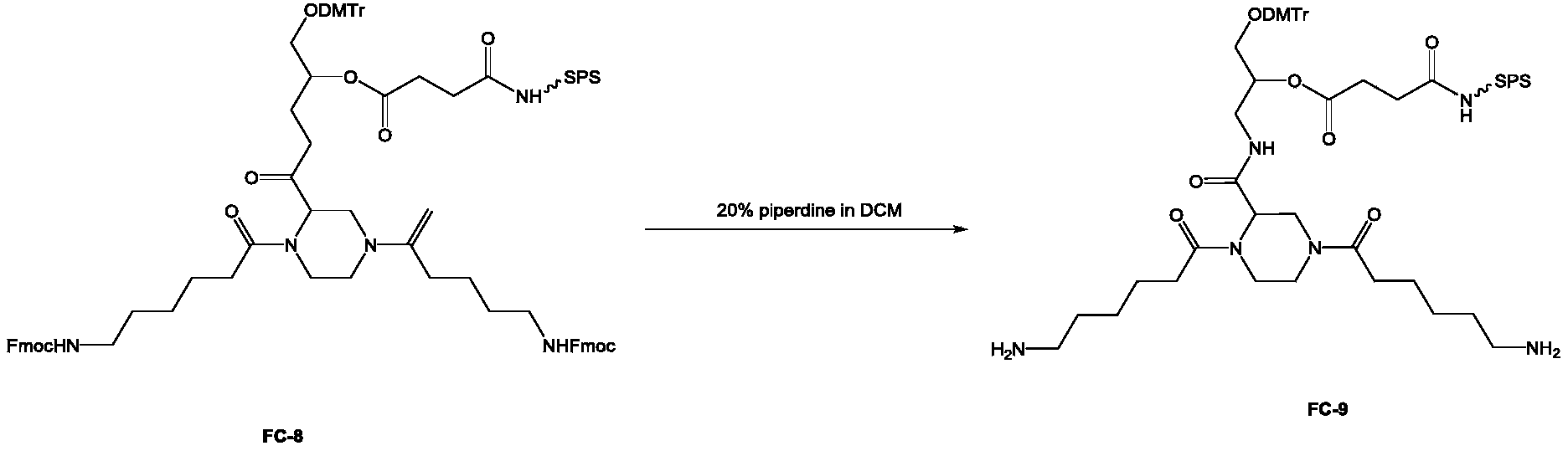
将步骤(1B-9)中所得的5.6g FC-8加入44ml哌啶的二氯甲烷溶液(20%v/v)中,通过震荡反应器将所得混合物旋转反应5小时。过滤混合物,用150ml乙腈洗涤1次,减压条件下干燥滤饼,得到黄色固体状产物FC-9 5.0g。Add 5.6 g of FC-8 obtained in step (1B-9) to 44 ml of piperidine in dichloromethane solution (20% v/v), and rotate the resulting mixture for 5 hours by shaking the reactor. The mixture was filtered, washed with 150 ml of acetonitrile once, and the filter cake was dried under reduced pressure to obtain 5.0 g of a yellow solid product FC-9.
(1B-11)FC-10的合成(1B-11) Synthesis of FC-10

将步骤(1B-10)所得的FC-9(0.86g)、步骤(1B-1-1d)获得的化合物F-e(400mg)、1-羟基苯并三唑(HOBt,78mg)、N-甲基吗啉(151mg)和1-乙基-(3-二甲基氨基丙基)碳酰二亚胺盐酸盐(EDCl,112mg)溶解于12ml无水1,2-二氯乙烷中。在室温下,通过震荡反应器将得到的混合物旋转18小时。过滤混合物,用30ml乙腈、30ml二氯甲烷洗涤,减压条件下干燥滤饼,得到黄色固体状产物FC-10800mg,载样量:269μmol/g。The FC-9 obtained in step (1B-10) (0.86g), the compound Fe obtained in step (1B-1-1d) (400mg), 1-hydroxybenzotriazole (HOBt, 78mg), N-methyl Morpholine (151 mg) and 1-ethyl-(3-dimethylaminopropyl) carbodiimide hydrochloride (EDCl, 112 mg) were dissolved in 12 ml of
制备例2B缀合物185的合成Preparation Example 2B Synthesis of Conjugate 185
(2B-1)合成FC-siSTAT1缀合物正义链(2B-1) Synthesis of FC-siSTAT1 conjugate sense chain
本步骤中,药物缀合物的siRNA为编号为siSTAT1的序列:In this step, the siRNA of the drug conjugate is the sequence numbered siSTAT1:
siSTAT1siSTAT1
正义链:Justice chain:
5'-CmsUmsAmGmAmAmAfAfCfUmGmGmAmUmAmAmCmGmUm-3'(SEQ ID NO:723),5'-CmsUmsAmGmAmAmAfAfCfUmGmGmAmUmAmAmCmGmUm-3'(SEQ ID NO:723),
反义链:Antisense strand:
5'-AmsCfsGmUmUmAfUmCmCmAmGmUmUmUfUmCfUmAmGmsCmsCm-3'(SEQ ID NO:724);5'-AmsCfsGmUmUmAfUmCmCmAmGmUmUmUfUmCfUmAmGmsCmsCm-3' (SEQ ID NO: 724);
其中,正义链3'末端缀合有FC-10化合物,反义链5'末端连接有Cy5荧光基团。Among them, the 3'end of the sense strand is conjugated with an FC-10 compound, and the 5'end of the antisense strand is connected with a Cy5 fluorescent group.
通过亚磷酰胺固相合成的方法,由上述步骤制备的FC-10化合物代替固相合成方法中的固相载体起始,按照上述序列顺序按照3'-5'的方向逐一连接核苷单体。每连接一个核苷单体都包括脱保护、偶联、盖帽、和氧化四步反应。其中,两个核苷酸之间采用磷酸酯连接时,连接后一个核苷单体时,包括脱保护、偶联、盖帽、氧化四步反应。两个核苷酸之间采用硫代磷酸酯连接时,连接后一个核苷单体时,包括保护、偶联、盖帽、硫化四步反应。合成条件给定如下:Through the method of phosphoramidite solid phase synthesis, the FC-10 compound prepared by the above steps replaces the solid phase carrier in the solid phase synthesis method, and the nucleoside monomers are connected one by one in the 3'-5' direction according to the above sequence. . Each connection of a nucleoside monomer includes four steps of deprotection, coupling, capping, and oxidation. Among them, when two nucleotides are connected by phosphate ester, when the next nucleoside monomer is connected, there are four steps of deprotection, coupling, capping, and oxidation. When two nucleotides are connected by phosphorothioate, when the next nucleoside monomer is connected, there are four steps of protection, coupling, capping, and vulcanization. The synthesis conditions are given as follows:
核苷单体以0.1M浓度的乙腈溶液提供,每一步的脱保护反应的条件相同,即温度为25℃,反应时间为70秒,脱保护试剂为二氯乙酸的二氯甲烷溶液(3%v/v),二氯乙酸与固相载体上4,4'-二甲氧基三苯甲基保护基的摩尔比为5:1。The nucleoside monomer is provided in an acetonitrile solution with a concentration of 0.1M. The conditions of the deprotection reaction in each step are the same, that is, the temperature is 25°C, the reaction time is 70 seconds, and the deprotection reagent is dichloroacetic acid in dichloromethane (3%). v/v), the molar ratio of dichloroacetic acid to the 4,4'-dimethoxytrityl protecting group on the solid support is 5:1.
每一步偶联反应条件均相同,包括温度为25℃,固相载体上连接的核酸序列与核苷单体的摩尔比为1:10,固相载体上连接的核酸序列和偶联试剂的摩尔比为1:65,反应时间为600秒,偶联试剂为5-乙硫基-1H-四氮唑(5-(Ethylthio)-1H-tetrazole,ETT)的0.5M乙腈溶液。The conditions of each step of the coupling reaction are the same, including the temperature of 25°C, the molar ratio of the nucleic acid sequence connected to the solid-phase carrier to the nucleoside monomer is 1:10, the molar ratio of the nucleic acid sequence connected to the solid-phase carrier and the coupling reagent The ratio is 1:65, the reaction time is 600 seconds, and the coupling reagent is a 0.5 M acetonitrile solution of 5-(Ethylthio)-1H-tetrazole (ETT).
每一步盖帽条件均相同,包括温度为25℃,反应时间为15秒。盖帽试剂溶液为摩尔比为1:1的CapA和CapB的混合溶液,CapA为20体积%N-甲基咪唑的吡啶/乙腈混合溶液,吡啶与乙腈的体积比为3:5;CapB为20体积%乙酸酐的乙腈溶液;盖帽试剂与固相载体上连接的核酸序列的摩尔比为乙酸酐:N-甲基咪唑:固相载体上连接的核酸序列=1:1:1。The capping conditions in each step are the same, including a temperature of 25°C and a reaction time of 15 seconds. The capping reagent solution is a mixed solution of CapA and CapB with a molar ratio of 1:1, CapA is a pyridine/acetonitrile mixed solution of 20% by volume N-methylimidazole, and the volume ratio of pyridine to acetonitrile is 3:5; CapB is 20 volumes % Acetic anhydride in acetonitrile; the molar ratio of the capping reagent to the nucleic acid sequence connected to the solid phase carrier is acetic anhydride: N-methylimidazole: the nucleic acid sequence connected to the solid phase carrier = 1:1:1.
每一步氧化反应条件相同,包括温度为25℃,反应时间为15秒,氧化试剂为浓度为0.05M的碘水。碘与偶联步骤中固相载体上连接的核酸序列的摩尔比为30:1。反应在四氢呋喃:水:吡啶=3:1:1的混合溶剂中进行。The oxidation reaction conditions for each step are the same, including a temperature of 25°C, a reaction time of 15 seconds, and an oxidizing reagent of 0.05M iodine water. The molar ratio of iodine to the nucleic acid sequence connected to the solid-phase carrier in the coupling step is 30:1. The reaction was carried out in a mixed solvent of tetrahydrofuran: water: pyridine=3:1:1.
每一步硫化反应的条件相同,包括温度为25℃,反应时间为300秒,硫化试剂为氢化黄原素。硫化试剂与偶联步骤中固相载体上连接的核酸序列的摩尔比为120:1。反应在乙腈:吡啶=1:1的混合溶剂中进行。The conditions of each step of the vulcanization reaction are the same, including a temperature of 25°C, a reaction time of 300 seconds, and a vulcanizing reagent is hydroxanthin. The molar ratio of the vulcanizing reagent to the nucleic acid sequence connected to the solid-phase carrier in the coupling step is 120:1. The reaction was carried out in a mixed solvent of acetonitrile:pyridine=1:1.
待最后一个核苷单体连接完成后,依次对固相载体上连接的核酸序列进行切割、脱保护、 纯化、脱盐,随后冻干获得正义链,其中,切割和脱保护条件如下:将合成的连接有载体的核苷酸序列加入浓度为25wt%的氨水中,氨水用量为0.5ml/μmol,在55℃反应16h,过滤去除剩余载体,将上清液真空浓缩至干,随后加入至过量的20%哌啶的二氯甲烷溶液,室温孵育4h脱除Fm基团后,真空浓缩至干。After the connection of the last nucleoside monomer is completed, the nucleic acid sequence connected on the solid-phase carrier is cut, deprotected, purified, and desalted in sequence, and then lyophilized to obtain the sense strand. The cutting and deprotection conditions are as follows: The nucleotide sequence connected to the carrier was added to 25wt% ammonia water, the amount of ammonia water was 0.5ml/μmol, reacted at 55°C for 16h, filtered to remove the remaining carrier, the supernatant was vacuum concentrated to dryness, and then added to the excess 20% piperidine in dichloromethane, incubated for 4h at room temperature to remove the Fm group, then concentrated in vacuo to dryness.
纯化与脱盐条件如下:利用制备型离子色谱纯化柱(Source 15Q),通过NaCl的梯度洗脱,实现核酸的纯化。具体而言为:洗脱剂A:20mM磷酸钠(pH 8.1),溶剂为水/乙腈=9:1(体积比);洗脱剂B:1.5M氯化钠,20mM磷酸钠(pH 8.1),溶剂为水/乙腈=9:1(体积比);洗脱梯度:洗脱剂A:洗脱剂B=100:0-50:50梯度洗脱。收集产品洗脱液后合并,采用反相色谱纯化柱进行脱盐,具体条件包括采用葡聚糖凝胶柱进行脱盐,填料为葡聚糖凝胶G25(Sephadex G25),以去离子水洗脱。Purification and desalting conditions are as follows: using a preparative ion chromatography purification column (Source 15Q), through NaCl gradient elution, to achieve nucleic acid purification. Specifically: eluent A: 20mM sodium phosphate (pH 8.1), solvent is water/acetonitrile = 9:1 (volume ratio); eluent B: 1.5M sodium chloride, 20mM sodium phosphate (pH 8.1) , The solvent is water/acetonitrile=9:1 (volume ratio); elution gradient: eluent A: eluent B=100:0-50:50 gradient elution. The product eluates are collected and combined, and desalted using a reversed-phase chromatography purification column. The specific conditions include using a Sephadex G25 (Sephadex G25) filler, and eluting with deionized water.
检测:使用离子交换色谱(IEX-HPLC)检测的纯度为92.4%;采用液质联用仪(LC-MS)分析分子量,理论值7253.96,实测值7253.12。Detection: The purity measured by ion exchange chromatography (IEX-HPLC) is 92.4%; the molecular weight is analyzed by liquid mass spectrometry (LC-MS), the theoretical value is 7253.96, and the measured value is 7253.12.
从而,该步骤中将FC-10化合物连接至所得到的正义链的3'末端,得到FC-10化合物缀合在siRNA3'末端的siRNA正义链S。Therefore, in this step, the FC-10 compound is connected to the 3'end of the resulting sense strand, and the siRNA sense strand S in which the FC-10 compound is conjugated to the 3'end of the siRNA is obtained.
(2B-2)合成FC-siSTAT1缀合物的反义链(2B-2) Synthesis of the antisense strand of FC-siSTAT1 conjugate
采用与缀合物29中制备反义链相同方法制备FC-siSTAT1缀合物的反义链,不同的是:(1)在连接反义链最后一个核苷单体后,再额外将Cy5荧光基团连接到反义链上;(2)反义链的切割与脱保护条件不同。The antisense strand of the FC-siSTAT1 conjugate was prepared by the same method as the preparation of the antisense strand in Conjugate 29, except that: (1) After connecting the last nucleoside monomer of the antisense strand, the Cy5 fluorescence was added. The group is connected to the antisense strand; (2) The cleavage and deprotection conditions of the antisense strand are different.
具体来说:在(1)中,在按照制备例1中步骤(7-2)中所描述的固相亚磷酰胺法制备反义链过程中,连接反义链最后一个核苷单体后,再经脱保护、偶联、盖帽、氧化四步反应将式(901)所示的Cy5亚磷酰胺单体(购自上海兆维科技发展有限公司,货号为OP-057)连接至反义链5'末端。其中,使用的脱保护、偶联、盖帽、氧化反应条件与步骤(7-2)合成反义链相同,不同在于:1)脱保护反应时间延长至300秒;2)Cy5偶联反应时间延长至900秒。Specifically: in (1), in the process of preparing the antisense strand according to the solid-phase phosphoramidite method described in step (7-2) of Preparation Example 1, after connecting the last nucleoside monomer of the antisense strand , And then the Cy5 phosphoramidite monomer represented by formula (901) (purchased from Shanghai Zhaowei Technology Development Co., Ltd., the item number is OP-057) is connected to the antisense by four steps of deprotection, coupling, capping, and oxidation. The 5'end of the chain. Among them, the deprotection, coupling, capping, and oxidation reaction conditions used are the same as those in step (7-2) for the synthesis of antisense strands, except that: 1) the deprotection reaction time is extended to 300 seconds; 2) the Cy5 coupling reaction time is extended To 900 seconds.

在(2)中,切割和脱保护条件如下:将合成的连接有载体的核苷酸序列加入AMA溶液(40wt%甲胺水溶液与25wt%氨水体积比为1:1的混合溶液)中,AMA溶液用量为0.5ml/μmol,在25℃水浴条件下反应2h,过滤去除剩余载体,将上清液真空浓缩至干。反义链的纯化和脱盐条件与步骤(7-2)中合成反义链时的纯化和脱盐相同。随后冻干,得到FC-siSTAT1缀合物的反义链AS。In (2), the cleavage and deprotection conditions are as follows: the synthesized nucleotide sequence connected with the carrier is added to the AMA solution (a mixed solution of 40wt% methylamine aqueous solution and 25wt% ammonia water in a volume ratio of 1:1), AMA The amount of the solution is 0.5ml/μmol, and the reaction is carried out at 25°C in a water bath for 2h. The remaining carrier is removed by filtration, and the supernatant is vacuum concentrated to dryness. The purification and desalting conditions of the antisense strand are the same as the purification and desalting of the antisense strand in step (7-2). Subsequently, it was lyophilized to obtain the antisense strand AS of the FC-siSTAT1 conjugate.
从而,得到药物缀合物FC-siSTAT1缀合物,该药物缀合物的siRNA反义链的5'末端共价连接有Cy5荧光基团,具有表2H所示的对应于药物缀合物FC-siSTAT1缀合物的正义链和反义链序列。Thus, the drug conjugate FC-siSTAT1 conjugate is obtained, the 5'end of the siRNA antisense strand of the drug conjugate is covalently linked to the Cy5 fluorescent group, and the drug conjugate FC-siSTAT1 corresponding to the drug conjugate FC is shown in Table 2H. -The sense strand and antisense strand sequences of the siSTAT1 conjugate.
检测:采用离子交换色谱(IEX-HPLC)进行检测的纯度为93.2%;分子量采用液质联用仪(LC-MS)进行分析。理论值6675.04,实测值6674.50。Detection: The purity measured by ion exchange chromatography (IEX-HPLC) was 93.2%; the molecular weight was analyzed by liquid mass spectrometry (LC-MS). The theoretical value is 6675.04, and the measured value is 6674.50.
(2B-3)合成FC-siSTAT1缀合物(2B-3) Synthesis of FC-siSTAT1 conjugate
将步骤(2B-1)中获得的正义链和(2B-2)中获得的反义链分别溶于注射用水溶液中,得到40mg/ml的溶液。将它们以等摩尔比混合,在50℃下加热15分钟,冷却至室温以使其通过氢键形成双链结构。The sense strand obtained in step (2B-1) and the antisense strand obtained in (2B-2) were respectively dissolved in an aqueous solution for injection to obtain a 40 mg/ml solution. They were mixed in an equimolar ratio, heated at 50°C for 15 minutes, and cooled to room temperature to form a double-stranded structure through hydrogen bonding.
在上述合成完成后,用超纯水(Milli-Q超纯水仪自制,电阻率18.2MΩ*cm(25℃))将缀合物稀释至0.2mg/mL的浓度。利用液质联用仪(LC-MS,Liquid Chromatography-Mass Spectrometry,购于Waters公司,型号:LCT Premier)进行分子量检测。其结果,分子量理论值S:7253.96,AS:6675.04;分子量实测值S:7253.24,AS:6674.61,实测值与理论值一致,从而确定所合成的缀合物是目标设计的带有FC-10化合物的双链核酸序列。FC-siSTAT1缀合物(缀合物185)的结构如式(311)所示。After the above synthesis is completed, the conjugate is diluted to a concentration of 0.2 mg/mL with ultrapure water (Milli-Q ultrapure water meter self-made, resistivity 18.2MΩ*cm (25°C)). A liquid chromatography-mass spectrometry (LC-MS, Liquid Chromatography-Mass Spectrometry, purchased from Waters, model: LCT Premier) was used for molecular weight detection. As a result, the theoretical molecular weight S: 7253.96, AS: 6675.04; the measured molecular weight S: 7253.24, AS: 6674.61, and the measured value is consistent with the theoretical value, thus confirming that the synthesized conjugate is the target design compound with FC-10 The double-stranded nucleic acid sequence. The structure of FC-siSTAT1 conjugate (conjugate 185) is shown in formula (311).
表2药物缀合物Table 2 Drug Conjugates
表2ATable 2A


表2BTable 2B


表2CTable 2C


表2DTable 2D


表2ETable 2E


表2FTable 2F


表2GTable 2G


表2HTable 2H

其中,S表示正义链,AS表示反义链;大写字母C、G、U、A表示核苷酸的碱基组成;小写字母m表示该字母m左侧相邻的一个核苷酸为2'-甲氧基修饰的核苷酸;小写字母f表示该字母f左侧相邻的一个核苷酸为2'-氟修饰的核苷酸;小写字母s表示与该字母s左右相邻的两个核苷酸之间的连接为硫代磷酸酯基连接;VP表示该VP右侧的一个核苷酸为乙烯基磷酸酯修饰的核苷酸;P表示该字母P右侧的一个核苷酸为磷酸酯修饰的核苷酸;Ps表示该Ps右侧的一个核苷酸为硫代磷酸酯修饰的核苷酸。Among them, S represents the sense strand, AS represents the antisense strand; capital letters C, G, U, A represent the base composition of nucleotides; lowercase letter m represents that the adjacent nucleotide to the left of the letter m is 2' -Methoxy-modified nucleotides; the lowercase letter f indicates that the adjacent nucleotide to the left of the letter f is a 2'-fluoro-modified nucleotide; the lowercase letter s indicates the two adjacent to the left and right of the letter s The connection between nucleotides is a phosphorothioate group connection; VP indicates that a nucleotide on the right side of the VP is a nucleotide modified by vinyl phosphate; P indicates a nucleotide on the right side of the letter P It is a phosphate-modified nucleotide; Ps indicates that a nucleotide on the right side of the Ps is a phosphorothioate-modified nucleotide.
上述制备例7和8中,当AS链5'位末端为VP-Um表示的乙烯基磷酸酯修饰的2'-甲氧基修饰尿嘧啶核苷酸时,对应的乙烯基磷酸酯修饰的2'-甲氧基修饰尿嘧啶核苷单体(VP-U-6化合物)按照以下方法合成:In the above preparation examples 7 and 8, when the 5'end of the AS chain is a vinyl phosphate modified 2'-methoxy modified uracil nucleotide represented by VP-Um, the corresponding vinyl phosphate modified 2 '-Methoxy modified uridine monomer (VP-U-6 compound) was synthesized according to the following method:

(13-1)VP-U-2的合成(13-1) Synthesis of VP-U-2
按照以下方法,合成了VP-U-2分子:The VP-U-2 molecule was synthesized according to the following method:

将2'-甲氧基修饰的尿嘧啶核苷酸(2'-OMe-U,51.30g,91.6mmol),叔丁基二苯基氯硅烷(TBDPSCl,50.35g,183.2mmol),咪唑(12.47g,183.2mmol)混合溶于450ml N,N-二甲基甲酰胺(DMF),室温下搅拌反应20h。蒸除DMF,用600ml二氯甲烷溶解后加300ml饱和碳酸氢钠洗涤,水相再用二氯甲烷(DCM)萃取3次,每次300ml,合并有机相,用5%草酸洗涤至水相pH<5,蒸发溶剂至干后获得VP-U-1粗品直接用于随后VP-U-2的合成。The 2'-methoxy modified uracil nucleotide (2'-OMe-U, 51.30g, 91.6mmol), tert-butyldiphenylchlorosilane (TBDPSCl, 50.35g, 183.2mmol), imidazole (12.47) g, 183.2mmol) was mixed and dissolved in 450ml N,N-dimethylformamide (DMF), and the reaction was stirred at room temperature for 20h. Evaporate DMF, dissolve with 600ml of dichloromethane and add 300ml of saturated sodium bicarbonate to wash. The aqueous phase is then extracted with dichloromethane (DCM) 3 times, 300ml each time. Combine the organic phases and wash with 5% oxalic acid until the pH of the aqueous phase <5, after evaporating the solvent to dryness, the crude VP-U-1 is obtained directly for the subsequent synthesis of VP-U-2.
将VP-U-1粗品用100ml二氯甲烷溶解后,外加冰浴搅拌10分钟,再加入预先在4℃冰箱冷藏好的450ml 2%对甲苯磺酸溶液(溶剂为体积比3:7的甲醇-二氯甲烷混合溶剂),反应10分钟。再加入200ml饱和碳酸氢钠淬灭反应,有机相加入饱和碳酸氢钠水溶液洗涤至pH=8。合并水相,用二氯甲烷萃取2次,每次200ml,合并有机相,再用200ml饱和食盐水洗涤一次,蒸发溶剂至干。200-300目正相硅胶柱纯化,石油醚装柱,以石油醚:乙酸乙酯:二氯甲烷:甲醇=1:1:1:0.05-1:1:1:0.25梯度洗脱,收集产物洗脱液,减压蒸干溶剂,真空油泵发泡干燥得到纯品VP-U-2共40.00g。1H NMR(400MHz,DMSO-d6)δ7.96(d,J=7.8Hz,1H),7.64(dtd,J=5.1,4.0,2.2Hz,4H),7.41–7.30(m,6H),6.79(d,J=4.7Hz,1H),5.73(d,J=7.6Hz,1H),4.94(t,J=7.0Hz,1H),4.12(td,J=4.6,3.9Hz,1H),4.05(dd,J=4.8,4.0Hz,1H),3.96(t,J=4.7Hz,1H),3.68(ddd,J=11.8,7.0,4.6Hz,1H),3.57–3.46(m,1H),3.39(s,3H),1.05(s,8H).MS m/z:C 26H 33N 2O 6Si,[M+H]+,理论:497.21,实测:497.45。 After dissolving the crude VP-U-1 in 100ml of dichloromethane, add an ice bath and stir for 10 minutes, and then add 450ml of 2% p-toluenesulfonic acid solution (solvent is methanol with a volume ratio of 3:7), which has been stored in a refrigerator at 4℃ -Dichloromethane mixed solvent), react for 10 minutes. Then 200ml saturated sodium bicarbonate was added to quench the reaction, and the organic phase was washed with saturated sodium bicarbonate aqueous solution to pH=8. The aqueous phases were combined and extracted twice with 200 ml of dichloromethane each time. The organic phases were combined and washed once with 200 ml of saturated brine, and the solvent was evaporated to dryness. 200-300 mesh normal phase silica gel column purification, petroleum ether packing column, with petroleum ether: ethyl acetate: dichloromethane: methanol=1:1:1:0.05-1:1:1:0.25 gradient elution, collect the product The eluent, the solvent is evaporated under reduced pressure, and the vacuum oil pump is foamed and dried to obtain 40.00 g of pure product VP-U-2. 1H NMR (400MHz, DMSO-d6) δ 7.96 (d, J = 7.8 Hz, 1H), 7.64 (dtd, J = 5.1, 4.0, 2.2 Hz, 4H), 7.41-7.30 (m, 6H), 6.79 ( d, J = 4.7 Hz, 1H), 5.73 (d, J = 7.6 Hz, 1H), 4.94 (t, J = 7.0 Hz, 1H), 4.12 (td, J = 4.6, 3.9 Hz, 1H), 4.05 ( dd, J = 4.8, 4.0 Hz, 1H), 3.96 (t, J = 4.7 Hz, 1H), 3.68 (ddd, J = 11.8, 7.0, 4.6 Hz, 1H), 3.57–3.46 (m, 1H), 3.39 (s, 3H), 1.05 (s, 8H). MS m/z: C 26 H 33 N 2 O 6 Si, [M+H]+, theory: 497.21, measured: 497.45.
(13-2)VP-U-4的合成:(13-2) Synthesis of VP-U-4:

将VP-U-2(19.84g,40.0mmol),二环己基碳二亚胺(DCC,16.48g,80.0mmol),吡啶(4.20g,53.2mmol),三氟乙酸(6.61g,53.2mmol)混合溶于200ml二甲基亚砜(DMSO),室温下搅拌反应20h。另取亚甲基二磷酸四乙酯(21.44g,74.4mmol)溶于120ml THF,冰浴降温,在冰浴温度下加入t-BuOK(11.36g,101.2mmol),先在冰浴温度下反应10min,再升至室温反应0.5h,然后加入至前 述反应液中,约1h加完,冰浴温度下反应1h,再升至室温反应18h。加水淬灭反应,水相以二氯甲烷提取3次,每次200ml。合并有机相,用200ml饱和食盐水水洗一次后蒸发溶剂至干。用200-300目正相硅胶柱纯化,石油醚装柱,以石油醚:乙酸乙酯=1:1-1:4梯度洗脱,收集产物洗脱液,减压蒸干溶剂,真空油泵发泡干燥得到纯品VP-U-4共14.00g。1H NMR(400MHz,DMSO-d6)δ7.96(d,J=7.8Hz,1H),7.64(dtd,J=5.1,4.0,2.2Hz,4H),7.41–7.30(m,6H),6.82–6.71(m,2H),5.90(ddd,J=25.9,15.0,1.0Hz,1H),5.73(d,J=7.6Hz,1H),4.36–4.21(m,3H),4.18(t,J=4.9Hz,1H),4.05(ddq,J=9.7,8.5,6.9Hz,2H),3.87(t,J=4.8Hz,1H),3.39(s,3H),1.32(td,J=6.9,0.7Hz,6H),1.05(s,8H).MS m/z:C 31H 42N 2O 8PSi,[M+H]+,理论:629.24,实测:629.51。 VP-U-2 (19.84g, 40.0mmol), dicyclohexylcarbodiimide (DCC, 16.48g, 80.0mmol), pyridine (4.20g, 53.2mmol), trifluoroacetic acid (6.61g, 53.2mmol) Mix and dissolve in 200ml dimethyl sulfoxide (DMSO), stir and react at room temperature for 20h. Separately dissolve tetraethyl methylene diphosphate (21.44g, 74.4mmol) in 120ml THF, cool down on an ice bath, add t-BuOK (11.36g, 101.2mmol) at the temperature of the ice bath, and first react at the temperature of the ice bath After 10 minutes, the temperature was raised to room temperature and reacted for 0.5 hours, and then added to the aforementioned reaction solution. After the addition was completed in about 1 hour, the reaction was carried out at ice bath temperature for 1 hour, and then the temperature was raised to room temperature for 18 hours. The reaction was quenched by adding water, and the aqueous phase was extracted with dichloromethane three times with 200 ml each time. The organic phases were combined, washed once with 200 ml of saturated brine, and the solvent was evaporated to dryness. Purify with a 200-300 mesh normal phase silica gel column, packed with petroleum ether, eluted with a gradient of petroleum ether: ethyl acetate = 1:1-1:4, collect the product eluent, evaporate the solvent under reduced pressure, and send it by a vacuum oil pump. Soak and dry to obtain a total of 14.00 g of pure VP-U-4. 1H NMR(400MHz,DMSO-d6)δ7.96(d,J=7.8Hz,1H), 7.64(dtd,J=5.1,4.0,2.2Hz,4H), 7.41–7.30(m,6H), 6.82– 6.71 (m, 2H), 5.90 (ddd, J = 25.9, 15.0, 1.0 Hz, 1H), 5.73 (d, J = 7.6 Hz, 1H), 4.36-4.21 (m, 3H), 4.18 (t, J = 4.9Hz, 1H), 4.05 (ddq, J = 9.7, 8.5, 6.9 Hz, 2H), 3.87 (t, J = 4.8 Hz, 1H), 3.39 (s, 3H), 1.32 (td, J = 6.9, 0.7 Hz, 6H), 1.05 (s, 8H). MS m/z: C 31 H 42 N 2 O 8 PSi, [M+H]+, theory: 629.24, measured: 629.51.
(13-3)VP-U-5的合成:(13-3) Synthesis of VP-U-5:

将VP-U-4(14.00g,22.29mmol)溶于100ml四氢呋喃,加入三乙胺三氢氟酸(17.96g,111.45mmol),室温搅拌20h反应完全。直接蒸发溶剂至干,再用二氯甲烷溶解随后蒸干2次,每次使用50ml二氯甲烷,得到粗品。用200-300目正相硅胶柱纯化,石油醚装柱,以石油醚:乙酸乙酯:二氯甲烷:甲醇=1:1:1:0.05-1:1:1:0.25梯度洗脱,收集产物洗脱液,减压蒸干溶剂,真空油泵发泡干燥得到纯品VP-U-5共6.70g。1H NMR(400MHz,DMSO-d6)δ7.96(d,J=7.8Hz,1H),6.77(dd,J=15.0,6.2Hz,1H),5.99–5.82(m,2H),5.73(d,J=7.6Hz,1H),5.27(d,J=5.1Hz,1H),5.10(dd,J=5.3,4.7Hz,1H),4.29(ddq,J=9.8,8.6,7.0Hz,2H),4.17(ddd,J=6.2,5.2,1.0Hz,1H),4.12–3.98(m,3H),3.39(s,2H),1.32(td,J=6.9,0.6Hz,6H).MS m/z:C 15H 24N 2O 8P,[M+H]+,理论:391.13,实测:391.38。 Dissolve VP-U-4 (14.00 g, 22.29 mmol) in 100 ml of tetrahydrofuran, add triethylamine trihydrofluoric acid (17.96 g, 111.45 mmol), and stir at room temperature for 20 hours to complete the reaction. Evaporate the solvent directly to dryness, then dissolve in dichloromethane and then evaporate to dryness twice, using 50ml of dichloromethane each time to obtain a crude product. Purify with a 200-300 mesh normal phase silica gel column, pack the column with petroleum ether, elution with a gradient of petroleum ether: ethyl acetate: dichloromethane: methanol=1:1:1:0.05-1:1:1:0.25, and collect The product eluent, the solvent was evaporated under reduced pressure, and the product was foamed and dried by a vacuum oil pump to obtain 6.70g of pure VP-U-5. 1H NMR(400MHz,DMSO-d6)δ7.96(d,J=7.8Hz,1H), 6.77(dd,J=15.0,6.2Hz,1H), 5.99-5.82(m,2H), 5.73(d, J=7.6Hz,1H), 5.27(d,J=5.1Hz,1H), 5.10(dd,J=5.3,4.7Hz,1H), 4.29(ddq,J=9.8,8.6,7.0Hz,2H), 4.17(ddd,J=6.2,5.2,1.0Hz,1H),4.12-3.98(m,3H),3.39(s,2H),1.32(td,J=6.9,0.6Hz,6H).MS m/z : C 15 H 24 N 2 O 8 P, [M+H]+, theory: 391.13, actual measurement: 391.38.
(13-4)VP-U-6的合成:(13-4) Synthesis of VP-U-6:

在氩气保护条件下向10ml无水二氯甲烷中加入VP-U-5(391mg,1.0mmol)、三氟乙酸吡啶盐(0.232g,1.2mmol)、N-甲基咪唑(0.099g,1.2mmol),双(二异丙基氨基)(2-氰基乙氧基)膦(0.452g,1.5mmol),室温搅拌反应5小时。蒸除溶剂至干,柱层析纯化(200-300目正相硅胶,二氯甲烷:乙腈(含0.5wt%三乙胺)=3:1-1:3梯度洗脱),收集产物洗脱液,浓缩除去溶剂,得到目标产物VP-U-6共508mg。31P NMR(161MHz,DMSO-d6)δ150.34,150.29,17.07,15.50.MS m/z:C 24H 41N 4O 9P 2,[M+H]+,理论:591.23,实测:591.55。表明VP-U-6是目标产物VP-Um,作为核苷单体参与RNA链合成。 Under argon protection, add VP-U-5 (391mg, 1.0mmol), trifluoroacetic acid pyridine salt (0.232g, 1.2mmol), N-methylimidazole (0.099g, 1.2mmol) to 10ml of dry dichloromethane. mmol), bis(diisopropylamino)(2-cyanoethoxy)phosphine (0.452g, 1.5mmol), the reaction was stirred at room temperature for 5 hours. Evaporate the solvent to dryness, purify by column chromatography (200-300 mesh normal phase silica gel, dichloromethane:acetonitrile (containing 0.5wt% triethylamine) = 3:1-1:3 gradient elution), collect the product and elute The solution was concentrated to remove the solvent to obtain 508 mg of the target product VP-U-6. 31P NMR (161MHz, DMSO-d6) δ 150.34, 150.29, 17.07, 15.50. MS m/z: C 24 H 41 N 4 O 9 P 2 , [M+H]+, theory: 591.23, actual measurement: 591.55. It shows that VP-U-6 is the target product VP-Um, which participates in RNA chain synthesis as a nucleoside monomer.
使用如下方法将5'-磷酸酯修饰连接至反义链5'端:Use the following method to connect the 5'-phosphate modification to the 5'end of the antisense strand:
原料为具有如式CPR-I结构的磷酸化结构单体,由苏州吉玛提供,货号Cat#13-2601-XX:The raw material is a phosphorylated structural monomer with the structure of the formula CPR-I, provided by Suzhou Jima, catalog number Cat#13-2601-XX:

在反义链全部核苷单体连接完毕后,按照亚磷酰胺核酸固相合成的方法,经脱保护、偶联、盖帽、氧化四步反应将CPR-I单体连接至反义链5'末端。随后按照如下条件进行切割与脱保护,获得反义链:After all the nucleoside monomers of the antisense strand are connected, the CPR-I monomer is connected to the 5'of the antisense strand through a four-step reaction of deprotection, coupling, capping, and oxidation according to the method of phosphoramidite nucleic acid solid-phase synthesis. End. Then cut and deprotect according to the following conditions to obtain the antisense strand:
将合成的连接有载体的核苷酸序列加入浓度为25wt%的氨水中,氨水用量为0.5ml/μmol,在55℃反应16h,除去液体,真空浓缩至干。在氨水处理后,相对于单链核酸的量,用0.4ml/μmol N-甲基吡咯烷酮溶解产品,随后加入0.3ml/μmol三乙胺和0.6ml/μmol三乙胺三氢氟酸盐,脱除核糖上的 2'-O-TBDMS保护。纯化与脱盐:利用制备型离子色谱纯化柱(Source 15Q),通过NaCl的梯度洗脱,完成核酸的纯化。具体而言为:洗脱剂A:20mM磷酸钠(pH 8.1),溶剂为水/乙腈=9:1(体积比);洗脱剂B:1.5M氯化钠,20mM磷酸钠(pH 8.1),溶剂为水/乙腈=9:1(体积比);洗脱梯度:洗脱剂A:洗脱剂B=100:0-50:50梯度洗脱。收集产品洗脱液后合并,采用反相色谱纯化柱进行脱盐,具体条件包括采用葡聚糖凝胶柱进行脱盐,填料为葡聚糖凝胶G25,以去离子水洗脱。The synthesized nucleotide sequence connected with the carrier was added to 25wt% ammonia water, the amount of ammonia water was 0.5ml/μmol, the reaction was carried out at 55°C for 16h, the liquid was removed, and it was concentrated to dryness in vacuo. After ammonia treatment, relative to the amount of single-stranded nucleic acid, dissolve the product with 0.4ml/μmol N-methylpyrrolidone, and then add 0.3ml/μmol triethylamine and 0.6ml/μmol triethylamine trihydrofluoride to remove In addition to the 2'-O-TBDMS protection on ribose. Purification and desalting: Use a preparative ion chromatography purification column (Source 15Q) to complete the purification of nucleic acid through NaCl gradient elution. Specifically: eluent A: 20mM sodium phosphate (pH 8.1), solvent is water/acetonitrile = 9:1 (volume ratio); eluent B: 1.5M sodium chloride, 20mM sodium phosphate (pH 8.1) , The solvent is water/acetonitrile=9:1 (volume ratio); elution gradient: eluent A: eluent B=100:0-50:50 gradient elution. The product eluates are collected and combined, and desalted using a reversed-phase chromatography purification column. The specific conditions include using a Sephadex column for desalting, the filler is Sephadex G25, and elution with deionized water.
对于目标产物具有5'-硫代磷酸酯修饰的情况,使用与上述同样的步骤,区别在于在连接时,以硫化反应条件代替上述氧化反应条件,进行硫化反应。For the case where the target product has 5'-phosphorothioate modification, the same steps as above are used, except that when connecting, the vulcanization reaction conditions are used instead of the above oxidation reaction conditions to carry out the vulcanization reaction.
对于上述合成的正义链和反义链,使用离子交换色谱(IEX-HPLC)检测纯度,并以液质联用色谱(LC-MS)分析分子量,确认所合成的核酸序列是对应于表2中各缀合物与对比缀合物的siRNA。For the above-synthesized sense strand and antisense strand, ion exchange chromatography (IEX-HPLC) was used to check the purity, and liquid mass spectrometry (LC-MS) was used to analyze the molecular weight to confirm that the synthesized nucleic acid sequence corresponds to Table 2 SiRNA for each conjugate and comparison conjugate.
实验例1本实验说明本公开的药物缀合物的动物水平毒性。Experimental Example 1 This experiment illustrates the animal-level toxicity of the drug conjugate of the present disclosure.
在C57BL/6J小鼠(购自北京维通利华实验动物技术有限公司)上,分别向每只小鼠皮下单次给予300mg/kg(以siRNA计)的缀合物28-30、38-42、47-49、68-70、90-92、145-147和175-177,连续观察14天,未出现动物死亡,也未观察到与药物不良反应相关的临床症状,在观察结束后,对各小鼠进行大体解剖,也均未发现异常。从而,上述结果表明本公开的药物缀合物具有较低的动物水平毒性。In C57BL/6J mice (purchased from Beijing Weitong Lihua Experimental Animal Technology Co., Ltd.), each mouse was given a single subcutaneous administration of 300 mg/kg (calculated by siRNA) of the conjugate 28-30, 38- 42, 47-49, 68-70, 90-92, 145-147, and 175-177 were observed for 14 consecutive days. No animal deaths occurred, and no clinical symptoms related to adverse drug reactions were observed. After the observation, The general dissection of each mouse showed no abnormalities. Thus, the above results indicate that the drug conjugate of the present disclosure has lower animal-level toxicity.
以下实验例2-实验例8中,按照siRNA靶点位置和序列关联性,对表2A-表2G的药物缀合物的性质和效果分别进行实验验证。In the following Experimental Example 2-Experimental Example 8, the properties and effects of the drug conjugates in Table 2A-Table 2G were verified by experiments according to the siRNA target position and sequence correlation.
实验例2表2A的药物缀合物的效果实验Experimental Example 2 Effect experiment of the drug conjugate of Table 2A
实验例2-1本公开缀合物在人血浆中的体外稳定性Experimental Example 2-1 In vitro stability of the conjugate of the present disclosure in human plasma
将缀合物32(以siRNA浓度为20μΜ的0.9%氯化钠水溶液形式提供,每组12μl)与108μL 90%人血浆(Human plasma,购自江苏省血液研究所,以1×PBS(pH7.4)稀释)混匀,获得混合液,并在37℃恒温孵育。在孵育过程中,分别在0、2、4、6、8、24、48、72小时中的每个时间点取出10μL混合液,立即进行液氮速冻,于-80℃冰箱中冻存。其中,0小时是指缀合物溶液与90%人血浆混匀后,立即取出10μL混合液的时刻。待各时间点取样完毕后,用1×PBS(pH7.4)将各混合液稀释5倍后,取每一稀释混合液10μL准备电泳。同时,取等摩尔量的药物缀合物32溶液(siRNA浓度为2μM)2μl,与8μl 1×PBS(pH7.4)混匀,制备成10μL未经人血浆处理的样品(记为Con)。Conjugate 32 (provided in the form of a 0.9% sodium chloride aqueous solution with a siRNA concentration of 20μM, 12μl per group) and 108μL 90% human plasma (purchased from Jiangsu Institute of Blood, 1×PBS (pH7. 4) Dilution) Mix well to obtain a mixed solution, and incubate at 37°C. During the incubation process, 10 μL of the mixed solution was taken out at each time point of 0, 2, 4, 6, 8, 24, 48, and 72 hours, and then quickly frozen in liquid nitrogen and stored in a refrigerator at -80°C. Here, 0 hour refers to the time when 10 μL of the mixed solution is taken out immediately after mixing the conjugate solution with 90% human plasma. After sampling at each time point, each mixture was diluted 5 times with 1×PBS (pH 7.4), and 10 μL of each diluted mixture was prepared for electrophoresis. At the same time, 2 μl of an equimolar amount of the
配制20重量%的非变性聚丙烯酰胺凝胶,将每一组的准备电泳的样品分别与4μL上样缓冲液(20mM EDTA,36重量%甘油,0.06重量%溴酚蓝的水溶液)混合,然后上样至各凝胶孔,在80mA恒流条件下电泳60分钟。电泳结束后,取出凝胶,用1×Sybr Gold染料(Invitrogen,Cat.11494)染色15分钟后成相,结果如图1所示。所述对比序列1如下:Prepare a 20% by weight non-denaturing polyacrylamide gel, and mix the samples for electrophoresis in each group with 4μL of loading buffer (20mM EDTA, 36% by weight glycerol, 0.06% by weight bromophenol blue in water), and then Load the sample to each gel well, and electrophoresis for 60 minutes under the condition of 80mA constant current. After the electrophoresis is over, the gel is taken out and stained with 1×Sybr'Gold dye (Invitrogen, Cat.11494) for 15 minutes and then phased. The result is shown in Figure 1. The
正义链:5'-CCUUGAGGCAUACUUCAAA-3'(SEQ ID NO:1)Sense chain: 5'-CCUUGAGGCAUACUUCAAA-3' (SEQ ID NO:1)
反义链:5'-UUUGAAGUAUGCCUCAAGGUU-3'(SEQ ID NO:2)Antisense strand: 5'-UUUGAAGUAUGCCUCAAGGUU-3' (SEQ ID NO: 2)
由图1显示了测试的药物缀合物在体外人血浆中的稳定性半定量检测结果。结果显示,本公开的缀合物在人血浆中最高72h时仍未降解,显示出优异的在人血浆中的稳定性。Figure 1 shows the semi-quantitative test results of the stability of the tested drug conjugates in human plasma in vitro. The results show that the conjugate of the present disclosure has not degraded in human plasma for up to 72 hours, showing excellent stability in human plasma.
实验例2-2本公开缀合物在猴血浆中的体外稳定性Experimental Example 2-2 In vitro stability of the conjugate of the present disclosure in monkey plasma
将缀合物32和对比序列1(分别以siRNA浓度为20μM的0.9wt%氯化钠水溶液形式提供,每组12μL)分别与108μL 90%食蟹猴血浆(Monkey plasma,购自鸿泉生物,HQ70082,以1×PBS稀释)混匀,获得混合液并在37℃恒温孵育。在孵育过程中,分别在0、2、4、6、8、24、48、72小时中的每个时间点取出10μL样本,立即进行液氮速冻于-80℃冰箱中冻存。其中,0小时是指缀合物溶液与90%食蟹猴血浆混匀后,立即取出10μL混合液的时刻。待各时间点取样完毕后,用1×PBS(pH7.4)将各混合液稀释5倍后,取每一稀释混合液10μL准备电泳。同时,取等摩尔量的缀合物32(以siRNA计的浓度为2μM)2μl与8μl 1×PBS(pH7.4)混匀获得10μL未经猴血浆处理的样品(记为Con)。
配制20重量%的非变性聚丙烯酰胺凝胶,将上述稀释后的样品中每一组的准备电泳样品与4μL上样缓冲液(20mM EDTA,36重量%甘油,0.06重量%溴酚蓝的水溶液)混合,然后上样至各凝胶孔,在80mA恒流条件下电泳60分钟。电泳结束后,凝胶用1×Sybr Gold染料(Invitrogen,Cat.11494)染色15分钟后成相,结果如图2所示。Prepare a 20% by weight non-denaturing polyacrylamide gel, and combine the prepared electrophoresis samples of each group of the above diluted samples with 4μL of loading buffer (20mM EDTA, 36% by weight glycerol, 0.06% by weight bromophenol blue in water) ) Mix, then load the sample to each gel well, and electrophoresis for 60 minutes under the condition of 80mA constant current. After the electrophoresis, the gel was stained with 1×Sybr'Gold dye (Invitrogen, Cat.11494) for 15 minutes and then phased. The result is shown in Figure 2.
图2示出了所测试药物缀合物在体外猴血浆中的稳定性半定量检测结果。可以看出,本公开的缀合物32在食蟹猕猴血浆中最高为72h仍未降解,显示出优异的在猴血浆中的稳定性。Figure 2 shows the results of semi-quantitative detection of the stability of the tested drug conjugates in monkey plasma in vitro. It can be seen that the
实验例2-3本实验说明缀合物32在大鼠体内的药代动力学Experimental example 2-3 This experiment illustrates the pharmacokinetics of
在本实验例中,分别向各实验组的大鼠(每组10只大鼠,雌雄各半)皮下注射给予缀合物32,单次给药剂量按照1mg/kg和0.5mg/kg大鼠体重实施。随后检测各时间点的大鼠血浆药物浓度和肝脏组织药物浓度。In this experimental example, the rats in each experimental group (10 rats in each group, half male and female) were injected subcutaneously with
首先,将SD大鼠采用PRISTIMA 7.2.0版数据系统根据大鼠体重分性别随机分组,随后按照设计的剂量分别给予缀合物。所有动物根据体重计算药量,皮下单次给药,剂量为1和0.5mg/kg,以1mg/ml和5mg/ml的0.9%氯化钠水溶液的形式,体积为10ml/kg。给药前及给药后5分钟(±30秒)、30分钟(±1分钟)、1小时(±2分钟)、2小时(±2分钟)、6小时(±5分钟)、24小时(±10分钟)、48小时(±20分钟)、72小时(±20分钟)、120小时(±30分钟)、168小时(±30分钟)分别从颈静脉采集大鼠全血。之后全血样品于2~8℃在离心力1800×g下离心10分钟分离血浆,血浆样品在一管中放置约70μL,剩余的同一样品放置于另一管中,二者均在-70~-86℃冻存待检。分别在给药后约24、48、72、120、168小时采集大鼠肝脏组织,采集方法包括根据大鼠体重以戊巴比妥钠麻醉(腹腔注射60mg/kg),腹主动脉采血使大鼠安乐死,对其进行大体解剖。对各大鼠肝脏取样,并保存在1mL冻存管中,-68℃以下保存至检测分析。First, the SD rats were randomly divided into groups according to the weight of the rats by sex using the PRISTIMA version 7.2.0 data system, and then the conjugates were administered separately according to the designed dose. All animals were dosed according to their body weight. The doses were 1 and 0.5 mg/kg subcutaneously in a single dose, in the form of 1 mg/ml and 5 mg/ml 0.9% sodium chloride aqueous solutions, with a volume of 10 ml/kg. 5 minutes (± 30 seconds), 30 minutes (± 1 minute), 1 hour (± 2 minutes), 2 hours (± 2 minutes), 6 hours (± 5 minutes), 24 hours ( Rat whole blood was collected from the jugular vein at ±10 minutes), 48 hours (±20 minutes), 72 hours (±20 minutes), 120 hours (±30 minutes), and 168 hours (±30 minutes). After that, the whole blood sample was centrifuged at 2~8℃ for 10 minutes at a centrifugal force of 1800×g to separate the plasma. The plasma sample was placed about 70μL in one tube, and the rest of the same sample was placed in another tube, both of which were at -70~- Store frozen at 86°C for inspection. Rat liver tissues were collected at about 24, 48, 72, 120, and 168 hours after administration. The collection method included anesthesia with sodium pentobarbital (60 mg/kg intraperitoneal injection) according to the weight of the rat, and blood was collected from the abdominal aorta to increase the size of the rat’s liver. The mouse was euthanized and grossly dissected. The liver of each rat was sampled and stored in a 1mL cryopreservation tube, stored below -68°C until detection and analysis.
采用HPLC-FLD(高效液相荧光色谱法)定量检测大鼠血浆及肝脏组织中的缀合物32的浓度,具体依据以下步骤:HPLC-FLD (High Performance Liquid Fluorescence Chromatography) was used to quantitatively detect the concentration of conjugate 32 in rat plasma and liver tissue, according to the following steps:
(1)研磨组织至组织块不大于80mg,随后加入组织和细胞裂解液(Tissue and Cell Lysis Solution,供应商:Epicentre,货号:MTC096H)配制成66.7mg/mL的组织匀浆;(1) Grind the tissue until the tissue mass is no more than 80mg, then add tissue and cell lysate (Tissue and Cell Lysis Solution, supplier: Epicentre, item number: MTC096H) to prepare a tissue homogenate of 66.7 mg/mL;
(2)对组织匀浆进行超声(150W,30s)以破碎细胞;(2) Ultrasound the tissue homogenate (150W, 30s) to break the cells;
(3)对于每组组织样品,各取75μL组织样品加至96孔PCR板的不同培养孔中,向每一培养孔中加入5μL蛋白酶K(供应商:Invitrogen,货号:25530-015)和10μL的10wt%乙腈和0.01wt%吐温20混合水溶液;(3) For each group of tissue samples, take 75 μL of tissue samples and add them to different culture wells of a 96-well PCR plate, and add 5 μL of proteinase K (supplier: Invitrogen, article number: 25530-015) and 10 μL to each culture well. 10wt% acetonitrile and 0.01wt% Tween 20 mixed aqueous solution;
对于每组血浆样品,各取20μL血浆加至96孔PCR板的不同培养孔中,向每一培养孔中加入45μL组织和细胞裂解液,5μL蛋白酶K和20μL的10wt%乙腈和0.01wt%吐温20混合液;For each group of plasma samples, add 20μL of plasma to different culture wells of a 96-well PCR plate, and add 45μL of tissue and cell lysate, 5μL of proteinase K and 20μL of 10wt% acetonitrile and 0.01wt% spit to each culture well. Temperature 20 mixed liquid;
(4)封板,置于PCR仪(供应商:Applied Biosystems,型号:

(5)孵育结束后,向每一培养孔中加入10μL 3M KCl水溶液(供应商:Sigma-aldrich,货号:60135-250ML),摇匀,在4℃,3200rcf离心15分钟,将上清液保存备用;(5) After the incubation, add 10μL of 3M KCl aqueous solution (supplier: Sigma-aldrich, article number: 60135-250ML) to each culture well, shake well, centrifuge at 4°C, 3200rcf for 15 minutes, and save the supernatant spare;
(6)对于每组组织样品,取80μL前述上清液加入到120μL杂交混合物中(配方:0.5mL 6μM PNA探针(供应商:杭州泰禾生物科技有限公司),1mL 200mM的Trizma/pH=8,5mL 8M尿素水溶液,3.5mL H 2O,2mL乙腈); (6) For each group of tissue samples, take 80 μL of the aforementioned supernatant and add it to 120 μL of the hybridization mixture (formulation: 0.5 mL of 6 μM PNA probe (supplier: Hangzhou Taihe Biotechnology Co., Ltd.), 1 mL of 200 mM Trizma/pH= 8, 5mL 8M urea aqueous solution, 3.5mL H 2 O, 2mL acetonitrile);
对于每组血浆样品,取40μL上清液加入到160μL杂交混合物中(配方:0.5mL 6μM PNA探针,1mL 200mM的Trizma/pH=8,5mL 8M尿素水溶液,7.5mL H 2O,2mL乙腈); For each group of plasma samples, 40μL of supernatant was added to 160μL of hybridization mixture (recipe: 0.5mL 6μM PNA probe, 1mL 200mM Trizma/pH=8, 5mL 8M urea aqueous solution, 7.5mL H 2 O, 2mL acetonitrile) ;
(7)封板,置于PCR仪中,95℃孵育15分钟;立即置于冰上5分钟,获得孵育样品;(7) Seal the plate, place it in a PCR machine, and incubate at 95°C for 15 minutes; immediately place it on ice for 5 minutes to obtain an incubation sample;
(8)将各孵育样品转移至新的锥形底96孔板的不同培养孔中,摇匀,以3200rcf离心1分钟;(8) Transfer each incubation sample to different culture wells of a new conical bottom 96-well plate, shake well, and centrifuge at 3200 rcf for 1 minute;
(9)进样检测,使用HPLC-FLD定量分析(液相系统供应商:Thermo Fisher,色谱仪型号:ultimate3000)。(9) Sample injection detection, using HPLC-FLD quantitative analysis (liquid system supplier: Thermo Fisher, chromatograph model: ultimate3000).
分析结果参见图3和图4。图3和图4分别示出了缀合物32在大鼠血浆中PK/TK血浆浓度的经时代谢曲线以及在大鼠肝脏中PK/TK组织浓度的经时代谢曲线。See Figure 3 and Figure 4 for the analysis results. 3 and 4 respectively show the time-dependent metabolic curve of PK/TK plasma concentration in rat plasma and the time-dependent metabolic curve of PK/TK tissue concentration in rat liver of
具体而言,in particular,
图3是给药量为1mg/kg和0.5mg/kg时,缀合物32在大鼠血浆中PK/TK血浆浓度的经时代谢曲线。Figure 3 is a time-dependent metabolic curve of PK/TK plasma concentration of
图4是给药量为1mg/kg和0.5mg/kg时,缀合物32在大鼠肝脏中PK/TK组织浓度的经时代谢曲线。Fig. 4 is a time-dependent metabolic curve of PK/TK tissue concentration of
由图3和图4的结果可以看出,无论是在低剂量(0.5mg/kg)还是在相对更高剂量(1mg/kg)下,缀合物32在大鼠血浆中的浓度均迅速在数小时内降低至检测限以下;而在肝脏组织中则均在至少150h维持了较高稳定水平的浓度。由此表明,通过缀合N-6
2化合物,所得到的药物缀合物能够特异性地在肝脏中显著富集并保持稳定,具有高度的靶向性。
From the results of Figure 3 and Figure 4, it can be seen that the concentration of
实验例2-4本实验说明本公开的药物缀合物在体内(in vivo)对HBV mRNA表达量的抑制效率Experimental example 2-4 This experiment illustrates the inhibitory efficiency of the drug conjugate of the present disclosure on HBV mRNA expression in vivo
在本实验例中,对缀合物32在HBV转基因小鼠C57BL/6J-Tg(Alb1HBV)44Bri/J中对HBV mRNA表达量的抑制效率进行了考察。In this experimental example, the inhibitory efficiency of
本实验例中所使用的HBV转基因小鼠C57BL/6J-Tg(Alb1HBV)44Bri/J购自北京大学医学部实验动物科学部。The HBV transgenic mouse C57BL/6J-Tg(Alb1HBV)44Bri/J used in this experimental example was purchased from the Department of Laboratory Animal Science, Peking University Health Science Center.
首先,将C57BL/6J-Tg(Alb1HBV)44Bri/J小鼠(以下也简称为44Bri小鼠)按血清HBsAg含量随机分组(均为雌性),每组4只小鼠,给予不同剂量的缀合物32并增加PBS对照组。所有动物根据体重计算药量,采用皮下注射方式单次给药,各缀合物以2mg/ml或0.2mg/ml(均以siRNA计)的0.9%氯化钠水溶液形式给予,给药体积为5ml/kg小鼠体重,即,每一缀合物的给药剂量(以siRNA 计)为1mg/kg和0.1mg/kg。给药后第14天将动物处死,分别收集每只小鼠的肝脏组织,用RNA later(Sigma Aldrich公司)保存;用组织匀浆仪匀浆肝组织,再用Trizol根据总RNA提取的标准操作步骤提取得到总RNA。First, C57BL/6J-Tg(Alb1HBV) 44Bri/J mice (hereinafter also referred to as 44Bri mice) were randomly grouped according to the serum HBsAg content (all females). Each group of 4 mice was given different doses of
对于每只小鼠,分别取1μg总RNA,使用ImProm-IITM反转录试剂盒(Promega公司)按其说明书将提取的总RNA逆转录为cDNA,得到含cDNA的溶液,接着用荧光定量PCR试剂盒(北京康为世纪生物科技有限公司)检测肝组织中的HBV mRNA的表达量。在该荧光定量PCR法中,以β-肌动蛋白(β-actin)基因作为内参基因,使用针对HBV的引物和针对β-肌动蛋白的引物分别对HBV和β-肌动蛋白进行检测。检测引物的序列参见表3A。For each mouse, take 1μg of total RNA, and use ImProm-IITM Reverse Transcription Kit (Promega) to reverse transcribe the extracted total RNA into cDNA according to its instructions to obtain a cDNA-containing solution, and then use fluorescent quantitative PCR reagents Box (Beijing Kangwei Century Biotechnology Co., Ltd.) detects the expression level of HBV mRNA in liver tissue. In this fluorescence quantitative PCR method, β-actin (β-actin) gene is used as an internal reference gene, and a primer for HBV and a primer for β-actin are used to detect HBV and β-actin, respectively. See Table 3A for the sequence of the detection primers.
表3A检测引物的序列Table 3A Sequence of the detection primers

采用比较Ct(ΔΔCt)法,对各测试组中目标基因的表达水平和抑制率进行相对定量计算,计算方法如下:Using the comparative Ct (ΔΔCt) method, the expression level and inhibition rate of the target gene in each test group were relatively quantitatively calculated. The calculation method is as follows:
ΔCt(测试组)=Ct(测试组目标基因)–Ct(测试组内参基因)ΔCt (test group) = Ct (test group target gene)-Ct (test group internal reference gene)
ΔCt(对照组)=Ct(对照组目标基因)–Ct(对照组内参基因)ΔCt (control group) = Ct (control group target gene)-Ct (control group internal reference gene)
ΔΔCt(测试组)=ΔCt(测试组)-ΔCt(对照组平均)ΔΔCt (test group) = ΔCt (test group)-ΔCt (average of control group)
ΔΔCt(对照组)=ΔCt(对照组)-ΔCt(对照组平均)ΔΔCt (control group) = ΔCt (control group)-ΔCt (control group average)
其中,ΔCt(对照组平均)是对照组4只小鼠各自的ΔCt(对照组)的算术平均值。从而,测试组和对照组的每只小鼠均对应一个ΔΔCt值。Here, ΔCt (control group average) is the arithmetic mean of ΔCt (control group) of each of the 4 mice in the control group. Thus, each mouse in the test group and the control group corresponds to a ΔΔCt value.
以对照组为基准,对测试组HBV mRNA的表达水平进行归一化,定义空白对照组HBV mRNA表达水平为100%,Using the control group as the benchmark, normalize the expression level of HBV mRNA in the test group, and define the HBV mRNA expression level of the blank control group as 100%.
测试组HBV mRNA相对表达水平=2 -ΔΔCt(测试组)×100% Relative expression level of HBV mRNA in the test group=2 -ΔΔCt (test group)×100%
测试组HBV mRNA抑制率=(1-测试组HBV mRNA相对表达水平)×100%HBV mRNA inhibition rate of the test group = (1-Relative expression level of HBV mRNA of the test group) × 100%
图5为对照组和分别给予1mg/kg和0.1mg/kg的药物缀合物32后,小鼠肝组织中HBV mRNA表达水平的散点图。由图5结果可见,缀合物32在体内实验中显示出优异的的对44Bri小鼠肝组织中HBV基因mRNA的抑制率,该抑制率显示出明显的剂量依赖性,并且在给药后第14天时,在1mg/kg的剂量下抑制率可高达89.86%。Fig. 5 is a scatter diagram of the expression level of HBV mRNA in the liver tissue of mice in the control group and after the
实验例2-5本实验说明本公开的药物缀合物在HBV转基因小鼠中siRNA对血清HBsAg表达量以及HBV DNA表达量的抑制效率的时间相关性测试Experimental example 2-5 This experiment illustrates the time-correlation test of the inhibitory efficiency of siRNA on serum HBsAg expression and HBV DNA expression in HBV transgenic mice of the drug conjugate of the present disclosure
使用M-Tg HBV小鼠,购自上海市公共卫生中心动物部,转基因小鼠的制备方法如Ren J.等,J.Medical Virology.2006,78:551-560所述;所使用的AAV病毒为rAAV8-1.3HBV,D型(ayw),购于北京五加和分子医学研究所有限公司,1×10
12viral genome(v.g.)/mL,批号2016123011。实验前将AAV病毒用无菌PBS稀释至5×10
11v.g./mL。每只小鼠注射200μL,即每只小鼠注射1×10
11v.g.。病毒注射后第28天,所有小鼠通过眼眶采血(约100μL)用于收集血清检测HBsAg。动物造模成功后,按血清HBsAg含量随机分组(每组5只),给予缀合物32以及PBS空白对照。所有动物根据体重计算药量,采用皮下注射方式单次给药,各缀合物以0.2mg/ml或0.6mg/ml(均以siRNA计)的0.9%氯化钠水溶液形式给予,给药体积为5ml/kg小鼠体重,即,每一缀合物的给药剂量(以siRNA计)为1mg/kg和3mg/kg。空白对照组给予5ml/kg的1×PBS。在给药前与给药后第7、14、21、28、35、42、49、63、70天对小鼠眼眶静脉丛取血,在各时间点检测血清HBsAg水平。
M-Tg HBV mice were used, purchased from the Animal Department of Shanghai Public Health Center. The preparation method of transgenic mice was described in Ren J. et al., J.Medical Virology.2006,78:551-560; the AAV virus used It is rAAV8-1.3HBV, type D (ayw), purchased from Beijing Wujiahe Institute of Molecular Medicine Co., Ltd., 1×10 12 viral genome (vg)/mL, batch number 2016123011. Before the experiment, the AAV virus was diluted with sterile PBS to 5×10 11 vg/mL. Each mouse was injected with 200 μL, that is, each mouse was injected with 1×10 11 vg. On the 28th day after virus injection, blood was collected from the orbit (approximately 100 μL) from all mice to collect serum for detection of HBsAg. After the animals were successfully modeled, they were randomly divided into groups (5 in each group) according to the serum HBsAg content, and
眼眶取血每次约0.1ml,离心后血清不少于20μl。利用HBsAg CLIA试剂盒(安图生物,CL0310)按照制造商提供的说明书检测血清中HBsAg的表达水平;The blood is taken from the orbit about 0.1ml each time, and the serum after centrifugation is not less than 20μl. Use the HBsAg CLIA kit (Antu Biotech, CL0310) to detect the expression level of HBsAg in the serum according to the instructions provided by the manufacturer;
HBsAg抑制率按如下等式计算:The HBsAg inhibition rate is calculated according to the following equation:
HBsAg抑制率=(1-给药后HBsAg含量/给药前HBsAg含量)×100%。HBsAg inhibition rate=(1-HBsAg content after administration/HBsAg content before administration)×100%.
其中,HBsAg含量用每毫升(ml)血清含多少当量(UI)HBsAg表示。Among them, the content of HBsAg is expressed by the equivalent of HBsAg (UI) per milliliter (ml) of serum.
图6是给药后不同时间点,给予了不同剂量的缀合物32的转基因小鼠和空白对照组的转基因小鼠中血清中HbsAg水平的经时曲线图。由图6可以看出,在给药后不同时间点,PBS阴性对照组未显示出任何抑制作用;与之相比,不同剂量(3mg/kg、1mg/kg)的缀合物32对HBsAg均体现出了优秀的HBsAg抑制效果。特别是3mg/kg剂量下,在长达70天的时间内均显示出高的血清HBsAg抑制率,最高可达97.80%,表明其能够在长时间内稳定高效地抑制HBV转基因小鼠体内HBV基因的表达。Fig. 6 is a graph of HbsAg levels in the serum of transgenic mice given different doses of
实验例2-6本实验说明本公开的缀合物在小鼠体内对HBV mRNA表达的抑制效果Experimental examples 2-6 This experiment illustrates the inhibitory effect of the conjugate of the present disclosure on HBV mRNA expression in mice
在本实验例中,关于不同浓度的缀合物32在HBV转基因小鼠C57BL/6J-Tg(Alb1HBV)44Bri/J中对HBV mRNA表达的抑制效率进行了考察。In this experimental example, the inhibition efficiency of HBV mRNA expression in HBV transgenic mice C57BL/6J-Tg(Alb1HBV)44Bri/J with different concentrations of
首先,将C57BL/6J-Tg(Alb1HBV)44Bri/J小鼠按血清HbsAg含量随机分组(均为雌性,每组5只小鼠),分别进行编号,并增加NS组作为对照组。所有动物根据体重计算药量。分别以1mg/kg以及0.1ml/kg的剂量皮下给予缀合物32,以0.2mg/ml以及0.02mg/ml(浓度均以siRNA计)的缀合物的0.9%氯化钠水溶液的形式给药,给药体积为5ml/kg。给药后第7天将动物处死,分别收集每只小鼠的肝脏组织,用RNA Later(Sigma Aldrich)保存;用组织匀浆仪匀浆肝组织。然后用Trizol根据总RNA提取的标准操作步骤提取得到总RNA。First, C57BL/6J-Tg(Alb1HBV)44Bri/J mice were randomly grouped according to serum HbsAg content (all females, 5 mice in each group), and numbered respectively, and the NS group was added as a control group. All animals calculate the dose based on body weight.
采用实时荧光定量PCR检测每只小鼠肝组织中HBV mRNA的表达水平,具体地:使用ImProm-II TM反转录试剂盒(Promega)按其说明书将由每只小鼠肝脏组织中提取的总RNA逆转录为cDNA,接着用荧光定量PCR试剂盒(北京康为世纪生物科技有限公司)检测肝组织中的HBV mRNA表达量并计算抑制效率。在该荧光定量PCR法中,以GAPDH基因作为内参基因,使用针对HBV的引物和针对GAPDH的引物分别对HBV和GAPDH进行检测。 Real-time fluorescent quantitative PCR was used to detect the expression level of HBV mRNA in the liver tissue of each mouse. Specifically: Use ImProm-II TM Reverse Transcription Kit (Promega) to extract the total RNA from the liver tissue of each mouse according to its instructions Reverse transcription into cDNA, and then use a fluorescent quantitative PCR kit (Beijing Kangwei Century Biotechnology Co., Ltd.) to detect the expression of HBV mRNA in liver tissue and calculate the inhibition efficiency. In this fluorescence quantitative PCR method, GAPDH gene is used as an internal reference gene, and HBV and GAPDH primers are used to detect HBV and GAPDH respectively.
检测引物的序列参见表4A。See Table 4A for the sequence of the detection primer.
采用比较Ct(ΔΔCt)法,对各测试组和对照组中目标基因HBV的表达量进行相对定量计算,计算方法如下:Using the comparative Ct (ΔΔCt) method, the relative quantitative calculation of the target gene HBV expression in each test group and the control group was carried out. The calculation method is as follows:
ΔCt(测试组)=Ct(测试组目标基因)–Ct(测试组内参基因)ΔCt (test group) = Ct (test group target gene)-Ct (test group internal reference gene)
ΔCt(对照组)=Ct(对照组目标基因)–Ct(对照组内参基因)ΔCt (control group) = Ct (control group target gene)-Ct (control group internal reference gene)
ΔΔCt(测试组)=ΔCt(测试组)-ΔCt(对照组平均)ΔΔCt (test group) = ΔCt (test group)-ΔCt (average of control group)
ΔΔCt(对照组)=ΔCt(对照组)-ΔCt(对照组平均)ΔΔCt (control group) = ΔCt (control group)-ΔCt (control group average)
其中,ΔCt(对照组平均)是对照组5只小鼠各自的ΔCt(对照组)的算术平均值。从而,测试组和对照组的每只小鼠均对应一个ΔΔCt值。Here, ΔCt (control group average) is the arithmetic mean of ΔCt (control group) of each of the 5 mice in the control group. Thus, each mouse in the test group and the control group corresponds to a ΔΔCt value.
以对照组为基准,对测试组HBV mRNA的表达水平进行归一化,定义对照组HBV mRNA表达水平为100%,Taking the control group as a benchmark, normalize the expression level of HBV mRNA in the test group, and define the HBV mRNA expression level in the control group as 100%.
测试组HBV mRNA相对表达水平=2 -ΔΔCt(测试组)×100%。 The relative expression level of HBV mRNA in the test group = 2- ΔΔCt (test group) × 100%.
对于同一测试组siRNA,每一浓度下的测试组HBV mRNA相对表达水平平均值为该浓度三个培养孔的相对表达水平的算术平均值。For the same test group of siRNA, the average relative expression level of HBV mRNA in the test group at each concentration is the arithmetic average of the relative expression levels of three culture wells at that concentration.
其中,对照组为本实验中施以PBS的对照组小鼠,各测试组为分别施以不同药物缀合物的给药组小鼠。结果示于图7A中:Among them, the control group is the control group mice given PBS in the experiment, and each test group is the administration group mice given different drug conjugates. The results are shown in Figure 7A:
表4A检测引物的序列Table 4A Sequence of the detection primers

图7A为给予空白对照和不同剂量的缀合物32后,第7天时小鼠肝组织中HBV mRNA的相对表达水平的散点图。由图7A的结果可见,缀合物32在体内实验中显示出优异的的对44Bri小鼠肝组织中HBV基因mRNA的抑制率,在给药第7天时,在1mg/kg的剂量下抑制率可高达91.96%;并且,浓度相对较高的缀合物32在体内实验中显示出与低浓度缀合物剂量相比明显更高的对44Bri乙肝小鼠肝组织中HBV基因mRNA的抑制率。Fig. 7A is a scatter diagram of the relative expression level of HBV mRNA in mouse liver tissue on
使用同样的步骤,对剂量为1mg/kg和0.1mg/kg的缀合物38、39和40(X2-siHBa1M2SVP、W2-siHBa1M2SVP和V2-siHBa1M2SVP)进行了测试,区别仅在于,所使用的缀合物分别为缀合物38、39和40。结果示于图7B中。Using the same procedure, the
图7B为给予空白对照和不同剂量的缀合物38、39和40后,第7天时小鼠肝组织中HBV mRNA的相对表达水平的散点图。由图7B的结果可见,本公开的不同缀合物在体内实验中均显示出优异的的对44Bri小鼠肝组织中HBV基因mRNA的抑制率,在给药第7天时,在1mg/kg的剂量下抑制率可高达90.37-95.03%。Fig. 7B is a scatter diagram of the relative expression levels of HBV mRNA in mouse liver tissue on
实验例2-7本实验说明缀合物32在HBV转基因小鼠血清中对HBsAg表达和HBV DNA的抑制效率的时间相关性测试Experimental examples 2-7 This experiment illustrates the time-correlation test of the inhibitory efficiency of HBsAg expression and HBV DNA with
使用AAV-HBV低浓度模型小鼠。成功建立动物模型之后,按血清HBsAg含量随机分组(每组5只小鼠)。每组分别给予两组不同剂量的缀合物32,PBS用作空白对照。所有动物根据体重计算药量。采用皮下注射的方式单次给药,给药剂量为3mg/kg或1mg/kg两个组别,使用浓度分别为0.6mg/ml 或0.2mg/ml的缀合物的0.9%氯化钠水溶液,给药体积为5ml/kg。空白组仅给予5ml/kg的1×PBS。在给药前与给药后第14、28、42、56、70、84、98、112、126、140、154、168、182、196天对小鼠眼眶静脉丛取血,在各时间点检测血清HBsAg水平。Use AAV-HBV low concentration model mice. After the animal model was successfully established, randomly divided into groups according to the serum HBsAg content (5 mice per group). Each group was given two groups of different doses of
眼眶取血每次约100μl,离心后血清不少于20μl。利用HBsAg CLIA试剂盒(安图生物,CL0310)按照制造商提供的说明书检测血清中HBsAg的含量;参照QIAamp 96 DNA Blood Kit说明书提取血清中DNA,进行定量PCR,检测HBV DNA的表达水平。Take about 100μl of blood from the orbit, and no less than 20μl of serum after centrifugation. Use the HBsAg CLIA kit (Antu Bio, CL0310) to detect the HBsAg content in the serum according to the instructions provided by the manufacturer; refer to the QIAamp 96 DNA Blood Kit instructions to extract the DNA from the serum, perform quantitative PCR, and detect the expression level of HBV DNA.
标准化的HBsAg的表达水平=(给药后HBsAg含量/给药前HBsAg含量)×100%。Normalized expression level of HBsAg=(HBsAg content after administration/HBsAg content before administration)×100%.
HBsAg抑制率=(1-给药后HBsAg含量/给药前HBsAg含量)×100%。其中,HBsAg含量用每毫升(ml)血清含多少当量(UI)HBsAg表示。HBsAg inhibition rate=(1-HBsAg content after administration/HBsAg content before administration)×100%. Among them, the content of HBsAg is expressed by the equivalent of HBsAg (UI) per milliliter (ml) of serum.
标准化的HBV DNA的表达水平=(给药后HBV DNA含量/给药前HBV DNA含量)×100%。Normalized HBV DNA expression level=(HBV DNA content after administration/HBV DNA content before administration)×100%.
HBV DNA抑制率=(1-给药后HBV DNA含量/给药前HBV DNA含量)×100%。HBV DNA inhibition rate = (1-HBV DNA content after administration / HBV DNA content before administration) × 100%.
其中,HBV DNA含量用每毫升(ml)血清含多少拷贝HBV DNA表示。Among them, the HBV DNA content is expressed by the number of copies of HBV DNA per milliliter (ml) of serum.
图8A和图8B分别是示出了给予不同剂量的缀合物32或PBS后,HBV转基因小鼠体内HBsAg和HBV DNA相对水平的曲线图。由图8A和图8B的结果可以看出,在给药后不同时间点,NS阴性对照组未显示出抑制作用;与之相比,浓度为3mg/kg缀合物32在给药后长达100天的期间内,在不同时间点均体现出了高的HBsAg抑制率和优异的HBV DNA抑制效果,给药剂量为3mg/kg的缀合物32对血清HBsAg的抑制率最高可达90.9%、HBV DNA抑制率最高可达85.7%,且其抑制效果在不同时间点均高于较低浓度1mg/kg的缀合物32的抑制效果,表明其能够在较长时间内稳定高效地抑制HBV基因的表达。8A and 8B are graphs showing the relative levels of HBsAg and HBV DNA in HBV transgenic mice after administering different doses of
在进一步的实验中,按照上述实施例6的检测方法,对第70天时的HBV mRNA抑制效果进行了检验,结果示于图9中。In further experiments, the HBV mRNA suppression effect on the 70th day was tested according to the detection method of Example 6 above, and the results are shown in FIG. 9.
由图9可知,在给药后第70天,不同浓度的缀合物32仍然能够在一定程度上抑制HBV mRNA的表达量,因此显示出在长期起效方面的特殊应用前景。It can be seen from Fig. 9 that on the 70th day after administration, different concentrations of
实验例3表2B的药物缀合物的效果实验Experimental Example 3 The effect experiment of the drug conjugate of Table 2B
实验例3-1本实验说明表2B的药物缀合物在HepG2.2.15细胞中对HBV mRNA表达量的抑制效率。Experimental Example 3-1 This experiment illustrates the inhibitory efficiency of the drug conjugates in Table 2B on HBV mRNA expression in HepG2.2.15 cells.
用H-DMEM完全培养基将HepG2.2.15细胞以7×10 4细胞/孔接种于24孔板中,16h后细胞生长密度达到70-80%时,吸尽培养孔中H-DMEM完全培养基,每孔加入500μl Opti-MEM培养基(GIBCO公司)继续培养1.5h。 Use H-DMEM complete medium to inoculate HepG2.2.15 cells in a 24-well plate at 7×10 4 cells/well. After 16 hours, when the cell growth density reaches 70-80%, exhaust the H-DMEM complete medium in the culture well. , Add 500μl Opti-MEM medium (GIBCO company) to each well and continue culturing for 1.5h.
用DEPC化水将缀合物43-64和对比缀合物1中的每一个分别配制成50μM、5μM和0.5μM(浓度均以siRNA计算)的共3种不同浓度的药物缀合物工作液。对于每一个药物缀合物,分别配制3A1-3A3溶液,每份3A1-3A3溶液依次含有上述3个浓度的药物缀合物工作液0.6μl和Opti-MEM培养基50μl。Prepare each of Conjugate 43-64 and
配制3B溶液,每份3B溶液含有1μl Lipofectamine TM 2000和50μl Opti-MEM培养基。 Prepare 3B solution, each 3B solution contains 1μl Lipofectamine TM 2000 and 50μl Opti-MEM medium.
分别将一份3B溶液与得到的每个药物缀合物的3A1、3A2或3A3溶液混合,分别室温下孵育20min,得到每个siRNA的转染复合物3X1、3X2或3X3。Mix a portion of the 3B solution with the obtained 3A1, 3A2, or 3A3 solutions of each drug conjugate, and incubate them at room temperature for 20 minutes to obtain each siRNA transfection complex 3X1, 3X2, or 3X3.
将一份3B溶液与Opti-MEM培养基50μl混合,室温下孵育20min,得到转染复合物3X4。Mix a portion of 3B solution with 50 μl of Opti-MEM medium, and incubate for 20 min at room temperature to obtain the transfection complex 3X4.
在培养孔中,分别加入每一个药物缀合物的转染复合物3X1、3X2或3X3,均匀混合,加入量为100μl/孔,得到每个siRNA终浓度分别约为50nM、5nM或0.5nM的转染复合物,每个转染复合物分别转染3个培养孔,得到含药物缀合物的转染混合物,记为测试组。In the culture well, add the transfection complex 3X1, 3X2 or 3X3 of each drug conjugate respectively, mix them evenly, and add 100μl/well to obtain the final concentration of each siRNA of about 50nM, 5nM or 0.5nM. Transfection complexes, each transfection complex was transfected into 3 culture wells respectively, and the transfection mixture containing the drug conjugate was obtained, which was recorded as the test group.
在另外3个培养孔中,分别加入转染复合物3X4,加入量为100μl/孔,得到不含siRNA的转染混合物,记为空白对照组。In the other 3 culture wells, the transfection complex 3X4 was added respectively, and the addition amount was 100 μl/well to obtain the transfection mixture without siRNA, which was recorded as the blank control group.
将含药物缀合物的转染混合物和不含药物缀合物的转染混合物在培养孔中培养4h后,每孔补加1ml含20%FBS的H-DMEM完全培养基。将24孔板置于CO 2培养箱继续培养24h。 After culturing the transfection mixture containing the drug conjugate and the transfection mixture without the drug conjugate in the culture wells for 4 hours, each well was supplemented with 1 ml of H-DMEM complete medium containing 20% FBS. Place the 24-well plate in a CO 2 incubator and continue to incubate for 24 hours.
随后,使用RNeasy Mini Kit(QIAGEN公司,货号Cat.74106)试剂盒,根据说明书描述的详细步骤提取各孔细胞中的总RNA。Subsequently, the RNeasy Mini Kit (QIAGEN company, Cat.74106) was used to extract the total RNA from the cells in each well according to the detailed steps described in the instructions.
对于每孔细胞,分别取1μg总RNA,使用反转录试剂盒GoldenstarTM RT6 cDNA Synthesis Kit(购自北京擎科新业生物技术有限公司,货号TSK301M)提供的试剂,其中选取GoldenstarTM Oligo(dT)17作为引物,按试剂盒说明书中反转录操作步骤配置反转录反应体系20μl,对细胞的总RNA进行反转录。反转录的条件为:将反转录反应体系置于50℃孵育50min,然后85℃孵育5min,最后4℃孵育30s,反应结束后,向反转录反应体系中加入DEPC水80μl,得到含cDNA的溶液。For each cell, take 1μg of total RNA and use the reagent provided by the reverse transcription kit GoldenstarTM RT6 cDNA Synthesis Kit (purchased from Beijing Kinco Xinye Biotechnology Co., Ltd., catalog number TSK301M), among which GoldenstarTM Oligo(dT)17 As a primer, configure 20 μl of the reverse transcription reaction system according to the reverse transcription operation steps in the kit instructions to reverse transcription of the total RNA of the cell. The conditions for reverse transcription are: incubate the reverse transcription reaction system at 50°C for 50 minutes, then incubate at 85°C for 5 minutes, and finally incubate at 4°C for 30 seconds. After the reaction is over, add 80 μl of DEPC water to the reverse transcription reaction system to obtain cDNA solution.
对于每一反转录反应体系,分别取上述含cDNA的溶液5μl做模板,使用

表3B检测引物的序列Table 3B Sequence of the detection primers

采用比较Ct(ΔΔCt)法,对各测试组和对照组中目标基因HBV的表达量进行相对定量计算,计算方法如下:Using the comparative Ct (ΔΔCt) method, the relative quantitative calculation of the target gene HBV expression in each test group and the control group was carried out. The calculation method is as follows:
ΔCt(测试组)=Ct(测试组目标基因)–Ct(测试组内参基因)ΔCt (test group) = Ct (test group target gene)-Ct (test group internal reference gene)
ΔCt(对照组)=Ct(对照组目标基因)–Ct(对照组内参基因)ΔCt (control group) = Ct (control group target gene)-Ct (control group internal reference gene)
ΔΔCt(测试组)=ΔCt(测试组)-ΔCt(对照组平均)ΔΔCt (test group) = ΔCt (test group)-ΔCt (average of control group)
ΔΔCt(对照组)=ΔCt(对照组)-ΔCt(对照组平均)ΔΔCt (control group) = ΔCt (control group)-ΔCt (control group average)
其中,ΔCt(对照组平均)是对照组三个培养孔各自的ΔCt(对照组)的算术平均值。从而,测试组和对照组的每一培养孔均对应一个ΔΔCt值。Among them, ΔCt (control group average) is the arithmetic mean of ΔCt (control group) of each of the three culture wells of the control group. Therefore, each culture well of the test group and the control group corresponds to a ΔΔCt value.
以对照组为基准,对测试组HBV mRNA的表达水平进行归一化,定义对照组HBV mRNA表达水平为100%,Taking the control group as a benchmark, normalize the expression level of HBV mRNA in the test group, and define the HBV mRNA expression level in the control group as 100%.
测试组HBV mRNA相对表达水平=2 -ΔΔCt(测试组)×100%。 The relative expression level of HBV mRNA in the test group = 2- ΔΔCt (test group) × 100%.
对于同一测试组siRNA,每一浓度下的测试组HBV mRNA相对表达水平平均值为该浓度三个培养孔的相对表达水平的算术平均值。For the same test group of siRNA, the average relative expression level of HBV mRNA in the test group at each concentration is the arithmetic average of the relative expression levels of three culture wells at that concentration.
其中,各测试组为分别经表2B中所列的药物缀合物处理的HepG2.2.15细胞,所述药物缀合物包括缀合物43-64的药物缀合物和对比缀合物1的对照药物缀合物。Among them, each test group is HepG2.2.15 cells treated with the drug conjugates listed in Table 2B, and the drug conjugates include the drug conjugates of conjugates 43-64 and the
以下表4B示出了表2B中所列的测试药物缀合物与对照药物缀合物在HepG2.2.15细胞中对HBV mRNA表达抑制活性的检测结果。The following Table 4B shows the detection results of the test drug conjugate and the control drug conjugate listed in Table 2B on the inhibitory activity of HBV mRNA expression in HepG2.2.15 cells.
表4B不同浓度药物缀合物的体外HBV mRNA抑制率Table 4B Inhibition rate of HBV mRNA in vitro of different concentrations of drug conjugates


从表4B的结果可以看出,表2B中的各个药物缀合物在体外HepG2.2.15细胞中具有很高的HBV mRNA抑制活性,在siRNA浓度为50nM时最高可达到57.4%的HBV mRNA抑制率。From the results in Table 4B, it can be seen that each drug conjugate in Table 2B has high HBV mRNA inhibitory activity in HepG2.2.15 cells in vitro, and the highest HBV mRNA inhibitory rate can reach 57.4% when the siRNA concentration is 50 nM. .
实验例3-2本实验说明表2B的药物缀合物在体外人血浆中的稳定性Experimental Example 3-2 This experiment illustrates the stability of the drug conjugates of Table 2B in human plasma in vitro
将缀合物43-57、60-64的药物缀合物(以siRNA浓度为20μM的0.9wt%氯化钠水溶液形式提供,每组12μl)分别与108μL 90%人血浆(Human plasma,购自江苏省血液研究所,以1×PBS(pH7.4)稀释)混匀,获得混合液,在37℃恒温孵育。分别在0、8、24、48小时取出10μL混合液,立即进行液氮速冻于-80℃冰箱中冻存。其中,0小时是指缀合物溶液与90%人血浆混匀后,立即取出10μL混合液的时刻。待各时间点取样完毕后,用1×PBS(pH7.4)将各混合液稀释5倍后,取每一稀释混合液10μL准备电泳。同时,分别将等摩尔量的上述缀合物溶液(以siRNA计的浓度为2μM)2μl与8μl 1×PBS(pH7.4)混匀,制备成10μL未经人血浆处理的样品,记为未处理,准备电泳。The drug conjugates of conjugates 43-57 and 60-64 (provided in the form of a 0.9 wt% sodium chloride aqueous solution with a siRNA concentration of 20 μM, 12 μl per group) and 108 μL 90% human plasma (Human plasma, purchased from Jiangsu Provincial Institute of Blood, mixed with 1×PBS (pH 7.4) to obtain a mixed solution, which was incubated at 37°C at a constant temperature. Take out 10 μL of the mixed solution at 0, 8, 24, and 48 hours, and immediately perform liquid nitrogen quick freezing in a refrigerator at -80°C. Here, 0 hour refers to the time when 10 μL of the mixed solution is taken out immediately after mixing the conjugate solution with 90% human plasma. After sampling at each time point, each mixture was diluted 5 times with 1×PBS (pH 7.4), and 10 μL of each diluted mixture was prepared for electrophoresis. At the same time, the equimolar amount of the above conjugate solution (concentration as siRNA is 2μM) 2μl and 8μl 1×PBS (pH 7.4) were mixed to prepare 10μL sample without human plasma treatment, and it was recorded as untreated sample. Process and prepare for electrophoresis.
配制20重量%的非变性聚丙烯酰胺凝胶,将每一组的上述准备电泳的样品分别与4μL上样缓冲液(20mM EDTA,36重量%甘油,0.06重量%溴酚蓝)混合,然后上样至各凝胶孔,在80mA恒流条件下电泳60分钟左右。电泳结束后,取出凝胶,用1×Sybr Gold染料(Invitrogen,Cat.11494)染色15分钟后成像并计算稳定性结果,结果如表5B所示。Prepare a 20% by weight non-denaturing polyacrylamide gel, and mix the samples prepared for electrophoresis in each group with 4μL of loading buffer (20mM EDTA, 36% by weight glycerol, 0.06% by weight of bromophenol blue), and then load them. Samples to each gel well, electrophoresis under 80mA constant current conditions for about 60 minutes. After the electrophoresis is over, the gel is taken out, stained with 1×Sybr'Gold dye (Invitrogen, Cat. 11494) for 15 minutes, and imaged and the stability results are calculated. The results are shown in Table 5B.
表5B示出了表2B中所列的药物缀合物在体外人血浆中的稳定性半定量检测结果。该结果以药物缀合物与人血浆孵育后残留的最长片段与未经处理的siRNA最长片段的比例(RL)表示。Table 5B shows the semi-quantitative test results of the stability of the drug conjugates listed in Table 2B in human plasma in vitro. The result is expressed as the ratio (RL) of the longest fragment remaining after incubation of the drug conjugate with human plasma to the longest untreated siRNA fragment.
表5B不同药物缀合物随时间的血浆稳定性Table 5B Plasma stability of different drug conjugates over time

由表5B的结果可以看出,各个药物缀合物在人血浆中均显示出优异的稳定性。It can be seen from the results in Table 5B that each drug conjugate shows excellent stability in human plasma.
实验例3-3本实验说明表2B的药物缀合物在体内(in vivo)对HBV mRNA表达量的抑制效率Experimental example 3-3 This experiment illustrates the inhibitory efficiency of the drug conjugates in Table 2B on HBV mRNA expression in vivo
在本实验例中,对缀合物43-57和60-64的药物缀合物在HBV转基因小鼠C57BL/6J-Tg(Alb1HBV)44Bri/J中对HBV mRNA表达量的抑制效率进行了考察。In this experimental example, the inhibitory efficiency of drug conjugates of conjugates 43-57 and 60-64 on HBV mRNA expression in HBV transgenic mice C57BL/6J-Tg(Alb1HBV)44Bri/J was investigated .
本实验例中所使用的HBV转基因小鼠C57BL/6J-Tg(Alb1HBV)44Bri/J购自北京大学医学部实验动物科学部。The HBV transgenic mouse C57BL/6J-Tg(Alb1HBV)44Bri/J used in this experimental example was purchased from the Department of Laboratory Animal Science, Peking University Health Science Center.
首先,将C57BL/6J-Tg(Alb1HBV)44Bri/J小鼠按血清HbsAg含量随机分组(均为雌性),每组5只小鼠,按照表2B中的药物缀合物进行编号,并增加PBS对照组。所有动物根据体重计算药量,采用皮下注射方式单次给药,各缀合物以0.2mg/ml(均以siRNA计)的0.9%氯化钠水溶液形式给予,给药体积为5ml/kg小鼠体重,即,每一缀合物的给药剂量(以siRNA计)为1mg/kg。对于对照组的每只小鼠,仅给予5ml/kg的1×PBS。给药后第14天将动物处死,分别收集每只小鼠的肝脏组织,用RNA later(Sigma Aldrich公司)保存;用组织匀浆仪匀浆肝组织,再用Trizol根据总RNA提取的标准操作步骤提取得到总RNA。First, C57BL/6J-Tg(Alb1HBV)44Bri/J mice were randomly grouped according to serum HbsAg content (all females), 5 mice in each group, numbered according to the drug conjugates in Table 2B, and PBS was added Control group. All animals were dosed according to their body weight, and were given a single subcutaneous injection. Each conjugate was given in the form of a 0.9% sodium chloride aqueous solution of 0.2mg/ml (all as siRNA), and the administration volume was 5ml/kg. The body weight of the mouse, that is, the dose (calculated as siRNA) of each conjugate is 1 mg/kg. For each mouse in the control group, only 5ml/kg of 1×PBS was given. The animals were sacrificed on the 14th day after the administration, and the liver tissue of each mouse was collected separately and stored with RNA later (Sigma Aldrich); the liver tissue was homogenized with a tissue homogenizer, and then Trizol was used according to the standard operation of total RNA extraction Steps to extract total RNA.
对于每只小鼠的肝脏组织,分别取1μg总RNA,使用ImProm-IITM反转录试剂盒(Promega公司)按其说明书将提取的总RNA逆转录为cDNA,得到含cDNA的溶液,接着用荧光定量PCR试剂盒(北京康为世纪生物科技有限公司)检测肝组织中的HBV mRNA的表达量。在该荧光定量PCR法中,以β-肌动蛋白(β-actin)基因作为内参基因,使用针对HBV的引物和针对β-肌动蛋白的引物分别对HBV和β-肌动蛋白进行检测。检测引物的序列参见表6B。For the liver tissue of each mouse, take 1μg of total RNA, and use ImProm-IITM Reverse Transcription Kit (Promega) to reverse transcribe the extracted total RNA into cDNA according to its instructions to obtain a cDNA-containing solution, and then use fluorescence Quantitative PCR kit (Beijing Kangwei Century Biotechnology Co., Ltd.) detects the expression of HBV mRNA in liver tissue. In this fluorescence quantitative PCR method, β-actin (β-actin) gene is used as an internal reference gene, and a primer for HBV and a primer for β-actin are used to detect HBV and β-actin, respectively. See Table 6B for the sequences of the detection primers.
表6B检测引物的序列Table 6B Sequence of the detection primers

采用比较Ct(ΔΔCt)法,对各测试组中目标基因的表达水平和抑制率进行相对定量计算,计算方法如下:Using the comparative Ct (ΔΔCt) method, the expression level and inhibition rate of the target gene in each test group were relatively quantitatively calculated. The calculation method is as follows:
ΔCt(测试组)=Ct(测试组目标基因)–Ct(测试组内参基因)ΔCt (test group) = Ct (test group target gene)-Ct (test group internal reference gene)
ΔCt(对照组)=Ct(对照组目标基因)–Ct(对照组内参基因)ΔCt (control group) = Ct (control group target gene)-Ct (control group internal reference gene)
ΔΔCt(测试组)=ΔCt(测试组)-ΔCt(对照组平均)ΔΔCt (test group) = ΔCt (test group)-ΔCt (average of control group)
ΔΔCt(对照组)=ΔCt(对照组)-ΔCt(对照组平均)ΔΔCt (control group) = ΔCt (control group)-ΔCt (control group average)
其中,ΔCt(对照组平均)是对照组4只小鼠各自的ΔCt(对照组)的算术平均值。从而,测试组和对照组的每只小鼠均对应一个ΔΔCt值。Here, ΔCt (control group average) is the arithmetic mean of ΔCt (control group) of each of the 4 mice in the control group. Thus, each mouse in the test group and the control group corresponds to a ΔΔCt value.
以对照组为基准,对测试组HBV mRNA的表达水平进行归一化,定义空白对照组HBV mRNA表达水平为100%,Using the control group as the benchmark, normalize the expression level of HBV mRNA in the test group, and define the HBV mRNA expression level of the blank control group as 100%.
测试组HBV mRNA相对表达水平=2 -ΔΔCt(测试组)×100% Relative expression level of HBV mRNA in the test group = 2- ΔΔCt (test group) × 100%
测试组HBV mRNA抑制率=(1-测试组HBV mRNA相对表达水平)×100%HBV mRNA inhibition rate of the test group = (1-Relative expression level of HBV mRNA of the test group) × 100%
表7B示出了对照组和分别给予1mg/kg的药物缀合物43-64后,小鼠肝组织中HBV mRNA的抑制率。Table 7B shows the inhibition rate of HBV mRNA in the liver tissue of mice in the control group and after administration of 1 mg/kg of drug conjugate 43-64.
表7B药物缀合物在小鼠肝脏中HBV mRNA表达的抑制Table 7B Inhibition of HBV mRNA expression in mouse liver by drug conjugates


由上述结果可见,本公开各个实施例的缀合物均显示出了高的小鼠体内HBV mRNA抑制活性,在1mg/kg的剂量下,HBV mRNA抑制率最高可达88.5%。It can be seen from the above results that the conjugates of the various embodiments of the present disclosure all show high HBV mRNA inhibitory activity in mice. At a dose of 1 mg/kg, the HBV mRNA inhibitory rate can reach up to 88.5%.
实验例3-4本实验说明表2B的药物缀合物在HBV转基因小鼠中siRNA对血清HBsAg表达量和HBV DNA的抑制效率的时间相关性测试Experimental example 3-4 This experiment illustrates the time-correlation test of the drug conjugates in Table 2B on the serum HBsAg expression level and the inhibition efficiency of HBV DNA in HBV transgenic mice
按照文献方法(董小岩等,Chin J Biotech 2010,May 25;26(5):679-686)制备AAV-HBV模型,rAAV8-1.3HBV,D型(ayw),购于北京五加和分子医学研究所有限公司,1×10 12viral genome(v.g.)/mL,批号2016123011。实验前将AAV病毒用无菌PBS稀释至5×10 11v.g./mL。每只小鼠注射200μL,即每只小鼠注射1×10 11v.g.。病毒注射后第28天,所有小鼠通过眼眶采血(约100μL)用于收集血清检测HBsAg和HBV DNA。动物造模成功后,按血清HBsAg含量随机分组(每组5只),分别给予缀合物43-49、52-53、57和60-64的药物缀合物,以及PBS空白对照。所有动物根据体重计算药量,采用皮下注射方式单次给药,各缀合物以0.6mg/ml(均以siRNA计)的0.9%氯化钠水溶液形式给予,给药体积为5ml/kg小鼠体重,即,每一缀合物的给药剂量(以siRNA计)为3mg/kg。空白对照组的每只小鼠仅给予5ml/kg小鼠体重的1×PBS。在给药前与给药后第7、14、21、28、56、84天对小鼠眼眶静脉丛取血,在各时间点检测血清HBsAg水平。 According to the literature method (Dong Xiaoyan et al., Chin J Biotech 2010, May 25; 26(5): 679-686), the AAV-HBV model, rAAV8-1.3HBV, type D (ayw), was purchased from Beijing Wujiahe Molecular Medicine Research Institute Co., Ltd., 1×10 12 viral genome(vg)/mL, batch number 2016123011. Before the experiment, the AAV virus was diluted with sterile PBS to 5×10 11 vg/mL. Each mouse was injected with 200 μL, that is, each mouse was injected with 1×10 11 vg. On the 28th day after virus injection, blood was collected from the orbit (approximately 100 μL) from all mice to collect serum for detection of HBsAg and HBV DNA. After the animals were successfully modeled, they were randomly divided into groups according to the serum HBsAg content (5 in each group), and drug conjugates of 43-49, 52-53, 57 and 60-64 were given respectively, as well as a PBS blank control. All animals were dosed according to their body weight, and were administered by subcutaneous injection in a single dose. Each conjugate was administered in the form of 0.6 mg/ml (all as siRNA) 0.9% sodium chloride aqueous solution, and the administration volume was 5 ml/kg. The body weight of the mouse, that is, the dose (calculated as siRNA) of each conjugate is 3 mg/kg. Each mouse in the blank control group was given only 5ml/kg of mouse body weight of 1×PBS. Blood was taken from the mouse orbital venous plexus before administration and at 7, 14, 21, 28, 56, and 84 days after administration, and serum HBsAg levels were detected at each time point.
眼眶取血每次约100μl,离心后血清不少于20μl。利用HBsAg CLIA试剂盒(安图生物,CL0310)按照制造商提供的说明书检测血清中HBsAg的表达水平;参照QIAamp 96 DNA Blood Kit说明书提取血清中DNA,进行定量PCR,检测HBV DNA的表达水平。Take about 100μl of blood from the orbit, and no less than 20μl of serum after centrifugation. Use the HBsAg CLIA kit (Antu Biotech, CL0310) to detect the expression level of HBsAg in the serum according to the instructions provided by the manufacturer; refer to the QIAamp 96 DNA Blood Kit instructions to extract the DNA from the serum, perform quantitative PCR, and detect the expression level of HBV DNA.
HBsAg抑制率按如下等式计算:The HBsAg inhibition rate is calculated according to the following equation:
HBsAg抑制率=(1-给药后HBsAg含量/给药前HBsAg含量)×100%。其中,HBsAg含量用每毫升(ml)血清含多少当量(UI)HBsAg表示。HBsAg inhibition rate=(1-HBsAg content after administration/HBsAg content before administration)×100%. Among them, the content of HBsAg is expressed by the equivalent of HBsAg (UI) per milliliter (ml) of serum.
HBV DNA抑制率按如下等式计算:The HBV DNA inhibition rate is calculated according to the following equation:
HBV DNA抑制率=(1-给药后HBV DNA含量/给药前HBV DNA含量)×100%。HBV DNA inhibition rate = (1-HBV DNA content after administration / HBV DNA content before administration) × 100%.
其中,HBV DNA含量用每毫升(ml)血清含多少拷贝HBV DNA表示。Among them, the HBV DNA content is expressed by the number of copies of HBV DNA per milliliter (ml) of serum.
表8B和9B分别示出了给予不同剂量的各药物缀合物或PBS后,HBV转基因小鼠体内HBsAg和HBV DNA抑制率。表8B药物缀合物在小鼠血清中HBsAg表达的抑制Tables 8B and 9B respectively show the inhibition rates of HBsAg and HBV DNA in HBV transgenic mice after administering different doses of each drug conjugate or PBS. Table 8B Drug Conjugate Inhibition of HBsAg Expression in Mouse Serum


由表8B的结果可以看出,在给药后不同时间点,PBS阴性对照组未显示出任何抑制作用;与之相比,各药物缀合物在给药后不同时间点对HBsAg均体现出了优异的HBsAg抑制效果。特别是缀合物47-53和57的药物缀合物在长达84天的时间内持续显示出高的血清HBsAg抑制率,抑制率最高可达98.1%,表明其能够在较长时间内稳定高效地抑制HBV基因的表达。From the results in Table 8B, it can be seen that at different time points after administration, the PBS negative control group did not show any inhibitory effect; in contrast, each drug conjugate exhibited HBsAg at different time points after administration. An excellent HBsAg inhibitory effect. In particular, the drug conjugates of conjugates 47-53 and 57 continued to show a high serum HBsAg inhibition rate for up to 84 days, and the inhibition rate was up to 98.1%, indicating that it can be stable for a long time Efficiently inhibit the expression of HBV genes.
表9B药物缀合物在小鼠血清中HBV DNA表达的抑制Table 9B Inhibition of HBV DNA expression in mouse serum by drug conjugates

由表9B可以看出,与HBsAg抑制效果类似地,各实施例的药物缀合物同样显示出高效的HBV DNA表达抑制,抑制率最高可达93.5%,并且在长达84天的时间内抑制率保持基本稳定。It can be seen from Table 9B that, similar to the HBsAg inhibitory effect, the drug conjugates of each example also showed high-efficiency HBV DNA expression inhibition, with an inhibition rate of up to 93.5%, and inhibition for up to 84 days The rate remained basically stable.
实验例4表2C的药物缀合物的效果试验Experimental Example 4 The effect test of the drug conjugate of Table 2C
实验例4-1本公开提供的药物缀合物在HepG2.2.15细胞中对HBV mRNA表达量的抑制效率检测。Experimental Example 4-1 The detection efficiency of the drug conjugate provided in the present disclosure on the expression of HBV mRNA in HepG2.2.15 cells.
用H-DMEM完全培养基将HepG2.2.15细胞以7×10 4细胞/孔接种于24孔板中,16h后细胞生长密度达到70-80%时,吸尽培养孔中H-DMEM完全培养基,每孔加入500μl Opti-MEM培养基(GIBCO公司)继续培养1.5h。 Use H-DMEM complete medium to inoculate HepG2.2.15 cells in a 24-well plate at 7×10 4 cells/well. After 16 hours, when the cell growth density reaches 70-80%, exhaust the H-DMEM complete medium in the culture well. , Add 500μl Opti-MEM medium (GIBCO company) to each well and continue culturing for 1.5h.
用DEPC化水将下面的药物缀合物中的每一个药物缀合物分别配制成50μM、5μM和0.5μM的共3种不同浓度的药物缀合物工作液,所用药物缀合物分别为表4C中列出的各缀合物。Use DEPC water to prepare each of the following drug conjugates into three different concentrations of drug conjugate working solutions of 50 μM, 5 μM, and 0.5 μM. The drug conjugates used are shown in the table below. Each conjugate listed in 4C.
对于每一个siRNA,分别配制4A1、4A2和4A3溶液,每份4A1-4A3溶液依次含有上述3个浓度的siRNA工作液0.6μl和Opti-MEM培养基50μl。For each siRNA, 4A1, 4A2, and 4A3 solutions were prepared, and each 4A1-4A3 solution contained 0.6μl of the above-mentioned three concentrations of siRNA working solution and 50μl of Opti-MEM medium.
配制4B溶液,每份4B溶液含有1μl Lipofectamine TM 2000和50μl Opti-MEM培养基。 Prepare 4B solution, each 4B solution contains 1μl Lipofectamine TM 2000 and 50μl Opti-MEM medium.
分别将一份4B溶液与得到的一份每个siRNA的4A1、4A2或4A3溶液混合,分别在室温下孵育20min,得到每个siRNA的转染复合物4X1、4X2和4X3。Mix a portion of 4B solution with the obtained portion of 4A1, 4A2 or 4A3 solution for each siRNA, and incubate them at room temperature for 20 minutes to obtain transfection complexes 4X1, 4X2, and 4X3 for each siRNA.
将一份4B溶液与Opti-MEM培养基50μl混合,室温下孵育20min,得到转染复合物4X4。Mix a portion of 4B solution with 50 μl of Opti-MEM medium, and incubate for 20 min at room temperature to obtain the transfection complex 4X4.
在培养孔中,分别加入每一个药物缀合物的转染复合物4X1、4X2或4X3,均匀混合,加入量为100μl/孔,得到每个药物缀合物终浓度分别约为50nM、5nM和0.5nM的转染化混合物,每个转染复合物分别转染3个培养孔,得到含药物缀合物的转染混合物,记为测试组。In the culture well, add the transfection complex 4X1, 4X2 or 4X3 of each drug conjugate respectively, mix them evenly, and add 100μl/well to obtain the final concentration of each drug conjugate of about 50nM, 5nM and 5nM respectively. 0.5nM transfection mixture, each transfection complex was transfected into 3 culture wells, and the transfection mixture containing the drug conjugate was obtained, which was recorded as the test group.
在另外3个培养孔中,分别加入转染复合物4X4,加入量为100μl/孔,得到不含药物缀合物的转染混合物,记为对照组。In the other 3 culture wells, the transfection complex 4X4 was added respectively, and the addition amount was 100 μl/well to obtain the transfection mixture without the drug conjugate, which was recorded as the control group.
将含药物缀合物的转染混合物和不含药物缀合物的转染混合物在培养孔中培养4h后,每孔补加 1ml含20%FBS的H-DMEM完全培养基。将24孔板置于CO 2培养箱继续培养24h。 After culturing the transfection mixture containing the drug conjugate and the transfection mixture without the drug conjugate in the culture wells for 4 hours, each well was supplemented with 1 ml of H-DMEM complete medium containing 20% FBS. Place the 24-well plate in a CO 2 incubator and continue to incubate for 24 hours.
随后,使用RNeasy Mini Kit(QIAGEN公司,货号Cat.74106)试剂盒,根据说明书描述的详细步骤提取各孔细胞中的总RNA。Subsequently, the RNeasy Mini Kit (QIAGEN company, Cat.74106) was used to extract the total RNA from the cells in each well according to the detailed steps described in the instructions.
对于每孔细胞,分别取1μg总RNA,使用反转录试剂盒Goldenstar TM RT6 cDNA Synthesis Kit(购自北京擎科新业生物技术有限公司,货号TSK301M)提供的试剂,其中选取Goldenstar TM Oligo(dT) 17作为引物,按试剂盒说明书中反转录操作步骤配置反转录反应体系20μl,对细胞的总RNA进行反转录。反转录的条件为:将反转录反应体系置于50℃孵育50min,然后85℃孵育5min,最后4℃孵育30s,反应结束后,向反转录反应体系中加入DEPC水80μl,得到含cDNA的溶液。 For each well of cells, take 1μg of total RNA, use the reagents provided by the reverse transcription kit Goldenstar TM RT6 cDNA Synthesis Kit (purchased from Beijing Kinco Xinye Biotechnology Co., Ltd., Item No. TSK301M), among which Goldenstar TM Oligo (dT ) 17 as the primer, configure 20μl of the reverse transcription reaction system according to the reverse transcription operation steps in the kit instructions, and perform reverse transcription on the total RNA of the cell. The conditions for reverse transcription are: incubate the reverse transcription reaction system at 50°C for 50 minutes, then incubate at 85°C for 5 minutes, and finally incubate at 4°C for 30 seconds. After the reaction is over, add 80 μl of DEPC water to the reverse transcription reaction system to obtain cDNA solution.
对于每一反转录反应体系,分别取上述含cDNA的溶液5μl做模板,使用

采用比较Ct(ΔΔCt)法,对各测试组和对照组中目标基因HBV的表达量进行相对定量计算,计算方法如下:Using the comparative Ct (ΔΔCt) method, the relative quantitative calculation of the target gene HBV expression in each test group and the control group was carried out. The calculation method is as follows:
ΔCt(测试组)=Ct(测试组目标基因)–Ct(测试组内参基因)ΔCt (test group) = Ct (test group target gene)-Ct (test group internal reference gene)
ΔCt(对照组)=Ct(对照组目标基因)–Ct(对照组内参基因)ΔCt (control group) = Ct (control group target gene)-Ct (control group internal reference gene)
ΔΔCt(测试组)=ΔCt(测试组)-ΔCt(对照组平均)ΔΔCt (test group) = ΔCt (test group)-ΔCt (average of control group)
ΔΔCt(对照组)=ΔCt(对照组)-ΔCt(对照组平均)ΔΔCt (control group) = ΔCt (control group)-ΔCt (control group average)
其中,ΔCt(对照组平均)是对照组三个培养孔各自的ΔCt(对照组)的算术平均值。从而,测试组和对照组的每一培养孔均对应一个ΔΔCt值。Among them, ΔCt (control group average) is the arithmetic mean of ΔCt (control group) of each of the three culture wells of the control group. Therefore, each culture well of the test group and the control group corresponds to a ΔΔCt value.
以对照组为基准,对测试组HBV mRNA的表达水平进行归一化,定义对照组HBV mRNA表达水平为100%,Taking the control group as a benchmark, normalize the expression level of HBV mRNA in the test group, and define the HBV mRNA expression level in the control group as 100%.
测试组HBV mRNA相对表达水平=2 -ΔΔCt(测试组)×100%。 The relative expression level of HBV mRNA in the test group = 2- ΔΔCt (test group) × 100%.
对于同一测试组siRNA,每一浓度下的测试组HBV mRNA相对表达水平平均值为该浓度三个培养孔的相对表达水平的算术平均值。For the same test group of siRNA, the average relative expression level of HBV mRNA in the test group at each concentration is the arithmetic average of the relative expression levels of three culture wells at that concentration.
其中,各测试组为分别经表2C中所列的药物缀合物处理的HepG2.2.15细胞,所述药物缀合物包括缀合物65-81和对比缀合物1。Among them, each test group is HepG2.2.15 cells treated with the drug conjugates listed in Table 2C, and the drug conjugates include Conjugate 65-81 and
以下表4C示出了表2C中所列的缀合物药物缀合物与对比缀合物1在HepG2.2.15细胞中对HBV mRNA表达抑制活性的检测结果。The following Table 4C shows the detection results of the inhibitory activity of HBV mRNA expression in HepG2.2.15 cells of the conjugate drug conjugate and the
表4C不同浓度药物缀合物的体外HBV mRNA抑制率Table 4C Inhibition rate of HBV mRNA in vitro of different concentrations of drug conjugates


从表4C的结果可见,本公开提供的药物缀合物在体外HepG2.2.15细胞中具有很高的HBV mRNA抑制活性,在siRNA浓度为50nM时可达到55.2%的HBV mRNA抑制率。It can be seen from the results in Table 4C that the drug conjugate provided by the present disclosure has high HBV mRNA inhibitory activity in HepG2.2.15 cells in vitro, and can reach a 55.2% HBV mRNA inhibitory rate when the siRNA concentration is 50 nM.
实验例4-2本公开提供的药物缀合物在体外人血浆中的稳定性Experimental example 4-2 The stability of the drug conjugate provided by the present disclosure in human plasma in vitro
将药物缀合物中的每一个药物缀合物(以siRNA计算的浓度均为20μM的0.9wt%氯化钠水溶液提供,每组12μl)分别与108μL 90%人血浆(Human plasma,购自江苏省血液研究所,以1×PBS(pH7.4)稀释)混匀,获得混合液,所用药物缀合物分别为表5C中列出的各缀合物。在37℃恒温孵育。分别在0、8、24、48小时取出10μL样本,立即进行液氮速冻于-80℃冰箱中冻存。其中,0小时是指缀合物溶液与90%人血浆混匀后,立即取出10μL混合液的时刻。待各时间点取样完毕后,用1×PBS(pH7.4)将各混合液稀释5倍后,每一混合液各取10μL准备电泳。分别将等摩尔量的上述缀合物溶液(以siRNA计的浓度为2μM)2μl与8μl 1×PBS(pH7.4)混匀,制备成10μL未经人血浆处理的样品,记为未处理,准备电泳。Each of the drug conjugates (calculated as siRNA concentration is 20μM 0.9wt% sodium chloride aqueous solution, 12μl per group) and 108μL 90% human plasma (Human plasma, purchased from Jiangsu) Provincial Blood Research Institute, mixed with 1×PBS (pH 7.4)) to obtain a mixed solution. The drug conjugates used are the conjugates listed in Table 5C. Incubate at 37°C at a constant temperature. Take out 10 μL samples at 0, 8, 24, and 48 hours respectively, and immediately perform liquid nitrogen quick freezing in a refrigerator at -80°C. Here, 0 hour refers to the time when 10 μL of the mixed solution is taken out immediately after mixing the conjugate solution with 90% human plasma. After sampling at each time point, each mixture was diluted 5 times with 1×PBS (pH 7.4), and 10 μL of each mixture was prepared for electrophoresis. Separately mix 2 μl of equimolar amounts of the above-mentioned conjugate solution (concentration as siRNA is 2 μM) with 8
配制20重量%的非变性聚丙烯酰胺凝胶,将每一组的上述准备电泳的样品分别与4μL上样缓冲液(20mM EDTA,36重量%甘油,0.06重量%溴酚蓝)混合,然后上样至各凝胶孔,在80mA恒流条件下电泳60分钟左右。电泳结束后,取出凝胶,用1×Sybr Gold染料(Invitrogen,Cat.11494)染色15分钟后成像并计算稳定性结果,结果如表5C所示。Prepare a 20% by weight non-denaturing polyacrylamide gel, and mix the samples prepared for electrophoresis in each group with 4μL of loading buffer (20mM EDTA, 36% by weight glycerol, 0.06% by weight of bromophenol blue), and then load them. Samples to each gel well, electrophoresis under 80mA constant current conditions for about 60 minutes. After the electrophoresis is over, the gel is taken out, stained with 1×Sybr'Gold dye (Invitrogen, Cat. 11494) for 15 minutes, and then imaged and the stability results are calculated. The results are shown in Table 5C.
表5C示出了表2C中所列的药物缀合物在体外人血浆中的稳定性半定量检测结果。该结果以药物缀合物与人血浆孵育后残留的最长片段与未经处理的siRNA最长片段的比例(RL)表示。Table 5C shows the semi-quantitative test results of the stability of the drug conjugates listed in Table 2C in human plasma in vitro. The result is expressed as the ratio (RL) of the longest fragment remaining after incubation of the drug conjugate with human plasma to the longest untreated siRNA fragment.
表5C不同药物缀合物随时间的血浆稳定性Table 5C Plasma stability of different drug conjugates over time

由表5C的结果可见,本公开提供的药物缀合物在血浆中均显示出优异的稳定性,在48h仍均具有高于94%的siRNA片段长度比例。It can be seen from the results in Table 5C that the drug conjugates provided in the present disclosure all show excellent stability in plasma, and all have a siRNA fragment length ratio higher than 94% at 48 hours.
实验例4-3本公开提供的药物缀合物在体内(in vivo)中对HBV mRNA表达量的抑制效率检测。Experimental example 4-3 The detection efficiency of the drug conjugate provided in the present disclosure on the expression of HBV mRNA in vivo.
本实验例中所使用的HBV转基因小鼠C57BL/6J-Tg(Alb1HBV)44Bri/J购自北京大学医学部实验动物科学部,将C57BL/6J-Tg(Alb1HBV)44Bri/J小鼠按血清HbsAg含量随机分组(均为雌性),每组5只小鼠,按照表2C中的药物缀合物对每组小鼠进行编号,然后分别向每组小鼠给予表7C中的各待测缀合物。所有动物根据体重计算药量,采用皮下注射方式单次给药,各缀合物以0.2mg/ml的0.9% 氯化钠水溶液形式给予,给药体积为5ml/kg小鼠体重,即,每一缀合物的给药剂量为1mg/kg。The HBV transgenic mouse C57BL/6J-Tg(Alb1HBV)44Bri/J used in this experimental example was purchased from the Department of Laboratory Animal Science, Peking University Health Science Center, and the C57BL/6J-Tg(Alb1HBV)44Bri/J mouse was determined according to the serum HbsAg content. Randomly group (all females), each group of 5 mice, number each group of mice according to the drug conjugate in Table 2C, and then give each group of mice each test conjugate in Table 7C . All animals were dosed according to their body weight, and were administered by subcutaneous injection in a single dose. Each conjugate was given in the form of 0.2 mg/ml 0.9% sodium chloride aqueous solution, and the dose volume was 5 ml/kg mouse body weight, that is, each The dosage of a conjugate is 1 mg/kg.
对另外一组小鼠中的每只给予1×PBS,给药体积均为5ml/kg,作为对照组。Each of the mice in the other group was given 1×PBS with an administration volume of 5ml/kg as a control group.
给药后第14天处死动物,分别收集每只小鼠的肝脏组织,用RNA later(Sigma Aldrich公司)保存;用组织匀浆仪匀浆肝组织,再用Trizol(Thermo Fisher公司)根据说明书描述的操作步骤提取得到总RNA。The animals were sacrificed on the 14th day after the administration, and the liver tissue of each mouse was collected separately and stored with RNA later (Sigma Aldrich); the liver tissue was homogenized with a tissue homogenizer, and then Trizol (Thermo Fisher) was used as described in the instructions The operation steps of extracting total RNA.
对于每只小鼠的肝脏组织,分别取1μg总RNA,使用ImProm-IITM反转录试剂盒(Promega公司)按其说明书将提取的总RNA逆转录为cDNA,得到含cDNA的溶液,接着用荧光定量PCR试剂盒(北京康为世纪生物科技有限公司)检测肝组织中的HBV mRNA的表达量。在该荧光定量PCR法中,以β-肌动蛋白(β-actin)基因作为内参基因,使用针对HBV的引物和针对β-肌动蛋白的引物分别对HBV和β-肌动蛋白进行检测。检测引物的序列参见表6A所示。For the liver tissue of each mouse, take 1μg of total RNA, and use ImProm-IITM Reverse Transcription Kit (Promega) to reverse transcribe the extracted total RNA into cDNA according to its instructions to obtain a cDNA-containing solution, followed by fluorescence Quantitative PCR kit (Beijing Kangwei Century Biotechnology Co., Ltd.) detects the expression of HBV mRNA in liver tissue. In this fluorescence quantitative PCR method, β-actin (β-actin) gene is used as an internal reference gene, and a primer for HBV and a primer for β-actin are used to detect HBV and β-actin, respectively. The sequence of the detection primer is shown in Table 6A.
采用比较Ct(ΔΔCt)法,对各测试组和对照组中目标基因HBV的表达量进行相对定量计算,计算方法如下:Using the comparative Ct (ΔΔCt) method, the relative quantitative calculation of the target gene HBV expression in each test group and the control group was carried out. The calculation method is as follows:
ΔCt(测试组)=Ct(测试组目标基因)–Ct(测试组内参基因)ΔCt (test group) = Ct (test group target gene)-Ct (test group internal reference gene)
ΔCt(对照组)=Ct(对照组目标基因)–Ct(对照组内参基因)ΔCt (control group) = Ct (control group target gene)-Ct (control group internal reference gene)
ΔΔCt(测试组)=ΔCt(测试组)-ΔCt(对照组平均)ΔΔCt (test group) = ΔCt (test group)-ΔCt (average of control group)
ΔΔCt(对照组)=ΔCt(对照组)-ΔCt(对照组平均)ΔΔCt (control group) = ΔCt (control group)-ΔCt (control group average)
其中,ΔCt(对照组平均)是对照组三个培养孔各自的ΔCt(对照组)的算术平均值。从而,测试组和对照组的每只小鼠均对应一个ΔΔCt值。Among them, ΔCt (control group average) is the arithmetic mean of ΔCt (control group) of each of the three culture wells of the control group. Thus, each mouse in the test group and the control group corresponds to a ΔΔCt value.
以对照组为基准,对测试组HBV mRNA的表达水平进行归一化,定义对照组HBV mRNA表达水平为100%,Taking the control group as a benchmark, normalize the expression level of HBV mRNA in the test group, and define the HBV mRNA expression level in the control group as 100%.
测试组HBV mRNA相对表达水平=2 -ΔΔCt(测试组)×100%。 The relative expression level of HBV mRNA in the test group = 2- ΔΔCt (test group) × 100%.
对于同一测试组siRNA,每一浓度下的测试组HBV mRNA相对表达水平平均值为该浓度5只小鼠的相对表达水平的算术平均值。For the same test group of siRNA, the average relative expression level of HBV mRNA in the test group at each concentration is the arithmetic average of the relative expression levels of 5 mice at that concentration.
其中,对照组为本实验中施以PBS的对照组小鼠,各测试组为分别施以不同药物缀合物的给药组小鼠。结果示于以下表7C中。Among them, the control group is the control group mice given PBS in the experiment, and each test group is the administration group mice given different drug conjugates. The results are shown in Table 7C below.
表7C不同药物缀合物在小鼠肝脏中的HBV mRNA抑制率Table 7C HBV mRNA inhibition rate of different drug conjugates in mouse liver

由表7C的结果可见,本公开提供的药物缀合物在1mg/kg的siRNA给药剂量下,在C57BL/6J-Tg(Alb1HBV)44Bri/J小鼠体内对肝脏HBV mRNA显示出了很高的抑制活性,在1mg/kg的剂量下,最高可达到84.6%的HBV mRNA抑制率。It can be seen from the results in Table 7C that the drug conjugate provided in the present disclosure at a dose of 1 mg/kg siRNA showed a high level of liver HBV mRNA in C57BL/6J-Tg(Alb1HBV)44Bri/J mice. The inhibitory activity of HBV can reach 84.6% of HBV mRNA inhibition rate at a dose of 1mg/kg.
实验例4-4本实验提供的药物缀合物在HBV转基因小鼠中siRNA对血清HBsAg表达量和HBV DNA的抑制效率的时间相关性测试Experimental Example 4-4 The time-correlation test of siRNA on serum HBsAg expression and HBV DNA inhibition efficiency of the drug conjugate provided in this experiment in HBV transgenic mice
按照文献方法(董小岩等,Chin J Biotech 2010,May 25;26(5):679-686)制备AAV-HBV模型,rAAV8-1.3HBV,D型(ayw),购于北京五加和分子医学研究所有限公司,1×10 12viral genome(v.g.)/mL,批号2016123011。实验前将AAV病毒用无菌PBS稀释至5×10 11v.g./mL。每只小鼠注射200μL,即每只小鼠注射1×10 11v.g.。病毒注射后第28天,所有小鼠通过眼眶采血(约100μL)用于收集血清检测HBsAg和HBV DNA。 According to the literature method (Dong Xiaoyan et al., Chin J Biotech 2010, May 25; 26(5): 679-686), the AAV-HBV model, rAAV8-1.3HBV, type D (ayw), was purchased from Beijing Wujiahe Molecular Medicine Research Institute Co., Ltd., 1×10 12 viral genome(vg)/mL, batch number 2016123011. Before the experiment, the AAV virus was diluted with sterile PBS to 5×10 11 vg/mL. Each mouse was injected with 200 μL, that is, each mouse was injected with 1×10 11 vg. On the 28th day after virus injection, blood was collected from the orbit (approximately 100 μL) from all mice to collect serum for detection of HBsAg and HBV DNA.
动物造模成功后,按血清HBsAg含量随机分组(每组5只),分别进行编号,然后分别向每组小鼠给予表8C中的各待测缀合物,所有动物根据体重计算药量,采用皮下注射方式单次给药,各缀合物以0.6mg/ml的0.9%氯化钠水溶液形式给予,给药体积为5ml/kg小鼠体重,即,每一缀合物的给药剂量为3mg/kg。对另外一组小鼠中的每一只给予1×PBS,给药体积均为5ml/kg,作为对照组。在给药前与给药后第7、14、21天对小鼠眼眶静脉丛取血,在各时间点检测血清HBsAg水平。After the animals were successfully modeled, they were randomly divided into groups according to the serum HBsAg content (5 in each group), respectively numbered, and then each group of mice was given each of the test conjugates in Table 8C, and all animals were calculated according to their body weight. Single administration by subcutaneous injection, each conjugate is given in the form of 0.6mg/ml 0.9% sodium chloride aqueous solution, the administration volume is 5ml/kg mouse body weight, that is, the administration dose of each conjugate It is 3mg/kg. Each of the other group of mice was given 1×PBS with an administration volume of 5ml/kg as a control group. Blood was taken from the mouse orbital venous plexus before administration and on the 7, 14, and 21 days after administration, and the serum HBsAg level was detected at each time point.
眼眶取血每次约100μl,离心后取血清不少于20μl。使用HBsAg CLIA试剂盒(安图生物,CL0310),按照试剂盒中提供的说明书检测血清中HBsAg的表达水平;参照QIAamp 96 DNA Blood Kit说明书提取血清中DNA,对其进行定量PCR,检测HBV DNA的表达水平。Take about 100μl of blood from the orbit, and take no less than 20μl of serum after centrifugation. Use the HBsAg CLIA kit (Antu Biologics, CL0310) to detect the expression level of HBsAg in the serum according to the instructions provided in the kit; refer to the QIAamp 96 DNA Blood Kit instructions to extract the DNA from the serum, perform quantitative PCR on it, and detect HBV DNA The expression level.
HBsAg抑制率按如下等式计算:The HBsAg inhibition rate is calculated according to the following equation:
HBsAg抑制率=(1-给药后HBsAg含量/给药前HBsAg含量)×100%。其中,HBsAg含量用每毫升(ml)血清含多少当量(UI)HBsAg表示。HBsAg inhibition rate=(1-HBsAg content after administration/HBsAg content before administration)×100%. Among them, the content of HBsAg is expressed by the equivalent of HBsAg (UI) per milliliter (ml) of serum.
HBV DNA抑制率按如下等式计算:The HBV DNA inhibition rate is calculated according to the following equation:
HBV DNA抑制率=(1-给药后HBV DNA含量/给药前HBV DNA含量)×100%。HBV DNA inhibition rate = (1-HBV DNA content after administration / HBV DNA content before administration) × 100%.
其中,HBV DNA含量用每毫升(ml)血清含多少拷贝HBV DNA表示。Among them, the HBV DNA content is expressed by the number of copies of HBV DNA per milliliter (ml) of serum.
表8C和9C分别示出了给予不同剂量的药物缀合物或PBS后,HBV转基因小鼠体内HBsAg和HBV DNA抑制率。Tables 8C and 9C respectively show the inhibition rates of HBsAg and HBV DNA in HBV transgenic mice after administration of different doses of drug conjugate or PBS.
表8C不同药物缀合物在小鼠血清中HBsAg抑制率Table 8C Inhibition rate of HBsAg in mouse serum of different drug conjugates

由表8C的结果可见,在给药后不同时间点,PBS阴性对照组未显示出任何抑制作用;与之相比,本公开提供的药物缀合物在给药后不同时间点对HBsAg均体现出了优异的HBsAg抑制效果。特别是在21天的时间内持续显示出高的血清HBsAg抑制率,抑制率最高可达81.8%,表明其能够在较长时间内稳定高效地抑制HBV mRNA的表达。From the results in Table 8C, it can be seen that at different time points after administration, the PBS negative control group did not show any inhibitory effect; in contrast, the drug conjugates provided in the present disclosure showed HBsAg at different time points after administration. Outstanding HBsAg inhibitory effect. In particular, it continued to show a high serum HBsAg inhibition rate for 21 days, with an inhibition rate of up to 81.8%, indicating that it can stably and efficiently inhibit the expression of HBV mRNA over a long period of time.
表9C不同药物缀合物在小鼠血清中HBV DNA抑制率Table 9C Inhibition rate of HBV DNA in mouse serum of different drug conjugates


由表9C的结果可见,本公开提供的药物缀合物同样显示出优秀的HBV DNA的抑制效果,并且在21天的时间内均保持了较高的抑制率,最高可达到83.9%。It can be seen from the results in Table 9C that the drug conjugates provided by the present disclosure also show excellent HBV DNA inhibitory effects, and maintain a high inhibitory rate within 21 days, up to 83.9%.
实验例5本公开提供的药物缀合物的效果试验Experimental Example 5 Effect test of the drug conjugate provided by the present disclosure
实验例5-1本公开提供的药物缀合物在HepG2.2.15细胞中对HBV mRNA表达量的抑制效率检测。Experimental Example 5-1 Detection of the inhibitory efficiency of the drug conjugate provided by the present disclosure on the expression of HBV mRNA in HepG2.2.15 cells.
用H-DMEM完全培养基将HepG2.2.15细胞以7×10 4细胞/孔接种于24孔板中,16h后细胞生长密度达到70-80%时,吸尽培养孔中H-DMEM完全培养基,每孔加入500μl Opti-MEM培养基(GIBCO公司)继续培养1.5h。 Use H-DMEM complete medium to inoculate HepG2.2.15 cells in a 24-well plate at 7×10 4 cells/well. After 16 hours, when the cell growth density reaches 70-80%, exhaust the H-DMEM complete medium in the culture well. , Add 500μl Opti-MEM medium (GIBCO company) to each well and continue culturing for 1.5h.
用DEPC化水将下面的药物缀合物中的每一个药物缀合物分别配制成50μM、5μM和0.5μM的共3种不同浓度的药物缀合物工作液,所用药物缀合物分别为表4D中的各待测缀合物。Use DEPC water to prepare each of the following drug conjugates into three different concentrations of drug conjugate working solutions of 50 μM, 5 μM, and 0.5 μM. The drug conjugates used are shown in the table below. Each conjugate to be tested in 4D.
对于每一个siRNA,分别配制5A1、5A2和5A3溶液,每份53A1-3A3溶液依次含有上述3个浓度的siRNA工作液0.6μl和Opti-MEM培养基50μl。For each siRNA, prepare 5A1, 5A2, and 5A3 solutions. Each 53A1-3A3 solution contains 0.6μl of the above-mentioned three concentrations of siRNA working solution and 50μl of Opti-MEM medium.
配制5B溶液,每份5B溶液含有1μl Lipofectamine TM 2000和50μl Opti-MEM培养基。 Prepare 5B solution, each 5B solution contains 1μl Lipofectamine TM 2000 and 50μl Opti-MEM medium.
分别将一份5B溶液与得到的一份每个siRNA的5A1、5A2或5A3溶液混合,分别在室温下孵育20min,得到每个siRNA的转染复合物5X1、5X2和5X3。Mix a portion of 5B solution with a portion of 5A1, 5A2, or 5A3 solution of each siRNA, and incubate them at room temperature for 20 minutes to obtain transfection complexes of 5X1, 5X2, and 5X3 for each siRNA.
将一份5B溶液与Opti-MEM培养基50μl混合,室温下孵育20min,得到转染复合物5X4。Mix a portion of 5B solution with 50 μl of Opti-MEM medium, and incubate for 20 min at room temperature to obtain a transfection complex 5X4.
在培养孔中,分别加入每一个药物缀合物的转染复合物5X1-5X3,均匀混合,加入量为100μl/孔,得到每个药物缀合物终浓度分别约为50nM、5nM和0.5nM的转染混合物,每个转染复合物分别转染3个培养孔,得到含药物缀合物的转染混合物,记为测试组。In the culture wells, add the transfection complex 5X1-5X3 of each drug conjugate, and mix them evenly. The added amount is 100μl/well, and the final concentration of each drug conjugate is about 50nM, 5nM and 0.5nM, respectively. Each transfection complex was transfected into 3 culture wells to obtain the transfection mixture containing the drug conjugate, which was recorded as the test group.
在另外3个培养孔中,分别加入转染复合物5X4,加入量为100μl/孔,得到不含siRNA的转染混合物,记为对照组。In the other 3 culture wells, the transfection complex 5X4 was added respectively, and the addition amount was 100 μl/well to obtain the transfection mixture without siRNA, which was recorded as the control group.
将含药物缀合物的转染混合物和不含药物缀合物的转染混合物在培养孔中培养4h后,每孔补加1ml添加了20%FBS的H-DMEM完全培养基。将24孔板置于CO 2培养箱继续培养24h。 After the transfection mixture containing the drug conjugate and the transfection mixture without the drug conjugate were cultured in the culture wells for 4 hours, each well was supplemented with 1 ml of H-DMEM complete medium supplemented with 20% FBS. Place the 24-well plate in a CO 2 incubator and continue to incubate for 24 hours.
随后,使用RNeasy Mini Kit(QIAGEN公司,货号Cat.74106)试剂盒,根据说明书描述的详细步骤提取各孔细胞中的总RNA。Subsequently, the RNeasy Mini Kit (QIAGEN company, Cat.74106) was used to extract the total RNA from the cells in each well according to the detailed steps described in the instructions.
对于每孔细胞,分别取1μg总RNA,使用反转录试剂盒Goldenstar TM RT6 cDNA Synthesis Kit(购自北京擎科新业生物技术有限公司,货号TSK301M)提供的试剂,其中选取Goldenstar TM Oligo(dT) 17作为引物,按试剂盒说明书中反转录操作步骤配置反转录反应体系20μl,对细胞的总RNA进行反转录。反转录的条件为:将反转录反应体系置于50℃孵育50min,然后85℃孵育5min,最后4℃孵育30s,反应结束后,向反转录反应体系中加入DEPC水80μl,得到含cDNA的溶液。 For each well of cells, take 1μg of total RNA, use the reagents provided by the reverse transcription kit Goldenstar TM RT6 cDNA Synthesis Kit (purchased from Beijing Kinco Xinye Biotechnology Co., Ltd., Item No. TSK301M), among which Goldenstar TM Oligo (dT ) 17 as the primer, configure 20μl of the reverse transcription reaction system according to the reverse transcription operation steps in the kit instructions, and perform reverse transcription on the total RNA of the cell. The conditions for reverse transcription are: incubate the reverse transcription reaction system at 50°C for 50 minutes, then incubate at 85°C for 5 minutes, and finally incubate at 4°C for 30 seconds. After the reaction is over, add 80 μl of DEPC water to the reverse transcription reaction system to obtain cDNA solution.
对于每一反转录反应体系,分别取上述含cDNA的溶液5μl做模板,使用

采用比较Ct(ΔΔCt)法,对各测试组和对照组中目标基因HBV的表达量进行相对定量计算,计算方法如下:Using the comparative Ct (ΔΔCt) method, the relative quantitative calculation of the target gene HBV expression in each test group and the control group was carried out. The calculation method is as follows:
ΔCt(测试组)=Ct(测试组目标基因)–Ct(测试组内参基因)ΔCt (test group) = Ct (test group target gene)-Ct (test group internal reference gene)
ΔCt(对照组)=Ct(对照组目标基因)–Ct(对照组内参基因)ΔCt (control group) = Ct (control group target gene)-Ct (control group internal reference gene)
ΔΔCt(测试组)=ΔCt(测试组)-ΔCt(对照组平均)ΔΔCt (test group) = ΔCt (test group)-ΔCt (average of control group)
ΔΔCt(对照组)=ΔCt(对照组)-ΔCt(对照组平均)ΔΔCt (control group) = ΔCt (control group)-ΔCt (control group average)
其中,ΔCt(对照组平均)是对照组三个培养孔各自的ΔCt(对照组)的算术平均值。从而,测试组和对照组的每一培养孔均对应一个ΔΔCt值。Among them, ΔCt (control group average) is the arithmetic mean of ΔCt (control group) of each of the three culture wells of the control group. Therefore, each culture well of the test group and the control group corresponds to a ΔΔCt value.
以对照组为基准,对测试组HBV mRNA的表达水平进行归一化,定义对照组HBV mRNA表达水平为100%,Taking the control group as a benchmark, normalize the expression level of HBV mRNA in the test group, and define the HBV mRNA expression level in the control group as 100%.
测试组HBV mRNA相对表达水平=2 -ΔΔCt(测试组)×100%。 The relative expression level of HBV mRNA in the test group = 2- ΔΔCt (test group) × 100%.
对于同一测试组siRNA,每一浓度下的测试组HBV mRNA相对表达水平平均值为该浓度三个培养孔的相对表达水平的算术平均值。For the same test group of siRNA, the average relative expression level of HBV mRNA in the test group at each concentration is the arithmetic average of the relative expression levels of three culture wells at that concentration.
其中,各测试组为分别经表2D中所列的药物缀合物处理的HepG2.2.15细胞,所述药物缀合物包括缀合物82-98对比缀合物1。Among them, each test group is HepG2.2.15 cells treated with the drug conjugates listed in Table 2D, and the drug conjugates include Conjugate 82-98
以下表4D示出了表2D中所列的缀合物药物缀合物与对比缀合物在HepG2.2.15细胞中对HBV mRNA表达抑制活性的检测结果。The following Table 4D shows the detection results of the inhibitory activity of the conjugate drug conjugate and the comparative conjugate listed in Table 2D on HBV mRNA expression in HepG2.2.15 cells.
表4D不同浓度药物缀合物的体外HBV mRNA抑制率Table 4D In vitro HBV mRNA inhibition rate of different concentrations of drug conjugates

从表4D的结果可见,本公开提供的药物缀合物在体外HepG2.2.15细胞中具有很高的HBV mRNA抑制活性,在siRNA浓度为50nM时可达到53.9%的HBV mRNA抑制率。It can be seen from the results in Table 4D that the drug conjugate provided by the present disclosure has high HBV mRNA inhibitory activity in HepG2.2.15 cells in vitro, and can reach a 53.9% HBV mRNA inhibitory rate when the siRNA concentration is 50 nM.
实验例5-2本公开提供的药物缀合物在体外人血浆中的稳定性Experimental Example 5-2 The stability of the drug conjugate provided by the present disclosure in human plasma in vitro
将药物缀合物中的每一个药物缀合物(以siRNA计算的浓度均为20μM的0.9wt%氯化钠水溶液提供,每组12μl)分别与108μL 90%人血浆(Human plasma,购自江苏省血液研究所,以1×PBS(pH7.4)稀释)混匀,获得混合液,所用药物缀合物分别为表5D中的各待测缀合物。在37℃恒温孵育。分别在0、8、24、48小时取出10μL样本,立即进行液氮速冻于-80℃冰箱中冻存。其中,0小时是指缀合物溶液与90%人血浆混匀后,立即取出10μL混合液的时刻。待各时间点取样完毕后,用1×PBS(pH7.4)将各混合液稀释5倍后,每一混合液各取10μL准备电泳。分别将等摩尔量的上述缀合物溶液(以siRNA计的浓度为2μM)2μl与8μl 1×PBS(pH7.4)混匀,制备成10μL未经人血浆处理的样品,记为未处理,准备电泳。Each of the drug conjugates (calculated as siRNA concentration is 20μM 0.9wt% sodium chloride aqueous solution, 12μl per group) and 108μL 90% human plasma (Human plasma, purchased from Jiangsu) Provincial Institute of Blood, mixed with 1×PBS (pH 7.4)) to obtain a mixed solution. The drug conjugates used are the test conjugates in Table 5D. Incubate at 37°C at a constant temperature. Take out 10 μL samples at 0, 8, 24, and 48 hours respectively, and immediately perform liquid nitrogen quick freezing in a refrigerator at -80°C. Here, 0 hour refers to the time when 10 μL of the mixed solution is taken out immediately after mixing the conjugate solution with 90% human plasma. After sampling at each time point, each mixture was diluted 5 times with 1×PBS (pH 7.4), and 10 μL of each mixture was prepared for electrophoresis. Separately mix 2 μl of equimolar amounts of the above-mentioned conjugate solution (concentration as siRNA is 2 μM) with 8
配制20重量%的非变性聚丙烯酰胺凝胶,将每一组的上述准备电泳的样品分别与4μL上样缓冲液(20mM EDTA,36重量%甘油,0.06重量%溴酚蓝)混合,然后上样至各凝胶孔,在80mA恒流条件下电泳60分钟左右。电泳结束后,取出凝胶,用1×Sybr Gold染料(Invitrogen,Cat.11494)染色15分钟后成像并计算稳定性结果,结果如表5D所示。Prepare a 20% by weight non-denaturing polyacrylamide gel, and mix the samples prepared for electrophoresis in each group with 4μL of loading buffer (20mM EDTA, 36% by weight glycerol, 0.06% by weight of bromophenol blue), and then load them. Samples to each gel well, electrophoresis under 80mA constant current conditions for about 60 minutes. After the electrophoresis, the gel was taken out, stained with 1×Sybr s Gold dye (Invitrogen, Cat. 11494) for 15 minutes, and then imaged and the stability results were calculated. The results are shown in Table 5D.
表5D示出了表2D中所列的药物缀合物在体外人血浆中的稳定性半定量检测结果。该结果以药物缀合物与人血浆孵育后残留的最长片段与未经处理的siRNA最长片段的比例(RL)表示。Table 5D shows the semi-quantitative test results of the stability of the drug conjugates listed in Table 2D in human plasma in vitro. The result is expressed as the ratio (RL) of the longest fragment remaining after incubation of the drug conjugate with human plasma to the longest untreated siRNA fragment.
表5D不同药物缀合物随时间的血浆稳定性Table 5D Plasma stability of different drug conjugates over time


由表5D的结果可见,本公开提供的药物缀合物在血浆中均显示出优异的稳定性,在48h仍均具有高于94%的siRNA片段长度比例。It can be seen from the results in Table 5D that the drug conjugates provided in the present disclosure all show excellent stability in plasma, and all have a siRNA fragment length ratio higher than 94% at 48 hours.
实验例5-3本公开提供的药物缀合物在HBV转基因小鼠C57BL/6J-Tg(Alb1HBV)44Bri/J中对HBV mRNA表达量的抑制效率检测。Experimental Example 5-3 The drug conjugate provided in the present disclosure was tested for the inhibitory efficiency of HBV mRNA expression in HBV transgenic mice C57BL/6J-Tg(Alb1HBV)44Bri/J.
本实验例中所使用的HBV转基因小鼠C57BL/6J-Tg(Alb1HBV)44Bri/J购自北京大学医学部实验动物科学部。The HBV transgenic mouse C57BL/6J-Tg(Alb1HBV)44Bri/J used in this experimental example was purchased from the Department of Laboratory Animal Science, Peking University Health Science Center.
首先,将C57BL/6J-Tg(Alb1HBV)44Bri/J小鼠按血清HbsAg含量随机分组(均为雌性),每组5只小鼠,按照表2D中的药物缀合物对每组小鼠进行编号,然后分别向每组小鼠给予表7D中的各待测缀合物。所有动物根据体重计算药量,采用皮下注射方式单次给药,各药物缀合物以0.2mg/ml的0.9%氯化钠水溶液形式给予,给药体积为5ml/kg小鼠体重,即,每一缀合物的给药剂量为1mg/kg。First, C57BL/6J-Tg(Alb1HBV)44Bri/J mice were randomly grouped according to serum HbsAg content (all females), each group of 5 mice, according to the drug conjugates in Table 2D to each group of mice Number, and then each group of mice were given each test conjugate in Table 7D. All animals were dosed according to their body weight, and were administered by subcutaneous injection for a single time. Each drug conjugate was given in the form of 0.2 mg/ml 0.9% sodium chloride aqueous solution, and the administration volume was 5 ml/kg mouse body weight, that is, The dosage of each conjugate is 1 mg/kg.
对另外一组小鼠中的每只给予1×PBS,给药体积均为5ml/kg,作为对照组。Each of the mice in the other group was given 1×PBS with an administration volume of 5ml/kg as a control group.
给药后第14天处死动物,分别收集每只小鼠的肝脏组织,用RNA later(Sigma Aldrich公司)保存;用组织匀浆仪匀浆肝组织,再用Trizol(Thermo Fisher公司)根据说明书描述的操作步骤提取得到总RNA。The animals were sacrificed on the 14th day after the administration, and the liver tissue of each mouse was collected separately and stored with RNA later (Sigma Aldrich); the liver tissue was homogenized with a tissue homogenizer, and then Trizol (Thermo Fisher) was used as described in the instructions The operation steps of extracting total RNA.
对于每只小鼠的肝脏组织,分别取1μg总RNA,使用ImProm-IITM反转录试剂盒(Promega公司)按其说明书将提取的总RNA逆转录为cDNA,得到含cDNA的溶液,接着用荧光定量PCR试剂盒(北京康为世纪生物科技有限公司)检测肝组织中的HBV mRNA的表达量。在该荧光定量PCR法中,以β-肌动蛋白(β-actin)基因作为内参基因,使用针对HBV的引物和针对β-肌动蛋白的引物分别对HBV和β-肌动蛋白进行检测。检测引物的序列参见表6A所示。For the liver tissue of each mouse, take 1μg of total RNA, and use ImProm-IITM Reverse Transcription Kit (Promega) to reverse transcribe the extracted total RNA into cDNA according to its instructions to obtain a cDNA-containing solution, and then use fluorescence Quantitative PCR kit (Beijing Kangwei Century Biotechnology Co., Ltd.) detects the expression of HBV mRNA in liver tissue. In this fluorescence quantitative PCR method, β-actin (β-actin) gene is used as an internal reference gene, and a primer for HBV and a primer for β-actin are used to detect HBV and β-actin, respectively. The sequence of the detection primer is shown in Table 6A.
采用比较Ct(ΔΔCt)法,对各测试组和对照组中目标基因HBV的表达量进行相对定量计算,计算方法如下:Using the comparative Ct (ΔΔCt) method, the relative quantitative calculation of the target gene HBV expression in each test group and the control group was carried out. The calculation method is as follows:
ΔCt(测试组)=Ct(测试组目标基因)–Ct(测试组内参基因)ΔCt (test group) = Ct (test group target gene)-Ct (test group internal reference gene)
ΔCt(对照组)=Ct(对照组目标基因)–Ct(对照组内参基因)ΔCt (control group) = Ct (control group target gene)-Ct (control group internal reference gene)
ΔΔCt(测试组)=ΔCt(测试组)-ΔCt(对照组平均)ΔΔCt (test group) = ΔCt (test group)-ΔCt (average of control group)
ΔΔCt(对照组)=ΔCt(对照组)-ΔCt(对照组平均)ΔΔCt (control group) = ΔCt (control group)-ΔCt (control group average)
其中,ΔCt(对照组平均)是对照组5只小鼠各自的ΔCt(对照组)的算术平均值。从而,测试组和对照组的每只小鼠均对应一个ΔΔCt值。Here, ΔCt (control group average) is the arithmetic mean of ΔCt (control group) of each of the 5 mice in the control group. Thus, each mouse in the test group and the control group corresponds to a ΔΔCt value.
以对照组为基准,对测试组HBV mRNA的表达水平进行归一化,定义对照组HBV mRNA表达水平为100%,Taking the control group as a benchmark, normalize the expression level of HBV mRNA in the test group, and define the HBV mRNA expression level in the control group as 100%.
测试组HBV mRNA相对表达水平=2 -ΔΔCt(测试组)×100%。 The relative expression level of HBV mRNA in the test group = 2- ΔΔCt (test group) × 100%.
对于同一测试组siRNA,每一浓度下的测试组HBV mRNA相对表达水平平均值为该浓度5只小鼠的相对表达水平的算术平均值。其中,对照组为本实验中施以PBS的对照组小鼠,各测试组为分别施以不同药物缀合物的给药组小鼠。结果示于以下表7D中。For the same test group of siRNA, the average relative expression level of HBV mRNA in the test group at each concentration is the arithmetic average of the relative expression levels of 5 mice at that concentration. Among them, the control group is the control group mice given PBS in the experiment, and each test group is the administration group mice given different drug conjugates. The results are shown in Table 7D below.
表7D不同药物缀合物在小鼠肝脏中的HBV mRNA抑制率Table 7D HBV mRNA inhibition rate of different drug conjugates in mouse liver
由表7D的结果可见,本公开提供的药物缀合物在1mg/kg的siRNA给药剂量下,在C57BL/6J-Tg(Alb1HBV)44Bri/J小鼠体内对肝脏HBV mRNA显示出了很高的抑制活性,在1mg/kg的剂量下,最高可达到83.4%的HBV mRNA抑制率。From the results in Table 7D, it can be seen that the drug conjugate provided in the present disclosure at a dose of 1 mg/kg siRNA showed high levels of liver HBV mRNA in C57BL/6J-Tg(Alb1HBV)44Bri/J mice. The inhibitory activity of HBV can reach 83.4% HBV mRNA inhibition rate at a dose of 1mg/kg.
实验例5-4本公开提供的药物缀合物在HBV转基因小鼠中siRNA对血清HBsAg表达量和HBV DNA的抑制效率的时间相关性测试Experimental example 5-4 Time correlation test of siRNA on serum HBsAg expression and HBV DNA inhibition efficiency of drug conjugates provided by the present disclosure in HBV transgenic mice
按照文献方法(董小岩等,Chin J Biotech 2010,May 25;26(5):679-686)制备AAV-HBV模型,rAAV8-1.3HBV,D型(ayw),购于北京五加和分子医学研究所有限公司,1×10 12viral genome(v.g.)/mL,批号2016123011。实验前将AAV病毒用无菌PBS稀释至5×10 11v.g./mL。每只小鼠注射200μL,即每只小鼠注射1×10 11v.g.。病毒注射后第28天,所有小鼠通过眼眶采血(约100μL)用于收集血清检测HBsAg和HBV DNA。 According to the literature method (Dong Xiaoyan et al., Chin J Biotech 2010, May 25; 26(5): 679-686), the AAV-HBV model, rAAV8-1.3HBV, type D (ayw), was purchased from Beijing Wujiahe Molecular Medicine Research Institute Co., Ltd., 1×10 12 viral genome(vg)/mL, batch number 2016123011. Before the experiment, the AAV virus was diluted with sterile PBS to 5×10 11 vg/mL. Each mouse was injected with 200 μL, that is, each mouse was injected with 1×10 11 vg. On the 28th day after virus injection, blood was collected from the orbit (approximately 100 μL) from all mice to collect serum for detection of HBsAg and HBV DNA.
动物造模成功后,按血清HBsAg含量随机分组(每组5只),分别进行编号,然后分别向每组小鼠给予表8D中的各待测缀合物,所有动物根据体重计算药量,皮下单次给药,给药剂量为3mg/kg,体积为5ml/kg。对另外一组小鼠中的每只给予1×PBS,给药体积均为5ml/kg,作为对照组。在给药前与给药后第7、14、21、28、56天对小鼠眼眶静脉丛取血,在各时间点检测血清HBsAg水平。After the animals were successfully modeled, they were randomly divided into groups according to the serum HBsAg content (5 in each group) and numbered respectively, and then each group of mice was given each of the test conjugates in Table 8D, and all animals were calculated according to their body weight. For single subcutaneous administration, the dosage is 3mg/kg and the volume is 5ml/kg. Each of the mice in the other group was given 1×PBS with an administration volume of 5ml/kg as a control group. Blood was taken from the mouse orbital venous plexus before administration and on the 7, 14, 21, 28, and 56 days after administration, and the serum HBsAg level was detected at each time point.
眼眶取血每次约100μl,离心后取血清不少于20μl。使用HBsAg CLIA试剂盒(安图生物,CL0310),按照试剂盒中提供的说明书检测血清中HBsAg的表达水平;参照QIAamp 96 DNA Blood Kit说明书提取血清中DNA,对其进行定量PCR,检测HBV DNA的表达水平。Take about 100μl of blood from the orbit, and take no less than 20μl of serum after centrifugation. Use the HBsAg CLIA kit (Antu Biologics, CL0310) to detect the expression level of HBsAg in the serum according to the instructions provided in the kit; refer to the QIAamp 96 DNA Blood Kit instructions to extract the DNA from the serum, perform quantitative PCR on it, and detect HBV DNA The expression level.
HBsAg抑制率按如下等式计算:The HBsAg inhibition rate is calculated according to the following equation:
HBsAg抑制率=(1-给药后HBsAg含量/给药前HBsAg含量)×100%。其中,HBsAg含量用每毫升(ml)血清含多少当量(UI)HBsAg表示。HBsAg inhibition rate=(1-HBsAg content after administration/HBsAg content before administration)×100%. Among them, the content of HBsAg is expressed by the equivalent of HBsAg (UI) per milliliter (ml) of serum.
HBV DNA抑制率按如下等式计算:The HBV DNA inhibition rate is calculated according to the following equation:
HBV DNA抑制率=(1-给药后HBV DNA含量/给药前HBV DNA含量)×100%。HBV DNA inhibition rate = (1-HBV DNA content after administration / HBV DNA content before administration) × 100%.
其中,HBV DNA含量用每毫升(ml)血清含多少拷贝HBV DNA表示。Among them, the HBV DNA content is expressed by the number of copies of HBV DNA per milliliter (ml) of serum.
表8D和9D分别示出了给予不同剂量的药物缀合物或PBS后,HBV转基因小鼠体内HBsAg和HBV DNA抑制率。Tables 8D and 9D respectively show the inhibition rates of HBsAg and HBV DNA in HBV transgenic mice after administration of different doses of drug conjugate or PBS.
表8D不同药物缀合物在小鼠血清中HBsAg抑制率Table 8D Inhibition rate of HBsAg in mouse serum of different drug conjugates


由表8D的结果可见,在给药后不同时间点,PBS阴性对照组未显示出任何抑制作用;与之相比,本公开提供的药物缀合物在给药后不同时间点对HBsAg均体现出了优异的HBsAg抑制效果。特别是在21天的时间内持续显示出高的血清HBsAg抑制率,抑制率最高可达95.6%,表明其能够在较长时间内稳定高效地抑制HBV mRNA的表达。From the results in Table 8D, it can be seen that at different time points after administration, the PBS negative control group did not show any inhibitory effect; in contrast, the drug conjugates provided in the present disclosure showed HBsAg at different time points after administration. Outstanding HBsAg inhibitory effect. Especially in 21 days, it continuously showed a high serum HBsAg inhibition rate, and the inhibition rate was up to 95.6%, indicating that it can inhibit the expression of HBV mRNA stably and efficiently for a long time.
表9D不同药物缀合物在小鼠血清中的HBV DNA抑制率Table 9D HBV DNA inhibition rate of different drug conjugates in mouse serum

由表9D的结果可见,本公开提供的药物缀合物同样显示出优秀的HBV DNA的抑制效果,并且在长达56天的时间内均保持了较高的抑制率,最高可达到93.1%。It can be seen from the results in Table 9D that the drug conjugates provided by the present disclosure also show excellent HBV DNA inhibitory effects, and maintain a high inhibitory rate for up to 56 days, up to 93.1%.
实验例6本公开提供的药物缀合物的效果实验Experimental Example 6 Effect experiment of the drug conjugate provided by the present disclosure
实验例6-1本公开提供的药物缀合物在HepG2.2.15细胞中对HBV mRNA表达量的抑制效率检测。Experimental Example 6-1 The detection efficiency of the drug conjugate provided by the present disclosure on the expression of HBV mRNA in HepG2.2.15 cells.
用H-DMEM完全培养基将HepG2.2.15细胞以7×10 4细胞/孔接种于24孔板中,16h后细胞生长密度达到70-80%时,吸尽培养孔中H-DMEM完全培养基,每孔加入500μl Opti-MEM培养基(GIBCO公司)继续培养1.5h。 Use H-DMEM complete medium to inoculate HepG2.2.15 cells in a 24-well plate at 7×10 4 cells/well. After 16 hours, when the cell growth density reaches 70-80%, exhaust the H-DMEM complete medium in the culture well. , Add 500μl Opti-MEM medium (GIBCO company) to each well and continue culturing for 1.5h.
用DEPC化水将下面的药物缀合物中的每一个药物缀合物分别配制成50μM、5μM和0.5μM的共3种不同浓度的药物缀合物工作液,所用药物缀合物分别为表4E中的各待测缀合物。Use DEPC water to prepare each of the following drug conjugates into three different concentrations of drug conjugate working solutions of 50 μM, 5 μM, and 0.5 μM. The drug conjugates used are shown in the table below. Each conjugate to be tested in 4E.
对于每一个siRNA,分别配制6A1、6A2和6A3溶液,每份6A163A3溶液依次含有上述3个浓度的siRNA工作液0.6μl和Opti-MEM培养基50μl。For each siRNA, 6A1, 6A2, and 6A3 solutions were prepared, and each 6A163A3 solution contained 0.6μl of the above-mentioned three concentrations of siRNA working solution and 50μl of Opti-MEM medium.
配制6B溶液,每份6B溶液含有1μl Lipofectamine TM 2000和50μl Opti-MEM培养基。 Prepare 6B solution, each 6B solution contains 1μl Lipofectamine TM 2000 and 50μl Opti-MEM medium.
分别将一份6B溶液与得到的一份每个siRNA的6A1、6A2或6A3的溶液混合,分别在室温下孵育20min,得到每个siRNA的转染复合物6X1、6X2和6X3。Mix a portion of 6B solution with the obtained portion of 6A1, 6A2 or 6A3 solution of each siRNA, respectively, and incubate at room temperature for 20 minutes to obtain each siRNA transfection complex 6X1, 6X2 and 6X3.
将一份6B溶液与Opti-MEM培养基50μl混合,室温下孵育20min,得到转染复合物6X4。Mix a portion of 6B solution with 50 μl of Opti-MEM medium, and incubate for 20 min at room temperature to obtain the transfection complex 6X4.
在培养孔中,分别加入每一个药物缀合物的转染复合物6X1、6X2或6X3,均匀混合,加入量为100μl/孔,得到每个药物缀合物终浓度分别约为50nM、5nM和0.5nM的转染混合物,每个转染复合物分别转染3个培养孔,得到含药物缀合物的转染混合物,记为测试组。In the culture well, add the transfection complex 6X1, 6X2 or 6X3 of each drug conjugate respectively, mix them evenly, and add 100μl/well to obtain the final concentration of each drug conjugate of about 50nM, 5nM and 5nM respectively. 0.5nM transfection mixture, each transfection complex was transfected into 3 culture wells, and the transfection mixture containing the drug conjugate was obtained, which was recorded as the test group.
在另外3个培养孔中,分别加入转染复合物6X4,加入量为100μl/孔,得到不含siRNA的转染 混合物,记为对照组。In the other 3 culture wells, the transfection complex 6X4 was added at a volume of 100 l/well to obtain a transfection mixture without siRNA, which was recorded as the control group.
将含药物缀合物的转染混合物和不含药物缀合物的转染混合物在培养孔中培养4h后,每孔补加1ml添加了20%FBS的H-DMEM完全培养基。将24孔板置于CO 2培养箱继续培养24h。 After the transfection mixture containing the drug conjugate and the transfection mixture without the drug conjugate were cultured in the culture wells for 4 hours, each well was supplemented with 1 ml of H-DMEM complete medium supplemented with 20% FBS. Place the 24-well plate in a CO 2 incubator and continue to incubate for 24 hours.
随后,使用RNeasy Mini Kit(QIAGEN公司,货号Cat.74106)试剂盒,根据说明书描述的详细步骤提取各孔细胞中的总RNA。Subsequently, the RNeasy Mini Kit (QIAGEN company, Cat.74106) was used to extract the total RNA from the cells in each well according to the detailed steps described in the instructions.
对于每孔细胞,分别取1μg总RNA,使用反转录试剂盒Goldenstar TM RT6 cDNA Synthesis Kit(购自北京擎科新业生物技术有限公司,货号TSK301M)提供的试剂,其中选取Goldenstar TM Oligo(dT) 17作为引物,按试剂盒说明书中反转录操作步骤配置反转录反应体系20μl,对细胞的总RNA进行反转录。反转录的条件为:将反转录反应体系置于50℃孵育50min,然后85℃孵育5min,最后4℃孵育30s,反应结束后,向反转录反应体系中加入DEPC水80μl,得到含cDNA的溶液。 For each well of cells, take 1μg of total RNA, use the reagents provided by the reverse transcription kit Goldenstar TM RT6 cDNA Synthesis Kit (purchased from Beijing Kinco Xinye Biotechnology Co., Ltd., Item No. TSK301M), among which Goldenstar TM Oligo (dT ) 17 as the primer, configure 20μl of the reverse transcription reaction system according to the reverse transcription operation steps in the kit instructions, and perform reverse transcription on the total RNA of the cell. The conditions for reverse transcription are: incubate the reverse transcription reaction system at 50°C for 50 minutes, then incubate at 85°C for 5 minutes, and finally incubate at 4°C for 30 seconds. After the reaction is over, add 80 μl of DEPC water to the reverse transcription reaction system to obtain cDNA solution.
对于每一反转录反应体系,分别取上述含cDNA的溶液5μl做模板,使用

表3E检测引物的序列Table 3E Sequence of the detection primers

采用比较Ct(ΔΔCt)法,对各测试组和对照组中目标基因HBV的表达量进行相对定量计算,计算方法如下:Using the comparative Ct (ΔΔCt) method, the relative quantitative calculation of the target gene HBV expression in each test group and the control group was carried out. The calculation method is as follows:
ΔCt(测试组)=Ct(测试组目标基因)–Ct(测试组内参基因)ΔCt (test group) = Ct (test group target gene)-Ct (test group internal reference gene)
ΔCt(对照组)=Ct(对照组目标基因)–Ct(对照组内参基因)ΔCt (control group) = Ct (control group target gene)-Ct (control group internal reference gene)
ΔΔCt(测试组)=ΔCt(测试组)-ΔCt(对照组平均)ΔΔCt (test group) = ΔCt (test group)-ΔCt (average of control group)
ΔΔCt(对照组)=ΔCt(对照组)-ΔCt(对照组平均)ΔΔCt (control group) = ΔCt (control group)-ΔCt (control group average)
其中,ΔCt(对照组平均)是对照组三个培养孔各自的ΔCt(对照组)的算术平均值。从而,测试组和对照组的每一培养孔均对应一个ΔΔCt值。Among them, ΔCt (control group average) is the arithmetic mean of ΔCt (control group) of each of the three culture wells of the control group. Therefore, each culture well of the test group and the control group corresponds to a ΔΔCt value.
以对照组为基准,对测试组HBV mRNA的表达水平进行归一化,定义对照组HBV mRNA表达水平为100%,Taking the control group as a benchmark, normalize the expression level of HBV mRNA in the test group, and define the HBV mRNA expression level in the control group as 100%.
测试组HBV mRNA相对表达水平=2 -ΔΔCt(测试组)×100%。 The relative expression level of HBV mRNA in the test group = 2- ΔΔCt (test group) × 100%.
对于同一测试组siRNA,每一浓度下的测试组HBV mRNA相对表达水平平均值为该浓度三个培养孔的相对表达水平的算术平均值。For the same test group of siRNA, the average relative expression level of HBV mRNA in the test group at each concentration is the arithmetic average of the relative expression levels of three culture wells at that concentration.
以下表4E示出了表2E中所列的药物缀合物与对比缀合物1的药物缀合物在HepG2.2.15细胞中对HBV mRNA表达抑制活性的检测结果。The following Table 4E shows the detection results of the drug conjugates listed in Table 2E and the drug conjugates of the
表4E不同浓度药物缀合物HBV mRNA抑制率Table 4E Different concentrations of drug conjugate HBV mRNA inhibition rate


从表4E的结果可见,本公开提供的药物缀合物在体外HepG2.2.15细胞中具有很高HBV mRNA的抑制活性,在siRNA浓度为50Nm时可达到79.9%的HBV mRNA抑制率。It can be seen from the results in Table 4E that the drug conjugate provided by the present disclosure has high HBV mRNA inhibitory activity in HepG2.2.15 cells in vitro, and can reach 79.9% HBV mRNA inhibitory rate when the siRNA concentration is 50Nm.
实验例6-2本公开提供的药物缀合物在体外人血浆中的稳定性Experimental Example 6-2 The stability of the drug conjugate provided by the present disclosure in human plasma in vitro
将药物缀合物中的每一个药物缀合物以及对比缀合物1的药物缀合物(以siRNA计的浓度均为20μM的0.9wt%氯化钠水溶液提供,每组12μl)分别与108μL 90%人血浆(Human plasma,购自江苏省血液研究所,以1×PBS(pH7.4)稀释)混匀,获得混合液,所用药物缀合物分别为表5E中的各待测缀合物。在37℃恒温孵育。分别在0、8、24、48小时取出10μL样本,立即进行液氮速冻于-80℃冰箱中冻存。其中,0小时是指缀合物溶液与90%人血浆混匀后,立即取出10μL混合液的时刻。待各时间点取样完毕后,用1×PBS(pH7.4)将各混合液稀释5倍后,每一混合液各取10μL准备电泳。Each of the drug conjugates in the drug conjugates and the drug conjugate of the comparison conjugate 1 (the concentration of siRNA is 20μM in 0.9wt% sodium chloride aqueous solution, each group is 12μl) and 108μL respectively 90% human plasma (purchased from Jiangsu Institute of Blood, diluted with 1×PBS (pH 7.4)) and mixed to obtain a mixed solution. The drug conjugates used are the test conjugates in Table 5E. Things. Incubate at 37°C at a constant temperature. Take out 10 μL samples at 0, 8, 24, and 48 hours respectively, and immediately perform liquid nitrogen quick freezing in a refrigerator at -80°C. Here, 0 hour refers to the time when 10 μL of the mixed solution is taken out immediately after mixing the conjugate solution with 90% human plasma. After sampling at each time point, each mixture was diluted 5 times with 1×PBS (pH 7.4), and 10 μL of each mixture was prepared for electrophoresis.
配制20重量%的非变性聚丙烯酰胺凝胶,将每一组的上述准备电泳的样品分别与4μL上样缓冲液(20mM EDTA,36重量%甘油,0.06重量%溴酚蓝)混合,然后上样至各凝胶孔,在80mA恒流条件下电泳60分钟左右。电泳结束后,取出凝胶,用1×Sybr Gold染料(Invitrogen,Cat.11494)染色15分钟后成像并计算稳定性结果,结果如表5E所示。Prepare a 20% by weight non-denaturing polyacrylamide gel, and mix the samples prepared for electrophoresis in each group with 4μL of loading buffer (20mM EDTA, 36% by weight glycerol, 0.06% by weight of bromophenol blue), and then load them. Samples to each gel well, electrophoresis under 80mA constant current conditions for about 60 minutes. After the electrophoresis, the gel was taken out, stained with 1×Sybr s Gold dye (Invitrogen, Cat. 11494) for 15 minutes, and then imaged and the stability results were calculated. The results are shown in Table 5E.
表5E示出了表2E中所列的测试药物缀合物在体外人血浆中的稳定性半定量检测结果。该结果以测试药物缀合物与人血浆孵育后残留的最长片段与未经处理的siRNA最长片段的比例(RL)表示。Table 5E shows the semi-quantitative test results of the stability of the test drug conjugates listed in Table 2E in human plasma in vitro. The result is expressed as the ratio of the longest fragment remaining after the test drug conjugate is incubated with human plasma to the longest untreated siRNA fragment (RL).
表5E不同药物缀合物随时间的血浆稳定性Table 5E Plasma stability of different drug conjugates over time


由表5E的结果可见,本公开提供的药物缀合物在血浆中均显示出优异的稳定性,在48h仍均具有高于92.5%的siRNA片段长度比例。From the results in Table 5E, it can be seen that the drug conjugates provided in the present disclosure all show excellent stability in plasma, and all have a siRNA fragment length ratio higher than 92.5% at 48 hours.
实验例6-3本公开提供的药物缀合物在HBV转基因小鼠C57BL/6J-Tg(Alb1HBV)44Bri/J中对HBV mRNA表达量的抑制效率检测。Experimental Example 6-3 The drug conjugate provided in the present disclosure was tested for the inhibitory efficiency of HBV mRNA expression in HBV transgenic mice C57BL/6J-Tg(Alb1HBV)44Bri/J.
本实验例中所使用的HBV转基因小鼠C57BL/6J-Tg(Alb1HBV)44Bri/J购自北京大学医学部实验动物科学部,将C57BL/6J-Tg(Alb1HBV)44Bri/J小鼠按血清HbsAg含量随机分组(均为雌性),每组5只小鼠,按照表2C中的药物缀合物对每组小鼠进行编号,然后分别向每组小鼠给予表7E中所列的各待测缀合物。所有动物根据体重计算药量,采用皮下注射方式单次给药,各缀合物以0.2mg/ml的0.9%氯化钠水溶液形式给予,给药体积为5ml/kg小鼠体重,即,每一缀合物的给药剂量为1mg/kg。The HBV transgenic mouse C57BL/6J-Tg(Alb1HBV)44Bri/J used in this experimental example was purchased from the Department of Laboratory Animal Science, Peking University Health Science Center. Randomly group (all females), each group of 5 mice, number each group of mice according to the drug conjugates in Table 2C, and then give each group of mice each test conjugate listed in Table 7E Compound. All animals were dosed according to their body weight, and were administered by subcutaneous injection in a single dose. Each conjugate was given in the form of 0.2 mg/ml 0.9% sodium chloride aqueous solution, and the administration volume was 5 ml/kg mouse body weight, that is, each The dosage of a conjugate is 1 mg/kg.
对另外一组小鼠中的每只给予1×PBS,给药体积均为5ml/kg,作为对照组。Each of the mice in the other group was given 1×PBS with an administration volume of 5ml/kg as a control group.
给药后第14天处死动物,分别收集每只小鼠的肝脏组织,用RNA later(Sigma Aldrich公司)保存;用组织匀浆仪匀浆肝组织,再用Trizol(Thermo Fisher公司)根据说明书描述的操作步骤提取得到总RNA。The animals were sacrificed on the 14th day after the administration, and the liver tissue of each mouse was collected separately and stored with RNA later (Sigma Aldrich); the liver tissue was homogenized with a tissue homogenizer, and then Trizol (Thermo Fisher) was used as described in the instructions The operation steps of extracting total RNA.
对于每只小鼠的肝脏组织,分别取1μg总RNA,使用ImProm-IITM反转录试剂盒(Promega公司)按其说明书将提取的总RNA逆转录为cDNA,得到含cDNA的溶液,接着用荧光定量PCR试剂盒(北京康为世纪生物科技有限公司)检测肝组织中的HBV mRNA的表达量。在该荧光定量PCR法中,以β-肌动蛋白(β-actin)基因作为内参基因,使用针对HBV的引物和针对β-肌动蛋白的引物分别对HBV和β-肌动蛋白进行检测。检测引物的序列参见下表6E所示。For the liver tissue of each mouse, take 1μg of total RNA, and use ImProm-IITM Reverse Transcription Kit (Promega) to reverse transcribe the extracted total RNA into cDNA according to its instructions to obtain a cDNA-containing solution, and then use fluorescence Quantitative PCR kit (Beijing Kangwei Century Biotechnology Co., Ltd.) detects the expression of HBV mRNA in liver tissue. In this fluorescence quantitative PCR method, β-actin (β-actin) gene is used as an internal reference gene, and a primer for HBV and a primer for β-actin are used to detect HBV and β-actin, respectively. The sequences of the detection primers are shown in Table 6E below.
表6E检测引物的序列Table 6E Sequence of the detection primers

采用比较Ct(ΔΔCt)法,对各测试组和对照组中目标基因HBV的表达量进行相对定量计算,计算方法如下:Using the comparative Ct (ΔΔCt) method, the relative quantitative calculation of the target gene HBV expression in each test group and the control group was carried out. The calculation method is as follows:
ΔCt(测试组)=Ct(测试组目标基因)–Ct(测试组内参基因)ΔCt (test group) = Ct (test group target gene)-Ct (test group internal reference gene)
ΔCt(对照组)=Ct(对照组目标基因)–Ct(对照组内参基因)ΔCt (control group) = Ct (control group target gene)-Ct (control group internal reference gene)
ΔΔCt(测试组)=ΔCt(测试组)-ΔCt(对照组平均)ΔΔCt (test group) = ΔCt (test group)-ΔCt (average of control group)
ΔΔCt(对照组)=ΔCt(对照组)-ΔCt(对照组平均)ΔΔCt (control group) = ΔCt (control group)-ΔCt (control group average)
其中,ΔCt(对照组平均)是对照组5只小鼠各自的ΔCt(对照组)的算术平均值。从而,测试组和对照组的每只小鼠均对应一个ΔΔCt值。Here, ΔCt (control group average) is the arithmetic mean of ΔCt (control group) of each of the 5 mice in the control group. Thus, each mouse in the test group and the control group corresponds to a ΔΔCt value.
以对照组为基准,对测试组HBV mRNA的表达水平进行归一化,定义对照组HBV mRNA表达水平为100%,Taking the control group as a benchmark, normalize the expression level of HBV mRNA in the test group, and define the HBV mRNA expression level in the control group as 100%.
测试组HBV mRNA相对表达水平=2 -ΔΔCt(测试组)×100%。 The relative expression level of HBV mRNA in the test group = 2- ΔΔCt (test group) × 100%.
对于同一测试组siRNA,每一浓度下的测试组HBV mRNA相对表达水平平均值为该浓度5只小鼠的相对表达水平的算术平均值。For the same test group of siRNA, the average relative expression level of HBV mRNA in the test group at each concentration is the arithmetic average of the relative expression levels of 5 mice at that concentration.
其中,对照组为本实验中施以PBS的对照组小鼠,各测试组为分别施以不同药物缀合物的给药组小鼠。结果示于以下表7E中。Among them, the control group is the control group mice given PBS in the experiment, and each test group is the administration group mice given different drug conjugates. The results are shown in Table 7E below.
表7E不同药物缀合物在小鼠肝脏中HBV mRNA抑制率Table 7E Different drug conjugates HBV mRNA inhibition rate in mouse liver
由上述结果可见,本公开提供的药物缀合物在1mg/kg的siRNA给药剂量下,在C57BL/6J-Tg(Alb1HBV)44Bri/J小鼠体内对肝脏HBV mRNA显示出了很高的抑制活性。尤其是缀合物103-106、108-109以及116-120,这些药物缀合物C57BL/6J-Tg(Alb1HBV)44Bri/J小鼠体内实验中显示出很高的乙肝小鼠肝组织HBV mRNA的抑制活性,在1mg/kg的剂量下最高可达到88.6%的HBV mRNA抑制率。It can be seen from the above results that the drug conjugate provided in the present disclosure shows a high inhibition of liver HBV mRNA in C57BL/6J-Tg(Alb1HBV)44Bri/J mice at a dose of 1 mg/kg of siRNA. active. Especially the conjugates 103-106, 108-109 and 116-120. These drug conjugates C57BL/6J-Tg(Alb1HBV)44Bri/J mice showed high levels of HBV mRNA in liver tissues of hepatitis B mice in vivo. The inhibitory activity of HBV can reach 88.6% of HBV mRNA inhibition rate at a dose of 1mg/kg.
实验例6-4本公开提供的药物缀合物在HBV转基因小鼠中siRNA对血清HBsAg表达量和HBV DNA的抑制效率的时间相关性测试Experimental example 6-4 Time-correlation test of siRNA on serum HBsAg expression and HBV DNA inhibition efficiency of drug conjugates provided by the present disclosure in HBV transgenic mice
按照文献方法(董小岩等,Chin J Biotech 2010,May 25;26(5):679-686)制备AAV-HBV模型,rAAV8-1.3HBV,D型(ayw),购于北京五加和分子医学研究所有限公司,1×10 12viral genome(v.g.)/mL,批号2016123011。实验前将AAV病毒用无菌PBS稀释至5×10 11v.g./mL。每只小鼠注射200μL,即每只小鼠注射1×10 11v.g.。病毒注射后第28天,所有小鼠通过眼眶采血(约100μL)用于收集血清检测HBsAg和HBV DNA。 According to the literature method (Dong Xiaoyan et al., Chin J Biotech 2010, May 25; 26(5): 679-686), the AAV-HBV model, rAAV8-1.3HBV, type D (ayw), was purchased from Beijing Wujiahe Molecular Medicine Research Institute Co., Ltd., 1×10 12 viral genome(vg)/mL, batch number 2016123011. Before the experiment, the AAV virus was diluted with sterile PBS to 5×10 11 vg/mL. Each mouse was injected with 200 μL, that is, each mouse was injected with 1×10 11 vg. On the 28th day after virus injection, blood was collected from the orbit (approximately 100 μL) from all mice to collect serum for detection of HBsAg and HBV DNA.
动物造模成功后,按血清HBsAg含量随机分组(每组5只),分别向每组小鼠给予表8E中所列的各待测药物缀合物。所有动物根据体重计算药量,皮下单次给药,给药剂量为3mg/kg,体积为5ml/kg。对另外一组小鼠中的每只给予1×PBS,给药体积均为5ml/kg,作为对照组。在给药前与给药后第7、14、21、28、56、84、98、112天对小鼠眼眶静脉丛取血,在各时间点检测血清HBsAg水平和DNA水平。After the animals were successfully modeled, they were randomly divided into groups (5 in each group) according to the serum HBsAg content, and each group of mice was given each test drug conjugate listed in Table 8E. All animals were dosed according to their body weight and administered subcutaneously for a single dose, with a dose of 3 mg/kg and a volume of 5 ml/kg. Each of the mice in the other group was given 1×PBS with an administration volume of 5ml/kg as a control group. Before administration and 7, 14, 21, 28, 56, 84, 98, 112 days after administration, blood was taken from the orbital venous plexus of mice, and serum HBsAg and DNA levels were detected at each time point.
眼眶取血每次约100μl,离心后血清不少于20μl。利用HBsAg CLIA试剂盒(安图生物,CL0310),按照试剂盒中提供的说明书检测血清中HBsAg的表达水平;参照QIAamp 96 DNA Blood Kit说明书提取血清中DNA,进行定量PCR,检测HBV DNA的表达水平。Take about 100μl of blood from the orbit, and no less than 20μl of serum after centrifugation. Use the HBsAg CLIA kit (Antu Biology, CL0310) to detect the expression level of HBsAg in the serum according to the instructions provided in the kit; refer to the QIAamp 96 DNA Blood Kit instructions to extract DNA from the serum, perform quantitative PCR, and detect the expression level of HBV DNA .
HBsAg抑制率按如下等式计算:The HBsAg inhibition rate is calculated according to the following equation:
HBsAg抑制率=(1-给药后HBsAg含量/给药前HBsAg含量)×100%。其中,HBsAg含量用每毫升(ml)血清含多少当量(UI)HBsAg表示。HBsAg inhibition rate=(1-HBsAg content after administration/HBsAg content before administration)×100%. Among them, the content of HBsAg is expressed by the equivalent of HBsAg (UI) per milliliter (ml) of serum.
HBV DNA抑制率按如下等式计算:The HBV DNA inhibition rate is calculated according to the following equation:
HBV DNA抑制率=(1-给药后HBV DNA含量/给药前HBV DNA含量)×100%。HBV DNA inhibition rate = (1-HBV DNA content after administration / HBV DNA content before administration) × 100%.
其中,HBV DNA含量用每毫升(ml)血清含多少拷贝HBV DNA表示。Among them, the HBV DNA content is expressed by the number of copies of HBV DNA per milliliter (ml) of serum.
表8E和9E分别示出了给予不同剂量的药物缀合物或PBS后,HBV转基因小鼠体内HBsAg和HBV DNA抑制率。Tables 8E and 9E respectively show the inhibition rates of HBsAg and HBV DNA in HBV transgenic mice after administration of different doses of drug conjugate or PBS.
表8E不同药物缀合物在不同时间点在小鼠血清中HBsAg表达的抑制Table 8E Inhibition of HBsAg expression in mouse serum by different drug conjugates at different time points

由表8E的结果可见,在给药后不同时间点,PBS阴性对照组未显示出任何抑制作用;与之相比,本公开提供的药物缀合物在给药后不同时间点对HBsAg均体现出了优异的HBsAg抑制效果。特别是在长达140天的时间内持续显示出高的血清HBsAg抑制效果,抑制率最高可达99.9%,表明其能够在较长时间内稳定高效地抑制HBV mRNA的表达。From the results in Table 8E, it can be seen that at different time points after administration, the PBS negative control group did not show any inhibitory effect; in contrast, the drug conjugates provided in the present disclosure showed HBsAg at different time points after administration. Outstanding HBsAg inhibitory effect. In particular, it continuously showed a high serum HBsAg inhibitory effect for up to 140 days, with an inhibition rate of up to 99.9%, indicating that it can stably and efficiently inhibit the expression of HBV mRNA for a long period of time.
表9E不同药物缀合物在小鼠血清中在不同时间点HBV DNA抑制率Table 9E HBV DNA inhibition rate of different drug conjugates in mouse serum at different time points

由表9E的结果可见,本公开提供的药物缀合物同样显示出优秀的HBV DNA的抑制效果,并且在长达112天的时间内均保持了较高的抑制率,最高可达到99.6%。It can be seen from the results in Table 9E that the drug conjugates provided by the present disclosure also show excellent HBV DNA inhibition effects, and maintain a high inhibition rate for up to 112 days, up to 99.6%.
实验例7表2F的药物缀合物的效果试验Experimental Example 7 The effect test of the drug conjugate of Table 2F
实验例7-1本实验说明表2F的药物缀合物在Huh7细胞中对ANGPTL3 mRNA表达量的抑制效率检测。Experimental Example 7-1 This experiment illustrates the detection of the inhibitory efficiency of the drug conjugates in Table 2F on ANGPTL3 mRNA expression in Huh7 cells.
用H-DMEM完全培养基将Huh7细胞以7.5×10 4细胞/孔接种于24孔板中,16h后细胞生长密度达到70-80%时,吸尽培养孔中H-DMEM完全培养基,每孔加入500μl Opti-MEM培养基(GIBCO公司)继续培养1.5h。 Use H-DMEM complete medium to inoculate Huh7 cells in a 24-well plate at 7.5×10 4 cells/well. After 16 hours, when the cell growth density reaches 70-80%, exhaust the H-DMEM complete medium in the culture well. Add 500μl Opti-MEM medium (GIBCO company) to the wells and continue culturing for 1.5h.
用DEPC化水将下面的药物缀合物分别配制成5μM、0.5μM和0.05μM的共3种不同浓度的药物缀合物工作液(以siRNA计),所述药物缀合物为表2F中的缀合物121-158和表2A中的对比缀合物1,对比缀合物1为阴性对照。With DEPC water, the following drug conjugates were formulated into 3 different concentrations of drug conjugate working solutions (calculated as siRNA) of 5 μM, 0.5 μM, and 0.05 μM. The drug conjugates are shown in Table 2F The conjugates 121-158 of and the
对于每一个药物缀合物,分别配制7A1、7A2和7A3溶液,每份7A1-7A3溶液依次含有上述3个浓度的药物缀合物工作液0.6μl和Opti-MEM培养基50μl。For each drug conjugate, 7A1, 7A2, and 7A3 solutions were prepared, and each 7A1-7A3 solution contained 0.6 μl of the drug conjugate working solution of the above 3 concentrations and 50 μl of Opti-MEM medium.
配制7B溶液,每份7B溶液含有1μl Lipofectamine TM 2000和50μl Opti-MEM培养基。 Prepare 7B solution, each 7B solution contains 1μl Lipofectamine TM 2000 and 50μl Opti-MEM medium.
分别将一份7B溶液与得到的每个药物缀合物的7A1、7A2或7A3溶液混合,分别室温下孵育20min,得到每个siRNAUI合物的转染复合物7X1-7X3。Mix a portion of the 7B solution with the obtained 7A1, 7A2 or 7A3 solutions of each drug conjugate, and incubate them at room temperature for 20 minutes to obtain the transfection complex 7X1-7X3 of each siRNAUI conjugate.
将一份7B溶液与Opti-MEM培养基50μl混合,室温下孵育20min,得到转染复合物7X4。Mix a portion of 7B solution with 50 μl of Opti-MEM medium, and incubate for 20 min at room temperature to obtain transfection complex 7X4.
在培养孔中,分别加入每一个药物缀合物的转染复合物7X1-7X3,均匀混合,加入量为100μl/孔,得到每个药物缀合物的终浓度分别约为5nM、0.5nM和0.05nM的转染复合物,每个药物缀合物的转染复合物7X1-7X3分别转染3个培养孔,得到含药物缀合物的转染混合物,记为测试组。In the culture wells, add the transfection complex 7X1-7X3 of each drug conjugate, and mix them evenly. The addition amount is 100μl/well, and the final concentration of each drug conjugate is about 5nM, 0.5nM and 5nM respectively. The transfection complex of 0.05 nM, the transfection complex 7X1-7X3 of each drug conjugate was transfected into 3 culture wells respectively, and the transfection mixture containing the drug conjugate was obtained, which was recorded as the test group.
在另外3个培养孔中,分别加入转染复合物7X4,加入量为100μl/孔,得到不含siRNA的转染混合物,记为空白对照组。In the other 3 culture wells, the transfection complex 7X4 was added respectively, and the addition amount was 100 μl/well to obtain a transfection mixture without siRNA, which was recorded as a blank control group.
将含药物缀合物的转染混合物和不含药物缀合物的转染混合物在培养孔中培养4h后,每孔补加1ml含20%FBS的H-DMEM完全培养基。将24孔板置于CO 2培养箱中继续培养24h。 After culturing the transfection mixture containing the drug conjugate and the transfection mixture without the drug conjugate in the culture wells for 4 hours, each well was supplemented with 1 ml of H-DMEM complete medium containing 20% FBS. Place the 24-well plate in a CO 2 incubator and continue culturing for 24 hours.
随后,使用RNAVzol(购自威格拉斯生物技术(北京)有限公司,货号N002)根据说明书记载的方法提取各孔细胞中的总RNA。Subsequently, RNAVzol (purchased from Wiglas Biotechnology (Beijing) Co., Ltd., catalog number N002) was used to extract total RNA from the cells in each well according to the method described in the instructions.
对于每孔细胞,分别取1μg总RNA,使用反转录试剂盒Goldenstar TM RT6 cDNA Synthesis Kit(购自北京擎科新业生物技术有限公司,货号TSK301M)提供的试剂,其中选取Goldenstar TM Oligo(dT) 17作为引物,按试剂盒说明书中反转录操作步骤配置反转录反应体系20μl,对各孔细胞的总RNA进行反转录。反转录的条件为:对于每一反转录反应体系,将反转录反应体系置于50℃孵育50min,然后85℃孵育5min,最后4℃孵育30s,反应结束后,向反转录反应体系中加入DEPC水80μl,得到含cDNA的溶液。 For each well of cells, take 1μg of total RNA, use the reagents provided by the reverse transcription kit Goldenstar TM RT6 cDNA Synthesis Kit (purchased from Beijing Kinco Xinye Biotechnology Co., Ltd., Item No. TSK301M), among which Goldenstar TM Oligo (dT ) 17 as a primer, configure 20μl of the reverse transcription reaction system according to the reverse transcription operation steps in the kit instructions, and perform reverse transcription on the total RNA of the cells in each well. The conditions for reverse transcription are: for each reverse transcription reaction system, incubate the reverse transcription reaction system at 50°C for 50 minutes, then incubate at 85°C for 5 minutes, and finally incubate at 4°C for 30 seconds. After the reaction is over, reverse transcription reaction Add 80 μl of DEPC water to the system to obtain a cDNA-containing solution.
对于每一反转录反应体系,分别取上述含cDNA的溶液5μl做模板,使用

表3F引物信息Table 3F primer information

采用比较Ct(ΔΔCt)法,对各测试组中目标基因ANGPTL3进行相对定量计算,计算方法如下:The comparative Ct (ΔΔCt) method was used to perform relative quantitative calculation of the target gene ANGPTL3 in each test group. The calculation method is as follows:
ΔCt(测试组)=Ct(测试组目标基因)–Ct(测试组内参基因)ΔCt (test group) = Ct (test group target gene)-Ct (test group internal reference gene)
ΔCt(对照组)=Ct(对照组目标基因)–Ct(对照组内参基因)ΔCt (control group) = Ct (control group target gene)-Ct (control group internal reference gene)
ΔΔCt(测试组)=ΔCt(测试组)-ΔCt(对照组平均)ΔΔCt (test group) = ΔCt (test group)-ΔCt (average of control group)
ΔΔCt(对照组)=ΔCt(对照组)-ΔCt(对照组平均)ΔΔCt (control group) = ΔCt (control group)-ΔCt (control group average)
其中,ΔCt(对照组平均)是对照组3个培养孔各自的ΔCt(对照组)的算术平均值。从而,测试组和对照组的每一培养孔均对应一个ΔΔCt值。Among them, ΔCt (control group average) is the arithmetic mean of ΔCt (control group) of each of the three culture wells in the control group. Therefore, each culture well of the test group and the control group corresponds to a ΔΔCt value.
以对照组为基准,对测试组ANGPTL3 mRNA的表达水平进行归一化,定义空白对照组ANGPTL3 mRNA表达水平为100%,Using the control group as a benchmark, normalize the expression level of ANGPTL3 mRNA in the test group, and define the ANGPTL3 mRNA expression level of the blank control group as 100%.
测试组ANGPTL3 mRNA相对表达水平=2 -ΔΔCt(测试组)×100% Relative expression level of ANGPTL3 mRNA in test group = 2- ΔΔCt (test group) × 100%
测试组ANGPTL3 mRNA抑制率=(1-测试组ANGPTL3 mRNA相对表达水平)×100%ANGPTL3 mRNA inhibition rate of test group = (1-Relative expression level of ANGPTL3 mRNA of test group) × 100%
各siRNA对ANGPTL3 mRNA的抑制率总结于表4F中。对于同一测试组siRNA,mRNA 抑制率是3个培养孔测定的测试组ANGPTL3 mRNA抑制率的算术平均值。The inhibition rate of each siRNA on ANGPTL3 mRNA is summarized in Table 4F. For the same test group of siRNA, the mRNA inhibition rate is the arithmetic mean of the ANGPTL3 mRNA inhibition rate of the test group measured by 3 culture wells.
表4F不同浓度药物缀合物在Huh7细胞中对ANGPTL3 mRNA的抑制率Table 4F Inhibition rate of different concentrations of drug conjugates on ANGPTL3 mRNA in Huh7 cells

从表4F的结果可以看出,在各个浓度下,本公开提供的药物缀合物在细胞水平上均显示出了优异的ANGPTL3 mRNA表达抑制活性,5nM浓度下,药物缀合物抑制率达到60%以上,有些缀合物 可达到80%以上的抑制率。It can be seen from the results in Table 4F that at various concentrations, the drug conjugates provided in the present disclosure showed excellent ANGPTL3 mRNA expression inhibitory activity at the cellular level. At a concentration of 5 nM, the drug conjugate inhibition rate reached 60. % Or more, some conjugates can achieve an inhibition rate of more than 80%.
实验例7-2本实验说明表2F的药物缀合物在人血浆中的稳定性检测Experimental Example 7-2 This experiment illustrates the stability detection of the drug conjugates in Table 2F in human plasma
用DEPC化水将缀合物123-158和对比缀合物1分别配制成20μM(以siRNA计)的溶液。分别取上述浓度为20μM的缀合物123-158、对比缀合物1中的每一个,每组12μl溶液分别与108μL 90%人血浆(来自江苏省血液研究所,用1×PBS(pH7.4)稀释)快速混合均匀,获得混合液,在37℃恒温孵育。在孵育过程中,分别在0、8、24、48小时取出10μL混合液,立即进行液氮速冻,于-80℃冰箱中冻存。其中,0小时是指缀合物溶液与90%人血浆混匀后,立即取出10μL混合液的时刻。待各时间点取样完毕后,用1×PBS(pH7.4)将各混合液稀释5倍后,每一稀释混合液各取10μL准备电泳。分别将等摩尔量的缀合物123-158溶液(以siRNA计的浓度为2μM)2μl与8μl 1×PBS(pH7.4)混匀,制备成10μL未经人血浆处理的样品,记为未处理,准备电泳。The conjugate 123-158 and the
配制20重量%的非变性聚丙烯酰胺凝胶,将每一组的上述准备电泳的样品分别与4μl上样缓冲液(20mM EDTA,36重量%甘油,0.06重量%溴酚蓝)混匀,依次上样至各凝胶孔,在80mA恒流条件下电泳60分钟。电泳结束后,取出凝胶,用1×Sybr Gold染料(Invitrogen,Cat.11494)染色15分钟,成像并计算稳定性结果。Prepare a 20% by weight non-denaturing polyacrylamide gel, and mix the samples prepared for electrophoresis in each group with 4μl of loading buffer (20mM EDTA, 36% by weight glycerol, and 0.06% by weight of bromophenol blue). Load the sample to each gel well, and electrophoresis for 60 minutes under the condition of 80mA constant current. After the electrophoresis is over, the gel is taken out, stained with 1×Sybr gold dye (Invitrogen, Cat.11494) for 15 minutes, imaged and the stability result is calculated.
表5F示出了表2F中所列的药物缀合物与对比缀合物在体外人血浆中的稳定性半定量检测结果。该结果以药物缀合物和对比缀合物与人血浆孵育后残留的最长片段与未经处理的siRNA最长片段的比例(RL)表示。Table 5F shows the semi-quantitative test results of the stability of the drug conjugates and the comparative conjugates listed in Table 2F in human plasma in vitro. The result is expressed as the ratio (RL) of the longest fragment remaining after incubation of the drug conjugate and the comparative conjugate with human plasma to the longest fragment of untreated siRNA.
表5F不同药物缀合物随时间的血浆稳定性Table 5F Plasma stability of different drug conjugates over time


由表5F的结果可以看出,本公开提供的药物缀合物在血浆中均显示出优异的稳定性,在48小时仍均具有高于94%的siRNA片段长度比例。It can be seen from the results in Table 5F that the drug conjugates provided in the present disclosure all show excellent stability in plasma, and all have a siRNA fragment length ratio higher than 94% at 48 hours.
实验例7-3本实验说明表2F的药物缀合物在体内(in vivo)对ANGPTL3 mRNA表达量的抑制效Experimental Example 7-3 This experiment illustrates the inhibitory effect of the drug conjugates in Table 2F on ANGPTL3 mRNA expression in vivo
在本实验例中,考察缀合物141、144、145-147及154-158在BALB/c小鼠体内对肝脏组织中ANGPTL3表达水平的抑制。In this experimental example, the inhibitory effects of conjugates 141, 144, 145-147 and 154-158 on the expression of ANGPTL3 in liver tissues in BALB/c mice were investigated.
将6-8周龄BALB/c小鼠(购于北京维通利华实验动物技术有限公司)按照体重随机分组,每组6只,雌雄各半,按照表2F中的药物缀合物对每组小鼠编号,然后分别向每组小鼠给予待测缀合物141、144、145-147和154-158。所有动物根据体重计算药量,采用皮下注射方式单次给药,各缀合物以0.3mg/ml的0.9%氯化钠水溶液形式给予,给药体积为10ml/kg小鼠体重,即,每一缀合物的给药剂量为3mg/kg。BALB/c mice aged 6-8 weeks (purchased from Beijing Weitong Lihua Experimental Animal Technology Co., Ltd.) were randomly grouped according to their body weight. Each group was 6 mice, half male and half male, and the drug conjugates in Table 2F were used for each group. Group mice were numbered, and then the test conjugates 141, 144, 145-147, and 154-158 were given to each group of mice. All animals were dosed according to their body weight, and were administered by subcutaneous injection in a single dose. Each conjugate was administered in the form of 0.3 mg/ml 0.9% sodium chloride aqueous solution, and the administration volume was 10 ml/kg mouse body weight, that is, each The dosage of one conjugate is 3 mg/kg.
对另外一组小鼠中的每只给予1×PBS,给药体积均为10ml/kg,作为对照组。Each of the other group of mice was given 1×PBS at a volume of 10ml/kg as a control group.
给药后14天处死动物,分别收集每只小鼠的肝脏组织,用RNA later(Sigma Aldrich公司)保存;用组织匀浆仪匀浆肝组织,再用Trizol(Thermo Fisher公司)根据说明书描述的操作步骤提取得到总RNA。The animals were sacrificed 14 days after the administration, and the liver tissue of each mouse was collected separately and stored with RNA later (Sigma Aldrich); the liver tissue was homogenized with a tissue homogenizer, and then Trizol (Thermo Fisher) was used as described in the instructions. The operation steps extract total RNA.
对于每只小鼠的肝脏组织,分别取1μg总RNA,使用ImProm-IITM反转录试剂盒(Promega公司)按其说明书将提取的总RNA逆转录为cDNA,得到含cDNA的溶液,接着用荧光定量PCR试剂盒(北京康为世纪生物科技有限公司)检测肝组织中的ANGPTL3 mRNA的表达量。在该荧光定量PCR法中,以β-肌动蛋白(β-actin)基因作为内参基因,使用针对ANGPTL3的引物和针对β-肌动蛋白的引物分别对ANGPTL3和β-肌动蛋白进行检测。检测引物的序列参见表6F所示。For the liver tissue of each mouse, take 1μg of total RNA, and use ImProm-IITM Reverse Transcription Kit (Promega) to reverse transcribe the extracted total RNA into cDNA according to its instructions to obtain a cDNA-containing solution, and then use fluorescence Quantitative PCR kit (Beijing Kangwei Century Biotechnology Co., Ltd.) detects the expression of ANGPTL3 mRNA in liver tissue. In this fluorescence quantitative PCR method, β-actin (β-actin) gene is used as an internal reference gene, and ANGPTL3 and β-actin primers are used to detect ANGPTL3 and β-actin, respectively. The sequences of the detection primers are shown in Table 6F.
采用比较Ct(ΔΔCt)法,对各测试组和对照组中目标基因ANGPTL3的表达量进行相对定量计算,计算方法如下:Using the comparative Ct (ΔΔCt) method, the relative quantitative calculation of the expression of the target gene ANGPTL3 in each test group and control group was carried out. The calculation method is as follows:
ΔCt(测试组)=Ct(测试组目标基因)–Ct(测试组内参基因)ΔCt (test group) = Ct (test group target gene)-Ct (test group internal reference gene)
ΔCt(对照组)=Ct(对照组目标基因)–Ct(对照组内参基因)ΔCt (control group) = Ct (control group target gene)-Ct (control group internal reference gene)
ΔΔCt(测试组)=ΔCt(测试组)-ΔCt(对照组平均)ΔΔCt (test group) = ΔCt (test group)-ΔCt (average of control group)
ΔΔCt(对照组)=ΔCt(对照组)-ΔCt(对照组平均)ΔΔCt (control group) = ΔCt (control group)-ΔCt (control group average)
其中,ΔCt(对照组平均)是对照组6只小鼠各自的ΔCt(对照组)的算术平均值。从而,测试组和对照组的每只小鼠均对应一个ΔΔCt值。Here, ΔCt (control group average) is the arithmetic mean of ΔCt (control group) of each of the 6 mice in the control group. Thus, each mouse in the test group and the control group corresponds to a ΔΔCt value.
以对照组为基准,对测试组ANGPTL3 mRNA的表达水平进行归一化,定义对照组ANGPTL3 mRNA表达水平为100%,Using the control group as a benchmark, normalize the expression level of ANGPTL3 mRNA in the test group, and define the ANGPTL3 mRNA expression level of the control group as 100%.
测试组ANGPTL3 mRNA相对表达水平=2 -ΔΔCt(测试组)×100%。 The relative expression level of ANGPTL3 mRNA in the test group = 2- ΔΔCt (test group) × 100%.
对于同一测试组siRNA,每一浓度下的测试组ANGPTL3 mRNA相对表达水平平均值为该浓度6只小鼠的相对表达水平的算术平均值。For the same test group of siRNA, the average relative expression level of ANGPTL3 mRNA in the test group at each concentration is the arithmetic average of the relative expression levels of 6 mice at that concentration.
其中,对照组为本实验中施以PBS的对照组小鼠,各测试组为分别施以不同药物缀合物的给药组小鼠。结果示于以下表7F中。Among them, the control group is the control group mice given PBS in the experiment, and each test group is the administration group mice given different drug conjugates. The results are shown in Table 7F below.
表6F引物的序列Table 6F primer sequence


表7F药物缀合物在小鼠肝脏中的ANGPTL3 mRNA表达抑制率Table 7F Drug Conjugates Inhibition Rate of ANGPTL3 mRNA Expression in Mouse Liver

由表7F的结果可见,与PBS相比,本公开提供的药物缀合物均显示出较高的ANGPTL3 mRNA的抑制活性,可达到至少91.8%、最高93.6%的ANGPTL3 mRNA抑制率。It can be seen from the results in Table 7F that compared with PBS, the drug conjugates provided in the present disclosure all show higher ANGPTL3 mRNA inhibitory activity, and can reach an ANGPTL3 mRNA inhibitory rate of at least 91.8% and up to 93.6%.
实验例7-4本实验说明表2F的药物缀合物在体内(in vivo)对ANGPTL3 mRNA表达量的抑制效率及对血脂的影响Experimental Example 7-4 This experiment illustrates the inhibitory efficiency of the drug conjugates in Table 2F on ANGPTL3 mRNA expression in vivo and the effect on blood lipids
在本实验例中,考察缀合物141(N6-siAN1M1SVP)及缀合物145-147(N6-siAN1-M3SVP、N6-siAN1-M3SP、N6-siAN1-M3SPs)的药物缀合物在ob/ob模型小鼠体内对肝脏组织中ANGPTL3表达水平的抑制率和对血清中总胆固醇(CHO)、甘油三酯(TG)和低密度脂蛋白(LDL-c)含量的影响。In this experimental example, the drug conjugates of conjugate 141 (N6-siAN1M1SVP) and conjugates 145-147 (N6-siAN1-M3SVP, N6-siAN1-M3SP, N6-siAN1-M3SPs) were investigated in ob/ In ob model mice, the inhibition rate of ANGPTL3 expression in liver tissue and the effect on serum total cholesterol (CHO), triglyceride (TG) and low-density lipoprotein (LDL-c) content.
将6-8周龄ob/ob雌性小鼠(购于常州卡文斯实验动物有限公司)随机分成9组,每组5只,分组如下:(1)PBS对照组;(2)N6-siAN1-M1SVP 3mg/kg组;(3)N6-siAN1-M3SVP 3mg/kg组;(4)N6-siAN1-M3SP 3mg/kg组;(5)N6-siAN1-M3SPs 3mg/kg组;(6)N6-siAN1-M1SVP 1mg/kg组;(7)N6-siAN1-M3SVP 1mg/kg组;(8)N6-siAN1-M3SP 1mg/kg组;(9)N6-siAN1-M3SPs 1mg/kg组。所有动物根据体重计算药量,采用皮下注射方式单次给药,给药体积均为10mL/kg。The 6-8 week old ob/ob female mice (purchased from Changzhou Cavens Experimental Animal Co., Ltd.) were randomly divided into 9 groups, 5 in each group, grouped as follows: (1) PBS control group; (2) N6-siAN1 -M1SVP 3mg/kg group; (3) N6-siAN1-M3SVP 3mg/kg group; (4) N6-siAN1-M3SP 3mg/kg group; (5) N6-siAN1-M3SPs 3mg/kg group; (6) N6 -siAN1-
分别于给药前2天(记为-2天),及给药后第7、14、21、28、35、42、49天眼眶采血(约100μL)用于检测血脂水平。Two days before administration (denoted as -2 days), and 7, 14, 21, 28, 35, 42, and 49 days after administration, blood (about 100 μL) was collected from the orbit for detection of blood lipid levels.
第49天处死小鼠,收集肝脏,用RNA later(Sigma Aldrich公司)保存;用组织匀浆仪匀浆肝组织,再用Trizol(Thermo Fisher公司)根据总RNA提取的标准操作步骤提取得到总RNA。The mice were sacrificed on
采用与实验例7-3相同的方法,进行实时荧光定量PCR检测肝组织中ANGPTL3 mRNA的表达水平。结果示于以下表8F中。Using the same method as Experimental Example 7-3, real-time fluorescent quantitative PCR was used to detect the expression level of ANGPTL3 mRNA in liver tissue. The results are shown in Table 8F below.
表8F药物缀合物对小鼠肝脏中ANGPTL3 mRNA的表达抑制率Table 8F drug conjugates inhibit the expression of ANGPTL3 mRNA in mouse liver


将眼眶采集的血液进行离心得到血清,进一步使用PM1P000/3全自动血清生化仪(SABA,意大利)检测血清中总胆固醇(CHO)、甘油三酯(TG)和低密度脂蛋白(LDL-c)的含量,血脂结果进行标准化处理,血脂水平的抑制率按如下等式计算:抑制率=(1-给药后测试组血脂含量/给药前测试组血脂含量)×100%。血脂指总胆固醇、甘油三酯或低密度脂蛋白。检测结果示于以下表9F、10F和11F中。Centrifuge the blood collected from the orbit to obtain serum, and then use PM1P000/3 automatic serum biochemical analyzer (SABA, Italy) to detect serum total cholesterol (CHO), triglycerides (TG) and low-density lipoprotein (LDL-c) The results of blood lipids are standardized, and the inhibition rate of blood lipid levels is calculated according to the following equation: Inhibition rate = (1-blood lipid content of the test group after administration / blood lipid content of the test group before administration) × 100%. Blood lipids refer to total cholesterol, triglycerides or low-density lipoprotein. The test results are shown in Tables 9F, 10F, and 11F below.
表9F药物缀合物对小鼠血清中总胆固醇表达水平的影响Table 9F Drug Conjugates Effect on the Expression Level of Total Cholesterol in Mouse Serum

表10F药物缀合物对小鼠血清中甘油三酯表达水平的影响Table 10 The effect of F drug conjugate on the expression level of triglyceride in mouse serum

表11F药物缀合物对小鼠血清中低密度脂蛋白表达水平的影响Table 11 The effect of F drug conjugate on the expression level of low-density lipoprotein in the serum of mice

由上述表9F、表10F和表11F的结果可见,不同剂量下的缀合物141、缀合物145、缀合物146或缀合物147的药物缀合物均能显著抑制小鼠肝脏组织中ANGPTL3的表达,且存在明显的剂量依赖响应;缀合物141的药物缀合物(N6-siAN1-M1SP)在1mg/kg的低剂量下,对ANGPTL3基因表达的抑制率为53.2%;在3mg/kg的高剂量下,对ANGPTL3基因表达的抑制率高达86.4%;同时对小鼠血清中CHO、TG和LDL-c的含量进行了监测,结果显示经缀合物141或145-147的药物缀合物治疗后的小鼠血清中的CHO、TG和LDL-c的含量明显下降,并且至少在49天时仍显示出较高的血脂降低效果。From the results in Table 9F, Table 10F and Table 11F above, it can be seen that the drug conjugates of Conjugate 141, Conjugate 145, Conjugate 146 or Conjugate 147 at different doses can significantly inhibit mouse liver tissue The expression of ANGPTL3 in medium, and there is an obvious dose-dependent response; the drug conjugate of conjugate 141 (N6-siAN1-M1SP) at a low dose of 1mg/kg, the inhibition rate of ANGPTL3 gene expression is 53.2%; At a high dose of 3mg/kg, the inhibition rate of ANGPTL3 gene expression was as high as 86.4%. At the same time, the contents of CHO, TG and LDL-c in the serum of mice were monitored, and the results showed that the conjugate 141 or 145-147 After drug conjugate treatment, the serum levels of CHO, TG and LDL-c in mice were significantly reduced, and they still showed a high blood lipid reduction effect at least at 49 days.
实验例8表2G的药物缀合物的效果试验Experimental Example 8 The effect test of the drug conjugate of Table 2G
实验例8-1本实验说明表2G的药物缀合物在Huh7细胞中对APOC3 mRNA表达量的抑制效率检测。Experimental Example 8-1 This experiment illustrates the detection of the inhibitory efficiency of the drug conjugates in Table 2G on the expression of APOC3 mRNA in Huh7 cells.
用H-DMEM完全培养基将Huh7细胞以7.5×10 4细胞/孔接种于24孔板中,16h后细胞生长密度达到70-80%时,吸尽培养孔中H-DMEM完全培养基,每孔加入500μl Opti-MEM培养基(GIBCO公司)继续培养1.5h。 Use H-DMEM complete medium to inoculate Huh7 cells in a 24-well plate at 7.5×10 4 cells/well. After 16 hours, when the cell growth density reaches 70-80%, exhaust the H-DMEM complete medium in the culture well. Add 500μl Opti-MEM medium (GIBCO company) to the wells and continue culturing for 1.5h.
用DEPC化水将下面的药物缀合物分别配制成5μM、0.5μM和0.05μM的共3种不同浓度的药物缀合物工作液(以siRNA计),所述药物缀合物为表2G中的缀合物159-183和表2A中的对比缀合物1,对比缀合物1为阴性对照。The following drug conjugates were formulated into 3 different concentrations of drug conjugate working solutions (calculated as siRNA) of 5 μM, 0.5 μM, and 0.05 μM with DEPC water. The drug conjugates are shown in Table 2G The conjugates 159-183 and the
配制8A1-8A3溶液,对于每一个药物缀合物,分别配制8A1、8A2和8A3溶液,每份8A1-8A3溶液依次含有上述3个浓度的药物缀合物工作液0.6μl和Opti-MEM培养基50μl。Prepare 8A1-8A3 solutions. For each drug conjugate, prepare 8A1, 8A2 and 8A3 solutions. Each 8A1-8A3 solution contains 0.6μl of the above-mentioned three concentrations of drug conjugate working solution and Opti-MEM medium. 50μl.
配制8B溶液,每份8B溶液含有1μl Lipofectamine TM 2000和50μl Opti-MEM培养基。 Prepare 8B solution, each 8B solution contains 1μl Lipofectamine TM 2000 and 50μl Opti-MEM medium.
分别将一份8B溶液与得到的每个药物缀合物的8A1-8A3溶液混合,分别室温下孵育20min,得到每个药物缀合物的转染复合物8X1-8X3。A portion of the 8B solution was mixed with the obtained 8A1-8A3 solution of each drug conjugate, respectively, and incubated at room temperature for 20 minutes to obtain the transfection complex 8X1-8X3 of each drug conjugate.
将一份8B溶液与Opti-MEM培养基50μl混合,室温下孵育20min,得到转染复合物8X4。Mix a portion of 8B solution with 50 μl of Opti-MEM medium, and incubate for 20 min at room temperature to obtain transfection complex 8X4.
在培养孔中,分别加入每一个药物缀合物的转染复合物8X1-8X3,均匀混合,加入量为100μl/孔,得到每个药物缀合物的终浓度(以siRNA计)分别约为5nM、0.5nM和0.05nM的转染复合物,每个药物缀合物的转染复合物8X1-8X3分别转染3个培养孔,得到含siRNA的转染混合物,记为测试组。In the culture wells, add the transfection complex 8X1-8X3 of each drug conjugate, mix them evenly, and add 100μl/well to obtain the final concentration of each drug conjugate (calculated as siRNA). The transfection complexes of 5nM, 0.5nM and 0.05nM, and the transfection complexes of each drug conjugate 8X1-8X3 were transfected into 3 culture wells respectively, and the transfection mixture containing siRNA was obtained, which was recorded as the test group.
在另外三个培养孔中,分别加入转染复合物8X4,加入量为100μl/孔,得到不含药物缀合物的转染混合物,记为空白对照组。In the other three culture wells, the transfection complex 8X4 was added respectively, and the addition amount was 100 μl/well to obtain the transfection mixture without drug conjugate, which was recorded as the blank control group.
将含药物缀合物的转染混合物和不含药物缀合物的转染混合物在培养孔中转染4h后,每孔补加1ml含20%FBS的H-DMEM完全培养基。将24孔板置于CO 2培养箱继续培养24h。 After the transfection mixture containing the drug conjugate and the transfection mixture without the drug conjugate were transfected in the culture wells for 4 hours, each well was supplemented with 1 ml of H-DMEM complete medium containing 20% FBS. Place the 24-well plate in a CO 2 incubator and continue to incubate for 24 hours.
随后,使用RNAVzol(购自威格拉斯生物技术(北京)有限公司,货号N002)根据说明书记载的方法提取各孔细胞中的总RNA。Subsequently, RNAVzol (purchased from Wiglas Biotechnology (Beijing) Co., Ltd., catalog number N002) was used to extract total RNA from the cells in each well according to the method described in the instructions.
对于每孔细胞,分别取1μg总RNA,使用反转录试剂盒Goldenstar TM RT6 cDNA Synthesis Kit(购自北京擎科新业生物技术有限公司,货号TSK301M)提供的试剂,其中选取Goldenstar TM Oligo(dT) 17作为引物,按试剂盒说明书中反转录操作步骤配置反转录反应体系20μl,对各孔细胞的总RNA进行反转录。反转录的条件为:对于每一反转录反应体系,将反转录反应体系置于50℃孵育50min,然后85℃孵育5min,最后4℃孵育30s,反应结束后,向反转录反应体系中加入DEPC水80μl,得到含cDNA的溶液。 For cells in each well, take 1μg of total RNA and use the reagents provided by the reverse transcription kit Goldenstar TM RT6 cDNA Synthesis Kit (purchased from Beijing Kinco Xinye Biotechnology Co., Ltd., Item No. TSK301M), among which Goldenstar TM Oligo (dT ) 17 as the primer, configure 20μl of the reverse transcription reaction system according to the reverse transcription operation steps in the kit instructions, and perform reverse transcription on the total RNA of the cells in each well. The conditions for reverse transcription are: for each reverse transcription reaction system, incubate the reverse transcription reaction system at 50°C for 50 minutes, then at 85°C for 5 minutes, and finally 4°C for 30 seconds. After the reaction is over, reverse transcription reaction Add 80 μl of DEPC water to the system to obtain a cDNA-containing solution.
对于每一反转录反应体系,分别取上述含cDNA的溶液5μl做模板,使用

表3G引物信息Table 3G primer information

采用比较Ct(ΔΔCt)法,对各测试组中目标基因APOC3进行相对定量计算,计算方法如下:Using the comparative Ct (ΔΔCt) method, the relative quantitative calculation of the target gene APOC3 in each test group was carried out. The calculation method is as follows:
ΔCt(测试组)=Ct(测试组目标基因)–Ct(测试组内参基因)ΔCt (test group) = Ct (test group target gene)-Ct (test group internal reference gene)
ΔCt(对照组)=Ct(对照组目标基因)–Ct(对照组内参基因)ΔCt (control group) = Ct (control group target gene)-Ct (control group internal reference gene)
ΔΔCt(测试组)=ΔCt(测试组)-ΔCt(对照组平均)ΔΔCt (test group) = ΔCt (test group)-ΔCt (average of control group)
ΔΔCt(对照组)=ΔCt(对照组)-ΔCt(对照组平均)ΔΔCt (control group) = ΔCt (control group)-ΔCt (control group average)
其中,ΔCt(对照组平均)是对照组三个培养孔各自的ΔCt(对照组)的算术平均值。从而,测试组和对照组的每一培养孔均对应一个ΔΔCt值。Among them, ΔCt (control group average) is the arithmetic mean of ΔCt (control group) of each of the three culture wells of the control group. Therefore, each culture well of the test group and the control group corresponds to a ΔΔCt value.
以对照组为基准,对测试组APOC3 mRNA的表达水平进行归一化,定义空白对照组APOC3mRNA表达水平为100%,Taking the control group as the benchmark, normalize the expression level of APOC3 mRNA in the test group, and define the APOC3 mRNA expression level in the blank control group as 100%.
测试组APOC3 mRNA相对表达水平=2 -ΔΔCt(测试组)×100% Relative expression level of APOC3 mRNA in test group = 2- ΔΔCt (test group) × 100%
测试组APOC3 mRNA抑制率=(1-测试组APOC3 mRNA相对表达水平)×100%Test group APOC3 mRNA inhibition rate = (1-test group APOC3 mRNA relative expression level) × 100%
各药物缀合物对APOC3 mRNA的抑制率总结于表4G中。对于同一测试组的药物缀合物,mRNA抑制率是两个培养孔测定的测试组APOC3 mRNA抑制率的算术平均值。The inhibition rate of each drug conjugate on APOC3 mRNA is summarized in Table 4G. For the drug conjugates of the same test group, the mRNA inhibition rate is the arithmetic mean of the APOC3 mRNA inhibition rate of the test group measured by two culture wells.
表4G不同浓度药物缀合物在Huh7细胞中对APOC3 mRNA的抑制率Table 4G Different concentrations of drug conjugates inhibited APOC3 mRNA in Huh7 cells


从表4G的结果可以看出,在各个浓度下,本公开提供的药物缀合物在细胞水平上均显示出了优异的APOC3 mRNA表达抑制活性,5nM浓度下,药物缀合物抑制率达到53.2%以上,有些缀合物可达到61%以上的抑制率。It can be seen from the results in Table 4G that at various concentrations, the drug conjugates provided in the present disclosure showed excellent APOC3 mRNA expression inhibitory activity at the cellular level. At a concentration of 5 nM, the drug conjugate inhibition rate reached 53.2 % Or more, some conjugates can achieve an inhibition rate of more than 61%.
实验例8-2本实验说明表2G的药物缀合物在体外人血浆中的稳定性Experimental Example 8-2 This experiment illustrates the stability of the drug conjugates of Table 2G in human plasma in vitro
用DEPC化水将缀合物161-183和对比缀合物1分别配制成20μM(以siRNA计)的溶液。The conjugates 161-183 and the
分别取上述浓度为20μM的缀合物161-183、对比缀合物1中的每一个,每组12μl溶液,分别与108μL 90%人血浆(来自江苏省血液研究所,用1×PBS(pH7.4)稀释)快速混合均匀,获得混合液,在37℃恒温孵育。在孵育过程中,分别在0、8、24、48小时取出10μL混合液,立即进行液氮速冻,于-80℃冰箱中冻存。其中,0小时是指缀合物溶液与90%人血浆混匀后,立即取出10μL混合液的时刻。待各时间点取样完毕后,用1×PBS(pH7.4)将各混合液稀释5倍后,每一稀释混合液10μL准备电泳。分别将等摩尔量的缀合物161-183溶液(2μM,2μl)与8μl 1×PBS(pH7.4)混匀,制备成10μL未经人血浆处理的样品,记为未处理,准备电泳。Take each of the above-mentioned conjugate 161-183 and
配制20重量%的非变性聚丙烯酰胺凝胶,将每一组的上述准备电泳的样品与4μl上样缓冲液(20mM EDTA,36重量%甘油,0.06重量%溴酚蓝)混匀,依次上样至各凝胶孔,在80mA恒流条件下电泳60分钟。电泳结束后,取出凝胶,用1×Sybr Gold染料(Invitrogen,Cat.11494)染色15分钟,成像并计算稳定性结果。Prepare a 20% by weight non-denaturing polyacrylamide gel, and mix the samples prepared for electrophoresis in each group with 4μl of loading buffer (20mM EDTA, 36% by weight glycerol, 0.06% by weight of bromophenol blue) and mix them in sequence. Samples are transferred to each gel well, and electrophoresis is performed for 60 minutes under the condition of 80 mA constant current. After the electrophoresis is over, the gel is taken out, stained with 1×Sybr gold dye (Invitrogen, Cat.11494) for 15 minutes, imaged and the stability result is calculated.
表5G示出了表2G中所列的药物缀合物与对比缀合物在体外人血浆中的稳定性半定量检测结果。该结果以药物缀合物和对比缀合物与人血浆孵育后残留的最长片段与未经处理的siRNA最长片段的比例(RL)表示。Table 5G shows the semi-quantitative test results of the stability of the drug conjugates and the comparative conjugates listed in Table 2G in human plasma in vitro. The result is expressed as the ratio (RL) of the longest fragment remaining after incubation of the drug conjugate and the comparative conjugate with human plasma to the longest fragment of untreated siRNA.
表5G不同药物缀合物随时间的血浆稳定性Table 5G Plasma stability of different drug conjugates over time


由表5G的结果可以看出,本公开提供的药物缀合物在血浆中均显示出优异的稳定性,在48小时仍具有高于93%的siRNA片段长度比例。It can be seen from the results in Table 5G that the drug conjugates provided in the present disclosure all show excellent stability in plasma, and still have a siRNA fragment length ratio higher than 93% at 48 hours.
实验例8-3本实验说明表2G的药物缀合物在体内(in vivo)对APOC3 mRNA表达量的抑制效率Experimental Example 8-3 This experiment illustrates the inhibitory efficiency of the drug conjugates in Table 2G on APOC3 mRNA expression in vivo
在本实验例中,考察缀合物172、173、175-177和179-183在人APOC3转基因小鼠(B6;CBA-Tg(APOC3)3707Bres/J,购于Jackson Lab)体内对肝脏组织中APOC3表达水平的抑制。In this experimental example, the conjugates 172, 173, 175-177 and 179-183 were investigated in human APOC3 transgenic mice (B6; CBA-Tg(APOC3) 3707Bres/J, purchased from Jackson Lab) in vivo on liver tissues. Inhibition of APOC3 expression level.
将6-8周龄人APOC3转基因小鼠随机分组,每组6只,雌雄各半,按照表2G中的药物缀合物对每组小鼠编号,然后分别向每组小鼠给予缀合物172、173、175-177和179-183的药物缀合物。所有动物根据体重计算药量,采用皮下注射方式单次给药,各缀合物以0.3mg/ml的0.9%氯化钠水溶液形式给予,给药体积为10ml/kg小鼠体重,即,每一缀合物的给药剂量为3mg/kg。对另外一组小鼠中的每只给予1×PBS,给药体积均为10ml/kg,作为对照组。The 6-8 week old human APOC3 transgenic mice were randomly divided into groups, each with 6 mice, half male and half male, and each group of mice were numbered according to the drug conjugates in Table 2G, and then the conjugates were given to each group of mice. 172, 173, 175-177 and 179-183 drug conjugates. All animals were dosed according to their body weight, and were administered by subcutaneous injection in a single dose. Each conjugate was administered in the form of 0.3 mg/ml 0.9% sodium chloride aqueous solution, and the administration volume was 10 ml/kg mouse body weight, that is, each The dosage of one conjugate is 3 mg/kg. Each of the other group of mice was given 1×PBS at a volume of 10ml/kg as a control group.
给药后28天处死小鼠,分别收集每只小鼠的肝脏组织,用RNA later(Sigma Aldrich公司)保存;用组织匀浆仪匀浆肝组织,再用Trizol(Thermo Fisher公司)根据总RNA提取的标准操作步骤提取得到总RNA。The mice were sacrificed 28 days after the administration, and the liver tissue of each mouse was collected separately and stored with RNA later (Sigma Aldrich); the liver tissue was homogenized with a tissue homogenizer, and then Trizol (Thermo Fisher) was used according to the total RNA The standard extraction procedure extracts total RNA.
对于每只小鼠的肝脏组织,分别取1μg总RNA,使用ImProm-IITM反转录试剂盒(Promega公司)按其说明书将提取的总RNA逆转录为cDNA,得到含cDNA的溶液,接着用荧光定量PCR试剂盒(北京康为世纪生物科技有限公司)检测肝组织中的APOC3 mRNA的表达量。在该荧光定量PCR法中,以β-肌动蛋白(β-actin)基因作为内参基因,使用针对APOC3的引物和针对β-肌动蛋白的引物分别对APOC3和β-肌动蛋白进行检测。检测引物的序列参见表6G所示。For the liver tissue of each mouse, take 1μg of total RNA, and use ImProm-IITM Reverse Transcription Kit (Promega) to reverse transcribe the extracted total RNA into cDNA according to its instructions to obtain a cDNA-containing solution, and then use fluorescence Quantitative PCR kit (Beijing Kangwei Century Biotechnology Co., Ltd.) detects the expression of APOC3 mRNA in liver tissue. In this fluorescence quantitative PCR method, β-actin (β-actin) gene is used as an internal reference gene, and APOC3 and β-actin primers are used to detect APOC3 and β-actin, respectively. The sequence of the detection primer is shown in Table 6G.
采用比较Ct(ΔΔCt)法,对各测试组和对照组中目标基因APOC3的表达量进行相对定量计算,计算方法如下:Using the comparative Ct (ΔΔCt) method, the relative quantitative calculation of the expression of the target gene APOC3 in each test group and the control group was carried out. The calculation method is as follows:
ΔCt(测试组)=Ct(测试组目标基因)–Ct(测试组内参基因)ΔCt (test group) = Ct (test group target gene)-Ct (test group internal reference gene)
ΔCt(对照组)=Ct(对照组目标基因)–Ct(对照组内参基因)ΔCt (control group) = Ct (control group target gene)-Ct (control group internal reference gene)
ΔΔCt(测试组)=ΔCt(测试组)-ΔCt(对照组平均)ΔΔCt (test group) = ΔCt (test group)-ΔCt (average of control group)
ΔΔCt(对照组)=ΔCt(对照组)-ΔCt(对照组平均)ΔΔCt (control group) = ΔCt (control group)-ΔCt (control group average)
其中,ΔCt(对照组平均)是对照组6只小鼠各自的ΔCt(对照组)的算术平均值。从而,测试组和对照组的每只小鼠均对应一个ΔΔCt值。Here, ΔCt (control group average) is the arithmetic mean of ΔCt (control group) of each of the 6 mice in the control group. Thus, each mouse in the test group and the control group corresponds to a ΔΔCt value.
以对照组为基准,对测试组APOC3 mRNA的表达水平进行归一化,定义对照组APOC3 mRNA表达水平为100%,Taking the control group as a benchmark, normalize the expression level of APOC3 mRNA in the test group, and define the APOC3 mRNA expression level in the control group as 100%.
测试组APOC3 mRNA相对表达水平=2 -ΔΔCt(测试组)×100%。 The relative expression level of APOC3 mRNA in the test group = 2- ΔΔCt (test group) × 100%.
对于同一测试组siRNA,每一浓度下的测试组APOC3 mRNA相对表达水平平均值为该浓度6只小鼠的相对表达水平的算术平均值。For the same test group of siRNA, the average relative expression level of APOC3 mRNA in the test group at each concentration is the arithmetic average of the relative expression levels of 6 mice at that concentration.
其中,对照组为本实验中施以PBS的对照组小鼠,各测试组为分别施以不同药物缀合物的给药组小鼠。结果示于以下表7G中。Among them, the control group is the control group mice given PBS in the experiment, and each test group is the administration group mice given different drug conjugates. The results are shown in Table 7G below.
表6G引物的序列Table 6G primer sequence

表7G药物缀合物在小鼠肝脏中的APOC3Mrna的表达抑制率Table 7G drug conjugates APOC3Mrna expression inhibition rate in mouse liver

由表7G的结果可见,与PBS相比,本公开的药物缀合物均显示出优异的APOC3 mRNA的抑制活性,可达到至少71.4%、最高82.5%的APOC3 mRNA抑制率。From the results of Table 7G, it can be seen that compared with PBS, the drug conjugates of the present disclosure all show excellent APOC3 mRNA inhibitory activity, and can reach at least 71.4% and a maximum of 82.5% of APOC3 mRNA inhibitory rate.
实验例8-4本实验说明缀合物175-177的药物缀合物在体内(in vivo)对血脂含量的影响Experimental example 8-4 This experiment illustrates the effect of the drug conjugate of conjugate 175-177 on blood lipid content in vivo
在本实验例中,考察缀合物175-177的药物缀合物(N6-siAP1-M2SVP、N6-siAP1-M2SP和N6-siAP1-M2SPs)在人APOC3转基因小鼠(B6;CBA-Tg(APOC3)3707Bres/J,购于Jackson Lab)体内对血清中总胆固醇(CHO)和甘油三酯(TG)含量的影响。In this experimental example, the drug conjugates (N6-siAP1-M2SVP, N6-siAP1-M2SP and N6-siAP1-M2SPs) of conjugates 175-177 were investigated in human APOC3 transgenic mice (B6; CBA-Tg( APOC3) 3707Bres/J, purchased from Jackson Lab) The effect of total cholesterol (CHO) and triglycerides (TG) in serum in vivo.
将6-8周龄人APOC3转基因小鼠随机分为3组,每组6只(雌雄各半),分组如下:(1)PBS对照组;((2)缀合物175 3mg/kg组;(3)缀合物175 1mg/kg组;(4)缀合物176 3mg/kg组;(5)缀合物176 1mg/kg组;(6)缀合物177 3mg/kg组;(7)缀合物177 1mg/kg组。所有动物根据体重计算药量,采用皮下注射方式单次给药,药物缀合物给药体积为10mL/kg。Human APOC3 transgenic mice aged 6-8 weeks were randomly divided into 3 groups, each with 6 (half male and half male), grouped as follows: (1) PBS control group; ((2) conjugate 175 3 mg/kg group; (3) Conjugate 175 1mg/kg group; (4) Conjugate 176 3mg/kg group; (5) Conjugate 176 1mg/kg group; (6) Conjugate 177 3mg/kg group; (7) ) Conjugate 177 1mg/kg group. All animals calculate the drug dose based on body weight, and use subcutaneous injection for single administration, and the drug conjugate administration volume is 10 mL/kg.
分别于给药前1天(记为-1天),及给药后第7、14、21、28、35、42、49、65天进行眼眶采血(约100μL),离心得到血清,进一步使用PM1P000/3全自动血清生化仪(SABA,意大利)检测血清中总胆固醇(CHO)和甘油三酯(TG)的含量,血脂结果进行标准化处理,血脂水平的抑制率按如下等式计算:抑制率=(1-给药后测试组血脂含量/给药前测试组血脂含量)×100%。血脂指总胆固醇或甘油三酯。检测结果示于以下表8G中。Blood was collected from the orbit (approximately 100μL) on
表8G药物缀合物对小鼠血清中总胆固醇和甘油三酯表达水平的影响Table 8G Effect of drug conjugates on the expression levels of total cholesterol and triglycerides in mouse serum


由表8G可见,缀合物175-177所示的药物缀合物对小鼠血清中总胆固醇和甘油三酯的含量有明显下调作用,并且至少在65天时仍显示出较高的血脂降低效果。It can be seen from Table 8G that the drug conjugates shown in conjugates 175-177 have a significant down-regulating effect on the content of total cholesterol and triglycerides in the serum of mice, and still show a high blood lipid reduction effect at least at 65 days .
实验例8-5本实验说明药物缀合物在C57BL/6J小鼠中的靶mRNA抑制效率。Experimental Example 8-5 This experiment demonstrates the target mRNA inhibition efficiency of the drug conjugate in C57BL/6J mice.
在本实验例中,考察缀合物184在C57BL/6J小鼠体内对肝脏组织中APOC3表达水平的抑制。In this experimental example, the inhibitory effect of conjugate 184 on the expression of APOC3 in liver tissues in C57BL/6J mice was investigated.
将6-8周龄C57BL/6J小鼠(购于购自北京大学医学部实验动物科学部)按照体重随机分组,每组5只,均为雌性,以缀合物184对每组小鼠编号,然后分别向每组小鼠给予待测缀合物184。所有动物根据体重计算药量,采用皮下注射方式单次给药,各缀合物分别以0.2mg/ml和0.02mg/ml的0.9%氯化钠水溶液形式给予,给药体积为5ml/kg小鼠体重,即,每一缀合物的给药剂量分别为1mg/kg和0.1mg/kg。6-8 weeks old C57BL/6J mice (purchased from the Laboratory Animal Science Department of Peking University Health Science Center) were randomly grouped according to their body weight, 5 in each group, all females, and each group of mice was numbered with conjugate 184. Then each group of mice was given the test conjugate 184 separately. All animals were dosed according to their body weight, and they were given a single subcutaneous injection. Each conjugate was given in the form of a 0.9% sodium chloride aqueous solution of 0.2 mg/ml and 0.02 mg/ml, with an administration volume of 5 ml/kg. The body weight of the mouse, that is, the dosage of each conjugate is 1 mg/kg and 0.1 mg/kg, respectively.
对其中一组小鼠给予1×PBS,给药体积均为5ml/kg,作为对照组。One group of mice was given 1×PBS with an administration volume of 5ml/kg as a control group.
给药后72h处死动物,分别收集每只小鼠的肝脏组织,用RNA later(Sigma Aldrich公司)保存;用组织匀浆仪匀浆肝组织,再用Trizol(Thermo Fisher公司)根据说明书描述的操作步骤提取得到总RNA。The animals were sacrificed 72h after the administration, and the liver tissue of each mouse was collected separately and stored with RNA later (Sigma Aldrich); the liver tissue was homogenized with a tissue homogenizer, and then Trizol (Thermo Fisher) was used according to the operation described in the instructions Steps to extract total RNA.
对于每只小鼠的肝脏组织,分别取1μg总RNA,使用ImProm-IITM反转录试剂盒(Promega公司)按其说明书将提取的总RNA逆转录为cDNA,得到含cDNA的溶液,接着用荧光定量PCR试剂盒(北京康为世纪生物科技有限公司)检测肝组织中的TTr mRNA的表达量。在该荧光定量PCR法中,以GAPDH基因作为内参基因,使用针对TTr的引物和针对β-肌动蛋白的引物分别对TTr和GAPDH进行检测。检测引物的序列参见表9G所示。For the liver tissue of each mouse, take 1μg of total RNA, and use ImProm-IITM Reverse Transcription Kit (Promega) to reverse transcribe the extracted total RNA into cDNA according to its instructions to obtain a cDNA-containing solution, and then use fluorescence Quantitative PCR kit (Beijing Kangwei Century Biotechnology Co., Ltd.) detects the expression of TTr mRNA in liver tissue. In this fluorescence quantitative PCR method, GAPDH gene is used as an internal reference gene, and TTr and GAPDH are detected using primers for TTr and primers for β-actin, respectively. The sequence of the detection primer is shown in Table 9G.
采用比较Ct(ΔΔCt)法,对各测试组和对照组中目标基因TTr的表达量进行相对定量计算,计算方法如下:Using the comparative Ct (ΔΔCt) method, the relative quantitative calculation of the expression of the target gene TTr in each test group and the control group was performed. The calculation method is as follows:
ΔCt(测试组)=Ct(测试组目标基因)–Ct(测试组内参基因)ΔCt (test group) = Ct (test group target gene)-Ct (test group internal reference gene)
ΔCt(对照组)=Ct(对照组目标基因)–Ct(对照组内参基因)ΔCt (control group) = Ct (control group target gene)-Ct (control group internal reference gene)
ΔΔCt(测试组)=ΔCt(测试组)-ΔCt(对照组平均)ΔΔCt (test group) = ΔCt (test group)-ΔCt (average of control group)
ΔΔCt(对照组)=ΔCt(对照组)-ΔCt(对照组平均)ΔΔCt (control group) = ΔCt (control group)-ΔCt (control group average)
其中,ΔCt(对照组平均)是对照组5只小鼠各自的ΔCt(对照组)的算术平均值。从而,测试组和对照组的每只小鼠均对应一个ΔΔCt值。Here, ΔCt (control group average) is the arithmetic mean of ΔCt (control group) of each of the 5 mice in the control group. Thus, each mouse in the test group and the control group corresponds to a ΔΔCt value.
以对照组为基准,对测试组TTr mRNA的表达水平进行归一化,定义对照组TTr mRNA表达水平为100%,Taking the control group as the benchmark, normalize the TTr mRNA expression level of the test group, and define the TTr mRNA expression level of the control group as 100%.
测试组TTr mRNA相对表达水平=2 -ΔΔCt(测试组)×100%。 The relative expression level of TTr mRNA in the test group = 2- ΔΔCt (test group) × 100%.
对于同一测试组siRNA,每一浓度下的测试组TTr mRNA相对表达水平平均值为该浓度5只小鼠的相对表达水平的算术平均值。For the same test group of siRNA, the average relative expression level of TTr mRNA in the test group at each concentration is the arithmetic average of the relative expression levels of 5 mice at that concentration.
其中,对照组为本实验中施以PBS的对照组小鼠,各测试组为分别施以不同药物缀合物的给药组小鼠。结果示于以下表10G中。Among them, the control group is the control group mice given PBS in the experiment, and each test group is the administration group mice given different drug conjugates. The results are shown in Table 10G below.
表9G引物的序列Table 9G primer sequence

表10G小鼠中mTTR mRNA抑制效果Table 10G mice mTTR mRNA inhibition effect

根据结果可见,缀合物184对小鼠体内靶mRNA(TTR mRNA)具有优异的抑制效果,最高可达90%。According to the results, it can be seen that the conjugate 184 has an excellent inhibitory effect on target mRNA (TTR mRNA) in mice, up to 90%.
以上详细描述了本公开的具体实施方式,但是,本公开并不限于上述实施方式中的具体细节,在 本公开的技术构思范围内,可以对本公开的技术方案进行多种简单变型,这些简单变型均属于本公开的保护范围。The specific embodiments of the present disclosure are described in detail above. However, the present disclosure is not limited to the specific details in the above-mentioned embodiments. Within the scope of the technical concept of the present disclosure, various simple modifications can be made to the technical solutions of the present disclosure. These simple modifications All belong to the protection scope of the present disclosure.
另外需要说明的是,在上述具体实施方式中所描述的各个具体技术特征,在不矛盾的情况下,可以通过任何合适的方式进行组合,为了避免不必要的重复,本公开对各种可能的组合方式不再另行说明。In addition, it should be noted that the various specific technical features described in the above-mentioned specific embodiments can be combined in any suitable manner without contradiction. In order to avoid unnecessary repetition, the present disclosure has The combination method will not be explained separately.
此外,本公开的各种不同的实施方式之间也可以进行任意组合,只要其不违背本公开的思想,其同样应当视为本公开所公开的内容。In addition, various different embodiments of the present disclosure can also be combined arbitrarily, as long as they do not violate the idea of the present disclosure, they should also be regarded as the content disclosed in the present disclosure.
Claims (61)


Priority Applications (4)
| Application Number | Priority Date | Filing Date | Title |
|---|---|---|---|
| JP2022513256A JP2022546055A (en) | 2019-08-29 | 2020-08-28 | Compounds, drug conjugates and methods of preparation and use thereof |
| US17/639,063 US20230076803A1 (en) | 2019-08-29 | 2020-08-28 | Compound and drug conjugate, and preparation method and use thereof |
| EP20856439.3A EP4023659A4 (en) | 2019-08-29 | 2020-08-28 | Compound and drug conjugate, and preparation method and use thereof |
| CN202080032571.7A CN113891892B (en) | 2019-08-29 | 2020-08-28 | Compounds and drug conjugates and their preparation methods and uses |
Applications Claiming Priority (4)
| Application Number | Priority Date | Filing Date | Title |
|---|---|---|---|
| CN201910820620.2 | 2019-08-29 | ||
| CN201910820597.7 | 2019-08-29 | ||
| CN201910820620 | 2019-08-29 | ||
| CN201910820597 | 2019-08-29 |
Publications (1)
| Publication Number | Publication Date |
|---|---|
| WO2021037205A1 true WO2021037205A1 (en) | 2021-03-04 |
Family
ID=74684158
Family Applications (1)
| Application Number | Title | Priority Date | Filing Date |
|---|---|---|---|
| PCT/CN2020/112105 Ceased WO2021037205A1 (en) | 2019-08-29 | 2020-08-28 | Compound and drug conjugate, and preparation method and use thereof |
Country Status (6)
| Country | Link |
|---|---|
| US (1) | US20230076803A1 (en) |
| EP (1) | EP4023659A4 (en) |
| JP (1) | JP2022546055A (en) |
| CN (1) | CN113891892B (en) |
| TW (1) | TW202122093A (en) |
| WO (1) | WO2021037205A1 (en) |
Cited By (4)
| Publication number | Priority date | Publication date | Assignee | Title |
|---|---|---|---|---|
| WO2023114746A1 (en) * | 2021-12-15 | 2023-06-22 | Hongene Biotech Corporation | Functionalized n-acetylgalactosamine analogs |
| US11884691B2 (en) | 2021-08-30 | 2024-01-30 | Hongene Biotech Corporation | Functionalized n-acetylgalactosamine analogs |
| WO2024099316A1 (en) * | 2022-11-08 | 2024-05-16 | 南京明德新药研发有限公司 | Tetravalent conjugation group containing seven-membered heterocyclic ring and use thereof |
| US12116382B2 (en) | 2022-11-28 | 2024-10-15 | Hongene Biotech Corporation | Functionalized N-acetylgalactosamine analogs |
Families Citing this family (7)
| Publication number | Priority date | Publication date | Assignee | Title |
|---|---|---|---|---|
| US11414661B2 (en) | 2017-12-01 | 2022-08-16 | Suzhou Ribo Life Science Co., Ltd. | Nucleic acid, composition and conjugate containing nucleic acid, preparation method therefor and use thereof |
| WO2019105419A1 (en) | 2017-12-01 | 2019-06-06 | 苏州瑞博生物技术有限公司 | Nucleic acid, composition and conjugate containing same, preparation method, and use |
| JP7507495B2 (en) | 2018-12-28 | 2024-06-28 | スーチョウ リボ ライフ サイエンス カンパニー、リミテッド | Nucleic acids, compositions and complexes containing the same, and methods of preparation and use |
| EP3974532A4 (en) | 2019-05-22 | 2024-01-24 | Suzhou Ribo Life Science Co., Ltd. | Nucleic acid, pharmaceutical composition, conjugate, preparation method, and use |
| EP3974530A4 (en) | 2019-05-22 | 2023-07-12 | Suzhou Ribo Life Science Co., Ltd. | Nucleic acid, pharmaceutical composition, conjugate, preparation method, and use |
| WO2024197309A1 (en) * | 2023-03-23 | 2024-09-26 | Modernatx, Inc. | Peg targeting compounds for delivery of therapeutics |
| WO2025028656A1 (en) * | 2023-08-02 | 2025-02-06 | 日東電工株式会社 | Method for producing oligonucleotide |
Citations (12)
| Publication number | Priority date | Publication date | Assignee | Title |
|---|---|---|---|---|
| WO2009073809A2 (en) | 2007-12-04 | 2009-06-11 | Alnylam Pharmaceuticals, Inc. | Carbohydrate conjugates as delivery agents for oligonucleotides |
| WO2010012244A1 (en) * | 2008-08-01 | 2010-02-04 | 苏州瑞博生物技术有限公司 | Small rna interference target site sequences of hepatitis b virus and small interference rnas and the compositions and uses thereof |
| WO2011154331A1 (en) * | 2010-06-10 | 2011-12-15 | F. Hoffmann-La Roche Ag | Polymers for delivery of nucleic acids |
| WO2015006740A2 (en) | 2013-07-11 | 2015-01-15 | Alnylam Pharmaceuticals, Inc. | Oligonucleotide-ligand conjugates and process for their preparation |
| CN105378082A (en) | 2013-05-01 | 2016-03-02 | Isis制药公司 | Compositions and methods |
| CN105452465A (en) * | 2013-07-31 | 2016-03-30 | 奇比艾企业有限公司 | Sphingolipid-polyalkylamine-oligonucleotide compounds |
| WO2016206626A1 (en) * | 2015-06-26 | 2016-12-29 | 苏州瑞博生物技术有限公司 | Sirna, pharmaceutical composition and conjugate which contain sirna, and uses thereof |
| CN107109405A (en) * | 2014-06-06 | 2017-08-29 | 索尔斯蒂斯生物有限公司 | Polynucleotide constructs with Bioreversible and abiotic invertibity group |
| WO2018223056A1 (en) * | 2017-06-02 | 2018-12-06 | Wave Life Sciences Ltd. | Oligonucleotide compositions and methods of use thereof |
| WO2018223081A1 (en) * | 2017-06-02 | 2018-12-06 | Wave Life Sciences Ltd. | Oligonucleotide compositions and methods of use thereof |
| WO2018223073A1 (en) * | 2017-06-02 | 2018-12-06 | Wave Life Sciences Ltd. | Oligonucleotide compositions and methods of use thereof |
| WO2019128611A1 (en) * | 2017-12-29 | 2019-07-04 | Suzhou Ribo Life Science Co., Ltd. | Conjugates and preparation and use thereof |
Family Cites Families (1)
| Publication number | Priority date | Publication date | Assignee | Title |
|---|---|---|---|---|
| WO2014070687A2 (en) * | 2012-10-29 | 2014-05-08 | Molecular Transfer, Inc. | Polycationic methyl phospholipids for improved delivery of nucleic acids to eukaryotic cells |
-
2020
- 2020-08-28 WO PCT/CN2020/112105 patent/WO2021037205A1/en not_active Ceased
- 2020-08-28 JP JP2022513256A patent/JP2022546055A/en not_active Ceased
- 2020-08-28 CN CN202080032571.7A patent/CN113891892B/en active Active
- 2020-08-28 TW TW109129461A patent/TW202122093A/en unknown
- 2020-08-28 EP EP20856439.3A patent/EP4023659A4/en not_active Withdrawn
- 2020-08-28 US US17/639,063 patent/US20230076803A1/en not_active Abandoned
Patent Citations (14)
| Publication number | Priority date | Publication date | Assignee | Title |
|---|---|---|---|---|
| WO2009073809A2 (en) | 2007-12-04 | 2009-06-11 | Alnylam Pharmaceuticals, Inc. | Carbohydrate conjugates as delivery agents for oligonucleotides |
| WO2009082607A2 (en) | 2007-12-04 | 2009-07-02 | Alnylam Pharmaceuticals, Inc. | Targeting lipids |
| US8106022B2 (en) | 2007-12-04 | 2012-01-31 | Alnylam Pharmaceuticals, Inc. | Carbohydrate conjugates as delivery agents for oligonucleotides |
| WO2010012244A1 (en) * | 2008-08-01 | 2010-02-04 | 苏州瑞博生物技术有限公司 | Small rna interference target site sequences of hepatitis b virus and small interference rnas and the compositions and uses thereof |
| WO2011154331A1 (en) * | 2010-06-10 | 2011-12-15 | F. Hoffmann-La Roche Ag | Polymers for delivery of nucleic acids |
| CN105378082A (en) | 2013-05-01 | 2016-03-02 | Isis制药公司 | Compositions and methods |
| WO2015006740A2 (en) | 2013-07-11 | 2015-01-15 | Alnylam Pharmaceuticals, Inc. | Oligonucleotide-ligand conjugates and process for their preparation |
| CN105452465A (en) * | 2013-07-31 | 2016-03-30 | 奇比艾企业有限公司 | Sphingolipid-polyalkylamine-oligonucleotide compounds |
| CN107109405A (en) * | 2014-06-06 | 2017-08-29 | 索尔斯蒂斯生物有限公司 | Polynucleotide constructs with Bioreversible and abiotic invertibity group |
| WO2016206626A1 (en) * | 2015-06-26 | 2016-12-29 | 苏州瑞博生物技术有限公司 | Sirna, pharmaceutical composition and conjugate which contain sirna, and uses thereof |
| WO2018223056A1 (en) * | 2017-06-02 | 2018-12-06 | Wave Life Sciences Ltd. | Oligonucleotide compositions and methods of use thereof |
| WO2018223081A1 (en) * | 2017-06-02 | 2018-12-06 | Wave Life Sciences Ltd. | Oligonucleotide compositions and methods of use thereof |
| WO2018223073A1 (en) * | 2017-06-02 | 2018-12-06 | Wave Life Sciences Ltd. | Oligonucleotide compositions and methods of use thereof |
| WO2019128611A1 (en) * | 2017-12-29 | 2019-07-04 | Suzhou Ribo Life Science Co., Ltd. | Conjugates and preparation and use thereof |
Non-Patent Citations (10)
| Title |
|---|
| "Genbank", Database accession no. NM_000040.1 |
| "Molecular Cloning", 1989, COLD SPRING HARBOR LBBORATORY PRESS |
| ANASTASIA KHVOROVAJONATHAN K. WATTS: "The chemical evolution of oligonucleotide therapies of clinical utility", NATURE BIOTECHNOLOGY, vol. 35, no. 3, 2017, pages 238 - 48, XP055410409, DOI: 10.1038/nbt.3765 |
| BEAUCAGE ET AL., TETRAHEDRON, vol. 48, 1992, pages 2223 - 2311 |
| CAS , no. 165534-43-0 |
| CAS , no. 616-30-8 |
| DONG XIAOYAN ET AL., CHIN JBIOTECH, vol. 26, no. 5, 25 May 2010 (2010-05-25), pages 679 - 686 |
| GREENEWUTS: "Protective Groups in Organic Synthesis", 1991, JOHN WILEY & SONS |
| J.K. WATTSG.F. DELEAVEYM.J. DAMHA: "Chemically modified siRNA: tools and applications", DRUG DISCOV TODAY, vol. 13, no. 19-20, 2008, pages 842 - 55 |
| REN J ET AL., J. MEDICAL VIROLOGY., vol. 78, 2006, pages 551 - 560 |
Cited By (6)
| Publication number | Priority date | Publication date | Assignee | Title |
|---|---|---|---|---|
| US11884691B2 (en) | 2021-08-30 | 2024-01-30 | Hongene Biotech Corporation | Functionalized n-acetylgalactosamine analogs |
| WO2023114746A1 (en) * | 2021-12-15 | 2023-06-22 | Hongene Biotech Corporation | Functionalized n-acetylgalactosamine analogs |
| US11993626B2 (en) | 2021-12-15 | 2024-05-28 | Hongene Biotech Corporation | Functionalized N-acetylgalactosamine analogs |
| WO2024099316A1 (en) * | 2022-11-08 | 2024-05-16 | 南京明德新药研发有限公司 | Tetravalent conjugation group containing seven-membered heterocyclic ring and use thereof |
| TWI866590B (en) * | 2022-11-08 | 2024-12-11 | 大陸商南京明德新藥研發有限公司 | Tetravalent chelated group containing seven-membered heterocyclic ring and its application |
| US12116382B2 (en) | 2022-11-28 | 2024-10-15 | Hongene Biotech Corporation | Functionalized N-acetylgalactosamine analogs |
Also Published As
| Publication number | Publication date |
|---|---|
| JP2022546055A (en) | 2022-11-02 |
| CN113891892A (en) | 2022-01-04 |
| TW202122093A (en) | 2021-06-16 |
| CN113891892B (en) | 2024-01-30 |
| EP4023659A4 (en) | 2024-02-28 |
| US20230076803A1 (en) | 2023-03-09 |
| EP4023659A1 (en) | 2022-07-06 |
Similar Documents
| Publication | Publication Date | Title |
|---|---|---|
| CN113891892B (en) | Compounds and drug conjugates and their preparation methods and uses | |
| KR102617947B1 (en) | Conjugates and their preparation and uses | |
| KR102834361B1 (en) | Nucleic acids, compositions and conjugates containing them, and methods for their preparation and use | |
| EP3718572B1 (en) | Nucleic acid, composition and conjugate containing nucleic acid, preparation method and use | |
| CN113286888B (en) | Nucleic acid, pharmaceutical composition and conjugate, and preparation method and application thereof | |
| CN113795280B (en) | Nucleic acid, pharmaceutical composition and conjugate, preparation method and use thereof | |
| WO2020135581A1 (en) | Nucleic acid, composition and conjugate containing nucleic acid, preparation method therefor and use thereof | |
| JP2021503929A (en) | Nucleic acid, compositions and complexes containing the nucleic acid, and preparation methods and uses | |
| JP2021503940A (en) | Nucleic acid, compositions and complexes containing the nucleic acid, and preparation methods and uses | |
| JP2022515503A (en) | Nucleic acid, compositions and complexes containing the nucleic acid, as well as preparation methods and uses | |
| WO2020233650A1 (en) | Nucleic acid, pharmaceutical composition, conjugate, preparation method, and use | |
| WO2020238766A1 (en) | Nucleic acid, pharmaceutical composition, conjugate, preparation method, and use | |
| WO2020238758A1 (en) | Nucleic acid, pharmaceutical composition and conjugate, preparation method therefor and use thereof | |
| CN112390835A (en) | Liver targeting compounds and conjugates | |
| WO2020233651A1 (en) | Nucleic acid, pharmaceutical composition, conjugate, preparation method, and use | |
| WO2020233680A1 (en) | Nucleic acid, pharmaceutical composition, conjugate, preparation method, and use | |
| RU2795400C2 (en) | Conjugates and their obtaining and application | |
| HK40056334B (en) | Compound and drug conjugate, and preparation method and use thereof | |
| HK40056334A (en) | Compound and drug conjugate, and preparation method and use thereof | |
| HK40110835A (en) | Nucleic acid, pharmaceutical composition, conjugate, preparation method, and use | |
| HK40057145B (en) | Nucleic acid, pharmaceutical composition and conjugate, preparation method and use |
Legal Events
| Date | Code | Title | Description |
|---|---|---|---|
| 121 | Ep: the epo has been informed by wipo that ep was designated in this application |
Ref document number: 20856439 Country of ref document: EP Kind code of ref document: A1 |
|
| ENP | Entry into the national phase |
Ref document number: 2022513256 Country of ref document: JP Kind code of ref document: A |
|
| NENP | Non-entry into the national phase |
Ref country code: DE |
|
| ENP | Entry into the national phase |
Ref document number: 2020856439 Country of ref document: EP Effective date: 20220329 |
|
| WWW | Wipo information: withdrawn in national office |
Ref document number: 2020856439 Country of ref document: EP |