WO2021031039A1 - Method and apparatus for sending random access message - Google Patents
Method and apparatus for sending random access message Download PDFInfo
- Publication number
- WO2021031039A1 WO2021031039A1 PCT/CN2019/101215 CN2019101215W WO2021031039A1 WO 2021031039 A1 WO2021031039 A1 WO 2021031039A1 CN 2019101215 W CN2019101215 W CN 2019101215W WO 2021031039 A1 WO2021031039 A1 WO 2021031039A1
- Authority
- WO
- WIPO (PCT)
- Prior art keywords
- time
- period
- pusch
- prach
- time period
- Prior art date
- Legal status (The legal status is an assumption and is not a legal conclusion. Google has not performed a legal analysis and makes no representation as to the accuracy of the status listed.)
- Ceased
Links
Images




Classifications
-
- H—ELECTRICITY
- H04—ELECTRIC COMMUNICATION TECHNIQUE
- H04W—WIRELESS COMMUNICATION NETWORKS
- H04W68/00—User notification, e.g. alerting and paging, for incoming communication, change of service or the like
- H04W68/02—Arrangements for increasing efficiency of notification or paging channel
-
- H—ELECTRICITY
- H04—ELECTRIC COMMUNICATION TECHNIQUE
- H04W—WIRELESS COMMUNICATION NETWORKS
- H04W74/00—Wireless channel access
- H04W74/08—Non-scheduled access, e.g. ALOHA
Definitions
- This application relates to the field of communications, and in particular, to a method and device for sending random access messages.
- the 2-step random access process includes step S1, the terminal device sends MsgA, that is, the terminal device selects (physical random access channel, PRACH) resources and physical uplink shared channel (physical uplink shared channel, PUSCH) resource units. And send random access preamble (preamble) on PRACH resource and use PUSCH resource unit to send uplink data. S2.
- the network device sends a random access response to the terminal device, such as a message B (messageB, MsgB), where contention resolution information may be included in the MsgB.
- the preamble and the uplink data are sent in the same message (msgA). Because the time-frequency position of the PRACH time-frequency resource and the PUSCH resource unit are different, when the network device receives a preamble, it cannot be determined with the preamble.
- the embodiment of the present application provides a method for sending a random access message, which can solve the problem that the PUSCH resource unit associated with the preamble cannot be determined.
- an embodiment of the present application provides a method for sending a random access message, including: a terminal device determines a preamble, and the determined preamble is associated with a first PRACH time-frequency resource, and the first PRACH time-frequency resource is located in the first PRACH time-frequency resource.
- the terminal device determines a PUSCH resource unit in the PUSCH resource unit set located in the first time period according to the determined preamble and association rule, where the association rule is used to determine the relationship between the preamble and the PUSCH resource unit The association relationship; the terminal device sends the determined preamble on the first PRACH time-frequency resource, and uses the determined PUSCH resource unit to send uplink data.
- a terminal device when a terminal device sends a 2-step random access message (MSGA), it can first determine a preamble.
- the determined preamble is associated with the first PRACH time-frequency resource, and the first PRACH time-frequency resource In the first time period, according to the determined preamble and an association rule for associating the preamble with the PUSCH resource unit, a PUSCH resource unit is determined from the PUSCH resource unit set in the first time period.
- the terminal device sends the preamble determined by the terminal device on the first PRACH time-frequency resource, and uses the PUSCH resource unit determined by the terminal device to send uplink data.
- the network device can determine the time period (for example, the first time period) where the PRACH time-frequency resource (for example, the first PRACH time-frequency resource) corresponding to the preamble is located, and then determine that it is located at the first time
- the PUSCH resource unit set in the segment is further determined according to the association rules to determine the PUSCH resource unit associated with the preamble sent by the terminal device in the PUSCH resource unit set located in the first time period, thereby solving the problem that the network device cannot determine the PUSCH resource associated with the preamble The problem of the unit.
- the start position of the first time period is related to the start position of the PRACH time domain resource configuration period or the PUSCH time domain resource configuration period, or the start of the first time period
- the position is related to the starting position of the PRACH time domain resource or the starting position of the PUSCH time domain resource, or the starting position of the first time period is a preset time domain position, or the starting position of the first time period is The time domain location of the network device configuration.
- the start position of the first time period is the start position of the next time slot of the time slot where the last PUSCH resource unit is located in the PUSCH time domain resource configuration period; or, the first time period
- the starting position of is the starting position of the time slot where the first PRACH time-frequency resource is located in the PRACH time-domain resource configuration period where the first PRACH time-frequency resource is located.
- the terminal device When the terminal device sends the preamble and uplink data, it can pass The first PRACH time-frequency resource sends the preamble, and the PUSCH resource unit after the first PRACH time-frequency resource is used to send uplink data.
- the network device After detecting the preamble in the first PRACH time-frequency resource, the network device can determine the PUSCH resource unit associated with the preamble and located after the first PRACH time-frequency resource according to the preamble, and use the PUSCH resource unit to detect uplink data, avoiding all PUSCHs.
- the resource unit blindly checks the uplink data.
- the length of the first time period is greater than or equal to the length of the PUSCH time domain resource configuration period. In this way, it can be ensured as far as possible that the PRACH time-frequency resources in the first time period can be associated with the PUSCH resource unit set located in the first time period.
- the length of the first time period is an integer multiple of the length of the PUSCH time domain resource configuration period, or the length of the first time period is the length of the PUSCH time domain resource configuration period and the The largest of the length of the PRACH time domain resource configuration period. In this way, it can be ensured as far as possible that the PRACH time-frequency resource in the first time period can be associated with the PUSCH resource unit in the PUSCH resource unit set in the first time period.
- the first time period is one of multiple consecutive time periods
- the PRACH time-frequency resource in each of the multiple time periods is only equal to that in the time period.
- the PUSCH resource unit sets are associated, and the durations of the multiple time periods are the same. Since multiple time periods are continuous, the PRACH time-frequency resource in each time period can be associated with the PUSCH resource unit set in the time period. In this way, it is possible to ensure that each PRACH time-frequency resource can be associated with it as much as possible A collection of PUSCH resource units, or it is guaranteed that each PUSCH resource unit can have PRACH time-frequency resources associated with it.
- the length of the first time period is based on the synchronization signal/physical broadcast channel block ((synchronization signal, SS)/(physical broadcast channel, PBCH) block, SSB) and the PRACH time-frequency resource
- the length of the association period is determined.
- the PRACH time-frequency resource in the first time period may be associated with the PUSCH resource unit set in the first time period.
- the start position of the first time period is the same as the time domain start position of the first PRACH time-frequency resource, or the start position of the first time period is the same as the first PRACH time-frequency resource.
- the start position of the time slot where the frequency resource is located is the same. In this way, it can be ensured as far as possible that in the first time period, the preamble set associated with the first PRACH time-frequency resource can be associated with the PUSCH resource unit set located after the time-domain position of the first PRACH time-frequency resource, and the terminal device is sending the preamble and uplink data.
- the preamble may be sent through the first PRACH time-frequency resource, and the PUSCH resource unit after the first PRACH time-frequency resource may be used to send uplink data.
- the network device can determine the PUSCH resource unit associated with the preamble and located after the first PRACH time-frequency resource according to the preamble, and use the PUSCH resource unit to detect uplink data, avoiding all PUSCHs.
- the resource unit blindly checks the uplink data.
- the PUSCH resource unit set does not include PUSCH resource units that have been associated with PRACH time-frequency resources in the second time period, and the second time period is located before the first time period; or, the PUSCH The resource unit set does not include the PUSCH resource unit that has been associated with the preamble associated with the PRACH time-frequency resource in the second time period. In this way, it is possible to prevent the PUSCH resource unit set from being repeatedly associated with the PRACH time-frequency resource, and to avoid confusion.
- the starting position of the first time period is equal to the earliest one of the N consecutive time slots.
- the start positions of the time slots are the same, wherein each of the N consecutive time slots is configured with a PRACH time-frequency resource, and the N is an integer greater than or equal to 2. In this way, it is possible to prevent the PUSCH resource unit set from being repeatedly associated with the PRACH time-frequency resources, and to avoid confusion.
- the start position of the first time period and the first PRACH time-frequency resource is the same.
- the preamble set associated with the first PRACH time-frequency resource can be associated with the PUSCH resource unit set located after the time-domain position of the first PRACH time-frequency resource, and the terminal device is sending the preamble and uplink data.
- the preamble may be sent through the first PRACH time-frequency resource, and the PUSCH resource unit after the first PRACH time-frequency resource may be used to send uplink data.
- the network device After detecting the preamble in the first PRACH time-frequency resource, the network device can determine the PUSCH resource unit associated with the preamble and located after the first PRACH time-frequency resource according to the preamble, and use the PUSCH resource unit to detect uplink data, avoiding all PUSCHs.
- the resource unit blindly checks the uplink data.
- an embodiment of the present application provides a method for sending a random access message, including: a terminal device determines a preamble, and the determined preamble is associated with a first PRACH time-frequency resource, and the first PRACH time-frequency resource is located in the first PRACH time-frequency resource.
- the terminal device determines a PUSCH resource unit from the set of PUSCH resource units located in the second time period according to the determined preamble and association rule, where the association rule is used to determine the relationship between the preamble and the PUSCH resource unit Association relationship, the length of the second time period is the same as the length of the first time period, and the second time period is after the first time period; the terminal device sends the determined preamble on the first PRACH time-frequency resource , And use the determined PUSCH resource unit to send uplink data.
- a terminal device when a terminal device sends a 2-step random access message (MSGA), it can first determine a preamble.
- the determined preamble is associated with the first PRACH time-frequency resource, and the first PRACH time-frequency resource Located in the first time period; then according to the determined preamble and the association rule for associating the preamble with the PUSCH resource unit, determine a PUSCH resource unit in the PUSCH resource unit set in the second time period, and then the The preamble determined by the terminal device is sent on a PRACH time-frequency resource, and the uplink data is sent using the PUSCH resource unit determined by the terminal device.
- MSGA 2-step random access message
- the network device after the network device receives the preamble, it can determine the time period (for example, the first time period) where the PRACH time-frequency resource (for example, the first PRACH time-frequency resource) corresponding to the preamble is located, and then determine that it is located at the second time
- the PUSCH resource unit set in the second time period (the second time period is later than the first time period) is further determined according to the association rules to determine the PUSCH resource unit associated with the preamble sent by the terminal device in the PUSCH resource unit set in the second time period, thereby The problem that the network device cannot determine the PUSCH resource unit associated with the preamble is solved.
- the start position of the first time period is related to the start position of the PRACH time domain resource configuration period or the PUSCH time domain resource configuration period, or the start of the first time period
- the position is related to the starting position of the PRACH time domain resource or the starting position of the PUSCH time domain resource, or the starting position of the first time period is a preset time domain position, or the starting position of the first time period is The time domain location of the network device configuration.
- the preamble set associated with the first PRACH time-frequency resource can be associated with the PUSCH resource unit set located after the time-domain position of the first PRACH time-frequency resource, and the terminal device is sending the preamble and uplink data
- the preamble may be sent through the first PRACH time-frequency resource, and the PUSCH resource unit after the first PRACH time-frequency resource may be used to send uplink data.
- the network device After detecting the preamble in the first PRACH time-frequency resource, the network device can determine the PUSCH resource unit associated with the preamble and located after the first PRACH time-frequency resource according to the preamble, and use the PUSCH resource unit to detect uplink data, avoiding all PUSCHs.
- the resource unit blindly checks the uplink data.
- the start position of the first time period is the start position of the next time slot of the time slot where the last PUSCH resource unit in a PUSCH time domain resource configuration period; or, the first time The starting position of the segment is the starting position of the time slot where the first PRACH time-frequency resource is located in the PRACH time-domain resource configuration period where the first PRACH time-frequency resource is located.
- the preamble set associated with the first PRACH time-frequency resource can be associated with the PUSCH resource unit set located after the time-domain position of the first PRACH time-frequency resource, and the terminal device is sending the preamble and uplink data
- the preamble may be sent through the first PRACH time-frequency resource, and the PUSCH resource unit after the first PRACH time-frequency resource may be used to send uplink data.
- the network device After detecting the preamble in the first PRACH time-frequency resource, the network device can determine the PUSCH resource unit associated with the preamble and located after the first PRACH time-frequency resource according to the preamble, and use the PUSCH resource unit to detect uplink data, avoiding all PUSCHs.
- the resource unit blindly checks the uplink data.
- the length of the first time period is greater than or equal to the length of the PUSCH time domain resource configuration period. In this way, it can be ensured as far as possible that the PRACH time-frequency resource in the first time period can be associated with the PUSCH resource unit in the PUSCH resource unit set in the first time period.
- the length of the first time period is an integer multiple of the length of the PUSCH time domain resource configuration period, or the length of the PUSCH time domain resource configuration period and the length of the PRACH time domain resource configuration period The biggest. In this way, it can be ensured as far as possible that the PRACH time-frequency resource in the first time period can be associated with the PUSCH resource unit in the PUSCH resource unit set in the first time period.
- an embodiment of the present application provides a method for receiving a random access message, including: a network device receives a preamble from a terminal device on a first PRACH time-frequency resource, where the first PRACH time-frequency resource is in a first time period Within; the network device determines the PUSCH resource unit associated with the preamble from the set of PUSCH resource units located in the first time period according to the preamble and the association rule, and uses the determined PUSCH resource unit to receive uplink data; wherein, the association rule is used To determine the association relationship between the preamble and the PUSCH resource unit.
- the network device after the network device receives the preamble, it can determine the time period (for example, the first time period) where the PRACH time-frequency resource (for example, the first PRACH time-frequency resource) corresponding to the preamble is located, and then Determine the PUSCH resource unit set located in the first time period, and further determine the PUSCH resource unit associated with the preamble sent by the terminal device in the PUSCH resource unit set located in the first time period according to the association rule, thereby solving the problem that the network device cannot determine the preamble The problem of the associated PUSCH resource unit.
- the time period for example, the first time period
- the PRACH time-frequency resource for example, the first PRACH time-frequency resource
- the start position of the first time period is related to the start position of the PRACH time domain resource configuration period or the PUSCH time domain resource configuration period, or the start of the first time period
- the position is related to the start position of the PRACH time domain resource or the PUSCH time domain resource, or the start position of the first time period is the time domain position configured by the network device, or the start position of the first time period It is the preset time domain position.
- the start position of the first time period is the start position of the next time slot of the time slot where the last PUSCH resource unit is located in the PUSCH time domain resource configuration period; or, the first time The starting position of the segment is the starting position of the time slot where the first PRACH time-frequency resource is located in the PRACH time-domain resource configuration period where the first PRACH time-frequency resource is located.
- the length of the first time period is greater than or equal to the length of the PUSCH time domain resource configuration period.
- the length of the first time period is an integer multiple of the length of the PUSCH time domain resource configuration period, or the length of the first time period is the length of the PUSCH time domain resource configuration period and the The largest of the length of the PRACH time domain resource configuration period.
- the first time period is one of multiple consecutive time periods, and the PRACH time-frequency resource in each of the multiple time periods is only equal to that in the time period.
- the PUSCH resource unit sets are associated, and the durations of the multiple time periods are the same.
- the length of the first time period is determined according to the length of the associated period between the synchronization signal block SSB and the PRACH time-frequency resource.
- the start position of the first time period is the same as the time domain start position of the first PRACH time-frequency resource, or the start position of the first time period is the same as the first PRACH time-frequency resource.
- the start position of the time slot where the frequency resource is located is the same.
- the PUSCH resource unit set does not include PUSCH resource units that have been associated with PRACH time-frequency resources in the second time period, and the second time period is located before the first time period; or, the PUSCH The resource unit set does not include the PUSCH resource unit that has been associated with the preamble associated with the PRACH time-frequency resource in the second time period.
- the starting position of the first time period is equal to the earliest one of the N consecutive time slots.
- the start positions of the time slots are the same, wherein each of the N consecutive time slots is configured with a PRACH time-frequency resource, and the N is an integer greater than or equal to 2.
- the start position of the first time period and the first PRACH time-frequency resource is the same.
- an embodiment of the present application provides a method for receiving a random access message, including: a network device receives a preamble from a terminal device on a first PRACH time-frequency resource, where the first PRACH time-frequency resource is in a first time period The network device determines the PUSCH resource unit associated with the preamble from the PUSCH resource unit set located in the second time period according to the preamble and the association rule, and uses the determined PUSCH resource unit to receive uplink data; wherein the association rule is used In determining the association relationship between the preamble and the PUSCH resource unit, the length of the second time period is the same as the length of the first time period, and the second time period is located after the first time period.
- the network device after the network device receives the preamble, it can determine the time period (for example, the first time period) where the PRACH time-frequency resource (for example, the first PRACH time-frequency resource) corresponding to the preamble is located, and then Determine the PUSCH resource unit set in the second time period (the second time period is later than the first time period), and further determine according to the association rule that the preamble sent by the terminal device is associated with the PUSCH resource unit set in the second time period
- the PUSCH resource unit solves the problem that the network device cannot determine the PUSCH resource unit associated with the preamble.
- the start position of the first time period is related to the start position of the PRACH time domain resource configuration period or the PUSCH time domain resource configuration period, or the start of the first time period
- the position is related to the start position of the PRACH time domain resource or the PUSCH time domain resource, or the start position of the first time period is the time domain position configured by the network device, or the start position of the first time period It is the preset time domain position.
- the start position of the first time period is the start position of the next time slot of the time slot where the last PUSCH resource unit in a PUSCH time domain resource configuration period; or, the first time The starting position of the segment is the starting position of the time slot where the first PRACH time-frequency resource is located in the PRACH time-domain resource configuration period where the first PRACH time-frequency resource is located.
- the length of the first time period is greater than or equal to the length of the PUSCH time domain resource configuration period.
- the length of the first time period is an integer multiple of the length of the PUSCH time domain resource configuration period, or the length of the PUSCH time domain resource configuration period and the length of the PRACH time domain resource configuration period The biggest.
- an embodiment of the present application provides a communication device, including: a determining unit, configured to determine a preamble, the determined preamble is associated with a first PRACH time-frequency resource, and the first PRACH time-frequency resource is located in a first time period
- the determination unit is also used to determine a PUSCH resource unit in the PUSCH resource unit set located in the first time period according to the determined preamble and association rule, wherein the association rule is used to determine the preamble and the PUSCH resource unit
- the association relationship between; the sending unit is used to send the determined preamble on the first PRACH time-frequency resource, and use the determined PUSCH resource unit to send uplink data.
- the start position of the first time period is related to the start position of the PRACH time domain resource configuration period or the PUSCH time domain resource configuration period, or the start of the first time period
- the position is related to the start position of the PRACH time domain resource or the PUSCH time domain resource, or the start position of the first time period is the time domain position configured by the network device, or the start position of the first time period It is the preset time domain position.
- the start position of the first time period is the start position of the next time slot of the time slot where the last PUSCH resource unit is located in the PUSCH time domain resource configuration period; or, the first time The starting position of the segment is the starting position of the time slot where the first PRACH time-frequency resource is located in the PRACH time-domain resource configuration period where the first PRACH time-frequency resource is located.
- the length of the first time period is greater than or equal to the length of the PUSCH time domain resource configuration period.
- the length of the first time period is an integer multiple of the length of the PUSCH time domain resource configuration period, or the length of the first time period is the length of the PUSCH time domain resource configuration period and the The largest of the length of the PRACH time domain resource configuration period.
- the first time period is one of multiple consecutive time periods, and the PRACH time-frequency resource in each of the multiple time periods is only equal to that in the time period.
- the PUSCH resource unit sets are associated, and the durations of the multiple time periods are the same.
- the length of the first time period is determined according to the length of the associated period between the synchronization signal block SSB and the PRACH time-frequency resource.
- the start position of the first time period is the same as the time domain start position of the first PRACH time-frequency resource, or the start position of the first time period is the same as the first PRACH time-frequency resource.
- the start position of the time slot where the frequency resource is located is the same.
- the PUSCH resource unit set does not include PUSCH resource units that have been associated with PRACH time-frequency resources in the second time period, and the second time period is located before the first time period; or, the PUSCH The resource unit set does not include the PUSCH resource unit that has been associated with the preamble associated with the PRACH time-frequency resource in the second time period.
- the starting position of the first time period is equal to the earliest one of the N consecutive time slots.
- the start positions of the time slots are the same, wherein each of the N consecutive time slots is configured with a PRACH time-frequency resource, and the N is an integer greater than or equal to 2.
- the start position of the first time period and the first PRACH time-frequency resource is the same.
- an embodiment of the present application provides a communication device, including: a determining unit, configured to determine a preamble, the determined preamble is associated with a first PRACH time-frequency resource, and the first PRACH time-frequency resource is located in a first time period
- the determination unit is also used to determine a PUSCH resource unit from the set of PUSCH resource units located in the second time period according to the determined preamble and association rule, wherein the association rule is used to determine the preamble and the PUSCH resource unit
- the length of the second time period is the same as the length of the first time period, and the second time period is located after the first time period; the determining unit is also used for setting the first PRACH time-frequency resource
- the determined preamble is sent up, and the determined PUSCH resource unit is used to send uplink data.
- the start position of the first time period is related to the start position of the PRACH time domain resource configuration period or the PUSCH time domain resource configuration period, or the start of the first time period
- the position is related to the start position of the PRACH time domain resource or the PUSCH time domain resource, or the start position of the first time period is the time domain position configured by the network device, or the start position of the first time period It is the preset time domain position.
- the start position of the first time period is the start position of the next time slot of the time slot where the last PUSCH resource unit in a PUSCH time domain resource configuration period; or, the first time The starting position of the segment is the starting position of the time slot where the first PRACH time-frequency resource is located in the PRACH time-domain resource configuration period where the first PRACH time-frequency resource is located.
- the length of the first time period is greater than or equal to the length of the PUSCH time domain resource configuration period.
- the length of the first time period is an integer multiple of the length of the PUSCH time domain resource configuration period, or the length of the PUSCH time domain resource configuration period and the length of the PRACH time domain resource configuration period The biggest.
- an embodiment of the present application provides a communication device, including: a receiving unit, configured to receive a preamble from a terminal device on a first PRACH time-frequency resource, where the first PRACH time-frequency resource is located in a first time period;
- the determining unit is configured to determine the PUSCH resource unit associated with the preamble from the set of PUSCH resource units located in the first time period according to the preamble and the association rule, and use the determined PUSCH resource unit to receive uplink data through the receiving unit; wherein, the The association rule is used to determine the association relationship between the preamble and the PUSCH resource unit.
- the start position of the first time period is related to the start position of the PRACH time domain resource configuration period or the PUSCH time domain resource configuration period, or the start of the first time period
- the position is related to the start position of the PRACH time domain resource or the PUSCH time domain resource, or the start position of the first time period is the time domain position configured by the network device, or the start position of the first time period It is the preset time domain position.
- the start position of the first time period is the start position of the next time slot of the time slot where the last PUSCH resource unit is located in the PUSCH time domain resource configuration period; or, the first time The starting position of the segment is the starting position of the time slot where the first PRACH time-frequency resource is located in the PRACH time-domain resource configuration period where the first PRACH time-frequency resource is located.
- the length of the first time period is greater than or equal to the length of the PUSCH time domain resource configuration period.
- the length of the first time period is an integer multiple of the length of the PUSCH time domain resource configuration period, or the length of the first time period is the length of the PUSCH time domain resource configuration period and the The largest of the length of the PRACH time domain resource configuration period.
- the first time period is one of multiple consecutive time periods, and the PRACH time-frequency resource in each of the multiple time periods is only equal to that in the time period.
- the PUSCH resource unit sets are associated, and the durations of the multiple time periods are the same.
- the length of the first time period is determined according to the length of the associated period between the synchronization signal block SSB and the PRACH time-frequency resource.
- the start position of the first time period is the same as the time domain start position of the first PRACH time-frequency resource, or the start position of the first time period is the same as the first PRACH time-frequency resource.
- the start position of the time slot where the frequency resource is located is the same.
- the PUSCH resource unit set does not include PUSCH resource units that have been associated with PRACH time-frequency resources in the second time period, and the second time period is located before the first time period; or, the PUSCH The resource unit set does not include the PUSCH resource unit that has been associated with the preamble associated with the PRACH time-frequency resource in the second time period.
- the starting position of the first time period is equal to the earliest one of the N consecutive time slots.
- the start positions of the time slots are the same, wherein each of the N consecutive time slots is configured with a PRACH time-frequency resource, and the N is an integer greater than or equal to 2.
- the start position of the first time period and the first PRACH time-frequency resource is the same.
- an embodiment of the present application provides a communication device, including: a receiving unit, configured to receive a preamble from a terminal device on a first PRACH time-frequency resource, where the first PRACH time-frequency resource is located in a first time period;
- the determining unit is configured to determine the PUSCH resource unit associated with the preamble from the PUSCH resource unit set located in the second time period according to the preamble and the association rule, and use the determined PUSCH resource unit to receive uplink data; wherein the association rule is used In determining the association relationship between the preamble and the PUSCH resource unit, the length of the second time period is the same as the length of the first time period, and the second time period is located after the first time period.
- the start position of the first time period is related to the start position of the PRACH time domain resource configuration period or the PUSCH time domain resource configuration period, or the start of the first time period
- the position is related to the start position of the PRACH time domain resource or the PUSCH time domain resource, or the start position of the first time period is the time domain position configured by the network device, or the start position of the first time period It is the preset time domain position.
- the start position of the first time period is the start position of the next time slot of the time slot where the last PUSCH resource unit in a PUSCH time domain resource configuration period; or, the first time The starting position of the segment is the starting position of the time slot where the first PRACH time-frequency resource is located in the PRACH time-domain resource configuration period where the first PRACH time-frequency resource is located.
- the length of the first time period is greater than or equal to the length of the PUSCH time domain resource configuration period.
- the length of the first time period is an integer multiple of the length of the PUSCH time domain resource configuration period, or the length of the PUSCH time domain resource configuration period and the length of the PRACH time domain resource configuration period The biggest.
- an embodiment of the present invention provides a communication device in the form of a chip product.
- the structure of the device includes a processor and a memory.
- the memory is used to couple with the processor and store the necessary programs of the device. Instructions and data, the processor is used to execute the program instructions stored in the memory, so that the device executes the function of the terminal device in the above method.
- an embodiment of the present invention provides a communication device that can implement the functions performed by the terminal device in any one of the methods provided in the first or second aspect above.
- the functions can be implemented by hardware or Implement the corresponding software through hardware.
- the hardware or software includes one or more modules corresponding to the above-mentioned functions.
- the structure of the communication device includes a processor and a communication interface, and the processor is configured to support the communication device to perform a corresponding function in any one of the methods provided in the first aspect or the second aspect.
- the communication interface is used to support communication between the communication device and other network elements.
- the communication device may further include a memory, which is used for coupling with the processor, and stores program instructions and data necessary for the communication device.
- an embodiment of the present invention provides a computer-readable storage medium, including instructions, which when run on a communication device, cause the communication device to execute any method provided in the first aspect or the second aspect.
- embodiments of the present invention provide a computer program product containing instructions, which when run on a communication device, cause the communication device to execute any method provided in the first aspect or the second aspect.
- an embodiment of the present invention provides a communication device, which exists in the form of a chip product.
- the structure of the device includes a processor and a memory.
- the memory is used to couple with the processor and store the necessary Program instructions and data, the processor is used to execute the program instructions stored in the memory, so that the communication device executes the function of the network device in the above method.
- an embodiment of the present invention provides a communication device that can implement the functions performed by the network device in any one of the methods provided in the third aspect or the fourth aspect.
- the functions can be implemented by hardware or It can be realized by hardware executing corresponding software.
- the hardware or software includes one or more modules corresponding to the above-mentioned functions.
- the structure of the communication device includes a processor and a communication interface, and the processor is configured to support the communication device to perform corresponding functions in any one of the methods provided in the third aspect or the fourth aspect.
- the communication interface is used to support communication between the communication device and other network elements.
- the communication device may further include a memory, which is used for coupling with the processor, and stores program instructions and data necessary for the communication device.
- an embodiment of the present invention provides a computer-readable storage medium, including instructions, which when run on a communication device, cause the communication device to execute any method provided in the third aspect or the fourth aspect.
- embodiments of the present invention provide a computer program product containing instructions, which when run on a communication device, cause the communication device to execute any one of the methods provided in the third aspect or the fourth aspect.
- a communication system in an eighteenth aspect, includes the communication device provided in the fifth aspect and the communication device provided in the seventh aspect, or the communication device provided in the sixth aspect and the communication device provided in the eighth aspect .
- FIG. 1 is a schematic diagram of signal interaction in a 2-step random access process provided by an embodiment of this application;
- FIG. 2 is a schematic diagram of a system architecture suitable for sending random access messages according to an embodiment of the application
- FIG. 3 is a schematic structural diagram of a terminal device provided by an embodiment of this application.
- FIG. 4 is a schematic structural diagram of a network device provided by an embodiment of this application.
- FIG. 5 is a schematic diagram of signal interaction suitable for sending random access messages according to an embodiment of the application.
- FIG. 6A is a schematic diagram of a time period provided by an embodiment of this application.
- FIG. 6B is a schematic diagram of another time period provided by an embodiment of this application.
- FIG. 6C is a schematic diagram of yet another time period provided by an embodiment of the application.
- FIG. 7 is a schematic diagram of another time period provided by an embodiment of the application.
- FIG. 8 is a schematic diagram of another time period provided by an embodiment of the application.
- FIG. 9 is a schematic diagram of another time period provided by an embodiment of the application.
- FIG. 10 is a schematic diagram of another time period provided by an embodiment of the application.
- FIG. 11 is a schematic diagram of yet another time period provided by an embodiment of the application.
- FIG. 12 is a schematic diagram of still another time period provided by an embodiment of this application.
- FIG. 13A is a schematic diagram of still another time period provided by an embodiment of this application.
- FIG. 13B is a schematic diagram of still another time period provided by an embodiment of this application.
- FIG. 13C is a schematic diagram of still another time period provided by an embodiment of the application.
- FIG. 14 is a schematic diagram of still another time period provided by an embodiment of the application.
- FIG. 15 is a schematic diagram of still another time period provided by an embodiment of this application.
- FIG. 16 is a schematic diagram of another time period provided by an embodiment of the application.
- FIG. 17 is a schematic diagram of still another time period provided by an embodiment of the application.
- FIG. 19 is a schematic structural diagram of yet another terminal device provided by an embodiment of this application.
- FIG. 20 is a schematic structural diagram of yet another network device provided by an embodiment of this application.
- Example embodiments provide a method and apparatus for transmitting a random access message, it is applied to the fourth generation (4 th generation, 4G) mobile communication systems, the fifth generation (5 th generation, 5G) mobile communication system according to the present or future mobile application Communication Systems. For example, it is applied to the new radio (NR) system of 5G.
- 4G fourth generation
- 5G fifth generation
- NR new radio
- FIG. 2 shows a schematic diagram of a communication system to which the technical solutions provided in the embodiments of the present application are applicable.
- the communication system may include a network device 100 and one or more terminal devices 200 connected to the network device 100 ( Figure 2 only shows 1). Data transmission can be carried out between network equipment and terminal equipment.
- the network device 100 may be a device that can communicate with the terminal device 200.
- the network device 100 may be a base station, which may be an evolved NodeB (eNB or eNodeB) in LTE, a base station in NR, or a relay station or access point, or a base station in a future network Etc., the embodiment of the present application does not limit it.
- the base station in NR may also be called a transmission reception point (TRP) or gNB.
- TRP transmission reception point
- the network device may be an independently sold network device, such as a base station, or a chip that implements corresponding functions in the network device.
- the chip system may be composed of chips, or may include chips and other discrete devices.
- the device for implementing the functions of the network equipment is a network device as an example to describe the technical solutions provided by the embodiments of the present application.
- the terminal device 200 in the embodiment of the present application can also be called a terminal, which can be a device with wireless transceiver function.
- the terminal can be deployed on land, including indoor or outdoor, handheld or vehicle-mounted; On water (such as ships, etc.); it can also be deployed in the air (such as airplanes, balloons, and satellites, etc.).
- the terminal equipment may be user equipment (UE).
- the UE includes a handheld device, a vehicle-mounted device, a wearable device, or a computing device with wireless communication function.
- the UE may be a mobile phone, a tablet computer, or a computer with wireless transceiver function.
- Terminal equipment can also be virtual reality (VR) terminal equipment, augmented reality (augmented reality, AR) terminal equipment, wireless terminals in industrial control, wireless terminals in unmanned driving, wireless terminals in telemedicine, and smart Wireless terminals in power grids, wireless terminals in smart cities, wireless terminals in smart homes, and so on.
- the terminal device may be an independently sold terminal or a chip in the terminal.
- the device used to implement the functions of the terminal is a terminal device as an example to describe the technical solutions provided in the embodiments of the present application.
- the network device 100 or the terminal device 200 in FIG. 2 of the embodiment of the present application may be implemented by one device, or may be a functional module in one device, which is not specifically limited in the embodiment of the present application. It is understandable that the above functions can be network elements in hardware devices, software functions running on dedicated hardware, or virtualization functions instantiated on platforms (for example, cloud platforms), or chip systems . In the embodiments of the present application, the chip system may be composed of chips, or may include chips and other discrete devices.
- FIG. 3 is a schematic diagram of the hardware structure of an apparatus 300 provided by an embodiment of the application.
- the apparatus 300 includes at least one processor 301 configured to implement the functions of the terminal device provided in the embodiment of the present application.
- the device 300 may also include a bus 302 and at least one communication interface 304.
- the device 300 may also include a memory 303.
- the processor may be a central processing unit (CPU), a general-purpose processor, a network processor (NP), a digital signal processing (DSP), or a micro-processing unit.
- CPU central processing unit
- NP network processor
- DSP digital signal processing
- PLD programmable logic device
- the processor may also be any other device with processing functions, such as a circuit, a device, or a software module.
- the bus 302 can be used to transfer information between the aforementioned components.
- the communication interface 304 is used to communicate with other devices or communication networks, such as Ethernet, radio access network (RAN), wireless local area networks (WLAN), etc.
- the communication interface 304 may be an interface, a circuit, a transceiver or other devices capable of realizing communication, which is not limited in this application.
- the communication interface 304 may be coupled with the processor 301.
- the coupling in the embodiments of the present application is an indirect coupling or communication connection between devices, units, or modules, and may be in electrical, mechanical or other forms, and is used for information exchange between devices, units or modules.
- the memory may be a read-only memory (ROM) or other types of static storage devices that can store static information and instructions, random access memory (RAM), or storage
- ROM read-only memory
- RAM random access memory
- EEPROM electrically erasable programmable read-only memory
- CD-ROM compact disc
- optical disc storage including compact discs, laser discs, optical discs, digital versatile discs, Blu-ray discs, etc.
- magnetic disk storage media or other magnetic storage devices, or can be used to carry or store desired commands or data structures
- Program code and any other medium that can be accessed by the computer but not limited to this.
- the memory may exist independently, or may be coupled with the processor, for example, through the bus 302.
- the memory can also be integrated with the processor.
- the memory 303 is used to store program instructions, and the processor 301 can control the execution, so as to implement the method for sending random access messages provided in the following embodiments of the present application.
- the processor 301 is configured to call and execute instructions stored in the memory 303, so as to implement the method for sending random access messages provided in the following embodiments of the present application.
- the computer instructions in the embodiments of the present application may also be referred to as program codes, which are not specifically limited in the embodiments of the present application.
- the memory 303 may be included in the processor 301.
- the processor 301 may include one or more CPUs, such as CPU0 and CPU1 in FIG. 3.
- the apparatus 300 may include multiple processors, such as the processor 301 and the processor 307 in FIG. 3. Each of these processors can be a single-CPU (single-CPU) processor or a multi-core (multi-CPU) processor.
- the processor here may refer to one or more devices, circuits, and/or processing cores for processing data (for example, computer program instructions).
- the apparatus 300 may further include an output device 305 and an input device 306.
- the output device 305 is coupled with the processor 301, and can display information in a variety of ways.
- the output device 305 may be a liquid crystal display (LCD), a light emitting diode (LED) display device, a cathode ray tube (CRT) display device, or a projector (projector) Wait.
- the input device 306 is coupled to the processor 301 and can receive user input in a variety of ways.
- the input device 306 may be a mouse, a keyboard, a touch screen device, or a sensor device.
- the aforementioned apparatus 300 may be a general-purpose device or a special-purpose device.
- the terminal device 300 may be a desktop computer, a portable computer, a network server, a personal digital assistant (PDA), a mobile phone, a tablet computer, a wireless terminal device, an embedded device, or a similar structure in Figure 3 equipment.
- PDA personal digital assistant
- the embodiment of the present application does not limit the type of the device 300.
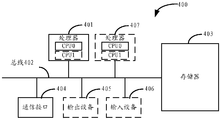
- FIG. 4 shows a schematic diagram of the hardware structure of an apparatus 400 provided by an embodiment of the application.
- the apparatus 400 includes at least one processor 401, configured to implement the functions of the terminal device provided in the embodiment of the present application.
- the device 400 may also include a bus 402 and at least one communication interface 404.
- the device 400 may also include a memory 403.
- the bus 402 can be used to transfer information between the aforementioned components.
- the communication interface 404 is used to communicate with other devices or communication networks, such as Ethernet, RAN, and WLAN.
- the communication interface 404 may be an interface, a circuit, a transceiver or other devices capable of realizing communication, which is not limited in this application.
- the communication interface 404 may be coupled with the processor 401.
- the memory 403 is used to store program instructions, and the processor 401 can control the execution, so as to implement the method for sending random access messages provided in the following embodiments of the present application.
- the processor 401 is configured to call and execute instructions stored in the memory 403, so as to implement the method for sending random access messages provided in the following embodiments of the present application.
- the memory 403 may be included in the processor 401.
- the processor 401 may include one or more CPUs, such as CPU0 and CPU1 in FIG. 4.
- the apparatus 400 may include multiple processors, such as the processor 401 and the processor 407 in FIG. 4. Each of these processors can be a single-core processor or a multi-core processor.
- the processor here may refer to one or more devices, circuits, and/or processing cores for processing data (for example, computer program instructions).
- PRACH resource configuration In the NR system, PRACH occasions (PRACH occasions, RO) are usually used to indicate a block of time-frequency resources for sending the preamble. As shown in Tables 1 and 2, the preamble format (format) is divided into two types: 839 and 139 according to the length, with a total of 13 types. Wherein, L RA represents preamble sequence length, ⁇ f RA represents a PRACH resource subcarrier spacing, N u, and They are the time domain length of the preamble symbol and CP respectively.
- the network side can configure the parameter PRACH Configuration Index.
- the terminal device can determine the time domain resource of the PRACH transmission opportunity according to the parameter PRACH Configuration Index and Table 3.
- subframe #9 subframe with sequence number 9
- symbol #0 OFDM symbol with sequence number 0
- there is only one PRACH slot in one subframe and there are 6 consecutive PRACH transmissions in each PRACH slot
- the time domain resource of each PRACH transmission opportunity occupies 2 symbols.
- x represents the PRACH time domain resource configuration period
- y represents the radio frame configured with PRACH time domain resources in the PRACH time domain resource configuration period
- Table 3 only shows the time domain resource configuration information of some PRACH transmission opportunities.
- the network side When the network side configures the frequency domain resources of PRACH transmission opportunities, it can configure the frequency domain size and frequency domain start position of the PRACH transmission opportunities, and how many frequency domain continuous PRACH transmission opportunities are on the time domain resource of each PRACH transmission opportunity. For example, the network side can configure the parameter msg1-FrequencyStart to indicate the frequency domain start position of the PRACH transmission opportunity. The network side may also configure, for example, the parameter msg1-FDM, which is used to indicate how many frequency-domain continuous PRACH transmission opportunities are frequency-division multiplexed on the time-domain resource of each PRACH transmission opportunity.
- PUSCH resource configuration In the existing NR system, PUSCH transmission opportunity (PUSCH occasion, PO) can be used to represent a piece of PUSCH time-frequency resource that can be used for data transmission.
- PUSCH resource configuration includes PUSCH time domain resource configuration and PUSCH frequency domain resource configuration.
- the PUSCH resource unit may be a PUSCH time-frequency resource, or a combination of a PUSCH time-frequency resource and a DMRS sequence, or a combination of a PUSCH time-frequency resource and a DMRS port, or a PUSCH time-frequency resource
- the combination with DMRS sequence and DMRS port is not limited in this application.
- the PUSCH time domain resource configuration is used to indicate the configuration of the PUSCH resource in the time domain.
- the PUSCH time domain resource configuration may include one or more of the time domain start position of the PUSCH resource, the time domain end position (end position) of the PUSCH resource, or the time domain length of the PUSCH resource.
- One is independent configuration, that is, the start of the PUSCH resource unit is configured by the period and the time domain offset relative to the system frame number (SFN) 0.
- the start position is to configure the relative position relative to the PRACH time-frequency resource, that is, configure the start position of the PUSCH time-frequency resource by configuring the time domain offset from the PRACH time-frequency resource.
- the PUSCH time-domain resource configuration can be described by some resource configurations related to PUSCH transmission opportunities.
- the PUSCH time domain resource configuration may include one or more of the start position of the PUSCH transmission opportunity time domain, the PUSCH transmission opportunity time domain length, and the number of time division multiplexed PUSCH transmission opportunities.
- the PUSCH frequency domain resource configuration is used to indicate the configuration of the PUSCH resource in the frequency domain.
- the PUSCH frequency domain resource configuration may include one or more of the frequency domain start position of the PUSCH resource, the frequency domain end position of the PUSCH resource, or the frequency domain length of the PUSCH resource.
- the PUSCH frequency domain resource configuration can be described by some resource configurations related to PUSCH transmission opportunities.
- the PUSCH frequency domain resource configuration may include one or more of PUSCH transmission opportunity frequency domain start position, PUSCH transmission opportunity frequency domain end position, PUSCH transmission opportunity frequency domain length, and frequency division multiplexed PUSCH transmission opportunity number.
- an embodiment of the present application provides a method for sending a random access message, including:
- the terminal device determines a preamble, the determined preamble is associated with a first PRACH time-frequency resource, and the first PRACH time-frequency resource is located in a first time period.
- the terminal device may first determine the first PRACH time-frequency resource, and the first PRACH time-frequency resource is located in the first time period; and then determine a preamble according to one or more preambles associated with the first PRACH time-frequency resource.
- the preamble determined by the terminal device may be one of one or more preambles associated with the first PRACH time-frequency resource.
- the first time period is one of multiple consecutive time periods, and the multiple time periods have the same duration.
- the PRACH time-frequency resources in each of the multiple time periods are only associated/mapped/corresponding to the PUSCH resource units in the time period (that is, the PRACH time-frequency resources in each time period are only associated with the PUSCH resource units in the time period.
- the PUSCH resource unit has an association relationship/mapping relationship/correspondence); in other words, the preamble associated with the PRACH time-frequency resource in each of the multiple time periods is only associated with the PUSCH resource unit in the time period /Mapping/correspondence.
- Each time period can be understood as a mapping period of msgA, or a mapping range of msgA.
- the PRACH time-frequency resource used to send the preamble and the PUSCH resource unit used to send uplink data are located in the same time period.
- the preamble in msgA and the PUSCH resource unit used for uplink data are located in the same time period. In a time period.
- each of the multiple time periods there may be one or more PRACH time-frequency resources (the one or more PRACH time-frequency resources may form a PRACH time-frequency resource set) and one or more PUSCH resource units (the One or more PUSCH resource units can form a PUSCH resource unit set), and PRACH time-frequency resources in each time period can be associated with one or more preambles (the one or more preambles can form a preamble set).
- the PRACH time-frequency resource set in the time period can be associated with the PUSCH resource unit set in the time period, that is, the PRACH time-frequency resource set in the time period
- the PRACH time-frequency resource can be associated with the PUSCH resource unit in the PUSCH resource unit set in the time period; or, for each of the multiple time periods, the preamble associated with the PRACH time-frequency resource in the time period
- the set can be associated with the PUSCH resource unit set in the time period, that is, the preamble in the preamble set associated with the PRACH time-frequency resource in the time period can be associated with the PUSCH resource unit in the PUSCH resource unit set in the time period. Make an association.
- the start position of the first time period is related to the start position of the PRACH time domain resource configuration period or the PUSCH time domain resource configuration period, or the start position of the first time period is related to PRACH transmission
- the opportunity or the time domain position of the PUSCH transmission opportunity is related, or the start position of the first time period is a preset time domain position.
- the starting position of the first time period may be predefined or configured by the network device.
- the PRACH time domain resource configuration period may be a period of PRACH transmission opportunities, and each PRACH time domain resource configuration period may have one or more PRACH transmission opportunities.
- the PUSCH time domain resource configuration period may be a period of PUSCH transmission opportunities, and each PUSCH time domain resource configuration period may have one or more PUSCH transmission opportunities. If the PUSCH time domain resources are configured relative to the PRACH time domain resources, the length of the PUSCH time domain resource configuration period may be the same as the length of the PRACH time domain resource configuration period.
- PUSCH time-domain resources can be configured relative to PRACH time-domain resources.
- the length of the PUSCH time-domain resource configuration period can be the same as the length of the PRACH time-domain resource configuration period.
- the length of the PUSCH time-domain resource configuration period may be the same as the length of the time period between two sets of adjacent PUSCH time slot groups.
- a PUSCH time slot group refers to multiple consecutive time slots. , There is at least one PUSCH transmission opportunity in the multiple consecutive time slots.
- the starting position of the first time period may be the starting position of the next time slot of the time slot where the last PUSCH resource unit in a PUSCH time domain resource configuration period; or, the first time period
- the starting position of may be the starting position of the time slot where the first PRACH time-frequency resource is located in the PRACH time-domain resource configuration period where the first PRACH time-frequency resource is located.
- the length of the first time period is greater than or equal to the length of the PUSCH time domain resource configuration period. If the PUSCH time domain resources are configured relative to the PRACH time domain resources, the length of the PRACH time domain resource configuration period may be the same as the length of the PUSCH time domain resource configuration period. That is, the length of the first time period is greater than or equal to the length of the PRACH time domain resource configuration period.
- the length of the first time period may be an integer multiple of the length of the PUSCH time domain resource configuration period, or the length of the first time period may be the length of the PUSCH time domain resource configuration period and the PRACH time domain resource configuration period. The largest of the lengths. Alternatively, the length of the first time period is the greatest common multiple of the length of the PUSCH time domain resource configuration period and the length of the PRACH time domain resource configuration period, which is not limited here.
- the time length of the first time period may be predefined or configured by the network device.
- the starting position of the PRACH time domain resource configuration period may be time slot 0 of a 10ms radio frame, and the length of the period is 10ms, that is, a radio frame.
- One RO time domain resource
- the PUSCH time domain resources are independently configured.
- the starting position is time slot 0 and time slot 5 of a 10ms radio frame, and the period length is 5ms.
- a PO time domain resource
- the length of the first time period is equal to the length of the PUSCH time domain resource configuration period, that is, the length of the first time period is 5ms
- the starting position of the first time period is the last PUSCH transmission opportunity in a PUSCH time domain resource configuration period
- the starting position of the next time slot of the time slot that is, the starting position of the first time period is the starting position of time slot 2 and time slot 7.
- FIG. 6C shows multiple consecutive time periods, such as time period 0, time period 1, and time period 2.
- the first PRACH time-frequency resource may be located in any of the time period 0, the time period 1, and the time period 2, that is, the first time period may be any one of the time period 0, the time period 1, and the time period 2.
- the preamble set associated with RO on time slot 2 and time slot 5 is associated with the PUSCH resource unit set on time slot 6; in time period 1, the preamble set associated with RO on time slot 8 It is associated with the PUSCH resource unit set on time slot 1; in time period 2, the preamble set associated with the RO on time slot 2 and time slot 5 is associated with the PUSCH resource unit set on time slot 6. That is, in every 10ms (every 10 time slots), the preamble set associated with RO on time slot 2 and time slot 5 is associated with the PUSCH resource unit set on time slot 6, and the RO on time slot 8 is associated The preamble set is associated with the PUSCH resource unit set on time slot 1.
- each RO can be configured with one or more preambles
- each PO can be configured with one or more resource units
- the PUSCH resource unit set on one or more time slots includes this one Or PUSCH resource units configured on POs in multiple time slots.
- the starting position of the PRACH time domain resource configuration cycle is time slot 0 of a 10ms radio frame, and the length of the cycle is 10ms.
- Time slot 2 time slot 5, and time slot 5 in each 10ms radio frame
- Each time slot 8 is configured with one RO.
- the PUSCH time domain resource is configured relative to the PRACH time domain resource, and its period is the same as the PRACH time domain resource configuration period, that is, the length of the period is 10 ms, and the starting position is time slot 0 in each 10 ms radio frame.
- Two POs are configured in time slot 3, time slot 6 and time slot 9 in each 10ms radio frame.
- the length of the first time period is equal to the length of the PUSCH time domain resource configuration period, that is, the length of the first time period is 10 ms
- the starting position of the first time period is the time of the last PUSCH transmission opportunity in the PUSCH time domain resource configuration period
- the starting position of the next time slot of the slot, that is, the starting position of the first time period is the starting position of time slot 0.
- FIG. 7 shows multiple consecutive time periods, such as time period 0 and time period 1, and the first time period can be any one of them.
- time period 0 the preamble set associated with RO in time slot 2, time slot 5, and time slot 8 is associated with the PUSCH resource unit set in time slot 3, time slot 6 and time slot 9; in time period 1, time The preamble set associated with the RO on slot 2, time slot 5, and time slot 8 is associated with the PUSCH resource unit set associated with the RO on time slot 3, time slot 6 and time slot 9. That is, in each 10ms, the preamble set associated with the RO on time slot 2, time slot 5, and time slot 8 is associated with the PUSCH resource unit set on time slot 3, time slot 6 and time slot 9.
- the starting position of the PRACH time domain resource configuration cycle is time slot 0 of a 10ms radio frame, and the length of the cycle is 10ms.
- Time slot 2 time slot 5, and time slot 5 in each 10ms radio frame
- Each time slot 8 is configured with one RO.
- the PUSCH time domain resource configuration cycle is an independent configuration.
- the starting position is time slot 0 and time slot 5 of a 10ms radio frame, and the length of the cycle is 5ms.
- Each configuration is configured on time slot 1 and time slot 6 in each 10ms radio frame. There are two POs.
- the length of the first time period is equal to the length of the PRACH time domain resource configuration period, that is, the length of the first time period is 10 ms
- the starting position of the first time period is the location of the first PRACH time-frequency resource in the PRACH time domain resource configuration period
- the starting position of the time slot, that is, the starting position of the first time period is the starting position of time slot 2 in each 10ms radio frame.
- FIG. 8 shows multiple consecutive time periods, such as time period 0 and time period 1, and the first time period may be any one of them.
- time period 0 the preamble set associated with RO on time slot 2, time slot 5 and time slot 8 is associated with the PUSCH resource unit on time slot 6 and time slot 1; in time period 1, time slot 2, time slot
- the preamble sets associated with ROs on time slots 5 and 8 are associated with PUSCH resource units on time slot 6 and time slot 1. That is, in each 10ms, the preamble set associated with the RO on time slot 2, time slot 5 and time slot 8 is associated with the PUSCH resource unit on time slot 6 and time slot 1.
- the length of the first time period may be determined according to PRACH time-frequency resource configuration, PUSCH resource unit configuration, and predefined rules.
- the predefined rule may be to set the first time period to include M PRACH transmission opportunities, and the M PRACH transmission opportunities can be associated with the PUSCH resource unit located behind the own time domain resource within the first time period.
- M is an integer greater than or equal to 1.
- the predefined rule may be to set the first time period to include 3 PRACH transmission opportunities, and the 3 PRACH transmission opportunities can all be associated with the PUSCH resource unit located behind the own time domain resource within the first time period.
- the first PRACH time-frequency resource is the RO on time slot 2
- the time period 0 is the first time period
- the first time period includes 3 ROs
- the 3 ROs can be associated with the RO in the first time period.
- PUSCH resource unit after its own time domain resources. That is, the preamble set associated with the RO on time slot 2, time slot 5, and time slot 8 is associated with the PUSCH resource unit set on time slot 3, time slot 6 and time slot 9.
- these PRACH time-frequency resources or PUSCH resource units span multiple time periods, these PRACH time-frequency resources or PUSCH resource units belong to the time period where their start position is located, or the time period where their end position is located, or these PRACH Time-frequency resources or PUSCH resource units do not belong to any time period, that is, these PRACH time-frequency resources or PUSCH resource units do not participate in msgA mapping.
- the RO on time slot 6 and time slot 7 spans two time periods, that is, both in time period 0 and time period 1, the RO can belong to the time period where its starting position is located , That is, time period 0.
- the preamble set associated with RO on time slot 2 and time slot 3 and the preamble set associated with RO on time slot 6 and time slot 7 are all the same as time slot 6. Mapping on the PUSCH resource unit set.
- the preamble set associated with ROs on time slots 6 and 7 may belong to the time period where the end position is located, that is, time period 1.
- the ROs on time slots 6 and 7 are associated
- the set of preambles is mapped to the set of PUSCH resource units on slot 1.
- the ROs on time slots 6 and 7 do not belong to any time period.
- the PUSCH resource unit set on time slot 1 is not mapped to the preamble set associated with the RO on any time slot.
- the PUSCH resource unit set on slot 1 is not used for MsgA transmission.
- the preamble set is only associated with the PUSCH resource unit set on a certain PUSCH transmission opportunity.
- the specific PUSCH transmission opportunity may be the first PUSCH transmission opportunity among the repeated PUSCH transmission opportunities, or may be the M th PUSCH transmission opportunity configured by the network device, and M is an integer greater than or equal to 1.
- time slot 2 and time slot 9 are a retransmission of the PO on time slot 3, then time slot 2, time slot 5 and time slot 8
- the preamble set associated with the RO above may only be associated with the PUSCH resource unit set on the specific PO.
- the specific PO may be the PO on time slot 3. That is, in the time period 0, the preamble set associated with the RO on the time slot 2, the time slot 5 and the time slot 8 may only be associated with the PUSCH resource unit set on the PO on the time slot 3.
- the preamble set on a specific PRACH time-frequency resource in the repeatedly transmitted PRACH time-frequency resource is associated with the PUSCH resource unit set in the first time period.
- the specific PRACH time-frequency resource may be the first PRACH time-frequency resource among the repeatedly transmitted PRACH time-frequency resources, or it may be the Mth PRACH time-frequency resource configured by the network device.
- the ROs on time slot 5 and 8 are retransmissions of RO on time slot 2, then in time period 0, time slot 3, time slot 6 and time slot 9
- the above PUSCH resource unit set is only associated with the preamble set associated with a specific RO.
- the specific RO may be the RO on time slot 2. That is, in time period 0, the PUSCH resource unit sets on time slot 3, time slot 6 and time slot 9 are only associated with the preamble set associated with the RO on time slot 2.
- the PRACH time-frequency resource is only mapped to the PUSCH resource unit located after its own time-domain resource, or the preamble is only mapped to the PUSCH located after the time-domain resource of its associated PRACH time-frequency resource Resource unit.
- these PUSCH resource units are not used for msgA transmission.
- the first time period if there are some PRACH time-frequency resources or preambles are not mapped to PUSCH resource units, these PRACH time-frequency resources or preambles are not used for msgA transmission.
- these PRACH time-frequency resources are not used for msgA transmission, or these PRACH time-frequency resources
- the time-frequency resources are used for four-step random access transmission, or these PRACH time-frequency resources can be used for repeated transmission of a specific PRACH time-frequency resource that can be used for msgA transmission before the PRACH time-frequency resource.
- these PUSCH resource units are not used for msgA transmission, or these PUSCH resource units It can be used for repeated transmission of a PUSCH resource unit that can be used for msgA transmission before the PUSCH resource unit.
- the starting position of the PRACH time domain resource configuration period is time slot 0 of a 10ms radio frame, and the length of the period is 10ms, that is, one radio frame.
- An RO is configured on time slot 2 in each 10ms radio frame.
- the PUSCH time domain resource configuration cycle is an independent configuration.
- the starting position is time slot 0 and time slot 5 of a 10ms radio frame, and the length of the cycle is 5ms.
- Each configuration is configured on time slot 1 and time slot 6 in each 10ms radio frame.
- the length of the first time period is equal to the length of the PUSCH time domain resource configuration period, that is, the length of the first time period is 5ms
- the starting position of the first time period is the last PUSCH transmission opportunity in a PUSCH time domain resource configuration period
- the starting position of the next time slot of the time slot may be the starting position of time slot 2 and time slot 7.
- FIG. 10 shows multiple consecutive time periods, such as time period 0, time period 1, and time period 2, and the first time period may be any one of them.
- the preamble set associated with the RO on time slot 2 is associated with the PUSCH resource unit set on time slot 6.
- time period 1 since there is no PRACH time-frequency resource before the time domain resources of the PUSCH resource unit set on time slot 1, there is no preamble that can be associated with the PUSCH resource unit set on time slot 1.
- the PUSCH resource unit set is not used for msgA transmission, or the PUSCH resource unit set on time slot 1 can be used for repeated transmission of the PUSCH resource unit set on time slot 6.
- time period 2 the preamble set associated with the RO on time slot 2 is associated with the PUSCH resource unit set on time slot 6.
- the length of the first time period is determined according to the length of the association period/mapping period between the SSB and the PRACH time-frequency resource.
- the length of the association period between SSB and PRACH time-frequency resources can be an integer multiple of the length of the PRACH time-domain resource configuration period.
- all actually sent SSBs are mapped to at least PRACH time-frequency resources Again.
- the association period between multiple SSBs and PRACH time-frequency resources may form an association period pattern between SSB and PRACH time-frequency resources, and the association period pattern repeats at most every 160 ms.
- the association period pattern between SSB and PRACH time-frequency resources may include 6 SSB and PRACH time-frequency resources.
- the association period of the resources may be association period 0, association period 1, association period 2, association period 3, association period 4, association period 5, and SSB and PRACH time-frequency resources are not mapped in the remaining 10 ms.
- the length of the association period between the SSB and the PRACH time-frequency resource can have various values.
- the length of association period 0, association period 1, association period 2, association period 3, association period 4, and association period 5 may be 40 ms, 10 ms, 20 ms, 40 ms, 20 ms, and 20 ms, respectively.
- a time period pattern may be determined according to the associated period pattern of the SSB and the PRACH time-frequency resource, and the period of the time period pattern may be 160 ms.
- Each time period pattern can include 6 time periods, with lengths of 40ms, 10ms, 20ms, 40ms, 20ms, and 20ms respectively, and the first time period can be one of them.
- the preamble set on the time slot configured with RO is associated with the PUSCH resource unit set on the time slot configured with PO.
- the first time period is a time period associated with the first PRACH time-frequency resource, and the start position of the first time period is the same as the time domain start position of the first PRACH time-frequency resource, or the first time
- the segment is the time period associated with the time slot where the first PRACH time-frequency resource is located, and the start position of the first time period is the same as the start position of the time slot where the first PRACH time-frequency resource is located.
- the time slot where the first PRACH time-frequency resource is located can refer to a normal time slot or a PRACH time slot.
- the normal time slot refers to the PUSCH subcarrier interval as a reference, or the upstream bandwidth part (BWP) subcarrier interval as a reference Time slot
- PRACH time slot is the time slot related to PRACH sub-carrier spacing.
- the start position of the first time period is the same as the start position of the subframe where the first PRACH time-frequency resource is located.
- time slot 0 the start position of the first time period
- the length of the first time period may be the base station Configured, for example, 3ms.
- the preamble set associated with the RO on time slot 0 can be associated with the PUSCH resource unit set on time slot 1.
- the start position of the first time period (for example, time period 1) may be the start position of time slot 4, and the length of the first time period may be the base station Configured, for example, 3ms.
- the preamble set associated with the RO on time slot 4 can be associated with the PUSCH resource unit set on time slot 5.
- the start position of the first time period (for example, time period 2) may be the start position of time slot 8, and the length of the first time period may be the base station Configured, for example, 3ms.
- time period 2 the preamble set associated with the RO on time slot 8 can be associated with the PUSCH resource unit set on time slot 9.
- the time slot in which the first PRACH time-frequency resource is located is in N consecutive time slots, where each of the N consecutive time slots is configured with a PRACH time-frequency resource, then The starting position of a period of time is the same as the starting position of the earliest time slot among N consecutive time slots, and N is an integer greater than or equal to 2. If the previous time slot of the time slot where the first PRACH time-frequency resource is located is not configured with the PRACH time-frequency resource, the starting position of the first time period is the same as the starting position of the time slot where the first PRACH time-frequency resource is located.
- time slot 3 For example, as shown in Figure 13A, assume that in each 10ms wireless frame, one RO is configured on time slot 3, time slot 4, and time slot 9, and time slot 5, time slot 6 and time slot 1 are configured on each There are two POs. If the time slot where the first PRACH time-frequency resource is located is time slot 4, since time slot 4 is continuous with time slot 3 configured with RO, the starting position of the first time period (for example, time period 0) is the same as the continuous time slot The start position of the earliest time slot in the same, that is, the start position of the first time period is the start position of time slot 3, and the length of the first time period may be configured by the base station, for example, 4 ms.
- the preamble set associated with the RO on time slot 3 and time slot 4 is associated with the PUSCH resource unit set on time slot 5 and time slot 6. If the time slot where the first PRACH time-frequency resource is located is time slot 9, since the previous time slot of time slot 9 (that is, time slot 8) is not configured with PRACH time-frequency resources, the first time period (for example, time period 1)
- the starting position is the same as the starting position of the time slot where the first PRACH time-frequency resource is located, that is, the starting position of the first time period is the starting position of time slot 9, and the length of the first time period can be configured by the base station, for example Is 4ms.
- time period 1 the preamble set associated with the RO on time slot 9 is associated with the PUSCH resource unit set on time slot 1.
- each of the N consecutive time slots configured with PRACH time-frequency resources can be associated with a time period, and the start position of the time period corresponding to each time slot is the beginning of the time slot. Starting position, the length of the time period corresponding to each time slot can be the same.
- the time periods corresponding to two consecutive time slots configured with PRACH time-frequency resources may overlap.
- the PUSCH resource unit set in the first time period does not include the PRACH time period in the second time period.
- the PUSCH resource unit associated with the frequency resource, or the PUSCH resource unit set in the first time period does not include the PUSCH resource unit associated with the preamble associated with the PRACH time-frequency resource in the second time period, and the second time period is located in the first time period.
- a time period before, or in other words, the starting position of the second time period is earlier than the first time period.
- time slot 3 For example, as shown in Figure 13B, assume that in each 10ms radio frame, one RO is configured on time slot 3, time slot 4, and time slot 9, and time slot 5, time slot 6 and time slot 1 are each configured There are two POs. If each time slot containing the PRACH time-frequency resource corresponds to a time period, the length of each time period can be 3 ms. Time slot 3, time slot 4, and time slot 9 may each be associated with a time period with a time domain length of 3 ms, which may be time period 0, time period 1, and time period 2, respectively. Since time slot 0 is the time slot associated with slot 3, the preamble set associated with the RO on slot 3 is associated with the PUSCH resource unit set located in time slot 0, that is, the PUSCH resource unit set on slot 5.
- time slot 1 is the time slot associated with slot 4
- the preamble set associated with RO on slot 4 could be associated with the PUSCH resource unit set located in time slot 1, namely PUSCH on slot 5 and slot 6.
- Resource unit set but because the PUSCH resource unit set on time slot 5 has been associated with the PRACH time-frequency resource (that is, the PRACH time-frequency resource on time slot 3) in time period 0 (that is, the second time period), time slot 4
- the preamble set associated with the RO above is only associated with the PUSCH resource unit set located on slot 6. If the time slot where the first PRACH time-frequency resource is located is time slot 9, the preamble set associated with the RO on time slot 9 may be associated with the PUSCH resource unit set located in time period 2, that is, the PUSCH resource unit set on time slot 1.
- the first time period is the time period associated with the target PUSCH resource unit, the end position of the first time period is the same as the time domain end position of the target PUSCH resource unit, and the time domain position of the target PUSCH resource unit is later than the first time period. 1.
- the time domain position of the PRACH time-frequency resource The terminal device may determine the time domain position of the first PRACH time-frequency resource according to the length of the first time period to determine the time domain position of the target PUSCH resource unit.
- the first time period is a time period associated with the target time slot, and the end position of the first time period is the same as the end position of the target time slot configured with the PUSCH resource unit.
- the target time slot is a time slot configured with a PUSCH resource unit.
- the time domain position of the target time slot is later than the time domain position of the first PRACH time-frequency resource.
- the terminal device can determine the first PRACH time-frequency resource according to the length of the first time period The time domain position of determines the time domain position of the target time slot.
- the first time period is a time period associated with the target subframe, and the end position of the first time period is the same as the end position of the target subframe where the PUSCH resource unit is configured.
- the target subframe is a subframe configured with PUSCH resource units.
- the time domain position of the target subframe is later than the time domain position of the first PRACH time-frequency resource.
- the terminal device can determine the first PRACH time-frequency resource according to the length of the first time period The time domain position of determines the time domain position of the target subframe.
- the first PRACH time-frequency resource is the RO on time slot 3
- the length of the first time period can be configured by the base station, for example, 3 ms.
- the time domain position of the PO on time slot 4 is later than that of RO on time slot 3.
- Time domain position, and the length of RO from time slot 3 is within 3ms, that is, time slot 4 is the time domain location (time slot) where the target time slot or target PUSCH resource unit is located, and the time period associated with time slot 4 (time period 0 ) Is the first time period, and the end position of time period 0 may be the end position of time slot 4.
- time period 0 the preamble set associated with the RO on time slot 3 can be associated with the PUSCH resource unit set on time slot 4.
- the length of the first time period can be configured by the base station, for example, 3 ms, and the time domain position of the PO on time slot 8 is later than that of the RO on time slot 7.
- Time domain position, and the length of RO from time slot 7 is within 3ms, that is, time slot 8 is the time domain position (time slot) where the target time slot or the target PUSCH resource unit is located, and the time period associated with time slot 8 (time period 1 ) Is the first time period, and the end position of time period 1 may be the end position of time slot 8.
- time period 1 the preamble set associated with the RO on time slot 7 can be associated with the PUSCH resource unit set on time slot 8.
- the end position of the first time period is the same as the end position of the latest time slot among the N consecutive time slots, wherein each of the N consecutive time slots is configured with PUSCH resources Unit set, N is an integer greater than or equal to 2. If the next time slot of the target PUSCH resource unit is not configured with a PUSCH resource unit set, or the next time slot of the target time slot is not configured with a PUSCH resource unit set, then the end position of the first time period and the target time slot The end position is the same.
- time slot 4 and time slot 9 and time slot 5, time slot 6 and time slot 1 are each configured.
- time slot 5 and time slot 1 are each configured.
- the first PRACH time-frequency resource is the RO on time slot 3
- the length of the first time period may be configured by the base station, for example, 4 ms, and the terminal device can determine that the first PRACH time-frequency resource is located in the time slot configured with the PUSCH resource unit
- the end position of the first time period (for example, time period 0) is continuously configured with PUSCH
- the end position of the latest time slot in the time slots of the resource unit is the same, that is, the end position of the first time period is the end position of time slot 6.
- the preamble set associated with the RO on time slot 3 and time slot 4 is associated with the PUSCH resource unit set on time slot 5 and time slot 6.
- the length of the first time period can be configured by the base station, for example, 4 ms, and the terminal device can determine that the first PRACH time-frequency resource is in the time slot where the PUSCH resource unit is configured.
- the end position of the first time period is the same as the end position of time slot 1.
- the preamble set associated with the RO on time slot 9 is associated with the PUSCH resource unit set on time slot 1.
- each of the N consecutive time slots can be configured with a PUSCH resource unit, each time slot can correspond to a time period, and the end position of the time period corresponding to each time slot is this The end position of the time slot, and the length of the time period corresponding to each time slot can be the same. Since the time periods corresponding to two consecutive time slots may overlap, in this case, the PRACH time-frequency resources in the first time period do not include the PRACH time-frequency resources that have been associated with the PUSCH resource unit set in the third time period.
- the preamble set associated with the PRACH time-frequency resource in the first time period does not include the preamble that has been associated with the PUSCH resource unit in the third time period, and the end position of the third time period is later than the first time period.
- time slot 3 For example, as shown in Figure 13B, assume that in each 10ms radio frame, one RO is configured on time slot 3, time slot 4, and time slot 9, and time slot 5, time slot 6 and time slot 1 are each configured There are two POs. If each time slot containing the PUSCH resource unit corresponds to a time period, the end position of the time period corresponding to each time slot is the end position of the time slot, and the length of each time period may be the same, for example, 3 ms. That is, time slot 5, time slot 6 and time slot 1 can each be associated with a time period, which is time period 0, time period 1, and time period 2, respectively. In time period 1, the PUSCH resource unit set on time slot 6 is associated with the preamble set associated with RO on time slot 4.
- the PUSCH resource unit set on time slot 5 can be associated with the preamble set associated with RO on time slot 3 and time slot 4.
- the preamble set associated with the RO on time slot 4 has been associated with the PUSCH resource unit set in time 1 (the third time period)
- the PRACH time-frequency resource in time 0 does not include the RO on time slot 4
- the associated preamble collection In time period 2, the preamble set associated with the RO on time slot 9 is associated with the PUSCH resource unit set on time slot 1.
- the length of the first time period is the length of time between two time slots configured with PRACH time-frequency resources.
- the starting position of the first time period is the starting position of each time slot configured with PRACH time-frequency resources.
- each of the time slots 2, time slots 5, and time slots 8 in each 10ms wireless frame is configured with one RO, and time slots 3, 6 and 9 are each configured.
- the length of the first time period is equal to the length between every two time slots configured with RO, and the start position of the first time period is the start position of each time slot configured with RO.
- FIG. 15 shows multiple consecutive time periods, such as time period 0, time period 1, and time period 2, and the first time period may be any one of them.
- the length of time period 0 and time period 1 is 3 ms
- the starting positions are the starting positions of time slot 2 and time slot 5 respectively
- the length of time period 2 is 4 ms
- the starting position is the starting position of time slot 8.
- the preamble set associated with RO on time slot 2 is associated with the PUSCH resource unit set on time slot 3; in time period 1, the preamble set associated with RO on time slot 5 is associated with time slot 6 A collection of PUSCH resource units. In time period 2, the preamble set associated with the RO on time slot 8 is associated with the PUSCH resource unit set on time slot 9.
- the length of the first time period is the length of time between two time slots configured with PUSCH resource units, and the end position of the first time period is the end position of each time slot configured with PUSCH resource units.
- time slot 2 and time slot 8 in each 10ms radio frame is configured with one RO
- time slot 3 time slot 6 and time slot 9 are each configured with two ROs.
- PO The length of the first time period is equal to the length between every two time slots configured with PO
- the end position of the first time period is the end position of each time slot configured with PO.
- FIG. 16 shows multiple consecutive time periods, such as time period 0, time period 1, and time period 2, and the first time period may be any one of them.
- the length of time period 0 and time period 1 is 3 ms
- the end positions are the end positions of time slot 6 and time slot 9 respectively.
- the start positions of time period 0 and time period 1 are time slot 4 and time The start position of slot 7; the length of time period 2 is 4 ms, and the end position is the end position of time slot 3.
- the start position of time period 2 is the start position of time slot 0.
- the preamble set associated with RO on time slot 5 is associated with the PUSCH resource unit set on time slot 6; in time period 1, the preamble set associated with RO on time slot 8 is associated with time slot 9.
- the set of PUSCH resource units; in time period 2, the preamble set associated with the RO on time slot 2 is associated with the set of PUSCH resource units on time slot 3.
- the terminal device determines a PUSCH resource unit in the PUSCH resource unit set located in the first time period according to the determined preamble and association rule.
- the association rule is used to determine the association/mapping/correspondence between the preamble and the PUSCH resource unit.
- the preamble and PUSCH resource units in the first time period may be one-to-one association, or many-to-one association, or one-to-many association.
- the association relationship between the preamble and the PUSCH resource unit in the first time period may be configured by the base station, or may be predefined, or calculated based on the number of preambles and the number of PUSCH resource units in the first time period.
- the association relationship between the preamble and the PUSCH resource unit in different time periods in multiple time periods may be the same or different.
- each RO is configured with 16 preambles and each PO is configured with 8 resource units
- the association between the preamble and PUSCH resource units is based on the number of preambles and PUSCH resources in the first time period
- the number of units is calculated, then in time slot 0, 32 preambles on time slot 2 and time slot 5 are mapped to 16 PUSCH resource units on time slot 6, each One preamble is mapped to one PUSCH resource unit; in time period 1, the 16 preambles on time slot 8 are mapped to 16 PUSCH resource units on time slot 1, each One preamble is mapped to one PUSCH resource unit; in time period 2, 32 preambles on time slot 2 and time slot 5 are mapped to 16 PUSCH resource units on time slot 6, each One preamble is mapped to one PUSCH resource unit.
- the preamble associated with the PRACH time-frequency resource is only mapped to the PUSCH resource unit after its own time domain position.
- these PRACH time-frequency resources or preambles are not used for msgA transmission.
- the mapping relationship between the preamble and the PUSCH resource unit in the first time period may be a 1-to-1 mapping configured by the base station, or a predefined 1-to-1 mapping.
- the preamble is only mapped to the PUSCH resource unit whose time domain resource is located on the PUSCH transmission opportunity after the PRACH transmission opportunity where it is located, then in the time period 0, 12 preambles on time slot 2 1 to 1 Map to the first 12 PUSCH resource units on time slot 3, 12 preambles on time slot 5 1-to-1 mapped to the first 12 PUSCH resource units on time slot 6, and 12 preambles on time slot 8 1-to-1
- the first 12 PUSCH resource units mapped to time slot 9, and the last 4 PUSCH resource units on time slot 3, time slot 6, and time slot 9 are not mapped, and are not used for msgA transmission.
- the terminal device sends the determined preamble on the first PRACH time-frequency resource, and uses the determined PUSCH resource unit to send uplink data.
- the terminal device sends MSGA, and MSGA includes the preamble and uplink data determined by the terminal device.
- the network device receives the preamble and uplink data sent by the terminal device.
- the network device receives the preamble from the terminal device on the first PRACH time-frequency resource, where the first PRACH time-frequency resource is located in the first time period; the network device obtains the PUSCH resource from the PUSCH resource located in the first time period according to the preamble and the association rule
- the PUSCH resource unit associated with the preamble is determined in the unit set, and the determined PUSCH resource unit is used to receive uplink data; wherein, the association rule is used to determine the association relationship between the preamble and the PUSCH resource unit.
- the network device sends downlink control information.
- the downlink control information is used to indicate the resource of the response information of the first random access procedure.
- the terminal device detects downlink control information.
- the terminal device searches for downlink control information (DCI) in the time-frequency resource of the PDCCH corresponding to the random access message.
- DCI downlink control information
- the terminal device receives response information on the resource indicated by the downlink control information.
- the terminal device receives the response information on the resource of the response information indicated by the downlink control information.
- the terminal device can receive the MAC PDU from the physical downlink shared channel (PDSCH) indicated by the DCI, and the MAC PDU contains response information.
- the MAC PDU also includes the identification of the first random access request (for example, Preamble ID).
- a terminal device when a terminal device sends a 2-step random access message (MSGA), it can first determine a preamble.
- the determined preamble is associated with the first PRACH time-frequency resource, and the first PRACH time-frequency resource In the first time period, according to the determined preamble and an association rule for associating the preamble with the PUSCH resource unit, a PUSCH resource unit is determined from the PUSCH resource unit set in the first time period.
- the terminal device sends the preamble determined by the terminal device on the first PRACH time-frequency resource, and uses the PUSCH resource unit determined by the terminal device to send uplink data.
- the network device can determine the time period (for example, the first time period) where the PRACH time-frequency resource (for example, the first PRACH time-frequency resource) corresponding to the preamble is located, and then determine the PUSCH located in the first time period
- the resource unit set further determines the PUSCH resource unit associated with the PUSCH resource unit set in the first time period of the preamble sent by the terminal device according to the association rule, thereby solving the problem that the network device cannot determine the PUSCH resource unit associated with the preamble.
- an embodiment of the present application provides a method for sending a random access message, including:
- the terminal device determines a preamble, the determined preamble is associated with a first PRACH time-frequency resource, and the first PRACH time-frequency resource is located in a first time period.
- step 501 You can refer to the related description of step 501, which is not repeated here.
- the terminal device determines a PUSCH resource unit from the PUSCH resource units located in the second time period according to the determined preamble and association rule. Among them, the association rule is used to associate the preamble with the PUSCH resource unit.
- the preamble set located in the first time period is associated with the PUSCH resource unit set in the second time period corresponding to the first time period.
- the first time period and the second time period have the same time domain length, the start position of the second time period is later than the start position of the first time period, and the second time period is after the first time period.
- the start position of the second time period is different from the start position of the first time period by the time domain length of the first time period (or the time domain length of the second time period), it can be equivalent to the first time period.
- the second time period is the next time period after the first time period.
- the PRACH time domain resource configuration period is 10 ms, and one RO is configured on each of timeslot 2, timeslot 5, and timeslot 8 in each 10ms radio frame.
- the PUSCH transmission opportunity is independently configured, with a period of 5ms, and two POs are configured on time slot 1 and time slot 6 in each 10ms radio frame.
- the start position of the first time period is the start position of time slot 1 or time slot 6.
- the start position of the second time period is the start position of time slot 6, that is, the first time period is time period 0
- the second time period is For time period 1, the preamble set in time period 0 is associated with the PUSCH resource unit set in time period 1, that is, the preamble set associated with RO on time slot 2 and time slot 5 is associated with the PUSCH resource unit set on time slot 6 ;
- the start position of the first time period is the start position of time slot 6
- the start position of the second time period is the start position of the next 10ms time slot 1, that is, the first time period is time period 1.
- the second time period is time period 2
- the preamble set in time period 1 is associated with the PUSCH resource unit set in time period 2, that is, the preamble
- the terminal device sends the determined preamble on the first PRACH time-frequency resource, and uses the determined PUSCH resource unit to send uplink data.
- the terminal device sends MSGA, and MSGA includes the preamble and uplink data determined by the terminal device.
- the network device receives the preamble and uplink data sent by the terminal device.
- the network device receives the preamble from the terminal device on the first PRACH time-frequency resource, where the first PRACH time-frequency resource is in the first time period; the network device obtains the PUSCH resource from the PUSCH resource in the second time period according to the preamble and the association rule
- the PUSCH resource unit associated with the preamble is determined in the unit set, and the determined PUSCH resource unit is used to receive uplink data; wherein the association rule is used to determine the association relationship between the preamble and the PUSCH resource unit, and the length of the second time period
- the length of the first time period is the same, and the second time period is located after the first time period.
- a terminal device when a terminal device sends a 2-step random access message (MSGA), it can first determine a preamble.
- the determined preamble is associated with the first PRACH time-frequency resource, and the first PRACH time-frequency resource Located in the first time period; then according to the determined preamble and the association rule for associating the preamble with the PUSCH resource unit, determine a PUSCH resource unit in the PUSCH resource unit set in the second time period, and then the The preamble determined by the terminal device is sent on a PRACH time-frequency resource, and the uplink data is sent using the PUSCH resource unit determined by the terminal device.
- MSGA 2-step random access message
- the network device can determine the time period (for example, the first time period) where the PRACH time-frequency resource (for example, the first PRACH time-frequency resource) corresponding to the preamble is located, and then determine that it is located in the second time period (the second The PUSCH resource unit set in the time period later than the first time period) is further determined according to the association rules to determine the PUSCH resource unit associated with the preamble sent by the terminal device in the PUSCH resource unit set located in the second time period, thereby solving the problem of network equipment Unable to determine the PUSCH resource unit associated with the preamble.
- the time period for example, the first time period
- the PRACH time-frequency resource for example, the first PRACH time-frequency resource
- FIG. 19 shows a possible structural schematic diagram of the apparatus 19 involved in the foregoing embodiment.
- the apparatus may be a terminal device, and the terminal device includes: a determining unit 1901 And sending unit 1902.
- the determining unit 1901 is configured to determine the first PRACH time-frequency resource, and the first PRACH time-frequency resource is located in the first time period; the determining unit 1901 is also configured to determine the first PRACH time-frequency resource associated with One or more of the preambles determine a preamble; the determining unit 1901 is further configured to determine a PUSCH resource unit in the PUSCH resource unit set located in the first time period according to the determined preamble and association rules, where the association rule is used to determine The association relationship between the preamble and the PUSCH resource unit; or, the determining unit 1901 is further configured to determine a PUSCH resource unit from the PUSCH resource unit set located in the second time period according to the determined preamble and the association rule, where the
- the length of the second time period is the same as the length of the first time period, and the second time period is located after the first time period; the sending unit 1902 is used for the first PRACH
- the determined preamble is sent on the time-frequency resource, and the determined PUSCH resource unit is used to send uplink data.
- the determining unit 1901 is configured to execute the processes 501 and 502 in FIG. 5, and is configured to execute the processes 1801 and 1802 in FIG. 18.
- the sending unit 1902 is used to support the terminal device to perform the process 503 in FIG. 5 and is used to support the terminal device to perform the process 1803 in FIG. 18.
- the terminal device may further include a detection unit for performing the process 506 in FIG. 5; optionally, the terminal device may further include a receiving unit for performing the process 507 in FIG. 5.
- all relevant content of each step involved in the above method embodiment can be cited in the function description of the corresponding function module, and will not be repeated here.
- FIG. 20 shows a possible structural schematic diagram of the device 20 involved in the foregoing embodiment.
- the device may be a network device, and the network device includes: a receiving unit 2001 And the determination unit 2002.
- the receiving unit 2001 is configured to receive the preamble from the terminal device on the first PRACH time-frequency resource, where the first PRACH time-frequency resource is located in the first time period;
- the determining unit 2002 is configured to The preamble and the association rule determine the PUSCH resource unit associated with the preamble from the PUSCH resource unit set located in the first time period, and use the determined PUSCH resource unit to receive uplink data through the receiving unit; wherein, the association rule Used to determine the association relationship between the preamble and the PUSCH resource unit.
- the receiving unit 2001 and the determining unit 2002 are used to execute the process 504 in FIG. 5 to support the network device to execute the process 1804 in FIG. 18.
- all relevant content of each step involved in the above method embodiment can be cited in the function description of the corresponding function module, and will not be repeated here.
- the information output or received by the sending unit 1902 and the receiving unit 2001 may be in the form of baseband signals.
- the sending unit 1902 and the receiving unit 2001 send or receive is a baseband signal carrying a preamble and/or uplink data.
- the output or reception of the sending unit 1902 and the receiving unit 2001 may be radio frequency signals.
- the sending unit 1902 and the receiving unit 2001 send or receive are radio frequency signals that carry preamble and/or uplink data.
- the division of modules in the embodiments of the present application is illustrative, and is only a logical function division. In actual implementation, there may be other division methods.
- the functional modules in the various embodiments of the present application may be integrated into one process. In the device, it can also exist alone physically, or two or more modules can be integrated into one module.
- the above-mentioned integrated modules can be implemented in the form of hardware or software functional modules.
- the receiving unit and the sending unit may be integrated into the transceiver unit.
- the methods provided in the embodiments of the present application may be implemented in whole or in part by software, hardware, firmware, or any combination thereof.
- software When implemented by software, it can be implemented in the form of a computer program product in whole or in part.
- the computer program product includes one or more computer instructions.
- the computer may be a general-purpose computer, a dedicated computer, a computer network, network equipment, user equipment, or other programmable devices.
- the computer instructions may be stored in a computer-readable storage medium or transmitted from one computer-readable storage medium to another computer-readable storage medium. For example, the computer instructions may be transmitted from a website, computer, server, or data center.
- the computer-readable storage medium may be any available medium that can be accessed by a computer or a data storage device such as a server or data center integrated with one or more available media.
- the usable medium may be a magnetic medium (for example, a floppy disk, a hard disk, a magnetic tape), an optical medium (for example, a digital video disc (DVD)), or a semiconductor medium (for example, a solid state drive (SSD)) )Wait.
Landscapes
- Engineering & Computer Science (AREA)
- Computer Networks & Wireless Communication (AREA)
- Signal Processing (AREA)
- Mobile Radio Communication Systems (AREA)
Abstract
Description
本申请涉及通信领域,尤其涉及一种发送随机接入消息的方法和装置。This application relates to the field of communications, and in particular, to a method and device for sending random access messages.
第五代(5th generation,5G)移动通信系统中,提出一种2步随机接入过程,2步随机接入过程相比传统的4步随机接入过程,可以降低上行数据传输的时延和信令开销。如图1所示,2步随机接入过程包括步骤S1、终端设备发送MsgA,即终端设备选择(physical random access channel,PRACH)资源和物理上行共享信道(physical uplink shared channel,PUSCH)资源单元,并在PRACH资源上发送随机接入前导(preamble)以及使用PUSCH资源单元发送上行数据。S2、网络设备向终端设备发送随机接入响应,例如消息B(messageB,MsgB),MsgB中可包括竞争解决信息。In the 5th generation (5G) mobile communication system, a 2-step random access process is proposed. Compared with the traditional 4-step random access process, the 2-step random access process can reduce the delay and time of uplink data transmission. Signaling overhead. As shown in Figure 1, the 2-step random access process includes step S1, the terminal device sends MsgA, that is, the terminal device selects (physical random access channel, PRACH) resources and physical uplink shared channel (physical uplink shared channel, PUSCH) resource units. And send random access preamble (preamble) on PRACH resource and use PUSCH resource unit to send uplink data. S2. The network device sends a random access response to the terminal device, such as a message B (messageB, MsgB), where contention resolution information may be included in the MsgB.
在2步随机接入过程中,preamble与上行数据在同一消息(msgA)中发送,由于PRACH时频资源和PUSCH资源单元的时频位置不同,网络设备接收到一个preamble时,无法确定与该preamble在同一消息中发送的上行数据所使用的PUSCH资源单元,即无法确定与该preamble关联的PUSCH资源单元,导致无法正确接收上行数据。In the 2-step random access process, the preamble and the uplink data are sent in the same message (msgA). Because the time-frequency position of the PRACH time-frequency resource and the PUSCH resource unit are different, when the network device receives a preamble, it cannot be determined with the preamble. The PUSCH resource unit used by the uplink data sent in the same message, that is, the PUSCH resource unit associated with the preamble cannot be determined, so that the uplink data cannot be received correctly.
发明内容Summary of the invention
本申请实施例提供一种发送随机接入消息的方法,能够解决无法确定preamble所关联的PUSCH资源单元的问题。The embodiment of the present application provides a method for sending a random access message, which can solve the problem that the PUSCH resource unit associated with the preamble cannot be determined.
第一方面,本申请实施例提供一种发送随机接入消息的方法,包括:终端设备确定一个preamble,该确定的preamble与第一PRACH时频资源关联,该第一PRACH时频资源位于第一时间段内;该终端设备根据该确定的preamble和关联规则在位于该第一时间段内的PUSCH资源单元集合中确定一个PUSCH资源单元,其中,该关联规则用于确定preamble与PUSCH资源单元之间的关联关系;该终端设备在该第一PRACH时频资源上发送该确定的preamble,以及使用该确定的PUSCH资源单元发送上行数据。In the first aspect, an embodiment of the present application provides a method for sending a random access message, including: a terminal device determines a preamble, and the determined preamble is associated with a first PRACH time-frequency resource, and the first PRACH time-frequency resource is located in the first PRACH time-frequency resource. Within a time period; the terminal device determines a PUSCH resource unit in the PUSCH resource unit set located in the first time period according to the determined preamble and association rule, where the association rule is used to determine the relationship between the preamble and the PUSCH resource unit The association relationship; the terminal device sends the determined preamble on the first PRACH time-frequency resource, and uses the determined PUSCH resource unit to send uplink data.
基于本申请实施例提供的方法,终端设备在发送2步随机接入消息(MSGA)时,首先可以确定一个preamble,该确定的preamble与第一PRACH时频资源关联,该第一PRACH时频资源位于第一时间段内,再根据确定的preamble和用于将preamble与PUSCH资源单元进行关联的关联规则,在位于第一时间段内的PUSCH资源单元集合中确定一个PUSCH资源单元。终端设备在第一PRACH时频资源上发送终端设备确定的preamble,以及使用终端设备确定的PUSCH资源单元发送上行数据。这样一来,网络设备接收到preamble后,可以确定该preamble对应的PRACH时频资源(例如,第一PRACH时频资源)所在的时间段(例如,第一时间段),再确定位于第一时间 段内的PUSCH资源单元集合,进一步根据关联规则确定终端设备发送的preamble在位于第一时间段的PUSCH资源单元集合内所关联的PUSCH资源单元,从而解决了网络设备无法确定preamble所关联的PUSCH资源单元的问题。Based on the method provided in the embodiments of this application, when a terminal device sends a 2-step random access message (MSGA), it can first determine a preamble. The determined preamble is associated with the first PRACH time-frequency resource, and the first PRACH time-frequency resource In the first time period, according to the determined preamble and an association rule for associating the preamble with the PUSCH resource unit, a PUSCH resource unit is determined from the PUSCH resource unit set in the first time period. The terminal device sends the preamble determined by the terminal device on the first PRACH time-frequency resource, and uses the PUSCH resource unit determined by the terminal device to send uplink data. In this way, after receiving the preamble, the network device can determine the time period (for example, the first time period) where the PRACH time-frequency resource (for example, the first PRACH time-frequency resource) corresponding to the preamble is located, and then determine that it is located at the first time The PUSCH resource unit set in the segment is further determined according to the association rules to determine the PUSCH resource unit associated with the preamble sent by the terminal device in the PUSCH resource unit set located in the first time period, thereby solving the problem that the network device cannot determine the PUSCH resource associated with the preamble The problem of the unit.
在一种可能的设计中,该第一时间段的起始位置与PRACH时域资源配置周期的起始位置或PUSCH时域资源配置周期的起始位置相关,或者该第一时间段的起始位置与PRACH时域资源的起始位置或PUSCH时域资源的起始位置相关,或者该第一时间段的起始位置为预设的时域位置,或者该第一时间段的起始位置为网络设备配置的时域位置。In a possible design, the start position of the first time period is related to the start position of the PRACH time domain resource configuration period or the PUSCH time domain resource configuration period, or the start of the first time period The position is related to the starting position of the PRACH time domain resource or the starting position of the PUSCH time domain resource, or the starting position of the first time period is a preset time domain position, or the starting position of the first time period is The time domain location of the network device configuration.
在一种可能的设计中,该第一时间段的起始位置为PUSCH时域资源配置周期内最后一个PUSCH资源单元所在时隙的下一个时隙的起始位置;或者,该第一时间段的起始位置为该第一PRACH时频资源所在的PRACH时域资源配置周期内的第一个PRACH时频资源所在时隙的起始位置。这样,可以尽量保证第一时间段内,PRACH时频资源关联的preamble集合可以和位于PRACH时频资源的时域位置之后的PUSCH资源单元集合关联,终端设备在发送preamble和上行数据时,可以通过第一PRACH时频资源发送preamble,并使用第一PRACH时频资源之后的PUSCH资源单元发送上行数据。网络设备在第一PRACH时频资源检测到preamble后,可以根据该preamble确定该preamble关联的位于第一PRACH时频资源之后的PUSCH资源单元,并使用该PUSCH资源单元检测上行数据,避免使用全部PUSCH资源单元盲检上行数据。In a possible design, the start position of the first time period is the start position of the next time slot of the time slot where the last PUSCH resource unit is located in the PUSCH time domain resource configuration period; or, the first time period The starting position of is the starting position of the time slot where the first PRACH time-frequency resource is located in the PRACH time-domain resource configuration period where the first PRACH time-frequency resource is located. In this way, it can be ensured as far as possible that in the first time period, the preamble set associated with the PRACH time-frequency resource can be associated with the PUSCH resource unit set located after the time-domain position of the PRACH time-frequency resource. When the terminal device sends the preamble and uplink data, it can pass The first PRACH time-frequency resource sends the preamble, and the PUSCH resource unit after the first PRACH time-frequency resource is used to send uplink data. After detecting the preamble in the first PRACH time-frequency resource, the network device can determine the PUSCH resource unit associated with the preamble and located after the first PRACH time-frequency resource according to the preamble, and use the PUSCH resource unit to detect uplink data, avoiding all PUSCHs. The resource unit blindly checks the uplink data.
在一种可能的设计中,该第一时间段的长度大于或者等于该PUSCH时域资源配置周期的长度。这样,可以尽量保证第一时间段内的PRACH时频资源可以和位于该第一时间段内的PUSCH资源单元集合进行关联。In a possible design, the length of the first time period is greater than or equal to the length of the PUSCH time domain resource configuration period. In this way, it can be ensured as far as possible that the PRACH time-frequency resources in the first time period can be associated with the PUSCH resource unit set located in the first time period.
在一种可能的设计中,该第一时间段的长度为该PUSCH时域资源配置周期的长度的整数倍,或者,该第一时间段的长度为该PUSCH时域资源配置周期的长度与该PRACH时域资源配置周期的长度中最大者。这样,可以尽量保证第一时间段内的PRACH时频资源可以和位于该第一时间段内的PUSCH资源单元集合中的PUSCH资源单元进行关联。In a possible design, the length of the first time period is an integer multiple of the length of the PUSCH time domain resource configuration period, or the length of the first time period is the length of the PUSCH time domain resource configuration period and the The largest of the length of the PRACH time domain resource configuration period. In this way, it can be ensured as far as possible that the PRACH time-frequency resource in the first time period can be associated with the PUSCH resource unit in the PUSCH resource unit set in the first time period.
在一种可能的设计中,该第一时间段为连续的多个时间段中的一个时间段,该多个时间段中的每个时间段内的PRACH时频资源仅与该时间段内的PUSCH资源单元集合进行关联,该多个时间段的时长相同。由于多个时间段是连续的,每个时间段内的PRACH时频资源可以与该时间段内的PUSCH资源单元集合进行关联,这样,可以尽量保证每个PRACH时频资源有可以与之关联的PUSCH资源单元集合,或者保证每个PUSCH资源单元可以有与之关联的PRACH时频资源。In a possible design, the first time period is one of multiple consecutive time periods, and the PRACH time-frequency resource in each of the multiple time periods is only equal to that in the time period. The PUSCH resource unit sets are associated, and the durations of the multiple time periods are the same. Since multiple time periods are continuous, the PRACH time-frequency resource in each time period can be associated with the PUSCH resource unit set in the time period. In this way, it is possible to ensure that each PRACH time-frequency resource can be associated with it as much as possible A collection of PUSCH resource units, or it is guaranteed that each PUSCH resource unit can have PRACH time-frequency resources associated with it.
在一种可能的设计中,该第一时间段的长度是根据同步信号/物理广播信道块((synchronization signal,SS)/(physical broadcast channel,PBCH)block,SSB)与PRACH时频资源之间的关联周期的长度确定的。第一时间段内的PRACH时频资源可以与该第一时间段内的PUSCH资源单元集合进行关联。In a possible design, the length of the first time period is based on the synchronization signal/physical broadcast channel block ((synchronization signal, SS)/(physical broadcast channel, PBCH) block, SSB) and the PRACH time-frequency resource The length of the association period is determined. The PRACH time-frequency resource in the first time period may be associated with the PUSCH resource unit set in the first time period.
在一种可能的设计中,该第一时间段的起始位置与该第一PRACH时频资源的时域起始位置相同,或者,该第一时间段的起始位置与该第一PRACH时频资源所在时隙的起始位置相同。这样,可以尽量保证第一时间段内,第一PRACH时频资源关联 的preamble集合可以和位于第一PRACH时频资源的时域位置之后的PUSCH资源单元集合关联,终端设备在发送preamble和上行数据时,可以通过第一PRACH时频资源发送preamble,并使用第一PRACH时频资源之后的PUSCH资源单元发送上行数据。网络设备在第一PRACH时频资源检测到preamble后,可以根据该preamble确定该preamble关联的位于第一PRACH时频资源之后的PUSCH资源单元,并使用该PUSCH资源单元检测上行数据,避免使用全部PUSCH资源单元盲检上行数据。In a possible design, the start position of the first time period is the same as the time domain start position of the first PRACH time-frequency resource, or the start position of the first time period is the same as the first PRACH time-frequency resource. The start position of the time slot where the frequency resource is located is the same. In this way, it can be ensured as far as possible that in the first time period, the preamble set associated with the first PRACH time-frequency resource can be associated with the PUSCH resource unit set located after the time-domain position of the first PRACH time-frequency resource, and the terminal device is sending the preamble and uplink data. At this time, the preamble may be sent through the first PRACH time-frequency resource, and the PUSCH resource unit after the first PRACH time-frequency resource may be used to send uplink data. After detecting the preamble in the first PRACH time-frequency resource, the network device can determine the PUSCH resource unit associated with the preamble and located after the first PRACH time-frequency resource according to the preamble, and use the PUSCH resource unit to detect uplink data, avoiding all PUSCHs. The resource unit blindly checks the uplink data.
在一种可能的设计中,该PUSCH资源单元集合不包含已与第二时间段中的PRACH时频资源关联的PUSCH资源单元,该第二时间段位于该第一时间段之前;或者,该PUSCH资源单元集合不包含已与第二时间段中的PRACH时频资源所关联的preamble关联的PUSCH资源单元。这样一来,可以避免PUSCH资源单元集合重复与PRACH时频资源关联,避免引起混乱。In a possible design, the PUSCH resource unit set does not include PUSCH resource units that have been associated with PRACH time-frequency resources in the second time period, and the second time period is located before the first time period; or, the PUSCH The resource unit set does not include the PUSCH resource unit that has been associated with the preamble associated with the PRACH time-frequency resource in the second time period. In this way, it is possible to prevent the PUSCH resource unit set from being repeatedly associated with the PRACH time-frequency resource, and to avoid confusion.
在一种可能的设计中,若该第一PRACH时频资源所在的时隙位于N个连续的时隙中,则该第一时间段的起始位置与该N个连续的时隙中最早的时隙的起始位置相同,其中,该N个连续的时隙中的每个时隙均配置有PRACH时频资源,该N为大于或者等于2的整数。这样,可以避免PUSCH资源单元集合重复与PRACH时频资源关联,避免引起混乱。In a possible design, if the time slot in which the first PRACH time-frequency resource is located is in N consecutive time slots, the starting position of the first time period is equal to the earliest one of the N consecutive time slots. The start positions of the time slots are the same, wherein each of the N consecutive time slots is configured with a PRACH time-frequency resource, and the N is an integer greater than or equal to 2. In this way, it is possible to prevent the PUSCH resource unit set from being repeatedly associated with the PRACH time-frequency resources, and to avoid confusion.
在一种可能的设计中,若该第一PRACH时频资源所在时隙的前一个时隙未配置有PRACH时频资源,则该第一时间段的起始位置与该第一PRACH时频资源所在时隙的起始位置相同。这样,可以尽量保证第一时间段内,第一PRACH时频资源关联的preamble集合可以和位于第一PRACH时频资源的时域位置之后的PUSCH资源单元集合关联,终端设备在发送preamble和上行数据时,可以通过第一PRACH时频资源发送preamble,并使用第一PRACH时频资源之后的PUSCH资源单元发送上行数据。网络设备在第一PRACH时频资源检测到preamble后,可以根据该preamble确定该preamble关联的位于第一PRACH时频资源之后的PUSCH资源单元,并使用该PUSCH资源单元检测上行数据,避免使用全部PUSCH资源单元盲检上行数据。In a possible design, if the previous time slot of the time slot where the first PRACH time-frequency resource is not configured with the PRACH time-frequency resource, then the start position of the first time period and the first PRACH time-frequency resource The start position of the time slot is the same. In this way, it can be ensured as far as possible that in the first time period, the preamble set associated with the first PRACH time-frequency resource can be associated with the PUSCH resource unit set located after the time-domain position of the first PRACH time-frequency resource, and the terminal device is sending the preamble and uplink data. At this time, the preamble may be sent through the first PRACH time-frequency resource, and the PUSCH resource unit after the first PRACH time-frequency resource may be used to send uplink data. After detecting the preamble in the first PRACH time-frequency resource, the network device can determine the PUSCH resource unit associated with the preamble and located after the first PRACH time-frequency resource according to the preamble, and use the PUSCH resource unit to detect uplink data, avoiding all PUSCHs. The resource unit blindly checks the uplink data.
第二方面,本申请实施例提供一种发送随机接入消息的方法,包括:终端设备确定一个preamble,该确定的preamble与第一PRACH时频资源关联,该第一PRACH时频资源位于第一时间段内;该终端设备根据该确定的preamble和关联规则从位于第二时间段内的PUSCH资源单元集合中确定一个PUSCH资源单元,其中,该关联规则用于确定preamble与PUSCH资源单元之间的关联关系,该第二时间段的长度与该第一时间段的长度相同,该第二时间段位于该第一时间段之后;该终端设备在该第一PRACH时频资源上发送该确定的preamble,以及使用该确定的PUSCH资源单元上发送上行数据。In a second aspect, an embodiment of the present application provides a method for sending a random access message, including: a terminal device determines a preamble, and the determined preamble is associated with a first PRACH time-frequency resource, and the first PRACH time-frequency resource is located in the first PRACH time-frequency resource. Within a time period; the terminal device determines a PUSCH resource unit from the set of PUSCH resource units located in the second time period according to the determined preamble and association rule, where the association rule is used to determine the relationship between the preamble and the PUSCH resource unit Association relationship, the length of the second time period is the same as the length of the first time period, and the second time period is after the first time period; the terminal device sends the determined preamble on the first PRACH time-frequency resource , And use the determined PUSCH resource unit to send uplink data.
基于本申请实施例提供的方法,终端设备在发送2步随机接入消息(MSGA)时,首先可以确定一个preamble,该确定的preamble与第一PRACH时频资源关联,该第一PRACH时频资源位于第一时间段内;再根据确定的preamble和用于将preamble与PUSCH资源单元进行关联的关联规则,在位于第二时间段内的PUSCH资源单元集合中确定一个PUSCH资源单元,而后可以在第一PRACH时频资源上发送终端设备确定的preamble,以及使用终端设备确定的PUSCH资源单元发送上行数据。这样一来, 网络设备接收到preamble后,可以确定该preamble对应的PRACH时频资源(例如,第一PRACH时频资源)所在的时间段(例如,第一时间段),再确定位于第二时间段(第二时间段晚于第一时间段)内的PUSCH资源单元集合,进一步根据关联规则确定终端设备发送的preamble在位于第二时间段的PUSCH资源单元集合内所关联的PUSCH资源单元,从而解决了网络设备无法确定preamble所关联的PUSCH资源单元的问题。Based on the method provided in the embodiments of this application, when a terminal device sends a 2-step random access message (MSGA), it can first determine a preamble. The determined preamble is associated with the first PRACH time-frequency resource, and the first PRACH time-frequency resource Located in the first time period; then according to the determined preamble and the association rule for associating the preamble with the PUSCH resource unit, determine a PUSCH resource unit in the PUSCH resource unit set in the second time period, and then the The preamble determined by the terminal device is sent on a PRACH time-frequency resource, and the uplink data is sent using the PUSCH resource unit determined by the terminal device. In this way, after the network device receives the preamble, it can determine the time period (for example, the first time period) where the PRACH time-frequency resource (for example, the first PRACH time-frequency resource) corresponding to the preamble is located, and then determine that it is located at the second time The PUSCH resource unit set in the second time period (the second time period is later than the first time period) is further determined according to the association rules to determine the PUSCH resource unit associated with the preamble sent by the terminal device in the PUSCH resource unit set in the second time period, thereby The problem that the network device cannot determine the PUSCH resource unit associated with the preamble is solved.
在一种可能的设计中,该第一时间段的起始位置与PRACH时域资源配置周期的起始位置或PUSCH时域资源配置周期的起始位置相关,或者该第一时间段的起始位置与PRACH时域资源的起始位置或PUSCH时域资源的起始位置相关,或者该第一时间段的起始位置为预设的时域位置,或者该第一时间段的起始位置为网络设备配置的时域位置。这样,可以尽量保证第一时间段内,第一PRACH时频资源关联的preamble集合可以和位于第一PRACH时频资源的时域位置之后的PUSCH资源单元集合关联,终端设备在发送preamble和上行数据时,可以通过第一PRACH时频资源发送preamble,并使用第一PRACH时频资源之后的PUSCH资源单元发送上行数据。网络设备在第一PRACH时频资源检测到preamble后,可以根据该preamble确定该preamble关联的位于第一PRACH时频资源之后的PUSCH资源单元,并使用该PUSCH资源单元检测上行数据,避免使用全部PUSCH资源单元盲检上行数据。In a possible design, the start position of the first time period is related to the start position of the PRACH time domain resource configuration period or the PUSCH time domain resource configuration period, or the start of the first time period The position is related to the starting position of the PRACH time domain resource or the starting position of the PUSCH time domain resource, or the starting position of the first time period is a preset time domain position, or the starting position of the first time period is The time domain location of the network device configuration. In this way, it can be ensured as far as possible that in the first time period, the preamble set associated with the first PRACH time-frequency resource can be associated with the PUSCH resource unit set located after the time-domain position of the first PRACH time-frequency resource, and the terminal device is sending the preamble and uplink data At this time, the preamble may be sent through the first PRACH time-frequency resource, and the PUSCH resource unit after the first PRACH time-frequency resource may be used to send uplink data. After detecting the preamble in the first PRACH time-frequency resource, the network device can determine the PUSCH resource unit associated with the preamble and located after the first PRACH time-frequency resource according to the preamble, and use the PUSCH resource unit to detect uplink data, avoiding all PUSCHs. The resource unit blindly checks the uplink data.
在一种可能的设计中,该第一时间段的起始位置为一个PUSCH时域资源配置周期内最后一个PUSCH资源单元所在时隙的下一个时隙的起始位置;或者,该第一时间段的起始位置为该第一PRACH时频资源所在的PRACH时域资源配置周期内的第一个PRACH时频资源所在时隙的起始位置。这样,可以尽量保证第一时间段内,第一PRACH时频资源关联的preamble集合可以和位于第一PRACH时频资源的时域位置之后的PUSCH资源单元集合关联,终端设备在发送preamble和上行数据时,可以通过第一PRACH时频资源发送preamble,并使用第一PRACH时频资源之后的PUSCH资源单元发送上行数据。网络设备在第一PRACH时频资源检测到preamble后,可以根据该preamble确定该preamble关联的位于第一PRACH时频资源之后的PUSCH资源单元,并使用该PUSCH资源单元检测上行数据,避免使用全部PUSCH资源单元盲检上行数据。In a possible design, the start position of the first time period is the start position of the next time slot of the time slot where the last PUSCH resource unit in a PUSCH time domain resource configuration period; or, the first time The starting position of the segment is the starting position of the time slot where the first PRACH time-frequency resource is located in the PRACH time-domain resource configuration period where the first PRACH time-frequency resource is located. In this way, it can be ensured as far as possible that in the first time period, the preamble set associated with the first PRACH time-frequency resource can be associated with the PUSCH resource unit set located after the time-domain position of the first PRACH time-frequency resource, and the terminal device is sending the preamble and uplink data At this time, the preamble may be sent through the first PRACH time-frequency resource, and the PUSCH resource unit after the first PRACH time-frequency resource may be used to send uplink data. After detecting the preamble in the first PRACH time-frequency resource, the network device can determine the PUSCH resource unit associated with the preamble and located after the first PRACH time-frequency resource according to the preamble, and use the PUSCH resource unit to detect uplink data, avoiding all PUSCHs. The resource unit blindly checks the uplink data.
在一种可能的设计中,该第一时间段的长度大于或者等于PUSCH时域资源配置周期的长度。这样,可以尽量保证第一时间段内的PRACH时频资源可以和位于该第一时间段内的PUSCH资源单元集合中的PUSCH资源单元进行关联。In a possible design, the length of the first time period is greater than or equal to the length of the PUSCH time domain resource configuration period. In this way, it can be ensured as far as possible that the PRACH time-frequency resource in the first time period can be associated with the PUSCH resource unit in the PUSCH resource unit set in the first time period.
在一种可能的设计中,该第一时间段的长度为该PUSCH时域资源配置周期的长度的整数倍,或者,该PUSCH时域资源配置周期的长度与PRACH时域资源配置周期的长度中最大者。这样,可以尽量保证第一时间段内的PRACH时频资源可以和位于该第一时间段内的PUSCH资源单元集合中的PUSCH资源单元进行关联。In a possible design, the length of the first time period is an integer multiple of the length of the PUSCH time domain resource configuration period, or the length of the PUSCH time domain resource configuration period and the length of the PRACH time domain resource configuration period The biggest. In this way, it can be ensured as far as possible that the PRACH time-frequency resource in the first time period can be associated with the PUSCH resource unit in the PUSCH resource unit set in the first time period.
第三方面,本申请实施例提供一种接收随机接入消息的方法,包括:网络设备在第一PRACH时频资源上接收来自终端设备的preamble,该第一PRACH时频资源位于第一时间段内;该网络设备根据该preamble和关联规则从位于第一时间段内的PUSCH资源单元集合中确定该preamble关联的PUSCH资源单元,使用该确定的PUSCH资源 单元接收上行数据;其中,该关联规则用于确定preamble与PUSCH资源单元之间的关联关系。In a third aspect, an embodiment of the present application provides a method for receiving a random access message, including: a network device receives a preamble from a terminal device on a first PRACH time-frequency resource, where the first PRACH time-frequency resource is in a first time period Within; the network device determines the PUSCH resource unit associated with the preamble from the set of PUSCH resource units located in the first time period according to the preamble and the association rule, and uses the determined PUSCH resource unit to receive uplink data; wherein, the association rule is used To determine the association relationship between the preamble and the PUSCH resource unit.
基于本申请实施例提供的方法,网络设备接收到preamble后,可以确定该preamble对应的PRACH时频资源(例如,第一PRACH时频资源)所在的时间段(例如,第一时间段),再确定位于第一时间段内的PUSCH资源单元集合,进一步根据关联规则确定终端设备发送的preamble在位于第一时间段的PUSCH资源单元集合内所关联的PUSCH资源单元,从而解决了网络设备无法确定preamble所关联的PUSCH资源单元的问题。Based on the method provided in the embodiments of the present application, after the network device receives the preamble, it can determine the time period (for example, the first time period) where the PRACH time-frequency resource (for example, the first PRACH time-frequency resource) corresponding to the preamble is located, and then Determine the PUSCH resource unit set located in the first time period, and further determine the PUSCH resource unit associated with the preamble sent by the terminal device in the PUSCH resource unit set located in the first time period according to the association rule, thereby solving the problem that the network device cannot determine the preamble The problem of the associated PUSCH resource unit.
在一种可能的设计中,该第一时间段的起始位置与PRACH时域资源配置周期的起始位置或PUSCH时域资源配置周期的起始位置相关,或者该第一时间段的起始位置与PRACH时域资源的起始位置或PUSCH时域资源的起始位置相关,或者该第一时间段的起始位置为网络设备配置的时域位置,或者该第一时间段的起始位置为预设的时域位置。In a possible design, the start position of the first time period is related to the start position of the PRACH time domain resource configuration period or the PUSCH time domain resource configuration period, or the start of the first time period The position is related to the start position of the PRACH time domain resource or the PUSCH time domain resource, or the start position of the first time period is the time domain position configured by the network device, or the start position of the first time period It is the preset time domain position.
在一种可能的设计中,该第一时间段的起始位置为该PUSCH时域资源配置周期内最后一个PUSCH资源单元所在时隙的下一个时隙的起始位置;或者,该第一时间段的起始位置为该第一PRACH时频资源所在的PRACH时域资源配置周期内的第一个PRACH时频资源所在时隙的起始位置。In a possible design, the start position of the first time period is the start position of the next time slot of the time slot where the last PUSCH resource unit is located in the PUSCH time domain resource configuration period; or, the first time The starting position of the segment is the starting position of the time slot where the first PRACH time-frequency resource is located in the PRACH time-domain resource configuration period where the first PRACH time-frequency resource is located.
在一种可能的设计中,该第一时间段的长度大于或者等于该PUSCH时域资源配置周期的长度。In a possible design, the length of the first time period is greater than or equal to the length of the PUSCH time domain resource configuration period.
在一种可能的设计中,该第一时间段的长度为该PUSCH时域资源配置周期的长度的整数倍,或者,该第一时间段的长度为该PUSCH时域资源配置周期的长度与该PRACH时域资源配置周期的长度中最大者。In a possible design, the length of the first time period is an integer multiple of the length of the PUSCH time domain resource configuration period, or the length of the first time period is the length of the PUSCH time domain resource configuration period and the The largest of the length of the PRACH time domain resource configuration period.
在一种可能的设计中,该第一时间段为连续的多个时间段中的一个时间段,该多个时间段中的每个时间段内的PRACH时频资源仅与该时间段内的PUSCH资源单元集合进行关联,该多个时间段的时长相同。In a possible design, the first time period is one of multiple consecutive time periods, and the PRACH time-frequency resource in each of the multiple time periods is only equal to that in the time period. The PUSCH resource unit sets are associated, and the durations of the multiple time periods are the same.
在一种可能的设计中,该第一时间段的长度是根据同步信号块SSB与PRACH时频资源之间的关联周期的长度确定的。In a possible design, the length of the first time period is determined according to the length of the associated period between the synchronization signal block SSB and the PRACH time-frequency resource.
在一种可能的设计中,该第一时间段的起始位置与该第一PRACH时频资源的时域起始位置相同,或者,该第一时间段的起始位置与该第一PRACH时频资源所在时隙的起始位置相同。In a possible design, the start position of the first time period is the same as the time domain start position of the first PRACH time-frequency resource, or the start position of the first time period is the same as the first PRACH time-frequency resource. The start position of the time slot where the frequency resource is located is the same.
在一种可能的设计中,该PUSCH资源单元集合不包含已与第二时间段中的PRACH时频资源关联的PUSCH资源单元,该第二时间段位于该第一时间段之前;或者,该PUSCH资源单元集合不包含已与第二时间段中的PRACH时频资源所关联的preamble关联的PUSCH资源单元。In a possible design, the PUSCH resource unit set does not include PUSCH resource units that have been associated with PRACH time-frequency resources in the second time period, and the second time period is located before the first time period; or, the PUSCH The resource unit set does not include the PUSCH resource unit that has been associated with the preamble associated with the PRACH time-frequency resource in the second time period.
在一种可能的设计中,若该第一PRACH时频资源所在的时隙位于N个连续的时隙中,则该第一时间段的起始位置与该N个连续的时隙中最早的时隙的起始位置相同,其中,该N个连续的时隙中的每个时隙均配置有PRACH时频资源,该N为大于或者等于2的整数。In a possible design, if the time slot in which the first PRACH time-frequency resource is located is in N consecutive time slots, the starting position of the first time period is equal to the earliest one of the N consecutive time slots. The start positions of the time slots are the same, wherein each of the N consecutive time slots is configured with a PRACH time-frequency resource, and the N is an integer greater than or equal to 2.
在一种可能的设计中,若该第一PRACH时频资源所在时隙的前一个时隙未配置 有PRACH时频资源,则该第一时间段的起始位置与该第一PRACH时频资源所在时隙的起始位置相同。In a possible design, if the previous time slot of the time slot where the first PRACH time-frequency resource is not configured with the PRACH time-frequency resource, then the start position of the first time period and the first PRACH time-frequency resource The start position of the time slot is the same.
第四方面,本申请实施例提供一种接收随机接入消息的方法,包括:网络设备在第一PRACH时频资源上接收来自终端设备的preamble,该第一PRACH时频资源位于第一时间段内;该网络设备根据该preamble和关联规则从位于第二时间段内的PUSCH资源单元集合中确定该preamble关联的PUSCH资源单元,使用该确定的PUSCH资源单元接收上行数据;其中,该关联规则用于确定preamble与PUSCH资源单元进之间的关联关系,该第二时间段的长度与该第一时间段的长度相同,该第二时间段位于该第一时间段之后。In a fourth aspect, an embodiment of the present application provides a method for receiving a random access message, including: a network device receives a preamble from a terminal device on a first PRACH time-frequency resource, where the first PRACH time-frequency resource is in a first time period The network device determines the PUSCH resource unit associated with the preamble from the PUSCH resource unit set located in the second time period according to the preamble and the association rule, and uses the determined PUSCH resource unit to receive uplink data; wherein the association rule is used In determining the association relationship between the preamble and the PUSCH resource unit, the length of the second time period is the same as the length of the first time period, and the second time period is located after the first time period.
基于本申请实施例提供的方法,网络设备接收到preamble后,可以确定该preamble对应的PRACH时频资源(例如,第一PRACH时频资源)所在的时间段(例如,第一时间段),再确定位于第二时间段(第二时间段晚于第一时间段)内的PUSCH资源单元集合,进一步根据关联规则确定终端设备发送的preamble在位于第二时间段的PUSCH资源单元集合内所关联的PUSCH资源单元,从而解决了网络设备无法确定preamble所关联的PUSCH资源单元的问题。Based on the method provided in the embodiments of the present application, after the network device receives the preamble, it can determine the time period (for example, the first time period) where the PRACH time-frequency resource (for example, the first PRACH time-frequency resource) corresponding to the preamble is located, and then Determine the PUSCH resource unit set in the second time period (the second time period is later than the first time period), and further determine according to the association rule that the preamble sent by the terminal device is associated with the PUSCH resource unit set in the second time period The PUSCH resource unit solves the problem that the network device cannot determine the PUSCH resource unit associated with the preamble.
在一种可能的设计中,该第一时间段的起始位置与PRACH时域资源配置周期的起始位置或PUSCH时域资源配置周期的起始位置相关,或者该第一时间段的起始位置与PRACH时域资源的起始位置或PUSCH时域资源的起始位置相关,或者该第一时间段的起始位置为网络设备配置的时域位置,或者该第一时间段的起始位置为预设的时域位置。In a possible design, the start position of the first time period is related to the start position of the PRACH time domain resource configuration period or the PUSCH time domain resource configuration period, or the start of the first time period The position is related to the start position of the PRACH time domain resource or the PUSCH time domain resource, or the start position of the first time period is the time domain position configured by the network device, or the start position of the first time period It is the preset time domain position.
在一种可能的设计中,该第一时间段的起始位置为一个PUSCH时域资源配置周期内最后一个PUSCH资源单元所在时隙的下一个时隙的起始位置;或者,该第一时间段的起始位置为该第一PRACH时频资源所在的PRACH时域资源配置周期内的第一个PRACH时频资源所在时隙的起始位置。In a possible design, the start position of the first time period is the start position of the next time slot of the time slot where the last PUSCH resource unit in a PUSCH time domain resource configuration period; or, the first time The starting position of the segment is the starting position of the time slot where the first PRACH time-frequency resource is located in the PRACH time-domain resource configuration period where the first PRACH time-frequency resource is located.
在一种可能的设计中,该第一时间段的长度大于或者等于PUSCH时域资源配置周期的长度。In a possible design, the length of the first time period is greater than or equal to the length of the PUSCH time domain resource configuration period.
在一种可能的设计中,该第一时间段的长度为该PUSCH时域资源配置周期的长度的整数倍,或者,该PUSCH时域资源配置周期的长度与PRACH时域资源配置周期的长度中最大者。In a possible design, the length of the first time period is an integer multiple of the length of the PUSCH time domain resource configuration period, or the length of the PUSCH time domain resource configuration period and the length of the PRACH time domain resource configuration period The biggest.
第五方面,本申请实施例提供一种通信装置,包括:确定单元,用于确定一个preamble,该确定的preamble与第一PRACH时频资源关联,该第一PRACH时频资源位于第一时间段内;该确定单元,还用于根据该确定的preamble和关联规则在位于该第一时间段内的PUSCH资源单元集合中确定一个PUSCH资源单元,其中,该关联规则用于确定preamble与PUSCH资源单元之间的关联关系;发送单元,用于在该第一PRACH时频资源上发送该确定的preamble,以及使用该确定的PUSCH资源单元发送上行数据。In a fifth aspect, an embodiment of the present application provides a communication device, including: a determining unit, configured to determine a preamble, the determined preamble is associated with a first PRACH time-frequency resource, and the first PRACH time-frequency resource is located in a first time period The determination unit is also used to determine a PUSCH resource unit in the PUSCH resource unit set located in the first time period according to the determined preamble and association rule, wherein the association rule is used to determine the preamble and the PUSCH resource unit The association relationship between; the sending unit is used to send the determined preamble on the first PRACH time-frequency resource, and use the determined PUSCH resource unit to send uplink data.
在一种可能的设计中,该第一时间段的起始位置与PRACH时域资源配置周期的起始位置或PUSCH时域资源配置周期的起始位置相关,或者该第一时间段的起始位置与PRACH时域资源的起始位置或PUSCH时域资源的起始位置相关,或者该第一时 间段的起始位置为网络设备配置的时域位置,或者该第一时间段的起始位置为预设的时域位置。In a possible design, the start position of the first time period is related to the start position of the PRACH time domain resource configuration period or the PUSCH time domain resource configuration period, or the start of the first time period The position is related to the start position of the PRACH time domain resource or the PUSCH time domain resource, or the start position of the first time period is the time domain position configured by the network device, or the start position of the first time period It is the preset time domain position.
在一种可能的设计中,该第一时间段的起始位置为该PUSCH时域资源配置周期内最后一个PUSCH资源单元所在时隙的下一个时隙的起始位置;或者,该第一时间段的起始位置为该第一PRACH时频资源所在的PRACH时域资源配置周期内的第一个PRACH时频资源所在时隙的起始位置。In a possible design, the start position of the first time period is the start position of the next time slot of the time slot where the last PUSCH resource unit is located in the PUSCH time domain resource configuration period; or, the first time The starting position of the segment is the starting position of the time slot where the first PRACH time-frequency resource is located in the PRACH time-domain resource configuration period where the first PRACH time-frequency resource is located.
在一种可能的设计中,该第一时间段的长度大于或者等于该PUSCH时域资源配置周期的长度。In a possible design, the length of the first time period is greater than or equal to the length of the PUSCH time domain resource configuration period.
在一种可能的设计中,该第一时间段的长度为该PUSCH时域资源配置周期的长度的整数倍,或者,该第一时间段的长度为该PUSCH时域资源配置周期的长度与该PRACH时域资源配置周期的长度中最大者。In a possible design, the length of the first time period is an integer multiple of the length of the PUSCH time domain resource configuration period, or the length of the first time period is the length of the PUSCH time domain resource configuration period and the The largest of the length of the PRACH time domain resource configuration period.
在一种可能的设计中,该第一时间段为连续的多个时间段中的一个时间段,该多个时间段中的每个时间段内的PRACH时频资源仅与该时间段内的PUSCH资源单元集合进行关联,该多个时间段的时长相同。In a possible design, the first time period is one of multiple consecutive time periods, and the PRACH time-frequency resource in each of the multiple time periods is only equal to that in the time period. The PUSCH resource unit sets are associated, and the durations of the multiple time periods are the same.
在一种可能的设计中,该第一时间段的长度是根据同步信号块SSB与PRACH时频资源之间的关联周期的长度确定的。In a possible design, the length of the first time period is determined according to the length of the associated period between the synchronization signal block SSB and the PRACH time-frequency resource.
在一种可能的设计中,该第一时间段的起始位置与该第一PRACH时频资源的时域起始位置相同,或者,该第一时间段的起始位置与该第一PRACH时频资源所在时隙的起始位置相同。In a possible design, the start position of the first time period is the same as the time domain start position of the first PRACH time-frequency resource, or the start position of the first time period is the same as the first PRACH time-frequency resource. The start position of the time slot where the frequency resource is located is the same.
在一种可能的设计中,该PUSCH资源单元集合不包含已与第二时间段中的PRACH时频资源关联的PUSCH资源单元,该第二时间段位于该第一时间段之前;或者,该PUSCH资源单元集合不包含已与第二时间段中的PRACH时频资源所关联的preamble关联的PUSCH资源单元。In a possible design, the PUSCH resource unit set does not include PUSCH resource units that have been associated with PRACH time-frequency resources in the second time period, and the second time period is located before the first time period; or, the PUSCH The resource unit set does not include the PUSCH resource unit that has been associated with the preamble associated with the PRACH time-frequency resource in the second time period.
在一种可能的设计中,若该第一PRACH时频资源所在的时隙位于N个连续的时隙中,则该第一时间段的起始位置与该N个连续的时隙中最早的时隙的起始位置相同,其中,该N个连续的时隙中的每个时隙均配置有PRACH时频资源,该N为大于或者等于2的整数。In a possible design, if the time slot in which the first PRACH time-frequency resource is located is in N consecutive time slots, the starting position of the first time period is equal to the earliest one of the N consecutive time slots. The start positions of the time slots are the same, wherein each of the N consecutive time slots is configured with a PRACH time-frequency resource, and the N is an integer greater than or equal to 2.
在一种可能的设计中,若该第一PRACH时频资源所在时隙的前一个时隙未配置有PRACH时频资源,则该第一时间段的起始位置与该第一PRACH时频资源所在时隙的起始位置相同。In a possible design, if the previous time slot of the time slot where the first PRACH time-frequency resource is not configured with the PRACH time-frequency resource, then the start position of the first time period and the first PRACH time-frequency resource The start position of the time slot is the same.
第六方面,本申请实施例提供一种通信装置,包括:确定单元,用于确定一个preamble,该确定的preamble与第一PRACH时频资源关联,该第一PRACH时频资源位于第一时间段内;该确定单元,还用于根据该确定的preamble和关联规则从位于第二时间段内的PUSCH资源单元集合中确定一个PUSCH资源单元,其中,该关联规则用于确定preamble与PUSCH资源单元之间的关联关系,该第二时间段的长度与该第一时间段的长度相同,该第二时间段位于该第一时间段之后;该确定单元,还用于在该第一PRACH时频资源上发送该确定的preamble,以及使用该确定的PUSCH资源单元上发送上行数据。In a sixth aspect, an embodiment of the present application provides a communication device, including: a determining unit, configured to determine a preamble, the determined preamble is associated with a first PRACH time-frequency resource, and the first PRACH time-frequency resource is located in a first time period The determination unit is also used to determine a PUSCH resource unit from the set of PUSCH resource units located in the second time period according to the determined preamble and association rule, wherein the association rule is used to determine the preamble and the PUSCH resource unit The length of the second time period is the same as the length of the first time period, and the second time period is located after the first time period; the determining unit is also used for setting the first PRACH time-frequency resource The determined preamble is sent up, and the determined PUSCH resource unit is used to send uplink data.
在一种可能的设计中,该第一时间段的起始位置与PRACH时域资源配置周期的 起始位置或PUSCH时域资源配置周期的起始位置相关,或者该第一时间段的起始位置与PRACH时域资源的起始位置或PUSCH时域资源的起始位置相关,或者该第一时间段的起始位置为网络设备配置的时域位置,或者该第一时间段的起始位置为预设的时域位置。In a possible design, the start position of the first time period is related to the start position of the PRACH time domain resource configuration period or the PUSCH time domain resource configuration period, or the start of the first time period The position is related to the start position of the PRACH time domain resource or the PUSCH time domain resource, or the start position of the first time period is the time domain position configured by the network device, or the start position of the first time period It is the preset time domain position.
在一种可能的设计中,该第一时间段的起始位置为一个PUSCH时域资源配置周期内最后一个PUSCH资源单元所在时隙的下一个时隙的起始位置;或者,该第一时间段的起始位置为该第一PRACH时频资源所在的PRACH时域资源配置周期内的第一个PRACH时频资源所在时隙的起始位置。In a possible design, the start position of the first time period is the start position of the next time slot of the time slot where the last PUSCH resource unit in a PUSCH time domain resource configuration period; or, the first time The starting position of the segment is the starting position of the time slot where the first PRACH time-frequency resource is located in the PRACH time-domain resource configuration period where the first PRACH time-frequency resource is located.
在一种可能的设计中,该第一时间段的长度大于或者等于PUSCH时域资源配置周期的长度。In a possible design, the length of the first time period is greater than or equal to the length of the PUSCH time domain resource configuration period.
在一种可能的设计中,该第一时间段的长度为该PUSCH时域资源配置周期的长度的整数倍,或者,该PUSCH时域资源配置周期的长度与PRACH时域资源配置周期的长度中最大者。In a possible design, the length of the first time period is an integer multiple of the length of the PUSCH time domain resource configuration period, or the length of the PUSCH time domain resource configuration period and the length of the PRACH time domain resource configuration period The biggest.
第七方面,本申请实施例提供一种通信装置,包括:接收单元,用于在第一PRACH时频资源上接收来自终端设备的preamble,该第一PRACH时频资源位于第一时间段内;确定单元,用于根据该preamble和关联规则从位于第一时间段内的PUSCH资源单元集合中确定该preamble关联的PUSCH资源单元,通过接收单元使用该确定的PUSCH资源单元接收上行数据;其中,该关联规则用于确定preamble与PUSCH资源单元之间的关联关系。In a seventh aspect, an embodiment of the present application provides a communication device, including: a receiving unit, configured to receive a preamble from a terminal device on a first PRACH time-frequency resource, where the first PRACH time-frequency resource is located in a first time period; The determining unit is configured to determine the PUSCH resource unit associated with the preamble from the set of PUSCH resource units located in the first time period according to the preamble and the association rule, and use the determined PUSCH resource unit to receive uplink data through the receiving unit; wherein, the The association rule is used to determine the association relationship between the preamble and the PUSCH resource unit.
在一种可能的设计中,该第一时间段的起始位置与PRACH时域资源配置周期的起始位置或PUSCH时域资源配置周期的起始位置相关,或者该第一时间段的起始位置与PRACH时域资源的起始位置或PUSCH时域资源的起始位置相关,或者该第一时间段的起始位置为网络设备配置的时域位置,或者该第一时间段的起始位置为预设的时域位置。In a possible design, the start position of the first time period is related to the start position of the PRACH time domain resource configuration period or the PUSCH time domain resource configuration period, or the start of the first time period The position is related to the start position of the PRACH time domain resource or the PUSCH time domain resource, or the start position of the first time period is the time domain position configured by the network device, or the start position of the first time period It is the preset time domain position.
在一种可能的设计中,该第一时间段的起始位置为该PUSCH时域资源配置周期内最后一个PUSCH资源单元所在时隙的下一个时隙的起始位置;或者,该第一时间段的起始位置为该第一PRACH时频资源所在的PRACH时域资源配置周期内的第一个PRACH时频资源所在时隙的起始位置。In a possible design, the start position of the first time period is the start position of the next time slot of the time slot where the last PUSCH resource unit is located in the PUSCH time domain resource configuration period; or, the first time The starting position of the segment is the starting position of the time slot where the first PRACH time-frequency resource is located in the PRACH time-domain resource configuration period where the first PRACH time-frequency resource is located.
在一种可能的设计中,该第一时间段的长度大于或者等于该PUSCH时域资源配置周期的长度。In a possible design, the length of the first time period is greater than or equal to the length of the PUSCH time domain resource configuration period.
在一种可能的设计中,该第一时间段的长度为该PUSCH时域资源配置周期的长度的整数倍,或者,该第一时间段的长度为该PUSCH时域资源配置周期的长度与该PRACH时域资源配置周期的长度中最大者。In a possible design, the length of the first time period is an integer multiple of the length of the PUSCH time domain resource configuration period, or the length of the first time period is the length of the PUSCH time domain resource configuration period and the The largest of the length of the PRACH time domain resource configuration period.
在一种可能的设计中,该第一时间段为连续的多个时间段中的一个时间段,该多个时间段中的每个时间段内的PRACH时频资源仅与该时间段内的PUSCH资源单元集合进行关联,该多个时间段的时长相同。In a possible design, the first time period is one of multiple consecutive time periods, and the PRACH time-frequency resource in each of the multiple time periods is only equal to that in the time period. The PUSCH resource unit sets are associated, and the durations of the multiple time periods are the same.
在一种可能的设计中,该第一时间段的长度是根据同步信号块SSB与PRACH时频资源之间的关联周期的长度确定的。In a possible design, the length of the first time period is determined according to the length of the associated period between the synchronization signal block SSB and the PRACH time-frequency resource.
在一种可能的设计中,该第一时间段的起始位置与该第一PRACH时频资源的时 域起始位置相同,或者,该第一时间段的起始位置与该第一PRACH时频资源所在时隙的起始位置相同。In a possible design, the start position of the first time period is the same as the time domain start position of the first PRACH time-frequency resource, or the start position of the first time period is the same as the first PRACH time-frequency resource. The start position of the time slot where the frequency resource is located is the same.
在一种可能的设计中,该PUSCH资源单元集合不包含已与第二时间段中的PRACH时频资源关联的PUSCH资源单元,该第二时间段位于该第一时间段之前;或者,该PUSCH资源单元集合不包含已与第二时间段中的PRACH时频资源所关联的preamble关联的PUSCH资源单元。In a possible design, the PUSCH resource unit set does not include PUSCH resource units that have been associated with PRACH time-frequency resources in the second time period, and the second time period is located before the first time period; or, the PUSCH The resource unit set does not include the PUSCH resource unit that has been associated with the preamble associated with the PRACH time-frequency resource in the second time period.
在一种可能的设计中,若该第一PRACH时频资源所在的时隙位于N个连续的时隙中,则该第一时间段的起始位置与该N个连续的时隙中最早的时隙的起始位置相同,其中,该N个连续的时隙中的每个时隙均配置有PRACH时频资源,该N为大于或者等于2的整数。In a possible design, if the time slot in which the first PRACH time-frequency resource is located is in N consecutive time slots, the starting position of the first time period is equal to the earliest one of the N consecutive time slots. The start positions of the time slots are the same, wherein each of the N consecutive time slots is configured with a PRACH time-frequency resource, and the N is an integer greater than or equal to 2.
在一种可能的设计中,若该第一PRACH时频资源所在时隙的前一个时隙未配置有PRACH时频资源,则该第一时间段的起始位置与该第一PRACH时频资源所在时隙的起始位置相同。In a possible design, if the previous time slot of the time slot where the first PRACH time-frequency resource is not configured with the PRACH time-frequency resource, then the start position of the first time period and the first PRACH time-frequency resource The start position of the time slot is the same.
第八方面,本申请实施例提供一种通信装置,包括:接收单元,用于在第一PRACH时频资源上接收来自终端设备的preamble,该第一PRACH时频资源位于第一时间段内;确定单元,用于根据该preamble和关联规则从位于第二时间段内的PUSCH资源单元集合中确定该preamble关联的PUSCH资源单元,使用该确定的PUSCH资源单元接收上行数据;其中,该关联规则用于确定preamble与PUSCH资源单元进之间的关联关系,该第二时间段的长度与该第一时间段的长度相同,该第二时间段位于该第一时间段之后。In an eighth aspect, an embodiment of the present application provides a communication device, including: a receiving unit, configured to receive a preamble from a terminal device on a first PRACH time-frequency resource, where the first PRACH time-frequency resource is located in a first time period; The determining unit is configured to determine the PUSCH resource unit associated with the preamble from the PUSCH resource unit set located in the second time period according to the preamble and the association rule, and use the determined PUSCH resource unit to receive uplink data; wherein the association rule is used In determining the association relationship between the preamble and the PUSCH resource unit, the length of the second time period is the same as the length of the first time period, and the second time period is located after the first time period.
在一种可能的设计中,该第一时间段的起始位置与PRACH时域资源配置周期的起始位置或PUSCH时域资源配置周期的起始位置相关,或者该第一时间段的起始位置与PRACH时域资源的起始位置或PUSCH时域资源的起始位置相关,或者该第一时间段的起始位置为网络设备配置的时域位置,或者该第一时间段的起始位置为预设的时域位置。In a possible design, the start position of the first time period is related to the start position of the PRACH time domain resource configuration period or the PUSCH time domain resource configuration period, or the start of the first time period The position is related to the start position of the PRACH time domain resource or the PUSCH time domain resource, or the start position of the first time period is the time domain position configured by the network device, or the start position of the first time period It is the preset time domain position.
在一种可能的设计中,该第一时间段的起始位置为一个PUSCH时域资源配置周期内最后一个PUSCH资源单元所在时隙的下一个时隙的起始位置;或者,该第一时间段的起始位置为该第一PRACH时频资源所在的PRACH时域资源配置周期内的第一个PRACH时频资源所在时隙的起始位置。In a possible design, the start position of the first time period is the start position of the next time slot of the time slot where the last PUSCH resource unit in a PUSCH time domain resource configuration period; or, the first time The starting position of the segment is the starting position of the time slot where the first PRACH time-frequency resource is located in the PRACH time-domain resource configuration period where the first PRACH time-frequency resource is located.
在一种可能的设计中,该第一时间段的长度大于或者等于PUSCH时域资源配置周期的长度。In a possible design, the length of the first time period is greater than or equal to the length of the PUSCH time domain resource configuration period.
在一种可能的设计中,该第一时间段的长度为该PUSCH时域资源配置周期的长度的整数倍,或者,该PUSCH时域资源配置周期的长度与PRACH时域资源配置周期的长度中最大者。In a possible design, the length of the first time period is an integer multiple of the length of the PUSCH time domain resource configuration period, or the length of the PUSCH time domain resource configuration period and the length of the PRACH time domain resource configuration period The biggest.
第九方面,本发明实施例提供了一种通信装置,该装置以芯片的产品形态存在,该装置的结构中包括处理器和存储器,该存储器用于与处理器耦合,保存该装置必要的程序指令和数据,该处理器用于执行存储器中存储的程序指令,使得该装置执行上述方法中终端设备的功能。In a ninth aspect, an embodiment of the present invention provides a communication device in the form of a chip product. The structure of the device includes a processor and a memory. The memory is used to couple with the processor and store the necessary programs of the device. Instructions and data, the processor is used to execute the program instructions stored in the memory, so that the device executes the function of the terminal device in the above method.
第十方面,本发明实施例提供了一种通信装置,该通信装置可以实现上述第一方 面或第二方面提供的任意一种方法中终端设备所执行的功能,功能可以通过硬件实现,也可以通过硬件执行相应的软件实现。硬件或软件包括一个或多个上述功能相应的模块。In a tenth aspect, an embodiment of the present invention provides a communication device that can implement the functions performed by the terminal device in any one of the methods provided in the first or second aspect above. The functions can be implemented by hardware or Implement the corresponding software through hardware. The hardware or software includes one or more modules corresponding to the above-mentioned functions.
在一种可能的设计中,该通信装置的结构中包括处理器和通信接口,该处理器被配置为支持该通信装置执行上述第一方面或第二方面提供的任意一种方法中相应的功能。该通信接口用于支持该通信装置与其他网元之间的通信。该通信装置还可以包括存储器,该存储器用于与处理器耦合,其保存该通信装置必要的程序指令和数据。In a possible design, the structure of the communication device includes a processor and a communication interface, and the processor is configured to support the communication device to perform a corresponding function in any one of the methods provided in the first aspect or the second aspect. . The communication interface is used to support communication between the communication device and other network elements. The communication device may further include a memory, which is used for coupling with the processor, and stores program instructions and data necessary for the communication device.
第十一方面,本发明实施例提供一种计算机可读存储介质,包括指令,当其在通信装置上运行时,使得通信装置执行第一方面或第二方面提供的任意一种方法。In an eleventh aspect, an embodiment of the present invention provides a computer-readable storage medium, including instructions, which when run on a communication device, cause the communication device to execute any method provided in the first aspect or the second aspect.
第十二方面,本发明实施例提供了一种包含指令的计算机程序产品,当其在通信装置上运行时,使得通信装置执行第一方面或第二方面提供的任意一种方法。In the twelfth aspect, embodiments of the present invention provide a computer program product containing instructions, which when run on a communication device, cause the communication device to execute any method provided in the first aspect or the second aspect.
第十四方面,本发明实施例提供了一种通信装置,该装置以芯片的产品形态存在,该装置的结构中包括处理器和存储器,该存储器用于与处理器耦合,保存该装置必要的程序指令和数据,该处理器用于执行存储器中存储的程序指令,使得该通信装置执行上述方法中网络设备的功能。In a fourteenth aspect, an embodiment of the present invention provides a communication device, which exists in the form of a chip product. The structure of the device includes a processor and a memory. The memory is used to couple with the processor and store the necessary Program instructions and data, the processor is used to execute the program instructions stored in the memory, so that the communication device executes the function of the network device in the above method.
第十五方面,本发明实施例提供了一种通信装置,该通信装置可以实现上述第三方面或第四方面提供的任意一种方法中网络设备所执行的功能,功能可以通过硬件实现,也可以通过硬件执行相应的软件实现。硬件或软件包括一个或多个上述功能相应的模块。In a fifteenth aspect, an embodiment of the present invention provides a communication device that can implement the functions performed by the network device in any one of the methods provided in the third aspect or the fourth aspect. The functions can be implemented by hardware or It can be realized by hardware executing corresponding software. The hardware or software includes one or more modules corresponding to the above-mentioned functions.
在一种可能的设计中,该通信装置的结构中包括处理器和通信接口,该处理器被配置为支持该通信装置执行上述第三方面或第四方面提供的任意一种方法中相应的功能。该通信接口用于支持该通信装置与其他网元之间的通信。该通信装置还可以包括存储器,该存储器用于与处理器耦合,其保存该通信装置必要的程序指令和数据。In a possible design, the structure of the communication device includes a processor and a communication interface, and the processor is configured to support the communication device to perform corresponding functions in any one of the methods provided in the third aspect or the fourth aspect. . The communication interface is used to support communication between the communication device and other network elements. The communication device may further include a memory, which is used for coupling with the processor, and stores program instructions and data necessary for the communication device.
第十六方面,本发明实施例提供一种计算机可读存储介质,包括指令,当其在通信装置上运行时,使得通信装置执行第三方面或第四方面提供的任意一种方法。In a sixteenth aspect, an embodiment of the present invention provides a computer-readable storage medium, including instructions, which when run on a communication device, cause the communication device to execute any method provided in the third aspect or the fourth aspect.
第十七方面,本发明实施例提供了一种包含指令的计算机程序产品,当其在通信装置上运行时,使得通信装置执行第三方面或第四方面提供的任意一种方法。In a seventeenth aspect, embodiments of the present invention provide a computer program product containing instructions, which when run on a communication device, cause the communication device to execute any one of the methods provided in the third aspect or the fourth aspect.
第十八方面,提供了一种通信系统,所述系统包括第五方面提供的通信装置和第七方面提供的通信装置,或者,包括第六方面提供的通信装置和第八方面提供的通信装置。In an eighteenth aspect, a communication system is provided. The system includes the communication device provided in the fifth aspect and the communication device provided in the seventh aspect, or the communication device provided in the sixth aspect and the communication device provided in the eighth aspect .
图1为本申请实施例提供的一种2步随机接入过程的信号交互示意图;FIG. 1 is a schematic diagram of signal interaction in a 2-step random access process provided by an embodiment of this application;
图2为本申请实施例提供的一种适用于发送随机接入消息的系统架构示意图;2 is a schematic diagram of a system architecture suitable for sending random access messages according to an embodiment of the application;
图3为本申请实施例提供的一种终端设备的结构示意图;FIG. 3 is a schematic structural diagram of a terminal device provided by an embodiment of this application;
图4为本申请实施例提供的一种网络设备的结构示意图;FIG. 4 is a schematic structural diagram of a network device provided by an embodiment of this application;
图5为本申请实施例提供的一种适用于发送随机接入消息的信号交互示意图;FIG. 5 is a schematic diagram of signal interaction suitable for sending random access messages according to an embodiment of the application;
图6A为本申请实施例提供的一种时间段的示意图;FIG. 6A is a schematic diagram of a time period provided by an embodiment of this application;
图6B为本申请实施例提供的又一种时间段的示意图;FIG. 6B is a schematic diagram of another time period provided by an embodiment of this application;
图6C为本申请实施例提供的再一种时间段的示意图;FIG. 6C is a schematic diagram of yet another time period provided by an embodiment of the application;
图7为本申请实施例提供的再一种时间段的示意图;FIG. 7 is a schematic diagram of another time period provided by an embodiment of the application;
图8为本申请实施例提供的再一种时间段的示意图;FIG. 8 is a schematic diagram of another time period provided by an embodiment of the application;
图9为本申请实施例提供的再一种时间段的示意图;FIG. 9 is a schematic diagram of another time period provided by an embodiment of the application;
图10为本申请实施例提供的再一种时间段的示意图;FIG. 10 is a schematic diagram of another time period provided by an embodiment of the application;
图11为本申请实施例提供的再一种时间段的示意图;FIG. 11 is a schematic diagram of yet another time period provided by an embodiment of the application;
图12为本申请实施例提供的再一种时间段的示意图;FIG. 12 is a schematic diagram of still another time period provided by an embodiment of this application;
图13A为本申请实施例提供的再一种时间段的示意图;FIG. 13A is a schematic diagram of still another time period provided by an embodiment of this application;
图13B为本申请实施例提供的再一种时间段的示意图;FIG. 13B is a schematic diagram of still another time period provided by an embodiment of this application;
图13C为本申请实施例提供的再一种时间段的示意图;FIG. 13C is a schematic diagram of still another time period provided by an embodiment of the application;
图14为本申请实施例提供的再一种时间段的示意图;FIG. 14 is a schematic diagram of still another time period provided by an embodiment of the application;
图15为本申请实施例提供的再一种时间段的示意图;FIG. 15 is a schematic diagram of still another time period provided by an embodiment of this application;
图16为本申请实施例提供的再一种时间段的示意图;FIG. 16 is a schematic diagram of another time period provided by an embodiment of the application;
图17为本申请实施例提供的再一种时间段的示意图;FIG. 17 is a schematic diagram of still another time period provided by an embodiment of the application;
图18为本申请实施例提供的又一种适用于发送随机接入消息的信号交互示意图;18 is another schematic diagram of signal interaction suitable for sending random access messages according to an embodiment of this application;
图19为本申请实施例提供的又一种终端设备的结构示意图;FIG. 19 is a schematic structural diagram of yet another terminal device provided by an embodiment of this application;
图20为本申请实施例提供的又一种网络设备的结构示意图。FIG. 20 is a schematic structural diagram of yet another network device provided by an embodiment of this application.
本申请实施例提供一种发送随机接入消息的方法和装置,应用于第四代(4 th generation,4G)移动通信系统、第五代(5 th generation,5G)移动通信系统或者将来的移动通信系统。例如,应用于5G的新无线(new radio,NR)系统。 Example embodiments provide a method and apparatus for transmitting a random access message, it is applied to the fourth generation (4 th generation, 4G) mobile communication systems, the fifth generation (5 th generation, 5G) mobile communication system according to the present or future mobile application Communication Systems. For example, it is applied to the new radio (NR) system of 5G.
图2给出了本申请实施例提供的技术方案所适用的一种通信系统示意图,该通信系统可以包括网络设备100以及与网络设备100连接的一个或多个终端设备200(图2仅示出1个)。网络设备和终端设备之间可以进行数据传输。Figure 2 shows a schematic diagram of a communication system to which the technical solutions provided in the embodiments of the present application are applicable. The communication system may include a
网络设备100可以是能和终端设备200通信的设备。例如,网络设备100可以为基站,该基站可以是LTE中的演进型节点B(evolved NodeB,eNB或eNodeB),还可以是NR中的基站,或者中继站或接入点,或者未来网络中的基站等,本申请实施例不做限定。其中,NR中的基站还可以称为发送接收点(transmission reception point,TRP)或gNB。本申请实施例中,网络设备可以是独立销售的网络设备,例如基站,也可以是网络设备中实现相应功能的芯片。本申请实施例中,芯片系统可以由芯片构成,也可以包括芯片和其他分立器件。在本申请实施例提供的技术方案中,以用于实现网络设备的功能的装置是网络设备为例,描述本申请实施例提供的技术方案。The
其中,本申请实施例中的终端设备200还可以称为终端,可以是一种具有无线收发功能的设备,终端可以被部署在陆地上,包括室内或室外、手持或车载;也可以被部署在水面上(如轮船等);还可以被部署在空中(例如飞机、气球和卫星上等)。终端设备可以是用户设备(user equipment,UE)。其中,UE包括具有无线通信功能的手持式设备、车载设备、可穿戴设备或计算设备。示例性地,UE可以是手机(mobile phone)、平板电脑或带无线收发功能的电脑。终端设备还可以是虚拟现实(virtual reality,VR)终端设备、增强现实(augmented reality,AR)终端设备、工业控制中的无线终端、无人驾驶中的无线终端、远程医疗中的无线终端、智能电网中的无线终端、智慧城市(smart city)中的无线 终端、智慧家庭(smart home)中的无线终端等等。本申请实施例中,终端设备可以是独立销售的终端,也可以是终端中的芯片。本申请实施例提供的技术方案中,以用于实现终端的功能的装置是终端设备为例,描述本申请实施例提供的技术方案。Among them, the
本申请实施例图2中的网络设备100或终端设备200,可以由一个设备实现,也可以是一个设备内的一个功能模块,本申请实施例对此不作具体限定。可以理解的是,上述功能既可以是硬件设备中的网络元件,也可以是在专用硬件上运行的软件功能,或者是平台(例如,云平台)上实例化的虚拟化功能,或者是芯片系统。本申请实施例中,芯片系统可以由芯片构成,也可以包含芯片和其他分立器件。The
例如,用于实现本申请实施例提供的终端设备的功能的装置可以通过图3中的装置300来实现。图3所示为本申请实施例提供的装置300的硬件结构示意图。该装置300中包括至少一个处理器301,用于实现本申请实施例提供的终端设备的功能。装置300中还可以包括总线302以及至少一个通信接口304。装置300中还可以包括存储器303。For example, the apparatus for implementing the function of the terminal device provided in the embodiment of the present application may be implemented by the
在本申请实施例中,处理器可以是中央处理器(central processing unit,CPU),通用处理器、网络处理器(network processor,NP)、数字信号处理器(digital signal processing,DSP)、微处理器、微控制器、可编程逻辑器件(programmable logic device,PLD)或它们的任意组合。处理器还可以是其它任意具有处理功能的装置,例如电路、器件或软件模块。In the embodiments of the present application, the processor may be a central processing unit (CPU), a general-purpose processor, a network processor (NP), a digital signal processing (DSP), or a micro-processing unit. Device, microcontroller, programmable logic device (PLD) or any combination of them. The processor may also be any other device with processing functions, such as a circuit, a device, or a software module.
总线302可用于在上述组件之间传送信息。The bus 302 can be used to transfer information between the aforementioned components.
通信接口304,用于与其他设备或通信网络通信,如以太网,无线接入网(radio access network,RAN),无线局域网(wireless local area networks,WLAN)等。通信接口304可以是接口、电路、收发器或者其它能够实现通信的装置,本申请不做限制。通信接口304可以和处理器301耦合。本申请实施例中的耦合是装置、单元或模块之间的间接耦合或通信连接,可以是电性,机械或其它的形式,用于装置、单元或模块之间的信息交互。The
在本申请实施例中,存储器可以是只读存储器(read-only memory,ROM)或可存储静态信息和指令的其他类型的静态存储设备,随机存取存储器(random access memory,RAM)或者可存储信息和指令的其他类型的动态存储设备,也可以是电可擦可编程只读存储器(electrically erasable programmable read-only memory,EEPROM)、只读光盘(compact disc read-only memory,CD-ROM)或其他光盘存储、光碟存储(包括压缩光碟、激光碟、光碟、数字通用光碟、蓝光光碟等)、磁盘存储介质或者其他磁存储设备、或者能够用于携带或存储具有指令或数据结构形式的期望的程序代码并能够由计算机存取的任何其他介质,但不限于此。存储器可以是独立存在,也可以与处理器耦合,例如通过总线302。存储器也可以和处理器集成在一起。In the embodiments of the present application, the memory may be a read-only memory (ROM) or other types of static storage devices that can store static information and instructions, random access memory (RAM), or storage Other types of dynamic storage devices for information and instructions can also be electrically erasable programmable read-only memory (EEPROM), compact disc (read-only memory, CD-ROM) or Other optical disc storage, optical disc storage (including compact discs, laser discs, optical discs, digital versatile discs, Blu-ray discs, etc.), magnetic disk storage media or other magnetic storage devices, or can be used to carry or store desired commands or data structures Program code and any other medium that can be accessed by the computer, but not limited to this. The memory may exist independently, or may be coupled with the processor, for example, through the bus 302. The memory can also be integrated with the processor.
其中,存储器303用于存储程序指令,并可以由处理器301来控制执行,从而实现本申请下述实施例提供的发送随机接入消息的方法。处理器301用于调用并执行存储器303中存储的指令,从而实现本申请下述实施例提供的发送随机接入消息的方法。The
可选的,本申请实施例中的计算机指令也可以称之为程序代码,本申请实施例对此不作具体限定。Optionally, the computer instructions in the embodiments of the present application may also be referred to as program codes, which are not specifically limited in the embodiments of the present application.
可选地,存储器303可以包括于处理器301中。Optionally, the
在具体实现中,作为一种实施例,处理器301可以包括一个或多个CPU,例如图3中的CPU0和CPU1。In a specific implementation, as an embodiment, the
在具体实现中,作为一种实施例,装置300可以包括多个处理器,例如图3中的处理器301和处理器307。这些处理器中的每一个可以是一个单核(single-CPU)处理器,也可以是一个多核(multi-CPU)处理器。这里的处理器可以指一个或多个设备、电路、和/或用于处理数据(例如计算机程序指令)的处理核。In a specific implementation, as an embodiment, the
在具体实现中,作为一种实施例,装置300还可以包括输出设备305和输入设备306。输出设备305和处理器301耦合,可以以多种方式来显示信息。例如,输出设备305可以是液晶显示器(liquid crystal display,LCD),发光二级管(light emitting diode,LED)显示设备,阴极射线管(cathode ray tube,CRT)显示设备,或投影仪(projector)等。输入设备306和处理器301耦合,可以以多种方式接收用户的输入。例如,输入设备306可以是鼠标、键盘、触摸屏设备或传感设备等。In a specific implementation, as an embodiment, the
上述的装置300可以是一个通用设备或者是一个专用设备。在具体实现中,终端设备300可以是台式机、便携式电脑、网络服务器、掌上电脑(personal digital assistant,PDA)、移动手机、平板电脑、无线终端设备、嵌入式设备或有图3中类似结构的设备。本申请实施例不限定装置300的类型。The
例如,用于实现本申请实施例提供的网络设备的功能的装置可以通过图4中的装置400来实现。图4所示为本申请实施例提供的装置400的硬件结构示意图。该装置400中包括至少一个处理器401,用于实现本申请实施例提供的终端设备的功能。装置400中还可以包括总线402以及至少一个通信接口404。装置400中还可以包括存储器403。For example, the apparatus for implementing the function of the network device provided in the embodiment of the present application may be implemented by the
总线402可用于在上述组件之间传送信息。The bus 402 can be used to transfer information between the aforementioned components.
通信接口404,用于与其他设备或通信网络通信,如以太网,RAN,WLAN等。通信接口404可以是接口、电路、收发器或者其它能够实现通信的装置,本申请不做限制。通信接口404可以和处理器401耦合。The
其中,存储器403用于存储程序指令,并可以由处理器401来控制执行,从而实现本申请下述实施例提供的发送随机接入消息的方法。例如,处理器401用于调用并执行存储器403中存储的指令,从而实现本申请下述实施例提供的发送随机接入消息的方法。The
可选地,存储器403可以包括于处理器401中。Optionally, the
在具体实现中,作为一种实施例,处理器401可以包括一个或多个CPU,例如图4中的CPU0和CPU1。In a specific implementation, as an embodiment, the
在具体实现中,作为一种实施例,装置400可以包括多个处理器,例如图4中的处理器401和处理器407。这些处理器中的每一个可以是一个单核处理器,也可以是一个多核处理器。这里的处理器可以指一个或多个设备、电路、和/或用于处理数据(例如计算机程序指令)的处理核。In a specific implementation, as an embodiment, the
为了下述各实施例的描述清楚简洁,首先给出相关概念或技术的简要介绍:In order to make the description of the following embodiments clear and concise, first a brief introduction of related concepts or technologies is given:
PRACH资源配置:在NR系统中,通常用PRACH传输机会(PRACH occasion,RO)表示一块用于发送preamble的时频资源。如表1和2所示,preamble格式(format)根据长度分为839和139两类,共13种。其中,L
RA表示preamble序列长度,Δf
RA表示PRACH资源子载波间隔,N
u和

表1Table 1
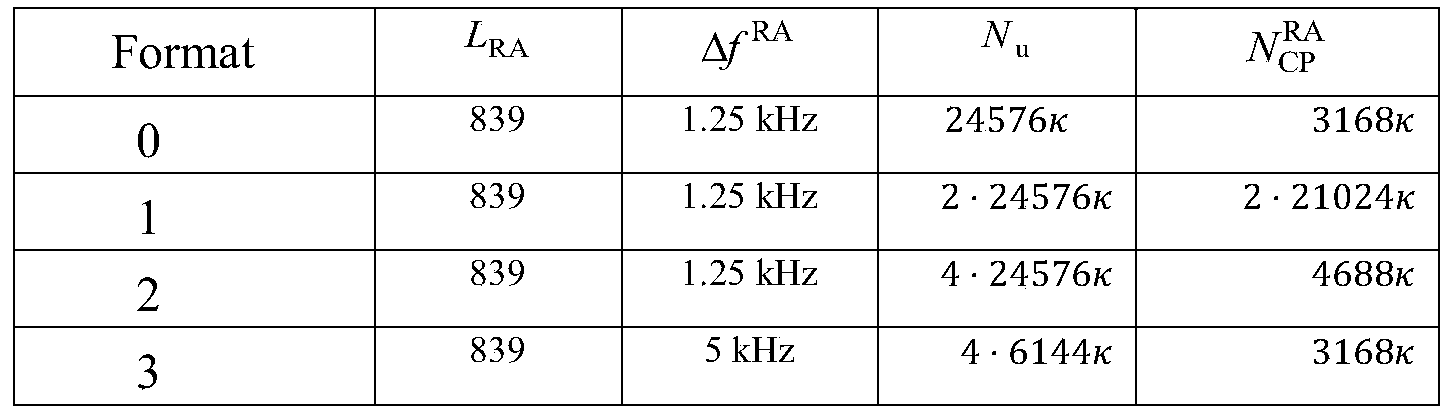
表2Table 2
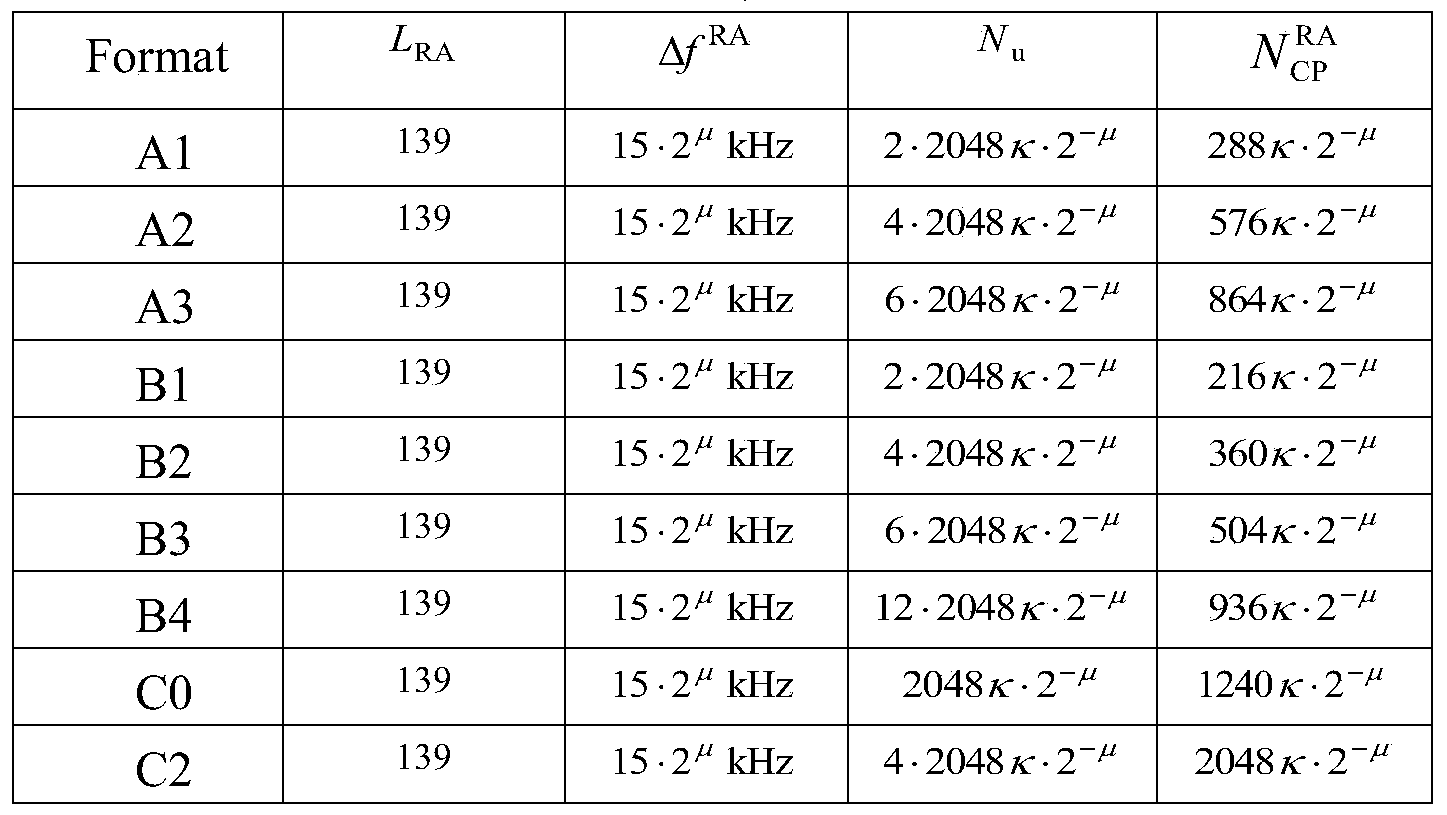
在网络侧配置PRACH传输机会的时域资源时,网络侧可以配置参数PRACH Configuration Index。终端设备可以根据参数PRACH Configuration Index和表3确定PRACH传输机会的时域资源。When configuring the time domain resources of PRACH transmission opportunities on the network side, the network side can configure the parameter PRACH Configuration Index. The terminal device can determine the time domain resource of the PRACH transmission opportunity according to the parameter PRACH Configuration Index and Table 3.
例如,如表3所示,若PRACH Configuration Index=87,PRACH传输机会的时域资源在所有满足帧号(n SFN)mod16=0的无线帧的子帧#4(序号为4的子帧)和子帧#9(序号为9的子帧),从符号#0(序号为0的OFDM符号)开始,一个子帧内只有一个PRACH时隙,每个PRACH时隙中有6个连续的PRACH传输机会的时域资源,每个PRACH传输机会的时域资源占用2个符号。 For example, as shown in Table 3, if PRACH Configuration Index=87, the time-domain resources of PRACH transmission opportunities are in all subframes #4 (subframes with sequence number 4) of radio frames that satisfy the frame number (n SFN) mod16=0. And subframe #9 (subframe with sequence number 9), starting from symbol #0 (OFDM symbol with sequence number 0), there is only one PRACH slot in one subframe, and there are 6 consecutive PRACH transmissions in each PRACH slot Opportunistic time domain resources. The time domain resource of each PRACH transmission opportunity occupies 2 symbols.
其中,x表示PRACH时域资源配置周期,y表示PRACH时域资源配置周期中配置了PRACH时域资源的无线帧,


表3table 3
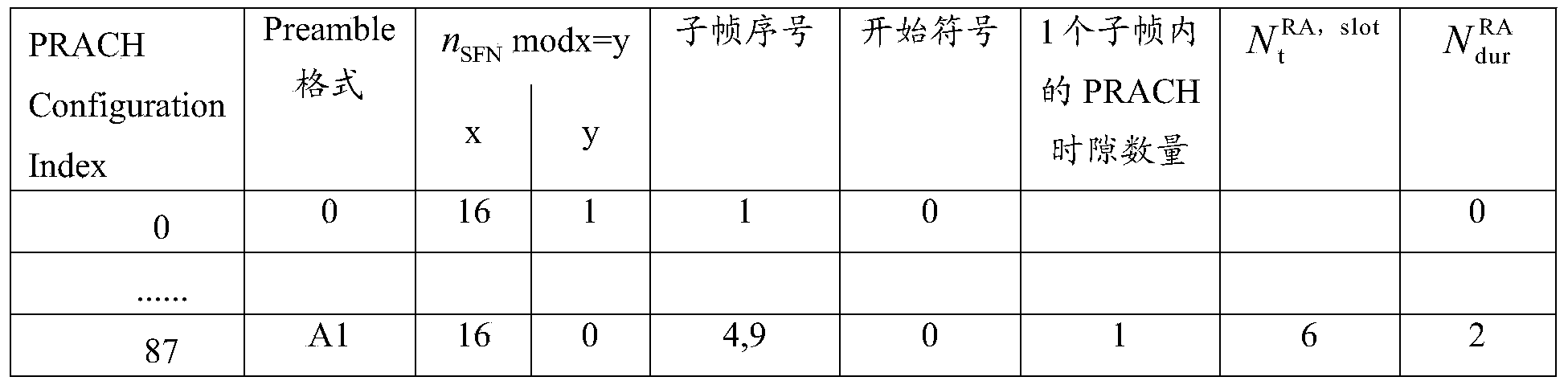
网络侧配置PRACH传输机会的频域资源时,可以配置PRACH传输机会的频域大小和频域起始位置,以及每个PRACH传输机会的时域资源上有多少个频域连续的 PRACH传输机会。例如,网络侧可以配置参数msg1-FrequencyStart,用于指示PRACH传输机会的频域起始位置。网络侧还可以配置例如参数msg1-FDM,用于指示每个PRACH传输机会的时域资源上有多少个频域连续的PRACH传输机会频分复用。When the network side configures the frequency domain resources of PRACH transmission opportunities, it can configure the frequency domain size and frequency domain start position of the PRACH transmission opportunities, and how many frequency domain continuous PRACH transmission opportunities are on the time domain resource of each PRACH transmission opportunity. For example, the network side can configure the parameter msg1-FrequencyStart to indicate the frequency domain start position of the PRACH transmission opportunity. The network side may also configure, for example, the parameter msg1-FDM, which is used to indicate how many frequency-domain continuous PRACH transmission opportunities are frequency-division multiplexed on the time-domain resource of each PRACH transmission opportunity.
PUSCH资源配置:现有NR系统中,可以用PUSCH传输机会(PUSCH occasion,PO)表示一块可用于传输数据的PUSCH时频资源。PUSCH资源配置包括PUSCH时域资源配置和PUSCH频域资源配置。本申请实施例中,PUSCH资源单元可以是PUSCH时频资源,或者可以是PUSCH时频资源与DMRS序列的一个组合,或者可以是PUSCH时频资源与DMRS端口的组合,或者可以是PUSCH时频资源与DMRS序列和DMRS端口的组合,本申请不做限定。PUSCH resource configuration: In the existing NR system, PUSCH transmission opportunity (PUSCH occasion, PO) can be used to represent a piece of PUSCH time-frequency resource that can be used for data transmission. PUSCH resource configuration includes PUSCH time domain resource configuration and PUSCH frequency domain resource configuration. In the embodiment of this application, the PUSCH resource unit may be a PUSCH time-frequency resource, or a combination of a PUSCH time-frequency resource and a DMRS sequence, or a combination of a PUSCH time-frequency resource and a DMRS port, or a PUSCH time-frequency resource The combination with DMRS sequence and DMRS port is not limited in this application.
PUSCH时域资源配置用于指示PUSCH资源在时域上的配置。例如,PUSCH时域资源配置可以包括PUSCH资源的时域起始位置、PUSCH资源的时域结束位置(终止位置)或PUSCH资源的时域长度中的一种或多种。PUSCH资源的时域起始位置有两种配置方法,一种是独立配置,即通过周期和相对于系统帧号(system frame number,SFN)=0的时域偏移来配置PUSCH资源单元的起始位置,另一种是配置相对于PRACH时频资源的相对位置,既通过配置与PRACH时频资源的时域偏移配置PUSCH时频资源的起始位置。PUSCH资源用PUSCH传输机会表示的情况下,PUSCH时域资源配置可以用一些与PUSCH传输机会相关的资源配置来描述。例如,PUSCH时域资源配置可以包括PUSCH传输机会时域起始位置、PUSCH传输机会时域长度、时分复用的PUSCH传输机会数量中的一种或多种。The PUSCH time domain resource configuration is used to indicate the configuration of the PUSCH resource in the time domain. For example, the PUSCH time domain resource configuration may include one or more of the time domain start position of the PUSCH resource, the time domain end position (end position) of the PUSCH resource, or the time domain length of the PUSCH resource. There are two ways to configure the start position of the PUSCH resource in the time domain. One is independent configuration, that is, the start of the PUSCH resource unit is configured by the period and the time domain offset relative to the system frame number (SFN)=0. The start position, the other is to configure the relative position relative to the PRACH time-frequency resource, that is, configure the start position of the PUSCH time-frequency resource by configuring the time domain offset from the PRACH time-frequency resource. When PUSCH resources are represented by PUSCH transmission opportunities, the PUSCH time-domain resource configuration can be described by some resource configurations related to PUSCH transmission opportunities. For example, the PUSCH time domain resource configuration may include one or more of the start position of the PUSCH transmission opportunity time domain, the PUSCH transmission opportunity time domain length, and the number of time division multiplexed PUSCH transmission opportunities.
PUSCH频域资源配置用于指示PUSCH资源在频域上的配置。例如,PUSCH频域资源配置可以包括PUSCH资源的频域起始位置、PUSCH资源的频域终止位置或PUSCH资源的频域长度中的一种或多种。PUSCH资源用PUSCH传输机会表示的情况下,PUSCH频域资源配置可以用一些与PUSCH传输机会相关的资源配置来描述。例如,PUSCH频域资源配置可以包括PUSCH传输机会频域起始位置、PUSCH传输机会频域结束位置、PUSCH传输机会频域长度、频分复用的PUSCH传输机会数量中的一种或多种。The PUSCH frequency domain resource configuration is used to indicate the configuration of the PUSCH resource in the frequency domain. For example, the PUSCH frequency domain resource configuration may include one or more of the frequency domain start position of the PUSCH resource, the frequency domain end position of the PUSCH resource, or the frequency domain length of the PUSCH resource. When PUSCH resources are represented by PUSCH transmission opportunities, the PUSCH frequency domain resource configuration can be described by some resource configurations related to PUSCH transmission opportunities. For example, the PUSCH frequency domain resource configuration may include one or more of PUSCH transmission opportunity frequency domain start position, PUSCH transmission opportunity frequency domain end position, PUSCH transmission opportunity frequency domain length, and frequency division multiplexed PUSCH transmission opportunity number.
下面将结合本申请实施例中的附图,对本申请实施例中的技术方案进行描述。其中,在本申请的描述中,除非另有说明,“至少一个”是指一个或多个,“多个”是指两个或多于两个。另外,为了便于清楚描述本申请实施例的技术方案,在本申请的实施例中,采用了“第一”、“第二”等字样对功能和作用基本相同的相同项或相似项进行区分。本领域技术人员可以理解“第一”、“第二”等字样并不对数量和执行次序进行限定,并且“第一”、“第二”等字样也并不限定一定不同。The technical solutions in the embodiments of the present application will be described below in conjunction with the drawings in the embodiments of the present application. Wherein, in the description of this application, unless otherwise specified, "at least one" refers to one or more, and "multiple" refers to two or more than two. In addition, in order to facilitate a clear description of the technical solutions of the embodiments of the present application, in the embodiments of the present application, words such as "first" and "second" are used to distinguish the same items or similar items with substantially the same function and effect. Those skilled in the art can understand that words such as "first" and "second" do not limit the quantity and order of execution, and words such as "first" and "second" do not limit the difference.
为了便于理解,以下结合附图对本申请实施例提供的发送随机接入消息的方法进行具体介绍。For ease of understanding, the method for sending random access messages provided by embodiments of the present application will be specifically introduced below in conjunction with the accompanying drawings.
如图5所示,本申请实施例提供一种发送随机接入消息的方法,包括:As shown in FIG. 5, an embodiment of the present application provides a method for sending a random access message, including:
501、终端设备确定一个preamble,该确定的preamble与第一PRACH时频资源关联,该第一PRACH时频资源位于第一时间段内。501. The terminal device determines a preamble, the determined preamble is associated with a first PRACH time-frequency resource, and the first PRACH time-frequency resource is located in a first time period.
或者,终端设备可以先确定第一PRACH时频资源,该第一PRACH时频资源位于第一时间段内;再根据该第一PRACH时频资源所关联的一个或多个preamble确定一 个preamble。终端设备确定的preamble可以是第一PRACH时频资源关联的一个或多个preamble中的一个。Alternatively, the terminal device may first determine the first PRACH time-frequency resource, and the first PRACH time-frequency resource is located in the first time period; and then determine a preamble according to one or more preambles associated with the first PRACH time-frequency resource. The preamble determined by the terminal device may be one of one or more preambles associated with the first PRACH time-frequency resource.
在一些实施例中,第一时间段为连续的多个时间段中的一个时间段,多个时间段的时长相同。多个时间段中的每个时间段内的PRACH时频资源仅与该时间段内的PUSCH资源单元进行关联/映射/对应(即每个时间段内的PRACH时频资源仅与该时间段内的PUSCH资源单元具有关联关系/映射关系/对应关系);或者说,多个时间段中的每个时间段内的PRACH时频资源所关联的preamble仅与该时间段内的PUSCH资源单元进行关联/映射/对应。每个时间段可以理解为msgA的一个映射周期,或者msgA的一个映射范围。终端设备在发送msgA时,用于发送preamble的PRACH时频资源和用于发送上行数据的PUSCH资源单元位于同一个时间段中,或者说,msgA中的preamble和上行数据使用的PUSCH资源单元位于同一个时间段中。In some embodiments, the first time period is one of multiple consecutive time periods, and the multiple time periods have the same duration. The PRACH time-frequency resources in each of the multiple time periods are only associated/mapped/corresponding to the PUSCH resource units in the time period (that is, the PRACH time-frequency resources in each time period are only associated with the PUSCH resource units in the time period. The PUSCH resource unit has an association relationship/mapping relationship/correspondence); in other words, the preamble associated with the PRACH time-frequency resource in each of the multiple time periods is only associated with the PUSCH resource unit in the time period /Mapping/correspondence. Each time period can be understood as a mapping period of msgA, or a mapping range of msgA. When the terminal device sends msgA, the PRACH time-frequency resource used to send the preamble and the PUSCH resource unit used to send uplink data are located in the same time period. In other words, the preamble in msgA and the PUSCH resource unit used for uplink data are located in the same time period. In a time period.
多个时间段中的每个时间段内可以有一个或多个PRACH时频资源(该一个或多个PRACH时频资源可以组成一个PRACH时频资源集合)和一个或多个PUSCH资源单元(该一个或多个PUSCH资源单元可以组成一个PUSCH资源单元集合),每个时间段内的PRACH时频资源可以关联一个或多个preamble(该一个或多个preamble可以组成一个preamble集合)。对于多个时间段中的每个时间段,该时间段内的PRACH时频资源集合可以与该时间段内的PUSCH资源单元集合进行关联,即,该时间段内的PRACH时频资源集合中的PRACH时频资源可以与该时间段内的PUSCH资源单元集合中的PUSCH资源单元进行关联;或者,对于多个时间段中的每个时间段,该时间段内的PRACH时频资源所关联的preamble集合可以与该时间段内的PUSCH资源单元集合进行关联,即,该时间段内的PRACH时频资源所关联的preamble集合中的preamble可以与该时间段内的PUSCH资源单元集合中的PUSCH资源单元进行关联。In each of the multiple time periods, there may be one or more PRACH time-frequency resources (the one or more PRACH time-frequency resources may form a PRACH time-frequency resource set) and one or more PUSCH resource units (the One or more PUSCH resource units can form a PUSCH resource unit set), and PRACH time-frequency resources in each time period can be associated with one or more preambles (the one or more preambles can form a preamble set). For each of the multiple time periods, the PRACH time-frequency resource set in the time period can be associated with the PUSCH resource unit set in the time period, that is, the PRACH time-frequency resource set in the time period The PRACH time-frequency resource can be associated with the PUSCH resource unit in the PUSCH resource unit set in the time period; or, for each of the multiple time periods, the preamble associated with the PRACH time-frequency resource in the time period The set can be associated with the PUSCH resource unit set in the time period, that is, the preamble in the preamble set associated with the PRACH time-frequency resource in the time period can be associated with the PUSCH resource unit in the PUSCH resource unit set in the time period. Make an association.
在一些实施例中,第一时间段的起始位置与PRACH时域资源配置周期的起始位置或PUSCH时域资源配置周期的起始位置相关,或者第一时间段的起始位置与PRACH传输机会或PUSCH传输机会的时域位置相关,或者第一时间段的起始位置为预设的时域位置。第一时间段的起始位置可以是预定义的,也可以是网络设备配置的。In some embodiments, the start position of the first time period is related to the start position of the PRACH time domain resource configuration period or the PUSCH time domain resource configuration period, or the start position of the first time period is related to PRACH transmission The opportunity or the time domain position of the PUSCH transmission opportunity is related, or the start position of the first time period is a preset time domain position. The starting position of the first time period may be predefined or configured by the network device.
其中,PRACH时域资源配置周期可以是PRACH传输机会的周期,每个PRACH时域资源配置周期内可以有一个或者多个PRACH传输机会。PUSCH时域资源配置周期可以是PUSCH传输机会的周期,每个PUSCH时域资源的配置周期内可以有一个或者多个PUSCH传输机会。若PUSCH时域资源是相对PRACH时域资源配置的,则PUSCH时域资源配置周期的长度可以与PRACH时域资源配置周期的长度相同。The PRACH time domain resource configuration period may be a period of PRACH transmission opportunities, and each PRACH time domain resource configuration period may have one or more PRACH transmission opportunities. The PUSCH time domain resource configuration period may be a period of PUSCH transmission opportunities, and each PUSCH time domain resource configuration period may have one or more PUSCH transmission opportunities. If the PUSCH time domain resources are configured relative to the PRACH time domain resources, the length of the PUSCH time domain resource configuration period may be the same as the length of the PRACH time domain resource configuration period.
如图6A所示,PUSCH时域资源可以是相对PRACH时域资源配置的,PUSCH时域资源配置周期的长度可以与PRACH时域资源配置周期的长度相同,PRACH时域资源配置周期内可以有3个PRACH传输机会,PUSCH时域资源的配置周期内可以有3个PUSCH传输机会。As shown in Figure 6A, PUSCH time-domain resources can be configured relative to PRACH time-domain resources. The length of the PUSCH time-domain resource configuration period can be the same as the length of the PRACH time-domain resource configuration period. There can be 3 in the PRACH time-domain resource configuration period. There are three PRACH transmission opportunities, and there can be 3 PUSCH transmission opportunities in the configuration period of the PUSCH time domain resources.
或者,如图6B所示,PUSCH时域资源配置周期的长度可以是与两组相邻的PUSCH时隙组之间的时间段的长度相同,PUSCH时隙组指的是多个连续的时隙,该多个连续的时隙内有至少一个PUSCH传输机会。Or, as shown in FIG. 6B, the length of the PUSCH time-domain resource configuration period may be the same as the length of the time period between two sets of adjacent PUSCH time slot groups. A PUSCH time slot group refers to multiple consecutive time slots. , There is at least one PUSCH transmission opportunity in the multiple consecutive time slots.
在一种可能的设计中,第一时间段的起始位置可以为一个PUSCH时域资源配置 周期内最后一个PUSCH资源单元所在时隙的下一个时隙的起始位置;或者,第一时间段的起始位置可以为第一PRACH时频资源所在的PRACH时域资源配置周期内的第一个PRACH时频资源所在时隙的起始位置。或者,第一时间段的起始位置可以是某个参考时间点,例如,参考时间点可以是SFN=0。In a possible design, the starting position of the first time period may be the starting position of the next time slot of the time slot where the last PUSCH resource unit in a PUSCH time domain resource configuration period; or, the first time period The starting position of may be the starting position of the time slot where the first PRACH time-frequency resource is located in the PRACH time-domain resource configuration period where the first PRACH time-frequency resource is located. Alternatively, the starting position of the first time period may be a certain reference time point, for example, the reference time point may be SFN=0.
在一些实施例中,第一时间段的长度大于或者等于PUSCH时域资源配置周期的长度。如果PUSCH时域资源是相对PRACH时域资源配置的,那么PRACH时域资源配置周期的长度可以与PUSCH时域资源配置周期的长度相同。即第一时间段的长度大于或者等于PRACH时域资源配置周期的长度。In some embodiments, the length of the first time period is greater than or equal to the length of the PUSCH time domain resource configuration period. If the PUSCH time domain resources are configured relative to the PRACH time domain resources, the length of the PRACH time domain resource configuration period may be the same as the length of the PUSCH time domain resource configuration period. That is, the length of the first time period is greater than or equal to the length of the PRACH time domain resource configuration period.
示例性的,第一时间段的长度可以为PUSCH时域资源配置周期的长度的整数倍,或者,第一时间段的长度可以为PUSCH时域资源配置周期的长度与PRACH时域资源配置周期的长度中最大者。或者,第一时间段的长度为PUSCH时域资源配置周期的长度与PRACH时域资源配置周期的长度的最大公倍数,在此不做限定。第一时间段的时间长度可以是预定义的,也可以是网络设备配置的。Exemplarily, the length of the first time period may be an integer multiple of the length of the PUSCH time domain resource configuration period, or the length of the first time period may be the length of the PUSCH time domain resource configuration period and the PRACH time domain resource configuration period. The largest of the lengths. Alternatively, the length of the first time period is the greatest common multiple of the length of the PUSCH time domain resource configuration period and the length of the PRACH time domain resource configuration period, which is not limited here. The time length of the first time period may be predefined or configured by the network device.
举例来说,如图6C所示,PRACH时域资源配置周期的起始位置可以为10ms无线帧的时隙0,周期的长度为10ms,即一个无线帧。在每个10ms无线帧内的时隙2、时隙5和时隙8上各配置有一个RO(的时域资源)。PUSCH时域资源为独立配置,起始位置为10ms无线帧的时隙0和时隙5,周期的长度为5ms,在每个10ms无线帧内的时隙1和时隙6上各配置有两个PO(的时域资源)。For example, as shown in FIG. 6C, the starting position of the PRACH time domain resource configuration period may be
假设第一时间段的长度等于PUSCH时域资源配置周期的长度,即第一时间段的长度为5ms,第一时间段的起始位置为一个PUSCH时域资源配置周期内最后一个PUSCH传输机会所在时隙的下一个时隙的起始位置,即第一时间段的起始位置为时隙2和时隙7的起始位置。图6C中示出了多个连续的时间段,例如时间段0、时间段1和时间段2。第一PRACH时频资源可以位于时间段0、时间段1和时间段2中的任一个,即第一时间段可以是时间段0、时间段1和时间段2中的任一个时间段。在时间段0内,时隙2和时隙5上的RO所关联的preamble集合关联到时隙6上的PUSCH资源单元集合;在时间段1内,时隙8上的RO所关联的preamble集合关联到时隙1上的PUSCH资源单元集合;在时间段2内,时隙2和时隙5上的RO所关联的preamble集合关联到时隙6上的PUSCH资源单元集合。即每个10ms内(每10个时隙内),时隙2和时隙5上的RO所关联的preamble集合关联到时隙6上的PUSCH资源单元集合,时隙8上的RO所关联的preamble集合关联到时隙1上的PUSCH资源单元集合。Assuming that the length of the first time period is equal to the length of the PUSCH time domain resource configuration period, that is, the length of the first time period is 5ms, and the starting position of the first time period is the last PUSCH transmission opportunity in a PUSCH time domain resource configuration period The starting position of the next time slot of the time slot, that is, the starting position of the first time period is the starting position of
应该理解的是,本申请实施例中,可以为每个RO配置一个或多个preamble,每个PO可以配置一个或多个资源单元,一个或多个时隙上的PUSCH资源单元集合包括该一个或多个时隙上的PO上配置的PUSCH资源单元。It should be understood that in this embodiment of the present application, each RO can be configured with one or more preambles, and each PO can be configured with one or more resource units, and the PUSCH resource unit set on one or more time slots includes this one Or PUSCH resource units configured on POs in multiple time slots.
又例如,如图7所示,PRACH时域资源配置周期的起始位置为10ms无线帧的时隙0,周期的长度为10ms,在每个10ms无线帧内的时隙2、时隙5和时隙8上各配置有一个RO。PUSCH时域资源是相对于PRACH时域资源配置的,其周期与PRACH时域资源配置周期相同,即周期的长度为10ms,起始位置为每个10ms无线帧内的时隙0。在每个10ms无线帧内的时隙3、时隙6和时隙9上各配置有两个PO。For another example, as shown in Figure 7, the starting position of the PRACH time domain resource configuration cycle is
假设第一时间段的长度等于PUSCH时域资源配置周期的长度,即第一时间段的长度为10ms,第一时间段的起始位置为PUSCH时域资源配置周期内最后一个PUSCH传输机会所在时隙的下一个时隙的起始位置,即第一时间段的起始位置为时隙0的起始位置。图7中示出了多个连续的时间段,例如时间段0和时间段1,第一时间段可以是其中的任一个时间段。时间段0内,时隙2、时隙5和时隙8上的RO所关联的preamble集合关联到时隙3、时隙6和时隙9上的PUSCH资源单元集合;时间段1内,时隙2、时隙5和时隙8上的RO所关联的preamble集合关联到时隙3、时隙6和时隙9上的RO所关联的PUSCH资源单元集合。即每个10ms内,时隙2、时隙5和时隙8上的RO所关联的preamble集合关联到时隙3、时隙6和时隙9上的PUSCH资源单元集合。Assuming that the length of the first time period is equal to the length of the PUSCH time domain resource configuration period, that is, the length of the first time period is 10 ms, and the starting position of the first time period is the time of the last PUSCH transmission opportunity in the PUSCH time domain resource configuration period The starting position of the next time slot of the slot, that is, the starting position of the first time period is the starting position of
再例如,如图8所示,PRACH时域资源配置周期的起始位置为10ms无线帧的时隙0,周期的长度为10ms,在每个10ms无线帧内的时隙2、时隙5和时隙8上各配置有一个RO。PUSCH时域资源配置周期为独立配置,起始位置为10ms无线帧的时隙0和时隙5,周期的长度为5ms,在每个10ms无线帧内的时隙1和时隙6上各配置有两个PO。For another example, as shown in Figure 8, the starting position of the PRACH time domain resource configuration cycle is
假设第一时间段的长度等于PRACH时域资源配置周期的长度,即第一时间段的长度为10ms,第一时间段的起始位置为PRACH时域资源配置周期内首个PRACH时频资源所在的时隙的起始位置,即第一时间段的起始位置为每个10ms无线帧内的时隙2的起始位置。图8中示出了多个连续的时间段,例如时间段0和时间段1,第一时间段可以是其中的任一个时间段。时间段0内,时隙2、时隙5和时隙8上的RO所关联的preamble集合关联到时隙6和时隙1上的PUSCH资源单元;时间段1内,时隙2、时隙5和时隙8上的RO所关联的preamble集合关联到时隙6和时隙1上的PUSCH资源单元。即每个10ms内,时隙2、时隙5和时隙8上的RO所关联的preamble集合关联到时隙6和时隙1上的PUSCH资源单元。Assuming that the length of the first time period is equal to the length of the PRACH time domain resource configuration period, that is, the length of the first time period is 10 ms, and the starting position of the first time period is the location of the first PRACH time-frequency resource in the PRACH time domain resource configuration period The starting position of the time slot, that is, the starting position of the first time period is the starting position of
在一些实施例中,第一时间段的长度可以根据PRACH时频资源配置、PUSCH资源单元配置以及预定义的规则确定的。示例性的,预定义的规则可以是设置第一时间段包括M个PRACH传输机会,且该M个PRACH传输机会都能在第一时间段内关联到位于自身时域资源之后的PUSCH资源单元。M为大于等于1的整数。In some embodiments, the length of the first time period may be determined according to PRACH time-frequency resource configuration, PUSCH resource unit configuration, and predefined rules. Exemplarily, the predefined rule may be to set the first time period to include M PRACH transmission opportunities, and the M PRACH transmission opportunities can be associated with the PUSCH resource unit located behind the own time domain resource within the first time period. M is an integer greater than or equal to 1.
如图7所示,示出了多个连续的时间段,例如时间段0和时间段1,第一时间段可以是其中的一个。预定义的规则可以是设置第一时间段包括3个PRACH传输机会,且该3个PRACH传输机会都能在第一时间段内关联到位于自身时域资源之后的PUSCH资源单元。当第一PRACH时频资源为时隙2上的RO时,时间段0为第一时间段,第一时间段包括3个RO,且该3个RO都能在第一时间段内关联到位于自身时域资源之后的PUSCH资源单元。即时隙2、时隙5和时隙8上的RO所关联的preamble集合关联到时隙3、时隙6和时隙9上的PUSCH资源单元集合。As shown in FIG. 7, multiple consecutive time periods are shown, such as
此外,如果一些PRACH时频资源或PUSCH资源单元跨多个时间段,则这些PRACH时频资源或PUSCH资源单元属于其起始位置所在的时间段,或者其结束位置所在的时间段,或者这些PRACH时频资源或PUSCH资源单元不属于任何时间段,即这些PRACH时频资源或PUSCH资源单元不参与msgA映射。In addition, if some PRACH time-frequency resources or PUSCH resource units span multiple time periods, these PRACH time-frequency resources or PUSCH resource units belong to the time period where their start position is located, or the time period where their end position is located, or these PRACH Time-frequency resources or PUSCH resource units do not belong to any time period, that is, these PRACH time-frequency resources or PUSCH resource units do not participate in msgA mapping.
举例来说,如图9所示,时隙6和时隙7上的RO跨2个时间段,即同时处于时间段0和时间段1内,该RO可以属于其起始位置所在的时间段,即时间段0,此时,时间段0内,时隙2和时隙3上的RO所关联的preamble集合以及时隙6和时隙7上的RO所关联的preamble集合都与时隙6上的PUSCH资源单元集合进行映射。或者,时隙6和时隙7上的RO所关联的preamble集合可以属于其结束位置所在的时间段,即时间段1,此时,时间段1内,时隙6和7上的RO所关联的preamble集合与时隙1上的PUSCH资源单元集合映射。或者,时隙6和7上的RO不属于任何时间段,此时,时间段1内,时隙1上的PUSCH资源单元集合不与任何时隙上的RO所关联的preamble集合进行映射,即时隙1上的PUSCH资源单元集合不用于MsgA传输。For example, as shown in Fig. 9, the RO on
此外,如果PUSCH传输机会存在重复传输,则在第一时间段内,preamble集合仅关联到某个特定的PUSCH传输机会上的PUSCH资源单元集合。该特定的PUSCH传输机会可以是重复传输的PUSCH传输机会中的首个PUSCH传输机会,也可以是网络设备配置的第M个PUSCH传输机会,M为大于等于1的整数。In addition, if there is repeated transmission at the PUSCH transmission opportunity, in the first time period, the preamble set is only associated with the PUSCH resource unit set on a certain PUSCH transmission opportunity. The specific PUSCH transmission opportunity may be the first PUSCH transmission opportunity among the repeated PUSCH transmission opportunities, or may be the M th PUSCH transmission opportunity configured by the network device, and M is an integer greater than or equal to 1.
举例来说,如图7所示,在时间段0内,若时隙6和时隙9上的PO是时隙3上的PO的重传,则时隙2、时隙5和时隙8上的RO所关联的preamble集合可以仅与特定的PO上的PUSCH资源单元集合关联。特定的PO可以是时隙3上的PO。即在时间段0内,时隙2、时隙5和时隙8上的RO所关联的preamble集合可以仅与时隙3上的PO上的PUSCH资源单元集合关联。For example, as shown in Figure 7, in
如果PRACH时频资源存在重复传输,则在第一时间段内,重复传输的PRACH时频资源中的某个特定PRACH时频资源上的preamble集合关联第一时间段内的PUSCH资源单元集合。该特定的PRACH时频资源上可以是重复传输的PRACH时频资源中的首个PRACH时频资源,也可以是网络设备配置的第M个PRACH时频资源。If there is repeated transmission of the PRACH time-frequency resource, in the first time period, the preamble set on a specific PRACH time-frequency resource in the repeatedly transmitted PRACH time-frequency resource is associated with the PUSCH resource unit set in the first time period. The specific PRACH time-frequency resource may be the first PRACH time-frequency resource among the repeatedly transmitted PRACH time-frequency resources, or it may be the Mth PRACH time-frequency resource configured by the network device.
举例来说,如图7所示,若时隙5和时隙8上的RO是时隙2上的RO的重传,则在时间段0内,时隙3、时隙6和时隙9上的PUSCH资源单元集合仅与特定的RO所关联的preamble集合关联。特定的RO可以是时隙2上的RO。即在时间段0内,时隙3、时隙6和时隙9上的PUSCH资源单元集合仅与时隙2上的RO所关联的preamble集合关联。For example, as shown in Figure 7, if the ROs on
可选的,在第一时间段内,PRACH时频资源仅映射到位于自身时域资源之后的PUSCH资源单元,或者,preamble仅映射到位于其关联的PRACH时频资源的时域资源之后的PUSCH资源单元。Optionally, in the first time period, the PRACH time-frequency resource is only mapped to the PUSCH resource unit located after its own time-domain resource, or the preamble is only mapped to the PUSCH located after the time-domain resource of its associated PRACH time-frequency resource Resource unit.
可选的,在第一时间段内,如果存在一些PUSCH资源单元没有映射到PRACH时频资源或者preamble,则这些PUSCH资源单元不用于msgA传输。Optionally, in the first time period, if there are some PUSCH resource units that are not mapped to PRACH time-frequency resources or preambles, these PUSCH resource units are not used for msgA transmission.
可选的,在第一时间段内,如果存在一些PRACH时频资源或者preamble没有映射到PUSCH资源单元,则这些PRACH时频资源或者preamble不用于msgA传输。Optionally, in the first time period, if there are some PRACH time-frequency resources or preambles are not mapped to PUSCH resource units, these PRACH time-frequency resources or preambles are not used for msgA transmission.
可选的,在第一时间段内,如果存在一些PRACH时频资源,在这些PRACH时频资源的时域资源之后没有PUSCH资源单元,则这些PRACH时频资源不用于msgA传输,或者,这些PRACH时频资源用于四步随机接入传输,或者,这些PRACH时频资源可用于该PRACH时频资源之前某个特定的可用于msgA传输的PRACH时频资源的重复传输。Optionally, in the first time period, if there are some PRACH time-frequency resources and there is no PUSCH resource unit after the time-domain resources of these PRACH time-frequency resources, these PRACH time-frequency resources are not used for msgA transmission, or these PRACH time-frequency resources The time-frequency resources are used for four-step random access transmission, or these PRACH time-frequency resources can be used for repeated transmission of a specific PRACH time-frequency resource that can be used for msgA transmission before the PRACH time-frequency resource.
可选的,在第一时间段内,如果存在一些PUSCH资源单元,在这些PUSCH资源单元的时域资源之前没有PRACH时频资源,则这些PUSCH资源单元不用于msgA传输,或者,这些PUSCH资源单元可用于该PUSCH资源单元之前某个可用于msgA传输的PUSCH资源单元的重复传输。Optionally, in the first time period, if there are some PUSCH resource units, and there are no PRACH time-frequency resources before the time domain resources of these PUSCH resource units, these PUSCH resource units are not used for msgA transmission, or these PUSCH resource units It can be used for repeated transmission of a PUSCH resource unit that can be used for msgA transmission before the PUSCH resource unit.
举例来说,如图10所示,PRACH时域资源配置周期的起始位置为10ms无线帧的时隙0,周期的长度为10ms,即一个无线帧。在每个10ms无线帧内的时隙2上配置有一个RO。PUSCH时域资源配置周期为独立配置,起始位置为10ms无线帧的时隙0和时隙5,周期的长度为5ms,在每个10ms无线帧内的时隙1和时隙6上各配置有两个PO。For example, as shown in FIG. 10, the starting position of the PRACH time domain resource configuration period is
假设第一时间段的长度等于PUSCH时域资源配置周期的长度,即第一时间段的长度为5ms,第一时间段的起始位置为一个PUSCH时域资源配置周期内最后一个PUSCH传输机会所在时隙的下一个时隙的起始位置,即第一时间段的起始位置可以为时隙2和时隙7的起始位置。图10中示出了多个连续的时间段,例如时间段0、时间段1和时间段2,第一时间段可以是其中的任一个时间段。在时间段0内,时隙2上的RO所关联的preamble集合关联到时隙6上的PUSCH资源单元集合。在时间段1内,由于时隙1上的PUSCH资源单元集合的时域资源之前没有PRACH时频资源,也就没有preamble可以与时隙1上的PUSCH资源单元集合关联,因此时隙1上的PUSCH资源单元集合不用于msgA传输,或者时隙1上的PUSCH资源单元集合可用于时隙6上的PUSCH资源单元集合的重复传输。在时间段2内,时隙2上的RO所关联的preamble集合关联到时隙6上的PUSCH资源单元集合。Assuming that the length of the first time period is equal to the length of the PUSCH time domain resource configuration period, that is, the length of the first time period is 5ms, and the starting position of the first time period is the last PUSCH transmission opportunity in a PUSCH time domain resource configuration period The starting position of the next time slot of the time slot, that is, the starting position of the first time period may be the starting position of
在一些实施例中,第一时间段的长度是根据SSB与PRACH时频资源之间的关联周期/映射周期的长度确定的。SSB与PRACH时频资源的关联周期的长度可以是PRACH时域资源配置周期的长度的整数倍,在SSB与PRACH时频资源的关联周期内,所有实际发送的SSB都至少映射到PRACH时频资源一遍。多个SSB与PRACH时频资源的关联周期可以组成一个SSB与PRACH时频资源的关联周期图样,该关联周期图样至多每160ms重复一次。In some embodiments, the length of the first time period is determined according to the length of the association period/mapping period between the SSB and the PRACH time-frequency resource. The length of the association period between SSB and PRACH time-frequency resources can be an integer multiple of the length of the PRACH time-domain resource configuration period. In the association period between SSB and PRACH time-frequency resources, all actually sent SSBs are mapped to at least PRACH time-frequency resources Again. The association period between multiple SSBs and PRACH time-frequency resources may form an association period pattern between SSB and PRACH time-frequency resources, and the association period pattern repeats at most every 160 ms.
举例来说,如图11所示,假设一个SSB与PRACH时频资源的关联周期图样的长度为160ms,该160ms内,SSB与PRACH时频资源的关联周期图样可以包括6个SSB与PRACH时频资源的关联周期,分别可以为关联周期0、关联周期1、关联周期2、关联周期3、关联周期4、关联周期5,剩余的10ms内SSB与PRACH时频资源不进行映射。SSB与PRACH时频资源的关联周期的长度可以有多种取值。例如,关联周期0、关联周期1、关联周期2、关联周期3、关联周期4和关联周期5的长度分别可以为40ms,10ms,20ms,40ms,20ms和20ms。可以根据SSB与PRACH时频资源的关联周期图样确定一个时间段图样,该时间段图样的周期可以为160ms。每个时间段图样内可以包括6个时间段,长度分别为40ms,10ms,20ms,40ms,20ms和20ms,第一时间段可以是其中的一个。第一时间段内,配置有RO的时隙上的preamble集合关联到配置有PO的时隙上的PUSCH资源单元集合。For example, as shown in FIG. 11, assuming that the length of an association period pattern between SSB and PRACH time-frequency resources is 160 ms, within this 160 ms, the association period pattern between SSB and PRACH time-frequency resources may include 6 SSB and PRACH time-frequency resources. The association period of the resources may be
在一些实施例中,第一时间段是第一PRACH时频资源关联的时间段,第一时间段的起始位置与第一PRACH时频资源的时域起始位置相同,或者,第一时间段是第 一PRACH时频资源所在时隙关联的时间段,第一时间段的起始位置与第一PRACH时频资源所在时隙的起始位置相同。第一PRACH时频资源所在时隙可以是指普通时隙或PRACH时隙,普通时隙是指以PUSCH子载波间隔为基准,或者以上行带宽部分(bandwidth part,BWP)子载波间隔为基准的时隙,PRACH时隙即与PRACH子载波间隔相关的时隙。或者,第一时间段的起始位置与第一PRACH时频资源所在的子帧的起始位置相同。In some embodiments, the first time period is a time period associated with the first PRACH time-frequency resource, and the start position of the first time period is the same as the time domain start position of the first PRACH time-frequency resource, or the first time The segment is the time period associated with the time slot where the first PRACH time-frequency resource is located, and the start position of the first time period is the same as the start position of the time slot where the first PRACH time-frequency resource is located. The time slot where the first PRACH time-frequency resource is located can refer to a normal time slot or a PRACH time slot. The normal time slot refers to the PUSCH subcarrier interval as a reference, or the upstream bandwidth part (BWP) subcarrier interval as a reference Time slot, PRACH time slot is the time slot related to PRACH sub-carrier spacing. Or, the start position of the first time period is the same as the start position of the subframe where the first PRACH time-frequency resource is located.
举例来说,如图12所示,假设每个10ms无线帧内,时隙0、时隙4和时隙8上各配置有一个RO,时隙1、时隙5和时隙9上各配置有两个PO。若第一PRACH时频资源所在的时隙为时隙0,第一时间段(例如,时间段0)的起始位置可以为时隙0的起始位置,第一时间段的长度可以是基站配置的,例如为3ms。时间段0内,时隙0上的RO所关联的preamble集合可以关联到时隙1上的PUSCH资源单元集合。若第一PRACH时频资源所在的时隙为时隙4,第一时间段(例如,时间段1)的起始位置可以为时隙4的起始位置,第一时间段的长度可以是基站配置的,例如为3ms。时间段1内,时隙4上的RO所关联的preamble集合可以关联到时隙5上的PUSCH资源单元集合。若第一PRACH时频资源所在的时隙为时隙8,第一时间段(例如,时间段2)的起始位置可以为时隙8的起始位置,第一时间段的长度可以是基站配置的,例如为3ms。时间段2内,时隙8上的RO所关联的preamble集合可以关联到时隙9上的PUSCH资源单元集合。For example, as shown in Figure 12, assume that in each 10ms radio frame, one RO is configured on
在一些实施例中,若第一PRACH时频资源所在的时隙位于N个连续的时隙中,其中,N个连续的时隙中的每个时隙均配置有PRACH时频资源,则第一时间段的起始位置与N个连续的时隙中最早的时隙的起始位置相同,N为大于或者等于2的整数。若第一PRACH时频资源所在时隙的前一个时隙未配置有PRACH时频资源,则第一时间段的起始位置与第一PRACH时频资源所在时隙的起始位置相同。In some embodiments, if the time slot in which the first PRACH time-frequency resource is located is in N consecutive time slots, where each of the N consecutive time slots is configured with a PRACH time-frequency resource, then The starting position of a period of time is the same as the starting position of the earliest time slot among N consecutive time slots, and N is an integer greater than or equal to 2. If the previous time slot of the time slot where the first PRACH time-frequency resource is located is not configured with the PRACH time-frequency resource, the starting position of the first time period is the same as the starting position of the time slot where the first PRACH time-frequency resource is located.
举例来说,如图13A所示,假设每个10ms无线帧内,时隙3、时隙4和时隙9上各配置有一个RO,时隙5、时隙6和时隙1上各配置有两个PO。若第一PRACH时频资源所在的时隙为时隙4,由于时隙4与配置有RO的时隙3连续,第一时间段(例如,时间段0)的起始位置与连续的时隙中最早的时隙的起始位置相同,即第一时间段的起始位置为时隙3的起始位置,第一时间段的长度可以是基站配置的,例如为4ms。时隙3和时隙4上的RO所关联的preamble集合关联到时隙5和时隙6上的PUSCH资源单元集合。若第一PRACH时频资源所在的时隙为时隙9,由于时隙9的前一个时隙(即时隙8)未配置有PRACH时频资源,第一时间段(例如,时间段1)的起始位置与第一PRACH时频资源所在时隙的起始位置相同,即第一时间段的起始位置为时隙9的起始位置,第一时间段的长度可以是基站配置的,例如为4ms。时间段1内,时隙9上的RO所关联的preamble集合关联到时隙1上的PUSCH资源单元集合。For example, as shown in Figure 13A, assume that in each 10ms wireless frame, one RO is configured on
在一些实施例中,N个连续的配置有PRACH时频资源的时隙中的每个时隙均可以关联一个时间段,每个时隙对应的时间段的起始位置为该时隙的起始位置,每个时隙对应的时间段的长度可以相同。连续的两个配置有PRACH时频资源的时隙所对应的时间段可能会重叠,在这种情况下,第一时间段内的PUSCH资源单元集合不包含已与第二时间段中的PRACH时频资源关联的PUSCH资源单元,或者,第一时间段内 的PUSCH资源单元集合不包含已与第二时间段中的PRACH时频资源所关联的preamble关联的PUSCH资源单元,第二时间段位于第一时间段之前,或者说,第二时间段的起始位置早于第一时间段。In some embodiments, each of the N consecutive time slots configured with PRACH time-frequency resources can be associated with a time period, and the start position of the time period corresponding to each time slot is the beginning of the time slot. Starting position, the length of the time period corresponding to each time slot can be the same. The time periods corresponding to two consecutive time slots configured with PRACH time-frequency resources may overlap. In this case, the PUSCH resource unit set in the first time period does not include the PRACH time period in the second time period. The PUSCH resource unit associated with the frequency resource, or the PUSCH resource unit set in the first time period does not include the PUSCH resource unit associated with the preamble associated with the PRACH time-frequency resource in the second time period, and the second time period is located in the first time period. A time period before, or in other words, the starting position of the second time period is earlier than the first time period.
举例来说,如图13B所示,假设每个10ms无线帧内,时隙3、时隙4和时隙9上各配置有一个RO,时隙5、时隙6和时隙1上各配置有两个PO。若每个包含PRACH时频资源的时隙对应一个时间段,每个时间段的长度可以为3ms。时隙3、时隙4和时隙9可以各关联一个时域长度为3ms的时间段,分别可以为时间段0、时间段1和时间段2。由于时间段0是时隙3所关联的时间段,因此时隙3上的RO所关联的preamble集合关联到位于时间段0内的PUSCH资源单元集合,即时隙5上的PUSCH资源单元集合。由于时间段1是时隙4所关联的时间段,时隙4上的RO所关联的preamble集合本可以关联到位于时间段1内的PUSCH资源单元集合,即时隙5和时隙6上的PUSCH资源单元集合,但是由于时隙5上的PUSCH资源单元集合已与时间段0(即第二时间段)中的PRACH时频资源(即时隙3上的PRACH时频资源)关联,因此时隙4上的RO所关联的preamble集合仅关联到位于时隙6上的PUSCH资源单元集合。若第一PRACH时频资源所在的时隙为时隙9,时隙9上的RO所关联的preamble集合可以关联位于时间段2内的PUSCH资源单元集合,即时隙1上的PUSCH资源单元集合。For example, as shown in Figure 13B, assume that in each 10ms radio frame, one RO is configured on
在一些实施例中,第一时间段是目标PUSCH资源单元关联的时间段,第一时间段的结束位置与目标PUSCH资源单元的时域结束位置相同,目标PUSCH资源单元的时域位置晚于第一PRACH时频资源的时域位置,终端设备可以根据第一时间段的长度确定第一PRACH时频资源的时域位置确定目标PUSCH资源单元的时域位置。或者,第一时间段是目标时隙关联的时间段,第一时间段的结束位置与配置了PUSCH资源单元的目标时隙的结束位置相同。目标时隙为配置了PUSCH资源单元的时隙,目标时隙的时域位置晚于第一PRACH时频资源的时域位置,终端设备可以根据第一时间段的长度确定第一PRACH时频资源的时域位置确定目标时隙的时域位置。或者,第一时间段是目标子帧关联的时间段,第一时间段的结束位置与配置了PUSCH资源单元的目标子帧的结束位置相同。目标子帧为配置了PUSCH资源单元的子帧,目标子帧的时域位置晚于第一PRACH时频资源的时域位置,终端设备可以根据第一时间段的长度确定第一PRACH时频资源的时域位置确定目标子帧的时域位置。In some embodiments, the first time period is the time period associated with the target PUSCH resource unit, the end position of the first time period is the same as the time domain end position of the target PUSCH resource unit, and the time domain position of the target PUSCH resource unit is later than the first time period. 1. The time domain position of the PRACH time-frequency resource. The terminal device may determine the time domain position of the first PRACH time-frequency resource according to the length of the first time period to determine the time domain position of the target PUSCH resource unit. Alternatively, the first time period is a time period associated with the target time slot, and the end position of the first time period is the same as the end position of the target time slot configured with the PUSCH resource unit. The target time slot is a time slot configured with a PUSCH resource unit. The time domain position of the target time slot is later than the time domain position of the first PRACH time-frequency resource. The terminal device can determine the first PRACH time-frequency resource according to the length of the first time period The time domain position of determines the time domain position of the target time slot. Alternatively, the first time period is a time period associated with the target subframe, and the end position of the first time period is the same as the end position of the target subframe where the PUSCH resource unit is configured. The target subframe is a subframe configured with PUSCH resource units. The time domain position of the target subframe is later than the time domain position of the first PRACH time-frequency resource. The terminal device can determine the first PRACH time-frequency resource according to the length of the first time period The time domain position of determines the time domain position of the target subframe.
举例来说,如图13C所示,假设每个10ms无线帧内,时隙3和时隙7上各配置有一个RO,时隙4和时隙8上各配置有两个PO。若第一PRACH时频资源为时隙3上的RO,第一时间段的长度可以是基站配置的,例如为3ms,时隙4上的PO的时域位置晚于时隙3上的RO的时域位置,且距离时隙3的RO的时长在3ms以内,即时隙4为目标时隙或者目标PUSCH资源单元所在的时域位置(时隙),时隙4关联的时间段(时间段0)为第一时间段,时间段0的结束位置可以为时隙4的结束位置。时间段0内,时隙3上的RO所关联的preamble集合可以关联到时隙4上的PUSCH资源单元集合。若第一PRACH时频资源为时隙7上的RO,第一时间段的长度可以是基站配置的,例如为3ms,时隙8上的PO的时域位置晚于时隙7上的RO的时域位置,且距离时隙7的RO的时长在3ms以内,即时隙8为目标时隙或者目标PUSCH资源 单元所在的时域位置(时隙),时隙8关联的时间段(时间段1)为第一时间段,时间段1的结束位置可以为时隙8的结束位置。时间段1内,时隙7上的RO所关联的preamble集合可以关联到时隙8上的PUSCH资源单元集合。For example, as shown in FIG. 13C, it is assumed that in each 10ms radio frame, one RO is configured on
在一些实施例中,第一时间段的结束位置与N个连续的时隙中最晚的时隙的结束位置相同,其中,N个连续的时隙中的每个时隙均配置有PUSCH资源单元集合,N为大于或者等于2的整数。若目标PUSCH资源单元所在时隙的后一个时隙未配置有PUSCH资源单元集合,或者目标时隙的后一个时隙未配置有PUSCH资源单元集合,则第一时间段的结束位置与目标时隙的结束位置相同。In some embodiments, the end position of the first time period is the same as the end position of the latest time slot among the N consecutive time slots, wherein each of the N consecutive time slots is configured with PUSCH resources Unit set, N is an integer greater than or equal to 2. If the next time slot of the target PUSCH resource unit is not configured with a PUSCH resource unit set, or the next time slot of the target time slot is not configured with a PUSCH resource unit set, then the end position of the first time period and the target time slot The end position is the same.
举例来说,如图14所示,假设在每个10ms无线帧内,时隙3、时隙4和时隙9上各配置有一个RO,时隙5、时隙6和时隙1上各配置有两个PO。若第一PRACH时频资源为时隙3上的RO,第一时间段的长度可以是基站配置的,例如为4ms,终端设备可以确定第一PRACH时频资源位于配置了PUSCH资源单元的时隙5和时隙6关联的第一时间段内,由于时隙5和时隙6连续且均配置有PUSCH资源单元,第一时间段(例如,时间段0)的结束位置与连续的配置有PUSCH资源单元的时隙中最晚的时隙的结束位置相同,即第一时间段的结束位置为时隙6的结束位置。时间段0内,时隙3和时隙4上的RO所关联的preamble集合关联到时隙5和时隙6上的PUSCH资源单元集合。若第一PRACH时频资源为时隙9上的RO,第一时间段的长度可以是基站配置的,例如为4ms,终端设备可以确定第一PRACH时频资源在配置了PUSCH资源单元的时隙1关联的第一时间段(时间段1)内,由于时隙1的后一个时隙未配置有PUSCH资源单元,则第一时间段的结束位置与时隙1的结束位置相同。时间段1内,时隙9上的RO所关联的preamble集合关联到时隙1上的PUSCH资源单元集合。For example, as shown in Figure 14, assuming that in each 10ms radio frame, there is an RO configured on
在一些实施例中,N个连续的时隙中的每个时隙均可以配置有PUSCH资源单元,每个时隙均可以对应一个时间段,每个时隙对应的时间段的结束位置为该时隙的结束位置,每个时隙对应的时间段的长度可以相同。由于连续的两个时隙对应的时间段可能会重叠,在这种情况下,第一时间段内的PRACH时频资源不包含已与第三时间段中的PUSCH资源单元集合关联的PRACH时频资源,或者,第一时间段内的PRACH时频资源关联的preamble集合不包含已与第三时间段中的PUSCH资源单元关联的preamble,第三时间段的结束位置晚于第一时间段。In some embodiments, each of the N consecutive time slots can be configured with a PUSCH resource unit, each time slot can correspond to a time period, and the end position of the time period corresponding to each time slot is this The end position of the time slot, and the length of the time period corresponding to each time slot can be the same. Since the time periods corresponding to two consecutive time slots may overlap, in this case, the PRACH time-frequency resources in the first time period do not include the PRACH time-frequency resources that have been associated with the PUSCH resource unit set in the third time period. Resource, or, the preamble set associated with the PRACH time-frequency resource in the first time period does not include the preamble that has been associated with the PUSCH resource unit in the third time period, and the end position of the third time period is later than the first time period.
举例来说,如图13B所示,假设每个10ms无线帧内,时隙3、时隙4和时隙9上各配置有一个RO,时隙5、时隙6和时隙1上各配置有两个PO。若每个包含PUSCH资源单元的时隙对应一个时间段,每个时隙对应的时间段的结束位置为该时隙的结束位置,每个时间段的长度可以相同,例如为3ms。即时隙5、时隙6和时隙1可以各关联一个时间段,分别为时间段0、时间段1和时间段2。时间段1内,时隙6上的PUSCH资源单元集合关联到时隙4上的RO所关联的preamble集合。时间0内,时隙5上的PUSCH资源单元集合本可以关联到时隙3和时隙4上的RO所关联的preamble集合。但由于时隙4上的RO所关联的preamble集合已与时间1(第三时间段)内的PUSCH资源单元集合关联过了,因此时间0内的PRACH时频资源不包含时隙4上的RO所关联的preamble集合。时间段2内,时隙9上的RO所关联的preamble集合关联到时隙1上的PUSCH资源单元集合。For example, as shown in Figure 13B, assume that in each 10ms radio frame, one RO is configured on
在一些实施例中,第一时间段的长度为两个配置有PRACH时频资源的时隙之间的时间长度。第一时间段的起始位置为每个配置有PRACH时频资源的时隙的起始位置。In some embodiments, the length of the first time period is the length of time between two time slots configured with PRACH time-frequency resources. The starting position of the first time period is the starting position of each time slot configured with PRACH time-frequency resources.
举例来说,如图15所示,假设在每个10ms无线帧内的时隙2、时隙5和时隙8上各配置有一个RO,时隙3、时隙6和时隙9上各配置有两个PO。第一时间段的长度等于每两个配置有RO的时隙之间的长度,第一时间段的起始位置为每个配置有RO的时隙的起始位置。图15中示出了多个连续的时间段,例如时间段0、时间段1和时间段2,第一时间段可以是其中的任一个时间段。时间段0和时间段1的长度为3ms,起始位置分别为时隙2和时隙5的起始位置,时间段2的长度为4ms,起始位置为时隙8的起始位置。时间段0内,时隙2上的RO所关联的preamble集合关联到时隙3上的PUSCH资源单元集合;时间段1内,时隙5上的RO所关联的preamble集合关联到时隙6上的PUSCH资源单元集合。时间段2内,时隙8上的RO所关联的preamble集合关联到时隙9上的PUSCH资源单元集合。For example, as shown in Figure 15, assuming that each of the
在一些实施例中,第一时间段的长度为两个配置PUSCH资源单元的时隙间的时间长度,第一时间段的结束位置为每个配置有PUSCH资源单元的时隙的结束位置。In some embodiments, the length of the first time period is the length of time between two time slots configured with PUSCH resource units, and the end position of the first time period is the end position of each time slot configured with PUSCH resource units.
如图16所示,假设在每个10ms无线帧内的时隙2、时隙5和时隙8上各配置有一个RO,时隙3、时隙6和时隙9上各配置有两个PO。第一时间段的长度等于每两个配置有PO的时隙之间的长度,第一时间段的结束位置为每个配置有PO的时隙的结束位置。图16中示出了多个连续的时间段,例如时间段0、时间段1和时间段2,第一时间段可以是其中的任一个时间段。时间段0和时间段1的长度为3ms,结束位置分别为时隙6和时隙9的结束位置,根据结束位置和时长可知时间段0和时间段1的起始位置为时隙4和时隙7的起始位置;时间段2的长度为4ms,结束位置为时隙3的结束位置,根据结束位置和时长可知时间段2的起始位置为时隙0的起始位置。时间段0内,时隙5上的RO所关联的preamble集合关联到时隙6上的PUSCH资源单元集合;时间段1内,时隙8上的RO所关联的preamble集合关联到时隙9上的PUSCH资源单元集合;时间段2内,时隙2上的RO所关联的preamble集合关联到时隙3上的PUSCH资源单元集合。As shown in Figure 16, assuming that each of the
502、终端设备根据确定的preamble和关联规则在位于第一时间段内的PUSCH资源单元集合中确定一个PUSCH资源单元。502. The terminal device determines a PUSCH resource unit in the PUSCH resource unit set located in the first time period according to the determined preamble and association rule.
其中,关联规则用于确定preamble与PUSCH资源单元之间的关联/映射/对应关系。Among them, the association rule is used to determine the association/mapping/correspondence between the preamble and the PUSCH resource unit.
第一时间段内的preamble和PUSCH资源单元可以是一对一关联,或者多对一关联,或者一对多关联。第一时间段内的preamble和PUSCH资源单元的关联关系可以是基站配置的,也可以是预定义的,也可以是根据第一时间段内preamble的数量与PUSCH资源单元的数量计算得到的。多个时间段中不同时间段内preamble和PUSCH资源单元的关联关系可以相同,也可以不同。The preamble and PUSCH resource units in the first time period may be one-to-one association, or many-to-one association, or one-to-many association. The association relationship between the preamble and the PUSCH resource unit in the first time period may be configured by the base station, or may be predefined, or calculated based on the number of preambles and the number of PUSCH resource units in the first time period. The association relationship between the preamble and the PUSCH resource unit in different time periods in multiple time periods may be the same or different.
如图6C所示,假设每个RO上配置了16个preamble,每个PO上配置了8个资源单元,且preamble和PUSCH资源单元的关联关系是根据第一时间段内preamble的数量与PUSCH资源单元的数量计算得到的,则在时间段0内,时隙2和时隙5上的32个preamble映射到时隙6上的16个PUSCH资源单元,每


可选的,在第一时间段内,PRACH时频资源关联的preamble仅映射到自身时域位置之后的PUSCH资源单元。可选的,在第一时间段内,如果存在一些PRACH时频资源或者preamble没有映射到PUSCH资源单元,则这些PRACH时频资源或者preamble不用于msgA传输。Optionally, in the first time period, the preamble associated with the PRACH time-frequency resource is only mapped to the PUSCH resource unit after its own time domain position. Optionally, in the first time period, if there are some PRACH time-frequency resources or preambles are not mapped to PUSCH resource units, these PRACH time-frequency resources or preambles are not used for msgA transmission.
举例来说,如图7所示,假设每个RO上配置了12个preamble,每个PO上配置了8个资源单元。第一时间段(例如,时间段0)内preamble和PUSCH资源单元的映射关系可以是基站配置的1对1映射,或者是预定义的1对1映射。若第一时间段内,preamble仅映射到时域资源位于自己所在的PRACH传输机会之后的PUSCH传输机会上的PUSCH资源单元,则在时间段0内,时隙2上的12个preamble 1对1映射到时隙3上的前12个PUSCH资源单元,时隙5上的12个preamble 1对1映射到时隙6上的前12个PUSCH资源单元,时隙8上的12个preamble 1对1映射到时隙9上的前12个PUSCH资源单元,时隙3、时隙6、时隙9上的最后4个PUSCH资源单元没被映射,不用于msgA传输。For example, as shown in Figure 7, it is assumed that 12 preambles are configured on each RO, and 8 resource units are configured on each PO. The mapping relationship between the preamble and the PUSCH resource unit in the first time period (for example, time period 0) may be a 1-to-1 mapping configured by the base station, or a predefined 1-to-1 mapping. If in the first time period, the preamble is only mapped to the PUSCH resource unit whose time domain resource is located on the PUSCH transmission opportunity after the PRACH transmission opportunity where it is located, then in the
503、终端设备在第一PRACH时频资源上发送确定的preamble,以及使用确定的PUSCH资源单元发送上行数据。503. The terminal device sends the determined preamble on the first PRACH time-frequency resource, and uses the determined PUSCH resource unit to send uplink data.
即终端设备发送MSGA,MSGA包括终端设备确定的preamble和上行数据。That is, the terminal device sends MSGA, and MSGA includes the preamble and uplink data determined by the terminal device.
504、网络设备接收终端设备发送的preamble和上行数据。504. The network device receives the preamble and uplink data sent by the terminal device.
网络设备在第一PRACH时频资源上接收来自终端设备的preamble,该第一PRACH时频资源位于第一时间段内;该网络设备根据该preamble和关联规则从位于第一时间段内的PUSCH资源单元集合中确定该preamble关联的PUSCH资源单元,使用该确定的PUSCH资源单元接收上行数据;其中,该关联规则用于确定preamble与PUSCH资源单元之间的关联关系。The network device receives the preamble from the terminal device on the first PRACH time-frequency resource, where the first PRACH time-frequency resource is located in the first time period; the network device obtains the PUSCH resource from the PUSCH resource located in the first time period according to the preamble and the association rule The PUSCH resource unit associated with the preamble is determined in the unit set, and the determined PUSCH resource unit is used to receive uplink data; wherein, the association rule is used to determine the association relationship between the preamble and the PUSCH resource unit.
505、网络设备发送下行控制信息。505. The network device sends downlink control information.
下行控制信息用于指示第一随机接入过程的响应信息的资源。The downlink control information is used to indicate the resource of the response information of the first random access procedure.
506、终端设备检测下行控制信息。506. The terminal device detects downlink control information.
终端设备在随机接入消息对应的PDCCH的时频资源搜索下行控制信息(downlink control information,DCI)。The terminal device searches for downlink control information (DCI) in the time-frequency resource of the PDCCH corresponding to the random access message.
507、终端设备在下行控制信息指示的资源上接收响应信息。507. The terminal device receives response information on the resource indicated by the downlink control information.
即终端设备在下行控制信息指示的响应信息的资源上接收响应信息。That is, the terminal device receives the response information on the resource of the response information indicated by the downlink control information.
终端设备接收并解扰随机接入消息对应的DCI后,可以从DCI指示的物理下行共享信道(physical downlink shared channel,PDSCH)上接收MAC PDU,MAC PDU中包含响应信息。可选的,MAC PDU中还包括第一随机接入请求的标识(例如,Preamble ID)。After receiving and descrambling the DCI corresponding to the random access message, the terminal device can receive the MAC PDU from the physical downlink shared channel (PDSCH) indicated by the DCI, and the MAC PDU contains response information. Optionally, the MAC PDU also includes the identification of the first random access request (for example, Preamble ID).
基于本申请实施例提供的方法,终端设备在发送2步随机接入消息(MSGA)时,首先可以确定一个preamble,该确定的preamble与第一PRACH时频资源关联,该第一PRACH时频资源位于第一时间段内,再根据确定的preamble和用于将preamble与 PUSCH资源单元进行关联的关联规则,在位于第一时间段内的PUSCH资源单元集合中确定一个PUSCH资源单元。终端设备在第一PRACH时频资源上发送终端设备确定的preamble,以及使用终端设备确定的PUSCH资源单元发送上行数据。网络设备接收到preamble后,可以确定该preamble对应的PRACH时频资源(例如,第一PRACH时频资源)所在的时间段(例如,第一时间段),再确定位于第一时间段内的PUSCH资源单元集合,进一步根据关联规则确定终端设备发送的preamble在位于第一时间段的PUSCH资源单元集合内所关联的PUSCH资源单元,从而解决了网络设备无法确定preamble所关联的PUSCH资源单元的问题。Based on the method provided in the embodiments of this application, when a terminal device sends a 2-step random access message (MSGA), it can first determine a preamble. The determined preamble is associated with the first PRACH time-frequency resource, and the first PRACH time-frequency resource In the first time period, according to the determined preamble and an association rule for associating the preamble with the PUSCH resource unit, a PUSCH resource unit is determined from the PUSCH resource unit set in the first time period. The terminal device sends the preamble determined by the terminal device on the first PRACH time-frequency resource, and uses the PUSCH resource unit determined by the terminal device to send uplink data. After receiving the preamble, the network device can determine the time period (for example, the first time period) where the PRACH time-frequency resource (for example, the first PRACH time-frequency resource) corresponding to the preamble is located, and then determine the PUSCH located in the first time period The resource unit set further determines the PUSCH resource unit associated with the PUSCH resource unit set in the first time period of the preamble sent by the terminal device according to the association rule, thereby solving the problem that the network device cannot determine the PUSCH resource unit associated with the preamble.
如图18所示,本申请实施例提供一种发送随机接入消息的方法,包括:As shown in FIG. 18, an embodiment of the present application provides a method for sending a random access message, including:
1801、终端设备确定一个preamble,该确定的preamble与第一PRACH时频资源关联,该第一PRACH时频资源位于第一时间段内。1801. The terminal device determines a preamble, the determined preamble is associated with a first PRACH time-frequency resource, and the first PRACH time-frequency resource is located in a first time period.
可以参考步骤501的相关描述,在此不做赘述。You can refer to the related description of step 501, which is not repeated here.
1802、终端设备根据确定的preamble和关联规则从位于第二时间段内的PUSCH资源单元中确定一个PUSCH资源单元。其中,关联规则用于将preamble与PUSCH资源单元进行关联。1802. The terminal device determines a PUSCH resource unit from the PUSCH resource units located in the second time period according to the determined preamble and association rule. Among them, the association rule is used to associate the preamble with the PUSCH resource unit.
在一些实施例中,位于第一时间段内的preamble集合关联到与该第一时间段对应的第二时间段内的PUSCH资源单元集合。第一时间段与第二时间段时域长度相同,第二时间段的起始位置晚于第一时间段的起始位置,第二时间段位于第一时间段之后。In some embodiments, the preamble set located in the first time period is associated with the PUSCH resource unit set in the second time period corresponding to the first time period. The first time period and the second time period have the same time domain length, the start position of the second time period is later than the start position of the first time period, and the second time period is after the first time period.
示例性的,当第二时间段的起始位置与第一时间段的起始位置相差一个第一时间段的时域长度(或第二时间段的时域长度)时,可以等效为第二时间段为第一时间段的后一个时间段。Exemplarily, when the start position of the second time period is different from the start position of the first time period by the time domain length of the first time period (or the time domain length of the second time period), it can be equivalent to the first time period. The second time period is the next time period after the first time period.
举例来说,如图17所示,PRACH时域资源配置周期为10ms,在每个10ms无线帧内的时隙2、时隙5和时隙8上各配置有一个RO。PUSCH传输机会为独立配置,周期为5ms,在每个10ms无线帧内的时隙1和时隙6上各配置有两个PO。For example, as shown in FIG. 17, the PRACH time domain resource configuration period is 10 ms, and one RO is configured on each of
假设第一时间段与第二时间段时域长度都为PUSCH周期,即都为5ms,第一时间段的起始位置为时隙1或时隙6的起始位置。当第一时间段的起始位置为时隙1的起始位置时,第二时间段的起始位置为时隙6的起始位置,即第一时间段为时间段0,第二时间段为时间段1,时间段0内的preamble集合关联到时间段1内的PUSCH资源单元集合,即时隙2和时隙5上的RO所关联的preamble集合关联到时隙6上的PUSCH资源单元集合;当第一时间段的起始位置为时隙6的起始位置时,第二时间段的起始位置为下一个10ms的时隙1的起始位置,即第一时间段为时间段1,第二时间段为时间段2,时间段1内的preamble集合关联到时间段2内的PUSCH资源单元集合,即时隙8上的RO所关联的preamble集合关联到时隙1上的PUSCH资源单元集合。Assuming that the time domain length of the first time period and the second time period are both PUSCH periods, that is, both are 5 ms, the start position of the first time period is the start position of
1803、终端设备在第一PRACH时频资源上发送确定的preamble,以及使用确定的PUSCH资源单元发送上行数据。1803. The terminal device sends the determined preamble on the first PRACH time-frequency resource, and uses the determined PUSCH resource unit to send uplink data.
即终端设备发送MSGA,MSGA包括终端设备确定的preamble和上行数据。That is, the terminal device sends MSGA, and MSGA includes the preamble and uplink data determined by the terminal device.
1804、网络设备接收终端设备发送的preamble和上行数据。1804. The network device receives the preamble and uplink data sent by the terminal device.
网络设备在第一PRACH时频资源上接收来自终端设备的preamble,该第一 PRACH时频资源位于第一时间段内;该网络设备根据该preamble和关联规则从位于第二时间段内的PUSCH资源单元集合中确定该preamble关联的PUSCH资源单元,使用该确定的PUSCH资源单元接收上行数据;其中,该关联规则用于确定preamble与PUSCH资源单元进之间的关联关系,该第二时间段的长度与该第一时间段的长度相同,该第二时间段位于该第一时间段之后。The network device receives the preamble from the terminal device on the first PRACH time-frequency resource, where the first PRACH time-frequency resource is in the first time period; the network device obtains the PUSCH resource from the PUSCH resource in the second time period according to the preamble and the association rule The PUSCH resource unit associated with the preamble is determined in the unit set, and the determined PUSCH resource unit is used to receive uplink data; wherein the association rule is used to determine the association relationship between the preamble and the PUSCH resource unit, and the length of the second time period The length of the first time period is the same, and the second time period is located after the first time period.
1805-1807参考图5所示实施例中的步骤505-507,在此不做赘述。For 1805-1807, refer to steps 505-507 in the embodiment shown in FIG. 5, which will not be repeated here.
基于本申请实施例提供的方法,终端设备在发送2步随机接入消息(MSGA)时,首先可以确定一个preamble,该确定的preamble与第一PRACH时频资源关联,该第一PRACH时频资源位于第一时间段内;再根据确定的preamble和用于将preamble与PUSCH资源单元进行关联的关联规则,在位于第二时间段内的PUSCH资源单元集合中确定一个PUSCH资源单元,而后可以在第一PRACH时频资源上发送终端设备确定的preamble,以及使用终端设备确定的PUSCH资源单元发送上行数据。网络设备接收到preamble后,可以确定该preamble对应的PRACH时频资源(例如,第一PRACH时频资源)所在的时间段(例如,第一时间段),再确定位于第二时间段(第二时间段晚于第一时间段)内的PUSCH资源单元集合,进一步根据关联规则确定终端设备发送的preamble在位于第二时间段的PUSCH资源单元集合内所关联的PUSCH资源单元,从而解决了网络设备无法确定preamble所关联的PUSCH资源单元的问题。Based on the method provided in the embodiments of this application, when a terminal device sends a 2-step random access message (MSGA), it can first determine a preamble. The determined preamble is associated with the first PRACH time-frequency resource, and the first PRACH time-frequency resource Located in the first time period; then according to the determined preamble and the association rule for associating the preamble with the PUSCH resource unit, determine a PUSCH resource unit in the PUSCH resource unit set in the second time period, and then the The preamble determined by the terminal device is sent on a PRACH time-frequency resource, and the uplink data is sent using the PUSCH resource unit determined by the terminal device. After receiving the preamble, the network device can determine the time period (for example, the first time period) where the PRACH time-frequency resource (for example, the first PRACH time-frequency resource) corresponding to the preamble is located, and then determine that it is located in the second time period (the second The PUSCH resource unit set in the time period later than the first time period) is further determined according to the association rules to determine the PUSCH resource unit associated with the preamble sent by the terminal device in the PUSCH resource unit set located in the second time period, thereby solving the problem of network equipment Unable to determine the PUSCH resource unit associated with the preamble.
在采用对应各个功能划分各个功能模块的情况下,图19示出了上述实施例中所涉及的装置19的一种可能的结构示意图,该装置可以为终端设备,该终端设备包括:确定单元1901和发送单元1902。在本申请实施例中,确定单元1901,用于确定第一PRACH时频资源,第一PRACH时频资源位于第一时间段内;确定单元1901,还用于在第一PRACH时频资源所关联的一个或多个preamble确定一个preamble;确定单元1901,还用于根据确定的preamble和关联规则在位于第一时间段内的PUSCH资源单元集合中确定一个PUSCH资源单元,其中,关联规则用于确定preamble与PUSCH资源单元之间的关联关系;或者,确定单元1901,还用于根据确定的preamble和关联规则从位于第二时间段内的PUSCH资源单元集合中确定一个PUSCH资源单元,其中,关联规则用于确定preamble与PUSCH资源单元之间的关联关系,第二时间段的长度与第一时间段的长度相同,第二时间段位于第一时间段之后;发送单元1902,用于在第一PRACH时频资源上发送确定的preamble,以及使用确定的PUSCH资源单元发送上行数据。In the case of dividing each functional module corresponding to each function, FIG. 19 shows a possible structural schematic diagram of the
在图5和图18所示的方法实施例中,确定单元1901用于执行图5中的过程501和502,用于执行图18中的过程1801和1802。发送单元1902用于支持终端设备执行图5中的过程503,用于支持终端设备执行图18中的过程1803。可选的,终端设备还可以包括检测单元,用于执行图5中的过程506;可选的,终端设备还可以包括接收单元,用于执行图5中的过程507。其中,上述方法实施例涉及的各步骤的所有相关内容均可以援引到对应功能模块的功能描述,在此不再赘述。In the method embodiments shown in FIG. 5 and FIG. 18, the determining
在采用对应各个功能划分各个功能模块的情况下,图20示出了上述实施例中所涉及的装置20的一种可能的结构示意图,该装置可以为网络设备,该网络设备包括:接收单元2001和确定单元2002。在本申请实施例中,接收单元2001,用于在第一PRACH 时频资源上接收来自终端设备的preamble,所述第一PRACH时频资源位于第一时间段内;确定单元2002,用于根据所述preamble和关联规则从位于第一时间段内的PUSCH资源单元集合中确定所述preamble关联的PUSCH资源单元,通过接收单元使用所述确定的PUSCH资源单元接收上行数据;其中,所述关联规则用于确定preamble与PUSCH资源单元之间的关联关系。In the case of dividing each functional module corresponding to each function, FIG. 20 shows a possible structural schematic diagram of the
在图5和图18所示的方法实施例中,接收单元2001和确定单元2002用于执行图5中的过程504,用于支持网络设备执行图18中的过程1804。其中,上述方法实施例涉及的各步骤的所有相关内容均可以援引到对应功能模块的功能描述,在此不再赘述。In the method embodiments shown in FIG. 5 and FIG. 18, the receiving
在一些实施例中,装置19和装置20具体是芯片或者芯片系统时,发送单元1902和接收单元2001所输出或接收的可以是基带信号形式的信息。例如,发送单元1902和接收单元2001发送或接收到的是承载有preamble和/或上行数据的基带信号。In some embodiments, when the
在一些实施例中,装置19和装置20具体是设备时,发送单元1902和接收单元2001所输出或接收的可以是射频信号。例如,发送单元1902和接收单元2001发送或接收到的是承载有preamble和/或上行数据的射频信号。In some embodiments, when the
本申请实施例中对模块的划分是示意性的,仅仅为一种逻辑功能划分,实际实现时可以有另外的划分方式,另外,在本申请各个实施例中的各功能模块可以集成在一个处理器中,也可以是单独物理存在,也可以两个或两个以上模块集成在一个模块中。上述集成的模块既可以采用硬件的形式实现,也可以采用软件功能模块的形式实现。示例性地,在本申请实施例中,接收单元和发送单元可以集成至收发单元中。The division of modules in the embodiments of the present application is illustrative, and is only a logical function division. In actual implementation, there may be other division methods. In addition, the functional modules in the various embodiments of the present application may be integrated into one process. In the device, it can also exist alone physically, or two or more modules can be integrated into one module. The above-mentioned integrated modules can be implemented in the form of hardware or software functional modules. Exemplarily, in the embodiment of the present application, the receiving unit and the sending unit may be integrated into the transceiver unit.
本申请实施例提供的方法中,可以全部或部分地通过软件、硬件、固件或者其任意组合来实现。当使用软件实现时,可以全部或部分地以计算机程序产品的形式实现。所述计算机程序产品包括一个或多个计算机指令。在计算机上加载和执行所述计算机程序指令时,全部或部分地产生按照本发明实施例所述的流程或功能。所述计算机可以是通用计算机、专用计算机、计算机网络、网络设备、用户设备或者其他可编程装置。所述计算机指令可以存储在计算机可读存储介质中,或者从一个计算机可读存储介质向另一个计算机可读存储介质传输,例如,所述计算机指令可以从一个网站站点、计算机、服务器或数据中心通过有线(例如同轴电缆、光纤、数字用户线(digital subscriber line,DSL))或无线(例如红外、无线、微波等)方式向另一个网站站点、计算机、服务器或数据中心进行传输。所述计算机可读存储介质可以是计算机可以存取的任何可用介质或者是包含一个或多个可用介质集成的服务器、数据中心等数据存储设备。所述可用介质可以是磁性介质(例如,软盘、硬盘、磁带)、光介质(例如,数字视频光盘(digital video disc,DVD))、或者半导体介质(例如,固态硬盘(solid state drives,SSD))等。The methods provided in the embodiments of the present application may be implemented in whole or in part by software, hardware, firmware, or any combination thereof. When implemented by software, it can be implemented in the form of a computer program product in whole or in part. The computer program product includes one or more computer instructions. When the computer program instructions are loaded and executed on the computer, the processes or functions described in the embodiments of the present invention are generated in whole or in part. The computer may be a general-purpose computer, a dedicated computer, a computer network, network equipment, user equipment, or other programmable devices. The computer instructions may be stored in a computer-readable storage medium or transmitted from one computer-readable storage medium to another computer-readable storage medium. For example, the computer instructions may be transmitted from a website, computer, server, or data center. Transmission to another website, computer, server or data center via wired (such as coaxial cable, optical fiber, digital subscriber line (DSL)) or wireless (such as infrared, wireless, microwave, etc.). The computer-readable storage medium may be any available medium that can be accessed by a computer or a data storage device such as a server or data center integrated with one or more available media. The usable medium may be a magnetic medium (for example, a floppy disk, a hard disk, a magnetic tape), an optical medium (for example, a digital video disc (DVD)), or a semiconductor medium (for example, a solid state drive (SSD)) )Wait.
显然,本领域的技术人员可以对本申请实施例进行各种改动和变型而不脱离本申请的精神和范围。这样,倘若本申请实施例的这些修改和变型属于本申请权利要求及其等同技术的范围之内,则本申请也意图包含这些改动和变型在内。Obviously, those skilled in the art can make various changes and modifications to the embodiments of the present application without departing from the spirit and scope of the present application. In this way, if these modifications and variations of the embodiments of this application fall within the scope of the claims of this application and their equivalent technologies, this application is also intended to include these modifications and variations.
Claims (35)
Priority Applications (3)
| Application Number | Priority Date | Filing Date | Title |
|---|---|---|---|
| PCT/CN2019/101215 WO2021031039A1 (en) | 2019-08-16 | 2019-08-16 | Method and apparatus for sending random access message |
| CN201980098779.6A CN114175774A (en) | 2019-08-16 | 2019-11-08 | Method and device for sending random access message |
| PCT/CN2019/116856 WO2021031391A1 (en) | 2019-08-16 | 2019-11-08 | Method and apparatus for sending random access message |
Applications Claiming Priority (1)
| Application Number | Priority Date | Filing Date | Title |
|---|---|---|---|
| PCT/CN2019/101215 WO2021031039A1 (en) | 2019-08-16 | 2019-08-16 | Method and apparatus for sending random access message |
Publications (1)
| Publication Number | Publication Date |
|---|---|
| WO2021031039A1 true WO2021031039A1 (en) | 2021-02-25 |
Family
ID=74659467
Family Applications (2)
| Application Number | Title | Priority Date | Filing Date |
|---|---|---|---|
| PCT/CN2019/101215 Ceased WO2021031039A1 (en) | 2019-08-16 | 2019-08-16 | Method and apparatus for sending random access message |
| PCT/CN2019/116856 Ceased WO2021031391A1 (en) | 2019-08-16 | 2019-11-08 | Method and apparatus for sending random access message |
Family Applications After (1)
| Application Number | Title | Priority Date | Filing Date |
|---|---|---|---|
| PCT/CN2019/116856 Ceased WO2021031391A1 (en) | 2019-08-16 | 2019-11-08 | Method and apparatus for sending random access message |
Country Status (2)
| Country | Link |
|---|---|
| CN (1) | CN114175774A (en) |
| WO (2) | WO2021031039A1 (en) |
Citations (3)
| Publication number | Priority date | Publication date | Assignee | Title |
|---|---|---|---|---|
| US20150043353A1 (en) * | 2013-08-06 | 2015-02-12 | Cellos Software Ltd | Monitoring Probe for Identifying A User Plane Identifier of a User Device |
| CN106993335A (en) * | 2016-01-21 | 2017-07-28 | 中兴通讯股份有限公司 | Preamble sending and receiving method, device, user equipment and base station |
| CN108811173A (en) * | 2017-05-05 | 2018-11-13 | 北京三星通信技术研究有限公司 | Accidental access method, base station equipment and user equipment |
Family Cites Families (5)
| Publication number | Priority date | Publication date | Assignee | Title |
|---|---|---|---|---|
| CN111867120B (en) * | 2014-04-04 | 2024-05-31 | 北京三星通信技术研究有限公司 | Data transmission method, base station and terminal |
| US11812463B2 (en) * | 2016-07-27 | 2023-11-07 | Lenovo Innovations Limited (Hong Kong) | Preamble based access for an uplink transmission |
| CN107889273B (en) * | 2016-09-30 | 2023-12-29 | 北京三星通信技术研究有限公司 | Random access methods and corresponding equipment |
| EP3481128A1 (en) * | 2017-11-03 | 2019-05-08 | MediaTek Inc. | Method of data transmission and reception in random access procedure |
| CN110062461B (en) * | 2018-01-19 | 2023-05-16 | 华为技术有限公司 | Method and device for signal transmission |
-
2019
- 2019-08-16 WO PCT/CN2019/101215 patent/WO2021031039A1/en not_active Ceased
- 2019-11-08 CN CN201980098779.6A patent/CN114175774A/en active Pending
- 2019-11-08 WO PCT/CN2019/116856 patent/WO2021031391A1/en not_active Ceased
Patent Citations (3)
| Publication number | Priority date | Publication date | Assignee | Title |
|---|---|---|---|---|
| US20150043353A1 (en) * | 2013-08-06 | 2015-02-12 | Cellos Software Ltd | Monitoring Probe for Identifying A User Plane Identifier of a User Device |
| CN106993335A (en) * | 2016-01-21 | 2017-07-28 | 中兴通讯股份有限公司 | Preamble sending and receiving method, device, user equipment and base station |
| CN108811173A (en) * | 2017-05-05 | 2018-11-13 | 北京三星通信技术研究有限公司 | Accidental access method, base station equipment and user equipment |
Also Published As
| Publication number | Publication date |
|---|---|
| CN114175774A (en) | 2022-03-11 |
| WO2021031391A1 (en) | 2021-02-25 |
Similar Documents
| Publication | Publication Date | Title |
|---|---|---|
| US11968682B2 (en) | Uplink dynamic grant-free transmission method and apparatus | |
| CN107528680B (en) | Real-time transmission method and device based on industrial Internet field layer bus architecture | |
| WO2021197404A1 (en) | Method, apparatus and system for random access | |
| CN112968756B (en) | Reference signal configuration method and device | |
| WO2022067726A1 (en) | Communication method and apparatus for resource scheduling | |
| WO2021204094A1 (en) | Communication method, apparatus and system | |
| CN111586793B (en) | A communication method, device and computer-readable storage medium | |
| CN111182630B (en) | Method, equipment and system for receiving and transmitting data | |
| WO2020221093A1 (en) | Method and apparatus for monitoring and configuring search space | |
| US11405961B2 (en) | Wireless communication method and apparatus | |
| CN110521257B (en) | Transmission control method and device | |
| WO2020220934A1 (en) | Method and device for transmitting synchronizing signal block | |
| WO2020143490A1 (en) | Communication method and apparatus | |
| US12063654B2 (en) | Uplink control information transmission method and device | |
| WO2019095783A1 (en) | Association method, instruction method, and device for synchronization block and paging-scheduling signaling message | |
| WO2018202022A1 (en) | Method and device for transmitting buffer status report | |
| WO2021036375A1 (en) | Communication method and apparatus | |
| WO2019158039A1 (en) | Communication method and communication apparatus | |
| WO2019213977A1 (en) | Resource configuration method and apparatus | |
| WO2020143630A1 (en) | Resource configuration method and apparatus | |
| CN116208269A (en) | Information transmission method and equipment | |
| WO2022143868A1 (en) | Resource mapping method and apparatus, and device | |
| WO2022116014A1 (en) | Tbs determining method | |
| WO2023232007A1 (en) | Signal transmission method and apparatus | |
| WO2021031039A1 (en) | Method and apparatus for sending random access message |
Legal Events
| Date | Code | Title | Description |
|---|---|---|---|
| 121 | Ep: the epo has been informed by wipo that ep was designated in this application |
Ref document number: 19942000 Country of ref document: EP Kind code of ref document: A1 |
|
| NENP | Non-entry into the national phase |
Ref country code: DE |
|
| 122 | Ep: pct application non-entry in european phase |
Ref document number: 19942000 Country of ref document: EP Kind code of ref document: A1 |