WO2020256577A1 - Hardware/software system for the rehabilitation of patients with cognitive impairments of the upper extremities after stroke - Google Patents
Hardware/software system for the rehabilitation of patients with cognitive impairments of the upper extremities after stroke Download PDFInfo
- Publication number
- WO2020256577A1 WO2020256577A1 PCT/RU2019/000431 RU2019000431W WO2020256577A1 WO 2020256577 A1 WO2020256577 A1 WO 2020256577A1 RU 2019000431 W RU2019000431 W RU 2019000431W WO 2020256577 A1 WO2020256577 A1 WO 2020256577A1
- Authority
- WO
- WIPO (PCT)
- Prior art keywords
- patient
- rehabilitation
- games
- exercises
- patients
- Prior art date
- Legal status (The legal status is an assumption and is not a legal conclusion. Google has not performed a legal analysis and makes no representation as to the accuracy of the status listed.)
- Ceased
Links
Classifications
-
- A—HUMAN NECESSITIES
- A61—MEDICAL OR VETERINARY SCIENCE; HYGIENE
- A61B—DIAGNOSIS; SURGERY; IDENTIFICATION
- A61B5/00—Measuring for diagnostic purposes; Identification of persons
- A61B5/103—Measuring devices for testing the shape, pattern, colour, size or movement of the body or parts thereof, for diagnostic purposes
- A61B5/11—Measuring movement of the entire body or parts thereof, e.g. head or hand tremor or mobility of a limb
- A61B5/1124—Determining motor skills
- A61B5/1125—Grasping motions of hands
-
- A—HUMAN NECESSITIES
- A61—MEDICAL OR VETERINARY SCIENCE; HYGIENE
- A61B—DIAGNOSIS; SURGERY; IDENTIFICATION
- A61B5/00—Measuring for diagnostic purposes; Identification of persons
- A61B5/103—Measuring devices for testing the shape, pattern, colour, size or movement of the body or parts thereof, for diagnostic purposes
- A61B5/11—Measuring movement of the entire body or parts thereof, e.g. head or hand tremor or mobility of a limb
- A61B5/1113—Local tracking of patients, e.g. in a hospital or private home
- A61B5/1114—Tracking parts of the body
-
- A—HUMAN NECESSITIES
- A61—MEDICAL OR VETERINARY SCIENCE; HYGIENE
- A61B—DIAGNOSIS; SURGERY; IDENTIFICATION
- A61B5/00—Measuring for diagnostic purposes; Identification of persons
- A61B5/24—Detecting, measuring or recording bioelectric or biomagnetic signals of the body or parts thereof
- A61B5/30—Input circuits therefor
- A61B5/307—Input circuits therefor specially adapted for particular uses
- A61B5/31—Input circuits therefor specially adapted for particular uses for electroencephalography [EEG]
-
- A—HUMAN NECESSITIES
- A61—MEDICAL OR VETERINARY SCIENCE; HYGIENE
- A61B—DIAGNOSIS; SURGERY; IDENTIFICATION
- A61B5/00—Measuring for diagnostic purposes; Identification of persons
- A61B5/48—Other medical applications
- A61B5/4836—Diagnosis combined with treatment in closed-loop systems or methods
-
- A—HUMAN NECESSITIES
- A61—MEDICAL OR VETERINARY SCIENCE; HYGIENE
- A61B—DIAGNOSIS; SURGERY; IDENTIFICATION
- A61B5/00—Measuring for diagnostic purposes; Identification of persons
- A61B5/68—Arrangements of detecting, measuring or recording means, e.g. sensors, in relation to patient
- A61B5/6801—Arrangements of detecting, measuring or recording means, e.g. sensors, in relation to patient specially adapted to be attached to or worn on the body surface
- A61B5/6802—Sensor mounted on worn items
- A61B5/6804—Garments; Clothes
- A61B5/6806—Gloves
-
- A—HUMAN NECESSITIES
- A61—MEDICAL OR VETERINARY SCIENCE; HYGIENE
- A61B—DIAGNOSIS; SURGERY; IDENTIFICATION
- A61B5/00—Measuring for diagnostic purposes; Identification of persons
- A61B5/68—Arrangements of detecting, measuring or recording means, e.g. sensors, in relation to patient
- A61B5/6801—Arrangements of detecting, measuring or recording means, e.g. sensors, in relation to patient specially adapted to be attached to or worn on the body surface
- A61B5/6802—Sensor mounted on worn items
- A61B5/681—Wristwatch-type devices
-
- A—HUMAN NECESSITIES
- A61—MEDICAL OR VETERINARY SCIENCE; HYGIENE
- A61B—DIAGNOSIS; SURGERY; IDENTIFICATION
- A61B5/00—Measuring for diagnostic purposes; Identification of persons
- A61B5/68—Arrangements of detecting, measuring or recording means, e.g. sensors, in relation to patient
- A61B5/6801—Arrangements of detecting, measuring or recording means, e.g. sensors, in relation to patient specially adapted to be attached to or worn on the body surface
- A61B5/6813—Specially adapted to be attached to a specific body part
- A61B5/6814—Head
-
- A—HUMAN NECESSITIES
- A61—MEDICAL OR VETERINARY SCIENCE; HYGIENE
- A61B—DIAGNOSIS; SURGERY; IDENTIFICATION
- A61B5/00—Measuring for diagnostic purposes; Identification of persons
- A61B5/72—Signal processing specially adapted for physiological signals or for diagnostic purposes
- A61B5/7235—Details of waveform analysis
- A61B5/7264—Classification of physiological signals or data, e.g. using neural networks, statistical classifiers, expert systems or fuzzy systems
-
- A—HUMAN NECESSITIES
- A61—MEDICAL OR VETERINARY SCIENCE; HYGIENE
- A61H—PHYSICAL THERAPY APPARATUS, e.g. DEVICES FOR LOCATING OR STIMULATING REFLEX POINTS IN THE BODY; ARTIFICIAL RESPIRATION; MASSAGE; BATHING DEVICES FOR SPECIAL THERAPEUTIC OR HYGIENIC PURPOSES OR SPECIFIC PARTS OF THE BODY
- A61H1/00—Apparatus for passive exercising; Vibrating apparatus; Chiropractic devices, e.g. body impacting devices, external devices for briefly extending or aligning unbroken bones
- A61H1/02—Stretching or bending or torsioning apparatus for exercising
- A61H1/0274—Stretching or bending or torsioning apparatus for exercising for the upper limbs
- A61H1/0281—Shoulder
-
- A—HUMAN NECESSITIES
- A61—MEDICAL OR VETERINARY SCIENCE; HYGIENE
- A61H—PHYSICAL THERAPY APPARATUS, e.g. DEVICES FOR LOCATING OR STIMULATING REFLEX POINTS IN THE BODY; ARTIFICIAL RESPIRATION; MASSAGE; BATHING DEVICES FOR SPECIAL THERAPEUTIC OR HYGIENIC PURPOSES OR SPECIFIC PARTS OF THE BODY
- A61H1/00—Apparatus for passive exercising; Vibrating apparatus; Chiropractic devices, e.g. body impacting devices, external devices for briefly extending or aligning unbroken bones
- A61H1/02—Stretching or bending or torsioning apparatus for exercising
- A61H1/0274—Stretching or bending or torsioning apparatus for exercising for the upper limbs
- A61H1/0285—Hand
-
- G—PHYSICS
- G16—INFORMATION AND COMMUNICATION TECHNOLOGY [ICT] SPECIALLY ADAPTED FOR SPECIFIC APPLICATION FIELDS
- G16H—HEALTHCARE INFORMATICS, i.e. INFORMATION AND COMMUNICATION TECHNOLOGY [ICT] SPECIALLY ADAPTED FOR THE HANDLING OR PROCESSING OF MEDICAL OR HEALTHCARE DATA
- G16H20/00—ICT specially adapted for therapies or health-improving plans, e.g. for handling prescriptions, for steering therapy or for monitoring patient compliance
- G16H20/30—ICT specially adapted for therapies or health-improving plans, e.g. for handling prescriptions, for steering therapy or for monitoring patient compliance relating to physical therapies or activities, e.g. physiotherapy, acupressure or exercising
-
- G—PHYSICS
- G16—INFORMATION AND COMMUNICATION TECHNOLOGY [ICT] SPECIALLY ADAPTED FOR SPECIFIC APPLICATION FIELDS
- G16H—HEALTHCARE INFORMATICS, i.e. INFORMATION AND COMMUNICATION TECHNOLOGY [ICT] SPECIALLY ADAPTED FOR THE HANDLING OR PROCESSING OF MEDICAL OR HEALTHCARE DATA
- G16H40/00—ICT specially adapted for the management or administration of healthcare resources or facilities; ICT specially adapted for the management or operation of medical equipment or devices
- G16H40/60—ICT specially adapted for the management or administration of healthcare resources or facilities; ICT specially adapted for the management or operation of medical equipment or devices for the operation of medical equipment or devices
- G16H40/63—ICT specially adapted for the management or administration of healthcare resources or facilities; ICT specially adapted for the management or operation of medical equipment or devices for the operation of medical equipment or devices for local operation
-
- G—PHYSICS
- G16—INFORMATION AND COMMUNICATION TECHNOLOGY [ICT] SPECIALLY ADAPTED FOR SPECIFIC APPLICATION FIELDS
- G16H—HEALTHCARE INFORMATICS, i.e. INFORMATION AND COMMUNICATION TECHNOLOGY [ICT] SPECIALLY ADAPTED FOR THE HANDLING OR PROCESSING OF MEDICAL OR HEALTHCARE DATA
- G16H50/00—ICT specially adapted for medical diagnosis, medical simulation or medical data mining; ICT specially adapted for detecting, monitoring or modelling epidemics or pandemics
- G16H50/20—ICT specially adapted for medical diagnosis, medical simulation or medical data mining; ICT specially adapted for detecting, monitoring or modelling epidemics or pandemics for computer-aided diagnosis, e.g. based on medical expert systems
-
- G—PHYSICS
- G16—INFORMATION AND COMMUNICATION TECHNOLOGY [ICT] SPECIALLY ADAPTED FOR SPECIFIC APPLICATION FIELDS
- G16H—HEALTHCARE INFORMATICS, i.e. INFORMATION AND COMMUNICATION TECHNOLOGY [ICT] SPECIALLY ADAPTED FOR THE HANDLING OR PROCESSING OF MEDICAL OR HEALTHCARE DATA
- G16H50/00—ICT specially adapted for medical diagnosis, medical simulation or medical data mining; ICT specially adapted for detecting, monitoring or modelling epidemics or pandemics
- G16H50/30—ICT specially adapted for medical diagnosis, medical simulation or medical data mining; ICT specially adapted for detecting, monitoring or modelling epidemics or pandemics for calculating health indices; for individual health risk assessment
-
- A—HUMAN NECESSITIES
- A61—MEDICAL OR VETERINARY SCIENCE; HYGIENE
- A61B—DIAGNOSIS; SURGERY; IDENTIFICATION
- A61B2505/00—Evaluating, monitoring or diagnosing in the context of a particular type of medical care
- A61B2505/09—Rehabilitation or training
-
- A—HUMAN NECESSITIES
- A61—MEDICAL OR VETERINARY SCIENCE; HYGIENE
- A61B—DIAGNOSIS; SURGERY; IDENTIFICATION
- A61B2562/00—Details of sensors; Constructional details of sensor housings or probes; Accessories for sensors
- A61B2562/02—Details of sensors specially adapted for in-vivo measurements
- A61B2562/0219—Inertial sensors, e.g. accelerometers, gyroscopes, tilt switches
-
- A—HUMAN NECESSITIES
- A61—MEDICAL OR VETERINARY SCIENCE; HYGIENE
- A61B—DIAGNOSIS; SURGERY; IDENTIFICATION
- A61B5/00—Measuring for diagnostic purposes; Identification of persons
- A61B5/72—Signal processing specially adapted for physiological signals or for diagnostic purposes
- A61B5/7225—Details of analogue processing, e.g. isolation amplifier, gain or sensitivity adjustment, filtering, baseline or drift compensation
-
- A—HUMAN NECESSITIES
- A61—MEDICAL OR VETERINARY SCIENCE; HYGIENE
- A61H—PHYSICAL THERAPY APPARATUS, e.g. DEVICES FOR LOCATING OR STIMULATING REFLEX POINTS IN THE BODY; ARTIFICIAL RESPIRATION; MASSAGE; BATHING DEVICES FOR SPECIAL THERAPEUTIC OR HYGIENIC PURPOSES OR SPECIFIC PARTS OF THE BODY
- A61H2201/00—Characteristics of apparatus not provided for in the preceding codes
- A61H2201/16—Physical interface with patient
- A61H2201/1602—Physical interface with patient kind of interface, e.g. head rest, knee support or lumbar support
- A61H2201/1635—Hand or arm, e.g. handle
-
- A—HUMAN NECESSITIES
- A61—MEDICAL OR VETERINARY SCIENCE; HYGIENE
- A61H—PHYSICAL THERAPY APPARATUS, e.g. DEVICES FOR LOCATING OR STIMULATING REFLEX POINTS IN THE BODY; ARTIFICIAL RESPIRATION; MASSAGE; BATHING DEVICES FOR SPECIAL THERAPEUTIC OR HYGIENIC PURPOSES OR SPECIFIC PARTS OF THE BODY
- A61H2201/00—Characteristics of apparatus not provided for in the preceding codes
- A61H2201/16—Physical interface with patient
- A61H2201/1602—Physical interface with patient kind of interface, e.g. head rest, knee support or lumbar support
- A61H2201/165—Wearable interfaces
-
- A—HUMAN NECESSITIES
- A61—MEDICAL OR VETERINARY SCIENCE; HYGIENE
- A61H—PHYSICAL THERAPY APPARATUS, e.g. DEVICES FOR LOCATING OR STIMULATING REFLEX POINTS IN THE BODY; ARTIFICIAL RESPIRATION; MASSAGE; BATHING DEVICES FOR SPECIAL THERAPEUTIC OR HYGIENIC PURPOSES OR SPECIFIC PARTS OF THE BODY
- A61H2201/00—Characteristics of apparatus not provided for in the preceding codes
- A61H2201/50—Control means thereof
- A61H2201/5007—Control means thereof computer controlled
-
- A—HUMAN NECESSITIES
- A61—MEDICAL OR VETERINARY SCIENCE; HYGIENE
- A61H—PHYSICAL THERAPY APPARATUS, e.g. DEVICES FOR LOCATING OR STIMULATING REFLEX POINTS IN THE BODY; ARTIFICIAL RESPIRATION; MASSAGE; BATHING DEVICES FOR SPECIAL THERAPEUTIC OR HYGIENIC PURPOSES OR SPECIFIC PARTS OF THE BODY
- A61H2201/00—Characteristics of apparatus not provided for in the preceding codes
- A61H2201/50—Control means thereof
- A61H2201/5058—Sensors or detectors
- A61H2201/5084—Acceleration sensors
-
- A—HUMAN NECESSITIES
- A61—MEDICAL OR VETERINARY SCIENCE; HYGIENE
- A61H—PHYSICAL THERAPY APPARATUS, e.g. DEVICES FOR LOCATING OR STIMULATING REFLEX POINTS IN THE BODY; ARTIFICIAL RESPIRATION; MASSAGE; BATHING DEVICES FOR SPECIAL THERAPEUTIC OR HYGIENIC PURPOSES OR SPECIFIC PARTS OF THE BODY
- A61H2201/00—Characteristics of apparatus not provided for in the preceding codes
- A61H2201/50—Control means thereof
- A61H2201/5097—Control means thereof wireless
-
- A—HUMAN NECESSITIES
- A61—MEDICAL OR VETERINARY SCIENCE; HYGIENE
- A61H—PHYSICAL THERAPY APPARATUS, e.g. DEVICES FOR LOCATING OR STIMULATING REFLEX POINTS IN THE BODY; ARTIFICIAL RESPIRATION; MASSAGE; BATHING DEVICES FOR SPECIAL THERAPEUTIC OR HYGIENIC PURPOSES OR SPECIFIC PARTS OF THE BODY
- A61H2230/00—Measuring physical parameters of the user
- A61H2230/08—Other bio-electrical signals
- A61H2230/10—Electroencephalographic signals
- A61H2230/105—Electroencephalographic signals used as a control parameter for the apparatus
Definitions
- the present technical solution relates to the field of computer technology and medicine, and in particular to a hardware-software complex for the rehabilitation of patients with cognitive impairment of the upper limbs after a stroke.
- CI Cognitive impairments
- Movement disorders after stroke are one of the important causes of persistent disability and are one of the global goals of continuous neurorehabilitation.
- the restoration of the function of the upper limb occurs at a later date, often remaining the only reason for the patient's disability.
- the known method of treatment involves the supervision and participation of highly qualified specialists and cannot be carried out by the patient on his own, it is also used in persons with cerebrovascular pathology.
- the disadvantages of this method include its laboriousness, the need for a large amount of stimulus material and special improvised means for conducting training sessions, a large amount of time, high requirements for the qualifications of a neurologist or neuropsychologist.
- This method is inaccessible for widespread use due to the fact that it requires the participation of a narrow specialist neuropsychologist, is mainly a diagnostic technique, and not a way to correct cognitive functions.
- the disadvantage of the known technical solution is the one-sided focus of the invention on the restoration of functions associated with visual recognition and visual attention, the absence of tasks that train other higher brain functions, as well as the absence of tasks of varying complexity, a limited amount of stimulus material.
- the advantages of the claimed solution are that in the process of using the hardware-software complex for the rehabilitation of patients with cognitive impairments of the upper limbs after a stroke, conditions are created for additional activation of the motor zones of the cortex, game motivation is used, while the complex is mobile in use, does not cause an increase in hand spasticity, and is possible for independent use by patients at home.
- the technical problem to be solved by the claimed technical solution is the creation of a hardware-software complex for the rehabilitation of patients with cognitive impairment of the upper limbs after a stroke, which is described in the independent claim. Additional embodiments of the present invention are presented in the dependent claims.
- the technical result consists in increasing the efficiency of rehabilitation of patients with cognitive impairment of the upper extremities after a stroke.
- An additional technical result achieved by the implementation of the technical solution is a reduction in the rehabilitation period for patients with lesions of the central nervous system and movement disorders and a decrease in the medical burden.
- the rehabilitation approach is based on the concepts of brain neuroplasticity and biofeedback. Brain recovery is closely related to the development of fine motor skills.
- the claimed hardware and software complex for the rehabilitation of patients with cognitive impairment of the upper limbs after a stroke, comprising: a virtual reality glove (VR-glove) with built-in sensitive elements that track the movement of the patient's fingers and hand in space; a controller with a sensor located on the shoulder joint to collect information about the movements of the shoulder joint during exercise in specialized games; an encephalograph for scanning the patient's brain response during exercise in specialized games by detecting electrical impulses emanating from its various areas; a computing device with installed specialized cognitive games that stimulate the development of the motor's hand functions in the patient, while the computing device is configured to:
- VR-glove virtual reality glove
- a controller with a sensor located on the shoulder joint to collect information about the movements of the shoulder joint during exercise in specialized games
- an encephalograph for scanning the patient's brain response during exercise in specialized games by detecting electrical impulses emanating from its various areas
- a computing device with installed specialized cognitive games that stimulate the development of the motor's hand functions in the patient, while
- glasses or a virtual reality helmet are additionally used.
- the selection of the most effective exercises, the determination of the level of fatigue and the assessment of the results of the exercise are carried out using artificial neural networks.
- the hardware and software complex additionally includes the personal offices of the doctor and the patient.
- the patient performs exercises such as: a) flexion - extension of the fingers; b) breeding - mixing; c) movements of individual fingers; d) turn, hold the palm.
- the signal from the encephalograph is pre-filtered from extraneous signals and induced potentials
- FIG. 1 illustrates a schematic representation of the rehabilitation process.
- the patient performs exercises on a computer using a virtual reality glove and a connected encephalograph.
- the numbers indicate:
- Electrodes of the encephalograph connected to the patient.
- FIG. 2 illustrates a schematic representation of the components of a virtual reality glove.
- the numbers indicate:
- IMU Inertial sensors (sensors) IMU, which combines an accelerometer, gyroscope and / or magnetometer.
- Vibration motor designed to transmit vibration sensations.
- FIG. 3 illustrates a virtual reality glove with a sensor on the shoulder joint. In the image, the numbers indicate:
- the body of the virtual reality glove combining the motherboard and battery.
- FIG. 4 illustrates the dynamics of indicators of motor functions of the upper limb
- FIG. 5 illustrates the improvement in daily activity scores.
- the present invention is aimed at creating a hardware-software complex for the rehabilitation of patients with cognitive impairment of the upper limbs after a stroke.
- This solution allows patients to practice at home under the remote supervision of a doctor. Since the declared solution additionally includes the personal offices of the doctor and the patient.
- the declared rehabilitation hardware-software complex combines such components as: a) a virtual reality glove (VR-glove) with built-in sensitive elements for tracking fingers and hands; c) encephalograph; d) a computing device with installed specialized cognitive games; e) software that reads and transfers the patient's movements to the system; f) a set of specialized games for rehabilitation procedures; g) anonymized database of analytical storage (big data) for the results of rehabilitation procedures with analytic capabilities.
- VR-glove virtual reality glove
- encephalograph a computing device with installed specialized cognitive games
- e software that reads and transfers the patient's movements to the system
- g) anonymized database of analytical storage (big data) for the results of rehabilitation procedures with analytic capabilities.
- the rehabilitation of patients with cognitive impairments of the upper limbs after a stroke is carried out using a set of specialized cognitive games.
- the game control is based on certain gesture exercises and fine motor skills.
- Anterior muscle group superficial layer o Pronator circular o Radial flexor of the wrist o Palmar muscle o Superficial flexor of the fingers o Flexor ulnar of the wrist o Brachioradialis muscle Anterior muscle group, deep layer o Long flexor of the thumb of the hand o Deep flexor of fingers
- the patient Before the start of the game, the patient places and fixes his hand in a virtual reality glove (VR glove) with built-in sensors for tracking fingers and hands. Then he connects the glove to a computing device, for example, to a computer, downloads and launches specialized cognitive games aimed at developing motor functions.
- VR glove virtual reality glove
- the patient needs not only to make movements, but also to strive for the correctness and regularity of the exercises.
- Unity is a cross-platform computer game development environment. Unity allows you to create applications that run on over 20 different operating systems, including personal computers, game consoles, mobile devices, web applications, and more.
- the main advantages of Unity are the presence of a visual development environment, cross-platform support and a modular component system. The possibilities are aimed at creating 3D games, including for virtual reality glasses.
- the glove is used as a manipulator in such a way that the patient performs active movements of the hand and fingers, thereby providing the corresponding predetermined movements of the computer game object on the monitor screen and thereby triggering the sensing elements and their registration in the computing device.
- the complex provides saving after each game session the results of the patient's rehabilitation in the analytical storage database (big data).
- the attending physician has full access to the data in the database of the analytical storage, which subsequently allows for objective tracking of progress and its comparison with the accumulated data on other patients.
- the glove (11) is made of fabric, inside which are located:
- IMU sensors each of which contains an accelerometer, gyroscope and / or magnetometer, 4 sensors are located on the penultimate phalanges of the little finger, ring, middle and index fingers, two sensors are located on the first and second phalanges of the thumb, 1 sensor is located on the system board, 1 sensor is located on the wrist;
- vibration motors 5 pieces, one on each finger (on the penultimate phalanges of all fingers except the thumb and on the last phalanx of the thumb);
- a motherboard and a computing module for communicating with a computer or other device via a radio channel, installed on the motherboard;
- the virtual reality glove can detect any movement of a hand or finger in any direction, while other products can only track the bends of the fingers.
- the sensor system is supplemented by a controller with a sensor on the shoulder joint (2), as well as optical tracking.
- a controller with a sensor (2) can also be implemented wirelessly and connected to the computing module (21) via a radio channel (Bluetooth or Wifi).
- a radio channel Bluetooth or Wifi
- the battery and the radio module are located in a single module with the controller (2).
- a controller with a sensor is positioned on the shoulder joint to collect information about the movements of the shoulder joint during exercise.
- the patient can additionally use glasses or a virtual reality helmet.
- glasses or a virtual reality helmet are the parameters of the work of the muscles of the arm, measured during the exercise process:
- Rate of amplitude change The rate of amplitude change provides us with detailed information about the depth of cognitive connections.
- Uncontrolled level of muscle work By measuring the uncontrolled level of work of the arm muscles, one can draw a conclusion about the degree of time delay of corrective afferent signals. It is also used to measure the patient's fatigue level during exercise.
- An encephalograph is used to scan a patient's brain response during exercise in specialized games by detecting electrical impulses emanating from various areas of the brain.
- the signal from the encephalograph is pre-filtered from extraneous signals and induced potentials.
- the use of an encephalogram allows you to receive feedback for such tasks as:
- the level of patient fatigue plays an important role in the effective rehabilitation of cognitive disorders of the musculoskeletal system after a stroke.
- the use of an encephalogropic in conjunction with an artificial computational neural network makes it possible to accurately determine the level of fatigue.
- the technique allows one to link the activity of the brain with the results of rehabilitation and automate the procedure for selecting the most effective exercises for the patient.
- the data obtained from a virtual reality glove, a controller with a sensor and an encephalograph are transmitted in real time to a computing device, where a deep machine analysis of the obtained parameters of the work of the muscles of the hands, fine motor skills of the patient and analysis of the brain is performed.
- the level is determined fatigue of the patient, which exercises in games work to improve the patient's rehabilitation, and which need to be adjusted. If necessary, the necessary exercises in games are automatically adjusted and the most effective exercises are selected.
- the choice of the most effective exercises, the determination of the level of fatigue and the assessment of the result of the exercise are carried out using artificial neural networks.
- the essence of the technique is the general training of new motor skills using the virtual space. For example, the patient is asked to control virtual hands or one hand through the movements of the legs and their fingers, facial expressions or the shoulder girdle.
- virtual reality glasses allows you to create a sufficient sense of the reality of what is happening to create new neural connections in the motor part of the brain.
- the patient returns to reality and experiences the immediate stress of changing the principles of controlling his own body. This leads to chaotic excitation of motor neurons, among which there may be neurons controlling the injured limb. Subsequently, this serves as the primary basis for the creation of new biological neural connections to control the problematic part of the musculoskeletal system bypassing the damaged part of the brain.
- the technology used in the claimed neurorehabilitation solution allows obtaining data on the exact position and movements of fingers, hands and forearms in space and transmitting this data in real time for use in a computing device.
- a driver software is installed that uses the received data from sensors (angular velocities and acceleration vectors) and converts them into space rotation quaternions for the following joints: rotation (bend) of the last phalanx of the finger relative to the palm for the index, middle , ring fingers and little finger, in a vertical plane relative to the palm; rotation of the index, middle, ring fingers and little finger in the horizontal plane (the plane of the palm); turning / bending the thumb relative to the palm in space; turn / bend of the hand (palm) relative to the elbow joint; rotation of the elbow joint relative to the shoulder joint. Then, from the obtained angles, using inverse kinematics algorithms (data on the connections of the joints and their linear dimensions), rotations of all other joints and the relative position of all joints of the hand are calculated.
- the NIHSS scales were filled in - an assessment of neurological status, a modified Ashworth scale for assessing spasticity in the hand, a set of scales for assessing the functional capabilities of the upper limb: Motor Assessment Scale, subsections F - global motility of the upper limb, G - hand movements, H - fine motor skills of the hand.
- the Fugl-Meyer Assessment scale, 9 Hole peg test (9 peg test) was used to assess disorders of upper limb movements; the DASH scale was used to assess impairment of daily functioning due to paresis of the upper limb.
- the Hospital scale of anxiety and depression was used.
- the groups did not differ in gender, age, stroke severity, hand spasticity, fine motor skills of the hand, level of emotional-volitional disorders, severity of brachiocephalic artery stenosis, and the severity of concomitant pathology.
- the patients were trained in fine motor skills of the hand using the claimed complex, once a day for 40-60 minutes, 5 days a week, for two weeks.
- patients received only standard therapy which included: drug treatment, classes with an instructor on passive, active development of upper limb movements, massage of the muscles of the upper limb, exercises to restore fine motor skills of the hand in the form of independent exercises for the patient after training in the technique by a rehabilitation doctor / instructor, for two weeks, 40-60 minutes a day, 5 times a week.
- Indicators of motor activity of the upper limb psychometric scales and the degree of restrictions on daily functioning before and after the course of treatment (14th day of therapy) in the main group
- the dynamics of the indicators of the motor functions of the upper limb is shown in figure 4.
- the X-axis is the observation groups
- the Y-axis is the Fugle-Meyer Assessment scale scores.
- the advantage of the claimed complex is the acceleration of patient rehabilitation.
- BFB biological feedback
Landscapes
- Health & Medical Sciences (AREA)
- Life Sciences & Earth Sciences (AREA)
- Engineering & Computer Science (AREA)
- Public Health (AREA)
- Medical Informatics (AREA)
- General Health & Medical Sciences (AREA)
- Biomedical Technology (AREA)
- Physics & Mathematics (AREA)
- Biophysics (AREA)
- Veterinary Medicine (AREA)
- Animal Behavior & Ethology (AREA)
- Pathology (AREA)
- Molecular Biology (AREA)
- Heart & Thoracic Surgery (AREA)
- Surgery (AREA)
- Epidemiology (AREA)
- Physiology (AREA)
- Artificial Intelligence (AREA)
- Primary Health Care (AREA)
- Signal Processing (AREA)
- Physical Education & Sports Medicine (AREA)
- Computer Vision & Pattern Recognition (AREA)
- Psychiatry (AREA)
- Oral & Maxillofacial Surgery (AREA)
- Dentistry (AREA)
- Evolutionary Computation (AREA)
- Fuzzy Systems (AREA)
- Mathematical Physics (AREA)
- Rehabilitation Therapy (AREA)
- Data Mining & Analysis (AREA)
- Pain & Pain Management (AREA)
- Databases & Information Systems (AREA)
- Power Engineering (AREA)
- General Business, Economics & Management (AREA)
- Business, Economics & Management (AREA)
- Rehabilitation Tools (AREA)
Abstract
Description
Аппаратно-программный комплекс для реабилитации пациентов с когнитивными нарушениями верхних конечностей после инсульта Hardware and software complex for the rehabilitation of patients with cognitive impairment of the upper limbs after a stroke
ОБЛАСТЬ ТЕХНИКИ FIELD OF TECHNOLOGY
Настоящее техническое решение относится к области вычислительной техники и медицины, а в частности к аппаратно-программному комплексу для реабилитации пациентов с когнитивными нарушениями верхних конечностей после инсульта. The present technical solution relates to the field of computer technology and medicine, and in particular to a hardware-software complex for the rehabilitation of patients with cognitive impairment of the upper limbs after a stroke.
УРОВЕНЬ ТЕХНИКИ LEVEL OF TECHNOLOGY
Ежегодно в мире 15 млн человек заболевают инсультом, при этом около 5 млн умирают в течение нескольких дней, и еще 5 млн остаются инвалидами. В 2010 г. в мире почти 33 млн человек жили с последствиями инсульта. Когнитивные нарушения (КН) являются причиной инвалидизации и социальной дезадаптации пациентов и в ряде случаев играют большую роль, чем двигательные нарушения. Распространенность КН после инсульта высока, в среднем они наблюдаются примерно у половины больных. Every year in the world, 15 million people get stroke, while about 5 million die within a few days, and another 5 million remain disabled. In 2010, nearly 33 million people worldwide were living with the consequences of a stroke. Cognitive impairments (CI) are the cause of disability and social maladjustment of patients and in some cases play a greater role than motor impairments. The prevalence of CI after stroke is high; on average, they are observed in about half of patients.
Двигательные нарушения после инсульта наблюдаются в 80% случаев этого заболевания, являются одной из важных причин стойкой утраты трудоспособности и составляют одну из глобальных целей преемственной нейрореабилитации. При этом, как правило, восстановление функции верхней конечности происходит в более поздние сроки, нередко оставаясь единственной причиной нетрудоспособности больного. Movement disorders after stroke are observed in 80% of cases of this disease, are one of the important causes of persistent disability and are one of the global goals of continuous neurorehabilitation. In this case, as a rule, the restoration of the function of the upper limb occurs at a later date, often remaining the only reason for the patient's disability.
Реабилитация функции верхней конечности является трудоемким процессом, нередко месяцы и годы целенаправленной работы приводят к восстановлению лишь глобальных движений в руке, в то время, как движения кисти, и, особенно, тонкая моторика, остаются невозможными, приводя к серьезному ограничению повседневного функционирования. Все возрастающее количество данных доказательной базы показывают, что повторные, интенсивные, нацеленные на выработку навыка тренировки - повышают восстановление верхней конечности. Вместе с тем, переход к тренировкам по обучению навыкам иногда невозможен из-за барьера недостаточного уровня движений в руке. Внедрение новых автоматизированных и роботизированных устройств, игровых стратегий для восстановления руки открыло новые перспективы восстановлении пареза руки, благодаря использованию компьютерных, виртуальных стратегий, активизации биологической обратной связи, привлечения личности пациента. Rehabilitation of upper limb function is a laborious process, often months and years of purposeful work lead to the restoration of only global movements in the hand, while hand movements, and especially fine motor skills, remain impossible, leading to a serious limitation of daily functioning. A growing body of evidence indicates that repetitive, intense, skill-based training enhances upper limb recovery. However, the transition to skills training is sometimes impossible due to the barrier of insufficient level of movement in the hand. The introduction of new automated and robotic devices, gaming strategies for hand restoration has opened up new prospects for the restoration of hand paresis, thanks to using computer, virtual strategies, activating biofeedback, attracting the patient's personality.
Известно, что развитие моторики руки у человека напрямую связано с развитием межполушарной специализации и межполушарного взаимодействия и, как следствие, с развитием речи, памяти, внимания и других когнитивных функций. Анализ уровня техники показывает, что отдельные элементы диагностики мелкой моторики руки входят в качестве составной части способов оценки и контроля особенностей нейропсихологического состояния человека. Объем информации о состоянии мелкой моторики руки, получаемый при проведении таких исследований, определяемый конкретной задачей к его осуществлению, как правило, ограничен. It is known that the development of hand motor skills in humans is directly related to the development of interhemispheric specialization and interhemispheric interaction and, as a consequence, with the development of speech, memory, attention and other cognitive functions. An analysis of the prior art shows that certain elements of the diagnosis of fine motor skills of the hand are included as an integral part of the methods for assessing and monitoring the characteristics of a person's neuropsychological state. The amount of information about the state of fine motor skills of the hand obtained during such studies, determined by a specific task for its implementation, is usually limited.
Из уровня техники известно решение, описывающее лечение когнитивных расстройств у лиц с цереброваскулярными заболеваниями (RU2268723C1, опубл. 27.01.2006, Дальневосточный государственный медицинский университет), данное лечение включает введение микроциркуляторных и ноотропных средств, в виде внутривенных инфузий в течение 10 дней, затем в течение 1 месяца вводят таблетированные формы этих же препаратов и одновременно проводят нейропсихологический тренинг, направленный на улучшение значимых для пациента бытовых навыков, связанных с запоминанием имен, важных дат, лекарственных препаратов и месторасположения домашних предметов, с усложнением 2 заданий по мере достижения больным успеха; тренинг продолжительностью 30 минут проводят 3 раза в неделю; курс лечения включает 12 занятий. From the prior art, a solution is known that describes the treatment of cognitive disorders in persons with cerebrovascular diseases (RU2268723C1, publ. 27.01.2006, Far Eastern State Medical University), this treatment includes the introduction of microcirculatory and nootropic drugs, in the form of intravenous infusions for 10 days, then in within 1 month, tablet forms of the same drugs are administered and at the same time neuropsychological training is carried out aimed at improving the everyday skills that are significant for the patient, associated with memorizing names, important dates, medications and the location of household items, with the complication of 2 tasks as patients achieve success; training lasting 30 minutes is carried out 3 times a week; the course of treatment includes 12 sessions.
Известный способ лечения предполагает присмотр и участие высококвалифицированных специалистов и не может осуществляться пациентом самостоятельно, также он используется у лиц с цереброваскулярной патологией. The known method of treatment involves the supervision and participation of highly qualified specialists and cannot be carried out by the patient on his own, it is also used in persons with cerebrovascular pathology.
Кроме того, из уровня техники известно решение, RU2581707C1, опубл. 20.04.2016, Шкловский Виктор Маркович и др., описывающее способ оценки эффективности лечебно- реабилитационных мероприятий у больных с нарушениями высших психических функций при очаговых поражениях головного мозга, включающий нейропсихологическое тестирование, которое проводят в динамике, до и после лечебно-реабилитационных мероприятий. Тестирование включает оценку доминантных невербальных и вербальных функций. Результаты каждого теста оценивают по 10-балльной шкале и по ним определяют динамику состояния высших психических функций пациента в процессе лечебно- реабилитационных мероприятий. К недостаткам данного способа относятся его трудоемкость, необходимость большого количества стимульного материала и специальных подручных средств для проведения тренировочных занятий, большие затраты времени, высокие требования к квалификации невролога или нейропсихолога. Данный способ является малодоступным для широкого применения ввиду того, что требует участия узкого специалиста нейропсихолога, является в основном диагностической методикой, а не способом коррекции когнитивных функций. In addition, a solution is known from the prior art, RU2581707C1, publ. 04/20/2016, Shklovsky Viktor Markovich et al., Describing a method for assessing the effectiveness of treatment and rehabilitation measures in patients with disorders of higher mental functions with focal brain lesions, including neuropsychological testing, which is carried out in dynamics, before and after treatment and rehabilitation measures. Testing includes assessment of dominant non-verbal and verbal functions. The results of each test are assessed on a 10-point scale and according to them, the dynamics of the state of the patient's higher mental functions in the process of treatment and rehabilitation measures is determined. The disadvantages of this method include its laboriousness, the need for a large amount of stimulus material and special improvised means for conducting training sessions, a large amount of time, high requirements for the qualifications of a neurologist or neuropsychologist. This method is inaccessible for widespread use due to the fact that it requires the participation of a narrow specialist neuropsychologist, is mainly a diagnostic technique, and not a way to correct cognitive functions.
Также из уровня техники известно решение, описывающее способ коррекции когнитивных нарушений при цереброваскулярной патологии с использованием таблицы Шульте и зашумленных изображений (RU2506963C2, опубл. 20.02.2014, ГБОУ ВПО КрасГМУ им. проф. В.Ф. Войно-Ясенецкого Минздравсоцразвития России), включающий предоставление больному изображения предмета на «зашумленной картинке» с возможностью дозирования плотности «зашумленности», распознавание больным предоставленного изображения, при этом изображение на «зашумленной картинке» предоставляют больному на экране монитора, при этом одновременно дополнительно предоставляют ряд изображений предметов, выполненных четкими линиями, на одном из которых изображен предмет с «зашумленной картинки», распознавание предмета, изображенного на «зашумленной картинке», больной осуществляет путем узнавания и выбора предмета из предоставленных вариантов, на выполнение задания отводят время, максимальный интервал которого определяет врач и по истечении которого оценивают задание с демонстрацией больному оценки на экране монитора, при этом демонстрируемая больному оценка в баллах прямо пропорциональна плотности «зашумленности» картинки, при которой больной дает верный ответ, и которую рассчитывают по формуле, выведение оценки сопровождают визуальными и/или звуковыми средствами, занятия по коррекции проводят в течение не менее 10 дней, 1 раз в день, с продолжительностью одного занятия не более 40 мин. Also from the prior art, a solution is known that describes a method for correcting cognitive impairments in cerebrovascular pathology using the Schulte table and noisy images (RU2506963C2, publ. 02/20/2014, State Budgetary Educational Institution of Higher Professional Education KrasGMU named after Prof. V.F.Voino-Yasenetsky, Ministry of Health and Social Development of Russia) providing the patient with an image of an object on a "noisy picture" with the possibility of dosing the density of "noisy", recognition of the provided image by the patient, while the image on the "noisy picture" is provided to the patient on the monitor screen, while simultaneously additionally providing a number of images of objects made in clear lines on one of which depicts an object from a "noisy picture", the patient recognizes the object depicted in the "noisy picture" by recognizing and choosing the object from the options provided, time is allocated for the task, the maximum interval of which is determined by the doctor and after which the task is evaluated with a demonstration of the assessment to the patient on the monitor screen, while the assessment shown to the patient in points is directly proportional to the density of the "noise" of the picture, at which the patient gives the correct answer, and which is calculated by the formula, the deduction of the assessment is accompanied by visual and / or sound means, classes corrections are carried out for at least 10 days, once a day, with the duration of one lesson not exceeding 40 minutes.
Недостатком известного технического решения является односторонняя направленность изобретения на восстановления функций, связанных с зрительным узнаванием и зрительным вниманием, отсутствие заданий, тренирующих другие высшие мозговые функции, а также отсутствие заданий различной сложности, ограниченное количество стимульного материала. The disadvantage of the known technical solution is the one-sided focus of the invention on the restoration of functions associated with visual recognition and visual attention, the absence of tasks that train other higher brain functions, as well as the absence of tasks of varying complexity, a limited amount of stimulus material.
Кроме того, из уровня техники известные решения компаний HandTutor, Meditouch (Израиль) и Rapael smart glove, Neofect (Корея), которые нацелены на восстановление мелкой моторики вследствие неврологических заболеваний при ортопедических заболеваниях в послеоперационный период, при нарушении координации движений. Однако, указанные выше решения имеют ограниченную функциональность, в части того, что в них отсутствует возможность анализа паттернов движений, предсказание желаемых действий пациента, отсутствует возможность сбора аналитики по всем пациентам и сохранение результатов реабилитации в базе данных аналитического хранилища, отсутствует возможность во время реабилитации задействовать разные части кисти и запястье пациента. In addition, from the prior art, the known solutions of the companies HandTutor, Meditouch (Israel) and Rapael smart glove, Neofect (Korea), which are aimed at restoring fine motor skills due to neurological diseases in orthopedic diseases in the postoperative period, with impaired coordination of movements. However, the above solutions have limited functionality, in terms of the fact that they do not have the ability to analyze movement patterns, predict the desired actions of the patient, there is no possibility of collecting analytics for all patients and saving the results of rehabilitation in the analytical repository database, there is no opportunity to use different parts of the patient's hand and wrist.
Преимуществами заявленного решения является то, что в процессе использования аппаратно-программного комплекса для реабилитации пациентов с когнитивными нарушениями верхних конечностей после инсульта создаются условия для дополнительной активации двигательных зон коры, используется игровая мотивация, при этом комплекс мобилен в использовании, не вызывает нарастание спастичности кисти, и возможен для самостоятельного применения больным в домашних условиях. The advantages of the claimed solution are that in the process of using the hardware-software complex for the rehabilitation of patients with cognitive impairments of the upper limbs after a stroke, conditions are created for additional activation of the motor zones of the cortex, game motivation is used, while the complex is mobile in use, does not cause an increase in hand spasticity, and is possible for independent use by patients at home.
СУЩНОСТЬ ИЗОБРЕТЕНИЯ SUMMARY OF THE INVENTION
Технической проблемой, на решение которой направлено заявленное техническое решение, является создание аппаратно-программного комплекса для реабилитации пациентов с когнитивными нарушениями верхних конечностей после инсульта, который охарактеризован в независимом пункте формулы. Дополнительные варианты реализации настоящего изобретения представлены в зависимых пунктах изобретения. The technical problem to be solved by the claimed technical solution is the creation of a hardware-software complex for the rehabilitation of patients with cognitive impairment of the upper limbs after a stroke, which is described in the independent claim. Additional embodiments of the present invention are presented in the dependent claims.
Технический результат заключается в повышении эффективности реабилитации пациентов с когнитивными нарушениями верхних конечностей после инсульта. The technical result consists in increasing the efficiency of rehabilitation of patients with cognitive impairment of the upper extremities after a stroke.
Дополнительным техническим результатом, достигающимся при реализации технического решения, является сокращение сроков реабилитации пациентов с поражением центральной нервной системы и двигательными нарушениями и уменьшение врачебной нагрузки. An additional technical result achieved by the implementation of the technical solution is a reduction in the rehabilitation period for patients with lesions of the central nervous system and movement disorders and a decrease in the medical burden.
Реабилитационный подход основан на концепциях нейропластичности мозга и биологической обратной связи. Восстановление мозга тесно связано с развитием мелкой моторики. The rehabilitation approach is based on the concepts of brain neuroplasticity and biofeedback. Brain recovery is closely related to the development of fine motor skills.
В предпочтительном варианте реализации заявлен аппаратно-программный комплекс для реабилитации пациентов с когнитивными нарушениями верхних конечностей после инсульта, содержащий: перчатку виртуальной реальности (VR-перчатку) со встроенными чувствительными элементами, обеспечивающими отслеживание движения пальцев и кисти руки пациента в пространстве; контроллер с сенсором, который располагают на плечевом суставе для сбора информации о движениях плечевого сустава во время выполнения упражнений в специализированных играх; энцефалограф для сканирования реакции головного мозга пациента во время выполнения упражнений в специализированных играх путем детектирования электрических импульсов, исходящих из различных его областей; вычислительное устройство с установленными специализированными когнитивными играми, которые стимулируют у пациента развитие двигательных функций руки, при этом вычислительное устройство выполнено с возможностью: In a preferred embodiment, the claimed hardware and software complex for the rehabilitation of patients with cognitive impairment of the upper limbs after a stroke, comprising: a virtual reality glove (VR-glove) with built-in sensitive elements that track the movement of the patient's fingers and hand in space; a controller with a sensor located on the shoulder joint to collect information about the movements of the shoulder joint during exercise in specialized games; an encephalograph for scanning the patient's brain response during exercise in specialized games by detecting electrical impulses emanating from its various areas; a computing device with installed specialized cognitive games that stimulate the development of the motor's hand functions in the patient, while the computing device is configured to:
• приема информации, с указанных выше устройств, о движениях пальцев и руки пациента, об активности мозга в процессе выполнения упражнений в специализированных играх; • receiving information from the above devices about the patient's finger and arm movements, about brain activity during the exercise in specialized games;
• глубокого машинного анализа полученной информации о работе мозга, мышц руки и мелкой моторики пациента; • deep machine analysis of the information received about the work of the brain, arm muscles and fine motor skills of the patient;
• на основе проанализированной информации определение уровня утомляемости пациента, какие упражнения в играх работают на улучшение реабилитации пациента, а какие необходимо скорректировать; • based on the analyzed information, determining the patient's fatigue level, which exercises in games work to improve the patient's rehabilitation, and which ones need to be adjusted;
• автоматическая корректировка необходимых упражнений в играх и выбор наиболее эффективных упражнений; • automatic adjustment of necessary exercises in games and selection of the most effective exercises;
• сохранение после каждого сеанса игры результатов реабилитации пациента в базе данных аналитического хранилища (big data). • saving after each game session the results of the patient's rehabilitation in the analytical storage database (big data).
В частном варианте дополнительно применяют очки или шлем виртуальной реальности. In a private version, glasses or a virtual reality helmet are additionally used.
В другом частном варианте выбор наиболее эффективных упражнений, определение уровня утомляемости и оценки результата выполнения упражнений осуществляют с использованием искусственных нейронных сетей. In another particular variant, the selection of the most effective exercises, the determination of the level of fatigue and the assessment of the results of the exercise are carried out using artificial neural networks.
В другом частном варианте аппаратно-программный комплекс дополнительно включает личные кабинеты доктора и пациента. In another particular embodiment, the hardware and software complex additionally includes the personal offices of the doctor and the patient.
В другом частном варианте в когнитивных играх для проведения реабилитационных процедур пациент выполняет такие упражнения, как: а) сгибание - разгибание пальцев; б) разведение - сведение; в) движения отдельных пальцев; г) поворот, удержание ладони. In another particular variant, in cognitive games for carrying out rehabilitation procedures, the patient performs exercises such as: a) flexion - extension of the fingers; b) breeding - mixing; c) movements of individual fingers; d) turn, hold the palm.
В другом частном варианте сигнал от энцефалографа предварительно фильтруется от посторонних сигналов и наведенных потенциоалов In another particular version, the signal from the encephalograph is pre-filtered from extraneous signals and induced potentials
ОПИСАНИЕ ЧЕРТЕЖЕЙ DESCRIPTION OF DRAWINGS
Реализация изобретения будет описана в дальнейшем в соответствии с прилагаемыми чертежами, которые представлены для пояснения сути изобретения и никоим образом не ограничивают область изобретения. К заявке прилагаются следующие чертежи: The implementation of the invention will be described in the following in accordance with the accompanying drawings, which are presented to clarify the essence of the invention and in no way limit the scope of the invention. The following drawings are attached to the application:
Фиг. 1 иллюстрирует схематичное изображение процесса реабилитации. Пациент выполняет упражнения на компьютере с применением перчатки виртуальной реальности и подключенным энцефалографом. На изображении цифрами обозначено: FIG. 1 illustrates a schematic representation of the rehabilitation process. The patient performs exercises on a computer using a virtual reality glove and a connected encephalograph. In the image, the numbers indicate:
1. Перчатка виртуальной реальности. 1. Virtual reality glove.
2. Плечевой сенсор перчатки виртуальной реальности. 2. Shoulder sensor of virtual reality glove.
3. Пациент. 3. The patient.
4. Вычислительное устройство с установленными специализированными когнитивными играми. 4. Computing device with installed specialized cognitive games.
5. Энцефалограф. 5. Encephalograph.
6. Электорды энцефалографа подключенные к пациенту. 6. Electrodes of the encephalograph connected to the patient.
Фиг. 2 иллюстрирует схематичное изображение компонентов перчатки виртуальной реальности. На изображении цифрами обозначено: FIG. 2 illustrates a schematic representation of the components of a virtual reality glove. In the image, the numbers indicate:
11. Перчатка (Как материал). 11. Glove (As material).
12. Инерционные датчики (сенсоры) IMU, объединяющий в себе акселерометр, гироскоп и/или магнитометр. 12. Inertial sensors (sensors) IMU, which combines an accelerometer, gyroscope and / or magnetometer.
13. Вибрационный мотор, предназначенный для передачи ощущений вибрации. 13. Vibration motor designed to transmit vibration sensations.
14. Системная плата. 14. System board.
15. Аккумулятор. 15. Battery.
16. Соединительные провода. 16. Connecting wires.
17. Корпус. 17. Housing.
18. Фотодиод для интеграции с внешним оптическим трекингом. Фиг. 3 иллюстрирует перчатку виртуальной реальности с сенсором на плечевом суставе. На изображении цифрами обозначено: 18. Photodiode for integration with external optical tracking. FIG. 3 illustrates a virtual reality glove with a sensor on the shoulder joint. In the image, the numbers indicate:
1. Перчатка виртуальной реальности. 1. Virtual reality glove.
2. Плечевой сенсор перчатки виртуальной реальности. 2. Shoulder sensor of virtual reality glove.
21. Корпус перчатки виртуальной реальности, объединяющий системную плату и аккумулятор. 21. The body of the virtual reality glove, combining the motherboard and battery.
22. Сенсор запястья перчатки виртуальной реальности. 22. Virtual reality glove wrist sensor.
23. Соединительный провод. 23. Connecting wire.
Фиг. 4 иллюстрирует динамику показателей двигательных функций верхней конечности; Фиг. 5 иллюстрирует улучшение показателей повседневной активности. FIG. 4 illustrates the dynamics of indicators of motor functions of the upper limb; FIG. 5 illustrates the improvement in daily activity scores.
ДЕТАЛЬНОЕ ОПИСАНИЕ ИЗОБРЕТЕНИЯ DETAILED DESCRIPTION OF THE INVENTION
В приведенном ниже подробном описании реализации изобретения приведены многочисленные детали реализации, призванные обеспечить отчетливое понимание настоящего изобретения. Однако, квалифицированному в предметной области специалисту, будет очевидно каким образом можно использовать настоящее изобретение, как с данными деталями реализации, так и без них. В других случаях хорошо известные методы, процедуры и компоненты не были описаны подробно, чтобы не затруднять понимание особенностей настоящего изобретения. In the following detailed description of an implementation of the invention, numerous implementation details are set forth to provide a thorough understanding of the present invention. However, it will be obvious to those skilled in the art how the present invention can be used with or without these implementation details. In other instances, well-known techniques, procedures, and components have not been described in detail so as not to obscure the features of the present invention.
Кроме того, из приведенного изложения будет ясно, что изобретение не ограничивается приведенной реализацией. Многочисленные возможные модификации, изменения, вариации и замены, сохраняющие суть и форму настоящего изобретения, будут очевидными для квалифицированных в предметной области специалистов. In addition, it will be clear from the above description that the invention is not limited to the above implementation. Numerous possible modifications, changes, variations and substitutions, while retaining the spirit and form of the present invention, will be apparent to those skilled in the art.
Настоящее изобретение направлено на создание аппаратно-программного комплекса для реабилитации пациентов с когнитивными нарушениями верхних конечностей после инсульта. Данное решение позволяет пациентам заниматься дома под удаленным наблюдением врача. Поскольку заявленное решение дополнительно включает личные кабинеты доктора и пациента. The present invention is aimed at creating a hardware-software complex for the rehabilitation of patients with cognitive impairment of the upper limbs after a stroke. This solution allows patients to practice at home under the remote supervision of a doctor. Since the declared solution additionally includes the personal offices of the doctor and the patient.
Заявленный реабилитационный аппаратно-программный комплекс объединяет в себе такие составляющие, как: а) перчатку виртуальной реальности (VR-перчатку) со встроенными чувствительными элементами для трекинга пальцев и кистей рук; c) энцефалограф; d) вычислительное устройство с установленными специализированными когнитивными играми; e) программное обеспечение, обеспечивающее считывание и передачу в систему движений пациента; f) набор специализированных игр для проведения реабилитационных процедур; g) анонимизированную базу данных аналитического хранилища (big data) для результатов реабилитационных процедур с возможностями аналитики. The declared rehabilitation hardware-software complex combines such components as: a) a virtual reality glove (VR-glove) with built-in sensitive elements for tracking fingers and hands; c) encephalograph; d) a computing device with installed specialized cognitive games; e) software that reads and transfers the patient's movements to the system; f) a set of specialized games for rehabilitation procedures; g) anonymized database of analytical storage (big data) for the results of rehabilitation procedures with analytic capabilities.
В заявленном комплексе реабилитацию пациентов с когнитивными нарушениями верхних конечностей после инсульта осуществляют с помощью набора специализированных когнитивных игр. Управление игрой основано на определенных жестах-упражнениях и мелкой моторике. In the claimed complex, the rehabilitation of patients with cognitive impairments of the upper limbs after a stroke is carried out using a set of specialized cognitive games. The game control is based on certain gesture exercises and fine motor skills.
Ниже приведены примеры упражнений, которые выполняет пациент во время игр: The following are examples of exercises performed by the patient during play:
1. сгибание - разгибание пальцев; 1. flexion - extension of the fingers;
2. разведение - сведение; 2. breeding - mixing;
3. движения отдельных пальцев; 3. movement of individual fingers;
4. поворот, удержание ладони; 4. turn, hold the palm;
5. сгибание, разгибание кистевого сустава. 5. flexion, extension of the wrist joint.
Ниже приведены типы мышц, работы которых подвергается детальному исследованию в процесс выполнения упражнений: The following are the types of muscles whose work is subjected to detailed research during exercise:
• Передняя группа мышц, поверхностный слой о Круглый пронатор о Лучевой сгибатель запястья о Длинная ладонная мышца о Поверхностный сгибатель пальцев о Локтевой сгибатель запястья о Плечелучевая мышца Передняя группа мышц, глубокий слой о Длинный сгибатель большого пальца кисти о Глубокий сгибатель пальцев • Anterior muscle group, superficial layer o Pronator circular o Radial flexor of the wrist o Palmar muscle o Superficial flexor of the fingers o Flexor ulnar of the wrist o Brachioradialis muscle Anterior muscle group, deep layer o Long flexor of the thumb of the hand o Deep flexor of fingers
о Квадратный пронатор o Square pronator
• Задняя группа мышц, поверхностный слой о Длинный лучевой разгибатель запястья • Posterior muscle group, superficial layer o Long radial extensor of the wrist
о Короткий лучевой разгибатель запястья o Short radial extensor of the wrist
о Разгибатель пальцев o Finger extensor
о Локтевой разгибатель запястья o Ulnar wrist extensor
о Разгибатель мизинца o Pinky extensor
• Задняя группа мышц, глубокий слой • Posterior muscle group, deep layer
о Супинатор (мышца предплечья) o instep support (forearm muscle)
о Длинная мышца, отводящая большой палец кисти о Короткий разгибатель большого пальца кисти о Длинный разгибатель большого пальца кисти о Разгибатель указательного пальца o The long muscle abducting the thumb of the hand o The short extensor of the thumb of the hand o The long extensor of the thumb o The extensor of the index finger
• Мышцы возвышения большого пальца • Muscles of the eminence of the thumb
о Короткая мышца, отводящая большой палец кисти о Короткий сгибатель большого пальца кисти о Мышца, противопоставляющая большой палец кисти о Мышца, приводящая большой палец кистиo Abductor thumb muscle o Flexor digitorum of the thumb o Muscle opposing the thumb of the hand o Abductor thumb muscle
• Мышцы возвышения мизинца • Muscles of the eminence of the little finger
о Мышца, отводящая мизинец o Muscle that abducts the little finger
о Мышца, противопоставляющая мизинец o Muscle opposing the little finger
о Короткий сгибатель мизинца О Короткая ладонная мышца o Short little finger flexor O Short palmar muscle
• Средняя группа мышц кисти о Червеобразные мышцы о Тыльные межкостные мышцы кисти • Middle muscle group of the hand o Worm-like muscles o Dorsal interosseous muscles of the hand
Перед началом игры пациент размещает и фиксирует свою руку в перчатке виртуальной реальности (VR-перчатке) со встроенными чувствительными элементами для трекинга пальцев и кистей рук. После чего подключает перчатку к вычислительному устройству, например, к компьютеру, загружает и запускает специализированные когнитивные игры, направленных на развитие двигательных функций. В ходе реабилитации пациенту нужно не просто делать движения, но и стремиться к правильности и регулярности выполнения упражнений. Before the start of the game, the patient places and fixes his hand in a virtual reality glove (VR glove) with built-in sensors for tracking fingers and hands. Then he connects the glove to a computing device, for example, to a computer, downloads and launches specialized cognitive games aimed at developing motor functions. During rehabilitation, the patient needs not only to make movements, but also to strive for the correctness and regularity of the exercises.
Игры, в том числе с использованием виртуальной реальности, разработаны с применением игрового «движка» Unitiy. Unity— межплатформенная среда разработки компьютерных игр. Unity позволяет создавать приложения, работающие под более чем 20 различными операционными системами, включающими персональные компьютеры, игровые консоли, мобильные устройства, интернет-приложения и другие. Основными преимуществами Unity являются наличие визуальной среды разработки, межплатформенной поддержки и модульной системы компонентов. Возможности нацелены на создание 3D игр, в том числе и для очков виртуальной реальности. Games, including those using virtual reality, have been developed using the Unitiy game engine. Unity is a cross-platform computer game development environment. Unity allows you to create applications that run on over 20 different operating systems, including personal computers, game consoles, mobile devices, web applications, and more. The main advantages of Unity are the presence of a visual development environment, cross-platform support and a modular component system. The possibilities are aimed at creating 3D games, including for virtual reality glasses.
При этом перчатку используют в качестве манипулятора таким образом, что пациент выполняет активные движения кисти и пальцев, обеспечивая этим соответствующие заданные движения объекта компьютерной игры на экране монитора и вызывая этим срабатывание чувствительных элементов и их регистрацию в вычислительном устройстве. Комплекс обеспечивает сохранение после каждого сеанса игры результатов реабилитации пациента в базе данных аналитического хранилища (big data). Лечащий врач имеет полный доступ к данным в базе данных аналитического хранилища, что в последующем позволяет осуществлять объективное отслеживание прогресса и его сравнение с накопленными данными по другим пациентам. In this case, the glove is used as a manipulator in such a way that the patient performs active movements of the hand and fingers, thereby providing the corresponding predetermined movements of the computer game object on the monitor screen and thereby triggering the sensing elements and their registration in the computing device. The complex provides saving after each game session the results of the patient's rehabilitation in the analytical storage database (big data). The attending physician has full access to the data in the database of the analytical storage, which subsequently allows for objective tracking of progress and its comparison with the accumulated data on other patients.
Как представлено на Фиг. 2 перчатка (11) выполнена из ткани, внутри которой расположены: As shown in FIG. 2 the glove (11) is made of fabric, inside which are located:
(12) IMU сенсоры 8 штук, каждый из которых содержит в себе акселерометр, гироскоп и/или магнитометр, 4 сенсора расположены на предпоследних фалангах мизинца, безымянного, среднего и указательного пальцев, два сенсора расположены на первой и второй фалангах большого пальца, 1 сенсор расположен на системной плате, 1 сенсор расположен на запястье; (12) 8 IMU sensors, each of which contains an accelerometer, gyroscope and / or magnetometer, 4 sensors are located on the penultimate phalanges of the little finger, ring, middle and index fingers, two sensors are located on the first and second phalanges of the thumb, 1 sensor is located on the system board, 1 sensor is located on the wrist;
(13) вибрационные моторы, 5 штук, по одному на каждом пальце (на предпоследних фалангах всех пальцев кроме большого и на последней фаланге большого); (13) vibration motors, 5 pieces, one on each finger (on the penultimate phalanges of all fingers except the thumb and on the last phalanx of the thumb);
(14) системная плата и вычислительный модуль, радиомодуль Bluetooth, для связи с компьютером или иным устройством по радиоканалу, установленный на системной плате; (14) a motherboard and a computing module, a Bluetooth radio module for communicating with a computer or other device via a radio channel, installed on the motherboard;
(15) аккумулятор; (15) battery;
(16) необходимая проводка для подключения сенсоров, вибромоторов, аккумулятора к системной плате; (16) the necessary wiring for connecting sensors, vibration motors, battery to the system board;
(17) корпус для системной платы и аккумулятора. (17) case for motherboard and battery.
В отличии от известных из уровня техники аналогов, в заявленном решении перчатка виртуальной реальности может улавливать любое движение руки или пальца в любом направлении, в то время как другие продукты могут отслеживать лишь сгибы пальцев. Unlike the prior art analogs, in the claimed solution, the virtual reality glove can detect any movement of a hand or finger in any direction, while other products can only track the bends of the fingers.
Для задач нейрореабилитации, где необходим более точный мониторинг мелкой моторики в заявленном решении система датчиков дополнена контроллером с сенсором на плечевом суставе (2), а также оптическим трекингом. For neurorehabilitation tasks, where more accurate monitoring of fine motor skills is required, in the claimed solution, the sensor system is supplemented by a controller with a sensor on the shoulder joint (2), as well as optical tracking.
Представленное на Фиг. 3 взаимное расположение IMU сенсоров позволяет эффективно бороться с проблемой“дрифта” данных о положении пальцев и кисти рук в пространстве и более эффективно отслеживать движения плечевого сустава. В отличии от систем с внешним трекингом (основанным на фото-сенсорах или светодиодах и внешних камерах), данное решение может быть использовано без каких-либо внешних устройств, что удобно для работы с мобильными устройствами (смартфонами). Shown in FIG. The 3 relative position of the IMU sensors allows you to effectively combat the problem of "drift" data on the position of the fingers and hands in space and more effectively track the movements of the shoulder joint. Unlike systems with external tracking (based on photo sensors or LEDs and external cameras), this solution can be used without any external devices, which is convenient for working with mobile devices (smartphones).
Контроллер с сенсором (2) может быть так же реализован в беспроводном варианте, и подключаться к вычислительному модулю (21) по радиоканалу (Bluetooth или Wifi). В этом случае в едином модуле с контроллером (2) располагаются аккумулятор и радиомодуль. A controller with a sensor (2) can also be implemented wirelessly and connected to the computing module (21) via a radio channel (Bluetooth or Wifi). In this case, the battery and the radio module are located in a single module with the controller (2).
Контроллер с сенсором располагают на плечевом суставе для сбора информации о движениях плечевого сустава во время выполнения упражнений. A controller with a sensor is positioned on the shoulder joint to collect information about the movements of the shoulder joint during exercise.
Во время сеанса игр пациент дополнительно может использовать очки или шлем виртуальной реальности. Ниже представлены параметры работы мышц руки, измеряемые в процесс выполнения упражнений: During a game session, the patient can additionally use glasses or a virtual reality helmet. Below are the parameters of the work of the muscles of the arm, measured during the exercise process:
• Амплитуда работы мышц. Уровень амплитуды говорит об уровне нервного сигнала. • Amplitude of muscle work. The amplitude level indicates the level of the nerve signal.
• Скорость изменения амплитуды. Скорость изменения амплитуды нам предоставляет подробную информацию о глубине когнитивных связей. • Rate of amplitude change. The rate of amplitude change provides us with detailed information about the depth of cognitive connections.
• Неконтролируемый уровень работы мышц. Измеряя неконтролируемый уровень работы мышц руки, можно сделать вывод о степени временной задержки корректирующих афферентных сигналов. Так же этот показатель используется для измерения уровня утомленности пациента по время упражнений. • Uncontrolled level of muscle work. By measuring the uncontrolled level of work of the arm muscles, one can draw a conclusion about the degree of time delay of corrective afferent signals. It is also used to measure the patient's fatigue level during exercise.
• Проведение статистического анализа зависимых и независимых рядов переменных и методы описательной статистики. Виды распределения данных оцениваются посредствам критерия Шапиро-Уилкса. • Conducting statistical analysis of dependent and independent series of variables and methods of descriptive statistics. The distributions of data are assessed using the Shapiro-Wilks test.
Энцефалограф используют для сканирования реакции головного мозга пациента во время выполнения упражнений в специализированных играх путем детектирования электрических импульсов, исходящих из различных его областей. Сигнал от энцефалографа предварительно фильтруется от посторонних сигналов и наведенных потенциоалов. При этом использование энцефалограммы позволяет получать обратную связь для таких задач как: An encephalograph is used to scan a patient's brain response during exercise in specialized games by detecting electrical impulses emanating from various areas of the brain. The signal from the encephalograph is pre-filtered from extraneous signals and induced potentials. At the same time, the use of an encephalogram allows you to receive feedback for such tasks as:
• автоматизированный выбор наиболее эффективных упражнений; • automated selection of the most effective exercises;
• измерение уровня утомленности пациента. • measurement of the patient's fatigue level.
В эффективной реабилитации когнитивных нарушений опорно-двигательного аппарата после инсульта важную роль играет уровень утомляемости пациента. Использование энцефалогрофа совместно с искусственной вычислительной нейросетью позволяет с высокой точностью определить уровень утомляемости. При этом методика позволяет связать активность головного мозга с результатами реабилитации и автоматизировать процедуру подбора наиболее эффективных упражнений для пациента. The level of patient fatigue plays an important role in the effective rehabilitation of cognitive disorders of the musculoskeletal system after a stroke. The use of an encephalogropic in conjunction with an artificial computational neural network makes it possible to accurately determine the level of fatigue. At the same time, the technique allows one to link the activity of the brain with the results of rehabilitation and automate the procedure for selecting the most effective exercises for the patient.
В процессе выполнения упражнений для решения игровых задач, данные полученные с перчатки виртуальной реальности, контроллера с сенсором и энцефалографа передаются в режиме реального времени в вычислительное устройство, где производится глубокий машинный анализ полученных параметров работы мышц рук, мелкой моторики пациента и анализ работы мозга. На основе проанализированной информации определяется уровень утомляемости пациента, какие упражнения в играх работают на улучшение реабилитации пациента, а какие необходимо скорректировать. В случае необходимости происходит автоматическая корректировка необходимых упражнений в играх и выбор наиболее эффективных упражнений. Выбор наиболее эффективных упражнений, определение уровня утомляемости и оценка результата выполнения упражнений осуществляют с использованием искусственных нейронных сетей. In the process of performing exercises for solving game problems, the data obtained from a virtual reality glove, a controller with a sensor and an encephalograph are transmitted in real time to a computing device, where a deep machine analysis of the obtained parameters of the work of the muscles of the hands, fine motor skills of the patient and analysis of the brain is performed. Based on the analyzed information, the level is determined fatigue of the patient, which exercises in games work to improve the patient's rehabilitation, and which need to be adjusted. If necessary, the necessary exercises in games are automatically adjusted and the most effective exercises are selected. The choice of the most effective exercises, the determination of the level of fatigue and the assessment of the result of the exercise are carried out using artificial neural networks.
Суть методики заключается в общей тренировке новых моторных навыков с использованием виртуального пространства. К примеру, пациенту предлагается управлять виртуальными руками или одной рукой через движения ног и их пальцев, мимикой лица или плечевым поясом. Использование очков виртуальной реальности позволяет создать достаточное ощущение реальности происходящего для создания новых нейронных связей в моторной части головного мозга. Помимо тренировки общей моторной функции, по окончанию упражнения, пациент возвращается в реальность и испытывает мгновенный стресс изменения принципов управления собственным телом. Это приводит к хаотичному возбуждению двигательных нейронов, среди которых могут оказаться нейроны управления поврежденной конечностью. В последствии, это служит первичной основой для создания новых биологических нейронных связей управления проблемной части опорно- двигательного аппарата в обход поврежденной части головного мозга. The essence of the technique is the general training of new motor skills using the virtual space. For example, the patient is asked to control virtual hands or one hand through the movements of the legs and their fingers, facial expressions or the shoulder girdle. The use of virtual reality glasses allows you to create a sufficient sense of the reality of what is happening to create new neural connections in the motor part of the brain. In addition to training the general motor function, at the end of the exercise, the patient returns to reality and experiences the immediate stress of changing the principles of controlling his own body. This leads to chaotic excitation of motor neurons, among which there may be neurons controlling the injured limb. Subsequently, this serves as the primary basis for the creation of new biological neural connections to control the problematic part of the musculoskeletal system bypassing the damaged part of the brain.
Применяемая в заявленном решении нейрореабилитации технология позволяет получать данные о точной позиции и движениях пальцев, кистей и предплечья рук в пространстве и передавать эти данные в реальном времени для использования в вычислительном устройстве. The technology used in the claimed neurorehabilitation solution allows obtaining data on the exact position and movements of fingers, hands and forearms in space and transmitting this data in real time for use in a computing device.
На вычислительном устройстве, например, компьютере установлено программное обеспечение-драйвер, которое использует полученные данные с датчиков (угловые скорости и векторы ускорения) и преобразует их в кватернионы поворота пространства для следующих суставов: поворот(сгиб) последней фаланги пальца относительно ладони для указательного, среднего, безымянного пальцев и мизинца, в вертикальной плоскости относительно ладони; поворот указательного, среднего, безымянного пальцев и мизинца в горизонтальной плоскости (плоскости ладони); поворот/сгиб большого пальца относительно ладони в пространстве; поворот/сгиб кисти(ладони) относительно локтевого сустава; поворот локтевого сустава относительно плечевого сустава. Затем из полученных углов, с помощью алгоритмов инверсной кинематики (данных о связях суставов и их линейных размерах), вычисляются повороты всех остальных суставов и относительное положение всех суставов кисти руки. On a computing device, for example, a computer, a driver software is installed that uses the received data from sensors (angular velocities and acceleration vectors) and converts them into space rotation quaternions for the following joints: rotation (bend) of the last phalanx of the finger relative to the palm for the index, middle , ring fingers and little finger, in a vertical plane relative to the palm; rotation of the index, middle, ring fingers and little finger in the horizontal plane (the plane of the palm); turning / bending the thumb relative to the palm in space; turn / bend of the hand (palm) relative to the elbow joint; rotation of the elbow joint relative to the shoulder joint. Then, from the obtained angles, using inverse kinematics algorithms (data on the connections of the joints and their linear dimensions), rotations of all other joints and the relative position of all joints of the hand are calculated.
Эффективность работы заявленного решения подтверждается проведенными с участием членов команды проекта исследованиями. В исследовании приняли участие 43 пациента, поступивших на курс нейрореабилитации в Сибирский клинический центр ФМБА России, г. Красноярск. Пациенты были рандомизированы в две группы. The effectiveness of the declared solution is confirmed by research conducted with the participation of members of the project team. The study involved 43 patients admitted to the course of neurorehabilitation at the Siberian Clinical Center of the Federal Medical and Biological Agency of Russia, Krasnoyarsk. The patients were randomized into two groups.
В основной группе - 20 человек, (10 мужчин, 10 женщин), в возрасте от 44 до 74 лет (медиана возраста - 61). In the main group - 20 people (10 men, 10 women), aged 44 to 74 years (median age - 61).
В контрольной группе - 23 человека, (17 - мужчин, 6 - женщин), в возрасте от 46 до 76 лет (медиана 59). In the control group - 23 people (17 - men, 6 - women), aged 46 to 76 years (median 59).
Все пациенты перенесли полушарный ишемический инсульт давностью от 6 до 24 месяцев, диагноз подтвержден результатами МРТ головного мозга. All patients underwent hemispheric ischemic stroke 6 to 24 months old, the diagnosis was confirmed by the results of MRI of the brain.
С целью статистической обработки результатов неврологического осмотра заполнялись шкалы NIHSS - оценка неврологического статуса, модифицированная шкала Ашворта для оценки спастичности в руке, набор шкал для оценки функциональных возможностей верхней конечности: Motor Assessment Scale, подразделы F -глобальная моторика верхней конечности, G - движения кисти, Н - тонкая моторика кисти. С целью оценки нарушений движений верхней конечности использовалась шкала Fugl-Meyer Assessment, 9 Hole peg test (тест 9 колышков); для оценки нарушений повседневного функционирования по причине пареза верхней конечности использовалась шкала DASH. С целью объективизации уровня эмоционально-волевых нарушений использовалась Госпитальная шкала тревоги и депрессии. For the purpose of statistical processing of the results of neurological examination, the NIHSS scales were filled in - an assessment of neurological status, a modified Ashworth scale for assessing spasticity in the hand, a set of scales for assessing the functional capabilities of the upper limb: Motor Assessment Scale, subsections F - global motility of the upper limb, G - hand movements, H - fine motor skills of the hand. The Fugl-Meyer Assessment scale, 9 Hole peg test (9 peg test) was used to assess disorders of upper limb movements; the DASH scale was used to assess impairment of daily functioning due to paresis of the upper limb. In order to objectify the level of emotional-volitional disorders, the Hospital scale of anxiety and depression was used.
Кроме развернутого неврологического осмотра, всем пациентам проводилось параклиническое дообследование для уточнения фонового заболевания, клинические, биохимические анализы крови, мочи, ультразвуковое исследование брахиоцефальных артерий, электрокардиографическое исследование, осмотр терапевта. In addition to a detailed neurological examination, all patients underwent a paraclinical follow-up examination to clarify the background disease, clinical, biochemical blood and urine tests, ultrasound examination of the brachiocephalic arteries, electrocardiographic examination, examination by a therapist.
На момент включения в исследование группы не различались по полу, возрасту, степени тяжести инсульта, выраженности спастичности в кисти, уровню тонкой моторики кисти, уровню эмоционально-волевых нарушений, степени выраженности стеноза брахиоцефальных артерий, уровня выраженности сопутствующей патологии. В основной группе пациентов, дополнительно к стандартному проводимому курсу стационарного лечения, пациентам проводились занятия тонкой моторикой кисти с использованием заявленного комплекса, в режиме 1 раз в день по 40-60 минут, 5 дней в неделю, в течение двух недель. At the time of inclusion in the study, the groups did not differ in gender, age, stroke severity, hand spasticity, fine motor skills of the hand, level of emotional-volitional disorders, severity of brachiocephalic artery stenosis, and the severity of concomitant pathology. In the main group of patients, in addition to the standard course of inpatient treatment, the patients were trained in fine motor skills of the hand using the claimed complex, once a day for 40-60 minutes, 5 days a week, for two weeks.
В контрольной группе пациенты получали только стандартную терапию, которая включала: лекарственное лечение, занятия с инструктором по пассивной, активной разработке движений верхней конечности, массаж мышц верхней конечности, упражнения на восстановление мелкой моторики кисти в виде самостоятельных занятий пациента после обучения методике врачом-реабилитологом/инструктором, в течение двух недель по 40-60 минут в день, 5 раз в неделю. In the control group, patients received only standard therapy, which included: drug treatment, classes with an instructor on passive, active development of upper limb movements, massage of the muscles of the upper limb, exercises to restore fine motor skills of the hand in the form of independent exercises for the patient after training in the technique by a rehabilitation doctor / instructor, for two weeks, 40-60 minutes a day, 5 times a week.
После проведенного курса лечения проведена повторная оценка двигательных нарушений в руке и уровня повседневного функционирования. Кроме того, оценены в динамике показатели шкал NIHSS, Ashwort, HADS. After the course of treatment, a re-assessment of movement disorders in the arm and the level of daily functioning was carried out. In addition, the dynamics of the NIHSS, Ashwort, HADS scales were assessed.
Статистическая обработка данных исследования проводилась с использованием пакета прикладных программ Статистика, 7 (StatSoft, США). Проведена оценка на нормальность с использованием теста Колмогорова-Смирнова. Результаты сравнения в независимых группах оценены с использованием непараметрической статистики Мана Уитни, статистически значимыми считались различия при р<0,05. Анализ в зависимых группах проводился с использованием непарметрической статистики Вилкоксона. Для качественных признаков сравнения производились по критерию c2. Проведена оценка корреляций с использованием непараметрического теста Спирмена. Statistical processing of the research data was carried out using the application package Statistics, 7 (StatSoft, USA). Normality was assessed using the Kolmogorov-Smirnov test. Comparison results in independent groups were assessed using the non-parametric statistics of Man-Whitney; differences were considered statistically significant at p <0.05. Dependent group analyzes were performed using Wilcoxon non-parametric statistics. For qualitative signs, comparisons were made according to the criterion c 2 . Correlations were assessed using Spearman's nonparametric test.
После проведенного курса лечения в обеих группах отмечались статистически значимые улучшения в показателях неврологического статуса, уровня эмоционально волевых нарушений, степени выраженности спастичности, уровню нарушений двигательной активности в верхней конечности по шкале Motor Assessment Scale (табл. 1, 2). After the course of treatment, both groups showed statistically significant improvements in the indices of neurological status, the level of emotional volitional disorders, the severity of spasticity, the level of motor activity disorders in the upper limb according to the Motor Assessment Scale (Tables 1, 2).
Кроме этого, в основной группе произошли дополнительные изменения по шкале 9 колышков для парализованной руки, а также по субшкалам теста недееспособности верхней конечности DASH (табл. 2), что свидетельствует о достигнутом более высоком уровне повседневного функционирования после дополнительного использования в качестве реабилитационного метода заявленный комплекс. In addition, in the main group, additional changes occurred on the scale of 9 pegs for the paralyzed arm, as well as on the subscales of the upper limb disability test DASH (Table 2), which indicates a higher level of daily functioning achieved after additional use of the claimed complex as a rehabilitation method ...
Таблица 1 Показатели двигательной активности верхней конечности, психометрических шкал и степени ограничений повседневного функционирования до и после курса лечения (14-ый день терапии) в группе контроля Table 1 Indicators of motor activity of the upper limb, psychometric scales and the degree of restrictions on daily functioning before and after the course of treatment (14th day of therapy) in the control group
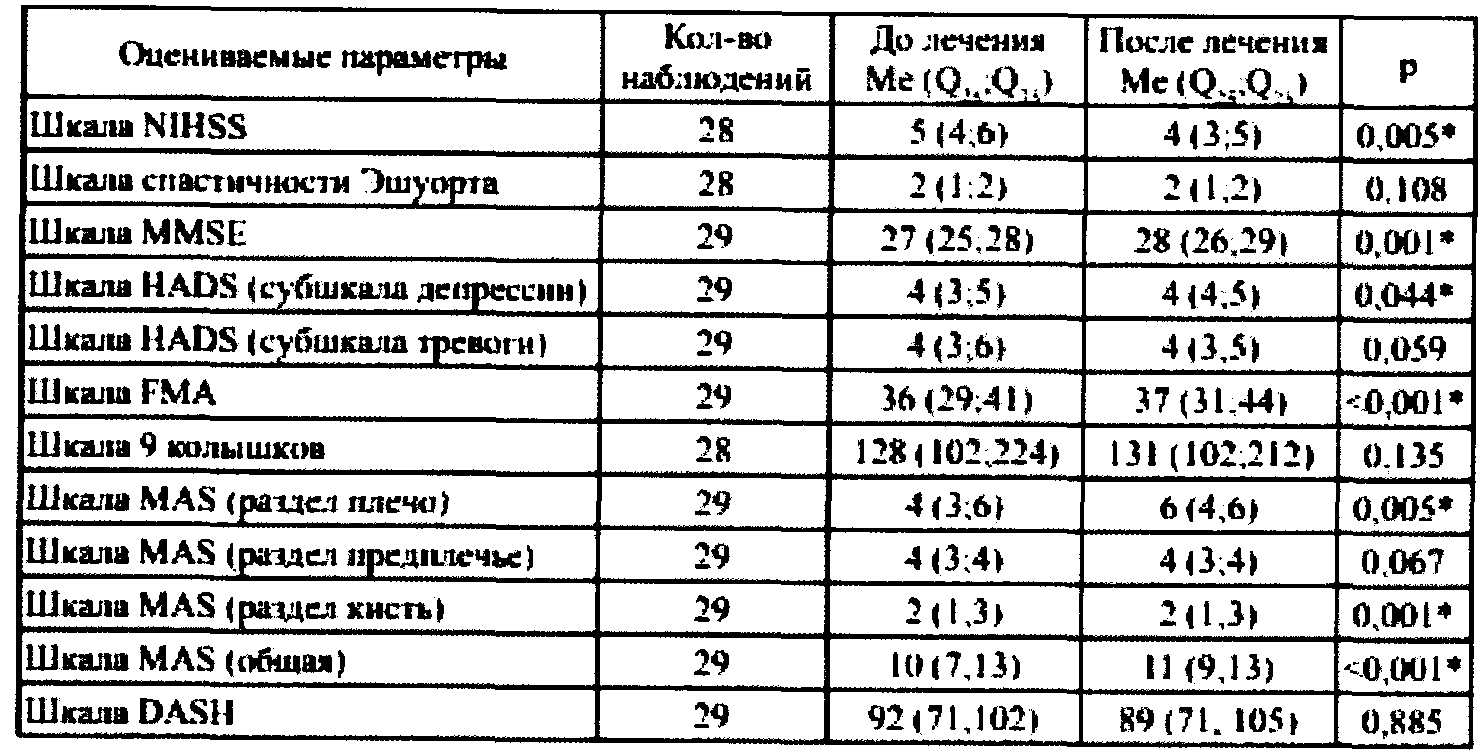
Примечание: ' - статистически значимыми изменения счштмлсъ при уровне р<0,05. Таблица 2 Note: '- statistically significant changes in sctmls at p <0.05. table 2
Показатели двигательной активности верхней конечности, психометрических шкал и степени ограничений повседневного функционирования до и после курса лечения (14-ый день терапии) в основной группе Indicators of motor activity of the upper limb, psychometric scales and the degree of restrictions on daily functioning before and after the course of treatment (14th day of therapy) in the main group

Примечание: ' - статистически манимыми изменения считамсыфв уровне р<0.05. При сравнении групп лечения после курса проведенной терапии отмечались статистически значимые различия по общему уровню Шкалы двигательной оценки, подраздел верхняя конечность, и, в частности, субшкал движения кисти и тонкой моторики, а также статистически значимое улучшение показателей повседневного функционирования (р <0,05). Занятия с заявленным комплексом значительно повышали мотивацию пациента и настрой на выздоровление. Как следствие - отмечались различия в группах по уровню субшкалы депрессии HADS (табл. 3). Note: '- statistically significant changes in counts at p <0.05. When comparing treatment groups after a course of therapy, statistically significant differences were noted in the overall level of the Motor Assessment Scale, upper extremity subsection, and, in particular, subscales of hand movement and fine motor skills, as well as a statistically significant improvement in indicators of daily functioning (p <0.05) ... Classes with the declared complex significantly increased the patient's motivation and the mood for recovery. As a result, there were differences in the groups according to the level of the HADS depression subscale (Table 3).
Таблица 3 Table 3
Показатели двигательной активности верхней конечности, психометрических писал и степени ограничений повседневного функционирования в основной и контрольной группах после лечения Indicators of motor activity of the upper limb, psychometric writing and the degree of restrictions on daily functioning in the main and control groups after treatment
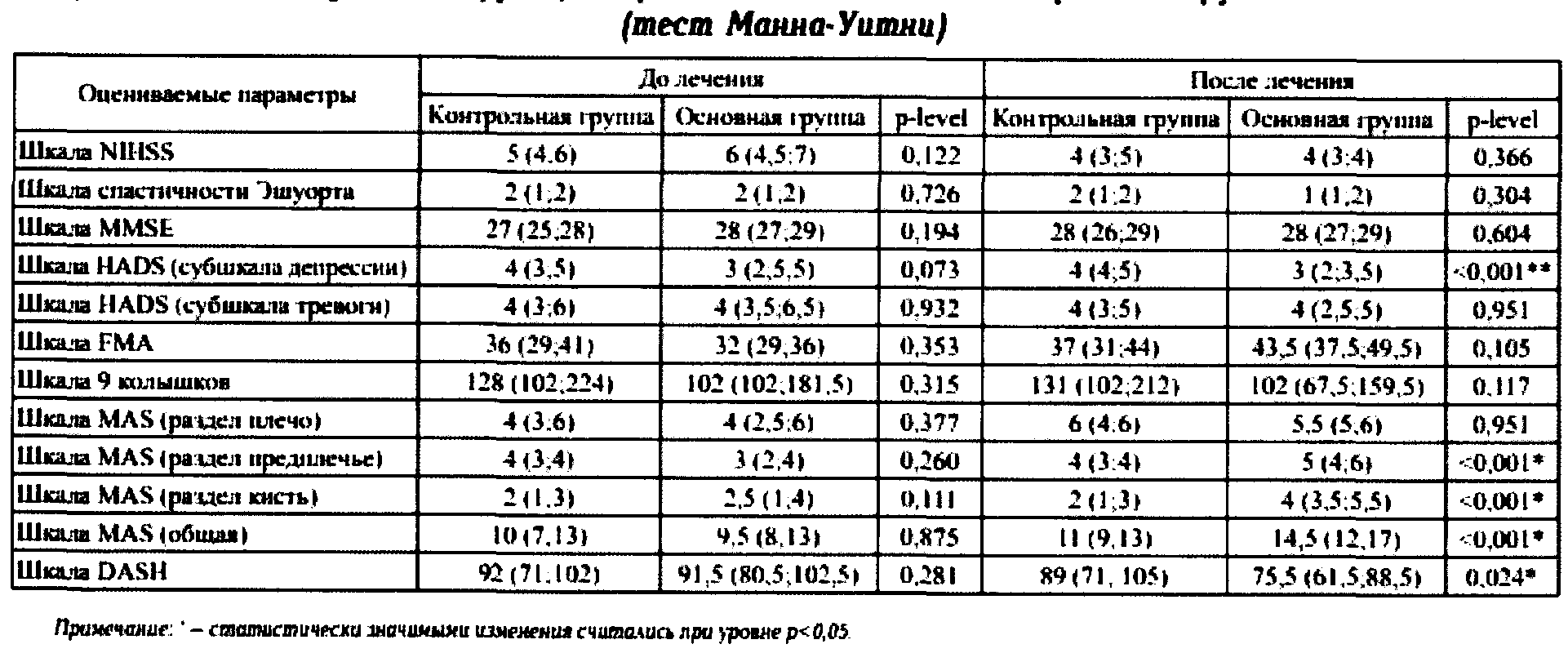
При оценке результатов катамнестического наблюдения степень нарушений и уровень функционирования оказался статистически значимо лучше в группе, получавших реабилитацию заявленным комплексом (табл. 4). When assessing the results of follow-up observation, the degree of impairment and the level of functioning turned out to be statistically significantly better in the group receiving rehabilitation with the claimed complex (Table 4).
Таблица 4 Table 4
Показатели двигательной активности Indicators of physical activity
верхней конечности, психометрических шкал upper limb, psychometric scales
и степени ограничений повседневного and the degree of limitations of everyday
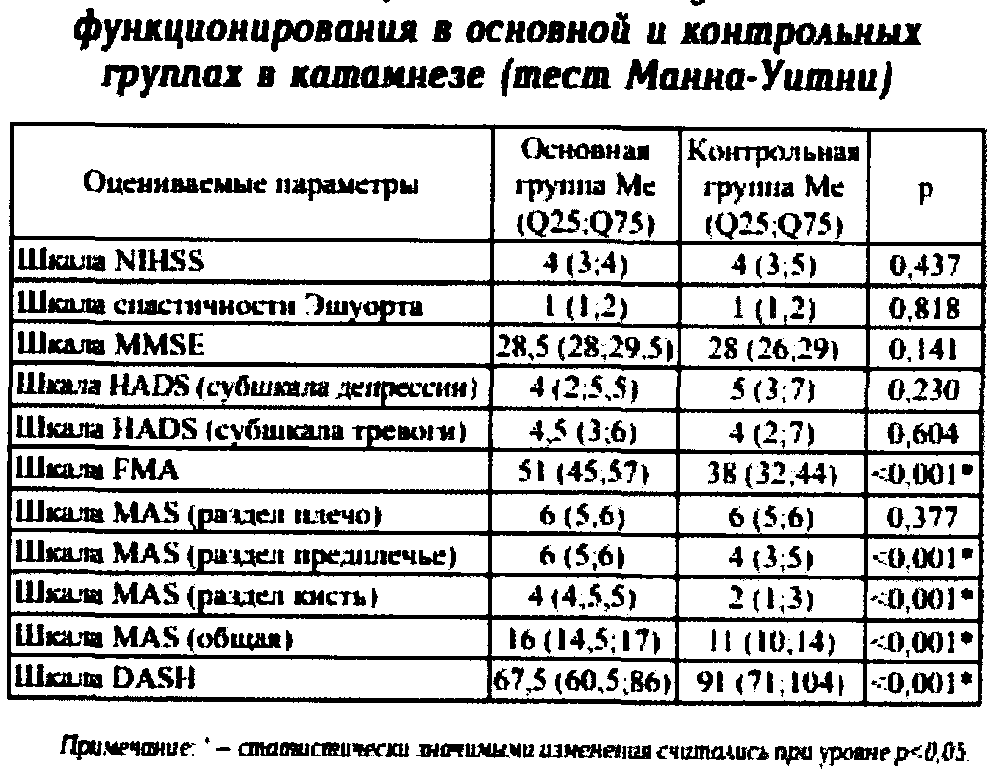
Как видно из представленной таблицы 4, у больных основной группы произошло дополнительное улучшение по шкалам функционирования верхней конечности (Fugle- Mayer Scale, Motor Assessment Scale), кроме того, произошло статистически значимое повышение уровня повседневной активности, ассоциированной с верхней конечностью, а также улучшился эмоциональный фон по субшкале депрессии HADS. As can be seen from the presented table 4, in patients of the main group there was an additional improvement in the scales of the functioning of the upper limb (Fugle-Mayer Scale, Motor Assessment Scale), in addition, there was a statistically significant an increase in the level of daily activity associated with the upper limb, as well as an improvement in the emotional background according to the HADS depression subscale.
Динамика показателей двигательных функций верхней конечности представлена на фигуре 4. Динамика показателей двигательных возможностей верхней конечности по шкале Fugle- Меуег Assessment у пациентов основной (2) и контрольной (1) группы при включении в исследование, в конце двухнедельного курса терапии и в катамнезе. По оси X- группы наблюдения, по оси Y - баллы шкалы Fugle-Meyer Assessment. The dynamics of the indicators of the motor functions of the upper limb is shown in figure 4. The dynamics of the indicators of the motor capabilities of the upper limb according to the Fugle-Meueg Assessment scale in patients of the main (2) and control (1) groups when included in the study, at the end of a two-week course of therapy and in follow-up. The X-axis is the observation groups, the Y-axis is the Fugle-Meyer Assessment scale scores.
Примечание: - статистически значимыми изменения считались при уровне р<0,05 Note: - statistically significant changes were considered at p <0.05
Анализ динамики повседневного функционирования в связи с нарушением функции верхней конечности позволил сделать вывод о значительном влиянии примененного комплекса на улучшение показателей повседневной активности (фигура 5). Динамика показателей недееспособности верхних конечностей у больных основной (2) и контрольной группы в начале, конце двухнедельного курса терапии и по истечении 6 месяцев катамнестического наблюдения. По оси X - группы наблюдения, по оси Y -баллы шкалы DASH. Analysis of the dynamics of daily functioning in connection with the dysfunction of the upper limb allowed us to conclude that the applied complex has a significant effect on the improvement of indicators of daily activity (figure 5). Dynamics of indicators of disability of the upper extremities in patients of the main (2) and control groups at the beginning and end of a two-week course of therapy and after 6 months of follow-up. The X-axis is the observation groups, the Y-axis is the DASH scale points.
Примечание: * - статистически значимыми изменения считались при уровне р<0,05. Note: * - statistically significant changes were considered at p <0.05.
Как видно из фигуры 5, в катамнезе отмечается уменьшение показателей недееспособности верхних конечностей, что говорит о высоком функциональном восстановлении функции верхних конечностей, реинтеграции больного в повседневную бытовую активность. As can be seen from figure 5, in the follow-up, there is a decrease in indicators of disability of the upper extremities, which indicates a high functional recovery of the function of the upper extremities, reintegration of the patient into everyday life activity.
Результаты корреляционного анализа данных исследования методом рангов Спирмена, позволили установить наличие некоторых взаимосвязей. Установлена ассоциация средней силы между признаками: The results of the correlation analysis of the research data by the Spearman rank method made it possible to establish the presence of some relationships. An association of medium strength was established between the signs:
- пол и данные УЗДГ : мужчины чаще имели окклюзионное поражение брахиоцефальных артерий (прямая, средней силы, г=0,46, р<0,05); - gender and USDG data: men more often had occlusive lesions of the brachiocephalic arteries (straight, medium strength, r = 0.46, p <0.05);
- сосудистый бассейн и показатели спастичности (при поражении левого сосудистого бассейна балл по шкале Эшуорта был выше, взаимосвязь - средней силы, (г=0,33, р<0,05), уровень функции кисти - был ниже - обратная, средней силы (г=-0,34, р<0,05) и катамнестический уровень неуверенности по причине нарушений в кисти - выше (прямая, средней силы, г=0,36, р<0,05); - the vascular basin and indicators of spasticity (in case of damage to the left vascular basin, the score on the Ashworth scale was higher, the relationship was of average strength, (r = 0.33, p <0.05), the level of hand function was lower - inverse, average strength ( r = -0.34, p <0.05) and the follow-up level of uncertainty due to disturbances in the hand is higher (straight, medium strength, r = 0.36, p <0.05);
- УЗИ сосудов шеи и показатели недееспособности верхней конечности (прямая, средней силы, г= 0,46, р<0,05) - показатели степени выраженности нарушений неврологического статуса по шкале NIHSS и степени функциональных возможностей верхней конечности по шкале FMA, (г=-0,38, р<0,05, обратная, средней силы), - Ultrasound of the neck vessels and indicators of disability of the upper limb (straight, medium strength, r = 0.46, p <0.05) - indicators of the severity of neurological status disorders according to the NIHSS scale and the degree of functional capabilities of the upper limb according to the FMA scale, (r = -0.38, p <0.05, reverse, moderate strength),
- показатели MMSE и уровень функциональных возможностей верхней конечности по шкале FMA (г=0,46, р<0,05, прямая, средней силы) - MMSE indices and the level of functional capabilities of the upper limb according to the FMA scale (r = 0.46, p <0.05, straight, medium strength)
С катамнестическими высокими показателями сохраняющейся недееспособности верхней конечности (DASH) коррелировали следующие показатели: The following indicators correlated with the follow-up high rates of persistent disability of the upper limb (DASH):
- степень стеноза брахиоцефальных артерий (г=-0,32, р<0,05, обратная связь, средней силы), - the degree of stenosis of the brachiocephalic arteries (r = -0.32, p <0.05, feedback, medium strength),
-уровень мелкой моторики кисти на момент включения по шкале MAS (г=-0,34, р<0,05, обратная связь, средней силы), - the level of fine motor skills of the hand at the moment of switching on on the MAS scale (r = -0.34, p <0.05, feedback, medium strength),
- степень выраженности неврологического дефекта при включении (г=0,32, р<0,05, прямая связь, средней силы). - the severity of the neurological defect when switched on (r = 0.32, p <0.05, direct connection, medium strength).
Результаты исследования позволяют утверждать, что использование заявленного аппаратно-программного комплекса для реабилитации пациентов с когнитивными нарушениями верхних конечностей после инсульта, является высокоэффективным методом в сравнении с стандартной терапией после инсульта, влияющим не только на уровень нарушений, но и на расширение возможностей повседневного использования парализованной кисти. Кроме того, данный метод интересен для пациента, улучшает мотивацию к занятиям через вовлечение в процесс занятий личности пациента. The results of the study suggest that the use of the claimed hardware and software complex for the rehabilitation of patients with cognitive impairments of the upper limbs after a stroke is a highly effective method in comparison with standard therapy after a stroke, affecting not only the level of impairment, but also expanding the possibilities of daily use of the paralyzed hand. ... In addition, this method is interesting for the patient, improves motivation for training through the involvement of the patient's personality in the training process.
Данные катамнестического наблюдения позволяют считать, что восстановление тонкой моторики кисти резко повышает уровень использования паретичной конечности, что, в свою очередь, улучшает функциональное восстановление и повседневную активность. Follow-up data suggest that restoration of fine motor skills of the hand dramatically increases the level of use of the paretic limb, which, in turn, improves functional recovery and daily activity.
В случае выраженного пареза кисти полезным является привлечение здоровой конечности, посредством проведения занятий с двумя перчатками -на здоровой и парализованной конечности. In the case of severe paresis of the hand, it is useful to attract a healthy limb, through exercises with two gloves - on a healthy and paralyzed limb.
Преимуществом заявленного комплекса является ускорение реабилитации пациентов. The advantage of the claimed complex is the acceleration of patient rehabilitation.
Дополнительно при осуществлении заявленного аппаратно-программного комплекса для реабилитации пациентов достигаются следующие преимущества: Additionally, when implementing the claimed hardware-software complex for patient rehabilitation, the following advantages are achieved:
- анализ паттернов движений пациента, предсказание желаемых действий пациента; - наличие биологической обратной связи (БОС) для различных сегментов тела: предплечья, плеча, паретичной ноги и т.д. с объединением их в единый комплекс; - analysis of patient movement patterns, prediction of the patient's desired actions; - the presence of biological feedback (BFB) for various segments of the body: forearm, shoulder, paretic leg, etc. by combining them into a single complex;
- измерение отклонения пальцев в любом направлении на любую величину; - measuring the deflection of fingers in any direction by any amount;
- измерение поворота и сдвига ладони в любом направлении; - измерение движения и поворота кисти, запястья в любом направлении на любую величину; - measurement of rotation and shift of the palm in any direction; - measurement of movement and rotation of the hand, wrist in any direction by any amount;
- анализ мелкой моторики; - analysis of fine motor skills;
- плавное (не дискретное) измерение показателей движения; - smooth (not discrete) measurement of motion indicators;
- измерение пассивного диапазона движения; - измерение активного диапазона движения; - measurement of passive range of motion; - measurement of the active range of motion;
- измерение скорости движения пальцев; - measurement of the speed of movement of the fingers;
- характеристика качества движения, такие как дрожь или плавность; - characteristic of the quality of movement, such as tremors or smoothness;
- мониторинг прогресса реабилитации пациента; - monitoring the progress of the patient's rehabilitation;
- сбор аналитики по всем пациентам и сохранение результатов реабилитации в базе данных аналитического хранилища. - collection of analytics for all patients and saving the results of rehabilitation in the database of the analytical storage.
В настоящих материалах заявки было представлено предпочтительное раскрытие осуществление заявленного технического решения, которое не должно использоваться как ограничивающее иные, частные воплощения его реализации, которые не выходят за рамки испрашиваемого объема правовой охраны и являются очевидными для специалистов в соответствующей области техники. In the present application materials, the preferred disclosure of the implementation of the claimed technical solution was presented, which should not be used as limiting other, particular embodiments of its implementation, which do not go beyond the scope of the claimed scope of legal protection and are obvious to specialists in the relevant field of technology.
Claims
Priority Applications (4)
| Application Number | Priority Date | Filing Date | Title |
|---|---|---|---|
| EP19934121.5A EP3901961A4 (en) | 2019-06-17 | 2019-06-17 | Hardware/software system for the rehabilitation of patients with cognitive impairments of the upper extremities after stroke |
| US17/273,628 US20210321909A1 (en) | 2019-06-17 | 2019-06-17 | Hardware/software system for the rehabilitation of patients with cognitive impairments of the upper extremities after stroke |
| PCT/RU2019/000431 WO2020256577A1 (en) | 2019-06-17 | 2019-06-17 | Hardware/software system for the rehabilitation of patients with cognitive impairments of the upper extremities after stroke |
| CN201980052694.4A CN112543978A (en) | 2019-06-17 | 2019-06-17 | Software and hardware system for rehabilitation of patients with cognitive impairment after upper limb stroke |
Applications Claiming Priority (1)
| Application Number | Priority Date | Filing Date | Title |
|---|---|---|---|
| PCT/RU2019/000431 WO2020256577A1 (en) | 2019-06-17 | 2019-06-17 | Hardware/software system for the rehabilitation of patients with cognitive impairments of the upper extremities after stroke |
Publications (1)
| Publication Number | Publication Date |
|---|---|
| WO2020256577A1 true WO2020256577A1 (en) | 2020-12-24 |
Family
ID=74040613
Family Applications (1)
| Application Number | Title | Priority Date | Filing Date |
|---|---|---|---|
| PCT/RU2019/000431 Ceased WO2020256577A1 (en) | 2019-06-17 | 2019-06-17 | Hardware/software system for the rehabilitation of patients with cognitive impairments of the upper extremities after stroke |
Country Status (4)
| Country | Link |
|---|---|
| US (1) | US20210321909A1 (en) |
| EP (1) | EP3901961A4 (en) |
| CN (1) | CN112543978A (en) |
| WO (1) | WO2020256577A1 (en) |
Cited By (71)
| Publication number | Priority date | Publication date | Assignee | Title |
|---|---|---|---|---|
| US11139060B2 (en) | 2019-10-03 | 2021-10-05 | Rom Technologies, Inc. | Method and system for creating an immersive enhanced reality-driven exercise experience for a user |
| US11264123B2 (en) | 2019-10-03 | 2022-03-01 | Rom Technologies, Inc. | Method and system to analytically optimize telehealth practice-based billing processes and revenue while enabling regulatory compliance |
| US11270795B2 (en) | 2019-10-03 | 2022-03-08 | Rom Technologies, Inc. | Method and system for enabling physician-smart virtual conference rooms for use in a telehealth context |
| US11282599B2 (en) | 2019-10-03 | 2022-03-22 | Rom Technologies, Inc. | System and method for use of telemedicine-enabled rehabilitative hardware and for encouragement of rehabilitative compliance through patient-based virtual shared sessions |
| US11282604B2 (en) | 2019-10-03 | 2022-03-22 | Rom Technologies, Inc. | Method and system for use of telemedicine-enabled rehabilitative equipment for prediction of secondary disease |
| US11282608B2 (en) | 2019-10-03 | 2022-03-22 | Rom Technologies, Inc. | Method and system for using artificial intelligence and machine learning to provide recommendations to a healthcare provider in or near real-time during a telemedicine session |
| US11284797B2 (en) | 2019-10-03 | 2022-03-29 | Rom Technologies, Inc. | Remote examination through augmented reality |
| US11295848B2 (en) | 2019-10-03 | 2022-04-05 | Rom Technologies, Inc. | Method and system for using artificial intelligence and machine learning to create optimal treatment plans based on monetary value amount generated and/or patient outcome |
| US11309085B2 (en) | 2019-10-03 | 2022-04-19 | Rom Technologies, Inc. | System and method to enable remote adjustment of a device during a telemedicine session |
| US11317975B2 (en) | 2019-10-03 | 2022-05-03 | Rom Technologies, Inc. | Method and system for treating patients via telemedicine using sensor data from rehabilitation or exercise equipment |
| US11325005B2 (en) | 2019-10-03 | 2022-05-10 | Rom Technologies, Inc. | Systems and methods for using machine learning to control an electromechanical device used for prehabilitation, rehabilitation, and/or exercise |
| US11328807B2 (en) | 2019-10-03 | 2022-05-10 | Rom Technologies, Inc. | System and method for using artificial intelligence in telemedicine-enabled hardware to optimize rehabilitative routines capable of enabling remote rehabilitative compliance |
| US11337648B2 (en) | 2020-05-18 | 2022-05-24 | Rom Technologies, Inc. | Method and system for using artificial intelligence to assign patients to cohorts and dynamically controlling a treatment apparatus based on the assignment during an adaptive telemedical session |
| CN114533043A (en) * | 2022-01-24 | 2022-05-27 | 西安交通大学 | Method for automatically evaluating limb dysfunction of hemiplegic patient |
| US11348683B2 (en) | 2019-10-03 | 2022-05-31 | Rom Technologies, Inc. | System and method for processing medical claims |
| US11404150B2 (en) | 2019-10-03 | 2022-08-02 | Rom Technologies, Inc. | System and method for processing medical claims using biometric signatures |
| US11410768B2 (en) | 2019-10-03 | 2022-08-09 | Rom Technologies, Inc. | Method and system for implementing dynamic treatment environments based on patient information |
| US11433276B2 (en) | 2019-05-10 | 2022-09-06 | Rehab2Fit Technologies, Inc. | Method and system for using artificial intelligence to independently adjust resistance of pedals based on leg strength |
| US11445985B2 (en) | 2019-10-03 | 2022-09-20 | Rom Technologies, Inc. | Augmented reality placement of goniometer or other sensors |
| US11471729B2 (en) | 2019-03-11 | 2022-10-18 | Rom Technologies, Inc. | System, method and apparatus for a rehabilitation machine with a simulated flywheel |
| US11508482B2 (en) | 2019-10-03 | 2022-11-22 | Rom Technologies, Inc. | Systems and methods for remotely-enabled identification of a user infection |
| US11596829B2 (en) | 2019-03-11 | 2023-03-07 | Rom Technologies, Inc. | Control system for a rehabilitation and exercise electromechanical device |
| US11701548B2 (en) | 2019-10-07 | 2023-07-18 | Rom Technologies, Inc. | Computer-implemented questionnaire for orthopedic treatment |
| US11756666B2 (en) | 2019-10-03 | 2023-09-12 | Rom Technologies, Inc. | Systems and methods to enable communication detection between devices and performance of a preventative action |
| US11801423B2 (en) | 2019-05-10 | 2023-10-31 | Rehab2Fit Technologies, Inc. | Method and system for using artificial intelligence to interact with a user of an exercise device during an exercise session |
| US11830601B2 (en) | 2019-10-03 | 2023-11-28 | Rom Technologies, Inc. | System and method for facilitating cardiac rehabilitation among eligible users |
| US11826613B2 (en) | 2019-10-21 | 2023-11-28 | Rom Technologies, Inc. | Persuasive motivation for orthopedic treatment |
| US11887717B2 (en) | 2019-10-03 | 2024-01-30 | Rom Technologies, Inc. | System and method for using AI, machine learning and telemedicine to perform pulmonary rehabilitation via an electromechanical machine |
| US11904207B2 (en) | 2019-05-10 | 2024-02-20 | Rehab2Fit Technologies, Inc. | Method and system for using artificial intelligence to present a user interface representing a user's progress in various domains |
| US11915816B2 (en) | 2019-10-03 | 2024-02-27 | Rom Technologies, Inc. | Systems and methods of using artificial intelligence and machine learning in a telemedical environment to predict user disease states |
| US11915815B2 (en) | 2019-10-03 | 2024-02-27 | Rom Technologies, Inc. | System and method for using artificial intelligence and machine learning and generic risk factors to improve cardiovascular health such that the need for additional cardiac interventions is mitigated |
| US11923057B2 (en) | 2019-10-03 | 2024-03-05 | Rom Technologies, Inc. | Method and system using artificial intelligence to monitor user characteristics during a telemedicine session |
| US11923065B2 (en) | 2019-10-03 | 2024-03-05 | Rom Technologies, Inc. | Systems and methods for using artificial intelligence and machine learning to detect abnormal heart rhythms of a user performing a treatment plan with an electromechanical machine |
| US11942205B2 (en) | 2019-10-03 | 2024-03-26 | Rom Technologies, Inc. | Method and system for using virtual avatars associated with medical professionals during exercise sessions |
| US11955218B2 (en) | 2019-10-03 | 2024-04-09 | Rom Technologies, Inc. | System and method for use of telemedicine-enabled rehabilitative hardware and for encouraging rehabilitative compliance through patient-based virtual shared sessions with patient-enabled mutual encouragement across simulated social networks |
| US11955222B2 (en) | 2019-10-03 | 2024-04-09 | Rom Technologies, Inc. | System and method for determining, based on advanced metrics of actual performance of an electromechanical machine, medical procedure eligibility in order to ascertain survivability rates and measures of quality-of-life criteria |
| US11955221B2 (en) | 2019-10-03 | 2024-04-09 | Rom Technologies, Inc. | System and method for using AI/ML to generate treatment plans to stimulate preferred angiogenesis |
| US11950861B2 (en) | 2019-10-03 | 2024-04-09 | Rom Technologies, Inc. | Telemedicine for orthopedic treatment |
| US11955220B2 (en) | 2019-10-03 | 2024-04-09 | Rom Technologies, Inc. | System and method for using AI/ML and telemedicine for invasive surgical treatment to determine a cardiac treatment plan that uses an electromechanical machine |
| US11955223B2 (en) | 2019-10-03 | 2024-04-09 | Rom Technologies, Inc. | System and method for using artificial intelligence and machine learning to provide an enhanced user interface presenting data pertaining to cardiac health, bariatric health, pulmonary health, and/or cardio-oncologic health for the purpose of performing preventative actions |
| US11957960B2 (en) | 2019-05-10 | 2024-04-16 | Rehab2Fit Technologies Inc. | Method and system for using artificial intelligence to adjust pedal resistance |
| US11961603B2 (en) | 2019-10-03 | 2024-04-16 | Rom Technologies, Inc. | System and method for using AI ML and telemedicine to perform bariatric rehabilitation via an electromechanical machine |
| US12020799B2 (en) | 2019-10-03 | 2024-06-25 | Rom Technologies, Inc. | Rowing machines, systems including rowing machines, and methods for using rowing machines to perform treatment plans for rehabilitation |
| US12020800B2 (en) | 2019-10-03 | 2024-06-25 | Rom Technologies, Inc. | System and method for using AI/ML and telemedicine to integrate rehabilitation for a plurality of comorbid conditions |
| US12057237B2 (en) | 2020-04-23 | 2024-08-06 | Rom Technologies, Inc. | Method and system for describing and recommending optimal treatment plans in adaptive telemedical or other contexts |
| US12062425B2 (en) | 2019-10-03 | 2024-08-13 | Rom Technologies, Inc. | System and method for implementing a cardiac rehabilitation protocol by using artificial intelligence and standardized measurements |
| US12087426B2 (en) | 2019-10-03 | 2024-09-10 | Rom Technologies, Inc. | Systems and methods for using AI ML to predict, based on data analytics or big data, an optimal number or range of rehabilitation sessions for a user |
| US12100499B2 (en) | 2020-08-06 | 2024-09-24 | Rom Technologies, Inc. | Method and system for using artificial intelligence and machine learning to create optimal treatment plans based on monetary value amount generated and/or patient outcome |
| US12102878B2 (en) | 2019-05-10 | 2024-10-01 | Rehab2Fit Technologies, Inc. | Method and system for using artificial intelligence to determine a user's progress during interval training |
| US12176091B2 (en) | 2019-10-03 | 2024-12-24 | Rom Technologies, Inc. | Systems and methods for using elliptical machine to perform cardiovascular rehabilitation |
| US12176089B2 (en) | 2019-10-03 | 2024-12-24 | Rom Technologies, Inc. | System and method for using AI ML and telemedicine for cardio-oncologic rehabilitation via an electromechanical machine |
| US12224052B2 (en) | 2019-10-03 | 2025-02-11 | Rom Technologies, Inc. | System and method for using AI, machine learning and telemedicine for long-term care via an electromechanical machine |
| US12230382B2 (en) | 2019-10-03 | 2025-02-18 | Rom Technologies, Inc. | Systems and methods for using artificial intelligence and machine learning to predict a probability of an undesired medical event occurring during a treatment plan |
| US12230381B2 (en) | 2019-10-03 | 2025-02-18 | Rom Technologies, Inc. | System and method for an enhanced healthcare professional user interface displaying measurement information for a plurality of users |
| US12249410B2 (en) | 2019-10-03 | 2025-03-11 | Rom Technologies, Inc. | System and method for use of treatment device to reduce pain medication dependency |
| US12246222B2 (en) | 2019-10-03 | 2025-03-11 | Rom Technologies, Inc. | Method and system for using artificial intelligence to assign patients to cohorts and dynamically controlling a treatment apparatus based on the assignment during an adaptive telemedical session |
| US12301663B2 (en) | 2019-10-03 | 2025-05-13 | Rom Technologies, Inc. | System and method for transmitting data and ordering asynchronous data |
| US12347543B2 (en) | 2019-10-03 | 2025-07-01 | Rom Technologies, Inc. | Systems and methods for using artificial intelligence to implement a cardio protocol via a relay-based system |
| US12357195B2 (en) | 2020-06-26 | 2025-07-15 | Rom Technologies, Inc. | System, method and apparatus for anchoring an electronic device and measuring a joint angle |
| US12367960B2 (en) | 2020-09-15 | 2025-07-22 | Rom Technologies, Inc. | System and method for using AI ML and telemedicine to perform bariatric rehabilitation via an electromechanical machine |
| US12380984B2 (en) | 2019-10-03 | 2025-08-05 | Rom Technologies, Inc. | Systems and methods for using artificial intelligence and machine learning to generate treatment plans having dynamically tailored cardiac protocols for users to manage a state of an electromechanical machine |
| US12402804B2 (en) | 2019-09-17 | 2025-09-02 | Rom Technologies, Inc. | Wearable device for coupling to a user, and measuring and monitoring user activity |
| US12420143B1 (en) | 2019-10-03 | 2025-09-23 | Rom Technologies, Inc. | System and method for enabling residentially-based cardiac rehabilitation by using an electromechanical machine and educational content to mitigate risk factors and optimize user behavior |
| US12420145B2 (en) | 2019-10-03 | 2025-09-23 | Rom Technologies, Inc. | Systems and methods of using artificial intelligence and machine learning for generating alignment plans to align a user with an imaging sensor during a treatment session |
| US12424319B2 (en) | 2019-11-06 | 2025-09-23 | Rom Technologies, Inc. | System for remote treatment utilizing privacy controls |
| US12427376B2 (en) | 2019-10-03 | 2025-09-30 | Rom Technologies, Inc. | Systems and methods for an artificial intelligence engine to optimize a peak performance |
| US12469587B2 (en) | 2019-10-03 | 2025-11-11 | Rom Technologies, Inc. | Systems and methods for assigning healthcare professionals to remotely monitor users performing treatment plans on electromechanical machines |
| US12478837B2 (en) | 2019-10-03 | 2025-11-25 | Rom Technologies, Inc. | Method and system for monitoring actual patient treatment progress using sensor data |
| US12515104B2 (en) | 2020-10-28 | 2026-01-06 | Rom Technologies, Inc. | Systems and methods for using machine learning to control a rehabilitation and exercise electromechanical device |
| US12539446B2 (en) | 2019-10-03 | 2026-02-03 | Rom Technologies, Inc. | Method and system for using sensors to optimize a user treatment plan in a telemedicine environment |
| US12548657B2 (en) | 2024-06-24 | 2026-02-10 | Rom Technologies, Inc. | System and method for using AI/ML and telemedicine to integrate rehabilitation for a plurality of comorbid conditions |
Families Citing this family (8)
| Publication number | Priority date | Publication date | Assignee | Title |
|---|---|---|---|---|
| CN113877157B (en) * | 2021-06-29 | 2023-12-19 | 重庆大学 | Hand function rehabilitation system combining data gloves and VR technology |
| CN113713252B (en) * | 2021-08-06 | 2023-11-10 | 重庆大学 | Bionic type body sense reconstruction method for prosthetic wrist and elbow joint |
| CN114081498A (en) * | 2021-12-06 | 2022-02-25 | 徐州市康复医院 | Brain-computer interface system based on stroke treatment and monitoring method |
| CN114602138B (en) * | 2022-03-01 | 2023-08-01 | 国家康复辅具研究中心 | Upper limb personalized rehabilitation training method and system based on human body movement model |
| CN115429277A (en) * | 2022-09-22 | 2022-12-06 | 上海术理智能科技有限公司 | Hand function evaluation system and method |
| CN117133465B (en) * | 2023-10-26 | 2024-06-04 | 营动智能技术(山东)有限公司 | A method, device and storage medium for evaluating the effect of rehabilitation treatment of chronic diseases |
| CN117497133A (en) * | 2023-12-26 | 2024-02-02 | 中科(安徽)G60智慧健康创新研究院 | System and method for training patients with neurodegenerative cognitive disorders |
| CN118078269A (en) * | 2024-04-15 | 2024-05-28 | 北京医院 | A system and method for evaluating the function rehabilitation of inertial hand |
Citations (8)
| Publication number | Priority date | Publication date | Assignee | Title |
|---|---|---|---|---|
| RU2268723C1 (en) | 2004-07-01 | 2006-01-27 | Дальневосточный государственный медицинский университет | Method for treating cognitive disorders in patients with cerebrovascular diseases |
| CN102138860A (en) * | 2011-01-10 | 2011-08-03 | 西安交通大学 | Intelligentized rehabilitation training equipment for hand functions of patients suffering from cerebral injury |
| RU2506963C2 (en) | 2011-12-20 | 2014-02-20 | Государственное бюджетное образовательное учреждение высшего профессионального образования "Красноярский государственный медицинский университет имени профессора В.Ф. Войно-Ясенецкого" Министерства здравоохранения и социального развития Российской Федерации (ГБОУ ВПО КрасГМУ им. проф. В.Ф. Войно-Ясе | Method for correction of cognitive impairment accompanying cerebrovascular pathology |
| RU2523349C1 (en) * | 2013-04-11 | 2014-07-20 | Федеральное государственное бюджетное учреждение "Научный центр неврологии" Российской академии медицинских наук (ФГБУ "НЦН" РАМН) | Method for rehabilitation of patients suffered stroke |
| RU2581707C1 (en) | 2015-03-20 | 2016-04-20 | Виктор Маркович Шкловский | Method for evaluating the efficiency treatment and rehabilitation in patients with disorders of higher mental functions in focal brain lesions |
| RU2654767C1 (en) * | 2016-12-02 | 2018-05-22 | Общество с ограниченной ответственностью "Нейроиконика-Нейромеханика" | Method for rehabilitation of patients using virtual environment |
| RU2655200C1 (en) * | 2016-12-29 | 2018-05-24 | Александр Владимирович Захаров | Method of rehabilitation of patients in different stages of central or peripheral nervous system disorders using virtual reality |
| RU187548U1 (en) * | 2017-10-27 | 2019-03-12 | Федоров Александр Владимирович | VIRTUAL REALITY GLOVE |
Family Cites Families (9)
| Publication number | Priority date | Publication date | Assignee | Title |
|---|---|---|---|---|
| WO2010085476A1 (en) * | 2009-01-20 | 2010-07-29 | Northeastern University | Multi-user smartglove for virtual environment-based rehabilitation |
| EP2613276A1 (en) * | 2012-01-04 | 2013-07-10 | Gabriele Ceruti | Method and apparatus for neuromotor rehabilitation using interactive setting systems |
| US10722784B2 (en) * | 2012-09-21 | 2020-07-28 | Bright Cloud International Corporation | Bimanual integrative virtual rehabilitation system and methods |
| EP3329404A1 (en) * | 2015-07-31 | 2018-06-06 | Universitat de Barcelona | Motor training |
| KR101814293B1 (en) * | 2016-11-07 | 2018-01-02 | 재단법인대구경북과학기술원 | System for assessing motor fucntion |
| US20180228430A1 (en) * | 2017-02-10 | 2018-08-16 | Mindmaze Holding Sa | System, method and apparatus for rehabilitation with tracking |
| WO2019081640A2 (en) * | 2017-10-25 | 2019-05-02 | F. Hoffmann-La Roche Ag | Digital qualimetric biomarkers for cognition and movement diseases or disorders |
| US11673024B2 (en) * | 2018-01-22 | 2023-06-13 | Pg Tech, Llc | Method and system for human motion analysis and instruction |
| CN109192272A (en) * | 2018-11-26 | 2019-01-11 | 燕山大学 | Based on the Leap Motion healing hand function training system combined with VR and its implementation |
-
2019
- 2019-06-17 CN CN201980052694.4A patent/CN112543978A/en active Pending
- 2019-06-17 US US17/273,628 patent/US20210321909A1/en not_active Abandoned
- 2019-06-17 WO PCT/RU2019/000431 patent/WO2020256577A1/en not_active Ceased
- 2019-06-17 EP EP19934121.5A patent/EP3901961A4/en not_active Withdrawn
Patent Citations (8)
| Publication number | Priority date | Publication date | Assignee | Title |
|---|---|---|---|---|
| RU2268723C1 (en) | 2004-07-01 | 2006-01-27 | Дальневосточный государственный медицинский университет | Method for treating cognitive disorders in patients with cerebrovascular diseases |
| CN102138860A (en) * | 2011-01-10 | 2011-08-03 | 西安交通大学 | Intelligentized rehabilitation training equipment for hand functions of patients suffering from cerebral injury |
| RU2506963C2 (en) | 2011-12-20 | 2014-02-20 | Государственное бюджетное образовательное учреждение высшего профессионального образования "Красноярский государственный медицинский университет имени профессора В.Ф. Войно-Ясенецкого" Министерства здравоохранения и социального развития Российской Федерации (ГБОУ ВПО КрасГМУ им. проф. В.Ф. Войно-Ясе | Method for correction of cognitive impairment accompanying cerebrovascular pathology |
| RU2523349C1 (en) * | 2013-04-11 | 2014-07-20 | Федеральное государственное бюджетное учреждение "Научный центр неврологии" Российской академии медицинских наук (ФГБУ "НЦН" РАМН) | Method for rehabilitation of patients suffered stroke |
| RU2581707C1 (en) | 2015-03-20 | 2016-04-20 | Виктор Маркович Шкловский | Method for evaluating the efficiency treatment and rehabilitation in patients with disorders of higher mental functions in focal brain lesions |
| RU2654767C1 (en) * | 2016-12-02 | 2018-05-22 | Общество с ограниченной ответственностью "Нейроиконика-Нейромеханика" | Method for rehabilitation of patients using virtual environment |
| RU2655200C1 (en) * | 2016-12-29 | 2018-05-24 | Александр Владимирович Захаров | Method of rehabilitation of patients in different stages of central or peripheral nervous system disorders using virtual reality |
| RU187548U1 (en) * | 2017-10-27 | 2019-03-12 | Федоров Александр Владимирович | VIRTUAL REALITY GLOVE |
Non-Patent Citations (1)
| Title |
|---|
| See also references of EP3901961A4 |
Cited By (108)
| Publication number | Priority date | Publication date | Assignee | Title |
|---|---|---|---|---|
| US11471729B2 (en) | 2019-03-11 | 2022-10-18 | Rom Technologies, Inc. | System, method and apparatus for a rehabilitation machine with a simulated flywheel |
| US12226671B2 (en) | 2019-03-11 | 2025-02-18 | Rom Technologies, Inc. | System, method and apparatus for electrically actuated pedal for an exercise or rehabilitation machine |
| US12226670B2 (en) | 2019-03-11 | 2025-02-18 | Rom Technologies, Inc. | System, method and apparatus for electrically actuated pedal for an exercise or rehabilitation machine |
| US12186623B2 (en) | 2019-03-11 | 2025-01-07 | Rom Technologies, Inc. | Monitoring joint extension and flexion using a sensor device securable to an upper and lower limb |
| US12083381B2 (en) | 2019-03-11 | 2024-09-10 | Rom Technologies, Inc. | Bendable sensor device for monitoring joint extension and flexion |
| US12083380B2 (en) | 2019-03-11 | 2024-09-10 | Rom Technologies, Inc. | Bendable sensor device for monitoring joint extension and flexion |
| US12059591B2 (en) | 2019-03-11 | 2024-08-13 | Rom Technologies, Inc. | Bendable sensor device for monitoring joint extension and flexion |
| US12029940B2 (en) | 2019-03-11 | 2024-07-09 | Rom Technologies, Inc. | Single sensor wearable device for monitoring joint extension and flexion |
| US11904202B2 (en) | 2019-03-11 | 2024-02-20 | Rom Technolgies, Inc. | Monitoring joint extension and flexion using a sensor device securable to an upper and lower limb |
| US11596829B2 (en) | 2019-03-11 | 2023-03-07 | Rom Technologies, Inc. | Control system for a rehabilitation and exercise electromechanical device |
| US11541274B2 (en) | 2019-03-11 | 2023-01-03 | Rom Technologies, Inc. | System, method and apparatus for electrically actuated pedal for an exercise or rehabilitation machine |
| US12324961B2 (en) | 2019-05-10 | 2025-06-10 | Rom Technologies, Inc. | Method and system for using artificial intelligence to present a user interface representing a user's progress in various domains |
| US11801423B2 (en) | 2019-05-10 | 2023-10-31 | Rehab2Fit Technologies, Inc. | Method and system for using artificial intelligence to interact with a user of an exercise device during an exercise session |
| US12285654B2 (en) | 2019-05-10 | 2025-04-29 | Rom Technologies, Inc. | Method and system for using artificial intelligence to interact with a user of an exercise device during an exercise session |
| US11433276B2 (en) | 2019-05-10 | 2022-09-06 | Rehab2Fit Technologies, Inc. | Method and system for using artificial intelligence to independently adjust resistance of pedals based on leg strength |
| US12102878B2 (en) | 2019-05-10 | 2024-10-01 | Rehab2Fit Technologies, Inc. | Method and system for using artificial intelligence to determine a user's progress during interval training |
| US11957960B2 (en) | 2019-05-10 | 2024-04-16 | Rehab2Fit Technologies Inc. | Method and system for using artificial intelligence to adjust pedal resistance |
| US11904207B2 (en) | 2019-05-10 | 2024-02-20 | Rehab2Fit Technologies, Inc. | Method and system for using artificial intelligence to present a user interface representing a user's progress in various domains |
| US12495987B2 (en) | 2019-09-17 | 2025-12-16 | Rom Technologies, Inc. | Wearable device for coupling to a user, and measuring and monitoring user activity |
| US12402805B2 (en) | 2019-09-17 | 2025-09-02 | Rom Technologies, Inc. | Wearable device for coupling to a user, and measuring and monitoring user activity |
| US12402804B2 (en) | 2019-09-17 | 2025-09-02 | Rom Technologies, Inc. | Wearable device for coupling to a user, and measuring and monitoring user activity |
| US12340884B2 (en) | 2019-10-03 | 2025-06-24 | Rom Technologies, Inc. | Method and system to analytically optimize telehealth practice-based billing processes and revenue while enabling regulatory compliance |
| US12150792B2 (en) | 2019-10-03 | 2024-11-26 | Rom Technologies, Inc. | Augmented reality placement of goniometer or other sensors |
| US11325005B2 (en) | 2019-10-03 | 2022-05-10 | Rom Technologies, Inc. | Systems and methods for using machine learning to control an electromechanical device used for prehabilitation, rehabilitation, and/or exercise |
| US11317975B2 (en) | 2019-10-03 | 2022-05-03 | Rom Technologies, Inc. | Method and system for treating patients via telemedicine using sensor data from rehabilitation or exercise equipment |
| US12539446B2 (en) | 2019-10-03 | 2026-02-03 | Rom Technologies, Inc. | Method and system for using sensors to optimize a user treatment plan in a telemedicine environment |
| US11756666B2 (en) | 2019-10-03 | 2023-09-12 | Rom Technologies, Inc. | Systems and methods to enable communication detection between devices and performance of a preventative action |
| US11515028B2 (en) | 2019-10-03 | 2022-11-29 | Rom Technologies, Inc. | Method and system for using artificial intelligence and machine learning to create optimal treatment plans based on monetary value amount generated and/or patient outcome |
| US11830601B2 (en) | 2019-10-03 | 2023-11-28 | Rom Technologies, Inc. | System and method for facilitating cardiac rehabilitation among eligible users |
| US12537088B2 (en) | 2019-10-03 | 2026-01-27 | Rom Technologies, Inc. | System and method for using AI/ML and telemedicine for invasive surgical treatment to determine a cardiac treatment plan that uses an electromechanical machine |
| US11887717B2 (en) | 2019-10-03 | 2024-01-30 | Rom Technologies, Inc. | System and method for using AI, machine learning and telemedicine to perform pulmonary rehabilitation via an electromechanical machine |
| US11309085B2 (en) | 2019-10-03 | 2022-04-19 | Rom Technologies, Inc. | System and method to enable remote adjustment of a device during a telemedicine session |
| US11508482B2 (en) | 2019-10-03 | 2022-11-22 | Rom Technologies, Inc. | Systems and methods for remotely-enabled identification of a user infection |
| US11915816B2 (en) | 2019-10-03 | 2024-02-27 | Rom Technologies, Inc. | Systems and methods of using artificial intelligence and machine learning in a telemedical environment to predict user disease states |
| US11915815B2 (en) | 2019-10-03 | 2024-02-27 | Rom Technologies, Inc. | System and method for using artificial intelligence and machine learning and generic risk factors to improve cardiovascular health such that the need for additional cardiac interventions is mitigated |
| US11923057B2 (en) | 2019-10-03 | 2024-03-05 | Rom Technologies, Inc. | Method and system using artificial intelligence to monitor user characteristics during a telemedicine session |
| US11923065B2 (en) | 2019-10-03 | 2024-03-05 | Rom Technologies, Inc. | Systems and methods for using artificial intelligence and machine learning to detect abnormal heart rhythms of a user performing a treatment plan with an electromechanical machine |
| US11942205B2 (en) | 2019-10-03 | 2024-03-26 | Rom Technologies, Inc. | Method and system for using virtual avatars associated with medical professionals during exercise sessions |
| US11282599B2 (en) | 2019-10-03 | 2022-03-22 | Rom Technologies, Inc. | System and method for use of telemedicine-enabled rehabilitative hardware and for encouragement of rehabilitative compliance through patient-based virtual shared sessions |
| US11955222B2 (en) | 2019-10-03 | 2024-04-09 | Rom Technologies, Inc. | System and method for determining, based on advanced metrics of actual performance of an electromechanical machine, medical procedure eligibility in order to ascertain survivability rates and measures of quality-of-life criteria |
| US11955221B2 (en) | 2019-10-03 | 2024-04-09 | Rom Technologies, Inc. | System and method for using AI/ML to generate treatment plans to stimulate preferred angiogenesis |
| US11950861B2 (en) | 2019-10-03 | 2024-04-09 | Rom Technologies, Inc. | Telemedicine for orthopedic treatment |
| US11955220B2 (en) | 2019-10-03 | 2024-04-09 | Rom Technologies, Inc. | System and method for using AI/ML and telemedicine for invasive surgical treatment to determine a cardiac treatment plan that uses an electromechanical machine |
| US11955223B2 (en) | 2019-10-03 | 2024-04-09 | Rom Technologies, Inc. | System and method for using artificial intelligence and machine learning to provide an enhanced user interface presenting data pertaining to cardiac health, bariatric health, pulmonary health, and/or cardio-oncologic health for the purpose of performing preventative actions |
| US11328807B2 (en) | 2019-10-03 | 2022-05-10 | Rom Technologies, Inc. | System and method for using artificial intelligence in telemedicine-enabled hardware to optimize rehabilitative routines capable of enabling remote rehabilitative compliance |
| US11961603B2 (en) | 2019-10-03 | 2024-04-16 | Rom Technologies, Inc. | System and method for using AI ML and telemedicine to perform bariatric rehabilitation via an electromechanical machine |
| US11978559B2 (en) | 2019-10-03 | 2024-05-07 | Rom Technologies, Inc. | Systems and methods for remotely-enabled identification of a user infection |
| US12020799B2 (en) | 2019-10-03 | 2024-06-25 | Rom Technologies, Inc. | Rowing machines, systems including rowing machines, and methods for using rowing machines to perform treatment plans for rehabilitation |
| US12020800B2 (en) | 2019-10-03 | 2024-06-25 | Rom Technologies, Inc. | System and method for using AI/ML and telemedicine to integrate rehabilitation for a plurality of comorbid conditions |
| US11295848B2 (en) | 2019-10-03 | 2022-04-05 | Rom Technologies, Inc. | Method and system for using artificial intelligence and machine learning to create optimal treatment plans based on monetary value amount generated and/or patient outcome |
| US12478837B2 (en) | 2019-10-03 | 2025-11-25 | Rom Technologies, Inc. | Method and system for monitoring actual patient treatment progress using sensor data |
| US12062425B2 (en) | 2019-10-03 | 2024-08-13 | Rom Technologies, Inc. | System and method for implementing a cardiac rehabilitation protocol by using artificial intelligence and standardized measurements |
| US11284797B2 (en) | 2019-10-03 | 2022-03-29 | Rom Technologies, Inc. | Remote examination through augmented reality |
| US12087426B2 (en) | 2019-10-03 | 2024-09-10 | Rom Technologies, Inc. | Systems and methods for using AI ML to predict, based on data analytics or big data, an optimal number or range of rehabilitation sessions for a user |
| US11282608B2 (en) | 2019-10-03 | 2022-03-22 | Rom Technologies, Inc. | Method and system for using artificial intelligence and machine learning to provide recommendations to a healthcare provider in or near real-time during a telemedicine session |
| US11282604B2 (en) | 2019-10-03 | 2022-03-22 | Rom Technologies, Inc. | Method and system for use of telemedicine-enabled rehabilitative equipment for prediction of secondary disease |
| US12096997B2 (en) | 2019-10-03 | 2024-09-24 | Rom Technologies, Inc. | Method and system for treating patients via telemedicine using sensor data from rehabilitation or exercise equipment |
| US12469587B2 (en) | 2019-10-03 | 2025-11-11 | Rom Technologies, Inc. | Systems and methods for assigning healthcare professionals to remotely monitor users performing treatment plans on electromechanical machines |
| US11445985B2 (en) | 2019-10-03 | 2022-09-20 | Rom Technologies, Inc. | Augmented reality placement of goniometer or other sensors |
| US12427376B2 (en) | 2019-10-03 | 2025-09-30 | Rom Technologies, Inc. | Systems and methods for an artificial intelligence engine to optimize a peak performance |
| US12420145B2 (en) | 2019-10-03 | 2025-09-23 | Rom Technologies, Inc. | Systems and methods of using artificial intelligence and machine learning for generating alignment plans to align a user with an imaging sensor during a treatment session |
| US12183447B2 (en) | 2019-10-03 | 2024-12-31 | Rom Technologies, Inc. | Method and system for creating an immersive enhanced reality-driven exercise experience for a user |
| US12176091B2 (en) | 2019-10-03 | 2024-12-24 | Rom Technologies, Inc. | Systems and methods for using elliptical machine to perform cardiovascular rehabilitation |
| US11515021B2 (en) | 2019-10-03 | 2022-11-29 | Rom Technologies, Inc. | Method and system to analytically optimize telehealth practice-based billing processes and revenue while enabling regulatory compliance |
| US12176089B2 (en) | 2019-10-03 | 2024-12-24 | Rom Technologies, Inc. | System and method for using AI ML and telemedicine for cardio-oncologic rehabilitation via an electromechanical machine |
| US11955218B2 (en) | 2019-10-03 | 2024-04-09 | Rom Technologies, Inc. | System and method for use of telemedicine-enabled rehabilitative hardware and for encouraging rehabilitative compliance through patient-based virtual shared sessions with patient-enabled mutual encouragement across simulated social networks |
| US12191021B2 (en) | 2019-10-03 | 2025-01-07 | Rom Technologies, Inc. | System and method for use of telemedicine-enabled rehabilitative hardware and for encouragement of rehabilitative compliance through patient-based virtual shared sessions |
| US12191018B2 (en) | 2019-10-03 | 2025-01-07 | Rom Technologies, Inc. | System and method for using artificial intelligence in telemedicine-enabled hardware to optimize rehabilitative routines capable of enabling remote rehabilitative compliance |
| US12217865B2 (en) | 2019-10-03 | 2025-02-04 | Rom Technologies, Inc. | Method and system for enabling physician-smart virtual conference rooms for use in a telehealth context |
| US12220201B2 (en) | 2019-10-03 | 2025-02-11 | Rom Technologies, Inc. | Remote examination through augmented reality |
| US12224052B2 (en) | 2019-10-03 | 2025-02-11 | Rom Technologies, Inc. | System and method for using AI, machine learning and telemedicine for long-term care via an electromechanical machine |
| US12220202B2 (en) | 2019-10-03 | 2025-02-11 | Rom Technologies, Inc. | Remote examination through augmented reality |
| US11270795B2 (en) | 2019-10-03 | 2022-03-08 | Rom Technologies, Inc. | Method and system for enabling physician-smart virtual conference rooms for use in a telehealth context |
| US11264123B2 (en) | 2019-10-03 | 2022-03-01 | Rom Technologies, Inc. | Method and system to analytically optimize telehealth practice-based billing processes and revenue while enabling regulatory compliance |
| US12230382B2 (en) | 2019-10-03 | 2025-02-18 | Rom Technologies, Inc. | Systems and methods for using artificial intelligence and machine learning to predict a probability of an undesired medical event occurring during a treatment plan |
| US12230381B2 (en) | 2019-10-03 | 2025-02-18 | Rom Technologies, Inc. | System and method for an enhanced healthcare professional user interface displaying measurement information for a plurality of users |
| US12230383B2 (en) | 2019-10-03 | 2025-02-18 | Rom Technologies, Inc. | United states systems and methods for using elliptical machine to perform cardiovascular rehabilitation |
| US12249410B2 (en) | 2019-10-03 | 2025-03-11 | Rom Technologies, Inc. | System and method for use of treatment device to reduce pain medication dependency |
| US12246222B2 (en) | 2019-10-03 | 2025-03-11 | Rom Technologies, Inc. | Method and system for using artificial intelligence to assign patients to cohorts and dynamically controlling a treatment apparatus based on the assignment during an adaptive telemedical session |
| US12283356B2 (en) | 2019-10-03 | 2025-04-22 | Rom Technologies, Inc. | System and method for processing medical claims using biometric signatures |
| US11410768B2 (en) | 2019-10-03 | 2022-08-09 | Rom Technologies, Inc. | Method and system for implementing dynamic treatment environments based on patient information |
| US12301663B2 (en) | 2019-10-03 | 2025-05-13 | Rom Technologies, Inc. | System and method for transmitting data and ordering asynchronous data |
| US11139060B2 (en) | 2019-10-03 | 2021-10-05 | Rom Technologies, Inc. | Method and system for creating an immersive enhanced reality-driven exercise experience for a user |
| US12327623B2 (en) | 2019-10-03 | 2025-06-10 | Rom Technologies, Inc. | System and method for processing medical claims |
| US12165768B2 (en) | 2019-10-03 | 2024-12-10 | Rom Technologies, Inc. | Method and system for use of telemedicine-enabled rehabilitative equipment for prediction of secondary disease |
| US12343180B2 (en) | 2019-10-03 | 2025-07-01 | Rom Technologies, Inc. | Augmented reality placement of goniometer or other sensors |
| US12347543B2 (en) | 2019-10-03 | 2025-07-01 | Rom Technologies, Inc. | Systems and methods for using artificial intelligence to implement a cardio protocol via a relay-based system |
| US12347558B2 (en) | 2019-10-03 | 2025-07-01 | Rom Technologies, Inc. | Method and system for using artificial intelligence and machine learning to provide recommendations to a healthcare provider in or near real-time during a telemedicine session |
| US12420143B1 (en) | 2019-10-03 | 2025-09-23 | Rom Technologies, Inc. | System and method for enabling residentially-based cardiac rehabilitation by using an electromechanical machine and educational content to mitigate risk factors and optimize user behavior |
| US12424308B2 (en) | 2019-10-03 | 2025-09-23 | Rom Technologies, Inc. | System and method for determining, based on advanced metrics of actual performance of an electromechanical machine, medical procedure eligibility in order to ascertain survivability rates and measures of quality-of-life criteria |
| US12380985B2 (en) | 2019-10-03 | 2025-08-05 | Rom Technologies, Inc. | Method and system for implementing dynamic treatment environments based on patient information |
| US12380984B2 (en) | 2019-10-03 | 2025-08-05 | Rom Technologies, Inc. | Systems and methods for using artificial intelligence and machine learning to generate treatment plans having dynamically tailored cardiac protocols for users to manage a state of an electromechanical machine |
| US12154672B2 (en) | 2019-10-03 | 2024-11-26 | Rom Technologies, Inc. | Method and system for implementing dynamic treatment environments based on patient information |
| US11404150B2 (en) | 2019-10-03 | 2022-08-02 | Rom Technologies, Inc. | System and method for processing medical claims using biometric signatures |
| US11348683B2 (en) | 2019-10-03 | 2022-05-31 | Rom Technologies, Inc. | System and method for processing medical claims |
| US11701548B2 (en) | 2019-10-07 | 2023-07-18 | Rom Technologies, Inc. | Computer-implemented questionnaire for orthopedic treatment |
| US11826613B2 (en) | 2019-10-21 | 2023-11-28 | Rom Technologies, Inc. | Persuasive motivation for orthopedic treatment |
| US12390689B2 (en) | 2019-10-21 | 2025-08-19 | Rom Technologies, Inc. | Persuasive motivation for orthopedic treatment |
| US12424319B2 (en) | 2019-11-06 | 2025-09-23 | Rom Technologies, Inc. | System for remote treatment utilizing privacy controls |
| US12057237B2 (en) | 2020-04-23 | 2024-08-06 | Rom Technologies, Inc. | Method and system for describing and recommending optimal treatment plans in adaptive telemedical or other contexts |
| US11337648B2 (en) | 2020-05-18 | 2022-05-24 | Rom Technologies, Inc. | Method and system for using artificial intelligence to assign patients to cohorts and dynamically controlling a treatment apparatus based on the assignment during an adaptive telemedical session |
| US12357195B2 (en) | 2020-06-26 | 2025-07-15 | Rom Technologies, Inc. | System, method and apparatus for anchoring an electronic device and measuring a joint angle |
| US12100499B2 (en) | 2020-08-06 | 2024-09-24 | Rom Technologies, Inc. | Method and system for using artificial intelligence and machine learning to create optimal treatment plans based on monetary value amount generated and/or patient outcome |
| US12367960B2 (en) | 2020-09-15 | 2025-07-22 | Rom Technologies, Inc. | System and method for using AI ML and telemedicine to perform bariatric rehabilitation via an electromechanical machine |
| US12515104B2 (en) | 2020-10-28 | 2026-01-06 | Rom Technologies, Inc. | Systems and methods for using machine learning to control a rehabilitation and exercise electromechanical device |
| CN114533043A (en) * | 2022-01-24 | 2022-05-27 | 西安交通大学 | Method for automatically evaluating limb dysfunction of hemiplegic patient |
| US12548656B2 (en) | 2023-07-31 | 2026-02-10 | Rom Technologies, Inc. | System and method for an enhanced patient user interface displaying real-time measurement information during a telemedicine session |
| US12548657B2 (en) | 2024-06-24 | 2026-02-10 | Rom Technologies, Inc. | System and method for using AI/ML and telemedicine to integrate rehabilitation for a plurality of comorbid conditions |
Also Published As
| Publication number | Publication date |
|---|---|
| CN112543978A (en) | 2021-03-23 |
| US20210321909A1 (en) | 2021-10-21 |
| EP3901961A4 (en) | 2022-08-10 |
| EP3901961A1 (en) | 2021-10-27 |
Similar Documents
| Publication | Publication Date | Title |
|---|---|---|
| WO2020256577A1 (en) | Hardware/software system for the rehabilitation of patients with cognitive impairments of the upper extremities after stroke | |
| Scott et al. | Potential of robots as next-generation technology for clinical assessment of neurological disorders and upper-limb therapy. | |
| CN115884742B (en) | Systems and methods for correlating symptoms with medical conditions | |
| Celik et al. | Normalized movement quality measures for therapeutic robots strongly correlate with clinical motor impairment measures | |
| Liu et al. | Design of virtual guiding tasks with haptic feedback for assessing the wrist motor function of patients with upper motor neuron lesions | |
| Wang et al. | Literature review on wearable systems in upper extremity rehabilitation | |
| Facciorusso et al. | Muscle synergies in upper limb stroke rehabilitation: a scoping review | |
| Janarthanan et al. | Design and development of a sensored glove for home-based rehabilitation | |
| McKenzie et al. | Validity of robot-based assessments of upper extremity function | |
| Al-Mahmood et al. | On wearable devices for motivating patients with upper limb disability via gaming and home rehabilitation | |
| Casas et al. | Home-based therapy after stroke using the hand spring operated movement enhancer (HandSOME II) | |
| Wade et al. | Using socially assistive robotics to augment motor task performance in individuals post-stroke | |
| Rocha et al. | Post-stroke upper limb rehabilitation: clinical practices, compensatory movements, assessment, and trends | |
| Clark et al. | Brain-computer interface for motor rehabilitation | |
| US20220225897A1 (en) | Systems and methods for remote motor assessment | |
| Ciatto et al. | Improving manual dexterity using ergonomic wearable glove in patients with multiple sclerosis: A quasi-randomized clinical trial | |
| Antoni et al. | Functional and motoric outcome of AI-assisted stroke rehabilitation: A meta-analysis of randomized controlled trials | |
| Schwarz | Assessing quality of upper limb movements after stroke with prospects of wearable technologies | |
| Stanica et al. | Neurorehabilitation system using virtual reality and myo armband for patients and medical personnel training | |
| RU2770595C1 (en) | Method for rehabilitation | |
| Hwang et al. | A Novel Bilateral Upper Limb Training Method for Stroke Rehabilitation | |
| Christiansen | Art-Based Rehabilitation Training (ART) for Upper Limb Sensorimotor Recovery Post Stroke: A 2-Phase Pilot Study | |
| Banihani | A Home-based hand rehabilitation platform | |
| Pergami-Peries | HandMATE: Development of a Hand Movement Assisting Therapy Exoskeleton for Home Use | |
| Sandison | Wearable Rehabilitation Robotics for Upper Limb Stroke Recovery and Examining Electrophysiological Response |
Legal Events
| Date | Code | Title | Description |
|---|---|---|---|
| 121 | Ep: the epo has been informed by wipo that ep was designated in this application |
Ref document number: 19934121 Country of ref document: EP Kind code of ref document: A1 |
|
| ENP | Entry into the national phase |
Ref document number: 2019934121 Country of ref document: EP Effective date: 20210719 |
|
| NENP | Non-entry into the national phase |
Ref country code: DE |