WO2020218297A1 - Polymethine compound - Google Patents
Polymethine compound Download PDFInfo
- Publication number
- WO2020218297A1 WO2020218297A1 PCT/JP2020/017199 JP2020017199W WO2020218297A1 WO 2020218297 A1 WO2020218297 A1 WO 2020218297A1 JP 2020017199 W JP2020017199 W JP 2020017199W WO 2020218297 A1 WO2020218297 A1 WO 2020218297A1
- Authority
- WO
- WIPO (PCT)
- Prior art keywords
- group
- carbon atoms
- formula
- compound
- groups
- Prior art date
- Legal status (The legal status is an assumption and is not a legal conclusion. Google has not performed a legal analysis and makes no representation as to the accuracy of the status listed.)
- Ceased
Links
- 0 *C(C(*)=C(C(*)=C(*)C(N1*)=O)C1=O)=C(*1)N(*)c2c1c(*)c(*)c(S)c2* Chemical compound *C(C(*)=C(C(*)=C(*)C(N1*)=O)C1=O)=C(*1)N(*)c2c1c(*)c(*)c(S)c2* 0.000 description 6
- JYTIHZPFNCAUGW-LUOBPUTRSA-N CCCCN(C(/C(/C(C(F)(F)F)=C1C#N)=C\C=C(/C2(C)C)\N(CCCC(O)=O)c3c2c(cccc2)c2cc3)=O)C1=O Chemical compound CCCCN(C(/C(/C(C(F)(F)F)=C1C#N)=C\C=C(/C2(C)C)\N(CCCC(O)=O)c3c2c(cccc2)c2cc3)=O)C1=O JYTIHZPFNCAUGW-LUOBPUTRSA-N 0.000 description 1
Classifications
-
- C—CHEMISTRY; METALLURGY
- C07—ORGANIC CHEMISTRY
- C07D—HETEROCYCLIC COMPOUNDS
- C07D401/00—Heterocyclic compounds containing two or more hetero rings, having nitrogen atoms as the only ring hetero atoms, at least one ring being a six-membered ring with only one nitrogen atom
- C07D401/02—Heterocyclic compounds containing two or more hetero rings, having nitrogen atoms as the only ring hetero atoms, at least one ring being a six-membered ring with only one nitrogen atom containing two hetero rings
- C07D401/06—Heterocyclic compounds containing two or more hetero rings, having nitrogen atoms as the only ring hetero atoms, at least one ring being a six-membered ring with only one nitrogen atom containing two hetero rings linked by a carbon chain containing only aliphatic carbon atoms
-
- C—CHEMISTRY; METALLURGY
- C07—ORGANIC CHEMISTRY
- C07D—HETEROCYCLIC COMPOUNDS
- C07D401/00—Heterocyclic compounds containing two or more hetero rings, having nitrogen atoms as the only ring hetero atoms, at least one ring being a six-membered ring with only one nitrogen atom
- C07D401/14—Heterocyclic compounds containing two or more hetero rings, having nitrogen atoms as the only ring hetero atoms, at least one ring being a six-membered ring with only one nitrogen atom containing three or more hetero rings
-
- C—CHEMISTRY; METALLURGY
- C07—ORGANIC CHEMISTRY
- C07D—HETEROCYCLIC COMPOUNDS
- C07D413/00—Heterocyclic compounds containing two or more hetero rings, at least one ring having nitrogen and oxygen atoms as the only ring hetero atoms
- C07D413/02—Heterocyclic compounds containing two or more hetero rings, at least one ring having nitrogen and oxygen atoms as the only ring hetero atoms containing two hetero rings
- C07D413/06—Heterocyclic compounds containing two or more hetero rings, at least one ring having nitrogen and oxygen atoms as the only ring hetero atoms containing two hetero rings linked by a carbon chain containing only aliphatic carbon atoms
-
- C—CHEMISTRY; METALLURGY
- C07—ORGANIC CHEMISTRY
- C07D—HETEROCYCLIC COMPOUNDS
- C07D417/00—Heterocyclic compounds containing two or more hetero rings, at least one ring having nitrogen and sulfur atoms as the only ring hetero atoms, not provided for by group C07D415/00
- C07D417/02—Heterocyclic compounds containing two or more hetero rings, at least one ring having nitrogen and sulfur atoms as the only ring hetero atoms, not provided for by group C07D415/00 containing two hetero rings
- C07D417/06—Heterocyclic compounds containing two or more hetero rings, at least one ring having nitrogen and sulfur atoms as the only ring hetero atoms, not provided for by group C07D415/00 containing two hetero rings linked by a carbon chain containing only aliphatic carbon atoms
-
- C—CHEMISTRY; METALLURGY
- C09—DYES; PAINTS; POLISHES; NATURAL RESINS; ADHESIVES; COMPOSITIONS NOT OTHERWISE PROVIDED FOR; APPLICATIONS OF MATERIALS NOT OTHERWISE PROVIDED FOR
- C09B—ORGANIC DYES OR CLOSELY-RELATED COMPOUNDS FOR PRODUCING DYES, e.g. PIGMENTS; MORDANTS; LAKES
- C09B23/00—Methine or polymethine dyes, e.g. cyanine dyes
- C09B23/10—The polymethine chain containing an even number of >CH- groups
Definitions
- the present invention relates to a polymethine compound having a specific structure.
- Polymethine compounds can be used as light absorbers, sensitizers, dyes, etc. as photosensitive photographic materials, dyes, paints, inks, electrophotographic photosensitive members, toners, thermal recording papers, transfer ribbons, optical recording dyes, solar cells, photoelectric conversion elements. , Semiconductor materials, clinical test reagents, dyes for laser treatment, dyeing, etc.
- Patent Document 1 discloses a silver halide photographic photosensitive material containing a methine dye compound.
- Patent Document 2 discloses a photoelectric conversion element containing a polymethine compound.
- Patent Document 3 discloses an acid merocyanine pigment.
- Patent Documents 1 to 3 did not have sufficient light resistance and heat resistance.
- An object of the present invention is to provide a polymethine compound having excellent light resistance and heat resistance.
- the present invention provides the following [1] to [6].
- R 2 , R 3 , R 4 , R 5 , R 7 , R 8 , R 9 and R 10 are independently hydrogen atom, hydroxy group, nitro group, cyano group, halogen atom and carboxy group, respectively.
- Sulfo group, sulfamoyl group, heterocyclic group, metallocenyl group, hydrocarbon group having 1 to 30 carbon atoms, or one or more of methylene groups in the hydrocarbon group are divalent selected from the following group I.
- one or more of hydrogen atoms, hydrocarbon groups having 1 to 30 carbon atoms, heterocyclic groups, or methylene groups in the hydrocarbon groups are independently selected from the following group I.
- group I Represents a group replaced with a divalent group, provided that if two or more methylene groups are replaced with a divalent group selected from Group I below, the oxygen atoms of the divalent group are flanked.
- Q is, -CR 11 R 12 -, oxygen atom, sulfur atom or -NR 13 - represents, R 11 , R 12 and R 13 independently have a hydrogen atom, a hydroxy group, a nitro group, a cyano group, a halogen atom, a carboxy group, a sulfo group, a sulfamoyl group, a heterocyclic group, a metallocenyl group and 1 to 30 carbon atoms.
- the oxygen atoms of the divalent group are not adjacent and R 1 , R 2 , R 3 , R 4 , R 5 , R 6 , R 7 , R 8 , R 9 , R 10 , R 11 , R 12 and R 13 hydrocarbons with 1 to 30 carbon atoms
- R 1 , R 2 , R 3 , R 4 , R 5 , R 6 , R 7 , R 8 , R 9 , R 10 , R 11 , R 12 and R 13 hydrocarbons with 1 to 30 carbon atoms
- the hydrogen atom in the group is a halogen atom, a nitro group, a cyano group, a hydroxy group, an amino group, a carboxy group, a methacryloyl group, an acryloyl group, an oxylanyl group, a vinyl group, a vinyloxy group, a sulfanyl group, a sulfamoyl group, an isocyanato group or May be substituted with heterocyclic groups, R 7 and R 8 , R 8 and R 9 , R 9 and R 10 , R 10 and R 11 and R 11 and R 12 , respectively, may combine to form a ring, and the formed ring has a substituent.
- m is an integer from 1 to 3
- a plurality of R 1 , R 2 , R 3 , R 4 , R 5 , R 6 , R 7 , R 8 , R 9 , R 10 , R 11 , R 12 , and R 13 and Q are present.
- Each may be the same or different
- A is a direct bond, -NR 14 -, oxygen atom, sulfur atom, -SO 2 -, - SO - , - PR 14 -, E m +
- R 14 represents a group in which one or more of a hydrogen atom, a hydrocarbon group having 1 to 30 carbon atoms or a methylene group in the hydrocarbon group is replaced with a divalent group selected from the following group II. However, when two or more methylene groups are replaced with a divalent group selected from Group II below, the oxygen atoms of the divalent group are not adjacent to each other.
- Em + represents an m-valent cation If m ⁇ 2 and A is not Em + , then A is R 1 , R 2 , R 3 , R 4 , R 5 , R 6 , R 7 , R 8 , R 9 , R 10 , R 11 , R.
- A may be a linking group represented by the following formula ( ⁇ ).
- X 1 is, -NR 15 -, a divalent heterocyclic group, the formula (alpha-1) or Formula (alpha-3), a group represented by a hydrocarbon group or the 1 to 30 carbon atoms Represents a group in which one or more of the methylene groups in the hydrocarbon group are replaced with a divalent heterocyclic group.
- Z 1 and Z 2 are independently a direct bond, -O -, - S -, - SO 2 -, - SO -, - NR 15 -, or -PR 16 - represents, R 15 and R 16 are divalent groups in which one or more of hydrogen atoms, hydrocarbon groups having 1 to 30 carbon atoms or methylene groups in the hydrocarbon groups are independently selected from the following group III. Represents a group replaced with, however, when two or more methylene groups are replaced with a divalent group selected from Group III below, the oxygen atoms of the divalent group are not adjacent and are not adjacent. * Represents a bond.
- Group III -COO-, -O-, -OCO-, -NHCO-, -NH- or -CONH-)
- R 21 represents a phenyl group substituted with a hydrocarbon group having 1 to 30 carbon atoms or an alkoxy group having 1 to 10 carbon atoms.
- R 22 represents an alkoxy group having 1 to 10 carbon atoms, a hydrocarbon group having 1 to 30 carbon atoms, or a halogen atom.
- the hydrogen atoms of the above-mentioned hydrocarbon group having 1 to 30 carbon atoms and the alkoxy group having 1 to 10 carbon atoms may be substituted with halogen atoms.
- d represents an integer from 0 to 4 and represents * Represents a bond.
- R 23 and R 24 are independently each of an aryloxy group having 6 to 20 carbon atoms, an arylsulfanyl group having 6 to 20 carbon atoms, a heterocyclic group, a halogen atom, and a hydrocarbon having 1 to 30 carbon atoms.
- the hydrogen atom in the group represented by R 23 and R 24 may be substituted with a halogen atom or a heterocyclic group.
- R 23 is, may be bonded to the adjacent R 23 together form a ring, e represents a number from 0 to 4 f represents a number from 0 to 8 g represents a number from 0 to 4 h represents a number from 0 to 4 The total number of g and h is 2-4, * Represents a bond.
- Group IV -O- or -S-)
- A may be a linking group represented by the following formula ( ⁇ ).
- X 2 is a trivalent heterocyclic group, a hydrocarbon group having 1 to 30 carbon atoms, or a divalent group in which one or more methylene groups in the hydrocarbon group are selected from the following group V.
- group V Represents a group replaced by a group of, however, when two or more methylene groups are replaced with a divalent group selected from the group V below, the oxygen atoms of the divalent group are not adjacent and are not adjacent.
- Z 1 , Z 2 and Z 3 independently represent the same group represented by Z 1 and Z 2 in formula ( ⁇ ), respectively.
- the carbon number of the group represented by the formula ( ⁇ ) is in the range of 1 to 35. * Represents a bond.
- Group V -COO-, -O-, -OCO-, -NHCO-, -NH-, -CONH-, -O-CONH-, -NHCO-O- or divalent heterocyclic group
- R 1 , R 2 , R 3 , R 4 , R 5 , R 6 , R 7 , R 8 , R 9 , R 10 and Q are the same as the above formula (I).
- R 2 is a cyano group and R 3 is an alkyl group having 1 to 5 carbon atoms, [1] to [3].
- R 3 is an alkyl group having 1 to 5 carbon atoms, [1] to [3].
- [5] The item according to any one of [1] to [3], wherein R 2 in the formulas (I), (II), (III ⁇ ), (III ⁇ ) and (III ⁇ ) is an alkyl group or an alkyl halide group.
- At least one of the groups represented by R 4 , R 5 , R 7 , R 8 , R 9 and R 10 in formulas (I), (II), (III ⁇ ), (III ⁇ ) and (III ⁇ ) is a nitro group.
- Formula (I), (II), (III ⁇ ), a group represented by R 1 in (III ⁇ ) and (III ⁇ ), one of the methylene groups in the alkyl group or the alkyl group having 1 to 20 carbon atoms The compound according to any one of [1] to [7], wherein two or more of them are groups substituted with -O-, -COO- or -OCO-.
- Formula (I), (II), (III ⁇ ), (III ⁇ ) and the group represented by R 1 in (III ⁇ ) is substituted with a hydroxyl group or a carboxyl group, the compound according to [10].
- Formula (I), (II), (III ⁇ ), the group represented by R 6 in (III ⁇ ) and (III ⁇ ) is an alkyl group having 1 to 20 carbon atoms, an arylalkyl group having 7 to 30 carbon atoms, Alternatively, one or more of the methylene group in the alkyl group or the methylene group in the alkyl group of the arylalkyl group is a group substituted with -O-, -COO- or -OCO-, [1] to The compound according to any one of [7].
- Formula (I), (II), (III ⁇ ), (III ⁇ ) and the group represented by R 1 in (III ⁇ ) is substituted with an acidic group, the compounds described in [12].
- [16] A resin composition containing the compound and resin according to any one of [1] to [15].
- [17] Use of the compound according to any one of [1] to [15] as a light absorber.
- the compound of the present invention is a so-called polymethine compound. Therefore, hereinafter, the compound of the present invention is also referred to as a polymethine compound.
- the polymethine compound of the present invention has a structure represented by the above formula (I).
- R 2 R 3, R 4 , R 5, R 7, R 8, R 9, R 10, R 11, R 12, R 13, a halogen atom represented by R 23 and R 24, and R 1, R Represented by 2 , R 3 , R 4 , R 5 , R 6 , R 7 , R 8 , R 9 , R 10 , R 11 , R 12 , R 13 , R 21 , R 22 , R 23 and R 24.
- Halogen atoms that may be contained in the group include fluorine, chlorine, bromine and iodine.
- R 1, R 2, R 3 , R 4, R 5, R 6, R 7, R 8, R 9, R 10, R 11, R 12, R 13, R 14, R 15, R 16, R 21 , R 22 , R 23 and R 24 are not particularly limited as the hydrocarbon group having 1 to 30 carbon atoms, but for example, an alkyl group having 1 to 20 carbon atoms and 2 to 20 carbon atoms. Alkyl group, cycloalkyl group having 3 to 20 carbon atoms, cycloalkylalkyl group having 4 to 20 carbon atoms, aryl group having 6 to 30 carbon atoms, arylalkyl group having 7 to 30 carbon atoms, 8 to 30 carbon atoms.
- Arylalkyl alkenyl groups can be mentioned.
- the alkyl group having 1 to 20 carbon atoms may be linear or branched.
- Examples of the linear alkyl group include methyl, ethyl, propyl, butyl, amyl, hexyl, heptyl, octyl, nonyl, decyl, undecylic, dodecyl, tetradecyl, hexadecyl, octadecyl and icosyl.
- Examples of the branched alkyl group include isopropyl, isobutyl, s-butyl, t-butyl, isoamyl, t-amyl, isooctyl, 2-ethylhexyl, t-octyl, isononyl and isodecyl.
- an alkyl group having 1 to 10 carbon atoms is preferable because the absorbance of the polymethine compound is high.
- the alkenyl group having 2 to 20 carbon atoms may be chain-like or cyclic. When the alkenyl group is chain-like, it may be a terminal alkenyl group having an unsaturated bond at the end, or an internal alkenyl group having an unsaturated bond inside. Examples of the terminal alkenyl group having 2 to 20 carbon atoms include vinyl, 2-propenyl, 3-butenyl, 4-pentenyl, 5-hexenyl and the like.
- Examples of the internal alkenyl group include 2-butenyl, 3-pentenyl, 2-hexenyl, 3-hexenyl, 2-heptenyl, 3-heptenyl, 4-heptenyl, 3-octenyl, 3-nonenyl, 4-decenyl, 3-. Examples thereof include undecenyl and 4-dodecenyl.
- Examples of the cyclic alkenyl group include 3-cyclohexenyl, 2,5-cyclohexadienyl-1-methyl and 4,8,12-tetradecatrienylallyl. In the present invention, an alkenyl group having 2 to 10 carbon atoms is preferable because the absorbance of the polymethine compound is high.
- the cycloalkyl group having 3 to 20 carbon atoms means a saturated monocyclic or saturated polycyclic alkyl group having 3 to 20 carbon atoms in total.
- saturated monocyclic alkyl group include cyclopropyl, cyclobutyl, cyclopentyl, cyclohexyl, cycloheptyl, cyclooctyl, cyclononyl, cyclodecyl and the like.
- Examples of the saturated polycyclic alkyl group include adamantyl, decahydronaphthyl, octahydropentalene, bicyclo [1.1.1] pentanyl, tetradecahydroanthrasenyl and the like.
- a cycloalkyl group having 3 to 10 carbon atoms is preferable because the absorbance of the polymethine compound is high.
- the cycloalkylalkyl group having 4 to 20 carbon atoms means a group in which the hydrogen atom of the alkyl group is substituted with the cycloalkyl group and has 4 to 20 carbon atoms in total.
- Examples of the cycloalkylalkyl group having a monocyclic cycloalkyl group having 4 to 20 carbon atoms include cyclopropylmethyl, cyclobutylmethyl, cyclopentylmethyl, cyclohexylmethyl, cycloheptylmethyl, cyclooctylmethyl, cyclononylmethyl and cyclo.
- Cycloalkylmethyl such as decylmethyl;, 2-cyclobutylethyl, 2-cyclopentylethyl, 2-cyclohexylethyl, 2-cycloheptylethyl, 2-cyclooctylethyl, 2-cyclononylethyl, 2-cyclodecylethyl and the like.
- Examples of the cycloalkylalkyl group having 4 to 20 carbon atoms in which the cycloalkyl group is polycyclic include bicyclo [1.1.0] butyl, bicyclo [1.1.1] pentyl, and bicyclo [2.1.0] pentyl.
- the aryl group having 6 to 30 carbon atoms may have a monocyclic structure or a condensed ring structure. Further, the above-mentioned aryl group may be one in which an aryl group having a monocyclic structure and an aryl group having a monocyclic structure are linked, or one in which an aryl group having a monocyclic structure and an aryl group having a condensed structure are linked. Alternatively, the aryl group having a condensed structure and the aryl group having a condensed structure may be linked. Examples of the aryl group having a monocyclic structure include phenyl and biphenylyl.
- Examples of the aryl group having a fused ring structure include naphthyl, anthryl, phenanthrenyl and the like.
- the aryl group having 6 to 30 carbon atoms may have 1 or 2 or more substituents.
- Examples of the substituent include the above-mentioned alkyl group, the above-mentioned alkenyl group, carboxy group, halogen atom and the like.
- Examples of the aryl group having a substituent and having 6 to 30 carbon atoms include trill, xsilyl, ethylphenyl, 4-chlorophenyl, 4-carboxyphenyl, 4-vinylphenyl, 4-methylphenyl, 2,4,6-trimethyl.
- Substituent aryl groups having a monocyclic structure such as phenyl can be mentioned.
- an aryl group having 6 to 10 carbon atoms is preferable because the absorbance of the polymethine compound is high.
- the arylalkyl group having 7 to 30 carbon atoms means a group in which one or more hydrogen atoms of the alkyl group are substituted with the aryl group and has 7 to 30 carbon atoms in total.
- Examples of the arylalkyl group having 7 to 30 carbon atoms include benzyl, ⁇ -methylbenzyl, ⁇ , ⁇ -dimethylbenzyl, 2-phenylethyl, 2-phenylpropyl, 3-phenylpropyl, diphenylmethyl, triphenylmethyl and Examples thereof include phenylalkyls such as triphenylpropyl; and naphthylalkyls such as naphthylpropyl.
- an arylalkyl group having 7 to 20 carbon atoms is preferable because the absorbance of the polymethine compound is high.
- the arylalkenyl group having 8 to 30 carbon atoms means a group in which the hydrogen atom of the alkenyl group is substituted with the aryl group and has 8 to 30 carbon atoms in total.
- Examples of the arylalkenyl group having 8 to 30 carbon atoms include styrenyl, cinnamyl, 2-phenyl-2-propenyl, 3-phenyl-2-propenyl, 2-phenyl-4-pentenyl, and 2-phenyl-4-hexenyl.
- Examples thereof include -2-phenyl-4-hexenyl and 5-anthrasenyl-2-naphthyl-4-hexenyl.
- an arylalkenyl group having 8 to 20 carbon atoms is preferable because the absorbance of the polymethine compound is high.
- R 1, R 2, R 3 , R 4, R 5, R 6, R 7, R 8, R 9, R 10, R 11, R 12, heterocyclic ring represented by R 13, R 23 and R 24 The group may be monocyclic or have a condensed ring structure.
- the heterocyclic group may be a monocyclic heterocyclic group linked to a monocyclic heterocyclic group, or a monocyclic heterocyclic group linked to a fused structure heterocyclic group. It may be a heterocyclic group having a condensed structure and a heterocyclic group having a condensed structure.
- Examples of the monocyclic heterocyclic group include pyridyl, pyrimidyl, pyridadyl, piperazyl, piperidin, pyranyl, pyrazolyl, triazil, pyrrolidyl, imidazolyl, triazolyl, frill, furanyl, thienyl, thiophenyl, thiadiazolyl, thiazolyl, oxazolidine, isothiazolidine, isooxazolyl.
- heterocyclic group having a condensed ring structure examples include heterocyclic groups having a condensed ring structure such as quinolyl, isoquinolyl, benzoimidazolyl, benzofuranyl, benzothiophenyl, benzothiazolyl, benzoxazolyl and indolyl.
- the hydrocarbon group having 1 to 30 carbon atoms and the heterocyclic group may have the following substituents.
- the hydrocarbon group having 1 to 30 carbon atoms is an alkyl group having 1 to 20 carbon atoms, a cycloalkyl group having 3 to 20 carbon atoms, or a cycloalkylalkyl group having 4 to 20 carbon atoms
- the substituents are as follows.
- substituents other than alkyl groups and arylalkyl groups can be mentioned.
- the hydrocarbon group having 1 to 30 carbon atoms is an aryl group having 6 to 30 carbon atoms
- substituents include substituents other than the aryl group among the substituents exemplified below.
- the hydrocarbon group having 1 to 30 carbon atoms is an alkenyl group having 2 to 20 carbon atoms, an arylalkyl group having 7 to 30 carbon atoms, or an arylalkenyl group having 8 to 30 carbon atoms
- the preferred substituents are as follows. Among them, an aromatic hydrocarbon ring having a monocyclic or condensed ring structure (referring only to a portion of the ring structure; the same shall apply hereinafter in the “aromatic hydrocarbon ring”) or a linked structure thereof.
- alkyl group to which is bonded is preferable.
- the alkyl group, the arylalkyl group, and the arylalkenyl group may be an aromatic hydrocarbon ring of an arylalkyl group having 7 to 30 carbon atoms or an arylalkenyl group having 8 to 30 carbon atoms.
- substituents exemplified below the alkyl group, the arylalkyl group, and the arylalkenyl group may be an aromatic hydrocarbon ring of an arylalkyl group having 7 to 30 carbon atoms or an arylalkenyl group having 8 to 30 carbon atoms.
- substituent containing a heterocycle having 2 to 20 carbon atoms include substituents other than the group containing a heterocycle among the substituents exemplified below.
- the total number of carbon atoms including the substituents is within the specified range. Satisfy. That is, when a hydrocarbon group having 1 to 30 carbon atoms has a substituent containing a carbon atom, the range of the carbon number of the hydrocarbon group including the substituent is 1 to 30 as a whole, and for example, the number of carbon atoms is 1. When the alkyl group of ⁇ 20 has a substituent containing a carbon atom, the range of the number of carbon atoms is 1 to 20 as a whole including the substituent.
- substituents examples include methyl, ethyl, propyl, isopropyl, cyclopropyl, butyl, secondary butyl, tertiary butyl, isobutyl, amyl, isoamyl, tertiary amyl, cyclopentyl, hexyl, 2-hexyl, 2-ethyl.
- Alkyl group such as phenyl and naphthyl; Aryloxy group such as phenoxy and naphthyloxy; Arylsulfanyl group such as phenylthio and naphthylthio; Imidazolyl, benzoimidazolyl, triazolyl, fryl, furanyl, benzof Lanil, thienyl, thiophenyl, benzothiophenyl, thiadiazolyl, thiazolyl, benzothiazolyl, oxazolyl, benzoxazolyl, isothiazolyl, isooxazolyl, indolyl, 2-pyrrolidinone-1-yl, 2-piperidone-1-yl, 2,4-di Groups containing heterocycles such as oxyimidazolidine-3-yl and 2,4-dioxyoxazolidine-3-yl; halogen atoms such as fluorine, chlorine, bromine and iodine
- the acidic group such as the carboxy group, the sulfo group, the sulfonic acid group and the phosphoric acid group may form a salt with various cations
- the substituted amino group for example, diethylamino group, dimethylamino group
- the cation include alkali metal ion, alkaline earth metal ion, transition metal cation, ammonium having 4 or more carbon atoms, amidinium, guanidinium cation, and the like.
- Anions include, for example, monovalent ones. , Chloride ion, bromide ion, iodide ion, fluoride ion and other halide ions; perchlorate ion, chlorate ion, thiocyanate ion, hexafluorophosphate ion, hexafluoroantimonate ion, tetrafluoroboric acid.
- Inorganic anions such as ions; methanesulfonic acid ion, dodecylsulfonic acid ion, benzenesulfonic acid ion, toluenesulfonic acid ion, trifluoromethanesulfonic acid ion, pentafluorobenzenesulfonic acid ion, diphenylamine-4-sulfonic acid ion, 2 -Amino-4-methyl-5-chlorobenzene sulfonic acid ion, 2-amino-5-nitrobenzene sulfonic acid ion, phthalocyanine sulfonic acid ion, perfluoro-4-ethylcyclohexane sulfonic acid ion, naphthalene monosulfonic acid, naphthalenedi sulfonic acid, Organic sulfonic acid-based anions such as naphthalene trisulfonic acid, naph
- the ring structure formed by combining R 7 and R 8 , R 8 and R 9 , R 9 and R 10 , R 10 and R 11 , R 11 and R 12 and adjacent R 13 is a cyclopentane ring.
- Cycloalkyl rings such as cyclohexane ring and cycloheptane ring; aromatic rings such as benzene ring; and piperidine ring, piperazine ring, pyrrolidine ring, morpholine ring, thiomorpholin ring, pyridine ring, pyrazine ring, pyrimidine ring, pyridazine.
- the divalent heterocyclic group represented by X 1 in the formula ( ⁇ ) and the divalent heterocyclic group in groups I and V include any hydrogen from the heterocyclic group represented by R 1 or the like. Examples include divalent groups derived by removing one atom.
- the number of carbon atoms is preferably in the range of 1 to 35.
- the alkoxy group having 1 to 10 carbon atoms in the group represented by R 21 and the alkoxy group having 1 to 10 carbon atoms represented by R 22 include methyloxy, ethyloxy and propyloxy. , Isopropyloxy, Butyloxy, Secondary Butyloxy, Tertiary Butyloxy, Isobutyloxy, Amyloxy, Isoamyloxy, Tertiary Amyloxy, Hexyloxy, Cyclohexyloxy, Heptyloxy, Isoheptyloxy, Tertiary Heptyloxy, n-octyloxy, Iso Examples thereof include octyloxy, tertiary octyloxy, 2-ethylhexyloxy, nonyloxy and decyloxy.
- the aryloxy groups having 6 to 20 carbon atoms represented by R 23 and R 24 include phenyloxy, naphthyloxy, 2-methylphenyloxy, 3-methylphenyloxy, and 4 -Methylphenyloxy, 4-vinylphenyldioxy, 3-iso-propylphenyloxy, 4-iso-propylphenyloxy, 4-butylphenyloxy, 4-tert-butylphenyloxy, 4-hexylphenyloxy, 4 -Cyclohexylphenyloxy, 4-octylphenyloxy, 4- (2-ethylhexyl) phenyloxy, 2,3-dimethylphenyloxy, 2,4-dimethylphenyloxy, 2,5-dimethylphenyloxy, 2.6-dimethyl Phenyloxy, 3.4-Dimethylphenyloxy, 3.5-Dimethylphenyloxy, 2,4-G-tert
- Ring structure together R 23 in formula ( ⁇ -3) in form by bonding, R 7 and R 8, R 8 and R 9, R 9 and R 10, R 10 and R 11, R 11 and R it is R 13 with each other 12 and adjacent the same as the ring structure formed by bonding.
- each of the hydrocarbon groups having 1 to 30 carbon atoms represented by X 2 has two arbitrary hydrogen atoms from the hydrocarbon groups having 1 to 30 carbon atoms represented by R 1 or the like. It is a trivalent hydrocarbon group derived by removal.
- the trivalent heterocyclic group represented by X 2 contains 2 arbitrary hydrogen atoms from the heterocyclic groups represented by R 1 , R 2 , R 3 , R 4 , R 6 and R 7 , respectively. It is a trivalent group derived by removing the individual.
- the terminal methyl group of the hydrocarbon group having 1 to 30 carbon atoms in the above formula (I) has a substituent in which an acidic group such as a carboxy group, a sulfo group and a phosphoric acid group forms a salt with various cations. It may have a substituent that forms a salt with various anions after the substituted amino group is quaternized.
- the cations that form salts with acidic groups include alkali metal ions such as lithium, sodium, and potassium, and alkaline earth metal ions such as magnesium, calcium, strontium, and barium.
- Typical metal ions such as aluminum, transition metal cations such as zinc, nickel, cobalt, copper and vanadium, ammonium having 4 or more carbon atoms and the like can be mentioned, and examples of anions forming salts with quaternized substituted amino groups include As monovalent ions, halide ions such as chloride ion, bromide ion, iodide ion, fluoride ion; perchlorate ion, hexafluorophosphate ion, hexafluoroantimonate ion, tetrafluoroborate ion and the like.
- Inorganic anions organic sulfonic acid anions such as methanesulfonate ion and dodecylsulfonic acid ion; heteropolyacid ions such as phosphomolybdate ion, bistrifluoromethylsulfonylimide ion, bisperfluorobutanesulfonylimide ion, tetrakis ( Examples thereof include pentafluorophenyl) borate ion, tris (fluoroalkylsulfonyl) carboanion, and tetrakispentafluorophenylborate anion.
- organic sulfonic acid anions such as methanesulfonate ion and dodecylsulfonic acid ion
- heteropolyacid ions such as phosphomolybdate ion, bistrifluoromethylsulfonylimide ion, bisperfluorobutanesulfonylimide
- the above-mentioned salt-forming substituent can be obtained by using a precipitant that rakes an acid dye or a precipitate that rakes a basic dye.
- a precipitant that rakes an acid dye or a precipitate that rakes a basic dye for example, barium chloride, aluminum chloride, alkaline earth metal salt, manganese salt, sodium salt and the like can be used, and the precipitant for rake-forming the basic dye can be used.
- the m-valent cation represented by Em + is monovalent or higher, preferably divalent or higher.
- Examples of the divalent cation include alkaline earth metal ions such as magnesium, calcium, strontium and barium; transition metal cations such as zinc, copper and nickel, and examples of the trivalent cation include aluminum and the like.
- Metal ions Transition metal cations such as cobalt and iron are mentioned, and examples of tetravalent or higher cations include transition metal cations such as manganese.
- the polymethine compound of the present invention represented by the above formula (I) may have a structure as shown in the following formula, but either structural formula may be used, and either structural formula may be used.
- the structural isomers to be produced may be isolated and used, or may be used as a mixture thereof.
- 6 NR groups and 5 R groups are in the cis configuration (Z configuration) for the double bond, but some of these groups are in the trans configuration (E configuration). , Included in the polymethine compounds of the present invention.
- the above formula (I) is defined as including all geometric isomers resulting from these carbon-carbon double bonds.
- R 1 , R 2 , R 3 , R 4 , R 5 , R 6 , R 7 , R 8 , R 9 , R 10 and Q are the same as the above formula (I).
- polymethine compound of the present invention represented by the above formula (I) include the following compound No. 1 to No. 89 is mentioned.
- the formula (I), (II), (III ⁇ ), polymethine compounds represented by (III ⁇ ) and (III ⁇ ) is represented by R 4, R 5, R 7 , R 8, R 9 and R 10 It is preferred that at least one of the groups is a nitro group.
- the acidic group a carboxy group, a sulfo group, and a sulfoamine group are preferable.
- the polymethine compounds represented by the above formulas (I), (II), (III ⁇ ), (III ⁇ ) and (III ⁇ ) have a group represented by R 1 from the viewpoint of heat resistance of the compound and solubility in a solvent.
- R 1 from the viewpoint of heat resistance of the compound and solubility in a solvent.
- one or more of the alkyl group having 1 to 20 carbon atoms or the methylene group in the alkyl group is replaced with -O-, -COO- or -OCO-.
- the carbon atom of the alkyl group is preferably 1 to 10.
- the alkyl group is unsubstituted or at least one hydrogen atom is substituted with a hydroxyl group or a carboxy group.
- the carbon atom of the alkyl group is preferably 1 to 10.
- the alkyl group and the arylalkyl group are unsubstituted, or at least one hydrogen atom is substituted with an acidic group such as a carboxy group, a sulfo group and a sulfonic amine group.
- R 6 is preferably a group represented by the following formula.
- R 3 may be an aryl group an alkyl group or a C 6 to 30 1 to 20 carbon atoms It is preferably present, and more preferably an alkyl group having 1 to 20 carbon atoms.
- the alkyl group preferably has 1 to 4 carbon atoms.
- the alkyl group is preferably unsubstituted or the hydrogen atom is preferably substituted with a halogen atom, a cyano group, a nitro group or a carboxy group, and is unsubstituted or substituted with a halogen atom. Is more preferable.
- the aryl group is preferably substituted with an alkyl halide group having 1 to 4 carbon atoms, a halogen atom, a cyano group, a nitro group or a carboxy group.
- R 3 is a group represented by the following formula.
- Formula (I), (II) ( III ⁇ ), the Q in (III ⁇ ) and (III ⁇ ), -CR 11 R 12 - is preferably a.
- the polymethine compound represented by the above formula (II) is preferable because it has a sharp absorption wavelength range.
- polymethine compounds represented by the formula (I) of the present invention are preferable because they have high heat resistance.
- Polymethine compounds in which R 2 in the formulas (I), (II), (III ⁇ ), (III ⁇ ) and (III ⁇ ) is a cyano group and R 3 is an alkyl group having 1 to 5 carbon atoms are light resistant. It is preferable because it is particularly excellent in heat resistance.
- a polymethine compound in which Q in the formulas (I), (II), (III ⁇ ), (III ⁇ ) and (III ⁇ ) is ⁇ CR 11 R 12 ⁇ is particularly preferable because it has excellent light resistance and heat resistance.
- R 11 and R 12 are each independently preferably an alkyl group having 1 to 20 carbon atoms, more preferably an alkyl group having 1 to 10 carbon atoms, and further preferably an alkyl group having 1 to 4 carbon atoms. preferable.
- the alkyl group is preferably unsubstituted.
- Table formula (I), (II), (III ⁇ ), (III ⁇ ) and R 1 in (III ⁇ ), R 2, R 3, R 4, R 6, R 7, R 8, R 9 and R 10 A polymethine compound in which one or more of the groups to be formed is a carboxy group or a nitro group is particularly preferable because it is particularly excellent in light resistance and heat resistance.
- Table formula (I), (II), (III ⁇ ), (III ⁇ ) and R 1 in (III ⁇ ), R 2, R 3, R 4, R 6, R 7, R 8, R 9 and R 10 A polymethine compound in which one or more hydrogen atoms in the group to be formed is substituted with a carboxy group or a nitro group is particularly preferable because it has excellent light resistance and heat resistance.
- the polymethine compound in which R 2 in the above formulas (I), (II), (III ⁇ ), (III ⁇ ) and (III ⁇ ) is a cyano group is particularly preferable because it has excellent light resistance and heat resistance.
- R 2 in the above formulas (I), (II), (III ⁇ ), (III ⁇ ) and (III ⁇ ) is an alkyl group or an alkyl halide group are preferable because they are excellent in light resistance and heat resistance.
- R 2 is a trifluoromethyl group is preferred because especially excellent light resistance and heat resistance.
- R 7 , R 8 and R 10 in the above formulas (I), (II), (III ⁇ ), (III ⁇ ) and (III ⁇ ) is a hydrogen atom, and all of them are hydrogen atoms. Is more preferable.
- the polymethine compound of the present invention represented by the above formula (I) is not particularly limited by the production method thereof, and can be obtained by a method utilizing a well-known general reaction.
- R 1 to R 10 and Q are the same as those in the above formula (I), and An ⁇ represents a monovalent anion.
- a specific indrenin quaternary salt and R 1 are crosslinked as shown in the following reaction formula 2.
- the pyridone dimer can be synthesized by a method of reacting in the presence of NMM and Ac 2 O.
- the polymethine compound of the present invention can be used as a light absorber, sensitizer, etc. as a photosensitive photographic material, dyeing material, paint, ink, electrophotographic photosensitive member, toner, thermal recording paper, transfer ribbon, optical recording dye, solar cell, photoelectric conversion. It can be used for devices, semiconductor materials, clinical test reagents, dyes for laser treatment, dyeing, and the like.
- the composition of the present invention contains the polymethine compound of the present invention and is used for the above-mentioned various uses.
- the composition of the present invention usually contains, in addition to the polymethine compound of the present invention, a resin suitable for use.
- the composition of the present invention further requires components necessary depending on the intended use, for example, an organic solvent described later, a light absorber other than the polymethine compound of the present invention, optional components such as various stabilizers, and the like. It can be contained in an amount.
- the amount of the polymethine compound of the present invention and the above resin used is not particularly limited, and is appropriately determined according to the intended use.
- indorenin quaternary salt 3 The following indorenin quaternary salt 2 (30.8 g, 147.0 mmol) and diiodohexane (2.38 g, 70.0 mmol) are added to DMAc (30.8 g, 147.0 mmol). It was dissolved in 53.0 g) and stirred at 110 ° C. for 4 hours. After the temperature was lowered to 50 ° C., it was crystallized from acetone (105 g) to obtain the following indrenin quaternary salt 3 at 37.9 g (yield 71.5%).
- Example 1 Compound No. Synthesis of 1 At room temperature, the above pyridone compound 1 (1.8 g, 8.8 mmol) and indorenin quaternary salt 1 (4.0 g, 8.8 mmol) were dissolved in DMAc (21.0 g), and the temperature was 70 ° C. Was stirred for 1 hour. Then, N-methylmorpholine (1.8 g, 17.6 mmol) and acetic anhydride (7.7 g) were added, and the mixture was stirred at 50 ° C. for 1 hour under a nitrogen atmosphere. After cooling to room temperature, the precipitated red crude crystals were filtered. The crude crystals were dispersed in MeOH and stirred for 1 hour. The crystals were filtered, dried under reduced pressure, and then 2.0 g (yield 51.2%) of the following compound No. I got 1.
- Example 2 Compound No. Synthesis of 2
- the indorenin quaternary salt 1 of Example 1 was changed to the indorenin quaternary salt 3 and the same operation was carried out, and the yield was 27.9%. I got 2.
- Example 3 Compound No. Synthesis of No. 3
- the pyridone compound 1 of Example 1 was changed to the pyridone compound 2 and the same operation was performed.
- the yield of the following compound No. 3 was 38.4%. I got 3.
- Example 5 Compound No. Synthesis of Compound No. 5 at room temperature. 4 (1.8 g, 4.2 mmol) was dispersed in ion-exchanged water (181.0 g) and stirred for 10 minutes, followed by the addition of 5.3 M aqueous sodium hydroxide solution (0.8 g) and stirring for 30 minutes. After DFP filtration of the reaction solution, a 0.8 M aqueous barium chloride solution (2.4 g) was added dropwise, and the mixture was stirred for 1 hour. The precipitated red crystals were filtered to obtain 1.2 g (yield 62.6%) of Compound No. I got 5.
- Example 6 Compound No. Synthesis of No. 6
- the pyridone compound 1 of Example 1 was changed to the pyridone compound 3 and the same operation was performed.
- the yield of the following compound No. 6 was 52.4%. I got 6.
- Example 7 Compound No. Synthesis of Example 1
- the pyridone form 1 of Example 1 was changed to the pyridone form 3 and the indorenin quaternary salt 1 was changed to the indorenin quaternary salt 5, and the same operation was carried out. I got 7.
- Example 8 Compound No. Synthesis of No. 8 Toluene (2.16 g) and a 5 M methanol solution of sodium methoxide (2.6 mL, 1.3 mmol) were mixed, and the above compound No. 2 was cooled under ice. 7 (0.76 g, 1.3 mmol) was added in several portions. After stirring at the same temperature for 4 hours, 2N hydrochloric acid was added dropwise. After stirring for 1 hour, the precipitated crystals were filtered. Toluene was added to the crystals, washed at room temperature for 30 minutes, and then the crystals were filtered again to obtain the following compound No. 8 was obtained in an amount of 0.56 g (yield 78.0%).
- Example 9 Compound No. Synthesis of No. 9
- the pyridone form 1 of Example 1 was changed to the pyridone form 3, the indorenin quaternary salt 1 was changed to the indorenin quaternary salt 7, and the same operation was carried out. I got 9.
- Example 10 Compound No. Synthesis of Compound No. 10 used in Example 8. 7 is compound No. After changing to 9, the same operation was carried out, and the yield was 84.8%. I got 10.
- Example 11 Compound No. Synthesis of No. 11 Compound No. 11 used in Example 5.
- No. 4 is compound No. After changing to 10, the same operation was carried out, and the yield was 91.3%. I got 11.
- Example 12 Compound No. Synthesis of 12
- the indorenin quaternary salt 1 of Example 1 was changed to the indorenin quaternary salt 7 and the same operation was carried out. I got twelve.
- Example 13 Compound No. Synthesis of 13 Compound No. 1 used in Example 8. 7 is compound No. After changing to 12, the same operation was carried out, and the yield was 85.0%. I got 13.
- Example 14 Compound No. Synthesis of 14
- the pyridone form 1 of Example 1 was changed to the pyridone form 4, the indorenin quaternary salt 1 was changed to the indorenin quaternary salt 7, and the same operation was performed.
- the yield of the following compound No. 36.2% was obtained. I got 14.
- Example 15 Compound No. Synthesis of 15 Compound No. 1 used in Example 8. 7 is compound No. After changing to 14, the same operation was carried out, and the yield was 15.2%. I got 15.
- Example 16 Compound No. Synthesis of 16 The pyridone compound 1 of Example 1 was changed to the pyridone compound 5 and the same operation was carried out. I got 16.
- Example 17 Compound No. Synthesis of No. 17 Compound No. 17 used in Example 8. 7 is compound No. After changing to 16, the same operation was carried out, and the yield was 15.2%. I got 17.
- Example 18 Compound No. 18 Synthetic Compound No. 17 (2.4 g, 4.8 mmol), succinic anhydride (1.2 g, 5.8 mmol) and DMAP (0.1 g, 1.2 mmol) were dissolved in pyridine (4.8 g) and at 60 ° C. for 1 hour. Semi-stirred. After confirming the disappearance of the raw material by HPLC, the mixture was cooled to room temperature, and chloroform and 2N hydrochloric acid were added to adjust the pH to 4. After extraction, the organic layer was washed twice with 2N hydrochloric acid and twice with water. The organic layer was dried over sodium sulfate, filtered, and concentrated under reduced pressure to obtain a crude product. The crude product was dispersed in water (24 g), filtered, dried under reduced pressure, and compound No. 2.2 g (yield 76.2%) of 18 was obtained.
- Example 19 Compound No. Synthesis of 19 The indorenin quaternary salt 1 of Example 1 was changed to an indorenin quaternary salt 9 and the same operation was carried out. I got 19.
- Example 20 Compound No. Synthesis of 20
- the pyridone form 1 of Example 1 was changed to the pyridone form 4, the indorenin quaternary salt 1 was changed to the indorenin quaternary salt 9, and the same operation was performed.
- the yield of the following compound No. 69.2% was obtained. I got 20.
- Example 21 Compound No. Synthesis of No. 21 Compound No. 21 used in Example 8. 7 is compound No. After changing to 20, the same operation was carried out, and the yield was 92.7%. I got 21.
- Example 22 Compound No. Synthesis of 22 Compound No. 22 used in Example 18. 17 is compound No. After changing to 21, the same operation was carried out, and the yield was 79.6%. 22 was obtained.
- Example 23 Compound No. Synthesis of 23 The indorenin quaternary salt 1 of Example 1 was changed to the indorenin ester 2 and the same operation was carried out. I got 23.
- Example 24 Compound No. Synthesis of 24 Compound No. 2 used in Example 8. 7 is compound No. After changing to 23, the same operation was carried out, and the yield was 85.0%. 24 was obtained.
- Example 25 Compound No. Synthesis of 25 The pyridone compound 1 of Example 1 was changed to the pyridone compound 4, the indorenin quaternary salt 1 was changed to the following indorenin quaternary salt 10 known below, and the same operation was performed. The yield was 69.2% and the following Compound No. I got 25.
- Example 26 Compound No. Synthesis of 26 Compound No. 2 used in Example 8. 7 is compound No. The yield was changed to 25, and the same operation was carried out, and the yield was 92.8%. I got 26.
- Example 27 Compound No. Synthesis of 27 Compound No. 27 used in Example 18. 17 is compound No. The compound No. 26 was changed to 26, and the same operation was carried out. I got 27.
- Example 28 Compound No. Synthesis of 28
- the pyridone form 1 of Example 1 was changed to the pyridone form 6, the indorenin quaternary salt 1 was changed to the indorenin quaternary salt 10, and the same operation was performed.
- the yield of the following compound No. 24.0% was obtained. I got 28.
- Example 29 Compound No. Synthesis of 29 Compound No. 2 used in Example 8. 7 is compound No. After changing to 28, the same operation was carried out, and the yield was 62.9%. I got 29.
- Example 30 Compound No. Synthesis of 30
- the pyridone form 1 of Example 1 was changed to the pyridone form 7, the indorenin quaternary salt 1 was changed to the indorenin ester 2, and the same operation was carried out.
- the yield of the following compound No. 45.2% was obtained. I got 30.
- Example 31 Compound No. Synthesis of No. 31 Compound No. 31 used in Example 8. 7 is compound No. After changing to 30, the same operation was carried out, and the yield was 35.1%. I got 31.
- Example 32 Compound No. Synthesis of 32
- the pyridone form 1 of Example 1 was changed to the pyridone form 8, the indorenin quaternary salt 1 was changed to the indorenin ester 2, and the same operation was carried out. The yield of the following compound No. 45.2% was obtained. 32 was obtained.
- Example 33 Compound No. Synthesis of 33 Compound No. 3 used in Example 8. 7 is compound No. After changing to 32, the same operation was carried out, and the yield was 35.1%. I got 33.
- Example 34 Compound No. Synthesis of 34
- the pyridone form 1 of Example 1 was changed to the pyridone form 6, the indorenin quaternary salt 1 was changed to the indorenin ester quaternary salt 9, and the same operation was carried out.
- the yield was 39.4% and the following compound No. I got 34.
- Example 35 Compound No. Synthesis of 35 Compound No. 3 used in Example 8. 7 is compound No. After changing to 34, the same operation was carried out, and the yield was 81.6%. I got 35.
- ⁇ Maximum absorption wavelength ( ⁇ max) and molar extinction coefficient ( ⁇ )> 10 mg of the compound shown in [Table 2] was weighed, placed in a 100 ml volumetric flask, chloroform was added to the marked line, and the mixture was shaken with ultrasonic waves for 10 minutes to obtain a homogenized solution. 2 ml of the obtained solution was taken out with a whole pipette, placed in an empty 50 ml volumetric flask, and chloroform was added to the marked line to prepare a measurement sample. The following measurements were performed on the above measurement sample with JASCO Corporation U-3900.
- the measurement sample was placed in a quartz cell having an optical path length of 1 cm, and the absorbance of the visible light region of 800 to 300 nm was measured at intervals of 0.5 nm at 300 nm / min, and the maximum was measured at 600 to 400 nm.
- the wavelength of absorbance was defined as ⁇ max.
- the molar extinction coefficient ⁇ was calculated from the absorbance of ⁇ max and its molecular weight using Lambertbert's law.
- ⁇ Decomposition temperature> A differential thermal simultaneous thermogravimetric analysis device TG-DTA6200 manufactured by Seiko Instruments was used. 2 mg of each of the compounds shown in [Table 2] was weighed in an aluminum sample pan, and measurements were carried out at a nitrogen flow of 200 ml / min, a heating speed of 10 ° C./min, and a measurement temperature range of 35 ° C. to 550 ° C. The decomposition temperature was calculated from the intersection of the tangent line at 0% weight loss and the tangent line at 10% weight loss of the obtained TG curve. The evaluation results are shown in [Table 2].
- the compound of the present invention has strong absorption at 500 to 600 nm, exhibits a red to orange color, exhibits a decomposition temperature of 200 ° C. or higher, and has high heat resistance.
- the obtained coating liquid was applied to an easy-adhesion-treated 188 ⁇ m-thick polyethylene terephthalate film with a bar coater # 30, and then dried at 70 ° C. for 15 minutes to prepare a coating film (thickness 7 to 8 ⁇ m).
Landscapes
- Chemical & Material Sciences (AREA)
- Organic Chemistry (AREA)
- Organic Low-Molecular-Weight Compounds And Preparation Thereof (AREA)
- Plural Heterocyclic Compounds (AREA)
Abstract
Description
本発明は、特定の構造を有するポリメチン化合物に関する。 The present invention relates to a polymethine compound having a specific structure.
ポリメチン化合物は、光吸収剤、増感剤、染料等として、感光写真材料、染物、塗料、インク、電子写真感光体、トナー、感熱記録紙、転写リボン、光学記録色素、太陽電池、光電変換素子、半導体材料、臨床検査試薬、レーザー治療用色素、染色等に広く用いられている。 Polymethine compounds can be used as light absorbers, sensitizers, dyes, etc. as photosensitive photographic materials, dyes, paints, inks, electrophotographic photosensitive members, toners, thermal recording papers, transfer ribbons, optical recording dyes, solar cells, photoelectric conversion elements. , Semiconductor materials, clinical test reagents, dyes for laser treatment, dyeing, etc.
特許文献1には、メチン色素化合物を含有するハロゲン化銀写真感光材料が開示されている。特許文献2には、ポリメチン化合物を含む光電変換素子が開示されている。特許文献3には、酸メロシアニン色素が開示されている。 Patent Document 1 discloses a silver halide photographic photosensitive material containing a methine dye compound. Patent Document 2 discloses a photoelectric conversion element containing a polymethine compound. Patent Document 3 discloses an acid merocyanine pigment.
しかしながら、特許文献1~3に記載の化合物は、耐光性及び耐熱性が十分ではなかった。 However, the compounds described in Patent Documents 1 to 3 did not have sufficient light resistance and heat resistance.
本発明の目的は、耐光性及び耐熱性に優れるポリメチン化合物を提供することにある。 An object of the present invention is to provide a polymethine compound having excellent light resistance and heat resistance.
本発明者等は、鋭意検討を重ねた結果、特定の構造を有するポリメチン化合物が上記目的を達成しうることを知見し、本発明に到達した。
本発明は、下記〔1〕~〔6〕を提供するものである。
As a result of diligent studies, the present inventors have found that a polymethine compound having a specific structure can achieve the above object, and have arrived at the present invention.
The present invention provides the following [1] to [6].
[1]
式(I)で表される化合物。

A compound represented by the formula (I).
(式中、R2、R3、R4、R5、R7、R8、R9及びR10は、それぞれ独立に、水素原子、ヒドロキシ基、ニトロ基、シアノ基、ハロゲン原子、カルボキシ基、スルホ基、スルファモイル基、複素環基、メタロセニル基、炭素数1~30の炭化水素基、又は該炭化水素基中のメチレン基の1つ又は2つ以上が下記群Iから選ばれる二価の基で置き換えられた基を表し、ただし、2つ以上のメチレン基が下記群Iから選ばれる二価の基で置き換えられている場合、該二価の基の酸素原子は隣り合わず、
R1及びR6は、それぞれ独立に、水素原子、炭素数1~30の炭化水素基、複素環基、又は該炭化水素基中のメチレン基の1つ又は2つ以上が下記群Iから選ばれる二価の基で置き換えられた基を表し、ただし、2つ以上のメチレン基が下記群Iから選ばれる二価の基で置き換えられている場合、該二価の基の酸素原子は隣り合わず、
Qは、―CR11R12-、酸素原子、硫黄原子又は-NR13-を表し、
R11、R12及びR13は、それぞれ独立に、水素原子、ヒドロキシ基、ニトロ基、シアノ基、ハロゲン原子、カルボキシ基、スルホ基、スルファモイル基、複素環基、メタロセニル基、炭素数1~30の炭化水素基、又は該炭化水素基中のメチレン基の1つ又は2つ以上が下記群Iから選ばれる二価の基で置き換えられた基を表し、ただし、2つ以上のメチレン基が下記群Iから選ばれる二価の基で置き換えられている場合、該二価の基の酸素原子は隣り合わず、
R1、R2、R3、R4、R5、R6、R7、R8、R9、R10、R11、R12及びR13で表される炭素数1~30の炭化水素基中の水素原子又はR1、R2、R3、R4、R5、R6、R7、R8、R9、R10、R11、R12及びR13で表される複素環基中の水素原子は、ハロゲン原子、ニトロ基、シアノ基、ヒドロキシ基、アミノ基、カルボキシ基、メタクリロイル基、アクリロイル基、オキシラニル基、ビニル基、ビニルオキシ基、スルファニル基、スルファモイル基、イソシアナート基又は複素環基で置換されている場合があり、
R7とR8、R8とR9、R9とR10、R10とR11及びR11とR12は、それぞれ結合して環を形成する場合があり、形成した環は置換基を有する場合があり、
mは1~3の整数であり、
m≧2の場合、複数存在するR1、R2、R3、R4、R5、R6、R7、R8、R9、R10、R11、R12、R13及びQは、それぞれ同一である場合、又は異なる場合があり、
m=1の場合、Aは存在せず、
m≧2の場合、Aは、直接結合、-NR14-、酸素原子、硫黄原子、-SO2-、-SO-、-PR14-、Em+
、式(a)、式(b)又は下記(i)若しくは(ii)に示す連結基を表し、
(In the formula, R 2 , R 3 , R 4 , R 5 , R 7 , R 8 , R 9 and R 10 are independently hydrogen atom, hydroxy group, nitro group, cyano group, halogen atom and carboxy group, respectively. , Sulfo group, sulfamoyl group, heterocyclic group, metallocenyl group, hydrocarbon group having 1 to 30 carbon atoms, or one or more of methylene groups in the hydrocarbon group are divalent selected from the following group I. Represents a group substituted with a group, provided that if two or more methylene groups are substituted with a divalent group selected from Group I below, the oxygen atoms of the divalent group are not adjacent and are not adjacent.
In R 1 and R 6 , one or more of hydrogen atoms, hydrocarbon groups having 1 to 30 carbon atoms, heterocyclic groups, or methylene groups in the hydrocarbon groups are independently selected from the following group I. Represents a group replaced with a divalent group, provided that if two or more methylene groups are replaced with a divalent group selected from Group I below, the oxygen atoms of the divalent group are flanked. Zu,
Q is, -CR 11 R 12 -, oxygen atom, sulfur atom or -NR 13 - represents,
R 11 , R 12 and R 13 independently have a hydrogen atom, a hydroxy group, a nitro group, a cyano group, a halogen atom, a carboxy group, a sulfo group, a sulfamoyl group, a heterocyclic group, a metallocenyl group and 1 to 30 carbon atoms. Represents a group in which one or more of the methylene groups in the hydrocarbon group is replaced with a divalent group selected from Group I below, wherein the two or more methylene groups are described below. When replaced with a divalent group selected from group I, the oxygen atoms of the divalent group are not adjacent and
R 1 , R 2 , R 3 , R 4 , R 5 , R 6 , R 7 , R 8 , R 9 , R 10 , R 11 , R 12 and R 13 hydrocarbons with 1 to 30 carbon atoms A hydrogen atom in a group or a complex ring represented by R 1 , R 2 , R 3 , R 4 , R 5 , R 6 , R 7 , R 8 , R 9 , R 10 , R 11 , R 12 and R 13. The hydrogen atom in the group is a halogen atom, a nitro group, a cyano group, a hydroxy group, an amino group, a carboxy group, a methacryloyl group, an acryloyl group, an oxylanyl group, a vinyl group, a vinyloxy group, a sulfanyl group, a sulfamoyl group, an isocyanato group or May be substituted with heterocyclic groups,
R 7 and R 8 , R 8 and R 9 , R 9 and R 10 , R 10 and R 11 and R 11 and R 12 , respectively, may combine to form a ring, and the formed ring has a substituent. May have
m is an integer from 1 to 3
When m ≧ 2, a plurality of R 1 , R 2 , R 3 , R 4 , R 5 , R 6 , R 7 , R 8 , R 9 , R 10 , R 11 , R 12 , and R 13 and Q are present. , Each may be the same or different,
When m = 1, A does not exist and
For m ≧ 2, A is a direct bond, -NR 14 -, oxygen atom, sulfur atom, -SO 2 -, - SO - , - PR 14 -, E m +, the formula (a), formula (b) or Represents the linking group shown in (i) or (ii) below.

R14は、水素原子、炭素数1~30の炭化水素基又は該炭化水素基中のメチレン基の1つ又は2つ以上が下記群IIから選ばれる二価の基で置き換えられた基を表し、ただし、2つ以上のメチレン基が下記群IIから選ばれる二価の基で置き換えられている場合、該二価の基の酸素原子は隣り合わず、
Em+はm価の陽イオンを表し、
m≧2であり、AがEm+でない場合、Aは、R1、R2、R3、R4、R5、R6、R7、R8、R9、R10、R11、R12及びR13で表される基のうちの何れかの基を除去した位置に結合しており、
*は結合手を表す。
群I:-O-、-S-、-CO-、-COO-、-OCO-、-COS-、-OCS-、-SO2-、-SO3-、-NH-、-CONH-、-NHCO-、-SO2NH-、-NH-SO2-、-N=CH-又は二価の複素環基
群II:-COO-、-O-、-OCO-、-NHCO-、-NH-又は-CONH-)
R 14 represents a group in which one or more of a hydrogen atom, a hydrocarbon group having 1 to 30 carbon atoms or a methylene group in the hydrocarbon group is replaced with a divalent group selected from the following group II. However, when two or more methylene groups are replaced with a divalent group selected from Group II below, the oxygen atoms of the divalent group are not adjacent to each other.
Em + represents an m-valent cation
If m ≧ 2 and A is not Em + , then A is R 1 , R 2 , R 3 , R 4 , R 5 , R 6 , R 7 , R 8 , R 9 , R 10 , R 11 , R. It is bonded to the position where any of the groups represented by 12 and R 13 is removed.
* Represents a bond.
Group I: -O-, -S-, -CO-, -COO-, -OCO-, -COS-, -OCS-, -SO 2- , -SO 3- , -NH-, -CONH-,- NHCO-, -SO 2 NH-, -NH-SO 2- , -N = CH- or divalent heterocyclic group II: -COO-, -O-, -OCO-, -NHCO-, -NH- Or -CONH-)
(i)m=2のとき、Aは下記式(α)で表される連結基である場合がある。 (I) When m = 2, A may be a linking group represented by the following formula (α).

(式中、X1は、-NR15-、二価の複素環基、式(α-1)若しくは式(α-3)で表される基、炭素数1~30の炭化水素基又は該炭化水素基中のメチレン基の1つ又は2つ以上が二価の複素環基で置き換えられた基を表し、
Z1及びZ2は、それぞれ独立に、直接結合、-O-、-S-、-SO2-、-SO-、-NR15-、又は-PR16-を表し、
R15及びR16は、それぞれ独立に、水素原子、炭素数1~30の炭化水素基又は該炭化水素基中のメチレン基の1つ又は2つ以上が下記群IIIから選ばれる二価の基で置き換えられた基を表し、ただし、2つ以上のメチレン基が下記群IIIから選ばれる二価の基で置き換えられている場合、該二価の基の酸素原子は隣り合わず、
*は結合手を表す。
群III:-COO-、-O-、-OCO-、-NHCO-、-NH-又は-CONH-)
(Wherein, X 1 is, -NR 15 -, a divalent heterocyclic group, the formula (alpha-1) or Formula (alpha-3), a group represented by a hydrocarbon group or the 1 to 30 carbon atoms Represents a group in which one or more of the methylene groups in the hydrocarbon group are replaced with a divalent heterocyclic group.
Z 1 and Z 2 are independently a direct bond, -O -, - S -, - SO 2 -, - SO -, - NR 15 -, or -PR 16 - represents,
R 15 and R 16 are divalent groups in which one or more of hydrogen atoms, hydrocarbon groups having 1 to 30 carbon atoms or methylene groups in the hydrocarbon groups are independently selected from the following group III. Represents a group replaced with, however, when two or more methylene groups are replaced with a divalent group selected from Group III below, the oxygen atoms of the divalent group are not adjacent and are not adjacent.
* Represents a bond.
Group III: -COO-, -O-, -OCO-, -NHCO-, -NH- or -CONH-)

(式中、R21は、炭素数1~30の炭化水素基、又は炭素数1~10のアルコキシ基により置換されたフェニル基を表し、
R22は炭素数1~10のアルコキシ基、炭素数1~30の炭化水素基又はハロゲン原子を表し、
上記の炭素数1~30の炭化水素基及び炭素数1~10のアルコキシ基の水素原子は、ハロゲン原子で置換されている場合があり、
dは0~4の整数を表し、
*は結合手を表す。)
(In the formula, R 21 represents a phenyl group substituted with a hydrocarbon group having 1 to 30 carbon atoms or an alkoxy group having 1 to 10 carbon atoms.
R 22 represents an alkoxy group having 1 to 10 carbon atoms, a hydrocarbon group having 1 to 30 carbon atoms, or a halogen atom.
The hydrogen atoms of the above-mentioned hydrocarbon group having 1 to 30 carbon atoms and the alkoxy group having 1 to 10 carbon atoms may be substituted with halogen atoms.
d represents an integer from 0 to 4 and represents
* Represents a bond. )

(式中、R23及びR24は、それぞれ独立に、炭素数6~20のアリールオキシ基、炭素数6~20のアリールスルファニル基、複素環基、ハロゲン原子、炭素数1~30の炭化水素基、該炭化水素基中のメチレン基の1つ又は2つ以上が下記群IVから選ばれる二価の基で置き換えられた基を表し、
R23及びR24で表される基中の水素原子は、ハロゲン原子又は複素環基で置換されている場合があり、
R23は、隣接するR23同士が結合して環を形成する場合があり、
eは0~4の数を表し、
fは0~8の数を表し、
gは0~4の数を表し、
hは0~4の数を表し、
gとhの数の合計は2~4であり、
*は結合手を表す。
群IV:-O-又は-S-)
(In the formula, R 23 and R 24 are independently each of an aryloxy group having 6 to 20 carbon atoms, an arylsulfanyl group having 6 to 20 carbon atoms, a heterocyclic group, a halogen atom, and a hydrocarbon having 1 to 30 carbon atoms. A group, representing a group in which one or more of the methylene groups in the hydrocarbon group has been replaced with a divalent group selected from Group IV below.
The hydrogen atom in the group represented by R 23 and R 24 may be substituted with a halogen atom or a heterocyclic group.
R 23 is, may be bonded to the adjacent R 23 together form a ring,
e represents a number from 0 to 4
f represents a number from 0 to 8
g represents a number from 0 to 4
h represents a number from 0 to 4
The total number of g and h is 2-4,
* Represents a bond.
Group IV: -O- or -S-)
(ii)m=3のとき、Aは下記式(β)で表される連結基である場合がある。 (Ii) When m = 3, A may be a linking group represented by the following formula (β).

(式中、X2は、三価の複素環基、炭素数1~30の炭化水素基、又は該炭化水素基中のメチレン基の1つ又は2つ以上が下記群Vから選ばれる二価の基で置き換えられた基を表し、ただし、2つ以上のメチレン基が下記群Vから選ばれる二価の基で置き換えられている場合、該二価の基の酸素原子は隣り合わず、
Z1、Z2及びZ3は、それぞれ独立に、式(α)におけるZ1及びZ2で表される基と同じ基を表し、
式(β)で表される基の炭素数は1~35の範囲内であり、
*は結合手を表す。
群V:-COO-、-O-、-OCO-、-NHCO-、-NH-、-CONH-、-O-CONH-、-NHCO-O-又は二価の複素環基)
(In the formula, X 2 is a trivalent heterocyclic group, a hydrocarbon group having 1 to 30 carbon atoms, or a divalent group in which one or more methylene groups in the hydrocarbon group are selected from the following group V. Represents a group replaced by a group of, however, when two or more methylene groups are replaced with a divalent group selected from the group V below, the oxygen atoms of the divalent group are not adjacent and are not adjacent.
Z 1 , Z 2 and Z 3 independently represent the same group represented by Z 1 and Z 2 in formula (α), respectively.
The carbon number of the group represented by the formula (β) is in the range of 1 to 35.
* Represents a bond.
Group V: -COO-, -O-, -OCO-, -NHCO-, -NH-, -CONH-, -O-CONH-, -NHCO-O- or divalent heterocyclic group)
[2]
式(II)で表される、[1]に記載の化合物。
[2]
The compound according to [1] represented by the formula (II).

(式中、R1、R2、R3、R4、R5、R6、R7、R8、R9、R10及びQは、上記式(I)と同じである。) (In the formula, R 1 , R 2 , R 3 , R 4 , R 5 , R 6 , R 7 , R 8 , R 9 , R 10 and Q are the same as the above formula (I).)
[3]
式(IIIα)、(IIIβ)又は(IIIγ)で表される、[1]に記載の化合物。
[3]
The compound according to [1], which is represented by the formula (IIIα), (IIIβ) or (IIIγ).
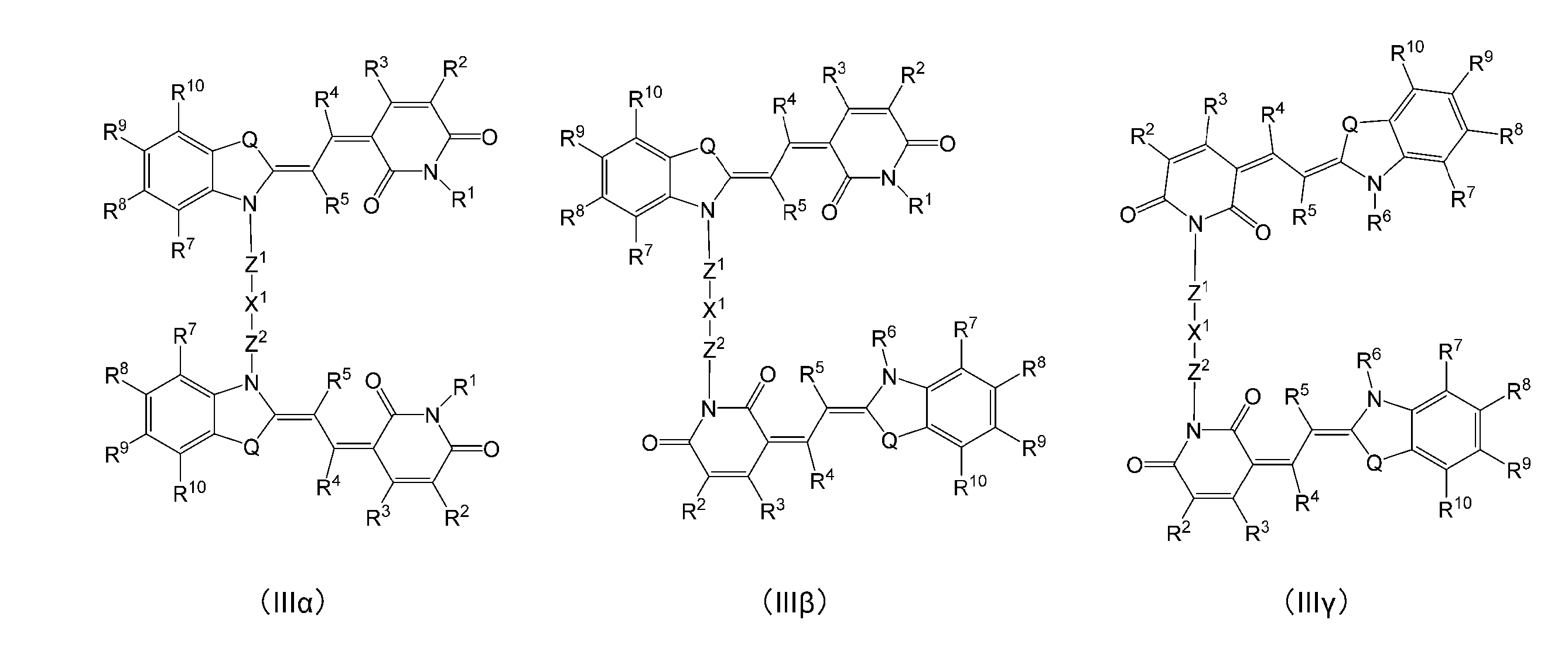
(式中、R1、R2、R3、R4、R6、R7、R8、R9、R10、Q、X1、Z1及びZ2は、上記式(I)と同じである。) (In the formula, R 1 , R 2 , R 3 , R 4 , R 6 , R 7 , R 8 , R 9 , R 10 , Q, X 1 , Z 1 and Z 2 are the same as in the above formula (I). Is.)
[4]
式(I)、(II)、(IIIα)、(IIIβ)及び(IIIγ)中のR2がシアノ基であり、R3が炭素数1~5のアルキル基である、[1]~[3]の何れか一項に記載の化合物。
[5]
式(I)、(II)、(IIIα)、(IIIβ)及び(IIIγ)中のR2がアルキル基又はハロゲン化アルキル基である、[1]~[3]の何れか一項に記載の化合物。
[4]
In formulas (I), (II), (IIIα), (IIIβ) and (IIIγ), R 2 is a cyano group and R 3 is an alkyl group having 1 to 5 carbon atoms, [1] to [3]. ] The compound according to any one of the items.
[5]
The item according to any one of [1] to [3], wherein R 2 in the formulas (I), (II), (IIIα), (IIIβ) and (IIIγ) is an alkyl group or an alkyl halide group. Compound.
[6]
式(I)、(II)、(IIIα)、(IIIβ)及び(IIIγ)中のQが、―CR11R12-である、[1]~[4]の何れか一項に記載のポリメチン化合物。
[7]
R11及びR12は、それぞれ独立に、炭素数1~20のアルキル基である、[6]に記載の化合物。
[6]
The polymethine according to any one of [1] to [4], wherein the Q in the formulas (I), (II), (IIIα), (IIIβ) and (IIIγ) is −CR 11 R 12 −. Compound.
[7]
The compound according to [6], wherein R 11 and R 12 are independently alkyl groups having 1 to 20 carbon atoms.
[8]
式(I)、(II)、(IIIα)、(IIIβ)及び(IIIγ)中のR1、R2、R3、R4、R5、R6、R7、R8、R9及びR10で表される基のうちの1つ以上がカルボキシ基若しくはニトロ基であるか、又は
式(I)、(II)、(IIIα)、(IIIβ)及び(IIIγ)中のR1、R2、R3、R4、R6、R7、R8、R9及びR10で表される基中の水素原子の1つ以上がカルボキシ基若しくはニトロ基で置換されている、[1]~[7]の何れか一項に記載の化合物。
[9]
式(I)、(II)、(IIIα)、(IIIβ)及び(IIIγ)中のR4、R5、R7、R8、R9及びR10で表される基の少なくとも1つがニトロ基である、[1]~[8]の何れか一項に記載の化合物。
[8]
Formula (I), (II), (IIIα), (IIIβ) and R 1 in (IIIγ), R 2, R 3, R 4, R 5, R 6, R 7, R 8, R 9 and R One or more of the groups represented by 10 are carboxy or nitro groups, or R 1 , R 2 in formulas (I), (II), (IIIα), (IIIβ) and (IIIγ). , R 3 , R 4 , R 6 , R 7 , R 8 , R 9 and R 10 in which one or more of the hydrogen atoms in the groups are substituted with carboxy or nitro groups, [1] to The compound according to any one of [7].
[9]
At least one of the groups represented by R 4 , R 5 , R 7 , R 8 , R 9 and R 10 in formulas (I), (II), (IIIα), (IIIβ) and (IIIγ) is a nitro group. The compound according to any one of [1] to [8].
[10]
式(I)、(II)、(IIIα)、(IIIβ)及び(IIIγ)中のR1で表される基が、炭素数1~20のアルキル基又は該アルキル基中のメチレン基の1つ又は2つ以上が-O-、-COO-又は-OCO-で置き換えられた基である、[1]~[7]の何れか一項に記載の化合物。
[11]
式(I)、(II)、(IIIα)、(IIIβ)及び(IIIγ)中のR1で表される基が水酸基又はカルボキシ基で置換されている、[10]に記載の化合物。
[10]
Formula (I), (II), (IIIα), a group represented by R 1 in (IIIβ) and (IIIγ), one of the methylene groups in the alkyl group or the alkyl group having 1 to 20 carbon atoms The compound according to any one of [1] to [7], wherein two or more of them are groups substituted with -O-, -COO- or -OCO-.
[11]
Formula (I), (II), (IIIα), (IIIβ) and the group represented by R 1 in (IIIγ) is substituted with a hydroxyl group or a carboxyl group, the compound according to [10].
[12]
式(I)、(II)、(IIIα)、(IIIβ)及び(IIIγ)中のR6で表される基は、炭素数1~20のアルキル基、炭素数7~30のアリールアルキル基、又は該アルキル基中のメチレン基若しくはアリールアルキル基のアルキル基中のメチレン基の1つ又は2つ以上が-O-、-COO-又は-OCO-で置き換えられた基である、[1]~[7]の何れか一項に記載の化合物。
[13]
式(I)、(II)、(IIIα)、(IIIβ)及び(IIIγ)中のR1で表される基が酸性基で置換されている、[12]に記載の化合物。
[12]
Formula (I), (II), (IIIα), the group represented by R 6 in (IIIβ) and (IIIγ) is an alkyl group having 1 to 20 carbon atoms, an arylalkyl group having 7 to 30 carbon atoms, Alternatively, one or more of the methylene group in the alkyl group or the methylene group in the alkyl group of the arylalkyl group is a group substituted with -O-, -COO- or -OCO-, [1] to The compound according to any one of [7].
[13]
Formula (I), (II), (IIIα), (IIIβ) and the group represented by R 1 in (IIIγ) is substituted with an acidic group, the compounds described in [12].
[14]
上記式(I)、(II)、(IIIα)、(IIIβ)及び(IIIγ)中のR7、R8及びR10の少なくとも1つが水素原子である、[1]~[7]の何れか一項に記載の化合物。
[15]
上記式(I)、(II)、(IIIα)、(IIIβ)及び(IIIγ)中のR3が炭素数1~20のアルキル基又は炭素数6~30のアリール基である、[1]~[7]の何れか一項に記載の化合物。
[14]
Any one of [1] to [7], wherein at least one of R 7 , R 8 and R 10 in the above formulas (I), (II), (IIIα), (IIIβ) and (IIIγ) is a hydrogen atom. The compound according to one item.
[15]
R 3 in the above formulas (I), (II), (IIIα), (IIIβ) and (IIIγ) is an alkyl group having 1 to 20 carbon atoms or an aryl group having 6 to 30 carbon atoms, [1] to The compound according to any one of [7].
[16]
[1]~[15]の何れか一項に記載の化合物及び樹脂を含有する樹脂組成物。
[17]
[1]~[15]の何れか一項に記載の化合物の光吸収剤としての使用。
[18]
[1]~[15]の何れか一項に記載の化合物の増感剤としての使用。
[16]
A resin composition containing the compound and resin according to any one of [1] to [15].
[17]
Use of the compound according to any one of [1] to [15] as a light absorber.
[18]
Use of the compound according to any one of [1] to [15] as a sensitizer.
本発明によれば、耐光性及び耐熱性に優れるポリメチン化合物を提供することができる。 According to the present invention, it is possible to provide a polymethine compound having excellent light resistance and heat resistance.
以下、本発明の化合物について、好ましい実施形態に基づき説明する。本発明の化合物は、いわゆるポリメチン化合物である。そこで、以下では、本発明の化合物のことをポリメチン化合物ともいう。 Hereinafter, the compound of the present invention will be described based on a preferred embodiment. The compound of the present invention is a so-called polymethine compound. Therefore, hereinafter, the compound of the present invention is also referred to as a polymethine compound.
本発明のポリメチン化合物は、上記式(I)で表される構造を有する。 The polymethine compound of the present invention has a structure represented by the above formula (I).
R2、R3、R4、R5、R7、R8、R9、R10、R11、R12、R13、R23及びR24で表されるハロゲン原子、並びにR1、R2、R3、R4、R5、R6、R7、R8、R9、R10、R11、R12、R13、R21、R22、R23及びR24で表される基に含まれる場合があるハロゲン原子としては、フッ素、塩素、臭素、ヨウ素が挙げられる。 R 2, R 3, R 4 , R 5, R 7, R 8, R 9, R 10, R 11, R 12, R 13, a halogen atom represented by R 23 and R 24, and R 1, R Represented by 2 , R 3 , R 4 , R 5 , R 6 , R 7 , R 8 , R 9 , R 10 , R 11 , R 12 , R 13 , R 21 , R 22 , R 23 and R 24. Halogen atoms that may be contained in the group include fluorine, chlorine, bromine and iodine.
R1、R2、R3、R4、R5、R6、R7、R8、R9、R10、R11、R12、R13、R14、R15、R16、R21、R22、R23及びR24で表される炭素数1~30の炭化水素基としては、特に限定されるものではないが、例えば、炭素数1~20のアルキル基、炭素数2~20のアルケニル基、炭素数3~20のシクロアルキル基、炭素数4~20のシクロアルキルアルキル基、炭素数6~30のアリール基、炭素数7~30のアリールアルキル基、炭素数8~30のアリールアルケニル基が挙げられる。 R 1, R 2, R 3 , R 4, R 5, R 6, R 7, R 8, R 9, R 10, R 11, R 12, R 13, R 14, R 15, R 16, R 21 , R 22 , R 23 and R 24 are not particularly limited as the hydrocarbon group having 1 to 30 carbon atoms, but for example, an alkyl group having 1 to 20 carbon atoms and 2 to 20 carbon atoms. Alkyl group, cycloalkyl group having 3 to 20 carbon atoms, cycloalkylalkyl group having 4 to 20 carbon atoms, aryl group having 6 to 30 carbon atoms, arylalkyl group having 7 to 30 carbon atoms, 8 to 30 carbon atoms. Arylalkyl alkenyl groups can be mentioned.
上記炭素数1~20のアルキル基は直鎖状であってもよく、分岐状であってもよい。直鎖のアルキル基としては、例えば、メチル、エチル、プロピル、ブチル、アミル、ヘキシル、ヘプチル、オクチル、ノニル、デシル、ウンデシル、ドデシル、テトラデシル、ヘキサデシル、オクタデシル及びイコシルが挙げられる。分岐のアルキル基としては、イソプロピル、イソブチル、s-ブチル、t-ブチル、イソアミル、t-アミル、イソオクチル、2-エチルヘキシル、t-オクチル、イソノニル及びイソデシル等が挙げられる。本発明においては、ポリメチン化合物の吸光度が高くなることから、炭素数1~10のアルキル基が好ましい。 The alkyl group having 1 to 20 carbon atoms may be linear or branched. Examples of the linear alkyl group include methyl, ethyl, propyl, butyl, amyl, hexyl, heptyl, octyl, nonyl, decyl, undecylic, dodecyl, tetradecyl, hexadecyl, octadecyl and icosyl. Examples of the branched alkyl group include isopropyl, isobutyl, s-butyl, t-butyl, isoamyl, t-amyl, isooctyl, 2-ethylhexyl, t-octyl, isononyl and isodecyl. In the present invention, an alkyl group having 1 to 10 carbon atoms is preferable because the absorbance of the polymethine compound is high.
上記炭素数2~20のアルケニル基は、鎖状であってもよく、環状であってもよい。該アルケニル基が鎖状である場合、末端に不飽和結合を有する末端アルケニル基であってもよく、内部に不飽和結合を有する内部アルケニル基であってもよい。炭素数が2~20である末端アルケニル基としては、例えば、ビニル、2-プロペニル、3-ブテニル、4-ペンテニル及び5-ヘキセニル等が挙げられる。内部アルケニル基としては、例えば、2-ブテニル、3-ペンテニル、2-ヘキセニル、3-ヘキセニル、2-ヘプテニル、3-ヘプテニル、4-ヘプテニル、3-オクテニル、3-ノネニル、4-デセニル、3-ウンデセニル及び4-ドデセニル等が挙げられる。環状アルケニル基としては、3-シクロヘキセニル、2,5-シクロヘキサジエニル-1-メチル及び4,8,12-テトラデカトリエニルアリル等が挙げられる。本発明においては、ポリメチン化合物の吸光度が高くなることから、炭素数2~10のアルケニル基が好ましい。 The alkenyl group having 2 to 20 carbon atoms may be chain-like or cyclic. When the alkenyl group is chain-like, it may be a terminal alkenyl group having an unsaturated bond at the end, or an internal alkenyl group having an unsaturated bond inside. Examples of the terminal alkenyl group having 2 to 20 carbon atoms include vinyl, 2-propenyl, 3-butenyl, 4-pentenyl, 5-hexenyl and the like. Examples of the internal alkenyl group include 2-butenyl, 3-pentenyl, 2-hexenyl, 3-hexenyl, 2-heptenyl, 3-heptenyl, 4-heptenyl, 3-octenyl, 3-nonenyl, 4-decenyl, 3-. Examples thereof include undecenyl and 4-dodecenyl. Examples of the cyclic alkenyl group include 3-cyclohexenyl, 2,5-cyclohexadienyl-1-methyl and 4,8,12-tetradecatrienylallyl. In the present invention, an alkenyl group having 2 to 10 carbon atoms is preferable because the absorbance of the polymethine compound is high.
上記炭素数3~20のシクロアルキル基とは、全体で3~20個の炭素原子を有する、飽和単環式又は飽和多環式アルキル基を意味する。飽和単環式アルキル基としては、例えば、シクロプロピル、シクロブチル、シクロペンチル、シクロヘキシル、シクロヘプチル、シクロオクチル、シクロノニル及びシクロデシル等が挙げられる。飽和多環式アルキル基としては、例えば、アダマンチル、デカハイドロナフチル、オクタヒドロペンタレン、ビシクロ[1.1.1]ペンタニル及びテトラデカヒドロアントラセニル等が挙げられる。本発明においては、ポリメチン化合物の吸光度が高くなることから、炭素数3~10のシクロアルキル基が好ましい。 The cycloalkyl group having 3 to 20 carbon atoms means a saturated monocyclic or saturated polycyclic alkyl group having 3 to 20 carbon atoms in total. Examples of the saturated monocyclic alkyl group include cyclopropyl, cyclobutyl, cyclopentyl, cyclohexyl, cycloheptyl, cyclooctyl, cyclononyl, cyclodecyl and the like. Examples of the saturated polycyclic alkyl group include adamantyl, decahydronaphthyl, octahydropentalene, bicyclo [1.1.1] pentanyl, tetradecahydroanthrasenyl and the like. In the present invention, a cycloalkyl group having 3 to 10 carbon atoms is preferable because the absorbance of the polymethine compound is high.
上記炭素数4~20のシクロアルキルアルキル基とは、アルキル基の水素原子がシクロアルキル基で置換され、且つ全体で4~20個の炭素原子を有する基を意味する。該シクロアルキルアルキル基中のシクロアルキル基は単環であってもよく、多環であってもよい。また、シクロアルキルアルキル基中のアルキル基のメチレン基は-CH=CH-で置き換わっていてもよい。
シクロアルキル基が単環である炭素数4~20のシクロアルキルアルキル基としては、例えば、シクロプロピルメチル、シクロブチルメチル、シクロペンチルメチル、シクロヘキシルメチル、シクロヘプチルメチル、シクロオクチルメチル、シクロノニルメチル及びシクロデシルメチル等のシクロアルキルメチル;、2-シクロブチルエチル、2-シクロペンチルエチル、2-シクロヘキシルエチル、2-シクロヘプチルエチル、2-シクロオクチルエチル、2-シクロノニルエチル及び2-シクロデシルエチル等のシクロアルキルエチル;3-シクロブチルプロピル、3-シクロペンチルプロピル、3-シクロヘキシルプロピル、3-シクロヘプチルプロピル、3-シクロオクチルプロピル、3-シクロノニルプロピル及び3-シクロデシルプロピル等のシクロアルキルプロピル;4-シクロブチルブチル、4-シクロペンチルブチル、4-シクロヘキシルブチル、4-シクロヘプチルブチル、4-シクロオクチルブチル、4-シクロノニルブチル、4-シクロデシルブチル等のシクロアルキルブチルが挙げられる。シクロアルキル基が多環である炭素数4~20のシクロアルキルアルキル基としては、ビシクロ[1.1.0]ブチル、ビシクロ[1.1.1]ペンチル、ビシクロ[2.1.0]ペンチル、ビシクロ[3.1.0]ヘキシル、ビシクロ[2.1.1]ヘキシル、ビシクロ[2.2.0]ヘキシル、ビシクロ[4.1.0]ヘプチル、ビシクロ[3.2.0]ヘプチル、ビシクロ[3.1.1]ヘプチル、ビシクロ[2.2.1]ヘプチル、ビシクロ[5.1.0]オクチル、ビシクロ[4.2.0]オクチル、ビシクロ[4.1.1]オクチル、ビシクロ[3.3.0]オクチル、ビシクロ[3.2.1]オクチル、ビシクロ[2.2.2]オクチル、スピロ〔4,4〕ノナニル、スピロ〔4,5〕デカニル、デカリン、トリシクロデカニル、テトラシクロドデカニル及びセドロール、シクロドデカニル3-3-アダマンチルプロピル及びデカハイドロナフチルプロピル等が挙げられる。
本発明においては、ポリメチン化合物の吸光度が高くなることから、炭素数4~10のシクロアルキルアルキル基が好ましい。
The cycloalkylalkyl group having 4 to 20 carbon atoms means a group in which the hydrogen atom of the alkyl group is substituted with the cycloalkyl group and has 4 to 20 carbon atoms in total. The cycloalkyl group in the cycloalkylalkyl group may be monocyclic or polycyclic. Further, the methylene group of the alkyl group in the cycloalkylalkyl group may be replaced by —CH = CH−.
Examples of the cycloalkylalkyl group having a monocyclic cycloalkyl group having 4 to 20 carbon atoms include cyclopropylmethyl, cyclobutylmethyl, cyclopentylmethyl, cyclohexylmethyl, cycloheptylmethyl, cyclooctylmethyl, cyclononylmethyl and cyclo. Cycloalkylmethyl such as decylmethyl;, 2-cyclobutylethyl, 2-cyclopentylethyl, 2-cyclohexylethyl, 2-cycloheptylethyl, 2-cyclooctylethyl, 2-cyclononylethyl, 2-cyclodecylethyl and the like. Cycloalkylethyl; cycloalkylpropyls such as 3-cyclobutylpropyl, 3-cyclopentylpropyl, 3-cyclohexylpropyl, 3-cycloheptylpropyl, 3-cyclooctylpropyl, 3-cyclononylpropyl and 3-cyclodecylpropyl; 4 Cycloalkylbutyls such as -cyclobutylbutyl, 4-cyclopentylbutyl, 4-cyclohexylbutyl, 4-cycloheptylbutyl, 4-cyclooctylbutyl, 4-cyclononylbutyl, 4-cyclodecylbutyl and the like can be mentioned. Examples of the cycloalkylalkyl group having 4 to 20 carbon atoms in which the cycloalkyl group is polycyclic include bicyclo [1.1.0] butyl, bicyclo [1.1.1] pentyl, and bicyclo [2.1.0] pentyl. , Bicyclo [3.1.0] hexyl, bicyclo [2.1.1] hexyl, bicyclo [2.2.0] hexyl, bicyclo [4.1.0] heptyl, bicyclo [3.2.0] heptyl , Bicyclo [3.1.1] heptyl, bicyclo [2.2.1] heptyl, bicyclo [5.1.0] octyl, bicyclo [4.2.0] octyl, bicyclo [4.1.1] octyl , Bicyclo [3.3.0] octyl, bicyclo [3.2.1] octyl, bicyclo [2.2.2] octyl, spiro [4,4] nonanyl, spiro [4,5] decanyl, decalin, tri Cyclodecanyl, tetracyclododecanyl and sedrol, cyclododecanyl 3-3-adamantylpropyl and decahydronaphthylpropyl and the like can be mentioned.
In the present invention, a cycloalkylalkyl group having 4 to 10 carbon atoms is preferable because the absorbance of the polymethine compound is high.
上記炭素数6~30のアリール基は、単環構造を有するものであってもよく、縮環構造を有するものであってもよい。更に、上記アリール基は、単環構造のアリール基と単環構造のアリール基とを連結したものであってもよく、単環構造のアリール基と縮合構造のアリール基とを連結したものであってもよく、或いは縮合構造のアリール基と縮合構造のアリール基とを連結したものであってもよい。単環構造を有するアリール基としては、例えば、フェニル、及びビフェニリル等が挙げられる。縮環構造を有するアリール基としては、例えば、ナフチル、アンスリル及びフェナントレニル等が挙げられる。炭素数6~30のアリール基は1又は2以上の置換基を有していてもよい。置換基としては、上記アルキル基、上記アルケニル基、カルボキシ基及びハロゲン原子等が挙げられる。置換基を有する炭素数6~30のアリール基としては、例えば、トリル、キシリル、エチルフェニル、4-クロロフェニル、4-カルボキシルフェニル、4-ビニルフェニル、4-メチルフェニル、2,4,6-トリメチルフェニル等の単環構造の置換アリール基が挙げられる。本発明においては、ポリメチン化合物の吸光度が高くなることから、炭素数6~10のアリール基が好ましい。 The aryl group having 6 to 30 carbon atoms may have a monocyclic structure or a condensed ring structure. Further, the above-mentioned aryl group may be one in which an aryl group having a monocyclic structure and an aryl group having a monocyclic structure are linked, or one in which an aryl group having a monocyclic structure and an aryl group having a condensed structure are linked. Alternatively, the aryl group having a condensed structure and the aryl group having a condensed structure may be linked. Examples of the aryl group having a monocyclic structure include phenyl and biphenylyl. Examples of the aryl group having a fused ring structure include naphthyl, anthryl, phenanthrenyl and the like. The aryl group having 6 to 30 carbon atoms may have 1 or 2 or more substituents. Examples of the substituent include the above-mentioned alkyl group, the above-mentioned alkenyl group, carboxy group, halogen atom and the like. Examples of the aryl group having a substituent and having 6 to 30 carbon atoms include trill, xsilyl, ethylphenyl, 4-chlorophenyl, 4-carboxyphenyl, 4-vinylphenyl, 4-methylphenyl, 2,4,6-trimethyl. Substituent aryl groups having a monocyclic structure such as phenyl can be mentioned. In the present invention, an aryl group having 6 to 10 carbon atoms is preferable because the absorbance of the polymethine compound is high.
上記炭素数7~30のアリールアルキル基とは、上記アルキル基の1又は2以上の水素原子が上記アリール基で置換され、且つ全体で7~30個の炭素原子を有する基を意味する。炭素数7~30のアリールアルキル基としては、例えば、ベンジル、α-メチルベンジル、α、α-ジメチルベンジル、2-フェニルエチル、2-フェニルプロピル、3-フェニルプロピル、ジフェニルメチル、トリフェニルメチル及びトリフェニルプロピル等のフェニルアルキル;並びにナフチルプロピル等のナフチルアルキルが挙げられる。本発明においては、ポリメチン化合物の吸光度が高くなることから、炭素数7~20のアリールアルキル基が好ましい。 The arylalkyl group having 7 to 30 carbon atoms means a group in which one or more hydrogen atoms of the alkyl group are substituted with the aryl group and has 7 to 30 carbon atoms in total. Examples of the arylalkyl group having 7 to 30 carbon atoms include benzyl, α-methylbenzyl, α, α-dimethylbenzyl, 2-phenylethyl, 2-phenylpropyl, 3-phenylpropyl, diphenylmethyl, triphenylmethyl and Examples thereof include phenylalkyls such as triphenylpropyl; and naphthylalkyls such as naphthylpropyl. In the present invention, an arylalkyl group having 7 to 20 carbon atoms is preferable because the absorbance of the polymethine compound is high.
上記炭素数8~30のアリールアルケニル基とは、上記アルケニル基の水素原子が上記アリール基で置換され、且つ全体で8~30個の炭素原子を有する基を意味する。該炭素数8~30のアリールアルケニル基としては、例えば、スチレニル、シンナミル、2-フェニル-2-プロペニル、3-フェニル-2-プロペニル、2-フェニル-4-ペンテニル、2-フェニル-4-ヘキセニル、2,2-ジフェニルエチレニル、3,3-フェニル-2-プロペニル、2-ナフチル-2-プロペニル、3-ナフチル-2-プロペニル、3-ナフチル-2-フェニル-2-プロペニル、5-アントラセニル-2-フェニル-4-ヘキセニル及び5-アントラセニル-2-ナフチル-4-ヘキセニル等が挙げられる。本発明においては、ポリメチン化合物の吸光度が高くなることから、炭素数8~20のアリールアルケニル基が好ましい。 The arylalkenyl group having 8 to 30 carbon atoms means a group in which the hydrogen atom of the alkenyl group is substituted with the aryl group and has 8 to 30 carbon atoms in total. Examples of the arylalkenyl group having 8 to 30 carbon atoms include styrenyl, cinnamyl, 2-phenyl-2-propenyl, 3-phenyl-2-propenyl, 2-phenyl-4-pentenyl, and 2-phenyl-4-hexenyl. , 2,2-Diphenylethylenel, 3,3-Phenyl-2-propenyl, 2-naphthyl-2-propenyl, 3-naphthyl-2-propenyl, 3-naphthyl-2-phenyl-2-propenyl, 5-anthrasenyl Examples thereof include -2-phenyl-4-hexenyl and 5-anthrasenyl-2-naphthyl-4-hexenyl. In the present invention, an arylalkenyl group having 8 to 20 carbon atoms is preferable because the absorbance of the polymethine compound is high.
R1、R2、R3、R4、R5、R6、R7、R8、R9、R10、R11、R12、R13、R23及びR24で表される複素環基は単環であってもよく、縮環構造であってもよい。更に、上記複素環基は、単環の複素環基と単環の複素環基とを連結したものであってもよく、単環の複素環基と縮合構造の複素環基とを連結したものであってもよく、或いは縮合構造の複素環基と縮合構造の複素環基とを連結したものであってもよい。単環の複素環基としては、例えば、ピリジル、ピリミジル、ピリダジル、ピペラジル、ピペリジル、ピラニル、ピラゾリル、トリアジル、ピロリジル、イミダゾリル、トリアゾリル、フリル、フラニル、チエニル、チオフェニル、チアジアゾリル、チアゾリル、オキサゾリル、イソチアゾリル、イソオキサゾリル、ユロリジル、モルフォリニル、チオモルフォリニル、2-ピロリジノン-1-イル、2-ピペリドン-1-イル、2,4-ジオキシイミダゾリジン-3-イル及び2,4-ジオキシオキサゾリジン-3-イル等が挙げられる。縮環構造の複素環基としては、例えば、キノリル、イソキノリル、ベンゾイミダゾリル、ベンゾフラニル、ベンゾチオフェニル、ベンゾチアゾリル、ベンゾオキサゾリル及びインドリル等の縮環構造の複素環基が挙げられる。 R 1, R 2, R 3 , R 4, R 5, R 6, R 7, R 8, R 9, R 10, R 11, R 12, heterocyclic ring represented by R 13, R 23 and R 24 The group may be monocyclic or have a condensed ring structure. Further, the heterocyclic group may be a monocyclic heterocyclic group linked to a monocyclic heterocyclic group, or a monocyclic heterocyclic group linked to a fused structure heterocyclic group. It may be a heterocyclic group having a condensed structure and a heterocyclic group having a condensed structure. Examples of the monocyclic heterocyclic group include pyridyl, pyrimidyl, pyridadyl, piperazyl, piperidin, pyranyl, pyrazolyl, triazil, pyrrolidyl, imidazolyl, triazolyl, frill, furanyl, thienyl, thiophenyl, thiadiazolyl, thiazolyl, oxazolidine, isothiazolidine, isooxazolyl. , Euroridyl, morpholinyl, thiomorpholinyl, 2-pyrrolidinone-1-yl, 2-piperidin-1-yl, 2,4-dioxyimidazolidine-3-yl and 2,4-dioxyoxazolidine-3-yl And so on. Examples of the heterocyclic group having a condensed ring structure include heterocyclic groups having a condensed ring structure such as quinolyl, isoquinolyl, benzoimidazolyl, benzofuranyl, benzothiophenyl, benzothiazolyl, benzoxazolyl and indolyl.
上記炭素数1~30の炭化水素基及び上記複素環基は、下記の置換基を有する場合がある。
上記炭素数1~30の炭化水素基が炭素数1~20のアルキル基、炭素数3~20のシクロアルキル基又は炭素数4~20のシクロアルキルアルキル基である場合、置換基としては、以下に例示の置換基のうち、アルキル基、アリールアルキル基以外の置換基が挙げられる。
上記炭素数1~30の炭化水素基が炭素数6~30のアリール基である場合、置換基としては、以下に例示の置換基のうち、アリール基以外の置換基が挙げられる。
上記炭素数1~30の炭化水素基が炭素数2~20のアルケニル基、炭素数7~30のアリールアルキル基又は炭素数8~30のアリールアルケニル基である場合、好ましい置換基としては、下記に例示のものが挙げられ、中でも、単環若しくは縮環構造の芳香族系炭化水素環(環構造の部分のみをいう。以下、「芳香族系炭化水素環」において同じ。)又はその連結構造が結合したアルキル基が好ましい。
ただし、以下に例示の置換基のうち、アルキル基、アリールアルキル基、アリールアルケニル基は、炭素数7~30のアリールアルキル基又は炭素数8~30のアリールアルケニル基の芳香族系炭化水素環に置換する。
複素環を含有する炭素数2~20の置換基としては、以下に例示の置換基のうち、複素環を含有する基以外の置換基が挙げられる。
尚、上記炭素数1~30の炭化水素基が、以下の置換基の中でも、炭素原子を含有する置換基を有する場合は、該置換基を含めた全体の炭素数が、規定された範囲を満たすものとする。つまり、炭素数1~30の炭化水素基が、炭素原子を含有する置換基を有する場合の炭素数の範囲は、置換基も含めた全体として1~30であり、また、例えば、炭素数1~20のアルキル基が、炭素原子を含有する置換基を有する場合の炭素数の範囲は、置換基も含めた全体として1~20である。
The hydrocarbon group having 1 to 30 carbon atoms and the heterocyclic group may have the following substituents.
When the hydrocarbon group having 1 to 30 carbon atoms is an alkyl group having 1 to 20 carbon atoms, a cycloalkyl group having 3 to 20 carbon atoms, or a cycloalkylalkyl group having 4 to 20 carbon atoms, the substituents are as follows. Among the substituents exemplified in the above, substituents other than alkyl groups and arylalkyl groups can be mentioned.
When the hydrocarbon group having 1 to 30 carbon atoms is an aryl group having 6 to 30 carbon atoms, examples of the substituent include substituents other than the aryl group among the substituents exemplified below.
When the hydrocarbon group having 1 to 30 carbon atoms is an alkenyl group having 2 to 20 carbon atoms, an arylalkyl group having 7 to 30 carbon atoms, or an arylalkenyl group having 8 to 30 carbon atoms, the preferred substituents are as follows. Among them, an aromatic hydrocarbon ring having a monocyclic or condensed ring structure (referring only to a portion of the ring structure; the same shall apply hereinafter in the “aromatic hydrocarbon ring”) or a linked structure thereof. An alkyl group to which is bonded is preferable.
However, among the substituents exemplified below, the alkyl group, the arylalkyl group, and the arylalkenyl group may be an aromatic hydrocarbon ring of an arylalkyl group having 7 to 30 carbon atoms or an arylalkenyl group having 8 to 30 carbon atoms. Replace.
Examples of the substituent containing a heterocycle having 2 to 20 carbon atoms include substituents other than the group containing a heterocycle among the substituents exemplified below.
When the hydrocarbon group having 1 to 30 carbon atoms has a substituent containing a carbon atom among the following substituents, the total number of carbon atoms including the substituents is within the specified range. Satisfy. That is, when a hydrocarbon group having 1 to 30 carbon atoms has a substituent containing a carbon atom, the range of the carbon number of the hydrocarbon group including the substituent is 1 to 30 as a whole, and for example, the number of carbon atoms is 1. When the alkyl group of ~ 20 has a substituent containing a carbon atom, the range of the number of carbon atoms is 1 to 20 as a whole including the substituent.
上記置換基としては、例えば、メチル、エチル、プロピル、イソプロピル、シクロプロピル、ブチル、第二ブチル、第三ブチル、イソブチル、アミル、イソアミル、第三アミル、シクロペンチル、ヘキシル、2-ヘキシル、2-エチルへキシル、3-へキシル(又はヘキサン-3-イル)、シクロヘキシル、ビシクロヘキシル、1-メチルシクロヘキシル、ヘプチル、2-ヘプチル、3-ヘプチル、イソヘプチル、第三ヘプチル、n-オクチル、イソオクチル、第三オクチル、ノニル、イソノニル、デシル、ラウリル等のアルキル基;メチルオキシ、エチルオキシ、プロピルオキシ、イソプロピルオキシ、ブチルオキシ、第二ブチルオキシ、第三ブチルオキシ、イソブチルオキシ、アミルオキシ、イソアミルオキシ、第三アミルオキシ、ヘキシルオキシ、シクロヘキシルオキシ、ヘプチルオキシ、イソヘプチルオキシ、第三ヘプチルオキシ、n-オクチルオキシ、イソオクチルオキシ、第三オクチルオキシ、2-エチルヘキシルオキシ、ノニルオキシ、デシルオキシ等のアルコキシ基;メチルチオ、エチルチオ、プロピルチオ、イソプロピルチオ、ブチルチオ、第二ブチルチオ、第三ブチルチオ、イソブチルチオ、アミルチオ、イソアミルチオ、第三アミルチオ、ヘキシルチオ、シクロヘキシルチオ、ヘプチルチオ、イソヘプチルチオ、第三ヘプチルチオ、n-オクチルチオ、イソオクチルチオ、第三オクチルチオ、2-エチルヘキシルチオ等のアルキルチオ基;ビニル、1-メチルエテニル、2-メチルエテニル、2-プロペニル、1-メチル-3-プロペニル(又は1-メチル-2-プロペニル)、3-ブテニル、1-メチル-3-ブテニル、イソブテニル、3-ペンテニル、4-ヘキセニル、シクロヘキセニル、ビシクロヘキセニル、ヘプテニル、オクテニル、デセニル、ペンタデセニル、エイコセニル、トリコセニル等のアルケニル基;ベンジル、フェネチル、ジフェニルメチル、トリフェニルメチル、スチリル、シンナミル等のアリールアルキル基;フェニル、ナフチル等のアリール基;フェノキシ、ナフチルオキシ等のアリールオキシ基;フェニルチオ、ナフチルチオ等のアリールスルファニル基;ピリジル、ピリミジル、ピリダジル、ピペリジル、ピラニル、ピラゾリル、トリアジル、ピロリル、キノリル、イソキノリル、イミダゾリル、ベンゾイミダゾリル、トリアゾリル、フリル、フラニル、ベンゾフラニル、チエニル、チオフェニル、ベンゾチオフェニル、チアジアゾリル、チアゾリル、ベンゾチアゾリル、オキサゾリル、ベンゾオキサゾリル、イソチアゾリル、イソオキサゾリル、インドリル、2-ピロリジノン-1-イル、2-ピペリドン-1-イル、2,4-ジオキシイミダゾリジン-3-イル、2,4-ジオキシオキサゾリジン-3-イル等の複素環を含有する基;フッ素、塩素、臭素、ヨウ素等のハロゲン原子;アセチル、2-クロロアセチル、プロピオニル、オクタノイル、フェニルカルボニル(ベンゾイル)、フタロイル、4-トリフルオロメチルベンゾイル、ピバロイル、サリチロイル、オキザロイル、ステアロイル、メトキシカルボニル、エトキシカルボニル、t-ブトキシカルボニル、n-オクタデシルオキシカルボニル、カルバモイル等のアシル基;アセチルオキシ、ベンゾイルオキシ等のアシルオキシ基;アミノ、エチルアミノ、ジメチルアミノ、ジエチルアミノ、ブチルアミノ、シクロペンチルアミノ、2-エチルヘキシルアミノ、ドデシルアミノ、アニリノ、クロロフェニルアミノ、トルイジノ、アニシジノ、N-メチル-アニリノ、ジフェニルアミノ,ナフチルアミノ、2-ピリジルアミノ、メトキシカルボニルアミノ、フェノキシカルボニルアミノ、アセチルアミノ、ベンゾイルアミノ、ホルミルアミノ、ピバロイルアミノ、ラウロイルアミノ、カルバモイルアミノ、N,N-ジメチルアミノカルボニルアミノ、N,N-ジエチルアミノカルボニルアミノ、モルホリノカルボニルアミノ、メトキシカルボニルアミノ、エトキシカルボニルアミノ、t-ブトキシカルボニルアミノ、n-オクタデシルオキシカルボニルアミノ、N-メチル-メトキシカルボニルアミノ、フェノキシカルボニルアミノ、スルファモイルアミノ、N,N-ジメチルアミノスルホニルアミノ、メチルスルホニルアミノ、ブチルスルホニルアミノ、フェニルスルホニルアミノ等の置換アミノ基;カルボキシ基、スルホ基スルファモイル基、スルホニル含有基、、シアノ基、スルホ基、リン酸基、スルホンアミン基等の酸性基;ヒドロキシ基、ニトロ基、スルファニル基、イミド基、カルバモイル基、等が挙げられ、これらの基は更に置換されていてもよい。 Examples of the substituent include methyl, ethyl, propyl, isopropyl, cyclopropyl, butyl, secondary butyl, tertiary butyl, isobutyl, amyl, isoamyl, tertiary amyl, cyclopentyl, hexyl, 2-hexyl, 2-ethyl. Hexyl, 3-hexyl (or hexane-3-yl), cyclohexyl, bicyclohexyl, 1-methylcyclohexyl, heptyl, 2-heptyl, 3-heptyl, isoheptyl, tertiary heptyl, n-octyl, isooctyl, tertiary Alkyl groups such as octyl, nonyl, isononyl, decyl, lauryl; methyloxy, ethyloxy, propyloxy, isopropyloxy, butyloxy, secondary butyloxy, tertiary butyloxy, isobutyloxy, amyloxy, isoamyloxy, tertiary amyloxy, hexyloxy, Alkoxy groups such as cyclohexyloxy, heptyloxy, isoheptyloxy, tertiary heptyloxy, n-octyloxy, isooctyloxy, tertiary octyloxy, 2-ethylhexyloxy, nonyloxy, decyloxy; methylthio, ethylthio, propylthio, isopropylthio , Butylthio, secondary butylthio, tertiary butylthio, isobutylthio, amylthio, isoamylthio, tertiary amylthio, hexylthio, cyclohexylthio, heptylthio, isoheptylthio, tertiary heptylthio, n-octylthio, isooctylthio, tertiary octylthio, 2- Alkylthio groups such as ethylhexylthio; vinyl, 1-methylethenyl, 2-methylethenyl, 2-propenyl, 1-methyl-3-propenyl (or 1-methyl-2-propenyl), 3-butenyl, 1-methyl-3-butenyl , Isobutenyl, 3-pentenyl, 4-hexenyl, cyclohexenyl, bicyclohexenyl, heptenyl, octenyl, decenyl, pentadecenyl, eicosenyl, tricosenyl and other alkenyl groups; aryls such as benzyl, phenethyl, diphenylmethyl, triphenylmethyl, styryl, cinnamyl and the like. Alkyl group; Aryl group such as phenyl and naphthyl; Aryloxy group such as phenoxy and naphthyloxy; Arylsulfanyl group such as phenylthio and naphthylthio; Imidazolyl, benzoimidazolyl, triazolyl, fryl, furanyl, benzof Lanil, thienyl, thiophenyl, benzothiophenyl, thiadiazolyl, thiazolyl, benzothiazolyl, oxazolyl, benzoxazolyl, isothiazolyl, isooxazolyl, indolyl, 2-pyrrolidinone-1-yl, 2-piperidone-1-yl, 2,4-di Groups containing heterocycles such as oxyimidazolidine-3-yl and 2,4-dioxyoxazolidine-3-yl; halogen atoms such as fluorine, chlorine, bromine and iodine; acetyl, 2-chloroacetyl, propionyl and octanoyl , Phenylcarbonyl (benzoyl), phthaloyl, 4-trifluoromethylbenzoyl, pivaloyl, salicyloyl, oxaloyl, stearoyl, methoxycarbonyl, ethoxycarbonyl, t-butoxycarbonyl, n-octadecyloxycarbonyl, carbamoyl and other acyl groups; acetyloxy, Acyloxy groups such as benzoyloxy; amino, ethylamino, dimethylamino, diethylamino, butylamino, cyclopentylamino, 2-ethylhexylamino, dodecylamino, anilino, chlorophenylamino, toluidino, anisidino, N-methyl-anilino, diphenylamino, naphthyl Amino, 2-pyridylamino, methoxycarbonylamino, phenoxycarbonylamino, acetylamino, benzoylamino, formylamino, pivaloylamino, lauroylamino, carbamoylamino, N, N-dimethylaminocarbonylamino, N, N-diethylaminocarbonylamino, morpholinocarbonyl Amino, methoxycarbonylamino, ethoxycarbonylamino, t-butoxycarbonylamino, n-octadecyloxycarbonylamino, N-methyl-methoxycarbonylamino, phenoxycarbonylamino, sulfamoylamino, N, N-dimethylaminosulfonylamino, methyl Substituent amino groups such as sulfonylamino, butylsulfonylamino and phenylsulfonylamino; carboxy group, sulfo group Sulfamoyl group, sulfonyl-containing group, cyano group, sulfo group, phosphoric acid group, sulfonicamine group and other acidic groups; hydroxy group, Examples thereof include a nitro group, a sulfanyl group, an imide group, a carbamoyl group, etc., and these groups may be further substituted.
また、上記カルボキシ基、スルホ基、スルホンアミン基及びリン酸基等の酸性基は、種々の陽イオンと塩を形成している場合もあり、上記置換アミノ基(例えば、ジエチルアミノ基、ジメチルアミノ基)は、四級化した後、例えばメチル基、エチル基等の炭素数1~10のアルキル基で四級化した後、種々の陰イオンと塩を形成している場合もある。上記陽イオンとしては、アルカリ金属イオン、アルカリ土類金属イオン、遷移金属カチオン、炭素数4以上のアンモニウム、アミジニウム、グアニジニウムカチオン等が挙げられ、陰イオンとしては、例えば、一価のものとして、塩化物イオン、臭化物イオン、ヨウ化物イオン、フッ化物イオン等のハロゲン化物イオン;過塩素酸イオン、塩素酸イオン、チオシアン酸イオン、ヘキサフルオロリン酸イオン、ヘキサフルオロアンチモン酸イオン、テトラフルオロホウ酸イオン等の無機系陰イオン;メタンスルホン酸イオン、ドデシルスルホン酸イオン、ベンゼンスルホン酸イオン、トルエンスルホン酸イオン、トリフルオロメタンスルホン酸イオン、ペンタフルオロベンゼンスルホン酸イオン、ジフェニルアミン-4-スルホン酸イオン、2-アミノ-4-メチル-5-クロロベンゼンスルホン酸イオン、2-アミノ-5-ニトロベンゼンスルホン酸イオン、フタロシアニンスルホン酸イオン、パーフルオロ-4-エチルシクロヘキサンスルホン酸イオン、ナフタレンモノスルホン酸、ナフタレンジスルホン酸、ナフタレントリスルホン酸、ナフチルアミンモノスルホン酸、ナフチルアミンジスルホン酸、ナフチルアミントリスルホン酸、ナフトールモノスルホン酸、ナフトールジスルホン酸、ナフトールトリスルホン酸等の有機スルホン酸系陰イオン;チオシアン酸イオン、リンタングステンモリブデン酸イオン、リンタングステン酸イオン、リンモリブデン酸イオン、タンニン酸イオン、酒石酸イオン、パルミチン酸イオン、ステアリン酸イオン、オレイン酸イオン、リノール酸イオン、オクチルリン酸イオン、ドデシルリン酸イオン、オクタデシルリン酸イオン、フェニルリン酸イオン、ノニルフェニルリン酸イオン、2,2’-メチレンビス(4,6-ジ-t-ブチルフェニル)ホスホン酸イオン等の有機リン酸系陰イオン、ビストリフルオロメチルスルホニルイミドイオン、ビスパーフルオロブタンスルホニルイミドイオン、テトラキス(ペンタフルオロフェニル)ホウ酸イオン、トリス(フルオロアルキルスルホニル)カルボアニオン、テトラキスペンタフルオロフェニルボレートアニオン等が挙げられる。 Further, the acidic group such as the carboxy group, the sulfo group, the sulfonic acid group and the phosphoric acid group may form a salt with various cations, and the substituted amino group (for example, diethylamino group, dimethylamino group) may be formed. ) May form salts with various anions after being quaternized and then quaternized with an alkyl group having 1 to 10 carbon atoms such as a methyl group and an ethyl group. Examples of the cation include alkali metal ion, alkaline earth metal ion, transition metal cation, ammonium having 4 or more carbon atoms, amidinium, guanidinium cation, and the like. Anions include, for example, monovalent ones. , Chloride ion, bromide ion, iodide ion, fluoride ion and other halide ions; perchlorate ion, chlorate ion, thiocyanate ion, hexafluorophosphate ion, hexafluoroantimonate ion, tetrafluoroboric acid. Inorganic anions such as ions; methanesulfonic acid ion, dodecylsulfonic acid ion, benzenesulfonic acid ion, toluenesulfonic acid ion, trifluoromethanesulfonic acid ion, pentafluorobenzenesulfonic acid ion, diphenylamine-4-sulfonic acid ion, 2 -Amino-4-methyl-5-chlorobenzene sulfonic acid ion, 2-amino-5-nitrobenzene sulfonic acid ion, phthalocyanine sulfonic acid ion, perfluoro-4-ethylcyclohexane sulfonic acid ion, naphthalene monosulfonic acid, naphthalenedi sulfonic acid, Organic sulfonic acid-based anions such as naphthalene trisulfonic acid, naphthylamine monosulfonic acid, naphthylamine disulfonic acid, naphthylamine trisulfonic acid, naphthol monosulfonic acid, naphthol disulfonic acid, and naphthol trisulfonic acid; thiocyanate ion, phosphothungene molybdenate ion. , Phosphon sulphonate ion, phosphomolybdate ion, tannic acid ion, tartrate ion, palmitate ion, stearate ion, oleate ion, linoleic acid ion, octyl phosphate ion, dodecyl phosphate ion, octadecyl phosphate ion, phenyl phosphorus Acid ion, nonylphenyl phosphate ion, organic phosphate anion such as 2,2'-methylenebis (4,6-di-t-butylphenyl) phosphonate ion, bistrifluoromethylsulfonylimide ion, bisperfluorobutane Examples thereof include sulfonylimide ion, tetrakis (pentafluorophenyl) borate ion, tris (fluoroalkylsulfonyl) carboanion, and tetrakispentafluorophenylborate anion.
R2、R3、R4、R5、R7、R8、R9、R10、R11、R12及びR13で表されるメタロセニル基としては、フェロセニル、ニッケロセニル、コバルトニル、フェロセンアルキル、フェロセンアルコキシ等が挙げられる。 The R 2, R 3, R 4 , R 5, R 7, R 8, R 9, R 10, metallocenyl group represented by R 11, R 12 and R 13, ferrocenyl, Nikkeroseniru, Kobarutoniru, ferrocene alkyl, Examples include ferrocene alkoxy.
R7とR8、R8とR9、R9とR10、R10とR11、R11とR12及び隣接するR13同士が結合して形成する環構造としては、シクロペンタン環、シクロヘキサン環及びシクロヘプタン環等のシクロアルキル環;ベンゼン環等の芳香族環;並びに、ピペリジン環、ピペラジン環、ピロリジン環、モルフォリン環、チオモルフォリン環、ピリジン環、ピラジン環、ピリミジン環、ピリダジン環、トリアジン環、キノリン環、イソキノリン環、イミダゾール環、オキサゾール環、イミダゾリジン環、ピラゾリジン環、イソオキサゾリジン環、イミノオキサゾリジン環、イソチアゾリジン環、ロダニン環、チオオキサゾリドン環、チオヒダントイン環、インダンジオン環、チアナフテン環、ピラゾロン環、ピリドン環、ピラゾリジンジオン環、ローダニン環、バルビツール酸環、チオバルビツール酸環、オキサゾロン環、ヒダントイン環、チオヒダントイン環、スクシンイミド環及びマレイミド環等の複素環が挙げられ、これらの環は他の環と縮合されている場合がある。これらの環はR4、R5、R7、R8、R9及びR10で表される炭素数1~30の炭化水素基等と同様の置換基を有する場合がある。 The ring structure formed by combining R 7 and R 8 , R 8 and R 9 , R 9 and R 10 , R 10 and R 11 , R 11 and R 12 and adjacent R 13 is a cyclopentane ring. Cycloalkyl rings such as cyclohexane ring and cycloheptane ring; aromatic rings such as benzene ring; and piperidine ring, piperazine ring, pyrrolidine ring, morpholine ring, thiomorpholin ring, pyridine ring, pyrazine ring, pyrimidine ring, pyridazine. Ring, Triazine ring, Kinolin ring, Isoquinolin ring, Imidazole ring, Oxazol ring, Imidazole ring, Pyrazolidine ring, Isooxazolidine ring, Iminooxazolidine ring, Isothiazolidine ring, Rodanine ring, Thiooxazolidone ring, Thiohydantoin ring, Indandione ring , Thianaften ring, pyrazolone ring, pyridone ring, pyrrolidinedione ring, rhodanine ring, barbituric acid ring, thiobarbituric acid ring, oxazolidine ring, hydantoin ring, thiohydantoin ring, succinimide ring, maleimide ring and other heterocycles. These rings may be fused with other rings. These rings may have the same substituents as the hydrocarbon groups having 1 to 30 carbon atoms represented by R 4 , R 5 , R 7 , R 8 , R 9 and R 10 .
式(α)における、X1で表される炭素数1~30の炭化水素基としては、R1等で表される炭素数1~30の炭化水素基から任意の水素原子を1個除くことにより誘導される二価の基が挙げられる。また、下記の式(α-2)で表される基が挙げられる。 In the formula (alpha), the hydrocarbon group having 1 to 30 carbon atoms represented by X 1, removing one hydrogen atom from a hydrocarbon group having 1 to 30 carbon atoms represented by R 1 etc. Divalent groups derived by. Moreover, the group represented by the following formula (α-2) can be mentioned.

(*は結合手を表す。) (* Indicates a bond.)
式(α)中のX1で表される二価の複素環基、並びに群I及び群V中の二価の複素環基としては、R1等で表される複素環基から任意の水素原子を1個除くことにより誘導される二価の基が挙げられる。 The divalent heterocyclic group represented by X 1 in the formula (α) and the divalent heterocyclic group in groups I and V include any hydrogen from the heterocyclic group represented by R 1 or the like. Examples include divalent groups derived by removing one atom.
式(α)で表される基が炭素原子を含む場合、その炭素数は1~35の範囲内であることが好ましい。 When the group represented by the formula (α) contains a carbon atom, the number of carbon atoms is preferably in the range of 1 to 35.
式(α-1)において、R21で表される基中の炭素数1~10のアルコキシ基及びR22で表される炭素数1~10のアルコキシ基としては、メチルオキシ、エチルオキシ、プロピルオキシ、イソプロピルオキシ、ブチルオキシ、第二ブチルオキシ、第三ブチルオキシ、イソブチルオキシ、アミルオキシ、イソアミルオキシ、第三アミルオキシ、ヘキシルオキシ、シクロヘキシルオキシ、ヘプチルオキシ、イソヘプチルオキシ、第三ヘプチルオキシ、n-オクチルオキシ、イソオクチルオキシ、第三オクチルオキシ、2-エチルヘキシルオキシ、ノニルオキシ、デシルオキシ等が挙げられる。 In the formula (α-1), the alkoxy group having 1 to 10 carbon atoms in the group represented by R 21 and the alkoxy group having 1 to 10 carbon atoms represented by R 22 include methyloxy, ethyloxy and propyloxy. , Isopropyloxy, Butyloxy, Secondary Butyloxy, Tertiary Butyloxy, Isobutyloxy, Amyloxy, Isoamyloxy, Tertiary Amyloxy, Hexyloxy, Cyclohexyloxy, Heptyloxy, Isoheptyloxy, Tertiary Heptyloxy, n-octyloxy, Iso Examples thereof include octyloxy, tertiary octyloxy, 2-ethylhexyloxy, nonyloxy and decyloxy.
上記一般式(α-3)において、R23及びR24で表される炭素数6~20のアリールオキシ基としては、フェニルオキシ、ナフチルオキシ、2-メチルフェニルオキシ、3-メチルフェニルオキシ、4-メチルフェニルオキシ、4-ビニルフェニル二オキシ、3-iso-プロピルフェニルオキシ、4-iso-プロピルフェニルオキシ、4-ブチルフェニルオキシ、4-tert-ブチルフェニルオキシ、4-へキシルフェニルオキシ、4-シクロヘキシルフェニルオキシ、4-オクチルフェニルオキシ、4-(2-エチルヘキシル)フェニルオキシ、2,3-ジメチルフェニルオキシ、2,4-ジメチルフェニルオキシ、2,5-ジメチルフェニルオキシ、2.6-ジメチルフェニルオキシ、3.4-ジメチルフェニルオキシ、3.5-ジメチルフェニルオキシ、2,4-ジーtert-ブチルフェニルオキシ、2,5-ジーtert-ブチルフェニルオキシ、2,6-ジーtert-ブチルフェニルオキシ、2.4-ジーtert-ペンチルフェニルオキシ、2,5-tert-アミルフェニルオキシ、4-シクロへキシルフェニルオキシ、2,4,5-トリメチルフェニルオキシ、フェロセニルオキシ等の基及びこれらの基がハロゲン原子で置換された基が挙げられる。
上記一般式(α-3)において、R23及びR24で表される炭素数6~20のアリールスルファニル基としては、上記炭素数6~20のアリールオキシ基の酸素原子を硫黄原子に置き換えた基等が挙げられる。
In the above general formula (α-3), the aryloxy groups having 6 to 20 carbon atoms represented by R 23 and R 24 include phenyloxy, naphthyloxy, 2-methylphenyloxy, 3-methylphenyloxy, and 4 -Methylphenyloxy, 4-vinylphenyldioxy, 3-iso-propylphenyloxy, 4-iso-propylphenyloxy, 4-butylphenyloxy, 4-tert-butylphenyloxy, 4-hexylphenyloxy, 4 -Cyclohexylphenyloxy, 4-octylphenyloxy, 4- (2-ethylhexyl) phenyloxy, 2,3-dimethylphenyloxy, 2,4-dimethylphenyloxy, 2,5-dimethylphenyloxy, 2.6-dimethyl Phenyloxy, 3.4-Dimethylphenyloxy, 3.5-Dimethylphenyloxy, 2,4-G-tert-butylphenyloxy, 2,5-G-tert-butylphenyloxy, 2,6-G-tert-butylphenyl Oxy, 2.4-di tert-pentylphenyloxy, 2,5-tert-amylphenyloxy, 4-cyclohexylphenyloxy, 2,4,5-trimethylphenyloxy, ferrocenyloxy and other groups and these Examples thereof include a group in which the group of is substituted with a halogen atom.
In the above general formula (α-3), as the arylsulfanyl group having 6 to 20 carbon atoms represented by R 23 and R 24 , the oxygen atom of the aryloxy group having 6 to 20 carbon atoms was replaced with a sulfur atom. The group etc. can be mentioned.
上記式(α-3)中のR23同士が結合して形成する環構造は、R7とR8、R8とR9、R9とR10、R10とR11、R11とR12及び隣接するR13同士が結合して形成する環構造と同様である。 Ring structure together R 23 in formula (α-3) in form by bonding, R 7 and R 8, R 8 and R 9, R 9 and R 10, R 10 and R 11, R 11 and R it is R 13 with each other 12 and adjacent the same as the ring structure formed by bonding.
上記式(β)において、X2で表される炭素数1~30の炭化水素基は、それぞれ、R1等で表される炭素数1~30の炭化水素基から任意の水素原子を2個除くことにより誘導される三価の炭化水素基である。同様に、X2で表される三価の複素環基は、それぞれ、R1、R2、R3、R4、R6及びR7で表される複素環基から任意の水素原子を2個除くことにより誘導される三価の基である。 In the above formula (β), each of the hydrocarbon groups having 1 to 30 carbon atoms represented by X 2 has two arbitrary hydrogen atoms from the hydrocarbon groups having 1 to 30 carbon atoms represented by R 1 or the like. It is a trivalent hydrocarbon group derived by removal. Similarly, the trivalent heterocyclic group represented by X 2 contains 2 arbitrary hydrogen atoms from the heterocyclic groups represented by R 1 , R 2 , R 3 , R 4 , R 6 and R 7 , respectively. It is a trivalent group derived by removing the individual.
上記式(I)における炭素数1~30の炭化水素基の末端メチル基は、カルボキシ基、スルホ基及びリン酸基等の酸性基が種々の陽イオンと塩を形成した置換基を有している場合があり、或いは置換アミノ基を四級化した後種々の陰イオンと塩を形成した置換基を有する場合がある。 The terminal methyl group of the hydrocarbon group having 1 to 30 carbon atoms in the above formula (I) has a substituent in which an acidic group such as a carboxy group, a sulfo group and a phosphoric acid group forms a salt with various cations. It may have a substituent that forms a salt with various anions after the substituted amino group is quaternized.
このような塩を形成した置換基のうち、酸性基と塩を形成する陽イオンとしては、リチウム、ナトリウム、カリウムなどのアルカリ金属イオン、マグネシウム、カルシウム、ストロンチウム、バリウム等のアルカリ土類金属イオン、アルミニウムなどの典型金属イオン、亜鉛、ニッケル、コバルト、銅、バナジウム等の遷移金属カチオン、炭素数4以上のアンモニウム等が挙げられ、四級化した置換アミノ基と塩を形成する陰イオンとしては、一価のものとして、塩化物イオン、臭化物イオン、ヨウ化物イオン、フッ化物イオン等のハロゲン化物イオン;過塩素酸イオン、ヘキサフルオロリン酸イオン、ヘキサフルオロアンチモン酸イオン、テトラフルオロホウ酸イオン等の無機系陰イオン;メタンスルホン酸イオン、ドデシルスルホン酸イオン等の有機スルホン酸系陰イオン;リンモリブデン酸イオンなどのヘテロポリ酸イオン、ビストリフルオロメチルスルホニルイミドイオン、ビスパーフルオロブタンスルホニルイミドイオン、テトラキス(ペンタフルオロフェニル)ホウ酸イオン、トリス(フルオロアルキルスルホニル)カルボアニオン、テトラキスペンタフルオロフェニルボレートアニオン等が挙げられる。 Among the substituents that form such salts, the cations that form salts with acidic groups include alkali metal ions such as lithium, sodium, and potassium, and alkaline earth metal ions such as magnesium, calcium, strontium, and barium. Typical metal ions such as aluminum, transition metal cations such as zinc, nickel, cobalt, copper and vanadium, ammonium having 4 or more carbon atoms and the like can be mentioned, and examples of anions forming salts with quaternized substituted amino groups include As monovalent ions, halide ions such as chloride ion, bromide ion, iodide ion, fluoride ion; perchlorate ion, hexafluorophosphate ion, hexafluoroantimonate ion, tetrafluoroborate ion and the like. Inorganic anions; organic sulfonic acid anions such as methanesulfonate ion and dodecylsulfonic acid ion; heteropolyacid ions such as phosphomolybdate ion, bistrifluoromethylsulfonylimide ion, bisperfluorobutanesulfonylimide ion, tetrakis ( Examples thereof include pentafluorophenyl) borate ion, tris (fluoroalkylsulfonyl) carboanion, and tetrakispentafluorophenylborate anion.
上述の塩を形成した置換基は、酸性染料をレーキ化する沈殿剤、或いは塩基性染料をレーキ化する沈殿剤を用いて得ることができる。上記酸性染料をレーキ化する沈殿剤としては、例えば、塩化バリウム、塩化アルミニウム、アルカリ土類金属塩、マンガン塩、ナトリウム塩等を用いることができ、上記塩基性染料をレーキ化する沈殿剤としては、リンタングステンモリブデン酸、リンタングステン酸、リンモリブデン酸、ケイ素タングステンモリブデン酸、ケイ素モリブデン酸、タンニン酸、酒石酸、カオリン、緑土、高級脂肪酸等を用い、水溶液又は水分散液中で必要に応じて加熱、濾過することにより得ることができる。 The above-mentioned salt-forming substituent can be obtained by using a precipitant that rakes an acid dye or a precipitate that rakes a basic dye. As the precipitant for rake-forming the acid dye, for example, barium chloride, aluminum chloride, alkaline earth metal salt, manganese salt, sodium salt and the like can be used, and the precipitant for rake-forming the basic dye can be used. , Phosphoric tungene molybdic acid, phosphotung acid, phosphomolybdic acid, silicon tungsten molybdic acid, silicon molybdic acid, tannic acid, tartrate acid, kaolin, green soil, higher fatty acid, etc. It can be obtained by heating and filtering.
本発明のポリメチン化合物は、上記式(I)におけるAがEm+である場合、m≧2であり、且つ式(I)におけるA以外の部分がr個の一価の陰イオンとなり、これらの陰イオンが、Em+であるm価の陽イオンと結合している状態となる。後述の例示化合物でいえば、化合物No.5、No.11及びNo.66~No.77が該当する。 In the polymethine compound of the present invention, when A in the above formula (I) is Em + , m ≧ 2, and the portion other than A in the formula (I) becomes r monovalent anions. The anion is bound to an m-valent cation that is Em + . Speaking of the exemplified compounds described later, Compound No. 5, No. 11 and No. 66-No. 77 is applicable.
Em+で表されるm価の陽イオンは一価以上であり、好ましくは二価以上である。二価の陽イオンとしては、マグネシウム、カルシウム、ストロンチウム、バリウム等のアルカリ土類金属イオン;亜鉛、銅、ニッケル等の遷移金属カチオン等が挙げられ、三価の陽イオンとしては、アルミニウム等の典型金属イオン;コバルト、鉄等の遷移金属カチオン等が挙げられ、4価以上の陽イオンとしては、マンガン等の遷移金属カチオン等が挙げられる。 The m-valent cation represented by Em + is monovalent or higher, preferably divalent or higher. Examples of the divalent cation include alkaline earth metal ions such as magnesium, calcium, strontium and barium; transition metal cations such as zinc, copper and nickel, and examples of the trivalent cation include aluminum and the like. Metal ions: Transition metal cations such as cobalt and iron are mentioned, and examples of tetravalent or higher cations include transition metal cations such as manganese.
尚、上記式(I)で表される本発明のポリメチン化合物は、下記式に示されるような構造をとりうるが、どちらの構造式であってもよく、また、どちらかの構造式で表される構造異性体を単離して用いてもよく、或いはそれらの混合物として用いてもよい。更には、下記式では、NR6基とR5基とが二重結合に対してシス配置(Z配置)になっているが、これらの基がトランス配置(E配置)になっているものも、本発明のポリメチン化合物に含まれる。上記式(I)は、これら炭素-炭素二重結合に起因する全ての幾何異性体を含むものとして定義される。 The polymethine compound of the present invention represented by the above formula (I) may have a structure as shown in the following formula, but either structural formula may be used, and either structural formula may be used. The structural isomers to be produced may be isolated and used, or may be used as a mixture thereof. Furthermore, in the following formula, 6 NR groups and 5 R groups are in the cis configuration (Z configuration) for the double bond, but some of these groups are in the trans configuration (E configuration). , Included in the polymethine compounds of the present invention. The above formula (I) is defined as including all geometric isomers resulting from these carbon-carbon double bonds.

(式中、R1、R2、R3、R4、R5、R6、R7、R8、R9、R10及びQは、上記式(I)と同じである。) (In the formula, R 1 , R 2 , R 3 , R 4 , R 5 , R 6 , R 7 , R 8 , R 9 , R 10 and Q are the same as the above formula (I).)
また、上記式(II)、(IIIα)、(IIIβ)及び(IIIγ)においても、上記式(I)と同様に、二重結合に対してそれぞれ、シス配置(Z配置)又はトランス配置(E配置)をとる幾何異性体が存在するが、本発明のポリメチン化合物は、これらを区別するものではなく、これら炭素-炭素二重結合に起因する全ての幾何異性体を含むものとして定義される。 Further, also in the above formulas (II), (IIIα), (IIIβ) and (IIIγ), as in the above formula (I), the cis configuration (Z configuration) or the trans configuration (E) for the double bond, respectively. Although there are geometric isomers that take an arrangement), the polymethine compounds of the present invention do not distinguish between them and are defined as including all geometric isomers resulting from these carbon-carbon double bonds.
上記式(I)で表される本発明のポリメチン化合物の具体例としては、下記化合物No.1~No.89が挙げられる。 Specific examples of the polymethine compound of the present invention represented by the above formula (I) include the following compound No. 1 to No. 89 is mentioned.

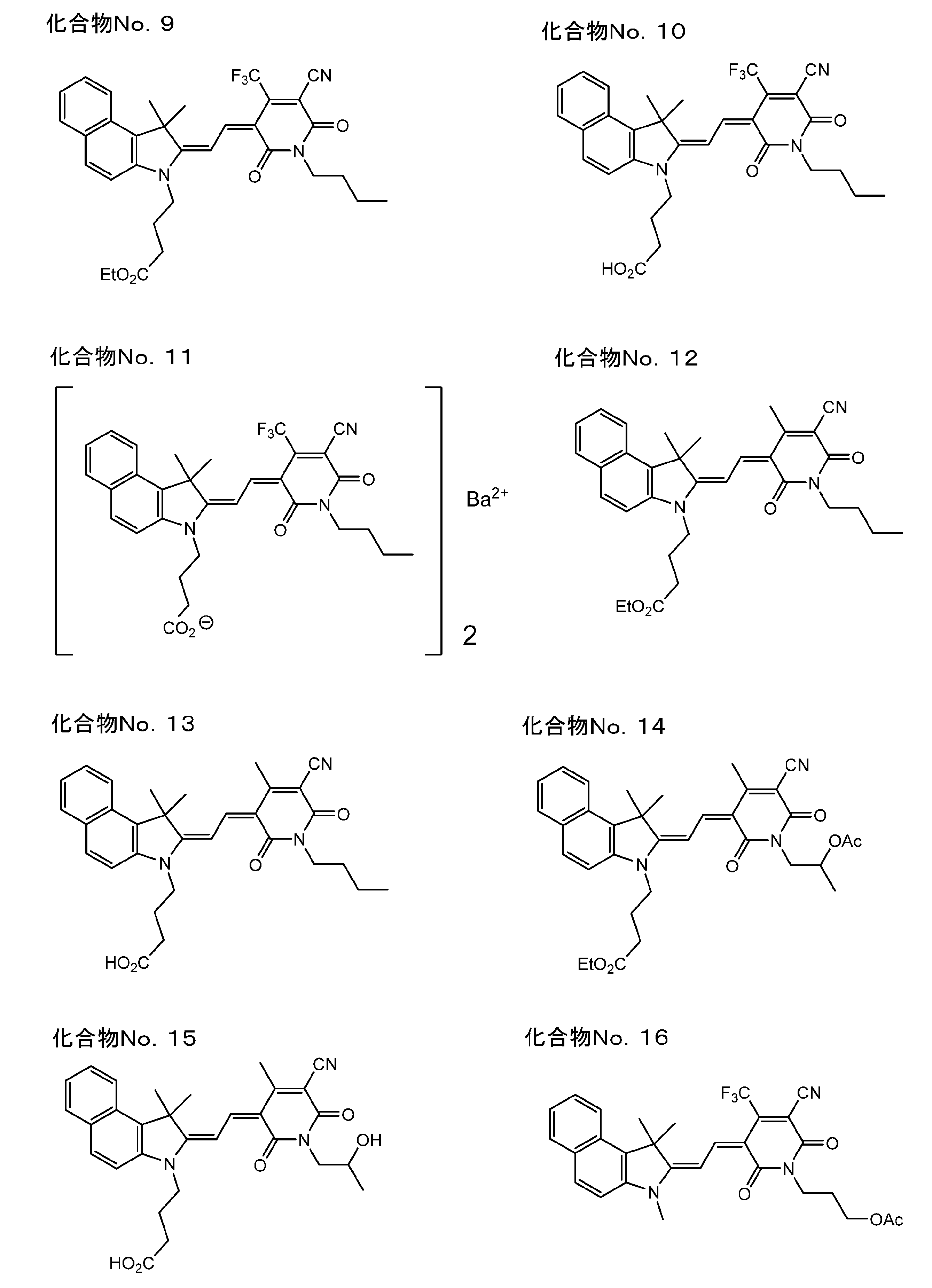


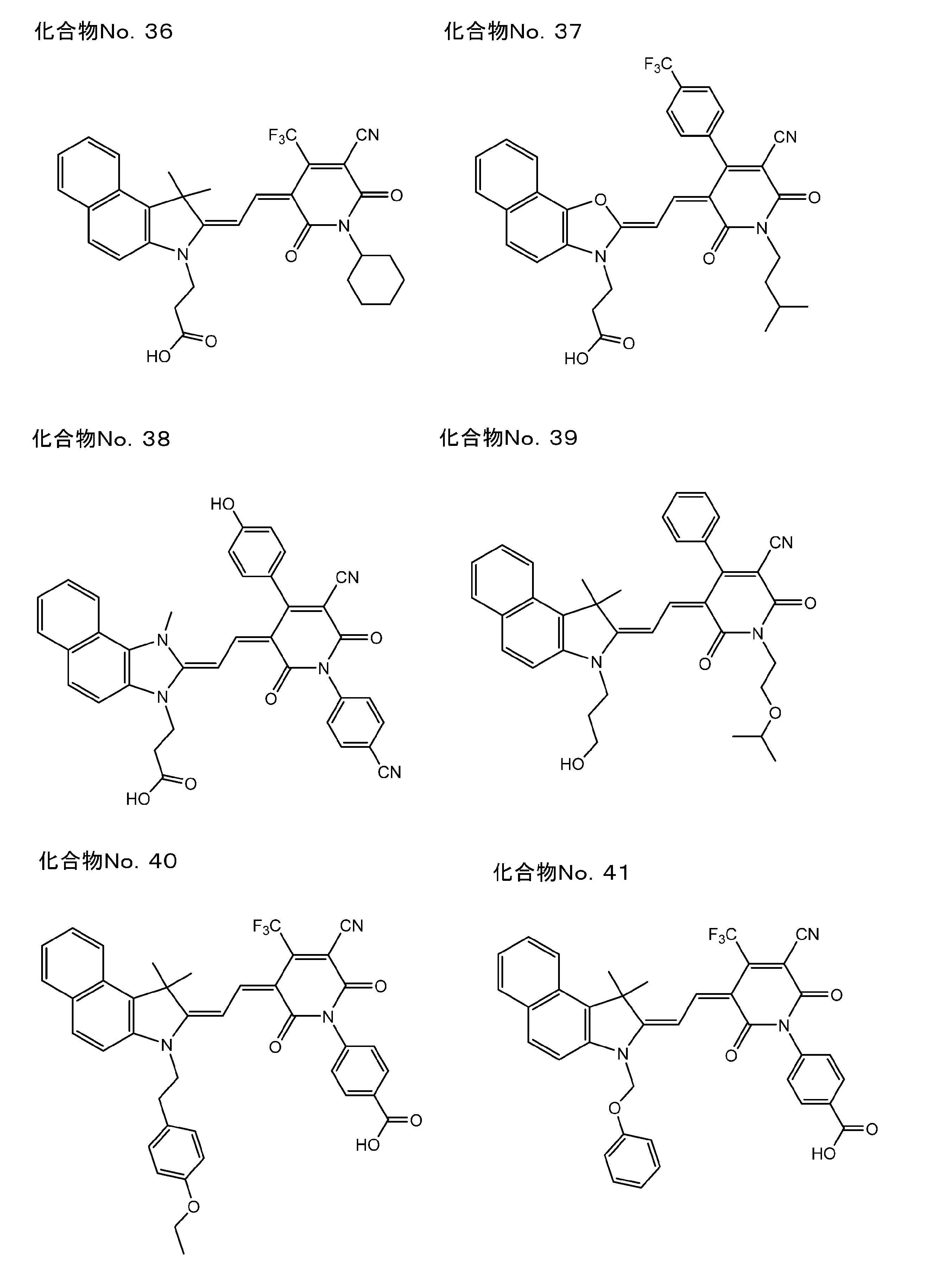


上記式(I)、(II)、(IIIα)、(IIIβ)及び(IIIγ)で表されるポリメチン化合物は、R4、R5、R7、R8、R9及びR10で表される基の少なくとも1つがニトロ基であることが好ましい。 The formula (I), (II), (IIIα), polymethine compounds represented by (IIIβ) and (IIIγ) is represented by R 4, R 5, R 7 , R 8, R 9 and R 10 It is preferred that at least one of the groups is a nitro group.
上記式(I)、(II)、(IIIα)、(IIIβ)及び(IIIγ)で表されるポリメチン化合物は、R1及びR6で表される基の少なくとも1つが、化合物の耐熱性が高いことから、酸性基を有した基であることが好ましい。上記酸性基としては、カルボキシ基、スルホ基、スルホンアミン基が好ましい。 The formula (I), (II), (IIIα), polymethine compounds represented by (IIIβ) and (IIIγ), at least one of the groups represented by R 1 and R 6, the high heat resistance of the compound Therefore, it is preferable that the group has an acidic group. As the acidic group, a carboxy group, a sulfo group, and a sulfoamine group are preferable.
上記式(I)、(II)、(IIIα)、(IIIβ)及び(IIIγ)で表されるポリメチン化合物は、R1及びR6で表される基の少なくとも1つが、化合物の溶剤へ溶解性が高いことから、分岐を有した基であることが好ましい。 The formula (I), (II), (IIIα), polymethine compounds represented by (IIIβ) and (IIIγ), at least one of the groups represented by R 1 and R 6, the solubility to a solvent of the compound Is high, so it is preferable that the group has a branch.
上記式(I)、(II)、(IIIα)、(IIIβ)及び(IIIγ)で表されるポリメチン化合物は、化合物の耐熱性や溶剤へ溶解性の観点から、R1で表される基が、炭素数1~20のアルキル基又は該アルキル基中のメチレン基の1つ又は2つ以上が-O-、-COO-又は-OCO-で置き換えられた基であることが好ましい。該アルキル基の炭素原子は1~10であることが好ましい。また、該アルキル基は、無置換であるか、或いは少なくとも一つの水素原子が水酸基又はカルボキシ基で置換されていることが好ましい。 The polymethine compounds represented by the above formulas (I), (II), (IIIα), (IIIβ) and (IIIγ) have a group represented by R 1 from the viewpoint of heat resistance of the compound and solubility in a solvent. , It is preferable that one or more of the alkyl group having 1 to 20 carbon atoms or the methylene group in the alkyl group is replaced with -O-, -COO- or -OCO-. The carbon atom of the alkyl group is preferably 1 to 10. Further, it is preferable that the alkyl group is unsubstituted or at least one hydrogen atom is substituted with a hydroxyl group or a carboxy group.
上記式(I)、(II)、(IIIα)、(IIIβ)及び(IIIγ)で表されるポリメチン化合物は、化合物の耐熱性や溶剤へ溶解性の観点から、R6で表される基が、炭素数1~20のアルキル基、炭素数7~30のアリールアルキル基、又は該アルキル基中のメチレン基若しくはアリールアルキル基のアルキル基中のメチレン基の1つ又は2つ以上が-O-、-COO-又は-OCO-で置き換えられた基であることが好ましい。該アルキル基の炭素原子は1~10であることが好ましい。該アルキル基及びアリールアルキル基は無置換であるか、或いは少なくとも一つの水素原子がカルボキシ基、スルホ基及びスルホンアミン基等の酸性基で置換されていることが好ましい。 The formula (I), (II), (IIIα), polymethine compounds represented by (IIIβ) and (IIIγ), in view of solubility to the heat resistance and solvent of the compound, a group represented by R 6 , An alkyl group having 1 to 20 carbon atoms, an arylalkyl group having 7 to 30 carbon atoms, or a methylene group in the alkyl group or one or more of methylene groups in the alkyl group of the arylalkyl group is -O- , -COO- or -OCO- is preferred. The carbon atom of the alkyl group is preferably 1 to 10. It is preferable that the alkyl group and the arylalkyl group are unsubstituted, or at least one hydrogen atom is substituted with an acidic group such as a carboxy group, a sulfo group and a sulfonic amine group.
上記式(I)、(II)、(IIIα)、(IIIβ)及び(IIIγ)で表されるポリメチン化合物は、R6が、下記式で表される基であることが好ましい。 The formula (I), (II), (IIIα), polymethine compounds represented by (IIIβ) and (IIIγ) is, R 6 is preferably a group represented by the following formula.

(式中の*は、*部分で隣接する基と結合することを意味する。) (* In the formula means that it is bonded to an adjacent group at the * part.)
上記式(I)、(II)、(IIIα)、(IIIβ)及び(IIIγ)で表されるポリメチン化合物は、R3が炭素数1~20のアルキル基又は炭素数6~30のアリール基であることが好ましく、炭素数1~20のアルキル基であることがより好ましい。該アルキル基の炭素原子数は1~4が好ましい。該アルキル基は無置換であるか、或いは水素原子が、ハロゲン原子、シアノ基、ニトロ基又はカルボキシ基で置換されていることが好ましく、無置換であるか、或いはハロゲン原子で置換されていることがより好ましい。また該アリール基は、炭素原子数1~4のハロゲン化アルキル基、ハロゲン原子、シアノ基、ニトロ基又はカルボキシ基で置換されていることが好ましい。 The formula (I), (II), (IIIα), polymethine compounds represented by (IIIβ) and (IIIγ) is, R 3 may be an aryl group an alkyl group or a C 6 to 30 1 to 20 carbon atoms It is preferably present, and more preferably an alkyl group having 1 to 20 carbon atoms. The alkyl group preferably has 1 to 4 carbon atoms. The alkyl group is preferably unsubstituted or the hydrogen atom is preferably substituted with a halogen atom, a cyano group, a nitro group or a carboxy group, and is unsubstituted or substituted with a halogen atom. Is more preferable. Further, the aryl group is preferably substituted with an alkyl halide group having 1 to 4 carbon atoms, a halogen atom, a cyano group, a nitro group or a carboxy group.
上記式(I)、(II)、(IIIα)、(IIIβ)及び(IIIγ)で表されるポリメチン化合物は、R3が下記式で表される基であることが好ましい。 The formula (I), (II), (IIIα), polymethine compounds represented by (IIIβ) and (IIIγ) is preferably R 3 is a group represented by the following formula.

式(I)、(II)(IIIα)、(IIIβ)及び(IIIγ)中のQが、―CR11R12-であることが好ましい。-CR11R12-としては、下記式で表される基が好ましい。 Formula (I), (II) ( IIIα), the Q in (IIIβ) and (IIIγ), -CR 11 R 12 - is preferably a. -CR 11 R 12 - as is preferably a group represented by the following formula.

(式中の*は、*部分で隣接する基と結合することを意味する。) (* In the formula means that it is bonded to an adjacent group at the * part.)
上記式(α)で表される連結基としては、下記式で表される基が好ましい。 As the linking group represented by the above formula (α), the group represented by the following formula is preferable.

(式中の*は、*部分で隣接する基と結合することを意味する。) (* In the formula means that it is bonded to an adjacent group at the * part.)
上記式(β)で表される連結基としては、下記式で表される基が好ましい。 As the linking group represented by the above formula (β), the group represented by the following formula is preferable.

(式中の*は、*部分で隣接する基と結合することを意味する。) (* In the formula means that it is bonded to an adjacent group at the * part.)
本発明の式(I)で表されるポリメチン化合物の中でも、上記式(II)で表されるポリメチン化合物は、吸収波長域がシャープなことから好ましい。 Among the polymethine compounds represented by the formula (I) of the present invention, the polymethine compound represented by the above formula (II) is preferable because it has a sharp absorption wavelength range.
本発明の式(I)で表されるポリメチン化合物の中でも、上記式(IIIα)、(IIIβ)及び(IIIγ)で表されるポリメチン化合物は、耐熱性が高いことから好ましい。 Among the polymethine compounds represented by the formula (I) of the present invention, the polymethine compounds represented by the above formulas (IIIα), (IIIβ) and (IIIγ) are preferable because they have high heat resistance.
式(I)、(II)、(IIIα)、(IIIβ)及び(IIIγ)中のR2がシアノ基であり、且つR3が炭素数1~5のアルキル基であるポリメチン化合物は、耐光性及び耐熱性にとりわけ優れることから好ましい。 Polymethine compounds in which R 2 in the formulas (I), (II), (IIIα), (IIIβ) and (IIIγ) is a cyano group and R 3 is an alkyl group having 1 to 5 carbon atoms are light resistant. It is preferable because it is particularly excellent in heat resistance.
式(I)、(II)、(IIIα)、(IIIβ)及び(IIIγ)中のQが、―CR11R12-であるポリメチン化合物は、耐光性及び耐熱性にとりわけ優れることから好ましい。R11及びR12は、それぞれ独立に、炭素数1~20のアルキル基が好ましく、炭素数1~10のアルキル基であることがより好ましく、炭素数1~4のアルキル基であることが更に好ましい。当該アルキル基は無置換であることが好ましい。 A polymethine compound in which Q in the formulas (I), (II), (IIIα), (IIIβ) and (IIIγ) is −CR 11 R 12 − is particularly preferable because it has excellent light resistance and heat resistance. R 11 and R 12 are each independently preferably an alkyl group having 1 to 20 carbon atoms, more preferably an alkyl group having 1 to 10 carbon atoms, and further preferably an alkyl group having 1 to 4 carbon atoms. preferable. The alkyl group is preferably unsubstituted.
式(I)、(II)、(IIIα)、(IIIβ)及び(IIIγ)中のR1、R2、R3、R4、R6、R7、R8、R9及びR10で表される基のうちの1つ以上がカルボキシ基若しくはニトロ基であるポリメチン化合物は、耐光性及び耐熱性にとりわけ優れることから好ましい。
式(I)、(II)、(IIIα)、(IIIβ)及び(IIIγ)中のR1、R2、R3、R4、R6、R7、R8、R9及びR10で表される基中の水素原子の1つ以上がカルボキシ基若しくはニトロ基で置換されているポリメチン化合物は、耐光性及び耐熱性にとりわけ優れることから好ましい。
Table formula (I), (II), (IIIα), (IIIβ) and R 1 in (IIIγ), R 2, R 3, R 4, R 6, R 7, R 8, R 9 and R 10 A polymethine compound in which one or more of the groups to be formed is a carboxy group or a nitro group is particularly preferable because it is particularly excellent in light resistance and heat resistance.
Table formula (I), (II), (IIIα), (IIIβ) and R 1 in (IIIγ), R 2, R 3, R 4, R 6, R 7, R 8, R 9 and R 10 A polymethine compound in which one or more hydrogen atoms in the group to be formed is substituted with a carboxy group or a nitro group is particularly preferable because it has excellent light resistance and heat resistance.
上記式(I)、(II)、(IIIα)、(IIIβ)及び(IIIγ)中のR2がシアノ基であるポリメチン化合物は、耐光性及び耐熱性にとりわけ優れることから好ましい。 The polymethine compound in which R 2 in the above formulas (I), (II), (IIIα), (IIIβ) and (IIIγ) is a cyano group is particularly preferable because it has excellent light resistance and heat resistance.
上記式(I)、(II)、(IIIα)、(IIIβ)及び(IIIγ)中のR2がアルキル基又はハロゲン化アルキル基であるポリメチン化合物は、耐光性及び耐熱性に優れることから好ましい。R2がトリフルオロメチル基であるものは、耐光性及び耐熱性にとりわけ優れることから好ましい。 Polymethine compounds in which R 2 in the above formulas (I), (II), (IIIα), (IIIβ) and (IIIγ) is an alkyl group or an alkyl halide group are preferable because they are excellent in light resistance and heat resistance. R 2 is a trifluoromethyl group is preferred because especially excellent light resistance and heat resistance.
上記式(I)、(II)、(IIIα)、(IIIβ)及び(IIIγ)中のR7、R8及びR10の少なくとも1つが水素原子であることが好ましく、全てが水素原子であることがより好ましい。 It is preferable that at least one of R 7 , R 8 and R 10 in the above formulas (I), (II), (IIIα), (IIIβ) and (IIIγ) is a hydrogen atom, and all of them are hydrogen atoms. Is more preferable.
上記式(I)で表される本発明のポリメチン化合物は、その製造方法によって特に限定されず、周知一般の反応を利用した方法で得ることができる。該化合物は、例えばm=1の場合、下記反応式1の如く、特定のインドレニン四級塩とピリドン体とをN-メチルモルホリン(以下、NMMとも記載)、及び無水酢酸(以下、Ac2Oとも記載)存在下で反応させる方法により合成することができる。 The polymethine compound of the present invention represented by the above formula (I) is not particularly limited by the production method thereof, and can be obtained by a method utilizing a well-known general reaction. For example, when m = 1, the compound contains a specific indrenin quaternary salt and a pyridone compound as N-methylmorpholine (hereinafter, also referred to as NMM) and acetic anhydride (hereinafter, Ac 2 ) as shown in Reaction Scheme 1 below. (Also described as O) It can be synthesized by a method of reacting in the presence.

(式中、R1~R10及びQは、上記式(I)と同じであり、An-は一価のアニオンを表す。) (In the formula, R 1 to R 10 and Q are the same as those in the above formula (I), and An − represents a monovalent anion.)
また、m=2であり、Aが上記式(I)中のR1の位置に結合している場合、下記反応式2の如く、特定のインドレニン四級塩とR1同士が架橋されたピリドン体の2量体をNMM、及びAc2O存在下で反応させる方法により合成することができる。 Further, when m = 2 and A is bound to the position of R 1 in the above formula (I), a specific indrenin quaternary salt and R 1 are crosslinked as shown in the following reaction formula 2. The pyridone dimer can be synthesized by a method of reacting in the presence of NMM and Ac 2 O.

(式中、A、R1~R10及びQは、上記式(I)と同じであり、An-は一価のアニオンを表す。) (In the formula, A, R 1 to R 10 and Q are the same as in the above formula (I), and An − represents a monovalent anion.)
本発明のポリメチン化合物は、光吸収剤、増感剤等として、感光写真材料、染物、塗料、インク、電子写真感光体、トナー、感熱記録紙、転写リボン、光学記録色素、太陽電池、光電変換素子、半導体材料、臨床検査試薬、レーザー治療用色素、染色等の用途に用いることができる。 The polymethine compound of the present invention can be used as a light absorber, sensitizer, etc. as a photosensitive photographic material, dyeing material, paint, ink, electrophotographic photosensitive member, toner, thermal recording paper, transfer ribbon, optical recording dye, solar cell, photoelectric conversion. It can be used for devices, semiconductor materials, clinical test reagents, dyes for laser treatment, dyeing, and the like.
本発明の組成物は、本発明のポリメチン化合物を含有するものであり、上記の各種用途に用いられる。本発明の組成物は、通常、本発明のポリメチン化合物の他に、用途に応じた樹脂を含有する。
本発明の組成物には、その他に、用途に応じて必要な成分や、例えば、後述する有機溶媒、本発明のポリメチン化合物以外の光吸収剤、各種安定剤等の任意成分等を、更に必要量含有させることができる。
本発明の組成物において、本発明のポリメチン化合物及び上記樹脂等の使用量は特に制限されず、用途に応じて適宜決定される。
The composition of the present invention contains the polymethine compound of the present invention and is used for the above-mentioned various uses. The composition of the present invention usually contains, in addition to the polymethine compound of the present invention, a resin suitable for use.
In addition, the composition of the present invention further requires components necessary depending on the intended use, for example, an organic solvent described later, a light absorber other than the polymethine compound of the present invention, optional components such as various stabilizers, and the like. It can be contained in an amount.
In the composition of the present invention, the amount of the polymethine compound of the present invention and the above resin used is not particularly limited, and is appropriately determined according to the intended use.
以下、実施例及び比較例を挙げて本発明を更に詳細に説明するが、本発明はこれらの実施例等に限定されるものではない。 Hereinafter, the present invention will be described in more detail with reference to Examples and Comparative Examples, but the present invention is not limited to these Examples and the like.
[製造例1-1]ピリドン体1の合成
室温にて、ブチルアミン(6.0g、82.0mmol)とシアノ酢酸エチル(11.1g、98.4mmol)とを混合し、窒素雰囲気下70℃へ加熱、2時間攪拌した。エチルアセトアセテート(15.0g、114.9mmol)とピペリジン(7.7g、90.2mmol)とを滴下し、100℃へ加熱、8時間攪拌した。反応溶液を室温まで冷却した後、塩酸(12.8g、123.1mmol)に注ぎ、1時間攪拌した。析出した白色結晶を濾過し、9.9g(収率58.7%)の下記に記載のピリドン体1を得た。
[Production Example 1-1] Synthesis of pyridone form 1 At room temperature, butylamine (6.0 g, 82.0 mmol) and ethyl cyanoacetate (11.1 g, 98.4 mmol) are mixed and brought to 70 ° C. under a nitrogen atmosphere. The mixture was heated and stirred for 2 hours. Ethylacetacetate (15.0 g, 114.9 mmol) and piperidine (7.7 g, 90.2 mmol) were added dropwise, heated to 100 ° C., and stirred for 8 hours. After cooling the reaction solution to room temperature, it was poured into hydrochloric acid (12.8 g, 123.1 mmol) and stirred for 1 hour. The precipitated white crystals were filtered to obtain 9.9 g (yield 58.7%) of the pyridone compound 1 described below.

[製造例1-2]ピリドン体2の合成
製造例1-1のブチルアミンを1,6-ジアミノヘキサンに変え、同様の操作を行い、収率63.6%で下記ピリドン体2を得た。
[Production Example 1-2] Synthesis of pyridone compound 2 The butylamine of Production Example 1-1 was changed to 1,6-diaminohexane, and the same operation was carried out to obtain the following pyridone compound 2 in a yield of 63.6%.

[製造例1-3] ピリドン体3の合成
製造例1-1のエチルアセトアセテートを4,4,4-トリフルオロアセト酢酸エチルに変え、同様の操作を行い、収率42.2%で下記ピリドン体3を得た。
[Production Example 1-3] Synthesis of pyridone compound 3 The ethyl acetoacetate of Production Example 1-1 was changed to ethyl 4,4,4-trifluoroacetoacetate, and the same operation was carried out. Obtained pyridone form 3.

[製造例1-4]ピリドン体4の合成
製造例1-1のブチルアミンをDL-1-アミノ-2-プロパノールに変え同様の操作を行い、収率57.6%で下記ピリドン体4を得た。
[Production Example 1-4] Synthesis of pyridone compound 4 The butylamine of Production Example 1-1 was changed to DL-1-amino-2-propanol and the same operation was carried out to obtain the following pyridone compound 4 in a yield of 57.6%. It was.

[製造例1-5]ピリドン体5の合成
製造例1-1のブチルアミンを3-アミノ-1-プロパノールに変え同様の操作を行い、収率40.0%で下記ピリドン体5を得た。
[Production Example 1-5] Synthesis of pyridone compound 5 The butylamine of Production Example 1-1 was changed to 3-amino-1-propanol and the same operation was carried out to obtain the following pyridone compound 5 in a yield of 40.0%.
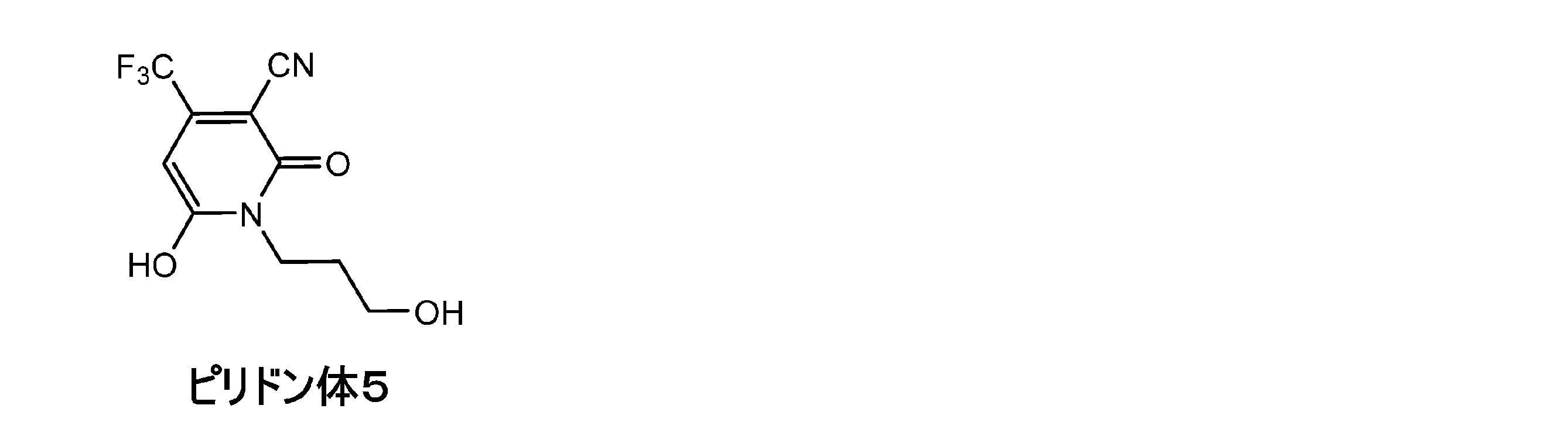
[製造例1-6]ピリドン体6の合成
製造例1-1のブチルアミンをグリシンエチル塩酸塩に変え同様の操作を行い、収率67.6%で下記ピリドン体6を得た。
[Production Example 1-6] Synthesis of pyridone compound 6 The butylamine of Production Example 1-1 was changed to glycine ethyl hydrochloride and the same operation was carried out to obtain the following pyridone compound 6 in a yield of 67.6%.

[製造例1-7]ピリドン体7の合成
製造例1-1のブチルアミンを2-エチルヘキシルアミンに変え同様の操作を行い、収率78.3%で下記ピリドン体7を得た。
[Production Example 1-7] Synthesis of pyridone compound 7 The butylamine of Production Example 1-1 was changed to 2-ethylhexylamine and the same operation was carried out to obtain the following pyridone compound 7 in a yield of 78.3%.

[製造例1-8]ピリドン体8の合成
製造例1-1のブチルアミンを3-(2-エチルヘキシルオキシ)プロピルアミンに変え同様の操作を行い、収率67.6%で下記ピリドン体8を得た。
[Production Example 1-8] Synthesis of pyridone compound 8 The butylamine of Production Example 1-1 was changed to 3- (2-ethylhexyloxy) propylamine and the same operation was carried out to obtain the following pyridone compound 8 in a yield of 67.6%. Obtained.

[製造例2-1] インドレニン四級塩1の合成
室温にて公知の下記ベンゾインドレニン四級塩(22.7g、30.0mmol)とN,N’-ジフェニルホルムアミジン(11.8g、60.0mmol)とをDMAcに溶解し、110℃で4時間攪拌した。再度N,N’-ジフェニルホルムアミジン(7.4g、37.5mmol)を追加し、110℃で4時間反応後、水(2.2g)を加えて反応を停止した。析出した結晶を酢酸エチルで晶析し、収率49.0%)で下記インドレニン四級塩1を得た。
[Production Example 2-1] Synthesis of indorenin quaternary salt 1 The following benzoindrenin quaternary salt (22.7 g, 30.0 mmol) known at room temperature and N, N'-diphenylform amidine (11.8 g, 60.0 mmol) was dissolved in DMAc and stirred at 110 ° C. for 4 hours. N, N'-diphenylform amidine (7.4 g, 37.5 mmol) was added again, the reaction was carried out at 110 ° C. for 4 hours, and then water (2.2 g) was added to terminate the reaction. The precipitated crystals were crystallized from ethyl acetate, and the yield was 49.0%) to obtain the following indrenin quaternary salt 1.

[製造例2-2]インドレニン四級塩3の合成
公知の下記インドレニン四級塩2(30.8g、147.0mmol)とジヨードヘキサン(2.38g、70.0mmol)とをDMAc(53.0g)に溶解し、110℃で4時間攪拌した。50℃まで温度低下後、アセトン(105g)で晶析し、37.9g(収率71.5%)で下記インドレニン四級塩3を得た。
[Production Example 2-2] Synthesis of indorenin quaternary salt 3 The following indorenin quaternary salt 2 (30.8 g, 147.0 mmol) and diiodohexane (2.38 g, 70.0 mmol) are added to DMAc (30.8 g, 147.0 mmol). It was dissolved in 53.0 g) and stirred at 110 ° C. for 4 hours. After the temperature was lowered to 50 ° C., it was crystallized from acetone (105 g) to obtain the following indrenin quaternary salt 3 at 37.9 g (yield 71.5%).

[製造例2-3]インドレニン四級塩5の合成
製造例2-1のインドレニン四級塩2を公知の下記インドレニン四級塩4に変え同様の操作を行い、定量的に下記インドレニン四級塩5を得た。
[Production Example 2-3] Synthesis of indorenin quaternary salt 5 The indorenin quaternary salt 2 of production example 2-1 was changed to the following indorenin quaternary salt 4 known and the same operation was performed, and the following India was quantitatively performed. Renin quaternary salt 5 was obtained.

[製造例2-4]インドレニン四級塩7の合成
製造例2-1のインドレニン四級塩2を公知の下記インドレニン四級塩6に変え同様の操作を行い、定量的に下記インドレニン四級塩7を得た。
[Production Example 2-4] Synthesis of indorenin quaternary salt 7 The indorenin quaternary salt 2 of production example 2-1 was changed to the following indorenin quaternary salt 6 known, and the same operation was performed to quantitatively describe the following India. Renin quaternary salt 7 was obtained.
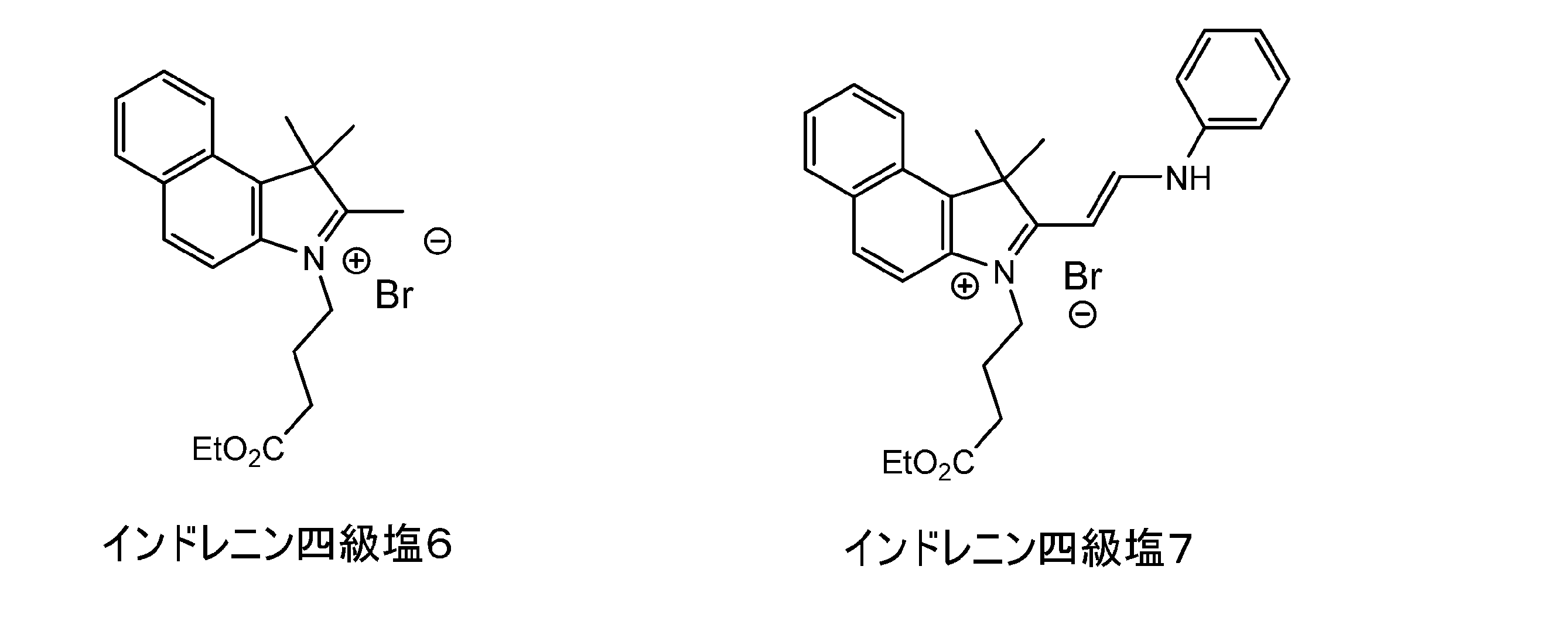
[製造例2-5]インドレニン四級塩8の合成
室温にてニトロインドレニン(70mmol)とβ-ブロモフェネトール(84mmol)とをDMAc(53g)に溶解し、110℃で4時間加熱した。反応終了後クロロホルムと過塩素酸ナトリウム(70mmol)の水溶液を追加し、油水分離した。有機層を濃縮し、収率85%で下記インドレニン四級塩8を得た。
[Production Example 2-5] Synthesis of indorenin quaternary salt 8 Nitroindrenin (70 mmol) and β-bromophenetol (84 mmol) were dissolved in DMAc (53 g) at room temperature and heated at 110 ° C. for 4 hours. .. After completion of the reaction, an aqueous solution of chloroform and sodium perchlorate (70 mmol) was added, and oil-water separation was performed. The organic layer was concentrated to obtain the following indrenin quaternary salt 8 in a yield of 85%.

[製造例2-6]インドレニン四級塩9の合成
製造例2-1のインドレニン四級塩2を上記インドレニン四級塩8に変え同様の操作を行い、定量的に下記インドレニン四級塩9を得た。
[Production Example 2-6] Synthesis of Indorenin Quarter Salt 9 The indorenin quaternary salt 2 of Production Example 2-1 was changed to the above indorenin quaternary salt 8 and the same operation was performed, and the following indorenin quaternary salt 4 was quantitatively performed. Grade salt 9 was obtained.

[製造例2-7]インドレニンエステル1の合成
室温にてニトロインドレニン(70.0mmol)と4-ブロモプロピオン酸エチル(84.0mmol)とをDMAc(53.0g)に溶解し、110℃で4時間攪拌した。50℃まで温度低下後、アセトン(105g)で晶析し、収率91.6%で下記インドレニンエステル1を得た。
[Production Example 2-7] Synthesis of indorenin ester 1 At room temperature, nitroindrenin (70.0 mmol) and ethyl 4-bromopropionate (84.0 mmol) were dissolved in DMAc (53.0 g), and the temperature was 110 ° C. Was stirred for 4 hours. After the temperature was lowered to 50 ° C., it was crystallized from acetone (105 g) to obtain the following indrenin ester 1 in a yield of 91.6%.
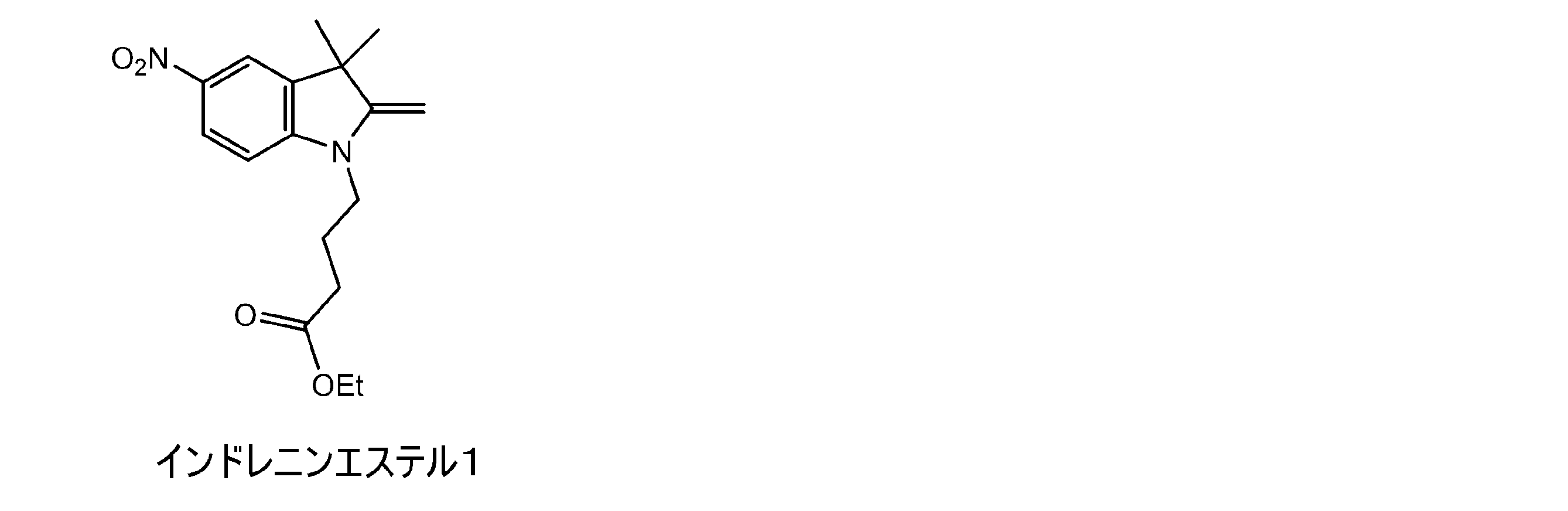
[製造例2-8] インドレニンエステル2の合成
製造例2-1のインドレニン四級塩2を上記インドレニンエステル1に変え同様の操作を行い、定量的に下記インドレニンエステル2を得た。
[Production Example 2-8] Synthesis of Indorenin Ester 2 The indorenin quaternary salt 2 of Production Example 2-1 was changed to the indorenin ester 1 and the same operation was carried out to quantitatively obtain the following indorenin ester 2. ..

〔実施例1〕化合物No.1の合成
室温にて、上記ピリドン体1(1.8g、8.8mmol)とインドレニン四級塩1(4.0g、8.8mmol)とをDMAc(21.0g)に溶解し、70℃で1時間攪拌した。ついでN-メチルモルホリン(1.8g、17.6mmol)と無水酢酸(7.7g)とを追加し、窒素雰囲気下50℃で1時間攪拌した。室温まで冷却した後、析出した赤色粗結晶を濾過した。粗結晶をMeOHに分散し、1時間攪拌した。結晶を濾過し、減圧乾燥後、2.0g(収率51.2%)で下記化合物No.1を得た。
[Example 1] Compound No. Synthesis of 1 At room temperature, the above pyridone compound 1 (1.8 g, 8.8 mmol) and indorenin quaternary salt 1 (4.0 g, 8.8 mmol) were dissolved in DMAc (21.0 g), and the temperature was 70 ° C. Was stirred for 1 hour. Then, N-methylmorpholine (1.8 g, 17.6 mmol) and acetic anhydride (7.7 g) were added, and the mixture was stirred at 50 ° C. for 1 hour under a nitrogen atmosphere. After cooling to room temperature, the precipitated red crude crystals were filtered. The crude crystals were dispersed in MeOH and stirred for 1 hour. The crystals were filtered, dried under reduced pressure, and then 2.0 g (yield 51.2%) of the following compound No. I got 1.

〔実施例2〕化合物No.2の合成
実施例1のインドレニン四級塩1を上記インドレニン四級塩3に変え同様の操作を行い、収率27.9%で下記化合物No.2を得た。
[Example 2] Compound No. Synthesis of 2 The indorenin quaternary salt 1 of Example 1 was changed to the indorenin quaternary salt 3 and the same operation was carried out, and the yield was 27.9%. I got 2.

〔実施例3〕化合物No.3の合成
実施例1のピリドン体1を上記ピリドン体2に変え同様の操作を行い、収率38.4%で下記化合物No.3を得た。
[Example 3] Compound No. Synthesis of No. 3 The pyridone compound 1 of Example 1 was changed to the pyridone compound 2 and the same operation was performed. The yield of the following compound No. 3 was 38.4%. I got 3.

〔実施例4〕化合物No.4の合成
室温にて、上記化合物No.1(2.6g、6.4mmol)を濃硫酸(11.9g)に溶解し、95℃で2時間攪拌した。反応液を氷水に注ぎ、析出した赤色結晶を濾過し、2.1g(収率76.4%)の下記化合物No.4を得た。
[Example 4] Compound No. Synthesis of compound No. 4 at room temperature. 1 (2.6 g, 6.4 mmol) was dissolved in concentrated sulfuric acid (11.9 g), and the mixture was stirred at 95 ° C. for 2 hours. The reaction solution was poured into ice water, and the precipitated red crystals were filtered to obtain 2.1 g (yield 76.4%) of the following compound No. I got 4.

〔実施例5〕化合物No.5の合成
室温にて、上記化合物No.4(1.8g、4.2mmol)をイオン交換水(181.0g)で分散し10分攪拌した後、5.3M水酸化ナトリウム水溶液(0.8g)を加え30分攪拌した。反応溶液をDFP濾過後、0.8M塩化バリウム水溶液(2.4g)を滴下し、1時間攪拌した。析出した赤色結晶を濾過し、1.2g(収率62.6%)の化合物No.5を得た。
[Example 5] Compound No. Synthesis of Compound No. 5 at room temperature. 4 (1.8 g, 4.2 mmol) was dispersed in ion-exchanged water (181.0 g) and stirred for 10 minutes, followed by the addition of 5.3 M aqueous sodium hydroxide solution (0.8 g) and stirring for 30 minutes. After DFP filtration of the reaction solution, a 0.8 M aqueous barium chloride solution (2.4 g) was added dropwise, and the mixture was stirred for 1 hour. The precipitated red crystals were filtered to obtain 1.2 g (yield 62.6%) of Compound No. I got 5.

〔実施例6〕化合物No.6の合成
実施例1のピリドン体1を上記ピリドン体3に変え同様の操作を行い、収率52.4%で下記化合物No.6を得た。
[Example 6] Compound No. Synthesis of No. 6 The pyridone compound 1 of Example 1 was changed to the pyridone compound 3 and the same operation was performed. The yield of the following compound No. 6 was 52.4%. I got 6.

〔実施例7〕化合物No.7の合成
実施例1のピリドン体1を上記ピリドン体3に、インドレニン四級塩1を上記インドレニン四級塩5に変え同様の操作を行い、収率15.8%で下記化合物No.7を得た。
[Example 7] Compound No. Synthesis of Example 1 The pyridone form 1 of Example 1 was changed to the pyridone form 3 and the indorenin quaternary salt 1 was changed to the indorenin quaternary salt 5, and the same operation was carried out. I got 7.

〔実施例8〕化合物No.8の合成
トルエン(2.16g)とナトリウムメトキシドの5Mメタノール溶液(2.6mL、1.3mmol)とを混合し、氷冷下にて上記化合物No.7(0.76g、1.3mmol)を数回に分けて添加した。同温度で4時間攪拌後、2N塩酸を滴下して加えた。1時間攪拌後、析出した結晶を濾過した。この結晶にトルエンを加え室温で30分間洗浄後、再び結晶を濾過し、下記化合物No.8を0.56g(収率78.0%)得た。
[Example 8] Compound No. Synthesis of No. 8 Toluene (2.16 g) and a 5 M methanol solution of sodium methoxide (2.6 mL, 1.3 mmol) were mixed, and the above compound No. 2 was cooled under ice. 7 (0.76 g, 1.3 mmol) was added in several portions. After stirring at the same temperature for 4 hours, 2N hydrochloric acid was added dropwise. After stirring for 1 hour, the precipitated crystals were filtered. Toluene was added to the crystals, washed at room temperature for 30 minutes, and then the crystals were filtered again to obtain the following compound No. 8 was obtained in an amount of 0.56 g (yield 78.0%).

〔実施例9〕化合物No.9の合成
実施例1のピリドン体1をピリドン体3に変え、インドレニン四級塩1をインドレニン四級塩7に変え同様の操作を行い、収率10%で下記化合物No.9を得た。
[Example 9] Compound No. Synthesis of No. 9 The pyridone form 1 of Example 1 was changed to the pyridone form 3, the indorenin quaternary salt 1 was changed to the indorenin quaternary salt 7, and the same operation was carried out. I got 9.

〔実施例10〕化合物No.10の合成
実施例8で用いた化合物No.7を化合物No.9に変え、同様の操作を行い、収率84.8%で下記化合物No.10を得た。
[Example 10] Compound No. Synthesis of Compound No. 10 used in Example 8. 7 is compound No. After changing to 9, the same operation was carried out, and the yield was 84.8%. I got 10.

〔実施例11〕化合物No.11の合成
実施例5で用いた化合物No.4を化合物No.10に変え、同様の操作を行い、収率91.3%で下記化合物No.11を得た。
[Example 11] Compound No. Synthesis of No. 11 Compound No. 11 used in Example 5. No. 4 is compound No. After changing to 10, the same operation was carried out, and the yield was 91.3%. I got 11.

〔実施例12〕化合物No.12の合成
実施例1のインドレニン四級塩1をインドレニン四級塩7に変え同様の操作を行い、収率40%で下記化合物No.12を得た。
[Example 12] Compound No. Synthesis of 12 The indorenin quaternary salt 1 of Example 1 was changed to the indorenin quaternary salt 7 and the same operation was carried out. I got twelve.
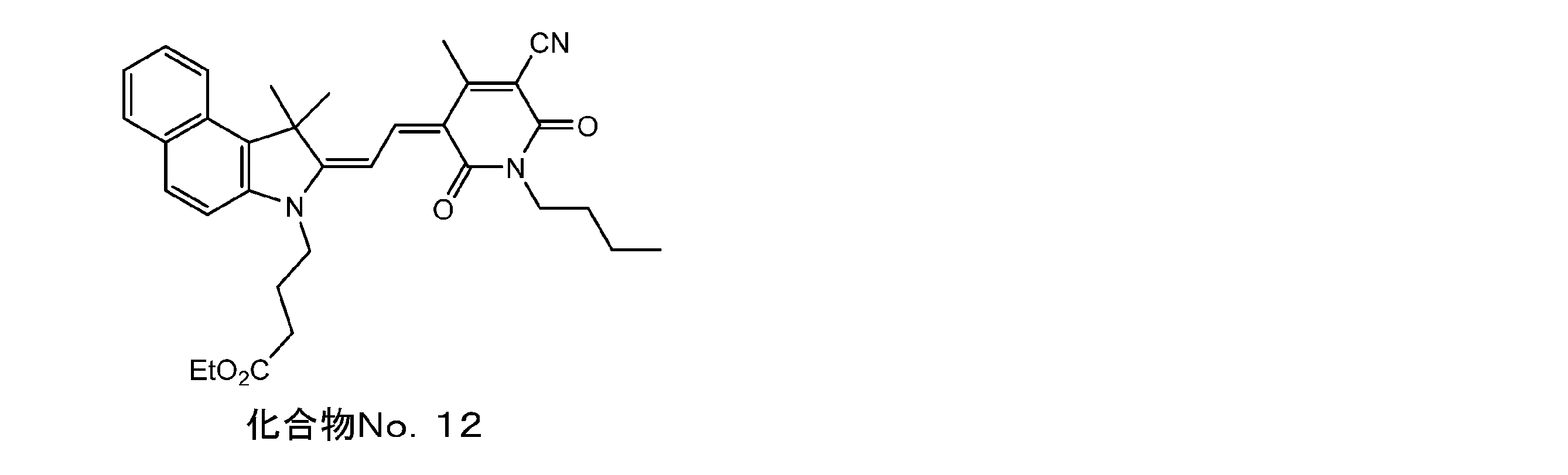
〔実施例13〕化合物No.13の合成
実施例8で用いた化合物No.7を化合物No.12に変え、同様の操作を行い、収率85.0%で下記化合物No.13を得た。
[Example 13] Compound No. Synthesis of 13 Compound No. 1 used in Example 8. 7 is compound No. After changing to 12, the same operation was carried out, and the yield was 85.0%. I got 13.

〔実施例14〕化合物No.14の合成
実施例1のピリドン体1をピリドン体4に変え、インドレニン四級塩1をインドレニン四級塩7に変え同様の操作を行い、収率36.2%で下記化合物No.14を得た。
[Example 14] Compound No. Synthesis of 14 The pyridone form 1 of Example 1 was changed to the pyridone form 4, the indorenin quaternary salt 1 was changed to the indorenin quaternary salt 7, and the same operation was performed. The yield of the following compound No. 36.2% was obtained. I got 14.

〔実施例15〕化合物No.15の合成
実施例8で用いた化合物No.7を化合物No.14に変え、同様の操作を行い、収率15.2%で下記化合物No.15を得た。
[Example 15] Compound No. Synthesis of 15 Compound No. 1 used in Example 8. 7 is compound No. After changing to 14, the same operation was carried out, and the yield was 15.2%. I got 15.

〔実施例16〕化合物No.16の合成
実施例1のピリドン体1をピリドン体5に変え同様の操作を行い、収率17.1%で下記化合物No.16を得た。
[Example 16] Compound No. Synthesis of 16 The pyridone compound 1 of Example 1 was changed to the pyridone compound 5 and the same operation was carried out. I got 16.
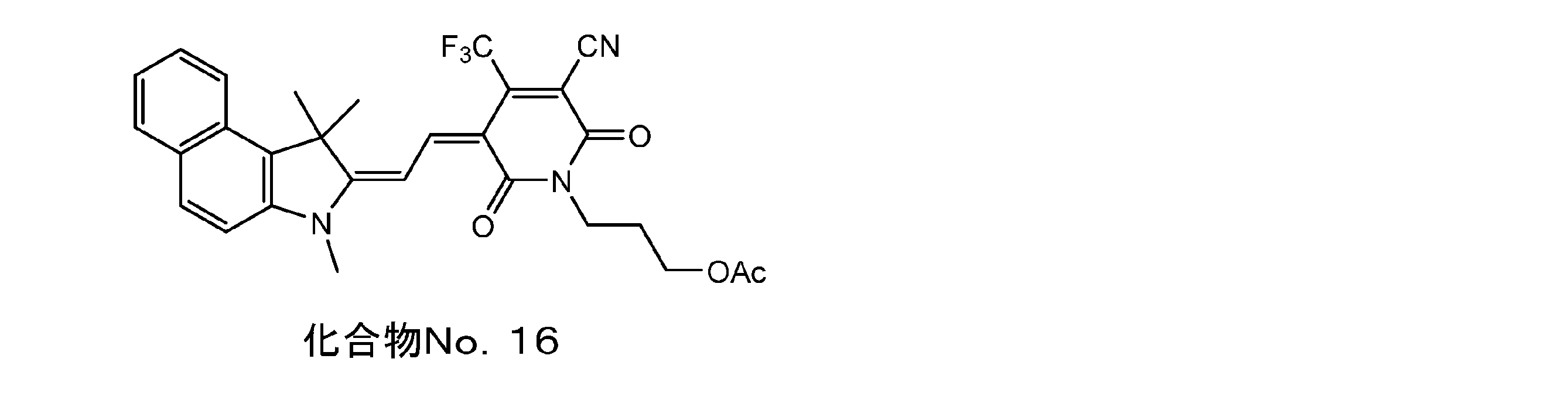
〔実施例17〕化合物No.17の合成
実施例8で用いた化合物No.7を化合物No.16に変え、同様の操作を行い、収率15.2%で下記化合物No.17を得た。
[Example 17] Compound No. Synthesis of No. 17 Compound No. 17 used in Example 8. 7 is compound No. After changing to 16, the same operation was carried out, and the yield was 15.2%. I got 17.

〔実施例18〕化合物No.18の合成
化合物No.17(2.4g、4.8mmol)、無水コハク酸(1.2g、5.8mmol)及びDMAP(0.1g、1.2mmol)をピリジン(4.8g)に溶解し、60℃で1時間半攪拌した。HPLCにて原料の消失を確認後、室温まで冷却し、クロロホルムと2N塩酸を加えてpHを4に調整した。抽出後、有機層を2N塩酸で2回、水で2回洗浄した。有機層を硫酸ナトリウムで乾燥後、濾過、減圧濃縮し、粗生成物を得た。粗生成物を水(24g)で分散後、濾過、減圧乾燥し、化合物No.18を2.2g(収率76.2%)得た。
[Example 18] Compound No. 18 Synthetic Compound No. 17 (2.4 g, 4.8 mmol), succinic anhydride (1.2 g, 5.8 mmol) and DMAP (0.1 g, 1.2 mmol) were dissolved in pyridine (4.8 g) and at 60 ° C. for 1 hour. Semi-stirred. After confirming the disappearance of the raw material by HPLC, the mixture was cooled to room temperature, and chloroform and 2N hydrochloric acid were added to adjust the pH to 4. After extraction, the organic layer was washed twice with 2N hydrochloric acid and twice with water. The organic layer was dried over sodium sulfate, filtered, and concentrated under reduced pressure to obtain a crude product. The crude product was dispersed in water (24 g), filtered, dried under reduced pressure, and compound No. 2.2 g (yield 76.2%) of 18 was obtained.

〔実施例19〕化合物No.19の合成
実施例1のインドレニン四級塩1をインドレニン四級塩9に変え同様の操作を行い、収率60.0%で下記化合物No.19を得た。
[Example 19] Compound No. Synthesis of 19 The indorenin quaternary salt 1 of Example 1 was changed to an indorenin quaternary salt 9 and the same operation was carried out. I got 19.

〔実施例20〕化合物No.20の合成
実施例1のピリドン体1をピリドン体4に変え、インドレニン四級塩1をインドレニン四級塩9に変え同様の操作を行い、収率69.2%で下記化合物No.20を得た。
[Example 20] Compound No. Synthesis of 20 The pyridone form 1 of Example 1 was changed to the pyridone form 4, the indorenin quaternary salt 1 was changed to the indorenin quaternary salt 9, and the same operation was performed. The yield of the following compound No. 69.2% was obtained. I got 20.

〔実施例21〕化合物No.21の合成
実施例8で用いた化合物No.7を化合物No.20に変え、同様の操作を行い、収率92.7%で下記化合物No.21を得た。
[Example 21] Compound No. Synthesis of No. 21 Compound No. 21 used in Example 8. 7 is compound No. After changing to 20, the same operation was carried out, and the yield was 92.7%. I got 21.

〔実施例22〕化合物No.22の合成
実施例18で用いた化合物No.17を化合物No.21に変え、同様の操作を行い、収率79・6%で下記化合物No.22を得た。
[Example 22] Compound No. Synthesis of 22 Compound No. 22 used in Example 18. 17 is compound No. After changing to 21, the same operation was carried out, and the yield was 79.6%. 22 was obtained.

〔実施例23〕化合物No.23の合成
実施例1のインドレニン四級塩1を上記インドレニンエステル2に変え同様の操作を行い、収率60.0%で下記化合物No.23を得た。
[Example 23] Compound No. Synthesis of 23 The indorenin quaternary salt 1 of Example 1 was changed to the indorenin ester 2 and the same operation was carried out. I got 23.

〔実施例24〕化合物No.24の合成
実施例8で用いた化合物No.7を化合物No.23に変え、同様の操作を行い、収率85.0%で下記化合物No.24を得た。
[Example 24] Compound No. Synthesis of 24 Compound No. 2 used in Example 8. 7 is compound No. After changing to 23, the same operation was carried out, and the yield was 85.0%. 24 was obtained.

〔実施例25〕化合物No.25の合成
実施例1のピリドン体1をピリドン体4に変え、インドレニン四級塩1を公知の下記のインドレニン四級塩10に変え同様の操作を行い、収率69.2%で下記化合物No.25を得た。
[Example 25] Compound No. Synthesis of 25 The pyridone compound 1 of Example 1 was changed to the pyridone compound 4, the indorenin quaternary salt 1 was changed to the following indorenin quaternary salt 10 known below, and the same operation was performed. The yield was 69.2% and the following Compound No. I got 25.

〔実施例26〕化合物No.26の合成
実施例8で用いた化合物No.7を化合物No.25に変え、同様の操作を行い、収率92.8%で下記化合物No.26を得た。
[Example 26] Compound No. Synthesis of 26 Compound No. 2 used in Example 8. 7 is compound No. The yield was changed to 25, and the same operation was carried out, and the yield was 92.8%. I got 26.

〔実施例27〕化合物No.27の合成
実施例18で用いた化合物No.17を化合物No.26に変え、同様の操作を行い、収率62.5%で下記化合物No.27を得た。
[Example 27] Compound No. Synthesis of 27 Compound No. 27 used in Example 18. 17 is compound No. The compound No. 26 was changed to 26, and the same operation was carried out. I got 27.

〔実施例28〕化合物No.28の合成
実施例1のピリドン体1をピリドン体6に変え、インドレニン四級塩1をインドレニン四級塩10に変え同様の操作を行い、収率24.0%で下記化合物No.28を得た。
[Example 28] Compound No. Synthesis of 28 The pyridone form 1 of Example 1 was changed to the pyridone form 6, the indorenin quaternary salt 1 was changed to the indorenin quaternary salt 10, and the same operation was performed. The yield of the following compound No. 24.0% was obtained. I got 28.

〔実施例29〕化合物No.29の合成
実施例8で用いた化合物No.7を化合物No.28に変え、同様の操作を行い、収率62.9%で下記化合物No.29を得た。
[Example 29] Compound No. Synthesis of 29 Compound No. 2 used in Example 8. 7 is compound No. After changing to 28, the same operation was carried out, and the yield was 62.9%. I got 29.

〔実施例30〕化合物No.30の合成
実施例1のピリドン体1をピリドン体7に変え、インドレニン四級塩1をインドレニンエステル2に変え同様の操作を行い、収率45.2%で下記化合物No.30を得た。
[Example 30] Compound No. Synthesis of 30 The pyridone form 1 of Example 1 was changed to the pyridone form 7, the indorenin quaternary salt 1 was changed to the indorenin ester 2, and the same operation was carried out. The yield of the following compound No. 45.2% was obtained. I got 30.
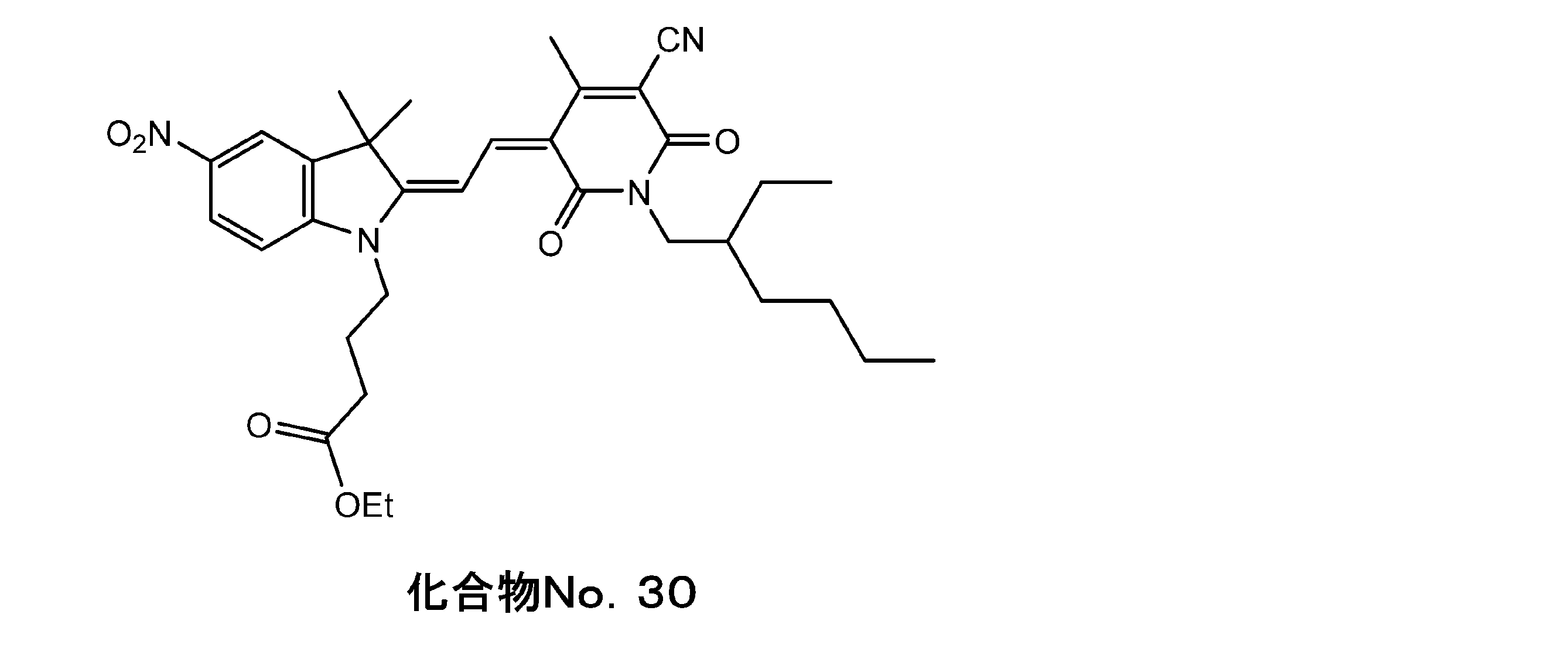
〔実施例31〕化合物No.31の合成
実施例8で用いた化合物No.7を化合物No.30に変え、同様の操作を行い、収率35.1%で下記化合物No.31を得た。
[Example 31] Compound No. Synthesis of No. 31 Compound No. 31 used in Example 8. 7 is compound No. After changing to 30, the same operation was carried out, and the yield was 35.1%. I got 31.

〔実施例32〕化合物No.32の合成
実施例1のピリドン体1をピリドン体8に変え、インドレニン四級塩1をインドレニンエステル2に変え同様の操作を行い、収率45.2%で下記化合物No.32を得た。
[Example 32] Compound No. Synthesis of 32 The pyridone form 1 of Example 1 was changed to the pyridone form 8, the indorenin quaternary salt 1 was changed to the indorenin ester 2, and the same operation was carried out. The yield of the following compound No. 45.2% was obtained. 32 was obtained.

〔実施例33〕化合物No.33の合成
実施例8で用いた化合物No.7を化合物No.32に変え、同様の操作を行い、収率35.1%で下記化合物No.33を得た。
[Example 33] Compound No. Synthesis of 33 Compound No. 3 used in Example 8. 7 is compound No. After changing to 32, the same operation was carried out, and the yield was 35.1%. I got 33.

〔実施例34〕化合物No.34の合成
実施例1のピリドン体1をピリドン体6に変え、インドレニン四級塩1をインドレニンエステル四級塩9に変え同様の操作を行い、収率39.4%で下記化合物No.34を得た。
[Example 34] Compound No. Synthesis of 34 The pyridone form 1 of Example 1 was changed to the pyridone form 6, the indorenin quaternary salt 1 was changed to the indorenin ester quaternary salt 9, and the same operation was carried out. The yield was 39.4% and the following compound No. I got 34.

〔実施例35〕化合物No.35の合成
実施例8で用いた化合物No.7を化合物No.34に変え、同様の操作を行い、収率81.6%で下記化合物No.35を得た。
[Example 35] Compound No. Synthesis of 35 Compound No. 3 used in Example 8. 7 is compound No. After changing to 34, the same operation was carried out, and the yield was 81.6%. I got 35.

〔実施例36〕化合物No.78の合成
化合物No.9(0.7g、2.0mmol)を1,2-ジクロロエタン(7.2g)に溶解し、氷浴中で塩化チオニル(0.72g、6mmol)を滴下して加えた。室温で3時間攪拌後、減圧濃縮し塩化チオニルを除去した。そこにスルファニルアミド(0.37g、2.2mmol)とアセトニトリル(7.2g)を室温で加えて攪拌後、トリエチルアミン(0.24g、2.4mmol)を滴下して加えた。室温で3時間攪拌して得られた液を塩酸水に注ぎ、酢酸エチルで抽出した。有機層を水洗後、無水硫酸ナトリウムで乾燥し、濃縮した。粗生成物をカラム精製し下記化合物No.78を0.15g(収率10.5%)得た。
[Example 36] Compound No. 78 Synthetic Compound No. 9 (0.7 g, 2.0 mmol) was dissolved in 1,2-dichloroethane (7.2 g), and thionyl chloride (0.72 g, 6 mmol) was added dropwise in an ice bath. After stirring at room temperature for 3 hours, the mixture was concentrated under reduced pressure to remove thionyl chloride. Sulfanilamide (0.37 g, 2.2 mmol) and acetonitrile (7.2 g) were added thereto at room temperature, and the mixture was stirred, and then triethylamine (0.24 g, 2.4 mmol) was added dropwise. The solution obtained by stirring at room temperature for 3 hours was poured into hydrochloric acid water and extracted with ethyl acetate. The organic layer was washed with water, dried over anhydrous sodium sulfate, and concentrated. The crude product was column-purified to obtain the following compound No. 78 was obtained in an amount of 0.15 g (yield 10.5%).

<1H-NMR>
実施例1~36で得られた化合物を重溶媒(DMSO-d6)にそれぞれ溶解し、1H-NMRを測定した。結果を[表1]に示す。
< 1 1 H-NMR>
The compounds obtained in Examples 1 to 36 were dissolved in heavy solvent (DMSO-d6), respectively, and 1 H-NMR was measured. The results are shown in [Table 1].


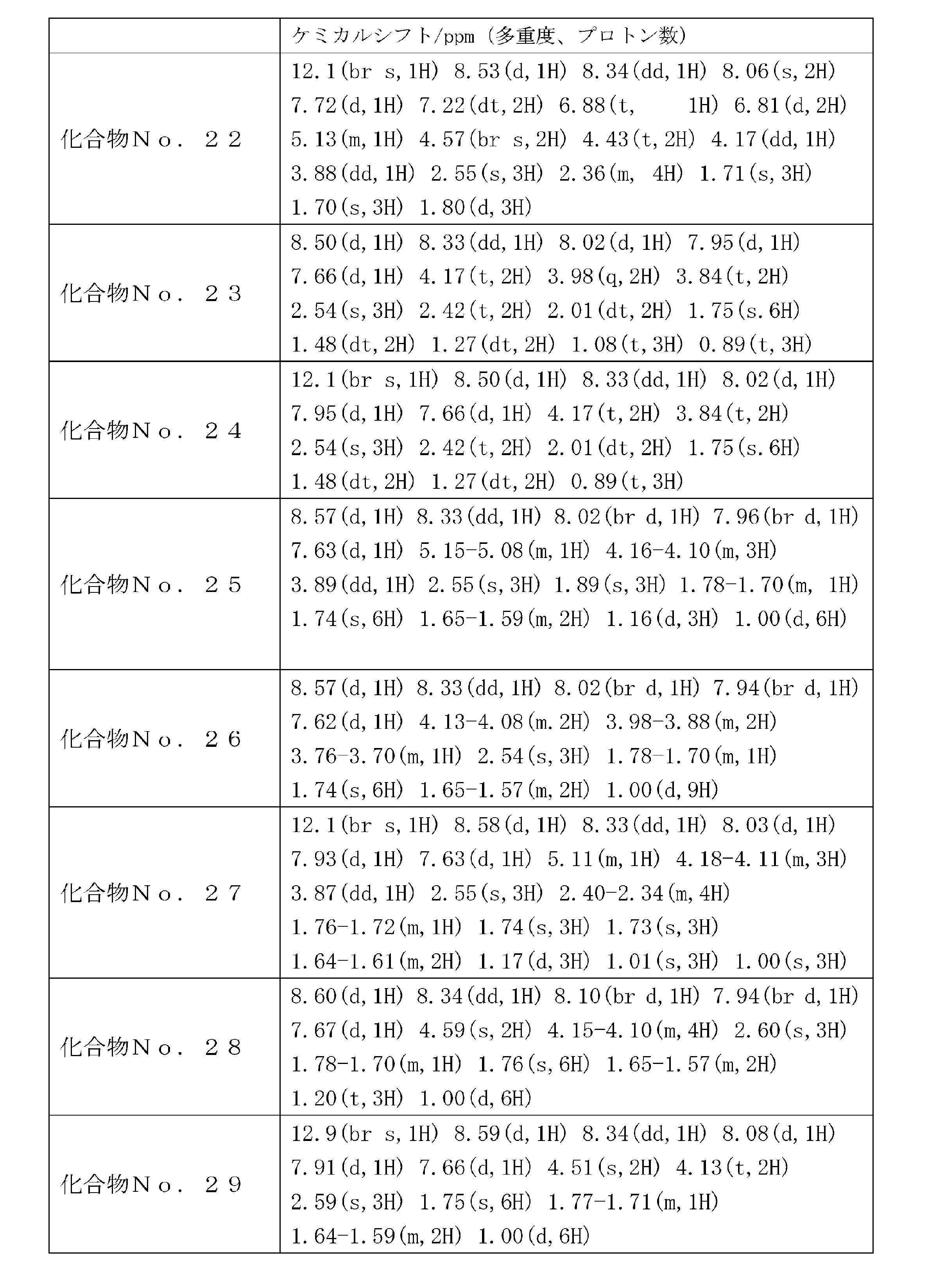

下記[表2]に記載の化合物及び下記比較化合物No.1~3の最大吸収波長(λmax)、モル吸光係数(ε)及び分解温度を評価した。
結果を[表2]に示す。
The compounds listed in [Table 2] below and the comparative compounds No. 1 below. The maximum absorption wavelength (λmax), molar extinction coefficient (ε) and decomposition temperature of 1 to 3 were evaluated.
The results are shown in [Table 2].
<最大吸収波長(λmax)及びモル吸光係数(ε)>
[表2]に記載する化合物を10mg秤量し、100mlメスフラスコに入れ、これにクロロホルムを標線まで加え、超音波で10分震盪させ、均一化した溶液を得た。得られた溶液からホールピペットで2mlを取り出し、空の50mlメスフラスコに入れた後、これにクロロホルムを標線まで加え、測定サンプルを調製した。
上記測定サンプルについて、日本分光製U-3900にて下記の測定を行った。即ち、クロロホルムのベースラインを測定後、上記測定サンプルを光路長1cmのクォーツセルに入れ、800~300nmの可視光領域を0.5nm間隔にて300nm/minで吸光度測定し、600~400nmで最大吸光度となる波長をλmaxとした。また、λmaxの吸光度とその分子量から、ランベルトベールの法則を用い、モル吸光係数εを計算した。
<Maximum absorption wavelength (λmax) and molar extinction coefficient (ε)>
10 mg of the compound shown in [Table 2] was weighed, placed in a 100 ml volumetric flask, chloroform was added to the marked line, and the mixture was shaken with ultrasonic waves for 10 minutes to obtain a homogenized solution. 2 ml of the obtained solution was taken out with a whole pipette, placed in an empty 50 ml volumetric flask, and chloroform was added to the marked line to prepare a measurement sample.
The following measurements were performed on the above measurement sample with JASCO Corporation U-3900. That is, after measuring the chloroform baseline, the measurement sample was placed in a quartz cell having an optical path length of 1 cm, and the absorbance of the visible light region of 800 to 300 nm was measured at intervals of 0.5 nm at 300 nm / min, and the maximum was measured at 600 to 400 nm. The wavelength of absorbance was defined as λmax. In addition, the molar extinction coefficient ε was calculated from the absorbance of λmax and its molecular weight using Lambertbert's law.
<分解温度>
セイコーインスツルメンツ製示差熱同時熱重量測定装置TG-DTA6200を用いた。アルミ製試料パンに[表2]に記載の化合物をそれぞれ2mg秤量し、窒素フロー200ml/min、昇温スピード10℃/min、測定温度範囲35℃~550℃にて、測定を行った。得られたTG曲線の重量減少0%の接線と10%重量減少時の接線との交点から分解温度を算出した。評価結果を[表2]に示す。
<Decomposition temperature>
A differential thermal simultaneous thermogravimetric analysis device TG-DTA6200 manufactured by Seiko Instruments was used. 2 mg of each of the compounds shown in [Table 2] was weighed in an aluminum sample pan, and measurements were carried out at a nitrogen flow of 200 ml / min, a heating speed of 10 ° C./min, and a measurement temperature range of 35 ° C. to 550 ° C. The decomposition temperature was calculated from the intersection of the tangent line at 0% weight loss and the tangent line at 10% weight loss of the obtained TG curve. The evaluation results are shown in [Table 2].


[表2]より、本発明の化合物は、500~600nmに強い吸収をもち、赤色から橙色を呈し、200℃以上の分解温度を示し、高い耐熱性を有するものであることが判る。 From [Table 2], it can be seen that the compound of the present invention has strong absorption at 500 to 600 nm, exhibits a red to orange color, exhibits a decomposition temperature of 200 ° C. or higher, and has high heat resistance.
[表3]に記載の化合物及び下記比較化合物No.4の0.5質量%アセトン溶液0.4gと、ポリメチルメタクリレートの25質量%トルエン溶液3.0gを混合し、15分間超音波照射を行い、塗工液を調製した。 The compounds listed in [Table 3] and the following comparative compounds No. 0.4 g of a 0.5 mass% acetone solution of 4 and 3.0 g of a 25 mass% toluene solution of polymethylmethacrylate were mixed and ultrasonically irradiated for 15 minutes to prepare a coating solution.


得られた塗工液を、易密着処理した188μm厚のポリエチレンテレフタレートフィルムに、バーコーター#30により塗布した後、70℃で15分間乾燥し、塗膜(膜厚7~8μm)を作製した。 The obtained coating liquid was applied to an easy-adhesion-treated 188 μm-thick polyethylene terephthalate film with a bar coater # 30, and then dried at 70 ° C. for 15 minutes to prepare a coating film (thickness 7 to 8 μm).
〔評価例1~19及び比較評価例1及び2〕
上記塗膜の耐光性試験を行った。
[Evaluation Examples 1 to 19 and Comparative Evaluation Examples 1 and 2]
The light resistance test of the above coating film was performed.
〔耐光性試験〕
上記塗膜に、キセノン耐光性試験機(スガ試験機(株)製テーブルサンTS-2)にて光を48時間照射し、耐光性を評価した。評価においては、光照射前後の各塗膜の吸収極大波長における吸光度を測定し、初期値(光照射前)を100として光照射後の相対値(吸光度保持率)を算出し、耐光性を比較した。吸光度保持率は高い方が好ましい。結果を[表4]に示す。
[Light resistance test]
The coating film was irradiated with light for 48 hours with a xenon light resistance tester (Table Sun TS-2 manufactured by Suga Test Instruments Co., Ltd.) to evaluate the light resistance. In the evaluation, the absorbance at the maximum absorption wavelength of each coating film before and after light irradiation is measured, the relative value (absorbance retention rate) after light irradiation is calculated with the initial value (before light irradiation) as 100, and the light resistance is compared. did. It is preferable that the absorbance retention rate is high. The results are shown in [Table 4].

[表4]より、本発明のポリメチン化合物を用いた塗膜は耐光性に優れることが明らかである。
From [Table 4], it is clear that the coating film using the polymethine compound of the present invention has excellent light resistance.
Claims (18)

R1及びR6は、それぞれ独立に、水素原子、炭素数1~30の炭化水素基、複素環基、又は該炭化水素基中のメチレン基の1つ又は2つ以上が下記群Iから選ばれる二価の基で置き換えられた基を表し、ただし、2つ以上のメチレン基が下記群Iから選ばれる二価の基で置き換えられている場合、該二価の基の酸素原子は隣り合わず、
Qは、―CR11R12-、酸素原子、硫黄原子又は-NR13-を表し、
R11、R12及びR13は、それぞれ独立に、水素原子、ヒドロキシ基、ニトロ基、シアノ基、ハロゲン原子、カルボキシ基、スルホ基、スルファモイル基、複素環基、メタロセニル基、炭素数1~30の炭化水素基、又は該炭化水素基中のメチレン基の1つ又は2つ以上が下記群Iから選ばれる二価の基で置き換えられた基を表し、ただし、2つ以上のメチレン基が下記群Iから選ばれる二価の基で置き換えられている場合、該二価の基の酸素原子は隣り合わず、
R1、R2、R3、R4、R5、R6、R7、R8、R9、R10、R11、R12及びR13で表される炭素数1~30の炭化水素基中の水素原子又はR1、R2、R3、R4、R5、R6、R7、R8、R9、R10、R11、R12及びR13で表される複素環基中の水素原子は、ハロゲン原子、ニトロ基、シアノ基、ヒドロキシ基、アミノ基、カルボキシ基、メタクリロイル基、アクリロイル基、オキシラニル基、ビニル基、ビニルオキシ基、スルファニル基、スルファモイル基、イソシアナート基又は複素環基で置換されている場合があり、
R7とR8、R8とR9、R9とR10、R10とR11及びR11とR12は、それぞれ結合して環を形成する場合があり、形成した環は置換基を有する場合があり、
mは1~3の整数であり、
m≧2の場合、複数存在するR1、R2、R3、R4、R5、R6、R7、R8、R9、R10、R11、R12、R13及びQは、それぞれ同一である場合、又は異なる場合があり、
m=1の場合、Aは存在せず、
m≧2の場合、Aは、直接結合、-NR14-、酸素原子、硫黄原子、-SO2-、-SO-、-PR14-、Em+ 、式(a)、式(b)又は下記(i)若しくは(ii)に示す連結基を表し、

Em+はm価の陽イオンを表し、
m≧2であり、AがEm+でない場合、Aは、R1、R2、R3、R4、R5、R6、R7、R8、R9、R10、R11、R12及びR13で表される基のうちの何れかの基を除去した位置に結合しており、
*は結合手を表す。
群I:-O-、-S-、-CO-、-COO-、-OCO-、-COS-、-OCS-、-SO2-、-SO3-、-NH-、-CONH-、-NHCO-、-SO2NH-、-NH-SO2-、-N=CH-又は二価の複素環基
群II:-COO-、-O-、-OCO-、-NHCO-、-NH-又は-CONH-)
(i)m=2のとき、Aは下記式(α)で表される連結基である場合がある。

Z1及びZ2は、それぞれ独立に、直接結合、-O-、-S-、-SO2-、-SO-、-NR15-、又は-PR16-を表し、
R15及びR16は、それぞれ独立に、水素原子、炭素数1~30の炭化水素基又は該炭化水素基中のメチレン基の1つ又は2つ以上が下記群IIIから選ばれる二価の基で置き換えられた基を表し、ただし、2つ以上のメチレン基が下記群IIIから選ばれる二価の基で置き換えられている場合、該二価の基の酸素原子は隣り合わず、
*は結合手を表す。
群III:-COO-、-O-、-OCO-、-NHCO-、-NH-又は-CONH-)

R22は炭素数1~10のアルコキシ基、炭素数1~30の炭化水素基又はハロゲン原子を表し、
上記の炭素数1~30の炭化水素基及び炭素数1~10のアルコキシ基の水素原子は、ハロゲン原子で置換されている場合があり、
dは0~4の整数を表し、
*は結合手を表す。)
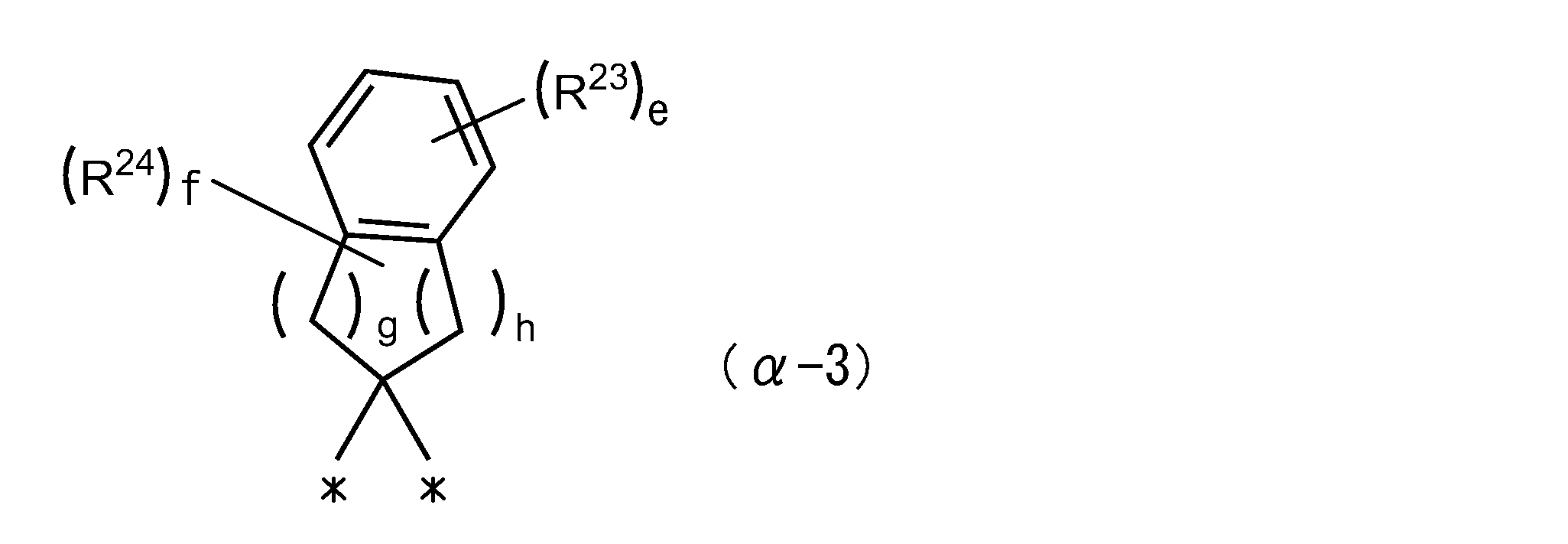
R23及びR24で表される基中の水素原子は、ハロゲン原子又は複素環基で置換されている場合があり、
R23は、隣接するR23同士が結合して環を形成する場合があり、
eは0~4の数を表し、
fは0~8の数を表し、
gは0~4の数を表し、
hは0~4の数を表し、
gとhの数の合計は2~4であり、
*は結合手を表す。
群IV:-O-又は-S-)
(ii)m=3のとき、Aは下記式(β)で表される連結基である場合がある。

Z1、Z2及びZ3は、それぞれ独立に、式(α)におけるZ1及びZ2で表される基と同じ基を表し、
式(β)で表される基の炭素数は1~35の範囲内であり、
*は結合手を表す。
群V:-COO-、-O-、-OCO-、-NHCO-、-NH-、-CONH-、-O-CONH-、-NHCO-O-又は二価の複素環基) A compound represented by the formula (I).
In R 1 and R 6 , one or more of hydrogen atoms, hydrocarbon groups having 1 to 30 carbon atoms, heterocyclic groups, or methylene groups in the hydrocarbon groups are independently selected from the following group I. Represents a group replaced with a divalent group, provided that if two or more methylene groups are replaced with a divalent group selected from Group I below, the oxygen atoms of the divalent group are flanked. Zu,
Q is, -CR 11 R 12 -, oxygen atom, sulfur atom or -NR 13 - represents,
R 11 , R 12 and R 13 independently have a hydrogen atom, a hydroxy group, a nitro group, a cyano group, a halogen atom, a carboxy group, a sulfo group, a sulfamoyl group, a heterocyclic group, a metallocenyl group and 1 to 30 carbon atoms. Represents a group in which one or more of the methylene groups in the hydrocarbon group is replaced with a divalent group selected from Group I below, wherein the two or more methylene groups are described below. When replaced with a divalent group selected from group I, the oxygen atoms of the divalent group are not adjacent and
R 1 , R 2 , R 3 , R 4 , R 5 , R 6 , R 7 , R 8 , R 9 , R 10 , R 11 , R 12 and R 13 hydrocarbons with 1 to 30 carbon atoms A hydrogen atom in a group or a complex ring represented by R 1 , R 2 , R 3 , R 4 , R 5 , R 6 , R 7 , R 8 , R 9 , R 10 , R 11 , R 12 and R 13. The hydrogen atom in the group is a halogen atom, a nitro group, a cyano group, a hydroxy group, an amino group, a carboxy group, a methacryloyl group, an acryloyl group, an oxylanyl group, a vinyl group, a vinyloxy group, a sulfanyl group, a sulfamoyl group, an isocyanato group or May be substituted with heterocyclic groups,
R 7 and R 8 , R 8 and R 9 , R 9 and R 10 , R 10 and R 11 and R 11 and R 12 , respectively, may combine to form a ring, and the formed ring has a substituent. May have
m is an integer from 1 to 3
When m ≧ 2, a plurality of R 1 , R 2 , R 3 , R 4 , R 5 , R 6 , R 7 , R 8 , R 9 , R 10 , R 11 , R 12 , and R 13 and Q are present. , Each may be the same or different,
When m = 1, A does not exist and
For m ≧ 2, A is a direct bond, -NR 14 -, oxygen atom, sulfur atom, -SO 2 -, - SO - , - PR 14 -, E m +, the formula (a), formula (b) or Represents the linking group shown in (i) or (ii) below.
Em + represents an m-valent cation
If m ≧ 2 and A is not Em + , then A is R 1 , R 2 , R 3 , R 4 , R 5 , R 6 , R 7 , R 8 , R 9 , R 10 , R 11 , R. It is bonded to the position where any of the groups represented by 12 and R 13 is removed.
* Represents a bond.
Group I: -O-, -S-, -CO-, -COO-, -OCO-, -COS-, -OCS-, -SO 2- , -SO 3- , -NH-, -CONH-,- NHCO-, -SO 2 NH-, -NH-SO 2- , -N = CH- or divalent heterocyclic group II: -COO-, -O-, -OCO-, -NHCO-, -NH- Or -CONH-)
(I) When m = 2, A may be a linking group represented by the following formula (α).
Z 1 and Z 2 are independently a direct bond, -O -, - S -, - SO 2 -, - SO -, - NR 15 -, or -PR 16 - represents,
R 15 and R 16 are divalent groups in which one or more of hydrogen atoms, hydrocarbon groups having 1 to 30 carbon atoms or methylene groups in the hydrocarbon groups are independently selected from the following group III. Represents a group replaced with, however, when two or more methylene groups are replaced with a divalent group selected from Group III below, the oxygen atoms of the divalent group are not adjacent and are not adjacent.
* Represents a bond.
Group III: -COO-, -O-, -OCO-, -NHCO-, -NH- or -CONH-)
R 22 represents an alkoxy group having 1 to 10 carbon atoms, a hydrocarbon group having 1 to 30 carbon atoms, or a halogen atom.
The hydrogen atoms of the above-mentioned hydrocarbon group having 1 to 30 carbon atoms and the alkoxy group having 1 to 10 carbon atoms may be substituted with halogen atoms.
d represents an integer from 0 to 4 and represents
* Represents a bond. )
The hydrogen atom in the group represented by R 23 and R 24 may be substituted with a halogen atom or a heterocyclic group.
R 23 is, may be bonded to the adjacent R 23 together form a ring,
e represents a number from 0 to 4
f represents a number from 0 to 8
g represents a number from 0 to 4
h represents a number from 0 to 4
The total number of g and h is 2-4,
* Represents a bond.
Group IV: -O- or -S-)
(Ii) When m = 3, A may be a linking group represented by the following formula (β).
Z 1 , Z 2 and Z 3 independently represent the same group represented by Z 1 and Z 2 in formula (α), respectively.
The carbon number of the group represented by the formula (β) is in the range of 1 to 35.
* Represents a bond.
Group V: -COO-, -O-, -OCO-, -NHCO-, -NH-, -CONH-, -O-CONH-, -NHCO-O- or divalent heterocyclic group)


式(I)、(II)、(IIIα)、(IIIβ)及び(IIIγ)中のR1、R2、R3、R4、R6、R7、R8、R9及びR10で表される基中の水素原子の1つ以上がカルボキシ基若しくはニトロ基で置換されている、請求項1~7の何れか一項に記載の化合物。 Formula (I), (II), (IIIα), (IIIβ) and R 1 in (IIIγ), R 2, R 3, R 4, R 5, R 6, R 7, R 8, R 9 and R One or more of the groups represented by 10 is a carboxy group or a nitro group, or R 1 , R 2 in the formulas (I), (II), (IIIα), (IIIβ) and (IIIγ). , R 3 , R 4 , R 6 , R 7 , R 8 , R 9 and R 10 in which one or more of the hydrogen atoms in the groups are substituted with carboxy or nitro groups, claims 1 to 1. The compound according to any one of 7.
Use of the compound according to any one of claims 1 to 15 as a sensitizer.
Priority Applications (3)
| Application Number | Priority Date | Filing Date | Title |
|---|---|---|---|
| CN202080009560.7A CN113316572A (en) | 2019-04-26 | 2020-04-21 | Polymethine compounds |
| KR1020217021762A KR20220004010A (en) | 2019-04-26 | 2020-04-21 | polymethine compound |
| JP2021516138A JPWO2020218297A1 (en) | 2019-04-26 | 2020-04-21 |
Applications Claiming Priority (2)
| Application Number | Priority Date | Filing Date | Title |
|---|---|---|---|
| JP2019-085539 | 2019-04-26 | ||
| JP2019085539 | 2019-04-26 |
Publications (1)
| Publication Number | Publication Date |
|---|---|
| WO2020218297A1 true WO2020218297A1 (en) | 2020-10-29 |
Family
ID=72941947
Family Applications (1)
| Application Number | Title | Priority Date | Filing Date |
|---|---|---|---|
| PCT/JP2020/017199 Ceased WO2020218297A1 (en) | 2019-04-26 | 2020-04-21 | Polymethine compound |
Country Status (4)
| Country | Link |
|---|---|
| JP (1) | JPWO2020218297A1 (en) |
| KR (1) | KR20220004010A (en) |
| CN (1) | CN113316572A (en) |
| WO (1) | WO2020218297A1 (en) |
Cited By (1)
| Publication number | Priority date | Publication date | Assignee | Title |
|---|---|---|---|---|
| JP2023028479A (en) * | 2021-08-19 | 2023-03-03 | デンカ株式会社 | Compound |
Citations (26)
| Publication number | Priority date | Publication date | Assignee | Title |
|---|---|---|---|---|
| JPS5299379A (en) * | 1976-02-14 | 1977-08-20 | Mitsubishi Chem Ind | Dyeing method of synthetic fibers |
| JPS55155350A (en) * | 1979-05-22 | 1980-12-03 | Ciba Geigy Ag | Photographic silver halide material having dye filter or dye halation preventive layer |
| JPH02309350A (en) * | 1989-05-25 | 1990-12-25 | Fuji Photo Film Co Ltd | Silver halide color reversal photographic sensitive material |
| US5030708A (en) * | 1990-12-17 | 1991-07-09 | Eastman Kodak Company | Colored polyester compositions |
| JPH06214345A (en) * | 1993-01-18 | 1994-08-05 | Konica Corp | Silver halide photographic sensitive material |
| JPH08122972A (en) * | 1994-10-21 | 1996-05-17 | Konica Corp | Silver halide photographic sensitive material |
| JPH08171173A (en) * | 1994-12-15 | 1996-07-02 | Konica Corp | Silver halide photographic sensitive material |
| JPH11268483A (en) * | 1998-03-18 | 1999-10-05 | Fuji Photo Film Co Ltd | Writing and erasing methods, and ink and eraser to be used for same |
| JP2001505602A (en) * | 1996-11-23 | 2001-04-24 | ビーエーエスエフ アクチェンゲゼルシャフト | Indolenine methine dyes based on trifluoromethylpyridone |
| JP2001162954A (en) * | 1999-10-14 | 2001-06-19 | Eastman Kodak Co | Pink dye for thermal color proof |
| JP2001171244A (en) * | 1999-10-14 | 2001-06-26 | Eastman Kodak Co | Orange dye mixture for thermal color proof |
| WO2002080161A2 (en) * | 2001-03-28 | 2002-10-10 | Bayer Aktiengesellschaft | Optical data carrier that contains a merocyanine dye as the light-absorbing compound in the information layer |
| JP2003167313A (en) * | 2001-12-04 | 2003-06-13 | Fuji Photo Film Co Ltd | Heat-developable image recording material |
| JP2003206307A (en) * | 2002-01-11 | 2003-07-22 | Konica Corp | Photopolymerization initiator, photopolymerizable composition, method for generating radical, photosensitive material for manufacturing planographic printing plate, and method for manufacturing planographic printing plate |
| JP2003335071A (en) * | 2002-05-22 | 2003-11-25 | Eastman Kodak Co | Thermal dye transfer imaging element |
| EP1433820A1 (en) * | 2002-12-26 | 2004-06-30 | Eastman Kodak Company | Bichromophoric molecules |
| JP2005517979A (en) * | 2002-02-12 | 2005-06-16 | コダック・ポリクローム・グラフィックス・ゲーエムベーハー | Visible radiation photosensitive composition |
| JP2006521220A (en) * | 2003-03-25 | 2006-09-21 | ランクセス ドイチュラント ゲゼルシャフト ミット ベシュレンクテル ハフツング | Optical data medium containing a polymer network in the information layer |
| JP2010533368A (en) * | 2007-07-10 | 2010-10-21 | ビーエーエスエフ ソシエタス・ヨーロピア | Mixtures that produce photoactive layers in organic solar cells and organic photodetectors |
| WO2011149813A1 (en) * | 2010-05-25 | 2011-12-01 | Eastman Kodak Company | Laser thermal donor elements and method of use |
| JP2012507169A (en) * | 2008-10-31 | 2012-03-22 | ビーエーエスエフ ソシエタス・ヨーロピア | Merocyanine for forming photoactive layers for organic solar cells and organic photodetectors |
| JP2013543149A (en) * | 2010-11-08 | 2013-11-28 | バイエル・インテレクチュアル・プロパティ・ゲゼルシャフト・ミット・ベシュレンクテル・ハフツング | Photopolymer formulation for making holographic media with highly cross-linked matrix polymer |
| WO2016158639A1 (en) * | 2015-03-27 | 2016-10-06 | 株式会社Adeka | Merocyanine compound |
| JP2016188363A (en) * | 2015-03-27 | 2016-11-04 | 東友ファインケム株式会社Dongwoo Fine−Chem Co., Ltd. | Colored curable resin composition |
| JP2019094496A (en) * | 2017-11-24 | 2019-06-20 | ランクセス・ドイチュランド・ゲーエムベーハー | Novel methine dyes |
| WO2019189134A1 (en) * | 2018-03-28 | 2019-10-03 | 富士フイルム株式会社 | Photoelectric conversion element, imaging element, optical sensor, and compound |
Family Cites Families (3)
| Publication number | Priority date | Publication date | Assignee | Title |
|---|---|---|---|---|
| US2526632A (en) | 1948-09-08 | 1950-10-24 | Eastman Kodak Co | Acid merocyanine dyes |
| JP2003057777A (en) | 2001-08-17 | 2003-02-26 | Fuji Photo Film Co Ltd | Silver halide photographic sensitive material |
| JP5581116B2 (en) | 2010-05-31 | 2014-08-27 | 富士フイルム株式会社 | Photoelectric conversion device, imaging device, and driving method of photoelectric conversion device |
-
2020
- 2020-04-21 WO PCT/JP2020/017199 patent/WO2020218297A1/en not_active Ceased
- 2020-04-21 CN CN202080009560.7A patent/CN113316572A/en active Pending
- 2020-04-21 JP JP2021516138A patent/JPWO2020218297A1/ja active Pending
- 2020-04-21 KR KR1020217021762A patent/KR20220004010A/en not_active Ceased
Patent Citations (26)
| Publication number | Priority date | Publication date | Assignee | Title |
|---|---|---|---|---|
| JPS5299379A (en) * | 1976-02-14 | 1977-08-20 | Mitsubishi Chem Ind | Dyeing method of synthetic fibers |
| JPS55155350A (en) * | 1979-05-22 | 1980-12-03 | Ciba Geigy Ag | Photographic silver halide material having dye filter or dye halation preventive layer |
| JPH02309350A (en) * | 1989-05-25 | 1990-12-25 | Fuji Photo Film Co Ltd | Silver halide color reversal photographic sensitive material |
| US5030708A (en) * | 1990-12-17 | 1991-07-09 | Eastman Kodak Company | Colored polyester compositions |
| JPH06214345A (en) * | 1993-01-18 | 1994-08-05 | Konica Corp | Silver halide photographic sensitive material |
| JPH08122972A (en) * | 1994-10-21 | 1996-05-17 | Konica Corp | Silver halide photographic sensitive material |
| JPH08171173A (en) * | 1994-12-15 | 1996-07-02 | Konica Corp | Silver halide photographic sensitive material |
| JP2001505602A (en) * | 1996-11-23 | 2001-04-24 | ビーエーエスエフ アクチェンゲゼルシャフト | Indolenine methine dyes based on trifluoromethylpyridone |
| JPH11268483A (en) * | 1998-03-18 | 1999-10-05 | Fuji Photo Film Co Ltd | Writing and erasing methods, and ink and eraser to be used for same |
| JP2001162954A (en) * | 1999-10-14 | 2001-06-19 | Eastman Kodak Co | Pink dye for thermal color proof |
| JP2001171244A (en) * | 1999-10-14 | 2001-06-26 | Eastman Kodak Co | Orange dye mixture for thermal color proof |
| WO2002080161A2 (en) * | 2001-03-28 | 2002-10-10 | Bayer Aktiengesellschaft | Optical data carrier that contains a merocyanine dye as the light-absorbing compound in the information layer |
| JP2003167313A (en) * | 2001-12-04 | 2003-06-13 | Fuji Photo Film Co Ltd | Heat-developable image recording material |
| JP2003206307A (en) * | 2002-01-11 | 2003-07-22 | Konica Corp | Photopolymerization initiator, photopolymerizable composition, method for generating radical, photosensitive material for manufacturing planographic printing plate, and method for manufacturing planographic printing plate |
| JP2005517979A (en) * | 2002-02-12 | 2005-06-16 | コダック・ポリクローム・グラフィックス・ゲーエムベーハー | Visible radiation photosensitive composition |
| JP2003335071A (en) * | 2002-05-22 | 2003-11-25 | Eastman Kodak Co | Thermal dye transfer imaging element |
| EP1433820A1 (en) * | 2002-12-26 | 2004-06-30 | Eastman Kodak Company | Bichromophoric molecules |
| JP2006521220A (en) * | 2003-03-25 | 2006-09-21 | ランクセス ドイチュラント ゲゼルシャフト ミット ベシュレンクテル ハフツング | Optical data medium containing a polymer network in the information layer |
| JP2010533368A (en) * | 2007-07-10 | 2010-10-21 | ビーエーエスエフ ソシエタス・ヨーロピア | Mixtures that produce photoactive layers in organic solar cells and organic photodetectors |
| JP2012507169A (en) * | 2008-10-31 | 2012-03-22 | ビーエーエスエフ ソシエタス・ヨーロピア | Merocyanine for forming photoactive layers for organic solar cells and organic photodetectors |
| WO2011149813A1 (en) * | 2010-05-25 | 2011-12-01 | Eastman Kodak Company | Laser thermal donor elements and method of use |
| JP2013543149A (en) * | 2010-11-08 | 2013-11-28 | バイエル・インテレクチュアル・プロパティ・ゲゼルシャフト・ミット・ベシュレンクテル・ハフツング | Photopolymer formulation for making holographic media with highly cross-linked matrix polymer |
| WO2016158639A1 (en) * | 2015-03-27 | 2016-10-06 | 株式会社Adeka | Merocyanine compound |
| JP2016188363A (en) * | 2015-03-27 | 2016-11-04 | 東友ファインケム株式会社Dongwoo Fine−Chem Co., Ltd. | Colored curable resin composition |
| JP2019094496A (en) * | 2017-11-24 | 2019-06-20 | ランクセス・ドイチュランド・ゲーエムベーハー | Novel methine dyes |
| WO2019189134A1 (en) * | 2018-03-28 | 2019-10-03 | 富士フイルム株式会社 | Photoelectric conversion element, imaging element, optical sensor, and compound |
Cited By (2)
| Publication number | Priority date | Publication date | Assignee | Title |
|---|---|---|---|---|
| JP2023028479A (en) * | 2021-08-19 | 2023-03-03 | デンカ株式会社 | Compound |
| JP7698511B2 (en) | 2021-08-19 | 2025-06-25 | デンカ株式会社 | compound |
Also Published As
| Publication number | Publication date |
|---|---|
| KR20220004010A (en) | 2022-01-11 |
| CN113316572A (en) | 2021-08-27 |
| JPWO2020218297A1 (en) | 2020-10-29 |
Similar Documents
| Publication | Publication Date | Title |
|---|---|---|
| JP6760926B2 (en) | Merocyanine compound | |
| US8206806B2 (en) | Cyanine compound and optical recording material | |
| TWI336721B (en) | Cyanine compound, potical recording material, and optical recording medium | |
| WO2020218297A1 (en) | Polymethine compound | |
| Khil et al. | Hydrolytic Heterocyclization of the 1, 1, 2, 3, 3‐Pentacyanopropene Salts | |
| KR101497384B1 (en) | Bridged cyanine compounds and optical recording materials containing the same | |
| JP7000329B2 (en) | Polymethin compound | |
| US3152905A (en) | Sensitizing methine dyes and intermediates, process for preparing same and photographic element containing these dyes | |
| JP7519921B2 (en) | Xanthene Compounds | |
| JP5241121B2 (en) | Merocyanine compound and optical recording material using the compound | |
| JP5591287B2 (en) | Chalcone type compound | |
| JP5579281B2 (en) | Merocyanine compound and optical recording material using the compound | |
| JP2008284876A (en) | Optical recording material |
Legal Events
| Date | Code | Title | Description |
|---|---|---|---|
| 121 | Ep: the epo has been informed by wipo that ep was designated in this application |
Ref document number: 20795406 Country of ref document: EP Kind code of ref document: A1 |
|
| ENP | Entry into the national phase |
Ref document number: 2021516138 Country of ref document: JP Kind code of ref document: A |
|
| NENP | Non-entry into the national phase |
Ref country code: DE |
|
| 122 | Ep: pct application non-entry in european phase |
Ref document number: 20795406 Country of ref document: EP Kind code of ref document: A1 |