WO2020186028A1 - Cleaning compositions comprising enzymes - Google Patents
Cleaning compositions comprising enzymes Download PDFInfo
- Publication number
- WO2020186028A1 WO2020186028A1 PCT/US2020/022335 US2020022335W WO2020186028A1 WO 2020186028 A1 WO2020186028 A1 WO 2020186028A1 US 2020022335 W US2020022335 W US 2020022335W WO 2020186028 A1 WO2020186028 A1 WO 2020186028A1
- Authority
- WO
- WIPO (PCT)
- Prior art keywords
- seq
- endo
- fabric
- enzyme
- glucanase
- Prior art date
- Legal status (The legal status is an assumption and is not a legal conclusion. Google has not performed a legal analysis and makes no representation as to the accuracy of the status listed.)
- Ceased
Links
Classifications
-
- C—CHEMISTRY; METALLURGY
- C11—ANIMAL OR VEGETABLE OILS, FATS, FATTY SUBSTANCES OR WAXES; FATTY ACIDS THEREFROM; DETERGENTS; CANDLES
- C11D—DETERGENT COMPOSITIONS; USE OF SINGLE SUBSTANCES AS DETERGENTS; SOAP OR SOAP-MAKING; RESIN SOAPS; RECOVERY OF GLYCEROL
- C11D3/00—Other compounding ingredients of detergent compositions covered in group C11D1/00
- C11D3/16—Organic compounds
- C11D3/38—Products with no well-defined composition, e.g. natural products
- C11D3/386—Preparations containing enzymes, e.g. protease or amylase
- C11D3/38636—Preparations containing enzymes, e.g. protease or amylase containing enzymes other than protease, amylase, lipase, cellulase, oxidase or reductase
-
- C—CHEMISTRY; METALLURGY
- C12—BIOCHEMISTRY; BEER; SPIRITS; WINE; VINEGAR; MICROBIOLOGY; ENZYMOLOGY; MUTATION OR GENETIC ENGINEERING
- C12N—MICROORGANISMS OR ENZYMES; COMPOSITIONS THEREOF; PROPAGATING, PRESERVING, OR MAINTAINING MICROORGANISMS; MUTATION OR GENETIC ENGINEERING; CULTURE MEDIA
- C12N9/00—Enzymes; Proenzymes; Compositions thereof; Processes for preparing, activating, inhibiting, separating or purifying enzymes
- C12N9/14—Hydrolases (3)
- C12N9/24—Hydrolases (3) acting on glycosyl compounds (3.2)
- C12N9/2402—Hydrolases (3) acting on glycosyl compounds (3.2) hydrolysing O- and S- glycosyl compounds (3.2.1)
- C12N9/2405—Glucanases
-
- C—CHEMISTRY; METALLURGY
- C11—ANIMAL OR VEGETABLE OILS, FATS, FATTY SUBSTANCES OR WAXES; FATTY ACIDS THEREFROM; DETERGENTS; CANDLES
- C11D—DETERGENT COMPOSITIONS; USE OF SINGLE SUBSTANCES AS DETERGENTS; SOAP OR SOAP-MAKING; RESIN SOAPS; RECOVERY OF GLYCEROL
- C11D1/00—Detergent compositions based essentially on surface-active compounds; Use of these compounds as a detergent
- C11D1/02—Anionic compounds
- C11D1/12—Sulfonic acids or sulfuric acid esters; Salts thereof
- C11D1/14—Sulfonic acids or sulfuric acid esters; Salts thereof derived from aliphatic hydrocarbons or mono-alcohols
-
- C—CHEMISTRY; METALLURGY
- C11—ANIMAL OR VEGETABLE OILS, FATS, FATTY SUBSTANCES OR WAXES; FATTY ACIDS THEREFROM; DETERGENTS; CANDLES
- C11D—DETERGENT COMPOSITIONS; USE OF SINGLE SUBSTANCES AS DETERGENTS; SOAP OR SOAP-MAKING; RESIN SOAPS; RECOVERY OF GLYCEROL
- C11D1/00—Detergent compositions based essentially on surface-active compounds; Use of these compounds as a detergent
- C11D1/02—Anionic compounds
- C11D1/12—Sulfonic acids or sulfuric acid esters; Salts thereof
- C11D1/22—Sulfonic acids or sulfuric acid esters; Salts thereof derived from aromatic compounds
-
- C—CHEMISTRY; METALLURGY
- C11—ANIMAL OR VEGETABLE OILS, FATS, FATTY SUBSTANCES OR WAXES; FATTY ACIDS THEREFROM; DETERGENTS; CANDLES
- C11D—DETERGENT COMPOSITIONS; USE OF SINGLE SUBSTANCES AS DETERGENTS; SOAP OR SOAP-MAKING; RESIN SOAPS; RECOVERY OF GLYCEROL
- C11D1/00—Detergent compositions based essentially on surface-active compounds; Use of these compounds as a detergent
- C11D1/66—Non-ionic compounds
-
- C—CHEMISTRY; METALLURGY
- C11—ANIMAL OR VEGETABLE OILS, FATS, FATTY SUBSTANCES OR WAXES; FATTY ACIDS THEREFROM; DETERGENTS; CANDLES
- C11D—DETERGENT COMPOSITIONS; USE OF SINGLE SUBSTANCES AS DETERGENTS; SOAP OR SOAP-MAKING; RESIN SOAPS; RECOVERY OF GLYCEROL
- C11D1/00—Detergent compositions based essentially on surface-active compounds; Use of these compounds as a detergent
- C11D1/66—Non-ionic compounds
- C11D1/83—Mixtures of non-ionic with anionic compounds
-
- C—CHEMISTRY; METALLURGY
- C11—ANIMAL OR VEGETABLE OILS, FATS, FATTY SUBSTANCES OR WAXES; FATTY ACIDS THEREFROM; DETERGENTS; CANDLES
- C11D—DETERGENT COMPOSITIONS; USE OF SINGLE SUBSTANCES AS DETERGENTS; SOAP OR SOAP-MAKING; RESIN SOAPS; RECOVERY OF GLYCEROL
- C11D17/00—Detergent materials or soaps characterised by their shape or physical properties
- C11D17/06—Powder; Flakes; Free-flowing mixtures; Sheets
-
- C—CHEMISTRY; METALLURGY
- C11—ANIMAL OR VEGETABLE OILS, FATS, FATTY SUBSTANCES OR WAXES; FATTY ACIDS THEREFROM; DETERGENTS; CANDLES
- C11D—DETERGENT COMPOSITIONS; USE OF SINGLE SUBSTANCES AS DETERGENTS; SOAP OR SOAP-MAKING; RESIN SOAPS; RECOVERY OF GLYCEROL
- C11D3/00—Other compounding ingredients of detergent compositions covered in group C11D1/00
- C11D3/02—Inorganic compounds ; Elemental compounds
- C11D3/04—Water-soluble compounds
- C11D3/06—Phosphates, including polyphosphates
-
- C—CHEMISTRY; METALLURGY
- C11—ANIMAL OR VEGETABLE OILS, FATS, FATTY SUBSTANCES OR WAXES; FATTY ACIDS THEREFROM; DETERGENTS; CANDLES
- C11D—DETERGENT COMPOSITIONS; USE OF SINGLE SUBSTANCES AS DETERGENTS; SOAP OR SOAP-MAKING; RESIN SOAPS; RECOVERY OF GLYCEROL
- C11D3/00—Other compounding ingredients of detergent compositions covered in group C11D1/00
- C11D3/02—Inorganic compounds ; Elemental compounds
- C11D3/04—Water-soluble compounds
- C11D3/08—Silicates
-
- C—CHEMISTRY; METALLURGY
- C11—ANIMAL OR VEGETABLE OILS, FATS, FATTY SUBSTANCES OR WAXES; FATTY ACIDS THEREFROM; DETERGENTS; CANDLES
- C11D—DETERGENT COMPOSITIONS; USE OF SINGLE SUBSTANCES AS DETERGENTS; SOAP OR SOAP-MAKING; RESIN SOAPS; RECOVERY OF GLYCEROL
- C11D3/00—Other compounding ingredients of detergent compositions covered in group C11D1/00
- C11D3/02—Inorganic compounds ; Elemental compounds
- C11D3/04—Water-soluble compounds
- C11D3/10—Carbonates ; Bicarbonates
-
- C—CHEMISTRY; METALLURGY
- C11—ANIMAL OR VEGETABLE OILS, FATS, FATTY SUBSTANCES OR WAXES; FATTY ACIDS THEREFROM; DETERGENTS; CANDLES
- C11D—DETERGENT COMPOSITIONS; USE OF SINGLE SUBSTANCES AS DETERGENTS; SOAP OR SOAP-MAKING; RESIN SOAPS; RECOVERY OF GLYCEROL
- C11D3/00—Other compounding ingredients of detergent compositions covered in group C11D1/00
- C11D3/16—Organic compounds
- C11D3/20—Organic compounds containing oxygen
- C11D3/22—Carbohydrates or derivatives thereof
- C11D3/222—Natural or synthetic polysaccharides, e.g. cellulose, starch, gum, alginic acid or cyclodextrin
-
- C—CHEMISTRY; METALLURGY
- C11—ANIMAL OR VEGETABLE OILS, FATS, FATTY SUBSTANCES OR WAXES; FATTY ACIDS THEREFROM; DETERGENTS; CANDLES
- C11D—DETERGENT COMPOSITIONS; USE OF SINGLE SUBSTANCES AS DETERGENTS; SOAP OR SOAP-MAKING; RESIN SOAPS; RECOVERY OF GLYCEROL
- C11D3/00—Other compounding ingredients of detergent compositions covered in group C11D1/00
- C11D3/16—Organic compounds
- C11D3/37—Polymers
- C11D3/3746—Macromolecular compounds obtained by reactions only involving carbon-to-carbon unsaturated bonds
- C11D3/3757—(Co)polymerised carboxylic acids, -anhydrides, -esters in solid and liquid compositions
-
- C—CHEMISTRY; METALLURGY
- C11—ANIMAL OR VEGETABLE OILS, FATS, FATTY SUBSTANCES OR WAXES; FATTY ACIDS THEREFROM; DETERGENTS; CANDLES
- C11D—DETERGENT COMPOSITIONS; USE OF SINGLE SUBSTANCES AS DETERGENTS; SOAP OR SOAP-MAKING; RESIN SOAPS; RECOVERY OF GLYCEROL
- C11D3/00—Other compounding ingredients of detergent compositions covered in group C11D1/00
- C11D3/16—Organic compounds
- C11D3/37—Polymers
- C11D3/3788—Graft polymers
-
- C—CHEMISTRY; METALLURGY
- C11—ANIMAL OR VEGETABLE OILS, FATS, FATTY SUBSTANCES OR WAXES; FATTY ACIDS THEREFROM; DETERGENTS; CANDLES
- C11D—DETERGENT COMPOSITIONS; USE OF SINGLE SUBSTANCES AS DETERGENTS; SOAP OR SOAP-MAKING; RESIN SOAPS; RECOVERY OF GLYCEROL
- C11D3/00—Other compounding ingredients of detergent compositions covered in group C11D1/00
- C11D3/16—Organic compounds
- C11D3/38—Products with no well-defined composition, e.g. natural products
- C11D3/386—Preparations containing enzymes, e.g. protease or amylase
- C11D3/38609—Protease or amylase in solid compositions only
-
- C—CHEMISTRY; METALLURGY
- C11—ANIMAL OR VEGETABLE OILS, FATS, FATTY SUBSTANCES OR WAXES; FATTY ACIDS THEREFROM; DETERGENTS; CANDLES
- C11D—DETERGENT COMPOSITIONS; USE OF SINGLE SUBSTANCES AS DETERGENTS; SOAP OR SOAP-MAKING; RESIN SOAPS; RECOVERY OF GLYCEROL
- C11D3/00—Other compounding ingredients of detergent compositions covered in group C11D1/00
- C11D3/16—Organic compounds
- C11D3/38—Products with no well-defined composition, e.g. natural products
- C11D3/386—Preparations containing enzymes, e.g. protease or amylase
- C11D3/38645—Preparations containing enzymes, e.g. protease or amylase containing cellulase
-
- C—CHEMISTRY; METALLURGY
- C11—ANIMAL OR VEGETABLE OILS, FATS, FATTY SUBSTANCES OR WAXES; FATTY ACIDS THEREFROM; DETERGENTS; CANDLES
- C11D—DETERGENT COMPOSITIONS; USE OF SINGLE SUBSTANCES AS DETERGENTS; SOAP OR SOAP-MAKING; RESIN SOAPS; RECOVERY OF GLYCEROL
- C11D3/00—Other compounding ingredients of detergent compositions covered in group C11D1/00
- C11D3/16—Organic compounds
- C11D3/38—Products with no well-defined composition, e.g. natural products
- C11D3/386—Preparations containing enzymes, e.g. protease or amylase
- C11D3/38654—Preparations containing enzymes, e.g. protease or amylase containing oxidase or reductase
-
- C—CHEMISTRY; METALLURGY
- C11—ANIMAL OR VEGETABLE OILS, FATS, FATTY SUBSTANCES OR WAXES; FATTY ACIDS THEREFROM; DETERGENTS; CANDLES
- C11D—DETERGENT COMPOSITIONS; USE OF SINGLE SUBSTANCES AS DETERGENTS; SOAP OR SOAP-MAKING; RESIN SOAPS; RECOVERY OF GLYCEROL
- C11D3/00—Other compounding ingredients of detergent compositions covered in group C11D1/00
- C11D3/39—Organic or inorganic per-compounds
- C11D3/3902—Organic or inorganic per-compounds combined with specific additives
- C11D3/3905—Bleach activators or bleach catalysts
- C11D3/3907—Organic compounds
- C11D3/3917—Nitrogen-containing compounds
- C11D3/3927—Quarternary ammonium compounds
-
- C—CHEMISTRY; METALLURGY
- C11—ANIMAL OR VEGETABLE OILS, FATS, FATTY SUBSTANCES OR WAXES; FATTY ACIDS THEREFROM; DETERGENTS; CANDLES
- C11D—DETERGENT COMPOSITIONS; USE OF SINGLE SUBSTANCES AS DETERGENTS; SOAP OR SOAP-MAKING; RESIN SOAPS; RECOVERY OF GLYCEROL
- C11D1/00—Detergent compositions based essentially on surface-active compounds; Use of these compounds as a detergent
- C11D1/02—Anionic compounds
- C11D1/12—Sulfonic acids or sulfuric acid esters; Salts thereof
- C11D1/14—Sulfonic acids or sulfuric acid esters; Salts thereof derived from aliphatic hydrocarbons or mono-alcohols
- C11D1/146—Sulfuric acid esters
-
- C—CHEMISTRY; METALLURGY
- C11—ANIMAL OR VEGETABLE OILS, FATS, FATTY SUBSTANCES OR WAXES; FATTY ACIDS THEREFROM; DETERGENTS; CANDLES
- C11D—DETERGENT COMPOSITIONS; USE OF SINGLE SUBSTANCES AS DETERGENTS; SOAP OR SOAP-MAKING; RESIN SOAPS; RECOVERY OF GLYCEROL
- C11D1/00—Detergent compositions based essentially on surface-active compounds; Use of these compounds as a detergent
- C11D1/02—Anionic compounds
- C11D1/12—Sulfonic acids or sulfuric acid esters; Salts thereof
- C11D1/29—Sulfates of polyoxyalkylene ethers
-
- C—CHEMISTRY; METALLURGY
- C11—ANIMAL OR VEGETABLE OILS, FATS, FATTY SUBSTANCES OR WAXES; FATTY ACIDS THEREFROM; DETERGENTS; CANDLES
- C11D—DETERGENT COMPOSITIONS; USE OF SINGLE SUBSTANCES AS DETERGENTS; SOAP OR SOAP-MAKING; RESIN SOAPS; RECOVERY OF GLYCEROL
- C11D2111/00—Cleaning compositions characterised by the objects to be cleaned; Cleaning compositions characterised by non-standard cleaning or washing processes
- C11D2111/10—Objects to be cleaned
- C11D2111/12—Soft surfaces, e.g. textile
Definitions
- the present invention relates to cleaning compositions and methods of cleaning comprising endo-b- 1 ,3-glucanase enzyme.
- the compositions and methods of the invention are suitable for use in household cleaning or treatment compositions, in particular laundry and dish washing compositions, including hand wash and automatic laundry and/or dish washing compositions.
- the invention is particularly useful for cleaning laundry.
- the present invention also relates to methods of making cleaning compositions.
- the present inventors have found that natural impurities, particularly present in cotton fibres contribute to whiteness degradation and may also adhere other soils which contact the cotton fibres during use or even during the washing process. Such natural impurities may also be present in soils contacting household items.
- glucanase enzymes into cleaning compositions, for example as described in W02005/003319. Such glucanase enzymes hydrolyse glucoside bonds.
- glucanase enzymes for example endo-beta-l,3(4)-glucanase enzymes which hydrolyse both 1,3 and 1,4 linkages in beta glucans as well as endo-beta-l,3:l,4-glucanase enzymes, endo-beta-1,4- glucanase enzymes and endo-beta-l,3-glucanase enzymes.
- endo-beta-l,3-glucanase enzymes are particularly useful for stain removal in cleaning compositions comprising surfactant.
- the invention is particularly useful for laundry detergent compositions.
- the present invention provides a cleaning composition
- a cleaning composition comprising: an endo-b- 1 ,3- glucanase enzyme having at least 60% sequence identity to one or more of the amino acid sequences selected from: SEQ ID NO: 1, SEQ ID NO: 2, SEQ ID NO: 3, SEQ ID NO: 4, SEQ ID NO: 5, SEQ ID NO: 6 and SEQ ID NO: 7; and a surfactant wherein the weight ratio of surfactant to active endo-b- 1 ,3-glucanase enzyme protein is at least 500:1, preferably at least 1000:1 or at least 1500:1 or at least 2000:1.
- the endo ⁇ -l,3-glucanase is preferably from E.C. class 3.2.1.39.
- the endo ⁇ -l,3-glucanase enzyme has at least at least 70%, or at least 80%, or at least 90%, or at least 95%, or at least 95%, or at least 96%, or at least 97%, or at least 98%, or at least 99%, or 100%, sequence identity to one or more of the amino acid sequences selected from: SEQ ID NO: 1, SEQ ID NO: 2, SEQ ID NO: 3, SEQ ID NO: 4, SEQ ID NO: 5, SEQ ID NO: 6 and SEQ ID NO: 7.
- the endo ⁇ -l,3-glucanase enzyme is preferably obtained from Paenibacillus sp, Zobellia galactanivorans, Thermotoga petrophila or Trichoderma sp micro organism, preferably Paenibacillus sp or Zobellia galactanivorans, most preferably Paenibacillus sp.
- the invention also provides a method of treating a surface, preferably a textile, comprising: (i) forming an aqueous wash liquor comprising water and the composition comprising endo ⁇ -l,3- glucanase enzyme; and (ii) treating the surface with the aqueous wash liquor, preferably at a temperature of 60°C or less, or more preferably at a temperature of 40°C or 35°C or less, most preferably at a temperature of 30°C or less; and (iii) rinsing the surface.
- the compositions and methods herein are particularly useful for treating a surface comprising cotton, which may be in the form of fibres or fabric, for example cotton or a mixed cotton fabric, preferably poly cotton.
- the invention also relates to the use of a composition or method as described above for cleaning or removal of callose or a callose-containing stain; cleaning or removal of curdlan or a curdlan-containing stain; cleaning or removal of pachyman or a pachyman-containing stain; cleaning or removal of scleroglucan or a scleroglucan-containing stain; or cleaning or removal of schizophyllan or schizophyllan-containing stain.
- the invention also relates to the use of a composition or method as described above for: improving whiteness of a fabric, preferably a cotton-containing fabric; improved soil removal from a fabric, preferably a cotton-containing fabric; malodour reduction or removal from a fabric, preferably a cotton-containing fabric; anti-wrinkle benefits on a fabric, preferably a cotton- containing fabric; improved drying of a fabric, preferably a cotton-containing fabric.
- Parent or Parent endo-b- 1 ,3-glucanase enzyme means an endo ⁇ -l,3-glucanase to which an alteration is made to produce the enzyme variants.
- the parent may be a naturally occurring (wild-type) polypeptide or a variant thereof.
- the parent may be any of SEQ ID Nos: 1, 2, 3, 4, 5, 6 or 7 listed herein.
- Sequence Identity The relatedness between two amino acid sequences or between two nucleotide sequences is described by the parameter“sequence identity”.
- the degree of sequence identity between two amino acid sequences is determined using the Needleman-Wunsch algorithm (Needleman and Wunsch, 1970, J. Mol. Biol. 48: 443-453) as implemented in the Needle program of the EMBOSS package (EMBOSS: The European Molecular Biology Open Software Suite, Rice et al., 2000, Trends Genet. 16: 276-277), preferably version 3.0.0 or later.
- the optional parameters used are gap open penalty of 10, gap extension penalty of 0.5, and the EBLOSUM62 (EMBOSS version of BLOSUM62) substitution matrix.
- the output of Needle labeled“longest identity” is used as the percent identity and is calculated as follows:
- the parameters used may be gap open penalty of 10, gap extension penalty of 0.5, and the EDNAFULL (EMBOSS version of NCBI NUC4.4) substitution matrix.
- the output of Needle labeled“longest identity” is used as the percent identity and is calculated as follows:
- variant means a polypeptide having endo ⁇ -l,3-glucanase activity comprising an alteration/mutation, i.e., a substitution, insertion, and/or deletion, at one or more (e.g. several) positions relative to the parent endo ⁇ -l,3-glucanase.
- a substitution means a replacement of an amino acid occupying a position with a different amino acid;
- a deletion means removal of an amino acid occupying a position;
- an insertion means adding 1-3 amino acids adjacent to and immediately following an amino acid occupying a position.
- Wild-Type Enzyme means an endo ⁇ -l,3- glucanase expressed by a naturally occurring microorganism, such as a bacterium, yeast, or filamentous fungus found in nature.
- the endo-b- 1 ,3-glucanase enzyme is an enzyme having activity for b-1,3 glucoside bonds in b-1,3 ⁇ Eiohh8 and in addition preferably weak/no activity on b-1,3 glucoside bonds in mixed linkage glucans, having both 1,3- and 1,4- b- glucan bonds.
- the endo- b- 1,3 -glucanase enzyme herein does not include endo-l,3-l,4 ⁇ -D glucan-4-glucanohydrolases (licheninases) (E.C. class 3.2.1.73) or endo- b-1,3 (4)-glucanase ((E.C. class 3.2.1.6).
- the endo ⁇ -l,3- glucanase enzyme is from E.C. class 3.2.1.39. Endo ⁇ -l,3-glucanase activity can be confirmed by activity to pachyman, curdlan, callose, schizophyllan and/or scleroglucan.
- the endo-b- 1,3-glucanase enzyme herein will have activity on one or more of pachyman, carboxymethyl curdlan, callose, schizophyllan and/or scleroglucan greater than or equal to the activity demonstrated by the equivalent amount of active protein according to SEQ ID NO: 7.
- the endo ⁇ -l,3-glucanase enzyme herein will have activity on carboxymethyl curdlan for example P-CMCUR (available from Megazyme International, Bray, Ireland) greater than or equal to the activity demonstrated by the equivalent amount of active protein according to SEQ ID NO: 7 (30 degrees C, pH 8.0 or pH of the cleaning composition).
- the endo ⁇ -l,3-glucanase enzyme herein will the same or less activity on barley b-glucan (for example P-BGBM from Megazyme International, Bray, Ireland) than that demonstrated by the equivalent amount of active protein according to SEQ ID NO: 7 (30 degrees C, pH 8.0 or the pH of the cleaning composition).
- the endo ⁇ -l,3-glucanase enzyme useful in the invention having endo ⁇ -l,3-glucanase enzyme activity is preferably microbial in origin, preferably bacterial or fungal (for example Trichoderma sp), most preferably bacterial.
- the endo ⁇ -l,3-glucanase enzyme is obtainable from Paenibacillus sp, Zobellia galactanivorans, Thermotoga petrophila micro organism, preferably Paenibacillus sp or Zobellia galactanivorans, most preferably Paenibacillus sp.
- the endo ⁇ -l,3-glucanase enzyme is from glycosyl hydrolase (GH) family 16 or 64, preferably GH family 16.
- GH glycosyl hydrolase
- the endo ⁇ -l,3-glucanase enzyme has a carbohydrate binding module CBM 6 or CBM 56.
- the endo ⁇ -l,3-glucanase enzyme has at least 50% identity or at least 60%, or at least 70%, or at least 75%, or at least 80%, or at least 85%, or at least 90%, or at least 95%, or at least 96%, or at least 97%, or at least 98%, or at least 99%, or 100%, sequence identity to one or more of SEQ ID NO: 1, SEQ ID NO: 2, SEQ ID NO: 3, SEQ ID NO: 4, SEQ ID NO: 5, SEQ ID NO: 6 or SEQ ID NO: 7 listed herein.
- preferred endo-b- 1 ,3-glucanase enzyme corresponds to the wild-type or is a variant of the wild-type of any one of SEQ ID NOs: 1, 2, 3, 4, 5, 6 or 7 listed herein.
- the parent endo ⁇ -l,3-glucanase enzyme preferably has a sequence identity to the polypeptide of one or more of SEQ ID NOs: 1, 2, 3, 4, 5, 6 or 7 of at least 50 % or at least 60%, or at least 70% or at least 80%, such as at least 85%, at least 90%, e.g. at least 92%, at least 93%, at least 94%, at least 95%, at least 96%, at least 97%, at least 98%, at least 99, or 100%, which has endo ⁇ -l,3-glucanase enzyme activity.
- variant amino acid sequence may differ from the parent endo ⁇ -l,3-glucanase by no more than ten amino acids, or no more than five amino acids, by four amino acids, by three amino acids, by two amino acids, and by one amino acid from the polypeptide of one or more of SEQ ID NOs: 1, 2, 3, 4, 5, 6 or 7.
- the parent may be obtained from microorganisms of any genus.
- the term“obtained from” as used herein in connection with a given source shall mean that the parent encoded by a polynucleotide is produced by the source or by a cell in which the polynucleotide from the source has been inserted.
- the parent is secreted extracellularly.
- Variants may be prepared using any mutagenesis procedure known in the art, such as site-directed mutagenesis, synthetic gene construction, semi- synthetic gene construction, random mutagenesis, shuffling, etc.
- the endo ⁇ -l,3-glucanase enzyme may be incorporated into the cleaning compositions and methods of the invention in the form of a substantially pure enzyme.
- the enzyme is a variant of a wild-type enzyme, the variant is not recovered, but rather a host cell expressing the enzyme is used as the source of the endo ⁇ -l,3-glucanase enzyme.
- the endo ⁇ -l,3-glucanase enzyme may be in the form of a liquid or a dry composition.
- the composition may be in the form of a granulate or a microgranulate.
- the endo ⁇ -l,3- glucanase enzyme may be stabilized in accordance with methods known in the art.
- the endo ⁇ -l,3-glucanase enzyme is preferably present in the composition in an amount from 0.00005 to 5 wt% active protein, preferably from 0.0001 to 2 wt% active protein or from 0.0005 to 1 wt% active protein.
- the present inventors have found that the enzyme provides good soil breakdown, however the removal of the products of the breakdown of the substrates and soils containing them is significantly improved by the presence of surfactant.
- the composition preferably comprises from 0.1 to 60 weight % or from 0.5 to 50 wt% or 1 to 40 wt% of the composition, surfactant.
- the surfactant preferably comprises a surfactant system comprising a mixture of more than one surfactants, which may be non-ionic including semi-polar and/or anionic and/or cationic and/or zwitterionic and/or ampholytic and/or amphoteric and/or semi-polar nonionic and/or mixtures thereof.
- the composition comprises an anionic surfactant.
- anionic surfactants are sulfonate and sulfate surfactants, preferably alkylbenzene sulphonates and/or (optionally alkoxylated) alkyl sulfates.
- Particularly preferred anionic surfactant comprises linear alkylbenzenesulfonates (LAS).
- Preferred alkyl sulfates comprise alkyl ether sulfates, especially C-9-15 alcohol ether sulfates, especially those having an average degree of ethoxylation from 0.5 to 7, preferably from 1 to 5, C8-C16 ester sulfates and C10-C14 ester sulfates, such as mono dodecyl ester sulfates.
- the surfactant comprises anionic surfactant, preferably comprising alkyl benzene sulphonate and/or optionally ethoxylated alkyl sulfate, preferably having a degree of ethoxylation from 0 to 7, more preferably from 0.5 to 3.
- Isomers of LAS branched alkylbenzenesulfonates (BABS), phenylalkanesulfonates, alpha-olefinsulfonates (AOS), olefin sulfonates, alkene sulfonates, alkane-2, 3-diylbis(sulfates), hydroxyalkanesulfonates and disulfonates, alkyl sulfates (AS) such as sodium dodecyl sulfate (SDS), fatty alcohol sulfates (FAS), primary alcohol sulfates (PAS), alcohol ether sulfates (AES or AEOS or FES, also known as alcohol ethoxy sulfates or fatty alcohol ether sulfates), secondary alkanesulfonates (SAS), paraffin sulfonates (PS), ester sulfonates, sulfonated fatty acid glycerol esters, alpha
- the surfactant comprises anionic surfactant, preferably comprising alkyl benzene sulphonate and/or optionally ethoxylated alkyl sulfate, preferably having a degree of ethoxylation from 0 to 7, more preferably from 0.5 to 3.
- the anionic surfactants are preferably added to the detergent in the form of salts.
- Preferred cations are alkali metal ions, such as sodium and potassium.
- the salt form of the anionic surfactant may be formed in situ by neutralization of the acid form of the surfactant with alkali such as sodium hydroxide or an amine, such as mono-, di-, or tri-ethanolamine.
- the surfactant comprises non-ionic surfactant.
- the invention also provides a cleaning composition
- a cleaning composition comprising: an endo-b- 1 ,3-glucanase enzyme; and a surfactant wherein the surfactant comprises an anionic and a nonionic surfactant, preferably in a weight ratio of anionic to nonionic of from 30: 1 to 1:2, preferably from 20: 1 to 2:3 or 1: 1.
- Non-limiting examples of nonionic surfactants include alcohol ethoxylates (AE or AEO), alcohol propoxylates, propoxylated fatty alcohols (PFA), alkoxylated fatty acid alkyl esters, such as ethoxylated and/or propoxylated fatty acid alkyl esters, alkylphenol ethoxylates (APE), nonylphenol ethoxylates (NPE), alkylpolyglycosides (APG), alkoxylated amines, fatty acid monoethanolamides (FAM), fatty acid diethanolamides (FADA), ethoxylated fatty acid monoethanolamides (EFAM), propoxylated fatty acid monoethanolamides (PFAM), polyhydroxyalkyl fatty acid amides, or N-acyl N-alkyl derivatives of glucosamine (glucamides, GA, or fatty acid glucamides, FAGA), as well as products available under the trade names SPAN and TWEEN, and combinations thereof
- Alcohol ethoxylates are particularly preferred, preferably having a C9-18 alkyl chain, preferably from C12-15 and preferably having an average degree of ethoxylation 3 to 9, more preferably from 3 to 7.
- nonionic surfactants include PlurafacTM, LutensolTM and PluronicTM from BASF, DehyponTM series from Cognis and GenapolTM series from Clariant.
- the cleaning composition preferably comprises from about 1% to about 40% of an anionic surfactant.
- the cleaning composition preferably comprises from 0.2% to about 40% of a non ionic surfactant such as alcohol ethoxylate, nonyl-phenol ethoxylate, alkylpolyglycoside, alkyldimethylamine-oxide, ethoxylated fatty acid monoethanol-amide, fatty acid monoethanolamide, polyhydroxy alkyl fatty acid amide, or N-acyl N-alkyl derivatives of glucosamine (“glucamides").
- glucamides N-acyl N-alkyl derivatives of glucosamine
- the weight ratio of surfactant to active endo-b- 1 ,3-glucanase enzyme protein is at least 500 : 1 , preferably at least 1000 : 1 preferably no greater than 200000 : 1 or up to 100000 : 1 or 50000 : 1.
- Cleaning Compositions are at least 500 : 1 , preferably at least 1000 : 1 preferably no greater than 200000 : 1 or up to 100000 : 1 or 50000 : 1.
- the cleaning compositions of the present invention preferably relates to products for and/or methods relating to and/or use of the claimed compositions that are for air care, car care, dishwashing, fabric conditioning (including softening), laundry detergency, laundry and rinse additive and/or care, hard surface cleaning and or treatment, and other cleaning for consumer or institutional use.
- the above endo-b- 1 ,3-glucanase variants may typically be a component in a cleaning composition, such as a solid, liquid, gel and/or unit dose detergent composition, e.g., a laundry detergent composition or a dishwashing detergent composition.
- a liquid laundry detergent composition is especially preferred.
- Such cleaning compositions in addition to endo-b- 1 ,3-glucanase enzyme and surfactant preferably comprise a further cleaning/detergent adjunct/component, preferably a mixture of adjuncts.
- the cleaning adjunct will be present in the composition in an amount from 0.001 to 99.9 wt%, more typically from 0.01 to 80 wt% cleaning adjunct.
- Suitable cleaning adjuncts comprise: builders, bleaches, bleach catalysts, colorants, bleach boosters, chelating agents, dye transfer agents, deposition aids, dispersants, additional enzymes, and enzyme stabilizers, catalytic materials, bleach activators, hydrogen peroxide, sources of hydrogen peroxide, optical brighteners, photoactivators, fluorescers, fabric hueing agents, fabric conditioners, preformed peracids, polymeric dispersing agents, clay soil removal/anti-redeposition agents, filler salts, hydrotropes, brighteners, suds suppressors, structure elasticizing agents, fabric softeners, hydrolyzable surfactants, preservatives, anti-oxidants, anti-shrinkage agents, germicides, fungicides, anti-tamish, anti-corrosion agents, alkalinity sources, solubilizing agents, carriers, processing aids, pigments, dyes, perfumes and pH control agents, encapsulates, polymers.
- bleach ingredients such as imine bleach boosters; sources of hydrogen peroxide such as percarbonate and/or perborate, especially percarbonate coated with material such as carbonate and/or sulphate salt, silicate salt, borosilicate, and any mixture thereof; pre-formed peracid, including pre-formed peracid in encapsulated form; transition metal catalysts; suds suppressors or suppressor systems such as silicone based suds suppressors and/or fatty acid based suds suppressors;; fabric- softeners such as clay, silicone and/or quaternary ammonium compounds; flocculants such as polyethylene oxide; dye transfer inhibitors such as polyvinylpyrrolidone, poly 4-vinylpyridine N-oxide and/or co-polymer of vinylpyrrolidone and vinylimidazole; fabric integrity components such as oligomers produced by the condensation of imidazole and epichlorhydrin; soil dispersants and soil anti-redeposition aids such as alkoxyl
- composition may be such that the cleaning adjunct comprises one or more selected from the group consisting of (i) perfume microcapsule; (ii) fabric hueing agent; (iii) protease; (iv) amphiphilic cleaning polymer; (v) lipase, or (vi) mixtures thereof.
- the cleaning composition may comprise one or more additional enzymes. Therefore a preferred composition comprises (a) endo-b- 1 ,3-glucanase, and (b) one or more additional enzymes preferably selected from the group consisting of aminopeptidase, amylase, carbohydrase, carboxypeptidase, catalase, cellulase, chitinase, cutinase, cyclodextrin glycosyltransferase, deoxyribonuclease, esterase, alpha-galactosidase, beta-galactosidase, glucoamylase, alpha- glucosidase, beta-glucosidase, haloperoxidase, invertase, laccase, lipase, mannanase, mannosidase, oxidase, pectinolytic enzyme, peptidoglutaminase, peroxidase, phytase
- the composition comprises additional enzymes selected from xanthan lyase, xanthanase, mannanase and mixtures thereof. Mannanase is particularly preferred. Xanthan lyase and xanthanase and mixtures thereof are also particularly preferred.
- the additional enzyme(s) may be produced, for example, by a microorganism belonging to the genus Aspergillus, e.g., Aspergillus aculeatus, Aspergillus awamori, Aspergillus foetidus, Aspergillus fumigatus, Aspergillus japonicus, Aspergillus nidulans, Aspergillus niger, or Aspergillus oryzae Fusarium, e.g.
- a microorganism belonging to the genus Aspergillus e.g., Aspergillus aculeatus, Aspergillus awamori, Aspergillus foetidus, Aspergillus fumigatus, Aspergillus japonicus, Aspergillus nidulans, Aspergillus niger, or Aspergillus oryzae Fusarium, e.g.
- Fusarium bactridioides Fusarium cerealis, Fusarium crookwellense, Fusarium culmorum, Fusarium graminearum, Fusarium graminum, Fusarium heterosporum, Fusarium negundi, Fusarium oxysporum, Fusarium reticulatum, Fusarium roseum, Fusarium sambucinum, Fusarium sarcochroum, Fusarium sulphureum, Fusarium toruloseum, Fusarium trichothecioides, or Fusarium venenatunr, Flumicola, e.g., Flumicola insolens or Flumicola lanuginosa, or Trichoderma, e.g., Trichoderma harzianum, Trichoderma koningii, Trichoderma longibrachiatum, Trichoderma reesei, or Trichoderma viride.
- the composition comprises a protease or mixtures of more than one protease, a lipase or mixtures of more than one lipase, a peroxidase or mixtures of more than one peroxidase, one or more amylolytic enzymes, e.g., an alpha-amylase, glucoamylase, maltogenic amylase, preferably an additional alpha amylase, one or mixtures of more than one CGTase and/or a cellulase or mixtures of more than one cellulase, mannanase (such as MANNAWAYTM from Novozymes, Denmark) or mixtures of more than one mannanase, pectinase, pectate lyase, cutinase, and/or laccase or mixtures of more than one of one or more of these.
- amylolytic enzymes e.g., an alpha-amylase, glucoamylase, malt
- the properties of the chosen enzyme(s) should be compatible with the selected detergent, (i.e., pH-optimum, compatibility with other enzymatic and non-enzymatic ingredients, etc.), and the enzyme(s) should be present in effective amounts.
- the product of the invention comprises at least 0.01 mg, preferably from about 0.05 to about 10, more preferably from about 0.1 to about 6, especially from about 0.2 to about 5 mg of active further enzyme/ g of composition.
- Suitable proteases for use in combination with the variant proteases of the invention include metalloproteases and serine proteases, including neutral or alkaline microbial serine proteases, such as subtilisins (EC 3.4.21.62).
- Suitable proteases include those of animal, vegetable or microbial origin. In one aspect, such suitable protease may be of microbial origin.
- the suitable proteases include chemically or genetically modified mutants of the aforementioned suitable proteases.
- the suitable protease may be a serine protease, such as an alkaline microbial protease or/and a trypsin-type protease.
- suitable neutral or alkaline proteases include:
- subtilisins EC 3.4.21.62
- Bacillus such as Bacillus sp.
- WO2016069569 and WO2016174234. Specifically, mutations S9R, A15T, V66A, A188P, V199I, Q239R, N255D (Savinase numbering system).
- subtilisins from B. pumillus such as the ones described in WO2019048486, WO2019048488, and WO2019048495 including variants comprising amino acid substitutions at positions 29, 48, 101, 130, 131, 133, 144, 224, 252, 271 ; and variants comprising a substitution at position 271 in combinations with one or more substitutions at the following positions; 18, 61, 92, 99, 137, 149, 156, 159, 162, 172, 192, 199, 217, 265.
- trypsin-type or chymotrypsin-type proteases such as trypsin (e.g., of porcine or bovine origin), including the Fusarium protease described in WO 89/06270 and the chymotrypsin proteases derived from Cellumonas described in WO 05/052161 and WO 05/052146.
- metallopro teases especially those derived from Bacillus amyloliquefaciens decribed in WO07/044993A2; from Bacillus, Brevibacillus, Thermoactinomyces, Geobacillus, Paenibacillus, Lysinibacillus or Streptomyces spp.
- protease having at least 90% identity to the subtilase from Bacillus sp. TY 145, NCIMB 40339, described in W092/17577 (Novozymes A/S), including the variants of this Bacillus sp TY145 subtilase described in WO2015024739, W02015014790, WO2016066757 and US20190040376
- Especially preferred additional proteases for the detergent of the invention are polypeptides demonstrating at least 90%, preferably at least 95%, more preferably at least 98%, even more preferably at least 99% and especially 100% identity with the wild-type enzyme from Bacillus lentus, comprising mutations at one or more, preferably two or more and more preferably three or more of the following positions, using the BPN’ numbering system: 9, 15, 68, 76, 78, 87, 99, , X101, 103, 104, 118, 118, 128, 129, 130, 167, 170, 194, 205, 206, 209, 222, 245.
- the additional proteases for the detergent invention comprise one or more, preferably two or more and more preferably three or more of the following mutations using the BPN’ numbering system and amino acid abbreviations as illustrated in WOOO/37627 which is incorporated herein by reference: S9R, A15T, V68A, N76D, N87S, S99D, S99E, S99SD, S99A, S101G, S101M, S103A, V104N/I, G118V, G118R, S128L, P129Q, S130A, Y167A, R170S, A194P, V205I, Q206L/D/E, Y209W, M222S, and/or Q245R.
- the additional protease is selected from the group of proteases comprising the below mutations (BPN’ numbering system) versus either the PB92 wild-type (SEQ ID NO:2 in WO 08/010925) or the subtilisin 309 wild-type (sequence as per PB92 backbone, except comprising a natural variation of N87S).
- Suitable commercially available additional protease enzymes include those sold under the trade names Alcalase®, Savinase®, Primase®, Durazym®, Polarzyme®, Kannase®, Liquanase®, Liquanase Ultra®, Savinase Ultra®, Ovozyme®, Neutrase®, Everlase®, Coronase®, Blaze®, Blaze Ultra® and Esperase® by Novozymes A/S (Denmark); those sold under the tradename Maxatase®, Maxacal®, Maxapem®, Properase®, Purafect®, Purafect Prime®, Purafect Ox®, FN3®, FN4®, Excellase®, Ultimase® and Purafect OXP® by Dupont; those sold under the tradename Opticlean® and Optimase® by Solvay Enzymes; and those available from Henkel/Kemira, namely BLAP (sequence shown in Figure 29 of US
- proteases selected from the group consisting of Properase®, Blaze®, Ultimase®, Everlase®, Savinase®, Excellase®, Blaze Ultra®, BLAP and BLAP variants.
- Preferred levels of protease in the product of the invention include from about 0.05 to about 10, more preferably from about 0.5 to about 7 and especially from about 1 to about 6 mg of active protease/g of composition.
- Lipases The composition preferably comprises a lipase.
- the presence of oils and/or grease can further increase the resiliency of stains comprising mannans and other polysaccharides. As such, the presence of lipase in the enzyme package can further improve the removal of such stains.
- Suitable lipases include those of bacterial or fungal or synthetic origin. Chemically modified or protein engineered mutants are included. Examples of useful lipases include lipases from Humicola (synonym Thermomyces ), e.g., from 77. lanuginosa (T. lanuginosu ) or from 77. insolens, a Pseudomonas lipase, e.g., from P.
- alcaligenes or P. pseudoalcaligenes P. cepacia P. stutzeri, P. fluorescens, Pseudomonas sp. strain SD 705, P. wisconsinensis , a Bacillus lipase, e.g., from B. subtilis (Dartois et al. (1993), Biochemica et Biophysica Acta, 1131, 253-360), B. stearothermophilus or B. pumilus .
- the lipase may be a“first cycle lipase” such as those described in U.S. Patent 6,939,702 B1 and US PA 2009/0217464.
- the lipase is a first- wash lipase, preferably a variant of the wild-type lipase from Thermomyces lanuginosus comprising T231R and N233R mutations.
- the wild-type sequence is the 269 amino acids (amino acids 23 - 291) of the Swissprot accession number Swiss-Prot 059952 (derived from Thermomyces lanuginosus (Humicola lanuginosa )).
- Preferred lipases include those sold under the tradenames Lipex®, Lipolex® and Lipoclean®.
- lipases include: Liprl 139, e.g. as described in WO2013/171241; TfuLip2, e.g. as described in W02011/084412 and WO2013/033318; Pseudomonas stutzeri lipase, e.g. as described in WO2018228880; Microbulbifer thermotolerans lipase, e.g. as described in WO2018228881; Sulfobacillus acidocaldarius lipase, e.g. as described in EP3299457; LIP062 lipase e.g. as described in W02018209026; PinLip lipase e.g. as described in W02017036901 and Absidia sp. lipase e.g. as described in W02017005798.
- Liprl 139 e.g. as described in WO2013/171241
- TfuLip2
- a suitable lipase is a variant of SEQ ID NO:5 comprising:
- One preferred lipase is a variant of SEQ ID NO: 5 comprising the following substitutions: T231R, N233R, D27R, G38A, D96E, D111A, G163K, D254S and P256T
- One preferred lipase is a variant of SEQ ID NO: 5 comprising the following substitutions: T231R, N233R, N33Q, G91Q, E210Q, I255A.
- Suitable lipases are commercially available from Novozymes, for example as Lipex Evity 100L, Lipex Evity 200L (both liquid raw materials) and Lipex Evity 105T (a granulate). These lipases have different structures to the products Lipex 100L, Lipex 100T and Lipex Evity 100T which are outside the scope of the invention.
- Suitable cellulases include those of bacterial or fungal origin. Chemically modified or protein engineered mutants are included. Suitable cellulases include cellulases from the genera Bacillus, Pseudomonas, Humicola, Fusarium, Thielavia, Acremonium, e.g., the fungal cellulases produced from Flumicola insolens, Myceliophthora thermophila and Fusarium oxysporum. disclosed in US 4,435,307 , US 5,648,263 , US 5,691,178 , US 5,776,757 and US 5,691,178 .
- preferred enzymes include microbial-derived endoglucanases exhibiting endo-beta-l,4-glucanase activity (E.C. 3.2.1.4), prefrebaly selected from the group comprising:
- glycosyl hydrolase having enzymatic activity towards both xyloglucan and amorphous cellulose substrates, wherein the glycosyl hydrolase is selected from GH families 5, 7, 12, 16, 44 or 74;
- WO2017106676 Preferred substitutions comprise one or more positions corresponding to positions 4, 20, 23, 29, 32, 36, 44, 51, 77, 80, 87, 90, 97, 98, 99, 102, 112, 116, 135, 136, 142, 153, 154, 157, 161, 163, 192, 194, 204, 208, 210, 212, 216, 217, 221, 222, 225, 227, and 232;
- Suitable endoglucanases are sold under the tradenames Celluclean® and Whitezyme® (Novozymes A/S, Bagsvaerd, Denmark). Examples include Celluclean® 5000L, Celluclean® Classic 400L, Celluclean® Classic 700T, Celluclean® 4500T, Whitezyme® 1.5T, Whitezyme® 2.0L.
- cellulases include Celluzyme®, Carezyme®, Carezyme® Premium (Novozymes A/S), Clazinase®, Puradax HA®, Revitalenz® 1000, Revitalenz® 2000 (Genencor International Inc.), KAC-500(B)® (Kao Corporation), Biotouch® FCL, Biotouch® DCL, Biotouch® DCC, Biotouch® NCD, Biotouch® FCC, Biotouch® FLX1 (AB Enzymes)
- Amylases Preferably the composition of the invention comprise an amylase.
- Suitable alpha-amylases include those of bacterial or fungal origin. Chemically or genetically modified mutants (variants) are included.
- a preferred alkaline alpha-amylase is derived from a strain of Bacillus, such as Bacillus licheniformis, Bacillus amyloliquefaciens, Bacillus stearothermophilus, Bacillus subtilis, or other Bacillus sp. , such as Bacillus sp. NCBI 12289, NCBI 12512, NCBI 12513, DSM 9375 (USP 7,153,818) DSM 12368, DSMZ no. 12649, KSM AP1378 (WO 97/00324), KSM K36 or KSM K38 (EP 1,022,334).
- Preferred amylases include:
- variants exhibiting at least 85%, preferably 90% identity with SEQ ID No. 4 in W006/002643, the wild-type enzyme from Bacillus SP722, especially variants with deletions in the 183 and 184 positions and variants described in WO 00/60060, WO2011/100410 and W02013/003659, particularly those with one or more substitutions at the following positions versus SEQ ID No. 4 in W006/002643 which are incorporated herein by reference:
- variants exhibiting at least 90% identity with the wild-type enzyme from Bacillus sp.707 (SEQ ID NO:7 in US 6,093,562), especially those comprising one or more of the following mutations M202, M208, S255, R172, and/or M261.
- said amylase comprises one or more of M202L, M202V, M202S, M202T, M202I, M202Q, M202W, S255N and/or R172Q. Particularly preferred are those comprising the M202L or M202T mutations.
- Additional relevant mutations/deletions based on SP707 backbone include W48, A51, V103, V104, A113, R118, N125, V131, T132, E134, T136, E138, R142, S154, V165, R182, G182, H183, E190, D192, T193, 1206, M208, D209, E212, V213, V214, N214, L217, R218, N219, V222, T225, T227, G229, 1235, K242, Y243, S244, F245, T246, 1250, S255, A256, H286, V291, T316, V317, V318, N417, T418, A419, H420, P421, 1428, M429, F440, R443, N444, K445, Q448, S451, A465, N470, S472.
- variants described in WO 09/149130 preferably those exhibiting at least 90% identity with SEQ ID NO: 1 or SEQ ID NO:2 in WO 09/149130, the wild-type enzyme from Geobacillus Stearophermophilus or a truncated version thereof.
- variants described in WOlO/115021 especially those exhibiting at least 75%, or at least 85% or at least 90% or at least 95% with SEQ ID NO:2 in WOlO/115021, the alpha-amylase derived from Bacillus sp. TS-23.
- variants exhibiting at least 89% identity with SEQ ID NO: l in WO2016091688, especially those comprising deletions at positions H183+G184 and additionally one or more mutations at positions 405, 421, 422 and/or 428.
- (l) variants described in W02018060216 especially those exhibiting at least 70% identity with the mature amino acid sequence of SEQ ID NO: 4 in WO2018060216, the fusion molecule of Bacillus amyloliquefaciens and Bacillus licheniformis .
- the amylase is an engineered enzyme, wherein one or more of the amino acids prone to bleach oxidation have been substituted by an amino acid less prone to oxidation.
- methionine residues are substituted with any other amino acid.
- the methionine most prone to oxidation is substituted.
- the methionine in a position equivalent to 202 in SEQ ID NO: 11 is substituted.
- the methionine at this position is substituted with threonine or leucine, preferably leucine.
- Suitable commercially available alpha-amylases include DURAMYL®, LIQUEZYME®, TERMAMYL®, TERMAMYL ULTRA®, NATALASE®, SUPRAMYL®, STAINZYME®, STAINZYME PLUS®, FUNGAMYL®, ATLANTIC®, ACHIEVE ALPHA®, AMPLIFY® PRIME, INTENSA® and BAN® (Novozymes A/S, Bagsvaerd, Denmark), KEMZYM® AT 9000 Biozym Biotech Trading GmbH Wehlistrasse 27b A-1200 Wien Austria, RAPIDASE® , PURASTAR®, ENZYSIZE®, OPTISIZE HT PLUS®, POWERASE®, PREFERENZ S® series (including PREFERENZ S1000® and PREFERENZ S2000® and PURASTAR OXAM® (DuPont., Palo Alto, California) and KAM® (Kao, 14-10 Nihonbashi Kay
- the product of the invention comprises at least 0.01 mg, preferably from about 0.05 to about 10, more preferably from about 0.1 to about 6, especially from about 0.2 to about 5 mg of active amylase/ g of composition.
- the protease and/or amylase of the composition of the invention are in the form of granulates, the granulates comprise more than 29% of sodium sulfate by weight of the granulate and/or the sodium sulfate and the active enzyme (protease and/or amylase) are in a weight ratio of between 3:1 and 100:1 or preferably between 4:1 and 30:1 or more preferably between 5:1 and 20:1.
- Peroxidases/Oxidases include those of plant, bac-terial or fungal origin. Chemically modified or protein engineered mutants are included. Examples of useful peroxidases include peroxidases from Coprinus, e.g., from C. cinereus, and variants thereof as those described in WO 93/24618, WO 95/10602, and WO 98/15257.
- peroxidases include GUARDZYME® (Novozymes A/S).
- Pectate lyase suitable pectate lyases include those sold under the tradenames Pectawash®, Pectaway®, X-Pect®, (all Novozymes A/S, Bagsvaerd, Denmark) Preferenz® F1000 (DuPont Industrial Biosciences).
- Mannanases Preferably the composition comprises a mannanase.
- mannanase or "galactomannanase” denotes a mannanase enzyme defined according to that known in the art as mannan endo-1, 4-beta- mannosidase and having the alternative names beta- mannanase and endo-1, 4-mannanase and catalysing hydrolysis of 1,4-beta-D-mannosidic linkages in mannans, galactomannans, glucomannans, and galactoglucomannans.
- Mannanases are classified according to the Enzyme Nomenclature as EC 3.2.1.78.
- mannanases include those sold under the tradenames Mannaway® (Novozymes A/S, Bagsvaerd, Denmark), Effectenz® M1000, Mannastar® 375, Preferenz M100 and Purabrite® (all DuPont Industrial Biosciences, Palo Alto, California).
- Preferred mannanases include: those having at least 85% sequence identity to residues 27- 331 of SEQ ID NO: 8.
- SEQ ID NO: 8 corresponds to the full-length amino acid sequence of the Man7 mannanase endogenous to Bacillus hemicellulosilyticus including a signal sequence.
- Particularly preferred mannanases have at least 90% sequence identity to residues 27-331 of SEQ ID NO: 3, optionally comprising at least one substitution at positions 123, 158, 180, 272, 285, or 307 or a combination thereof; and mannanase from the the glycoside hydrolase family 26 that catalyze the hydrolysis of 1,4-3-D-mannosidic linkages in mannans, galactomannans and glucomannans. Suitable examples are described in W02015040159.
- Xanthan-degrading enzymes Preferably the composition comprises a xanthan-degrading enzyme.
- Suitable enzymes for degradation of xanthan soils such as xanthan gum include combinations of xanthan endoglucanase and xanthan lyase.
- xanthan endoglucanase denotes an enzyme exhibiting endo-beta-l,4-glucanase activity that is capable of catalysing hydrolysis of the 1,4-linked b-D-glucose polymeric backbone of xanthan gum in conjunction with a suitable xanthan lyase enzyme.
- Preferred xanthan endoglucanases have endo- beta-l,4-glucanase activity and a polypeptide having at least 60% identity to SEQ ID NO: 9.
- SEQ ID NO: 9 corresponds to the amino acid sequence of a xanthan endoglucanase endogenous to Paenibacillus sp-62047.
- the xanthan endoglucanase may be a variant with at least 61 %, at least 62%, at least 63%, at least 64%, at least 65%, at least 66%, at least 67%, at least 68%, at least
- the xanthan endoglucanase may have substitutions at one or more of positions 17, 20, 51 , 53, 55, 56, 60, 63, 79, 87, 186, 192, 302, 31 1 , 313, 387, 388, 390, 403, 408, 410, 416, 448, 451 , 471 , 472, 476, 489, 507, 512, 515, 538, 598, 599, 602, 605, 609, 676, 688, 690, 694, 697, 698, 699, 711, 719, 754, 756, 760, 781 , 786, 797, 833, 834, 835 and 1048 of SEQ ID NO: 9.
- the xanthan endoglucanase may have substitutions at one or more of positions S17A, F20P, F20N, F20G, F20Y, K51Q, K51H, E53P, E53G, Y55M, V56M, Y60F, S63F, T87R, A186P, K192N, I320D, I302H, I302V, I302M, H311N, S313D, I387T, K388R, K390Q, I403Y, E408D, E408S, E408P, E408A, E408G, E408N, P410G, Q416S, Q416D, A448E, A448W, A448S, K451S, G471S, S472Y, D476R, Q489P, K507R, K512P, S515V, S538C, Y579W, S598Q, A599
- xanthan lyase denotes an enzyme that cleaves the b- ⁇ -ithihho5> ⁇ -b- ⁇ - 1 ,4- glucuronosyl bond of xanthan and have been described in the literature.
- Xanthan lyases are classified according to the Enzyme Nomenclature as EC 4.2.2.12, and are known to be produced by many xanthan-degrading bacteria including Bacillus, Corynebacterium and Paenibacillus species.
- the xanthan lyase in accordance with the invention has xanthan lyase activity and comprises a polypeptide having at least 60% identity to SEQ ID NO: 10.
- SEQ ID NO: 10 corresponds to the amino acid sequence of a xanthan lyase endogenous to a Paenibacillus sp.
- the xanthan lyase may be a variant with at least 61 %, at least 62%, at least 63%, at least 64%, at least 65%, at least 66%, at least 67%, at least 68%, at least 69%, at least 70%, at least 71 %, at least 72%, at least 73%, at least 74%, at least 75%, at least 76%, at least 77%, at least 78%, at least 79%, at least 80%, at least 81 %, at least 82%, at least 83%, at least 84%, at least 85%, at least 86%, at least 87%, at least 88%, at least 89%, at least 90%, at least 91 %, at least 92%, at least 93%, at least 94%, at least 95%, at least 96%, at least 97%, at least 98%
- the xanthan lyase may be a variant with alterations at one or more positions selected from the group consisting of positions: 9, 15, 46, 58, 66, 89, 95, 100, 106, 109, 183, 188, 190, 203, 204, 221 , 229, 234, 238, 240, 242, 243, 257, 258, 291 , 293, 316, 320, 324, 329, 333, 339, 341 , 352, 354, 360, 377, 399, 400, 419, 440, 450, 451 , 454, 458, 481 , 492, 567, 568, 578, 579, 582, 664, 672, 703, 728, 843, 855, 887, 892, 1008 and 1016 of SEQ ID NO: 10.
- the xanthan lyase may be a variant with alterations at one or more positions selected from the group consisting of positions 624, 631, 635, 649, 656, 752, 752, 754, 757, 769, 775, 777, 800, 801, 875, 911, and 915 of SEQ ID NO: 10.
- the xanthan lyase may be a variant with one or more substitutions selected from the group consisting of: K9R, N15T, L46D, A58L, S66H, Q89Y, K95E, S100D, N106Y, Q109R, Q109D, Q109F, Q109K, Q109A, K183Q, K183R, V188I, A190Q, A203P, K204R, A221 P, E229N, E229S, I234V, I238W, I238L, I238M, I240W, N242S, G243V, Y257W, R258E, K291R, A293G, A293P, K316R, K320R, L324Q, K329R, K333R, L339M, 1341P, V352I, S354P, K360G, K360R, F377Y, N399K, K400R, F419Y, N440K
- the composition comprises a nuclease such as a RNase or DNase or mixtures thereof.
- the nuclease enzyme is an enzyme capable of cleaving the phosphodiester bonds between the nucleotide sub-units of nucleic acids.
- the nuclease enzyme herein is preferably a deoxyribonuclease or ribonuclease enzyme or a functional fragment thereof.
- functional fragment or part is meant the portion of the nuclease enzyme that catalyzes the cleavage of phosphodiester linkages in the DNA backbone and so is a region of said nuclease protein that retains catalytic activity.
- functional fragment or part is meant the portion of the nuclease enzyme that catalyzes the cleavage of phosphodiester linkages in the DNA backbone and so is a region of said nuclease protein that retains catalytic activity.
- it includes truncated, but functional versions, of the enzyme and/or variant
- Suitable DNases include wild-types and variants of DNases defined by SEQ ID NOS: 1, 2, 3, 4, 5, 6, 7, 8 and 9 in WO2017162836 (Novozymes), and variants of the Bacillus cibi DNase including those described in W02018011277 (Novozymes), incorporated herein by reference.
- Preferred DNases are as claimed in co-pending European Patent Application No. EP 18202967.
- RNase suitable RNases include wild-types and variants of DNases defined by SEQ ID NOS: 3, 6, 9, 12, 15, 57, 58, 59, 60, 61, 62, 63, 64, 65, 66, 67, 72 and 73 in W02018178061 (Novozymes), incorporated herein by reference.
- the composition comprises a galactanase, ie. an extracellular polymer-degrading enzyme that includes an endo-beta-l,6-galactanase enzyme.
- endo- beta-l,6-galactanase or "a polypeptide having endo-beta-l,6-galactanase activity” means a endo- beta-l,6-galactanase activity (EC 3.2.1.164) from the glycoside hydrolase family 30 that catalyzes the hydrolytic cleavage of 1,6-3-D-galactooligosaccharides with a degree of polymerization (DP) higher than 3, and their acidic derivatives with 4-0-methylglucosyluronate or glucosyluronate groups at the non-reducing terminals.
- DP degree of polymerization
- endo-beta-1,6- galactanase activity is determined according to the procedure described in WO 2015185689 in Assay I. Suitable examples from class EC 3.2.1.164 are described in WO 2015185689, such as the mature polypeptide SEQ ID NO: 2.
- the detergent enzyme(s) may be included in a detergent composition by adding separate additives containing one or more enzymes, or by adding a combined additive comprising all of these enzymes.
- a detergent additive of the invention i.e., a separate additive or a combined additive, can be formulated, e.g., granulate, a liquid, a slurry, etc.
- Preferred detergent additive formulations are granulates, in particular non-dusting granulates, liquids, in particular stabilized liquids, or slurries.
- Non-dusting granulates may be produced and may optionally be coated by methods known in the art.
- waxy coating materials are poly(ethylene oxide) products (poly ethyleneglycol, PEG) with mean molar weights of 1000 to 20000; ethoxylated nonyl-phenols having from 16 to 50 ethylene oxide units; ethoxylated fatty alcohols in which the alcohol contains from 12 to 20 carbon atoms and in which there are 15 to 80 ethylene oxide units; fatty alcohols; fatty acids; and mono- and di- and triglycerides of fatty acids.
- Film-forming coating materials may be applied for example by fluid bed techniques.
- Liquid enzyme preparations may, for instance, be stabilized by adding a polyol such as propylene glycol, a sugar or sugar alcohol, lactic acid or boric acid according to established methods.
- the composition may comprise a fabric hueing agent (sometimes referred to as shading, bluing or whitening agents).
- hueing agent provides a blue or violet shade to fabric.
- Hueing agents can be used either alone or in combination to create a specific shade of hueing and/or to shade different fabric types. This may be provided for example by mixing a red and green-blue dye to yield a blue or violet shade.
- Hueing agents may be selected from any known chemical class of dye, including but not limited to acridine, anthraquinone (including polycyclic quinones), azine, azo (e.g., monoazo, disazo, trisazo, tetrakisazo, polyazo), including premetallized azo, benzodifurane and benzodifuranone, carotenoid, coumarin, cyanine, diazahemicyanine, diphenylmethane, formazan, hemicyanine, indigoids, methane, naphthalimides, naphthoquinone, nitro and nitroso, oxazine, phthalocyanine, pyrazoles, stilbene, styryl, triarylmethane, triphenylmethane, xanthenes and mixtures thereof.
- acridine e.g., monoazo, disazo, trisazo, tetrakisazo, polyazo
- Suitable fabric hueing agents include dyes, dye-clay conjugates, and organic and inorganic pigments.
- Suitable dyes include small molecule dyes and polymeric dyes.
- Suitable small molecule dyes include small molecule dyes selected from the group consisting of dyes falling into the Colour Index (C.I.) classifications of Direct, Basic, Reactive or hydrolysed Reactive, Solvent or Disperse dyes.
- suitable small molecule dyes include for example small molecule dyes selected from the group consisting of Colour Index (Society of Dyers and Colourists, Bradford, UK) numbers Direct Violet dyes such as 9, 35, 48, 51, 66, and 99, Direct Blue dyes such as 1, 71, 80 and 279, Acid Red dyes such as 17, 73, 52, 88 and 150, Acid Violet dyes such as 15, 17, 24, 43, 49 and 50, Acid Blue dyes such as 15, 17, 25, 29, 40, 45, 75, 80, 83, 90 and 113, Acid Black dyes such as 1, Basic Violet dyes such as 1, 3, 4, 10 and 35, Basic Blue dyes such as 3, 16, 22, 47, 66, 75 and 159, Disperse or Solvent dyes such as those described in EP1794275 or EP1794276, or dyes as disclosed in US 7,208,459 B2,and mixtures thereof.
- Colour Index Society of Dyers and Colourists, Bradford, UK
- Direct Violet dyes such as 9, 35, 48, 51, 66, and 99
- suitable small molecule dyes include small molecule dyes selected from the group consisting of Colour Index numbers Acid Violet 17, Acid Violet 50 or 51, Direct Blue 71, Direct Violet 51, Direct Blue 1, Acid Red 88, Acid Red 150, Acid Blue 29, Acid Blue 113 or mixtures thereof.
- polymeric dyes include polymeric dyes selected from the group consisting of polymers containing covalently bound (sometimes referred to as conjugated) chromogens, (dye- polymer conjugates), for example polymers with chromogens co-polymerized into the backbone of the polymer and mixtures thereof.
- Polymeric dyes include those described in WO2011/98355, WO2011/47987, US2012/090102, WO2010/145887, W02006/055787 and W02010/142503.
- Preferred polymeric dyes comprise alkoxylated, preferably ethoxylated azo or anthraquinone or triarylmethane dyes.
- Ethoxylated thiophene azo dyes are especially preferred, for example polymeric dyes selected from the group consisting of fabric-substantive colorants sold under the name of Liquitint® (Milliken, Spartanburg, South Carolina, USA), dye-polymer conjugates formed from at least one reactive dye and a polymer selected from the group consisting of polymers comprising a moiety selected from the group consisting of a hydroxyl moiety, a primary amine moiety, a secondary amine moiety, a thiol moiety and mixtures thereof.
- suitable polymeric dyes include polymeric dyes selected from the group consisting of Liquitint® Violet CT, carboxymethyl cellulose (CMC) covalently bound to a reactive blue, reactive violet or reactive red dye such as CMC conjugated with C.I. Reactive Blue 19, sold by Megazyme, Wicklow, Ireland under the product name AZO-CM-CELLULOSE, product code S- ACMC, alkoxylated triphenyl-methane polymeric colourants, alkoxylated thiophene polymeric colourants, and mixtures thereof.
- CMC carboxymethyl cellulose
- Preferred hueing dyes include the alkoxylated thiophene azo whitening agents found in US2008/0177090 which may be optionally anionic, such as those selected from Examples 1-42 in Table 5 of WO2011/011799. Other preferred dyes are disclosed in US 8138222.
- Suitable pigments include pigments selected from the group consisting of Ultramarine Blue (C.I. Pigment Blue 29), Ultramarine Violet (C.I. Pigment Violet 15) and mixtures thereof. Pigments and/or dyes may also be added to add colour for aesthetic reasons. Preferred are organic blue, violet and green pigments.
- the cleaning composition may further contain builders, such as builders based on carbonate, bicarbonate or silicates which may be Zeolites, such as Zeolite A, Zeolite MAP (Maximum Aluminium type P). Zeolites, useable in laundry preferably has the formula Nai 2 (A10 2 )i 2 (Si0 2 )i 2 -27H 2 0 and the particle size is usually between 1-10 pm for zeolite A and 0.7-2 um for zeolite MAP.
- Other builders are Sodium metasilicate (Na 2 Si0 3 ⁇ nhhO or NaiSkCh ⁇ n H2O) strong alkaline and preferably used in dish wash.
- the amount of a detergent builder may be above 5%, above 10%, above 20%, above 30%, above 40% or above 50%, and may be below 80%, 65%.
- the level of builder is typically 40- 65%, particularly 50-65% or even 75-90%.
- Encapsulates - The composition may comprise an encapsulate.
- an encapsulate comprising a core, a shell having an inner and outer surface, said shell encapsulating said core.
- said core may comprise a material selected from the group consisting of perfumes; brighteners; dyes; insect repellants; silicones; waxes; flavors; vitamins; fabric softening agents; skin care agents in one aspect, paraffins; enzymes; anti-bacterial agents; bleaches; sensates; and mixtures thereof; and said shell may comprise a material selected from the group consisting of polyethylenes; polyamides; polystyrenes; polyisoprenes; polycarbonates; polyesters; poly acrylates; aminoplasts, in one aspect said aminoplast may comprise a polyureas, polyurethane, and/or polyureaurethane, in one aspect said polyurea may comprise polyoxymethyleneurea and/or melamine formaldehyde; polyolefins; polysaccharides, in one aspect said polysaccharide may comprise alginate and/or chitosan; gelatin; shellac; epoxy resins; vinyl polymers; water insoluble inorganics;
- said core may comprise perfume.
- Such encapsulates are perfume microcapsules.
- said shell may comprise melamine formaldehyde and/or cross linked melamine formaldehyde.
- suitable encapsulates may comprise a core material and a shell, said shell at least partially surrounding said core material, is disclosed. At least 75%, 85% or even 90% of said encapsulates may have a fracture strength of from about 0.2 MPa to about 10 MPa, from about 0.4 MPa to about 5MPa, from about 0.6 MPa to about 3.5 MPa, or even from about 0.7 MPa to about 3MPa; and a benefit agent leakage of from 0% to about 30%, from 0% to about 20%, or even from 0% to about 5%.
- At least 75%, 85% or even 90% of said encapsulates may have a particle size of from about 1 microns to about 80 microns, about 5 microns to 60 microns, from about 10 microns to about 50 microns, or even from about 15 microns to about 40 microns.
- At least 75%, 85% or even 90% of said encapsulates may have a particle wall thickness of from about 30 nm to about 250 nm, from about 80 nm to about 180 nm, or even from about 100 nm to about 160 nm.
- said encapsulates’ core material may comprise a material selected from the group consisting of a perfume raw material and/or optionally a material selected from the group consisting of vegetable oil, including neat and/or blended vegetable oils including caster oil, coconut oil, cottonseed oil, grape oil, rapeseed, soybean oil, corn oil, palm oil, linseed oil, safflower oil, olive oil, peanut oil, coconut oil, palm kernel oil, castor oil, lemon oil and mixtures thereof; esters of vegetable oils, esters, including dibutyl adipate, dibutyl phthalate, butyl benzyl adipate, benzyl octyl adipate, tricresyl phosphate, trioctyl phosphate and mixtures thereof; straight or branched chain hydrocarbons, including those straight or branched chain hydrocarbons having a boiling point of greater than about 80 °C; partially hydrogenated terphenyls, dialkyl phthalates, alky
- said encapsulates’ wall material may comprise a suitable resin including the reaction product of an aldehyde and an amine
- suitable aldehydes include, formaldehyde.
- suitable amines include melamine, urea, benzoguanamine, glycoluril, and mixtures thereof.
- Suitable melamines include, methylol melamine, methylated methylol melamine, imino melamine and mixtures thereof.
- Suitable ureas include, dimethylol urea, methylated dimethylol urea, urea- resorcinol, and mixtures thereof.
- suitable formaldehyde scavengers may be employed with the encapsulates, for example, in a capsule slurry and/or added to a consumer product before, during or after the encapsulates are added to such consumer product.
- Suitable capsules can be purchased from Appleton Papers Inc. of Appleton, Wisconsin
- the materials for making the aforementioned encapsulates can be obtained from Solutia Inc. (St Louis, Missouri U.S.A.), Cytec Industries (West Paterson, New Jersey U.S.A.), sigma-Aldrich (St. Louis, Missouri U.S.A.), CP Kelco Corp. of San Diego, California, USA; BASF AG of Ludwigshafen, Germany; Rhodia Corp. of Cranbury, New Jersey, USA; Hercules Corp. of Wilmington, Delaware, USA; Agrium Inc.
- the composition may comprise an enzyme stabilizer selected from the group consisting of (a) inorganic salts selected from the group consisting of calcium salts, magnesium salts and mixtures thereof; (b) carbohydrates selected from the group consisting of oligosaccharides, polysaccharides and mixtures thereof; (c) mass efficient reversible protease inhibitors selected from the group consisting of phenyl boronic acid and derivatives thereof; and (d) mixtures thereof.
- an enzyme stabilizer selected from the group consisting of (a) inorganic salts selected from the group consisting of calcium salts, magnesium salts and mixtures thereof; (b) carbohydrates selected from the group consisting of oligosaccharides, polysaccharides and mixtures thereof; (c) mass efficient reversible protease inhibitors selected from the group consisting of phenyl boronic acid and derivatives thereof; and (d) mixtures thereof.
- the composition comprises: (1) reversible protease inhibitors such as a boron containing compound; (2) 1-2 propane diol; (3) calcium formate and/or sodium formate; and (4) any combination thereof.
- the composition may comprise a structurant selected from the group consisting of diglycerides and triglycerides, ethylene glycol distearate microcrystalline cellulose, cellulose-based materials, microfiber cellulose, biopolymers, xanthan gum, gellan gum, and mixtures thereof.
- a structurant selected from the group consisting of diglycerides and triglycerides, ethylene glycol distearate microcrystalline cellulose, cellulose-based materials, microfiber cellulose, biopolymers, xanthan gum, gellan gum, and mixtures thereof.
- the consumer product may comprise one or more polymers.
- polymers include carboxymethylcellulose, poly(vinyl-pyrrolidone), poly (ethylene glycol), poly(vinyl alcohol), poly(vinylpyridine-N-oxide), poly(vinylimidazole), polycarboxylates such as polyacrylates, maleic/acrylic acid copolymers and lauryl methacrylate/acrylic acid co-polymers and amphiphilic polymers.
- Amphiphilic alkoxylated grease cleaning polymers of the present invention refer to any alkoxylated polymer having balanced hydrophilic and hydrophobic properties such that they remove grease particles from fabrics and surfaces.
- Specific embodiments of the amphiphilic alkoxylated grease cleaning polymers of the present invention comprise a core structure and a plurality of alkoxylate groups attached to that core structure. These may comprise alkoxylated poly alky lenimines, preferably having an inner polyethylene oxide block and an outer polypropylene oxide block.
- the core structure may comprise a polyalkylenimine structure comprising, in condensed form, repeating units of formulae (I), (II), (III) and (IV):
- # in each case denotes one-half of a bond between a nitrogen atom and the free binding position of a group A 1 of two adjacent repeating units of formulae (I), (II), (III) or (IV); * in each case denotes one-half of a bond to one of the alkoxylate groups; and A 1 is independently selected from linear or branched C2-C6-alkylene; wherein the polyalkylenimine structure consists of 1 repeating unit of formula (I), x repeating units of formula (II), y repeating units of formula (III) and y+1 repeating units of formula (IV), wherein x and y in each case have a value in the range of from 0 to about 150; where the average weight average molecular weight, Mw, of the polyalkylenimine core structure is a value in the range of from about 60 to about 10,000 g/mol.
- the core structure may alternatively comprise a polyalkanolamine structure of the condensation products of at least one compound selected from N- (hydroxy alkyl) amines of formulae (I.a) and/or (l.b),
- A are independently selected from Ci-C 6 -alkylene;
- R 1 , R 1 *, R 2 , R 2 *, R 3 , R 3 *, R 4 , R 4 *, R 5 and R 5 * are independently selected from hydrogen, alkyl, cycloalkyl or aryl, wherein the last three mentioned radicals may be optionally substituted;
- R 6 is selected from hydrogen, alkyl, cycloalkyl or aryl, wherein the last three mentioned radicals may be optionally substituted.
- the plurality of alkylenoxy groups attached to the core structure are independently selected from alkylenoxy units of the formula (V)
- a 2 is in each case independently selected from 1,2-propylene, 1,2-butylene and 1,2-isobutylene;
- a 3 is 1,2-propylene;
- R is in each case independently selected from hydrogen and Ci-C4-alkyl;
- m has an average value in the range of from 0 to about 2;
- n has an average value in the range of from about 20 to about 50;
- p has an average value in the range of from about 10 to about 50.
- amphiphilic alkoxylated grease cleaning polymers may be selected from alkoxylated polyalkylenimines having an inner polyethylene oxide block and an outer polypropylene oxide block, the degree of ethoxylation and the degree of propoxylation not going above or below specific limiting values.
- Specific embodiments of the alkoxylated polyalkylenimines according to the present invention have a minimum ratio of polyethylene blocks to polypropylene blocks (n/p) of about 0.6 and a maximum of about 1.5(x+2y+l) 1/2 .
- Alkoxykated polyalkyenimines having an n/p ratio of from about 0.8 to about 1.2(x+2y+l) 1/2 have been found to have especially beneficial properties.
- the alkoxylated polyalkylenimines according to the present invention have a backbone which consists of primary, secondary and tertiary amine nitrogen atoms which are attached to one another by alkylene radicals A and are randomly arranged.
- Primary amino moieties which start or terminate the main chain and the side chains of the polyalkylenimine backbone and whose remaining hydrogen atoms are subsequently replaced by alkylenoxy units are referred to as repeating units of formulae (I) or (IV), respectively.
- Secondary amino moieties whose remaining hydrogen atom is subsequently replaced by alkylenoxy units are referred to as repeating units of formula (II).
- Tertiary amino moieties which branch the main chain and the side chains are referred to as repeating units of formula (III).
- cyclization can occur in the formation of the polyalkylenimine backbone, it is also possible for cyclic amino moieties to be present to a small extent in the backbone.
- Such polyalkylenimines containing cyclic amino moieties are of course alkoxylated in the same way as those consisting of the noncyclic primary and secondary amino moieties.
- the polyalkylenimine backbone consisting of the nitrogen atoms and the groups A 1 has an average molecular weight Mw of from about 60 to about 10,000 g/mole, preferably from about 100 to about 8,000 g/mole and more preferably from about 500 to about 6,000 g/mole.
- the sum (x+2y+l) corresponds to the total number of alkylenimine units present in one individual polyalkylenimine backbone and thus is directly related to the molecular weight of the polyalkylenimine backbone.
- the values given in the specification however relate to the number average of all polyalkylenimines present in the mixture.
- the sum (x+2y+2) corresponds to the total number amino groups present in one individual polyalkylenimine backbone.
- the radicals A 1 connecting the amino nitrogen atoms may be identical or different, linear or branched C2-C6-alkylene radicals, such as 1,2-ethylene, 1,2-propylene, 1,2-butylene, 1,2- isobutylene, 1,2-pentanediyl, 1 ,2-hexanediyl or hexamethylen.
- a preferred branched alkylene is 1,2-propylene.
- Preferred linear alkylene are ethylene and hexamethylene.
- a more preferred alkylene is 1 ,2-ethylene.
- a 2 in each case is selected from 1,2-propylene, 1,2-butylene and 1,2-isobutylene; preferably A 2 is 1,2-propylene.
- a 3 is 1,2-propylene; R in each case is selected from hydrogen and Ci-C4-alkyl, such as methyl, ethyl, n-propyl, isopropyl, n-butyl, isobutyl and tert.-butyl; preferably R is hydrogen.
- the index m in each case has a value of 0 to about 2; preferably m is 0 or approximately 1 ; more preferably m is 0.
- the index n has an average value in the range of from about 20 to about 50, preferably in the range of from about 22 to about 40, and more preferably in the range of from about 24 to about 30.
- the index p has an average value in the range of from about 10 to about 50, preferably in the range of from about 11 to about 40, and more preferably in the range of from about 12 to about 30.
- the alkylenoxy unit of formula (V) is a non-random sequence of alkoxylate blocks.
- non-random sequence it is meant that the [-A 2 -0-] m is added first (i.e., closest to the bond to the nitrgen atom of the repeating unit of formula (I), (II), or (III)), the [-CPh-CPh-O-J n is added second, and the [-A 3 -0-] p is added third.
- This orientation provides the alkoxylated polyalkylenimine with an inner polyethylene oxide block and an outer polypropylene oxide block.
- alkylenoxy units of formula (V) The substantial part of these alkylenoxy units of formula (V) is formed by the ethylenoxy units -[CH2-CH2-0)]n- and the propylenoxy units -[CH2-CH2(CH3)-0] P -.
- the alkylenoxy units may additionally also have a small proportion of propylenoxy or butylenoxy units -[A 2 -0] m -, i.e.
- the poly alky lenimine backbone saturated with hydrogen atoms may be reacted initially with small amounts of up to about 2 mol, especially from about 0.5 to about 1.5 mol, in particular from about 0.8 to about 1.2 mol, of propylene oxide or butylene oxide per mole of NH- moieties present, i.e. incipiently alkoxylated.
- the amphiphilic alkoxylated grease cleaning polymers are present in the fabric and home care products, including but not limited to detergents, of the present invention at levels ranging from about 0.05% to 10% by weight of the fabric and home care product.
- Embodiments of the fabric and home care products may comprise from about 0.1% to about 5% by weight. More specifically, the embodiments may comprise from about 0.25 to about 2.5% of the grease cleaning polymer.
- Carboxylate polymer - The consumer products of the present invention may also include one or more carboxylate polymers such as a maleate/acrylate random copolymer or polyacrylate homopolymer.
- the carboxylate polymer is a polyacrylate homopolymer having a molecular weight of from 4,000 Da to 9,000 Da, or from 6,000 Da to 9,000 Da.
- Soil release polymer - The consumer products of the present invention may also include one or more soil release polymers having a structure as defined by one of the following structures (I), (II) or (III):
- a, b and c are from 1 to 200;
- d, e and f are from 1 to 50;
- Ar is a 1,4-substituted phenylene;
- sAr is 1,3 -substituted phenylene substituted in position 5 with SCbMe;
- Me is Li, K, Mg/2, Ca/2, Al/3, ammonium, mono-, di-, tri-, or tetraalkylammonium wherein the alkyl groups are Ci-Cis alkyl or C2-C10 hydroxyalkyl, or mixtures thereof;
- R 1 , R 2 , R 3 , R 4 , R 5 and R 6 are independently selected from H or Ci-Cis n- or iso-alkyl;
- R 7 is a linear or branched Ci-Cis alkyl, or a linear or branched C2-C30 alkenyl, or a cycloalkyl group with 5 to 9 carbon atoms, or a C8-C30 aryl group, or a C6-C30 arylalkyl group.
- Suitable soil release polymers are polyester soil release polymers such as Repel-o-tex polymers, including Repel-o-tex SF, SF-2 and SRP6 supplied by Rhodia.
- Other suitable soil release polymers include Texcare polymers, including Texcare SRA100, SRA300, SRN100, SRN170, SRN240, SRN300 and SRN325 supplied by Clariant.
- Other suitable soil release polymers are Marloquest polymers, such as Marloquest SL supplied by Sasol.
- Cellulosic polymer - The consumer products of the present invention may also include one or more cellulosic polymers including those selected from alkyl cellulose, alkyl alkoxyalkyl cellulose, carboxyalkyl cellulose, alkyl carboxyalkyl cellulose.
- the cellulosic polymers are selected from the group comprising carboxymethyl cellulose, methyl cellulose, methyl hydroxyethyl cellulose, methyl carboxymethyl cellulose, and mixures thereof.
- the carboxymethyl cellulose has a degree of carboxymethyl substitution from 0.5 to 0.9 and a molecular weight from 100,000 Da to 300,000 Da.
- the detergent may contain a bleaching system, which may comprise a H2O2 source such as perborate or percarbonate which may be combined with a peracid- forming bleach activator such as tetraacetylethylenediamine or nonanoyloxybenzenesulfonate.
- a bleaching system may comprise peroxyacids of, e.g., the amide, imide, or sulfone type.
- the compositions of the present invention may comprise from about 0.1% to about 50% or even from about 0.1 % to about 25% bleaching agent by weight of the subject cleaning composition.
- the consumer products herein may contain a chelating agent.
- Suitable chelating agents include copper, iron and/or manganese chelating agents and mixtures thereof.
- the subject consumer product may comprise from about 0.005% to about 15% or even from about 3.0% to about 10% chelating agent by weight of the subject consumer product.
- Suitable chelants include DTPA (Diethylene triamine pentaacetic acid), HEDP (Hydroxyethane diphosphonic acid), DTPMP (Diethylene triamine penta(methylene phosphonic acid)), l,2-Dihydroxybenzene-3,5-disulfonic acid disodium salt hydrate, ethylenediamine, diethylene triamine, ethylenediaminedisuccinic acid (EDDS), N- hydroxyethylethylenediaminetri-acetic acid (HEDTA), triethylenetetraaminehexaacetic acid (TTHA), N-hydroxyethyliminodiacetic acid (HEIDA), dihydroxyethylglycine (DHEG), ethylenediaminetetrapropionic acid (EDTP), methyl-glycine-diacetic acid (MGDA), glutamic - N,N- diacetic acid (GLDA), iminodisuccinic acid (IDS), carboxy methyl inulin
- Preferred chelants are selected from the group consisting of methyl-glycine-diacetic acid (MGDA), its salts and derivatives thereof, glutamic-N,N- diacetic acid (GLDA), its salts and derivatives thereof, iminodisuccinic acid (IDS), its salts and derivatives thereof, carboxy methyl inulin, its salts and derivatives thereof and mixtures thereof.
- MGDA methyl-glycine-diacetic acid
- GLDA glutamic-N,N- diacetic acid
- IDS iminodisuccinic acid
- Especially preferred complexing agent for use herein is selected from the group consisting of MGDA and salts thereof, especially preferred for use herein is the three-sodium salt of MGDA.
- the enzymes employed herein are stabilized by the presence of water- soluble sources of zinc (II), calcium (II) and/or magnesium (II) ions in the finished compositions that provide such ions to the enzymes, as well as other metal ions (e.g., barium (II), scandium (II), iron (II), manganese (II), aluminum (III), Tin (II), cobalt (II), copper (II), Nickel (II), and oxovanadium (IV)).
- water- soluble sources of zinc (II), calcium (II) and/or magnesium (II) ions in the finished compositions that provide such ions to the enzymes, as well as other metal ions (e.g., barium (II), scandium (II), iron (II), manganese (II), aluminum (III), Tin (II), cobalt (II), copper (II), Nickel (II), and oxovanadium (IV)).
- the composition may also contain other conventional detergent ingredients such as e.g. fabric conditioners including clays, foam boosters, suds suppressors, anti-corrosion agents, soil- suspending agents, anti-soil re-deposition agents, dyes, bactericides, optical brighteners, hydrotropes, tarnish inhibitors, organic solvents such as ethanol or perfumes.
- fabric conditioners including clays, foam boosters, suds suppressors, anti-corrosion agents, soil- suspending agents, anti-soil re-deposition agents, dyes, bactericides, optical brighteners, hydrotropes, tarnish inhibitors, organic solvents such as ethanol or perfumes.
- the detergent could contain a pre-spotter or a booster, which is added to the wash to increase the general cleaning level, some of these additives may also be used as a pre-treatment agent applied to the textile before the washing step.
- any enzyme in particular the enzyme essential to the present invention, may be added in an amount corresponding to 0.001- 100 mg of enzyme protein per liter of wash liquor, preferably 0.005-5 mg of enzyme protein per liter of wash liquor, more preferably 0.01-1 mg of enzyme protein per liter of wash liquor and in particular 0.1-1 mg of enzyme protein per liter of wash liquor.
- the compositions of the present invention comprise at least 0.0001 to about 0.1% weight percent of pure enzyme protein, such as from about 0.0001% to about 0.01%, from about 0.001% to about 0.01% or from about 0.001% to about 0.01%.
- the detergent composition comprises from about 0.02% to about 20% weight percent, such as or from about 0.05% to about 15% weight, or from about 0.05 to about 20 %, or from about 0.05 % to about 5 %, or from about 0.05 % to about 3 %.
- endo-b- 1 ,3-glucanase enzyme useful in the present invention may additionally be incorporated in the detergent formulations disclosed in WO 97/07202, which is hereby incorporated as reference.
- the detergent composition of the invention may be in any convenient form, e.g., a bar, a tablet, a powder, a granule, a paste, a gel, a liquid or a bead.
- the composition may be a powder- form all-purpose "heavy-duty" washing agent, a paste-form all-purpose, a heavy-duty liquid type, a liquid fine-fabric, a hand dishwashing agent, a light duty dishwashing agent, a high-foaming type a machine dishwashing agent, a various tablet, a dishwash granular, a dish wash liquid, a rinse-aid type.
- the composition can also be in unit dose packages, including those known in the art and those that are water soluble, water insoluble and/or water permeable.
- a liquid detergent may be aqueous, typically containing up to 70 % water and 0-30 % organic solvent, or non-aqueous or a solution containing more than 0.5 g/L of the detergent composition.
- the composition of the invention may for example be formulated as a hand or machine laundry detergent composition including a laundry additive composition suitable for pre-treatment of stained fabrics and a wash or rinse added fabric softener or freshener composition or be formulated as a detergent composition for use in general household hard surface cleaning operations, or be formulated for hand or machine dishwashing operations.
- the detergent may be a powder, or granulated form, or it may be in the form of a liquid, gel or paste or in the form of a unit dose product such as a tablet or pouch, including multi-compartment pouches comprising liquids or solids of mixtures of liquids and solids in different compartments, or the detergent can be in the form of a sheet.
- the present invention also provides use of a composition or method as described herein for reduction or removal of callose or a callose-containing stain.
- the present invention also provides use of a composition or method as described herein for removal of curdlan or a curdlan- containing stain.
- the present invention also provides use of a composition or method as described herein for removal of pachyman or a pachyman-containing stain.
- the present invention also provides use of a composition or method as described herein for removal of scleroglucan or a scleroglucan-containing stain.
- the present invention also provides use of a composition or method as described herein for removal of schizophyllan or schizophyllan-containing stain.
- the present invention also provides use of a composition or method as described herein for improving whiteness of a fabric, preferably a cotton-containing fabric.
- the present invention also provides use of a composition or method as described herein for improved soil removal from a fabric, preferably a cotton-containing fabric.
- the present invention also provides use of a composition or method as described herein for malodour removal from a fabric, preferably a cotton-containing fabric.
- As used herein“removal” can be partial or complete removal.
- the present invention also provides use of a composition or method as described herein for improved anti-wrinkle benefits on a fabric, preferably a cotton-containing fabric.
- the present invention also provides use of a composition or method as described herein for improved drying of a fabric, preferably a cotton- containing fabric.
- the present invention includes a method for cleaning and/or treating a situs inter alia a surface or fabric.
- such method comprises the steps of optionally washing and/or rinsing said surface or fabric, contacting said surface or fabric with any consumer product disclosed in this specification then optionally washing and/or rinsing said surface or fabric is disclosed.
- washing includes but is not limited to, scrubbing, and mechanical agitation. Drying of such surfaces or fabrics may be accomplished by any one of the common means employed either in domestic or industrial settings. Such means include but are not limited to forced air or still air drying at ambient or elevated temperatures at pressures between 5 and 0.01 atmospheres in the presence or absence of electromagnetic radiation, including sunlight, infrared, ultraviolet and microwave irradiation.
- said drying may be accomplished at temperatures above ambient by employing an iron wherein, for example, said fabric may be in direct contact with said iron for relatively short or even extended periods of time and wherein pressure may be exerted beyond that otherwise normally present due to gravitational force.
- said drying may be accomplished at temperatures above ambient by employing a dryer.
- Apparatus for drying fabric is well known and it is frequently referred to as a clothes dryer.
- clothes In addition to clothes such appliances are used to dry many other items including towels, sheets, pillowcases, diapers and so forth and such equipment has been accepted as a standard convenience in many countries of the world substantially replacing the use of clothes lines for drying of fabric.
- Most dryers in use today use heated air which is passed over and or through the fabric as it is tumbled within the dryer.
- the air may be heated, for example, either electronically, via gas flame, or even with microwave radiation.
- the cleaning compositions of the present invention are ideally suited for use in laundry applications. Accordingly, the present invention includes a method for laundering a fabric. The method comprises the steps of contacting a fabric to be laundered with a said cleaning laundry solution comprising at least one embodiment of Applicants’ cleaning composition, cleaning additive or mixture thereof.
- the fabric may comprise most any fabric capable of being laundered in normal consumer or institutional use conditions.
- the solution preferably has a pH of from about 8 to about 10.5.
- the compositions may be employed at concentrations of from about 500 ppm to about 15,000 ppm in solution.
- the water temperatures typically range from about 5 °C to about 90 °C.
- the water to fabric ratio is typically from about 1:1 to about 30:1.
- Example 1 Wash performance of liquid detergent composition comprising an endo-3-1,3- glucanase
- the wash performance of an endo-b- 1 ,3-glucanase on removal of cosmetic stains from cotton was determined in the context of a liquid laundry detergent as follows:
- Stains were prepared on 5cm x 5cm swatches of knitted cotton supplied by Warwick Equest Ltd, Consett, U.K. Makeup (Living Nature foundation, Pure Honey 30ml, product code B0014596QE) was applied by sponge in four places on each swatch using a stencil with 1.2cm diameter circular holes. The stained swatches were left to line dry for 24 hours before use, and image analysed before testing.
- Stain removal testing was conducted using a Tergotometer Detergent Tester, supplied by Copley Scientific Ltd, Nottingham, U.K. Two pots were filled with 400mL tap water (6.5 grains per US gallon) heated to 40°C, and 1.04mL Ariel liquid (purchased from Asda Stores Ltd in the UK in Lebruary 2019, product code Product Code: 6016650) added to each pot. Two stain swatches, each comprising four stains, were added to each pot, together with 5cm x 5cm swatches of clean white knitted cotton ballast (Warwick Equest Ltd) to reach a total fabric load of 24g.
- a Tergotometer Detergent Tester supplied by Copley Scientific Ltd, Nottingham, U.K. Two pots were filled with 400mL tap water (6.5 grains per US gallon) heated to 40°C, and 1.04mL Ariel liquid (purchased from Asda Stores Ltd in the UK in Lebruary 2019, product code Product Code: 6016650) added to each pot. Two stain
- the pots were then agitated , with addition of 0.4 mg active endo-b- 1 ,3-glucanese enzyme (CZ0861, batch 18011, from NZYTech, Lisbon, Portugal) via a pipette to one of the two pots resulting in a wash concentration of lppm active endo ⁇ -l,3-glucanese.
- This enzyme is described by the supplier as belonging to Glycosyl Hydrolase family 16 and endogenous to Paenibacillus sp., and was confirmed by analysis to have a polypeptide sequence of greater than 98% identity to SEQ ID NO: 1.
- the temperature was maintained at 40°C for the duration of the test. After 30 minutes, the wash water was drained, and the fabrics rinsed twice for 5 minutes in 400mL cold tap water (6.5 grains per US gallon), before placing the washed stain swatches flat on a rack to dry under ambient conditions.
- Stain removal index was calculated using the following equation, where DE A B is the color difference between the stain-free region of the fabric before washing and the stain before washing, and AEAD is the color difference between the stain-free region of the fabric before washing and the stain after washing.
- Example 2 Wash performance of liquid detergent composition comparing endo-3-glucanase enzymes
- Examples 1-6 Granular laundry detergent compositions designed for hand washing or top loading washing machines.
- Examples 7-13 Gra laundry detergent compositions designed for front-loading automatic washing machines.
- Examples 22-28 Unit Dose Laundry detergent compositions. Such unit dose formulations can comprise one or multiple compartments.
- unit dose laundry detergent formulations of the present invention are provided below.
- the unit dose has three compartments, but similar compositions can be made with two, four or five compartments.
- the film used to encapsulate the compartments is polyvinyl alcohol.
- Example 30-33 Fabric softener compositions of the present invention
- Dimethylhydroxy ethyl ammonium chloride AE3S is C12-15 alkyl ethoxy
- sulfate AE7 is Cl 2- 15 alcohol ethoxy late, with an average degree of ethoxy lation of 7
- AE9 is Cl 2- 16 alcohol ethoxy late, with an average degree of ethoxy lation of 9
- HSAS is a mid-branched primary alkyl sulfate with carbon chain length of about 16-17 as disclosed in US 6,020,303 and US 6,060,443
- Polyacrylate MW 4500 is supplied by BASF Carboxymethyl cellulose is Finnfix® V supplied by CP Kelco, Amhem, Netherlands CHEC is a cationically modified hydroxyethyl cellulose polymer.
- Phosphonate chelants are, for example, diethylenetetraamine pentaacetic acid (DTP A) Hydroxyethane di phosphonate (HEDP)
- Savinase®, Natalase®, Stainzyme®, Lipex®, CellucleanTM, Mannaway® and Whitezyme® are all products of Novozymes, Bagsvaerd, Denmark.
- Fluorescent Brightener 1 is Tinopal® AMS
- Fluorescent Brightener 2 is Tinopal® CBS-X
- Direct Violet 9 is Pergasol® Violet BN-Z NOBS is sodium nonanoyloxybenzenesulfonate
- TAED is tetraacetylethylenediamine
- S-ACMC is carboxymethylcellulose conjugated with C.I. Reactive Blue 19product name AZO- CM-CELLULOSE
- Soil release agent is Repel-o-tex® PF
- Acrylic Acid/Maleic Acid Copolymer is molecular weight 70,000 and acrylate: maleate ratio 70:30
- EDDS is a sodium salt of ethylenediamine-N,N'-disuccinic acid, (S,S) isomer Suds suppressor agglomerate is supplied by Dow Corning, Midland, Michigan, USA
- HSAS is mid-branched alkyl sulfate
- Liquitint® Violet CT polymeric hueing dye supplied by Milliken, Spartanburg, South Carolina, USA
- Polyethoxylated azo thiophene dye is Violet DDTM polymeric hueing dye, supplied by Milliken, Spartanburg, South Carolina, USA.
- Random graft copolymer is a polyvinyl acetate grafted polyethylene oxide copolymer having a polyethylene oxide backbone and multiple polyvinyl acetate side chains.
- the molecular weight of the polyethylene oxide backbone is about 6000 and the weight ratio of the polyethylene oxide to polyvinyl acetate is about 40 to 60 and no more than 1 grafting point per 50 ethylene oxide units.
- Amphiphilic alkoxylated polymer is a polyethylenimine (MW 600), prepared from a polymer that is derivatised to contain 24 ethoxylate groups per -NH and 16 Propoxylate groups per -NH.
- Amylase is shown as mgs of active enzyme per lOOg of detergent.
- the material as obtained from Evonik contains impurities in the form of free fatty acid, the monoester form of N,N-bis(hydroxyethyl)- N,N-dimethyl ammonium chloride fatty acid ester, and fatty acid esters of N,N- bis(hydroxyethyl)-N-methylamine.
- c MP10® supplied by Dow Corning, 8% activity d as described in US 8,765,659, expressed as 100% encapsulated perfume oil e Rheovis® CDE, cationic polymeric thickener supplied by BASF f N,N-dimethyl octan amide and N,N-dimethyl decanamide in about a 55:45 weight ratio, tradename Steposol® M-8-10 from the Stepan Company
Landscapes
- Chemical & Material Sciences (AREA)
- Life Sciences & Earth Sciences (AREA)
- Engineering & Computer Science (AREA)
- Wood Science & Technology (AREA)
- Organic Chemistry (AREA)
- Chemical Kinetics & Catalysis (AREA)
- Oil, Petroleum & Natural Gas (AREA)
- Health & Medical Sciences (AREA)
- Inorganic Chemistry (AREA)
- Molecular Biology (AREA)
- Bioinformatics & Cheminformatics (AREA)
- Genetics & Genomics (AREA)
- Zoology (AREA)
- Emergency Medicine (AREA)
- Medicinal Chemistry (AREA)
- Biomedical Technology (AREA)
- Biotechnology (AREA)
- Microbiology (AREA)
- Biochemistry (AREA)
- General Engineering & Computer Science (AREA)
- General Health & Medical Sciences (AREA)
- Detergent Compositions (AREA)
Abstract
Description
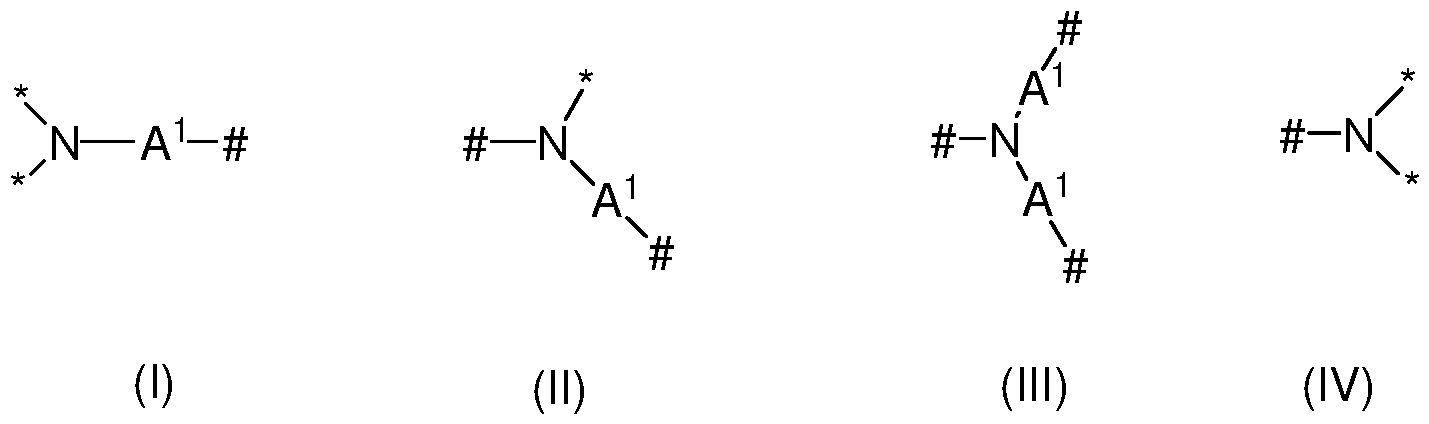
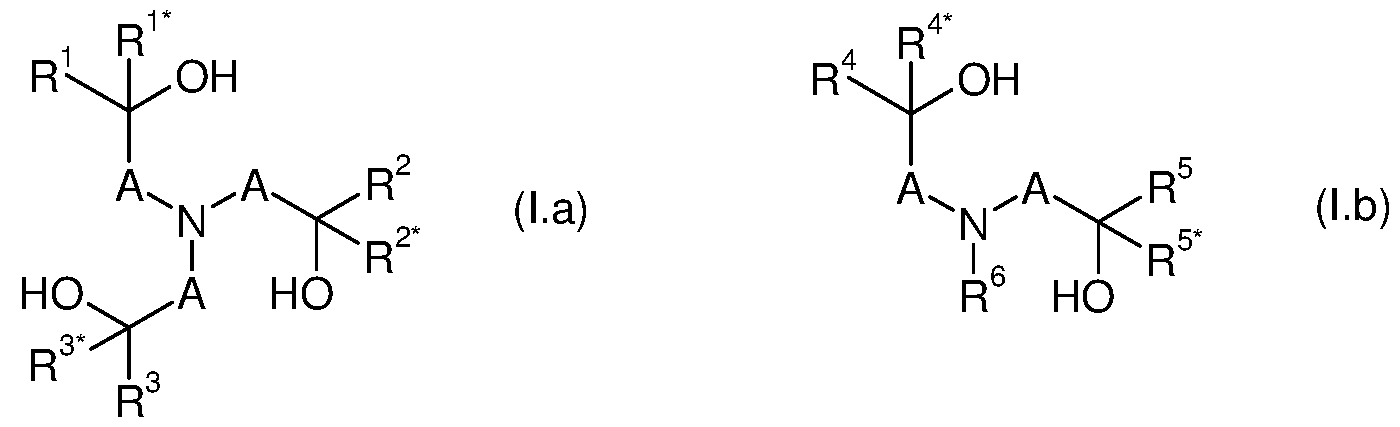
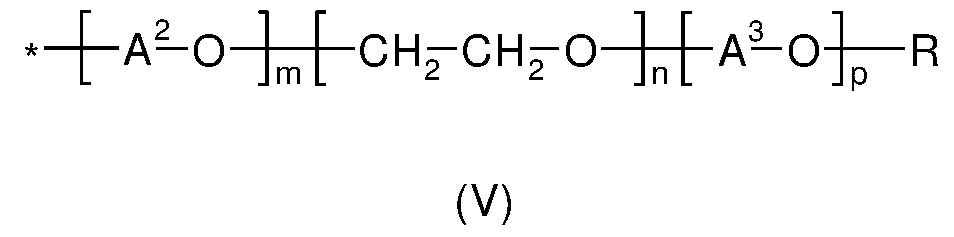
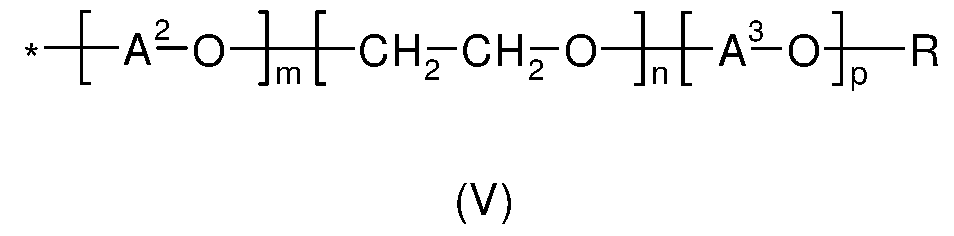
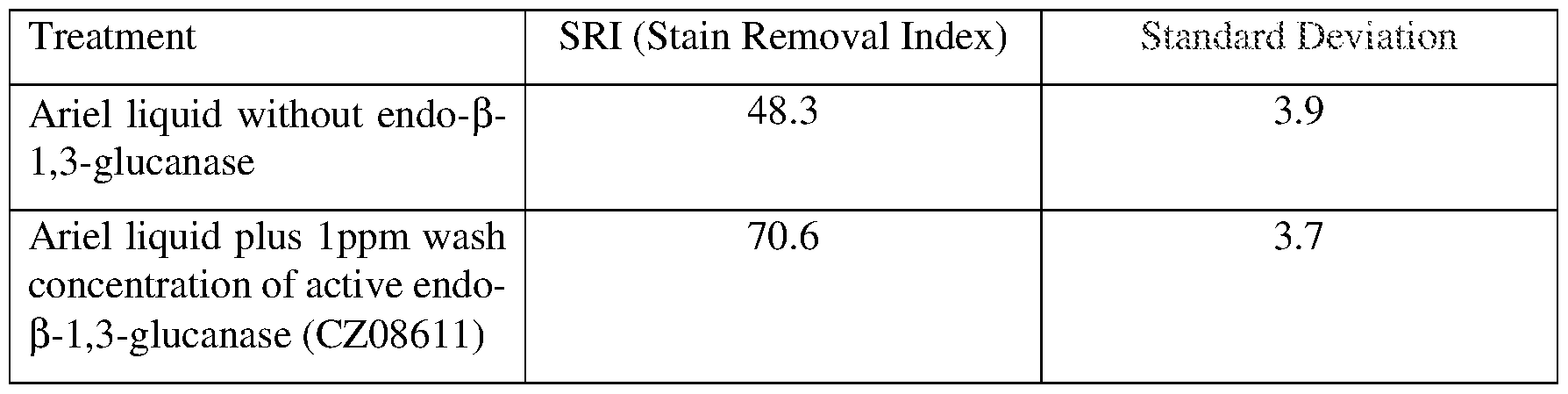


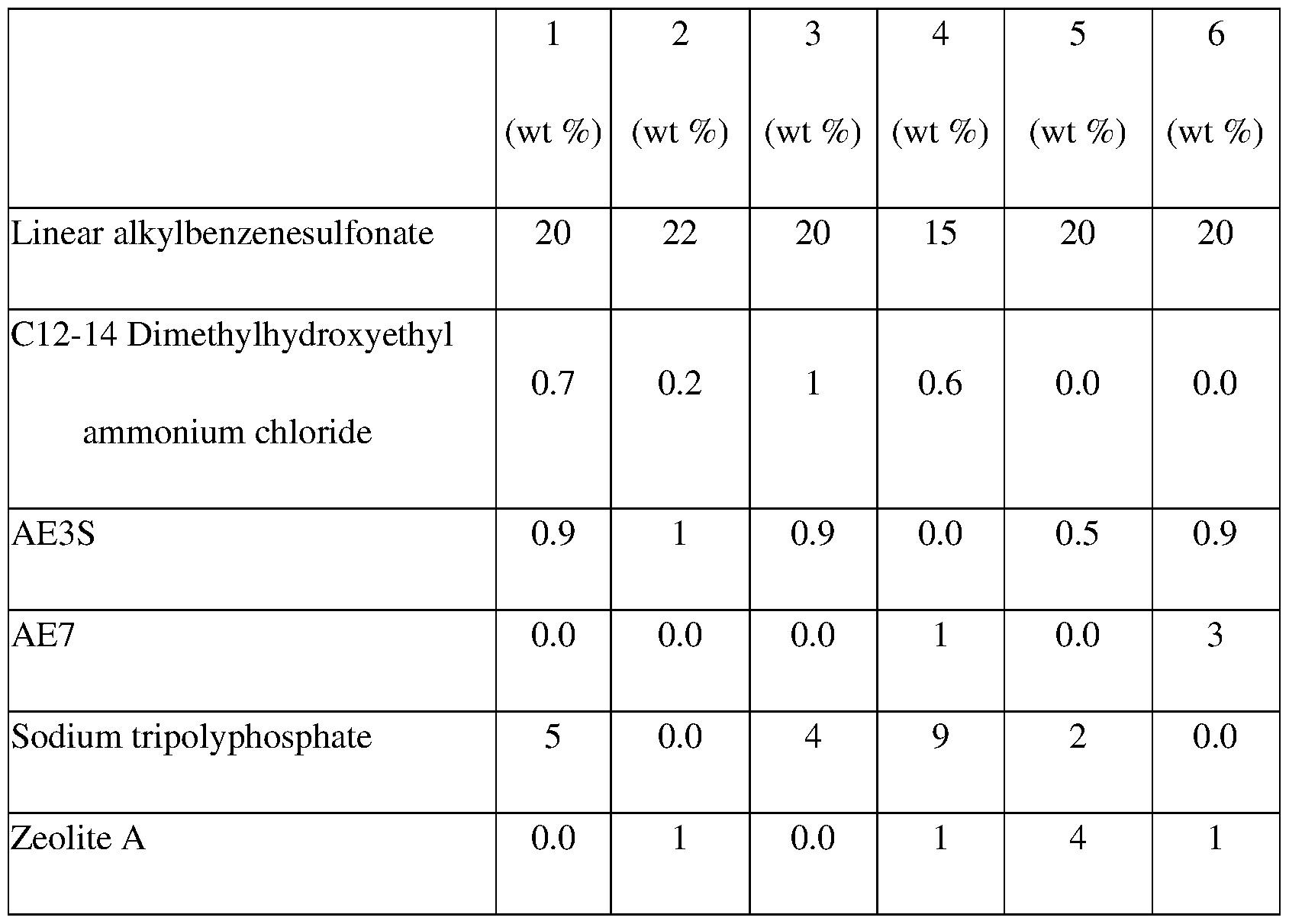

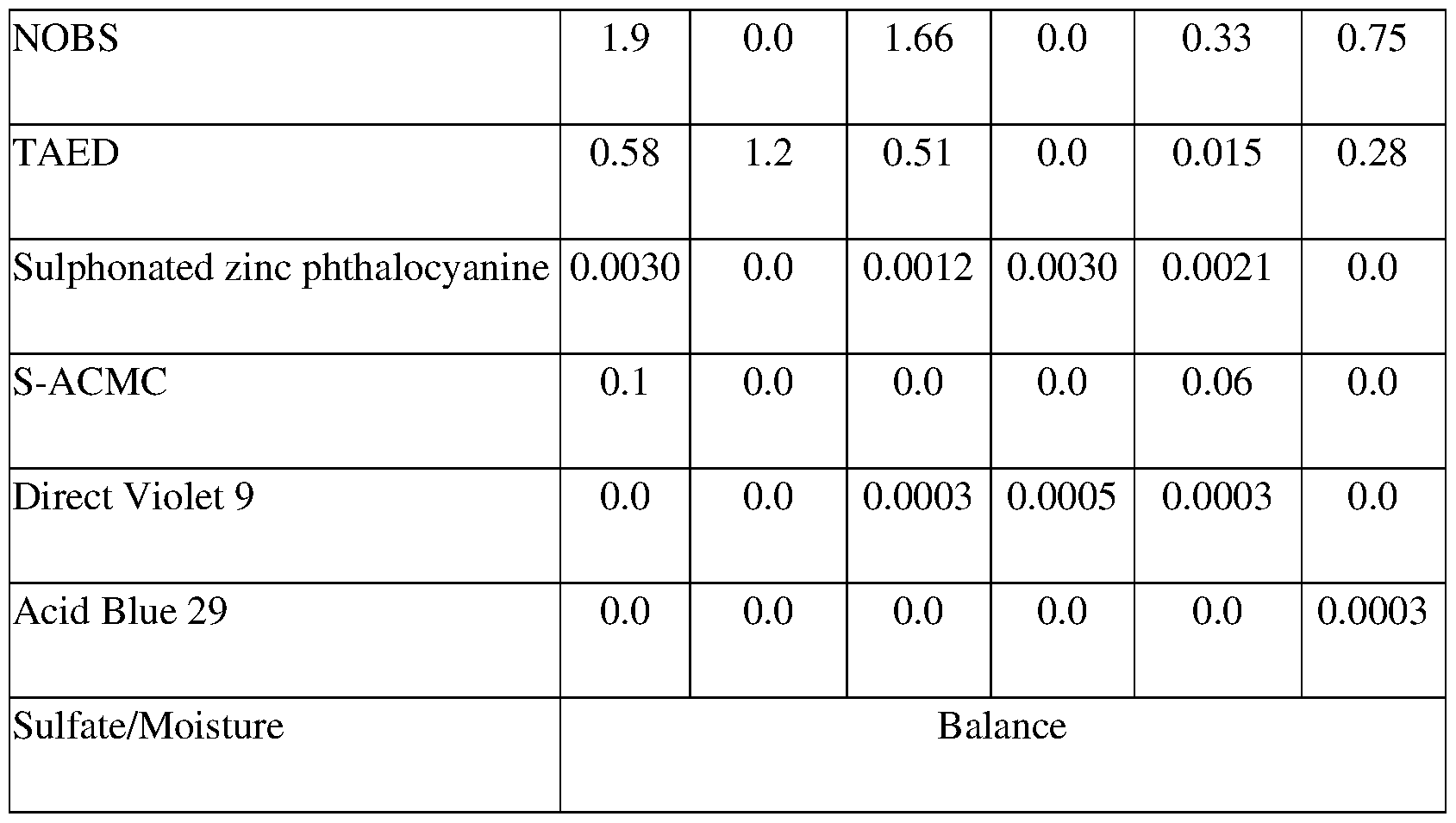

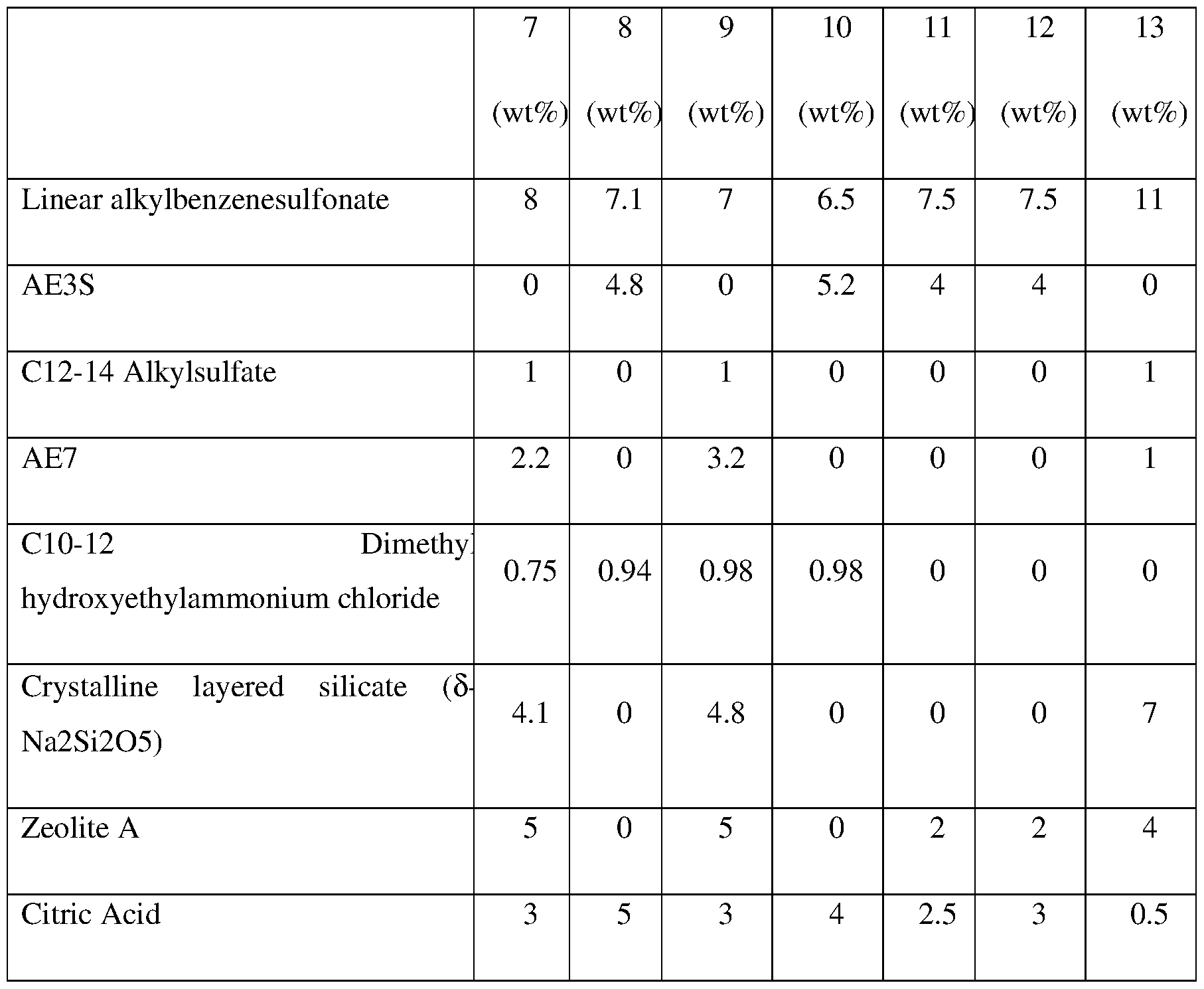
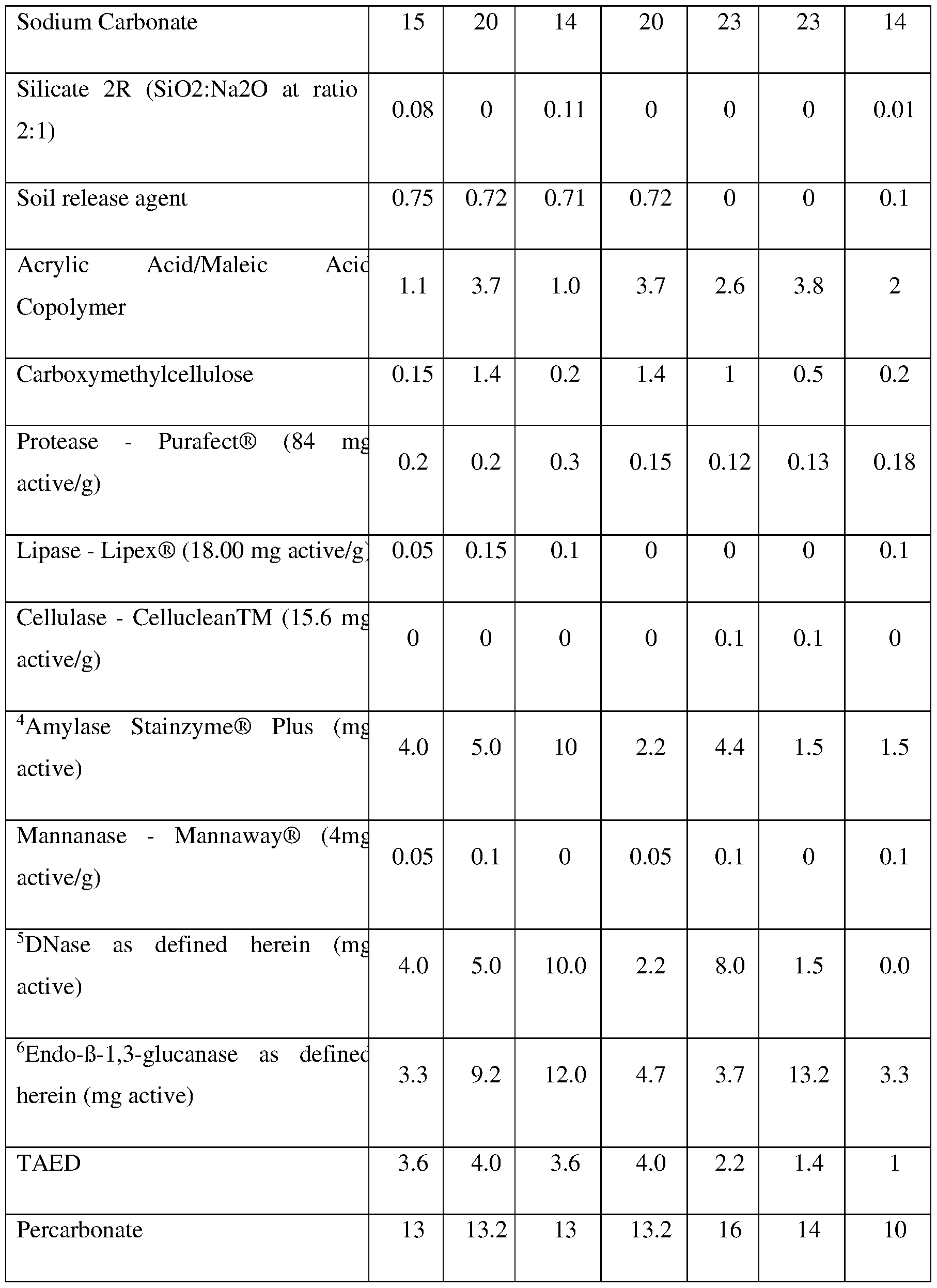
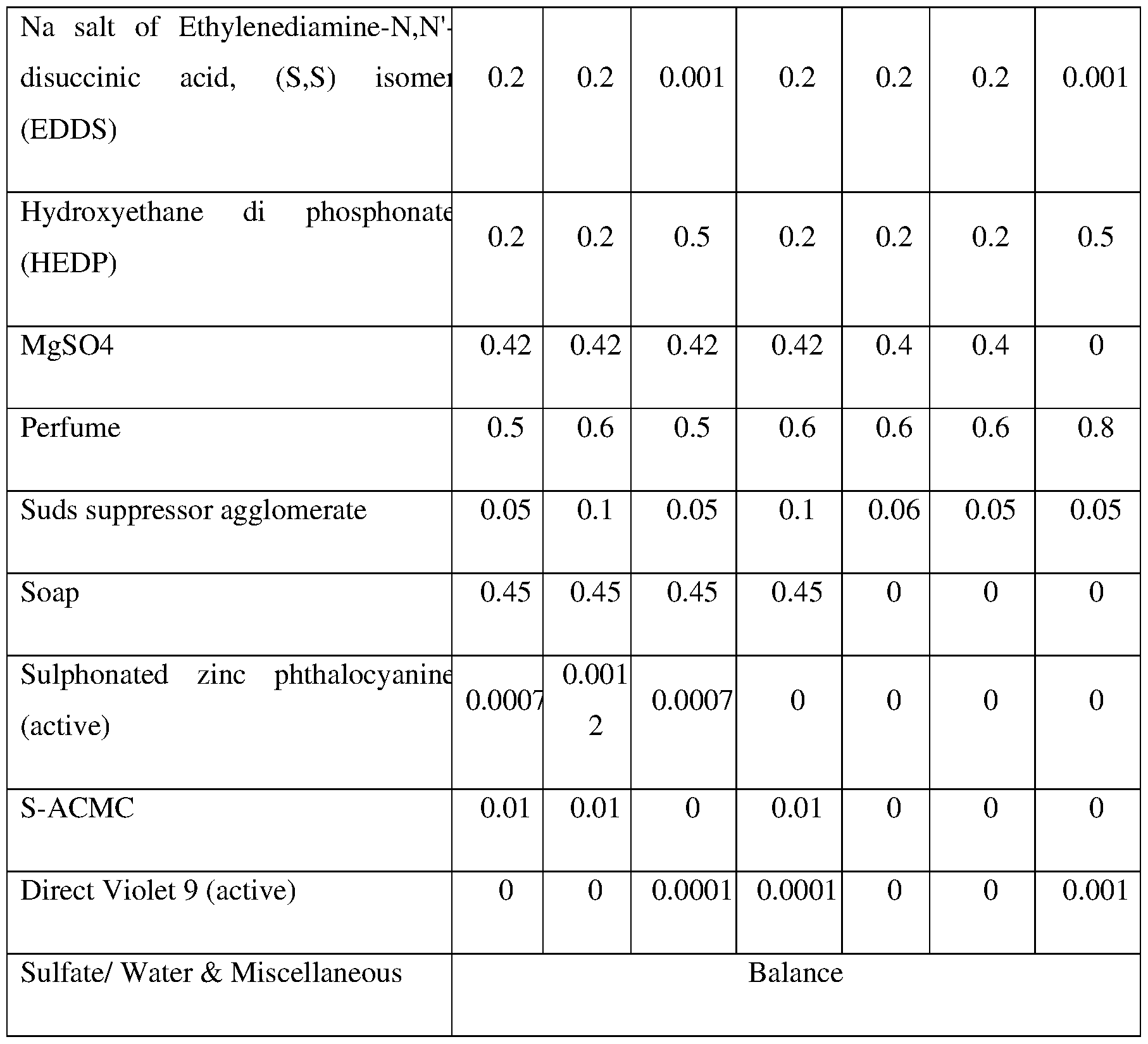

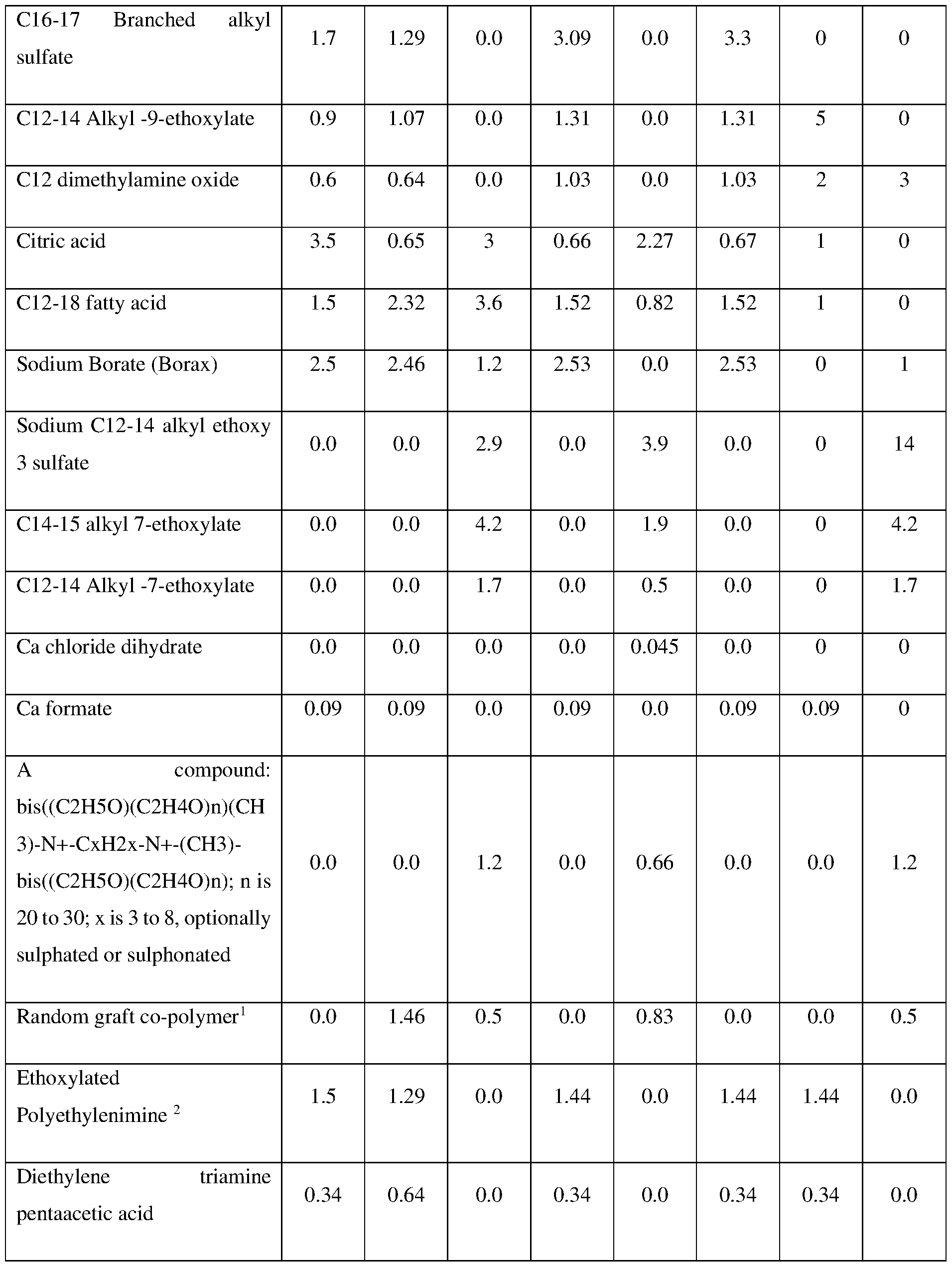

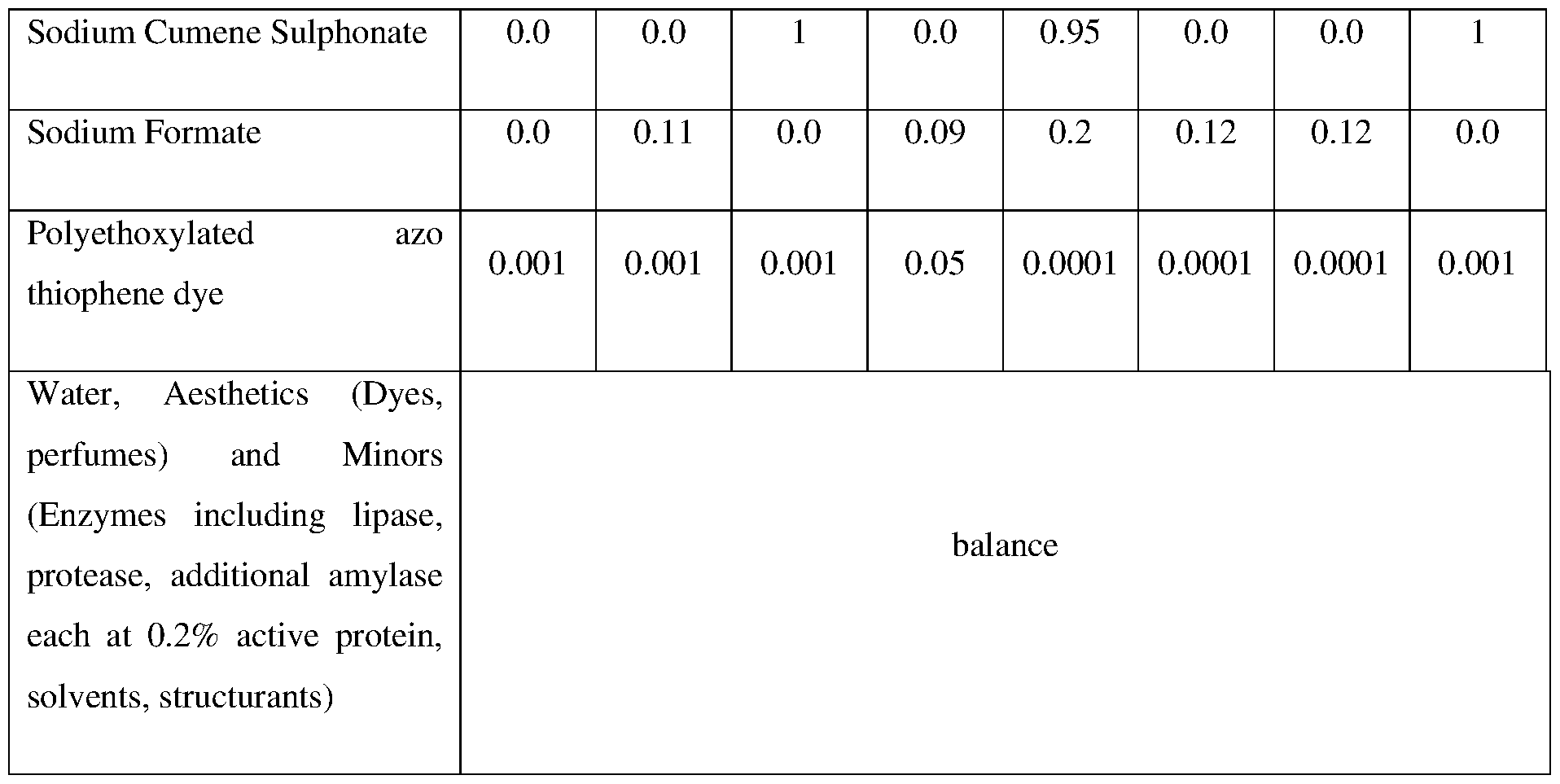
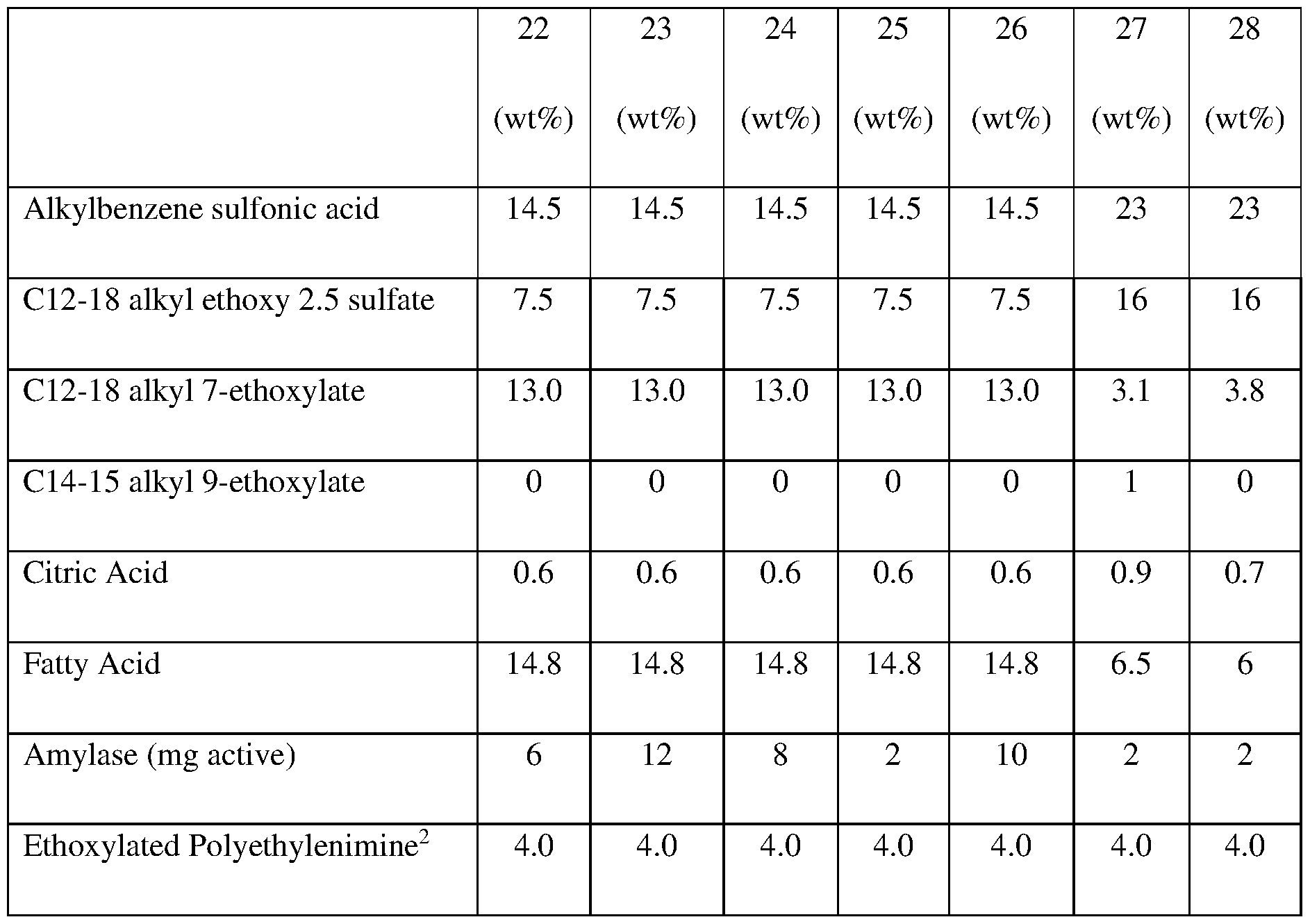


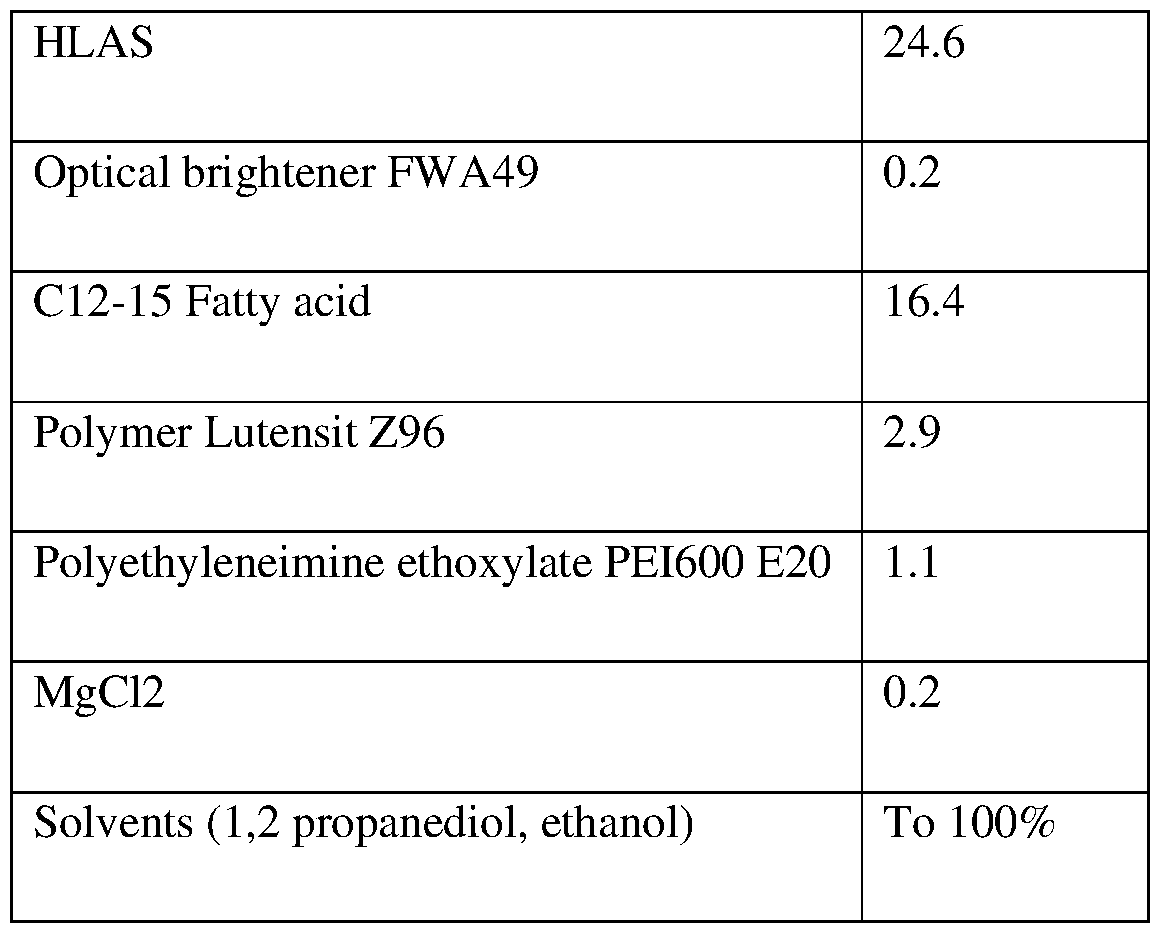


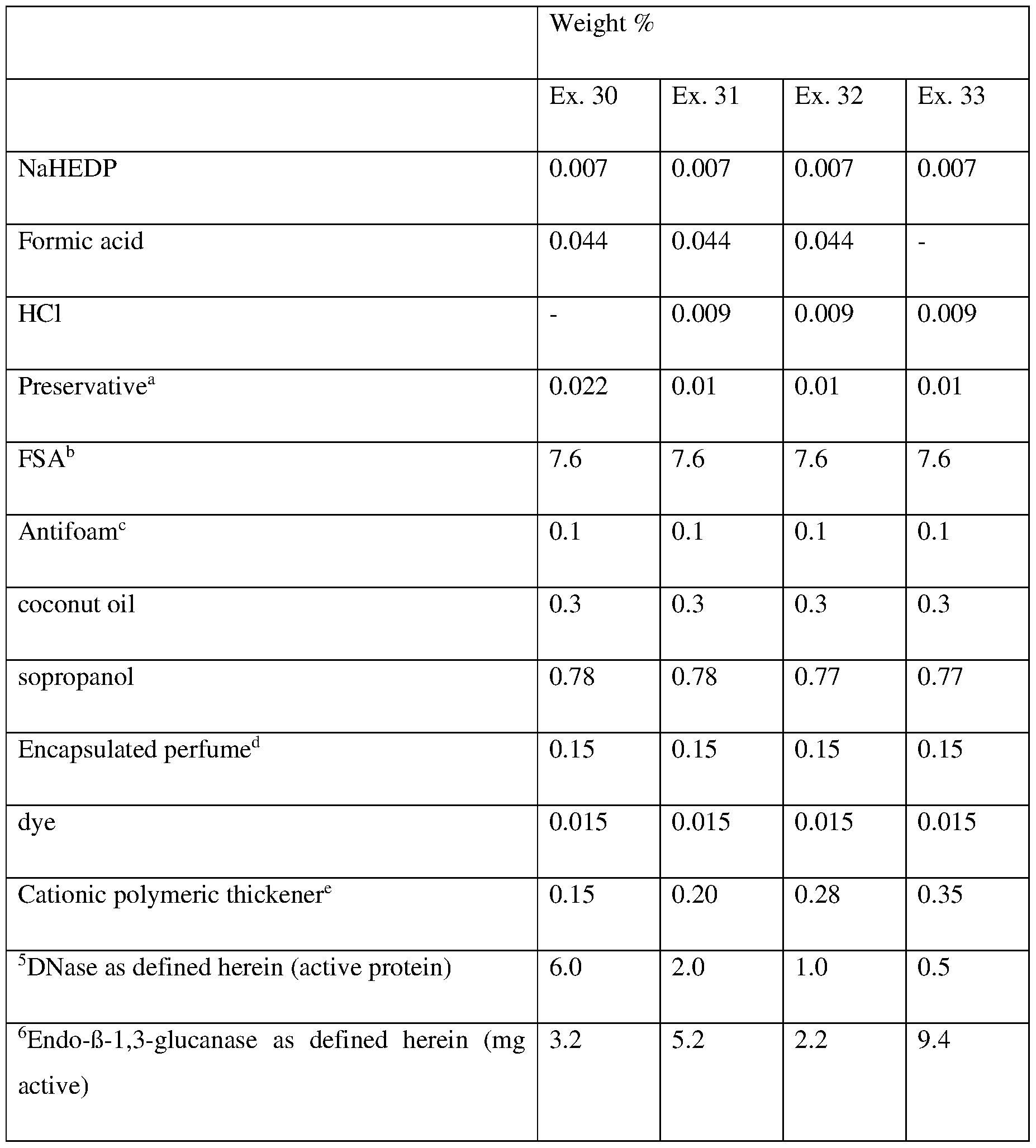
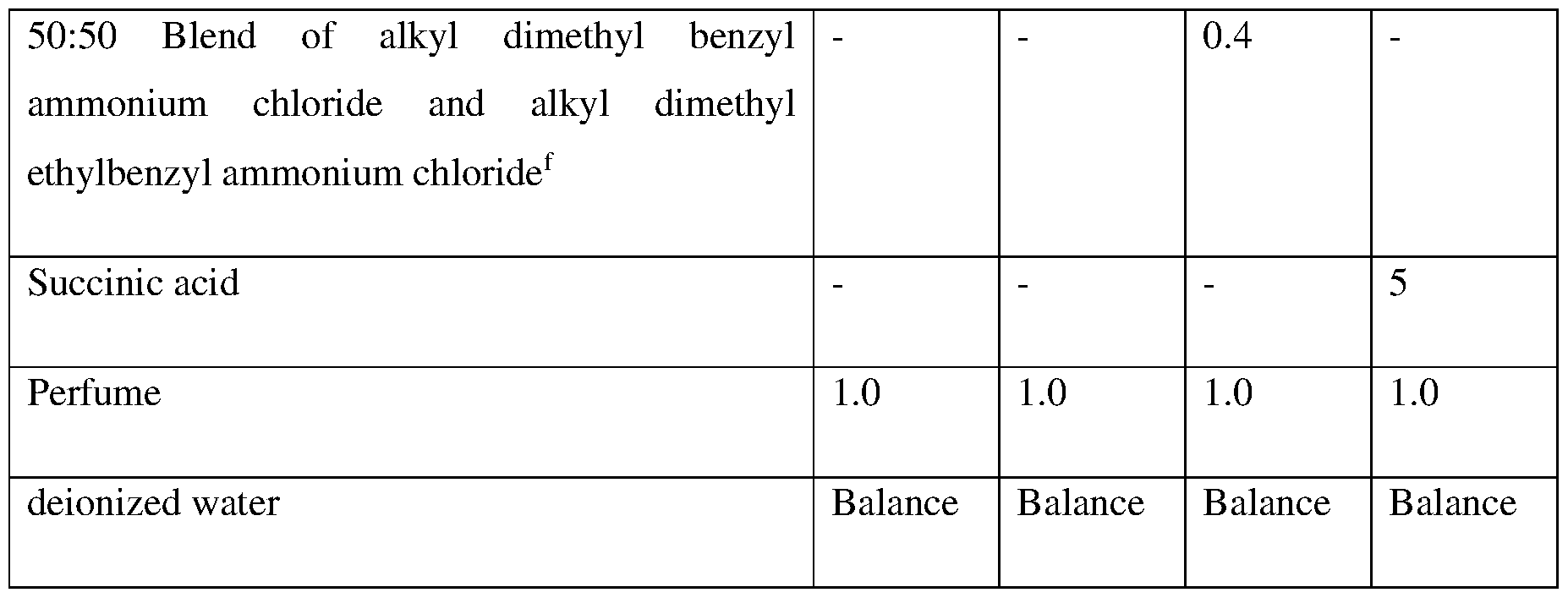
Claims
Priority Applications (5)
| Application Number | Priority Date | Filing Date | Title |
|---|---|---|---|
| CN202080015008.9A CN113439116B (en) | 2019-03-14 | 2020-03-12 | Cleaning compositions containing enzymes |
| EP20716360.1A EP3938484A1 (en) | 2019-03-14 | 2020-03-12 | Cleaning compositions comprising enzymes |
| CA3127167A CA3127167A1 (en) | 2019-03-14 | 2020-03-12 | Cleaning compositions comprising enzymes |
| JP2021552200A JP7275297B2 (en) | 2019-03-14 | 2020-03-12 | Cleaning composition containing enzymes |
| MX2021011121A MX2021011121A (en) | 2019-03-14 | 2020-03-12 | Cleaning compositions comprising enzymes. |
Applications Claiming Priority (2)
| Application Number | Priority Date | Filing Date | Title |
|---|---|---|---|
| EP19162988.0 | 2019-03-14 | ||
| EP19162988 | 2019-03-14 |
Publications (1)
| Publication Number | Publication Date |
|---|---|
| WO2020186028A1 true WO2020186028A1 (en) | 2020-09-17 |
Family
ID=65817839
Family Applications (1)
| Application Number | Title | Priority Date | Filing Date |
|---|---|---|---|
| PCT/US2020/022335 Ceased WO2020186028A1 (en) | 2019-03-14 | 2020-03-12 | Cleaning compositions comprising enzymes |
Country Status (7)
| Country | Link |
|---|---|
| US (1) | US20200291332A1 (en) |
| EP (1) | EP3938484A1 (en) |
| JP (1) | JP7275297B2 (en) |
| CN (1) | CN113439116B (en) |
| CA (1) | CA3127167A1 (en) |
| MX (1) | MX2021011121A (en) |
| WO (1) | WO2020186028A1 (en) |
Cited By (73)
| Publication number | Priority date | Publication date | Assignee | Title |
|---|---|---|---|---|
| WO2022063707A1 (en) | 2020-09-24 | 2022-03-31 | Unilever Ip Holdings B.V. | Composition |
| WO2022128368A1 (en) | 2020-12-14 | 2022-06-23 | Unilever Ip Holdings B.V. | Composition |
| WO2022128370A1 (en) | 2020-12-14 | 2022-06-23 | Unilever Ip Holdings B.V. | Composition |
| CN114891570A (en) * | 2021-06-08 | 2022-08-12 | 北京市家荣保洁服务有限公司 | Mild and efficient stain remover and preparation method thereof |
| WO2022189059A1 (en) | 2021-03-09 | 2022-09-15 | Unilever Ip Holdings B.V. | Composition |
| WO2022228832A1 (en) | 2021-04-30 | 2022-11-03 | Unilever Ip Holdings B.V. | Composition |
| WO2022228949A1 (en) | 2021-04-30 | 2022-11-03 | Unilever Ip Holdings B.V. | Composition |
| WO2022228903A1 (en) | 2021-04-30 | 2022-11-03 | Unilever Ip Holdings B.V. | Composition |
| WO2022228950A1 (en) | 2021-04-30 | 2022-11-03 | Unilever Ip Holdings B.V. | Composition |
| WO2022228951A1 (en) | 2021-04-30 | 2022-11-03 | Unilever Ip Holdings B.V. | Composition |
| WO2022248108A1 (en) | 2021-05-28 | 2022-12-01 | Unilever Ip Holdings B.V. | A liquid laundry detergent composition comprising c16 and c18 alcohol ethoxylate surfactant and/or c16 and c18 alkyl ether sulphate |
| WO2023011892A1 (en) | 2021-08-05 | 2023-02-09 | Unilever Ip Holdings B.V. | Composition |
| WO2023012098A1 (en) | 2021-08-05 | 2023-02-09 | Unilever Ip Holdings B.V. | Method |
| WO2023012093A1 (en) | 2021-08-05 | 2023-02-09 | Unilever Ip Holdings B.V. | Method |
| WO2023051978A1 (en) | 2021-09-29 | 2023-04-06 | Unilever Ip Holdings B.V. | Composition |
| DE102022128399A1 (en) | 2021-10-26 | 2023-04-27 | Unilever Global Ip Limited | COMPOSITION |
| WO2023152067A1 (en) | 2022-02-14 | 2023-08-17 | Unilever Ip Holdings B.V. | A concentrated liquid composition premix |
| WO2023152092A1 (en) | 2022-02-14 | 2023-08-17 | Unilever Ip Holdings B.V. | A concentrated liquid composition premix |
| EP3715444B1 (en) | 2019-03-29 | 2023-11-29 | The Procter & Gamble Company | Laundry detergent compositions with stain removal |
| WO2023227331A1 (en) | 2022-05-27 | 2023-11-30 | Unilever Ip Holdings B.V. | Composition comprising a specific methyl ester ethoxylate surfactant and a lipase |
| WO2023227375A1 (en) | 2022-05-27 | 2023-11-30 | Unilever Ip Holdings B.V. | Laundry liquid composition comprising a surfactant, an aminocarboxylate, an organic acid and a fragrance |
| WO2023227335A1 (en) | 2022-05-27 | 2023-11-30 | Unilever Ip Holdings B.V. | Liquid composition comprising linear alkyl benzene sulphonate, methyl ester ethoxylate and alkoxylated zwitterionic polyamine polymer |
| WO2023227332A1 (en) | 2022-05-27 | 2023-11-30 | Unilever Ip Holdings B.V. | Laundry liquid composition comprising a surfactant, an alkoxylated zwitterionic polyamine polymer and a protease |
| WO2023227421A1 (en) | 2022-05-27 | 2023-11-30 | Unilever Ip Holdings B.V. | Laundry liquid composition comprising a surfactant, an alkoxylated zwitterionic polyamine polymer, and a fragrance |
| WO2023233025A1 (en) | 2022-06-03 | 2023-12-07 | Unilever Ip Holdings B.V. | Liquid detergent product |
| WO2023237412A1 (en) | 2022-06-09 | 2023-12-14 | Unilever Ip Holdings B.V. | A concentrated liquid detergent composition |
| WO2024017623A1 (en) | 2022-07-18 | 2024-01-25 | Unilever Ip Holdings B.V. | A concentrated liquid composition |
| WO2024017614A1 (en) | 2022-07-18 | 2024-01-25 | Unilever Ip Holdings B.V. | A concentrated liquid composition |
| WO2024046756A1 (en) | 2022-08-30 | 2024-03-07 | Unilever Ip Holdings B.V. | Detergent product |
| WO2024056332A1 (en) | 2022-09-13 | 2024-03-21 | Unilever Ip Holdings B.V. | Washing machine and washing method |
| WO2024056333A1 (en) | 2022-09-13 | 2024-03-21 | Unilever Ip Holdings B.V. | Washing machine and washing method |
| WO2024056334A1 (en) | 2022-09-13 | 2024-03-21 | Unilever Ip Holdings B.V. | Washing machine and washing method |
| WO2024056278A1 (en) | 2022-09-13 | 2024-03-21 | Unilever Ip Holdings B.V. | Washing machine and washing method |
| EP4349942A1 (en) | 2022-10-05 | 2024-04-10 | Unilever IP Holdings B.V. | Laundry liquid composition |
| EP4349943A1 (en) | 2022-10-05 | 2024-04-10 | Unilever IP Holdings B.V. | Laundry liquid composition |
| EP4349946A1 (en) | 2022-10-05 | 2024-04-10 | Unilever IP Holdings B.V. | Unit dose fabric treatment product |
| EP4349944A1 (en) | 2022-10-05 | 2024-04-10 | Unilever IP Holdings B.V. | Laundry liquid composition |
| EP4349948A1 (en) | 2022-10-05 | 2024-04-10 | Unilever IP Holdings B.V. | Laundry liquid composition |
| EP4349945A1 (en) | 2022-10-05 | 2024-04-10 | Unilever IP Holdings B.V. | Laundry liquid composition |
| EP4349947A1 (en) | 2022-10-05 | 2024-04-10 | Unilever IP Holdings B.V. | Laundry liquid composition |
| EP4361239A1 (en) | 2022-10-25 | 2024-05-01 | Unilever IP Holdings B.V. | Laundry liquid composition |
| WO2024088706A1 (en) | 2022-10-25 | 2024-05-02 | Unilever Ip Holdings B.V. | Composition |
| WO2024088716A1 (en) | 2022-10-25 | 2024-05-02 | Unilever Ip Holdings B.V. | Composition |
| WO2024115106A1 (en) | 2022-11-29 | 2024-06-06 | Unilever Ip Holdings B.V. | Composition |
| WO2024194098A1 (en) | 2023-03-21 | 2024-09-26 | Unilever Ip Holdings B.V. | Detergent unit dose |
| WO2024213376A1 (en) | 2023-04-11 | 2024-10-17 | Unilever Ip Holdings B.V. | Composition |
| WO2024213443A1 (en) | 2023-04-11 | 2024-10-17 | Unilever Ip Holdings B.V. | Composition |
| WO2024213428A1 (en) | 2023-04-11 | 2024-10-17 | Unilever Ip Holdings B.V. | Composition |
| WO2024213438A1 (en) | 2023-04-11 | 2024-10-17 | Unilever Ip Holdings B.V. | Composition |
| WO2024213430A1 (en) | 2023-04-11 | 2024-10-17 | Unilever Ip Holdings B.V. | Composition |
| WO2024223218A1 (en) | 2023-04-25 | 2024-10-31 | Unilever Ip Holdings B.V. | Composition |
| EP4481027A1 (en) * | 2023-06-19 | 2024-12-25 | The Procter & Gamble Company | Cleaning compositions containing enzymes |
| WO2025011886A1 (en) | 2023-07-11 | 2025-01-16 | Unilever Ip Holdings B.V. | Method for treating fabric |
| WO2025011808A1 (en) | 2023-07-11 | 2025-01-16 | Unilever Ip Holdings B.V. | Method for treating fabric |
| WO2025012293A1 (en) | 2023-07-13 | 2025-01-16 | Unilever Ip Holdings B.V. | Washing machine and method |
| WO2025016669A1 (en) | 2023-07-19 | 2025-01-23 | Unilever Ip Holdings B.V. | Laundry capsule |
| WO2025026734A1 (en) | 2023-08-02 | 2025-02-06 | Unilever Ip Holdings B.V. | Composition |
| WO2025031752A1 (en) | 2023-08-04 | 2025-02-13 | Unilever Ip Holdings B.V. | Composition |
| WO2025031925A1 (en) | 2023-08-04 | 2025-02-13 | Unilever Ip Holdings B.V. | Composition |
| EP4509589A1 (en) | 2023-08-16 | 2025-02-19 | Unilever IP Holdings B.V. | Unit dose product |
| EP4570890A1 (en) | 2023-12-14 | 2025-06-18 | Unilever IP Holdings B.V. | Composition |
| WO2025124811A1 (en) | 2023-12-14 | 2025-06-19 | Unilever Ip Holdings B.V. | Composition |
| WO2025153644A1 (en) | 2024-01-18 | 2025-07-24 | Unilever Ip Holdings B.V. | Composition |
| WO2025153645A1 (en) | 2024-01-18 | 2025-07-24 | Unilever Ip Holdings B.V. | Use for fabric shape retention |
| WO2025168557A1 (en) | 2024-02-08 | 2025-08-14 | Unilever Ip Holdings B.V. | Detection method for microbial contaminants in detergents |
| WO2025214659A1 (en) | 2024-04-11 | 2025-10-16 | Unilever Ip Holdings B.V. | Washing method |
| WO2025214720A1 (en) | 2024-04-11 | 2025-10-16 | Unilever Ip Holdings B.V. | Washing machine and washing method |
| EP4663728A1 (en) | 2024-06-13 | 2025-12-17 | Unilever IP Holdings B.V. | Method for treating fabrics |
| EP4663737A1 (en) | 2024-06-13 | 2025-12-17 | Unilever IP Holdings B.V. | Laundry unit dose product |
| EP4663738A1 (en) | 2024-06-13 | 2025-12-17 | Unilever IP Holdings B.V. | Laundry unit dose product |
| EP4663729A1 (en) | 2024-06-13 | 2025-12-17 | Unilever IP Holdings B.V. | Method for treating fabrics |
| WO2026012788A1 (en) | 2024-07-08 | 2026-01-15 | Unilever Ip Holdings B.V. | Composition |
| WO2026012789A1 (en) | 2024-07-08 | 2026-01-15 | Unilever Ip Holdings B.V. | Composition |
Families Citing this family (4)
| Publication number | Priority date | Publication date | Assignee | Title |
|---|---|---|---|---|
| US11248194B2 (en) | 2019-03-14 | 2022-02-15 | The Procter & Gamble Company | Cleaning compositions comprising enzymes |
| JP7275299B2 (en) | 2019-03-14 | 2023-05-17 | ザ プロクター アンド ギャンブル カンパニー | How to treat cotton |
| DE102021206309A1 (en) | 2021-06-21 | 2022-12-22 | Henkel Ag & Co. Kgaa | Concentrated flowable detergent preparation with improved properties |
| EP4512882A1 (en) * | 2023-08-22 | 2025-02-26 | SkyLab AG | A cleaning composition comprising a glycosyl hydrolase targeting (1,4)-alpha-d-glucoside bonds and at least one glycosyl hydrolase targeting beta-glycoside bonds |
Citations (100)
| Publication number | Priority date | Publication date | Assignee | Title |
|---|---|---|---|---|
| US4435307A (en) | 1980-04-30 | 1984-03-06 | Novo Industri A/S | Detergent cellulase |
| US4760025A (en) | 1984-05-29 | 1988-07-26 | Genencor, Inc. | Modified enzymes and methods for making same |
| WO1989006270A1 (en) | 1988-01-07 | 1989-07-13 | Novo-Nordisk A/S | Enzymatic detergent |
| WO1992006210A1 (en) * | 1990-10-05 | 1992-04-16 | Genencor International, Inc. | Detergent compositions containing cellulase compositions enriched in acidic endoglucanase type components |
| WO1992017577A1 (en) | 1991-04-03 | 1992-10-15 | Novo Nordisk A/S | Novel proteases |
| WO1993024618A1 (en) | 1992-06-01 | 1993-12-09 | Novo Nordisk A/S | Peroxidase variants with improved hydrogen peroxide stability |
| US5352604A (en) | 1989-08-25 | 1994-10-04 | Henkel Research Corporation | Alkaline proteolytic enzyme and method of production |
| WO1995010602A1 (en) | 1993-10-13 | 1995-04-20 | Novo Nordisk A/S | H2o2-stable peroxidase variants |
| WO1995031533A1 (en) * | 1994-05-11 | 1995-11-23 | Novo Nordisk A/S | AN ENZYME WITH ENDO-1,3(4)-β-GLUCANASE ACTIVITY |
| WO1996023873A1 (en) | 1995-02-03 | 1996-08-08 | Novo Nordisk A/S | Amylase variants |
| WO1997000324A1 (en) | 1995-06-14 | 1997-01-03 | Kao Corporation | Gene encoding alkaline liquefying alpha-amylase |
| WO1997007202A1 (en) | 1995-08-11 | 1997-02-27 | Novo Nordisk A/S | Novel lipolytic enzymes |
| US5648263A (en) | 1988-03-24 | 1997-07-15 | Novo Nordisk A/S | Methods for reducing the harshness of a cotton-containing fabric |
| US5679630A (en) | 1993-10-14 | 1997-10-21 | The Procter & Gamble Company | Protease-containing cleaning compositions |
| US5691178A (en) | 1988-03-22 | 1997-11-25 | Novo Nordisk A/S | Fungal cellulase composition containing alkaline CMC-endoglucanase and essentially no cellobiohydrolase |
| WO1998013459A1 (en) | 1996-09-24 | 1998-04-02 | The Procter & Gamble Company | Liquid detergents containing proteolytic enzyme, peptide aldehyde and calcium ions |
| WO1998015257A1 (en) | 1996-10-08 | 1998-04-16 | Novo Nordisk A/S | Diaminobenzoic acid derivatives as dye precursors |
| US5856164A (en) | 1994-03-29 | 1999-01-05 | Novo Nordisk A/S | Alkaline bacillus amylase |
| WO1999023211A1 (en) | 1997-10-30 | 1999-05-14 | Novo Nordisk A/S | α-AMYLASE MUTANTS |
| US6020303A (en) | 1996-04-16 | 2000-02-01 | The Procter & Gamble Company | Mid-chain branched surfactants |
| US6060443A (en) | 1996-04-16 | 2000-05-09 | The Procter & Gamble Company | Mid-chain branched alkyl sulfate surfactants |
| US6093562A (en) | 1996-02-05 | 2000-07-25 | Novo Nordisk A/S | Amylase variants |
| EP1022334A2 (en) | 1998-12-21 | 2000-07-26 | Kao Corporation | Novel amylases |
| WO2000060060A2 (en) | 1999-03-31 | 2000-10-12 | Novozymes A/S | Polypeptides having alkaline alpha-amylase activity and nucleic acids encoding same |
| US6312936B1 (en) | 1997-10-23 | 2001-11-06 | Genencor International, Inc. | Multiply-substituted protease variants |
| US6403549B1 (en) * | 1996-04-12 | 2002-06-11 | Novozymes A/S | Enzyme-containing granules and process for the production thereof |
| WO2004067737A2 (en) | 2003-01-30 | 2004-08-12 | Novozymes A/S | Subtilases |
| WO2005003319A2 (en) | 2003-07-02 | 2005-01-13 | Diversa Corporation | Glucanases, nucleic acids encoding them and methods for making and using them |
| WO2005052146A2 (en) | 2003-11-19 | 2005-06-09 | Genencor International, Inc. | Serine proteases, nucleic acids encoding serine enzymes and vectors and host cells incorporating same |
| US6939702B1 (en) | 1999-03-31 | 2005-09-06 | Novozymes A/S | Lipase variant |
| WO2006002643A2 (en) | 2004-07-05 | 2006-01-12 | Novozymes A/S | Alpha-amylase variants with altered properties |
| WO2006055787A1 (en) | 2004-11-19 | 2006-05-26 | The Procter & Gamble Company | Whiteness perception compositions |
| US7141403B2 (en) | 2001-06-06 | 2006-11-28 | Novozymes A/S | Endo-beta-1,4-glucanases |
| US7153818B2 (en) | 2000-07-28 | 2006-12-26 | Henkel Kgaa | Amylolytic enzyme extracted from bacillus sp. A 7-7 (DSM 12368) and washing and cleaning agents containing this novel amylolytic enzyme |
| WO2007044993A2 (en) | 2005-10-12 | 2007-04-19 | Genencor International, Inc. | Use and production of storage-stable neutral metalloprotease |
| US7208459B2 (en) | 2004-06-29 | 2007-04-24 | The Procter & Gamble Company | Laundry detergent compositions with efficient hueing dye |
| EP1794276A1 (en) | 2004-09-23 | 2007-06-13 | Unilever Plc | Laundry treatment compositions |
| EP1794275A1 (en) | 2004-09-23 | 2007-06-13 | Unilever Plc | Laundry treatment compositions |
| DE102006022224A1 (en) | 2006-05-11 | 2007-11-15 | Henkel Kgaa | Subtilisin from Bacillus pumilus and detergents and cleaners containing this new subtilisin |
| DE102006022216A1 (en) | 2006-05-11 | 2007-11-15 | Henkel Kgaa | New alkaline protease from Bacillus gibsonii and detergents and cleaners containing this novel alkaline protease |
| WO2008010925A2 (en) | 2006-07-18 | 2008-01-24 | Danisco Us, Inc., Genencor Division | Protease variants active over a broad temperature range |
| US20080177090A1 (en) | 2007-01-19 | 2008-07-24 | Valenti Michael A | Novel whitening agents for cellulosic substrates |
| US20090217464A1 (en) | 2008-02-29 | 2009-09-03 | Philip Frank Souter | Detergent composition comprising lipase |
| WO2009118375A2 (en) | 2008-03-26 | 2009-10-01 | Novozymes A/S | Stabilized liquid enzyme compositions |
| WO2009149271A2 (en) | 2008-06-06 | 2009-12-10 | Danisco Us Inc. | Production of glucose from starch using alpha-amylases from bacillus subtilis |
| WO2009149130A2 (en) | 2008-06-06 | 2009-12-10 | Danisco Us Inc. | Geobacillus stearothermophilus alpha-amylase (amys) variants with improved properties |
| WO2009148983A1 (en) | 2008-06-06 | 2009-12-10 | The Procter & Gamble Company | Detergent composition comprising a variant of a family 44 xyloglucanase |
| WO2010142503A1 (en) | 2009-06-12 | 2010-12-16 | Unilever Plc | Cationic dye polymers |
| WO2010145887A1 (en) | 2009-06-15 | 2010-12-23 | Unilever Plc | Anionic dye polymers |
| WO2011011799A2 (en) | 2010-11-12 | 2011-01-27 | The Procter & Gamble Company | Thiophene azo dyes and laundry care compositions containing the same |
| WO2011047987A1 (en) | 2009-10-23 | 2011-04-28 | Unilever Plc | Dye polymers |
| WO2011084412A1 (en) | 2009-12-21 | 2011-07-14 | Danisco Us Inc. | Detergent compositions containing thermobifida fusca lipase and methods of use thereof |
| WO2011100410A2 (en) | 2010-02-10 | 2011-08-18 | The Procter & Gamble Company | Cleaning composition comprising amylase variants with high stability in the presence of a chelating agent |
| WO2011098355A1 (en) | 2010-02-09 | 2011-08-18 | Unilever Plc | Dye polymers |
| WO2013003659A1 (en) | 2011-06-30 | 2013-01-03 | The Procter & Gamble Company | Cleaning compositions comprising amylase variants reference to a sequence listing |
| WO2013033318A1 (en) | 2011-08-31 | 2013-03-07 | Danisco Us Inc. | Compositions and methods comprising a lipolytic enzyme variant |
| WO2013171241A1 (en) | 2012-05-16 | 2013-11-21 | Novozymes A/S | Compositions comprising lipase and methods of use thereof |
| WO2014099523A1 (en) | 2012-12-21 | 2014-06-26 | Danisco Us Inc. | Alpha-amylase variants |
| US8765659B2 (en) | 2010-04-01 | 2014-07-01 | The Procter & Gamble Company | Cationic polymer stabilized microcapsule composition |
| WO2014164777A1 (en) | 2013-03-11 | 2014-10-09 | Danisco Us Inc. | Alpha-amylase combinatorial variants |
| WO2014194054A1 (en) | 2013-05-29 | 2014-12-04 | Danisco Us Inc. | Novel metalloproteases |
| WO2014194032A1 (en) | 2013-05-29 | 2014-12-04 | Danisco Us Inc. | Novel metalloproteases |
| WO2014194117A2 (en) | 2013-05-29 | 2014-12-04 | Danisco Us Inc. | Novel metalloproteases |
| WO2015014790A2 (en) | 2013-07-29 | 2015-02-05 | Novozymes A/S | Protease variants and polynucleotides encoding same |
| WO2015024739A2 (en) | 2013-07-29 | 2015-02-26 | Henkel Ag & Co. Kgaa | Detergent composition comprising protease variants |
| WO2015040159A2 (en) | 2013-09-19 | 2015-03-26 | Novozymes A/S | Polypeptides having mannanase activity and polynucleotides encoding same |
| WO2015089447A1 (en) | 2013-12-13 | 2015-06-18 | Danisco Us Inc. | Serine proteases of the bacillus gibsonii-clade |
| WO2015089441A1 (en) | 2013-12-13 | 2015-06-18 | Danisco Us Inc. | Serine proteases of bacillus species |
| WO2015091989A1 (en) | 2013-12-20 | 2015-06-25 | Novozymes A/S | Polypeptides having protease activity and polynucleotides encoding same |
| WO2015091990A1 (en) | 2013-12-20 | 2015-06-25 | Novozymes A/S | Polypeptides having protease activity and polynucleotides encoding same |
| WO2015143360A2 (en) | 2014-03-21 | 2015-09-24 | Danisco Us Inc. | Serine proteases of bacillus species |
| WO2015185689A1 (en) | 2014-06-04 | 2015-12-10 | Novozymes A/S | Detergent composition |
| WO2015193488A1 (en) | 2014-06-20 | 2015-12-23 | Novozymes A/S | Metalloprotease from kribbella aluminosa and detergent compositions comprising the metalloprotease |
| WO2016066756A2 (en) | 2014-10-30 | 2016-05-06 | Novozymes A/S | Protease variants and polynucleotides encoding same |
| WO2016069569A2 (en) | 2014-10-27 | 2016-05-06 | Danisco Us Inc. | Serine proteases |
| WO2016069557A1 (en) | 2014-10-27 | 2016-05-06 | Danisco Us Inc. | Serine proteases of bacillus species |
| WO2016066757A2 (en) | 2014-10-30 | 2016-05-06 | Novozymes A/S | Protease variants and polynucleotides encoding same |
| WO2016069563A1 (en) | 2014-10-27 | 2016-05-06 | Danisco Us Inc. | Serine proteases |
| WO2016075078A2 (en) | 2014-11-10 | 2016-05-19 | Novozymes A/S | Metalloproteases and uses thereof |
| WO2016091688A1 (en) | 2014-12-10 | 2016-06-16 | Henkel Ag & Co. Kgaa | Hand dishwashing detergent having an improved effect against starch |
| EP3088504A1 (en) * | 2015-04-29 | 2016-11-02 | The Procter and Gamble Company | Method of treating a fabric |
| WO2016174234A2 (en) | 2015-04-29 | 2016-11-03 | Novozymes A/S | Polypeptides suitable for detergent |
| WO2016180748A1 (en) | 2015-05-08 | 2016-11-17 | Novozymes A/S | Alpha-amylase variants and polynucleotides encoding same |
| WO2017005798A1 (en) | 2015-07-06 | 2017-01-12 | Novozymes A/S | Methods of reducing odor |
| WO2017036901A1 (en) | 2015-08-28 | 2017-03-09 | Unilever Plc | Improved wash compositions |
| WO2017106676A1 (en) | 2015-12-18 | 2017-06-22 | Danisco Us Inc | Polypeptides with endoglucanase activity and uses thereof |
| WO2017162836A1 (en) | 2016-03-23 | 2017-09-28 | Novozymes A/S | Use of polypeptide having dnase activity for treating fabrics |
| WO2017192657A1 (en) | 2016-05-03 | 2017-11-09 | The Procter & Gamble Company | Automatic dishwashing detergent composition |
| WO2018011277A1 (en) | 2016-07-13 | 2018-01-18 | Novozymes A/S | Bacillus cibi dnase variants |
| EP3299457A1 (en) | 2016-09-26 | 2018-03-28 | Henkel AG & Co. KGaA | New lipase |
| WO2018060216A1 (en) | 2016-09-29 | 2018-04-05 | Novozymes A/S | Use of enzyme for washing, method for washing and warewashing composition |
| WO2018178061A1 (en) | 2017-03-31 | 2018-10-04 | Novozymes A/S | Polypeptides having rnase activity |
| WO2018209026A1 (en) | 2017-05-12 | 2018-11-15 | Basf Se | Method for using lipase enzymes for cleaning |
| US20180340162A1 (en) | 2011-06-24 | 2018-11-29 | Novozymes A/S | Polypeptides having protease activity and polynucleotides encoding same |
| WO2018228880A1 (en) | 2017-06-12 | 2018-12-20 | Henkel Ag & Co. Kgaa | Pseudomonas stutzeri lipase and use thereof |
| WO2018228881A1 (en) | 2017-06-12 | 2018-12-20 | Henkel Ag & Co. Kgaa | Microbulbifer thermotolerans lipase and use thereof |
| WO2019048486A1 (en) | 2017-09-05 | 2019-03-14 | Henkel Ag & Co. Kgaa | PERFORMANCE IMPROVED PROTEASE VERSIONS II |
| WO2019048488A1 (en) | 2017-09-05 | 2019-03-14 | Henkel Ag & Co. Kgaa | PERFORMANCE IMPROVED PROTEASE VERSIONS III |
| WO2019048495A1 (en) | 2017-09-05 | 2019-03-14 | Henkel Ag & Co. Kgaa | PERFORMANCE IMPROVED PROTEASE VERSIONS I |
| WO2019105675A1 (en) | 2017-11-30 | 2019-06-06 | Unilever Plc | Detergent composition comprising protease |
Family Cites Families (11)
| Publication number | Priority date | Publication date | Assignee | Title |
|---|---|---|---|---|
| JPS58134014A (en) * | 1982-02-03 | 1983-08-10 | Rooto Seiyaku Kk | Composition for cleaning denture |
| JP2663141B2 (en) * | 1988-05-31 | 1997-10-15 | ユーホーケミカル株式会社 | Detergent for ion exchange membrane |
| EP0576526B1 (en) * | 1991-03-19 | 1994-12-07 | Novo Nordisk A/S | Removal of printing paste thickener and excess dye after textile printing |
| EP0785995A1 (en) * | 1994-10-14 | 1997-07-30 | Novo Nordisk A/S | A novel enzyme with beta-1,3-glucanase activity |
| AR015631A1 (en) * | 1997-05-05 | 2001-05-16 | Procter & Gamble | COMPOSITIONS FOR WASHING CLOTHING AND CLEANING CONTAINING ENZYMES XILOGLUCANASA |
| EP1002061A1 (en) * | 1997-07-04 | 2000-05-24 | Novo Nordisk A/S | FAMILY 6 ENDO-1,4-$g(b)-GLUCANASE VARIANTS AND CLEANING COMPOSIT IONS CONTAINING THEM |
| DE19732749A1 (en) * | 1997-07-30 | 1999-02-04 | Henkel Kgaa | Detergent containing glucanase |
| ES2415872T3 (en) * | 2005-08-19 | 2013-07-29 | The Procter & Gamble Company | Solid laundry detergent composition comprising an anionic detersive surfactant and calcium enhancement technology |
| CN101297025B (en) * | 2005-09-02 | 2012-10-24 | 诺维信公司 | Stabilization of concentrated liquid enzyme additives |
| US8071345B2 (en) * | 2006-03-31 | 2011-12-06 | Novozymes A/S | Stabilized subtilisin composition |
| US20130332133A1 (en) * | 2006-05-11 | 2013-12-12 | Ramot At Tel Aviv University Ltd. | Classification of Protein Sequences and Uses of Classified Proteins |
-
2020
- 2020-03-12 JP JP2021552200A patent/JP7275297B2/en active Active
- 2020-03-12 EP EP20716360.1A patent/EP3938484A1/en active Pending
- 2020-03-12 US US16/816,403 patent/US20200291332A1/en not_active Abandoned
- 2020-03-12 CN CN202080015008.9A patent/CN113439116B/en active Active
- 2020-03-12 MX MX2021011121A patent/MX2021011121A/en unknown
- 2020-03-12 CA CA3127167A patent/CA3127167A1/en not_active Abandoned
- 2020-03-12 WO PCT/US2020/022335 patent/WO2020186028A1/en not_active Ceased
Patent Citations (105)
| Publication number | Priority date | Publication date | Assignee | Title |
|---|---|---|---|---|
| US4435307A (en) | 1980-04-30 | 1984-03-06 | Novo Industri A/S | Detergent cellulase |
| US4760025A (en) | 1984-05-29 | 1988-07-26 | Genencor, Inc. | Modified enzymes and methods for making same |
| WO1989006270A1 (en) | 1988-01-07 | 1989-07-13 | Novo-Nordisk A/S | Enzymatic detergent |
| US5691178A (en) | 1988-03-22 | 1997-11-25 | Novo Nordisk A/S | Fungal cellulase composition containing alkaline CMC-endoglucanase and essentially no cellobiohydrolase |
| US5776757A (en) | 1988-03-24 | 1998-07-07 | Novo Nordisk A/S | Fungal cellulase composition containing alkaline CMC-endoglucanase and essentially no cellobiohydrolase and method of making thereof |
| US5648263A (en) | 1988-03-24 | 1997-07-15 | Novo Nordisk A/S | Methods for reducing the harshness of a cotton-containing fabric |
| US5352604A (en) | 1989-08-25 | 1994-10-04 | Henkel Research Corporation | Alkaline proteolytic enzyme and method of production |
| WO1992006210A1 (en) * | 1990-10-05 | 1992-04-16 | Genencor International, Inc. | Detergent compositions containing cellulase compositions enriched in acidic endoglucanase type components |
| WO1992017577A1 (en) | 1991-04-03 | 1992-10-15 | Novo Nordisk A/S | Novel proteases |
| WO1993024618A1 (en) | 1992-06-01 | 1993-12-09 | Novo Nordisk A/S | Peroxidase variants with improved hydrogen peroxide stability |
| WO1995010602A1 (en) | 1993-10-13 | 1995-04-20 | Novo Nordisk A/S | H2o2-stable peroxidase variants |
| US5679630A (en) | 1993-10-14 | 1997-10-21 | The Procter & Gamble Company | Protease-containing cleaning compositions |
| US5856164A (en) | 1994-03-29 | 1999-01-05 | Novo Nordisk A/S | Alkaline bacillus amylase |
| WO1995031533A1 (en) * | 1994-05-11 | 1995-11-23 | Novo Nordisk A/S | AN ENZYME WITH ENDO-1,3(4)-β-GLUCANASE ACTIVITY |
| WO1996023873A1 (en) | 1995-02-03 | 1996-08-08 | Novo Nordisk A/S | Amylase variants |
| WO1997000324A1 (en) | 1995-06-14 | 1997-01-03 | Kao Corporation | Gene encoding alkaline liquefying alpha-amylase |
| WO1997007202A1 (en) | 1995-08-11 | 1997-02-27 | Novo Nordisk A/S | Novel lipolytic enzymes |
| US6093562A (en) | 1996-02-05 | 2000-07-25 | Novo Nordisk A/S | Amylase variants |
| US6403549B1 (en) * | 1996-04-12 | 2002-06-11 | Novozymes A/S | Enzyme-containing granules and process for the production thereof |
| US6020303A (en) | 1996-04-16 | 2000-02-01 | The Procter & Gamble Company | Mid-chain branched surfactants |
| US6060443A (en) | 1996-04-16 | 2000-05-09 | The Procter & Gamble Company | Mid-chain branched alkyl sulfate surfactants |
| WO1998013459A1 (en) | 1996-09-24 | 1998-04-02 | The Procter & Gamble Company | Liquid detergents containing proteolytic enzyme, peptide aldehyde and calcium ions |
| WO1998015257A1 (en) | 1996-10-08 | 1998-04-16 | Novo Nordisk A/S | Diaminobenzoic acid derivatives as dye precursors |
| US6312936B1 (en) | 1997-10-23 | 2001-11-06 | Genencor International, Inc. | Multiply-substituted protease variants |
| WO1999023211A1 (en) | 1997-10-30 | 1999-05-14 | Novo Nordisk A/S | α-AMYLASE MUTANTS |
| EP1022334A2 (en) | 1998-12-21 | 2000-07-26 | Kao Corporation | Novel amylases |
| US6939702B1 (en) | 1999-03-31 | 2005-09-06 | Novozymes A/S | Lipase variant |
| WO2000060060A2 (en) | 1999-03-31 | 2000-10-12 | Novozymes A/S | Polypeptides having alkaline alpha-amylase activity and nucleic acids encoding same |
| US7153818B2 (en) | 2000-07-28 | 2006-12-26 | Henkel Kgaa | Amylolytic enzyme extracted from bacillus sp. A 7-7 (DSM 12368) and washing and cleaning agents containing this novel amylolytic enzyme |
| US7141403B2 (en) | 2001-06-06 | 2006-11-28 | Novozymes A/S | Endo-beta-1,4-glucanases |
| WO2004067737A2 (en) | 2003-01-30 | 2004-08-12 | Novozymes A/S | Subtilases |
| WO2005003319A2 (en) | 2003-07-02 | 2005-01-13 | Diversa Corporation | Glucanases, nucleic acids encoding them and methods for making and using them |
| WO2005052146A2 (en) | 2003-11-19 | 2005-06-09 | Genencor International, Inc. | Serine proteases, nucleic acids encoding serine enzymes and vectors and host cells incorporating same |
| WO2005052161A2 (en) | 2003-11-19 | 2005-06-09 | Genencor International, Inc. | Serine proteases, nucleic acids encoding serine enzymes and vectors and host cells incorporating same |
| US7208459B2 (en) | 2004-06-29 | 2007-04-24 | The Procter & Gamble Company | Laundry detergent compositions with efficient hueing dye |
| WO2006002643A2 (en) | 2004-07-05 | 2006-01-12 | Novozymes A/S | Alpha-amylase variants with altered properties |
| EP1794276A1 (en) | 2004-09-23 | 2007-06-13 | Unilever Plc | Laundry treatment compositions |
| EP1794275A1 (en) | 2004-09-23 | 2007-06-13 | Unilever Plc | Laundry treatment compositions |
| WO2006055787A1 (en) | 2004-11-19 | 2006-05-26 | The Procter & Gamble Company | Whiteness perception compositions |
| WO2007044993A2 (en) | 2005-10-12 | 2007-04-19 | Genencor International, Inc. | Use and production of storage-stable neutral metalloprotease |
| DE102006022224A1 (en) | 2006-05-11 | 2007-11-15 | Henkel Kgaa | Subtilisin from Bacillus pumilus and detergents and cleaners containing this new subtilisin |
| DE102006022216A1 (en) | 2006-05-11 | 2007-11-15 | Henkel Kgaa | New alkaline protease from Bacillus gibsonii and detergents and cleaners containing this novel alkaline protease |
| WO2008010925A2 (en) | 2006-07-18 | 2008-01-24 | Danisco Us, Inc., Genencor Division | Protease variants active over a broad temperature range |
| US8138222B2 (en) | 2007-01-19 | 2012-03-20 | Milliken & Company | Whitening agents for cellulosic substrates |
| US20080177090A1 (en) | 2007-01-19 | 2008-07-24 | Valenti Michael A | Novel whitening agents for cellulosic substrates |
| US20090217464A1 (en) | 2008-02-29 | 2009-09-03 | Philip Frank Souter | Detergent composition comprising lipase |
| WO2009118375A2 (en) | 2008-03-26 | 2009-10-01 | Novozymes A/S | Stabilized liquid enzyme compositions |
| WO2009149130A2 (en) | 2008-06-06 | 2009-12-10 | Danisco Us Inc. | Geobacillus stearothermophilus alpha-amylase (amys) variants with improved properties |
| WO2009148983A1 (en) | 2008-06-06 | 2009-12-10 | The Procter & Gamble Company | Detergent composition comprising a variant of a family 44 xyloglucanase |
| WO2009149271A2 (en) | 2008-06-06 | 2009-12-10 | Danisco Us Inc. | Production of glucose from starch using alpha-amylases from bacillus subtilis |
| WO2010142503A1 (en) | 2009-06-12 | 2010-12-16 | Unilever Plc | Cationic dye polymers |
| WO2010145887A1 (en) | 2009-06-15 | 2010-12-23 | Unilever Plc | Anionic dye polymers |
| US20120090102A1 (en) | 2009-06-15 | 2012-04-19 | Stephen Norman Batchelor | Anionic dye polymers |
| WO2011047987A1 (en) | 2009-10-23 | 2011-04-28 | Unilever Plc | Dye polymers |
| WO2011084412A1 (en) | 2009-12-21 | 2011-07-14 | Danisco Us Inc. | Detergent compositions containing thermobifida fusca lipase and methods of use thereof |
| WO2011098355A1 (en) | 2010-02-09 | 2011-08-18 | Unilever Plc | Dye polymers |
| WO2011100410A2 (en) | 2010-02-10 | 2011-08-18 | The Procter & Gamble Company | Cleaning composition comprising amylase variants with high stability in the presence of a chelating agent |
| US8765659B2 (en) | 2010-04-01 | 2014-07-01 | The Procter & Gamble Company | Cationic polymer stabilized microcapsule composition |
| WO2011011799A2 (en) | 2010-11-12 | 2011-01-27 | The Procter & Gamble Company | Thiophene azo dyes and laundry care compositions containing the same |
| US20180340162A1 (en) | 2011-06-24 | 2018-11-29 | Novozymes A/S | Polypeptides having protease activity and polynucleotides encoding same |
| WO2013003659A1 (en) | 2011-06-30 | 2013-01-03 | The Procter & Gamble Company | Cleaning compositions comprising amylase variants reference to a sequence listing |
| WO2013033318A1 (en) | 2011-08-31 | 2013-03-07 | Danisco Us Inc. | Compositions and methods comprising a lipolytic enzyme variant |
| WO2013171241A1 (en) | 2012-05-16 | 2013-11-21 | Novozymes A/S | Compositions comprising lipase and methods of use thereof |
| WO2014099523A1 (en) | 2012-12-21 | 2014-06-26 | Danisco Us Inc. | Alpha-amylase variants |
| WO2014164777A1 (en) | 2013-03-11 | 2014-10-09 | Danisco Us Inc. | Alpha-amylase combinatorial variants |
| WO2014194054A1 (en) | 2013-05-29 | 2014-12-04 | Danisco Us Inc. | Novel metalloproteases |
| WO2014194032A1 (en) | 2013-05-29 | 2014-12-04 | Danisco Us Inc. | Novel metalloproteases |
| WO2014194117A2 (en) | 2013-05-29 | 2014-12-04 | Danisco Us Inc. | Novel metalloproteases |
| WO2015014790A2 (en) | 2013-07-29 | 2015-02-05 | Novozymes A/S | Protease variants and polynucleotides encoding same |
| WO2015024739A2 (en) | 2013-07-29 | 2015-02-26 | Henkel Ag & Co. Kgaa | Detergent composition comprising protease variants |
| US20190040376A1 (en) | 2013-07-29 | 2019-02-07 | Novozymes A/S | Protease variants and polynucleotides encoding same |
| WO2015040159A2 (en) | 2013-09-19 | 2015-03-26 | Novozymes A/S | Polypeptides having mannanase activity and polynucleotides encoding same |
| WO2015089447A1 (en) | 2013-12-13 | 2015-06-18 | Danisco Us Inc. | Serine proteases of the bacillus gibsonii-clade |
| WO2015089441A1 (en) | 2013-12-13 | 2015-06-18 | Danisco Us Inc. | Serine proteases of bacillus species |
| WO2015091989A1 (en) | 2013-12-20 | 2015-06-25 | Novozymes A/S | Polypeptides having protease activity and polynucleotides encoding same |
| WO2015091990A1 (en) | 2013-12-20 | 2015-06-25 | Novozymes A/S | Polypeptides having protease activity and polynucleotides encoding same |
| WO2015143360A2 (en) | 2014-03-21 | 2015-09-24 | Danisco Us Inc. | Serine proteases of bacillus species |
| WO2015185689A1 (en) | 2014-06-04 | 2015-12-10 | Novozymes A/S | Detergent composition |
| WO2015193488A1 (en) | 2014-06-20 | 2015-12-23 | Novozymes A/S | Metalloprotease from kribbella aluminosa and detergent compositions comprising the metalloprotease |
| WO2016069569A2 (en) | 2014-10-27 | 2016-05-06 | Danisco Us Inc. | Serine proteases |
| WO2016069557A1 (en) | 2014-10-27 | 2016-05-06 | Danisco Us Inc. | Serine proteases of bacillus species |
| WO2016069563A1 (en) | 2014-10-27 | 2016-05-06 | Danisco Us Inc. | Serine proteases |
| WO2016066756A2 (en) | 2014-10-30 | 2016-05-06 | Novozymes A/S | Protease variants and polynucleotides encoding same |
| WO2016066757A2 (en) | 2014-10-30 | 2016-05-06 | Novozymes A/S | Protease variants and polynucleotides encoding same |
| WO2016075078A2 (en) | 2014-11-10 | 2016-05-19 | Novozymes A/S | Metalloproteases and uses thereof |
| WO2016091688A1 (en) | 2014-12-10 | 2016-06-16 | Henkel Ag & Co. Kgaa | Hand dishwashing detergent having an improved effect against starch |
| EP3088504A1 (en) * | 2015-04-29 | 2016-11-02 | The Procter and Gamble Company | Method of treating a fabric |
| WO2016174234A2 (en) | 2015-04-29 | 2016-11-03 | Novozymes A/S | Polypeptides suitable for detergent |
| WO2016180748A1 (en) | 2015-05-08 | 2016-11-17 | Novozymes A/S | Alpha-amylase variants and polynucleotides encoding same |
| WO2017005798A1 (en) | 2015-07-06 | 2017-01-12 | Novozymes A/S | Methods of reducing odor |
| WO2017036901A1 (en) | 2015-08-28 | 2017-03-09 | Unilever Plc | Improved wash compositions |
| WO2017106676A1 (en) | 2015-12-18 | 2017-06-22 | Danisco Us Inc | Polypeptides with endoglucanase activity and uses thereof |
| WO2017162836A1 (en) | 2016-03-23 | 2017-09-28 | Novozymes A/S | Use of polypeptide having dnase activity for treating fabrics |
| WO2017192657A1 (en) | 2016-05-03 | 2017-11-09 | The Procter & Gamble Company | Automatic dishwashing detergent composition |
| WO2018011277A1 (en) | 2016-07-13 | 2018-01-18 | Novozymes A/S | Bacillus cibi dnase variants |
| EP3299457A1 (en) | 2016-09-26 | 2018-03-28 | Henkel AG & Co. KGaA | New lipase |
| WO2018060216A1 (en) | 2016-09-29 | 2018-04-05 | Novozymes A/S | Use of enzyme for washing, method for washing and warewashing composition |
| WO2018178061A1 (en) | 2017-03-31 | 2018-10-04 | Novozymes A/S | Polypeptides having rnase activity |
| WO2018209026A1 (en) | 2017-05-12 | 2018-11-15 | Basf Se | Method for using lipase enzymes for cleaning |
| WO2018228880A1 (en) | 2017-06-12 | 2018-12-20 | Henkel Ag & Co. Kgaa | Pseudomonas stutzeri lipase and use thereof |
| WO2018228881A1 (en) | 2017-06-12 | 2018-12-20 | Henkel Ag & Co. Kgaa | Microbulbifer thermotolerans lipase and use thereof |
| WO2019048486A1 (en) | 2017-09-05 | 2019-03-14 | Henkel Ag & Co. Kgaa | PERFORMANCE IMPROVED PROTEASE VERSIONS II |
| WO2019048488A1 (en) | 2017-09-05 | 2019-03-14 | Henkel Ag & Co. Kgaa | PERFORMANCE IMPROVED PROTEASE VERSIONS III |
| WO2019048495A1 (en) | 2017-09-05 | 2019-03-14 | Henkel Ag & Co. Kgaa | PERFORMANCE IMPROVED PROTEASE VERSIONS I |
| WO2019105675A1 (en) | 2017-11-30 | 2019-06-06 | Unilever Plc | Detergent composition comprising protease |
Non-Patent Citations (4)
| Title |
|---|
| ANONYMOUS: "UNIPROT:D3EJV4", 23 March 2010 (2010-03-23), XP055593658, Retrieved from the Internet <URL:http://ibis/exam/dbfetch.jsp?id=UNIPROT:D3EJV4> [retrieved on 20190603] * |
| DARTOIS ET AL., BIOCHEMICA ET BIOPHYSICA ACTA, vol. 1131, 1993, pages 253 - 360 |
| NEEDLEMANWUNSCH, J. MOL. BIOL., vol. 48, 1970, pages 443 - 453 |
| RICE ET AL.: "EMBOSS: The European Molecular Biology Open Software Suite", TRENDS GENET., vol. 16, 2000, pages 276 - 277, XP004200114, DOI: 10.1016/S0168-9525(00)02024-2 |
Cited By (81)
| Publication number | Priority date | Publication date | Assignee | Title |
|---|---|---|---|---|
| EP3715444B1 (en) | 2019-03-29 | 2023-11-29 | The Procter & Gamble Company | Laundry detergent compositions with stain removal |
| WO2022063707A1 (en) | 2020-09-24 | 2022-03-31 | Unilever Ip Holdings B.V. | Composition |
| WO2022128368A1 (en) | 2020-12-14 | 2022-06-23 | Unilever Ip Holdings B.V. | Composition |
| WO2022128370A1 (en) | 2020-12-14 | 2022-06-23 | Unilever Ip Holdings B.V. | Composition |
| WO2022189059A1 (en) | 2021-03-09 | 2022-09-15 | Unilever Ip Holdings B.V. | Composition |
| WO2022228832A1 (en) | 2021-04-30 | 2022-11-03 | Unilever Ip Holdings B.V. | Composition |
| WO2022228949A1 (en) | 2021-04-30 | 2022-11-03 | Unilever Ip Holdings B.V. | Composition |
| WO2022228903A1 (en) | 2021-04-30 | 2022-11-03 | Unilever Ip Holdings B.V. | Composition |
| WO2022228950A1 (en) | 2021-04-30 | 2022-11-03 | Unilever Ip Holdings B.V. | Composition |
| WO2022228951A1 (en) | 2021-04-30 | 2022-11-03 | Unilever Ip Holdings B.V. | Composition |
| WO2022248108A1 (en) | 2021-05-28 | 2022-12-01 | Unilever Ip Holdings B.V. | A liquid laundry detergent composition comprising c16 and c18 alcohol ethoxylate surfactant and/or c16 and c18 alkyl ether sulphate |
| CN114891570B (en) * | 2021-06-08 | 2023-08-22 | 北京市家荣保洁服务有限公司 | Mild stain remover and preparation method thereof |
| CN114891570A (en) * | 2021-06-08 | 2022-08-12 | 北京市家荣保洁服务有限公司 | Mild and efficient stain remover and preparation method thereof |
| WO2023012098A1 (en) | 2021-08-05 | 2023-02-09 | Unilever Ip Holdings B.V. | Method |
| WO2023012093A1 (en) | 2021-08-05 | 2023-02-09 | Unilever Ip Holdings B.V. | Method |
| WO2023011892A1 (en) | 2021-08-05 | 2023-02-09 | Unilever Ip Holdings B.V. | Composition |
| WO2023051978A1 (en) | 2021-09-29 | 2023-04-06 | Unilever Ip Holdings B.V. | Composition |
| DE102022128399A1 (en) | 2021-10-26 | 2023-04-27 | Unilever Global Ip Limited | COMPOSITION |
| EP4174156A1 (en) | 2021-10-26 | 2023-05-03 | Unilever IP Holdings B.V. | Composition |
| WO2023072507A1 (en) | 2021-10-26 | 2023-05-04 | Unilever Ip Holdings B.V. | Composition |
| WO2023152067A1 (en) | 2022-02-14 | 2023-08-17 | Unilever Ip Holdings B.V. | A concentrated liquid composition premix |
| WO2023152092A1 (en) | 2022-02-14 | 2023-08-17 | Unilever Ip Holdings B.V. | A concentrated liquid composition premix |
| WO2023227421A1 (en) | 2022-05-27 | 2023-11-30 | Unilever Ip Holdings B.V. | Laundry liquid composition comprising a surfactant, an alkoxylated zwitterionic polyamine polymer, and a fragrance |
| WO2023227375A1 (en) | 2022-05-27 | 2023-11-30 | Unilever Ip Holdings B.V. | Laundry liquid composition comprising a surfactant, an aminocarboxylate, an organic acid and a fragrance |
| WO2023227335A1 (en) | 2022-05-27 | 2023-11-30 | Unilever Ip Holdings B.V. | Liquid composition comprising linear alkyl benzene sulphonate, methyl ester ethoxylate and alkoxylated zwitterionic polyamine polymer |
| WO2023227332A1 (en) | 2022-05-27 | 2023-11-30 | Unilever Ip Holdings B.V. | Laundry liquid composition comprising a surfactant, an alkoxylated zwitterionic polyamine polymer and a protease |
| WO2023227331A1 (en) | 2022-05-27 | 2023-11-30 | Unilever Ip Holdings B.V. | Composition comprising a specific methyl ester ethoxylate surfactant and a lipase |
| WO2023233025A1 (en) | 2022-06-03 | 2023-12-07 | Unilever Ip Holdings B.V. | Liquid detergent product |
| WO2023233026A1 (en) | 2022-06-03 | 2023-12-07 | Unilever Ip Holdings B.V. | Laundry detergent product |
| WO2023237412A1 (en) | 2022-06-09 | 2023-12-14 | Unilever Ip Holdings B.V. | A concentrated liquid detergent composition |
| WO2024017614A1 (en) | 2022-07-18 | 2024-01-25 | Unilever Ip Holdings B.V. | A concentrated liquid composition |
| WO2024017623A1 (en) | 2022-07-18 | 2024-01-25 | Unilever Ip Holdings B.V. | A concentrated liquid composition |
| WO2024046756A1 (en) | 2022-08-30 | 2024-03-07 | Unilever Ip Holdings B.V. | Detergent product |
| WO2024046743A1 (en) | 2022-08-30 | 2024-03-07 | Unilever Ip Holdings B.V. | Detergent product |
| WO2024046757A1 (en) | 2022-08-30 | 2024-03-07 | Unilever Ip Holdings B.V. | Detergent product |
| WO2024056332A1 (en) | 2022-09-13 | 2024-03-21 | Unilever Ip Holdings B.V. | Washing machine and washing method |
| WO2024056331A1 (en) | 2022-09-13 | 2024-03-21 | Unilever Ip Holdings B.V. | Washing machine and washing method |
| WO2024056333A1 (en) | 2022-09-13 | 2024-03-21 | Unilever Ip Holdings B.V. | Washing machine and washing method |
| WO2024056334A1 (en) | 2022-09-13 | 2024-03-21 | Unilever Ip Holdings B.V. | Washing machine and washing method |
| WO2024056278A1 (en) | 2022-09-13 | 2024-03-21 | Unilever Ip Holdings B.V. | Washing machine and washing method |
| EP4349942A1 (en) | 2022-10-05 | 2024-04-10 | Unilever IP Holdings B.V. | Laundry liquid composition |
| EP4349943A1 (en) | 2022-10-05 | 2024-04-10 | Unilever IP Holdings B.V. | Laundry liquid composition |
| EP4349946A1 (en) | 2022-10-05 | 2024-04-10 | Unilever IP Holdings B.V. | Unit dose fabric treatment product |
| EP4349944A1 (en) | 2022-10-05 | 2024-04-10 | Unilever IP Holdings B.V. | Laundry liquid composition |
| EP4349948A1 (en) | 2022-10-05 | 2024-04-10 | Unilever IP Holdings B.V. | Laundry liquid composition |
| EP4349945A1 (en) | 2022-10-05 | 2024-04-10 | Unilever IP Holdings B.V. | Laundry liquid composition |
| EP4349947A1 (en) | 2022-10-05 | 2024-04-10 | Unilever IP Holdings B.V. | Laundry liquid composition |
| EP4361239A1 (en) | 2022-10-25 | 2024-05-01 | Unilever IP Holdings B.V. | Laundry liquid composition |
| WO2024088706A1 (en) | 2022-10-25 | 2024-05-02 | Unilever Ip Holdings B.V. | Composition |
| WO2024088716A1 (en) | 2022-10-25 | 2024-05-02 | Unilever Ip Holdings B.V. | Composition |
| WO2024115106A1 (en) | 2022-11-29 | 2024-06-06 | Unilever Ip Holdings B.V. | Composition |
| WO2024194098A1 (en) | 2023-03-21 | 2024-09-26 | Unilever Ip Holdings B.V. | Detergent unit dose |
| WO2024213376A1 (en) | 2023-04-11 | 2024-10-17 | Unilever Ip Holdings B.V. | Composition |
| WO2024213443A1 (en) | 2023-04-11 | 2024-10-17 | Unilever Ip Holdings B.V. | Composition |
| WO2024213428A1 (en) | 2023-04-11 | 2024-10-17 | Unilever Ip Holdings B.V. | Composition |
| WO2024213438A1 (en) | 2023-04-11 | 2024-10-17 | Unilever Ip Holdings B.V. | Composition |
| WO2024213430A1 (en) | 2023-04-11 | 2024-10-17 | Unilever Ip Holdings B.V. | Composition |
| WO2024223218A1 (en) | 2023-04-25 | 2024-10-31 | Unilever Ip Holdings B.V. | Composition |
| EP4481027A1 (en) * | 2023-06-19 | 2024-12-25 | The Procter & Gamble Company | Cleaning compositions containing enzymes |
| WO2024263486A3 (en) * | 2023-06-19 | 2025-02-06 | The Procter & Gamble Company | Cleaning compositions containing enzymes |
| WO2025011886A1 (en) | 2023-07-11 | 2025-01-16 | Unilever Ip Holdings B.V. | Method for treating fabric |
| WO2025011808A1 (en) | 2023-07-11 | 2025-01-16 | Unilever Ip Holdings B.V. | Method for treating fabric |
| WO2025012293A1 (en) | 2023-07-13 | 2025-01-16 | Unilever Ip Holdings B.V. | Washing machine and method |
| WO2025016669A1 (en) | 2023-07-19 | 2025-01-23 | Unilever Ip Holdings B.V. | Laundry capsule |
| WO2025026734A1 (en) | 2023-08-02 | 2025-02-06 | Unilever Ip Holdings B.V. | Composition |
| WO2025031752A1 (en) | 2023-08-04 | 2025-02-13 | Unilever Ip Holdings B.V. | Composition |
| WO2025031925A1 (en) | 2023-08-04 | 2025-02-13 | Unilever Ip Holdings B.V. | Composition |
| EP4509589A1 (en) | 2023-08-16 | 2025-02-19 | Unilever IP Holdings B.V. | Unit dose product |
| EP4570890A1 (en) | 2023-12-14 | 2025-06-18 | Unilever IP Holdings B.V. | Composition |
| WO2025124811A1 (en) | 2023-12-14 | 2025-06-19 | Unilever Ip Holdings B.V. | Composition |
| WO2025153645A1 (en) | 2024-01-18 | 2025-07-24 | Unilever Ip Holdings B.V. | Use for fabric shape retention |
| WO2025153644A1 (en) | 2024-01-18 | 2025-07-24 | Unilever Ip Holdings B.V. | Composition |
| WO2025168557A1 (en) | 2024-02-08 | 2025-08-14 | Unilever Ip Holdings B.V. | Detection method for microbial contaminants in detergents |
| WO2025214659A1 (en) | 2024-04-11 | 2025-10-16 | Unilever Ip Holdings B.V. | Washing method |
| WO2025214720A1 (en) | 2024-04-11 | 2025-10-16 | Unilever Ip Holdings B.V. | Washing machine and washing method |
| EP4663728A1 (en) | 2024-06-13 | 2025-12-17 | Unilever IP Holdings B.V. | Method for treating fabrics |
| EP4663737A1 (en) | 2024-06-13 | 2025-12-17 | Unilever IP Holdings B.V. | Laundry unit dose product |
| EP4663738A1 (en) | 2024-06-13 | 2025-12-17 | Unilever IP Holdings B.V. | Laundry unit dose product |
| EP4663729A1 (en) | 2024-06-13 | 2025-12-17 | Unilever IP Holdings B.V. | Method for treating fabrics |
| WO2026012788A1 (en) | 2024-07-08 | 2026-01-15 | Unilever Ip Holdings B.V. | Composition |
| WO2026012789A1 (en) | 2024-07-08 | 2026-01-15 | Unilever Ip Holdings B.V. | Composition |
Also Published As
| Publication number | Publication date |
|---|---|
| CN113439116B (en) | 2023-11-28 |
| MX2021011121A (en) | 2021-10-14 |
| CA3127167A1 (en) | 2020-09-17 |
| US20200291332A1 (en) | 2020-09-17 |
| EP3938484A1 (en) | 2022-01-19 |
| CN113439116A (en) | 2021-09-24 |
| JP7275297B2 (en) | 2023-05-17 |
| JP2022522852A (en) | 2022-04-20 |
Similar Documents
| Publication | Publication Date | Title |
|---|---|---|
| JP7275297B2 (en) | Cleaning composition containing enzymes | |
| JP7568839B2 (en) | Cleaning Compositions Containing Arginase Enzyme | |
| US11248194B2 (en) | Cleaning compositions comprising enzymes | |
| US10988715B2 (en) | Method for treating cotton | |
| WO2023215679A1 (en) | Detergent compositions containing enzymes | |
| WO2024263486A2 (en) | Cleaning compositions containing enzymes |
Legal Events
| Date | Code | Title | Description |
|---|---|---|---|
| 121 | Ep: the epo has been informed by wipo that ep was designated in this application |
Ref document number: 20716360 Country of ref document: EP Kind code of ref document: A1 |
|
| ENP | Entry into the national phase |
Ref document number: 3127167 Country of ref document: CA |
|
| ENP | Entry into the national phase |
Ref document number: 2021552200 Country of ref document: JP Kind code of ref document: A |
|
| NENP | Non-entry into the national phase |
Ref country code: DE |
|
| WWE | Wipo information: entry into national phase |
Ref document number: 2020716360 Country of ref document: EP |
|
| ENP | Entry into the national phase |
Ref document number: 2020716360 Country of ref document: EP Effective date: 20211014 |
|
| WWG | Wipo information: grant in national office |
Ref document number: MX/A/2021/011121 Country of ref document: MX |