WO2020171146A1 - Azole derivative - Google Patents
Azole derivative Download PDFInfo
- Publication number
- WO2020171146A1 WO2020171146A1 PCT/JP2020/006634 JP2020006634W WO2020171146A1 WO 2020171146 A1 WO2020171146 A1 WO 2020171146A1 JP 2020006634 W JP2020006634 W JP 2020006634W WO 2020171146 A1 WO2020171146 A1 WO 2020171146A1
- Authority
- WO
- WIPO (PCT)
- Prior art keywords
- group
- compound
- formula
- atom
- pharmaceutically acceptable
- Prior art date
- Legal status (The legal status is an assumption and is not a legal conclusion. Google has not performed a legal analysis and makes no representation as to the accuracy of the status listed.)
- Ceased
Links
Images


Classifications
-
- A—HUMAN NECESSITIES
- A61—MEDICAL OR VETERINARY SCIENCE; HYGIENE
- A61K—PREPARATIONS FOR MEDICAL, DENTAL OR TOILETRY PURPOSES
- A61K31/00—Medicinal preparations containing organic active ingredients
- A61K31/33—Heterocyclic compounds
- A61K31/395—Heterocyclic compounds having nitrogen as a ring hetero atom, e.g. guanethidine or rifamycins
- A61K31/41—Heterocyclic compounds having nitrogen as a ring hetero atom, e.g. guanethidine or rifamycins having five-membered rings with two or more ring hetero atoms, at least one of which being nitrogen, e.g. tetrazole
- A61K31/4164—1,3-Diazoles
-
- A—HUMAN NECESSITIES
- A61—MEDICAL OR VETERINARY SCIENCE; HYGIENE
- A61K—PREPARATIONS FOR MEDICAL, DENTAL OR TOILETRY PURPOSES
- A61K31/00—Medicinal preparations containing organic active ingredients
- A61K31/33—Heterocyclic compounds
- A61K31/395—Heterocyclic compounds having nitrogen as a ring hetero atom, e.g. guanethidine or rifamycins
- A61K31/41—Heterocyclic compounds having nitrogen as a ring hetero atom, e.g. guanethidine or rifamycins having five-membered rings with two or more ring hetero atoms, at least one of which being nitrogen, e.g. tetrazole
- A61K31/4196—1,2,4-Triazoles
-
- A—HUMAN NECESSITIES
- A61—MEDICAL OR VETERINARY SCIENCE; HYGIENE
- A61K—PREPARATIONS FOR MEDICAL, DENTAL OR TOILETRY PURPOSES
- A61K31/00—Medicinal preparations containing organic active ingredients
- A61K31/33—Heterocyclic compounds
- A61K31/395—Heterocyclic compounds having nitrogen as a ring hetero atom, e.g. guanethidine or rifamycins
- A61K31/41—Heterocyclic compounds having nitrogen as a ring hetero atom, e.g. guanethidine or rifamycins having five-membered rings with two or more ring hetero atoms, at least one of which being nitrogen, e.g. tetrazole
- A61K31/42—Oxazoles
- A61K31/422—Oxazoles not condensed and containing further heterocyclic rings
-
- A—HUMAN NECESSITIES
- A61—MEDICAL OR VETERINARY SCIENCE; HYGIENE
- A61K—PREPARATIONS FOR MEDICAL, DENTAL OR TOILETRY PURPOSES
- A61K31/00—Medicinal preparations containing organic active ingredients
- A61K31/33—Heterocyclic compounds
- A61K31/395—Heterocyclic compounds having nitrogen as a ring hetero atom, e.g. guanethidine or rifamycins
- A61K31/41—Heterocyclic compounds having nitrogen as a ring hetero atom, e.g. guanethidine or rifamycins having five-membered rings with two or more ring hetero atoms, at least one of which being nitrogen, e.g. tetrazole
- A61K31/4245—Oxadiazoles
-
- A—HUMAN NECESSITIES
- A61—MEDICAL OR VETERINARY SCIENCE; HYGIENE
- A61K—PREPARATIONS FOR MEDICAL, DENTAL OR TOILETRY PURPOSES
- A61K31/00—Medicinal preparations containing organic active ingredients
- A61K31/33—Heterocyclic compounds
- A61K31/395—Heterocyclic compounds having nitrogen as a ring hetero atom, e.g. guanethidine or rifamycins
- A61K31/41—Heterocyclic compounds having nitrogen as a ring hetero atom, e.g. guanethidine or rifamycins having five-membered rings with two or more ring hetero atoms, at least one of which being nitrogen, e.g. tetrazole
- A61K31/425—Thiazoles
- A61K31/427—Thiazoles not condensed and containing further heterocyclic rings
-
- A—HUMAN NECESSITIES
- A61—MEDICAL OR VETERINARY SCIENCE; HYGIENE
- A61K—PREPARATIONS FOR MEDICAL, DENTAL OR TOILETRY PURPOSES
- A61K31/00—Medicinal preparations containing organic active ingredients
- A61K31/33—Heterocyclic compounds
- A61K31/395—Heterocyclic compounds having nitrogen as a ring hetero atom, e.g. guanethidine or rifamycins
- A61K31/41—Heterocyclic compounds having nitrogen as a ring hetero atom, e.g. guanethidine or rifamycins having five-membered rings with two or more ring hetero atoms, at least one of which being nitrogen, e.g. tetrazole
- A61K31/425—Thiazoles
- A61K31/428—Thiazoles condensed with carbocyclic rings
-
- A—HUMAN NECESSITIES
- A61—MEDICAL OR VETERINARY SCIENCE; HYGIENE
- A61K—PREPARATIONS FOR MEDICAL, DENTAL OR TOILETRY PURPOSES
- A61K31/00—Medicinal preparations containing organic active ingredients
- A61K31/33—Heterocyclic compounds
- A61K31/395—Heterocyclic compounds having nitrogen as a ring hetero atom, e.g. guanethidine or rifamycins
- A61K31/41—Heterocyclic compounds having nitrogen as a ring hetero atom, e.g. guanethidine or rifamycins having five-membered rings with two or more ring hetero atoms, at least one of which being nitrogen, e.g. tetrazole
- A61K31/433—Thidiazoles
-
- A—HUMAN NECESSITIES
- A61—MEDICAL OR VETERINARY SCIENCE; HYGIENE
- A61K—PREPARATIONS FOR MEDICAL, DENTAL OR TOILETRY PURPOSES
- A61K31/00—Medicinal preparations containing organic active ingredients
- A61K31/33—Heterocyclic compounds
- A61K31/395—Heterocyclic compounds having nitrogen as a ring hetero atom, e.g. guanethidine or rifamycins
- A61K31/435—Heterocyclic compounds having nitrogen as a ring hetero atom, e.g. guanethidine or rifamycins having six-membered rings with one nitrogen as the only ring hetero atom
- A61K31/44—Non condensed pyridines; Hydrogenated derivatives thereof
- A61K31/4427—Non condensed pyridines; Hydrogenated derivatives thereof containing further heterocyclic ring systems
- A61K31/4439—Non condensed pyridines; Hydrogenated derivatives thereof containing further heterocyclic ring systems containing a five-membered ring with nitrogen as a ring hetero atom, e.g. omeprazole
-
- A—HUMAN NECESSITIES
- A61—MEDICAL OR VETERINARY SCIENCE; HYGIENE
- A61K—PREPARATIONS FOR MEDICAL, DENTAL OR TOILETRY PURPOSES
- A61K31/00—Medicinal preparations containing organic active ingredients
- A61K31/33—Heterocyclic compounds
- A61K31/395—Heterocyclic compounds having nitrogen as a ring hetero atom, e.g. guanethidine or rifamycins
- A61K31/435—Heterocyclic compounds having nitrogen as a ring hetero atom, e.g. guanethidine or rifamycins having six-membered rings with one nitrogen as the only ring hetero atom
- A61K31/47—Quinolines; Isoquinolines
- A61K31/4709—Non-condensed quinolines and containing further heterocyclic rings
-
- A—HUMAN NECESSITIES
- A61—MEDICAL OR VETERINARY SCIENCE; HYGIENE
- A61K—PREPARATIONS FOR MEDICAL, DENTAL OR TOILETRY PURPOSES
- A61K31/00—Medicinal preparations containing organic active ingredients
- A61K31/33—Heterocyclic compounds
- A61K31/395—Heterocyclic compounds having nitrogen as a ring hetero atom, e.g. guanethidine or rifamycins
- A61K31/435—Heterocyclic compounds having nitrogen as a ring hetero atom, e.g. guanethidine or rifamycins having six-membered rings with one nitrogen as the only ring hetero atom
- A61K31/47—Quinolines; Isoquinolines
- A61K31/472—Non-condensed isoquinolines, e.g. papaverine
- A61K31/4725—Non-condensed isoquinolines, e.g. papaverine containing further heterocyclic rings
-
- A—HUMAN NECESSITIES
- A61—MEDICAL OR VETERINARY SCIENCE; HYGIENE
- A61K—PREPARATIONS FOR MEDICAL, DENTAL OR TOILETRY PURPOSES
- A61K31/00—Medicinal preparations containing organic active ingredients
- A61K31/33—Heterocyclic compounds
- A61K31/395—Heterocyclic compounds having nitrogen as a ring hetero atom, e.g. guanethidine or rifamycins
- A61K31/535—Heterocyclic compounds having nitrogen as a ring hetero atom, e.g. guanethidine or rifamycins having six-membered rings with at least one nitrogen and one oxygen as the ring hetero atoms, e.g. 1,2-oxazines
- A61K31/5375—1,4-Oxazines, e.g. morpholine
- A61K31/5377—1,4-Oxazines, e.g. morpholine not condensed and containing further heterocyclic rings, e.g. timolol
-
- A—HUMAN NECESSITIES
- A61—MEDICAL OR VETERINARY SCIENCE; HYGIENE
- A61P—SPECIFIC THERAPEUTIC ACTIVITY OF CHEMICAL COMPOUNDS OR MEDICINAL PREPARATIONS
- A61P27/00—Drugs for disorders of the senses
- A61P27/02—Ophthalmic agents
-
- A—HUMAN NECESSITIES
- A61—MEDICAL OR VETERINARY SCIENCE; HYGIENE
- A61P—SPECIFIC THERAPEUTIC ACTIVITY OF CHEMICAL COMPOUNDS OR MEDICINAL PREPARATIONS
- A61P43/00—Drugs for specific purposes, not provided for in groups A61P1/00-A61P41/00
-
- C—CHEMISTRY; METALLURGY
- C07—ORGANIC CHEMISTRY
- C07D—HETEROCYCLIC COMPOUNDS
- C07D233/00—Heterocyclic compounds containing 1,3-diazole or hydrogenated 1,3-diazole rings, not condensed with other rings
- C07D233/54—Heterocyclic compounds containing 1,3-diazole or hydrogenated 1,3-diazole rings, not condensed with other rings having two double bonds between ring members or between ring members and non-ring members
- C07D233/56—Heterocyclic compounds containing 1,3-diazole or hydrogenated 1,3-diazole rings, not condensed with other rings having two double bonds between ring members or between ring members and non-ring members with only hydrogen atoms or radicals containing only hydrogen and carbon atoms, attached to ring carbon atoms
- C07D233/61—Heterocyclic compounds containing 1,3-diazole or hydrogenated 1,3-diazole rings, not condensed with other rings having two double bonds between ring members or between ring members and non-ring members with only hydrogen atoms or radicals containing only hydrogen and carbon atoms, attached to ring carbon atoms with hydrocarbon radicals, substituted by nitrogen atoms not forming part of a nitro radical, attached to ring nitrogen atoms
-
- C—CHEMISTRY; METALLURGY
- C07—ORGANIC CHEMISTRY
- C07D—HETEROCYCLIC COMPOUNDS
- C07D249/00—Heterocyclic compounds containing five-membered rings having three nitrogen atoms as the only ring hetero atoms
- C07D249/02—Heterocyclic compounds containing five-membered rings having three nitrogen atoms as the only ring hetero atoms not condensed with other rings
- C07D249/08—1,2,4-Triazoles; Hydrogenated 1,2,4-triazoles
-
- C—CHEMISTRY; METALLURGY
- C07—ORGANIC CHEMISTRY
- C07D—HETEROCYCLIC COMPOUNDS
- C07D401/00—Heterocyclic compounds containing two or more hetero rings, having nitrogen atoms as the only ring hetero atoms, at least one ring being a six-membered ring with only one nitrogen atom
- C07D401/02—Heterocyclic compounds containing two or more hetero rings, having nitrogen atoms as the only ring hetero atoms, at least one ring being a six-membered ring with only one nitrogen atom containing two hetero rings
- C07D401/12—Heterocyclic compounds containing two or more hetero rings, having nitrogen atoms as the only ring hetero atoms, at least one ring being a six-membered ring with only one nitrogen atom containing two hetero rings linked by a chain containing hetero atoms as chain links
-
- C—CHEMISTRY; METALLURGY
- C07—ORGANIC CHEMISTRY
- C07D—HETEROCYCLIC COMPOUNDS
- C07D403/00—Heterocyclic compounds containing two or more hetero rings, having nitrogen atoms as the only ring hetero atoms, not provided for by group C07D401/00
- C07D403/02—Heterocyclic compounds containing two or more hetero rings, having nitrogen atoms as the only ring hetero atoms, not provided for by group C07D401/00 containing two hetero rings
- C07D403/06—Heterocyclic compounds containing two or more hetero rings, having nitrogen atoms as the only ring hetero atoms, not provided for by group C07D401/00 containing two hetero rings linked by a carbon chain containing only aliphatic carbon atoms
-
- C—CHEMISTRY; METALLURGY
- C07—ORGANIC CHEMISTRY
- C07D—HETEROCYCLIC COMPOUNDS
- C07D403/00—Heterocyclic compounds containing two or more hetero rings, having nitrogen atoms as the only ring hetero atoms, not provided for by group C07D401/00
- C07D403/02—Heterocyclic compounds containing two or more hetero rings, having nitrogen atoms as the only ring hetero atoms, not provided for by group C07D401/00 containing two hetero rings
- C07D403/10—Heterocyclic compounds containing two or more hetero rings, having nitrogen atoms as the only ring hetero atoms, not provided for by group C07D401/00 containing two hetero rings linked by a carbon chain containing aromatic rings
-
- C—CHEMISTRY; METALLURGY
- C07—ORGANIC CHEMISTRY
- C07D—HETEROCYCLIC COMPOUNDS
- C07D403/00—Heterocyclic compounds containing two or more hetero rings, having nitrogen atoms as the only ring hetero atoms, not provided for by group C07D401/00
- C07D403/02—Heterocyclic compounds containing two or more hetero rings, having nitrogen atoms as the only ring hetero atoms, not provided for by group C07D401/00 containing two hetero rings
- C07D403/12—Heterocyclic compounds containing two or more hetero rings, having nitrogen atoms as the only ring hetero atoms, not provided for by group C07D401/00 containing two hetero rings linked by a chain containing hetero atoms as chain links
-
- C—CHEMISTRY; METALLURGY
- C07—ORGANIC CHEMISTRY
- C07D—HETEROCYCLIC COMPOUNDS
- C07D403/00—Heterocyclic compounds containing two or more hetero rings, having nitrogen atoms as the only ring hetero atoms, not provided for by group C07D401/00
- C07D403/14—Heterocyclic compounds containing two or more hetero rings, having nitrogen atoms as the only ring hetero atoms, not provided for by group C07D401/00 containing three or more hetero rings
-
- C—CHEMISTRY; METALLURGY
- C07—ORGANIC CHEMISTRY
- C07D—HETEROCYCLIC COMPOUNDS
- C07D405/00—Heterocyclic compounds containing both one or more hetero rings having oxygen atoms as the only ring hetero atoms, and one or more rings having nitrogen as the only ring hetero atom
- C07D405/02—Heterocyclic compounds containing both one or more hetero rings having oxygen atoms as the only ring hetero atoms, and one or more rings having nitrogen as the only ring hetero atom containing two hetero rings
- C07D405/12—Heterocyclic compounds containing both one or more hetero rings having oxygen atoms as the only ring hetero atoms, and one or more rings having nitrogen as the only ring hetero atom containing two hetero rings linked by a chain containing hetero atoms as chain links
-
- C—CHEMISTRY; METALLURGY
- C07—ORGANIC CHEMISTRY
- C07D—HETEROCYCLIC COMPOUNDS
- C07D413/00—Heterocyclic compounds containing two or more hetero rings, at least one ring having nitrogen and oxygen atoms as the only ring hetero atoms
- C07D413/02—Heterocyclic compounds containing two or more hetero rings, at least one ring having nitrogen and oxygen atoms as the only ring hetero atoms containing two hetero rings
- C07D413/12—Heterocyclic compounds containing two or more hetero rings, at least one ring having nitrogen and oxygen atoms as the only ring hetero atoms containing two hetero rings linked by a chain containing hetero atoms as chain links
-
- C—CHEMISTRY; METALLURGY
- C07—ORGANIC CHEMISTRY
- C07D—HETEROCYCLIC COMPOUNDS
- C07D413/00—Heterocyclic compounds containing two or more hetero rings, at least one ring having nitrogen and oxygen atoms as the only ring hetero atoms
- C07D413/14—Heterocyclic compounds containing two or more hetero rings, at least one ring having nitrogen and oxygen atoms as the only ring hetero atoms containing three or more hetero rings
-
- C—CHEMISTRY; METALLURGY
- C07—ORGANIC CHEMISTRY
- C07D—HETEROCYCLIC COMPOUNDS
- C07D417/00—Heterocyclic compounds containing two or more hetero rings, at least one ring having nitrogen and sulfur atoms as the only ring hetero atoms, not provided for by group C07D415/00
- C07D417/02—Heterocyclic compounds containing two or more hetero rings, at least one ring having nitrogen and sulfur atoms as the only ring hetero atoms, not provided for by group C07D415/00 containing two hetero rings
- C07D417/12—Heterocyclic compounds containing two or more hetero rings, at least one ring having nitrogen and sulfur atoms as the only ring hetero atoms, not provided for by group C07D415/00 containing two hetero rings linked by a chain containing hetero atoms as chain links
Definitions
- the present invention provides a low molecular weight compound that inhibits cytochrome P450 family 26 (hereinafter sometimes referred to as “CYP26”) or a pharmaceutically acceptable salt thereof, a drug containing the same, and retinal degeneration with photoreceptor cell degeneration. It relates to a therapeutic and/or prophylactic agent for diseases.
- Retinitis pigmentosa is a progressive retinal degenerative disease that begins with the degeneration and loss of rods in the photoreceptor cells.
- degenerative degeneration of photoreceptors causes progressive night blindness, narrowing of visual field, and photophobia, resulting in decreased visual acuity and, in some cases, blindness.
- This disease is known as a hereditary disease, but there are many gene mutations that cause this disease, and the proposed mechanism of rod loss is diverse. From this situation, it is very difficult to narrow down the target molecules for drug discovery, and currently, there is no established drug for the treatment of retinitis pigmentosa.
- Non-Patent Document 1 As a potential treatment for retinitis pigmentosa, it is possible to protect the cone directly related to visual function by protecting the rod as described below from numerous animal experiments and human clinical trials. It has been established that it is possible to suppress narrowing of visual field and reduction of visual acuity (Non-Patent Document 1). Ie; a) Even a small improvement in rod survival rate leads to cone protection b) Can support cone survival even with dysfunctional rods c) If only a few cones in the macula can be left, for example, it is possible to maintain the minimum visual acuity, which is sufficient for self-walking.
- retinal degenerative diseases accompanied by photoreceptor degeneration include age-related macular degeneration and macular dystrophy, in addition to retinitis pigmentosa.
- degeneration of photoreceptor cells including rods is the essential form of the disease, treatment and/or prevention can be expected by the effects of rod degeneration protection, rod regeneration induction, and cone degeneration protection. Therefore, establishing a method for protecting the degeneration of rods or a method for inducing an increase in endogenous rods is extremely significant in terms of providing a therapeutic method for these diseases.
- CYP26 is an endogenous retinoic acid metabolizing enzyme, and several low molecular weight compounds that inhibit CYP26 have been reported as targets for the treatment of skin diseases and cancer.
- Non-patent document 2 a derivative having a benzothiazole ring as a partial skeleton
- Patent Document 3 and 4 derivatives having a 1,1-dimethyl-2-oxo-ethyl structure
- Non-patent document 2 derivatives having a 1,1-dimethyl-2-oxo-ethyl structure
- the present inventors as a result of researching means for enhancing the retinoic acid signal in photoreceptor cells, increase retinoic acid concentration by inhibiting CYP26 that metabolizes endogenous retinoic acid, it is possible to enhance the retinoic acid signal. If possible, it is possible to induce rod regeneration and/or protect the rod from degeneration, and it is considered to be useful for the treatment and/or prevention of retinal degenerative diseases accompanied by photoreceptor degeneration.
- the present invention has a CYP26 inhibitory action (hereinafter, also referred to as a CYP26 inhibitory action), a novel rod regeneration inducing action and/or a rod denaturing protective action, and further a cone denaturing protective action. And a low molecular weight compound. Further, the present invention provides a pharmaceutical composition containing a novel low molecular weight compound having a CYP26 inhibitory effect, for treating and/or preventing a retinal degenerative disease accompanied by photoreceptor degeneration.
- the present inventors have conducted research on a novel low molecular weight compound that exhibits a CYP26 inhibitory action.
- the compound having a specific structure disclosed in the present invention or a pharmaceutically acceptable salt thereof has a CYP26 inhibitory action, a rod regeneration inducing action and/or a rod degeneration protecting action, and further a cone.
- the present invention has been completed by finding that it exhibits a degenerative protective action and is useful as a drug for retinal degenerative diseases accompanied by photoreceptor degeneration.
- the compound disclosed in the present invention or a pharmaceutically acceptable salt thereof has never been known so far, and its pharmacological activity has not been known.
- the present invention relates to the following [1] to [73]. [1] General formula (1)
- R 1 and R 2 is a C 1-7 alkyl group, a halogeno C 1-6 alkyl(C 1-6 alkyl)amino C 1-6 alkyl group, a C 1-6 alkyl C 3-8 cycloalkyl A group, a di(C 1-6 alkyl)amino C 1-6 alkyl group, or a C 1-6 alkoxy C 1-6 alkyl group,
- the other of R 1 and R 2 represents a hydrogen atom or a C 1-6 alkyl group
- R 3 represents a hydrogen atom, a halogen atom, or a C 1-6 alkyl group
- R 4 represents a hydrogen atom, a halogen atom, a C 1-6 alkyl group, or a halogeno C 1-6 alkyl group
- R 5 represents a hydrogen atom
- R 4 and R 5 are taken together and are of formula (2
- R 6 represents a hydrogen atom, a halogen atom, or a C 1-6 alkyl group, Or R 5 and R 6 are taken together to form formula (3A)
- R 7 is a hydrogen atom, a halogen atom, a hydroxy group, a cyano group, a carboxy group, a carboxy C 1-6 alkyl group, or a formula (4A)
- L 1 represents a single bond or a C 1-6 alkylene group
- R 9 has a 5-membered aromatic heterocyclic group which may have one substituent selected from Substituent Group 1, or has one substituent selected from Substituent Group 1 Is a 5-membered saturated heterocyclic group.
- R 6 and R 7 are taken together with the carbon atom to which R 6 is bound and the carbon atom to which R 7 is bound to form a pyridine ring
- R 8 is a hydrogen atom, a hydroxy group, a cyano group, a carboxy group, a C 1-6 alkyl group, a carboxy C 1-6 alkyl group, a di(C 1-6 alkyl)carbamoyl group, a carboxy C 1-6 alkoxy C 1 -6 alkyl group, di(C 1-6 alkyl)sulfamoyl C 1-6 alkyl group, carboxy(hydroxy)C 1-6 alkyl group, (C 1-6 alkyl)sulfonylcarbamoyl group, (carboxy C 1-6 alkyl ) (C 1-6 alkyl)carbamoyl group, C 1-6 alkanoyloxy C 1-6 alkyl group, halogeno C 1-6 alkanoyl group, C 1-6
- R 10 represents a 5-membered aromatic heterocyclic group which may have 1 or 2 substituents independently selected from the substituent group 1, and a substituent independently selected from the substituent group 1 Or a 5-membered saturated heterocyclic group which may have 2 or a 6-membered saturated heterocyclic group which may have 1 or 2 substituents independently selected from Substituent group 1 ..
- R 7 and R 8 are, together with the carbon atom to which R 7 is bonded and the carbon atom to which R 8 is bonded, a pyridine ring which may have one substituent selected from Substituent Group 2; Or, forming a 5-membered partially unsaturated heterocycle having 1 or 2 substituents independently selected from the substituent group 2,
- Substituent group 1 represents a hydroxy group, an amino group, an oxo group, a C 1-6 alkyl group, or a hydroxy C 1-6 alkyl group
- Substituent group 2 represents an oxo group, a carboxy group, a carbamoyl group, a C 1-6 alkyl group, a di(C 1-6 alkyl)carbamoyl group, or a C 1-6 alkylsulfonyl group.
- R 1 and R 2 are represented by formulas (6A) to (6E)
- R 11 represents a C 1-3 alkyl group
- R 12 represents a C 1-3 alkyl group
- R 13 represents a C 1-4 alkyl group
- R 14a and R 14b are the same and represent a hydrogen atom or a methyl group
- R 15 represents a C 1-3 alkyl group
- R 16 represents a C 1-3 alkyl group or a halogeno C 1-3 alkyl group
- R 17 represents a C 1-3 alkyl group.
- One of R 1 and R 2 is represented by formulas (7A) to (7C).
- R 1 and R 2 is a C 1-7 alkyl group, a halogeno C 1-6 alkyl (C 1-6 alkyl)amino C 1-6 alkyl group, a C 1-6 alkyl C 3- 8 cycloalkyl group, di(C 1-6 alkyl)amino C 1-6 alkyl group, or C 1-6 alkoxy C 1-6 alkyl group,
- the compound or a pharmaceutically acceptable salt thereof according to any one of [1] to [3], wherein the other of R 1 and R 2 is a hydrogen atom or a methyl group.
- R 1 and R 2 is a C 1-7 alkyl group, a halogeno C 1-6 alkyl(C 1-6 alkyl)amino C 1-6 alkyl group, a C 1-6 alkyl C 3- 8 cycloalkyl group, di(C 1-6 alkyl)amino C 1-6 alkyl group, or C 1-6 alkoxy C 1-6 alkyl group,
- the compound or a pharmaceutically acceptable salt thereof according to any one of [1] to [3], wherein the other of R 1 and R 2 is a hydrogen atom.
- R 3 is a hydrogen atom.
- Y is CR 4 ; The compound or a pharmaceutically acceptable salt thereof according to any one of [1] to [8], wherein R 4 is a hydrogen atom, a fluorine atom, a methyl group, or a difluoromethyl group.
- Y is CR 4 ; The compound or a pharmaceutically acceptable salt thereof according to any one of [1] to [8], wherein R 4 is a hydrogen atom or a methyl group.
- R 5 is a hydrogen atom.
- Y is CR 4 ; R 4 and R 5 are taken together to form formula (2A)
- R 8 is a cyano group, a carboxy group, a carboxymethyl group, a 2-carboxyethyl group, a 3-carboxypropyl group, a 1-carboxy-1-methyl-ethyl group, a 4-carboxybutyl group, a carboxymethoxymethyl group A dimethylsulfamoylmethyl group, a carboxy(hydroxy)methyl group, a methylsulfonylcarbamoyl group, a 2-carboxyethyl(methyl)carbamoyl group, an acetoxymethyl group, a trifluoroacetyl group, a methylsulfonylmethyl group or from the formula (8A) (8M)
- R 8 is a cyano group, a carboxy group, a 2-carboxyethyl group, a 3-carboxypropyl group, a 4-carboxybutyl group, or a carboxymethoxymethyl group. Or a pharmaceutically acceptable salt thereof.
- R 8 is the formula (9A) to (9H)
- R 8 is the formula (9C), (9D), or (9E)
- the carbon atom represented by a is a carbon atom to which R 8 is bonded
- the carbon atom represented by b is a carbon atom to which R 7 is bonded.
- X is CH or a nitrogen atom;
- Y is CR 4 ;
- One of R 1 and R 2 is represented by formula (6A) to (6E)
- R 11 represents a C 1-3 alkyl group
- R 12 represents a C 1-3 alkyl group
- R 13 represents a C 1-4 alkyl group
- R 14a and R 14b are the same and represent a hydrogen atom or a methyl group
- R 15 represents a C 1-3 alkyl group
- R 16 represents a C 1-3 alkyl group or a halogeno C 1-3 alkyl group
- R 17 represents a C 1-3 alkyl group.
- R 1 and R 2 are a hydrogen atom or a methyl group
- R 3 is a hydrogen atom
- R 4 is a hydrogen atom, a fluorine atom, a methyl group, or a difluoromethyl group
- R 5 is a hydrogen atom
- R 4 and R 5 are taken together and are of formula (2A) or (2B)
- R 6 is a hydrogen atom, a fluorine atom, or a methyl group, Or R 5 and R 6 are taken together to form formula (3A)
- R 7 is a hydrogen atom, a fluorine atom, or a hydroxy group
- R 8 is cyano group, carboxy group, carboxymethyl group, 2-carboxyethyl group, 3-carboxypropyl group, 1-carboxy-1-methyl-ethyl group, 4-carboxybutyl group, carboxymethoxymethyl group, dimethylsulfate Famoylmethyl group, carboxy(hydroxy)methyl group, methylsulfonylcarbamoyl group, 2-carboxyethyl(methyl)carbamoyl group, acetoxymethyl group, trifluoroacetyl group, methylsulfonylmethyl group, or formula (8A) to (8M)
- the carbon atom represented by a is a carbon atom to which R 8 is bonded,
- the carbon atom represented by b is a carbon atom to which R 7 is bonded.
- X is a nitrogen atom;
- Y is CR 4 ;
- One of R 1 and R 2 is represented by the formula (7A) to (7C).
- R 1 and R 2 are a hydrogen atom;
- R 3 is a hydrogen atom;
- R 4 is a hydrogen atom or a methyl group,
- R 5 is a hydrogen atom,
- R 6 is a hydrogen atom, a fluorine atom, or a methyl group,
- R 7 is a hydrogen atom, a fluorine atom, or a hydroxy group,
- R 8 is the formula (9C), (9D), or (9E)
- R 1 and R 2 are a hydrogen atom;
- R 3 is a hydrogen atom;
- R 4 is a hydrogen atom or a methyl group,
- R 5 is a hydrogen atom,
- R 6 is a hydrogen atom, a fluorine atom, or a methyl group,
- R 7 is a hydrogen atom, a fluorine atom, or a hydroxy group,
- R 8 is a cyano group, a carboxy group, a 2-carboxyethyl group, a 3-carboxypropyl group, a 4-carboxybutyl group, or a carboxymethoxymethyl group;
- X is a nitrogen atom;
- Y is CR 4 ;
- One of R 1 and R 2 is represented by the formula (7A) to (7C).
- R 6 is a hydrogen atom, a fluorine atom, or a methyl group
- R 7 is a hydrogen atom, a fluorine atom, or a hydroxy group
- R 8 is a cyano group, a carboxy group, a 2-carboxyethyl group, a 3-carboxypropyl group, a 4-carboxybutyl group, or a carboxymethoxymethyl group
- a CYP26 inhibitor containing the compound according to any one of [1] to [26] or a pharmaceutically acceptable salt thereof.
- a rod regeneration inducer containing the compound according to any one of [1] to [26] or a pharmaceutically acceptable salt thereof as an active ingredient.
- a rod modification protector containing the compound according to any one of [1] to [26] or a pharmaceutically acceptable salt thereof as an active ingredient.
- a cone-modifying protective agent containing the compound according to any one of [1] to [26] or a pharmaceutically acceptable salt thereof as an active ingredient.
- a pharmaceutical composition comprising the compound according to any one of [1] to [26] or a pharmaceutically acceptable salt thereof as an active ingredient.
- the pharmaceutical composition according to [32] for treating and/or preventing a retinal degenerative disease accompanied by photoreceptor degeneration.
- the pharmaceutical composition according to [32] for treating and/or preventing a disease selected from the following.
- [36] The pharmaceutical composition according to [32], for treating and/or preventing age-related macular degeneration.
- a method for treating and/or preventing a retinal degenerative disease involving photoreceptor degeneration which comprises administering the compound according to any one of [1] to [26] or a pharmaceutically acceptable salt thereof.
- Retinitis pigmentosa, age-related macular degeneration, Stargardt's disease, cone which comprises administering the compound or the pharmaceutically acceptable salt thereof according to any one of [1] to [26].
- a disease selected from the group consisting of rod dystrophy, Best's disease, juvenile X-linked retinopathy of separation, occult macular dystrophy, and central cricoreticular choroidal dystrophy.
- [41] A group consisting of retinitis pigmentosa, age-related macular degeneration, Stargardt's disease, cone-rod dystrophy, Best's disease, X-linked juvenile retinolysis, occult macular dystrophy, and central ring-shaped reticulochoroidal dystrophy
- Use of salt Use of salt.
- a therapeutic and/or prophylactic agent for a retinal degenerative disease involving photoreceptor degeneration which comprises a compound having CYP26 inhibitory activity or a pharmaceutically acceptable salt thereof.
- a composition for treating and/or preventing a retinal degenerative disease involving photoreceptor cell degeneration comprising a compound having CYP26 inhibitory activity or a pharmaceutically acceptable salt thereof and a pharmaceutically acceptable carrier. ..
- a compound having a CYP26 inhibitory activity or a pharmaceutically acceptable salt thereof which is used as a medicament for treating and/or preventing a retinal degenerative disease accompanied by photoreceptor degeneration.
- a method for treating and/or preventing a retinal degenerative disease involving photoreceptor cell degeneration which comprises administering a compound having CYP26 inhibitory activity or a pharmaceutically acceptable salt thereof.
- a method for producing retinal tissue which comprises adding a compound having a CYP26 inhibitory activity or a salt thereof to cultured stem cells.
- a method for producing a retinal tissue for regenerative medicine which comprises adding a compound having a CYP26 inhibitory activity or a salt thereof to cultured stem cells.
- the production method according to [48] or [49], wherein the compound having CYP26 inhibitory activity is the compound according to any one of [1] to [26].
- a rod regeneration inducer containing the compound according to any one of [1] to [25] and [52] to [56] or a pharmaceutically acceptable salt thereof as an active ingredient.
- a rod modification protector containing the compound according to any one of [1] to [25] and [52] to [56] or a pharmaceutically acceptable salt thereof as an active ingredient.
- a cone-denaturing protective agent containing the compound according to any one of [1] to [25] and [52] to [56] or a pharmaceutically acceptable salt thereof as an active ingredient.
- a pharmaceutical composition comprising the compound according to any one of [1] to [25] and [52] to [56] or a pharmaceutically acceptable salt thereof as an active ingredient.
- a group consisting of retinitis pigmentosa, age-related macular degeneration, Stargardt's disease, cone-rod dystrophy, Best's disease, X-linked juvenile retinosis, occult macular dystrophy, and central ring-shaped reticulochoroidal dystrophy The pharmaceutical composition according to [62], which is used for the treatment and/or prevention of a more selected disease.
- Retinal degenerative disease involving photoreceptor degeneration which comprises administering the compound according to any one of [1] to [25] and [52] to [56] or a pharmaceutically acceptable salt thereof.
- And/or preventive method for. [69] Retinitis pigmentosa, age-related macula, which comprises administering the compound according to any one of [1] to [25] and [52] to [56] or a pharmaceutically acceptable salt thereof.
- a disease selected from the group consisting of degeneration, Stargardt's disease, cone-rod dystrophy, Best's disease, X-linked juvenile retinopathy of separation, occult macular dystrophy, and central ring-shaped reticulochoroidal dystrophy Prevention method.
- a disease selected from the group consisting of degeneration, Stargardt's disease, cone-rod dystrophy, Best's disease, X-linked juvenile retinopathy of separation, occult macular dystrophy, and central ring-shaped reticulochoroidal dystrophy Prevention method.
- a group consisting of retinitis pigmentosa, age-related macular degeneration, Stargardt's disease, cone-rod dystrophy, Best's disease, X-linked juvenile retinolysis, occult macular dystrophy, and central ring-shaped reticulochoroidal dystrophy A compound or a pharmaceutically acceptable compound thereof according to any one of [1] to [25] and [52] to [56], which is used as a medicament for treating and/or preventing a disease selected from the following: Salt.
- the compound according to any one of [1] to [25] and [52] to [56], or a pharmaceutically acceptable compound thereof, for producing a medicament for treating and/or preventing a disease selected from the following: Use of acceptable salt.
- the compound of the present invention or a pharmaceutically acceptable salt thereof exhibits an inhibitory action on CYP26, and also exhibits a rod regeneration inducing action and/or a rod degeneration protection action, and further a cone degeneration protection action. That is, the compound of the present invention or a pharmaceutically acceptable salt thereof can be used as a CYP26 inhibitor, a rod regeneration inducer, a rod denaturing protective agent, or a cone denaturing protective agent, and is a pharmaceutically acceptable carrier. Used as a pharmaceutical composition further comprising: for the treatment and/or prevention of retinal degenerative diseases associated with photoreceptor degeneration by administering to mammals (human, bovine, horse, pig or the like) or birds (chicken or the like) be able to.
- retinal degenerative diseases involving photoreceptor degeneration include retinitis pigmentosa, age-related macular degeneration, Stargardt's disease, cone-rod dystrophy, Best's disease, X-linked juvenile retinopathy, occult macular dystrophy, or central Examples include ring-shaped reticulochoroidal dystrophy, and preferably, retinitis pigmentosa or age-related macular degeneration.
- RP Rabbit retinitis pigmentosa
- Tg Example 65-administered group
- Tg compound-untreated control eye of rabbit RP model
- Wt wild type
- GCC indicates the ganglion cell complex
- INL indicates the inner granular layer
- ONL indicates the outer granular layer
- IS/OS indicates the inner segment/outer segment junction
- RPE indicates the retinal pigment epithelium.
- * Indicates p ⁇ 0.05 in two-way repeated measures analysis of variance (ANOVA). Error bars indicate standard error.
- Compound-administered eye of Example 65 of rabbit RP model (Example 65-administered group (Tg)), compound-untreated control eye of rabbit RP model (compound-unadministered group (Tg)), and compound-untreated control eye of Wt rabbit.
- the result of b wave of ERG under dark adaptation in (compound non-administration group (Wt)) is shown. All are the results 2 months after the start of administration.
- Compound-administered eye of Example 65 of rabbit RP model (Example 65-administered group (Tg)), compound-untreated control eye of rabbit RP model (compound-unadministered group (Tg)), and compound-untreated control eye of Wt rabbit.
- the results of a-wave of ERG under light adaptation in (Compound non-administration group (Wt)) are shown. All are the results 2 months after the start of administration.
- Rabbit RP model compound-administered eye of Example 65 (Example 65-administered group (Tg)), rabbit RP model compound-unadministered control eye (compound-unadministered group (Tg)), and Wt rabbit compound-unadministered control eye
- Tg Example 65-administered group
- Tg rabbit RP model compound-unadministered control eye
- Wt rabbit compound-unadministered control eye
- the result of b-wave of ERG under photopic adaptation in (Compound non-administration group (Wt)) is shown. All are the results 2 months after the start of administration.
- ANOVA two-way repeated measures analysis of variance
- halogen atom refers to a fluorine atom, a chlorine atom, a bromine atom or an iodine atom.
- C 1-6 alkyl group refers to a linear or branched alkyl group having 1 to 6 carbon atoms.
- C 1-3 alkyl group refers to a linear or branched alkyl group having 1 to 3 carbon atoms.
- a methyl group, an ethyl group, an n-propyl group, or an isopropyl group can be mentioned.
- the “C 1-4 alkyl group” refers to a linear or branched alkyl group having 1 to 4 carbon atoms. Examples thereof include a methyl group, an ethyl group, an n-propyl group, an isopropyl group, an n-butyl group, an isobutyl group, a sec-butyl group, and a tert-butyl group.
- the “C 1-7 alkyl group” refers to a linear or branched alkyl group having 1 to 7 carbon atoms.
- the “C 1-6 alkoxy group” refers to a group in which the above “C 1-6 alkyl group” is bonded to an oxygen atom.
- a group etc. can be mentioned.
- the “halogeno C 1-6 alkyl group” refers to a group in which 1 to 3 hydrogen atoms of the above “C 1-6 alkyl group” are substituted with the above “halogen atom”.
- the “halogeno C 1-3 alkyl group” refers to a group in which one or two hydrogen atoms of the above “C 1-3 alkyl group” are substituted with the above “halogen atom”.
- fluoromethyl group, difluoromethyl group, chloromethyl group, dichloromethyl group, 1-fluoroethyl group, 1-chloroethyl group, 2-bromoethyl group, 2,2-difluoroethyl group, 1,2-difluoropropyl group, etc. can be mentioned.
- the “carboxy C 1-6 alkyl group” refers to a group in which one hydrogen atom of the above “C 1-6 alkyl group” is substituted with a carboxy group.
- the “C 1-6 alkylene group” refers to a linear or branched alkylene group having 1 to 6 carbon atoms.
- methylene group ethylene group [-(CH 2 ) 2 -], trimethylene group [-(CH 2 ) 3 -], tetramethylene group, pentamethylene group, hexamethylene group, methylmethylene group [-CH(CH 3 )-], a methylethylene group [—CH(CH 3 )CH 2 — or —CH 2 CH(CH 3 )—], an ethylethylene group [—CH(CH 2 CH 3 )CH 2 — or —CH 2 CH( CH 2 CH 3 )-], 1,2-dimethylethylene group [-CH(CH 3 )CH(CH 3 )-], 1,1,2,2-tetramethylethylene group [-C(CH 3 ) 2 C(CH 3 ) 2 ⁇ ] and the like can be mentioned.
- the “C 1-6 alkylene group” for L 1 is preferably a methylene group.
- the “C 1-6 alkylene group” for L 2 is preferably a methylene group.
- the “halogeno C 1-6 alkyl(C 1-6 alkyl)amino C 1-6 alkyl group” means that one hydrogen atom of the above “C 1-6 alkyl group” is the following “halogeno C 1-6 alkyl(C 1-6 alkyl)amino group” is shown.
- 1-[2,2-difluoroethyl(methyl)amino]propyl group, 1-[(2-fluoro-1-methyl-ethyl)-methyl-amino]pentyl group, 1-[(3-chloro-1 -Methyl-propyl)-ethyl-amino]-2-methyl-butyl group and the like can be mentioned.
- the “halogeno C 1-6 alkyl (C 1-6 alkyl)amino group” means that the two hydrogen atoms of the amino group are respectively the above “halogeno C 1-6 alkyl group” and the above “C 1-6 alkyl group represents a group substituted with " 1-6 alkyl group”.
- Examples include 2,2-difluoroethyl(methyl)amino group, (2-fluoro-1-methyl-ethyl)-methyl-amino group, (3-chloro-1-methyl-propyl)-ethyl-amino group and the like. be able to.
- the “C 1-6 alkyl C 3-8 cycloalkyl group” means that one hydrogen atom of the following “C 3-8 cycloalkyl group” is substituted with the above “C 1-6 alkyl group”. Is shown as a group. Examples thereof include a 2-methylcyclopropyl group, a 1-ethylcyclobutyl group, a 3-isopropylcyclopentyl group and a 1-methylcyclohexyl group.
- the “C 3-8 cycloalkyl group” refers to a 3- to 8-membered monocyclic saturated hydrocarbon group.
- a cyclopropyl group, a cyclobutyl group, a cyclopentyl group, a cyclohexyl group, a cycloheptyl group, or a cyclooctyl group can be mentioned.
- the “di(C 1-6 alkyl)amino C 1-6 alkyl group” means that one hydrogen atom of the above “C 1-6 alkyl group” is the following “di(C 1-6 alkyl group)”. ) Amino group”.
- the “di(C 1-6 alkyl)amino group” means a group in which two hydrogen atoms of the amino group are substituted with the same or different two above-mentioned “C 1-6 alkyl group”. Show.
- dimethylamino group ethyl (methyl)amino group, methyl (propyl)amino group, methyl (butyl)amino group, methyl (pentyl)amino group, methyl (hexyl)amino group, diethylamino group, isopropyl (methyl)amino group , Ethyl(propyl)amino group, ethyl(butyl)amino group, dipropylamino group, propyl(butyl)amino group, dibutylamino group, dipentylamino group, dihexylamino group and the like.
- C 1-6 alkoxy C 1-6 alkyl group one of the hydrogen atoms of the aforementioned "C 1-6 alkyl group” is substituted with the above-mentioned "C 1-6 alkoxy group” group Indicates.
- methoxymethyl group, ethoxymethyl group, n-propoxymethyl group isopropoxymethyl group, 2-methoxyethyl group, 2-ethoxyethyl group, 1-propoxyethyl group, 1-isopropoxyethyl group, 2-methoxy-
- Examples thereof include a 1,1-dimethyl-ethyl group.
- the “di(C 1-6 alkyl)carbamoyl group” means a group in which two hydrogen atoms of the carbamoyl group are substituted with the same or different two above-mentioned “C 1-6 alkyl groups”. Show. Examples thereof include a dimethylcarbamoyl group, an ethyl(methyl)carbamoyl group, a methyl(propyl)carbamoyl group, a diethylcarbamoyl group, a dipropylcarbamoyl group, a diisopropylcarbamoyl group and a sec-butyl(pentyl)carbamoyl group.
- “carboxy C 1-6 alkoxy C 1-6 alkyl group” means that one hydrogen atom of the above “C 1-6 alkyl group” is substituted with the following “carboxy C 1-6 alkoxy group”. Is shown as a group. For example, carboxymethoxymethyl group, 2-(carboxymethoxy)ethyl group, 2-(2-carboxyethoxy)propyl group and the like can be mentioned.
- the “carboxy C 1-6 alkoxy group” refers to a group in which one hydrogen atom of the above “C 1-6 alkoxy group” is substituted with a carboxy group.
- carboxymethoxy group, 2-carboxyethoxy group, 1-carboxy-1-methyl-ethoxy group and the like can be mentioned.
- di(C 1-6 alkyl)sulfamoyl C 1-6 alkyl group means that one hydrogen atom of the above “C 1-6 alkyl group” is the following “di(C 1-6 alkyl group)”.
- Sulfamoyl group examples thereof include a dimethylsulfamoylmethyl group, an [ethyl(methyl)sulfamoyl]methyl group, and a 2-(dimethylsulfamoyl)ethyl group.
- the “di(C 1-6 alkyl)sulfamoyl group” means that two hydrogen atoms of the following “sulfamoyl group” are substituted with the same or different two above-mentioned “C 1-6 alkyl group”.
- the “sulfamoyl group” refers to a group in which a sulfur atom of an amino group and a sulfonyl group are bonded.
- the “carboxy(hydroxy)C 1-6 alkyl group” means a group in which two hydrogen atoms of the above “C 1-6 alkyl group” are substituted with a carboxy group and a hydroxy group, respectively. ..
- carboxy(hydroxy)methyl group, 3-carboxy-1-hydroxy-propyl group, 2-carboxy-3-hydroxy-butyl group and the like can be mentioned.
- the “(C 1-6 alkyl)sulfonylcarbamoyl group” means a group in which one hydrogen atom of the carbamoyl group is substituted with the following “C 1-6 alkylsulfonyl group”.
- a methylsulfonylcarbamoyl group, an ethylsulfonylcarbamoyl group, an isopropylsulfonylcarbamoyl group and the like can be mentioned.
- the “C 1-6 alkylsulfonyl group” refers to a group in which the above-mentioned “C 1-6 alkyl group” is bonded to the sulfur atom of the sulfonyl group.
- Examples thereof include a methylsulfonyl group, ethylsulfonyl group, n-propylsulfonyl group, isopropylsulfonyl group, n-butylsulfonyl group, sec-butylsulfonyl group, tert-butylsulfonyl group, n-pentylsulfonyl group and the like.
- (carboxy C 1-6 alkyl)(C 1-6 alkyl)carbamoyl group means that two hydrogen atoms of the carbamoyl group are the above “carboxy C 1-6 alkyl group” and the above A group substituted with a "C 1-6 alkyl group” is shown.
- a carboxymethyl(methyl)carbamoyl group, a 2-carboxyethyl(methyl)carbamoyl group, a 2-carboxypropyl(propyl)carbamoyl group and the like can be mentioned.
- C 1-6 alkanoyloxy C 1-6 alkyl group means that one hydrogen atom of the above “C 1-6 alkyl group” is substituted with the following “C 1-6 alkanoyloxy group”. Is shown as a group. For example, acetoxymethyl group, propanoyloxymethyl group, 1-(2-methylpropanoyloxy)ethyl group and the like can be mentioned.
- the “C 1-6 alkanoyloxy group” refers to a group in which the following “C 1-6 alkanoyl group” is bonded to an oxygen atom.
- C 1-6 alkanoyl group refers to a group in which the following “C 1-5 alkyl group” and a carbon atom of a carbonyl group are bonded.
- acetyl group for example, acetyl group, propionyl group (propanoyl group), butyryl group (butanoyl group), isobutyryl group (2-methylpropanoyl group), pivaloyl group (2,2-dimethylpropanoyl group), valeryl group (pentanoyl group), Examples thereof include isovaleryl group (3-methylbutanoyl group) and hexanoyl group.
- the “C 1-5 alkyl group” refers to a linear or branched alkyl group having 1 to 5 carbon atoms.
- methyl group, ethyl group, n-propyl group, isopropyl group, n-butyl group, sec-butyl group, tert-butyl group, n-pentyl group, isopentyl group, 2-methylbutyl group, neopentyl group, 1-ethyl group A propyl group etc. can be mentioned.
- the “halogeno C 1-6 alkanoyl group” refers to a group in which 1 to 3 hydrogen atoms of the above “C 1-6 alkanoyl group” are substituted with the above “halogen atom”. Examples thereof include a 2-chloroacetyl group, a 2,2,2-trifluoroacetyl group and a 2,2-difluoropropanoyl group.
- substituted by "C 1-6 alkylsulfonyl C 1-6 alkyl group” one of the hydrogen atoms of the aforementioned "C 1-6 alkyl group”
- the "C 1-6 alkylsulfonyl group” Is shown as a group.
- methylsulfonylmethyl group 1-methylsulfonylethyl group, ethylsulfonylmethyl group, n-propylsulfonylmethyl group, isopropylsulfonylmethyl group, n-butylsulfonylmethyl group, sec-butylsulfonylmethyl group, tert-butylsulfonylmethyl group Group, 2-tert-butylsulfonylethyl group, n-pentylsulfonylmethyl group and the like.
- the “carbamoyl C 1-6 alkoxy C 1-6 alkyl group” means that one hydrogen atom of the above “C 1-6 alkyl group” is substituted with the following “carbamoyl C 1-6 alkoxy group”. Is shown as a group. For example, (2-amino-2-oxo-ethoxy)methyl group, (3-amino-2-methyl-3-oxo-propoxy)methyl group, 2-(2-amino-2-oxo-ethoxy)ethyl group, etc. Can be mentioned.
- the “carbamoyl C 1-6 alkoxy group” refers to a group in which one hydrogen atom of the above “C 1-6 alkoxy group” is substituted with a carbamoyl group.
- a 2-amino-2-oxo-ethoxy group, a 3-amino-2-methyl-3-oxo-propoxy group, a 4-amino-4-oxo-butoxy group and the like can be mentioned.
- the “hydroxy C 1-6 alkoxy C 1-6 alkyl group” means that one hydrogen atom of the above “C 1-6 alkyl group” is substituted with the following “hydroxy C 1-6 alkoxy group”. Is shown as a group. Examples thereof include a 2-hydroxyethoxymethyl group, a 2-(2-hydroxyethoxy)ethyl group and a 2-(3-hydroxy-2-methyl-propoxy)ethyl group.
- the “hydroxy C 1-6 alkoxy group” refers to a group in which one hydrogen atom of the above “C 1-6 alkoxy group” is substituted with a hydroxy group.
- the “halogeno(hydroxy)C 1-6 alkyl group” refers to a group in which one hydrogen atom of the above “halogeno C 1-6 alkyl group” is substituted with a hydroxy group.
- 2-fluoro-1-hydroxy-ethyl group 2-chloro-1-hydroxy-ethyl group, 2,2,2-trifluoro-1-hydroxy-ethyl group, 1,1-difluoro-3-hydroxy-group
- examples thereof include a propyl group and a 5-chloro-3-hydroxy-pentyl group.
- the “hydroxy C 1-6 alkyl group” refers to a group in which one hydrogen atom of the above “C 1-6 alkyl group” is substituted with a hydroxy group.
- the “5-membered aromatic heterocyclic group” means 1 to 4 independently selected from the group consisting of a nitrogen atom, an oxygen atom, and a sulfur atom in addition to carbon atoms as the ring-constituting atoms.
- a group derived from a 5-membered monocyclic aromatic compound containing a hetero atom is shown.
- 1,3,4-oxadiazolyl group eg, 1,3,4-oxadiazol-2-yl group
- oxazolyl group eg, oxazol-5-yl group
- tetrazolyl group eg, tetrazole
- 1,2,4-oxadiazolyl group eg, 1,2,4-oxadiazol-3-yl group
- thiazolyl group eg, Thiazol-5-yl group
- 1,3,4-thiadiazolyl group eg 1,3,4-thiadiazol-2-yl group
- 1,2,4-triazolyl group eg 1H-1
- Examples thereof include a 2,4-triazol-5-yl group), a pyrazolyl group (eg, 1H-pyrazol-4-yl group), and an imidazolyl group (eg, imidazol-1-yl group).
- the “5-membered aromatic heterocyclic group” for R 9 is preferably a 1,3,4-oxadiazolyl group or a tetrazolyl group, and more preferably 1,3,4-oxadiazole-2- It is an yl group or a tetrazol-1-yl group.
- the “5-membered aromatic heterocyclic group” for R 10 is preferably 1,3,4-oxadiazolyl group, oxazolyl group, tetrazolyl group, 1,2,4-oxadiazolyl group, 1,2,4-oxa.
- the “5-membered saturated heterocyclic group” means 1 or 2 hetero atoms independently selected from the group consisting of a nitrogen atom, an oxygen atom, and a sulfur atom in addition to carbon atoms as ring constituting atoms.
- a group derived from a 5-membered monocyclic saturated compound containing an atom is shown.
- pyrrolidinyl group eg, pyrrolidin-1-yl group
- tetrahydrofuranyl group eg, tetrahydrofuran-2-yl group
- tetrahydrothiophenyl group eg, tetrahydrothiophen-2-yl group
- oxazolidinyl group Eg, oxazolidin-3-yl group
- isothiazolidinyl group eg, isothiazolidin-2-yl group
- imidazolidinyl group eg, imidazolidin-1-yl group
- 1,3-dioxolanyl group Formula example, 1,3-dioxolan-2-yl group etc.
- the “5-membered saturated heterocyclic group” for R 9 is preferably an oxazolidinyl group, and more preferably an oxazolidin-3-yl group.
- the “5-membered saturated heterocyclic group” for R 10 is preferably a pyrrolidinyl group, an oxazolidinyl group, an isothiazolidinyl group, an imidazolidinyl group, or a 1,3-dioxolanyl group, and more preferably pyrrolidine- 1-yl group, oxazolidin-3-yl group, isothiazolidin-2-yl group, imidazolidin-1-yl group, or 1,3-dioxolan-2-yl group.
- a “6-membered saturated heterocyclic group” means a 6-membered saturated heterocyclic group containing two heteroatoms independently selected from the group consisting of a nitrogen atom and an oxygen atom in addition to carbon atoms as ring-constituting atoms.
- a group derived from a monocyclic saturated compound is shown.
- morpholinyl group eg, morpholino group
- 1,3-oxazinanyl group eg, 1,3-oxazinan-4-yl group
- 1,3-dioxanyl group eg, 1,3-dioxane-5) -Yl group
- piperazinyl group for example, piperazin-2-yl group, etc.
- the “6-membered saturated heterocyclic group” for R 10 is preferably a morpholinyl group or a 1,3-dioxanyl group, and more preferably a morpholino group or a 1,3-dioxan-5-yl group. ..
- the “5-membered partially unsaturated heterocycle” includes, as carbon atoms, 1 or 2 heteroatoms independently selected from the group consisting of a nitrogen atom and a sulfur atom, as a ring-constituting atom.
- a 5-membered monocycle (the monocycle has an unsaturated bond in a part of the ring) is shown. Examples thereof include 2,5-dihydro-1H-pyrrole ring, 2,3-dihydrothiazole ring, 2,3-dihydro-1H-imidazole ring, and 2,5-dihydroisothiazole ring.
- the "5-membered partially unsaturated heterocycle" formed by R 7 and R 8 together with the carbon atom to which R 7 is bonded and the carbon atom to which R 8 is bonded is preferably 2,5-dihydro. -1H-pyrrole ring or 2,3-dihydrothiazole ring.
- the case where an aromatic heterocyclic group, a saturated heterocyclic group, a pyridine ring, or a partially unsaturated heterocyclic ring has an oxo group means a case where an oxo group is bonded to a ring constituent atom (the constituent atoms).
- the hydrogen atom originally present above may be substituted by the oxo group, and there may be a change in the bond order in the ring or a change in the number of added hydrogens due to the bond of the oxo group).
- examples of the aromatic heterocyclic group having an oxo group include 2-oxo-3H-1,3 when the 1,3,4-oxadiazol-2-yl group has one oxo group. , 4-oxadiazol-5-yl group and the like, and when the tetrazol-1-yl group has one oxo group, it represents 5-oxo-1H-tetrazol-4-yl group and the like, 1, 2,
- the 4-oxadiazol-3-yl group has one oxo group, it represents a 5-oxo-4H-1,2,4-oxadiazol-3-yl group or the like
- 4H-1,2,4 When the -triazol-3-yl group has one oxo group, it represents a 5-oxo-1,4-dihydro-1,2,4-triazol-3-yl group or the like.
- examples of the saturated heterocyclic group having an oxo group include a 2-oxooxazolidin-3-yl group when the oxazolidin-3-yl group has one oxo group, and isothiazolidine-2-
- the yl group has two oxo groups, it represents a 1,1-dioxo-1,2-thiazolidin-2-yl group, and when the imidazolidin-1-yl group has one oxo group, it is 2-oxo.
- An imidazolidin-1-yl group and the like are shown.
- examples of the pyridine ring having an oxo group include a 1H-pyridin-2-one ring and a 4H-pyridin-3-one ring when the pyridine ring has one oxo group.
- examples of the partially unsaturated heterocycle having an oxo group include a 1,2-dihydropyrrole-5-one ring in the case where the 2,5-dihydro-1H-pyrrole ring has one oxo group, When the 3-dihydrothiazole ring has one oxo group, it represents a 3H-thiazol-2-one ring or the like.
- CYP26 is a general term for retinoic acid metabolizing enzymes belonging to cytochrome P450 family 26.
- the CYP26A1, CYP26B1, and CYP26C1 genes have been identified so far.
- all CYP26 are included, but CYP26A1 is preferable.
- “protection of degeneration of rods” and “protection of degeneration of rods” means suppressing a decrease in cell number due to progressive rod cell death in retinal degenerative diseases accompanied by photoreceptor degeneration, and as a result, , Indicating that the rod is protected.
- the “rod modification protector” refers to a drug that exhibits the above-mentioned “protecting the modification of the rod”.
- “regeneration of rods” and “regeneration of rods” means that the number of cells in the rods decreased due to the condition is restored by newly proliferating the rods or differentiating into the rods. Indicates.
- the terms “inducing rod regeneration” and “induction of rod regeneration” refer to promoting the above-mentioned “regeneration of rods”.
- the “regeneration inducer for rods” refers to a drug that exhibits the above-mentioned “induction of regeneration of rods”.
- “protection of cone degeneration”, “cone degeneration protection”, and “cone degeneration protection” mean cells due to progressive cone cell death in retinal degenerative diseases accompanied by photoreceptor degeneration. We show that it suppresses the decrease in the number and consequently protects the cone.
- the “cone denatured protective agent” refers to a drug that exhibits the above-mentioned “cone denatured protective effect”.
- the term “retinal degeneration disease accompanied by photoreceptor degeneration” refers to a disease that causes damage to the retina due to degeneration of photoreceptor cells (rods, cones) and subsequent loss of photoreceptor cells. For example, retinitis pigmentosa. , Age-related macular degeneration, macular dystrophy and the like.
- the compound of the present invention can enhance the retinoic acid signal by increasing the retinoic acid concentration in vivo by inhibiting CYP26 which metabolizes retinoic acid in vivo. It has been reported that by enhancing retinoic acid signal, it is possible to induce rod regeneration and/or protect rods from degeneration, and further to protect rods to protect cones directly related to visual function. Therefore, by inhibiting CYP26, treatment and/or prevention of retinal degenerative diseases accompanied by photoreceptor degeneration can be expected.
- X is preferably CH.
- X is preferably a nitrogen atom.
- Y is preferably CR 4 .
- Either R 1 or R 2 is preferably a group of formulas (6A) to (6E)
- R 11 represents a C 1-3 alkyl group
- R 12 represents a C 1-3 alkyl group
- R 13 represents a C 1-4 alkyl group
- R 14a and R 14b are the same and represent a hydrogen atom or a methyl group
- R 15 represents a C 1-3 alkyl group
- R 16 represents C A 1-3 alkyl group (preferably a methyl group or an ethyl group) or a halogeno C 1-3 alkyl group
- R 17 represents a C 1-3 alkyl group (preferably a methyl group or an ethyl group) ..
- R 1 and R 2 are preferably a hydrogen atom or a methyl group, and more preferably a hydrogen atom.
- R 1 and R 2 are preferably, one of R 1 and R 2, from the formula (6A) (6E)
- R 11 represents a C 1-3 alkyl group
- R 12 represents a C 1-3 alkyl group
- R 13 represents a C 1-4 alkyl group
- R 14a and R 14b are the same and represent a hydrogen atom or a methyl group
- R 15 represents a C 1-3 alkyl group
- R 16 represents C A 1-3 alkyl group (preferably a methyl group or an ethyl group) or a halogeno C 1-3 alkyl group
- R 17 represents a C 1-3 alkyl group (preferably a methyl group or an ethyl group) ..
- the other of R 1 and R 2 is a hydrogen atom or a methyl group.
- R 1 and R 2 are more preferably one of R 1 and R 2 in the formula (7A) to (7C).
- R 1 and R 2 are a hydrogen atom.
- R 3 is preferably a hydrogen atom, a fluorine atom, or a methyl group, and more preferably a hydrogen atom.
- R 4 is preferably a hydrogen atom, a fluorine atom, a methyl group or a difluoromethyl group, and more preferably a hydrogen atom or a methyl group.
- R 5 is preferably a hydrogen atom.
- R 4 and R 5 are preferably together in formula (2A)
- R 4 and R 5 are preferably, taken together, of the formula (2B)
- R 6 is preferably a hydrogen atom, a fluorine atom, or a methyl group.
- R 5 and R 6 are preferably together in formula (3A)
- R 7 is preferably a hydrogen atom, a fluorine atom, a hydroxy group, a cyano group, a carboxy group, a carboxymethyl group, a 2-carboxyethyl group, or a formula (4B) to (4E).
- R 7 is more preferably a hydrogen atom, a fluorine atom or a hydroxy group.
- R 6 and R 7 are preferably together with the carbon atom to which R 6 is attached and the carbon atom to which R 7 is attached, a compound of formula (11A)
- R 8 is preferably a hydrogen atom, a hydroxy group, a cyano group, a carboxy group, a methyl group, a carboxymethyl group, a 2-carboxyethyl group, a 3-carboxypropyl group, a 1-carboxy-1-methyl-ethyl group, 4-carboxybutyl group, dimethylcarbamoyl group, carboxymethoxymethyl group, dimethylsulfamoylmethyl group, carboxy(hydroxy)methyl group, methylsulfonylcarbamoyl group, 2-carboxyethyl(methyl)carbamoyl group, acetoxymethyl group, trifluoro Acetyl group, methylsulfonylmethyl group, (2-amino-2-o
- R 8 is more preferably a cyano group, a carboxy group, a carboxymethyl group, a 2-carboxyethyl group, a 3-carboxypropyl group, a 1-carboxy-1-methyl-ethyl group, a 4-carboxybutyl group, a carboxymethoxy group.
- Methyl group dimethylsulfamoylmethyl group, carboxy(hydroxy)methyl group, methylsulfonylcarbamoyl group, 2-carboxyethyl(methyl)carbamoyl group, acetoxymethyl group, trifluoroacetyl group, methylsulfonylmethyl group, or the formula (8A ) To (8M)
- R 8 is even more preferably a cyano group, a carboxy group, a 2-carboxyethyl group, a 3-carboxypropyl group, a 4-carboxybutyl group, or a carboxymethoxymethyl group, or a formula (9A) to (9H).
- R 8 is most preferably of formula (9C), (9D), or (9E)
- R 7 and R 8 are preferably together with the carbon atom to which R 7 is attached and the carbon atom to which R 8 is attached, a group of formulas (10A) to (10I)
- the carbon atom represented by a represents a carbon atom to which R 8 binds
- the carbon atom represented by b represents a carbon atom to which R 7 binds.
- formula (10A) or (10B) is formed, and even more preferably formula (10A) is formed.
- X is CH or a nitrogen atom
- Y is CR 4
- One of R 1 and R 2 is represented by formula (6A) to (6E)
- R 11 represents a C 1-3 alkyl group
- R 12 represents a C 1-3 alkyl group
- R 13 represents a C 1-4 alkyl group
- R 14a and R 14b are the same and represent a hydrogen atom or a methyl group
- R 15 represents a C 1-3 alkyl group
- R 16 represents a C 1-3 alkyl group or a halogeno C 1-3 alkyl group
- R 17 represents a C 1-3 alkyl group.
- R 1 and R 2 are a hydrogen atom or a methyl group
- R 3 is a hydrogen atom
- R 4 is a hydrogen atom, a fluorine atom, a methyl group, or a difluoromethyl group
- R 5 is a hydrogen atom
- R 4 and R 5 are taken together and are of formula (2A) or (2B)
- R 6 is a hydrogen atom, a fluorine atom, or a methyl group, Or R 5 and R 6 are taken together to form formula (3A)
- R 7 is a hydrogen atom, a fluorine atom, or a hydroxy group
- R 8 is cyano group, carboxy group, carboxymethyl group, 2-carboxyethyl group, 3-carboxypropyl group, 1-carboxy-1-methyl-ethyl group, 4-carboxybutyl group, carboxymethoxymethyl group, dimethylsulfate Famoylmethyl group, carboxy(hydroxy)methyl group, methylsulfonylcarbamoyl group, 2-carboxyethyl(methyl)carbamoyl group, acetoxymethyl group, trifluoroacetyl group, methylsulfonylmethyl group, or formula (8A) to (8M)
- the carbon atom represented by a represents a carbon atom to which R 8 binds
- the carbon atom represented by b represents a carbon atom to which R 7 binds.
- R 1 and R 2 are a hydrogen atom;
- R 3 is a hydrogen atom;
- R 4 is a hydrogen atom or a methyl group,
- R 5 is a hydrogen atom,
- R 6 is a hydrogen atom, a fluorine atom, or a methyl group,
- R 7 is a hydrogen atom, a fluorine atom, or a hydroxy group,
- R 8 is the formula (9C), (9D), or (9E)
- R 1 and R 2 are a hydrogen atom;
- R 3 is a hydrogen atom;
- R 4 is a hydrogen atom or a methyl group,
- R 5 is a hydrogen atom,
- R 6 is a hydrogen atom, a fluorine atom, or a methyl group,
- R 7 is a hydrogen atom, a fluorine atom, or a hydroxy group,
- R 8 is a cyano group, a carboxy group, a 2-carboxyethyl group, a 3-carboxypropyl group, a 4-carboxybutyl group, or a carboxymethoxymethyl group;
- the compound of the present invention is represented by the general formula (1):
- X is a nitrogen atom;
- Y is CR 4 ;
- One of R 1 and R 2 is represented by the formula (7A) to (7C).
- R 6 is a hydrogen atom, a fluorine atom, or a methyl group
- R 7 is a hydrogen atom, a fluorine atom, or a hydroxy group
- R 8 is a cyano group, a carboxy group, a 2-carboxyethyl group, a 3-carboxypropyl group, a 4-carboxybutyl group, or a carboxymethoxymethyl group
- a compound or a pharmaceutically acceptable salt thereof is a pharmaceutically acceptable salt thereof.
- the compound of the present invention preferably, 4-[4-[2-ethyl-1-(1H-1,2,4-triazol-1-yl)butyl]anilino]benzoic acid, 4-[4-[2-ethyl-1-(1H-1,2,4-triazol-1-yl)butyl]anilino]-3-fluorobenzoic acid, 3-[4-[4-[2-ethyl-1-(1H-1,2,4-triazol-1-yl)butyl]anilino]-2-fluorophenyl]propanoic acid, 4-[4-[2-ethyl-1-(1H-1,2,4-triazol-1-yl)butyl]anilino]-2-hydroxybenzoic acid, 4-[5-[2-ethyl-1-(1H-1,2,4-triazol-1-yl)butyl]indol-1-yl]benzoic acid, 3-[[4-[4-[2-e
- One embodiment of the present invention relates to a CYP26 inhibitor (suitably a CYP26A1 inhibitor) containing a compound having the general formula (1) or a pharmaceutically acceptable salt thereof.
- a rod regeneration inducer containing a compound having the general formula (1) or a pharmaceutically acceptable salt thereof as an active ingredient.
- Another embodiment of the present invention relates to a rod-modified protective agent containing a compound having the general formula (1) or a pharmaceutically acceptable salt thereof as an active ingredient.
- Another aspect of the present invention relates to a cone-modifying protective agent containing a compound having the general formula (1) or a pharmaceutically acceptable salt thereof as an active ingredient.
- Another aspect of the present invention is the use of the compound having the general formula (1) or a pharmaceutically acceptable salt thereof for the manufacture of a medicament for the treatment and/or prevention of retinal degenerative diseases associated with photoreceptor degeneration.
- the disease to be treated is not particularly limited as long as it is a retinal degenerative disease accompanied by photoreceptor degeneration, but preferably, retinitis pigmentosa, age-related macular degeneration, Stargardt disease, cone-rod dystrophy, Best disease , X-linked juvenile retinoschisis, occult macular dystrophy, or central cricoreticular choroid dystrophy. More preferably, it is retinitis pigmentosa or age-related macular degeneration.
- Aging-related macular degeneration is a disease that causes visual impairment and blindness by causing damage to the macular tissue located in the center of the retina due to aging. This disease is classified into two types, wet type and dry type. For the exudative type, drug therapy and surgical methods using an angiogenesis inhibitor exist, but normal recovery of visual acuity is not achieved, and development of an effective therapeutic method is desired. Currently, there is no effective treatment for the dry form.
- the age-related macular degeneration in the present invention includes both dry type and wet type.
- the macular dystrophy in the present invention refers to a group of retinal degenerative diseases in which the macular disorder is accompanied by degeneration of the visual cells due to a genetic cause, and deterioration of visual acuity, visual field abnormality and the like progress. Specifically, it indicates Stargardt's disease, pyramidal rod dystrophy, Best's disease, X-linked juvenile retinosis, occult macular dystrophy, and central ring-shaped reticulochoroidal dystrophy. Currently, there is no effective treatment.
- the compound of the present invention has a rod regeneration-inducing action and/or a rod degeneration protective action, and further a cone degeneration protective action, and therefore a disease whose symptoms are improved by this action, for example, retinitis pigmentosa, age-related macula.
- a disease for example, retinitis pigmentosa, age-related macula.
- diseases such as degeneration, macular dystrophy (Stargardt's disease, cone-rod dystrophy, Best disease, X-linked juvenile retinosis, occult macular dystrophy, central ring-shaped reticulochoroidal dystrophy) or symptoms associated with these diseases Therefore, an excellent therapeutic effect and/or preventive effect can be expected.
- the essential form of these diseases is known to be degeneration of photoreceptor cells including rods (see, for example, the following documents: retinitis pigmentosa (A, E), age-related macular degeneration (B), Stargardt's disease (C, E), cone and rod dystrophy (E), Best's disease (D, E), X-linked juvenile retinopathy of detachment (E), occult macular dystrophy (F), central ring-shaped reticulochoroidal dystrophy (G)), on the other hand, it has been clarified that the pathological condition caused by degeneration of photoreceptors is improved by the supply of rods by transplantation (X).
- rods see, for example, the following documents: retinitis pigmentosa (A, E), age-related macular degeneration (B), Stargardt's disease (C, E), cone and rod dystrophy (E), Best's disease (D, E), X-linked juvenile retinopathy of detachment (E),
- administering induces regeneration of endogenous rods to increase the number of rods, and/or protection of rod degeneration, and further By protecting the degeneration of the body, it is possible to maintain the number of photoreceptor cells decreased by the disease, and therefore the present invention is effective for the treatment and/or prevention of diseases associated with photoreceptor degeneration (preferably the above-mentioned diseases).
- A Exp Eye Res. 2016 Sep;150:149-165.
- B Am J Ophthalmol. 2016 Aug;168:260-268.
- C Biochim Biophys Acta-Mol Cell Biol Lipid. 2009 Jul;1791(7):573-583.
- D Prog Retin Eye Res.
- the compound of the present invention has a rod regeneration-inducing action and/or a rod degeneration protective action, and further a cone degeneration protective action, it can be either atrophic or exudative (preferably atrophic) age-related macular. It is also effective in the treatment and/or prevention of degeneration.
- the treatment in the present invention is to restore the visual function to the retina that has lost its function due to degeneration or loss.
- it is necessary to increase the number of rods, induce the differentiation into rods, protect the degeneration of rods, and protect the loss of cone function.
- the compound can be suitably applied for this purpose.
- the prevention of the present invention degeneration of rods, the probability of progression of dropout is increased, the number of rods is increased in a situation where the risk of developing a retinal degenerative disease accompanied by photoreceptor degeneration is increased, or to rods Its purpose is to eliminate the risk by inducing the differentiation of erythrocytes, protecting the degeneration of rods, and preventing the loss of cone function.
- the compound of the present invention can be preferably applied to this prevention as well.
- photoreceptor degeneration induction of rod regeneration by administering the compound of the present invention against retinal degenerative diseases accompanied by loss, or protection of rod degeneration, further Is to protect the cone from degeneration.
- the compound of the present invention or a pharmaceutically acceptable salt thereof has CYP26 inhibitory activity, rod regeneration inducing action, rod degeneration protecting action, cone degeneration protecting action, solubility, cell membrane permeability, oral absorbability, blood concentration. , Metabolic stability, tissue transferability, bioavailability, in vitro activity, in vivo activity, rapid onset of drug effect, sustained drug effect, physical stability, drug interaction, toxicity, etc. It has various properties and is useful as a medicine.
- pharmaceutically acceptable salts include both pharmaceutically acceptable acid addition salts and pharmaceutically acceptable base addition salts.
- the compound of the present invention When the compound of the present invention has a basic group such as an amino group, it can form a generally pharmaceutically acceptable acid addition salt.
- an acid addition salt include hydrohalides such as hydrofluoride, hydrochloride, hydrobromide and hydroiodide; nitrates, perchlorates, sulfates and phosphates.
- Inorganic acid salts such as; methanesulfonic acid salts, trifluoromethanesulfonic acid salts, ethanesulfonic acid salts, etc. lower alkanesulfonic acid salts; benzenesulfonic acid salts, para-toluenesulfonic acid salts, etc.
- arylsulfonic acid salts acetate salts
- Organic acid salts such as malate, fumarate, succinate, citrate, tartrate, oxalate and maleate
- amino acid salts such as ornithate, glutamate and aspartate
- the compound of the present invention When the compound of the present invention has an acidic group such as a carboxy group, it can form a pharmaceutically acceptable base addition salt.
- a base addition salt include alkali metal salts such as sodium salt, potassium salt and lithium salt; alkaline earth metal salts such as calcium salt and magnesium salt; inorganic salts such as ammonium salt; or dibenzylamine salt, Morpholine salt, phenylglycine alkyl ester salt, ethylenediamine salt, N-methylglucamine salt, diethylamine salt, triethylamine salt, cyclohexylamine salt, dicyclohexylamine salt, N,N'-dibenzylethylenediamine salt, diethanolamine salt, N-benzyl- Examples thereof include organic amine salts such as N-(2-phenylethoxy)amine salt, piperazine salt, tetramethylammonium salt, and tris(hydroxymethyl)aminomethane salt.
- the compound of the present invention or a pharmaceutically acceptable salt thereof may become a hydrate by allowing it to absorb water and adsorbed water by leaving it in the air or performing recrystallization. Such hydrates are also included in the compound of the present invention or a salt thereof.
- the compound of the present invention or a pharmaceutically acceptable salt thereof may absorb a certain solvent to be a solvate, and such a solvate is also included in the compound of the present invention or a salt thereof.
- the solvent capable of forming a solvate is not particularly limited as long as it has no significant toxicity and can be used as a medicine, and examples thereof include ethanol, 1-propanol, 2-propanol, 1-butanol, 2- Butanol, acetone, methyl ethyl ketone, methyl isobutyl ketone, dimethyl sulfoxide, ethyl formate, ethyl acetate, propyl acetate, diethyl ether, tetrahydrofuran, formic acid, acetic acid, pentane, heptane, cumene, anisole and the like can be mentioned.
- optical isomers exist. These isomers and mixtures of these isomers can be used for the purposes of the present invention. Therefore, the single optical isomer of the compound having the CYP26 inhibitory activity and the mixture of the optical isomers at any ratio are all included in the scope of the present invention.
- optical isomers can be obtained by using an optically active raw material compound or by synthesizing the compound according to the present invention using an asymmetric synthesis or asymmetric induction method. In addition, it can be obtained by isolating the synthesized compound of the present invention using a conventional optical resolution method or a separation method using an optically active carrier.
- the compounds of the present invention may also contain unnatural proportions of atomic isotopes at one or more of the atoms that constitute such compounds.
- atomic isotopes include deuterium ( 2 H), tritium ( 3 H), iodine-125 ( 125 I), carbon-14 ( 14 C), and the like.
- the compound may be radiolabeled with a radioisotope such as, for example, tritium ( 3 H), iodine-125 ( 125 I), or carbon-14 ( 14 C).
- Radiolabeled compounds are useful as therapeutic or prophylactic agents, research reagents such as assay reagents and diagnostic agents such as in vivo diagnostic imaging agents. All isotopic variants of the compounds of the present invention, whether radioactive or not, are intended to be included within the scope of the present invention.
- a profile useful as a medicine eg, drug efficacy, safety, etc.
- a profile useful as a medicine eg, drug efficacy, safety, etc.
- Is known Sanderson, Nature, 2009, DOI: 10.1038/458269a, Maltais et al, J. Med. Chem., 2009, 52, 7993-8001.
- the compound of the present invention by introducing a deuterium atom into one or more of the hydrogen atoms constituting the compound, the same effect as described above is expected.
- the compound of the present invention or a pharmaceutically acceptable salt thereof, or a hydrate or solvate thereof can be administered in various forms.
- the administration form is preferably topical administration to the eye, and more preferably intravitreal administration.
- liquids for example, eye drops, injections, ointments and the like can be applied.
- a liquid it can be used as a liquid, emulsion or suspension.
- These solutions, emulsions or suspensions are preferably sterilized and isotonic with blood.
- the solvent used in the production of these solutions, emulsions or suspensions is not particularly limited as long as it can be used as a medical diluent, for example, water, ethanol, propylene glycol, ethoxylated isostearyl alcohol, polyoxylated. Examples thereof include isostearyl alcohol and polyoxyethylene sorbitan fatty acid esters.
- the formulation may contain a sufficient amount of salt, glucose, or glycerin for preparing an isotonic solution, and a usual solubilizing agent, buffering agent, soothing agent, etc. May be included.
- eye drops include isotonic agents such as sodium chloride and concentrated glycerin; pH adjusting agents such as hydrochloric acid and sodium hydroxide; buffering agents such as sodium phosphate and sodium acetate; polyoxyethylene sorbitan monooleate and stearic acid.
- Surfactants such as polyoxyl 40, polyoxyethylene hydrogenated castor oil; stabilizers such as sodium citrate and sodium edetate; additives selected as necessary from preservatives such as benzalkonium chloride and parabens Can be used and prepared.
- the pH of this ophthalmic solution may be within the range allowed for ophthalmic preparations, but is usually preferably within the range of 4 to 8.
- the ointment can be prepared by using an ointment base for eye ointment and an auxiliary agent such as liquid paraffin.
- the above-mentioned preparation may contain a coloring agent, a preservative and the like, and may further contain other pharmaceuticals, if necessary.
- the amount of the active ingredient compound contained in the above-mentioned preparation is not particularly limited and may be appropriately selected within a wide range, but normally it is contained in the total composition in an amount of 0.5 to 70% by weight, preferably 1 to 30% by weight.
- the amount used depends on the symptoms, age, etc. of the patient (warm-blooded animal, especially human), but in the case of instillation or intravitreal injection of the liquid, the upper limit is 10 mg per eye (preferably 1 mg) per day. It is desirable that the lower limit of 0.001 mg (preferably 0.01 mg) be administered to an adult 1 to 6 times per day depending on the symptoms. This dosage and usage can also be applied to eye ointments.
- the compound of the present invention or a salt thereof is not limited to a pharmaceutically acceptable salt
- stem cells such as embryonic stem cells, adult stem cells and induced pluripotent stem cells
- the compound represented by the general formula (1), a pharmaceutically acceptable salt thereof, and an intermediate for producing the same can be produced by various known production methods by utilizing the characteristics based on the type of the basic skeleton or the substituent. It can be applied and manufactured.
- Known methods include, for example, methods described in "ORGANIC FUNCTIONAL GROUP PREPARATIONS", 2nd edition, ACADEMIC PRESS, INC., 1989, “Comprehensive Organic Transformations”, VCH Publishers Inc., 1989, etc.
- the functional group is protected with an appropriate protecting group at the stage of the raw material or the intermediate, or is replaced with a group which can be easily converted into the functional group. This may be effective in terms of manufacturing technology.
- Examples of such a functional group include an amino group, a hydroxyl group, and a carboxy group
- examples of the protective group thereof include, for example, PGWuts, "Protective Groups in organic Synthesis (5th edition, 2014)". There are protecting groups described in.
- the protecting group or the group that can be easily converted to the functional group may be appropriately selected and used according to each reaction condition of the production method for producing the compound.
- the desired compound can be obtained by introducing the group and carrying out the reaction, and then removing the protecting group or converting the group to the desired group as necessary.
- the compound serving as the reaction substrate in the reaction of each of the following methods A to E has a functional group or partial structure that inhibits the desired reaction, such as an amino group, a hydroxy group, a carboxy group, or a hetero atom on the cyclic compound.
- a protective group may be introduced into them and the introduced protective group may be removed appropriately.
- the protecting group is not particularly limited as long as it is a commonly used protecting group, and may be, for example, the protecting group described in the above-mentioned “Protective Groups in Organic Synthesis (5th edition, 2014)”.
- the reaction for introducing and removing those protecting groups can be carried out according to the conventional method described in the above-mentioned document.
- Each compound of methods A to E below can be replaced with a group that can be easily converted into a desired functional group at the stage of a raw material or an intermediate, depending on the type of functional group existing in the compound.
- the conversion to the desired functional group can be performed at an appropriate stage according to a known method.
- Known methods include, for example, the methods described in “ORGANIC FUNCTIONAL GROUP PREPARATIONS”, “Comprehensive Organic Transformations”, and the like.
- Each compound of methods A to E below is isolated and purified as various solvates such as a non-solvate, a salt or a hydrate thereof.
- the salt can be produced by a usual method. Examples of the salt include hydrochloride, sulfate, etc., sodium salt, potassium salt, etc.
- the solvent used in the reaction in each step of the following methods A to E is not particularly limited as long as it does not inhibit the reaction and partially dissolves the starting material, and is selected from the following solvent group, for example.
- Solvent groups include aliphatic hydrocarbons such as hexane, pentane, petroleum ether, and cyclohexane; aromatic hydrocarbons such as benzene, toluene, and xylene; dichloromethane (methylene chloride), chloroform, carbon tetrachloride, dichloroethane, chlorobenzene.
- Halogenated hydrocarbons such as dichlorobenzene; ethers such as diethyl ether, diisopropyl ether, tetrahydrofuran, dioxane, dimethoxyethane, diethylene glycol dimethyl ether; ketones such as acetone, methyl ethyl ketone, methyl isobutyl ketone, cyclohexanone; ethyl acetate , Esters such as propyl acetate and butyl acetate; nitriles such as acetonitrile, propionitrile, butyronitrile and isobutyronitrile; carboxylic acids such as acetic acid and propionic acid; methanol, ethanol, 1-propanol, 2- Alcohols such as propanol, 1-butanol, 2-butanol, 2-methyl-1-propanol, 2-methyl-2-propanol; formamide, N,N-dimethylformamide, N,N-
- the acid used in the reaction of each step of the following methods A to E is not particularly limited as long as it does not inhibit the reaction, and is selected from the following acid group.
- the acid group includes inorganic acids such as hydrochloric acid, hydrobromic acid, hydroiodic acid, phosphoric acid, sulfuric acid and nitric acid, organic acids such as acetic acid, propionic acid, trifluoroacetic acid and pentafluoropropionic acid, and methanesulfonic acid.
- Organic sulfonic acids such as trifluoromethanesulfonic acid, para-toluenesulfonic acid, camphorsulfonic acid, and boron tribromide, indium (III) bromide, boron trifluoride, aluminum (III) chloride, trifluoromethane sulfone It consists of a Lewis acid such as trimethylsilyl acid.
- Base groups include alkali metal carbonates such as lithium carbonate, sodium carbonate, potassium carbonate, and cesium carbonate; alkali metal hydrogen carbonates such as lithium hydrogen carbonate, sodium hydrogen carbonate, and potassium hydrogen carbonate; lithium hydroxide, sodium hydroxide.
- Alkali metal hydroxides such as potassium hydroxide; alkaline earth metal hydroxides such as calcium hydroxide and barium hydroxide; alkali metal hydrides such as lithium hydride, sodium hydride and potassium hydride; Alkali metal amides such as lithium amide, sodium amide, potassium amide; alkali metal alkoxides such as lithium methoxide, sodium methoxide, sodium ethoxide, sodium tert-butoxide, potassium tert-butoxide; lithium such as lithium diisopropylamide Alkylamides; silylamides such as lithium bistrimethylsilylamide, sodium bistrimethylsilylamide; alkyllithiums such as n-butyllithium, sec-butyllithium, tert-butyllithium; methylmagnesium chloride (methylmagnesium chloride), methylmagnesium bromide ( Methyl magnesium bromide), methyl magnesium iodide (methyl magnesium iod
- reaction temperature varies depending on the solvent, the starting material, the reagent, etc.
- reaction time varies depending on the solvent, the starting material, the reagent, the reaction temperature, etc.
- the target compound of each step is isolated from the reaction mixture according to a conventional method.
- the target compound is, for example, (i) if necessary, insoluble matter such as a catalyst is filtered off, and (ii) water and a solvent immiscible with water (eg, dichloromethane, diethyl ether, ethyl acetate, toluene, etc.) are added to the reaction mixture.
- a solvent immiscible with water eg, dichloromethane, diethyl ether, ethyl acetate, toluene, etc.
- the obtained target compound is further purified by a conventional method, for example, recrystallization, reprecipitation, distillation, or column chromatography (including normal phase and reverse phase) using silica gel or alumina. can do.
- the obtained target compound can be identified by standard analytical techniques such as elemental analysis, NMR, mass spectroscopy, and IR analysis, and its composition or purity can be analyzed. Further, the target compound in each step can be used as it is in the next reaction without purification.
- an optically active amine such as (R)-(+)- or (S)-(-)-1-phenethylamine, or (+)- or (-)-10-camphor
- Optical isomers can be separated and purified by fractional recrystallization using an optically active carboxylic acid such as sulfonic acid or separation using an optically active column.
- Raw materials and reagents used in the production of the compounds of the present invention can be purchased from commercial suppliers or can be synthesized by methods described in the literature or methods similar thereto.
- the compound represented by the general formula (1) can be produced by, for example, Method A to Method C.
- Method A to Method C.
- X, Y, R 1 , R 2 , R 3 , R 5 , R 6 , R 7 , and R 8 have the same meanings as described above.
- Q a represents a borono group, a halogen atom (eg, bromine atom, iodine atom, etc.), or a trifluoromethylsulfonyloxy group.
- R 7a may be identical functional groups and R 7, or transformable functional group R 7 (e.g., R 7 is protected by a protective group, or convertible to R 7 by an organic chemical reaction functional Group).
- R 8a may be identical functional groups and R 8, or transformable functional group R 8 (e.g., or R 8, was protected by a protective group, it can be converted to R 8 by an organic chemical reaction functional Group).
- R 7a is the same as R 7 and R 8a is the same as R 8
- compound 1 can be produced from compound 2 and compound 3 according to the following step A-1.
- This reaction can be carried out in a sealed tube or under microwave irradiation.
- the base is preferably used in an amount of 1 to excess molar equivalents, more preferably 1 to 5 molar equivalents, relative to compound 3.
- the reaction time is preferably 6 hours to 60 hours, more preferably 12 hours to 48 hours.
- a base eg, potassium carbonate, cesium carbonate, sodium bis(trimethylsilyl)amide, potassium tert-butoxide, etc.
- an appropriate transition metal catalyst a palladium catalyst as the transition metal catalyst Is preferable, and examples thereof include [1,1′-bis(diphenylphosphino)ferrocene]dichloropalladium(II)-dichloromethane complex, tris(dibenzylideneacetone)dipalladium(0), and palladium(II) acetate.
- a ligand eg, 4,5-bis(diphenylphosphino)-9,9-dimethylxanthene, 2,2′-bis(diphenylphosphino)-1,1′-binaphthyl
- a ligand eg, 4,5-bis(diphenylphosphino)-9,9-dimethylxanthene, 2,2′-bis(diphenylphosphino)-1,
- the reaction temperature is preferably 0°C to 300°C, more preferably room temperature to 200°C. This reaction can be carried out in a sealed tube or under microwave irradiation.
- the base is preferably used in an amount of 1 to excess molar equivalents, more preferably 1 to 5 molar equivalents, relative to compound 3.
- the reaction time is preferably 6 hours to 60 hours, more preferably 12 hours to 48 hours.
- step A-2 Conversion of Compound 2 and Compound 3 to Compound 1′
- step A-3 Conversion of Compound 1′ to Compound 1
- This step is a general deprotection reaction, or an organic chemical functional group conversion reaction according to a known method or a method similar thereto. Can be carried out. Examples of such methods include the above-mentioned "Protective Groups in Organic Synthesis (5th edition, 2014)", “ORGANIC FUNCTIONAL GROUP PREPARATIONS", 2nd edition, ACADEMIC PRESS, INC., 1989, “Comprehensive Organic Transformations”. , VCH Publishers Inc., 1989 and the like.
- this step includes (a) a step of converting R 7a to R 7 . And (b) the step of converting R 8a to R 8 can be carried out by appropriately combining both steps.
- (B-1) Conversion of Compound 4 and Compound 5 to Compound 1 (B-1-1) Condition A Compound 4 in the presence of an acid (eg, paratoluenesulfonic acid monohydrate) in a solvent inert to the reaction (eg, toluene, n-hexane, ethyl acetate, or a mixed solvent thereof). It can be carried out by reacting with 5 (1H-1,2,4-triazole or imidazole).
- the reaction temperature is preferably room temperature to 300°C, more preferably 100°C to 200°C. It is preferable to use the acid in an amount of 0.01 to 0.5 molar equivalent and the compound 5 in an amount of 1 to excess molar equivalent with respect to the compound 4.
- the reaction time is preferably 1 hour to 24 hours, more preferably 4 hours to 12 hours.
- (B-1-2) Condition B When X is a nitrogen atom, compound 4 is treated with 1H-1, in the presence of 1,1′-carbonyldi(1H-1,2,4-triazole) in a solvent inert to the reaction (eg, acetonitrile). It can be carried out by reacting with 2,4-triazole (Compound 5). When X is CH, it can be carried out by reacting compound 4 with imidazole (compound 5) in the presence of 1,1′-carbonyldiimidazole in a solvent inert to the reaction (eg, acetonitrile).
- reaction temperature is preferably room temperature to 150°C, more preferably 50°C to 100°C.
- 1,1′-carbonyldi(1H-1,2,4-triazole) or 1,1′-carbonyldiimidazole is 1.5 to 2 molar equivalents, and compound 5 is 3 to excess molar equivalents, relative to compound 4. It is preferable to use.
- the reaction time is preferably 1 hour to 24 hours, more preferably 4 hours to 12 hours.
- step B-2 When R 7a is a functional group that can be converted into R 7 and/or R 8a is a functional group that can be converted into R 8 , the compound 1 is obtained via the compound 1′ in step B-2 and It can be manufactured according to the step B-3.
- B-2 Conversion of Compound 4 and Compound 5 to Compound 1′ This step can be carried out in the same manner as in step B-1.
- B-3) Conversion of Compound 1′ to Compound 1 This step can be carried out in the same manner as in step A-3.
- compound 4 is represented by the structure of compound 4′ and compound 5 is imidazole (compound 5′)
- compound 1′′ is converted under the same reaction conditions as in step B-1-2. May be generated (see Method C).
- the compound 1′′ is an aqueous solution of a base (eg, sodium hydroxide, lithium hydroxide, potassium hydroxide, etc.) in a solvent inert to the reaction (eg, tetrahydrofuran, 1,4-dioxane, methanol, etc.).
- a base eg, sodium hydroxide, lithium hydroxide, potassium hydroxide, etc.
- a solvent inert to the reaction eg, tetrahydrofuran, 1,4-dioxane, methanol, etc.
- the compound 1′′ can be converted to the compound 1′a by treating with.
- Compound 1′a is a compound included in the present invention when R7a is the same as R7 and R8a is the same as R8, and R7a is a functional group convertible to R7, and/or , R8a is a functional group convertible to R8, it can be used as a compound included in the present invention by using it as the compound 1′ in step B-3
- Compound 4 (including 4′) can be purchased as a known compound from a commercial supplier, or can be produced by using a known compound as a starting material according to a known method or a method similar thereto.
- Method D Method D
- R ⁇ 1 >, R ⁇ 2 >, R ⁇ 3 >, R ⁇ 7a >, R ⁇ 8a > and Q ⁇ a> are synonymous with the above.
- R c represents a protective group for a hydroxy group (eg, tert-butyldimethylsilyl group and the like).
- R 5c represents a hydrogen atom
- R 6c represents a hydrogen atom
- R 5c and R 6c together form a compound represented by the formula (3A)
- R c is a silyl protecting group (eg, triethylsilyl group, tert-butyldimethylsilyl group, tert-butyldiphenylsilyl group, etc.), it is inactive in the reaction It can be carried out by reacting tetrabutylammonium fluoride in a different solvent (for example, tetrahydrofuran).
- the reaction temperature is preferably 0°C to 100°C, more preferably room temperature to the boiling point of the solvent.
- the reaction time is preferably 1 hour to 24 hours, more preferably 4 hours to 12 hours.
- compound 4b can be produced by, for example, Method E. E method
- R 3 , R 5c , R 6c , R 7a , R 8a , and Q a have the same meanings as described above.
- R 1d represents a tert-butyl group or a 1-methylcyclohexyl group.
- This step can be carried out in the same manner as in step A-1.
- Compound 5 can be purchased as a known compound from a commercial supplier.
- Compounds 6, 7 and 7' can be purchased from commercial suppliers as known compounds or can be prepared according to known methods or analogous methods using known compounds as starting materials. For example, the method described in Bulletin of the Chemical Society of Japan, 966-968 (2015) and the like can be mentioned. It can also be synthesized according to the method described in Reference Example.
- amine-modified silica gel means silica gel whose surface is chemically modified by a functional group having an amino group (for example, Purif-Pack (registered trademark, Shoko Science)-EX, NH series, etc.
- diol-modified silica gel means silica gel whose surface is chemically modified with a functional group having an alcoholic hydroxyl group (for example, Purif-Pack (trademark registered, Shoko Science) DIOL series, etc.). Indicates.
- Preparative thin layer chromatography was performed using silica gel 60 F 254 plate manufactured by Merck, silica gel 70 PF 254 plate manufactured by Fuji Film Wako Pure Chemical Industries, Ltd., and NH 2 silica gel 60 F 254 plate, and mobile phase. Only the plurality of solvent species used in the above are described.
- the proton nuclear magnetic resonance spectrum ( 1 H-NMR) was measured using a 400 MHz nuclear magnetic resonance apparatus manufactured by JEOL Ltd. or a 400 MHz manufactured by Varian.
- the notation of the spectrum data shows significant peaks, chemical shifts (relative ppm ( ⁇ ) using tetramethylsilane as a standard substance), number of protons, multiplicity of peak splitting (s: singlet; d: doublet; t: triplet; q: quartet; m: multiplet; br: broad; br s: broad singlet, etc.), and spin coupling constant J Values (unit: Hz) are shown.
- Mass spectra were measured using electrospray ionization (ESI) or atmospheric pressure chemical ionization (APCI). Mass spectrum data can be obtained by reversed-phase high performance liquid chromatography column (Agilent system; column: Develosil Combi-RP-5, 2.0 x 50 mm, Cadenza CD-C18, 3.0 x 75 mm, or ZORBAX SB-C18, 1.8 ⁇ m, 2.1 ⁇ 50 mm; Solvent: Shown is the maximum ionization peak (in most cases, coincides with the maximum UV absorption peak) after passing through 0.1% formic acid-containing acetonitrile/water system or 0.01% trifluoroacetic acid-containing acetonitrile/water system.
- ESI electrospray ionization
- APCI atmospheric pressure chemical ionization
- the three-dimensional notation in the structural formulas is a wedge type (indicating a bond toward the front side of the paper), a broken line (indicating a bond inward of the paper surface), and a solid line (in the paper surface).
- racemate and diastereomer is described according to the following criteria for convenience.
- Step 3 4-[2-Ethyl-1-(1H-1,2,4-triazol-1-yl)butyl]aniline (racemic form) 4N Hydrochloric acid/1,4-dioxane solution (12.4 ml) was added to the compound (1.1 g) obtained in the above Step 2 under ice cooling, and the mixture was stirred at room temperature overnight. The reaction mixture was concentrated under reduced pressure, saturated aqueous sodium hydrogen carbonate was added to the obtained residue, and the mixture was extracted with a dichloromethane/methanol mixed solution. The extract was concentrated under reduced pressure to give the title compound (0.76 g).
- Step 2 tert-Butyl 5-[2-ethyl-1-(1H-1,2,4-triazol-1-yl)butyl]indoline-1-carboxylate (racemic form)
- Step 3 5-[2-Ethyl-1-(1H-1,2,4-triazol-1-yl)butyl]indoline (racemic form) 4N Hydrochloric acid/1,4-dioxane solution (50.0 ml) was added to the compound (5.2 g) obtained in the above Step 2 under ice cooling, and the mixture was stirred at room temperature for 1 hour and a half. The reaction mixture was concentrated under reduced pressure, saturated aqueous sodium hydrogen carbonate was added to the obtained residue, and the mixture was extracted with ethyl acetate. The extract was washed with saturated brine and dried over anhydrous sodium sulfate.
- Step 1 3-[(4-Nitrophenyl)methyl]oxazolidin-2-one
- a solution of oxazolidin-2-one (2.21 g) in N,N-dimethylformamide (50 ml) was cooled with sodium hydride (63%) under ice cooling. Oily, 0.97 g) was added and the mixture was stirred at room temperature for 1 hour.
- 1-(Bromomethyl)-4-nitrobenzene (5.0 g) was added to the reaction solution under ice cooling, and the mixture was stirred at the same temperature for 2 hours and 30 minutes. Ice was added to the reaction mixture, and the mixture was extracted with ethyl acetate.
- the extract was washed successively with water and saturated brine and dried over anhydrous sodium sulfate.
- the solvent was distilled off under reduced pressure, and the obtained residue was purified by silica gel column chromatography (n-hexane/ethyl acetate) to obtain the title compound (4.2 g).
- Step 2 3-[(4-aminophenyl)methyl]oxazolidin-2-one
- ethanol 40 ml
- tin(II) chloride dihydrate 17.
- 0.1 g was added and the mixture was stirred at 80° C. for 1 hour.
- Water and sodium hydroxide 6.2 g were added to the reaction solution under ice cooling, and the mixture was extracted with ethyl acetate and dichloromethane. The extract was dried over anhydrous sodium sulfate.
- Step 1 Ethyl 3-(4-bromo-2-fluorophenyl)prop-2-enoate Sodium hydride (55% oily, 0.47 g) in tetrahydrofuran (20 ml) suspension in ethyl diethyl phosphonoacetate under ice cooling. A solution of (2.3 g) in tetrahydrofuran (5 ml) was added and the mixture was stirred at room temperature for 20 minutes. A solution of 4-bromo-2-fluorobenzaldehyde (2.0 g) in tetrahydrofuran (5 ml) was added to the reaction mixture under ice-cooling, and the mixture was stirred at room temperature for 1 hour and a half.
- Step 2 Ethyl 3-(4-bromo-2-fluorophenyl)propanoate Cobalt (II) chloride hexahydrate in a solution of the compound (2.6 g) obtained in Step 1 above in methanol (30 ml) under ice cooling. (0.23 g) was added, sodium borohydride (0.72 g) was added portionwise, and the mixture was stirred at room temperature for 5 hours. Sodium borohydride (0.36 g) was added little by little to the reaction solution under ice cooling, and the mixture was stirred at room temperature for 3 hours. Water was added to the reaction solution, and the mixture was extracted with ethyl acetate.
- Step 2 (3S)-1-[(4-Bromophenyl)methyl]-3-[tert-butyl(dimethyl)silyl]oxypyrrolidin-2-one Using the compound (1.0 g) obtained in the above Step 1 The same operation as in Step 1 of Reference Example B11 was carried out to obtain the title compound (1.46 g). MS (m/z): 384, 386 (M+H) + . The following compound was obtained by performing the same operation as in Reference Example B15 (Table 5).
- Step 1 To a solution of 2-(4-bromophenyl)acetohydrazide methyl 2-(4-bromophenyl)acetate (1.0 g) in methanol (10 ml) was added hydrazine monohydrate (1.0 ml), The mixture was stirred at 70° C. for 2 hours. After cooling, the reaction solution was concentrated under reduced pressure, water was added to the obtained residue, and the precipitated solid was collected by filtration and dried to obtain the title compound (0.8 g). MS (m/z): 229, 231 (M+H) + .
- Step 2 5-[(4-Bromophenyl)methyl]-3H-1,3,4-oxadiazol-2-one
- tetrahydrofuran 8 ml
- 1,1′-carbonyldiimidazole (0.27 g) was added and the mixture was stirred at room temperature overnight.
- the reaction mixture was concentrated under reduced pressure, and the obtained residue was purified by silica gel column chromatography (n-hexane/ethyl acetate) to give the title compound (0.38 g).
- Step 3 5-[(4-bromophenyl)methyl]-3-(2-trimethylsilylethoxymethyl)-1,3,4-oxadiazol-2-one
- the compound (0.1 g) obtained in Step 2 above was The title compound (0.11 g) was obtained by the same procedures as in Reference Example B18.
- Step 1 5-(4-Bromophenyl)-3H-1,3,4-oxadiazol-2-one 4-bromobenzohydrazide (1.0 g) was used to carry out the same procedure as in Step 2 of Reference Example B19. By carrying out, the title compound (1.03 g) was obtained. MS (m/z): 239, 241 (MH) - .
- Step 2 tert-Butyl 3-[(4-bromophenyl)methyl]-2-oxoimidazolidine-1-carboxylate
- dichloromethane 3 ml
- 4- Dimethylaminopyridine 15 mg
- di-tert-butyl dicarbonate 0.14 g
- 4-Dimethylaminopyridine 75 mg was added to the reaction solution, and the mixture was stirred at room temperature for 3.5 hours.
- Step 2 5-(4-Bromophenyl)-2-methyl-4H-1,2,4-triazol-3-one Bromine was added to a solution of the compound (0.72 g) obtained in Step 1 above in acetic acid (3 ml). 1,4-dioxane complex (1.4 g) was added and the mixture was stirred at 95°C for 40 minutes. After cooling, ice and sodium thiosulfate pentahydrate (2.7 g) were added to the reaction solution, and the mixture was extracted with dichloromethane. The extract was dried over anhydrous magnesium sulfate. The solvent was distilled off under reduced pressure to obtain the title compound (0.49 g), which was directly used in the next reaction.
- Step 3 5-(4-bromophenyl)-2-methyl-4-(2-trimethylsilylethoxymethyl)-1,2,4-triazol-3-one Using the compound (0.49 g) obtained in the above Step 2 The title compound (0.27 g) was obtained by the same procedure as in Reference Example B18. MS (m/z): 384, 386 (M+H) + . [Reference Example B31] 5-(4-bromophenyl)-2,2-dimethyl-1,3-dioxane
- Step 2 5-(4-Bromophenyl)-2,2-dimethyl-1,3-dioxane
- acetone (2 ml) and para.
- Toluenesulfonic acid monohydrate 60 mg was added and the mixture was stirred at room temperature overnight.
- Para-toluenesulfonic acid monohydrate 90 mg was added to the reaction solution, and the mixture was stirred at room temperature for 2 hours.
- the reaction mixture was poured into ice water containing sodium hydrogen carbonate (200 mg) and extracted with ethyl acetate. The extract was dried over anhydrous magnesium sulfate.
- Step 1 1-(4-bromophenyl)-2-ethylbutan-1-ol (racemic form) Under a nitrogen atmosphere, a solution of 1,4-dibromobenzene (10.0 g) in tetrahydrofuran (100 ml) was cooled to -78°C, and n-butyllithium (1.54M/n-hexane solution, 28.2 ml) was added. Was added and the mixture was stirred at the same temperature for 40 minutes. 2-Ethylbutanal (5.4 ml) was added to the reaction solution, and the mixture was stirred at the same temperature for 45 minutes. Water was added to the reaction solution, and the mixture was extracted with ethyl acetate.
- Step 2 [1-(4-Bromophenyl)-2-ethylbutoxy]-tert-butyldimethylsilane (racemic form)
- Imidazole (7.78 g) and tert-butyldimethylchlorosilane (8.62 g) were added to a solution of the compound (9.8 g) obtained in Step 1 above in N,N-dimethylformamide (40 ml), The mixture was stirred at 70° C. for 5 hours. After cooling, water was added to the reaction solution and extracted with ethyl acetate. The extract was dried over anhydrous magnesium sulfate.
- Step 2 5-[2-Ethyl-1-(1H-1,2,4-triazol-1-yl)butyl]-2-methoxypyridine (racemic form)
- the title compound (2.71 g) was obtained by the same procedure as in Step 2 (condition B) of Reference Example A1 using the compound (7.31 g) obtained in Step 1 above.
- Step 3 5-[2-Ethyl-1-(1H-1,2,4-triazol-1-yl)butyl]pyridin-2-ol (racemic form) 4N Hydrochloric acid/1,4-dioxane solution (40 ml) was added to the compound (2.71 g) obtained in the above Step 2 under ice cooling, and the mixture was stirred at 75° C. for 6 hours and a half. After cooling, the reaction solution was concentrated under reduced pressure, saturated aqueous sodium hydrogen carbonate was added to the obtained residue to adjust the pH to 4 to 5, and the mixture was extracted with dichloromethane. The extract was dried over anhydrous magnesium sulfate.
- Step 2 4-[4-[2-Ethyl-1-(1H-1,2,4-triazol-1-yl)butyl]anilino]benzoic acid (racemic form)
- 1,4-dioxane 0.8 ml
- water 0.32 ml
- 1N aqueous sodium hydroxide solution 0.08 ml
- a 1N aqueous sodium hydroxide solution 0.025 ml was added to the reaction solution, and the mixture was stirred at room temperature for 9 hours, then at 50°C for 4 hours, and further at 60°C for 3 hours and a half.
- Step 2 4-[4-[2-Ethyl-1-(1H-1,2,4-triazol-1-yl)butyl]anilino]-2-fluorobenzoic acid (racemic form) Water (0.84 ml) and 1N aqueous sodium hydroxide solution (0.21 ml) were added to a solution of the compound (55 mg) obtained in the above Step 1 in 1,4-dioxane (2.1 ml) to give a mixture.
- 1,4-dioxane 2.1 ml
- Step 3 4-[4-[2-Ethyl-1-(1H-1,2,4-triazol-1-yl)butyl]anilino]-2-hydroxybenzoic acid (racemic form)
- the title compound (56 mg) was obtained by the same procedures as in Step 2 of Example 2 using the compound (66 mg) obtained in Step 2 above.
- Step 2 Methyl 4-[4-[2,2-dimethyl-1-(1H-1,2,4-triazol-1-yl)propyl]anilino]benzoate (racemic form)
- acetonitrile 5 ml
- 1,1′-carbonyldi(1H-1,2,4-triazole) 0.178 g
- 1H-1, 2,4-Triazole 0.15 g
- Step 3 4-[4-[2,2-Dimethyl-1-(1H-1,2,4-triazol-1-yl)propyl]anilino]benzoic acid (racemic form)
- the title compound (99 mg) was obtained by the same procedures as in Step 2 of Example 2 using the compound (123 mg) obtained in Step 2 above.
- Step 1 Methyl 4-[4-[1-[tert-butyl(dimethyl)silyl]oxy-3,3-dimethylbutyl]anilino]benzoate (racemic form) Using the compound (205 mg) obtained in Reference Example B40 and methyl 4-aminobenzoate (100 mg), the same operation as in Step 1 of Example 2 was carried out to obtain the title compound (105 mg).
- Step 4 4-[4-[3,3-Dimethyl-1-(1H-1,2,4-triazol-1-yl)butyl]anilino]benzoic acid (racemic form)
- the title compound (58 mg) was obtained by the same procedures as in Step 2 of Example 2 using the compound (71 mg) obtained in Step 3 above.
- Step 2 4-[5-[2-Ethyl-1-(1H-1,2,4-triazol-1-yl)butyl]indol-1-yl]benzoic acid (racemic form)
- 1,4-dioxane 15 ml
- water 8 ml
- 1N aqueous sodium hydroxide solution 10 ml
- 1N Hydrochloric acid (12 ml) was added to the reaction solution, and the mixture was extracted with ethyl acetate.
- the extract was washed successively with water and saturated brine, and dried over anhydrous sodium sulfate.
- the solvent was evaporated under reduced pressure, a mixed solution of n-hexane/ethyl acetate was added to the obtained residue, and the precipitated solid was collected by filtration to give the title compound (1.5 g).
- Step 1 N-[4-[1-[tert-Butyl(dimethyl)silyl]oxy-2-ethylbutyl]phenyl]-4-(1-methyl-1H-tetrazol-5-yl)aniline (racemic form) Using the compound (280 mg) obtained in Reference Example B39 and 4-(1-methyltetrazol-5-yl)aniline (153 mg), the same procedure as in Step 1 of Example 2 was carried out, The title compound (72 mg) was obtained. MS (m/z): 466 (M+H) + .
- Step 1 4-[4-[1-[tert-butyl(dimethyl)silyl]oxy-2-ethylbutyl]anilino]benzonitrile (racemic form) Using the compound (300 mg) obtained in Reference Example B39 and 4-aminobenzonitrile (144 mg), the same operation as in Step 1 of Example 2 was carried out to obtain the title compound (170 mg). It was MS (m/z): 409 (M+H) + .
- Step 2 4-[4-(2-Ethyl-1-hydroxybutyl)anilino]benzonitrile (racemic form)
- the title compound (104 mg) was obtained by the same procedures as in Step 2 of Example 36 using the compound (170 mg) obtained in Step 1 above.
- Step 3 4-[4-[2-Ethyl-1-(1H-1,2,4-triazol-1-yl)butyl]anilino]benzonitrile (racemic form)
- the title compound (82 mg) was obtained by the same procedures as in Step 2 of Example 34 using the compound (104 mg) obtained in Step 2 above.
- Step 1 4-[4-[2-Ethyl-1-(1H-1,2,4-triazol-1-yl)butyl]anilino]benzohydrazide (racemic form) Hydrazine monohydrate (0.1 ml) was added to a solution of the compound (40 mg) obtained in Step 1 of Example 1 in methanol (2 ml), and the mixture was stirred at 70° C. for 4 hours. Hydrazine monohydrate (0.2 ml) was added to the reaction solution, and the mixture was stirred at 70° C. for 11 hours and a half.
- Step 2 N-[4-[2-Ethyl-1-(1H-1,2,4-triazol-1-yl)butyl]phenyl]-4-(1,3,4-oxadiazol-2-yl)aniline (Racemic) Trimethoxymethane (1 ml) and paratoluenesulfonic acid monohydrate (1.3 mg) were added to the compound (38 mg) obtained in Step 1 above, and the mixture was stirred at 50° C. for 2 hr. The reaction mixture was concentrated under reduced pressure, and the obtained residue was subjected to silica gel column chromatography (ethyl acetate/ethanol) and then purified by thin layer chromatography (ethyl acetate) to give the title compound (12 mg).
- the extract was concentrated under reduced pressure, and the obtained residue was subjected to silica gel column chromatography (ethyl acetate/ethanol) and then purified by thin layer chromatography (ethyl acetate/ethanol) to give the title compound (14 mg) was obtained.
- Step 1 4-[4-[2-Ethyl-1-(1H-1,2,4-triazol-1-yl)butyl]anilino]benzamide (racemic form)
- a solution of the compound (106 mg) obtained in Example 1 in N,N-dimethylformamide (3 ml) was cooled with ice with ammonium chloride (156 mg), triethylamine (0.21 ml) and 1-hydroxybenzotriazole.
- Monohydrate (67 mg) and 1-(3-dimethylaminopropyl)-3-ethylcarbodiimide hydrochloride (84 mg) were added and the mixture was stirred at room temperature overnight.
- Step 2 N-[4-[2-Ethyl-1-(1H-1,2,4-triazol-1-yl)butyl]phenyl]-4-(1H-1,2,4-triazol-5-yl)aniline (Racemic) N,N-Dimethylformamide dimethylacetal (1 ml) was added to the compound (38 mg) obtained in Step 1 above, and the mixture was stirred at 40° C. for 30 minutes and then at 50° C. for 1 hour and a half. After cooling, the reaction mixture was concentrated under reduced pressure, acetic acid (0.5 ml) and hydrazine monohydrate (0.1 ml) were added to the obtained residue under ice cooling, and the mixture was stirred at 40°C for 1 hr.
- Step 1 5-[[4-[4-[2-Ethyl-1-(1H-1,2,4-triazol-1-yl)butyl]anilino]phenyl]methyl]-3-(2-trimethylsilylethoxymethyl)- 1,3,4-oxadiazol-2-one (racemic form)
- the title compound (95 mg) was obtained in the same manner as in Step 1 of Example 2.
- Step 2 5-[[4-[4-[2-Ethyl-1-(1H-1,2,4-triazol-1-yl)butyl]anilino]phenyl]methyl]-3H-1,3,4-oxadi Azol-2-one (racemic form)
- methanol 0.5 ml
- 4N hydrochloric acid/1,4-dioxane solution 1.5 ml
- Saturated aqueous sodium hydrogen carbonate was added to the reaction solution, and the mixture was extracted with dichloromethane.
- the extract was concentrated under reduced pressure, and the obtained residue was purified by silica gel column chromatography (n-hexane/ethyl acetate). 28% Ammonia water (0.2 ml) was added to a solution of the obtained residue in methanol (0.6 ml) under ice cooling, and the mixture was stirred at the same temperature for 1 hr and then at room temperature overnight. The reaction mixture was concentrated under reduced pressure, and the obtained residue was purified by thin layer chromatography (n-hexane/ethyl acetate) to give the title compound (20 mg).
- Step 1 4-[4-[2-Ethyl-1-(1H-1,2,4-triazol-1-yl)butyl]anilino]-2-fluorobenzohydrazide (racemic form) Hydrazine monohydrate (0.3 ml) was added to a solution of the compound (342 mg) obtained in Step 1 of Example 2 in methanol (3 ml), and the mixture was stirred at 70° C. for 2 hours and a half. Methanol (3 ml) and hydrazine monohydrate (0.6 ml) were added to the reaction solution, and the mixture was stirred at 70° C. for 11 hours.
- Step 2 5-[4-[4-[2-Ethyl-1-(1H-1,2,4-triazol-1-yl)butyl]anilino]-2-fluorophenyl]-3H-1,3,4-oxa Diazol-2-one (racemic form) 1,1′-Carbonyldiimidazole (0.27 g) was added to a solution of the compound (70 mg) obtained in Step 1 above in tetrahydrofuran (3 ml) under ice cooling, and the mixture was stirred at room temperature overnight.
- the reaction mixture was concentrated under reduced pressure, and the obtained residue was purified by silica gel column chromatography (dichloromethane/ethyl acetate/ethanol) and then thin-layer chromatography (dichloromethane/ethyl acetate/ethanol) to give the title compound ( 60 mg) was obtained.
- Example 27 step 1 refers to the synthesis of each example compound.
- Example 26 step 1 refers to the compound obtained in the step corresponding to Step 1 of Example 2 in the synthesis of Example 27.
- Step 2 2-[4-[4-[2-Ethyl-1-(1H-1,2,4-triazol-1-yl)butyl]-2-methylanilino]phenyl]acetohydrazide (racemic form)
- the title compound (21.4 mg) was obtained by the same procedures as in Step 1 of Example 58 using the compound (22.0 mg) obtained in Step 1 above.
- Step 3 5-[[4-[4-[2-Ethyl-1-(1H-1,2,4-triazol-1-yl)butyl]-2-methylanilino]phenyl]methyl]-3H-1,3,4 -Oxadiazol-2-one (racemic form)
- the title compound (19.5 mg) was obtained by the same procedures as in Step 2 of Example 58 using the compound (21.4 mg) obtained in Step 2 above.
- Step 2 6-[4-[2-Ethyl-1-(1H-1,2,4-triazol-1-yl)butyl]anilino]-3H-1,3-benzothiazol-2-one (racemic form) Tetra-n-butylammonium fluoride (1.0 M/tetrahydrofuran solution, 0.34 ml) was added to a solution of the compound (90 mg) obtained in Step 1 above in tetrahydrofuran (5 ml), and the mixture was stirred at 60° C. for 5 minutes. Stir for half an hour.
- Tetra-n-butylammonium fluoride (1.0 M/tetrahydrofuran solution, 0.34 ml) was added to the reaction solution, and the mixture was stirred at 60° C. for 33 hours. Further, tetra-n-butylammonium fluoride (1.0 M/tetrahydrofuran solution, 0.34 ml) was added to the reaction solution, and the mixture was stirred at 60° C. for 10 hours. Acetic acid (0.065 ml) was added to the reaction solution, the mixture was concentrated under reduced pressure, and the obtained residue was subjected to silica gel column chromatography (ethyl acetate/ethanol), followed by thin layer chromatography (ethyl acetate).
- Step 1 6-[4-[2-Ethyl-1-(1H-1,2,4-triazol-1-yl)butyl]anilino]-1-(2-trimethylsilylethoxymethyl)quinolin-2-one (racemic form)
- the same operation as in Step 1 of Example 2 was carried out to give the title compound (84 mg )
- Step 2 6-[4-[2-Ethyl-1-(1H-1,2,4-triazol-1-yl)butyl]anilino]-1H-quinolin-2-one (racemic form)
- Trifluoroacetic acid 0.3 ml was added to a dichloromethane (3 ml) solution of the compound (80 mg) obtained in the above Step 1 under ice cooling, and the mixture was stirred at room temperature for 5 hours and a half.
- N-Hexane was added to the reaction solution, and the mixture was concentrated under reduced pressure. Saturated aqueous sodium hydrogen carbonate was added to the obtained residue, and the mixture was extracted with dichloromethane.
- the extract was concentrated under reduced pressure, and the obtained residue was purified by diol-modified silica gel column chromatography (ethyl acetate/ethanol) and then thin-layer chromatography (dichloromethane/ethyl acetate/ethanol) to give the title compound ( 18 mg) was obtained.
- Step 2 1-[[4-[4-[2-Ethyl-1-(1H-1,2,4-triazol-1-yl)butyl]anilino]phenyl]methyl]imidazolidin-2-one (racemic form)
- dichloromethane 3 ml
- trifluoroacetic acid 3 ml
- N-Hexane was added to the reaction solution, and the mixture was concentrated under reduced pressure.
- the obtained residue was purified by amine-modified silica gel column chromatography (ethyl acetate/methanol) and then thin layer chromatography (dichloromethane/ethyl acetate/ethanol) to give the title compound (37 mg).
- Step 1 N-[4-[2-Ethyl-1-(1H-1,2,4-triazol-1-yl)butyl]phenyl]-4-(1-tetrahydropyran-2-ylpyrazol-4-yl)aniline (Mixture of diastereomers) Using the compound (65 mg) obtained in Reference Example A1 and the compound (105 mg) obtained in Reference Example B29, the same operation as in Step 1 of Example 2 was carried out to give the title compound (102 mg ) Got. MS (m/z): 402 (M+H-triazole) + .
- Step 2 N-[4-[2-Ethyl-1-(1H-1,2,4-triazol-1-yl)butyl]phenyl]-4-(1H-pyrazol-4-yl)aniline (racemic form)
- Paratoluene sulfone monohydrate 124 mg was added to a solution of the compound (102 mg) obtained in Step 1 above in methanol (2 ml), and the mixture was stirred at room temperature overnight. Saturated aqueous sodium hydrogen carbonate was added to the reaction mixture, extraction was performed with ethyl acetate, and the extract was dried over anhydrous magnesium sulfate.
- Step 1 N-[4-[2-Ethyl-1-(1H-1,2,4-triazol-1-yl)butyl]phenyl]-4-(1-trityl-1H-tetrazol-5-yl)aniline (racemic body) Using the compound (65 mg) obtained in Reference Example A1 and the compound (149 mg) obtained in Reference Example B17, the title compound (180 mg ) Got. MS (m/z): 562 (M+H-triazole) + .
- Step 2 N-[4-[2-Ethyl-1-(1H-1,2,4-triazol-1-yl)butyl]phenyl]-4-(1H-tetrazol-5-yl)aniline (racemic form) Tetrahydrofuran (0.5 ml), acetic acid (2 ml), and water (0.5 ml) were added to the compound (180 mg) obtained in Step 1 above, and the mixture was stirred at room temperature for 4 hours and a half. The reaction mixture was concentrated under reduced pressure, and the obtained residue was purified by diol-modified silica gel column chromatography (dichloromethane/ethyl acetate) to give the title compound (37 mg).
- Step 2 3-[4-[4-[2-Ethyl-1-(1H-1,2,4-triazol-1-yl)butyl]anilino]phenyl]-4H-1,2,4-oxadiazole-5 -On (racemic)
- a solution of the compound (34 mg) obtained in Step 1 above in tetrahydrofuran (2 ml) was added to 2,3,4,6,7,8,9,10-octahydropyrimido[1,2-a]azepine ( 0.027 ml) and 1,1′-carbonyldiimidazole (30 mg) were added, and the mixture was stirred at the same temperature for 1 hour and 45 minutes.
- the reaction mixture was adjusted to pH 7 with 1N hydrochloric acid and extracted with dichloromethane.
- the extract was concentrated under reduced pressure, and the obtained residue was purified by diol-modified silica gel column chromatography (dichloromethane/ethyl acetate/ethanol) to give the title compound (17 mg).
- Step 1 4-[[tert-butyl(dimethyl)silyl]oxymethyl]-N-[4-[2-ethyl-1-(1H-1,2,4-triazol-1-yl)butyl]phenyl]aniline (racemic body) Using the compound (130 mg) obtained in Reference Example A1 and the compound (180 mg) obtained in Reference Example B14, the same operation as in Step 1 of Example 2 was carried out to give the title compound (220 mg ) Got. MS (m/z): 396 (M+H-triazole) + .
- Step 3 N-[4-[2-Ethyl-1-(1H-1,2,4-triazol-1-yl)butyl]phenyl]-4-(1H-imidazol-1-ylmethyl)aniline (racemic form)
- acetonitrile 2.5 ml
- imidazole 28 mg
- 1,1′-carbonyldiimidazole 34 mg
- reaction solution was concentrated under reduced pressure, and 1,4-dioxane (2.2 ml), water (0.88 ml) and 1N aqueous sodium hydroxide solution (0.22 ml) were added to the obtained residue. In addition, the mixture was stirred at room temperature overnight. 1N Hydrochloric acid (0.22 ml) was added to the reaction mixture, the mixture was subjected to silica gel column chromatography (ethyl acetate/ethanol), and then purified by thin layer chromatography (ethyl acetate/ethanol) to give the title compound. A compound (23 mg) was obtained.
- Example 93 The compound obtained in Example 93 (11.9 mg) was added to a mixed solution of sodium borohydride (4.5 mg) in methanol (1.14 ml) and 1N aqueous sodium hydroxide solution (0.11 ml). In methanol (1.14 ml) was added and the mixture was stirred at room temperature for 3 hours. Water was added to the reaction solution, extraction was performed with ethyl acetate, and the extract was dried over anhydrous magnesium sulfate. The solvent was evaporated under reduced pressure, and the obtained residue was purified by silica gel column chromatography (dichloromethane) to give the title compound (11.8 mg).
- Step 1 3-[[4-[4-[1-[tert-butyl(dimethyl)silyl]oxy-2-ethylbutyl]anilino]phenyl]methyl]oxazolidin-2-one (racemic form)
- the title compound (500 mg) was obtained.
- Step 2 3-[[4-[4-(2-Ethyl-1-hydroxybutyl)anilino]phenyl]methyl]oxazolidin-2-one (racemic form)
- the title compound (325 mg) was obtained by the same procedure as in Step 2 of Example 36 using the compound (500 mg) obtained in Step 1 above.
- Step 3 3-[[4-[4-(2-Ethyl-1-(1H-imidazol-1-yl)butyl)anilino]phenyl]methyl]oxazolidin-2-one (racemic form)
- the title compound (400 mg) was obtained by the same procedures as in Step 3 of Example 115 using the compound (325 mg) obtained in Step 2 above.
- Step 3 Ethyl 4-[4-[2-ethyl-1-(1H-imidazol-1-yl)butyl]-N-(1H-imidazol-1-carbonyl)anilino]benzoate (racemic form)
- acetonitrile 70 ml
- imidazole 5.4 g
- 1,1′-carbonyldiimidazole 9.7 g
- Step 4 4-[4-[2-Ethyl-1-(1H-imidazol-1-yl)butyl]anilino]benzoic acid (racemic form)
- a solution of the compound (0.54 g) obtained in Step 3 above in 1,4-dioxane (8.5 ml) was added water (3.4 ml) and 1N aqueous sodium hydroxide solution (3.2 ml).
- the mixture was stirred at 45° C. for 17 hours.
- a 1N aqueous sodium hydroxide solution (0.8 ml) was added to the reaction solution, and the mixture was stirred at 48° C. for 16 hours.
- Step 1 4-[4-[1-[tert-butyl(dimethyl)silyl]oxy-2-ethylbutyl]anilino]benzohydrazide (racemic form)
- the title compound (200 mg) was obtained by the same procedures as in Step 58 of Example 58 using the compound (195 mg) obtained in Step 1 of Example 119.
- Step 2 5-[4-[4-[1-[tert-butyl(dimethyl)silyl]oxy-2-ethylbutyl]anilino]phenyl]-3H-1,3,4-oxadiazol-2-one (racemic form)
- the title compound (96 mg) was obtained by the same procedures as in Step 2 of Example 58 using the compound (189 mg) obtained in Step 1 above.
- Step 3 5-[4-[4-(2-Ethyl-1-hydroxybutyl)anilino]phenyl]-3H-1,3,4-oxadiazol-2-one (racemic form)
- the title compound (53 mg) was obtained by the same procedures as in Step 2 of Example 36 using the compound (95 mg) obtained in Step 2 above.
- Step 4 5-[4-[4-[2-Ethyl-1-(1H-imidazol-1-yl)butyl]anilino]phenyl]-3H-1,3,4-oxadiazol-2-one (racemic form)
- ethyl acetate 3 ml
- imidazole 41 mg
- 1,1′-carbonyldiimidazole 49 mg
- Step 1 4-(4-butanoylanilino)benzonitrile 4-bromobenzonitrile (893 mg, CAS number 623-00-7), and 1-(4-aminophenyl)butan-1-one (800 mg, CAS number 1688-71-7) was used and the same operation as in Step 1 of Example 2 was carried out to obtain the title compound (1.19 g). MS (m/z): 265 (M+H) + .
- Step 2 4-[4-(2-Bromobutanoyl)anilino]benzonitrile (racemic form) Tetrabutylammonium tribromide (730 mg) was added to a solution of the compound (400 mg) obtained in Step 1 above in acetonitrile (16 ml) under ice cooling, and the mixture was stirred at room temperature overnight. Sodium thiosulfate pentahydrate (300 mg), water and ethyl acetate were added to the reaction mixture under ice cooling, and the two layers were separated. The aqueous layer was extracted with ethyl acetate, and the organic layers were combined and dried over anhydrous sodium sulfate.
- Step 3 4-[4-[2-[isopropyl(methyl)amino]butanoyl]anilino]benzonitrile (racemic form)
- methylisopropylamine (0.19 ml) and potassium carbonate (322 mg)
- the reaction mixture was concentrated under reduced pressure, and the obtained residue was purified by silica gel column chromatography (ethyl acetate/ethanol) to give the title compound (190 mg).
- Step 4 4-[4-[1-hydroxy-2-[isopropyl(methyl)amino]butyl]anilino]benzonitrile (mixture of diastereomers) To a mixed solution of the compound (190 mg) obtained in Step 3 above in tetrahydrofuran (4 ml)-methanol (1 ml) was added sodium borohydride (43 mg) under ice cooling, and the mixture was stirred at the same temperature for 10 minutes. Stir at room temperature for 4 hours.
- Step 5 4-[4-[1-(1H-imidazol-1-yl)-2-[isopropyl(methyl)amino]butyl]anilino]benzonitrile (mixture of diastereomers)
- the title compound (86 mg) was obtained by using the compound (90 mg) obtained in the above Step 4 and performing the same operation as in Step 3 of Example 119 and then in Step 4.
- Example 122 the example compound obtained from the fraction eluted earlier was designated as racemate A (Example 122), and the example compound obtained from the fraction eluted later was designated as racemate B (example Example 123)).
- Step 1 3-[[4-(4-butanoylanilino)phenyl]methyl]oxazolidin-2-one
- Step 2 3-[[4-[4-(2-Bromobutanoyl)anilino]phenyl]methyl]oxazolidin-2-one (racemic form)
- the title compound (380 mg) was obtained by the same procedures as in Step 121 of Example 121 using the compound (400 mg) obtained in Step 1 above.
- Step 3 3-[[4-[4-[2-(Dimethylamino)butanoyl]anilino]phenyl]methyl]oxazolidin-2-one (racemic form)
- the title compound (170 mg) was obtained by the same procedures as in Step 121 of Example 121 using the compound (380 mg) obtained in Step 2 above.
- Step 4 3-[[4-[4-[2-(Dimethylamino)-1-hydroxybutyl]anilino]phenyl]methyl]oxazolidin-2-one (mixture of diastereomers)
- the title compound (103 mg) was obtained by the same procedures as in Step 121 of Example 121 using the compound (170 mg) obtained in Step 3 above.
- Step 5 3-[[4-[4-[2-(Dimethylamino)-1-(1H-imidazol-1-yl)butyl]anilino]phenyl]methyl]oxazolidin-2-one (mixture of diastereomers)
- imidazole 55 mg
- 1,1′-carbonyldiimidazole 35 mg
- 1,1′-Carbonyldiimidazole 14 mg was added to the reaction solution, and the mixture was stirred at 80° C. for 2 hours.
- Example 65 The compound (6.02 g) obtained in Example 65 was subjected to optical resolution, and the fraction eluted earlier was the ( ⁇ )-enantiomer (Example 128) (2.99 g) and the fraction eluted later. To give the (+)-enantiomer (Example 129) (2.85 g).
- Optical resolution condition column CHIRAL ART Cellulose-SC (5 ⁇ m) (250 mm x 30 mm ID) (YMC Inc.) Solvent: acetonitrile, flow rate: 21.3 ml/min, temperature: room temperature (-)-enantiomer (Example 128)
- Step 2 (+)-4-[5-[2-Ethyl-1-(1H-1,2,4-triazol-1-yl)butyl]indol-1-yl]benzoic acid, ( ⁇ )-4-[5-[2-Ethyl-1-(1H-1,2,4-triazol-1-yl)butyl]indol-1-yl]benzoic acid
- Compound obtained in Step 1 above 0.38 g) was subjected to optical resolution to obtain an isomer A (0.16 g) as a fraction eluted earlier and an isomer B (0.16 g) as a fraction eluted later.
- Optical resolution condition column CHIRALPAK (registered trademark) IG (250 mm x 20 mm ID) (Daicel Corporation) Solvent: ethanol, flow rate: 12.0 ml/min, temperature: 40°C Isomer
- Step 2 (+)-4-[4-[2-Ethyl-1-(1H-imidazol-1-yl)butyl]anilino]benzoic acid, ( ⁇ )-4-[4-[2-Ethyl-1-(1H-imidazol-1-yl)butyl]anilino]benzoic acid
- the compound (0.31 g) obtained in the above Step 1 was optically resolved, Isomer A (0.11 g) was obtained as the fraction eluted earlier, and isomer B (0.12 g) was obtained as the fraction eluted later.
- Optical resolution condition column CHIRALPAK (registered trademark) IG (250 mm x 20 mm ID) (Daicel Corporation) Solvent: ethanol, flow rate: 12.0 ml/min, temperature: 40°C Isomer
- the human CYP26 inhibitory activity was measured by the following procedure.
- the evaluation compounds the compounds of Examples 1 to 133 were used. 1) Test compound (final concentration 0, 0.1, 0.3, 1.0, 1.0, 0.1, 0.3, 1.0, 3.0, 10, 30, 100, 300, 1,000, 3,000, 10,000 nM) was added and pre-incubated at 37°C for 15 minutes.
- Retinoic acid was quantified using LC-MS/MS (UPLC-API5000) system in the sample filtered with MultiScreen (Milipore) (measurement conditions are as follows) LC conditions Run time: 2.5 min Column: HSS T3, 1.8 ⁇ m, 2.1 x 50 mm (Waters) Mobile phase A: 5% Acetonitrile / 95% Water / 5 mM CH 3 COONH 4 Mobile bed B: 95% Acetonitrile / 5% Water / 5 mM CH 3 COONH 4 Gradient (Table 28):
- test compound Tissue Culture Treated Black Isoplate-96 TC (PerkinElmer Japan Co., Ltd.)
- Activation % of control 50%
- DMSO DMSO
- Nano-Glo (registered trademark) Luciferase assay Substrate (Promega Corporation) was added to Nano-Glo (registered trademark) Luciferase assay buffer (Promega Corporation) at a ratio of 1:50, and 100 ⁇ L was added to each well. .. 8) After shaking for 1 hour using BIO-Mixer (Biotech Japan Co., Ltd.), the luminescence of NanoLuc (registered trademark) was measured using EnVision (PerkinElmer Japan Co., Ltd.).
- the present inventors confirmed that there is a rod regeneration effect 4-[(E)-2-(5,6,7,8-tetrahydro-5,5,8,8-tetramethyl-2-naphthalenyl )-1-Propenyl]benzoic acid (TTNPB) at a concentration of 1 ⁇ M treated zebrafish with a measured value (Positive control) of 100%, the activity (%) was calculated as an index of activity by the following formula, and the average thereof was calculated. Values were plotted against test compound concentration.
- the EC 50 is defined as the concentration at which the activity (%) shows 50%.
- the EC 50 was calculated from the linear regression between two points where the activity of the test compound was 50%.
- rabbit solid feed LRC4; Oriental Yeast Co., Ltd.
- water supply filtered filtered tap water was freely ingested from the water supply nozzle.
- an environmental enrichment we provided a hideout, a rest, and a sling.
- Example 65 suspension A suspension of the compound of Example 65 suspended in 0.4% Polysorbate 80, 0.5% CMC Na in PBS (hereinafter referred to as "Example 65 suspension") was prepared the day before, and stored in a refrigerator. .. Intravitreal administration is intramuscular with ketamine hydrochloride (Ketarar (registered trademark) intramuscular injection 500 mg, Daiichi Sankyo Co., Ltd.) 10 mg/kg and medetomidine hydrochloride (Domitoru, Nippon Zenyaku Kogyo Co., Ltd.) 0.1 mg/kg.
- ketamine hydrochloride Kel (registered trademark) intramuscular injection 500 mg, Daiichi Sankyo Co., Ltd.) 10 mg/kg
- medetomidine hydrochloride Domitoru, Nippon Zenyaku Kogyo Co., Ltd.
- the surface of the eyeball was disinfected with a mixed solution (1:4) of polyvinyl alcohol iodine solution (PA iodine eyewash/eyewash solution 0.2%, Japan Eye Drop Research Institute Co., Ltd.) and saline solution. It was carried out later.
- PA iodine eyewash/eyewash solution 0.2% Japan Eye Drop Research Institute Co., Ltd.
- saline solution saline solution. It was carried out later.
- Using an insulin syringe with a 30G needle My Shot (registered trademark), Nipro Corporation
- the dose of the Example 65 suspension was set to 0.25 mg/eye.
- levofloxacin eye drops Karlofloxacin eye drops (Kravit (registered trademark) eye drop 0.5%, Santen Pharmaceutical Co., Ltd.) were applied to prevent infection, and atipamezole hydrochloride (antisedan (registered trademark), Nippon Zenyaku Kogyo Co., Ltd.) 0.5 mg/kg was intramuscularly administered to awaken.
- ERG measurement The visual function of both eyes of each animal was examined by ERG before administration and at 1 month and 2 months after the first administration. ERG was recorded under the following conditions. As pretreatment, after instilling mydriatic drug (Midolin (registered trademark) P ophthalmic solution, Santen Pharmaceutical Co., Ltd.), ketamine hydrochloride (Ketalal (registered trademark) intramuscular injection 500 mg, Daiichi Sankyo Co., Ltd.) 10 mg /kg and medetomidine hydrochloride (Domitol, Nippon Zenyaku Kogyo Co., Ltd.) 0.1 mg/kg were intramuscularly anesthetized.
- mydriatic drug Midolin (registered trademark) P ophthalmic solution, Santen Pharmaceutical Co., Ltd.
- ketamine hydrochloride Ketalal (registered trademark) intramuscular injection 500 mg, Daiichi Sankyo Co., Ltd.) 10 mg /kg
- 0.5w/v% methylcellulose 400 solution (133-17815, Fujifilm Wako Pure Chemical Industries, Ltd.) was instilled, and a contact lens electrode with a built-in LED (custom-made product, diameter 14.5 mm, WA08 and WA09, Mayo Co., Ltd.) was used for both eyes. Attached to.
- the brightness and duration of photostimulation were controlled by an LED light emitting device (LS-100, Mayo Co., Ltd.), and the duration of photostimulation was set to 10 ms or less. All responses were amplified by a preamplifier (TA-200, Mayo Co., Ltd.) and then recorded on an evoked response recorder (PuREC, Mayo Co., Ltd.).
- ERG under dark adaptation gradually recorded the potential by gradually increasing the light stimulation intensity under the conditions shown in the table below.
- ONL thinning rate (progression of retinal degradation (% of initial ONL thickness)) according to the following formula.
- ONL thinning rate (%) (ONL area after administration / ONL area before administration) ⁇ 100-100
- Intraocular pressure measurement The intraocular pressure was measured using Tono Pen AVIA (AU-230650-S, Reichert). After retaining the rabbit with a bath towel so that it would not move, as a pretreatment, corneal surface anesthesia was performed by instilling oxybuprocaine hydrochloride (Benoxir (registered trademark) eye drop 0.4%, Santen Pharmaceutical Co., Ltd.). The measurement was performed three times consecutively after the statistical reliability index was 95 or more and the intraocular pressure was stable, and the median value of the three obtained measurement values was used as data.
- Tono Pen AVIA AU-230650-S, Reichert
- corneal surface anesthesia was performed by instilling oxybuprocaine hydrochloride (Benoxir (registered trademark) eye drop 0.4%, Santen Pharmaceutical Co., Ltd.). The measurement was performed three times consecutively after the statistical reliability index was 95 or more and the intraocular pressure was stable, and the median value of the three obtained measurement values was used as data.
- Figures 5 and 6 show the photostimulation intensity-amplitude characteristics of each waveform component of ERG under photopic adaptation 2 months after the start of administration.
- the compound represented by the general formula (1) or a pharmaceutically acceptable salt thereof of the present invention has a CYP26 inhibitory action, a rod regeneration inducing action and/or a rod degeneration protection action, and further a cone degeneration protection action. It is effective and can be used for the treatment and/or prevention of retinal degenerative diseases accompanied by photoreceptor degeneration.
- the compound represented by the general formula (1) of the present invention or a pharmaceutically acceptable salt thereof is, retinitis pigmentosa, age-related macular degeneration, Stargardt's disease, cone-rod dystrophy, Best's disease, It is useful as a therapeutic and/or prophylactic agent for X-linked juvenile retinosis, occult macular dystrophy, or central ring-shaped reticulochoroidal dystrophy, more preferably retinitis pigmentosa or age-related macular degeneration.
Landscapes
- Chemical & Material Sciences (AREA)
- Health & Medical Sciences (AREA)
- Organic Chemistry (AREA)
- General Health & Medical Sciences (AREA)
- Veterinary Medicine (AREA)
- Pharmacology & Pharmacy (AREA)
- Life Sciences & Earth Sciences (AREA)
- Animal Behavior & Ethology (AREA)
- Medicinal Chemistry (AREA)
- Public Health (AREA)
- Epidemiology (AREA)
- Engineering & Computer Science (AREA)
- Bioinformatics & Cheminformatics (AREA)
- Chemical Kinetics & Catalysis (AREA)
- General Chemical & Material Sciences (AREA)
- Nuclear Medicine, Radiotherapy & Molecular Imaging (AREA)
- Ophthalmology & Optometry (AREA)
- Pharmaceuticals Containing Other Organic And Inorganic Compounds (AREA)
Abstract
Description
本発明は、シトクロームP450 ファミリー26(以下、「CYP26」と表記することもある)を阻害する低分子化合物またはその薬学上許容される塩、それを含有する医薬、および視細胞変性を伴う網膜変性疾患の治療および/または予防剤に関する。 The present invention provides a low molecular weight compound that inhibits cytochrome P450 family 26 (hereinafter sometimes referred to as “CYP26”) or a pharmaceutically acceptable salt thereof, a drug containing the same, and retinal degeneration with photoreceptor cell degeneration. It relates to a therapeutic and/or prophylactic agent for diseases.
網膜色素変性症は、視細胞のうちの桿体の変性、脱落から始まる進行性の網膜変性疾患である。本疾患では、視細胞の退行変性によって、進行性夜盲、視野狭窄、羞明が認められ、視力の低下を引き起こし、場合によっては、中途失明に至る。本疾患は遺伝性疾患として知られているが、本疾患を引き起こす遺伝子変異は数多く、提唱されている桿体脱落のメカニズムも多岐に渡る。この様な状況から創薬の標的分子を絞り込むことは非常に困難であり、現在、網膜色素変性症の治療薬として確立されたものはない。 Retinitis pigmentosa is a progressive retinal degenerative disease that begins with the degeneration and loss of rods in the photoreceptor cells. In this disease, degenerative degeneration of photoreceptors causes progressive night blindness, narrowing of visual field, and photophobia, resulting in decreased visual acuity and, in some cases, blindness. This disease is known as a hereditary disease, but there are many gene mutations that cause this disease, and the proposed mechanism of rod loss is diverse. From this situation, it is very difficult to narrow down the target molecules for drug discovery, and currently, there is no established drug for the treatment of retinitis pigmentosa.
網膜色素変性症の治療の可能性として、数多くの動物実験、ヒトの臨床試験から、以下のように桿体を保護することにより、視機能に直接的に関わっている錐体を保護することができ、視野狭窄、視力低下を抑えることができるという考え方が確立されている(非特許文献1)。すなわち;
a) 桿体の小さな生存率の改善であっても錐体保護に繋がる
b) 機能不全の桿体であっても錐体の生存をサポートできる
c) 黄斑部のわずかな錐体だけでも残すことができれば、例えば自力歩行が十分できる程度の、最低限の視力を保つことができる
等である。
As a potential treatment for retinitis pigmentosa, it is possible to protect the cone directly related to visual function by protecting the rod as described below from numerous animal experiments and human clinical trials. It has been established that it is possible to suppress narrowing of visual field and reduction of visual acuity (Non-Patent Document 1). Ie;
a) Even a small improvement in rod survival rate leads to cone protection
b) Can support cone survival even with dysfunctional rods
c) If only a few cones in the macula can be left, for example, it is possible to maintain the minimum visual acuity, which is sufficient for self-walking.
この様な考え方に基づき、桿体もしくは錐体の保護を目的として、CNTFなどの栄養因子、バルプロ酸、ビタミンA、ドコサヘキサエン酸(DHA)等について臨床試験が実施されているが、今のところ明確な薬効は報告されておらず、FDAから承認を受けた化合物はない。 Based on this idea, clinical trials have been conducted for trophic factors such as CNTF, valproic acid, vitamin A, docosahexaenoic acid (DHA), etc. for the purpose of protecting rods or cones, but it is currently clear. No drug efficacy has been reported and no compound has been approved by the FDA.
一方、近年では、内在性の幹細胞の動員による網膜の再生の可能性について数多くの研究がなされているが、内在性の幹細胞から十分な数、機能を有する桿体を誘導する方法は全く確立されておらず、大きな課題となっている。 On the other hand, in recent years, many studies have been conducted on the possibility of regenerating the retina by mobilizing endogenous stem cells, but a method for inducing a sufficient number of functional rods from endogenous stem cells has been completely established. It has become a big issue.
視細胞変性を伴う網膜変性疾患としては網膜色素変性症以外に、加齢黄斑変性症および黄斑ジストロフィーが挙げられる。これらの疾患についても、桿体を含む視細胞の変性が疾患の本態であるため、桿体変性保護や桿体再生誘導、さらには錐体変性保護の作用により治療および/または予防が期待できる。したがって、桿体の変性を保護する方法や内在性の桿体の増加を誘導する方法を確立することは、これらの疾患の治療法の提供という点でも極めて意義は大きい。
これまでにRARアゴニストによるレチノイン酸シグナル増強により、桿体再生誘導および/または桿体変性保護することで、視細胞変性を伴う網膜変性疾患を治療および/または予防できることが報告されている(特許文献5)。
一方、CYP26は内在性のレチノイン酸代謝酵素であり、皮膚疾患やがんの治療を標的として、CYP26を阻害する低分子化合物が複数報告されている。例えば、角質化障害に対する治療薬として開発されていたタラロゾールを含む誘導体(特許文献1)の他、ベンゾチアゾール環を部分骨格として有する誘導体(特許文献2)、ナフタレン環を部分骨格として有する誘導体(特許文献3、4)、1,1-ジメチル-2-オキソ-エチル構造を有する誘導体(非特許文献2)等を挙げることができる。しかし、いずれも本発明で開示される化合物とは構造が異なり、また、これらの化合物の桿体および錐体への作用も知られていない。
Examples of retinal degenerative diseases accompanied by photoreceptor degeneration include age-related macular degeneration and macular dystrophy, in addition to retinitis pigmentosa. With respect to these diseases as well, since degeneration of photoreceptor cells including rods is the essential form of the disease, treatment and/or prevention can be expected by the effects of rod degeneration protection, rod regeneration induction, and cone degeneration protection. Therefore, establishing a method for protecting the degeneration of rods or a method for inducing an increase in endogenous rods is extremely significant in terms of providing a therapeutic method for these diseases.
Until now, it has been reported that retinal degeneration diseases accompanied by photoreceptor degeneration can be treated and/or prevented by inducing rod regeneration and/or protecting the rod from degeneration by enhancing retinoic acid signal with a RAR agonist (Patent Document 5).
On the other hand, CYP26 is an endogenous retinoic acid metabolizing enzyme, and several low molecular weight compounds that inhibit CYP26 have been reported as targets for the treatment of skin diseases and cancer. For example, in addition to a derivative containing taralozole that has been developed as a therapeutic drug for keratinization disorders (Patent Document 1), a derivative having a benzothiazole ring as a partial skeleton (Patent Document 2), and a derivative having a naphthalene ring as a partial skeleton (
本発明者等は、視細胞におけるレチノイン酸シグナルを増強させる手段を研究した結果、内在性のレチノイン酸を代謝するCYP26を阻害することでレチノイン酸濃度を上昇させ、レチノイン酸シグナルを増強することができれば、桿体再生誘導および/または桿体変性保護することができ、視細胞変性を伴う網膜変性疾患の治療および/または予防に有用であると考えた。本発明は、CYP26を阻害する作用(以下、CYP26阻害作用と表記することもある)を有し、桿体再生誘導作用および/または桿体変性保護作用、さらには錐体変性保護作用を示す新規な低分子化合物を提供するものである。また、CYP26阻害作用を有する新規な低分子化合物を含有する、視細胞変性を伴う網膜変性疾患の治療および/または予防のための医薬を提供するものである。 The present inventors, as a result of researching means for enhancing the retinoic acid signal in photoreceptor cells, increase retinoic acid concentration by inhibiting CYP26 that metabolizes endogenous retinoic acid, it is possible to enhance the retinoic acid signal. If possible, it is possible to induce rod regeneration and/or protect the rod from degeneration, and it is considered to be useful for the treatment and/or prevention of retinal degenerative diseases accompanied by photoreceptor degeneration. INDUSTRIAL APPLICABILITY The present invention has a CYP26 inhibitory action (hereinafter, also referred to as a CYP26 inhibitory action), a novel rod regeneration inducing action and/or a rod denaturing protective action, and further a cone denaturing protective action. And a low molecular weight compound. Further, the present invention provides a pharmaceutical composition containing a novel low molecular weight compound having a CYP26 inhibitory effect, for treating and/or preventing a retinal degenerative disease accompanied by photoreceptor degeneration.
本発明者等は、上記課題を解決するために、CYP26阻害作用を示す新規の低分子化合物の研究を行った。そして、本発明で開示される特定の構造の化合物またはその薬学上許容される塩が、CYP26阻害作用を有しており、桿体再生誘導作用および/または桿体変性保護作用、さらには錐体変性保護作用を示し、そして、視細胞変性を伴う網膜変性疾患の医薬として有用であることを見出して、本発明は完成された。本発明で開示される化合物またはその薬学上許容される塩は、これまでに知られておらず、それらの薬理活性についても知られていない。
本発明は、次の[1]から[73]に関する。
[1]一般式(1)
In order to solve the above problems, the present inventors have conducted research on a novel low molecular weight compound that exhibits a CYP26 inhibitory action. The compound having a specific structure disclosed in the present invention or a pharmaceutically acceptable salt thereof has a CYP26 inhibitory action, a rod regeneration inducing action and/or a rod degeneration protecting action, and further a cone. The present invention has been completed by finding that it exhibits a degenerative protective action and is useful as a drug for retinal degenerative diseases accompanied by photoreceptor degeneration. The compound disclosed in the present invention or a pharmaceutically acceptable salt thereof has never been known so far, and its pharmacological activity has not been known.
The present invention relates to the following [1] to [73].
[1] General formula (1)

[式中、
Xは、CHまたは窒素原子を示し
Yは、CR4または窒素原子を示し、
R1およびR2のいずれか一方は、C1-7アルキル基、ハロゲノC1-6アルキル(C1-6アルキル)アミノC1-6アルキル基、C1-6アルキルC3-8シクロアルキル基、ジ(C1-6アルキル)アミノC1-6アルキル基、またはC1-6アルコキシC1-6アルキル基を示し、
R1およびR2の他方は、水素原子またはC1-6アルキル基を示し、
R3は、水素原子、ハロゲン原子、またはC1-6アルキル基を示し、
R4は、水素原子、ハロゲン原子、C1-6アルキル基、もしくはハロゲノC1-6アルキル基を示し、
R5は、水素原子を示し、
または、
R4およびR5は、一緒になって、式(2A)もしくは(2B)
[In the formula,
X represents CH or a nitrogen atom, Y represents CR 4 or a nitrogen atom,
One of R 1 and R 2 is a C 1-7 alkyl group, a halogeno C 1-6 alkyl(C 1-6 alkyl)amino C 1-6 alkyl group, a C 1-6 alkyl C 3-8 cycloalkyl A group, a di(C 1-6 alkyl)amino C 1-6 alkyl group, or a C 1-6 alkoxy C 1-6 alkyl group,
The other of R 1 and R 2 represents a hydrogen atom or a C 1-6 alkyl group,
R 3 represents a hydrogen atom, a halogen atom, or a C 1-6 alkyl group,
R 4 represents a hydrogen atom, a halogen atom, a C 1-6 alkyl group, or a halogeno C 1-6 alkyl group,
R 5 represents a hydrogen atom,
Or
R 4 and R 5 are taken together and are of formula (2A) or (2B)

(式中、*は、R5が結合する窒素原子に結合し、**は、R4が結合する炭素原子に結合する。)
を形成し、
R6は、水素原子、ハロゲン原子、もしくはC1-6アルキル基を示し、
または、
R5およびR6は、一緒になって、式(3A)
(In the formula, * is bonded to the nitrogen atom to which R 5 is bonded, and ** is bonded to the carbon atom to which R 4 is bonded.)
To form
R 6 represents a hydrogen atom, a halogen atom, or a C 1-6 alkyl group,
Or
R 5 and R 6 are taken together to form formula (3A)

(式中、*は、R6が結合する炭素原子に結合し、**は、R5が結合する窒素原子に結合する。)
を形成し、
R7は、水素原子、ハロゲン原子、ヒドロキシ基、シアノ基、カルボキシ基、カルボキシC1-6アルキル基、もしくは式(4A)
(In the formula, * is bonded to the carbon atom to which R 6 is bonded, and ** is bonded to the nitrogen atom to which R 5 is bonded.)
To form
R 7 is a hydrogen atom, a halogen atom, a hydroxy group, a cyano group, a carboxy group, a carboxy C 1-6 alkyl group, or a formula (4A)

(式中、
*は、結合手を示し、
L1は、単結合またはC1-6アルキレン基を示し、
R9は、置換基群1から選択される置換基を1個有していてもよい5員の芳香族複素環基、または置換基群1から選択される置換基を1個有していてもよい5員の飽和複素環基を示す。)
を示し、
または、
R6およびR7は、R6が結合する炭素原子およびR7が結合する炭素原子と一緒になって、ピリジン環を形成し、
R8は、水素原子、ヒドロキシ基、シアノ基、カルボキシ基、C1-6アルキル基、カルボキシC1-6アルキル基、ジ(C1-6アルキル)カルバモイル基、カルボキシC1-6アルコキシC1-6アルキル基、ジ(C1-6アルキル)スルファモイルC1-6アルキル基、カルボキシ(ヒドロキシ)C1-6アルキル基、(C1-6アルキル)スルホニルカルバモイル基、(カルボキシC1-6アルキル)(C1-6アルキル)カルバモイル基、C1-6アルカノイルオキシC1-6アルキル基、ハロゲノC1-6アルカノイル基、C1-6アルキルスルホニルC1-6アルキル基、カルバモイルC1-6アルコキシC1-6アルキル基、ジ(C1-6アルキル)スルファモイル基、ヒドロキシC1-6アルコキシC1-6アルキル基、ハロゲノ(ヒドロキシ)C1-6アルキル基、もしくは式(5A)
(In the formula,
* Indicates a bond,
L 1 represents a single bond or a C 1-6 alkylene group,
R 9 has a 5-membered aromatic heterocyclic group which may have one substituent selected from
Indicates
Or
R 6 and R 7 are taken together with the carbon atom to which R 6 is bound and the carbon atom to which R 7 is bound to form a pyridine ring,
R 8 is a hydrogen atom, a hydroxy group, a cyano group, a carboxy group, a C 1-6 alkyl group, a carboxy C 1-6 alkyl group, a di(C 1-6 alkyl)carbamoyl group, a carboxy C 1-6 alkoxy C 1 -6 alkyl group, di(C 1-6 alkyl)sulfamoyl C 1-6 alkyl group, carboxy(hydroxy)C 1-6 alkyl group, (C 1-6 alkyl)sulfonylcarbamoyl group, (carboxy C 1-6 alkyl ) (C 1-6 alkyl)carbamoyl group, C 1-6 alkanoyloxy C 1-6 alkyl group, halogeno C 1-6 alkanoyl group, C 1-6 alkylsulfonyl C 1-6 alkyl group, carbamoyl C 1-6 Alkoxy C 1-6 alkyl group, di(C 1-6 alkyl)sulfamoyl group, hydroxy C 1-6 alkoxy C 1-6 alkyl group, halogeno(hydroxy)C 1-6 alkyl group, or formula (5A)

(式中、
*は、結合手を示し、
L2は、単結合、C1-6アルキレン基、または**-NHC(=O)-*(ここで、**は、R10に結合し、*は、R8が結合する炭素原子に結合する)を示し、
R10は、置換基群1から独立に選択される置換基を1もしくは2個有していてもよい5員の芳香族複素環基、置換基群1から独立に選択される置換基を1もしくは2個有していてもよい5員の飽和複素環基、または置換基群1から独立に選択される置換基を1もしくは2個有していてもよい6員の飽和複素環基を示す。)
を示し、
または、
R7およびR8は、R7が結合する炭素原子およびR8が結合する炭素原子と一緒になって、置換基群2から選択される置換基を1個有していてもよいピリジン環、または置換基群2から独立に選択される置換基を1もしくは2個有する5員の部分不飽和複素環を形成し、
置換基群1は、ヒドロキシ基、アミノ基、オキソ基、C1-6アルキル基、またはヒドロキシC1-6アルキル基を示し、
置換基群2は、オキソ基、カルボキシ基、カルバモイル基、C1-6アルキル基、ジ(C1-6アルキル)カルバモイル基、またはC1-6アルキルスルホニル基を示す。]
で表される化合物またはその薬学上許容される塩。
[2]Xが、CHである、[1]に記載の化合物またはその薬学上許容される塩。
[3]Xが、窒素原子である、[1]に記載の化合物またはその薬学上許容される塩。
[4]R1およびR2のいずれか一方が、式(6A)から(6E)
(In the formula,
* Indicates a bond,
L 2 is a single bond, a C 1-6 alkylene group, or **-NHC(═O)-* (where ** is bonded to R 10 and * is a carbon atom to which R 8 is bonded. To combine)
R 10 represents a 5-membered aromatic heterocyclic group which may have 1 or 2 substituents independently selected from the
Indicates
Or
R 7 and R 8 are, together with the carbon atom to which R 7 is bonded and the carbon atom to which R 8 is bonded, a pyridine ring which may have one substituent selected from
Or a pharmaceutically acceptable salt thereof.
[2] The compound according to [1] or a pharmaceutically acceptable salt thereof, wherein X is CH.
[3] The compound according to [1] or a pharmaceutically acceptable salt thereof, wherein X is a nitrogen atom.
[4] One of R 1 and R 2 is represented by formulas (6A) to (6E)

[式中、
*は、結合手を示し、
R11は、C1-3アルキル基を示し、
R12は、C1-3アルキル基を示し、
R13は、C1-4アルキル基を示し、
R14aおよびR14bは、同一であり、水素原子またはメチル基を示し、
R15は、C1-3アルキル基を示し、
R16は、C1-3アルキル基またはハロゲノC1-3アルキル基を示し、
R17は、C1-3アルキル基を示す。]
のいずれかを示し、
R1およびR2の他方が、水素原子またはC1-6アルキル基を示す、[1]から[3]のいずれか1つに記載の化合物またはその薬学上許容される塩。
[5]R1およびR2のいずれか一方が、式(7A)から(7C)
[In the formula,
* Indicates a bond,
R 11 represents a C 1-3 alkyl group,
R 12 represents a C 1-3 alkyl group,
R 13 represents a C 1-4 alkyl group,
R 14a and R 14b are the same and represent a hydrogen atom or a methyl group,
R 15 represents a C 1-3 alkyl group,
R 16 represents a C 1-3 alkyl group or a halogeno C 1-3 alkyl group,
R 17 represents a C 1-3 alkyl group. ]
Indicates one of the
The compound or a pharmaceutically acceptable salt thereof according to any one of [1] to [3], wherein the other of R 1 and R 2 represents a hydrogen atom or a C 1-6 alkyl group.
[5] One of R 1 and R 2 is represented by formulas (7A) to (7C).

[式中、*は、結合手を示す。]
のいずれかを示し、
R1およびR2の他方が、水素原子またはC1-6アルキル基を示す、[1]から[3]のいずれか1つに記載の化合物またはその薬学上許容される塩。
[6]R1およびR2のいずれか一方が、C1-7アルキル基、ハロゲノC1-6アルキル(C1-6アルキル)アミノC1-6アルキル基、C1-6アルキルC3-8シクロアルキル基、ジ(C1-6アルキル)アミノC1-6アルキル基、またはC1-6アルコキシC1-6アルキル基を示し、
R1およびR2の他方が、水素原子またはメチル基である、[1]から[3]のいずれか1つに記載の化合物またはその薬学上許容される塩。
[7]R1およびR2のいずれか一方が、C1-7アルキル基、ハロゲノC1-6アルキル(C1-6アルキル)アミノC1-6アルキル基、C1-6アルキルC3-8シクロアルキル基、ジ(C1-6アルキル)アミノC1-6アルキル基、またはC1-6アルコキシC1-6アルキル基を示し、
R1およびR2の他方が、水素原子である、[1]から[3]のいずれか1つに記載の化合物またはその薬学上許容される塩。
[8]R3が、水素原子である、[1]から[7]のいずれか1つに記載の化合物またはその薬学上許容される塩。
[9]Yが、CR4であり;
R4が、水素原子、フッ素原子、メチル基、またはジフルオロメチル基である、[1]から[8]のいずれか1つに記載の化合物またはその薬学上許容される塩。
[10]Yが、CR4であり;
R4が、水素原子またはメチル基である、[1]から[8]のいずれか1つに記載の化合物またはその薬学上許容される塩。
[11]R5が、水素原子である、[1]から[10]のいずれか1つに記載の化合物またはその薬学上許容される塩。
[12]Yが、CR4であり;
R4およびR5が、一緒になって、式(2A)
[In the formula, * represents a bond. ]
Indicates one of the
The compound or a pharmaceutically acceptable salt thereof according to any one of [1] to [3], wherein the other of R 1 and R 2 represents a hydrogen atom or a C 1-6 alkyl group.
[6] One of R 1 and R 2 is a C 1-7 alkyl group, a halogeno C 1-6 alkyl (C 1-6 alkyl)amino C 1-6 alkyl group, a C 1-6 alkyl C 3- 8 cycloalkyl group, di(C 1-6 alkyl)amino C 1-6 alkyl group, or C 1-6 alkoxy C 1-6 alkyl group,
The compound or a pharmaceutically acceptable salt thereof according to any one of [1] to [3], wherein the other of R 1 and R 2 is a hydrogen atom or a methyl group.
[7] One of R 1 and R 2 is a C 1-7 alkyl group, a halogeno C 1-6 alkyl(C 1-6 alkyl)amino C 1-6 alkyl group, a C 1-6 alkyl C 3- 8 cycloalkyl group, di(C 1-6 alkyl)amino C 1-6 alkyl group, or C 1-6 alkoxy C 1-6 alkyl group,
The compound or a pharmaceutically acceptable salt thereof according to any one of [1] to [3], wherein the other of R 1 and R 2 is a hydrogen atom.
[8] The compound or a pharmaceutically acceptable salt thereof according to any one of [1] to [7], wherein R 3 is a hydrogen atom.
[9] Y is CR 4 ;
The compound or a pharmaceutically acceptable salt thereof according to any one of [1] to [8], wherein R 4 is a hydrogen atom, a fluorine atom, a methyl group, or a difluoromethyl group.
[10] Y is CR 4 ;
The compound or a pharmaceutically acceptable salt thereof according to any one of [1] to [8], wherein R 4 is a hydrogen atom or a methyl group.
[11] The compound or a pharmaceutically acceptable salt thereof according to any one of [1] to [10], wherein R 5 is a hydrogen atom.
[12] Y is CR 4 ;
R 4 and R 5 are taken together to form formula (2A)

[式中、*は、R5が結合する窒素原子に結合し、**は、R4が結合する炭素原子に結合する。]
を形成する、[1]から[8]のいずれか1つに記載の化合物またはその薬学上許容される塩。
[13]Yが、CR4であり;
R4およびR5が、一緒になって、式(2B)
[In the formula, * is bonded to the nitrogen atom to which R 5 is bonded, and ** is bonded to the carbon atom to which R 4 is bonded. ]
The compound or a pharmaceutically acceptable salt thereof according to any one of [1] to [8], which forms
[13] Y is CR 4 ;
R 4 and R 5 are taken together to form formula (2B)

[式中、*は、R5が結合する窒素原子に結合し、**は、R4が結合する炭素原子に結合する。]
を形成する、[1]から[8]のいずれか1つに記載の化合物またはその薬学上許容される塩。
[14]R6が、水素原子、フッ素原子、またはメチル基である、[1]から[13]のいずれか1つに記載の化合物またはその薬学上許容される塩。
[15]R5およびR6が、一緒になって、式(3A)
[In the formula, * is bonded to the nitrogen atom to which R 5 is bonded, and ** is bonded to the carbon atom to which R 4 is bonded. ]
The compound or a pharmaceutically acceptable salt thereof according to any one of [1] to [8], which forms
[14] The compound or a pharmaceutically acceptable salt thereof according to any one of [1] to [13], wherein R 6 is a hydrogen atom, a fluorine atom, or a methyl group.
[15] R 5 and R 6 are taken together to form formula (3A)

[式中、*は、R6が結合する炭素原子に結合し、**は、R5が結合する窒素原子に結合する。]
を形成する、[1]から[10]のいずれか1つに記載の化合物またはその薬学上許容される塩。
[16]R7が、水素原子、フッ素原子、またはヒドロキシ基である、[1]から[15]のいずれか1つに記載の化合物またはその薬学上許容される塩。
[17]R8が、シアノ基、カルボキシ基、カルボキシメチル基、2-カルボキシエチル基、3-カルボキシプロピル基、1-カルボキシ-1-メチル-エチル基、4-カルボキシブチル基、カルボキシメトキシメチル基、ジメチルスルファモイルメチル基、カルボキシ(ヒドロキシ)メチル基、メチルスルホニルカルバモイル基、2-カルボキシエチル(メチル)カルバモイル基、アセトキシメチル基、トリフルオロアセチル基、メチルスルホニルメチル基、または式(8A)から(8M)
[In the formula, * is bonded to the carbon atom to which R 6 is bonded, and ** is bonded to the nitrogen atom to which R 5 is bonded. ]
The compound or a pharmaceutically acceptable salt thereof according to any one of [1] to [10], which forms
[16] The compound according to any one of [1] to [15] or a pharmaceutically acceptable salt thereof, wherein R 7 is a hydrogen atom, a fluorine atom or a hydroxy group.
[17] R 8 is a cyano group, a carboxy group, a carboxymethyl group, a 2-carboxyethyl group, a 3-carboxypropyl group, a 1-carboxy-1-methyl-ethyl group, a 4-carboxybutyl group, a carboxymethoxymethyl group A dimethylsulfamoylmethyl group, a carboxy(hydroxy)methyl group, a methylsulfonylcarbamoyl group, a 2-carboxyethyl(methyl)carbamoyl group, an acetoxymethyl group, a trifluoroacetyl group, a methylsulfonylmethyl group or from the formula (8A) (8M)

[式中、
*は、結合手を示し、
mは、0または1を示し、
Zは、酸素原子または-N(CH3)-を示し、
Wは、酸素原子または-NH-を示し、
Qは、CHまたは窒素原子を示し、
R18は、水素原子またはメチル基を示し、
R19は、水素原子またはメチル基を示す。]
のいずれかを示す、[1]から[16]のいずれか1つに記載の化合物またはその薬学上許容される塩。
[18]R8が、シアノ基、カルボキシ基、2-カルボキシエチル基、3-カルボキシプロピル基、4-カルボキシブチル基、またはカルボキシメトキシメチル基である、[1]から[16]のいずれか1つに記載の化合物またはその薬学上許容される塩。
[19]R8が、式(9A)から(9H)
[In the formula,
* Indicates a bond,
m represents 0 or 1,
Z represents an oxygen atom or -N(CH 3 )-,
W represents an oxygen atom or -NH-,
Q represents CH or a nitrogen atom,
R 18 represents a hydrogen atom or a methyl group,
R 19 represents a hydrogen atom or a methyl group. ]
The compound or a pharmaceutically acceptable salt thereof according to any one of [1] to [16], which represents any of the above.
[18] Any one of [1] to [16], wherein R 8 is a cyano group, a carboxy group, a 2-carboxyethyl group, a 3-carboxypropyl group, a 4-carboxybutyl group, or a carboxymethoxymethyl group. Or a pharmaceutically acceptable salt thereof.
[19] R 8 is the formula (9A) to (9H)

[式中、*は、結合手を示す。]
のいずれかを示す、[1]から[16]のいずれか1つに記載の化合物またはその薬学上許容される塩。
[20]R8が、式(9C)、(9D)、または(9E)
[In the formula, * represents a bond. ]
The compound or a pharmaceutically acceptable salt thereof according to any one of [1] to [16], which represents any of the above.
[20] R 8 is the formula (9C), (9D), or (9E)

[式中、*は、結合手を示す。]
を示す、[1]から[16]のいずれか1つに記載の化合物またはその薬学上許容される塩。
[21]R7およびR8が、R7が結合する炭素原子およびR8が結合する炭素原子と一緒になって、式(10A)
[In the formula, * represents a bond. ]
The compound or a pharmaceutically acceptable salt thereof according to any one of [1] to [16], which is
[21] R 7 and R 8 together with the carbon atom to which R 7 is attached and the carbon atom to which R 8 is attached have the formula (10A)

[式中、
aで示される炭素原子は、R8が結合する炭素原子を示し、
bで示される炭素原子は、R7が結合する炭素原子を示す。]
を形成する、[1]から[15]のいずれか1つに記載の化合物またはその薬学上許容される塩。
[22]Xが、CHまたは窒素原子であり;
Yが、CR4であり;
R1およびR2のいずれか一方が、式(6A)から(6E)
[In the formula,
The carbon atom represented by a is a carbon atom to which R 8 is bonded,
The carbon atom represented by b is a carbon atom to which R 7 is bonded. ]
The compound or a pharmaceutically acceptable salt thereof according to any one of [1] to [15], which forms
[22] X is CH or a nitrogen atom;
Y is CR 4 ;
One of R 1 and R 2 is represented by formula (6A) to (6E)

[式中、
*は、結合手を示し、
R11は、C1-3アルキル基を示し、
R12は、C1-3アルキル基を示し、
R13は、C1-4アルキル基を示し、
R14aおよびR14bは、同一であり、水素原子またはメチル基を示し、
R15は、C1-3アルキル基を示し、
R16は、C1-3アルキル基またはハロゲノC1-3アルキル基を示し、
R17は、C1-3アルキル基を示す。]
のいずれかを示し;
R1およびR2の他方が、水素原子またはメチル基であり;
R3が、水素原子であり;
R4が、水素原子、フッ素原子、メチル基、またはジフルオロメチル基であり、
R5が、水素原子であり、
または、
R4およびR5が、一緒になって、式(2A)もしくは(2B)
[In the formula,
* Indicates a bond,
R 11 represents a C 1-3 alkyl group,
R 12 represents a C 1-3 alkyl group,
R 13 represents a C 1-4 alkyl group,
R 14a and R 14b are the same and represent a hydrogen atom or a methyl group,
R 15 represents a C 1-3 alkyl group,
R 16 represents a C 1-3 alkyl group or a halogeno C 1-3 alkyl group,
R 17 represents a C 1-3 alkyl group. ]
One of the following:
The other of R 1 and R 2 is a hydrogen atom or a methyl group;
R 3 is a hydrogen atom;
R 4 is a hydrogen atom, a fluorine atom, a methyl group, or a difluoromethyl group,
R 5 is a hydrogen atom,
Or
R 4 and R 5 are taken together and are of formula (2A) or (2B)

[式中、*は、R5が結合する窒素原子に結合し、**は、R4が結合する炭素原子に結合する。]
を形成し、
R6が、水素原子、フッ素原子、またはメチル基であり、
または、
R5およびR6が、一緒になって、式(3A)
[In the formula, * is bonded to the nitrogen atom to which R 5 is bonded, and ** is bonded to the carbon atom to which R 4 is bonded. ]
To form
R 6 is a hydrogen atom, a fluorine atom, or a methyl group,
Or
R 5 and R 6 are taken together to form formula (3A)

[式中、*はR6が結合する炭素原子に結合し、**はR5が結合する窒素原子に結合する。]
を形成し;
R7が、水素原子、フッ素原子、またはヒドロキシ基であり、
R8が、シアノ基、カルボキシ基、カルボキシメチル基、2-カルボキシエチル基、3-カルボキシプロピル基、1-カルボキシ-1-メチル-エチル基、4-カルボキシブチル基、カルボキシメトキシメチル基、ジメチルスルファモイルメチル基、カルボキシ(ヒドロキシ)メチル基、メチルスルホニルカルバモイル基、2-カルボキシエチル(メチル)カルバモイル基、アセトキシメチル基、トリフルオロアセチル基、メチルスルホニルメチル基、または式(8A)から(8M)
[In the formula, * is bonded to the carbon atom to which R 6 is bonded, and ** is bonded to the nitrogen atom to which R 5 is bonded. ]
To form;
R 7 is a hydrogen atom, a fluorine atom, or a hydroxy group,
R 8 is cyano group, carboxy group, carboxymethyl group, 2-carboxyethyl group, 3-carboxypropyl group, 1-carboxy-1-methyl-ethyl group, 4-carboxybutyl group, carboxymethoxymethyl group, dimethylsulfate Famoylmethyl group, carboxy(hydroxy)methyl group, methylsulfonylcarbamoyl group, 2-carboxyethyl(methyl)carbamoyl group, acetoxymethyl group, trifluoroacetyl group, methylsulfonylmethyl group, or formula (8A) to (8M)
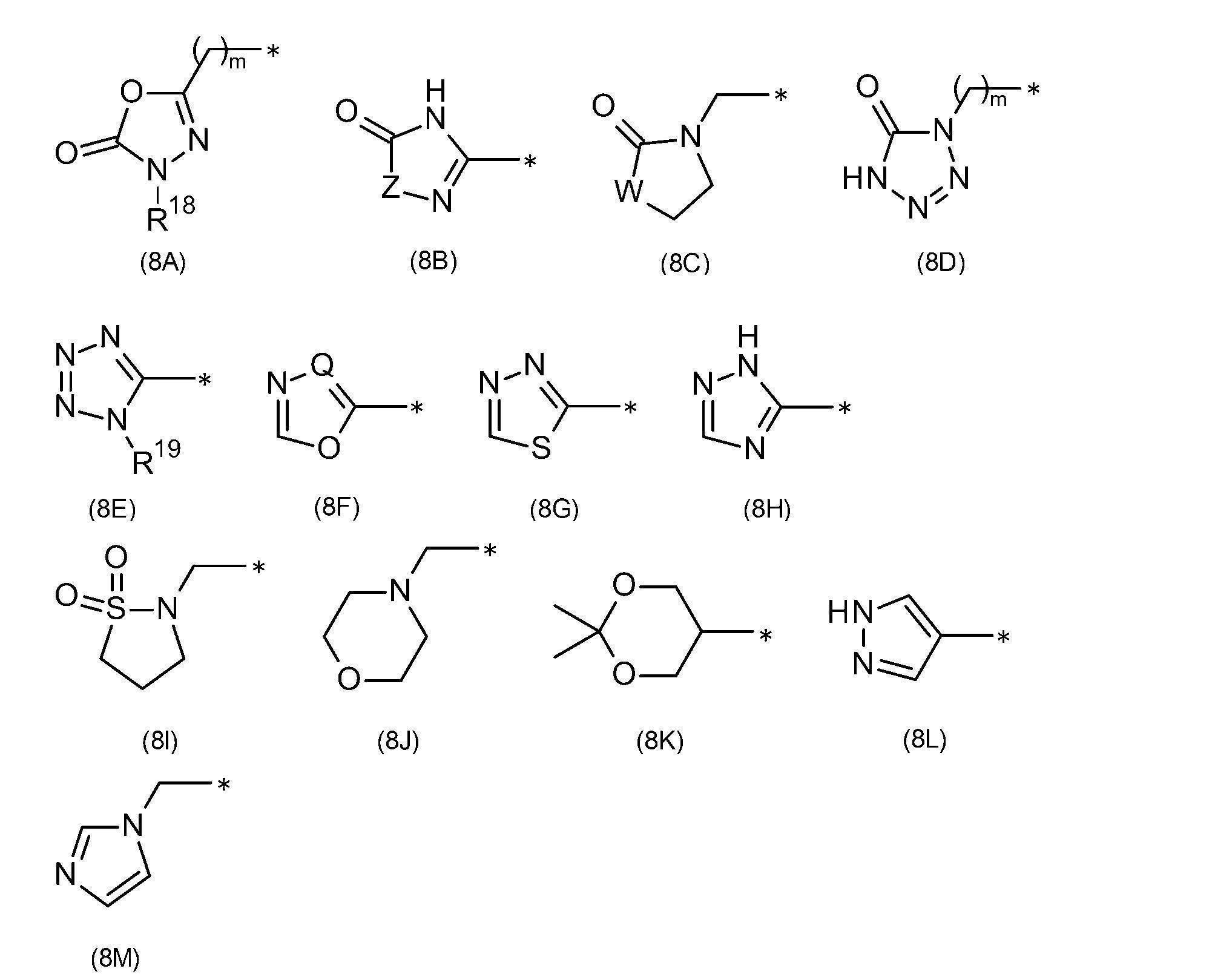
[式中、
*は、結合手を示し、
mは、0または1を示し、
Zは、酸素原子または-N(CH3)-を示し、
Wは、酸素原子または-NH-を示し、
Qは、CHまたは窒素原子を示し、
R18は、水素原子またはメチル基を示し、
R19は、水素原子またはメチル基を示す。]
のいずれかを示し、
または、
R7およびR8が、R7が結合する炭素原子およびR8が結合する炭素原子と一緒になって、式(10A)
[In the formula,
* Indicates a bond,
m represents 0 or 1,
Z represents an oxygen atom or -N(CH 3 )-,
W represents an oxygen atom or -NH-,
Q represents CH or a nitrogen atom,
R 18 represents a hydrogen atom or a methyl group,
R 19 represents a hydrogen atom or a methyl group. ]
Indicates one of the
Or
R 7 and R 8 together with the carbon atom to which R 7 is attached and the carbon atom to which R 8 is attached have the formula (10A)

[式中、
aで示される炭素原子は、R8が結合する炭素原子を示し、
bで示される炭素原子は、R7が結合する炭素原子を示す。]
を形成する;
[1]に記載の化合物またはその薬学上許容される塩。
[23]Xが、窒素原子であり;
Yが、CR4であり;
R1およびR2のいずれか一方が、式(7A)から(7C)
[In the formula,
The carbon atom represented by a is a carbon atom to which R 8 is bonded,
The carbon atom represented by b is a carbon atom to which R 7 is bonded. ]
To form;
The compound according to [1] or a pharmaceutically acceptable salt thereof.
[23] X is a nitrogen atom;
Y is CR 4 ;
One of R 1 and R 2 is represented by the formula (7A) to (7C).

[式中、*は、結合手を示す。]
のいずれかを示し;
R1およびR2の他方が、水素原子であり;
R3が、水素原子であり;
R4が、水素原子またはメチル基であり、
R5が、水素原子であり、
R6が、水素原子、フッ素原子、またはメチル基であり、
R7が、水素原子、フッ素原子、またはヒドロキシ基であり、
R8が、式(9C)、(9D)、または(9E)
[In the formula, * represents a bond. ]
One of the following:
The other of R 1 and R 2 is a hydrogen atom;
R 3 is a hydrogen atom;
R 4 is a hydrogen atom or a methyl group,
R 5 is a hydrogen atom,
R 6 is a hydrogen atom, a fluorine atom, or a methyl group,
R 7 is a hydrogen atom, a fluorine atom, or a hydroxy group,
R 8 is the formula (9C), (9D), or (9E)

[式中、*は、結合手を示す。]
を示す;
[1]に記載の化合物またはその薬学上許容される塩。
[24]Xが、CHであり;
Yが、CR4であり;
R1およびR2のいずれか一方が、式(7A)から(7C)
[In the formula, * represents a bond. ]
Indicates;
The compound according to [1] or a pharmaceutically acceptable salt thereof.
[24] X is CH;
Y is CR 4 ;
One of R 1 and R 2 is represented by the formula (7A) to (7C).

[式中、*は、結合手を示す。]
のいずれかを示し;
R1およびR2の他方が、水素原子であり;
R3が、水素原子であり;
R4が、水素原子またはメチル基であり、
R5が、水素原子であり、
R6が、水素原子、フッ素原子、またはメチル基であり、
R7が、水素原子、フッ素原子、またはヒドロキシ基であり、
R8が、シアノ基、カルボキシ基、2-カルボキシエチル基、3-カルボキシプロピル基、4-カルボキシブチル基、またはカルボキシメトキシメチル基である;
[1]に記載の化合物またはその薬学上許容される塩。
[25]Xが、窒素原子であり;
Yが、CR4であり;
R1およびR2のいずれか一方が、式(7A)から(7C)
[In the formula, * represents a bond. ]
One of the following:
The other of R 1 and R 2 is a hydrogen atom;
R 3 is a hydrogen atom;
R 4 is a hydrogen atom or a methyl group,
R 5 is a hydrogen atom,
R 6 is a hydrogen atom, a fluorine atom, or a methyl group,
R 7 is a hydrogen atom, a fluorine atom, or a hydroxy group,
R 8 is a cyano group, a carboxy group, a 2-carboxyethyl group, a 3-carboxypropyl group, a 4-carboxybutyl group, or a carboxymethoxymethyl group;
The compound according to [1] or a pharmaceutically acceptable salt thereof.
[25] X is a nitrogen atom;
Y is CR 4 ;
One of R 1 and R 2 is represented by the formula (7A) to (7C).

[式中、*は、結合手を示す。]
のいずれかを示し;
R1およびR2の他方が、水素原子であり;
R3が、水素原子であり;
R4およびR5が、一緒になって、式(2A)
[In the formula, * represents a bond. ]
One of the following:
The other of R 1 and R 2 is a hydrogen atom;
R 3 is a hydrogen atom;
R 4 and R 5 are taken together to form formula (2A)

[式中、*は、R5が結合する窒素原子に結合し、**は、R4が結合する炭素原子に結合する。]
を形成し;
R6が、水素原子、フッ素原子、またはメチル基であり;
R7が、水素原子、フッ素原子、またはヒドロキシ基であり;
R8が、シアノ基、カルボキシ基、2-カルボキシエチル基、3-カルボキシプロピル基、4-カルボキシブチル基、またはカルボキシメトキシメチル基である;
[1]に記載の化合物またはその薬学上許容される塩。
[26]4-[4-[2-エチル-1-(1H-1,2,4-トリアゾール-1-イル)ブチル]アニリノ]安息香酸、
4-[4-[2-エチル-1-(1H-1,2,4-トリアゾール-1-イル)ブチル]アニリノ]-3-フルオロ安息香酸、
3-[4-[4-[2-エチル-1-(1H-1,2,4-トリアゾール-1-イル)ブチル]アニリノ]-2-フルオロフェニル]プロパン酸、
4-[4-[2-エチル-1-(1H-1,2,4-トリアゾール-1-イル)ブチル]アニリノ]-2-ヒドロキシ安息香酸、
4-[5-[2-エチル-1-(1H-1,2,4-トリアゾール-1-イル)ブチル]インドール-1-イル]安息香酸、
3-[[4-[4-[2-エチル-1-(1H-1,2,4-トリアゾール-1-イル)ブチル]アニリノ]フェニル]メチル]オキサゾリジン-2-オン、
4-[4-[4-[2-エチル-1-(1H-1,2,4-トリアゾール-1-イル)ブチル]アニリノ]フェニル]-1H-テトラゾール-5-オン、
4-[[4-[4-[2-エチル-1-(1H-1,2,4-トリアゾール-1-イル)ブチル]アニリノ]フェニル]メチル]-1H-テトラゾール-5-オン、
3-[4-[4-[2-エチル-1-(1H-1,2,4-トリアゾール-1-イル)ブチル]アニリノ]フェニル]-4H-1,2,4-オキサジアゾール-5-オン、
4-[4-[2-エチル-1-(1H-イミダゾール-1-イル)ブチル]アニリノ]安息香酸、
(+)-3-[[4-[4-[2-エチル-1-(1H-1,2,4-トリアゾール-1-イル)ブチル]アニリノ]フェニル]メチル]オキサゾリジン-2-オン、
(+)-4-[5-[2-エチル-1-(1H-1,2,4-トリアゾール-1-イル)ブチル]インドール-1-イル]安息香酸、および
(+)-4-[4-[2-エチル-1-(1H-イミダゾール-1-イル)ブチル]アニリノ]安息香酸
からなる群より選択されるいずれかの化合物またはその薬学上許容される塩。
[27][1]から[26]のいずれか1つに記載の化合物またはその薬学上許容される塩を含有するCYP26阻害剤。
[28]CYP26がCYP26A1である[27]の阻害剤。
[29][1]から[26]のいずれか1つに記載の化合物またはその薬学上許容される塩を有効成分として含有する桿体再生誘導剤。
[30][1]から[26]のいずれか1つに記載の化合物またはその薬学上許容される塩を有効成分として含有する桿体変性保護剤。
[31][1]から[26]のいずれか1つに記載の化合物またはその薬学上許容される塩を有効成分として含有する錐体変性保護剤。
[32][1]から[26]のいずれか1つに記載の化合物またはその薬学上許容される塩を有効成分として含有する医薬組成物。
[33]視細胞変性を伴う網膜変性疾患の治療および/または予防のための[32]に記載の医薬組成物。
[34]網膜色素変性症、加齢黄斑変性症、スタルガルト病、錐体桿体ジストロフィー、ベスト病、X連鎖性若年網膜分離症、オカルト黄斑ジストロフィー、および中心性輪紋状網脈絡膜ジストロフィーからなる群より選択される疾患の治療および/または予防のための[32]に記載の医薬組成物。
[35]網膜色素変性症の治療および/または予防のための[32]に記載の医薬組成物。
[36]加齢黄斑変性症の治療および/または予防のための[32]に記載の医薬組成物。
[37]眼へ局所投与される[32]から[36]のいずれか1つに記載の医薬組成物。
[38][1]から[26]のいずれか1つに記載の化合物またはその薬学上許容される塩を投与することを含む、視細胞変性を伴う網膜変性疾患の治療および/または予防方法。
[39][1]から[26]のいずれか1つに記載の化合物またはその薬学上許容される塩を投与することを含む、網膜色素変性症、加齢黄斑変性症、スタルガルト病、錐体桿体ジストロフィー、ベスト病、X連鎖性若年網膜分離症、オカルト黄斑ジストロフィー、および中心性輪紋状網脈絡膜ジストロフィーからなる群より選択される疾患の、治療および/または予防方法。
[40]視細胞変性を伴う網膜変性疾患の、治療および/または予防のための医薬として使用される、[1]から[26]のいずれか1つに記載の化合物またはその薬学上許容される塩。
[41]網膜色素変性症、加齢黄斑変性症、スタルガルト病、錐体桿体ジストロフィー、ベスト病、X連鎖性若年網膜分離症、オカルト黄斑ジストロフィー、および中心性輪紋状網脈絡膜ジストロフィーからなる群より選択される疾患の、治療および/または予防のための医薬として使用される、[1]から[26]のいずれか1つに記載の化合物またはその薬学上許容される塩。
[42]視細胞変性を伴う網膜変性疾患の、治療および/または予防のための医薬を製造するための、[1]から[26]のいずれか1つに記載の化合物またはその薬学上許容される塩の使用。
[43]網膜色素変性症、加齢黄斑変性症、スタルガルト病、錐体桿体ジストロフィー、ベスト病、X連鎖性若年網膜分離症、オカルト黄斑ジストロフィー、および中心性輪紋状網脈絡膜ジストロフィーからなる群より選択される疾患の、治療および/または予防のための医薬を製造するための、[1]から[26]のいずれか1つに記載の化合物またはその薬学上許容される塩の使用。
[44]CYP26阻害活性を有する化合物またはその薬学上許容される塩を含有することを含む、視細胞変性を伴う網膜変性疾患の治療剤および/または予防剤。
[45]CYP26阻害活性を有する化合物またはその薬学上許容される塩および薬学上許容される担体を含有することを含む、視細胞変性を伴う網膜変性疾患の治療および/または予防のための組成物。
[46]視細胞変性を伴う網膜変性疾患の治療および/または予防のための医薬として使用される、CYP26阻害活性を有する化合物またはその薬学上許容される塩。
[47]CYP26阻害活性を有する化合物またはその薬学上許容される塩を投与することを含む、視細胞変性を伴う網膜変性疾患の治療および/または予防方法。
[48]CYP26阻害活性を有する化合物またはその塩を培養幹細胞に添加することを含む網膜組織の製造方法。
[49]CYP26阻害活性を有する化合物またはその塩を培養幹細胞に添加することを含む再生医療用の網膜組織の製造方法。
[50]CYP26がCYP26A1である、[48]または[49]に記載の製造方法。
[51]CYP26阻害活性を有する化合物が、[1]から[26]のいずれか1つに記載の化合物である、[48]または[49]に記載の製造方法。
[52]4-[4-[2-エチル-1-(1H-1,2,4-トリアゾール-1-イル)ブチル]アニリノ]安息香酸、
4-[4-[2-エチル-1-(1H-1,2,4-トリアゾール-1-イル)ブチル]アニリノ]-3-フルオロ安息香酸、
3-[4-[4-[2-エチル-1-(1H-1,2,4-トリアゾール-1-イル)ブチル]アニリノ]-2-フルオロフェニル]プロパン酸、
4-[4-[2-エチル-1-(1H-1,2,4-トリアゾール-1-イル)ブチル]アニリノ]-2-ヒドロキシ安息香酸、
4-[5-[2-エチル-1-(1H-1,2,4-トリアゾール-1-イル)ブチル]インドール-1-イル]安息香酸、
3-[[4-[4-[2-エチル-1-(1H-1,2,4-トリアゾール-1-イル)ブチル]アニリノ]フェニル]メチル]オキサゾリジン-2-オン、
4-[4-[4-[2-エチル-1-(1H-1,2,4-トリアゾール-1-イル)ブチル]アニリノ]フェニル]-1H-テトラゾール-5-オン、
4-[[4-[4-[2-エチル-1-(1H-1,2,4-トリアゾール-1-イル)ブチル]アニリノ]フェニル]メチル]-1H-テトラゾール-5-オン、
3-[4-[4-[2-エチル-1-(1H-1,2,4-トリアゾール-1-イル)ブチル]アニリノ]フェニル]-4H-1,2,4-オキサジアゾール-5-オン、
4-[4-[2-エチル-1-(1H-イミダゾール-1-イル)ブチル]アニリノ]安息香酸、
(+)-3-[[4-[4-[2-エチル-1-(1H-1,2,4-トリアゾール-1-イル)ブチル]アニリノ]フェニル]メチル]オキサゾリジン-2-オン、
(+)-4-[5-[2-エチル-1-(1H-1,2,4-トリアゾール-1-イル)ブチル]インドール-1-イル]安息香酸、および
(+)-4-[4-[2-エチル-1-(1H-イミダゾール-1-イル)ブチル]アニリノ]安息香酸
からなる群より選択されるいずれかの、[1]に記載の化合物またはその薬学上許容される塩。
[53][1]に記載の4-[4-[2-エチル-1-(1H-1,2,4-トリアゾール-1-イル)ブチル]アニリノ]安息香酸またはその薬学上許容される塩。
[54][1]に記載の(+)-3-[[4-[4-[2-エチル-1-(1H-1,2,4-トリアゾール-1-イル)ブチル]アニリノ]フェニル]メチル]オキサゾリジン-2-オンまたはその薬学上許容される塩。
[55][1]に記載の(+)-4-[5-[2-エチル-1-(1H-1,2,4-トリアゾール-1-イル)ブチル]インドール-1-イル]安息香酸またはその薬学上許容される塩。
[56][1]に記載の(+)-4-[4-[2-エチル-1-(1H-イミダゾール-1-イル)ブチル]アニリノ]安息香酸またはその薬学上許容される塩。
[57][1]から[25]および[52]から[56]のいずれか1つに記載の化合物またはその薬学上許容される塩を含有するCYP26阻害剤。
[58]CYP26がCYP26A1である[57]に記載の阻害剤。
[59][1]から[25]および[52]から[56]のいずれか1つに記載の化合物またはその薬学上許容される塩を有効成分として含有する桿体再生誘導剤。
[60][1]から[25]および[52]から[56]のいずれか1つに記載の化合物またはその薬学上許容される塩を有効成分として含有する桿体変性保護剤。
[61][1]から[25]および[52]から[56]のいずれか1つに記載の化合物またはその薬学上許容される塩を有効成分として含有する錐体変性保護剤。
[62][1]から[25]および[52]から[56]のいずれか1つに記載の化合物またはその薬学上許容される塩を有効成分として含有する医薬組成物。
[63]視細胞変性を伴う網膜変性疾患の治療および/または予防のための[62]に記載の医薬組成物。
[64]網膜色素変性症、加齢黄斑変性症、スタルガルト病、錐体桿体ジストロフィー、ベスト病、X連鎖性若年網膜分離症、オカルト黄斑ジストロフィー、および中心性輪紋状網脈絡膜ジストロフィーからなる群より選択される疾患の治療および/または予防のための[62]に記載の医薬組成物。
[65]網膜色素変性症の治療および/または予防のための[62]に記載の医薬組成物。
[66]加齢黄斑変性症の治療および/または予防のための[62]に記載の医薬組成物。
[67]眼へ局所投与される[62]から[66]のいずれか1つに記載の医薬組成物。
[68][1]から[25]および[52]から[56]のいずれか1つに記載の化合物またはその薬学上許容される塩を投与することを含む、視細胞変性を伴う網膜変性疾患の治療および/または予防方法。
[69][1]から[25]および[52]から[56]のいずれか1つに記載の化合物またはその薬学上許容される塩を投与することを含む、網膜色素変性症、加齢黄斑変性症、スタルガルト病、錐体桿体ジストロフィー、ベスト病、X連鎖性若年網膜分離症、オカルト黄斑ジストロフィー、および中心性輪紋状網脈絡膜ジストロフィーからなる群より選択される疾患の、治療および/または予防方法。
[70]視細胞変性を伴う網膜変性疾患の、治療および/または予防のための医薬として使用される、[1]から[25]および[52]から[56]のいずれか1つに記載の化合物またはその薬学上許容される塩。
[71]網膜色素変性症、加齢黄斑変性症、スタルガルト病、錐体桿体ジストロフィー、ベスト病、X連鎖性若年網膜分離症、オカルト黄斑ジストロフィー、および中心性輪紋状網脈絡膜ジストロフィーからなる群より選択される疾患の、治療および/または予防のための医薬として使用される、[1]から[25]および[52]から[56]のいずれか1つに記載の化合物またはその薬学上許容される塩。
[72]視細胞変性を伴う網膜変性疾患の、治療および/または予防のための医薬を製造するための、[1]から[25]および[52]から[56]のいずれか1つに記載の化合物またはその薬学上許容される塩の使用。
[73]網膜色素変性症、加齢黄斑変性症、スタルガルト病、錐体桿体ジストロフィー、ベスト病、X連鎖性若年網膜分離症、オカルト黄斑ジストロフィー、および中心性輪紋状網脈絡膜ジストロフィーからなる群より選択される疾患の、治療および/または予防のための医薬を製造するための、[1]から[25]および[52]から[56]のいずれか1つに記載の化合物またはその薬学上許容される塩の使用。
[In the formula, * is bonded to the nitrogen atom to which R 5 is bonded, and ** is bonded to the carbon atom to which R 4 is bonded. ]
To form;
R 6 is a hydrogen atom, a fluorine atom, or a methyl group;
R 7 is a hydrogen atom, a fluorine atom, or a hydroxy group;
R 8 is a cyano group, a carboxy group, a 2-carboxyethyl group, a 3-carboxypropyl group, a 4-carboxybutyl group, or a carboxymethoxymethyl group;
The compound according to [1] or a pharmaceutically acceptable salt thereof.
[26] 4-[4-[2-Ethyl-1-(1H-1,2,4-triazol-1-yl)butyl]anilino]benzoic acid,
4-[4-[2-ethyl-1-(1H-1,2,4-triazol-1-yl)butyl]anilino]-3-fluorobenzoic acid,
3-[4-[4-[2-ethyl-1-(1H-1,2,4-triazol-1-yl)butyl]anilino]-2-fluorophenyl]propanoic acid,
4-[4-[2-ethyl-1-(1H-1,2,4-triazol-1-yl)butyl]anilino]-2-hydroxybenzoic acid,
4-[5-[2-ethyl-1-(1H-1,2,4-triazol-1-yl)butyl]indol-1-yl]benzoic acid,
3-[[4-[4-[2-ethyl-1-(1H-1,2,4-triazol-1-yl)butyl]anilino]phenyl]methyl]oxazolidin-2-one,
4-[4-[4-[2-ethyl-1-(1H-1,2,4-triazol-1-yl)butyl]anilino]phenyl]-1H-tetrazol-5-one,
4-[[4-[4-[2-ethyl-1-(1H-1,2,4-triazol-1-yl)butyl]anilino]phenyl]methyl]-1H-tetrazol-5-one,
3-[4-[4-[2-Ethyl-1-(1H-1,2,4-triazol-1-yl)butyl]anilino]phenyl]-4H-1,2,4-oxadiazole-5 -on,
4-[4-[2-ethyl-1-(1H-imidazol-1-yl)butyl]anilino]benzoic acid,
(+)-3-[[4-[4-[2-Ethyl-1-(1H-1,2,4-triazol-1-yl)butyl]anilino]phenyl]methyl]oxazolidin-2-one,
(+)-4-[5-[2-Ethyl-1-(1H-1,2,4-triazol-1-yl)butyl]indol-1-yl]benzoic acid, and (+)-4-[ Any compound selected from the group consisting of 4-[2-ethyl-1-(1H-imidazol-1-yl)butyl]anilino]benzoic acid or a pharmaceutically acceptable salt thereof.
[27] A CYP26 inhibitor containing the compound according to any one of [1] to [26] or a pharmaceutically acceptable salt thereof.
[28] The inhibitor of [27], wherein CYP26 is CYP26A1.
[29] A rod regeneration inducer containing the compound according to any one of [1] to [26] or a pharmaceutically acceptable salt thereof as an active ingredient.
[30] A rod modification protector containing the compound according to any one of [1] to [26] or a pharmaceutically acceptable salt thereof as an active ingredient.
[31] A cone-modifying protective agent containing the compound according to any one of [1] to [26] or a pharmaceutically acceptable salt thereof as an active ingredient.
[32] A pharmaceutical composition comprising the compound according to any one of [1] to [26] or a pharmaceutically acceptable salt thereof as an active ingredient.
[33] The pharmaceutical composition according to [32], for treating and/or preventing a retinal degenerative disease accompanied by photoreceptor degeneration.
[34] A group consisting of retinitis pigmentosa, age-related macular degeneration, Stargardt's disease, cone-rod dystrophy, Best's disease, X-linked juvenile retinosis, occult macular dystrophy, and central ring-shaped reticulochoroidal dystrophy The pharmaceutical composition according to [32], for treating and/or preventing a disease selected from the following.
[35] The pharmaceutical composition according to [32], for treating and/or preventing retinitis pigmentosa.
[36] The pharmaceutical composition according to [32], for treating and/or preventing age-related macular degeneration.
[37] The pharmaceutical composition according to any one of [32] to [36], which is locally administered to the eye.
[38] A method for treating and/or preventing a retinal degenerative disease involving photoreceptor degeneration, which comprises administering the compound according to any one of [1] to [26] or a pharmaceutically acceptable salt thereof.
[39] Retinitis pigmentosa, age-related macular degeneration, Stargardt's disease, cone, which comprises administering the compound or the pharmaceutically acceptable salt thereof according to any one of [1] to [26]. A method for treating and/or preventing a disease selected from the group consisting of rod dystrophy, Best's disease, juvenile X-linked retinopathy of separation, occult macular dystrophy, and central cricoreticular choroidal dystrophy.
[40] The compound according to any one of [1] to [26] or a pharmaceutically acceptable compound thereof, which is used as a medicament for treating and/or preventing a retinal degenerative disease accompanied by photoreceptor degeneration. salt.
[41] A group consisting of retinitis pigmentosa, age-related macular degeneration, Stargardt's disease, cone-rod dystrophy, Best's disease, X-linked juvenile retinolysis, occult macular dystrophy, and central ring-shaped reticulochoroidal dystrophy The compound or a pharmaceutically acceptable salt thereof according to any one of [1] to [26], which is used as a medicament for treating and/or preventing a disease selected from the following.
[42] The compound or a pharmaceutically acceptable compound thereof according to any one of [1] to [26] for producing a medicament for treating and/or preventing a retinal degenerative disease involving photoreceptor cell degeneration. Use of salt.
[43] A group consisting of retinitis pigmentosa, age-related macular degeneration, Stargardt's disease, cone-rod dystrophy, Best's disease, X-linked juvenile retinosis, occult macular dystrophy, and central ring-shaped reticulochoroidal dystrophy Use of the compound according to any one of [1] to [26] or a pharmaceutically acceptable salt thereof for the manufacture of a medicament for the treatment and/or prevention of a more selected disease.
[44] A therapeutic and/or prophylactic agent for a retinal degenerative disease involving photoreceptor degeneration, which comprises a compound having CYP26 inhibitory activity or a pharmaceutically acceptable salt thereof.
[45] A composition for treating and/or preventing a retinal degenerative disease involving photoreceptor cell degeneration, comprising a compound having CYP26 inhibitory activity or a pharmaceutically acceptable salt thereof and a pharmaceutically acceptable carrier. ..
[46] A compound having a CYP26 inhibitory activity or a pharmaceutically acceptable salt thereof, which is used as a medicament for treating and/or preventing a retinal degenerative disease accompanied by photoreceptor degeneration.
[47] A method for treating and/or preventing a retinal degenerative disease involving photoreceptor cell degeneration, which comprises administering a compound having CYP26 inhibitory activity or a pharmaceutically acceptable salt thereof.
[48] A method for producing retinal tissue, which comprises adding a compound having a CYP26 inhibitory activity or a salt thereof to cultured stem cells.
[49] A method for producing a retinal tissue for regenerative medicine, which comprises adding a compound having a CYP26 inhibitory activity or a salt thereof to cultured stem cells.
[50] The production method according to [48] or [49], wherein CYP26 is CYP26A1.
[51] The production method according to [48] or [49], wherein the compound having CYP26 inhibitory activity is the compound according to any one of [1] to [26].
[52] 4-[4-[2-Ethyl-1-(1H-1,2,4-triazol-1-yl)butyl]anilino]benzoic acid,
4-[4-[2-ethyl-1-(1H-1,2,4-triazol-1-yl)butyl]anilino]-3-fluorobenzoic acid,
3-[4-[4-[2-ethyl-1-(1H-1,2,4-triazol-1-yl)butyl]anilino]-2-fluorophenyl]propanoic acid,
4-[4-[2-ethyl-1-(1H-1,2,4-triazol-1-yl)butyl]anilino]-2-hydroxybenzoic acid,
4-[5-[2-ethyl-1-(1H-1,2,4-triazol-1-yl)butyl]indol-1-yl]benzoic acid,
3-[[4-[4-[2-ethyl-1-(1H-1,2,4-triazol-1-yl)butyl]anilino]phenyl]methyl]oxazolidin-2-one,
4-[4-[4-[2-ethyl-1-(1H-1,2,4-triazol-1-yl)butyl]anilino]phenyl]-1H-tetrazol-5-one,
4-[[4-[4-[2-ethyl-1-(1H-1,2,4-triazol-1-yl)butyl]anilino]phenyl]methyl]-1H-tetrazol-5-one,
3-[4-[4-[2-Ethyl-1-(1H-1,2,4-triazol-1-yl)butyl]anilino]phenyl]-4H-1,2,4-oxadiazole-5 -on,
4-[4-[2-ethyl-1-(1H-imidazol-1-yl)butyl]anilino]benzoic acid,
(+)-3-[[4-[4-[2-Ethyl-1-(1H-1,2,4-triazol-1-yl)butyl]anilino]phenyl]methyl]oxazolidin-2-one,
(+)-4-[5-[2-Ethyl-1-(1H-1,2,4-triazol-1-yl)butyl]indol-1-yl]benzoic acid, and (+)-4-[ The compound according to [1] or a pharmaceutically acceptable salt thereof, which is selected from the group consisting of 4-[2-ethyl-1-(1H-imidazol-1-yl)butyl]anilino]benzoic acid. ..
[53] 4-[4-[2-Ethyl-1-(1H-1,2,4-triazol-1-yl)butyl]anilino]benzoic acid or a pharmaceutically acceptable salt thereof according to [1] ..
[54] (+)-3-[[4-[4-[2-Ethyl-1-(1H-1,2,4-triazol-1-yl)butyl]anilino]phenyl] described in [1] Methyl]oxazolidin-2-one or a pharmaceutically acceptable salt thereof.
[55] (+)-4-[5-[2-Ethyl-1-(1H-1,2,4-triazol-1-yl)butyl]indol-1-yl]benzoic acid according to [1] Or a pharmaceutically acceptable salt thereof.
[56] The (+)-4-[4-[2-Ethyl-1-(1H-imidazol-1-yl)butyl]anilino]benzoic acid or the pharmaceutically acceptable salt thereof according to [1].
[57] A CYP26 inhibitor containing the compound according to any one of [1] to [25] and [52] to [56] or a pharmaceutically acceptable salt thereof.
[58] The inhibitor according to [57], wherein CYP26 is CYP26A1.
[59] A rod regeneration inducer containing the compound according to any one of [1] to [25] and [52] to [56] or a pharmaceutically acceptable salt thereof as an active ingredient.
[60] A rod modification protector containing the compound according to any one of [1] to [25] and [52] to [56] or a pharmaceutically acceptable salt thereof as an active ingredient.
[61] A cone-denaturing protective agent containing the compound according to any one of [1] to [25] and [52] to [56] or a pharmaceutically acceptable salt thereof as an active ingredient.
[62] A pharmaceutical composition comprising the compound according to any one of [1] to [25] and [52] to [56] or a pharmaceutically acceptable salt thereof as an active ingredient.
[63] The pharmaceutical composition according to [62], for treating and/or preventing a retinal degenerative disease accompanied by photoreceptor degeneration.
[64] A group consisting of retinitis pigmentosa, age-related macular degeneration, Stargardt's disease, cone-rod dystrophy, Best's disease, X-linked juvenile retinosis, occult macular dystrophy, and central ring-shaped reticulochoroidal dystrophy The pharmaceutical composition according to [62], which is used for the treatment and/or prevention of a more selected disease.
[65] The pharmaceutical composition according to [62], for treating and/or preventing retinitis pigmentosa.
[66] The pharmaceutical composition according to [62], for treating and/or preventing age-related macular degeneration.
[67] The pharmaceutical composition according to any one of [62] to [66], which is topically administered to the eye.
[68] Retinal degenerative disease involving photoreceptor degeneration, which comprises administering the compound according to any one of [1] to [25] and [52] to [56] or a pharmaceutically acceptable salt thereof. And/or preventive method for.
[69] Retinitis pigmentosa, age-related macula, which comprises administering the compound according to any one of [1] to [25] and [52] to [56] or a pharmaceutically acceptable salt thereof. Treatment and/or treatment of a disease selected from the group consisting of degeneration, Stargardt's disease, cone-rod dystrophy, Best's disease, X-linked juvenile retinopathy of separation, occult macular dystrophy, and central ring-shaped reticulochoroidal dystrophy Prevention method.
[70] The use according to any one of [1] to [25] and [52] to [56], which is used as a medicament for the treatment and/or prevention of retinal degeneration diseases involving photoreceptor degeneration. A compound or a pharmaceutically acceptable salt thereof.
[71] A group consisting of retinitis pigmentosa, age-related macular degeneration, Stargardt's disease, cone-rod dystrophy, Best's disease, X-linked juvenile retinolysis, occult macular dystrophy, and central ring-shaped reticulochoroidal dystrophy A compound or a pharmaceutically acceptable compound thereof according to any one of [1] to [25] and [52] to [56], which is used as a medicament for treating and/or preventing a disease selected from the following: Salt.
[72] The method according to any one of [1] to [25] and [52] to [56], for producing a medicament for the treatment and/or prevention of retinal degenerative diseases accompanied by photoreceptor degeneration. Use of the compound or a pharmaceutically acceptable salt thereof.
[73] A group consisting of retinitis pigmentosa, age-related macular degeneration, Stargardt's disease, cone-rod dystrophy, Best's disease, X-linked juvenile retinolysis, occult macular dystrophy, and central ring-shaped reticulochoroidal dystrophy The compound according to any one of [1] to [25] and [52] to [56], or a pharmaceutically acceptable compound thereof, for producing a medicament for treating and/or preventing a disease selected from the following: Use of acceptable salt.
本発明の化合物またはその薬学上許容される塩は、CYP26に対して阻害作用を示し、そして、桿体再生誘導作用および/または桿体変性保護作用、さらには錐体変性保護作用を示す。すなわち、本発明の化合物またはその薬学上許容される塩は、CYP26阻害剤、桿体再生誘導剤、桿体変性保護剤、または錐体変性保護剤として用いることができ、薬学上許容される担体をさらに含有する医薬組成物として、哺乳動物(ヒト、ウシ、ウマ、またはブタ等)または鳥類(ニワトリ等)に投与することにより、視細胞変性を伴う網膜変性疾患の治療および/または予防に用いることができる。視細胞変性を伴う網膜変性疾患としては、例えば、網膜色素変性症、加齢黄斑変性症、スタルガルト病、錐体杆体ジストロフィー、ベスト病、X連鎖性若年網膜分離症、オカルト黄斑ジストロフィー、または中心性輪紋状網脈絡膜ジストロフィーを挙げることができ、好適には、網膜色素変性症または加齢黄斑変性症を挙げることができる。 The compound of the present invention or a pharmaceutically acceptable salt thereof exhibits an inhibitory action on CYP26, and also exhibits a rod regeneration inducing action and/or a rod degeneration protection action, and further a cone degeneration protection action. That is, the compound of the present invention or a pharmaceutically acceptable salt thereof can be used as a CYP26 inhibitor, a rod regeneration inducer, a rod denaturing protective agent, or a cone denaturing protective agent, and is a pharmaceutically acceptable carrier. Used as a pharmaceutical composition further comprising: for the treatment and/or prevention of retinal degenerative diseases associated with photoreceptor degeneration by administering to mammals (human, bovine, horse, pig or the like) or birds (chicken or the like) be able to. Examples of retinal degenerative diseases involving photoreceptor degeneration include retinitis pigmentosa, age-related macular degeneration, Stargardt's disease, cone-rod dystrophy, Best's disease, X-linked juvenile retinopathy, occult macular dystrophy, or central Examples include ring-shaped reticulochoroidal dystrophy, and preferably, retinitis pigmentosa or age-related macular degeneration.
他に定義されない限り、本明細書で用いるすべての技術的および科学的用語は、本発明の属する技術分野における当業者によって一般に理解されるものと同じ意味を有する。
本発明において、「ハロゲン原子」とは、フッ素原子、塩素原子、臭素原子、またはヨウ素原子を示す。
本発明において、「C1-6アルキル基」とは、炭素数1から6個の直鎖または分枝鎖のアルキル基を示す。例えば、メチル基、エチル基、n-プロピル基、イソプロピル基、n-ブチル基、sec-ブチル基、tert-ブチル基、n-ペンチル基、イソペンチル基、2-メチルブチル基、ネオペンチル基、1-エチルプロピル基、n-ヘキシル基、4-メチルペンチル基、3-メチルペンチル基、2-メチルペンチル基、1-メチルペンチル基、3,3-ジメチルブチル基、2,2-ジメチルブチル基、1,1-ジメチルブチル基、1,2-ジメチルブチル基、1,3-ジメチルブチル基、2,3-ジメチルブチル基、2-エチルブチル基等を挙げることができる。
本発明において、「C1-3アルキル基」とは、炭素数1から3個の直鎖または分枝鎖のアルキル基を示す。例えば、メチル基、エチル基、n-プロピル基、またはイソプロピル基を挙げることができる。
Unless defined otherwise, all technical and scientific terms used herein have the same meaning as commonly understood by one of ordinary skill in the art to which this invention belongs.
In the present invention, the “halogen atom” refers to a fluorine atom, a chlorine atom, a bromine atom or an iodine atom.
In the present invention, the “C 1-6 alkyl group” refers to a linear or branched alkyl group having 1 to 6 carbon atoms. For example, methyl group, ethyl group, n-propyl group, isopropyl group, n-butyl group, sec-butyl group, tert-butyl group, n-pentyl group, isopentyl group, 2-methylbutyl group, neopentyl group, 1-ethyl group Propyl group, n-hexyl group, 4-methylpentyl group, 3-methylpentyl group, 2-methylpentyl group, 1-methylpentyl group, 3,3-dimethylbutyl group, 2,2-dimethylbutyl group, 1, Examples thereof include a 1-dimethylbutyl group, a 1,2-dimethylbutyl group, a 1,3-dimethylbutyl group, a 2,3-dimethylbutyl group and a 2-ethylbutyl group.
In the present invention, the “C 1-3 alkyl group” refers to a linear or branched alkyl group having 1 to 3 carbon atoms. For example, a methyl group, an ethyl group, an n-propyl group, or an isopropyl group can be mentioned.
本発明において、「C1-4アルキル基」とは、炭素数1から4個の直鎖または分枝鎖のアルキル基を示す。例えば、メチル基、エチル基、n-プロピル基、イソプロピル基、n-ブチル基、イソブチル基、sec-ブチル基、またはtert-ブチル基を挙げることができる。 In the present invention, the “C 1-4 alkyl group” refers to a linear or branched alkyl group having 1 to 4 carbon atoms. Examples thereof include a methyl group, an ethyl group, an n-propyl group, an isopropyl group, an n-butyl group, an isobutyl group, a sec-butyl group, and a tert-butyl group.
本発明において、「C1-7アルキル基」とは、炭素数1から7個の直鎖または分枝鎖のアルキル基を示す。例えば、メチル基、エチル基、n-プロピル基、イソプロピル基、n-ブチル基、sec-ブチル基、tert-ブチル基、n-ペンチル基、イソペンチル基、2-メチルブチル基、ネオペンチル基(2,2-ジメチルプロピル基)、1-エチルプロピル基、1,1-ジメチルプロピル基、n-ヘキシル基、4-メチルペンチル基、3-メチルペンチル基、2-メチルペンチル基、1-メチルペンチル基、3,3-ジメチルブチル基、2,2-ジメチルブチル基、1,1-ジメチルブチル基、1,2-ジメチルブチル基、1,3-ジメチルブチル基、2,3-ジメチルブチル基、2-エチルブチル基、n-ヘプチル基、1-イソプロピル-2-メチル-プロピル基、3-メチルヘキシル基、1-プロピルブチル基等を挙げることができる。 In the present invention, the “C 1-7 alkyl group” refers to a linear or branched alkyl group having 1 to 7 carbon atoms. For example, methyl group, ethyl group, n-propyl group, isopropyl group, n-butyl group, sec-butyl group, tert-butyl group, n-pentyl group, isopentyl group, 2-methylbutyl group, neopentyl group (2,2 -Dimethylpropyl group), 1-ethylpropyl group, 1,1-dimethylpropyl group, n-hexyl group, 4-methylpentyl group, 3-methylpentyl group, 2-methylpentyl group, 1-methylpentyl group, 3 ,3-dimethylbutyl group, 2,2-dimethylbutyl group, 1,1-dimethylbutyl group, 1,2-dimethylbutyl group, 1,3-dimethylbutyl group, 2,3-dimethylbutyl group, 2-ethylbutyl Group, n-heptyl group, 1-isopropyl-2-methyl-propyl group, 3-methylhexyl group, 1-propylbutyl group and the like.
本発明において、「C1-6アルコキシ基」とは、上記「C1-6アルキル基」が酸素原子に結合した基を示す。例えば、メトキシ基、エトキシ基、n-プロポキシ基、イソプロポキシ基、n-ブトキシ基、sec-ブトキシ基、tert-ブトキシ基、n-ペントキシ基、イソペントキシ基、2-メチルブトキシ基、n-ヘキシルオキシ基等を挙げることができる。
本発明において、「ハロゲノC1-6アルキル基」とは、上記「C1―6アルキル基」の1から3個の水素原子が、上記「ハロゲン原子」で置換された基を示す。例えば、フルオロメチル基、ジフルオロメチル基、トリフルオロメチル基、クロロメチル基、ジクロロメチル基、トリクロロメチル基、1-フルオロエチル基、1-クロロエチル基、2-ブロモエチル基、2,2-ジフルオロエチル基、1,2-ジフルオロプロピル基、2,2,2-トリフルオロエチル基等を挙げることができる。
本発明において、「ハロゲノC1-3アルキル基」とは、上記「C1―3アルキル基」の1または2個の水素原子が、上記「ハロゲン原子」で置換された基を示す。例えば、フルオロメチル基、ジフルオロメチル基、クロロメチル基、ジクロロメチル基、1-フルオロエチル基、1-クロロエチル基、2-ブロモエチル基、2,2-ジフルオロエチル基、1,2-ジフルオロプロピル基等を挙げることができる。
In the present invention, the “C 1-6 alkoxy group” refers to a group in which the above “C 1-6 alkyl group” is bonded to an oxygen atom. For example, methoxy group, ethoxy group, n-propoxy group, isopropoxy group, n-butoxy group, sec-butoxy group, tert-butoxy group, n-pentoxy group, isopentoxy group, 2-methylbutoxy group, n-hexyloxy group. A group etc. can be mentioned.
In the present invention, the “halogeno C 1-6 alkyl group” refers to a group in which 1 to 3 hydrogen atoms of the above “C 1-6 alkyl group” are substituted with the above “halogen atom”. For example, fluoromethyl group, difluoromethyl group, trifluoromethyl group, chloromethyl group, dichloromethyl group, trichloromethyl group, 1-fluoroethyl group, 1-chloroethyl group, 2-bromoethyl group, 2,2-difluoroethyl group , 1,2-difluoropropyl group, 2,2,2-trifluoroethyl group and the like.
In the present invention, the “halogeno C 1-3 alkyl group” refers to a group in which one or two hydrogen atoms of the above “C 1-3 alkyl group” are substituted with the above “halogen atom”. For example, fluoromethyl group, difluoromethyl group, chloromethyl group, dichloromethyl group, 1-fluoroethyl group, 1-chloroethyl group, 2-bromoethyl group, 2,2-difluoroethyl group, 1,2-difluoropropyl group, etc. Can be mentioned.
本発明において、「カルボキシC1-6アルキル基」とは、上記「C1-6アルキル基」の1個の水素原子が、カルボキシ基で置換された基を示す。例えば、カルボキシメチル基、2-カルボキシエチル基、3-カルボキシプロピル基、2-カルボキシプロピル基、1-カルボキシ-1-メチルエチル基、2-カルボキシ-1-メチルエチル基、4-カルボキシブチル基、5-カルボキシペンチル基等を挙げることができる。
本発明において、「C1-6アルキレン基」とは、炭素数1から6個の直鎖または分枝鎖のアルキレン基を示す。例えば、メチレン基、エチレン基[-(CH2)2-]、トリメチレン基[-(CH2)3-]、テトラメチレン基、ペンタメチレン基、ヘキサメチレン基、メチルメチレン基[-CH(CH3)-]、メチルエチレン基[-CH(CH3)CH2-または-CH2CH(CH3)-]、エチルエチレン基[-CH(CH2CH3)CH2-または-CH2CH(CH2CH3)-]、1,2-ジメチルエチレン基[-CH(CH3)CH(CH3)-]、1,1,2,2-テトラメチルエチレン基[-C(CH3)2C(CH3)2-]等を挙げることができる。L1における「C1-6アルキレン基」は、好適には、メチレン基である。L2における「C1-6アルキレン基」は、好適には、メチレン基である。
本発明において、「ハロゲノC1-6アルキル(C1-6アルキル)アミノC1-6アルキル基」とは、上記「C1-6アルキル基」の1個の水素原子が、下記「ハロゲノC1-6アルキル(C1-6アルキル)アミノ基」で置換された基を示す。例えば、1-[2,2-ジフルオロエチル(メチル)アミノ]プロピル基、1-[(2-フルオロ-1-メチル-エチル)-メチル-アミノ]ペンチル基、1-[(3-クロロ-1-メチル-プロピル)-エチル-アミノ]-2-メチル-ブチル基等を挙げることができる。
In the present invention, the “carboxy C 1-6 alkyl group” refers to a group in which one hydrogen atom of the above “C 1-6 alkyl group” is substituted with a carboxy group. For example, carboxymethyl group, 2-carboxyethyl group, 3-carboxypropyl group, 2-carboxypropyl group, 1-carboxy-1-methylethyl group, 2-carboxy-1-methylethyl group, 4-carboxybutyl group, Examples include 5-carboxypentyl group and the like.
In the present invention, the “C 1-6 alkylene group” refers to a linear or branched alkylene group having 1 to 6 carbon atoms. For example, methylene group, ethylene group [-(CH 2 ) 2 -], trimethylene group [-(CH 2 ) 3 -], tetramethylene group, pentamethylene group, hexamethylene group, methylmethylene group [-CH(CH 3 )-], a methylethylene group [—CH(CH 3 )CH 2 — or —CH 2 CH(CH 3 )—], an ethylethylene group [—CH(CH 2 CH 3 )CH 2 — or —CH 2 CH( CH 2 CH 3 )-], 1,2-dimethylethylene group [-CH(CH 3 )CH(CH 3 )-], 1,1,2,2-tetramethylethylene group [-C(CH 3 ) 2 C(CH 3 ) 2 −] and the like can be mentioned. The “C 1-6 alkylene group” for L 1 is preferably a methylene group. The "C 1-6 alkylene group" for L 2 is preferably a methylene group.
In the present invention, the “halogeno C 1-6 alkyl(C 1-6 alkyl)amino C 1-6 alkyl group” means that one hydrogen atom of the above “C 1-6 alkyl group” is the following “halogeno C 1-6 alkyl(C 1-6 alkyl)amino group” is shown. For example, 1-[2,2-difluoroethyl(methyl)amino]propyl group, 1-[(2-fluoro-1-methyl-ethyl)-methyl-amino]pentyl group, 1-[(3-chloro-1 -Methyl-propyl)-ethyl-amino]-2-methyl-butyl group and the like can be mentioned.
本発明において、「ハロゲノC1-6アルキル(C1-6アルキル)アミノ基」とは、アミノ基の2個の水素原子が、各々、上記「ハロゲノC1-6アルキル基」および上記「C1-6アルキル基」で置換された基を示す。例えば、2,2-ジフルオロエチル(メチル)アミノ基、(2-フルオロ-1-メチル-エチル)-メチル-アミノ基、(3-クロロ-1-メチル-プロピル)-エチル-アミノ基等を挙げることができる。
本発明において、「C1-6アルキルC3-8シクロアルキル基」とは、下記「C3-8シクロアルキル基」の1個の水素原子が、上記「C1-6アルキル基」で置換された基を示す。例えば、2-メチルシクロプロピル基、1-エチルシクロブチル基、3-イソプロピルシクロペンチル基、1-メチルシクロヘキシル基等を挙げることができる。
本発明において、「C3-8シクロアルキル基」とは、3から8員の単環の飽和炭化水素基を示す。例えば、シクロプロピル基、シクロブチル基、シクロペンチル基、シクロヘキシル基、シクロヘプチル基、またはシクロオクチル基を挙げることができる。
本発明において、「ジ(C1-6アルキル)アミノC1-6アルキル基」とは、上記「C1-6アルキル基」の1個の水素原子が、下記「ジ(C1-6アルキル)アミノ基」で置換された基を示す。例えば、1-(ジメチルアミノ)エチル基、1-(ジメチルアミノ)プロピル基、1-[エチル(メチル)アミノ]プロピル基、1-[イソプロピル(メチル)アミノ]プロピル基等を挙げることができる。
本発明において、「ジ(C1-6アルキル)アミノ基」とは、アミノ基の2個の水素原子が、同一または異なる2個の上記「C1-6アルキル基」で置換された基を示す。例えば、ジメチルアミノ基、エチル(メチル)アミノ基、メチル(プロピル)アミノ基、メチル(ブチル)アミノ基、メチル(ペンチル)アミノ基、メチル(ヘキシル)アミノ基、ジエチルアミノ基、イソプロピル(メチル)アミノ基、エチル(プロピル)アミノ基、エチル(ブチル)アミノ基、ジプロピルアミノ基、プロピル(ブチル)アミノ基、ジブチルアミノ基、ジペンチルアミノ基、ジヘキシルアミノ基等を挙げることができる。
In the present invention, the “halogeno C 1-6 alkyl (C 1-6 alkyl)amino group” means that the two hydrogen atoms of the amino group are respectively the above “halogeno C 1-6 alkyl group” and the above “C 1-6 alkyl group represents a group substituted with " 1-6 alkyl group". Examples include 2,2-difluoroethyl(methyl)amino group, (2-fluoro-1-methyl-ethyl)-methyl-amino group, (3-chloro-1-methyl-propyl)-ethyl-amino group and the like. be able to.
In the present invention, the “C 1-6 alkyl C 3-8 cycloalkyl group” means that one hydrogen atom of the following “C 3-8 cycloalkyl group” is substituted with the above “C 1-6 alkyl group”. Is shown as a group. Examples thereof include a 2-methylcyclopropyl group, a 1-ethylcyclobutyl group, a 3-isopropylcyclopentyl group and a 1-methylcyclohexyl group.
In the present invention, the “C 3-8 cycloalkyl group” refers to a 3- to 8-membered monocyclic saturated hydrocarbon group. For example, a cyclopropyl group, a cyclobutyl group, a cyclopentyl group, a cyclohexyl group, a cycloheptyl group, or a cyclooctyl group can be mentioned.
In the present invention, the “di(C 1-6 alkyl)amino C 1-6 alkyl group” means that one hydrogen atom of the above “C 1-6 alkyl group” is the following “di(C 1-6 alkyl group)”. ) Amino group". For example, 1-(dimethylamino)ethyl group, 1-(dimethylamino)propyl group, 1-[ethyl(methyl)amino]propyl group, 1-[isopropyl(methyl)amino]propyl group and the like can be mentioned.
In the present invention, the “di(C 1-6 alkyl)amino group” means a group in which two hydrogen atoms of the amino group are substituted with the same or different two above-mentioned “C 1-6 alkyl group”. Show. For example, dimethylamino group, ethyl (methyl)amino group, methyl (propyl)amino group, methyl (butyl)amino group, methyl (pentyl)amino group, methyl (hexyl)amino group, diethylamino group, isopropyl (methyl)amino group , Ethyl(propyl)amino group, ethyl(butyl)amino group, dipropylamino group, propyl(butyl)amino group, dibutylamino group, dipentylamino group, dihexylamino group and the like.
本発明において、「C1-6アルコキシC1-6アルキル基」は、上記「C1-6アルキル基」の1個の水素原子が、上記「C1-6アルコキシ基」で置換された基を示す。例えば、メトキシメチル基、エトキシメチル基、n-プロポキシメチル基、イソプロポキシメチル基、2-メトキシエチル基、2-エトキシエチル基、1-プロポキシエチル基、1-イソプロポキシエチル基、2-メトキシ-1,1-ジメチル-エチル基等を挙げることができる。
本発明において、「ジ(C1-6アルキル)カルバモイル基」とは、カルバモイル基の2個の水素原子が、同一または異なる2個の上記「C1-6アルキル基」で置換された基を示す。例えば、ジメチルカルバモイル基、エチル(メチル)カルバモイル基、メチル(プロピル)カルバモイル基、ジエチルカルバモイル基、ジプロピルカルバモイル基、ジイソプロピルカルバモイル基、sec-ブチル(ペンチル)カルバモイル基等を挙げることができる。
本発明において、「カルボキシC1-6アルコキシC1-6アルキル基」とは、上記「C1-6アルキル基」の1個の水素原子が、下記「カルボキシC1-6アルコキシ基」で置換された基を示す。例えば、カルボキシメトキシメチル基、2-(カルボキシメトキシ)エチル基、2-(2-カルボキシエトキシ)プロピル基等を挙げることができる。
本発明において、「カルボキシC1-6アルコキシ基」とは、上記「C1-6アルコキシ基」の1個の水素原子が、カルボキシ基で置換された基を示す。例えば、カルボキシメトキシ基、2-カルボキシエトキシ基、1-カルボキシ-1-メチル-エトキシ基等を挙げることができる。
In the present invention, "C 1-6 alkoxy C 1-6 alkyl group", one of the hydrogen atoms of the aforementioned "C 1-6 alkyl group" is substituted with the above-mentioned "C 1-6 alkoxy group" group Indicates. For example, methoxymethyl group, ethoxymethyl group, n-propoxymethyl group, isopropoxymethyl group, 2-methoxyethyl group, 2-ethoxyethyl group, 1-propoxyethyl group, 1-isopropoxyethyl group, 2-methoxy- Examples thereof include a 1,1-dimethyl-ethyl group.
In the present invention, the “di(C 1-6 alkyl)carbamoyl group” means a group in which two hydrogen atoms of the carbamoyl group are substituted with the same or different two above-mentioned “C 1-6 alkyl groups”. Show. Examples thereof include a dimethylcarbamoyl group, an ethyl(methyl)carbamoyl group, a methyl(propyl)carbamoyl group, a diethylcarbamoyl group, a dipropylcarbamoyl group, a diisopropylcarbamoyl group and a sec-butyl(pentyl)carbamoyl group.
In the present invention, “carboxy C 1-6 alkoxy C 1-6 alkyl group” means that one hydrogen atom of the above “C 1-6 alkyl group” is substituted with the following “carboxy C 1-6 alkoxy group”. Is shown as a group. For example, carboxymethoxymethyl group, 2-(carboxymethoxy)ethyl group, 2-(2-carboxyethoxy)propyl group and the like can be mentioned.
In the present invention, the “carboxy C 1-6 alkoxy group” refers to a group in which one hydrogen atom of the above “C 1-6 alkoxy group” is substituted with a carboxy group. For example, carboxymethoxy group, 2-carboxyethoxy group, 1-carboxy-1-methyl-ethoxy group and the like can be mentioned.
本発明において、「ジ(C1-6アルキル)スルファモイルC1-6アルキル基」とは、上記「C1-6アルキル基」の1個の水素原子が、下記「ジ(C1-6アルキル)スルファモイル基」で置換された基を示す。例えば、ジメチルスルファモイルメチル基、[エチル(メチル)スルファモイル]メチル基、2-(ジメチルスルファモイル)エチル基等を挙げることができる。 In the present invention, “di(C 1-6 alkyl)sulfamoyl C 1-6 alkyl group” means that one hydrogen atom of the above “C 1-6 alkyl group” is the following “di(C 1-6 alkyl group)”. ) Sulfamoyl group". Examples thereof include a dimethylsulfamoylmethyl group, an [ethyl(methyl)sulfamoyl]methyl group, and a 2-(dimethylsulfamoyl)ethyl group.
本発明において、「ジ(C1-6アルキル)スルファモイル基」とは、下記「スルファモイル基」の2個の水素原子が、同一または異なる2個の上記「C1-6アルキル基」で置換された基を示す。例えば、ジメチルスルファモイル基、エチル(メチル)スルファモイル基、エチル(イソプロピル)スルファモイル基、ジブチルスルファモイル基、ヘキシル(イソペンチル)スルファモイル基等を挙げることができる。
本発明において、「スルファモイル基」とは、アミノ基とスルホニル基の硫黄原子が結合した基を示す。
本発明において、「カルボキシ(ヒドロキシ)C1-6アルキル基」とは、上記「C1-6アルキル基」の2個の水素原子が、各々、カルボキシ基およびヒドロキシ基で置換された基を示す。例えば、カルボキシ(ヒドロキシ)メチル基、3-カルボキシ-1-ヒドロキシ-プロピル基、2-カルボキシ-3-ヒドロキシ-ブチル基等を挙げることができる。
本発明において、「(C1-6アルキル)スルホニルカルバモイル基」とは、カルバモイル基の1個の水素原子が、下記「C1-6アルキルスルホニル基」で置換された基を示す。例えば、メチルスルホニルカルバモイル基、エチルスルホニルカルバモイル基、イソプロピルスルホニルカルバモイル基等を挙げることができる。
本発明において、「C1-6アルキルスルホニル基」とは、上記「C1-6アルキル基」とスルホニル基の硫黄原子が結合した基を示す。例えば、メチルスルホニル基、エチルスルホニル基、n-プロピルスルホニル基、イソプロピルスルホニル基、n-ブチルスルホニル基、sec-ブチルスルホニル基、tert-ブチルスルホニル基、n-ペンチルスルホニル基等を挙げることができる。
In the present invention, the “di(C 1-6 alkyl)sulfamoyl group” means that two hydrogen atoms of the following “sulfamoyl group” are substituted with the same or different two above-mentioned “C 1-6 alkyl group”. Represents a group. Examples thereof include a dimethylsulfamoyl group, an ethyl(methyl)sulfamoyl group, an ethyl(isopropyl)sulfamoyl group, a dibutylsulfamoyl group, and a hexyl(isopentyl)sulfamoyl group.
In the present invention, the “sulfamoyl group” refers to a group in which a sulfur atom of an amino group and a sulfonyl group are bonded.
In the present invention, the “carboxy(hydroxy)C 1-6 alkyl group” means a group in which two hydrogen atoms of the above “C 1-6 alkyl group” are substituted with a carboxy group and a hydroxy group, respectively. .. For example, carboxy(hydroxy)methyl group, 3-carboxy-1-hydroxy-propyl group, 2-carboxy-3-hydroxy-butyl group and the like can be mentioned.
In the present invention, the “(C 1-6 alkyl)sulfonylcarbamoyl group” means a group in which one hydrogen atom of the carbamoyl group is substituted with the following “C 1-6 alkylsulfonyl group”. For example, a methylsulfonylcarbamoyl group, an ethylsulfonylcarbamoyl group, an isopropylsulfonylcarbamoyl group and the like can be mentioned.
In the present invention, the “C 1-6 alkylsulfonyl group” refers to a group in which the above-mentioned “C 1-6 alkyl group” is bonded to the sulfur atom of the sulfonyl group. Examples thereof include a methylsulfonyl group, ethylsulfonyl group, n-propylsulfonyl group, isopropylsulfonyl group, n-butylsulfonyl group, sec-butylsulfonyl group, tert-butylsulfonyl group, n-pentylsulfonyl group and the like.
本発明において、「(カルボキシC1-6アルキル)(C1-6アルキル)カルバモイル基」とは、カルバモイル基の2個の水素原子が、各々、上記「カルボキシC1-6アルキル基」および上記「C1-6アルキル基」で置換された基を示す。例えば、カルボキシメチル(メチル)カルバモイル基、2-カルボキシエチル(メチル)カルバモイル基、2-カルボキシプロピル(プロピル)カルバモイル基等を挙げることができる。
本発明において、「C1-6アルカノイルオキシC1-6アルキル基」とは、上記「C1-6アルキル基」の1個の水素原子が、下記「C1-6アルカノイルオキシ基」で置換された基を示す。例えば、アセトキシメチル基、プロパノイルオキシメチル基、1-(2-メチルプロパノイルオキシ)エチル基等を挙げることができる。
本発明において、「C1-6アルカノイルオキシ基」とは、下記「C1-6アルカノイル基」が酸素原子に結合した基を示す。例えば、アセトキシ基、プロパノイルオキシ基、2-メチルプロパノイルオキシ基、ペンタノイルオキシ基等を挙げることができる。
本発明において、「C1-6アルカノイル基」とは、下記「C1-5アルキル基」とカルボニル基の炭素原子が結合した基を示す。例えば、アセチル基、プロピオニル基(プロパノイル基)、ブチリル基(ブタノイル基)、イソブチリル基(2-メチルプロパノイル基)、ピバロイル基(2,2-ジメチルプロパノイル基)、バレリル基(ペンタノイル基)、イソバレリル基(3-メチルブタノイル基)、ヘキサノイル基等を挙げることができる。
In the present invention, “(carboxy C 1-6 alkyl)(C 1-6 alkyl)carbamoyl group” means that two hydrogen atoms of the carbamoyl group are the above “carboxy C 1-6 alkyl group” and the above A group substituted with a "C 1-6 alkyl group" is shown. For example, a carboxymethyl(methyl)carbamoyl group, a 2-carboxyethyl(methyl)carbamoyl group, a 2-carboxypropyl(propyl)carbamoyl group and the like can be mentioned.
In the present invention, “C 1-6 alkanoyloxy C 1-6 alkyl group” means that one hydrogen atom of the above “C 1-6 alkyl group” is substituted with the following “C 1-6 alkanoyloxy group”. Is shown as a group. For example, acetoxymethyl group, propanoyloxymethyl group, 1-(2-methylpropanoyloxy)ethyl group and the like can be mentioned.
In the present invention, the “C 1-6 alkanoyloxy group” refers to a group in which the following “C 1-6 alkanoyl group” is bonded to an oxygen atom. Examples thereof include acetoxy group, propanoyloxy group, 2-methylpropanoyloxy group and pentanoyloxy group.
In the present invention, the “C 1-6 alkanoyl group” refers to a group in which the following “C 1-5 alkyl group” and a carbon atom of a carbonyl group are bonded. For example, acetyl group, propionyl group (propanoyl group), butyryl group (butanoyl group), isobutyryl group (2-methylpropanoyl group), pivaloyl group (2,2-dimethylpropanoyl group), valeryl group (pentanoyl group), Examples thereof include isovaleryl group (3-methylbutanoyl group) and hexanoyl group.
本発明において、「C1-5アルキル基」とは、炭素数1から5個の直鎖または分枝鎖のアルキル基を示す。例えば、メチル基、エチル基、n-プロピル基、イソプロピル基、n-ブチル基、sec-ブチル基、tert-ブチル基、n-ペンチル基、イソペンチル基、2-メチルブチル基、ネオペンチル基、1-エチルプロピル基等を挙げることができる。
本発明において、「ハロゲノC1-6アルカノイル基」とは、上記「C1-6アルカノイル基」の1から3個の水素原子が、上記「ハロゲン原子」で置換された基を示す。例えば、2-クロロアセチル基、2,2,2-トリフルオロアセチル基、2,2-ジフルオロプロパノイル基等を挙げることができる。
本発明において、「C1-6アルキルスルホニルC1-6アルキル基」とは、上記「C1-6アルキル基」の1個の水素原子が、上記「C1-6アルキルスルホニル基」で置換された基を示す。例えば、メチルスルホニルメチル基、1-メチルスルホニルエチル基、エチルスルホニルメチル基、n-プロピルスルホニルメチル基、イソプロピルスルホニルメチル基、n-ブチルスルホニルメチル基、sec-ブチルスルホニルメチル基、tert-ブチルスルホニルメチル基、2-tert-ブチルスルホニルエチル基、n-ペンチルスルホニルメチル基等を挙げることができる。
In the present invention, the “C 1-5 alkyl group” refers to a linear or branched alkyl group having 1 to 5 carbon atoms. For example, methyl group, ethyl group, n-propyl group, isopropyl group, n-butyl group, sec-butyl group, tert-butyl group, n-pentyl group, isopentyl group, 2-methylbutyl group, neopentyl group, 1-ethyl group A propyl group etc. can be mentioned.
In the present invention, the “halogeno C 1-6 alkanoyl group” refers to a group in which 1 to 3 hydrogen atoms of the above “C 1-6 alkanoyl group” are substituted with the above “halogen atom”. Examples thereof include a 2-chloroacetyl group, a 2,2,2-trifluoroacetyl group and a 2,2-difluoropropanoyl group.
In the present invention, substituted by "C 1-6 alkylsulfonyl C 1-6 alkyl group", one of the hydrogen atoms of the aforementioned "C 1-6 alkyl group", the "C 1-6 alkylsulfonyl group" Is shown as a group. For example, methylsulfonylmethyl group, 1-methylsulfonylethyl group, ethylsulfonylmethyl group, n-propylsulfonylmethyl group, isopropylsulfonylmethyl group, n-butylsulfonylmethyl group, sec-butylsulfonylmethyl group, tert-butylsulfonylmethyl group Group, 2-tert-butylsulfonylethyl group, n-pentylsulfonylmethyl group and the like.
本発明において、「カルバモイルC1-6アルコキシC1-6アルキル基」とは、上記「C1-6アルキル基」の1個の水素原子が、下記「カルバモイルC1-6アルコキシ基」で置換された基を示す。例えば、(2-アミノ-2-オキソ-エトキシ)メチル基、(3-アミノ-2-メチル-3-オキソ-プロポキシ)メチル基、2-(2-アミノ-2-オキソ-エトキシ)エチル基等を挙げることができる。
本発明において、「カルバモイルC1-6アルコキシ基」とは、上記「C1-6アルコキシ基」の1個の水素原子が、カルバモイル基で置換された基を示す。例えば、2-アミノ-2-オキソ-エトキシ基、3-アミノ-2-メチル-3-オキソ-プロポキシ基、4-アミノ-4-オキソ-ブトキシ基等を挙げることができる。
本発明において、「ヒドロキシC1-6アルコキシC1-6アルキル基」とは、上記「C1-6アルキル基」の1個の水素原子が、下記「ヒドロキシC1-6アルコキシ基」で置換された基を示す。例えば、2-ヒドロキシエトキシメチル基、2-(2-ヒドロキシエトキシ)エチル基、2-(3-ヒドロキシ-2-メチル-プロポキシ)エチル基等を挙げることができる。
In the present invention, the “carbamoyl C 1-6 alkoxy C 1-6 alkyl group” means that one hydrogen atom of the above “C 1-6 alkyl group” is substituted with the following “carbamoyl C 1-6 alkoxy group”. Is shown as a group. For example, (2-amino-2-oxo-ethoxy)methyl group, (3-amino-2-methyl-3-oxo-propoxy)methyl group, 2-(2-amino-2-oxo-ethoxy)ethyl group, etc. Can be mentioned.
In the present invention, the “carbamoyl C 1-6 alkoxy group” refers to a group in which one hydrogen atom of the above “C 1-6 alkoxy group” is substituted with a carbamoyl group. For example, a 2-amino-2-oxo-ethoxy group, a 3-amino-2-methyl-3-oxo-propoxy group, a 4-amino-4-oxo-butoxy group and the like can be mentioned.
In the present invention, the “hydroxy C 1-6 alkoxy C 1-6 alkyl group” means that one hydrogen atom of the above “C 1-6 alkyl group” is substituted with the following “hydroxy C 1-6 alkoxy group”. Is shown as a group. Examples thereof include a 2-hydroxyethoxymethyl group, a 2-(2-hydroxyethoxy)ethyl group and a 2-(3-hydroxy-2-methyl-propoxy)ethyl group.
本発明において、「ヒドロキシC1-6アルコキシ基」とは、上記「C1-6アルコキシ基」の1個の水素原子が、ヒドロキシ基で置換された基を示す。例えば、2-ヒドロキシエトキシ基、3-ヒドロキシプロポキシ基、3-ヒドロキシ-2-メチル-プロポキシ基等を挙げることができる。
本発明において、「ハロゲノ(ヒドロキシ)C1-6アルキル基」とは、上記「ハロゲノC1-6アルキル基」の1個の水素原子がヒドロキシ基で置換された基を示す。例えば、2-フルオロ-1-ヒドロキシ-エチル基、2-クロロ-1-ヒドロキシ-エチル基、2,2,2-トリフルオロ-1-ヒドロキシ-エチル基、1,1-ジフルオロ-3-ヒドロキシ-プロピル基、5-クロロ-3-ヒドロキシ-ペンチル基等を挙げることができる。
In the present invention, the “hydroxy C 1-6 alkoxy group” refers to a group in which one hydrogen atom of the above “C 1-6 alkoxy group” is substituted with a hydroxy group. For example, 2-hydroxyethoxy group, 3-hydroxypropoxy group, 3-hydroxy-2-methyl-propoxy group and the like can be mentioned.
In the present invention, the “halogeno(hydroxy)C 1-6 alkyl group” refers to a group in which one hydrogen atom of the above “halogeno C 1-6 alkyl group” is substituted with a hydroxy group. For example, 2-fluoro-1-hydroxy-ethyl group, 2-chloro-1-hydroxy-ethyl group, 2,2,2-trifluoro-1-hydroxy-ethyl group, 1,1-difluoro-3-hydroxy-group Examples thereof include a propyl group and a 5-chloro-3-hydroxy-pentyl group.
本発明において、「ヒドロキシC1-6アルキル基」とは、上記「C1-6アルキル基」の1個の水素原子がヒドロキシ基で置換された基を示す。例えば、ヒドロキシメチル基、1-ヒドロキシエチル基、2-ヒドロキシエチル基、1-ヒドロキシプロピル基、2-ヒドロキシプロピル基、1-ヒドロキシイソプロピル基、1-ヒドロキシブチル基、2-ヒドロキシブチル基、1-ヒドロキシペンチル基、2-ヒドロキシペンチル基、1-ヒドロキシヘキシル基等を挙げることができる。
本発明において、「5員の芳香族複素環基」とは、環の構成原子に炭素原子以外に、窒素原子、酸素原子、および硫黄原子からなる群より独立に選択される1から4個のヘテロ原子を含む5員の単環の芳香族化合物から導かれる基を示す。例えば、1,3,4-オキサジアゾリル基(例えば、1,3,4-オキサジアゾール-2-イル基等)、オキサゾリル基(例えば、オキサゾール-5-イル基等)、テトラゾリル基(例えば、テトラゾール-1-イル基、1H-テトラゾール-5-イル基等)、1,2,4-オキサジアゾリル基(例えば、1,2,4-オキサジアゾール-3-イル基等)、チアゾリル基(例えば、チアゾール-5-イル基等)、1,3,4-チアジアゾリル基(例えば、1,3,4-チアジアゾール-2-イル基等)、1,2,4-トリアゾリル基(例えば、1H-1,2,4-トリアゾール-5-イル基等)、ピラゾリル基(例えば、1H-ピラゾール-4-イル基等)、イミダゾリル基(例えば、イミダゾール-1-イル基等)を挙げることができる。R9における「5員の芳香族複素環基」は、好適には、1,3,4-オキサジアゾリル基またはテトラゾリル基であり、より好適には、1,3,4-オキサジアゾール-2-イル基またはテトラゾール-1-イル基である。R10における「5員の芳香族複素環基」は、好適には、1,3,4-オキサジアゾリル基、オキサゾリル基、テトラゾリル基、1,2,4-オキサジアゾリル基、1,2,4-オキサジアゾール-3-イル基、1,3,4-チアジアゾリル基、1,2,4-トリアゾリル基、ピラゾリル基、またはイミダゾリル基であり、より好適には、1,3,4-オキサジアゾール-2-イル基、オキサゾール-5-イル基、テトラゾール-1-イル基、1H-テトラゾール-5-イル基、1,3,4-チアジアゾール-2-イル基、1H-1,2,4-トリアゾール-5-イル基、1H-ピラゾール-4-イル基、またはイミダゾール-1-イル基である。
In the present invention, the “hydroxy C 1-6 alkyl group” refers to a group in which one hydrogen atom of the above “C 1-6 alkyl group” is substituted with a hydroxy group. For example, hydroxymethyl group, 1-hydroxyethyl group, 2-hydroxyethyl group, 1-hydroxypropyl group, 2-hydroxypropyl group, 1-hydroxyisopropyl group, 1-hydroxybutyl group, 2-hydroxybutyl group, 1- Examples thereof include hydroxypentyl group, 2-hydroxypentyl group, 1-hydroxyhexyl group.
In the present invention, the “5-membered aromatic heterocyclic group” means 1 to 4 independently selected from the group consisting of a nitrogen atom, an oxygen atom, and a sulfur atom in addition to carbon atoms as the ring-constituting atoms. A group derived from a 5-membered monocyclic aromatic compound containing a hetero atom is shown. For example, 1,3,4-oxadiazolyl group (eg, 1,3,4-oxadiazol-2-yl group), oxazolyl group (eg, oxazol-5-yl group), tetrazolyl group (eg, tetrazole) -1-yl group, 1H-tetrazol-5-yl group, etc., 1,2,4-oxadiazolyl group (eg, 1,2,4-oxadiazol-3-yl group), thiazolyl group (eg, Thiazol-5-yl group), 1,3,4-thiadiazolyl group (
本発明において、「5員の飽和複素環基」とは、環の構成原子に炭素原子以外に、窒素原子、酸素原子、および硫黄原子からなる群より独立に選択される1または2個のヘテロ原子を含む5員の単環の飽和化合物から導かれる基を示す。例えば、ピロリジニル基(例えば、ピロリジン-1-イル基等)、テトラヒドロフラニル基(例えば、テトラヒドロフラン-2-イル基等)、テトラヒドロチオフェニル基(例えば、テトラヒドロチオフェン-2-イル基等)、オキサゾリジニル基(例えば、オキサゾリジン-3-イル基等)、イソチアゾリジニル基(例えば、イソチアゾリジン-2-イル基)、イミダゾリジニル基(例えば、イミダゾリジン-1-イル基等)、1,3-ジオキソラニル基(例えば、1,3-ジオキソラン-2-イル基等)等を挙げることができる。R9における「5員の飽和複素環基」は、好適には、オキサゾリジニル基であり、より好適には、オキサゾリジン-3-イル基である。R10における「5員の飽和複素環基」は、好適には、ピロリジニル基、オキサゾリジニル基、イソチアゾリジニル基、イミダゾリジニル基、または1,3-ジオキソラニル基であり、より好適には、ピロリジン-1-イル基、オキサゾリジン-3-イル基、イソチアゾリジン-2-イル基、イミダゾリジン-1-イル基、または1,3-ジオキソラン-2-イル基である。 In the present invention, the “5-membered saturated heterocyclic group” means 1 or 2 hetero atoms independently selected from the group consisting of a nitrogen atom, an oxygen atom, and a sulfur atom in addition to carbon atoms as ring constituting atoms. A group derived from a 5-membered monocyclic saturated compound containing an atom is shown. For example, pyrrolidinyl group (eg, pyrrolidin-1-yl group), tetrahydrofuranyl group (eg, tetrahydrofuran-2-yl group), tetrahydrothiophenyl group (eg, tetrahydrothiophen-2-yl group), oxazolidinyl group (Eg, oxazolidin-3-yl group), isothiazolidinyl group (eg, isothiazolidin-2-yl group), imidazolidinyl group (eg, imidazolidin-1-yl group), 1,3-dioxolanyl group (For example, 1,3-dioxolan-2-yl group etc.) and the like can be mentioned. The “5-membered saturated heterocyclic group” for R 9 is preferably an oxazolidinyl group, and more preferably an oxazolidin-3-yl group. The “5-membered saturated heterocyclic group” for R 10 is preferably a pyrrolidinyl group, an oxazolidinyl group, an isothiazolidinyl group, an imidazolidinyl group, or a 1,3-dioxolanyl group, and more preferably pyrrolidine- 1-yl group, oxazolidin-3-yl group, isothiazolidin-2-yl group, imidazolidin-1-yl group, or 1,3-dioxolan-2-yl group.
本発明において、「6員の飽和複素環基」とは、環の構成原子に炭素原子以外に、窒素原子および酸素原子からなる群より独立に選択される2個のヘテロ原子を含む6員の単環の飽和化合物から導かれる基を示す。例えば、モルホリニル基(例えば、モルホリノ基等)、1,3-オキサジナニル基(例えば、1,3-オキサジナン-4-イル基等)、1,3-ジオキサニル基(例えば、1,3-ジオキサン-5-イル基)、ピペラジニル基(例えば、ピペラジン-2-イル基等)等を挙げることができる。R10における「6員の飽和複素環基」は、好適には、モルホリニル基または1,3-ジオキサニル基であり、より好適には、モルホリノ基または1,3-ジオキサン-5-イル基である。
本発明において、「5員の部分不飽和複素環」とは、環の構成原子に炭素原子以外に、窒素原子および硫黄原子からなる群より独立に選択される1または2個のヘテロ原子を含む5員の単環(該単環は、環の一部に不飽和結合を有する)を示す。例えば、2,5-ジヒドロ-1H-ピロール環、2,3-ジヒドロチアゾール環、2,3-ジヒドロ-1H-イミダゾール環、2,5-ジヒドロイソチアゾール環等を挙げることができる。R7およびR8が、R7が結合する炭素原子およびR8が結合する炭素原子と一緒になって形成する「5員の部分不飽和複素環」は、好適には、2,5-ジヒドロ-1H-ピロール環または2,3-ジヒドロチアゾール環である。
In the present invention, a “6-membered saturated heterocyclic group” means a 6-membered saturated heterocyclic group containing two heteroatoms independently selected from the group consisting of a nitrogen atom and an oxygen atom in addition to carbon atoms as ring-constituting atoms. A group derived from a monocyclic saturated compound is shown. For example, morpholinyl group (eg, morpholino group), 1,3-oxazinanyl group (eg, 1,3-oxazinan-4-yl group), 1,3-dioxanyl group (eg, 1,3-dioxane-5) -Yl group), piperazinyl group (for example, piperazin-2-yl group, etc.) and the like. The “6-membered saturated heterocyclic group” for R 10 is preferably a morpholinyl group or a 1,3-dioxanyl group, and more preferably a morpholino group or a 1,3-dioxan-5-yl group. ..
In the present invention, the “5-membered partially unsaturated heterocycle” includes, as carbon atoms, 1 or 2 heteroatoms independently selected from the group consisting of a nitrogen atom and a sulfur atom, as a ring-constituting atom. A 5-membered monocycle (the monocycle has an unsaturated bond in a part of the ring) is shown. Examples thereof include 2,5-dihydro-1H-pyrrole ring, 2,3-dihydrothiazole ring, 2,3-dihydro-1H-imidazole ring, and 2,5-dihydroisothiazole ring. The "5-membered partially unsaturated heterocycle" formed by R 7 and R 8 together with the carbon atom to which R 7 is bonded and the carbon atom to which R 8 is bonded is preferably 2,5-dihydro. -1H-pyrrole ring or 2,3-dihydrothiazole ring.
本発明において、芳香族複素環基、飽和複素環基、ピリジン環、または部分不飽和複素環がオキソ基を有する場合とは、環の構成原子にオキソ基が結合する場合を示す(該構成原子上に元々存在する水素原子は該オキソ基により置換されてもよく、該オキソ基の結合に伴って環内の結合次数の変化または付加水素数の変化があってもよい)。 In the present invention, the case where an aromatic heterocyclic group, a saturated heterocyclic group, a pyridine ring, or a partially unsaturated heterocyclic ring has an oxo group means a case where an oxo group is bonded to a ring constituent atom (the constituent atoms The hydrogen atom originally present above may be substituted by the oxo group, and there may be a change in the bond order in the ring or a change in the number of added hydrogens due to the bond of the oxo group).
本発明において、芳香族複素環基がオキソ基を有する例としては、1,3,4-オキサジアゾール-2-イル基がオキソ基を1つ有する場合、2-オキソ-3H-1,3,4-オキサジアゾール-5-イル基等を示し、テトラゾール-1-イル基がオキソ基を1つ有する場合、5-オキソ-1H-テトラゾール-4-イル基等を示し、1,2,4-オキサジアゾール-3-イル基がオキソ基を1つ有する場合、5-オキソ-4H-1,2,4-オキサジアゾール-3-イル基等を示し、4H-1,2,4-トリアゾール-3-イル基がオキソ基を1つ有する場合、5-オキソ-1,4-ジヒドロ-1,2,4-トリアゾール-3-イル基等を示す。本発明において、飽和複素環基がオキソ基を有する例としては、オキサゾリジン-3-イル基がオキソ基を1つ有する場合、2-オキソオキサゾリジン-3-イル基等を示し、イソチアゾリジン-2-イル基がオキソ基を2つ有する場合、1,1-ジオキソ-1,2-チアゾリジン-2-イル基等を示し、イミダゾリジン-1-イル基がオキソ基を1つ有する場合、2-オキソイミダゾリジン-1-イル基等を示す。 本発明において、ピリジン環がオキソ基を有する例としては、ピリジン環がオキソ基を1つ有する場合、1H-ピリジン-2-オン環、4H-ピリジン-3-オン環等を示す。部分不飽和複素環がオキソ基を有する例としては、2,5-ジヒドロ-1H-ピロール環がオキソ基を1つ有する場合、1,2-ジヒドロピロール-5-オン環等を示し、2,3-ジヒドロチアゾール環がオキソ基を1つ有する場合、3H-チアゾール-2-オン環等を示す。 In the present invention, examples of the aromatic heterocyclic group having an oxo group include 2-oxo-3H-1,3 when the 1,3,4-oxadiazol-2-yl group has one oxo group. , 4-oxadiazol-5-yl group and the like, and when the tetrazol-1-yl group has one oxo group, it represents 5-oxo-1H-tetrazol-4-yl group and the like, 1, 2, When the 4-oxadiazol-3-yl group has one oxo group, it represents a 5-oxo-4H-1,2,4-oxadiazol-3-yl group or the like, and 4H-1,2,4 When the -triazol-3-yl group has one oxo group, it represents a 5-oxo-1,4-dihydro-1,2,4-triazol-3-yl group or the like. In the present invention, examples of the saturated heterocyclic group having an oxo group include a 2-oxooxazolidin-3-yl group when the oxazolidin-3-yl group has one oxo group, and isothiazolidine-2- When the yl group has two oxo groups, it represents a 1,1-dioxo-1,2-thiazolidin-2-yl group, and when the imidazolidin-1-yl group has one oxo group, it is 2-oxo. An imidazolidin-1-yl group and the like are shown. In the present invention, examples of the pyridine ring having an oxo group include a 1H-pyridin-2-one ring and a 4H-pyridin-3-one ring when the pyridine ring has one oxo group. Examples of the partially unsaturated heterocycle having an oxo group include a 1,2-dihydropyrrole-5-one ring in the case where the 2,5-dihydro-1H-pyrrole ring has one oxo group, When the 3-dihydrothiazole ring has one oxo group, it represents a 3H-thiazol-2-one ring or the like.
本発明において、「CYP26」とは、シトクロームP450 ファミリー26に属するレチノイン酸代謝酵素の総称を示す。シトクロームP450 ファミリー26において、これまでにCYP26A1、CYP26B1、CYP26C1の遺伝子が同定されている。
本発明では、「CYP26」と示した場合、全てのCYP26を包含するが、好適には、CYP26A1である。
本発明において、「桿体の変性を保護する」および「桿体変性保護」とは、視細胞変性を伴う網膜変性疾患における進行性の桿体細胞死による細胞数の減少を抑制し、結果として、桿体を保護することを示す。
本発明において、「桿体変性保護剤」とは、上記「桿体の変性を保護する」作用効果を奏する薬剤を示す。
本発明において、「桿体の再生」および「桿体再生」とは、新たに桿体を増殖させ、もしくは桿体へ分化させることにより、病態などにより減少した桿体の細胞数を回復することを示す。
本発明において、「桿体の再生を誘導する」および「桿体再生誘導」とは、上記「桿体の再生」を促進することを示す。
In the present invention, “CYP26” is a general term for retinoic acid metabolizing enzymes belonging to cytochrome P450 family 26. In the cytochrome P450 family 26, the CYP26A1, CYP26B1, and CYP26C1 genes have been identified so far.
In the present invention, when indicated as “CYP26”, all CYP26 are included, but CYP26A1 is preferable.
In the present invention, “protection of degeneration of rods” and “protection of degeneration of rods” means suppressing a decrease in cell number due to progressive rod cell death in retinal degenerative diseases accompanied by photoreceptor degeneration, and as a result, , Indicating that the rod is protected.
In the present invention, the “rod modification protector” refers to a drug that exhibits the above-mentioned “protecting the modification of the rod”.
In the present invention, "regeneration of rods" and "regeneration of rods" means that the number of cells in the rods decreased due to the condition is restored by newly proliferating the rods or differentiating into the rods. Indicates.
In the present invention, the terms “inducing rod regeneration” and “induction of rod regeneration” refer to promoting the above-mentioned “regeneration of rods”.
本発明において、「桿体再生誘導剤」とは、上記「桿体の再生を誘導する」作用効果を奏する薬剤を示す。 In the present invention, the “regeneration inducer for rods” refers to a drug that exhibits the above-mentioned “induction of regeneration of rods”.
本発明において、「錐体の変性を保護する」、「錐体変性保護」、および「錐体変性保護作用」とは、視細胞変性を伴う網膜変性疾患における進行性の錐体細胞死による細胞数の減少を抑制し、結果として、錐体を保護することを示す。
本発明において、「錐体変性保護剤」とは、上記「錐体変性保護作用」の効果を奏する薬剤を示す。
本発明において、「視細胞変性を伴う網膜変性疾患」とは、視細胞(桿体、錐体)の変性とそれに続く視細胞の脱落により網膜に障害を生じる疾患を示し、例えば、網膜色素変性症、加齢黄斑変性症、黄斑ジストロフィー等を挙げることができる。
In the present invention, “protection of cone degeneration”, “cone degeneration protection”, and “cone degeneration protection” mean cells due to progressive cone cell death in retinal degenerative diseases accompanied by photoreceptor degeneration. We show that it suppresses the decrease in the number and consequently protects the cone.
In the present invention, the “cone denatured protective agent” refers to a drug that exhibits the above-mentioned “cone denatured protective effect”.
In the present invention, the term “retinal degeneration disease accompanied by photoreceptor degeneration” refers to a disease that causes damage to the retina due to degeneration of photoreceptor cells (rods, cones) and subsequent loss of photoreceptor cells. For example, retinitis pigmentosa. , Age-related macular degeneration, macular dystrophy and the like.
本発明の化合物は、生体内でレチノイン酸を代謝するCYP26を阻害することにより、生体内のレチノイン酸濃度を上昇させることでレチノイン酸シグナルを増強することができる。レチノイン酸シグナル増強により、桿体再生誘導および/または桿体変性保護できること、さらには桿体を保護することにより、視機能に直接的に関わっている錐体を保護することができることが報告されていることから、CYP26を阻害することにより、視細胞変性を伴う網膜変性疾患の治療および/または予防が期待できる。 The compound of the present invention can enhance the retinoic acid signal by increasing the retinoic acid concentration in vivo by inhibiting CYP26 which metabolizes retinoic acid in vivo. It has been reported that by enhancing retinoic acid signal, it is possible to induce rod regeneration and/or protect rods from degeneration, and further to protect rods to protect cones directly related to visual function. Therefore, by inhibiting CYP26, treatment and/or prevention of retinal degenerative diseases accompanied by photoreceptor degeneration can be expected.
本発明の化合物における好適な置換基および本発明の好適な態様について、以下に説明する。
Xは、好適には、CHである。
Xは、好適には、窒素原子である。
Yは、好適には、CR4である。
R1およびR2のいずれか一方は、好適には、式(6A)から(6E)
Suitable substituents for the compound of the present invention and preferred embodiments of the present invention will be described below.
X is preferably CH.
X is preferably a nitrogen atom.
Y is preferably CR 4 .
Either R 1 or R 2 is preferably a group of formulas (6A) to (6E)

[式中、*は、結合手を示し、R11は、C1-3アルキル基を示し、R12は、C1-3アルキル基を示し、
R13は、C1-4アルキル基を示し、R14aおよびR14bは、同一であり、水素原子またはメチル基を示し、R15は、C1-3アルキル基を示し、R16は、C1-3アルキル基(好適には、メチル基またはエチル基)またはハロゲノC1-3アルキル基を示し、R17は、C1-3アルキル基(好適には、メチル基またはエチル基)を示す。]
のいずれかを示し、より好適には、式(7A)から(7C)
[In the formula, * represents a bond, R 11 represents a C 1-3 alkyl group, R 12 represents a C 1-3 alkyl group,
R 13 represents a C 1-4 alkyl group, R 14a and R 14b are the same and represent a hydrogen atom or a methyl group, R 15 represents a C 1-3 alkyl group, and R 16 represents C A 1-3 alkyl group (preferably a methyl group or an ethyl group) or a halogeno C 1-3 alkyl group, and R 17 represents a C 1-3 alkyl group (preferably a methyl group or an ethyl group) .. ]
Or more preferably from formulas (7A) to (7C)

[式中、*は、結合手を示す。]
のいずれかを示す。R1およびR2の他方は、好適には、水素原子またはメチル基であり、より好適には、水素原子である。
R1およびR2は、好適には、R1およびR2のいずれか一方が、式(6A)から(6E)
[In the formula, * represents a bond. ]
Indicates either The other of R 1 and R 2 is preferably a hydrogen atom or a methyl group, and more preferably a hydrogen atom.
R 1 and R 2 are preferably, one of R 1 and R 2, from the formula (6A) (6E)

[式中、*は、結合手を示し、R11は、C1-3アルキル基を示し、R12は、C1-3アルキル基を示し、
R13は、C1-4アルキル基を示し、R14aおよびR14bは、同一であり、水素原子またはメチル基を示し、R15は、C1-3アルキル基を示し、R16は、C1-3アルキル基(好適には、メチル基またはエチル基)またはハロゲノC1-3アルキル基を示し、R17は、C1-3アルキル基(好適には、メチル基またはエチル基)を示す。]
のいずれかを示し、R1およびR2の他方が、水素原子またはメチル基である。
R1およびR2は、より好適には、R1およびR2のいずれか一方が、式(7A)から(7C)
[In the formula, * represents a bond, R 11 represents a C 1-3 alkyl group, R 12 represents a C 1-3 alkyl group,
R 13 represents a C 1-4 alkyl group, R 14a and R 14b are the same and represent a hydrogen atom or a methyl group, R 15 represents a C 1-3 alkyl group, and R 16 represents C A 1-3 alkyl group (preferably a methyl group or an ethyl group) or a halogeno C 1-3 alkyl group, and R 17 represents a C 1-3 alkyl group (preferably a methyl group or an ethyl group) .. ]
Or the other of R 1 and R 2 is a hydrogen atom or a methyl group.
R 1 and R 2 are more preferably one of R 1 and R 2 in the formula (7A) to (7C).

[式中、*は、結合手を示す。]
のいずれかを示し、R1およびR2の他方が水素原子である。
R3は、好適には、水素原子、フッ素原子、またはメチル基であり、より好適には、水素原子である。
R4は、好適には、水素原子、フッ素原子、メチル基、またはジフルオロメチル基であり、より好適には、水素原子またはメチル基である。
R5は、好適には、水素原子である。
R4およびR5は、好適には、一緒になって、式(2A)
[In the formula, * represents a bond. ]
Or one of R 1 and R 2 is a hydrogen atom.
R 3 is preferably a hydrogen atom, a fluorine atom, or a methyl group, and more preferably a hydrogen atom.
R 4 is preferably a hydrogen atom, a fluorine atom, a methyl group or a difluoromethyl group, and more preferably a hydrogen atom or a methyl group.
R 5 is preferably a hydrogen atom.
R 4 and R 5 are preferably together in formula (2A)

[式中、*は、R5が結合する窒素原子に結合し、**は、R4が結合する炭素原子に結合する。]
を形成する。
R4およびR5は、好適には、一緒になって、式(2B)
[In the formula, * is bonded to the nitrogen atom to which R 5 is bonded, and ** is bonded to the carbon atom to which R 4 is bonded. ]
To form.
R 4 and R 5 are preferably, taken together, of the formula (2B)

[式中、*は、R5が結合する窒素原子に結合し、**は、R4が結合する炭素原子に結合する。]
を形成する。
R6は、好適には、水素原子、フッ素原子、またはメチル基である。
R5およびR6は、好適には、一緒になって、式(3A)
[In the formula, * is bonded to the nitrogen atom to which R 5 is bonded, and ** is bonded to the carbon atom to which R 4 is bonded. ]
To form.
R 6 is preferably a hydrogen atom, a fluorine atom, or a methyl group.
R 5 and R 6 are preferably together in formula (3A)

[式中、*は、R6が結合する炭素原子に結合し、**は、R5が結合する窒素原子に結合する。]
を形成する。
R7は、好適には、水素原子、フッ素原子、ヒドロキシ基、シアノ基、カルボキシ基、カルボキシメチル基、2-カルボキシエチル基、または式(4B)から(4E)
[In the formula, * is bonded to the carbon atom to which R 6 is bonded, and ** is bonded to the nitrogen atom to which R 5 is bonded. ]
To form.
R 7 is preferably a hydrogen atom, a fluorine atom, a hydroxy group, a cyano group, a carboxy group, a carboxymethyl group, a 2-carboxyethyl group, or a formula (4B) to (4E).

[式中、*は、結合手を示す。]
のいずれかを示す。R7は、より好適には、水素原子、フッ素原子、またはヒドロキシ基である。
R6およびR7は、好適には、R6が結合する炭素原子およびR7が結合する炭素原子と一緒になって、式(11A)
[In the formula, * represents a bond. ]
Indicates either R 7 is more preferably a hydrogen atom, a fluorine atom or a hydroxy group.
R 6 and R 7 are preferably together with the carbon atom to which R 6 is attached and the carbon atom to which R 7 is attached, a compound of formula (11A)

[式中、aで示される炭素原子は、R7が結合する炭素原子を示し、bで示される炭素原子は、R6が結合する炭素原子を示す。]
を形成する。
R8は、好適には、水素原子、ヒドロキシ基、シアノ基、カルボキシ基、メチル基、カルボキシメチル基、2-カルボキシエチル基、3-カルボキシプロピル基、1-カルボキシ-1-メチル-エチル基、4-カルボキシブチル基、ジメチルカルバモイル基、カルボキシメトキシメチル基、ジメチルスルファモイルメチル基、カルボキシ(ヒドロキシ)メチル基、メチルスルホニルカルバモイル基、2-カルボキシエチル(メチル)カルバモイル基、アセトキシメチル基、トリフルオロアセチル基、メチルスルホニルメチル基、(2-アミノ-2-オキソ-エトキシ)メチル基、ジメチルスルファモイル基、2-ヒドロキシエトキシメチル基、2,2,2-トリフルオロ-1-ヒドロキシ-エチル基(好適には、水素原子、シアノ基、カルボキシ基、メチル基、カルボキシメチル基、2-カルボキシエチル基、3-カルボキシプロピル基、1-カルボキシ-1-メチル-エチル基、4-カルボキシブチル基、ジメチルカルバモイル基、カルボキシメトキシメチル基、ジメチルスルファモイルメチル基、カルボキシ(ヒドロキシ)メチル基、メチルスルホニルカルバモイル基、2-カルボキシエチル(メチル)カルバモイル基、アセトキシメチル基、トリフルオロアセチル基、メチルスルホニルメチル基、(2-アミノ-2-オキソ-エトキシ)メチル基、ジメチルスルファモイル基、2-ヒドロキシエトキシメチル基、2,2,2-トリフルオロ-1-ヒドロキシ-エチル基)、または式(8A)から(8S)
[In the formula, the carbon atom represented by a represents a carbon atom to which R 7 is bonded, and the carbon atom represented by b represents a carbon atom to which R 6 is bonded. ]
To form.
R 8 is preferably a hydrogen atom, a hydroxy group, a cyano group, a carboxy group, a methyl group, a carboxymethyl group, a 2-carboxyethyl group, a 3-carboxypropyl group, a 1-carboxy-1-methyl-ethyl group, 4-carboxybutyl group, dimethylcarbamoyl group, carboxymethoxymethyl group, dimethylsulfamoylmethyl group, carboxy(hydroxy)methyl group, methylsulfonylcarbamoyl group, 2-carboxyethyl(methyl)carbamoyl group, acetoxymethyl group, trifluoro Acetyl group, methylsulfonylmethyl group, (2-amino-2-oxo-ethoxy)methyl group, dimethylsulfamoyl group, 2-hydroxyethoxymethyl group, 2,2,2-trifluoro-1-hydroxy-ethyl group (Preferably, hydrogen atom, cyano group, carboxy group, methyl group, carboxymethyl group, 2-carboxyethyl group, 3-carboxypropyl group, 1-carboxy-1-methyl-ethyl group, 4-carboxybutyl group, Dimethylcarbamoyl group, carboxymethoxymethyl group, dimethylsulfamoylmethyl group, carboxy(hydroxy)methyl group, methylsulfonylcarbamoyl group, 2-carboxyethyl(methyl)carbamoyl group, acetoxymethyl group, trifluoroacetyl group, methylsulfonylmethyl group Group, (2-amino-2-oxo-ethoxy)methyl group, dimethylsulfamoyl group, 2-hydroxyethoxymethyl group, 2,2,2-trifluoro-1-hydroxy-ethyl group), or the formula (8A ) To (8S)

[式中、*は、結合手を示し、mは、0または1を示し、Zは、酸素原子または-N(CH3)-を示し、
Wは、酸素原子または-NH-を示し、Qは、CHまたは窒素原子を示し、R18は、水素原子またはメチル基を示し、R19は、水素原子またはメチル基を示す。]
のいずれかを示す。
R8は、より好適には、シアノ基、カルボキシ基、カルボキシメチル基、2-カルボキシエチル基、3-カルボキシプロピル基、1-カルボキシ-1-メチル-エチル基、4-カルボキシブチル基、カルボキシメトキシメチル基、ジメチルスルファモイルメチル基、カルボキシ(ヒドロキシ)メチル基、メチルスルホニルカルバモイル基、2-カルボキシエチル(メチル)カルバモイル基、アセトキシメチル基、トリフルオロアセチル基、メチルスルホニルメチル基、または式(8A)から(8M)
[In the formula, * represents a bond, m represents 0 or 1, Z represents an oxygen atom or —N(CH 3 )—,
W represents an oxygen atom or —NH—, Q represents a CH or a nitrogen atom, R 18 represents a hydrogen atom or a methyl group, and R 19 represents a hydrogen atom or a methyl group. ]
Indicates either
R 8 is more preferably a cyano group, a carboxy group, a carboxymethyl group, a 2-carboxyethyl group, a 3-carboxypropyl group, a 1-carboxy-1-methyl-ethyl group, a 4-carboxybutyl group, a carboxymethoxy group. Methyl group, dimethylsulfamoylmethyl group, carboxy(hydroxy)methyl group, methylsulfonylcarbamoyl group, 2-carboxyethyl(methyl)carbamoyl group, acetoxymethyl group, trifluoroacetyl group, methylsulfonylmethyl group, or the formula (8A ) To (8M)

[式中、*は、結合手を示し、mは、0または1を示し、Zは、酸素原子または-N(CH3)-を示し、
Wは、酸素原子または-NH-を示し、Qは、CHまたは窒素原子を示し、R18は、水素原子またはメチル基を示し、R19は、水素原子またはメチル基を示す。]
のいずれかを示す。
R8は、さらにより好適には、シアノ基、カルボキシ基、2-カルボキシエチル基、3-カルボキシプロピル基、4-カルボキシブチル基、もしくはカルボキシメトキシメチル基、または式(9A)から(9H)
[In the formula, * represents a bond, m represents 0 or 1, Z represents an oxygen atom or —N(CH 3 )—,
W represents an oxygen atom or —NH—, Q represents a CH or a nitrogen atom, R 18 represents a hydrogen atom or a methyl group, and R 19 represents a hydrogen atom or a methyl group. ]
Indicates either
R 8 is even more preferably a cyano group, a carboxy group, a 2-carboxyethyl group, a 3-carboxypropyl group, a 4-carboxybutyl group, or a carboxymethoxymethyl group, or a formula (9A) to (9H).

[式中、*は、結合手を示す。]
のいずれかを示す。
R8は、最も好適には、式(9C)、(9D)、または(9E)
[In the formula, * represents a bond. ]
Indicates either
R 8 is most preferably of formula (9C), (9D), or (9E)

[式中、*は、結合手を示す。]
を示す(式(9C)、(9D)、および(9E)においては、(9D)が好ましい。)。
R7およびR8は、好適には、R7が結合する炭素原子およびR8が結合する炭素原子と一緒になって、式(10A)から(10I)
[In the formula, * represents a bond. ]
(In formulas (9C), (9D), and (9E), (9D) is preferable).
R 7 and R 8 are preferably together with the carbon atom to which R 7 is attached and the carbon atom to which R 8 is attached, a group of formulas (10A) to (10I)

[式中、aで示される炭素原子は、R8が結合する炭素原子を示し、bで示される炭素原子は、R7が結合する炭素原子を示す。]
のいずれかを形成し、より好適には、式(10A)または(10B)を形成し、さらにより好適には、式(10A)を形成する。
本発明の化合物としては、好適には、一般式(1)において、
Xが、CHまたは窒素原子であり;
Yが、CR4であり;
R1およびR2のいずれか一方が、式(6A)から(6E)
[In the formula, the carbon atom represented by a represents a carbon atom to which R 8 binds, and the carbon atom represented by b represents a carbon atom to which R 7 binds. ]
Or more preferably, formula (10A) or (10B) is formed, and even more preferably formula (10A) is formed.
As the compound of the present invention, preferably, in the general formula (1),
X is CH or a nitrogen atom;
Y is CR 4 ;
One of R 1 and R 2 is represented by formula (6A) to (6E)

[式中、*は、結合手を示し、R11は、C1-3アルキル基を示し、R12は、C1-3アルキル基を示し、R13は、C1-4アルキル基を示し、R14aおよびR14bは、同一であり、水素原子またはメチル基を示し、R15は、C1-3アルキル基を示し、R16は、C1-3アルキル基またはハロゲノC1-3アルキル基を示し、R17は、C1-3アルキル基を示す。]
のいずれかを示し;
R1およびR2の他方が、水素原子またはメチル基であり;
R3が、水素原子であり;
R4が、水素原子、フッ素原子、メチル基、またはジフルオロメチル基であり、
R5が、水素原子であり、
または、
R4およびR5が、一緒になって、式(2A)もしくは(2B)
[In the formula, * represents a bond, R 11 represents a C 1-3 alkyl group, R 12 represents a C 1-3 alkyl group, and R 13 represents a C 1-4 alkyl group. , R 14a and R 14b are the same and represent a hydrogen atom or a methyl group, R 15 represents a C 1-3 alkyl group, and R 16 represents a C 1-3 alkyl group or a halogeno C 1-3 alkyl group. And R 17 represents a C 1-3 alkyl group. ]
One of the following:
The other of R 1 and R 2 is a hydrogen atom or a methyl group;
R 3 is a hydrogen atom;
R 4 is a hydrogen atom, a fluorine atom, a methyl group, or a difluoromethyl group,
R 5 is a hydrogen atom,
Or
R 4 and R 5 are taken together and are of formula (2A) or (2B)

[式中、*はR5が結合する窒素原子に結合し、**はR4が結合する炭素原子に結合する。]
を形成し、
R6が、水素原子、フッ素原子、またはメチル基であり、
または、
R5およびR6が、一緒になって、式(3A)
[In the formula, * is bonded to the nitrogen atom to which R 5 is bonded, and ** is bonded to the carbon atom to which R 4 is bonded. ]
To form
R 6 is a hydrogen atom, a fluorine atom, or a methyl group,
Or
R 5 and R 6 are taken together to form formula (3A)

[式中、*はR6が結合する炭素原子に結合し、**はR5が結合する窒素原子に結合する。]
を形成し;
R7が、水素原子、フッ素原子、またはヒドロキシ基であり、
R8が、シアノ基、カルボキシ基、カルボキシメチル基、2-カルボキシエチル基、3-カルボキシプロピル基、1-カルボキシ-1-メチル-エチル基、4-カルボキシブチル基、カルボキシメトキシメチル基、ジメチルスルファモイルメチル基、カルボキシ(ヒドロキシ)メチル基、メチルスルホニルカルバモイル基、2-カルボキシエチル(メチル)カルバモイル基、アセトキシメチル基、トリフルオロアセチル基、メチルスルホニルメチル基、または式(8A)から(8M)
[In the formula, * is bonded to the carbon atom to which R 6 is bonded, and ** is bonded to the nitrogen atom to which R 5 is bonded. ]
To form;
R 7 is a hydrogen atom, a fluorine atom, or a hydroxy group,
R 8 is cyano group, carboxy group, carboxymethyl group, 2-carboxyethyl group, 3-carboxypropyl group, 1-carboxy-1-methyl-ethyl group, 4-carboxybutyl group, carboxymethoxymethyl group, dimethylsulfate Famoylmethyl group, carboxy(hydroxy)methyl group, methylsulfonylcarbamoyl group, 2-carboxyethyl(methyl)carbamoyl group, acetoxymethyl group, trifluoroacetyl group, methylsulfonylmethyl group, or formula (8A) to (8M)

[式中、*は、結合手を示し、mは、0または1を示し、Zは、酸素原子または-N(CH3)-を示し、
Wは、酸素原子または-NH-を示し、Qは、CHまたは窒素原子を示し、R18は、水素原子またはメチル基を示し、R19は、水素原子またはメチル基を示す。]
のいずれかを示し、
または、
R7およびR8が、R7が結合する炭素原子およびR8が結合する炭素原子と一緒になって、式(10A)
[In the formula, * represents a bond, m represents 0 or 1, Z represents an oxygen atom or —N(CH 3 )—,
W represents an oxygen atom or —NH—, Q represents a CH or a nitrogen atom, R 18 represents a hydrogen atom or a methyl group, and R 19 represents a hydrogen atom or a methyl group. ]
Indicates one of the
Or
R 7 and R 8 together with the carbon atom to which R 7 is attached and the carbon atom to which R 8 is attached have the formula (10A)

[式中、aで示される炭素原子は、R8が結合する炭素原子を示し、bで示される炭素原子は、R7が結合する炭素原子を示す。]
を形成する;
化合物またはその薬学上許容される塩である。
本発明の化合物としては、より好適には、一般式(1)において、
Xが、窒素原子であり;
Yが、CR4であり;
R1およびR2のいずれか一方が、式(7A)から(7C)
[In the formula, the carbon atom represented by a represents a carbon atom to which R 8 binds, and the carbon atom represented by b represents a carbon atom to which R 7 binds. ]
To form;
A compound or a pharmaceutically acceptable salt thereof.
More preferably, the compound of the present invention is represented by the general formula (1):
X is a nitrogen atom;
Y is CR 4 ;
One of R 1 and R 2 is represented by the formula (7A) to (7C).

[式中、*は、結合手を示す。]
のいずれかを示し;
R1およびR2の他方が、水素原子であり;
R3が、水素原子であり;
R4が、水素原子またはメチル基であり、
R5が、水素原子であり、
R6が、水素原子、フッ素原子、またはメチル基であり、
R7が、水素原子、フッ素原子、またはヒドロキシ基であり、
R8が、式(9C)、(9D)、または(9E)
[In the formula, * represents a bond. ]
One of the following:
The other of R 1 and R 2 is a hydrogen atom;
R 3 is a hydrogen atom;
R 4 is a hydrogen atom or a methyl group,
R 5 is a hydrogen atom,
R 6 is a hydrogen atom, a fluorine atom, or a methyl group,
R 7 is a hydrogen atom, a fluorine atom, or a hydroxy group,
R 8 is the formula (9C), (9D), or (9E)

[式中、*は、結合手を示す。]
を示す;
化合物またはその薬学上許容される塩である。
本発明の化合物としては、より好適には、一般式(1)において、
Xが、CHであり;
Yが、CR4であり;
R1およびR2のいずれか一方が、式(7A)から(7C)
[In the formula, * represents a bond. ]
Indicates;
A compound or a pharmaceutically acceptable salt thereof.
More preferably, the compound of the present invention is represented by the general formula (1):
X is CH;
Y is CR 4 ;
One of R 1 and R 2 is represented by the formula (7A) to (7C).

[式中、*は、結合手を示す。]
のいずれかを示し;
R1およびR2の他方が、水素原子であり;
R3が、水素原子であり;
R4が、水素原子またはメチル基であり、
R5が、水素原子であり、
R6が、水素原子、フッ素原子、またはメチル基であり、
R7が、水素原子、フッ素原子、またはヒドロキシ基であり、
R8が、シアノ基、カルボキシ基、2-カルボキシエチル基、3-カルボキシプロピル基、4-カルボキシブチル基、またはカルボキシメトキシメチル基である;
化合物またはその薬学上許容される塩である。
本発明の化合物としては、より好適には、一般式(1)において、
Xが、窒素原子であり;
Yが、CR4であり;
R1およびR2のいずれか一方が、式(7A)から(7C)
[In the formula, * represents a bond. ]
One of the following:
The other of R 1 and R 2 is a hydrogen atom;
R 3 is a hydrogen atom;
R 4 is a hydrogen atom or a methyl group,
R 5 is a hydrogen atom,
R 6 is a hydrogen atom, a fluorine atom, or a methyl group,
R 7 is a hydrogen atom, a fluorine atom, or a hydroxy group,
R 8 is a cyano group, a carboxy group, a 2-carboxyethyl group, a 3-carboxypropyl group, a 4-carboxybutyl group, or a carboxymethoxymethyl group;
A compound or a pharmaceutically acceptable salt thereof.
More preferably, the compound of the present invention is represented by the general formula (1):
X is a nitrogen atom;
Y is CR 4 ;
One of R 1 and R 2 is represented by the formula (7A) to (7C).

[式中、*は、結合手を示す。]
のいずれかを示し;
R1およびR2の他方が、水素原子であり;
R3が、水素原子であり;
R4およびR5が、一緒になって、式(2A)
[In the formula, * represents a bond. ]
One of the following:
The other of R 1 and R 2 is a hydrogen atom;
R 3 is a hydrogen atom;
R 4 and R 5 are taken together to form formula (2A)

[式中、*は、R5が結合する窒素原子に結合し、**は、R4が結合する炭素原子に結合する。]
を形成し;
R6が、水素原子、フッ素原子、またはメチル基であり;
R7が、水素原子、フッ素原子、またはヒドロキシ基であり;
R8が、シアノ基、カルボキシ基、2-カルボキシエチル基、3-カルボキシプロピル基、4-カルボキシブチル基、またはカルボキシメトキシメチル基である;
化合物またはその薬学上許容される塩である。
[In the formula, * is bonded to the nitrogen atom to which R 5 is bonded, and ** is bonded to the carbon atom to which R 4 is bonded. ]
To form;
R 6 is a hydrogen atom, a fluorine atom, or a methyl group;
R 7 is a hydrogen atom, a fluorine atom, or a hydroxy group;
R 8 is a cyano group, a carboxy group, a 2-carboxyethyl group, a 3-carboxypropyl group, a 4-carboxybutyl group, or a carboxymethoxymethyl group;
A compound or a pharmaceutically acceptable salt thereof.
本発明の化合物としては、好適には、
4-[4-[2-エチル-1-(1H-1,2,4-トリアゾール-1-イル)ブチル]アニリノ]安息香酸、
4-[4-[2-エチル-1-(1H-1,2,4-トリアゾール-1-イル)ブチル]アニリノ]-3-フルオロ安息香酸、
3-[4-[4-[2-エチル-1-(1H-1,2,4-トリアゾール-1-イル)ブチル]アニリノ]-2-フルオロフェニル]プロパン酸、
4-[4-[2-エチル-1-(1H-1,2,4-トリアゾール-1-イル)ブチル]アニリノ]-2-ヒドロキシ安息香酸、
4-[5-[2-エチル-1-(1H-1,2,4-トリアゾール-1-イル)ブチル]インドール-1-イル]安息香酸、
3-[[4-[4-[2-エチル-1-(1H-1,2,4-トリアゾール-1-イル)ブチル]アニリノ]フェニル]メチル]オキサゾリジン-2-オン、
4-[4-[4-[2-エチル-1-(1H-1,2,4-トリアゾール-1-イル)ブチル]アニリノ]フェニル]-1H-テトラゾール-5-オン、
4-[[4-[4-[2-エチル-1-(1H-1,2,4-トリアゾール-1-イル)ブチル]アニリノ]フェニル]メチル]-1H-テトラゾール-5-オン、
3-[4-[4-[2-エチル-1-(1H-1,2,4-トリアゾール-1-イル)ブチル]アニリノ]フェニル]-4H-1,2,4-オキサジアゾール-5-オン、
4-[4-[2-エチル-1-(1H-イミダゾール-1-イル)ブチル]アニリノ]安息香酸、
(+)-3-[[4-[4-[2-エチル-1-(1H-1,2,4-トリアゾール-1-イル)ブチル]アニリノ]フェニル]メチル]オキサゾリジン-2-オン、
(+)-4-[5-[2-エチル-1-(1H-1,2,4-トリアゾール-1-イル)ブチル]インドール-1-イル]安息香酸、および
(+)-4-[4-[2-エチル-1-(1H-イミダゾール-1-イル)ブチル]アニリノ]安息香酸
からなる群より選択されるいずれかの化合物またはその薬学上許容される塩である。
As the compound of the present invention, preferably,
4-[4-[2-ethyl-1-(1H-1,2,4-triazol-1-yl)butyl]anilino]benzoic acid,
4-[4-[2-ethyl-1-(1H-1,2,4-triazol-1-yl)butyl]anilino]-3-fluorobenzoic acid,
3-[4-[4-[2-ethyl-1-(1H-1,2,4-triazol-1-yl)butyl]anilino]-2-fluorophenyl]propanoic acid,
4-[4-[2-ethyl-1-(1H-1,2,4-triazol-1-yl)butyl]anilino]-2-hydroxybenzoic acid,
4-[5-[2-ethyl-1-(1H-1,2,4-triazol-1-yl)butyl]indol-1-yl]benzoic acid,
3-[[4-[4-[2-ethyl-1-(1H-1,2,4-triazol-1-yl)butyl]anilino]phenyl]methyl]oxazolidin-2-one,
4-[4-[4-[2-ethyl-1-(1H-1,2,4-triazol-1-yl)butyl]anilino]phenyl]-1H-tetrazol-5-one,
4-[[4-[4-[2-ethyl-1-(1H-1,2,4-triazol-1-yl)butyl]anilino]phenyl]methyl]-1H-tetrazol-5-one,
3-[4-[4-[2-Ethyl-1-(1H-1,2,4-triazol-1-yl)butyl]anilino]phenyl]-4H-1,2,4-oxadiazole-5 -on,
4-[4-[2-ethyl-1-(1H-imidazol-1-yl)butyl]anilino]benzoic acid,
(+)-3-[[4-[4-[2-Ethyl-1-(1H-1,2,4-triazol-1-yl)butyl]anilino]phenyl]methyl]oxazolidin-2-one,
(+)-4-[5-[2-Ethyl-1-(1H-1,2,4-triazol-1-yl)butyl]indol-1-yl]benzoic acid, and (+)-4-[ It is any compound selected from the group consisting of 4-[2-ethyl-1-(1H-imidazol-1-yl)butyl]anilino]benzoic acid or a pharmaceutically acceptable salt thereof.
本発明の化合物としては、より好適には、
4-[4-[2-エチル-1-(1H-1,2,4-トリアゾール-1-イル)ブチル]アニリノ]安息香酸、
(+)-3-[[4-[4-[2-エチル-1-(1H-1,2,4-トリアゾール-1-イル)ブチル]アニリノ]フェニル]メチル]オキサゾリジン-2-オン、
(+)-4-[5-[2-エチル-1-(1H-1,2,4-トリアゾール-1-イル)ブチル]インドール-1-イル]安息香酸、および
(+)-4-[4-[2-エチル-1-(1H-イミダゾール-1-イル)ブチル]アニリノ]安息香酸
からなる群より選択されるいずれかの化合物またはその薬学上許容される塩である。
More preferably, as the compound of the present invention,
4-[4-[2-ethyl-1-(1H-1,2,4-triazol-1-yl)butyl]anilino]benzoic acid,
(+)-3-[[4-[4-[2-Ethyl-1-(1H-1,2,4-triazol-1-yl)butyl]anilino]phenyl]methyl]oxazolidin-2-one,
(+)-4-[5-[2-Ethyl-1-(1H-1,2,4-triazol-1-yl)butyl]indol-1-yl]benzoic acid, and (+)-4-[ It is any compound selected from the group consisting of 4-[2-ethyl-1-(1H-imidazol-1-yl)butyl]anilino]benzoic acid or a pharmaceutically acceptable salt thereof.
本発明の一つの態様は、一般式(1)を有する化合物またはその薬学上許容される塩を含有するCYP26阻害剤(好適には、CYP26A1阻害剤)に関する。
本発明の別の態様は、一般式(1)を有する化合物またはその薬学上許容される塩を有効成分として含有する桿体再生誘導剤に関する。
本発明の別の態様は、一般式(1)を有する化合物またはその薬学上許容される塩を有効成分として含有する桿体変性保護剤に関する。
本発明の別の態様は、一般式(1)を有する化合物またはその薬学上許容される塩を有効成分として含有する錐体変性保護剤に関する。
本発明の別の態様は、一般式(1)を有する化合物またはその薬学上許容される塩および薬学上許容される担体を含有する医薬組成物に関する。
本発明の別の態様は、一般式(1)を有する化合物またはその薬学上許容される塩を投与することを含む、視細胞変性を伴う網膜変性疾患の治療および/または予防方法に関する。
本発明の別の態様は、視細胞変性を伴う網膜変性疾患の、治療および/または予防のための医薬として使用される、一般式(1)を有する化合物またはその薬学上許容される塩に関する。
One embodiment of the present invention relates to a CYP26 inhibitor (suitably a CYP26A1 inhibitor) containing a compound having the general formula (1) or a pharmaceutically acceptable salt thereof.
Another aspect of the present invention relates to a rod regeneration inducer containing a compound having the general formula (1) or a pharmaceutically acceptable salt thereof as an active ingredient.
Another embodiment of the present invention relates to a rod-modified protective agent containing a compound having the general formula (1) or a pharmaceutically acceptable salt thereof as an active ingredient.
Another aspect of the present invention relates to a cone-modifying protective agent containing a compound having the general formula (1) or a pharmaceutically acceptable salt thereof as an active ingredient.
Another aspect of the present invention relates to a pharmaceutical composition containing a compound having the general formula (1) or a pharmaceutically acceptable salt thereof and a pharmaceutically acceptable carrier.
Another aspect of the present invention relates to a method for treating and/or preventing a retinal degenerative disease involving photoreceptor degeneration, which comprises administering a compound having the general formula (1) or a pharmaceutically acceptable salt thereof.
Another aspect of the present invention relates to a compound having the general formula (1) or a pharmaceutically acceptable salt thereof, which is used as a medicament for the treatment and/or prevention of retinal degenerative diseases associated with photoreceptor degeneration.
本発明の別の態様は、視細胞変性を伴う網膜変性疾患の治療および/または予防のための医薬を製造するための、一般式(1)を有する化合物またはその薬学上許容される塩の使用に関する。
治療の対象となる疾患としては、視細胞変性を伴う網膜変性疾患であれば特に限定されないが、好適には、網膜色素変性症、加齢黄斑変性症、スタルガルト病、錐体杆体ジストロフィー、ベスト病、X連鎖性若年網膜分離症、オカルト黄斑ジストロフィー、または中心性輪紋状網脈絡膜ジストロフィーである。より好適には、網膜色素変性症または加齢黄斑変性症である。
Another aspect of the present invention is the use of the compound having the general formula (1) or a pharmaceutically acceptable salt thereof for the manufacture of a medicament for the treatment and/or prevention of retinal degenerative diseases associated with photoreceptor degeneration. Regarding
The disease to be treated is not particularly limited as long as it is a retinal degenerative disease accompanied by photoreceptor degeneration, but preferably, retinitis pigmentosa, age-related macular degeneration, Stargardt disease, cone-rod dystrophy, Best disease , X-linked juvenile retinoschisis, occult macular dystrophy, or central cricoreticular choroid dystrophy. More preferably, it is retinitis pigmentosa or age-related macular degeneration.
加齢黄斑変性症は、加齢により網膜の中央に位置する黄斑という組織に障害を生じることで、視覚障害・失明へと至る疾患である。本疾患は、滲出型および萎縮型の二種類に分類される。滲出型については血管新生阻害剤を用いた薬物療法および外科的手法は存在しているが、視力の正常な回復には至らず、有効な治療法の開発が望まれている。現在、萎縮型については有効な治療法はない。本発明における加齢黄斑変性症とは、萎縮型および滲出型の両方を含む。 Aging-related macular degeneration is a disease that causes visual impairment and blindness by causing damage to the macular tissue located in the center of the retina due to aging. This disease is classified into two types, wet type and dry type. For the exudative type, drug therapy and surgical methods using an angiogenesis inhibitor exist, but normal recovery of visual acuity is not achieved, and development of an effective therapeutic method is desired. Currently, there is no effective treatment for the dry form. The age-related macular degeneration in the present invention includes both dry type and wet type.
本発明における黄斑ジストロフィーとは、遺伝的な原因により視細胞変性を伴って黄斑に障害を生じ、視力低下・視野異常等が進行する網膜変性疾患の一群を示す。具体的には、スタルガルト病、錐体杆体ジストロフィー、ベスト病、X連鎖性若年網膜分離症、オカルト黄斑ジストロフィー、中心性輪紋状網脈絡膜ジストロフィーを示す。現在、有効な治療法はない。 The macular dystrophy in the present invention refers to a group of retinal degenerative diseases in which the macular disorder is accompanied by degeneration of the visual cells due to a genetic cause, and deterioration of visual acuity, visual field abnormality and the like progress. Specifically, it indicates Stargardt's disease, pyramidal rod dystrophy, Best's disease, X-linked juvenile retinosis, occult macular dystrophy, and central ring-shaped reticulochoroidal dystrophy. Currently, there is no effective treatment.
本発明の化合物は、桿体再生誘導作用および/または桿体変性保護作用、さらには錐体変性保護作用を有するため、この作用によって症状が改善する疾患、例えば、網膜色素変性症、加齢黄斑変性症、黄斑ジストロフィー(スタルガルト病、錐体杆体ジストロフィー、ベスト病、X連鎖性若年網膜分離症、オカルト黄斑ジストロフィー、中心性輪紋状網脈絡膜ジストロフィー)等の疾患またはこれらの疾患に伴う症状に対して優れた治療効果および/または予防効果を期待することができる。これらの疾患の本態は、桿体を含む視細胞の変性であることが知られており(例えば、下記文献を参照:網膜色素変性症(A, E)、加齢黄斑変性症(B)、スタルガルト病(C, E)、錐体杆体ジストロフィー(E)、ベスト病(D, E)、X連鎖性若年網膜分離症(E)、オカルト黄斑ジストロフィー(F)、中心性輪紋状網脈絡膜ジストロフィー(G))、一方、視細胞の変性によって引き起こされる病態は、移植による桿体の供給により改善することが明らかとなっている(X)。したがって、本発明によれば、CYP26阻害作用を有する化合物の投与によって内在性の桿体の再生を誘導し桿体を増加させること、および/または、桿体の変性を保護すること、さらには錐体の変性を保護することにより、疾患により減少する視細胞の数を維持することができるため、本発明は視細胞変性を伴う疾患(好ましくは、上記疾患)に対する治療および/または予防に有効である。
A, Exp Eye Res. 2016 Sep;150:149-165.
B, Am J Ophthalmol.2016 Aug;168:260-268.
C, Biochim Biophys Acta - Mol Cell Biol Lipid. 2009 Jul;1791(7):573-583.
D, Prog Retin Eye Res. 2017 May;58:70-88.
E, Dev Ophthalmol. 2014;53:44-52.
F, Jpn J Ophthalmol. 2015 Mar;59(2):71-80.
G, J Optom. 2013 Apr; 6(2): 114-122.
X, Nature. 2006 Nov 9;444(7116):203-207.
The compound of the present invention has a rod regeneration-inducing action and/or a rod degeneration protective action, and further a cone degeneration protective action, and therefore a disease whose symptoms are improved by this action, for example, retinitis pigmentosa, age-related macula. For diseases such as degeneration, macular dystrophy (Stargardt's disease, cone-rod dystrophy, Best disease, X-linked juvenile retinosis, occult macular dystrophy, central ring-shaped reticulochoroidal dystrophy) or symptoms associated with these diseases Therefore, an excellent therapeutic effect and/or preventive effect can be expected. The essential form of these diseases is known to be degeneration of photoreceptor cells including rods (see, for example, the following documents: retinitis pigmentosa (A, E), age-related macular degeneration (B), Stargardt's disease (C, E), cone and rod dystrophy (E), Best's disease (D, E), X-linked juvenile retinopathy of detachment (E), occult macular dystrophy (F), central ring-shaped reticulochoroidal dystrophy (G)), on the other hand, it has been clarified that the pathological condition caused by degeneration of photoreceptors is improved by the supply of rods by transplantation (X). Therefore, according to the present invention, administration of a compound having a CYP26 inhibitory action induces regeneration of endogenous rods to increase the number of rods, and/or protection of rod degeneration, and further By protecting the degeneration of the body, it is possible to maintain the number of photoreceptor cells decreased by the disease, and therefore the present invention is effective for the treatment and/or prevention of diseases associated with photoreceptor degeneration (preferably the above-mentioned diseases). is there.
A, Exp Eye Res. 2016 Sep;150:149-165.
B, Am J Ophthalmol. 2016 Aug;168:260-268.
C, Biochim Biophys Acta-Mol Cell Biol Lipid. 2009 Jul;1791(7):573-583.
D, Prog Retin Eye Res. 2017 May;58:70-88.
E, Dev Ophthalmol. 2014;53:44-52.
F, Jpn J Ophthalmol. 2015 Mar;59(2):71-80.
G, J Optom. 2013 Apr; 6(2): 114-122.
X, Nature. 2006 Nov 9;444(7116):203-207.
本発明の化合物は、桿体再生誘導作用および/または桿体変性保護作用、さらには錐体変性保護作用を有するため、萎縮型および滲出型(好適には、萎縮型)のいずれの加齢黄斑変性症の治療および/または予防にも有効である。 Since the compound of the present invention has a rod regeneration-inducing action and/or a rod degeneration protective action, and further a cone degeneration protective action, it can be either atrophic or exudative (preferably atrophic) age-related macular. It is also effective in the treatment and/or prevention of degeneration.
本発明における治療とは、変性、脱落するなどして機能を失った網膜に対して視覚機能の回復を図るものである。そのために例えば,桿体を増加させる、もしくは桿体への分化を誘導する、または桿体の変性を保護する、さらには錐体の機能喪失の保護を実現することが必要であり、本発明の化合物をこの目的に好適に適用することができる。 The treatment in the present invention is to restore the visual function to the retina that has lost its function due to degeneration or loss. For that purpose, for example, it is necessary to increase the number of rods, induce the differentiation into rods, protect the degeneration of rods, and protect the loss of cone function. The compound can be suitably applied for this purpose.
本発明の予防とは、桿体の変性、脱落が進行する蓋然性が高くなり、視細胞変性を伴う網膜変性疾患を発症する危険性の高くなった状況において桿体を増加させる、もしくは桿体への分化を誘導する、または桿体の変性を保護する、さらには錐体の機能喪失を防ぐ等によりその危険性を解消することを目的とするものである。この予防についても本発明の化合物を好適に適用することができる。 The prevention of the present invention, degeneration of rods, the probability of progression of dropout is increased, the number of rods is increased in a situation where the risk of developing a retinal degenerative disease accompanied by photoreceptor degeneration is increased, or to rods Its purpose is to eliminate the risk by inducing the differentiation of erythrocytes, protecting the degeneration of rods, and preventing the loss of cone function. The compound of the present invention can be preferably applied to this prevention as well.
上記の治療および予防のいずれにおいても、視細胞変性、脱落を伴う網膜変性疾患に対して本発明の化合物を投与することによって桿体の再生を誘導する、または桿体の変性を保護する、さらには錐体の変性を保護することを機作とするものである。 In any of the above-mentioned treatments and preventions, photoreceptor degeneration, induction of rod regeneration by administering the compound of the present invention against retinal degenerative diseases accompanied by loss, or protection of rod degeneration, further Is to protect the cone from degeneration.
本発明の化合物またはその薬学上許容される塩は、CYP26阻害活性、桿体再生誘導作用、桿体変性保護作用、錐体変性保護作用、溶解性、細胞膜透過性、経口吸収性、血中濃度、代謝安定性、組織移行性、バイオアベイラビリティー(bioavailability)、in vitro活性、in vivo活性、薬効発現の早さ、薬効の持続性、物理的安定性、薬物相互作用、毒性等の点で優れた性質を有し、医薬として有用である。
本発明において、薬学上許容される塩は、薬学上許容される酸付加塩および薬学上許容される塩基付加塩の両方を含む。
The compound of the present invention or a pharmaceutically acceptable salt thereof has CYP26 inhibitory activity, rod regeneration inducing action, rod degeneration protecting action, cone degeneration protecting action, solubility, cell membrane permeability, oral absorbability, blood concentration. , Metabolic stability, tissue transferability, bioavailability, in vitro activity, in vivo activity, rapid onset of drug effect, sustained drug effect, physical stability, drug interaction, toxicity, etc. It has various properties and is useful as a medicine.
In the present invention, pharmaceutically acceptable salts include both pharmaceutically acceptable acid addition salts and pharmaceutically acceptable base addition salts.
本発明の化合物が、アミノ基等の塩基性基を有する場合、一般的に薬学上許容される酸付加塩を形成することができる。そのような酸付加塩としては、例えばフッ化水素酸塩、塩酸塩、臭化水素酸塩、ヨウ化水素酸塩等のハロゲン化水素酸塩;硝酸塩、過塩素酸塩、硫酸塩、燐酸塩等の無機酸塩;メタンスルホン酸塩、トリフルオロメタンスルホン酸塩、エタンスルホン酸塩等の低級アルカンスルホン酸塩;ベンゼンスルホン酸塩、パラ-トルエンスルホン酸塩等のアリールスルホン酸塩;酢酸塩、りんご酸塩、フマル酸塩、コハク酸塩、クエン酸塩、酒石酸塩、蓚酸塩、マレイン酸塩等の有機酸塩;またはオルニチン酸塩、グルタミン酸塩、アスパラギン酸塩等のアミノ酸塩等を挙げることができる。 When the compound of the present invention has a basic group such as an amino group, it can form a generally pharmaceutically acceptable acid addition salt. Examples of such an acid addition salt include hydrohalides such as hydrofluoride, hydrochloride, hydrobromide and hydroiodide; nitrates, perchlorates, sulfates and phosphates. Inorganic acid salts such as; methanesulfonic acid salts, trifluoromethanesulfonic acid salts, ethanesulfonic acid salts, etc. lower alkanesulfonic acid salts; benzenesulfonic acid salts, para-toluenesulfonic acid salts, etc. arylsulfonic acid salts; acetate salts, Organic acid salts such as malate, fumarate, succinate, citrate, tartrate, oxalate and maleate; or amino acid salts such as ornithate, glutamate and aspartate You can
本発明の化合物が、カルボキシ基等の酸性基を有する場合、一般的に薬学上許容される塩基付加塩を形成することができる。そのような塩基付加塩としては、例えばナトリウム塩、カリウム塩、リチウム塩等のアルカリ金属塩;カルシウム塩、マグネシウム塩等のアルカリ土類金属塩;アンモニウム塩等の無機塩;またはジベンジルアミン塩、モルホリン塩、フェニルグリシンアルキルエステル塩、エチレンジアミン塩、N-メチルグルカミン塩、ジエチルアミン塩、トリエチルアミン塩、シクロヘキシルアミン塩、ジシクロヘキシルアミン塩、N,N’-ジベンジルエチレンジアミン塩、ジエタノールアミン塩、N-ベンジル-N-(2-フェニルエトキシ)アミン塩、ピペラジン塩、テトラメチルアンモニウム塩、トリス(ヒドロキシメチル)アミノメタン塩等の有機アミン塩等を挙げることができる。 When the compound of the present invention has an acidic group such as a carboxy group, it can form a pharmaceutically acceptable base addition salt. Examples of such a base addition salt include alkali metal salts such as sodium salt, potassium salt and lithium salt; alkaline earth metal salts such as calcium salt and magnesium salt; inorganic salts such as ammonium salt; or dibenzylamine salt, Morpholine salt, phenylglycine alkyl ester salt, ethylenediamine salt, N-methylglucamine salt, diethylamine salt, triethylamine salt, cyclohexylamine salt, dicyclohexylamine salt, N,N'-dibenzylethylenediamine salt, diethanolamine salt, N-benzyl- Examples thereof include organic amine salts such as N-(2-phenylethoxy)amine salt, piperazine salt, tetramethylammonium salt, and tris(hydroxymethyl)aminomethane salt.
本発明の化合物またはその薬学上許容される塩は、大気中に放置したり、または再晶析を行ったりすることにより、水分を吸収して吸着水が付き、水和物となる場合があり、そのような水和物も本発明の化合物またはその塩に包含される。 The compound of the present invention or a pharmaceutically acceptable salt thereof may become a hydrate by allowing it to absorb water and adsorbed water by leaving it in the air or performing recrystallization. Such hydrates are also included in the compound of the present invention or a salt thereof.
本発明の化合物またはその薬学上許容される塩は、ある種の溶媒を吸収し、溶媒和物となる場合があり、そのような溶媒和物も本発明の化合物またはその塩に包含される。
溶媒和物を形成しうる溶媒としては、著しい毒性を有さず、医薬として使用され得るものであれば特に限定されないが、例えば、エタノール、1-プロパノール、2-プロパノール、1-ブタノール、2-ブタノール、アセトン、メチルエチルケトン、メチルイソブチルケトン、ジメチルスルホキシド、ギ酸エチル、酢酸エチル、酢酸プロピル、ジエチルエーテル、テトラヒドロフラン、ギ酸、酢酸、ペンタン、ヘプタン、クメン、アニソール等が挙げられる。
The compound of the present invention or a pharmaceutically acceptable salt thereof may absorb a certain solvent to be a solvate, and such a solvate is also included in the compound of the present invention or a salt thereof.
The solvent capable of forming a solvate is not particularly limited as long as it has no significant toxicity and can be used as a medicine, and examples thereof include ethanol, 1-propanol, 2-propanol, 1-butanol, 2- Butanol, acetone, methyl ethyl ketone, methyl isobutyl ketone, dimethyl sulfoxide, ethyl formate, ethyl acetate, propyl acetate, diethyl ether, tetrahydrofuran, formic acid, acetic acid, pentane, heptane, cumene, anisole and the like can be mentioned.
本発明の化合物が、その分子内に不斉炭素原子を有する場合、光学異性体が存在する。これらの異性体およびこれらの異性体の混合物は本発明の目的に使用することができる。したがって、本発明で使用されるCYP26阻害作用を有する化合物の単一の光学異性体および光学異性体の任意の割合の混合物は全て本発明の範囲に包含される。 When the compound of the present invention has an asymmetric carbon atom in its molecule, optical isomers exist. These isomers and mixtures of these isomers can be used for the purposes of the present invention. Therefore, the single optical isomer of the compound having the CYP26 inhibitory activity and the mixture of the optical isomers at any ratio are all included in the scope of the present invention.
上記のような光学異性体は、光学活性な原料化合物を用いるか、または不斉合成もしくは不斉誘導の手法を用いて本発明に係る化合物を合成することで得ることができる。この他、合成した本発明に係る化合物を通常の光学分割法または光学活性担体を利用した分離法等を用いて単離することにより得ることができる。 The above optical isomers can be obtained by using an optically active raw material compound or by synthesizing the compound according to the present invention using an asymmetric synthesis or asymmetric induction method. In addition, it can be obtained by isolating the synthesized compound of the present invention using a conventional optical resolution method or a separation method using an optically active carrier.
本発明の化合物は、当該化合物を構成する原子の1以上に、原子同位体の非天然割合も含有し得る。原子同位体としては、例えば、重水素(2H)、トリチウム(3H)、ヨウ素-125(125I)、または炭素-14(14C)等を挙げることができる。また、前記化合物は、例えば、トリチウム(3H)、ヨウ素-125(125I)、または炭素-14(14C)等の放射性同位体で放射性標識され得る。放射性標識された化合物は、治療または予防剤、研究試薬、例えば、アッセイ試薬および診断剤、例えば、インビボ画像診断剤として有用である。本発明の化合物の全ての同位体変異種は、放射性であると否とを問わず、本発明の範囲に包含されるものとする。 The compounds of the present invention may also contain unnatural proportions of atomic isotopes at one or more of the atoms that constitute such compounds. Examples of atomic isotopes include deuterium ( 2 H), tritium ( 3 H), iodine-125 ( 125 I), carbon-14 ( 14 C), and the like. Also, the compound may be radiolabeled with a radioisotope such as, for example, tritium ( 3 H), iodine-125 ( 125 I), or carbon-14 ( 14 C). Radiolabeled compounds are useful as therapeutic or prophylactic agents, research reagents such as assay reagents and diagnostic agents such as in vivo diagnostic imaging agents. All isotopic variants of the compounds of the present invention, whether radioactive or not, are intended to be included within the scope of the present invention.
低分子化合物において、化合物を構成する水素原子の1個以上に、重水素原子(2H;D)を含有することにより、医薬として有用なプロファイル(例えば、薬効、安全性等)を示しうることが知られている(Sanderson, Nature, 2009, DOI: 10.1038/458269a, Maltais et al, J. Med. Chem., 2009, 52, 7993-8001.)。本発明の化合物においても、化合物を構成する水素原子の1個以上に、重水素原子を導入することにより上記と同様の効果が期待される。 In a low molecular weight compound, by containing a deuterium atom ( 2 H;D) in at least one of the hydrogen atoms constituting the compound, a profile useful as a medicine (eg, drug efficacy, safety, etc.) can be exhibited. Is known (Sanderson, Nature, 2009, DOI: 10.1038/458269a, Maltais et al, J. Med. Chem., 2009, 52, 7993-8001.). Also in the compound of the present invention, by introducing a deuterium atom into one or more of the hydrogen atoms constituting the compound, the same effect as described above is expected.
本発明の化合物若しくはその薬学上許容される塩またはそれらの水和物若しくは溶媒和物は、種々の形態で投与することができる。その投与形態としては、好適には、眼への局所投与であり、より好適には、硝子体内投与である。眼への局所投与には、液剤(例えば、点眼液、注射剤)、軟膏剤等を適用することができる。 The compound of the present invention or a pharmaceutically acceptable salt thereof, or a hydrate or solvate thereof can be administered in various forms. The administration form is preferably topical administration to the eye, and more preferably intravitreal administration. For topical administration to the eye, liquids (for example, eye drops, injections), ointments and the like can be applied.
液剤の場合、液剤、乳剤、または懸濁剤として使用することができる。これらの液剤、乳剤、または懸濁剤は、殺菌され、血液と等張であることが好ましい。これら液剤、乳剤、または懸濁剤の製造に用いる溶媒は、医療用の希釈剤として使用できるものであれば特に限定はなく、例えば、水、エタノール、プロピレングリコール、エトキシ化イソステアリルアルコール、ポリオキシ化イソステアリルアルコールおよびポリオキシエチレンソルビタン脂肪酸エステル類等を挙げることができる。なお、この場合、等張性の溶液を調製するのに充分な量の食塩、グルコース、またはグリセリンを製剤中に含んでいてもよく、また通常の溶解補助剤、緩衝剤および無痛化剤等を含んでいてもよい。例えば、点眼液は、塩化ナトリウム、濃グリセリンなどの等張化剤;塩酸、水酸化ナトリウムなどのpH調整剤;リン酸ナトリウム、酢酸ナトリウムなどの緩衝化剤;ポリオキシエチレンソルビタンモノオレート、ステアリン酸ポリオキシル40、ポリオキシエチレン硬化ヒマシ油などの界面活性剤;クエン酸ナトリウム、エデト酸ナトリウムなどの安定化剤;塩化ベンザルコニウム、パラベンなどの防腐剤などから必要に応じて選択された添加剤を用い、調製することができる。本点眼液のpHは眼科製剤に許容される範囲内にあればよいが、通常4から8の範囲内が好ましい。
In the case of a liquid, it can be used as a liquid, emulsion or suspension. These solutions, emulsions or suspensions are preferably sterilized and isotonic with blood. The solvent used in the production of these solutions, emulsions or suspensions is not particularly limited as long as it can be used as a medical diluent, for example, water, ethanol, propylene glycol, ethoxylated isostearyl alcohol, polyoxylated. Examples thereof include isostearyl alcohol and polyoxyethylene sorbitan fatty acid esters. In this case, the formulation may contain a sufficient amount of salt, glucose, or glycerin for preparing an isotonic solution, and a usual solubilizing agent, buffering agent, soothing agent, etc. May be included. For example, eye drops include isotonic agents such as sodium chloride and concentrated glycerin; pH adjusting agents such as hydrochloric acid and sodium hydroxide; buffering agents such as sodium phosphate and sodium acetate; polyoxyethylene sorbitan monooleate and stearic acid. Surfactants such as
また、軟膏剤としては、眼軟膏用の軟膏基材に、流動パラフィン等の補助剤を使用して調製することができる。上記の製剤には、必要に応じて、着色剤、保存剤等を含めることもでき、更に、他の医薬品を含めることもできる。 The ointment can be prepared by using an ointment base for eye ointment and an auxiliary agent such as liquid paraffin. The above-mentioned preparation may contain a coloring agent, a preservative and the like, and may further contain other pharmaceuticals, if necessary.
上記製剤に含まれる有効成分化合物の量は、特に限定されず広範囲に適宜選択されるが、通常、全組成物中0.5から70重量%、好ましくは1から30重量%含む。 The amount of the active ingredient compound contained in the above-mentioned preparation is not particularly limited and may be appropriately selected within a wide range, but normally it is contained in the total composition in an amount of 0.5 to 70% by weight, preferably 1 to 30% by weight.
その使用量は患者(温血動物、特に人間)の症状、年齢等により異なるが、液剤の点眼ないしは硝子体内注射投与の場合には、1日あたり、上限として1眼あたり10mg(好ましくは1mg)であり、下限として0.001mg(好ましくは0.01mg)を成人に対して、1日あたり1から6回症状に応じて投与することが望ましい。この投与量および用法は、眼軟膏にも適用することができる。
The amount used depends on the symptoms, age, etc. of the patient (warm-blooded animal, especially human), but in the case of instillation or intravitreal injection of the liquid, the upper limit is 10 mg per eye (preferably 1 mg) per day. It is desirable that the lower limit of 0.001 mg (preferably 0.01 mg) be administered to an
また、本発明の化合物またはその塩(該塩は、薬学上許容される塩に限られない)を、胚性幹細胞、成体幹細胞、人工多能性幹細胞等の培養幹細胞に添加することにより、in vitroでシート状、オルガノイド状、懸濁状態等の網膜組織を効果的に製造することもできる。このように生体外で製造した網膜組織を眼球に移植することにより、再生医療に供することができる。 In addition, by adding the compound of the present invention or a salt thereof (the salt is not limited to a pharmaceutically acceptable salt) to cultured stem cells such as embryonic stem cells, adult stem cells and induced pluripotent stem cells, It is also possible to effectively produce retinal tissue in the form of sheet, organoid, suspension or the like in vitro. By transplanting the retinal tissue produced in vitro in this manner into the eyeball, it can be used for regenerative medicine.
[製造法]
次に、一般式(1)で表される化合物の代表的な製造法について説明する。本発明の化合物は種々の製造法により製造することができ、以下に示す製造法は一例であり、本発明はこれらに限定して解釈されるべきではない。
[Manufacturing method]
Next, a typical method for producing the compound represented by formula (1) will be described. The compound of the present invention can be produced by various production methods, and the production methods shown below are examples, and the present invention should not be construed as being limited thereto.
一般式(1)で表される化合物、その薬学上許容される塩、およびそれらの製造中間体は、それらの基本骨格または置換基の種類に基づく特徴を利用し、各種の公知の製造方法を適用して製造することができる。公知の方法としては、例えば、「ORGANIC FUNCTIONAL GROUP PREPARATIONS」、第2版、ACADEMIC PRESS,INC.、1989年、「Comprehensive Organic Transformations」、VCH Publishers Inc.、1989年等に記載された方法がある。 The compound represented by the general formula (1), a pharmaceutically acceptable salt thereof, and an intermediate for producing the same can be produced by various known production methods by utilizing the characteristics based on the type of the basic skeleton or the substituent. It can be applied and manufactured. Known methods include, for example, methods described in "ORGANIC FUNCTIONAL GROUP PREPARATIONS", 2nd edition, ACADEMIC PRESS, INC., 1989, "Comprehensive Organic Transformations", VCH Publishers Inc., 1989, etc.
その際、化合物に存する官能基の種類によっては、当該官能基を原料または中間体の段階で適当な保護基で保護しておく、または、当該官能基に容易に転化可能な基に置き換えておくことが製造技術上効果的な場合がある。 At that time, depending on the kind of the functional group existing in the compound, the functional group is protected with an appropriate protecting group at the stage of the raw material or the intermediate, or is replaced with a group which can be easily converted into the functional group. This may be effective in terms of manufacturing technology.
このような官能基としては、例えば、アミノ基、水酸基、およびカルボキシ基等があり、それらの保護基としては、例えば、P.G.Wuts著、「Protective Groups in Organic Synthesis(第5版、2014年)」に記載の保護基がある。 Examples of such a functional group include an amino group, a hydroxyl group, and a carboxy group, and examples of the protective group thereof include, for example, PGWuts, "Protective Groups in organic Synthesis (5th edition, 2014)". There are protecting groups described in.
保護基、または当該官能基に容易に転化可能な基は、化合物製造のための製造方法のそれぞれの反応条件に応じて適宜選択して用いればよい。 The protecting group or the group that can be easily converted to the functional group may be appropriately selected and used according to each reaction condition of the production method for producing the compound.
このような方法によれば、当該基を導入して反応を行った後、必要に応じて保護基を除去、または所望の基に転化することにより、所望の化合物を得ることができる。 According to such a method, the desired compound can be obtained by introducing the group and carrying out the reaction, and then removing the protecting group or converting the group to the desired group as necessary.
下記AからE法の各工程の反応において反応基質となる化合物が、アミノ基、ヒドロキシ基、カルボキシ基、または環状化合物上のへテロ原子等の、目的の反応を阻害する官能基または部分構造を有する場合、必要に応じて適宣、それらへの保護基の導入および導入した保護基の除去を行ってもよい。そのような保護基は、通常用いられる保護基であれば特に限定はなく、例えば、前記の「Protective Groups in Organic Synthesis(第5版、2014年)」に記載された保護基であり得る。それらの保護基の導入および除去のための反応は、上記文献に記載された常法にしたがって行うことができる。 The compound serving as the reaction substrate in the reaction of each of the following methods A to E has a functional group or partial structure that inhibits the desired reaction, such as an amino group, a hydroxy group, a carboxy group, or a hetero atom on the cyclic compound. In such a case, if necessary, a protective group may be introduced into them and the introduced protective group may be removed appropriately. The protecting group is not particularly limited as long as it is a commonly used protecting group, and may be, for example, the protecting group described in the above-mentioned “Protective Groups in Organic Synthesis (5th edition, 2014)”. The reaction for introducing and removing those protecting groups can be carried out according to the conventional method described in the above-mentioned document.
下記AからE法の各化合物は、化合物に存する官能基の種類によっては、原料または中間体の段階で、所望の官能基に容易に転化可能な基に置き換えることができる。当該所望の官能基への転化は、適切な段階で、公知の方法にしたがって行うことができる。公知の方法としては、例えば、前記の「ORGANIC FUNCTIONAL GROUP PREPARATIONS」、「Comprehensive Organic Transformations」等に記載された方法がある。 Each compound of methods A to E below can be replaced with a group that can be easily converted into a desired functional group at the stage of a raw material or an intermediate, depending on the type of functional group existing in the compound. The conversion to the desired functional group can be performed at an appropriate stage according to a known method. Known methods include, for example, the methods described in “ORGANIC FUNCTIONAL GROUP PREPARATIONS”, “Comprehensive Organic Transformations”, and the like.
下記AからE法の各化合物は、無溶媒和物、その塩または水和物等の各種の溶媒和物として単離され精製される。塩は通常の方法により製造できる。塩としては、例えば、塩酸塩もしくは硫酸塩等、またはナトリウム塩もしくはカリウム塩等が挙げられる。 Each compound of methods A to E below is isolated and purified as various solvates such as a non-solvate, a salt or a hydrate thereof. The salt can be produced by a usual method. Examples of the salt include hydrochloride, sulfate, etc., sodium salt, potassium salt, etc.
下記AからE法の各工程の反応において使用される溶媒は、反応を阻害せず、出発原料を一部溶解するものであれば特に限定はなく、例えば、下記溶媒群より選択される。溶媒群は、ヘキサン、ペンタン、石油エーテル、シクロヘキサンのような脂肪族炭化水素類;ベンゼン、トルエン、キシレンのような芳香族炭化水素類;ジクロロメタン(塩化メチレン)、クロロホルム、四塩化炭素、ジクロロエタン、クロロベンゼン、ジクロロベンゼンのようなハロゲン化炭化水素類;ジエチルエーテル、ジイソプロピルエーテル、テトラヒドロフラン、ジオキサン、ジメトキシエタン、ジエチレングリコールジメチルエーテルのようなエーテル類;アセトン、メチルエチルケトン、メチルイソブチルケトン、シクロヘキサノンのようなケトン類;酢酸エチル、酢酸プロピル、酢酸ブチルのようなエステル類;アセトニトリル、プロピオニトリル、ブチロニトリル、イソブチロニトリルのようなニトリル類;酢酸、プロピオン酸のようなカルボン酸類;メタノール、エタノール、1-プロパノール、2-プロパノール、1-ブタノール、2-ブタノール、2-メチル-1-プロパノール、2-メチル-2-プロパノールのようなアルコール類;ホルムアミド、N,N-ジメチルホルムアミド、N,N-ジメチルアセトアミド、N-メチル-2-ピロリドン、ヘキサメチルホスホロトリアミドのようなアミド類;ジメチルスルホキシド、テトラヒドロチオフェン1,1-ジオキシドのようなスルホキシド類;水;および、それらの混合物からなる。
The solvent used in the reaction in each step of the following methods A to E is not particularly limited as long as it does not inhibit the reaction and partially dissolves the starting material, and is selected from the following solvent group, for example. Solvent groups include aliphatic hydrocarbons such as hexane, pentane, petroleum ether, and cyclohexane; aromatic hydrocarbons such as benzene, toluene, and xylene; dichloromethane (methylene chloride), chloroform, carbon tetrachloride, dichloroethane, chlorobenzene. , Halogenated hydrocarbons such as dichlorobenzene; ethers such as diethyl ether, diisopropyl ether, tetrahydrofuran, dioxane, dimethoxyethane, diethylene glycol dimethyl ether; ketones such as acetone, methyl ethyl ketone, methyl isobutyl ketone, cyclohexanone; ethyl acetate , Esters such as propyl acetate and butyl acetate; nitriles such as acetonitrile, propionitrile, butyronitrile and isobutyronitrile; carboxylic acids such as acetic acid and propionic acid; methanol, ethanol, 1-propanol, 2- Alcohols such as propanol, 1-butanol, 2-butanol, 2-methyl-1-propanol, 2-methyl-2-propanol; formamide, N,N-dimethylformamide, N,N-dimethylacetamide, N-methyl Amides such as 2-pyrrolidone, hexamethylphosphorotriamide; sulfoxides such as dimethyl sulfoxide,
下記AからE法の各工程の反応において使用される酸は、反応を阻害しないものであれば特に限定はなく、下記酸群より選択される。酸群は、塩酸、臭化水素酸、ヨウ化水素酸、リン酸、硫酸、硝酸のような無機酸、酢酸、プロピオン酸、トリフルオロ酢酸、ペンタフルオロプロピオン酸のような有機酸、メタンスルホン酸、トリフルオロメタンスルホン酸、パラ-トルエンスルホン酸、カンファースルホン酸のような有機スルホン酸、および、三臭化ホウ素、臭化インジウム(III)、三フッ化ホウ素、塩化アルミニウム(III)、トリフルオロメタンスルホン酸トリメチルシリルのようなルイス酸からなる。 The acid used in the reaction of each step of the following methods A to E is not particularly limited as long as it does not inhibit the reaction, and is selected from the following acid group. The acid group includes inorganic acids such as hydrochloric acid, hydrobromic acid, hydroiodic acid, phosphoric acid, sulfuric acid and nitric acid, organic acids such as acetic acid, propionic acid, trifluoroacetic acid and pentafluoropropionic acid, and methanesulfonic acid. , Organic sulfonic acids such as trifluoromethanesulfonic acid, para-toluenesulfonic acid, camphorsulfonic acid, and boron tribromide, indium (III) bromide, boron trifluoride, aluminum (III) chloride, trifluoromethane sulfone It consists of a Lewis acid such as trimethylsilyl acid.
下記AからE法の各工程の反応において使用される塩基は、反応を阻害しないものであれば特に限定はなく、下記塩基群より選択される。塩基群は、炭酸リチウム、炭酸ナトリウム、炭酸カリウム、炭酸セシウムのようなアルカリ金属炭酸塩;炭酸水素リチウム、炭酸水素ナトリウム、炭酸水素カリウムのようなアルカリ金属炭酸水素塩;水酸化リチウム、水酸化ナトリウム、水酸化カリウムのようなアルカリ金属水酸化物;水酸化カルシウム、水酸化バリウムのようなアルカリ土類金属水酸化物;水素化リチウム、水素化ナトリウム、水素化カリウムのようなアルカリ金属水素化物;リチウムアミド、ナトリウムアミド、カリウムアミドのようなアルカリ金属アミド;リチウムメトキシド、ナトリウムメトキシド、ナトリウムエトキシド、ナトリウムtert-ブトキシド、カリウムtert-ブトキシドのようなアルカリ金属アルコキシド;リチウムジイソプロピルアミドのようなリチウムアルキルアミド;リチウムビストリメチルシリルアミド、ナトリウムビストリメチルシリルアミドのようなシリルアミド;n-ブチルリチウム、sec-ブチルリチウム、tert-ブチルリチウムのようなアルキルリチウム;メチルマグネシウムクロリド(塩化メチルマグネシウム)、メチルマグネシウムブロミド(臭化メチルマグネシウム)、メチルマグネシウムヨージド(ヨウ化メチルマグネシウム)、エチルマグネシウムクロリド(塩化エチルマグネシウム)、エチルマグネシウムブロミド(臭化エチルマグネシウム)、イソプロピルマグネシウムクロリド(塩化イソプロピルマグネシウム)、イソプロピルマグネシウムブロミド(臭化イソプロピルマグネシウム)、イソブチルマグネシウムクロリド(塩化イソブチルマグネシウム)のようなハロゲン化アルキルマグネシウム;および、トリエチルアミン、トリブチルアミン、N,N-ジイソプロピルエチルアミン、1-メチルピペリジン、4-メチルモルホリン、4-エチルモルホリン、ピリジン、ピコリン、4-ジメチルアミノピリジン、4-ピロリジノピリジン、2,6-ジ-tert-ブチル-4-メチルピリジン、キノリン、N,N-ジメチルアニリン、N,N-ジエチルアニリン、1,5-ジアザビシクロ[4,3,0]-5-ノネン(DBN)、1,4-ジアザビシクロ[2,2,2]オクタン(DABCO)、1,8-ジアザビシクロ[5,4,0]-7-ウンデセン(DBU)、イミダゾールのような有機アミンからなる。 The base used in the reaction in each step of the following methods A to E is not particularly limited as long as it does not inhibit the reaction, and it is selected from the following base group. Base groups include alkali metal carbonates such as lithium carbonate, sodium carbonate, potassium carbonate, and cesium carbonate; alkali metal hydrogen carbonates such as lithium hydrogen carbonate, sodium hydrogen carbonate, and potassium hydrogen carbonate; lithium hydroxide, sodium hydroxide. , Alkali metal hydroxides such as potassium hydroxide; alkaline earth metal hydroxides such as calcium hydroxide and barium hydroxide; alkali metal hydrides such as lithium hydride, sodium hydride and potassium hydride; Alkali metal amides such as lithium amide, sodium amide, potassium amide; alkali metal alkoxides such as lithium methoxide, sodium methoxide, sodium ethoxide, sodium tert-butoxide, potassium tert-butoxide; lithium such as lithium diisopropylamide Alkylamides; silylamides such as lithium bistrimethylsilylamide, sodium bistrimethylsilylamide; alkyllithiums such as n-butyllithium, sec-butyllithium, tert-butyllithium; methylmagnesium chloride (methylmagnesium chloride), methylmagnesium bromide ( Methyl magnesium bromide), methyl magnesium iodide (methyl magnesium iodide), ethyl magnesium chloride (ethyl magnesium chloride), ethyl magnesium bromide (ethyl magnesium bromide), isopropyl magnesium chloride (isopropyl magnesium chloride), isopropyl magnesium bromide (odor Alkyl magnesium halides such as isopropylmagnesium chloride) and isobutylmagnesium chloride (isobutylmagnesium chloride); and triethylamine, tributylamine, N,N-diisopropylethylamine, 1-methylpiperidine, 4-methylmorpholine, 4-ethylmorpholine, Pyridine, picoline, 4-dimethylaminopyridine, 4-pyrrolidinopyridine, 2,6-di-tert-butyl-4-methylpyridine, quinoline, N,N-dimethylaniline, N,N-diethylaniline, 1,5 -Diazabicyclo[4,3,0]-5-nonene (DBN), 1,4-diazabicyclo[2,2,2]octane (DABCO), 1,8-diazabicyclo[5,4,0]-7-undecene (DBU), consisting of organic amines such as imidazole.
下記AからE法の各工程の反応において、反応温度は、溶媒、出発原料、試薬等により異なり、反応時間は、溶媒、出発原料、試薬、反応温度等により異なる。 In the reaction of each step of methods A to E below, the reaction temperature varies depending on the solvent, the starting material, the reagent, etc., and the reaction time varies depending on the solvent, the starting material, the reagent, the reaction temperature, etc.
下記AからE法の各工程の反応において、反応終了後、各工程の目的化合物は、常法にしたがって反応混合物から単離される。目的化合物は、例えば、(i)必要に応じて触媒等の不溶物を濾去し、(ii)反応混合物に水および水と混和しない溶媒(例えば、ジクロロメタン、ジエチルエーテル、酢酸エチル、トルエン等)を加えて目的化合物を抽出し、(iii)有機層を水洗して、無水硫酸マグネシウム等の乾燥剤を用いて乾燥させ、(iv)溶媒を留去することによって得られる。得られた目的化合物は、必要に応じ、常法、例えば、再結晶、再沈澱、蒸留、または、シリカゲルもしくはアルミナなどを用いたカラムクロマトグラフィー(順相および逆相を含む)等により、更に精製することができる。得られた目的化合物は、元素分析、NMR、質量分析(mass spectroscopy)、IR分析等の標準的な分析技術によって同定され、その組成または純度を分析することができる。また、各工程の目的化合物は精製することなくそのまま次の反応に使用することもできる。 In the reaction of each step of methods A to E below, after completion of the reaction, the target compound of each step is isolated from the reaction mixture according to a conventional method. The target compound is, for example, (i) if necessary, insoluble matter such as a catalyst is filtered off, and (ii) water and a solvent immiscible with water (eg, dichloromethane, diethyl ether, ethyl acetate, toluene, etc.) are added to the reaction mixture. Is added to extract the target compound, (iii) the organic layer is washed with water, dried with a desiccant such as anhydrous magnesium sulfate, and (iv) the solvent is distilled off. If necessary, the obtained target compound is further purified by a conventional method, for example, recrystallization, reprecipitation, distillation, or column chromatography (including normal phase and reverse phase) using silica gel or alumina. can do. The obtained target compound can be identified by standard analytical techniques such as elemental analysis, NMR, mass spectroscopy, and IR analysis, and its composition or purity can be analyzed. Further, the target compound in each step can be used as it is in the next reaction without purification.
下記AからE法の各工程において、(R)-(+)-もしくは(S)-(-)-1-フェネチルアミンのような光学活性アミン、または(+)-もしくは(-)-10-カンファースルホン酸のような光学活性カルボン酸等を用いた分別再結晶、または、光学活性カラムを用いた分離により、光学異性体を分離、精製することができる。 In each step of methods A to E below, an optically active amine such as (R)-(+)- or (S)-(-)-1-phenethylamine, or (+)- or (-)-10-camphor Optical isomers can be separated and purified by fractional recrystallization using an optically active carboxylic acid such as sulfonic acid or separation using an optically active column.
本発明の化合物の製造に用いられる原料や試薬は、商業的供給者から購入することができ、または、文献に記載の方法もしくはそれに類似した方法によって合成することができる。 Raw materials and reagents used in the production of the compounds of the present invention can be purchased from commercial suppliers or can be synthesized by methods described in the literature or methods similar thereto.
一般式(1)で表される化合物は、例えば、A法からC法によって製造することができる。
A法
The compound represented by the general formula (1) can be produced by, for example, Method A to Method C.
Method A

[式中、X、Y、R1、R2、R3、R5、R6、R7、およびR8は、前記と同義である。Qaは、ボロノ基、ハロゲン原子(例えば、臭素原子、ヨウ素原子等)、またはトリフルオロメチルスルホニルオキシ基を示す。R7aは、R7と同一の官能基であるか、または、R7に変換可能な官能基(例えば、保護基により保護されたR7、または、有機化学反応によりR7に変換可能な官能基)を示す。R8aは、R8と同一の官能基であるか、または、R8に変換可能な官能基(例えば、保護基により保護されたR8、または、有機化学反応によりR8に変換可能な官能基)を示す。]
R7aがR7と同一であり、かつ、R8aがR8と同一である場合、化合物1は、化合物2および化合物3から、下記A-1工程に従って製造することができる。
(A-1)化合物2および化合物3から化合物1への変換
(A-1-1)Qaがボロノ基である場合
化合物2を、反応に不活性な溶媒(例えば、ベンゼン、トルエン、ジクロロメタン、ジメチルスルホキシド、メタノール、またはそれらの混合溶媒等)中、塩基(例えば、炭酸カリウム、炭酸セシウム、トリエチルアミン、ピリジン等)および銅試薬(例えば、酢酸銅(II)等)存在下、化合物3と反応させることで実施できる。反応温度は0℃から300℃までが好ましく、室温から200℃がより好ましい。本反応は、封管中またはマイクロウェーブ照射下でも実施できる。化合物3に対して塩基は1から過剰モル当量用いることが好ましく、1から5モル当量を用いることがより好ましい。反応時間は6時間から60時間が好ましく、12時間から48時間がより好ましい。
[In the formula, X, Y, R 1 , R 2 , R 3 , R 5 , R 6 , R 7 , and R 8 have the same meanings as described above. Q a represents a borono group, a halogen atom (eg, bromine atom, iodine atom, etc.), or a trifluoromethylsulfonyloxy group. R 7a may be identical functional groups and R 7, or transformable functional group R 7 (e.g., R 7 is protected by a protective group, or convertible to R 7 by an organic chemical reaction functional Group). R 8a may be identical functional groups and R 8, or transformable functional group R 8 (e.g., or R 8, was protected by a protective group, it can be converted to R 8 by an organic chemical reaction functional Group). ]
When R 7a is the same as R 7 and R 8a is the same as R 8 ,
(A-1) Conversion of
(A-1-2)Qaが、ハロゲン原子またはトリフルオロメチルスルホニルオキシ基の場合
化合物2を、反応に不活性な溶媒(例えば、ベンゼン、トルエン、o-キシレン、1,4-ジオキサン、tert-ブタノール、またはそれらの混合溶媒等)中、塩基(例えば、炭酸カリウム、炭酸セシウム、ナトリウムビス(トリメチルシリル)アミド、カリウム tert-ブトキシド等)、適当な遷移金属触媒(該遷移金属触媒としてはパラジウム触媒が好ましく、例えば[1,1’-ビス(ジフェニルホスフィノ)フェロセン]ジクロロパラジウム(II)-ジクロロメタン錯体、トリス(ジベンジリデンアセトン)ジパラジウム(0)、または酢酸パラジウム(II)等が挙げられる)、および配位子(例えば、4,5-ビス(ジフェニルホスフィノ)-9,9-ジメチルキサンテン、2,2’-ビス(ジフェニルホスフィノ)-1,1’-ビナフチル等)存在下、化合物3と反応させることで実施できる。反応温度は0℃から300℃までが好ましく、室温から200℃がより好ましい。本反応は、封管中またはマイクロウェーブ照射下でも実施できる。化合物3に対して塩基は1から過剰モル当量用いることが好ましく、1から5モル当量を用いることがより好ましい。反応時間は6時間から60時間が好ましく、12時間から48時間がより好ましい。
R7aがR7に変換可能な官能基であり、かつ/または、R8aがR8に変換可能な官能基である場合、化合物1は、化合物1’を経由して、下記A-2工程およびA-3工程に従って製造することができる。
(A-1-2) When Q a is a halogen atom or a trifluoromethylsulfonyloxy group, the
When R 7a is a functional group that can be converted to R 7 and/or R 8a is a functional group that can be converted to R 8 , the
(A-2)化合物2および化合物3から化合物1’への変換
本工程は、A-1工程と同様の方法で実施できる。
(A-3)化合物1’から化合物1への変換
本工程は、一般的な脱保護の反応であるか、または、公知の方法もしくはそれに類似した方法に従った有機化学的な官能基変換反応により実施することができる。それらの方法としては、例えば、上記の「Protective Groups in Organic Synthesis(第5版、2014年)」、「ORGANIC FUNCTIONAL GROUP PREPARATIONS」、第2版、ACADEMIC PRESS,INC.、1989年、「Comprehensive Organic Transformations」、VCH Publishers Inc.、1989年等に記載された方法を挙げることができる。なお、R7aがR7に変換可能な官能基であり、かつ、R8aがR8に変換可能な官能基である場合、本工程は、(a)R7aからR7へ変換する工程、および、(b)R8aからR8へ変換する工程、の両工程を適宜組み合わせて実施することができる。
B法
(A-2) Conversion of
(A-3) Conversion of
Method B

[式中、X、Y、R1、R2、R3、R5、R6、R7、R8、R7a、およびR8aは、前記と同義である。]
R7aがR7と同一であり、かつ、R8aがR8と同一である場合、化合物1は、化合物4および化合物5から、下記B-1工程に従って製造することもできる。
(B-1)化合物4および化合物5から化合物1への変換
(B-1-1)条件A
化合物4を、反応に不活性な溶媒(例えば、トルエン、n-ヘキサン、酢酸エチル、またはそれらの混合溶媒等)中、酸(例えば、パラトルエンスルホン酸・一水和物等)存在下、化合物5(1H-1,2,4-トリアゾールまたはイミダゾール)と反応させることで実施できる。反応温度は室温から300℃までが好ましく、100℃から200℃がより好ましい。化合物4に対して、酸は0.01から0.5モル当量、化合物5は1から過剰モル当量用いることが好ましい。反応時間は1時間から24時間が好ましく、4時間から12時間がより好ましい。
(B-1-2)条件B
Xが窒素原子である場合、化合物4を、反応に不活性な溶媒(例えば、アセトニトリル)中、1,1’-カルボニルジ(1H-1,2,4-トリアゾール)存在下、1H-1,2,4-トリアゾール(化合物5)と反応させることで実施できる。XがCHである場合、化合物4を、反応に不活性な溶媒(例えば、アセトニトリル)中、1,1’-カルボニルジイミダゾール存在下、イミダゾール(化合物5)と反応させることで実施できる。いずれも反応温度は室温から150℃までが好ましく、50℃から100℃がより好ましい。化合物4に対して、1,1’-カルボニルジ(1H-1,2,4-トリアゾール)または1,1’-カルボニルジイミダゾールは1.5から2モル当量、化合物5は3から過剰モル当量用いることが好ましい。反応時間は1時間から24時間が好ましく、4時間から12時間がより好ましい。
[In the formula, X, Y, R 1 , R 2 , R 3 , R 5 , R 6 , R 7 , R 8 , R 7a , and R 8a have the same meanings as described above. ]
When R 7a is the same as R 7 and R 8a is the same as R 8 ,
(B-1) Conversion of Compound 4 and
Compound 4 in the presence of an acid (eg, paratoluenesulfonic acid monohydrate) in a solvent inert to the reaction (eg, toluene, n-hexane, ethyl acetate, or a mixed solvent thereof). It can be carried out by reacting with 5 (1H-1,2,4-triazole or imidazole). The reaction temperature is preferably room temperature to 300°C, more preferably 100°C to 200°C. It is preferable to use the acid in an amount of 0.01 to 0.5 molar equivalent and the
(B-1-2) Condition B
When X is a nitrogen atom, compound 4 is treated with 1H-1, in the presence of 1,1′-carbonyldi(1H-1,2,4-triazole) in a solvent inert to the reaction (eg, acetonitrile). It can be carried out by reacting with 2,4-triazole (Compound 5). When X is CH, it can be carried out by reacting compound 4 with imidazole (compound 5) in the presence of 1,1′-carbonyldiimidazole in a solvent inert to the reaction (eg, acetonitrile). In each case, the reaction temperature is preferably room temperature to 150°C, more preferably 50°C to 100°C. 1,1′-carbonyldi(1H-1,2,4-triazole) or 1,1′-carbonyldiimidazole is 1.5 to 2 molar equivalents, and
R7aがR7に変換可能な官能基であり、かつ/または、R8aがR8に変換可能な官能基である場合、化合物1は、化合物1’を経由して、B-2工程およびB-3工程に従って製造することができる。
(B-2)化合物4および化合物5から化合物1’への変換
本工程は、B-1工程と同様の方法で実施できる。
(B-3)化合物1’から化合物1への変換
本工程は、A-3工程と同様の方法で実施できる。
C法
化合物4の構造が、化合物4’の構造で示され、かつ、化合物5がイミダゾール(化合物5’)である場合、B-1-2工程と同様の反応条件において、化合物1’’が生成することがある(C法参照)。この場合、化合物1’’を、反応に不活性な溶媒(例えば、テトラヒドロフラン、1,4-ジオキサン、メタノール等)中、塩基(例えば、水酸化ナトリウム、水酸化リチウム、水酸化カリウム等)の水溶液で処理することで、化合物1’’を化合物1’aに変換することができる。化合物1’aは、R7aがR7と同一であり、かつ、R8aがR8と同一である場合、本発明に包含される化合物であり、R7aがR7に変換可能な官能基であり、かつ/または、R8aがR8に変換可能な官能基である場合、B-3工程の化合物1’として使用することで本発明に包含される化合物へと導くことができる。
When R 7a is a functional group that can be converted into R 7 and/or R 8a is a functional group that can be converted into R 8 , the
(B-2) Conversion of Compound 4 and
(B-3) Conversion of
When the structure of Method C compound 4 is represented by the structure of compound 4′ and

[式中、X、Y、R1、R2、R3、R6、R7a、およびR8aは、前記と同義である。]
次にA法、B法、およびC法の製造中間体(製造原料を含む。)として使用される化合物2,3,4(4’を含む),および5について記載する。
化合物2および3は、公知化合物として商業的供給者から購入することができるか、または、公知化合物を出発原料に公知の方法またはそれに類似した方法に従って製造される。例えば、US6124330等に記載された方法を挙げることができる。参考例記載の方法に従って合成することもできる。
化合物4(4’を含む)は、公知化合物として商業的供給者から購入することができるか、または、公知化合物を出発原料に公知の方法またはそれに類似した方法に従って製造される。例えば、Bioorganic and Medicinal Chemistry, 6080-6088 (2012)、Journal of Medicinal Chemistry, 2778-2791 (2011)等に記載された方法を挙げることができる。また、参考例記載の方法に従って合成することもできる。以下に化合物4(4’を含む)の製造方法の例を記載するが、化合物4(4’を含む)の製造方法はこれに限定されるわけではない。
化合物4(4’を含む)の構造が、化合物4aの構造で示される場合、例えば、D法により、化合物4aを製造することができる。
D法
[In the formula, X, Y, R 1 , R 2 , R 3 , R 6 , R 7a , and R 8a have the same meanings as described above. ]
Next, compounds 2, 3, 4 (including 4') and 5 used as production intermediates (including production raw materials) of Method A, Method B and Method C will be described.
Compound 4 (including 4′) can be purchased as a known compound from a commercial supplier, or can be produced by using a known compound as a starting material according to a known method or a method similar thereto. For example, the methods described in Bioorganic and Medicinal Chemistry, 6080-6088 (2012), Journal of Medicinal Chemistry, 2778-2791 (2011) and the like can be mentioned. It can also be synthesized according to the method described in Reference Example. An example of the method for producing compound 4 (including 4′) is described below, but the method for producing compound 4 (including 4′) is not limited thereto.
When the structure of compound 4 (including 4′) is represented by the structure of compound 4a, compound 4a can be produced by Method D, for example.
Method D

[式中、R1、R2、R3、R7a、R8a、およびQaは、前記と同義である。Rcは、ヒドロキシ基の保護基(例えば、tert-ブチルジメチルシリル基等)を示す。R5cは、水素原子を示し、かつ、R6cは、水素原子を示すか、または、R5cおよびR6cは、一緒になって、式(3A) [In formula, R< 1 >, R < 2 >, R < 3 >, R <7a >, R <8a > and Q <a> are synonymous with the above. R c represents a protective group for a hydroxy group (eg, tert-butyldimethylsilyl group and the like). R 5c represents a hydrogen atom, and R 6c represents a hydrogen atom, or R 5c and R 6c together form a compound represented by the formula (3A)

(式中、*は、R6cが結合する炭素原子に結合し、**は、R5cが結合する窒素原子に結合する。)を形成する。]
(D-1)化合物6および化合物7から化合物8への変換
本工程は、A-1工程と同様の方法で実施できる。
(D-2)化合物8から化合物4aへの変換
Rcが、シリル系保護基(例えば、トリエチルシリル基、tert-ブチルジメチルシリル基、tert-ブチルジフェニルシリル基等)の場合、反応に不活性な溶媒(例えば、テトラヒドロフラン等)中、テトラブチルアンモニウム フルオリドを作用させることで実施できる。反応温度は0℃から100℃までが好ましく、室温から溶媒の沸点までがより好ましい。反応時間は1時間から24時間が好ましく、4時間から12時間がより好ましい。
化合物4(4’を含む)の構造が、化合物4bの構造で示される場合、例えば、E法により、化合物4bを製造することができる。
E法
(In the formula, * is bound to the carbon atom to which R 6c is bound, and ** is bound to the nitrogen atom to which R 5c is bound.). ]
(D-1) Conversion of Compound 6 and Compound 7 to Compound 8 This step can be carried out in the same manner as in step A-1.
(D-2) Conversion from compound 8 to compound 4a When R c is a silyl protecting group (eg, triethylsilyl group, tert-butyldimethylsilyl group, tert-butyldiphenylsilyl group, etc.), it is inactive in the reaction It can be carried out by reacting tetrabutylammonium fluoride in a different solvent (for example, tetrahydrofuran). The reaction temperature is preferably 0°C to 100°C, more preferably room temperature to the boiling point of the solvent. The reaction time is preferably 1 hour to 24 hours, more preferably 4 hours to 12 hours.
When the structure of compound 4 (including 4′) is represented by the structure of compound 4b, compound 4b can be produced by, for example, Method E.
E method

[式中、R3、R5c、R6c、R7a、R8a、およびQaは、前記と同義である。R1dは、tert-ブチル基または1-メチルシクロヘキシル基を示す。]
本工程は、A-1工程と同様の方法で実施できる。
化合物5は、公知化合物として商業的供給者から購入することができる。
化合物6、7、および7’は、公知化合物として商業的供給者から購入することができるか、または、公知化合物を出発原料に公知の方法またはそれに類似した方法に従って製造される。例えば、Bulletin of the Chemical Society of Japan, 966-968 (2015)等に記載された方法を挙げることができる。参考例記載の方法に従って合成することもできる。
[In the formula, R 3 , R 5c , R 6c , R 7a , R 8a , and Q a have the same meanings as described above. R 1d represents a tert-butyl group or a 1-methylcyclohexyl group. ]
This step can be carried out in the same manner as in step A-1.
Compounds 6, 7 and 7'can be purchased from commercial suppliers as known compounds or can be prepared according to known methods or analogous methods using known compounds as starting materials. For example, the method described in Bulletin of the Chemical Society of Japan, 966-968 (2015) and the like can be mentioned. It can also be synthesized according to the method described in Reference Example.
以下に、参考例および実施例を挙げて、本発明についてさらに詳細に説明するが、本発明の範囲は、これらに限定されるものではなく、これらはいかなる意味においても限定的に解釈されない。また、本明細書において、特に記載のない試薬、溶媒および出発材料は、市販の供給源から容易に入手可能である。 Hereinafter, the present invention will be described in more detail with reference to Reference Examples and Examples, but the scope of the present invention is not limited thereto and these are not construed as limiting in any sense. In addition, in the present specification, reagents, solvents, and starting materials not specifically described are easily available from commercial sources.
カラムクロマトグラフィーは、市販のパック済みカラムと自動分取精製装置 (バイオタージ社製 SP1、山善社製EPCLC-W-Prep2XY、昭光サイエンス社製 Purif-α2等) を用いて行うか、または市販のカラム用シリカゲル(メルク社製のシリカゲルSK-85、富士シリシア化学Chromatorex NH等)用いて行い、移動相に用いた複数の溶媒種のみを記述した。溶出は薄層クロマトグラフィー (TLC) による観察下に行い、TLCプレートとしてメルク社製のシリカゲル60 F254または60 NH2 F254s、富士フィルム和光純薬株式会社製のNH2シリカゲル60 F254プレートもしくは富士シリシア化学社製 CHROMATOREX NH TLCを、展開溶媒としてはカラムクロマトグラフィーに用いた移動相を、検出方法としてはUV検出器もしくは呈色試薬を、それぞれ採用した。なお、参考例および実施例において、「アミン修飾シリカゲル」とは、アミノ基を有する官能基により表面が化学修飾されたシリカゲル(例えば、Purif-Pack(商標登録、昭光サイエンス)-EX、NH series等が挙げられる)を示し、「ジオール修飾シリカゲル」とは、アルコール性水酸基を有する官能基により表面が化学修飾されたシリカゲル(例えば、Purif-Pack(商標登録、昭光サイエンス)DIOL series等が挙げられる)を示す。
Column chromatography is performed using a commercially available packed column and an automatic preparative purification device (Biotage SP1, SP, Yamazen EPCLC-W-Prep2XY, Shoko Science Purif-α2, etc.), or commercially available It was performed using silica gel for columns (silica gel SK-85 manufactured by Merck & Co., Inc., Chromatorex NH, Fuji Silysia Chemical Ltd.), and only the plurality of solvent species used in the mobile phase were described. Elution is performed under observation by thin layer chromatography (TLC), and as TLC plates,
分取薄層クロマトグラフィー(PTLC)は、メルク社製のシリカゲル60 F254プレート、富士フィルム和光純薬株式会社製のシリカゲル70 PF254プレート、NH2シリカゲル60 F254プレートを用いて行い、移動相に用いた複数の溶媒種のみを記述した。
プロトン核磁気共鳴スペクトル(1H-NMR)は、日本電子社製400 MHz、あるいは、バリアン社製400 MHz 核磁気共鳴装置を用いて測定した。スペクトルデータの表記は、意義のあるピークについて示しており、化学シフト(テトラメチルシランを標準物質とした相対ppm (δ) として示した)、プロトン数、ピーク分裂の多重度(s: 一重線; d: 二重線; t: 三重線; q: 四重線; m: 多重線; br: ブロード; br s: ブロードな一重線などと示した)、および、明示できる場合はスピン結合定数をJ値(単位はHz)として示した。1H-NMR (CDCl3)は、クロロホルム-d中の1H-NMRにおけるピークのδ(ppm)を示し、1H-NMR (CD3OD)は、メタノール-d4中の1H-NMRにおけるピークのδ(ppm)を示し、1H-NMR (DMSO-d6)は、ジメチルスルホキシド-d6中の1H-NMRにおけるピークのδ(ppm)を示す。
Preparative thin layer chromatography (PTLC) was performed using silica gel 60 F 254 plate manufactured by Merck,
The proton nuclear magnetic resonance spectrum ( 1 H-NMR) was measured using a 400 MHz nuclear magnetic resonance apparatus manufactured by JEOL Ltd. or a 400 MHz manufactured by Varian. The notation of the spectrum data shows significant peaks, chemical shifts (relative ppm (δ) using tetramethylsilane as a standard substance), number of protons, multiplicity of peak splitting (s: singlet; d: doublet; t: triplet; q: quartet; m: multiplet; br: broad; br s: broad singlet, etc.), and spin coupling constant J Values (unit: Hz) are shown. 1 H-NMR (CDCl 3) showed [delta] (ppm) of the peaks in 1 H-NMR in
質量スペクトル(MS m/z)は、電子スプレーイオン化法(ESI)あるいは、大気圧化学イオン化法(APCI)を用いて測定した。質量スペクトルのデータは、逆相高速液体クロマトグラフィーカラム(Agilent システム; カラム: Develosil Combi-RP-5, 2.0×50 mm、Cadenza CD-C18, 3.0×75 mm、あるいはZORBAX SB-C18, 1.8 μm, 2.1×50 mm; 溶媒: 0.1%ギ酸含有アセトニトリル/水系、あるいは0.01%トリフルオロ酢酸含有アセトニトリル/水系)を通過後の最大イオン化ピーク(ほとんどの場合に最大UV吸収ピークと一致)について示した。 Mass spectra (MSm/z) were measured using electrospray ionization (ESI) or atmospheric pressure chemical ionization (APCI). Mass spectrum data can be obtained by reversed-phase high performance liquid chromatography column (Agilent system; column: Develosil Combi-RP-5, 2.0 x 50 mm, Cadenza CD-C18, 3.0 x 75 mm, or ZORBAX SB-C18, 1.8 μm, 2.1×50 mm; Solvent: Shown is the maximum ionization peak (in most cases, coincides with the maximum UV absorption peak) after passing through 0.1% formic acid-containing acetonitrile/water system or 0.01% trifluoroacetic acid-containing acetonitrile/water system.
以下の参考例および実施例において、構造式中の立体表記については、くさび型(紙面よりも手前側に向かう結合を示す)、破線(紙面よりも奥側に向かう結合を示す)、実線(紙面上の結合を示すか、または、該実線が不斉炭素上の結合である場合は立体を特に指定しない結合を示す)、または波線(幾何異性体を有する化合物の構造において立体を特に指定しない結合を示す)を用いて示す。 In the following Reference Examples and Examples, the three-dimensional notation in the structural formulas is a wedge type (indicating a bond toward the front side of the paper), a broken line (indicating a bond inward of the paper surface), and a solid line (in the paper surface). The above bond, or if the solid line is a bond on an asymmetric carbon, a bond that does not specify a stereotype is shown, or a wavy line (a bond that does not specify a stereotype in the structure of a compound having a geometric isomer) Is shown).
以下の参考例および実施例における化合物の構造式については、便宜上、ラセミ体およびジアステレオマーの表記を以下の基準に従って記載する。(1)不斉炭素を1つ有する化合物の構造式において、該不斉炭素上の結合を実線のみを用いて示す場合、該化合物はラセミ体であることを示す。(2)不斉炭素を2つ有する化合物の構造式において、該2つの不斉炭素上の結合を実線のみで示す場合、該化合物は、ジアステレオマーの混合物またはラセミ体であることを示す。ジアステレオマーの混合物である場合、構造式に「diastereomeric mixture」を付し、ラセミ体である場合、構造式に「racemate」を付す。(3)不斉炭素を2つ有する化合物の構造式において、一方の不斉炭素上の結合を実線のみを用いて示し、他方の不斉炭素上の結合の一つをくさび型または破線を用いて示す場合、該化合物はジアステレオマー(実線のみを用いて結合が示されている不斉炭素の立体配置は特に指定せず、くさび型または破線を用いて結合が示されている不斉炭素の立体配置は、該くさび型または破線によって特定される)の混合物であることを示す。 Regarding the structural formulas of the compounds in the following Reference Examples and Examples, the notation of racemate and diastereomer is described according to the following criteria for convenience. (1) In the structural formula of a compound having one asymmetric carbon, when a bond on the asymmetric carbon is shown only by a solid line, the compound is a racemate. (2) In the structural formula of a compound having two asymmetric carbons, when the bond on the two asymmetric carbons is shown only by a solid line, the compound is a mixture of diastereomers or a racemate. If it is a mixture of diastereomers, add “diastereomeric mixture” to the structural formula, and if it is a racemate, add “racemate” to the structural formula. (3) In the structural formula of a compound having two asymmetric carbons, a bond on one asymmetric carbon is shown only by a solid line, and one of the bonds on the other asymmetric carbon is shown by a wedge type or a broken line. , The compound is a diastereomer (the configuration of the asymmetric carbon whose bond is indicated only by the solid line is not specified, and the asymmetric carbon whose bond is indicated by the wedge type or the broken line is not specified. Is a mixture of the wedge-shaped or broken lines).
以下の参考例および実施例における化合物名については、便宜上、エナンチオマー、ラセミ体、ジアステレオマー、および立体配置の表記を以下の基準に従って記載する。(1)化合物名の前に「(+)-」または「(-)-」を付す場合、該化合物名で示される化合物が(+)または(-)の比旋光度を有するエナンチオマーであることを示す。(2)化合物名に絶対立体配置の表記((S)または(R))を付す場合、該化合物名で示される化合物の立体配置が該表記で特定されることを示し、化合物名に絶対立体配置の表記を付さない場合、該化合物名で示される化合物の立体配置を特定しないことを示す。なお、一つの化合物の化合物名中に、立体配置が特定される原子と特定されない原子が共存しうる。(3)不斉炭素を1または2個有する化合物の化合物名の後ろに「(ラセミ体)」を付す場合、該化合物名で示される化合物がラセミ体であることを示す。(4)不斉炭素を2個有する化合物の化合物名の後ろに「(ジアステレオマー混合物)」を付す場合、該化合物名で示される化合物がジアステレオマーの混合物であることを示す。
[参考例A1]
4-[2-エチル-1-(1H-1,2,4-トリアゾール-1-イル)ブチル]アニリン(ラセミ体)
Regarding the compound names in the following Reference Examples and Examples, for convenience, description of enantiomers, racemates, diastereomers, and configurations is described according to the following criteria. (1) When a compound name is preceded by "(+)-" or "(-)-", the compound represented by the compound name is an enantiomer having a specific optical rotation of (+) or (-). Indicates. (2) When a notation of absolute configuration ((S) or (R)) is attached to a compound name, it indicates that the configuration of the compound represented by the compound name is specified by the notation, and the absolute configuration is added to the compound name. When the notation of configuration is not attached, it means that the configuration of the compound represented by the compound name is not specified. In addition, in a compound name of one compound, an atom whose steric configuration is specified and an atom whose steric configuration is not specified may coexist. (3) When "(racemic)" is added after the compound name of a compound having 1 or 2 asymmetric carbon atoms, it indicates that the compound represented by the compound name is racemic. (4) When "(diastereomeric mixture)" is added after the compound name of a compound having two asymmetric carbon atoms, it indicates that the compound represented by the compound name is a mixture of diastereomers.
[Reference Example A1]
4-[2-Ethyl-1-(1H-1,2,4-triazol-1-yl)butyl]aniline (racemic form)

[工程1]
tert-ブチル N-[4-(2-エチル-1-ヒドロキシブチル)フェニル]カルバメート(ラセミ体)
tert-ブチル N-(4-ブロモフェニル)カルバメート(10.4 g)のテトラヒドロフラン(100 ml)溶液を-78℃に冷却し、n-ブチルリチウム(1.55M/n-ヘキサン溶液、50.1 ml)を加え、混合物を同温で30分間攪拌した。反応液に2-エチルブタナール(4.7 ml)を加え、混合物を氷冷下で45分間攪拌した。反応液に水を加え、酢酸エチルで抽出し、抽出液を無水硫酸マグネシウムで乾燥した。減圧下溶媒を留去し、得られた残分をシリカゲルカラムクロマトグラフィー(n-ヘキサン/酢酸エチル)で精製することにより、標記化合物(6.0 g)を得た。
1H-NMR (CDCl3) δ: 0.79 (3H, t, J = 7.4 Hz), 0.85 (3H, t, J = 7.4 Hz), 1.05-1.46 (5H, m), 1.48 (9H, s), 4.53-4.57 (1H, m), 6.42 (1H, br s), 7.19 (2H, d, J = 9.0 Hz), 7.30 (2H, d, J = 9.0 Hz).
[Step 1]
tert-butyl N-[4-(2-ethyl-1-hydroxybutyl)phenyl]carbamate (racemic form)
A solution of tert-butyl N-(4-bromophenyl)carbamate (10.4 g) in tetrahydrofuran (100 ml) was cooled to -78°C, and n-butyllithium (1.55M/n-hexane solution, 50.1 ml) was added and the mixture was stirred at the same temperature for 30 minutes. 2-Ethylbutanal (4.7 ml) was added to the reaction solution, and the mixture was stirred under ice cooling for 45 minutes. Water was added to the reaction solution, extraction was performed with ethyl acetate, and the extract was dried over anhydrous magnesium sulfate. The solvent was distilled off under reduced pressure, and the obtained residue was purified by silica gel column chromatography (n-hexane/ethyl acetate) to obtain the title compound (6.0 g).
1 H-NMR (CDCl 3 ) δ: 0.79 (3H, t, J = 7.4 Hz), 0.85 (3H, t, J = 7.4 Hz), 1.05-1.46 (5H, m), 1.48 (9H, s), 4.53-4.57 (1H, m), 6.42 (1H, br s), 7.19 (2H, d, J = 9.0 Hz), 7.30 (2H, d, J = 9.0 Hz).
[工程2]
tert-ブチル N-[4-[2-エチル-1-(1H-1,2,4-トリアゾール-1-イル)ブチル]フェニル]カルバメート(ラセミ体)
(条件A)
1H-1,2,4-トリアゾール(3.8 g)のアセトニトリル(92 ml)溶液に氷冷下、チオニル クロリド(2.0 ml)を加え、混合物を同温で1時間攪拌した。反応液に上記工程1で得られた化合物(4.0 g)および炭酸カリウム(3.8 g)を加え、混合物を室温で一晩攪拌した。反応液に水を加え、酢酸エチルで抽出した。抽出液を飽和食塩水で洗浄後、無水硫酸マグネシウムで乾燥した。減圧下溶媒を留去し、得られた残分をシリカゲルカラムクロマトグラフィー(n-ヘキサン/酢酸エチル)で精製することにより、標記化合物(1.1 g)を得た。
(条件B)
1,1’-カルボニルジ(1H-1,2,4-トリアゾール)(1.08 g)および1H-1,2,4-トリアゾール(1.29 g)のアセトニトリル(10 ml)溶液を50℃で攪拌し、この溶液に上記工程1で得られた化合物(1.15 g)のアセトニトリル(10 ml)-酢酸エチル(10 ml)の混合溶液を加え、混合物を50℃で2時間攪拌した。反応液を減圧下濃縮し、得られた残分をシリカゲルカラムクロマトグラフィー(n-ヘキサン/酢酸エチル)で精製することにより、標記化合物(0.34 g)を得た。
(条件C)
上記工程1で得られた化合物(2.0 g)のトルエン(30 ml)溶液に、1H-1,2,4-トリアゾール(565 mg)およびパラトルエンスルホン酸・一水和物(259 mg)を加え、混合物を110℃で5時間攪拌した。冷却後、反応液を氷冷した飽和重曹水に注ぎ、酢酸エチルで抽出した。抽出液を無水硫酸マグネシウムで乾燥した。減圧下溶媒を留去し、得られた残分をシリカゲルカラムクロマトグラフィー(n-ヘキサン/酢酸エチル)で精製することにより、標記化合物(1.9 g)を得た。
1H-NMR (CDCl3) δ: 0.79 (3H, t, J = 7.3 Hz), 0.82 (3H, t, J = 7.3 Hz), 1.02-1.41 (4H, m), 1.50 (9H, s), 2.44-2.52 (1H, m), 5.04 (1H, d, J = 10.7 Hz), 6.57 (1H, br s), 7.35 (2H, d, J = 8.8 Hz), 7.39 (2H, d, J = 8.8 Hz), 7.93 (1H, s), 8.09 (1H, s).
MS (m/z) : 276 (M+H-triazole)+.
[Step 2]
tert-Butyl N-[4-[2-ethyl-1-(1H-1,2,4-triazol-1-yl)butyl]phenyl]carbamate (racemic form)
(Condition A)
Thionyl chloride (2.0 ml) was added to a solution of 1H-1,2,4-triazole (3.8 g) in acetonitrile (92 ml) under ice cooling, and the mixture was stirred at the same temperature for 1 hr. The compound (4.0 g) obtained in
(Condition B)
A solution of 1,1′-carbonyldi(1H-1,2,4-triazole) (1.08 g) and 1H-1,2,4-triazole (1.29 g) in acetonitrile (10 ml) at 50° C. A mixture solution of the compound (1.15 g) obtained in
(Condition C)
To a solution of the compound (2.0 g) obtained in
1 H-NMR (CDCl 3 ) δ: 0.79 (3H, t, J = 7.3 Hz), 0.82 (3H, t, J = 7.3 Hz), 1.02-1.41 (4H, m), 1.50 (9H, s), 2.44-2.52 (1H, m), 5.04 (1H, d, J = 10.7 Hz), 6.57 (1H, br s), 7.35 (2H, d, J = 8.8 Hz), 7.39 (2H, d, J = 8.8 Hz), 7.93 (1H, s), 8.09 (1H, s).
MS (m/z): 276 (M+H-triazole) + .
[工程3]
4-[2-エチル-1-(1H-1,2,4-トリアゾール-1-イル)ブチル]アニリン(ラセミ体)
上記工程2で得られた化合物(1.1 g)に氷冷下、4規定塩酸/1,4-ジオキサン溶液(12.4 ml)を加え、混合物を室温で一晩攪拌した。反応液を減圧下濃縮し、得られた残分に飽和重曹水を加え、ジクロロメタン/メタノール混合溶液で抽出した。抽出液を減圧下濃縮することにより、標記化合物(0.76 g)を得た。
1H-NMR (CDCl3) δ: 0.80 (3H, t, J = 7.3 Hz), 0.82 (3H, t, J = 7.3 Hz), 1.07-1.38 (4H, m), 2.40-2.49 (1H, m), 3.69 (2H, br s), 4.98 (1H, d, J = 10.4 Hz), 6.65 (2H, d, J = 8.5 Hz), 7.24 (2H, d, J = 8.5 Hz), 7.92 (1H, s), 8.08 (1H, s).
参考例A1と同様の操作を行うことにより、下記の化合物を得た(表1-1から表1-4)。
[Step 3]
4-[2-Ethyl-1-(1H-1,2,4-triazol-1-yl)butyl]aniline (racemic form)
4N Hydrochloric acid/1,4-dioxane solution (12.4 ml) was added to the compound (1.1 g) obtained in the
1 H-NMR (CDCl 3 ) δ: 0.80 (3H, t, J = 7.3 Hz), 0.82 (3H, t, J = 7.3 Hz), 1.07-1.38 (4H, m), 2.40-2.49 (1H, m ), 3.69 (2H, br s), 4.98 (1H, d, J = 10.4 Hz), 6.65 (2H, d, J = 8.5 Hz), 7.24 (2H, d, J = 8.5 Hz), 7.92 (1H, s), 8.08 (1H, s).
The following compounds were obtained by performing the same operation as in Reference Example A1 (Table 1-1 to Table 1-4).


[参考例A13]
5-[2-エチル-1-(1H-1,2,4-トリアゾール-1-イル)ブチル]インドリン(ラセミ体)
[Reference Example A13]
5-[2-Ethyl-1-(1H-1,2,4-triazol-1-yl)butyl]indoline (racemic form)

[工程1]
tert-ブチル 5-(2-エチル-1-ヒドロキシブチル)インドリン-1-カルボキシレート(ラセミ体)
tert-ブチル 5-ブロモインドリン-1-カルボキシレート(9.4 g、CAS番号 261732-38-1)のテトラヒドロフラン(100 ml)溶液を-78℃に冷却し、n-ブチルリチウム(1.57M/n-ヘキサン溶液、22.1 ml)を加え、混合物を同温で30分間攪拌した。反応液に2-エチルブタナール(4.25 ml、CAS番号 97-96-1)を加え、混合物を同温で2時間半攪拌した。反応液に飽和塩化アンモニウム水溶液を加え、酢酸エチルで抽出した。抽出液を飽和食塩水で洗浄後、無水硫酸ナトリウムで乾燥した。減圧下溶媒を留去し、得られた残分をシリカゲルカラムクロマトグラフィー(n-ヘキサン/酢酸エチル)で精製することにより、標記化合物(7.5 g)を得た。
[Step 1]
tert-Butyl 5-(2-ethyl-1-hydroxybutyl)indoline-1-carboxylate (racemic form)
A solution of tert-butyl 5-bromoindoline-1-carboxylate (9.4 g, CAS No. 261732-38-1) in tetrahydrofuran (100 ml) was cooled to −78° C. and n-butyllithium (1.57 M/ n-Hexane solution (22.1 ml) was added and the mixture was stirred at the same temperature for 30 minutes. 2-Ethylbutanal (4.25 ml, CAS No. 97-96-1) was added to the reaction solution, and the mixture was stirred at the same temperature for 2 hours and a half. A saturated aqueous ammonium chloride solution was added to the reaction solution, and the mixture was extracted with ethyl acetate. The extract was washed with saturated brine and dried over anhydrous sodium sulfate. The solvent was evaporated under reduced pressure, and the obtained residue was purified by silica gel column chromatography (n-hexane/ethyl acetate) to give the title compound (7.5 g).
[工程2]
tert-ブチル 5-[2-エチル-1-(1H-1,2,4-トリアゾール-1-イル)ブチル]インドリン-1-カルボキシレート(ラセミ体)
上記工程1で得られた化合物(4.9 g)のトルエン(65 ml)溶液に、1H-1,2,4-トリアゾール(1.6 g)およびパラトルエンスルホン酸・一水和物(150 mg)を加え、混合物を110℃で8時間攪拌した。冷却後、反応液を氷冷した飽和重曹水に注ぎ、酢酸エチルで抽出した。抽出液を飽和食塩水で洗浄後、無水硫酸ナトリウムで乾燥した。減圧下溶媒を留去し、得られた残分をシリカゲルカラムクロマトグラフィー(n-ヘキサン/酢酸エチル)で精製することにより、標記化合物(5.2 g)を得た。
1H-NMR (CDCl3) δ: 0.80 (3H, t, J = 7.3 Hz), 0.82 (3H, t, J = 7.3 Hz), 1.09-1.37 (4H, m), 1.55 (9H, s), 2.45-2.50 (1H, m), 3.08 (2H, t, J = 8.9 Hz), 3.97 (2H, br s), 5.02 (1H, d, J = 11.0 Hz), 7.21 (1H, d, J = 8.5 Hz), 7.26-7.29 (2H, m), 7.93 (1H, s), 8.09 (1H, s).
[Step 2]
tert-Butyl 5-[2-ethyl-1-(1H-1,2,4-triazol-1-yl)butyl]indoline-1-carboxylate (racemic form)
To a solution of the compound (4.9 g) obtained in
1 H-NMR (CDCl 3 ) δ: 0.80 (3H, t, J = 7.3 Hz), 0.82 (3H, t, J = 7.3 Hz), 1.09-1.37 (4H, m), 1.55 (9H, s), 2.45-2.50 (1H, m), 3.08 (2H, t, J = 8.9 Hz), 3.97 (2H, br s), 5.02 (1H, d, J = 11.0 Hz), 7.21 (1H, d, J = 8.5 Hz), 7.26-7.29 (2H, m), 7.93 (1H, s), 8.09 (1H, s).
[工程3]
5-[2-エチル-1-(1H-1,2,4-トリアゾール-1-イル)ブチル]インドリン(ラセミ体)
上記工程2で得られた化合物(5.2 g)に氷冷下、4規定塩酸/1,4-ジオキサン溶液(50.0 ml)を加え、混合物を室温で1時間半攪拌した。反応液を減圧下濃縮し、得られた残分に飽和重曹水を加え、酢酸エチルで抽出した。抽出液を飽和食塩水で洗浄後、無水硫酸ナトリウムで乾燥した。減圧下溶媒を留去し、得られた残分をシリカゲルカラムクロマトグラフィー(n-ヘキサン/酢酸エチル)で精製することにより、標記化合物(3.5 g)を得た。
1H-NMR (CDCl3) δ: 0.81 (3H, t, J = 7.4 Hz), 0.82 (3H, t, J = 7.4 Hz), 1.09-1.43 (4H, m), 2.38-2.46 (1H, m), 3.00 (2H, t, J = 8.6 Hz), 3.55 (2H, t, J = 8.6 Hz), 3.71 (1H, br s), 4.98 (1H, d, J = 10.4 Hz), 6.54 (1H, d, J = 8.6 Hz), 7.04 (1H, d, J = 8.6 Hz), 7.18 (1H, s), 7.89 (1H, s), 8.04 (1H, s).
[参考例A14]
5-[2-エチル-1-(1H-1,2,4-トリアゾール-1-イル)ブチル]-1H-インドール(ラセミ体)
[Step 3]
5-[2-Ethyl-1-(1H-1,2,4-triazol-1-yl)butyl]indoline (racemic form)
4N Hydrochloric acid/1,4-dioxane solution (50.0 ml) was added to the compound (5.2 g) obtained in the
1 H-NMR (CDCl 3 ) δ: 0.81 (3H, t, J = 7.4 Hz), 0.82 (3H, t, J = 7.4 Hz), 1.09-1.43 (4H, m), 2.38-2.46 (1H, m ), 3.00 (2H, t, J = 8.6 Hz), 3.55 (2H, t, J = 8.6 Hz), 3.71 (1H, br s), 4.98 (1H, d, J = 10.4 Hz), 6.54 (1H, d, J = 8.6 Hz), 7.04 (1H, d, J = 8.6 Hz), 7.18 (1H, s), 7.89 (1H, s), 8.04 (1H, s).
[Reference Example A14]
5-[2-Ethyl-1-(1H-1,2,4-triazol-1-yl)butyl]-1H-indole (racemic form)

参考例A13の工程3で得られた化合物(2.5 g)のトルエン(40 ml)溶液に、二酸化マンガン(8.05 g)を加え、混合物を室温で2時間40分攪拌した。反応液を濾過し、酢酸エチルで洗浄した。濾液および洗浄液を減圧下濃縮し、得られた残分をシリカゲルカラムクロマトグラフィー(n-ヘキサン/酢酸エチル)で精製することにより、標記化合物(2.3 g)を得た。
MS (m/z) : 200 (M+H-tetrazole)+.
[参考例A15]
3-[(4-アミノフェニル)メチル]オキサゾリジン-2-オン
Manganese dioxide (8.05 g) was added to a toluene (40 ml) solution of the compound (2.5 g) obtained in
MS (m/z): 200 (M+H-tetrazole) + .
[Reference Example A15]
3-[(4-aminophenyl)methyl]oxazolidin-2-one

[工程1]
3-[(4-ニトロフェニル)メチル]オキサゾリジン-2-オン
オキサゾリジン-2-オン(2.21 g)のN,N-ジメチルホルムアミド(50 ml)溶液に氷冷下、水素化ナトリウム(63%油性、0.97 g)を加え、混合物を室温で1時間攪拌した。氷冷下、反応液に1-(ブロモメチル)-4-ニトロベンゼン(5.0 g)を加え、混合物を同温で2時間半攪拌した。反応液に氷を加え、酢酸エチルで抽出した。抽出液を水、飽和食塩水で順次洗浄後、無水硫酸ナトリウムで乾燥した。減圧下溶媒を留去し、得られた残分をシリカゲルカラムクロマトグラフィー(n-ヘキサン/酢酸エチル)で精製することにより、標記化合物(4.2 g)を得た。
[Step 1]
3-[(4-Nitrophenyl)methyl]oxazolidin-2-one A solution of oxazolidin-2-one (2.21 g) in N,N-dimethylformamide (50 ml) was cooled with sodium hydride (63%) under ice cooling. Oily, 0.97 g) was added and the mixture was stirred at room temperature for 1 hour. 1-(Bromomethyl)-4-nitrobenzene (5.0 g) was added to the reaction solution under ice cooling, and the mixture was stirred at the same temperature for 2 hours and 30 minutes. Ice was added to the reaction mixture, and the mixture was extracted with ethyl acetate. The extract was washed successively with water and saturated brine and dried over anhydrous sodium sulfate. The solvent was distilled off under reduced pressure, and the obtained residue was purified by silica gel column chromatography (n-hexane/ethyl acetate) to obtain the title compound (4.2 g).
[工程2]
3-[(4-アミノフェニル)メチル]オキサゾリジン-2-オン
上記工程1で得られた化合物(4.2 g)のエタノール(40 ml)溶液に、塩化スズ(II)二水和物(17.1 g)を加え、混合物を80℃で1時間攪拌した。氷冷下、反応液に水および水酸化ナトリウム(6.2 g)を加え、酢酸エチルおよびジクロロメタンで抽出した。抽出液を無水硫酸ナトリウムで乾燥した。減圧下溶媒を留去し、得られた残分をシリカゲルカラムクロマトグラフィー(n-ヘキサン/酢酸エチル)で精製することにより、標記化合物(2.6 g)を得た。
MS (m/z) : 193 (M+H)+.
[参考例B1]
メチル 4-ブロモ-2-フルオロベンゾエート
[Step 2]
3-[(4-aminophenyl)methyl]oxazolidin-2-one A solution of the compound (4.2 g) obtained in the
MS (m/z): 193 (M+H) + .
[Reference Example B1]
Methyl 4-bromo-2-fluorobenzoate

4-ブロモ-2-フルオロ安息香酸(5.0 g)のメタノール(100 ml)溶液に氷冷下、チオニル クロリド(3.35 ml)を加え、混合物を40℃で40分間攪拌後、60℃で1時間20分攪拌した。冷却後、反応液を氷、飽和重曹水の混合液に注ぎ、酢酸エチルで抽出し、抽出液を無水硫酸マグネシウムで乾燥した。減圧下溶媒を留去し、得られた残分をシリカゲルカラムクロマトグラフィー(n-ヘキサン/酢酸エチル)で精製することにより、標記化合物(5.3 g)を得た。
[参考例B2]
エチル 2-(4-ブロモフェニル)-2-ヒドロキシアセテート(ラセミ体)
Thionyl chloride (3.35 ml) was added to a solution of 4-bromo-2-fluorobenzoic acid (5.0 g) in methanol (100 ml) under ice cooling, and the mixture was stirred at 40° C. for 40 minutes and then at 60° C. It was stirred for 1 hour and 20 minutes. After cooling, the reaction mixture was poured into a mixture of ice and saturated aqueous sodium hydrogen carbonate, extracted with ethyl acetate, and the extract was dried over anhydrous magnesium sulfate. The solvent was distilled off under reduced pressure, and the obtained residue was purified by silica gel column chromatography (n-hexane/ethyl acetate) to obtain the title compound (5.3 g).
[Reference Example B2]
Ethyl 2-(4-bromophenyl)-2-hydroxyacetate (racemic form)

2-(4-ブロモフェニル)-2-ヒドロキシ酢酸(1.0 g)のエタノール(15 ml)溶液に氷冷下、チオニル クロリド(0.48 ml)を加え、混合物を60℃で1時間半攪拌した。冷却後、反応液を減圧下濃縮し、得られた残分に飽和重曹水を加え、酢酸エチルで抽出した。抽出液を無水硫酸マグネシウムで乾燥した。減圧下溶媒を留去し、得られた残分をシリカゲルカラムクロマトグラフィー(n-ヘキサン/酢酸エチル)で精製することにより、標記化合物(1.0 g)を得た。
1H-NMR (CDCl3) δ: 1.22 (3H, t, J = 7.0 Hz), 3.46 (1H, d, J = 5.5 Hz), 4.08-4.30 (2H, m), 5.11 (1H, d, J = 5.5 Hz), 7.31 (2H, d, J = 8.6 Hz), 7.49 (2H, d, J = 8.6 Hz).
[参考例B3]
メチル 4-ブロモ-2-シアノベンゾエート
Thionyl chloride (0.48 ml) was added to a solution of 2-(4-bromophenyl)-2-hydroxyacetic acid (1.0 g) in ethanol (15 ml) under ice cooling, and the mixture was heated at 60° C. for 1 hour and a half. It was stirred. After cooling, the reaction mixture was concentrated under reduced pressure, saturated aqueous sodium hydrogen carbonate was added to the obtained residue, and the mixture was extracted with ethyl acetate. The extract was dried over anhydrous magnesium sulfate. The solvent was distilled off under reduced pressure, and the obtained residue was purified by silica gel column chromatography (n-hexane/ethyl acetate) to obtain the title compound (1.0 g).
1 H-NMR (CDCl 3 ) δ: 1.22 (3H, t, J = 7.0 Hz), 3.46 (1H, d, J = 5.5 Hz), 4.08-4.30 (2H, m), 5.11 (1H, d, J = 5.5 Hz), 7.31 (2H, d, J = 8.6 Hz), 7.49 (2H, d, J = 8.6 Hz).
[Reference Example B3]
Methyl 4-bromo-2-cyanobenzoate

メチル 4-ブロモ-2-ヨードベンゾエート(1.25 g)のN-メチル-2-ピロリドン(7 ml)溶液にシアン化銅(I)(0.42 g)を加え、混合物を60℃で50分間攪拌した。冷却後、反応液に水を加え、析出物を濾取した。濾液をジクロロメタンで抽出し、抽出液を無水硫酸マグネシウムで乾燥した。減圧下溶媒を留去し、得られた残分および濾取した析出物をあわせてシリカゲルカラムクロマトグラフィー(n-ヘキサン/酢酸エチル)で精製することにより、標記化合物(0.82 g)を得た。
1H-NMR (CDCl3) δ: 3.97 (3H, s), 7.78 (1H, dd, J = 8.6, 2.3 Hz), 7.91 (1H, d, J = 2.3 Hz), 7.98 (1H, d, J = 8.6 Hz).
[参考例B4]
メチル 4-ブロモ-2-(メトキシメトキシ)ベンゾエート
Copper(I) cyanide (0.42 g) was added to a solution of methyl 4-bromo-2-iodobenzoate (1.25 g) in N-methyl-2-pyrrolidone (7 ml), and the mixture was heated to 60° C. at 50° C. Stir for minutes. After cooling, water was added to the reaction solution and the precipitate was collected by filtration. The filtrate was extracted with dichloromethane, and the extract was dried over anhydrous magnesium sulfate. The solvent was distilled off under reduced pressure, and the obtained residue and the precipitate collected by filtration were combined and purified by silica gel column chromatography (n-hexane/ethyl acetate) to obtain the title compound (0.82 g). It was
1 H-NMR (CDCl 3 ) δ: 3.97 (3H, s), 7.78 (1H, dd, J = 8.6, 2.3 Hz), 7.91 (1H, d, J = 2.3 Hz), 7.98 (1H, d, J = 8.6 Hz).
[Reference Example B4]
Methyl 4-bromo-2-(methoxymethoxy)benzoate

4-ブロモ-2-ヒドロキシ安息香酸(0.6 g)のテトラヒドロフラン(12 ml)溶液に氷冷下、水素化ナトリウム(63%油性、111 mg)を加え、次いでメトキシメチル クロリド(0.25 ml)を加え、混合物を室温で一晩攪拌した。反応液に飽和重曹水を加え、酢酸エチルで抽出し、抽出液を無水硫酸マグネシウムで乾燥した。減圧下溶媒を留去し、得られた残分をシリカゲルカラムクロマトグラフィー(n-ヘキサン/酢酸エチル)で精製することにより、標記化合物(0.53 g)を得た。 To a solution of 4-bromo-2-hydroxybenzoic acid (0.6 g) in tetrahydrofuran (12 ml) was added sodium hydride (63% oily, 111 mg) under ice cooling, and then methoxymethyl chloride (0.25 ml). ) Was added and the mixture was stirred at room temperature overnight. Saturated aqueous sodium hydrogen carbonate was added to the reaction mixture, the mixture was extracted with ethyl acetate, and the extract was dried over anhydrous magnesium sulfate. The solvent was distilled off under reduced pressure, and the obtained residue was purified by silica gel column chromatography (n-hexane/ethyl acetate) to obtain the title compound (0.53 g).
参考例B4と同様の操作を行うことにより、下記の化合物を得た(表2)。 By following the same procedure as in Reference Example B4, the following compounds were obtained (Table 2).

[参考例B6]
メチル 3-(4-ブロモフェニル)プロピオネート
[Reference Example B6]
Methyl 3-(4-bromophenyl)propionate

3-(4-ブロモフェニル)プロピオン酸(1.5 g)のアセトニトリル(15 ml)溶液に氷冷下、炭酸セシウム(6.4 g)およびヨウ化メチル(0.82 ml)を加え、混合物を室温で4時間攪拌した。反応液を濾過後、濾液を減圧下濃縮し、得られた残分をシリカゲルカラムクロマトグラフィー(n-ヘキサン/酢酸エチル)で精製することにより、標記化合物(1.45 g)を得た。
1H-NMR (CDCl3) δ: 2.57 (2H, t, J = 7.8 Hz), 2.87 (2H, t, J = 7.8 Hz), 3.63 (3H, s), 7.04 (2H, d, J = 8.6 Hz), 7.37 (2H, d, J = 8.6 Hz).
参考例B6と同様の操作を行うことにより、下記の化合物を得た(表3)。
To a solution of 3-(4-bromophenyl)propionic acid (1.5 g) in acetonitrile (15 ml) was added cesium carbonate (6.4 g) and methyl iodide (0.82 ml) under ice cooling, and the mixture was added. Was stirred at room temperature for 4 hours. The reaction solution was filtered, the filtrate was concentrated under reduced pressure, and the obtained residue was purified by silica gel column chromatography (n-hexane/ethyl acetate) to give the title compound (1.45 g).
1 H-NMR (CDCl 3 ) δ: 2.57 (2H, t, J = 7.8 Hz), 2.87 (2H, t, J = 7.8 Hz), 3.63 (3H, s), 7.04 (2H, d, J = 8.6 Hz), 7.37 (2H, d, J = 8.6 Hz).
The following compound was obtained by performing the same operation as in Reference Example B6 (Table 3).

[参考例B9]
メチル 2-[(4-ブロモフェニル)メトキシ]アセテート
[Reference Example B9]
Methyl 2-[(4-bromophenyl)methoxy]acetate

1-ブロモ-4-(ブロモメチル)ベンゼン(1.08 g)、水素化ナトリウム(63%油性、198 mg)のテトラヒドロフラン(22 ml)懸濁液に氷冷下、メチル 2-ヒドロキシアセテート(0.36 ml)を加え、混合物を同温で15分攪拌後、室温で1時間40分間攪拌した。反応液にN,N-ジメチルホルムアミド(5 ml)を加え、混合物を50℃で8時間攪拌した。反応液に水を加え、n-ヘキサンで抽出した。抽出液を減圧下濃縮し、得られた残分をシリカゲルカラムクロマトグラフィー(n-ヘキサン/酢酸エチル)で精製することにより、標記化合物(627 mg)を得た。
1H-NMR (CDCl3) δ: 3.77 (3H, s), 4.11 (2H, s), 4.58 (2H, s), 7.23-7.27 (2H, m), 7.47-7.50 (2H, m).
[参考例B10]
エチル 3-(4-ブロモ-2-フルオロフェニル)プロパノエート
A suspension of 1-bromo-4-(bromomethyl)benzene (1.08 g) and sodium hydride (63% oil, 198 mg) in tetrahydrofuran (22 ml) was cooled with methyl 2-hydroxyacetate (0. 36 ml) was added, and the mixture was stirred at the same temperature for 15 minutes and then at room temperature for 1 hour and 40 minutes. N,N-Dimethylformamide (5 ml) was added to the reaction solution, and the mixture was stirred at 50° C. for 8 hours. Water was added to the reaction solution, and the mixture was extracted with n-hexane. The extract was concentrated under reduced pressure, and the obtained residue was purified by silica gel column chromatography (n-hexane/ethyl acetate) to give the title compound (627 mg).
1 H-NMR (CDCl 3 ) δ: 3.77 (3H, s), 4.11 (2H, s), 4.58 (2H, s), 7.23-7.27 (2H, m), 7.47-7.50 (2H, m).
[Reference Example B10]
Ethyl 3-(4-bromo-2-fluorophenyl)propanoate

[工程1]
エチル 3-(4-ブロモ-2-フルオロフェニル)プロプ-2-エノエート
水素化ナトリウム(55%油性、0.47 g)のテトラヒドロフラン(20 ml)懸濁液に氷冷下、エチル ジエチルホスホノアセテート(2.3 g)のテトラヒドロフラン(5 ml)溶液を加え、混合物を室温で20分間攪拌した。氷冷下、反応液に4-ブロモ-2-フルオロベンズアルデヒド(2.0 g)のテトラヒドロフラン(5 ml)溶液を加え、混合物を室温で1時間半攪拌した。反応液に氷水を加え、酢酸エチルで抽出した。抽出液を飽和食塩水洗浄後、無水硫酸ナトリウムで乾燥した。減圧下溶媒を留去し、得られた残分をシリカゲルカラムクロマトグラフィー(n-ヘキサン/酢酸エチル)で精製することにより、標記化合物(2.6 g)を得た。
1H-NMR (CDCl3) δ: 1.34 (3H, t, J = 7.4 Hz), 4.27 (2H, q, J = 7.4 Hz), 6.53 (1H, d, J = 15.9 Hz), 7.28-7.33 (2H, m), 7.38-7.43 (1H, m), 7.73 (1H, d, J = 15.9 Hz).
[Step 1]
Ethyl 3-(4-bromo-2-fluorophenyl)prop-2-enoate Sodium hydride (55% oily, 0.47 g) in tetrahydrofuran (20 ml) suspension in ethyl diethyl phosphonoacetate under ice cooling. A solution of (2.3 g) in tetrahydrofuran (5 ml) was added and the mixture was stirred at room temperature for 20 minutes. A solution of 4-bromo-2-fluorobenzaldehyde (2.0 g) in tetrahydrofuran (5 ml) was added to the reaction mixture under ice-cooling, and the mixture was stirred at room temperature for 1 hour and a half. Ice water was added to the reaction solution, and the mixture was extracted with ethyl acetate. The extract was washed with saturated brine and dried over anhydrous sodium sulfate. The solvent was evaporated under reduced pressure, and the obtained residue was purified by silica gel column chromatography (n-hexane/ethyl acetate) to give the title compound (2.6 g).
1 H-NMR (CDCl 3 ) δ: 1.34 (3H, t, J = 7.4 Hz), 4.27 (2H, q, J = 7.4 Hz), 6.53 (1H, d, J = 15.9 Hz), 7.28-7.33 ( 2H, m), 7.38-7.43 (1H, m), 7.73 (1H, d, J = 15.9 Hz).
[工程2]
エチル 3-(4-ブロモ-2-フルオロフェニル)プロパノエート
上記工程1で得られた化合物(2.6 g)のメタノール(30 ml)溶液に氷冷下、塩化コバルト(II)・六水和物(0.23 g)を加え、さらに水素化ホウ素ナトリウム(0.72 g)を少量ずつ加え、混合物を室温で5時間攪拌した。氷冷下、反応液に水素化ホウ素ナトリウム(0.36 g)を少量ずつ追加し、混合物を室温で3時間攪拌した。反応液に水を加え、酢酸エチルで抽出した。抽出液を水、飽和食塩水で順次洗浄後、無水硫酸ナトリウムで乾燥した。減圧下溶媒を留去し、得られた残分をシリカゲルカラムクロマトグラフィー(n-ヘキサン/酢酸エチル)で精製することにより、標記化合物(1.7 g)を得た。
1H-NMR (CDCl3) δ: 1.23 (3H, t, J = 7.4 Hz), 2.60 (2H, t, J = 8.0 Hz), 2.93 (2H, t, J = 8.0 Hz), 4.12 (2H, q, J = 7.4 Hz), 7.07-7.13 (1H, m), 7.18-7.22 (2H, m).
[参考例B11]
3-[(4-ブロモフェニル)メチル]オキサゾリジン-2-オン
[Step 2]
Ethyl 3-(4-bromo-2-fluorophenyl)propanoate Cobalt (II) chloride hexahydrate in a solution of the compound (2.6 g) obtained in
1 H-NMR (CDCl 3 ) δ: 1.23 (3H, t, J = 7.4 Hz), 2.60 (2H, t, J = 8.0 Hz), 2.93 (2H, t, J = 8.0 Hz), 4.12 (2H, q, J = 7.4 Hz), 7.07-7.13 (1H, m), 7.18-7.22 (2H, m).
[Reference Example B11]
3-[(4-bromophenyl)methyl]oxazolidin-2-one

オキサゾリジン-2-オン(0.77 g、CAS番号 497-25-6)のN,N-ジメチルホルムアミド(20 ml)溶液に氷冷下、水素化ナトリウム(55%油性、0.42 g)を加え、混合物を室温で30分間攪拌した。氷冷下、反応液に1-ブロモ-4-(ブロモメチル)ベンゼン(2.0 g、CAS番号 589-15-1)を加え、混合物を室温で2時間半攪拌した。反応液に水を加え、酢酸エチルで抽出した。抽出液を水、飽和食塩水で順次洗浄後、無水硫酸ナトリウムで乾燥した。減圧下溶媒を留去し、得られた残分をシリカゲルカラムクロマトグラフィー(n-ヘキサン/酢酸エチル)で精製することにより、標記化合物(1.9 g)を得た。
1H-NMR (CDCl3) δ: 3.42 (2H, dd, J = 8.6, 7.4 Hz), 4.32 (2H, dd, J = 8.6, 7.4 Hz), 4.39 (2H, s), 7.18 (2H, d, J = 8.6 Hz), 7.49 (2H, d, J = 8.6 Hz).
参考例B11と同様の操作を行うことにより、下記の化合物を得た(表4)。参考例B13の合成には、原料として、5-ブロモ-2-(ブロモメチル)ベンゾニトリルおよび2-[tert-ブチル(ジメチル)シリル]オキシエタノールを用いた。
A solution of oxazolidin-2-one (0.77 g, CAS No. 497-25-6) in N,N-dimethylformamide (20 ml) was added with sodium hydride (55% oily, 0.42 g) under ice cooling. In addition, the mixture was stirred at room temperature for 30 minutes. 1-Bromo-4-(bromomethyl)benzene (2.0 g, CAS No. 589-15-1) was added to the reaction mixture under ice cooling, and the mixture was stirred at room temperature for 2 hours and a half. Water was added to the reaction solution, and the mixture was extracted with ethyl acetate. The extract was washed successively with water and saturated brine and dried over anhydrous sodium sulfate. The solvent was distilled off under reduced pressure, and the obtained residue was purified by silica gel column chromatography (n-hexane/ethyl acetate) to obtain the title compound (1.9 g).
1 H-NMR (CDCl 3 ) δ: 3.42 (2H, dd, J = 8.6, 7.4 Hz), 4.32 (2H, dd, J = 8.6, 7.4 Hz), 4.39 (2H, s), 7.18 (2H, d , J = 8.6 Hz), 7.49 (2H, d, J = 8.6 Hz).
The following compound was obtained by performing the same operation as in Reference Example B11 (Table 4). For the synthesis of Reference Example B13, 5-bromo-2-(bromomethyl)benzonitrile and 2-[tert-butyl(dimethyl)silyl]oxyethanol were used as raw materials.

[参考例B14]
(4-ブロモフェニル)メトキシ-tert―ブチルジメチルシラン
[Reference Example B14]
(4-Bromophenyl)methoxy-tert-butyldimethylsilane

(4-ブロモフェニル)メタノール(2.0 g)のN,N-ジメチルホルムアミド(14 ml)溶液に氷冷下、イミダゾール(1.46 g)およびtert-ブチルジメチルクロロシラン(1.64 g)を加え、混合物を室温で2日間攪拌した。反応液に飽和重曹水を加え、酢酸エチルで抽出した。抽出液を水で洗浄後、無水硫酸マグネシウムで乾燥した。減圧下溶媒を留去し、得られた残分をシリカゲルカラムクロマトグラフィー(n-ヘキサン/酢酸エチル)で精製することにより、標記化合物(2.95 g)を得た。
1H-NMR (CDCl3) δ: 0.09 (6H, s), 0.93 (9H, s), 4.68 (2H, s), 7.20 (2H, d, J = 8.6 Hz), 7.45 (2H, d, J = 8.6 Hz).
To a solution of (4-bromophenyl)methanol (2.0 g) in N,N-dimethylformamide (14 ml) was added imidazole (1.46 g) and tert-butyldimethylchlorosilane (1.64 g) under ice cooling. In addition, the mixture was stirred at room temperature for 2 days. Saturated aqueous sodium hydrogen carbonate was added to the reaction solution, and the mixture was extracted with ethyl acetate. The extract was washed with water and dried over anhydrous magnesium sulfate. The solvent was evaporated under reduced pressure, and the obtained residue was purified by silica gel column chromatography (n-hexane/ethyl acetate) to give the title compound (2.95 g).
1 H-NMR (CDCl 3 )δ: 0.09 (6H, s), 0.93 (9H, s), 4.68 (2H, s), 7.20 (2H, d, J = 8.6 Hz), 7.45 (2H, d, J = 8.6 Hz).
[参考例B15]
(3S)-1-[(4-ブロモフェニル)メチル]-3-[tert-ブチル(ジメチル)シリル]オキシピロリジン-2-オン
[Reference Example B15]
(3S)-1-[(4-Bromophenyl)methyl]-3-[tert-butyl(dimethyl)silyl]oxypyrrolidin-2-one

[工程1]
(3S)-3-[tert-ブチル(ジメチル)シリル]オキシピロリジン-2-オン
(3S)-3-ヒドロキシピロリジン-2-オン(2.0 g)のジクロロメタン(40 ml)溶液に氷冷下、イミダゾール(2.69 g)、4-ジメチルアミノピリジン(0.24 g)およびtert-ブチルジメチルクロロシラン(3.6 g)を加え、混合物を室温で一晩攪拌した。反応液を減圧下濃縮し、得られた残分をシリカゲルカラムクロマトグラフィー(n-ヘキサン/酢酸エチル)で精製することにより、標記化合物(2.36 g)を得た。
MS (m/z) : 216 (M+H)+.
[Step 1]
(3S)-3-[tert-Butyl(dimethyl)silyl]oxypyrrolidin-2-one (3S)-3-Hydroxypyrrolidin-2-one (2.0 g) in dichloromethane (40 ml) under ice cooling. , Imidazole (2.69 g), 4-dimethylaminopyridine (0.24 g) and tert-butyldimethylchlorosilane (3.6 g) were added and the mixture was stirred at room temperature overnight. The reaction mixture was concentrated under reduced pressure, and the obtained residue was purified by silica gel column chromatography (n-hexane/ethyl acetate) to give the title compound (2.36 g).
MS (m/z): 216 (M+H) + .
[工程2]
(3S)-1-[(4-ブロモフェニル)メチル]-3-[tert-ブチル(ジメチル)シリル]オキシピロリジン-2-オン
上記工程1で得られた化合物(1.0 g)を用いて、参考例B11の工程1と同様の操作を行うことにより、標記化合物(1.46 g)を得た。
MS (m/z) : 384, 386 (M+H)+.
参考例B15と同様の操作を行うことにより、下記の化合物を得た(表5)。
[Step 2]
(3S)-1-[(4-Bromophenyl)methyl]-3-[tert-butyl(dimethyl)silyl]oxypyrrolidin-2-one Using the compound (1.0 g) obtained in the
MS (m/z): 384, 386 (M+H) + .
The following compound was obtained by performing the same operation as in Reference Example B15 (Table 5).

[参考例B17]
5-(4-ブロモフェニル)-1-トリチル-1H-テトラゾール
[Reference Example B17]
5-(4-bromophenyl)-1-trityl-1H-tetrazole

5-(4-ブロモフェニル)-1H-テトラゾール(0.5 g)のジクロロメタン(10 ml)溶液に氷冷下、トリエチルアミン(0.62 ml)およびトリフェニルメチル クロリド(0.68 g)を加え、混合物を室温で4時間攪拌後、40℃で2時間攪拌した。反応液にトリフェニルメチル クロリド(0.2 g)を追加し、混合物を室温で4時間攪拌した。反応液を減圧下濃縮し、得られた残分をシリカゲルカラムクロマトグラフィー(n-ヘキサン/酢酸エチル)で精製することにより、標記化合物(0.35 g)を得た。
1H-NMR (CDCl3) δ: 7.17-7.21 (6H, m), 7.35-7.42 (9H, m), 7.63 (2H, d, J = 8.6 Hz), 8.05 (2H, d, J = 8.6 Hz).
[参考例B18]
6-ブロモ-3-(2-トリメチルシリルエトキシメチル)-1,3-ベンゾチアゾール-2-オン
To a solution of 5-(4-bromophenyl)-1H-tetrazole (0.5 g) in dichloromethane (10 ml) was added triethylamine (0.62 ml) and triphenylmethyl chloride (0.68 g) under ice cooling. The mixture was stirred at room temperature for 4 hours and then at 40° C. for 2 hours. Triphenylmethyl chloride (0.2 g) was added to the reaction solution, and the mixture was stirred at room temperature for 4 hours. The reaction mixture was concentrated under reduced pressure, and the obtained residue was purified by silica gel column chromatography (n-hexane/ethyl acetate) to give the title compound (0.35 g).
1 H-NMR (CDCl 3 ) δ: 7.17-7.21 (6H, m), 7.35-7.42 (9H, m), 7.63 (2H, d, J = 8.6 Hz), 8.05 (2H, d, J = 8.6 Hz ).
[Reference Example B18]
6-Bromo-3-(2-trimethylsilylethoxymethyl)-1,3-benzothiazol-2-one

6-ブロモ-3H-1,3-ベンゾチアゾール-2-オン(0.5 g)のN,N-ジメチルホルムアミド(4 ml)溶液に氷冷下、水素化ナトリウム(63%油性、95 mg)を加え、混合物を同温で50分間攪拌した。反応液に2-(クロロメトキシ)エチルトリメチルシラン(0.43 ml)を加え、混合物を同温で2時間攪拌した。反応液に水素化ナトリウム(63%油性、9 mg)および2-(クロロメトキシ)エチルトリメチルシラン(0.05 ml)を追加し、混合物を室温で一晩放置した。反応液に飽和重曹水を加え、酢酸エチルで抽出した。抽出液を水で洗浄後、無水硫酸マグネシウムで乾燥した。減圧下溶媒を留去し、得られた残分をシリカゲルカラムクロマトグラフィー(n-ヘキサン/酢酸エチル)で精製することにより、標記化合物(0.62 g)を得た。
[参考例B19]
5-[(4-ブロモフェニル)メチル]-3-(2-トリメチルシリルエトキシメチル)-1,3,4-オキサジアゾール-2-オン
A solution of 6-bromo-3H-1,3-benzothiazol-2-one (0.5 g) in N,N-dimethylformamide (4 ml) under ice cooling was added with sodium hydride (63% oily, 95 mg). Was added and the mixture was stirred at the same temperature for 50 minutes. 2-(Chloromethoxy)ethyltrimethylsilane (0.43 ml) was added to the reaction solution, and the mixture was stirred at the same temperature for 2 hours. Sodium hydride (63% oil, 9 mg) and 2-(chloromethoxy)ethyltrimethylsilane (0.05 ml) were added to the reaction solution, and the mixture was left at room temperature overnight. Saturated aqueous sodium hydrogen carbonate was added to the reaction solution, and the mixture was extracted with ethyl acetate. The extract was washed with water and dried over anhydrous magnesium sulfate. The solvent was distilled off under reduced pressure, and the obtained residue was purified by silica gel column chromatography (n-hexane/ethyl acetate) to obtain the title compound (0.62 g).
[Reference Example B19]
5-[(4-bromophenyl)methyl]-3-(2-trimethylsilylethoxymethyl)-1,3,4-oxadiazol-2-one

[工程1]
2-(4-ブロモフェニル)アセトヒドラジド
メチル 2-(4-ブロモフェニル)アセテート(1.0 g)のメタノール(10 ml)溶液に、ヒドラジン・一水和物(1.0 ml)を加え、混合物を70℃で2時間攪拌した。冷却後、反応液を減圧下濃縮し、得られた残分に水を加え、析出した固体を濾取後、乾燥することにより、標記化合物(0.8 g)を得た。
MS (m/z) : 229, 231 (M+H)+.
[Step 1]
To a solution of 2-(4-bromophenyl)acetohydrazide methyl 2-(4-bromophenyl)acetate (1.0 g) in methanol (10 ml) was added hydrazine monohydrate (1.0 ml), The mixture was stirred at 70° C. for 2 hours. After cooling, the reaction solution was concentrated under reduced pressure, water was added to the obtained residue, and the precipitated solid was collected by filtration and dried to obtain the title compound (0.8 g).
MS (m/z): 229, 231 (M+H) + .
[工程2]
5-[(4-ブロモフェニル)メチル]-3H-1,3,4-オキサジアゾール-2-オン
上記工程1で得られた化合物(0.35 g)のテトラヒドロフラン(8 ml)溶液に氷冷下、1,1’-カルボニルジイミダゾール(0.27 g)を加え、混合物を室温で一晩攪拌した。反応液を減圧下濃縮し、得られた残分をシリカゲルカラムクロマトグラフィー(n-ヘキサン/酢酸エチル)で精製することにより、標記化合物(0.38 g)を得た。
[Step 2]
5-[(4-Bromophenyl)methyl]-3H-1,3,4-oxadiazol-2-one A solution of the compound (0.35 g) obtained in
[工程3]
5-[(4-ブロモフェニル)メチル]-3-(2-トリメチルシリルエトキシメチル)-1,3,4-オキサジアゾール-2-オン
上記工程2で得られた化合物(0.1 g)を用いて、参考例B18と同様の操作を行うことにより、標記化合物(0.11 g)を得た。
[参考例B20]
tert-ブチル 5-(4-ブロモフェニル)-2-オキソ-1,3,4-オキサジアゾール-3-カルボキシレート
[Step 3]
5-[(4-bromophenyl)methyl]-3-(2-trimethylsilylethoxymethyl)-1,3,4-oxadiazol-2-one The compound (0.1 g) obtained in
[Reference Example B20]
tert-butyl 5-(4-bromophenyl)-2-oxo-1,3,4-oxadiazole-3-carboxylate

[工程1]
5-(4-ブロモフェニル)-3H-1,3,4-オキサジアゾール-2-オン
4-ブロモベンゾヒドラジド(1.0 g)を用いて、参考例B19の工程2と同様の操作を行うことにより、標記化合物(1.03 g)を得た。
MS (m/z) : 239, 241 (M-H)-.
[Step 1]
5-(4-Bromophenyl)-3H-1,3,4-oxadiazol-2-one 4-bromobenzohydrazide (1.0 g) was used to carry out the same procedure as in
MS (m/z): 239, 241 (MH) - .
[工程2]
tert-ブチル 5-(4-ブロモフェニル)-2-オキソ-1,3,4-オキサジアゾール-3-カルボキシレート
上記工程1で得られた化合物(0.35 g)のテトラヒドロフラン(5 ml)溶液に、トリエチルアミン(0.52 ml)およびジ-tert-ブチル ジカーボネート(0.35 g)を加え、混合物を室温で一晩攪拌した。反応液を減圧下濃縮し、得られた残分をシリカゲルカラムクロマトグラフィー(n-ヘキサン/酢酸エチル)で精製することにより、標記化合物(0.15 g)を得た。
[参考例B21]
5-(4-ブロモフェニル)-3-メチル-1,3,4-オキサジアゾール-2-オン
[Step 2]
tert-Butyl 5-(4-bromophenyl)-2-oxo-1,3,4-oxadiazole-3-carboxylate Tetrahydrofuran (5 ml) of the compound (0.35 g) obtained in the
[Reference Example B21]
5-(4-bromophenyl)-3-methyl-1,3,4-oxadiazol-2-one

参考例B20の工程1で得られた化合物(88 mg)のN,N-ジメチルホルムアミド(1.5 ml)溶液に、炭酸カリウム(101 mg)およびヨウ化メチル(0.05 ml)を加え、混合物を室温で2時間攪拌した。反応液を減圧下濃縮し、得られた残分をシリカゲルカラムクロマトグラフィー(n-ヘキサン/酢酸エチル)で精製することにより、標記化合物(93 mg)を得た。
[参考例B22]
(4-ブロモ-2-シアノフェニル)メチル アセテート
To a solution of the compound (88 mg) obtained in
[Reference Example B22]
(4-Bromo-2-cyanophenyl)methyl acetate

5-ブロモ-2-(ブロモメチル)ベンゾニトリル(200 mg)のN,N-ジメチルホルムアミド(1.5 ml)溶液に、酢酸カリウム(170 mg)を加え、混合物を50℃で1時間攪拌した。冷却後、反応液に水を加え、酢酸エチルで抽出した。抽出液を水で洗浄後、無水硫酸マグネシウムで乾燥した。減圧下溶媒を留去し、得られた残分をシリカゲルカラムクロマトグラフィー(n-ヘキサン/酢酸エチル)で精製することにより、標記化合物(175 mg)を得た。
1H-NMR (CDCl3) δ: 2.13 (3H, s), 5.22 (2H, s), 7.39 (1H, d, J = 8.2 Hz), 7.72 (1H, dd, J = 8.2, 2.0 Hz), 7.81 (1H, d, J = 2.0 Hz).
[参考例B23]
6-ブロモ-1-(2-トリメチルシリルエトキシメチル)キノリン-2-オン
Potassium acetate (170 mg) was added to a solution of 5-bromo-2-(bromomethyl)benzonitrile (200 mg) in N,N-dimethylformamide (1.5 ml), and the mixture was stirred at 50° C. for 1 hr. After cooling, water was added to the reaction solution and extracted with ethyl acetate. The extract was washed with water and dried over anhydrous magnesium sulfate. The solvent was evaporated under reduced pressure, and the obtained residue was purified by silica gel column chromatography (n-hexane/ethyl acetate) to give the title compound (175 mg).
1 H-NMR (CDCl 3 )δ: 2.13 (3H, s), 5.22 (2H, s), 7.39 (1H, d, J = 8.2 Hz), 7.72 (1H, dd, J = 8.2, 2.0 Hz), 7.81 (1H, d, J = 2.0 Hz).
[Reference Example B23]
6-Bromo-1-(2-trimethylsilylethoxymethyl)quinolin-2-one

6-ブロモキノリン-2-オール(605 mg)を用いて、参考例B18と同様の操作を行うことにより、標記化合物(300 mg)を得た。
1H-NMR (CDCl3) δ:-0.04 (9H, s), 0.90-0.95 (2H, m), 3.65-3.70 (2H, m), 5.73 (2H, s), 6.69 (1H, d, J = 9.4 Hz), 7.49 (1H, d, J = 9.0 Hz), 7.58-7.64 (2H, m), 7.68 (1H, d, J = 2.3 Hz).
[参考例B24]
1-(4-ブロモフェニル)-4-(2-トリメチルシリルエトキシメチル)テトラゾール-5-オン
The title compound (300 mg) was obtained by the same procedure as in Reference Example B18 using 6-bromoquinolin-2-ol (605 mg).
1 H-NMR (CDCl 3 ) δ: -0.04 (9H, s), 0.90-0.95 (2H, m), 3.65-3.70 (2H, m), 5.73 (2H, s), 6.69 (1H, d, J = 9.4 Hz), 7.49 (1H, d, J = 9.0 Hz), 7.58-7.64 (2H, m), 7.68 (1H, d, J = 2.3 Hz).
[Reference Example B24]
1-(4-bromophenyl)-4-(2-trimethylsilylethoxymethyl)tetrazol-5-one

[工程1]
4-(4-ブロモフェニル)-1H-テトラゾール-5-オン
氷冷下、N,N-ジメチルホルムアミド(4.0 ml)に塩化アルミニウム(356 mg)を加え、混合物を室温で15分間攪拌した。反応液に氷冷下、アジ化ナトリウム(176 mg)加え、混合物を室温で15分間攪拌した。反応液に1-ブロモ-4-イソシアネートベンゼン(0.5 g)を加え、混合物を80℃で1時間半攪拌した。冷却後、反応液に水を加え、析出物を濾取した。濾液を酢酸エチルで抽出し、抽出液を水で洗浄後、無水硫酸マグネシウムで乾燥した。減圧下溶媒を留去し、得られた残分および濾取した析出物を合わせてシリカゲルカラムクロマトグラフィー(ジクロロメタン/酢酸エチル/エタノール)で精製することにより、標記化合物(250 mg)を得た。
1H-NMR (CDCl3) δ: 7.59-7.63 (3H, m), 7.84 (2H, d, J = 8.8 Hz).
[Step 1]
4-(4-Bromophenyl)-1H-tetrazol-5-one Aluminum chloride (356 mg) was added to N,N-dimethylformamide (4.0 ml) under ice cooling, and the mixture was stirred at room temperature for 15 minutes. .. Sodium azide (176 mg) was added to the reaction solution under ice cooling, and the mixture was stirred at room temperature for 15 minutes. 1-Bromo-4-isocyanatebenzene (0.5 g) was added to the reaction solution, and the mixture was stirred at 80° C. for 1 hour and 30 minutes. After cooling, water was added to the reaction solution and the precipitate was collected by filtration. The filtrate was extracted with ethyl acetate, the extract was washed with water, and dried over anhydrous magnesium sulfate. The solvent was distilled off under reduced pressure, and the obtained residue and the precipitate collected by filtration were combined and purified by silica gel column chromatography (dichloromethane/ethyl acetate/ethanol) to obtain the title compound (250 mg).
1 H-NMR (CDCl 3 )δ: 7.59-7.63 (3H, m), 7.84 (2H, d, J = 8.8 Hz).
[工程2]
1-(4-ブロモフェニル)-4-(2-トリメチルシリルエトキシメチル)テトラゾール-5-オン
上記工程1で得られた化合物(250 mg)を用いて、参考例B18と同様の操作を行うことにより、標記化合物(195 mg)を得た。
1H-NMR (CDCl3) δ: -0.02 (9H, s), 0.95-0.99 (2H, m), 3.71-3.76 (2H, m), 5.37 (2H, s), 7.62 (2H, d, J = 8.8 Hz), 7.86 (2H, d, J = 8.8 Hz).
参考例B24と同様の操作を行うことにより、下記の化合物を得た(表6)。
[Step 2]
1-(4-Bromophenyl)-4-(2-trimethylsilylethoxymethyl)tetrazole-5-one By using the compound (250 mg) obtained in the
1 H-NMR (CDCl 3 ) δ: -0.02 (9H, s), 0.95-0.99 (2H, m), 3.71-3.76 (2H, m), 5.37 (2H, s), 7.62 (2H, d, J = 8.8 Hz), 7.86 (2H, d, J = 8.8 Hz).
The following compound was obtained by performing the same operation as in Reference Example B24 (Table 6).

[参考例B27]
tert-ブチル 3-[(4-ブロモフェニル)メチル]-2-オキソイミダゾリジン-1-カルボキシレート
[Reference Example B27]
tert-Butyl 3-[(4-bromophenyl)methyl]-2-oxoimidazolidine-1-carboxylate

[工程1]
1-[(4-ブロモフェニル)メチル]イミダゾリジン-2-オン
イミダゾリジン-2-オン(0.62 g)のN,N-ジメチルホルムアミド(15 ml)溶液に氷冷下、水素化ナトリウム(63%油性、0.27 g)を加え、混合物を室温で30分間攪拌した。氷冷下、反応液に1-ブロモ-4-(ブロモメチル)ベンゼン(2.0 g)を加え、混合物を室温で一晩攪拌した。反応液に水を加え、酢酸エチルで抽出した。抽出液を水、飽和食塩水で順次洗浄後、無水硫酸ナトリウムで乾燥した。減圧下溶媒を留去し、得られた残分をシリカゲルカラムクロマトグラフィー(酢酸エチル/エタノール)で精製することにより、標記化合物(0.53 g)を得た。
MS (m/z) : 255, 257 (M+H)+.
[Step 1]
1-[(4-Bromophenyl)methyl]imidazolidin-2-one A solution of imidazolidin-2-one (0.62 g) in N,N-dimethylformamide (15 ml) was cooled with sodium hydride ( 63% oily, 0.27 g) was added and the mixture was stirred at room temperature for 30 minutes. 1-Bromo-4-(bromomethyl)benzene (2.0 g) was added to the reaction solution under ice cooling, and the mixture was stirred at room temperature overnight. Water was added to the reaction solution, and the mixture was extracted with ethyl acetate. The extract was washed successively with water and saturated brine and dried over anhydrous sodium sulfate. The solvent was evaporated under reduced pressure, and the obtained residue was purified by silica gel column chromatography (ethyl acetate/ethanol) to give the title compound (0.53 g).
MS (m/z): 255, 257 (M+H) + .
[工程2]
tert-ブチル 3-[(4-ブロモフェニル)メチル]-2-オキソイミダゾリジン-1-カルボキシレート
上記工程1で得られた化合物(0.15 g)のジクロロメタン(3 ml)溶液に、4-ジメチルアミノピリジン(15 mg)およびジ-tert-ブチル ジカーボネート(0.14 g)を加え、混合物を室温で1時間攪拌した。反応液に4-ジメチルアミノピリジン(75 mg)を追加し、混合物を室温で3時間半攪拌した。反応液に4-ジメチルアミノピリジン(75 mg)およびジ-tert-ブチル ジカーボネート(70 mg)を追加し、混合物を室温でさらに5時間攪拌した。反応液を減圧下濃縮し、得られた残分をシリカゲルカラムクロマトグラフィー(n-ヘキサン/酢酸エチル)で精製することにより、標記化合物(0.18 g)を得た。
[参考例B28]
1-[(4-ブロモフェニル)メチル]-3-メチルイミダゾリジン-2-オン
[Step 2]
tert-Butyl 3-[(4-bromophenyl)methyl]-2-oxoimidazolidine-1-carboxylate To a solution of the compound (0.15 g) obtained in
[Reference Example B28]
1-[(4-bromophenyl)methyl]-3-methylimidazolidin-2-one

参考例B27の工程1で得られた化合物(100 mg)のN,N-ジメチルホルムアミド(2 ml)溶液に氷冷下、水素化ナトリウム(63%油性、16.5 mg)を加え、混合物を室温で30分間攪拌した。氷冷下、反応液にヨウ化メチル(0.04 ml)を加え、混合物を室温で1時間攪拌した。反応液に水を加え、酢酸エチルで抽出した。抽出液を水、飽和食塩水で順次洗浄後、無水硫酸ナトリウムで乾燥した。減圧下溶媒を留去し、得られた残分をシリカゲルカラムクロマトグラフィー(n-ヘキサン/酢酸エチル)で精製することにより、標記化合物(73 mg)を得た。
[参考例B29]
4-(4-ブロモフェニル)-1-テトラヒドロピラン-2-イルピラゾール(ラセミ体)
To a solution of the compound (100 mg) obtained in
[Reference Example B29]
4-(4-bromophenyl)-1-tetrahydropyran-2-ylpyrazole (racemic form)

4-(4-ブロモフェニル)-1H-ピラゾール(500 mg)のジクロロメタン(5 ml)溶液に3,4-ジヒドロ-2H-ピラン(1.0 ml)およびピリジニウム パラトルエンスルホナート(169 mg、CAS番号 24057-28-1)を加え、混合物を室温で1時間攪拌後、35℃で4時間攪拌した。氷冷下、反応液に飽和重曹水を加え、酢酸エチルで抽出した。抽出液を無水硫酸マグネシウムで乾燥した。減圧下溶媒を留去し、得られた残分をシリカゲルカラムクロマトグラフィー(n-ヘキサン/酢酸エチル)で精製することにより、標記化合物(695 mg)を得た。 A solution of 4-(4-bromophenyl)-1H-pyrazole (500 mg) in dichloromethane (5 ml) was added to 3,4-dihydro-2H-pyran (1.0 ml) and pyridinium paratoluene sulfonate (169 mg, CAS). No. 24057-28-1) was added, and the mixture was stirred at room temperature for 1 hour and then at 35° C. for 4 hours. Saturated aqueous sodium hydrogen carbonate was added to the reaction mixture under ice cooling, and the mixture was extracted with ethyl acetate. The extract was dried over anhydrous magnesium sulfate. The solvent was distilled off under reduced pressure, and the obtained residue was purified by silica gel column chromatography (n-hexane/ethyl acetate) to obtain the title compound (695 mg).
[参考例B30]
5-(4-ブロモフェニル)-2-メチル-4-(2-トリメチルシリルエトキシメチル)-1,2,4-トリアゾール-3-オン
[Reference Example B30]
5-(4-bromophenyl)-2-methyl-4-(2-trimethylsilylethoxymethyl)-1,2,4-triazol-3-one

[工程1]
1-[(E)-(4-ブロモフェニル)メチレンアミノ]-1-メチルウレア
4-ブロモベンズアルデヒド(1.8 g)のエタノール(18 ml)溶液に、酢酸(0.9 ml)、水(1.8 ml)、および1-アミノ-1-メチルウレア(1.0 g)を加え、混合物を80℃で5時間攪拌した。冷却後、反応液にジエチルエーテルを加え、析出物を濾取し、n-ヘキサンで洗浄後、乾燥することにより、標記化合物(1.16 g)を得た。
[Step 1]
1-[(E)-(4-Bromophenyl)methyleneamino]-1-methylurea 4-Bromobenzaldehyde (1.8 g) in ethanol (18 ml) was added with acetic acid (0.9 ml) and water (1 ml). 0.8 ml) and 1-amino-1-methylurea (1.0 g) were added, and the mixture was stirred at 80° C. for 5 hours. After cooling, diethyl ether was added to the reaction solution, the precipitate was collected by filtration, washed with n-hexane, and dried to obtain the title compound (1.16 g).
[工程2]
5-(4-ブロモフェニル)-2-メチル-4H-1,2,4-トリアゾール-3-オン
上記工程1で得られた化合物(0.72 g)の酢酸(3 ml)溶液に臭素-1,4-ジオキサンコンプレックス(1.4 g)を加え、混合物を95℃で40分間攪拌した。冷却後、反応液に氷、チオ硫酸ナトリウム・五水和物(2.7 g)を加え、ジクロロメタンで抽出した。抽出液を無水硫酸マグネシウムで乾燥した。減圧下溶媒を留去することにより、標記化合物(0.49 g)を得、このまま次の反応に使用した。
[Step 2]
5-(4-Bromophenyl)-2-methyl-4H-1,2,4-triazol-3-one Bromine was added to a solution of the compound (0.72 g) obtained in
[工程3]
5-(4-ブロモフェニル)-2-メチル-4-(2-トリメチルシリルエトキシメチル)-1,2,4-トリアゾール-3-オン
上記工程2で得られた化合物(0.49 g)を用いて、参考例B18と同様の操作を行うことにより、標記化合物(0.27 g)を得た。
MS (m/z) : 384, 386 (M+H)+.
[参考例B31]
5-(4-ブロモフェニル)-2,2-ジメチル-1,3-ジオキサン
[Step 3]
5-(4-bromophenyl)-2-methyl-4-(2-trimethylsilylethoxymethyl)-1,2,4-triazol-3-one Using the compound (0.49 g) obtained in the
MS (m/z): 384, 386 (M+H) + .
[Reference Example B31]
5-(4-bromophenyl)-2,2-dimethyl-1,3-dioxane

[工程1]
2-(4-ブロモフェニル)プロパン-1,3-ジオール
ジエチル 2-(4-ブロモフェニル)プロパンジオエート(0.95 g)のテトラヒドロフラン(8 ml)-エタノール(16 ml)混合溶液に氷冷下、水素化ホウ素ナトリウム(0.57 g)を加え、混合物を室温で一晩攪拌した。反応液に水を加え、ジクロロメタンで抽出した。抽出液を無水硫酸マグネシウムで乾燥した。減圧下溶媒を留去し、得られた残分をシリカゲルカラムクロマトグラフィー(酢酸エチル/メタノール)で精製することにより、標記化合物(0.27 g)を得た。
[Step 1]
2-(4-bromophenyl)propane-1,3-diol diethyl 2-(4-bromophenyl)propanedioate (0.95 g) in tetrahydrofuran (8 ml)-ethanol (16 ml) mixed solution with ice cooling Under sodium borohydride (0.57 g) was added and the mixture was stirred at room temperature overnight. Water was added to the reaction solution, which was extracted with dichloromethane. The extract was dried over anhydrous magnesium sulfate. The solvent was evaporated under reduced pressure, and the obtained residue was purified by silica gel column chromatography (ethyl acetate/methanol) to give the title compound (0.27 g).
[工程2]
5-(4-ブロモフェニル)-2,2-ジメチル-1,3-ジオキサン
上記工程1で得られた化合物(0.27 g)のトルエン(10 ml)溶液に、アセトン(2 ml)およびパラトルエンスルホン酸・一水和物(60 mg)を加え、混合物を室温で一晩攪拌した。反応液にパラトルエンスルホン酸・一水和物(90 mg)を追加し、混合物を室温で2時間攪拌した。反応液を炭酸水素ナトリウム(200 mg)を含む氷水に注ぎ、酢酸エチルで抽出した。抽出液を無水硫酸マグネシウムで乾燥した。減圧下溶媒を留去し、得られた残分をシリカゲルカラムクロマトグラフィー(n-ヘキサン/酢酸エチル)で精製することにより、標記化合物(0.22 g)を得た。
1H-NMR (CDCl3) δ: 1.46 (3H, s), 1.53 (3H, s), 3.01-3.09 (1H, m), 3.96 (2H, br s), 3.98 (2H, s), 7.13 (2H, d, J = 8.6 Hz), 7.44 (2H, d, J = 8.6 Hz).
[参考例B32]
4-[(4-ブロモ-2-フルオロフェニル)メチル]モルホリン
[Step 2]
5-(4-Bromophenyl)-2,2-dimethyl-1,3-dioxane To a solution of the compound (0.27 g) obtained in
1 H-NMR (CDCl 3 )δ: 1.46 (3H, s), 1.53 (3H, s), 3.01-3.09 (1H, m), 3.96 (2H, br s), 3.98 (2H, s), 7.13 ( 2H, d, J = 8.6 Hz), 7.44 (2H, d, J = 8.6 Hz).
[Reference Example B32]
4-[(4-bromo-2-fluorophenyl)methyl]morpholine

4-ブロモ-1-(ブロモメチル)-2-フルオロベンゼン(1.0 g)のN,N-ジメチルホルムアミド(5 ml)溶液に、モルホリン(1.4 ml)を加え、混合物を室温で40分間攪拌した。反応液を減圧下濃縮し、得られた残分をシリカゲルカラムクロマトグラフィー(n-ヘキサン/酢酸エチル)で精製することにより、標記化合物(0.9 g)を得た。
MS (m/z) : 274, 276 (M+H)+.
[参考例B33]
4-ブロモ-N,N-ジメチルベンゼンスルホンアミド
Morpholine (1.4 ml) was added to a solution of 4-bromo-1-(bromomethyl)-2-fluorobenzene (1.0 g) in N,N-dimethylformamide (5 ml), and the mixture was stirred at room temperature for 40 minutes. It was stirred. The reaction mixture was concentrated under reduced pressure, and the obtained residue was purified by silica gel column chromatography (n-hexane/ethyl acetate) to give the title compound (0.9 g).
MS (m/z): 274, 276 (M+H) + .
[Reference Example B33]
4-Bromo-N,N-dimethylbenzenesulfonamide

ジメチルアミン(2.0M/テトラヒドロフラン溶液、0.78 ml)のジクロロメタン(4 ml)溶液に氷冷下、トリエチルアミン(0.22 ml)および4-ブロモベンゼンスルホニル クロリド(0.2 g、CAS番号 98-58-8)を加え、混合物を室温で4時間半攪拌した。反応液を減圧下濃縮し、得られた残分をシリカゲルカラムクロマトグラフィー(n-ヘキサン/酢酸エチル)で精製することにより、標記化合物(0.2 g)を得た。 Dimethylamine (2.0 M/tetrahydrofuran solution, 0.78 ml) in dichloromethane (4 ml) solution under ice cooling, triethylamine (0.22 ml) and 4-bromobenzenesulfonyl chloride (0.2 g, CAS number 98) -58-8) was added and the mixture was stirred at room temperature for 4 1/2 hours. The reaction mixture was concentrated under reduced pressure, and the obtained residue was purified by silica gel column chromatography (n-hexane/ethyl acetate) to give the title compound (0.2 g).
参考例B33と同様の操作を行うことにより、下記の化合物を得た(表7)。 By following the same procedure as in Reference Example B33, the following compounds were obtained (Table 7).

[参考例B35]
2-[(4-ブロモフェニル)メチル]-1,2-チアゾリジン 1,1-ジオキシド
[Reference Example B35]
2-[(4-bromophenyl)methyl]-1,2-

1-ブロモ-4-(ブロモメチル)ベンゼン(2.0 g)のアセトニトリル(16 ml)溶液に、炭酸カリウム(2.21 g)および1,2-チアゾリジン 1,1-ジオキシド(0.72 g)を加え、混合物を50℃で2時間半攪拌後、80℃で4時間攪拌した。反応液を濾過後、濾液を減圧下濃縮し、得られた残分をシリカゲルカラムクロマトグラフィー(n-ヘキサン/酢酸エチル)で精製することにより、標記化合物(1.32 g)を得た。
MS (m/z) : 290, 292 (M+H)+.
[参考例B36]
5-ブロモ-2-メチルスルホニルイソインドリン
1-Bromo-4-(bromomethyl)benzene (2.0 g) in acetonitrile (16 ml) was added with potassium carbonate (2.21 g) and 1,2-
MS (m/z): 290, 292 (M+H) + .
[Reference Example B36]
5-Bromo-2-methylsulfonylisoindoline

5-ブロモイソインドリン塩酸塩(0.5 g)のピリジン(3 ml)溶液に氷冷下、メタンスルホニル クロリド(0.3 ml、CAS番号 124-63-0)を加え、混合物を室温で1時間半攪拌した。反応液にジクロロメタン(3 ml)を加え、混合物を室温で1時間半攪拌した。反応液を減圧下濃縮し、得られた残分をシリカゲルカラムクロマトグラフィー(n-ヘキサン/酢酸エチル)で精製することにより、標記化合物(0.56 g)を得た。
MS (m/z) : 276, 278 (M+H)+.
[参考例B37]
1-(4-ブロモフェニル)-2,2-ジメチルプロパン-1-オール(ラセミ体)
Methanesulfonyl chloride (0.3 ml, CAS number 124-63-0) was added to a solution of 5-bromoisoindoline hydrochloride (0.5 g) in pyridine (3 ml) under ice cooling, and the mixture was stirred at room temperature for 1 hour. Stir for half an hour. Dichloromethane (3 ml) was added to the reaction solution, and the mixture was stirred at room temperature for 1.5 hours. The reaction mixture was concentrated under reduced pressure, and the obtained residue was purified by silica gel column chromatography (n-hexane/ethyl acetate) to give the title compound (0.56 g).
MS (m/z): 276, 278 (M+H) + .
[Reference Example B37]
1-(4-bromophenyl)-2,2-dimethylpropan-1-ol (racemic form)

窒素雰囲気下、1,4-ジブロモベンゼン(1.0 g、CAS番号 106-37-6)のテトラヒドロフラン(20 ml)溶液を-78℃に冷却し、n-ブチルリチウム(1.6M/n-ヘキサン溶液、3.1 ml)を加え、混合物を同温で1時間攪拌した。反応液にピバルアルデヒド(0.52 ml)を加え、同温で1時間45分攪拌後、室温で3時間攪拌した。反応液に飽和塩化アンモニウム水溶液を加え、酢酸エチルで抽出した。抽出液を水、飽和食塩水で順次洗浄後、無水硫酸ナトリウムで乾燥した。減圧下溶媒を留去し、得られた残分をシリカゲルカラムクロマトグラフィー(n-ヘキサン/酢酸エチル)で精製することにより、標記化合物(0.32 g)を得た。
1H-NMR (CDCl3) δ: 0.88 (9H, s), 1.82 (1H, d, J = 2.9 Hz), 4.33 (1H, d, J = 2.9 Hz), 7.41 (2H, dt, J = 8.6, 2.2 Hz), 7.41 (2H, dt, J = 8.6 , 2.2 Hz).
参考例B37と同様の操作を行うことにより、下記の化合物を得た(表8)。
Under a nitrogen atmosphere, a solution of 1,4-dibromobenzene (1.0 g, CAS No. 106-37-6) in tetrahydrofuran (20 ml) was cooled to -78°C, and n-butyllithium (1.6M/n- Hexane solution (3.1 ml) was added and the mixture was stirred at the same temperature for 1 hour. Pivalaldehyde (0.52 ml) was added to the reaction solution, and the mixture was stirred at the same temperature for 1 hour and 45 minutes and then at room temperature for 3 hours. A saturated aqueous ammonium chloride solution was added to the reaction solution, and the mixture was extracted with ethyl acetate. The extract was washed successively with water and saturated brine and dried over anhydrous sodium sulfate. The solvent was distilled off under reduced pressure, and the obtained residue was purified by silica gel column chromatography (n-hexane/ethyl acetate) to obtain the title compound (0.32 g).
1 H-NMR (CDCl 3 )δ: 0.88 (9H, s), 1.82 (1H, d, J = 2.9 Hz), 4.33 (1H, d, J = 2.9 Hz), 7.41 (2H, dt, J = 8.6) , 2.2 Hz), 7.41 (2H, dt, J = 8.6, 2.2 Hz).
The following compound was obtained by performing the same operation as in Reference Example B37 (Table 8).

[参考例B39]
[1-(4-ブロモフェニル)-2-エチルブトキシ]-tert-ブチルジメチルシラン(ラセミ体)
[Reference Example B39]
[1-(4-Bromophenyl)-2-ethylbutoxy]-tert-butyldimethylsilane (racemic form)

[工程1]
1-(4-ブロモフェニル)-2-エチルブタン-1-オール(ラセミ体)
窒素雰囲気下、1,4-ジブロモベンゼン(10.0 g)のテトラヒドロフラン(100 ml)溶液を-78℃に冷却し、n-ブチルリチウム(1.54M/n-ヘキサン溶液、28.2 ml)を加え、混合物を同温で40分攪拌した。反応液に2-エチルブタナール(5.4 ml)を加え、同温で45分攪拌した。反応液に水を加え、酢酸エチルで抽出した。抽出液を無水硫酸マグネシウムで乾燥した。減圧下溶媒を留去し、得られた残分をシリカゲルカラムクロマトグラフィー(n-ヘキサン/酢酸エチル)で精製することにより、標記化合物(9.8 g)を得た。
[Step 1]
1-(4-bromophenyl)-2-ethylbutan-1-ol (racemic form)
Under a nitrogen atmosphere, a solution of 1,4-dibromobenzene (10.0 g) in tetrahydrofuran (100 ml) was cooled to -78°C, and n-butyllithium (1.54M/n-hexane solution, 28.2 ml) was added. Was added and the mixture was stirred at the same temperature for 40 minutes. 2-Ethylbutanal (5.4 ml) was added to the reaction solution, and the mixture was stirred at the same temperature for 45 minutes. Water was added to the reaction solution, and the mixture was extracted with ethyl acetate. The extract was dried over anhydrous magnesium sulfate. The solvent was evaporated under reduced pressure, and the obtained residue was purified by silica gel column chromatography (n-hexane/ethyl acetate) to give the title compound (9.8 g).
[工程2]
[1-(4-ブロモフェニル)-2-エチルブトキシ]-tert-ブチルジメチルシラン(ラセミ体)
上記工程1で得られた化合物(9.8 g)のN,N-ジメチルホルムアミド(40 ml)溶液に、イミダゾール(7.78 g)およびtert-ブチルジメチルクロロシラン(8.62 g)を加え、混合物を70℃で5時間攪拌した。冷却後、反応液に水を加え、酢酸エチルで抽出した。抽出液を無水硫酸マグネシウムで乾燥した。減圧下溶媒を留去し、得られた残分をシリカゲルカラムクロマトグラフィー(n-ヘキサン/酢酸エチル)で精製することにより、標記化合物(14.5 g)を得た。
1H-NMR (CDCl3) δ: -0.25 (3H, s), 0.01 (3H, s), 0.83 (3H, t, J = 7.4 Hz), 0.84 (3H, t, J = 7.4 Hz), 0.87 (9H, s), 1.03-1.45 (5H, m), 4.54 (1H, d, J = 5.1 Hz), 7.14 (2H, d, J = 8.6 Hz), 7.41 (2H, d, J = 8.6 Hz).
参考例B39と同様の操作を行うことにより、下記の化合物を得た(表9)。
[Step 2]
[1-(4-Bromophenyl)-2-ethylbutoxy]-tert-butyldimethylsilane (racemic form)
Imidazole (7.78 g) and tert-butyldimethylchlorosilane (8.62 g) were added to a solution of the compound (9.8 g) obtained in
1 H-NMR (CDCl 3 )δ: -0.25 (3H, s), 0.01 (3H, s), 0.83 (3H, t, J = 7.4 Hz), 0.84 (3H, t, J = 7.4 Hz), 0.87 (9H, s), 1.03-1.45 (5H, m), 4.54 (1H, d, J = 5.1 Hz), 7.14 (2H, d, J = 8.6 Hz), 7.41 (2H, d, J = 8.6 Hz) .
The following compound was obtained by performing the same operation as in Reference Example B39 (Table 9).

[参考例B41]
2-クロロ-5-[2-エチル-1-(1H-1,2,4-トリアゾール-1-イル)ブチル]ピリジン(ラセミ体)
[Reference Example B41]
2-Chloro-5-[2-ethyl-1-(1H-1,2,4-triazol-1-yl)butyl]pyridine (racemic form)

[工程1]
2-エチル-1-(6-メトキシ-3-ピリジン)ブタン-1-オール(ラセミ体)
5-ブロモ-2-メトキシピリジン(5.0 ml)を用いて参考例B37と同様の操作を行うことにより、標記化合物(7.31 g)を得、このまま次の反応に使用した。
[Step 1]
2-Ethyl-1-(6-methoxy-3-pyridine)butan-1-ol (racemic form)
The title compound (7.31 g) was obtained by the same procedure as in Reference Example B37 using 5-bromo-2-methoxypyridine (5.0 ml), which was used as it was in the next reaction.
[工程2]
5-[2-エチル-1-(1H-1,2,4-トリアゾール-1-イル)ブチル]-2-メトキシピリジン(ラセミ体)
上記工程1で得られた化合物(7.31 g)を用いて、参考例A1の工程2(条件B)と同様の操作を行うことにより、標記化合物(2.71 g)を得た。
[Step 2]
5-[2-Ethyl-1-(1H-1,2,4-triazol-1-yl)butyl]-2-methoxypyridine (racemic form)
The title compound (2.71 g) was obtained by the same procedure as in Step 2 (condition B) of Reference Example A1 using the compound (7.31 g) obtained in
[工程3]
5-[2-エチル-1-(1H-1,2,4-トリアゾール-1-イル)ブチル]ピリジン-2-オール(ラセミ体)
上記工程2で得られた化合物(2.71 g)に氷冷下、4規定塩酸/1,4-ジオキサン溶液(40 ml)を加え、混合物を75℃で6時間半攪拌した。冷却後、反応液を減圧下濃縮し、得られた残分に飽和重曹水を加え、pHを4から5に調製し、ジクロロメタンで抽出した。抽出液を無水硫酸マグネシウムで乾燥した。減圧下溶媒を留去し、得られた残分をジオール修飾シリカゲルカラムクロマトグラフィー(ジクロロメタン/酢酸エチル/メタノール)で精製することにより、標記化合物(2.25 g)を得、このまま次の反応に使用した。
[Step 3]
5-[2-Ethyl-1-(1H-1,2,4-triazol-1-yl)butyl]pyridin-2-ol (racemic form)
4N Hydrochloric acid/1,4-dioxane solution (40 ml) was added to the compound (2.71 g) obtained in the
[工程4]
2-クロロ-5-[2-エチル-1-(1H-1,2,4-トリアゾール-1-イル)ブチル]ピリジン(ラセミ体)
上記工程3で得られた化合物(2.25 g)に氷冷下、塩化ホスホリル(15.3 ml)を加え、混合物を80℃で9時間攪拌した。冷却後、反応液を減圧下濃縮し、得られた残分をジクロロメタンで希釈した。この溶液に氷冷下、飽和重曹水を加え、二層を分離した。水層をジクロロメタンで抽出し、有機層を合わせて無水硫酸マグネシウムで乾燥した。減圧下溶媒を留去し、得られた残分をシリカゲルカラムクロマトグラフィー(n-ヘキサン/酢酸エチル)で精製することにより、標記化合物(2.01 g)を得た。
MS (m/z) : 265, 267 (M+H)+.
[Step 4]
2-Chloro-5-[2-ethyl-1-(1H-1,2,4-triazol-1-yl)butyl]pyridine (racemic form)
Phosphoryl chloride (15.3 ml) was added to the compound (2.25 g) obtained in
MS (m/z): 265, 267 (M+H) + .
[実施例1]
4-[4-[2-エチル-1-(1H-1,2,4-トリアゾール-1-イル)ブチル]アニリノ]安息香酸(ラセミ体)
[Example 1]
4-[4-[2-Ethyl-1-(1H-1,2,4-triazol-1-yl)butyl]anilino]benzoic acid (racemic form)

[工程1]
メチル 4-[4-[2-エチル-1-(1H-1,2,4-トリアゾール-1-イル)ブチル]アニリノ]ベンゾエート(ラセミ体)
参考例A1で得られた化合物(50 mg)のジクロロメタン(3 ml)溶液に氷冷下、(4-メトキシカルボニルフェニル)ボロン酸(74 mg)、トリエチルアミン(0.12 ml)、および酢酸銅(II)(75 mg)を加え、混合物を室温で4時間攪拌した。反応液に(4-メトキシカルボニルフェニル)ボロン酸(37 mg)、トリエチルアミン(0.06 ml)、酢酸銅(II)(37 mg)、およびモレキュラーシーブ4A(74 mg)を加え、混合物を室温で一晩攪拌した。反応液をシリカゲルカラムクロマトグラフィー(n-ヘキサン/酢酸エチル)に付し、続いて薄層クロマトグラフィー(n-ヘキサン/酢酸エチル)で精製することにより、標記化合物(17 mg)を得た。
MS (m/z) : 310 (M+H-triazole)+.
[Step 1]
Methyl 4-[4-[2-ethyl-1-(1H-1,2,4-triazol-1-yl)butyl]anilino]benzoate (racemic form)
In a solution of the compound (50 mg) obtained in Reference Example A1 in dichloromethane (3 ml) under ice-cooling, (4-methoxycarbonylphenyl)boronic acid (74 mg), triethylamine (0.12 ml), and copper acetate ( II) (75 mg) was added and the mixture was stirred at room temperature for 4 hours. (4-Methoxycarbonylphenyl)boronic acid (37 mg), triethylamine (0.06 ml), copper(II) acetate (37 mg), and molecular sieve 4A (74 mg) were added to the reaction solution, and the mixture was stirred at room temperature. Stir overnight. The reaction mixture was subjected to silica gel column chromatography (n-hexane/ethyl acetate) and then purified by thin layer chromatography (n-hexane/ethyl acetate) to obtain the title compound (17 mg).
MS (m/z): 310 (M+H-triazole) + .
[工程2]
4-[4-[2-エチル-1-(1H-1,2,4-トリアゾール-1-イル)ブチル]アニリノ]安息香酸(ラセミ体)
上記工程1で得られた化合物(17 mg)の1,4-ジオキサン(0.8 ml)溶液に水(0.32 ml)および1規定水酸化ナトリウム水溶液(0.08 ml)を加え、混合物を室温で4日間攪拌した。反応液に1規定水酸化ナトリウム水溶液(0.025 ml)を追加し、混合物を室温で9時間攪拌後、50℃で4時間攪拌し、さらに60℃で3時間半攪拌した。冷却後、反応液を減圧下濃縮し、得られた残分に氷冷下、1規定塩酸(0.105 ml)を加えた。析出物を濾取し、水洗い後、乾燥することにより、標記化合物(15 mg)を得た。
1H-NMR (CDCl3) δ: 0.81-0.86 (6H, m), 1.12-1.40 (4H, m), 2.48-2.54 (1H, m), 5.07 (1H, d, J = 10.9 Hz), 6.09 (1H, br s), 7.01 (2H, d, J = 8.6 Hz), 7.15 (2H, d, J = 8.6 Hz), 7.44 (2H, d, J = 8.6 Hz), 7.96 (2H, d, J = 8.6 Hz), 7.96 (1H, s), 8.13 (1H, s).
MS (m/z) : 296 (M+H-triazole)+.
[Step 2]
4-[4-[2-Ethyl-1-(1H-1,2,4-triazol-1-yl)butyl]anilino]benzoic acid (racemic form)
To a solution of the compound (17 mg) obtained in
1 H-NMR (CDCl 3 ) δ: 0.81-0.86 (6H, m), 1.12-1.40 (4H, m), 2.48-2.54 (1H, m), 5.07 (1H, d, J = 10.9 Hz), 6.09 (1H, br s), 7.01 (2H, d, J = 8.6 Hz), 7.15 (2H, d, J = 8.6 Hz), 7.44 (2H, d, J = 8.6 Hz), 7.96 (2H, d, J = 8.6 Hz), 7.96 (1H, s), 8.13 (1H, s).
MS (m/z): 296 (M+H-triazole) + .
[実施例2]
4-[4-[2-エチル-1-(1H-1,2,4-トリアゾール-1-イル)ブチル]アニリノ]-2-フルオロ安息香酸(ラセミ体)
[Example 2]
4-[4-[2-Ethyl-1-(1H-1,2,4-triazol-1-yl)butyl]anilino]-2-fluorobenzoic acid (racemic form)

[工程1]
メチル 4-[4-[2-エチル-1-(1H-1,2,4-トリアゾール-1-イル)ブチル]アニリノ]-2-フルオロベンゾエート(ラセミ体)
参考例B1で得られた化合物(300 mg)の1,4-ジオキサン(8 ml)溶液に、参考例A1で得られた化合物(300 mg)、炭酸カリウム(510 mg)、酢酸パラジウム(II)(19.3 mg)、および4,5-ビス(ジフェニルホスフィノ)-9,9-ジメチルキサンテン(100 mg)を加え、混合物を100℃で3時間攪拌した。冷却後、反応液をシリカゲルカラムクロマトグラフィー(n-ヘキサン/酢酸エチル)で精製することにより、標記化合物(495 mg)を得た。
MS (m/z) : 328 (M+H-triazole)+.
[Step 1]
Methyl 4-[4-[2-ethyl-1-(1H-1,2,4-triazol-1-yl)butyl]anilino]-2-fluorobenzoate (racemic form)
A solution of the compound (300 mg) obtained in Reference Example B1 in 1,4-dioxane (8 ml) was added to the compound (300 mg) obtained in Reference Example A1, potassium carbonate (510 mg), and palladium(II) acetate. (19.3 mg), and 4,5-bis(diphenylphosphino)-9,9-dimethylxanthene (100 mg) were added, and the mixture was stirred at 100° C. for 3 hours. After cooling, the reaction solution was purified by silica gel column chromatography (n-hexane/ethyl acetate) to obtain the title compound (495 mg).
MS (m/z): 328 (M+H-triazole) + .
[工程2]
4-[4-[2-エチル-1-(1H-1,2,4-トリアゾール-1-イル)ブチル]アニリノ]-2-フルオロ安息香酸(ラセミ体)
上記工程1で得られた化合物(55 mg)の1,4-ジオキサン(2.1 ml)溶液に水(0.84 ml)および1規定水酸化ナトリウム水溶液(0.21 ml)を加え、混合物を室温で4時間攪拌後、40℃で1時間半攪拌した。冷却後、反応液を減圧下濃縮し、得られた残分に氷冷下、1規定塩酸(0.21 ml)を加えた。析出物を濾取し、水洗い後、乾燥することにより、標記化合物(48 mg)を得た。
1H-NMR (CDCl3) δ: 0.81-0.87 (6H, m), 1.11-1.40 (4H, m), 2.49-2.54 (1H, m), 5.08 (1H, d, J = 10.9 Hz), 6.13 (1H, br s), 6.69-6.74 (2H, m), 7.16 (2H, d, J = 8.6 Hz), 7.48 (2H, d, J = 8.6 Hz), 7.88 (1H, dd, J = 8.6, 8.6 Hz), 7.97 (1H, s), 8.14 (1H, s).
MS (m/z) : 314 (M+H-triazole)+.
参考例記載の化合物または市販化合物を用いて、実施例2と同様の操作を行うことにより、下記の化合物を得た(表10-1から表10-13)。表中、参考例番号の列の各欄には、原料として用いた参考例記載の化合物の英数字を示す。以下の表でも同様である。実施例4の化合物の原料として、メチル 4-ブロモ-3-フルオロベンゾエート(CAS番号 849758-12-9)を用いた。
[Step 2]
4-[4-[2-Ethyl-1-(1H-1,2,4-triazol-1-yl)butyl]anilino]-2-fluorobenzoic acid (racemic form)
Water (0.84 ml) and 1N aqueous sodium hydroxide solution (0.21 ml) were added to a solution of the compound (55 mg) obtained in the
1 H-NMR (CDCl 3 )δ: 0.81-0.87 (6H, m), 1.11-1.40 (4H, m), 2.49-2.54 (1H, m), 5.08 (1H, d, J = 10.9 Hz), 6.13 (1H, br s), 6.69-6.74 (2H, m), 7.16 (2H, d, J = 8.6 Hz), 7.48 (2H, d, J = 8.6 Hz), 7.88 (1H, dd, J = 8.6, 8.6 Hz), 7.97 (1H, s), 8.14 (1H, s).
MS (m/z): 314 (M+H-triazole) + .
The following compounds were obtained by the same procedures as in Example 2 using the compounds described in Reference Examples or commercially available compounds (Tables 10-1 to 10-13). In the table, each column of the reference example number column indicates the alphanumeric characters of the compound described in the reference example used as a starting material. The same applies to the table below. Methyl 4-bromo-3-fluorobenzoate (CAS No. 849758-12-9) was used as a starting material for the compound of Example 4.


[実施例32]
4-[4-[2-エチル-1-(1H-1,2,4-トリアゾール-1-イル)ブチル]アニリノ]-2-ヒドロキシ安息香酸(ラセミ体)
[Example 32]
4-[4-[2-Ethyl-1-(1H-1,2,4-triazol-1-yl)butyl]anilino]-2-hydroxybenzoic acid (racemic form)

[工程1]
メチル 4-[4-[2-エチル-1-(1H-1,2,4-トリアゾール-1-イル)ブチル]アニリノ]-2-(メトキシメトキシ)ベンゾエート(ラセミ体)
参考例A1で得られた化合物(80 mg)、および参考例B4で得られた化合物(100 mg)を用いて、実施例2の工程1と同様の操作を行うことにより、標記化合物(160 mg)を得た。
MS (m/z) : 370 (M+H-triazole)+.
[Step 1]
Methyl 4-[4-[2-ethyl-1-(1H-1,2,4-triazol-1-yl)butyl]anilino]-2-(methoxymethoxy)benzoate (racemic form)
Using the compound (80 mg) obtained in Reference Example A1 and the compound (100 mg) obtained in Reference Example B4, the same operation as in
MS (m/z): 370 (M+H-triazole) + .
[工程2]
メチル 4-[4-[2-エチル-1-(1H-1,2,4-トリアゾール-1-イル)ブチル]アニリノ]-2-ヒドロキシベンゾエート(ラセミ体)
上記工程1で得られた化合物(130 mg)のメタノール(0.8 ml)溶液に氷冷下、1規定塩酸(0.8 ml)を加え、混合物を室温で6時間攪拌した。反応液を減圧下濃縮し、得られた残分をジオール修飾シリカゲルカラムクロマトグラフィー(n-ヘキサン/酢酸エチル)に付し、続いて薄層クロマトグラフィー(トルエン/酢酸エチル)で精製することにより、標記化合物(66 mg)を得た。
MS (m/z) : 326 (M+H-triazole)+.
[Step 2]
Methyl 4-[4-[2-ethyl-1-(1H-1,2,4-triazol-1-yl)butyl]anilino]-2-hydroxybenzoate (racemic form)
To a solution of the compound (130 mg) obtained in
MS (m/z): 326 (M+H-triazole) + .
[工程3]
4-[4-[2-エチル-1-(1H-1,2,4-トリアゾール-1-イル)ブチル]アニリノ]-2-ヒドロキシ安息香酸(ラセミ体)
上記工程2で得られた化合物(66 mg)を用いて、実施例2の工程2と同様の操作を行うことにより、標記化合物(56 mg)を得た。
1H-NMR (CDCl3) δ: 0.81-0.87 (6H, m), 1.12-1.41 (4H, m), 2.48-2.55 (1H, m), 5.07 (1H, d, J = 10.9 Hz), 6.07 (1H, br s), 6.45 (1H, dd, J = 8.6, 2.2 Hz), 6.54-6.56 (1H, m), 7.17 (2H, d, J = 8.6 Hz), 7.45 (2H, d, J = 8.6 Hz), 7.72 (1H, d, J = 8.6 Hz), 7.97 (1H, s), 8.14 (1H, s), 10.78 (1H, br s).
MS (m/z) : 312 (M+H-triazole)+.
実施例32と同様の操作を行うことにより、下記の化合物を得た(表11)。
[Step 3]
4-[4-[2-Ethyl-1-(1H-1,2,4-triazol-1-yl)butyl]anilino]-2-hydroxybenzoic acid (racemic form)
The title compound (56 mg) was obtained by the same procedures as in
1 H-NMR (CDCl 3 ) δ: 0.81-0.87 (6H, m), 1.12-1.41 (4H, m), 2.48-2.55 (1H, m), 5.07 (1H, d, J = 10.9 Hz), 6.07 (1H, br s), 6.45 (1H, dd, J = 8.6, 2.2 Hz), 6.54-6.56 (1H, m), 7.17 (2H, d, J = 8.6 Hz), 7.45 (2H, d, J = 8.6 Hz), 7.72 (1H, d, J = 8.6 Hz), 7.97 (1H, s), 8.14 (1H, s), 10.78 (1H, br s).
MS (m/z): 312 (M+H-triazole) + .
The following compound was obtained by performing the same operation as in Example 32 (Table 11).

[実施例34]
4-[4-[2,2-ジメチル-1-(1H-1,2,4-トリアゾール-1-イル)プロピル]アニリノ]安息香酸(ラセミ体)
Example 34
4-[4-[2,2-Dimethyl-1-(1H-1,2,4-triazol-1-yl)propyl]anilino]benzoic acid (racemic form)

[工程1]
メチル 4-[4-(1-ヒドロキシ-2,2-ジメチルプロピル)アニリノ]ベンゾエート(ラセミ体)
参考例B37で得られた化合物(319 mg)、およびメチル 4-アミノベンゾエート(238 mg)を用いて、実施例2の工程1と同様の操作を行うことにより、標記化合物(171 mg)を得た。
1H-NMR (CDCl3) δ: 0.91 (9H, s), 1.86-1.90 (1H, m), 3.84 (3H, s), 4.35 (1H, d, J = 2.5 Hz), 6.03 (1H, br s), 6.94 (2H, dd, J = 9.2, 2.2 Hz), 7.08 (2H, d, J = 8.8 Hz), 7.24 (2H, d, J = 8.8 Hz), 7.87 (2H, dd, J = 9.2, 2.2 Hz).
[Step 1]
Methyl 4-[4-(1-hydroxy-2,2-dimethylpropyl)anilino]benzoate (racemic form)
The title compound (171 mg) was obtained by the same procedure as in
1 H-NMR (CDCl 3 )δ: 0.91 (9H, s), 1.86-1.90 (1H, m), 3.84 (3H, s), 4.35 (1H, d, J = 2.5 Hz), 6.03 (1H, br s), 6.94 (2H, dd, J = 9.2, 2.2 Hz), 7.08 (2H, d, J = 8.8 Hz), 7.24 (2H, d, J = 8.8 Hz), 7.87 (2H, dd, J = 9.2) , 2.2 Hz).
[工程2]
メチル 4-[4-[2,2-ジメチル-1-(1H-1,2,4-トリアゾール-1-イル)プロピル]アニリノ]ベンゾエート(ラセミ体)
上記工程1で得られた化合物(170 mg)のアセトニトリル(5 ml)溶液に、1,1’-カルボニルジ(1H-1,2,4-トリアゾール)(0.178 g)および1H-1,2,4-トリアゾール(0.15 g)を加え、混合物を50℃で4時間攪拌した。反応液を減圧下濃縮し、得られた残分をシリカゲルカラムクロマトグラフィー(n-ヘキサン/酢酸エチル)で精製することにより、標記化合物(129 mg)を得た。
1H-NMR (CDCl3) δ: 1.01 (9H, s), 3.85 (3H, s), 4.98 (1H, s), 6.15-6.17 (1H, m), 6.97 (2H, dd, J = 9.0, 1.2 Hz), 7.09 (2H, d, J = 8.5 Hz), 7.51 (2H, d, J = 8.5 Hz), 7.89 (2H, dd, J = 9.0, 1.2 Hz), 7.96 (1H, s), 8.11 (1H, s).
[Step 2]
Methyl 4-[4-[2,2-dimethyl-1-(1H-1,2,4-triazol-1-yl)propyl]anilino]benzoate (racemic form)
A solution of the compound (170 mg) obtained in
1 H-NMR (CDCl 3 )δ: 1.01 (9H, s), 3.85 (3H, s), 4.98 (1H, s), 6.15-6.17 (1H, m), 6.97 (2H, dd, J = 9.0, 1.2 Hz), 7.09 (2H, d, J = 8.5 Hz), 7.51 (2H, d, J = 8.5 Hz), 7.89 (2H, dd, J = 9.0, 1.2 Hz), 7.96 (1H, s), 8.11 (1H, s).
[工程3]
4-[4-[2,2-ジメチル-1-(1H-1,2,4-トリアゾール-1-イル)プロピル]アニリノ]安息香酸(ラセミ体)
上記工程2で得られた化合物(123 mg)を用いて、実施例2の工程2と同様の操作を行うことにより、標記化合物(99 mg)を得た。
1H-NMR (CDCl3) δ: 1.04 (9H, s), 5.02 (1H, s), 6.09 (1H, br s), 7.01 (2H, dt, J = 9.1, 2.2 Hz), 7.14 (2H, dt, J = 9.1, 2.2 Hz), 7.56 (2H, dt, J = 9.1, 2.2 Hz), 7.97 (2H, dt, J = 9.1, 2.2 Hz), 8.00 (1H, s), 8.16 (1H, s).
実施例34と同様の操作を行うことにより、下記の化合物を得た(表12)。
[Step 3]
4-[4-[2,2-Dimethyl-1-(1H-1,2,4-triazol-1-yl)propyl]anilino]benzoic acid (racemic form)
The title compound (99 mg) was obtained by the same procedures as in
1 H-NMR (CDCl 3 )δ: 1.04 (9H, s), 5.02 (1H, s), 6.09 (1H, br s), 7.01 (2H, dt, J = 9.1, 2.2 Hz), 7.14 (2H, dt, J = 9.1, 2.2 Hz), 7.56 (2H, dt, J = 9.1, 2.2 Hz), 7.97 (2H, dt, J = 9.1, 2.2 Hz), 8.00 (1H, s), 8.16 (1H, s ).
The following compound was obtained by the same operation as in Example 34 (Table 12).

[実施例36]
4-[4-[3,3-ジメチル-1-(1H-1,2,4-トリアゾール-1-イル)ブチル]アニリノ]安息香酸(ラセミ体)
Example 36
4-[4-[3,3-Dimethyl-1-(1H-1,2,4-triazol-1-yl)butyl]anilino]benzoic acid (racemic form)

[工程1]
メチル 4-[4-[1-[tert-ブチル(ジメチル)シリル]オキシ-3,3-ジメチルブチル]アニリノ]ベンゾエート(ラセミ体)
参考例B40で得られた化合物(205 mg)、およびメチル 4-アミノベンゾエート(100 mg)を用いて、実施例2の工程1と同様の操作を行うことにより、標記化合物(105 mg)を得た。
1H-NMR (CDCl3) δ: -0.30 (3H, s), 0.05 (3H, s), 0.85 (9H, s), 0.94 (9H, s), 1.48 (1H, dd, J = 14.3, 3.9 Hz), 1.78 (1H, dd, J = 14.3, 8.0 Hz), 3.87 (3H, s), 4.73 (1H, dd, J = 8.0 , 3.9 Hz), 5.98 (1H, br s), 6.94 (2H, dt, J = 9.2, 2.2 Hz), 7.09 (2H, dt, J = 8.7, 2.2 Hz), 7.25 (2H, dt, J = 8.7, 2.2 Hz), 7.90 (2H, dt, J = 9.2, 2.2 Hz).
[Step 1]
Methyl 4-[4-[1-[tert-butyl(dimethyl)silyl]oxy-3,3-dimethylbutyl]anilino]benzoate (racemic form)
Using the compound (205 mg) obtained in Reference Example B40 and methyl 4-aminobenzoate (100 mg), the same operation as in
1 H-NMR (CDCl 3 )δ: -0.30 (3H, s), 0.05 (3H, s), 0.85 (9H, s), 0.94 (9H, s), 1.48 (1H, dd, J = 14.3, 3.9 Hz), 1.78 (1H, dd, J = 14.3, 8.0 Hz), 3.87 (3H, s), 4.73 (1H, dd, J = 8.0, 3.9 Hz), 5.98 (1H, br s), 6.94 (2H, dt, J = 9.2, 2.2 Hz), 7.09 (2H, dt, J = 8.7, 2.2 Hz), 7.25 (2H, dt, J = 8.7, 2.2 Hz), 7.90 (2H, dt, J = 9.2, 2.2 Hz ).
[工程2]
メチル 4-[4-(1-ヒドロキシ-3,3-ジメチルブチル)アニリノ]ベンゾエート(ラセミ体)
上記工程1で得られた化合物(105 mg)のテトラヒドロフラン(2 ml)溶液に、テトラブチルアンモニウム フルオリド(1.0 M/テトラヒドロフラン溶液、0.36 ml)を加え、混合物を60℃で6時間攪拌した。反応液を減圧下濃縮し、得られた残分をシリカゲルカラムクロマトグラフィー(n-ヘキサン/酢酸エチル)で精製することにより、標記化合物(68 mg)を得た。
1H-NMR (CDCl3) δ: 1.00 (9H, s), 1.62 (1H, dd, J = 14.4, 3.9 Hz), 1.78 (1H, dd, J = 14.4, 8.3 Hz), 3.87 (3H, s), 4.80-4.83 (1H, m), 6.06 (1H, br s), 6.96 (2H, dt, J = 9.1, 2.2 Hz), 7.13 (2H, dt, J = 8.6, 2.2 Hz), 7.31 (2H, dt, J = 8.6, 2.2 Hz), 7.90 (2H, dt, J = 9.1, 2.2 Hz).
[Step 2]
Methyl 4-[4-(1-hydroxy-3,3-dimethylbutyl)anilino]benzoate (racemic form)
Tetrabutylammonium fluoride (1.0 M/tetrahydrofuran solution, 0.36 ml) was added to a tetrahydrofuran (2 ml) solution of the compound (105 mg) obtained in the
1 H-NMR (CDCl 3 )δ: 1.00 (9H, s), 1.62 (1H, dd, J = 14.4, 3.9 Hz), 1.78 (1H, dd, J = 14.4, 8.3 Hz), 3.87 (3H, s) ), 4.80-4.83 (1H, m), 6.06 (1H, br s), 6.96 (2H, dt, J = 9.1, 2.2 Hz), 7.13 (2H, dt, J = 8.6, 2.2 Hz), 7.31 (2H , dt, J = 8.6, 2.2 Hz), 7.90 (2H, dt, J = 9.1, 2.2 Hz).
[工程3]
メチル 4-[4-[3,3-ジメチル-1-(1H-1,2,4-トリアゾール-1-イル)ブチル]アニリノ]ベンゾエート(ラセミ体)
上記工程2で得られた化合物(66 mg)を用いて、実施例34の工程2と同様の操作を行うことにより、標記化合物(72 mg)を得た。
1H-NMR (CDCl3) δ: 0.86 (9H, s), 2.08 (1H, dd, J = 14.6, 5.0 Hz), 2.55 (1H, dd, J = 14.6, 8.2 Hz), 3.87 (3H, s), 5.46 (1H, dd, J = 8.2, 5.0 Hz), 6.18 (1H, br s), 6.98 (2H, d, J = 8.5 Hz), 7.12 (2H, d, J = 8.3 Hz), 7.31 (2H, d, J = 8.3 Hz), 7.91 (2H, d, J = 8.5 Hz), 7.95 (1H, s), 8.12 (1H, s).
[Step 3]
Methyl 4-[4-[3,3-dimethyl-1-(1H-1,2,4-triazol-1-yl)butyl]anilino]benzoate (racemic form)
The title compound (72 mg) was obtained by the same procedures as in
1 H-NMR (CDCl 3 )δ: 0.86 (9H, s), 2.08 (1H, dd, J = 14.6, 5.0 Hz), 2.55 (1H, dd, J = 14.6, 8.2 Hz), 3.87 (3H, s ), 5.46 (1H, dd, J = 8.2, 5.0 Hz), 6.18 (1H, br s), 6.98 (2H, d, J = 8.5 Hz), 7.12 (2H, d, J = 8.3 Hz), 7.31 ( 2H, d, J = 8.3 Hz), 7.91 (2H, d, J = 8.5 Hz), 7.95 (1H, s), 8.12 (1H, s).
[工程4]
4-[4-[3,3-ジメチル-1-(1H-1,2,4-トリアゾール-1-イル)ブチル]アニリノ]安息香酸(ラセミ体)
上記工程3で得られた化合物(71 mg)を用いて、実施例2の工程2と同様の操作を行うことにより、標記化合物(58 mg)を得た。
1H-NMR (CD3OD) δ: 0.86 (9H, s), 2.07 (1H, dd, J = 14.6, 4.9 Hz), 2.58 (1H, dd, J = 14.6, 8.8 Hz), 5.66 (1H, dd, J = 8.8, 4.9 Hz), 7.03 (2H, dt, J = 9.4, 2.3 Hz), 7.16 (2H, dt, J = 8.9, 2.2 Hz), 7.38 (2H, dt, J = 8.9, 2.2 Hz), 7.85 (2H, dt, J = 9.4, 2.3 Hz), 7.98 (1H, s), 8.64 (1H, s).
実施例36と同様の操作を行うことにより、下記の化合物を得た(表13)。
[Step 4]
4-[4-[3,3-Dimethyl-1-(1H-1,2,4-triazol-1-yl)butyl]anilino]benzoic acid (racemic form)
The title compound (58 mg) was obtained by the same procedures as in
1 H-NMR (CD 3 OD) δ: 0.86 (9H, s), 2.07 (1H, dd, J = 14.6, 4.9 Hz), 2.58 (1H, dd, J = 14.6, 8.8 Hz), 5.66 (1H, dd, J = 8.8, 4.9 Hz), 7.03 (2H, dt, J = 9.4, 2.3 Hz), 7.16 (2H, dt, J = 8.9, 2.2 Hz), 7.38 (2H, dt, J = 8.9, 2.2 Hz ), 7.85 (2H, dt, J = 9.4, 2.3 Hz), 7.98 (1H, s), 8.64 (1H, s).
The following compound was obtained by performing the same operation as in Example 36 (Table 13).
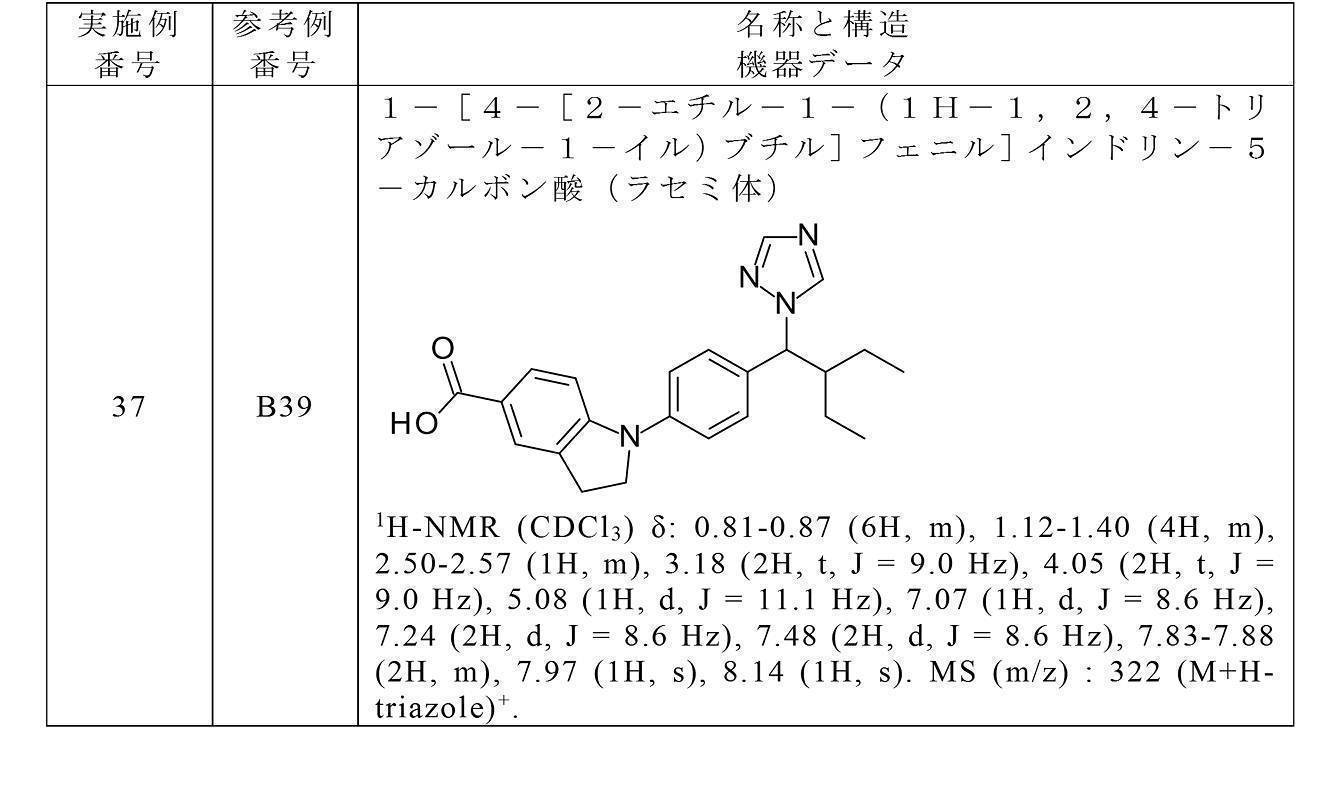
[実施例38]
4-[5-[2-エチル-1-(1H-1,2,4-トリアゾール-1-イル)ブチル]インドール-1-イル]安息香酸(ラセミ体)
[Example 38]
4-[5-[2-Ethyl-1-(1H-1,2,4-triazol-1-yl)butyl]indol-1-yl]benzoic acid (racemic form)

[工程1]
エチル 4-[5-[2-エチル-1-(1H-1,2,4-トリアゾール-1-イル)ブチル]インドール-1-イル]ベンゾエート(ラセミ体)
参考例A14で得られた化合物(2.3 g)のトルエン(46 ml)溶液に、エチル 4-ヨードベンゾエート(3.55 g、CAS番号 51934-41-9)、リン酸三カリウム(5.46 g、CAS番号 7778-53-2)、ヨウ化銅(I)(164 mg)、およびtrans-1,2-シクロヘキサンジアミン(391 mg、CAS番号 1121-22-8)を加え、混合物を100℃で14時間半攪拌した。冷却後、反応液を減圧下濃縮し、得られた残分をシリカゲルカラムクロマトグラフィー(n-ヘキサン/酢酸エチル)で精製することにより、標記化合物(3.05 g)を得た。
MS (m/z) : 348 (M+H-triazole)+.
[Step 1]
Ethyl 4-[5-[2-ethyl-1-(1H-1,2,4-triazol-1-yl)butyl]indol-1-yl]benzoate (racemic form)
In a solution of the compound (2.3 g) obtained in Reference Example A14 in toluene (46 ml), ethyl 4-iodobenzoate (3.55 g, CAS number 51934-41-9) and tripotassium phosphate (5. 46 g, CAS number 7778-53-2), copper(I) iodide (164 mg), and trans-1,2-cyclohexanediamine (391 mg, CAS number 1121-2-22-8) were added and the mixture was added to 100 The mixture was stirred at C for 14 hours and a half. After cooling, the reaction mixture was concentrated under reduced pressure, and the obtained residue was purified by silica gel column chromatography (n-hexane/ethyl acetate) to give the title compound (3.05 g).
MS (m/z): 348 (M+H-triazole) + .
[工程2]
4-[5-[2-エチル-1-(1H-1,2,4-トリアゾール-1-イル)ブチル]インドール-1-イル]安息香酸(ラセミ体)
上記工程1で得られた化合物(1.8 g)の1,4-ジオキサン(15 ml)溶液に、水(8 ml)および1規定水酸化ナトリウム水溶液(10 ml)を加え、混合物を室温で8時間半攪拌した。反応液に1規定塩酸(12 ml)を加え、酢酸エチルで抽出した。抽出液を水、飽和食塩水で順次洗浄後、無水硫酸ナトリウムで乾燥した。減圧下溶媒を留去し、得られた残分にn-ヘキサン/酢酸エチルの混合溶液を加え、析出した固体を濾取することにより、標記化合物(1.5 g)を得た。
1H-NMR (CDCl3) δ: 0.80-0.89 (6H, m), 1.17-1.42 (4H, m), 2.59-2.67 (1H, m), 5.23 (1H, d, J = 10.9 Hz), 6.73 (1H, d, J = 3.5 Hz), 7.39-7.43 (2H, m), 7.59-7.64 (3H, m), 7.78 (1H, d, J = 1.6 Hz), 7.96 (1H, s), 8.18 (1H, s), 8.25 (2H, d, J = 8.6 Hz).
MS (m/z) : 320 (M+H-triazole)+.
実施例38と同様の操作を行うことにより、下記の化合物を得た(表14)。
[Step 2]
4-[5-[2-Ethyl-1-(1H-1,2,4-triazol-1-yl)butyl]indol-1-yl]benzoic acid (racemic form)
To a solution of the compound (1.8 g) obtained in
1 H-NMR (CDCl 3 ) δ: 0.80-0.89 (6H, m), 1.17-1.42 (4H, m), 2.59-2.67 (1H, m), 5.23 (1H, d, J = 10.9 Hz), 6.73 (1H, d, J = 3.5 Hz), 7.39-7.43 (2H, m), 7.59-7.64 (3H, m), 7.78 (1H, d, J = 1.6 Hz), 7.96 (1H, s), 8.18 ( 1H, s), 8.25 (2H, d, J = 8.6 Hz).
MS (m/z): 320 (M+H-triazole) + .
The following compound was obtained by the same operation as in Example 38 (Table 14).

[実施例40]
4-[4-[2-エチル-1-(1H-1,2,4-トリアゾール-1-イル)ブチル]アニリノ]-N,N-ジメチルベンズアミド(ラセミ体)
[Example 40]
4-[4-[2-Ethyl-1-(1H-1,2,4-triazol-1-yl)butyl]anilino]-N,N-dimethylbenzamide (racemic form)

実施例1で得られた化合物(50 mg)のジクロロメタン(3 ml)溶液に氷冷下、N-エチル-N-(1-メチルエチル)プロパン-2-アミン(0.05 ml)、ジメチルアミン(2.0M/テトラヒドロフラン溶液、0.3 ml)、1-ヒドロキシベンゾトリアゾール・一水和物(32 mg)、および1-(3-ジメチルアミノプロピル)-3-エチルカルボジイミド塩酸塩(40 mg)を加え、混合物を室温で一晩攪拌した。反応液を減圧下濃縮後、得られた残分を薄層クロマトグラフィー(ジクロロメタン/酢酸エチル/エタノール)で精製することにより、標記化合物(34 mg)を得た。
1H-NMR (CDCl3) δ: 0.80-0.86 (6H, m), 1.11-1.40 (4H, m), 2.47-2.53 (1H, m), 3.07 (6H, s), 5.04 (1H, d, J = 10.7 Hz), 5.86 (1H, br s), 7.03 (2H, d, J = 8.6 Hz), 7.08 (2H, d, J = 8.6 Hz), 7.37 (2H, d, J = 8.6 Hz), 7.39 (2H, d, J = 8.6 Hz), 7.95 (1H, s), 8.11 (1H, s).
MS (m/z) : 323 (M+H-triazole)+.
実施例40と同様の操作を行うことにより、下記の化合物を得た(表15-1および表15-2)。
A solution of the compound (50 mg) obtained in Example 1 in dichloromethane (3 ml) was cooled with ice to obtain N-ethyl-N-(1-methylethyl)propan-2-amine (0.05 ml) and dimethylamine. (2.0 M/tetrahydrofuran solution, 0.3 ml), 1-hydroxybenzotriazole monohydrate (32 mg), and 1-(3-dimethylaminopropyl)-3-ethylcarbodiimide hydrochloride (40 mg) Was added and the mixture was stirred at room temperature overnight. The reaction mixture was concentrated under reduced pressure, and the obtained residue was purified by thin layer chromatography (dichloromethane/ethyl acetate/ethanol) to give the title compound (34 mg).
1 H-NMR (CDCl 3 ) δ: 0.80-0.86 (6H, m), 1.11-1.40 (4H, m), 2.47-2.53 (1H, m), 3.07 (6H, s), 5.04 (1H, d, J = 10.7 Hz), 5.86 (1H, br s), 7.03 (2H, d, J = 8.6 Hz), 7.08 (2H, d, J = 8.6 Hz), 7.37 (2H, d, J = 8.6 Hz), 7.39 (2H, d, J = 8.6 Hz), 7.95 (1H, s), 8.11 (1H, s).
MS (m/z): 323 (M+H-triazole) + .
The following compounds were obtained by performing the same operations as in Example 40 (Table 15-1 and Table 15-2).


[実施例45]
4-[4-[2-エチル-1-(1H-1,2,4-トリアゾール-1-イル)ブチル]アニリノ]-3-フルオロ-N-メチルスルホニルベンズアミド(ラセミ体)
[Example 45]
4-[4-[2-Ethyl-1-(1H-1,2,4-triazol-1-yl)butyl]anilino]-3-fluoro-N-methylsulfonylbenzamide (racemic form)

実施例4で得られた化合物(25 mg)のジクロロメタン(2 ml)溶液に氷冷下、4-ジメチルアミノピリジン(12 mg)、1-(3-ジメチルアミノプロピル)-3-エチルカルボジイミド塩酸塩(19 mg)、およびメタンスルホンアミド(19 mg、CAS番号 3144-09-0)を加え、混合物を室温で一晩攪拌した。反応液に1規定塩酸を加え、pHを4程度とした後、ジクロロメタンで抽出した。抽出液を減圧下濃縮後、得られた残分をジオール修飾シリカゲルカラムクロマトグラフィー(ジクロロメタン/酢酸エチル)で精製することにより、標記化合物(28 mg)を得た。
1H-NMR (CDCl3) δ: 0.81-0.87 (6H, m), 1.15-1.39 (4H, m), 2.49-2.54 (1H, m), 3.43 (3H, s), 5.09 (1H, d, J = 10.9 Hz), 6.27 (1H, br d, J = 3.5 Hz), 7.20 (2H, d, J = 8.6 Hz), 7.25-7.29 (1H, m), 7.41-7.44 (1H, m), 7.50 (2H, d, J = 8.6 Hz), 7.61 (1H, dd, J = 11.7, 2.0 Hz), 7.97 (1H, s), 8.14 (1H, s).
MS (m/z) : 391 (M+H-triazole)+.
4-Dimethylaminopyridine (12 mg), 1-(3-dimethylaminopropyl)-3-ethylcarbodiimide hydrochloride was added to a solution of the compound (25 mg) obtained in Example 4 in dichloromethane (2 ml) under ice cooling. (19 mg), and methanesulfonamide (19 mg, CAS number 3144-09-0) were added and the mixture was stirred at room temperature overnight. The reaction mixture was adjusted to pH 4 with 1N hydrochloric acid and extracted with dichloromethane. The extract was concentrated under reduced pressure, and the obtained residue was purified by diol-modified silica gel column chromatography (dichloromethane/ethyl acetate) to give the title compound (28 mg).
1 H-NMR (CDCl 3 )δ: 0.81-0.87 (6H, m), 1.15-1.39 (4H, m), 2.49-2.54 (1H, m), 3.43 (3H, s), 5.09 (1H, d, J = 10.9 Hz), 6.27 (1H, br d, J = 3.5 Hz), 7.20 (2H, d, J = 8.6 Hz), 7.25-7.29 (1H, m), 7.41-7.44 (1H, m), 7.50 (2H, d, J = 8.6 Hz), 7.61 (1H, dd, J = 11.7, 2.0 Hz), 7.97 (1H, s), 8.14 (1H, s).
MS (m/z): 391 (M+H-triazole) + .
[実施例46]
3-[[4-[4-[2-エチル-1-(1H-1,2,4-トリアゾール-1-イル)ブチル]アニリノ]ベンゾイル]メチルアミノ]プロパン酸(ラセミ体)
[Example 46]
3-[[4-[4-[2-Ethyl-1-(1H-1,2,4-triazol-1-yl)butyl]anilino]benzoyl]methylamino]propanoic acid (racemic form)

[工程1]
エチル 3-[[4-[4-[2-エチル-1-(1H-1,2,4-トリアゾール-1-イル)ブチル]アニリノ]ベンゾイル]メチルアミノ]プロパノエート(ラセミ体)
実施例1で得られた化合物(60 mg)のジクロロメタン(3 ml)溶液に氷冷下、N-エチル-N-(1-メチルエチル)プロパン-2-アミン(0.09 ml)、エチル 3-(メチルアミノ)プロパノエート(33 mg)、1-ヒドロキシベンゾトリアゾール・一水和物(51 mg)、および1-(3-ジメチルアミノプロピル)-3-エチルカルボジイミド塩酸塩(80 mg)を加え、混合物を室温で一晩攪拌した。反応液を減圧下濃縮後、得られた残分をシリカゲルカラムクロマトグラフィー(n-ヘキサン/酢酸エチル)で精製することにより、標記化合物(57 mg)を得た。
MS (m/z) : 409 (M+H-triazole)+.
[Step 1]
Ethyl 3-[[4-[4-[2-Ethyl-1-(1H-1,2,4-triazol-1-yl)butyl]anilino]benzoyl]methylamino]propanoate (racemic form)
A solution of the compound (60 mg) obtained in Example 1 in dichloromethane (3 ml) was cooled with ice and N-ethyl-N-(1-methylethyl)propan-2-amine (0.09 ml), ethyl 3 -(Methylamino)propanoate (33 mg), 1-hydroxybenzotriazole monohydrate (51 mg), and 1-(3-dimethylaminopropyl)-3-ethylcarbodiimide hydrochloride (80 mg) were added, The mixture was stirred at room temperature overnight. The reaction mixture was concentrated under reduced pressure, and the obtained residue was purified by silica gel column chromatography (n-hexane/ethyl acetate) to give the title compound (57 mg).
MS (m/z): 409 (M+H-triazole) + .
[工程2]
3-[[4-[4-[2-エチル-1-(1H-1,2,4-トリアゾール-1-イル)ブチル]アニリノ]ベンゾイル]メチルアミノ]プロパン酸(ラセミ体)
上記工程1で得られた化合物(42 mg)を用いて、実施例2の工程2と同様の操作を行うことにより、標記化合物(27 mg)を得た。
1H-NMR (CDCl3) δ: 0.81-0.85 (6H, m), 1.11-1.40 (4H, m), 2.47-2.53 (1H, m), 2.72-2.78 (2H, m), 3.11 (3H, s), 3.74-3.80 (2H, m), 5.05 (1H, d, J = 11.2 Hz), 5.92 (1H, br s), 7.02 (2H, d, J = 8.3 Hz), 7.08 (2H, d, J = 8.3 Hz), 7.36 (2H, d, J = 8.3 Hz), 7.39 (2H, d, J = 8.3 Hz), 7.95 (1H, s), 8.14 (1H, s).
MS (m/z) : 381 (M+H-triazole)+.
[実施例47]
N-[4-[2-エチル-1-(1H-1,2,4-トリアゾール-1-イル)ブチル]フェニル]-4-(1-メチル-1H-テトラゾール-5-イル)アニリン(ラセミ体)
[Step 2]
3-[[4-[4-[2-Ethyl-1-(1H-1,2,4-triazol-1-yl)butyl]anilino]benzoyl]methylamino]propanoic acid (racemic form)
The title compound (27 mg) was obtained by the same procedures as in
1 H-NMR (CDCl 3 ) δ: 0.81-0.85 (6H, m), 1.11-1.40 (4H, m), 2.47-2.53 (1H, m), 2.72-2.78 (2H, m), 3.11 (3H, s), 3.74-3.80 (2H, m), 5.05 (1H, d, J = 11.2 Hz), 5.92 (1H, br s), 7.02 (2H, d, J = 8.3 Hz), 7.08 (2H, d, J = 8.3 Hz), 7.36 (2H, d, J = 8.3 Hz), 7.39 (2H, d, J = 8.3 Hz), 7.95 (1H, s), 8.14 (1H, s).
MS (m/z): 381 (M+H-triazole) + .
[Example 47]
N-[4-[2-Ethyl-1-(1H-1,2,4-triazol-1-yl)butyl]phenyl]-4-(1-methyl-1H-tetrazol-5-yl)aniline (racemic body)

[工程1]
N-[4-[1-[tert-ブチル(ジメチル)シリル]オキシ-2-エチルブチル]フェニル]-4-(1-メチル-1H-テトラゾール-5-イル)アニリン(ラセミ体)
参考例B39で得られた化合物(280 mg)、および4-(1-メチルテトラゾール-5-イル)アニリン(153 mg)を用いて、実施例2の工程1と同様の操作を行うことにより、標記化合物(72 mg)を得た。
MS (m/z) : 466 (M+H)+.
[Step 1]
N-[4-[1-[tert-Butyl(dimethyl)silyl]oxy-2-ethylbutyl]phenyl]-4-(1-methyl-1H-tetrazol-5-yl)aniline (racemic form)
Using the compound (280 mg) obtained in Reference Example B39 and 4-(1-methyltetrazol-5-yl)aniline (153 mg), the same procedure as in
MS (m/z): 466 (M+H) + .
[工程2]
2-エチル-1-[4-[4-(1-メチル-1H-テトラゾール-5-イル)アニリノ]フェニル]ブタン-1-オール(ラセミ体)
上記工程1で得られた化合物(72 mg)を用いて、実施例36の工程2と同様の操作を行うことにより、標記化合物(43 mg)を得た。
MS (m/z) : 352 (M+H)+.
[Step 2]
2-Ethyl-1-[4-[4-(1-methyl-1H-tetrazol-5-yl)anilino]phenyl]butan-1-ol (racemic form)
The title compound (43 mg) was obtained by the same procedures as in
MS (m/z): 352 (M+H) + .
[工程3]
N-[4-[2-エチル-1-(1H-1,2,4-トリアゾール-1-イル)ブチル]フェニル]-4-(1-メチル-1H-テトラゾール-5-イル)アニリン(ラセミ体)
上記工程2で得られた化合物(43 mg)のトルエン(5 ml)溶液に、1H-1,2,4-トリアゾール(17 mg)およびパラトルエンスルホン酸・一水和物(触媒量)を加え、混合物を110℃で6時間攪拌した。冷却後、反応液に飽和重曹水を加え、酢酸エチルで抽出した。抽出液を無水硫酸マグネシウムで乾燥した。減圧下溶媒を留去し、得られた残分を薄層クロマトグラフィー(n-ヘキサン/酢酸エチル)で精製することにより、標記化合物(13 mg)を得た。
1H-NMR (CDCl3) δ: 0.81-0.87 (6H, m), 1.11-1.40 (4H, m), 2.48-2.54 (1H, m), 4.18 (3H, s), 5.07 (1H, d, J = 10.9 Hz), 6.02 (1H, br s), 7.15 (2H, d, J = 8.6 Hz), 7.16 (2H, d, J = 8.6 Hz), 7.45 (2H, d, J = 8.6 Hz), 7.65 (2H, d, J = 8.6 Hz), 7.96 (1H, s), 8.13 (1H, s).
MS (m/z) : 334 (M+H-triazole)+.
[Step 3]
N-[4-[2-Ethyl-1-(1H-1,2,4-triazol-1-yl)butyl]phenyl]-4-(1-methyl-1H-tetrazol-5-yl)aniline (racemic body)
To a solution of the compound (43 mg) obtained in
1 H-NMR (CDCl 3 ) δ: 0.81-0.87 (6H, m), 1.11-1.40 (4H, m), 2.48-2.54 (1H, m), 4.18 (3H, s), 5.07 (1H, d, J = 10.9 Hz), 6.02 (1H, br s), 7.15 (2H, d, J = 8.6 Hz), 7.16 (2H, d, J = 8.6 Hz), 7.45 (2H, d, J = 8.6 Hz), 7.65 (2H, d, J = 8.6 Hz), 7.96 (1H, s), 8.13 (1H, s).
MS (m/z): 334 (M+H-triazole) + .
[実施例48]
4-[4-[2-エチル-1-(1H-1,2,4-トリアゾール-1-イル)ブチル]アニリノ]ベンゾニトリル(ラセミ体)
[Example 48]
4-[4-[2-Ethyl-1-(1H-1,2,4-triazol-1-yl)butyl]anilino]benzonitrile (racemic form)

[工程1]
4-[4-[1-[tert-ブチル(ジメチル)シリル]オキシ-2-エチルブチル]アニリノ]ベンゾニトリル(ラセミ体)
参考例B39で得られた化合物(300 mg)、および4-アミノベンゾニトリル(144 mg)を用いて、実施例2の工程1と同様の操作を行うことにより、標記化合物(170 mg)を得た。
MS (m/z) : 409 (M+H)+.
[Step 1]
4-[4-[1-[tert-butyl(dimethyl)silyl]oxy-2-ethylbutyl]anilino]benzonitrile (racemic form)
Using the compound (300 mg) obtained in Reference Example B39 and 4-aminobenzonitrile (144 mg), the same operation as in
MS (m/z): 409 (M+H) + .
[工程2]
4-[4-(2-エチル-1-ヒドロキシブチル)アニリノ]ベンゾニトリル(ラセミ体)
上記工程1で得られた化合物(170 mg)を用いて、実施例36の工程2と同様の操作を行うことにより、標記化合物(104 mg)を得た。
MS (m/z) : 295 (M+H)+, 277 (M+H-H2O)+.
[Step 2]
4-[4-(2-Ethyl-1-hydroxybutyl)anilino]benzonitrile (racemic form)
The title compound (104 mg) was obtained by the same procedures as in
MS (m/z): 295 (M+H) + , 277 (M+HH 2 O) + .
[工程3]
4-[4-[2-エチル-1-(1H-1,2,4-トリアゾール-1-イル)ブチル]アニリノ]ベンゾニトリル(ラセミ体)
上記工程2で得られた化合物(104 mg)を用いて、実施例34の工程2と同様の操作を行うことにより、標記化合物(82 mg)を得た。
1H-NMR (CDCl3) δ: 0.81-0.86 (6H, m), 1.12-1.39 (4H, m), 2.48-2.54 (1H, m), 5.07 (1H, d, J = 10.9 Hz), 6.04 (1H, br s), 6.99 (2H, d, J = 8.6 Hz), 7.13 (2H, d, J = 8.6 Hz), 7.45 (2H, d, J = 8.6 Hz), 7.49 (2H, d, J = 8.6 Hz), 7.96 (1H, s), 8.12 (1H, s).
MS (m/z) : 277 (M+H-triazole)+.
[Step 3]
4-[4-[2-Ethyl-1-(1H-1,2,4-triazol-1-yl)butyl]anilino]benzonitrile (racemic form)
The title compound (82 mg) was obtained by the same procedures as in
1 H-NMR (CDCl 3 ) δ: 0.81-0.86 (6H, m), 1.12-1.39 (4H, m), 2.48-2.54 (1H, m), 5.07 (1H, d, J = 10.9 Hz), 6.04 (1H, br s), 6.99 (2H, d, J = 8.6 Hz), 7.13 (2H, d, J = 8.6 Hz), 7.45 (2H, d, J = 8.6 Hz), 7.49 (2H, d, J = 8.6 Hz), 7.96 (1H, s), 8.12 (1H, s).
MS (m/z): 277 (M+H-triazole) + .
[実施例49]
N-[4-[2-エチル-1-(1H-1,2,4-トリアゾール-1-イル)ブチル]フェニル]-4-(1,3,4-オキサジアゾール-2-イル)アニリン(ラセミ体)
[Example 49]
N-[4-[2-Ethyl-1-(1H-1,2,4-triazol-1-yl)butyl]phenyl]-4-(1,3,4-oxadiazol-2-yl)aniline (Racemic)

[工程1]
4-[4-[2-エチル-1-(1H-1,2,4-トリアゾール-1-イル)ブチル]アニリノ]ベンゾヒドラジド(ラセミ体)
実施例1の工程1で得られた化合物(40 mg)のメタノール(2 ml)溶液に、ヒドラジン・一水和物(0.1 ml)を加え、混合物を70℃で4時間攪拌した。反応液にヒドラジン・一水和物(0.2 ml)を追加し、混合物を70℃で11時間半攪拌した。反応液を減圧下濃縮し、得られた残分をアミン修飾シリカゲルカラムクロマトグラフィー(ジクロロメタン/酢酸エチル/エタノール)で精製することにより、標記化合物(38 mg)を得た。
MS (m/z) : 310 (M+H-triazole)+.
[Step 1]
4-[4-[2-Ethyl-1-(1H-1,2,4-triazol-1-yl)butyl]anilino]benzohydrazide (racemic form)
Hydrazine monohydrate (0.1 ml) was added to a solution of the compound (40 mg) obtained in
MS (m/z): 310 (M+H-triazole) + .
[工程2]
N-[4-[2-エチル-1-(1H-1,2,4-トリアゾール-1-イル)ブチル]フェニル]-4-(1,3,4-オキサジアゾール-2-イル)アニリン(ラセミ体)
上記工程1で得られた化合物(38 mg)に、トリメトキシメタン(1 ml)およびパラトルエンスルホン酸・一水和物(1.3 mg)を加え、混合物を50℃で2時間攪拌した。反応液を減圧下濃縮し、得られた残分をシリカゲルカラムクロマトグラフィー(酢酸エチル/エタノール)に付し、続いて薄層クロマトグラフィー(酢酸エチル)で精製することにより、標記化合物(12 mg)を得た。
1H-NMR (CDCl3) δ: 0.81-0.89 (6H, m), 1.11-1.41 (4H, m), 2.48-2.56 (1H, m), 5.07 (1H, d, J = 10.9 Hz), 6.04 (1H, br s), 7.10 (2H, d, J = 8.6 Hz), 7.15 (2H, d, J = 8.6 Hz), 7.44 (2H, d, J = 8.6 Hz), 7.95 (2H, d, J = 8.6 Hz), 7.96 (1H, s), 8.13 (1H, s), 8.40 (1H, s).
MS (m/z) : 320 (M+H-triazole)+.
実施例49と同様の操作を行うことにより、下記の化合物を得た(表16)。表中、原料の列において、「実施例14工程1」は、実施例14の合成において、実施例2の工程1に対応する工程において得られた化合物を示す。
[Step 2]
N-[4-[2-Ethyl-1-(1H-1,2,4-triazol-1-yl)butyl]phenyl]-4-(1,3,4-oxadiazol-2-yl)aniline (Racemic)
Trimethoxymethane (1 ml) and paratoluenesulfonic acid monohydrate (1.3 mg) were added to the compound (38 mg) obtained in
1 H-NMR (CDCl 3 )δ: 0.81-0.89 (6H, m), 1.11-1.41 (4H, m), 2.48-2.56 (1H, m), 5.07 (1H, d, J = 10.9 Hz), 6.04 (1H, br s), 7.10 (2H, d, J = 8.6 Hz), 7.15 (2H, d, J = 8.6 Hz), 7.44 (2H, d, J = 8.6 Hz), 7.95 (2H, d, J = 8.6 Hz), 7.96 (1H, s), 8.13 (1H, s), 8.40 (1H, s).
MS (m/z): 320 (M+H-triazole) + .
The following compound was obtained by performing the same operation as in Example 49 (Table 16). In the raw material column of the table, “Example 14

[実施例52]
5-[4-[4-[2-エチル-1-(1H-1,2,4-トリアゾール-1-イル)ブチル]アニリノ]フェニル]-1,3,4-オキサジアゾール-2-アミン(ラセミ体)
Example 52
5-[4-[4-[2-Ethyl-1-(1H-1,2,4-triazol-1-yl)butyl]anilino]phenyl]-1,3,4-oxadiazol-2-amine (Racemic)

実施例49の工程1で得られた化合物(38 mg)の1,4-ジオキサン(1 ml)溶液に氷冷下、臭化シアン(13.5 mg)、炭酸水素ナトリウム(16 mg)、および水(1 ml)を加え、混合物を室温で3日間攪拌した。反応液に臭化シアン(13.5 mg)を追加し、混合物を室温で一晩攪拌した。反応液に飽和重曹水を加え、ジクロロメタンで抽出した。抽出液を減圧下濃縮し、得られた残分をシリカゲルカラムクロマトグラフィー(酢酸エチル/エタノール)に付し、続いて薄層クロマトグラフィー(酢酸エチル/エタノール)で精製することにより、標記化合物(14 mg)を得た。
1H-NMR (CDCl3) δ: 0.81-0.86 (6H, m), 1.12-1.40 (4H, m), 2.48-2.54 (1H, m), 4.71 (2H, br s), 5.06 (1H, d, J = 10.6 Hz), 5.96 (1H, br s), 7.07 (2H, d, J = 8.6 Hz), 7.12 (2H, d, J = 8.6 Hz), 7.42 (2H, d, J = 8.6 Hz), 7.79 (2H, d, J = 8.6 Hz), 7.96 (1H, s), 8.12 (1H, s).
MS (m/z) : 335 (M+H-triazole)+.
A solution of the compound (38 mg) obtained in
1 H-NMR (CDCl 3 ) δ: 0.81-0.86 (6H, m), 1.12-1.40 (4H, m), 2.48-2.54 (1H, m), 4.71 (2H, br s), 5.06 (1H, d , J = 10.6 Hz), 5.96 (1H, br s), 7.07 (2H, d, J = 8.6 Hz), 7.12 (2H, d, J = 8.6 Hz), 7.42 (2H, d, J = 8.6 Hz) , 7.79 (2H, d, J = 8.6 Hz), 7.96 (1H, s), 8.12 (1H, s).
MS (m/z): 335 (M+H-triazole) + .
[実施例53]
N-[4-[2-エチル-1-(1H-1,2,4-トリアゾール-1-イル)ブチル]フェニル]-4-(1,3,4-チアジアゾール-2-イル)アニリン(ラセミ体)
[Example 53]
N-[4-[2-Ethyl-1-(1H-1,2,4-triazol-1-yl)butyl]phenyl]-4-(1,3,4-thiadiazol-2-yl)aniline (racemic body)

実施例49の工程1で得られた化合物(53 mg)に氷冷下、蟻酸(0.9 ml)を加え、混合物を室温で一晩攪拌した。反応液を減圧下濃縮し、得られた残分に1,4-ジオキサン(1.5 ml)、および五硫化二リン(45 mg)を加え、混合物を室温で一晩攪拌後、50℃で21時間攪拌した。反応液に飽和重曹水を加え、ジクロロメタンで抽出した。抽出液を減圧下濃縮し、得られた残分をシリカゲルカラムクロマトグラフィー(酢酸エチル/エタノール)、続いて薄層クロマトグラフィー(ジクロロメタン/酢酸エチル/エタノール)で精製することにより、標記化合物(13 mg)を得た。
1H-NMR (CDCl3) δ: 0.81-0.87 (6H, m), 1.12-1.40 (4H, m), 2.48-2.55 (1H, m), 5.07 (1H, d, J = 10.6 Hz), 6.01 (1H, br s), 7.10 (2H, d, J = 8.6 Hz), 7.14 (2H, d, J = 8.6 Hz), 7.43 (2H, d, J = 8.6 Hz), 7.89 (2H, d, J = 8.6 Hz), 7.96 (1H, s), 8.13 (1H, s), 9.03 (1H, s).
MS (m/z) : 336 (M+H-triazole)+.
Formic acid (0.9 ml) was added to the compound (53 mg) obtained in
1 H-NMR (CDCl 3 ) δ: 0.81-0.87 (6H, m), 1.12-1.40 (4H, m), 2.48-2.55 (1H, m), 5.07 (1H, d, J = 10.6 Hz), 6.01 (1H, br s), 7.10 (2H, d, J = 8.6 Hz), 7.14 (2H, d, J = 8.6 Hz), 7.43 (2H, d, J = 8.6 Hz), 7.89 (2H, d, J = 8.6 Hz), 7.96 (1H, s), 8.13 (1H, s), 9.03 (1H, s).
MS (m/z): 336 (M+H-triazole) + .
[実施例54]
N-[4-[2-エチル-1-(1H-1,2,4-トリアゾール-1-イル)ブチル]フェニル]-4-(1H-1,2,4-トリアゾール-5-イル)アニリン(ラセミ体)
[Example 54]
N-[4-[2-Ethyl-1-(1H-1,2,4-triazol-1-yl)butyl]phenyl]-4-(1H-1,2,4-triazol-5-yl)aniline (Racemic)

[工程1]
4-[4-[2-エチル-1-(1H-1,2,4-トリアゾール-1-イル)ブチル]アニリノ]ベンズアミド(ラセミ体)
実施例1で得られた化合物(106 mg)のN,N-ジメチルホルムアミド(3 ml)溶液に氷冷下、塩化アンモニウム(156 mg)、トリエチルアミン(0.21 ml)、1-ヒドロキシベンゾトリアゾール・一水和物(67 mg)、および1-(3-ジメチルアミノプロピル)-3-エチルカルボジイミド塩酸塩(84 mg)を加え、混合物を室温で一晩攪拌した。反応液を減圧下濃縮後、得られた残分をシリカゲルカラムクロマトグラフィー(ジクロロメタン/酢酸エチル/エタノール)に付し、続いて薄層クロマトグラフィー(ジクロロメタン/酢酸エチル/エタノール)で精製することにより、標記化合物(87 mg)を得た。
1H-NMR (DMSO-d6) δ: 0.72 (3H, t, J = 7.8 Hz), 0.73 (3H, t, J = 7.4 Hz), 0.84-1.28 (4H, m), 2.40-2.45 (1H, m), 5.28 (1H, d, J = 11.3 Hz), 6.99 (2H, d, J = 8.6 Hz), 7.08 (2H, d, J = 8.6 Hz), 7.42 (2H, d, J = 8.6 Hz), 7.70 (2H, d, J = 8.6 Hz), 7.93 (1H, s), 8.55 (1H, s), 8.66 (1H, s).
MS (m/z) : 295 (M+H-triazole)+.
[Step 1]
4-[4-[2-Ethyl-1-(1H-1,2,4-triazol-1-yl)butyl]anilino]benzamide (racemic form)
A solution of the compound (106 mg) obtained in Example 1 in N,N-dimethylformamide (3 ml) was cooled with ice with ammonium chloride (156 mg), triethylamine (0.21 ml) and 1-hydroxybenzotriazole. Monohydrate (67 mg) and 1-(3-dimethylaminopropyl)-3-ethylcarbodiimide hydrochloride (84 mg) were added and the mixture was stirred at room temperature overnight. After the reaction solution was concentrated under reduced pressure, the obtained residue was subjected to silica gel column chromatography (dichloromethane/ethyl acetate/ethanol), and subsequently purified by thin layer chromatography (dichloromethane/ethyl acetate/ethanol). The title compound (87 mg) was obtained.
1 H-NMR (DMSO-d 6 ) δ: 0.72 (3H, t, J = 7.8 Hz), 0.73 (3H, t, J = 7.4 Hz), 0.84-1.28 (4H, m), 2.40-2.45 (1H , m), 5.28 (1H, d, J = 11.3 Hz), 6.99 (2H, d, J = 8.6 Hz), 7.08 (2H, d, J = 8.6 Hz), 7.42 (2H, d, J = 8.6 Hz) ), 7.70 (2H, d, J = 8.6 Hz), 7.93 (1H, s), 8.55 (1H, s), 8.66 (1H, s).
MS (m/z): 295 (M+H-triazole) + .
[工程2]
N-[4-[2-エチル-1-(1H-1,2,4-トリアゾール-1-イル)ブチル]フェニル]-4-(1H-1,2,4-トリアゾール-5-イル)アニリン(ラセミ体)
上記工程1で得られた化合物(38 mg)に、N,N-ジメチルホルムアミド ジメチルアセタール(1 ml)を加え、混合物を40℃で30分間攪拌後、50℃で1時間半攪拌した。冷却後、反応液を減圧下濃縮し、得られた残分に氷冷下、酢酸(0.5 ml)およびヒドラジン・一水和物(0.1 ml)を加え、混合物を40℃で1時間攪拌した。反応液を減圧下濃縮し、得られた残分をシリカゲルカラムクロマトグラフィー(酢酸エチル/エタノール)、続いて薄層クロマトグラフィー(ジクロロメタン/酢酸エチル/エタノール)で精製することにより、標記化合物(37 mg)を得た。
1H-NMR (DMSO-d6) δ: 0.74-0.79 (6H, m), 1.00-1.30 (4H, m), 2.45-2.50 (1H, m), 5.31 (1H, d, J = 11.3 Hz), 7.11 (2H, d, J = 8.6 Hz), 7.13 (2H, d, J = 8.6 Hz), 7.45 (2H, d, J = 8.6 Hz), 7.85 (2H, d, J = 8.6 Hz), 7.97 (1H, s), 8.51 (1H, br s), 8.69 (1H, s).
MS (m/z) : 319 (M+H-triazole)+.
[Step 2]
N-[4-[2-Ethyl-1-(1H-1,2,4-triazol-1-yl)butyl]phenyl]-4-(1H-1,2,4-triazol-5-yl)aniline (Racemic)
N,N-Dimethylformamide dimethylacetal (1 ml) was added to the compound (38 mg) obtained in
1 H-NMR (DMSO-d 6 ) δ: 0.74-0.79 (6H, m), 1.00-1.30 (4H, m), 2.45-2.50 (1H, m), 5.31 (1H, d, J = 11.3 Hz) , 7.11 (2H, d, J = 8.6 Hz), 7.13 (2H, d, J = 8.6 Hz), 7.45 (2H, d, J = 8.6 Hz), 7.85 (2H, d, J = 8.6 Hz), 7.97 (1H, s), 8.51 (1H, br s), 8.69 (1H, s).
MS (m/z): 319 (M+H-triazole) + .
[実施例55]
5-[4-[4-[2-エチル-1-(1H-1,2,4-トリアゾール-1-イル)ブチル]アニリノ]フェニル]-3H-1,3,4-オキサジアゾール-2-オン(ラセミ体)
[Example 55]
5-[4-[4-[2-Ethyl-1-(1H-1,2,4-triazol-1-yl)butyl]anilino]phenyl]-3H-1,3,4-oxadiazole-2 -On (racemic)

参考例A1で得られた化合物(61 mg)の1,4-ジオキサン(2 ml)溶液に、参考例B20で得られた化合物(83 mg)、炭酸カリウム(111 mg)、酢酸パラジウム(II)(4.2 mg)、および4,5-ビス(ジフェニルホスフィノ)-9,9-ジメチルキサンテン(21.5 mg)を加え、混合物を100℃で7時間半攪拌した。冷却後、反応液を減圧下濃縮し、得られた残分に氷冷下、4規定塩酸/1,4-ジオキサン溶液(3 ml)を加え、混合物を同温で1時間半攪拌後、室温で3時間攪拌した。反応液に4規定塩酸/1,4-ジオキサン溶液(2 ml)を追加し、混合物を室温で5時間半攪拌した。反応液を減圧下濃縮し、得られた残分に水を加え、ジクロロメタンで抽出した。抽出液を無水硫酸マグネシウムで乾燥した。減圧下溶媒を留去し、得られた残分をジオール修飾シリカゲルカラムクロマトグラフィー(n-ヘキサン/酢酸エチル)、続いて薄層クロマトグラフィー(ジクロロメタン/酢酸エチル/エタノール)で精製することにより、標記化合物(45 mg)を得た。
1H-NMR (CDCl3) δ: 0.81-0.86 (6H, m), 1.12-1.40 (4H, m), 2.48-2.54 (1H, m), 5.06 (1H, d, J = 11.0 Hz), 6.02 (1H, br s), 7.06 (2H, d, J = 8.6 Hz), 7.13 (2H, d, J = 8.6 Hz), 7.43 (2H, d, J = 8.6 Hz), 7.71 (2H, d, J = 8.6 Hz), 7.96 (1H, s), 8.13 (1H, s), 8.43 (1H, br s).
MS (m/z) : 336 (M+H-triazole)+.
参考例記載の化合物を用いて、実施例55と同様の操作を行うことにより、下記の化合物を得た(表17)。
A solution of the compound (61 mg) obtained in Reference Example A1 in 1,4-dioxane (2 ml) was added to the compound (83 mg) obtained in Reference Example B20, potassium carbonate (111 mg), and palladium(II) acetate. (4.2 mg) and 4,5-bis(diphenylphosphino)-9,9-dimethylxanthene (21.5 mg) were added, and the mixture was stirred at 100° C. for 7 hr and 30 min. After cooling, the reaction mixture was concentrated under reduced pressure, 4N hydrochloric acid/1,4-dioxane solution (3 ml) was added to the obtained residue under ice cooling, and the mixture was stirred at the same temperature for 1 and a half hours, then at room temperature. And stirred for 3 hours. 4N Hydrochloric acid/1,4-dioxane solution (2 ml) was added to the reaction solution, and the mixture was stirred at room temperature for 5 hours and a half. The reaction mixture was concentrated under reduced pressure, water was added to the obtained residue, and the mixture was extracted with dichloromethane. The extract was dried over anhydrous magnesium sulfate. The solvent was distilled off under reduced pressure, and the obtained residue was purified by diol-modified silica gel column chromatography (n-hexane/ethyl acetate) and then thin-layer chromatography (dichloromethane/ethyl acetate/ethanol) to give the title compound. The compound (45 mg) was obtained.
1 H-NMR (CDCl 3 ) δ: 0.81-0.86 (6H, m), 1.12-1.40 (4H, m), 2.48-2.54 (1H, m), 5.06 (1H, d, J = 11.0 Hz), 6.02 (1H, br s), 7.06 (2H, d, J = 8.6 Hz), 7.13 (2H, d, J = 8.6 Hz), 7.43 (2H, d, J = 8.6 Hz), 7.71 (2H, d, J = 8.6 Hz), 7.96 (1H, s), 8.13 (1H, s), 8.43 (1H, br s).
MS (m/z): 336 (M+H-triazole) + .
The following compounds were obtained by the same procedures as in Example 55 using the compounds described in Reference Example (Table 17).

[実施例57]
5-[[4-[4-[2-エチル-1-(1H-1,2,4-トリアゾール-1-イル)ブチル]アニリノ]フェニル]メチル]-3H-1,3,4-オキサジアゾール-2-オン(ラセミ体)
Example 57
5-[[4-[4-[2-Ethyl-1-(1H-1,2,4-triazol-1-yl)butyl]anilino]phenyl]methyl]-3H-1,3,4-oxadi Azol-2-one (racemic form)

[工程1]
5-[[4-[4-[2-エチル-1-(1H-1,2,4-トリアゾール-1-イル)ブチル]アニリノ]フェニル]メチル]-3-(2-トリメチルシリルエトキシメチル)-1,3,4-オキサジアゾール-2-オン(ラセミ体)
参考例A1で得られた化合物(65 mg)および参考例B19で得られた化合物(110 mg)を用いて、実施例2の工程1と同様の操作を行うことにより、標記化合物(95 mg)を得た。
MS (m/z) : 480 (M+H-triazole)+.
[Step 1]
5-[[4-[4-[2-Ethyl-1-(1H-1,2,4-triazol-1-yl)butyl]anilino]phenyl]methyl]-3-(2-trimethylsilylethoxymethyl)- 1,3,4-oxadiazol-2-one (racemic form)
Using the compound (65 mg) obtained in Reference Example A1 and the compound (110 mg) obtained in Reference Example B19, the title compound (95 mg) was obtained in the same manner as in
MS (m/z): 480 (M+H-triazole) + .
[工程2]
5-[[4-[4-[2-エチル-1-(1H-1,2,4-トリアゾール-1-イル)ブチル]アニリノ]フェニル]メチル]-3H-1,3,4-オキサジアゾール-2-オン(ラセミ体)
上記工程1で得られた化合物(89 mg)のメタノール(0.5 ml)溶液に、4規定塩酸/1,4-ジオキサン溶液(1.5 ml)を加え、混合物を室温で一晩攪拌した。反応液に飽和重曹水を加え、ジクロロメタンで抽出した。抽出液を減圧下濃縮し、得られた残分をシリカゲルカラムクロマトグラフィー(n-ヘキサン/酢酸エチル)で精製した。得られた残分のメタノール(0.6 ml)溶液に氷冷下、28%アンモニア水(0.2 ml)を加え、混合物を同温で1時間攪拌後、室温で一晩攪拌した。反応液を減圧下濃縮し、得られた残分を薄層クロマトグラフィー(n-ヘキサン/酢酸エチル)で精製することにより、標記化合物(20 mg)を得た。
1H-NMR (CDCl3) δ: 0.80-0.85 (6H, m), 1.11-1.40 (4H, m), 2.46-2.52 (1H, m), 3.81 (2H, s), 5.03 (1H, d, J = 11.0 Hz), 5.75 (1H, br s), 7.02 (2H, d, J = 8.6 Hz), 7.04 (2H, d, J = 8.6 Hz), 7.18 (2H, d, J = 8.6 Hz), 7.35 (2H, d, J = 8.6 Hz), 7.95 (1H, s), 8.11 (1H, s), 8.27 (1H, br s).
MS (m/z) : 350 (M+H-triazole)+.
[Step 2]
5-[[4-[4-[2-Ethyl-1-(1H-1,2,4-triazol-1-yl)butyl]anilino]phenyl]methyl]-3H-1,3,4-oxadi Azol-2-one (racemic form)
To a solution of the compound (89 mg) obtained in
1 H-NMR (CDCl 3 )δ: 0.80-0.85 (6H, m), 1.11-1.40 (4H, m), 2.46-2.52 (1H, m), 3.81 (2H, s), 5.03 (1H, d, J = 11.0 Hz), 5.75 (1H, br s), 7.02 (2H, d, J = 8.6 Hz), 7.04 (2H, d, J = 8.6 Hz), 7.18 (2H, d, J = 8.6 Hz), 7.35 (2H, d, J = 8.6 Hz), 7.95 (1H, s), 8.11 (1H, s), 8.27 (1H, br s).
MS (m/z): 350 (M+H-triazole) + .
[実施例58]
5-[4-[4-[2-エチル-1-(1H-1,2,4-トリアゾール-1-イル)ブチル]アニリノ]-2-フルオロフェニル]-3H-1,3,4-オキサジアゾール-2-オン(ラセミ体)
Example 58
5-[4-[4-[2-Ethyl-1-(1H-1,2,4-triazol-1-yl)butyl]anilino]-2-fluorophenyl]-3H-1,3,4-oxa Diazol-2-one (racemic form)
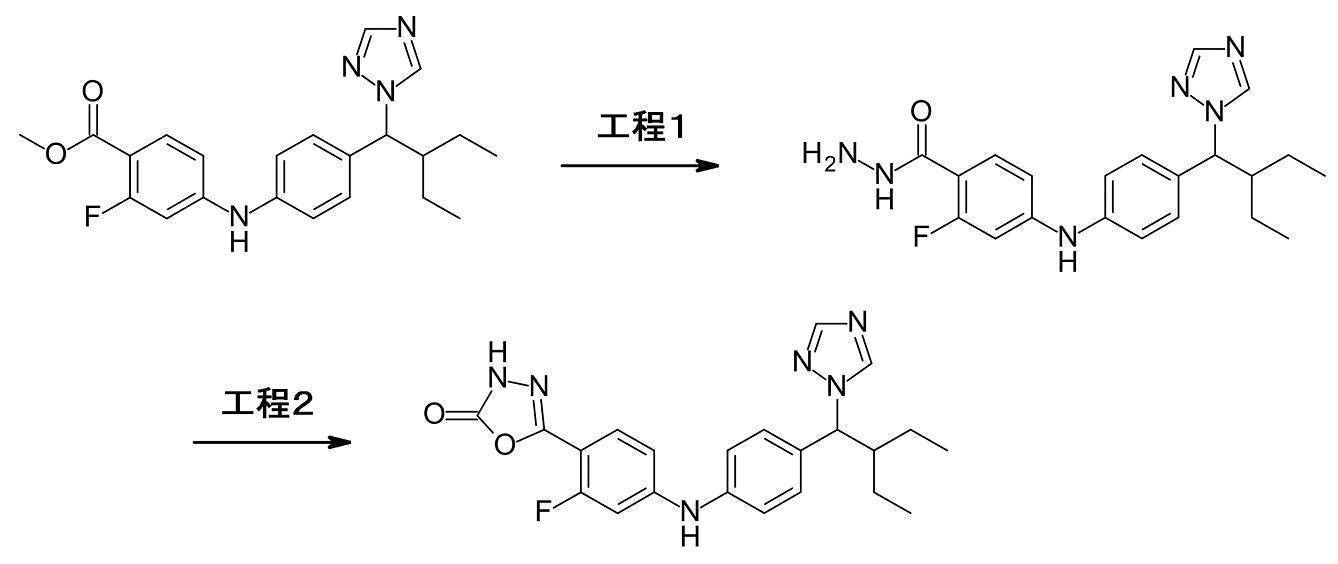
[工程1]
4-[4-[2-エチル-1-(1H-1,2,4-トリアゾール-1-イル)ブチル]アニリノ]-2-フルオロベンゾヒドラジド(ラセミ体)
実施例2の工程1で得られた化合物(342 mg)のメタノール(3 ml)溶液にヒドラジン・一水和物(0.3 ml)を加え、混合物を70℃で2時間半攪拌した。反応液にメタノール(3 ml)、およびヒドラジン・一水和物(0.6 ml)を追加し、混合物を70℃で11時間攪拌した。反応液を減圧下濃縮し、得られた残分をアミン修飾シリカゲルカラムクロマトグラフィー(ジクロロメタン/酢酸エチル/メタノール)で精製することにより、標記化合物(354 mg)を得た。
MS (m/z) : 328 (M+H-triazole)+.
[Step 1]
4-[4-[2-Ethyl-1-(1H-1,2,4-triazol-1-yl)butyl]anilino]-2-fluorobenzohydrazide (racemic form)
Hydrazine monohydrate (0.3 ml) was added to a solution of the compound (342 mg) obtained in
MS (m/z): 328 (M+H-triazole) + .
[工程2]
5-[4-[4-[2-エチル-1-(1H-1,2,4-トリアゾール-1-イル)ブチル]アニリノ]-2-フルオロフェニル]-3H-1,3,4-オキサジアゾール-2-オン(ラセミ体)
上記工程1で得られた化合物(70 mg)のテトラヒドロフラン(3 ml)溶液に氷冷下、1,1’-カルボニルジイミダゾール(0.27 g)を加え、混合物を室温で一晩攪拌した。反応液を減圧下濃縮し、得られた残分をシリカゲルカラムクロマトグラフィー(ジクロロメタン/酢酸エチル/エタノール)、続いて薄層クロマトグラフィー(ジクロロメタン/酢酸エチル/エタノール)で精製することにより、標記化合物(60 mg)を得た。
1H-NMR (CDCl3) δ: 0.81-0.87 (6H, m), 1.11-1.40 (4H, m), 2.49-2.54 (1H, m), 5.08 (1H, d, J = 10.6 Hz), 6.09 (1H, br s), 6.77-6.83 (2H, m), 7.15 (2H, d, J = 8.6 Hz), 7.47 (2H, d, J = 8.6 Hz), 7.62 (1H, dd, J = 8.4, 8.4 Hz), 7.97 (1H, s), 8.13 (1H, s), 8.43 (1H, br s).
MS (m/z) : 354 (M+H-triazole)+.
実施例58と同様の操作を行うことにより、下記の化合物を得た(表18-1および表18-2)。表中、原料の列において、「実施例27工程1」、「実施例26工程1」、「実施例25工程1」、および「実施例14工程1」は、各々の実施例化合物の合成において、実施例2の工程1に対応する工程において得られた、各々の化合物を示す。(例えば、「実施例27工程1」は、実施例27の合成において、実施例2の工程1に対応する工程において得られた化合物を示す。)
[Step 2]
5-[4-[4-[2-Ethyl-1-(1H-1,2,4-triazol-1-yl)butyl]anilino]-2-fluorophenyl]-3H-1,3,4-oxa Diazol-2-one (racemic form)
1,1′-Carbonyldiimidazole (0.27 g) was added to a solution of the compound (70 mg) obtained in
1 H-NMR (CDCl 3 ) δ: 0.81-0.87 (6H, m), 1.11-1.40 (4H, m), 2.49-2.54 (1H, m), 5.08 (1H, d, J = 10.6 Hz), 6.09 (1H, br s), 6.77-6.83 (2H, m), 7.15 (2H, d, J = 8.6 Hz), 7.47 (2H, d, J = 8.6 Hz), 7.62 (1H, dd, J = 8.4, 8.4 Hz), 7.97 (1H, s), 8.13 (1H, s), 8.43 (1H, br s).
MS (m/z): 354 (M+H-triazole) + .
The following compounds were obtained by performing the same operations as in Example 58 (Table 18-1 and Table 18-2). In the columns of raw materials in the table, "Example 27


[実施例63]
5-[[4-[4-[2-エチル-1-(1H-1,2,4-トリアゾール-1-イル)ブチル]-2-メチルアニリノ]フェニル]メチル]-3H-1,3,4-オキサジアゾール-2-オン(ラセミ体)
Example 63
5-[[4-[4-[2-Ethyl-1-(1H-1,2,4-triazol-1-yl)butyl]-2-methylanilino]phenyl]methyl]-3H-1,3,4 -Oxadiazol-2-one (racemic form)

[工程1]
メチル 2-[4-[4-[2-エチル-1-(1H-1,2,4-トリアゾール-1-イル)ブチル]-2-メチルアニリノ]フェニル]アセテート(ラセミ体)
参考例A8で得られた化合物(58.3 mg)、およびメチル 2-(4-ブロモフェニル)アセテート(0.0535 ml)を用いて、実施例2の工程1と同様の操作を行うことにより、標記化合物(23.8 mg)を得た。
1H-NMR (CDCl3) δ: 0.82 (3H, t, J = 7.5 Hz), 0.83 (3H, t, J = 7.5 Hz), 1.10-1.29 (3H, m), 1.31-1.44 (1H, m), 2.24 (3H, s), 2.42-2.54 (1H, m), 3.57 (2H, s), 3.70 (3H, s), 5.01 (1H, d, J = 11.0 Hz), 5.36 (1H, br s), 6.95 (2H, d, J = 7.9 Hz), 7.14-7.20 (4H, m), 7.23-7.28 (1H, m), 7.95 (1H, s), 8.11 (1H, s).
MS (m/z) : 338 (M+H-triazole)+.
[Step 1]
Methyl 2-[4-[4-[2-[2-ethyl-1-(1H-1,2,4-triazol-1-yl)butyl]-2-methylanilino]phenyl]acetate (racemic form)
By using the compound (58.3 mg) obtained in Reference Example A8 and methyl 2-(4-bromophenyl)acetate (0.0535 ml), the same operation as in
1 H-NMR (CDCl 3 ) δ: 0.82 (3H, t, J = 7.5 Hz), 0.83 (3H, t, J = 7.5 Hz), 1.10-1.29 (3H, m), 1.31-1.44 (1H, m ), 2.24 (3H, s), 2.42-2.54 (1H, m), 3.57 (2H, s), 3.70 (3H, s), 5.01 (1H, d, J = 11.0 Hz), 5.36 (1H, br s ), 6.95 (2H, d, J = 7.9 Hz), 7.14-7.20 (4H, m), 7.23-7.28 (1H, m), 7.95 (1H, s), 8.11 (1H, s).
MS (m/z): 338 (M+H-triazole) + .
[工程2]
2-[4-[4-[2-エチル-1-(1H-1,2,4-トリアゾール-1-イル)ブチル]-2-メチルアニリノ]フェニル]アセトヒドラジド(ラセミ体)
上記工程1で得られた化合物(22.0 mg)を用いて、実施例58の工程1と同様の操作を行うことにより、標記化合物(21.4 mg)を得た。
1H-NMR (CDCl3) δ: 0.83 (3H, t, J = 7.5 Hz), 0.83 (3H, t, J = 7.5 Hz), 1.09-1.43 (4H, m), 2.25 (3H, s), 2.42-2.54 (1H, m), 3.51 (2H, s), 3.85 (1H, br s), 5.02 (1H, d, J = 11.0 Hz), 5.38 (1H, br s), 6.94 (2H, d, J = 8.5 Hz), 7.13 (2H, d, J = 8.5 Hz), 7.16-7.32 (3H, m), 7.94 (1H, s), 8.11 (1H, s).
[Step 2]
2-[4-[4-[2-Ethyl-1-(1H-1,2,4-triazol-1-yl)butyl]-2-methylanilino]phenyl]acetohydrazide (racemic form)
The title compound (21.4 mg) was obtained by the same procedures as in
1 H-NMR (CDCl 3 ) δ: 0.83 (3H, t, J = 7.5 Hz), 0.83 (3H, t, J = 7.5 Hz), 1.09-1.43 (4H, m), 2.25 (3H, s), 2.42-2.54 (1H, m), 3.51 (2H, s), 3.85 (1H, br s), 5.02 (1H, d, J = 11.0 Hz), 5.38 (1H, br s), 6.94 (2H, d, J = 8.5 Hz), 7.13 (2H, d, J = 8.5 Hz), 7.16-7.32 (3H, m), 7.94 (1H, s), 8.11 (1H, s).
[工程3]
5-[[4-[4-[2-エチル-1-(1H-1,2,4-トリアゾール-1-イル)ブチル]-2-メチルアニリノ]フェニル]メチル]-3H-1,3,4-オキサジアゾール-2-オン(ラセミ体)
上記工程2で得られた化合物(21.4 mg)を用いて、実施例58の工程2と同様の操作を行うことにより、標記化合物(19.5 mg)を得た。
1H-NMR (CDCl3) δ: 0.78-0.91 (6H, m), 1.09-1.43 (4H, m), 2.24 (3H, s), 2.42-2.55 (1H, m), 3.80 (2H, s), 5.02 (1H, d, J = 11.0 Hz), 5.39 (1H, br s), 6.94 (2H, d, J = 8.5 Hz), 7.13-7.30 (5H, m), 7.95 (1H, s), 8.11 (1H, s), 8.23 (1H, br s).
MS (m/z) : 364 (M+H-triazole)+.
参考例記載の化合物を用いて、実施例63と同様の操作を行うことにより、下記の化合物を得た(表19)。
[Step 3]
5-[[4-[4-[2-Ethyl-1-(1H-1,2,4-triazol-1-yl)butyl]-2-methylanilino]phenyl]methyl]-3H-1,3,4 -Oxadiazol-2-one (racemic form)
The title compound (19.5 mg) was obtained by the same procedures as in
1 H-NMR (CDCl 3 ) δ: 0.78-0.91 (6H, m), 1.09-1.43 (4H, m), 2.24 (3H, s), 2.42-2.55 (1H, m), 3.80 (2H, s) , 5.02 (1H, d, J = 11.0 Hz), 5.39 (1H, br s), 6.94 (2H, d, J = 8.5 Hz), 7.13-7.30 (5H, m), 7.95 (1H, s), 8.11 (1H, s), 8.23 (1H, br s).
MS (m/z): 364 (M+H-triazole) + .
The following compounds were obtained by the same procedures as in Example 63 using the compounds described in Reference Example (Table 19).

[実施例65]
3-[[4-[4-[2-エチル-1-(1H-1,2,4-トリアゾール-1-イル)ブチル]アニリノ]フェニル]メチル]オキサゾリジン-2-オン(ラセミ体)
Example 65
3-[[4-[4-[2-Ethyl-1-(1H-1,2,4-triazol-1-yl)butyl]anilino]phenyl]methyl]oxazolidin-2-one (racemic form)

参考例A1で得られた化合物(65 mg)の1,4-ジオキサン(2 ml)溶液に、参考例B11で得られた化合物(83 mg)、炭酸カリウム(111 mg)、酢酸パラジウム(II)(4.2 mg)、および4,5-ビス(ジフェニルホスフィノ)-9,9-ジメチルキサンテン(22 mg)を加え、混合物を100℃で12時間半攪拌した。冷却後、反応液をシリカゲルカラムクロマトグラフィー(酢酸エチル/エタノール)に付し、続いて薄層クロマトグラフィー(酢酸エチル)で精製することにより、標記化合物(68 mg)を得た。
1H-NMR (CDCl3) δ: 0.80-0.86 (6H, m), 1.11-1.40 (4H, m), 2.45-2.52 (1H, m), 3.43 (2H, t, J = 8.0 Hz), 4.31 (2H, t, J = 8.0 Hz), 4.37 (2H, s), 5.03 (1H, d, J = 10.9 Hz), 5.75 (1H, br s), 7.02 (2H, d, J = 8.6 Hz), 7.04 (2H, d, J = 8.6 Hz), 7.19 (2H, d, J = 8.6 Hz), 7.36 (2H, d, J = 8.6 Hz), 7.94 (1H, s), 8.11 (1H, s).
MS (m/z) : 351 (M+H-triazole)+.
参考例記載の化合物もしくは市販化合物を用いて、実施例65と同様の操作を行うことにより、下記の化合物を得た(表20-1から表20-16)。
A solution of the compound (65 mg) obtained in Reference Example A1 in 1,4-dioxane (2 ml) was added to the compound (83 mg) obtained in Reference Example B11, potassium carbonate (111 mg), and palladium(II) acetate. (4.2 mg) and 4,5-bis(diphenylphosphino)-9,9-dimethylxanthene (22 mg) were added, and the mixture was stirred at 100° C. for 12 hours and a half. After cooling, the reaction solution was subjected to silica gel column chromatography (ethyl acetate/ethanol) and then purified by thin layer chromatography (ethyl acetate) to obtain the title compound (68 mg).
1 H-NMR (CDCl 3 ) δ: 0.80-0.86 (6H, m), 1.11-1.40 (4H, m), 2.45-2.52 (1H, m), 3.43 (2H, t, J = 8.0 Hz), 4.31 (2H, t, J = 8.0 Hz), 4.37 (2H, s), 5.03 (1H, d, J = 10.9 Hz), 5.75 (1H, br s), 7.02 (2H, d, J = 8.6 Hz), 7.04 (2H, d, J = 8.6 Hz), 7.19 (2H, d, J = 8.6 Hz), 7.36 (2H, d, J = 8.6 Hz), 7.94 (1H, s), 8.11 (1H, s).
MS (m/z): 351 (M+H-triazole) + .
The following compounds were obtained by the same procedures as in Example 65 using the compounds described in Reference Examples or commercially available compounds (Table 20-1 to Table 20-16).


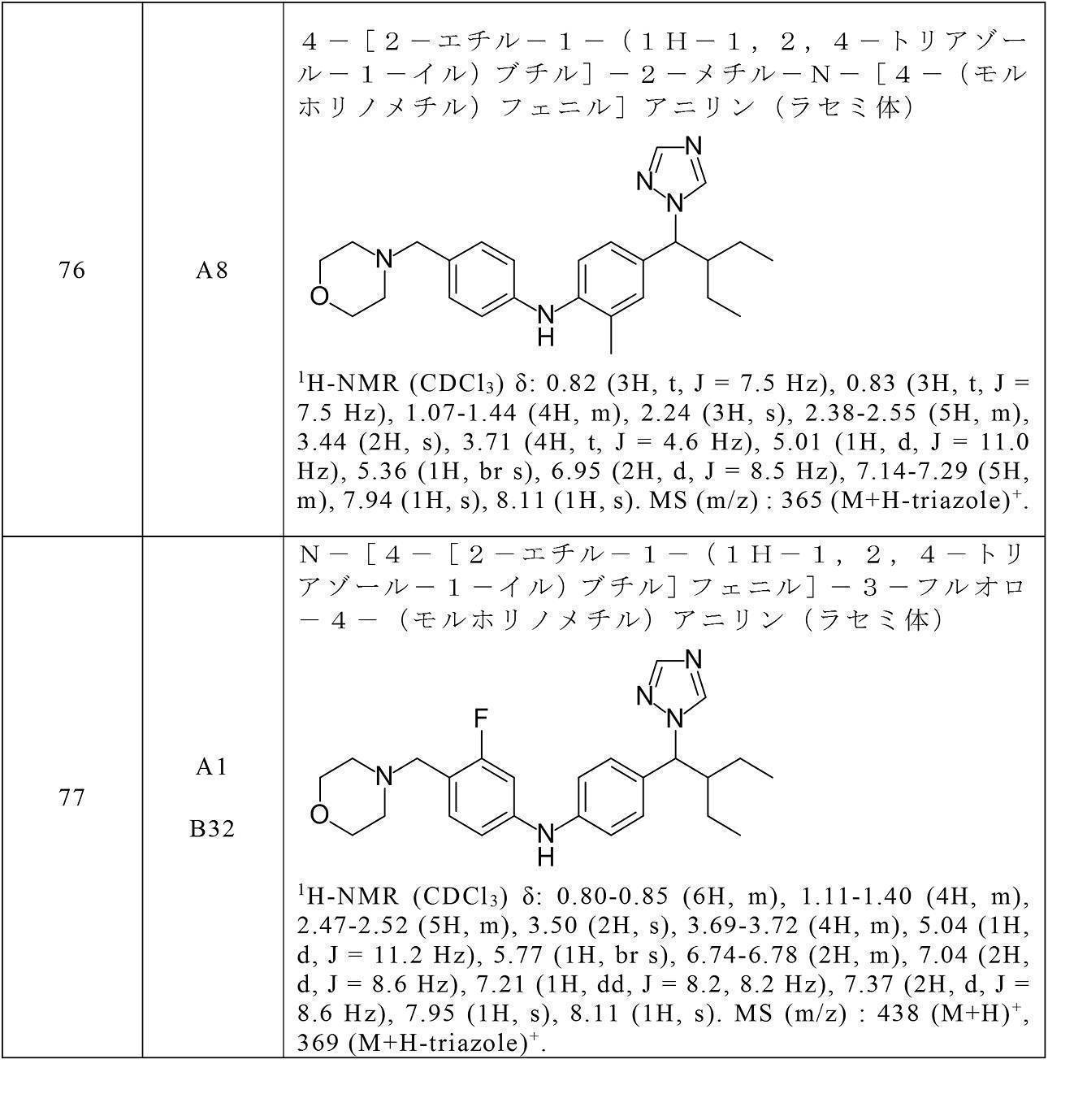


[実施例98]
6-[4-[2-エチル-1-(1H-1,2,4-トリアゾール-1-イル)ブチル]アニリノ]-3H-1,3-ベンゾチアゾール-2-オン(ラセミ体)
Example 98
6-[4-[2-Ethyl-1-(1H-1,2,4-triazol-1-yl)butyl]anilino]-3H-1,3-benzothiazol-2-one (racemic form)

[工程1]
6-[4-[2-エチル-1-(1H-1,2,4-トリアゾール-1-イル)ブチル]アニリノ]-3-(2-トリメチルシリルエトキシメチル)-1,3-ベンゾチアゾール-2-オン(ラセミ体)
参考例A1で得られた化合物(65 mg)、および参考例B18で得られた化合物(110 mg)を用いて、実施例2の工程1と同様の操作を行うことにより、標記化合物(95 mg)を得た。
MS (m/z) : 455 (M+H-triazole)+.
[Step 1]
6-[4-[2-Ethyl-1-(1H-1,2,4-triazol-1-yl)butyl]anilino]-3-(2-trimethylsilylethoxymethyl)-1,3-benzothiazole-2 -On (racemic)
By using the compound (65 mg) obtained in Reference Example A1 and the compound (110 mg) obtained in Reference Example B18 and performing the same operation as in
MS (m/z): 455 (M+H-triazole) + .
[工程2]
6-[4-[2-エチル-1-(1H-1,2,4-トリアゾール-1-イル)ブチル]アニリノ]-3H-1,3-ベンゾチアゾール-2-オン(ラセミ体)
上記工程1で得られた化合物(90 mg)のテトラヒドロフラン(5 ml)溶液に、テトラ-n-ブチルアンモニウム フルオリド(1.0M/テトラヒドロフラン溶液、0.34 ml)を加え、混合物を60℃で5時間半攪拌した。反応液にテトラ-n-ブチルアンモニウム フルオリド(1.0M/テトラヒドロフラン溶液、0.34 ml)を追加し、混合物を60℃で33時間攪拌した。さらに、反応液にテトラ-n-ブチルアンモニウム フルオリド(1.0M/テトラヒドロフラン溶液、0.34 ml)を追加し、混合物を60℃で10時間攪拌した。反応液に酢酸(0.065 ml)を加え、混合物を減圧下濃縮し、得られた残分をシリカゲルカラムクロマトグラフィー(酢酸エチル/エタノール)に付し、続いて薄層クロマトグラフィー(酢酸エチル)で精製することにより、標記化合物(13 mg)を得た。
1H-NMR (CDCl3) δ: 0.80-0.85 (6H, m), 1.10-1.40 (4H, m), 2.45-2.51 (1H, m), 5.02 (1H, d, J = 11.0 Hz), 5.65 (1H, br s), 6.93 (2H, d, J = 8.6 Hz), 6.99 (2H, s), 7.17 (1H, s), 7.34 (2H, d, J = 8.6 Hz), 7.94 (1H, s), 7.99 (1H, br s), 8.10 (1H, s).
MS (m/z) : 325 (M+H-triazole)+.
[Step 2]
6-[4-[2-Ethyl-1-(1H-1,2,4-triazol-1-yl)butyl]anilino]-3H-1,3-benzothiazol-2-one (racemic form)
Tetra-n-butylammonium fluoride (1.0 M/tetrahydrofuran solution, 0.34 ml) was added to a solution of the compound (90 mg) obtained in
1 H-NMR (CDCl 3 ) δ: 0.80-0.85 (6H, m), 1.10-1.40 (4H, m), 2.45-2.51 (1H, m), 5.02 (1H, d, J = 11.0 Hz), 5.65 (1H, br s), 6.93 (2H, d, J = 8.6 Hz), 6.99 (2H, s), 7.17 (1H, s), 7.34 (2H, d, J = 8.6 Hz), 7.94 (1H, s ), 7.99 (1H, s), 8.10 (1H, s).
MS (m/z): 325 (M+H-triazole) + .
[実施例99]
6-[4-[2-エチル-1-(1H-1,2,4-トリアゾール-1-イル)ブチル]アニリノ]-1H-キノリン-2-オン(ラセミ体)
Example 99
6-[4-[2-Ethyl-1-(1H-1,2,4-triazol-1-yl)butyl]anilino]-1H-quinolin-2-one (racemic form)

[工程1]
6-[4-[2-エチル-1-(1H-1,2,4-トリアゾール-1-イル)ブチル]アニリノ]-1-(2-トリメチルシリルエトキシメチル)キノリン-2-オン(ラセミ体)
参考例A1で得られた化合物(65 mg)、および参考例B23で得られた化合物(114 mg)を用いて、実施例2の工程1と同様の操作を行うことにより、標記化合物(84 mg)を得た。
MS (m/z) : 449 (M+H-triazole)+.
[Step 1]
6-[4-[2-Ethyl-1-(1H-1,2,4-triazol-1-yl)butyl]anilino]-1-(2-trimethylsilylethoxymethyl)quinolin-2-one (racemic form)
Using the compound (65 mg) obtained in Reference Example A1 and the compound (114 mg) obtained in Reference Example B23, the same operation as in
MS (m/z): 449 (M+H-triazole) + .
[工程2]
6-[4-[2-エチル-1-(1H-1,2,4-トリアゾール-1-イル)ブチル]アニリノ]-1H-キノリン-2-オン(ラセミ体)
上記工程1で得られた化合物(80 mg)のジクロロメタン(3 ml)溶液に氷冷下、トリフルオロ酢酸(0.3 ml)を加え、混合物を室温で5時間半攪拌した。反応液にn-ヘキサンを加え、混合物を減圧下濃縮した。得られた残分に飽和重曹水を加え、ジクロロメタンで抽出した。抽出液を減圧下濃縮し、得られた残分をジオール修飾シリカゲルカラムクロマトグラフィー(酢酸エチル/エタノール)、続いて薄層クロマトグラフィー(ジクロロメタン/酢酸エチル/エタノール)で精製することにより、標記化合物(18 mg)を得た。
1H-NMR (CDCl3) δ: 0.80-0.86 (6H, m), 1.11-1.42 (4H, m), 2.47-2.53 (1H, m), 5.04 (1H, d, J = 11.3 Hz), 5.72 (1H, br s), 6.66 (1H, d, J = 9.6 Hz), 6.97 (2H, d, J = 8.6 Hz), 7.13 (1H, d, J = 8.6 Hz), 7.25-7.29 (2H, m), 7.36 (2H, d, J = 8.6 Hz), 7.67 (1H, d, J = 9.6 Hz), 7.95 (1H, s), 8.11 (1H, s).
MS (m/z) : 319 (M+H-triazole)+.
実施例99と同様の操作を行うことにより、下記の化合物を得た(表21-1から表21-3)。
[Step 2]
6-[4-[2-Ethyl-1-(1H-1,2,4-triazol-1-yl)butyl]anilino]-1H-quinolin-2-one (racemic form)
Trifluoroacetic acid (0.3 ml) was added to a dichloromethane (3 ml) solution of the compound (80 mg) obtained in the
1 H-NMR (CDCl 3 )δ: 0.80-0.86 (6H, m), 1.11-1.42 (4H, m), 2.47-2.53 (1H, m), 5.04 (1H, d, J = 11.3 Hz), 5.72 (1H, br s), 6.66 (1H, d, J = 9.6 Hz), 6.97 (2H, d, J = 8.6 Hz), 7.13 (1H, d, J = 8.6 Hz), 7.25-7.29 (2H, m ), 7.36 (2H, d, J = 8.6 Hz), 7.67 (1H, d, J = 9.6 Hz), 7.95 (1H, s), 8.11 (1H, s).
MS (m/z): 319 (M+H-triazole) + .
The following compounds were obtained by performing the same operations as in Example 99 (Table 21-1 to Table 21-3).


[実施例105]
1-[[4-[4-[2-エチル-1-(1H-1,2,4-トリアゾール-1-イル)ブチル]アニリノ]フェニル]メチル]イミダゾリジン-2-オン(ラセミ体)
[Example 105]
1-[[4-[4-[2-Ethyl-1-(1H-1,2,4-triazol-1-yl)butyl]anilino]phenyl]methyl]imidazolidin-2-one (racemic form)

[工程1]
tert-ブチル 3-[[4-[4-[2-エチル-1-(1H-1,2,4-トリアゾール-1-イル)ブチル]アニリノ]フェニル]メチル]-2-オキソイミダゾリジン-1-カルボキシレート(ラセミ体)
参考例A1で得られた化合物(65 mg)、および参考例B27で得られた化合物(105 mg)を用いて、実施例2の工程1と同様の操作を行うことにより、標記化合物(106 mg)を得た。
MS (m/z) : 519 (M+H)+, 450 (M+H-triazole)+.
[Step 1]
tert-Butyl 3-[[4-[4-[2-ethyl-1-(1H-1,2,4-triazol-1-yl)butyl]anilino]phenyl]methyl]-2-oxoimidazolidine-1 -Carboxylate (racemic form)
Using the compound (65 mg) obtained in Reference Example A1 and the compound (105 mg) obtained in Reference Example B27, the same operation as in
MS (m/z): 519 (M+H) + , 450 (M+H-triazole) + .
[工程2]
1-[[4-[4-[2-エチル-1-(1H-1,2,4-トリアゾール-1-イル)ブチル]アニリノ]フェニル]メチル]イミダゾリジン-2-オン(ラセミ体)
上記工程1で得られた化合物(106 mg)のジクロロメタン(3 ml)溶液に氷冷下、トリフルオロ酢酸(0.3 ml)を加え、混合物を同温で1時間攪拌した。反応液にn-ヘキサンを加え、混合物を減圧下濃縮した。得られた残分をアミン修飾シリカゲルカラムクロマトグラフィー(酢酸エチル/メタノール)、続いて薄層クロマトグラフィー(ジクロロメタン/酢酸エチル/エタノール)で精製することにより、標記化合物(37 mg)を得た。
1H-NMR (CDCl3) δ: 0.80-0.85 (6H, m), 1.11-1.42 (4H, m), 2.46-2.52 (1H, m), 3.30-3.42 (4H, m), 4.25 (1H, br s), 4.31 (2H, s), 5.03 (1H, d, J = 11.0 Hz), 5.73 (1H, br s), 7.01 (2H, d, J = 8.6 Hz), 7.03 (2H, d, J = 8.6 Hz), 7.19 (2H, d, J = 8.6 Hz), 7.34 (2H, d, J = 8.6 Hz), 7.94 (1H, s), 8.11 (1H, s).
MS (m/z) : 350 (M+H-triazole)+.
[Step 2]
1-[[4-[4-[2-Ethyl-1-(1H-1,2,4-triazol-1-yl)butyl]anilino]phenyl]methyl]imidazolidin-2-one (racemic form)
To a solution of the compound (106 mg) obtained in
1 H-NMR (CDCl 3 ) δ: 0.80-0.85 (6H, m), 1.11-1.42 (4H, m), 2.46-2.52 (1H, m), 3.30-3.42 (4H, m), 4.25 (1H, br s), 4.31 (2H, s), 5.03 (1H, d, J = 11.0 Hz), 5.73 (1H, br s), 7.01 (2H, d, J = 8.6 Hz), 7.03 (2H, d, J = 8.6 Hz), 7.19 (2H, d, J = 8.6 Hz), 7.34 (2H, d, J = 8.6 Hz), 7.94 (1H, s), 8.11 (1H, s).
MS (m/z): 350 (M+H-triazole) + .
[実施例106]
N-[4-[2-エチル-1-(1H-1,2,4-トリアゾール-1-イル)ブチル]フェニル]-4-(1H-ピラゾール-4-イル)アニリン(ラセミ体)
[Example 106]
N-[4-[2-Ethyl-1-(1H-1,2,4-triazol-1-yl)butyl]phenyl]-4-(1H-pyrazol-4-yl)aniline (racemic form)

[工程1]
N-[4-[2-エチル-1-(1H-1,2,4-トリアゾール-1-イル)ブチル]フェニル]-4-(1-テトラヒドロピラン-2-イルピラゾール-4-イル)アニリン(ジアステレオマー混合物)
参考例A1で得られた化合物(65 mg)、および参考例B29で得られた化合物(105 mg)を用いて、実施例2の工程1と同様の操作を行うことにより、標記化合物(102 mg)を得た。
MS (m/z) : 402 (M+H-triazole)+.
[Step 1]
N-[4-[2-Ethyl-1-(1H-1,2,4-triazol-1-yl)butyl]phenyl]-4-(1-tetrahydropyran-2-ylpyrazol-4-yl)aniline (Mixture of diastereomers)
Using the compound (65 mg) obtained in Reference Example A1 and the compound (105 mg) obtained in Reference Example B29, the same operation as in
MS (m/z): 402 (M+H-triazole) + .
[工程2]
N-[4-[2-エチル-1-(1H-1,2,4-トリアゾール-1-イル)ブチル]フェニル]-4-(1H-ピラゾール-4-イル)アニリン(ラセミ体)
上記工程1で得られた化合物(102 mg)のメタノール(2 ml)溶液に、パラトルエンスルホン・一水和物(124 mg)を加え、混合物を室温で一晩攪拌した。反応液に飽和重曹水を加え、酢酸エチルで抽出し、抽出液を無水硫酸マグネシウムで乾燥した。減圧下溶媒を留去し、得られた残分を薄層クロマトグラフィー(ジクロロメタン/酢酸エチル)で精製することにより、標記化合物(58 mg)を得た。
1H-NMR (CDCl3) δ: 0.80-0.86 (6H, m), 1.11-1.42 (4H, m), 2.47-2.53 (1H, m), 5.04 (1H, d, J = 11.0 Hz), 5.76 (1H, br s), 7.02 (2H, d, J = 8.6 Hz), 7.10 (2H, d, J = 8.6 Hz), 7.35 (2H, d, J = 8.6 Hz), 7.42 (2H, d, J = 8.6 Hz), 7.81 (2H, s), 7.95 (1H, s), 8.11 (1H, s).
MS (m/z) : 318 (M+H-triazole)+.
[Step 2]
N-[4-[2-Ethyl-1-(1H-1,2,4-triazol-1-yl)butyl]phenyl]-4-(1H-pyrazol-4-yl)aniline (racemic form)
Paratoluene sulfone monohydrate (124 mg) was added to a solution of the compound (102 mg) obtained in
1 H-NMR (CDCl 3 ) δ: 0.80-0.86 (6H, m), 1.11-1.42 (4H, m), 2.47-2.53 (1H, m), 5.04 (1H, d, J = 11.0 Hz), 5.76 (1H, br s), 7.02 (2H, d, J = 8.6 Hz), 7.10 (2H, d, J = 8.6 Hz), 7.35 (2H, d, J = 8.6 Hz), 7.42 (2H, d, J = 8.6 Hz), 7.81 (2H, s), 7.95 (1H, s), 8.11 (1H, s).
MS (m/z): 318 (M+H-triazole) + .
[実施例107]
N-[4-[2-エチル-1-(1H-1,2,4-トリアゾール-1-イル)ブチル]フェニル]-4-(1H-テトラゾール-5-イル)アニリン(ラセミ体)
[Example 107]
N-[4-[2-Ethyl-1-(1H-1,2,4-triazol-1-yl)butyl]phenyl]-4-(1H-tetrazol-5-yl)aniline (racemic form)

[工程1]
N-[4-[2-エチル-1-(1H-1,2,4-トリアゾール-1-イル)ブチル]フェニル]-4-(1-トリチル-1H-テトラゾール-5-イル)アニリン(ラセミ体)
参考例A1で得られた化合物(65 mg)、および参考例B17で得られた化合物(149 mg)を用いて、実施例2の工程1と同様の操作を行うことにより、標記化合物(180 mg)を得た。
MS (m/z) : 562 (M+H-triazole)+.
[Step 1]
N-[4-[2-Ethyl-1-(1H-1,2,4-triazol-1-yl)butyl]phenyl]-4-(1-trityl-1H-tetrazol-5-yl)aniline (racemic body)
Using the compound (65 mg) obtained in Reference Example A1 and the compound (149 mg) obtained in Reference Example B17, the title compound (180 mg ) Got.
MS (m/z): 562 (M+H-triazole) + .
[工程2]
N-[4-[2-エチル-1-(1H-1,2,4-トリアゾール-1-イル)ブチル]フェニル]-4-(1H-テトラゾール-5-イル)アニリン(ラセミ体)
上記工程1で得られた化合物(180 mg)にテトラヒドロフラン(0.5 ml)、酢酸(2 ml)、および水(0.5 ml)を加え、混合物を室温で4時間半攪拌した。反応液を減圧下濃縮し、得られた残分をジオール修飾シリカゲルカラムクロマトグラフィー(ジクロロメタン/酢酸エチル)で精製することにより、標記化合物(37 mg)を得た。
1H-NMR (CDCl3) δ: 0.80-0.87 (6H, m), 1.15-1.40 (4H, m), 2.49-2.55 (1H, m), 5.07 (1H, d, J = 11.3 Hz), 6.02 (1H, br s), 7.10-7.15 (4H, m), 7.45 (2H, d, J = 8.6 Hz), 7.91 (2H, bd, J = 8.6 Hz), 8.01 (1H, s), 8.19 (1H, s).
MS (m/z) : 320 (M+H-triazole)+.
実施例107と同様の操作を行うことにより、下記の化合物を得た(表22)。
[Step 2]
N-[4-[2-Ethyl-1-(1H-1,2,4-triazol-1-yl)butyl]phenyl]-4-(1H-tetrazol-5-yl)aniline (racemic form)
Tetrahydrofuran (0.5 ml), acetic acid (2 ml), and water (0.5 ml) were added to the compound (180 mg) obtained in
1 H-NMR (CDCl 3 ) δ: 0.80-0.87 (6H, m), 1.15-1.40 (4H, m), 2.49-2.55 (1H, m), 5.07 (1H, d, J = 11.3 Hz), 6.02 (1H, br s), 7.10-7.15 (4H, m), 7.45 (2H, d, J = 8.6 Hz), 7.91 (2H, bd, J = 8.6 Hz), 8.01 (1H, s), 8.19 (1H , s).
MS (m/z): 320 (M+H-triazole) + .
The following compound was obtained by performing the same operation as in Example 107 (Table 22).

[実施例110]
5-[4-[2-エチル-1-(1H-1,2,4-トリアゾール-1-イル)ブチル]アニリノ]-2-(2-ヒドロキシエトキシメチル)ベンゾニトリル(ラセミ体)
Example 110
5-[4-[2-Ethyl-1-(1H-1,2,4-triazol-1-yl)butyl]anilino]-2-(2-hydroxyethoxymethyl)benzonitrile (racemic form)

[工程1]
2-[2-[tert-ブチル(ジメチル)シリル]オキシエトキシメチル]-5-[4-[2-エチル-1-(1H-1,2,4-トリアゾール-1-イル)ブチル]アニリノ]ベンゾニトリル(ラセミ体)
参考例A1で得られた化合物(43 mg)、および参考例B13で得られた化合物(65 mg)を用いて、実施例2の工程1と同様の操作を行うことにより、標記化合物(180 mg)を得た。
MS (m/z) : 465 (M+H-triazole)+.
[Step 1]
2-[2-[tert-Butyl(dimethyl)silyl]oxyethoxymethyl]-5-[4-[2-ethyl-1-(1H-1,2,4-triazol-1-yl)butyl]anilino] Benzonitrile (racemic form)
By using the compound (43 mg) obtained in Reference Example A1 and the compound (65 mg) obtained in Reference Example B13 and performing the same operation as in
MS (m/z): 465 (M+H-triazole) + .
[工程2]
5-[4-[2-エチル-1-(1H-1,2,4-トリアゾール-1-イル)ブチル]アニリノ]-2-(2-ヒドロキシエトキシメチル)ベンゾニトリル(ラセミ体)
上記工程1で得られた化合物(56 mg)のテトラヒドロフラン(2 ml)溶液に氷冷下、テトラ-n-ブチルアンモニウム フルオリド(1.0M/テトラヒドロフラン溶液、0.14 ml)を加え、混合物を同温で1時間攪拌後、室温で3時間攪拌した。反応液に酢酸(0.010 ml)を加え、混合物を減圧下濃縮し、得られた残分を薄層クロマトグラフィー(酢酸エチル)で精製することにより、標記化合物(31 mg)を得た。
1H-NMR (CDCl3) δ: 0.81-0.86 (6H, m), 1.11-1.41 (4H, m), 2.10 (1H, t, J = 6.2 Hz), 2.48-2.54 (1H, m), 3.67-3.71 (2H, m), 3.79-3.84 (2H, m), 4.65 (2H, s), 5.06 (1H, d, J = 11.0 Hz), 5.86 (1H, br s), 7.06 (2H, d, J = 8.6 Hz), 7.19 (1H, dd, J = 8.6, 2.3 Hz), 7.30 (1H, d, J = 2.3 Hz), 7.38 (1H, d, J = 8.6 Hz), 7.42 (2H, d, J = 8.6 Hz), 7.96 (1H, s), 8.12 (1H, s).
MS (m/z) : 351 (M+H-triazole)+.
実施例110と同様の操作を行うことにより、下記の化合物を得た(表23)。
[Step 2]
5-[4-[2-Ethyl-1-(1H-1,2,4-triazol-1-yl)butyl]anilino]-2-(2-hydroxyethoxymethyl)benzonitrile (racemic form)
Tetra-n-butylammonium fluoride (1.0 M/tetrahydrofuran solution, 0.14 ml) was added to a tetrahydrofuran (2 ml) solution of the compound (56 mg) obtained in the
1 H-NMR (CDCl 3 ) δ: 0.81-0.86 (6H, m), 1.11-1.41 (4H, m), 2.10 (1H, t, J = 6.2 Hz), 2.48-2.54 (1H, m), 3.67 -3.71 (2H, m), 3.79-3.84 (2H, m), 4.65 (2H, s), 5.06 (1H, d, J = 11.0 Hz), 5.86 (1H, br s), 7.06 (2H, d, J = 8.6 Hz), 7.19 (1H, dd, J = 8.6, 2.3 Hz), 7.30 (1H, d, J = 2.3 Hz), 7.38 (1H, d, J = 8.6 Hz), 7.42 (2H, d, J = 8.6 Hz), 7.96 (1H, s), 8.12 (1H, s).
MS (m/z): 351 (M+H-triazole) + .
The following compound was obtained by performing the same operation as in Example 110 (Table 23).

[実施例113]
3-[4-[4-[2-エチル-1-(1H-1,2,4-トリアゾール-1-イル)ブチル]アニリノ]フェニル]-4H-1,2,4-オキサジアゾール-5-オン(ラセミ体)
[Example 113]
3-[4-[4-[2-Ethyl-1-(1H-1,2,4-triazol-1-yl)butyl]anilino]phenyl]-4H-1,2,4-oxadiazole-5 -On (racemic)

[工程1]
4-[4-[2-エチル-1-(1H-1,2,4-トリアゾール-1-イル)ブチル]アニリノ]-N’-ヒドロキシベンズアミジン(ラセミ体)
実施例48で得られた化合物(31 mg)のエタノール(2 ml)溶液に、トリエチルアミン(0.026 ml)およびヒドロキシルアミン塩酸塩(14.2 mg)を加え、混合物を45℃で3時間攪拌した。反応液にトリエチルアミン(0.015 ml)およびヒドロキシアミン塩酸塩(6.0 mg)を追加し、混合物を60℃で3時間攪拌した。反応液にヒドロキシアミン塩酸塩(6.0 mg)および炭酸水素ナトリウム(15 mg)を加え、混合物を60℃で30分間攪拌後、70℃で5時間攪拌した。冷却後、反応液を減圧下濃縮し、得られた残分をジオール修飾シリカゲルカラムクロマトグラフィー(ジクロロメタン/酢酸エチル/メタノール)で精製することにより、標記化合物(48 mg)を得た。
MS (m/z) : 310 (M+H-triazole)+.
[Step 1]
4-[4-[2-Ethyl-1-(1H-1,2,4-triazol-1-yl)butyl]anilino]-N′-hydroxybenzamidine (racemic form)
To a solution of the compound (31 mg) obtained in Example 48 in ethanol (2 ml) was added triethylamine (0.026 ml) and hydroxylamine hydrochloride (14.2 mg), and the mixture was stirred at 45°C for 3 hr. did. Triethylamine (0.015 ml) and hydroxyamine hydrochloride (6.0 mg) were added to the reaction solution, and the mixture was stirred at 60°C for 3 hr. Hydroxyamine hydrochloride (6.0 mg) and sodium hydrogen carbonate (15 mg) were added to the reaction solution, and the mixture was stirred at 60°C for 30 minutes and then at 70°C for 5 hours. After cooling, the reaction solution was concentrated under reduced pressure, and the obtained residue was purified by diol-modified silica gel column chromatography (dichloromethane/ethyl acetate/methanol) to obtain the title compound (48 mg).
MS (m/z): 310 (M+H-triazole) + .
[工程2]
3-[4-[4-[2-エチル-1-(1H-1,2,4-トリアゾール-1-イル)ブチル]アニリノ]フェニル]-4H-1,2,4-オキサジアゾール-5-オン(ラセミ体)
上記工程1で得られた化合物(34 mg)のテトラヒドロフラン(2 ml)溶液に、2,3,4,6,7,8,9,10-オクタヒドロピリミド[1,2-a]アゼピン(0.027 ml)および1,1’-カルボニルジイミダゾール(30 mg)を加え、混合物を同温で1時間45分攪拌した。反応液に1規定塩酸を加え、pHを7程度とし、ジクロロメタンで抽出した。抽出液を減圧下濃縮し、得られた残分をジオール修飾シリカゲルカラムクロマトグラフィー(ジクロロメタン/酢酸エチル/エタノール)で精製することにより、標記化合物(17 mg)を得た。
1H-NMR (DMSO-d6) δ: 0.74-0.79 (6H, m), 0.99-1.30 (4H, m), 2.40-2.45 (1H, m), 5.34 (1H, d, J = 10.9 Hz), 7.13 (2H, d, J = 8.6 Hz), 7.15 (2H, d, J = 8.6 Hz), 7.49 (2H, d, J = 8.6 Hz), 7.63 (2H, d, J = 8.6 Hz), 7.98 (1H, s), 8.70 (1H, s), 8.78 (1H, br s), 12.71 (1H, br s).
MS (m/z) : 336 (M+H-triazole)+.
実施例113と同様の操作を行うことにより、下記の化合物を得た(表24)。
[Step 2]
3-[4-[4-[2-Ethyl-1-(1H-1,2,4-triazol-1-yl)butyl]anilino]phenyl]-4H-1,2,4-oxadiazole-5 -On (racemic)
A solution of the compound (34 mg) obtained in
1 H-NMR (DMSO-d 6 ) δ: 0.74-0.79 (6H, m), 0.99-1.30 (4H, m), 2.40-2.45 (1H, m), 5.34 (1H, d, J = 10.9 Hz) , 7.13 (2H, d, J = 8.6 Hz), 7.15 (2H, d, J = 8.6 Hz), 7.49 (2H, d, J = 8.6 Hz), 7.63 (2H, d, J = 8.6 Hz), 7.98 (1H, s), 8.70 (1H, s), 8.78 (1H, br s), 12.71 (1H, br s).
MS (m/z): 336 (M+H-triazole) + .
The following compound was obtained by performing the same operation as in Example 113 (Table 24).

[実施例115]
N-[4-[2-エチル-1-(1H-1,2,4-トリアゾール-1-イル)ブチル]フェニル]-4-(1H-イミダゾール-1-イルメチル)アニリン(ラセミ体)
Example 115
N-[4-[2-Ethyl-1-(1H-1,2,4-triazol-1-yl)butyl]phenyl]-4-(1H-imidazol-1-ylmethyl)aniline (racemic form)

[工程1]
4-[[tert-ブチル(ジメチル)シリル]オキシメチル]-N-[4-[2-エチル-1-(1H-1,2,4-トリアゾール-1-イル)ブチル]フェニル]アニリン(ラセミ体)
参考例A1で得られた化合物(130 mg)、および参考例B14で得られた化合物(180 mg)を用いて、実施例2の工程1と同様の操作を行うことにより、標記化合物(220 mg)を得た。
MS (m/z) : 396 (M+H-triazole)+.
[Step 1]
4-[[tert-butyl(dimethyl)silyl]oxymethyl]-N-[4-[2-ethyl-1-(1H-1,2,4-triazol-1-yl)butyl]phenyl]aniline (racemic body)
Using the compound (130 mg) obtained in Reference Example A1 and the compound (180 mg) obtained in Reference Example B14, the same operation as in
MS (m/z): 396 (M+H-triazole) + .
[工程2]
[4-[4-[2-エチル-1-(1H-1,2,4-トリアゾール-1-イル)ブチル]アニリノ]フェニル]メタノール(ラセミ体)
上記工程1で得られた化合物(220 mg)を用いて、実施例110の工程2と同様の操作を行うことにより、標記化合物(88 mg)を得た。
1H-NMR (CDCl3) δ: 0.78 (3H, t, J = 7.4 Hz), 0.79 (3H, t, J = 7.4 Hz), 1.06-1.36 (4H, m), 2.39-2.51 (1H, m), 4.59 (2H, d, J = 5.9 Hz), 4.99 (1H, d, J = 11.3 Hz), 5.72 (1H, s), 6.98 (2H, d, J = 8.6 Hz), 7.03 (2H, d, J = 8.6 Hz), 7.25 (2H, d, J = 8.6 Hz), 7.31 (2H, d, J = 8.6 Hz), 7.91 (1H, s), 8.07 (1H, s).
MS (m/z) : 282 (M+H-triazole)+.
[Step 2]
[4-[4-[2-Ethyl-1-(1H-1,2,4-triazol-1-yl)butyl]anilino]phenyl]methanol (racemic form)
The title compound (88 mg) was obtained by the same procedure as in
1 H-NMR (CDCl 3 ) δ: 0.78 (3H, t, J = 7.4 Hz), 0.79 (3H, t, J = 7.4 Hz), 1.06-1.36 (4H, m), 2.39-2.51 (1H, m ), 4.59 (2H, d, J = 5.9 Hz), 4.99 (1H, d, J = 11.3 Hz), 5.72 (1H, s), 6.98 (2H, d, J = 8.6 Hz), 7.03 (2H, d , J = 8.6 Hz), 7.25 (2H, d, J = 8.6 Hz), 7.31 (2H, d, J = 8.6 Hz), 7.91 (1H, s), 8.07 (1H, s).
MS (m/z): 282 (M+H-triazole) + .
[工程3]
N-[4-[2-エチル-1-(1H-1,2,4-トリアゾール-1-イル)ブチル]フェニル]-4-(1H-イミダゾール-1-イルメチル)アニリン(ラセミ体)
上記工程2で得られた化合物(36 mg)のアセトニトリル(2.5 ml)溶液に、イミダゾール(28 mg)および1,1’-カルボニルジイミダゾール(34 mg)を加え、混合物を60℃で2時間攪拌した。冷却後、反応液を減圧下濃縮し、得られた残分に1,4-ジオキサン(2.2 ml)、水(0.88 ml)および1規定水酸化ナトリウム水溶液(0.22 ml)を加え、混合物を室温で一晩攪拌した。反応液に1規定塩酸(0.22 ml)を加え、混合物をシリカゲルカラムクロマトグラフィー(酢酸エチル/エタノール)に付し、続いて薄層クロマトグラフィー(酢酸エチル/エタノール)で精製することにより、標記化合物(23 mg)を得た。
1H-NMR (CDCl3) δ: 0.79-0.85 (6H, m), 1.10-1.40 (4H, m), 2.46-2.52 (1H, m), 5.03 (1H, d, J = 11.0 Hz), 5.04 (2H, s), 5.77 (1H, br s), 6.91 (1H, s), 7.01-7.09 (7H, m), 7.36 (2H, d, J = 8.6 Hz), 7.54 (1H, s), 7.95 (1H, s), 8.11 (1H, s).
MS (m/z) : 401 (M+H) +.
[Step 3]
N-[4-[2-Ethyl-1-(1H-1,2,4-triazol-1-yl)butyl]phenyl]-4-(1H-imidazol-1-ylmethyl)aniline (racemic form)
To a solution of the compound (36 mg) obtained in
1 H-NMR (CDCl 3 ) δ: 0.79-0.85 (6H, m), 1.10-1.40 (4H, m), 2.46-2.52 (1H, m), 5.03 (1H, d, J = 11.0 Hz), 5.04 (2H, s), 5.77 (1H, br s), 6.91 (1H, s), 7.01-7.09 (7H, m), 7.36 (2H, d, J = 8.6 Hz), 7.54 (1H, s), 7.95 (1H, s), 8.11 (1H, s).
MS (m/z): 401 (M+H) + .
[実施例116]
1-[4-[4-[2-エチル-1-(1H-1,2,4-トリアゾール-1-イル)ブチル]アニリノ]フェニル]-2,2,2-トリフルオロエタノール(ジアステレオマー混合物)
Example 116
1-[4-[4-[2-Ethyl-1-(1H-1,2,4-triazol-1-yl)butyl]anilino]phenyl]-2,2,2-trifluoroethanol (diastereomer mixture)

水素化ホウ素ナトリウム(4.5 mg)のメタノール(1.14 ml)、1規定水酸化ナトリウム水溶液(0.11 ml)の混合溶液に、実施例93で得られた化合物(11.9 mg)のメタノール(1.14 ml)溶液を加え、混合物を室温で3時間攪拌した。反応液に水を加え、酢酸エチルで抽出し、抽出液を無水硫酸マグネシウムで乾燥した。減圧下溶媒を留去し、得られた残分をシリカゲルカラムクロマトグラフィー(ジクロロメタン)で精製することにより、標記化合物(11.8 mg)を得た。
1H-NMR (CDCl3) δ: 0.82 (3H, t, J = 7.6 Hz), 0.83 (3H, t, J = 7.6 Hz), 1.10-1.41 (4H, m), 2.43-2.54 (1H, m), 4.93-4.99 (1H, m), 5.04 (1H, d, J = 10.7 Hz), 5.81 (1H, br s), 7.06 (2H, d, J = 8.6 Hz), 7.07 (2H, d, J = 9.1 Hz), 7.36 (2H, d, J = 9.1 Hz), 7.37 (2H, d, J = 8.6 Hz), 7.94 (1H, s), 8.11 (1H, s).
MS (m/z) : 350 (M+H-triazole)+.
The compound obtained in Example 93 (11.9 mg) was added to a mixed solution of sodium borohydride (4.5 mg) in methanol (1.14 ml) and 1N aqueous sodium hydroxide solution (0.11 ml). In methanol (1.14 ml) was added and the mixture was stirred at room temperature for 3 hours. Water was added to the reaction solution, extraction was performed with ethyl acetate, and the extract was dried over anhydrous magnesium sulfate. The solvent was evaporated under reduced pressure, and the obtained residue was purified by silica gel column chromatography (dichloromethane) to give the title compound (11.8 mg).
1 H-NMR (CDCl 3 ) δ: 0.82 (3H, t, J = 7.6 Hz), 0.83 (3H, t, J = 7.6 Hz), 1.10-1.41 (4H, m), 2.43-2.54 (1H, m ), 4.93-4.99 (1H, m), 5.04 (1H, d, J = 10.7 Hz), 5.81 (1H, br s), 7.06 (2H, d, J = 8.6 Hz), 7.07 (2H, d, J = 9.1 Hz), 7.36 (2H, d, J = 9.1 Hz), 7.37 (2H, d, J = 8.6 Hz), 7.94 (1H, s), 8.11 (1H, s).
MS (m/z): 350 (M+H-triazole) + .
[実施例117]
3-[[4-[4-(2-エチル-1-(1H-イミダゾール-1-イル)ブチル)アニリノ]フェニル]メチル]オキサゾリジン-2-オン(ラセミ体)
Example 117
3-[[4-[4-(2-Ethyl-1-(1H-imidazol-1-yl)butyl)anilino]phenyl]methyl]oxazolidin-2-one (racemic form)

[工程1]
3-[[4-[4-[1-[tert-ブチル(ジメチル)シリル]オキシ-2-エチルブチル]アニリノ]フェニル]メチル]オキサゾリジン-2-オン(ラセミ体)
参考例B39で得られた化合物(600 mg)、および参考例A15で得られた化合物(404 mg)を用いて、実施例2の工程1と同様の操作を行うことにより、標記化合物(500 mg)を得た。
MS (m/z) : 483 (M+H) +.
[Step 1]
3-[[4-[4-[1-[tert-butyl(dimethyl)silyl]oxy-2-ethylbutyl]anilino]phenyl]methyl]oxazolidin-2-one (racemic form)
By using the compound (600 mg) obtained in Reference Example B39 and the compound (404 mg) obtained in Reference Example A15 and performing the same operation as in
MS (m/z): 483 (M+H) + .
[工程2]
3-[[4-[4-(2-エチル-1-ヒドロキシブチル)アニリノ]フェニル]メチル]オキサゾリジン-2-オン(ラセミ体)
上記工程1で得られた化合物(500 mg)を用いて、実施例36の工程2と同様の操作を行うことにより、標記化合物(325 mg)を得た。
MS (m/z) : 369 (M+H) +, 351 (M+H-H2O)+.
[Step 2]
3-[[4-[4-(2-Ethyl-1-hydroxybutyl)anilino]phenyl]methyl]oxazolidin-2-one (racemic form)
The title compound (325 mg) was obtained by the same procedure as in
MS (m/z): 369 (M+H) + , 351 (M+HH 2 O) + .
[工程3]
3-[[4-[4-(2-エチル-1-(1H-イミダゾール-1-イル)ブチル)アニリノ]フェニル]メチル]オキサゾリジン-2-オン(ラセミ体)
上記工程2で得られた化合物(325 mg)を用いて、実施例115の工程3と同様の操作を行うことにより、標記化合物(400 mg)を得た。
1H-NMR (CDCl3) δ: 0.82-0.87 (6H, m), 1.20-1.42 (4H, m), 2.19-2.25 (1H, m), 3.44 (2H, t, J = 8.0 Hz), 4.31 (2H, t, J = 8.0 Hz), 4.37 (2H, s), 4.84 (1H, d, J = 10.7 Hz), 5.75 (1H, br s), 6.99-7.05 (6H, m), 7.18-7.21 (4H, m), 7.58 (1H, s).
MS (m/z) : 351 (M+H-imidazole) +.
実施例117と同様の操作を行うことにより、下記の化合物を得た(表25)。
[Step 3]
3-[[4-[4-(2-Ethyl-1-(1H-imidazol-1-yl)butyl)anilino]phenyl]methyl]oxazolidin-2-one (racemic form)
The title compound (400 mg) was obtained by the same procedures as in
1 H-NMR (CDCl 3 ) δ: 0.82-0.87 (6H, m), 1.20-1.42 (4H, m), 2.19-2.25 (1H, m), 3.44 (2H, t, J = 8.0 Hz), 4.31 (2H, t, J = 8.0 Hz), 4.37 (2H, s), 4.84 (1H, d, J = 10.7 Hz), 5.75 (1H, br s), 6.99-7.05 (6H, m), 7.18-7.21 (4H, m), 7.58 (1H, s).
MS (m/z): 351 (M+H-imidazole) + .
The following compound was obtained by performing the same operation as in Example 117 (Table 25).

[実施例119]
4-[4-[2-エチル-1-(1H-イミダゾール-1-イル)ブチル]アニリノ]安息香酸(ラセミ体)
[Example 119]
4-[4-[2-Ethyl-1-(1H-imidazol-1-yl)butyl]anilino]benzoic acid (racemic form)

[工程1]
エチル 4-[4-[1-[tert-ブチル(ジメチル)シリル]オキシ-2-エチルブチル]アニリノ]ベンゾエート(ラセミ体)
参考例B39で得られた化合物(10.6 g)の1,4-ジオキサン(100 ml)溶液に、エチル 4-アミノベンゾエート(7.07 g、CAS番号 94-09-7)、炭酸セシウム(24.4 g)、酢酸パラジウム(II)(449 mg)、および4,5-ビス(ジフェニルホスフィノ)-9,9-ジメチルキサンテン(1.73 g)を加え、混合物を100℃で11時間攪拌した。冷却後、反応液をセライト濾過し、濾液を減圧下濃縮した。得られた残分をシリカゲルカラムクロマトグラフィー(n-ヘキサン/酢酸エチル)で精製することにより、標記化合物(13.2 g)を得た。
MS (m/z) : 456 (M+H) +.
[Step 1]
Ethyl 4-[4-[1-[tert-butyl(dimethyl)silyl]oxy-2-ethylbutyl]anilino]benzoate (racemic form)
A solution of the compound (10.6 g) obtained in Reference Example B39 in 1,4-dioxane (100 ml) was added with ethyl 4-aminobenzoate (7.07 g, CAS number 94-09-7) and cesium carbonate ( 24.4 g), palladium(II) acetate (449 mg), and 4,5-bis(diphenylphosphino)-9,9-dimethylxanthene (1.73 g) were added, and the mixture was heated at 100° C. for 11 hours. It was stirred. After cooling, the reaction solution was filtered through Celite, and the filtrate was concentrated under reduced pressure. The obtained residue was purified by silica gel column chromatography (n-hexane/ethyl acetate) to give the title compound (13.2 g).
MS (m/z): 456 (M+H) + .
[工程2]
エチル 4-[4-(2-エチル-1-ヒドロキシブチル)アニリノ]ベンゾエート(ラセミ体)
上記工程1で得られた化合物(13.0 g)のテトラヒドロフラン(150 ml)溶液に、テトラブチルアンモニウム フルオリド(1.0 M/テトラヒドロフラン溶液、35 ml)を加え、混合物を50℃で14時間攪拌した。反応液にテトラブチルアンモニウム フルオリド(1.0 M/テトラヒドロフラン溶液、4.0 ml)を追加し、混合物を50℃で22時間半攪拌した。冷却後、反応液に酢酸(2.4 ml)を加え、混合物を減圧下濃縮して得られた残分をシリカゲルカラムクロマトグラフィー(n-ヘキサン/酢酸エチル)で精製することにより、標記化合物(6.8 g)を得た。
MS (m/z) : 342 (M+H) +, 324 (M+H-H2O)+.
[Step 2]
Ethyl 4-[4-(2-ethyl-1-hydroxybutyl)anilino]benzoate (racemic form)
Tetrabutylammonium fluoride (1.0 M/tetrahydrofuran solution, 35 ml) was added to a tetrahydrofuran (150 ml) solution of the compound (13.0 g) obtained in the
MS (m/z): 342 (M+H) + , 324 (M+HH 2 O) + .
[工程3]
エチル 4-[4-[2-エチル-1-(1H-イミダゾール-1-イル)ブチル]-N-(1H-イミダゾール-1-カルボニル)アニリノ]ベンゾエート(ラセミ体)
上記工程2で得られた化合物(6.8 g)のアセトニトリル(70 ml)溶液に、イミダゾール(5.4 g)および1,1’-カルボニルジイミダゾール(9.7 g)を加え、混合物を60℃で8時間攪拌した。冷却後、反応液を減圧下濃縮し、得られた残分をシリカゲルカラムクロマトグラフィー(酢酸エチル/エタノール)で精製することにより、標記化合物を含む混合物(18.4 g)を得た。
MS (m/z) : 486 (M+H) +.
[Step 3]
Ethyl 4-[4-[2-ethyl-1-(1H-imidazol-1-yl)butyl]-N-(1H-imidazol-1-carbonyl)anilino]benzoate (racemic form)
To a solution of the compound (6.8 g) obtained in
MS (m/z): 486 (M+H) + .
[工程4]
4-[4-[2-エチル-1-(1H-イミダゾール-1-イル)ブチル]アニリノ]安息香酸(ラセミ体)
上記工程3で得られた化合物(0.54 g)の1,4-ジオキサン(8.5 ml)溶液に、水(3.4 ml)および1規定水酸化ナトリウム水溶液(3.2 ml)を加え、混合物を45℃で17時間攪拌した。反応液に1規定水酸化ナトリウム水溶液(0.8 ml)を追加し、混合物を48℃で16時間攪拌した。反応液に1規定塩酸(4.0 ml)を加え、混合物をシリカゲルカラムクロマトグラフィー(酢酸エチル/エタノール)で精製した。溶出画分を減圧下濃縮し、得られた残分を水に懸濁した。懸濁液を濾過し、得られた固体を減圧下乾燥することにより、標記化合物(0.25 g)を得た。
1H-NMR (CDCl3) δ: 0.82-0.89 (6H, m), 1.20-1.40 (4H, m), 2.22-2.29 (1H, m), 4.88 (1H, d, J = 10.6 Hz), 6.06 (1H, br s), 6.99-7.02 (3H, m), 7.07 (1H, dd, J = 1.1, 1.1 Hz), 7.15 (2H, d, J = 8.6 Hz), 7.27 (2H, d, J = 8.6 Hz), 7.63 (1H, dd, J = 1.1, 1.1 Hz), 7.96 (2H, d, J = 8.6 Hz).
MS (m/z) : 296 (M+H-imidazole) +.
[実施例120]
5-[4-[4-[2-エチル-1-(1H-イミダゾール-1-イル)ブチル]アニリノ]フェニル]-3H-1,3,4-オキサジアゾール-2-オン(ラセミ体)
[Step 4]
4-[4-[2-Ethyl-1-(1H-imidazol-1-yl)butyl]anilino]benzoic acid (racemic form)
To a solution of the compound (0.54 g) obtained in
1 H-NMR (CDCl 3 )δ: 0.82-0.89 (6H, m), 1.20-1.40 (4H, m), 2.22-2.29 (1H, m), 4.88 (1H, d, J = 10.6 Hz), 6.06 (1H, br s), 6.99-7.02 (3H, m), 7.07 (1H, dd, J = 1.1, 1.1 Hz), 7.15 (2H, d, J = 8.6 Hz), 7.27 (2H, d, J = 8.6 Hz), 7.63 (1H, dd, J = 1.1, 1.1 Hz), 7.96 (2H, d, J = 8.6 Hz).
MS (m/z): 296 (M+H-imidazole) + .
Example 120
5-[4-[4-[2-Ethyl-1-(1H-imidazol-1-yl)butyl]anilino]phenyl]-3H-1,3,4-oxadiazol-2-one (racemic form)

[工程1]
4-[4-[1-[tert-ブチル(ジメチル)シリル]オキシ-2-エチルブチル]アニリノ]ベンゾヒドラジド(ラセミ体)
実施例119の工程1で得られた化合物(195 mg)を用いて、実施例58の工程1と同様の操作を行うことにより、標記化合物(200 mg)を得た。
MS (m/z) : 442 (M+H) +.
[Step 1]
4-[4-[1-[tert-butyl(dimethyl)silyl]oxy-2-ethylbutyl]anilino]benzohydrazide (racemic form)
The title compound (200 mg) was obtained by the same procedures as in Step 58 of Example 58 using the compound (195 mg) obtained in
MS (m/z): 442 (M+H) + .
[工程2]
5-[4-[4-[1-[tert-ブチル(ジメチル)シリル]オキシ-2-エチルブチル]アニリノ]フェニル]-3H-1,3,4-オキサジアゾール-2-オン(ラセミ体)
上記工程1で得られた化合物(189 mg)を用いて、実施例58の工程2と同様の操作を行うことにより、標記化合物(96 mg)を得た。
MS (m/z) : 468 (M+H) +.
[Step 2]
5-[4-[4-[1-[tert-butyl(dimethyl)silyl]oxy-2-ethylbutyl]anilino]phenyl]-3H-1,3,4-oxadiazol-2-one (racemic form)
The title compound (96 mg) was obtained by the same procedures as in
MS (m/z): 468 (M+H) + .
[工程3]
5-[4-[4-(2-エチル-1-ヒドロキシブチル)アニリノ]フェニル]-3H-1,3,4-オキサジアゾール-2-オン(ラセミ体)
上記工程2で得られた化合物(95 mg)を用いて、実施例36の工程2と同様の操作を行うことにより、標記化合物(53 mg)を得た。
MS (m/z) : 354 (M+H) +, 336 (M+H-H2O)+.
[Step 3]
5-[4-[4-(2-Ethyl-1-hydroxybutyl)anilino]phenyl]-3H-1,3,4-oxadiazol-2-one (racemic form)
The title compound (53 mg) was obtained by the same procedures as in
MS (m/z): 354 (M+H) + , 336 (M+HH 2 O) + .
[工程4]
5-[4-[4-[2-エチル-1-(1H-イミダゾール-1-イル)ブチル]アニリノ]フェニル]-3H-1,3,4-オキサジアゾール-2-オン(ラセミ体)
上記工程3で得られた化合物(53 mg)の酢酸エチル(3 ml)溶液に、イミダゾール(41 mg)および1,1’-カルボニルジイミダゾール(49 mg)を加え、混合物を60℃で3時間攪拌した。冷却後、反応液を減圧下濃縮し、得られた残分をジオール修飾シリカゲルカラムクロマトグラフィー(ジクロロメタン/酢酸エチル/エタノール)に付し、続いて薄層クロマトグラフィー(ジクロロメタン/酢酸エチル/エタノール)で精製することにより、標記化合物(10 mg)を得た。
1H-NMR (CDCl3) δ: 0.82-0.89 (6H, m), 1.20-1.42 (4H, m), 2.22-2.28 (1H, m), 4.87 (1H, d, J = 10.6 Hz), 6.00 (1H, br s), 7.02 (1H, dd, J = 1.2, 1.2 Hz), 7.05 (2H, d, J = 8.6 Hz), 7.06 (1H, dd, J = 1.2, 1.2 Hz), 7.12 (2H, d, J = 8.6 Hz), 7.27 (2H, d, J = 8.6 Hz), 7.59 (1H, dd, J = 1.2, 1.2 Hz), 7.71 (2H, d, J = 8.6 Hz), 8.38 (1H, br s).
MS (m/z) : 336 (M+H-imidazole) +.
[実施例121]
4-[4-[1-(1H-イミダゾール-1-イル)-2-[イソプロピル(メチル)アミノ]ブチル]アニリノ]ベンゾニトリル(ジアステレオマー混合物)
[Step 4]
5-[4-[4-[2-Ethyl-1-(1H-imidazol-1-yl)butyl]anilino]phenyl]-3H-1,3,4-oxadiazol-2-one (racemic form)
To a solution of the compound (53 mg) obtained in
1 H-NMR (CDCl 3 )δ: 0.82-0.89 (6H, m), 1.20-1.42 (4H, m), 2.22-2.28 (1H, m), 4.87 (1H, d, J = 10.6 Hz), 6.00 (1H, br s), 7.02 (1H, dd, J = 1.2, 1.2 Hz), 7.05 (2H, d, J = 8.6 Hz), 7.06 (1H, dd, J = 1.2, 1.2 Hz), 7.12 (2H , d, J = 8.6 Hz), 7.27 (2H, d, J = 8.6 Hz), 7.59 (1H, dd, J = 1.2, 1.2 Hz), 7.71 (2H, d, J = 8.6 Hz), 8.38 (1H , br s).
MS (m/z): 336 (M+H-imidazole) + .
Example 121
4-[4-[1-(1H-imidazol-1-yl)-2-[isopropyl(methyl)amino]butyl]anilino]benzonitrile (mixture of diastereomers)

[工程1]
4-(4-ブタノイルアニリノ)ベンゾニトリル
4-ブロモベンゾニトリル(893 mg、CAS番号 623-00-7)、および1-(4-アミノフェニル)ブタン-1-オン(800 mg、CAS番号 1688-71-7)を用いて、実施例2の工程1と同様の操作を行うことにより、標記化合物(1.19 g)を得た。
MS (m/z) : 265 (M+H) +.
[Step 1]
4-(4-butanoylanilino)benzonitrile 4-bromobenzonitrile (893 mg, CAS number 623-00-7), and 1-(4-aminophenyl)butan-1-one (800 mg, CAS number 1688-71-7) was used and the same operation as in
MS (m/z): 265 (M+H) + .
[工程2]
4-[4-(2-ブロモブタノイル)アニリノ]ベンゾニトリル(ラセミ体)
上記工程1で得られた化合物(400 mg)のアセトニトリル(16 ml)溶液に氷冷下、テトラブチルアンモニウム トリブロミド(730 mg)を加え、混合物を室温で一晩攪拌した。氷冷下、反応液にチオ硫酸ナトリウム・五水和物(300 mg)、水、酢酸エチルを加え、二層を分離した。水層を酢酸エチルで抽出し、有機層を合わせて無水硫酸ナトリウムで乾燥した。減圧下溶媒を留去し、得られた残分を薄層クロマトグラフィー(n-ヘキサン/酢酸エチル)で精製することにより、標記化合物(410 mg)を得た。
MS (m/z) : 343, 345 (M+H) +.
[Step 2]
4-[4-(2-Bromobutanoyl)anilino]benzonitrile (racemic form)
Tetrabutylammonium tribromide (730 mg) was added to a solution of the compound (400 mg) obtained in
MS (m/z): 343, 345 (M+H) + .
[工程3]
4-[4-[2-[イソプロピル(メチル)アミノ]ブタノイル]アニリノ]ベンゾニトリル(ラセミ体)
上記工程2で得られた化合物(400 mg)のN,N-ジメチルホルムアミド(3 ml)溶液に、メチルイソプロピルアミン(0.19 ml)および炭酸カリウム(322 mg)を加え、混合物を50℃で3時間攪拌した。冷却後、反応液を減圧下濃縮し、得られた残分をシリカゲルカラムクロマトグラフィー(酢酸エチル/エタノール)で精製することにより、標記化合物(190 mg)を得た。
MS (m/z) : 336 (M+H) +.
[Step 3]
4-[4-[2-[isopropyl(methyl)amino]butanoyl]anilino]benzonitrile (racemic form)
To a solution of the compound (400 mg) obtained in
MS (m/z): 336 (M+H) + .
[工程4]
4-[4-[1-ヒドロキシ-2-[イソプロピル(メチル)アミノ]ブチル]アニリノ]ベンゾニトリル(ジアステレオマー混合物)
上記工程3で得られた化合物(190 mg)のテトラヒドロフラン(4 ml)-メタノール(1 ml)混合溶液に氷冷下、水素化ホウ素ナトリウム(43 mg)を加え、同温で10分間攪拌後、室温で4時間攪拌した。反応液を減圧下濃縮し、得られた残分をアミン修飾シリカゲルカラムクロマトグラフィー(酢酸エチル)に付し、続いて薄層クロマトグラフィー(ジクロロメタン/酢酸エチル)で精製することにより、標記化合物(90 mg)を得た。
MS (m/z) : 338 (M+H) +.
[Step 4]
4-[4-[1-hydroxy-2-[isopropyl(methyl)amino]butyl]anilino]benzonitrile (mixture of diastereomers)
To a mixed solution of the compound (190 mg) obtained in
MS (m/z): 338 (M+H) + .
[工程5]
4-[4-[1-(1H-イミダゾール-1-イル)-2-[イソプロピル(メチル)アミノ]ブチル]アニリノ]ベンゾニトリル(ジアステレオマー混合物)
上記工程4で得られた化合物(90 mg)を用いて、実施例119の工程3、続けて工程4と同様の操作を行うことにより、標記化合物(86 mg)を得た。
1H-NMR (CDCl3) δ: 0.80-0.90 (9H, m), 1.22-1.30 (1H, m), 1.54-1.61 (1H, m), 2.11 (3H, s), 2.75-2.81 (1H, m), 3.28-3.33 (1H, m), 4.99 (1H, d, J = 8.3 Hz), 6.03 (1H, br s), 6.95 (2H, d, J = 8.6 Hz), 7.05 (1H, dd, J = 1.1, 1.1 Hz), 7.09-7.12 (3H, m), 7.30 (2H, d, J = 8.6 Hz), 7.48 (2H, d, J = 8.6 Hz), 7.67 (1H, dd, J = 1.1, 1.1 Hz).
MS (m/z) : 320 (M+H-imidazole) +.
実施例121と同様の操作を行うことにより、下記の化合物を得た(表26)。実施例122および123については、実施例121の工程5に対応する工程において、2種類の生成物(いずれもラセミ体)を精製(アミン修飾シリカゲルカラムクロマトグラフィーおよび薄層クロマトグラフィー)により分離することができ、実施例化合物を合成した(先に溶出した分画から得た実施例化合物をラセミ体A(実施例122)とし、後に溶出した分画から得た実施例化合物をラセミ体B(実施例123)とした)。
[Step 5]
4-[4-[1-(1H-imidazol-1-yl)-2-[isopropyl(methyl)amino]butyl]anilino]benzonitrile (mixture of diastereomers)
The title compound (86 mg) was obtained by using the compound (90 mg) obtained in the above Step 4 and performing the same operation as in
1 H-NMR (CDCl 3 ) δ: 0.80-0.90 (9H, m), 1.22-1.30 (1H, m), 1.54-1.61 (1H, m), 2.11 (3H, s), 2.75-2.81 (1H, m), 3.28-3.33 (1H, m), 4.99 (1H, d, J = 8.3 Hz), 6.03 (1H, br s), 6.95 (2H, d, J = 8.6 Hz), 7.05 (1H, dd, J = 1.1, 1.1 Hz), 7.09-7.12 (3H, m), 7.30 (2H, d, J = 8.6 Hz), 7.48 (2H, d, J = 8.6 Hz), 7.67 (1H, dd, J = 1.1 , 1.1 Hz).
MS (m/z): 320 (M+H-imidazole) + .
The following compound was obtained by performing the same operation as in Example 121 (Table 26). Regarding Examples 122 and 123, in the step corresponding to Step 5 of Example 121, two types of products (both racemic forms) were separated by purification (amine-modified silica gel column chromatography and thin layer chromatography). Example compound was synthesized (the example compound obtained from the fraction eluted earlier was designated as racemate A (Example 122), and the example compound obtained from the fraction eluted later was designated as racemate B (example Example 123)).

[実施例124]
3-[[4-[4-[2-(ジメチルアミノ)-1-(1H-イミダゾール-1-イル)ブチル]アニリノ]フェニル]メチル]オキサゾリジン-2-オン(ジアステレオマー混合物)
Example 124
3-[[4-[4-[2-(Dimethylamino)-1-(1H-imidazol-1-yl)butyl]anilino]phenyl]methyl]oxazolidin-2-one (mixture of diastereomers)

[工程1]
3-[[4-(4-ブタノイルアニリノ)フェニル]メチル]オキサゾリジン-2-オン
参考例B-11で得られた化合物(2.0 g)、および1-(4-アミノフェニル)ブタン-1-オン(1.59 g、CAS番号 1688-71-7)を用いて、実施例2の工程1と同様の操作を行うことにより、標記化合物(1.92 g)を得た。
MS (m/z) : 339 (M+H) +.
[Step 1]
3-[[4-(4-butanoylanilino)phenyl]methyl]oxazolidin-2-one The compound (2.0 g) obtained in Reference Example B-11, and 1-(4-aminophenyl)butane Using 1-one (1.59 g, CAS No. 1688-71-7) and performing the same operation as in
MS (m/z): 339 (M+H) + .
[工程2]
3-[[4-[4-(2-ブロモブタノイル)アニリノ]フェニル]メチル]オキサゾリジン-2-オン(ラセミ体)
上記工程1で得られた化合物(400 mg)を用いて、実施例121の工程2と同様の操作を行うことにより、標記化合物(380 mg)を得た。
MS (m/z) : 417, 419 (M+H) +.
[Step 2]
3-[[4-[4-(2-Bromobutanoyl)anilino]phenyl]methyl]oxazolidin-2-one (racemic form)
The title compound (380 mg) was obtained by the same procedures as in Step 121 of Example 121 using the compound (400 mg) obtained in
MS (m/z): 417, 419 (M+H) + .
[工程3]
3-[[4-[4-[2-(ジメチルアミノ)ブタノイル]アニリノ]フェニル]メチル]オキサゾリジン-2-オン(ラセミ体)
上記工程2で得られた化合物(380 mg)を用いて、実施例121の工程3と同様の操作を行うことにより、標記化合物(170 mg)を得た。
MS (m/z) : 382 (M+H) +.
[Step 3]
3-[[4-[4-[2-(Dimethylamino)butanoyl]anilino]phenyl]methyl]oxazolidin-2-one (racemic form)
The title compound (170 mg) was obtained by the same procedures as in Step 121 of Example 121 using the compound (380 mg) obtained in
MS (m/z): 382 (M+H) + .
[工程4]
3-[[4-[4-[2-(ジメチルアミノ)-1-ヒドロキシブチル]アニリノ]フェニル]メチル]オキサゾリジン-2-オン(ジアステレオマー混合物)
上記工程3で得られた化合物(170 mg)を用いて、実施例121の工程4と同様の操作を行うことにより、標記化合物(103 mg)を得た。
MS (m/z) : 384 (M+H) +.
[Step 4]
3-[[4-[4-[2-(Dimethylamino)-1-hydroxybutyl]anilino]phenyl]methyl]oxazolidin-2-one (mixture of diastereomers)
The title compound (103 mg) was obtained by the same procedures as in Step 121 of Example 121 using the compound (170 mg) obtained in
MS (m/z): 384 (M+H) + .
[工程5]
3-[[4-[4-[2-(ジメチルアミノ)-1-(1H-イミダゾール-1-イル)ブチル]アニリノ]フェニル]メチル]オキサゾリジン-2-オン(ジアステレオマー混合物)
上記工程4で得られた化合物(103 mg)のアセトニトリル(3 ml)溶液に、イミダゾール(55 mg)および1,1’-カルボニルジイミダゾール(35 mg)を加え、混合物を80℃で2時間半攪拌した。反応液に1,1’-カルボニルジイミダゾール(14 mg)を加え、混合物を80℃で2時間攪拌した。冷却後、反応液を減圧下濃縮し、得られた残分をアミン修飾シリカゲルカラムクロマトグラフィー(酢酸エチル/エタノール)に付し、続いて薄層クロマトグラフィー(酢酸エチル/エタノール)で精製することにより、標記化合物(75 mg)を得た。
1H-NMR (CDCl3) δ: 0.81-0.86 (3H, m), 1.20-1.30 (1H, m), 1.45-1.63 (1H, m), 2.23 (0.7 x 6H, s), 2.28 (0.3 x 6H, s), 3.13-3.20 (1H, m), 3.41-3.46 (2H, m), 4.28-4.32 (2H, m), 4.36-4.37 (2H, m), 4.92 (0.3 x 1H, d, J = 10.0 Hz), 4.99 (0.7 x 1H, d, J = 8.4 Hz), 5.72-5.75 (1H, m), 6.99-7.06 (6H, m), 7.17-7.22 (4H, m), 7.62 (0.3 x 1H, dd, J = 1.0, 1.0 Hz), 7.66 (0.7 x 1H, dd, J = 1.0, 1.0 Hz). MS (m/z) : 366 (M+H-imidazole) +.
実施例124と同様の操作を行うことにより、下記の化合物を得た(表27-1および表27-2)。
[Step 5]
3-[[4-[4-[2-(Dimethylamino)-1-(1H-imidazol-1-yl)butyl]anilino]phenyl]methyl]oxazolidin-2-one (mixture of diastereomers)
To a solution of the compound (103 mg) obtained in Step 4 above in acetonitrile (3 ml) was added imidazole (55 mg) and 1,1′-carbonyldiimidazole (35 mg), and the mixture was heated at 80° C. for 2 hours and a half. It was stirred. 1,1′-Carbonyldiimidazole (14 mg) was added to the reaction solution, and the mixture was stirred at 80° C. for 2 hours. After cooling, the reaction mixture was concentrated under reduced pressure, and the obtained residue was subjected to amine-modified silica gel column chromatography (ethyl acetate/ethanol), followed by purification by thin layer chromatography (ethyl acetate/ethanol). , The title compound (75 mg) was obtained.
1 H-NMR (CDCl 3 ) δ: 0.81-0.86 (3H, m), 1.20-1.30 (1H, m), 1.45-1.63 (1H, m), 2.23 (0.7 x 6H, s), 2.28 (0.3 x 6H, s), 3.13-3.20 (1H, m), 3.41-3.46 (2H, m), 4.28-4.32 (2H, m), 4.36-4.37 (2H, m), 4.92 (0.3 x 1H, d, J = 10.0 Hz), 4.99 (0.7 x 1H, d, J = 8.4 Hz), 5.72-5.75 (1H, m), 6.99-7.06 (6H, m), 7.17-7.22 (4H, m), 7.62 (0.3 x 1H, dd, J = 1.0, 1.0 Hz), 7.66 (0.7 x 1H, dd, J = 1.0, 1.0 Hz).MS (m/z): 366 (M+H-imidazole) + .
The following compounds were obtained by performing the same operations as in Example 124 (Table 27-1 and Table 27-2).


[実施例128、129]
(-)-3-[[4-[4-[2-エチル-1-(1H-1,2,4-トリアゾール-1-イル)ブチル]アニリノ]フェニル]メチル]オキサゾリジン-2-オン、
(+)-3-[[4-[4-[2-エチル-1-(1H-1,2,4-トリアゾール-1-イル)ブチル]アニリノ]フェニル]メチル]オキサゾリジン-2-オン
[Examples 128 and 129]
(−)-3-[[4-[4-[2-Ethyl-1-(1H-1,2,4-triazol-1-yl)butyl]anilino]phenyl]methyl]oxazolidin-2-one,
(+)-3-[[4-[4-[2-Ethyl-1-(1H-1,2,4-triazol-1-yl)butyl]anilino]phenyl]methyl]oxazolidin-2-one

実施例65で得られた化合物(6.02 g)を光学分割し、先に溶出した分画として(-)-エナンチオマー(実施例128)(2.99 g)、および、後に溶出した分画として(+)-エナンチオマー(実施例129)(2.85 g)を得た。
光学分割条件
カラム:CHIRAL ART Cellulose-SC (5 μm) (250 mm x 30 mm I.D.)(株式会社ワイエムシィ)
溶媒:アセトニトリル、流速:21.3 ml/min、温度:室温
(-)-エナンチオマー(実施例128)
1H-NMR (CDCl3) δ: 0.82 (3H, t, J = 7.9 Hz), 0.83 (3H, t, J = 7.3 Hz), 1.09-1.40 (4H, m), 2.44-2.53 (1H, m), 3.44 (2H, t, J = 8.2 Hz), 4.31 (2H, d, J = 8.2 Hz), 4.37 (2H, s), 5.03 (1H, d, J = 11.0 Hz), 5.77 (1H, br s), 7.01-7.05 (4H, m), 7.19 (2H, d, J = 8.5 Hz), 7.36 (2H, d, J = 8.5 Hz), 7.95 (1H, s), 8.11 (1H, s).
[α]D: -24.1゜ (c=1.0, メタノール, 25℃).
(+)-エナンチオマー(実施例129)
1H-NMR (CDCl3) δ: 0.82 (3H, t, J = 7.9 Hz), 0.83 (3H, t, J = 7.3 Hz), 1.09-1.41 (4H, m), 2.44-2.53 (1H, m), 3.44 (2H, t, J = 8.2 Hz), 4.31 (2H, d, J = 8.2 Hz), 4.37 (2H, s), 5.03 (1H, d, J = 11.0 Hz), 5.77 (1H, br s), 7.01-7.05 (4H, m), 7.19 (2H, d, J = 8.5 Hz), 7.36 (2H, d, J = 8.5 Hz), 7.95 (1H, s), 8.11 (1H, s).
[α]D: +24.1゜ (c=1.0, メタノール, 25℃).
[実施例130、131]
(+)-4-[5-[2-エチル-1-(1H-1,2,4-トリアゾール-1-イル)ブチル]インドール-1-イル]安息香酸、
(-)-4-[5-[2-エチル-1-(1H-1,2,4-トリアゾール-1-イル)ブチル]インドール-1-イル]安息香酸
The compound (6.02 g) obtained in Example 65 was subjected to optical resolution, and the fraction eluted earlier was the (−)-enantiomer (Example 128) (2.99 g) and the fraction eluted later. To give the (+)-enantiomer (Example 129) (2.85 g).
Optical resolution condition column: CHIRAL ART Cellulose-SC (5 μm) (250 mm x 30 mm ID) (YMC Inc.)
Solvent: acetonitrile, flow rate: 21.3 ml/min, temperature: room temperature (-)-enantiomer (Example 128)
1 H-NMR (CDCl 3 ) δ: 0.82 (3H, t, J = 7.9 Hz), 0.83 (3H, t, J = 7.3 Hz), 1.09-1.40 (4H, m), 2.44-2.53 (1H, m ), 3.44 (2H, t, J = 8.2 Hz), 4.31 (2H, d, J = 8.2 Hz), 4.37 (2H, s), 5.03 (1H, d, J = 11.0 Hz), 5.77 (1H, br s), 7.01-7.05 (4H, m), 7.19 (2H, d, J = 8.5 Hz), 7.36 (2H, d, J = 8.5 Hz), 7.95 (1H, s), 8.11 (1H, s).
[α] D : -24.1° (c=1.0, methanol, 25°C).
(+)-Enantiomer (Example 129)
1 H-NMR (CDCl 3 ) δ: 0.82 (3H, t, J = 7.9 Hz), 0.83 (3H, t, J = 7.3 Hz), 1.09-1.41 (4H, m), 2.44-2.53 (1H, m ), 3.44 (2H, t, J = 8.2 Hz), 4.31 (2H, d, J = 8.2 Hz), 4.37 (2H, s), 5.03 (1H, d, J = 11.0 Hz), 5.77 (1H, br s), 7.01-7.05 (4H, m), 7.19 (2H, d, J = 8.5 Hz), 7.36 (2H, d, J = 8.5 Hz), 7.95 (1H, s), 8.11 (1H, s).
[α] D : +24.1° (c=1.0, methanol, 25°C).
[Examples 130 and 131]
(+)-4-[5-[2-Ethyl-1-(1H-1,2,4-triazol-1-yl)butyl]indol-1-yl]benzoic acid,
(−)-4-[5-[2-Ethyl-1-(1H-1,2,4-triazol-1-yl)butyl]indol-1-yl]benzoic acid

[工程1]
ベンジル 4-[5-[2-エチル-1-(1H-1,2,4-トリアゾール-1-イル)ブチル]インドール-1-イル]ベンゾエート(ラセミ体)
実施例38で得られた化合物(0.3 g)のN,N-ジメチルホルムアミド(5 ml)溶液に、ベンジル ブロミド(0.11 ml)および炭酸カリウム(0.21 g)を加え、混合物を室温で2時間攪拌した。反応液に水を加え、酢酸エチルで抽出した。抽出液を水、飽和食塩水で順次洗浄後、無水硫酸ナトリウムで乾燥した。減圧下溶媒を留去し、得られた残分をシリカゲルカラムクロマトグラフィー(n-ヘキサン/酢酸エチル)で精製することにより、標記化合物(0.38 g)を得た。
1H-NMR (CDCl3) δ: 0.82 (3H, t, J = 7.4 Hz), 0.86 (3H, t, J = 7.4 Hz), 1.17-1.41 (4H, m), 2.58-2.65 (1H, m), 5.22 (1H, d, J = 11.0 Hz), 5.40 (2H, s), 6.71 (1H, d, J = 3.1 Hz), 7.35-7.44 (5H, m), 7.46-7.50 (2H, m), 7.54-7.59 (3H, m), 7.77 (1H, d, J = 1.8 Hz), 7.94 (1H, s), 8.15 (1H, s), 8.23 (2H, d, J = 8.6 Hz).
[Step 1]
Benzyl 4-[5-[2-ethyl-1-(1H-1,2,4-triazol-1-yl)butyl]indol-1-yl]benzoate (racemic form)
To a solution of the compound (0.3 g) obtained in Example 38 in N,N-dimethylformamide (5 ml) was added benzyl bromide (0.11 ml) and potassium carbonate (0.21 g), and the mixture was added. The mixture was stirred at room temperature for 2 hours. Water was added to the reaction solution, and the mixture was extracted with ethyl acetate. The extract was washed successively with water and saturated brine, and dried over anhydrous sodium sulfate. The solvent was distilled off under reduced pressure, and the obtained residue was purified by silica gel column chromatography (n-hexane/ethyl acetate) to obtain the title compound (0.38 g).
1 H-NMR (CDCl 3 ) δ: 0.82 (3H, t, J = 7.4 Hz), 0.86 (3H, t, J = 7.4 Hz), 1.17-1.41 (4H, m), 2.58-2.65 (1H, m ), 5.22 (1H, d, J = 11.0 Hz), 5.40 (2H, s), 6.71 (1H, d, J = 3.1 Hz), 7.35-7.44 (5H, m), 7.46-7.50 (2H, m) , 7.54-7.59 (3H, m), 7.77 (1H, d, J = 1.8 Hz), 7.94 (1H, s), 8.15 (1H, s), 8.23 (2H, d, J = 8.6 Hz).
[工程2]
(+)-4-[5-[2-エチル-1-(1H-1,2,4-トリアゾール-1-イル)ブチル]インドール-1-イル]安息香酸、
(-)-4-[5-[2-エチル-1-(1H-1,2,4-トリアゾール-1-イル)ブチル]インドール-1-イル]安息香酸
上記工程1で得られた化合物(0.38 g)を光学分割し、先に溶出した分画として異性体A(0.16 g)、および、後に溶出した分画として異性体B(0.16 g)を得た。
光学分割条件
カラム:CHIRALPAK(登録商標) IG (250 mm x 20 mm I.D.)(株式会社ダイセル)
溶媒:エタノール、流速:12.0 ml/min、温度:40℃
異性体A
1H-NMR (CDCl3) δ: 0.82 (3H, t, J = 7.4 Hz), 0.86 (3H, t, J = 7.4 Hz), 1.17-1.41 (4H, m), 2.59-2.65 (1H, m), 5.22 (1H, d, J = 11.0 Hz), 5.40 (2H, s), 6.71 (1H, d, J = 3.1 Hz), 7.34-7.44 (5H, m), 7.48 (2H, d, J = 6.7 Hz), 7.54-7.60 (3H, m), 7.77 (1H, d, J = 1.2 Hz), 7.94 (1H, s), 8.15 (1H, s), 8.23 (2H, d, J = 8.6 Hz).
異性体B
1H-NMR (CDCl3) δ: 0.82 (3H, t, J = 7.4 Hz), 0.86 (3H, t, J = 7.4 Hz), 1.17-1.43 (4H, m), 2.58-2.66 (1H, m), 5.22 (1H, d, J = 11.0 Hz), 5.40 (2H, s), 6.71 (1H, d, J = 2.5 Hz), 7.35-7.44 (5H, m), 7.46-7.49 (2H, m), 7.54-7.60 (3H, m), 7.77 (1H, d, J = 1.2 Hz), 7.94 (1H, s), 8.15 (1H, s), 8.23 (2H, d, J = 9.0 Hz).
異性体B(0.16 g)のエタノール(10 ml)溶液に10%パラジウム炭素触媒(124 mg)を加え、混合物を水素雰囲気下、室温で5時間攪拌した。反応液をセライト濾過し、濾液を減圧下濃縮した。得られた残分をシリカゲルカラムクロマトグラフィー(クロロホルム/メタノール)で精製することにより、(+)-エナンチオマー(実施例130)(0.10 g)を得た。
[Step 2]
(+)-4-[5-[2-Ethyl-1-(1H-1,2,4-triazol-1-yl)butyl]indol-1-yl]benzoic acid,
(−)-4-[5-[2-Ethyl-1-(1H-1,2,4-triazol-1-yl)butyl]indol-1-yl]benzoic acid Compound obtained in
Optical resolution condition column: CHIRALPAK (registered trademark) IG (250 mm x 20 mm ID) (Daicel Corporation)
Solvent: ethanol, flow rate: 12.0 ml/min, temperature: 40°C
Isomer A
1 H-NMR (CDCl 3 ) δ: 0.82 (3H, t, J = 7.4 Hz), 0.86 (3H, t, J = 7.4 Hz), 1.17-1.41 (4H, m), 2.59-2.65 (1H, m ), 5.22 (1H, d, J = 11.0 Hz), 5.40 (2H, s), 6.71 (1H, d, J = 3.1 Hz), 7.34-7.44 (5H, m), 7.48 (2H, d, J = 6.7 Hz), 7.54-7.60 (3H, m), 7.77 (1H, d, J = 1.2 Hz), 7.94 (1H, s), 8.15 (1H, s), 8.23 (2H, d, J = 8.6 Hz) .
Isomer B
1 H-NMR (CDCl 3 ) δ: 0.82 (3H, t, J = 7.4 Hz), 0.86 (3H, t, J = 7.4 Hz), 1.17-1.43 (4H, m), 2.58-2.66 (1H, m ), 5.22 (1H, d, J = 11.0 Hz), 5.40 (2H, s), 6.71 (1H, d, J = 2.5 Hz), 7.35-7.44 (5H, m), 7.46-7.49 (2H, m) , 7.54-7.60 (3H, m), 7.77 (1H, d, J = 1.2 Hz), 7.94 (1H, s), 8.15 (1H, s), 8.23 (2H, d, J = 9.0 Hz).
To a solution of isomer B (0.16 g) in ethanol (10 ml) was added 10% palladium-carbon catalyst (124 mg), and the mixture was stirred under a hydrogen atmosphere at room temperature for 5 hours. The reaction solution was filtered through Celite, and the filtrate was concentrated under reduced pressure. The obtained residue was purified by silica gel column chromatography (chloroform/methanol) to give a (+)-enantiomer (Example 130) (0.10 g).
(+)-エナンチオマー(実施例130)
1H-NMR (CDCl3) δ: 0.83 (3H, t, J = 7.4 Hz), 0.87 (3H, t, J = 7.4 Hz), 1.16-1.42 (4H, m), 2.59-2.68 (1H, m), 5.24 (1H, d, J = 10.4 Hz), 6.73 (1H, d, J = 3.7 Hz), 7.39-7.43 (2H, m), 7.58-7.64 (3H, m), 7.79 (1H, d, J = 1.8 Hz), 7.98 (1H, s), 8.22 (1H, s), 8.27 (2H, d, J = 9.0 Hz).
MS (m/z) : 320 (M+H-triazole)+.
[α]D: +36.7゜ (c=1.0, メタノール, 25℃).
また、異性体A(0.16 g)を用いて、異性体Bと同様の操作を行うことにより、(-)-エナンチオマー(実施例131)(0.10 g)を得た。
(-)-エナンチオマー(実施例131)
1H-NMR (CDCl3) δ: 0.83 (3H, t, J = 7.4 Hz), 0.87 (3H, t, J = 8.0 Hz), 1.16-1.42 (4H, m), 2.59-2.68 (1H, m), 5.24 (1H, d, J = 11.0 Hz), 6.73 (1H, d, J = 3.7 Hz), 7.39-7.43 (2H, m), 7.58-7.64 (3H, m), 7.79 (1H, d, J = 1.2 Hz), 7.98 (1H, s), 8.22 (1H, s), 8.26 (2H, d, J = 8.0 Hz).
MS (m/z) : 320 (M+H-triazole)+.
[α]D: -37.1゜ (c=1.0, メタノール, 25℃).
[実施例132、133]
(+)-4-[4-[2-エチル-1-(1H-イミダゾール-1-イル)ブチル]アニリノ]安息香酸、
(-)-4-[4-[2-エチル-1-(1H-イミダゾール-1-イル)ブチル]アニリノ]安息香酸
(+)-Enantiomer (Example 130)
1 H-NMR (CDCl 3 ) δ: 0.83 (3H, t, J = 7.4 Hz), 0.87 (3H, t, J = 7.4 Hz), 1.16-1.42 (4H, m), 2.59-2.68 (1H, m ), 5.24 (1H, d, J = 10.4 Hz), 6.73 (1H, d, J = 3.7 Hz), 7.39-7.43 (2H, m), 7.58-7.64 (3H, m), 7.79 (1H, d, J = 1.8 Hz), 7.98 (1H, s), 8.22 (1H, s), 8.27 (2H, d, J = 9.0 Hz).
MS (m/z): 320 (M+H-triazole) + .
[α] D : +36.7° (c=1.0, methanol, 25°C).
In addition, the same operation as that for isomer B was performed using isomer A (0.16 g) to obtain the (−)-enantiomer (Example 131) (0.10 g).
(−)-Enantiomer (Example 131)
1 H-NMR (CDCl 3 ) δ: 0.83 (3H, t, J = 7.4 Hz), 0.87 (3H, t, J = 8.0 Hz), 1.16-1.42 (4H, m), 2.59-2.68 (1H, m ), 5.24 (1H, d, J = 11.0 Hz), 6.73 (1H, d, J = 3.7 Hz), 7.39-7.43 (2H, m), 7.58-7.64 (3H, m), 7.79 (1H, d, J = 1.2 Hz), 7.98 (1H, s), 8.22 (1H, s), 8.26 (2H, d, J = 8.0 Hz).
MS (m/z): 320 (M+H-triazole) + .
[α] D : -37.1° (c=1.0, methanol, 25°C).
[Examples 132 and 133]
(+)-4-[4-[2-Ethyl-1-(1H-imidazol-1-yl)butyl]anilino]benzoic acid,
(−)-4-[4-[2-Ethyl-1-(1H-imidazol-1-yl)butyl]anilino]benzoic acid

[工程1]
ベンジル 4-[4-[2-エチル-1-(1H-イミダゾール-1-イル)ブチル]アニリノ]ベンゾエート(ラセミ体)
実施例119で得られた化合物(0.10 g)のN,N-ジメチルホルムアミド(2 ml)溶液に、ベンジル ブロミド(0.04 ml)および炭酸カリウム(0.08 g)を加え、混合物を室温で2時間攪拌した。反応液に水を加え、酢酸エチルで抽出した。抽出液を水、飽和食塩水で順次洗浄後、無水硫酸ナトリウムで乾燥した。減圧下溶媒を留去し、得られた残分をシリカゲルカラムクロマトグラフィー(酢酸エチル/メタノール)で精製することにより、標記化合物(91 mg)を得た。
1H-NMR (CDCl3) δ: 0.84 (3H, t, J = 7.4 Hz), 0.86 (3H, t, J = 6.7 Hz), 1.20-1.41 (4H, m), 2.20-2.29 (1H, m), 4.87 (1H, d, J = 10.4 Hz), 5.33 (2H, s), 6.04 (1H, s), 6.97-7.05 (4H, m), 7.12 (2H, d, J = 8.6 Hz), 7.25 (2H, d, J = 8.6 Hz), 7.30-7.45 (5H, m), 7.59 (1H, s), 7.96 (2H, d, J = 8.6 Hz).
[Step 1]
Benzyl 4-[4-[2-ethyl-1-(1H-imidazol-1-yl)butyl]anilino]benzoate (racemic form)
To a solution of the compound (0.10 g) obtained in Example 119 in N,N-dimethylformamide (2 ml) was added benzyl bromide (0.04 ml) and potassium carbonate (0.08 g), and the mixture was added. The mixture was stirred at room temperature for 2 hours. Water was added to the reaction solution, and the mixture was extracted with ethyl acetate. The extract was washed successively with water and saturated brine, and dried over anhydrous sodium sulfate. The solvent was evaporated under reduced pressure, and the obtained residue was purified by silica gel column chromatography (ethyl acetate/methanol) to give the title compound (91 mg).
1 H-NMR (CDCl 3 ) δ: 0.84 (3H, t, J = 7.4 Hz), 0.86 (3H, t, J = 6.7 Hz), 1.20-1.41 (4H, m), 2.20-2.29 (1H, m ), 4.87 (1H, d, J = 10.4 Hz), 5.33 (2H, s), 6.04 (1H, s), 6.97-7.05 (4H, m), 7.12 (2H, d, J = 8.6 Hz), 7.25 (2H, d, J = 8.6 Hz), 7.30-7.45 (5H, m), 7.59 (1H, s), 7.96 (2H, d, J = 8.6 Hz).
[工程2]
(+)-4-[4-[2-エチル-1-(1H-イミダゾール-1-イル)ブチル]アニリノ]安息香酸、
(-)-4-[4-[2-エチル-1-(1H-イミダゾール-1-イル)ブチル]アニリノ]安息香酸
上記工程1で得られた化合物(0.31 g)を光学分割し、先に溶出した分画として異性体A(0.11 g)、および、後に溶出した分画として異性体B(0.12 g)を得た。
光学分割条件
カラム:CHIRALPAK(登録商標) IG (250 mm x 20 mm I.D.)(株式会社ダイセル)
溶媒:エタノール、流速:12.0 ml/min、温度:40℃
異性体A
1H-NMR (CDCl3) δ: 0.84 (3H, t, J = 7.4 Hz), 0.86 (3H, t, J = 7.4 Hz), 1.18-1.43 (4H, m), 2.20-2.28 (1H, m), 4.87 (1H, d, J = 11.0 Hz), 5.34 (2H, s), 6.05 (1H, br s), 6.98-7.02 (3H, m), 7.05 (1H, s), 7.12 (2H, d, J = 8.0 Hz), 7.25 (2H, d, J = 8.0 Hz), 7.32-7.46 (5H, m), 7.59 (1H, s), 7.96 (2H, d, J = 9.0 Hz).
異性体B
1H-NMR (CDCl3) δ: 0.84 (3H, t, J = 7.4 Hz), 0.86 (3H, t, J = 7.4 Hz), 1.18-1.43 (4H, m), 2.18-2.28 (1H, m), 4.87 (1H, d, J = 11.0 Hz), 5.33 (2H, s), 6.05 (1H, br s), 6.97-7.02 (3H, m), 7.05 (1H, s), 7.12 (2H, d, J = 8.6 Hz), 7.25 (2H, d, J = 8.0 Hz), 7.32-7.46 (5H, m), 7.59 (1H, s), 7.96 (2H, d, J = 9.4 Hz).
異性体A(0.11 g)のエタノール(10 ml)-テトラヒドロフラン(5 ml)混合溶液に10%パラジウム炭素触媒(135 mg)を加え、混合物を水素雰囲気下、室温で4時間半攪拌した。反応液をセライト濾過し、濾液を減圧下濃縮した。得られた残分をシリカゲルカラムクロマトグラフィー(クロロホルム/メタノール)で精製することにより、(+)-エナンチオマー(実施例132)(85 mg)を得た。
[Step 2]
(+)-4-[4-[2-Ethyl-1-(1H-imidazol-1-yl)butyl]anilino]benzoic acid,
(−)-4-[4-[2-Ethyl-1-(1H-imidazol-1-yl)butyl]anilino]benzoic acid The compound (0.31 g) obtained in the
Optical resolution condition column: CHIRALPAK (registered trademark) IG (250 mm x 20 mm ID) (Daicel Corporation)
Solvent: ethanol, flow rate: 12.0 ml/min, temperature: 40°C
Isomer A
1 H-NMR (CDCl 3 ) δ: 0.84 (3H, t, J = 7.4 Hz), 0.86 (3H, t, J = 7.4 Hz), 1.18-1.43 (4H, m), 2.20-2.28 (1H, m ), 4.87 (1H, d, J = 11.0 Hz), 5.34 (2H, s), 6.05 (1H, br s), 6.98-7.02 (3H, m), 7.05 (1H, s), 7.12 (2H, d , J = 8.0 Hz), 7.25 (2H, d, J = 8.0 Hz), 7.32-7.46 (5H, m), 7.59 (1H, s), 7.96 (2H, d, J = 9.0 Hz).
Isomer B
1 H-NMR (CDCl 3 ) δ: 0.84 (3H, t, J = 7.4 Hz), 0.86 (3H, t, J = 7.4 Hz), 1.18-1.43 (4H, m), 2.18-2.28 (1H, m ), 4.87 (1H, d, J = 11.0 Hz), 5.33 (2H, s), 6.05 (1H, br s), 6.97-7.02 (3H, m), 7.05 (1H, s), 7.12 (2H, d) , J = 8.6 Hz), 7.25 (2H, d, J = 8.0 Hz), 7.32-7.46 (5H, m), 7.59 (1H, s), 7.96 (2H, d, J = 9.4 Hz).
A 10% palladium carbon catalyst (135 mg) was added to a mixed solution of isomer A (0.11 g) in ethanol (10 ml)-tetrahydrofuran (5 ml), and the mixture was stirred under a hydrogen atmosphere at room temperature for 4 hours and a half. The reaction solution was filtered through Celite, and the filtrate was concentrated under reduced pressure. The obtained residue was purified by silica gel column chromatography (chloroform/methanol) to give a (+)-enantiomer (Example 132) (85 mg).
(+)-エナンチオマー(実施例132)
1H-NMR (DMSO-d6) δ:0.76 (3H, t, J = 7.4 Hz), 0.78 (3H, t, J = 7.4 Hz), 1.04-1.30 (4H, m), 2.36-2.48 (1H, m), 5.04 (1H, d, J = 11.0 Hz), 6.85 (1H, s), 7.04 (2H, d, J = 8.6 Hz), 7.14 (2H, d, J = 8.6 Hz), 7.41 (1H, s), 7.48 (2H, d, J = 8.6 Hz), 7.77 (2H, d, J = 8.6 Hz), 7.83 (1H, s), 8.75 (1H, s), 12.34 (1H, s).
MS (m/z) : 296 (M+H-imidazole) +.
[α]D: +54.9゜ (c=1.0, メタノール, 25℃).
また、異性体B(0.12 g)を用いて、異性体Aと同様の操作を行うことにより、(-)-エナンチオマー(実施例133)(75 mg)を得た。
(-)-エナンチオマー(実施例133)
1H-NMR (DMSO-d6) δ:0.76 (3H, t, J = 8.0 Hz), 0.78 (3H, t, J = 7.4 Hz), 1.04-1.30 (4H, m), 2.36-2.47 (1H, m), 5.04 (1H, d, J = 11.0 Hz), 6.86 (1H, s), 7.04 (2H, d, J = 8.6 Hz), 7.14 (2H, d, J = 8.6 Hz), 7.41 (1H, s), 7.48 (2H, d, J = 8.6 Hz), 7.77 (2H, d, J = 8.6 Hz), 7.83 (1H, s), 8.75 (1H, s), 12.35 (1H, s).
MS (m/z) : 296 (M+H-imidazole) +.
[α]D: -53.4゜ (c=0.5, メタノール, 25℃).
(+)-Enantiomer (Example 132)
1 H-NMR (DMSO-d 6 ) δ: 0.76 (3H, t, J = 7.4 Hz), 0.78 (3H, t, J = 7.4 Hz), 1.04-1.30 (4H, m), 2.36-2.48 (1H , m), 5.04 (1H, d, J = 11.0 Hz), 6.85 (1H, s), 7.04 (2H, d, J = 8.6 Hz), 7.14 (2H, d, J = 8.6 Hz), 7.41 (1H , s), 7.48 (2H, d, J = 8.6 Hz), 7.77 (2H, d, J = 8.6 Hz), 7.83 (1H, s), 8.75 (1H, s), 12.34 (1H, s).
MS (m/z): 296 (M+H-imidazole) + .
[α] D : +54.9° (c=1.0, methanol, 25°C).
Further, by using the isomer B (0.12 g) and performing the same operation as that of the isomer A, the (−)-enantiomer (Example 133) (75 mg) was obtained.
(−)-Enantiomer (Example 133)
1 H-NMR (DMSO-d 6 ) δ: 0.76 (3H, t, J = 8.0 Hz), 0.78 (3H, t, J = 7.4 Hz), 1.04-1.30 (4H, m), 2.36-2.47 (1H , m), 5.04 (1H, d, J = 11.0 Hz), 6.86 (1H, s), 7.04 (2H, d, J = 8.6 Hz), 7.14 (2H, d, J = 8.6 Hz), 7.41 (1H , s), 7.48 (2H, d, J = 8.6 Hz), 7.77 (2H, d, J = 8.6 Hz), 7.83 (1H, s), 8.75 (1H, s), 12.35 (1H, s).
MS (m/z): 296 (M+H-imidazole) + .
[α] D : -53.4° (c=0.5, methanol, 25°C).
[試験例1]ヒトCYP26阻害活性の測定 [Test Example 1] Measurement of human CYP26 inhibitory activity
[手順]
以下の手順でヒトCYP26阻害活性を測定した。評価化合物には、実施例1から実施例133の各化合物を用いた。
1) CYP26の基質であるRetinoic acid(最終濃度1μM、シグマアルドリッチ)とヒトCYP26A1バクトソーム(最終濃度3 pmol/mL、Cypex)の混合溶液に対して被験物質(終濃度0, 0.1, 0.3, 1.0, 3.0, 10, 30, 100, 300, 1,000, 3,000, 10,000 nM)を添加し、37℃で15 分間プレインキュベーションした。
2) CYP26の補酵素であるNADPHを含むgenerating system溶液(終濃度:100 mM Na-Pi Buffer、33 mM MgCl2、33 mM G-6-P(オリエンタル酵母)、13 mM β-NADP+(オリエンタル酵母)、4 U/mL G6PDH(オリエンタル酵母))を添加することで反応をスタートし、37℃にて2分間インキュベーションした。
3) 内標準化合物2H5-Retinoic acid(終濃度10pg/mL、SANTA CRUZ BIOTECHNOLOGY)を含む75%acetonitrile,25%Methanolを添加することで反応を停止した。
4) MultiScreen(Milipore)を用いてフィルターろ過したサンプルを、LC-MS/MS (UPLC-API5000) systemを用いてRetinoic acidを定量した(測定条件は以下の通り)
LC条件
Run time: 2.5 min
Column: HSS T3, 1.8 μm, 2.1 x 50 mm (Waters)
移動層A: 5% Acetonitrile / 95% Water / 5 mM CH3COONH4
移動層B: 95% Acetonitrile / 5% Water / 5 mM CH3COONH4
グラジエント(表28):
[procedure]
The human CYP26 inhibitory activity was measured by the following procedure. As the evaluation compounds, the compounds of Examples 1 to 133 were used.
1) Test compound (
2) Generating system solution containing NADPH, a CYP26 coenzyme (final concentration: 100 mM Na-Pi Buffer, 33 mM MgCl 2 , 33 mM G-6-P (Oriental yeast), 13 mM β-NADP+ (Oriental yeast ), 4 U/mL G6PDH (Oriental yeast)) was added to start the reaction, and the mixture was incubated at 37°C for 2 minutes.
3) The reaction was stopped by adding 75% acetonitrile and 25% Methanol containing the internal standard compound 2 H 5 -Retinoic acid (
4) Retinoic acid was quantified using LC-MS/MS (UPLC-API5000) system in the sample filtered with MultiScreen (Milipore) (measurement conditions are as follows)
LC conditions
Run time: 2.5 min
Column: HSS T3, 1.8 μm, 2.1 x 50 mm (Waters)
Mobile phase A: 5% Acetonitrile / 95% Water / 5 mM CH 3 COONH 4
Mobile bed B: 95% Acetonitrile / 5% Water / 5 mM CH 3 COONH 4
Gradient (Table 28):

カラム温度:50.0℃
サンプル温度:10.0℃
MS/MS条件
装置:API-5000
イオンモード:ESI-negative
ソース温度:600.0℃
SRMモニター:
2H5-Retinoic acid m/z 304.200→m/z 260.000
4-OH-Retinoic acid m/z 315.200→m/z 253.000
Retinoic acid m/z 299.200→m/z 255.000
5) 基質Retinoic acidのCYP26による変換率の低下をCYP26A1阻害の指標としてIC50をGraphPad Prism(登録商標)ver. 5.04を用いて算出した。
[結果]
ヒトCYP26阻害活性の結果を表29に記載した。
Column temperature: 50.0℃
Sample temperature: 10.0℃
MS/MS condition device: API-5000
Ion mode: ESI-negative
Source temperature: 600.0℃
SRM monitor:
2 H 5 -Retinoic acid m/z 304.200 → m/z 260.000
4-OH-Retinoic acid m/z 315.200 → m/z 253.000
Retinoic acid m/z 299.200 → m/z 255.000
5) Decrease in conversion rate of the substrate Retinoic acid by CYP26 was used as an index of CYP26A1 inhibition, and IC 50 was calculated using GraphPad Prism (registered trademark) ver. 5.04.
[result]
The results of human CYP26 inhibitory activity are shown in Table 29.

[試験例2]ゼブラフィッシュ桿体再生誘導効果の評価 [Test Example 2] Evaluation of zebrafish rod regeneration inducing effect
[手順]
組み換えゼブラフィッシュTg(rho:NTR-NanoLuc, myl7:DsRed2)(国際公開WO2019/009265パンフレット、実施例2参照)を用いて、以下の手順で化合物の評価を行った。被験化合物には、表30-1および表30-2に示す各実施例化合物を用いた。
化合物の評価の手順は以下の通りである。
1) 採卵前日に、組み換え体Tg(rho:NTR-NanoLuc, myl7:DsRed2)と野生型の組み合わせで、雄と雌のゼブラフィッシュを交配用のタンクに入れ、デバイダーで隔離した。
2) 翌朝(8:00から11:00)にデバイダーを外すことで交配させ、受精卵を採取し、同日夕方(16:00から18:00)に正常に発達した受精卵のみを選抜し、発育用プレートにて飼育した。
3) 受精3日後の稚魚を10mMメトロニダゾール(シグマ アルドリッチ ジャパン合同会社)および1% DMSO(富士フィルム和光純薬株式会社)を含む飼育水(60mgのインスタントオーシャン(ナプコ リミテッド(ジャパン))を1Lの蒸留水で溶解して調製)に移し変え、暗条件下で24時間飼育することで桿体特異的に障害を与えた。また、非障害のコントロールは1% DMSOを含む飼育水に移し変えて飼育した。
4) アッセイ用プレート(Tissue Culture Treated Black Isoplate-96 TC(株式会社パーキンエルマージャパン)を使用)に被験化合物(Activation(% of control)が50%を挟む2濃度のデータが得られるように希釈系列を作製)と対照となるDMSOを2.5μL/well ずつ分注し、さらにEgg waterを147.5μL/wellずつ添加した。
5) 傷害を与えた受精4日後の稚魚をEgg waterでよく洗浄し、化合物を添加したアッセイ用プレートに100μLのEgg waterとともに各wellに2匹ずつ分注した。
6) 2日間飼育した後、Egg waterを200μL除去し、3-アミノ安息香酸エチル メタンスルホン酸塩(シグマ アルドリッチ ジャパン合同会社;0.4mg/mL,10μL)を添加して安楽殺した。
7) Nano-Glo(登録商標) Luciferase assay Substrate(プロメガ株式会社)をNano-Glo(登録商標) Luciferase assay buffer(プロメガ株式会社)に1:50の割合で添加し、各wellに100μLずつ添加した。
8) BIO-Mixer(株式会社バイオテックジャパン)を用いて1時間振とうした後、EnVision(株式会社パーキンエルマージャパン)を用いてNanoLuc(登録商標)の発光を測定した。
[procedure]
Using recombinant zebrafish Tg (rho:NTR-NanoLuc, myl7:DsRed2) (International Publication WO2019/009265 pamphlet, see Example 2), compounds were evaluated by the following procedure. As test compounds, the respective Example compounds shown in Table 30-1 and Table 30-2 were used.
The procedure for compound evaluation is as follows.
1) On the day before egg collection, a combination of recombinant Tg (rho:NTR-NanoLuc, myl7:DsRed2) and wild type was used to put male and female zebrafish in a mating tank and isolate with a divider.
2) The next morning (8:00 to 11:00), remove the divider to mate, collect fertilized eggs, and select only fertilized eggs that have developed normally in the evening (16:00 to 18:00) of the same day. Breeded on a growth plate.
3) Three days after fertilization, 1 L of distilled water (60 mg of Instant Ocean (Napco Limited (Japan))) containing 10 mM metronidazole (Sigma Aldrich Japan GK) and 1% DMSO (Fuji Film Wako Pure Chemical Industries) was distilled. It was dissolved in water and transferred to the preparation), and it was raised in the dark for 24 hours to cause a rod-specific damage. In addition, the non-injured control was transferred to the breeding water containing 1% DMSO and raised.
4) Dilution series so that the test compound (Tissue Culture Treated Black Isoplate-96 TC (PerkinElmer Japan Co., Ltd.)) has two concentrations of test compound (Activation (% of control) 50%) DMSO as a control was dispensed at 2.5 μL/well, and Egg water was further added at 147.5 μL/well.
5) Four days after fertilization after inoculation, the juveniles were thoroughly washed with Egg water, and 100 μL of Egg water was added to each well of the assay plate containing the compound, and two animals were dispensed into each well.
6) After breeding for 2 days, 200 μL of Egg water was removed, and ethyl 3-aminobenzoate methanesulfonate (Sigma Aldrich Japan GK; 0.4 mg/mL, 10 μL) was added for euthanasia.
7) Nano-Glo (registered trademark) Luciferase assay Substrate (Promega Corporation) was added to Nano-Glo (registered trademark) Luciferase assay buffer (Promega Corporation) at a ratio of 1:50, and 100 μL was added to each well. ..
8) After shaking for 1 hour using BIO-Mixer (Biotech Japan Co., Ltd.), the luminescence of NanoLuc (registered trademark) was measured using EnVision (PerkinElmer Japan Co., Ltd.).
[解析]
Controlに対するLuciferaseの活性(Activity (%))、平均値、EC50の算出は、Microsoft Excel 2010を使用した。
[analysis]
Microsoft Excel 2010 was used for calculation of Luciferase activity (Activity (%)) with respect to Control, average value, and EC 50 .
[データ処理]
桿体再生作用の評価では、陰性対象化合物であるDMSOを処理したゼブラフィッシュにおける発光量の測定値(Negative control)を0%とし、陽性対象化合物として既にRARアゴニストとして作用機序が知られており、本発明者らが桿体再生作用があることを確認した4-[(E)-2-(5,6,7,8-テトラヒドロ-5,5,8,8-テトラメチル-2-ナフタレニル)-1-プロペニル]安息香酸(TTNPB)を1μMの濃度で処理したゼブラフィッシュにおける測定値(Positive control)を100%として、以下の式により活性の指標としてActivity(%)を算出し、その平均値を被験化合物濃度に対してプロットした。Activity(%)が50%を示す濃度をEC50と定義した。EC50は、被験化合物による活性が50%を挟む2点間の直線回帰から算出した。
[Data processing]
In the evaluation of the rod regeneration effect, the measured value of the amount of luminescence in the zebrafish treated with the negative target compound DMSO (Negative control) was set to 0%, and the mechanism of action was already known as the RAR agonist as the positive target compound. , The present inventors confirmed that there is a rod regeneration effect 4-[(E)-2-(5,6,7,8-tetrahydro-5,5,8,8-tetramethyl-2-naphthalenyl )-1-Propenyl]benzoic acid (TTNPB) at a concentration of 1 μM treated zebrafish with a measured value (Positive control) of 100%, the activity (%) was calculated as an index of activity by the following formula, and the average thereof was calculated. Values were plotted against test compound concentration. The EC 50 is defined as the concentration at which the activity (%) shows 50%. The EC 50 was calculated from the linear regression between two points where the activity of the test compound was 50%.
Activity (%) = (Sample wellの測定値 - Negative controlの平均値) ÷(Positive controlの平均値 - Negative controlの平均値) × 100
[結果]
試験例2における各実施例化合物の測定結果を表30-1および表30-2に示した。なお、表中のいくつかの実施例化合物は、測定時の薬物濃度(at 1, 3または10 μM)において、ポジティブコントロールを基準とした比率(%)の桿体再生誘導効果を示した。
Activity (%) = (Sample well measured value-Negative control average value) / (Positive control average value-Negative control average value) x 100
[result]
The measurement results of each Example compound in Test Example 2 are shown in Table 30-1 and Table 30-2. It should be noted that some of the example compounds in the table exhibited a rod regeneration-inducing effect at a ratio (%) based on the positive control at the drug concentration (at 1, 3 or 10 μM) at the time of measurement.


[試験例3]ウサギ網膜色素変性症モデルにおけるCYP26阻害剤(実施例65の化合物)の薬効試験 [Test Example 3] Drug efficacy test of CYP26 inhibitor (compound of Example 65) in rabbit retinitis pigmentosa model
[材料と方法]
1.動物
本研究には、一般状態に異常のない4例のKbl:NZW(Wt)ウサギと8例のKbl:NZW-P347L(+/-)(Tg)ウサギ(WtおよびTgのいずれも雌性、specific pathogen free(SPF)、投与時6週齢、オリエンタル酵母株式会社)を用いた。Rhodopsin P347L変異はヒトでも報告がなされており、Kbl:NZW-P347L(+/-)(Tg)ウサギはヒトRP病態と同様に、桿体細胞の脱落後に錐体細胞の脱落を生じるRPモデルである(Kondo M, Sakai T, Komeima K, et al. Generation of a Transgenic Rabbit Model of Retinal Degeneration. Invest Ophthalmol Vis Sci. 2009;50(3):1371-7.)。試験期間中、動物は以下の環境(温度:23±2℃、湿度:55±10%、照明:12時間/日(7:00から19:00)、換気回数:10から16回/時間)に設定した実験室にて、アルミニウム/ステンレス製ケージ(幅662×奥行745×高さ411 mm、床面積4932 cm2、底面ポリプロピレン製簀;有限会社新東洋製作所)内に個別飼育した。給餌は、ウサギ用固形飼料(LRC4;オリエンタル酵母株式会社)を1日1回約120 g与えた。給水は、フィルター濾過水道水を給水ノズルから自由に摂取させた。環境エンリッチメントとして、隠れ家、休息台、齧り具を与えた。
[Materials and methods]
1. Animals In this study, 4 Kbl:NZW (Wt) rabbits and 8 Kbl:NZW-P347L (+/-) (Tg) rabbits with no abnormal general condition (both Wt and Tg were female, specific pathogen free (SPF), 6 weeks old at the time of administration, Oriental Yeast Co., Ltd.) was used. The Rhodopsin P347L mutation has also been reported in humans, and Kbl:NZW-P347L (+/-) (Tg) rabbits are an RP model in which pyramidal cell loss occurs after rod cell loss, similar to human RP pathology. (Kondo M, Sakai T, Komeima K, et al. Generation of a Transgenic Rabbit Model of Retinal Degeneration. Invest Ophthalmol Vis Sci. 2009;50(3):1371-7.). During the test period, animals should be in the following environment (temperature: 23±2℃, humidity: 55±10%, lighting: 12 hours/day (7:00 to 19:00), ventilation rate: 10 to 16 times/hour) In the laboratory set to No. 1 , the animals were individually bred in an aluminum/stainless steel cage (width 662 x depth 745 x height 411 mm, floor area 4932 cm 2 , bottom polypropylene cage; Shintoyo Seisakusho Co., Ltd.). For feeding, about 120 g of rabbit solid feed (LRC4; Oriental Yeast Co., Ltd.) was given once a day. As for the water supply, filtered filtered tap water was freely ingested from the water supply nozzle. As an environmental enrichment, we provided a hideout, a rest, and a sling.
2.試験デザイン
試験デザインを表31に示す。表中、「化合物非投与」は、0.4% Polysorbate80, 0.5% Sodium Carboxymethyl cellulose in Phosphate Buffered Saline(以下、0.4% Polysorbate80, 0.5% CMC Na in PBSとする)を投与したことを示す。「実施例65」は、実施例65の化合物の0.4% Polysorbate80, 0.5% CMC Na in PBS懸濁液を投与したことを示す。注入量(1回)は、1回の注入における投与液の体積を示す。投与量(1眼)は、1回の投与において、1つの眼に投与した実施例化合物の重量を示す。Q4Wは、4週1回を示す。初回投与後、2ヶ月で採材を行なった。
2. Study Design The study design is shown in Table 31. In the table, "no compound administration" indicates that 0.4% Polysorbate80, 0.5% Sodium Carboxymethyl cellulose in Phosphate Buffered Saline (hereinafter, referred to as 0.4% Polysorbate80, 0.5% CMC Na in PBS) was administered. "Example 65" shows that a 0.4

3.群分け
投与前に各ウサギの網膜電位図(ERG)および、光干渉断層撮像(OCT)による外顆粒層(ONL)厚を測定し、測定値を用いて各個体の視機能およびONL厚に偏りがないよう群分けを実施した。ついで、左右眼の視機能に偏りがないように、ERG測定値の左右眼の差分を用いて群分けを行い、化合物非投与対照眼と実施例65の化合物懸濁液投与眼を決定した。群分けは全てSAS(登録商標) System Release 9.2(SAS Institute Inc.)を用いて実施した。
3. Before group administration, the electroretinogram (ERG) of each rabbit and the outer granular layer (ONL) thickness by optical coherence tomography (OCT) were measured, and the measured values were used to bias the visual function and ONL thickness of each individual. Grouping was performed so that there was no Then, grouping was performed using the difference between the ERG measurement values of the left and right eyes so that the visual functions of the left and right eyes were not biased, and the compound non-administration control eye and the compound suspension administration eye of Example 65 were determined. All grouping was performed using SAS (registered trademark) System Release 9.2 (SAS Institute Inc.).
4.投与
実施例65の化合物を0.4% Polysorbate80, 0.5% CMC Na in PBSに懸濁させた懸濁液(以下、「実施例65懸濁液」という。)を前日に調製し、冷蔵にて保管した。硝子体内投与は、塩酸ケタミン(ケタラール(登録商標)筋注用500 mg、第一三共株式会社)10 mg/kgおよび塩酸メデトミジン(ドミトール、日本全薬工業株式会社)0.1 mg/kgの筋肉内投与による麻酔下にて、ポリビニルアルコールヨウ素液(PAヨード点眼・洗眼液0.2%、株式会社日本点眼薬研究所)、および生理食塩液の混合液(1:4)を用いて眼球表面を消毒した後に実施した。30G針付インスリン用シリンジ(マイショット(登録商標)、ニプロ株式会社)を用いて、角膜輪部から外側後方約2 mmの強膜上より硝子体内に注射針を刺入し、投与液50 μLを緩徐に注入した。実施例65懸濁液の投与量は、0.25 mg/eyeに設定した。硝子体内投与後、感染予防のためにレボフロキサシン点眼液(クラビット(登録商標)点眼液0.5%、参天製薬株式会社)を点眼し、塩酸アチパメゾール(アンチセダン(登録商標)、日本全薬工業株式会社)0.5 mg/kgを筋肉内投与して覚醒させた。
4. Administration A suspension of the compound of Example 65 suspended in 0.4
5.検査
1) ERG測定
投与前、初回投与後1ヶ月、2ヶ月の各時点において、各動物の両眼の視機能をERGで検査した。以下の諸条件にてERG を記録した。前処置として、散瞳剤(ミドリン(登録商標)P 点眼液、参天製薬株式会社)を点眼したのち、塩酸ケタミン(ケタラール(登録商標)筋注用500 mg、第一三共株式会社)10 mg/kgおよび塩酸メデトミジン(ドミトール、日本全薬工業株式会社)0.1 mg/kg の筋肉内投与により麻酔した。0.5w/v%メチルセルロース400溶液(133-17815、富士フィルム和光純薬株式会社)を点眼し、LED 内蔵型コンタクトレンズ電極(特注品、直径14.5 mm、WA08およびWA09、有限会社メイヨー)を両眼に取り付けた。光刺激の輝度および持続時間はLED 発光装置(LS-100、有限会社メイヨー)にて制御し、光刺激の持続時間は10 ms 以下とした。すべての応答はプリアンプ(TA-200、有限会社メイヨー)で増幅した後に、誘発反応記録装置(PuREC、有限会社メイヨー)に記録した。暗順応下ERGは、1時間の暗順応後に下記表に示す条件にて光刺激強度を漸増させて電位 を順次記録した。明順応下ERGは、輝度31.6 cd/m2 の白色背景光にて10 分間の明順応後に下記表に示す条件にて光刺激強度を漸増させて電位を順次記録した(表32)。
5. Inspection
1) ERG measurement The visual function of both eyes of each animal was examined by ERG before administration and at 1 month and 2 months after the first administration. ERG was recorded under the following conditions. As pretreatment, after instilling mydriatic drug (Midolin (registered trademark) P ophthalmic solution, Santen Pharmaceutical Co., Ltd.), ketamine hydrochloride (Ketalal (registered trademark)

2) OCT撮像
光干渉断層計(HRA+OCTスペクトラリス、HEIDELBERG ENGINEERING)を用い、視神経乳頭の中心を含む矢状断にて網膜断層像を撮像した。眼球が乾かないように生理食塩水を適宜点眼しながら撮影を行った。撮像終了後は塩酸アチパメゾール(アンチセダン(登録商標)、日本全薬工業株式会社)0.5 mg/kg を筋肉内投与してから動物をケージに戻した。ONLの面積はImageJを用いて測定した。視神経乳頭下縁から下側に2 mmの部位を測定開始地点とし、そこから、下側1 mmまでのONLの面積を測定した。投与前のONLの面積からの変化率を、以下の式に従いONL菲薄化率(progression of retinal degradation (% of initial ONL thickness))として算出した。
ONL菲薄化率 (%)= (投与後ONL面積 ÷ 投与前ONL面積) × 100 - 100
2) OCT imaging Optical coherence tomography (HRA+OCT Spectralis, HEIDELBERG ENGINEERING) was used to take retinal tomographic images with a sagittal section including the center of the optic disc. The photographs were taken while instilling physiological saline appropriately so that the eyes would not dry. After completion of imaging, 0.5 mg/kg of atipamezole hydrochloride (Antisedan (registered trademark), Nippon Zenyaku Kogyo Co., Ltd.) was intramuscularly administered, and then the animal was returned to the cage. The area of ONL was measured using ImageJ. The
ONL thinning rate (%) = (ONL area after administration / ONL area before administration) × 100-100
3) 眼圧測定
トノペンAVIA(AU-230650-S、Reichert)を用いて眼圧を測定した。ウサギが動かないようバスタオルで保定後、前処置として、塩酸オキシブプロカイン(ベノキシール(登録商標)点眼液0.4%、参天製薬株式会社)を点眼して角膜表面麻酔を施した。測定は統計的信頼性指標が95以上、且つ、眼圧が安定してから連続して3 回行い、得られた3つの測定値の中央値をデータとして採用した。
3) Intraocular pressure measurement The intraocular pressure was measured using Tono Pen AVIA (AU-230650-S, Reichert). After retaining the rabbit with a bath towel so that it would not move, as a pretreatment, corneal surface anesthesia was performed by instilling oxybuprocaine hydrochloride (Benoxir (registered trademark) eye drop 0.4%, Santen Pharmaceutical Co., Ltd.). The measurement was performed three times consecutively after the statistical reliability index was 95 or more and the intraocular pressure was stable, and the median value of the three obtained measurement values was used as data.
6.統計学的手法
OCTおよびERGの各パラメータについて、各時点での測定値の平均と標準誤差を、Microsoft Excel 2013(Microsoft Corporation)を用いて算出した。さらに、ERG振幅の光刺激強度-反応特性データおよび、OCTの経時的測定データについては反復測定二元配置分散分析 (repeated measures two-way ANOVA) を用いて、各光刺激強度における実施例65の化合物による視機能保護効果を検定した。検定処理にはSAS(登録商標) System Release 9.2を用い、有意水準両側5%とした。
6. Statistical method
For each parameter of OCT and ERG, the average and standard error of the measured values at each time point were calculated using Microsoft Excel 2013 (Microsoft Corporation). Furthermore, for the optical stimulus intensity-response characteristic data of ERG amplitude and the repeated measurement two-way ANOVA for the time-course measurement data of OCT, the measurement of Example 65 at each optical stimulus intensity was performed. The effect of protecting the visual function of the compound was assayed. SAS (R) System Release 9.2 was used for the test process, and the significance level was set to 5% on both sides.
[結果]
1.OCTを用いたONL厚の菲薄化抑制の検討
投与開始2ヶ月後での網膜像を図1に示す。図1のONL中の白色枠で囲った部分の面積を投与前、投与1ヶ月後、2ヶ月後の時点で測定した (図2)。RPウサギの化合物非投与対照眼(化合物非投与群 (Tg))と比較して実施例65の化合物投与眼(実施例65投与群 (Tg))では、有意にONL菲薄化を抑制することが確認された(p=0.0001)。
[result]
1. Study on suppression of thinning of ONL thickness using OCT Figure 1 shows the
2.ERGを用いた視機能維持の検討
投与開始2ヶ月後の暗順応下ERGの各波形成分の光刺激強度-振幅特性を図3、4に示す。a波が検出されない微弱な光強度条件(≦0.01 cd・s/m2)におけるb波は純粋な桿体細胞の反応を示し、a波が検出される光強度条件(>0.01 cd・s/m2)におけるa波およびb波は桿体細胞と錐体細胞の混合波を示す。実施例65の化合物投与眼(実施例65投与群 (Tg))における電位の増幅は、RPウサギの化合物非投与対照眼(化合物非投与群 (Tg))と比較して、a波b波共に有意に高値であった(a波p=0.0421, b波p=0.0468)。このことは、実施例65の化合物を投与することで桿体細胞の機能が維持されることを示唆する。
投与開始2ヶ月後における明順応下ERGの各波形成分の光刺激強度-振幅特性を図5、6に示す。明順応では、31.6 cd/m2の光を10分間眼に照射することでロドプシンが分解され、桿体細胞が不活化される。本条件下でERGを実施し、錐体細胞の反応を確認した。実施例65の化合物投与眼(実施例65投与群 (Tg))における電位の増幅は、RPウサギの化合物非投与対照眼(化合物非投与群 (Tg))と比較して、a波b波共に高値となることが確認された(a波p=0.1122, b波p=0.0676)。実施例65の化合物を投与することで錐体細胞の機能が維持される傾向が認められた。
2. Examination of visual function maintenance using ERG Figures 3 and 4 show the photostimulation intensity-amplitude characteristics of each waveform component of ERG under
Figures 5 and 6 show the photostimulation intensity-amplitude characteristics of each waveform component of ERG under
3.眼圧上昇への影響
Wtと比較してRPウサギの化合物非投与対照眼(化合物非投与群 (Tg))では有意に眼圧が上昇していた(p=0.0055)が、実施例65の化合物を投与することよる眼圧上昇への影響は確認されなかった(図7)。
3. Effect on elevated intraocular pressure
The intraocular pressure was significantly increased in the compound-non-administered control eyes of the RP rabbits (compound-unadministered group (Tg)) compared with Wt (p=0.0055), but the eyes obtained by administering the compound of Example 65 No effect on pressure increase was confirmed (Fig. 7).
本発明の一般式(1)で表される化合物またはその薬学上許容される塩は、CYP26阻害作用を有し、桿体再生誘導作用および/または桿体変性保護作用、さらには錐体変性保護作用を示し、そして、視細胞変性を伴う網膜変性疾患の治療および/または予防に用いることができる。具体的には、本発明の一般式(1)で表される化合物またはその薬学上許容される塩は、網膜色素変性症、加齢黄斑変性症、スタルガルト病、錐体杆体ジストロフィー、ベスト病、X連鎖性若年網膜分離症、オカルト黄斑ジストロフィー、または中心性輪紋状網脈絡膜ジストロフィー、より好適には、網膜色素変性症または加齢黄斑変性症の治療および/または予防薬として有用である。 The compound represented by the general formula (1) or a pharmaceutically acceptable salt thereof of the present invention has a CYP26 inhibitory action, a rod regeneration inducing action and/or a rod degeneration protection action, and further a cone degeneration protection action. It is effective and can be used for the treatment and/or prevention of retinal degenerative diseases accompanied by photoreceptor degeneration. Specifically, the compound represented by the general formula (1) of the present invention or a pharmaceutically acceptable salt thereof is, retinitis pigmentosa, age-related macular degeneration, Stargardt's disease, cone-rod dystrophy, Best's disease, It is useful as a therapeutic and/or prophylactic agent for X-linked juvenile retinosis, occult macular dystrophy, or central ring-shaped reticulochoroidal dystrophy, more preferably retinitis pigmentosa or age-related macular degeneration.
Claims (47)

Xは、CHまたは窒素原子を示し、
Yは、CR4または窒素原子を示し、
R1およびR2のいずれか一方は、C1-7アルキル基、ハロゲノC1-6アルキル(C1-6アルキル)アミノC1-6アルキル基、C1-6アルキルC3-8シクロアルキル基、ジ(C1-6アルキル)アミノC1-6アルキル基、またはC1-6アルコキシC1-6アルキル基を示し、
R1およびR2の他方は、水素原子またはC1-6アルキル基を示し、
R3は、水素原子、ハロゲン原子、またはC1-6アルキル基を示し、
R4は、水素原子、ハロゲン原子、C1-6アルキル基、もしくはハロゲノC1-6アルキル基を示し、
R5は、水素原子を示し、
または、
R4およびR5は、一緒になって、式(2A)もしくは(2B)

を形成し、
R6は、水素原子、ハロゲン原子、もしくはC1-6アルキル基を示し、
または、
R5およびR6は、一緒になって、式(3A)

を形成し、
R7は、水素原子、ハロゲン原子、ヒドロキシ基、シアノ基、カルボキシ基、カルボキシC1-6アルキル基、もしくは式(4A)

*は、結合手を示し、
L1は、単結合またはC1-6アルキレン基を示し、
R9は、置換基群1から選択される置換基を1個有していてもよい5員の芳香族複素環基、または置換基群1から選択される置換基を1個有していてもよい5員の飽和複素環基を示す。)
を示し、
または、
R6およびR7は、R6が結合する炭素原子およびR7が結合する炭素原子と一緒になって、ピリジン環を形成し、
R8は、水素原子、ヒドロキシ基、シアノ基、カルボキシ基、C1-6アルキル基、カルボキシC1-6アルキル基、ジ(C1-6アルキル)カルバモイル基、カルボキシC1-6アルコキシC1-6アルキル基、ジ(C1-6アルキル)スルファモイルC1-6アルキル基、カルボキシ(ヒドロキシ)C1-6アルキル基、(C1-6アルキル)スルホニルカルバモイル基、(カルボキシC1-6アルキル)(C1-6アルキル)カルバモイル基、C1-6アルカノイルオキシC1-6アルキル基、ハロゲノC1-6アルカノイル基、C1-6アルキルスルホニルC1-6アルキル基、カルバモイルC1-6アルコキシC1-6アルキル基、ジ(C1-6アルキル)スルファモイル基、ヒドロキシC1-6アルコキシC1-6アルキル基、ハロゲノ(ヒドロキシ)C1-6アルキル基、もしくは式(5A)

*は、結合手を示し、
L2は、単結合、C1-6アルキレン基、または**-NHC(=O)-*(ここで、**は、R10に結合し、*は、R8が結合する炭素原子に結合する)を示し、
R10は、置換基群1から独立に選択される置換基を1もしくは2個有していてもよい5員の芳香族複素環基、置換基群1から独立に選択される置換基を1もしくは2個有していてもよい5員の飽和複素環基、または置換基群1から独立に選択される置換基を1もしくは2個有していてもよい6員の飽和複素環基を示す。)
を示し、
または、
R7およびR8は、R7が結合する炭素原子およびR8が結合する炭素原子と一緒になって、置換基群2から選択される置換基を1個有していてもよいピリジン環、または置換基群2から独立に選択される置換基を1もしくは2個有する5員の部分不飽和複素環を形成し、
置換基群1は、ヒドロキシ基、アミノ基、オキソ基、C1-6アルキル基、またはヒドロキシC1-6アルキル基を示し、
置換基群2は、オキソ基、カルボキシ基、カルバモイル基、C1-6アルキル基、ジ(C1-6アルキル)カルバモイル基、またはC1-6アルキルスルホニル基を示す。]
で表される化合物またはその薬学上許容される塩。 General formula (1)
X represents CH or a nitrogen atom,
Y represents CR 4 or a nitrogen atom,
One of R 1 and R 2 is a C 1-7 alkyl group, a halogeno C 1-6 alkyl(C 1-6 alkyl)amino C 1-6 alkyl group, a C 1-6 alkyl C 3-8 cycloalkyl A group, a di(C 1-6 alkyl)amino C 1-6 alkyl group, or a C 1-6 alkoxy C 1-6 alkyl group,
The other of R 1 and R 2 represents a hydrogen atom or a C 1-6 alkyl group,
R 3 represents a hydrogen atom, a halogen atom, or a C 1-6 alkyl group,
R 4 represents a hydrogen atom, a halogen atom, a C 1-6 alkyl group, or a halogeno C 1-6 alkyl group,
R 5 represents a hydrogen atom,
Or
R 4 and R 5 are taken together and are of formula (2A) or (2B)
To form
R 6 represents a hydrogen atom, a halogen atom, or a C 1-6 alkyl group,
Or
R 5 and R 6 are taken together to form formula (3A)
To form
R 7 is a hydrogen atom, a halogen atom, a hydroxy group, a cyano group, a carboxy group, a carboxy C 1-6 alkyl group, or a formula (4A)
* Indicates a bond,
L 1 represents a single bond or a C 1-6 alkylene group,
R 9 has a 5-membered aromatic heterocyclic group which may have one substituent selected from Substituent Group 1, or has one substituent selected from Substituent Group 1 Is a 5-membered saturated heterocyclic group. )
Indicates
Or
R 6 and R 7 are taken together with the carbon atom to which R 6 is bound and the carbon atom to which R 7 is bound to form a pyridine ring,
R 8 is a hydrogen atom, a hydroxy group, a cyano group, a carboxy group, a C 1-6 alkyl group, a carboxy C 1-6 alkyl group, a di(C 1-6 alkyl)carbamoyl group, a carboxy C 1-6 alkoxy C 1 -6 alkyl group, di(C 1-6 alkyl)sulfamoyl C 1-6 alkyl group, carboxy(hydroxy)C 1-6 alkyl group, (C 1-6 alkyl)sulfonylcarbamoyl group, (carboxy C 1-6 alkyl ) (C 1-6 alkyl)carbamoyl group, C 1-6 alkanoyloxy C 1-6 alkyl group, halogeno C 1-6 alkanoyl group, C 1-6 alkylsulfonyl C 1-6 alkyl group, carbamoyl C 1-6 Alkoxy C 1-6 alkyl group, di(C 1-6 alkyl)sulfamoyl group, hydroxy C 1-6 alkoxy C 1-6 alkyl group, halogeno(hydroxy)C 1-6 alkyl group, or formula (5A)
* Indicates a bond,
L 2 is a single bond, a C 1-6 alkylene group, or **-NHC(═O)-* (where ** is bonded to R 10 and * is a carbon atom to which R 8 is bonded. To combine)
R 10 represents a 5-membered aromatic heterocyclic group which may have 1 or 2 substituents independently selected from the substituent group 1, and a substituent independently selected from the substituent group 1 Or a 5-membered saturated heterocyclic group which may have 2 or a 6-membered saturated heterocyclic group which may have 1 or 2 substituents independently selected from Substituent group 1 .. )
Indicates
Or
R 7 and R 8 are, together with the carbon atom to which R 7 is bonded and the carbon atom to which R 8 is bonded, a pyridine ring which may have one substituent selected from Substituent Group 2; Or, forming a 5-membered partially unsaturated heterocycle having 1 or 2 substituents independently selected from the substituent group 2,
Substituent group 1 represents a hydroxy group, an amino group, an oxo group, a C 1-6 alkyl group, or a hydroxy C 1-6 alkyl group,
Substituent group 2 represents an oxo group, a carboxy group, a carbamoyl group, a C 1-6 alkyl group, a di(C 1-6 alkyl)carbamoyl group, or a C 1-6 alkylsulfonyl group. ]
Or a pharmaceutically acceptable salt thereof.

*は、結合手を示し、
R11は、C1-3アルキル基を示し、
R12は、C1-3アルキル基を示し、
R13は、C1-4アルキル基を示し、
R14aおよびR14bは、同一であり、水素原子またはメチル基を示し、
R15は、C1-3アルキル基を示し、
R16は、C1-3アルキル基またはハロゲノC1-3アルキル基を示し、
R17は、C1-3アルキル基を示す。]
のいずれかを示し、
R1およびR2の他方が、水素原子またはC1-6アルキル基を示す、請求項1から3のいずれか1項に記載の化合物またはその薬学上許容される塩。 One of R 1 and R 2 is represented by formula (6A) to (6E)
* Indicates a bond,
R 11 represents a C 1-3 alkyl group,
R 12 represents a C 1-3 alkyl group,
R 13 represents a C 1-4 alkyl group,
R 14a and R 14b are the same and represent a hydrogen atom or a methyl group,
R 15 represents a C 1-3 alkyl group,
R 16 represents a C 1-3 alkyl group or a halogeno C 1-3 alkyl group,
R 17 represents a C 1-3 alkyl group. ]
Indicates one of the
The compound or a pharmaceutically acceptable salt thereof according to any one of claims 1 to 3, wherein the other of R 1 and R 2 represents a hydrogen atom or a C 1-6 alkyl group.

のいずれかを示し、
R1およびR2の他方が、水素原子またはC1-6アルキル基を示す、請求項1から3のいずれか1項に記載の化合物またはその薬学上許容される塩。 One of R 1 and R 2 is represented by the formula (7A) to (7C).
Indicates one of the
The compound or a pharmaceutically acceptable salt thereof according to any one of claims 1 to 3, wherein the other of R 1 and R 2 represents a hydrogen atom or a C 1-6 alkyl group.
R1およびR2の他方が、水素原子またはメチル基である、請求項1から3のいずれか1項に記載の化合物またはその薬学上許容される塩。 One of R 1 and R 2 is a C 1-7 alkyl group, a halogeno C 1-6 alkyl(C 1-6 alkyl)amino C 1-6 alkyl group, a C 1-6 alkyl C 3-8 cycloalkyl A group, a di(C 1-6 alkyl)amino C 1-6 alkyl group, or a C 1-6 alkoxy C 1-6 alkyl group,
The compound or a pharmaceutically acceptable salt thereof according to any one of claims 1 to 3, wherein the other of R 1 and R 2 is a hydrogen atom or a methyl group.
R1およびR2の他方が、水素原子である、請求項1から3のいずれか1項に記載の化合物またはその薬学上許容される塩。 One of R 1 and R 2 is a C 1-7 alkyl group, a halogeno C 1-6 alkyl(C 1-6 alkyl)amino C 1-6 alkyl group, a C 1-6 alkyl C 3-8 cycloalkyl A group, a di(C 1-6 alkyl)amino C 1-6 alkyl group, or a C 1-6 alkoxy C 1-6 alkyl group,
The compound or a pharmaceutically acceptable salt thereof according to claim 1, wherein the other of R 1 and R 2 is a hydrogen atom.
R4が、水素原子、フッ素原子、メチル基、またはジフルオロメチル基である、請求項1から8のいずれか1項に記載の化合物またはその薬学上許容される塩。 Y is CR 4 ;
The compound or a pharmaceutically acceptable salt thereof according to any one of claims 1 to 8, wherein R 4 is a hydrogen atom, a fluorine atom, a methyl group, or a difluoromethyl group.
R4が、水素原子またはメチル基である、請求項1から8のいずれか1項に記載の化合物またはその薬学上許容される塩。 Y is CR 4 ;
The compound or a pharmaceutically acceptable salt thereof according to any one of claims 1 to 8, wherein R 4 is a hydrogen atom or a methyl group.
R4およびR5が、一緒になって、式(2A)

を形成する、請求項1から8のいずれか1項に記載の化合物またはその薬学上許容される塩。 Y is CR 4 ;
R 4 and R 5 are taken together to form formula (2A)
A compound or a pharmaceutically acceptable salt thereof according to any one of claims 1 to 8 which forms
R4およびR5が、一緒になって、式(2B)

を形成する、請求項1から8のいずれか1項に記載の化合物またはその薬学上許容される塩。 Y is CR 4 ;
R 4 and R 5 are taken together to form formula (2B)
A compound or a pharmaceutically acceptable salt thereof according to any one of claims 1 to 8 which forms

を形成する、請求項1から10のいずれか1項に記載の化合物またはその薬学上許容される塩。 R 5 and R 6 are taken together to form formula (3A)
The compound or a pharmaceutically acceptable salt thereof according to any one of claims 1 to 10, which forms:

*は、結合手を示し、
mは、0または1を示し、
Zは、酸素原子または-N(CH3)-を示し、
Wは、酸素原子または-NH-を示し、
Qは、CHまたは窒素原子を示し、
R18は、水素原子またはメチル基を示し、
R19は、水素原子またはメチル基を示す。]
のいずれかを示す、請求項1から16のいずれか1項に記載の化合物またはその薬学上許容される塩。 R 8 is cyano group, carboxy group, carboxymethyl group, 2-carboxyethyl group, 3-carboxypropyl group, 1-carboxy-1-methyl-ethyl group, 4-carboxybutyl group, carboxymethoxymethyl group, dimethylsulfate Famoylmethyl group, carboxy(hydroxy)methyl group, methylsulfonylcarbamoyl group, 2-carboxyethyl(methyl)carbamoyl group, acetoxymethyl group, trifluoroacetyl group, methylsulfonylmethyl group, or formula (8A) to (8M)
* Indicates a bond,
m represents 0 or 1,
Z represents an oxygen atom or -N(CH 3 )-,
W represents an oxygen atom or -NH-,
Q represents CH or a nitrogen atom,
R 18 represents a hydrogen atom or a methyl group,
R 19 represents a hydrogen atom or a methyl group. ]
The compound or a pharmaceutically acceptable salt thereof according to any one of claims 1 to 16, which represents any of the following:

のいずれかを示す、請求項1から16のいずれか1項に記載の化合物またはその薬学上許容される塩。 R 8 is the formula (9A) to (9H)
The compound or a pharmaceutically acceptable salt thereof according to any one of claims 1 to 16, which represents any of the following:

を示す、請求項1から16のいずれか1項に記載の化合物またはその薬学上許容される塩。 R 8 is the formula (9C), (9D), or (9E)
The compound of any one of claims 1 to 16 or a pharmaceutically acceptable salt thereof.

aで示される炭素原子は、R8が結合する炭素原子を示し、
bで示される炭素原子は、R7が結合する炭素原子を示す。]
を形成する、請求項1から15のいずれか1項に記載の化合物またはその薬学上許容される塩。 R 7 and R 8 together with the carbon atom to which R 7 is attached and the carbon atom to which R 8 is attached have the formula (10A)
The carbon atom represented by a is a carbon atom to which R 8 is bonded,
The carbon atom represented by b is a carbon atom to which R 7 is bonded. ]
16. The compound or a pharmaceutically acceptable salt thereof according to any one of claims 1 to 15, which forms
Yが、CR4であり;
R1およびR2のいずれか一方が、式(6A)から(6E)

*は、結合手を示し、
R11は、C1-3アルキル基を示し、
R12は、C1-3アルキル基を示し、
R13は、C1-4アルキル基を示し、
R14aおよびR14bは、同一であり、水素原子またはメチル基を示し、
R15は、C1-3アルキル基を示し、
R16は、C1-3アルキル基またはハロゲノC1-3アルキル基を示し、
R17は、C1-3アルキル基を示す。]
のいずれかを示し;
R1およびR2の他方が、水素原子またはメチル基であり;
R3が、水素原子であり;
R4が、水素原子、フッ素原子、メチル基、またはジフルオロメチル基であり、
R5が、水素原子であり、
または、
R4およびR5が、一緒になって、式(2A)もしくは(2B)

を形成し、
R6が、水素原子、フッ素原子、またはメチル基であり、
または、
R5およびR6が、一緒になって、式(3A)

を形成し;
R7が、水素原子、フッ素原子、またはヒドロキシ基であり、
R8が、シアノ基、カルボキシ基、カルボキシメチル基、2-カルボキシエチル基、3-カルボキシプロピル基、1-カルボキシ-1-メチル-エチル基、4-カルボキシブチル基、カルボキシメトキシメチル基、ジメチルスルファモイルメチル基、カルボキシ(ヒドロキシ)メチル基、メチルスルホニルカルバモイル基、2-カルボキシエチル(メチル)カルバモイル基、アセトキシメチル基、トリフルオロアセチル基、メチルスルホニルメチル基、または式(8A)から(8M)

*は、結合手を示し、
mは、0または1を示し、
Zは、酸素原子または-N(CH3)-を示し、
Wは、酸素原子または-NH-を示し、
Qは、CHまたは窒素原子を示し、
R18は、水素原子またはメチル基を示し、
R19は、水素原子またはメチル基を示す。]
のいずれかを示し、
または、
R7およびR8が、R7が結合する炭素原子およびR8が結合する炭素原子と一緒になって、式(10A)

aで示される炭素原子は、R8が結合する炭素原子を示し、
bで示される炭素原子は、R7が結合する炭素原子を示す。]
を形成する;
請求項1に記載の化合物またはその薬学上許容される塩。 X is CH or a nitrogen atom;
Y is CR 4 ;
One of R 1 and R 2 is represented by formula (6A) to (6E)
* Indicates a bond,
R 11 represents a C 1-3 alkyl group,
R 12 represents a C 1-3 alkyl group,
R 13 represents a C 1-4 alkyl group,
R 14a and R 14b are the same and represent a hydrogen atom or a methyl group,
R 15 represents a C 1-3 alkyl group,
R 16 represents a C 1-3 alkyl group or a halogeno C 1-3 alkyl group,
R 17 represents a C 1-3 alkyl group. ]
One of the following:
The other of R 1 and R 2 is a hydrogen atom or a methyl group;
R 3 is a hydrogen atom;
R 4 is a hydrogen atom, a fluorine atom, a methyl group, or a difluoromethyl group,
R 5 is a hydrogen atom,
Or
R 4 and R 5 are taken together and are of formula (2A) or (2B)
To form
R 6 is a hydrogen atom, a fluorine atom, or a methyl group,
Or
R 5 and R 6 are taken together to form formula (3A)
To form;
R 7 is a hydrogen atom, a fluorine atom, or a hydroxy group,
R 8 is cyano group, carboxy group, carboxymethyl group, 2-carboxyethyl group, 3-carboxypropyl group, 1-carboxy-1-methyl-ethyl group, 4-carboxybutyl group, carboxymethoxymethyl group, dimethylsulfate Famoylmethyl group, carboxy(hydroxy)methyl group, methylsulfonylcarbamoyl group, 2-carboxyethyl(methyl)carbamoyl group, acetoxymethyl group, trifluoroacetyl group, methylsulfonylmethyl group, or formula (8A) to (8M)
* Indicates a bond,
m represents 0 or 1,
Z represents an oxygen atom or -N(CH 3 )-,
W represents an oxygen atom or -NH-,
Q represents CH or a nitrogen atom,
R 18 represents a hydrogen atom or a methyl group,
R 19 represents a hydrogen atom or a methyl group. ]
Indicates one of the
Or
R 7 and R 8 together with the carbon atom to which R 7 is attached and the carbon atom to which R 8 is attached have the formula (10A)
The carbon atom represented by a is a carbon atom to which R 8 is bonded,
The carbon atom represented by b is a carbon atom to which R 7 is bonded. ]
To form;
The compound according to claim 1 or a pharmaceutically acceptable salt thereof.
Yが、CR4であり;
R1およびR2のいずれか一方が、式(7A)から(7C)

のいずれかを示し;
R1およびR2の他方が、水素原子であり;
R3が、水素原子であり;
R4が、水素原子またはメチル基であり、
R5が、水素原子であり、
R6が、水素原子、フッ素原子、またはメチル基であり、
R7が、水素原子、フッ素原子、またはヒドロキシ基であり、
R8が、式(9C)、(9D)、または(9E)

を示す;
請求項1に記載の化合物またはその薬学上許容される塩。 X is a nitrogen atom;
Y is CR 4 ;
One of R 1 and R 2 is represented by the formula (7A) to (7C).
One of the following:
The other of R 1 and R 2 is a hydrogen atom;
R 3 is a hydrogen atom;
R 4 is a hydrogen atom or a methyl group,
R 5 is a hydrogen atom,
R 6 is a hydrogen atom, a fluorine atom, or a methyl group,
R 7 is a hydrogen atom, a fluorine atom, or a hydroxy group,
R 8 is the formula (9C), (9D), or (9E)
Indicates;
The compound according to claim 1 or a pharmaceutically acceptable salt thereof.
Yが、CR4であり;
R1およびR2のいずれか一方が、式(7A)から(7C)

のいずれかを示し;
R1およびR2の他方が、水素原子であり;
R3が、水素原子であり;
R4が、水素原子またはメチル基であり、
R5が、水素原子であり、
R6が、水素原子、フッ素原子、またはメチル基であり、
R7が、水素原子、フッ素原子、またはヒドロキシ基であり、
R8が、シアノ基、カルボキシ基、2-カルボキシエチル基、3-カルボキシプロピル基、4-カルボキシブチル基、またはカルボキシメトキシメチル基である;
請求項1に記載の化合物またはその薬学上許容される塩。 X is CH;
Y is CR 4 ;
One of R 1 and R 2 is represented by the formula (7A) to (7C).
One of the following:
The other of R 1 and R 2 is a hydrogen atom;
R 3 is a hydrogen atom;
R 4 is a hydrogen atom or a methyl group,
R 5 is a hydrogen atom,
R 6 is a hydrogen atom, a fluorine atom, or a methyl group,
R 7 is a hydrogen atom, a fluorine atom, or a hydroxy group,
R 8 is a cyano group, a carboxy group, a 2-carboxyethyl group, a 3-carboxypropyl group, a 4-carboxybutyl group, or a carboxymethoxymethyl group;
The compound according to claim 1 or a pharmaceutically acceptable salt thereof.
Yが、CR4であり;
R1およびR2のいずれか一方が、式(7A)から(7C)

のいずれかを示し;
R1およびR2の他方が、水素原子であり;
R3が、水素原子であり;
R4およびR5が、一緒になって、式(2A)

を形成し;
R6が、水素原子、フッ素原子、またはメチル基であり;
R7が、水素原子、フッ素原子、またはヒドロキシ基であり;
R8が、シアノ基、カルボキシ基、2-カルボキシエチル基、3-カルボキシプロピル基、4-カルボキシブチル基、またはカルボキシメトキシメチル基である;
請求項1に記載の化合物またはその薬学上許容される塩。 X is a nitrogen atom;
Y is CR 4 ;
One of R 1 and R 2 is represented by the formula (7A) to (7C).
One of the following:
The other of R 1 and R 2 is a hydrogen atom;
R 3 is a hydrogen atom;
R 4 and R 5 are taken together to form formula (2A)
To form;
R 6 is a hydrogen atom, a fluorine atom, or a methyl group;
R 7 is a hydrogen atom, a fluorine atom, or a hydroxy group;
R 8 is a cyano group, a carboxy group, a 2-carboxyethyl group, a 3-carboxypropyl group, a 4-carboxybutyl group, or a carboxymethoxymethyl group;
The compound according to claim 1 or a pharmaceutically acceptable salt thereof.
4-[4-[2-エチル-1-(1H-1,2,4-トリアゾール-1-イル)ブチル]アニリノ]-3-フルオロ安息香酸、
3-[4-[4-[2-エチル-1-(1H-1,2,4-トリアゾール-1-イル)ブチル]アニリノ]-2-フルオロフェニル]プロパン酸、
4-[4-[2-エチル-1-(1H-1,2,4-トリアゾール-1-イル)ブチル]アニリノ]-2-ヒドロキシ安息香酸、
4-[5-[2-エチル-1-(1H-1,2,4-トリアゾール-1-イル)ブチル]インドール-1-イル]安息香酸、
3-[[4-[4-[2-エチル-1-(1H-1,2,4-トリアゾール-1-イル)ブチル]アニリノ]フェニル]メチル]オキサゾリジン-2-オン、
4-[4-[4-[2-エチル-1-(1H-1,2,4-トリアゾール-1-イル)ブチル]アニリノ]フェニル]-1H-テトラゾール-5-オン、
4-[[4-[4-[2-エチル-1-(1H-1,2,4-トリアゾール-1-イル)ブチル]アニリノ]フェニル]メチル]-1H-テトラゾール-5-オン、
3-[4-[4-[2-エチル-1-(1H-1,2,4-トリアゾール-1-イル)ブチル]アニリノ]フェニル]-4H-1,2,4-オキサジアゾール-5-オン、
4-[4-[2-エチル-1-(1H-イミダゾール-1-イル)ブチル]アニリノ]安息香酸、
(+)-3-[[4-[4-[2-エチル-1-(1H-1,2,4-トリアゾール-1-イル)ブチル]アニリノ]フェニル]メチル]オキサゾリジン-2-オン、
(+)-4-[5-[2-エチル-1-(1H-1,2,4-トリアゾール-1-イル)ブチル]インドール-1-イル]安息香酸、および
(+)-4-[4-[2-エチル-1-(1H-イミダゾール-1-イル)ブチル]アニリノ]安息香酸
からなる群より選択されるいずれかの、請求項1に記載の化合物またはその薬学上許容される塩。 4-[4-[2-ethyl-1-(1H-1,2,4-triazol-1-yl)butyl]anilino]benzoic acid,
4-[4-[2-ethyl-1-(1H-1,2,4-triazol-1-yl)butyl]anilino]-3-fluorobenzoic acid,
3-[4-[4-[2-ethyl-1-(1H-1,2,4-triazol-1-yl)butyl]anilino]-2-fluorophenyl]propanoic acid,
4-[4-[2-ethyl-1-(1H-1,2,4-triazol-1-yl)butyl]anilino]-2-hydroxybenzoic acid,
4-[5-[2-ethyl-1-(1H-1,2,4-triazol-1-yl)butyl]indol-1-yl]benzoic acid,
3-[[4-[4-[2-ethyl-1-(1H-1,2,4-triazol-1-yl)butyl]anilino]phenyl]methyl]oxazolidin-2-one,
4-[4-[4-[2-ethyl-1-(1H-1,2,4-triazol-1-yl)butyl]anilino]phenyl]-1H-tetrazol-5-one,
4-[[4-[4-[2-ethyl-1-(1H-1,2,4-triazol-1-yl)butyl]anilino]phenyl]methyl]-1H-tetrazol-5-one,
3-[4-[4-[2-Ethyl-1-(1H-1,2,4-triazol-1-yl)butyl]anilino]phenyl]-4H-1,2,4-oxadiazole-5 -on,
4-[4-[2-ethyl-1-(1H-imidazol-1-yl)butyl]anilino]benzoic acid,
(+)-3-[[4-[4-[2-Ethyl-1-(1H-1,2,4-triazol-1-yl)butyl]anilino]phenyl]methyl]oxazolidin-2-one,
(+)-4-[5-[2-Ethyl-1-(1H-1,2,4-triazol-1-yl)butyl]indol-1-yl]benzoic acid, and (+)-4-[ The compound according to claim 1 or a pharmaceutically acceptable salt thereof, which is selected from the group consisting of 4-[2-ethyl-1-(1H-imidazol-1-yl)butyl]anilino]benzoic acid. ..
Applications Claiming Priority (2)
| Application Number | Priority Date | Filing Date | Title |
|---|---|---|---|
| JP2019028733 | 2019-02-20 | ||
| JP2019-028733 | 2019-02-20 |
Publications (1)
| Publication Number | Publication Date |
|---|---|
| WO2020171146A1 true WO2020171146A1 (en) | 2020-08-27 |
Family
ID=72143531
Family Applications (1)
| Application Number | Title | Priority Date | Filing Date |
|---|---|---|---|
| PCT/JP2020/006634 Ceased WO2020171146A1 (en) | 2019-02-20 | 2020-02-19 | Azole derivative |
Country Status (2)
| Country | Link |
|---|---|
| TW (1) | TW202045491A (en) |
| WO (1) | WO2020171146A1 (en) |
Citations (2)
| Publication number | Priority date | Publication date | Assignee | Title |
|---|---|---|---|---|
| JP2007515433A (en) * | 2003-12-17 | 2007-06-14 | アラーガン インコーポレイテッド | Methods of treating retinoid responsive disorders using selective inhibitors of CYP26A and CYP26B |
| WO2014015137A2 (en) * | 2012-07-18 | 2014-01-23 | Angion Biomedica Corp. | Compositions and methods for treating dysproliferative diseases |
-
2020
- 2020-02-19 WO PCT/JP2020/006634 patent/WO2020171146A1/en not_active Ceased
- 2020-02-19 TW TW109105336A patent/TW202045491A/en unknown
Patent Citations (2)
| Publication number | Priority date | Publication date | Assignee | Title |
|---|---|---|---|---|
| JP2007515433A (en) * | 2003-12-17 | 2007-06-14 | アラーガン インコーポレイテッド | Methods of treating retinoid responsive disorders using selective inhibitors of CYP26A and CYP26B |
| WO2014015137A2 (en) * | 2012-07-18 | 2014-01-23 | Angion Biomedica Corp. | Compositions and methods for treating dysproliferative diseases |
Non-Patent Citations (2)
| Title |
|---|
| GOMAA M S; ARMSTRONG J L; BOBILLON B; VEAL G J; BRANCALE A; REDFERN C P F; SIMONS C: "Novel azolyl-(phenylmethyl)]aryl/heteroarylamines: Potent CYP26 inhibitors and enhancers of all-trans retinoic acid activity in neuroblastoma cells", BIOORGANIC & MEDICINAL CHEMISTRY, vol. 16, no. 17, 2008, pages 8301 - 8313, XP024524952, DOI: 10.1016/j.bmc.2007.06.048 * |
| SAKAI Y; LUO T; MCCAFFERY P; HAMADA H; DRAGER U C: "CYP26A1 and CYP26C1 cooperate in degrading retinoic acid within the equatorial retina during later eye development", DEVELOPMENTAL BIOLOGY, vol. 276, no. 1, 2004, pages 143 - 157, XP004630534, DOI: 10.1016/j.ydbio.2004.08.032 * |
Also Published As
| Publication number | Publication date |
|---|---|
| TW202045491A (en) | 2020-12-16 |
Similar Documents
| Publication | Publication Date | Title |
|---|---|---|
| US20230373948A1 (en) | Ppar agonists, compounds, pharmaceutical compositions, and methods of use thereof | |
| US11364222B2 (en) | Combination therapy for treatment of cancer | |
| US9701631B2 (en) | TIP60 inhibitors | |
| KR102479356B1 (en) | N-alkylaryl-5-oxyaryl-octahydro-cyclopenta[c]pyrrole negative allosteric modulators of nr2b | |
| US7449478B2 (en) | Indole compounds | |
| US9822058B2 (en) | Kynurenine-3-monooxygenase inhibitors, pharmaceutical compositions, and methods of use thereof | |
| US20130184301A1 (en) | Methods of Treating Post-Traumatic Stress Disorder Using Pro-Neurogenic Compounds | |
| JP2013536200A (en) | Autotaxin inhibitors and uses thereof | |
| KR20170094263A (en) | Amido thiadiazole derivatives as nadph oxidase inhibitors | |
| JPWO2012043891A1 (en) | Eye disease treatment | |
| EP3823627A1 (en) | Certain (2s)-n-[(1s)-1-cyano-2-phenylethyl]-1,4-oxazepane-2-carboxamides for treating lupus nephritis | |
| US20120302607A1 (en) | C4-substituted alpha-keto oxazoles | |
| US8987471B2 (en) | Substituted dihydropyrazoles as sphingosine receptor modulators | |
| JP7698320B2 (en) | GLUCOSYLCERAMIDE SYNTHASE INHIBITORS AND THERAPEUTIC METHODS USING SAME - Patent application | |
| WO2020171146A1 (en) | Azole derivative | |
| TW201818964A (en) | Methods of using tryptophan hydroxylase inhibitors | |
| RU2553668C2 (en) | Hexanone compounds and using them in medical applications | |
| HK40004138B (en) | 2-hydroxy-n-(benzo[d]thiazol-2-yl)benzamide derivatives as mitochondrial uncouplers for the treatment of metabolic diseases and cancer | |
| HK40004138A (en) | 2-hydroxy-n-(benzo[d]thiazol-2-yl)benzamide derivatives as mitochondrial uncouplers for the treatment of metabolic diseases and cancer | |
| CN109104862A (en) | 4, 9-dioxo-4, 9-dihydronaphtho [2,3-b ] furan-3-carboxamide derivatives and their use for the treatment of proliferative and infectious diseases |
Legal Events
| Date | Code | Title | Description |
|---|---|---|---|
| 121 | Ep: the epo has been informed by wipo that ep was designated in this application |
Ref document number: 20759809 Country of ref document: EP Kind code of ref document: A1 |
|
| NENP | Non-entry into the national phase |
Ref country code: DE |
|
| NENP | Non-entry into the national phase |
Ref country code: JP |
|
| 122 | Ep: pct application non-entry in european phase |
Ref document number: 20759809 Country of ref document: EP Kind code of ref document: A1 |