WO2020166592A1 - Hemiasterlin derivative and antibody-drug conjugate thereof - Google Patents
Hemiasterlin derivative and antibody-drug conjugate thereof Download PDFInfo
- Publication number
- WO2020166592A1 WO2020166592A1 PCT/JP2020/005291 JP2020005291W WO2020166592A1 WO 2020166592 A1 WO2020166592 A1 WO 2020166592A1 JP 2020005291 W JP2020005291 W JP 2020005291W WO 2020166592 A1 WO2020166592 A1 WO 2020166592A1
- Authority
- WO
- WIPO (PCT)
- Prior art keywords
- antibody
- cancer
- formula
- compound
- pharmaceutically acceptable
- Prior art date
- Legal status (The legal status is an assumption and is not a legal conclusion. Google has not performed a legal analysis and makes no representation as to the accuracy of the status listed.)
- Ceased
Links
Classifications
-
- A—HUMAN NECESSITIES
- A61—MEDICAL OR VETERINARY SCIENCE; HYGIENE
- A61K—PREPARATIONS FOR MEDICAL, DENTAL OR TOILETRY PURPOSES
- A61K47/00—Medicinal preparations characterised by the non-active ingredients used, e.g. carriers or inert additives; Targeting or modifying agents chemically bound to the active ingredient
- A61K47/50—Medicinal preparations characterised by the non-active ingredients used, e.g. carriers or inert additives; Targeting or modifying agents chemically bound to the active ingredient the non-active ingredient being chemically bound to the active ingredient, e.g. polymer-drug conjugates
- A61K47/51—Medicinal preparations characterised by the non-active ingredients used, e.g. carriers or inert additives; Targeting or modifying agents chemically bound to the active ingredient the non-active ingredient being chemically bound to the active ingredient, e.g. polymer-drug conjugates the non-active ingredient being a modifying agent
- A61K47/68—Medicinal preparations characterised by the non-active ingredients used, e.g. carriers or inert additives; Targeting or modifying agents chemically bound to the active ingredient the non-active ingredient being chemically bound to the active ingredient, e.g. polymer-drug conjugates the non-active ingredient being a modifying agent the modifying agent being an antibody, an immunoglobulin or a fragment thereof, e.g. an Fc-fragment
- A61K47/6801—Drug-antibody or immunoglobulin conjugates defined by the pharmacologically or therapeutically active agent
- A61K47/6803—Drugs conjugated to an antibody or immunoglobulin, e.g. cisplatin-antibody conjugates
-
- A—HUMAN NECESSITIES
- A61—MEDICAL OR VETERINARY SCIENCE; HYGIENE
- A61K—PREPARATIONS FOR MEDICAL, DENTAL OR TOILETRY PURPOSES
- A61K38/00—Medicinal preparations containing peptides
- A61K38/16—Peptides having more than 20 amino acids; Gastrins; Somatostatins; Melanotropins; Derivatives thereof
- A61K38/17—Peptides having more than 20 amino acids; Gastrins; Somatostatins; Melanotropins; Derivatives thereof from animals; from humans
- A61K38/19—Cytokines; Lymphokines; Interferons
- A61K38/21—Interferons [IFN]
-
- A—HUMAN NECESSITIES
- A61—MEDICAL OR VETERINARY SCIENCE; HYGIENE
- A61K—PREPARATIONS FOR MEDICAL, DENTAL OR TOILETRY PURPOSES
- A61K45/00—Medicinal preparations containing active ingredients not provided for in groups A61K31/00 - A61K41/00
- A61K45/06—Mixtures of active ingredients without chemical characterisation, e.g. antiphlogistics and cardiaca
-
- A—HUMAN NECESSITIES
- A61—MEDICAL OR VETERINARY SCIENCE; HYGIENE
- A61K—PREPARATIONS FOR MEDICAL, DENTAL OR TOILETRY PURPOSES
- A61K47/00—Medicinal preparations characterised by the non-active ingredients used, e.g. carriers or inert additives; Targeting or modifying agents chemically bound to the active ingredient
- A61K47/50—Medicinal preparations characterised by the non-active ingredients used, e.g. carriers or inert additives; Targeting or modifying agents chemically bound to the active ingredient the non-active ingredient being chemically bound to the active ingredient, e.g. polymer-drug conjugates
- A61K47/51—Medicinal preparations characterised by the non-active ingredients used, e.g. carriers or inert additives; Targeting or modifying agents chemically bound to the active ingredient the non-active ingredient being chemically bound to the active ingredient, e.g. polymer-drug conjugates the non-active ingredient being a modifying agent
- A61K47/68—Medicinal preparations characterised by the non-active ingredients used, e.g. carriers or inert additives; Targeting or modifying agents chemically bound to the active ingredient the non-active ingredient being chemically bound to the active ingredient, e.g. polymer-drug conjugates the non-active ingredient being a modifying agent the modifying agent being an antibody, an immunoglobulin or a fragment thereof, e.g. an Fc-fragment
- A61K47/6835—Medicinal preparations characterised by the non-active ingredients used, e.g. carriers or inert additives; Targeting or modifying agents chemically bound to the active ingredient the non-active ingredient being chemically bound to the active ingredient, e.g. polymer-drug conjugates the non-active ingredient being a modifying agent the modifying agent being an antibody, an immunoglobulin or a fragment thereof, e.g. an Fc-fragment the modifying agent being an antibody or an immunoglobulin bearing at least one antigen-binding site
- A61K47/6849—Medicinal preparations characterised by the non-active ingredients used, e.g. carriers or inert additives; Targeting or modifying agents chemically bound to the active ingredient the non-active ingredient being chemically bound to the active ingredient, e.g. polymer-drug conjugates the non-active ingredient being a modifying agent the modifying agent being an antibody, an immunoglobulin or a fragment thereof, e.g. an Fc-fragment the modifying agent being an antibody or an immunoglobulin bearing at least one antigen-binding site the antibody targeting a receptor, a cell surface antigen or a cell surface determinant
-
- A—HUMAN NECESSITIES
- A61—MEDICAL OR VETERINARY SCIENCE; HYGIENE
- A61P—SPECIFIC THERAPEUTIC ACTIVITY OF CHEMICAL COMPOUNDS OR MEDICINAL PREPARATIONS
- A61P3/00—Drugs for disorders of the metabolism
-
- A—HUMAN NECESSITIES
- A61—MEDICAL OR VETERINARY SCIENCE; HYGIENE
- A61P—SPECIFIC THERAPEUTIC ACTIVITY OF CHEMICAL COMPOUNDS OR MEDICINAL PREPARATIONS
- A61P35/00—Antineoplastic agents
-
- A—HUMAN NECESSITIES
- A61—MEDICAL OR VETERINARY SCIENCE; HYGIENE
- A61P—SPECIFIC THERAPEUTIC ACTIVITY OF CHEMICAL COMPOUNDS OR MEDICINAL PREPARATIONS
- A61P35/00—Antineoplastic agents
- A61P35/02—Antineoplastic agents specific for leukemia
-
- A—HUMAN NECESSITIES
- A61—MEDICAL OR VETERINARY SCIENCE; HYGIENE
- A61P—SPECIFIC THERAPEUTIC ACTIVITY OF CHEMICAL COMPOUNDS OR MEDICINAL PREPARATIONS
- A61P37/00—Drugs for immunological or allergic disorders
- A61P37/02—Immunomodulators
-
- A—HUMAN NECESSITIES
- A61—MEDICAL OR VETERINARY SCIENCE; HYGIENE
- A61P—SPECIFIC THERAPEUTIC ACTIVITY OF CHEMICAL COMPOUNDS OR MEDICINAL PREPARATIONS
- A61P43/00—Drugs for specific purposes, not provided for in groups A61P1/00-A61P41/00
-
- A—HUMAN NECESSITIES
- A61—MEDICAL OR VETERINARY SCIENCE; HYGIENE
- A61P—SPECIFIC THERAPEUTIC ACTIVITY OF CHEMICAL COMPOUNDS OR MEDICINAL PREPARATIONS
- A61P5/00—Drugs for disorders of the endocrine system
-
- C—CHEMISTRY; METALLURGY
- C07—ORGANIC CHEMISTRY
- C07K—PEPTIDES
- C07K16/00—Immunoglobulins [IGs], e.g. monoclonal or polyclonal antibodies
- C07K16/18—Immunoglobulins [IGs], e.g. monoclonal or polyclonal antibodies against material from animals or humans
- C07K16/28—Immunoglobulins [IGs], e.g. monoclonal or polyclonal antibodies against material from animals or humans against receptors, cell surface antigens or cell surface determinants
- C07K16/2803—Immunoglobulins [IGs], e.g. monoclonal or polyclonal antibodies against material from animals or humans against receptors, cell surface antigens or cell surface determinants against the immunoglobulin superfamily
-
- C—CHEMISTRY; METALLURGY
- C07—ORGANIC CHEMISTRY
- C07K—PEPTIDES
- C07K16/00—Immunoglobulins [IGs], e.g. monoclonal or polyclonal antibodies
- C07K16/18—Immunoglobulins [IGs], e.g. monoclonal or polyclonal antibodies against material from animals or humans
- C07K16/28—Immunoglobulins [IGs], e.g. monoclonal or polyclonal antibodies against material from animals or humans against receptors, cell surface antigens or cell surface determinants
- C07K16/2878—Immunoglobulins [IGs], e.g. monoclonal or polyclonal antibodies against material from animals or humans against receptors, cell surface antigens or cell surface determinants against the NGF-receptor/TNF-receptor superfamily, e.g. CD27, CD30, CD40, CD95
-
- C—CHEMISTRY; METALLURGY
- C07—ORGANIC CHEMISTRY
- C07K—PEPTIDES
- C07K16/00—Immunoglobulins [IGs], e.g. monoclonal or polyclonal antibodies
- C07K16/18—Immunoglobulins [IGs], e.g. monoclonal or polyclonal antibodies against material from animals or humans
- C07K16/32—Immunoglobulins [IGs], e.g. monoclonal or polyclonal antibodies against material from animals or humans against translation products of oncogenes
-
- C—CHEMISTRY; METALLURGY
- C07—ORGANIC CHEMISTRY
- C07K—PEPTIDES
- C07K5/00—Peptides containing up to four amino acids in a fully defined sequence; Derivatives thereof
- C07K5/02—Peptides containing up to four amino acids in a fully defined sequence; Derivatives thereof containing at least one abnormal peptide link
- C07K5/0205—Peptides containing up to four amino acids in a fully defined sequence; Derivatives thereof containing at least one abnormal peptide link containing the structure -NH-(X)3-C(=0)-, e.g. statine or derivatives thereof
-
- A—HUMAN NECESSITIES
- A61—MEDICAL OR VETERINARY SCIENCE; HYGIENE
- A61K—PREPARATIONS FOR MEDICAL, DENTAL OR TOILETRY PURPOSES
- A61K39/00—Medicinal preparations containing antigens or antibodies
- A61K2039/505—Medicinal preparations containing antigens or antibodies comprising antibodies
Definitions
- the present invention relates to a hemiasterlin derivative and an antibody drug conjugate thereof.
- Hemiasterlin is a natural compound having a tripeptide structure, which is isolated from sponges and is involved in microtubule depolymerization and mitotic arrest in cells (Non-patent Document 1).
- Non-Patent Document 6 Non-Patent Document 6
- An antibody-drug complex is a complex in which an antibody and a drug are bound directly or via an appropriate linker. And, the antibody-drug complex has the characteristics of suppressing the systemic exposure of the drug and enhancing the drug effect on the target cell by delivering the drug to the target cell through the antibody that binds to the antigen expressed on the target cell. ..
- Patent Documents 4, 6 to 8 have reported a complex in which a thiosuccinimide is formed with a hemiasterline derivative having a maleimide group and a cysteine residue of an antibody or the like.
- An object of the present invention is to provide an antibody-drug complex of a hemiasterlin derivative which specifically gives cytotoxicity to target cells while suppressing cytotoxicity to normal cells.
- an antibody-drug complex represented by the formula (2) formed of a hemiasterlin derivative and an antibody has a strong antitumor activity and can be converted into normal cells.
- the inventors have found that the toxicity is weak and that the hemiasterline derivative represented by the formula (1) is useful as a synthetic intermediate for the antibody drug conjugate represented by the formula (2), and thus completed the present invention.
- Formula (2) [In the formula, mAb represents an antibody, q represents an integer of 1 to 30, Z is the formula (Z-1), the formula (Z-2) or the formula (Z-3): (In the formula, W is the formula (W-1): (In the formula, Q is the formula (Q-1) or the formula (Q-2): Represents a group represented by Represents a group represented by R 2 represents —(CH 2 ) u— COOH, u represents 1 or 2) Represents a group represented by An antibody-drug complex represented by or a pharmaceutically acceptable salt thereof.
- mAb is, brentuximab, trastuzumab, Inotsuzumabu, gemtuzumab, Guremubatsumumabu, labetuzumab, Sashitsuzumabu, Rifasutsuzumabu, Indeyusatsumabu, Poratsuzumabu, Pinatsuzumabu, Korutsukishimabu, Indatsukishimabu, milatuzumab, Robarupitsuzumabu, Anetsumabu, Chisotsumabu, Rorubotsuzumabu (lorvotuzumab), rituximab, Depatsukishizumabu, Denintsuzumabu, Enhorutsumabu, Terusotsuzumabu, Bandorutsuzumabu, Sofitsuzumabu, Borusetsuzumabu, Mirubetsukishimabu (mirvetuximab),
- Item 5 The antibody drug complex according to Item 4, wherein the mAb is brentuximab, or a pharmaceutically acceptable salt thereof.
- Item 7 The antibody-drug conjugate according to any one of Items 4 to 6, wherein q is an integer of 1 to 20, or a pharmaceutically acceptable salt thereof.
- Item 7 The antibody drug conjugate according to any one of Items 4 to 6, wherein q is an integer of 1 to 10, or a pharmaceutically acceptable salt thereof.
- Item 9 A pharmaceutical composition comprising the antibody-drug complex according to any one of Items 4 to 8 or a pharmaceutically acceptable salt thereof.
- Item 9 An antibody drug conjugate or a pharmaceutically acceptable salt thereof according to any one of Items 4 to 8, Anti-cancer alkylating agent, anti-cancer antimetabolite, anti-cancer antibiotic, anti-cancer platinum coordination compound, anti-cancer camptothecin derivative, anti-cancer tyrosine kinase inhibitor, anti- Cancer Serine Threonine Kinase Inhibitor, Anticancer Phospholipid Kinase Inhibitor, Anticancer Monoclonal Antibody, Interferon, Biological Response Modifier, Hormone, Immune Checkpoint Inhibitor, Epigenetics Related Molecular Inhibitor , And one or more anticancer compounds selected from the group consisting of protein post-translational modification inhibitors or a pharmaceutically acceptable salt thereof.
- Item 9 An anticancer agent containing the antibody-drug complex according to any one of Items 4 to 8 or a pharmaceutically acceptable salt thereof.
- Cancer is breast cancer, gastric cancer, lung cancer, liver cancer, cervical cancer, colon cancer, rectal cancer, colon cancer, glioma, lymphoma, ovarian cancer, pancreatic cancer, prostate cancer, kidney Cancer, urothelial cancer, skin cancer, thyroid cancer, bladder cancer, head and neck cancer, endometrial cancer, mesothelioma, melanoma, multiple myeloma or leukemia, Item 11.
- the described anti-cancer agent is breast cancer, gastric cancer, lung cancer, liver cancer, cervical cancer, colon cancer, rectal cancer, colon cancer, glioma, lymphoma, ovarian cancer, pancreatic cancer, prostate cancer, kidney Cancer, urothelial cancer, skin cancer, thyroid cancer, bladder cancer, head and neck cancer, endometrial cancer, mesothelioma, melanoma, multiple myeloma or leukemia, Item 11.
- the described anti-cancer agent is breast cancer, gastric cancer, lung cancer, liver cancer
- Item 9 A method for treating cancer, which comprises administering the antibody-drug complex or the pharmaceutically acceptable salt thereof according to any one of Items 4 to 8 to a patient in need of treatment.
- Item 15 Use of the antibody drug conjugate according to any one of Items 4 to 8 or a pharmaceutically acceptable salt thereof for producing an anticancer agent.
- Item 16 The antibody drug conjugate according to any one of items 4 to 8 or a pharmaceutically acceptable salt thereof for use in the treatment of cancer.
- the antibody drug conjugate or the pharmaceutically acceptable salt thereof according to any one of 1.
- the antibody-drug complex formed of the hemiasterlin derivative of the present invention and an antibody shows cytotoxic activity specifically to antigen-expressing cells, and has low cytotoxicity in normal cells other than antigen-expressing cells, and therefore has safety. It can be an excellent anticancer drug.
- the “alkyl group” means a linear, branched or cyclic saturated hydrocarbon group.
- the “alkyl group” preferably includes a saturated hydrocarbon group having 1 to 6 carbon atoms.
- Specific examples of the “alkyl group” include, for example, methyl group, ethyl group, propyl group, isopropyl group, butyl group, 1,1-dimethylethyl group, 1-methylpropyl group, 2-methylpropyl group, pentyl group, 3-methylbutyl group, 2-methylbutyl group, 2,2-dimethylpropyl group, 1-ethylpropyl group, 1,1-dimethylpropyl group, hexyl group, 4-methylpentyl group, 3-methylpentyl group, 2-methyl Pentyl group, 1-methylpentyl group, 3,3-dimethylbutyl group, 2,2-dimethylbutyl group, 1,1-dimethylbutyl group, 1,2-dimethylbutyl group,
- the “alkoxy group” means an oxy group substituted with an “alkyl group”.
- the "alkoxy group” preferably includes an oxy group substituted with a saturated hydrocarbon having 1 to 6 carbon atoms.
- Specific examples of the “alkoxy group” include, for example, methoxy group, ethoxy group, propoxy group, 1-methylethoxy group, butoxy group, 1,1-dimethylethoxy group, 1-methylpropoxy group, 2-methylpropoxy group, Pentyloxy group, 3-methylbutoxy group, 2-methylbutoxy group, 2,2-dimethylpropoxy group, 1-ethylpropoxy group, 1,1-dimethylpropoxy group, hexyloxy group, 4-methylpentyloxy group, 3-methyl Pentyloxy group, 2-methylpentyloxy group, 1-methylpentyloxy group, 3,3-dimethylbutoxy group, 2,2-dimethylbutoxy group, 1,1-dimethylbutoxy group, 1,2-dimethylbutoxy group, Examples thereof include,
- examples of the “halogen atom” include a fluorine atom, a chlorine atom, a bromine atom or an iodine atom.
- a fluorine atom or a chlorine atom is preferable, and a fluorine atom is more preferable.
- the hydrogen atom may be 1H or 2H(D). That is, for example, a deuterium conversion product obtained by converting one or more 1H of the compound represented by the formula (1) into 2H(D) is also included in the compound represented by the formula (1).
- the compound represented by the formula (1) and a salt thereof (hereinafter, also referred to as “hemiasterline derivative of the present invention”) are as follows.
- R 1 represents a hydrogen atom or a sulfonyl group, and preferably a hydrogen atom.
- Z is formula (Z-1), formula (Z-2) or formula (Z-3): Represents a group represented by.
- the configuration of the carbon atom to which the substituent R 2 is bonded in the formula (Z-1) and the carbon atom to which the carboxyl group (—COOH) is bonded in the formula (Z-2) and the formula (Z-3) is the S configuration. Or it may be R-form.
- R 2 represents —(CH 2 ) u —COOH.
- u is an integer of 1 or 2. 1 is mentioned as one aspect
- W is represented by formula (W-1): Represents a group represented by.
- Q is the formula (Q-1) or the formula (Q-2): Represents a group represented by.
- Q a group represented by formula (Q-1) can be mentioned, and as another aspect, a group represented by formula (Q-2) can be mentioned.
- R 1 is a hydrogen atom
- Z is a group represented by formula (Z-1), formula (Z-2) or formula (Z-3)
- R 2 is —(CH 2 ) u —COOH
- u is an integer of 1 or 2
- W is a group represented by formula (W-1)
- Q is a group represented by the formula (Q-1), A compound or salt thereof.
- R 1 is a hydrogen atom
- Z is a group represented by formula (Z-1), formula (Z-2) or formula (Z-3)
- R 2 is —(CH 2 ) u —COOH
- u is an integer of 1 or 2
- W is a group represented by formula (W-1)
- Q is a group represented by formula (Q-2), A compound or salt thereof.
- R 1 is a hydrogen atom
- Z is a group represented by formula (Z-1)
- R 2 is —(CH 2 ) u —COOH
- u is an integer of 1 or 2
- W is a group represented by formula (W-1)
- Q is a group represented by formula (Q-1) or formula (Q-2), A compound or salt thereof.
- R 1 is a hydrogen atom
- Z is a group represented by formula (Z-2)
- W is a group represented by formula (W-1)
- Q is a group represented by formula (Q-1) or formula (Q-2), A compound or salt thereof.
- R 1 is a hydrogen atom
- Z is a group represented by formula (Z-3)
- W is a group represented by formula (W-1)
- Q is a group represented by formula (Q-1) or formula (Q-2), A compound or salt thereof.
- the antibody-drug complex represented by the formula (2) or a pharmaceutically acceptable salt thereof (hereinafter, also referred to as “the antibody-drug complex of the present invention”) is an antibody as shown below. It is a complex in which an antibody part derived from a molecule and a drug part derived from a drug molecule are covalently bonded via a linker.
- the “antibody drug complex” may be referred to as “ADC”.
- the drug-antibody ratio q means the number of drug molecules per antibody molecule in one molecule of the antibody drug complex, that is, per molecule of the antibody drug complex.
- the antibody-drug conjugate obtained by chemical synthesis is often a mixture of a plurality of antibody-drug conjugate molecules that can have different drug-antibody ratios q.
- the overall drug-antibody ratio in such a mixture of antibody-drug conjugates is defined as the "average drug-antibody ratio" or "average DAR.” ".
- q is 1, 2, 3, 4, 5, 6, 7, 8, 9, 10, 11, 12, 13, 14, 15, 16, 17, 18, 19, 20, 21, 22, 23, 24 , 25, 26, 27, 28, 29 or 30.
- One aspect of q includes an integer of 1 to 10, another aspect includes an integer of 11 to 20, and another aspect includes an integer of 21 to 30.
- One aspect includes an integer of 1 to 8 another aspect includes an integer of 1 to 6, and another aspect includes an integer of 1 to 4.
- Average DAR includes 1 to 30, another aspect includes 1 to 10, another aspect includes 21 to 30, and another aspect includes 21 to 30 can be mentioned. In another embodiment, 1-8, 1-2, 2-3, 3-4, 4-5, 6-7, 7-8, 8-9, 9-10, 5-15, 15-25 Is mentioned.
- Average DAR is determined by methods commonly used to determine average DAR, such as UV-Vis near-infrared spectroscopy, SDS-PAGE, mass spectrometry, ELISA (enzyme linked immunosorbent assay), HPLC (high performance liquid chromatography). be able to. Hydrophobic Interaction Column Chromatography (HIC) HPLC, reverse phase HPLC, electrophoresis, etc. to separate, purify and isolate a specific DAR antibody drug complex from a mixture of a plurality of antibody drug complexes having different DARs. Can make characterizations
- the “antibody” may be an antibody containing at least a variable domain of a heavy chain and a variable domain of a light chain, and even a complete antibody is a fragment of a complete antibody and an antigen-binding fragment having an antigen recognition site. May be A complete antibody has two full-length light chains and two full-length heavy chains, with each light and heavy chain linked by a disulfide bond. Complete antibodies include IgA, IgD, IgE, IgM and IgG, with IgG including IgG 1 , IgG 2 , IgG 3 and IgG 4 as subtypes. Further, the antibody is preferably a monoclonal antibody. The antibody portion and the drug portion are bound via the ⁇ -amino group of the lysine residue in the antibody.
- the antibody mAb is not particularly limited as long as it is an antibody that can recognize an antigen existing on the surface of target cells.
- the target cell may be a cell that requires treatment with a hemiasterlin derivative, and is preferably a cancer cell.
- the antigen present on the surface of the target cell is preferably an antigen specific to the target cell, which is not expressed in normal cells or has a small expression level.
- mAb examples include the above-listed known antibodies, and in another aspect, brentuximab, trastuzumab, inotuzumab, gemtuzumab, grembatumumab, labetuzumab, sacituzumab, rifatuzumab, indusatumab, poratuzumab, poratuzumab, poratuzumab, , Indatsukishimabu, milatuzumab, Robarupitsuzumabu, Anetsumabu, Chisotsumabu, Rorubotsuzumabu (lorvotuzumab), rituximab, Depatsukishizumabu, Denintsuzumabu, Enhorutsumabu, Terusotsuzumabu, Bandorutsuzumabu, Sofitsuzumabu, Borusetsuzumabu, Mirubetsukishimabu (mirvetuxim
- brentuximab examples of the another one aspect, brentuximab, trastuzumab, Inotsuzumabu, gemtuzumab, labetuzumab, Poratsuzumabu, Korutsukishimabu, Indatsukishimabu, Anetsumabu, rituximab, Denintuzumab, laprituximab, vadastuximab, grembatumumab, cetuximab, alemtuzumab or depatuximab can be mentioned.
- brentuximab, trastuzumab, cetuximab, and brentuzumab or trastuzumab is another embodiment.
- Preferable is brentuximab.
- anti-CD166 antibody anti-CD19 antibody, anti-CD19 antibody CD20 antibody, anti-CD22 antibody, anti-CD25 antibody, anti-CD27 antibody, anti-CD30 antibody, anti-CD33 antibody, anti-CD37 antibody, anti-CD40 antibody, anti-CD41 antibody, anti-CD44v6 antibody, anti-CD51 antibody, anti-CD52 antibody, anti-CD56 antibody , Anti-CD70 antibody, anti-CD74 antibody, anti-CD79 antibody, anti-CD79b antibody, anti-CEACAM5 antibody, anti-c-Met antibody, anti-DLL3 antibody, anti-DPEP3 antibody, anti-EGFR antibody, anti-EGFRvIII antibody, anti-ENPP3 antibody, anti-EpCAM antibody , Anti-EphA4 antibody, anti-FGFR2 antibody, anti-CD166 antibody, anti-CD19 antibody, anti-CD19 antibody CD20 antibody, anti-CD22 antibody, anti-CD25 antibody, anti-CD27 antibody, anti-CD30 antibody, anti-CD33 antibody, anti-CD37 antibody, anti-CD
- anti-CD19 antibody anti-CD20 antibody, anti-CD22 antibody, anti-CD30 antibody, anti-CD33 antibody, anti-CD52 antibody, anti-CD70 antibody, anti-CD79b antibody, anti-CEACAM5 antibody, anti-EGFR antibody, anti-EGFRvIII Antibodies, anti-gpNMB antibody, anti-HER2 antibody, anti-mesothelin antibody, anti-CD138 antibody, anti-CD38 antibody, or anti-GD2 antibody can be mentioned.
- Anti-AMG595 antibody means an anti-EGFRvIII antibody obtained by the method described in Mol. Cancer Ther., 2015, 14, 1614-1624.
- (2-A) is mentioned as one embodiment of the antibody drug conjugate of the present invention.
- mAb is brentuximab or trastuzumab
- q is an integer of 1 to 8
- Z is a group represented by formula (Z-1), formula (Z-2) or formula (Z-3)
- R 2 is —(CH 2 ) u —COOH
- u is an integer of 1 or 2
- W is a group represented by formula (W-1)
- Q is a group represented by the formula (Q-1)
- One aspect of the antibody-drug conjugate of the present invention includes the following (2-B).
- (2-B) In equation (2), mAb is brentuximab or trastuzumab, q is an integer of 1 to 8, Z is a group represented by formula (Z-1), formula (Z-2) or formula (Z-3), R 2 is —(CH 2 ) u —COOH, u is an integer of 1 or 2, W is a group represented by formula (W-1), Q is a group represented by formula (Q-2), Antibody drug conjugate or a pharmaceutically acceptable salt thereof.
- One embodiment of the antibody drug conjugate of the present invention includes the following (2-C).
- (2-C) In equation (2), mAb is brentuximab or trastuzumab, q is an integer of 1 to 8, Z is a group represented by formula (Z-1), R 2 is —(CH 2 ) u —COOH, u is an integer of 1 or 2, W is a group represented by formula (W-1), Q is a group represented by formula (Q-1) or formula (Q-2), Antibody drug conjugate or a pharmaceutically acceptable salt thereof.
- One aspect of the antibody-drug conjugate of the present invention includes the following (2-D).
- (2-D) In equation (2), mAb is brentuximab or trastuzumab, q is an integer of 1 to 8, Z is a group represented by formula (Z-2), W is a group represented by formula (W-1), Q is a group represented by formula (Q-1) or formula (Q-2), Antibody drug conjugate or a pharmaceutically acceptable salt thereof.
- One aspect of the antibody-drug conjugate of the present invention includes the following (2-E).
- (2-E) In equation (2), mAb is brentuximab or trastuzumab, q is an integer of 1 to 8, Z is a group represented by formula (Z-3), W is a group represented by formula (W-1), Q is a group represented by formula (Q-1) or formula (Q-2), Antibody drug conjugate or a pharmaceutically acceptable salt thereof.
- preparation and analysis of an antibody drug complex can be performed by any technique known to those skilled in the art. Examples of such a method include those described in Antibody-Drug Conjugates (edited by Laurent Ducry, published by Humana Press, 2013).
- An antibody-drug complex can be formed, for example, by reacting the ⁇ -amino group of a lysine residue in an antibody with a hemiasterlin derivative.
- Non-Patent Document 7 describes that metabolism of an antibody causes intracellular release of a Cys-drug portion of an antibody-drug complex.
- Non-Patent Document 8 describes that the Lys-drug portion of the antibody-drug complex is released intracellularly by the metabolism of the antibody.
- the antibody-drug complex is specifically delivered into a cell expressing a specific antigen by the uptake into the cell using an antibody-antigen reaction, and then the active metabolite is released by the mechanism described above to release the active metabolite. It is estimated that the drug will exert its medicinal effect alone. Since the antibody-drug complex can be taken up specifically in cancer cells, it can be expected to exert a strong drug effect on cancer cells.
- the antibody-drug complex may be decomposed by the protease contained in blood before being delivered to the target cell, and the active metabolite may be released in blood.
- the active metabolite released into the blood also acts on normal cells. Therefore, unintended systemic exposure results and side effects are likely to occur, which is not preferable.
- the active metabolite is released by the above-mentioned mechanism, and as a result, the active metabolite is extracellularly or in the blood due to cell death or the like. May be released to.
- the active metabolite released into blood also acts on normal cells. Therefore, unintended systemic exposure results and side effects are likely to occur, which is not preferable.
- the active metabolite released from the antibody-drug complex of the present invention is released into the blood before or after reaching the target cells, as reported in Non-Patent Document 7 or Non-Patent Document 8.
- it since it hardly acts on normal cells and is rapidly metabolized and excreted, it can be expected that there are few side effects due to systemic exposure.
- the active metabolite exerts a drug effect in a cancer cell-specific manner by being produced from the metabolism of the antibody-drug complex of the present invention, and has little influence on normal cells and is highly safe. It
- optical activity of an ⁇ -amino acid may include any of DL form, D form and L form, unless otherwise specified.
- glutamic acid or Glu represents DL-glutamic acid or its residue, D-glutamic acid or its residue, or L-glutamic acid or its residue.
- the “salt” is a suitable salt of the hemiasterline derivative of the present invention or a salt acceptable as a medicinal raw material, and is preferably a conventional non-toxic salt.
- the “salt” include organic acid salts (for example, acetate, trifluoroacetate, maleate, fumarate, citrate, tartrate, methanesulfonate, benzenesulfonate, formate or p salt).
- An acid addition salt such as a toluene sulfonate) and an inorganic acid salt (eg hydrochloride, hydrobromide, hydroiodide, sulphate, nitrate or phosphate etc.), an amino acid (eg arginine, Aspartic acid or glutamic acid), a metal salt such as an alkali metal salt (eg sodium salt or potassium salt) and an alkaline earth metal salt (eg calcium salt or magnesium salt), an ammonium salt, or an organic base salt ( For example, a trimethylamine salt, a triethylamine salt, a pyridine salt, a picoline salt, a dicyclohexylamine salt, an N,N′-dibenzylethylenediamine salt, etc.) and the like can be appropriately selected by those skilled in the art.
- an amino acid eg arginine, Aspartic acid or glutamic acid
- a metal salt such as an alkali metal salt (eg sodium salt
- the pharmaceutically acceptable salt includes an acid addition salt and a base addition salt.
- the acid addition salt inorganic acid salts such as hydrochloride, hydrobromide, sulfate, hydroiodide, nitrate and phosphate, or citrate, oxalate, phthalate, Fumarate, maleate, succinate, malate, acetate, formate, propionate, benzoate, trifluoroacetate, methanesulfonate, benzenesulfonate, p-toluenesulfonate
- salts and organic acid salts such as camphorsulfonate.
- Examples of the base addition salt include inorganic base salts such as sodium salt, potassium salt, calcium salt, magnesium salt, barium salt and aluminum salt, or trimethylamine, triethylamine, pyridine, picoline, 2,6-lutidine, ethanolamine, diethanolamine. , Triethanolamine, tromethamine [tris(hydroxymethyl)methylamine], tert-butylamine, cyclohexylamine, dicyclohexylamine, N,N-dibenzylethylamine and the like organic base salts.
- examples of the “pharmaceutically acceptable salt” also include salts with basic amino acids or acidic amino acids (amino acid salts) such as arginine, lysine, ornithine, aspartic acid and glutamic acid.
- the target compound when it is desired to obtain the salt of the hemiasterlin derivative or the antibody drug conjugate of the present invention, when the target compound is obtained in the form of a salt, it may be purified as it is, and when it is obtained in a free form. Alternatively, it may be dissolved or suspended in an appropriate organic solvent, and an acid or base may be added to form a salt by a usual method.
- the hemiasterline derivative and antibody drug complex of the present invention may exist in the form of a hydrate and/or a solvate with various solvents (ethanol solvate, etc.). These hydrates and/or solvates Those are also included in the hemiasterlin derivative and antibody drug conjugate of the present invention. Furthermore, the present invention also includes all forms of crystalline forms of the hemiasterlin derivatives and antibody drug conjugates of the present invention.
- hemiasterlin derivatives and antibody drug conjugates of the present invention there are optical isomers based on optically active centers, atropisomers based on axial or planar chirality caused by the restriction of intramolecular rotation, and any other stereoisomerism. All possible isomers are included in the scope of the present invention, including body isomers, tautomers, geometric isomers and the like.
- optical isomers and atrope isomers can be obtained as racemates, and when optically active starting materials and intermediates are used, they can be obtained as optically active isomers.
- the corresponding starting material, intermediate or final racemate is subjected to physical separation by a known separation method such as a method using an optically active column or a fractional crystallization method. It can be optically or chemically resolved into an optical antipode.
- a known separation method such as a method using an optically active column or a fractional crystallization method.
- the diastereomer method two kinds of diastereomers are formed from a racemate by a reaction using an optically active resolving agent. Since the different diastereomers generally have different physical properties, they can be optically resolved by a known method such as fractional crystallization.
- the method for producing the hemiasterlin derivative and the antibody drug conjugate of the present invention will be described below.
- the hemiasterlin derivative of the present invention represented by the formula (1) can be produced, for example, by the following production methods AC.
- Manufacturing method A Z is a group represented by formula (Z-1), W is a group represented by formula (W-1), Q is a group represented by formula (Q-1), and R 1
- the compound represented by the formula (1) can be produced, for example, by the following production method.
- u is as defined in item 1, R a , R b , R x , R y, and R Z each independently represent a C 1-6 alkyl group or a benzyl group; X means an amino-protecting group.
- Examples of the protecting group for the amino group represented by P X include the protecting groups described in Protective Groups in Organic Synthesis (Theodora W. Greene, Peter GM Wuts, John Wiley & Sons, Inc., 1999). Can be used.
- Compound a1 can be produced by the method described in J. Med. Chem., 2007, 50, 4329-4339, or can be purchased as a commercial product.
- Compound a15 can be produced, for example, by the method described in Tetrahedron Lett., 1997, 38, 317-320, or can be purchased as a commercial product.
- Compound a2 can be produced by reacting compound a1 with various methylating reagents in the presence of a suitable base in a suitable solvent.
- the methylating reagent include methyl halide and the like, and preferably methyl iodide, methyl bromide, methyl chloride and the like.
- the base is preferably potassium hexamethyldisilazide. Tetrahydrofuran is preferably used as the solvent.
- the reaction time is generally 5 minutes to 48 hours, preferably 10 minutes to 2 hours.
- the reaction temperature is generally -78°C to 100°C, preferably -78°C to 10°C. This step can be performed according to the method described in J. Nat. Prod. 2003, 66, 183-199 and the like.
- Step A-2 Compound a3 can be produced from compound a2 according to the method described in step A-1 above.
- Compound a4 can be produced by reacting compound a3 with a suitable reducing agent in a suitable solvent.
- the reducing agent is appropriately selected from the reducing agents used in ordinary organic synthesis reactions, and preferably diisobutylaluminum hydride is used. Diethyl ether is preferably used as the solvent.
- the reaction time is generally 5 minutes to 48 hours, preferably 10 minutes to 24 hours.
- the reaction temperature is generally -78°C to 100°C, preferably -78°C to 50°C. This step can be performed according to the method described in J. Nat. Prod. 2003, 66, 183-199 and the like.
- Compound a5 can be produced by oxidizing compound a4 with a suitable oxidizing agent in a suitable solvent.
- the oxidizing agent can be appropriately selected from the oxidizing agents used in ordinary organic synthetic reactions, and preferably tetrapropylammonium perruthenate is mentioned.
- the solvent is preferably dichloromethane.
- the reaction time is generally 5 minutes to 72 hours, preferably 30 minutes to 24 hours.
- the reaction temperature is generally ⁇ 78° C. to 100° C., preferably ⁇ 78° C. to 50° C. This step can be performed according to the method described in J. Nat. Prod. 2003, 66, 183-199 and the like.
- Compound a6 can be produced by subjecting the aldehyde of compound a5 to ⁇ -aminocyanation in a suitable solvent.
- the solvent preferably includes toluene and dichloromethane.
- the reaction time is generally 5 minutes to 96 hours, preferably 24 hours to 72 hours.
- the reaction temperature is generally 0°C to 200°C, preferably 0°C to 100°C. This step can be performed according to the method described in Org. Lett. 2002, 4, 695-697 and the like.
- Compound a7 can be produced by using compound a6 in the presence or absence of a suitable base in a suitable solvent with a suitable oxidizing agent.
- the oxidizing agent can be appropriately selected from the oxidizing agents used in ordinary organic synthesis reactions, but hydrogen peroxide is preferable.
- the base is preferably potassium carbonate.
- the solvent is preferably methanol.
- the reaction time is generally 5 minutes to 72 hours, preferably 30 minutes to 24 hours.
- the reaction temperature is generally 0°C-200°C, preferably 0°C-60°C. This step can be performed according to the method described in J. Org. Chem. 2001, 66, 7355-7364 and the like.
- Compound a8 can be produced by reducing compound a7 in a suitable solvent in the presence of a suitable catalyst with a reducing agent.
- the reducing agent can be appropriately selected from the reducing agents used in ordinary organic synthesis reactions, and preferably hydrogen, a salt of formic acid such as ammonium formate, or hydrazine.
- the catalyst include transition metals such as palladium, nickel, rhodium, cobalt, and platinum, salts thereof or complexes thereof, or those obtained by supporting the above transition metals on a carrier such as a polymer.
- the solvent preferably includes ethanol or methanol.
- the reaction time is generally 5 minutes to 72 hours, preferably 30 minutes to 24 hours.
- the reaction temperature is generally 0°C to 200°C, preferably 0°C to 100°C. This step can be performed according to the method described in J. Org. Chem. 2001, 66, 7355-7364 and the like.
- Step A-8 Compound a9 can be produced by protecting the amino group of compound a8 with a protecting group P X. This step can be carried out according to the method described in Protective Groups in Organic Synthesis (Theodora W. Greene, Peter G. M. Wuts, John Wiley & Sons, Inc., 1999).
- Compound a11 can be produced by reacting compound a9 with various acylating reagents (for example, compound a10) in the presence or absence of a suitable base in a suitable solvent.
- the acylating reagent include carboxylic acid halides and carboxylic acid anhydrides, and preferably di-tertbutyl dicarbonate.
- the base is preferably diisopropylethylamine. Chloroform is preferably used as the solvent.
- the reaction time is generally 5 minutes to 72 hours, preferably 30 minutes to 24 hours.
- the reaction temperature is generally 0°C to 200°C, preferably 0°C to 50°C.
- Compound a12 can be produced by reacting compound a11 with a suitable alkali metal alkoxide in a suitable solvent.
- the alkali metal alkoxides can be appropriately selected from the alkali metal alkoxides used in ordinary organic synthesis reactions, and preferably lithium methoxide or lithium ethoxide.
- the solvent preferably includes methanol or ethanol.
- the reaction time is usually 5 minutes to 72 hours, preferably 30 minutes to 6 hours.
- the reaction temperature is generally -78°C to 200°C, preferably -78°C to 50°C.
- Compound a13 can be produced by reacting compound a12 with various methylating reagents in the presence of a suitable base in a suitable solvent.
- the methylating reagent include methyl halide and the like, and preferably methyl iodide, methyl bromide, methyl chloride and the like.
- the base is preferably sodium hydride. Tetrahydrofuran is preferably used as the solvent.
- the reaction time is generally 5 minutes to 48 hours, preferably 10 minutes to 2 hours.
- the reaction temperature is generally -78°C to 100°C, preferably -78°C to 10°C.
- Compound a14 can be produced by hydrolyzing the ester of compound a13 in the presence of a suitable base in a suitable solvent.
- the base is preferably lithium hydroxide.
- Water or methanol is preferably used as the solvent.
- the reaction time is generally 5 minutes to 72 hours, preferably 30 minutes to 24 hours.
- the reaction temperature is generally 0°C-200°C, preferably 0°C-100°C.
- Compound a16 can be produced by condensing compound a14 and compound a15 in a suitable solvent in the presence of a suitable base using various condensing agents.
- the condensing agent various condensing agents used in ordinary organic synthetic reactions can be used, but preferably (1-ethyl-3-(3-dimethylaminopropyl)carbodiimide or bromotripyrrolidinophosphonium hexafluoro
- a carbonyl activating reagent such as 1-hydroxybenzotriazole may be used together to improve the efficiency of the condensation reaction, and the base is preferably diisopropylethylamine.
- the solvent is preferably N,N-dimethylformamide
- the reaction time is usually 5 minutes to 72 hours, preferably 30 minutes to 24 hours
- the reaction temperature is usually -78°C.
- the temperature is 200° C., preferably 0° C. to 100° C. This step can be performed according to the method described in Tetrahedron Lett., 1997, 38, 317-320 and the like.
- Step A-14 Compound a17 can be produced by hydrolyzing the ester of compound a16 according to the method described in Step A-12 above. This step can be performed according to the method described in Tetrahedron Lett., 1997, 38, 317-320 and the like.
- Compound a18 can be produced by reacting compound a17 with N-hydroxysuccinimide in a suitable solvent in the presence of a suitable base using various condensing agents.
- the condensing agent various condensing agents used in ordinary organic synthetic reactions can be used, but preferably (1-ethyl-3-(3-dimethylaminopropyl)carbodiimide or bromotripyrrolidinophosphonium hexafluoro
- a carbonyl activating reagent such as 1-hydroxybenzotriazole may be used together to improve the reaction efficiency, and the base is preferably diisopropylethylamine.
- the solvent is preferably N,N-dimethylformamide
- the reaction time is usually 5 minutes to 72 hours, preferably 30 minutes to 24 hours
- the reaction temperature is usually ⁇ 78° C. to 200 hours. 0° C., preferably 0° C. to 100° C.
- Compound a19 can be produced by reacting compound a18 with an ester of an amino acid or peptide in the presence of a suitable base in a suitable solvent.
- the base is preferably diisopropylethylamine.
- the solvent is preferably N,N-dimethylformamide.
- the reaction time is generally 5 minutes to 72 hours, preferably 30 minutes to 24 hours.
- the reaction temperature is generally 0°C to 200°C, preferably 0°C to 100°C.
- Step A-17 Compound a20 can be produced by condensing compound a19 according to the method described in step A-15 above.
- Step A-18 Compound A1 can be produced by deprotecting the protecting group P X of the amino group of compound a20 and hydrolyzing the ester (—COOR b ). This step can be carried out according to the method described in Protective Groups in Organic Synthesis (Theodora W. Greene, Peter G. M. Wuts, John Wiley & Sons, Inc., 1999).
- Manufacturing method B Z is a group represented by formula (Z-1), W is a group represented by formula (W-1), Q is a group represented by formula (Q-2), and R 1
- the compound represented by the formula (1) can be produced, for example, by the following production method.
- u is as defined in item 1
- R a , R b and R x represent a C 1-6 alkyl group or a benzyl group
- P X represents a protecting group for an amino group. .
- the compound b1 can be purchased, for example, as a commercial product.
- the compound b11 can be produced, for example, by the method described in Tetrahedron Lett., 1997, 38, 317-320, or can be purchased as a commercial product.
- Compound b2 can be produced by reacting compound b1 with benzene in the presence of various Lewis acids.
- the Lewis acid include boron halides, aluminum halides, gallium halides, iron halides, titanium halides, and the like, with aluminum chloride and iron chloride being preferred.
- the reaction time is usually 5 minutes to 48 hours, preferably 30 minutes to 4 hours.
- the reaction temperature is generally -78°C to 200°C, preferably 50°C to 150°C. This step can be performed according to the method described in J. Nat. Prod. 2003, 66, 183-199 and the like.
- Step B-2 The compound b3 is produced by reacting the compound b2 with various carboxylic acid halides in the presence of a suitable base in a suitable solvent, and then reacting with an alkali metalized 4-alkyl-2-oxazolidinone.
- the base is preferably triethylamine or diisopropylethylamine. Tetrahydrofuran is preferably used as the solvent.
- the carboxylic acid halide include carboxylic acid chloride and the like, preferably pivaloyl chloride and the like.
- Examples of the alkali metalized 4-alkyl-2-oxazolidinone include 4-alkyl-2-oxazolidinone lithium, 4-alkyl-2-oxazolidinone sodium and the like, preferably 4-isopropyl-2-oxazolidinone lithium.
- the reaction time is generally 5 minutes to 48 hours, preferably 10 minutes to 24 hours.
- the reaction temperature is generally -78°C to 100°C, preferably -78°C to 50°C. This step can be performed according to the method described in J. Nat. Prod. 2003, 66, 183-199 and the like.
- Compound b4 can be produced by reacting compound b3 with various azidating reagents in the presence of a suitable base in a suitable solvent.
- the azidating reagent include sodium azide, trimethylsilyl azide, diphenylphosphoric acid azide and the like, and preferably trimethylsilyl azide.
- the base is preferably potassium hexamethyldisilazide. Tetrahydrofuran is preferably used as the solvent.
- the reaction time is generally 5 minutes to 72 hours, preferably 30 minutes to 24 hours.
- the reaction temperature is generally -78°C to 200°C, preferably -78°C to 75°C. This step can be performed according to the method described in J. Nat. Prod. 2003, 66, 183-199 and the like.
- Step B-4 Compound b5 can be produced from compound b4 according to the method described in step A-7 above.
- Compound b6 can be produced from compound b5 according to the method described in step A-8 above.
- Step B-6 Compound b7 can be produced by using compound b6 in the presence of a suitable base in a suitable solvent with a suitable oxidizing agent.
- the base is preferably lithium hydroxide.
- the solvent preferably includes methanol, tetrahydrofuran or water.
- the oxidizing agent can be appropriately selected from the oxidizing agents used in ordinary organic synthesis reactions, but hydrogen peroxide is preferable.
- the reaction time is generally 5 minutes to 72 hours, preferably 30 minutes to 24 hours.
- the reaction temperature is generally 0°C-200°C, preferably 0°C-60°C. This step can be performed according to the method described in J. Nat. Prod. 2003, 66, 183-199 and the like.
- Compound b8 can be produced by reacting compound b7 with various alkylating reagents in the presence of a suitable base in a suitable solvent.
- the alkylating reagent include alkyl halide and the like, preferably alkyl iodide, alkyl bromide, alkyl chloride and the like.
- the base is preferably sodium carbonate or potassium carbonate.
- the solvent is preferably N,N-dimethylformamide.
- the reaction time is generally 5 minutes to 48 hours, preferably 10 minutes to 2 hours.
- the reaction temperature is generally -78°C to 100°C, preferably -10°C to 25°C. This step can be carried out according to the method described in Protective Groups in Organic Synthesis (Theodora W. Greene, Peter G. M. Wuts, John Wiley & Sons, Inc., 1999).
- Step B-8 Compound b9 can be produced from compound b8 according to the method described in step A-11 above.
- Step B-9 Compound b10 can be produced from compound b9 according to the method described in step A-12 above.
- Step B-10 Compound b12 can be produced from compound b10 and compound b11 according to the method described in the above step A-13.
- Step B-11 Compound b13 can be produced by hydrolyzing the ester of compound b12 according to the method described in step A-12 above.
- Step B-12 Compound b14 can be produced from compound b13 according to the method described in step A-15 above.
- Step B-13 Compound b15 can be produced from compound b14 according to the method described in step A-16 above.
- Step B-14 Compound b16 can be produced from compound b15 according to the method described in step A-17 above.
- Step B-15 Compound B1 can be produced from compound b16 according to the method described in Step A-18 above.
- the compound c1 represents the compound a18 of the production method A or the compound b14 of the production method B.
- Step C-1 Compound c2 can be produced from compound c1 according to the method described in step A-16 above.
- Step C-2 Compound c3 can be produced from compound c2 according to the method described in step A-17 above.
- Step C-3 Compound C1 can be produced from compound c3 according to the method described in step A-18 above.
- the compound e1 can be purchased, for example, as a commercial product.
- Step E-1 Compound e2 can be produced from compound e1 according to the method described in step A-15 above.
- Step E-2 Compound e3 can be produced from compound e2 according to the method described in step A-16 above.
- Step E-3 Compound e4 can be produced from compound e3 according to the method described in the above step A-17.
- Step E-4 Compound E1 can be produced from compound e4 according to the method described in Step A-18 above.
- the compound f1 can be purchased, for example, as a commercial product.
- Step F-1 Compound f2 can be produced from compound f1 according to the method described in step A-15 above.
- the antibody drug conjugate of the present invention represented by the formula (2) can be produced, for example, by the following production method D.
- Compound D1 can be produced by reacting compound d1 and compound d2 in a suitable buffer. This step can be performed according to the method described in Antibody-Drug Conjugates (edited by Laurent Ducry, published by Humana Press, 2013) and the like.
- the drug-antibody ratio q or the average antibody-drug ratio of the obtained compound D1 can be analyzed according to a method described in Antibody-Drug Conjugates (edited by Laurent Ducry, published by Humana Press, 2013) and the like.
- the above shows the method for producing the hemiasterlin derivative and the antibody drug complex of the present invention.
- the hemiasterlin derivative and the antibody drug conjugate of the present invention can be produced by methods other than these, for example, by appropriately combining methods known to those skilled in the art.
- alkali bicarbonates such as sodium bicarbonate and potassium bicarbonate
- Alkali carbonates such as sodium carbonate and potassium carbonate
- metal hydrides such as sodium hydride and potassium hydride
- alkali metal hydroxides such as sodium hydroxide and potassium hydroxide
- alkali such as sodium methoxide and sodium t-butoxide
- Metal alkoxides organic metal bases such as butyllithium and lithium diisopropylamide; triethylamine, diisopropylethylamine, pyridine, 4-dimethylaminopyridine (DMAP), 1,8-diazabicyclo[5.4.0]-7-undecene( And organic bases such as DBU).
- the appropriate solvent used in each step of each of the above-mentioned production methods should be appropriately selected depending on the reaction and the kind of the raw material compound, but for example, alcohols such as methanol, ethanol, isopropanol; acetone, methyl ketone, etc.
- Ketones methylene chloride, chloroform, and other halogenated hydrocarbons; tetrahydrofuran (THF), dioxane, and other ethers; toluene, benzene, and other aromatic hydrocarbons; hexane, heptane, and other aliphatic hydrocarbons; acetic acid Esters such as ethyl and propyl acetate; Amides such as N,N-dimethylformamide (DMF) and N-methyl-2-pyrrolidone; Sulfoxides such as dimethyl sulfoxide (DMSO); Nitriles such as acetonitrile; Distilled water etc. These solvents may be used alone or in admixture of two or more. Depending on the type of reaction, organic bases such as triethylamine, diisopropylethylamine, pyridine may be used as a solvent.
- organic bases such as triethylamine, diisopropylethylamine
- the hemiasterlin derivative and antibody-drug complex of the present invention can be separated and purified by a method known to those skilled in the art. For example, extraction, partitioning, reprecipitation, column chromatography (for example, silica gel column chromatography, ion exchange column chromatography or preparative liquid chromatography), recrystallization and the like can be mentioned.
- column chromatography for example, silica gel column chromatography, ion exchange column chromatography or preparative liquid chromatography
- recrystallization solvent examples include alcohol solvents such as methanol, ethanol and 2-propanol; ether solvents such as diethyl ether; ester solvents such as ethyl acetate; aromatic hydrocarbon solvents such as benzene and toluene; acetone. And the like; halogen-based solvents such as dichloromethane and chloroform; hydrocarbon-based solvents such as hexane; aprotic solvents such as dimethylformamide acetonitrile; water; or mixed solvents thereof.
- the method described in Volume 1 of Experimental Chemistry Course (edited by The Chemical Society of Japan, Maruzen) can be used.
- the determination of the molecular structure of the hemiasterlin derivative and the antibody drug complex of the present invention is performed by referring to the structures derived from the respective raw material compounds, nuclear magnetic resonance method, infrared absorption method, circular dichroism spectrum analysis method, etc. It can be easily performed by the spectroscopic method or the mass spectrometry method.
- the intermediate or final product in the above-mentioned production method is to appropriately convert the functional group, and in particular, to extend various side chains by using an amino group, a hydroxyl group, a carbonyl group, a halogen atom or the like as a foothold, and At that time, the above-mentioned functional group can be protected or deprotected as necessary to lead to another compound included in the present invention.
- the conversion of the functional group and the extension of the side chain can be performed by a general method that is usually performed (for example, refer to Comprehensive Organic Transformations, R.C. Larock, John Wiley & Sons Inc. (1999)).
- the hemiasterline derivative and the antibody drug conjugate of the present invention may have asymmetry or have a substituent having an asymmetric carbon, and such a compound has optical isomers.
- the optical isomer can be produced according to a conventional method. Examples of the production method include a method of using a raw material having an asymmetry point and a method of introducing an asymmetry at an intermediate stage. For example, in the case of an optical isomer, an optical isomer can be obtained by using an optically active raw material or performing optical resolution or the like at an appropriate stage of the production process.
- optical resolution method examples include, for example, when the hemiasterline derivative of the present invention has a basic functional group, in an inert solvent (for example, alcohol solvent such as methanol, ethanol and 2-propanol; ether such as diethyl ether).
- an inert solvent for example, alcohol solvent such as methanol, ethanol and 2-propanol; ether such as diethyl ether.
- System solvent ester solvent such as ethyl acetate; hydrocarbon solvent such as toluene; aprotic solvent such as acetonitrile; or a mixed solvent of two or more kinds selected from the above solvents
- an optically active acid for example, Monocarboxylic acids such as mandelic acid, N-benzyloxyalanine and lactic acid; dicarboxylic acids such as tartaric acid, o-diisopropylidene tartaric acid and malic acid; sulfonic acids such as camphorsulfonic acid and bromocamphorsulfonic acid
- a diastereomeric method of forming a salt may be mentioned.
- the hemiasterline derivative of the present invention or its synthetic intermediate has an acidic functional group such as carboxyl
- it is an optically active amine (eg, organic amine such as 1-phenylethylamine, quinine, quinidine, cinchonidine, cinchonine, strychnine). It is also possible to perform optical resolution by forming a salt with.
- the temperature for forming the salt includes a range from -50°C to the boiling point of the solvent, preferably 0°C to the boiling point, and more preferably room temperature to the boiling point of the solvent. In order to improve the optical purity, it is desirable to once raise the temperature to around the boiling point of the solvent. When the precipitated salt is collected by filtration, it can be cooled if necessary to improve the yield.
- the amount of the optically active acid or amine used is in the range of about 0.5 to about 2.0 equivalents, preferably about 1 equivalent, relative to the substrate.
- the crystals are placed in an inert solvent (eg, alcohol solvent such as methanol, ethanol, 2-propanol; ether solvent such as diethyl ether; ester solvent such as ethyl acetate; hydrocarbon solvent such as toluene).
- an inert solvent eg, alcohol solvent such as methanol, ethanol, 2-propanol; ether solvent such as diethyl ether; ester solvent such as ethyl acetate; hydrocarbon solvent such as toluene.
- a high-purity optically active salt can also be obtained by recrystallization from an aprotic solvent such as acetonitrile; or a mixed solvent of two or more kinds selected from the above solvents).
- the optically resolved salt can be treated with an acid or a base by a usual method to obtain a free form.
- the antibody drug conjugate of the present invention and a pharmaceutical composition containing the same are anticancer agents (for example, breast cancer, gastric cancer, lung cancer, liver cancer, cervical cancer, colon cancer, rectal cancer, colon cancer, Glioma, lymphoma, ovarian cancer, pancreatic cancer, prostate cancer, renal cancer, urothelial cancer, skin cancer, thyroid cancer, bladder cancer, head and neck cancer, endometrial cancer, It is useful as a therapeutic drug for mesothelioma, melanoma, multiple myeloma, leukemia and the like.
- the antibody-drug complex of the present invention can be formulated directly or by using an appropriate dosage form, and can be administered orally or parenterally.
- Dosage forms include, but are not limited to, solutions, suspensions, injections and the like. These preparations are manufactured by known methods using pharmaceutically acceptable additives.
- excipients As additives, excipients, disintegrants, binders, fluidizers, lubricants, coating agents, solubilizers, solubilizers, thickeners, dispersants, stabilizers, sweeteners, depending on the purpose.
- Agents, fragrances and the like can be used.
- lactose mannitol, crystalline cellulose, low-substituted hydroxypropyl cellulose, corn starch, partially pregelatinized starch, carmellose calcium, croscarmellose sodium, hydroxypropyl cellulose, hydroxypropylmethyl cellulose, polyvinyl alcohol, stearin.
- Magnesium acid, sodium stearyl fumarate, polyethylene glycol, propylene glycol, titanium oxide, talc and the like can be mentioned.
- anticancer compound examples include, for example, anticancer alkylating agents, anticancer antimetabolites, anticancer antibiotics, and anticancer agents.
- Antitumor agents of Specific examples of the "anticancer compound” that can be used in combination or in combination are, for example, azacitidine, vorinostat, decitabine, romidepsin, idarubicin, daunorubicin, doxorubicin, enocitabine, cytar
- Fosfamide dacarbazine, temozolomide, nimustine, busulfan, procarbazine, melphalan, ranimustine, all-trans retinoic acid, tamibarotene, cisplatin, carboplatin, oxaliplatin, irinotecan, bleomycin, mitomycin C, methotrexate, paclitaxel, tacitaxel, docetaxel, docetaxel, docetaxel, docetaxel, docetaxel, docetaxel, docetaxel, docetaxel, docetaxel, docetaxel, docetaxel, docetaxel, docetaxel, docetaxel, docetaxel, docetaxel, docetaxel, docetaxel, docetaxel, docetaxel, docetaxel, docetaxel, docetaxel, docetaxel, docetaxel, docetaxel, docetaxel, docetaxel, docet
- the antibody-drug complex of the present invention and the pharmaceutical composition containing the same can be used for the treatment of cancer. That is, one aspect of the present invention can be said to be a method for treating cancer, which comprises administering an antibody drug complex or a pharmaceutical composition containing the same to a subject suffering from cancer.
- the subject suffering from cancer may be a human patient or a non-human animal.
- the compounds of Reference Examples and Examples may be obtained as an acid addition salt such as a TFA salt by a method such as treatment after the reaction.
- Me means a methyl group
- Et means an ethyl group
- Boc means a tert-butoxycarbonyl group
- Ph means a phenyl group.
- TFA means trifluoroacetic acid
- THF means tetrahydrofuran
- DMSO means dimethylsulfoxide
- HEPES means 2-[4-(2-hydroxyethyl)piperazin-1-yl]ethanesulfonic acid
- EDTA means ethylenediaminetetraacetic acid.
- PNGase was added to the obtained antibody-drug complex to carry out a deglycosidation reaction as a pretreatment for the measurement for obtaining the average drug-antibody ratio (average DAR).
- This condition can be performed according to the method described in Antibody-Drug Conjugates (edited by Laurent Ducry, published by Humana Press, 2013) and the like.
- Reference Example 1 N-(tert-butoxycarbonyl)-N, ⁇ , ⁇ ,1-Tetramethyl-L-tryptophyl-N-[(3S,4E)-5-carboxy-2-methylhex-4-en-3-yl]-N,3-dimethyl-L-valinamide (185 mg ), N-hydroxysuccinimide (97 mg), bromotripyrrolidinophosphonium hexafluorophosphate (391 mg), 4-dimethylaminopyridine (102 mg), N,N-diisopropyl-
- a 30% aqueous hydrogen peroxide solution (32.5 mL) and an aqueous lithium hydroxide solution (1 mol/L, 119 mL) were added, and the temperature was raised to 25° C. and the mixture was stirred for 3 hours.
- An aqueous sodium hydrogensulfate solution (1.5 mol/L, 470 mL) was added at 0°C, the temperature was raised to 25°C, and the mixture was stirred for 1 hour.
- the pH was adjusted to 3 with an aqueous citric acid solution (1 mol/L), and the mixture was extracted with tert-butyl methyl ether.
- the organic layer was washed with saturated saline, and the organic layer was dried over anhydrous magnesium sulfate.
- N-(tert-butoxycarbonyl)-N, ⁇ , ⁇ -trimethyl-L-phenylalanyl-N-[ (3S,4E)-6-Ethoxy-2,5-dimethyl-6-oxohex-4-en-3-yl]-N,3-dimethyl-L-valinamide (307 mg) to N-(tert-butoxycarbonyl) -N, ⁇ , ⁇ -trimethyl-L-phenylalanyl-N-[(3S,4E)-5-carboxy-2-methylhex-4-en-3-yl]-N,3-dimethyl-L-valine amide (286 mg
- Example 1 (3S,6S,9S,10E,14R)-6-tert-Butyl-14- ⁇ 3-[(2,5-dioxopyrrolidin-1-yl)oxy]-3-oxopropyl ⁇ -8,11- Dimethyl-4,7,12-trioxo-3- ⁇ 2-phenylpropan-2-yl)-9-(propan-2-yl)-2,5,8,13-tetraazapentadec-10-ene- 15-carboxylic acid Trifluoroacetic acid (0.2 mL) was added to a chloroform solution (1.0 mL) of Reference Example 20 (24.9 mg), and the mixture was stirred at 25°C for 72 hours. After completion of the reaction, the reaction mixture was concentrated under reduced pressure to give Example 1 (15.6 mg) as a trifluoroacetate salt.
- the brentuximab used in the following example ADC can be purchased or can be manufactured according to the patent No. 4303964.
- Example ADC1 Brentuximab-Example 1 Complex (Average DAR: 1.1) A phosphate-buffered physiological aqueous solution (19.5 ⁇ L, pH 7.4) of brentuximab (500 ⁇ g) was mixed with 50 mmol/L potassium phosphate, 50 mmol/L HEPES, and 2 mmol/L EDTA mixed buffer (7.17 ⁇ L). , PH 8.0) and DMSO (5 ⁇ L) were added, and then the 10 mmol/L DMSO solution of Example 1 (13.3 ⁇ L) was added as a modifying agent, mixed thoroughly, and incubated at 25° C. for 4 hours.
- Example ADC1 (257 ⁇ g).
- the average DAR of the obtained ADC was measured by LC-MS.
- the average DAR is qualitatively or quantitatively measured by ultraviolet-visible absorption spectroscopy (UV-Vis), reducing or non-reducing SDS-PAGE, HPLC-HIC, SEC, RP-HPLC, LC-MS, etc. can do.
- UV-Vis ultraviolet-visible absorption spectroscopy
- SDS-PAGE reducing or non-reducing SDS-PAGE
- HPLC-HIC HPLC-HIC
- SEC RP-HPLC
- LC-MS etc.
- Example ADC1 determined by LC-MS analysis (measurement condition F) was 1.1.
- Example ADC2 Brentuximab-Example 1 Complex (Average DAR: 3.5) After adding a mixed buffer of brentuximab (500 ⁇ g) of 50 mmol/L potassium phosphate, 50 mmol/L NaCl and 2 mmol/L EDTA (45 ⁇ L, pH 6.5) and DMSO (5 ⁇ L), Example 1 10 mmol/L DMSO solution (13.3 ⁇ L) was added as a modifier, thoroughly mixed, and incubated at 25° C. for 14 hours.
- brentuximab 500 ⁇ g
- 50 mmol/L potassium phosphate 50 mmol/L NaCl and 2 mmol/L EDTA (45 ⁇ L, pH 6.5) and DMSO (5 ⁇ L
- Example 1 10 mmol/L DMSO solution (13.3 ⁇ L) was added as a modifier, thoroughly mixed, and incubated at 25° C. for 14 hours.
- Example ADC3 Brentuximab-Example 7 Complex (Average DAR: 1.2) After adding a mixed buffer (45 ⁇ L, pH 6.5) of 50 mmol/L potassium phosphate, 50 mmol/L NaCl and 2 mmol/L EDTA of brentuximab (450 ⁇ g) and DMSO (5 ⁇ L), Example 7 10 mmol/L DMSO solution (6 ⁇ L) was added as a modifying agent, mixed thoroughly, and incubated at 25° C. for 14 hours.
- Example ADC 4-9 The corresponding antibodies and modifying agents (compounds of Examples) were used for reaction and treatment in the same manner as in Example ADC2 to obtain ADCs shown in the table below.
- Example ADCs 9-12 Using the corresponding antibody and modifying agent (compound of Example), the reaction and treatment were carried out in the same manner as in Example ADC3 to obtain ADCs shown in the table below.
- Test Example 1 Cytotoxicity test (1) A CD30 antigen-expressing cell line, Karpas-299 cell (European Collection of Authenticated Cell Cultures, hereinafter, ECACC), which is a human lymphoma cell line, containing 10% fetal bovine serum (MP Biomedicals) in RPMI1640 (GIBCO) (hereinafter, GIBCO). In this test, it was cultured in "Medium A”). Karpas-299 cells were prepared in medium A to a concentration of 2 ⁇ 10 6 cells/mL, and 50 ⁇ L of each was added to a 96-well cell culture microplate.
- ECACC European Collection of Authenticated Cell Cultures
- GIBCO RPMI1640
- Example ADC1 or Example ADC2 was added to the microplate in an amount of 50 ⁇ L each, and cultured at 37° C. under 5% CO 2 for 4 days. After culturing, the microplate was taken out of the incubator and allowed to stand at room temperature for 10 minutes. 50 ⁇ L of CellTiter-Glo Luminescent Cell Viability Assay (Promega) was added to each well and stirred. The mixture was incubated in the dark for 20 minutes, and the luminescence was measured using a microplate luminometer to measure the number of cells remaining when the compound was not added, with brentuximab, Example ADC1 or Example ADC2. The percentage of cells remaining after treatment was determined. The results are shown in Table 10 below.
- Example ADC As shown in Test Example 1, a more remarkable decrease in the number of cells was confirmed when Example ADC was used, as compared with the case where brentuximab, which is the antibody portion thereof, was used. From this, it was revealed that the ADC of the present invention shows stronger cytotoxicity in a DAR-dependent manner as compared with the antibody that does not conjugate the drug.
- Test Example 2 Cytotoxicity test (2) A CD30 antigen-expressing cell line, Karpas-299 cell (European Collection of Authenticated Cell Cultures, hereinafter, ECACC), which is a human lymphoma cell line, containing 10% fetal bovine serum (MP Biomedicals) in RPMI1640 (GIBCO) (hereinafter, GIBCO). In this test, it was cultured in "Medium A”). Karpas-299 cells were prepared in medium A to a concentration of 2 ⁇ 10 6 cells/mL, and 50 ⁇ L of each was added to a 96-well cell culture microplate.
- ECACC European Collection of Authenticated Cell Cultures
- GIBCO RPMI1640
- the compound prepared to have a concentration of 0.25 ⁇ M in the medium A was added to the microplate in an amount of 50 ⁇ L each, and cultured at 37° C. under 5% CO 2 for 4 days. After culturing, the microplate was taken out of the incubator and allowed to stand at room temperature for 10 minutes. 50 ⁇ L of CellTiter-Glo Luminescent Cell Viability Assay (Promega) was added to each well and stirred. This mixture was incubated in the dark for 20 minutes, and the luminescence was measured using a microplate luminometer to determine the percentage of the number of cells remaining when treated with the compound, relative to the number of cells remaining when the compound was not added. I asked. The results are shown in Table 11 below.
- the example ADC1 metabolites in Table 11 above represent the following compounds that are produced by subjecting example ADC1 to the metabolism of the mechanism described in Non-Patent Document 8 in target cells.
- the comparative compound showed strong cytotoxicity, whereas the ADC1 metabolite of Example had weak cytotoxic activity.
- Test Example 3 Evaluation of Microtubule Polymerization Inhibitory Activity Using Pig Tubulin Using a tubulin polymerization inhibition assay kit (catalog number: BK006P) purchased from Cytoskeleton, the compound polymerization inhibition activity was evaluated according to the protocol attached to the kit. did. 10 ⁇ L of 80 mM PIPES pH 6.9, 2 mM MgCl, 0.5 mM EGTA, and 5% DMSO buffer of the compound to be evaluated were added to a 96-well microplate, and 3 mg/mL of porcine tubulin 80 mM PIPES pH 6 was added thereto.
- BK006P tubulin polymerization inhibition assay kit
- the tubulin polymerization inhibitory activity was evaluated by the ratio of polymerized tubulin 60 minutes after the start of the assay. Specifically, the absorbance of the polymerized tubulin in the well to which the compound was added was divided by the absorbance of the polymerized tubulin in the well to which the compound was not added, and the value was multiplied by 100 to obtain the microtubule polymerization rate ( %) was calculated. The results are shown in Table 12 below.
- a lower value for the microtubule polymerization rate indicates that the compound strongly inhibits microtubule polymerization.
- Example 3 From the results of Test Example 3, the compound of Comparative Example and the metabolite of Example ADC1 show the same microtubule polymerization inhibitory activity.
- the ADC of the present invention produces a metabolite in antigen-expressing cells and exhibits cytotoxicity.
- the metabolite produced by the ADC of the present invention is considered to have low side effects because it has weak cytotoxicity even if it is released extracellularly due to cell death or the like and systemic exposure occurs.
- Test Example 4 Cytotoxicity test (3) A CD30 antigen-expressing cell line, Karpas-299 cell (European Collection of Authenticated Cell Cultures, hereinafter, ECACC), which is a human lymphoma cell line, containing 10% fetal bovine serum (MP Biomedicals) in RPMI1640 (GIBCO) (hereinafter, GIBCO). In this test, it was cultured in "Medium A”). Karpas-299 cells were prepared in medium A to a concentration of 2 ⁇ 10 6 cells/mL, and 50 ⁇ L of each was added to a 96-well cell culture microplate.
- ECACC European Collection of Authenticated Cell Cultures
- GIBCO RPMI1640
- Example ADCs whose concentration was adjusted to 16 ⁇ g/mL in the medium A was added to the microplate and cultured at 37° C. under 5% CO 2 for 4 days. After culturing, the microplate was taken out of the incubator and allowed to stand at room temperature for 10 minutes. 50 ⁇ L of CellTiter-Glo Luminescent Cell Viability Assay (Promega) was added to each well and stirred. This mixture was incubated in the dark for 20 minutes, and the luminescence was measured using a microplate luminometer, whereby the number of cells remaining when treated with Example ADC was compared with the number of cells remaining when the compound was not added. The percentage of was calculated. The results are shown in Table 13 below.
- Test Example 5 ADC cytotoxicity test The ADC activity was evaluated according to the method described in Test Example 1 or Test Example 4, and the results are shown in Table 14 below.
- the antibody-drug complex of the present invention is expected to be an anticancer agent with excellent safety that selectively exhibits cytotoxic activity on antigen-expressing cells.
Landscapes
- Health & Medical Sciences (AREA)
- Chemical & Material Sciences (AREA)
- Life Sciences & Earth Sciences (AREA)
- General Health & Medical Sciences (AREA)
- Medicinal Chemistry (AREA)
- Organic Chemistry (AREA)
- Immunology (AREA)
- Engineering & Computer Science (AREA)
- Bioinformatics & Cheminformatics (AREA)
- Animal Behavior & Ethology (AREA)
- Veterinary Medicine (AREA)
- Public Health (AREA)
- Pharmacology & Pharmacy (AREA)
- Epidemiology (AREA)
- Proteomics, Peptides & Aminoacids (AREA)
- Chemical Kinetics & Catalysis (AREA)
- General Chemical & Material Sciences (AREA)
- Nuclear Medicine, Radiotherapy & Molecular Imaging (AREA)
- Molecular Biology (AREA)
- Biochemistry (AREA)
- Genetics & Genomics (AREA)
- Biophysics (AREA)
- Diabetes (AREA)
- Oncology (AREA)
- Hematology (AREA)
- Crystallography & Structural Chemistry (AREA)
- Cell Biology (AREA)
- Endocrinology (AREA)
- Obesity (AREA)
- Zoology (AREA)
- Gastroenterology & Hepatology (AREA)
- Medicines Containing Antibodies Or Antigens For Use As Internal Diagnostic Agents (AREA)
- Medicinal Preparation (AREA)
- Medicines That Contain Protein Lipid Enzymes And Other Medicines (AREA)
- Peptides Or Proteins (AREA)
- Pharmaceuticals Containing Other Organic And Inorganic Compounds (AREA)
Abstract
Description
本発明は、ヘミアスタリン誘導体とその抗体薬物複合体に関する。 The present invention relates to a hemiasterlin derivative and an antibody drug conjugate thereof.
ヘミアスタリンは、海綿から単離される、トリペプチド構造を有する天然化合物であり、細胞中での微小管脱重合及び有糸分裂停止に関与している(非特許文献1)。 Hemiasterlin is a natural compound having a tripeptide structure, which is isolated from sponges and is involved in microtubule depolymerization and mitotic arrest in cells (Non-patent Document 1).
これまでに、いくつかのグループが、ヘミアスタリン誘導体の構造修飾を行い、がん等の疾患の治療のために、強力な細胞毒性及び抗有糸分裂作用を示すヘミアスタリン誘導体を見いだしてきた(特許文献1~5、非特許文献2~5)。しかし、これらのヘミアスタリン誘導体は、標的指向性がないため全身に送達され、正常細胞に対しても細胞毒性を示し、副作用を示すことが報告されている(非特許文献6)。 So far, some groups have found structural modifications of hemiasterlin derivatives, and have found hemiasterin derivatives that exhibit strong cytotoxicity and antimitotic activity for the treatment of diseases such as cancer (Patent Document 1). 1-5, Non-Patent Documents 2-5). However, it has been reported that these hemiasterlin derivatives are systemically delivered because they have no targeting property, exhibit cytotoxicity to normal cells, and exhibit side effects (Non-Patent Document 6).
抗体薬物複合体は、抗体と薬物を直接的に、又は適切なリンカーを介して、結合させた複合体である。そして、抗体薬物複合体は、標的細胞に発現している抗原に結合する抗体を介して薬物を標的細胞へ送達することにより、薬物の全身曝露を抑え、標的細胞への薬効を高める特徴を持つ。 An antibody-drug complex is a complex in which an antibody and a drug are bound directly or via an appropriate linker. And, the antibody-drug complex has the characteristics of suppressing the systemic exposure of the drug and enhancing the drug effect on the target cell by delivering the drug to the target cell through the antibody that binds to the antigen expressed on the target cell. ..
また、これまでに、いくつかのグループが、マレイミド基を有するヘミアスタリン誘導体と抗体等のシステイン残基とでチオスクシンイミドを形成した複合体を報告している(特許文献4、6~8)。 Also, to date, several groups have reported a complex in which a thiosuccinimide is formed with a hemiasterline derivative having a maleimide group and a cysteine residue of an antibody or the like (Patent Documents 4, 6 to 8).
本発明の課題は、標的細胞に対して特異的に細胞傷害を与える一方で、正常細胞への細胞毒性は抑えらえたヘミアスタリン誘導体の抗体薬物複合体を提供することにある。 An object of the present invention is to provide an antibody-drug complex of a hemiasterlin derivative which specifically gives cytotoxicity to target cells while suppressing cytotoxicity to normal cells.
本発明者らは、鋭意研究を行った結果、ヘミアスタリン誘導体と抗体とで形成した式(2)で表される抗体薬物複合体が、強い抗腫瘍活性を有し、かつ、正常細胞への細胞毒性が弱いこと、及び式(1)で表されるヘミアスタリン誘導体が式(2)で表される抗体薬物複合体の合成中間体として有用であることを見出し、本発明を完成させた。 As a result of intensive studies, the present inventors have found that an antibody-drug complex represented by the formula (2) formed of a hemiasterlin derivative and an antibody has a strong antitumor activity and can be converted into normal cells. The inventors have found that the toxicity is weak and that the hemiasterline derivative represented by the formula (1) is useful as a synthetic intermediate for the antibody drug conjugate represented by the formula (2), and thus completed the present invention.
すなわち、本発明は、以下の通りである。
[項1]
式(1):
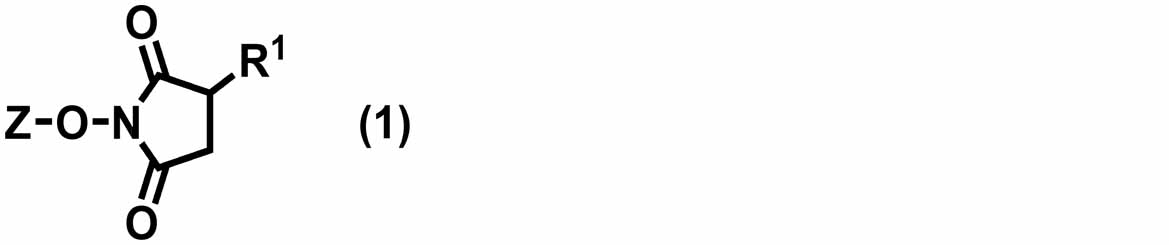
R1は、水素原子又はスルホニル基を表し、
Zは、式(Z-1)、式(Z-2)又は式(Z-3):

Wは、式(W-1):

Qは、式(Q-1)又は式(Q-2):

で表される基を表し、
R2は、-(CH2)u-COOHを表し、
uは1又は2を表す)
で表される基を表す]
で表される、化合物又はその塩。
That is, the present invention is as follows.
[Item 1]
Formula (1):
R 1 represents a hydrogen atom or a sulfonyl group,
Z is the formula (Z-1), the formula (Z-2) or the formula (Z-3):
W is the formula (W-1):
Q is the formula (Q-1) or the formula (Q-2):
Represents a group represented by
R 2 represents —(CH 2 ) u— COOH,
u represents 1 or 2)
Represents a group represented by
A compound or a salt thereof represented by:
[項2]
R1が、水素原子である、項1に記載の化合物又はその塩。
[Item 2]
The compound or salt thereof according to item 1, wherein R 1 is a hydrogen atom.
[項3]
以下の化合物から選択される、項1に記載の化合物又はその塩。

The compound or its salt of claim|item 1 selected from the following compounds.
[項4]
式(2):

mAbは、抗体を表し、
qは、1~30の整数を表し、
Zは、式(Z-1)、式(Z-2)又は式(Z-3):

Wは、式(W-1):

Qは、式(Q-1)又は式(Q-2):

で表される基を表し、
R2は、-(CH2)u-COOHを表し、
uは1又は2を表す)
で表される基を表す]
で表される、抗体薬物複合体又はその製薬学的に許容される塩。
[Item 4]
Formula (2):
mAb represents an antibody,
q represents an integer of 1 to 30,
Z is the formula (Z-1), the formula (Z-2) or the formula (Z-3):
W is the formula (W-1):
Q is the formula (Q-1) or the formula (Q-2):
Represents a group represented by
R 2 represents —(CH 2 ) u— COOH,
u represents 1 or 2)
Represents a group represented by
An antibody-drug complex represented by or a pharmaceutically acceptable salt thereof.
[項5]
mAbが、ブレンツキシマブ、トラスツズマブ、イノツズマブ、ゲムツズマブ、グレムバツムマブ、ラベツズマブ、サシツズマブ、リファスツズマブ、インデュサツマブ、ポラツズマブ、ピナツズマブ、コルツキシマブ、インダツキシマブ、ミラツズマブ、ロバルピツズマブ、アネツマブ、チソツマブ、ロルボツズマブ(lorvotuzumab)、リツキシマブ、デパツキシズマブ、デニンツズマブ、エンホルツマブ、テルソツズマブ、バンドルツズマブ、ソフィツズマブ、ボルセツズマブ、ミルベツキシマブ(mirvetuximab)、ナラツキシマブ、カンツズマブ、ラプリツキシマブ、ビバツズマブ、バダスツキシマブ、ルパルツマブ、アプルツマブ、アバゴボマブ、アブシキシマブ、アビツズマブ、アブリルマブ、アクトクスマブ、アダリブマブ、アデカツムマブ、アデュカヌマブ、アファセビクマブ、アフェリモマブ、アラシズマブ、アレムツズマブ、アリロクマブ、アルツモマブ、アマツキシマブ、アナツモマブ、アニフロルマブ、アンルキンズマブ、アポリズマブ、アルシツモマブ、アスクリンバクマブ、アセリズマブ、アテゾリズマブ、アチヌマブ、アトロリムマブ、アベルマブ、アジンツキシズマブ、バピネズマブ、バシリキシマブ、バビツキシマブ、ベクツモマブ、ベゲロマブ、ベリムマブ、ベンラリズマブ、ベルチリムマブ、ベシレソマブ、ベバシズマブ、ベズロトクスマブ、ビシロマブ、ビマグルマブ、ビメキズマブ、ブレセルマブ、ブリナツモマブ、ブロンツベトマブ、ブロソズマブ、ボコシズマブ、ブラジクマブ、ブリアキヌマブ、ブロダルマブ、ブロルシズマブ、ブロンチクツズマブ、ブロスマブ、カビラリズマブ、カムレリズマブ、カプラシズマブ、カプロマブ、カルルマブ、カロツキシマブ、カツマクソマブ、セデリズマブ、セルトリズマブ、セツキシマブ、シタツズマブ、シキスツムマブ、クレノリキシマブ、クリバツズマブ、コドリツズマブ、コナツムマブ、コンシズマブ、コスフロビキシマブ、クレネズマブ、クリザンリズマブ、クロテデュマブ、ダセツズマブ、ダクリズマブ、ダロツズマブ、ダピロリズマブ、ダラツムマブ、デクトレクマブ、デムシズマブ、デノスマブ、デツモマブ、デザミズマブ、ジヌツキシマブ、ジリダブマブ、ドマグロズマブ、ドルリモマブ、ドロジツマブ、デュリゴツズマブ、デュピルマブ、デュルバルマブ、デュシギツマブ、デュボルツキシズマブ、エクロメキシマブ、エクリズマブ、エドバコマブ、エドレコロマブ、エファリズマブ、エフングマブ、エルデルマブ、エレザヌマブ、エロツズマブ、エルシリモマブ、エマクツズマブ、エマパルマブ、エミベツズマブ、エミシズマブ、エナバツズマブ、エンリモマブ、エノブリツズマブ、エノキズマブ、エノチクマブ、エンシツキシマブ、エピツモマブ、エプラツズマブ、エプチネズマブ、エレヌマブ、エルリズマブ、エルツマキソマブ、エタラシズマブ、エトロリズマブ、エビナクマブ、エボロクマブ、エクスビビルマブ、ファラリモマブ、ファルレツズマブ、ファシヌマブ、フェルビズマブ、フェザキヌマブ、フィクラツズマブ、フィギツムマブ、フィリブマブ、フランボツマブ、フレチクマブ、フォントリズマブ、フォラルマブ、フォラビルマブ、フレマネズマブ、フレソリムマブ、フルネベトマブ、フルラヌマブ、フツキシマブ、ガルカネズマブ、ガリキシマブ、ガニツマブ、ガンテネルマブ、ガチポツズマブ、ガビリモマブ、ゲディブマブ、ゲボキズマブ、ギルベトマブ、ギレンツキシマブ、ゴリムマブ、グセルクマブ、イバリズマブ、イブリツモマブ、イクルクマブ、イダルシズマブ、イファボツズマブ、イゴボマブ、イマルマブ、イムシロマブ、イムガツズマブ、インクラクマブ、イネビリズマブ、インフリキシマブ、イノリモマブ、インテツムマブ、イピリムマブ、イラツムマブ、イサツキシマブ、イトリズマブ、イキセキズマブ、ケリキシマブ、ラクノツズマブ、ランパリズマブ、ラナデルマブ、ランドグロズマブ、ラルカビキシマブ、レブリキズマブ、レマレソマブ、レンジルマブ、レルデリムマブ、レソファブマブ、レトリズマブ、レキサツムマブ、リビビルマブ、リファツズマブ、リゲリズマブ、リロトマブ、リンツズマブ、リリルマブ、ロデルシズマブ、ロキベトマブ、、、ルカツムマブ、ルリズマブ、ルムレツズマブ、ルチキズマブ、マパツムマブ、マルゲツキシマブ、マサリモマブ、マツズマブ、マブリリムマブ、メポリズマブ、メテリムマブ、ミンレツモマブ、ミツモマブ、モドツキシマブ、モガムリズマブ、モナリズマブ、モロリムマブ、モタビズマブ、モキセツモマブ、ムロモナブ、ナコロマブ、ナミルマブ、ナプツモマブ、ナルナツマブ、ナタリズマブ、ナビシキシズマブ、ナビブマブ、ネバクマブ、ネシツムマブ、ネモリズマブ、ネレリモマブ、ネスバクマブ、ニモツズマブ、ニボルマブ、オビルトキサキシマブ、オビヌツズマブ、オカラツズマブ、オクレリズマブ、オデュリモマブ、オファツムマブ、オララツマブ、オレクルマブ、オレンダリズマブ、オロキズマブ、オマリズマブ、オナルツズマブ、オンツキシズマブ、オピシヌマブ、オポルツズマブ、オレゴボマブ、オルチクマブ(orticumab)、オテリキシズマブ、オトレルツズマブ、オキセルマブ、オザネズマブ、オゾラリズマブ、パギバキシマブ、パリビズマブ、パムレブルマブ、パニツムマブ、パノバクマブ、パルサツズマブ、パスコリズマブ、パソツキシズマブ、パテクリズマブ、パトリツマブ、ペンブロリズマブ、ペラキズマブ、ペルツズマブ、ペキセリズマブ、ピディリズマブ、プラクルマブ、プロザリズマブ、ポネズマブ、ポルガビキシマブ、プレザルマブ、プリリキシマブ、プリトキサキシマブ、プリツムマブ、クイリズマブ、ラコツモマブ、ラドレツマブ、ラフィビルマブ、ラルパンシズマブ、ラムシルマブ、ラネベトマブ、ラニビズマブ、ラキシバクマブ、レファネズマブ、レガビルマブ、レムトルマブ、レスリズマブ、リロツムマブ、リヌクマブ、リサンキズマブ、リババズマブ、ロバツムマブ、ロレデュマブ、ロモソズマブ、ロンタリズマブ、ロスマンツズマブ、ロベリズマブ、ロザノリキシズマブ、ルプリズマブ、サマリズマブ、サリルマブ、サトラリズマブ、サツモマブ、セクキヌマブ、セリクレルマブ、セリバンツマブ、セトキサキシマブ、セビルマブ、シブロツズマブ、シファリムマブ、シルツキシマブ、シムツズマブ、シプリズマブ、シルクマブ、ソラネズマブ、ソリトマブ、ソンツズマブ、スタムルマブ、スレソマブ、スプタブマブ、スビズマブ、スブラトクスマブ、タバルマブ、タドシズマブ、タリズマブ、タムツベトマブ、タネズマブ、タプリツモマブ、タレクスツマブ、タボリキシズマブ、ファノレソマブ、ノフェツモマブ、ピンツモマブ、テフィバズマブ、テリモマブ、テリソツズマブ、テナツモマブ、テネリキシマブ、テプリズマブ、テプロツムマブ、テシドルマブ、テゼペルマブ、ティガツズマブ、ティルドラキズマブ、チミグツズマブ、チモルマブ、トシリズマブ、トムゾツキシマブ、トラリズマブ、トサトクスマブ、トシツモマブ、トベツマブ、トラロキヌマブ、トレガリズマブ、トレメリムマブ、トレボグルマブ、ツコツズマブ、ツビルマブ、ウブリツキシマブ、ウロクプルマブ、ウレルマブ、ウルトキサズマブ、ウステキヌマブ、ウトミルマブ、バンチクツマブ、バヌシズマブ、バパリキシマブ、バリサクマブ、バルリルマブ、バテリズマブ、ベドリズマブ、べルツズマブ、ベパリモマブ、ベセンクマブ、ビシリズマブ、ボバリリズマブ、ボロシキシマブ、ボンレロリズマブ、ボツムマブ、ブナキズマブ、タカツズマブ、ザルツムマブ、ザノリムマブ、ジラリムマブ、ゾリモマブ、カミダンルマブ、コフェツズマブ、ラジラツズマブ、ロンカスツキシマブ、テリソツズマブ、エナポタマブ、AMG595の抗体又は抗エンビジン抗体である、項4に記載の抗体薬物複合体又はその製薬学的に許容される塩。
[Item 5]
mAb is, brentuximab, trastuzumab, Inotsuzumabu, gemtuzumab, Guremubatsumumabu, labetuzumab, Sashitsuzumabu, Rifasutsuzumabu, Indeyusatsumabu, Poratsuzumabu, Pinatsuzumabu, Korutsukishimabu, Indatsukishimabu, milatuzumab, Robarupitsuzumabu, Anetsumabu, Chisotsumabu, Rorubotsuzumabu (lorvotuzumab), rituximab, Depatsukishizumabu, Denintsuzumabu, Enhorutsumabu, Terusotsuzumabu, Bandorutsuzumabu, Sofitsuzumabu, Borusetsuzumabu, Mirubetsukishimabu (mirvetuximab), Naratsukishimabu, Kantsuzumabu, Lapu rituximab, Bibatsuzumabu, Badasutsukishimabu, Ruparutsumabu, Apurutsumabu, Abagobomabu, abciximab, Abitsuzumabu, Aburirumabu, Akutokusumabu, Adaribumabu, Adekatsumumabu, Adeyukanumabu, Afasebikumabu, afelimomab, Aracizumab, alemtuzumab, arilocumab, altumomab, amatuximab, anatumomab, aniflorumab, anlukinzumab, apolizumab, alucizumab, axizumab, aterizumab, atelizumab, atinumumab, atrolimumab, atizumab, atrolimumab, atinumumab, atrolimumab, atinumumab, atrolimumab, atinumumab, atrolimumab, atizumab, atrolimumab, atinuzumab, atrolimumab, atizumab, atrolimumab, atinumumab, atelimab belimumab, Benrarizumabu, Beruchirimumabu, Beshiresomabu, bevacizumab, Bezurotokusumabu, Bishiromabu, Bimagurumabu, Bimekizumabu, Bureserumabu, Burinatsumomabu, Burontsubetomabu, Burosozumabu, Bokoshizumabu, Burajikumabu, Buriakinumabu, Burodarumabu, Burorushizumabu, Bron tick Tsu's Mabu, Burosumabu, Kabirarizumabu, Kamurerizumabu, Kapurashizumabu, Kapuromabu, Karurumabu, Karotsukishimabu, Katsumakusomabu, Sederizumabu, certolizumab, cetuximab, Shitatsuzumabu, Shikisutsumumabu, clenoliximab, Kuribatsuzumabu, Kodoritsuzumabu, Konatsumumabu, Konshizumabu, cost flow bi screeching Breakfast, Kurenezumabu, Kurizanrizumabu, Kurotedeyumabu, Dasetsuzumabu, daclizumab, Darotsuzumabu, Dapirorizumabu, Daratsumumabu, Dekutorekumabu , Demcizumab, denosumab, detsumomab, dezazumab, zinutuximab, zilidabumab, domagrozumab, dollimomab, dolodizumab, durigotuzumab, dupilumab, durvalumab, dusigitumab, duboltuki Shizumabu, Ekuromekishimabu, eculizumab, Edobakomabu, edrecolomab, efalizumab, Efungumabu, Eruderumabu, Erezanumabu, Erotsuzumabu, Erushirimomabu, Emakutsuzumabu, Emaparumabu, Emibetsuzumabu, Emishizumabu, Enabatsuzumabu, Enrimomabu, Enoburitsuzumabu, Enokizumabu, Enochikumabu, Enshitsukishimabu, Epitsumomabu, epratuzumab, Epuchinezumabu, Erenumabu, Erlizumab, ertumaximab, etaracizumab, etorolizumab, ebinakumab, evolocumab, exbibirumab, faralimoumab, farretuzumab, fasinumab, felvizumab, fezumakibumab, ficlatuzumab, figuzumab, furabumab, fibratuzumab, fleatuzumab, fibrumab Fururanumabu, Futsukishimabu, Garukanezumabu, galiximab, Ganitsumabu, Gantenerumabu, Gachipotsuzumabu, Gabirimomabu, Gedibumabu, Gebokizumabu, Girubetomabu, Girentsukishimabu, golimumab, Guserukumabu, Ibarizumabu, ibritumomab, Ikurukumabu, idarucizumab, Ifabotsuzumabu, Igobomabu, Imarumabu, Imushiromabu, Imugatsuzumabu, Inkurakumabu, Inebirizumabu, infliximab, Inorimomabu, Intetsumumabu, ipilimumab, Iratsumumabu, Isatsukishimabu, Itorizumabu, Ikisekizumabu, Kerikishimabu, Rakunotsuzumabu, Ranparizumabu, Ranaderumabu, Randogurozumabu, Rarukabikishimabu, Reburikizumabu, Remaresomabu, Renjirumabu, Reruderimumabu, Resofabumabu, Retorizumabu, lexatumumab, Ribibirumabu, Rifatsuzumabu, Rigerizumabu, Rirotomabu, lintuzumab, Ririrumabu, Roderushizumabu, Rokibetomabu ,,, Rukatsumumabu, Rurizumabu, Rumuretsuzumabu, Ruchikizumabu, mapatumumab, Marugetsukishimabu, Masarimomabu, matuzumab, Maburirimumabu, mepolizumab, Meterimumabu, Minretsumomabu, Mitsumomabu, Modotsukishimabu, mogamulizumab, Monarizumabu, Mororimumabu, motavizumab, Mokisetsumomabu, Muromonab, nacolomab, namilumab, naptumoumab, nalnazumab, natalizumab, navisixizumab, navibumab, nevacumab, necitumumab, nemorizumab, nererimoumab, nesvakumab, nimotu Zumabu, nivolumab, Oh built after Shima Breakfast, Obinutsuzumabu, Okaratsuzumabu, ocrelizumab, Odeyurimomabu, ofatumumab, Oraratsumabu, Orekurumabu, Orendarizumabu, Orokizumabu, omalizumab, Onarutsuzumabu, Ontsukishizumabu, Opishinumabu, Oporutsuzumabu, oregovomab, Oruchikumabu (orticumab), Oterikishizumabu, Otorerutsuzumabu, Okiserumabu, Ozanezumabu, Ozorarizumabu, Pagibakishimabu, palivizumab, Pamureburumabu, panitumumab, Panobakumabu, Parusatsuzumabu, Pasukorizumabu, Pasotsukishizumabu, Patekurizumabu, Patoritsumabu, pembrolizumab, Perakizumabu, pertuzumab, pexelizumab, Pidirizumabu, Purakurumabu, Purozarizumabu, Ponezumabu, Porugabikishimabu, Purezarumabu, Puririkishimabu, Purito after Shima Breakfast , Puritsumumabu, Kuirizumabu, Rakotsumomabu, Radoretsumabu, Rafibirumabu, Rarupanshizumabu, Ramucirumab, Ranebetomabu, ranibizumab, Rakishibakumabu, Refanezumabu, Regabirumabu, Remutorumabu, Resurizumabu, Rirotsumumabu, Rinukumabu, Risankizumabu, Ribabazumabu, Robatsumumabu, Roredeyumabu, Romosozumabu, Rontarizumabu, Rosumantsuzumabu, Roberizumabu, Roza Norikishizumabu, Rupurizumabu, Samarizumabu, Sarirumabu, Satorarizumabu, Satsumomabu, secukinumab, Serikurerumabu, Seribantsumabu, Setokisakishimabu, Sebirumabu, sibrotuzumab, Shifarimumabu, Shirutsukishimabu, Shimutsuzumabu, siplizumab, Shirukumabu, Soranezumabu, Soritomabu, Sontsuzumabu, Sutamurumabu, Suresomabu, Suputabumabu, Subizumabu, Suburatokusumabu, Tabarumabu, Tadoshizumabu, Tarizumabu, Tamutsubetomabu, Tanezumabu, Tapuritsumomabu, Tarekusutsumabu, Taborikishizumabu, Fanoresomabu, Nofetsumomabu, Pintsumomabu, Tefibazumabu, Terimomabu, Terisotsuzumabu, Tenatsumomabu, Tenerikishimabu, Tepurizumabu, Tepurotsumumabu, Teshidorumabu, Tezeperumabu, Tigatsuzumabu, Till Dora scratches Mab, Chimigutsuzumabu , Timolumab, tocilizumab, tomzotuximab, tralizumab, tosatoxumab, tositumomab, tovetuzumab, tralokinumab, tregalizumab, tremelimumab, trevoglumab, tucotuzumab, tuburimab, ubrituximab, Urokupurumabu, Urerumabu, Urutokisazumabu, Usutekinumabu, Utomirumabu, Banchikutsumabu, Banushizumabu, Baparikishimabu, Barisakumabu, Barurirumabu, Baterizumabu, Vedolizumab, downy Rutsuzumabu, Beparimomabu, Besenkumabu, visilizumab, Bobaririzumabu, Boroshikishimabu, Bonrerorizumabu, Botsumumabu, Bunakizumabu, Takatsuzumabu, zalutumumab, zanolimumab, Jirarimumabu The antibody-drug complex according to Item 4, or a pharmaceutically acceptable salt thereof, which is an antibody or an anti-envidin antibody of:, zolimomab, camidanrumab, cofetuzumab, radiruzumab, roncastuximab, terisotuzumab, enapotamab, AMG595.
[項6]
mAbが、ブレンツキシマブである、項4に記載の抗体薬物複合体又はその製薬学的に許容される塩。
[Item 6]
Item 5. The antibody drug complex according to Item 4, wherein the mAb is brentuximab, or a pharmaceutically acceptable salt thereof.
[項7]
qが1~20の整数である、項4~6のいずれか一項に記載の抗体薬物複合体又はその製薬学的に許容される塩。
[Item 7]
Item 7. The antibody-drug conjugate according to any one of Items 4 to 6, wherein q is an integer of 1 to 20, or a pharmaceutically acceptable salt thereof.
[項8]
qが1~10の整数である、項4~6のいずれか一項に記載の抗体薬物複合体又はその製薬学的に許容される塩。
[Item 8]
Item 7. The antibody drug conjugate according to any one of Items 4 to 6, wherein q is an integer of 1 to 10, or a pharmaceutically acceptable salt thereof.
[項9]
項4~8のいずれか一項に記載の抗体薬物複合体又はその製薬学的に許容される塩を含有する、医薬組成物。
[Item 9]
Item 9. A pharmaceutical composition comprising the antibody-drug complex according to any one of Items 4 to 8 or a pharmaceutically acceptable salt thereof.
[項10]
項4~8のいずれか一項に記載の抗体薬物複合体又はその製薬学的に許容される塩と、
抗がん性アルキル化剤、抗がん性代謝拮抗剤、抗がん性抗生物質、抗がん性白金配位化合物、抗がん性カンプトテシン誘導体、抗がん性チロシンキナーゼ阻害剤、抗がん性セリンスレオニンキナーゼ阻害剤、抗がん性リン脂質キナーゼ阻害剤、抗がん性モノクローナル抗体、インターフェロン、生物学的応答調節剤、ホルモン剤、免疫チェックポイント阻害剤、エピジェネティクス関連分子阻害剤、及びタンパク質翻訳後修飾阻害剤からなる群より選択される1種以上の抗がん性化合物又はその製薬学的に許容される塩と、を含む医薬組成物。
[Item 10]
Item 9. An antibody drug conjugate or a pharmaceutically acceptable salt thereof according to any one of Items 4 to 8,
Anti-cancer alkylating agent, anti-cancer antimetabolite, anti-cancer antibiotic, anti-cancer platinum coordination compound, anti-cancer camptothecin derivative, anti-cancer tyrosine kinase inhibitor, anti- Cancer Serine Threonine Kinase Inhibitor, Anticancer Phospholipid Kinase Inhibitor, Anticancer Monoclonal Antibody, Interferon, Biological Response Modifier, Hormone, Immune Checkpoint Inhibitor, Epigenetics Related Molecular Inhibitor , And one or more anticancer compounds selected from the group consisting of protein post-translational modification inhibitors or a pharmaceutically acceptable salt thereof.
[項11]
項4~8のいずれか一項に記載の抗体薬物複合体又はその製薬学的に許容される塩を含有する、抗がん剤。
[Item 11]
Item 9. An anticancer agent containing the antibody-drug complex according to any one of Items 4 to 8 or a pharmaceutically acceptable salt thereof.
[項12]
がんが、乳がん、胃がん、肺がん、肝臓がん、子宮頸がん、大腸がん、直腸がん、結腸がん、神経膠腫、リンパ腫、卵巣がん、膵がん、前立腺がん、腎がん、尿路上皮がん、皮膚がん、甲状腺がん、膀胱がん、頭頸部がん、子宮体がん、中皮腫、黒色腫、多発性骨髄腫又は白血病である、項11に記載の抗がん剤。
[Item 12]
Cancer is breast cancer, gastric cancer, lung cancer, liver cancer, cervical cancer, colon cancer, rectal cancer, colon cancer, glioma, lymphoma, ovarian cancer, pancreatic cancer, prostate cancer, kidney Cancer, urothelial cancer, skin cancer, thyroid cancer, bladder cancer, head and neck cancer, endometrial cancer, mesothelioma, melanoma, multiple myeloma or leukemia, Item 11. The described anti-cancer agent.
[項13]
治療が必要な患者に、項4~8のいずれか一項に記載の抗体薬物複合体又はその製薬学的に許容される塩を投与することを含む、がんの治療方法。
[Item 13]
Item 9. A method for treating cancer, which comprises administering the antibody-drug complex or the pharmaceutically acceptable salt thereof according to any one of Items 4 to 8 to a patient in need of treatment.
[項14]
抗がん剤を製造するための、項1~3のいずれか一項に記載の化合物又はその塩の使用。
[Item 14]
Use of the compound or a salt thereof according to any one of items 1 to 3 for producing an anticancer agent.
[項15]
抗がん剤を製造するための、項4~8のいずれか一項に記載の抗体薬物複合体又はその製薬学的に許容される塩の使用。
[Item 15]
Item 10. Use of the antibody drug conjugate according to any one of Items 4 to 8 or a pharmaceutically acceptable salt thereof for producing an anticancer agent.
[項16]
がんの治療に使用するための、項4~8のいずれか一項に記載の抗体薬物複合体又はその製薬学的に許容される塩。
[Item 16]
Item 9. The antibody drug conjugate according to any one of items 4 to 8 or a pharmaceutically acceptable salt thereof for use in the treatment of cancer.
[項17]
抗がん性アルキル化剤、抗がん性代謝拮抗剤、抗がん性抗生物質、抗がん性白金配位化合物、抗がん性カンプトテシン誘導体、抗がん性チロシンキナーゼ阻害剤、抗がん性セリンスレオニンキナーゼ阻害剤、抗がん性リン脂質キナーゼ阻害剤、抗がん性モノクローナル抗体、インターフェロン、生物学的応答調節剤、ホルモン剤、免疫チェックポイント阻害剤、エピジェネティクス関連分子阻害剤、及びタンパク質翻訳後修飾阻害剤からなる群より選択される1種以上の抗がん性化合物又はその製薬学的に許容される塩と併用してがんを治療するための、項4~8のいずれか一項に記載の抗体薬物複合体又はその製薬学的に許容される塩。
[Item 17]
Anti-cancer alkylating agent, anti-cancer antimetabolite, anti-cancer antibiotic, anti-cancer platinum coordination compound, anti-cancer camptothecin derivative, anti-cancer tyrosine kinase inhibitor, anti- Cancer Serine Threonine Kinase Inhibitor, Anticancer Phospholipid Kinase Inhibitor, Anticancer Monoclonal Antibody, Interferon, Biological Response Modifier, Hormone, Immune Checkpoint Inhibitor, Epigenetics Related Molecular Inhibitor And 4) for treating cancer in combination with one or more anti-cancer compounds selected from the group consisting of protein post-translational modification inhibitors or pharmaceutically acceptable salts thereof. The antibody drug conjugate or the pharmaceutically acceptable salt thereof according to any one of 1.
本発明のヘミアスタリン誘導体と抗体とで形成した抗体薬物複合体は、抗原発現細胞に対して特異的に細胞傷害活性を示し、抗原発現細胞以外の正常細胞での細胞毒性が低いため、安全性に優れた抗がん剤と成り得る。 The antibody-drug complex formed of the hemiasterlin derivative of the present invention and an antibody shows cytotoxic activity specifically to antigen-expressing cells, and has low cytotoxicity in normal cells other than antigen-expressing cells, and therefore has safety. It can be an excellent anticancer drug.
本明細書において、「アルキル基」とは、直鎖状、分枝鎖状又は環状の飽和炭化水素基を意味する。「アルキル基」として、好ましくは炭素原子数が1~6の飽和炭化水素基が挙げられる。「アルキル基」の具体例としては、例えば、メチル基、エチル基、プロピル基、イソプロピル基、ブチル基、1、1-ジメチルエチル基、1-メチルプロピル基、2-メチルプロピル基、ペンチル基、3-メチルブチル基、2-メチルブチル基、2,2-ジメチルプロピル基、1-エチルプロピル基、1,1-ジメチルプロピル基、ヘキシル基、4-メチルペンチル基、3-メチルペンチル基、2-メチルペンチル基、1-メチルペンチル基、3,3-ジメチルブチル基、2,2-ジメチルブチル基、1,1-ジメチルブチル基、1,2-ジメチルブチル基、シクロプロピル基、シクロブチル基、シクロペンチル基、シクロヘキシル基等が挙げられるが、これらに限定されない。 In the present specification, the “alkyl group” means a linear, branched or cyclic saturated hydrocarbon group. The "alkyl group" preferably includes a saturated hydrocarbon group having 1 to 6 carbon atoms. Specific examples of the “alkyl group” include, for example, methyl group, ethyl group, propyl group, isopropyl group, butyl group, 1,1-dimethylethyl group, 1-methylpropyl group, 2-methylpropyl group, pentyl group, 3-methylbutyl group, 2-methylbutyl group, 2,2-dimethylpropyl group, 1-ethylpropyl group, 1,1-dimethylpropyl group, hexyl group, 4-methylpentyl group, 3-methylpentyl group, 2-methyl Pentyl group, 1-methylpentyl group, 3,3-dimethylbutyl group, 2,2-dimethylbutyl group, 1,1-dimethylbutyl group, 1,2-dimethylbutyl group, cyclopropyl group, cyclobutyl group, cyclopentyl group , Cyclohexyl group and the like, but are not limited thereto.
本明細書において、「アルコキシ基」とは、「アルキル基」によって置換されたオキシ基を意味する。「アルコキシ基」として、好ましくは炭素原子数が1~6の飽和炭化水素によって置換されたオキシ基が挙げられる。「アルコキシ基」の具体例としては、例えば、メトキシ基、エトキシ基、プロポキシ基、1-メチルエトキシ基、ブトキシ基、1,1-ジメチルエトキシ基、1-メチルプロポキシ基、2-メチルプロポキシ基、ペンチロキシ基、3-メチルブトキシ基、2-メチルブトキシ基、2,2-ジメチルプロポキシ基、1-エチルプロポキシ基、1,1-ジメチルプロポキシ基、ヘキシロキシ基、4-メチルペンチロキシ基、3-メチルペンチロキシ基、2-メチルペンチロキシ基、1-メチルペンチロキシ基、3,3-ジメチルブトキシ基、2,2-ジメチルブトキシ基、1,1-ジメチルブトキシ基、1,2-ジメチルブトキシ基、シクロプロポキシ基、シクロブトキシ基、シクロペンチロキシ基、シクロヘキシロキシ基等が挙げられるが、これらに限定されない。 In the present specification, the “alkoxy group” means an oxy group substituted with an “alkyl group”. The "alkoxy group" preferably includes an oxy group substituted with a saturated hydrocarbon having 1 to 6 carbon atoms. Specific examples of the “alkoxy group” include, for example, methoxy group, ethoxy group, propoxy group, 1-methylethoxy group, butoxy group, 1,1-dimethylethoxy group, 1-methylpropoxy group, 2-methylpropoxy group, Pentyloxy group, 3-methylbutoxy group, 2-methylbutoxy group, 2,2-dimethylpropoxy group, 1-ethylpropoxy group, 1,1-dimethylpropoxy group, hexyloxy group, 4-methylpentyloxy group, 3-methyl Pentyloxy group, 2-methylpentyloxy group, 1-methylpentyloxy group, 3,3-dimethylbutoxy group, 2,2-dimethylbutoxy group, 1,1-dimethylbutoxy group, 1,2-dimethylbutoxy group, Examples thereof include, but are not limited to, a cyclopropoxy group, a cyclobutoxy group, a cyclopentyloxy group, a cyclohexyloxy group and the like.
本明細書において、「ハロゲン原子」とは、フッ素原子、塩素原子、臭素原子又はヨウ素原子が挙げられる。好ましくはフッ素原子又は塩素原子が挙げられ、より好ましくはフッ素原子が挙げられる。 In the present specification, examples of the “halogen atom” include a fluorine atom, a chlorine atom, a bromine atom or an iodine atom. A fluorine atom or a chlorine atom is preferable, and a fluorine atom is more preferable.
本明細書において、水素原子は1Hであっても、2H(D)であってもよい。すなわち、例えば、式(1)で表される化合物の1つ又は2つ以上の1Hを2H(D)に変換した重水素変換体も、式(1)で表される化合物に包含される。 In the present specification, the hydrogen atom may be 1H or 2H(D). That is, for example, a deuterium conversion product obtained by converting one or more 1H of the compound represented by the formula (1) into 2H(D) is also included in the compound represented by the formula (1).
式(1)で表される化合物及びその塩(以下、「本発明のヘミアスタリン誘導体」と称することもある。)は、以下のとおりである。

式中、R1は、水素原子又はスルホニル基を表し、好ましくは水素原子である。 In the formula, R 1 represents a hydrogen atom or a sulfonyl group, and preferably a hydrogen atom.
式中、Zは、式(Z-1)、式(Z-2)又は式(Z-3):

式(Z-1)において、R2は、-(CH2)u-COOHを表す。ここで、uは、1又は2の整数である。uの1態様としては1が挙げられ、別の1態様としては2が挙げられる。 In the formula (Z-1), R 2 represents —(CH 2 ) u —COOH. Here, u is an integer of 1 or 2. 1 is mentioned as one aspect|mode of u, and 2 is mentioned as another one aspect|mode.
式(Z-1)、式(Z-2)又は式(Z-3)において、Wは、式(W-1):
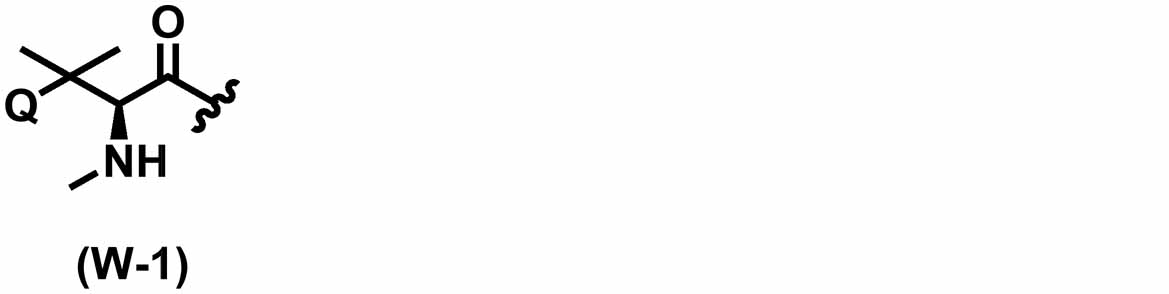
式(W-1)において、Qは、式(Q-1)又は式(Q-2):

本発明のヘミアスタリン誘導体の1つの態様としては、以下の(1-A)が挙げられる。
(1-A)
式(1)において、
R1が、水素原子であり、
Zが、式(Z-1)、式(Z-2)又は式(Z-3)で表される基であり、
R2が、-(CH2)u-COOHであり、
uが、1又は2の整数であり、
Wが、式(W-1)で表される基であり、
Qが、式(Q-1)で表される基である、
化合物又はその塩。
The following (1-A) is mentioned as one aspect|mode of the hemiasterlin derivative of this invention.
(1-A)
In equation (1),
R 1 is a hydrogen atom,
Z is a group represented by formula (Z-1), formula (Z-2) or formula (Z-3),
R 2 is —(CH 2 ) u —COOH,
u is an integer of 1 or 2,
W is a group represented by formula (W-1),
Q is a group represented by the formula (Q-1),
A compound or salt thereof.
本発明のヘミアスタリン誘導体の1つの態様としては、以下の(1-B)が挙げられる。
(1-B)
式(1)において、
R1が、水素原子であり、
Zが、式(Z-1)、式(Z-2)又は式(Z-3)で表される基であり、
R2が、-(CH2)u-COOHであり、
uが、1又は2の整数であり、
Wが、式(W-1)で表される基であり、
Qが、式(Q-2)で表される基である、
化合物又はその塩。
The following (1-B) is mentioned as one aspect|mode of the hemiasterlin derivative of this invention.
(1-B)
In equation (1),
R 1 is a hydrogen atom,
Z is a group represented by formula (Z-1), formula (Z-2) or formula (Z-3),
R 2 is —(CH 2 ) u —COOH,
u is an integer of 1 or 2,
W is a group represented by formula (W-1),
Q is a group represented by formula (Q-2),
A compound or salt thereof.
本発明のヘミアスタリン誘導体の1つの態様としては、以下の(1-C)が挙げられる。
(1-C)
式(1)において、
R1が、水素原子であり、
Zが、式(Z-1)で表される基であり、
R2が、-(CH2)u-COOHであり、
uが、1又は2の整数であり、
Wが、式(W-1)で表される基であり、
Qが、式(Q-1)又は式(Q-2)で表される基である、
化合物又はその塩。
The following (1-C) is mentioned as one aspect|mode of the hemiasterlin derivative of this invention.
(1-C)
In equation (1),
R 1 is a hydrogen atom,
Z is a group represented by formula (Z-1),
R 2 is —(CH 2 ) u —COOH,
u is an integer of 1 or 2,
W is a group represented by formula (W-1),
Q is a group represented by formula (Q-1) or formula (Q-2),
A compound or salt thereof.
本発明のヘミアスタリン誘導体の1つの態様としては、以下の(1-D)が挙げられる。
(1-D)
式(1)において、
R1が、水素原子であり、
Zが、式(Z-2)で表される基であり、
Wが、式(W-1)で表される基であり、
Qが、式(Q-1)又は式(Q-2)で表される基である、
化合物又はその塩。
The following (1-D) is mentioned as one aspect|mode of the hemiasterlin derivative of this invention.
(1-D)
In equation (1),
R 1 is a hydrogen atom,
Z is a group represented by formula (Z-2),
W is a group represented by formula (W-1),
Q is a group represented by formula (Q-1) or formula (Q-2),
A compound or salt thereof.
本発明のヘミアスタリン誘導体の1つの態様としては、以下の(1-E)が挙げられる。
(1-E)
式(1)において、
R1が、水素原子であり、
Zが、式(Z-3)で表される基であり、
Wが、式(W-1)で表される基であり、
Qが、式(Q-1)又は式(Q-2)で表される基である、
化合物又はその塩。
The following (1-E) is mentioned as one aspect|mode of the hemiasterlin derivative of this invention.
(1-E)
In equation (1),
R 1 is a hydrogen atom,
Z is a group represented by formula (Z-3),
W is a group represented by formula (W-1),
Q is a group represented by formula (Q-1) or formula (Q-2),
A compound or salt thereof.
式(2)で表される抗体薬物複合体又はその製薬学的に許容される塩(以下、「本発明の抗体薬物複合体」と称することもある。)は、下に示すように、抗体分子由来の抗体部分と薬物分子由来の薬物部分が、リンカーを介して共有結合している複合体である。本明細書において、「抗体薬物複合体」を「ADC」という場合もある。

薬物部分の「Z」は、式(1)におけるZと同義である。 “Z” in the drug moiety is synonymous with Z in formula (1).
qは、抗体薬物複合体分子における、薬物抗体比(Drug Antibody Ratio、又はDARともいう。)を示す。薬物抗体比qは、抗体薬物複合体1分子において、抗体分子1つ当たりの、すなわち、抗体薬物複合体1分子当たりの、薬物分子の数を意味する。なお、化学合成により得られる抗体薬物複合体は、異なる薬物抗体比qを有し得る複数の抗体薬物複合体分子の混合物である場合が多い。本明細書において、このような抗体薬物複合体の混合物における全体の薬物抗体比(すなわち、それぞれの抗体薬物複合体の薬物抗体比qの平均値)を、「平均薬物抗体比」又は「平均DAR」と呼ぶ。 Q indicates the drug-antibody ratio (also referred to as Drug Antibody Ratio or DAR) in the antibody-drug complex molecule. The drug-antibody ratio q means the number of drug molecules per antibody molecule in one molecule of the antibody drug complex, that is, per molecule of the antibody drug complex. The antibody-drug conjugate obtained by chemical synthesis is often a mixture of a plurality of antibody-drug conjugate molecules that can have different drug-antibody ratios q. In the present specification, the overall drug-antibody ratio in such a mixture of antibody-drug conjugates (that is, the average value of the drug-antibody ratio q of each antibody-drug conjugate) is defined as the "average drug-antibody ratio" or "average DAR." ".
qは、1、2、3、4、5、6、7、8、9、10、11、12、13、14、15、16、17、18、19、20、21、22、23、24、25、26、27、28、29又は30である。qの1態様としては、1~10の整数が挙げられ、別の1態様としては、11~20の整数が挙げられ、別の1態様としては、21~30の整数が挙げられ、別の1態様としては、1~8の整数が挙げられ、別の1態様としては、1~6の整数が挙げられ、別の1態様としては、1~4の整数が挙げられる。 q is 1, 2, 3, 4, 5, 6, 7, 8, 9, 10, 11, 12, 13, 14, 15, 16, 17, 18, 19, 20, 21, 22, 23, 24 , 25, 26, 27, 28, 29 or 30. One aspect of q includes an integer of 1 to 10, another aspect includes an integer of 11 to 20, and another aspect includes an integer of 21 to 30. One aspect includes an integer of 1 to 8, another aspect includes an integer of 1 to 6, and another aspect includes an integer of 1 to 4.
平均DARの1態様としては、1~30が挙げられ、別の1態様としては、1~10が挙げられ、別の1態様としては、21~30が挙げられ、別の1態様としては、21~30が挙げられる。別の1態様としては、1~8、1~2、2~3、3~4、4~5、6~7、7~8、8~9、9~10、5~15、15~25が挙げられる。平均DARは、紫外可視近赤外分光法、SDS-PAGE、質量分析、ELISA(酵素結合免疫吸着アッセイ)、HPLC(高速液体クロマトグラフィー)等の、平均DARの決定に通常用いられる方法によって決定することができる。疎水性相互作用カラムクロマトフィー(HIC)HPLC、逆相HPLC、電気泳動等の方法により、異なるDARを有する複数の抗体薬物複合体の混合物から、特定のDARの抗体薬物複合体の分離、精製及び特性決定を行うことができる One aspect of the average DAR includes 1 to 30, another aspect includes 1 to 10, another aspect includes 21 to 30, and another aspect includes 21 to 30 can be mentioned. In another embodiment, 1-8, 1-2, 2-3, 3-4, 4-5, 6-7, 7-8, 8-9, 9-10, 5-15, 15-25 Is mentioned. Average DAR is determined by methods commonly used to determine average DAR, such as UV-Vis near-infrared spectroscopy, SDS-PAGE, mass spectrometry, ELISA (enzyme linked immunosorbent assay), HPLC (high performance liquid chromatography). be able to. Hydrophobic Interaction Column Chromatography (HIC) HPLC, reverse phase HPLC, electrophoresis, etc. to separate, purify and isolate a specific DAR antibody drug complex from a mixture of a plurality of antibody drug complexes having different DARs. Can make characterizations
mAbは「抗体」を示す。ここで、「抗体」は、少なくとも重鎖の可変ドメイン及び軽鎖の可変ドメインを含む抗体であればよく、完全抗体であっても、完全抗体の断片であって抗原認識部位を有する抗原結合断片であってもよい。完全抗体は、2つの全長の軽鎖と2つの全長の重鎖とを有し、それぞれの軽鎖と重鎖とはジスルフィド結合によって連結されている。完全抗体は、IgA、IgD、IgE、IgM及びIgGを含み、IgGは、サブタイプとして、IgG1、IgG2、IgG3及びIgG4を含む。また、抗体はモノクローナル抗体であることが好ましい。抗体部分と薬物部分とは、抗体中のリシン残基のε-アミノ基を介して結合している。 mAb stands for "antibody". Here, the “antibody” may be an antibody containing at least a variable domain of a heavy chain and a variable domain of a light chain, and even a complete antibody is a fragment of a complete antibody and an antigen-binding fragment having an antigen recognition site. May be A complete antibody has two full-length light chains and two full-length heavy chains, with each light and heavy chain linked by a disulfide bond. Complete antibodies include IgA, IgD, IgE, IgM and IgG, with IgG including IgG 1 , IgG 2 , IgG 3 and IgG 4 as subtypes. Further, the antibody is preferably a monoclonal antibody. The antibody portion and the drug portion are bound via the ε-amino group of the lysine residue in the antibody.
抗体mAbは、標的細胞の表面に存在する抗原を認識し得る抗体であれば特に制限されない。標的細胞は、ヘミアスタリン誘導体による治療を必要とする細胞であればよく、がん細胞であることが好ましい。標的細胞の表面に存在する抗原は、正常細胞で発現されない又は発現量の少ない、標的細胞に特異的な抗原であることが好ましい。mAbの1態様としては、上記列挙された既知の抗体が挙げられ、別の一態様としては、ブレンツキシマブ、トラスツズマブ、イノツズマブ、ゲムツズマブ、グレムバツムマブ、ラベツズマブ、サシツズマブ、リファスツズマブ、インデュサツマブ、ポラツズマブ、ピナツズマブ、コルツキシマブ、インダツキシマブ、ミラツズマブ、ロバルピツズマブ、アネツマブ、チソツマブ、ロルボツズマブ(lorvotuzumab)、リツキシマブ、デパツキシズマブ、デニンツズマブ、エンホルツマブ、テルソツズマブ、バンドルツズマブ、ソフィツズマブ、ボルセツズマブ、ミルベツキシマブ(mirvetuximab)、ナラツキシマブ、カンツズマブ、ラプリツキシマブ、ビバツズマブ、バダスツキシマブ、ルパルツマブ、アプルツマブ、アバゴボマブ、アブシキシマブ、アビツズマブ、アブリルマブ、アクトクスマブ、アダリブマブ、アデカツムマブ、アデュカヌマブ、アファセビクマブ、アフェリモマブ、アラシズマブ、アレムツズマブ、アリロクマブ、アルツモマブ、アマツキシマブ、アナツモマブ、アニフロルマブ、アンルキンズマブ、アポリズマブ、アルシツモマブ、アスクリンバクマブ、アセリズマブ、アテゾリズマブ、アチヌマブ、アトロリムマブ、アベルマブ、アジンツキシズマブ、バピネズマブ、バシリキシマブ、バビツキシマブ、ベクツモマブ、ベゲロマブ、ベリムマブ、ベンラリズマブ、ベルチリムマブ、ベシレソマブ、ベバシズマブ、ベズロトクスマブ、ビシロマブ、ビマグルマブ、ビメキズマブ、ブレセルマブ、ブリナツモマブ、ブロンツベトマブ、ブロソズマブ、ボコシズマブ、ブラジクマブ、ブリアキヌマブ、ブロダルマブ、ブロルシズマブ、ブロンチクツズマブ、ブロスマブ、カビラリズマブ、カムレリズマブ、カプラシズマブ、カプロマブ、カルルマブ、カロツキシマブ、カツマクソマブ、セデリズマブ、セルトリズマブ、セツキシマブ、シタツズマブ、シキスツムマブ、クレノリキシマブ、クリバツズマブ、コドリツズマブ、コナツムマブ、コンシズマブ、コスフロビキシマブ、クレネズマブ、クリザンリズマブ、クロテデュマブ、ダセツズマブ、ダクリズマブ、ダロツズマブ、ダピロリズマブ、ダラツムマブ、デクトレクマブ、デムシズマブ、デノスマブ、デツモマブ、デザミズマブ、ジヌツキシマブ、ジリダブマブ、ドマグロズマブ、ドルリモマブ、ドロジツマブ、デュリゴツズマブ、デュピルマブ、デュルバルマブ、デュシギツマブ、デュボルツキシズマブ、エクロメキシマブ、エクリズマブ、エドバコマブ、エドレコロマブ、エファリズマブ、エフングマブ、エルデルマブ、エレザヌマブ、エロツズマブ、エルシリモマブ、エマクツズマブ、エマパルマブ、エミベツズマブ、エミシズマブ、エナバツズマブ、エンリモマブ、エノブリツズマブ、エノキズマブ、エノチクマブ、エンシツキシマブ、エピツモマブ、エプラツズマブ、エプチネズマブ、エレヌマブ、エルリズマブ、エルツマキソマブ、エタラシズマブ、エトロリズマブ、エビナクマブ、エボロクマブ、エクスビビルマブ、ファラリモマブ、ファルレツズマブ、ファシヌマブ、フェルビズマブ、フェザキヌマブ、フィクラツズマブ、フィギツムマブ、フィリブマブ、フランボツマブ、フレチクマブ、フォントリズマブ、フォラルマブ、フォラビルマブ、フレマネズマブ、フレソリムマブ、フルネベトマブ、フルラヌマブ、フツキシマブ、ガルカネズマブ、ガリキシマブ、ガニツマブ、ガンテネルマブ、ガチポツズマブ、ガビリモマブ、ゲディブマブ、ゲボキズマブ、ギルベトマブ、ギレンツキシマブ、ゴリムマブ、グセルクマブ、イバリズマブ、イブリツモマブ、イクルクマブ、イダルシズマブ、イファボツズマブ、イゴボマブ、イマルマブ、イムシロマブ、イムガツズマブ、インクラクマブ、イネビリズマブ、インフリキシマブ、イノリモマブ、インテツムマブ、イピリムマブ、イラツムマブ、イサツキシマブ、イトリズマブ、イキセキズマブ、ケリキシマブ、ラクノツズマブ、ランパリズマブ、ラナデルマブ、ランドグロズマブ、ラルカビキシマブ、レブリキズマブ、レマレソマブ、レンジルマブ、レルデリムマブ、レソファブマブ、レトリズマブ、レキサツムマブ、リビビルマブ、リファツズマブ、リゲリズマブ、リロトマブ、リンツズマブ、リリルマブ、ロデルシズマブ、ロキベトマブ、ルカツムマブ、ルリズマブ、ルムレツズマブ、ルチキズマブ、マパツムマブ、マルゲツキシマブ、マサリモマブ、マツズマブ、マブリリムマブ、メポリズマブ、メテリムマブ、ミンレツモマブ、ミツモマブ、モドツキシマブ、モガムリズマブ、モナリズマブ、モロリムマブ、モタビズマブ、モキセツモマブ、ムロモナブ、ナコロマブ、ナミルマブ、ナプツモマブ、ナルナツマブ、ナタリズマブ、ナビシキシズマブ、ナビブマブ、ネバクマブ、ネシツムマブ、ネモリズマブ、ネレリモマブ、ネスバクマブ、ニモツズマブ、ニボルマブ、オビルトキサキシマブ、オビヌツズマブ、オカラツズマブ、オクレリズマブ、オデュリモマブ、オファツムマブ、オララツマブ、オレクルマブ、オレンダリズマブ、オロキズマブ、オマリズマブ、オナルツズマブ、オンツキシズマブ、オピシヌマブ、オポルツズマブ、オレゴボマブ、オルチクマブ(orticumab)、オテリキシズマブ、オトレルツズマブ、オキセルマブ、オザネズマブ、オゾラリズマブ、パギバキシマブ、パリビズマブ、パムレブルマブ、パニツムマブ、パノバクマブ、パルサツズマブ、パスコリズマブ、パソツキシズマブ、パテクリズマブ、パトリツマブ、ペンブロリズマブ、ペラキズマブ、ペルツズマブ、ペキセリズマブ、ピディリズマブ、プラクルマブ、プロザリズマブ、ポネズマブ、ポルガビキシマブ、プレザルマブ、プリリキシマブ、プリトキサキシマブ、プリツムマブ、クイリズマブ、ラコツモマブ、ラドレツマブ、ラフィビルマブ、ラルパンシズマブ、ラムシルマブ、ラネベトマブ、ラニビズマブ、ラキシバクマブ、レファネズマブ、レガビルマブ、レムトルマブ、レスリズマブ、リロツムマブ、リヌクマブ、リサンキズマブ、リババズマブ、ロバツムマブ、ロレデュマブ、ロモソズマブ、ロンタリズマブ、ロスマンツズマブ、ロベリズマブ、ロザノリキシズマブ、ルプリズマブ、サマリズマブ、サリルマブ、サトラリズマブ、サツモマブ、セクキヌマブ、セリクレルマブ、セリバンツマブ、セトキサキシマブ、セビルマブ、シブロツズマブ、シファリムマブ、シルツキシマブ、シムツズマブ、シプリズマブ、シルクマブ、ソラネズマブ、ソリトマブ、ソンツズマブ、スタムルマブ、スレソマブ、スプタブマブ、スビズマブ、スブラトクスマブ、タバルマブ、タドシズマブ、タリズマブ、タムツベトマブ、タネズマブ、タプリツモマブ、タレクスツマブ、タボリキシズマブ、ファノレソマブ、ノフェツモマブ、ピンツモマブ、テフィバズマブ、テリモマブ、テリソツズマブ、テナツモマブ、テネリキシマブ、テプリズマブ、テプロツムマブ、テシドルマブ、テゼペルマブ、ティガツズマブ、ティルドラキズマブ、チミグツズマブ、チモルマブ、トシリズマブ、トムゾツキシマブ、トラリズマブ、トサトクスマブ、トシツモマブ、トベツマブ、トラロキヌマブ、トレガリズマブ、トレメリムマブ、トレボグルマブ、ツコツズマブ、ツビルマブ、ウブリツキシマブ、ウロクプルマブ、ウレルマブ、ウルトキサズマブ、ウステキヌマブ、ウトミルマブ、バンチクツマブ、バヌシズマブ、バパリキシマブ、バリサクマブ、バルリルマブ、バテリズマブ、ベドリズマブ、べルツズマブ、ベパリモマブ、ベセンクマブ、ビシリズマブ、ボバリリズマブ、ボロシキシマブ、ボンレロリズマブ、ボツムマブ、ブナキズマブ、タカツズマブ、ザルツムマブ、ザノリムマブ、ジラリムマブ、ゾリモマブ又は抗エンビジン抗体が挙げられ、別の1態様としては、ブレンツキシマブ、トラスツズマブ、イノツズマブ、ゲムツズマブ、ラベツズマブ、ポラツズマブ、コルツキシマブ、インダツキシマブ、アネツマブ、リツキシマブ、デニンツズマブ、ラプリツキシマブ、バダスツキシマブ、グレムバツムマブ、セツキシマブ、アレムツズマブ又はデパツキシズマブが挙げられ、別の1態様としてはブレンツキシマブ、トラスツズマブ、セツキシマブが挙げられ、別の1態様としてはブレンツキシマブ又はトラスツズマブが挙げられ、好ましくはブレンツキシマブが挙げられる。 The antibody mAb is not particularly limited as long as it is an antibody that can recognize an antigen existing on the surface of target cells. The target cell may be a cell that requires treatment with a hemiasterlin derivative, and is preferably a cancer cell. The antigen present on the surface of the target cell is preferably an antigen specific to the target cell, which is not expressed in normal cells or has a small expression level. Examples of the mAb include the above-listed known antibodies, and in another aspect, brentuximab, trastuzumab, inotuzumab, gemtuzumab, grembatumumab, labetuzumab, sacituzumab, rifatuzumab, indusatumab, poratuzumab, poratuzumab, poratuzumab, , Indatsukishimabu, milatuzumab, Robarupitsuzumabu, Anetsumabu, Chisotsumabu, Rorubotsuzumabu (lorvotuzumab), rituximab, Depatsukishizumabu, Denintsuzumabu, Enhorutsumabu, Terusotsuzumabu, Bandorutsuzumabu, Sofitsuzumabu, Borusetsuzumabu, Mirubetsukishimabu (mirvetuximab), Naratsukishimabu, Kantsuzumabu, Lapu rituximab, Bibatsuzumabu, Badasutsukishimabu, Ruparutsumabu, Apurutsumabu, Abagobomabu, abciximab, Abitsuzumabu, Aburirumabu, Akutokusumabu, Adaribumabu, Adekatsumumabu, Adeyukanumabu, Afasebikumabu, afelimomab, Arashizumabu, alemtuzumab, Arirokumabu, Arutsumomabu, Amatsukishimabu, Anatsumomabu, Anifurorumabu, Anrukinzumabu, apolizumab, Arushitsumomabu, ask phosphorus Bakuma Breakfast, Aserizumabu, Atezorizumabu , Achinumabu, Atororimumabu, Aberumabu, azine luck Shizuma Breakfast, Bapinezumabu, basiliximab, Babitsukishimabu, Bekutsumomabu, Begeromabu, belimumab, Benrarizumabu, Beruchirimumabu, Beshiresomabu, bevacizumab, Bezurotokusumabu, Bishiromabu, Bimagurumabu, Bimekizumabu, Bureserumabu, Burinatsumomabu, Burontsubetomabu, Burosozumabu, Bokoshizumabu, Burajikumabu, Buriakinumabu, Burodarumabu, Burorushizumabu, Bron tick Tsu's Mabu, Burosumabu, Kabirarizumabu, Kamurerizumabu, Kapurashizumabu, Kapuromabu, Karurumabu, Karotsukishimabu, Katsumakusomabu, Sederizumabu, certolizumab, cetuximab, Shitatsuzumabu, Shikisutsumumabu, clenoliximab, Kuribatsuzumabu, Kodoritsuzumabu, Konatsumumabu, Konshizumabu, Cosfloviximab, clenezumab, kurizanlizumab, clotudeumab, dacetuzumab, daclizumab, dalotuzumab, dapirolizumab, daratumumab, dectrexumab, demcizumab, denosumab, dezumab, zunizumab, zizumab, zinuzumab, detuzumab, zinuzumab, detuzumab, zunizumab, zizumab. Gotsuzumabu, Deyupirumabu, Deyurubarumabu, Deyushigitsumabu, du Bol luck Shizuma Breakfast, Ekuromekishimabu, eculizumab, Edobakomabu, edrecolomab, efalizumab, Efungumabu, Eruderumabu, Erezanumabu, Erotsuzumabu, Erushirimomabu, Emakutsuzumabu, Emaparumabu, Emibetsuzumabu, Emishizumabu, Enabatsuzumabu, Enrimomabu, Enoburitsuzumabu, Enokizumabu, Enochikumabu, Enshitsukishimabu, Epitsumomabu, epratuzumab, Epuchinezumabu, Erenumabu, Erurizumabu, Erutsumakisomabu, Etarashizumabu, Etororizumabu, Ebinakumabu, evolocumab, Aix freaked out Mabu, Fararimomabu, Faruretsuzumabu, Fashinumabu, Ferubizumabu, Fezakinumabu, Fikuratsuzumabu, Figitsumumabu, Firibumabu, Furanbotsumabu, Furechikumabu, font Liz Mab, forarumab, foraburumab, flenemazumab, fresorimumab, flunevetomab, flurranumab, futuximab, garcanezumab, gariximab, gatipotumab, gevipotumab, gevolimumab, gevilibumab, gevolimumab, gevolimumab, gevolimumab, gevolimumab, gevolimumab, gevolibumab, gevolibumab, gevolibumab, gevolibumab, gevolibumab, gevolibumab, gevobimabu Ifabotsuzumabu, Igobomabu, Imarumabu, Imushiromabu, Imugatsuzumabu, Inkurakumabu, Inebirizumabu, infliximab, Inorimomabu, Intetsumumabu, ipilimumab, Iratsumumabu, Isatsukishimabu, Itorizumabu, Ikisekizumabu, Kerikishimabu, Rakunotsuzumabu, Ranparizumabu, Ranaderumabu, Randogurozumabu, Rarukabikishimabu, Reburikizumabu, Remaresomabu, Renjirumabu, Reruderimumabu, Resofabumabu, Retorizumabu, lexatumumab, Ribibirumabu, Rifatsuzumabu, Rigerizumabu, Rirotomabu, lintuzumab, Ririrumabu, Roderushizumabu, Rokibetomabu, Rukatsumumabu, Rurizumabu, Rumuretsuzumabu, Ruchikizumabu, mapatumumab, Marugetsukishimabu, Masarimomabu, matuzumab, Maburirimumabu, mepolizumab, Meterimumabu, Minretsumomabu, Mitsumomabu, Modotsukishimabu, Mogamulizumab, monalizumab, morolimumab, motavizumab, moxetumumab, muromonab, nacolomab, namilumab, naptumoumab, narnatuzumab, natalizumab, navicixizumab, navibumab, nevakuma Breakfast, Neshitsumumabu, Nemorizumabu, Nererimomabu, Nesubakumabu, nimotuzumab, nivolumab, Oh built after Shima Breakfast, Obinutsuzumabu, Okaratsuzumabu, ocrelizumab, Odeyurimomabu, ofatumumab, Oraratsumabu, Orekurumabu, Orendarizumabu, Orokizumabu, omalizumab, Onarutsuzumabu, Ontsukishizumabu, Opishinumabu, Oporutsuzumabu, oregovomab, Oruchikumabu (orticumab), Oterikishizumabu, Otorerutsuzumabu, Okiserumabu, Ozanezumabu, Ozorarizumabu, Pagibakishimabu, palivizumab, Pamureburumabu, panitumumab, Panobakumabu, Parusatsuzumabu, Pasukorizumabu, Pasotsukishizumabu, Patekurizumabu, Patoritsumabu, pembrolizumab, Perakizumabu, pertuzumab, pexelizumab, Pidirizumabu, Purakurumabu, Purozarizumabu, Ponezumabu, Porugabikishimabu, Purezarumabu, Puririkishimabu, Purito wife Shima Breakfast, Puritsumumabu, Kuirizumabu, Rakotsumomabu, Radoretsumabu, Rafibirumabu, Rarupanshizumabu, Ramucirumab, Ranebetomabu, ranibizumab, Rakishibakumabu, Refanezumabu, Regabirumabu, Remutorumabu, Resurizumabu, Rirotsumumabu, Rinukumabu, Risankizumabu, Ribabazumabu, Robatsumumabu, Roredeyumabu , Romosozumabu, Rontarizumabu, Rosumantsuzumabu, Roberizumabu, Roza glue carboxymethyl's Mab, Rupurizumabu, Samarizumabu, Sarirumabu, Satorarizumabu, Satsumomabu, secukinumab, Serikurerumabu, Seribantsumabu, Setokisakishimabu, Sebirumabu, sibrotuzumab, Shifarimumabu, Shirutsukishimabu, Shimutsuzumabu, siplizumab, Shirukumabu, Soranezumabu, Soritomabu, Sontsuzumabu, Sutamurumabu, Suresomabu, Suputabumabu, Subizumabu, Suburatokusumabu, Tabarumabu, Tadoshizumabu, Tarizumabu, Tamutsubetomabu, Tanezumabu, Tapuritsumomabu, Tarekusutsumabu, Taborikishizumabu, Fanoresomabu, Nofetsumomabu, Pintsumomabu, Tefibazumabu, Terimomabu, Terisotsuzumabu, Tenatsumomabu, Tenerikishimabu, Tepurizumabu, Tepurotsumumabu, Teshidorumabu, Teseperumab, Tigatuzumab, Tirudokizumab, Timigutuzumab, Timolumab, Tocilizumab, Tomzotuximab, Tralizumab, Tosatoxumab, Tositumumab, Tovetumab, Tralokinumab, Tregarizumab, Tremelim Mabu, Torebogurumabu, Tsukotsuzumabu, Tsubirumabu, naive rituximab, Urokupurumabu, Urerumabu, Urutokisazumabu, Usutekinumabu, Utomirumabu, Banchikutsumabu, Banushizumabu, Baparikishimabu, Barisakumabu, Barurirumabu, Baterizumabu, Vedolizumab, downy Rutsuzumabu, Beparimomabu, Besenkumabu, visilizumab, Bobaririzumabu, Boroshikishimabu, Bonrerorizumabu, Botsumumabu, Bunakizumabu, Takatsuzumabu, zalutumumab, zanolimumab, Jirarimumabu, Zorimomabu or anti Enbijin antibody. Examples of the another one aspect, brentuximab, trastuzumab, Inotsuzumabu, gemtuzumab, labetuzumab, Poratsuzumabu, Korutsukishimabu, Indatsukishimabu, Anetsumabu, rituximab, Denintuzumab, laprituximab, vadastuximab, grembatumumab, cetuximab, alemtuzumab or depatuximab can be mentioned. Another embodiment is brentuximab, trastuzumab, cetuximab, and brentuzumab or trastuzumab is another embodiment. Preferable is brentuximab.
mAbとして、抗19A抗体、抗AXL抗体、抗BCMA抗体、抗C4.4a抗体、抗CA6抗体、抗CA9抗体、抗CA-125抗体、抗カドヘリン-6抗体、抗CD166抗体、抗CD19抗体、抗CD20抗体、抗CD22抗体、抗CD25抗体、抗CD27抗体、抗CD30抗体、抗CD33抗体、抗CD37抗体、抗CD40抗体、抗CD41抗体、抗CD44v6抗体、抗CD51抗体、抗CD52抗体、抗CD56抗体、抗CD70抗体、抗CD74抗体、抗CD79抗体、抗CD79b抗体、抗CEACAM5抗体、抗c-Met抗体、抗DLL3抗体、抗DPEP3抗体、抗EGFR抗体、抗EGFRvIII抗体、抗ENPP3抗体、抗EpCAM抗体、抗EphA4抗体、抗FGFR2抗体、抗FGFR3抗体、抗FTL3抗体、抗葉酸受容体α抗体、抗グリピカン3抗体、抗gpNMB抗体、抗HER2抗体、抗HER3抗体、抗IL-3RA抗体、抗LAMP1抗体、抗LIV-1抗体、抗LRRC15抗体、抗Ly6E抗体、抗メソテリン抗体、抗MUC-16抗体、抗NaPi2b抗体、抗ネクチン-4抗体、抗CD352抗体、抗P-カドヘリン抗体、抗PMSA抗体、抗プロテインチロシンキナーゼ7抗体、抗SLITRK抗体、抗STEAP1抗体、抗CD138抗体、抗組織因子抗体、抗CD71抗体、抗TIM-1抗体、抗Trop2抗体、抗5T4抗体、抗B7-H3抗体、抗CD163マクロファージ受容体抗体、抗CD38抗体、抗CD48抗体、抗cKit抗体、抗グアニル酸シクラーゼC抗体、抗ガストリン放出ペプチド抗体、抗溶質輸送体抗体、抗腫瘍関係MUC-1抗体、抗GD2抗体、抗α4β7インテグリン抗体、又は抗エンビジン抗体が挙げられる。mAbの別の1態様として、抗CD19抗体、抗CD20抗体、抗CD22抗体、抗CD30抗体、抗CD33抗体、抗CD52抗体、抗CD70抗体、抗CD79b抗体、抗CEACAM5抗体、抗EGFR抗体、抗EGFRvIII抗体、抗gpNMB抗体、抗HER2抗体、抗メソテリン抗体、抗CD138抗体、抗CD38抗体、又は抗GD2抗体が挙げられる。mAbの別の1態様として、抗CD19抗体、抗CD20抗体、抗CD22抗体、抗CD30抗体、抗CD33抗体、抗CD52抗体、抗CD79b抗体、抗CEACAM5抗体、抗EGFR抗体、抗EGFRvIII抗体、抗gpNMB抗体、抗HER2抗体、抗メソテリン抗体、又は抗CD138抗体が挙げられる。 As the mAb, anti-19A antibody, anti-AXL antibody, anti-BCMA antibody, anti-C4.4a antibody, anti-CA6 antibody, anti-CA9 antibody, anti-CA-125 antibody, anti-cadherin-6 antibody, anti-CD166 antibody, anti-CD19 antibody, anti-CD19 antibody CD20 antibody, anti-CD22 antibody, anti-CD25 antibody, anti-CD27 antibody, anti-CD30 antibody, anti-CD33 antibody, anti-CD37 antibody, anti-CD40 antibody, anti-CD41 antibody, anti-CD44v6 antibody, anti-CD51 antibody, anti-CD52 antibody, anti-CD56 antibody , Anti-CD70 antibody, anti-CD74 antibody, anti-CD79 antibody, anti-CD79b antibody, anti-CEACAM5 antibody, anti-c-Met antibody, anti-DLL3 antibody, anti-DPEP3 antibody, anti-EGFR antibody, anti-EGFRvIII antibody, anti-ENPP3 antibody, anti-EpCAM antibody , Anti-EphA4 antibody, anti-FGFR2 antibody, anti-FGFR3 antibody, anti-FTL3 antibody, antifolate receptor α antibody, anti-glypican 3 antibody, anti-gpNMB antibody, anti-HER2 antibody, anti-HER3 antibody, anti-IL-3RA antibody, anti-LAMP1 antibody , Anti-LIV-1 antibody, anti-LRRC15 antibody, anti-Ly6E antibody, anti-mesothelin antibody, anti-MUC-16 antibody, anti-NaPi2b antibody, anti-Nectin-4 antibody, anti-CD352 antibody, anti-P-cadherin antibody, anti-PMSA antibody, anti- Protein tyrosine kinase 7 antibody, anti-SLITRK antibody, anti-STEAP1 antibody, anti-CD138 antibody, anti-tissue factor antibody, anti-CD71 antibody, anti-TIM-1 antibody, anti-Trop2 antibody, anti-5T4 antibody, anti-B7-H3 antibody, anti-CD163 macrophage Receptor antibody, anti-CD38 antibody, anti-CD48 antibody, anti-cKit antibody, anti-guanylyl cyclase C antibody, anti-gastrin releasing peptide antibody, anti-solute transporter antibody, anti-tumor related MUC-1 antibody, anti-GD2 antibody, anti-α4β7 integrin An antibody or an anti-emvidin antibody is mentioned. As another aspect of mAb, as an anti-CD19 antibody, anti-CD20 antibody, anti-CD22 antibody, anti-CD30 antibody, anti-CD33 antibody, anti-CD52 antibody, anti-CD70 antibody, anti-CD79b antibody, anti-CEACAM5 antibody, anti-EGFR antibody, anti-EGFRvIII Antibodies, anti-gpNMB antibody, anti-HER2 antibody, anti-mesothelin antibody, anti-CD138 antibody, anti-CD38 antibody, or anti-GD2 antibody can be mentioned. As another embodiment of mAb, anti-CD19 antibody, anti-CD20 antibody, anti-CD22 antibody, anti-CD30 antibody, anti-CD33 antibody, anti-CD52 antibody, anti-CD79b antibody, anti-CEACAM5 antibody, anti-EGFR antibody, anti-EGFRvIII antibody, anti-gpNMB antibody Antibodies, anti-HER2 antibodies, anti-mesothelin antibodies, or anti-CD138 antibodies.
「AMG595の抗体」とは、Mol. Cancer Ther., 2015, 14, 1614-1624に記載された方法で得られる抗EGFRvIII抗体を意味する。 “Anti-AMG595 antibody” means an anti-EGFRvIII antibody obtained by the method described in Mol. Cancer Ther., 2015, 14, 1614-1624.
本発明の抗体薬物複合体の1つの態様としては、以下の(2-A)が挙げられる。
(2-A)
式(2)において、
mAbが、ブレンツキシマブ又はトラスツズマブであり、
qが、1~8の整数であり、
Zが、式(Z-1)、式(Z-2)又は式(Z-3)で表される基であり、
R2が、-(CH2)u-COOHであり、
uが、1又は2の整数であり、
Wが、式(W-1)で表される基であり、
Qが、式(Q-1)で表される基である、
抗体薬物複合体又はその製薬学的に許容される塩。
The following (2-A) is mentioned as one embodiment of the antibody drug conjugate of the present invention.
(2-A)
In equation (2),
mAb is brentuximab or trastuzumab,
q is an integer of 1 to 8,
Z is a group represented by formula (Z-1), formula (Z-2) or formula (Z-3),
R 2 is —(CH 2 ) u —COOH,
u is an integer of 1 or 2,
W is a group represented by formula (W-1),
Q is a group represented by the formula (Q-1),
Antibody drug conjugate or a pharmaceutically acceptable salt thereof.
本発明の抗体薬物複合体の1つの態様としては、以下の(2-B)が挙げられる。
(2-B)
式(2)において、
mAbが、ブレンツキシマブ又はトラスツズマブであり、
qが、1~8の整数であり、
Zが、式(Z-1)、式(Z-2)又は式(Z-3)で表される基であり、
R2が、-(CH2)u-COOHであり、
uが、1又は2の整数であり、
Wが、式(W-1)で表される基であり、
Qが、式(Q-2)で表される基である、
抗体薬物複合体又はその製薬学的に許容される塩。
One aspect of the antibody-drug conjugate of the present invention includes the following (2-B).
(2-B)
In equation (2),
mAb is brentuximab or trastuzumab,
q is an integer of 1 to 8,
Z is a group represented by formula (Z-1), formula (Z-2) or formula (Z-3),
R 2 is —(CH 2 ) u —COOH,
u is an integer of 1 or 2,
W is a group represented by formula (W-1),
Q is a group represented by formula (Q-2),
Antibody drug conjugate or a pharmaceutically acceptable salt thereof.
本発明の抗体薬物複合体の1つの態様としては、以下の(2-C)が挙げられる。
(2-C)
式(2)において、
mAbが、ブレンツキシマブ又はトラスツズマブであり、
qが、1~8の整数であり、
Zが、式(Z-1)で表される基であり、
R2が、-(CH2)u-COOHであり、
uが、1又は2の整数であり、
Wが、式(W-1)で表される基であり、
Qが、式(Q-1)又は式(Q-2)で表される基である、
抗体薬物複合体又はその製薬学的に許容される塩。
One embodiment of the antibody drug conjugate of the present invention includes the following (2-C).
(2-C)
In equation (2),
mAb is brentuximab or trastuzumab,
q is an integer of 1 to 8,
Z is a group represented by formula (Z-1),
R 2 is —(CH 2 ) u —COOH,
u is an integer of 1 or 2,
W is a group represented by formula (W-1),
Q is a group represented by formula (Q-1) or formula (Q-2),
Antibody drug conjugate or a pharmaceutically acceptable salt thereof.
本発明の抗体薬物複合体の1つの態様としては、以下の(2-D)が挙げられる。
(2-D)
式(2)において、
mAbが、ブレンツキシマブ又はトラスツズマブであり、
qが、1~8の整数であり、
Zが、式(Z-2)で表される基であり、
Wが、式(W-1)で表される基であり、
Qが、式(Q-1)又は式(Q-2)で表される基である、
抗体薬物複合体又はその製薬学的に許容される塩。
One aspect of the antibody-drug conjugate of the present invention includes the following (2-D).
(2-D)
In equation (2),
mAb is brentuximab or trastuzumab,
q is an integer of 1 to 8,
Z is a group represented by formula (Z-2),
W is a group represented by formula (W-1),
Q is a group represented by formula (Q-1) or formula (Q-2),
Antibody drug conjugate or a pharmaceutically acceptable salt thereof.
本発明の抗体薬物複合体の1つの態様としては、以下の(2-E)が挙げられる。
(2-E)
式(2)において、
mAbが、ブレンツキシマブ又はトラスツズマブであり、
qが、1~8の整数であり、
Zが、式(Z-3)で表される基であり、
Wが、式(W-1)で表される基であり、
Qが、式(Q-1)又は式(Q-2)で表される基である、
抗体薬物複合体又はその製薬学的に許容される塩。
One aspect of the antibody-drug conjugate of the present invention includes the following (2-E).
(2-E)
In equation (2),
mAb is brentuximab or trastuzumab,
q is an integer of 1 to 8,
Z is a group represented by formula (Z-3),
W is a group represented by formula (W-1),
Q is a group represented by formula (Q-1) or formula (Q-2),
Antibody drug conjugate or a pharmaceutically acceptable salt thereof.
一般に、抗体薬物複合体の作製及び解析は、当業者に公知の任意の技術によって行うことができる。このような方法としては、例えば、Antibody-Drug Conjugates(Laurent Ducry編集、Humana Press刊行、2013年)等に記載の方法が挙げられる。 Generally, preparation and analysis of an antibody drug complex can be performed by any technique known to those skilled in the art. Examples of such a method include those described in Antibody-Drug Conjugates (edited by Laurent Ducry, published by Humana Press, 2013).
抗体薬物複合体は、例えば、抗体中のリシン残基のε-アミノ基を、ヘミアスタリン誘導体と反応させることによって形成することができる。 An antibody-drug complex can be formed, for example, by reacting the ε-amino group of a lysine residue in an antibody with a hemiasterlin derivative.
抗体薬物複合体は、標的細胞(抗原発現細胞)内で抗体が代謝され、抗体の一部(抗体断片)と薬物部分を含む構造が活性代謝物として放出されうる。例えば、非特許文献7では、抗体の代謝によって、細胞内で、抗体薬物複合体のCys-薬物部分が放出されることが記載されている。また、非特許文献8では、抗体の代謝によって、細胞内で、抗体薬物複合体のLys-薬物部分が放出されることが記載されている。 In the antibody-drug complex, the antibody is metabolized in the target cell (antigen-expressing cell), and the structure containing a part of the antibody (antibody fragment) and the drug part can be released as an active metabolite. For example, Non-Patent Document 7 describes that metabolism of an antibody causes intracellular release of a Cys-drug portion of an antibody-drug complex. Non-Patent Document 8 describes that the Lys-drug portion of the antibody-drug complex is released intracellularly by the metabolism of the antibody.
抗体薬物複合体は、抗体-抗原反応を利用した細胞内への取り込みにより、特定の抗原発現細胞内に特異的に送達された後、上述の機構で活性代謝物を放出することで特定の細胞のみで薬効を発揮させることが推定される。抗体薬物複合体は、がん細胞特異的に取り込まれ得るため、がん細胞に対しては強い薬効を発揮すると期待できる。 The antibody-drug complex is specifically delivered into a cell expressing a specific antigen by the uptake into the cell using an antibody-antigen reaction, and then the active metabolite is released by the mechanism described above to release the active metabolite. It is estimated that the drug will exert its medicinal effect alone. Since the antibody-drug complex can be taken up specifically in cancer cells, it can be expected to exert a strong drug effect on cancer cells.
一方、抗体薬物複合体は、標的細胞に送達される前に、血液中に含まれるプロテアーゼ等によって分解され、血液中で活性代謝物を放出してしまうことがあると考えられる。その際、従来の抗体薬物複合体の場合は、血液中に放出された活性代謝物は、正常細胞にも作用する。そのため、意図していない全身暴露となり、副作用が起こりやすいことから、好ましくない。 On the other hand, it is considered that the antibody-drug complex may be decomposed by the protease contained in blood before being delivered to the target cell, and the active metabolite may be released in blood. In that case, in the case of the conventional antibody drug complex, the active metabolite released into the blood also acts on normal cells. Therefore, unintended systemic exposure results and side effects are likely to occur, which is not preferable.
さらに、抗体薬物複合体が特定の抗原発現細胞内に特異的に送達された後、上述の機構で活性代謝物を放出した結果、細胞死等によって活性代謝物が細胞内から細胞外又は血液中へ放出されることがある。その際、従来の抗体薬物複合体の場合、血液中に放出された活性代謝物は、正常細胞にも作用する。そのため、意図していない全身暴露となり、副作用が起こりやすいことから、好ましくない。 Furthermore, after the antibody-drug complex is specifically delivered into a specific antigen-expressing cell, the active metabolite is released by the above-mentioned mechanism, and as a result, the active metabolite is extracellularly or in the blood due to cell death or the like. May be released to. At that time, in the case of the conventional antibody-drug complex, the active metabolite released into blood also acts on normal cells. Therefore, unintended systemic exposure results and side effects are likely to occur, which is not preferable.
これに対し、本発明の抗体薬物複合体から放出される活性代謝物は、仮に非特許文献7又は非特許文献8で報告されるように、標的細胞に到達前又は到達後に血液中へ放出されても、正常細胞に作用しにくく、速やかに代謝及び排泄されるため、全身暴露による副作用が少ないことが期待できる。 On the other hand, the active metabolite released from the antibody-drug complex of the present invention is released into the blood before or after reaching the target cells, as reported in Non-Patent Document 7 or Non-Patent Document 8. However, since it hardly acts on normal cells and is rapidly metabolized and excreted, it can be expected that there are few side effects due to systemic exposure.
すなわち、活性代謝物は本発明の抗体薬物複合体の代謝から生成されることによって、がん細胞特異的に薬効を発揮し、かつ、正常細胞への影響が少なく安全性が高いことが期待される。 That is, it is expected that the active metabolite exerts a drug effect in a cancer cell-specific manner by being produced from the metabolism of the antibody-drug complex of the present invention, and has little influence on normal cells and is highly safe. It
本明細書において、特に区別する必要がある場合を除き、α-アミノ酸及び対応するアミノ酸残基の両方を表すのに、下記の3文字略語表記を用いることがある。また、α-アミノ酸の光学活性は、特に指定していない場合は、DL体、D体又はL体のいずれをも含み得るものとする。例えば、「グルタミン酸」又は「Glu」は、DL-グルタミン酸若しくはその残基、D-グルタミン酸若しくはその残基、又はL-グルタミン酸若しくはその残基を表している。 In the present specification, the following three-letter abbreviations may be used to represent both α-amino acids and corresponding amino acid residues, unless otherwise specified. Further, the optical activity of an α-amino acid may include any of DL form, D form and L form, unless otherwise specified. For example, "glutamic acid" or "Glu" represents DL-glutamic acid or its residue, D-glutamic acid or its residue, or L-glutamic acid or its residue.
「塩」は、本発明のヘミアスタリン誘導体の好適な塩及び医薬品原料として許容しうる塩であり、好ましくは慣用の無毒性塩である。「塩」としては、例えば、有機酸塩(例えば酢酸塩、トリフルオロ酢酸塩、マレイン酸塩、フマル酸塩、クエン酸塩、酒石酸塩、メタンスルホン酸塩、ベンゼンスルホン酸塩、ギ酸塩又はp-トルエンスルホン酸塩等)及び無機酸塩(例えば塩酸塩、臭化水素酸塩、ヨウ化水素酸塩、硫酸塩、硝酸塩又はリン酸塩等)のような酸付加塩、アミノ酸(例えばアルギニン、アスパラギン酸又はグルタミン酸等)との塩、アルカリ金属塩(例えばナトリウム塩又はカリウム塩等)及びアルカリ土類金属塩(例えばカルシウム塩又はマグネシウム塩等)等の金属塩、アンモニウム塩、又は有機塩基塩(例えばトリメチルアミン塩、トリエチルアミン塩、ピリジン塩、ピコリン塩、ジシクロヘキシルアミン塩又はN,N’-ジベンジルエチレンジアミン塩等)等の他、適当な塩を当業者が適宜選択することができる。 The “salt” is a suitable salt of the hemiasterline derivative of the present invention or a salt acceptable as a medicinal raw material, and is preferably a conventional non-toxic salt. Examples of the “salt” include organic acid salts (for example, acetate, trifluoroacetate, maleate, fumarate, citrate, tartrate, methanesulfonate, benzenesulfonate, formate or p salt). An acid addition salt such as a toluene sulfonate) and an inorganic acid salt (eg hydrochloride, hydrobromide, hydroiodide, sulphate, nitrate or phosphate etc.), an amino acid (eg arginine, Aspartic acid or glutamic acid), a metal salt such as an alkali metal salt (eg sodium salt or potassium salt) and an alkaline earth metal salt (eg calcium salt or magnesium salt), an ammonium salt, or an organic base salt ( For example, a trimethylamine salt, a triethylamine salt, a pyridine salt, a picoline salt, a dicyclohexylamine salt, an N,N′-dibenzylethylenediamine salt, etc.) and the like can be appropriately selected by those skilled in the art.
「製薬学的に許容される塩」としては、酸付加塩及び塩基付加塩が挙げられる。例えば、酸付加塩としては、塩酸塩、臭化水素酸塩、硫酸塩、ヨウ化水素酸塩、硝酸塩、リン酸塩等の無機酸塩、又はクエン酸塩、シュウ酸塩、フタル酸塩、フマル酸塩、マレイン酸塩、コハク酸塩、リンゴ酸塩、酢酸塩、ギ酸塩、プロピオン酸塩、安息香酸塩、トリフルオロ酢酸塩、メタンスルホン酸塩、ベンゼンスルホン酸塩、p-トルエンスルホン酸塩、カンファースルホン酸塩等の有機酸塩が挙げられる。また、塩基付加塩としては、ナトリウム塩、カリウム塩、カルシウム塩、マグネシウム塩、バリウム塩、アルミニウム塩等の無機塩基塩、又はトリメチルアミン、トリエチルアミン、ピリジン、ピコリン、2,6-ルチジン、エタノールアミン、ジエタノールアミン、トリエタノールアミン、トロメタミン[トリス(ヒドロキシメチル)メチルアミン]、tert-ブチルアミン、シクロヘキシルアミン、ジシクロヘキシルアミン、N,N-ジベンジルエチルアミン等の有機塩基塩が挙げられる。さらに、「製薬学的に許容される塩」としては、アルギニン、リシン、オルニチン、アスパラギン酸、グルタミン酸等の、塩基性アミノ酸又は酸性アミノ酸との塩(アミノ酸塩)も挙げられる。 “The pharmaceutically acceptable salt” includes an acid addition salt and a base addition salt. For example, as the acid addition salt, inorganic acid salts such as hydrochloride, hydrobromide, sulfate, hydroiodide, nitrate and phosphate, or citrate, oxalate, phthalate, Fumarate, maleate, succinate, malate, acetate, formate, propionate, benzoate, trifluoroacetate, methanesulfonate, benzenesulfonate, p-toluenesulfonate Examples thereof include salts and organic acid salts such as camphorsulfonate. Examples of the base addition salt include inorganic base salts such as sodium salt, potassium salt, calcium salt, magnesium salt, barium salt and aluminum salt, or trimethylamine, triethylamine, pyridine, picoline, 2,6-lutidine, ethanolamine, diethanolamine. , Triethanolamine, tromethamine [tris(hydroxymethyl)methylamine], tert-butylamine, cyclohexylamine, dicyclohexylamine, N,N-dibenzylethylamine and the like organic base salts. Furthermore, examples of the “pharmaceutically acceptable salt” also include salts with basic amino acids or acidic amino acids (amino acid salts) such as arginine, lysine, ornithine, aspartic acid and glutamic acid.
本発明のヘミアスタリン誘導体又は抗体薬物複合体の塩を取得したいとき、目的の化合物が塩の形で得られる場合には、それをそのまま精製すればよく、また、遊離の形で得られる場合には、それを適当な有機溶媒に溶解若しくは懸濁させ、酸又は塩基を加えて通常の方法により塩を形成させればよい。 When it is desired to obtain the salt of the hemiasterlin derivative or the antibody drug conjugate of the present invention, when the target compound is obtained in the form of a salt, it may be purified as it is, and when it is obtained in a free form. Alternatively, it may be dissolved or suspended in an appropriate organic solvent, and an acid or base may be added to form a salt by a usual method.
本発明のヘミアスタリン誘導体及び抗体薬物複合体は、水和物及び/又は各種溶媒との溶媒和物(エタノール和物等)の形で存在することもあり、これらの水和物及び/又は溶媒和物も本発明のヘミアスタリン誘導体及び抗体薬物複合体に含まれる。さらに、本発明には、本発明のヘミアスタリン誘導体及び抗体薬物複合体のあらゆる様態の結晶形も含まれる。 The hemiasterline derivative and antibody drug complex of the present invention may exist in the form of a hydrate and/or a solvate with various solvents (ethanol solvate, etc.). These hydrates and/or solvates Those are also included in the hemiasterlin derivative and antibody drug conjugate of the present invention. Furthermore, the present invention also includes all forms of crystalline forms of the hemiasterlin derivatives and antibody drug conjugates of the present invention.
本発明のヘミアスタリン誘導体及び抗体薬物複合体の中には、光学活性中心に基づく光学異性体、分子内回転の束縛により生じた軸性又は面性キラリティーに基づくアトロプ異性体、その他のあらゆる立体異性体、互変異性体、及び幾何異性体等が存在し得るものがあるが、これらを含め、全ての可能な異性体は本発明の範囲に包含される。 Among the hemiasterlin derivatives and antibody drug conjugates of the present invention, there are optical isomers based on optically active centers, atropisomers based on axial or planar chirality caused by the restriction of intramolecular rotation, and any other stereoisomerism. All possible isomers are included in the scope of the present invention, including body isomers, tautomers, geometric isomers and the like.
特に、光学異性体やアトロプ異性体は、ラセミ体として得ることができ、また光学活性の出発原料や中間体が用いられた場合には光学活性体として、それぞれ得ることができる。必要であれば、下記製造法の適切な段階で、対応する原料、中間体又は最終品のラセミ体を、光学活性カラムを用いた方法、分別結晶化法等の、公知の分離方法によって、物理的に又は化学的に光学対掌体に光学分割することができる。具体的には、例えばジアステレオマー法では、光学活性分割剤を用いる反応によってラセミ体から2種のジアステレオマーを形成する。この異なるジアステレオマーは一般に物理的性質が異なるため、分別結晶化等の公知の方法によって光学分割することができる。 In particular, optical isomers and atrope isomers can be obtained as racemates, and when optically active starting materials and intermediates are used, they can be obtained as optically active isomers. If necessary, at a suitable stage of the following production method, the corresponding starting material, intermediate or final racemate is subjected to physical separation by a known separation method such as a method using an optically active column or a fractional crystallization method. It can be optically or chemically resolved into an optical antipode. Specifically, for example, in the diastereomer method, two kinds of diastereomers are formed from a racemate by a reaction using an optically active resolving agent. Since the different diastereomers generally have different physical properties, they can be optically resolved by a known method such as fractional crystallization.
本発明のヘミアスタリン誘導体及び抗体薬物複合体の製造方法について以下に述べる。式(1)で表される本発明のヘミアスタリン誘導体は、例えば、下記の製造法A~Cにより製造することができる。 The method for producing the hemiasterlin derivative and the antibody drug conjugate of the present invention will be described below. The hemiasterlin derivative of the present invention represented by the formula (1) can be produced, for example, by the following production methods AC.
製造法A
Zが式(Z-1)で表される基であり、Wが式(W-1)で表される基であり、Qが式(Q-1)で表される基であり、R1が水素原子である場合、式(1)で表される化合物は、例えば、下記の製法によって製造することができる。

Z is a group represented by formula (Z-1), W is a group represented by formula (W-1), Q is a group represented by formula (Q-1), and R 1 When is a hydrogen atom, the compound represented by the formula (1) can be produced, for example, by the following production method.
上記PXで表されるアミノ基の保護基としては、ProtectiveGroups in Organic Synthesis(Theodora W. Greene, PeterG. M. Wuts著、John Wiley & Sons, Inc.発行、1999年)に記載の保護基等を使用できる。 Examples of the protecting group for the amino group represented by P X include the protecting groups described in Protective Groups in Organic Synthesis (Theodora W. Greene, Peter GM Wuts, John Wiley & Sons, Inc., 1999). Can be used.
化合物a1は、例えば、J. Med. Chem., 2007, 50, 4329-4339等に記載されている方法により製造できるか、又は市販品として購入できる。化合物a15は、例えば、Tetrahedron Lett., 1997, 38, 317-320等に記載されている方法により製造できるか、又は市販品として購入できる。 Compound a1 can be produced by the method described in J. Med. Chem., 2007, 50, 4329-4339, or can be purchased as a commercial product. Compound a15 can be produced, for example, by the method described in Tetrahedron Lett., 1997, 38, 317-320, or can be purchased as a commercial product.
[A-1工程]
化合物a2は、化合物a1を、適当な塩基存在下、適当な溶媒中で、種々のメチル化試薬を反応させることにより製造することができる。メチル化試薬としては、例えば、ハロゲン化メチル等が挙げられ、好ましくはヨウ化メチル、臭化メチル、塩化メチル等が挙げられる。塩基としては、好ましくはカリウムヘキサメチルジシラジドが挙げられる。溶媒としては、好ましくはテトラヒドロフランが挙げられる。反応時間は、通常5分~48時間であり、好ましくは10分~2時間である。反応温度は、通常-78℃~100℃であり、好ましくは-78℃~10℃である。本工程は、J. Nat. Prod. 2003, 66, 183-199等に記載されている方法に準じて行うことができる。
[Step A-1]
Compound a2 can be produced by reacting compound a1 with various methylating reagents in the presence of a suitable base in a suitable solvent. Examples of the methylating reagent include methyl halide and the like, and preferably methyl iodide, methyl bromide, methyl chloride and the like. The base is preferably potassium hexamethyldisilazide. Tetrahydrofuran is preferably used as the solvent. The reaction time is generally 5 minutes to 48 hours, preferably 10 minutes to 2 hours. The reaction temperature is generally -78°C to 100°C, preferably -78°C to 10°C. This step can be performed according to the method described in J. Nat. Prod. 2003, 66, 183-199 and the like.
[A-2工程]
化合物a3は、化合物a2より、上記A-1工程に記載の方法に準じて製造することができる。
[Step A-2]
Compound a3 can be produced from compound a2 according to the method described in step A-1 above.
[A-3工程]
化合物a4は、化合物a3を、適当な溶媒中で、適当な還元剤と反応させることにより製造することができる。還元剤としては、通常の有機合成反応に用いられる還元剤から適宜選択されるが、好ましくは水素化ジイソブチルアルミニウムが挙げられる。溶媒としては、好ましくはジエチルエーテルが挙げられる。反応時間は、通常5分~48時間であり、好ましくは10分~24時間である。反応温度は、通常-78℃~100℃であり、好ましくは-78℃~50℃である。本工程は、J. Nat. Prod. 2003, 66, 183-199等に記載されている方法に準じて行うことができる。
[Step A-3]
Compound a4 can be produced by reacting compound a3 with a suitable reducing agent in a suitable solvent. The reducing agent is appropriately selected from the reducing agents used in ordinary organic synthesis reactions, and preferably diisobutylaluminum hydride is used. Diethyl ether is preferably used as the solvent. The reaction time is generally 5 minutes to 48 hours, preferably 10 minutes to 24 hours. The reaction temperature is generally -78°C to 100°C, preferably -78°C to 50°C. This step can be performed according to the method described in J. Nat. Prod. 2003, 66, 183-199 and the like.
[A-4工程]
化合物a5は、化合物a4を、適当な溶媒中、適当な酸化剤を用いて酸化することにより製造することができる。酸化剤としては、通常の有機合成反応に用いられる酸化剤から適宜選択することができるが、好ましくは過ルテニウム酸テトラプロピルアンモニウムが挙げられる。溶媒としては、好ましくはジクロロメタンが挙げられる。反応時間は、通常5分~72時間であり、好ましくは30分~24時間である。反応温度は、通常-78℃~100℃であり、好ましくは、-78℃~50℃である。本工程は、J. Nat. Prod. 2003, 66, 183-199等に記載されている方法に準じて行うことができる。
[Step A-4]
Compound a5 can be produced by oxidizing compound a4 with a suitable oxidizing agent in a suitable solvent. The oxidizing agent can be appropriately selected from the oxidizing agents used in ordinary organic synthetic reactions, and preferably tetrapropylammonium perruthenate is mentioned. The solvent is preferably dichloromethane. The reaction time is generally 5 minutes to 72 hours, preferably 30 minutes to 24 hours. The reaction temperature is generally −78° C. to 100° C., preferably −78° C. to 50° C. This step can be performed according to the method described in J. Nat. Prod. 2003, 66, 183-199 and the like.
[A-5工程]
化合物a6は、化合物a5のアルデヒドを、適当な溶媒中、α-アミノシアノ化することにより製造することができる。溶媒としては、好ましくはトルエン及びジクロロメタンが挙げられる。反応時間は、通常5分~96時間であり、好ましくは24時間~72時間である。反応温度は、通常0℃~200℃であり、好ましくは0℃~100℃である。本工程は、Org. Lett. 2002, 4, 695-697等に記載されている方法に準じて行うことができる。
[Step A-5]
Compound a6 can be produced by subjecting the aldehyde of compound a5 to α-aminocyanation in a suitable solvent. The solvent preferably includes toluene and dichloromethane. The reaction time is generally 5 minutes to 96 hours, preferably 24 hours to 72 hours. The reaction temperature is generally 0°C to 200°C, preferably 0°C to 100°C. This step can be performed according to the method described in Org. Lett. 2002, 4, 695-697 and the like.
[A-6工程]
化合物a7は、化合物a6を、適当な塩基存在下又は非存在下、適当な溶媒中で、適当な酸化剤を用いて製造することができる。酸化剤としては、通常の有機合成反応で用いられる酸化剤から適宜選択することができるが、好ましくは過酸化水素が挙げられる。塩基としては、好ましくは炭酸カリウムが挙げられる。溶媒としては、好ましくはメタノールが挙げられる。反応時間は、通常5分~72時間であり、好ましくは30分~24時間である。反応温度は、通常0℃~200℃であり、好ましくは0℃~60℃である。本工程は、J. Org. Chem. 2001, 66, 7355-7364等に記載されている方法に準じて行うことができる。
[Step A-6]
Compound a7 can be produced by using compound a6 in the presence or absence of a suitable base in a suitable solvent with a suitable oxidizing agent. The oxidizing agent can be appropriately selected from the oxidizing agents used in ordinary organic synthesis reactions, but hydrogen peroxide is preferable. The base is preferably potassium carbonate. The solvent is preferably methanol. The reaction time is generally 5 minutes to 72 hours, preferably 30 minutes to 24 hours. The reaction temperature is generally 0°C-200°C, preferably 0°C-60°C. This step can be performed according to the method described in J. Org. Chem. 2001, 66, 7355-7364 and the like.
[A-7工程]
化合物a8は、化合物a7を、適当な溶媒中、適当な触媒存在下で、還元剤を用いて還元することにより製造することができる。還元剤としては、通常の有機合成反応で用いられる還元剤から適宜選択することができるが、好ましくは水素、ギ酸アンモニウム等のギ酸の塩又はヒドラジンが挙げられる。触媒としては、パラジウム、ニッケル、ロジウム、コバルト、白金等の遷移金属、その塩若しくはその錯体又は上記遷移金属をポリマー等の担体に担持させたものが挙げられる。溶媒としては、好ましくはエタノール又はメタノールが挙げられる。反応時間は、通常5分~72時間であり、好ましくは30分~24時間である。反応温度は、通常0℃~200℃であり、好ましくは0℃~100℃である。本工程は、J. Org. Chem. 2001, 66, 7355-7364等に記載されている方法に準じて行うことができる。
[Step A-7]
Compound a8 can be produced by reducing compound a7 in a suitable solvent in the presence of a suitable catalyst with a reducing agent. The reducing agent can be appropriately selected from the reducing agents used in ordinary organic synthesis reactions, and preferably hydrogen, a salt of formic acid such as ammonium formate, or hydrazine. Examples of the catalyst include transition metals such as palladium, nickel, rhodium, cobalt, and platinum, salts thereof or complexes thereof, or those obtained by supporting the above transition metals on a carrier such as a polymer. The solvent preferably includes ethanol or methanol. The reaction time is generally 5 minutes to 72 hours, preferably 30 minutes to 24 hours. The reaction temperature is generally 0°C to 200°C, preferably 0°C to 100°C. This step can be performed according to the method described in J. Org. Chem. 2001, 66, 7355-7364 and the like.
[A-8工程]
化合物a9は、化合物a8のアミノ基を保護基PXで保護することにより製造することができる。本工程は、Protective Groups in Organic Synthesis(TheodoraW. Greene, Peter G. M. Wuts著、John Wiley & Sons, Inc.発行、1999年)に記載されている方法等に準じて行うことができる。
[Step A-8]
Compound a9 can be produced by protecting the amino group of compound a8 with a protecting group P X. This step can be carried out according to the method described in Protective Groups in Organic Synthesis (Theodora W. Greene, Peter G. M. Wuts, John Wiley & Sons, Inc., 1999).
[A-9工程]
化合物a11は、化合物a9と種々のアシル化試薬(例えば、化合物a10)を、適当な塩基存在下又は非存在下、適当な溶媒中で、反応させることにより製造することができる。アシル化試薬としては、例えば、カルボン酸ハロゲン化物、カルボン酸無水物等が挙げられ、好ましくはジ-tertブチルジカルボネートが挙げられる。塩基としては、好ましくはジイソプロピルエチルアミンが挙げられる。溶媒としては、好ましくはクロロホルムが挙げられる。反応時間は、通常5分~72時間であり、好ましくは30分~24時間である。反応温度は、通常0℃~200℃であり、好ましくは0℃~50℃である。
[Step A-9]
Compound a11 can be produced by reacting compound a9 with various acylating reagents (for example, compound a10) in the presence or absence of a suitable base in a suitable solvent. Examples of the acylating reagent include carboxylic acid halides and carboxylic acid anhydrides, and preferably di-tertbutyl dicarbonate. The base is preferably diisopropylethylamine. Chloroform is preferably used as the solvent. The reaction time is generally 5 minutes to 72 hours, preferably 30 minutes to 24 hours. The reaction temperature is generally 0°C to 200°C, preferably 0°C to 50°C.
[A-10工程]
化合物a12は、化合物a11を、適当な溶媒中、適当なアルカリ金属アルコキシド類と反応させることにより製造することができる。アルカリ金属アルコキシド類としては、通常の有機合成反応で用いられるアルカリ金属アルコキシド類から適宜選択することができるが、好ましくはリチウムメトキシド又はリチウムエトキシドが挙げられる。溶媒としては、好ましくはメタノール又はエタノールが挙げられる。反応時間は、通常5分~72時間であり、好ましくは30分~6時間である。反応温度は、通常-78℃~200℃であり、好ましくは-78℃~50℃である。
[Step A-10]
Compound a12 can be produced by reacting compound a11 with a suitable alkali metal alkoxide in a suitable solvent. The alkali metal alkoxides can be appropriately selected from the alkali metal alkoxides used in ordinary organic synthesis reactions, and preferably lithium methoxide or lithium ethoxide. The solvent preferably includes methanol or ethanol. The reaction time is usually 5 minutes to 72 hours, preferably 30 minutes to 6 hours. The reaction temperature is generally -78°C to 200°C, preferably -78°C to 50°C.
[A-11工程]
化合物a13は、化合物a12に、適当な塩基存在下、適当な溶媒中で、種々のメチル化試薬を反応させることにより製造することができる。メチル化試薬としては、例えば、ハロゲン化メチル等が挙げられ、好ましくはヨウ化メチル、臭化メチル、塩化メチル等が挙げられる。塩基としては、好ましくは水素化ナトリウムが挙げられる。溶媒としては、好ましくはテトラヒドロフランが挙げられる。反応時間は、通常5分~48時間であり、好ましくは10分~2時間である。反応温度は、通常-78℃~100℃であり、好ましくは-78℃~10℃である。
[Step A-11]
Compound a13 can be produced by reacting compound a12 with various methylating reagents in the presence of a suitable base in a suitable solvent. Examples of the methylating reagent include methyl halide and the like, and preferably methyl iodide, methyl bromide, methyl chloride and the like. The base is preferably sodium hydride. Tetrahydrofuran is preferably used as the solvent. The reaction time is generally 5 minutes to 48 hours, preferably 10 minutes to 2 hours. The reaction temperature is generally -78°C to 100°C, preferably -78°C to 10°C.
[A-12工程]
化合物a14は、化合物a13のエステルを、適当な塩基存在下、適当な溶媒中で、加水分解することにより製造できる。塩基としては、好ましくは水酸化リチウムが挙げられる。溶媒としては、好ましくは水又はメタノールが挙げられる。反応時間は、通常5分~72時間であり、好ましくは30分~24時間である。反応温度は、通常0℃~200℃、好ましくは0℃~100℃である。
[Step A-12]
Compound a14 can be produced by hydrolyzing the ester of compound a13 in the presence of a suitable base in a suitable solvent. The base is preferably lithium hydroxide. Water or methanol is preferably used as the solvent. The reaction time is generally 5 minutes to 72 hours, preferably 30 minutes to 24 hours. The reaction temperature is generally 0°C-200°C, preferably 0°C-100°C.
[A-13工程]
化合物a16は、化合物a14と化合物a15を、適当な溶媒中、適当な塩基存在下で、種々の縮合剤を用いて、縮合することにより製造することができる。縮合剤としては、通常の有機合成反応に用いられる種々の縮合剤を使用することができるが、好ましくは(1-エチル-3-(3-ジメチルアミノプロピル)カルボジイミド又はブロモトリピロリジノホスホニウムヘキサフルオロホスフェートが挙げられる。また、必要に応じて、縮合反応の効率を向上させるために、1-ヒドロキシベンゾトリアゾール等のカルボニル活性化試薬を共に用いることができる。塩基としては、好ましくはジイソプロピルエチルアミンが挙げられる。溶媒としては、好ましくはN,N-ジメチルホルムアミドが挙げられる。反応時間は、通常5分~72時間であり、好ましくは30分~24時間である。反応温度は、通常-78℃~200℃であり、好ましくは0℃~100℃である。本工程は、Tetrahedron Lett., 1997, 38, 317-320等に記載されている方法に準じて行うことができる。
[Step A-13]
Compound a16 can be produced by condensing compound a14 and compound a15 in a suitable solvent in the presence of a suitable base using various condensing agents. As the condensing agent, various condensing agents used in ordinary organic synthetic reactions can be used, but preferably (1-ethyl-3-(3-dimethylaminopropyl)carbodiimide or bromotripyrrolidinophosphonium hexafluoro If desired, a carbonyl activating reagent such as 1-hydroxybenzotriazole may be used together to improve the efficiency of the condensation reaction, and the base is preferably diisopropylethylamine. The solvent is preferably N,N-dimethylformamide, the reaction time is usually 5 minutes to 72 hours, preferably 30 minutes to 24 hours, and the reaction temperature is usually -78°C. The temperature is 200° C., preferably 0° C. to 100° C. This step can be performed according to the method described in Tetrahedron Lett., 1997, 38, 317-320 and the like.
[A-14工程]
化合物a17は、化合物a16のエステルを、上記A-12工程に記載の方法に準じて加水分解することにより、製造することができる。本工程は、Tetrahedron Lett., 1997, 38, 317-320等に記載されている方法に準じて行うことができる。
[Step A-14]
Compound a17 can be produced by hydrolyzing the ester of compound a16 according to the method described in Step A-12 above. This step can be performed according to the method described in Tetrahedron Lett., 1997, 38, 317-320 and the like.
[A-15工程]
化合物a18は、化合物a17とN-ヒドロキシスクシンイミドを、適当な溶媒中、適当な塩基存在下で、種々の縮合剤を用いて反応させることにより製造することができる。縮合剤としては、通常の有機合成反応に用いられる種々の縮合剤を使用することができるが、好ましくは(1-エチル-3-(3-ジメチルアミノプロピル)カルボジイミド又はブロモトリピロリジノホスホニウムヘキサフルオロホスフェートが挙げられる。また、必要に応じて、反応の効率を向上させるために、1-ヒドロキシベンゾトリアゾール等のカルボニル活性化試薬を共に用いることができる。塩基としては、好ましくはジイソプロピルエチルアミンが挙げられる。溶媒としては、好ましくはN,N-ジメチルホルムアミドが挙げられる。反応時間は、通常5分~72時間であり、好ましくは30分~24時間である。反応温度は、通常-78℃~200℃であり、好ましくは0℃~100℃である。
[Step A-15]
Compound a18 can be produced by reacting compound a17 with N-hydroxysuccinimide in a suitable solvent in the presence of a suitable base using various condensing agents. As the condensing agent, various condensing agents used in ordinary organic synthetic reactions can be used, but preferably (1-ethyl-3-(3-dimethylaminopropyl)carbodiimide or bromotripyrrolidinophosphonium hexafluoro If desired, a carbonyl activating reagent such as 1-hydroxybenzotriazole may be used together to improve the reaction efficiency, and the base is preferably diisopropylethylamine. The solvent is preferably N,N-dimethylformamide, the reaction time is usually 5 minutes to 72 hours, preferably 30 minutes to 24 hours, and the reaction temperature is usually −78° C. to 200 hours. 0° C., preferably 0° C. to 100° C.
[A-16工程]
化合物a19は、化合物a18を、適当な塩基存在下、適当な溶媒中で、アミノ酸又はペプチドのエステル体と反応させることにより製造することができる。塩基としては、好ましくはジイソプロピルエチルアミンが挙げられる。溶媒としては、好ましくはN,N-ジメチルホルムアミドが挙げられる。反応時間は、通常5分~72時間であり、好ましくは30分~24時間である。反応温度は、通常0℃~200℃であり、好ましくは0℃~100℃である。
[Step A-16]
Compound a19 can be produced by reacting compound a18 with an ester of an amino acid or peptide in the presence of a suitable base in a suitable solvent. The base is preferably diisopropylethylamine. The solvent is preferably N,N-dimethylformamide. The reaction time is generally 5 minutes to 72 hours, preferably 30 minutes to 24 hours. The reaction temperature is generally 0°C to 200°C, preferably 0°C to 100°C.
[A-17工程]
化合物a20は、化合物a19を、上記A-15工程に記載の方法に準じて縮合することにより、製造することができる。
[Step A-17]
Compound a20 can be produced by condensing compound a19 according to the method described in step A-15 above.
[A-18工程]
化合物A1は、化合物a20のアミノ基の保護基PXの脱保護及びエステル(-COORb)の加水分解により製造することができる。本工程は、Protective Groups in Organic Synthesis(TheodoraW. Greene, Peter G. M. Wuts著、John Wiley & Sons, Inc.発行、1999年)に記載されている方法等に準じて行うことができる。
[Step A-18]
Compound A1 can be produced by deprotecting the protecting group P X of the amino group of compound a20 and hydrolyzing the ester (—COOR b ). This step can be carried out according to the method described in Protective Groups in Organic Synthesis (Theodora W. Greene, Peter G. M. Wuts, John Wiley & Sons, Inc., 1999).
製造法B
Zが式(Z-1)で表される基であり、Wが式(W-1)で表される基であり、Qが式(Q-2)で表される基であり、R1が水素原子である場合、式(1)で表される化合物は、例えば、下記の製法によって製造することができる。

Z is a group represented by formula (Z-1), W is a group represented by formula (W-1), Q is a group represented by formula (Q-2), and R 1 When is a hydrogen atom, the compound represented by the formula (1) can be produced, for example, by the following production method.
化合物b1は、例えば、市販品として購入できる。化合物b11は、例えば、Tetrahedron Lett., 1997, 38, 317-320等に記載されている方法により製造できるか、又は市販品として購入できる。 The compound b1 can be purchased, for example, as a commercial product. The compound b11 can be produced, for example, by the method described in Tetrahedron Lett., 1997, 38, 317-320, or can be purchased as a commercial product.
[B-1工程]
化合物b2は、化合物b1に、種々のルイス酸存在下、ベンゼンを反応させることにより製造することができる。ルイス酸としては、例えば、ハロゲン化ホウ素、ハロゲン化アルミニウム、ハロゲン化ガリウム、ハロゲン化鉄、ハロゲン化チタン等が挙げられ、好ましくは塩化アルミニウム、塩化鉄等が挙げられる。反応時間は、通常5分~48時間であり、好ましくは30分~4時間である。反応温度は、通常-78℃~200℃であり、好ましくは50℃~150℃である。本工程は、J. Nat. Prod. 2003, 66, 183-199等に記載されている方法に準じて行うことができる。
[Step B-1]
Compound b2 can be produced by reacting compound b1 with benzene in the presence of various Lewis acids. Examples of the Lewis acid include boron halides, aluminum halides, gallium halides, iron halides, titanium halides, and the like, with aluminum chloride and iron chloride being preferred. The reaction time is usually 5 minutes to 48 hours, preferably 30 minutes to 4 hours. The reaction temperature is generally -78°C to 200°C, preferably 50°C to 150°C. This step can be performed according to the method described in J. Nat. Prod. 2003, 66, 183-199 and the like.
[B-2工程]
化合物b3は、化合物b2を、適当な塩基存在下、適当な溶媒中で、種々のカルボン酸ハロゲン化物と反応させた後、アルカリ金属化4-アルキル-2-オキサゾリジノンを反応させることにより製造することができる。塩基としては、好ましくはトリエチルアミン又はジイソプロピルエチルアミンが挙げられる。溶媒としては、好ましくはテトラヒドロフランが挙げられる。カルボン酸ハロゲン化物としては、例えば、カルボン酸塩化物等が挙げられ、好ましくはピバロイルクロライド等が挙げられる。アルカリ金属化4-アルキル-2-オキサゾリジノンとしては、4-アルキル-2-オキサゾリジノンリチウム、4-アルキル-2-オキサゾリジノンナトリウム等が挙げられ、好ましくは4-イソプロピル-2-オキサゾリジノンリチウムが挙げられる。反応時間は、通常5分~48時間であり、好ましくは10分~24時間である。反応温度は、通常-78℃~100℃であり、好ましくは-78℃~50℃である。本工程は、J. Nat. Prod. 2003, 66, 183-199等に記載されている方法に準じて行うことができる。
[Step B-2]
The compound b3 is produced by reacting the compound b2 with various carboxylic acid halides in the presence of a suitable base in a suitable solvent, and then reacting with an alkali metalized 4-alkyl-2-oxazolidinone. You can The base is preferably triethylamine or diisopropylethylamine. Tetrahydrofuran is preferably used as the solvent. Examples of the carboxylic acid halide include carboxylic acid chloride and the like, preferably pivaloyl chloride and the like. Examples of the alkali metalized 4-alkyl-2-oxazolidinone include 4-alkyl-2-oxazolidinone lithium, 4-alkyl-2-oxazolidinone sodium and the like, preferably 4-isopropyl-2-oxazolidinone lithium. The reaction time is generally 5 minutes to 48 hours, preferably 10 minutes to 24 hours. The reaction temperature is generally -78°C to 100°C, preferably -78°C to 50°C. This step can be performed according to the method described in J. Nat. Prod. 2003, 66, 183-199 and the like.
[B-3工程]
化合物b4は、化合物b3を、適当な塩基存在下、適当な溶媒中で、種々のアジド化試薬と反応させることにより製造することができる。アジド化試薬としては、例えば、アジ化ナトリウム、トリメチルシリルアジド、ジフェニルリン酸アジド等が挙げられ、好ましくはトリメチルシリルアジドが挙げられる。塩基としては、好ましくはカリウムヘキサメチルジシラジドが挙げられる。溶媒としては、好ましくはテトラヒドロフランが挙げられる。反応時間は、通常5分~72時間であり、好ましくは30分~24時間である。反応温度は、通常-78℃~200℃であり、好ましくは-78℃~75℃である。本工程は、J. Nat. Prod. 2003, 66, 183-199等に記載されている方法に準じて行うことができる。
[Step B-3]
Compound b4 can be produced by reacting compound b3 with various azidating reagents in the presence of a suitable base in a suitable solvent. Examples of the azidating reagent include sodium azide, trimethylsilyl azide, diphenylphosphoric acid azide and the like, and preferably trimethylsilyl azide. The base is preferably potassium hexamethyldisilazide. Tetrahydrofuran is preferably used as the solvent. The reaction time is generally 5 minutes to 72 hours, preferably 30 minutes to 24 hours. The reaction temperature is generally -78°C to 200°C, preferably -78°C to 75°C. This step can be performed according to the method described in J. Nat. Prod. 2003, 66, 183-199 and the like.
[B-4工程]
化合物b5は、化合物b4より、上記A-7工程に記載の方法に準じて製造することができる。
[Step B-4]
Compound b5 can be produced from compound b4 according to the method described in step A-7 above.
[B-5工程]
化合物b6は、化合物b5より、上記A-8工程に記載の方法に準じて製造することができる。
[B-5 step]
Compound b6 can be produced from compound b5 according to the method described in step A-8 above.
[B-6工程]
化合物b7は、化合物b6を、適当な塩基存在下、適当な溶媒中で、適当な酸化剤を用いることにより製造することができる。塩基としては、好ましくは水酸化リチウムが挙げられる。溶媒としては、好ましくはメタノール、テトラヒドロフラン又は水が挙げられる。酸化剤としては、通常の有機合成反応で用いられる酸化剤から適宜選択することができるが、好ましくは過酸化水素が挙げられる。反応時間は、通常5分~72時間であり、好ましくは30分~24時間である。反応温度は、通常0℃~200℃であり、好ましくは0℃~60℃である。本工程は、J. Nat. Prod. 2003, 66, 183-199等に記載されている方法に準じて行うことができる。
[Step B-6]
Compound b7 can be produced by using compound b6 in the presence of a suitable base in a suitable solvent with a suitable oxidizing agent. The base is preferably lithium hydroxide. The solvent preferably includes methanol, tetrahydrofuran or water. The oxidizing agent can be appropriately selected from the oxidizing agents used in ordinary organic synthesis reactions, but hydrogen peroxide is preferable. The reaction time is generally 5 minutes to 72 hours, preferably 30 minutes to 24 hours. The reaction temperature is generally 0°C-200°C, preferably 0°C-60°C. This step can be performed according to the method described in J. Nat. Prod. 2003, 66, 183-199 and the like.
[B-7工程]
化合物b8は、化合物b7に、適当な塩基存在下、適当な溶媒中で、種々のアルキル化試薬を反応させることにより製造することができる。アルキル化試薬としては、例えば、ハロゲン化アルキル等が挙げられ、好ましくはヨウ化アルキル、臭化アルキル、塩化アルキル等が挙げられる。塩基としては、好ましくは炭酸ナトリウム、炭酸カリウムが挙げられる。溶媒としては、好ましくはN,N-ジメチルホルムアミドが挙げられる。反応時間は、通常5分~48時間であり、好ましくは10分~2時間である。反応温度は、通常-78℃~100℃であり、好ましくは-10℃~25℃である。本工程は、Protective Groups in Organic Synthesis(TheodoraW. Greene, Peter G. M. Wuts著、John Wiley & Sons, Inc.発行、1999年)に記載されている方法等に準じて行うことができる。
[Step B-7]
Compound b8 can be produced by reacting compound b7 with various alkylating reagents in the presence of a suitable base in a suitable solvent. Examples of the alkylating reagent include alkyl halide and the like, preferably alkyl iodide, alkyl bromide, alkyl chloride and the like. The base is preferably sodium carbonate or potassium carbonate. The solvent is preferably N,N-dimethylformamide. The reaction time is generally 5 minutes to 48 hours, preferably 10 minutes to 2 hours. The reaction temperature is generally -78°C to 100°C, preferably -10°C to 25°C. This step can be carried out according to the method described in Protective Groups in Organic Synthesis (Theodora W. Greene, Peter G. M. Wuts, John Wiley & Sons, Inc., 1999).
[B-8工程]
化合物b9は、化合物b8より、上記A-11工程に記載の方法に準じて製造することができる。
[Step B-8]
Compound b9 can be produced from compound b8 according to the method described in step A-11 above.
[B-9工程]
化合物b10は、化合物b9より、上記A-12工程に記載の方法に準じて製造することができる。
[Step B-9]
Compound b10 can be produced from compound b9 according to the method described in step A-12 above.
[B-10工程]
化合物b12は、化合物b10と化合物b11より、上記A-13工程に記載の方法に準じて製造することができる。
[Step B-10]
Compound b12 can be produced from compound b10 and compound b11 according to the method described in the above step A-13.
[B-11工程]
化合物b13は、化合物b12のエステルを、上記A-12工程に記載の方法に準じて加水分解することにより、製造することができる。
[Step B-11]
Compound b13 can be produced by hydrolyzing the ester of compound b12 according to the method described in step A-12 above.
[B-12工程]
化合物b14は、化合物b13より、上記A-15工程に記載の方法に準じて製造することができる。
[Step B-12]
Compound b14 can be produced from compound b13 according to the method described in step A-15 above.
[B-13工程]
化合物b15は、化合物b14より、上記A-16工程に記載の方法に準じて製造することができる。
[Step B-13]
Compound b15 can be produced from compound b14 according to the method described in step A-16 above.
[B-14工程]
化合物b16は、化合物b15より、上記A-17工程に記載の方法に準じて製造することができる。
[Step B-14]
Compound b16 can be produced from compound b15 according to the method described in step A-17 above.
[B-15工程]
化合物B1は、化合物b16より、上記A-18工程に記載の方法に準じて製造することができる。
[Step B-15]
Compound B1 can be produced from compound b16 according to the method described in Step A-18 above.
製造法C
Zが式(Z-2)又は式(Z-3)で表される基であり、Wが式(W-1)で表される基であり、R1が水素原子である場合、式(1)で表される化合物は、例えば、下記の製法によって製造することができる。

When Z is a group represented by formula (Z-2) or formula (Z-3), W is a group represented by formula (W-1), and R 1 is a hydrogen atom, a formula ( The compound represented by 1) can be produced, for example, by the following production method.
化合物c1は、製造法Aの化合物a18又は製造法Bの化合物b14を表す。 The compound c1 represents the compound a18 of the production method A or the compound b14 of the production method B.
[C-1工程]
化合物c2は、化合物c1より、上記A-16工程に記載の方法に準じて製造することができる。
[Step C-1]
Compound c2 can be produced from compound c1 according to the method described in step A-16 above.
[C-2工程]
化合物c3は、化合物c2より、上記A-17工程に記載の方法に準じて製造することができる。
[Step C-2]
Compound c3 can be produced from compound c2 according to the method described in step A-17 above.
[C-3工程]
化合物C1は、化合物c3より、上記A-18工程に記載の方法に準じて製造することができる。
[Step C-3]
Compound C1 can be produced from compound c3 according to the method described in step A-18 above.
製造法E
Zが式(Z-2)又は式(Z-3)で表される基であり、Wが式(W-1)で表される基であり、R1が水素原子である場合、式(1)で表される化合物は、例えば、下記の製法によって製造することができる。

When Z is a group represented by formula (Z-2) or formula (Z-3), W is a group represented by formula (W-1), and R 1 is a hydrogen atom, a formula ( The compound represented by 1) can be produced, for example, by the following production method.
化合物e1は、例えば、市販品として購入できる。 The compound e1 can be purchased, for example, as a commercial product.
[E-1工程]
化合物e2は、化合物e1より、上記A-15工程に記載の方法に準じて製造することができる。
[Step E-1]
Compound e2 can be produced from compound e1 according to the method described in step A-15 above.
[E-2工程]
化合物e3は、化合物e2より、上記A-16工程に記載の方法に準じて製造することができる。
[Step E-2]
Compound e3 can be produced from compound e2 according to the method described in step A-16 above.
[E-3工程]
化合物e4は、化合物e3より、上記A-17工程に記載の方法に準じて製造することができる。
[Step E-3]
Compound e4 can be produced from compound e3 according to the method described in the above step A-17.
[E-4工程]
化合物E1は、化合物e4より、上記A-18工程に記載の方法に準じて製造することができる。
[Step E-4]
Compound E1 can be produced from compound e4 according to the method described in Step A-18 above.
製造法F
Zが式(Z-1)で表される基であり、Wが式(W-1)で表される基であり、R1が水素原子である場合、式(1)で表される化合物は、例えば、下記の製法によって製造することができる。

When Z is a group represented by the formula (Z-1), W is a group represented by the formula (W-1), and R 1 is a hydrogen atom, a compound represented by the formula (1) Can be produced, for example, by the following production method.
化合物f1は、例えば、市販品として購入できる。 The compound f1 can be purchased, for example, as a commercial product.
[F-1工程]
化合物f2は、化合物f1より、上記A-15工程に記載の方法に準じて製造することができる。
[Step F-1]
Compound f2 can be produced from compound f1 according to the method described in step A-15 above.
[F-2工程]
化合物f3は、化合物f2より、上記A-16工程に記載の方法に準じて製造することができる。
[F-2 step]
Compound f3 can be produced from compound f2 according to the method described in step A-16 above.
[F-3工程]
化合物f4は、化合物f3より、上記A-17工程に記載の方法に準じて製造することができる。
[F-3 step]
Compound f4 can be produced from compound f3 according to the method described in the above step A-17.
[F-4工程]
化合物F1は、化合物f4より、上記A-18工程に記載の方法に準じて製造することができる。
[F-4 step]
Compound F1 can be produced from compound f4 according to the method described in step A-18 above.
式(2)で表される本発明の抗体薬物複合体は、例えば、下記の製造法Dにより製造することができる。 The antibody drug conjugate of the present invention represented by the formula (2) can be produced, for example, by the following production method D.
製造法D

[D-1工程]
化合物D1は、化合物d1と化合物d2を、適当な緩衝液中で、反応させることにより製造することができる。本工程は、Antibody-Drug Conjugates(Laurent Ducry編集、Humana Press刊行、2013年)等に記載されている方法等に準じて行うことができる。
[D-1 step]
Compound D1 can be produced by reacting compound d1 and compound d2 in a suitable buffer. This step can be performed according to the method described in Antibody-Drug Conjugates (edited by Laurent Ducry, published by Humana Press, 2013) and the like.
得られた化合物D1の薬物抗体比q又は平均抗体薬物比は、Antibody-Drug Conjugates(Laurent Ducry編集、Humana Press刊行、2013年)等に記載されている方法等に準じて解析することができる。 The drug-antibody ratio q or the average antibody-drug ratio of the obtained compound D1 can be analyzed according to a method described in Antibody-Drug Conjugates (edited by Laurent Ducry, published by Humana Press, 2013) and the like.
上記に本発明のヘミアスタリン誘導体及び抗体薬物複合体の製造法を示している。しかし、これら以外の方法であっても、例えば、当業者に公知の方法を適宜組み合わせることによっても、本発明のヘミアスタリン誘導体及び抗体薬物複合体を製造することができる。 The above shows the method for producing the hemiasterlin derivative and the antibody drug complex of the present invention. However, the hemiasterlin derivative and the antibody drug conjugate of the present invention can be produced by methods other than these, for example, by appropriately combining methods known to those skilled in the art.
上記の各製造法の各工程において使用される適当な塩基は、反応や原料化合物の種類等によって適宜選択されるべきであるが、例えば、重炭酸ナトリウム、重炭酸カリウム等の重炭酸アルカリ類;炭酸ナトリウム、炭酸カリウム等の炭酸アルカリ類;水素化ナトリウム、水素化カリウム等の金属水素化物;水酸化ナトリウム、水酸化カリウム等のアルカリ金属水酸化物;ナトリウムメトキシド、ナトリウムt-ブトキシド等のアルカリ金属アルコキシド類;ブチルリチウム、リチウムジイソプロピルアミド等の有機金属塩基類;トリエチルアミン、ジイソプロピルエチルアミン、ピリジン、4-ジメチルアミノピリジン(DMAP)、1,8-ジアザビシクロ[5.4.0]-7-ウンデセン(DBU)等の有機塩基類等が挙げられる。 The appropriate base used in each step of each of the above-mentioned production methods should be appropriately selected depending on the reaction, the kind of the raw material compound and the like. For example, alkali bicarbonates such as sodium bicarbonate and potassium bicarbonate; Alkali carbonates such as sodium carbonate and potassium carbonate; metal hydrides such as sodium hydride and potassium hydride; alkali metal hydroxides such as sodium hydroxide and potassium hydroxide; alkali such as sodium methoxide and sodium t-butoxide Metal alkoxides; organic metal bases such as butyllithium and lithium diisopropylamide; triethylamine, diisopropylethylamine, pyridine, 4-dimethylaminopyridine (DMAP), 1,8-diazabicyclo[5.4.0]-7-undecene( And organic bases such as DBU).
上記の各製造法の各工程において使用される適当な溶媒は、反応や原料化合物の種類等によって適時選択されるべきであるが、例えば、メタノール、エタノール、イソプロパノール等のアルコール類;アセトン、メチルケトン等のケトン類;塩化メチレン、クロロホルム等のハロゲン化炭化水素類;テトラヒドロフラン(THF)、ジオキサン等のエーテル類;トルエン、ベンゼン等の芳香族炭化水素類;ヘキサン、ヘプタン等の脂肪族炭化水素類;酢酸エチル、酢酸プロピル等のエステル類;N,N-ジメチルホルムアミド(DMF)、N-メチル-2-ピロリドン等のアミド類;ジメチルスルホキシド(DMSO)等のスルホキシド類;アセトニトリル等のニトリル類;蒸留水等が挙げられ、これらの溶媒は単独又は2種類以上を混合して用いることができる。また、反応の種類によっては、トリエチルアミン、ジイソプロピルエチルアミン、ピリジン等の有機塩基類を溶媒として用いてもよい。 The appropriate solvent used in each step of each of the above-mentioned production methods should be appropriately selected depending on the reaction and the kind of the raw material compound, but for example, alcohols such as methanol, ethanol, isopropanol; acetone, methyl ketone, etc. Ketones; methylene chloride, chloroform, and other halogenated hydrocarbons; tetrahydrofuran (THF), dioxane, and other ethers; toluene, benzene, and other aromatic hydrocarbons; hexane, heptane, and other aliphatic hydrocarbons; acetic acid Esters such as ethyl and propyl acetate; Amides such as N,N-dimethylformamide (DMF) and N-methyl-2-pyrrolidone; Sulfoxides such as dimethyl sulfoxide (DMSO); Nitriles such as acetonitrile; Distilled water etc. These solvents may be used alone or in admixture of two or more. Depending on the type of reaction, organic bases such as triethylamine, diisopropylethylamine, pyridine may be used as a solvent.
本発明のヘミアスタリン誘導体及び抗体薬物複合体は、当業者に公知の方法で分離、精製することができる。例えば、抽出、分配、再沈殿、カラムクロマトグラフィー(例えば、シリカゲルカラムクロマトグラフィー、イオン交換カラムクロマトグラフィー若しくは分取液体クロマトグラフィー)又は再結晶等が挙げられる。 The hemiasterlin derivative and antibody-drug complex of the present invention can be separated and purified by a method known to those skilled in the art. For example, extraction, partitioning, reprecipitation, column chromatography (for example, silica gel column chromatography, ion exchange column chromatography or preparative liquid chromatography), recrystallization and the like can be mentioned.
再結晶溶媒としては、例えば、メタノール、エタノール、2-プロパノール等のアルコール系溶媒;ジエチルエーテル等のエーテル系溶媒;酢酸エチル等のエステル系溶媒;ベンゼン、トルエン等の芳香族炭化水素系溶媒;アセトン等のケトン系溶媒;ジクロロメタン、クロロホルム等のハロゲン系溶媒;ヘキサン等の炭化水素系溶媒;ジメチルホルムアミドアセトニトリル等の非プロトン系溶媒;水;又はこれらの混合溶媒等を用いることができる。 Examples of the recrystallization solvent include alcohol solvents such as methanol, ethanol and 2-propanol; ether solvents such as diethyl ether; ester solvents such as ethyl acetate; aromatic hydrocarbon solvents such as benzene and toluene; acetone. And the like; halogen-based solvents such as dichloromethane and chloroform; hydrocarbon-based solvents such as hexane; aprotic solvents such as dimethylformamide acetonitrile; water; or mixed solvents thereof.
その他の精製方法としては、実験化学講座(日本化学会編、丸善)1巻等に記載されている方法等を用いることができる。また、本発明のヘミアスタリン誘導体及び抗体薬物複合体の分子構造の決定は、それぞれの原料化合物に由来する構造を参照して、核磁気共鳴法、赤外吸収法、円二色性スペクトル分析法等の分光学的手法、又は質量分析法により容易に行える。 As other refining methods, the method described in Volume 1 of Experimental Chemistry Course (edited by The Chemical Society of Japan, Maruzen) can be used. Further, the determination of the molecular structure of the hemiasterlin derivative and the antibody drug complex of the present invention is performed by referring to the structures derived from the respective raw material compounds, nuclear magnetic resonance method, infrared absorption method, circular dichroism spectrum analysis method, etc. It can be easily performed by the spectroscopic method or the mass spectrometry method.
また、上記製造方法における中間体又は最終生成物は、その官能基を適宜変換すること、また特に、アミノ基、水酸基、カルボニル基、ハロゲン原子等を足がかりに種々の側鎖を伸張すること、及びその際に必要に応じて上記官能基の保護、脱保護を行うことによって、本発明に含まれる別の化合物へ導く事もできる。官能基の変換及び側鎖の伸張は、通常行われる一般的方法(例えば、Comprehensive Organic Transformations, R. C. Larock, John Wiley& Sons Inc.(1999)等を参照)によって行うことができる。 Further, the intermediate or final product in the above-mentioned production method is to appropriately convert the functional group, and in particular, to extend various side chains by using an amino group, a hydroxyl group, a carbonyl group, a halogen atom or the like as a foothold, and At that time, the above-mentioned functional group can be protected or deprotected as necessary to lead to another compound included in the present invention. The conversion of the functional group and the extension of the side chain can be performed by a general method that is usually performed (for example, refer to Comprehensive Organic Transformations, R.C. Larock, John Wiley & Sons Inc. (1999)).
本発明のヘミアスタリン誘導体及び抗体薬物複合体には、不斉が生じる場合又は不斉炭素を有する置換基を有する場合があり、そのような化合物にあっては光学異性体が存在する。光学異性体は通常の方法に従って製造することができる。製造方法としては、例えば、不斉点を有する原料を用いる方法又は途中の段階で不斉を導入する方法が挙げられる。例えば、光学異性体の場合、光学活性な原料を用いるか、製造工程の適当な段階で光学分割等を行うことで、光学異性体を得ることができる。光学分割法としては、例えば、本発明のヘミアスタリン誘導体が、塩基性官能基を有する場合には、不活性溶媒中(例えば、メタノール、エタノール、2-プロパノール等のアルコール系溶媒;ジエチルエーテル等のエーテル系溶媒;酢酸エチル等のエステル系溶媒;トルエン等の炭化水素系溶媒;アセトニトリル等の非プロトン系溶媒;又は上記溶媒から選択される2種以上の混合溶媒)で、光学活性な酸(例えば、マンデル酸、N-ベンジルオキシアラニン、乳酸等のモノカルボン酸;酒石酸、o-ジイソプロピリデン酒石酸、リンゴ酸等のジカルボン酸;カンファースルホン酸、ブロモカンファースルホン酸等のスルホン酸等)を用いて、塩を形成させるジアステレオマー法が挙げられる。本発明のヘミアスタリン誘導体又はその合成中間体が、カルボキシル等の酸性官能基を有する場合には、光学活性なアミン(例えば、1-フェニルエチルアミン、キニン、キニジン、シンコニジン、シンコニン、ストリキニーネ等の有機アミン)を用いて、塩を形成させることにより、光学分割を行うこともできる。 The hemiasterline derivative and the antibody drug conjugate of the present invention may have asymmetry or have a substituent having an asymmetric carbon, and such a compound has optical isomers. The optical isomer can be produced according to a conventional method. Examples of the production method include a method of using a raw material having an asymmetry point and a method of introducing an asymmetry at an intermediate stage. For example, in the case of an optical isomer, an optical isomer can be obtained by using an optically active raw material or performing optical resolution or the like at an appropriate stage of the production process. Examples of the optical resolution method include, for example, when the hemiasterline derivative of the present invention has a basic functional group, in an inert solvent (for example, alcohol solvent such as methanol, ethanol and 2-propanol; ether such as diethyl ether). System solvent; ester solvent such as ethyl acetate; hydrocarbon solvent such as toluene; aprotic solvent such as acetonitrile; or a mixed solvent of two or more kinds selected from the above solvents), and an optically active acid (for example, Monocarboxylic acids such as mandelic acid, N-benzyloxyalanine and lactic acid; dicarboxylic acids such as tartaric acid, o-diisopropylidene tartaric acid and malic acid; sulfonic acids such as camphorsulfonic acid and bromocamphorsulfonic acid) A diastereomeric method of forming a salt may be mentioned. When the hemiasterline derivative of the present invention or its synthetic intermediate has an acidic functional group such as carboxyl, it is an optically active amine (eg, organic amine such as 1-phenylethylamine, quinine, quinidine, cinchonidine, cinchonine, strychnine). It is also possible to perform optical resolution by forming a salt with.
塩を形成させる温度としては、-50℃から溶媒の沸点までの範囲が挙げられ、好ましくは0℃から沸点までの範囲が挙げられ、より好ましくは室温から溶媒の沸点までの範囲が挙げられる。光学純度を向上させるためには、一旦、溶媒の沸点付近まで温度を上げることが望ましい。析出した塩を濾取する際、必要に応じて冷却し、収率を向上させることができる。光学活性な酸又はアミンの使用量は、基質に対し約0.5~約2.0当量の範囲が挙げられ、好ましくは1当量前後の範囲が挙げられる。必要に応じて、結晶を不活性溶媒中(例えば、メタノール、エタノール、2-プロパノール等のアルコール系溶媒;ジエチルエーテル等のエーテル系溶媒;酢酸エチル等のエステル系溶媒;トルエン等の炭化水素系溶媒;アセトニトリル等の非プロトン系溶媒;又は上記溶媒から選択される2種以上の混合溶媒)で再結晶し、高純度の光学活性な塩を得ることもできる。また、必要に応じて、光学分割した塩を通常の方法で酸又は塩基で処理し、フリー体として得ることもできる。 The temperature for forming the salt includes a range from -50°C to the boiling point of the solvent, preferably 0°C to the boiling point, and more preferably room temperature to the boiling point of the solvent. In order to improve the optical purity, it is desirable to once raise the temperature to around the boiling point of the solvent. When the precipitated salt is collected by filtration, it can be cooled if necessary to improve the yield. The amount of the optically active acid or amine used is in the range of about 0.5 to about 2.0 equivalents, preferably about 1 equivalent, relative to the substrate. If necessary, the crystals are placed in an inert solvent (eg, alcohol solvent such as methanol, ethanol, 2-propanol; ether solvent such as diethyl ether; ester solvent such as ethyl acetate; hydrocarbon solvent such as toluene). A high-purity optically active salt can also be obtained by recrystallization from an aprotic solvent such as acetonitrile; or a mixed solvent of two or more kinds selected from the above solvents). Further, if necessary, the optically resolved salt can be treated with an acid or a base by a usual method to obtain a free form.
上記の各々の製造法における原料又は中間体のうち、特にあらためてその製造法を記載しなかったものについては、市販化合物であるか、又は市販化合物から当業者に公知の方法若しくはそれに準じた方法によって合成することができる。 Of the raw materials or intermediates in each of the above-mentioned production methods, those for which the production method is not described anew are commercially available compounds, or by methods known to those skilled in the art from commercially available compounds or methods analogous thereto. Can be synthesized.
本発明の抗体薬物複合体及びこれを含む医薬組成物は、抗がん剤(例えば、乳がん、胃がん、肺がん、肝臓がん、子宮頸がん、大腸がん、直腸がん、結腸がん、神経膠腫、リンパ腫、卵巣がん、膵がん、前立腺がん、腎がん、尿路上皮がん、皮膚がん、甲状腺がん、膀胱がん、頭頸部がん、子宮体がん、中皮腫、黒色腫、多発性骨髄腫、白血病等の治療薬)として有用である。 The antibody drug conjugate of the present invention and a pharmaceutical composition containing the same are anticancer agents (for example, breast cancer, gastric cancer, lung cancer, liver cancer, cervical cancer, colon cancer, rectal cancer, colon cancer, Glioma, lymphoma, ovarian cancer, pancreatic cancer, prostate cancer, renal cancer, urothelial cancer, skin cancer, thyroid cancer, bladder cancer, head and neck cancer, endometrial cancer, It is useful as a therapeutic drug for mesothelioma, melanoma, multiple myeloma, leukemia and the like.
本発明の抗体薬物複合体は、直接又は適当な剤形を用いて製剤にし、経口投与又は非経口投与により投与することができる。剤形は、例えば、液剤、懸濁剤、注射剤等が挙げられるがこれに限らない。これらの製剤は、薬学的に許容される添加剤を用いて、公知の方法で製造される。 The antibody-drug complex of the present invention can be formulated directly or by using an appropriate dosage form, and can be administered orally or parenterally. Dosage forms include, but are not limited to, solutions, suspensions, injections and the like. These preparations are manufactured by known methods using pharmaceutically acceptable additives.
添加剤としては、目的に応じて、賦形剤、崩壊剤、結合剤、流動化剤、滑沢剤、コーティング剤、溶解剤、溶解補助剤、増粘剤、分散剤、安定化剤、甘味剤、香料等を用いることができる。具体的には、例えば、乳糖、マンニトール、結晶セルロース、低置換度ヒドロキシプロピルセルロース、トウモロコシデンプン、部分α化デンプン、カルメロースカルシウム、クロスカルメロースナトリウム、ヒドロキシプロピルセルロース、ヒドロキシプロピルメチルセルロース、ポリビニルアルコール、ステアリン酸マグネシウム、フマル酸ステアリルナトリウム、ポリエチレングリコール、プロピレングリコール、酸化チタン、タルク等が挙げられる。 As additives, excipients, disintegrants, binders, fluidizers, lubricants, coating agents, solubilizers, solubilizers, thickeners, dispersants, stabilizers, sweeteners, depending on the purpose. Agents, fragrances and the like can be used. Specifically, for example, lactose, mannitol, crystalline cellulose, low-substituted hydroxypropyl cellulose, corn starch, partially pregelatinized starch, carmellose calcium, croscarmellose sodium, hydroxypropyl cellulose, hydroxypropylmethyl cellulose, polyvinyl alcohol, stearin. Magnesium acid, sodium stearyl fumarate, polyethylene glycol, propylene glycol, titanium oxide, talc and the like can be mentioned.
本発明の抗体薬物複合体と併用又は組み合わせることができる「抗がん性化合物」としては、例えば、抗がん性アルキル化剤、抗がん性代謝拮抗剤、抗がん性抗生物質、抗がん性白金配位化合物、抗がん性カンプトテシン誘導体、抗がん性チロシンキナーゼ阻害剤、抗がん性セリンスレオニンキナーゼ阻害剤、抗がん性リン脂質キナーゼ阻害剤、抗がん性モノクローナル抗体、インターフェロン、生物学的応答調節剤、ホルモン剤、免疫チェックポイント阻害剤、エピジェネティクス関連分子阻害剤、タンパク質翻訳後修飾阻害剤、及びその他抗腫瘍剤からなる群から選択される少なくとも1種以上の抗腫瘍剤が挙げられる。併用又は組み合わせることができる「抗がん性化合物」の具体例としては、例えば、アザシチジン、ボリノスタット、デシタビン、ロミデプシン、イダルビシン、ダウノルビシン、ドキソルビシン、エノシタビン、シタラビン、ミトキサントロン、チオグアニン、エトポシド、イホスファミド、シクロフォスファミド、ダカルバジン、テモゾロミド、ニムスチン、ブスルファン、プロカルバジン、メルファラン、ラニムスチン、オールトランス型レチノイン酸、タミバロテン、シスプラチン、カルボプラチン、オキサリプラチン、イリノテカン、ブレオマイシン、マイトマイシンC、メトトレキサート、パクリタキセル、ドセタキセル、ゲムシタビン、タモキシフェン、チオテパ、テガフール、フルオロウラシル、エベロリムス、テムシロリムス、ゲフィチニブ、エルロチニブ、イマチニブ、クリゾチニブ、オシメルチニブ、アファチニブ、ダサチニブ、ボスチニブ、バンデタニブ、スニチニブ、アキシチニブ、パゾパニブ、レンバチニブ、ラパチニブ、ニロチニブ、イブルチニブ、セリチニブ、アレクチニブ、トファシチニブ、バリシチニブ、ルキソリチニブ、オラパリブ、ソラフェニブ、ベムラフェニブ、ダブラフェニブ、トラメチニブ、パルボシクリブ、ボルテゾミブ、カルフィルゾミブ、リツキシマブ、セツキシマブ、トラスツズマブ、ベバシズマブ、パニツムマブ、ニボルマブ、アテゾリズマブ、モガムリズマブ、アレムツズマブ、オファツムマブ、イピリムマブ、ラムシルマブ、ブレンツキシマブ ベドチン、トラスツズマブ エムタンシン、ゲムツズマブ オゾガマイシン、イノツズマブ オゾガマイシン等が挙げられる。 Examples of the “anticancer compound” that can be used or combined with the antibody-drug conjugate of the present invention include, for example, anticancer alkylating agents, anticancer antimetabolites, anticancer antibiotics, and anticancer agents. Cancer platinum coordination compound, anticancer camptothecin derivative, anticancer tyrosine kinase inhibitor, anticancer serine threonine kinase inhibitor, anticancer phospholipid kinase inhibitor, anticancer monoclonal antibody , Interferon, biological response modifier, hormone agent, immune checkpoint inhibitor, epigenetics-related molecule inhibitor, protein post-translational modification inhibitor, and other antitumor agents Antitumor agents of Specific examples of the "anticancer compound" that can be used in combination or in combination are, for example, azacitidine, vorinostat, decitabine, romidepsin, idarubicin, daunorubicin, doxorubicin, enocitabine, cytarabine, mitoxantrone, thioguanine, etoposide, ifosfamide, cyclo. Fosfamide, dacarbazine, temozolomide, nimustine, busulfan, procarbazine, melphalan, ranimustine, all-trans retinoic acid, tamibarotene, cisplatin, carboplatin, oxaliplatin, irinotecan, bleomycin, mitomycin C, methotrexate, paclitaxel, tacitaxel, docetaxel, docetaxel, docetaxel, docetaxel, docetaxel, docetaxel, docetaxel, docetaxel, docetaxel, docetaxel, docetaxel, docetaxel, docetaxel, docetaxel, docetaxel, docetaxel, docetaxel, docetaxel, docetaxel. , Thiotepa, tegafur, fluorouracil, everolimus, temsirolimus, gefitinib, erlotinib, imatinib, crizotinib, osimertinib, nibutinib, nibinib, nibini, nib, nib, nibini, nibini, nibini, nibini, nibini, nibini, nibani, nibini, nibani, nitinib, nitinib , RUXOLITINIB, olaparib, sorafenib, vemurafenib, Dabrafenib, Trametinib, Paruboshikuribu, bortezomib, carfilzomib, rituximab, cetuximab trastuzumab, bevacizumab, panitumumab, nivolumab, Atezorizumabu, mogamulizumab, alemtuzumab, ofatumumab, ipilimumab, Ramucirumab, brentuximab Bedochin, trastuzumab Emutanshin , Gemtuzumab ozogamicin, inotuzumab ozogamicin, etc.
以上より、本発明の抗体薬物複合体及びこれを含む医薬組成物は、がんの治療に使用することができる。すなわち、本発明の1態様は、がんを患う対象に、抗体薬物複合体又はこれを含む医薬組成物を投与することを含む、がんの治療方法であるともいえる。がんを患う対象は、ヒト患者であってもよいし、ヒト以外の動物であってもよい。 As described above, the antibody-drug complex of the present invention and the pharmaceutical composition containing the same can be used for the treatment of cancer. That is, one aspect of the present invention can be said to be a method for treating cancer, which comprises administering an antibody drug complex or a pharmaceutical composition containing the same to a subject suffering from cancer. The subject suffering from cancer may be a human patient or a non-human animal.
以下に本発明を、参考例、実施例及び試験例により、さらに具体的に説明するが、本発明はもとよりこれに限定されるものではない。なお、以下の参考例及び実施例において示された化合物名は、必ずしもIUPAC命名法に従うものではない。 The present invention will be described in more detail below with reference to Reference Examples, Examples and Test Examples, but the present invention is not limited to these. The compound names shown in the following Reference Examples and Examples do not necessarily follow the IUPAC nomenclature.
参考例及び実施例の化合物は、反応後の処理等の方法により、TFA塩等の酸付加塩として得られることもある。 The compounds of Reference Examples and Examples may be obtained as an acid addition salt such as a TFA salt by a method such as treatment after the reaction.
明細書の記載を簡略化するために参考例、実施例及び実施例中の表において以下に示すような略号を用いることもある。置換基として用いられる略号として、Meはメチル基、Etはエチル基、Bocはtert-ブトキシカルボニル基、Phはフェニル基を意味する。TFAはトリフルオロ酢酸、THFはテトラヒドロフラン、DMSOはジメチルスルホキシド、HEPESは2-[4-(2-ヒドロキシエチル)ピペラジン-1-イル]エタンスルホン酸、EDTAはエチレンジアミン四酢酸を意味する。NMRに用いられる記号としては、sは一重線、dは二重線、ddは二重線の二重線、tは三重線、qは四重線、mは多重線、brは幅広い、brsは幅広い一重線、brdは幅広い二重線、brmは幅広い多重線、Jは結合定数を意味する。 In order to simplify the description of the specification, the following abbreviations may be used in the reference examples, examples, and tables in the examples. As an abbreviation used as a substituent, Me means a methyl group, Et means an ethyl group, Boc means a tert-butoxycarbonyl group, and Ph means a phenyl group. TFA means trifluoroacetic acid, THF means tetrahydrofuran, DMSO means dimethylsulfoxide, HEPES means 2-[4-(2-hydroxyethyl)piperazin-1-yl]ethanesulfonic acid, and EDTA means ethylenediaminetetraacetic acid. The symbols used in NMR are s for singlet, d for doublet, dd for doublet doublet, t for triplet, q for quartet, m for multiplet, br for broad, brs Is a wide singlet, brd is a wide doublet, brm is a wide multiline, and J is a coupling constant.
高速液体クロマト質量分析計;LCMSの測定条件は、以下の通りであり、観察された質量分析の値[MS(m/z)]を[M+nH]n+/n、[M+Na]+、[M-nH]n-/nで、保持時間をRt(min)で示す。なお、各実測値においては、測定に用いた測定条件をA~D又はF~Hで付記する。 High Performance Liquid Chromatography Mass Spectrometer; LCMS measurement conditions are as follows, and observed mass spectrometry values [MS (m/z)] are [M+nH] n+ /n, [M+Na] + , [M- nH] n− /n, and the retention time is represented by Rt(min). In addition, in each measured value, the measurement conditions used for the measurement are additionally described as A to D or F to H.
測定条件A
検出機器:島津 LCMS-IT-TOF
Column:Phenomenex Kinetex(1.7μm C18,50mm×2.10mm)
Solvent:A液:0.1% HCOOH/CH3CN、B液:0.1% HCOOH/H2O
Gradient Condition:
0.0分;A/B=1:99
0.0-1.4分 Linear gradient from A 1% to 95%
1.4-1.6分;A/B=95:5
1.6-2.0分;A/B=1:99
Flow rate:1.2mL/分
UV:220/254nm
カラム温度:40℃
Measurement condition A
Detection equipment: Shimadzu LCMS-IT-TOF
Column: Phenomenex Kinetex (1.7 μm C18, 50 mm×2.10 mm)
Solvent: A solution: 0.1% HCOOH/CH 3 CN, B solution: 0.1% HCOOH/H 2 O
Gradient Condition:
0.0 minutes; A/B=1:99
0.0-1.4 minutes Linear gradient from A 1% to 95%
1.4-1.6 minutes; A/B=95:5
1.6-2.0 minutes; A/B=1:99
Flow rate: 1.2 mL/min UV: 220/254 nm
Column temperature: 40°C
測定条件B
検出機器:島津 LCMS-IT-TOF
Column:Phenomenex Kinetex(1.7μm C18,50mm×2.10mm)
Solvent:A液:0.1% HCOOH/CH3CN、B液:0.1% HCOOH/H2O
Gradient Condition:
0.0分;A/B=10:90
0.0-1.4分 Linear gradient from A 10% to 90%
1.4-1.6分;A/B=90:10
1.6-2.0分;A/B=10:90
Flow rate:1.2mL/分
UV:220/254nm
カラム温度:40℃
Measurement condition B
Detection equipment: Shimadzu LCMS-IT-TOF
Column: Phenomenex Kinetex (1.7 μm C18, 50 mm×2.10 mm)
Solvent: A solution: 0.1% HCOOH/CH 3 CN, B solution: 0.1% HCOOH/H 2 O
Gradient Condition:
0.0 minutes; A/B=10:90
0.0-1.4 minutes Linear gradient from A 10% to 90%
1.4-1.6 minutes; A/B=90:10
1.6-2.0 minutes; A/B=10:90
Flow rate: 1.2 mL/min UV: 220/254 nm
Column temperature: 40°C
測定条件C
検出機器:島津 LCMS-IT-TOF
Column:Phenomenex Kinetex(1.7μm C8,50mm×2.10mm)
Solvent:A液:0.1 % HCOOH/CH3CN、B液:0.1% HCOOH/H2O
Gradient Condition:
0.0分;A/B=1:99
0.0-1.4分 Linear gradient from A 1% to 95%
1.4-1.6分;A/B=95:5
1.6-2.0分;A/B=1:99
Flow rate:1.2mL/分
UV:220/254nm
カラム温度:40℃
Measurement condition C
Detection equipment: Shimadzu LCMS-IT-TOF
Column: Phenomenex Kinetex (1.7 μm C8, 50 mm×2.10 mm)
Solvent: A solution: 0.1% HCOOH/CH 3 CN, B solution: 0.1% HCOOH/H 2 O
Gradient Condition:
0.0 minutes; A/B=1:99
0.0-1.4 minutes Linear gradient from A 1% to 95%
1.4-1.6 minutes; A/B=95:5
1.6-2.0 minutes; A/B=1:99
Flow rate: 1.2 mL/min UV: 220/254 nm
Column temperature: 40°C
測定条件D
検出機器:島津 LCMS-IT-TOF
Column:Phenomenex Kinetex(1.7μm C8,50mm×2.10mm)
Solvent:A液:0.1% HCOOH/CH3CN、B液:0.1% HCOOH/H2O
Gradient Condition:
0.0分;A/B=10:90
0.0-1.4分 Linear gradient from A 10% to 95%
1.4-1.6分;A/B=95:5
1.6-2.0分;A/B=10:90
Flow rate:1.2mL/分
UV:220/254nm
カラム温度:40℃
Measurement condition D
Detection equipment: Shimadzu LCMS-IT-TOF
Column: Phenomenex Kinetex (1.7 μm C8, 50 mm×2.10 mm)
Solvent: A solution: 0.1% HCOOH/CH 3 CN, B solution: 0.1% HCOOH/H 2 O
Gradient Condition:
0.0 minutes; A/B=10:90
0.0-1.4 minutes Linear gradient from A 10% to 95%
1.4-1.6 minutes; A/B=95:5
1.6-2.0 minutes; A/B=10:90
Flow rate: 1.2 mL/min UV: 220/254 nm
Column temperature: 40°C
測定条件E
検出機器:島津 LCMS-IT-TOF
Column:Phenomenex Kinetex(1.7μm C8,50mm×2.10mm)
Solvent:A液:0.1% HCOOH/CH3CN、B液:0.1% HCOOH/H2O
Gradient Condition:
0.0分;A/B=10:90
0.0-1.4分 Linear gradient from A 10% to 90%
1.4-1.6分;A/B=90:10
1.6-2.0分;A/B=10:90
Flow rate:1.2mL/分
UV:220/254nm
カラム温度:40℃
Measurement condition E
Detection equipment: Shimadzu LCMS-IT-TOF
Column: Phenomenex Kinetex (1.7 μm C8, 50 mm×2.10 mm)
Solvent: A solution: 0.1% HCOOH/CH 3 CN, B solution: 0.1% HCOOH/H 2 O
Gradient Condition:
0.0 minutes; A/B=10:90
0.0-1.4 minutes Linear gradient from A 10% to 90%
1.4-1.6 minutes; A/B=90:10
1.6-2.0 minutes; A/B=10:90
Flow rate: 1.2 mL/min UV: 220/254 nm
Column temperature: 40°C
測定条件G
検出機器:島津 LCMS-IT-TOF
Column:Phenomenex Kinetex(1.7μm C8,50mm×2.10mm)
Solvent:A液:0.1% HCOOH/CH3CN、B液:0.1% HCOOH/H2O
Gradient Condition:
0.0分;A/B=100:0
0.0-1.6分 Linear gradient from A 100% to 1%
1.6-2.0分;A/B=1:99
Flow rate:1.2mL/分
UV:220/254nm
カラム温度:40℃
Measurement condition G
Detection equipment: Shimadzu LCMS-IT-TOF
Column: Phenomenex Kinetex (1.7 μm C8, 50 mm×2.10 mm)
Solvent: A solution: 0.1% HCOOH/CH 3 CN, B solution: 0.1% HCOOH/H 2 O
Gradient Condition:
0.0 minutes; A/B=100:0
0.0-1.6 minutes Linear gradient from A 100% to 1%
1.6-2.0 minutes; A/B=1:99
Flow rate: 1.2 mL/min UV: 220/254 nm
Column temperature: 40°C
測定条件H
検出機器:島津 LCMS-2020
Column:Phenomenex Kinetex(1.7μm C18,50mm×2.10mm)
Solvent:A液:0.1% HCOOH/CH3CN、B液:0.1% HCOOH/H2O
Gradient Condition:
0.0分;A/B=10:90
0.0-1.7分 Linear gradient from A 10% to 99%
1.7-1.9分;A/B=99:1
1.9-3.0分;A/B=10:90
Flow rate:0.5mL/分
UV:220/254nm
カラム温度:40℃
Measurement condition H
Detection equipment: Shimadzu LCMS-2020
Column: Phenomenex Kinetex (1.7 μm C18, 50 mm×2.10 mm)
Solvent: A solution: 0.1% HCOOH/CH 3 CN, B solution: 0.1% HCOOH/H 2 O
Gradient Condition:
0.0 minutes; A/B=10:90
0.0-1.7 minutes Linear gradient from A 10% to 99%
1.7-1.9 minutes; A/B=99:1
1.9-3.0 minutes; A/B=10:90
Flow rate: 0.5 mL/min UV: 220/254 nm
Column temperature: 40°C
高速液体クロマトグラフ;平均薬物抗体比(平均DAR)を求める測定条件は、以下の通りである。 High-performance liquid chromatograph; The measurement conditions for obtaining the average drug-antibody ratio (average DAR) are as follows.
なお、平均薬物抗体比(平均DAR)を求める測定の前処理に、得られた抗体薬物複合体にPNGaseを添加し、脱グリコシド化反応を行った。本条件は、Antibody-Drug Conjugates(Laurent Ducry編集、Humana Press刊行、2013年)等に記載されている方法等に準じて行うことができる。 Incidentally, PNGase was added to the obtained antibody-drug complex to carry out a deglycosidation reaction as a pretreatment for the measurement for obtaining the average drug-antibody ratio (average DAR). This condition can be performed according to the method described in Antibody-Drug Conjugates (edited by Laurent Ducry, published by Humana Press, 2013) and the like.
測定条件F
質量分析装置:SynaptHDMS(ウォーターズ社)
液体クロマトグラフィー:Acquity M class(ウォーターズ社)
Column:Intrada WP-RP(カタログ番号WPR22、50mm×2mm、インタクト社)
Solvent:A液:0.1% HCOOH/0.025% TFA/CH3CN、B液:0.1% HCOOH/0.025% TFA/H2O
Gradient Condition:
0.0-1.0分;A/B=5:95
1.0-9.0分 Linear gradient from A 5% to 60%
9.0-12.0分;A/B=60:40
12.0-15.0分;A/B=5:95
Flow rate:0.1mL/分
カラム温度:37℃
Measurement condition F
Mass spectrometer: Synapt HDMS (Waters)
Liquid chromatography: Acquity M class (Waters)
Column: Intrada WP-RP (catalog number WPR22, 50 mm x 2 mm, Intact)
Solvent: A solution: 0.1% HCOOH/0.025% TFA/CH 3 CN, B solution: 0.1% HCOOH/0.025% TFA/H 2 O
Gradient Condition:
0.0-1.0 minutes; A/B=5:95
1.0-9.0 mins Linear gradient from A 5% to 60%
9.0-12.0 minutes; A/B=60:40
12.0-15.0 minutes; A/B=5:95
Flow rate: 0.1 mL/min Column temperature: 37°C
参考例1
tert-ブチル(6S,9S,12S,13E,17R)-9-tert-ブチル-17-{3-[(2,5-ジオキソ-2,5-ジヒドロ-1H-ピロ-ル-1-イル)エチル]アミノ}-3-オキソプロピル)-2,2,5,11,14-ペンタメチル-6-[2-(1-メチル-1H-インドール-3-イル)プロパン-2-イル]-4、7、10、15-テトラオキソ-12-(プロパン-2-イル)-3-オキソ-5,8,11,16-テトラアザオクタデカ-13-エン-18-カルボン酸エステル

tert-butyl(6S,9S,12S,13E,17R)-9-tert-butyl-17-{3-[(2,5-dioxo-2,5-dihydro-1H-pyrrol-1-yl) Ethyl]amino}-3-oxopropyl)-2,2,5,11,14-pentamethyl-6-[2-(1-methyl-1H-indol-3-yl)propan-2-yl]-4, 7,10,15-Tetraoxo-12-(propan-2-yl)-3-oxo-5,8,11,16-tetraazaoctadeca-13-ene-18-carboxylic acid ester
a)メチル 2-(1-メチル-1H-インドール-3-イル)プロパノエートの製造
窒素雰囲気下、-78℃のインドール-3-酢酸メチルエステル(3.8g)のテトラヒドロフラン(87mL)溶液にカリウムヘキサメチルジシラジド(1mol/Lテトラヒドロフラン溶液、65.5mL)を滴下した後、0℃で2時間撹拌した。反応液を-78℃に冷却後、ヨウ化メチル(23g)を滴下した後、0℃で3時間撹拌した。反応終了後、水を加え、ジエチルエーテルで抽出した。有機層を、飽和食塩水で洗浄後、無水硫酸マグネシウムで乾燥し、溶媒を減圧留去した。残渣をシリカゲルカラムクロマトグラフィー(溶出溶媒;ヘキサン:酢酸エチル)で精製することによりメチル 2-(1-メチル-1H-インドール-3-イル)プロパノエート(3.95g)を得た。
1H-NMR(400 MHz, CDCl3):1.60 (3H, d, J =7.1 Hz),3.67 (3H, s), 3.76 (3H, s), 4.02 (1H, q, J = 7.1 Hz), 7.00 (1H, s),7.12 (1H, t, J = 7.8 Hz), 7.23 (1H, t, J = 7.8 Hz), 7.29 (1H, d, J = 7.8 Hz),7.66(1H, d, J= 7.8Hz).
a) Preparation of methyl 2-(1-methyl-1H-indol-3-yl)propanoate Under a nitrogen atmosphere, a solution of indole-3-acetic acid methyl ester (3.8 g) in tetrahydrofuran (87 mL) was added to potassium hexahydrate at -78°C. Methyldisilazide (1 mol/L tetrahydrofuran solution, 65.5 mL) was added dropwise, and the mixture was stirred at 0°C for 2 hr. The reaction solution was cooled to −78° C., methyl iodide (23 g) was added dropwise, and the mixture was stirred at 0° C. for 3 hr. After completion of the reaction, water was added and the mixture was extracted with diethyl ether. The organic layer was washed with saturated brine and dried over anhydrous magnesium sulfate, and the solvent was evaporated under reduced pressure. The residue was purified by silica gel column chromatography (eluting solvent: hexane:ethyl acetate) to give methyl 2-(1-methyl-1H-indol-3-yl)propanoate (3.95 g).
1 H-NMR(400 MHz, CDCl 3 ): 1.60 (3H, d, J =7.1 Hz), 3.67 (3H, s), 3.76 (3H, s), 4.02 (1H, q, J = 7.1 Hz), 7.00 (1H, s), 7.12 (1H, t, J = 7.8 Hz), 7.23 (1H, t, J = 7.8 Hz), 7.29 (1H, d, J = 7.8 Hz), 7.66 (1H, d, J = 7.8Hz).
b)メチル 2-メチル-2-(1-メチル-1H-インドール-3-イル)プロパノエートの製造
窒素雰囲気下、-78℃のメチル 2-(1-メチル-1H-インドール-3-イル)プロパノエート(3.94g)のテトラヒドロフラン(200mL)溶液にカリウムヘキサメチルジシラジド(1mol/Lテトラヒドロフラン溶液、27.7mL)を滴下した後、0℃で2時間撹拌した。反応液を-78℃に冷却後、ヨウ化メチル(15.4g)を滴下した後、0℃で3時間撹拌した。反応終了後、水を加え、ジエチルエーテルで抽出した。有機層を、飽和食塩水で洗浄後、無水硫酸マグネシウムで乾燥し、溶媒を減圧留去した。残渣をシリカゲルカラムクロマトグラフィー(溶出溶媒;ヘキサン:酢酸エチル)で精製することによりメチル 2-メチル-2-(1-メチル-1H-インドール-3-イル)プロパノエート(3.59g)を得た。
1H-NMR(400 MHz, CDCl3):1.66 (6H, s), 3.61 (3H, s), 3.73 (3H, s), 6.91 (1H, s), 7.06 (1H, t, J = 8.0 Hz), 7.19 (1H, t, J = 8.0 Hz), 7.27 (1H, d, J = 8.0 Hz), 7.61 (1H, d, J = 7.9 Hz).
b) Preparation of methyl 2-methyl-2-(1-methyl-1H-indol-3-yl)propanoate Methyl 2-(1-methyl-1H-indol-3-yl)propanoate at -78°C under nitrogen atmosphere After adding potassium hexamethyldisilazide (1 mol/L tetrahydrofuran solution, 27.7 mL) to a tetrahydrofuran (200 mL) solution of (3.94 g), the mixture was stirred at 0° C. for 2 hours. The reaction solution was cooled to −78° C., methyl iodide (15.4 g) was added dropwise, and the mixture was stirred at 0° C. for 3 hours. After completion of the reaction, water was added and the mixture was extracted with diethyl ether. The organic layer was washed with saturated brine and dried over anhydrous magnesium sulfate, and the solvent was evaporated under reduced pressure. The residue was purified by silica gel column chromatography (eluting solvent: hexane:ethyl acetate) to give methyl 2-methyl-2-(1-methyl-1H-indol-3-yl)propanoate (3.59 g).
1 H-NMR(400 MHz, CDCl 3 ): 1.66 (6H, s), 3.61 (3H, s), 3.73 (3H, s), 6.91 (1H, s), 7.06 (1H, t, J = 8.0 Hz ), 7.19 (1H, t, J = 8.0 Hz), 7.27 (1H, d, J = 8.0 Hz), 7.61 (1H, d, J = 7.9 Hz).
c)2-メチル-2-(1-メチル-1H-インドール-3-イル)プロパン-1-オールの製造
窒素雰囲気下、-78℃のメチル 2-メチル-2-(1-メチル-1H-インドール-3-イル)プロパノエート(3.59g)のジエチルエーテル(169mL)及びジクロロメタン(47mL)溶液に水素化ジイソブチルアルミニウム(1mol/L n-ヘキサン溶液、38.8mL)を滴下した後、0℃で1時間撹拌した。反応終了後、水を加えた後、25℃の反応混合物を、飽和酒石酸カリウムナトリウム水溶液を加えた後、ジエチルエーテルで抽出した。有機層を、飽和食塩水で洗浄後、無水硫酸マグネシウムで乾燥し、溶媒を減圧留去した。残渣をシリカゲルカラムクロマトグラフィー(溶出溶媒;ヘキサン:酢酸エチル)で精製することにより2-メチル-2-(1-メチル-1H-インドール-3-イル)プロパン-1-オール(3.14g)を得た。
1H-NMR(400 MHz, CDCl3):1.42 (6H, s), 3.74 (3H, s), 3.77 (2H, s), 6.87 (1H, s), 7.07 (1H, t, J = 7.9 Hz), 7.20 (1H, t, J = 7.9 Hz), 7.29(1H, d, J = 8.0 Hz), 7.75 (1H, d, J = 8.0 Hz).
c) Preparation of 2-methyl-2-(1-methyl-1H-indol-3-yl)propan-1-ol Methyl 2-methyl-2-(1-methyl-1H-) at -78°C under nitrogen atmosphere Diisobutylaluminum hydride (1 mol/L n-hexane solution, 38.8 mL) was added dropwise to a solution of indole-3-yl)propanoate (3.59 g) in diethyl ether (169 mL) and dichloromethane (47 mL), and then at 0° C. Stir for 1 hour. After the reaction was completed, water was added, and the reaction mixture at 25° C. was extracted with diethyl ether after adding saturated potassium sodium tartrate aqueous solution. The organic layer was washed with saturated brine and dried over anhydrous magnesium sulfate, and the solvent was evaporated under reduced pressure. 2-Methyl-2-(1-methyl-1H-indol-3-yl)propan-1-ol (3.14 g) was obtained by purifying the residue by silica gel column chromatography (elution solvent; hexane:ethyl acetate). Obtained.
1 H-NMR(400 MHz, CDCl 3 ):1.42 (6H, s), 3.74 (3H, s), 3.77 (2H, s), 6.87 (1H, s), 7.07 (1H, t, J = 7.9 Hz ), 7.20 (1H, t, J = 7.9 Hz), 7.29(1H, d, J = 8.0 Hz), 7.75 (1H, d, J = 8.0 Hz).
d)2-メチル-2-(1-メチル-1H-インドール-3-イル)プロパナールの製造
窒素雰囲気下、2-メチル-2-(1-メチル-1H-インドール-3-イル)プロパン-1-オール(3.14g)、過ルテニウム酸テトラプロピルアンモニウム(271mg)、N-メチルモルホリン-N-オキシド(3.26g)及びモレキュラーシーブ4A(7.7g)のジクロロメタン(110mL)混合溶液を、25℃で1時間撹拌した。反応終了後、セライトにて濾過後、溶媒を留去し、残渣をシリカゲルカラムクロマトグラフィー(溶出溶媒;ヘキサン:酢酸エチル)で精製することにより2-メチル-2-(1-メチル-1H-インドール-3-イル)プロパナール(2.4g)を得た。
1H-NMR(400 MHz, CDCl3):1.53 (6H, s), 3.77 (3H, s), 6.94 (1H, s), 7.07 (1H, t, J = 8.0 Hz), 7.22 (1H, t, J = 8.0 Hz), 7.30 (1H, d, J = 8.0 Hz), 7.53(1H, d, J = 8.0 Hz), 9.47 (1H, s).
d) Preparation of 2-methyl-2-(1-methyl-1H-indol-3-yl)propanal 2-Methyl-2-(1-methyl-1H-indol-3-yl)propane-under a nitrogen atmosphere A mixed solution of 1-ol (3.14 g), tetrapropylammonium perruthenate (271 mg), N-methylmorpholine-N-oxide (3.26 g) and molecular sieve 4A (7.7 g) in dichloromethane (110 mL) was added, The mixture was stirred at 25°C for 1 hour. After completion of the reaction, the mixture was filtered through Celite, the solvent was evaporated, and the residue was purified by silica gel column chromatography (eluting solvent: hexane:ethyl acetate) to give 2-methyl-2-(1-methyl-1H-indole). -3-yl)propanal (2.4 g) was obtained.
1 H-NMR(400 MHz, CDCl 3 ):1.53 (6H, s), 3.77 (3H, s), 6.94 (1H, s), 7.07 (1H, t, J = 8.0 Hz), 7.22 (1H, t , J = 8.0 Hz), 7.30 (1H, d, J = 8.0 Hz), 7.53(1H, d, J = 8.0 Hz), 9.47 (1H, s).
e)(2S)-2-{[(1R)-2-ヒドロキシ-1-フェニルエチル]アミノ}-3-メチル-3-(1-メチル-1H-インドール-3-イル)ブタンニトリルの製造
窒素雰囲気下、2-メチル-2-(1-メチル-1H-インドール-3-イル)プロパナール(2.4g)及び(R)-(-)-2-フェニルグリシノール(1.63g)のトルエン(47mL)溶液を1.5時間加熱還流し、ディーン・スターク装置で水を留去した後、溶媒を留去した。窒素雰囲気下、残渣に0℃のジクロロメタン(69mL)を加えた後、トリメチルシリルシアニド(2.36g)を加え、25℃で96時間撹拌した。反応溶液にフッ化テトラ-n-ブチルアンモニウム(1mol/Lテトラヒドロフラン溶液、1mL)を加え、さらに30分間撹拌した後、水を加え、クロロホルムで抽出した。有機層を、無水硫酸ナトリウムで乾燥し、溶媒を減圧留去した。残渣をシリカゲルカラムクロマトグラフィー(溶出溶媒;ヘキサン:酢酸エチル)で精製することにより(2S)-2-{[(1R)-2-ヒドロキシ-1-フェニルエチル]アミノ}-3-メチル-3-(1-メチル-1H-インドール-3-イル)ブタンニトリル(2.74g)を得た。
1H-NMR(400 MHz, CDCl3):1.64 (3H, s), 1.65 (3H, s), 3.49-3.55 (1H, m), 3.73 (1H, dd, J = 10.9, 4.2 Hz), 3.79 (1H, s), 3.80 (3H, s), 4.05 (1H, dd, J = 7.9, 3.6 Hz), 6.96-7.00 (2H, m), 7.11(2H, d, J = 8.0 Hz), 7.21-7.40 (6H, m).
e) Preparation of (2S)-2-{[(1R)-2-hydroxy-1-phenylethyl]amino}-3-methyl-3-(1-methyl-1H-indol-3-yl)butanenitrile Nitrogen Under an atmosphere, 2-methyl-2-(1-methyl-1H-indol-3-yl)propanal (2.4 g) and (R)-(−)-2-phenylglycinol (1.63 g) in toluene The solution (47 mL) was heated under reflux for 1.5 hours, water was distilled off with a Dean-Stark apparatus, and then the solvent was distilled off. Under a nitrogen atmosphere, dichloromethane (69 mL) at 0°C was added to the residue, trimethylsilyl cyanide (2.36 g) was added, and the mixture was stirred at 25°C for 96 hours. Tetra-n-butylammonium fluoride (1 mol/L tetrahydrofuran solution, 1 mL) was added to the reaction solution, the mixture was further stirred for 30 minutes, water was added, and the mixture was extracted with chloroform. The organic layer was dried over anhydrous sodium sulfate, and the solvent was evaporated under reduced pressure. The residue was purified by silica gel column chromatography (elution solvent; hexane:ethyl acetate) to give (2S)-2-{[(1R)-2-hydroxy-1-phenylethyl]amino}-3-methyl-3-. (1-Methyl-1H-indol-3-yl)butanenitrile (2.74 g) was obtained.
1 H-NMR (400 MHz, CDCl 3 ): 1.64 (3H, s), 1.65 (3H, s), 3.49-3.55 (1H, m), 3.73 (1H, dd, J = 10.9, 4.2 Hz), 3.79 (1H, s), 3.80 (3H, s), 4.05 (1H, dd, J = 7.9, 3.6 Hz), 6.96-7.00 (2H, m), 7.11(2H, d, J = 8.0 Hz), 7.21- 7.40 (6H, m).
f)Nα-[(1R)-2-ヒドロキシ-1-フェニルエチル]-β,β,1-トリメチル-L-トリプトファンアミドの製造
(2S)-2-{[(1R)-2-ヒドロキシ-1-フェニルエチル]アミノ}-3-メチル-3-(1-メチル-1H-インドール-3-イル)ブタンニトリル(2.74g)、ジメチルスルホキシド(6.16g)及び炭酸カリウム(10.9g)のメタノール(50mL)及び水(2.1mL)懸濁液に30%過酸化水素水(8.94mL)を0℃で加えた後、45℃で1.5時間撹拌した。反応終了後、飽和チオ硫酸ナトリウム水溶液を加え、酢酸エチルで抽出した。有機層を、水で洗浄後、無水硫酸ナトリウムで乾燥し、溶媒を減圧留去した。残渣をシリカゲルカラムクロマトグラフィー(溶出溶媒;クロロホルム:メタノール)で精製することによりNα-[(1R)-2-ヒドロキシ-1-フェニルエチル]-β,β,1-トリメチル-L-トリプトファンアミド(2.32g)を得た。
1H-NMR(400 MHz, CDCl3):1.49 (3H, s), 1.51 (3H, s), 2.06-2.14 (1H, br), 2.37 (1H, dd, J = 6.0, 6.0 Hz), 3.44-3.50 (1H, m), 3.50-3.54 (1H, m), 3.56-3.63 (m, 2H), 3.75 (3H, s), 5.52 (1H, brs), 6.14 (1H, brs), 6.71-6.73 (2H, m), 6.81-6.85 (2H, m), 6.97-7.00 (2H, m), 7.10-7.18 (2H, m), 7.24-7.28 (2H, m).
f) Preparation of Nα-[(1R)-2-hydroxy-1-phenylethyl]-β,β,1-trimethyl-L-tryptophanamide (2S)-2-{[(1R)-2-hydroxy-1 Of -phenylethyl]amino}-3-methyl-3-(1-methyl-1H-indol-3-yl)butanenitrile (2.74 g), dimethylsulfoxide (6.16 g) and potassium carbonate (10.9 g) After 30% hydrogen peroxide solution (8.94 mL) was added to a suspension of methanol (50 mL) and water (2.1 mL) at 0°C, the mixture was stirred at 45°C for 1.5 hours. After completion of the reaction, saturated aqueous sodium thiosulfate solution was added, and the mixture was extracted with ethyl acetate. The organic layer was washed with water and dried over anhydrous sodium sulfate, and the solvent was evaporated under reduced pressure. The residue was purified by silica gel column chromatography (elution solvent; chloroform:methanol) to give Nα-[(1R)-2-hydroxy-1-phenylethyl]-β,β,1-trimethyl-L-tryptophanamide (2 .32 g) was obtained.
1 H-NMR(400 MHz, CDCl 3 ): 1.49 (3H, s), 1.51 (3H, s), 2.06-2.14 (1H, br), 2.37 (1H, dd, J = 6.0, 6.0 Hz), 3.44 -3.50 (1H, m), 3.50-3.54 (1H, m), 3.56-3.63 (m, 2H), 3.75 (3H, s), 5.52 (1H, brs), 6.14 (1H, brs), 6.71-6.73 (2H, m), 6.81-6.85 (2H, m), 6.97-7.00 (2H, m), 7.10-7.18 (2H, m), 7.24-7.28 (2H, m).
g)β,β,1-トリメチル-L-トリプトファンアミドの製造
Nα-[(1R)-2-ヒドロキシ-1-フェニルエチル]-β,β,1-トリメチル-L-トリプトファンアミド(2.32g)のメタノール(65mL)溶液に水酸化パラジウム/炭素(2.8g)を加え、水素雰囲気下、室温にて3時間攪拌した。セライトにて濾過後、溶媒を留去し、残渣をシリカゲルカラムクロマトグラフィー(溶出溶媒;クロロホルム:メタノール)で精製することによりβ,β,1-トリメチル-L-トリプトファンアミド(1.27g)を得た。
1H-NMR(400 MHz, DMSO-d6):1.24 (2H, brs), 1.28 (3H, s), 1.42 (3H, s), 3.68 (1H, s), 3.71 (3H, s), 6.93-7.00 (2H, m), 7.06 (1H, s), 7.11 (1H, t, J = 7.7 Hz), 7.29 (1H, brs), 7.36 (1H, d, J = 8.3 Hz), 7.88 (1H, d, J = 8.2Hz).
g) Preparation of β,β,1-trimethyl-L-tryptophanamide Nα-[(1R)-2-hydroxy-1-phenylethyl]-β,β,1-trimethyl-L-tryptophanamide (2.32 g) Palladium hydroxide/carbon (2.8 g) was added to a methanol (65 mL) solution of and the mixture was stirred at room temperature under a hydrogen atmosphere for 3 hours. After filtration through Celite, the solvent was evaporated, and the residue was purified by silica gel column chromatography (eluting solvent: chloroform:methanol) to obtain β,β,1-trimethyl-L-tryptophanamide (1.27 g). It was
1 H-NMR(400 MHz, DMSO-d6): 1.24 (2H, brs), 1.28 (3H, s), 1.42 (3H, s), 3.68 (1H, s), 3.71 (3H, s), 6.93- 7.00 (2H, m), 7.06 (1H, s), 7.11 (1H, t, J = 7.7 Hz), 7.29 (1H, brs), 7.36 (1H, d, J = 8.3 Hz), 7.88 (1H, d , J = 8.2Hz).
h)Nα-(tert-ブトキシカルボニル)-β,β,1-トリメチル-L-トリプトファンアミドの製造
β,β,1-トリメチル-L-トリプトファンアミド(1.27g)、炭酸水素ナトリウム(522mg)、ジ-tert-ブチルジカルボネート(1.35g)、テトラヒドロフラン(13mL)、クロロホルム(13mL)及び水(6.5mL)の混合液を25℃にて16時間攪拌した。反応終了後、水を加え、クロロホルムで抽出した。有機層を、無水硫酸ナトリウムで乾燥し、溶媒を減圧留去した。残渣をシリカゲルカラムクロマトグラフィー(溶出溶媒;クロロホルム:メタノール)で精製することによりNα-(tert-ブトキシカルボニル)-β,β,1-トリメチル-L-トリプトファンアミド(1.80g)を得た。
1H-NMR(400 MHz, CDCl3):1.33 (3H, s), 1.47 (9H, s),1.50 (3H, s), 3.73 (3H, d, J = 1.3 Hz), 4.51 (1H, brs), 4.86 (1H, brs), 5.02 (1H, brd, J = 8.2 Hz), 5.59 (1H, brd, J = 6.4 Hz), 6.83 (1H, d, J = 1.8 Hz), 7.15 (1H, t, J = 7.3 Hz), 7.21-7.25 (1H, m), 7.30 (1H, d, J = 8.2 Hz), 8.05 (1H, brd, J = 7.3 Hz).
LC-MS:346 (M+H)+ (1.211 min, 測定条件A).
h) Production of Nα-(tert-butoxycarbonyl)-β,β,1-trimethyl-L-tryptophanamide β,β,1-Trimethyl-L-tryptophanamide (1.27 g), sodium hydrogencarbonate (522 mg), A mixture of di-tert-butyl dicarbonate (1.35 g), tetrahydrofuran (13 mL), chloroform (13 mL) and water (6.5 mL) was stirred at 25° C. for 16 hours. After the reaction was completed, water was added and the mixture was extracted with chloroform. The organic layer was dried over anhydrous sodium sulfate, and the solvent was evaporated under reduced pressure. The residue was purified by silica gel column chromatography (eluting solvent: chloroform:methanol) to give Nα-(tert-butoxycarbonyl)-β,β,1-trimethyl-L-tryptophanamide (1.80 g).
1 H-NMR (400 MHz, CDCl 3 ): 1.33 (3H, s), 1.47 (9H, s), 1.50 (3H, s), 3.73 (3H, d, J = 1.3 Hz), 4.51 (1H, brs ), 4.86 (1H, brs), 5.02 (1H, brd, J = 8.2 Hz), 5.59 (1H, brd, J = 6.4 Hz), 6.83 (1H, d, J = 1.8 Hz), 7.15 (1H, t , J = 7.3 Hz), 7.21-7.25 (1H, m), 7.30 (1H, d, J = 8.2 Hz), 8.05 (1H, brd, J = 7.3 Hz).
LC-MS:346 (M+H) + (1.211 min, measurement condition A).
i)N,N,Nα-トリス(tert-ブトキシカルボニル)-β,β,1-トリメチル-L-トリプトファンアミドの製造
Nα-(tert-ブトキシカルボニル)-β,β,1-トリメチル-L-トリプトファンアミド(1.79g)、ジ-tert-ブチルジカルボネート(2.8g)、N,N-ジイソプロピルエチルアミン(2.68g)、4-ジメチルアミノピリジン(0.19g)及びクロロホルム(20mL)の混合液を25℃にて2.5時間撹拌した。反応終了後、水を加え、クロロホルムで抽出した。有機層を飽和食塩水で洗浄後、無水硫酸ナトリウムで乾燥し、溶媒を減圧留去した。残渣をシリカゲルカラムクロマトグラフィー(溶出溶媒;ヘキサン:酢酸エチル)で精製することによりN,N,Nα-トリス(tert-ブトキシカルボニル)-β,β,1-トリメチル-L-トリプトファンアミド(1.99g)を得た。
1H-NMR(400 MHz, CDCl3):1.08-1.58 (33H, m), 3.70 (3H, s), 4.67-4.90 (0.2H, m), 5.25-5.45 (0.8H, m), 6.00-6.03 (1H, m), 6.81-6.87 (1H, m), 7.04-7.09 (1H, m), 7.13-7.18 (1H. m), 7,21-7,27 (1H, m), 7.91-7.94 (1H, m).
LC-MS:546 (M+H)+ (1.630 min, 測定条件A)
i) Production of N,N,Nα-tris(tert-butoxycarbonyl)-β,β,1-trimethyl-L-tryptophanamide Nα-(tert-butoxycarbonyl)-β,β,1-trimethyl-L-tryptophan A mixture of amide (1.79 g), di-tert-butyl dicarbonate (2.8 g), N,N-diisopropylethylamine (2.68 g), 4-dimethylaminopyridine (0.19 g) and chloroform (20 mL). Was stirred at 25° C. for 2.5 hours. After the reaction was completed, water was added and the mixture was extracted with chloroform. The organic layer was washed with saturated brine and dried over anhydrous sodium sulfate, and the solvent was evaporated under reduced pressure. The residue was purified by silica gel column chromatography (elution solvent; hexane:ethyl acetate) to give N,N,Nα-tris(tert-butoxycarbonyl)-β,β,1-trimethyl-L-tryptophanamide (1.99 g) ) Got.
1 H-NMR (400 MHz, CDCl 3 ):1.08-1.58 (33H, m), 3.70 (3H, s), 4.67-4.90 (0.2H, m), 5.25-5.45 (0.8H, m), 6.00- 6.03 (1H, m), 6.81-6.87 (1H, m), 7.04-7.09 (1H, m), 7.13-7.18 (1H. m), 7,21-7,27 (1H, m), 7.91-7.94 (1H, m).
LC-MS:546 (M+H) + (1.630 min, measurement condition A)
j)メチル N-(tert-ブトキシカルボニル)-β,β,1-トリメチル-L-トリプトファンエートの製造
窒素雰囲気下、N,N,Nα-トリス(tert-ブトキシカルボニル)-β,β,1-トリメチル-L-トリプトファンアミド(2.29g)のメタノール溶液(21mL)に、リチウムメトキシド(176mg)を0℃で加えた後、25℃にて2時間撹拌した。反応終了後、飽和塩化アンモニウム水溶液を加え、酢酸エチルで抽出した。有機層を飽和食塩水で洗浄後、無水硫酸ナトリウムで乾燥し、溶媒を減圧留去した。残渣をシリカゲルカラムクロマトグラフィー(溶出溶媒;ヘキサン:酢酸エチル)で精製することによりメチル N-(tert-ブトキシカルボニル)-β,β,1-トリメチル-L-トリプトファンエート(927mg)を得た。
1H-NMR(400 MHz, CDCl3): 1.17-1.59 (15H, m), 3.45 and 3.58 (3H, 2brs), 3.71 (3H, s), 4.56-4.73 (1.2H, m), 5.06 (0.8H, brd, J = 7.3 Hz), 6.81-6.82 (1H, m), 7.05-7.10 (1H, m), 7.16-7.21 (1H, m), 7.24-7.29 (1H, m), 7.73-7.80 (1H, m).
LC-MS: 361 (M+H)+ (1.379 min, 測定条件A).
j) Production of methyl N-(tert-butoxycarbonyl)-β,β,1-trimethyl-L-tryptophanate Under a nitrogen atmosphere, N,N,Nα-tris(tert-butoxycarbonyl)-β,β,1- Lithium methoxide (176 mg) was added to a methanol solution (21 mL) of trimethyl-L-tryptophanamide (2.29 g) at 0°C, and then the mixture was stirred at 25°C for 2 hours. After completion of the reaction, saturated aqueous ammonium chloride solution was added, and the mixture was extracted with ethyl acetate. The organic layer was washed with saturated brine and dried over anhydrous sodium sulfate, and the solvent was evaporated under reduced pressure. The residue was purified by silica gel column chromatography (eluting solvent: hexane:ethyl acetate) to give methyl N-(tert-butoxycarbonyl)-β,β,1-trimethyl-L-tryptophanate (927 mg).
1 H-NMR (400 MHz, CDCl 3 ): 1.17-1.59 (15H, m), 3.45 and 3.58 (3H, 2brs), 3.71 (3H, s), 4.56-4.73 (1.2H, m), 5.06 (0.8 H, brd, J = 7.3 Hz), 6.81-6.82 (1H, m), 7.05-7.10 (1H, m), 7.16-7.21 (1H, m), 7.24-7.29 (1H, m), 7.73-7.80 ( 1H, m).
LC-MS: 361 (M+H) + (1.379 min, measurement condition A).
k)メチル N-(tert-ブトキシカルボニル)-N,β,β,1-テトラメチル-L-トリプトファナートの製造
窒素雰囲気下、メチル N-(tert-ブトキシカルボニル)-β,β,1-トリメチル-L-トリプトファンエート(927mg)のN,N-ジメチルホルムアミド溶液(13mL)に、60%含有水素化ナトリウム(168mg)を0℃で加えた後、25℃にて15分撹拌した。反応懸濁液を0℃にした後、ヨウ化メチル(1.1g)を加え、その後、25℃にて1時間撹拌した。反応終了後、水を加え、酢酸エチルで抽出した。有機層を無水硫酸ナトリウムで乾燥し、溶媒を減圧留去した。残渣をシリカゲルカラムクロマトグラフィー(溶出溶媒;ヘキサン:酢酸エチル)で精製することによりメチル N-(tert-ブトキシカルボニル)-N,β,β,1-テトラメチル-L-トリプトファナート(915mg)を得た。
1H-NMR(400 MHz, CDCl3):1.42 (9H, s), 1.52 and 1.64 (6H, 2s), 2.80 and 2.86 (3H, 2s), 3.46 (3H, s), 3.71 (3H, s), 5.27 and 5.52 (1H, 2s), 6.85 (1H, s), 7.07-7.27 (3H, m), 7.78 and 7.92 (1H, 2d, J = 7.88 Hz).
LC-MS: 397 (M+Na)+ (1.406 min, 測定条件B)
k) Production of methyl N-(tert-butoxycarbonyl)-N,β,β,1-tetramethyl-L-tryptophanate Under a nitrogen atmosphere, methyl N-(tert-butoxycarbonyl)-β,β,1- To a solution of trimethyl-L-tryptophanate (927 mg) in N,N-dimethylformamide (13 mL) was added sodium hydride (168 mg) containing 60% at 0°C, and the mixture was stirred at 25°C for 15 min. The reaction suspension was adjusted to 0° C., methyl iodide (1.1 g) was added, and then the mixture was stirred at 25° C. for 1 hr. After the reaction was completed, water was added and the mixture was extracted with ethyl acetate. The organic layer was dried over anhydrous sodium sulfate, and the solvent was evaporated under reduced pressure. The residue was purified by silica gel column chromatography (elution solvent; hexane:ethyl acetate) to give methyl N-(tert-butoxycarbonyl)-N,β,β,1-tetramethyl-L-tryptophanate (915 mg). Obtained.
1 H-NMR(400 MHz, CDCl 3 ):1.42 (9H, s), 1.52 and 1.64 (6H, 2s), 2.80 and 2.86 (3H, 2s), 3.46 (3H, s), 3.71 (3H, s) , 5.27 and 5.52 (1H, 2s), 6.85 (1H, s), 7.07-7.27 (3H, m), 7.78 and 7.92 (1H, 2d, J = 7.88 Hz).
LC-MS: 397 (M+Na)+ (1.406 min, measurement condition B)
l)N-(tert-ブトキシカルボニル)-N,β,β,1-テトラメチル-L-トリプトファンの製造
メチル N-(tert-ブトキシカルボニル)-N,β,β,1-テトラメチル-L-トリプトファナート(639mg)の水(11mL)-メタノール(44mL)溶液に、1mol/L水酸化リチウム(13.5mL)を加え、60℃にて24時間撹拌した。反応終了後、1mol/Lシュウ酸水溶液を加え、反応溶液をpH4にした後、水を加え、クロロホルムで抽出した。有機層を飽和食塩水で洗浄後、無水硫酸ナトリウムで乾燥し、溶媒を減圧留去した。残渣をシリカゲルカラムクロマトグラフィー(溶出溶媒;クロロホルム:メタノール)で精製することによりN-(tert-ブトキシカルボニル)-N,β,β,1-テトラメチル-L-トリプトファン(610mg)を得た。
1H-NMR(400 MHz, CDCl3):1.43 (9H, s), 1.53 (3H, s), 1.63 (3H, s), 2.76 and 2.89 (3H, 2s), 3.71 (3H, s), 5.36 and 5.44 (1H, 2s), 6.85 and 6.87 (1H, 2s), 7.02-7.11 (1H, m), 7.18 (1H, t, J = 7.3 Hz), 7.24-7.27 (1H, m), 7.81 and 7.96 (1H, 2d, J = 7.9 Hz).
LC-MS: 361 (M+H)+, 359 (M-H)-(1.300 min, 測定条件A).
l) Production of N-(tert-butoxycarbonyl)-N,β,β,1-tetramethyl-L-tryptophan Methyl N-(tert-butoxycarbonyl)-N,β,β,1-tetramethyl-L- 1 mol/L lithium hydroxide (13.5 mL) was added to a water (11 mL)-methanol (44 mL) solution of tryptophanate (639 mg), and the mixture was stirred at 60° C. for 24 hours. After completion of the reaction, 1 mol/L oxalic acid aqueous solution was added to adjust the reaction solution to pH 4, water was added, and the mixture was extracted with chloroform. The organic layer was washed with saturated brine and dried over anhydrous sodium sulfate, and the solvent was evaporated under reduced pressure. The residue was purified by silica gel column chromatography (eluting solvent: chloroform:methanol) to give N-(tert-butoxycarbonyl)-N,β,β,1-tetramethyl-L-tryptophan (610 mg).
1 H-NMR(400 MHz, CDCl 3 ):1.43 (9H, s), 1.53 (3H, s), 1.63 (3H, s), 2.76 and 2.89 (3H, 2s), 3.71 (3H, s), 5.36 and 5.44 (1H, 2s), 6.85 and 6.87 (1H, 2s), 7.02-7.11 (1H, m), 7.18 (1H, t, J = 7.3 Hz), 7.24-7.27 (1H, m), 7.81 and 7.96 (1H, 2d, J = 7.9 Hz).
LC-MS: 361 (M+H) + , 359 (MH)-(1.300 min, measurement condition A).
m)N-(tert-ブトキシカルボニル)-N,β,β,1-テトラメチル-L-トリプトフイル-N-[(3S,4E)-6-エトキシ-2,5-ジメチル-6-オキソヘキサ-4-エン-3-イル]-N,3-ジメチル-L-バリンアミドの製造
N-(tert-ブトキシカルボニル)-N,β,β,1-テトラメチル-L-トリプトファン(500mg)、エチル(2E,4S)-2,5-ジメチル-4-[メチル(3-メチル-L-バリル)アミノ]ヘキサ-2-エノエート(520mg)、1-エチル-3-(3-ジメチルアミノプロピル)カルボジイミド塩酸塩(399mg)、1-ヒドロキシ-1H-ベンゾトリアゾール・1水和物(425mg)及びN,N-ジメチルホルムアミド(5mL)の混合液を、25℃にて16時間撹拌した。反応終了後、水を加え、クロロホルムで抽出した。有機層を飽和食塩水で洗浄後、無水硫酸ナトリウムで乾燥し、溶媒を減圧留去した。残渣をシリカゲルカラムクロマトグラフィー(溶出溶媒;ヘキサン:酢酸エチル)で精製することによりN-(tert-ブトキシカルボニル)-N,β,β,1-テトラメチル-L-トリプトフイル-N-[(3S,4E)-6-エトキシ-2,5-ジメチル-6-オキソヘキサ-4-エン-3-イル]-N,3-ジメチル-L-バリンアミド(759mg)を得た。
LC-MS: 655 (M+H)+ (1.714 min, 測定条件A)
m) N-(tert-butoxycarbonyl)-N,β,β,1-tetramethyl-L-tryptophyl-N-[(3S,4E)-6-ethoxy-2,5-dimethyl-6-oxohexa-4 Preparation of -en-3-yl]-N,3-dimethyl-L-valinamide N-(tert-butoxycarbonyl)-N,β,β,1-tetramethyl-L-tryptophan (500 mg), ethyl (2E, 4S)-2,5-Dimethyl-4-[methyl(3-methyl-L-valyl)amino]hex-2-enoate (520 mg), 1-ethyl-3-(3-dimethylaminopropyl)carbodiimide hydrochloride ( A mixed liquid of 399 mg), 1-hydroxy-1H-benzotriazole monohydrate (425 mg) and N,N-dimethylformamide (5 mL) was stirred at 25° C. for 16 hours. After the reaction was completed, water was added and the mixture was extracted with chloroform. The organic layer was washed with saturated brine and dried over anhydrous sodium sulfate, and the solvent was evaporated under reduced pressure. The residue was purified by silica gel column chromatography (elution solvent; hexane:ethyl acetate) to give N-(tert-butoxycarbonyl)-N,β,β,1-tetramethyl-L-tryptophenyl-N-[(3S, 4E)-6-Ethoxy-2,5-dimethyl-6-oxohex-4-en-3-yl]-N,3-dimethyl-L-valinamide (759 mg) was obtained.
LC-MS: 655 (M+H) + (1.714 min, measurement condition A)
n)N-(tert-ブトキシカルボニル)-N,β,β,1-テトラメチル-L-トリプトフイル-N-[(3S,4E)-5-カルボキシ-2-メチルヘキサ-4-エン-3-イル]-N,3-ジメチル-L-バリンアミドの製造
N-(tert-ブトキシカルボニル)-N,β,β,1-テトラメチル-L-トリプトフイル-N-[(3S,4E)-6-エトキシ-2,5-ジメチル-6-オキソヘキサ-4-エン-3-イル]-N,3-ジメチル-L-バリンアミド(127mg)の水(1.55mL)-メタノール(4.65mL)溶液に、1mol/L水酸化リチウム(1.65mL)を加え、25℃にて24時間撹拌した。反応終了後、1mol/Lシュウ酸水溶液を加え、反応溶液をpH4にした後、水を加え、クロロホルムで抽出した。有機層を飽和食塩水で洗浄後、無水硫酸ナトリウムで乾燥し、溶媒を減圧留去した。残渣をシリカゲルカラムクロマトグラフィー(溶出溶媒;クロロホルム:メタノール)で精製することによりN-(tert-ブトキシカルボニル)-N,β,β,1-テトラメチル-L-トリプトフイル-N-[(3S,4E)-5-カルボキシ-2-メチルヘキサ-4-エン-3-イル]-N,3-ジメチル-L-バリンアミド(93mg)を得た。
LC-MS: 627 (M+H)+ (1.508 min, 測定条件A)
n) N-(tert-butoxycarbonyl)-N,β,β,1-tetramethyl-L-tryptophyl-N-[(3S,4E)-5-carboxy-2-methylhex-4-en-3-yl ]-N,3-Dimethyl-L-valinamide Preparation N-(tert-Butoxycarbonyl)-N,β,β,1-tetramethyl-L-tryptophenyl-N-[(3S,4E)-6-ethoxy- 2,5-Dimethyl-6-oxohex-4-en-3-yl]-N,3-dimethyl-L-valine amide (127 mg) in water (1.55 mL)-methanol (4.65 mL) solution at 1 mol/ L lithium hydroxide (1.65 mL) was added, and the mixture was stirred at 25° C. for 24 hours. After completion of the reaction, 1 mol/L oxalic acid aqueous solution was added to adjust the reaction solution to pH 4, water was added, and the mixture was extracted with chloroform. The organic layer was washed with saturated brine and dried over anhydrous sodium sulfate, and the solvent was evaporated under reduced pressure. The residue was purified by silica gel column chromatography (elution solvent; chloroform:methanol) to give N-(tert-butoxycarbonyl)-N,β,β,1-tetramethyl-L-tryptophenyl-N-[(3S,4E )-5-Carboxy-2-methylhex-4-en-3-yl]-N,3-dimethyl-L-valinamide (93 mg) was obtained.
LC-MS: 627 (M+H) + (1.508 min, measurement condition A)
o)N-(tert-ブトキシカルボニル)-N,β,β,1-テトラメチル-L-トリプトフイル-N-{(3S,4E)-6-[(2,5-ジオキソピロリジン-1-イル)オキシ]-2、5-ジメチル-6-オキソヘキサ-4-エン-3-イル}-N,3-ジメチル-L-バリンアミド(参考例1)の製造
N-(tert-ブトキシカルボニル)-N,β,β,1-テトラメチル-L-トリプトフイル-N-[(3S,4E)-5-カルボキシ-2-メチルヘキサ-4-エン-3-イル]-N,3-ジメチル-L-バリンアミド(185mg)、N-ヒドロキシスクシンイミド(97mg)、ブロモトリピロリジノホスホニウムヘキサフルオロホスファート(391mg)、4-ジメチルアミノピリジン(102mg)、N、N-ジイソプロピルエチルアミン(108mg)及びN,N-ジメチルホルムアミド(2.8mL)の混合液を、25℃にて4時間撹拌した。反応終了後、水を加え、酢酸エチルで抽出した。有機層を水で洗浄後、無水硫酸ナトリウムで乾燥し、溶媒を減圧留去した。残渣をシリカゲルカラムクロマトグラフィー(溶出溶媒;クロロホルム:メタノール)で精製することによりN-(tert-ブトキシカルボニル)-N,β,β,1-テトラメチル-L-トリプトフイル-N-{(3S,4E)-6-[(2,5-ジオキソピロリジン-1-イル)オキシ]-2、5-ジメチル-6-オキソヘキサ-4-エン-3-イル}-N,3-ジメチル-L-バリンアミド(166mg)を得た。
1H-NMR(400 MHz, CDCl3):8.27 and 7.96 (1H, 2d, J = 7.9 Hz), 7.16-7.04 (4H,m), 6.88 (1H, d, J = 9.1 Hz), 6.17 and 6.09 (1H, 2d, J = 8.5 Hz), 5.96 and 5.66 (1H, 2s), 5.07 (1H, t, J = 9.3 Hz), 4.45 and 3.87 (1H, 2d, J = 8.6 Hz), 3.74 and 3.73 (3H, 2s), 2.99 (3H, s), 2.95 (3H, s), 2.83 (4H, brs), 1.97 (3H, s), 1.92-1.86 (1H, m), 1.57-1.42 (14H, m), 0.89 (3H, d, J = 6.1 Hz), 0.83-0.80 (3H, m), 0.48 and 0.41 (9H, 2s).
LC-MS: 724 (M+H)+ (1.573 min, 測定条件A)
o) N-(tert-butoxycarbonyl)-N,β,β,1-tetramethyl-L-tryptophyl-N-{(3S,4E)-6-[(2,5-dioxopyrrolidin-1-yl )Oxy]-2,5-dimethyl-6-oxohex-4-en-3-yl}-N,3-dimethyl-L-valinamide (Reference Example 1) N-(tert-butoxycarbonyl)-N, β,β,1-Tetramethyl-L-tryptophyl-N-[(3S,4E)-5-carboxy-2-methylhex-4-en-3-yl]-N,3-dimethyl-L-valinamide (185 mg ), N-hydroxysuccinimide (97 mg), bromotripyrrolidinophosphonium hexafluorophosphate (391 mg), 4-dimethylaminopyridine (102 mg), N,N-diisopropylethylamine (108 mg) and N,N-dimethylformamide (2). 0.8 mL) was stirred at 25° C. for 4 hours. After the reaction was completed, water was added and the mixture was extracted with ethyl acetate. The organic layer was washed with water, dried over anhydrous sodium sulfate, and the solvent was evaporated under reduced pressure. The residue was purified by silica gel column chromatography (elution solvent; chloroform:methanol) to give N-(tert-butoxycarbonyl)-N,β,β,1-tetramethyl-L-tryptophenyl-N-{(3S,4E )-6-[(2,5-Dioxopyrrolidin-1-yl)oxy]-2,5-dimethyl-6-oxohex-4-en-3-yl}-N,3-dimethyl-L-valinamide( 166 mg) was obtained.
1 H-NMR(400 MHz, CDCl 3 ):8.27 and 7.96 (1H, 2d, J = 7.9 Hz), 7.16-7.04 (4H,m), 6.88 (1H, d, J = 9.1 Hz), 6.17 and 6.09 (1H, 2d, J = 8.5 Hz), 5.96 and 5.66 (1H, 2s), 5.07 (1H, t, J = 9.3 Hz), 4.45 and 3.87 (1H, 2d, J = 8.6 Hz), 3.74 and 3.73 ( 3H, 2s), 2.99 (3H, s), 2.95 (3H, s), 2.83 (4H, brs), 1.97 (3H, s), 1.92-1.86 (1H, m), 1.57-1.42 (14H, m) , 0.89 (3H, d, J = 6.1 Hz), 0.83-0.80 (3H, m), 0.48 and 0.41 (9H, 2s).
LC-MS: 724 (M+H) + (1.573 min, measurement condition A)
参考例2
N-(tert-ブトキシカルボニル)-N,β,β-トリメチル-L-フェニルアラニル-N-{(3S,4E)-6-[(2,5-ジオキソピロリジン-1-イル)オキシ]-2、5-ジメチル-6-オキソヘキサ-4-エン-3-イル}-N,3-ジメチル-L-バリンアミド

N-(tert-butoxycarbonyl)-N,β,β-trimethyl-L-phenylalanyl-N-{(3S,4E)-6-[(2,5-dioxopyrrolidin-1-yl)oxy] -2,5-Dimethyl-6-oxohex-4-en-3-yl}-N,3-dimethyl-L-valinamide
a)3-メチル-3-フェニルブタン酸の製造
3-メチル-2-ブテン酸(15g)のベンゼン(100mL)溶液に、10℃にて塩化アルミニウム(24.1g)を加え、30分撹拌した後、40℃で1時間撹拌した。0℃に冷却後、氷水を加え、tert-ブチルメチルエーテルで抽出し、ある程度濃縮し、有機層を飽和炭酸水素化ナトリウム水溶液で抽出した。水層を濃塩酸でpH2にし、tert-ブチルメチルエーテルで抽出した。有機層を無水硫酸マグネシウムで乾燥し、溶媒を減圧留去し、3-メチル-3-フェニルブタン酸(26.3g)を得た。
1H-NMR(400 MHz, CDCl3):1.46 (6H, s), 2.65 (2H, s), 7.20 (1H, t, J = 7.2 Hz), 7.31 (1H, t, J = 7.2 Hz), 7.37 (2H, d, J = 7.2 Hz).
a) Preparation of 3-methyl-3-phenylbutanoic acid Aluminum chloride (24.1 g) was added to a solution of 3-methyl-2-butenoic acid (15 g) in benzene (100 mL) at 10° C., and the mixture was stirred for 30 minutes. After that, the mixture was stirred at 40° C. for 1 hour. After cooling to 0° C., ice water was added, the mixture was extracted with tert-butyl methyl ether, concentrated to some extent, and the organic layer was extracted with a saturated aqueous sodium hydrogen carbonate solution. The aqueous layer was adjusted to pH 2 with concentrated hydrochloric acid and extracted with tert-butyl methyl ether. The organic layer was dried over anhydrous magnesium sulfate, and the solvent was evaporated under reduced pressure to give 3-methyl-3-phenylbutanoic acid (26.3 g).
1 H-NMR(400 MHz, CDCl 3 ): 1.46 (6H, s), 2.65 (2H, s), 7.20 (1H, t, J = 7.2 Hz), 7.31 (1H, t, J = 7.2 Hz), 7.37 (2H, d, J = 7.2 Hz).
b)(4S)-3-(3-メチル-3-フェニルブタノイル)-4-(プロパン-2-イル)-1,3-オキサゾリジン-2-オンの製造
3-メチル-3-フェニルブタン酸(17.2g)のTHF溶液(900mL)に、-78℃でトリエチルアミン(23.7mL)及びピバロイルクロリド(15.3mL)を加えた。0℃に昇温して1時間撹拌した。別途、(S)-イソプロピルオキサゾリジノン(19.5g)のTHF溶液(760mL)に、-78℃でn-ブチルリチウム(1.64mol/Lヘキサン溶液89.8mL)を加え、30分撹拌し、リチウム塩を調製した。先の反応液を-78℃にし、リチウム塩を滴下し、1時間撹拌した後、0℃に昇温し、さらに30分撹拌した後、水を加え、tert-ブチルメチルエーテルで抽出した。有機層を飽和食塩水で洗浄し、無水硫酸マグネシウムで乾燥した。溶媒を減圧留去し、残渣をシリカゲルカラムクロマトグラフィー(溶出溶媒;ヘキサン:tert-ブチルメチルエーテル)で精製し、(4S)-3-(3-メチル-3-フェニルブタノイル)-4-(プロパン-2-イル)-1,3-オキサゾリジン-2-オン(27.0g)を得た。
1H-NMR(400 MHz, CDCl3):0.723 (3H, d, J = 6.8 Hz), 0.80 (3H, d, J = 6.8 Hz), 1.49 (s, 6H), 2.13-2.18 (m, 1H), 3.36 (s, 3H), 3.99-4.09 (m, 2H), 4.20-4.23 (m, 1H), 7.16-7.20 (m, 1H), 7.28-7.32 (m, 2H), 7.38-7.40 (m, 2H).
b) Preparation of (4S)-3-(3-Methyl-3-phenylbutanoyl)-4-(propan-2-yl)-1,3-oxazolidin-2-one 3-Methyl-3-phenylbutanoic acid To a THF solution (900 mL) of (17.2 g), triethylamine (23.7 mL) and pivaloyl chloride (15.3 mL) were added at -78°C. It heated up at 0 degreeC and stirred for 1 hour. Separately, n-butyllithium (1.64 mol/L hexane solution 89.8 mL) was added at −78° C. to a THF solution (760 mL) of (S)-isopropyloxazolidinone (19.5 g), and the mixture was stirred for 30 minutes to obtain lithium. The salt was prepared. The temperature of the above reaction solution was adjusted to −78° C., lithium salt was added dropwise, the mixture was stirred for 1 hour, heated to 0° C., stirred for 30 minutes, water was added, and the mixture was extracted with tert-butyl methyl ether. The organic layer was washed with saturated saline and dried over anhydrous magnesium sulfate. The solvent was distilled off under reduced pressure, and the residue was purified by silica gel column chromatography (elution solvent; hexane:tert-butyl methyl ether), and (4S)-3-(3-methyl-3-phenylbutanoyl)-4-( Propan-2-yl)-1,3-oxazolidin-2-one (27.0 g) was obtained.
1 H-NMR(400 MHz, CDCl 3 ): 0.723 (3H, d, J = 6.8 Hz), 0.80 (3H, d, J = 6.8 Hz), 1.49 (s, 6H), 2.13-2.18 (m, 1H ), 3.36 (s, 3H), 3.99-4.09 (m, 2H), 4.20-4.23 (m, 1H), 7.16-7.20 (m, 1H), 7.28-7.32 (m, 2H), 7.38-7.40 (m , 2H).
c)(4S)-3-[(2S)-2-アジド-3-メチル-3-フェニルブタノイル]-4-(プロパン-2-イル)-1,3-オキサゾリジン-2-オンの製造
(4S)-3-(3-メチル-3-フェニルブタノイル)-4-(プロパン-2-イル)-1,3-オキサゾリジン-2-オン(27.0g)のTHF懸濁液(560mL)を-78℃に冷却し、カリウムヘキサメチルジシラジド(1.06mol/Lテトラヒドロフラン溶液、99.5mL)を加え、1.5時間撹拌した。-78℃の2,4,6-トリイソプロピルベンゼンスルホニルアザイド(40g)のTHF溶液(330mL)を加え、10分後、酢酸(24.5mL)を加え、40℃に昇温し、1時間撹拌した。飽和食塩水を加え、tert-ブチルメチルエーテルで抽出した。有機層を飽和炭酸水素ナトリウム水溶液、飽和食塩水で洗浄した後、有機層を無水硫酸マグネシウムで乾燥した。溶媒を減圧留去し、残渣をシリカゲルカラムクロマトグラフィー(溶出溶媒;ヘキサン:クロロホルム)にて精製し、(4S)-3-[(2S)-2-アジド-3-メチル-3-フェニルブタノイル]-4-(プロパン-2-イル)-1,3-オキサゾリジン-2-オン(16.4g)を得た。
1H-NMR(400 MHz, CDCl3):0.80 (3H, d, J = 6.8 Hz),0.84 (3H, d, J = 7.2 Hz), 1.54 (3H, s), 1.56 (3H, s), 2.28-2.33 (1H, m), 3.54-3.59 (1H, m), 3.87-3.90 (1H, m), 3.95-3.98 (1H, m), 5.66 (1H, s), 7.23-7.420 (5H, m).
c) Preparation of (4S)-3-[(2S)-2-azido-3-methyl-3-phenylbutanoyl]-4-(propan-2-yl)-1,3-oxazolidin-2-one A THF suspension (560 mL) of 4S)-3-(3-methyl-3-phenylbutanoyl)-4-(propan-2-yl)-1,3-oxazolidin-2-one (27.0 g) was added. The mixture was cooled to −78° C., potassium hexamethyldisilazide (1.06 mol/L tetrahydrofuran solution, 99.5 mL) was added, and the mixture was stirred for 1.5 hours. A THF solution (330 mL) of 2,4,6-triisopropylbenzenesulfonyl azide (40 g) at −78° C. was added, 10 minutes later, acetic acid (24.5 mL) was added, the temperature was raised to 40° C., and 1 hour It was stirred. Saturated saline was added, and the mixture was extracted with tert-butyl methyl ether. The organic layer was washed with saturated aqueous sodium hydrogen carbonate solution and saturated brine, and then the organic layer was dried over anhydrous magnesium sulfate. The solvent was distilled off under reduced pressure, and the residue was purified by silica gel column chromatography (eluting solvent: hexane:chloroform), (4S)-3-[(2S)-2-azido-3-methyl-3-phenylbutanoyl. ]-4-(Propane-2-yl)-1,3-oxazolidin-2-one (16.4 g) was obtained.
1 H-NMR(400 MHz, CDCl 3 ): 0.80 (3H, d, J = 6.8 Hz), 0.84 (3H, d, J = 7.2 Hz), 1.54 (3H, s), 1.56 (3H, s), 2.28-2.33 (1H, m), 3.54-3.59 (1H, m), 3.87-3.90 (1H, m), 3.95-3.98 (1H, m), 5.66 (1H, s), 7.23-7.420 (5H, m ).
d)tert-ブチル{(2S)-3-メチル-1-オキソ-1-[(4S)-2-オキソ-4-(プロパン-2-イル)-1,3-オキサゾリジン-3-イル]-3-フェニルブタン-2-イル}カルバメートの製造
(4S)-3-[(2S)-2-アジド-3-メチル-3-フェニルブタノイル]-4-(プロパン-2-イル)-1,3-オキサゾリジン-2-オン(16.4g)の酢酸エチル溶液(1200mL)に、ジ-tert-ブチルジカルボネート(24.0g)及び10%Pd-C(11.6g、50%ウェット)を加え、水素雰囲気下、2時間撹拌した。セライトろ過し、酢酸エチルで洗浄した。溶媒を減圧留去し、残渣をシリカゲルカラムクロマトグラフィー(溶出溶媒;ヘキサン:tert-ブチルメチルエーテル)にて精製し、tert-ブチル{(2S)-3-メチル-1-オキソ-1-[(4S)-2-オキソ-4-(プロパン-2-イル)-1,3-オキサゾリジン-3-イル]-3-フェニルブタン-2-イル}カルバメート(16.1g)を得た。
1H-NMR(400 MHz, CDCl3):0.77 (3H, d, J = 6.8 Hz), 0.82 (3H, d, J = 6.8 Hz), 1.42 (3H, s), 1.43 (9H, s), 1.48 (3H, s), 2.20-2.29 (1H, m), 3.45 (1H, t, J = 8.8 Hz), 3.80-3.83 (1H, m), 3.89-3.92 (1H, dd, J =2.0 Hz, J = 8.4 Hz), 5.16 (1H, brs), 6.13 (1H, d, J = 9.6 Hz), 7.21-7.26 (1H,m), 7.29-7.33 (2H, m), 7.42 (2H, d, J = 7.2 Hz).
d) tert-butyl {(2S)-3-methyl-1-oxo-1-[(4S)-2-oxo-4-(propan-2-yl)-1,3-oxazolidin-3-yl]- Preparation of 3-phenylbutan-2-yl} carbamate (4S)-3-[(2S)-2-azido-3-methyl-3-phenylbutanoyl]-4-(propan-2-yl)-1, To a solution of 3-oxazolidin-2-one (16.4 g) in ethyl acetate (1200 mL) was added di-tert-butyl dicarbonate (24.0 g) and 10% Pd-C (11.6 g, 50% wet). The mixture was stirred under a hydrogen atmosphere for 2 hours. It was filtered through Celite and washed with ethyl acetate. The solvent was distilled off under reduced pressure, and the residue was purified by silica gel column chromatography (eluting solvent: hexane:tert-butyl methyl ether), and tert-butyl {(2S)-3-methyl-1-oxo-1-[( There was obtained 4S)-2-oxo-4-(propan-2-yl)-1,3-oxazolidin-3-yl]-3-phenylbutan-2-yl}carbamate (16.1 g).
1 H-NMR(400 MHz, CDCl 3 ): 0.77 (3H, d, J = 6.8 Hz), 0.82 (3H, d, J = 6.8 Hz), 1.42 (3H, s), 1.43 (9H, s), 1.48 (3H, s), 2.20-2.29 (1H, m), 3.45 (1H, t, J = 8.8 Hz), 3.80-3.83 (1H, m), 3.89-3.92 (1H, dd, J =2.0 Hz, J = 8.4 Hz), 5.16 (1H, brs), 6.13 (1H, d, J = 9.6 Hz), 7.21-7.26 (1H,m), 7.29-7.33 (2H, m), 7.42 (2H, d, J = 7.2 Hz).
e)N-(tert-ブトキシカルボニル)-β,β-ジメチル-L-フェニルアラニンの製造
tert-ブチル{(2S)-3-メチル-1-オキソ-1-[(4S)-2-オキソ-4-(プロパン-2-イル)-1,3-オキサゾリジン-3-イル]-3-フェニルブタン-2-イル}カルバメート(16.1g)のTHF(468mL)及び水(117mL)溶液に、0℃にて30%過酸化水素水(32.5mL)及び水酸化リチウム水溶液(1mol/L,119mL)を加え、25℃に昇温し、3時間撹拌した。0℃にて硫酸水素ナトリウム水溶液(1.5mol/L,470mL)を加え、25℃に昇温し、1時間撹拌した。クエン酸水溶液(1mol/L)でpH3にし、tert-ブチルメチルエーテルで抽出した。有機層を飽和食塩水で洗浄し、有機層を無水硫酸マグネシウムで乾燥した。溶媒を減圧留去し、N-(tert-ブトキシカルボニル)-β,β-ジメチル-L-フェニルアラニン(14.2g)を得た。
1H-NMR(400 MHz, CDCl3):1.38 (9H, s), 1.44 (3H, s), 1.46 (3H, s), 4.56 (1H, brd, J = 11.6 Hz), 4.94 (1H, brd, J = 14.4 Hz), 7.21-7.38 (5H, m).
e) Preparation of N-(tert-butoxycarbonyl)-β,β-dimethyl-L-phenylalanine tert-butyl {(2S)-3-methyl-1-oxo-1-[(4S)-2-oxo-4 A solution of -(propan-2-yl)-1,3-oxazolidin-3-yl]-3-phenylbutan-2-yl}carbamate (16.1 g) in THF (468 mL) and water (117 mL) was added at 0°C. A 30% aqueous hydrogen peroxide solution (32.5 mL) and an aqueous lithium hydroxide solution (1 mol/L, 119 mL) were added, and the temperature was raised to 25° C. and the mixture was stirred for 3 hours. An aqueous sodium hydrogensulfate solution (1.5 mol/L, 470 mL) was added at 0°C, the temperature was raised to 25°C, and the mixture was stirred for 1 hour. The pH was adjusted to 3 with an aqueous citric acid solution (1 mol/L), and the mixture was extracted with tert-butyl methyl ether. The organic layer was washed with saturated saline, and the organic layer was dried over anhydrous magnesium sulfate. The solvent was distilled off under reduced pressure to obtain N-(tert-butoxycarbonyl)-β,β-dimethyl-L-phenylalanine (14.2 g).
1 H-NMR (400 MHz, CDCl 3 ): 1.38 (9H, s), 1.44 (3H, s), 1.46 (3H, s), 4.56 (1H, brd, J = 11.6 Hz), 4.94 (1H, brd , J = 14.4 Hz), 7.21-7.38 (5H, m).
f)メチル N-(tert-ブトキシカルボニル)-β,β-ジメチル-L-フェニルアラニンエステルの製造
N-(tert-ブトキシカルボニル)-β,β-ジメチル-L-フェニルアラニン(14.2g)のN,N-ジメチルホルムアミド溶液(84mL)に、炭酸ナトリウム(8.44g)及びヨウ化メチル(9.91mL)を加え、25℃で15時間撹拌した。0℃に冷却後、冷水を加え、tert-ブチルメチルエーテルで抽出し、得られた有機層を飽和食塩水で洗浄後、無水硫酸マグネシウムで乾燥した。溶媒を減圧留去し、残渣をシリカゲルカラムクロマトグラフィー(溶出溶媒;ヘキサン:tert-ブチルメチルエーテル)で精製し、メチル N-(tert-ブトキシカルボニル)-β,β-ジメチル-L-フェニルアラニンエステル(11.1g)を得た。
1H-NMR(400 MHz, CDCl3):1.36 (9H, s), 1.37 (3H, s),1.41 (3H, s), 3.48 (3H, brs), 4.49 (1H, brd, J = 9.8 Hz), 4.98 (1H, brd, J =9.1 Hz), 7.18-7.22 (1H, m), 7.27-7.33 (4H, m).
f) Preparation of methyl N-(tert-butoxycarbonyl)-β,β-dimethyl-L-phenylalanine ester N-(tert-butoxycarbonyl)-β,β-dimethyl-L-phenylalanine (14.2 g) N, Sodium carbonate (8.44 g) and methyl iodide (9.91 mL) were added to the N-dimethylformamide solution (84 mL), and the mixture was stirred at 25°C for 15 hr. After cooling to 0° C., cold water was added and the mixture was extracted with tert-butyl methyl ether. The obtained organic layer was washed with saturated saline and dried over anhydrous magnesium sulfate. The solvent was evaporated under reduced pressure, the residue was purified by silica gel column chromatography (elution solvent; hexane:tert-butyl methyl ether), and methyl N-(tert-butoxycarbonyl)-β,β-dimethyl-L-phenylalanine ester ( 11.1 g) was obtained.
1 H-NMR (400 MHz, CDCl 3 ): 1.36 (9H, s), 1.37 (3H, s), 1.41 (3H, s), 3.48 (3H, brs), 4.49 (1H, brd, J = 9.8 Hz ), 4.98 (1H, brd, J = 9.1 Hz), 7.18-7.22 (1H, m), 7.27-7.33 (4H, m).
g)メチル N-(tert-ブトキシカルボニル)-N,β,β-トリメチル-L-フェニルアラニンエステルの製造
参考例1-k)と同様の手法で、メチル N-(tert-ブトキシカルボニル)-β,β-ジメチル-L-フェニルアラニンエステル(307mg)からメチル N-(tert-ブトキシカルボニル)-N,β,β-トリメチル-L-フェニルアラニンエステル(245mg)を得た。
LC-MS: 344 (M+Na)+ (1.589 min, 測定条件C)
g) Production of methyl N-(tert-butoxycarbonyl)-N,β,β-trimethyl-L-phenylalanine ester In the same manner as in Reference Example 1-k), methyl N-(tert-butoxycarbonyl)-β, Methyl N-(tert-butoxycarbonyl)-N,β,β-trimethyl-L-phenylalanine ester (245 mg) was obtained from β-dimethyl-L-phenylalanine ester (307 mg).
LC-MS: 344 (M+Na) + (1.589 min, measurement condition C)
h)N-(tert-ブトキシカルボニル)-N,β,β-トリメチル-L-フェニルアラニンの製造
参考例1-l)と同様の手法で、メチル N-(tert-ブトキシカルボニル)-N,β,β-トリメチル-L-フェニルアラニンエステル(235mg)からN-(tert-ブトキシカルボニル)-N,β,β-トリメチル-L-フェニルアラニン(195mg)を得た。
LC-MS: 330 (M+Na)+ (1.420 min, 測定条件C)
h) Production of N-(tert-butoxycarbonyl)-N,β,β-trimethyl-L-phenylalanine In the same manner as in Reference Example 1-1), methyl N-(tert-butoxycarbonyl)-N,β, N-(tert-butoxycarbonyl)-N,β,β-trimethyl-L-phenylalanine (195 mg) was obtained from β-trimethyl-L-phenylalanine ester (235 mg).
LC-MS: 330 (M+Na) + (1.420 min, measurement condition C)
i)N-(tert-ブトキシカルボニル)-N,β,β-トリメチル-L-フェニルアラニル-N-[(3S,4E)-6-エトキシ-2,5-ジメチル-6-オキソヘキサ-4-エン-3-イル]-N,3-ジメチル-L-バリンアミドの製造
参考例1-m)と同様の手法で、N-(tert-ブトキシカルボニル)-N,β,β-トリメチル-L-フェニルアラニン(195mg)からN-(tert-ブトキシカルボニル)-N,β,β-トリメチル-L-フェニルアラニル-N-[(3S,4E)-6-エトキシ-2,5-ジメチル-6-オキソヘキサ-4-エン-3-イル]-N,3-ジメチル-L-バリンアミド(307mg)を得た。
LC-MS: 624 (M+Na)+ (1.797 min, 測定条件C)
i) N-(tert-butoxycarbonyl)-N,β,β-trimethyl-L-phenylalanyl-N-[(3S,4E)-6-ethoxy-2,5-dimethyl-6-oxohex-4- Production of [en-3-yl]-N,3-dimethyl-L-valinamide N-(tert-butoxycarbonyl)-N,β,β-trimethyl-L-phenylalanine was prepared in the same manner as in Reference Example 1-m). (195 mg) to N-(tert-butoxycarbonyl)-N,β,β-trimethyl-L-phenylalanyl-N-[(3S,4E)-6-ethoxy-2,5-dimethyl-6-oxohexa- 4-En-3-yl]-N,3-dimethyl-L-valine amide (307 mg) was obtained.
LC-MS: 624 (M+Na) + (1.797 min, measurement condition C)
j)N-(tert-ブトキシカルボニル)-N,β,β-トリメチル-L-フェニルアラニル-N-[(3S,4E)-5-カルボキシ-2-メチルヘキサ-4-エン-3-イル]-N,3-ジメチル-L-バリンアミドの製造
参考例1-n)と同様の手法で、N-(tert-ブトキシカルボニル)-N,β,β-トリメチル-L-フェニルアラニル-N-[(3S,4E)-6-エトキシ-2,5-ジメチル-6-オキソヘキサ-4-エン-3-イル]-N,3-ジメチル-L-バリンアミド(307mg)からN-(tert-ブトキシカルボニル)-N,β,β-トリメチル-L-フェニルアラニル-N-[(3S,4E)-5-カルボキシ-2-メチルヘキサ-4-エン-3-イル]-N,3-ジメチル-L-バリンアミド(286mg)を得た。
LC-MS: 596 (M+Na)+, 572 (M-H)-(1.596 min, 測定条件C)
j) N-(tert-butoxycarbonyl)-N,β,β-trimethyl-L-phenylalanyl-N-[(3S,4E)-5-carboxy-2-methylhex-4-en-3-yl] Production of —N,3-Dimethyl-L-valine Amide By the same procedure as in Reference Example 1-n), N-(tert-butoxycarbonyl)-N,β,β-trimethyl-L-phenylalanyl-N-[ (3S,4E)-6-Ethoxy-2,5-dimethyl-6-oxohex-4-en-3-yl]-N,3-dimethyl-L-valinamide (307 mg) to N-(tert-butoxycarbonyl) -N,β,β-trimethyl-L-phenylalanyl-N-[(3S,4E)-5-carboxy-2-methylhex-4-en-3-yl]-N,3-dimethyl-L-valine amide (286 mg) was obtained.
LC-MS: 596 (M+Na) + , 572 (MH)-(1.596 min, measurement condition C)
k)N-(tert-ブトキシカルボニル)-N,β,β-トリメチル-L-フェニルアラニル-N-{(3S,4E)-6-[(2,5-ジオキソピロリジン-1-イル)オキシ]-2、5-ジメチル-6-オキソヘキサ-4-エン-3-イル}-N,3-ジメチル-L-バリンアミド(参考例2)の製造
参考例1-o)と同様の手法で、N-(tert-ブトキシカルボニル)-N,β,β-トリメチル-L-フェニルアラニル-N-[(3S,4E)-5-カルボキシ-2-メチルヘキサ-4-エン-3-イル]-N,3-ジメチル-L-バリンアミド(286mg)からN-(tert-ブトキシカルボニル)-N,β,β-トリメチル-L-フェニルアラニル-N-{(3S,4E)-6-[(2,5-ジオキソピロリジン-1-イル)オキシ]-2、5-ジメチル-6-オキソヘキサ-4-エン-3-イル}-N,3-ジメチル-L-バリンアミド(227mg)を得た。
LC-MS: 693 (M+Na)+ (1.658 min, 測定条件C)
k) N-(tert-butoxycarbonyl)-N,β,β-trimethyl-L-phenylalanyl-N-{(3S,4E)-6-[(2,5-dioxopyrrolidin-1-yl) Oxy]-2,5-dimethyl-6-oxohex-4--4-en-3-yl}-N,3-dimethyl-L-valinamide (Reference Example 2) In the same manner as in Reference Example 1-o), N-(tert-Butoxycarbonyl)-N,β,β-trimethyl-L-phenylalanyl-N-[(3S,4E)-5-carboxy-2-methylhex-4-en-3-yl]-N ,3-Dimethyl-L-valine amide (286 mg) to N-(tert-butoxycarbonyl)-N,β,β-trimethyl-L-phenylalanyl-N-{(3S,4E)-6-[(2, 5-Dioxopyrrolidin-1-yl)oxy]-2,5-dimethyl-6-oxohex-4-en-3-yl}-N,3-dimethyl-L-valinamide (227 mg) was obtained.
LC-MS: 693 (M+Na) + (1.658 min, measurement condition C)
参考例3
tert-ブチル(6S,9S,12S,13E,17R)-9-tert-ブチル-17-{3-[(2,5-ジオキソピロリジン-1-イル)オキシ]-3-オキソプロピル}-2,2,5,11,14-ペンタメチル-6-[2-(1-メチル-1H-インドール-3-イル)プロパン-2-イル]-4,7,10,15-テトラオキソ-12-(プロパン-2-イル)-3-オキサ-5,8,11,16-テトラアザオクタデカ-13-エン-18-カルボン酸エステル

tert-Butyl (6S,9S,12S,13E,17R)-9-tert-butyl-17-{3-[(2,5-dioxopyrrolidin-1-yl)oxy]-3-oxopropyl}-2 ,2,5,11,14-Pentamethyl-6-[2-(1-methyl-1H-indol-3-yl)propan-2-yl]-4,7,10,15-tetraoxo-12-(propane -2-yl)-3-oxa-5,8,11,16-tetraazaoctadeca-13-ene-18-carboxylic acid ester
a)(6S,9S,12S,13E,17R)-17-(tert-ブトキシカルボニル)-9-tert-ブチル-2,2,5,11,14-ペンタメチル-6-[2-(1-メチル-1H-インドール-3-イル)プロパン-2-イル]-4、7,10,15-テトラオキソ-12-(プロパン-2-イル)-3-オキサ-5,8,11,16-テトラアザイコサ-13-エン-20-カルボン酸の製造
参考例1(30mg)、D-グルタミン酸 α-tert-ブチルエステル塩酸塩(10.7mg)、N,N-ジイソプロピルエチルアミン(49.7mg)及びN,N-ジメチルホルムアミド(1.0mL)の混合液を、25℃にて3時間撹拌した。反応終了後、水を加え、クロロホルムで抽出した。有機層を水で洗浄後、無水硫酸ナトリウムで乾燥し、溶媒を減圧留去した。残渣をシリカゲルカラムクロマトグラフィー(溶出溶媒;クロロホルム:メタノール)で精製することにより(6S,9S,12S,13E,17R)-17-(tert-ブトキシカルボニル)-9-tert-ブチル-2,2,5,11,14-ペンタメチル-6-[2-(1-メチル-1H-インドール-3-イル)プロパン-2-イル]-4、7,10,15-テトラオキソ-12-(プロパン-2-イル)-3-オキサ-5,8,11,16-テトラアザイコサ-13-エン-20-カルボン酸(14.2mg)を得た。
LC-MS 834 (M+Na)+ (1.574 min, 測定条件E)
a) (6S,9S,12S,13E,17R)-17-(tert-butoxycarbonyl)-9-tert-butyl-2,2,5,11,14-pentamethyl-6-[2-(1-methyl -1H-Indol-3-yl)propan-2-yl]-4,7,10,15-tetraoxo-12-(propan-2-yl)-3-oxa-5,8,11,16-tetraazaicosa Production of 13-ene-20-carboxylic acid Reference example 1 (30 mg), D-glutamic acid α-tert-butyl ester hydrochloride (10.7 mg), N,N-diisopropylethylamine (49.7 mg) and N,N- A mixture of dimethylformamide (1.0 mL) was stirred at 25°C for 3 hours. After the reaction was completed, water was added and the mixture was extracted with chloroform. The organic layer was washed with water, dried over anhydrous sodium sulfate, and the solvent was evaporated under reduced pressure. The residue was purified by silica gel column chromatography (elution solvent; chloroform:methanol) to give (6S,9S,12S,13E,17R)-17-(tert-butoxycarbonyl)-9-tert-butyl-2,2,2. 5,11,14-Pentamethyl-6-[2-(1-methyl-1H-indol-3-yl)propan-2-yl]-4,7,10,15-tetraoxo-12-(propane-2- Yield)-3-oxa-5,8,11,16-tetraazaicosa-13-ene-20-carboxylic acid (14.2 mg) was obtained.
LC-MS 834 (M+Na) + (1.574 min, measurement condition E)
b)tert-ブチル(6S,9S,12S,13E,17R)-9-tert-ブチル-17-{3-[(2,5-ジオキソピロリジン-1-イル)オキシ]-3-オキソプロピル}-2,2,5,11,14-ペンタメチル-6-[2-(1-メチル-1H-インドール-3-イル)プロパン-2-イル]-4,7,10,15-テトラオキソ-12-(プロパン-2-イル)-3-オキサ-5,8,11,16-テトラアザオクタデカ-13-エン-18-カルボン酸エステル(参考例3)の製造
参考例1-o)と同様の手法で、(6S,9S,12S,13E,17R)-17-(tert-ブトキシカルボニル)-9-tert-ブチル-2,2,5,11,14-ペンタメチル-6-[2-(1-メチル-1H-インドール-3-イル)プロパン-2-イル]-4、7,10,15-テトラオキソ-12-(プロパン-2-イル)-3-オキサ-5,8,11,16-テトラアザイコサ-13-エン-20-カルボン酸(90.2mg)からtert-ブチル(6S,9S,12S,13E,17R)-9-tert-ブチル-17-{3-[(2,5-ジオキソピロリジン-1-イル)オキシ]-3-オキソプロピル}-2,2,5,11,14-ペンタメチル-6-[2-(1-メチル-1H-インドール-3-イル)プロパン-2-イル]-4,7,10,15-テトラオキソ-12-(プロパン-2-イル)-3-オキサ-5,8,11,16-テトラアザオクタデカ-13-エン-18-カルボン酸エステル(51.8mg)を得た。
LC-MS: 931 (M+Na)+ (1.662 min, 測定条件E)
b) tert-butyl(6S,9S,12S,13E,17R)-9-tert-butyl-17-{3-[(2,5-dioxopyrrolidin-1-yl)oxy]-3-oxopropyl} -2,2,5,11,14-pentamethyl-6-[2-(1-methyl-1H-indol-3-yl)propan-2-yl]-4,7,10,15-tetraoxo-12- Production of (propan-2-yl)-3-oxa-5,8,11,16-tetraazaoctadeca-13-ene-18-carboxylic acid ester (Reference Example 3) Similar to Reference Example 1-o) By the method, (6S,9S,12S,13E,17R)-17-(tert-butoxycarbonyl)-9-tert-butyl-2,2,5,11,14-pentamethyl-6-[2-(1- Methyl-1H-indol-3-yl)propan-2-yl]-4,7,10,15-tetraoxo-12-(propan-2-yl)-3-oxa-5,8,11,16-tetraazaicosa -13-ene-20-carboxylic acid (90.2 mg) to tert-butyl (6S,9S,12S,13E,17R)-9-tert-butyl-17-{3-[(2,5-dioxopyrrolidine 1-yl)oxy]-3-oxopropyl}-2,2,5,11,14-pentamethyl-6-[2-(1-methyl-1H-indol-3-yl)propan-2-yl] -4,7,10,15-Tetraoxo-12-(propan-2-yl)-3-oxa-5,8,11,16-tetraazaoctadeca-13-ene-18-carboxylic acid ester (51. 8 mg) was obtained.
LC-MS: 931 (M+Na) + (1.662 min, measurement condition E)
参考例4~19
参考例1及び参考例2を原料化合物として用い、参考例3の工程a)と同様に反応及び処理をし、下表に示す化合物を得た。
Reference Examples 4-19
Using Reference Example 1 and Reference Example 2 as starting compounds, reaction and treatment were carried out in the same manner as in step a) of Reference Example 3 to obtain compounds shown in the following table.


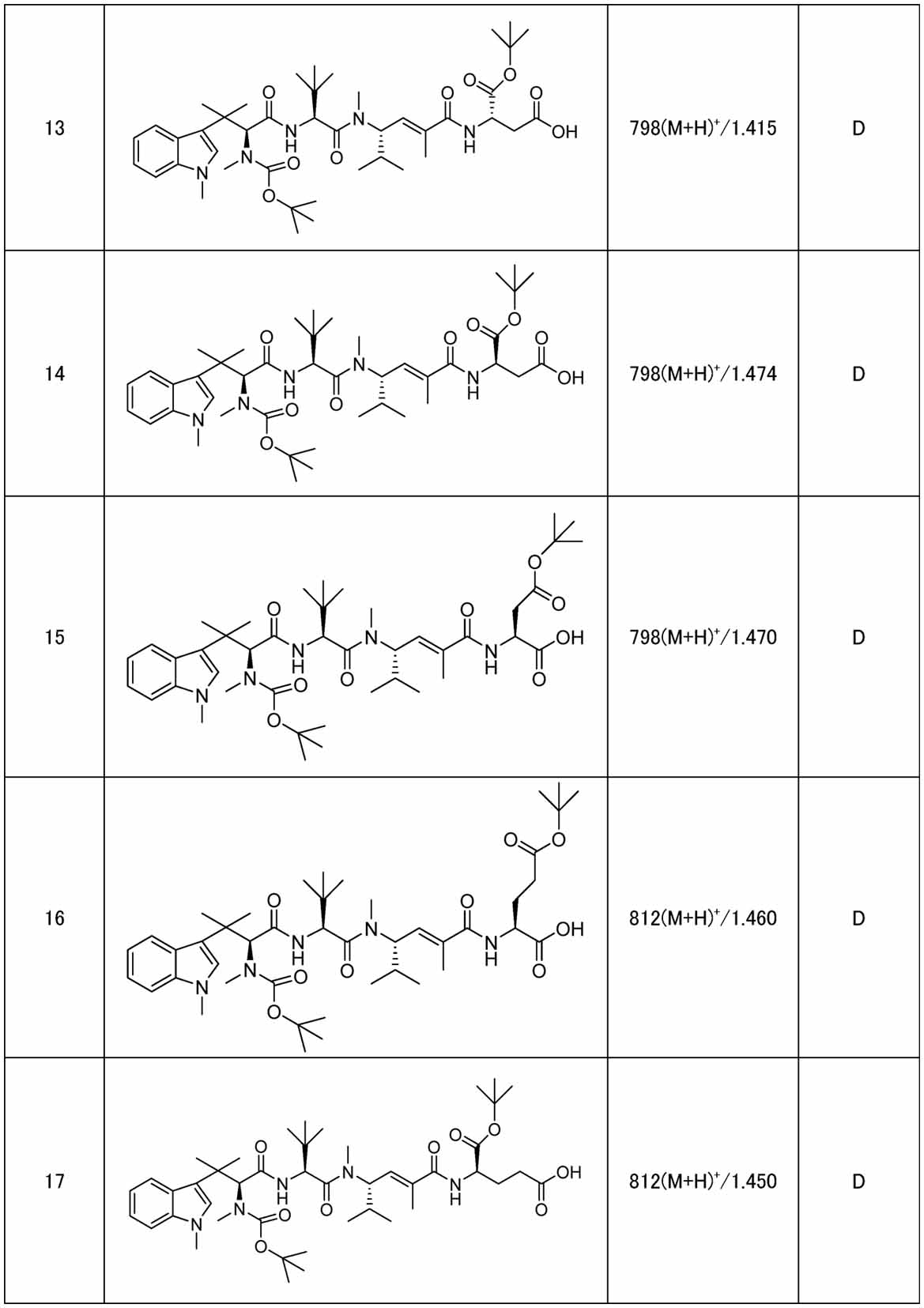

参考例20
参考例11を原料化合物として用い、参考例3の工程b)と同様に反応及び処理をし、下表に示す化合物を得た。
Reference example 20
Using Reference Example 11 as a starting compound, the reaction and treatment were carried out in the same manner as in Step b) of Reference Example 3 to obtain the compounds shown in the table below.
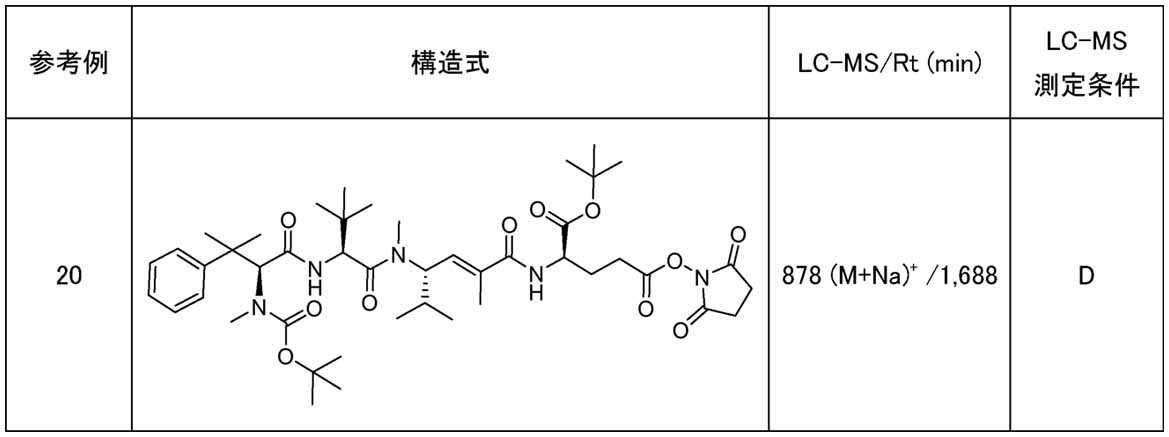
参考例21~23
参考例20と同様に反応及び処理をし、下表に示す化合物を得た。

Reaction and treatment were carried out in the same manner as in Reference Example 20 to obtain the compounds shown in the table below.
参考例25
タルトブリンを原料化合物として用い、参考例1の工程o)と同様に反応及び処理をし、下表に示す化合物を得た。
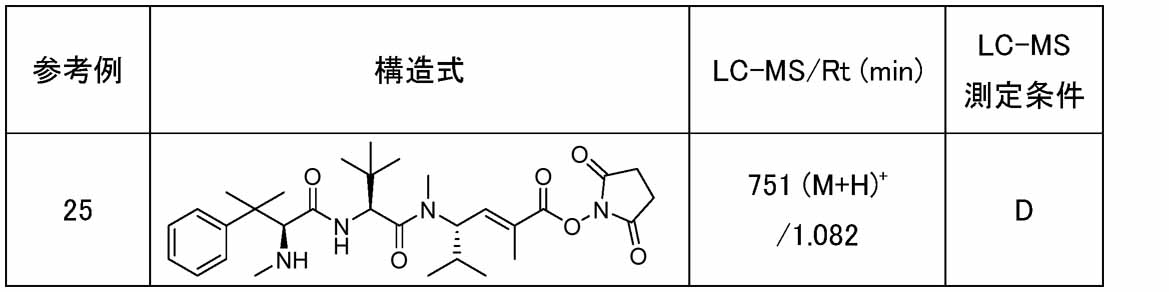
Using tartbulin as the starting compound, the reaction and treatment were carried out in the same manner as in step o) of Reference Example 1 to obtain the compounds shown in the table below.
参考例26~29
参考例25を原料化合物として用い、参考例3の工程a)と同様に反応及び処理をし、下表に示す化合物を得た。
Reference Examples 26-29
Using Reference Example 25 as the starting compound, the reaction and treatment were carried out in the same manner as in Step a) of Reference Example 3 to obtain the compounds shown in the table below.

参考例30~32
参考例26、参考例27及び参考例28を原料化合物として用い、参考例3の工程b)と同様に反応及び処理をし、下表に示す化合物を得た。
Reference Examples 30-32
Using Reference Example 26, Reference Example 27 and Reference Example 28 as starting compounds, the reaction and treatment were carried out in the same manner as in Step b) of Reference Example 3 to obtain the compounds shown in the following table.

参考例33
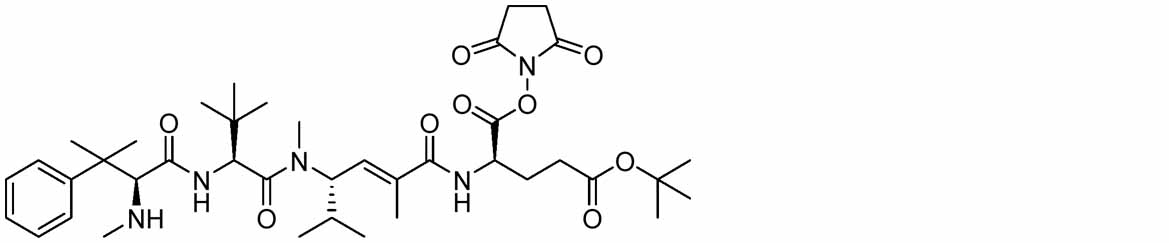
参考例28(173mg)、N-ヒドロキシスクシンイミド(30.2mg)、1-(3-ジメチルアミノプロピル)-3-エチルカルボジイミド(50.3mg)、テトラヒドロフラン(5mL)及びアセトニトリル(5mL)の混合液を25℃にて3日間攪拌した。反応終了後、溶媒を減圧留去した後、残渣をシリカゲルカラムクロマトグラフィー(溶出溶媒;ヘキサン:酢酸エチル)で精製することによりtert-ブチル(3S,6S,9S,10E,14R)-6-tert-ブチル-14-{[(2,5-ジオキソピロリジン-1-イル)オキシ]カルボニル}-8,11-ジメチル-4,7,12-トリオキソ-3-(2-フェニルプロパン-2-イル)-9-(プロパン-2-イル)-2,5,8,13-テトラアザヘプタデカ-10-エン-17-カルボン酸エステル(86.9mg)を得た。
LC-MS:756(M+H)+(0.348min,測定条件H)
Reference Example 33
LC-MS: 756 (M+H) + (0.348 min, measurement condition H)
実施例1
(3S,6S,9S,10E,14R)-6-tert-ブチル-14-{3-[(2,5-ジオキソピロリジン-1-イル)オキシ]-3-オキソプロピル}-8,11-ジメチル-4,7,12-トリオキソ-3-{2-フェニルプロパン-2-イル)-9-(プロパン-2-イル)-2,5,8,13-テトラアザペンタデカ-10-エン-15-カルボン酸

LC-MS:700(M+H)+(1.140min,測定条件D)
Example 1
(3S,6S,9S,10E,14R)-6-tert-Butyl-14-{3-[(2,5-dioxopyrrolidin-1-yl)oxy]-3-oxopropyl}-8,11- Dimethyl-4,7,12-trioxo-3-{2-phenylpropan-2-yl)-9-(propan-2-yl)-2,5,8,13-tetraazapentadec-10-ene- 15-carboxylic acid
LC-MS: 700 (M+H) + (1.140 min, measurement condition D)
実施例2~8
実施例1と同様に反応及び処理をし、下表に示す化合物を得た。
Examples 2-8
Reaction and treatment were carried out in the same manner as in Example 1 to obtain the compounds shown in the table below.

以下の実施例ADCにおいて用いたブレンツキシマブは、購入可能であるか、又は特許第4303964号明細書に従って製造することができる。 The brentuximab used in the following example ADC can be purchased or can be manufactured according to the patent No. 4303964.
実施例ADC1
ブレンツキシマブ-実施例1複合体(平均DAR:1.1)

Brentuximab-Example 1 Complex (Average DAR: 1.1)
得られたADCの平均DARは、LC-MSよって測定した。また、平均DARは、紫外可視吸収分光法(UV-Vis)、還元性又は非還元性SDS-PAGE、HPLC-HIC、SEC、RP-HPLC、LC-MS等によって、定性的又は定量的に測定することができる。これらの方法は、Antibody Drug Conjugates,Methods in Molecular Biology vol.1045,2013.pp267-284.L.Ducry,Ed.に記載される。 The average DAR of the obtained ADC was measured by LC-MS. The average DAR is qualitatively or quantitatively measured by ultraviolet-visible absorption spectroscopy (UV-Vis), reducing or non-reducing SDS-PAGE, HPLC-HIC, SEC, RP-HPLC, LC-MS, etc. can do. These methods are described in Antibody Drug Conjugates, Methods in Molecular Biology vol. 1045, 2013. pp267-284. L. Ducry, Ed. It is described in.
LC-MS解析(測定条件F)により求めた実施例ADC1の平均DARは、1.1であった。 The average DAR of Example ADC1 determined by LC-MS analysis (measurement condition F) was 1.1.
実施例ADC2
ブレンツキシマブ-実施例1複合体(平均DAR:3.5)

Brentuximab-Example 1 Complex (Average DAR: 3.5)
実施例ADC3
ブレンツキシマブ-実施例7複合体(平均DAR:1.2)

Brentuximab-Example 7 Complex (Average DAR: 1.2)
実施例ADC4~9
対応する抗体と修飾化剤(実施例の化合物)を用いて実施例ADC2と同様に反応及び処理をし、下表に示すADCを得た。
Example ADC 4-9
The corresponding antibodies and modifying agents (compounds of Examples) were used for reaction and treatment in the same manner as in Example ADC2 to obtain ADCs shown in the table below.

実施例ADC9~12
対応する抗体と修飾化剤(実施例の化合物)を用いて実施例ADC3と同様に反応及び処理をし、下表に示すADCを得た。
Example ADCs 9-12
Using the corresponding antibody and modifying agent (compound of Example), the reaction and treatment were carried out in the same manner as in Example ADC3 to obtain ADCs shown in the table below.

以下に、本発明の抗体薬物複合体の特定の実施例に係る薬理試験結果を示し、その薬理作用を説明するが、本発明はこれらの試験例に限定されるものではない。 The pharmacological test results relating to specific examples of the antibody-drug complex of the present invention will be shown below to explain the pharmacological action thereof, but the present invention is not limited to these test examples.
試験例1:細胞傷害性試験(1)
CD30抗原発現細胞株で、ヒトリンパ腫細胞株であるKarpas-299細胞(European Collection of Authenticated Cell Cultures、以下、ECACC)を、10%のウシ胎児血清(MP Biomedicals)を含むRPMI1640(GIBCO)(以下、この試験において、「培地A」という)で培養した。Karpas-299細胞を培地Aで2×10⁶cells/mLになるように調製し、96穴細胞培養用マイクロプレートに50μLずつ添加した。培地Aで濃度を16μg/mLに調製したブレンツキシマブ、実施例ADC1又は実施例ADC2を、マイクロプレートに50μLずつ添加し、37℃、5%CO2下で、4日間培養した。培養後、マイクロプレートをインキュベーターから取り出し、室温で10分間静置した。各ウェルに50μLのCellTiter-Glo Luminescent Cell Viability Assay(Promega)を添加し、撹拌した。この混合物を暗所で20分インキュベートし、マイクロプレートルミノメーターを用いて発光を計測することにより、化合物未添加処理した際に残存した細胞数に対する、ブレンツキシマブ、実施例ADC1又は実施例ADC2で処置した際に残存した細胞数の百分率を求めた。下表10にその結果を示す。
Test Example 1: Cytotoxicity test (1)
A CD30 antigen-expressing cell line, Karpas-299 cell (European Collection of Authenticated Cell Cultures, hereinafter, ECACC), which is a human lymphoma cell line, containing 10% fetal bovine serum (MP Biomedicals) in RPMI1640 (GIBCO) (hereinafter, GIBCO). In this test, it was cultured in "Medium A"). Karpas-299 cells were prepared in medium A to a concentration of 2×10 6 cells/mL, and 50 μL of each was added to a 96-well cell culture microplate. Brentuximab adjusted to a concentration of 16 μg/mL in medium A, Example ADC1 or Example ADC2 was added to the microplate in an amount of 50 μL each, and cultured at 37° C. under 5% CO 2 for 4 days. After culturing, the microplate was taken out of the incubator and allowed to stand at room temperature for 10 minutes. 50 μL of CellTiter-Glo Luminescent Cell Viability Assay (Promega) was added to each well and stirred. The mixture was incubated in the dark for 20 minutes, and the luminescence was measured using a microplate luminometer to measure the number of cells remaining when the compound was not added, with brentuximab, Example ADC1 or Example ADC2. The percentage of cells remaining after treatment was determined. The results are shown in Table 10 below.

試験例1に示す通り、実施例ADCを用いた場合は、その抗体部分であるブレンツキシマブを用いた場合と比較して、より顕著な細胞数の減少が確認された。このことから、本発明のADCは、薬剤をコンジュゲートしない抗体と比べて、DAR依存的に、より強い細胞傷害性を示すことが明らかとなった。 As shown in Test Example 1, a more remarkable decrease in the number of cells was confirmed when Example ADC was used, as compared with the case where brentuximab, which is the antibody portion thereof, was used. From this, it was revealed that the ADC of the present invention shows stronger cytotoxicity in a DAR-dependent manner as compared with the antibody that does not conjugate the drug.
試験例1の結果から、式(1)で表される実施例の化合物は、抗体リシン残基とのコンジュゲートし式(2)で表される複合体を形成することで、細胞傷害性試験において、抗体よりも強い活性を示すことが分かった。 From the results of Test Example 1, the compound of the example represented by the formula (1) was conjugated with the antibody lysine residue to form the complex represented by the formula (2), and thus the cytotoxicity test was conducted. In, it was found that the activity was stronger than that of the antibody.
試験例2:細胞傷害性試験(2)
CD30抗原発現細胞株で、ヒトリンパ腫細胞株であるKarpas-299細胞(European Collection of Authenticated Cell Cultures、以下、ECACC)を、10%のウシ胎児血清(MP Biomedicals)を含むRPMI1640(GIBCO)(以下、この試験において、「培地A」という)で培養した。Karpas-299細胞を培地Aで2×10⁶cells/mLになるように調製し、96穴細胞培養用マイクロプレートに50μLずつ添加した。培地Aで濃度を0.25μMに調製した化合物を、マイクロプレートに50μLずつ添加し、37℃、5%CO2下で、4日間培養した。培養後、マイクロプレートをインキュベーターから取り出し、室温で10分間静置した。各ウェルに50μLのCellTiter-Glo Luminescent Cell Viability Assay(Promega)を添加し、撹拌した。この混合物を暗所で20分インキュベートし、マイクロプレートルミノメーターを用いて発光を計測することにより、化合物未添加処理した際に残存した細胞数に対する、化合物で処置した際に残存した細胞数の百分率を求めた。下表11にその結果を示す。
Test Example 2: Cytotoxicity test (2)
A CD30 antigen-expressing cell line, Karpas-299 cell (European Collection of Authenticated Cell Cultures, hereinafter, ECACC), which is a human lymphoma cell line, containing 10% fetal bovine serum (MP Biomedicals) in RPMI1640 (GIBCO) (hereinafter, GIBCO). In this test, it was cultured in "Medium A"). Karpas-299 cells were prepared in medium A to a concentration of 2×10 6 cells/mL, and 50 μL of each was added to a 96-well cell culture microplate. The compound prepared to have a concentration of 0.25 μM in the medium A was added to the microplate in an amount of 50 μL each, and cultured at 37° C. under 5% CO 2 for 4 days. After culturing, the microplate was taken out of the incubator and allowed to stand at room temperature for 10 minutes. 50 μL of CellTiter-Glo Luminescent Cell Viability Assay (Promega) was added to each well and stirred. This mixture was incubated in the dark for 20 minutes, and the luminescence was measured using a microplate luminometer to determine the percentage of the number of cells remaining when treated with the compound, relative to the number of cells remaining when the compound was not added. I asked. The results are shown in Table 11 below.

上表11の比較例化合物とは、国際公開第2014/057436号に開示されている化合物から合成される抗体薬物複合体が、標的細胞内において非特許文献7に記載されているメカニズムの代謝を受けることによって生成される、下記の化合物を表す。

上表11の実施例ADC1代謝物とは、実施例ADC1が、標的細胞内において非特許文献8に記載されているメカニズムの代謝を受けることによって生成される、下記の化合物を表す。

試験例2に示す通り、比較例化合物は強い細胞傷害性を示したのに対し、実施例ADC1代謝物は、細胞傷害活性が弱いことが示された。 As shown in Test Example 2, the comparative compound showed strong cytotoxicity, whereas the ADC1 metabolite of Example had weak cytotoxic activity.
試験例3:ブタチューブリンを用いた微小管重合阻害活性評価
Cytoskeleton社より購入したチューブリン重合阻害アッセイキット(カタログ番号:BK006P)を用い、キットに付属するプロトコールに従って、化合物の重合阻害活性を評価した。96穴マイクロプレートに、評価対象の化合物の80mM PIPES pH6.9、2mM MgCl、0.5mM EGTA、及び5%DMSO緩衝液を、10μLずつ添加し、これらに3mg/mLのブタチューブリン 80mM PIPES pH6.9、2mM MgCl、0.5mM EGTA、1mM GTP、及び10.2%glycerol溶液を100μLずつ添加した。チューブリンが重合する様子を経時的に調べるため、340nmの吸光度を、マイクロプレートリーダーを用いて、37℃にて測定した。チューブリンの重合が進むにつれて、340nmの吸光度は上昇する。
Test Example 3: Evaluation of Microtubule Polymerization Inhibitory Activity Using Pig Tubulin Using a tubulin polymerization inhibition assay kit (catalog number: BK006P) purchased from Cytoskeleton, the compound polymerization inhibition activity was evaluated according to the protocol attached to the kit. did. 10 μL of 80 mM PIPES pH 6.9, 2 mM MgCl, 0.5 mM EGTA, and 5% DMSO buffer of the compound to be evaluated were added to a 96-well microplate, and 3 mg/mL of porcine tubulin 80 mM PIPES pH 6 was added thereto. .9, 2 mM MgCl, 0.5 mM EGTA, 1 mM GTP, and 10.2% glycerol solution (100 μL each) were added. The absorbance at 340 nm was measured at 37° C. using a microplate reader in order to investigate the polymerization of tubulin with time. As the polymerization of tubulin proceeds, the absorbance at 340 nm increases.
チューブリン重合阻害活性は、アッセイ開始60分後における、重合したチューブリンの割合によって評価した。具体的には、化合物を加えていないウェルにおける重合したチューブリンの吸光度で、化合物を加えたウェルにおける重合したチューブリンの吸光度を除し、その値を100倍することで、微小管重合率(%)を算出した。下表12にその結果を示す。 The tubulin polymerization inhibitory activity was evaluated by the ratio of polymerized tubulin 60 minutes after the start of the assay. Specifically, the absorbance of the polymerized tubulin in the well to which the compound was added was divided by the absorbance of the polymerized tubulin in the well to which the compound was not added, and the value was multiplied by 100 to obtain the microtubule polymerization rate ( %) was calculated. The results are shown in Table 12 below.

上記の結果は、9.1μMで実施した時の結果である。 The above results are the results when the test was performed at 9.1 μM.
微小管重合率が低い値であるほど、化合物が微小管の重合を強く阻害していることを示す。 A lower value for the microtubule polymerization rate indicates that the compound strongly inhibits microtubule polymerization.
試験例3の結果から、比較例化合物と実施例ADC1代謝物は同等の微小管重合阻害活性を示す。 From the results of Test Example 3, the compound of Comparative Example and the metabolite of Example ADC1 show the same microtubule polymerization inhibitory activity.
試験例1~3の結果から、本発明のADCは、抗原発現細胞内で代謝物を生成し、細胞傷害性を示す。そして、本発明のADCより生成された代謝物は、細胞死等により細胞外へ放出され全身暴露が生じても、細胞傷害性が弱いので、副作用が低いと考えられる。 From the results of Test Examples 1 to 3, the ADC of the present invention produces a metabolite in antigen-expressing cells and exhibits cytotoxicity. The metabolite produced by the ADC of the present invention is considered to have low side effects because it has weak cytotoxicity even if it is released extracellularly due to cell death or the like and systemic exposure occurs.
試験例4:細胞傷害性試験(3)
CD30抗原発現細胞株で、ヒトリンパ腫細胞株であるKarpas-299細胞(European Collection of Authenticated Cell Cultures、以下、ECACC)を、10%のウシ胎児血清(MP Biomedicals)を含むRPMI1640(GIBCO)(以下、この試験において、「培地A」という)で培養した。Karpas-299細胞を培地Aで2×10⁶cells/mLになるように調製し、96穴細胞培養用マイクロプレートに50μLずつ添加した。培地Aで濃度を16μg/mLに調製した実施例ADCを、マイクロプレートに50μLずつ添加し、37℃、5%CO2下で、4日間培養した。培養後、マイクロプレートをインキュベーターから取り出し、室温で10分間静置した。各ウェルに50μLのCellTiter-Glo Luminescent Cell Viability Assay(Promega)を添加し、撹拌した。この混合物を暗所で20分インキュベートし、マイクロプレートルミノメーターを用いて発光を計測することにより、化合物未添加処理した際に残存した細胞数に対する、実施例ADCで処置した際に残存した細胞数の百分率を求めた。下表13にその結果を示す。
Test Example 4: Cytotoxicity test (3)
A CD30 antigen-expressing cell line, Karpas-299 cell (European Collection of Authenticated Cell Cultures, hereinafter, ECACC), which is a human lymphoma cell line, containing 10% fetal bovine serum (MP Biomedicals) in RPMI1640 (GIBCO) (hereinafter, GIBCO). In this test, it was cultured in "Medium A"). Karpas-299 cells were prepared in medium A to a concentration of 2×10 6 cells/mL, and 50 μL of each was added to a 96-well cell culture microplate. 50 μL of each of Example ADCs whose concentration was adjusted to 16 μg/mL in the medium A was added to the microplate and cultured at 37° C. under 5% CO 2 for 4 days. After culturing, the microplate was taken out of the incubator and allowed to stand at room temperature for 10 minutes. 50 μL of CellTiter-Glo Luminescent Cell Viability Assay (Promega) was added to each well and stirred. This mixture was incubated in the dark for 20 minutes, and the luminescence was measured using a microplate luminometer, whereby the number of cells remaining when treated with Example ADC was compared with the number of cells remaining when the compound was not added. The percentage of was calculated. The results are shown in Table 13 below.

試験例5:ADCの細胞障害性試験
試験例1又は試験例4に記載の方法に準じ、ADCの活性を評価し、その結果を下表14に示した。

以上で説明したように、本発明の抗体薬物複合体は、抗原発現細胞に対し選択的に細胞傷害活性を示す、安全性に優れた抗がん剤となることが期待される。 As described above, the antibody-drug complex of the present invention is expected to be an anticancer agent with excellent safety that selectively exhibits cytotoxic activity on antigen-expressing cells.
Claims (17)

R1は、水素原子又はスルホニル基を表し、
Zは、式(Z-1)、式(Z-2)又は式(Z-3):

Wは、式(W-1):

Qは、式(Q-1)又は式(Q-2):

で表される基を表し、
R2は、-(CH2)u-COOHを表し、
uは1又は2を表す)
で表される基を表す]
で表される、化合物又はその塩。 Formula (1):
R 1 represents a hydrogen atom or a sulfonyl group,
Z is the formula (Z-1), the formula (Z-2) or the formula (Z-3):
W is the formula (W-1):
Q is the formula (Q-1) or the formula (Q-2):
Represents a group represented by
R 2 represents —(CH 2 ) u— COOH,
u represents 1 or 2)
Represents a group represented by
A compound or a salt thereof represented by:


mAbは、抗体を表し、
qは、1~30の整数を表し、
Zは、式(Z-1)、式(Z-2)又は式(Z-3):

Wは、式(W-1):

Qは、式(Q-1)又は式(Q-2):

で表される基を表し、
R2は、-(CH2)u-COOHを表し、
uは1又は2を表す)
で表される基を表す]
で表される、抗体薬物複合体又はその製薬学的に許容される塩。 Formula (2):
mAb represents an antibody,
q represents an integer of 1 to 30,
Z is the formula (Z-1), the formula (Z-2) or the formula (Z-3):
W is the formula (W-1):
Q is the formula (Q-1) or the formula (Q-2):
Represents a group represented by
R 2 represents —(CH 2 ) u— COOH,
u represents 1 or 2)
Represents a group represented by
An antibody-drug complex represented by or a pharmaceutically acceptable salt thereof.
抗がん性アルキル化剤、抗がん性代謝拮抗剤、抗がん性抗生物質、抗がん性白金配位化合物、抗がん性カンプトテシン誘導体、抗がん性チロシンキナーゼ阻害剤、抗がん性セリンスレオニンキナーゼ阻害剤、抗がん性リン脂質キナーゼ阻害剤、抗がん性モノクローナル抗体、インターフェロン、生物学的応答調節剤、ホルモン剤、免疫チェックポイント阻害剤、エピジェネティクス関連分子阻害剤、及びタンパク質翻訳後修飾阻害剤からなる群より選択される1種以上の抗がん性化合物又はその製薬学的に許容される塩と、を含む医薬組成物。 An antibody-drug conjugate or a pharmaceutically acceptable salt thereof according to any one of claims 4 to 8,
Anti-cancer alkylating agent, anti-cancer antimetabolite, anti-cancer antibiotic, anti-cancer platinum coordination compound, anti-cancer camptothecin derivative, anti-cancer tyrosine kinase inhibitor, anti- Cancer Serine Threonine Kinase Inhibitor, Anticancer Phospholipid Kinase Inhibitor, Anticancer Monoclonal Antibody, Interferon, Biological Response Modifier, Hormone, Immune Checkpoint Inhibitor, Epigenetics Related Molecular Inhibitor , And one or more anticancer compounds selected from the group consisting of protein post-translational modification inhibitors or a pharmaceutically acceptable salt thereof.
Priority Applications (2)
| Application Number | Priority Date | Filing Date | Title |
|---|---|---|---|
| US17/429,427 US12178879B2 (en) | 2019-02-13 | 2020-02-12 | Hemiasterlin derivative and antibody-drug conjugate thereof |
| JP2020572264A JP7479302B2 (en) | 2019-02-13 | 2020-02-12 | Hemiasterlin derivatives and their antibody-drug conjugates |
Applications Claiming Priority (2)
| Application Number | Priority Date | Filing Date | Title |
|---|---|---|---|
| JP2019023961 | 2019-02-13 | ||
| JP2019-023961 | 2019-02-13 |
Publications (1)
| Publication Number | Publication Date |
|---|---|
| WO2020166592A1 true WO2020166592A1 (en) | 2020-08-20 |
Family
ID=72043950
Family Applications (1)
| Application Number | Title | Priority Date | Filing Date |
|---|---|---|---|
| PCT/JP2020/005291 Ceased WO2020166592A1 (en) | 2019-02-13 | 2020-02-12 | Hemiasterlin derivative and antibody-drug conjugate thereof |
Country Status (3)
| Country | Link |
|---|---|
| US (1) | US12178879B2 (en) |
| JP (1) | JP7479302B2 (en) |
| WO (1) | WO2020166592A1 (en) |
Families Citing this family (2)
| Publication number | Priority date | Publication date | Assignee | Title |
|---|---|---|---|---|
| BR112021022682A2 (en) | 2019-05-14 | 2022-02-22 | Provention Bio Inc | Methods and compositions for preventing type 1 diabetes |
| CA3182445A1 (en) | 2020-06-11 | 2021-12-16 | Francisco Leon | Methods and compositions for preventing type 1 diabetes |
Citations (7)
| Publication number | Priority date | Publication date | Assignee | Title |
|---|---|---|---|---|
| JP2007537136A (en) * | 2003-09-22 | 2007-12-20 | エーザイ・アール・アンド・ディー・マネジメント株式会社 | Hemiasterline derivatives and their use |
| JP2011500725A (en) * | 2007-10-19 | 2011-01-06 | シアトル ジェネティクス,インコーポレーテッド | CD19 binding substance and use thereof |
| JP2012522513A (en) * | 2009-04-01 | 2012-09-27 | ジェネンテック, インコーポレイテッド | Anti-FcRH5 antibodies and immunoconjugates and methods of use |
| WO2014057436A2 (en) * | 2012-10-10 | 2014-04-17 | Adamed Sp. Z O.O. | Anticancer conjugate |
| JP2016516063A (en) * | 2013-03-15 | 2016-06-02 | ザ センター フォー ドラッグ リサーチ アンド ディベロップメント | Cytotoxic and antimitotic compounds and methods of use |
| JP2017508741A (en) * | 2014-02-28 | 2017-03-30 | ノヴォ ノルディスク アー/エス | A22K, desB27, B29R, desB30 human insulin analogues acylated at the epsilon position of ricin 22 |
| WO2019031614A1 (en) * | 2017-08-10 | 2019-02-14 | 大日本住友製薬株式会社 | Antibody-drug conjugates including hemiasterlin derivative |
Family Cites Families (15)
| Publication number | Priority date | Publication date | Assignee | Title |
|---|---|---|---|---|
| GB9508195D0 (en) | 1995-04-20 | 1995-06-07 | Univ British Columbia | Novel biologically active compounds and compositions,their use and derivation |
| CA2225325A1 (en) | 1997-12-19 | 1999-06-19 | The University Of British Columbia | Hemiasterlin analogs |
| US20030100088A1 (en) | 2001-07-13 | 2003-05-29 | Sigler Gerald F. | Protease inhibitor conjugates and antibodies useful in immunoassay |
| NZ555951A (en) | 2002-03-22 | 2009-01-31 | Eisai Co Ltd | Hemiasterlin derivatives and uses thereof |
| US20040121965A1 (en) | 2002-09-20 | 2004-06-24 | Wyeth Holdings Corporation | Method of treating resistant tumors |
| CN104662000B (en) | 2012-05-15 | 2018-08-17 | 索伦托医疗有限公司 | Drug conjugates and its coupling method and purposes |
| US9814784B2 (en) | 2013-01-03 | 2017-11-14 | Celltrion, Inc. | Antibody-linker-drug conjugate, preparation method therefor, and anticancer drug composition containing same |
| BR112016015105A8 (en) | 2013-12-27 | 2018-04-24 | Var2 Pharmaceuticals Aps | var2csa-drug conjugates |
| EP3086815B1 (en) | 2013-12-27 | 2022-02-09 | Zymeworks Inc. | Sulfonamide-containing linkage systems for drug conjugates |
| GB201402009D0 (en) | 2014-02-06 | 2014-03-26 | Oncomatryx Biopharma S L | Antibody-drug conjugates and immunotoxins |
| SG10201903910RA (en) | 2014-11-07 | 2019-05-30 | Univ Osaka | Differentiation-induced cell population from which undifferentiated cells have been removed, use of same, and method for producing same |
| WO2016123582A1 (en) | 2015-01-30 | 2016-08-04 | Sutro Biopharma, Inc. | Hemiasterlin derivatives for conjugation and therapy |
| CN116726190A (en) | 2015-06-20 | 2023-09-12 | 杭州多禧生物科技有限公司 | Aureostatin analogs and conjugate conjugates thereof with cell-binding molecules |
| EP4321523A3 (en) | 2017-08-10 | 2024-04-24 | Sumitomo Pharma Co., Ltd. | Hemiasterlin derivatives and antibody-drug conjugates including same |
| US20220202948A1 (en) * | 2019-02-13 | 2022-06-30 | Sumitomo Dainippon Pharma Co., Ltd. | Agent for Eliminating Pluripotent Stem Cells |
-
2020
- 2020-02-12 WO PCT/JP2020/005291 patent/WO2020166592A1/en not_active Ceased
- 2020-02-12 JP JP2020572264A patent/JP7479302B2/en active Active
- 2020-02-12 US US17/429,427 patent/US12178879B2/en active Active
Patent Citations (7)
| Publication number | Priority date | Publication date | Assignee | Title |
|---|---|---|---|---|
| JP2007537136A (en) * | 2003-09-22 | 2007-12-20 | エーザイ・アール・アンド・ディー・マネジメント株式会社 | Hemiasterline derivatives and their use |
| JP2011500725A (en) * | 2007-10-19 | 2011-01-06 | シアトル ジェネティクス,インコーポレーテッド | CD19 binding substance and use thereof |
| JP2012522513A (en) * | 2009-04-01 | 2012-09-27 | ジェネンテック, インコーポレイテッド | Anti-FcRH5 antibodies and immunoconjugates and methods of use |
| WO2014057436A2 (en) * | 2012-10-10 | 2014-04-17 | Adamed Sp. Z O.O. | Anticancer conjugate |
| JP2016516063A (en) * | 2013-03-15 | 2016-06-02 | ザ センター フォー ドラッグ リサーチ アンド ディベロップメント | Cytotoxic and antimitotic compounds and methods of use |
| JP2017508741A (en) * | 2014-02-28 | 2017-03-30 | ノヴォ ノルディスク アー/エス | A22K, desB27, B29R, desB30 human insulin analogues acylated at the epsilon position of ricin 22 |
| WO2019031614A1 (en) * | 2017-08-10 | 2019-02-14 | 大日本住友製薬株式会社 | Antibody-drug conjugates including hemiasterlin derivative |
Non-Patent Citations (1)
| Title |
|---|
| ZASK, A. ET AL.: "Synthesis and Biological Activity of Analogues of the Antimicrotubule Agent N, beta, beta-Trimethyl -L-phenylalanyl-N1-[(1S, 2E)-3- carboxy-1-isopropylbut-2-enyl]-N1, 3-dimethyl-L- valinamide (HTI-286", JOURNAL OF MEDICINAL CHEMISTRY, vol. 47, no. 19, 2004, pages 4774 - 4786; 4780, XP002310106 * |
Also Published As
| Publication number | Publication date |
|---|---|
| JP7479302B2 (en) | 2024-05-08 |
| JPWO2020166592A1 (en) | 2021-12-09 |
| US20220125941A1 (en) | 2022-04-28 |
| US12178879B2 (en) | 2024-12-31 |
Similar Documents
| Publication | Publication Date | Title |
|---|---|---|
| JP7235929B1 (en) | ANTIBODY-DRUG CONJUGATE CONTAINING A HEMIASTARIN DERIVATIVE | |
| JP7605809B2 (en) | Hemiasterlin derivatives and their antibody-drug conjugates | |
| WO2020166592A1 (en) | Hemiasterlin derivative and antibody-drug conjugate thereof | |
| JP7560255B2 (en) | Medicine containing antibody-drug conjugate containing hemiasterlin derivative | |
| JP2020132639A (en) | Hemiasterlin derivative and medicine containing these antibody drug conjugates | |
| JP7432531B2 (en) | Hemiasterlin derivatives with cysteine residues | |
| JP2020132531A (en) | Compounds inhibiting microtubule polymerization and antibody drug conjugates thereof | |
| HK40104461A (en) | Hemiasterlin derivatives and antibody-drug conjugates including same | |
| HK40065482A (en) | Hemiasterlin derivative having cysteine residue | |
| HK40028206A (en) | Hemiasterlin derivatives and antibody-drug conjugates including same | |
| HK40028211B (en) | Antibody-drug conjugates including hemiasterlin derivative | |
| HK40028211A (en) | Antibody-drug conjugates including hemiasterlin derivative |
Legal Events
| Date | Code | Title | Description |
|---|---|---|---|
| 121 | Ep: the epo has been informed by wipo that ep was designated in this application |
Ref document number: 20755229 Country of ref document: EP Kind code of ref document: A1 |
|
| ENP | Entry into the national phase |
Ref document number: 2020572264 Country of ref document: JP Kind code of ref document: A |
|
| NENP | Non-entry into the national phase |
Ref country code: DE |
|
| 122 | Ep: pct application non-entry in european phase |
Ref document number: 20755229 Country of ref document: EP Kind code of ref document: A1 |