WO2020153758A1 - Composition, organic optoelectronic diode, and display device - Google Patents
Composition, organic optoelectronic diode, and display device Download PDFInfo
- Publication number
- WO2020153758A1 WO2020153758A1 PCT/KR2020/001112 KR2020001112W WO2020153758A1 WO 2020153758 A1 WO2020153758 A1 WO 2020153758A1 KR 2020001112 W KR2020001112 W KR 2020001112W WO 2020153758 A1 WO2020153758 A1 WO 2020153758A1
- Authority
- WO
- WIPO (PCT)
- Prior art keywords
- group
- substituted
- unsubstituted
- compound
- formula
- Prior art date
- Legal status (The legal status is an assumption and is not a legal conclusion. Google has not performed a legal analysis and makes no representation as to the accuracy of the status listed.)
- Ceased
Links
- 0 CC(*=C)NCCC1=CC1 Chemical compound CC(*=C)NCCC1=CC1 0.000 description 39
- PPCZHJOQYQANNY-UHFFFAOYSA-N C(C1)C(C2NC(C(CC=C3)C=C3c3nc([s]c4c5cccc4)c5c4c3cccc4)=NC(C3C=CC=CC3)=C2)C=CC1C(C=CC12)=CC1C=CC1=C2C=CCC1 Chemical compound C(C1)C(C2NC(C(CC=C3)C=C3c3nc([s]c4c5cccc4)c5c4c3cccc4)=NC(C3C=CC=CC3)=C2)C=CC1C(C=CC12)=CC1C=CC1=C2C=CCC1 PPCZHJOQYQANNY-UHFFFAOYSA-N 0.000 description 2
- PYHRMZXINCTYOJ-UHFFFAOYSA-N C(C1)C=CC2=C1C1C=CC=CC1N2C(CC1)=CC=C1c1nc(C(C2)=CC=CC2c(c2c3cccc2)nc2c3[s]c3ccccc23)cc(C(C=CC2)=CC2C2C=CC=CC2)n1 Chemical compound C(C1)C=CC2=C1C1C=CC=CC1N2C(CC1)=CC=C1c1nc(C(C2)=CC=CC2c(c2c3cccc2)nc2c3[s]c3ccccc23)cc(C(C=CC2)=CC2C2C=CC=CC2)n1 PYHRMZXINCTYOJ-UHFFFAOYSA-N 0.000 description 2
- CUCBSORNZBPEPR-UHFFFAOYSA-N C(C1)C=CC2=C1SC1C(C(C3)=NC(C4=CC(C(C5)=CC=CC5C(CC56)=C(C=CC=C7)C7=C5SC5=C6C=CCC5)=CCC4)=CC3c3ccccc3)=CC=CC21 Chemical compound C(C1)C=CC2=C1SC1C(C(C3)=NC(C4=CC(C(C5)=CC=CC5C(CC56)=C(C=CC=C7)C7=C5SC5=C6C=CCC5)=CCC4)=CC3c3ccccc3)=CC=CC21 CUCBSORNZBPEPR-UHFFFAOYSA-N 0.000 description 2
- QVZSCANKWNISIP-UHFFFAOYSA-N C(CC1)Cc2c1[s]c1c(CCC=C3)c3c(-c(cc3)ccc3C(C3)=CC(C4=CC5C=CCCC5C=C4)=NC3C3C=CC([n]4c5ccccc5c5c4cccc5)=CC3)nc21 Chemical compound C(CC1)Cc2c1[s]c1c(CCC=C3)c3c(-c(cc3)ccc3C(C3)=CC(C4=CC5C=CCCC5C=C4)=NC3C3C=CC([n]4c5ccccc5c5c4cccc5)=CC3)nc21 QVZSCANKWNISIP-UHFFFAOYSA-N 0.000 description 2
- UBAJHPDWHMAVNG-UHFFFAOYSA-N C(CC=C1)C2C1=C(c(c1c3cccc1)ccc3-c1nc(-c3cccc(-[n]4c5ccccc5c5c4cccc5)c3)nc(C3C=CC=CC3)c1)N=C1C(CCC=C3)=C3SC21 Chemical compound C(CC=C1)C2C1=C(c(c1c3cccc1)ccc3-c1nc(-c3cccc(-[n]4c5ccccc5c5c4cccc5)c3)nc(C3C=CC=CC3)c1)N=C1C(CCC=C3)=C3SC21 UBAJHPDWHMAVNG-UHFFFAOYSA-N 0.000 description 2
- AZIHACRKVBQUFS-PAWREYPASA-N CC(c(cccc1)c1S1)/C1=C(/C=CC=C1)\C1=C(\C(C=C1)=CCC1c1nc(C(CC=C2)c3c2c2ccccc2[s]3)cc(C2=CCCC=C2)n1)/N Chemical compound CC(c(cccc1)c1S1)/C1=C(/C=CC=C1)\C1=C(\C(C=C1)=CCC1c1nc(C(CC=C2)c3c2c2ccccc2[s]3)cc(C2=CCCC=C2)n1)/N AZIHACRKVBQUFS-PAWREYPASA-N 0.000 description 2
- UBOIRIYWMNHKMR-NGRCSVGNSA-N C[C@@]12NC(C(CC3)=CC=C3C(C3)=NC(C4=CCCC=C4)=NC3C3C=CC([n]4c(C=CCC5)c5c5c4cccc5)=CC3)=C(C=CC=C3)C3=C1SC1C=CCCC21 Chemical compound C[C@@]12NC(C(CC3)=CC=C3C(C3)=NC(C4=CCCC=C4)=NC3C3C=CC([n]4c(C=CCC5)c5c5c4cccc5)=CC3)=C(C=CC=C3)C3=C1SC1C=CCCC21 UBOIRIYWMNHKMR-NGRCSVGNSA-N 0.000 description 2
- PQPVMJUQWNEXMO-HILUCNCPSA-N C[C@@]12NC(C(CC3)=CC=C3C(C3)=NC(c4ccccc4)=NC3c3cc(-c4c5[s]c6ccccc6c5ccc4)ccc3)=C(C=CC=C3)C3=C1Sc1c2cccc1 Chemical compound C[C@@]12NC(C(CC3)=CC=C3C(C3)=NC(c4ccccc4)=NC3c3cc(-c4c5[s]c6ccccc6c5ccc4)ccc3)=C(C=CC=C3)C3=C1Sc1c2cccc1 PQPVMJUQWNEXMO-HILUCNCPSA-N 0.000 description 2
- ORPUVSQMMPTTKU-CTYAKMLPSA-N N/C(/C(C=CC1)=CC1[n]1c2ccccc2c2c1CCC=C2)=N\C(\C1C=CC(C2N=C(C(CCC=C3)=C3O3)C3=C3C=CCCC23)=CC1)=C/[IH]C1C=CC=CC1 Chemical compound N/C(/C(C=CC1)=CC1[n]1c2ccccc2c2c1CCC=C2)=N\C(\C1C=CC(C2N=C(C(CCC=C3)=C3O3)C3=C3C=CCCC23)=CC1)=C/[IH]C1C=CC=CC1 ORPUVSQMMPTTKU-CTYAKMLPSA-N 0.000 description 2
- RTKSHBAIBUSMPF-CTYAKMLPSA-N N/C(/C1=CCCC=C1)=C\C(C1C=CC([n]2c(C=CCC3)c3c3ccccc23)=CC1)N[IH]C(CC1)=CC=C1C1N=C(C(C=CCC2)=C2S2)C2=C2C=CCCC12 Chemical compound N/C(/C1=CCCC=C1)=C\C(C1C=CC([n]2c(C=CCC3)c3c3ccccc23)=CC1)N[IH]C(CC1)=CC=C1C1N=C(C(C=CCC2)=C2S2)C2=C2C=CCCC12 RTKSHBAIBUSMPF-CTYAKMLPSA-N 0.000 description 2
- FXTUJOZBIZIZAU-UHFFFAOYSA-N C(C=C1)c(c2c3cccc2)c1[n]3-c1cccc(-c2nc(-c3ccccc3)nc(-c(cc3)cc4c3[s]c3c(cccc5)c5nc(-c5ccccc5)c43)n2)c1 Chemical compound C(C=C1)c(c2c3cccc2)c1[n]3-c1cccc(-c2nc(-c3ccccc3)nc(-c(cc3)cc4c3[s]c3c(cccc5)c5nc(-c5ccccc5)c43)n2)c1 FXTUJOZBIZIZAU-UHFFFAOYSA-N 0.000 description 1
- GDWAFYOKWGACPC-UHFFFAOYSA-N C1=CC=CC2=C(c(cc(cc3)-c4nc(-c(cc5)ccc5-[n]5c6ccccc6c6c5cccc6)cc(-c5ccccc5)n4)c3S3)C3=C(c3ccccc3)NC12 Chemical compound C1=CC=CC2=C(c(cc(cc3)-c4nc(-c(cc5)ccc5-[n]5c6ccccc6c6c5cccc6)cc(-c5ccccc5)n4)c3S3)C3=C(c3ccccc3)NC12 GDWAFYOKWGACPC-UHFFFAOYSA-N 0.000 description 1
- OUSSMALNAKPNPB-UHFFFAOYSA-N C1=CC=CC2=C(c(cc(cc3)-c4nc(-c5cc(-[n]6c7ccccc7c7c6cccc7)ccc5)nc(-c5ccccc5)c4)c3S3)C3=C(c3ccccc3)NC12 Chemical compound C1=CC=CC2=C(c(cc(cc3)-c4nc(-c5cc(-[n]6c7ccccc7c7c6cccc7)ccc5)nc(-c5ccccc5)c4)c3S3)C3=C(c3ccccc3)NC12 OUSSMALNAKPNPB-UHFFFAOYSA-N 0.000 description 1
- HTJRDVSNEFQOPZ-UHFFFAOYSA-N C1C2NC(c(cc3)ccc3-c3nc(-c4cccc(-[n]5c(cccc6)c6c6c5cccc6)c4)nc(-c4cc5ccccc5cc4)c3)=C3SC(C=CCC4)=C4C3=C2C=CC1 Chemical compound C1C2NC(c(cc3)ccc3-c3nc(-c4cccc(-[n]5c(cccc6)c6c6c5cccc6)c4)nc(-c4cc5ccccc5cc4)c3)=C3SC(C=CCC4)=C4C3=C2C=CC1 HTJRDVSNEFQOPZ-UHFFFAOYSA-N 0.000 description 1
- RWPUUYAPNFVINO-UHFFFAOYSA-N C1c(c(-c2nc(-c3ccccc3)cc(-c(cc3)ccc3-c3cccc(-c4nc5ccccc5c-5c4Cc4c-5cccc4)c3)n2)ccc2)c2-c2ccccc12 Chemical compound C1c(c(-c2nc(-c3ccccc3)cc(-c(cc3)ccc3-c3cccc(-c4nc5ccccc5c-5c4Cc4c-5cccc4)c3)n2)ccc2)c2-c2ccccc12 RWPUUYAPNFVINO-UHFFFAOYSA-N 0.000 description 1
- MKFYGVZRMOLVTO-UHFFFAOYSA-N C=C(c1c2[s]c(cccc3)c3c2ccc1)/N=C(/c1ccccc1)\N=C(\c(cc12)ccc1[s]c1c2c(-c2cccc3c2cccc3)nc2ccccc12)/N Chemical compound C=C(c1c2[s]c(cccc3)c3c2ccc1)/N=C(/c1ccccc1)\N=C(\c(cc12)ccc1[s]c1c2c(-c2cccc3c2cccc3)nc2ccccc12)/N MKFYGVZRMOLVTO-UHFFFAOYSA-N 0.000 description 1
- PZCVIUBUEXTWKI-UHFFFAOYSA-N C=C1C(c(cc2)ccc2-c2cc(-c3c4[o]c(cccc5)c5c4ccc3)cc(-c3ccccc3)n2)=C(C=CC=C2)C2=C2Oc3ccccc3C12 Chemical compound C=C1C(c(cc2)ccc2-c2cc(-c3c4[o]c(cccc5)c5c4ccc3)cc(-c3ccccc3)n2)=C(C=CC=C2)C2=C2Oc3ccccc3C12 PZCVIUBUEXTWKI-UHFFFAOYSA-N 0.000 description 1
- LWNJPUAJTVCUTC-UHFFFAOYSA-N CC1(C)c(cc(cc2)-c3nc(-c4ccccc4)nc(-c(cc4)cc5c4SC4=C(c6cc7ccccc7cc6)NC(C=CC=C6)C6=C54)n3)c2-c2ccccc12 Chemical compound CC1(C)c(cc(cc2)-c3nc(-c4ccccc4)nc(-c(cc4)cc5c4SC4=C(c6cc7ccccc7cc6)NC(C=CC=C6)C6=C54)n3)c2-c2ccccc12 LWNJPUAJTVCUTC-UHFFFAOYSA-N 0.000 description 1
- HBLNEDFHZSSXTF-UHFFFAOYSA-N CC1(C)c(cc(cc2)-c3nc(-c4ccccc4)nc(-c(cc4)cc5c4SC4=C(c6ccccc6)NC(C=CC=C6)C6=C54)n3)c2-c2ccccc12 Chemical compound CC1(C)c(cc(cc2)-c3nc(-c4ccccc4)nc(-c(cc4)cc5c4SC4=C(c6ccccc6)NC(C=CC=C6)C6=C54)n3)c2-c2ccccc12 HBLNEDFHZSSXTF-UHFFFAOYSA-N 0.000 description 1
- SFUOZOSWGFRIEJ-UHFFFAOYSA-N CC1(C)c(cccc2)c2C(C=C2)=C1CC2c1nc(C(C=CCC2)=C2c2ccccc2)cc(-c2cccc(-c3c(c(C=CCC4)c4[o]4)c4c(cccc4)c4n3)c2)n1 Chemical compound CC1(C)c(cccc2)c2C(C=C2)=C1CC2c1nc(C(C=CCC2)=C2c2ccccc2)cc(-c2cccc(-c3c(c(C=CCC4)c4[o]4)c4c(cccc4)c4n3)c2)n1 SFUOZOSWGFRIEJ-UHFFFAOYSA-N 0.000 description 1
- GJSVZOJETDKVHO-UHFFFAOYSA-N CC1(C)c2cc(C(C3)C=C(C4=CCC=C4)N=C3c(cc3)ccc3-c3c(c4ccccc4[o]4)c4c(C=CCC4)c4n3)ccc2-c2c1cccc2 Chemical compound CC1(C)c2cc(C(C3)C=C(C4=CCC=C4)N=C3c(cc3)ccc3-c3c(c4ccccc4[o]4)c4c(C=CCC4)c4n3)ccc2-c2c1cccc2 GJSVZOJETDKVHO-UHFFFAOYSA-N 0.000 description 1
- GSBZFZIYIAQTCX-UHFFFAOYSA-N CC1(C)c2cc(C3=CC(c(cc4)ccc4-c4nc([o]c5c6cccc5)c6c5c4cccc5)=CC(c4ccccc4)[N-]3)ccc2-c2c1cccc2 Chemical compound CC1(C)c2cc(C3=CC(c(cc4)ccc4-c4nc([o]c5c6cccc5)c6c5c4cccc5)=CC(c4ccccc4)[N-]3)ccc2-c2c1cccc2 GSBZFZIYIAQTCX-UHFFFAOYSA-N 0.000 description 1
- WFMMKEGIKOJGIF-UHFFFAOYSA-N Cc(c(-c1ccccc1)cc(-c(cc1)ccc1-c1c(cccc2)c2c2[o]c(cccc3)c3c2n1)c1)c1-c1cccc2c1[s]c1ccccc21 Chemical compound Cc(c(-c1ccccc1)cc(-c(cc1)ccc1-c1c(cccc2)c2c2[o]c(cccc3)c3c2n1)c1)c1-c1cccc2c1[s]c1ccccc21 WFMMKEGIKOJGIF-UHFFFAOYSA-N 0.000 description 1
- OUZSKRLIOYDIGF-UHFFFAOYSA-N Cc(c1ccccc1c1c2[s]c3c1CCC=C3)c2-c(cc1)ccc1C(C1=C)=NC(c2cccc3c2cccc3)=CC1c1cccc2c1[s]c1c2C=CCC1 Chemical compound Cc(c1ccccc1c1c2[s]c3c1CCC=C3)c2-c(cc1)ccc1C(C1=C)=NC(c2cccc3c2cccc3)=CC1c1cccc2c1[s]c1c2C=CCC1 OUZSKRLIOYDIGF-UHFFFAOYSA-N 0.000 description 1
- TYSGJHKNSZMQDS-UHFFFAOYSA-N c(cc1)ccc1-c1c(c(cc(cc2)-c(c3c4cccc3)ccc4-c3nc(-c4c5[s]c(cccc6)c6c5ccc4)nc(-c4ccccc4)n3)c2[s]2)c2c(cccc2)c2n1 Chemical compound c(cc1)ccc1-c1c(c(cc(cc2)-c(c3c4cccc3)ccc4-c3nc(-c4c5[s]c(cccc6)c6c5ccc4)nc(-c4ccccc4)n3)c2[s]2)c2c(cccc2)c2n1 TYSGJHKNSZMQDS-UHFFFAOYSA-N 0.000 description 1
- IMXLZVIYGMDGMP-UHFFFAOYSA-N c(cc1)ccc1-c1c(c(cc(cc2)-c(cc3)ccc3-c3nc(-c4cccc5c4[s]c4ccccc54)nc(-c4ccccc4)n3)c2[s]2)c2c(cccc2)c2n1 Chemical compound c(cc1)ccc1-c1c(c(cc(cc2)-c(cc3)ccc3-c3nc(-c4cccc5c4[s]c4ccccc54)nc(-c4ccccc4)n3)c2[s]2)c2c(cccc2)c2n1 IMXLZVIYGMDGMP-UHFFFAOYSA-N 0.000 description 1
- MPGDFDQJEBVMQH-UHFFFAOYSA-N c(cc1)ccc1-c1c(c(cc(cc2)-c3nc(-c(cc4)ccc4-[n]4c5ccccc5c5c4cccc5)nc(-c4ccccc4)n3)c2[s]2)c2c(cccc2)c2n1 Chemical compound c(cc1)ccc1-c1c(c(cc(cc2)-c3nc(-c(cc4)ccc4-[n]4c5ccccc5c5c4cccc5)nc(-c4ccccc4)n3)c2[s]2)c2c(cccc2)c2n1 MPGDFDQJEBVMQH-UHFFFAOYSA-N 0.000 description 1
- RWKBAXMNPWNTPB-UHFFFAOYSA-N c(cc1)ccc1-c1c(c(cc(cc2)-c3nc(-c4c(c(cccc5)c5[o]5)c5ccc4)nc(-c4ccccc4)n3)c2[s]2)c2c(cccc2)c2n1 Chemical compound c(cc1)ccc1-c1c(c(cc(cc2)-c3nc(-c4c(c(cccc5)c5[o]5)c5ccc4)nc(-c4ccccc4)n3)c2[s]2)c2c(cccc2)c2n1 RWKBAXMNPWNTPB-UHFFFAOYSA-N 0.000 description 1
- ANLQZKCSCLODMN-UHFFFAOYSA-N c(cc1)ccc1-c1c(c2cc(-c3nc(-c4c5[s]c(cccc6)c6c5ccc4)nc(-c4ccccc4)n3)ccc2[s]2)c2c(cccc2)c2n1 Chemical compound c(cc1)ccc1-c1c(c2cc(-c3nc(-c4c5[s]c(cccc6)c6c5ccc4)nc(-c4ccccc4)n3)ccc2[s]2)c2c(cccc2)c2n1 ANLQZKCSCLODMN-UHFFFAOYSA-N 0.000 description 1
- JNSRTHLCTLMQJB-UHFFFAOYSA-N c(cc1)ccc1-c1cc(-c(cc2)cc3c2[s]c2c(-c4ccccc4)nc(cccc4)c4c32)nc(-c(cc2)ccc2-[n]2c(cccc3)c3c3ccccc23)n1 Chemical compound c(cc1)ccc1-c1cc(-c(cc2)cc3c2[s]c2c(-c4ccccc4)nc(cccc4)c4c32)nc(-c(cc2)ccc2-[n]2c(cccc3)c3c3ccccc23)n1 JNSRTHLCTLMQJB-UHFFFAOYSA-N 0.000 description 1
- GOCBUJRLQGVCJI-UHFFFAOYSA-N c(cc1)ccc1-c1cc(-c(cc2)ccc2-c2c(cccc3)c3c3[o]c(cccc4)c4c3n2)nc(-c(cc2)ccc2-[n]2c3ccccc3c3c2cccc3)c1 Chemical compound c(cc1)ccc1-c1cc(-c(cc2)ccc2-c2c(cccc3)c3c3[o]c(cccc4)c4c3n2)nc(-c(cc2)ccc2-[n]2c3ccccc3c3c2cccc3)c1 GOCBUJRLQGVCJI-UHFFFAOYSA-N 0.000 description 1
- MEXWBNPOZYRSBF-UHFFFAOYSA-N c(cc1)ccc1-c1nc(-c(cc2)c(cccc3)c3c2-c2nc(cccc3)c3c3c2[o]c2ccccc32)cc(-c2cc(-c3ccc4c5ccccc5ccc4c3)ccc2)c1 Chemical compound c(cc1)ccc1-c1nc(-c(cc2)c(cccc3)c3c2-c2nc(cccc3)c3c3c2[o]c2ccccc32)cc(-c2cc(-c3ccc4c5ccccc5ccc4c3)ccc2)c1 MEXWBNPOZYRSBF-UHFFFAOYSA-N 0.000 description 1
- QHGZVAVSWPEKFF-UHFFFAOYSA-N c(cc1)ccc1-c1nc(-c(cc2)cc3c2[s]c2c3c3ccccc3nc2-c2cc3ccccc3cc2)nc(-c2cccc3c2c2ccccc2[o]3)n1 Chemical compound c(cc1)ccc1-c1nc(-c(cc2)cc3c2[s]c2c3c3ccccc3nc2-c2cc3ccccc3cc2)nc(-c2cccc3c2c2ccccc2[o]3)n1 QHGZVAVSWPEKFF-UHFFFAOYSA-N 0.000 description 1
- CCFVGCAIGWVGDO-UHFFFAOYSA-N c(cc1)ccc1-c1nc(-c(cc2)ccc2-c2c3[o]c(cccc4)c4c3c(cccc3)c3n2)cc(-c2c3[o]c(cccc4)c4c3ccc2)c1 Chemical compound c(cc1)ccc1-c1nc(-c(cc2)ccc2-c2c3[o]c(cccc4)c4c3c(cccc3)c3n2)cc(-c2c3[o]c(cccc4)c4c3ccc2)c1 CCFVGCAIGWVGDO-UHFFFAOYSA-N 0.000 description 1
- XKAPHYQDAWEPPO-UHFFFAOYSA-N c(cc1)ccc1-c1nc(-c(cc2)ccc2-c2nc3ccccc3c3c2[o]c2c3cccc2)cc(-c(cc2)ccc2-c2cc3ccccc3c3ccccc23)c1 Chemical compound c(cc1)ccc1-c1nc(-c(cc2)ccc2-c2nc3ccccc3c3c2[o]c2c3cccc2)cc(-c(cc2)ccc2-c2cc3ccccc3c3ccccc23)c1 XKAPHYQDAWEPPO-UHFFFAOYSA-N 0.000 description 1
- QHEKIPOXNPFMDB-UHFFFAOYSA-N c(cc1)ccc1-c1nc(-c(cc23)ccc2[s]c2c3c(-c3cccc4c3cccc4)nc3c2cccc3)nc(-c2cccc3c2[o]c2c3cccc2)n1 Chemical compound c(cc1)ccc1-c1nc(-c(cc23)ccc2[s]c2c3c(-c3cccc4c3cccc4)nc3c2cccc3)nc(-c2cccc3c2[o]c2c3cccc2)n1 QHEKIPOXNPFMDB-UHFFFAOYSA-N 0.000 description 1
- XGQMLKPGEUAWFW-UHFFFAOYSA-N c(cc1)ccc1-c1nc(-c2ccc3[s]c4c(cccc5)c5nc(-c5cc6ccccc6cc5)c4c3c2)nc(-c2c3[s]c(cccc4)c4c3ccc2)n1 Chemical compound c(cc1)ccc1-c1nc(-c2ccc3[s]c4c(cccc5)c5nc(-c5cc6ccccc6cc5)c4c3c2)nc(-c2c3[s]c(cccc4)c4c3ccc2)n1 XGQMLKPGEUAWFW-UHFFFAOYSA-N 0.000 description 1
- PGELNCBDRVINBJ-UHFFFAOYSA-N c(cc1)ccc1-c1nc2ccccc2c2c1[s]c(cc1)c2cc1-c(cc1)ccc1-c1nc(-c(cc2)ccc2-c2cccc3c2[o]c2ccccc32)nc(-c2ccccc2)n1 Chemical compound c(cc1)ccc1-c1nc2ccccc2c2c1[s]c(cc1)c2cc1-c(cc1)ccc1-c1nc(-c(cc2)ccc2-c2cccc3c2[o]c2ccccc32)nc(-c2ccccc2)n1 PGELNCBDRVINBJ-UHFFFAOYSA-N 0.000 description 1
- LVECFKTWSBCEHT-UHFFFAOYSA-N c(cc1)ccc1-c1nc2ccccc2c2c1[s]c(cc1)c2cc1-c(cc1)ccc1-c1nc(-c2c(c(cccc3)c3[o]3)c3ccc2)nc(-c2ccccc2)n1 Chemical compound c(cc1)ccc1-c1nc2ccccc2c2c1[s]c(cc1)c2cc1-c(cc1)ccc1-c1nc(-c2c(c(cccc3)c3[o]3)c3ccc2)nc(-c2ccccc2)n1 LVECFKTWSBCEHT-UHFFFAOYSA-N 0.000 description 1
- UNKVDDHNIDGSJY-UHFFFAOYSA-N c(cc1)ccc1-c1nc2ccccc2c2c1[s]c(cc1)c2cc1-c(cc1)ccc1-c1nc(-c2cccc3c2[o]c2ccccc32)nc(-c2ccccc2)n1 Chemical compound c(cc1)ccc1-c1nc2ccccc2c2c1[s]c(cc1)c2cc1-c(cc1)ccc1-c1nc(-c2cccc3c2[o]c2ccccc32)nc(-c2ccccc2)n1 UNKVDDHNIDGSJY-UHFFFAOYSA-N 0.000 description 1
- AJPHDXNIKJITAG-UHFFFAOYSA-N c(cc1)ccc1-c1nc2ccccc2c2c1[s]c(cc1)c2cc1-c1cc(-c2cccc(-[n]3c4ccccc4c4c3cccc4)c2)nc(-c2ccccc2)n1 Chemical compound c(cc1)ccc1-c1nc2ccccc2c2c1[s]c(cc1)c2cc1-c1cc(-c2cccc(-[n]3c4ccccc4c4c3cccc4)c2)nc(-c2ccccc2)n1 AJPHDXNIKJITAG-UHFFFAOYSA-N 0.000 description 1
- GNGLMKCUUFFTMI-UHFFFAOYSA-N c(cc1)ccc1-c1nc2ccccc2c2c1[s]c(cc1)c2cc1-c1nc(-c(cc2)cc3c2c2ccccc2cc3)nc(-c2ccccc2)n1 Chemical compound c(cc1)ccc1-c1nc2ccccc2c2c1[s]c(cc1)c2cc1-c1nc(-c(cc2)cc3c2c2ccccc2cc3)nc(-c2ccccc2)n1 GNGLMKCUUFFTMI-UHFFFAOYSA-N 0.000 description 1
- SDIHFXIZPZVSOM-UHFFFAOYSA-N c1ccc(C([N-]C(c(cc2)ccc2-[n]2c3ccccc3c3c2cccc3)=C2)N=C2c(cc2)cc3c2[s]c2c3c3ccccc3nc2-c2ccccc2)cc1 Chemical compound c1ccc(C([N-]C(c(cc2)ccc2-[n]2c3ccccc3c3c2cccc3)=C2)N=C2c(cc2)cc3c2[s]c2c3c3ccccc3nc2-c2ccccc2)cc1 SDIHFXIZPZVSOM-UHFFFAOYSA-N 0.000 description 1
- RBYOYSBRJZZSSK-UHFFFAOYSA-N c1ccc(C2N=C(c(cc3)cc4c3[s]c3c(cccc5)c5nc(-c5ccccc5)c43)N=C(c3cccc4c3[o]c3ccccc43)[N-]2)cc1 Chemical compound c1ccc(C2N=C(c(cc3)cc4c3[s]c3c(cccc5)c5nc(-c5ccccc5)c43)N=C(c3cccc4c3[o]c3ccccc43)[N-]2)cc1 RBYOYSBRJZZSSK-UHFFFAOYSA-N 0.000 description 1
- ZDGKSIIGULWAMU-UHFFFAOYSA-N c1ccc(C2N=C(c(cc3)cc4c3[s]c3c4c(-c4cc5ccccc5cc4)nc4c3cccc4)N=C(c(cc3)ccc3-[n]3c4ccccc4c4c3cccc4)[N-]2)cc1 Chemical compound c1ccc(C2N=C(c(cc3)cc4c3[s]c3c4c(-c4cc5ccccc5cc4)nc4c3cccc4)N=C(c(cc3)ccc3-[n]3c4ccccc4c4c3cccc4)[N-]2)cc1 ZDGKSIIGULWAMU-UHFFFAOYSA-N 0.000 description 1
- ZNJNLTYXSNGHNM-UHFFFAOYSA-N c1ccc(C2N=C(c(cc3)ccc3-c(cc3)cc4c3[s]c3c4c4ccccc4nc3-c3ccccc3)N=C(c(cc3)ccc3-c3c(c(cccc4)c4[o]4)c4ccc3)[N-]2)cc1 Chemical compound c1ccc(C2N=C(c(cc3)ccc3-c(cc3)cc4c3[s]c3c4c4ccccc4nc3-c3ccccc3)N=C(c(cc3)ccc3-c3c(c(cccc4)c4[o]4)c4ccc3)[N-]2)cc1 ZNJNLTYXSNGHNM-UHFFFAOYSA-N 0.000 description 1
- FIHRPYXMSGOZDI-UHFFFAOYSA-N c1ccc(C2N=C(c3ccc4[s]c5c(cccc6)c6nc(-c6ccccc6)c5c4c3)N=C(c(cc3)ccc3-c3c4[s]c(cccc5)c5c4ccc3)[N-]2)cc1 Chemical compound c1ccc(C2N=C(c3ccc4[s]c5c(cccc6)c6nc(-c6ccccc6)c5c4c3)N=C(c(cc3)ccc3-c3c4[s]c(cccc5)c5c4ccc3)[N-]2)cc1 FIHRPYXMSGOZDI-UHFFFAOYSA-N 0.000 description 1
Images


Classifications
-
- C—CHEMISTRY; METALLURGY
- C07—ORGANIC CHEMISTRY
- C07D—HETEROCYCLIC COMPOUNDS
- C07D495/00—Heterocyclic compounds containing in the condensed system at least one hetero ring having sulfur atoms as the only ring hetero atoms
- C07D495/02—Heterocyclic compounds containing in the condensed system at least one hetero ring having sulfur atoms as the only ring hetero atoms in which the condensed system contains two hetero rings
- C07D495/04—Ortho-condensed systems
-
- C—CHEMISTRY; METALLURGY
- C07—ORGANIC CHEMISTRY
- C07D—HETEROCYCLIC COMPOUNDS
- C07D491/00—Heterocyclic compounds containing in the condensed ring system both one or more rings having oxygen atoms as the only ring hetero atoms and one or more rings having nitrogen atoms as the only ring hetero atoms, not provided for by groups C07D451/00 - C07D459/00, C07D463/00, C07D477/00 or C07D489/00
- C07D491/02—Heterocyclic compounds containing in the condensed ring system both one or more rings having oxygen atoms as the only ring hetero atoms and one or more rings having nitrogen atoms as the only ring hetero atoms, not provided for by groups C07D451/00 - C07D459/00, C07D463/00, C07D477/00 or C07D489/00 in which the condensed system contains two hetero rings
- C07D491/04—Ortho-condensed systems
- C07D491/044—Ortho-condensed systems with only one oxygen atom as ring hetero atom in the oxygen-containing ring
- C07D491/048—Ortho-condensed systems with only one oxygen atom as ring hetero atom in the oxygen-containing ring the oxygen-containing ring being five-membered
-
- H—ELECTRICITY
- H10—SEMICONDUCTOR DEVICES; ELECTRIC SOLID-STATE DEVICES NOT OTHERWISE PROVIDED FOR
- H10K—ORGANIC ELECTRIC SOLID-STATE DEVICES
- H10K50/00—Organic light-emitting devices
- H10K50/10—OLEDs or polymer light-emitting diodes [PLED]
- H10K50/14—Carrier transporting layers
- H10K50/16—Electron transporting layers
-
- H—ELECTRICITY
- H10—SEMICONDUCTOR DEVICES; ELECTRIC SOLID-STATE DEVICES NOT OTHERWISE PROVIDED FOR
- H10K—ORGANIC ELECTRIC SOLID-STATE DEVICES
- H10K50/00—Organic light-emitting devices
- H10K50/10—OLEDs or polymer light-emitting diodes [PLED]
- H10K50/18—Carrier blocking layers
-
- H—ELECTRICITY
- H10—SEMICONDUCTOR DEVICES; ELECTRIC SOLID-STATE DEVICES NOT OTHERWISE PROVIDED FOR
- H10K—ORGANIC ELECTRIC SOLID-STATE DEVICES
- H10K85/00—Organic materials used in the body or electrodes of devices covered by this subclass
- H10K85/60—Organic compounds having low molecular weight
- H10K85/615—Polycyclic condensed aromatic hydrocarbons, e.g. anthracene
-
- H—ELECTRICITY
- H10—SEMICONDUCTOR DEVICES; ELECTRIC SOLID-STATE DEVICES NOT OTHERWISE PROVIDED FOR
- H10K—ORGANIC ELECTRIC SOLID-STATE DEVICES
- H10K85/00—Organic materials used in the body or electrodes of devices covered by this subclass
- H10K85/60—Organic compounds having low molecular weight
- H10K85/615—Polycyclic condensed aromatic hydrocarbons, e.g. anthracene
- H10K85/622—Polycyclic condensed aromatic hydrocarbons, e.g. anthracene containing four rings, e.g. pyrene
-
- H—ELECTRICITY
- H10—SEMICONDUCTOR DEVICES; ELECTRIC SOLID-STATE DEVICES NOT OTHERWISE PROVIDED FOR
- H10K—ORGANIC ELECTRIC SOLID-STATE DEVICES
- H10K85/00—Organic materials used in the body or electrodes of devices covered by this subclass
- H10K85/60—Organic compounds having low molecular weight
- H10K85/649—Aromatic compounds comprising a hetero atom
- H10K85/654—Aromatic compounds comprising a hetero atom comprising only nitrogen as heteroatom
-
- H—ELECTRICITY
- H10—SEMICONDUCTOR DEVICES; ELECTRIC SOLID-STATE DEVICES NOT OTHERWISE PROVIDED FOR
- H10K—ORGANIC ELECTRIC SOLID-STATE DEVICES
- H10K85/00—Organic materials used in the body or electrodes of devices covered by this subclass
- H10K85/60—Organic compounds having low molecular weight
- H10K85/649—Aromatic compounds comprising a hetero atom
- H10K85/657—Polycyclic condensed heteroaromatic hydrocarbons
-
- H—ELECTRICITY
- H10—SEMICONDUCTOR DEVICES; ELECTRIC SOLID-STATE DEVICES NOT OTHERWISE PROVIDED FOR
- H10K—ORGANIC ELECTRIC SOLID-STATE DEVICES
- H10K85/00—Organic materials used in the body or electrodes of devices covered by this subclass
- H10K85/60—Organic compounds having low molecular weight
- H10K85/649—Aromatic compounds comprising a hetero atom
- H10K85/657—Polycyclic condensed heteroaromatic hydrocarbons
- H10K85/6572—Polycyclic condensed heteroaromatic hydrocarbons comprising only nitrogen in the heteroaromatic polycondensed ring system, e.g. phenanthroline or carbazole
-
- H—ELECTRICITY
- H10—SEMICONDUCTOR DEVICES; ELECTRIC SOLID-STATE DEVICES NOT OTHERWISE PROVIDED FOR
- H10K—ORGANIC ELECTRIC SOLID-STATE DEVICES
- H10K85/00—Organic materials used in the body or electrodes of devices covered by this subclass
- H10K85/60—Organic compounds having low molecular weight
- H10K85/649—Aromatic compounds comprising a hetero atom
- H10K85/657—Polycyclic condensed heteroaromatic hydrocarbons
- H10K85/6574—Polycyclic condensed heteroaromatic hydrocarbons comprising only oxygen in the heteroaromatic polycondensed ring system, e.g. cumarine dyes
-
- H—ELECTRICITY
- H10—SEMICONDUCTOR DEVICES; ELECTRIC SOLID-STATE DEVICES NOT OTHERWISE PROVIDED FOR
- H10K—ORGANIC ELECTRIC SOLID-STATE DEVICES
- H10K85/00—Organic materials used in the body or electrodes of devices covered by this subclass
- H10K85/60—Organic compounds having low molecular weight
- H10K85/649—Aromatic compounds comprising a hetero atom
- H10K85/657—Polycyclic condensed heteroaromatic hydrocarbons
- H10K85/6576—Polycyclic condensed heteroaromatic hydrocarbons comprising only sulfur in the heteroaromatic polycondensed ring system, e.g. benzothiophene
Definitions
- the present application relates to compounds, organic optoelectronic devices and display devices.
- Organic optoelectronic devices is a device that can switch between electrical energy and light energy.
- Organic optoelectronic devices can be roughly divided into two types according to the operating principle.
- One is a photoelectric device that generates electrical energy as excitons formed by light energy are separated into electrons and holes, and electrons and holes are transferred to different electrodes, and the other is electrical energy by supplying voltage or current to the electrodes.
- It is a light emitting element that generates light energy from.
- Examples of the organic optoelectronic device include an organic photoelectric device, an organic light emitting device, an organic solar cell, and an organic photo conductor drum.
- organic light emitting diodes have attracted much attention in recent years due to an increase in demand for flat panel display devices.
- the organic light emitting device is a device that converts electrical energy into light, and the performance of the organic light emitting device is greatly affected by organic materials positioned between electrodes.
- the organic light emitting device has a structure in which an organic thin film is disposed between two electrodes.
- a voltage is applied to the organic light emitting device having such a structure, electrons and holes injected from two electrodes are combined and paired in an organic thin film, and then extinguishes and emits light.
- the organic thin film may be composed of a single layer or multiple layers, if necessary.
- the material of the organic thin film may have a light emitting function as needed.
- a compound that can itself constitute a light emitting layer may be used, or a compound capable of serving as a host or a dopant of a host-dopant-based light emitting layer may be used.
- a compound capable of performing a role of hole injection, hole transport, electron blocking, hole blocking, electron transport, electron injection, etc. may be used.
- One embodiment provides a compound capable of realizing a high efficiency and long life organic optoelectronic device.
- Another embodiment provides an organic optoelectronic device comprising the compound.
- Another embodiment provides a display device including the organic optoelectronic device.
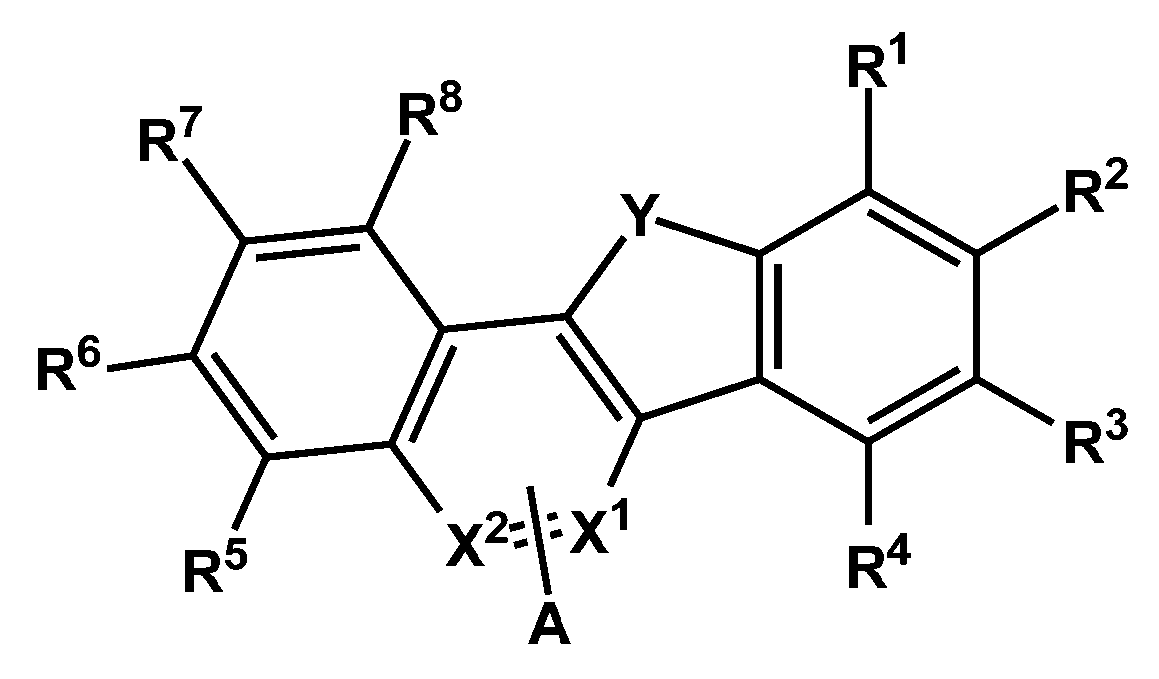
- a compound represented by Chemical Formula 1 is provided.
- X 1 and X 2 are -N-, the other is -CA-, Y is -S- or -O-, and A and R 1 to R 8 are each independently hydrogen , Deuterium, cyano group, substituted or unsubstituted C1 to C60 alkyl group, or substituted or unsubstituted C6 to C60 aryl group, any one of A and R 1 to R 4 is represented by the following formula (2),
- Ar 1 and Ar 2 are each independently a substituted or unsubstituted C6 to C60 aryl group or a substituted or unsubstituted C2 to C60 heteroaryl group, and at least one of X 3 to X 7 is -N- , And one of X 3 to X 7 is -(L 1 ) n1 -Ar 1 , one of X 3 to X 7 is -Ar 2 -, and the other one of -N-, -CH- or -CR- , L 1 and L 2 are each independently a single bond, a substituted or unsubstituted C6 to C60 arylene group, or a substituted or unsubstituted C2 to C60 heteroarylene group, n1 and n2 are each independently of each other, 0 to One of the integers of 2, wherein R is deuterium, -CN, substituted or unsubstituted C1 to C60 straight or branched chain alkyl,
- Chemical Formula 2 may be represented by Chemical Formula 3 below.
- the compound may be represented by any one of the following formulas 4 to 5.
- an organic optoelectronic device including an anode and a cathode facing each other, and at least one organic layer positioned between the anode and the cathode, wherein the organic layer includes the compound.
- a display device including the organic optoelectronic device is provided.
- 1 to 3 are cross-sectional views each showing an organic light emitting device according to an embodiment.
- a substituent having two or more substituents may be a biphenyl group. That is, the biphenyl group may be an aryl group or may be interpreted as a substituent to which two phenyl groups are connected. The additional substituents may be further substituted.
- R, R'and R" are the same or different from each other, and each independently hydrogen; deuterium; -CN; substituted or unsubstituted C1 to C60 straight or branched chain alkyl group; substituted or unsubstituted C3 to C60 A monocyclic or polycyclic cycloalkyl group; a substituted or unsubstituted C6 to C60 monocyclic or polycyclic aryl group; or a substituted or unsubstituted C2 to C60 monocyclic or polycyclic heteroaryl group.
- substitution means that the hydrogen atom bonded to the carbon atom of the compound is replaced with another substituent, and the position to be substituted is not limited to a position where the hydrogen atom is substituted, that is, a position where the substituent is substitutable, and when two or more are substituted , 2 or more substituents may be the same or different from each other.
- the halogen may be fluorine, chlorine, bromine or iodine.
- the alkyl group includes C1 to C60 straight or branched chain, and may be further substituted by other substituents.
- Carbon number of the alkyl group may be 1 to 60, specifically 1 to 40, specifically, 1 to 10, more specifically, 1 to 20.
- the alkenyl group includes a C2 to C60 straight or branched chain, and may be further substituted by other substituents.
- the alkenyl group may have 2 to 60 carbon atoms, specifically 2 to 40 carbon atoms, and more specifically 2 to 20 carbon atoms.
- Specific examples include vinyl group, 1-propenyl group, isopropenyl group, 1-butenyl group, 2-butenyl group, 3-butenyl group, 1-pentenyl group, 2-pentenyl group, 3-pentenyl group, 3-methyl-1 -Butenyl group, 1,3-butadienyl group, allyl group, 1-phenylvinyl-1-yl group, 2-phenylvinyl-1-yl group, 2,2-diphenylvinyl-1-yl group, 2-phenyl-2 -(Naphthyl-1-yl)vinyl-1-yl group, 2,2-bis(diphenyl-1-yl)vinyl-1-yl group, stilbenyl group, styrenyl group, and the like, but are not limited to these.
- the alkynyl group includes a C2 to C60 straight or branched chain, and may be further substituted by other substituents.
- Carbon number of the alkynyl group may be 2 to 60, specifically 2 to 40, more specifically, 2 to 20.
- the cycloalkyl group includes C3 to C60 monocyclic or polycyclic, and may be further substituted by other substituents.
- polycyclic means a group in which a cycloalkyl group is directly connected or condensed with another ring group.
- the other cyclic group may be a cycloalkyl group, but may be another kind of cyclic group, for example, heterocycloalkyl group, aryl group, heteroaryl group, and the like.
- the cycloalkyl group may have 3 to 60 carbon atoms, specifically 3 to 40 carbon atoms, and more specifically 5 to 20 carbon atoms.
- the alkoxy group may be a C1 to C10 alkoxy group, and more specifically, it may be a methoxy group, an ethoxy group, a propoxy group, a butoxy group, or a pentoxy group.
- the silyl group may be represented by -SiRR'R", and the definitions of R, R', and R" are as described above. More specifically, dimethylsilyl group, diethylsilyl group, methylethylsilyl group, and the like are possible.
- the fluorenyl group means a substituent including various substituents at position 9. Specifically, it may be used as a concept including a fluorenyl group substituted with 2 hydrogen, 2 alkyl groups, 2 aryl groups, and 2 heteroaryl groups at the 9-position. More specifically, a 9-di-H-fluorenyl group, 9-di-methyl-fluorenyl group, 9-di-phenyl-fluorenyl group, and the like can be used.
- the heterocycloalkyl group includes O, S, Se, N, or Si as a hetero atom, and includes C2 to C60 monocyclic or polycyclic, and may be further substituted by other substituents.
- polycyclic means a group in which a heterocycloalkyl group is directly connected to or condensed with another ring group.
- the other cyclic group may be a heterocycloalkyl group, but may be another kind of cyclic group, for example, a cycloalkyl group, an aryl group, a heteroaryl group.
- the heterocycloalkyl group may have 2 to 60 carbon atoms, specifically 2 to 40 carbon atoms, and more specifically 3 to 20 carbon atoms.
- the aryl group includes C6 to C60 monocyclic or polycyclic, and may be further substituted by other substituents.
- polycyclic means a group in which an aryl group is directly connected or condensed with another ring group.
- the other ring group may be an aryl group, but may be another type of ring group, such as a cycloalkyl group, a heterocycloalkyl group, a heteroaryl group, and the like.
- the aryl group includes a spiro group. Carbon number of the aryl group may be 6 to 60, specifically 6 to 40, specifically, 6 to 30, more specifically 6 to 25.
- aryl group examples include a phenyl group, biphenyl group, triphenyl group, naphthyl group, anthryl group, chrysenyl group, phenanthrenyl group, perylenyl group, fluoranthenyl group, triphenylenyl group, phenenyl group, pyre Neil group, tetrasenyl group, pentasenyl group, fluorenyl group, indenyl group, acenaphthylenyl group, benzofluorenyl group, spirobifluorenyl group, 2,3-dihydro-1H-indenyl group, and condensed ring groups thereof And the like, but is not limited thereto.
- the spiro group is a group including a spiro structure, and may be C15 to C60.
- the spiro group may include a structure in which a 2,3-dihydro-1H-indene group or a cyclohexane group is spiro bonded to a fluorenyl group.
- the following spiro groups may include any of the groups of the following structural formula.
- the heteroaryl group includes S, O, Se, N, or Si as a hetero atom, and includes C2 to C60 monocyclic or polycyclic, and may be further substituted by other substituents.
- the polycyclic means a group in which a heteroaryl group is directly connected to or condensed with another ring group.
- the other ring group may be a heteroaryl group, but may be another type of ring group, such as a cycloalkyl group, a heterocycloalkyl group, an aryl group, or the like.
- the heteroaryl group may have 2 to 60 carbon atoms, specifically 2 to 40 carbon atoms, specifically 2 to 30 carbon atoms, and more specifically 3 to 25 carbon atoms.
- heteroaryl group examples include pyridyl group, pyrrolyl group, pyrimidyl group, pyridazinyl group, furanyl group, thiophene group, imidazolyl group, pyrazolyl group, oxazolyl group, isoxazolyl group, thiazolyl Group, isothiazolyl group, triazolyl group, furazanyl group, oxadiazolyl group, thiadiazolyl group, dithiazolyl group, tetrazolyl group, pyranyl group, thiopyranyl group, diazinyl group, oxazinyl group , Thiazinyl group, deoxynyl group, triazinyl group, tetrazinyl group, quinolyl group, isoquinolyl group, quinazolinyl group, isoquinazolinyl group, quinozoliryl group, naphthyridyl group,
- the amine group is a monoalkylamine group; Monoarylamine group; Monoheteroarylamine group; -NH 2 ; Dialkylamine groups; Diarylamine group; Diheteroarylamine group; Alkylarylamine groups; Alkyl heteroarylamine groups; And it may be selected from the group consisting of aryl heteroarylamine groups, the number of carbon is not particularly limited, it is preferably 1 to 30.
- amine group examples include methylamine group, dimethylamine group, ethylamine group, diethylamine group, phenylamine group, naphthylamine group, biphenylamine group, dibiphenylamine group, anthracenylamine group, 9- Methyl-anthracenylamine group, diphenylamine group, phenylnaphthylamine group, ditolylamine group, phenyltolylamine group, triphenylamine group, biphenylnaphthylamine group, phenylbiphenylamine group, biphenylfluore
- the arylene group means that the aryl group has two bonding positions, that is, a divalent group. These may be applied to the description of the aryl group described above, except that each is a divalent group.
- the heteroarylene group means a heteroaryl group having two bonding positions, that is, a divalent group. These may be applied to the description of the heteroaryl group described above, except that each is a divalent group.
- the hole property refers to a property that can form a hole by donating electrons when an electric field is applied, and has conductivity characteristics along the HOMO level, and injection of the hole formed at the anode into the light emitting layer, the light emitting layer It means a property that facilitates the movement of the holes formed in the anode to the anode and the light emitting layer.
- a substituent having hole characteristics a substituted or unsubstituted C6 to C60 aryl group having hole characteristics, a substituted or unsubstituted C2 to C60 heteroaryl group having hole characteristics, a substituted or unsubstituted arylamine group or substituted or And unsubstituted heteroarylamine groups.
- the substituted or unsubstituted C6 to C60 aryl group having the hole characteristics is a substituted or unsubstituted phenyl group, a substituted or unsubstituted naphthyl group, a substituted or unsubstituted phenanthrenyl group, a substituted or unsubstituted anthracenyl group , Substituted or unsubstituted fluorenyl group, substituted or unsubstituted triphenylenyl group, substituted or unsubstituted spiro-fluorenyl group, substituted or unsubstituted terphenyl group, substituted or unsubstituted pyrenyl group, substituted or It may be an unsubstituted perenyl group or a combination thereof.
- a substituted or unsubstituted C2 to C60 heteroaryl group having hole characteristics is a substituted or unsubstituted carbazolyl group, a substituted or unsubstituted dibenzofuranyl group, a substituted or unsubstituted dibenzothiophenyl group, or substituted or unsubstituted And a substituted indole carbazolyl group.
- a substituted or unsubstituted phenyl group a substituted or unsubstituted naphthyl group, an aryl group or a heteroaryl group, which is a substituent bonded to nitrogen of the substituted or unsubstituted arylamine group and the substituted or unsubstituted heteroarylamine group.
- the electronic property refers to a property that can receive electrons when an electric field is applied, and has conductivity characteristics along the LUMO level, injecting electrons formed from the cathode into the light emitting layer, transporting electrons formed from the light emitting layer to the cathode, and in the light emitting layer. It means a property that facilitates movement.
- Substituted or unsubstituted C2 to C60 heteroaryl group having the above electronic properties a substituted or unsubstituted imidazolyl group, a substituted or unsubstituted tetrazolyl group, a substituted or unsubstituted quinolinylene group, a substituted or unsubstituted Isoquinolinylene group, substituted or unsubstituted pyridinylene group, substituted or unsubstituted pyrimidinylene group, substituted or unsubstituted triazinylene group, substituted or unsubstituted furanyl group, substituted or unsubstituted benzofura A phenyl group, a substituted or unsubstituted isofuranyl group, a substituted or unsubstituted benzoisofuranyl group, a substituted or unsubstituted oxazoline group, a substituted or unsubstituted
- substituted or unsubstituted C2 to C60 heteroaryl group having the above electronic properties may be any one of the following Formulas X-1 to X-5.
- L n is a direct bond (or a single bond); A substituted or unsubstituted arylene group; Or it may be a substituted or unsubstituted heteroarylene group.
- L n is a direct bond; A substituted or unsubstituted C6 to C60 arylene group; Or it may be a substituted or unsubstituted C2 to C60 heteroarylene group.
- L n is a direct bond; A substituted or unsubstituted C6 to C40 arylene group; Or it may be a substituted or unsubstituted C2 to C40 heteroarylene group.
- N in L n means a number for distinguishing a substituent.
- the compound according to one embodiment is represented by Formula 1 below.
- X 1 and X 2 are -N-, the other is -CA-, Y is -S- or -O-, and A and R 1 to R 8 are each independently hydrogen , Deuterium, cyano group, substituted or unsubstituted C1 to C60 alkyl group, or substituted or unsubstituted C6 to C60 aryl group, any one of A and R 1 to R 4 is represented by the following formula (2),
- Ar 1 and Ar 2 are each independently a substituted or unsubstituted C6 to C60 aryl group or a substituted or unsubstituted C2 to C60 heteroaryl group, and at least one of X 3 to X 7 is -N- , And one of X 3 to X 7 is -(L 1 ) n1 -Ar 1 , one of X 3 to X 7 is -Ar 2 -, and the other one of -N-, -CH- or -CR- , L 1 and L 2 are each independently a single bond, a substituted or unsubstituted C6 to C60 arylene group, or a substituted or unsubstituted C2 to C60 heteroarylene group, n1 and n2 are each independently of each other, 0 to One of the integers of 2, wherein R is deuterium, -CN, substituted or unsubstituted C1 to C60 straight or branched chain alkyl,
- the compound according to one embodiment is represented by the following Chemical Formula 1-1.
- At least one of X 1 and X 2 is -N-, and the other is -CA-,
- Y is -S- or -O-
- a and R 1 to R 8 are each independently hydrogen, deuterium, cyano group, substituted or unsubstituted C1 to C60 alkyl group, or substituted or unsubstituted C6 to C60 aryl group,
- Ar 1 And Ar 2 are each independently a substituted or unsubstituted C6 to C60 aryl group or a substituted or unsubstituted C2 to C60 heteroaryl group,
- At least one of Ar 1 and Ar 2 is a substituted or unsubstituted C2 to C60 heteroaryl group or a substituted or unsubstituted C6 to C60 fused ring aryl group,
- At least one of X 3 to X 7 is -N-, one of X 3 to X 7 is -(L 1 ) n1 -Ar 1 , one of X 3 to X 7 is -Ar 2 -, and the other is- N-, -CH- or -CR-,
- L 1 and L 2 are each independently a single bond, a substituted or unsubstituted C6 to C60 arylene group, or a substituted or unsubstituted C2 to C60 heteroarylene group,
- n1 and n2 are each independently an integer from 0 to 2
- R is deuterium, -CN, substituted or unsubstituted C1 to C60 linear or branched alkyl, substituted or unsubstituted C6 to C60 monocyclic or polycyclic aryl group, or substituted or unsubstituted C2 to C60 A monocyclic or polycyclic heteroaryl group,
- the * is a binding position.
- a fused ring aryl group means a ring group in which carbon atoms divide adjacent pairs.
- the C6 to C60 fused ring aryl group is a substituted or unsubstituted naphthyl group, a substituted or unsubstituted triphenylenyl group, a substituted or unsubstituted fluorenyl group, a substituted or unsubstituted pyrenyl group, or a substituted or unsubstituted It may be a substituted phenanthrenyl group.
- the present application relates to the compound of Formula 1 or Formula 1-1.
- the compound has a high glass transition temperature (Tg) and excellent thermal stability. This increase in thermal stability is an important factor providing driving stability to the device.
- Chemical Formula 2 may be represented by Chemical Formula 3 below.
- Ar 1 And Ar 2 are each independently a substituted or unsubstituted C6 to C60 aryl group or a substituted or unsubstituted C2 to C60 heteroaryl group
- X 3 to X 5 are each independently -N-, -CH- or- CR-, at least one of X 3 to X 5 is -N-
- L 1 and L 2 are each independently a single bond, a substituted or unsubstituted C6 to C60 arylene group, or a substituted or unsubstituted C2 to C60 heteroarylene group
- n1 and n2 are each independently an integer of 0 to 2, wherein R is deuterium, -CN, substituted or unsubstituted C1 to C60 straight or branched chain alkyl, substituted or unsubstituted A substituted C6 to C60 monocyclic or polycyclic aryl group, or a substituted or unsubstituted C2 to C60 monocycl
- At least one of Ar 1 and Ar 2 in Formula 3 is a substituted or unsubstituted C2 to C60 heteroaryl group or a substituted or unsubstituted C6 to C60 fused ring An aryl group, and * is a bonding position.
- Chemical Formula 3 may be expressed as follows.
- Ar 1 And Ar 2 are each independently a substituted or unsubstituted C6 to C60 aryl group or a substituted or unsubstituted C2 to C60 heteroaryl group, and at least one of Ar 1 and Ar 2 is a substituted or unsubstituted C2 to C60 hetero
- An aryl group or a substituted or unsubstituted C6 to C60 fused ring aryl group, X 3 to X 5 are each independently -N-, -CH- or -CR-, and at least one of X 3 to X 5 is- N-, L 1 and L 2 are each independently a single bond, a substituted or unsubstituted C6 to C60 arylene group, or a substituted or unsubstituted C2 to C60 heteroarylene group, n1 and n2 are independently of each other, Is an integer from 0 to 2, wherein R is deuterium, -CN, substituted or unsubstituted C6
- the * is a binding position.
- Ar 1 and Ar 2 are each independently, and a substituted or unsubstituted C2 to C60 heteroaryl group or a substituted or unsubstituted C6 to C60 fused ring aryl group is not.
- the hole transport properties are relatively stronger than the non-substituents. Due to the strong hole transport properties, it can affect the overall electron movement, thereby exhibiting more excellent efficiency and lifetime.
- the compound may be represented by the following formula (4).
- the compound may be represented by the following formula (5).
- X 1 is -N-
- X 2 is -CA-
- A may be a compound represented by Chemical Formula 3.
- X 1 is -CA-
- X 2 is -N-
- A may be a compound represented by Chemical Formula 3.
- X 1 is -N-
- X 2 is -CA-
- any one of R 1 to R 4 may be a compound represented by Chemical Formula 3.
- X 1 is -CA-
- X 2 is -N-
- any one of R 1 to R 4 may be a compound represented by Chemical Formula 3.
- X 1 is -N-
- X 2 is -CA-
- any one of R 1 to R 4 is represented by Formula 3
- A is a phenyl group or a naphthyl group It can be a compound.
- X 1 is -CA-
- X 2 is -N-
- any one of R 1 to R 4 is represented by Formula 3
- A is a phenyl group or a naphthyl group It can be a compound.
- X 1 is -N-
- X 2 is -CA-
- A may be a compound represented by Chemical Formula 3.
- X 1 is -CA-
- X 2 is -N-
- A may be a compound represented by Chemical Formula 3.
- X 1 is -N-
- X 2 is -CA-
- any one of R 1 to R 4 may be a compound represented by Chemical Formula 3.
- X 1 is -CA-
- X 2 is -N-
- any one of R 1 to R 4 may be a compound represented by Chemical Formula 3.
- X 1 is -N-
- X 2 is -CA-
- any one of R 1 to R 4 is represented by Formula 3
- A is a phenyl group or a naphthyl group It can be a compound.
- X 1 is -CA-
- X 2 is -N-
- any one of R 1 to R 4 is represented by Formula 3
- A is a phenyl group or a naphthyl group It can be a compound.
- Ar 1 may be a substituent having hole characteristics.
- L 1 and L 2 may be each independently a single bond, a substituted or unsubstituted C6 to C60 arylene group, or a substituted or unsubstituted C2 to C60 heteroarylene group.
- L 1 and L 2 may be each independently a single bond, a substituted or unsubstituted C6 to C40 arylene group, or a substituted or unsubstituted C2 to C40 heteroarylene group.
- L 1 and L 2 may be each independently a single bond, a C6 to C40 arylene group, or a C2 to C40 heteroarylene group.
- L 1 and L 2 may be each independently a single bond, or a monocyclic or polycyclic C6 to C40 arylene group.
- L 1 and L 2 may be each independently a single bond, a phenylene group, a biphenylene group, or a naphthalene group.
- Ar 1 and Ar 2 may be each independently a substituted or unsubstituted C6 to C60 aryl group or a substituted or unsubstituted C2 to C60 heteroaryl group.
- Ar 1 and Ar 2 may be each independently a substituted or unsubstituted C6 to C40 aryl group or a substituted or unsubstituted C2 to C40 heteroaryl group.
- Ar 1 and Ar 2 are each independently a C1 to C10 alkyl group substituted or unsubstituted C6 to C40 aryl group, or a C6 to C10 aryl group substituted or unsubstituted C2 to C40 hetero It may be an aryl group.
- Ar 1 and Ar 2 are each independently a substituted or unsubstituted phenyl group, a substituted or unsubstituted naphthyl group, a substituted or unsubstituted biphenyl group, a substituted or unsubstituted triphenylenyl group, Substituted or unsubstituted fluorenyl group, substituted or unsubstituted pyrenyl group, substituted or unsubstituted phenanthrenyl group, substituted or unsubstituted carbazole group, substituted or unsubstituted dibenzothiophene group, or substituted or unsubstituted It may be a substituted dibenzofuran group.
- Ar 1 and Ar 2 are each independently a phenyl group, a naphthyl group, a biphenyl group, a triphenylenyl group, a fluorenyl group unsubstituted or substituted with a methyl group, or a benzene ring condensed 9,9- It may be a dimethylfluorenyl group, a pyrenyl group, a phenanthrenyl group, a carbazole group substituted or unsubstituted with a phenyl group, a dibenzothiophene group substituted or unsubstituted with a phenyl group, or a dibenzofuran group substituted or unsubstituted with a phenyl group. .
- a and R 1 to R 8 are each independently hydrogen, deuterium, a cyano group, a substituted or unsubstituted C1 to C60 alkyl group, or a substituted or unsubstituted C6 to C60 aryl group , A and any one of R 1 to R 4 may be represented by the formula (2).
- a and R 1 to R 8 are each independently hydrogen, or a substituted or unsubstituted C6 to C60 aryl group, and any one of A and R 1 to R 4 is represented by Formula 2 Can be.
- a and R 1 to R 8 are each independently hydrogen, or a substituted or unsubstituted C6 to C40 aryl group, and any one of A and R 1 to R 4 is represented by Formula 2 Can be.
- a and R 1 to R 8 are each independently hydrogen, or a C6 to C40 aryl group, and any one of A and R 1 to R 4 may be represented by Chemical Formula 2.
- a and R 1 to R 8 are each independently hydrogen, a phenyl group, or a naphthyl group, and any one of A and R 1 to R 4 may be represented by Chemical Formula 2.
- At least one of Ar 1 and Ar 2 of Chemical Formula 2 is substituted or unsubstituted C2 to C60 heteroaryl group or substituted or unsubstituted C6 to C60 fused ring aryl group.
- At least one of Ar 1 and Ar 2 of Chemical Formula 2 is substituted or unsubstituted C2 to C40 heteroaryl group or substituted or unsubstituted It may be a C6 to C40 fused ring aryl group.
- At least one of Ar 1 and Ar 2 of Chemical Formula 2 is a C2 to C40 heteroaryl group unsubstituted or substituted with a C6 to C20 aryl group, Or it may be a C6 to C40 fused ring aryl group.
- At least one of Ar 1 and Ar 2 of Chemical Formula 2 is a carbazole group substituted or unsubstituted with a phenyl group, or substituted or unsubstituted with a phenyl group Dibenzothiophene group, dibenzofuran group unsubstituted or substituted with phenyl group, triphenylenyl group, 9,9-dimethylfluorenyl group, 9,9-dimethylfluorenyl group condensed with benzene ring, phenanthrenyl group, or It may be a pyrenyl group.
- the benzene ring condensed 9,9-dimethylfluorenyl group may be any one of the following structures.
- Ar 1 is a substituted or unsubstituted carbazolyl group, a substituted or unsubstituted dibenzofuranyl group, a substituted or unsubstituted dibenzothiophenyl group, or a substituted or unsubstituted 9,9- A dialkylfluorenyl group or a 9,9-diarylfluorenyl group, the alkyl group of the dialkyl is a substituted or unsubstituted C1 to C60 alkyl group, and the aryl group of the diaryl group is a substituted or unsubstituted C6 to C60 aryl group Or, it may be a substituted or unsubstituted 9,9-dimethylfluorenyl group.
- the luminous efficiency and lifetime of the organic light emitting device may be better than other cases.
- Ar 1 is a substituted or unsubstituted anthracenyl group, a substituted or unsubstituted phenanthryl group, a substituted or unsubstituted pyrenyl group, or a substituted or unsubstituted triphenylenyl group, or substituted Or it may be an unsubstituted terphenyl group, or a substituted or unsubstituted quarterphenyl group.
- the luminous efficiency and lifetime of the organic light emitting device may be better than other cases.
- the compound represented by Formula 1 may be any one of the compounds of Group I below.
- the compound represented by Formula 1 may be any one of the compounds of Group II below.
- the compound represented by Formula 1 may be any one of the compounds of Group III below.
- the above-described compound or composition may be for an organic optoelectronic device, and the compound for an organic optoelectronic device or a composition for an organic optoelectronic device may be formed by a dry film deposition method such as chemical vapor deposition.
- the organic optoelectronic device is not particularly limited as long as it is a device capable of mutually converting electrical energy and light energy, and examples thereof include organic photoelectric devices, organic light emitting devices, organic solar cells, and organic photoconductor drums.
- the first electrode A second electrode provided to face the first electrode; And one or more organic material layers provided between the first electrode and the second electrode, wherein at least one layer of the organic material layer includes a heterocyclic compound represented by Chemical Formula 1 above.
- the first electrode may be an anode
- the second electrode may be a cathode
- the first electrode may be a cathode
- the second electrode may be an anode
- the organic light emitting device may be a blue organic light emitting device, and the heterocyclic compound according to Formula 1 may be used as a material for the blue organic light emitting device.
- the organic light emitting device may be a green organic light emitting device, and the heterocyclic compound according to Chemical Formula 1 may be used as a material for the green organic light emitting device.
- the organic light emitting device may be a red organic light emitting device, and the heterocyclic compound according to Formula 1 may be used as a material for the red organic light emitting device.
- the organic light emitting device of the present invention can be manufactured by a conventional method and material for manufacturing an organic light emitting device, except that one or more organic material layers are formed using the aforementioned heterocyclic compound.
- the heterocyclic compound may be formed as an organic material layer by a solution coating method as well as a vacuum deposition method when manufacturing an organic light emitting device.
- the solution application method means spin coating, dip coating, inkjet printing, screen printing, spraying, roll coating, and the like, but is not limited to these.
- 1 to 3 illustrate the stacking order of the electrode and the organic material layer of the organic light emitting device according to an exemplary embodiment of the present application.
- the scope of the present application is not intended to be limited by these drawings, and the structure of the organic optoelectronic device known in the art may be applied to the present application.
- an organic light emitting device in which an anode 200, an organic material layer 300, and a cathode 400 are sequentially stacked on a substrate 100 is illustrated.
- the structure is not limited to this, and as illustrated in FIG. 2, an organic light emitting device in which a cathode, an organic material layer, and an anode are sequentially stacked on a substrate may be implemented.
- the organic light emitting device according to FIG. 3 includes a hole injection layer 301, a hole transport layer 302, a light emitting layer 303, a hole blocking layer 304, an electron transport layer 305 and an electron injection layer 306.
- a hole injection layer 301 a hole transport layer 302
- a light emitting layer 303 a hole transport layer 302
- a hole blocking layer 304 a hole blocking layer 304
- an electron transport layer 305 an electron injection layer 306.
- the scope of the present application is not limited by such a stacked structure, and if necessary, the remaining layers other than the light emitting layer may be omitted, and other necessary functional layers may be further added.
- the compound represented by Chemical Formula 1 may be used as an electron transporting layer, a hole transporting layer, a hole blocking layer, and a material for a light emitting layer in an organic light emitting device. More specifically, the compound represented by Chemical Formula 1 may be used as a material for an electron transport layer or a hole blocking layer in an organic light emitting device.
- the anode material materials having a relatively large work function may be used, and a transparent conductive oxide, metal, or conductive polymer may be used.
- the positive electrode material include metals such as vanadium, chromium, copper, zinc and gold or alloys thereof; Metal oxides such as zinc oxide, indium oxide, indium tin oxide (ITO), and indium zinc oxide (IZO); A combination of metal and oxide such as ZnO: Al or SnO 2 : Sb; Conductive polymers such as poly(3-methylthiophene), poly[3,4-(ethylene-1,2-dioxy)thiophene] (PEDOT), polypyrrole and polyaniline, but are not limited thereto.
- the cathode material materials having a relatively low work function may be used, and a metal, metal oxide, or conductive polymer may be used.
- the negative electrode material include metals such as magnesium, calcium, sodium, potassium, titanium, indium, yttrium, lithium, gadolinium, aluminum, silver, tin and lead, or alloys thereof;
- a multilayer structure material such as LiF/Al or LiO 2 /Al, and the like, are not limited thereto.
- a known hole injection material may be used, for example, a phthalocyanine compound such as copper phthalocyanine disclosed in U.S. Patent No. 4,356,429, or described in Advanced Material, 6, p.677 (1994).
- Starburst amine derivatives such as tris(4-carbazoyl-9-ylphenyl)amine (TCTA), 4,4',4"-tri[phenyl(m-tolyl)amino]triphenylamine (m -MTDATA), 1,3,5-tris[4-(3-methylphenylphenylamino)phenyl]benzene (m-MTDAPB), polyaniline/dodecylbenzenesulfonic acid (Polyaniline/Dodecylbenzenesulfonic acid) or poly (3,4-ethylenedioxythiophene)/poly(4-ethylenedioxythiophene)/Poly(4-styrenesulfonate)), polyaniline/Camphor sulfonic acid or polyaniline /Polyaniline/Poly(4-styrene-sulfonate) can be used.
- TCTA tris(4-carbazoyl-9-ylpheny
- a pyrazoline derivative an arylamine-based derivative, a stilbene derivative, a triphenyldiamine derivative, etc.
- a low molecular weight or high molecular weight material may also be used.
- Red, green, or blue light-emitting materials may be used as the light-emitting material, and if necessary, two or more light-emitting materials may be mixed and used. At this time, two or more light-emitting materials can be used by depositing them as separate sources or by pre-mixing them as one source. Further, a fluorescent material may be used as the light emitting material, but it may also be used as a phosphorescent material. As the light emitting material, a material that emits light by combining holes and electrons injected from the anode and the cathode, respectively, may be used, but materials in which the host material and the dopant material are involved in light emission may also be used.
- a host of light-emitting materials When a host of light-emitting materials is mixed and used, a host of the same series may be mixed or used, or a host of other series may be mixed and used. For example, two or more types of materials of n-type host material or P-type host material may be selected and used as the host material of the light emitting layer.
- hole blocking material for example, a triazole derivative, basocuproin, or a mixed ligand complex (BAlq) of aluminum may be used, but the present application is not limited thereto, and a compound of one embodiment of the present invention may also be used. have.
- a triazole derivative, basocuproin, or a mixed ligand complex (BAlq) of aluminum may be used, but the present application is not limited thereto, and a compound of one embodiment of the present invention may also be used. have.
- the electron transport material may be a compound of one embodiment of the present invention.
- LiF is typically used in the art, but the present application is not limited thereto.
- the organic light emitting device may be a front emission type, a back emission type, or a double-sided emission type depending on the material used.
- Toluene Compound 3-2 (70 g, 0.306 mol), phenyl boronic acid (40 g, 0.336 mol), Pd(PPh 3 ) 4 (17 g, 0.0153 mol), Na 2 CO 3 (65 g, 0.609 mol) (700 mL), ethanol (140 mL), and H 2 O (140 mL) were exchanged at 120° C. for 1 hour. After completion of the reaction, the mixture was cooled to room temperature, and extracted with distilled water and EA. After drying the organic layer with anhydrous MgSO 4 , the solvent was removed by rotary evaporation, and washed with EA and nucleic acid to obtain compound 3-3 (63 g, 90%).
- the prepared compound was confirmed from Mass and NMR results.
- the transparent electrode ITO thin film obtained from the glass for OLED was subjected to ultrasonic cleaning for 5 minutes each using trichloroethylene, acetone, ethanol, and distilled water sequentially, and then stored in isopropanol for use.
- an ITO substrate is installed in the substrate folder of the vacuum deposition equipment, and the following 4,4',4"-tris(N,N-(2-naphthyl)-phenylamino)triphenyl amine ( 4,4',4"-tris(N,N-(2-naphthyl)-phenylamino)triphenyl amine: 2-TNATA) was added.
- NPB N,N'-bis( ⁇ -naphthyl)-N,N'-diphenyl-4,4'-diamine
- a blue light emitting material having the following structure was deposited as a light emitting layer thereon. Specifically, a blue light emitting host material H1 was vacuum-deposited to 200 mm thick in one cell in the vacuum deposition equipment, and a blue light emitting dopant material D1 was vacuum deposited 5% of the host material.
- the compound of Structural Formula E1 as the electron transport layer was deposited to a thickness of 300 MPa.
- Lithium fluoride (LiF) was deposited as an electron injection layer to a thickness of 10 ⁇ , and an Al cathode was fabricated with a thickness of 1,000 ⁇ .
- An organic electroluminescent device was manufactured in the same manner as in Comparative Example 1, except that Compound A and Compound B were used instead of E1 used in forming the electron transport layer in Comparative Example 1.
- An organic electroluminescent device was manufactured in the same manner as in Comparative Example 1, except that the compound shown in Table 32 was used instead of E1 used in forming the electron transport layer in Comparative Example 1.
- Table 32 shows the results of measuring the driving voltage, light emission efficiency, color coordinate (CIE), and lifetime of the blue organic light emitting device manufactured according to the present invention.
- the electroluminescence (EL) characteristics were measured with M7000 of Max Science, and T 95 was measured when the reference luminance was 3500 cd/m 2 through the life measurement equipment (M6000) manufactured by Max Science with the measurement results.
- Table 32 shows the results of measuring the driving voltage, luminous efficiency, color coordinate (CIE), and lifetime of the white organic light emitting device manufactured according to the present invention.
- Example 1 E1 5.70 6.00 (0.134, 0.102) 20 Comparative Example 2 A 6.10 4.57 (0.134, 0.098) 18 Comparative Example 3 B 6.06 4.68 (0.134, 0.098) 19 Example 1 One 5.42 6.22 (0.134, 0.101) 42 Example 2 11 5.44 6.22 (0.134, 0.102) 34 Example 3 13 5.62 5.95 (0.134, 0.103) 37 Example 4 16 5.01 6.10 (0.134, 0.100) 32 Example 5 17 5.62 6.38 (0.134, 0.100) 35 Example 6 20 5.32 6.20 (0.134, 0.102) 39 Example 7 24 5.45 6.11 (0.134, 0.103) 30 Example 8 29 5.44 6.34 (0.134, 0.102) 36 Example 9 38 5.62 6.20 (0.134, 0.101) 39 Example 10 40 5.40 6.12 (0.134, 0.103) 40 Example 11 42 5.61 6.01 (0.134, 0.102) 35 Example 12 52 5.45 6.
- the organic light-emitting device using the electron transport layer material of the blue organic light-emitting device of the present invention has a lower driving voltage and improved luminous efficiency and life compared to Comparative Example 1.
- the transparent electrode ITO thin film obtained from the glass for OLED was subjected to ultrasonic cleaning for 5 minutes each using trichloroethylene, acetone, ethanol, and distilled water sequentially, and then stored in isopropanol for use.
- an ITO substrate is installed in the substrate folder of the vacuum deposition equipment, and the following 4,4',4"-tris(N,N-(2-naphthyl)-phenylamino)triphenyl amine ( 4,4',4"-tris(N,N-(2-naphthyl)-phenylamino)triphenyl amine: 2-TNATA) was added.
- NPB N,N'-bis( ⁇ -naphthyl)-N,N'-diphenyl-4,4'-diamine
- a blue light emitting material having the following structure was deposited as a light emitting layer thereon. Specifically, a blue light emitting host material H1 was vacuum-deposited to 200 mm thick in one cell in the vacuum deposition equipment, and a blue light emitting dopant material D1 was vacuum deposited 5% of the host material.
- the compound of Structural Formula E1 as the electron transport layer was deposited to a thickness of 300 MPa.
- Lithium fluoride (LiF) was deposited as an electron injection layer to a thickness of 10 ⁇ , and an Al cathode was fabricated with a thickness of 1,000 ⁇ .
- An organic electroluminescent device was performed in the same manner as in Comparative Example 4, except that in Example 5, a thickness of the electron transport layer E1 was formed to be 250 ⁇ , and then a hole blocking layer was formed with a thickness of Compound C of 50 ⁇ over the electron transport layer. Was produced.
- the electron transport layer E1 was formed with a thickness of 250 ⁇ , and then a hole blocking layer with a thickness of Compound D of 50 ⁇ was formed on the electron transport layer, and the organic electric field was performed in the same manner as in Comparative Example 4. A light emitting device was produced.
- the organic light-emitting device using the hole blocking layer material of the blue organic light-emitting device of the present invention has a lower driving voltage and significantly improved luminous efficiency and life compared to Comparative Example 4.
- the luminous efficiency and lifetime were remarkably improved.
- the reason for this result is that it is a bipolar type having both p-type and n-type, and thus it is possible to prevent hole leakage and effectively trap excitons in the light emitting layer.
Landscapes
- Chemical & Material Sciences (AREA)
- Organic Chemistry (AREA)
- Physics & Mathematics (AREA)
- Spectroscopy & Molecular Physics (AREA)
- Engineering & Computer Science (AREA)
- Materials Engineering (AREA)
- Optics & Photonics (AREA)
- Electroluminescent Light Sources (AREA)
Abstract
Description
본 출원은 2019년 01월 25일 한국특허청에 제출된 한국 특허 출원 제10-2019-0009760호의 출원일의 이익을 주장하며, 그 내용 전부는 본 명세서에 포함된다.This application claims the benefit of the filing date of Korean Patent Application No. 10-2019-0009760 filed with the Korean Intellectual Property Office on January 25, 2019, the entire contents of which are incorporated herein.
본 출원은 화합물, 유기 광전자 소자 및 표시 장치에 관한 것이다.The present application relates to compounds, organic optoelectronic devices and display devices.
유기 광전자 소자(organic optoelectronic diode)는 전기 에너지와 광 에너지를 상호 전환할 수 있는 소자이다.Organic optoelectronic devices (organic optoelectronic diode) is a device that can switch between electrical energy and light energy.
유기 광전자 소자는 동작 원리에 따라 크게 두 가지로 나눌 수 있다. 하나는 광 에너지에 의해 형성된 엑시톤(exciton)이 전자와 정공으로 분리되고 전자와 정공이 각각 다른 전극으로 전달되면서 전기 에너지를 발생하는 광전 소자이고, 다른 하나는 전극에 전압 또는 전류를 공급하여 전기 에너지로부터 광 에너지를 발생하는 발광 소자이다. Organic optoelectronic devices can be roughly divided into two types according to the operating principle. One is a photoelectric device that generates electrical energy as excitons formed by light energy are separated into electrons and holes, and electrons and holes are transferred to different electrodes, and the other is electrical energy by supplying voltage or current to the electrodes. It is a light emitting element that generates light energy from.
유기 광전자 소자의 예로는 유기 광전 소자, 유기 발광 소자, 유기 태양 전지 및 유기 감광체 드럼(organic photo conductor drum) 등을 들 수 있다. Examples of the organic optoelectronic device include an organic photoelectric device, an organic light emitting device, an organic solar cell, and an organic photo conductor drum.
이 중, 유기 발광 소자(organic light emitting diode, OLED)는 근래 평판 표시 장치(flat panel display device)의 수요 증가에 따라 크게 주목 받고 있다. 유기 발광 소자는 전기 에너지를 빛으로 전환시키는 소자로서, 유기 발광 소자의 성능은 전극 사이에 위치하는 유기 재료에 의해 많은 영향을 받는다.Among these, organic light emitting diodes (OLEDs) have attracted much attention in recent years due to an increase in demand for flat panel display devices. The organic light emitting device is a device that converts electrical energy into light, and the performance of the organic light emitting device is greatly affected by organic materials positioned between electrodes.
유기 발광 소자는 2개의 전극 사이에 유기 박막을 배치시킨 구조를 가지고 있다. 이와 같은 구조의 유기 발광 소자에 전압이 인가되면, 2개의 전극으로부터 주입된 전자와 정공이 유기 박막에서 결합하여 쌍을 이룬 후 소멸하면서 빛을 발하게 된다. 상기 유기 박막은 필요에 따라 단층 또는 다층으로 구성될 수 있다.The organic light emitting device has a structure in which an organic thin film is disposed between two electrodes. When a voltage is applied to the organic light emitting device having such a structure, electrons and holes injected from two electrodes are combined and paired in an organic thin film, and then extinguishes and emits light. The organic thin film may be composed of a single layer or multiple layers, if necessary.
유기 박막의 재료는 필요에 따라 발광 기능을 가질 수 있다. 예컨대, 유기 박막 재료로는 그 자체가 단독으로 발광층을 구성할 수 있는 화합물이 사용될 수도 있고, 또는 호스트-도펀트계 발광층의 호스트 또는 도펀트 역할을 할 수 있는 화합물이 사용될 수도 있다. The material of the organic thin film may have a light emitting function as needed. For example, as an organic thin film material, a compound that can itself constitute a light emitting layer may be used, or a compound capable of serving as a host or a dopant of a host-dopant-based light emitting layer may be used.
그 외에도, 유기 박막의 재료로서, 정공 주입, 정공 수송, 전자 차단, 정공 차단, 전자 수송, 전자 주입 등의 역할을 수행할 수 있는 화합물이 사용될 수도 있다.In addition, as a material of the organic thin film, a compound capable of performing a role of hole injection, hole transport, electron blocking, hole blocking, electron transport, electron injection, etc. may be used.
유기 발광 소자의 성능, 수명 또는 효율을 향상시키기 위하여, 유기 박막의 재료의 개발이 지속적으로 요구되고 있다.In order to improve the performance, life or efficiency of the organic light emitting device, the development of an organic thin film material is continuously required.
일 구현예는 고효율 및 장수명 유기 광전자 소자를 구현할 수 있는 화합물을 제공한다.One embodiment provides a compound capable of realizing a high efficiency and long life organic optoelectronic device.
다른 구현예는 상기 화합물을 포함하는 유기 광전자 소자를 제공한다.Another embodiment provides an organic optoelectronic device comprising the compound.
또 다른 구현예는 상기 유기 광전자 소자를 포함하는 표시 장치를 제공한다.Another embodiment provides a display device including the organic optoelectronic device.
일 구현예에 따르면, 하기 화학식 1로 표현되는 화합물을 제공한다.According to one embodiment, a compound represented by Chemical Formula 1 is provided.
[화학식 1] [Formula 1]

상기 화학식 1에서, X1 및 X2 중 적어도 하나는 -N-이고, 나머지 하나는 -CA-이고, Y는 -S- 또는 -O-이고, A 및 R1 내지 R8은 각각 독립적으로 수소, 중수소, 시아노기, 치환 또는 비치환된 C1 내지 C60 알킬기, 또는 치환 또는 비치환된 C6 내지 C60 아릴기이고, A 및 R1 내지 R4 중 어느 하나는 하기 화학식 2로 표현되는 것이고,In Formula 1, at least one of X 1 and X 2 is -N-, the other is -CA-, Y is -S- or -O-, and A and R 1 to R 8 are each independently hydrogen , Deuterium, cyano group, substituted or unsubstituted C1 to C60 alkyl group, or substituted or unsubstituted C6 to C60 aryl group, any one of A and R 1 to R 4 is represented by the following formula (2),
[화학식 2][Formula 2]

상기 화학식 2에서, Ar1 및 Ar2는 각각 독립적으로 치환 또는 비치환된 C6 내지 C60 아릴기 또는 치환 또는 비치환된 C2 내지 C60 헤테로아릴기이고, X3 내지 X7 중 적어도 하나는 -N-이고, X3 내지 X7 중 하나는 -(L1)n1-Ar1이고, X3 내지 X7 중 하나는 -Ar2-이고, 나머지는 -N-, -CH- 또는 -CR- 중 하나이고, L1 및 L2는 각각 독립적으로, 단일결합, 치환 또는 비치환된 C6 내지 C60 아릴렌기, 또는 치환 또는 비치환된 C2 내지 C60 헤테로아릴렌기이고, n1 및 n2는 서로 독립적으로, 0 내지 2의 정수 중 하나이고, 상기 R은 중수소, -CN, 치환 또는 비치환된 C1 내지 C60의 직쇄 또는 분지쇄의 알킬, 치환 또는 비치환된 C6 내지 C60의 단환 또는 다환의 아릴기, 또는 치환 또는 비치환된 C2 내지 C60의 단환 또는 다환의 헤테로아릴기이고, 상기 화학식 1의 A가 상기 화학식 2로 표현되는 경우, 상기 화학식 2의 Ar1 및 Ar2 중 적어도 어느 하나는 치환 또는 비치환된 C2 내지 C60 헤테로아릴기 또는 치환 또는 비치환된 C6 내지 C60 융합 고리 아릴기이고, 상기 *는 결합위치이다.In Formula 2, Ar 1 and Ar 2 are each independently a substituted or unsubstituted C6 to C60 aryl group or a substituted or unsubstituted C2 to C60 heteroaryl group, and at least one of X 3 to X 7 is -N- , And one of X 3 to X 7 is -(L 1 ) n1 -Ar 1 , one of X 3 to X 7 is -Ar 2 -, and the other one of -N-, -CH- or -CR- , L 1 and L 2 are each independently a single bond, a substituted or unsubstituted C6 to C60 arylene group, or a substituted or unsubstituted C2 to C60 heteroarylene group, n1 and n2 are each independently of each other, 0 to One of the integers of 2, wherein R is deuterium, -CN, substituted or unsubstituted C1 to C60 straight or branched chain alkyl, substituted or unsubstituted C6 to C60 monocyclic or polycyclic aryl group, or substituted or When an unsubstituted C2 to C60 monocyclic or polycyclic heteroaryl group, and A in Formula 1 is represented by Formula 2 , at least one of Ar 1 and Ar 2 in Formula 2 is substituted or unsubstituted C2. To C60 heteroaryl group or a substituted or unsubstituted C6 to C60 fused ring aryl group, wherein * is a bonding position.
보다 구체적으로, 상기 화학식 2는 하기 화학식 3으로 표현될 수 있다.More specifically, Chemical Formula 2 may be represented by Chemical Formula 3 below.
[화학식 3][Formula 3]

보다 구체적으로, 상기 화합물은 하기 화학식 4 내지 5 중 어느 하나로 표현될 수 있다.More specifically, the compound may be represented by any one of the following formulas 4 to 5.
[화학식 4] [Formula 4]
[화학식 5][Formula 5]

다른 구현예에 따르면, 서로 마주하는 양극과 음극, 상기 양극과 상기 음극 사이에 위치하는 적어도 1층의 유기층을 포함하고, 상기 유기층은 상기 화합물을 포함하는 유기 광전자 소자를 제공한다.According to another embodiment, an organic optoelectronic device including an anode and a cathode facing each other, and at least one organic layer positioned between the anode and the cathode, wherein the organic layer includes the compound.
또 다른 구현예에 따르면, 상기 유기 광전자 소자를 포함하는 표시 장치를 제공한다.According to another embodiment, a display device including the organic optoelectronic device is provided.
고효율 장수명 유기 광전자 소자를 구현할 수 있다.It is possible to realize a high efficiency long-life organic optoelectronic device.
도 1 내지 도 3은 각각 일 구현예에 따른 유기 발광 소자를 도시한 단면도이다.1 to 3 are cross-sectional views each showing an organic light emitting device according to an embodiment.
이하, 본 발명의 구현예를 상세히 설명하기로 한다. 다만, 이는 예시로서 제시되는 것으로, 이에 의해 본 발명이 제한되지는 않으며 본 발명은 후술할 청구범위의 범주에 의해 정의될 뿐이다.Hereinafter, embodiments of the present invention will be described in detail. However, this is provided as an example, and the present invention is not limited thereby, and the present invention is only defined by the scope of claims to be described later.
본 명세서에 있어서, "치환 또는 비치환"이란 중수소; 할로겐기; -CN; C1 내지 C60의 직쇄 또는 분지쇄의 알킬기; C2 내지 C60의 직쇄 또는 분지쇄의 알케닐기; C2 내지 C60의 직쇄 또는 분지쇄의 알키닐기; C3 내지 C60의 단환 또는 다환의 시클로알킬기; C2 내지 C60의 단환 또는 다환의 헤테로시클로알킬기; C6 내지 C60의 단환 또는 다환의 아릴기; C2 내지 C60의 단환 또는 다환의 헤테로아릴기; -SiRR'R"; -P(=O)RR'; C1 내지 C20의 알킬아민기; C6 내지 C60의 단환 또는 다환의 아릴아민기; C2 내지 C60의 단환 또는 다환의 헤테로아릴아민기, 치환 또는 비치환된 알콕시기, 치환 또는 비치환된 아릴옥시기, 치환 또는 비치환된 헤테로아릴옥시기, 치환 또는 비치환된 아릴티옥시기, 치환 또는 비치환된 알킬술폭시기, 치환 또는 비치환된 아릴술폭시기, 치환 또는 비치환된 알케닐기, 치환 또는 비치환된 붕소기, 치환 도는 비치환된 실릴기, 치환 또는 비치환된 아릴포스핀기, 치환 또는 비치환된 포스핀옥사이드기, 치환 또는 비치환된 플루오레닐기, 및 N, O 및 S 원자 중 1개 이상을 포함하는 치환 또는 비치환된 방향족 또는 지방족의 헤테로고리기로 이루어진 군으로부터 선택된 1 이상의 치환기로 치환 또는 비치환되거나, 상기 치환기 중 2 이상이 결합된 치환기로 치환 또는 비치환되거나, 상기 치환기 중에서 선택된 2 이상의 치환기가 연결된 치환기로 치환 또는 비치환된 것을 의미한다. 또한 이들은 인접한 치환기와 추가로 고리를 형성할 수 있다.In the present specification, "substituted or unsubstituted" deuterium; Halogen group; -CN; C1 to C60 straight or branched chain alkyl group; C2 to C60 straight or branched alkenyl group; C2 to C60 straight or branched alkynyl group; C3 to C60 monocyclic or polycyclic cycloalkyl group; C2 to C60 monocyclic or polycyclic heterocycloalkyl group; C6 to C60 monocyclic or polycyclic aryl group; C2 to C60 monocyclic or polycyclic heteroaryl group; -SiRR'R"; -P(=O)RR'; C1 to C20 alkylamine group; C6 to C60 monocyclic or polycyclic arylamine group; C2 to C60 monocyclic or polycyclic heteroarylamine group, substituted or Unsubstituted alkoxy group, substituted or unsubstituted aryloxy group, substituted or unsubstituted heteroaryloxy group, substituted or unsubstituted arylthioxy group, substituted or unsubstituted alkylsulfoxy group, substituted or unsubstituted arylsulfoxide A group, a substituted or unsubstituted alkenyl group, a substituted or unsubstituted boron group, a substituted or unsubstituted silyl group, a substituted or unsubstituted arylphosphine group, a substituted or unsubstituted phosphine oxide group, a substituted or unsubstituted A fluorenyl group, and one or more substituents selected from the group consisting of substituted or unsubstituted aromatic or aliphatic heterocyclic groups including one or more of N, O and S atoms, or two or more of the above substituents It means that it is substituted or unsubstituted with a substituted substituent, or substituted or unsubstituted with a substituent connected by two or more substituents selected from the above substituents, and they may further form a ring with an adjacent substituent.
예컨대, "2 이상의 치환기가 연결된 치환기"는 비페닐기일 수 있다. 즉, 비페닐기는 아릴기일 수도 있고, 2개의 페닐기가 연결된 치환기로 해석될 수 있다. 상기 추가의 치환기들은 추가로 더 치환될 수도 있다. 상기 R, R' 및 R"는 서로 동일하거나 상이하고, 각각 독립적으로 수소; 중수소; -CN; 치환 또는 비치환된 C1 내지 C60의 직쇄 또는 분지쇄의 알킬기; 치환 또는 비치환된 C3 내지 C60의 단환 또는 다환의 시클로알킬기; 치환 또는 비치환된 C6 내지 C60의 단환 또는 다환의 아릴기; 또는 치환 또는 비치환된 C2 내지 C60의 단환 또는 다환의 헤테로아릴기이다.For example, "a substituent having two or more substituents" may be a biphenyl group. That is, the biphenyl group may be an aryl group or may be interpreted as a substituent to which two phenyl groups are connected. The additional substituents may be further substituted. R, R'and R" are the same or different from each other, and each independently hydrogen; deuterium; -CN; substituted or unsubstituted C1 to C60 straight or branched chain alkyl group; substituted or unsubstituted C3 to C60 A monocyclic or polycyclic cycloalkyl group; a substituted or unsubstituted C6 to C60 monocyclic or polycyclic aryl group; or a substituted or unsubstituted C2 to C60 monocyclic or polycyclic heteroaryl group.
본 출원의 일 실시상태에 따르면, 상기 "치환 또는 비치환"이란 중수소, 할로겐기, -CN, -SiRR'R", -P(=O)RR', C1 내지 C20의 직쇄 또는 분지쇄의 알킬기, C6 내지 C60의 단환 또는 다환의 아릴기, 및 C2 내지 C60의 단환 또는 다환의 헤테로아릴기로 이루어진 군으로부터 선택된 1 이상의 치환기로 치환 또는 비치환된 것이며, 상기 R, R' 및 R"는 서로 동일하거나 상이하며, 각각 독립적으로 수소; 중수소; -CN; 중수소, 할로겐기, -CN, C1 내지 C20의 알킬기, C6 내지 C60의 아릴기, 및 C2 내지 C60의 헤테로아릴기로 치환 또는 비치환된 C1 내지 C60의 알킬기; 중수소, 할로겐, -CN, C1 내지 C20의 알킬기, C6 내지 C60의 아릴기, 및 C2 내지 C60의 헤테로아릴기로 치환 또는 비치환된 C3 내지 C60의 시클로알킬기; 중수소, 할로겐, -CN, C1내지 C20의 알킬기, C6 내지 C60의 아릴기, 및 C2 내지 C60의 헤테로아릴기로 치환 또는 비치환된 C6 내지 C60의 아릴기; 또는 중수소, 할로겐, -CN, C1 내지 C20의 알킬기, C6 내지 C60의 아릴기, 및 C2 내지 C60의 헤테로아릴기로 치환 또는 비치환된 C2 내지 C60의 헤테로아릴기이다.According to an exemplary embodiment of the present application, the "substituted or unsubstituted" is a deuterium, halogen group, -CN, -SiRR'R", -P(=O)RR', C1 to C20 straight or branched chain alkyl group , Substituted or unsubstituted with one or more substituents selected from the group consisting of C6 to C60 monocyclic or polycyclic aryl groups, and C2 to C60 monocyclic or polycyclic heteroaryl groups, wherein R, R'and R" are the same as each other Or different, each independently hydrogen; heavy hydrogen; -CN; Deuterium, halogen group, -CN, C1 to C20 alkyl group, C6 to C60 aryl group, and C2 to C60 heteroaryl group substituted or unsubstituted C1 to C60 alkyl group; C3 to C60 cycloalkyl groups unsubstituted or substituted with deuterium, halogen, -CN, C1 to C20 alkyl groups, C6 to C60 aryl groups, and C2 to C60 heteroaryl groups; Deuterium, halogen, -CN, C1 to C20 alkyl group, C6 to C60 aryl group, and C2 to C60 heteroaryl group substituted or unsubstituted C6 to C60 aryl group; Or a C2 to C60 heteroaryl group unsubstituted or substituted with deuterium, halogen, an alkyl group of C1 to C20, an aryl group of C6 to C60, and a heteroaryl group of C2 to C60.
상기 "치환"이라는 용어는 화합물의 탄소 원자에 결합된 수소 원자가 다른 치환기로 바뀌는 것을 의미하며, 치환되는 위치는 수소 원자가 치환되는 위치 즉, 치환기가 치환 가능한 위치라면 한정하지 않으며, 2 이상 치환되는 경우, 2 이상의 치환기는 서로 동일하거나 상이할 수 있다.The term "substitution" means that the hydrogen atom bonded to the carbon atom of the compound is replaced with another substituent, and the position to be substituted is not limited to a position where the hydrogen atom is substituted, that is, a position where the substituent is substitutable, and when two or more are substituted , 2 or more substituents may be the same or different from each other.
본 명세서에 있어서, 상기 할로겐은 불소, 염소, 브롬 또는 요오드일 수 있다.In the present specification, the halogen may be fluorine, chlorine, bromine or iodine.
본 명세서에 있어서, 상기 알킬기는 C1 내지 C60의 직쇄 또는 분지쇄를 포함하며, 다른 치환기에 의하여 추가로 치환될 수 있다. 상기 알킬기의 탄소수는 1 내지 60, 구체적으로 1 내지 40, 구체적으로, 1 내지 10, 더욱 구체적으로, 1 내지 20일 수 있다. 구체적인 예로는 메틸기, 에틸기, 프로필기, n-프로필기, 이소프로필기, 부틸기, n-부틸기, 이소부틸기, tert-부틸기, sec-부틸기, 1-메틸-부틸기, 1-에틸-부틸기, 펜틸기, n-펜틸기, 이소펜틸기, 네오펜틸기, tert-펜틸기, 헥실기, n-헥실기, 1-메틸펜틸기, 2-메틸펜틸기, 4-메틸-2-펜틸기, 3,3-디메틸부틸기, 2-에틸부틸기, 헵틸기, n-헵틸기, 1-메틸헥실기, 시클로펜틸메틸기, 시클로헥실메틸기, 옥틸기, n-옥틸기, tert-옥틸기, 1-메틸헵틸기, 2-에틸헥실기, 2-프로필펜틸기, n-노닐기, 2,2-디메틸헵틸기, 1-에틸-프로필기, 1,1-디메틸-프로필기, 이소헥실기, 2-메틸펜틸기, 4-메틸헥실기, 5-메틸헥실기 등이 있으나, 이에만 한정되는 것은 아니다.In the present specification, the alkyl group includes C1 to C60 straight or branched chain, and may be further substituted by other substituents. Carbon number of the alkyl group may be 1 to 60, specifically 1 to 40, specifically, 1 to 10, more specifically, 1 to 20. Specific examples are methyl group, ethyl group, propyl group, n-propyl group, isopropyl group, butyl group, n-butyl group, isobutyl group, tert-butyl group, sec-butyl group, 1-methyl-butyl group, 1- Ethyl-butyl group, pentyl group, n-pentyl group, isopentyl group, neopentyl group, tert-pentyl group, hexyl group, n-hexyl group, 1-methylpentyl group, 2-methylpentyl group, 4-methyl- 2-pentyl group, 3,3-dimethylbutyl group, 2-ethylbutyl group, heptyl group, n-heptyl group, 1-methylhexyl group, cyclopentylmethyl group, cyclohexylmethyl group, octyl group, n-octyl group, tert -Octyl group, 1-methylheptyl group, 2-ethylhexyl group, 2-propylpentyl group, n-nonyl group, 2,2-dimethylheptyl group, 1-ethyl-propyl group, 1,1-dimethyl-propyl group , Isohexyl group, 2-methylpentyl group, 4-methylhexyl group, 5-methylhexyl group, and the like, but are not limited thereto.
본 명세서에 있어서, 상기 알케닐기는 C2 내지 C60의 직쇄 또는 분지쇄를 포함하며, 다른 치환기에 의하여 추가로 치환될 수 있다. 상기 알케닐기의 탄소수는 2 내지 60, 구체적으로 2 내지 40, 더욱 구체적으로, 2 내지 20일 수 있다. 구체적인 예로는 비닐기, 1-프로페닐기, 이소프로페닐기, 1-부테닐기, 2-부테닐기, 3-부테닐기, 1-펜테닐기, 2-펜테닐기, 3-펜테닐기, 3-메틸-1-부테닐기, 1,3-부타디에닐기, 알릴기, 1-페닐비닐-1-일기, 2-페닐비닐-1-일기, 2,2-디페닐비닐-1-일기, 2-페닐-2-(나프틸-1-일)비닐-1-일기, 2,2-비스(디페닐-1-일)비닐-1-일기, 스틸베닐기, 스티레닐기 등이 있으나 이들에 한정되지 않는다.In the present specification, the alkenyl group includes a C2 to C60 straight or branched chain, and may be further substituted by other substituents. The alkenyl group may have 2 to 60 carbon atoms, specifically 2 to 40 carbon atoms, and more specifically 2 to 20 carbon atoms. Specific examples include vinyl group, 1-propenyl group, isopropenyl group, 1-butenyl group, 2-butenyl group, 3-butenyl group, 1-pentenyl group, 2-pentenyl group, 3-pentenyl group, 3-methyl-1 -Butenyl group, 1,3-butadienyl group, allyl group, 1-phenylvinyl-1-yl group, 2-phenylvinyl-1-yl group, 2,2-diphenylvinyl-1-yl group, 2-phenyl-2 -(Naphthyl-1-yl)vinyl-1-yl group, 2,2-bis(diphenyl-1-yl)vinyl-1-yl group, stilbenyl group, styrenyl group, and the like, but are not limited to these.
본 명세서에 있어서, 상기 알키닐기는 C2 내지 C60의 직쇄 또는 분지쇄를 포함하며, 다른 치환기에 의하여 추가로 치환될 수 있다. 상기 알키닐기의 탄소수는 2 내지 60, 구체적으로 2 내지 40, 더욱 구체적으로, 2 내지 20일 수 있다.In the present specification, the alkynyl group includes a C2 to C60 straight or branched chain, and may be further substituted by other substituents. Carbon number of the alkynyl group may be 2 to 60, specifically 2 to 40, more specifically, 2 to 20.
본 명세서에 있어서, 상기 시클로알킬기는 C3 내지 C60의 단환 또는 다환을 포함하며, 다른 치환기에 의하여 추가로 치환될 수 있다. 여기서, 다환이란 시클로알킬기가 다른 고리기와 직접 연결되거나 축합된 기를 의미한다. 여기서, 다른 고리기란 시클로알킬기일 수도 있으나, 다른 종류의 고리기, 예컨대 헤테로시클로알킬기, 아릴기, 헤테로아릴기 등일 수도 있다. 상기 시클로알킬기의 탄소수는 3 내지 60, 구체적으로 3 내지 40, 더욱 구체적으로 5 내지 20일 수 있다. 구체적으로, 시클로프로필기, 시클로부틸기, 시클로펜틸기, 3-메틸시클로펜틸기, 2,3-디메틸시클로펜틸기, 시클로헥실기, 3-메틸시클로헥실기, 4-메틸시클로헥실기, 2,3-디메틸시클로헥실기, 3,4,5-트리메틸시클로헥실기, 4-tert-부틸시클로헥실기, 시클로헵틸기, 시클로옥틸기 등이 있으나, 이에 한정되지 않는다.In the present specification, the cycloalkyl group includes C3 to C60 monocyclic or polycyclic, and may be further substituted by other substituents. Here, polycyclic means a group in which a cycloalkyl group is directly connected or condensed with another ring group. Here, the other cyclic group may be a cycloalkyl group, but may be another kind of cyclic group, for example, heterocycloalkyl group, aryl group, heteroaryl group, and the like. The cycloalkyl group may have 3 to 60 carbon atoms, specifically 3 to 40 carbon atoms, and more specifically 5 to 20 carbon atoms. Specifically, cyclopropyl group, cyclobutyl group, cyclopentyl group, 3-methylcyclopentyl group, 2,3-dimethylcyclopentyl group, cyclohexyl group, 3-methylcyclohexyl group, 4-methylcyclohexyl group, 2 ,3-dimethylcyclohexyl group, 3,4,5-trimethylcyclohexyl group, 4-tert-butylcyclohexyl group, cycloheptyl group, cyclooctyl group, and the like, but is not limited thereto.
본 명세서에 있어서, 상기 알콕시기는 C1 내지 C10 알콕시기일 수 있으며, 보다 구체적으로, 메톡시기, 에톡시기, 프로폭시기, 부톡시기, 펜톡시기 등일 수 있다. In the present specification, the alkoxy group may be a C1 to C10 alkoxy group, and more specifically, it may be a methoxy group, an ethoxy group, a propoxy group, a butoxy group, or a pentoxy group.
본 명세서에 있어서, 상기 실릴기는 -SiRR'R"로 표시될 수 있으며, 상기 R, R', 및 R"의 정의는 전술한 바와 같다. 보다 구체적으로, 디메틸실릴기, 디에틸실릴기, 메틸에틸실릴기 등이 가능하다. In the present specification, the silyl group may be represented by -SiRR'R", and the definitions of R, R', and R" are as described above. More specifically, dimethylsilyl group, diethylsilyl group, methylethylsilyl group, and the like are possible.
본 명세서에 있어서, 상기 포스핀옥사이드기는 -P(=O)RR'로 표시될 수 있으며, 상기 R 및 R'의 정의는 전술한 바와 같다. 보다 구체적으로, 디메틸포스핀기, 디에틸포스핀기, 메틸에틸포스핀기 등이 가능하다. In the present specification, the phosphine oxide group may be represented by -P(=O)RR', and the definitions of R and R'are as described above. More specifically, dimethylphosphine group, diethylphosphine group, methylethylphosphine group, and the like are possible.
본 명세서에 있어서, 플루오레닐기는 9번 위치에 다양한 치환기가 포함된 치환기를 의미한다. 구체적으로, 9번 위치에 2개의 수소, 2개의 알킬기, 2개의 아릴기, 2개의 헤테로아릴기가 치환된 플루오레닐기를 포함하는 개념으로 사용될 수 있다. 보다 구체적으로, 9-di-H-플루오레닐기, 9-di-methyl-플루오레닐기, 9-di-phenyl-플루오레닐기 등이 사용될 수 있다. In the present specification, the fluorenyl group means a substituent including various substituents at position 9. Specifically, it may be used as a concept including a fluorenyl group substituted with 2 hydrogen, 2 alkyl groups, 2 aryl groups, and 2 heteroaryl groups at the 9-position. More specifically, a 9-di-H-fluorenyl group, 9-di-methyl-fluorenyl group, 9-di-phenyl-fluorenyl group, and the like can be used.
본 명세서에 있어서, 상기 헤테로시클로알킬기는 헤테로 원자로서 O, S, Se, N 또는 Si를 포함하고, C2 내지 C60의 단환 또는 다환을 포함하며, 다른 치환기에 의하여 추가로 치환될 수 있다. 여기서, 다환이란 헤테로시클로알킬기가 다른 고리기와 직접 연결되거나 축합된 기를 의미한다. 여기서, 다른 고리기란 헤테로시클로알킬기일 수도 있으나, 다른 종류의 고리기, 예컨대 시클로알킬기, 아릴기, 헤테로아릴기 등일 수도 있다. 상기 헤테로시클로알킬기의 탄소수는 2 내지 60, 구체적으로 2 내지 40, 더욱 구체적으로 3 내지 20일 수 있다.In the present specification, the heterocycloalkyl group includes O, S, Se, N, or Si as a hetero atom, and includes C2 to C60 monocyclic or polycyclic, and may be further substituted by other substituents. Here, polycyclic means a group in which a heterocycloalkyl group is directly connected to or condensed with another ring group. Here, the other cyclic group may be a heterocycloalkyl group, but may be another kind of cyclic group, for example, a cycloalkyl group, an aryl group, a heteroaryl group. The heterocycloalkyl group may have 2 to 60 carbon atoms, specifically 2 to 40 carbon atoms, and more specifically 3 to 20 carbon atoms.
본 명세서에 있어서, 상기 아릴기는 C6 내지 C60의 단환 또는 다환을 포함하며, 다른 치환기에 의하여 추가로 치환될 수 있다. 여기서, 다환이란 아릴기가 다른 고리기와 직접 연결되거나 축합된 기를 의미한다. 여기서, 다른 고리기란 아릴기일 수도 있으나, 다른 종류의 고리기, 예컨대 시클로알킬기, 헤테로시클로알킬기, 헤테로아릴기 등일 수도 있다. 상기 아릴기는 스피로기를 포함한다. 상기 아릴기의 탄소수는 6 내지 60, 구체적으로 6 내지 40, 구체적으로, 6 내지 30, 더욱 구체적으로 6 내지 25일 수 있다. 상기 아릴기의 구체적인 예로는 페닐기, 비페닐기, 트리페닐기, 나프틸기, 안트릴기, 크라이세닐기, 페난트레닐기, 페릴레닐기, 플루오란테닐기, 트리페닐레닐기, 페날레닐기, 파이레닐기, 테트라세닐기, 펜타세닐기, 플루오레닐기, 인데닐기, 아세나프틸레닐기, 벤조플루오레닐기, 스피로비플루오레닐기, 2,3-디히드로-1H-인데닐기, 이들의 축합고리기 등을 들 수 있으나, 이에만 한정되는 것은 아니다.In the present specification, the aryl group includes C6 to C60 monocyclic or polycyclic, and may be further substituted by other substituents. Here, polycyclic means a group in which an aryl group is directly connected or condensed with another ring group. Here, the other ring group may be an aryl group, but may be another type of ring group, such as a cycloalkyl group, a heterocycloalkyl group, a heteroaryl group, and the like. The aryl group includes a spiro group. Carbon number of the aryl group may be 6 to 60, specifically 6 to 40, specifically, 6 to 30, more specifically 6 to 25. Specific examples of the aryl group include a phenyl group, biphenyl group, triphenyl group, naphthyl group, anthryl group, chrysenyl group, phenanthrenyl group, perylenyl group, fluoranthenyl group, triphenylenyl group, phenenyl group, pyre Neil group, tetrasenyl group, pentasenyl group, fluorenyl group, indenyl group, acenaphthylenyl group, benzofluorenyl group, spirobifluorenyl group, 2,3-dihydro-1H-indenyl group, and condensed ring groups thereof And the like, but is not limited thereto.
본 명세서에 있어서, 상기 스피로기는 스피로 구조를 포함하는 기로서, C15 내지 C60일 수 있다. 예컨대, 상기 스피로기는 플루오레닐기에 2,3-디히드로-1H-인덴기 또는 시클로헥산기가 스피로 결합된 구조를 포함할 수 있다. 구체적으로, 하기 스피로기는 하기 구조식의 기 중 어느 하나를 포함할 수 있다.In the present specification, the spiro group is a group including a spiro structure, and may be C15 to C60. For example, the spiro group may include a structure in which a 2,3-dihydro-1H-indene group or a cyclohexane group is spiro bonded to a fluorenyl group. Specifically, the following spiro groups may include any of the groups of the following structural formula.

본 명세서에 있어서, 상기 헤테로아릴기는 헤테로 원자로서 S, O, Se, N 또는 Si를 포함하고, C2 내지 C60인 단환 또는 다환을 포함하며, 다른 치환기에 의하여 추가로 치환될 수 있다. 여기서, 상기 다환이란 헤테로아릴기가 다른 고리기와 직접 연결되거나 축합된 기를 의미한다. 여기서, 다른 고리기란 헤테로아릴기일 수도 있으나, 다른 종류의 고리기, 예컨대 시클로알킬기, 헤테로시클로알킬기, 아릴기 등일 수도 있다. 상기 헤테로아릴기의 탄소수는 2 내지 60, 구체적으로 2 내지 40, 구체적으로, 2 내지 30, 더욱 구체적으로 3 내지 25일 수 있다. 상기 헤테로아릴기의 구체적인 예로는 피리딜기, 피롤릴기, 피리미딜기, 피리다지닐기, 푸라닐기, 티오펜기, 이미다졸릴기, 피라졸릴기, 옥사졸릴기, 이속사졸릴기, 티아졸릴기, 이소티아졸릴기, 트리아졸릴기, 푸라자닐기, 옥사디아졸릴기, 티아디아졸릴기, 디티아졸릴기, 테트라졸릴기, 파이라닐기, 티오파이라닐기, 디아지닐기, 옥사지닐기, 티아지닐기, 디옥시닐기, 트리아지닐기, 테트라지닐기, 퀴놀릴기, 이소퀴놀릴기, 퀴나졸리닐기, 이소퀴나졸리닐기, 퀴노졸리릴기, 나프티리딜기, 아크리디닐기, 페난트리디닐기, 이미다조피리디닐기, 디아자나프탈레닐기, 트리아자인덴기, 인돌릴기, 인돌리지닐기, 벤조티아졸릴기, 벤즈옥사졸릴기, 벤즈이미다졸릴기, 벤조티오펜기, 벤조푸란기, 디벤조티오펜기, 디벤조푸란기, 카바졸릴기, 벤조카바졸릴기, 디벤조카바졸릴기, 페나지닐기, 디벤조실롤기, 스피로비(디벤조실롤), 디히드로페나지닐기, 페녹사지닐기, 페난트리딜기, 이미다조피리디닐기, 티에닐기, 인돌로[2,3-a]카바졸릴기, 인돌로[2,3-b]카바졸릴기, 인돌리닐기, 10,11-디히드로-디벤조[b,f]아제핀기, 9,10-디히드로아크리디닐기, 페난트라지닐기, 페노티아티아지닐기, 프탈라지닐기, 나프틸리디닐기, 페난트롤리닐기, 벤조[c][1,2,5]티아디아졸릴기, 5,10-디히드로디벤조[b,e][1,4]아자실리닐, 피라졸로[1,5-c]퀴나졸리닐기, 피리도[1,2-b]인다졸릴기, 피리도[1,2-a]이미다조[1,2-e]인돌리닐기, 5,11-디히드로인데노[1,2-b]카바졸릴기 등을 들 수 있으나, 이에만 한정되는 것은 아니다.In the present specification, the heteroaryl group includes S, O, Se, N, or Si as a hetero atom, and includes C2 to C60 monocyclic or polycyclic, and may be further substituted by other substituents. Here, the polycyclic means a group in which a heteroaryl group is directly connected to or condensed with another ring group. Here, the other ring group may be a heteroaryl group, but may be another type of ring group, such as a cycloalkyl group, a heterocycloalkyl group, an aryl group, or the like. The heteroaryl group may have 2 to 60 carbon atoms, specifically 2 to 40 carbon atoms, specifically 2 to 30 carbon atoms, and more specifically 3 to 25 carbon atoms. Specific examples of the heteroaryl group include pyridyl group, pyrrolyl group, pyrimidyl group, pyridazinyl group, furanyl group, thiophene group, imidazolyl group, pyrazolyl group, oxazolyl group, isoxazolyl group, thiazolyl Group, isothiazolyl group, triazolyl group, furazanyl group, oxadiazolyl group, thiadiazolyl group, dithiazolyl group, tetrazolyl group, pyranyl group, thiopyranyl group, diazinyl group, oxazinyl group , Thiazinyl group, deoxynyl group, triazinyl group, tetrazinyl group, quinolyl group, isoquinolyl group, quinazolinyl group, isoquinazolinyl group, quinozoliryl group, naphthyridyl group, acridinyl group, phenanthridy Niyl group, imidazopyridinyl group, diazanaphthalenyl group, triazinden group, indolyl group, indolizinyl group, benzothiazolyl group, benzoxazolyl group, benzimidazolyl group, benzothiophene group, benzofuran group , Dibenzothiophene group, dibenzofuran group, carbazolyl group, benzocarbazolyl group, dibenzocarbazolyl group, phenazinyl group, dibenzosilol group, spirobi (dibenzosilol), dihydrophenazinyl group, Phenoxazinyl group, phenanthridyl group, imidazopyridinyl group, thienyl group, indolo[2,3-a]carbazolyl group, indolo[2,3-b]carbazolyl group, indolinyl group, 10, 11-dihydro-dibenzo[b,f]azepine group, 9,10-dihydroacridinyl group, phenanthrazinyl group, phenothiathiazinyl group, phthalazinyl group, naphthylidinyl group, phenanthrolinyl group, Benzo[c][1,2,5]thiadiazolyl group, 5,10-dihydrodibenzo[b,e][1,4]azasilinyl, pyrazolo[1,5-c]quinazolinyl group , Pyrido[1,2-b]indazolyl group, pyrido[1,2-a]imidazo[1,2-e]indolinyl group, 5,11-dihydroindeno[1,2-b ]Carbazolyl group, and the like, but is not limited thereto.
본 명세서에 있어서, 상기 아민기는 모노알킬아민기; 모노아릴아민기; 모노헤테로아릴아민기; -NH2; 디알킬아민기; 디아릴아민기; 디헤테로아릴아민기; 알킬아릴아민기; 알킬헤테로아릴아민기; 및 아릴헤테로아릴아민기로 이루어진 군으로부터 선택될 수 있으며, 탄소수는 특별히 한정되지 않으나, 1 내지 30인 것이 바람직하다. 상기 아민기의 구체적인 예로는 메틸아민기, 디메틸아민기, 에틸아민기, 디에틸아민기, 페닐아민기, 나프틸아민기, 비페닐아민기, 디비페닐아민기, 안트라세닐아민기, 9-메틸-안트라세닐아민기, 디페닐아민기, 페닐나프틸아민기, 디톨릴아민기, 페닐톨릴아민기, 트리페닐아민기, 비페닐나프틸아민기, 페닐비페닐아민기, 비페닐플루오레닐아민기, 페닐트리페닐레닐아민기, 비페닐트리페닐레닐아민기 등이 있으나, 이들에만 한정되는 것은 아니다.In the present specification, the amine group is a monoalkylamine group; Monoarylamine group; Monoheteroarylamine group; -NH 2 ; Dialkylamine groups; Diarylamine group; Diheteroarylamine group; Alkylarylamine groups; Alkyl heteroarylamine groups; And it may be selected from the group consisting of aryl heteroarylamine groups, the number of carbon is not particularly limited, it is preferably 1 to 30. Specific examples of the amine group are methylamine group, dimethylamine group, ethylamine group, diethylamine group, phenylamine group, naphthylamine group, biphenylamine group, dibiphenylamine group, anthracenylamine group, 9- Methyl-anthracenylamine group, diphenylamine group, phenylnaphthylamine group, ditolylamine group, phenyltolylamine group, triphenylamine group, biphenylnaphthylamine group, phenylbiphenylamine group, biphenylfluore A nilamine group, a phenyltriphenylenylenyl group, a biphenyltriphenylenylamine group, and the like, but is not limited thereto.
본 명세서에 있어서, 아릴렌기는 아릴기에 결합 위치가 두 개 있는 것, 즉 2가기를 의미한다. 이들은 각각 2가기인 것을 제외하고는 전술한 아릴기의 설명이 적용될 수 있다. 또한, 헤테로아릴렌기는 헤테로아릴기에 결합 위치가 두 개 있는 것, 즉 2가기를 의미한다. 이들은 각각 2가기인 것을 제외하고는 전술한 헤테로아릴기의 설명이 적용될 수 있다.In the present specification, the arylene group means that the aryl group has two bonding positions, that is, a divalent group. These may be applied to the description of the aryl group described above, except that each is a divalent group. In addition, the heteroarylene group means a heteroaryl group having two bonding positions, that is, a divalent group. These may be applied to the description of the heteroaryl group described above, except that each is a divalent group.
본 명세서에서, 정공 특성이란, 전기장(electric field)을 가했을 때 전자를 공여하여 정공을 형성할 수 있는 특성을 말하는 것으로, HOMO 준위를 따라 전도 특성을 가져 양극에서 형성된 정공의 발광층으로의 주입, 발광층에서 형성된 정공의 양극으로의 이동 및 발광층에서의 이동을 용이하게 하는 특성을 의미한다. In the present specification, the hole property refers to a property that can form a hole by donating electrons when an electric field is applied, and has conductivity characteristics along the HOMO level, and injection of the hole formed at the anode into the light emitting layer, the light emitting layer It means a property that facilitates the movement of the holes formed in the anode to the anode and the light emitting layer.
정공 특성을 가지는 치환기로는, 정공 특성을 가지는 치환 또는 비치환된 C6 내지 C60 아릴기, 정공 특성을 가지는 치환 또는 비치환된 C2 내지 C60 헤테로아릴기, 치환 또는 비치환된 아릴아민기 또는 치환 또는 비치환된 헤테로아릴아민기 등이 있다. As a substituent having hole characteristics, a substituted or unsubstituted C6 to C60 aryl group having hole characteristics, a substituted or unsubstituted C2 to C60 heteroaryl group having hole characteristics, a substituted or unsubstituted arylamine group or substituted or And unsubstituted heteroarylamine groups.
보다 구체적으로 상기 정공 특성을 가지는 치환 또는 비치환된 C6 내지 C60 아릴기는 치환 또는 비치환된 페닐기, 치환 또는 비치환된 나프틸기, 치환 또는 비치환된 페난트레닐기, 치환 또는 비치환된 안트라세닐기, 치환 또는 비치환된 플루오레닐기, 치환 또는 비치환된 트리페닐레닐기, 치환 또는 비치환된 스피로-플루오레닐기, 치환 또는 비치환된 터페닐기, 치환 또는 비치환된 파이레닐기, 치환 또는 비치환된 페릴레닐기 또는 이들의 조합일 수 있다.More specifically, the substituted or unsubstituted C6 to C60 aryl group having the hole characteristics is a substituted or unsubstituted phenyl group, a substituted or unsubstituted naphthyl group, a substituted or unsubstituted phenanthrenyl group, a substituted or unsubstituted anthracenyl group , Substituted or unsubstituted fluorenyl group, substituted or unsubstituted triphenylenyl group, substituted or unsubstituted spiro-fluorenyl group, substituted or unsubstituted terphenyl group, substituted or unsubstituted pyrenyl group, substituted or It may be an unsubstituted perenyl group or a combination thereof.
보다 구체적으로 정공 특성을 가지는 치환 또는 비치환된 C2 내지 C60 헤테로아릴기는 치환 또는 비치환된 카바졸릴기, 치환 또는 비치환된 디벤조퓨라닐기, 치환 또는 비치환된 디벤조티오페닐기, 치환 또는 비치환된 인돌카바졸릴기 등이다.More specifically, a substituted or unsubstituted C2 to C60 heteroaryl group having hole characteristics is a substituted or unsubstituted carbazolyl group, a substituted or unsubstituted dibenzofuranyl group, a substituted or unsubstituted dibenzothiophenyl group, or substituted or unsubstituted And a substituted indole carbazolyl group.
상기 치환 또는 비치환된 아릴아민기 및 치환 또는 비치환된 헤테로아릴아민기의 질소에 결합된 치환기인 아릴기 또는 헤테로아릴기는 보다 구체적으로, 치환 또는 비치환된 페닐기, 치환 또는 비치환된 나프틸기, 치환 또는 비치환된 안트라세닐기, 치환 또는 비치환된 페난트릴기, 치환 또는 비치환된 나프타세닐기, 치환 또는 비치환된 피레닐기, 치환 또는 비치환된 바이페닐일기, 치환 또는 비치환된 p-터페닐기, 치환 또는 비치환된 m-터페닐기, 치환 또는 비치환된 크리세닐기, 치환 또는 비치환된 트리페닐레닐기, 치환 또는 비치환된 페릴레닐기, 치환 또는 비치환된 인데닐기, 치환 또는 비치환된 퓨라닐기, 치환 또는 비치환된 티오페닐기, 치환 또는 비치환된 피롤릴기, 치환 또는 비치환된 피라졸릴기, 치환 또는 비치환된 이미다졸일기, 치환 또는 비치환된 트리아졸일기, 치환 또는 비치환된 옥사졸일기, 치환 또는 비치환된 티아졸일기, 치환 또는 비치환된 옥사디아졸일기, 치환 또는 비치환된 티아디아졸일기, 치환 또는 비치환된 피리딜기, 치환 또는 비치환된 피리미디닐기, 치환 또는 비치환된 피라지닐기, 치환 또는 비치환된 트리아지닐기, 치환 또는 비치환된 벤조퓨라닐기, 치환 또는 비치환된 벤조티오페닐기, 치환 또는 비치환된 벤즈이미다졸일기, 치환 또는 비치환된 인돌일기, 치환 또는 비치환된 퀴놀리닐기, 치환 또는 비치환된 이소퀴놀리닐기, 치환 또는 비치환된 퀴나졸리닐기, 치환 또는 비치환된 퀴녹살리닐기, 치환 또는 비치환된 나프티리디닐기, 치환 또는 비치환된 벤즈옥사진일기, 치환 또는 비치환된 벤즈티아진일기, 치환 또는 비치환된 아크리디닐기, 치환 또는 비치환된 페나진일기, 치환 또는 비치환된 페노티아진일기, 치환 또는 비치환된 페녹사진일기 또는 이들의 조합일 수 있다.More specifically, a substituted or unsubstituted phenyl group, a substituted or unsubstituted naphthyl group, an aryl group or a heteroaryl group, which is a substituent bonded to nitrogen of the substituted or unsubstituted arylamine group and the substituted or unsubstituted heteroarylamine group. , Substituted or unsubstituted anthracenyl group, substituted or unsubstituted phenanthryl group, substituted or unsubstituted naphthacenyl group, substituted or unsubstituted pyrenyl group, substituted or unsubstituted biphenylyl group, substituted or unsubstituted p-terphenyl group, substituted or unsubstituted m-terphenyl group, substituted or unsubstituted chrysenyl group, substituted or unsubstituted triphenylenyl group, substituted or unsubstituted perylenyl group, substituted or unsubstituted indenyl group , Substituted or unsubstituted furanyl group, substituted or unsubstituted thiophenyl group, substituted or unsubstituted pyrrolyl group, substituted or unsubstituted pyrazolyl group, substituted or unsubstituted imidazolyl group, substituted or unsubstituted triazole Diary, substituted or unsubstituted oxazolyl group, substituted or unsubstituted thiazolyl group, substituted or unsubstituted oxadiazolyl group, substituted or unsubstituted thiadiazolyl group, substituted or unsubstituted pyridyl group, substituted or Unsubstituted pyrimidinyl group, substituted or unsubstituted pyrazinyl group, substituted or unsubstituted triazinyl group, substituted or unsubstituted benzofuranyl group, substituted or unsubstituted benzothiophenyl group, substituted or unsubstituted benziimi A polyzolyl group, a substituted or unsubstituted indolyl group, a substituted or unsubstituted quinolinyl group, a substituted or unsubstituted isoquinolinyl group, a substituted or unsubstituted quinazolinyl group, a substituted or unsubstituted quinoxalinyl group, a substituted or Unsubstituted naphthyridinyl group, substituted or unsubstituted benzoxazine group, substituted or unsubstituted benzthiazinyl group, substituted or unsubstituted acridinyl group, substituted or unsubstituted phenazine group, substituted or unsubstituted It may be a phenothiazine group, a substituted or unsubstituted phenoxazinyl group, or a combination thereof.
또한 전자 특성이란, 전기장을 가했을 때 전자를 받을 수 있는 특성을 말하는 것으로, LUMO 준위를 따라 전도 특성을 가져 음극에서 형성된 전자의 발광층으로의 주입, 발광층에서 형성된 전자의 음극으로의 이동 및 발광층에서의 이동을 용이하게 하는 특성을 의미한다. Also, the electronic property refers to a property that can receive electrons when an electric field is applied, and has conductivity characteristics along the LUMO level, injecting electrons formed from the cathode into the light emitting layer, transporting electrons formed from the light emitting layer to the cathode, and in the light emitting layer. It means a property that facilitates movement.
상기 전자 특성을 가지는 치환 또는 비치환된 C2 내지 C60 헤테로아릴기는, 치환 또는 비치환된 이미다졸릴기, 치환 또는 비치환된 테트라졸릴기, 치환 또는 비치환된 퀴놀리닐렌기, 치환 또는 비치환된 이소퀴놀리닐렌기, 치환 또는 비치환된 피리디닐렌기, 치환 또는 비치환된 피리미디닐렌기, 치환 또는 비치환된 트리아지닐렌기, 치환 또는 비치환된 퓨라닐기, 치환 또는 비치환된 벤조퓨라닐기, 치환 또는 비치환된 이소퓨라닐기, 치환 또는 비치환된 벤조이소퓨라닐기, 치환 또는 비치환된 옥사졸린기, 치환 또는 비치환된 벤조옥사졸린기, 치환 또는 비치환된 옥사다이아졸린기, 치환 또는 비치환된 벤조옥사다이아졸린기, 치환 또는 비치환된 옥사트리아졸릴기, 치환 또는 비치환된 싸이오페닐기, 치환 또는 비치환된 벤조싸이오페닐기, 치환 또는 비치환된 이소싸이아졸린기, 치환 또는 비치환된 벤조이소싸이아졸린기, 치환 또는 비치환된 싸이아졸린기, 치환 또는 비치환된 벤조싸이아졸린기, 치환 또는 비치환된 피리다진닐기, 치환 또는 비치환된 벤조피리다진닐기, 치환 또는 비치환된 피라지닐기 치환 또는 비치환된 벤조피라지닐기, 치환 또는 비치환된 프탈라지닐기, 치환 또는 비치환된 벤조퀴놀리닐기, 치환 또는 비치환된 퀴녹살리닐기, 치환 또는 비치환된 퀴나졸리닐기, 치환 또는 비치환된 아크리디닐기, 치환 또는 비치환된 페난트롤리닐기, 치환 또는 비치환된 페나지닐기 또는 이들의 조합일 수 있다.Substituted or unsubstituted C2 to C60 heteroaryl group having the above electronic properties, a substituted or unsubstituted imidazolyl group, a substituted or unsubstituted tetrazolyl group, a substituted or unsubstituted quinolinylene group, a substituted or unsubstituted Isoquinolinylene group, substituted or unsubstituted pyridinylene group, substituted or unsubstituted pyrimidinylene group, substituted or unsubstituted triazinylene group, substituted or unsubstituted furanyl group, substituted or unsubstituted benzofura A phenyl group, a substituted or unsubstituted isofuranyl group, a substituted or unsubstituted benzoisofuranyl group, a substituted or unsubstituted oxazoline group, a substituted or unsubstituted benzooxazoline group, a substituted or unsubstituted oxadiazoline group, Substituted or unsubstituted benzooxadiazoline group, substituted or unsubstituted oxatriazolyl group, substituted or unsubstituted thiophenyl group, substituted or unsubstituted benzothiophenyl group, substituted or unsubstituted isothiazoline group , Substituted or unsubstituted benzoisothiazoline group, substituted or unsubstituted thiazoline group, substituted or unsubstituted benzothiazoline group, substituted or unsubstituted pyridazinyl group, substituted or unsubstituted benzopyri A dizinyl group, a substituted or unsubstituted pyrazinyl group, a substituted or unsubstituted benzopyrazinyl group, a substituted or unsubstituted phthalazinyl group, a substituted or unsubstituted benzoquinolinyl group, a substituted or unsubstituted quinoxalinyl group, It may be a substituted or unsubstituted quinazolinyl group, a substituted or unsubstituted acridinyl group, a substituted or unsubstituted phenanthrolinyl group, a substituted or unsubstituted phenazinyl group, or a combination thereof.
보다 구체적으로, 상기 전자 특성을 가지는 치환 또는 비치환된 C2 내지 C60 헤테로아릴기는 하기 화학식 X-1 내지 X-5 중 어느 하나일 수 있다.More specifically, the substituted or unsubstituted C2 to C60 heteroaryl group having the above electronic properties may be any one of the following Formulas X-1 to X-5.
[화학식 X-1][Formula X-1]

[화학식 X-2] [Formula X-2]

[화학식 X-3] [Formula X-3]

[화학식 X-4] [Formula X-4]

[화학식 X-5] [Formula X-5]

본 출원의 일 실시상태에 있어서, Ln은 직접결합(또는 단일 결합); 치환 또는 비치환된 아릴렌기; 또는 치환 또는 비치환된 헤테로아릴렌기일 수 있다.In one embodiment of the present application, L n is a direct bond (or a single bond); A substituted or unsubstituted arylene group; Or it may be a substituted or unsubstituted heteroarylene group.
또 다른 일 실시상태에 있어서, Ln은 직접결합; 치환 또는 비치환된 C6 내지 C60의 아릴렌기; 또는 치환 또는 비치환된 C2 내지 C60의 헤테로아릴렌기일 수 있다.In another exemplary embodiment, L n is a direct bond; A substituted or unsubstituted C6 to C60 arylene group; Or it may be a substituted or unsubstituted C2 to C60 heteroarylene group.
또 다른 일 실시상태에 있어서, Ln은 직접결합; 치환 또는 비치환된 C6 내지 C40의 아릴렌기; 또는 치환 또는 비치환된 C2 내지 C40의 헤테로아릴렌기일 수 있다.In another exemplary embodiment, L n is a direct bond; A substituted or unsubstituted C6 to C40 arylene group; Or it may be a substituted or unsubstituted C2 to C40 heteroarylene group.
상기 Ln에서의 n은 치환기를 구분하기 위한 숫자를 의미한다. N in L n means a number for distinguishing a substituent.
이하 일 구현예에 따른 화합물을 설명한다.Hereinafter, a compound according to one embodiment is described.
일 구현예에 따른 화합물은 하기 화학식 1로 표현된다.The compound according to one embodiment is represented by Formula 1 below.
[화학식 1] [Formula 1]

상기 화학식 1에서, X1 및 X2 중 적어도 하나는 -N-이고, 나머지 하나는 -CA-이고, Y는 -S- 또는 -O-이고, A 및 R1 내지 R8은 각각 독립적으로 수소, 중수소, 시아노기, 치환 또는 비치환된 C1 내지 C60 알킬기, 또는 치환 또는 비치환된 C6 내지 C60 아릴기이고, A 및 R1 내지 R4 중 어느 하나는 하기 화학식 2로 표현되는 것이고,In Formula 1, at least one of X 1 and X 2 is -N-, the other is -CA-, Y is -S- or -O-, and A and R 1 to R 8 are each independently hydrogen , Deuterium, cyano group, substituted or unsubstituted C1 to C60 alkyl group, or substituted or unsubstituted C6 to C60 aryl group, any one of A and R 1 to R 4 is represented by the following formula (2),
[화학식 2][Formula 2]

상기 화학식 2에서, Ar1 및 Ar2는 각각 독립적으로 치환 또는 비치환된 C6 내지 C60 아릴기 또는 치환 또는 비치환된 C2 내지 C60 헤테로아릴기이고, X3 내지 X7 중 적어도 하나는 -N-이고, X3 내지 X7 중 하나는 -(L1)n1-Ar1이고, X3 내지 X7 중 하나는 -Ar2-이고, 나머지는 -N-, -CH- 또는 -CR- 중 하나이고, L1 및 L2는 각각 독립적으로, 단일결합, 치환 또는 비치환된 C6 내지 C60 아릴렌기, 또는 치환 또는 비치환된 C2 내지 C60 헤테로아릴렌기이고, n1 및 n2는 서로 독립적으로, 0 내지 2의 정수 중 하나이고, 상기 R은 중수소, -CN, 치환 또는 비치환된 C1 내지 C60의 직쇄 또는 분지쇄의 알킬, 치환 또는 비치환된 C6 내지 C60의 단환 또는 다환의 아릴기, 또는 치환 또는 비치환된 C2 내지 C60의 단환 또는 다환의 헤테로아릴기이고, 상기 화학식 1의 A가 상기 화학식 2로 표현되는 경우, 상기 화학식 2의 Ar1 및 Ar2 중 적어도 어느 하나는 치환 또는 비치환된 C2 내지 C60 헤테로아릴기 또는 치환 또는 비치환된 C6 내지 C60 융합 고리 아릴기이고, 상기 *는 결합위치이다.In Formula 2, Ar 1 and Ar 2 are each independently a substituted or unsubstituted C6 to C60 aryl group or a substituted or unsubstituted C2 to C60 heteroaryl group, and at least one of X 3 to X 7 is -N- , And one of X 3 to X 7 is -(L 1 ) n1 -Ar 1 , one of X 3 to X 7 is -Ar 2 -, and the other one of -N-, -CH- or -CR- , L 1 and L 2 are each independently a single bond, a substituted or unsubstituted C6 to C60 arylene group, or a substituted or unsubstituted C2 to C60 heteroarylene group, n1 and n2 are each independently of each other, 0 to One of the integers of 2, wherein R is deuterium, -CN, substituted or unsubstituted C1 to C60 straight or branched chain alkyl, substituted or unsubstituted C6 to C60 monocyclic or polycyclic aryl group, or substituted or When an unsubstituted C2 to C60 monocyclic or polycyclic heteroaryl group, and A in Formula 1 is represented by Formula 2 , at least one of Ar 1 and Ar 2 in Formula 2 is substituted or unsubstituted C2. To C60 heteroaryl group or a substituted or unsubstituted C6 to C60 fused ring aryl group, wherein * is a bonding position.
일 구현예에 따른 화합물은 하기 화학식 1-1로 표현된다.The compound according to one embodiment is represented by the following Chemical Formula 1-1.
[화학식 1-1] [Formula 1-1]
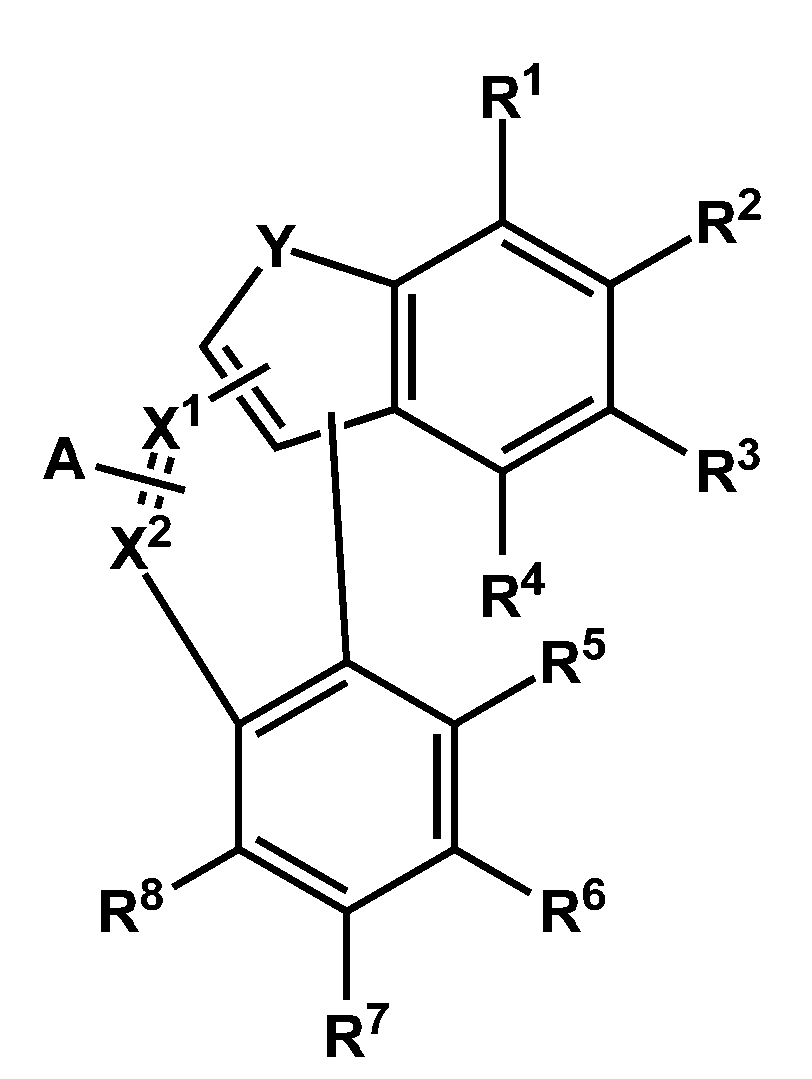
상기 화학식 1-1에서, In Chemical Formula 1-1,
X1 및 X2 중 적어도 하나는 -N-이고, 나머지 하나는 -CA-이고,At least one of X 1 and X 2 is -N-, and the other is -CA-,
Y는 -S- 또는 -O-이고,Y is -S- or -O-,
A 및 R1 내지 R8은 각각 독립적으로 수소, 중수소, 시아노기, 치환 또는 비치환된 C1 내지 C60 알킬기, 또는 치환 또는 비치환된 C6 내지 C60 아릴기이고,A and R 1 to R 8 are each independently hydrogen, deuterium, cyano group, substituted or unsubstituted C1 to C60 alkyl group, or substituted or unsubstituted C6 to C60 aryl group,
A 및 R1 내지 R4 중 어느 하나는 하기 화학식 2로 표현되는 것이고,Any one of A and R 1 to R 4 is represented by the following formula (2),
[화학식 2][Formula 2]

상기 화학식 2에서,In Chemical Formula 2,
Ar1 및 Ar2는 각각 독립적으로 치환 또는 비치환된 C6 내지 C60 아릴기 또는 치환 또는 비치환된 C2 내지 C60 헤테로아릴기이고,Ar 1 And Ar 2 are each independently a substituted or unsubstituted C6 to C60 aryl group or a substituted or unsubstituted C2 to C60 heteroaryl group,
Ar1 및 Ar2 중 적어도 어느 하나는 치환 또는 비치환된 C2 내지 C60 헤테로아릴기 또는 치환 또는 비치환된 C6 내지 C60 융합 고리 아릴기이고,At least one of Ar 1 and Ar 2 is a substituted or unsubstituted C2 to C60 heteroaryl group or a substituted or unsubstituted C6 to C60 fused ring aryl group,
X3 내지 X7 중 적어도 하나는 -N-이고, X3 내지 X7 중 하나는 -(L1)n1-Ar1이고, X3 내지 X7 중 하나는 -Ar2-이고, 나머지는 -N-, -CH- 또는 -CR- 중 하나이고,At least one of X 3 to X 7 is -N-, one of X 3 to X 7 is -(L 1 ) n1 -Ar 1 , one of X 3 to X 7 is -Ar 2 -, and the other is- N-, -CH- or -CR-,
L1 및 L2는 각각 독립적으로, 단일결합, 치환 또는 비치환된 C6 내지 C60 아릴렌기, 또는 치환 또는 비치환된 C2 내지 C60 헤테로아릴렌기이고,L 1 and L 2 are each independently a single bond, a substituted or unsubstituted C6 to C60 arylene group, or a substituted or unsubstituted C2 to C60 heteroarylene group,
n1 및 n2는 서로 독립적으로, 0 내지 2의 정수 중 하나이고,n1 and n2 are each independently an integer from 0 to 2,
상기 R은 중수소, -CN, 치환 또는 비치환된 C1 내지 C60의 직쇄 또는 분지쇄의 알킬, 치환 또는 비치환된 C6 내지 C60의 단환 또는 다환의 아릴기, 또는 치환 또는 비치환된 C2 내지 C60의 단환 또는 다환의 헤테로아릴기이고,R is deuterium, -CN, substituted or unsubstituted C1 to C60 linear or branched alkyl, substituted or unsubstituted C6 to C60 monocyclic or polycyclic aryl group, or substituted or unsubstituted C2 to C60 A monocyclic or polycyclic heteroaryl group,
상기 *는 결합위치이다.The * is a binding position.
여기서, 융합(fused) 고리 아릴기란, 탄소원자들이 인접한 쌍들을 나눠 가지는 고리기를 의미한다.Here, a fused ring aryl group means a ring group in which carbon atoms divide adjacent pairs.
구체적으로 상기 C6 내지 C60 융합 고리 아릴기는 치환 또는 비치환된 나프틸기, 치환 또는 비치환된 트리페닐레닐기, 치환 또는 비치환된 플루오레닐기, 치환 또는 비치환된 파이레닐기, 또는 치환 또는 비치환된 페난트레닐기일 수 있다.Specifically, the C6 to C60 fused ring aryl group is a substituted or unsubstituted naphthyl group, a substituted or unsubstituted triphenylenyl group, a substituted or unsubstituted fluorenyl group, a substituted or unsubstituted pyrenyl group, or a substituted or unsubstituted It may be a substituted phenanthrenyl group.
본 출원은 상기 화학식 1 또는 상기 화학식 1-1의 화합물에 관한 것이다.The present application relates to the compound of Formula 1 or Formula 1-1.
또한, 상기 화학식 1의 구조에 다양한 치환기를 도입함으로써 도입된 치환기의 고유 특성을 갖는 화합물을 합성할 수 있다. 예컨대, 유기 발광 소자 제조시 사용되는 정공 주입층 물질, 정공 수송용 물질, 발광층 물질, 전자 수송층 물질 및 전하 생성층 물질에 주로 사용되는 치환기를 상기 코어 구조에 도입함으로써 각 유기물층에서 요구하는 조건들을 충족시키는 물질을 합성할 수 있다.In addition, by introducing various substituents to the structure of Formula 1, it is possible to synthesize a compound having intrinsic properties of the introduced substituents. For example, by introducing a substituent mainly used for a hole injection layer material, a hole transport material, a light emitting layer material, an electron transport layer material, and a charge generating layer material used in manufacturing an organic light emitting device into the core structure, the requirements of each organic material layer are satisfied. You can synthesize the substance.
또한, 상기 화학식 1의 구조에 다양한 치환기를 도입함으로써 에너지 밴드갭을 미세하게 조절이 가능하게 하며, 한편으로 유기물 사이에서의 계면에서의 특성을 향상되게 하며 물질의 용도를 다양하게 할 수 있다.In addition, by introducing various substituents in the structure of Chemical Formula 1, it is possible to finely adjust the energy band gap, on the other hand, to improve the properties at the interface between organic materials, and to use various materials.
한편, 상기 화합물은 유리 전이 온도(Tg)가 높아 열적 안정성이 우수하다. 이러한 열적 안정성의 증가는 소자에 구동 안정성을 제공하는 중요한 요인이 된다.On the other hand, the compound has a high glass transition temperature (Tg) and excellent thermal stability. This increase in thermal stability is an important factor providing driving stability to the device.
보다 구체적으로, 상기 화학식 2는 하기 화학식 3으로 표현될 수 있다.More specifically, Chemical Formula 2 may be represented by Chemical Formula 3 below.
[화학식 3][Formula 3]
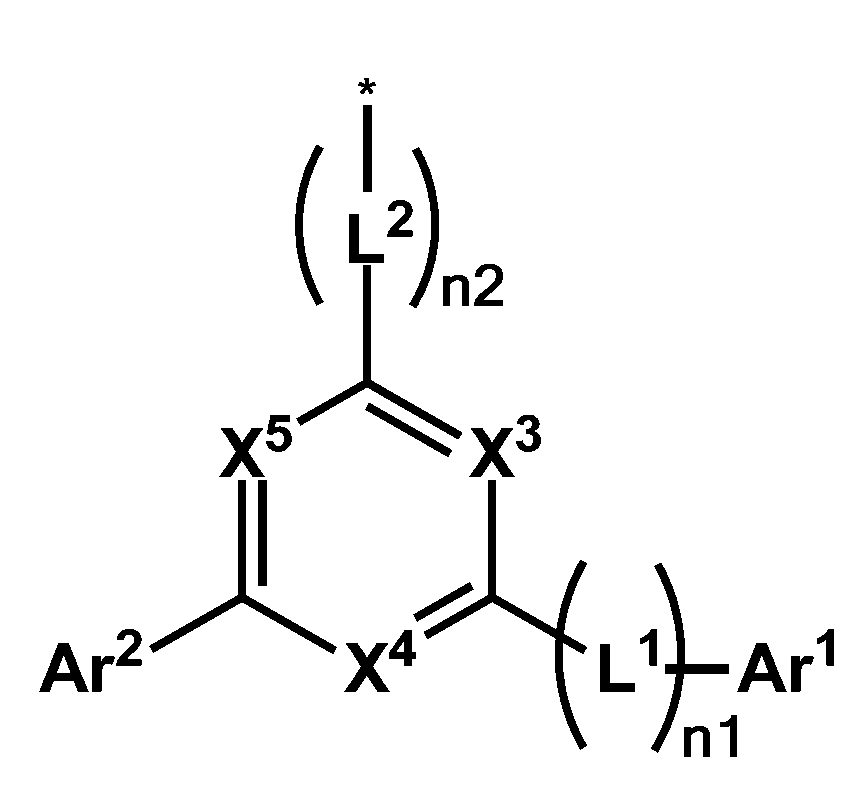
상기 화학식 3에서, Ar1 및 Ar2는 각각 독립적으로 치환 또는 비치환된 C6 내지 C60 아릴기 또는 치환 또는 비치환된 C2 내지 C60 헤테로아릴기이고, X3 내지 X5는 각각 독립적으로, -N-, -CH- 또는 -CR-이고, X3 내지 X5 중 적어도 하나는 -N-이며, L1 및 L2는 각각 독립적으로, 단일결합, 치환 또는 비치환된 C6 내지 C60 아릴렌기, 또는 치환 또는 비치환된 C2 내지 C60 헤테로아릴렌기이고, n1 및 n2는 서로 독립적으로, 0 내지 2의 정수 중 하나이고, 상기 R은 중수소, -CN, 치환 또는 비치환된 C1 내지 C60의 직쇄 또는 분지쇄의 알킬, 치환 또는 비치환된 C6 내지 C60의 단환 또는 다환의 아릴기, 또는 치환 또는 비치환된 C2 내지 C60의 단환 또는 다환의 헤테로아릴기이고,In Chemical Formula 3, Ar 1 And Ar 2 are each independently a substituted or unsubstituted C6 to C60 aryl group or a substituted or unsubstituted C2 to C60 heteroaryl group, and X 3 to X 5 are each independently -N-, -CH- or- CR-, at least one of X 3 to X 5 is -N-, and L 1 and L 2 are each independently a single bond, a substituted or unsubstituted C6 to C60 arylene group, or a substituted or unsubstituted C2 to C60 heteroarylene group, n1 and n2 are each independently an integer of 0 to 2, wherein R is deuterium, -CN, substituted or unsubstituted C1 to C60 straight or branched chain alkyl, substituted or unsubstituted A substituted C6 to C60 monocyclic or polycyclic aryl group, or a substituted or unsubstituted C2 to C60 monocyclic or polycyclic heteroaryl group,
상기 화학식 1의 A가 상기 화학식 3으로 표현되는 경우, 상기 화학식 3의 Ar1 및 Ar2 중 적어도 어느 하나는 치환 또는 비치환된 C2 내지 C60 헤테로아릴기 또는 치환 또는 비치환된 C6 내지 C60 융합 고리 아릴기이고, 상기 *는 결합위치이다.When A in Formula 1 is represented by Formula 3, at least one of Ar 1 and Ar 2 in Formula 3 is a substituted or unsubstituted C2 to C60 heteroaryl group or a substituted or unsubstituted C6 to C60 fused ring An aryl group, and * is a bonding position.
보다 구체적으로, 상기 화학식 3은 하기와 같이 표현될 수 있다.More specifically, Chemical Formula 3 may be expressed as follows.
[화학식 3][Formula 3]

상기 화학식 3에서, Ar1 및 Ar2는 각각 독립적으로 치환 또는 비치환된 C6 내지 C60 아릴기 또는 치환 또는 비치환된 C2 내지 C60 헤테로아릴기이고, Ar1 및 Ar2 중 적어도 어느 하나는 치환 또는 비치환된 C2 내지 C60 헤테로아릴기 또는 치환 또는 비치환된 C6 내지 C60 융합 고리 아릴기이고, X3 내지 X5는 각각 독립적으로, -N-, -CH- 또는 -CR-이고, X3 내지 X5 중 적어도 하나는 -N-이며, L1 및 L2는 각각 독립적으로, 단일결합, 치환 또는 비치환된 C6 내지 C60 아릴렌기, 또는 치환 또는 비치환된 C2 내지 C60 헤테로아릴렌기이고, n1 및 n2는 서로 독립적으로, 0 내지 2의 정수 중 하나이고, 상기 R은 중수소, -CN, 치환 또는 비치환된 C1 내지 C60의 직쇄 또는 분지쇄의 알킬, 치환 또는 비치환된 C6 내지 C60의 단환 또는 다환의 아릴기, 또는 치환 또는 비치환된 C2 내지 C60의 단환 또는 다환의 헤테로아릴기이고,In Chemical Formula 3, Ar 1 And Ar 2 are each independently a substituted or unsubstituted C6 to C60 aryl group or a substituted or unsubstituted C2 to C60 heteroaryl group, and at least one of Ar 1 and Ar 2 is a substituted or unsubstituted C2 to C60 hetero An aryl group or a substituted or unsubstituted C6 to C60 fused ring aryl group, X 3 to X 5 are each independently -N-, -CH- or -CR-, and at least one of X 3 to X 5 is- N-, L 1 and L 2 are each independently a single bond, a substituted or unsubstituted C6 to C60 arylene group, or a substituted or unsubstituted C2 to C60 heteroarylene group, n1 and n2 are independently of each other, Is an integer from 0 to 2, wherein R is deuterium, -CN, substituted or unsubstituted C1 to C60 straight or branched chain alkyl, substituted or unsubstituted C6 to C60 monocyclic or polycyclic aryl group, or A substituted or unsubstituted C2 to C60 monocyclic or polycyclic heteroaryl group,
상기 *는 결합위치이다.The * is a binding position.
상기 화학식 3으로 표시되는 치환기를 갖는 화합물은, 각각 Ar1, Ar2이 독립적이며, 치환 또는 비치환된 C2 내지 C60 헤테로아릴기 또는 치환 또는 비치환된 C6 내지 C60 융합 고리 아릴기를 가지는 치환기가 그렇지 않은 치환기보다 상대적으로 정공 수송 특성이 더 강하다. 정공 수송 특성이 강하므로 인하여, 전체적인 전자의 이동에 영향을 주어서 더욱 뛰어난 효율, 수명을 나타낼 수 있다.In the compound having a substituent represented by Formula 3, Ar 1 and Ar 2 are each independently, and a substituted or unsubstituted C2 to C60 heteroaryl group or a substituted or unsubstituted C6 to C60 fused ring aryl group is not. The hole transport properties are relatively stronger than the non-substituents. Due to the strong hole transport properties, it can affect the overall electron movement, thereby exhibiting more excellent efficiency and lifetime.
보다 구체적으로, 상기 화합물은 하기 화학식 4로 표시될 수 있다.More specifically, the compound may be represented by the following formula (4).
[화학식 4] [Formula 4]
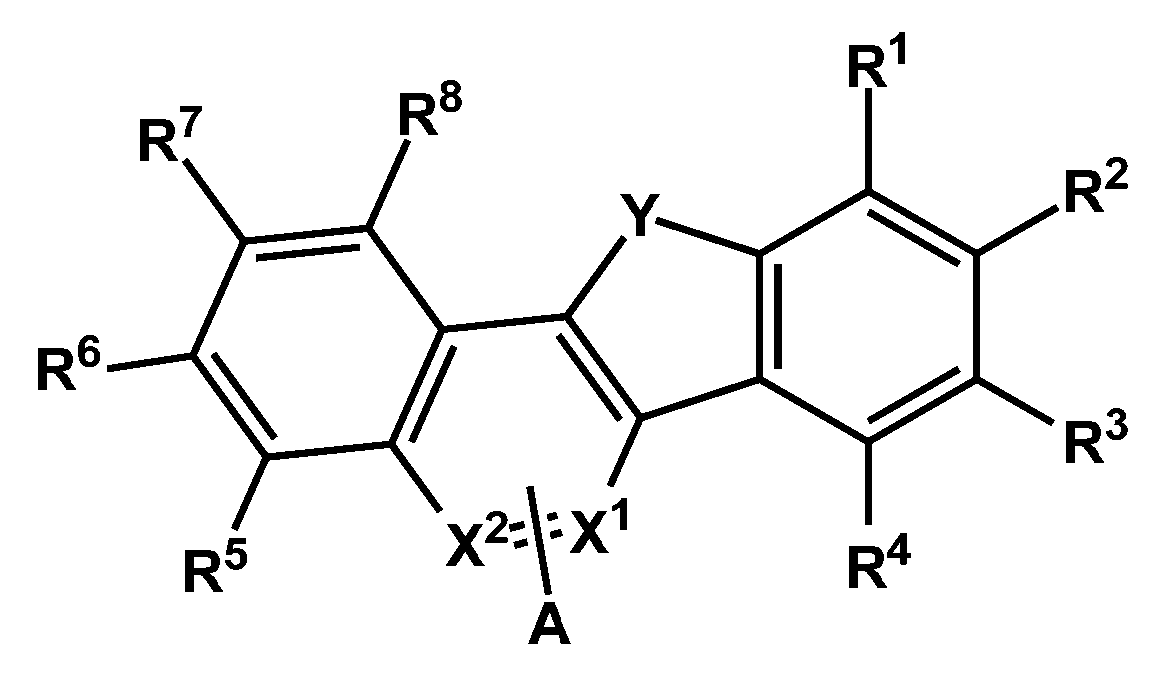
상기 화학식 4에서, 각 치환기의 정의는 상기 화학식 1에서의 정의와 동일하다.In Formula 4, the definition of each substituent is the same as the definition in Formula 1.
또한, 상기 화합물은 하기 화학식 5로 표시될 수 있다.In addition, the compound may be represented by the following formula (5).
[화학식 5] [Formula 5]

상기 화학식 5에서, 각 치환기의 정의는 상기 화학식 1에서의 정의와 동일하다.In Formula 5, the definition of each substituent is the same as the definition in Formula 1.
더욱 구체적으로, 상기 화학식 4에서, X1는 -N-이고, X2는 -CA-이며, 상기 A는 상기 화학식 3으로 표현되는 화합물일 수 있다.More specifically, in Chemical Formula 4, X 1 is -N-, X 2 is -CA-, and A may be a compound represented by Chemical Formula 3.
더욱 구체적으로, 상기 화학식 4에서, X1는 -CA-이고, X2는 -N-이며, 상기 A는 상기 화학식 3으로 표현되는 화합물일 수 있다.More specifically, in Chemical Formula 4, X 1 is -CA-, X 2 is -N-, and A may be a compound represented by Chemical Formula 3.
더욱 구체적으로, 상기 화학식 4에서, X1는 -N-이고, X2는 -CA-이며, R1 내지 R4 중 어느 하나는 상기 화학식 3으로 표현되는 화합물일 수 있다.More specifically, in Chemical Formula 4, X 1 is -N-, X 2 is -CA-, and any one of R 1 to R 4 may be a compound represented by Chemical Formula 3.
더욱 구체적으로, 상기 화학식 4에서, X1는 -CA-이고, X2는 -N-이며, R1 내지 R4 중 어느 하나는 상기 화학식 3으로 표현되는 화합물일 수 있다.More specifically, in Chemical Formula 4, X 1 is -CA-, X 2 is -N-, and any one of R 1 to R 4 may be a compound represented by Chemical Formula 3.
또한, 더욱 구체적으로, 상기 화학식 4에서, X1는 -N-이고, X2는 -CA-이며, R1 내지 R4 중 어느 하나는 상기 화학식 3으로 표현되며, A는 페닐기 또는 나프틸기인 화합물 일 수 있다.Further, more specifically, in Formula 4, X 1 is -N-, X 2 is -CA-, any one of R 1 to R 4 is represented by Formula 3, A is a phenyl group or a naphthyl group It can be a compound.
또한, 더욱 구체적으로, 상기 화학식 4에서, X1는 -CA-이고, X2는 -N-이며, R1 내지 R4 중 어느 하나는 상기 화학식 3으로 표현되며, A는 페닐기 또는 나프틸기인 화합물 일 수 있다.Further, more specifically, in Formula 4, X 1 is -CA-, X 2 is -N-, any one of R 1 to R 4 is represented by Formula 3, A is a phenyl group or a naphthyl group It can be a compound.
더욱 구체적으로, 상기 화학식 5에서, X1는 -N-이고, X2는 -CA-이며, 상기 A는 상기 화학식 3으로 표현되는 화합물일 수 있다.More specifically, in Chemical Formula 5, X 1 is -N-, X 2 is -CA-, and A may be a compound represented by Chemical Formula 3.
더욱 구체적으로, 상기 화학식 5에서, X1는 -CA-이고, X2는 -N-이며, 상기 A는 상기 화학식 3으로 표현되는 화합물일 수 있다.More specifically, in Chemical Formula 5, X 1 is -CA-, X 2 is -N-, and A may be a compound represented by Chemical Formula 3.
더욱 구체적으로, 상기 화학식 5에서, X1는 -N-이고, X2는 -CA-이며, R1 내지 R4 중 어느 하나는 상기 화학식 3으로 표현되는 화합물일 수 있다.More specifically, in Chemical Formula 5, X 1 is -N-, X 2 is -CA-, and any one of R 1 to R 4 may be a compound represented by Chemical Formula 3.
더욱 구체적으로, 상기 화학식 5에서, X1는 -CA-이고, X2는 -N-이며, R1 내지 R4 중 어느 하나는 상기 화학식 3으로 표현되는 화합물일 수 있다.More specifically, in Chemical Formula 5, X 1 is -CA-, X 2 is -N-, and any one of R 1 to R 4 may be a compound represented by Chemical Formula 3.
또한, 더욱 구체적으로, 상기 화학식 5에서, X1는 -N-이고, X2는 -CA-이며, R1 내지 R4 중 어느 하나는 상기 화학식 3으로 표현되며, A는 페닐기 또는 나프틸기인 화합물일 수 있다.Further, more specifically, in Formula 5, X 1 is -N-, X 2 is -CA-, any one of R 1 to R 4 is represented by Formula 3, A is a phenyl group or a naphthyl group It can be a compound.
또한, 더욱 구체적으로, 상기 화학식 5에서, X1는 -CA-이고, X2는 -N-이며, R1 내지 R4 중 어느 하나는 상기 화학식 3으로 표현되며, A는 페닐기 또는 나프틸기인 화합물일 수 있다.Further, more specifically, in Formula 5, X 1 is -CA-, X 2 is -N-, any one of R 1 to R 4 is represented by Formula 3, A is a phenyl group or a naphthyl group It can be a compound.
또한, 상기 Ar1은 정공 특성을 가지는 치환기일 수 있다.In addition, Ar 1 may be a substituent having hole characteristics.
본 출원의 일 실시상태에 있어서, L1 및 L2는 각각 독립적으로, 단일결합, 치환 또는 비치환된 C6 내지 C60 아릴렌기, 또는 치환 또는 비치환된 C2 내지 C60 헤테로아릴렌기일 수 있다.In one embodiment of the present application, L 1 and L 2 may be each independently a single bond, a substituted or unsubstituted C6 to C60 arylene group, or a substituted or unsubstituted C2 to C60 heteroarylene group.
또 다른 일 실시상태에 있어서, L1 및 L2는 각각 독립적으로, 단일결합, 치환 또는 비치환된 C6 내지 C40 아릴렌기, 또는 치환 또는 비치환된 C2 내지 C40 헤테로아릴렌기일 수 있다.In another exemplary embodiment, L 1 and L 2 may be each independently a single bond, a substituted or unsubstituted C6 to C40 arylene group, or a substituted or unsubstituted C2 to C40 heteroarylene group.
또 다른 일 실시상태에 있어서, L1 및 L2는 각각 독립적으로, 단일결합, C6 내지 C40 아릴렌기, 또는 C2 내지 C40 헤테로아릴렌기일 수 있다.In another exemplary embodiment, L 1 and L 2 may be each independently a single bond, a C6 to C40 arylene group, or a C2 to C40 heteroarylene group.
또 다른 일 실시상태에 있어서, L1 및 L2는 각각 독립적으로, 단일결합, 또는 단환 또는 다환의 C6 내지 C40 아릴렌기일 수 있다.In another exemplary embodiment, L 1 and L 2 may be each independently a single bond, or a monocyclic or polycyclic C6 to C40 arylene group.
또 다른 일 실시상태에 있어서, L1 및 L2는 각각 독립적으로, 단일결합, 페닐렌기, 비페닐렌기, 또는 나프탈렌기일 수 있다.In another exemplary embodiment, L 1 and L 2 may be each independently a single bond, a phenylene group, a biphenylene group, or a naphthalene group.
본 출원의 일 실시상태에 있어서, Ar1 및 Ar2는 각각 독립적으로 치환 또는 비치환된 C6 내지 C60 아릴기 또는 치환 또는 비치환된 C2 내지 C60 헤테로아릴기일 수 있다.In one embodiment of the present application, Ar 1 and Ar 2 may be each independently a substituted or unsubstituted C6 to C60 aryl group or a substituted or unsubstituted C2 to C60 heteroaryl group.
또 다른 일 실시상태에 있어서, Ar1 및 Ar2는 각각 독립적으로 치환 또는 비치환된 C6 내지 C40 아릴기 또는 치환 또는 비치환된 C2 내지 C40 헤테로아릴기일 수 있다.In another exemplary embodiment, Ar 1 and Ar 2 may be each independently a substituted or unsubstituted C6 to C40 aryl group or a substituted or unsubstituted C2 to C40 heteroaryl group.
또 다른 일 실시상태에 있어서, Ar1 및 Ar2는 각각 독립적으로 C1 내지 C10의 알킬기로 치환 또는 비치환된 C6 내지 C40 아릴기, 또는 C6 내지 C10의 아릴기로 치환 또는 비치환된 C2 내지 C40 헤테로아릴기일 수 있다.In another exemplary embodiment, Ar 1 and Ar 2 are each independently a C1 to C10 alkyl group substituted or unsubstituted C6 to C40 aryl group, or a C6 to C10 aryl group substituted or unsubstituted C2 to C40 hetero It may be an aryl group.
또 다른 일 실시상태에 있어서, Ar1 및 Ar2는 각각 독립적으로 치환 또는 비치환된 페닐기, 치환 또는 비치환된 나프틸기, 치환 또는 비치환된 비페닐기, 치환 또는 비치환된 트리페닐레닐기, 치환 또는 비치환된 플루오레닐기, 치환 또는 비치환된 파이레닐기, 치환 또는 비치환된 페난트레닐기, 치환 또는 비치환된 카바졸기, 치환 또는 비치환된 디벤조티오펜기, 또는 치환 또는 비치환된 디벤조퓨란기일 수 있다.In another exemplary embodiment, Ar 1 and Ar 2 are each independently a substituted or unsubstituted phenyl group, a substituted or unsubstituted naphthyl group, a substituted or unsubstituted biphenyl group, a substituted or unsubstituted triphenylenyl group, Substituted or unsubstituted fluorenyl group, substituted or unsubstituted pyrenyl group, substituted or unsubstituted phenanthrenyl group, substituted or unsubstituted carbazole group, substituted or unsubstituted dibenzothiophene group, or substituted or unsubstituted It may be a substituted dibenzofuran group.
또 다른 일 실시상태에 있어서, Ar1 및 Ar2는 각각 독립적으로 페닐기, 나프틸기, 비페닐기, 트리페닐레닐기, 메틸기로 치환 또는 비치환된 플루오레닐기, 벤젠고리가 축합된 9,9-디메틸플루오레닐기, 파이레닐기, 페난트레닐기, 페닐기로 치환 또는 비치환된 카바졸기, 페닐기로 치환 또는 비치환된 디벤조티오펜기, 또는 페닐기로 치환 또는 비치환된 디벤조퓨란기일 수 있다.In another exemplary embodiment, Ar 1 and Ar 2 are each independently a phenyl group, a naphthyl group, a biphenyl group, a triphenylenyl group, a fluorenyl group unsubstituted or substituted with a methyl group, or a benzene ring condensed 9,9- It may be a dimethylfluorenyl group, a pyrenyl group, a phenanthrenyl group, a carbazole group substituted or unsubstituted with a phenyl group, a dibenzothiophene group substituted or unsubstituted with a phenyl group, or a dibenzofuran group substituted or unsubstituted with a phenyl group. .
본 출원의 일 실시상태에 있어서, 상기 A 및 R1 내지 R8은 각각 독립적으로 수소, 중수소, 시아노기, 치환 또는 비치환된 C1 내지 C60 알킬기, 또는 치환 또는 비치환된 C6 내지 C60 아릴기이고, A 및 R1 내지 R4 중 어느 하나는 화학식 2로 표현될 수 있다.In one embodiment of the present application, A and R 1 to R 8 are each independently hydrogen, deuterium, a cyano group, a substituted or unsubstituted C1 to C60 alkyl group, or a substituted or unsubstituted C6 to C60 aryl group , A and any one of R 1 to R 4 may be represented by the formula (2).
또 다른 일 실시상태에 있어서, 상기 A 및 R1 내지 R8은 각각 독립적으로 수소, 또는 치환 또는 비치환된 C6 내지 C60 아릴기이고, A 및 R1 내지 R4 중 어느 하나는 화학식 2로 표현될 수 있다.In another exemplary embodiment, A and R 1 to R 8 are each independently hydrogen, or a substituted or unsubstituted C6 to C60 aryl group, and any one of A and R 1 to R 4 is represented by Formula 2 Can be.
또 다른 일 실시상태에 있어서, 상기 A 및 R1 내지 R8은 각각 독립적으로 수소, 또는 치환 또는 비치환된 C6 내지 C40 아릴기이고, A 및 R1 내지 R4 중 어느 하나는 화학식 2로 표현될 수 있다.In another exemplary embodiment, A and R 1 to R 8 are each independently hydrogen, or a substituted or unsubstituted C6 to C40 aryl group, and any one of A and R 1 to R 4 is represented by Formula 2 Can be.
또 다른 일 실시상태에 있어서, 상기 A 및 R1 내지 R8은 각각 독립적으로 수소, 또는 C6 내지 C40 아릴기이고, A 및 R1 내지 R4 중 어느 하나는 화학식 2로 표현될 수 있다.In another exemplary embodiment, A and R 1 to R 8 are each independently hydrogen, or a C6 to C40 aryl group, and any one of A and R 1 to R 4 may be represented by Chemical Formula 2.
또 다른 일 실시상태에 있어서, 상기 A 및 R1 내지 R8은 각각 독립적으로 수소, 페닐기, 또는 나프틸기이고, A 및 R1 내지 R4 중 어느 하나는 화학식 2로 표현될 수 있다.In another exemplary embodiment, A and R 1 to R 8 are each independently hydrogen, a phenyl group, or a naphthyl group, and any one of A and R 1 to R 4 may be represented by Chemical Formula 2.
본 출원의 일 실시상태에 있어서, 상기 A가 상기 화학식 2로 표현되는 경우, 상기 화학식 2의 Ar1 및 Ar2 중 적어도 어느 하나는 치환 또는 비치환된 C2 내지 C60 헤테로아릴기 또는 치환 또는 비치환된 C6 내지 C60 융합 고리 아릴기일 수 있다.In an exemplary embodiment of the present application, when A is represented by Chemical Formula 2 , at least one of Ar 1 and Ar 2 of Chemical Formula 2 is substituted or unsubstituted C2 to C60 heteroaryl group or substituted or unsubstituted C6 to C60 fused ring aryl group.
또 다른 일 실시상태에 있어서, 상기 A가 상기 화학식 2로 표현되는 경우, 상기 화학식 2의 Ar1 및 Ar2 중 적어도 어느 하나는 치환 또는 비치환된 C2 내지 C40 헤테로아릴기 또는 치환 또는 비치환된 C6 내지 C40 융합 고리 아릴기일 수 있다.In another exemplary embodiment, when A is represented by Chemical Formula 2 , at least one of Ar 1 and Ar 2 of Chemical Formula 2 is substituted or unsubstituted C2 to C40 heteroaryl group or substituted or unsubstituted It may be a C6 to C40 fused ring aryl group.
또 다른 일 실시상태에 있어서, 상기 A가 상기 화학식 2로 표현되는 경우, 상기 화학식 2의 Ar1 및 Ar2 중 적어도 어느 하나는 C6 내지 C20 아릴기로 치환 또는 비치환된 C2 내지 C40 헤테로아릴기, 또는 C6 내지 C40 융합 고리 아릴기일 수 있다.In another exemplary embodiment, when A is represented by Chemical Formula 2 , at least one of Ar 1 and Ar 2 of Chemical Formula 2 is a C2 to C40 heteroaryl group unsubstituted or substituted with a C6 to C20 aryl group, Or it may be a C6 to C40 fused ring aryl group.
또 다른 일 실시상태에 있어서, 상기 A가 상기 화학식 2로 표현되는 경우, 상기 화학식 2의 Ar1 및 Ar2 중 적어도 어느 하나는 페닐기로 치환 또는 비치환된 카바졸기, 페닐기로 치환 또는 비치환된 디벤조티오펜기, 페닐기로 치환 또는 비치환된 디벤조퓨란기, 트리페닐레닐기, 9,9-디메틸플루오레닐기, 벤젠고리가 축합된 9,9-디메틸플루오레닐기, 페난트레닐기 또는 파이레닐기일 수 있다.In another exemplary embodiment, when A is represented by Chemical Formula 2 , at least one of Ar 1 and Ar 2 of Chemical Formula 2 is a carbazole group substituted or unsubstituted with a phenyl group, or substituted or unsubstituted with a phenyl group Dibenzothiophene group, dibenzofuran group unsubstituted or substituted with phenyl group, triphenylenyl group, 9,9-dimethylfluorenyl group, 9,9-dimethylfluorenyl group condensed with benzene ring, phenanthrenyl group, or It may be a pyrenyl group.
상기 벤젠고리가 축합된 9,9-디메틸플루오레닐기는 하기 구조 중 어느 하나일 수 있다.The benzene ring condensed 9,9-dimethylfluorenyl group may be any one of the following structures.

보다 구체적으로, 상기 Ar1은, 치환 또는 비치환된 카바졸릴기이거나, 치환 또는 비치환된 디벤조퓨라닐기이거나, 치환 또는 비치환된 디벤조티오페닐기이거나, 치환 또는 비치환된 9,9-디알킬플루오레닐기 또는 9,9-디아릴플루오레닐기이며, 상기 디알킬의 알킬기는 치환 또는 비치환된 C1 내지 C60 알킬기이고, 상기 디아릴기의 아릴기는 치환 또는 비치환된 C6 내지 C60 아릴기이거나, 치환 또는 비치환된 9,9-디메틸플루오레닐기일 수 있다.More specifically, Ar 1 is a substituted or unsubstituted carbazolyl group, a substituted or unsubstituted dibenzofuranyl group, a substituted or unsubstituted dibenzothiophenyl group, or a substituted or unsubstituted 9,9- A dialkylfluorenyl group or a 9,9-diarylfluorenyl group, the alkyl group of the dialkyl is a substituted or unsubstituted C1 to C60 alkyl group, and the aryl group of the diaryl group is a substituted or unsubstituted C6 to C60 aryl group Or, it may be a substituted or unsubstituted 9,9-dimethylfluorenyl group.
상기와 같은 치환기로 표현될 경우, 다른 경우보다 유기 발광 소자의 발광효율 및 수명이 더 좋을 수 있다.When expressed as a substituent as described above, the luminous efficiency and lifetime of the organic light emitting device may be better than other cases.
보다 구체적으로, 상기 Ar1은 치환 또는 비치환된 안트라세닐기이거나, 치환 또는 비치환된 페난트릴기이거나, 치환 또는 비치환된 파이레닐기이거나, 치환 또는 비치환된 트리페닐레닐기이거나, 치환 또는 비치환된 터페닐기이거나, 치환 또는 비치환된 쿼터페닐기일 수 있다.More specifically, Ar 1 is a substituted or unsubstituted anthracenyl group, a substituted or unsubstituted phenanthryl group, a substituted or unsubstituted pyrenyl group, or a substituted or unsubstituted triphenylenyl group, or substituted Or it may be an unsubstituted terphenyl group, or a substituted or unsubstituted quarterphenyl group.
상기와 같은 치환기로 표현될 경우, 다른 경우보다 유기 발광 소자의 발광효율 및 수명이 더 좋을 수 있다.When expressed as a substituent as described above, the luminous efficiency and lifetime of the organic light emitting device may be better than other cases.
보다 구체적으로, 상기 화학식 1로 표시되는 화합물은 하기 그룹 I의 화합물 중 어느 하나일 수 있다.More specifically, the compound represented by Formula 1 may be any one of the compounds of Group I below.
[그룹 I][Group I]


또한, 상기 화학식 1로 표시되는 화합물은 하기 그룹 II의 화합물 중 어느 하나일 수 있다.In addition, the compound represented by Formula 1 may be any one of the compounds of Group II below.
[그룹 II][Group II]


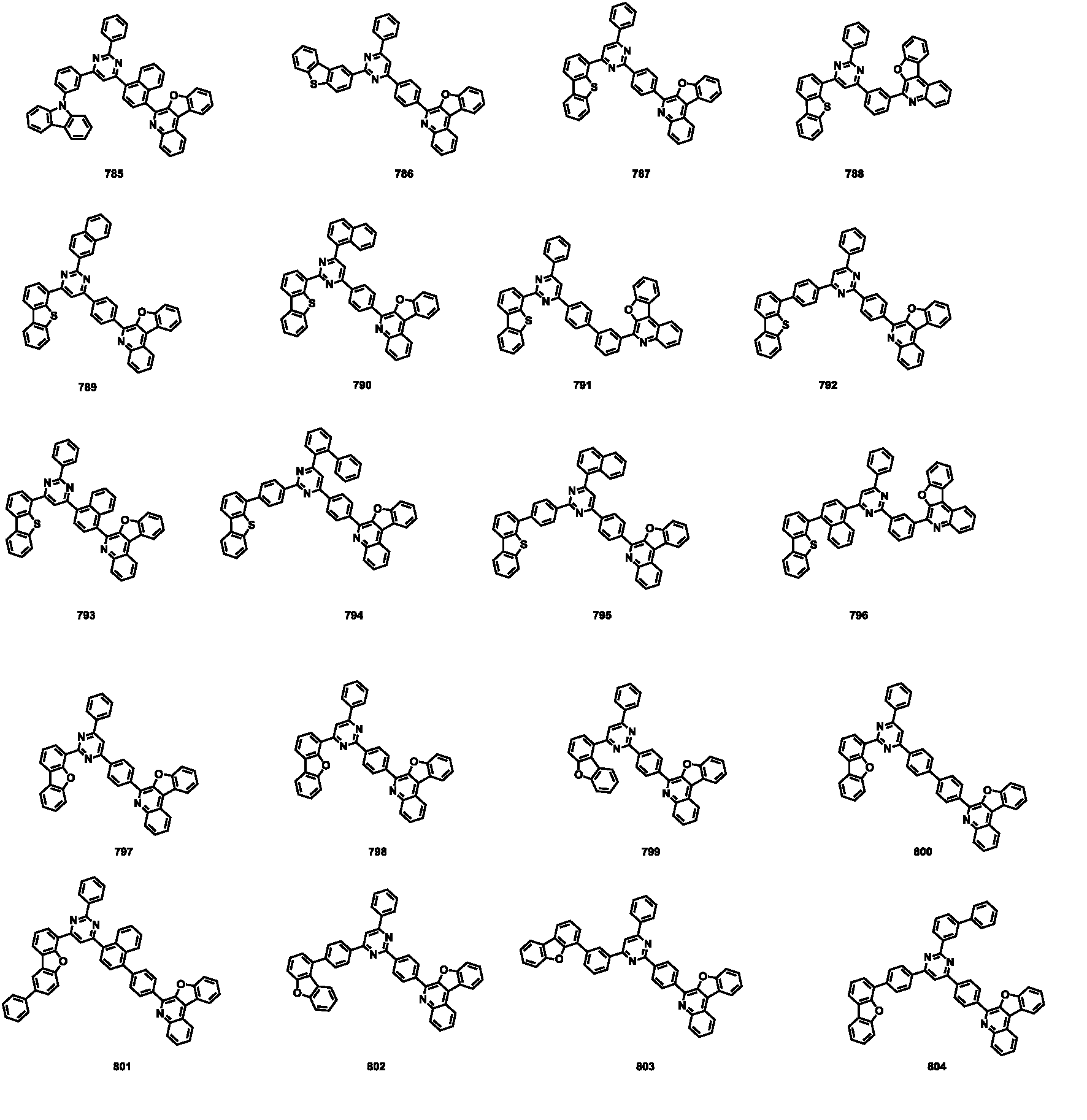


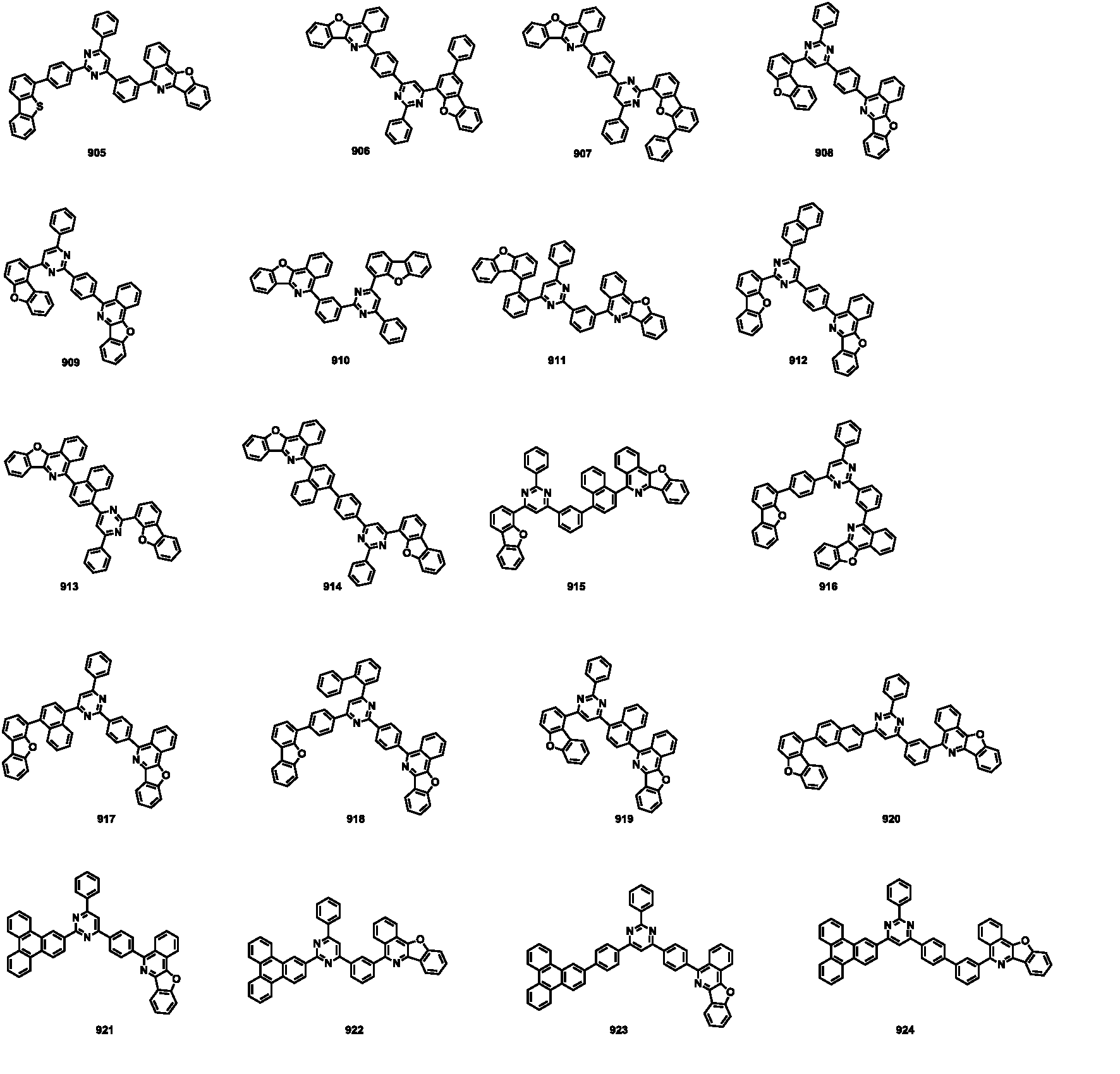


또한, 상기 화학식 1로 표시되는 화합물은 하기 그룹 III의 화합물 중 어느 하나일 수 있다.In addition, the compound represented by Formula 1 may be any one of the compounds of Group III below.
[그룹 III][Group III]

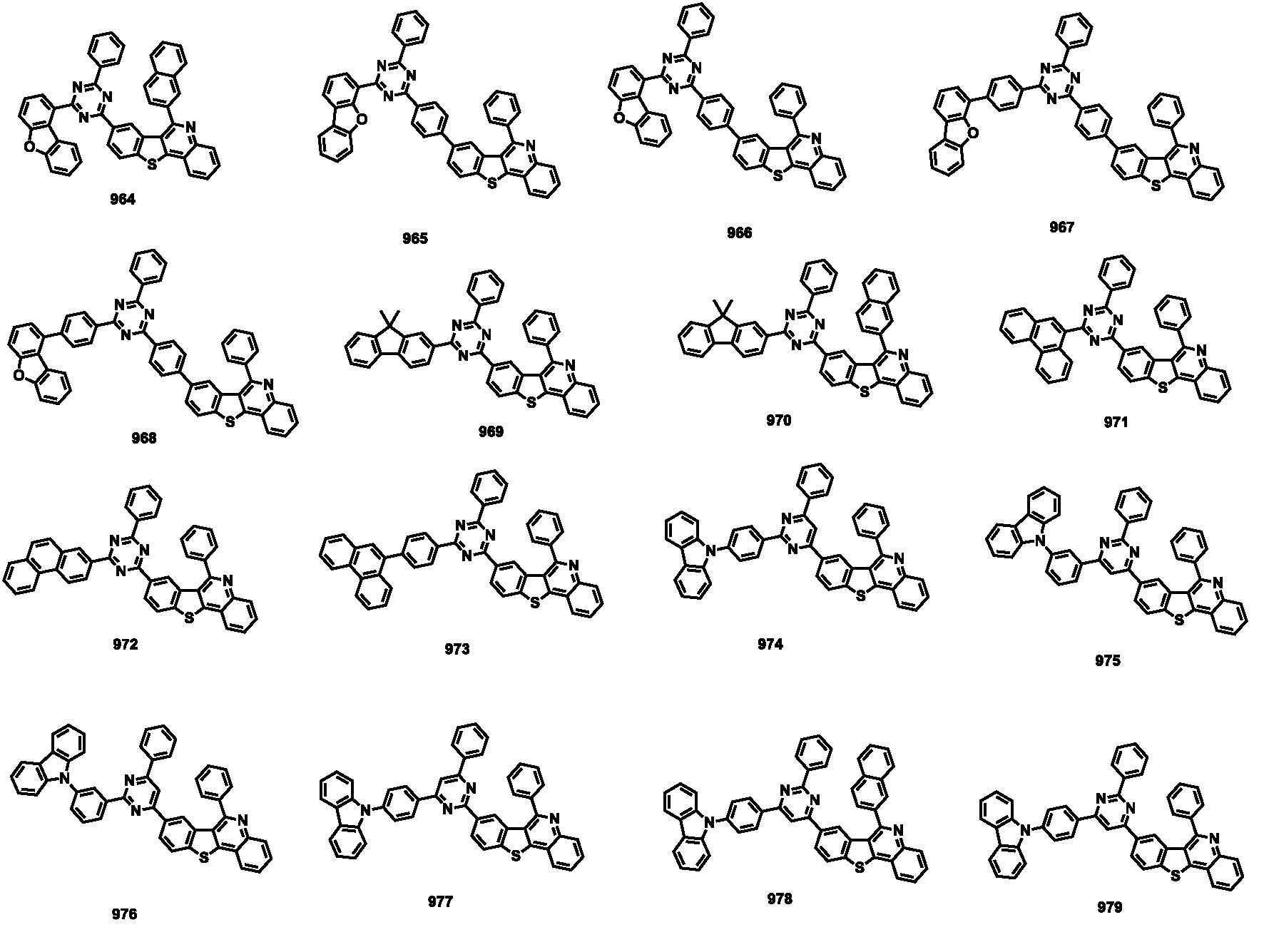


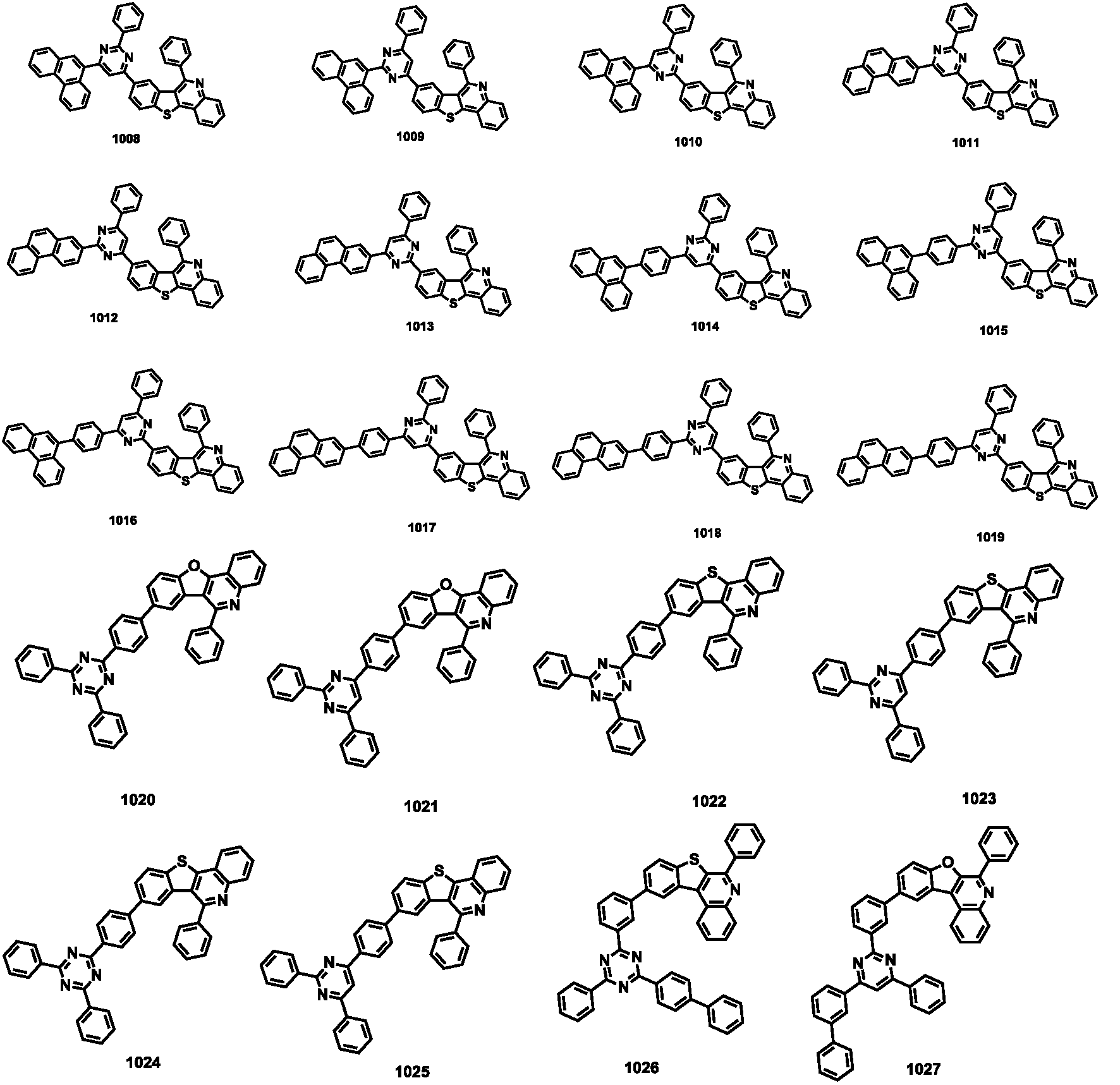

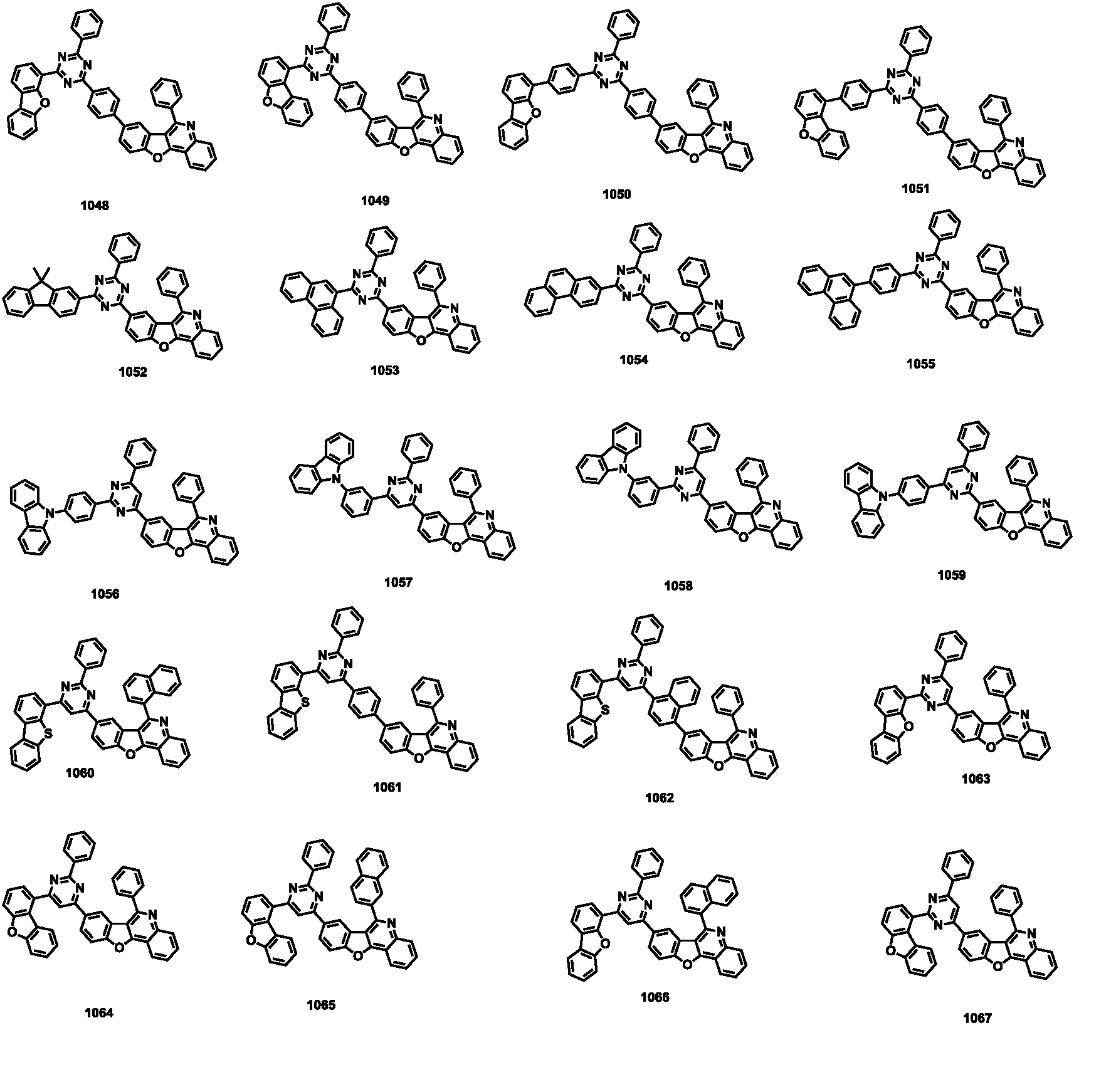


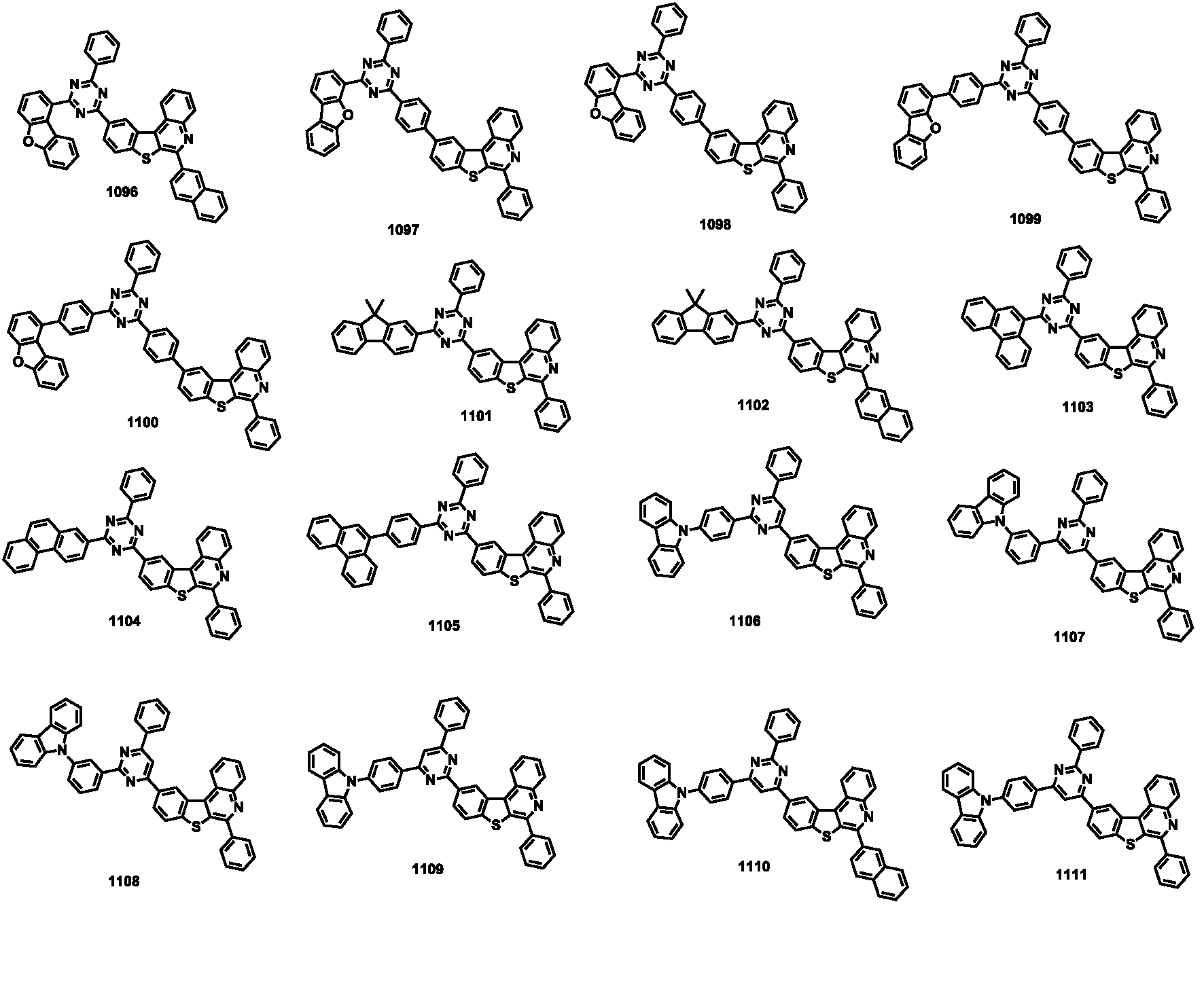


전술한 화합물 또는 조성물은 유기 광전자 소자용일 수 있으며, 유기 광전자 소자용 화합물 또는 유기 광전자 소자용 조성물은 화학기상증착과 같은 건식 성막법에 의해 형성될 수 있다.The above-described compound or composition may be for an organic optoelectronic device, and the compound for an organic optoelectronic device or a composition for an organic optoelectronic device may be formed by a dry film deposition method such as chemical vapor deposition.
이하 상술한 유기 광전자 소자용 화합물 또는 유기 광전자 소자용 조성물을 적용한 유기 광전자 소자를 설명한다.Hereinafter, an organic optoelectronic device to which the compound for an organic optoelectronic device or a composition for an organic optoelectronic device is applied will be described.
유기 광전자 소자는 전기 에너지와 광 에너지를 상호 전환할 수 있는 소자이면 특별히 한정되지 않으며, 예컨대 유기 광전 소자, 유기 발광 소자, 유기 태양 전지 및 유기 감광체 드럼 등을 들 수 있다.The organic optoelectronic device is not particularly limited as long as it is a device capable of mutually converting electrical energy and light energy, and examples thereof include organic photoelectric devices, organic light emitting devices, organic solar cells, and organic photoconductor drums.
또한, 본 출원의 일 실시상태에 있어서, 제1 전극; 상기 제1 전극과 대향하여 구비된 제2 전극; 및 상기 제1 전극과 상기 제2 전극 사이에 구비된 1층 이상의 유기물층을 포함하는 유기 발광 소자로서, 상기 유기물층 중 1 층 이상은 상기 화학식 1로 표시되는 헤테로고리 화합물을 포함하는 것인 유기 발광 소자를 제공한다.In addition, in one embodiment of the present application, the first electrode; A second electrode provided to face the first electrode; And one or more organic material layers provided between the first electrode and the second electrode, wherein at least one layer of the organic material layer includes a heterocyclic compound represented by Chemical Formula 1 above. Provides
본 출원의 일 실시상태에 있어서, 상기 제1 전극은 양극일 수 있고, 상기 제2 전극은 음극일 수 있다.In one embodiment of the present application, the first electrode may be an anode, and the second electrode may be a cathode.
또 다른 일 실시상태에 있어서, 상기 제1 전극은 음극일 수 있고, 상기 제2 전극은 양극일 수 있다.In another exemplary embodiment, the first electrode may be a cathode, and the second electrode may be an anode.
상기 화학식 1로 표시되는 헤테로고리 화합물에 대한 구체적인 내용은 전술한 바와 동일하다.Details of the heterocyclic compound represented by Chemical Formula 1 are the same as described above.
본 출원의 일 실시상태에 있어서, 상기 유기 발광 소자는 청색 유기 발광 소자일 수 있으며, 상기 화학식 1에 따른 헤테로고리 화합물은 상기 청색 유기 발광 소자의 재료로 사용될 수 있다. In one embodiment of the present application, the organic light emitting device may be a blue organic light emitting device, and the heterocyclic compound according to Formula 1 may be used as a material for the blue organic light emitting device.
본 출원의 일 실시상태에 있어서, 상기 유기 발광 소자는 녹색 유기 발광 소자일 수 있으며, 상기 화학식 1에 따른 헤테로고리 화합물은 상기 녹색 유기 발광 소자의 재료로 사용될 수 있다.In one embodiment of the present application, the organic light emitting device may be a green organic light emitting device, and the heterocyclic compound according to Chemical Formula 1 may be used as a material for the green organic light emitting device.
본 출원의 일 실시상태에 있어서, 상기 유기 발광 소자는 적색 유기 발광 소자일 수 있으며, 상기 화학식 1에 따른 헤테로고리 화합물은 상기 적색 유기 발광 소자의 재료로 사용될 수 있다.In one embodiment of the present application, the organic light emitting device may be a red organic light emitting device, and the heterocyclic compound according to Formula 1 may be used as a material for the red organic light emitting device.
본 발명의 유기 발광 소자는 전술한 헤테로고리 화합물을 이용하여 한 층 이상의 유기물층을 형성하는 것을 제외하고는, 통상의 유기 발광 소자의 제조방법 및 재료에 의하여 제조될 수 있다.The organic light emitting device of the present invention can be manufactured by a conventional method and material for manufacturing an organic light emitting device, except that one or more organic material layers are formed using the aforementioned heterocyclic compound.
상기 헤테로고리 화합물은 유기 발광 소자의 제조시 진공 증착법 뿐만 아니라 용액 도포법에 의하여 유기물층으로 형성될 수 있다. 여기서, 용액 도포법이라 함은 스핀 코팅, 딥 코팅, 잉크젯 프린팅, 스크린 프린팅, 스프레이법, 롤 코팅 등을 의미하지만, 이들만으로 한정되는 것은 아니다.The heterocyclic compound may be formed as an organic material layer by a solution coating method as well as a vacuum deposition method when manufacturing an organic light emitting device. Here, the solution application method means spin coating, dip coating, inkjet printing, screen printing, spraying, roll coating, and the like, but is not limited to these.
여기서는 유기 광전자 소자의 일 예인 유기 발광 소자의 또 다른 예를 도면을 참고하여 설명한다.Here, another example of the organic light emitting device, which is an example of the organic optoelectronic device, will be described with reference to the drawings.
도 1 내지 3에 본 출원의 일 실시상태에 따른 유기 발광 소자의 전극과 유기물층의 적층 순서를 예시하였다. 그러나, 이들 도면에 의하여 본 출원의 범위가 한정될 것을 의도한 것은 아니며, 당 기술분야에 알려져 있는 유기 광전자 소자의 구조가 본 출원에도 적용될 수 있다.1 to 3 illustrate the stacking order of the electrode and the organic material layer of the organic light emitting device according to an exemplary embodiment of the present application. However, the scope of the present application is not intended to be limited by these drawings, and the structure of the organic optoelectronic device known in the art may be applied to the present application.
도 1에 따르면, 기판(100) 상에 양극(200), 유기물층(300) 및 음극(400)이 순차적으로 적층된 유기 발광 소자가 도시된다. 그러나, 이와 같은 구조에만 한정되는 것은 아니고, 도 2와 같이, 기판 상에 음극, 유기물층 및 양극이 순차적으로 적층된 유기 발광 소자가 구현될 수도 있다.According to FIG. 1, an organic light emitting device in which an
도 3은 유기물층이 다층인 경우를 예시한 것이다. 도 3에 따른 유기 발광 소자는 정공 주입층(301), 정공 수송층(302), 발광층(303), 정공 저지층(304), 전자 수송층(305) 및 전자 주입층(306)을 포함한다. 그러나, 이와 같은 적층 구조에 의하여 본 출원의 범위가 한정되는 것은 아니며, 필요에 따라 발광층을 제외한 나머지 층은 생략될 수도 있고, 필요한 다른 기능층이 더 추가될 수 있다.3 illustrates a case where the organic material layer is a multilayer. The organic light emitting device according to FIG. 3 includes a
상기 화학식 1로 표시되는 화합물은 유기 발광 소자에서 전자 수송층, 정공 수송층, 정공 저지층, 발광층의 재료 등으로 사용될 수 있다. 더욱 구체적으로, 상기 화학식 1로 표시되는 화합물은 유기 발광 소자에서 전자 수송층 또는 정공 저지층의 재료로 사용될 수 있다.The compound represented by Chemical Formula 1 may be used as an electron transporting layer, a hole transporting layer, a hole blocking layer, and a material for a light emitting layer in an organic light emitting device. More specifically, the compound represented by Chemical Formula 1 may be used as a material for an electron transport layer or a hole blocking layer in an organic light emitting device.
양극 재료로는 비교적 일함수가 큰 재료들을 이용할 수 있으며, 투명 전도성 산화물, 금속 또는 전도성 고분자 등을 사용할 수 있다. 상기 양극 재료의 구체적인 예로는 바나듐, 크롬, 구리, 아연, 금과 같은 금속 또는 이들 의 합금; 아연 산화물, 인듐 산화물, 인듐주석 산화물(ITO), 인듐아연 산화물(IZO)과 같은 금속 산화물; ZnO : Al 또는 SnO2 : Sb와 같은 금속과 산화물의 조합; 폴리(3-메틸티오펜), 폴리[3,4-(에틸렌-1,2-디옥시)티오 펜](PEDOT), 폴리피롤 및 폴리아닐린과 같은 전도성 고분자 등이 있으나, 이들에만 한정되는 것은 아니다. As the anode material, materials having a relatively large work function may be used, and a transparent conductive oxide, metal, or conductive polymer may be used. Specific examples of the positive electrode material include metals such as vanadium, chromium, copper, zinc and gold or alloys thereof; Metal oxides such as zinc oxide, indium oxide, indium tin oxide (ITO), and indium zinc oxide (IZO); A combination of metal and oxide such as ZnO: Al or SnO 2 : Sb; Conductive polymers such as poly(3-methylthiophene), poly[3,4-(ethylene-1,2-dioxy)thiophene] (PEDOT), polypyrrole and polyaniline, but are not limited thereto.
음극 재료로는 비교적 일함수가 낮은 재료들을 이용할 수 있으며, 금속, 금속 산화물 또는 전도성 고분자 등을 사용할 수 있다. 상기 음극 재료의 구체적인 예로는 마그네슘, 칼슘, 나트륨, 칼륨, 티타늄, 인듐, 이트륨, 리튬, 가돌리늄, 알루미늄, 은, 주석 및 납과 같은 금속 또는 이들의 합금; LiF/Al 또는 LiO2/Al과 같은 다층 구 조 물질 등이 있으나, 이들에만 한정되는 것은 아니다. As the cathode material, materials having a relatively low work function may be used, and a metal, metal oxide, or conductive polymer may be used. Specific examples of the negative electrode material include metals such as magnesium, calcium, sodium, potassium, titanium, indium, yttrium, lithium, gadolinium, aluminum, silver, tin and lead, or alloys thereof; A multilayer structure material such as LiF/Al or LiO 2 /Al, and the like, are not limited thereto.
정공 주입 재료로는 공지된 정공 주입 재료를 이용할 수도 있는데, 예를 들면, 미국 특허 제4,356,429호에 개시된 구리프탈로시아닌 등의 프탈로시아닌 화합물 또는 문헌 [Advanced Material, 6, p.677 (1994)]에 기재되어 있는 스타버스트형 아민 유도체류, 예컨대 트리스(4-카바조일-9-일페닐)아민(TCTA), 4,4',4"-트리[페닐(m-톨 릴)아미노]트리페닐아민(m-MTDATA), 1,3,5-트리스[4-(3-메틸페닐페닐아미노)페닐]벤젠(m-MTDAPB), 용해성이 있는 전도성 고분자인 폴리아닐린/도데실벤젠술폰산(Polyaniline/Dodecylbenzenesulfonic acid) 또는 폴리(3,4-에틸렌디옥시티오펜)/폴리(4-스티렌술포네이트)(Poly(3,4-ethylenedioxythiophene)/Poly(4-styrenesulfonate)), 폴리아닐린/캠퍼술폰산(Polyaniline/Camphor sulfonic acid) 또는 폴리아닐린/폴리(4-스티렌술포네이트)(Polyaniline/Poly(4-styrene-sulfonate))등을 사용할 수 있다. As the hole injection material, a known hole injection material may be used, for example, a phthalocyanine compound such as copper phthalocyanine disclosed in U.S. Patent No. 4,356,429, or described in Advanced Material, 6, p.677 (1994). Starburst amine derivatives such as tris(4-carbazoyl-9-ylphenyl)amine (TCTA), 4,4',4"-tri[phenyl(m-tolyl)amino]triphenylamine (m -MTDATA), 1,3,5-tris[4-(3-methylphenylphenylamino)phenyl]benzene (m-MTDAPB), polyaniline/dodecylbenzenesulfonic acid (Polyaniline/Dodecylbenzenesulfonic acid) or poly (3,4-ethylenedioxythiophene)/poly(4-ethylenedioxythiophene)/Poly(4-styrenesulfonate)), polyaniline/Camphor sulfonic acid or polyaniline /Polyaniline/Poly(4-styrene-sulfonate) can be used.
정공 수송 재료로는 피라졸린 유도체, 아릴아민계 유도체, 스틸벤 유도체, 트리페닐디아민 유도체 등이 사용될 수 있으며, 저분자 또는 고분자 재료가 사용될 수도 있다.As the hole transport material, a pyrazoline derivative, an arylamine-based derivative, a stilbene derivative, a triphenyldiamine derivative, etc. may be used, and a low molecular weight or high molecular weight material may also be used.
발광 재료로는 적색, 녹색 또는 청색 발광재료가 사용될 수 있으며, 필요한 경우, 2 이상의 발광 재료를 혼합하여 사용할 수 있다. 이 때, 2 이상의 발광 재료를 개별적인 공급원으로 증착하여 사용하거나, 예비 혼합하여 하나의 공급원으로 증착하여 사용할 수 있다. 또한, 발광 재료로서 형광 재료를 사용할 수도 있으나, 인광 재료로 서 사용할 수도 있다. 발광 재료로는 단독으로서 양극과 음극으로부터 각각 주입된 정공과 전자를 결합하여 발광시키는 재료가 사용될 수도 있으나, 호스트 재료와 도펀트 재료가 함께 발광에 관여하는 재료들이 사용될 수도 있다. Red, green, or blue light-emitting materials may be used as the light-emitting material, and if necessary, two or more light-emitting materials may be mixed and used. At this time, two or more light-emitting materials can be used by depositing them as separate sources or by pre-mixing them as one source. Further, a fluorescent material may be used as the light emitting material, but it may also be used as a phosphorescent material. As the light emitting material, a material that emits light by combining holes and electrons injected from the anode and the cathode, respectively, may be used, but materials in which the host material and the dopant material are involved in light emission may also be used.
발광 재료의 호스트를 혼합하여 사용하는 경우에는, 동일 계열의 호스트를 혼합하여 사용할 수도 있고, 다른 계열의 호스트를 혼합하여 사용할 수도 있다. 예를 들어, n 타입 호스트 재료 또는 P 타입 호스트 재료 중 어느 두 종류 이상의 재료를 선택하여 발광층의 호스트 재료로 사용할 수 있다. When a host of light-emitting materials is mixed and used, a host of the same series may be mixed or used, or a host of other series may be mixed and used. For example, two or more types of materials of n-type host material or P-type host material may be selected and used as the host material of the light emitting layer.
정공 저지 재료로는 예를 들어, 트리아졸 유도체, 바소큐프로인 또는 알루미늄의 혼합 배위자 착체(BAlq)가 사용될 수 있으나, 본 출원이 이에 한정되는 것은 아니며, 본 발명의 일 구현예의 화합물을 사용할 수도 있다. As the hole blocking material, for example, a triazole derivative, basocuproin, or a mixed ligand complex (BAlq) of aluminum may be used, but the present application is not limited thereto, and a compound of one embodiment of the present invention may also be used. have.
전자 수송 재료로는 본 발명의 일 구현예의 화합물 일 수 있다.The electron transport material may be a compound of one embodiment of the present invention.
전자 주입 재료로는 예를 들어, LiF가 당업계 대표적으로 사용되나, 본 출원이 이에 한정되는 것은 아니다. As the electron injection material, for example, LiF is typically used in the art, but the present application is not limited thereto.
본 출원의 일 실시상태에 따른 유기 발광 소자는 사용되는 재료에 따라 전면 발광형, 후면 발광형 또는 양면 발광형일 수 있다.The organic light emitting device according to an exemplary embodiment of the present application may be a front emission type, a back emission type, or a double-sided emission type depending on the material used.
이하 실시예를 통하여 상술한 구현예를 보다 상세하게 설명한다. 다만 하기의 실시예는 단지 설명의 목적을 위한 것이며 권리범위를 제한하는 것은 아니다.Hereinafter, the above-described embodiment will be described in more detail through examples. However, the following examples are for illustrative purposes only and are not intended to limit the scope of rights.
(유기 광전자 소자용 화합물의 제조)(Production of compounds for organic optoelectronic devices)
하기 제조예들은 하기 일반식 1 내지 일반식 4를 활용해서 제조한 것이다.The following preparation examples were prepared using the following general formulas 1 to 4.
[일반식 1][Formula 1]

[일반식 2][Formula 2]
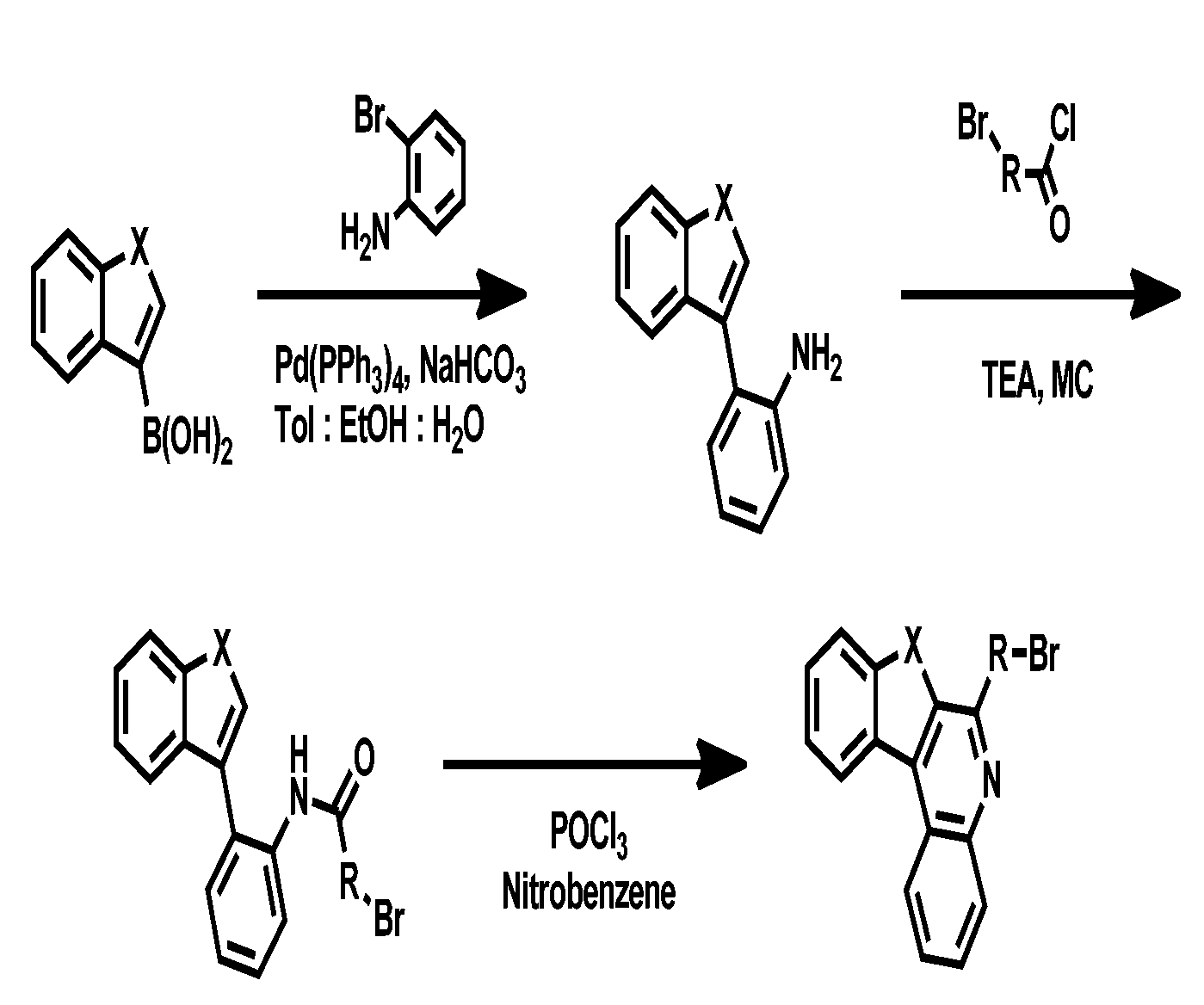
[일반식 3][Formula 3]
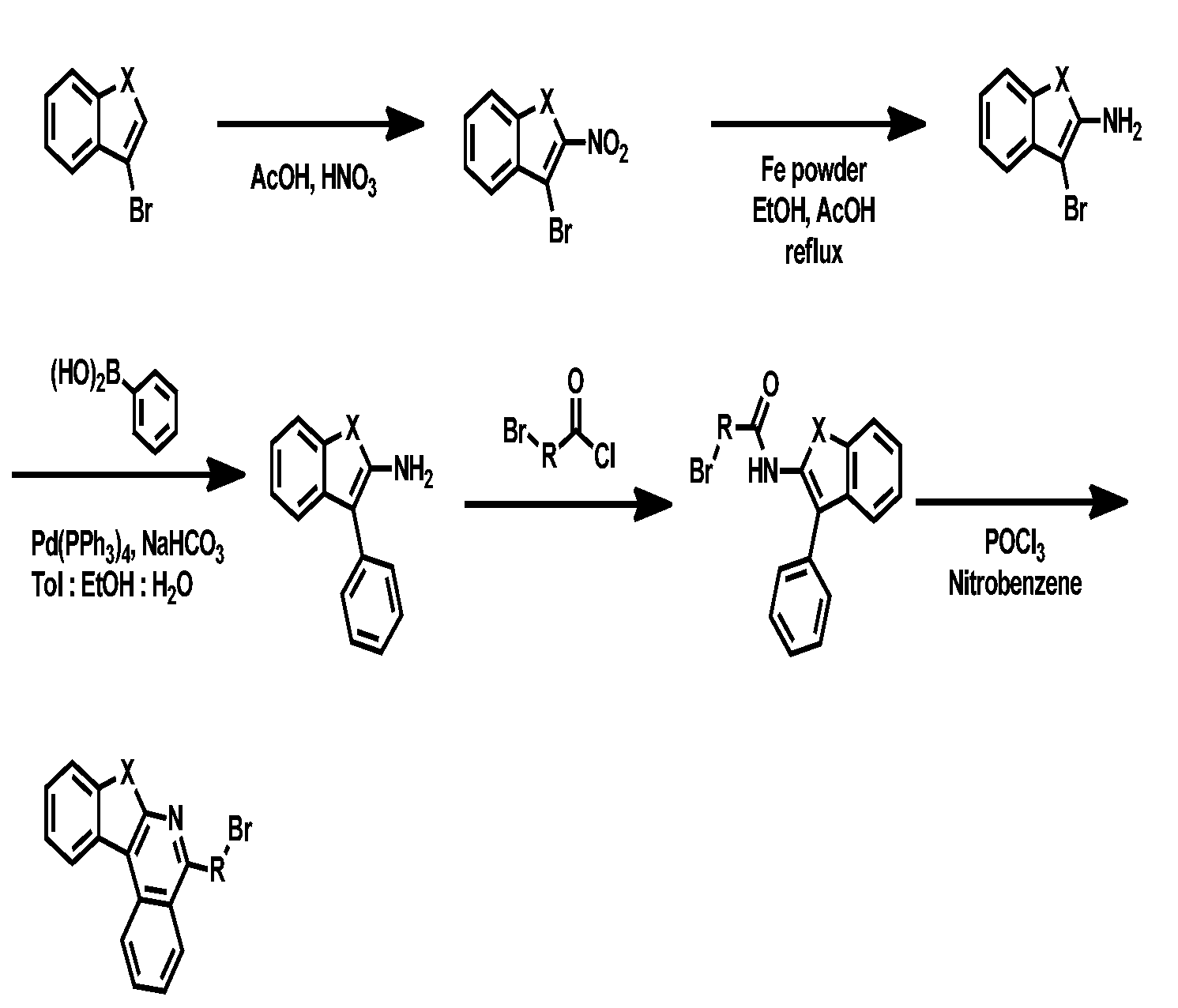
[일반식 4][Formula 4]

구체적인 제조예들은 다음과 같다.Specific manufacturing examples are as follows.
[[ 제조예Manufacturing example 1-1] 화합물 1의 제조 1-1] Preparation of compound 1

1) 화합물 1-1의 제조1) Preparation of compound 1-1
벤조[b]티오펜-2-일보론산(benzo[b]thiophen-2-ylboronic acid) (100 g, 0.561 mol), 2-브로모아닐린(2-bromoaniline) (86.7 g, 0.504 mol)을 톨루엔(Toluene), EtOH, H2O 1000 mL : 200 mL : 200 mL 에 녹인 후 Pd(PPh3)4 (32.4 g, 0.028 mol) 와 NaHCO3 (141.3 g, 1.68 mol)를 넣고 3 시간 동안 100 ℃ 교반한다. 반응 완료 후 반응액에 MC와 증류수를 넣어서 추출한다. 이후 무수 MgSO4로 건조시킨 후 회전 증발기로 용매를 제거한 후 액체 형태의 화합물1-1 (93 g, 74%) 을 얻었다.Benzo[b]thiophen-2-ylboronic acid (100 g, 0.561 mol), 2-bromoaniline (86.7 g, 0.504 mol) toluene (Toluene), EtOH, H 2 O 1000 mL: 200 mL: After dissolving in 200 mL, Pd(PPh 3 ) 4 (32.4 g, 0.028 mol) and NaHCO 3 (141.3 g, 1.68 mol) was added and stirred at 100° C. for 3 hours. After completion of the reaction, MC and distilled water are added to the reaction solution to extract. After drying with anhydrous MgSO 4 , the solvent was removed by a rotary evaporator to obtain liquid compound 1-1 (93 g, 74%).
2) 화합물 1-2의 제조2) Preparation of compound 1-2
화합물 1-1 (93 g, 0.412 mol), 트리에틸아민(Triethyl amine) (86 mL, 0.618 mol)을 MC 1200 mL에 넣고 녹인다. 4-브로모벤조일클로라이드(4-bromobenzoyl chloride) (135.6 g, 0.618 mol) 을 MC 300 mL에 녹인 후, 0 ℃에서 천천히 혼합물에 적가한다. 반응 완료 후 반응액 있는 흰 고체를 필터하여 핵산으로 씻어 준다. 이것을 건조하여 고체 형태의 화합물 1-2 (134 g, 83%)를 얻었다.Compound 1-1 (93 g, 0.412 mol) and triethyl amine (86 mL, 0.618 mol) are added to 1200 mL of MC and dissolved. 4-Bromobenzoyl chloride (135.6 g, 0.618 mol) was dissolved in 300 mL of MC, and then slowly added dropwise to the mixture at 0°C. After the reaction is completed, the white solid with the reaction solution is filtered and washed with nucleic acid. This was dried to give solid compound 1-2 (134 g, 83%).
3) 화합물 1-3의 제조3) Preparation of compound 1-3
화합물 1-2 (134 g, 0.329 mol)을 니트로벤젠(Nitrobenzene) 1500 mL에 녹인 후, POCl3 (46 mL, 0.495 mol)을 천천히 적가한다. 15 시간 동안 140 ℃에서 반응한다. 반응 완료 후 반응액에 NaHCO3를 증류수에 넣어 녹인 용액을 천천히 넣고 교반한다. 이후에 생기는 고체를 필터하여 수집한다. 수집한 고체를 MC와 MeOH에 재결정하여 고체 형태의 화합물 1-3 (65 g, 51%)를 얻었다.Compound 1-2 (134 g, 0.329 mol) was dissolved in 1500 mL of nitrobenzene, and POCl 3 (46 mL, 0.495 mol) was slowly added dropwise. React at 140° C. for 15 hours. After the reaction was completed, NaHCO 3 was added to the reaction solution in distilled water, and the dissolved solution was slowly added and stirred. The resulting solid is collected by filtration. The collected solid was recrystallized from MC and MeOH to obtain compound 1-3 (65 g, 51%) in solid form.
4) 화합물 1-4의 제조4) Preparation of compound 1-4
화합물 1-3 (10 g, 0.025 mol), 비스(피나콜라토)디보론(Bis(pinacolato)diboron) (9.7 g, 0.038 mol), KOAc (7.3 g, 0.075 mol), PdCl2(dppf) (0.9 g, 0.0012 mol)을 1,4-dioxane 200 mL에 녹인 후 5 시간 동안 90 ℃에서 반응한다. 반응 완료 후 반응액에 MC와 증류수를 넣어서 추출한다. 이후 무수 MgSO4로 건조시킨 후 MC와 핵산을 전개용매로 컬럼 크로마토그래피를 진행하여 화합물 1-4 (7.6 g, 70%)를 얻었다.Compound 1-3 (10 g, 0.025 mol), bis(pinacolato)diboron (Bis(pinacolato)diboron) (9.7 g, 0.038 mol), KOAc (7.3 g, 0.075 mol), PdCl 2 (dppf) ( 0.9 g, 0.0012 mol) was dissolved in 200 mL of 1,4-dioxane and reacted at 90°C for 5 hours. After completion of the reaction, MC and distilled water are added to the reaction solution to extract. After drying with anhydrous MgSO 4 , MC and nucleic acid were subjected to column chromatography with a developing solvent to obtain compound 1-4 (7.6 g, 70%).
5) 화합물 1의 제조5) Preparation of compound 1
화합물 1-4 (7.6 g, 0.017 mol), 9-(4-(4-클로로-6-페닐-1,3,5-트리아진-2-일)페닐)-9H-카바졸(9-(4-(4-chloro-6-phenyl-1,3,5-triazin-2-yl)phenyl)-9H-carbazole) (7.3 g, 0.017 mol)을 1,4-dioxane :H2O = 100 mL : 20 mL 에 녹인 후 Pd2(dba)3 (1.5 g, 0.0017 mol), XPhos (1.6 g, 0.0034 mol) 와 K2CO3(7.0 g, 0.051 mol)를 넣고 5 시간 동안 100 ℃에서 교반한다. 반응 완료 후 반응액에 생성된 고체를 1,4-dioxane과 H2O로 씻어준다. 이후에 고체만 DCB에 재결정 방법으로 정제하여 화합물 1 (7.2 g, 60%) 을 얻었다.Compound 1-4 (7.6 g, 0.017 mol), 9-(4-(4-chloro-6-phenyl-1,3,5-triazin-2-yl)phenyl)-9H-carbazole (9-( 4-(4-chloro-6-phenyl-1,3,5-triazin-2-yl)phenyl)-9H-carbazole) (7.3 g, 0.017 mol) to 1,4-dioxane :H 2 O = 100 mL : After dissolving in 20 mL, add Pd 2 (dba) 3 (1.5 g, 0.0017 mol), XPhos (1.6 g, 0.0034 mol) and K 2 CO 3 (7.0 g, 0.051 mol) and stir at 100 ℃ for 5 hours. . After the reaction is completed, the solid formed in the reaction solution is washed with 1,4-dioxane and H 2 O. Subsequently, only solid was purified on DCB by a recrystallization method to obtain Compound 1 (7.2 g, 60%).
[[ 제조예Manufacturing example 1-2] 1-2]
상기 제조예 1-1에서 9-(4-(4-클로로-6-페닐-1,3,5-트리아진-2-일)페닐)-9H-카바졸(9-(4-(4-chloro-6-phenyl-1,3,5-triazin-2-yl)phenyl)-9H-carbazole) 대신 중간체 A를 사용하여 동일한 방법으로 제조하여 목적화합물을 합성하였다.In Preparation Example 1-1, 9-(4-(4-chloro-6-phenyl-1,3,5-triazin-2-yl)phenyl)-9H-carbazole (9-(4-(4- Instead of chloro-6-phenyl-1,3,5-triazin-2-yl)phenyl)-9H-carbazole), intermediate A was prepared in the same way to synthesize the target compound.

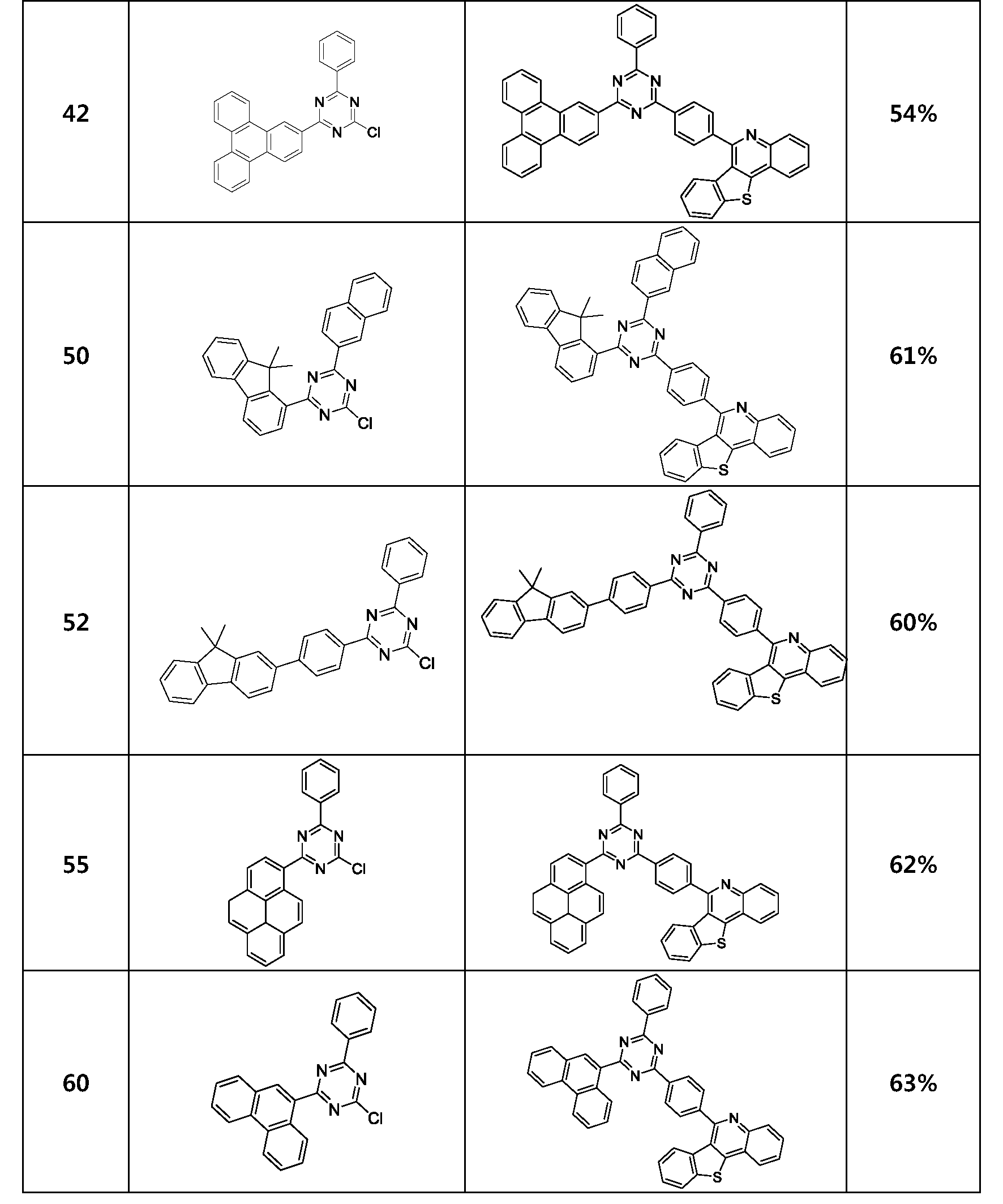


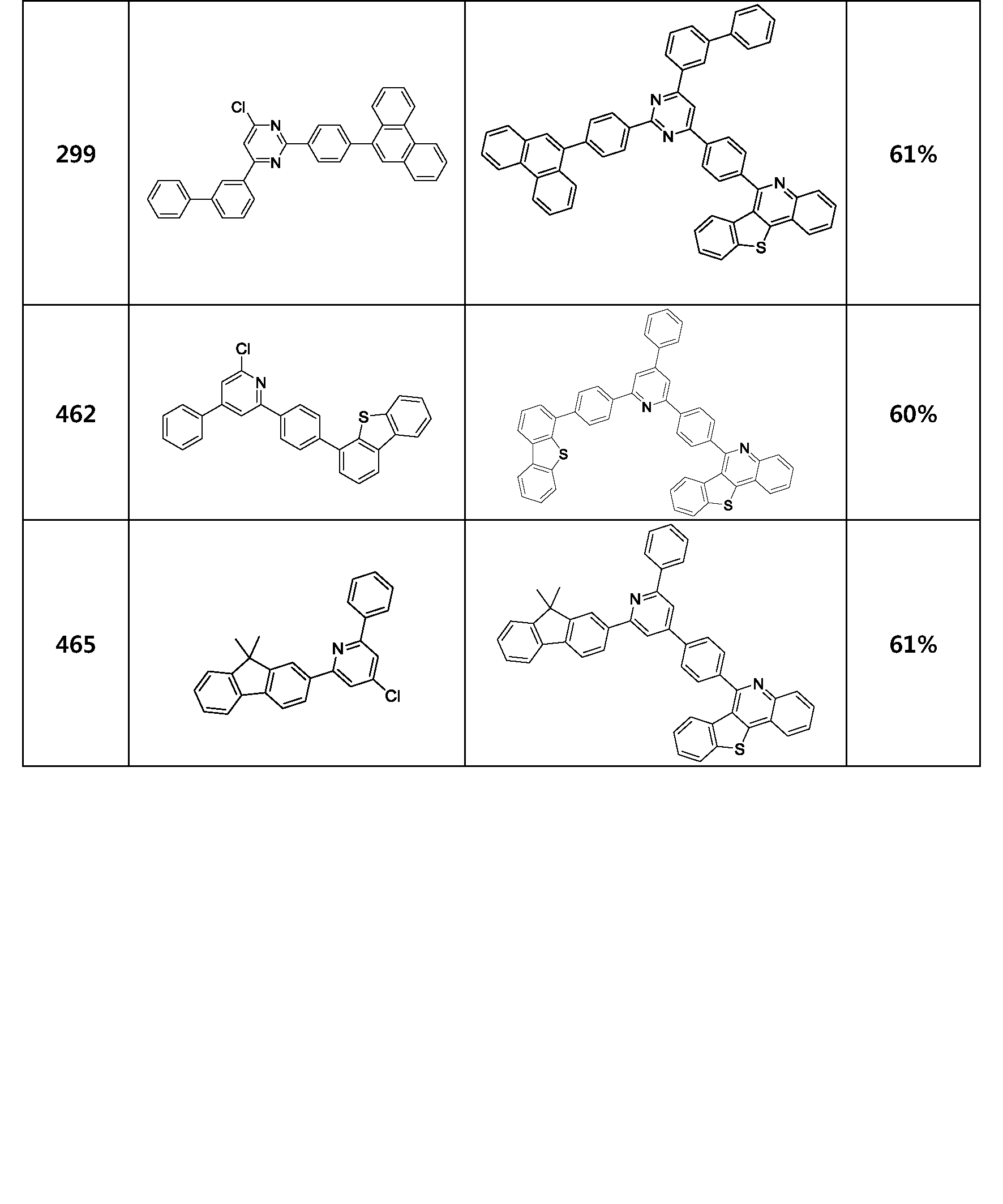
[[ 제조예Manufacturing example 1-3] 1-3]
상기 제조예 1-1에서 4-bromobenzoyl chloride 대신 3-bromobenzoyl chloride를 사용하고, 9-(4-(4-chloro-6-phenyl-1,3,5-triazin-2-yl)phenyl)-9H-carbazole 대신 중간체 B를 사용하여 동일한 방법으로 제조하여 목적화합물을 합성하였다.In Preparation Example 1-1, 3-bromobenzoyl chloride was used instead of 4-bromobenzoyl chloride, and 9-(4-(4-chloro-6-phenyl-1,3,5-triazin-2-yl)phenyl)-9H The target compound was synthesized by using the intermediate B instead of -carbazole in the same manner.

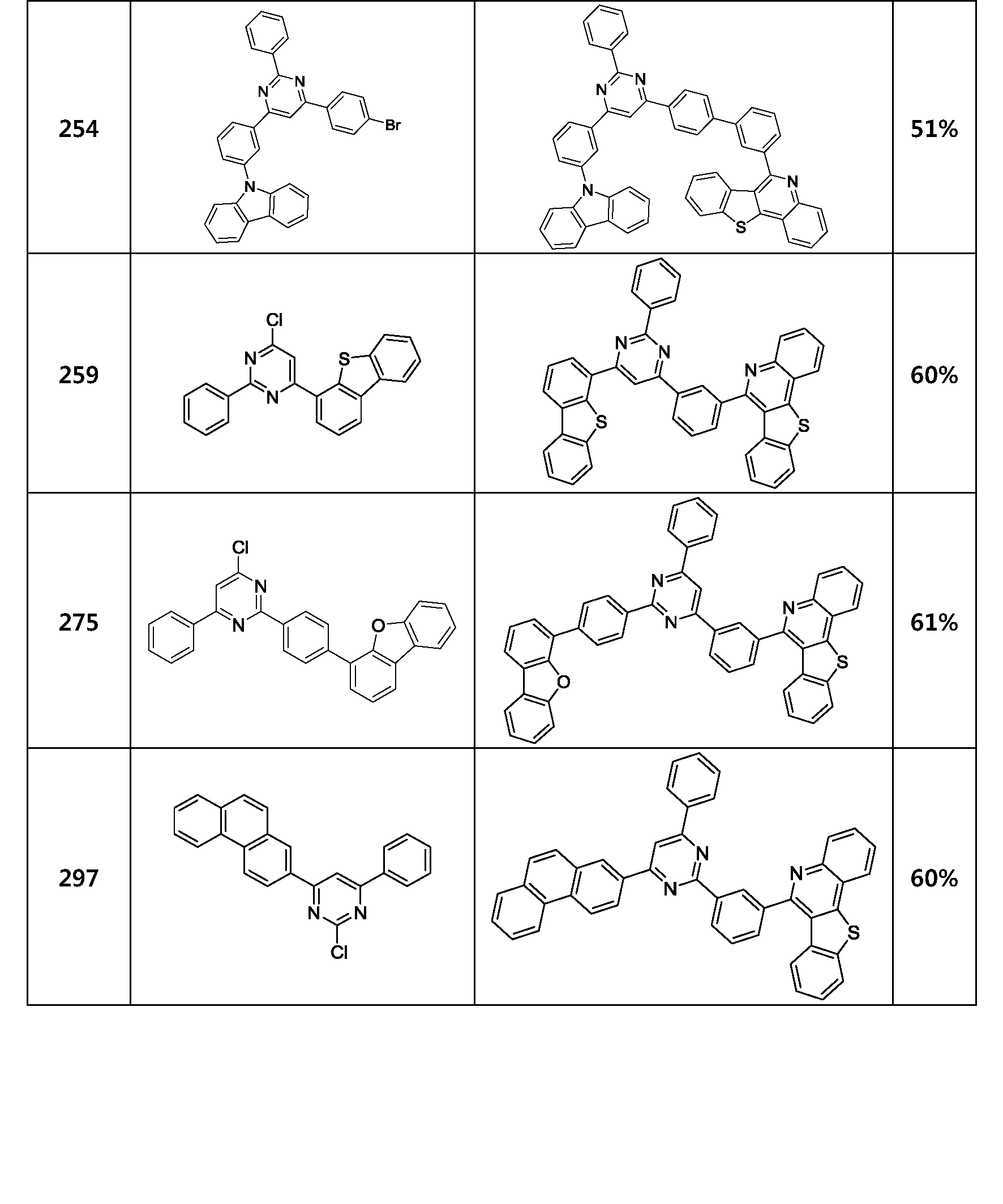
[[ 제조예Manufacturing example 1-4] 1-4]
상기 제조예 1-1에서 4-bromobenzoyl chloride 대신 4-bromo-1-naphthoyl chloride를 사용하고, 9-(4-(4-chloro-6-phenyl-1,3,5-triazin-2-yl)phenyl)-9H-carbazole 대신 중간체 C를 사용하여 동일한 방법으로 제조하여 목적화합물을 합성하였다.In Preparation Example 1-1, 4-bromo-1-naphthoyl chloride was used instead of 4-bromobenzoyl chloride, and 9-(4-(4-chloro-6-phenyl-1,3,5-triazin-2-yl) phenyl)-9H-carbazole was used instead of intermediate C to synthesize the target compound.


[[ 제조예Manufacturing example 2-1] 화합물 71의 제조 2-1] Preparation of compound 71

1) 화합물 2-1의 제조1) Preparation of compound 2-1
benzo[b]thiophen-3-ylboronic acid (100 g, 0.561 mol), 2-bromoaniline (86.7 g, 0.504 mol)을 Toluene, EtOH, H2O 1000 mL : 200 mL : 200 mL 에 녹인 후 Pd(PPh3)4 (32.4 g, 0.028 mol) 와 NaHCO3 (141.3 g, 1.68 mol)를 넣고 3 시간 동안 100 ℃ 교반한다. 반응 완료 후 반응액에 MC와 증류수를 넣어서 추출한다. 이후 무수 MgSO4로 건조시킨 후 회전 증발기로 용매를 제거한 후 액체 형태의 화합물2-1 (93 g, 74%) 을 얻었다.Dissolve benzo[b]thiophen-3-ylboronic acid (100 g, 0.561 mol), 2-bromoaniline (86.7 g, 0.504 mol) in Toluene, EtOH, H 2 O 1000 mL: 200 mL: 200 mL and then Pd(PPh 3 ) 4 (32.4 g, 0.028 mol) and NaHCO 3 (141.3 g, 1.68 mol) was added and stirred at 100° C. for 3 hours. After completion of the reaction, MC and distilled water are added to the reaction solution to extract. After drying with anhydrous MgSO 4 , the solvent was removed by rotary evaporation to obtain liquid compound 2-1 (93 g, 74%).
2) 화합물 2-2의 제조2) Preparation of compound 2-2
화합물 2-1 (93 g, 0.412 mol), Triethyl amine (86 mL, 0.618 mol)을 MC 1200 mL에 넣고 녹인다. 4-bromobenzoyl chloride (135.6 g, 0.618 mol) 을 MC 300 mL에 녹인 후, 0 ℃에서 천천히 혼합물에 적가한다. 반응 완료 후 반응액 있는 흰 고체를 필터하여 핵산으로 씻어 준다. 이것을 건조하여 고체 형태의 화합물 2-2 (134 g, 83%)를 얻었다.Compound 2-1 (93 g, 0.412 mol) and Triethyl amine (86 mL, 0.618 mol) are added to 1200 mL of MC and dissolved. 4-bromobenzoyl chloride (135.6 g, 0.618 mol) was dissolved in 300 mL of MC, and then slowly added dropwise to the mixture at 0°C. After the reaction is completed, the white solid with the reaction solution is filtered and washed with nucleic acid. This was dried to obtain compound 2-2 (134 g, 83%) in solid form.
3) 화합물 2-3의 제조3) Preparation of compound 2-3
화합물 2-2 (134 g, 0.329 mol)을 Nitrobenzene 1500 mL에 녹인 후, POCl3 (46 mL, 0.495 mol)을 천천히 적가한다. 15 시간 동안 140 ℃에서 반응한다. 반응 완료 후 반응액에 NaHCO3를 증류수에 넣어 녹인 용액을 천천히 넣고 교반한다. 이후에 생기는 고체를 필터하여 수집한다. 수집한 고체를 MC와 MeOH에 재결정하여 고체 형태의 화합물 2-3 (65 g, 51%)를 얻었다.Compound 2-2 (134 g, 0.329 mol) was dissolved in 1500 mL of Nitrobenzene, and POCl 3 (46 mL, 0.495 mol) was slowly added dropwise. React at 140° C. for 15 hours. After the reaction was completed, NaHCO 3 was added to the reaction solution in distilled water, and the dissolved solution was slowly added and stirred. The resulting solid is collected by filtration. The collected solid was recrystallized from MC and MeOH to obtain compound 2-3 (65 g, 51%) in solid form.
4) 화합물 2-4의 제조4) Preparation of compound 2-4
화합물 2-3 (10 g, 0.025 mol), Bis(pinacolato)diboron (9.7 g, 0.038 mol), KOAc (7.3 g, 0.075 mol), PdCl2(dppf) (0.9 g, 0.0012 mol)을 1,4-dioxane 200 mL에 녹인 후 5 시간 동안 90 ℃에서 반응한다. 반응 완료 후 반응액에 MC와 증류수를 넣어서 추출한다. 이후 무수 MgSO4로 건조시킨 후 MC와 핵산을 전개용매로 컬럼 크로마토그래피를 진행하여 화합물 1-4 (7.6 g, 70%)를 얻었다.Compound 2-3 (10 g, 0.025 mol), Bis(pinacolato)diboron (9.7 g, 0.038 mol), KOAc (7.3 g, 0.075 mol), PdCl 2 (dppf) (0.9 g, 0.0012 mol) 1,4 Dissolve in 200 mL of -dioxane and react at 90°C for 5 hours. After completion of the reaction, MC and distilled water are added to the reaction solution to extract. After drying with anhydrous MgSO 4 , MC and nucleic acid were subjected to column chromatography with a developing solvent to obtain compound 1-4 (7.6 g, 70%).
5) 화합물 71의 제조5) Preparation of compound 71
화합물 2-4 (7.6 g, 0.017 mol), 9-(3-(4-chloro-6-phenyl-1,3,5-triazin-2-yl)phenyl)-9H-carbazole (7.3 g, 0.017 mol)을 1,4-dioxane :H2O = 100 mL : 20 mL 에 녹인 후 Pd2(dba)3 (1.5 g, 0.0017 mol), XPhos (1.6 g, 0.0034 mol) 와 K2CO3(7.0 g, 0.051 mol)를 넣고 5 시간 동안 100 ℃에서 교반한다. 반응 완료 후 반응액에 생성된 고체를 1,4-dioxane과 H2O로 씻어준다. 이후에 고체만 DCB에 재결정 방법으로 정제하여 화합물 71 (7.2 g, 60%) 을 얻었다.Compound 2-4 (7.6 g, 0.017 mol), 9-(3-(4-chloro-6-phenyl-1,3,5-triazin-2-yl)phenyl)-9H-carbazole (7.3 g, 0.017 mol ) In 1,4-dioxane :H 2 O = 100 mL: 20 mL, then Pd 2 (dba) 3 (1.5 g, 0.0017 mol), XPhos (1.6 g, 0.0034 mol) and K 2 CO 3 (7.0 g) , 0.051 mol) and stirred at 100 °C for 5 hours. After the reaction is completed, the solid formed in the reaction solution is washed with 1,4-dioxane and H 2 O. After that, only the solid was purified by recrystallization in DCB to obtain compound 71 (7.2 g, 60%).
[[ 제조예Manufacturing example 2-2] 2-2]
상기 제조예 2-1에서 9-(3-(4-chloro-6-phenyl-1,3,5-triazin-2-yl)phenyl)-9H-carbazole 대신 중간체 D를 사용하여 동일한 방법으로 제조하여 목적화합물을 합성하였다.In Preparation Example 2-1, instead of 9-(3-(4-chloro-6-phenyl-1,3,5-triazin-2-yl)phenyl)-9H-carbazole, intermediate D was used to prepare the same method. The target compound was synthesized.


[[ 제조예Manufacturing example 2-3] 2-3]
상기 제조예 2-1에서 4-bromobenzoyl chloride 대신 3-bromobenzoyl chloride를 사용하고, 9-(3-(4-chloro-6-phenyl-1,3,5-triazin-2-yl)phenyl)-9H-carbazole 대신 중간체 E를 사용하여 동일한 방법으로 제조하여 목적화합물을 합성하였다.In Preparation Example 2-1, 3-bromobenzoyl chloride was used instead of 4-bromobenzoyl chloride, and 9-(3-(4-chloro-6-phenyl-1,3,5-triazin-2-yl)phenyl)-9H The target compound was synthesized in the same manner using intermediate E instead of -carbazole.


[[ 제조예Manufacturing example 2-4] 2-4]
상기 제조예 2-2에서 4-bromobenzoyl chloride 대신 4-bromo-1-naphthoyl chloride를 사용하고, 9-(3-(4-chloro-6-phenyl-1,3,5-triazin-2-yl)phenyl)-9H-carbazole 대신 중간체F를 사용하여 동일한 방법으로 제조하여 목적화합물을 합성하였다.In the preparation example 2-2, 4-bromo-1-naphthoyl chloride was used instead of 4-bromobenzoyl chloride, and 9-(3-(4-chloro-6-phenyl-1,3,5-triazin-2-yl) phenyl)-9H-carbazole instead of intermediate F was prepared in the same way to synthesize the target compound.


[[ 제조예Manufacturing example 3- 3- 1] 화합물1] Compound 130의 제조 130 manufacturers
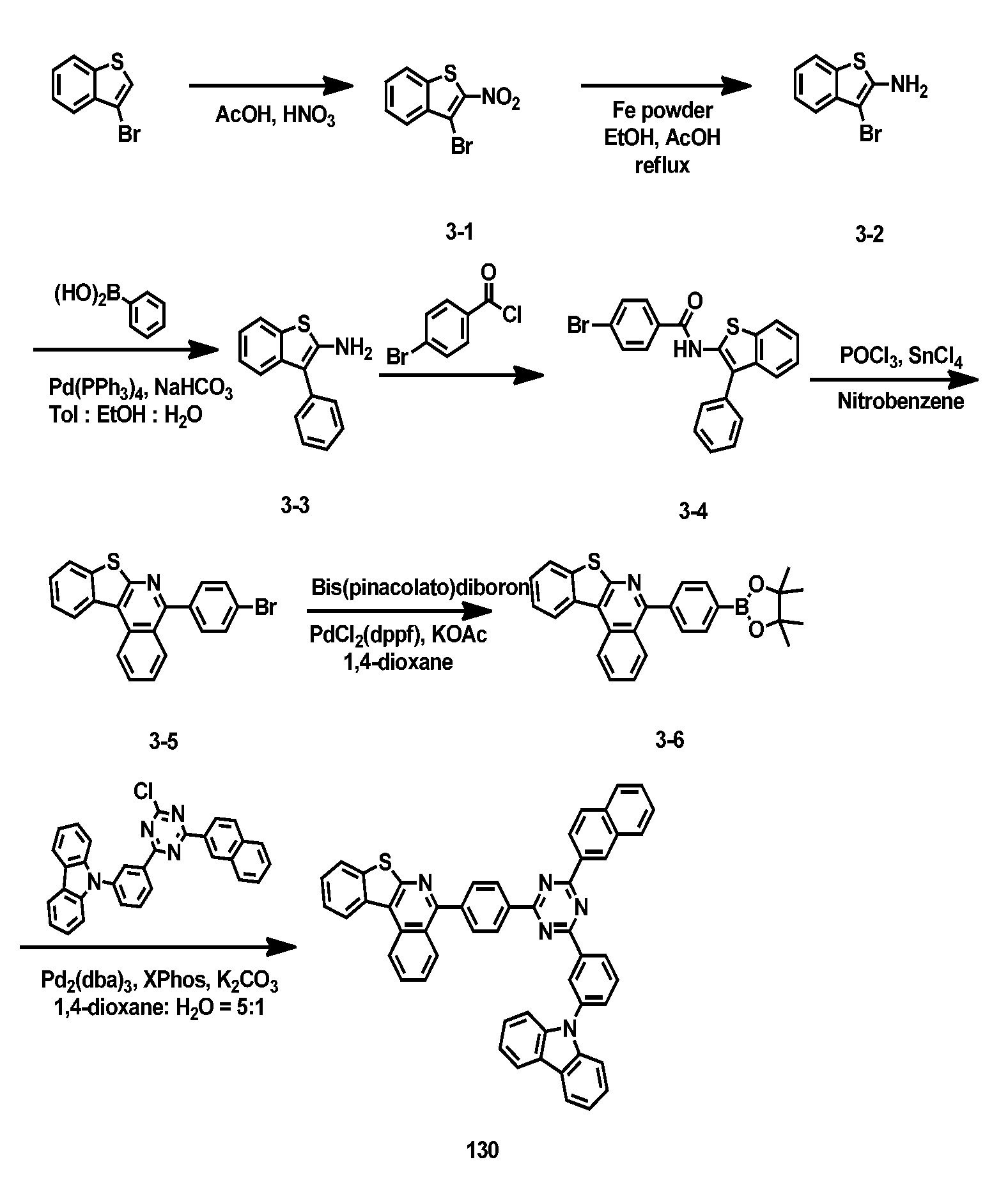
1)화합물1) Compound 3-1의 제조 Preparation of 3-1
3-bromobenzo[b]thiophene (100 g, 0.469 mol) 과 아세트산 1500 mL를 넣고 실온에서 10분간 교반한 뒤 아세트산 1500 mL 와 HNO3 200 mL를 혼합하여 천천히 적가하였다. 1시간 뒤 반응 완료 후 실온으로 식혀 증류수와 MC 로 추출하였다. 유기층을 무수 MgSO4로 건조시킨 후 회전 증발기로 용매를 제거한 후 MC와 헥산을 전개용매로 하여 컬럼크로마토그래피로 정제하여 화합물 3-1 (90 g, 77%)을 얻었다.3-bromobenzo[b]thiophene (100 g, 0.469 mol) and 1500 mL of acetic acid were added, stirred at room temperature for 10 minutes, and then 1500 mL of acetic acid and 200 mL of HNO 3 were mixed and slowly added dropwise. After completion of the reaction after 1 hour, it was cooled to room temperature and extracted with distilled water and MC. After drying the organic layer with anhydrous MgSO 4 , the solvent was removed by a rotary evaporator, and purified by column chromatography using MC and hexane as developing solvents to obtain compound 3-1 (90 g, 77%).
2) 화합물 3-2의 제조2) Preparation of compound 3-2
화합물 3-1 (90g, 0.087 mol)과 에탄올 3000mL, 철 분말 (Fe powder) (60 g, 0.108 mol)을 넣고 실온에서 10분간 교반하였다. 아세트산 300mL를 천천히 적가한 후 60 ℃에서 1시간 동안 환류하였다. 반응 완료 후 실온으로 식힌 뒤 H2O를 첨가하여 생성된 고체를 여과한 뒤 H2O 와 헥산으로 씻어주어 화합물 3-2 (70 g, 99%)를 얻었다.Compound 3-1 (90 g, 0.087 mol), ethanol 3000 mL, and iron powder (60 g, 0.108 mol) were added and stirred at room temperature for 10 minutes. 300 mL of acetic acid was slowly added dropwise and refluxed at 60° C. for 1 hour. After the reaction was completed, after cooling to room temperature, H 2 O was added to filter the resulting solid, followed by washing with H 2 O and hexane to obtain compound 3-2 (70 g, 99%).
3) 화합물 3-3의 제조3) Preparation of compound 3-3
화합물 3-2 (70 g, 0.306 mol)와 phenyl boronic acid (40 g, 0.336 mol), Pd(PPh3)4 (17 g, 0.0153mol), Na2CO3 (65 g, 0.609 mol)를 Toluene (700 mL), ethanol(140 mL), H2O(140 mL)와 함께 120 ℃에서 1시간 동안 환료하였다. 반응 완료 후 실온으로 식힌 뒤 증류수와 EA로 추출하였다. 유기층을 무수 MgSO4로 건조시킨 후 회전 증발기로 용매를 제거한 후 EA와 핵산으로 씻어주어 화합물 3-3 (63 g, 90%)을 얻었다.Toluene Compound 3-2 (70 g, 0.306 mol), phenyl boronic acid (40 g, 0.336 mol), Pd(PPh 3 ) 4 (17 g, 0.0153 mol), Na 2 CO 3 (65 g, 0.609 mol) (700 mL), ethanol (140 mL), and H 2 O (140 mL) were exchanged at 120° C. for 1 hour. After completion of the reaction, the mixture was cooled to room temperature, and extracted with distilled water and EA. After drying the organic layer with anhydrous MgSO 4 , the solvent was removed by rotary evaporation, and washed with EA and nucleic acid to obtain compound 3-3 (63 g, 90%).
4) 화합물 3-4의 제조4) Preparation of compound 3-4
화합물 3-3 (90 g, 0.399 mol)을 MC에 녹인 뒤 TEA (56 mL, 0.399 mol)와 함께 실온에서 15분간 교반한다. 그 후 0 ℃를 유지한 뒤 4-bromo benzoylchloride (87 g, 0.399 mol)를 서서히 첨가하였다. 1시간 뒤 생성된 흰 고체를 필터하여 EA와 핵산으로 씻어주어 화합물 3-4 (150 g, 90%)를 얻었다.Compound 3-3 (90 g, 0.399 mol) was dissolved in MC, and stirred with TEA (56 mL, 0.399 mol) at room temperature for 15 minutes. Thereafter, after maintaining 0° C., 4-bromo benzoylchloride (87 g, 0.399 mol) was slowly added. The white solid produced after 1 hour was filtered and washed with EA and nucleic acid to obtain compound 3-4 (150 g, 90%).
5) 화합물 3-5의 제조5) Preparation of compound 3-5
화합물 3-4 (150 g, 0.3674 mol)와 POCl3 (51 mL, 0.551 mol), nitrobenzene (1500 mL)을 넣고 1시간 동안 교반하였다. 15 시간 동안 140 ℃에서 반응한다. 반응 완료 후 반응액에 NaHCO3를 증류수에 넣어 녹인 용액을 천천히 넣고 교반한다. 이후에 생기는 고체를 필터하여 수집한다. 수집한 고체를 메탄올과 헥산으로 씻어주어 화합물 3-5 (110 g, 77%)를 얻었다.Compound 3-4 (150 g, 0.3674 mol), POCl 3 (51 mL, 0.551 mol) and nitrobenzene (1500 mL) were added and stirred for 1 hour. React at 140° C. for 15 hours. After the reaction was completed, NaHCO 3 was added to the reaction solution in distilled water, and the dissolved solution was slowly added and stirred. The resulting solid is collected by filtration. The collected solid was washed with methanol and hexane to obtain compound 3-5 (110 g, 77%).
6) 화합물 3-6의 제조6) Preparation of compound 3-6
화합물 3-6 (50 g, 0.128 mol), Bis(pinacolato)diboron (48.7 g, 0.192 mol), KOAc (37 g, 0.384 mol), PdCl2(dppf) (4.6 g, 0.0064 mol)을 1,4-dioxane 1000 mL에 녹인 후 5 시간 동안 90 ℃에서 반응한다. 반응 완료 후 반응액에 MC와 증류수를 넣어서 추출한다. 이후 무수 MgSO4로 건조시킨 후 MC와 핵산을 전개용매로 컬럼 크로마토그래피를 진행하여 화합물 3-6 (39 g, 70%)를 얻었다.Compound 3-6 (50 g, 0.128 mol), Bis(pinacolato)diboron (48.7 g, 0.192 mol), KOAc (37 g, 0.384 mol), PdCl 2 (dppf) (4.6 g, 0.0064 mol) 1,4 Dissolve in 1000 mL of -dioxane and react at 90°C for 5 hours. After completion of the reaction, MC and distilled water are added to the reaction solution to extract. After drying with anhydrous MgSO 4 , MC and nucleic acid were subjected to column chromatography with a developing solvent to obtain compound 3-6 (39 g, 70%).
7) 화합물 130의 제조7) Preparation of Compound 130
화합물 3-6 (7 g, 0.016 mol), 9-(3-(4-chloro-6-(naphthalen-2-yl)-1,3,5-triazin-2-yl)phenyl)-9H-carbazole (7.7 g, 0.016 mol)을 1,4-dioxane :H2O = 100 mL : 20 mL 에 녹인 후 Pd2(dba)3 (1.4 g, 0.0016 mol), XPhos (1.5 g, 0.0032 mol) 와 K2CO3(6.6 g, 0.048 mol)를 넣고 5 시간 동안 100 ℃에서 교반한다. 반응 완료 후 반응액에 생성된 고체를 1,4-dioxane과 H2O로 씻어준다. 이후에 고체만 DCB에 재결정 방법으로 정제하여 화합물 130 (7.2 g, 60%) 을 얻었다.Compound 3-6 (7 g, 0.016 mol), 9-(3-(4-chloro-6-(naphthalen-2-yl)-1,3,5-triazin-2-yl)phenyl)-9H-carbazole (7.7 g, 0.016 mol) was dissolved in 1,4-dioxane :H 2 O = 100 mL: 20 mL, and then Pd 2 (dba) 3 (1.4 g, 0.0016 mol), XPhos (1.5 g, 0.0032 mol) and K Add 2 CO 3 (6.6 g, 0.048 mol) and stir at 100° C. for 5 hours. After the reaction is completed, the solid formed in the reaction solution is washed with 1,4-dioxane and H 2 O. After that, only the solid was purified on DCB by a recrystallization method to obtain Compound 130 (7.2 g, 60%).
[[ 제조예Manufacturing example 3-2] 3-2]
상기 제조예 3-1에서 9-(3-(4-chloro-6-(naphthalen-2-yl)-1,3,5-triazin-2-yl)phenyl)-9H-carbazole 대신 중간체G를 사용하여 동일한 방법으로 제조하여 목적화합물을 합성하였다.In Preparation Example 3-1, instead of 9-(3-(4-chloro-6-(naphthalen-2-yl)-1,3,5-triazin-2-yl)phenyl)-9H-carbazole, intermediate G is used. Thus, the target compound was synthesized by the same method.


[[ 제조예Manufacturing example 3-3] 3-3]
상기 제조예 3-1에서 4-bromobenzoyl chloride 대신 3-bromobenzoyl chloride를 사용하고, 9-(3-(4-chloro-6-(naphthalen-2-yl)-1,3,5-triazin-2-yl)phenyl)-9H-carbazole 대신 중간체H를 사용하여 동일한 방법으로 제조하여 목적화합물을 합성하였다.In Preparation Example 3-1, 3-bromobenzoyl chloride was used instead of 4-bromobenzoyl chloride, and 9-(3-(4-chloro-6-(naphthalen-2-yl)-1,3,5-triazin-2- yl)phenyl)-9H-carbazole was used instead of intermediate H to synthesize the target compound.


[[ 제조예Manufacturing example 3-4] 3-4]
상기 제조예 3-1에서 4-bromobenzoyl chloride 대신 4-bromo-1-naphthoyl chloride를 사용하고, 9-(3-(4-chloro-6-(naphthalen-2-yl)-1,3,5-triazin-2-yl)phenyl)-9H-carbazole 대신 중간체I를 사용하여 동일한 방법으로 제조하여 목적화합물을 합성하였다.In Preparation Example 3-1, 4-bromo-1-naphthoyl chloride was used instead of 4-bromobenzoyl chloride, and 9-(3-(4-chloro-6-(naphthalen-2-yl)-1,3,5- Instead of triazin-2-yl)phenyl)-9H-carbazole, intermediate I was prepared in the same way to synthesize the target compound.
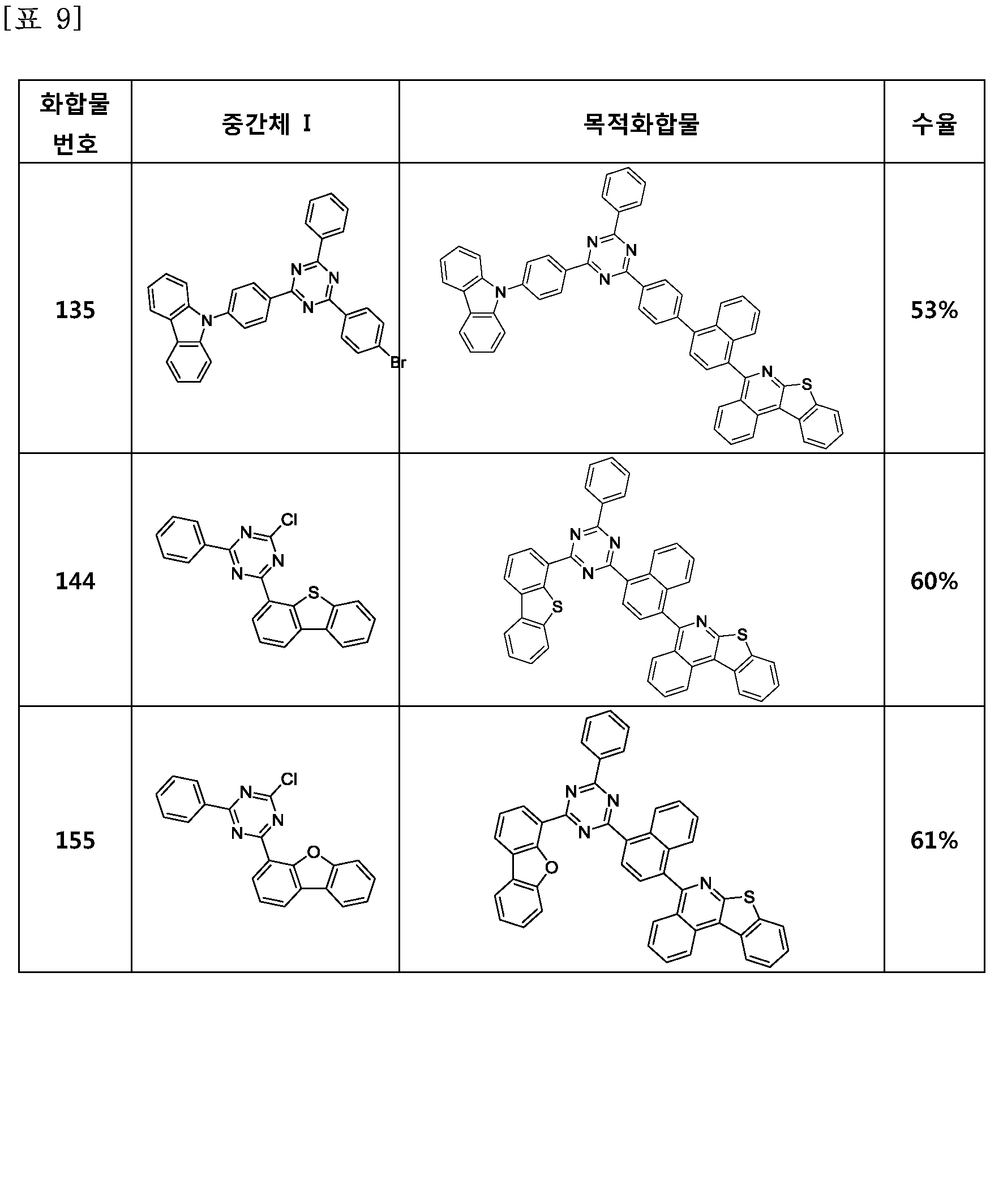

[[ 제조예Manufacturing example 4-1] 화합물 190의 제조 4-1] Preparation of compound 190

1) 화합물 4-1의 제조1) Preparation of compound 4-1
화합물 benzo[b]thiophen-2-ylboronic acid (50 g, 0.280 mol)와 iodobenzene (57 g, 0.280 mol), Pd(PPh3)4 (16.2 g, 0.014mol), Na2CO3 (89.6 g, 0.84 mol)를 Toluene (1000 mL), ethanol(200 mL), H2O(200 mL)와 함께 120 ℃에서 1시간 동안 환료하였다. 반응 완료 후 실온으로 식힌 뒤 증류수와 EA로 추출하였다. 유기층을 무수 MgSO4로 건조시킨 후 회전 증발기로 용매를 제거하여 화합물 4-1 (53 g, 90%)을 얻었다.Compound benzo[b]thiophen-2-ylboronic acid (50 g, 0.280 mol) and iodobenzene (57 g, 0.280 mol), Pd(PPh 3 ) 4 (16.2 g, 0.014 mol), Na 2 CO 3 (89.6 g, 0.84 mol) was exchanged with Toluene (1000 mL), ethanol (200 mL), H 2 O (200 mL) at 120° C. for 1 hour. After completion of the reaction, the mixture was cooled to room temperature, and extracted with distilled water and EA. The organic layer was dried over anhydrous MgSO 4 and the solvent was removed by rotary evaporation to obtain compound 4-1 (53 g, 90%).
2) 화합물 4-2의 제조2) Preparation of compound 4-2
화합물 4-1 (50 g, 0.237 mol) 과 아세트산 700 mL를 넣고 실온에서 10분간 교반한 뒤 아세트산 700 mL 와 HNO3 100 mL를 혼합하여 천천히 적가하였다. 1시간 뒤 반응 완료 후 실온으로 식혀 증류수와 MC 로 추출하였다. 유기층을 무수 MgSO4로 건조시킨 후 회전 증발기로 용매를 제거한 후 MC와 헥산을 전개용매로 하여 컬럼크로마토그래피로 정제하여 화합물 4-2 (46 g, 77%)을 얻었다.Compound 4-1 (50 g, 0.237 mol) and 700 mL of acetic acid were added, stirred at room temperature for 10 minutes, and then 700 mL of acetic acid and 100 mL of HNO 3 were mixed and slowly added dropwise. After completion of the reaction after 1 hour, it was cooled to room temperature and extracted with distilled water and MC. The organic layer was dried over anhydrous MgSO 4 and the solvent was removed by rotary evaporation, followed by purification by column chromatography using MC and hexane as developing solvents to obtain compound 4-2 (46 g, 77%).
3) 화합물 4-3의 제조3) Preparation of compound 4-3
화합물 4-2 (46g, 0.182 mol)과 에탄올 1000mL, 철 분말 (Fe powder) (30 g, 0.546 mol)을 넣고 실온에서 10분간 교반하였다. 아세트산 130mL를 천천히 적가한 후 60 ℃에서 1시간 동안 환류하였다. 반응 완료 후 실온으로 식힌 뒤 H2O를 첨가하여 생성된 고체를 여과한 뒤 H2O 와 헥산으로 씻어주어 화합물 4-3 (40 g, 99%)를 얻었다.Compound 4-2 (46 g, 0.182 mol), ethanol 1000 mL, and iron powder (Fe powder) (30 g, 0.546 mol) were added and stirred at room temperature for 10 minutes. Acetic acid 130 mL was slowly added dropwise and refluxed at 60°C for 1 hour. After the reaction was completed, after cooling to room temperature, H 2 O was added to filter the resulting solid, followed by washing with H 2 O and hexane to obtain compound 4-3 (40 g, 99%).
4) 화합물 4-4의 제조4) Preparation of compound 4-4
화합물 4-3 (40 g, 0.177 mol) 을 MC에 녹인 뒤 TEA (25 mL, 0.177 mol)와 함께 실온에서 15분간 교반한다. 그 후 0 ℃를 유지한 뒤 4-bromo benzoylchloride (77 g, 0.354 mol)를 서서히 첨가하였다. 1시간 뒤 생성된 흰 고체를 필터하여 EA와 핵산으로 씻어주어 화합물 4-4 (57 g, 80%)를 얻었다.Compound 4-3 (40 g, 0.177 mol) was dissolved in MC, and stirred with TEA (25 mL, 0.177 mol) at room temperature for 15 minutes. Thereafter, after maintaining 0° C., 4-bromo benzoylchloride (77 g, 0.354 mol) was slowly added. The white solid produced after 1 hour was filtered and washed with EA and nucleic acid to obtain compound 4-4 (57 g, 80%).
5) 화합물 4-5의 제조5) Preparation of compound 4-5
화합물 4-4 (57 g, 0.139 mol)와 POCl3 (19.5 mL, 0.208 mol), nitrobenzene (500 mL)을 넣고 15 시간 동안 140 ℃에서 반응한다. 반응 완료 후 반응액에 NaHCO3를 증류수에 넣어 녹인 용액을 천천히 넣고 교반한다. 이후에 생기는 고체를 필터하여 수집한다. 수집한 고체를 메탄올과 헥산으로 씻어주어 화합물 4-5 (40 g, 74%)를 얻었다.Compound 4-4 (57 g, 0.139 mol), POCl 3 (19.5 mL, 0.208 mol) and nitrobenzene (500 mL) were added and reacted at 140° C. for 15 hours. After the reaction was completed, NaHCO 3 was added to the reaction solution in distilled water, and the dissolved solution was slowly added and stirred. The resulting solid is collected by filtration. The collected solid was washed with methanol and hexane to obtain compound 4-5 (40 g, 74%).
6) 화합물 4-6의 제조6) Preparation of compound 4-6
화합물 4-5 (40 g, 0.102 mol), Bis(pinacolato)diboron (39 g, 0.153 mol), KOAc (30 g, 0.306 mol), PdCl2(dppf) (3.7 g, 0.0051 mol)을 1,4-dioxane 1000 mL에 녹인 후 5 시간 동안 90 ℃에서 반응한다. 반응 완료 후 반응액에 MC와 증류수를 넣어서 추출한다. 이후 무수 MgSO4로 건조시킨 후 MC와 핵산을 전개용매로 컬럼 크로마토그래피를 진행하여 화합물 4-6 (31 g, 70%)를 얻었다.Compound 4-5 (40 g, 0.102 mol), Bis(pinacolato)diboron (39 g, 0.153 mol), KOAc (30 g, 0.306 mol), PdCl 2 (dppf) (3.7 g, 0.0051 mol) 1,4 Dissolve in 1000 mL of -dioxane and react at 90°C for 5 hours. After completion of the reaction, MC and distilled water are added to the reaction solution to extract. After drying with anhydrous MgSO 4 , MC and nucleic acid were subjected to column chromatography with a developing solvent to obtain compound 4-6 (31 g, 70%).
7) 화합물 190의 제조7) Preparation of Compound 190
화합물 4-6 (7 g, 0.016 mol), 9-(4-(4-chloro-6-(naphthalen-2-yl)-1,3,5-triazin-2-yl)phenyl)-9H-carbazole (7.7 g, 0.016 mol)을 1,4-dioxane :H2O = 100 mL : 20 mL 에 녹인 후 Pd2(dba)3 (1.4 g, 0.0016 mol), XPhos (1.5 g, 0.0032 mol) 와 K2CO3(6.6 g, 0.048 mol)를 넣고 5 시간 동안 100 ℃에서 교반한다. 반응 완료 후 반응액에 생성된 고체를 1,4-dioxane과 H2O로 씻어준다. 이후에 고체만 DCB에 재결정 방법으로 정제하여 화합물 190 (7.2 g, 60%) 을 얻었다.Compound 4-6 (7 g, 0.016 mol), 9-(4-(4-chloro-6-(naphthalen-2-yl)-1,3,5-triazin-2-yl)phenyl)-9H-carbazole (7.7 g, 0.016 mol) was dissolved in 1,4-dioxane :H 2 O = 100 mL: 20 mL, and then Pd 2 (dba) 3 (1.4 g, 0.0016 mol), XPhos (1.5 g, 0.0032 mol) and K Add 2 CO 3 (6.6 g, 0.048 mol) and stir at 100° C. for 5 hours. After the reaction is completed, the solid formed in the reaction solution is washed with 1,4-dioxane and H 2 O. After that, only the solid was purified by DCB in a recrystallization method to obtain Compound 190 (7.2 g, 60%).
[[ 제조예Manufacturing example 4-2] 4-2]
상기 제조예 4-1에서 9-(4-(4-chloro-6-(naphthalen-2-yl)-1,3,5-triazin-2-yl)phenyl)-9H-carbazole 대신 중간체J를 사용하여 동일한 방법으로 제조하여 목적화합물을 합성하였다.In Preparation Example 4-1, intermediate J was used instead of 9-(4-(4-chloro-6-(naphthalen-2-yl)-1,3,5-triazin-2-yl)phenyl)-9H-carbazole. Thus, the target compound was synthesized by the same method.


[[ 제조예Manufacturing example 4-3] 4-3]
상기 제조예 4-1에서 4-bromobenzoyl chloride 대신 3-bromobenzoyl chloride를 사용하고, 9-(4-(4-chloro-6-(naphthalen-2-yl)-1,3,5-triazin-2-yl)phenyl)-9H-carbazole 대신 중간체 K를 사용하여 동일한 방법으로 제조하여 목적화합물을 합성하였다.In Preparation Example 4-1, 3-bromobenzoyl chloride was used instead of 4-bromobenzoyl chloride, and 9-(4-(4-chloro-6-(naphthalen-2-yl)-1,3,5-triazin-2- Instead of yl)phenyl)-9H-carbazole, intermediate K was prepared in the same way to synthesize the target compound.


[[ 제조예Manufacturing example 4-4] 4-4]
상기 제조예 4-1에서 4-bromobenzoyl chloride 대신 2-bromobenzoyl chloride를 사용하고, 9-(4-(4-chloro-6-(naphthalen-2-yl)-1,3,5-triazin-2-yl)phenyl)-9H-carbazole 대신 중간체L를 사용하여 동일한 방법으로 제조하여 목적화합물을 합성하였다.In Preparation Example 4-1, 2-bromobenzoyl chloride was used instead of 4-bromobenzoyl chloride, and 9-(4-(4-chloro-6-(naphthalen-2-yl)-1,3,5-triazin-2- Instead of yl)phenyl)-9H-carbazole, intermediate L was prepared in the same way to synthesize the target compound.

[[ 제조예Manufacturing example 4-5] 4-5]
상기 제조예 4-1에서 4-bromobenzoyl chloride 대신 4-bromo-1-naphthoyl chloride를 사용하고, 9-(4-(4-chloro-6-(naphthalen-2-yl)-1,3,5-triazin-2-yl)phenyl)-9H-carbazole 대신 중간체M를 사용하여 동일한 방법으로 제조하여 목적화합물을 합성하였다.In Preparation Example 4-1, 4-bromo-1-naphthoyl chloride was used instead of 4-bromobenzoyl chloride, and 9-(4-(4-chloro-6-(naphthalen-2-yl)-1,3,5- Instead of triazin-2-yl)phenyl)-9H-carbazole, intermediate M was prepared in the same way to synthesize the target compound.
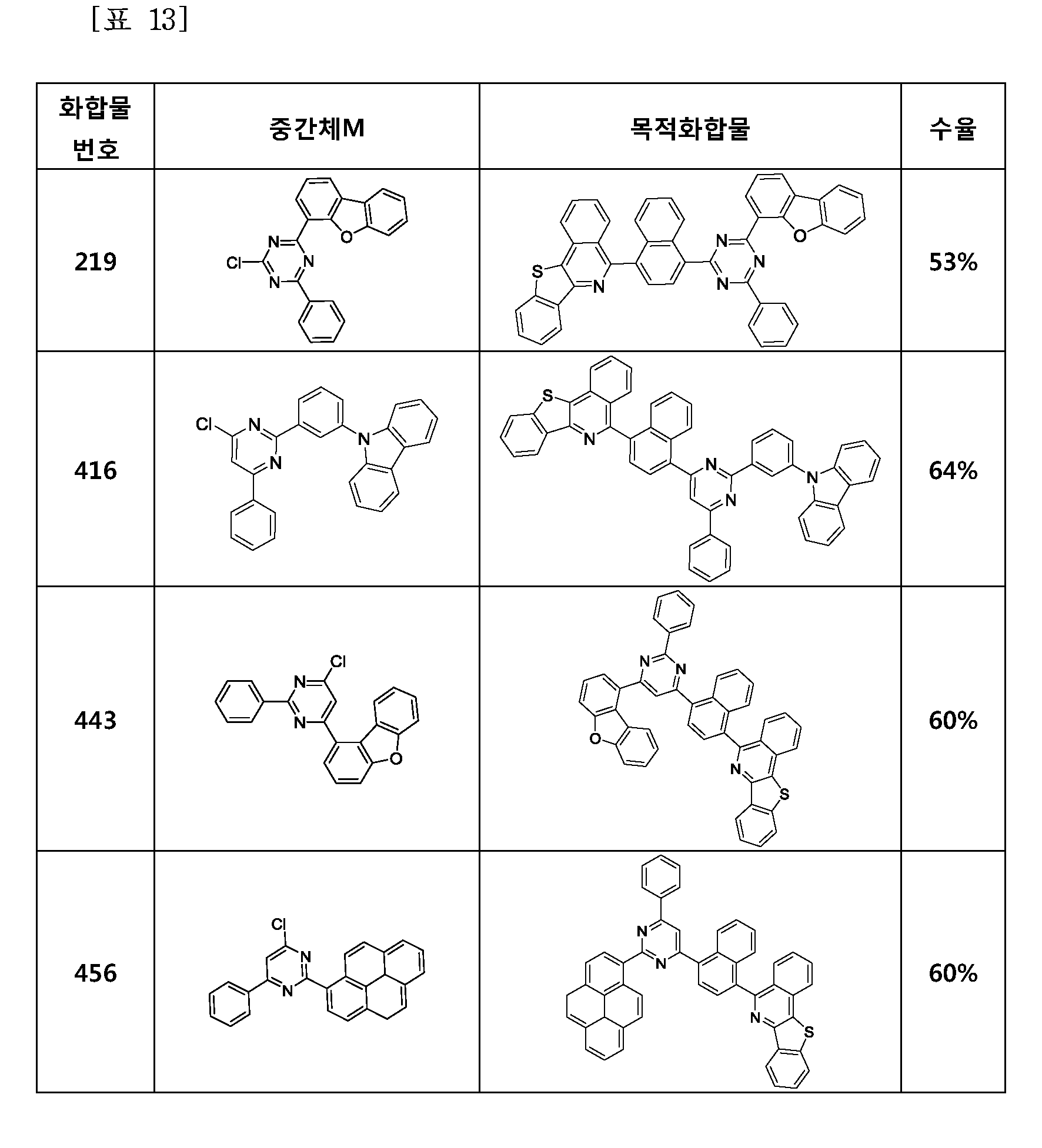
[[ 제조예Manufacturing example 5-1] 화합물 480의 제조 5-1] Preparation of compound 480

1) 화합물 5-1의 제조1) Preparation of compound 5-1
상기 제조예 1-1의 화합물 1-1의 제조에서 benzo[b]thiophen-2-ylboronic acid 대신 benzofuran-2-ylboronic acid 를 사용하여 동일한 방법으로 합성하였다. 따라서 화합물 5-1 (95 g, 74%)을 얻었다.In the preparation of Compound 1-1 of Preparation Example 1-1, benzofuran-2-ylboronic acid was used instead of benzo[b]thiophen-2-ylboronic acid to synthesize the same method. Thus, compound 5-1 (95 g, 74%) was obtained.
2) 화합물 5-2의 제조2) Preparation of compound 5-2
상기 제조예 1-1의 화합물 1-2의 제조에서 화합물 1-1 대신 화합물 5-1를 사용하여 동일한 방법으로 합성하였다. 따라서 화합물 5-2 (126 g, 80%)을 얻었다.In the preparation of Compound 1-2 of Preparation Example 1-1, Compound 5-1 was used instead of Compound 1-1 to synthesize the same method. Thus, compound 5-2 (126 g, 80%) was obtained.
3) 화합물 5-3의 제조3) Preparation of compound 5-3
상기 제조예 1-1의 화합물 1-3의 제조에서 화합물 1-2 대신 화합물 5-2를 사용하여 동일한 방법으로 합성하였다. 따라서 화합물 5-3 (60 g, 50%)을 얻었다.In the preparation of compound 1-3 of Preparation Example 1-1, it was synthesized in the same manner using compound 5-2 instead of compound 1-2. Thus, compound 5-3 (60 g, 50%) was obtained.
4) 화합물 5-4의 제조4) Preparation of compound 5-4
상기 제조예 1-1의 화합물 1-4의 제조에서 화합물 1-3 대신 5-3을 사용하여 동일한 방법으로 합성하였다. 따라서 화합물 5-4 (7.8 g, 70%)를 얻었다.In the preparation of Compound 1-4 of Preparation Example 1-1, 5-3 was used instead of Compound 1-3 to synthesize the same method. Thus, compound 5-4 (7.8 g, 70%) was obtained.
5) 화합물 480의 제조5) Preparation of compound 480
상기 제조예 1-1의 화합물 1의 제조에서 화합물 1-4 대신 5-3을 사용하고, 9-(4-(4-chloro-6-phenyl-1,3,5-triazin-2-yl)phenyl)-9H-carbazole 대신 9-(4-(4-([1,1'-biphenyl]-2-yl)-6-chloro-1,3,5-triazin-2-yl)phenyl)-9H-carbazole 사용하여 동일한 방법으로 합성하였다. 따라서 화합물 480 (5.8 g, 60%)를 얻었다.5-3 was used instead of Compound 1-4 in the preparation of Compound 1 of Preparation Example 1-1, and 9-(4-(4-chloro-6-phenyl-1,3,5-triazin-2-yl) phenyl)-9H-carbazole instead of 9-(4-(4-([1,1'-biphenyl]-2-yl)-6-chloro-1,3,5-triazin-2-yl)phenyl)-9H It was synthesized in the same way using -carbazole. Thus, compound 480 (5.8 g, 60%) was obtained.
[[ 제조예Manufacturing example 5-2] 5-2]
상기 제조예 5-1에서 9-(4-(4-([1,1'-biphenyl]-2-yl)-6-chloro-1,3,5-triazin-2-yl)phenyl)-9H-carbazole 대신 중간체N를 사용하여 동일한 방법으로 제조하여 목적화합물을 합성하였다.9-(4-(4-([1,1'-biphenyl]-2-yl)-6-chloro-1,3,5-triazin-2-yl)phenyl)-9H in Preparation Example 5-1 The target compound was synthesized by the same method using -N instead of -carbazole.


[[ 제조예Manufacturing example 5-3] 5-3]
상기 제조예 5-1에서 4-bromobenzoyl chloride 대신 3-bromobenzoyl chloride를 사용하고, 9-(4-(4-([1,1'-biphenyl]-2-yl)-6-chloro-1,3,5-triazin-2-yl)phenyl)-9H-carbazole 대신 중간체O를 사용하여 동일한 방법으로 제조하여 목적화합물을 합성하였다.In preparation example 5-1, 3-bromobenzoyl chloride was used instead of 4-bromobenzoyl chloride, and 9-(4-(4-([1,1'-biphenyl]-2-yl)-6-chloro-1,3 Instead of ,5-triazin-2-yl)phenyl)-9H-carbazole, intermediate O was prepared in the same way to synthesize the target compound.


[[ 제조예Manufacturing example 5-4] 5-4]
상기 제조예 5-1에서 4-bromobenzoyl chloride 대신 4-bromo-1-naphthoyl chloride를 사용하고, 9-(4-(4-([1,1'-biphenyl]-2-yl)-6-chloro-1,3,5-triazin-2-yl)phenyl)-9H-carbazole 대신 중간체P를 사용하여 동일한 방법으로 제조하여 목적화합물을 합성하였다.In Preparation Example 5-1, 4-bromo-1-naphthoyl chloride was used instead of 4-bromobenzoyl chloride, and 9-(4-(4-([1,1'-biphenyl]-2-yl)-6-chloro Instead of -1,3,5-triazin-2-yl)phenyl)-9H-carbazole, intermediate P was prepared in the same way to synthesize the target compound.
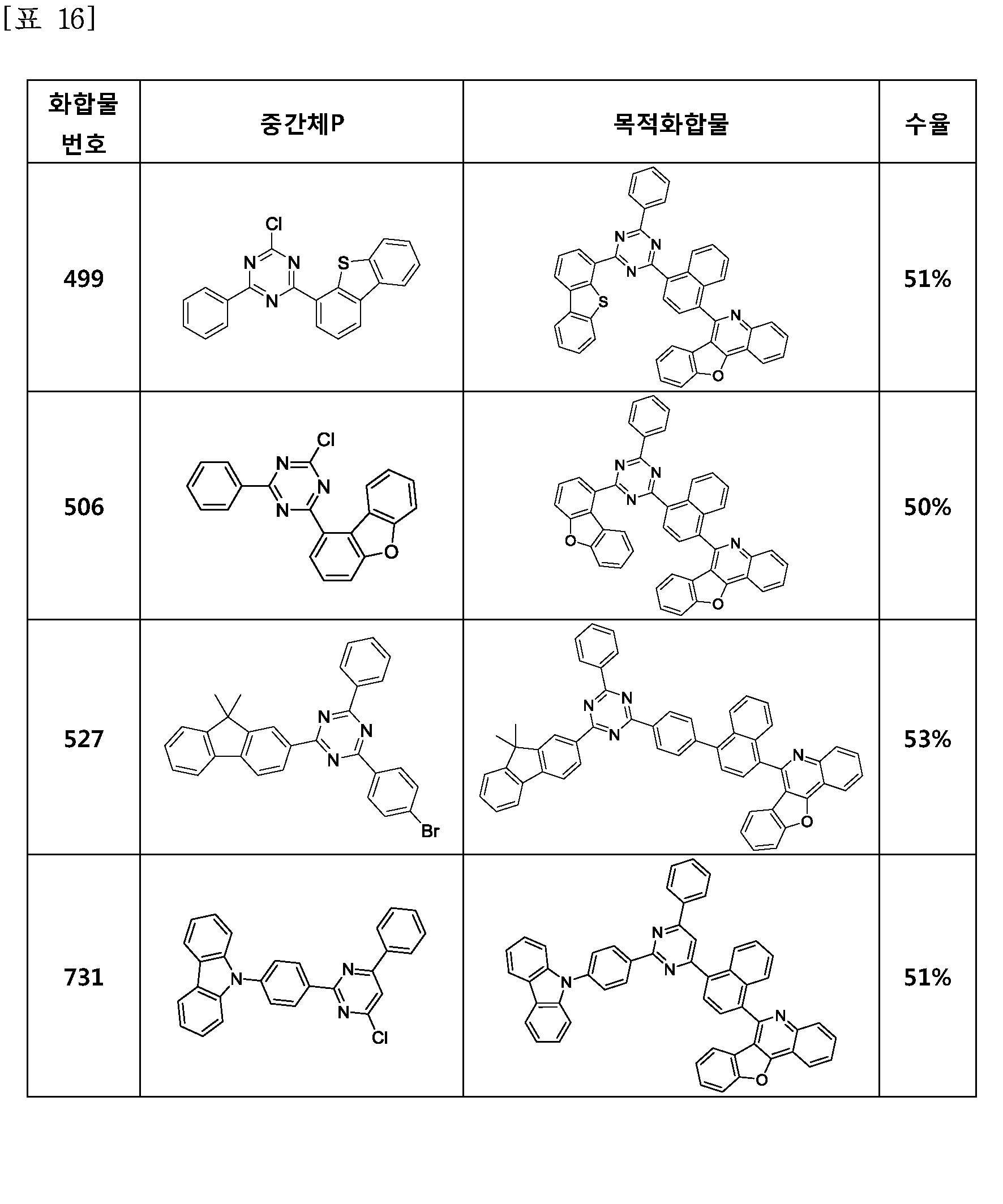

[제조 예 6-1] 화합물 546의 제조[Production Example 6-1] Preparation of compound 546

1) 화합물 6-1의 제조1) Preparation of compound 6-1
상기 제조예 2-1의 화합물 2-1의 제조에서 benzo[b]thiophen-3-ylboronic acid 대신 benzofuran-3-ylboronic acid 을 사용하여 동일한 방법으로 합성하였다. 따라서 화합물 6-1 (90 g, 70%)를 얻었다.In the preparation of Compound 2-1 of Preparation Example 2-1, benzofuran-3-ylboronic acid was used instead of benzo[b]thiophen-3-ylboronic acid to synthesize the same method. Thus, compound 6-1 (90 g, 70%) was obtained.
2) 화합물 6-2의 제조2) Preparation of compound 6-2
상기 제조예 2-1의 화합물 2-2의 제조에서 화합물 2-1 대신 6-1을 사용하여 동일한 방법으로 합성하였다. 따라서 화합물 6-2 (134 g, 80%)를 얻었다.In the preparation of Compound 2-2 of Preparation Example 2-1, 6-1 was used instead of Compound 2-1 to synthesize the same method. Thus, compound 6-2 (134 g, 80%) was obtained.
3) 화합물 6-3의 제조3) Preparation of compound 6-3
상기 제조예 2-1의 화합물 2-3의 제조에서 화합물 2-2 대신 6-2를 사용하여 동일한 방법으로 합성하였다. 따라서 화합물 6-3 (63 g, 50%)를 얻었다.In the preparation of compound 2-3 of Preparation Example 2-1, 6-2 was used instead of Compound 2-2 to synthesize the same method. Thus, compound 6-3 (63 g, 50%) was obtained.
4) 화합물 6-4의 제조4) Preparation of compound 6-4
상기 제조예 2-1의 화합물 2-4의 제조에서 화합물 2-3 대신 6-3을 사용하여 동일한 방법으로 합성하였다. 따라서 화합물 6-4 (49 g, 70%)를 얻었다.In the preparation of compound 2-4 of Preparation Example 2-1, 6-3 was used instead of Compound 2-3 to synthesize the same method. Thus, compound 6-4 (49 g, 70%) was obtained.
5) 화합물 546의 제조5) Preparation of compound 546
상기 제조예 2-1의 화합물 71 제조에서 화합물 2-4 대신 6-4를, 9-(3-(4-chloro-6-phenyl-1,3,5-triazin-2-yl)phenyl)-9H-carbazole를 9-(4-(4-chloro-6-phenyl-1,3,5-triazin-2-yl)naphthalen-1-yl)-9H-carbazole 로 사용하여 동일한 방법으로 합성하였다. 따라서 화합물 546 (7.3 g, 60%)을 얻었다.In the preparation of Compound 71 of Preparation Example 2-1, 6-4 was substituted for Compound 2-4, and 9-(3-(4-chloro-6-phenyl-1,3,5-triazin-2-yl)phenyl)- 9H-carbazole was synthesized in the same manner using 9-(4-(4-chloro-6-phenyl-1,3,5-triazin-2-yl)naphthalen-1-yl)-9H-carbazole. Thus, compound 546 (7.3 g, 60%) was obtained.
[[ 제조예Manufacturing example 6-2] 6-2]
상기 제조예 6-1에서 9-(4-(4-chloro-6-phenyl-1,3,5-triazin-2-yl)naphthalen-1-yl)-9H-carbazole 대신 중간체Q를 사용하여 동일한 방법으로 제조하여 목적화합물을 합성하였다.In Preparation Example 6-1, instead of 9-(4-(4-chloro-6-phenyl-1,3,5-triazin-2-yl)naphthalen-1-yl)-9H-carbazole, intermediate Q was used. Prepared by the method to synthesize the target compound.


[[ 제조예Manufacturing example 6-3] 6-3]
상기 제조예 6-1에서 4-bromobenzoyl chloride 대신 3-bromobenzoyl chloride를 사용하고, 9-(4-(4-chloro-6-phenyl-1,3,5-triazin-2-yl)naphthalen-1-yl)-9H-carbazole 대신 중간체R를 사용하여 동일한 방법으로 제조하여 목적화합물을 합성하였다.In Preparation Example 6-1, 3-bromobenzoyl chloride was used instead of 4-bromobenzoyl chloride, and 9-(4-(4-chloro-6-phenyl-1,3,5-triazin-2-yl)naphthalen-1- yl)-9H-carbazole instead of intermediate R was prepared in the same way to synthesize the target compound.


[[ 제조예Manufacturing example 6-4] 6-4]
상기 제조예 6-1에서 4-bromobenzoyl chloride 대신 4-bromo-1-naphthoyl chloride를 사용하고, 9-(4-(4-chloro-6-phenyl-1,3,5-triazin-2-yl)naphthalen-1-yl)-9H-carbazole 대신 중간체S를 사용하여 동일한 방법으로 제조하여 목적화합물을 합성하였다.In Preparation Example 6-1, 4-bromo-1-naphthoyl chloride was used instead of 4-bromobenzoyl chloride, and 9-(4-(4-chloro-6-phenyl-1,3,5-triazin-2-yl) Instead of naphthalen-1-yl)-9H-carbazole, intermediate S was prepared in the same manner to synthesize the target compound.


[[ 제조예Manufacturing example 7- 7- 1] 화합물1] Compound 609의 제조 Preparation of 609

1) 화합물 7-1의 제조1) Preparation of compound 7-1
상기 제조예 3-1의 화합물 3-1의 제조에서 3-bromobenzo[b]thiophene 대신 3-bromobenzofuran을 사용하여 동일한 방법으로 합성하였다. 따라서 화합물 7-1 (92 g, 75%)를 얻었다.In the preparation of compound 3-1 of Preparation Example 3-1, 3-bromobenzofuran was used instead of 3-bromobenzo[b]thiophene to synthesize it in the same manner. Thus, compound 7-1 (92 g, 75%) was obtained.
2) 화합물 7-2의 제조2) Preparation of compound 7-2
상기 제조예 3-1의 화합물 3-2의 제조에서 화합물 3-1 대신 화합물 7-1을 사용하여 동일한 방법으로 합성하였다. 따라서 화합물 7-2 (89 g, 97%)를 얻었다.In the preparation of compound 3-2 of Preparation Example 3-1, compound 7-1 was used instead of compound 3-1 to synthesize the same method. Thus, compound 7-2 (89 g, 97%) was obtained.
3) 화합물 7-3의 제조3) Preparation of compound 7-3
상기 제조예 3-1의 화합물 3-3의 제조에서 화합물 3-2 대신 화합물 7-2를 사용하여 동일한 방법으로 합성하였다. 따라서 화합물 7-3 (79, 90%)을 얻었다.In the preparation of compound 3-3 of Preparation Example 3-1, compound 7-2 was used instead of compound 3-2 to synthesize the same method. Thus, compound 7-3 (79, 90%) was obtained.
4) 화합물 7-4의 제조4) Preparation of compound 7-4
상기 제조예 3-1의 화합물 3-4의 제조에서 화합물 3-3 대신 화합물 7-3을 사용하여 동일한 방법으로 합성하였다. 따라서 화합물 7-4 (133 g, 90%)를 얻었다.In the preparation of compound 3-4 of Preparation Example 3-1, compound 7-3 was used instead of compound 3-3 to synthesize the same method. Thus, compound 7-4 (133 g, 90%) was obtained.
5) 화합물 7-5의 제조5) Preparation of compound 7-5
상기 제조예 3-1의 화합물 3-5의 제조에서 화합물 3-4 대신 화합물 7-4를 사용하여 동일한 방법으로 합성하였다. 따라서 화합물 7-5 (121g, 70%)을 얻었다.Compound 7-4 was synthesized in the same manner as compound 3-4 in the preparation of compound 3-5 of Preparation Example 3-1. Thus, compound 7-5 (121 g, 70%) was obtained.
6) 화합물 7-6의 제조6) Preparation of compound 7-6
상기 제조예 3-1의 화합물 3-6의 제조에서 화합물 3-5 대신 화합물 7-5를 사용하여 동일한 방법으로 합성하였다. 따라서 화합물 7-6 (41 g, 68%)을 얻었다.In the preparation of compound 3-6 of Preparation Example 3-1, compound 7-5 was used instead of compound 3-5 to synthesize the same method. Thus, compound 7-6 (41 g, 68%) was obtained.
7) 화합물 609의 제조7) Preparation of compound 609
상기 제조예 3-1의 화합물 130의 제조에서 화합물 3-6 대신 화합물 7-6을 사용하고, 9-(3-(4-chloro-6-(naphthalen-2-yl)-1,3,5-triazin-2-yl)phenyl)-9H-carbazole 대신 9-(4-(4-([1,1'-biphenyl]-4-yl)-6-chloro-1,3,5-triazin-2-yl)phenyl)-9H-carbazole 하여 동일한 방법으로 합성하였다. 따라서 화합물 609 (7.4 g, 0.58%)를 얻었다.In the preparation of compound 130 of Preparation Example 3-1, Compound 7-6 was used instead of Compound 3-6, and 9-(3-(4-chloro-6-(naphthalen-2-yl)-1,3,5 9-(4-(4-([1,1'-biphenyl]-4-yl)-6-chloro-1,3,5-triazin-2 instead of -triazin-2-yl)phenyl)-9H-carbazole -yl)phenyl)-9H-carbazole was synthesized in the same manner. Thus, compound 609 (7.4 g, 0.58%) was obtained.
[[ 제조예Manufacturing example 7-2] 7-2]
상기 제조예 7-1에서 9-(4-(4-([1,1'-biphenyl]-4-yl)-6-chloro-1,3,5-triazin-2-yl)phenyl)-9H-carbazole 대신 중간체T를 사용하여 동일한 방법으로 제조하여 목적화합물을 합성하였다.9-(4-(4-([1,1'-biphenyl]-4-yl)-6-chloro-1,3,5-triazin-2-yl)phenyl)-9H in Preparation Example 7-1 The target compound was synthesized by using the intermediate T instead of -carbazole in the same manner.


[[ 제조예Manufacturing example 7-3] 7-3]
상기 제조예 7-1에서 4-bromobenzoyl chloride 대신 3-bromobenzoyl chloride를 사용하고, 9-(4-(4-([1,1'-biphenyl]-4-yl)-6-chloro-1,3,5-triazin-2-yl)phenyl)-9H-carbazole 대신 중간체U를 사용하여 동일한 방법으로 제조하여 목적화합물을 합성하였다.In Preparation Example 7-1, 3-bromobenzoyl chloride was used instead of 4-bromobenzoyl chloride, and 9-(4-(4-([1,1'-biphenyl]-4-yl)-6-chloro-1,3 Instead of ,5-triazin-2-yl)phenyl)-9H-carbazole, intermediate U was prepared in the same way to synthesize the target compound.


[[ 제조예Manufacturing example 7-4] 7-4]
상기 제조예 7-1에서 4-bromobenzoyl chloride 대신 4-bromo-1-naphthoyl chloride를 사용하고, 9-(4-(4-([1,1'-biphenyl]-4-yl)-6-chloro-1,3,5-triazin-2-yl)phenyl)-9H-carbazole 대신 중간체V를 사용하여 동일한 방법으로 제조하여 목적화합물을 합성하였다.In Preparation Example 7-1, 4-bromo-1-naphthoyl chloride was used instead of 4-bromobenzoyl chloride, and 9-(4-(4-([1,1'-biphenyl]-4-yl)-6-chloro Instead of -1,3,5-triazin-2-yl)phenyl)-9H-carbazole, intermediate V was prepared in the same manner to synthesize the target compound.


[[ 제조예Manufacturing example 8- 8- 1] 화합물1] Compound 664의 제조 Preparation of 664

1) 화합물 8-1의 제조1) Preparation of compound 8-1
상기 제조예 4-1의 화합물 4-1의 제조에서 benzo[b]thiophen-2-ylboronic acid 대신 benzofuran-2-ylboronic acid 을 사용하여 동일한 방법으로 합성하였다. 따라서 화합물 8-1 (54 g, 91%)를 얻었다.In the preparation of compound 4-1 of Preparation Example 4-1, instead of benzo[b]thiophen-2-ylboronic acid, benzofuran-2-ylboronic acid was synthesized in the same manner. Thus, compound 8-1 (54 g, 91%) was obtained.
2) 화합물 8-2의 제조2) Preparation of compound 8-2
상기 제조예 4-1의 화합물 4-2의 제조에서 화합물 4-1 대신 화합물 8-1을 사용하여 동일한 방법으로 합성하였다. 따라서 화합물 8-2 (50 g, 72%)을 얻었다.In the preparation of compound 4-2 of Preparation Example 4-1, compound 8-1 was used instead of compound 4-1 to synthesize the same method. Thus, compound 8-2 (50 g, 72%) was obtained.
3) 화합물 8-3의 제조3) Preparation of compound 8-3
상기 제조예 4-1의 화합물 4-3의 제조에서 화합물 4-2 대신 화합물 8-2를 사용하여 동일한 방법으로 합성하였다. 따라서 화합물 8-3 (42g, 97%)을 얻었다.In the preparation of compound 4-3 of Preparation Example 4-1, compound 8-2 was used instead of compound 4-2 to synthesize the same method. Thus, compound 8-3 (42 g, 97%) was obtained.
4) 화합물 8-4의 제조4) Preparation of compound 8-4
상기 제조예 4-1의 화합물 4-4의 제조에서 화합물 4-3 대신 화합물 8-3을 사용하여 동일한 방법으로 합성하였다. 따라서 화합물 8-4 (63 g, 80%)을 얻었다.In the preparation of compound 4-4 of Preparation Example 4-1, compound 8-3 was used instead of compound 4-3 to synthesize the same method. Thus, compound 8-4 (63 g, 80%) was obtained.
5) 화합물 8-5의 제조5) Preparation of compound 8-5
상기 제조예 4-1의 화합물 4-5의 제조에서 화합물 4-4 대신 화합물 8-4를 사용하여 동일한 방법으로 합성하였다. 따라서 화합물 8-5 (46g, 76%)을 얻었다.In the preparation of compound 4-5 of Preparation Example 4-1, compound 8-4 was used instead of compound 4-4 to synthesize the same method. Thus, compound 8-5 (46 g, 76%) was obtained.
6) 화합물 8-6의 제조6) Preparation of compound 8-6
상기 제조예 4-1의 화합물 4-6의 제조에서 화합물 4-5 대신 화합물 8-5를 사용하여 동일한 방법으로 합성하였다. 따라서 화합물 8-6 (36 g, 70%)을 얻었다.In the preparation of compound 4-6 of Preparation Example 4-1, compound 8-5 was used instead of compound 4-5 to synthesize the same method. Thus, compound 8-6 (36 g, 70%) was obtained.
7) 화합물 664의 제조7) Preparation of compound 664
상기 제조예 4-1의 화합물 210의 제조에서 화합물 4-6 대신 화합물 8-6을, 9-(4-(4-chloro-6-(naphthalen-2-yl)-1,3,5-triazin-2-yl)phenyl)-9H-carbazole 대신 9-(4-(4-chloro-6-phenyl-1,3,5-triazin-2-yl)phenyl)-3-phenyl-9H-carbazole 사용하여 동일한 방법으로 합성하였다. 따라서 화합물 664 (9g, 62%)를 얻었다.In the preparation of compound 210 of Preparation Example 4-1, instead of compound 4-6, compound 8-6, 9-(4-(4-chloro-6-(naphthalen-2-yl)-1,3,5-triazin Use 9-(4-(4-chloro-6-phenyl-1,3,5-triazin-2-yl)phenyl)-3-phenyl-9H-carbazole instead of -2-yl)phenyl)-9H-carbazole It was synthesized in the same way. Thus, compound 664 (9 g, 62%) was obtained.
[[ 제조예Manufacturing example 8-2] 8-2]
상기 제조예 8-1에서 9-(4-(4-chloro-6-phenyl-1,3,5-triazin-2-yl)phenyl)-3-phenyl-9H-carbazole 대신 중간체W를 사용하여 동일한 방법으로 제조하여 목적화합물을 합성하였다.In Preparation Example 8-1, instead of 9-(4-(4-chloro-6-phenyl-1,3,5-triazin-2-yl)phenyl)-3-phenyl-9H-carbazole, intermediate W was used. Prepared by the method to synthesize the target compound.


[[ 제조예Manufacturing example 8-3] 8-3]
상기 제조예 8-1에서 4-bromobenzoyl chloride 대신 3-bromobenzoyl chloride를 사용하고, 9-(4-(4-chloro-6-phenyl-1,3,5-triazin-2-yl)phenyl)-3-phenyl-9H-carbazole 대신 중간체X를 사용하여 동일한 방법으로 제조하여 목적화합물을 합성하였다.In Preparation Example 8-1, 3-bromobenzoyl chloride was used instead of 4-bromobenzoyl chloride, and 9-(4-(4-chloro-6-phenyl-1,3,5-triazin-2-yl)phenyl)-3 The target compound was synthesized in the same manner by using intermediate X instead of -phenyl-9H-carbazole.
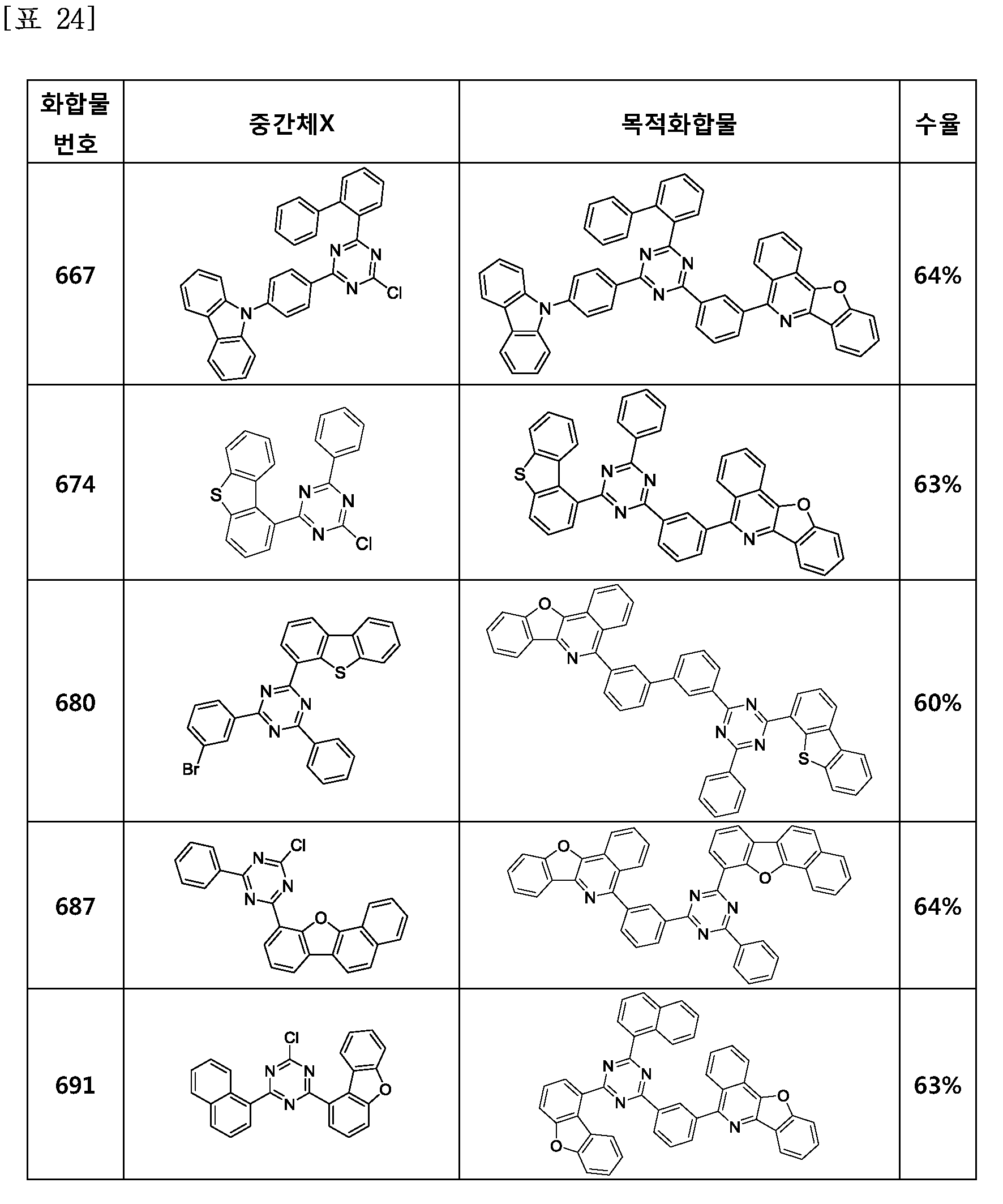


[[ 제조예Manufacturing example 8-4] 8-4]
상기 제조예 8-1에서 4-bromobenzoyl chloride 대신 4-bromo-1-naphthoyl chloride를 사용하고, 9-(4-(4-chloro-6-phenyl-1,3,5-triazin-2-yl)phenyl)-3-phenyl-9H-carbazole 대신 중간체Y를 사용하여 동일한 방법으로 제조하여 목적화합물을 합성하였다.In Preparation Example 8-1, 4-bromo-1-naphthoyl chloride was used instead of 4-bromobenzoyl chloride, and 9-(4-(4-chloro-6-phenyl-1,3,5-triazin-2-yl) Instead of phenyl)-3-phenyl-9H-carbazole, intermediate Y was prepared in the same way to synthesize the target compound.


[[ 제조예Manufacturing example 9-1] 화합물 953의 제조 9-1] Preparation of compound 953

1) 화합물 9-1의 제조1) Preparation of compound 9-1
benzo[b]thiophen-2-ylboronic acid (100 g, 0.561 mol), 2-bromoaniline (86.7 g, 0.504 mol)을 Toluene, EtOH, H2O 1000 mL : 200 mL : 200 mL 에 녹인 후 Pd(PPh3)4 (32.4 g, 0.028 mol) 와 NaHCO3 (141.3 g, 1.68 mol)를 넣고 3 시간 동안 100 ℃ 교반한다. 반응 완료 후 반응액에 MC와 증류수를 넣어서 추출한다. 이후 무수 MgSO4로 건조시킨 후 회전 증발기로 용매를 제거한 후 액체 형태의 화합물9-1 (93 g, 74%) 을 얻었다.Dissolve benzo[b]thiophen-2-ylboronic acid (100 g, 0.561 mol), 2-bromoaniline (86.7 g, 0.504 mol) in Toluene, EtOH, H 2 O 1000 mL: 200 mL: 200 mL and then Pd(PPh 3 ) 4 (32.4 g, 0.028 mol) and NaHCO 3 (141.3 g, 1.68 mol) was added and stirred at 100° C. for 3 hours. After completion of the reaction, MC and distilled water are added to the reaction solution to extract. After drying with anhydrous MgSO 4 , the solvent was removed by rotary evaporation to obtain liquid compound 9-1 (93 g, 74%).
2) 화합물 9-2의 제조2) Preparation of compound 9-2
화합물 9-1 (93 g, 0.412 mol), Triethyl amine (86 mL, 0.618 mol)을 MC 1200 mL에 넣고 녹인다. Benzoyl chloride (135.6 g, 0.618 mol) 을 MC 300 mL에 녹인 후, 0 ℃에서 천천히 혼합물에 적가한다. 반응 완료 후 반응액 있는 흰 고체를 필터하여 핵산으로 씻어 준다. 이것을 건조하여 고체 형태의 화합물 9-2 (134 g, 83%)를 얻었다.Compound 9-1 (93 g, 0.412 mol), Triethyl amine (86 mL, 0.618 mol) was added to 1200 mL of MC and dissolved. Benzoyl chloride (135.6 g, 0.618 mol) was dissolved in 300 mL of MC, and then slowly added dropwise to the mixture at 0°C. After the reaction is completed, the white solid with the reaction solution is filtered and washed with nucleic acid. This was dried to give compound 9-2 in the form of solid (134 g, 83%).
3) 화합물 9-3의 제조3) Preparation of compound 9-3
화합물 9-2 (134 g, 0.329 mol)을 Nitrobenzene 1500 mL에 녹인 후, POCl3 (46 mL, 0.495 mol)을 천천히 적가한다. 15 시간 동안 140 ℃에서 반응한다. 반응 완료 후 반응액에 NaHCO3를 증류수에 넣어 녹인 용액을 천천히 넣고 교반한다. 이후에 생기는 고체를 필터하여 수집한다. 수집한 고체를 MC와 MeOH에 재결정하여 고체 형태의 화합물 9-3 (65 g, 51%)를 얻었다.Compound 9-2 (134 g, 0.329 mol) was dissolved in 1500 mL of Nitrobenzene, and POCl 3 (46 mL, 0.495 mol) was slowly added dropwise. React at 140° C. for 15 hours. After the reaction was completed, NaHCO 3 was added to the reaction solution in distilled water, and the dissolved solution was slowly added and stirred. The resulting solid is collected by filtration. The collected solid was recrystallized from MC and MeOH to obtain compound 9-3 (65 g, 51%) in solid form.
4) 화합물 9-4의 제조4) Preparation of compound 9-4
화합물 9-3 (10 g, 0.0352mol, 1eq)과 NBS(7.5 g, 0.0423mol, 1.2eq), 아세트산(AcOH)(200 ml, 20T)를 넣고 20분간 교반한다. 여기에 H2SO4(100ml, 10T)를 천천히 넣는다. 상온에서 1시간 교반한 후에 물 150ml를 넣고 반응 종결한다. MC로 추출하고 실리카 필터하여 불순물을 제거한 후에 MeOH로 교반한다. 생성된 고체를 필터하여 화합물 9-4 (10.6 g, 81%)를 얻었다.Compound 9-3 (10 g, 0.0352 mol, 1 eq), NBS (7.5 g, 0.0423 mol, 1.2 eq) and acetic acid (AcOH) (200 ml, 20T) were added and stirred for 20 minutes. Slowly add H 2 SO 4 (100ml, 10T). After stirring at room temperature for 1 hour, 150 ml of water is added to terminate the reaction. After extracting with MC and removing impurities by filtering with silica, the mixture is stirred with MeOH. The resulting solid was filtered to give compound 9-4 (10.6 g, 81%).
5) 화합물 9-5의 제조5) Preparation of compound 9-5
화합물 9-4 (38 g, 0.102 mol), Bis(pinacolato)diboron (39 g, 0.153 mol), KOAc (30 g, 0.306 mol), PdCl2(dppf) (3.7 g, 0.0051 mol)을 1,4-dioxane 1000 mL에 녹인 후 5 시간 동안 90 ℃에서 반응한다. 반응 완료 후 반응액에 MC와 증류수를 넣어서 추출한다. 이후 무수 MgSO4로 건조시킨 후 고체를 필터하여 화합물 9-5 (28 g, 67%)를 얻었다.Compound 9-4 (38 g, 0.102 mol), Bis(pinacolato)diboron (39 g, 0.153 mol), KOAc (30 g, 0.306 mol), PdCl 2 (dppf) (3.7 g, 0.0051 mol) 1,4 Dissolve in 1000 mL of -dioxane and react at 90°C for 5 hours. After completion of the reaction, MC and distilled water are added to the reaction solution to extract. After drying with anhydrous MgSO 4 , the solid was filtered to obtain compound 9-5 (28 g, 67%).
6) 화합물 935의 제조6) Preparation of compound 935
화합물 9-5 (6.7 g, 0.016 mol), 9-(3-(4-chloro-6-phenyl-1,3,5-triazin-2-yl)phenyl)-9H-carbazole (6.8 g, 0.016 mol)을 1,4-dioxane :H2O = 100 mL : 20 mL 에 녹인 후 Pd2(dba)3 (1.4 g, 0.0016 mol), XPhos (1.5 g, 0.0032 mol) 와 K2CO3(6.6 g, 0.048 mol)를 넣고 5 시간 동안 100 ℃에서 교반한다. 반응 완료 후 반응액에 생성된 고체를 1,4-dioxane과 H2O로 씻어준다. 이후에 고체만 DCB에 재결정 방법으로 정제하여 화합물 935 (7.2 g, 64%) 을 얻었다.Compound 9-5 (6.7 g, 0.016 mol), 9-(3-(4-chloro-6-phenyl-1,3,5-triazin-2-yl)phenyl)-9H-carbazole (6.8 g, 0.016 mol ) In 1,4-dioxane :H 2 O = 100 mL: 20 mL, then Pd 2 (dba) 3 (1.4 g, 0.0016 mol), XPhos (1.5 g, 0.0032 mol) and K 2 CO 3 (6.6 g , 0.048 mol) and stirred at 100 °C for 5 hours. After the reaction is completed, the solid formed in the reaction solution is washed with 1,4-dioxane and H 2 O. Subsequently, only solid was purified on DCB by a recrystallization method to obtain compound 935 (7.2 g, 64%).
[[ 제조예Manufacturing example 9-2] 9-2]
상기 제조예 9-1에서 9-(3-(4-chloro-6-phenyl-1,3,5-triazin-2-yl)phenyl)-9H-carbazole 대신 중간체 Z 를 사용하여 동일한 방법으로 제조하여 목적화합물을 합성하였다.In Preparation Example 9-1, instead of 9-(3-(4-chloro-6-phenyl-1,3,5-triazin-2-yl)phenyl)-9H-carbazole, intermediate Z was used to prepare the same method. The target compound was synthesized.


[[ 제조예Manufacturing example 10-1] 화합물 1046의 제조 10-1] Preparation of compound 1046

1) 화합물 10-1의 제조1) Preparation of compound 10-1
상기 제조예 9-1의 화합물 9-1의 제조에서 benzo[b]thiophen-2-ylboronic acid 대신 benzofuran-2-ylboronic acid 을 사용하여 동일한 방법으로 합성하였다. 따라서 화합물 10-1 (54 g, 91%)를 얻었다.In the preparation of compound 9-1 of Preparation Example 9-1, benzofuran-2-ylboronic acid was synthesized in the same manner as benzofuran-2-ylboronic acid instead of benzo[b]thiophen-2-ylboronic acid. Thus, compound 10-1 (54 g, 91%) was obtained.
2) 화합물 10-2의 제조2) Preparation of compound 10-2
상기 제조예 9-1의 화합물 9-2의 제조에서 화합물 9-1 대신 화합물 10-1을 사용하여 동일한 방법으로 합성하였다. 따라서 화합물 10-2 (50 g, 72%)을 얻었다.In the preparation of compound 9-2 of Preparation Example 9-1, compound 10-1 was used instead of compound 9-1 to synthesize the same method. Thus, compound 10-2 (50 g, 72%) was obtained.
3) 화합물 10-3의 제조3) Preparation of compound 10-3
상기 제조예 9-1의 화합물 9-3의 제조에서 화합물 9-2 대신 화합물 10-2를 사용하여 동일한 방법으로 합성하였다. 따라서 화합물 10-3 (42g, 97%)을 얻었다.In the preparation of compound 9-3 of Preparation Example 9-1, compound 10-2 was used instead of compound 9-2 to synthesize the same method. Thus, compound 10-3 (42 g, 97%) was obtained.
4) 화합물 10-4의 제조4) Preparation of compound 10-4
상기 제조예 9-1의 화합물 9-4의 제조에서 화합물 9-3 대신 화합물 10-3을 사용하여 동일한 방법으로 합성하였다. 따라서 화합물 10-4 (63 g, 80%)을 얻었다.In the preparation of compound 9-4 of Preparation Example 9-1, compound 10-3 was used instead of compound 9-3 to synthesize the same method. Thus, compound 10-4 (63 g, 80%) was obtained.
5) 화합물 10-5의 제조5) Preparation of compound 10-5
상기 제조예 9-1의 화합물 9-5의 제조에서 화합물 9-4 대신 화합물 10-4를 사용하여 동일한 방법으로 합성하였다. 따라서 화합물 10-5 (46g, 76%)을 얻었다.In the preparation of compound 9-5 of Preparation Example 9-1, instead of compound 9-4, compound 10-4 was synthesized in the same manner. Thus, compound 10-5 (46 g, 76%) was obtained.
6) 화합물 1046의 제조6) Preparation of compound 1046
상기 제조예 9-1의 화합물 935의 제조에서 화합물 9-5 대신 화합물 10-5를 사용하고, 9-(3-(4-chloro-6-phenyl-1,3,5-triazin-2-yl)phenyl)-9H-carbazole 대신 2-chloro-4-(dibenzo[b,d]furan-1-yl)-6-phenyl-1,3,5-triazine을 사용하여 동일한 방법으로 합성하였다. 따라서 화합물 1046 (7 g,65%) 을 얻었다.In the preparation of compound 935 of Preparation Example 9-1, Compound 10-5 was used instead of Compound 9-5, and 9-(3-(4-chloro-6-phenyl-1,3,5-triazin-2-yl )phenyl)-9H-carbazole instead of 2-chloro-4-(dibenzo[b,d]furan-1-yl)-6-phenyl-1,3,5-triazine was synthesized in the same manner. Thus, compound 1046 (7 g, 65%) was obtained.
[[ 제조예Manufacturing example 10-2] 10-2]
상기 제조예 10-1에서 2-chloro-4-(dibenzo[b,d]furan-1-yl)-6-phenyl-1,3,5-triazine 대신 중간체 a 를 사용하여 동일한 방법으로 제조하여 목적화합물을 합성하였다.In the preparation example 10-1, instead of 2-chloro-4-(dibenzo[b,d]furan-1-yl)-6-phenyl-1,3,5-triazine, intermediate a was used in the same manner to prepare the object. The compound was synthesized.


[ [ 제조예Manufacturing example 11-1] 화합물 1084의 제조 11-1] Preparation of compound 1084

1) 화합물 11-1의 제조1) Preparation of compound 11-1
benzo[b]thiophen-3-ylboronic acid (100 g, 0.561 mol), 2-bromoaniline (86.7 g, 0.504 mol)을 Toluene, EtOH, H2O 1000 mL : 200 mL : 200 mL 에 녹인 후 Pd(PPh3)4 (32.4 g, 0.028 mol) 와 NaHCO3 (141.3 g, 1.68 mol)를 넣고 3 시간 동안 100 ℃ 교반한다. 반응 완료 후 반응액에 MC와 증류수를 넣어서 추출한다. 이후 무수 MgSO4로 건조시킨 후 회전 증발기로 용매를 제거한 후 액체 형태의 화합물11-1 (93 g, 74%) 을 얻었다.Dissolve benzo[b]thiophen-3-ylboronic acid (100 g, 0.561 mol), 2-bromoaniline (86.7 g, 0.504 mol) in Toluene, EtOH, H 2 O 1000 mL: 200 mL: 200 mL and then Pd(PPh 3 ) 4 (32.4 g, 0.028 mol) and NaHCO 3 (141.3 g, 1.68 mol) was added and stirred at 100° C. for 3 hours. After completion of the reaction, MC and distilled water are added to the reaction solution to extract. After drying with anhydrous MgSO 4 , the solvent was removed by rotary evaporation to obtain liquid compound 11-1 (93 g, 74%).
2) 화합물 11-2의 제조2) Preparation of compound 11-2
화합물 11-1 (93 g, 0.412 mol), Triethyl amine (86 mL, 0.618 mol)을 MC 1200 mL에 넣고 녹인다. Benzoyl chloride (135.6 g, 0.618 mol) 을 MC 300 mL에 녹인 후, 0 ℃에서 천천히 혼합물에 적가한다. 반응 완료 후 반응액 있는 흰 고체를 필터하여 핵산으로 씻어 준다. 이것을 건조하여 고체 형태의 화합물 11-2 (134 g, 83%)를 얻었다.Compound 11-1 (93 g, 0.412 mol) and Triethyl amine (86 mL, 0.618 mol) are added to 1200 mL of MC and dissolved. Benzoyl chloride (135.6 g, 0.618 mol) was dissolved in 300 mL of MC, and then slowly added dropwise to the mixture at 0°C. After the reaction is completed, the white solid with the reaction solution is filtered and washed with nucleic acid. This was dried to give compound 11-2 (134 g, 83%) in solid form.
3) 화합물 11-3의 제조3) Preparation of compound 11-3
화합물 11-2 (134 g, 0.329 mol)을 Nitrobenzene 1500 mL에 녹인 후, POCl3 (46 mL, 0.495 mol)을 천천히 적가한다. 15 시간 동안 140 ℃에서 반응한다. 반응 완료 후 반응액에 NaHCO3를 증류수에 넣어 녹인 용액을 천천히 넣고 교반한다. 이후에 생기는 고체를 필터하여 수집한다. 수집한 고체를 MC와 MeOH에 재결정하여 고체 형태의 화합물 11-3 (65 g, 51%)를 얻었다.Compound 11-2 (134 g, 0.329 mol) was dissolved in 1500 mL of Nitrobenzene, and POCl 3 (46 mL, 0.495 mol) was slowly added dropwise. React at 140° C. for 15 hours. After the reaction was completed, NaHCO 3 was added to the reaction solution in distilled water, and the dissolved solution was slowly added and stirred. The resulting solid is collected by filtration. The collected solid was recrystallized from MC and MeOH to obtain compound 11-3 (65 g, 51%) in solid form.
4) 화합물 11-4의 제조4) Preparation of compound 11-4
화합물 11-3 (10 g, 0.0352mol, 1eq)과 NBS(7.5 g, 0.0423mol, 1.2eq), AcOH(200 ml, 20T)를 넣고 20분간 교반한다. 여기에 H2SO4(100ml, 10T)를 천천히 넣는다. 상온에서 1시간 교반한 후에 물 150ml를 넣고 반응 종결한다. MC로 추출하고 실리카 필터하여 불순물을 제거한 후에 MeOH로 교반한다. 생성된 고체를 필터하여 화합물 11-4 (10.6 g, 81%)를 얻었다.Compound 11-3 (10 g, 0.0352 mol, 1 eq), NBS (7.5 g, 0.0423 mol, 1.2 eq) and AcOH (200 ml, 20T) were added and stirred for 20 minutes. Slowly add H 2 SO 4 (100ml, 10T). After stirring at room temperature for 1 hour, 150 ml of water is added to terminate the reaction. After extracting with MC and removing impurities by filtering with silica, the mixture is stirred with MeOH. The resulting solid was filtered to give compound 11-4 (10.6 g, 81%).
5) 화합물 11-5의 제조5) Preparation of compound 11-5
화합물 11-4 (38 g, 0.102 mol), Bis(pinacolato)diboron (39 g, 0.153 mol), KOAc (30 g, 0.306 mol), PdCl2(dppf) (3.7 g, 0.0051 mol)을 1,4-dioxane 1000 mL에 녹인 후 5 시간 동안 90 ℃에서 반응한다. 반응 완료 후 반응액에 MC와 증류수를 넣어서 추출한다. 이후 무수 MgSO4로 건조시킨 후 고체를 필터하여 화합물 11-5 (28 g, 67%)를 얻었다.Compound 11-4 (38 g, 0.102 mol), Bis(pinacolato)diboron (39 g, 0.153 mol), KOAc (30 g, 0.306 mol), PdCl 2 (dppf) (3.7 g, 0.0051 mol) 1,4 Dissolve in 1000 mL of -dioxane and react at 90°C for 5 hours. After completion of the reaction, MC and distilled water are added to the reaction solution to extract. After drying over anhydrous MgSO 4 , the solid was filtered to give compound 11-5 (28 g, 67%).
6) 화합물 1084의 제조6) Preparation of compound 1084
화합물 11-5 (6.7 g, 0.016 mol), 9-(4-(4-chloro-6-phenyl-1,3,5-triazin-2-yl)phenyl)-9H-carbazole (6.8 g, 0.016 mol)을 1,4-dioxane :H2O = 100 mL : 20 mL 에 녹인 후 Pd2(dba)3 (1.4 g, 0.0016 mol), XPhos (1.5 g, 0.0032 mol) 와 K2CO3(6.6 g, 0.048 mol)를 넣고 5 시간 동안 100 ℃에서 교반한다. 반응 완료 후 반응액에 생성된 고체를 1,4-dioxane과 H2O로 씻어준다. 이후에 고체만 DCB에 재결정 방법으로 정제하여 화합물 1084 (7.2 g, 64%) 을 얻었다.Compound 11-5 (6.7 g, 0.016 mol), 9-(4-(4-chloro-6-phenyl-1,3,5-triazin-2-yl)phenyl)-9H-carbazole (6.8 g, 0.016 mol) ) In 1,4-dioxane :H 2 O = 100 mL: 20 mL, then Pd 2 (dba) 3 (1.4 g, 0.0016 mol), XPhos (1.5 g, 0.0032 mol) and K 2 CO 3 (6.6 g , 0.048 mol) and stirred at 100 °C for 5 hours. After the reaction is completed, the solid formed in the reaction solution is washed with 1,4-dioxane and H 2 O. Subsequently, only solid was purified on DCB by a recrystallization method to obtain compound 1084 (7.2 g, 64%).
[[ 제조예Manufacturing example 11-2] 11-2]
상기 제조예 11-1에서 9-(4-(4-chloro-6-phenyl-1,3,5-triazin-2-yl)phenyl)-9H-carbazole 대신 중간체 b 를 사용하여 동일한 방법으로 제조하여 목적화합물을 합성하였다.In Preparation Example 11-1, instead of 9-(4-(4-chloro-6-phenyl-1,3,5-triazin-2-yl)phenyl)-9H-carbazole, intermediate b was used to prepare the same method. The target compound was synthesized.


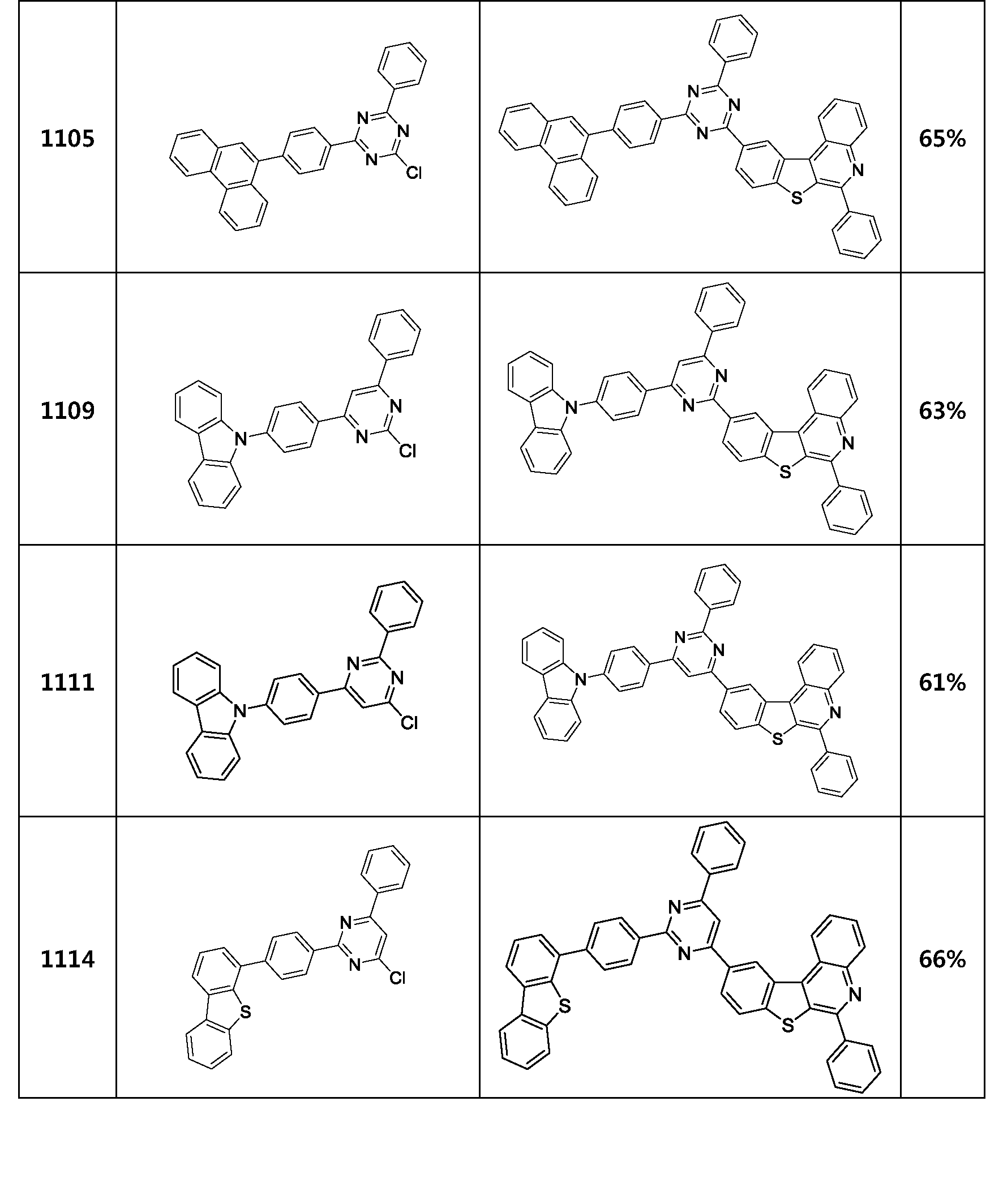

[[ 제조예Manufacturing example 12-1] 화합물 1129의 제조 12-1] Preparation of compound 1129

1) 화합물 12-1의 제조1) Preparation of compound 12-1
상기 제조예 10-1의 화합물 10-1의 제조에서 benzofuran-2-ylboronic acid 대신 benzofuran-3-ylboronic acid 을 사용하여 동일한 방법으로 합성하였다. 따라서 화합물 12-1 (54 g, 91%)를 얻었다.In the preparation of compound 10-1 of Preparation Example 10-1, benzofuran-3-ylboronic acid was used instead of benzofuran-2-ylboronic acid to synthesize the same method. Thus, compound 12-1 (54 g, 91%) was obtained.
2) 화합물 12-2의 제조2) Preparation of compound 12-2
상기 제조예 10-1의 화합물 10-2의 제조에서 화합물 10-1 대신 화합물 12-1을 사용하여 동일한 방법으로 합성하였다. 따라서 화합물 12-2 (50 g, 72%)을 얻었다.In the preparation of compound 10-2 of Preparation Example 10-1, compound 12-1 was used instead of Compound 10-1 to synthesize the same method. Thus, compound 12-2 (50 g, 72%) was obtained.
3) 화합물 12-3의 제조3) Preparation of compound 12-3
상기 제조예 10-1의 화합물 10-3의 제조에서 화합물 10-2 대신 화합물 12-2를 사용하여 동일한 방법으로 합성하였다. 따라서 화합물 12-3 (42g, 97%)을 얻었다.In the preparation of compound 10-3 of Preparation Example 10-1, compound 12-2 was used instead of Compound 10-2 to synthesize the same method. Thus, compound 12-3 (42 g, 97%) was obtained.
4) 화합물 12-4의 제조4) Preparation of compound 12-4
상기 제조예 10-1의 화합물 10-4의 제조에서 화합물 10-3 대신 화합물 12-3을 사용하여 동일한 방법으로 합성하였다. 따라서 화합물 12-4 (63 g, 80%)을 얻었다.In the preparation of compound 10-4 of Preparation Example 10-1, compound 12-3 was used instead of Compound 10-3 to synthesize the same method. Thus, compound 12-4 (63 g, 80%) was obtained.
5) 화합물 12-5의 제조5) Preparation of compound 12-5
상기 제조예 10-1의 화합물 10-5의 제조에서 화합물 10-4 대신 화합물 12-4를 사용하여 동일한 방법으로 합성하였다. 따라서 화합물 12-5 (46g, 76%)을 얻었다.In the preparation of compound 10-5 of Preparation Example 10-1, compound 12-4 was used instead of Compound 10-4 to synthesize the same method. Thus, compound 12-5 (46 g, 76%) was obtained.
6) 화합물 1129의 제조6) Preparation of compound 1129
상기 제조예 10-1의 화합물 1046의 제조에서 화합물 10-5 대신 화합물 12-5를 사용하고, 2-chloro-4-(dibenzo[b,d]furan-1-yl)-6-phenyl-1,3,5-triazine 대신 9-(3-(4-chloro-6-phenyl-1,3,5-triazin-2-yl)phenyl)-9H-carbazole 을 사용하여 동일한 방법으로 합성하였다. 따라서 화합물 1129 (7 g,65%) 을 얻었다.In the preparation of compound 1046 of Preparation Example 10-1, Compound 12-5 was used instead of Compound 10-5, and 2-chloro-4-(dibenzo[b,d]furan-1-yl)-6-phenyl-1 It was synthesized in the same manner using 9-(3-(4-chloro-6-phenyl-1,3,5-triazin-2-yl)phenyl)-9H-carbazole instead of ,3,5-triazine. Thus, compound 1129 (7 g, 65%) was obtained.
[[ 제조예Manufacturing example 12-2] 12-2]
상기 제조예 10-1에서 9-(3-(4-chloro-6-phenyl-1,3,5-triazin-2-yl)phenyl)-9H-carbazole 대신 중간체 c 를 사용하여 동일한 방법으로 제조하여 목적화합물을 합성하였다.In Preparation Example 10-1, instead of 9-(3-(4-chloro-6-phenyl-1,3,5-triazin-2-yl)phenyl)-9H-carbazole, intermediate c was used to prepare the same method. The target compound was synthesized.

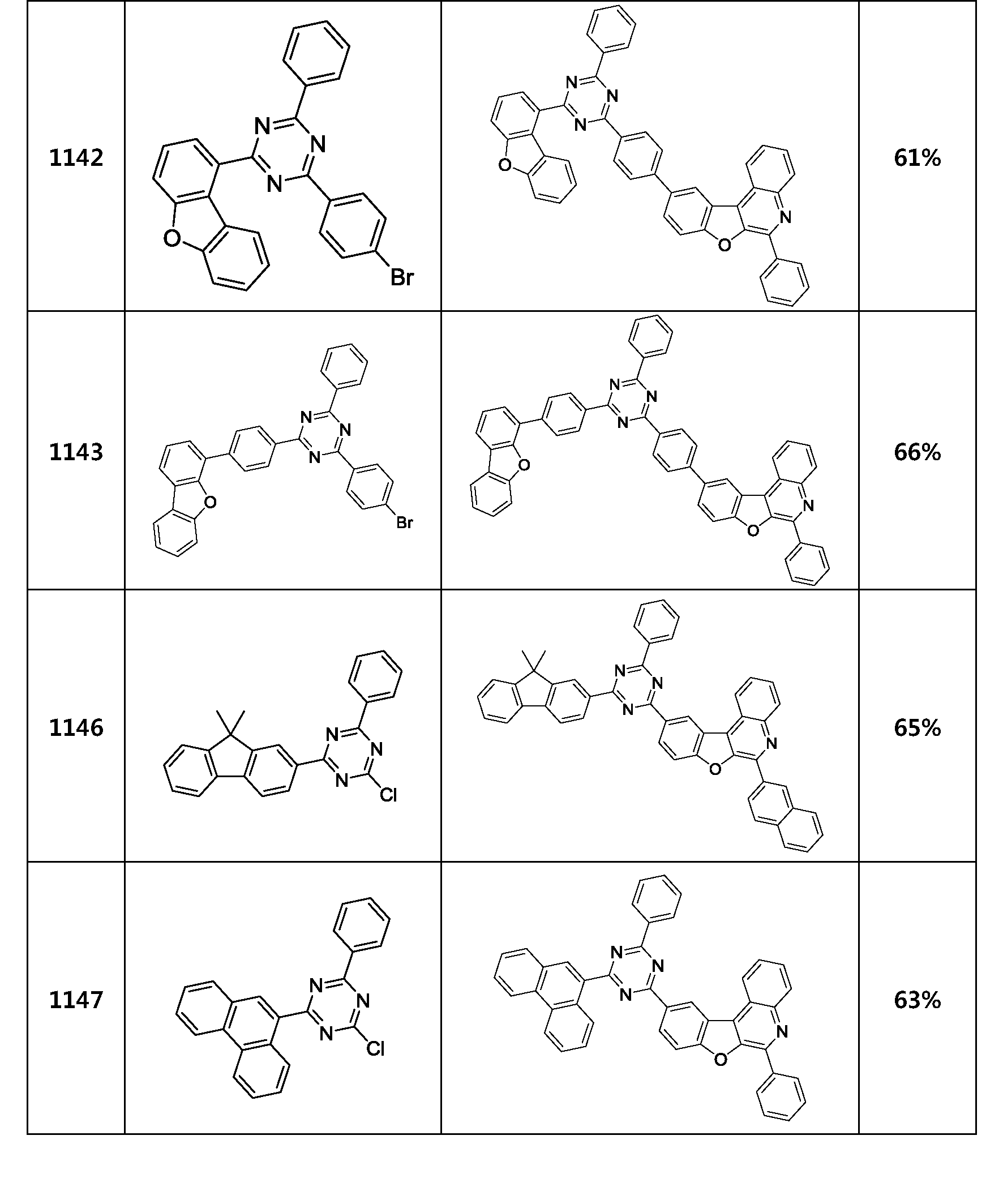


상기 제조된 화합물은 Mass 및 NMR 결과로부터 확인하였다. The prepared compound was confirmed from Mass and NMR results.
[[ 실험예Experimental Example 1] (유기 발광 소자의 제작 - 전자 1] (Production of organic light emitting device-electronic 수송층Transport layer ))
[[ 비교예Comparative example 1] One]
OLED용 글래스(삼성-코닝사 제조)로부터 얻어진 투명전극 ITO 박막을 트리클로로에틸렌, 아세톤, 에탄올, 증류수를 순차적으로 사용하여 각 5분간 초음파 세척을 실시한 후, 이소프로판올에 넣어 보관한 후 사용하였다.The transparent electrode ITO thin film obtained from the glass for OLED (manufactured by Samsung-Corning) was subjected to ultrasonic cleaning for 5 minutes each using trichloroethylene, acetone, ethanol, and distilled water sequentially, and then stored in isopropanol for use.
다음으로 진공 증착 장비의 기판 폴더에 ITO 기판을 설치하고, 진공 증착 장비 내의 셀에 하기 4,4',4"-트리스(N,N-(2-나프틸)-페닐아미노)트리페닐 아민 (4,4',4"-tris(N,N-(2-naphthyl)-phenylamino)triphenyl amine: 2-TNATA)을 넣었다.Next, an ITO substrate is installed in the substrate folder of the vacuum deposition equipment, and the following 4,4',4"-tris(N,N-(2-naphthyl)-phenylamino)triphenyl amine ( 4,4',4"-tris(N,N-(2-naphthyl)-phenylamino)triphenyl amine: 2-TNATA) was added.

이어서 챔버 내의 진공도가 10-6 torr에 도달할 때까지 배기시킨 후, 셀에 전류를 인가하여 2-TNATA를 증발시켜 ITO 기판 상에 600Å 두께의 정공 주입층을 증착하였다.After evacuating until the vacuum degree in the chamber reached 10 -6 torr, a current was applied to the cell to evaporate 2-TNATA to deposit a 600 mm thick hole injection layer on the ITO substrate.
진공 증착 장비 내의 다른 셀에 하기 N,N'-비스(α-나프틸)-N,N'-디페닐-4,4'-디아민(N,N'-bis(α-naphthyl)-N,N'-diphenyl-4,4'-diamine: NPB)을 넣고, 셀에 전류를 인가하여 증발시켜 정공 주입층 위에 300Å 두께의 정공 수송층을 증착하였다.The following N,N'-bis(α-naphthyl)-N,N'-diphenyl-4,4'-diamine(N,N'-bis(α-naphthyl)-N, N'-diphenyl-4,4'-diamine: NPB) was added, and a current was applied to the cell to evaporate to deposit a hole transport layer having a thickness of 300 위에 on the hole injection layer.

이와 같이 정공 주입층 및 정공 수송층을 형성시킨 후, 그 위에 발광층으로서 다음과 같은 구조의 청색 발광 재료를 증착시켰다. 구체적으로, 진공 증착 장비 내의 한쪽 셀에 청색 발광 호스트 재료인 H1을 200Å 두께로 진공 증착시키고 그 위에 청색 발광 도판트 재료인 D1을 호스트 재료 대비 5% 진공 증착시켰다.After forming the hole injection layer and the hole transport layer, a blue light emitting material having the following structure was deposited as a light emitting layer thereon. Specifically, a blue light emitting host material H1 was vacuum-deposited to 200 mm thick in one cell in the vacuum deposition equipment, and a blue light emitting dopant material D1 was vacuum deposited 5% of the host material.
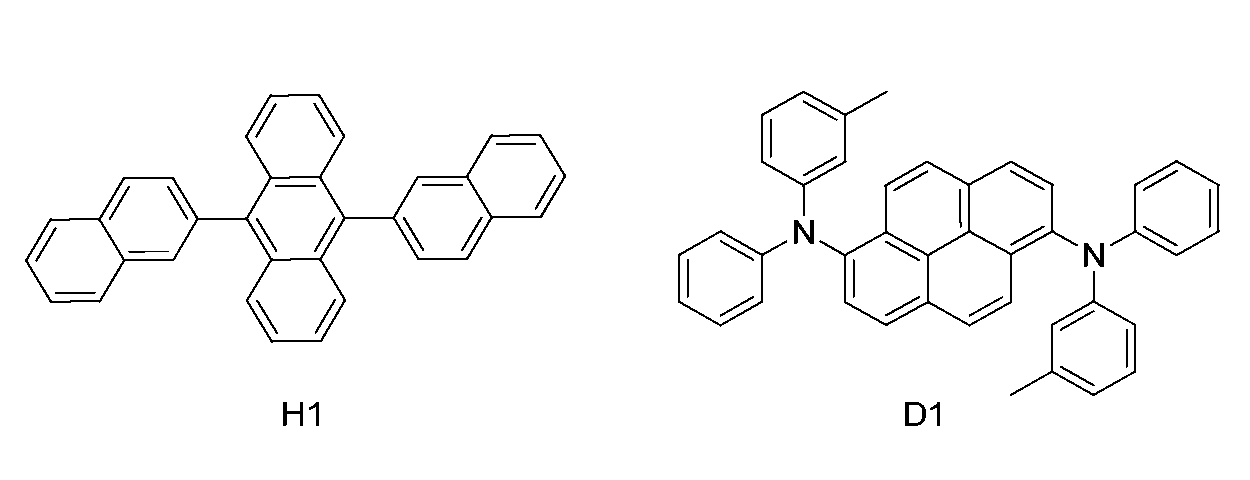
이어서 전자 수송층으로서 하기 구조식 E1의 화합물을 300Å 두께로 증착하였다.Subsequently, the compound of Structural Formula E1 as the electron transport layer was deposited to a thickness of 300 MPa.

전자 주입층으로 리튬 플루오라이드(lithium fluoride: LiF)를 10Å 두께로 증착하였고 Al 음극을 1,000Å의 두께로 하여 OLED 소자를 제작하였다.Lithium fluoride (LiF) was deposited as an electron injection layer to a thickness of 10 하였고, and an Al cathode was fabricated with a thickness of 1,000 Å.
한편, OLED 소자 제작에 필요한 모든 유기 화합물은 재료 별로 각각 10-6~10-8 torr 하에서 진공 승화 정제하여 OLED 제작에 사용하였다On the other hand, all organic compounds necessary for the production of OLED devices were vacuum sublimated and purified under 10 -6 to 10 -8 torr for each material, and used for OLED production.
[[ 비교예Comparative example 2 및 2 and 비교예Comparative example 3] 3]
비교예 1 에서 전자 수송층 형성시 사용된 E1 대신 화합물 A, 화합물 B를 사용하는 것을 제외하고는 비교예 1과 동일하게 수행하여 유기 전계 발광 소자를 제작하였다.An organic electroluminescent device was manufactured in the same manner as in Comparative Example 1, except that Compound A and Compound B were used instead of E1 used in forming the electron transport layer in Comparative Example 1.

[[ 실시예Example 1 내지 226] 1 to 226]
비교예 1에서 전자 수송층 형성시 사용된 E1 대신 표 32에 표시되어있는 화합물을 사용하는 것을 제외하고는, 비교예 1과 동일하게 수행하여 유기 전계 발광 소자를 제작하였다.An organic electroluminescent device was manufactured in the same manner as in Comparative Example 1, except that the compound shown in Table 32 was used instead of E1 used in forming the electron transport layer in Comparative Example 1.
평가: 유기 Rating: iHerb 전계Electric field 발광 소자의 구동 전압, 발광 효율, Driving voltage of the light emitting element, light emission efficiency, 색좌표Color coordinate (( CIECIE ), 수명), life span
본 발명에 따라 제조된 청색 유기 발광 소자의 구동전압, 발광효율, 색좌표(CIE), 수명을 측정한 결과는 표 32와 같았다. Table 32 shows the results of measuring the driving voltage, light emission efficiency, color coordinate (CIE), and lifetime of the blue organic light emitting device manufactured according to the present invention.
맥사이어스사의 M7000으로 전계발광(EL)특성을 측정하였으며, 그 측정 결과를 가지고 맥사이언스사에서 제조된 수명측정장비(M6000)를 통해 기준 휘도가 3500 cd/m2 일 때, T95을 측정하였다. 본 발명에 따라 제조된 백색 유기전계발광소자의 구동전압, 발광효율, 색좌표(CIE) 및 수명을 측정한 결과는 표 32와 같았다.The electroluminescence (EL) characteristics were measured with M7000 of Max Science, and T 95 was measured when the reference luminance was 3500 cd/m 2 through the life measurement equipment (M6000) manufactured by Max Science with the measurement results. . Table 32 shows the results of measuring the driving voltage, luminous efficiency, color coordinate (CIE), and lifetime of the white organic light emitting device manufactured according to the present invention.
상기 표 32의 결과로부터 알 수 있듯이, 본 발명의 청색 유기 발광 소자의 전자 수송층 재료를 이용한 유기 발광 소자는 비교예 1에 비해 구동 전압이 낮고, 발광효율 및 수명이 개선되었다.As can be seen from the results of Table 32, the organic light-emitting device using the electron transport layer material of the blue organic light-emitting device of the present invention has a lower driving voltage and improved luminous efficiency and life compared to Comparative Example 1.
또한 비교예 2 내지 비교예 3에 비하여 화합물 254, 259, 264, 290, 296, 297, 326, 348, 315, 362, 363, 416, 725, 748, 740, 751, 778, 803, 836, 837, 888, 889, 905을 사용했을 때, 발광 효율 및 수명이 현저히 개선되었다.Also, compared to Comparative Examples 2 to 3, Compounds 254, 259, 264, 290, 296, 297, 326, 348, 315, 362, 363, 416, 725, 748, 740, 751, 778, 803, 836, 837 , 888, 889, and 905, luminous efficiency and lifespan were significantly improved.
[실험예 2] (유기 발광 소자의 제작 - 정공 저지층)[Experimental Example 2] (Preparation of organic light emitting device-hole blocking layer)
[비교예 4][Comparative Example 4]
OLED용 글래스(삼성-코닝사 제조)로부터 얻어진 투명전극 ITO 박막을 트리클로로에틸렌, 아세톤, 에탄올, 증류수를 순차적으로 사용하여 각 5분간 초음파 세척을 실시한 후, 이소프로판올에 넣어 보관한 후 사용하였다.The transparent electrode ITO thin film obtained from the glass for OLED (manufactured by Samsung-Corning) was subjected to ultrasonic cleaning for 5 minutes each using trichloroethylene, acetone, ethanol, and distilled water sequentially, and then stored in isopropanol for use.
다음으로 진공 증착 장비의 기판 폴더에 ITO 기판을 설치하고, 진공 증착 장비 내의 셀에 하기 4,4',4"-트리스(N,N-(2-나프틸)-페닐아미노)트리페닐 아민 (4,4',4"-tris(N,N-(2-naphthyl)-phenylamino)triphenyl amine: 2-TNATA)을 넣었다.Next, an ITO substrate is installed in the substrate folder of the vacuum deposition equipment, and the following 4,4',4"-tris(N,N-(2-naphthyl)-phenylamino)triphenyl amine ( 4,4',4"-tris(N,N-(2-naphthyl)-phenylamino)triphenyl amine: 2-TNATA) was added.
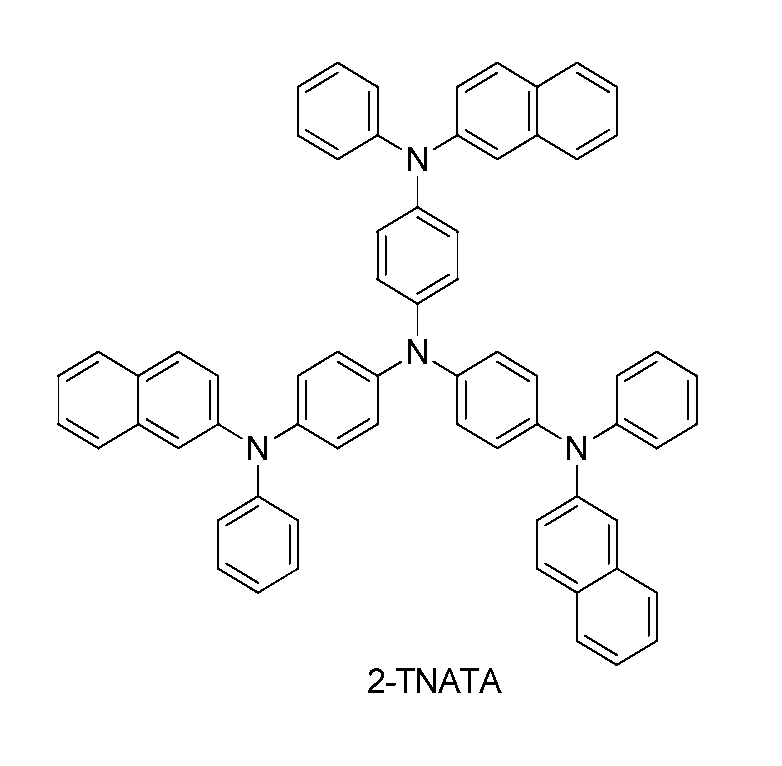
이어서 챔버 내의 진공도가 10-6 torr에 도달할 때까지 배기시킨 후, 셀에 전류를 인가하여 2-TNATA를 증발시켜 ITO 기판 상에 600Å 두께의 정공 주입층을 증착하였다.After evacuating until the vacuum degree in the chamber reached 10 -6 torr, a current was applied to the cell to evaporate 2-TNATA to deposit a 600 mm thick hole injection layer on the ITO substrate.
진공 증착 장비 내의 다른 셀에 하기 N,N'-비스(α-나프틸)-N,N'-디페닐-4,4'-디아민(N,N'-bis(α-naphthyl)-N,N'-diphenyl-4,4'-diamine: NPB)을 넣고, 셀에 전류를 인가하여 증발시켜 정공 주입층 위에 300Å 두께의 정공 수송층을 증착하였다.The following N,N'-bis(α-naphthyl)-N,N'-diphenyl-4,4'-diamine(N,N'-bis(α-naphthyl)-N, N'-diphenyl-4,4'-diamine: NPB) was added, and a current was applied to the cell to evaporate to deposit a hole transport layer having a thickness of 300 위에 on the hole injection layer.
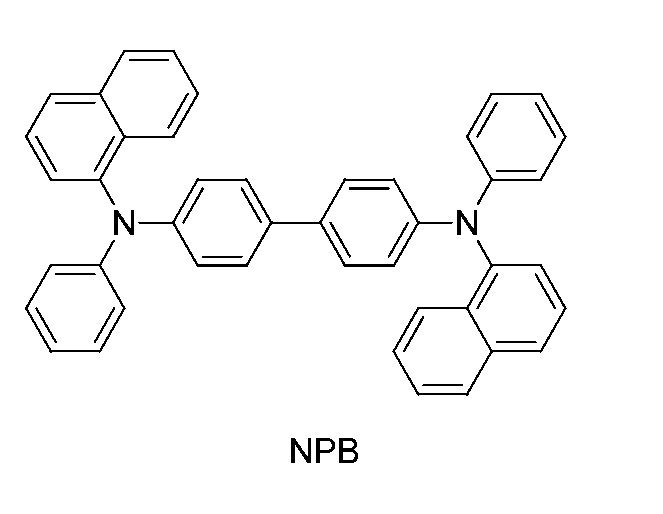
이와 같이 정공 주입층 및 정공 수송층을 형성시킨 후, 그 위에 발광층으로서 다음과 같은 구조의 청색 발광 재료를 증착시켰다. 구체적으로, 진공 증착 장비 내의 한쪽 셀에 청색 발광 호스트 재료인 H1을 200Å 두께로 진공 증착시키고 그 위에 청색 발광 도판트 재료인 D1을 호스트 재료 대비 5% 진공 증착시켰다.After forming the hole injection layer and the hole transport layer, a blue light emitting material having the following structure was deposited as a light emitting layer thereon. Specifically, a blue light emitting host material H1 was vacuum-deposited to 200 mm thick in one cell in the vacuum deposition equipment, and a blue light emitting dopant material D1 was vacuum deposited 5% of the host material.

이어서 전자 수송층으로서 하기 구조식 E1의 화합물을 300Å 두께로 증착하였다.Subsequently, the compound of Structural Formula E1 as the electron transport layer was deposited to a thickness of 300 MPa.

전자 주입층으로 리튬 플루오라이드(lithium fluoride: LiF)를 10Å 두께로 증착하였고 Al 음극을 1,000Å의 두께로 하여 OLED 소자를 제작하였다.Lithium fluoride (LiF) was deposited as an electron injection layer to a thickness of 10 하였고, and an Al cathode was fabricated with a thickness of 1,000 Å.
한편, OLED 소자 제작에 필요한 모든 유기 화합물은 재료 별로 각각 10-6~10-8 torr 하에서 진공 승화 정제하여 OLED 제작에 사용하였다On the other hand, all organic compounds necessary for the production of OLED devices were vacuum sublimated and purified under 10 -6 to 10 -8 torr for each material, and used for OLED production.
[[ 비교예Comparative example 5 및 5 and 비교예Comparative example 6] 6]
비교예 5에서 전자수송층 E1의 두께를 250 Å 형성한 다음 상기 전자수송층 상부에 화합물 C의 두께를 50Å 으로 정공저지층을 형성한것을 제외하고는, 비교예 4와 동일하게 수행하여 유기 전계 발광 소자를 제작하였다.An organic electroluminescent device was performed in the same manner as in Comparative Example 4, except that in Example 5, a thickness of the electron transport layer E1 was formed to be 250 다음, and then a hole blocking layer was formed with a thickness of Compound C of 50 상부 over the electron transport layer. Was produced.
또한, 비교예 6에서 전자수송층 E1의 두께를 250 Å 형성한 다음 상기 전자수송층 상부에 화합물 D 의 두께를 50Å 으로 정공저지층을 형성한것을 제외하고는, 비교예 4와 동일하게 수행하여 유기 전계 발광 소자를 제작하였다.In addition, in Comparative Example 6, the electron transport layer E1 was formed with a thickness of 250 Å, and then a hole blocking layer with a thickness of Compound D of 50 에 was formed on the electron transport layer, and the organic electric field was performed in the same manner as in Comparative Example 4. A light emitting device was produced.

[[ 실시예Example 227 내지 271] 227 to 271]
전자수송층 E1의 두께를 250 Å 형성한 다음 상기 전자수송층 상부에 하기 표 33에 표시되어있는 화합물의 두께를 50Å 으로 정공저지층을 형성한 것을 제외하고는, 비교예 4와 동일하게 수행하여 유기 전계 발광 소자를 제작하였다.After forming the electron transport layer E1 with a thickness of 250 다음 and then forming a hole blocking layer with a thickness of 50 화합물 of the compound shown in Table 33 above on the electron transport layer, the same procedure as in Comparative Example 4 was performed to conduct an organic electric field. A light emitting device was produced.
본 발명에 따라 제조된 청색 유기 발광 소자의 구동전압, 발광효율, 색좌표(CIE), 수명을 측정한 결과는 표 33과 같았다.The results of measuring the driving voltage, luminous efficiency, color coordinate (CIE), and lifetime of the blue organic light emitting device manufactured according to the present invention are shown in Table 33.
상기 표 33의 결과로부터 알 수 있듯이, 본 발명의 청색 유기 발광 소자의 정공 저지층 재료를 이용한 유기 발광 소자는 비교예 4에 비해 구동 전압이 낮고, 발광효율 및 수명이 현저히 개선되었다. 또한 비교예 5 내지 비교예 6에 비하여 빌광효율과 수명이 현저히 개선되었다. 이러한 결과의 원인은 p-타입과 n-타입을 모두 갖는 바이폴라 타입이므로, 정공 누수를 막고 발광층 내에서 엑시톤을 효과적으로 가둘 수 있기 때문이다.As can be seen from the results of Table 33, the organic light-emitting device using the hole blocking layer material of the blue organic light-emitting device of the present invention has a lower driving voltage and significantly improved luminous efficiency and life compared to Comparative Example 4. In addition, compared to Comparative Examples 5 to 6, the luminous efficiency and lifetime were remarkably improved. The reason for this result is that it is a bipolar type having both p-type and n-type, and thus it is possible to prevent hole leakage and effectively trap excitons in the light emitting layer.
이상에서 본 발명의 바람직한 실시예들에 대하여 상세하게 설명하였지만 본 발명의 권리범위는 이에 한정되는 것은 아니고 다음의 청구 범위에서 정의하고 있는 본 발명의 기본 개념을 이용한 당업자의 여러 변형 및 개량 형태 또한 본 발명의 권리범위에 속하는 것이다. Although the preferred embodiments of the present invention have been described in detail above, the scope of the present invention is not limited thereto, and various modifications and improvements of those skilled in the art using the basic concept of the present invention defined in the following claims are also provided. It belongs to the scope of the invention.
Claims (22)


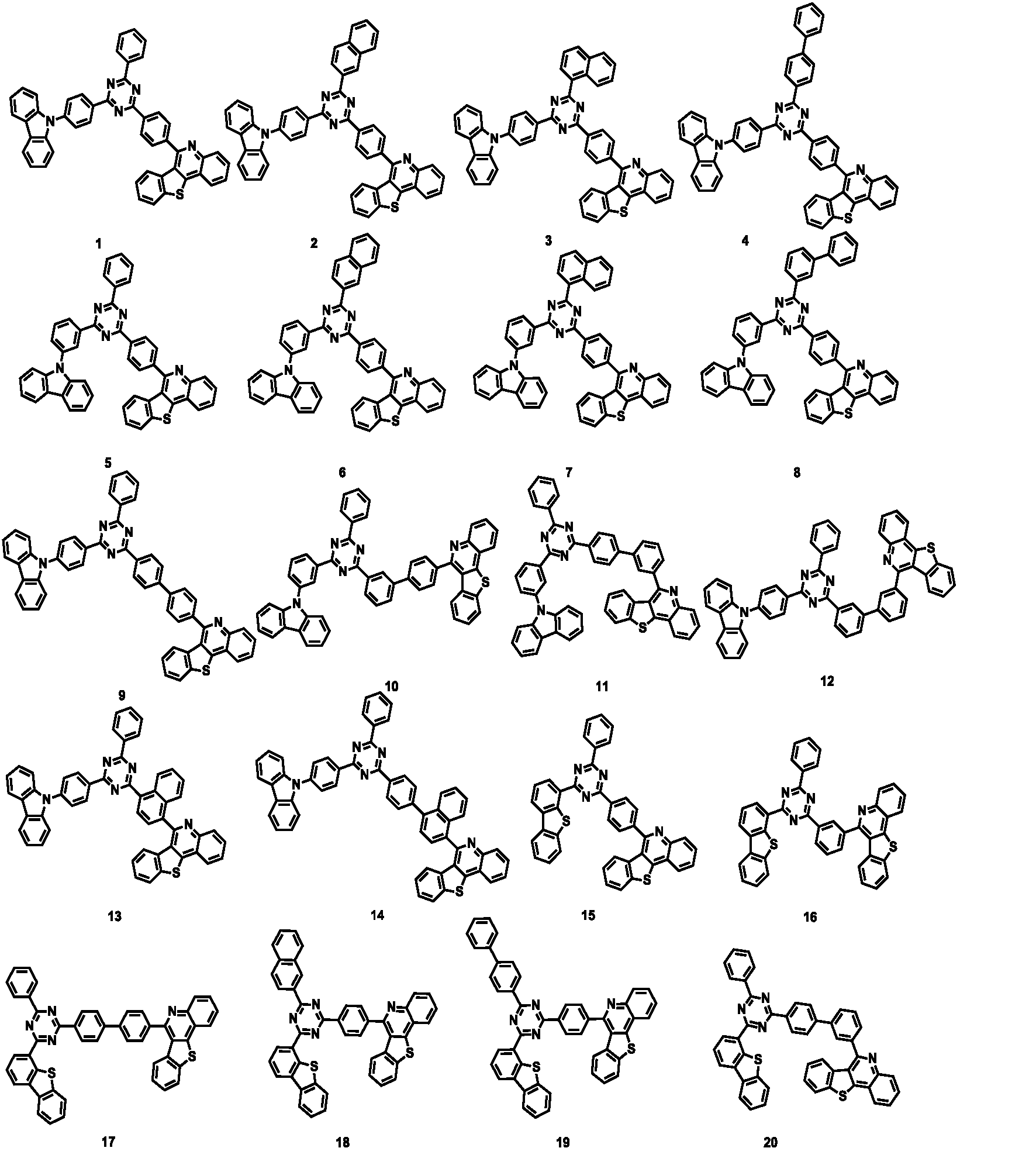


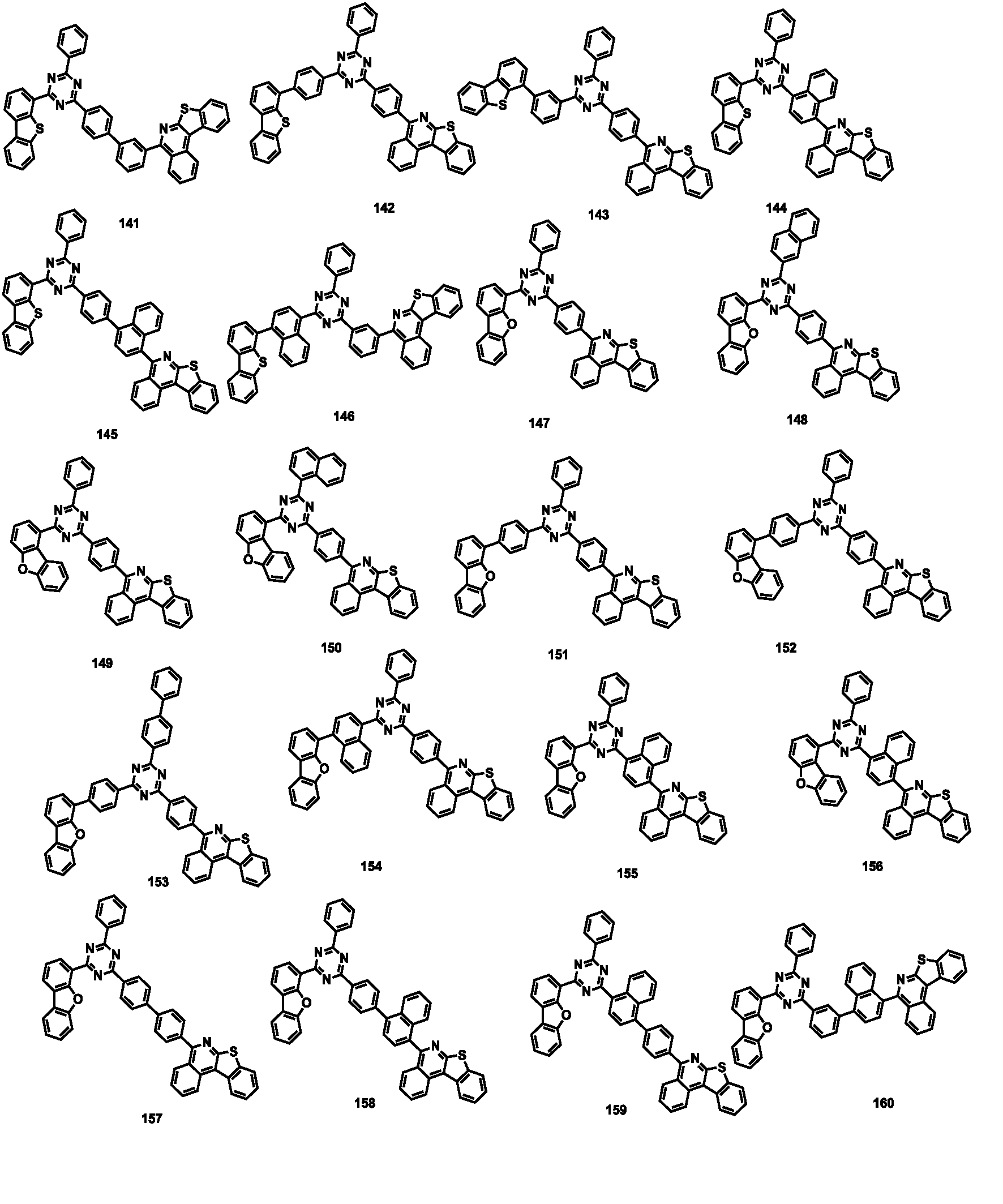


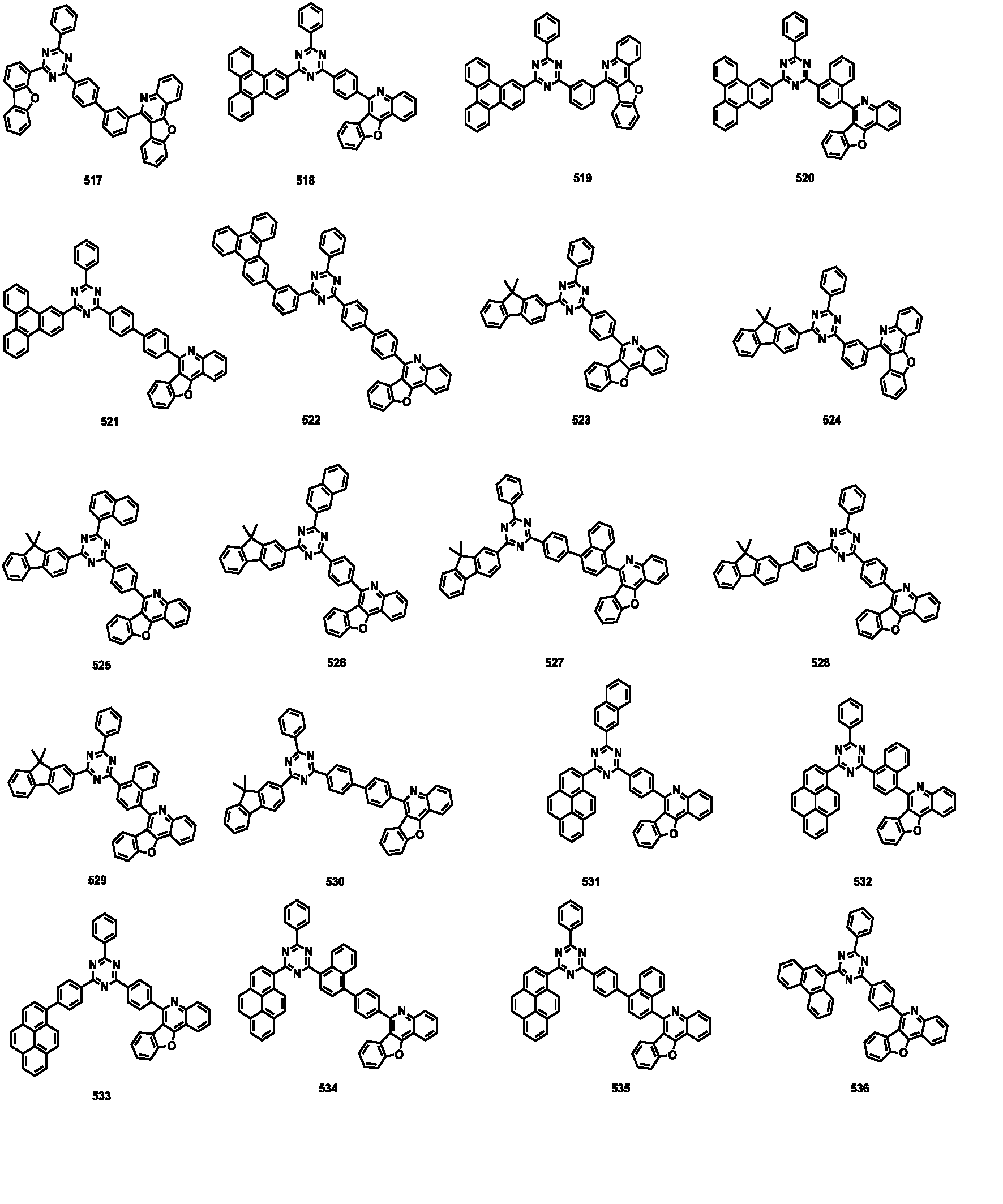
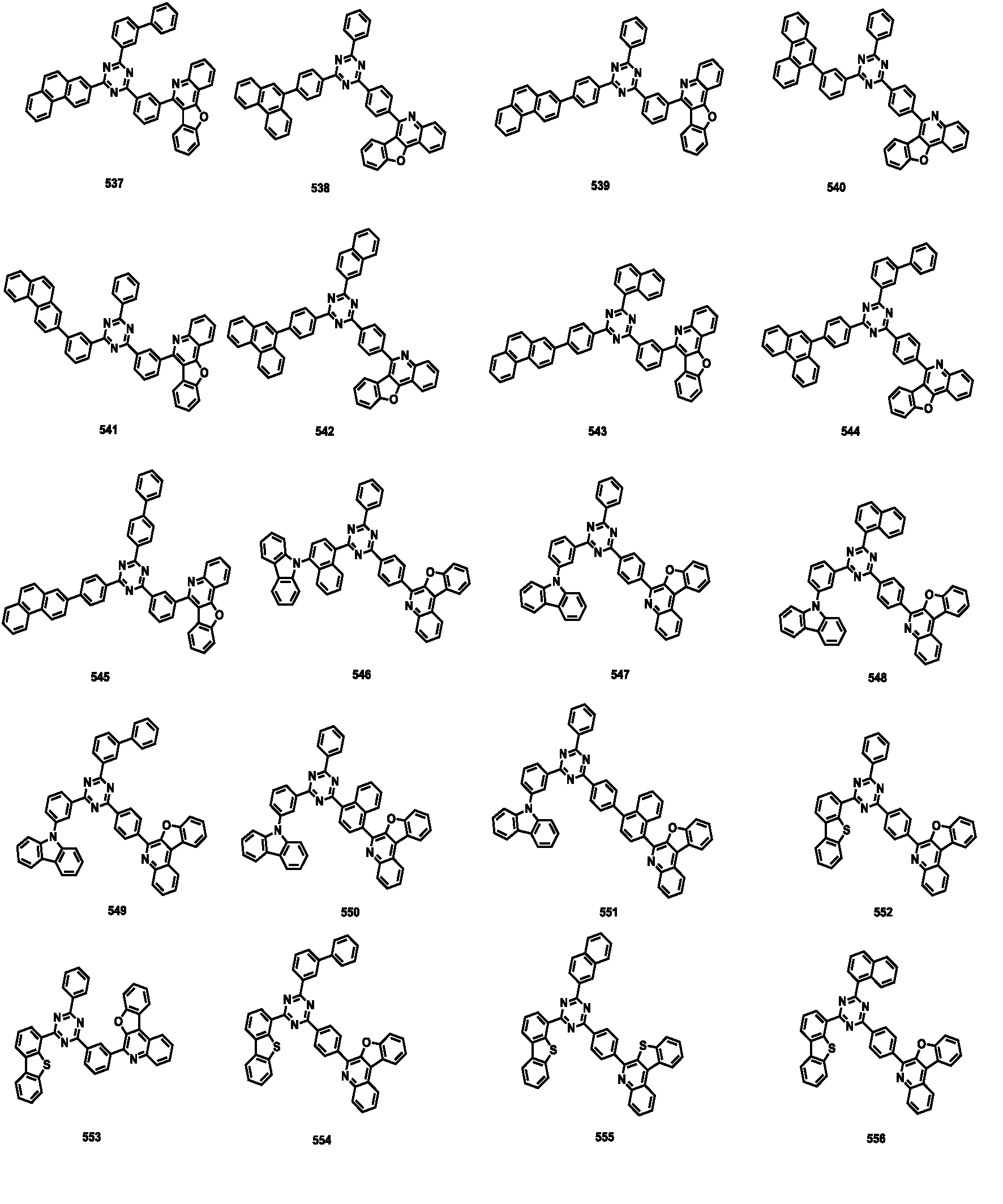


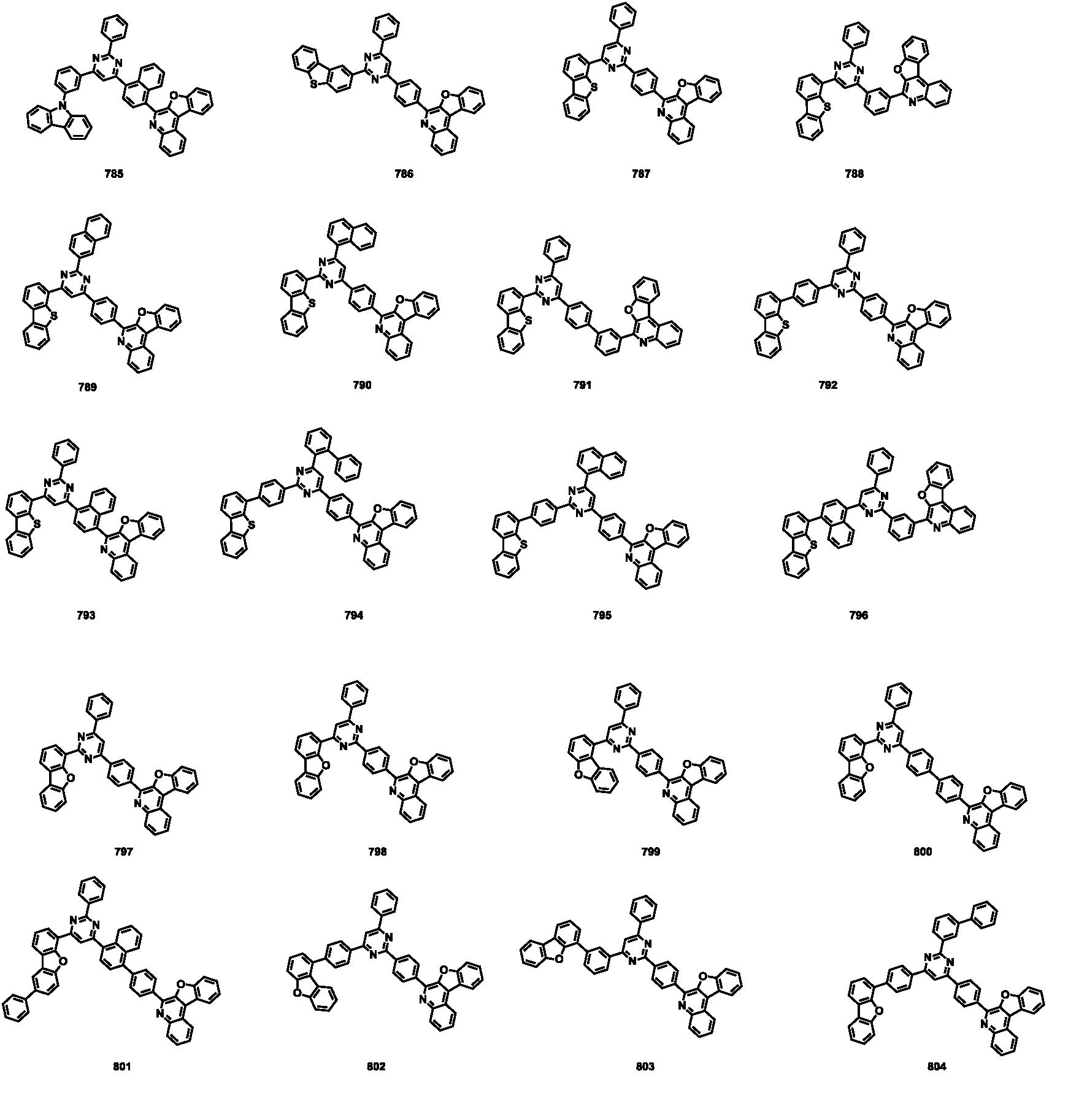


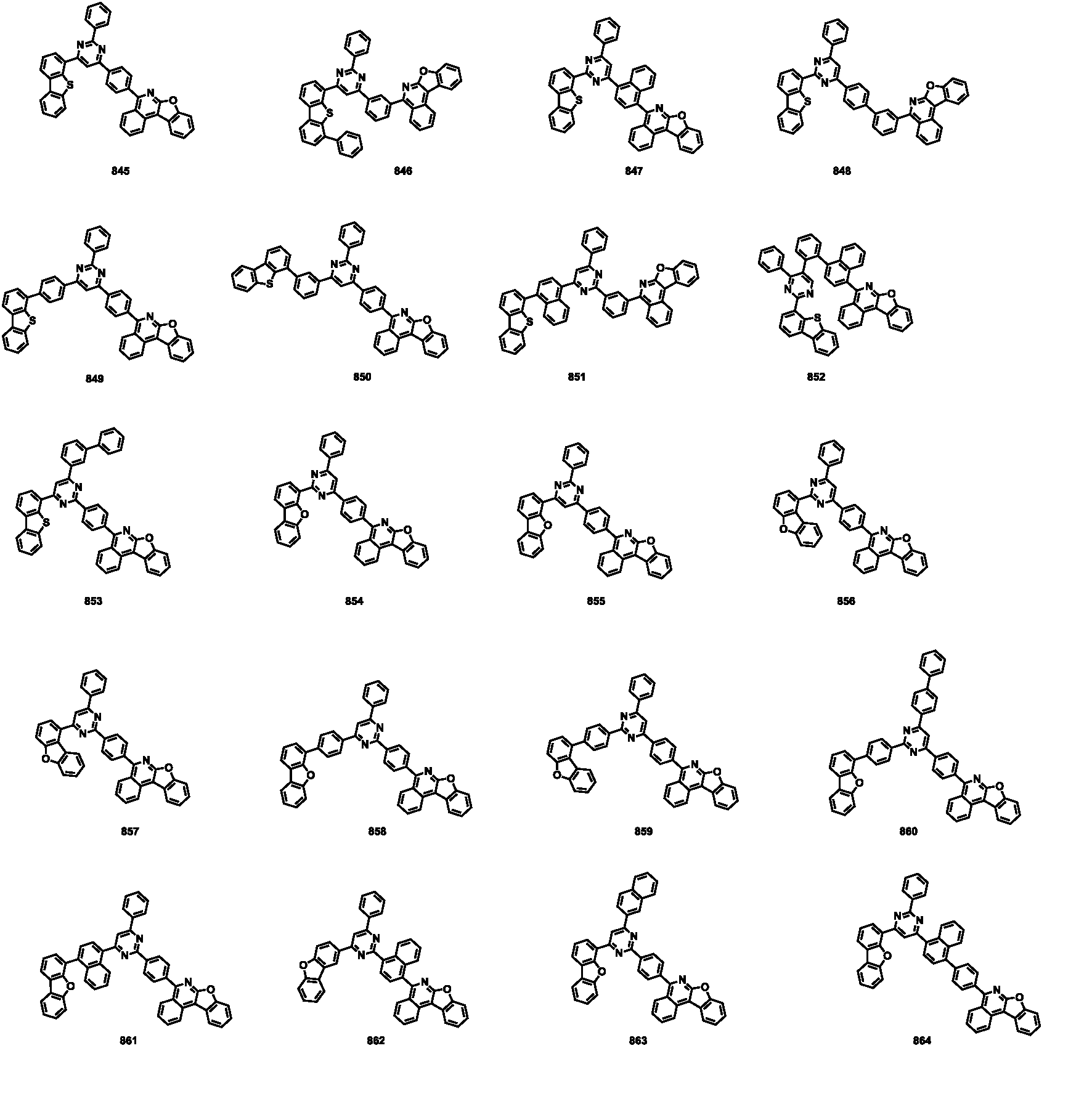


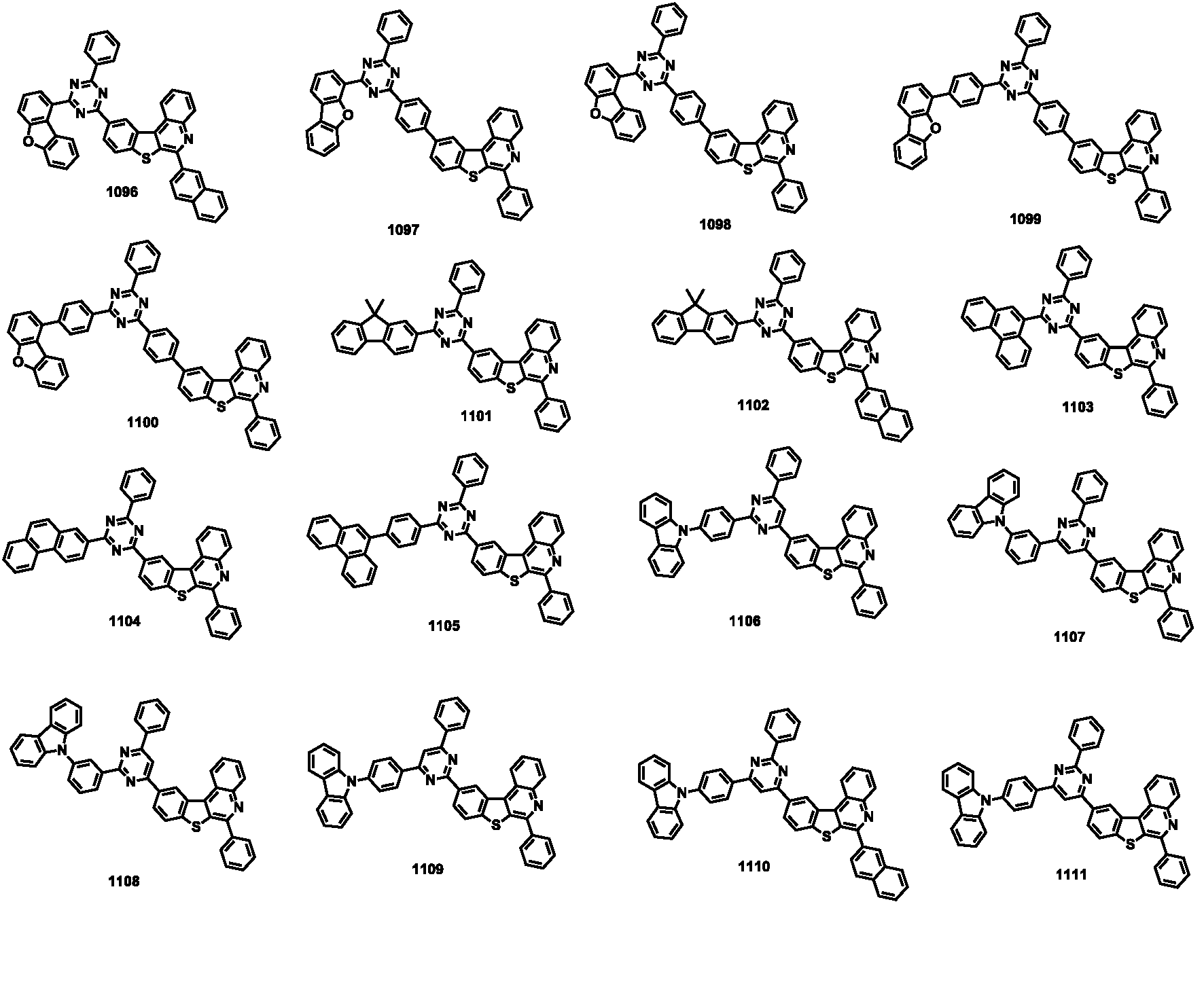
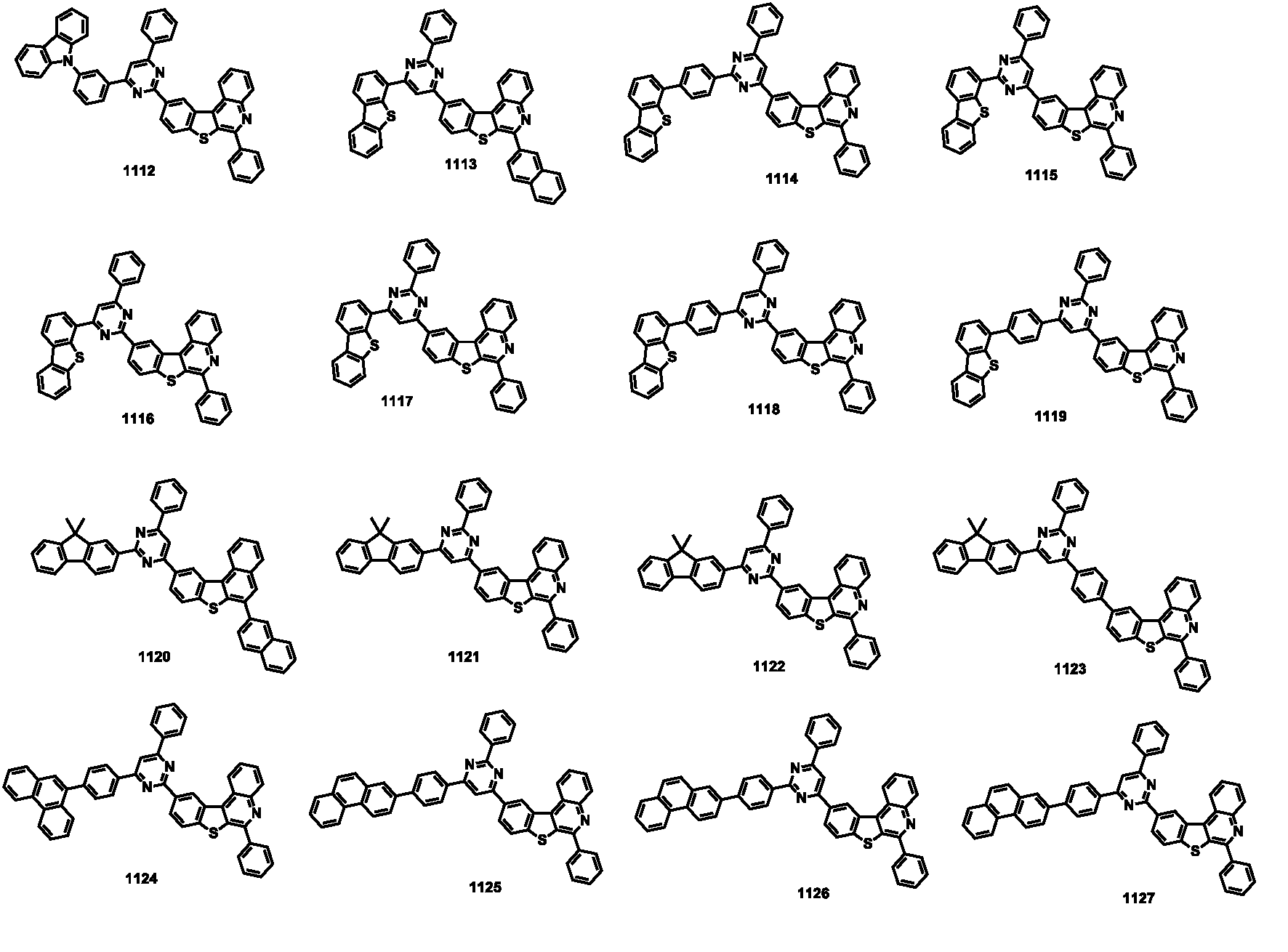


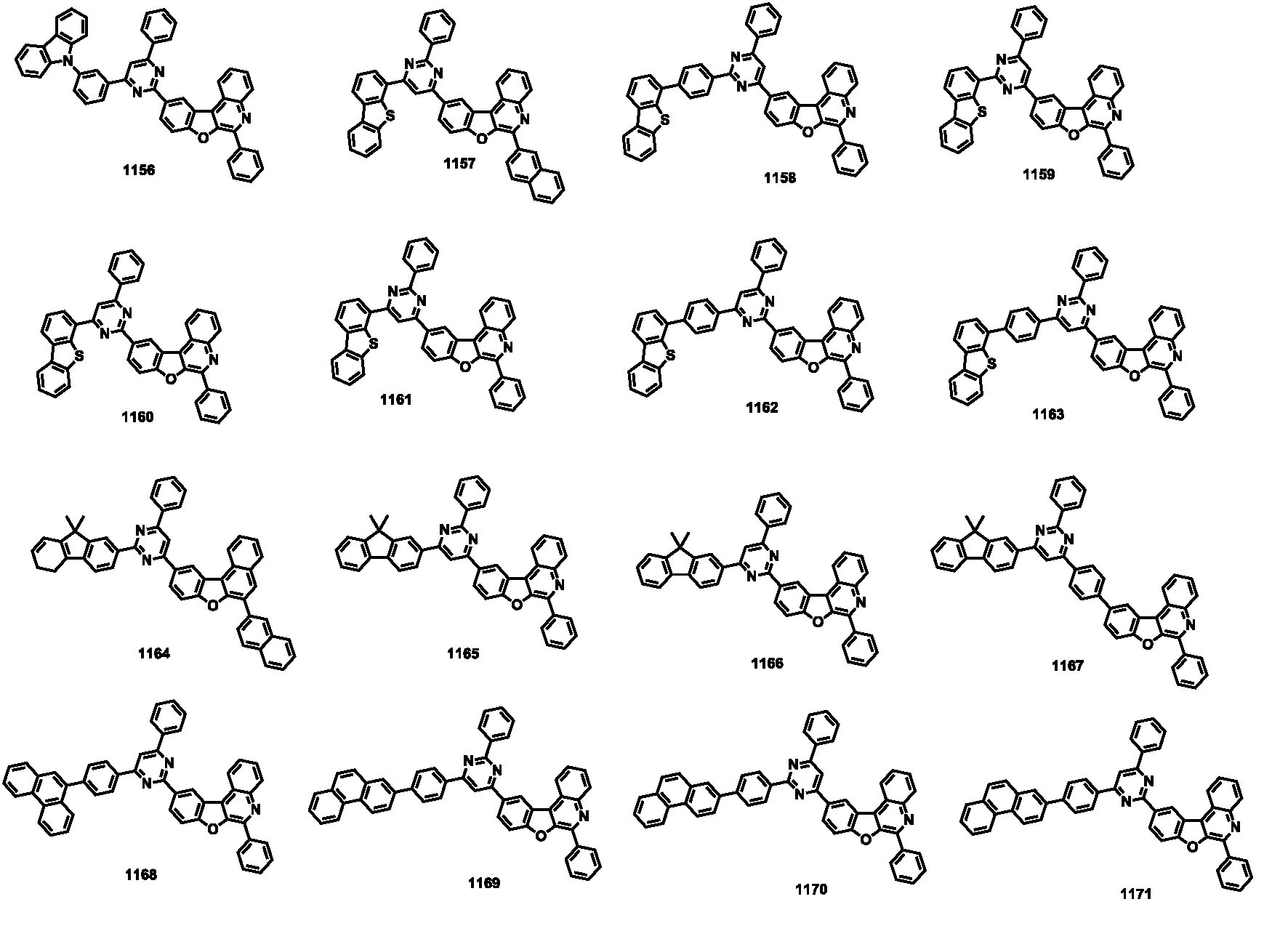
Priority Applications (2)
| Application Number | Priority Date | Filing Date | Title |
|---|---|---|---|
| CN202080009297.1A CN113330016A (en) | 2019-01-25 | 2020-01-22 | Compound, organic photoelectric device, and display device |
| US17/417,209 US12171143B2 (en) | 2019-01-25 | 2020-01-22 | Compound, organic optoelectronic diode, and display device |
Applications Claiming Priority (2)
| Application Number | Priority Date | Filing Date | Title |
|---|---|---|---|
| KR10-2019-0009760 | 2019-01-25 | ||
| KR1020190009760A KR102211131B1 (en) | 2019-01-25 | 2019-01-25 | Compound, composition and organic optoelectronic device and display device |
Publications (1)
| Publication Number | Publication Date |
|---|---|
| WO2020153758A1 true WO2020153758A1 (en) | 2020-07-30 |
Family
ID=71735620
Family Applications (1)
| Application Number | Title | Priority Date | Filing Date |
|---|---|---|---|
| PCT/KR2020/001112 Ceased WO2020153758A1 (en) | 2019-01-25 | 2020-01-22 | Composition, organic optoelectronic diode, and display device |
Country Status (5)
| Country | Link |
|---|---|
| US (1) | US12171143B2 (en) |
| KR (1) | KR102211131B1 (en) |
| CN (1) | CN113330016A (en) |
| TW (1) | TWI842818B (en) |
| WO (1) | WO2020153758A1 (en) |
Cited By (3)
| Publication number | Priority date | Publication date | Assignee | Title |
|---|---|---|---|---|
| WO2022181157A1 (en) * | 2021-02-25 | 2022-09-01 | 出光興産株式会社 | Compound, material for organic electroluminescent elements, organic electroluminescent element, and electronic device |
| CN116829552A (en) * | 2021-02-04 | 2023-09-29 | 出光兴产株式会社 | Compounds, materials for organic electroluminescent elements, organic electroluminescent elements and electronic devices |
| US12435073B2 (en) | 2019-08-19 | 2025-10-07 | Idemitsu Kosan Co., Ltd. | Compound, material for organic electroluminescent element, organic electroluminescent element, and electronic device |
Families Citing this family (10)
| Publication number | Priority date | Publication date | Assignee | Title |
|---|---|---|---|---|
| KR102888006B1 (en) * | 2019-07-01 | 2025-11-24 | 듀폰스페셜티머터리얼스코리아 유한회사 | Organic electroluminescent compound and organic electroluminescent device comprising the same |
| KR102403566B1 (en) * | 2020-08-19 | 2022-05-30 | 연세대학교 산학협력단 | Method for preparing novel benzofuro[2,3-c]isoquinoline derivatives and anticancer composition containing the same |
| CN115974852A (en) * | 2021-10-13 | 2023-04-18 | 三星Sdi株式会社 | Compound for organic photoelectric device, composition for organic photoelectric device, organic photoelectric device and display device |
| KR102843777B1 (en) * | 2021-11-12 | 2025-08-08 | 주식회사 엘지화학 | Novel compound and organic light emitting device comprising the same |
| KR102840055B1 (en) * | 2021-11-12 | 2025-07-29 | 주식회사 엘지화학 | Novel compound and organic light emitting device comprising the same |
| WO2023085835A1 (en) * | 2021-11-12 | 2023-05-19 | 주식회사 엘지화학 | Novel compound and organic light-emitting device using same |
| CN117279918A (en) * | 2021-11-12 | 2023-12-22 | 株式会社Lg化学 | Novel compound and organic light emitting device comprising the same |
| WO2023085834A1 (en) * | 2021-11-12 | 2023-05-19 | 주식회사 엘지화학 | Novel compound and organic light-emitting device comprising same |
| KR20240120724A (en) * | 2021-12-14 | 2024-08-07 | 이데미쓰 고산 가부시키가이샤 | Compounds, materials for organic electroluminescent devices, organic electroluminescent devices, and electronic devices |
| CN114989179B (en) * | 2022-04-29 | 2023-06-09 | 陕西莱特光电材料股份有限公司 | Organic compound, organic electroluminescent device using the same, and electronic device |
Citations (6)
| Publication number | Priority date | Publication date | Assignee | Title |
|---|---|---|---|---|
| KR101579289B1 (en) * | 2014-06-30 | 2015-12-22 | 희성소재 (주) | Hetero-cyclic compound and organic light emitting device using the same |
| KR20160001702A (en) * | 2014-06-27 | 2016-01-06 | 희성소재 (주) | Hetero-cyclic compound and organic light emitting device using the same |
| KR20160018458A (en) * | 2013-06-11 | 2016-02-17 | 이데미쓰 고산 가부시키가이샤 | Material for organic electroluminescent elements, organic electroluminescent element using same, and electronic device |
| KR20170015216A (en) * | 2015-07-29 | 2017-02-08 | 유니버셜 디스플레이 코포레이션 | Organic electroluminescent materials and devices |
| KR20190033885A (en) * | 2017-09-22 | 2019-04-01 | 엘티소재주식회사 | Heterocyclic compound and organic light emitting device comprising the same |
| KR20190033911A (en) * | 2017-09-22 | 2019-04-01 | 엘티소재주식회사 | Heterocyclic compound and organic light emitting device comprising the same |
Family Cites Families (6)
| Publication number | Priority date | Publication date | Assignee | Title |
|---|---|---|---|---|
| US4356429A (en) * | 1980-07-17 | 1982-10-26 | Eastman Kodak Company | Organic electroluminescent cell |
| KR102191780B1 (en) * | 2012-12-18 | 2020-12-16 | 에스에프씨 주식회사 | An electroluminescent compound and an electroluminescent device comprising the same |
| KR102572721B1 (en) * | 2016-05-19 | 2023-09-01 | 삼성디스플레이 주식회사 | Heterocyclic compound and organic light emitting device comprising the same |
| US10727423B2 (en) * | 2016-06-20 | 2020-07-28 | Universal Display Corporation | Organic electroluminescent materials and devices |
| WO2019163826A1 (en) * | 2018-02-20 | 2019-08-29 | 出光興産株式会社 | Novel compound and organic electroluminescence element using same |
| JP2021516656A (en) * | 2018-09-28 | 2021-07-08 | エルティー・マテリアルズ・カンパニー・リミテッドLT Materials Co., Ltd. | Heterocyclic compounds and organic light emitting devices containing them |
-
2019
- 2019-01-25 KR KR1020190009760A patent/KR102211131B1/en active Active
-
2020
- 2020-01-22 CN CN202080009297.1A patent/CN113330016A/en active Pending
- 2020-01-22 WO PCT/KR2020/001112 patent/WO2020153758A1/en not_active Ceased
- 2020-01-22 US US17/417,209 patent/US12171143B2/en active Active
- 2020-01-30 TW TW109102768A patent/TWI842818B/en active
Patent Citations (6)
| Publication number | Priority date | Publication date | Assignee | Title |
|---|---|---|---|---|
| KR20160018458A (en) * | 2013-06-11 | 2016-02-17 | 이데미쓰 고산 가부시키가이샤 | Material for organic electroluminescent elements, organic electroluminescent element using same, and electronic device |
| KR20160001702A (en) * | 2014-06-27 | 2016-01-06 | 희성소재 (주) | Hetero-cyclic compound and organic light emitting device using the same |
| KR101579289B1 (en) * | 2014-06-30 | 2015-12-22 | 희성소재 (주) | Hetero-cyclic compound and organic light emitting device using the same |
| KR20170015216A (en) * | 2015-07-29 | 2017-02-08 | 유니버셜 디스플레이 코포레이션 | Organic electroluminescent materials and devices |
| KR20190033885A (en) * | 2017-09-22 | 2019-04-01 | 엘티소재주식회사 | Heterocyclic compound and organic light emitting device comprising the same |
| KR20190033911A (en) * | 2017-09-22 | 2019-04-01 | 엘티소재주식회사 | Heterocyclic compound and organic light emitting device comprising the same |
Cited By (6)
| Publication number | Priority date | Publication date | Assignee | Title |
|---|---|---|---|---|
| US12435073B2 (en) | 2019-08-19 | 2025-10-07 | Idemitsu Kosan Co., Ltd. | Compound, material for organic electroluminescent element, organic electroluminescent element, and electronic device |
| CN116829552A (en) * | 2021-02-04 | 2023-09-29 | 出光兴产株式会社 | Compounds, materials for organic electroluminescent elements, organic electroluminescent elements and electronic devices |
| WO2022181157A1 (en) * | 2021-02-25 | 2022-09-01 | 出光興産株式会社 | Compound, material for organic electroluminescent elements, organic electroluminescent element, and electronic device |
| JPWO2022181157A1 (en) * | 2021-02-25 | 2022-09-01 | ||
| JP7249470B2 (en) | 2021-02-25 | 2023-03-30 | 出光興産株式会社 | Compounds, materials for organic electroluminescence devices, organic electroluminescence devices and electronic devices |
| US12312317B2 (en) | 2021-02-25 | 2025-05-27 | Idemitsu Kosan Co., Ltd. | Compound, material for organic electroluminescent elements, organic electroluminescent element, and electronic device |
Also Published As
| Publication number | Publication date |
|---|---|
| US12171143B2 (en) | 2024-12-17 |
| KR20200092633A (en) | 2020-08-04 |
| KR102211131B1 (en) | 2021-02-03 |
| TW202035416A (en) | 2020-10-01 |
| CN113330016A (en) | 2021-08-31 |
| TWI842818B (en) | 2024-05-21 |
| US20220085298A1 (en) | 2022-03-17 |
Similar Documents
| Publication | Publication Date | Title |
|---|---|---|
| WO2020153758A1 (en) | Composition, organic optoelectronic diode, and display device | |
| WO2022015084A1 (en) | Organic light-emitting element | |
| WO2022025515A1 (en) | Heterocyclic compound, organic light-emitting device comprising same, and composition for organic layer of organic light-emitting device | |
| WO2020141949A1 (en) | Novel compound and organic light emitting device using same | |
| WO2021101220A1 (en) | Heterocyclic compound, organic light emitting device comprising same, composition for organic layer of organic light emitting device, and method for manufacturing organic light emitting device | |
| WO2020117026A1 (en) | Organic light-emitting diode | |
| WO2021112403A1 (en) | Organic electronic element comprising organic compound, and electronic device comprising same | |
| WO2021029616A1 (en) | Organic light-emitting device | |
| WO2017099490A1 (en) | Heterocyclic compound and organic light emitting element using same | |
| WO2015199489A2 (en) | Heterocyclic compound and organic light emitting device using same | |
| WO2018124588A1 (en) | Organic light-emitting device | |
| WO2016089080A1 (en) | Organic luminescent compound and organic electroluminescent device comprising same | |
| WO2021020929A1 (en) | Compound and organic light emitting device comprising same | |
| WO2019225938A1 (en) | Compound and organic light emitting diode comprising same | |
| WO2022092625A1 (en) | Heterocyclic compound, organic light-emitting device comprising same, composition for organic layer of organic light-emitting device, and method for manufacturing organic light-emitting device | |
| WO2016175624A1 (en) | Heterocyclic compound and organic light emitting element using same | |
| WO2021107705A1 (en) | Heterocyclic compound and organic light-emitting device comprising same | |
| WO2011145876A2 (en) | Novel hybrid organic compound and organic electroluminescent device using same | |
| WO2021215669A1 (en) | Organic optoelectronic element compound, organic optoelectronic element composition, organic optoelectronic element, and display device | |
| WO2014092354A1 (en) | Organic compound and organic electroluminescent element comprising same | |
| WO2021034039A1 (en) | Heterocyclic compound and organic light-emitting device comprising same | |
| WO2014027822A1 (en) | Novel compound and organic electroluminescent device comprising same | |
| WO2020067593A1 (en) | Heterocyclic compound and organic light-emitting device comprising same | |
| WO2018182300A1 (en) | Heterocyclic compound and organic light-emitting device comprising same | |
| WO2021015497A1 (en) | Heterocyclic compound and organic light emitting device comprising same |
Legal Events
| Date | Code | Title | Description |
|---|---|---|---|
| 121 | Ep: the epo has been informed by wipo that ep was designated in this application |
Ref document number: 20745028 Country of ref document: EP Kind code of ref document: A1 |
|
| NENP | Non-entry into the national phase |
Ref country code: DE |
|
| 122 | Ep: pct application non-entry in european phase |
Ref document number: 20745028 Country of ref document: EP Kind code of ref document: A1 |