WO2020005515A1 - Polydimensional stretchable laminates - Google Patents
Polydimensional stretchable laminates Download PDFInfo
- Publication number
- WO2020005515A1 WO2020005515A1 PCT/US2019/036257 US2019036257W WO2020005515A1 WO 2020005515 A1 WO2020005515 A1 WO 2020005515A1 US 2019036257 W US2019036257 W US 2019036257W WO 2020005515 A1 WO2020005515 A1 WO 2020005515A1
- Authority
- WO
- WIPO (PCT)
- Prior art keywords
- laminate
- film
- stretchable
- gsm
- laminates
- Prior art date
- Legal status (The legal status is an assumption and is not a legal conclusion. Google has not performed a legal analysis and makes no representation as to the accuracy of the status listed.)
- Ceased
Links
Classifications
-
- B—PERFORMING OPERATIONS; TRANSPORTING
- B32—LAYERED PRODUCTS
- B32B—LAYERED PRODUCTS, i.e. PRODUCTS BUILT-UP OF STRATA OF FLAT OR NON-FLAT, e.g. CELLULAR OR HONEYCOMB, FORM
- B32B27/00—Layered products comprising a layer of synthetic resin
- B32B27/12—Layered products comprising a layer of synthetic resin next to a fibrous or filamentary layer
-
- B—PERFORMING OPERATIONS; TRANSPORTING
- B32—LAYERED PRODUCTS
- B32B—LAYERED PRODUCTS, i.e. PRODUCTS BUILT-UP OF STRATA OF FLAT OR NON-FLAT, e.g. CELLULAR OR HONEYCOMB, FORM
- B32B25/00—Layered products comprising a layer of natural or synthetic rubber
- B32B25/04—Layered products comprising a layer of natural or synthetic rubber comprising rubber as the main or only constituent of a layer, which is next to another layer of the same or of a different material
- B32B25/042—Layered products comprising a layer of natural or synthetic rubber comprising rubber as the main or only constituent of a layer, which is next to another layer of the same or of a different material of natural rubber or synthetic rubber
-
- B—PERFORMING OPERATIONS; TRANSPORTING
- B32—LAYERED PRODUCTS
- B32B—LAYERED PRODUCTS, i.e. PRODUCTS BUILT-UP OF STRATA OF FLAT OR NON-FLAT, e.g. CELLULAR OR HONEYCOMB, FORM
- B32B25/00—Layered products comprising a layer of natural or synthetic rubber
- B32B25/10—Layered products comprising a layer of natural or synthetic rubber next to a fibrous or filamentary layer
-
- B—PERFORMING OPERATIONS; TRANSPORTING
- B32—LAYERED PRODUCTS
- B32B—LAYERED PRODUCTS, i.e. PRODUCTS BUILT-UP OF STRATA OF FLAT OR NON-FLAT, e.g. CELLULAR OR HONEYCOMB, FORM
- B32B25/00—Layered products comprising a layer of natural or synthetic rubber
- B32B25/16—Layered products comprising a layer of natural or synthetic rubber comprising polydienes homopolymers or poly-halodienes homopolymers
-
- B—PERFORMING OPERATIONS; TRANSPORTING
- B32—LAYERED PRODUCTS
- B32B—LAYERED PRODUCTS, i.e. PRODUCTS BUILT-UP OF STRATA OF FLAT OR NON-FLAT, e.g. CELLULAR OR HONEYCOMB, FORM
- B32B27/00—Layered products comprising a layer of synthetic resin
- B32B27/30—Layered products comprising a layer of synthetic resin comprising vinyl (co)polymers; comprising acrylic (co)polymers
- B32B27/302—Layered products comprising a layer of synthetic resin comprising vinyl (co)polymers; comprising acrylic (co)polymers comprising aromatic vinyl (co)polymers, e.g. styrenic (co)polymers
-
- B—PERFORMING OPERATIONS; TRANSPORTING
- B32—LAYERED PRODUCTS
- B32B—LAYERED PRODUCTS, i.e. PRODUCTS BUILT-UP OF STRATA OF FLAT OR NON-FLAT, e.g. CELLULAR OR HONEYCOMB, FORM
- B32B27/00—Layered products comprising a layer of synthetic resin
- B32B27/32—Layered products comprising a layer of synthetic resin comprising polyolefins
-
- B—PERFORMING OPERATIONS; TRANSPORTING
- B32—LAYERED PRODUCTS
- B32B—LAYERED PRODUCTS, i.e. PRODUCTS BUILT-UP OF STRATA OF FLAT OR NON-FLAT, e.g. CELLULAR OR HONEYCOMB, FORM
- B32B37/00—Methods or apparatus for laminating, e.g. by curing or by ultrasonic bonding
- B32B37/0076—Methods or apparatus for laminating, e.g. by curing or by ultrasonic bonding characterised in that the layers are not bonded on the totality of their surfaces
- B32B37/0084—Point bonding
-
- B—PERFORMING OPERATIONS; TRANSPORTING
- B32—LAYERED PRODUCTS
- B32B—LAYERED PRODUCTS, i.e. PRODUCTS BUILT-UP OF STRATA OF FLAT OR NON-FLAT, e.g. CELLULAR OR HONEYCOMB, FORM
- B32B37/00—Methods or apparatus for laminating, e.g. by curing or by ultrasonic bonding
- B32B37/02—Methods or apparatus for laminating, e.g. by curing or by ultrasonic bonding characterised by a sequence of laminating steps, e.g. by adding new layers at consecutive laminating stations
-
- B—PERFORMING OPERATIONS; TRANSPORTING
- B32—LAYERED PRODUCTS
- B32B—LAYERED PRODUCTS, i.e. PRODUCTS BUILT-UP OF STRATA OF FLAT OR NON-FLAT, e.g. CELLULAR OR HONEYCOMB, FORM
- B32B38/00—Ancillary operations in connection with laminating processes
- B32B38/0012—Mechanical treatment, e.g. roughening, deforming, stretching
-
- B—PERFORMING OPERATIONS; TRANSPORTING
- B32—LAYERED PRODUCTS
- B32B—LAYERED PRODUCTS, i.e. PRODUCTS BUILT-UP OF STRATA OF FLAT OR NON-FLAT, e.g. CELLULAR OR HONEYCOMB, FORM
- B32B5/00—Layered products characterised by the non- homogeneity or physical structure, i.e. comprising a fibrous, filamentary, particulate or foam layer; Layered products characterised by having a layer differing constitutionally or physically in different parts
- B32B5/02—Layered products characterised by the non- homogeneity or physical structure, i.e. comprising a fibrous, filamentary, particulate or foam layer; Layered products characterised by having a layer differing constitutionally or physically in different parts characterised by structural features of a fibrous or filamentary layer
- B32B5/022—Non-woven fabric
-
- B—PERFORMING OPERATIONS; TRANSPORTING
- B32—LAYERED PRODUCTS
- B32B—LAYERED PRODUCTS, i.e. PRODUCTS BUILT-UP OF STRATA OF FLAT OR NON-FLAT, e.g. CELLULAR OR HONEYCOMB, FORM
- B32B5/00—Layered products characterised by the non- homogeneity or physical structure, i.e. comprising a fibrous, filamentary, particulate or foam layer; Layered products characterised by having a layer differing constitutionally or physically in different parts
- B32B5/02—Layered products characterised by the non- homogeneity or physical structure, i.e. comprising a fibrous, filamentary, particulate or foam layer; Layered products characterised by having a layer differing constitutionally or physically in different parts characterised by structural features of a fibrous or filamentary layer
- B32B5/024—Woven fabric
-
- B—PERFORMING OPERATIONS; TRANSPORTING
- B32—LAYERED PRODUCTS
- B32B—LAYERED PRODUCTS, i.e. PRODUCTS BUILT-UP OF STRATA OF FLAT OR NON-FLAT, e.g. CELLULAR OR HONEYCOMB, FORM
- B32B7/00—Layered products characterised by the relation between layers; Layered products characterised by the relative orientation of features between layers, or by the relative values of a measurable parameter between layers, i.e. products comprising layers having different physical, chemical or physicochemical properties; Layered products characterised by the interconnection of layers
- B32B7/04—Interconnection of layers
-
- B—PERFORMING OPERATIONS; TRANSPORTING
- B32—LAYERED PRODUCTS
- B32B—LAYERED PRODUCTS, i.e. PRODUCTS BUILT-UP OF STRATA OF FLAT OR NON-FLAT, e.g. CELLULAR OR HONEYCOMB, FORM
- B32B7/00—Layered products characterised by the relation between layers; Layered products characterised by the relative orientation of features between layers, or by the relative values of a measurable parameter between layers, i.e. products comprising layers having different physical, chemical or physicochemical properties; Layered products characterised by the interconnection of layers
- B32B7/04—Interconnection of layers
- B32B7/08—Interconnection of layers by mechanical means
-
- B—PERFORMING OPERATIONS; TRANSPORTING
- B32—LAYERED PRODUCTS
- B32B—LAYERED PRODUCTS, i.e. PRODUCTS BUILT-UP OF STRATA OF FLAT OR NON-FLAT, e.g. CELLULAR OR HONEYCOMB, FORM
- B32B7/00—Layered products characterised by the relation between layers; Layered products characterised by the relative orientation of features between layers, or by the relative values of a measurable parameter between layers, i.e. products comprising layers having different physical, chemical or physicochemical properties; Layered products characterised by the interconnection of layers
- B32B7/04—Interconnection of layers
- B32B7/12—Interconnection of layers using interposed adhesives or interposed materials with bonding properties
-
- B—PERFORMING OPERATIONS; TRANSPORTING
- B32—LAYERED PRODUCTS
- B32B—LAYERED PRODUCTS, i.e. PRODUCTS BUILT-UP OF STRATA OF FLAT OR NON-FLAT, e.g. CELLULAR OR HONEYCOMB, FORM
- B32B37/00—Methods or apparatus for laminating, e.g. by curing or by ultrasonic bonding
- B32B2037/0092—Methods or apparatus for laminating, e.g. by curing or by ultrasonic bonding in which absence of adhesives is explicitly presented as an advantage
-
- B—PERFORMING OPERATIONS; TRANSPORTING
- B32—LAYERED PRODUCTS
- B32B—LAYERED PRODUCTS, i.e. PRODUCTS BUILT-UP OF STRATA OF FLAT OR NON-FLAT, e.g. CELLULAR OR HONEYCOMB, FORM
- B32B38/00—Ancillary operations in connection with laminating processes
- B32B38/0012—Mechanical treatment, e.g. roughening, deforming, stretching
- B32B2038/0028—Stretching, elongating
-
- B—PERFORMING OPERATIONS; TRANSPORTING
- B32—LAYERED PRODUCTS
- B32B—LAYERED PRODUCTS, i.e. PRODUCTS BUILT-UP OF STRATA OF FLAT OR NON-FLAT, e.g. CELLULAR OR HONEYCOMB, FORM
- B32B2250/00—Layers arrangement
- B32B2250/02—2 layers
-
- B—PERFORMING OPERATIONS; TRANSPORTING
- B32—LAYERED PRODUCTS
- B32B—LAYERED PRODUCTS, i.e. PRODUCTS BUILT-UP OF STRATA OF FLAT OR NON-FLAT, e.g. CELLULAR OR HONEYCOMB, FORM
- B32B2270/00—Resin or rubber layer containing a blend of at least two different polymers
-
- B—PERFORMING OPERATIONS; TRANSPORTING
- B32—LAYERED PRODUCTS
- B32B—LAYERED PRODUCTS, i.e. PRODUCTS BUILT-UP OF STRATA OF FLAT OR NON-FLAT, e.g. CELLULAR OR HONEYCOMB, FORM
- B32B2307/00—Properties of the layers or laminate
- B32B2307/50—Properties of the layers or laminate having particular mechanical properties
- B32B2307/51—Elastic
-
- B—PERFORMING OPERATIONS; TRANSPORTING
- B32—LAYERED PRODUCTS
- B32B—LAYERED PRODUCTS, i.e. PRODUCTS BUILT-UP OF STRATA OF FLAT OR NON-FLAT, e.g. CELLULAR OR HONEYCOMB, FORM
- B32B2307/00—Properties of the layers or laminate
- B32B2307/50—Properties of the layers or laminate having particular mechanical properties
- B32B2307/514—Oriented
- B32B2307/52—Oriented multi-axially
-
- B—PERFORMING OPERATIONS; TRANSPORTING
- B32—LAYERED PRODUCTS
- B32B—LAYERED PRODUCTS, i.e. PRODUCTS BUILT-UP OF STRATA OF FLAT OR NON-FLAT, e.g. CELLULAR OR HONEYCOMB, FORM
- B32B2307/00—Properties of the layers or laminate
- B32B2307/70—Other properties
- B32B2307/718—Weight, e.g. weight per square meter
-
- B—PERFORMING OPERATIONS; TRANSPORTING
- B32—LAYERED PRODUCTS
- B32B—LAYERED PRODUCTS, i.e. PRODUCTS BUILT-UP OF STRATA OF FLAT OR NON-FLAT, e.g. CELLULAR OR HONEYCOMB, FORM
- B32B2555/00—Personal care
-
- B—PERFORMING OPERATIONS; TRANSPORTING
- B32—LAYERED PRODUCTS
- B32B—LAYERED PRODUCTS, i.e. PRODUCTS BUILT-UP OF STRATA OF FLAT OR NON-FLAT, e.g. CELLULAR OR HONEYCOMB, FORM
- B32B2555/00—Personal care
- B32B2555/02—Diapers or napkins
Definitions
- the present invention relates to laminates which are recoverably stretchable in multiple directions and are suitable for use in absorbent articles.
- Outer covers for absorbent articles typically include a laminate comprising a film and a nonwoven.
- Absorbent articles sometimes fail to conform well to the wearer's body in response to body movements (e.g. sitting, standing, and walking). This conformity issue is further exacerbated by the fact that one type of absorbent article typically must fit many wearers of various shapes and sizes.
- the present invention meets the aforementioned need by providing elastomeric laminates comprising an elastomeric film and a suitable nonwoven.
- the film is primarily stretchable in the machine direction. Therefore, it would be expected that the film would limit the stretchability and recoverability of the laminate in other directions.
- the resulting laminates are recoverably stretchable in essentially all directions. Therefore, the laminates are particularly suitable for use in absorbent articles where discrete fit and conformability are desired.
- the present invention further describes methods of making the elastomeric laminates, wherein film is bonded to the nonwoven while stretched in the machine- direction.
- Figure 1 depicts one example of a laminate exhibiting biaxial stretching.
- Figure 2 depicts one example of a laminate exhibiting polydimensional, or multi- axial, stretching.
- Figure 3 is a graph depicting the cross-direction (CD) Load at 5% strain in N/cm (x-axis) as a function of machine-direction (MD) load at 5% strain in N/cm (y-axis) of laminates of the present invention (spunlace nonwovens) and comparative laminates (spunbond (“SB”) and spunbond-meltblown-spunbond (“SMS”) nonwovens).
- CD cross-direction
- MD machine-direction
- SB spunbond-meltblown-spunbond
- Figure 4 shows the percentage of CD-elongation at peak strain (x-axis) as a function of the percentage of MD-elongation at peak strain (y-axis) of laminates of the present invention (spunlace nonwovens) and comparative laminates (SB and SMS nonwovens).
- Figure 5 compares the CD extension in millimeters at lOOOg (x-axis) as a function of the MD extension in millimeters at lOOOg (y-axis) of laminates of the present invention (spunlace nonwovens) and comparative laminates (SB and SMS nonwovens).
- Figure 6 depicts the percentage of applied stretch (x-axis) as a function of the MD extension in millimeters at 1000 g (y-axis) of laminates of the present invention (spunlace nonwovens) and comparative laminates (SB and SMS nonwovens).
- Figure 7 depicts the CD/MD extension ratio (ER) at lOOOg load of laminates of the present invention (spunlace nonwovens) and comparative laminates (SB and SMS nonwovens).
- Figure 8 depicts the CD/MD elongation at peak ratio (EAPR) at peak strain of laminates of the present invention (spunlace nonwovens) and comparative laminates (SB and SMS nonwovens).
- “Bi-axially stretchable,” or variants thereof, means that the laminate is recoverably stretchable to at least twice its original length in two directions in the x-y plane, for example in the MD and in the CD, as depicted in Figure 1.
- Polydimensionally stretchable “multi -axially stretchable,” or variants thereof, means that the laminate is recoverably stretchable to at least twice its original length in at least three directions in the x-y plane, for example, as depicted in Figure 2.
- “ETniformly polydimensionally stretchable” means that the laminate is recoverably stretchable after stretching to at least twice its original length in any direction.
- “Recoverably stretchable,”“recoverable,” or variants thereof mean that when a laminate is stretched to at least twice its original length (200%), the laminate returns to no more than about 1.2 times the original length, as measured in the direction of the applied stretching force.
- “Primarily stretchable,” or variants thereof, mean that a film or a nonwoven substrate has a substantially greater degree of stretch on one particular direction (for example, in the CD or MD) than in other directions.
- Gsm means grams per square meter, and is a measure of the basis weight, which is an industry standard term that quantifies the thickness or unit mass of a film or laminate product.
- Pre-activation means a process by which the elastomeric film or material is rendered more easily stretchable prior to lamination, for example by stretching and allowing a film to relax.
- the films may be pre-activated in the CD and/or the MD.
- the films of the present invention are elastomeric films, examples of which are disclosed in U.S. Patent Application 15/901,240, filed February 21, 2018, included by reference herein in its entirety.
- the films may be multilayer or monolayer films and may comprise one or more styrenic block copolymers (SBCs) and/or olefmic block copolymers (OBCs).
- SBCs include but are not limited to styrene-butadiene- styrene (SBS), styrene-isoprene- styrene (SIS), styrene-isoprene-butylene-styrene (SIBS), styrene-ethylene-butylene- styrene (SEBS), styrene-ethylene-propylene (SEP), styrene-ethylene-propylene-styrene (SEPS), or styrene-ethylene-ethylene-propylene-styrene (SEEPS) block copolymer elastomers, and copolymers and mixtures of any of the foregoing.
- SBS styren
- SBCs particularly useful SBCs in the films of the present invention are non- hydrogenated SBCs, including but not limited to SBS, SIS and SIBS.
- SBCs suitable for use in the present invention include those available from Dexco Polymers, Plaquemine, Louisiana, for example, VECTOR 4111 A and 7620.
- Olefmic block copolymers suitable for use in one or more layers include polypropylene-based (also termed“propylene-rich”) olefmic block copolymers such as those sold under the trade name INFUSE, nonlimiting examples of which include INFUSE 9507, 9100, 9507, 9107 and 5230, sold by The Dow Chemical Company of Midland,
- VISTAMAXX and IMPACT, for example VISTAMAXX 6102, available from ExxonMobil Chemical Company of Houston, Texas.
- the total amount of SBCs and/or OBCs in the film or in an individual layer may be at least about 50%, from about 50% to about 100%, from about 60% to about 99%, from about 50% to about 95%, from about 55% to about 95%, from about 60% to about 95%, from about 65% to about 95%, from about 70% to about 95%, from about 75% to about 95%, from about 80% to about 95%, from about 70% to about 90%, or alternatively from about 80% to about 90%.
- the outer layers further each may comprise polypropylene in an amount of at least 10%, at least 15%, at least 20%, at least 25%, from about 1% to about 90%, from about 1% to about 85%, from about 1% to about 80%, or from about 1% to about 75%.
- the polypropylene is present in an amount of at least 20%, and in another embodiment is present in an amount of from about 20% to about 85%.
- the films have a basis weight that is both economical and suitable for use in absorbent articles.
- the films are primarily stretchable in one direction, which during manufacture, is typically the machine-direction.
- the films may have a basis weight of 100 gsm or less, 75 gsm or less, or 50 gsm or less, and alternatively from about 5 gsm to about 100 gsm, from about 15 gsm to about 75 gsm, from about 20 gsm to about 50 gsm, wherein all of the aforementioned ranges are inclusive of intermediate values and combinable.
- the films have a basis weight of 50 gsm or less.
- the present invention further includes laminates comprising the films described herein.
- the laminates comprise a substrate attached to one or both surfaces of the film, and may include laminates comprising more than one film and more than one substrate.
- the substrate may be any woven or a nonwoven (NW) material that results in a laminate which is recoverably stretchable in multiple directions, including but not limited to spunbond (SB), meltblown (MB), or any combinations thereof (e.g., spunbond- meltblown-spunbond, or“SMS”), as well as spunlace, spinlace, airlaid, carded, and/or bicomponent nonwovens.
- NW nonwoven
- Particularly suitable nonwovens include spunlace nonwovens such as those available from Suominen, Bethune, SC.
- the substrate is primarily stretchable in one direction, which during manufacture of the laminates, is typically in the cross-direction.
- the substrate may have a basis weight of about 100 gsm or less, alternatively about 50 gsm or less, alternatively about 25 gsm or less, and alternatively from about 1 gsm to about 100 gsm, from about 25 gsm to about 75 gsm, and alternatively of from about 25 gsm to about 50 gsm, wherein all of the aforementioned ranges are inclusive of intermediate values and combinable.
- the substrate further may have a peak load of ⁇ 4 N/cm and/or a strain at peak of > 100%.
- the laminates of the present invention are substantially free of stranded elastomeric material.
- the laminates of the present invention are substantially free of adhesive.
- the primary direction of stretch in the film is perpendicular to the primary direction of stretch of the nonwoven.
- the resulting laminate is biaxially and/or polydimensionally stretchable.
- the films, of the present invention may be coextruded, and may be cast, blown, or formed by any other method which would result in the films described herein.
- the films are pre-activated prior to lamination, for example by stretching in the machine-direction (MD), the cross-direction (CD), or both.
- MD machine-direction
- CD cross-direction
- the film Prior to lamination, the film may be stretched in one direction.
- a nonwoven substrate which is stretchable in a direction perpendicular to the direction in which the film is stretched, may be laminated to the film while the film is stretched. The nonwoven may be laminated while stretched or unstretched.
- the substrate may be laminated to the film by a variety of means such as adhesive lamination, ultrasonic bonding, extrusion bonding, or other means that would be known to one of skill in the art.
- the laminate is ultrasonically bonded, with the resulting laminates comprising ultrasonic welds, or bonds.
- the films and/or laminates may be stretched in the cross-direction by using CD and/or MD intermeshing.
- the depth of intermeshing may vary from about 0.01 inches to about 0.250 inches, and in particular embodiments may be 0.120 inches, 0.140 inches,
- films and/or laminates may be stretched by means of diverging discs, as described for example in U.S. Patent Application
- the diverging discs may be run at a slower speed than the anvil to provide simultaneous MD- stretch for the film during ultrasonic lamination.
- the films and/or laminates of the present invention are useful for a variety of purposes, nonlimiting examples of which include use in articles such as personal hygiene products, including absorbent products.
- absorbent products include diapers, training pants, adult incontinence pads and pants, swimwear, sanitary napkins, pantiliners, and/or absorbent pads or breathable shields to protect clothing from fluids, such as perspiration in specific areas of the body.
- the laminates may be used, for example, as backsheets, fasteners, waistbands, cuffs and/or ears. In one embodiment, the laminates are incorporated into an absorbent article such as a diaper or adult incontinence product. Examples
- the laminates were made by stretching the film in the MD on a Fameccanica FMD-M2-00013 lamination system or other suitable production line and ultrasonically bonding the NW while the film is stretched.
- Three types of NW are used; 17 gsm SMS, 25 gsm SB (both available from Berry Global, Evansville IN), and 25 gsm spunlace
- a three-layer film having an ABA layer construction is used.
- the film is an OBC- based elastic film.
- the skin layer‘A’ is made of PE/PP blend and 1-10% of anti-block master batch and processing aid.
- the core layer‘B’ is made of a propylene-based OBC blend comprising a mixture of INFETSE 9100, INFETSE 9507, INFETSE 9107, and/or DOW ELITE 5230.
- the core is about 85%-90% of the total thickness and remainder is the skin. ETnless otherwise indicated, the basis weight of the films is between 35 gsm - 45 gsm.
- the SBS film could not be stretched more than twice its original length before breaking and showed high frequency of thermal failure known as“pop-outs,” wherein the film melts and tears causing areas in the laminate without film coverage.
- the sizes of the pop-outs typically exceeded 5 mm 2 .
- the film was mechanically stretched in the MD at 300%, 400%, 500%, and 550% during lamination. The mechanical stretching was performed by running the anvil roll faster than the first nip roll.
- the resulting MD stretch of the laminate may be measured in three different ways: 1.
- the amount of stretch (estimated stretch %) when the final laminate stretched by hand is as follows: Two marks separated by 10 mm are marked on the laminate. The laminate is stretched by hand until reaching maximum stretch, i.e., the point at which the sample can no longer be stretched without incurring damage. The stretched distance is measured and divided by 10, and the result multiplied by 100 to obtain the stretch %.
- Extension ratio (ER) (%) (CD-Extension@ lOOOg / MD-Extension@ lOOOg) x 100
- EAPR Elongation at peak ratio
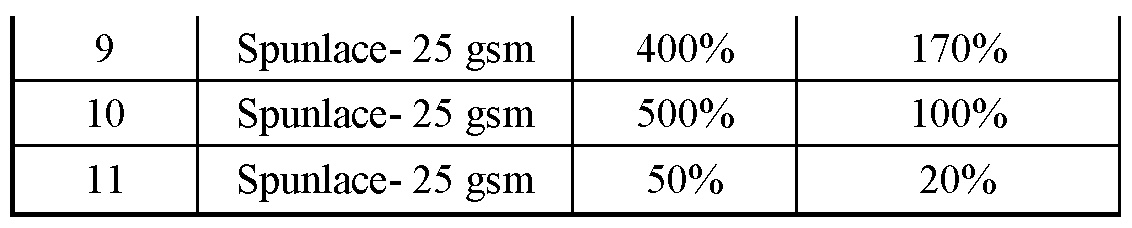
- Table 1 summarizes the measured stretchability of the final product at different applied strains by the machine during lamination, where the applied stretch is derived from the ratio of the speed of the anvil roll to the speed of the nip roll. For the sake of clarity, a stretch of 50% means that the film is stretched by half its original length during lamination.
- Table 1 Stretchability of the final laminate measured by the first method.
- Table 2 summarizes the properties of the samples made on the FMD-M2-00013.
- the film was stretched in the machine direction (MD) then ultrasonically bonded while stretched.
- MD machine direction
- the final laminate is MD-stretchable as seen in Table 2.
- CD- stretchable spunlace NW When a CD- stretchable spunlace NW is used, the final elastic laminate is stretchable in all directions (including CD and MD).
- the CD-load at 5% strain should have a very low value if the product stretchable in the CD because both the film and the NW are easily deformed in the CD. On the other hand, if the film or the NW or both are not easily stretched in the CD, then the CD load at 5% strain should have a very low value if the product stretchable in the CD because both the film and the NW are easily deformed in the CD. On the other hand, if the film or the NW or both are not easily stretched in the CD, then the CD load at
- Figure 3 depicts the CD-Load and MD load of various samples.
- the samples made with spunlace NW have low 5% load values in both directions.
- Figure 4 shows the elongation at peak map. Samples made with spunlace NW have high peak values in both directions.
- Figure 5 shows that laminate made with spunlace has high elongation at peak in the MD and CD. However, other samples have low values in the CD because they are not stretchable in the CD and high values in the MD because they are made to stretch in the MD.
- Figure 6 shows that the MD extension of the laminate is increased as the applied stretch is increased. There is no significant difference between the samples made with the
- SMS NW and the samples made with SB NW appear to have higher extension.
- Figures 7 and 8 show that samples made with spunlace (CD-stretchable NW) have much higher values than the samples made with SMS NW or SB NW.
- laminates that are stretchable in both directions have high ER and EAPR.
Landscapes
- Engineering & Computer Science (AREA)
- Textile Engineering (AREA)
- Mechanical Engineering (AREA)
- Laminated Bodies (AREA)
- Absorbent Articles And Supports Therefor (AREA)
- Lining Or Joining Of Plastics Or The Like (AREA)
Abstract
Description


Claims
Priority Applications (9)
| Application Number | Priority Date | Filing Date | Title |
|---|---|---|---|
| CN201980042882.9A CN112351887B (en) | 2018-06-29 | 2019-06-10 | A laminate that can stretch in multiple dimensions |
| JP2020573241A JP2021528292A (en) | 2018-06-29 | 2019-06-10 | Multidimensional stretchable laminate |
| KR1020207037526A KR20210023896A (en) | 2018-06-29 | 2019-06-10 | Multi-dimensional stretchable laminate |
| BR112020026966-2A BR112020026966B1 (en) | 2018-06-29 | 2019-06-10 | POLYDIMENSIONAL STRETCH LAMINATES |
| EP19827312.0A EP3814138A4 (en) | 2018-06-29 | 2019-06-10 | MULTIDIMENSIONAL STRETCH LAMINATES |
| CA3103249A CA3103249A1 (en) | 2018-06-29 | 2019-06-10 | Polydimensional stretchable laminates |
| MX2020013803A MX2020013803A (en) | 2018-06-29 | 2019-06-10 | Polydimensional stretchable laminates. |
| MX2025008620A MX2025008620A (en) | 2018-06-29 | 2020-12-15 | Polydimensional stretchable laminates |
| JP2024037944A JP2024073527A (en) | 2018-06-29 | 2024-03-12 | Multidimensionally stretchable laminate |
Applications Claiming Priority (2)
| Application Number | Priority Date | Filing Date | Title |
|---|---|---|---|
| US201862691738P | 2018-06-29 | 2018-06-29 | |
| US62/691,738 | 2018-06-29 |
Publications (1)
| Publication Number | Publication Date |
|---|---|
| WO2020005515A1 true WO2020005515A1 (en) | 2020-01-02 |
Family
ID=68987542
Family Applications (1)
| Application Number | Title | Priority Date | Filing Date |
|---|---|---|---|
| PCT/US2019/036257 Ceased WO2020005515A1 (en) | 2018-06-29 | 2019-06-10 | Polydimensional stretchable laminates |
Country Status (9)
| Country | Link |
|---|---|
| US (1) | US20200001582A1 (en) |
| EP (1) | EP3814138A4 (en) |
| JP (2) | JP2021528292A (en) |
| KR (1) | KR20210023896A (en) |
| CN (1) | CN112351887B (en) |
| AR (1) | AR115621A1 (en) |
| CA (1) | CA3103249A1 (en) |
| MX (2) | MX2020013803A (en) |
| WO (1) | WO2020005515A1 (en) |
Citations (5)
| Publication number | Priority date | Publication date | Assignee | Title |
|---|---|---|---|---|
| US5422172A (en) * | 1993-08-11 | 1995-06-06 | Clopay Plastic Products Company, Inc. | Elastic laminated sheet of an incrementally stretched nonwoven fibrous web and elastomeric film and method |
| US5695868A (en) * | 1993-12-17 | 1997-12-09 | Kimberly-Clark Worldwide, Inc. | Breathable, cloth-like film/nonwoven composite |
| US20070237924A1 (en) * | 2006-04-10 | 2007-10-11 | Tredegar Film Products Corp. | Elastic laminates prepared by multiple stretching steps |
| US20100168704A1 (en) * | 2008-12-31 | 2010-07-01 | Thomas Oomman P | Method of forming an elastic laminate including a cross-linked elastic film |
| US20170000660A1 (en) * | 2015-06-30 | 2017-01-05 | The Procter & Gamble Company | STRETCH LAMINATE WITH INCREMENTALLY STRETCHED OR SELFed LAYER, METHOD FOR MANUFACTURING, AND DISPOSABLE ABSORBENT ARTICLE INCLUDING THE SAME |
Family Cites Families (10)
| Publication number | Priority date | Publication date | Assignee | Title |
|---|---|---|---|---|
| TWI227196B (en) * | 2002-02-22 | 2005-02-01 | Clopay Plastic Prod Co | Film, laminated sheet and methods of making same |
| MX2008016327A (en) * | 2006-06-30 | 2009-01-28 | Pliant Corp | Embossed stretchable elastic laminate and method of production. |
| US7794819B2 (en) * | 2006-08-24 | 2010-09-14 | Aplix, Inc. | Elastic composite |
| CA2757892C (en) * | 2009-04-08 | 2014-06-03 | The Procter & Gamble Company | Stretchable laminates of nonwoven web(s) and elastic film |
| WO2014179373A1 (en) * | 2013-05-03 | 2014-11-06 | The Procter & Gamble Company | Absorbent articles comprising stretch laminates |
| US10695235B2 (en) * | 2013-11-27 | 2020-06-30 | Kimberly-Clark Worldwide, Inc. | Printed 3D-elastic laminates |
| US9834667B2 (en) * | 2014-06-05 | 2017-12-05 | The Procter & Gamble Company | Elastomer composition comprising polyolefin elastomers |
| US20160000615A1 (en) * | 2014-06-12 | 2016-01-07 | Dow Global Technologies Llc | Multilayer films, and articles made therefrom |
| AR105371A1 (en) * | 2015-07-27 | 2017-09-27 | Dow Global Technologies Llc | ELASTIC COMPOSITIONS BASED ON POLYOLEFINE, METHODS FOR THEIR MANUFACTURING AND ARTICLES THAT INCLUDE THEM |
| EP3386712B2 (en) * | 2015-12-11 | 2025-09-03 | Dow Global Technologies LLC | Ultrasonically-bonded laminates |
-
2019
- 2019-06-10 JP JP2020573241A patent/JP2021528292A/en active Pending
- 2019-06-10 MX MX2020013803A patent/MX2020013803A/en unknown
- 2019-06-10 WO PCT/US2019/036257 patent/WO2020005515A1/en not_active Ceased
- 2019-06-10 CA CA3103249A patent/CA3103249A1/en active Pending
- 2019-06-10 US US16/435,817 patent/US20200001582A1/en active Pending
- 2019-06-10 CN CN201980042882.9A patent/CN112351887B/en active Active
- 2019-06-10 EP EP19827312.0A patent/EP3814138A4/en active Pending
- 2019-06-10 KR KR1020207037526A patent/KR20210023896A/en not_active Withdrawn
- 2019-06-25 AR ARP190101759A patent/AR115621A1/en active IP Right Grant
-
2020
- 2020-12-15 MX MX2025008620A patent/MX2025008620A/en unknown
-
2024
- 2024-03-12 JP JP2024037944A patent/JP2024073527A/en active Pending
Patent Citations (5)
| Publication number | Priority date | Publication date | Assignee | Title |
|---|---|---|---|---|
| US5422172A (en) * | 1993-08-11 | 1995-06-06 | Clopay Plastic Products Company, Inc. | Elastic laminated sheet of an incrementally stretched nonwoven fibrous web and elastomeric film and method |
| US5695868A (en) * | 1993-12-17 | 1997-12-09 | Kimberly-Clark Worldwide, Inc. | Breathable, cloth-like film/nonwoven composite |
| US20070237924A1 (en) * | 2006-04-10 | 2007-10-11 | Tredegar Film Products Corp. | Elastic laminates prepared by multiple stretching steps |
| US20100168704A1 (en) * | 2008-12-31 | 2010-07-01 | Thomas Oomman P | Method of forming an elastic laminate including a cross-linked elastic film |
| US20170000660A1 (en) * | 2015-06-30 | 2017-01-05 | The Procter & Gamble Company | STRETCH LAMINATE WITH INCREMENTALLY STRETCHED OR SELFed LAYER, METHOD FOR MANUFACTURING, AND DISPOSABLE ABSORBENT ARTICLE INCLUDING THE SAME |
Also Published As
| Publication number | Publication date |
|---|---|
| MX2025008620A (en) | 2025-08-01 |
| EP3814138A4 (en) | 2022-03-09 |
| BR112020026966A2 (en) | 2021-03-30 |
| MX2020013803A (en) | 2021-03-09 |
| CN112351887A (en) | 2021-02-09 |
| CA3103249A1 (en) | 2020-01-02 |
| JP2024073527A (en) | 2024-05-29 |
| US20200001582A1 (en) | 2020-01-02 |
| EP3814138A1 (en) | 2021-05-05 |
| CN112351887B (en) | 2023-10-31 |
| KR20210023896A (en) | 2021-03-04 |
| AR115621A1 (en) | 2021-02-10 |
| JP2021528292A (en) | 2021-10-21 |
Similar Documents
| Publication | Publication Date | Title |
|---|---|---|
| CN101951863B (en) | Extrusion bonded laminates for absorbent articles | |
| CN102292056B (en) | Absorbent article comprising an extrusion bonded laminate | |
| EP3152047B1 (en) | Laminate comprising polyolefin elastic film layer | |
| US11690932B2 (en) | Elastomeric films having low tear propagation | |
| CN105026138A (en) | Absorbent articles with multilayer dual laminates | |
| JP6730289B2 (en) | Elastomer film with increased tear resistance | |
| EP3126140B1 (en) | Microtextured multilayered elastic laminates with enhanced strength and elasticity and methods of making thereof | |
| WO2006073975A1 (en) | Extensible and stretch laminates with comparably low cross-machine direction tension and methods of making same | |
| US11712877B2 (en) | Elastomeric films having low tear propagation | |
| US20200001582A1 (en) | Polydimensional Stretchable Laminates | |
| US20220111616A1 (en) | Elastic Laminate Having Increased Rugosity | |
| BR112020026966B1 (en) | POLYDIMENSIONAL STRETCH LAMINATES | |
| BR112021008977B1 (en) | ELASTOMERIC FILMS THAT HAVE LOW TEAR PROPAGATION |
Legal Events
| Date | Code | Title | Description |
|---|---|---|---|
| 121 | Ep: the epo has been informed by wipo that ep was designated in this application |
Ref document number: 19827312 Country of ref document: EP Kind code of ref document: A1 |
|
| ENP | Entry into the national phase |
Ref document number: 3103249 Country of ref document: CA |
|
| ENP | Entry into the national phase |
Ref document number: 2020573241 Country of ref document: JP Kind code of ref document: A |
|
| NENP | Non-entry into the national phase |
Ref country code: DE |
|
| REG | Reference to national code |
Ref country code: BR Ref legal event code: B01A Ref document number: 112020026966 Country of ref document: BR |
|
| WWE | Wipo information: entry into national phase |
Ref document number: 2019827312 Country of ref document: EP |
|
| ENP | Entry into the national phase |
Ref document number: 112020026966 Country of ref document: BR Kind code of ref document: A2 Effective date: 20201229 |
|
| WWG | Wipo information: grant in national office |
Ref document number: MX/A/2020/013803 Country of ref document: MX |