WO2019234258A1 - Method for generating a gene editing vector with fixed guide rna pairs - Google Patents
Method for generating a gene editing vector with fixed guide rna pairs Download PDFInfo
- Publication number
- WO2019234258A1 WO2019234258A1 PCT/EP2019/065167 EP2019065167W WO2019234258A1 WO 2019234258 A1 WO2019234258 A1 WO 2019234258A1 EP 2019065167 W EP2019065167 W EP 2019065167W WO 2019234258 A1 WO2019234258 A1 WO 2019234258A1
- Authority
- WO
- WIPO (PCT)
- Prior art keywords
- sequence
- grna
- dna
- vector
- rna
- Prior art date
- Legal status (The legal status is an assumption and is not a legal conclusion. Google has not performed a legal analysis and makes no representation as to the accuracy of the status listed.)
- Ceased
Links
Classifications
-
- C—CHEMISTRY; METALLURGY
- C12—BIOCHEMISTRY; BEER; SPIRITS; WINE; VINEGAR; MICROBIOLOGY; ENZYMOLOGY; MUTATION OR GENETIC ENGINEERING
- C12N—MICROORGANISMS OR ENZYMES; COMPOSITIONS THEREOF; PROPAGATING, PRESERVING, OR MAINTAINING MICROORGANISMS; MUTATION OR GENETIC ENGINEERING; CULTURE MEDIA
- C12N15/00—Mutation or genetic engineering; DNA or RNA concerning genetic engineering, vectors, e.g. plasmids, or their isolation, preparation or purification; Use of hosts therefor
- C12N15/09—Recombinant DNA-technology
- C12N15/11—DNA or RNA fragments; Modified forms thereof; Non-coding nucleic acids having a biological activity
-
- C—CHEMISTRY; METALLURGY
- C12—BIOCHEMISTRY; BEER; SPIRITS; WINE; VINEGAR; MICROBIOLOGY; ENZYMOLOGY; MUTATION OR GENETIC ENGINEERING
- C12N—MICROORGANISMS OR ENZYMES; COMPOSITIONS THEREOF; PROPAGATING, PRESERVING, OR MAINTAINING MICROORGANISMS; MUTATION OR GENETIC ENGINEERING; CULTURE MEDIA
- C12N15/00—Mutation or genetic engineering; DNA or RNA concerning genetic engineering, vectors, e.g. plasmids, or their isolation, preparation or purification; Use of hosts therefor
- C12N15/09—Recombinant DNA-technology
- C12N15/63—Introduction of foreign genetic material using vectors; Vectors; Use of hosts therefor; Regulation of expression
-
- C—CHEMISTRY; METALLURGY
- C12—BIOCHEMISTRY; BEER; SPIRITS; WINE; VINEGAR; MICROBIOLOGY; ENZYMOLOGY; MUTATION OR GENETIC ENGINEERING
- C12N—MICROORGANISMS OR ENZYMES; COMPOSITIONS THEREOF; PROPAGATING, PRESERVING, OR MAINTAINING MICROORGANISMS; MUTATION OR GENETIC ENGINEERING; CULTURE MEDIA
- C12N15/00—Mutation or genetic engineering; DNA or RNA concerning genetic engineering, vectors, e.g. plasmids, or their isolation, preparation or purification; Use of hosts therefor
- C12N15/09—Recombinant DNA-technology
- C12N15/11—DNA or RNA fragments; Modified forms thereof; Non-coding nucleic acids having a biological activity
- C12N15/113—Non-coding nucleic acids modulating the expression of genes, e.g. antisense oligonucleotides; Antisense DNA or RNA; Triplex- forming oligonucleotides; Catalytic nucleic acids, e.g. ribozymes; Nucleic acids used in co-suppression or gene silencing
-
- C—CHEMISTRY; METALLURGY
- C12—BIOCHEMISTRY; BEER; SPIRITS; WINE; VINEGAR; MICROBIOLOGY; ENZYMOLOGY; MUTATION OR GENETIC ENGINEERING
- C12N—MICROORGANISMS OR ENZYMES; COMPOSITIONS THEREOF; PROPAGATING, PRESERVING, OR MAINTAINING MICROORGANISMS; MUTATION OR GENETIC ENGINEERING; CULTURE MEDIA
- C12N2310/00—Structure or type of the nucleic acid
- C12N2310/10—Type of nucleic acid
- C12N2310/20—Type of nucleic acid involving clustered regularly interspaced short palindromic repeats [CRISPR]
-
- C—CHEMISTRY; METALLURGY
- C12—BIOCHEMISTRY; BEER; SPIRITS; WINE; VINEGAR; MICROBIOLOGY; ENZYMOLOGY; MUTATION OR GENETIC ENGINEERING
- C12N—MICROORGANISMS OR ENZYMES; COMPOSITIONS THEREOF; PROPAGATING, PRESERVING, OR MAINTAINING MICROORGANISMS; MUTATION OR GENETIC ENGINEERING; CULTURE MEDIA
- C12N2330/00—Production
- C12N2330/50—Biochemical production, i.e. in a transformed host cell
- C12N2330/51—Specially adapted vectors
Definitions
- the present invention pertains to a novel method for the generation of a vector construct suitable for gene editing applications which comprises a fixed pair of predetermined ex- pressible guide RNA (gRNA) sequences.
- the method of the invention allows for an easy construction of such vectors and provides in addition thereto vector libraries for the expres- sion of fixed pairs of gRNAs.
- the vectors of the invention may be advantageously used to cut out larger genomic DNA sequences, or alternatively, to simultaneously introduce muta- tions in the genome without a loss or larger genomic sequences.
- the system of the invention provides for many molecular genetic approaches for genome alteration.
- CRISPR clustered regularly interspaced short palindromic repeats
- CRISPR/Cas system was initially discovered in bacterial and archaeal species as a defense mechanism against foreign genetic material (e.g. plasmids and bacteriophages).
- the naturally occurring CRISPR/Cas systems rely on expression of three components: l) a guide RNA sequence that is comple- mentary to a target sequence, 2) a scaffold RNA that aids in recruiting the third component, an endonuclease, to the site.
- CRISPR/Cas systems are used to degrade foreign genetic material
- the system has been adapted for use in a wide variety of prokaiyotic and eukaryotic organisms and has been used for many methods including gene knockout, mutagenesis, and expression activation or repression (Hsu, et al. Cell (2014) 157(6): 1262- 1278).
- sgRNA small guide RNA
- scaffold RNA that together mim- ics the structure formed by the individual guide RNA sequence and scaffold sequence and is sufficient to recruit the endonuclease to the appropriate target site
- the CRISPR/Cas system has been demonstrated to efficiently correct a mutation responsible for sickle cell disease by using patient-derived stem and progenitor cells.
- the CRISPR/Cas system is a programmable gene-editing tool with enormous potential, ranging from standard cell biology to therapeutic applications.
- Areas covered by these screens include drug re- sistance, cellular growth, recessive and essential genes, long-non-coding RNAs (lncRNAs) as well as NF-kappaB activating/repressive genes, or metastasis inducing genes.
- lncRNAs long-non-coding RNAs
- DNA excision Two gRNAs can induce two synchronized DNA double stand breaks simulta- neously that are located in close two- or three-dimensional proximity. Proximity can result in the excision of the DNA fragment that lies between the two gRNA target sequences (Fig- ure lb). As such, coding and noncoding genetic elements can be precisely excised in order to investigate their biological function and the consequences of a loss of the respective DNA sequence.
- Two (or more) gRNAs - one target Two (or more) gRNAs - one target: To dissect target relevance with improved confidence, fixed-pair 3CS reagents enable directing two (or more) gRNAs to the same target, thereby improving the efficiency of the editing event (cutting, modification, etc.) ( Figure lc).
- Two (or more) gRNAs - two (or more) targets Fixed-pair gRNAs enable the precise prede- termination of target pairs (or target groups) to be analyzed, thereby enabling direct dissec- tion of the target-to-target interactions, without the need of having all theoretically possible interactions analyzed ( Figure ic,d,e).
- CRISPR activation and inhibition To induce or block target transcription, multiple gRNAs are required for efficient changes; therefore, multiple defined gRNAs on the same plasmid improve activation or inhibition rates while maintaining low complexity gRNA reagents.
- Drug efficacy and resistance screens Fixed pair 3CS reagents enable the use of two (or more) gRNAs to monitor the efficacy of or dissect molecular mechanisms underlying the action of or resistance against FDA-approved or novel drugs without the need for actually applying the drugs.
- a single stranded (ss) phagemid vector comprising (i) at least one small RNA/DNA expression cassette comprising a RNA/DNA promoter and an empty target- small-RNA/DNA-sequence-introduction-site or a small RNA/DNA coding sequence and/or a DNA/RNA nuclease target sequence, or partial sequence thereof, (ii) at least one origin for replication (ORI) of single strand DNA such as a phage ORI, and in particular a fi-origin, and
- muta- genic RNA or DNA-primer has the following structure in 3’ to 5’ direction: a first homology region, a target sequence region encoding for a small RNA/DNA to be expressed, and a sec- ond homology region, wherein the first homology region is complementary to, or is capable of annealing to, a sequence of the ss-phagemid vector construct flanking the empty target- small-RNA/DNA-sequence-introduction-site or the small RNA/DNA coding sequence, or partial sequence thereof, on the 5’ side, and wherein the second homology region is com- plementary to, or is capable of annealing to, a sequence of the ss-phagemid vector construct flanking the empty target-small-RNA/DNA-sequence-introduction-site or the small RNA/DNA coding sequence, or partial sequence thereof, on the 3’ side,
- an endonuclease target site is provided in the single stranded (ss) phagemid vector construct within its’ at least one small RNA/DNA expression cassette.
- the endonuclease target site is located in the sin- gle stranded (ss) phagemid vector construct between the regions which are complementary to the first homology region of the mutagenic DNA-Primer and the region complementaiy to the second homology region of the mutagenic primer.
- the endonuclease target site is located at a position which is not duplicated in 3CS synthesis and is therefore present only in the wild type ss-phagemid vector construct.
- the method comprises here within step (d), enzymatically digesting the 3CS DNA with an endonuclease specific for the target site.
- endonucleases in some embodiments restriction enzymes and their target sites are used.
- Exemplary restriction enzymes and their target sites are I-Ppol, Smal, Hpal, I-Scel or I-Ceul. Any restriction recognition site can be used that do not occur in the template ss DNA nor in the introduced sequence I the mutagenic primer.
- any one of the following enzymes can be used to re- move residual wild type plasmid: I-Ceul , I-Ppol, I-Scel, all homing endonucleases are pre- ferred, all non-homing endonucleases, the usage of gene-perturbation target sequences for e.g. TALEN, ZFN, CRISPR/Cas and similar enzymes, the usage of prokaryotic and/or eu- karyotic toxic nucleotide sequences with the aim of suppressing the amplification of such sequences and the usage of homology and/or recombination-based cloning sequences.
- Another possibility to remove wild type DNA vector is to use the Kunkel method.
- the above problem is solved by the present invention by a method for the generation of a small RNA/DNA expressing (or encoding) vector, or a method of introducing a small RNA/DNA coding sequence into a vector, using the method of Kunkel for mutagenesis (Kunkel meth- od).
- Preferred aspects therefore pertain to a method of introducing a small RNA/DNA se- quence into a vector using the Kunkel method or Kunkel mutagenesis.
- the Kunkel method or Kunkel mutagenesis in context of the invention refers to the following procedure: the DNA fragment to be mutated is inserted into a phagemid (any ft ori containing vector such as Mi3mpi8/i9) and is then transformed into an E. coli strain deficient in two enzymes, dUTPase (dut) and uracil deglycosidase (ung). Both enzymes are part of a DNA repair pathway that protects the bacterial chromosome from mutations by the spontaneous deam- ination of dCTP to dUTP. The dUTPase deficiency prevents the breakdown of dUTP, result- ing in a high level of dUTP in the cell.
- the uracil deglycosidase deficiency prevents the re- moval of uracil from newly synthesized DNA.
- E. coli replicates the phage DNA
- its enzymatic machinery may, therefore, misincorporate dUTP instead of dTTP, resulting in single-strand DNA that contains some uracils (ssUDNA).
- ssUDNA is ex- tracted from the bacteriophage that is released into the medium, and then used as template for mutagenesis.
- An oligonucleotide containing the desired mutation or change in nucleo- tide sequence is used for primer extension.
- the formed heteroduplex DNA consists of one parental non-mutated strand containing dUTP and a mutated strand containing dTTP.
- the DNA is then transformed into an E. coli strain carrying the wildtype dut and ung genes.
- the uracil-containing parental DNA strand is degraded, so that nearly all of the result- ing DNA consists of the mutated strand.
- the method of the invention is in particular suita- ble for introducing guide RNA sequences into a genome editing vector for targeted genome editing.
- A“Kunkel method” in context of the invention is a method comprising the amplification with a mutated primer using a single stranded uracilated DNA as a template, preferably a circular single stranded uracilated DNA.“Uracilated” shall refer to any DNA molecule con- taining one or more uracil bases in a nucleotide.
- a method for generating a covalently closed circularized (ccc) DNA based small RNA/DNA expression vector or vector library comprising the steps of
- ss single stranded phagemid vector construct
- the ss-phagemid vector con- struct comprising (i) at least one small RNA/DNA expression cassette comprising a RNA/DNA promoter and an empty target-small-RNA/DNA-sequence-introduction-site or a small RNA/DNA coding sequence, or partial sequence thereof, (ii) at least one origin for replication (ORI) of single strand DNA such as a phage ORI, and in particular a fi-origin, and
- muta- genic DNA-primer has the following structure in 3’ to 5’ direction: a first homology region, a target sequence region encoding for a small RNA/DNA to be expressed, and a second ho- mology region, wherein the first homology region is complementary to, or is capable of an- nealing to, a sequence of the ss-phagemid vector construct flanking the empty target-small- RNA/DNA-sequence-introduction-site or the small RNA/DNA coding sequence, or partial sequence thereof, on the 5’ side, and wherein the second homology region is complementaiy to, or is capable of annealing to, a sequence of the ss-phagemid vector construct flanking the empty target-small-RNA/DNA-sequence-introduction-site or the small RNA/DNA coding sequence, or partial sequence thereof, on the 3’ side,
- the term“phagemid” shall refer to a phage genome which has been con- verted into a plasmid.
- the single stranded (ss) phagemid vector construct comprises additionally within its at least one small RNA/DNA expression cassette a restriction enzyme recognition site (restriction site).
- the restriction site is located in the single stranded (ss) phagemid vector construct between the regions which are complementary to the first homology region of the mutagenic DNA- Primer and the region complementaiy to the second homology region of the mutagenic primer.
- the restriction site is located at a position which is not duplicated in 3CS syn- thesis and is therefore present only in the uracil containing ss-phagemid vector construct.
- the embodiment allows the additional digest of residual uracilated wild type DNA.
- the method in one embodiment further comprises a step of (c') between steps (c) and (d), comprising enzymatically digesting the 3CS DNA with a restriction enzyme capable of a se- lective introduction of a double strand break at the restriction site.
- a restriction enzyme capable of a se- lective introduction of a double strand break at the restriction site.
- Exemplary restriction enzymes and their target sites are I-Ppol, Smal, Hpal, I-Scel or I-Ceul. Any restriction recognition site can be used that do not occur in the template uricilated ss DNA.
- restriction endonucle- ases also any one of the following enzymes can be used to remove residual wild type plas- mid: I-Ceul , I-Ppol, I-Scel, all homing endonucleases are preferred, all non-homing endo- nucleases, the usage of gene-perturbation target sequences for e.g.
- the invention provides a single stranded (ss) phagemid vector construct as described before, comprising at least two small RNA/DNA expression cas- settes, more preferably at least three, 4, 5, 6, 7, 8, 9, 10, 15, 20, 30 and more small RNA/DNA expression cassettes as described herein before.
- ss single stranded
- the vector molecule is able to generate a multitude of small RNA/DNAs to be expressed simultaneously.
- the at least one small RNA/DNA expression cassette is at least two or more small RNA/DNA expression cassettes (multiplex expression of gRNA or other small RNA/DNA).
- the restriction sites used within the two or more small RNA/DNA expression cassettes are identical, similar or different.
- cccDNA refers to DNA molecules that have assumed a circular form in contrast to linear DNA molecules such as eukaryotic chromosomal DNA or bacterial chromosomal DNA that comprises a nick or comprises a free 3'- or s'-end. Moreover, the circular structure of the above referenced DNA molecules is covalently closed.
- cccDNA is well known in the art and is further described, for example, in KG. Hardy (ed) "Plasmids, a practical approach", IRL Press Oxford U.K., Wash- ington D.C., U.S.A., 1987.
- vector library refers to a plurality of vectors (or plasmids) corn- prising a plurality of unique small RNA/DNA sequences to be expressed (e.g., siRNA, shRNA, gRNA or similar sequences) inserted in a RNA/DNA expression cassette.
- vector libraries comprise at least 10 1 or 10 2 , more preferably, at least 10 3 , even more preferably at least 10 4 , and still further more preferably, at least 10 5 , 10 6 , 10 7 , 10 8 or 10 9 unique vector sequences (meaning RNA/DNA sequences contained in each vector or plasmid).
- a small RNA shall be understood to include an siRNA, shRNA, an anti-miR, a guide RNA (gRNA) or guide DNA (gDNA). Most preferred is that the small RNA is a gRNA, and wherein the ss-phagemid vector construct comprises further, but is not limited to the presence of, a genome editing nuclease expression sequence, optionally operably linked to a promoter. It shall be understood that the invention pertaining to the provision of fixed pair gRNA vectors, the small RNA shall be a gRNA or sgRNA.
- the present disclosure in some aspects provides a new method for the generation of higher order libraries of small RNA/DNA expressing vectors.
- the term “higher order” shall mean that the library comprises multiple species of vectors which are different in the sequence of the small RNA/DNA to be expressed by/via the vector.
- the pre- sent method uses the mutagenic DNA-primer to introduce such sequences into the vector of choice.
- the at least one species of mutagenic DNA-primer is at least two species of mutagenic DNA-primer, preferably is at least three, more prefera- bly at least 4, 5, 6, 10, 50, 100, 1000, 10 4 , 10 5 , 10 6 , 10 7 , 10 8 , 10 9 , to 10 , io n or 10 12 , species of mutagenic DNA-primer, and wherein each species of cccDNA has a different sequence in the small RNA/DNA coding sequence of choice.
- the multitude of mutagenic DNA-primer sequence species are provided by introducing into the small RNA/DNA coding sequence (as contained in the mutagenic DNA-primer of the invention) of choice at least one or more IUPAC-encoded bases (e.g. degenerated base).
- A“degenerate base” or“degenerate position” is in the sequence nomenclature referred to as an“n”.
- a degenerate base is not a type of nucleotide base but denotes the possibility that in a prepa- ration of nucleic acids having essentially the same sequence, the position“n” in said se- quence allows the possibility of multiple kinds of bases at this position.
- a prepa- ration of nucleic acids having a sequence containing at least one“n” position denotes a mix- ture of nucleic acids having either adenine, guanine, thymine, or cytosine (with equal prob- ability) at the position n.
- the reaction at one or more positions may be conducted using as donor nucleotides an equal amount of adenine, guanine, thymine, and cytosine containing nucleotides.
- each of these nucleotides have an equal chance to be added to the growing oligonucleotide chain, and therefore allows the creation of a mixture of molecules with different bases at the posi- tion“n”.
- the same principle can be used if at one positions only two or three different bases are intended to be introduced.
- the small RNA/DNA coding sequence is at least 10 nucleotides to 200 nucleotides long, more preferably 10 to 100, more preferably 10 to 50, more preferably 10 to 30, more preferably 15 to 30, more preferably 15 to 25, most preferably 17 to 23, most preferably about 20.
- sequence length may be adjusted by the skilled artisan depending on the type of small RNA/DNA to be expressed.
- the preferred length of guide RNA and shRNA or siRNA are different but are well known to the skilled artisan.
- the mutagenic DNA-primer of the disclosure comprises flanking homology regions which are used to anneal the primer with the ss circular uracilated vector molecule used in the reaction of the invention.
- the flanking regions are therefore preferably of a length that al- lows for an annealing of the mutagenic DNA-primer to the template at conditions suitable for primer extension.
- the lengths of the 3’ or 5’ homology regions maybe identical or differ- ent.
- each of the homology regions has a length of at least 5 nucleo- tides, preferably at least 10 nucleotides, more preferably 5 to 40 nucleotides, most prefera- bly 10 to 30, or 10 to 20, most preferably 13 to 18, and even more preferably about 15 nucle- otides. Most preferred are 5-40 nucleotides.
- the single stranded (ss) phagemid vector construct is provided by the following additional method steps:
- the bac- terial strain deficient for dUTPase and/or uracil glycosylase, and/or their homologs, pa- ralogs or orthologues comprises a helper phagemid, or where- in in step (bb) said bacterial strain deficient for dUTPase and/or uracil glycosylase, and/or their homologs, paralogs or orthologues, preferably in the CJ236 strain in infected with a helper phage, wherein the helper phagemid or helper phage is preferably M13K07.
- step (d) of the method for generating the library vector according to I is performed by transforming and amplifying said ccc-heteroduplex dsDNA in a bacterium having a functional dUTPase and/or uracil glycosylase activity, such as XLi or SS320, to obtain said cccDNA.
- the amplification of a covalently closed cir- cularized (ccc)-heteroduplex dsDNA in step (c) is performed by using an enzyme having DNA polymerase activity, for example a T7 DNA polymerase, optionally in conjunction with a DNA ligase, such as T4 DNA ligase or alternatives thereof, which are known to the skilled artisan.
- an enzyme having DNA polymerase activity for example a T7 DNA polymerase
- a DNA ligase such as T4 DNA ligase or alternatives thereof, which are known to the skilled artisan.
- the object of the invention is solved by providing a vector or vector li- brary generated according to the method of the invention as disclosed herein.
- the vector library produced according to the invention is preferably characterized by comprising at least 10 6 , more preferably 10 7 , 10 8 , and most preferably 10 9 different species of vector se- quences as described herein.
- a method of genome wide screening cellular phenotypes comprising the use of a vector library produced according to a method of the inven- tion.
- the screening method of the invention may comprise the steps of introducing the vector libraiy of the invention - in particular the genome wide library - into a population of target cells, and phenotyping the transduced cells using any assay of interest.
- Any cell having a phenotype of interest can in a next step be analyzed for the identity of the transduced gRNA or RNAi, in order to identify a gene or genomic region involved in the generation of the phenotype.
- the cells may be contacted with a cell-death inducing agent, and the surviving cells are analyzed for the transduced 3CS vector in order to identify the genetic perturbation responsible for the resistance against the cell death-inducing agent.
- kit for performing the method as de- scribed herein above, the kit comprising
- the DNA polymerase is a T 7 DNA polymerase, and/or the DNA ligase is a T4 DNA ligase, or any generally known alternatives of thereof.
- the phagemid vector construct of the invention is a single stranded (ss)-phagemid vector construct comprising at least one uracil base.
- the phagemid vector is a dsDNA vector.
- the kit of the invention may in some embodiments comprise a preparation, sample or cul- ture of bacterial cells deficient for dUTPase and/or uracil glycosylase, and/or their homo- logs, paralogs or orthologues, preferably the CJ236 strain.
- Such strains are generally known in the pertinent art.
- the bacterial cells further com- prise/contain a helper phagemid, preferably M13K07.
- the kit according to the invention further comprises a preparation of helper phagemid, or helper phages, wherein the helper phagemid, or helper phages, are preferably M13K07 particles.
- fixed pair shall refer to two or more distinct and different small RNA sequences, in particular gRNA sequences suitable for the targeted editing of genomes (CRISPR based genome editing).
- a fixed pair according to the invention preferably pertains to a multitude of such sequences, such as 2, 3, 4, 5, 6, 7, 8 or more small RNA sequences. In some preferred aspects and embodiments, the term pertains to two such sequences.
- a nucleic acid comprising a modified tracrRNA sequence having a sequence identity of between 50% and 95% compared to the respective wild type sequence of the tracrRNA, and wherein the modified tracrRNA sequence comprises at least one, preferably at least two or three, se- quence variation(s) compared to the wild type tracrRNA sequence.
- the inventors have de- veloped multiple non-wild-type tracrRNA sequences which display improved characteristics such as a reduced ability to fold into sterically unfavorable three-dimensional structures when cloned into an exverted or inverted repeat.
- tracrRNA refers to a trans-activating RNA that associates with the crRNA sequence through a region of partial complementarity and serves to recruit a Cas9 nuclease, or a CAS9 related nuclease or protein, to the protospacer motif.
- the tracrRNA is at least 50, 51, 52, 53, 54, 55, 56, 57, 58, 59, 60, 61, 62, 63, 64, 65, 66, 67, 68, 69, 70, 71, 72, 73, 74, 75, 76, 77, 78, 79, 80, 81, 82, 83, 84, 85, 86, 87, 88, 89, 90, 91, 92, 93, 94, 95, 96, 97, 98, 99, 100, or more nucleotides in length. In one embodi- ment, the tracrRNA is about 85 nucleotides in length.
- the crRNA and tracrRNA are engineered into one polynucleotide sequence re- ferred to herein as a“single guide RNA” or“sgRNA.”
- the crRNA equivalent portion of the sgRNA is engineered to guide the Cas9 nuclease to target any desired protospacer motif.
- the tracrRNA equivalent portion of the sgRNA is engineered to be at least 50, 51, 52, 53, 54, 55, 56, 57, 58, 59, 60, 61, 62, 63, 64, 65, 66, 67, 68, 69, 7 O, 71, 72, 73, 74, 75, 76, 77, 78, 79, 80, 81, 82, 83, 84, 85, 86, 87, 88, 89, 90, 91, 92, 93, 94, 95, 96, 97, 98, 99, 100, or more nucleotides in length.
- the protospacer motif abuts a short protospacer adjacent motif (PAM), which plays a role in recruiting a Cas9/RNA complex.
- Cas9 polypeptides recognize PAM motifs specific to the Cas9 polypeptide. Accordingly, the CRISPR/ Cas9 system can be used to target and cleave either or both strands of a double-stranded polynucleotide sequence flanked by particular 3' PAM sequences specific to a particular Cas9 polypeptide.
- PAMs may be identified using bioinformatics or using experimental approaches. Esvelt et al., 2013, Nature Methods. 10(11): 1116-1121, which is hereby incorporated by reference in its entirety.
- the method of the invention according to I and II is for the genera- tion of vectors suitable for genome editing.
- Such genome editing vectors are usually charac- terized by the presence of a guide RNA expression cassette which comprises a site for the introduction of the gRNA sequence of choice which will guide the genome editing complex to the target site in the genome.
- the gRNA expression cassette comprises both the gRNA portion for targeting and the gRNA segment for binding to the genome editing nucle- ase (Cas).
- the gRNA expression cassette is usually in operable linkage (transcriptional con- trol) with an RNA promoter such as the human or mouse U6 promoter or human 7SK pro- moter or mouse Hi promoter.
- RNA promoters are known to the skilled arti- san.
- the genome editing vector usually further includes an expressible genome editing nu- clease such as Cas9.
- guide RNA generally refers to an RNA sequence or molecule (or a group of RNA molecules collectively) that can bind to a Cas protein and aid in targeting the Cas protein to a specific location within a target polynucleotide (e.g., a DNA or RNA).
- a guide RNA can comprise a crRNA segment and a tracrRNA segment.
- crRNA or “crRNA segment” refers to an RNA molecule or portion thereof that in- cludes a polynucleotide-targeting guide sequence, a stem sequence, and, optionally, a 5'- overhang sequence.
- tracrRNA or “tracrRNA segment” is further defined herein below but refers to an RNA molecule or portion thereof that includes a protein-binding segment (e.g., the protein-binding segment is capable of interacting with a CRISPR- associated protein, such as a Cas9).
- guide RNA encompasses also single guide RNA (sgRNA), where the crRNA segment and the tracrRNA segment are located in the same RNA molecule.
- guide RNA also encompasses, collectively, a group of two or more RNA molecules, where the crRNA segment and the tracrRNA segment are located in separate RNA molecules. Further preferred structures and embodiments of guide RNA are described herein below.
- Scaffold refers to the portions of guide RNA molecules comprising sequences which are substantially identical or are highly conserved across natural biological species. Scaffolds include the tracrRNA segment and the portion of the crRNA segment other than the polynucleotide-targeting guide sequence at or near the 5' end of the crRNA segment, excluding any unnatural portions comprising sequences not conserved in native crRNAs and tracrRNAs.
- a genome editing vector of the various embodiments and aspects of the invention may en- code a ft bacteriophage origin of replication, a RNA polymerase promoter, a guide RNA scaffold for the CRISPR/ Cas system, a RNA-guided nuclease, or any other suitable alterna- tives thereof.
- Preferred constructs are lenti virus-based constructs.
- Standard CRISPR/Cas vectors known in the art which may be used in context of the invention or may serve as a blueprint for the development of other genome editing vectors are the vectors known as pLentiCRISPR, pLentiCRISPRv2 or pLentiGuide.
- the modified tracrRNA sequence and the wild type tracrRNA se- quence have a binding affinity to a RNA/DNA or to a genome editing nuclease which differ not more than 50%, more preferably 20%, more preferably 10%, 5%, 3% most preferably 1%, from each other.
- CRISPR nuclease refers to a recombinant protein which is de- rived from a naturally occurring Cas nuclease which has nuclease or nickase activity and which functions with the gRNAs of the present invention to introduce DSBs (or one or two SSBs) in the targets of interest, e.g., the DYS gene.
- the CRISPR nuclease is SpCas9.
- the CRISPR nuclease is Cpfi.
- the CRISPR nuclease is SaCas9.
- a CRISPR nuclease can also be a TALEN enzyme.
- the CRISPR nuclease is a Cas9 protein having a nickase activity.
- Cas9 nickase refers to a recombinant protein which is derived from a naturally oc- curring Cas9 and which has one of the two nuclease domains inactivated such that it intro- prises single stranded breaks (SSB) into the DNA. It can be either the RuvC or HNH do- main.
- the Cas protein is a dCas9 protein fused with a dimeriza- tion- dependant FoKI nuclease domain.
- a variant of Cas9 can be a Cas9 nuclease that is obtained by protein engineering or by random mutagenesis (i.e., is non-naturally occurring). Such Cas9 variants remain functional and may be obtained by mutations (deletions, insertions and/or substitutions) of the amino acid sequence of a natu- rally occurring Cas9, such as that of S. pyogenes.
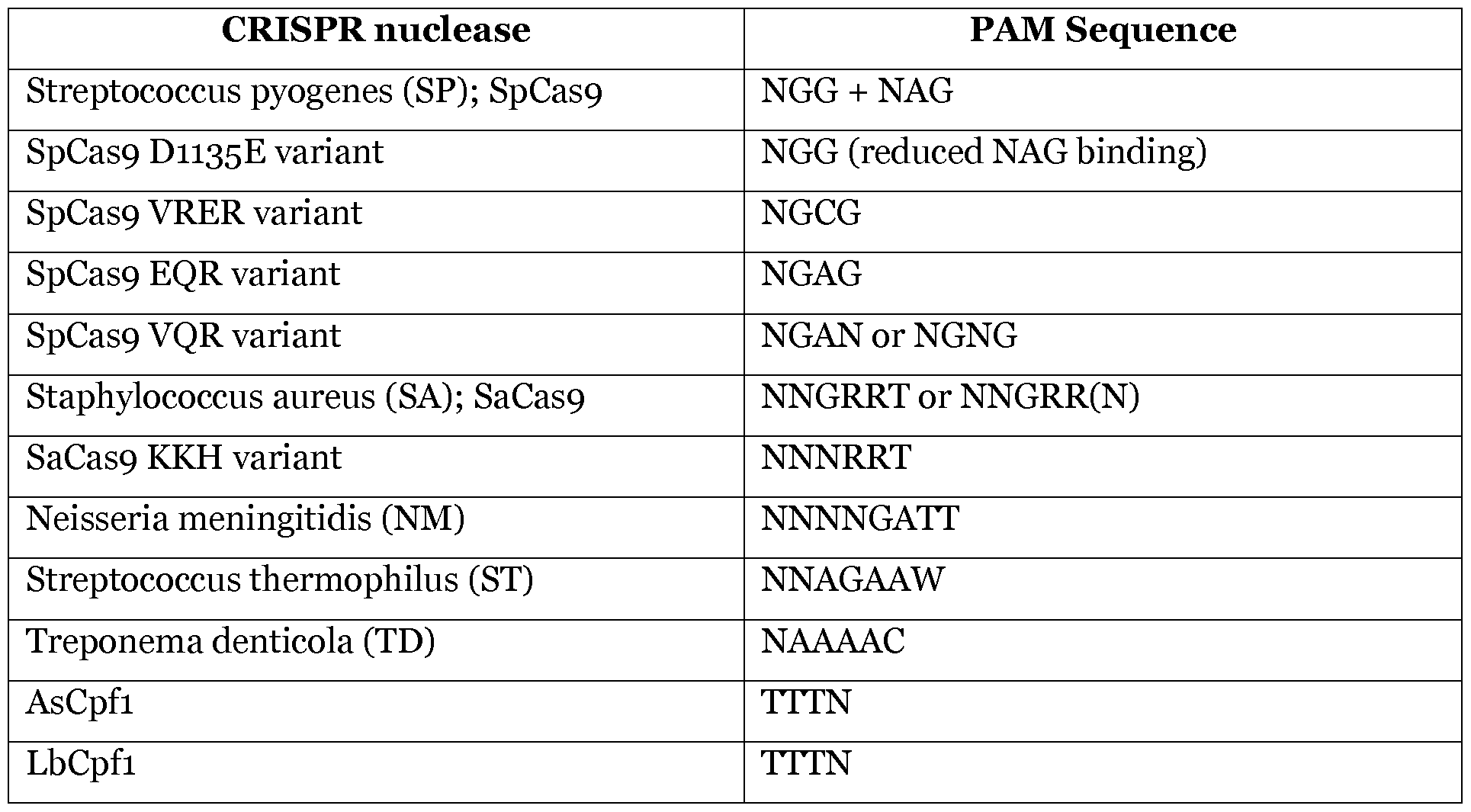
- CRISPR nucleases such as Cas9/nucleases cut 3-4bp upstream of the PAM sequence.
- CRISPR nucleases such as Cpfi on the other hand, generate a 5' overhang. The cut occurs 19 bp after the PAM on the targeted (+) strand and 23 bp on the opposite strand (62).
- Table 1 Non-exhaustive list of CRISPR-nuclease systems from different species. Also in- cluded are engineered variants recognizing alternative PAM sequences (see Kleinstiver, BP. et al. (2015). Broadening the targeting range of Staphylococcus aureus CRISPR-Cas9 by modifying PAM recognition. Nat Biotechnol 33(12): 1293-1298.).
- the modified tracrRNA sequence of the invention compris- es a nucleotide sequence according to any one of SEQ ID NOs: 8-10.
- the at least one sequence variation is a deletion, substi- tution, insertion, inversion, addition or chemical modification of at least one nucleic acid residue.
- the present invention provides a method for generating a modified tra- crRNA sequence, the method comprising the steps of
- RNA/DNA or genome editing nuclease a residue which is not in contact with the RNA/DNA or genome editing nuclease, preferably at least 2, more preferably at least 3 residues not in contact with the RNA/DNA or genome editing nuclease, and
- the tracrRNA sequence is complexed with the respective CRISPR nuclease and then structurally analysed, for example by X-ray crystallography, NMR spectroscopy, and dual polarisation interferometry, to determine the structure of nuclease bound to its tra- crRNA.
- the so generated mutated tracrRNA sequence is 50% (preferably 60%, 70%, 80%, 85%, or 90%) to 95% identical in sequence compared to the respective wild type se- quence of the tracrRNA.
- the object of the invention is solved by a method for generating a co- valently closed circularized (ccc) DNA vector for expressing a fixed pair of guide RNAs, the method comprising the steps of:
- each gRNA expression cassette comprises a gRNA placeholder sequence and a tracrRNA (sgR- NA) sequence
- a first predetermined gRNA sequence to be expressed iii. a linker sequence
- a second predetermined gRNA sequence to be expressed v. a second homology region capable of binding to the second gRNA ex- pression cassette
- a gRNA placeholder or gRNA placeholder sequence shall be understood as either a random- ly selected gRNA sequence that is intended to get replaced by the first or second gRNA se- quence to be expressed of the fixed pair of the invention in course of performing the above described method.
- a random gRNA sequence also any other random sequence can be used.
- the length of the sequence is chosen to accommodate the overall length of the mutagenic DNA primer to allow for an efficient hybridization and primer synthesis.
- the tracrRNA sequence of one or both the gRNA expression cas- settes is a modified or mutated tracrRNA sequence as described herein above.
- the tracrRNA sequence is a sequence according to any one of SEQ ID NO: 7 to 10.
- one of the tracrRNA sequences is a sequence according to SEQ ID NO:io, or a sequence at least 80, 85, 90 or 95% identical thereto.
- the two gRNA placeholder sequences are separated by a linker, and wherein the linker sequence is identical to the linker sequence in the mutagenic DNA primer.
- the linker sequence comprises a restriction enzyme recognition site, such as a restriction enzyme recognition site for blunt ligation, or restriction enzyme recognition site for sticky end ligation. Ligation into a blunt or sticky end restriction enzyme breaking point does not allow for a directional cloning of an insert sequence.
- the linker sequence comprises two restriction enzyme recognition sites, preferably two different re- striction enzyme recognition sites for directional RNA promoter ligation.
- the recipient vector comprises any one of, or all of, or any combination of:
- phage origin of replication such as an ft ORI
- step (c) the cccDNA vector is generated by following step of:
- the promoter fragment is introduced into the linker sequence by inducing a double strand break in the linker sequence, for ex- ample using a restriction enzyme, ligating said promoter element into the so induced dou- ble strand break double strand break.
- restriction enzyme sequence refers to a specific double stranded-DNA sequence which is recognized and cut by bacterial enzymes, each of which cut double-stranded DNA at or near a specific nucleotide sequence.
- blunt end or“overhang” as used herein is generally interpreted consistently with the understanding of one of ordinary skill in the related art and includes a linear dou- ble stranded nucleic acid molecule having one or more unpaired nucleotide species at the end of one strand of the molecule, where the unpaired nucleotide species may exist on ei- ther strand and include a single base position or a plurality of base positions (also some- times referred to as“cohesive end”).
- restriction end or“blunt ended” as used herein generally refers to a linear double stranded nucleic acid molecule having an end that termi- nates with a pair of complementary nucleotide base species, where a pair of blunt ends are always compatible for ligation to each other.
- Preferred restriction enzyme sites are those used in the example section of this application. However, alternative endonuclease sites are however well known in the art. Preferred in context of the present invention is that the used restriction enzyme induces either a sticky end double strand break or a blunt ended double strand break.
- the linker comprises two different restriction enzyme recognition sites in close proximity to each other that are used to allow for a directional introduction of said promoter element. A close proximity in some embodiments is that both recognition sites are not more than 50, preferably 20, 10 or 5 nu cleic acids apart from each other.
- the present invention then pertains to a method for generating a covalent- ly closed circularized (ccc) DNA based guide RNA expression vector or vector library, the method comprising the steps of
- a single stranded (ss) phagemid vector comprising (i) at least two guide RNA expression cassettes, wherein each of said guide RNA expression cassettes corn- prises a tracrRNA (sgRNA) sequence and an empty target-guide-RNA-sequence- introduction-site or a guide RNA placeholder sequence, or partial sequence thereof, (ii) at least one origin for replication (ORI) of single strand DNA such as a phage ORI, and in par- ticular a fi-origin,
- sgRNA tracrRNA
- ORI origin for replication
- muta- genic DNA-primer has the following structure in 3’ to 5’ direction: a first homology region, a first target sequence region encoding for a first guide RNA to be expressed, a second ho- mology region, a second target sequence region encoding for a second guide RNA to be ex- pressed, and a third homology region, wherein the first homology region is complementary to, or is capable of annealing to, a sequence of the ss-phagemid vector construct flanking the empty first target-guide-RNA-sequence-introduction-site or the first guide RNA coding sequence, or partial sequence thereof, on the 5’ side, and wherein the second homology re- gion is complementary to, or is capable of annealing to, a sequence of the ss-phagemid vec- tor construct flanking the empty first target-guide-RNA-sequence-introduction-
- the tracrRNA se- quences of the one of the at least two guide RNA expression cassettes is not identical to the tracrRNA sequence of the other of the at least two guide RNA expression cassettes. This is to avoid the formation of three dimensional structures in the construct due to the exverted repeat orientation of the tracrRNA sequences. Such three dimensional structures may im- pair the further method steps for generation of the fixed pair vector. It is preferable that the tracrRNA sequences of the one and the other guide RNA expression cassettes are character- ized in that their sequence homology is between 50 and 95%, and/or wherein the tracrRNA sequences have the ability of binding to the same or different RNA/DNA or genome editing nuclease.
- the two gRNA expression cassettes are preferably in extraverted orientation, preferably the first guide RNA is oriented in 3’ to 5’ direction, and the second guide RNA is oriented in 5’ to 3’ direction.
- sequence between the first guide RNA sequence and the sec- ond guide RNA sequence comprises at least one restriction endonuclease recognition se- quence that is recognized by a restriction endonuclease.
- restriction endonuclease recognition se- quence that is recognized by a restriction endonuclease.
- step (e) comprises the following:
- step (iii) Combining the cleavage product from step (i) and the bidirectional DNA/RNA fragment from step (ii) under ligation conditions sufficient to produce a ligation product composition, wherein the 5’ end of the first guide RNA is operatively linked to the 3' end of the first RNA promoter, and the 5’ end of the second guide RNA is operatively linked to the 3' end of the second RNA promoter.
- the guide RNA sequences of the invention are ultimately expressed under control of an RNA promoter.
- the first RNA promoter and the second RNA promoter are iden- tical or, preferably, are not identical.
- promoter is understood to mean a regula- tory sequence/element or control sequence/element that is capable of binding/recruiting a RNA polymerase and initiating transcription of sequence downstream or in a 3' direction from the promoter.
- a promoter can be, for example, constitutively active or always on or inducible in which the promoter is active or inactive in the presence of an external stimulus.
- RNA promoters include I17SK, T7 promoters or U6 promoters.
- the vectors used in accordance with the invention in some embodiments further comprise a RNA/DNA or genome editing nuclease (CRISPR nuclease) expression sequence in wild type or engineered form, optionally operably linked to a promoter (stable or inducible), wherein the promoter is preferably suitable for the expression of mRNA.
- CRISPR nuclease genome editing nuclease
- gRNA Guide RNA
- gRNA Guide RNA coding sequence is at least 10 nucleotides to 200 nucleotides long, more preferably 10 to 50, more preferably 10 to 30, more preferably 15 to 30, more preferably 15 to 25, most preferably 17 to 23, and even more preferably about 20 nucleotides long.
- the homology regions has a length of at least 5 nucleotides, preferably at least 10 nucleotides, more preferably 5 to 40 nucleotides, most preferably 10 to 30, or 10 to 20, most preferably 13 to 18, and even more preferably about 15 nucleotides.
- the homology region consists of a sequence having an annealing temperature of about 40 to 6o°C, and preferably about 45 to 55°C, and most preferably a Tm of 50°C +/- 3.
- the methods of the invention in some aspects are used to generate a covalently closed circu- larized (ccc) DNA based guide RNA expression vector or vector library, wherein each vector comprises a defined combination of at least two different gRNAs (fixed pair).
- ccc covalently closed circu- larized
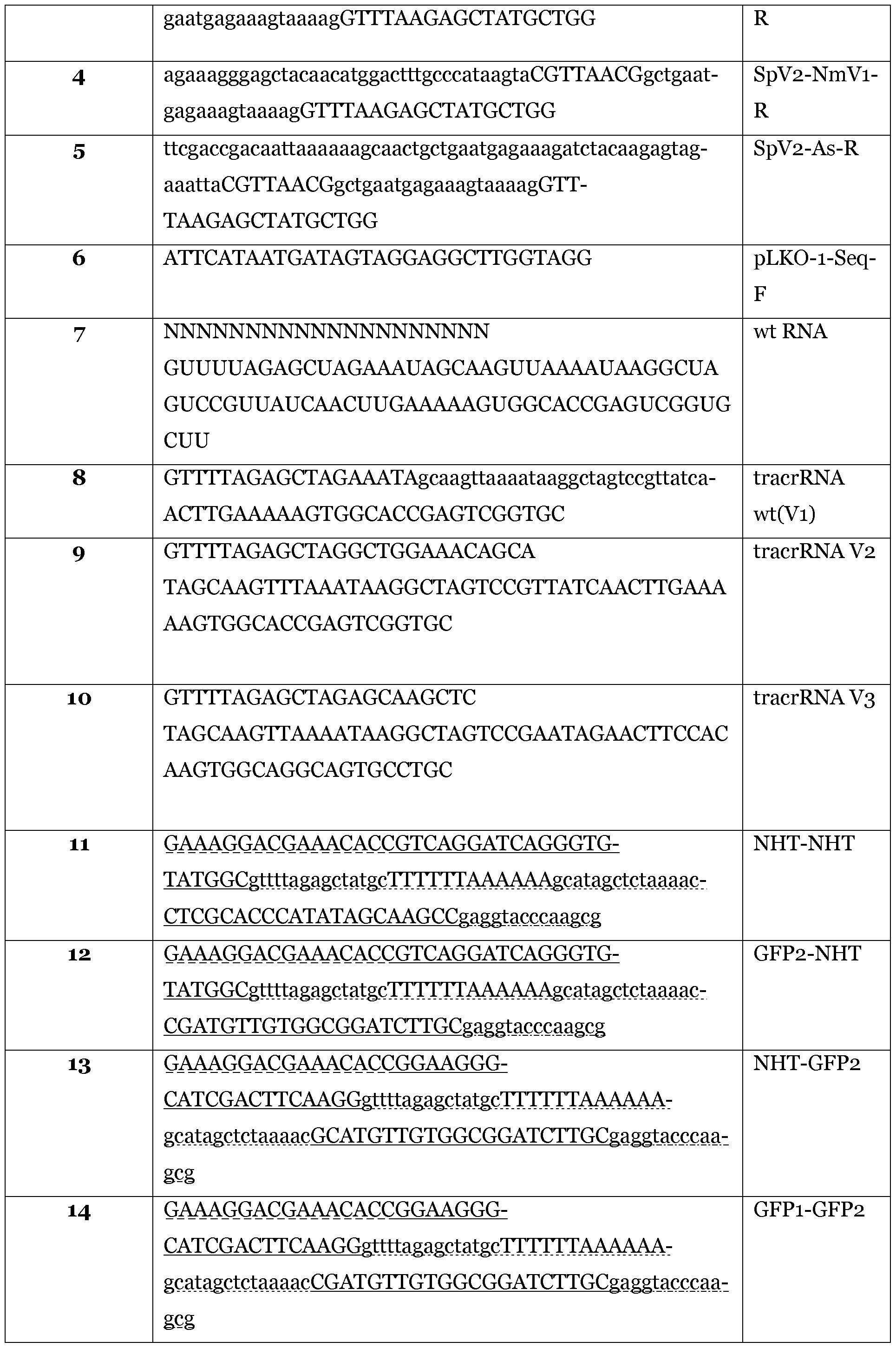
- a mutagenic DNA-primer may have a sequence according to any of SEQ ID NOs: 1-5.
- the above described technology for generating a“fixed pair” gRNA expression vector is used according to the additional embodiments depicted in figure 11.
- the herein described fixed pair methods are used in a direct combination with the method of generating a gRNA expression vector as disclosed herein under section I.
- This embodiment may include that the additional used tracrRNA sequence of the addi- tional gRNA expression cassettes are also not identical to the other tracrRNA sequences of the template vector.
- One additional or alternative embodiment then pertains to the method of the fixed pair technology, which is used twice concomitantly in the same vector (see fig ure lie).
- Part of the invention forms also a vector library obtainable by the herein described meth ods.
- the invention provides a nucleic acid vector for introducing and express ing two different guide RNA sequences, the vector comprising, in extraverted orientation, [expression direction facing in outward orientation from each other] :
- a first gRNA expression cassette comprising a first tracrRNA (sgRNA) se quence and a first gRNA placeholder sequence
- a second gRNA expression cassette comprising a second tracrRNA (sgRNA) sequence and a second gRNA placeholder sequence.
- sgRNA tracrRNA
- the first and the second tracrRNA sequences are not identical.
- a nucleic acid sequence con sisting of the first and the second tracrRNA sequences in an extraverted repeat orientation has a minimum free energy of not less than about 100 to -100 kcal/mol.
- the vector comprises a linker between the first and the second gRNA expression cassette, wherein the linker is flanked by the gRNA placeholder sequences.
- the linker comprises a restriction endonuclease recognition site, preferably suitable for introducing blunt end or sticky end double strand breaks (see above).
- kit of parts comprising any com pounds of the herein described invention, optionally, further comprising any buffer or rea gent suitable for any of the following: transformation of bacteria, and/or DNA/RNA isola tion, and/or restriction enzyme digestion, and/or ligation.
- the object of the invention is solved by an enhanced method for gen erating a covalently closed circularized (ccc) DNA vector for expressing a fixed pair of guide RNAs. Since the above method disclosed under section II above requires still a residual classical cloning step, a further strategy, however developed on the basis of the fixed-pair principle is disclosed. CRISPR methods may include two possibilities for the generation of a functional RNA com- plex including the necerney structural elements as well as the guide sequence for comple- mentary binding to the target DNA.
- a guide RNA as a single molecule corn- prising the target complementary region (sometimes referred to as“protospacer”), fused to a crRNA“repeat” sequence which is complementaiy to, and fused to a tracrRNA, resulting in the formation of a double strand of the crRNA repeat sequence and the tracrRNA se- quence.
- the target guide sequence is fused to the crRNA se- quence and a tracrRNA are expressed as separate molecules but still form a complex via complementaiy base pairing of the crRNA sequence to the tracrRNA.
- the inventors used the latter strategy for the third aspect of the present invention.
- the enhanced 3Cs fixed pair method of the invention comprises the steps of:
- each enhanced gRNA expression cassette comprises in that order: (i) optionally an RNA promoter, (ii) a gRNA placeholder sequence, and (iii) a crRNA (an sgRNA sequence lacking the Tracer sequence) sequence, and (y) a tracrRNA expression cassette;
- the method in preferred embodiments comprises the steps of generative cccDNA as de- scribed herein elsewhere, preferably by using the so called Kunkel mutagenesis method for the introduction of the sequences of the enhanced mutagenic DNA primer into the en- hanced recipient vector.
- Such method in may in preferred embodiments comprise the fol- lowing sub-steps in method step (c): (a’) Providing the recipient vector as single stranded (ss) phagemid vector, (b’) Annealing the mutagenic DNA primer to said ss phagemid vector, (c’) Amplifying a covalently closed circularized (ccc) -heteroduplex dsDNA thereFrom, and (d’) Removing residual wild type phagemid vector DNA.
- the enhanced 3Cs fixed pair method of the invention does not require a step of introducing a linker fragment comprising the RNA promoter regions for gRNA expression, and there- fore is less prone to typical cloning problems and errors.
- the tracrRNA expression cassette is not located between the inverted enhanced gRNA expression cassettes of the enhanced recipi ent vector.
- the tracrRNA expression cassette com prises a tracrRNA coding sequence lacking the crRNA sequence and being operably linked to a promoter suitable for expression of the tracrRNA.
- the tracrRNA sequence lacking the crRNA sequence, and the crRNA sequence, when expressed by the recipient vector, will produce RNA molecules which interact with each other to form a functional crRNA-tracrRNA com plex.
- the crRNA sequence is complemen tary to a part of the tracrRNA sequence lacking the crRNA sequence. Hence, upon expres sion of the crRNA (preferably when fused to the gRNA sequence), the crRNA binds to the tracrRNA and hence forms a functional RNA complex for mediating Cas9 dependent gene editing.
- crRNA sequence comprises a known “repeat” sequence of a crRNA sequence, such as for example, of a Streptococcus pyogenes crRNA sequence (Kooning, EV et al Curr. Opin. Microbiol. 37, 67-78 2017, incorporated herein by reference in its entirety).
- a preferred crRNA sequence of the invention is dis closed for example in figure 12 d.
- RNA promoter sequence and the gRNA placeholder sequence are in operable linkage, which shall be understood such that when a gRNA sequence is introduced into the placeholder in accordance with the invention, the gRNA sequence is expressed under the control of the RNA promoter sequence.
- the enhanced recipient vector therefore com prises the following elements in direct and uninterrupted consecutive order: (i) a first RNA promoter, (ii) a first gRNA placeholder or gRNA sequence, wherein (i) and (ii) are in opera ble linkage, (iii) a first crRNA (repeat) sequence (iv) optionally a linker, followed by the fol lowing elements, each in inverted orientation compared to (i) to (iii): (v) a second crRNA sequence, (vi) a second gRNA placeholder or gRNA sequence, (vii) a second RNA promoter, wherein (vii) and (vi) are in operable linkage.
- the enhanced mutagenic DNA primer corn- prising in this order in this order
- a second homology region capable of binding to the inverted crRNA sequences, and optionally a linker
- v. a third homology region capable of binding to the second enhanced gRNA ex- pression cassette.
- the above method is preferred wherein the method between steps (a) and (c) does not include a step of cloning, preferably cloning referring to a step of nuclease based introduction of double strand breaks followed by ligation - for example after intro- duction or excision of a part of the vector.
- an recipient enhanced recipient vector comprising the following elements in direct and uninterrupted consecutive order: (i) a first RNA promoter, (ii) a first gRNA placeholder or gRNA sequence, wherein (i) and (ii) are in operable linkage, (iii) a first crRNA (repeat) sequence (iv) optionally a linker, fol- lowed by the following elements, each in inverted orientation compared to (i) to (iii): (v) a second crRNA sequence, (vi) a second gRNA placeholder or gRNA sequence, (vii) a second RNA promoter, wherein (vii) and (vi) are in operable linkage; the enhanced recipient vector further comprising a tracrRNA expression cassette.
- the term“comprising” is to be construed as encompassing both“including” and“consisting of’, both meanings being specifically intended, and hence individually dis- closed embodiments in accordance with the present invention.
- “and/or” is to be taken as specific disclosure of each of the two specified features or components with or without the other.
- “A and/or B” is to be taken as specific disclosure of each of (i) A, (ii) B and (iii) A and B, just as if each is set out individually herein.
- the terms“about” and“approximately” denote an interval of accuracy that the person skilled in the art will understand to still ensure the technical effect of the feature in question.
- the term typically indicates deviation from the indicated numerical value by ⁇ 20%, ⁇ 15%, ⁇ 10%, and for example ⁇ 5%.
- the specific such deviation for a numerical value for a given technical effect will depend on the nature of the technical effect.
- a natural or biological tech- nical effect may generally have a larger such deviation than one for a man-made or engi- neering technical effect.
- the specific such deviation for a numerical value for a given technical effect will depend on the nature of the technical effect.
- a natural or biological technical effect may generally have a larger such deviation than one for a man-made or engineering technical effect.
- the two gRNAs of a single fixed-pair of gRNAs can be defined to target DNA in close proximity, leading to the loss of DNA residing between the two gRNA target sequences.
- fixed-pair gRNA reagents can be utilized to precisely excise DNA sequences.
- the two gRNAs of a single fixed-pair of gRNAs can be defined towards the same genetic target (gene, element, noncoding sequence, etc.), thereby drastically improving the efficien- cy of the desired editing or modification event.
- the two gRNAs of a single fixed-pair of gRNAs can be defined towards two different genetic targets (gene, element, noncoding sequence, etc.). This enables the precise editing or modification of two defined sequence elements within the same cell.
- Fixed-pair gRNA reagents can be used with nuclease active wildtype Cas enzymes (i) or single active-site inactivated Cas enzymes, nickase (ii).
- fixed-pair gRNAs is not limited to active Cas enzymes but can be extended to enzymatically-dead Cas enzymes for the inactivation (i), activation (ii), epigenetic modifica- tion (iii), or visualization (iv) of genetic elements.
- the resulting heteroduplex dsDNA consisting of template and newly synthesized 3CS-DNA, is trans- formed into non-CJ236 bacteria to amplify the new DNA strand and degrade the dU- containg template DNA.
- the resulting dsDNA of defined gRNA combinations is subse- quently opened-up by enzymatic digest in between the two new gRNA sequences and ligat- ed with a bi-directional RNA promoter sequence, resulting in the final defined 3CS fixed- pair gRNA reagent.
- 3CS fixed-pair gRNA combinations are not limited to the use of a single Cas nu clease. Two different tracrRNA sequences can be used, thereby extending the range of target sequences and enabling the usage of combinations of wildtype and enzymatically dead or modified Cas nucleases ( Figure id,e).
- Selected sequence elements within the SpCas9 tracrRNA sequence (#1-3) can be adapted to prevent the presence of two highly similar sequences in 3CS template DNA. Sequence scheme adapted Konermann et al., 2015 14 . The sequence is provided in SEQ ID NO: 7.
- the inventors generated 5 3Cs-template dsDNA plasmids con- taining tracrRNA sequences enabling the following combinations of Cas nucleases: SpCas9:SpCas9 (vi.v2, and V2.V3), SpCas9:SaCas9 (v2.Sa), SpCas9:NmCas9 (v2.Nm) and SpCas9:AsCpfi (v2.As). All plasmids resulted in the expected band pattern when subjected to analytical restriction enzyme digest and analyzed by gel electrophoresis, confirming cor- rect cloning and 3Cs-template generation.
- gRNAs are designed to target noncoding intronic DNA to min- imize coding InDels.
- 3CS-DNA of Figure 8 was transformed in non-CJ236 bacteria for polyclonal DNA amplifica- tion. Plasmid DNA of over-night cultures was purified and subjected to analytical restriction enzyme digest. Individual 3CS-DNA preparations were compared to their corresponding wildtype plasmid DNA control of Figure 4a. A successful 3CS reaction will change the I-Scel restriction enzyme site in the 3Cs-template DNA to the defined gRNA sequence. Therefore, enzymatic cleavage with I-Scel will only linearize wildtype 3CS-DNA.
- the 3CS fixed-pair technology enables the predetermination of two sequences in a single or pooled manner and therefor represents the first-of-its-kind techno- logical solution.
- several adaptations of the 3CS fixed-pair technology are logical consequences.
- the combination of a single fixed-pair cassette with a single gRNA-expressing cassette on the same plasmid should be possible (a).
- a single fixed- pair cassette can be combined with two separate gRNA-expressing cassettes, enabling a combination of fixed-pair gRNAs with gRNA multiplexing (b).
- Enhanced 3CS fixed-pair gRNAs a) Scheme illustrating the logic of separating crispr (cr) RNA from tracrRNA in the process of fixed-pair gRNA combination generation. Briefly, oligonucleotides encoding for two predefined gRNA combinations are synthesized and pooled with ssDNA of template DNA to perform a 3CS synthesis reaction. The resulting dsDNA product lead to the expression of two separate crRNA sequences, that anneal to the tracrRNA (co-expressed from same plasmid) to form, together with SpCas9, a functional ribonucleotide-complex b) General workflow of 3CS fixed-pair reactions and template de- sign rules for ssDNA. c) Fixed-pair template DNA design. Highlighted are RNA promoter, gRNA and crRNA sequences d) Design and annealing principle of 3CS fixed-pair gRNA oligonucleotides.
- FIG. 15 Cell functionality of 3CS fixed-pair gRNA reagents a) Fixed-pair constructs derived from Figure 13b, were subject to the generation of lentiviral particles and used to transduce GFP-positive RPEi cells. GFP depletion was analyzed by FACS.
- CJ236 bacteria tolerate the presence of deoxyuridine in genomic and plasmid DNA due to the lack of the enzymes dUTPase (dut-) and uracil glycosylase (ung-).
- dUTPase due to the lack of the enzymes dUTPase (dut-) and uracil glycosylase (ung-).
- Subsequent super infection of transformed CJ236 with M13K07 bacteriophage allows the production of bacteriophage particles that package a deoxyuridine containing ssDNA (dU-ssDNA) template of pLentiGuide and pLen- tiCRISPRv2.
- dU-ssDNA is purified from the precipitated bacteriophage particles ( Figure 12B).
- this approach can be applied to any plasmid that encodes an fi-ori.
- gRNA sequences were designed using the rule set 2 (RS2) algorithm and cloned using a 3CS reaction into pLentiGuide and pLentiCRISPRv2 containing a non-human targeting (NHT) control sequence under the con- trol of the U6 promoter and followed by the gRNA scaffold DNA sequence responsible for binding to Cas9 ( Figure 2B) (32).
- RS2 rule set 2
- NHT non-human targeting
- the inventors individually sequenced 20 clones and determined that 81% of pLentiGuide and 82% of plentiCRISPRv2 were modified with GFP targeting gRNAs (Figure 13C,D).
- Addition of uridine to the M13K07 culture media significantly reduced the wild type rate to about 12% indicating that the occurrence of unmodified plasmid is most likely due to insufficient incorporation of dU into the dU-ssDNA template ( Figure 13E).
- the inventors were able to identify several copies of all 6 eGFP -targeting gRNA sequences (Figure 13D), even though the inventors sequenced only 20 individual clones suggesting that the highly efficient protocol is suitable for library constructions.
- Example 1 A 3CS strategy towards fixed-paired CRISPR/ Cas gRNAs
- the inventors designed a 3Cs-strategy based on the previously invented 3Cs-technology ( Figure 2a). To do so, the inventors in silico designed a template plasmid on the basis of pLKO.i in which the shRNA- expressing cassette (RNA promoter and shRNA cloning site) was replaced by two tracrR- NAs in opposite directions that are essential for RNA-binding to Cas nuclease. The extra- verted tracrRNAs are separated by two restriction site-encoding gRNA placeholders ( Figure 2a, b).
- the inventors cloned and amplified this plasmid in CJ236 bacteria and converted it to single stranded circular dU-DNA (dU-ssDNA) through amplification and purification of bacteriophage M13K07 particles.
- the resulting circular dU-ssDNA is then annealed with a DNA oligonucleotide featuring sufficient 5’ and 3’ homology to the extraverted tracrRNA sequences (tracr#i and tracr#2) and containing the two defined bidirectional gRNA se- quences ( Figure 2a, b).
- the annealed DNA oligonucleotide is then extended and ligated to its own tail by the activity of T7 polymerase and T4 ligase, respectively, generating a heterodu- plex DNA (3CS-DNA) consisting of template and newly synthesized DNA strand.
- 3CS-DNA is then transformed into non-CJ236 bacteria for the selective degradation of dU-containing DNA and the amplification of newly synthesized plasmid DNA.
- Purified non-dU containing plasmid DNA is purified and subject to a clean-up step (restriction enzyme digest) to re- move wildtype reminiscent plasmids.
- RNA promoter composed of two non-homologous sequences, e.g. hU6, 117SK, Hi, etc.
- a restriction enzyme cleavage site blue or sticky cloning
- SpCas9 has the highest target site occurrence with roughly 150 target sites per kilobase DNA, followed by SaCas9 with 125, NmCas9 with 10 and AsCpfi with about 100 target sites per kilobase (Figure 2c).
- Theoreti- cally, fixed-pair gRNA combinations can be generated not only on the basis of the same tra- crRNA (utilizing the same Cas enzyme), but also in combination with different tracrRNA molecules (relying on different Cas enzymes), expanding the range of targets and their spec- ificity.
- combinations of SpCas9 with SaCas9 or AsCpfi have the broadest range of targets with an average fixed-pair target number of about 20.000 gRNA combinations per kilobase (Figure 2d).
- Example 2 A rationally engineered SpCas9 tracrRNA for fixed pair 3Cs-gRNAs
- Plasmids containing highly homologous or identical nucleotide sequences have been demonstrated to recombine during viral packaging leading to the loss of sequence infor- mation and resulting in inactive viral particles 8-11 .
- the inventors combined the wildtype SpCas9 tracrRNA (vi) se- quence with the recently engineered and improved SpCas9 tracrRNA version 2 (v2) for the generation of fixed-pair template plasmid DNA (vi.v2) ( Figure 2a) 12 .
- the in- ventors generated fixed-pair template plasmid DNA of extraverted tracrRNA-combinations of SpCas-SaCas9 (v2.Sa), SpCas9-NmCas9 (v2.Nm) and SpCas9-AsCpfi (v2.As), all of which generated the expected DNA fragments when subjected to analytical restriction enzyme digests (Figure 4a).
- the inventors predicted the folding of the extraverted tra- crRNA and gRNA sequences by conventional bioinformatic tools and while most tracrRNA combinations did not result in strong folding 13 , the inventors identified a strong homology- based folding of vi and v2 of SpCas9 tracrRNA molecules ( Figure 5).
- the inventors rationally engineered a new SpCas9 tracrRNA sequence based on the previously reported crystal structure of SpCas9 in complex with tracrRNA and gRNA molecules 14 .
- the inventors identified three sequence regions that are not in direct contact with SpCas9 and therefore may contain engineering potential to break sequence homology (Figure 3a).
- the inventors rationally changed the three sequences to nucleotides that would most effectively break the refolding of ssDNA and named the new tracrRNA molecule version three (v3) ( Figure 3b, 5).
- the inventors used purified bacteriophage particles containing the fixed-pair template DNA to retransform XLi bacteria for the generation of dsDNA based on the ssDNA delivered to them through phage infec- tion.
- the resulting plasmid dsDNA was subjected to an analytic restriction enzyme digest to confirm the correctness of the fixed-pair template dsDNA.
- dsDNA resulting from vi.v2 tracrRNA ssDNA was subject to severe recombination events, demonstrated by faster migrating bands, the lack of a correct digestive pattern and the absence of correct SANGER sequence information ( Figure 4c, 6).
- gr y highlight modified from wt
- the inventors set out to design an exper- imental setting that would enable to selectively quantify a full DNA excision event over the occurrence of individual insertions or deletions (InDels) at the two gRNA target sites.
- the inventors designed two pairs of gRNAs each targeting the intronic region of the hu- man retinoblastoma gene RBi gene, whose depletion or inactivation results in resistance to the selective Cdk4/6 inhibitor Palbociclib. Both pairs were designed in such a way, that in- dividual gRNAs are at least 50 nucleotides away from the 5’ or 3’ end of the closest coding exon of RBi.
- Pair 1 was designed to include exon 7, while pair 2 was designed to include exon 9 of RBi ( Figure 7a).
- gRNAs are designed to target noncoding intronic DNA to minimize coding InDels.
- the two sets of paired gRNAs were individually and sequentially cloned by conventional cloning into the previously described lentiviral plasmid pKLV2.2 15 . Both plasmids were subject to the generation of infectious lentiviral particles that were sub- sequently used to transduce SpCas9-expressing RPEi cells.
- Example 4 Defined gRNA combinations in pooled fixed-pair 3Cs-technology
- a successful 3CS reaction will change the I-Scel restriction enzyme site in the 3Cs-template DNA to a defined gRNA sequence, thereby rendering I-Scel inactive on correctly generated 3CS-DNA.
- Purified DNA of polyclonal over-night bacterial cultures was subsequently subject to analytical restriction enzyme digests and compared to the respective wildtype plasmid.
- all fixed-pair tracrRNA-combinations revealed an uncleaved plasmid DNA species when subject to I-Scel digest, indicating the presence of plasmid DNA in which the I-Scel restriction site has been changed (Figure 9).
- the inventors analyzed single bacterial clones by SANGER sequencing and identified the two RBi gRNA sequences corresponding to excision pair 1 of Figure 7 ( Figure toa-c).
- the inventors have developed a novel method for the generation of defined combinations of CRISPR/ Cas gRNAs, for the generation of pooled fixed-pair gRNA librar- ies.
- This innovative technology has the potential for a wide field of applications, including but not limited to improved on-target efficiency for the generation of gene knockouts, acti- vation or inhibition or effector-mediated editing, as well as the precise excision of genetic information (CRISPRex).
- Fixed-pair gRNA reagents are of special importance for the fields of CRISPRa and CRISPRi, both of which have been demonstrated to significantly depend on multiple gRNAs for efficient activation (a) or inactivation (i). The inventors believe this technology has broad implications for investigations of coding and noncoding genetic in- formation in health and disease.
- 3CS fixed-pair gRNAs can be combined with one single gRNA-expressing cassette to ena- ble multiplexing of one single gRNA with fixed-pair gRNAs ( Figure 11a). 2) 3CS fixed-pair gRNAs can be combined with two single gRNA-expressing cassettes to enable multiplexing of two single gRNAs with fixed-pair gRNAs ( Figure 11b).
- a single 3CS fixed-pair gRNA-expressing cassette can be multiplexed with a second 3CS fixed-pair gRNA-expressing cassette to enable 3CS fixed-pair gRNA multiplexing ( Figure 11c).
- final 3CS reagents can be linearized by restriction enzyme digest to remove essential parts of the plas- mid/library that prevents growth/amplification in bacteria.
- the transfection of linearized plasmid/library is active in generating lentiviral particles for experimental pur- poses.
- Bacterial plasmid amplification requires antibiotic drug selection/pressure to ensure the selective outgrowth of bacteria carrying the desired plasmid/library.
- the an- tibiotic promoter can be excised, 2) the entire or parts of the antibiotic drug resistance gene can be removed, or 3) the origin-of-replication (ORI) sequence can be excised.
- ORI origin-of-replication
- 3Cs reagents benefit from the lack of PCR amplification and conventional cloning steps.
- the integration of the bidirectional promoter to complete 3CS fixed-pair reagent production potentially interferes with the overall quality (diversity and distribution) of 3CS fixed-pair reagents. Therefore, the inventors designed an enhanced 3CS fixed-pair protocol completely avoiding the need for any conventional cloning steps. To do so, the inventors took advantage of the fact that the non-engineered type II CRISPR system of Streptococcus pyogenes uses two separate RNA molecules (crRNA and tracrRNA) that intracellularly form, together with Cas9, a functional RNA-guided DNA nuclease complex ( Figure 12a).
- the 3CS fixed-pair reaction would be sufficient to produce fixed-pair compositions of crRNAs from the same plasmid (enhanced plasmid #3.1) ( Figure 12b, c).
- a separate SpCas9 tracrRNA-expressing cassette on the same plasmid ensures ex- pression of both RNA molecules within the same cell.
- 3CS fixed-pair oligonucleotides for enhanced plasmid #3.1 contains three regions of homology (3Cs fixed-pair homology), potentially improving oligonucleotide annealing and thereby performance in 3CS reactions (Figure I2d).
- the inventors transformed plasmid #3.1 into CJ236 bacteria and selected two clones for ssDNA generation. Agarose gel-electrophoresis identified a single band of ssDNA for the CJ236 clones, demonstrating robust ssDNA generation of plasmid #3.1 ( Figure 13a).
- the inventors designed 5 oligonucleotides, encoding for combinations of control (non-human-target, NHT), mCherry, GFP targeting gRNAs, and performed individual 3CS fixed-pair reactions. All de- signed oligonucleotides performed well in 3CS fixed-pair reactions, revealed by the expected band pattern visualized by agarose gel-electrophoresis ( Figure 13b). Since single oligonu- cleotide 3CS fixed-pair synthesis performed well, the inventors asked if pooled primer reac- tions are possible with this protocol.
- Example 9 Cellular functionality of enhanced 3CS fixed-pair reagents
- the in- ventors took the above generated NHT and GFP targeting constructs and made infectious lentiviral particles of them.
- GFP-expressing hTERT-RPEi cells were transduced with them for 48 hours, after which a selection pressure (puromycin) for another 4 days was applied before the cells were analyzed by FACS and immunoblotting for which wildtype (wt) and GFP-positive cells (GFP) served as controls.
- wt wildtype
- GFP-positive cells GFP-positive cells
- KCM competent and dut/ung Escherichia coli cells were transformed with 50 ng of CRISPR/Cas template plasmid according to the following proto- col: DNA was mixed with 2 pL of 5x KCM solution (lM KC1, lM CaCl 2 , lM MgCl 2 ) set to 10 pL and chilled on ice for 10 minutes. An equal volume of CJ236 bacteria was added to the DNA/KCM mixture, gently mixed and incubated on ice for 15 minutes. The bacteria/DNA mixture was then incubated at room temperature for 10 minutes, and subsequently inocu- lated in 200 pL SOC media. The bacteria were incubated at 37°C and 200 rpm for 1 hour. After l hour, bacteria were selected with ampicillin on LB-agar plates and incubated over- night at 37°C.
- Bacteria were kept at 200 rpm and 37°C for additional 6 hours before the culture was transferred to 30 mL of 2YT media supplemented with ampicillin (final concentration 100 pg/mL) and kanamycin (final concentration 25 pg/mL). After 20 hours of shaking at 200 rpm and 37°C, the bacterial cul- ture was centrifuged for 10 minutes at 10,000 rpm and 4°C in a Beckman JA-12 fixed angle rotor.
- the supernatant was transferred to 6 mL (1/5 of cul- ture volume) PEG/NaCl (20% polyethylene glycol 8000, 2.5 M NaCl), incubated for 1 hour at RT and subsequently centrifuged for 10 minutes at 10,000 rpm and 4°C in a Beckman JA-12 fixed angle rotor.
- the phage pellet was resuspended in 1 mL PBS.
- Circular ssDNA was purified from the resuspended phages using the E.Z.N.A. M13 DNA Mini Kit (Omega) according to the manufacturer’s protocol.
- Oligonucleotides that were used for 3Cs-reactions are listed separately.
- 600 ng of oligonucleotides were phosphorylated by mixing 2 pL ioc TM buffer (0.1 M MgCl 2 , 0.5 M Tris-HCl, pH 7.5), 2 pL 10 mM ATP, 1 pL 100 mM DTT, 20 units of T4 poly- nucleotide kinase and H 2 o in a total volume of 20 pL.
- the mixture was incubated for 1 h at 37°C.
- Annealing of the phosphorylated oligonucleotides with the circular dU-ssDNA template was performed by adding the 20pL phosphorylation product to 25 pL IOX TM buffer, 20 pg of dU-ssDNA template, and H 2 0 to a total volume of 250 pL. The mixture was incubated for 3 min at 90°C, 5 min at 50°C and 5 min at room temperature.
- 3CS-DNA was generated by adding 10 pL of 10 mM ATP, 10 pL of 100 mM dNTP mix, 15 pL of 100 mM DTT, 2000 ligation units (or 30 Weiss units) of T4 DNA ligase and 30 units of T7 DNA polymerase to the annealed oligonucleotide/ssDNA mixture.
- the 3Cs-synthesis mix was incubated for 12 hours (over-night) at room temperature, affinity purified and de- salted through gel extraction columns (Thermo Fisher Scientific).
- the 3Cs-reaction product was analyzed by gel electrophoresis alongside the ssDNA template on a o.8% TAE/agarose gel (too V, 30 min).
- HEK293T As standard, HEK293T (ATCC CRL-3216) were maintained in Dulbecco’s Modified Eagle’s Medium (DMEM, Thermo Fisher Scientific) and hTERT-RPEi (CRL-4000) in DMEM: Nu trient Mixture F-12 (DMEM/F12, Thermo Fisher Scientific), supplemented with 10% fetal bovine serum (FBS) and 1% penicillin-streptomycin (Sigma) at 37°C with 5% C0 2 .
- DMEM Dulbecco’s Modified Eagle’s Medium
- FBS fetal bovine serum
- penicillin-streptomycin Sigma
- RPEi cells were seeded at an appropriate density for each experiment with a maximal con- fluency of 60-70% in DMEM/F12 (Thermo Fisher Scientific), supplemented with 10% FBS and 1% penicillin-ptreptomycin (Sigma).
- polybrene was added to the media to a final concentration of 8 pg/mL, as well as viral supernatant according to the previously determined viral titer. The next morning, the media was replaced with fresh me dia and the cells were subjected to antibiotic selection or experimental analysis.
- HEK293T cells were seeded to 5x1o 5 cells/mL.
- transfection medium containing 1/10 of culture volume Optimem (Thermo Fisher Scientific), 105 m ⁇ /ml lipofectamin 2000 (Invitrogen), 1.65 pg transfer vector, 1.35 pg pPAX2 (addgene plasmid #12260) and 0.5 pg pMD2.G (addgene plasmid # 12259).
- the mixture was incubated for 30 minutes at room temperature before adding it drop-wise to the medium.
- transfection media was replaced with fresh media to gener ate transfection reagent-free lentiviral supernatant. Lentiviral supernatant was harvested at 24 h and 48 h, pooled and stored at -8o°C.
- RPEi cells were plated in a 24 well plate with 20,000 cells per well. The following day, cells were transduced using 8 pg/ml polybrene and a series of 0.5, 1, 5 and 10 pL of viral supernatant. After 3 days of incubation at 37°C, the percentage of fluorescence-positive cells was determined by flow cytometry. The following formula was used to calculate the viral titer:
- Tris lysis buffer 50 mM Tris-HCl (pH 7.8), 150 mM NaCl, 1% IGEPAL CA-630
- Tris lysis buffer 50 mM Tris-HCl (pH 7.8), 150 mM NaCl, 1% IGEPAL CA-630
- mouse anti-GFP GFP (B-2): sc-9996, 1:2,000, Santa Cruz Biotechnology, Inc.
- mouse anti-Tubulin clone 12G10, 1:1,000, Developmental Studies Hybridoma Bank, University of Iowa
- mouse anti-Cdk2 clone M2 (sc-163), 1:1,000, Santa Cruz Biotechnology, Inc.
- Secondary antibodies used for western blot analy- sis were goat anti-mouse (Thermo Scientific, 31430) and goat anti-rabbit (Thermo Scien- tific, 31460).
- the mouse anti-Tubulin hybridoma cell line (clone #12GIO) was developed by J.
- SpVi-SpV2-R (3G3 synthesis oligonucleotide) - SEQ ID NO: 1
- SpV2-SpV3-R (3G3 synthesis oligonucleotide) - SEQ ID NO: 2 5’-
- SpV2-SaVi-R (3CS synthesis oligonucleotide) - SEQ ID NO: 3
- SpV2-As-R (3CS synthesis oligonucleotide) - SEQ ID NO: 5
- NHT-NHT (3CS synthesis oligonucleotide) - SEQ ID NO: 11
- NHT-GFP2 (3CS synthesis oligonucleotide) - SEQ ID NO: 13
- GFP1-GFP2 (3CS synthesis oligonucleotide) - SEQ ID NO: 14 GAAAGGACGAAACACCGGAAGGGCATCGACTTCAAGGettttaeaec- tatgcl ' l l ' l ' l ' TAAAAAAgcatagctctaaaacCGATGTTGTGGCGGATCTTGCgaggtacccaagcg
- NHT-Cdk2 (3CS synthesis oligonucleotide) - SEQ ID NO: 15
Landscapes
- Genetics & Genomics (AREA)
- Health & Medical Sciences (AREA)
- Life Sciences & Earth Sciences (AREA)
- Engineering & Computer Science (AREA)
- Biomedical Technology (AREA)
- Wood Science & Technology (AREA)
- Organic Chemistry (AREA)
- Chemical & Material Sciences (AREA)
- Biotechnology (AREA)
- General Engineering & Computer Science (AREA)
- Zoology (AREA)
- Bioinformatics & Cheminformatics (AREA)
- Molecular Biology (AREA)
- Microbiology (AREA)
- Plant Pathology (AREA)
- Biophysics (AREA)
- Biochemistry (AREA)
- General Health & Medical Sciences (AREA)
- Physics & Mathematics (AREA)
- Micro-Organisms Or Cultivation Processes Thereof (AREA)
- Enzymes And Modification Thereof (AREA)
- Measuring Or Testing Involving Enzymes Or Micro-Organisms (AREA)
Abstract
Description



Claims
Priority Applications (6)
| Application Number | Priority Date | Filing Date | Title |
|---|---|---|---|
| CA3103044A CA3103044A1 (en) | 2018-06-08 | 2019-06-11 | Method for generating a gene editing vector with fixed guide rna pairs |
| AU2019281034A AU2019281034B2 (en) | 2018-06-08 | 2019-06-11 | Method for generating a gene editing vector with fixed guide RNA pairs |
| US16/973,011 US12286624B2 (en) | 2018-06-08 | 2019-06-11 | Method for generating a gene editing vector with fixed guide RNA pairs |
| EP19729023.2A EP3802835A1 (en) | 2018-06-08 | 2019-06-11 | Method for generating a gene editing vector with fixed guide rna pairs |
| CN201980038633.2A CN112424360A (en) | 2018-06-08 | 2019-06-11 | Method for producing gene editing vector using fixed guide RNA pair |
| JP2020568291A JP7473969B2 (en) | 2018-06-08 | 2019-06-11 | Method for constructing gene editing vectors using fixed guide RNA pairs |
Applications Claiming Priority (2)
| Application Number | Priority Date | Filing Date | Title |
|---|---|---|---|
| EP18176677.5A EP3578658A1 (en) | 2018-06-08 | 2018-06-08 | Method for generating a gene editing vector with fixed guide rna pairs |
| EP18176677.5 | 2018-06-08 |
Publications (1)
| Publication Number | Publication Date |
|---|---|
| WO2019234258A1 true WO2019234258A1 (en) | 2019-12-12 |
Family
ID=62567521
Family Applications (1)
| Application Number | Title | Priority Date | Filing Date |
|---|---|---|---|
| PCT/EP2019/065167 Ceased WO2019234258A1 (en) | 2018-06-08 | 2019-06-11 | Method for generating a gene editing vector with fixed guide rna pairs |
Country Status (7)
| Country | Link |
|---|---|
| US (1) | US12286624B2 (en) |
| EP (2) | EP3578658A1 (en) |
| JP (1) | JP7473969B2 (en) |
| CN (1) | CN112424360A (en) |
| AU (1) | AU2019281034B2 (en) |
| CA (1) | CA3103044A1 (en) |
| WO (1) | WO2019234258A1 (en) |
Cited By (1)
| Publication number | Priority date | Publication date | Assignee | Title |
|---|---|---|---|---|
| WO2025071410A1 (en) * | 2023-09-28 | 2025-04-03 | ACADEMISCH ZIEKENHUIS LEIDEN (h.o.d.n. LUMC) | System for deleting regions of dna |
Families Citing this family (6)
| Publication number | Priority date | Publication date | Assignee | Title |
|---|---|---|---|---|
| CN111613272B (en) * | 2020-05-21 | 2023-10-13 | 西湖大学 | Programming framework gRNA and its applications |
| CN112553246A (en) * | 2020-12-08 | 2021-03-26 | 安徽省农业科学院水稻研究所 | Efficient genome editing vector based on CRISPR-SaCas9 system and application thereof |
| CN114150001A (en) * | 2021-11-05 | 2022-03-08 | 中国农业科学院上海兽医研究所(中国动物卫生与流行病学中心上海分中心) | A construction method of CRISPR/Cas9 vector for gene editing of Toxoplasma gondii |
| CN116536309A (en) * | 2022-01-25 | 2023-08-04 | 西北农林科技大学 | A Modified Pilot Editing System and Its Application |
| CN116254258A (en) * | 2023-01-03 | 2023-06-13 | 福建农林大学 | Method for constructing carrier library containing tag sequence through short oligonucleotides and application |
| CN116469468B (en) * | 2023-06-12 | 2023-09-19 | 北京齐禾生科生物科技有限公司 | Editing gene carrier residue detection method and system based on Bayes model |
Citations (10)
| Publication number | Priority date | Publication date | Assignee | Title |
|---|---|---|---|---|
| WO2014093701A1 (en) * | 2012-12-12 | 2014-06-19 | The Broad Institute, Inc. | Functional genomics using crispr-cas systems, compositions, methods, knock out libraries and applications thereof |
| WO2015040075A1 (en) * | 2013-09-18 | 2015-03-26 | Genome Research Limited | Genomic screening methods using rna-guided endonucleases |
| WO2015065964A1 (en) * | 2013-10-28 | 2015-05-07 | The Broad Institute Inc. | Functional genomics using crispr-cas systems, compositions, methods, screens and applications thereof |
| WO2016106236A1 (en) * | 2014-12-23 | 2016-06-30 | The Broad Institute Inc. | Rna-targeting system |
| WO2017005807A1 (en) * | 2015-07-06 | 2017-01-12 | Dsm Ip Assets B.V. | Guide rna assembly vector |
| WO2017040511A1 (en) * | 2015-08-31 | 2017-03-09 | Agilent Technologies, Inc. | Compounds and methods for crispr/cas-based genome editing by homologous recombination |
| WO2017049129A2 (en) * | 2015-09-18 | 2017-03-23 | President And Fellows Of Harvard College | Methods of making guide rna |
| WO2017132112A1 (en) * | 2016-01-25 | 2017-08-03 | Excision Biotherapeutics | Methods and compositions for rna-guided treatment of hiv infection |
| WO2017155714A1 (en) * | 2016-03-11 | 2017-09-14 | Pioneer Hi-Bred International, Inc. | Novel cas9 systems and methods of use |
| WO2018122248A1 (en) * | 2016-12-29 | 2018-07-05 | Johann Wolfgang Goethe-Universität Frankfurt am Main | Method for generating higher order genome editing libraries |
Family Cites Families (13)
| Publication number | Priority date | Publication date | Assignee | Title |
|---|---|---|---|---|
| EP2403940B1 (en) * | 2009-03-06 | 2015-10-07 | Europäisches Laboratorium für Molekularbiologie (EMBL) | Nucleic acids for cloning and expressing multiprotein complexes |
| WO2013109950A1 (en) * | 2012-01-20 | 2013-07-25 | Kennesaw State University Research And Services Foundation | Methods to mutate circular deoxyribonucleotides |
| AR089877A1 (en) * | 2012-02-02 | 2014-09-24 | Dow Agrosciences Llc | REASONS FOR TRANSACTIVATION INTERACTION IN PLANTS AND THEIR USES |
| EP2893006B1 (en) | 2012-09-07 | 2018-08-22 | Dow AgroSciences LLC | Fad3 performance loci and corresponding target site specific binding proteins capable of inducing targeted breaks |
| UA119135C2 (en) * | 2012-09-07 | 2019-05-10 | ДАУ АГРОСАЙЄНСІЗ ЕлЕлСі | Engineered transgene integration platform (etip) for gene targeting and trait stacking |
| EP4234696A3 (en) | 2012-12-12 | 2023-09-06 | The Broad Institute Inc. | Crispr-cas component systems, methods and compositions for sequence manipulation |
| WO2014204725A1 (en) * | 2013-06-17 | 2014-12-24 | The Broad Institute Inc. | Optimized crispr-cas double nickase systems, methods and compositions for sequence manipulation |
| JP6738728B2 (en) * | 2013-06-17 | 2020-08-19 | ザ・ブロード・インスティテュート・インコーポレイテッド | Delivery and use of CRISPR-Cas systems, vectors and compositions for liver targeting and therapy |
| WO2014204724A1 (en) * | 2013-06-17 | 2014-12-24 | The Broad Institute Inc. | Delivery, engineering and optimization of tandem guide systems, methods and compositions for sequence manipulation |
| JP2017527256A (en) * | 2013-12-12 | 2017-09-21 | ザ・ブロード・インスティテュート・インコーポレイテッド | Delivery, use and therapeutic applications of CRISPR-Cas systems and compositions for HBV and viral diseases and disorders |
| US10513711B2 (en) * | 2014-08-13 | 2019-12-24 | Dupont Us Holding, Llc | Genetic targeting in non-conventional yeast using an RNA-guided endonuclease |
| FI3234150T3 (en) * | 2014-12-16 | 2025-11-05 | Danisco Us Inc | FUNGAL GENOME EDITING SYSTEMS AND METHODS OF USING THEM |
| CN106967716A (en) * | 2016-05-11 | 2017-07-21 | 浙江理工大学 | Double gRNA, double gRNA libraries, double gRNA vector libraries and its preparation method and application |
-
2018
- 2018-06-08 EP EP18176677.5A patent/EP3578658A1/en not_active Withdrawn
-
2019
- 2019-06-11 JP JP2020568291A patent/JP7473969B2/en active Active
- 2019-06-11 CN CN201980038633.2A patent/CN112424360A/en active Pending
- 2019-06-11 WO PCT/EP2019/065167 patent/WO2019234258A1/en not_active Ceased
- 2019-06-11 AU AU2019281034A patent/AU2019281034B2/en active Active
- 2019-06-11 US US16/973,011 patent/US12286624B2/en active Active
- 2019-06-11 EP EP19729023.2A patent/EP3802835A1/en active Pending
- 2019-06-11 CA CA3103044A patent/CA3103044A1/en active Pending
Patent Citations (10)
| Publication number | Priority date | Publication date | Assignee | Title |
|---|---|---|---|---|
| WO2014093701A1 (en) * | 2012-12-12 | 2014-06-19 | The Broad Institute, Inc. | Functional genomics using crispr-cas systems, compositions, methods, knock out libraries and applications thereof |
| WO2015040075A1 (en) * | 2013-09-18 | 2015-03-26 | Genome Research Limited | Genomic screening methods using rna-guided endonucleases |
| WO2015065964A1 (en) * | 2013-10-28 | 2015-05-07 | The Broad Institute Inc. | Functional genomics using crispr-cas systems, compositions, methods, screens and applications thereof |
| WO2016106236A1 (en) * | 2014-12-23 | 2016-06-30 | The Broad Institute Inc. | Rna-targeting system |
| WO2017005807A1 (en) * | 2015-07-06 | 2017-01-12 | Dsm Ip Assets B.V. | Guide rna assembly vector |
| WO2017040511A1 (en) * | 2015-08-31 | 2017-03-09 | Agilent Technologies, Inc. | Compounds and methods for crispr/cas-based genome editing by homologous recombination |
| WO2017049129A2 (en) * | 2015-09-18 | 2017-03-23 | President And Fellows Of Harvard College | Methods of making guide rna |
| WO2017132112A1 (en) * | 2016-01-25 | 2017-08-03 | Excision Biotherapeutics | Methods and compositions for rna-guided treatment of hiv infection |
| WO2017155714A1 (en) * | 2016-03-11 | 2017-09-14 | Pioneer Hi-Bred International, Inc. | Novel cas9 systems and methods of use |
| WO2018122248A1 (en) * | 2016-12-29 | 2018-07-05 | Johann Wolfgang Goethe-Universität Frankfurt am Main | Method for generating higher order genome editing libraries |
Non-Patent Citations (28)
| Title |
|---|
| "Plasmids, a practical approach", 1987, IRL PRESS |
| ANDREW?A. HORWITZ ET AL: "Efficient Multiplexed Integration of Synergistic Alleles and Metabolic Pathways in Yeasts via CRISPR-Cas", CELL SYSTEMS, vol. 1, no. 1, 1 July 2015 (2015-07-01), US, pages 88 - 96, XP055230552, ISSN: 2405-4712, DOI: 10.1016/j.cels.2015.02.001 * |
| ANNA KÖFERLE ET AL: "CORALINA: a universal method for the generation of gRNA libraries for CRISPR-based screening", BMC GENOMICS, BIOMED CENTRAL LTD, LONDON, UK, vol. 17, no. 1, 14 November 2016 (2016-11-14), pages 1 - 13, XP021238127, DOI: 10.1186/S12864-016-3268-Z * |
| BARLETT, M. M.ERICKSON, M. J.MEYER, R. J.: "Recombination between directly repeated origins of conjugative transfer cloned in M13 bacteriophage DNA models ligation of the transferred plasmid strand", NUCLEIC ACIDS RES., vol. 18, 1990, pages 3579 - 86 |
| CHEN, B. ET AL.: "Dynamic Imaging of Genomic Loci in Living Human Cells by an Optimized CRISPR/Cas System", CELL, vol. 155, 2013, pages 1479 - 1491, XP055181416, DOI: doi:10.1016/j.cell.2013.12.001 |
| CHRISTOPH SEEGER ET AL: "Complete Spectrum of CRISPR/Cas9-induced Mutations on HBV cccDNA", MOLECULAR THERAPY : THE JOURNAL OF THE AMERICAN SOCIETY OF GENE THERAPY, vol. 24, no. 7, 1 July 2016 (2016-07-01), US, pages 1258 - 1266, XP055464442, ISSN: 1525-0016, DOI: 10.1038/mt.2016.94 * |
| CONG, L. ET AL.: "Multiplex genome engineering using CRISPR/Cas systems", SCIENCE (80-., vol. 339, 2013, pages 819 - 823, XP055400719, DOI: doi:10.1126/science.1231143 |
| ESVELT ET AL., NATURE METHODS, vol. 10, no. 11, 2013, pages 1116 - 1121 |
| HAN, K. ET AL.: "Synergistic drug combinations for cancer identified in a CRISPR screen for pairwise genetic interactions", NAT. BIOTECHNOL., vol. 35, 2017, pages 463 - 474, XP055544433, DOI: doi:10.1038/nbt.3834 |
| HOU, Z. ET AL.: "Efficient genome engineering in human pluripotent stem cells using Cas9 from Neisseria meningitidis", PROC. NATL. ACAD. SCI., vol. 110, 2013, pages 15644 - 15649, XP055118866, DOI: doi:10.1073/pnas.1313587110 |
| HSU ET AL., CELL, vol. 157, no. 6, 2014, pages 1262 - 1278 |
| JACOB HEINTZE ET AL: "A CRISPR CASe for high-throughput silencing", FRONTIERS IN GENETICS, vol. 4, 7 October 2013 (2013-10-07), XP055167478, DOI: 10.3389/fgene.2013.00193 * |
| JINEK ET AL., SCIENCE, vol. 337, no. 6096, 2012, pages 8i6 - 82i |
| JULIO ALONSO-PADILLA ET AL: "Development of Novel Adenoviral Vectors to Overcome Challenges Observed With HAdV-5-based Constructs", MOLECULAR THERAPY, vol. 24, no. 1, 24 November 2015 (2015-11-24), pages 6 - 16, XP055348714, ISSN: 1525-0016, DOI: 10.1038/mt.2015.194 * |
| KIM, H. K. ET AL.: "In vivo high-throughput profiling of CRISPR-Cpfi activity", NAT METHODS, 2016 |
| KLEINSTIVER, B. P. ET AL.: "Genome-wide specificities of CRISPR-Cas Cpfi nucleases in human cells", NAT BIOTECHNOL, 2016 |
| KONERMANN, S. ET AL.: "Genome-scale transcriptional activation by an engineered CRISPR-Cas9 complex", NATURE, vol. 517, 2015, pages 583 - 588, XP055543910, DOI: doi:10.1038/nature14136 |
| KOONING, EV ET AL., CURR. OPIN. MICROBIOL., vol. 37, 2017, pages 67 - 78 |
| KRZYSZTOF CHYLINSKI ET AL: "The tracrRNA and Cas9 families of type II CRISPR-Cas immunity systems", RNA BIOLOGY, vol. 10, no. 5, 1 May 2013 (2013-05-01), pages 726 - 737, XP055116068, ISSN: 1547-6286, DOI: 10.4161/rna.24321 * |
| KUATE, S.MARINO, M. P.REISER, J.: "Analysis of Partial Recombinants in Lentiviral Vector Preparations", HUM. GENE THER. METHODS, vol. 25, 2014, pages 126 - 135 |
| LORENZ, R. ET AL.: "ViennaRNA Package 2.0", ALGORITHMS MOL. BIOL., vol. 6, 2011, pages 26, XP002738329, DOI: doi:10.1186/1748-7188-6-26 |
| MALI, P. ET AL.: "RNA-guided human genome engineering via Cas9", SCIENCE (80-., vol. 339, 2013, pages 823 - 826 |
| MAREN SCHIWON ET AL: "One-Vector System for Multiplexed CRISPR/Cas9 against Hepatitis B Virus cccDNA Utilizing High-Capacity Adenoviral Vectors", MOLECULAR THERAPY-NUCLEIC ACIDS, vol. 12, 1 September 2018 (2018-09-01), pages 242 - 253, XP055615869, ISSN: 2162-2531, DOI: 10.1016/j.omtn.2018.05.006 * |
| MILLER, A. D.BUTTIMORE, C.: "Redesign of retrovirus packaging cell lines to avoid recombination leading to helper virus production", MOL. CELL. BIOL., vol. 6, 1986, pages 2895 - 902 |
| RAN, F. A. ET AL.: "In vivo genome editing using Staphylococcus aureus Cas9", NATURE, vol. 520, 2015, pages 186 - 191, XP055484527, DOI: doi:10.1038/nature14299 |
| SACK, L. M.DAVOLI, T.XU, Q.LI, M. Z.ELLEDGE, S. J.: "Sources of Error in Mammalian Genetic Screens", G3: GENES |GENOMES|GENETICS, vol. 6, 2016, pages 2781 - 2790 |
| TAUTVYDAS KARVELIS ET AL: "crRNA and tracrRNA guide Cas9-mediated DNA interference in Streptococcus thermophilus", RNA BIOLOGY, vol. 10, no. 5, 1 May 2013 (2013-05-01), pages 841 - 851, XP055202455, ISSN: 1547-6286, DOI: 10.4161/rna.24203 * |
| TZELEPIS, K. ET AL.: "A CRISPR Dropout Screen Identifies Genetic Vulnerabilities and Therapeutic Targets in Acute Myeloid Leukemia", CELL REP, vol. 17, 2016, pages 1193 - 1205 |
Cited By (1)
| Publication number | Priority date | Publication date | Assignee | Title |
|---|---|---|---|---|
| WO2025071410A1 (en) * | 2023-09-28 | 2025-04-03 | ACADEMISCH ZIEKENHUIS LEIDEN (h.o.d.n. LUMC) | System for deleting regions of dna |
Also Published As
| Publication number | Publication date |
|---|---|
| US20210261954A1 (en) | 2021-08-26 |
| CA3103044A1 (en) | 2019-12-12 |
| US12286624B2 (en) | 2025-04-29 |
| EP3802835A1 (en) | 2021-04-14 |
| AU2019281034A1 (en) | 2021-01-07 |
| JP7473969B2 (en) | 2024-04-24 |
| CN112424360A (en) | 2021-02-26 |
| JP2021525542A (en) | 2021-09-27 |
| EP3578658A1 (en) | 2019-12-11 |
| AU2019281034B2 (en) | 2025-12-04 |
Similar Documents
| Publication | Publication Date | Title |
|---|---|---|
| US12286624B2 (en) | Method for generating a gene editing vector with fixed guide RNA pairs | |
| Giuliano et al. | Generating single cell–derived knockout clones in mammalian cells with CRISPR/Cas9 | |
| US11098326B2 (en) | Using RNA-guided FokI nucleases (RFNs) to increase specificity for RNA-guided genome editing | |
| Sultana et al. | Integration site selection by retroviruses and transposable elements in eukaryotes | |
| US20210310022A1 (en) | Massively parallel combinatorial genetics for crispr | |
| US10557151B2 (en) | Somatic human cell line mutations | |
| AU2025287334A1 (en) | Systems, methods, and compositions for site-specific genetic engineering using Programmable Addition via Site-Specific Targeting Elements (PASTE) | |
| WO2016130697A1 (en) | Methods and kits for generating vectors that co-express multiple target molecules | |
| WO2017044776A1 (en) | Single-guide rna (sgrna) with improved knockout efficiency | |
| WO2014204578A1 (en) | Using rna-guided foki nucleases (rfns) to increase specificity for rna-guided genome editing | |
| US20250043271A1 (en) | Method for generating higher order genome editing libraries | |
| JP7370702B2 (en) | Improved eukaryotic cells for protein production and methods for their production | |
| JP2023508400A (en) | Targeted integration into mammalian sequences to enhance gene expression | |
| CN111613272A (en) | Programmable framework gRNA and its application | |
| CN108431226A (en) | Gene modification assay | |
| Kovač | Advanced genome engineering using CRISPR/Cas9 and transposases | |
| 정의환 | Directed evolution of CRISPR-Cas9 to increase its specificity | |
| HK1243456B (en) | Massively parallel combinatorial genetics for crispr |
Legal Events
| Date | Code | Title | Description |
|---|---|---|---|
| 121 | Ep: the epo has been informed by wipo that ep was designated in this application |
Ref document number: 19729023 Country of ref document: EP Kind code of ref document: A1 |
|
| ENP | Entry into the national phase |
Ref document number: 2020568291 Country of ref document: JP Kind code of ref document: A |
|
| ENP | Entry into the national phase |
Ref document number: 3103044 Country of ref document: CA |
|
| NENP | Non-entry into the national phase |
Ref country code: DE |
|
| ENP | Entry into the national phase |
Ref document number: 2019281034 Country of ref document: AU Date of ref document: 20190611 Kind code of ref document: A |
|
| ENP | Entry into the national phase |
Ref document number: 2019729023 Country of ref document: EP Effective date: 20210111 |
|
| WWG | Wipo information: grant in national office |
Ref document number: 16973011 Country of ref document: US |