WO2019230667A1 - Device, method, and program for estimating integral number of moving people - Google Patents
Device, method, and program for estimating integral number of moving people Download PDFInfo
- Publication number
- WO2019230667A1 WO2019230667A1 PCT/JP2019/020949 JP2019020949W WO2019230667A1 WO 2019230667 A1 WO2019230667 A1 WO 2019230667A1 JP 2019020949 W JP2019020949 W JP 2019020949W WO 2019230667 A1 WO2019230667 A1 WO 2019230667A1
- Authority
- WO
- WIPO (PCT)
- Prior art keywords
- areas
- time
- movement
- integer
- moving
- Prior art date
- Legal status (The legal status is an assumption and is not a legal conclusion. Google has not performed a legal analysis and makes no representation as to the accuracy of the status listed.)
- Ceased
Links
Images


Classifications
-
- G—PHYSICS
- G06—COMPUTING OR CALCULATING; COUNTING
- G06F—ELECTRIC DIGITAL DATA PROCESSING
- G06F17/00—Digital computing or data processing equipment or methods, specially adapted for specific functions
- G06F17/10—Complex mathematical operations
- G06F17/18—Complex mathematical operations for evaluating statistical data, e.g. average values, frequency distributions, probability functions, regression analysis
-
- G—PHYSICS
- G06—COMPUTING OR CALCULATING; COUNTING
- G06F—ELECTRIC DIGITAL DATA PROCESSING
- G06F16/00—Information retrieval; Database structures therefor; File system structures therefor
-
- G—PHYSICS
- G06—COMPUTING OR CALCULATING; COUNTING
- G06Q—INFORMATION AND COMMUNICATION TECHNOLOGY [ICT] SPECIALLY ADAPTED FOR ADMINISTRATIVE, COMMERCIAL, FINANCIAL, MANAGERIAL OR SUPERVISORY PURPOSES; SYSTEMS OR METHODS SPECIALLY ADAPTED FOR ADMINISTRATIVE, COMMERCIAL, FINANCIAL, MANAGERIAL OR SUPERVISORY PURPOSES, NOT OTHERWISE PROVIDED FOR
- G06Q10/00—Administration; Management
- G06Q10/04—Forecasting or optimisation specially adapted for administrative or management purposes, e.g. linear programming or "cutting stock problem"
-
- G—PHYSICS
- G08—SIGNALLING
- G08G—TRAFFIC CONTROL SYSTEMS
- G08G1/00—Traffic control systems for road vehicles
- G08G1/01—Detecting movement of traffic to be counted or controlled
Definitions
- the present invention relates to an integer moving number estimating apparatus, method, and program, and more particularly, to an integer moving number estimating apparatus, method, and program for estimating the number of moving persons between areas at each time.
- Human position information obtained from GPS or the like may be provided as demographic information that cannot track individuals for privacy reasons.
- the demographic information is information on the number of people in each area at each time step (time).
- the area is assumed to be a geographical space divided into a grid. There is a need to estimate the probability of movement and the number of people moving from one area to another from such demographic information.
- Non-Patent Document 1 Non-Patent Document 2
- Reference a framework for estimating individual probability models from the aggregated data
- the likelihood function L (M, ⁇ ) calculated from the number Mt ij of people moving from area i to area j from time t to time t + 1 and the movement probability ⁇ ij from area i to area j is maximized.
- Estimation is performed by obtaining M and ⁇ to be converted.
- Maximization of the likelihood function L (M, ⁇ ) is performed by alternate optimization with respect to M and ⁇ .
- maximization related to M tij which is one step of alternate optimization, is performed by relaxing an integer variable to a continuous variable and using an optimization method related to the continuous variable under the number of people conservation constraint.
- the maximum likelihood estimation method can only be performed approximately.
- the number of people moving should be a value that can only be an integer value, but the output will be an impossible value that is a decimal value. It is possible to process it to an integer value by rounding off, but in this case, the number of people storage constraint is greatly broken.
- the present invention has been made to solve the above-described problems, and provides an integer moving number estimating apparatus, method, and program capable of accurately estimating the number of moving persons based on an integer value without depending on the size of an area.
- the purpose is to do.
- the integer movement number estimating device is based on the population at each time of each area, the population at each time of the area, and between the areas at each time.
- the number of people at each time of the area and the number of people moving between the areas at each time are determined in advance so as to maximize the likelihood function expressed using the number of people and the probability of movement between the areas.
- an integer movement number estimating unit that estimates the number of movements between areas at each time, with the restriction that the number of movements between areas at each time is an integer value, and the estimated Based on the number of people moving between areas at each time, a movement probability estimating unit that estimates the movement probability between the areas so as to maximize the likelihood function, the integer moving number estimating unit, and the movement probability And estimation control unit to repeat the process with the tough until predetermined condition is satisfied, and is configured to include.
- the integer movement number estimation unit is configured such that, based on the population at each time of the area, the population at each time of the area, the movement between the areas at each time In order to maximize the likelihood function expressed using the number of people and the probability of movement between areas, the population at each time of the area and the number of people moving between the areas at each time are predetermined.
- the step of estimating the number of people moving between the areas at each time, and the movement probability estimating unit, with the restriction that the number of people moving between the areas at each time is an integer value Based on the number of people moving between the areas at each time, the step of estimating the movement probability between the areas so as to maximize the likelihood function, the estimation control unit, the integer movement number of people estimation unit, And repeating the process with the fine movement probability estimation unit to a predetermined condition is satisfied, and executes contain.
- the program according to the third invention is a program for causing a computer to function as each part of the integer movement number estimating device according to the first invention.
- the integer movement number estimating device, method, and program of the present invention based on the population at each time of each area, the population at each time of each area, the number of people moving between areas at each time, and between the areas.
- the population at each time of the area and the number of people moving between the areas at each time are in a predetermined relationship so as to maximize the likelihood function expressed using the movement probability of Constraining that the number of people moving between areas at a time is an integer value, estimate the number of people moving between areas at each time and maximize the likelihood function based on the estimated number of people moving between areas at each time
- By repeating the estimation of the movement probability between areas until a predetermined condition is satisfied it is possible to accurately determine the number of people moving by an integer value without depending on the size of the area. Be constant, the effect is obtained that.
- an integer movement number estimation device 100 includes a CPU, a RAM, and a ROM that stores a program for executing an estimation processing routine described later and various data. It can be configured with a computer including.
- This integer movement number estimating device 100 functionally includes an operation unit 7, a calculation unit 20, and an output unit 8, as shown in FIG.
- the operation unit 7 accepts various operations on the data of the demographic information storage unit 1. Various operations are operations for registering, correcting, or deleting demographic information.
- the calculation unit 20 includes a demographic information storage unit 1, an estimation control unit 2, an integer movement number estimation unit 3, a movement probability estimation unit 4, an integer movement number storage unit 5, and a movement probability storage unit 6. It consists of
- the demographic information accumulating unit 1 stores demographic information, reads out demographic information according to a request from the operation unit 7, and transmits it to the estimation control unit 2.
- the demographic information is population information of each area at each time step.
- the time step is, for example, every hour such as 7 am, 8 am, 9 am, etc.
- the area is, for example, a geographical space divided into a square grid of 5 km square.
- the population of area i at time t is represented by N ti .
- An example of accumulated demographic information data is shown in FIG.
- N ⁇ N ti
- i ⁇ V ⁇ , M ⁇ M ti
- t 0,. . . , T ⁇ 2, i ⁇ V ⁇ is the following equation (2).
- the estimation is performed by maximizing the likelihood function P (M
- the optimization problem is solved by the stochastic-EM method (see Non-Patent Document 4) using the Metropolis-Hastings method (see Non-Patent Document 3).
- M can be held and estimated as an integer value.
- Non-Patent Document 3 W. K. Hastings. Monte Carlo Sampling Methods Using Markov Chains and Their Applications. Biometrika, Volume57, Number 1 (1970), 97-109
- Non-Patent Document 4 S. F. Nielsen. The Stochastic EM Algorithm: Estimation and Asymptotic Results. Bernoulli, Volume 6, Number3 (2000), 457-489
- M and ⁇ are updated by repeating the following E and M steps.
- M is updated by sampling M as in a general stochastic EM algorithm. Update is performed separately for each M t .
- M t represents the estimated number of moving people between time t and t + 1.
- the Metropolis-Hastings method is used as a sampling method.
- a set of all M t satisfying the following constraints is represented by F t .
- a specific algorithm for updating M t performs the following processes 1 to 5. This algorithm uses the Metropolis-Hastings method.
- M init t can be found by, for example linear programming.
- M init t can be found by, for example linear programming.
- non-restoration extraction is performed so that they do not overlap.
- non-restoration extraction is performed when i 3 and i 4 are extracted from V.
- M generated by the above algorithm is an approximate sampling from P (M
- ⁇ * can be described in a closed form as shown in the following equation (7) by using Lagrange's undetermined multiplier method.
- the estimation control unit 2 reads out demographic information from the demographic information storage unit 1 and passes it to the integer movement number estimation unit 3 to start the estimation process. Further, every time the execution of the movement probability estimation unit 4 is completed, it is determined whether the condition is satisfied, and whether or not the estimation is finished is checked, whereby the processing of the integer movement number estimation unit 3 and the movement probability estimation unit 4 is performed. repeat. As a method for determining whether or not the condition is satisfied, a method for confirming whether the likelihood has converged, a method for ending when a specified number of iterations have been completed, and the like can be considered. When the estimation is finished, the estimated integer movement number and movement probability are transmitted to the integer movement number accumulation unit 5 and the movement probability accumulation unit 6, respectively.
- the integer movement number estimation unit 3 calculates the population N ti at each time of each area, the number of people M ti between areas at each time, and between the areas.
- the population at each time of each area shown in the above equations (5b) to (5f) and each time The number of people moving between the areas at each time is estimated on the condition that the number of people moving between the areas at the time is a predetermined relationship and the number of people moving between the areas at each time is an integer value.
- the specific estimation is based on the movement probability between areas estimated by the movement probability estimation unit 4 according to the algorithm using the Metropolis-Hastings method described in the above step E, and the likelihood function of the above equation (2).
- (5b) to (5f) are performed by sampling the number of people moving between areas at each time that satisfies the constraints of equations (5b) to (5f).
- the movement probability estimation unit 4 estimates the movement probability between areas based on the estimated number M of movements between areas at each time so as to maximize the likelihood function of the above equation (2). Specifically, as described in the M step, the movement probability ⁇ is estimated according to the above equation (7).
- the integer moving number accumulating unit 5 stores the estimated moving number M.
- the integer moving number accumulating unit 5 stores a departure time stamp, a departure area, an arrival area, and a record of the number of moving persons.
- the movement probability accumulation unit 6 stores the estimated movement probability ⁇ . For example, as shown in FIG. 4, a record of departure area, arrival area, and movement probability is stored in the movement probability accumulation unit 6.
- the output unit 8 reads the moving number M between the areas between each time step stored in the integer moving number accumulating unit 5 and the moving probability ⁇ between the areas stored in the moving probability accumulating unit 6. Output.
- the integer movement number estimation device 100 starts the estimation process by the estimation control unit 2 reading out demographic information from the demographic information storage unit 1 and passing it to the integer movement number estimation unit 3, whereby the integer movement shown in FIG.
- the number of people estimation processing routine is executed.
- the integer movement number estimation unit 3 determines the population N ti at each time in the area and the number M of movement between areas at each time based on the population at each time in the area of the demographic information.
- the number of people moving between areas at each time is constrained by the fact that there is a predetermined relationship between the number of people and the number of people moving between areas at each time, and that the number of people moving between areas at each time is an integer value.
- Estimate M More specifically, this is done by sampling the number of people moving between areas at each time that satisfies the constraints of equations (5b) to (5f).
- step S102 the movement probability estimation unit 4 maximizes the likelihood function of the above equation (2) based on the number of people M moving between areas estimated at step S100.
- the movement probability between areas is estimated according to the equation (7).
- the movement probability ⁇ is estimated by the method described in the M step.
- step S104 the estimation control unit 2 determines whether the condition is satisfied. If the condition is satisfied, the process is terminated. If the condition is not satisfied, the processes in steps S100 and S102 are repeated.
- the integer movement number estimating device based on the population at each time of each area, the population at each time of each area, between the areas at each time Predetermined relationship between the population at each time of the area and the number of people moving between areas at each time so as to maximize the likelihood function expressed using the number of people moving and the probability of movement between areas
- the number of people moving between areas at each time is an integer value
- the number of people moving between areas at each time is estimated, and based on the number of people moving between areas at each estimated time, It moves by an integer value without depending on the size of the area by repeating the estimation of the movement probability between areas so as to maximize the likelihood function until a predetermined condition is satisfied.
- the number can be accurately estimated.
- the processing of the integer movement number estimation unit 3 in the above-described embodiment is changed to an estimation that is formulated as a restricted transportation problem and applied with an algorithm of the transportation problem, not a method using sampling. The case will be described.
- the likelihood function in the integer movement number estimation unit 3 is formulated as shown in the following equation (8).
- the above optimization problem is an example of an optimization problem generally referred to as a transportation problem (see Non-Patent Document 5), and therefore an algorithm for a transportation problem can be applied. Since the objective function is not linear with respect to Mt, a global optimum solution is not always obtained, but it is considered that a solution of sufficient quality can be obtained.
- Non-Patent Literature 5 GB Danzig. Application of the simplex method to a transportation problem. In T. C. Koopmans, editor, Activity Analysis of Production and Allocation, volume 13 ofowlCowles Commission for Research inpageEcon359 Wiley, 1951.
Landscapes
- Engineering & Computer Science (AREA)
- Physics & Mathematics (AREA)
- General Physics & Mathematics (AREA)
- Theoretical Computer Science (AREA)
- Data Mining & Analysis (AREA)
- Business, Economics & Management (AREA)
- Mathematical Optimization (AREA)
- Mathematical Analysis (AREA)
- Computational Mathematics (AREA)
- Mathematical Physics (AREA)
- Pure & Applied Mathematics (AREA)
- Operations Research (AREA)
- Strategic Management (AREA)
- Human Resources & Organizations (AREA)
- Economics (AREA)
- Databases & Information Systems (AREA)
- General Engineering & Computer Science (AREA)
- Life Sciences & Earth Sciences (AREA)
- Probability & Statistics with Applications (AREA)
- Bioinformatics & Cheminformatics (AREA)
- Software Systems (AREA)
- Evolutionary Biology (AREA)
- Algebra (AREA)
- Bioinformatics & Computational Biology (AREA)
- Quality & Reliability (AREA)
- Marketing (AREA)
- Tourism & Hospitality (AREA)
- Entrepreneurship & Innovation (AREA)
- Game Theory and Decision Science (AREA)
- General Business, Economics & Management (AREA)
- Development Economics (AREA)
- Management, Administration, Business Operations System, And Electronic Commerce (AREA)
- Information Retrieval, Db Structures And Fs Structures Therefor (AREA)
Abstract
Description
本発明は、整数移動人数推定装置、方法、及びプログラムに係り、特に、各時刻におけるエリア間の移動人数を推定するための整数移動人数推定装置、方法、及びプログラムに関する。 The present invention relates to an integer moving number estimating apparatus, method, and program, and more particularly, to an integer moving number estimating apparatus, method, and program for estimating the number of moving persons between areas at each time.
GPSなどから得られる人間の位置情報は、プライバシーへの配慮から個人を追跡できないような人口統計情報として提供されることがある。ここで、人口統計情報とは、各タイムステップ(時刻)における、各エリアにいる人数の情報である。エリアとは、例えば地理空間をグリッド状に区切ったものを想定している。このような人口統計情報から、各タイムステップ間の各エリア間の移動確率及び移動人数を推定するニーズが存在する。 Human position information obtained from GPS or the like may be provided as demographic information that cannot track individuals for privacy reasons. Here, the demographic information is information on the number of people in each area at each time step (time). For example, the area is assumed to be a geographical space divided into a grid. There is a need to estimate the probability of movement and the number of people moving from one area to another from such demographic information.
従来技術では、集計されたデータから個別の確率モデルを推定する枠組み(Collective Graphical Model)を用いて、各エリア間の移動確率及び移動人数を推定している(非特許文献1、非特許文献2参照)。 In the prior art, the movement probability and the number of people in each area are estimated using a framework (Collective Graphical Model) for estimating individual probability models from the aggregated data (Non-Patent Document 1, Non-Patent Document 2). reference).
この技術においては、時刻tから時刻t+1にかけてエリアiからエリアjに移動する人数Mtijと、エリアiからエリアjへの移動確率θijから計算される尤度関数L(M,θ)を最大化するM,θを求めることで推定を行う。尤度関数L(M,θ)の最大化は、M,θに関する交互最適化によって行う。 In this technique, the likelihood function L (M, θ) calculated from the number Mt ij of people moving from area i to area j from time t to time t + 1 and the movement probability θ ij from area i to area j is maximized. Estimation is performed by obtaining M and θ to be converted. Maximization of the likelihood function L (M, θ) is performed by alternate optimization with respect to M and θ.
従来技術では、交互最適化の1ステップであるMtijに関する最大化は、整数変数を連続変数に緩和し、人数保存制約のもとで連続変数に関する最適化方法を用いることによって行われていた。 In the prior art, maximization related to M tij, which is one step of alternate optimization, is performed by relaxing an integer variable to a continuous variable and using an optimization method related to the continuous variable under the number of people conservation constraint.
しかし、このような推定の方法は、推定精度を低下させてしまう可能性がある。その理由は以下の三つの現象によるものである。 However, such an estimation method may reduce the estimation accuracy. The reason is due to the following three phenomena.
第一に、もとの確率モデルは多項分布で定義されているため、移動人数Mが整数の場合にしか尤度は意味を持たず、連続緩和した場合の尤度には確率的な意味付けをすることができない。そのため、近似的にしか最尤推定法が行えなくなってしまう、というものである。 First, since the original probability model is defined by a multinomial distribution, the likelihood is meaningful only when the number of people M is an integer, and the likelihood when the number of people is continuously relaxed is stochastic. I can't. Therefore, the maximum likelihood estimation method can only be performed approximately.
第二に、尤度計算の中でスターリングの近似 Second, Stirling approximation in likelihood calculation

を用いているが、この近似はMtijが小さい場合には正確ではない。特に、エリアサイズが小さい場合など移動先候補が多い場合、Mtijの値が小さくなりやすいため近似の精度が悪くなってしまう、というものである。 This approximation is not accurate when M tij is small. In particular, when there are a large number of destination candidates such as when the area size is small, the value of M tij tends to be small, and the accuracy of approximation deteriorates.
第三に、移動人数は整数値しかとらない値のはずだが、出力が小数値というありえない値になってしまう。四捨五入を行うなどの方法によって整数値に加工することは可能だが、この場合人数保存制約が大きく崩れてしまう、というものである。 Third, the number of people moving should be a value that can only be an integer value, but the output will be an impossible value that is a decimal value. It is possible to process it to an integer value by rounding off, but in this case, the number of people storage constraint is greatly broken.
特に、これらの現象はエリアサイズが小さく移動先候補となるエリアが多くなる場合に、より顕著になる。 In particular, these phenomena become more prominent when the area size is small and the number of movement destination candidates increases.
本発明は、上記問題点を解決するために成されたものであり、エリアのサイズに依存することなく、整数値によって移動人数を精度よく推定できる整数移動人数推定装置、方法、及びプログラムを提供することを目的とする。 The present invention has been made to solve the above-described problems, and provides an integer moving number estimating apparatus, method, and program capable of accurately estimating the number of moving persons based on an integer value without depending on the size of an area. The purpose is to do.
上記目的を達成するために、第1の発明に係る整数移動人数推定装置は、エリアの各々の各時刻の人口に基づいて、前記エリアの各々の各時刻の人口、前記各時刻におけるエリア間の移動人数、及びエリア間の移動確率を用いて表される尤度関数を最大化するように、前記エリアの各々の各時刻の人口と、前記各時刻におけるエリア間の移動人数とが予め定められた関係であること、及び前記各時刻におけるエリア間の移動人数が整数値であることを制約として、前記各時刻におけるエリア間の移動人数を推定する整数移動人数推定部と、前記推定された前記各時刻におけるエリア間の移動人数に基づいて、前記尤度関数を最大化するように、前記エリア間の移動確率を推定する移動確率推定部と、前記整数移動人数推定部、及び移動確率推定部との処理を予め定められた条件を満たすまで繰り返す推定制御部と、を含んで構成されている。 In order to achieve the above object, the integer movement number estimating device according to the first invention is based on the population at each time of each area, the population at each time of the area, and between the areas at each time. The number of people at each time of the area and the number of people moving between the areas at each time are determined in advance so as to maximize the likelihood function expressed using the number of people and the probability of movement between the areas. And an integer movement number estimating unit that estimates the number of movements between areas at each time, with the restriction that the number of movements between areas at each time is an integer value, and the estimated Based on the number of people moving between areas at each time, a movement probability estimating unit that estimates the movement probability between the areas so as to maximize the likelihood function, the integer moving number estimating unit, and the movement probability And estimation control unit to repeat the process with the tough until predetermined condition is satisfied, and is configured to include.
第2の発明に係る整数移動人数推定方法は、整数移動人数推定部が、エリアの各々の各時刻の人口に基づいて、前記エリアの各々の各時刻の人口、前記各時刻におけるエリア間の移動人数、及びエリア間の移動確率を用いて表される尤度関数を最大化するように、前記エリアの各々の各時刻の人口と、前記各時刻におけるエリア間の移動人数とが予め定められた関係であること、及び前記各時刻におけるエリア間の移動人数が整数値であることを制約として、前記各時刻におけるエリア間の移動人数を推定するステップと、移動確率推定部が、前記推定された前記各時刻におけるエリア間の移動人数に基づいて、前記尤度関数を最大化するように、前記エリア間の移動確率を推定するステップと、推定制御部が、前記整数移動人数推定部、及び移動確率推定部との処理を予め定められた条件を満たすまで繰り返すステップと、を含んで実行することを特徴とする。 In the integer movement number estimation method according to the second invention, the integer movement number estimation unit is configured such that, based on the population at each time of the area, the population at each time of the area, the movement between the areas at each time In order to maximize the likelihood function expressed using the number of people and the probability of movement between areas, the population at each time of the area and the number of people moving between the areas at each time are predetermined. The step of estimating the number of people moving between the areas at each time, and the movement probability estimating unit, with the restriction that the number of people moving between the areas at each time is an integer value Based on the number of people moving between the areas at each time, the step of estimating the movement probability between the areas so as to maximize the likelihood function, the estimation control unit, the integer movement number of people estimation unit, And repeating the process with the fine movement probability estimation unit to a predetermined condition is satisfied, and executes contain.
第3の発明に係るプログラムは、コンピュータを、第1の発明に係る整数移動人数推定装置の各部として機能させるためのプログラムである。 The program according to the third invention is a program for causing a computer to function as each part of the integer movement number estimating device according to the first invention.
本発明の整数移動人数推定装置、方法、及びプログラムによれば、エリアの各々の各時刻の人口に基づいて、エリアの各々の各時刻の人口、各時刻におけるエリア間の移動人数、及びエリア間の移動確率を用いて表される尤度関数を最大化するように、エリアの各々の各時刻の人口と、各時刻におけるエリア間の移動人数とが予め定められた関係であること、及び各時刻におけるエリア間の移動人数が整数値であることを制約として、各時刻におけるエリア間の移動人数を推定し、推定された各時刻におけるエリア間の移動人数に基づいて、尤度関数を最大化するように、エリア間の移動確率を推定することを予め定められた条件を満たすまで繰り返すことにより、エリアのサイズに依存することなく、整数値によって移動人数を精度よく推定できる、という効果が得られる。 According to the integer movement number estimating device, method, and program of the present invention, based on the population at each time of each area, the population at each time of each area, the number of people moving between areas at each time, and between the areas The population at each time of the area and the number of people moving between the areas at each time are in a predetermined relationship so as to maximize the likelihood function expressed using the movement probability of Constraining that the number of people moving between areas at a time is an integer value, estimate the number of people moving between areas at each time and maximize the likelihood function based on the estimated number of people moving between areas at each time By repeating the estimation of the movement probability between areas until a predetermined condition is satisfied, it is possible to accurately determine the number of people moving by an integer value without depending on the size of the area. Be constant, the effect is obtained that.
以下、図面を参照して本発明の実施の形態を詳細に説明する。 Hereinafter, embodiments of the present invention will be described in detail with reference to the drawings.
<本発明の実施の形態に係る整数移動人数推定装置の構成> <Configuration of Integer Movement Number Estimating Device According to Embodiment of the Present Invention>
次に、本発明の実施の形態に係る整数移動人数推定装置の構成について説明する。図1に示すように、本発明の実施の形態に係る整数移動人数推定装置100は、CPUと、RAMと、後述する推定処理ルーチンを実行するためのプログラムや各種データを記憶したROMと、を含むコンピュータで構成することが出来る。この整数移動人数推定装置100は、機能的には図1に示すように操作部7と、演算部20と、出力部8とを備えている。
Next, the configuration of the integer movement number estimation device according to the embodiment of the present invention will be described. As shown in FIG. 1, an integer movement
操作部7は、人口統計情報蓄積部1のデータに対する各種操作を受け付ける。各種操作とは、人口統計情報を登録、修正、又は削除する操作である。 The operation unit 7 accepts various operations on the data of the demographic information storage unit 1. Various operations are operations for registering, correcting, or deleting demographic information.
演算部20は、人口統計情報蓄積部1と、推定制御部2と、整数移動人数推定部3と、移動確率推定部4と、整数移動人数蓄積部5と、移動確率蓄積部6とを含んで構成されている。
The
人口統計情報蓄積部1は、人口統計情報を格納しており、操作部7からの要求に従って、人口統計情報を読み出し、推定制御部2に送信する。人口統計情報は、各タイムステップにおける各エリアの人口情報である。タイムステップは例えば午前7時、午前8時、午前9時…といった1時間おきの時刻であり、エリアは例えば地理空間を5km四方の正方形グリッドに区切ったものである。時刻tにおけるエリアiの人口はNtiで表される。蓄積する人口統計情報のデータの例を図2に示す。
The demographic information accumulating unit 1 stores demographic information, reads out demographic information according to a request from the operation unit 7, and transmits it to the
各処理部について説明する前に、推定プロセスの概観を説明する。 Before describing each processing unit, an overview of the estimation process will be described.
まず、推定に用いる記号を以下のように定義する。 First, the symbols used for estimation are defined as follows.

エリアiからエリアjへの移動確率をθijとすると、時刻tにおけるエリアiからの移動人数Mti={Mtij|j∈V}は、iからの移動確率 Assuming that the movement probability from area i to area j is θ ij , the number of people moving from area i at time t M ti = {M tij | j∈V} is the movement probability from i

を用いて以下(1)式に示す確率で生成されると仮定する。 Is generated with the probability shown in the following equation (1).

したがって、N={Nti|t=0,...,T-1,i∈V}、θ={θi|i∈V}が与えられたとき、M={Mti|t=0,...,T-2,i∈V}の尤度関数は以下(2)式となる。 Therefore, N = {N ti | t = 0,. . . , T−1, i∈V}, θ = {θ i | i∈V}, M = {M ti | t = 0,. . . , T−2, i∈V} is the following equation (2).

また、人数の保存則を表す制約が以下(3)式、及び(4)式により成立する。 In addition, the constraint expressing the conservation law of the number of people is established by the following formulas (3) and (4).

推定は、尤度関数P(M|N,θ)を制約である(3)式、及び(4)式のもとで最大化することによって行う。すなわち、解く最適化問題は以下(5a)~(5f)式となる。 The estimation is performed by maximizing the likelihood function P (M | N, θ) under the constraints (3) and (4). That is, the optimization problem to be solved is expressed by the following equations (5a) to (5f).
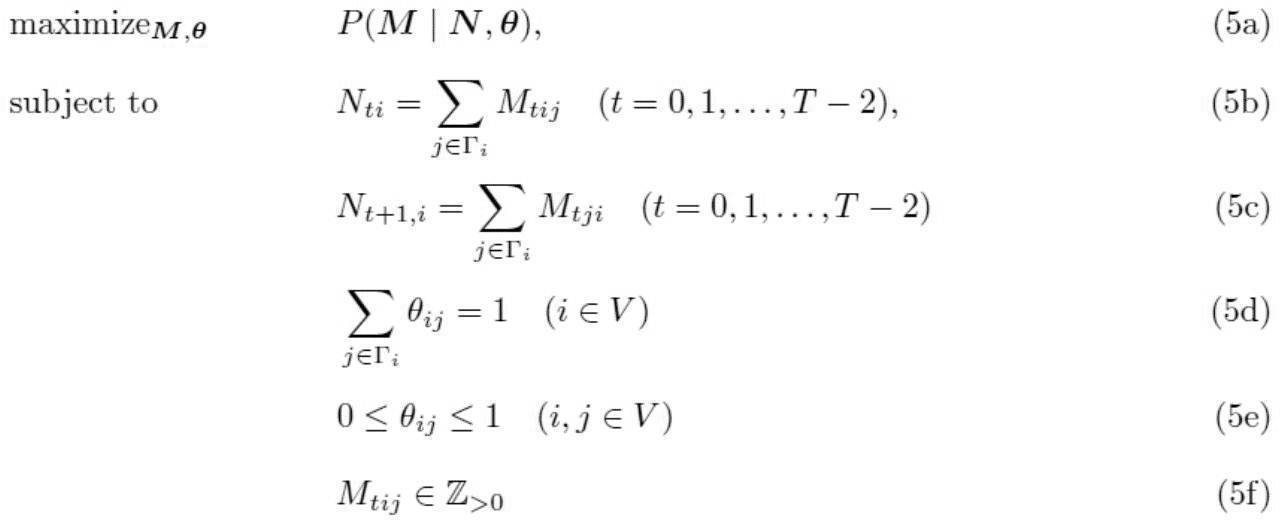
ただし、 However,

は正の整数全体の集合である。 Is the set of all positive integers.
上記の最適化問題を解く方法はいくつか考えられるが、本実施の形態においてはMetropolis-Hastings法(非特許文献3参照)を利用したstochastic EM法(非特許文献4参照)によって解く。この方法によって、Mを整数値として保持及び推定することができる。 There are several methods for solving the above optimization problem, but in this embodiment, the optimization problem is solved by the stochastic-EM method (see Non-Patent Document 4) using the Metropolis-Hastings method (see Non-Patent Document 3). By this method, M can be held and estimated as an integer value.
[非特許文献3] W. K. Hastings. Monte Carlo Sampling Methods Using Markov Chains and Their Applications. Biometrika, Volume57, Number 1(1970), 97-109 [Non-Patent Document 3] W. K. Hastings. Monte Carlo Sampling Methods Using Markov Chains and Their Applications. Biometrika, Volume57, Number 1 (1970), 97-109
[非特許文献4] S. F. Nielsen. The Stochastic EM Algorithm: Estimation and Asymptotic Results. Bernoulli, Volume 6, Number3(2000), 457-489 [Non-Patent Document 4] S. F. Nielsen. The Stochastic EM Algorithm: Estimation and Asymptotic Results. Bernoulli, Volume 6, Number3 (2000), 457-489
具体的には、以下に示すEステップとMステップを繰り返すことによってM,θを更新していく。 Specifically, M and θ are updated by repeating the following E and M steps.
まずEステップ(Mの更新)について説明する。 First, the E step (M update) will be described.
Eステップでは、一般的なstochastic EMアルゴリズムのように、MをサンプリングすることによってMを更新する。更新は、各Mtごとに別々に行う。ただし、Mtは時刻tからt+1の間における推定移動人数を表す。サンプリングの方法としては、Metropolis-Hastings法を用いる。ここで、以下の制約を満たすようなMt全体の集合をFtで表す。 In the E step, M is updated by sampling M as in a general stochastic EM algorithm. Update is performed separately for each M t . However, M t represents the estimated number of moving people between time t and t + 1. As a sampling method, the Metropolis-Hastings method is used. Here, a set of all M t satisfying the following constraints is represented by F t .
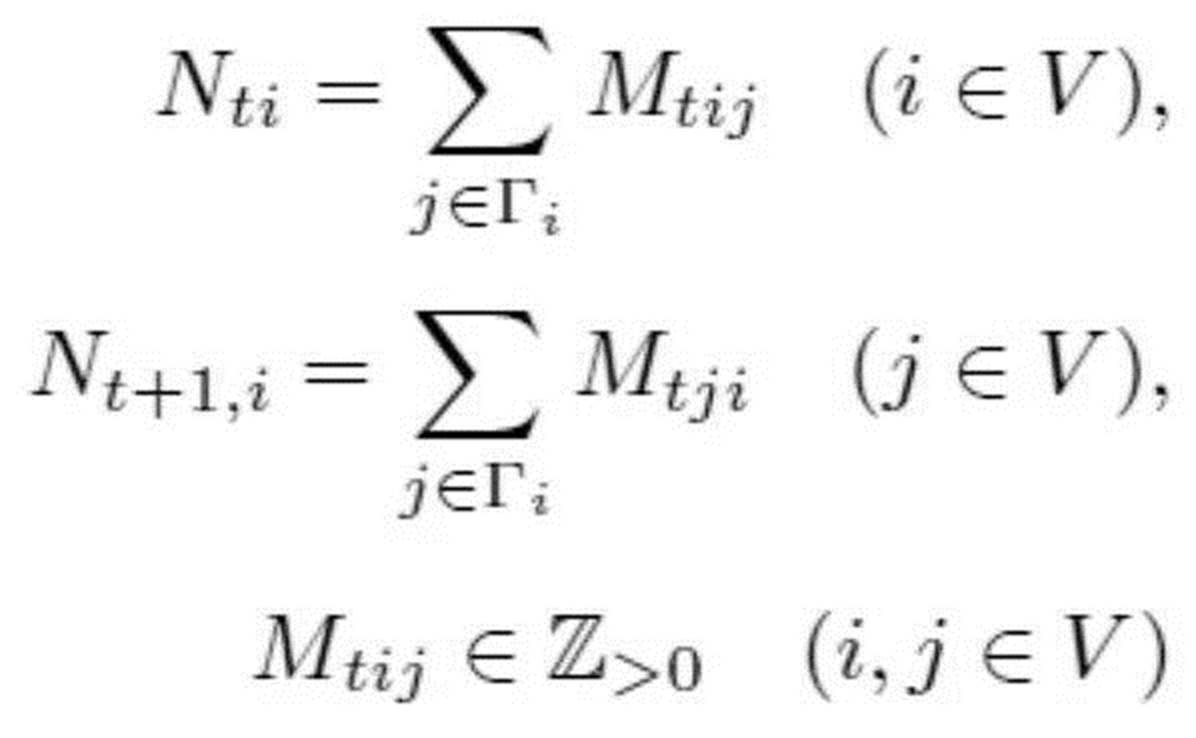
Mtを更新する具体的なアルゴリズムは以下1~5の処理を行う。当該アルゴリズムがMetropolis-Hastings法を利用した方法である。 A specific algorithm for updating M t performs the following processes 1 to 5. This algorithm uses the Metropolis-Hastings method.
1.適当なMinit
t∈FtによってMtを初期化する(Minit
tは例えば線形計画法などによって見つけることができる)。
2.i1,i2をVから抽出する際に、それぞれが重複しないように非復元抽出する。また、i3,i4をVから抽出する際に非復元抽出する。
3.
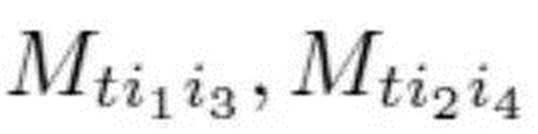
に1を足し、

に-1を足したものをM′
tとする。
4.

ならば何もしないで5に移行する。

の場合、確率
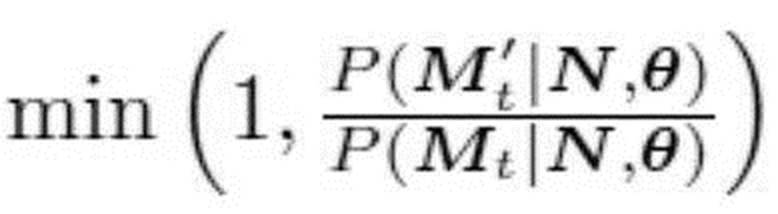
で、
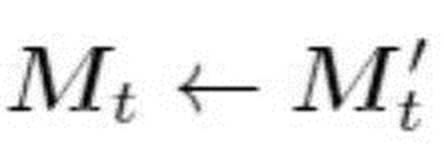
と更新し、確率

で何もしない。
5.上記2~4を繰り返す。適当な回数繰り返した後、Mtを出力する。
1. Initializing the M t by a suitable M init t ∈F t (M init t can be found by, for example linear programming).
2. When extracting i 1 and i 2 from V, non-restoration extraction is performed so that they do not overlap. Further, non-restoration extraction is performed when i 3 and i 4 are extracted from V.
3.
Add 1 to
And M 't what was plus -1.
4).
Then do nothing and go to 5.
If
so,
And update the probability
Do nothing.
5. Repeat steps 2-4 above. After repeating an appropriate number of times, Mt is output.
十分な回数繰り返しを行えば、上記のアルゴリズムによって生成されたMはP(M|N,θ)からの近似的なサンプリングになることを示すことができる。 It can be shown that if it is repeated a sufficient number of times, M generated by the above algorithm is an approximate sampling from P (M | N, θ).
次にMステップ(θの更新)について説明する。 Next, the M step (θ update) will be described.
尤度関数P(M|N,θ)の対数を取ると以下(6)式となる。 When the logarithm of the likelihood function P (M | N, θ) is taken, the following equation (6) is obtained.

ただし、最終行においてはθに依存する部分以外に関しては定数として省略している。logP(M|N,θ)を制約 However, in the last line, parts other than those depending on θ are omitted as constants. constrain logP (M | N, θ)

のもとで最大化すればよい。このようなθ*は、ラグランジュの未定乗数法を用いることにより以下(7)式のように閉形式で記述することができる。 Can be maximized under. Such θ * can be described in a closed form as shown in the following equation (7) by using Lagrange's undetermined multiplier method.

以上が推定プロセスの概観である。 The above is an overview of the estimation process.
以上の推定プロセスを踏まえて各処理部の処理について説明する。 The processing of each processing unit will be described based on the above estimation process.
推定制御部2は人口統計情報蓄積部1から人口統計情報を読み出し、整数移動人数推定部3に渡すことで推定プロセスをスタートさせる。また、移動確率推定部4の実行が完了する度に条件を満たすかを判定し、推定を終えるか否かのチェックを行うことで、整数移動人数推定部3及び移動確率推定部4の処理を繰り返す。条件を満たすかの判断の方法として、尤度が収束したかどうかを確認する方法や、指定された回数の反復が終わった場合に終了させる方法などが考えられる。推定を終える場合、推定された整数移動人数と移動確率を、それぞれ整数移動人数蓄積部5と移動確率蓄積部6に送信する。
The
整数移動人数推定部3は、人口統計情報のエリアの各々の各時刻の人口に基づいて、エリアの各々の各時刻の人口Nti、各時刻におけるエリア間の移動人数Mti、及びエリア間の移動確率θijを用いて表される上記(2)式の尤度関数を最大化するように、上記(5b)~(5f)式に示す、エリアの各々の各時刻の人口と、各時刻におけるエリア間の移動人数とが予め定められた関係であること、及び各時刻におけるエリア間の移動人数が整数値であることを制約として、各時刻におけるエリア間の移動人数Mを推定する。具体的な推定は、上記Eステップで説明したMetropolis-Hastings法を利用したアルゴリズムに従って、移動確率推定部4によって推定されたエリア間の移動確率、及び上記(2)式の尤度関数に基づいて、(5b)~(5f)式の制約を満たす、各時刻におけるエリア間の移動人数をサンプリングすることにより行う。
Based on the population at each time of each area of the demographic information area, the integer movement
移動確率推定部4は、推定された各時刻におけるエリア間の移動人数Mに基づいて、上記(2)式の尤度関数を最大化するように、エリア間の移動確率を推定する。具体的には上記Mステップで説明したように、上記(7)式に従って移動確率θを推定する。
The movement
整数移動人数蓄積部5は、推定された移動人数Mを記憶する。整数移動人数蓄積部5には、例えば図3に示すように、出発タイムスタンプ、出発エリア、到着エリア、及び移動人数のレコードが格納される。 The integer moving number accumulating unit 5 stores the estimated moving number M. For example, as shown in FIG. 3, the integer moving number accumulating unit 5 stores a departure time stamp, a departure area, an arrival area, and a record of the number of moving persons.
移動確率蓄積部6は、推定された移動確率θを記憶する。移動確率蓄積部6には、例えば図4に示すように、出発エリア、到着エリア、及び移動確率のレコードが格納される。 The movement probability accumulation unit 6 stores the estimated movement probability θ. For example, as shown in FIG. 4, a record of departure area, arrival area, and movement probability is stored in the movement probability accumulation unit 6.
出力部8は、整数移動人数蓄積部5に格納された各タイムステップ間の各エリア間の移動人数Mと、移動確率蓄積部6に格納された各エリア間の移動確率θを読み込み、それらを出力する。
The
<本発明の実施の形態に係る整数移動人数推定装置の作用> <Operation of Integer Movement Number Estimating Device According to Embodiment of the Present Invention>
次に、本発明の実施の形態に係る整数移動人数推定装置100の作用について説明する。整数移動人数推定装置100は、推定制御部2が人口統計情報蓄積部1から人口統計情報を読み出し、整数移動人数推定部3に渡すことで推定プロセスをスタートさせることにより、図5に示す整数移動人数推定処理ルーチンを実行する。
Next, the operation of the integer movement
まず、ステップS100では、整数移動人数推定部3が、人口統計情報のエリアの各々の各時刻の人口に基づいて、エリアの各々の各時刻の人口Nti、各時刻におけるエリア間の移動人数Mti、及びエリア間の移動確率θijを用いて表される上記(2)式の尤度関数を最大化するように、上記(5b)~(5f)式に示す、エリアの各々の各時刻の人口と、各時刻におけるエリア間の移動人数とが予め定められた関係であること、及び各時刻におけるエリア間の移動人数が整数値であることを制約として、各時刻におけるエリア間の移動人数Mを推定する。詳細には、(5b)~(5f)式の制約を満たす、各時刻におけるエリア間の移動人数をサンプリングすることにより行う。
First, in step S100, the integer movement
次に、ステップS102では、移動確率推定部4が、ステップS100で推定された各時刻におけるエリア間の移動人数Mに基づいて、上記(2)式の尤度関数を最大化するように、上記(7)式に従ってエリア間の移動確率を推定する。具体的には上記Mステップで説明した方法により移動確率θを推定する。
Next, in step S102, the movement
ステップS104では、推定制御部2が、条件を満たすかを判定し、条件を満たしていれば処理を終了し、条件を満たしていなければステップS100、S102の処理を繰り返す。
In step S104, the
以上説明したように、本発明の実施の形態に係る整数移動人数推定装置によれば、エリアの各々の各時刻の人口に基づいて、エリアの各々の各時刻の人口、各時刻におけるエリア間の移動人数、及びエリア間の移動確率を用いて表される尤度関数を最大化するように、エリアの各々の各時刻の人口と、各時刻におけるエリア間の移動人数とが予め定められた関係であること、及び各時刻におけるエリア間の移動人数が整数値であることを制約として、各時刻におけるエリア間の移動人数を推定し、推定された各時刻におけるエリア間の移動人数に基づいて、尤度関数を最大化するように、エリア間の移動確率を推定することを予め定められた条件を満たすまで繰り返すことにより、エリアのサイズに依存することなく、整数値によって移動人数を精度よく推定できる。 As described above, according to the integer movement number estimating device according to the embodiment of the present invention, based on the population at each time of each area, the population at each time of each area, between the areas at each time Predetermined relationship between the population at each time of the area and the number of people moving between areas at each time so as to maximize the likelihood function expressed using the number of people moving and the probability of movement between areas With the constraint that the number of people moving between areas at each time is an integer value, the number of people moving between areas at each time is estimated, and based on the number of people moving between areas at each estimated time, It moves by an integer value without depending on the size of the area by repeating the estimation of the movement probability between areas so as to maximize the likelihood function until a predetermined condition is satisfied. The number can be accurately estimated.
<変形例> <Modification>
上述した実施の形態の変形例について説明する。 A modification of the above-described embodiment will be described.
変形例では、上述した実施の形態における整数移動人数推定部3の処理を、サンプリングを利用した方法ではなく、制約が付いた輸送問題として定式化を行い輸送問題のアルゴリズムを適用した推定に変更した場合について説明する。
In the modified example, the processing of the integer movement
整数移動人数推定装置100の整数移動人数推定部3の処理部分だけが変更され、他の構成及び作用については同様であるため、整数移動人数推定部3の変更部分についてのみ説明を行う。
Since only the processing part of the integer movement
整数移動人数推定部3における尤度関数を以下(8)式のように定式化する。
The likelihood function in the integer movement

ただしMに関係ない部分は定数として省略する。(8)式の尤度関数を最大化し、かつ、以下(9b)~(9d)式の制約を満たす、各時刻におけるエリア間の移動人数を推定する。 (However, parts not related to M are omitted as constants. The likelihood function of equation (8) is maximized, and the number of people moving between areas at each time that satisfies the constraints of equations (9b) to (9d) below is estimated.

上記の最適化問題は、一般的に輸送問題(非特許文献5参照)と言われている最適化問題の一例になっているため、輸送問題のアルゴリズムを適用することができる。目的関数がMtに関して線形ではないため大域的最適解が得られるとは限らないが、十分な品質の解を得られると考えられる。 The above optimization problem is an example of an optimization problem generally referred to as a transportation problem (see Non-Patent Document 5), and therefore an algorithm for a transportation problem can be applied. Since the objective function is not linear with respect to Mt, a global optimum solution is not always obtained, but it is considered that a solution of sufficient quality can be obtained.
[非特許文献5] G.B. Danzig. Application of the simplex method to a transportation problem. In T. C. Koopmans,editor, Activity Analysis of Production and Allocation, volume 13 of Cowles Commission for Research in Economics, pages 359-373.Wiley, 1951. [Non-Patent Literature 5] GB Danzig. Application of the simplex method to a transportation problem. In T. C. Koopmans, editor, Activity Analysis of Production and Allocation, volume 13 ofowlCowles Commission for Research inpageEcon359 Wiley, 1951.
整数移動人数推定部3のEステップにおいて輸送問題のアルゴリズムを適用して処理し、上述した実施の形態のMステップを繰り返すことで、各時刻におけるエリア間の移動人数を推定することができる。
It is possible to estimate the number of people moving between areas at each time by applying the algorithm of the transportation problem in the E step of the integer moving
なお、本発明は、上述した実施の形態に限定されるものではなく、この発明の要旨を逸脱しない範囲内で様々な変形や応用が可能である。 Note that the present invention is not limited to the above-described embodiment, and various modifications and applications are possible without departing from the gist of the present invention.
1 人口統計情報蓄積部
2 推定制御部
3 整数移動人数推定部
4 移動確率推定部
5 整数移動人数蓄積部
6 移動確率蓄積部
7 操作部
20 演算部
100 整数移動人数推定装置
DESCRIPTION OF SYMBOLS 1 Demographic
Claims (7)
前記推定された前記各時刻におけるエリア間の移動人数に基づいて、前記尤度関数を最大化するように、前記エリア間の移動確率を推定する移動確率推定部と、
前記整数移動人数推定部、及び移動確率推定部との処理を予め定められた条件を満たすまで繰り返す推定制御部と、
を含む整数移動人数推定装置。 Based on the population at each time of each area, the likelihood function expressed using the population at each time of each area, the number of people moving between the areas at each time, and the probability of movement between the areas is maximized. As described above, the population at each time of the area and the number of people moving between the areas at each time are in a predetermined relationship, and the number of people moving between the areas at each time is an integer value. With this as a constraint, an integer moving number estimating unit that estimates the number of moving persons between areas at each time,
Based on the estimated number of people moving between areas at each time, a movement probability estimation unit that estimates the movement probability between the areas so as to maximize the likelihood function;
An estimation control unit that repeats the processing with the integer movement number estimation unit and the movement probability estimation unit until a predetermined condition is satisfied;
Integer mobile number estimation device including
移動確率推定部が、前記推定された前記各時刻におけるエリア間の移動人数に基づいて、前記尤度関数を最大化するように、前記エリア間の移動確率を推定するステップと、
推定制御部が、前記整数移動人数推定部、及び移動確率推定部との処理を予め定められた条件を満たすまで繰り返すステップと、
を含む整数移動人数推定方法。 Based on the population at each time of the area, the integer movement number estimation unit is represented using the population at each time of the area, the number of people moving between the areas at each time, and the movement probability between the areas. In order to maximize the likelihood function, the population at each time of the area and the number of people moving between the areas at each time are in a predetermined relationship, and between the areas at each time With the restriction that the number of people moving is an integer value, the step of estimating the number of people moving between the areas at each time,
A step of estimating a movement probability between the areas so that the movement probability estimation unit maximizes the likelihood function based on the estimated number of persons moving between the areas at each time;
The estimation control unit repeats the processing with the integer moving number estimation unit and the movement probability estimation unit until a predetermined condition is satisfied,
An integer moving person estimation method including
Priority Applications (1)
| Application Number | Priority Date | Filing Date | Title |
|---|---|---|---|
| US15/733,886 US20210216611A1 (en) | 2018-06-01 | 2019-05-27 | Device, method, and program for estimating integral number of moving people |
Applications Claiming Priority (2)
| Application Number | Priority Date | Filing Date | Title |
|---|---|---|---|
| JP2018-106264 | 2018-06-01 | ||
| JP2018106264A JP6893195B2 (en) | 2018-06-01 | 2018-06-01 | Integer mobile number estimator, method, and program |
Publications (1)
| Publication Number | Publication Date |
|---|---|
| WO2019230667A1 true WO2019230667A1 (en) | 2019-12-05 |
Family
ID=68698143
Family Applications (1)
| Application Number | Title | Priority Date | Filing Date |
|---|---|---|---|
| PCT/JP2019/020949 Ceased WO2019230667A1 (en) | 2018-06-01 | 2019-05-27 | Device, method, and program for estimating integral number of moving people |
Country Status (3)
| Country | Link |
|---|---|
| US (1) | US20210216611A1 (en) |
| JP (1) | JP6893195B2 (en) |
| WO (1) | WO2019230667A1 (en) |
Cited By (1)
| Publication number | Priority date | Publication date | Assignee | Title |
|---|---|---|---|---|
| JPWO2021240753A1 (en) * | 2020-05-28 | 2021-12-02 |
Families Citing this family (1)
| Publication number | Priority date | Publication date | Assignee | Title |
|---|---|---|---|---|
| JP7243820B2 (en) * | 2019-05-27 | 2023-03-22 | 日本電信電話株式会社 | Moving number estimation device, moving number estimation method, and moving number estimation program |
Citations (4)
| Publication number | Priority date | Publication date | Assignee | Title |
|---|---|---|---|---|
| JP2012141953A (en) * | 2010-11-09 | 2012-07-26 | Ntt Docomo Inc | System and method for population tracking, counting, and movement estimation using mobile operational data and/or geographic information in mobile network |
| US20150088611A1 (en) * | 2013-09-24 | 2015-03-26 | Hendrik Wagenseil | Methods, Systems and Apparatus for Estimating the Number and Profile of Persons in a Defined Area Over Time |
| JP2017016186A (en) * | 2015-06-26 | 2017-01-19 | 日本電信電話株式会社 | Flow estimation device, prediction device, and program |
| WO2017159734A1 (en) * | 2016-03-15 | 2017-09-21 | 三菱重工業株式会社 | Delivery planning system, delivery planning method, and program |
Family Cites Families (2)
| Publication number | Priority date | Publication date | Assignee | Title |
|---|---|---|---|---|
| CN102611985B (en) * | 2011-01-24 | 2016-02-24 | 国际商业机器公司 | A kind of for providing the method and apparatus of trip information |
| US10395519B2 (en) * | 2015-08-11 | 2019-08-27 | Telecom Italia S.P.A. | Method and system for computing an O-D matrix obtained through radio mobile network data |
-
2018
- 2018-06-01 JP JP2018106264A patent/JP6893195B2/en active Active
-
2019
- 2019-05-27 WO PCT/JP2019/020949 patent/WO2019230667A1/en not_active Ceased
- 2019-05-27 US US15/733,886 patent/US20210216611A1/en not_active Abandoned
Patent Citations (4)
| Publication number | Priority date | Publication date | Assignee | Title |
|---|---|---|---|---|
| JP2012141953A (en) * | 2010-11-09 | 2012-07-26 | Ntt Docomo Inc | System and method for population tracking, counting, and movement estimation using mobile operational data and/or geographic information in mobile network |
| US20150088611A1 (en) * | 2013-09-24 | 2015-03-26 | Hendrik Wagenseil | Methods, Systems and Apparatus for Estimating the Number and Profile of Persons in a Defined Area Over Time |
| JP2017016186A (en) * | 2015-06-26 | 2017-01-19 | 日本電信電話株式会社 | Flow estimation device, prediction device, and program |
| WO2017159734A1 (en) * | 2016-03-15 | 2017-09-21 | 三菱重工業株式会社 | Delivery planning system, delivery planning method, and program |
Cited By (3)
| Publication number | Priority date | Publication date | Assignee | Title |
|---|---|---|---|---|
| JPWO2021240753A1 (en) * | 2020-05-28 | 2021-12-02 | ||
| WO2021240753A1 (en) * | 2020-05-28 | 2021-12-02 | 日本電信電話株式会社 | Estimation device, estimation method, and estimation program |
| JP7392846B2 (en) | 2020-05-28 | 2023-12-06 | 日本電信電話株式会社 | Estimation device, estimation method, and estimation program |
Also Published As
| Publication number | Publication date |
|---|---|
| US20210216611A1 (en) | 2021-07-15 |
| JP2019211918A (en) | 2019-12-12 |
| JP6893195B2 (en) | 2021-06-23 |
Similar Documents
| Publication | Publication Date | Title |
|---|---|---|
| Bradley et al. | Computationally efficient multivariate spatio-temporal models for high-dimensional count-valued data (with discussion) | |
| Said et al. | Spatiotemporal tensor completion for improved urban traffic imputation | |
| Ward et al. | Dynamic calibration of agent-based models using data assimilation | |
| KR102219346B1 (en) | Systems and methods for performing bayesian optimization | |
| Arief-Ang et al. | Da-hoc: semi-supervised domain adaptation for room occupancy prediction using co2 sensor data | |
| JP6761789B2 (en) | People flow forecasters, systems and programs | |
| CN112541852B (en) | Urban people stream monitoring method and device, electronic equipment and storage medium | |
| JP6775469B2 (en) | OD traffic predictors, methods, and programs | |
| JP6283331B2 (en) | Flow estimation device, prediction device, and program | |
| JP6749282B2 (en) | Human flow rate prediction device, human flow rate prediction method, and human flow rate prediction program | |
| JP6665071B2 (en) | Person flow prediction device, person flow prediction method, and person flow prediction program | |
| JP6807822B2 (en) | Human flow predictors, methods, and programs | |
| WO2023151333A1 (en) | Video processing method and apparatus, device and storage medium | |
| WO2019230667A1 (en) | Device, method, and program for estimating integral number of moving people | |
| Offor et al. | Traffic estimation for large urban road network with high missing data ratio | |
| Kazemipour et al. | Sampling requirements for stable autoregressive estimation | |
| Ul Abideen et al. | Crowd flow prediction: an integrated approach using dynamic spatial–temporal adaptive modeling for pattern flow relationships | |
| Das et al. | BESTED: an exponentially smoothed spatial Bayesian analysis model for spatio-temporal prediction of daily precipitation | |
| Grosskopf et al. | In-situ spatial inference on climate simulations with sparse gaussian processes | |
| CN119419763A (en) | A method and system for predicting power load, and computer equipment | |
| Liu et al. | Align Along Time and Space: A Graph Latent Diffusion Model for Traffic Dynamics Prediction | |
| Komninos et al. | Combining infrastructure sensor and tourism market data in a smart city project—Case study 1 | |
| CN114330897A (en) | Method and device for constructing population distribution prediction model, server and storage medium | |
| JP6959559B2 (en) | Data number determination device, data number determination method and data number determination program | |
| CN114758761B (en) | Prediction method, device, equipment and storage medium for the number of hospital outpatient visits based on two-step regression |
Legal Events
| Date | Code | Title | Description |
|---|---|---|---|
| 121 | Ep: the epo has been informed by wipo that ep was designated in this application |
Ref document number: 19810104 Country of ref document: EP Kind code of ref document: A1 |
|
| NENP | Non-entry into the national phase |
Ref country code: DE |
|
| 122 | Ep: pct application non-entry in european phase |
Ref document number: 19810104 Country of ref document: EP Kind code of ref document: A1 |