WO2019195738A1 - Compositions and methods for somatic cell reprogramming and modulating imprinting - Google Patents
Compositions and methods for somatic cell reprogramming and modulating imprinting Download PDFInfo
- Publication number
- WO2019195738A1 WO2019195738A1 PCT/US2019/026074 US2019026074W WO2019195738A1 WO 2019195738 A1 WO2019195738 A1 WO 2019195738A1 US 2019026074 W US2019026074 W US 2019026074W WO 2019195738 A1 WO2019195738 A1 WO 2019195738A1
- Authority
- WO
- WIPO (PCT)
- Prior art keywords
- cell
- scnt
- cells
- xist
- oocyte
- Prior art date
- Legal status (The legal status is an assumption and is not a legal conclusion. Google has not performed a legal analysis and makes no representation as to the accuracy of the status listed.)
- Ceased
Links
Classifications
-
- C—CHEMISTRY; METALLURGY
- C12—BIOCHEMISTRY; BEER; SPIRITS; WINE; VINEGAR; MICROBIOLOGY; ENZYMOLOGY; MUTATION OR GENETIC ENGINEERING
- C12N—MICROORGANISMS OR ENZYMES; COMPOSITIONS THEREOF; PROPAGATING, PRESERVING, OR MAINTAINING MICROORGANISMS; MUTATION OR GENETIC ENGINEERING; CULTURE MEDIA
- C12N15/00—Mutation or genetic engineering; DNA or RNA concerning genetic engineering, vectors, e.g. plasmids, or their isolation, preparation or purification; Use of hosts therefor
- C12N15/09—Recombinant DNA-technology
- C12N15/87—Introduction of foreign genetic material using processes not otherwise provided for, e.g. co-transformation
- C12N15/873—Techniques for producing new embryos, e.g. nuclear transfer, manipulation of totipotent cells or production of chimeric embryos
- C12N15/877—Techniques for producing new mammalian cloned embryos
-
- A—HUMAN NECESSITIES
- A01—AGRICULTURE; FORESTRY; ANIMAL HUSBANDRY; HUNTING; TRAPPING; FISHING
- A01K—ANIMAL HUSBANDRY; AVICULTURE; APICULTURE; PISCICULTURE; FISHING; REARING OR BREEDING ANIMALS, NOT OTHERWISE PROVIDED FOR; NEW BREEDS OF ANIMALS
- A01K67/00—Rearing or breeding animals, not otherwise provided for; New or modified breeds of animals
- A01K67/027—New or modified breeds of vertebrates
-
- C—CHEMISTRY; METALLURGY
- C12—BIOCHEMISTRY; BEER; SPIRITS; WINE; VINEGAR; MICROBIOLOGY; ENZYMOLOGY; MUTATION OR GENETIC ENGINEERING
- C12N—MICROORGANISMS OR ENZYMES; COMPOSITIONS THEREOF; PROPAGATING, PRESERVING, OR MAINTAINING MICROORGANISMS; MUTATION OR GENETIC ENGINEERING; CULTURE MEDIA
- C12N15/00—Mutation or genetic engineering; DNA or RNA concerning genetic engineering, vectors, e.g. plasmids, or their isolation, preparation or purification; Use of hosts therefor
- C12N15/09—Recombinant DNA-technology
- C12N15/11—DNA or RNA fragments; Modified forms thereof; Non-coding nucleic acids having a biological activity
- C12N15/113—Non-coding nucleic acids modulating the expression of genes, e.g. antisense oligonucleotides; Antisense DNA or RNA; Triplex- forming oligonucleotides; Catalytic nucleic acids, e.g. ribozymes; Nucleic acids used in co-suppression or gene silencing
-
- C—CHEMISTRY; METALLURGY
- C12—BIOCHEMISTRY; BEER; SPIRITS; WINE; VINEGAR; MICROBIOLOGY; ENZYMOLOGY; MUTATION OR GENETIC ENGINEERING
- C12N—MICROORGANISMS OR ENZYMES; COMPOSITIONS THEREOF; PROPAGATING, PRESERVING, OR MAINTAINING MICROORGANISMS; MUTATION OR GENETIC ENGINEERING; CULTURE MEDIA
- C12N15/00—Mutation or genetic engineering; DNA or RNA concerning genetic engineering, vectors, e.g. plasmids, or their isolation, preparation or purification; Use of hosts therefor
- C12N15/09—Recombinant DNA-technology
- C12N15/87—Introduction of foreign genetic material using processes not otherwise provided for, e.g. co-transformation
- C12N15/873—Techniques for producing new embryos, e.g. nuclear transfer, manipulation of totipotent cells or production of chimeric embryos
- C12N15/877—Techniques for producing new mammalian cloned embryos
- C12N15/8775—Murine embryos
-
- C—CHEMISTRY; METALLURGY
- C12—BIOCHEMISTRY; BEER; SPIRITS; WINE; VINEGAR; MICROBIOLOGY; ENZYMOLOGY; MUTATION OR GENETIC ENGINEERING
- C12N—MICROORGANISMS OR ENZYMES; COMPOSITIONS THEREOF; PROPAGATING, PRESERVING, OR MAINTAINING MICROORGANISMS; MUTATION OR GENETIC ENGINEERING; CULTURE MEDIA
- C12N15/00—Mutation or genetic engineering; DNA or RNA concerning genetic engineering, vectors, e.g. plasmids, or their isolation, preparation or purification; Use of hosts therefor
- C12N15/09—Recombinant DNA-technology
- C12N15/87—Introduction of foreign genetic material using processes not otherwise provided for, e.g. co-transformation
- C12N15/89—Introduction of foreign genetic material using processes not otherwise provided for, e.g. co-transformation using microinjection
-
- C—CHEMISTRY; METALLURGY
- C12—BIOCHEMISTRY; BEER; SPIRITS; WINE; VINEGAR; MICROBIOLOGY; ENZYMOLOGY; MUTATION OR GENETIC ENGINEERING
- C12N—MICROORGANISMS OR ENZYMES; COMPOSITIONS THEREOF; PROPAGATING, PRESERVING, OR MAINTAINING MICROORGANISMS; MUTATION OR GENETIC ENGINEERING; CULTURE MEDIA
- C12N5/00—Undifferentiated human, animal or plant cells, e.g. cell lines; Tissues; Cultivation or maintenance thereof; Culture media therefor
- C12N5/06—Animal cells or tissues; Human cells or tissues
- C12N5/0602—Vertebrate cells
- C12N5/0608—Germ cells
- C12N5/0609—Oocytes, oogonia
-
- C—CHEMISTRY; METALLURGY
- C12—BIOCHEMISTRY; BEER; SPIRITS; WINE; VINEGAR; MICROBIOLOGY; ENZYMOLOGY; MUTATION OR GENETIC ENGINEERING
- C12N—MICROORGANISMS OR ENZYMES; COMPOSITIONS THEREOF; PROPAGATING, PRESERVING, OR MAINTAINING MICROORGANISMS; MUTATION OR GENETIC ENGINEERING; CULTURE MEDIA
- C12N5/00—Undifferentiated human, animal or plant cells, e.g. cell lines; Tissues; Cultivation or maintenance thereof; Culture media therefor
- C12N5/10—Cells modified by introduction of foreign genetic material
- C12N5/12—Fused cells, e.g. hybridomas
- C12N5/16—Animal cells
-
- C—CHEMISTRY; METALLURGY
- C12—BIOCHEMISTRY; BEER; SPIRITS; WINE; VINEGAR; MICROBIOLOGY; ENZYMOLOGY; MUTATION OR GENETIC ENGINEERING
- C12N—MICROORGANISMS OR ENZYMES; COMPOSITIONS THEREOF; PROPAGATING, PRESERVING, OR MAINTAINING MICROORGANISMS; MUTATION OR GENETIC ENGINEERING; CULTURE MEDIA
- C12N9/00—Enzymes; Proenzymes; Compositions thereof; Processes for preparing, activating, inhibiting, separating or purifying enzymes
- C12N9/0004—Oxidoreductases (1.)
- C12N9/0071—Oxidoreductases (1.) acting on paired donors with incorporation of molecular oxygen (1.14)
-
- A—HUMAN NECESSITIES
- A01—AGRICULTURE; FORESTRY; ANIMAL HUSBANDRY; HUNTING; TRAPPING; FISHING
- A01K—ANIMAL HUSBANDRY; AVICULTURE; APICULTURE; PISCICULTURE; FISHING; REARING OR BREEDING ANIMALS, NOT OTHERWISE PROVIDED FOR; NEW BREEDS OF ANIMALS
- A01K2217/00—Genetically modified animals
- A01K2217/07—Animals genetically altered by homologous recombination
-
- A—HUMAN NECESSITIES
- A01—AGRICULTURE; FORESTRY; ANIMAL HUSBANDRY; HUNTING; TRAPPING; FISHING
- A01K—ANIMAL HUSBANDRY; AVICULTURE; APICULTURE; PISCICULTURE; FISHING; REARING OR BREEDING ANIMALS, NOT OTHERWISE PROVIDED FOR; NEW BREEDS OF ANIMALS
- A01K2227/00—Animals characterised by species
- A01K2227/10—Mammal
- A01K2227/105—Murine
-
- C—CHEMISTRY; METALLURGY
- C12—BIOCHEMISTRY; BEER; SPIRITS; WINE; VINEGAR; MICROBIOLOGY; ENZYMOLOGY; MUTATION OR GENETIC ENGINEERING
- C12N—MICROORGANISMS OR ENZYMES; COMPOSITIONS THEREOF; PROPAGATING, PRESERVING, OR MAINTAINING MICROORGANISMS; MUTATION OR GENETIC ENGINEERING; CULTURE MEDIA
- C12N2310/00—Structure or type of the nucleic acid
- C12N2310/10—Type of nucleic acid
- C12N2310/20—Type of nucleic acid involving clustered regularly interspaced short palindromic repeats [CRISPR]
-
- C—CHEMISTRY; METALLURGY
- C12—BIOCHEMISTRY; BEER; SPIRITS; WINE; VINEGAR; MICROBIOLOGY; ENZYMOLOGY; MUTATION OR GENETIC ENGINEERING
- C12N—MICROORGANISMS OR ENZYMES; COMPOSITIONS THEREOF; PROPAGATING, PRESERVING, OR MAINTAINING MICROORGANISMS; MUTATION OR GENETIC ENGINEERING; CULTURE MEDIA
- C12N2510/00—Genetically modified cells
Definitions
- Mammalian oocytes are capable of reprogramming somatic cells into a totipotent state through somatic cell nuclear transfer (SCNT).
- SCNT is used in therapeutic cloning which involves the generation of tissues from a donor organism that is genetically identical to or similar to the intended host. SCNT also enables cloning of animals. This technique has great potential in agro-biotechnology, as well as in the conservation of endangered species.
- the invention provides methods for improving cloning efficiency.
- the invention provides methods for improving cloning efficiency.
- the invention provides methods for improving somatic cell nuclear transfer efficiency that involve Kdm4d overexpression is an Xist knockout donor cell.
- the invention provides a method for obtaining a cloned blastocyst is provided that includes transferring a donor nucleus obtained from a somatic cell lacking Xist activity into an enucleated oocyte, and expressing in the oocyte Kdm4d , thereby obtaining a cloned blastocyst.
- the oocyte is injected with a Kdm4d mRNA.
- the donor cell nucleus is obtained from an embryoic fibroblast comprising a deletion in Xist or comprising an inactive form of Xist.
- the donor nucleus is obtained from a human, cat, cow, dog, pig, or horse.
- the method also includes transferring the blastocyst into a host uterus for gestation. In some embodiments, the method increases the rate of live births relative to conventional somatic cell nuclear transfer by at least about 10-20%.
- Some aspects of the invention include a blastocyst produced by the method described above. Some aspects of the invention include a cloned organism produced by implanting the blastocyst produced by the method described above.
- the invention provides a method for obtaining a cell or tissue for transplantation into a subject, the method comprising inactivating Xist or reducing Xist activity or expression in a cultured cell obtained from a subject; transferring the nucleus from the cultured cell into an enucleated oocyte, thereby activating the oocyte; and injecting the activated oocyte with a Kdm4d mRNA and culturing the resulting cell, thereby obtaining a cell or tissue suitable for transplantation into the subject.
- a cell or tissue produced by this method is provided.
- Xist is inactivated by genome editing.
- a CRISPR system is used to introduce a deletion or inactivating mutation in a genomic Xist polynucleotide.
- Xist polynucleotide expression or activity is reduced using siRNA or shRNA.
- a cell in other aspects of the invention, has a deletion in Xist or a reduced level of Xist expression and has a heterologous polynucleotide encoding Kdm4d.
- Additional aspects include an oocyte comprising a donor nucleus obtained from a somatic cell lacking Xist activity and expressing an increased level of Kdm4d relative to a conventional oocyte.
- KDM4D polypeptide is meant a polypeptide or fragment thereof having at least about 85% amino acid sequence identity to NCBI Reference No. Q6B0I6 and having demethylase activity.
- An exemplary KDM4D amino acid sequence is provided below:
- KDM4D polynucleotide is meant a nucleic acid molecule encoding a KDM4D polypeptide.
- An exemplary KDM4D nucleic acid is provided below:
- ⁇ ZH1 polypeptide histone-lysine N-methyltransferase EZH1
- NP 001982 a fragment thereof, and having methyltransferase activity.
- An exemplary H3K27 methyltransferase amino acid sequence is provided below:
- ⁇ ZH1 polynucleotide is meant a nucleic acid molecule encoding the EZH1 polypeptide.
- An exemplary EZH1 polynucleotide sequence is provided at NM 001991.4 and reproduced below:
- ⁇ ZH2 polypeptide histone-lysine N-methyltransferase EZH2
- ⁇ ZH2 polypeptide histone-lysine N-methyltransferase EZH2
- UniProtKB/Swiss-Prot Q 15910.2, or a fragment thereof, and having methyltransferase activity.
- An exemplary H3K27 methyltransferase amino acid sequence is provided below:
- EZH2 polynucleotide is meant a nucleic acid molecule encoding an EZH2 polypeptide.
- An exemplary EZH2 polynucleotide sequence is provided at NM_00l203248.l and is provided below:
- KDM6A polypeptide lysine-specific demethylase 6A, also referred to as histone demethylase UTX
- An exemplary KDM6A amino acid sequence is provided below:
- KDM6A polynucleotide is meant a nucleic acid molecule encoding a KDM6A polypeptide.
- An exemplary KDM6A polynucleotide sequence is provided at
- KDM6B polypeptide lysine-specific demethylase 6, also referred to as JmjC domain-containing protein 3
- JmjC domain-containing protein 3 is meant a protein having at least about 85% amino acid identity to the sequence provided at NCBI Reference Sequence: 015054.4, or a fragment thereof, and having demethylase activity.
- An exemplary KDM6B amino acid sequence is provided below:
- KDM6B polynucleotide is meant a nucleic acid molecule encoding a KDM6B polypeptide.
- An exemplary KDM6B polynucleotide sequence is provided at
- KDM6C polypeptide histone demethylase UTY, also referred to as
- ubiquitously-transcribed TPR protein on the Y chromosome is meant a protein having at least about 85% amino acid identity to the sequence provided at NCBI Reference Sequence: 014607.2, or a fragment thereof, and having demethylase activity.
- An exemplary KDM6C amino acid sequence is provided below:
- KDM6C polynucleotide is meant a nucleic acid molecule encoding a KDM6C polypeptide.
- An exemplary KDM6A polynucleotide sequence is provided at
- Gabl polypeptide (GRB2-associated-binding protein 1) is meant a protein having at least about 85% amino acid identity to the sequence provided at NCBI Reference Sequence: NP 997006.1, or a fragment thereof.
- An exemplary Gabl amino acid sequence is provided below:
- “Gabl polynucleotide” is meant a nucleic acid molecule encoding a Gabl polypeptide.
- An exemplary Gabl polynucleotide sequence is provided at NM_002039.3, which is reproduced below:
- Sfmbt2 polypeptide (scm-like with four MBT domains protein 2) is meant a protein having at least about 85% amino acid identity to the sequence provided at NCBI
- Sfmbt2 polynucleotide is meant a polypeptide encoding an Sfmbt2 polypeptide.
- An exemplary Sfmbt2 polynucleotide sequence is provided at NM_001018039.1, which is reproduced below: cgccttgtgt gtgctggatc ctgcgcgggt agatccccga gtaattttttt ctgcaggatg
- Smocl polypeptide SPARC related modular calcium binding 1
- SPARC related modular calcium binding 1 is meant a protein having at least about 85% amino acid identity to the sequence provided at NCBI Reference Sequence: NP 001030024, or a fragment thereof.
- An exemplary Smocl amino acid sequence is provided below:
- Smocl polynucleotide is meant a nucleic acid molecule encoding a Smocl polypeptide.
- An exemplary Smocl polynucleotide sequence is provided at
- tri-methylated histone H3 at lysine 27 is meant the trimethylation of lysine 27 on histone H3 protein subunit.
- the H3K27me3 modification is generally associated with gene repression.
- agent is meant a peptide, nucleic acid molecule, or small compound.
- allele is meant one of two or more alternative forms of a gene that are found at the same place on a chromosome.
- alteration is meant a change (increase or decrease) in the expression levels or activity of a gene or polypeptide as detected by standard art known methods such as those described herein.
- an alteration includes a 10% change in expression levels, preferably a 25% change, more preferably a 40% change, and most preferably a 50% or greater change in expression levels.
- ameliorate is meant decrease, suppress, attenuate, diminish, arrest, or stabilize the development or progression of a disease.
- Detect refers to identifying the presence, absence or amount of the analyte to be detected.
- disease is meant any condition or disorder that damages, or interferes with the normal function of a cell, tissue, or organ.
- disorders include those associated with undesirable repression of an allele by H3K27me3-dependent imprinting.
- Microphthalmia exemplary disorder associated with H3K27me3 -dependent imprinting relating to imprinting disorders is a disorder associated with H3K27me3 -dependent imprinting relating to imprinting disorders.
- DNA deoxyribonucleic acid.
- the term DNA refers to genomic DNA, recombinant DNA, or cDNA.
- the DNA comprises a“target region.”
- DNA libraries contemplated herein include genomic DNA libraries, and cDNA libraries constructed from RNA, e.g., an RNA expression library.
- the DNA libraries comprise one or more additional DNA sequences and/or tags.
- an effective amount is meant the amount of a required to ameliorate the symptoms of a disease relative to an untreated patient.
- the effective amount of active compound(s) used to practice the present invention for therapeutic treatment of a disease varies depending upon the manner of administration, the age, body weight, and general health of the subject. Ultimately, the attending physician or veterinarian will decide the appropriate amount and dosage regimen. Such amount is referred to as an "effective" amount.
- fragment is meant a portion of a polypeptide or nucleic acid molecule. This portion contains, preferably, at least 10%, 20%, 30%, 40%, 50%, 60%, 70%, 80%, or 90% of the entire length of the reference nucleic acid molecule or polypeptide.
- a fragment may contain 10, 20, 30, 40, 50, 60, 70, 80, 90, or 100, 200, 300, 400, 500, 600, 700, 800, 900, or 1000 nucleotides or amino acids.
- isolated refers to material that is free to varying degrees from components which normally accompany it as found in its native state.
- Isolate denotes a degree of separation from original source or surroundings.
- Purify denotes a degree of separation that is higher than isolation.
- a “purified” or “biologically pure” protein is sufficiently free of other materials such that any impurities do not materially affect the biological properties of the protein or cause other adverse consequences. That is, a nucleic acid or peptide of this invention is purified if it is substantially free of cellular material, viral material, or culture medium when produced by recombinant DNA techniques, or chemical precursors or other chemicals when chemically synthesized.
- Purity and homogeneity are typically determined using analytical chemistry techniques, for example, polyacrylamide gel electrophoresis or high performance liquid chromatography.
- the term "purified" can denote that a nucleic acid or protein gives rise to essentially one band in an electrophoretic gel.
- modifications for example, phosphorylation or glycosylation, different modifications may give rise to different isolated proteins, which can be separately purified.
- isolated polynucleotide is meant a nucleic acid (e.g., a DNA) that is free of the genes which, in the naturally-occurring genome of the organism from which the nucleic acid molecule of the invention is derived, flank the gene.
- the term therefore includes, for example, a recombinant DNA that is incorporated into a vector; into an autonomously replicating plasmid or virus; or into the genomic DNA of a prokaryote or eukaryote; or that exists as a separate molecule (for example, a cDNA or a genomic or cDNA fragment produced by PCR or restriction endonuclease digestion) independent of other sequences.
- the term includes an RNA molecule that is transcribed from a DNA molecule, as well as a recombinant DNA that is part of a hybrid gene encoding additional polypeptide sequence.
- an “isolated polypeptide” is meant a polypeptide of the invention that has been separated from components that naturally accompany it.
- the polypeptide is isolated when it is at least 60%, by weight, free from the proteins and naturally-occurring organic molecules with which it is naturally associated.
- the preparation is at least 75%, more preferably at least 90%, and most preferably at least 99%, by weight, a
- polypeptide of the invention An isolated polypeptide of the invention may be obtained, for example, by extraction from a natural source, by expression of a recombinant nucleic acid encoding such a polypeptide; or by chemically synthesizing the protein. Purity can be measured by any appropriate method, for example, column chromatography, polyacrylamide gel electrophoresis, or by HPLC analysis.
- Ranges provided herein are understood to be shorthand for all of the values within the range.
- a range of 1 to 50 is understood to include any number, combination of numbers, or sub-range from the group consisting 1, 2, 3, 4, 5, 6, 7, 8, 9, 10, 11, 12, 13, 14, 15,
- A“reference sequence” is a defined sequence used as a basis for sequence
- a reference sequence may be a subset of or the entirety of a specified sequence; for example, a segment of a full-length cDNA or gene sequence, or the complete cDNA or gene sequence.
- the length of the reference polypeptide sequence will generally be at least about 16 amino acids, preferably at least about 20 amino acids, more preferably at least about 25 amino acids, and even more preferably about 35 amino acids, about 50 amino acids, or about 100 amino acids.
- the length of the reference nucleic acid sequence will generally be at least about 50 nucleotides, preferably at least about 60 nucleotides, more preferably at least about 75 nucleotides, and even more preferably about 100 nucleotides or about 300 nucleotides or any integer thereabout or therebetween.
- Nucleic acid molecules useful in the methods of the invention include any nucleic acid molecule that encodes a polypeptide of the invention or a fragment thereof. Such nucleic acid molecules need not be 100% identical with an endogenous nucleic acid sequence, but will typically exhibit substantial identity. Polynucleotides having“substantial identity” to an endogenous sequence are typically capable of hybridizing with at least one strand of a double-stranded nucleic acid molecule. Nucleic acid molecules useful in the methods of the invention include any nucleic acid molecule that encodes a polypeptide of the invention or a fragment thereof. Such nucleic acid molecules need not be 100% identical with an endogenous nucleic acid sequence, but will typically exhibit substantial identity. Polynucleotides having“substantial identity” to an endogenous sequence are typically capable of hybridizing with at least one strand of a double-stranded nucleic acid molecule.
- hybridize pair to form a double-stranded molecule between complementary polynucleotide sequences (e.g., a gene described herein), or portions thereof, under various conditions of stringency.
- complementary polynucleotide sequences e.g., a gene described herein
- stringency See, e.g., Wahl, G. M. and S. L. Berger (1987) Methods Enzymol. 152:399; Kimmel, A. R. (1987) Methods Enzymol. 152:507).
- stringent salt concentration will ordinarily be less than about 750 mM NaCl and 75 mM trisodium citrate, preferably less than about 500 mM NaCl and 50 mM trisodium citrate, and more preferably less than about 250 mM NaCl and 25 mM trisodium citrate.
- Low stringency hybridization can be obtained in the absence of organic solvent, e.g., formamide, while high stringency hybridization can be obtained in the presence of at least about 35% formamide, and more preferably at least about 50% formamide.
- Stringent temperature conditions will ordinarily include temperatures of at least about 30° C, more preferably of at least about 37° C, and most preferably of at least about 42° C.
- Varying additional parameters, such as hybridization time, the concentration of detergent, e.g., sodium dodecyl sulfate (SDS), and the inclusion or exclusion of carrier DNA, are well known to those skilled in the art.
- concentration of detergent e.g., sodium dodecyl sulfate (SDS)
- SDS sodium dodecyl sulfate
- Various levels of stringency are accomplished by combining these various conditions as needed.
- hybridization will occur at 30° C in 750 mM NaCl, 75 mM trisodium citrate, and 1% SDS.
- hybridization will occur at 37° C in 500 mM NaCl, 50 mM trisodium citrate, 1% SDS, 35% formamide, and 100 .mu.g/ml denatured salmon sperm DNA (ssDNA).
- hybridization will occur at 42° C in 250 mM NaCl, 25 mM trisodium citrate, 1% SDS, 50% formamide, and 200 pg/ml ssDNA. Useful variations on these conditions will be readily apparent to those skilled in the art.
- wash stringency conditions can be defined by salt concentration and by temperature. As above, wash stringency can be increased by decreasing salt concentration or by increasing temperature.
- stringent salt concentration for the wash steps will preferably be less than about 30 mM NaCl and 3 mM trisodium citrate, and most preferably less than about 15 mM NaCl and 1.5 mM trisodium citrate.
- Stringent temperature conditions for the wash steps will ordinarily include a temperature of at least about 25° C, more preferably of at least about 42° C, and even more preferably of at least about 68° C.
- wash steps will occur at 25° C in 30 mM NaCl, 3 mM trisodium citrate, and 0.1% SDS. In a more preferred embodiment, wash steps will occur at 42 C in 15 mM NaCl, 1.5 mM trisodium citrate, and 0.1% SDS. In a more preferred embodiment, wash steps will occur at 68° C in 15 mM NaCl, 1.5 mM trisodium citrate, and 0.1% SDS.
- Hybridization techniques are well known to those skilled in the art and are described, for example, in Benton and Davis (Science 196: 180, 1977); Grunstein and Hogness (Proc. Natl. Acad. Sci., USA 72:3961, 1975); Ausubel et al. (Current Protocols in Molecular Biology, Wiley Interscience, New York, 2001); Berger and Kimmel (Guide to Molecular Cloning Techniques, 1987, Academic Press, New York); and Sambrook et al., Molecular Cloning: A Laboratory Manual, Cold Spring Harbor Laboratory Press, New York.
- substantially identical is meant a polypeptide or nucleic acid molecule exhibiting at least 50% identity to a reference amino acid sequence (for example, any one of the amino acid sequences described herein) or nucleic acid sequence (for example, any one of the nucleic acid sequences described herein).
- a reference amino acid sequence for example, any one of the amino acid sequences described herein
- nucleic acid sequence for example, any one of the nucleic acid sequences described herein.
- such a sequence is at least 60%, more preferably 80% or 85%, and more preferably 90%, 95% or even 99% identical at the amino acid level or nucleic acid to the sequence used for comparison.
- Sequence identity is typically measured using sequence analysis software (for example, Sequence Analysis Software Package of the Genetics Computer Group, University of Wisconsin Biotechnology Center, 1710 University Avenue, Madison, Wis. 53705,
- BLAST, BESTFIT, GAP, or PILEUP/PRETTYBOX programs Such software matches identical or similar sequences by assigning degrees of homology to various substitutions, deletions, and/or other modifications.
- Conservative substitutions typically include substitutions within the following groups: glycine, alanine; valine, isoleucine, leucine;
- a BLAST program may be used, with a probability score between e 3 and e 100 indicating a closely related sequence.
- Somatic Cell Nuclear Transfer or“SCNT” is meant the transfer of a donor nucleus from a somatic cell into an enucleated oocyte.
- the process can be used in either reproductive or therapeutic cloning and may be accomplished by fusion of the somatic cell with the enucleated oocyte, injection of the nucleus into the enucleated oocyte, or by any other method.
- the nucleus of the somatic cell provides the genetic information, while the oocyte provides the nutrients and other energy-producing materials that are necessary for development of an embryo. Once fusion has occurred, the cell is totipotent, and eventually develops into a blastocyst, at which point the inner cell mass is isolated.
- nuclear transfer refers to a gene manipulation technique allowing an identical characteristics and qualities acquired by artificially combining an enucleated oocytes with a cell nuclear genetic material or a nucleus of a somatic cell.
- the nuclear transfer procedure is where a nucleus or nuclear genetic material from a donor somatic cell is transferred into an enucleated egg or oocyte (an egg or oocyte from which the nucleus/pronuclei have been removed).
- the donor nucleus can come from a somatic cell.
- nuclear genetic material refers to structures and/or molecules found in the nucleus which comprise polynucleotides (e.g., DNA) which encode information about the individual.
- Nuclear genetic material includes the chromosomes and chromatin.
- nuclear genetic material e.g., chromosomes
- nuclear genetic material does not include mitochondrial DNA.
- SCNT embryo refers to a cell, or the totipotent progeny thereof, of an enucleated oocyte which has been fused with the nucleus or nuclear genetic material of a somatic cell.
- the SCNT embryo can develop into a blastocyst and develop post-implantation into living offspring.
- the SCNT embryo can be a l-cell embryo, 2-cell embryo, 4-cell embryo, or any stage embryo prior to becoming a blastocyst.
- donor human cell or“donor human somatic cell” refers to a somatic cell or a nucleus of human cell which is transferred into a recipient oocyte as a nuclear acceptor or recipient.
- a differentiated cell refers to a plant or animal cell which is not a reproductive cell or reproductive cell precursor. In some embodiments, a differentiated cell is not a germ cell.
- a somatic cell does not relate to pluripotent or totipotent cells.
- the somatic cell is a "non-embryonic somatic cell”, by which is meant a somatic cell that is not present in or obtained from an embryo and does not result from proliferation of such a cell in vitro.
- the somatic cell is an "adult somatic cell”, by which is meant a cell that is present in or obtained from an organism other than an embryo or a fetus or results from proliferation of such a cell in vitro.
- oocyte refers to a mature oocyte which has reached metaphase II of meiosis.
- An oocyte is also used to describe a female gamete or germ cell involved in reproduction, and is commonly also called an egg.
- a mature egg has a single set of maternal chromosomes (23, X in a human primate) and is halted at metaphase II.
- A“hybrid oocyte” refers to an enucleated oocyte that has the cytoplasm from a first human oocyte (termed a“recipient”) but does not have the nuclear genetic material of the recipient oocyte; it has the nuclear genetic material from another human cell, termed a “donor.”
- the hybrid oocyte can also comprise mitochondrial DNA (mtDNA) that is not from the recipient oocyte, but is from a donor cell (which can be the same donor cell as the nuclear genetic material, or from a different donor, e.g., from a donor oocyte).
- nucleated oocyte refers to an human oocyte which its nucleus has been removed.
- enucleation refers to a process whereby the nuclear material of a cell is removed, leaving only the cytoplasm. When applied to an egg, enucleation refers to the removal of the maternal chromosomes, which are not surrounded by a nuclear membrane.
- enucleated oocyte refers to an oocyte where the nuclear material or nuclei is removed.
- the "recipient human oocyte” as used herein refers to a human oocyte that receives a nucleus from a human nuclear donor cell after removing its original nucleus.
- fusion refers to a combination of a nuclear donor cell and a lipid membrane of a recipient oocyte.
- the lipid membrane may be the plasma membrane or nuclear membrane of a cell. Fusion may occur upon application of an electrical stimulus between a nuclear donor cell and a recipient oocyte when they are placed adjacent to each other or when a nuclear donor cell is placed in a perivitelline space of a recipient oocyte.
- living offspring means an animal that can survive ex utero. Preferably, it is an animal that can survive for one second, one minute, one day, one week, one month, six months or more than one year. The animal may not require an in utero environment for survival.
- prenatal refers to existing or occurring before birth.
- postnatal is existing or occurring after birth.
- blastocyst refers to a preimplantation embryo in placental mammals (about 3 days after fertilization in the mouse, about 5 days after fertilization in humans) of about 30-150 cells.
- the blastocyst stage follows the morula stage, and can be distinguished by its unique morphology.
- the blastocyst consists of a sphere made up of a layer of cells (the trophectoderm), a fluid-filled cavity (the blastocoel or blastocyst cavity), and a cluster of cells on the interior (the inner cell mass, or ICM).
- the ICM consisting of undifferentiated cells, gives rise to what will become the fetus if the blastocyst is implanted in a uterus. These same ICM cells, if grown in culture, can give rise to embryonic stem cell lines. At the time of implantation the mouse blastocyst is made up of about 70 trophoblast cells and 30 ICM cells.
- blastula refers to an early stage in the development of an embryo consisting of a hollow sphere of cells enclosing a fluid-filled cavity called the blastocoel.
- blastula sometimes is used interchangeably with blastocyst.
- blastomere is used throughout to refer to at least one blastomere (e.g., 1, 2, 3, 4, etc.) obtained from a preimplantation embryo.
- cluster of two or more blastomeres is used interchangeably with “blastomere-derived outgrowths” to refer to the cells generated during the in vitro culture of a blastomere. For example, after a blastomere is obtained from a SCNT embryo and initially cultured, it generally divides at least once to produce a cluster of two or more blastomeres (also known as a blastomere-derived
- the cluster can be further cultured with embryonic or fetal cells. Ultimately, the blastomere-derived outgrowths will continue to divide. From these structures, ES cells, totipotent stem (TS) cells, and partially differentiated cell types will develop over the course of the culture method.
- cloned (or cloning) refers to a gene manipulation technique for preparing a new individual unit to have a gene set identical to another individual unit.
- the term "cloned” as used herein refers to a cell, embryonic cell, fetal cell, and/or animal cell has a nuclear DNA sequence that is substantially similar or identical to the nuclear DNA sequence of another cell, embryonic cell, fetal cell, differentiated cell, and/or animal cell.
- the terms "substantially similar” and “identical” are described herein.
- the cloned SCNT embryo can arise from one nuclear transfer, or alternatively, the cloned SCNT embryo can arise from a cloning process that includes at least one re-cloning step.
- transgenic organism refers to an organism into which genetic material from another organism has been experimentally transferred, so that the host acquires the genetic traits of the transferred genes in its chromosomal composition.
- SCNT embryos refers to impregnating a surrogate female animal with a SCNT embryo described herein. This technique is well known to a person of ordinary skill in the art. See, e.g., Seidel and Elsden, 1997, Embryo Transfer in Dairy Cattle, W. D. Hoard & Sons, Co., Hoards Dairyman. The embryo may be allowed to develop in utero, or alternatively, the fetus may be removed from the uterine environment before parturition.
- subject is meant a mammal, including, but not limited to, a human or non human mammal, such as an agriculturally significant mammal (e.g., bovine, equine, ovine, porcine), a pet (e.g., canine, feline), or a rare or endangered mammal (e.g., panda).
- an agriculturally significant mammal e.g., bovine, equine, ovine, porcine
- a pet e.g., canine, feline
- a rare or endangered mammal e.g., panda
- the terms“treat,” treating,”“treatment,” and the like refer to reducing or ameliorating a disorder and/or symptoms associated therewith. It will be appreciated that, although not precluded, treating a disorder or condition does not require that the disorder, condition or symptoms associated therewith be completely eliminated.
- the term“about” is understood as within a range of normal tolerance in the art, for example within 2 standard deviations of the mean. About can be understood as within 10%, 9%, 8%, 7%, 6%, 5%, 4%, 3%, 2%, 1%, 0.5%, 0.1%, 0.05%, or 0.01% of the stated value. ETnless otherwise clear from context, all numerical values provided herein are modified by the term about.
- the recitation of a listing of chemical groups in any definition of a variable herein includes definitions of that variable as any single group or combination of listed groups.
- the recitation of an embodiment for a variable or aspect herein includes that embodiment as any single embodiment or in combination with any other embodiments or portions thereof.
- compositions or methods provided herein can be combined with one or more of any of the other compositions and methods provided herein.
- FIGs. 1 A-1F show that the combined use of Xist KO donor cells and Kdm4d mRNA injection does not completely restore developmental potential of SCNT embryos.
- FIG. 1A comprises representative images of IVF and SCNT blastocysts stained with anti-H3K27me3, anti-Cdx2, anti-Oct4 antibodies and DAPI. Arrows indicate punctate H3K27me3 signals representing ectopically inactivated X chromosomes. Note that the ectopic XCIs can be observed regardless of Kdm4d mRNA injection. Scale bar, 50 pm.
- FIG. 1B provides bar graphs showing the ratio of cells with or without punctate H3K27me3 signals (represent inactivated X chromosomes) in IVF and SCNT blastocysts. Each column represents a single blastocyst.
- FIG. 1C provides bar graphs showing the pup rate of SCNT embryos examined by caesarian section on El 9.5. Note that a combination of using Xist KO donor cells with Kdm4d mRNA injection additively improves term rate of SCNT embryos with cumulus cells, Sertoli cells and MEF cells as donors.
- FIG. 1D shows an image of an adult male mouse derived by SCNT using Xist KO Sertoli cell combined with Kdm4d mRNA injection, and its pups generated through natural mating with a wild-type female.
- FIG. 1E provides box plots showing weight of placenta examined by caesarian section on E19.5.
- the whiskers represent the maximum and minimum. ***p ⁇ 0.001. ns, not significant.
- FIG. 1F provides representative images of histological sections of term placenta stained with Periodic acid-Schiff (PAS: right). Note that the PAS-positive PAS-positive PAS-positive PAS-positive PAS-positive PAS-positive PAS-positive PAS-positive PAS-positive PAS-positive PAS-positive PAS-positive PAS-positive PAS-positive PAS-positive PAS-positive PAS-positive PAS-positive PAS-positive PAS-positive
- spongiotrophoblast layer has invaded into labyrinthine layer in SCNT placenta regardless of the genotype of Xist allele in donor cells. Scale bar, 1 mm.
- FIGs. 2A-2C show the postimplantation developmental arrest of SCNT embryos.
- FIG. 2A provides bar graphs showing developmental rate of SCNT embryos generated using Xist KO MEF cells combined with Kdm4d mRNA injection at the indicated time points.
- FIG. 2B is an image of SCNT embryos collected at E4.5.
- FIG. 2C is an image of SCNT embryos collected at El 0.5. Note that SCNT embryos exhibit big variation in embryo/body size at each stage. Scale bars, 100 pm in (FIG. 2B) and 1 mm in (FIG. 2C).
- FIGs. 3A-D show extensive reprogramming of DNA methylation in SCNT blastocysts.
- FIG. 3 A is a schematic illustration of the experimental approach. Blastocysts generated by IVF or SCNT (combination of Xist KO donor and Kdm4d injection) were used for whole-genome bisulfite sequencing (WGBS) and RNA-seq.
- WGBS whole-genome bisulfite sequencing
- FIG. 3B comprises box plots comparing the DNA methylation levels of all covered CpGs across the genome of SCNT and IVF blastocysts, as well as MEFs, zygotes, sperm and oocytes. Thick lines in boxes indicate the medians, and crosses stand for the mean. The whiskers represent the 2.5th and 97.5th percentiles. Sp+Oo represents the average value of sperm and oocyte. WGBS datasets of MEF, sperm and oocyte were obtained from GSE56151 and GSE56697.
- FIG. 3C is a plot comparing the DNA methylation levels between each sample. Note that heavily methylated donor MEF cell genome is globally reprogrammed by SCNT resulting in a similar DNA methylation profile as that of IVF blastocyst.
- FIG. 3D is a scatter plot comparing gene expression profiles of IVF and SCNT blastocysts.
- FIGs. 4A and 4B show that SCNT and IVF blastocysts have similar DNA methylome and transcriptome.
- FIG. 4A provides a bar graph comparing mean methylation levels at various genomic features including repeats in IVF and SCNT blastocysts.
- FIG. 4B comprises scatter plots comparing transcriptomes of biological replicates of IVF and SCNT blastocysts.
- FIGs. 5A-5H shows the identification and characterization of differentially methylated regions (DMRs) in SCNT blastocysts.
- FIG. 5A shows box plots showing the DNA methylation levels of SCNT and IVF blastocysts at hyper- and hypo-DMRs. Thick lines in boxes indicate the medians, and crosses represent the mean. The number of DMRs are also indicated.
- FIG. 5B comprises box plots comparing the lengths of hyper- and hypo-DMRs.
- FIG. 5C is a pie chart distribution of hyper- and hypo-DMRs in the genome.
- FIG. 5D is a graph showing average DNA methylation levels of the indicated samples at hypoDMRs compared with their flanking regions.
- FIG. 5E is a graph showing Paternal (Pat) and maternal (Mat) allele-specific DNA methylation levels of IVF and SCNT blastocysts at hypoDMRs compared with their flanking regions.
- FIG. 5F is a graph showing paternal and maternal allele-specific DNA methylation levels of IVF and SCNT embryos at the indicated developmental stages at hypoDMRs compared with their flanking regions.
- FIG. 5G is a graph showing average DNA methylation levels of the indicated samples at hyperDMRs compared with their flanking regions.
- FIG. 5H is a graph showing average DNA methylation levels of the indicated samples at hyperDMRs compared with their flanking regions. Datasets used were from GSE11034.
- FIGs. 6A-6D provides features of hypo- and hyper-DMRs in SCNT blastocysts.
- FIG. 6A is a representative genome browser view of hyper- and hypo-DMRs.
- FIG. 6B is a representative genome browser view showing methylation peaks in oocytes overlap with those in IVF blastocysts.
- FIG. 6C is a gene ontology analysis of the hyperDMR-accociated genes.
- FIG. 6D comprises peak plots showing mean methylation (5mC) and
- FIGs. 7A-D show loss of H3K27me3 -dependent imprinting in SCNT blastocyst.
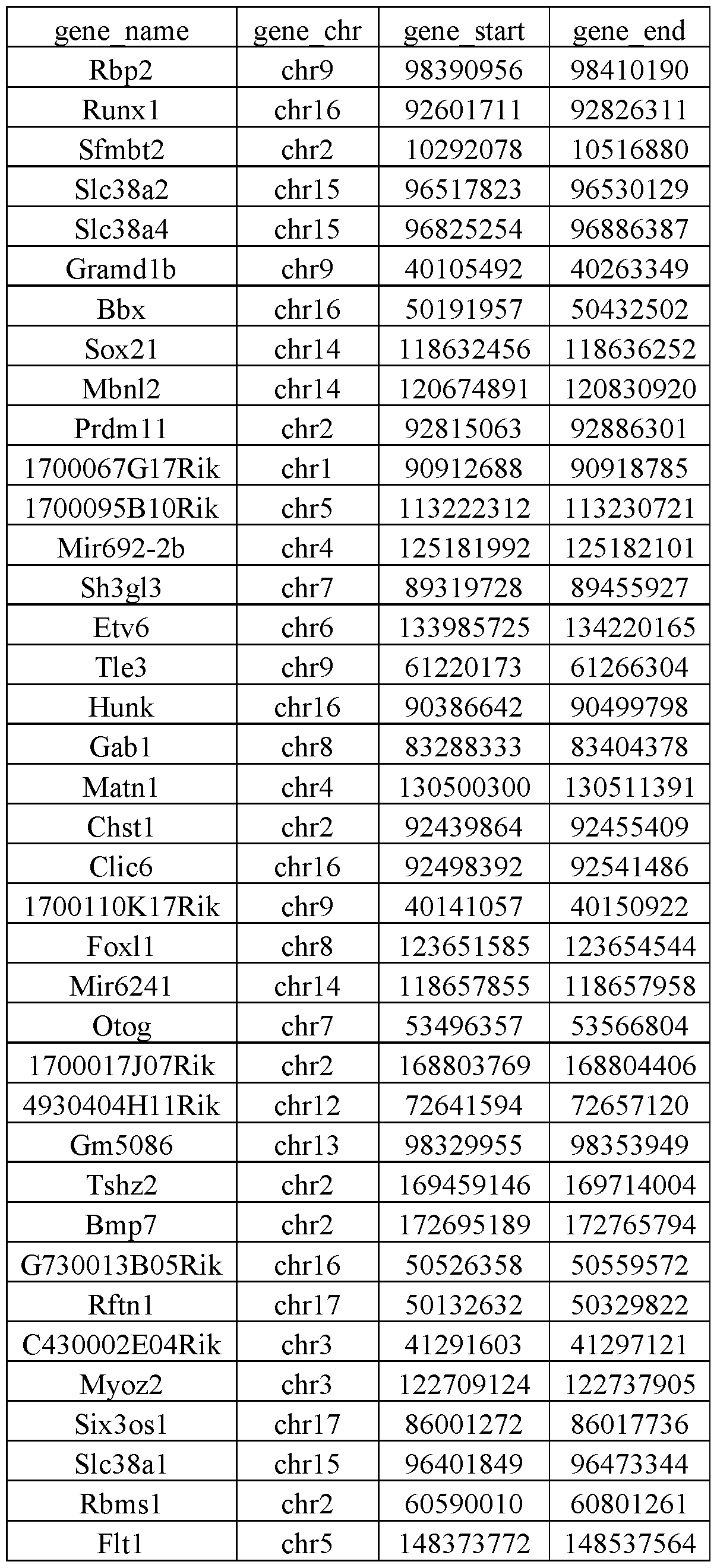
- FIG. 7A provides bar graphs showing relative gene expression levels of H3K27me3- imprinted genes in SCNT blastocysts. Shown are the 26 genes expressed in IVF blastocyst at a reliably detectable level (fragments per kilobase of exon per million mapped fragments (FPKM) > 1). The expression level of IVF blastocysts was set as 1. Genes were classified to up, down and unchanged by expression changes in SCNT compared to that in IVF blastocysts (FC >1.5).
- FIG. 7B provides bar graphs showing the ratio (Pat/Mat) of allelic expression of the H3K27me3 -imprinted genes in IVF and SCNT blastocysts.
- FPKM >1 the ratio of allelic expression of the H3K27me3 -imprinted genes in IVF and SCNT blastocysts.
- FIG. 7C shows genome browser views of H3K27me3 ChIP-seq signals at two representative H3K27me3 -imprinted genes.
- FIG. 7D shows the average H3K27me3 ChIP-seq intensity of various cell types (oocytes, sperm, MEFs, ESCs) and tissues at the 76 H3K27me3 -imprinted genes compared with 3 Mb flanking regions.
- FIGs. 8A-8F illustrates the imprinting status of the known 126 imprinted genes and their known ICRs.
- FIG. 8A provides bar graphs showing relative DNA methylation levels of the 23 known imprinting control regions (ICRs) in SCNT blastocysts.
- the methylation level of IVF blastocysts was set as 1. Dashed line indicates 50% of the IVF blastocysts methylation level. Note that 21 out of 23 ICRs maintained at least 50% that of the IVF methylation levels in SCNT blastocysts, but Slc38a4 and Snrpn ICRs (marked as red) showed less than 50% that of the IVF level.
- FIG. 8B provides bar graph showing allelic bias of DNA methylation at 20 ICRs with sufficient allele-specific methylation information (> 5 detected CpG in both alleles of both IVF and SCNT blastocysts). Note that all 20 ICRs maintained allelic biased DNA
- FIG. 8C provides bar graphs showing relative gene expression levels of known imprinted genes in SCNT blastocysts. Shown are 45 imprinted genes reliably detectable in IVF blastocysts (FPKM > 1). The expression level of IVF blastocysts was set as 1. Genes were classified as up, down, and unchanged based on their expression levels in SCNT embryos compared to IVF embryos (FC >1.5).
- FIG. 8D provides bar graphs showing the ratio of allelic expression (Mat/Pat) of known imprinted genes in IVF and SCNT blastocysts. Shown are 6 maternally expressed genes (MEGs; Mat/Pat > 2.0) that are expressed at a reliably detectable level with sufficient SNP tracked reads (FPKM>l, mean SNP reads > 10 in either sample) in IVF blastocysts. Asterisk represents 100% bias to maternal allele. Note that all 6 MEGs maintained maternal allelic bias in SCNT blastocysts.
- FIG. 8E provides bar graphs showing the ratio of allelic expression (Pat/Mat) of known imprinted genes in IVF and SCNT blastocysts. Shown are 13 paternally expressed genes (PEGs; Pat/Mat > 2.0) that are expressed at a reliably detectable level with sufficient SNP tracked reads (FPKM>l, mean SNP reads > 10 in either sample) in IVF blastocysts. Asterisk represents 100% bias to paternal allele. Arrows indicate genes that lost paternal biased expression in SCNT blastocysts. Slc38a4, Sfmbt2, Phfl7, and Gabl are H3K27me3- dependent imprinted genes.
- FIG. 8F presents representative genome browser views of H3K27me3 ChIP-seq signals at non-canonical imprinted genes.
- the invention provides methods for improving cloning efficiency.
- the invention provides methods for improving somatic cell nuclear transfer efficiency that involve Kdm4d overexpression is an Xisl knockout donor cell.
- the invention is based, at least in part, on the discovery that Xist knockout donor cells coupled with Kdm4d mRNA injection can improve somatic cell nuclear transfer efficiency. This combined approach resulted in the highest efficiency ever reported in mouse cloning using differentiated somatic donor cells. However, many of the SCNT embryos still exhibit postimplantation developmental arrest and the surviving embryos have abnormally large placenta, suggesting some reprogramming defects still persist. Comparative methylome and transcriptome analysis revealed abnormal DNA methylation and loss of H3K27me3- dependent imprinting in SCNT blastocyst embryos, which are likely the cause of the observed developmental defects.
- H3K27me3 is a DNA methylation-independent imprinting mechanism
- DHSs DNase I hypersensitive sites
- H3K27me3 is a DNA methylation-independent imprinting mechanism.
- the methods of the invention involve the use of an H3K27me3 selective methylase.
- H3K27me3 is important for X chromosome inactivation
- X chromosome inactivation provides an excellent model for understanding
- XCI epigenetic silencing.
- Xp paternal X chromosome
- ICM inner cell mass
- epiblast cells undergo random XCI resulting in the silencing of either Xp or maternal X chromosome (Xm).
- Xist an X-linked long non-coding RNA, in both imprinted and random XCI.
- the Xist RNA participates in XCI by coating and inactivating X chromosome in cis.
- Genomic imprinting allows parent-of-origin specific gene regulation.
- the Xist gene is imprinted for silencing in the Xm with a long sought-after, but yet-to-be-identified, mechanism.
- Previous studies using nuclear transfer approaches have suggested that genomic imprinting of Xist is established during oogenesis, like that of autosomal imprinted genes.
- Xp paternal X chromosome
- Xist Central to the imprinted paternal X chromosome inactivation (XCI) is a long non-coding RNA, Xist , which is expressed from Xp and acts in cis to coat and silence the entire Xp. To achieve Xp- specific inactivation, the maternal Xist gene must be silenced, yet the silencing mechanism is not yet clear. As reported herein, the Xist locus is coated with a broad H3K27me3 domain in mouse oocytes, which persists through preimplantation development. Ectopic removal of H3K27me3 induces maternal Xist expression and maternal XCI. Thus, maternal H3K27me3 serves as the imprinting mark of Xist.
- the methods of the invention involve administering a pharmaceutical composition comprising a selective H3K27me3 demethylase inhibitor.
- H3K9me3 and SCNT are selective H3K27me3 demethylase inhibitors.
- Histone H3 lysine 9 trimethylation (H3K9me3) in donor somatic cells is an epigenetic barrier for SCNT reprogramming.
- H3K9me3 in donor cells prevents transcriptional activation of the associated regions at zygotic genome activation and leads to developmental arrest of SCNT embryos at preimplantation stages in both mouse and human.
- removal of the H3K9me3 barrier by overexpressing a H3K9me3 -specific demethylase, Kdm4d allows SCNT embryos to develop to the blastocyst stage at a rate similar to that of IVF.
- H3K9me3 reprogramming barrier mainly impedes preimplantation development and other barriers affect postimplantation development.
- Xist is important for postimplantation development of mouse SCNT embryos.
- Xist knockout somatic cells as donor cells or by injecting small interfering RNA against Xist into l-cell male SCNT embryos leading to an 8-10 fold increase of term rate.
- Inhibitory nucleic acid molecules are those oligonucleotides that inhibit the expression or activity of a polypeptide or polynucleotide (e.g., an Xist polynucleotide).
- oligonucleotides include single and double stranded nucleic acid molecules (e.g., DNA,
- RNA and analogs thereof that bind a nucleic acid molecule that encodes an Xist
- polynucleotide e.g., antisense molecules, siRNA, shRNA.
- Short twenty-one to twenty -five nucleotide double-stranded RNAs are effective at down-regulating gene expression (Zamore et ah, Cell 101 : 25-33; Elbashir et ah, Nature 411 : 494-498, 2001, hereby incorporated by reference).
- the effectiveness of an siRNA approach in mammals was demonstrated in vivo by McCaffrey et al. (Nature 418: 38-39.2002).
- siRNAs may be designed to inactivate that gene.
- Such siRNAs for example, could be administered directly to an affected tissue, or administered systemically.
- the nucleic acid sequence of a gene can be used to design small interfering RNAs (siRNAs).
- the 21 to 25 nucleotide siRNAs may be used, for example, to reduce Xist expression.
- inhibitory nucleic acid molecules of the present invention may be employed as double-stranded RNAs for RNA interference (RNAi)-mediated knock-down of expression.
- RNAi RNA interference
- RNAi is a method for decreasing the cellular expression of specific proteins of interest (reviewed in Tuschl, Chembiochem 2:239-245, 2001; Sharp, Genes & Devel. 15:485-490, 2000;
- siRNAs introduction of siRNAs into cells either by transfection of dsRNAs or through expression of siRNAs using a plasmid-based expression system is increasingly being used to create loss-of-function phenotypes in mammalian cells.
- a double-stranded RNA (dsRNA) molecule is made that includes between eight and nineteen consecutive nucleobases of a nucleobase oligomer of the invention.
- the dsRNA can be two distinct strands of RNA that have duplexed, or a single RNA strand that has self-duplexed (small hairpin (sh)RNA).
- small hairpin (sh)RNA small hairpin
- dsRNAs are about 21 or 22 base pairs, but may be shorter or longer (up to about 29 nucleobases) if desired.
- dsRNA can be made using standard techniques (e.g., chemical synthesis or in vitro transcription).
- Kits are available, for example, from Ambion (Austin, Tex.) and Epicentre (Madison, Wis.). Methods for expressing dsRNA in mammalian cells are described in Brummelkamp et al. Science 296:550-553, 2002; Paddison et al. Genes & Devel. 16:948-958, 2002. Paul et al. Nature Biotechnol. 20:505-508, 2002; Sui et al. Proc. Natl. Acad. Sci. USA 99:5515-5520, 2002; Yu et al. Proc. Natl. Acad. Sci. USA 99:6047- 6052, 2002; Miyagishi et al. Nature Biotechnol. 20:497-500, 2002; and Lee et al. Nature Biotechnol. 20:500-505 2002, each of which is hereby incorporated by reference.
- Small hairpin RNAs comprise an RNA sequence having a stem-loop structure.
- a "stem -loop structure” refers to a nucleic acid having a secondary structure that includes a region of nucleotides which are known or predicted to form a double strand or duplex (stem portion) that is linked on one side by a region of predominantly single-stranded nucleotides (loop portion).
- the term “hairpin” is also used herein to refer to stem-loop structures. Such structures are well known in the art and the term is used consistently with its known meaning in the art.
- the secondary structure does not require exact base-pairing.
- the stem can include one or more base mismatches or bulges.
- the base-pairing can be exact, i.e. not include any mismatches.
- the multiple stem-loop structures can be linked to one another through a linker, such as, for example, a nucleic acid linker, a miRNA flanking sequence, other molecule, or some combination thereof.
- small hairpin RNA includes a conventional stem-loop shRNA, which forms a precursor miRNA (pre-miRNA). While there may be some variation in range, a conventional stem -loop shRNA can comprise a stem ranging from 19 to 29 bp, and a loop ranging from 4 to 30 bp. "shRNA” also includes micro-RNA embedded shRNAs (miRNA-based shRNAs), wherein the guide strand and the passenger strand of the miRNA duplex are incorporated into an existing (or natural) miRNA or into a modified or synthetic (designed) miRNA. In some instances the precursor miRNA molecule can include more than one stem-loop structure.
- MicroRNAs are endogenously encoded RNA molecules that are about 22-nucleotides long and generally expressed in a highly tissue- or developmental- stage-specific fashion and that post-transcriptionally regulate target genes. More than 200 distinct miRNAs have been identified in plants and animals. These small regulatory RNAs are believed to serve important biological functions by two prevailing modes of action: (1) by repressing the translation of target mRNAs, and (2) through RNA interference (RNAi), that is, cleavage and degradation of mRNAs. In the latter case, miRNAs function
Landscapes
- Life Sciences & Earth Sciences (AREA)
- Health & Medical Sciences (AREA)
- Engineering & Computer Science (AREA)
- Genetics & Genomics (AREA)
- Chemical & Material Sciences (AREA)
- Zoology (AREA)
- Bioinformatics & Cheminformatics (AREA)
- Biomedical Technology (AREA)
- Organic Chemistry (AREA)
- Wood Science & Technology (AREA)
- Biotechnology (AREA)
- General Engineering & Computer Science (AREA)
- Microbiology (AREA)
- Biochemistry (AREA)
- General Health & Medical Sciences (AREA)
- Molecular Biology (AREA)
- Developmental Biology & Embryology (AREA)
- Environmental Sciences (AREA)
- Cell Biology (AREA)
- Biophysics (AREA)
- Plant Pathology (AREA)
- Physics & Mathematics (AREA)
- Medicinal Chemistry (AREA)
- Animal Behavior & Ethology (AREA)
- Animal Husbandry (AREA)
- Biodiversity & Conservation Biology (AREA)
- Peptides Or Proteins (AREA)
- Micro-Organisms Or Cultivation Processes Thereof (AREA)
- Materials For Medical Uses (AREA)
- Medicines Containing Material From Animals Or Micro-Organisms (AREA)
Abstract
Description

Claims
Priority Applications (8)
| Application Number | Priority Date | Filing Date | Title |
|---|---|---|---|
| JP2020554407A JP7522038B2 (en) | 2018-04-06 | 2019-04-05 | Compositions and methods for modulating somatic cell reprogramming and imprinting - Patents.com |
| US17/045,412 US20210155959A1 (en) | 2018-04-06 | 2019-04-05 | Compositions and methods for somatic cell reprogramming and modulating imprinting |
| CA3096274A CA3096274A1 (en) | 2018-04-06 | 2019-04-05 | Compositions and methods for somatic cell reprogramming and modulating imprinting |
| CN201980037877.9A CN112272516B (en) | 2018-04-06 | 2019-04-05 | Compositions and methods for reprogramming and adjusting imprinting of somatic cells |
| EP19780971.8A EP3772928B1 (en) | 2018-04-06 | 2019-04-05 | Compositions and methods for somatic cell reprogramming and modulating imprinting |
| AU2019247490A AU2019247490A1 (en) | 2018-04-06 | 2019-04-05 | Compositions and methods for somatic cell reprogramming and modulating imprinting |
| KR1020207031724A KR20200141470A (en) | 2018-04-06 | 2019-04-05 | Composition and method for adjusting somatic cell reprogramming and imprinting |
| CN202310540490.3A CN116536272A (en) | 2018-04-06 | 2019-04-05 | Compositions and methods for reprogramming and adjusting imprinting of somatic cells |
Applications Claiming Priority (2)
| Application Number | Priority Date | Filing Date | Title |
|---|---|---|---|
| US201862654199P | 2018-04-06 | 2018-04-06 | |
| US62/654,199 | 2018-04-06 |
Publications (1)
| Publication Number | Publication Date |
|---|---|
| WO2019195738A1 true WO2019195738A1 (en) | 2019-10-10 |
Family
ID=68101536
Family Applications (1)
| Application Number | Title | Priority Date | Filing Date |
|---|---|---|---|
| PCT/US2019/026074 Ceased WO2019195738A1 (en) | 2018-04-06 | 2019-04-05 | Compositions and methods for somatic cell reprogramming and modulating imprinting |
Country Status (8)
| Country | Link |
|---|---|
| US (1) | US20210155959A1 (en) |
| EP (1) | EP3772928B1 (en) |
| JP (1) | JP7522038B2 (en) |
| KR (1) | KR20200141470A (en) |
| CN (2) | CN112272516B (en) |
| AU (1) | AU2019247490A1 (en) |
| CA (1) | CA3096274A1 (en) |
| WO (1) | WO2019195738A1 (en) |
Cited By (1)
| Publication number | Priority date | Publication date | Assignee | Title |
|---|---|---|---|---|
| US20220389359A1 (en) * | 2019-11-15 | 2022-12-08 | Vitrolife Sweden Aktiebolag | Use of perfluoro-n-octane for piezo-mediated intracytoplasmic sperm injection |
Families Citing this family (3)
| Publication number | Priority date | Publication date | Assignee | Title |
|---|---|---|---|---|
| KR102617137B1 (en) | 2014-09-15 | 2023-12-27 | 칠드런'즈 메디컬 센터 코포레이션 | Methods and compositions to increase somatic cell nuclear transfer (scnt) efficiency by removing histone h3-lysine trimethylation |
| CN114522233B (en) * | 2021-11-30 | 2023-07-14 | 首都医科大学附属北京口腔医院 | Polypeptide sequence of KDM6B and regulation and control application of mesenchymal stem cell function |
| CN117538545B (en) * | 2024-01-09 | 2024-07-05 | 上海众启生物科技有限公司 | Protein antigen combination for Alzheimer disease detection and application |
Citations (217)
| Publication number | Priority date | Publication date | Assignee | Title |
|---|---|---|---|---|
| US3687808A (en) | 1969-08-14 | 1972-08-29 | Univ Leland Stanford Junior | Synthetic polynucleotides |
| US4426330A (en) | 1981-07-20 | 1984-01-17 | Lipid Specialties, Inc. | Synthetic phospholipid compounds |
| US4469863A (en) | 1980-11-12 | 1984-09-04 | Ts O Paul O P | Nonionic nucleic acid alkyl and aryl phosphonates and processes for manufacture and use thereof |
| US4476301A (en) | 1982-04-29 | 1984-10-09 | Centre National De La Recherche Scientifique | Oligonucleotides, a process for preparing the same and their application as mediators of the action of interferon |
| US4534899A (en) | 1981-07-20 | 1985-08-13 | Lipid Specialties, Inc. | Synthetic phospholipid compounds |
| US4587044A (en) | 1983-09-01 | 1986-05-06 | The Johns Hopkins University | Linkage of proteins to nucleic acids |
| US4605735A (en) | 1983-02-14 | 1986-08-12 | Wakunaga Seiyaku Kabushiki Kaisha | Oligonucleotide derivatives |
| US4664097A (en) | 1984-05-09 | 1987-05-12 | The Wistar Institute Of Anatomy & Biology | Nuclear transplantation in the mammalian embryo by microsurgery and cell fusion |
| US4667025A (en) | 1982-08-09 | 1987-05-19 | Wakunaga Seiyaku Kabushiki Kaisha | Oligonucleotide derivatives |
| US4762779A (en) | 1985-06-13 | 1988-08-09 | Amgen Inc. | Compositions and methods for functionalizing nucleic acids |
| US4824941A (en) | 1983-03-10 | 1989-04-25 | Julian Gordon | Specific antibody to the native form of 2'5'-oligonucleotides, the method of preparation and the use as reagents in immunoassays or for binding 2'5'-oligonucleotides in biological systems |
| US4828979A (en) | 1984-11-08 | 1989-05-09 | Life Technologies, Inc. | Nucleotide analogs for nucleic acid labeling and detection |
| US4835263A (en) | 1983-01-27 | 1989-05-30 | Centre National De La Recherche Scientifique | Novel compounds containing an oligonucleotide sequence bonded to an intercalating agent, a process for their synthesis and their use |
| US4845205A (en) | 1985-01-08 | 1989-07-04 | Institut Pasteur | 2,N6 -disubstituted and 2,N6 -trisubstituted adenosine-3'-phosphoramidites |
| US4876335A (en) | 1986-06-30 | 1989-10-24 | Wakunaga Seiyaku Kabushiki Kaisha | Poly-labelled oligonucleotide derivative |
| US4904582A (en) | 1987-06-11 | 1990-02-27 | Synthetic Genetics | Novel amphiphilic nucleic acid conjugates |
| US4948882A (en) | 1983-02-22 | 1990-08-14 | Syngene, Inc. | Single-stranded labelled oligonucleotides, reactive monomers and methods of synthesis |
| US4958013A (en) | 1989-06-06 | 1990-09-18 | Northwestern University | Cholesteryl modified oligonucleotides |
| US4981957A (en) | 1984-07-19 | 1991-01-01 | Centre National De La Recherche Scientifique | Oligonucleotides with modified phosphate and modified carbohydrate moieties at the respective chain termini |
| US4994384A (en) | 1986-12-31 | 1991-02-19 | W. R. Grace & Co.-Conn. | Multiplying bovine embryos |
| US5013556A (en) | 1989-10-20 | 1991-05-07 | Liposome Technology, Inc. | Liposomes with enhanced circulation time |
| US5013830A (en) | 1986-09-08 | 1991-05-07 | Ajinomoto Co., Inc. | Compounds for the cleavage at a specific position of RNA, oligomers employed for the formation of said compounds, and starting materials for the synthesis of said oligomers |
| US5023243A (en) | 1981-10-23 | 1991-06-11 | Molecular Biosystems, Inc. | Oligonucleotide therapeutic agent and method of making same |
| US5034506A (en) | 1985-03-15 | 1991-07-23 | Anti-Gene Development Group | Uncharged morpholino-based polymers having achiral intersubunit linkages |
| US5057420A (en) | 1987-06-05 | 1991-10-15 | Granada Biosciences, Inc. | Bovine nuclear transplantation |
| US5082830A (en) | 1988-02-26 | 1992-01-21 | Enzo Biochem, Inc. | End labeled nucleotide probe |
| US5096822A (en) | 1990-07-26 | 1992-03-17 | W. R. Grace & Co.- Conn. | Bovine embryo medium |
| US5109124A (en) | 1988-06-01 | 1992-04-28 | Biogen, Inc. | Nucleic acid probe linked to a label having a terminal cysteine |
| US5108921A (en) | 1989-04-03 | 1992-04-28 | Purdue Research Foundation | Method for enhanced transmembrane transport of exogenous molecules |
| US5112963A (en) | 1987-11-12 | 1992-05-12 | Max-Planck-Gesellschaft Zur Foerderung Der Wissenschaften E.V. | Modified oligonucleotides |
| US5118800A (en) | 1983-12-20 | 1992-06-02 | California Institute Of Technology | Oligonucleotides possessing a primary amino group in the terminal nucleotide |
| US5118802A (en) | 1983-12-20 | 1992-06-02 | California Institute Of Technology | DNA-reporter conjugates linked via the 2' or 5'-primary amino group of the 5'-terminal nucleoside |
| US5130302A (en) | 1989-12-20 | 1992-07-14 | Boron Bilogicals, Inc. | Boronated nucleoside, nucleotide and oligonucleotide compounds, compositions and methods for using same |
| US5134066A (en) | 1989-08-29 | 1992-07-28 | Monsanto Company | Improved probes using nucleosides containing 3-dezauracil analogs |
| US5138045A (en) | 1990-07-27 | 1992-08-11 | Isis Pharmaceuticals | Polyamine conjugated oligonucleotides |
| US5149797A (en) | 1990-02-15 | 1992-09-22 | The Worcester Foundation For Experimental Biology | Method of site-specific alteration of rna and production of encoded polypeptides |
| US5166315A (en) | 1989-12-20 | 1992-11-24 | Anti-Gene Development Group | Sequence-specific binding polymers for duplex nucleic acids |
| US5175273A (en) | 1988-07-01 | 1992-12-29 | Genentech, Inc. | Nucleic acid intercalating agents |
| US5177196A (en) | 1990-08-16 | 1993-01-05 | Microprobe Corporation | Oligo (α-arabinofuranosyl nucleotides) and α-arabinofuranosyl precursors thereof |
| US5185444A (en) | 1985-03-15 | 1993-02-09 | Anti-Gene Deveopment Group | Uncharged morpolino-based polymers having phosphorous containing chiral intersubunit linkages |
| US5188897A (en) | 1987-10-22 | 1993-02-23 | Temple University Of The Commonwealth System Of Higher Education | Encapsulated 2',5'-phosphorothioate oligoadenylates |
| US5214134A (en) | 1990-09-12 | 1993-05-25 | Sterling Winthrop Inc. | Process of linking nucleosides with a siloxane bridge |
| US5214136A (en) | 1990-02-20 | 1993-05-25 | Gilead Sciences, Inc. | Anthraquinone-derivatives oligonucleotides |
| US5216141A (en) | 1988-06-06 | 1993-06-01 | Benner Steven A | Oligonucleotide analogs containing sulfur linkages |
| US5218105A (en) | 1990-07-27 | 1993-06-08 | Isis Pharmaceuticals | Polyamine conjugated oligonucleotides |
| US5220007A (en) | 1990-02-15 | 1993-06-15 | The Worcester Foundation For Experimental Biology | Method of site-specific alteration of RNA and production of encoded polypeptides |
| US5227170A (en) | 1989-06-22 | 1993-07-13 | Vestar, Inc. | Encapsulation process |
| US5235033A (en) | 1985-03-15 | 1993-08-10 | Anti-Gene Development Group | Alpha-morpholino ribonucleoside derivatives and polymers thereof |
| US5245022A (en) | 1990-08-03 | 1993-09-14 | Sterling Drug, Inc. | Exonuclease resistant terminally substituted oligonucleotides |
| US5254469A (en) | 1989-09-12 | 1993-10-19 | Eastman Kodak Company | Oligonucleotide-enzyme conjugate that can be used as a probe in hybridization assays and polymerase chain reaction procedures |
| US5256775A (en) | 1989-06-05 | 1993-10-26 | Gilead Sciences, Inc. | Exonuclease-resistant oligonucleotides |
| US5258506A (en) | 1984-10-16 | 1993-11-02 | Chiron Corporation | Photolabile reagents for incorporation into oligonucleotide chains |
| US5262536A (en) | 1988-09-15 | 1993-11-16 | E. I. Du Pont De Nemours And Company | Reagents for the preparation of 5'-tagged oligonucleotides |
| US5264562A (en) | 1989-10-24 | 1993-11-23 | Gilead Sciences, Inc. | Oligonucleotide analogs with novel linkages |
| US5264423A (en) | 1987-03-25 | 1993-11-23 | The United States Of America As Represented By The Department Of Health And Human Services | Inhibitors for replication of retroviruses and for the expression of oncogene products |
| US5264564A (en) | 1989-10-24 | 1993-11-23 | Gilead Sciences | Oligonucleotide analogs with novel linkages |
| US5264221A (en) | 1991-05-23 | 1993-11-23 | Mitsubishi Kasei Corporation | Drug-containing protein-bonded liposome |
| US5272250A (en) | 1992-07-10 | 1993-12-21 | Spielvogel Bernard F | Boronated phosphoramidate compounds |
| US5276019A (en) | 1987-03-25 | 1994-01-04 | The United States Of America As Represented By The Department Of Health And Human Services | Inhibitors for replication of retroviruses and for the expression of oncogene products |
| US5278302A (en) | 1988-05-26 | 1994-01-11 | University Patents, Inc. | Polynucleotide phosphorodithioates |
| US5292873A (en) | 1989-11-29 | 1994-03-08 | The Research Foundation Of State University Of New York | Nucleic acids labeled with naphthoquinone probe |
| US5317098A (en) | 1986-03-17 | 1994-05-31 | Hiroaki Shizuya | Non-radioisotope tagging of fragments |
| US5319080A (en) | 1991-10-17 | 1994-06-07 | Ciba-Geigy Corporation | Bicyclic nucleosides, oligonucleotides, process for their preparation and intermediates |
| US5321131A (en) | 1990-03-08 | 1994-06-14 | Hybridon, Inc. | Site-specific functionalization of oligodeoxynucleotides for non-radioactive labelling |
| US5354844A (en) | 1989-03-16 | 1994-10-11 | Boehringer Ingelheim International Gmbh | Protein-polycation conjugates |
| US5356633A (en) | 1989-10-20 | 1994-10-18 | Liposome Technology, Inc. | Method of treatment of inflamed tissues |
| US5359044A (en) | 1991-12-13 | 1994-10-25 | Isis Pharmaceuticals | Cyclobutyl oligonucleotide surrogates |
| US5367066A (en) | 1984-10-16 | 1994-11-22 | Chiron Corporation | Oligonucleotides with selectably cleavable and/or abasic sites |
| US5371241A (en) | 1991-07-19 | 1994-12-06 | Pharmacia P-L Biochemicals Inc. | Fluorescein labelled phosphoramidites |
| US5391723A (en) | 1989-05-31 | 1995-02-21 | Neorx Corporation | Oligonucleotide conjugates |
| US5395619A (en) | 1993-03-03 | 1995-03-07 | Liposome Technology, Inc. | Lipid-polymer conjugates and liposomes |
| US5399676A (en) | 1989-10-23 | 1995-03-21 | Gilead Sciences | Oligonucleotides with inverted polarity |
| US5403711A (en) | 1987-11-30 | 1995-04-04 | University Of Iowa Research Foundation | Nucleic acid hybridization and amplification method for detection of specific sequences in which a complementary labeled nucleic acid probe is cleaved |
| US5405939A (en) | 1987-10-22 | 1995-04-11 | Temple University Of The Commonwealth System Of Higher Education | 2',5'-phosphorothioate oligoadenylates and their covalent conjugates with polylysine |
| US5405938A (en) | 1989-12-20 | 1995-04-11 | Anti-Gene Development Group | Sequence-specific binding polymers for duplex nucleic acids |
| US5414077A (en) | 1990-02-20 | 1995-05-09 | Gilead Sciences | Non-nucleoside linkers for convenient attachment of labels to oligonucleotides using standard synthetic methods |
| US5417978A (en) | 1993-07-29 | 1995-05-23 | Board Of Regents, The University Of Texas System | Liposomal antisense methyl phosphonate oligonucleotides and methods for their preparation and use |
| US5432272A (en) | 1990-10-09 | 1995-07-11 | Benner; Steven A. | Method for incorporating into a DNA or RNA oligonucleotide using nucleotides bearing heterocyclic bases |
| US5434257A (en) | 1992-06-01 | 1995-07-18 | Gilead Sciences, Inc. | Binding compentent oligomers containing unsaturated 3',5' and 2',5' linkages |
| US5446137A (en) | 1993-12-09 | 1995-08-29 | Syntex (U.S.A.) Inc. | Oligonucleotides containing 4'-substituted nucleotides |
| US5451463A (en) | 1989-08-28 | 1995-09-19 | Clontech Laboratories, Inc. | Non-nucleoside 1,3-diol reagents for labeling synthetic oligonucleotides |
| US5455233A (en) | 1989-11-30 | 1995-10-03 | University Of North Carolina | Oligoribonucleoside and oligodeoxyribonucleoside boranophosphates |
| US5457187A (en) | 1993-12-08 | 1995-10-10 | Board Of Regents University Of Nebraska | Oligonucleotides containing 5-fluorouracil |
| US5459255A (en) | 1990-01-11 | 1995-10-17 | Isis Pharmaceuticals, Inc. | N-2 substituted purines |
| US5459127A (en) | 1990-04-19 | 1995-10-17 | Vical, Inc. | Cationic lipids for intracellular delivery of biologically active molecules |
| US5462854A (en) | 1993-04-19 | 1995-10-31 | Beckman Instruments, Inc. | Inverse linkage oligonucleotides for chemical and enzymatic processes |
| US5466677A (en) | 1993-03-06 | 1995-11-14 | Ciba-Geigy Corporation | Dinucleoside phosphinates and their pharmaceutical compositions |
| US5466786A (en) | 1989-10-24 | 1995-11-14 | Gilead Sciences | 2'modified nucleoside and nucleotide compounds |
| US5469854A (en) | 1989-12-22 | 1995-11-28 | Imarx Pharmaceutical Corp. | Methods of preparing gas-filled liposomes |
| US5470967A (en) | 1990-04-10 | 1995-11-28 | The Dupont Merck Pharmaceutical Company | Oligonucleotide analogs with sulfamate linkages |
| US5476925A (en) | 1993-02-01 | 1995-12-19 | Northwestern University | Oligodeoxyribonucleotides including 3'-aminonucleoside-phosphoramidate linkages and terminal 3'-amino groups |
| US5484908A (en) | 1991-11-26 | 1996-01-16 | Gilead Sciences, Inc. | Oligonucleotides containing 5-propynyl pyrimidines |
| US5486603A (en) | 1990-01-08 | 1996-01-23 | Gilead Sciences, Inc. | Oligonucleotide having enhanced binding affinity |
| US5489677A (en) | 1990-07-27 | 1996-02-06 | Isis Pharmaceuticals, Inc. | Oligonucleoside linkages containing adjacent oxygen and nitrogen atoms |
| US5491133A (en) | 1987-11-30 | 1996-02-13 | University Of Iowa Research Foundation | Methods for blocking the expression of specifically targeted genes |
| US5502177A (en) | 1993-09-17 | 1996-03-26 | Gilead Sciences, Inc. | Pyrimidine derivatives for labeled binding partners |
| US5510475A (en) | 1990-11-08 | 1996-04-23 | Hybridon, Inc. | Oligonucleotide multiple reporter precursors |
| US5512439A (en) | 1988-11-21 | 1996-04-30 | Dynal As | Oligonucleotide-linked magnetic particles and uses thereof |
| US5512667A (en) | 1990-08-28 | 1996-04-30 | Reed; Michael W. | Trifunctional intermediates for preparing 3'-tailed oligonucleotides |
| US5512295A (en) | 1994-11-10 | 1996-04-30 | The Board Of Trustees Of The Leland Stanford Junior University | Synthetic liposomes for enhanced uptake and delivery |
| US5514785A (en) | 1990-05-11 | 1996-05-07 | Becton Dickinson And Company | Solid supports for nucleic acid hybridization assays |
| US5519126A (en) | 1988-03-25 | 1996-05-21 | University Of Virginia Alumni Patents Foundation | Oligonucleotide N-alkylphosphoramidates |
| US5519134A (en) | 1994-01-11 | 1996-05-21 | Isis Pharmaceuticals, Inc. | Pyrrolidine-containing monomers and oligomers |
| US5521291A (en) | 1991-09-30 | 1996-05-28 | Boehringer Ingelheim International, Gmbh | Conjugates for introducing nucleic acid into higher eucaryotic cells |
| US5525465A (en) | 1987-10-28 | 1996-06-11 | Howard Florey Institute Of Experimental Physiology And Medicine | Oligonucleotide-polyamide conjugates and methods of production and applications of the same |
| US5525711A (en) | 1994-05-18 | 1996-06-11 | The United States Of America As Represented By The Secretary Of The Department Of Health And Human Services | Pteridine nucleotide analogs as fluorescent DNA probes |
| US5527528A (en) | 1989-10-20 | 1996-06-18 | Sequus Pharmaceuticals, Inc. | Solid-tumor treatment method |
| US5534259A (en) | 1993-07-08 | 1996-07-09 | Liposome Technology, Inc. | Polymer compound and coated particle composition |
| US5539082A (en) | 1993-04-26 | 1996-07-23 | Nielsen; Peter E. | Peptide nucleic acids |
| US5541307A (en) | 1990-07-27 | 1996-07-30 | Isis Pharmaceuticals, Inc. | Backbone modified oligonucleotide analogs and solid phase synthesis thereof |
| US5543158A (en) | 1993-07-23 | 1996-08-06 | Massachusetts Institute Of Technology | Biodegradable injectable nanoparticles |
| US5543152A (en) | 1994-06-20 | 1996-08-06 | Inex Pharmaceuticals Corporation | Sphingosomes for enhanced drug delivery |
| US5545730A (en) | 1984-10-16 | 1996-08-13 | Chiron Corporation | Multifunctional nucleic acid monomer |
| US5547932A (en) | 1991-09-30 | 1996-08-20 | Boehringer Ingelheim International Gmbh | Composition for introducing nucleic acid complexes into higher eucaryotic cells |
| US5550111A (en) | 1984-07-11 | 1996-08-27 | Temple University-Of The Commonwealth System Of Higher Education | Dual action 2',5'-oligoadenylate antiviral derivatives and uses thereof |
| US5552540A (en) | 1987-06-24 | 1996-09-03 | Howard Florey Institute Of Experimental Physiology And Medicine | Nucleoside derivatives |
| US5556948A (en) | 1993-01-22 | 1996-09-17 | Mitsubishi Chemical Corporation | Phospholipid derivatized with PEG bifunctional linker and liposome containing it |
| US5561225A (en) | 1990-09-19 | 1996-10-01 | Southern Research Institute | Polynucleotide analogs containing sulfonate and sulfonamide internucleoside linkages |
| US5565350A (en) | 1993-12-09 | 1996-10-15 | Thomas Jefferson University | Compounds and methods for site directed mutations in eukaryotic cells |
| US5565552A (en) | 1992-01-21 | 1996-10-15 | Pharmacyclics, Inc. | Method of expanded porphyrin-oligonucleotide conjugate synthesis |
| US5567811A (en) | 1990-05-03 | 1996-10-22 | Amersham International Plc | Phosphoramidite derivatives, their preparation and the use thereof in the incorporation of reporter groups on synthetic oligonucleotides |
| US5571799A (en) | 1991-08-12 | 1996-11-05 | Basco, Ltd. | (2'-5') oligoadenylate analogues useful as inhibitors of host-v5.-graft response |
| US5574142A (en) | 1992-12-15 | 1996-11-12 | Microprobe Corporation | Peptide linkers for improved oligonucleotide delivery |
| US5576427A (en) | 1993-03-30 | 1996-11-19 | Sterling Winthrop, Inc. | Acyclic nucleoside analogs and oligonucleotide sequences containing them |
| US5578718A (en) | 1990-01-11 | 1996-11-26 | Isis Pharmaceuticals, Inc. | Thiol-derivatized nucleosides |
| US5580731A (en) | 1994-08-25 | 1996-12-03 | Chiron Corporation | N-4 modified pyrimidine deoxynucleotides and oligonucleotide probes synthesized therewith |
| US5580575A (en) | 1989-12-22 | 1996-12-03 | Imarx Pharmaceutical Corp. | Therapeutic drug delivery systems |
| US5583020A (en) | 1992-11-24 | 1996-12-10 | Ribozyme Pharmaceuticals, Inc. | Permeability enhancers for negatively charged polynucleotides |
| US5585481A (en) | 1987-09-21 | 1996-12-17 | Gen-Probe Incorporated | Linking reagents for nucleotide probes |
| US5587371A (en) | 1992-01-21 | 1996-12-24 | Pharmacyclics, Inc. | Texaphyrin-oligonucleotide conjugates |
| US5587361A (en) | 1991-10-15 | 1996-12-24 | Isis Pharmaceuticals, Inc. | Oligonucleotides having phosphorothioate linkages of high chiral purity |
| US5591721A (en) | 1994-10-25 | 1997-01-07 | Hybridon, Inc. | Method of down-regulating gene expression |
| US5591722A (en) | 1989-09-15 | 1997-01-07 | Southern Research Institute | 2'-deoxy-4'-thioribonucleosides and their antiviral activity |
| US5594121A (en) | 1991-11-07 | 1997-01-14 | Gilead Sciences, Inc. | Enhanced triple-helix and double-helix formation with oligomers containing modified purines |
| US5596086A (en) | 1990-09-20 | 1997-01-21 | Gilead Sciences, Inc. | Modified internucleoside linkages having one nitrogen and two carbon atoms |
| US5595726A (en) | 1992-01-21 | 1997-01-21 | Pharmacyclics, Inc. | Chromophore probe for detection of nucleic acid |
| US5595756A (en) | 1993-12-22 | 1997-01-21 | Inex Pharmaceuticals Corporation | Liposomal compositions for enhanced retention of bioactive agents |
| US5596091A (en) | 1994-03-18 | 1997-01-21 | The Regents Of The University Of California | Antisense oligonucleotides comprising 5-aminoalkyl pyrimidine nucleotides |
| US5597909A (en) | 1994-08-25 | 1997-01-28 | Chiron Corporation | Polynucleotide reagents containing modified deoxyribose moieties, and associated methods of synthesis and use |
| US5597696A (en) | 1994-07-18 | 1997-01-28 | Becton Dickinson And Company | Covalent cyanine dye oligonucleotide conjugates |
| US5599928A (en) | 1994-02-15 | 1997-02-04 | Pharmacyclics, Inc. | Texaphyrin compounds having improved functionalization |
| US5602240A (en) | 1990-07-27 | 1997-02-11 | Ciba Geigy Ag. | Backbone modified oligonucleotide analogs |
| US5608046A (en) | 1990-07-27 | 1997-03-04 | Isis Pharmaceuticals, Inc. | Conjugated 4'-desmethyl nucleoside analog compounds |
| US5610289A (en) | 1990-07-27 | 1997-03-11 | Isis Pharmaceuticals, Inc. | Backbone modified oligonucleotide analogues |
| US5610300A (en) | 1992-07-01 | 1997-03-11 | Ciba-Geigy Corporation | Carbocyclic nucleosides containing bicyclic rings, oligonucleotides therefrom, process for their preparation, their use and intermediates |
| US5614617A (en) | 1990-07-27 | 1997-03-25 | Isis Pharmaceuticals, Inc. | Nuclease resistant, pyrimidine modified oligonucleotides that detect and modulate gene expression |
| US5618704A (en) | 1990-07-27 | 1997-04-08 | Isis Pharmacueticals, Inc. | Backbone-modified oligonucleotide analogs and preparation thereof through radical coupling |
| US5623070A (en) | 1990-07-27 | 1997-04-22 | Isis Pharmaceuticals, Inc. | Heteroatomic oligonucleoside linkages |
| US5623065A (en) | 1990-08-13 | 1997-04-22 | Isis Pharmaceuticals, Inc. | Gapped 2' modified oligonucleotides |
| US5625050A (en) | 1994-03-31 | 1997-04-29 | Amgen Inc. | Modified oligonucleotides and intermediates useful in nucleic acid therapeutics |
| US5627053A (en) | 1994-03-29 | 1997-05-06 | Ribozyme Pharmaceuticals, Inc. | 2'deoxy-2'-alkylnucleotide containing nucleic acid |
| US5633360A (en) | 1992-04-14 | 1997-05-27 | Gilead Sciences, Inc. | Oligonucleotide analogs capable of passive cell membrane permeation |
| US5639873A (en) | 1992-02-05 | 1997-06-17 | Centre National De La Recherche Scientifique (Cnrs) | Oligothionucleotides |
| US5646265A (en) | 1990-01-11 | 1997-07-08 | Isis Pharmceuticals, Inc. | Process for the preparation of 2'-O-alkyl purine phosphoramidites |
| US5652355A (en) | 1992-07-23 | 1997-07-29 | Worcester Foundation For Experimental Biology | Hybrid oligonucleotide phosphorothioates |
| US5652356A (en) | 1995-08-17 | 1997-07-29 | Hybridon, Inc. | Inverted chimeric and hybrid oligonucleotides |
| US5656611A (en) | 1994-11-18 | 1997-08-12 | Supratek Pharma Inc. | Polynucleotide compositions |
| US5658873A (en) | 1993-04-10 | 1997-08-19 | Degussa Aktiengesellschaft | Coated sodium percarbonate particles, a process for their production and detergent, cleaning and bleaching compositions containing them |
| US5663312A (en) | 1993-03-31 | 1997-09-02 | Sanofi | Oligonucleotide dimers with amide linkages replacing phosphodiester linkages |
| US5670633A (en) | 1990-01-11 | 1997-09-23 | Isis Pharmaceuticals, Inc. | Sugar modified oligonucleotides that detect and modulate gene expression |
| US5677437A (en) | 1990-07-27 | 1997-10-14 | Isis Pharmaceuticals, Inc. | Heteroatomic oligonucleoside linkages |
| US5677439A (en) | 1990-08-03 | 1997-10-14 | Sanofi | Oligonucleotide analogues containing phosphate diester linkage substitutes, compositions thereof, and precursor dinucleotide analogues |
| US5681941A (en) | 1990-01-11 | 1997-10-28 | Isis Pharmaceuticals, Inc. | Substituted purines and oligonucleotide cross-linking |
| US5688941A (en) | 1990-07-27 | 1997-11-18 | Isis Pharmaceuticals, Inc. | Methods of making conjugated 4' desmethyl nucleoside analog compounds |
| US5700922A (en) | 1991-12-24 | 1997-12-23 | Isis Pharmaceuticals, Inc. | PNA-DNA-PNA chimeric macromolecules |
| US5712156A (en) | 1990-07-09 | 1998-01-27 | Amrad Corporation Limited | Enhanced implantation, development and maintenance of embryos using leukaemia inhibitory factor |
| US5714331A (en) | 1991-05-24 | 1998-02-03 | Buchardt, Deceased; Ole | Peptide nucleic acids having enhanced binding affinity, sequence specificity and solubility |
| US5719262A (en) | 1993-11-22 | 1998-02-17 | Buchardt, Deceased; Ole | Peptide nucleic acids having amino acid side chains |
| GB2318578A (en) | 1995-08-31 | 1998-04-29 | Roslin Inst | Quiescent cell populations for nuclear transfer |
| US5750692A (en) | 1990-01-11 | 1998-05-12 | Isis Pharmaceuticals, Inc. | Synthesis of 3-deazapurines |
| US5753613A (en) | 1994-09-30 | 1998-05-19 | Inex Pharmaceuticals Corporation | Compositions for the introduction of polyanionic materials into cells |
| US5785992A (en) | 1994-09-30 | 1998-07-28 | Inex Pharmaceuticals Corp. | Compositions for the introduction of polyanionic materials into cells |
| GB2331751A (en) | 1995-08-31 | 1999-06-02 | Roslin Inst Edinburgh | Quiescent cell populations for nuclear transfer |
| US5994619A (en) | 1996-04-01 | 1999-11-30 | University Of Massachusetts, A Public Institution Of Higher Education Of The Commonwealth Of Massachusetts, As Represented By Its Amherst Campus | Production of chimeric bovine or porcine animals using cultured inner cell mass cells |
| US6011197A (en) | 1997-03-06 | 2000-01-04 | Infigen, Inc. | Method of cloning bovines using reprogrammed non-embryonic bovine cells |
| US6107543A (en) | 1992-08-20 | 2000-08-22 | Infigen, Inc. | Culture of totipotent embryonic inner cells mass cells and production of bovine animals |
| US6120798A (en) | 1997-06-23 | 2000-09-19 | Alza Corporation | Liposome-entrapped polynucleotide composition and method |
| WO2000061595A1 (en) | 1999-04-08 | 2000-10-19 | Park Jong Gu | The novel antisense-oligos with better stability and antisense effect |
| US6221959B1 (en) | 1994-11-18 | 2001-04-24 | Supratek Pharma, Inc. | Polynucleotide compositions |
| US6346613B1 (en) | 1997-09-24 | 2002-02-12 | Elan Corporation, Plc | Composition and method for enhancing paracellular transport across cell layers |
| US6353055B1 (en) | 1994-11-18 | 2002-03-05 | Supratek Pharma Inc. | Polynucleotide compositions |
| US6479626B1 (en) | 1998-03-02 | 2002-11-12 | Massachusetts Institute Of Technology | Poly zinc finger proteins with improved linkers |
| US20020168631A1 (en) | 2001-03-08 | 2002-11-14 | Welgene, Inc. | Random gene unidirectional antisense library |
| US20030003469A1 (en) | 1992-12-07 | 2003-01-02 | Ribozyme Pharmaceuticals, Inc. | Ribozyme treatment of diseases or conditions related to levels of NF-kappaB |
| US6534261B1 (en) | 1999-01-12 | 2003-03-18 | Sangamo Biosciences, Inc. | Regulation of endogenous gene expression in cells using zinc finger proteins |
| US20030232410A1 (en) | 2002-03-21 | 2003-12-18 | Monika Liljedahl | Methods and compositions for using zinc finger endonucleases to enhance homologous recombination |
| WO2004029219A2 (en) | 2002-09-27 | 2004-04-08 | Cold Spring Harbor Laboratory | Cell-based rna interference and related methods and compositions |
| US6746838B1 (en) | 1997-05-23 | 2004-06-08 | Gendaq Limited | Nucleic acid binding proteins |
| US6794136B1 (en) | 2000-11-20 | 2004-09-21 | Sangamo Biosciences, Inc. | Iterative optimization in the design of binding proteins |
| US7013219B2 (en) | 1999-01-12 | 2006-03-14 | Sangamo Biosciences, Inc. | Regulation of endogenous gene expression in cells using zinc finger proteins |
| US7030215B2 (en) | 1999-03-24 | 2006-04-18 | Sangamo Biosciences, Inc. | Position dependent recognition of GNN nucleotide triplets by zinc fingers |
| US20090020314A1 (en) | 2007-05-21 | 2009-01-22 | Steven Lee Dutton | Direct emulsion process for making printed circuits |
| US7585849B2 (en) | 1999-03-24 | 2009-09-08 | Sangamo Biosciences, Inc. | Position dependent recognition of GNN nucleotide triplets by zinc fingers |
| US20110145940A1 (en) | 2009-12-10 | 2011-06-16 | Voytas Daniel F | Tal effector-mediated dna modification |
| US20140068797A1 (en) | 2012-05-25 | 2014-03-06 | University Of Vienna | Methods and compositions for rna-directed target dna modification and for rna-directed modulation of transcription |
| US8697359B1 (en) | 2012-12-12 | 2014-04-15 | The Broad Institute, Inc. | CRISPR-Cas systems and methods for altering expression of gene products |
| US20140179006A1 (en) | 2012-12-12 | 2014-06-26 | Massachusetts Institute Of Technology | Crispr-cas component systems, methods and compositions for sequence manipulation |
| US20140179770A1 (en) | 2012-12-12 | 2014-06-26 | Massachusetts Institute Of Technology | Delivery, engineering and optimization of systems, methods and compositions for sequence manipulation and therapeutic applications |
| US20140186958A1 (en) | 2012-12-12 | 2014-07-03 | Feng Zhang | Engineering and optimization of systems, methods and compositions for sequence manipulation with functional domains |
| US20140186843A1 (en) | 2012-12-12 | 2014-07-03 | Massachusetts Institute Of Technology | Methods, systems, and apparatus for identifying target sequences for cas enzymes or crispr-cas systems for target sequences and conveying results thereof |
| US20140242664A1 (en) | 2012-12-12 | 2014-08-28 | The Broad Institute, Inc. | Engineering of systems, methods and optimized guide compositions for sequence manipulation |
| US20140248702A1 (en) | 2012-12-12 | 2014-09-04 | The Broad Institute, Inc. | CRISPR-Cas Nickase Systems, Methods And Compositions For Sequence Manipulation in Eukaryotes |
| US20140273234A1 (en) | 2012-12-12 | 2014-09-18 | The Board Institute, Inc. | Engineering and optimization of improved systems, methods and enzyme compositions for sequence manipulation |
| US20140273230A1 (en) | 2013-03-15 | 2014-09-18 | Sigma-Aldrich Co., Llc | Crispr-based genome modification and regulation |
| US20140295556A1 (en) | 2013-03-15 | 2014-10-02 | The General Hospital Corporation | Using RNA-guided FokI Nucleases (RFNs) to Increase Specificity for RNA-Guided Genome Editing |
| US20140356956A1 (en) | 2013-06-04 | 2014-12-04 | President And Fellows Of Harvard College | RNA-Guided Transcriptional Regulation |
| US20140357530A1 (en) | 2012-12-12 | 2014-12-04 | The Broad Institute Inc. | Functional genomics using crispr-cas systems, compositions, methods, knock out libraries and applications thereof |
| US20150031132A1 (en) | 2013-07-26 | 2015-01-29 | President And Fellows Of Harvard College | Genome Engineering |
| US20150044191A1 (en) | 2013-08-09 | 2015-02-12 | President And Fellows Of Harvard College | Methods for identifying a target site of a cas9 nuclease |
| US20150045546A1 (en) | 2012-03-20 | 2015-02-12 | Vilnius University | RNA-DIRECTED DNA CLEAVAGE BY THE Cas9-crRNA COMPLEX |
| US20150056705A1 (en) | 2013-05-15 | 2015-02-26 | Sangamo Biosciences, Inc. | Methods and compositions for treatment of a genetic condition |
| US20150071898A1 (en) | 2013-09-06 | 2015-03-12 | President And Fellows Of Harvard College | Cas9-recombinase fusion proteins and uses thereof |
| US20150071903A1 (en) | 2013-09-06 | 2015-03-12 | President And Fellows Of Harvard College | Use of cationic lipids to deliver cas9 |
| US20150159172A1 (en) | 2013-12-09 | 2015-06-11 | Sangamo Biosciences, Inc. | Methods and compositions for genome engineering |
| US20150166980A1 (en) | 2013-12-12 | 2015-06-18 | President And Fellows Of Harvard College | Fusions of cas9 domains and nucleic acid-editing domains |
| US20170327846A1 (en) * | 2014-09-15 | 2017-11-16 | Children's Medical Center Corporation | Methods and compositions to increase somatic cell nuclear transfer (scnt) efficiency by removing histone h3-lysine trimethylation |
| WO2019018635A1 (en) * | 2017-07-19 | 2019-01-24 | Children's Medical Center Corporation | Compositions and methods for treating diseases associated with an imprinting defect |
Family Cites Families (1)
| Publication number | Priority date | Publication date | Assignee | Title |
|---|---|---|---|---|
| CN109641015A (en) | 2015-10-09 | 2019-04-16 | 儿童医疗中心有限公司 | By removing tri-methylated increase human somatic cell nuclear transfer (SCNT) efficiency of histone H 3-lysine, and the method and composition of increase mankind NT-ESC derivative |
-
2019
- 2019-04-05 US US17/045,412 patent/US20210155959A1/en active Pending
- 2019-04-05 AU AU2019247490A patent/AU2019247490A1/en not_active Abandoned
- 2019-04-05 WO PCT/US2019/026074 patent/WO2019195738A1/en not_active Ceased
- 2019-04-05 KR KR1020207031724A patent/KR20200141470A/en active Pending
- 2019-04-05 CN CN201980037877.9A patent/CN112272516B/en active Active
- 2019-04-05 CN CN202310540490.3A patent/CN116536272A/en active Pending
- 2019-04-05 EP EP19780971.8A patent/EP3772928B1/en active Active
- 2019-04-05 JP JP2020554407A patent/JP7522038B2/en active Active
- 2019-04-05 CA CA3096274A patent/CA3096274A1/en active Pending
Patent Citations (290)
| Publication number | Priority date | Publication date | Assignee | Title |
|---|---|---|---|---|
| US3687808A (en) | 1969-08-14 | 1972-08-29 | Univ Leland Stanford Junior | Synthetic polynucleotides |
| US4469863A (en) | 1980-11-12 | 1984-09-04 | Ts O Paul O P | Nonionic nucleic acid alkyl and aryl phosphonates and processes for manufacture and use thereof |
| US4426330A (en) | 1981-07-20 | 1984-01-17 | Lipid Specialties, Inc. | Synthetic phospholipid compounds |
| US4534899A (en) | 1981-07-20 | 1985-08-13 | Lipid Specialties, Inc. | Synthetic phospholipid compounds |
| US5023243A (en) | 1981-10-23 | 1991-06-11 | Molecular Biosystems, Inc. | Oligonucleotide therapeutic agent and method of making same |
| US4476301A (en) | 1982-04-29 | 1984-10-09 | Centre National De La Recherche Scientifique | Oligonucleotides, a process for preparing the same and their application as mediators of the action of interferon |
| US4789737A (en) | 1982-08-09 | 1988-12-06 | Wakunaga Seiyaku Kabushiki Kaisha | Oligonucleotide derivatives and production thereof |
| US4667025A (en) | 1982-08-09 | 1987-05-19 | Wakunaga Seiyaku Kabushiki Kaisha | Oligonucleotide derivatives |
| US4835263A (en) | 1983-01-27 | 1989-05-30 | Centre National De La Recherche Scientifique | Novel compounds containing an oligonucleotide sequence bonded to an intercalating agent, a process for their synthesis and their use |
| US4605735A (en) | 1983-02-14 | 1986-08-12 | Wakunaga Seiyaku Kabushiki Kaisha | Oligonucleotide derivatives |
| US5541313A (en) | 1983-02-22 | 1996-07-30 | Molecular Biosystems, Inc. | Single-stranded labelled oligonucleotides of preselected sequence |
| US4948882A (en) | 1983-02-22 | 1990-08-14 | Syngene, Inc. | Single-stranded labelled oligonucleotides, reactive monomers and methods of synthesis |
| US4824941A (en) | 1983-03-10 | 1989-04-25 | Julian Gordon | Specific antibody to the native form of 2'5'-oligonucleotides, the method of preparation and the use as reagents in immunoassays or for binding 2'5'-oligonucleotides in biological systems |
| US4587044A (en) | 1983-09-01 | 1986-05-06 | The Johns Hopkins University | Linkage of proteins to nucleic acids |
| US5118802A (en) | 1983-12-20 | 1992-06-02 | California Institute Of Technology | DNA-reporter conjugates linked via the 2' or 5'-primary amino group of the 5'-terminal nucleoside |
| US5118800A (en) | 1983-12-20 | 1992-06-02 | California Institute Of Technology | Oligonucleotides possessing a primary amino group in the terminal nucleotide |
| US4664097A (en) | 1984-05-09 | 1987-05-12 | The Wistar Institute Of Anatomy & Biology | Nuclear transplantation in the mammalian embryo by microsurgery and cell fusion |
| US5550111A (en) | 1984-07-11 | 1996-08-27 | Temple University-Of The Commonwealth System Of Higher Education | Dual action 2',5'-oligoadenylate antiviral derivatives and uses thereof |
| US4981957A (en) | 1984-07-19 | 1991-01-01 | Centre National De La Recherche Scientifique | Oligonucleotides with modified phosphate and modified carbohydrate moieties at the respective chain termini |
| US5578717A (en) | 1984-10-16 | 1996-11-26 | Chiron Corporation | Nucleotides for introducing selectably cleavable and/or abasic sites into oligonucleotides |
| US5367066A (en) | 1984-10-16 | 1994-11-22 | Chiron Corporation | Oligonucleotides with selectably cleavable and/or abasic sites |
| US5552538A (en) | 1984-10-16 | 1996-09-03 | Chiron Corporation | Oligonucleotides with cleavable sites |
| US5545730A (en) | 1984-10-16 | 1996-08-13 | Chiron Corporation | Multifunctional nucleic acid monomer |
| US5258506A (en) | 1984-10-16 | 1993-11-02 | Chiron Corporation | Photolabile reagents for incorporation into oligonucleotide chains |
| US4828979A (en) | 1984-11-08 | 1989-05-09 | Life Technologies, Inc. | Nucleotide analogs for nucleic acid labeling and detection |
| US4845205A (en) | 1985-01-08 | 1989-07-04 | Institut Pasteur | 2,N6 -disubstituted and 2,N6 -trisubstituted adenosine-3'-phosphoramidites |
| US5034506A (en) | 1985-03-15 | 1991-07-23 | Anti-Gene Development Group | Uncharged morpholino-based polymers having achiral intersubunit linkages |
| US5235033A (en) | 1985-03-15 | 1993-08-10 | Anti-Gene Development Group | Alpha-morpholino ribonucleoside derivatives and polymers thereof |
| US5185444A (en) | 1985-03-15 | 1993-02-09 | Anti-Gene Deveopment Group | Uncharged morpolino-based polymers having phosphorous containing chiral intersubunit linkages |
| US4762779A (en) | 1985-06-13 | 1988-08-09 | Amgen Inc. | Compositions and methods for functionalizing nucleic acids |
| US5317098A (en) | 1986-03-17 | 1994-05-31 | Hiroaki Shizuya | Non-radioisotope tagging of fragments |
| US4876335A (en) | 1986-06-30 | 1989-10-24 | Wakunaga Seiyaku Kabushiki Kaisha | Poly-labelled oligonucleotide derivative |
| US5013830A (en) | 1986-09-08 | 1991-05-07 | Ajinomoto Co., Inc. | Compounds for the cleavage at a specific position of RNA, oligomers employed for the formation of said compounds, and starting materials for the synthesis of said oligomers |
| US4994384A (en) | 1986-12-31 | 1991-02-19 | W. R. Grace & Co.-Conn. | Multiplying bovine embryos |
| US5286717A (en) | 1987-03-25 | 1994-02-15 | The United States Of America As Represented By The Department Of Health And Human Services | Inhibitors for replication of retroviruses and for the expression of oncogene products |
| US5264423A (en) | 1987-03-25 | 1993-11-23 | The United States Of America As Represented By The Department Of Health And Human Services | Inhibitors for replication of retroviruses and for the expression of oncogene products |
| US5276019A (en) | 1987-03-25 | 1994-01-04 | The United States Of America As Represented By The Department Of Health And Human Services | Inhibitors for replication of retroviruses and for the expression of oncogene products |
| US5057420A (en) | 1987-06-05 | 1991-10-15 | Granada Biosciences, Inc. | Bovine nuclear transplantation |
| US4904582A (en) | 1987-06-11 | 1990-02-27 | Synthetic Genetics | Novel amphiphilic nucleic acid conjugates |
| US5552540A (en) | 1987-06-24 | 1996-09-03 | Howard Florey Institute Of Experimental Physiology And Medicine | Nucleoside derivatives |
| US5585481A (en) | 1987-09-21 | 1996-12-17 | Gen-Probe Incorporated | Linking reagents for nucleotide probes |
| US5405939A (en) | 1987-10-22 | 1995-04-11 | Temple University Of The Commonwealth System Of Higher Education | 2',5'-phosphorothioate oligoadenylates and their covalent conjugates with polylysine |
| US5188897A (en) | 1987-10-22 | 1993-02-23 | Temple University Of The Commonwealth System Of Higher Education | Encapsulated 2',5'-phosphorothioate oligoadenylates |
| US5525465A (en) | 1987-10-28 | 1996-06-11 | Howard Florey Institute Of Experimental Physiology And Medicine | Oligonucleotide-polyamide conjugates and methods of production and applications of the same |
| US5112963A (en) | 1987-11-12 | 1992-05-12 | Max-Planck-Gesellschaft Zur Foerderung Der Wissenschaften E.V. | Modified oligonucleotides |
| US5491133A (en) | 1987-11-30 | 1996-02-13 | University Of Iowa Research Foundation | Methods for blocking the expression of specifically targeted genes |
| US5403711A (en) | 1987-11-30 | 1995-04-04 | University Of Iowa Research Foundation | Nucleic acid hybridization and amplification method for detection of specific sequences in which a complementary labeled nucleic acid probe is cleaved |
| US5082830A (en) | 1988-02-26 | 1992-01-21 | Enzo Biochem, Inc. | End labeled nucleotide probe |
| US5519126A (en) | 1988-03-25 | 1996-05-21 | University Of Virginia Alumni Patents Foundation | Oligonucleotide N-alkylphosphoramidates |
| US5278302A (en) | 1988-05-26 | 1994-01-11 | University Patents, Inc. | Polynucleotide phosphorodithioates |
| US5453496A (en) | 1988-05-26 | 1995-09-26 | University Patents, Inc. | Polynucleotide phosphorodithioate |
| US5109124A (en) | 1988-06-01 | 1992-04-28 | Biogen, Inc. | Nucleic acid probe linked to a label having a terminal cysteine |
| US5216141A (en) | 1988-06-06 | 1993-06-01 | Benner Steven A | Oligonucleotide analogs containing sulfur linkages |
| US5175273A (en) | 1988-07-01 | 1992-12-29 | Genentech, Inc. | Nucleic acid intercalating agents |
| US5262536A (en) | 1988-09-15 | 1993-11-16 | E. I. Du Pont De Nemours And Company | Reagents for the preparation of 5'-tagged oligonucleotides |
| US5512439A (en) | 1988-11-21 | 1996-04-30 | Dynal As | Oligonucleotide-linked magnetic particles and uses thereof |
| US5599923A (en) | 1989-03-06 | 1997-02-04 | Board Of Regents, University Of Tx | Texaphyrin metal complexes having improved functionalization |
| US5354844A (en) | 1989-03-16 | 1994-10-11 | Boehringer Ingelheim International Gmbh | Protein-polycation conjugates |
| US5416016A (en) | 1989-04-03 | 1995-05-16 | Purdue Research Foundation | Method for enhancing transmembrane transport of exogenous molecules |
| US5108921A (en) | 1989-04-03 | 1992-04-28 | Purdue Research Foundation | Method for enhanced transmembrane transport of exogenous molecules |
| US5391723A (en) | 1989-05-31 | 1995-02-21 | Neorx Corporation | Oligonucleotide conjugates |
| US5256775A (en) | 1989-06-05 | 1993-10-26 | Gilead Sciences, Inc. | Exonuclease-resistant oligonucleotides |
| US5416203A (en) | 1989-06-06 | 1995-05-16 | Northwestern University | Steroid modified oligonucleotides |
| US4958013A (en) | 1989-06-06 | 1990-09-18 | Northwestern University | Cholesteryl modified oligonucleotides |
| US5227170A (en) | 1989-06-22 | 1993-07-13 | Vestar, Inc. | Encapsulation process |
| US5451463A (en) | 1989-08-28 | 1995-09-19 | Clontech Laboratories, Inc. | Non-nucleoside 1,3-diol reagents for labeling synthetic oligonucleotides |
| US5134066A (en) | 1989-08-29 | 1992-07-28 | Monsanto Company | Improved probes using nucleosides containing 3-dezauracil analogs |
| US5254469A (en) | 1989-09-12 | 1993-10-19 | Eastman Kodak Company | Oligonucleotide-enzyme conjugate that can be used as a probe in hybridization assays and polymerase chain reaction procedures |
| US5591722A (en) | 1989-09-15 | 1997-01-07 | Southern Research Institute | 2'-deoxy-4'-thioribonucleosides and their antiviral activity |
| US5213804A (en) | 1989-10-20 | 1993-05-25 | Liposome Technology, Inc. | Solid tumor treatment method and composition |
| US5013556A (en) | 1989-10-20 | 1991-05-07 | Liposome Technology, Inc. | Liposomes with enhanced circulation time |
| US5356633A (en) | 1989-10-20 | 1994-10-18 | Liposome Technology, Inc. | Method of treatment of inflamed tissues |
| US5527528A (en) | 1989-10-20 | 1996-06-18 | Sequus Pharmaceuticals, Inc. | Solid-tumor treatment method |
| US5399676A (en) | 1989-10-23 | 1995-03-21 | Gilead Sciences | Oligonucleotides with inverted polarity |
| US5264564A (en) | 1989-10-24 | 1993-11-23 | Gilead Sciences | Oligonucleotide analogs with novel linkages |
| US5264562A (en) | 1989-10-24 | 1993-11-23 | Gilead Sciences, Inc. | Oligonucleotide analogs with novel linkages |
| US5466786A (en) | 1989-10-24 | 1995-11-14 | Gilead Sciences | 2'modified nucleoside and nucleotide compounds |
| US5466786B1 (en) | 1989-10-24 | 1998-04-07 | Gilead Sciences | 2' Modified nucleoside and nucleotide compounds |
| US5292873A (en) | 1989-11-29 | 1994-03-08 | The Research Foundation Of State University Of New York | Nucleic acids labeled with naphthoquinone probe |
| US5455233A (en) | 1989-11-30 | 1995-10-03 | University Of North Carolina | Oligoribonucleoside and oligodeoxyribonucleoside boranophosphates |
| US5405938A (en) | 1989-12-20 | 1995-04-11 | Anti-Gene Development Group | Sequence-specific binding polymers for duplex nucleic acids |
| US5166315A (en) | 1989-12-20 | 1992-11-24 | Anti-Gene Development Group | Sequence-specific binding polymers for duplex nucleic acids |
| US5130302A (en) | 1989-12-20 | 1992-07-14 | Boron Bilogicals, Inc. | Boronated nucleoside, nucleotide and oligonucleotide compounds, compositions and methods for using same |
| US5580575A (en) | 1989-12-22 | 1996-12-03 | Imarx Pharmaceutical Corp. | Therapeutic drug delivery systems |
| US5469854A (en) | 1989-12-22 | 1995-11-28 | Imarx Pharmaceutical Corp. | Methods of preparing gas-filled liposomes |
| US5486603A (en) | 1990-01-08 | 1996-01-23 | Gilead Sciences, Inc. | Oligonucleotide having enhanced binding affinity |
| US5587469A (en) | 1990-01-11 | 1996-12-24 | Isis Pharmaceuticals, Inc. | Oligonucleotides containing N-2 substituted purines |
| US5750692A (en) | 1990-01-11 | 1998-05-12 | Isis Pharmaceuticals, Inc. | Synthesis of 3-deazapurines |
| US5646265A (en) | 1990-01-11 | 1997-07-08 | Isis Pharmceuticals, Inc. | Process for the preparation of 2'-O-alkyl purine phosphoramidites |
| US5670633A (en) | 1990-01-11 | 1997-09-23 | Isis Pharmaceuticals, Inc. | Sugar modified oligonucleotides that detect and modulate gene expression |
| US5681941A (en) | 1990-01-11 | 1997-10-28 | Isis Pharmaceuticals, Inc. | Substituted purines and oligonucleotide cross-linking |
| US5578718A (en) | 1990-01-11 | 1996-11-26 | Isis Pharmaceuticals, Inc. | Thiol-derivatized nucleosides |
| US5459255A (en) | 1990-01-11 | 1995-10-17 | Isis Pharmaceuticals, Inc. | N-2 substituted purines |
| US5366878A (en) | 1990-02-15 | 1994-11-22 | The Worcester Foundation For Experimental Biology | Method of site-specific alteration of RNA and production of encoded polypeptides |
| US5149797A (en) | 1990-02-15 | 1992-09-22 | The Worcester Foundation For Experimental Biology | Method of site-specific alteration of rna and production of encoded polypeptides |
| US5220007A (en) | 1990-02-15 | 1993-06-15 | The Worcester Foundation For Experimental Biology | Method of site-specific alteration of RNA and production of encoded polypeptides |
| US5414077A (en) | 1990-02-20 | 1995-05-09 | Gilead Sciences | Non-nucleoside linkers for convenient attachment of labels to oligonucleotides using standard synthetic methods |
| US5214136A (en) | 1990-02-20 | 1993-05-25 | Gilead Sciences, Inc. | Anthraquinone-derivatives oligonucleotides |
| US5563253A (en) | 1990-03-08 | 1996-10-08 | Worcester Foundation For Biomedical Research | Linear aminoalkylphosphoramidate oligonucleotide derivatives |
| US5321131A (en) | 1990-03-08 | 1994-06-14 | Hybridon, Inc. | Site-specific functionalization of oligodeoxynucleotides for non-radioactive labelling |
| US5541306A (en) | 1990-03-08 | 1996-07-30 | Worcester Foundation For Biomedical Research | Aminoalkylphosphotriester oligonucleotide derivatives |
| US5536821A (en) | 1990-03-08 | 1996-07-16 | Worcester Foundation For Biomedical Research | Aminoalkylphosphorothioamidate oligonucleotide deratives |
| US5470967A (en) | 1990-04-10 | 1995-11-28 | The Dupont Merck Pharmaceutical Company | Oligonucleotide analogs with sulfamate linkages |
| US5459127A (en) | 1990-04-19 | 1995-10-17 | Vical, Inc. | Cationic lipids for intracellular delivery of biologically active molecules |
| US5567811A (en) | 1990-05-03 | 1996-10-22 | Amersham International Plc | Phosphoramidite derivatives, their preparation and the use thereof in the incorporation of reporter groups on synthetic oligonucleotides |
| US5514785A (en) | 1990-05-11 | 1996-05-07 | Becton Dickinson And Company | Solid supports for nucleic acid hybridization assays |
| US5712156A (en) | 1990-07-09 | 1998-01-27 | Amrad Corporation Limited | Enhanced implantation, development and maintenance of embryos using leukaemia inhibitory factor |
| US5096822A (en) | 1990-07-26 | 1992-03-17 | W. R. Grace & Co.- Conn. | Bovine embryo medium |
| US5618704A (en) | 1990-07-27 | 1997-04-08 | Isis Pharmacueticals, Inc. | Backbone-modified oligonucleotide analogs and preparation thereof through radical coupling |
| US5541307A (en) | 1990-07-27 | 1996-07-30 | Isis Pharmaceuticals, Inc. | Backbone modified oligonucleotide analogs and solid phase synthesis thereof |
| US5138045A (en) | 1990-07-27 | 1992-08-11 | Isis Pharmaceuticals | Polyamine conjugated oligonucleotides |
| US5688941A (en) | 1990-07-27 | 1997-11-18 | Isis Pharmaceuticals, Inc. | Methods of making conjugated 4' desmethyl nucleoside analog compounds |
| US5218105A (en) | 1990-07-27 | 1993-06-08 | Isis Pharmaceuticals | Polyamine conjugated oligonucleotides |
| US5677437A (en) | 1990-07-27 | 1997-10-14 | Isis Pharmaceuticals, Inc. | Heteroatomic oligonucleoside linkages |
| US5602240A (en) | 1990-07-27 | 1997-02-11 | Ciba Geigy Ag. | Backbone modified oligonucleotide analogs |
| US5608046A (en) | 1990-07-27 | 1997-03-04 | Isis Pharmaceuticals, Inc. | Conjugated 4'-desmethyl nucleoside analog compounds |
| US5489677A (en) | 1990-07-27 | 1996-02-06 | Isis Pharmaceuticals, Inc. | Oligonucleoside linkages containing adjacent oxygen and nitrogen atoms |
| US5610289A (en) | 1990-07-27 | 1997-03-11 | Isis Pharmaceuticals, Inc. | Backbone modified oligonucleotide analogues |
| US5623070A (en) | 1990-07-27 | 1997-04-22 | Isis Pharmaceuticals, Inc. | Heteroatomic oligonucleoside linkages |
| US5614617A (en) | 1990-07-27 | 1997-03-25 | Isis Pharmaceuticals, Inc. | Nuclease resistant, pyrimidine modified oligonucleotides that detect and modulate gene expression |
| US5677439A (en) | 1990-08-03 | 1997-10-14 | Sanofi | Oligonucleotide analogues containing phosphate diester linkage substitutes, compositions thereof, and precursor dinucleotide analogues |
| US5245022A (en) | 1990-08-03 | 1993-09-14 | Sterling Drug, Inc. | Exonuclease resistant terminally substituted oligonucleotides |
| US5567810A (en) | 1990-08-03 | 1996-10-22 | Sterling Drug, Inc. | Nuclease resistant compounds |
| US5623065A (en) | 1990-08-13 | 1997-04-22 | Isis Pharmaceuticals, Inc. | Gapped 2' modified oligonucleotides |
| US5177196A (en) | 1990-08-16 | 1993-01-05 | Microprobe Corporation | Oligo (α-arabinofuranosyl nucleotides) and α-arabinofuranosyl precursors thereof |
| US5512667A (en) | 1990-08-28 | 1996-04-30 | Reed; Michael W. | Trifunctional intermediates for preparing 3'-tailed oligonucleotides |
| US5214134A (en) | 1990-09-12 | 1993-05-25 | Sterling Winthrop Inc. | Process of linking nucleosides with a siloxane bridge |
| US5561225A (en) | 1990-09-19 | 1996-10-01 | Southern Research Institute | Polynucleotide analogs containing sulfonate and sulfonamide internucleoside linkages |
| US5596086A (en) | 1990-09-20 | 1997-01-21 | Gilead Sciences, Inc. | Modified internucleoside linkages having one nitrogen and two carbon atoms |
| US5432272A (en) | 1990-10-09 | 1995-07-11 | Benner; Steven A. | Method for incorporating into a DNA or RNA oligonucleotide using nucleotides bearing heterocyclic bases |
| US5510475A (en) | 1990-11-08 | 1996-04-23 | Hybridon, Inc. | Oligonucleotide multiple reporter precursors |
| US5264221A (en) | 1991-05-23 | 1993-11-23 | Mitsubishi Kasei Corporation | Drug-containing protein-bonded liposome |
| US5714331A (en) | 1991-05-24 | 1998-02-03 | Buchardt, Deceased; Ole | Peptide nucleic acids having enhanced binding affinity, sequence specificity and solubility |
| US5371241A (en) | 1991-07-19 | 1994-12-06 | Pharmacia P-L Biochemicals Inc. | Fluorescein labelled phosphoramidites |
| US5571799A (en) | 1991-08-12 | 1996-11-05 | Basco, Ltd. | (2'-5') oligoadenylate analogues useful as inhibitors of host-v5.-graft response |
| US5521291A (en) | 1991-09-30 | 1996-05-28 | Boehringer Ingelheim International, Gmbh | Conjugates for introducing nucleic acid into higher eucaryotic cells |
| US5547932A (en) | 1991-09-30 | 1996-08-20 | Boehringer Ingelheim International Gmbh | Composition for introducing nucleic acid complexes into higher eucaryotic cells |
| US5587361A (en) | 1991-10-15 | 1996-12-24 | Isis Pharmaceuticals, Inc. | Oligonucleotides having phosphorothioate linkages of high chiral purity |
| US5319080A (en) | 1991-10-17 | 1994-06-07 | Ciba-Geigy Corporation | Bicyclic nucleosides, oligonucleotides, process for their preparation and intermediates |
| US5393878A (en) | 1991-10-17 | 1995-02-28 | Ciba-Geigy Corporation | Bicyclic nucleosides, oligonucleotides, process for their preparation and intermediates |
| US5594121A (en) | 1991-11-07 | 1997-01-14 | Gilead Sciences, Inc. | Enhanced triple-helix and double-helix formation with oligomers containing modified purines |
| US5484908A (en) | 1991-11-26 | 1996-01-16 | Gilead Sciences, Inc. | Oligonucleotides containing 5-propynyl pyrimidines |
| US5359044A (en) | 1991-12-13 | 1994-10-25 | Isis Pharmaceuticals | Cyclobutyl oligonucleotide surrogates |
| US5700922A (en) | 1991-12-24 | 1997-12-23 | Isis Pharmaceuticals, Inc. | PNA-DNA-PNA chimeric macromolecules |
| US5587371A (en) | 1992-01-21 | 1996-12-24 | Pharmacyclics, Inc. | Texaphyrin-oligonucleotide conjugates |
| US5565552A (en) | 1992-01-21 | 1996-10-15 | Pharmacyclics, Inc. | Method of expanded porphyrin-oligonucleotide conjugate synthesis |
| US5595726A (en) | 1992-01-21 | 1997-01-21 | Pharmacyclics, Inc. | Chromophore probe for detection of nucleic acid |
| US5639873A (en) | 1992-02-05 | 1997-06-17 | Centre National De La Recherche Scientifique (Cnrs) | Oligothionucleotides |
| US5633360A (en) | 1992-04-14 | 1997-05-27 | Gilead Sciences, Inc. | Oligonucleotide analogs capable of passive cell membrane permeation |
| US5434257A (en) | 1992-06-01 | 1995-07-18 | Gilead Sciences, Inc. | Binding compentent oligomers containing unsaturated 3',5' and 2',5' linkages |
| US5610300A (en) | 1992-07-01 | 1997-03-11 | Ciba-Geigy Corporation | Carbocyclic nucleosides containing bicyclic rings, oligonucleotides therefrom, process for their preparation, their use and intermediates |
| US5700920A (en) | 1992-07-01 | 1997-12-23 | Novartis Corporation | Carbocyclic nucleosides containing bicyclic rings, oligonucleotides therefrom, process for their preparation, their use and intermediates |
| US5272250A (en) | 1992-07-10 | 1993-12-21 | Spielvogel Bernard F | Boronated phosphoramidate compounds |
| US5652355A (en) | 1992-07-23 | 1997-07-29 | Worcester Foundation For Experimental Biology | Hybrid oligonucleotide phosphorothioates |
| US6107543A (en) | 1992-08-20 | 2000-08-22 | Infigen, Inc. | Culture of totipotent embryonic inner cells mass cells and production of bovine animals |
| US5583020A (en) | 1992-11-24 | 1996-12-10 | Ribozyme Pharmaceuticals, Inc. | Permeability enhancers for negatively charged polynucleotides |
| US20030003469A1 (en) | 1992-12-07 | 2003-01-02 | Ribozyme Pharmaceuticals, Inc. | Ribozyme treatment of diseases or conditions related to levels of NF-kappaB |
| US5574142A (en) | 1992-12-15 | 1996-11-12 | Microprobe Corporation | Peptide linkers for improved oligonucleotide delivery |
| US5556948A (en) | 1993-01-22 | 1996-09-17 | Mitsubishi Chemical Corporation | Phospholipid derivatized with PEG bifunctional linker and liposome containing it |
| US5476925A (en) | 1993-02-01 | 1995-12-19 | Northwestern University | Oligodeoxyribonucleotides including 3'-aminonucleoside-phosphoramidate linkages and terminal 3'-amino groups |
| US5395619A (en) | 1993-03-03 | 1995-03-07 | Liposome Technology, Inc. | Lipid-polymer conjugates and liposomes |
| US5466677A (en) | 1993-03-06 | 1995-11-14 | Ciba-Geigy Corporation | Dinucleoside phosphinates and their pharmaceutical compositions |
| US5576427A (en) | 1993-03-30 | 1996-11-19 | Sterling Winthrop, Inc. | Acyclic nucleoside analogs and oligonucleotide sequences containing them |
| US5663312A (en) | 1993-03-31 | 1997-09-02 | Sanofi | Oligonucleotide dimers with amide linkages replacing phosphodiester linkages |
| US5658873A (en) | 1993-04-10 | 1997-08-19 | Degussa Aktiengesellschaft | Coated sodium percarbonate particles, a process for their production and detergent, cleaning and bleaching compositions containing them |
| US5462854A (en) | 1993-04-19 | 1995-10-31 | Beckman Instruments, Inc. | Inverse linkage oligonucleotides for chemical and enzymatic processes |
| US5539082A (en) | 1993-04-26 | 1996-07-23 | Nielsen; Peter E. | Peptide nucleic acids |
| US5534259A (en) | 1993-07-08 | 1996-07-09 | Liposome Technology, Inc. | Polymer compound and coated particle composition |
| US5543158A (en) | 1993-07-23 | 1996-08-06 | Massachusetts Institute Of Technology | Biodegradable injectable nanoparticles |
| US5417978A (en) | 1993-07-29 | 1995-05-23 | Board Of Regents, The University Of Texas System | Liposomal antisense methyl phosphonate oligonucleotides and methods for their preparation and use |
| US5502177A (en) | 1993-09-17 | 1996-03-26 | Gilead Sciences, Inc. | Pyrimidine derivatives for labeled binding partners |
| US5719262A (en) | 1993-11-22 | 1998-02-17 | Buchardt, Deceased; Ole | Peptide nucleic acids having amino acid side chains |
| US5457187A (en) | 1993-12-08 | 1995-10-10 | Board Of Regents University Of Nebraska | Oligonucleotides containing 5-fluorouracil |
| US5446137A (en) | 1993-12-09 | 1995-08-29 | Syntex (U.S.A.) Inc. | Oligonucleotides containing 4'-substituted nucleotides |
| US5446137B1 (en) | 1993-12-09 | 1998-10-06 | Behringwerke Ag | Oligonucleotides containing 4'-substituted nucleotides |
| US5565350A (en) | 1993-12-09 | 1996-10-15 | Thomas Jefferson University | Compounds and methods for site directed mutations in eukaryotic cells |
| US5595756A (en) | 1993-12-22 | 1997-01-21 | Inex Pharmaceuticals Corporation | Liposomal compositions for enhanced retention of bioactive agents |
| US5519134A (en) | 1994-01-11 | 1996-05-21 | Isis Pharmaceuticals, Inc. | Pyrrolidine-containing monomers and oligomers |
| US5599928A (en) | 1994-02-15 | 1997-02-04 | Pharmacyclics, Inc. | Texaphyrin compounds having improved functionalization |
| US5596091A (en) | 1994-03-18 | 1997-01-21 | The Regents Of The University Of California | Antisense oligonucleotides comprising 5-aminoalkyl pyrimidine nucleotides |
| US5627053A (en) | 1994-03-29 | 1997-05-06 | Ribozyme Pharmaceuticals, Inc. | 2'deoxy-2'-alkylnucleotide containing nucleic acid |
| US5625050A (en) | 1994-03-31 | 1997-04-29 | Amgen Inc. | Modified oligonucleotides and intermediates useful in nucleic acid therapeutics |
| US5525711A (en) | 1994-05-18 | 1996-06-11 | The United States Of America As Represented By The Secretary Of The Department Of Health And Human Services | Pteridine nucleotide analogs as fluorescent DNA probes |
| US5543152A (en) | 1994-06-20 | 1996-08-06 | Inex Pharmaceuticals Corporation | Sphingosomes for enhanced drug delivery |
| US5597696A (en) | 1994-07-18 | 1997-01-28 | Becton Dickinson And Company | Covalent cyanine dye oligonucleotide conjugates |
| US5580731A (en) | 1994-08-25 | 1996-12-03 | Chiron Corporation | N-4 modified pyrimidine deoxynucleotides and oligonucleotide probes synthesized therewith |
| US5591584A (en) | 1994-08-25 | 1997-01-07 | Chiron Corporation | N-4 modified pyrimidine deoxynucleotides and oligonucleotide probes synthesized therewith |
| US5597909A (en) | 1994-08-25 | 1997-01-28 | Chiron Corporation | Polynucleotide reagents containing modified deoxyribose moieties, and associated methods of synthesis and use |
| US5785992A (en) | 1994-09-30 | 1998-07-28 | Inex Pharmaceuticals Corp. | Compositions for the introduction of polyanionic materials into cells |
| US5753613A (en) | 1994-09-30 | 1998-05-19 | Inex Pharmaceuticals Corporation | Compositions for the introduction of polyanionic materials into cells |
| US5591721A (en) | 1994-10-25 | 1997-01-07 | Hybridon, Inc. | Method of down-regulating gene expression |
| US5512295A (en) | 1994-11-10 | 1996-04-30 | The Board Of Trustees Of The Leland Stanford Junior University | Synthetic liposomes for enhanced uptake and delivery |
| US5656611A (en) | 1994-11-18 | 1997-08-12 | Supratek Pharma Inc. | Polynucleotide compositions |
| US6353055B1 (en) | 1994-11-18 | 2002-03-05 | Supratek Pharma Inc. | Polynucleotide compositions |
| US6221959B1 (en) | 1994-11-18 | 2001-04-24 | Supratek Pharma, Inc. | Polynucleotide compositions |
| US5652356A (en) | 1995-08-17 | 1997-07-29 | Hybridon, Inc. | Inverted chimeric and hybrid oligonucleotides |
| GB2331751A (en) | 1995-08-31 | 1999-06-02 | Roslin Inst Edinburgh | Quiescent cell populations for nuclear transfer |
| GB2318578A (en) | 1995-08-31 | 1998-04-29 | Roslin Inst | Quiescent cell populations for nuclear transfer |
| US5994619A (en) | 1996-04-01 | 1999-11-30 | University Of Massachusetts, A Public Institution Of Higher Education Of The Commonwealth Of Massachusetts, As Represented By Its Amherst Campus | Production of chimeric bovine or porcine animals using cultured inner cell mass cells |
| US6011197A (en) | 1997-03-06 | 2000-01-04 | Infigen, Inc. | Method of cloning bovines using reprogrammed non-embryonic bovine cells |
| US7241573B2 (en) | 1997-05-23 | 2007-07-10 | Gendaq Ltd. | Nucleic acid binding proteins |
| US7241574B2 (en) | 1997-05-23 | 2007-07-10 | Gendaq Ltd. | Nucleic acid binding proteins |
| US6746838B1 (en) | 1997-05-23 | 2004-06-08 | Gendaq Limited | Nucleic acid binding proteins |
| US6866997B1 (en) | 1997-05-23 | 2005-03-15 | Gendaq Limited | Nucleic acid binding proteins |
| US6120798A (en) | 1997-06-23 | 2000-09-19 | Alza Corporation | Liposome-entrapped polynucleotide composition and method |
| US6346613B1 (en) | 1997-09-24 | 2002-02-12 | Elan Corporation, Plc | Composition and method for enhancing paracellular transport across cell layers |
| US6903185B2 (en) | 1998-03-02 | 2005-06-07 | Massachusetts Institute Of Technology | Poly zinc finger proteins with improved linkers |
| US6479626B1 (en) | 1998-03-02 | 2002-11-12 | Massachusetts Institute Of Technology | Poly zinc finger proteins with improved linkers |
| US7595376B2 (en) | 1998-03-02 | 2009-09-29 | Massachusetts Institute Of Technology | Poly zinc finger proteins with improved linkers |
| US6979539B2 (en) | 1999-01-12 | 2005-12-27 | Sangamo Biosciences, Inc. | Regulation of endogenous gene expression in cells using zinc finger proteins |
| US6607882B1 (en) | 1999-01-12 | 2003-08-19 | Sangamo Biosciences, Inc. | Regulation of endogenous gene expression in cells using zinc finger proteins |
| US6824978B1 (en) | 1999-01-12 | 2004-11-30 | Sangamo Biosciences, Inc. | Regulation of endogenous gene expression in cells using zinc finger proteins |
| US6534261B1 (en) | 1999-01-12 | 2003-03-18 | Sangamo Biosciences, Inc. | Regulation of endogenous gene expression in cells using zinc finger proteins |
| US7220719B2 (en) | 1999-01-12 | 2007-05-22 | Sangamo Biosciences, Inc. | Modulation of endogenous gene expression in cells |
| US6933113B2 (en) | 1999-01-12 | 2005-08-23 | Sangamo Biosciences, Inc. | Modulation of endogenous gene expression in cells |
| US7013219B2 (en) | 1999-01-12 | 2006-03-14 | Sangamo Biosciences, Inc. | Regulation of endogenous gene expression in cells using zinc finger proteins |
| US7030215B2 (en) | 1999-03-24 | 2006-04-18 | Sangamo Biosciences, Inc. | Position dependent recognition of GNN nucleotide triplets by zinc fingers |
| US7585849B2 (en) | 1999-03-24 | 2009-09-08 | Sangamo Biosciences, Inc. | Position dependent recognition of GNN nucleotide triplets by zinc fingers |
| WO2000061595A1 (en) | 1999-04-08 | 2000-10-19 | Park Jong Gu | The novel antisense-oligos with better stability and antisense effect |
| US6794136B1 (en) | 2000-11-20 | 2004-09-21 | Sangamo Biosciences, Inc. | Iterative optimization in the design of binding proteins |
| US20020168631A1 (en) | 2001-03-08 | 2002-11-14 | Welgene, Inc. | Random gene unidirectional antisense library |
| US20030232410A1 (en) | 2002-03-21 | 2003-12-18 | Monika Liljedahl | Methods and compositions for using zinc finger endonucleases to enhance homologous recombination |
| WO2004029219A2 (en) | 2002-09-27 | 2004-04-08 | Cold Spring Harbor Laboratory | Cell-based rna interference and related methods and compositions |
| US20090020314A1 (en) | 2007-05-21 | 2009-01-22 | Steven Lee Dutton | Direct emulsion process for making printed circuits |
| US8440432B2 (en) | 2009-12-10 | 2013-05-14 | Regents Of The University Of Minnesota | Tal effector-mediated DNA modification |
| US20120178131A1 (en) | 2009-12-10 | 2012-07-12 | Voytas Daniel F | Tal effector-mediated dna modification |
| US20120178169A1 (en) | 2009-12-10 | 2012-07-12 | Voytas Daniel F | Tal effector-mediated dna modification |
| US20120214228A1 (en) | 2009-12-10 | 2012-08-23 | Voytas Daniel F | Tal effector-mediated dna modification |
| US8440431B2 (en) | 2009-12-10 | 2013-05-14 | Regents Of The University Of Minnesota | TAL effector-mediated DNA modification |
| US20110145940A1 (en) | 2009-12-10 | 2011-06-16 | Voytas Daniel F | Tal effector-mediated dna modification |
| US20130122581A1 (en) | 2009-12-10 | 2013-05-16 | Iowa State University Research Foundation, Inc. | Tal effector-mediated dna modification |
| US8450471B2 (en) | 2009-12-10 | 2013-05-28 | Regents Of The University Of Minnesota | TAL effector-mediated DNA modification |
| US8586363B2 (en) | 2009-12-10 | 2013-11-19 | Regents Of The University Of Minnesota | TAL effector-mediated DNA modification |
| US20140335592A1 (en) | 2009-12-10 | 2014-11-13 | Iowa State University Research Foundation, Inc. | Tal effector-mediated dna modification |
| US8697853B2 (en) | 2009-12-10 | 2014-04-15 | Regents Of The University Of Minnesota | TAL effector-mediated DNA modification |
| US20140335618A1 (en) | 2009-12-10 | 2014-11-13 | Regents Of The University Of Minnesota | Tal effector-mediated dna modification |
| US20150045546A1 (en) | 2012-03-20 | 2015-02-12 | Vilnius University | RNA-DIRECTED DNA CLEAVAGE BY THE Cas9-crRNA COMPLEX |
| US20150050699A1 (en) | 2012-03-20 | 2015-02-19 | Vilnius University | RNA-DIRECTED DNA CLEAVAGE BY THE Cas9-crRNA COMPLEX |
| US20140068797A1 (en) | 2012-05-25 | 2014-03-06 | University Of Vienna | Methods and compositions for rna-directed target dna modification and for rna-directed modulation of transcription |
| US20140186958A1 (en) | 2012-12-12 | 2014-07-03 | Feng Zhang | Engineering and optimization of systems, methods and compositions for sequence manipulation with functional domains |
| US20150203872A1 (en) | 2012-12-12 | 2015-07-23 | The Broad Institute Inc. | Crispr-cas systems and methods for altering expression of gene products |
| US20140189896A1 (en) | 2012-12-12 | 2014-07-03 | Feng Zhang | Crispr-cas component systems, methods and compositions for sequence manipulation |
| US8771945B1 (en) | 2012-12-12 | 2014-07-08 | The Broad Institute, Inc. | CRISPR-Cas systems and methods for altering expression of gene products |
| US8795965B2 (en) | 2012-12-12 | 2014-08-05 | The Broad Institute, Inc. | CRISPR-Cas component systems, methods and compositions for sequence manipulation |
| US20140227787A1 (en) | 2012-12-12 | 2014-08-14 | The Broad Institute, Inc. | Crispr-cas systems and methods for altering expression of gene products |
| US20140242664A1 (en) | 2012-12-12 | 2014-08-28 | The Broad Institute, Inc. | Engineering of systems, methods and optimized guide compositions for sequence manipulation |
| US20140248702A1 (en) | 2012-12-12 | 2014-09-04 | The Broad Institute, Inc. | CRISPR-Cas Nickase Systems, Methods And Compositions For Sequence Manipulation in Eukaryotes |
| US20140256046A1 (en) | 2012-12-12 | 2014-09-11 | Massachusetts Institute Of Technology | Engineering and optimization of systems, methods and compositions for sequence manipulation with functional domains |
| US20140273234A1 (en) | 2012-12-12 | 2014-09-18 | The Board Institute, Inc. | Engineering and optimization of improved systems, methods and enzyme compositions for sequence manipulation |
| US20150247150A1 (en) | 2012-12-12 | 2015-09-03 | The Broad Institute Inc. | Engineering of systems, methods and optimized guide compositions for sequence manipulation |
| US20140273231A1 (en) | 2012-12-12 | 2014-09-18 | The Broad Institute, Inc. | Crispr-cas component systems, methods and compositions for sequence manipulation |
| US20140273232A1 (en) | 2012-12-12 | 2014-09-18 | The Broad Institute, Inc. | Engineering of systems, methods and optimized guide compositions for sequence manipulation |
| US20140186843A1 (en) | 2012-12-12 | 2014-07-03 | Massachusetts Institute Of Technology | Methods, systems, and apparatus for identifying target sequences for cas enzymes or crispr-cas systems for target sequences and conveying results thereof |
| US20150232882A1 (en) | 2012-12-12 | 2015-08-20 | The Broad Institute Inc. | Engineering of systems, methods and optimized guide compositions for sequence manipulation |
| US20140170753A1 (en) | 2012-12-12 | 2014-06-19 | Massachusetts Institute Of Technology | Crispr-cas systems and methods for altering expression of gene products |
| US20140310830A1 (en) | 2012-12-12 | 2014-10-16 | Feng Zhang | CRISPR-Cas Nickase Systems, Methods And Compositions For Sequence Manipulation in Eukaryotes |
| US8871445B2 (en) | 2012-12-12 | 2014-10-28 | The Broad Institute Inc. | CRISPR-Cas component systems, methods and compositions for sequence manipulation |
| US20140179770A1 (en) | 2012-12-12 | 2014-06-26 | Massachusetts Institute Of Technology | Delivery, engineering and optimization of systems, methods and compositions for sequence manipulation and therapeutic applications |
| US20140179006A1 (en) | 2012-12-12 | 2014-06-26 | Massachusetts Institute Of Technology | Crispr-cas component systems, methods and compositions for sequence manipulation |
| US8889356B2 (en) | 2012-12-12 | 2014-11-18 | The Broad Institute Inc. | CRISPR-Cas nickase systems, methods and compositions for sequence manipulation in eukaryotes |
| US20150184139A1 (en) | 2012-12-12 | 2015-07-02 | The Broad Institute Inc. | Crispr-cas systems and methods for altering expression of gene products |
| US20140357530A1 (en) | 2012-12-12 | 2014-12-04 | The Broad Institute Inc. | Functional genomics using crispr-cas systems, compositions, methods, knock out libraries and applications thereof |
| US8999641B2 (en) | 2012-12-12 | 2015-04-07 | The Broad Institute Inc. | Engineering and optimization of systems, methods and compositions for sequence manipulation with functional domains |
| US8906616B2 (en) | 2012-12-12 | 2014-12-09 | The Broad Institute Inc. | Engineering of systems, methods and optimized guide compositions for sequence manipulation |
| US8932814B2 (en) | 2012-12-12 | 2015-01-13 | The Broad Institute Inc. | CRISPR-Cas nickase systems, methods and compositions for sequence manipulation in eukaryotes |
| US20150020223A1 (en) | 2012-12-12 | 2015-01-15 | The Broad Institute Inc. | Delivery, engineering and optimization of systems, methods and compositions for sequence manipulation and therapeutic applications |
| US20150031134A1 (en) | 2012-12-12 | 2015-01-29 | The Broad Institute Inc. | Crispr-cas component systems, methods and compositions for sequence manipulation |
| US8993233B2 (en) | 2012-12-12 | 2015-03-31 | The Broad Institute Inc. | Engineering and optimization of systems, methods and compositions for sequence manipulation with functional domains |
| US20150079681A1 (en) | 2012-12-12 | 2015-03-19 | The Broad Institute Inc. | Crispr-cas component systems, methods and compositions for sequence manipulation |
| US8945839B2 (en) | 2012-12-12 | 2015-02-03 | The Broad Institute Inc. | CRISPR-Cas systems and methods for altering expression of gene products |
| US8697359B1 (en) | 2012-12-12 | 2014-04-15 | The Broad Institute, Inc. | CRISPR-Cas systems and methods for altering expression of gene products |
| US20140273233A1 (en) | 2013-03-15 | 2014-09-18 | Sigma-Aldrich Co., Llc | Crispr-based genome modification and regulation |
| US20140295557A1 (en) | 2013-03-15 | 2014-10-02 | The General Hospital Corporation | Using Truncated Guide RNAs (tru-gRNAs) to Increase Specificity for RNA-Guided Genome Editing |
| US20140273230A1 (en) | 2013-03-15 | 2014-09-18 | Sigma-Aldrich Co., Llc | Crispr-based genome modification and regulation |
| US20140295556A1 (en) | 2013-03-15 | 2014-10-02 | The General Hospital Corporation | Using RNA-guided FokI Nucleases (RFNs) to Increase Specificity for RNA-Guided Genome Editing |
| US20150056705A1 (en) | 2013-05-15 | 2015-02-26 | Sangamo Biosciences, Inc. | Methods and compositions for treatment of a genetic condition |
| US20140356956A1 (en) | 2013-06-04 | 2014-12-04 | President And Fellows Of Harvard College | RNA-Guided Transcriptional Regulation |
| US20140356959A1 (en) | 2013-06-04 | 2014-12-04 | President And Fellows Of Harvard College | RNA-Guided Transcriptional Regulation |
| US20150031133A1 (en) | 2013-07-26 | 2015-01-29 | President And Fellows Of Harvard College | Genome Engineering |
| US20150031132A1 (en) | 2013-07-26 | 2015-01-29 | President And Fellows Of Harvard College | Genome Engineering |
| US20150044192A1 (en) | 2013-08-09 | 2015-02-12 | President And Fellows Of Harvard College | Methods for identifying a target site of a cas9 nuclease |
| US20150044191A1 (en) | 2013-08-09 | 2015-02-12 | President And Fellows Of Harvard College | Methods for identifying a target site of a cas9 nuclease |
| US20150071898A1 (en) | 2013-09-06 | 2015-03-12 | President And Fellows Of Harvard College | Cas9-recombinase fusion proteins and uses thereof |
| US20150071903A1 (en) | 2013-09-06 | 2015-03-12 | President And Fellows Of Harvard College | Use of cationic lipids to deliver cas9 |
| US20150071899A1 (en) | 2013-09-06 | 2015-03-12 | President And Fellows Of Harvard College | Cas9-foki fusion proteins and uses thereof |
| US20150159172A1 (en) | 2013-12-09 | 2015-06-11 | Sangamo Biosciences, Inc. | Methods and compositions for genome engineering |
| US20150165054A1 (en) | 2013-12-12 | 2015-06-18 | President And Fellows Of Harvard College | Methods for correcting caspase-9 point mutations |
| US20150166980A1 (en) | 2013-12-12 | 2015-06-18 | President And Fellows Of Harvard College | Fusions of cas9 domains and nucleic acid-editing domains |
| US20170327846A1 (en) * | 2014-09-15 | 2017-11-16 | Children's Medical Center Corporation | Methods and compositions to increase somatic cell nuclear transfer (scnt) efficiency by removing histone h3-lysine trimethylation |
| WO2019018635A1 (en) * | 2017-07-19 | 2019-01-24 | Children's Medical Center Corporation | Compositions and methods for treating diseases associated with an imprinting defect |
Non-Patent Citations (75)
| Title |
|---|
| "NCBI", Database accession no. NP_001018049.1 |
| "Peptide Nucleic Acids: Protocols and Applications", 1999, HORIZON PRESS |
| BARBERI, NAT. BIOTECHNOL., vol. 21, 2003, pages 1200 |
| BENTONDAVIS, SCIENCE, vol. 196, 1977, pages 180 |
| BERGERKIMMEL: "Gene Transfer Vectors for Mammalian Cells", 1987, ACADEMIC PRESS |
| BRANCO ET AL., DEV. CELL, vol. 36, 2016, pages 152 - 163 |
| BRUMMELKAMP ET AL., SCIENCE, vol. 296, 2002, pages 550 - 553 |
| CHUNG ET AL., NATURE, 16 October 2005 (2005-10-16) |
| CHUNG ET AL., NATURE, vol. 439, 2006, pages 216 - 219 |
| COLIGAN: "Current Protocols in Immunology", 1991 |
| COLLASROBL, BIOL. REPROD., vol. 43, 1992, pages 877 - 84 |
| CROOKE ET AL., J. PHARMACOL. EXP. THER., vol. 277, 1996, pages 923 - 937 |
| DICKINS ET AL., NAT. GENET., vol. 39, 2005, pages 914 - 921 |
| ELBASHIR ET AL., NATURE, vol. 411, 2001, pages 494 - 498 |
| FEWELL ET AL., DRUG DISCOVERY TODAY, vol. 11, 2006, pages 975 - 982 |
| GAIT: "Oligonucleotide Synthesis", 1984 |
| GRUNSTEINHOGNESS, PROC. NATL. ACAD. SCI., USA, vol. 72, 1975, pages 3961 |
| HAMPEL ET AL., NUCLEIC ACIDS RESEARCH, vol. 18, 1990, pages 299 |
| HAMPEL ET AL., RNA CATALYST FOR CLEAVING SPECIFIC RNA SEQUENCES, 20 September 1989 (1989-09-20) |
| HAMPELTRITZ, BIOCHEMISTRY, vol. 28, 1989, pages 4929 |
| HASELOFF ET AL., NATURE, vol. 334, 1988, pages 585 - 591 |
| HUTVAGNERZAMORE, CURR. OPIN. GENET. DEVEL., vol. 12, 2002, pages 225 - 232 |
| INOUE ET AL., NATURE, vol. 547, 2017, pages 419 - 424 |
| JINEK ET AL., SCIENCE, vol. 337, no. 6096, 17 August 2012 (2012-08-17), pages 816 - 21 |
| KABANOV ET AL., FEBS LETT., vol. 259, 1990, pages 327 - 330 |
| KANKA ET AL., MOL. REPROD. DEV., vol. 43, 1996, pages 135 - 44 |
| LETSINGER ET AL., PROC. NATL. ACAD. SCI. USA, vol. 86, 1989, pages 6553 - 6556 |
| MALI ET AL., SCIENCE, vol. 339, no. 6121, 15 February 2013 (2013-02-15), pages 823 - 6 |
| MANOHARAN ET AL., ANN. N.Y. ACAD. SCI., vol. 660, 1992, pages 306 - 309 |
| MANOHARAN ET AL., BIOORG. MED. CHEM. LET, vol. 4, 1994, pages 1053 - 1060 |
| MANOHARAN ET AL., BIOORG. MED. CHEM. LET., vol. 3, 1993, pages 2765 - 2770 |
| MANOHARAN ET AL., NUCLEOSIDES & NUCLEOTIDES, vol. 14, 1995, pages 969 - 973 |
| MANOHARAN ET AL., TETRAHEDRON LETT., vol. 36, 1995, pages 3651 - 3654 |
| MATOBA ET AL., PROC. NATL. ACAD. SCI. U. S. A., vol. 111, 2014, pages 20621 - 20626 |
| MATOBA ET AL.: "RNAi-Mediated Knockdown of Xist can Rescue the Impaired Postimplantation Development of Cloned Mouse Embryos", PROC. NATL. ACAD. SCI. USA, vol. 108, no. 51, 20 December 2011 (2011-12-20), pages 20621 - 20626, XP055642455 * |
| MCCAFFREY ET AL., NATURE, vol. 418, 2002, pages 244 - 251 |
| MILLER, HUMAN GENE THERAPY, vol. 1, 1990, pages 5 - 14 |
| MISHRA ET AL., BIOCHIM. BIOPHYS. ACTA, vol. 1264, 1995, pages 229 - 237 |
| MIYAGISHI ET AL., NATURE BIOTECHNOL., vol. 20, 2002, pages 500 - 505 |
| MOON ET AL., BIOCHEM J., vol. 346, 2000, pages 295 - 303 |
| MOON ET AL., J. BIOL. CHEM., vol. 275, 2000, pages 4647 - 4653 |
| MULLIS: "PCR: The Polymerase Chain Reaction", 1994 |
| NIELSEN ET AL., SCIENCE, vol. 254, 1991, pages 1497 - 1500 |
| OBERHAUSER ET AL., NUCL. ACIDS RES., vol. 20, 1992, pages 533 - 538 |
| OGONUKI ET AL., PLOS ONE, vol. 5, 2010 |
| OGURA ET AL., INTERNATIONAL REVIEW OF CYTOLOGY, pages 189 - 2292005 |
| OGURA ET AL., PHIL. TRANS. R. SOC. B, vol. 368, 2013, pages 20110329 |
| OKAE ET AL., HUM. MOL. GENET., vol. 23, 2014, pages 992 - 1001 |
| PADDISON ET AL., GENES & DEVEL., vol. 16, 2002, pages 948 - 958 |
| PIEDRAHITA ET AL., BIOL. REPROD., vol. 58, 1998, pages 1321 - 1329 |
| RIDEOUT ET AL., CELL, vol. 109, 2002, pages 17 - 33 |
| ROSSI ET AL., AIDS RESEARCH AND HUMAN RETROVIRUSES, vol. 8, 1992, pages 183 |
| RUAN, D. ET AL.: "XIST Derepression in Active X Chromosome Hinders Pig Somatic Cell Nuclear Transfer", STEM CELL REPORTS, vol. 10, no. 2, 11 January 2018 (2018-01-11), pages 494 - 508, XP055642442 * |
| SAISON-BEHMOARAS ET AL., EMBO J., vol. 10, 1991, pages 1111 - 1118 |
| SAMBROOK: "Molecular Cloning: A Laboratory Manual", 1989 |
| See also references of EP3772928A4 |
| SHARP, GENES & DEVEL., vol. 15, 2000, pages 485 - 490 |
| SHEA ET AL., NUCL. ACIDS RES., vol. 18, 1990, pages 3777 - 3783 |
| SHIM ET AL., BIOL. REPROD., vol. 57, 1997, pages 1089 - 1095 |
| STICEROBL, BIOL. REPROD., vol. 39, 1988, pages 657 - 664 |
| SUI ET AL., PROC. NATL. ACAD. SCI. USA, vol. 99, 2002, pages 6047 - 6052 |
| SVINARCHUK ET AL., BIOCHIMIE, vol. 75, 1993, pages 49 - 54 |
| THOMSON ET AL., PROC. NATL. ACAD. SCI., USA, vol. 92, 1995, pages 7544 - 7848 |
| THOMSON ET AL., SCIENCE, vol. 282, 1998, pages 1145 - 1147 |
| TSUNG ET AL., SHIH YEN SHENG WU HSUEH PAO, vol. 28, 1995, pages 173 - 189 |
| TUSCHL, CHEMBIOCHEM, vol. 2, 2001, pages 239 - 245 |
| WAGONER ET AL.: "Functional enucleation of bovine oocytes: effects of centrifugation and ultraviolet light", THERIOGENOLOGY, vol. 46, 1996, pages 279 - 284 |
| WAHL, G. M.S. L. BERGER, METHODS ENZYMOL., vol. 152, 1987, pages 507 |
| WANG ET AL., CELL, vol. 157, 2014, pages 979 - 991 |
| WEIR: "Handbook of Experimental Immunology", 1996, article "Methods in Enzymology" |
| WENQIANG LIU ET AL.: "Identification of Key Factors Conquering Developmental Arrest of Somatic Cell Cloned Embryos by Combining Embryo Biopsy and Single- Cell Sequencing", CELL DISCOVERY, vol. 2, no. 16010, 7 June 2016 (2016-06-07), pages 1 - 15, XP055642444 * |
| WHEELER, REPROD. FERTIL. DEV., vol. 6, 1994, pages 563 - 568 |
| WILMUT ET AL., NATURE, vol. 385, 1997, pages 810 |
| WILMUT ET AL., QUIESCENT CELL POPULATIONS FOR NUCLEAR TRANSFER |
| YAMAGUCHI ET AL., NATURE, vol. 504, 2013, pages 460 - 464 |
Cited By (1)
| Publication number | Priority date | Publication date | Assignee | Title |
|---|---|---|---|---|
| US20220389359A1 (en) * | 2019-11-15 | 2022-12-08 | Vitrolife Sweden Aktiebolag | Use of perfluoro-n-octane for piezo-mediated intracytoplasmic sperm injection |
Also Published As
| Publication number | Publication date |
|---|---|
| KR20200141470A (en) | 2020-12-18 |
| CN116536272A (en) | 2023-08-04 |
| AU2019247490A1 (en) | 2020-10-22 |
| EP3772928A1 (en) | 2021-02-17 |
| EP3772928A4 (en) | 2021-12-29 |
| CA3096274A1 (en) | 2019-10-10 |
| JP7522038B2 (en) | 2024-07-24 |
| EP3772928B1 (en) | 2025-02-26 |
| JP2021520781A (en) | 2021-08-26 |
| CN112272516A (en) | 2021-01-26 |
| US20210155959A1 (en) | 2021-05-27 |
| CN112272516B (en) | 2023-05-30 |
Similar Documents
| Publication | Publication Date | Title |
|---|---|---|
| US20230015276A1 (en) | Methods and compositions to increase somatic cell nuclear transfer (scnt) efficiency by removing histone h3-lysine trimethylation | |
| Tian et al. | Functional oocytes derived from granulosa cells | |
| US20180298405A1 (en) | Methods and compositions to increase human somatic cell nuclear transfer (scnt) efficiency by removing histone h3-lysine trimethylation, and derivation of human nt-esc | |
| EP3772928B1 (en) | Compositions and methods for somatic cell reprogramming and modulating imprinting | |
| US20240000900A1 (en) | Compositions and methods for treating diseases associated with an imprinting defect | |
| JP7572472B2 (en) | Compositions and methods for producing physiological X-chromosome inactivation | |
| HK40047167A (en) | Compositions and methods for somatic cell reprogramming and modulating imprinting | |
| HK40047167B (en) | Compositions and methods for somatic cell reprogramming and modulating imprinting | |
| Tian et al. | Culture conditions of mouse ESCs impact the tumor appearance in vivo | |
| JP2025532585A (en) | Immune cells with combinatorial gene perturbations | |
| EP4504954A1 (en) | Increasing developmental potential of human preimplantation embryos by reducing genetic instability, aneuploidies and chromosomal mosaicism | |
| HK40007627A (en) | Methods and compositions to increase human somatic cell nuclear transfer (scnt) efficiency by removing histone h3-lysine trimethylation, and derivation of human nt-esc |
Legal Events
| Date | Code | Title | Description |
|---|---|---|---|
| 121 | Ep: the epo has been informed by wipo that ep was designated in this application |
Ref document number: 19780971 Country of ref document: EP Kind code of ref document: A1 |
|
| ENP | Entry into the national phase |
Ref document number: 3096274 Country of ref document: CA Ref document number: 2020554407 Country of ref document: JP Kind code of ref document: A |
|
| NENP | Non-entry into the national phase |
Ref country code: DE |
|
| ENP | Entry into the national phase |
Ref document number: 2019247490 Country of ref document: AU Date of ref document: 20190405 Kind code of ref document: A |
|
| ENP | Entry into the national phase |
Ref document number: 20207031724 Country of ref document: KR Kind code of ref document: A |
|
| WWE | Wipo information: entry into national phase |
Ref document number: 2019780971 Country of ref document: EP |