WO2019167296A1 - Device, method, and program for natural language processing - Google Patents
Device, method, and program for natural language processing Download PDFInfo
- Publication number
- WO2019167296A1 WO2019167296A1 PCT/JP2018/023961 JP2018023961W WO2019167296A1 WO 2019167296 A1 WO2019167296 A1 WO 2019167296A1 JP 2018023961 W JP2018023961 W JP 2018023961W WO 2019167296 A1 WO2019167296 A1 WO 2019167296A1
- Authority
- WO
- WIPO (PCT)
- Prior art keywords
- natural language
- text
- neural network
- output
- prediction result
- Prior art date
- Legal status (The legal status is an assumption and is not a legal conclusion. Google has not performed a legal analysis and makes no representation as to the accuracy of the status listed.)
- Ceased
Links
Images


Classifications
-
- G—PHYSICS
- G06—COMPUTING OR CALCULATING; COUNTING
- G06F—ELECTRIC DIGITAL DATA PROCESSING
- G06F40/00—Handling natural language data
- G06F40/30—Semantic analysis
-
- G—PHYSICS
- G06—COMPUTING OR CALCULATING; COUNTING
- G06F—ELECTRIC DIGITAL DATA PROCESSING
- G06F40/00—Handling natural language data
- G06F40/20—Natural language analysis
-
- G—PHYSICS
- G06—COMPUTING OR CALCULATING; COUNTING
- G06F—ELECTRIC DIGITAL DATA PROCESSING
- G06F16/00—Information retrieval; Database structures therefor; File system structures therefor
- G06F16/30—Information retrieval; Database structures therefor; File system structures therefor of unstructured textual data
- G06F16/34—Browsing; Visualisation therefor
- G06F16/345—Summarisation for human users
-
- G—PHYSICS
- G06—COMPUTING OR CALCULATING; COUNTING
- G06F—ELECTRIC DIGITAL DATA PROCESSING
- G06F40/00—Handling natural language data
- G06F40/20—Natural language analysis
- G06F40/279—Recognition of textual entities
-
- G—PHYSICS
- G06—COMPUTING OR CALCULATING; COUNTING
- G06F—ELECTRIC DIGITAL DATA PROCESSING
- G06F40/00—Handling natural language data
- G06F40/40—Processing or translation of natural language
-
- G—PHYSICS
- G06—COMPUTING OR CALCULATING; COUNTING
- G06F—ELECTRIC DIGITAL DATA PROCESSING
- G06F40/00—Handling natural language data
- G06F40/40—Processing or translation of natural language
- G06F40/58—Use of machine translation, e.g. for multi-lingual retrieval, for server-side translation for client devices or for real-time translation
-
- G—PHYSICS
- G06—COMPUTING OR CALCULATING; COUNTING
- G06N—COMPUTING ARRANGEMENTS BASED ON SPECIFIC COMPUTATIONAL MODELS
- G06N3/00—Computing arrangements based on biological models
- G06N3/02—Neural networks
- G06N3/04—Architecture, e.g. interconnection topology
- G06N3/044—Recurrent networks, e.g. Hopfield networks
-
- G—PHYSICS
- G06—COMPUTING OR CALCULATING; COUNTING
- G06N—COMPUTING ARRANGEMENTS BASED ON SPECIFIC COMPUTATIONAL MODELS
- G06N3/00—Computing arrangements based on biological models
- G06N3/02—Neural networks
- G06N3/04—Architecture, e.g. interconnection topology
- G06N3/044—Recurrent networks, e.g. Hopfield networks
- G06N3/0442—Recurrent networks, e.g. Hopfield networks characterised by memory or gating, e.g. long short-term memory [LSTM] or gated recurrent units [GRU]
-
- G—PHYSICS
- G06—COMPUTING OR CALCULATING; COUNTING
- G06N—COMPUTING ARRANGEMENTS BASED ON SPECIFIC COMPUTATIONAL MODELS
- G06N3/00—Computing arrangements based on biological models
- G06N3/02—Neural networks
- G06N3/04—Architecture, e.g. interconnection topology
- G06N3/045—Combinations of networks
-
- G—PHYSICS
- G06—COMPUTING OR CALCULATING; COUNTING
- G06N—COMPUTING ARRANGEMENTS BASED ON SPECIFIC COMPUTATIONAL MODELS
- G06N3/00—Computing arrangements based on biological models
- G06N3/02—Neural networks
- G06N3/04—Architecture, e.g. interconnection topology
- G06N3/045—Combinations of networks
- G06N3/0455—Auto-encoder networks; Encoder-decoder networks
-
- G—PHYSICS
- G06—COMPUTING OR CALCULATING; COUNTING
- G06N—COMPUTING ARRANGEMENTS BASED ON SPECIFIC COMPUTATIONAL MODELS
- G06N3/00—Computing arrangements based on biological models
- G06N3/02—Neural networks
- G06N3/08—Learning methods
- G06N3/09—Supervised learning
-
- G—PHYSICS
- G06—COMPUTING OR CALCULATING; COUNTING
- G06F—ELECTRIC DIGITAL DATA PROCESSING
- G06F40/00—Handling natural language data
- G06F40/20—Natural language analysis
- G06F40/205—Parsing
- G06F40/216—Parsing using statistical methods
-
- G—PHYSICS
- G06—COMPUTING OR CALCULATING; COUNTING
- G06F—ELECTRIC DIGITAL DATA PROCESSING
- G06F40/00—Handling natural language data
- G06F40/20—Natural language analysis
- G06F40/279—Recognition of textual entities
- G06F40/284—Lexical analysis, e.g. tokenisation or collocates
-
- G—PHYSICS
- G06—COMPUTING OR CALCULATING; COUNTING
- G06F—ELECTRIC DIGITAL DATA PROCESSING
- G06F40/00—Handling natural language data
- G06F40/40—Processing or translation of natural language
- G06F40/55—Rule-based translation
- G06F40/56—Natural language generation
-
- G—PHYSICS
- G06—COMPUTING OR CALCULATING; COUNTING
- G06N—COMPUTING ARRANGEMENTS BASED ON SPECIFIC COMPUTATIONAL MODELS
- G06N3/00—Computing arrangements based on biological models
- G06N3/02—Neural networks
- G06N3/08—Learning methods
- G06N3/088—Non-supervised learning, e.g. competitive learning
Definitions
- This disclosure relates generally to natural language processing, and more specifically to natural language processing using artificial intelligence.
- the natural language processing technology targeted by the present invention is a technology for automatically generating a predetermined output text from input text by a computer.
- automatic summarization a summary sentence that summarizes input text is output text.
- machine translation a translated sentence obtained by translating an input text into a target language is an output text.
- dialog sentence generation when an input text is an utterance sentence, a response sentence corresponding to the utterance sentence is an output text.
- Non-patent document 1 is known as a natural language processing technique using a neural network.
- Non-Patent Document 1 describes a short automatic summary sentence that is easy for humans to read and uses a neural network that is learned to allow generation of output text using words and phrases that are not included in the input text.
- An automatic summarization technique for generating is disclosed.
- Non-Patent Document 1 In natural language processing using a conventional neural network such as Non-Patent Document 1, it is difficult for humans to interpret the process (internal processing) in which output text is generated from input text. For example, in the example of Non-Patent Document 1, it is difficult for a person to know which partial character string in the output text corresponds to which partial character string in the output text.
- one problem of the present disclosure is to provide a natural language processing technique using a highly interpretable neural network.
- a first natural language sentence is input, a second natural language sentence corresponding to a predetermined purpose corresponding to the first natural language sentence, and the second A learned neural network trained to output corresponding information indicating which part of the first natural language sentence is generated based on information of which part of the first natural language sentence, and the input text,
- the prediction result of the output text corresponding to a predetermined purpose and which part of the prediction result of the output text is generated based on the information of which part of the input text
- the present invention relates to an apparatus having an analysis unit that outputs corresponding information to be shown.
- FIG. 1 is a conceptual diagram of automatic summarization processing.
- FIG. 2A is a schematic diagram illustrating a generated automatic summarization system based on a neural network.
- FIG. 2B is a schematic diagram illustrating an automated summarization system with a trained model according to one embodiment of the present disclosure.
- FIG. 3 is a schematic diagram illustrating an automatic summarization system with a learned model according to one embodiment of the present disclosure.
- FIG. 4 is a block diagram illustrating a configuration of a sentence generation device according to an embodiment of the present disclosure.
- FIG. 5 is a block diagram illustrating a configuration of an analysis unit according to an embodiment of the present disclosure.
- FIG. 6 is a block diagram illustrating a configuration of a learning device according to an embodiment of the present disclosure.
- FIG. 1 is a conceptual diagram of automatic summarization processing.
- FIG. 2A is a schematic diagram illustrating a generated automatic summarization system based on a neural network.
- FIG. 2B is a schematic diagram
- FIG. 7 is a block diagram illustrating a hardware configuration of a sentence generation device according to an embodiment of the present disclosure.
- FIG. 8 is a flowchart illustrating a sentence generation process according to an embodiment of the present disclosure.
- FIG. 9 is a diagram illustrating a specific example of a process of dividing a sentence into processing units according to an embodiment of the present disclosure.
- FIG. 10 is an image diagram illustrating a flow of processing by the analysis unit.
- FIG. 11 is a flowchart illustrating a parameter learning process according to an embodiment of the present disclosure.
- an apparatus for realizing natural language processing such as automatic summarization, machine translation, and dialog sentence creation using a neural network.
- These natural language processes can be generally described as processes for converting input text into output text suitable for a predetermined purpose.
- input text hereinafter also referred to as “input text”
- output text is a text obtained by summarizing the input text into text having a shorter length than the input text.
- machine translation the output text is a text obtained by translating the input text into a target language (English, Japanese, Chinese, etc.).
- the output text is a response sentence to the dialogue sentence that is the input text.
- FIG. 1 is a conceptual diagram of a general automatic summarization process.
- a sentence that summarizes the input sentence within a predetermined number of characters in Japanese is output as a summary sentence.
- the example sentences here are in Japanese text.
- the input text is divided into predetermined processing units and converted into fixed-length vectors for each processing unit.
- the encoder encodes the divided vector and outputs an intermediate state (code).
- the decoder decodes the code generated by the encoder, thereby generating an output text (summary sentence in this example).
- the encoder and the decoder are realized by a neural network.
- the alignment is information indicating a correspondence relationship between the partial character string in the input text and the partial character string in the output text. Accordingly, the user can easily grasp which partial character string of the output text that is the output of the neural network is generated based on which partial character string of the input text. This makes it easy to manually correct the output text or to adjust the configuration of the neural network so that a better quality output text is output from the neural network.
- FIG. 4 is a block diagram illustrating a configuration of a sentence generation device according to an embodiment of the present disclosure.
- the sentence generation device 100 includes a dividing unit 110 and an analyzing unit 120.
- the division unit 110 reads the input text, divides it into arbitrary processing units defined in advance, and outputs it.
- the processing unit is, for example, a word in an English sentence, a single character or a morpheme in a Japanese or Chinese sentence.
- the analysis unit 120 uses the learned neural network to generate an output text prediction result (hereinafter also referred to as “predicted output text”) and corresponding information from the input text according to a predetermined purpose.
- the correspondence information is information that specifies which part of the predicted output text is generated based on which part of the input text.
- correspondence information which is information for specifying the correspondence between the first natural language sentence and the prediction result of the second natural language sentence, is learned in advance.
- the correspondence information is information for specifying which part of the first natural language sentence each part included in the prediction result of the second natural language sentence is generated. For example, in the case of automatic summarization, it is information specifying which part of the input text each part of the summary sentence is summarized.
- this is information that identifies which part (for example, word) in the input text each part (for example, word) of the translated sentence is a parallel translation.
- it is information that specifies which part of the generated response sentence is based on which part of the dialog sentence that is the input text.
- the learned neural network used in the analysis unit 120 is a neural network in which each parameter of the neural network is previously learned by the learning device 130 described later and the value of each parameter as a result is set. That is, the analysis unit 120 outputs the predicted output text and the correspondence information by inputting the input text to the learned neural network.
- the analysis unit 120 includes a vector conversion unit 121, an encoding unit 122, and a decoding unit 123, as shown in FIG.
- the encoding unit 122 and the decoding unit 123 are constituent elements of the neural network.
- the neural network here will be described assuming an encoder-decoder model, but the neural network used in the present invention is not limited to this.
- the encoder-decoder model consists of a neural network (which is called “encoder”) responsible for converting information corresponding to text into an intermediate state (a series of vectors, hereinafter also referred to as intermediate output), and an intermediate output.
- This is a neural network composed of a neural network (which is referred to as a “decoder”) having a function of converting into text.
- learned values are set in advance based on learning data by the learning device 130 described later.
- the vector conversion unit 121 converts the unit input text into an N-dimensional vector for each processing unit.
- N is a natural number.
- a list in which vector representations for each processing unit are arranged is referred to as an “input vector”.
- the encoding unit 122 converts the input vector into an intermediate output by the encoder of the learned neural network.
- the decoding unit 123 converts the intermediate output output by the encoding unit 122 into two output vectors by using a learned neural network decoder. Then, the prediction result of the output text is generated based on one output vector, and the corresponding information is generated based on the other output vector and output.
- the sentence generation device 100 may typically be realized by a computing device such as a server.
- a drive device 101 and an auxiliary storage device 102 interconnected via a bus B are used.
- Various computer programs including programs for realizing various functions and processes described later in the sentence generation device 100 are recorded on a recording medium 107 such as a CD-ROM (Compact Disk-Read Only Memory), a DVD (Digital Versatile Disk), or a flash memory. May be provided.
- the recording medium 107 storing the program is set in the drive device 101, the program is installed from the recording medium 107 to the auxiliary storage device 102 via the drive device 101.
- the auxiliary storage device 102 stores the installed program and also stores necessary files and data.
- the memory device 103 reads the program and data from the auxiliary storage device 102 and stores them when there is an instruction to start the program.
- the processor 104 executes various functions and processes of the sentence generation device 100 as will be described later according to various data such as a program stored in the memory device 103 and parameters necessary for executing the program.
- the interface device 105 is used as a communication interface for connecting to a network or an external device.
- the communication device 106 executes various communication processes for communicating with a network such as the Internet.
- the sentence generation device 100 is not limited to the hardware configuration described above, and may be realized by any other appropriate hardware configuration. [Sentence generation processing] Next, a sentence generation process using a learned neural network according to an embodiment of the present disclosure will be described with reference to FIGS.
- FIG. 8 is a flowchart showing sentence generation processing according to an embodiment of the present disclosure.
- the processing is executed by the sentence generation device 100 that has received the input text, and more specifically by the processor of the sentence generation device 100, as will be described in detail below.
- the input text is a sentence or a sentence described in a natural language, and may be an entire news article, for example. Moreover, the text which is a speech recognition result may be sufficient.
- step S101 the sentence generation device 100 divides the input text into arbitrary processing units defined in advance.
- the processing unit is a word.
- the processing unit may be defined as a single character unit, and in this case, it is possible to deal with a sentence in a language such as Japanese or Chinese in which a word break is not specified.
- the sentence generation device 100 outputs a sentence generated by dividing the input sentence into arbitrary processing units determined in advance as shown in FIG. 9, for example.
- step S102 the sentence generation device 100 acquires a vector corresponding to each processing unit with respect to the sentence divided into processing units.
- the input text is a list of character strings w i for each processing unit.
- step S102 generation apparatus 100, based on the string w i of each processing unit to generate a vector x i corresponding to the character string w i.
- the vector x i is an N-dimensional vector representing the character of the character string, and corresponds to any vocabulary in the set of vocabularies (words and other predetermined processing units) prepared in advance. This is a vector representation of what to do. For example, if the number of vocabulary in the vocabulary set ⁇ is N and w i corresponds to the nth vocabulary in the vocabulary set ⁇ , the vector x i has the nth element as 1 and the other elements as 0 This is an N-dimensional one-hot vector.
- FIG. 10 is an image diagram illustrating a flow of processing by the analysis unit 120.
- the configuration shown here is an example, and the configuration of the neural network is not limited to this.
- the sentence generation device 100 converts the vector x i into a D-dimensional vector e i by a neural network (NN1 in FIG. 10).
- e i is a word embedding obtained by converting x i into a real value vector of a predetermined dimension (D dimension). This conversion process can be described by the following equation.
- E is a D ⁇ N-dimensional matrix
- e i is a D-dimensional vector.
- E is information specifying a layer for converting x i to e i in a neural network (in particular, a neural network corresponding to an encoder), that is, a matrix having values of the parameters of the neural network. In this embodiment, it is a fixed matrix in which the values of parameters that have been learned in advance are set.
- D is an arbitrary natural number.
- the transformation here is based on a learned neural network, but the references “Tomas Mikolov, Ilya Sutskever, Kai Chen, Greg Corrado, and Jeffrey Dean. Distributed Representations of Words and Phrases and their Compositionality. In Proceedings. The conversion may be performed using a dictionary (code book) made up of ⁇ processing units, vectors corresponding to the processing units ⁇ created by a method described in “NIPS, 2013.”.
- the list of vectors output in step S102 is expressed as follows.
- step S103 the sentence generation device 100 converts the vector list acquired in step S102 from the head of the vector in order from the top using a neural network, and generates a hidden state (vector) list that is an intermediate output.
- LSTM® Long® Short-Term® Memory
- the configuration of the encoder is not limited to this.
- the LSTM sequentially generates hidden states h i by performing conversion using a neural network (NN 2 in FIG. 10) in order from the top e 1 of the list of input vectors e i .
- a neural network (NN 2 in FIG. 10)
- e 1 and h 0 are input to the neural network to generate a conversion result h 1
- e 2 and h 1 the obtained conversion results h 2 by inputting to the neural network.
- h 0 may be an H-dimensional vector in which an appropriate value is initialized in advance.
- W 1 , W 2 , W 3 , W 4 , V 1 , V 2 , V 3 , V 4 are also parameters that can be learned by the neural network.
- W 1 , W 2 , W 3 , and W 4 are each an H ⁇ D matrix (H is an arbitrary natural number).
- V 1 , V 2 , V 3 and V 4 are each an H ⁇ H matrix.
- B 1 , b 2 , b 3 , and b 4 are H-dimensional bias vectors, respectively. This is also a learnable parameter of the neural network, and in this embodiment, it is assumed that it has been learned in advance.
- step S103 the sentence generation device 100 sequentially generates hidden states h i by sequentially executing the following formulas from the top e 1 of the vector list acquired in step S102.
- ⁇ 1 (x) and ⁇ 2 (x) are activation functions of a neural network that takes a vector x and converts it into a vector of the same order as the vector x.
- the i th element of x and x i if the i-th element of sigma 1 (x) and ⁇ 1 (x i), ⁇ 1 (x i) is the sigmoid of x i as shown in the following formula It is a function value.
- a is a gain of the sigmoid function, and is a value larger than 0 set in advance.
- ⁇ 2 (x i) is a tanh function value of x i as shown in the following formula.
- the activation functions ⁇ 1 (x) and ⁇ 2 (x) are not limited to this, and may be arbitrarily designed.
- the list of hidden states h i generated in step S103 is expressed as follows.
- step S104 the sentence generation device 100 generates a predicted output text by inputting the list of hidden states h i to the decoder. Specifically, a predicted output text of the next processing unit is generated by a neural network using the intermediate output acquired in step S103 and the predicted output of the processing unit predicted in the past.
- LSTM® Long Short-Term® Memory
- the configuration of the decoder is not limited to this.
- the decoder includes an LSTM that generates intermediate output (NN3 in FIG. 10) and a neural network (NN4 to NN5 in FIG. 10) for predicting output text from the intermediate output.
- Portion of LSTM includes a u j instead of e i of the encoder, except using z j instead of h i, is basically similar to the encoder configuration.
- u j is a vector expression corresponding to the prediction result yj of the j-th processing unit of the predicted output text.
- u 0 uses a vector representation corresponding to a symbol or the like representing the beginning of a sentence.
- the last intermediate output h I of the encoder is used as z 0 .
- First enter the hidden state h I and u 0 is outputted from the encoder to the neural network (in FIG. 10 NN3), to generate a hidden state z 1.
- the hidden states h 1 ,..., H I and z 1 generated by the encoder are input to the neural network (NN 4 in FIG. 10) to generate the hidden states to z 1 .
- ⁇ and ⁇ are symbols displayed above z and y in FIG.
- J is the number of processing units (number of divisions) included in the predicted output text.
- the hidden state h1 generated by the encoder ..., by inputting the hI and z j in the neural network (NN4 in FIG. 10), to generate a hidden state ⁇ z j.
- the prediction result y j of the i-th processing unit of the predicted output text and the processing unit x j of the input side text from which y j is generated are obtained from the hidden state ⁇ z j .
- the predicted output y j of the j-th processing unit is converted into a vector u j of a predetermined dimension by a neural network (NN6 in FIG. 10).
- the vector representation u j corresponding to y j is a D-dimensional vector. If the parameter that identifies the layer of the neural network that converts y j to u j is represented by a D ⁇ K dimensional matrix F, this conversion can be expressed by the following equation.
- K is the number of vocabulary of the vocabulary ⁇ ′ of the predicted output text.
- K N.
- K is determined based on the vocabulary number of the vocabulary ⁇ ′ of the predicted output text (that is, the translated language).
- yj is assumed to represent a character string of the predicted output text of the processing unit by a K-dimensional vector, similarly to xj.
- the vector y j is a K-dimensional one where the k-th element is 1 and the other elements are 0 -hot vector.
- ⁇ z j can be said to be a vector generated by giving more importance to the hidden state h i having a high degree of similarity with z j .
- U (a) is an H ⁇ H dimensional matrix composed of parameters specifying the neural network of NN3.
- p i is known as the weight of the attention mechanism.
- Correspondence information of the p i and the input text prediction output text a method using as alignment is known in the prior art, since the value of pi is in many cases not be zero, contributing to the generation of portions of the predicted output text It is known that information specifying a portion (processing unit) in input text does not function very well. Therefore, in this embodiment, ⁇ x j is generated by the following processing as correspondence information that is more explicit than pi and easy to grasp for the user.
- the hidden state ⁇ z j is input to the neural network to generate o j (t) and o j (s) . This calculation can be expressed by the following equation.
- W (t) and W (s) are parameters of the neural network (NN5 in FIG. 10), and are a K ⁇ H dimensional matrix and an N ⁇ H dimensional matrix, respectively.
- a learned value is set in advance for each parameter.
- o j (t) and o j (s) are expressed as follows.
- o j, k (t) represents the possibility (score) of selecting the k-th vocabulary in the vocabulary ⁇ ′ as the predicted output text of the j-th processing unit from the beginning.
- o j, n (s) represents a score from which the nth vocabulary in the vocabulary ⁇ generates a predicted output text of the jth processing unit from the beginning.
- the decoder is predicted using o j (s) and a ⁇ z j of o j (t) and the input side of the output side (t) (s).
- the prediction results o j (t) and o j (s) represent the same meaning in the predicted output text and the input text, and correspond to processing for obtaining alignment.
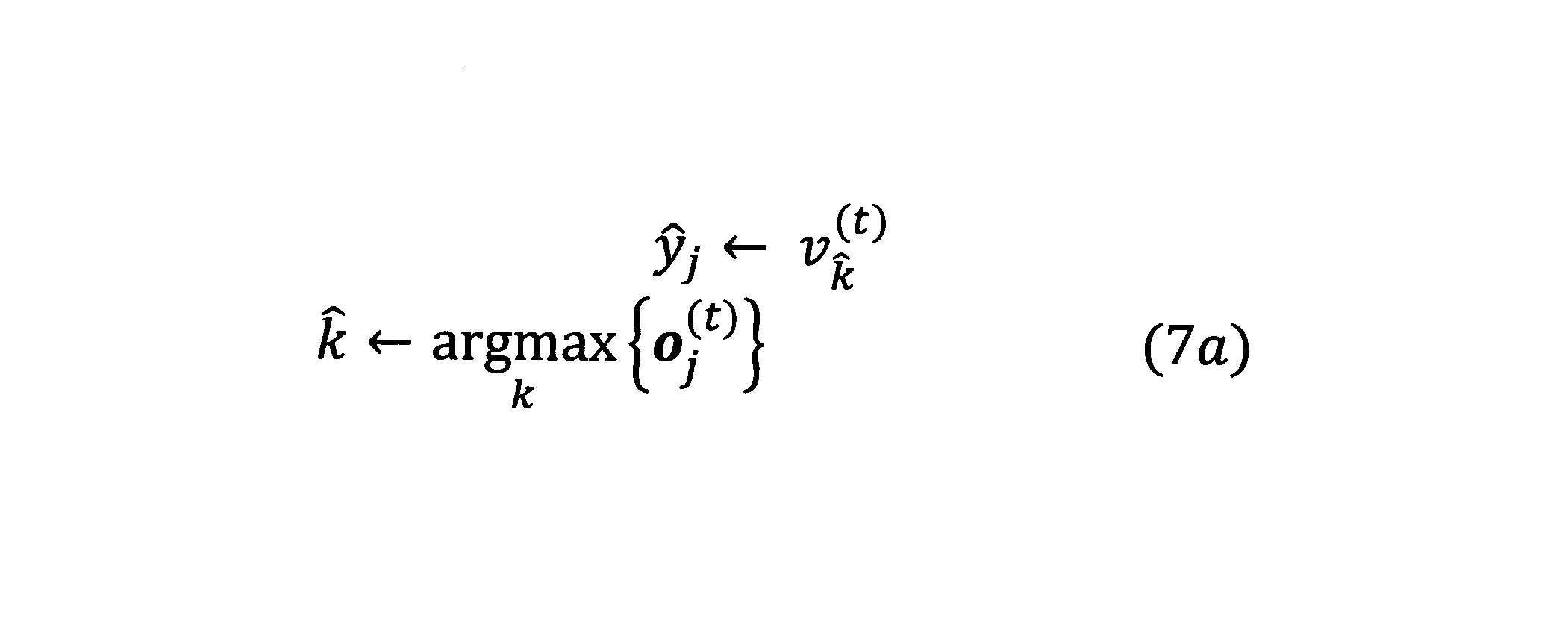
- the predicted output y j of the j-th processing unit is a K-dimensional one-hot vector in which the element corresponding to the element number k having the maximum value among the elements of o j (t) is 1 and the others are 0 Let's say.
- the predicted output text ⁇ y j is obtained by the following formula.
- Expression (7a) is used to select a vocabulary (word or other predetermined processing unit) in the vocabulary ⁇ ′ corresponding to the element number k having the maximum value among the elements of o j (t) .
- v (t) is a vector of character strings in which the vocabulary character strings (text) of the vocabulary ⁇ 'are arranged from the first to the Kth, and v ⁇ k (t) is the ⁇ kth element of v (t) Represents a character string.
- Expression (7b) is to select a vocabulary (word or other predetermined processing unit) in the vocabulary ⁇ corresponding to the element number n having the maximum value among the elements of o j (s) .
- v (s) is a vector of character strings in which the vocabulary character strings (text ) of the vocabulary ⁇ are arranged from the 1st to the Nth, and v ⁇ n (s) is the ⁇ n-th element of v (s) Represents a string.
- ⁇ y Outputs the character string in which j is arranged as the predicted output text.
- ⁇ x j is output as correspondence information (alignment) that identifies from which part of the input text ⁇ y j is generated.
- ⁇ Learning device 130> In the sentence generation process described above, it is assumed that learned values are set in advance for each parameter of the neural network. Below, the learning apparatus 130 for learning the value of each parameter of a neural network is demonstrated in detail.
- Learning device 130 learns the value of each parameter of the neural network used by analysis unit 120 of sentence generation device 100 using learning data prepared in advance.
- each learning data is composed of a pair (X, Y) of a first natural language sentence X and a second natural language sentence Y corresponding to a predetermined purpose corresponding to the first natural language sentence X. That is, for example, when there are M pieces of learning data, the learning data ⁇ is
- (X m , Y m ) represents the mth data in the learning data.
- the second natural language text Y m for example, was translated first summary for natural language X m If summarization, the first natural language sentence X m if the machine translation in the target language statement, if the dialogue generation, a correct response sentence for the first natural language sentence X m.
- the optimal value of the neural network parameter can be generally expressed by the solution of the following objective function minimization problem.
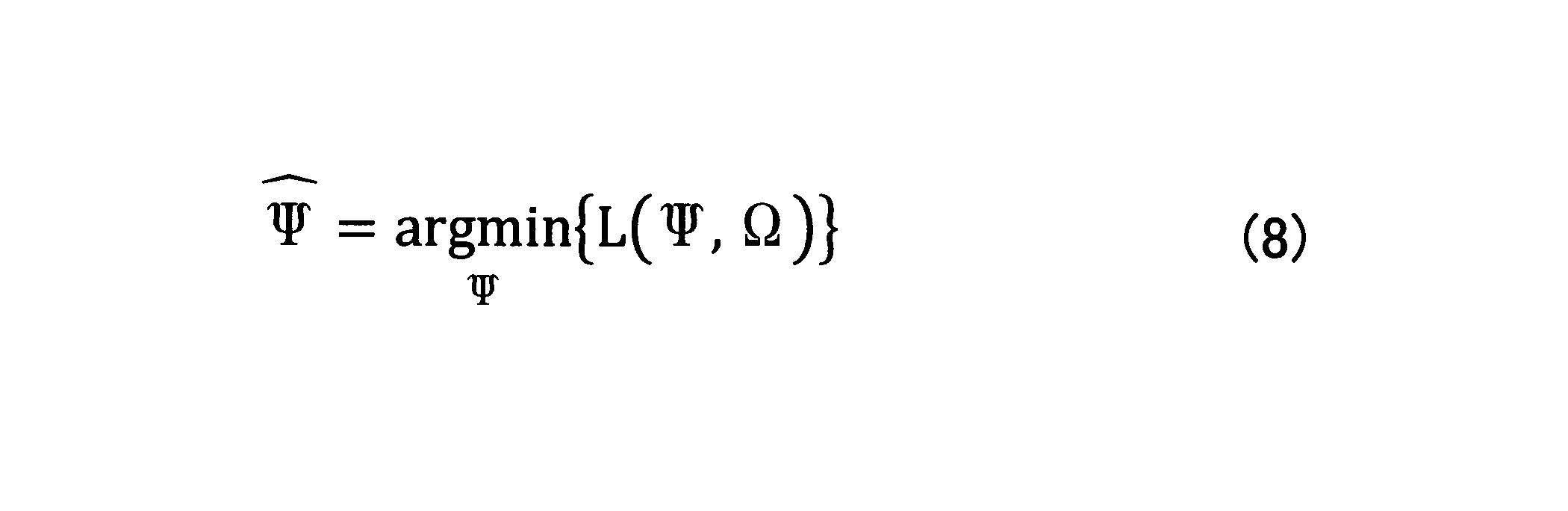
- ⁇ represents the set of all parameters of the neural network, specifically, E, W 1 , W 2 , W 3 , W 4 , V 1 , V 2 , V 3 , V 4 , b 1 , b 2 , b 3 , b 4 , F, W (t) , W (s) , U (a) are included.
- ⁇ ⁇ represents an optimal set of parameters obtained as a result of optimization.
- L is called a loss function.
- the arguments of the loss function L are ⁇ and ⁇ . That is, the purpose of the learning device 130 is to update the value of each parameter included in ⁇ so that the value of the loss function L is as small as possible.
- the learning device 130 includes a sampling unit 131, a dividing unit 132, an analyzing unit 133, and a parameter updating unit 134, as shown in FIG.
- the sampling unit 131 extracts one learning data pair (X m , Y m ) from the learning data set ⁇ .
- Dividing unit 132 divides the first natural language sentence X m, which is extracted into a string of predetermined processing unit. The size of this processing and the processing unit is the same as that of the dividing unit 110 of the sentence generation device 100.
- Analysis unit 133 using a neural network to generate a prediction result ⁇ Y m of the second natural language text from the first natural language sentence X m.
- the neural network used in the analysis unit 133 is the same as that of the analysis unit 120, and the specific process for generating the prediction result ⁇ Y m of the second natural language sentence from the first natural language sentence X m is also the analysis unit 120. Is the same. However, the difference is that each parameter of the neural network is the one before learning. At the first execution, appropriate values are set for the respective parameters, and the values of the respective parameters are repeatedly updated during the learning process of the learning device 130.
- Parameter update unit 134 calculates the value of loss function calculated on the basis of the second natural language sentence prediction result output from the analyzing section 133 ⁇ and Y m learning data (X m, Y m) and its It is determined whether to update the parameter according to the result or to end the learning process. For example, if the value of the loss function is equal to or greater than a predetermined threshold, the neural network parameters are sequentially updated according to the value of the loss function, and then the process returns to the sampling unit 131 and the process is repeated. Further, when the value of the loss function becomes less than a predetermined threshold value, the value of each parameter of the current neural network is output and the learning process is terminated.
- the output parameter value is set in the neural network of the learning device 130, and becomes a state that can function as a learned neural network.
- the value of the loss function is equal to or greater than a predetermined threshold, the parameter is updated as it has not yet converged. If the value of the loss function is less than the predetermined threshold, it is determined that the parameter has converged and learning processing is performed. To finish.
- the method for determining the convergence is not limited to this. For example, if the predetermined number of repetitions has not been reached, the parameter update process is performed, and if the predetermined number of repetitions has been reached, the learning process is terminated. The convergence determination method may be adopted. [Parameter learning process] Next, a parameter learning process using a learned neural network according to an embodiment of the present disclosure will be described with reference to FIG.
- FIG. 11 is a flowchart showing a parameter learning process according to an embodiment of the present disclosure. This process is performed by the learning device 130 that has received the learning data set ⁇ , and more specifically by the processor of the learning device 130, as will be described in detail below.
- step S201 the learning device 130 selects one learning data (X m , Y m ) from the learning data set ⁇ .
- steps S202 step S205 learning data X m selected in step S201 as an input text, by performing the same processing as S104 from step S101 sentence generation process described above, to generate a predicted output text ⁇ Y m.
- step S206 the learning device 130 returns to step S201 and repeats the sentence generation processing until the above-described predicted output text ⁇ Y m is generated for all learning data in the learning data set ⁇ .
- step S207 is executed.
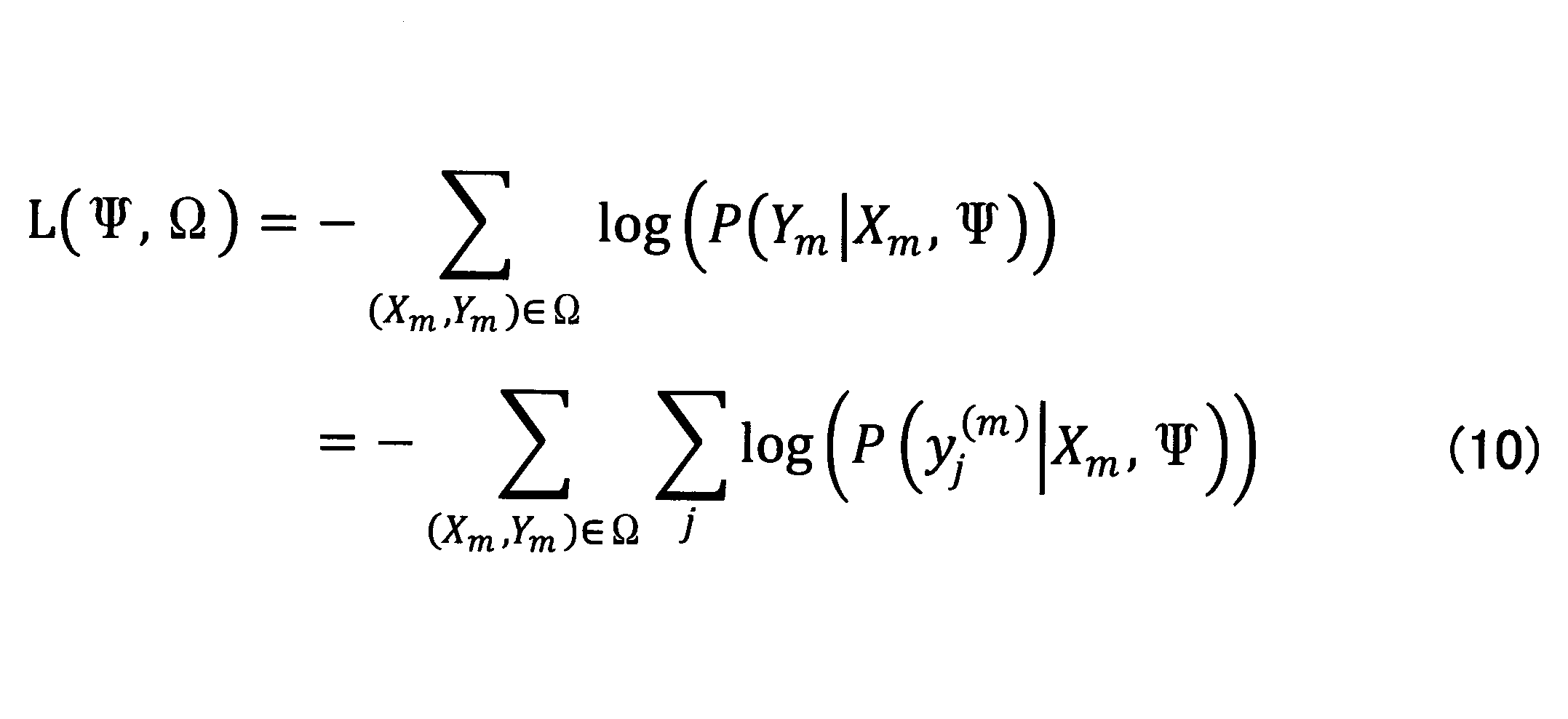
- y j (m) is the j-th processing unit of the correct output text Y m given as learning data.
- X m , ⁇ ) is the correct answer y j (m) as the predicted output text when the input text X m is input to the neural network of the current parameter ⁇ . Represents the probability of output.
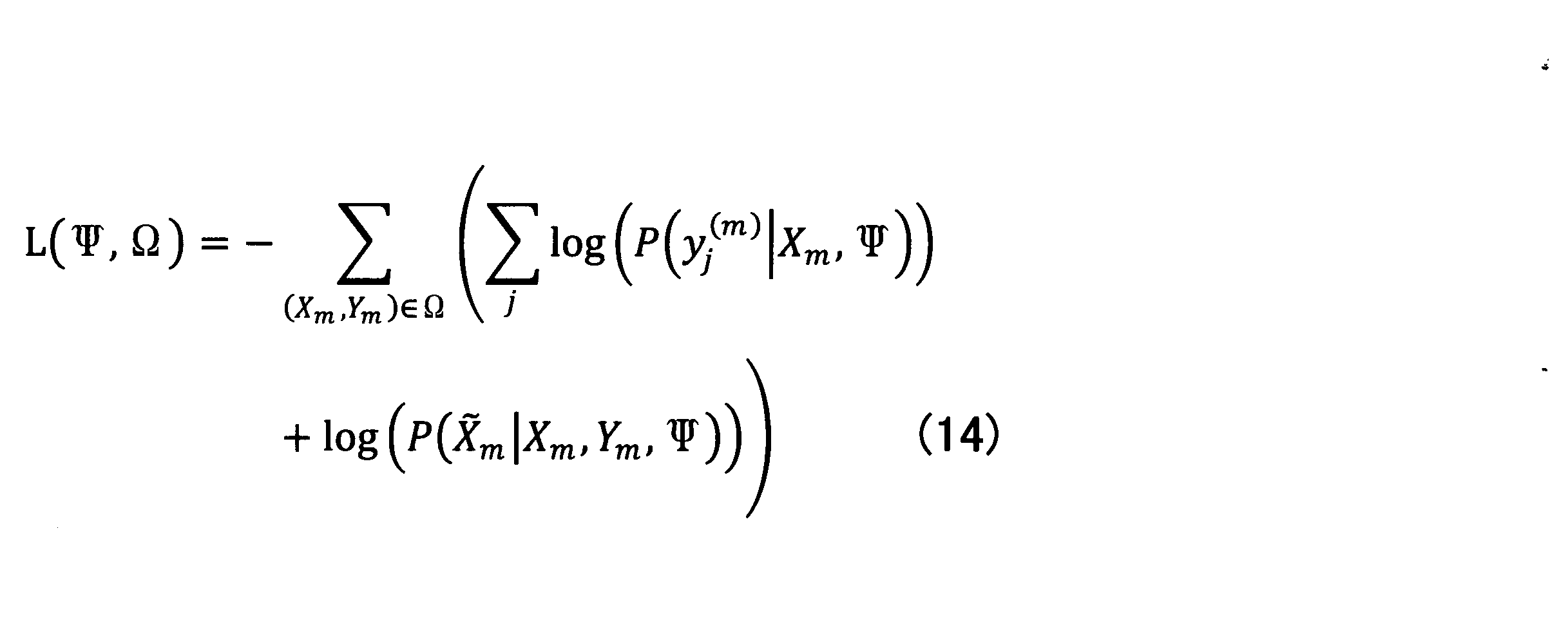
- the following loss function is used instead of the loss function of Expression (10). This is obtained by adding a term for estimating a processing unit in the input text corresponding to each processing unit y j (m ) of the predicted output text to Expression (10).
- the added second term is that the output text Y m is generated when the output text Y m is generated from the input text X m by the neural network in which the current parameter ⁇ is set. This represents the probability that the sentence ⁇ X is predicted as the source sentence. Therefore, if the prediction of ⁇ X is perfectly correct, the value of this second term is zero.
- This added second term may be calculated, for example, by:
- C is a preset parameter, and is an arbitrary natural number.
- C has the effect of determining the strength of the first and second terms in equation (14), so if you want to evaluate the first term more strongly, increase the value of C and increase the value of the second term. If you want to evaluate it, you can reduce the value of C.
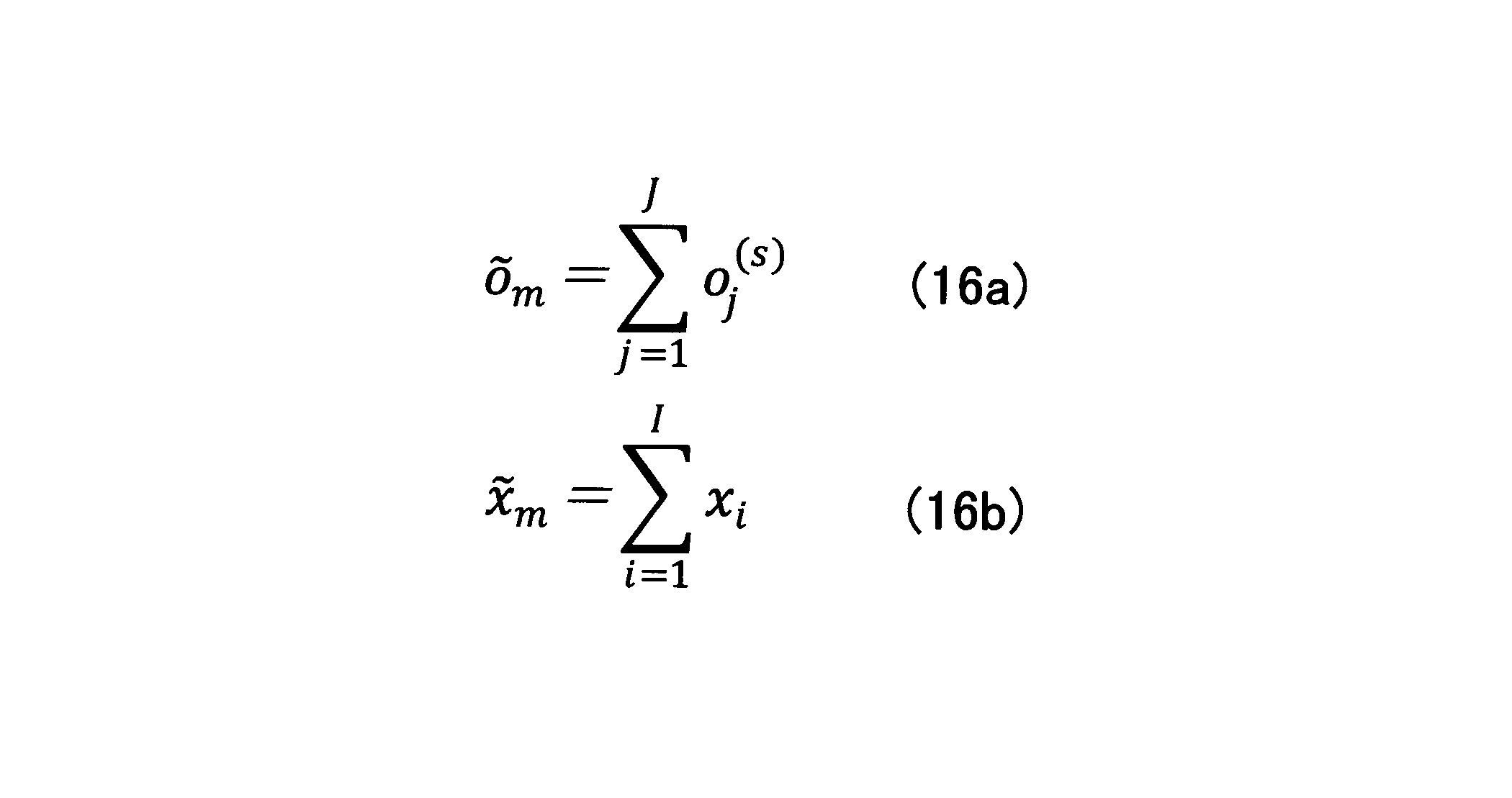
- ⁇ O m and ⁇ x m are calculated by the following equations.
- Equation (16a) and Equation (16b) has a frequency of occurrence of each vocabulary of the input in the text that each generator of predicted output text (word), the occurrence frequency of each vocabulary (word) in the input text X m Represent.
- the second term of Expression (17) becomes zero.
- the second term of the equation (17) can be said to be a scale representing the correctness of the correspondence information (alignment) output as the prediction result.
- learning data prepared for learning may not be provided with correct data of correspondence that indicates which part of the first natural language sentence corresponds to which part of the second natural language sentence. Many. This is because the cost of manually providing correct answer information regarding alignment is very high. For this reason, in conventional learning, it has been difficult to incorporate a measure of alignment correctness into the loss function.
- the first term which is a measure representing the correctness of the output text output as the prediction result
- the correspondence information (alignment) output as the prediction result It is possible to learn the parameters of the neural network by comprehensively considering the second term, which is a measure representing correctness. This is accomplished by output as o j of the decoder of the present disclosure (s) ( ⁇ X) is obtained, it is made possible for the first time.
Landscapes
- Engineering & Computer Science (AREA)
- Theoretical Computer Science (AREA)
- Physics & Mathematics (AREA)
- General Engineering & Computer Science (AREA)
- General Physics & Mathematics (AREA)
- Artificial Intelligence (AREA)
- Computational Linguistics (AREA)
- General Health & Medical Sciences (AREA)
- Health & Medical Sciences (AREA)
- Audiology, Speech & Language Pathology (AREA)
- Data Mining & Analysis (AREA)
- Life Sciences & Earth Sciences (AREA)
- Biophysics (AREA)
- Biomedical Technology (AREA)
- Evolutionary Computation (AREA)
- Molecular Biology (AREA)
- Computing Systems (AREA)
- Mathematical Physics (AREA)
- Software Systems (AREA)
- Databases & Information Systems (AREA)
- Machine Translation (AREA)
Abstract
Description
本開示は、一般に自然言語処理に関し、より詳細には、人工知能を利用した自然言語処理に関する。 This disclosure relates generally to natural language processing, and more specifically to natural language processing using artificial intelligence.
本発明が対象とする自然言語処理技術は、コンピュータにより、入力されたテキストから所定の出力テキストを自動生成する技術である。例えば、自動要約、機械翻訳、対話文生成などが知られている。自動要約の場合は、入力されたテキストを要約した要約文が出力テキストである。また、機械翻訳の場合は、入力されたテキストを目的言語に翻訳した翻訳文が出力テキストである。また、対話文生成の場合は、入力テキストを発話文としたときの、当該発話文に対応する応答文が出力テキストである。 The natural language processing technology targeted by the present invention is a technology for automatically generating a predetermined output text from input text by a computer. For example, automatic summarization, machine translation, and dialogue generation are known. In the case of automatic summarization, a summary sentence that summarizes input text is output text. In the case of machine translation, a translated sentence obtained by translating an input text into a target language is an output text. In the case of dialog sentence generation, when an input text is an utterance sentence, a response sentence corresponding to the utterance sentence is an output text.
ニューラルネットワークを用いた自然言語処理技術として、非特許文献1が知られている。非特許文献1には、入力テキストには含まれない語や言い回しを用いて出力テキストを生成することを許容するよう学習されたニューラルネットワークを用いて、人が読みやすく、かつ、短い自動要約文を生成する自動要約の手法が開示されている。
非特許文献1等の従来のニューラルネットワークを用いた自然言語処理では、入力テキストから出力テキストが生成される過程(内部処理)を人間が解釈することが困難である。例えば、非特許文献1の例では、入力テキスト中の各部分文字列が出力テキスト中のどの部分文字列に対応するかを、人が把握することが困難である。
In natural language processing using a conventional neural network such as Non-Patent
上述した問題点を鑑み、本開示の1つの課題は、解釈性の高いニューラルネットワークによる自然言語処理技術を提供することである。 In view of the problems described above, one problem of the present disclosure is to provide a natural language processing technique using a highly interpretable neural network.
上記課題を解決するため、本開示の一態様は、第1の自然言語文が入力され、第1の自然言語文に対応する所定の目的に応じた第2の自然言語文と、前記第2の自然言語文の各部分が前記第1の自然言語文のいずれの部分の情報に基づき生成されたかを示す対応情報とを出力するよう学習された学習済みニューラルネットワークと、入力されたテキストを、前記学習済みのニューラルネットワークに入力することで、所定の目的に応じた出力テキストの予測結果と、前記出力テキストの予測結果の各部分が前記入力テキストの何れの部分の情報に基づき生成されたかを示す対応情報とを出力する解析部と、を有する装置に関する。 In order to solve the above-described problem, according to one aspect of the present disclosure, a first natural language sentence is input, a second natural language sentence corresponding to a predetermined purpose corresponding to the first natural language sentence, and the second A learned neural network trained to output corresponding information indicating which part of the first natural language sentence is generated based on information of which part of the first natural language sentence, and the input text, By inputting into the learned neural network, the prediction result of the output text corresponding to a predetermined purpose and which part of the prediction result of the output text is generated based on the information of which part of the input text The present invention relates to an apparatus having an analysis unit that outputs corresponding information to be shown.
本開示によると、ニューラルネットワークを利用した言語処理技術において、解釈性の高い出力を提供することができる。 According to the present disclosure, it is possible to provide a highly interpretable output in a language processing technology using a neural network.
以下の実施例では、ニューラルネットワークを利用して、自動要約、機械翻訳、対話文作成などの自然言語処理を実現する装置が開示される。これらの自然言語処理は、入力されたテキストを所定の目的に合った出力テキストに変換する処理として一般的に説明できる。ここで、入力されたテキスト(以下「入力テキスト」ともいう)と出力テキストはいずれも1以上の文からなるものとする。自動要約であれば、出力テキストは入力テキストを、入力テキストよりも短い長さのテキストに要約したテキストとなる。機械翻訳であれば、出力テキストは、入力テキストを目的言語(英語、日本語、中国語等)に翻訳したテキストとなる。対話文作成であれば、出力テキストは、入力テキストである対話文に対する応答文となる。 In the following embodiments, an apparatus for realizing natural language processing such as automatic summarization, machine translation, and dialog sentence creation using a neural network is disclosed. These natural language processes can be generally described as processes for converting input text into output text suitable for a predetermined purpose. Here, it is assumed that both the input text (hereinafter also referred to as “input text”) and the output text are composed of one or more sentences. In the case of automatic summarization, the output text is a text obtained by summarizing the input text into text having a shorter length than the input text. In the case of machine translation, the output text is a text obtained by translating the input text into a target language (English, Japanese, Chinese, etc.). When creating a dialogue sentence, the output text is a response sentence to the dialogue sentence that is the input text.
図1は、一般的な自動要約処理の概念図である。ここでは、入力として日本語の文章が与えられた場合に、要約文として日本語で入力文章を所定の文字数内に要約した文(要約文)を出力するものである。 FIG. 1 is a conceptual diagram of a general automatic summarization process. Here, when a Japanese sentence is given as an input, a sentence (summary sentence) that summarizes the input sentence within a predetermined number of characters in Japanese is output as a summary sentence.
典型的なニューラルネットワークに基づく自動要約の例を、図2を用いて説明する。なお、ここでの例文は日本語のテキストとしている。まず、入力テキストを所定の処理単位で分割し、処理単位毎の固定長ベクトルに変換する。次に、符号化器が、分割されたベクトルを符号化して、中間状態(符号)を出力する。そして、復号化器が、符号化器によって生成された符号を復号化することにより、出力テキスト(この例では要約文)が生成される。ここで、符号化器と復号化器は、ニューラルネットワークで実現される。このように、従来のニューラルネットワークに基づく自然言語処理では、入力テキストに対して出力テキストのみが出力される。 An example of automatic summarization based on a typical neural network will be described with reference to FIG. The example sentences here are in Japanese text. First, the input text is divided into predetermined processing units and converted into fixed-length vectors for each processing unit. Next, the encoder encodes the divided vector and outputs an intermediate state (code). Then, the decoder decodes the code generated by the encoder, thereby generating an output text (summary sentence in this example). Here, the encoder and the decoder are realized by a neural network. Thus, in the natural language processing based on the conventional neural network, only the output text is output with respect to the input text.
一方、本開示の実施例による自動要約では、図2B及び図3に示すように、入力テキストと共に、入力テキスト中の各部分と出力テキスト中の各部分との間の対応関係を示す情報(アラインメント)が出力される。この例では、アラインメントは、入力テキスト中の部分文字列と出力テキスト中の部分文字列との対応関係を示す情報である。これにより、ニューラルネットワークの出力である出力テキストの各部分文字列が入力テキストの何れの部分文字列に基づき生成されたかを、ユーザが容易に把握することができる。これにより、出力テキストを人手で修正したり、よりよい品質の出力テキストがニューラルネットワークから出力されるように、ニューラルネットワークの構成等を調整したりすることが容易になる。
<文生成装置100>
まず、図4~7を参照して、本開示の一実施例による文生成装置を説明する。
On the other hand, in the automatic summarization according to the embodiment of the present disclosure, as shown in FIG. 2B and FIG. ) Is output. In this example, the alignment is information indicating a correspondence relationship between the partial character string in the input text and the partial character string in the output text. Accordingly, the user can easily grasp which partial character string of the output text that is the output of the neural network is generated based on which partial character string of the input text. This makes it easy to manually correct the output text or to adjust the configuration of the neural network so that a better quality output text is output from the neural network.
<
First, a sentence generation device according to an embodiment of the present disclosure will be described with reference to FIGS.
図4は、本開示の一実施例による文生成装置の構成を示すブロック図である。文生成装置100は、分割部110及び解析部120を有する。
FIG. 4 is a block diagram illustrating a configuration of a sentence generation device according to an embodiment of the present disclosure. The
分割部110は、入力テキストを読み込み、事前に定義された任意の処理単位に分割して出力する。ここで、処理単位は、例えば、英語の文章では単語、日本語や中国語の文章では一文字または形態素等である。
The
解析部120は、学習済みのニューラルネットワークを用いて、入力テキストから所定の目的に応じた出力テキストの予測結果(以下、「予測出力テキスト」ともいう)と対応情報とを生成する。ここで、対応情報は、予測出力テキストの各部分が入力テキストの何れの部分の情報に基づき生成されたかを特定する情報である。
The
解析部120で用いる学習済みニューラルネットワークは、第1の自然言語文が入力されると、(1)第1の自然言語文に対応する所定の目的に応じた第2の自然言語文の予測結果と、(2)第1の自然言語文と第2の自然言語文の予測結果との間の対応関係を特定する情報である対応情報と、を出力するように、予め学習されたものである。ここで、対応情報は、第2の自然言語文の予測結果に含まれる各部分が第1の自然言語文のどの部分の情報に基づき生成されたかを特定する情報である。例えば、自動要約であれば、要約文の各部分が入力テキストのどの部分を要約したものであるかを特定する情報である。機械翻訳であれば、翻訳文の各部分(例えば単語)が入力テキスト中のどの部分(例えば単語)の対訳であるかを特定する情報である。あるいは、対話文生成の場合は、生成された応答文の各部分が、入力テキストである対話文のどの部分に基づき生成されたかを特定する情報である。
When the first natural language sentence is input to the learned neural network used in the
なお、解析部120で用いる学習済みニューラルネットワークは、ニューラルネットワークの各パラメタを後述の学習装置130等により予め学習し、その結果である各パラメタの値を設定済みのニューラルネットワークをいう。つまり、解析部120では、入力テキストが学習済みニューラルネットワークに入力されることで、予測出力テキストと対応情報とが出力される。
Note that the learned neural network used in the
より詳細には、解析部120は、図5に示すように、ベクトル変換部121、符号化部122及び復号化部123を有する。符号化部122と復号化部123がニューラルネットワークの構成要素である。ここでのニューラルネットワークは、encoder-decoderモデルを仮定して説明をするが、本発明で用いるニューラルネットワークはこれに限られるものではない。encoder-decoderモデルは、テキストに対応する情報を中間状態(ベクトルの系列。以降、中間出力ともいう。)に変換する機能を担うニューラルネットワーク(これを「符号化器」という)と、中間出力をテキストに変換する機能を担うニューラルネットワーク(これを「復号化器」という)とから構成されるニューラルネットワークである。ニューラルネットワークの各パラメタは、後述の学習装置130等により、あらかじめ学習データに基づき学習済みの値を設定しておく。
More specifically, the
ベクトル変換部121は、処理単位に分割された入力テキスト(以下「単位入力テキスト」という)が入力されると、処理単位毎に、単位入力テキストをN次元のベクトルに変換する。ここで、Nは自然数である。以下、処理単位ごとのベクトル表現を並べたリストを、「入力ベクトル」と呼ぶ。
When the input text divided into processing units (hereinafter referred to as “unit input text”) is input, the
符号化部122は、学習済みニューラルネットワークの符号化器により、入力ベクトルを中間出力に変換する。
The
復号化部123は、学習済みニューラルネットワークの復号化器により、符号化部122が出力した中間出力を2つの出力ベクトルに変換する。そして、一方の出力ベクトルに基づき出力テキストの予測結果を、他方の出力ベクトルに基づき対応情報を、それぞれ生成して出力する。
The
なお、文生成装置100は、典型的には、サーバなどの計算装置により実現されてもよく、例えば、図7に示すように、バスBを介し相互接続されるドライブ装置101、補助記憶装置102、メモリ装置103、プロセッサ104、インタフェース装置105及び通信装置106から構成されてもよい。文生成装置100における後述される各種機能及び処理を実現するプログラムを含む各種コンピュータプログラムは、CD-ROM(Compact Disk-Read Only Memory)、DVD(Digital Versatile Disk)、フラッシュメモリなどの記録媒体107によって提供されてもよい。プログラムを記憶した記録媒体107がドライブ装置101にセットされると、プログラムが記録媒体107からドライブ装置101を介して補助記憶装置102にインストールされる。但し、プログラムのインストールは必ずしも記録媒体107により行う必要はなく、ネットワークなどを介し何れかの外部装置からダウンロードするようにしてもよい。補助記憶装置102は、インストールされたプログラムを格納すると共に、必要なファイルやデータなどを格納する。メモリ装置103は、プログラムの起動指示があった場合に、補助記憶装置102からプログラムやデータを読み出して格納する。プロセッサ104は、メモリ装置103に格納されたプログラムやプログラムを実行するのに必要なパラメタなどの各種データに従って、後述されるような文生成装置100の各種機能及び処理を実行する。インタフェース装置105は、ネットワーク又は外部装置に接続するための通信インタフェースとして用いられる。通信装置106は、インターネットなどのネットワークと通信するための各種通信処理を実行する。
The
しかしながら、文生成装置100は、上述したハードウェア構成に限定されるものでなく、他の何れか適切なハードウェア構成により実現されてもよい。
[文生成処理]
次に、図8~9を参照して、本開示の一実施例による学習済みニューラルネットワークを利用した文生成処理を説明する。
However, the
[Sentence generation processing]
Next, a sentence generation process using a learned neural network according to an embodiment of the present disclosure will be described with reference to FIGS.
図8は、本開示の一実施例による文生成処理を示すフローチャートである。当該処理は、以下で詳細に説明されるように、入力テキストを受信した文生成装置100によって、より詳細には、文生成装置100のプロセッサによって実行される。入力テキストは、自然言語により記述された文または文章であり、例えば、ニュース記事全体などであってもよい。また、音声認識結果であるテキストであってもよい。
FIG. 8 is a flowchart showing sentence generation processing according to an embodiment of the present disclosure. The processing is executed by the
ステップS101において、文生成装置100は、入力テキストを事前に定義された任意の処理単位に分割する。例えば、英語の文章では、空白(スペース)により分割する。この場合、処理単位は単語となる。また、処理単位は一文字単位として定義されてもよく、この場合、日本語や中国語など、空白で単語区切りが明記されていない言語の文章にも対応できる。このような単純な分割方式以外でも、形態素解析システムを用いて形態素を処理単位とすることも可能である。何れの方式においても、処理単位は文生成装置100の管理者など人手によって選択され、事前に設定される。
In step S101, the
このようにして、文生成装置100は、例えば、図9に示すように、入力文章を事前に決定された任意の処理単位に分割することによって生成された文章を出力する。
In this way, the
ステップS102において、文生成装置100は、処理単位に分割された文章に対して、処理単位毎に対応するベクトルを取得する。説明のため、入力テキスト中のi番目の処理単位の文字列をwiとし、入力テキストの分割数がIであるとして、入力テキストを処理単位毎の文字列wiのリスト
In step S102, the

ステップS102において、文生成装置100は、処理単位毎の文字列wiに基づいて、文字列wiに対応するベクトルxiを生成する。ベクトルxiは、文字列の特徴をN次元のベクトルで表現したものであり、各文字列が事前に用意された語彙(単語等、所定の処理単位)の集合のうち、いずれの語彙に対応するかをベクトルで表現したものである。例えば、語彙の集合Φ中の語彙数をNとし、wiが語彙の集合Φ中のn番目の語彙に対応する場合、ベクトルxiはn番目の要素が1で、それ以外の要素が0となるN次元のone-hotベクトルである。
In step S102,
以降の処理は、図10を参照しながら説明する。図10は、解析部120による処理の流れを表すイメージ図である。なお、ここで示す構成は一例であって、ニューラルネットワークの構成はこれに限定されるものではない。
The subsequent processing will be described with reference to FIG. FIG. 10 is an image diagram illustrating a flow of processing by the
文生成装置100は、ニューラルネットワーク(図10ではNN1)により、ベクトルxiをD次元のベクトルeiに変換する。ei はxiを所定次元(D次元)の実数値ベクトルに変換したもの(word embedding)である。この変換処理は以下の式で記述できる。
The


本実施例では、符号化器としてLSTM (Long Short-Term Memory)を用いた場合を例に、図10を参照しながら処理を説明する。ただし、符号化器の構成はこれに限定されるものではない。 In the present embodiment, the processing will be described with reference to FIG. 10, taking as an example the case where LSTM® (Long® Short-Term® Memory) is used as an encoder. However, the configuration of the encoder is not limited to this.
LSTMは、入力ベクトルeiのリストの先頭e1から順にニューラルネットワーク(図10ではNN2)による変換を行って、隠れ状態hiを順次生成していく。i番目の入力ベクトルeiを変換して得られる隠れ状態をhiとすると、まずe1とh0をニューラルネットワークに入力することで変換結果h1を生成し、次にe2とh1をニューラルネットワークに入力することで変換結果h2を得る。同様に、i=3,4,…,I の順にeiとhi-1をニューラルネットワークにより変換してhiを得る。ここで、h0は予め適当な値が初期設定されたH次元ベクトルを用いればよい。
The LSTM sequentially generates hidden states h i by performing conversion using a neural network (
ここで、また、W1, W2, W3, W4 , V1, V2, V3, V4をニューラルネットワークの学習可能なパラメタとする。W1, W2, W3, W4 は、それぞれH×D行列(Hは任意の自然数である)である。V1, V2, V3, V4は、それぞれH×H行列である。本実施例では、これらのパラメタは予め学習済みである、つまり、行列の各要素の値は既に固定されていると想定する。また、b1, b2, b3, b4はそれぞれH次元のバイアスベクトルである。これも、ニューラルネットワークの学習可能なパラメタであり、本実施例では、予め学習済みであると想定する。すると、LSTM内の計算処理は、以下のように記述できる。つまり、ステップS103において、文生成装置100は、ステップS102において取得されたベクトルのリストの先頭e1から順に下記式を実行することで、隠れ状態hiを順次生成する。
Here, W 1 , W 2 , W 3 , W 4 , V 1 , V 2 , V 3 , V 4 are also parameters that can be learned by the neural network. W 1 , W 2 , W 3 , and W 4 are each an H × D matrix (H is an arbitrary natural number). V 1 , V 2 , V 3 and V 4 are each an H × H matrix. In this embodiment, it is assumed that these parameters have been learned in advance, that is, the values of the elements of the matrix are already fixed. B 1 , b 2 , b 3 , and b 4 are H-dimensional bias vectors, respectively. This is also a learnable parameter of the neural network, and in this embodiment, it is assumed that it has been learned in advance. Then, the calculation process in LSTM can be described as follows. That is, in step S103, the





本実施例では、復号化器の構成として、符号化器と同様にLSTM (Long Short-Term Memory)を用いた場合を例とし、図10を参照しながら処理を説明する。ただし、復号化器の構成はこれに限定されるものではない。 In this embodiment, as an example of the configuration of the decoder, LSTM® (Long Short-Term® Memory) is used as in the case of the encoder, and processing will be described with reference to FIG. However, the configuration of the decoder is not limited to this.
復号化器は、中間出力を生成するLSTM(図10ではNN3)と、中間出力から出力テキストを予測するためのニューラルネットワーク(図10ではNN4~NN5)とを含む。 The decoder includes an LSTM that generates intermediate output (NN3 in FIG. 10) and a neural network (NN4 to NN5 in FIG. 10) for predicting output text from the intermediate output.
まず、中間出力を生成するLSTMによる処理を説明する。LSTMの部分は、符号化器のeiの代わりにujを、hiの代わりにzjを用いる点を除けば、基本的に符号化器と同様の構成である。ここで、ujは、予測出力テキストのj番目の処理単位の予測結果yjに対応するベクトル表現である。u0には文頭を表す記号等に対応するベクトル表現を用いる。また、z0として符号化器の最後の中間出力hIを用いることとする。 First, processing by the LSTM that generates an intermediate output will be described. Portion of LSTM includes a u j instead of e i of the encoder, except using z j instead of h i, is basically similar to the encoder configuration. Here, u j is a vector expression corresponding to the prediction result yj of the j-th processing unit of the predicted output text. u 0 uses a vector representation corresponding to a symbol or the like representing the beginning of a sentence. Further, the last intermediate output h I of the encoder is used as z 0 .
まず、符号化器から出力される隠れ状態hI及びu0をニューラルネットワーク(図10ではNN3)に入力し、隠れ状態z1を生成する。そして、符号化器で生成された隠れ状態h1,…,hIとz1とをニューラルネットワーク(図10のNN4)に入力することで、隠れ状態~z1を生成する。そして、隠れ状態~z1から出力テキストの1番目の処理単位の予測結果y1と、y1を生成する元になった入力テキストの処理単位の予測結果x1と、を求める。そして、1番目の処理単位の予測結果y1をニューラルネットワーク(図10のNN6)により所定次元のベクトルu1に変換する。なお、~および^は、図10ではzやyの上に表示される記号である。 First enter the hidden state h I and u 0 is outputted from the encoder to the neural network (in FIG. 10 NN3), to generate a hidden state z 1. Then, the hidden states h 1 ,..., H I and z 1 generated by the encoder are input to the neural network (NN 4 in FIG. 10) to generate the hidden states to z 1 . Then, determine a prediction result y 1 of the first processing unit in the output text from the hidden state ~ z 1, and the prediction result x 1 unit of processing of the input text that was the source for generating the y 1, the. Then, to convert the prediction result y 1 of the first processing unit by a neural network (NN6 in Figure 10) to the vector u 1 of predetermined dimensions. Note that ~ and ^ are symbols displayed above z and y in FIG.
同様に、j=2,3,…,J-1について順番に、yj-1に対応するベクトル表現uj-1と隠れ状態zj-1をニューラルネットワークに入力することで、隠れ状態zjを求める。ここで、Jは予測出力テキストに含まれる処理単位数(分割数)である。そして、符号化器で生成された隠れ状態h1,…,hIとzjとをニューラルネットワーク(図10のNN4)に入力することで、隠れ状態~zjを生成する。そして、隠れ状態~zjから予測出力テキストのi番目の処理単位の予測結果yjと、yjを生成する元になった入力側テキストの処理単位xjと、を求める。そして、j番目の処理単位の予測出力yjをニューラルネットワーク(図10のNN6)により所定次元のベクトルujに変換する。 Similarly, j = 2,3, ..., sequentially for J-1, by inputting a vector representation u j-1 and the hidden state z j-1 corresponding to y j-1 in the neural network, hidden state z Find j . Here, J is the number of processing units (number of divisions) included in the predicted output text. The hidden state h1 generated by the encoder, ..., by inputting the hI and z j in the neural network (NN4 in FIG. 10), to generate a hidden state ~ z j. Then, the prediction result y j of the i-th processing unit of the predicted output text and the processing unit x j of the input side text from which y j is generated are obtained from the hidden state ~ z j . Then, the predicted output y j of the j-th processing unit is converted into a vector u j of a predetermined dimension by a neural network (NN6 in FIG. 10).
ここで、yjに対応するベクトル表現ujはD次元のベクトルである。yjをujに変換するニューラルネットワークの層を特定するパラメタをD×K次元の行列Fであらわすと、この変換は以下の式で表せる。 Here, the vector representation u j corresponding to y j is a D-dimensional vector. If the parameter that identifies the layer of the neural network that converts y j to u j is represented by a D × K dimensional matrix F, this conversion can be expressed by the following equation.

符号化器で生成された隠れ状態h1,…,hIとzjとから、隠れ状態~zjを生成する処理、つまり、図10のNN4の演算は、以下のように表せる。 The process of generating hidden states to z j from the hidden states h 1 ,..., H I and z j generated by the encoder, that is, the operation of NN4 in FIG.
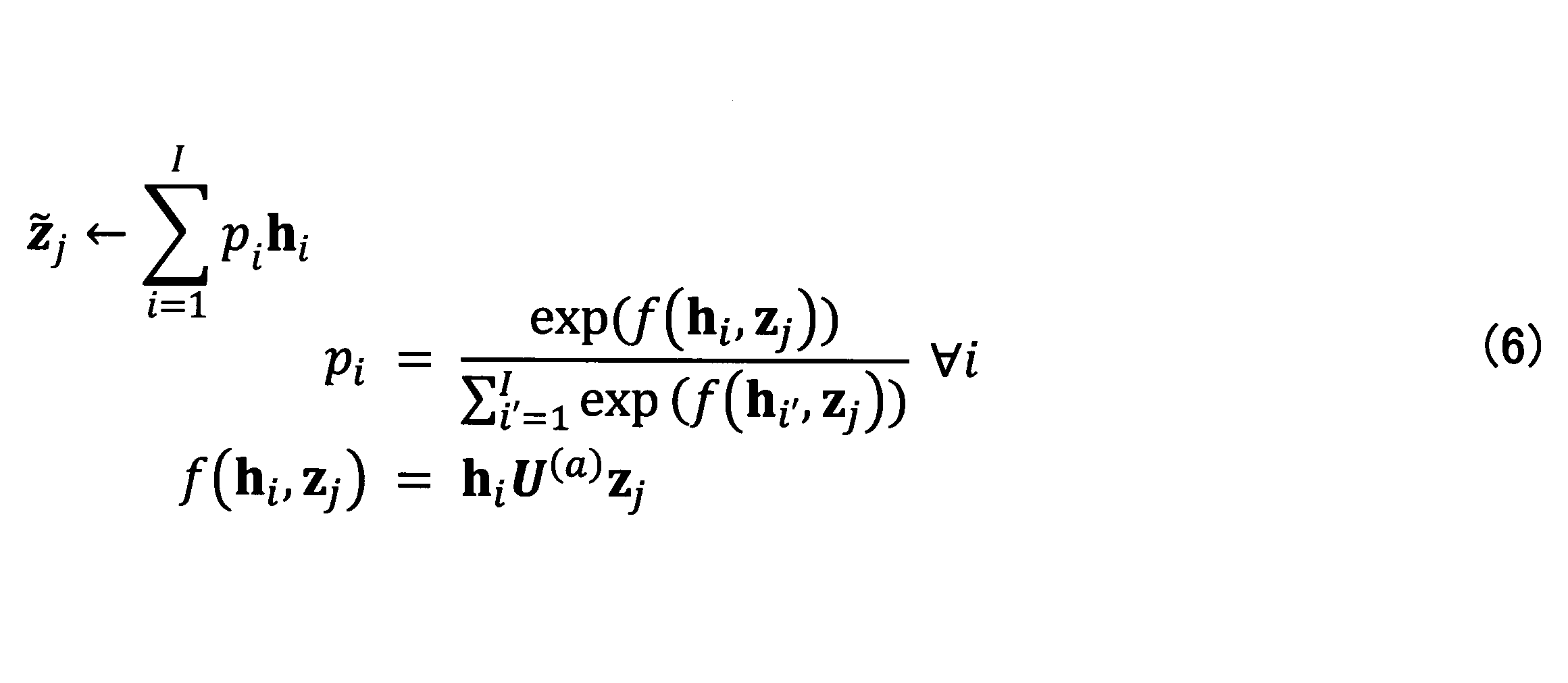
次に、隠れ状態~zjから^yjと^xjとを求める処理について、具体的に説明する。まず、隠れ状態~zjをニューラルネットワークに入力して、oj (t)及びoj (s)を生成する。この計算は、以下の式で表せる。 Next, the process for obtaining ^ y j and ^ x j from the hidden state ~ z j will be specifically described. First, the hidden state ~ z j is input to the neural network to generate o j (t) and o j (s) . This calculation can be expressed by the following equation.
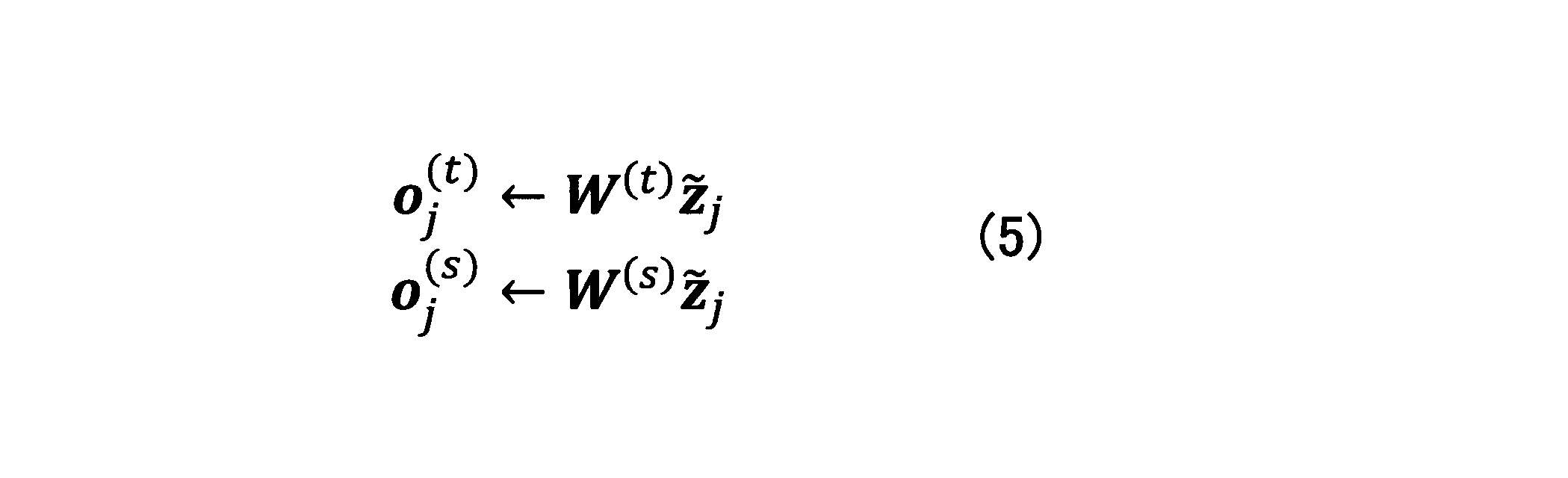
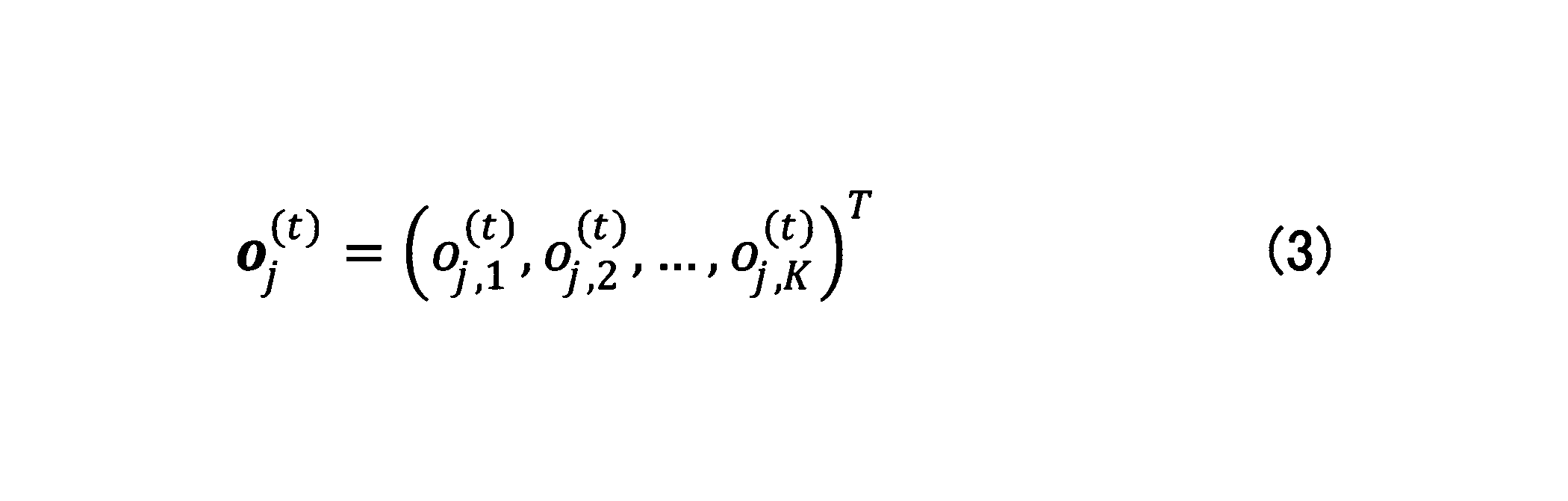

ここで、復号化器は、出力側(t)のoj (t)と入力側(s)のoj (s)とを~zjを用いて予測する。予測結果であるoj (t)とoj (s)は予測出力テキストと入力テキストとにおいて同じ意味を表すものであり、アラインメントを求める処理に相当する。j番目の処理単位の予測出力yjは,oj (t) の要素の中で値が最大となる要素番号kに対応する要素が1,それ以外を0としたK次元のone-hotベクトルとする.また,予測出力テキスト^yjは、以下の式により求まる。 Here, the decoder is predicted using o j (s) and a ~ z j of o j (t) and the input side of the output side (t) (s). The prediction results o j (t) and o j (s) represent the same meaning in the predicted output text and the input text, and correspond to processing for obtaining alignment. The predicted output y j of the j-th processing unit is a K-dimensional one-hot vector in which the element corresponding to the element number k having the maximum value among the elements of o j (t) is 1 and the others are 0 Let's say. The predicted output text ^ y j is obtained by the following formula.
また、j番目の処理単位の予測出力テキスト^yjを生成する元となる、入力テキストの処理単位を表すxjに対応するテキスト^xjは、以下の式により求まる。
Further, the text ^ x j corresponding to x j representing the processing unit of the input text, which is the basis for generating the predicted output text ^ y j of the j-th processing unit, is obtained by the following expression.
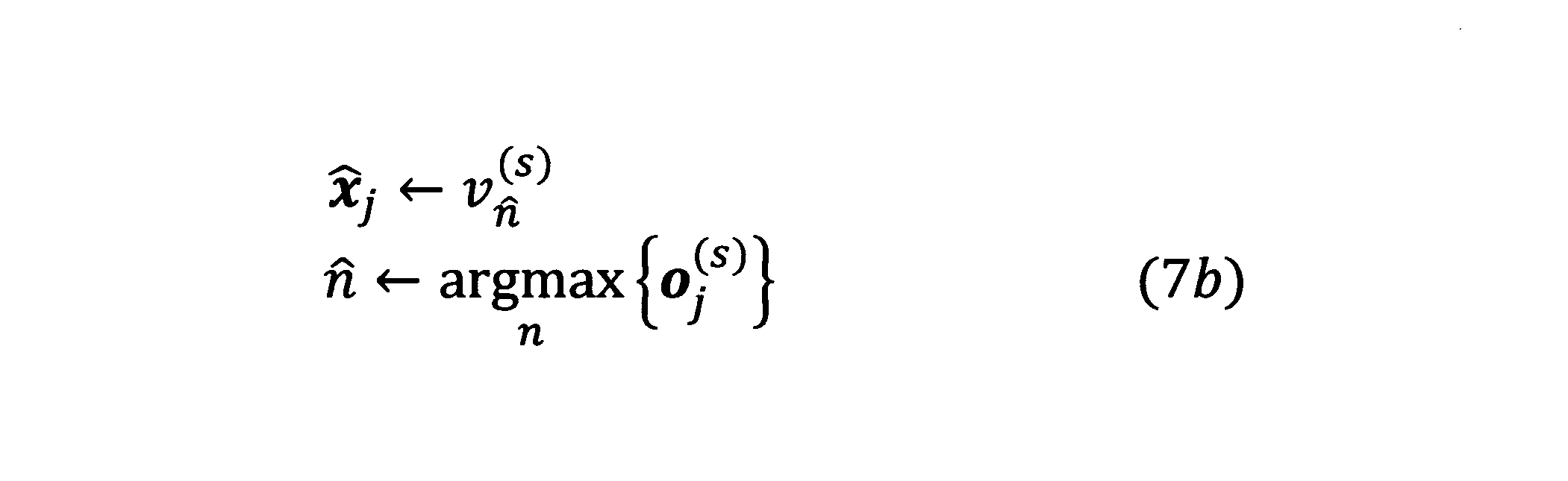
なお、^yjに対応する入力テキストの処理単位は複数存在する場合も考えられる。それら複数個を出力したい場合、上記のargmax関数の代わりに、値が上位R個の要素番号を返す関数や、値が任意の閾値R以上となる要素番号を返す関数が用いられてもよい。ただし、予測出力テキストを生成する元となる入力テキストの処理単位を出力する必要がない場合、語彙を選択するための(7b)の計算は実行しなくてもよい。 Note that there may be multiple input text processing units corresponding to ^ yj. When it is desired to output a plurality of these, instead of the argmax function described above, a function that returns an element number having a higher R value or a function that returns an element number whose value is greater than or equal to an arbitrary threshold value R may be used. However, if it is not necessary to output the processing unit of the input text from which the predicted output text is generated, the calculation of (7b) for selecting the vocabulary need not be executed.
このようにして、復号化器は、^yjを出力する処理を必要回数分(例えば、文末を表す記号(EOS等)が出力されるまで)繰り返し、最終的にj=1からJまで順に^yjを並べた文字列を予測出力テキストとして出力する。また、^xjが、^yjが入力テキストのどの部分から^yjが生成されたかを特定する対応情報(アラインメント)として出力される。
<学習装置130>
上述の文生成処理では、ニューラルネットワークの各パラメタには、予め学習済みの値が設定されているものとした。以下では、ニューラルネットワークの各パラメタの値を学習するための学習装置130について詳細に説明する。
In this way, the decoder repeats the process of outputting ^ y j as many times as necessary (for example, until a symbol indicating the end of the sentence (such as EOS) is output), and finally j = 1 to J in order. ^ y Outputs the character string in which j is arranged as the predicted output text. Also, ^ x j is output as correspondence information (alignment) that identifies from which part of the input text ^ y j is generated.
<
In the sentence generation process described above, it is assumed that learned values are set in advance for each parameter of the neural network. Below, the
学習装置130は、予め用意された学習用データを用いて、文生成装置100の解析部120で用いるニューラルネットワークの各パラメタの値を学習する。
ここで、学習データの集合をΩで表す。また、個々の学習データは、第1の自然言語文Xとそれに対応する所定の目的に応じた第2の自然言語文Yとのペア(X,Y)により構成される。すなわち、例えば、M個の学習データがある場合、学習データΩは、 Here, the set of learning data is represented by Ω. Each learning data is composed of a pair (X, Y) of a first natural language sentence X and a second natural language sentence Y corresponding to a predetermined purpose corresponding to the first natural language sentence X. That is, for example, when there are M pieces of learning data, the learning data Ω is

ニューラルネットワークのパラメタの最適値は、一般に、以下の目的関数の最小化問題の解で表せる。 The optimal value of the neural network parameter can be generally expressed by the solution of the following objective function minimization problem.
より詳細には、学習装置130は、図6に示すように、サンプリング部131、分割部132、解析部133及びパラメタ更新部134を有する。
More specifically, the
サンプリング部131は、学習データの集合Ωの中から1つ学習データの対(Xm,Ym)を抽出する。
The
分割部132は、抽出された第1の自然言語文Xmを所定の処理単位の文字列に分割する。この処理および処理単位の大きさは、文生成装置100の分割部110と同一である。
Dividing
解析部133は、ニューラルネットワークを用いて、第1の自然言語文Xmから第2の自然言語文の予測結果^Ymを生成する。ここで、解析部133で用いるニューラルネットワークは解析部120と同じであり、第1の自然言語文Xmから第2の自然言語文の予測結果^Ymを生成する具体処理も、解析部120と同じである。ただし、ニューラルネットワークの各パラメタが学習前のものである点が異なる。最初の実行時においては、各パラメタには適当な値を設定しておき、学習装置130の学習処理の過程でこの各パラメタの値が繰り返し更新されていく。
パラメタ更新部134は、解析部133から出力された第2の自然言語文の予測結果^Ymと学習データ(Xm,Ym)とに基づき計算される損失関数の値を計算し、その結果に応じてパラメタを更新するか、学習処理を終了するかを決定する。例えば、損失関数の値が予め定めた閾値以上の場合は、損失関数の値に応じて、ニューラルネットワークのパラメタを順次更新した後、サンプリング部131に戻って処理を繰り返す。また、損失関数の値が予め定めた閾値未満になったら、現在のニューラルネットワークの各パラメタの値を出力して学習処理を終了する。出力されたパラメタの値が、学習装置130のニューラルネットワークに設定され、学習済みニューラルネットワークとして機能可能な状態となる。ここでは、損失関数の値と所定の閾値以上であれば、まだ収束していないとしてパラメタの更新処理を行い、損失関数の値が所定の閾値未満となれば、収束したと判定して学習処理を終えるものとした。しかし、収束判定の方法はこれに限られるものではなく、例えば所定の繰り返し回数に到達していなければパラメタ更新処理を行い、所定の繰り返し回数に到達したら学習処理を終了する構成とする等、別の収束判定方法を採用してもよい。
[パラメタ学習処理]
次に、図11を参照して、本開示の一実施例による学習済みニューラルネットワークを利用したパラメタ学習処理を説明する。
[Parameter learning process]
Next, a parameter learning process using a learned neural network according to an embodiment of the present disclosure will be described with reference to FIG.
図11は、本開示の一実施例によるパラメタ学習処理を示すフローチャートである。当該処理は、以下で詳細に説明されるように、学習データの集合Ωを受信した学習装置130によって、より詳細には、学習装置130のプロセッサによって実行される。
FIG. 11 is a flowchart showing a parameter learning process according to an embodiment of the present disclosure. This process is performed by the
ステップS201において、学習装置130は、学習用データの集合Ωの中から1つの学習データ(Xm,Ym)を選択する。
In step S201, the
ステップS202からステップS205では、ステップS201で選択した学習データXmを入力テキストとして、上述の文生成処理のステップS101からS104と同じ処理を行って、予測出力テキスト^Ymを生成する。 In steps S202 step S205, learning data X m selected in step S201 as an input text, by performing the same processing as S104 from step S101 sentence generation process described above, to generate a predicted output text ^ Y m.
ステップS206において、学習装置130は、学習データの集合Ω中の全ての学習データについて上述の予測出力テキスト^Ymが生成されるまで、ステップS201に戻り、文生成の処理を繰り返す。全ての学習データについて予測出力テキストが得られたら、ステップS207を実行する。
In step S206, the
ステップS207において、学習装置130は、学習用データの集合Ωと予測出力テキスト^Ym(m=1,2,…,M)を用いて、現在のニューラルネットワークのパラメタの予測の正しさを表す損失関数を計算する。上述したThang Luong, et al.において提案される従来法に相当するモデルでは、以下の損失関数が用いられる。
In step S207, the
これに対し、本開示による実施例では、式(10)の損失関数に代えて、以下の損失関数を用いる。これは、式(10)に予測出力テキストの各処理単位yj (m)に対応する入力テキスト中の処理単位を推定する項が追加されたものである。 On the other hand, in the embodiment according to the present disclosure, the following loss function is used instead of the loss function of Expression (10). This is obtained by adding a term for estimating a processing unit in the input text corresponding to each processing unit y j (m ) of the predicted output text to Expression (10).
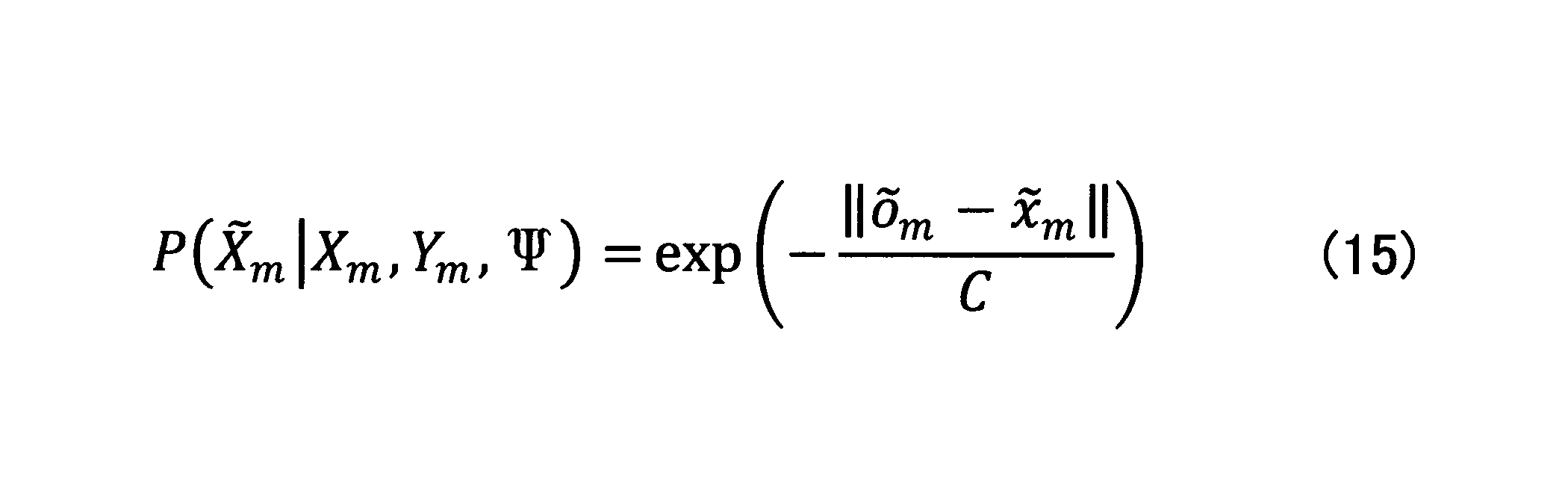
最終的に、式(15)を式(14)に代入すると、損失関数は以下のように表せる。 Finally, when equation (15) is substituted into equation (14), the loss function can be expressed as follows.

一般に、学習用に用意される学習データには、第1の自然言語文のどの部分と第2の自然言語文のどの部分とが対応するかを表す対応関係の正解データは与えられないことが多い。これは、アラインメントに関する正解情報を人手で付与するコストが非常に高いためである。このため、従来の学習においては、損失関数にアラインメントの正しさの尺度を盛り込むことが難しかった。 In general, learning data prepared for learning may not be provided with correct data of correspondence that indicates which part of the first natural language sentence corresponds to which part of the second natural language sentence. Many. This is because the cost of manually providing correct answer information regarding alignment is very high. For this reason, in conventional learning, it has been difficult to incorporate a measure of alignment correctness into the loss function.
一方、式(14)又は(17)の損失関数によれば、予測結果として出力される出力テキストの正しさを表す尺度である第1項と、予測結果として出力される対応情報(アラインメント)の正しさを表す尺度である第2項とを総合的に考慮して、ニューラルネットワークのパラメタを学習できる。これは、本開示の復号化器の出力としてoj (s)(~X)が得られることによって、初めて可能になるものである。入力テキストに含まれない語や表現を用いて予測出力テキストが生成されても、予測出力テキストを生成する源となった入力テキストの語彙~omが、入力テキストの語彙~xmと近ければ、適切に文生成が行われたものと評価することができる。つまり、言い換え等を許容したニューラルネットワークにおいて、より適切に予測精度を評価することができ、その結果として、従来よりも予測精度の高いニューラルネットワークを学習することが可能となるのである。 On the other hand, according to the loss function of equation (14) or (17), the first term, which is a measure representing the correctness of the output text output as the prediction result, and the correspondence information (alignment) output as the prediction result It is possible to learn the parameters of the neural network by comprehensively considering the second term, which is a measure representing correctness. This is accomplished by output as o j of the decoder of the present disclosure (s) (~ X) is obtained, it is made possible for the first time. Even if the predicted output text is generated using words or expressions that are not included in the input text, if the input text vocabulary ~ o m that is the source for generating the predicted output text is close to the input text vocabulary ~ x m Therefore, it can be evaluated that the sentence generation has been appropriately performed. That is, in a neural network that allows paraphrasing or the like, the prediction accuracy can be more appropriately evaluated, and as a result, it is possible to learn a neural network that has a higher prediction accuracy than the conventional one.
以上、本発明の実施例について詳述したが、本発明は上述した特定の実施形態に限定されるものではなく、特許請求の範囲に記載された本発明の要旨の範囲内において、種々の変形・変更が可能である。 As mentioned above, although the Example of this invention was explained in full detail, this invention is not limited to the specific embodiment mentioned above, In the range of the summary of this invention described in the claim, various deformation | transformation・ Change is possible.
本出願は、2018年2月28日に出願した日本国特許出願2018-034781号の優先権の利益に基づき、これを主張するものであり、2018-034781号の全内容を本出願に援用する。 This application claims this based on the benefit of priority of Japanese Patent Application No. 2018-034781 filed on Feb. 28, 2018, the entire contents of which are incorporated herein by reference. .
100 文生成装置
110 入力部
120 解析部
130 学習装置
100
Claims (8)
入力されたテキストを、前記学習済みのニューラルネットワークに入力することで、所定の目的に応じた出力テキストの予測結果と、前記出力テキストの予測結果の各部分が前記入力テキストの何れの部分の情報に基づき生成されたかを示す対応情報とを出力する解析部と、
を有する装置。 A first natural language sentence is input, a second natural language sentence corresponding to a predetermined purpose corresponding to the first natural language sentence, and each part of the second natural language sentence is the first natural language sentence A learned neural network trained to output correspondence information indicating which part of the sentence was generated based on the information of the part;
By inputting the input text into the learned neural network, the prediction result of the output text corresponding to a predetermined purpose and each part of the prediction result of the output text is information on any part of the input text. An analysis unit that outputs correspondence information indicating whether the data is generated based on
Having a device.
入力されたテキストを中間状態に変換する符号化部と、
前記符号化部から出力された中間状態を入力として、前記出力テキストの先頭の処理単位から順に、処理単位毎の前記出力テキストの予測結果を生成する復号化部と、
を有し、
前記復号化部は、j-1番目の処理単位の出力テキストの予測結果を変換して得られる隠れ状態と、前記符号化部から出力された中間状態とを用いて、j番目の処理単位の予測結果と、当該j番目の処理単位の予測結果の生成に用いた入力テキスト中の処理単位を特定する情報とを出力する層を含む、
請求項1記載の装置。 The learned neural network is
An encoding unit that converts input text into an intermediate state;
A decoding unit that generates the prediction result of the output text for each processing unit in order from the first processing unit of the output text, using the intermediate state output from the encoding unit as an input;
Have
The decoding unit uses the hidden state obtained by converting the prediction result of the output text of the j-1th processing unit and the intermediate state output from the encoding unit, to determine the jth processing unit. Including a layer for outputting the prediction result and information for specifying the processing unit in the input text used for generating the prediction result of the j-th processing unit,
The apparatus of claim 1.
予め与えられた学習用入力テキストと学習用出力テキストの正解との対からなる学習データの各々について、各学習用入力テキストを前記ニューラルネットワークに入力することで、学習用出力テキストの予測結果と対応情報とを出力する解析部と、
前記解析部で得られた学習用出力テキストの予測結果と前記対応情報とに基づいて計算される損失関数の値に応じて、前記ニューラルネットワークの各パラメタを更新するパラメタ更新部と、
を有する装置。 A first natural language sentence is input, a second natural language sentence corresponding to a predetermined purpose corresponding to the first natural language sentence, and each part of the second natural language sentence is the first natural language sentence A neural network that outputs correspondence information indicating which part of the sentence was generated based on the information;
Corresponding to the prediction result of the learning output text by inputting each learning input text to the neural network for each learning data consisting of a pair of learning input text given in advance and correct answer of the learning output text An analysis unit for outputting information;
A parameter updating unit for updating each parameter of the neural network according to a value of a loss function calculated based on the prediction result of the learning output text obtained in the analysis unit and the correspondence information;
Having a device.
学習用入力テキストを中間状態に変換する符号化部と、
前記符号化部から出力された中間状態を入力として、前記学習用出力テキストの予測結果の先頭の処理単位から順に、処理単位毎の前記学習用出力テキストの予測結果を生成する復号化部と、
を有し、
前記復号化部は、j-1番目の処理単位の出力テキストの予測結果を変換して得られる隠れ状態と、前記符号化部から出力された中間状態とを用いて、j番目の処理単位の予測結果と、当該j番目の処理単位の予測結果の生成に用いた入力テキスト中の処理単位を特定する情報とを出力する層を含む、
請求項3又は4記載の装置。 The neural network is
An encoding unit that converts the input text for learning into an intermediate state;
A decoding unit that generates the prediction result of the learning output text for each processing unit in order from the first processing unit of the prediction result of the learning output text, using the intermediate state output from the encoding unit as an input;
Have
The decoding unit uses the hidden state obtained by converting the prediction result of the output text of the j-1th processing unit and the intermediate state output from the encoding unit, to determine the jth processing unit. Including a layer for outputting the prediction result and information for specifying the processing unit in the input text used for generating the prediction result of the j-th processing unit,
The apparatus according to claim 3 or 4.
所定の目的に応じた出力テキストの予測結果と、前記出力テキストの予測結果の各部分が前記入力テキストの何れの部分の情報に基づき生成されたかを示す対応情報とを出力するステップと、
を有し、
前記学習済みのニューラルネットワークは、第1の自然言語文が入力され、第1の自然言語文に対応する所定の目的に応じた第2の自然言語文と、前記第2の自然言語文の各部分が前記第1の自然言語文のいずれの部分の情報に基づき生成されたかを示す対応情報とを出力するよう学習された方法。 Entering input text into a trained neural network;
Outputting a prediction result of the output text according to a predetermined purpose, and correspondence information indicating which part of the prediction result of the output text is generated based on information of which part of the input text;
Have
The learned neural network receives a first natural language sentence, receives a second natural language sentence corresponding to a predetermined purpose corresponding to the first natural language sentence, and each of the second natural language sentences. A method learned to output correspondence information indicating which part of the first natural language sentence is generated based on information of which part.
学習用出力テキストの予測結果と対応情報とを出力するステップと、
前記学習用出力テキストの予測結果と前記対応情報とに基づいて計算される損失関数の値に応じて、前記ニューラルネットワークの各パラメタを更新するステップと、
を有し、
前記ニューラルネットワークは、第1の自然言語文が入力され、第1の自然言語文に対応する所定の目的に応じた第2の自然言語文と、前記第2の自然言語文の各部分が前記第1の自然言語文のいずれの部分の情報に基づき生成されたかを示す対応情報とを出力する方法。 Inputting each learning input text into a neural network for each of the learning data consisting of a pair of learning input text given in advance and a correct answer of the learning output text;
Outputting a prediction result of the output text for learning and correspondence information;
Updating each parameter of the neural network according to the value of the loss function calculated based on the prediction result of the learning output text and the correspondence information;
Have
In the neural network, a first natural language sentence is input, a second natural language sentence corresponding to a predetermined purpose corresponding to the first natural language sentence, and each part of the second natural language sentence is A method of outputting correspondence information indicating which part of the first natural language sentence is generated based on the information.
Priority Applications (3)
| Application Number | Priority Date | Filing Date | Title |
|---|---|---|---|
| US16/975,312 US11797761B2 (en) | 2018-02-28 | 2018-06-25 | Device, method and program for natural language processing |
| JP2020502783A JP7072178B2 (en) | 2018-02-28 | 2018-06-25 | Equipment, methods and programs for natural language processing |
| US18/368,223 US12443793B2 (en) | 2018-02-28 | 2023-09-14 | Device, method and program for natural language processing |
Applications Claiming Priority (2)
| Application Number | Priority Date | Filing Date | Title |
|---|---|---|---|
| JP2018-034781 | 2018-02-28 | ||
| JP2018034781 | 2018-02-28 |
Related Child Applications (2)
| Application Number | Title | Priority Date | Filing Date |
|---|---|---|---|
| US16/975,312 A-371-Of-International US11797761B2 (en) | 2018-02-28 | 2018-06-25 | Device, method and program for natural language processing |
| US18/368,223 Continuation US12443793B2 (en) | 2018-02-28 | 2023-09-14 | Device, method and program for natural language processing |
Publications (1)
| Publication Number | Publication Date |
|---|---|
| WO2019167296A1 true WO2019167296A1 (en) | 2019-09-06 |
Family
ID=67804849
Family Applications (1)
| Application Number | Title | Priority Date | Filing Date |
|---|---|---|---|
| PCT/JP2018/023961 Ceased WO2019167296A1 (en) | 2018-02-28 | 2018-06-25 | Device, method, and program for natural language processing |
Country Status (3)
| Country | Link |
|---|---|
| US (2) | US11797761B2 (en) |
| JP (1) | JP7072178B2 (en) |
| WO (1) | WO2019167296A1 (en) |
Cited By (4)
| Publication number | Priority date | Publication date | Assignee | Title |
|---|---|---|---|---|
| CN110765243A (en) * | 2019-09-17 | 2020-02-07 | 平安科技(深圳)有限公司 | Construction method, electronic device and computer equipment of natural language processing system |
| JPWO2021166145A1 (en) * | 2020-02-20 | 2021-08-26 | ||
| JP2022027175A (en) * | 2020-07-31 | 2022-02-10 | 株式会社朝日新聞社 | Information processing equipment, information processing methods, and programs |
| JP2025500984A (en) * | 2021-12-23 | 2025-01-15 | 大唐移▲動▼通信▲設▼▲備▼有限公司 | Neural network operation method, device and storage medium |
Families Citing this family (5)
| Publication number | Priority date | Publication date | Assignee | Title |
|---|---|---|---|---|
| JP7072178B2 (en) * | 2018-02-28 | 2022-05-20 | 日本電信電話株式会社 | Equipment, methods and programs for natural language processing |
| CN110162799B (en) * | 2018-11-28 | 2023-08-04 | 腾讯科技(深圳)有限公司 | Model training method, machine translation method, and related devices and equipment |
| US11501159B2 (en) * | 2019-03-26 | 2022-11-15 | Alibaba Group Holding Limited | Methods and systems for text sequence style transfer by two encoder decoders |
| WO2021064907A1 (en) * | 2019-10-02 | 2021-04-08 | 日本電信電話株式会社 | Sentence generation device, sentence generation learning device, sentence generation method, sentence generation learning method, and program |
| CN115700492A (en) * | 2022-10-24 | 2023-02-07 | 南京大学 | A Program Semantic Representation Learning and Prediction Method Based on Graph Interval Neural Network |
Citations (2)
| Publication number | Priority date | Publication date | Assignee | Title |
|---|---|---|---|---|
| JP2015170168A (en) * | 2014-03-07 | 2015-09-28 | 国立研究開発法人情報通信研究機構 | Word alignment score calculation apparatus, word alignment device, and computer program |
| JP2017182277A (en) * | 2016-03-29 | 2017-10-05 | 日本電信電話株式会社 | Coding device, decoding device, discrete series conversion device, method and program |
Family Cites Families (6)
| Publication number | Priority date | Publication date | Assignee | Title |
|---|---|---|---|---|
| US7574409B2 (en) * | 2004-11-04 | 2009-08-11 | Vericept Corporation | Method, apparatus, and system for clustering and classification |
| EP3210132A1 (en) * | 2014-10-24 | 2017-08-30 | Google, Inc. | Neural machine translation systems with rare word processing |
| US9418319B2 (en) * | 2014-11-21 | 2016-08-16 | Adobe Systems Incorporated | Object detection using cascaded convolutional neural networks |
| US11409791B2 (en) * | 2016-06-10 | 2022-08-09 | Disney Enterprises, Inc. | Joint heterogeneous language-vision embeddings for video tagging and search |
| EP3616085A1 (en) * | 2017-06-18 | 2020-03-04 | Google LLC | Processing natural language using machine learning to determine slot values based on slot descriptors |
| JP7072178B2 (en) * | 2018-02-28 | 2022-05-20 | 日本電信電話株式会社 | Equipment, methods and programs for natural language processing |
-
2018
- 2018-06-25 JP JP2020502783A patent/JP7072178B2/en active Active
- 2018-06-25 US US16/975,312 patent/US11797761B2/en active Active
- 2018-06-25 WO PCT/JP2018/023961 patent/WO2019167296A1/en not_active Ceased
-
2023
- 2023-09-14 US US18/368,223 patent/US12443793B2/en active Active
Patent Citations (2)
| Publication number | Priority date | Publication date | Assignee | Title |
|---|---|---|---|---|
| JP2015170168A (en) * | 2014-03-07 | 2015-09-28 | 国立研究開発法人情報通信研究機構 | Word alignment score calculation apparatus, word alignment device, and computer program |
| JP2017182277A (en) * | 2016-03-29 | 2017-10-05 | 日本電信電話株式会社 | Coding device, decoding device, discrete series conversion device, method and program |
Non-Patent Citations (1)
| Title |
|---|
| GOTO ISAO ET AL.: "Detection of missing contents in neural machine translation", PROCEEDINGS OF THE TWENTY-THIRD ANNUAL MEETING OF THE ASSOCIATION FOR NATURAL LANGUAGE PROCESSING, 6 March 2017 (2017-03-06), pages 1018 - 1021 * |
Cited By (7)
| Publication number | Priority date | Publication date | Assignee | Title |
|---|---|---|---|---|
| CN110765243A (en) * | 2019-09-17 | 2020-02-07 | 平安科技(深圳)有限公司 | Construction method, electronic device and computer equipment of natural language processing system |
| JPWO2021166145A1 (en) * | 2020-02-20 | 2021-08-26 | ||
| JP7429352B2 (en) | 2020-02-20 | 2024-02-08 | 日本電信電話株式会社 | Series conversion device, machine learning device, sequence conversion method, machine learning method, and program |
| JP2022027175A (en) * | 2020-07-31 | 2022-02-10 | 株式会社朝日新聞社 | Information processing equipment, information processing methods, and programs |
| JP7178390B2 (en) | 2020-07-31 | 2022-11-25 | 株式会社朝日新聞社 | Information processing device, information processing method, and program |
| JP2025500984A (en) * | 2021-12-23 | 2025-01-15 | 大唐移▲動▼通信▲設▼▲備▼有限公司 | Neural network operation method, device and storage medium |
| JP7743634B2 (en) | 2021-12-23 | 2025-09-24 | 大唐移▲動▼通信▲設▼▲備▼有限公司 | Neural network operation method, device, and storage medium |
Also Published As
| Publication number | Publication date |
|---|---|
| JP7072178B2 (en) | 2022-05-20 |
| US20210406483A1 (en) | 2021-12-30 |
| US20240005093A1 (en) | 2024-01-04 |
| US11797761B2 (en) | 2023-10-24 |
| US12443793B2 (en) | 2025-10-14 |
| JPWO2019167296A1 (en) | 2021-06-17 |
Similar Documents
| Publication | Publication Date | Title |
|---|---|---|
| JP7072178B2 (en) | Equipment, methods and programs for natural language processing | |
| CN114038447B (en) | Speech synthesis model training method, speech synthesis method, device and medium | |
| US10559299B1 (en) | Reconciliation between simulator and speech recognition output using sequence-to-sequence mapping | |
| JP7149560B2 (en) | Request translation system, training method for request translation model and request judgment model, and dialogue system | |
| CN112364658B (en) | Translation and voice recognition method, device and equipment | |
| CN113205792A (en) | Mongolian speech synthesis method based on Transformer and WaveNet | |
| EP4409568B1 (en) | Contrastive siamese network for semi-supervised speech recognition | |
| CN113555006B (en) | Voice information identification method and device, electronic equipment and storage medium | |
| CN113761883B (en) | Text information recognition method, device, electronic device and storage medium | |
| JP2019185400A (en) | Sentence generation device, sentence generation method, and sentence generation program | |
| US12308022B2 (en) | Apparatus, method, and program for utilizing language model | |
| JP6969431B2 (en) | Morphological analysis learning device, morphological analysis device, method, and program | |
| CN117727288B (en) | A speech synthesis method, device, equipment and storage medium | |
| CN116245116B (en) | A multilingual, multi-domain neural machine translation method and system for adapters | |
| JP7411149B2 (en) | Learning device, estimation device, learning method, estimation method and program | |
| CN115114933A (en) | Method, device, equipment and storage medium for text processing | |
| CN119252235B (en) | Non-native language Chinese speech recognition method and system based on offset and convolution self-adaption | |
| Choi et al. | Label Embedding for Chinese Grapheme-to-Phoneme Conversion. | |
| US12374329B2 (en) | System and method for speech to text conversion | |
| JP7556395B2 (en) | Data processing device, data processing method and data processing program | |
| CN114741485B (en) | English choice question answer prediction method, device, equipment and storage medium | |
| US20250335720A1 (en) | Language model training device, dialogue device and trained language model | |
| Djionang Pindoh et al. | Self-supervised and Multilingual Learning Applied to the Wolof, Swahili and Fongbe | |
| Chen et al. | Large Language Models Meet Speech Recognition | |
| CN114118108A (en) | Translation model establishing method, translation method and corresponding device |
Legal Events
| Date | Code | Title | Description |
|---|---|---|---|
| 121 | Ep: the epo has been informed by wipo that ep was designated in this application |
Ref document number: 18907650 Country of ref document: EP Kind code of ref document: A1 |
|
| ENP | Entry into the national phase |
Ref document number: 2020502783 Country of ref document: JP Kind code of ref document: A |
|
| NENP | Non-entry into the national phase |
Ref country code: DE |
|
| 122 | Ep: pct application non-entry in european phase |
Ref document number: 18907650 Country of ref document: EP Kind code of ref document: A1 |