WO2019154315A1 - Anti-b7-h4 antibody, antigen-binding fragment thereof and pharmaceutical use thereof - Google Patents
Anti-b7-h4 antibody, antigen-binding fragment thereof and pharmaceutical use thereof Download PDFInfo
- Publication number
- WO2019154315A1 WO2019154315A1 PCT/CN2019/074397 CN2019074397W WO2019154315A1 WO 2019154315 A1 WO2019154315 A1 WO 2019154315A1 CN 2019074397 W CN2019074397 W CN 2019074397W WO 2019154315 A1 WO2019154315 A1 WO 2019154315A1
- Authority
- WO
- WIPO (PCT)
- Prior art keywords
- seq
- antibody
- variable region
- chain variable
- antigen
- Prior art date
- Legal status (The legal status is an assumption and is not a legal conclusion. Google has not performed a legal analysis and makes no representation as to the accuracy of the status listed.)
- Ceased
Links
Images


Classifications
-
- C—CHEMISTRY; METALLURGY
- C07—ORGANIC CHEMISTRY
- C07K—PEPTIDES
- C07K16/00—Immunoglobulins [IGs], e.g. monoclonal or polyclonal antibodies
- C07K16/18—Immunoglobulins [IGs], e.g. monoclonal or polyclonal antibodies against material from animals or humans
- C07K16/28—Immunoglobulins [IGs], e.g. monoclonal or polyclonal antibodies against material from animals or humans against receptors, cell surface antigens or cell surface determinants
- C07K16/2803—Immunoglobulins [IGs], e.g. monoclonal or polyclonal antibodies against material from animals or humans against receptors, cell surface antigens or cell surface determinants against the immunoglobulin superfamily
- C07K16/2827—Immunoglobulins [IGs], e.g. monoclonal or polyclonal antibodies against material from animals or humans against receptors, cell surface antigens or cell surface determinants against the immunoglobulin superfamily against B7 molecules, e.g. CD80, CD86
-
- A—HUMAN NECESSITIES
- A61—MEDICAL OR VETERINARY SCIENCE; HYGIENE
- A61P—SPECIFIC THERAPEUTIC ACTIVITY OF CHEMICAL COMPOUNDS OR MEDICINAL PREPARATIONS
- A61P35/00—Antineoplastic agents
-
- G01N33/575—
-
- A—HUMAN NECESSITIES
- A61—MEDICAL OR VETERINARY SCIENCE; HYGIENE
- A61K—PREPARATIONS FOR MEDICAL, DENTAL OR TOILETRY PURPOSES
- A61K39/00—Medicinal preparations containing antigens or antibodies
- A61K2039/505—Medicinal preparations containing antigens or antibodies comprising antibodies
-
- A—HUMAN NECESSITIES
- A61—MEDICAL OR VETERINARY SCIENCE; HYGIENE
- A61K—PREPARATIONS FOR MEDICAL, DENTAL OR TOILETRY PURPOSES
- A61K39/00—Medicinal preparations containing antigens or antibodies
- A61K2039/545—Medicinal preparations containing antigens or antibodies characterised by the dose, timing or administration schedule
-
- C—CHEMISTRY; METALLURGY
- C07—ORGANIC CHEMISTRY
- C07K—PEPTIDES
- C07K2317/00—Immunoglobulins specific features
- C07K2317/20—Immunoglobulins specific features characterized by taxonomic origin
- C07K2317/24—Immunoglobulins specific features characterized by taxonomic origin containing regions, domains or residues from different species, e.g. chimeric, humanized or veneered
-
- C—CHEMISTRY; METALLURGY
- C07—ORGANIC CHEMISTRY
- C07K—PEPTIDES
- C07K2317/00—Immunoglobulins specific features
- C07K2317/30—Immunoglobulins specific features characterized by aspects of specificity or valency
- C07K2317/34—Identification of a linear epitope shorter than 20 amino acid residues or of a conformational epitope defined by amino acid residues
-
- C—CHEMISTRY; METALLURGY
- C07—ORGANIC CHEMISTRY
- C07K—PEPTIDES
- C07K2317/00—Immunoglobulins specific features
- C07K2317/50—Immunoglobulins specific features characterized by immunoglobulin fragments
- C07K2317/51—Complete heavy chain or Fd fragment, i.e. VH + CH1
-
- C—CHEMISTRY; METALLURGY
- C07—ORGANIC CHEMISTRY
- C07K—PEPTIDES
- C07K2317/00—Immunoglobulins specific features
- C07K2317/50—Immunoglobulins specific features characterized by immunoglobulin fragments
- C07K2317/515—Complete light chain, i.e. VL + CL
-
- C—CHEMISTRY; METALLURGY
- C07—ORGANIC CHEMISTRY
- C07K—PEPTIDES
- C07K2317/00—Immunoglobulins specific features
- C07K2317/50—Immunoglobulins specific features characterized by immunoglobulin fragments
- C07K2317/52—Constant or Fc region; Isotype
-
- C—CHEMISTRY; METALLURGY
- C07—ORGANIC CHEMISTRY
- C07K—PEPTIDES
- C07K2317/00—Immunoglobulins specific features
- C07K2317/50—Immunoglobulins specific features characterized by immunoglobulin fragments
- C07K2317/56—Immunoglobulins specific features characterized by immunoglobulin fragments variable (Fv) region, i.e. VH and/or VL
-
- C—CHEMISTRY; METALLURGY
- C07—ORGANIC CHEMISTRY
- C07K—PEPTIDES
- C07K2317/00—Immunoglobulins specific features
- C07K2317/50—Immunoglobulins specific features characterized by immunoglobulin fragments
- C07K2317/56—Immunoglobulins specific features characterized by immunoglobulin fragments variable (Fv) region, i.e. VH and/or VL
- C07K2317/565—Complementarity determining region [CDR]
-
- C—CHEMISTRY; METALLURGY
- C07—ORGANIC CHEMISTRY
- C07K—PEPTIDES
- C07K2317/00—Immunoglobulins specific features
- C07K2317/70—Immunoglobulins specific features characterized by effect upon binding to a cell or to an antigen
- C07K2317/73—Inducing cell death, e.g. apoptosis, necrosis or inhibition of cell proliferation
-
- C—CHEMISTRY; METALLURGY
- C07—ORGANIC CHEMISTRY
- C07K—PEPTIDES
- C07K2317/00—Immunoglobulins specific features
- C07K2317/70—Immunoglobulins specific features characterized by effect upon binding to a cell or to an antigen
- C07K2317/73—Inducing cell death, e.g. apoptosis, necrosis or inhibition of cell proliferation
- C07K2317/732—Antibody-dependent cellular cytotoxicity [ADCC]
-
- C—CHEMISTRY; METALLURGY
- C07—ORGANIC CHEMISTRY
- C07K—PEPTIDES
- C07K2317/00—Immunoglobulins specific features
- C07K2317/70—Immunoglobulins specific features characterized by effect upon binding to a cell or to an antigen
- C07K2317/74—Inducing cell proliferation
-
- C—CHEMISTRY; METALLURGY
- C07—ORGANIC CHEMISTRY
- C07K—PEPTIDES
- C07K2317/00—Immunoglobulins specific features
- C07K2317/90—Immunoglobulins specific features characterized by (pharmaco)kinetic aspects or by stability of the immunoglobulin
- C07K2317/92—Affinity (KD), association rate (Ka), dissociation rate (Kd) or EC50 value
Definitions
- the present invention relates to an anti-B7-H4 antibody immunoreactive to a human B7-H4 receptor, and an antigen-binding fragment thereof, a chimeric antibody, a humanized antibody comprising the CDR region of the anti-B7-H4 antibody, and A pharmaceutical composition comprising a human anti-B7-H4 antibody and an antigen-binding fragment thereof, and use thereof as an anticancer drug.
- Tumor immunotherapy is a long-term research and development hotspot in the field of cancer treatment, and T cell tumor immunotherapy is at the core. Tumor escape is a huge obstacle to tumor immunotherapy. Most tumor expression can be recognized by the host immune system to varying degrees, but in many cases, due to inefficient activation of effector T cells, an inadequate immune response is triggered. Tumor growth is promoted by its own inhibition of the immune system. Tumor immunotherapy is to fully utilize and mobilize killer T cells and/or other immune cells in tumor patients to kill tumors.
- B7 superfamily a class of immunoglobulins with an immunoglobulin V-like domain (IgV) and an immunoglobulin C-like domain (IgC), members of which include costimulatory factors B7.1 (CD80) and B7.2 ( CD86), inducible ligand for stimulatory factor (ICOS-L/B7-H2), programmed death-1 ligand (PD-L1/B7-H1), programmed death-2 ligand (PD- L2/B7-DC), B7-H4 and B7-H4, etc.
- IgV immunoglobulin V-like domain
- IgC immunoglobulin C-like domain
- Human B7-H4 is a type I transmembrane protein consisting of 282 amino acids whose coding gene is located in the p11.1 region of chromosome 1 (Choi IH et al., J Immunol. 2003 Nov 1; 171(9): 4650-4) .
- B7-H4 plays a negative role in the regulation of T cell immune response.
- B7-H4 plays a wide-ranging role in the differentiation and development of CD4 + and CD8 + T cells, cell cycle progression and cytokine production (Sica GL, etc.) , Immunity. 2003 Jun; 18(6): 849-61).
- No immune cell disorders and autoimmune phenomena were found in B7-H4 knockout mice (Zhu G et al, Blood. 2009 Feb 19; 113(8): 1759-67; Suh WK et al., Blood. Mol Cell Biol. 2006 Sep;26(17):6403-11).
- the receptors for B7-H4 and their signal transduction pathways are still
- B7-H4 protein is abundantly expressed in various tumor tissues, allowing tumor cells to escape the attack of the body's immune system.
- the use of B7-H4 molecule as a tumor therapeutic target provides a new method for tumor immunotherapy.
- B7-H4 is expressed on various cancer cells such as breast cancer, ovarian cancer, lung cancer, cervical cancer, kidney cancer, bladder cancer and liver cancer.
- B7-H4 mRNA expression was found in the spleen, lung, thymus, liver, skeletal muscle, kidney, pancreas, testis and ovary.
- At the protein level there were low tissues in the breast (catheter and lobular), fallopian tube epithelium, endometrial gland, etc. Horizontal B7-H4 expression.
- TAM tumor-associated macrophages
- macrophages constitute An important component of the tumor microenvironment and can represent up to 50% of tumor mass.
- the present invention provides anti-B7-H4 antibodies with high affinity, high selectivity and high biological activity, monoclonal antibody immunotherapy for tumors and related applications. Drugs, compositions, and methods for the treatment of B7-H4 positive tumors.
- the present invention provides a B7-H4 antibody or antigen-binding fragment thereof, comprising:
- An antibody light chain variable region comprising at least one LCDR selected from the group consisting of:
- SEQ ID NO: 14 SEQ ID NO: 15, SEQ ID NO: 16;
- SEQ ID NO: 62 SEQ ID NO: 63, SEQ ID NO: 64;
- An antibody heavy chain variable region comprising at least one HCDR selected from the group consisting of:
- SEQ ID NO: 3 SEQ ID NO: 4, SEQ ID NO: 5;
- SEQ ID NO: 51 SEQ ID NO: 52, SEQ ID NO: 53;
- an anti-B7-H4 antibody or antigen-binding fragment thereof, as described above, wherein said antibody heavy chain variable region comprises:
- HCDR1, HCDR2 and HCDR3 set forth in SEQ ID NO: 3, SEQ ID NO: 4 and SEQ ID NO: 5;
- HCDR1, HCDR2 and HCDR3 represented by SEQ ID NO: 19, SEQ ID NO: 20 and SEQ ID NO: 21;
- HCDR1, HCDR2 and HCDR3 set forth in SEQ ID NO:27, SEQ ID NO:28 and SEQ ID NO:29;
- HCDR1, HCDR2 and HCDR3 set forth in SEQ ID NO: 35, SEQ ID NO: 36 and SEQ ID NO: 37;
- HCDR1, HCDR2 and HCDR3 set forth in SEQ ID NO: 43, SEQ ID NO: 44 and SEQ ID NO: 45;
- HCDR1, HCDR2 and HCDR3 represented by SEQ ID NO: 51, SEQ ID NO: 52 and SEQ ID NO: 53;
- HCDR1, HCDR2 and HCDR3 represented by SEQ ID NO: 59, SEQ ID NO: 60 and SEQ ID NO: 61;
- HCDR1, HCDR2 and HCDR3 represented by SEQ ID NO: 67, SEQ ID NO: 68 and SEQ ID NO: 69;
- HCDR1, HCDR2 and HCDR3 as set forth in SEQ ID NO:73, SEQ ID NO:74 and SEQ ID NO:21.
- an anti-B7-H4 antibody or antigen-binding fragment thereof, wherein said antibody light chain variable region comprises:
- LCDR1, LCDR2 and LCDR3 shown in SEQ ID NO: 6, SEQ ID NO: 7 and SEQ ID NO: 8;
- LCDR1, LCDR2 and LCDR3 shown in SEQ ID NO: 14, SEQ ID NO: 15 and SEQ ID NO: 16;
- LCDR1, LCDR2 and LCDR3 shown in SEQ ID NO: 22, SEQ ID NO: 23 and SEQ ID NO: 24;
- LCDR1, LCDR2 and LCDR3 shown in SEQ ID NO: 30, SEQ ID NO: 31 and SEQ ID NO: 32;
- LCDR1, LCDR2 and LCDR3 shown in SEQ ID NO: 38, SEQ ID NO: 39 and SEQ ID NO: 40;
- LCDR1, LCDR2 and LCDR3 shown in SEQ ID NO: 46, SEQ ID NO: 47 and SEQ ID NO: 48;
- LCDR1, LCDR2 and LCDR3 shown in SEQ ID NO: 54, SEQ ID NO: 55 and SEQ ID NO: 56;
- a particularly preferred anti-B7-H4 antibody or antigen-binding fragment thereof may be selected from any one of the group consisting of one or more CDR region sequences selected from or having at least 95% sequence identity to:
- the antibody light chain variable region comprises LCDR1, LCDR2 and LCDR3 as shown in SEQ ID NO: 6, SEQ ID NO: 7 and SEQ ID NO: 8, respectively; the antibody heavy chain variable region comprises For example, HCDR1, HCDR2 and HCDR3 as shown in SEQ ID NO: 3, SEQ ID NO: 4 and SEQ ID NO: 5.
- the antibody light chain variable region comprises LCDR1, LCDR2 and LCDR3 as shown in SEQ ID NO: 14, SEQ ID NO: 15 and SEQ ID NO: 16, respectively;
- the antibody heavy chain variable region comprises For example, HCDR1, HCDR2 and HCDR3 as shown in SEQ ID NO: 11, SEQ ID NO: 12 and SEQ ID NO: 13, respectively.
- the antibody light chain variable region comprises LCDR1, LCDR2 and LCDR3 as shown in SEQ ID NO: 22, SEQ ID NO: 23 and SEQ ID NO: 24, respectively; the antibody heavy chain variable region comprises For example, HCDR1, HCDR2 and HCDR3 as shown in SEQ ID NO: 19, SEQ ID NO: 20 and SEQ ID NO: 21.
- the antibody light chain variable region comprises LCDR1, LCDR2 and LCDR3 as shown in SEQ ID NO: 30, SEQ ID NO: 31 and SEQ ID NO: 32, respectively; the antibody heavy chain variable region comprises For example, HCDR1, HCDR2 and HCDR3 as set forth in SEQ ID NO:27, SEQ ID NO:28 and SEQ ID NO:29.
- the antibody light chain variable region comprises LCDR1, LCDR2 and LCDR3 as shown in SEQ ID NO: 38, SEQ ID NO: 39 and SEQ ID NO: 40, respectively;
- the antibody heavy chain variable region comprises For example, HCDR1, HCDR2 and HCDR3 as shown in SEQ ID NO: 35, SEQ ID NO: 36 and SEQ ID NO: 37, respectively.
- the antibody light chain variable region comprises LCDR1, LCDR2 and LCDR3 as shown in SEQ ID NO: 46, SEQ ID NO: 47 and SEQ ID NO: 48, respectively; the antibody heavy chain variable region comprises For example, HCDR1, HCDR2 and HCDR3 as shown in SEQ ID NO: 43, SEQ ID NO: 44 and SEQ ID NO: 45, respectively.
- the antibody light chain variable region comprises LCDR1, LCDR2 and LCDR3 as shown in SEQ ID NO: 54, SEQ ID NO: 55 and SEQ ID NO: 56, respectively;
- the antibody heavy chain variable region comprises For example, HCDR1, HCDR2 and HCDR3 as shown in SEQ ID NO: 51, SEQ ID NO: 52 and SEQ ID NO: 53, respectively.
- the antibody light chain variable region comprises LCDR1, LCDR2 and LCDR3 as shown in SEQ ID NO: 62, SEQ ID NO: 63 and SEQ ID NO: 64, respectively; the antibody heavy chain variable region comprises For example, HCDR1, HCDR2 and HCDR3 as shown in SEQ ID NO: 59, SEQ ID NO: 60 and SEQ ID NO: 61, respectively.
- the antibody light chain variable region comprises LCDR1, LCDR2 and LCDR3 as shown in SEQ ID NO: 70, SEQ ID NO: 71 and SEQ ID NO: 72, respectively; the antibody heavy chain variable region comprises For example, HCDR1, HCDR2 and HCDR3 as shown in SEQ ID NO: 67, SEQ ID NO: 68 and SEQ ID NO: 69, respectively.
- the antibody light chain variable region comprises LCDR1, LCDR2 and LCDR3 as shown in SEQ ID NO: 22, SEQ ID NO: 23 and SEQ ID NO: 24, respectively; the antibody heavy chain variable region comprises For example, HCDR1, HCDR2 and HCDR3 as shown in SEQ ID NO: 73, SEQ ID NO: 74 and SEQ ID NO: 21.
- a B7-H4 antibody or antigen-binding fragment thereof wherein the antibody or antigen-binding fragment thereof is a murine antibody or a fragment thereof.
- a B7-H4 antibody or antigen-binding fragment thereof wherein the antibody or antigen-binding fragment thereof is a chimeric antibody or a fragment thereof.
- the anti-B7-H4 antibody or antigen-binding fragment thereof wherein the antibody or antigen-binding fragment thereof is a human antibody or a fragment thereof.
- a B7-H4 antibody or antigen-binding fragment thereof wherein the antibody or antigen-binding fragment thereof is a humanized antibody or a fragment thereof.
- a B7-H4 antibody or antigen-binding fragment thereof, wherein the humanized antibody light chain variable region is selected from the group consisting of: SEQ ID NO:76, SEQ ID NO:78, SEQ ID NO:80 or SEQ ID NO:82.
- a B7-H4 antibody or antigen-binding fragment thereof wherein said humanized antibody heavy chain variable region is selected from the group consisting of: SEQ ID NO:75, SEQ ID NO:77, SEQ ID NO:79 or SEQ ID NO:81.
- a B7-H4 antibody or antigen-binding fragment thereof wherein the humanized antibody heavy chain variable region further comprises human IgG1, IgG2, IgG3 or IgG4 or
- the heavy chain FR region of the variant preferably comprises a human IgGl, IgG2 or IgG4 heavy chain FR region; more preferably IgGl which enhances ADCC toxicity following amino acid mutations.
- a B7-H4 antibody or antigen-binding fragment thereof, wherein the light chain of the humanized antibody is selected from the group consisting of: SEQ ID NO: 84 SEQ ID NO:86, SEQ ID NO:88 or SEQ ID NO:90.
- a B7-H4 antibody or antigen-binding fragment thereof, wherein the heavy chain of the humanized antibody is selected from the group consisting of: SEQ ID NO: 83 SEQ ID NO:85, SEQ ID NO:87 or SEQ ID NO:89.
- a B7-H4 antibody or antigen-binding fragment thereof, wherein the humanized antibody light chain variable region is selected from the group consisting of: SEQ ID NO: 76 or SEQ ID NO: 80.
- a B7-H4 antibody or antigen-binding fragment thereof, wherein the light chain of the humanized antibody is selected from the group consisting of: SEQ ID NO: 84 Or SEQ ID NO:88.
- a B7-H4 antibody or antigen-binding fragment thereof, wherein the heavy chain of the humanized antibody is selected from the group consisting of: SEQ ID NO: 83 Or SEQ ID NO:87.
- the humanized antibody is selected from any of the following:
- the humanized antibody is selected from any one of the following:
- An anti-B7-H4 antibody or antigen-binding fragment thereof having at least one of the following characteristics: (1) binding to an epitope of amino acids 41-60 of SEQ ID NO: 92 in B7-H4; (2) binding to B7 The epitope of amino acids 53-59 of SEQ ID NO: 92 is contained in -H4.
- An anti-B7-H4 antibody or antigen-binding fragment thereof having at least one of the following characteristics: (1) binding to an epitope of amino acid 53 of SEQ ID NO: 92 in B7-H4; (2) binding to B7-H4 An epitope comprising amino acid 54 of SEQ ID NO: 92; (3) binding to an epitope of amino acid 56 of SEQ ID NO: 92 in B7-H4; (4) binding to B7-H4 containing SEQ ID NO: 92 Epitope of amino acid 57; (5) binding to an epitope of amino acid 58 of SEQ ID NO: 92 in B7-H4; (2) binding to an epitope of amino acid 59 of SEQ ID NO: 92 in B7-H4.
- a B7-H4 antibody or antigen-binding fragment thereof wherein the antigen-binding fragment is Fab, Fv, sFv, F(ab') 2 , a linear antibody, Single-chain antibodies, Nanobodies, domain antibodies, and multispecific antibodies.
- the present invention further provides a DNA sequence encoding the B7-H4 antibody or antigen-binding fragment thereof as described above.
- the invention further provides an expression vector comprising the DNA sequence as described above.
- the invention further provides a host cell introduced or containing an expression vector as described above.
- a host cell as described above characterized in that said host cell is a bacterium, preferably Escherichia coli.
- a host cell as described above is a yeast, preferably Pichia pastoris.
- a host cell as described above is a mammalian cell, preferably a Chinese hamster ovary (CHO) cell or a human embryonic kidney (HEK) 293 cell.
- CHO Chinese hamster ovary
- HEK human embryonic kidney
- the invention also provides a method of producing a B7-H4 antibody comprising: culturing the host cell as described above, isolating the antibody from the culture, and purifying the antibody.
- the invention also provides a multispecific antibody comprising a light chain variable region and a heavy chain variable region as previously described.
- the invention also provides a single chain antibody comprising a light chain variable region and a heavy chain variable region as previously described.
- the invention also provides a detection reagent or diagnostic agent comprising a B7-H4 antibody or antigen-binding fragment thereof as described above.
- the present invention also provides a method for immunodetection or assay of B7-H4, which comprises using the B7-H4 antibody of the present invention or an antigen-binding fragment thereof.
- the present invention also provides a method for diagnosing a disease associated with a B7-H4 positive cell, the method comprising detecting or measuring B7-H4 or B7-H4 using the B7-H4 antibody or antigen-binding fragment thereof of the present invention. Positive cells.
- the invention further provides a pharmaceutical composition
- a pharmaceutical composition comprising a B7-H4 antibody or antigen-binding fragment thereof as described above and a pharmaceutically acceptable excipient, dilution or carrier.
- the invention further provides the use of an anti-B7-H4 antibody or antigen-binding fragment thereof as described above, in the manufacture of a medicament for the treatment of a B7-H4 mediated disease or condition; wherein the disease is preferably cancer;
- the cancer is B7-H4; the cancer is most preferably breast cancer, ovarian cancer, prostate cancer, pancreatic cancer, kidney cancer, lung cancer, liver cancer, stomach cancer, colon cancer, bladder cancer, esophageal cancer, cervical cancer, gallbladder Cancer, glioblastoma and melanoma.
- the invention further provides a method of treating and preventing a B7-H4 mediated disease or condition, the method comprising administering to a subject in need thereof a therapeutically effective amount of an anti-B7-H4 antibody or antigen-binding fragment thereof, or a pharmaceutical combination thereof
- the disease wherein the disease is preferably cancer; more preferably a cancer expressing B7-H4; the cancer is most preferably breast cancer, ovarian cancer, prostate cancer, pancreatic cancer, kidney cancer, lung cancer, liver cancer, stomach cancer, colon Cancer, bladder cancer, esophageal cancer, gallbladder cancer, cervical cancer, glioblastoma and melanoma.
- Figure 1 In vitro ELISA binding experiments antibodies, chimeric antibodies Showing 7 binding activity of human B7-H4 purified antigen, wherein the chimeric antibody 2F7 and 2F8 EC 50 of approximately 0.1nM.
- Figure 2 Indirect ELISA binding experiments showing antigenic epitopes of anti-B7-H4 antibody hu2F7 binding.
- Figure 4 Immunological function experiments showing the effect of enhanced immunity (T cell proliferation) of anti-B7-H4 antibodies hu1C9 and hu2G6.
- antibody refers to an immunoglobulin which is a tetrapeptide chain structure in which two identical heavy chains and two identical light chains are linked by interchain disulfide bonds.
- the immunoglobulin heavy chain constant region has different amino acid composition and arrangement order, so its antigenicity is also different. Accordingly, immunoglobulins can be classified into five classes, or isoforms of immunoglobulins, namely IgM, IgD, IgG, IgA and IgE, and the corresponding heavy chains are ⁇ chain, ⁇ chain, ⁇ chain, respectively. , ⁇ chain and ⁇ chain.
- IgG can be classified into IgG1, IgG2, IgG3, and IgG4.
- Light chains are classified as either a kappa chain or a lambda chain by the constant region.
- Each of the five types of Ig may have a kappa chain or a lambda chain.
- the antibody light chain variable region of the present invention may further comprise a light chain constant region comprising a human or murine kappa, lambda chain or a variant thereof.
- the antibody heavy chain variable region of the present invention may further comprise a heavy chain constant region comprising human or murine IgG1, 2, 3, 4 or a variant thereof.
- variable region The sequence of about 110 amino acids near the N-terminus of the antibody heavy and light chains varies greatly, being the variable region (V region); the remaining amino acid sequence near the C-terminus is relatively stable and is a constant region (C region).
- the variable region includes three hypervariable regions (HVR) and four relatively conserved framework regions (FR). The three hypervariable regions determine the specificity of the antibody, also known as the complementarity determining region (CDR).
- Each of the light chain variable region (VL) and the heavy chain variable region (VH) consists of three CDR regions and four FR regions, and the order from the amino terminus to the carboxy terminus is: FR1, CDR1, FR2, CDR2, FR3, CDR3, FR4.
- the three CDR regions of the light chain refer to LCDR1, LCDR2, and LCDR3; the three CDR regions of the heavy chain refer to HCDR1, HCDR2, and HCDR3.
- the CDR amino acid residues of the VL and VH regions of the antibodies or antigen-binding fragments of the invention conform to known Kabat numbering rules and Kabat or AbM definition rules in number and position (http://bioinf.org.uk/abs/ ).
- APC antigen presenting cell
- T cells recognize this complex using the T cell receptor (TCR).
- APCs include, but are not limited to, dendritic cells (DC), peripheral blood mononuclear cells (PBMC), monocytes, B lymphoblasts, and monocyte-derived dendritic cells (DC).
- DC dendritic cells
- PBMC peripheral blood mononuclear cells
- monocytes B lymphoblasts
- DC monocyte-derived dendritic cells
- the term “antigen presentation” refers to the process by which APCs capture antigens and enable them to be recognized by T cells, for example as a component of MHC-I/MHC-II conjugates.
- B7-H4 refers to a member of the human B7 protein family, also known as CD276, which is a type I transmembrane protein with four Ig-like extracellular domains.
- B7-H4 is one of the immunological checkpoint proteins expressed on the surface of antigen-presenting cells or cancer cells, and has an inhibitory effect on the functional activation of T cells.
- B7-H4 includes any variant or isoform of B7-H4 naturally expressed by a cell.
- the antibodies of the invention can be cross-reactive with B7-H4 from non-human species. Alternatively, the antibody may also be specific for human B7-H4 and may not exhibit cross-reactivity with other species.
- B7-H4 or any variant or isoform thereof, can be isolated from cells or tissues in which they are naturally expressed, or produced by recombinant techniques using techniques common in the art and described herein.
- the anti-B7-H4 antibody targets human B7-H4 with a normal glycosylation pattern.
- recombinant human antibody includes human antibodies which are prepared, expressed, created or isolated by recombinant methods, and the techniques and methods involved are well known in the art, such as (1) transgenes from human immunoglobulin genes, transgenic chromosomes.
- Such recombinant human antibodies comprise variable regions and constant regions that utilize specific human germline immunoglobulin sequences encoded by germline genes, but also include subsequent rearrangements and mutations such as occur during antibody maturation.
- murine antibody is in the present invention a monoclonal antibody to human B7-H4 prepared according to the knowledge and skill in the art.
- the test subject is injected with the B7-H4 antigen at the time of preparation, and then the hybridoma expressing the antibody having the desired sequence or functional properties is isolated.
- the murine B7-H4 antibody or antigen-binding fragment thereof may further comprise a light chain constant region of a murine kappa, a lambda chain or a variant thereof, or further comprising a murine IgG1 , heavy chain constant region of IgG2, IgG3 or IgG4 or a variant thereof.
- human antibody includes antibodies having variable and constant regions of human germline immunoglobulin sequences.
- Human antibodies of the invention can include amino acid residues that are not encoded by human germline immunoglobulin sequences (e.g., mutations introduced by random or site-specific mutagenesis in vitro or by somatic mutation in vivo).
- human antibody does not include an antibody in which a CDR sequence derived from a germline of another mammalian species, such as a mouse, has been grafted onto a human framework sequence (ie, "humanized antibody”).
- humanized antibody also referred to as a CDR-grafted antibody, refers to an antibody produced by grafting a CDR sequence of a mouse into a human antibody variable region framework. It is possible to overcome the strong immune response induced by chimeric antibodies by carrying a large amount of mouse protein components. To avoid a decrease in activity while reducing immunogenicity, the human antibody variable region can be subjected to minimal reverse mutation to maintain activity.
- chimeric antibody is an antibody obtained by fusing a variable region of a murine antibody with a constant region of a human antibody, and can alleviate an immune response induced by a murine antibody.
- a hybridoma that secretes a murine-specific monoclonal antibody is selected, and then the variable region gene is cloned from the mouse hybridoma cell, and the constant region gene of the human antibody is cloned as needed to change the mouse.
- the region gene and the human constant region gene are ligated into a chimeric gene and inserted into a human vector, and finally the chimeric antibody molecule is expressed in a eukaryotic industrial system or a prokaryotic industrial system.
- the constant region of a human antibody may be selected from the heavy chain constant region of human IgG1, IgG2, IgG3 or IgG4 or variants thereof, preferably comprising a human IgG2 or IgG4 heavy chain constant region, or enhanced ADCC using an amino acid mutation (antibody-dependent) Cell-mediated cytotoxicity, antibody-dependent cell-mediated cytotoxicity) toxic IgG1.
- antigen-binding fragment refers to an antigen-binding fragment of an antibody and an antibody analog, which typically includes at least a portion of an antigen binding or variable region (eg, one or more CDRs) of a parental antibody.
- the antibody fragment retains at least some of the binding specificity of the parent antibody. Generally, when the activity is expressed on a molar basis, the antibody fragment retains at least 10% of the parental binding activity. Preferably, the antibody fragment retains at least 20%, 50%, 70%, 80%, 90%, 95% or 100% or more of the binding affinity of the parent antibody to the target.
- antigen-binding fragments include, but are not limited to, Fab, Fab', F(ab')2, Fv fragments, linear antibodies, single-chain antibodies, Nanobodies, domain antibodies, and multispecific antibodies.
- Engineered antibody variants are reviewed in Holliger and Hudson (2005) Nat. Biotechnol. 23: 1126-1136.
- a "Fab fragment” consists of a light chain and a heavy chain CH1 and a variable region.
- the heavy chain of a Fab molecule cannot form a disulfide bond with another heavy chain molecule.
- the "Fc" region contains two heavy chain fragments comprising the CH1 and CH2 domains of the antibody.
- the two heavy chain fragments are held together by two or more disulfide bonds and by the hydrophobic action of the CH3 domain.
- a "Fab' fragment” contains a light chain and a portion of a heavy chain comprising a VH domain and a CH1 domain and a region between the CH1 and CH2 domains, thereby being between the two heavy chains of the two Fab' fragments An interchain disulfide bond is formed to form a F(ab')2 molecule.
- the "F(ab')2 fragment” contains two light chains and two heavy chains comprising a portion of the constant region between the CH1 and CH2 domains, thereby forming an interchain disulfide bond between the two heavy chains.
- the F(ab')2 fragment consists of two Fab' fragments held together by a disulfide bond between the two heavy chains.
- the "Fv region” contains variable regions from both heavy and light chains, but lacks a constant region.
- multispecific antibody is used in its broadest sense to encompass antibodies having multi-epitope specificity.
- These multispecific antibodies include, but are not limited to, antibodies comprising a heavy chain variable region (VH) and a light chain variable region (VL), wherein the VH-VL unit has multi-epitope specificity; having two or more Antibodies of the VL and VH regions, each VH-VL unit binding to a different target or a different epitope of the same target; antibodies having two or more single variable regions, each single variable region Different targets or different epitopes of the same target; full-length antibodies, antibody fragments, diabodies, bispecific diabodies and triabodies, covalently or non-covalently linked Along with antibody fragments and the like.
- single-chain antibody is a single-stranded recombinant protein joined by a heavy chain variable region (VH) and a light chain variable region (VL) of a antibody via a ligation peptide, which is the smallest with complete antigen binding sites.
- VH heavy chain variable region
- VL light chain variable region
- domain antibody fragment is an immunologically functional immunoglobulin fragment containing only a heavy chain variable region or a light chain variable region chain.
- two or more VH regions are covalently joined to a peptide linker to form a bivalent domain antibody fragment.
- the two VH regions of a bivalent domain antibody fragment can target the same or different antigens.
- binding to B7-H4" of the present invention means that it is capable of interacting with human B7-H4.
- antigen binding site refers to a three-dimensional spatial site that is discrete on an antigen and is recognized by an antibody or antigen-binding fragment of the present invention.
- epitope refers to a site on an antigen that specifically binds to an immunoglobulin or antibody.
- An epitope can be formed by an adjacent amino acid, or a non-adjacent amino acid juxtaposed by a tertiary folding of a protein. Epitopes formed from adjacent amino acids are typically retained after exposure to denaturing solvents, while epitopes formed by tertiary folding are typically lost after treatment with denaturing solvents. Epitopes typically include at least 3-15 amino acids in a unique spatial conformation. Methods for determining what epitope is bound by a given antibody are well known in the art, including immunoblotting and immunoprecipitation assays, and the like. Methods for determining the spatial conformation of an epitope include techniques in the art and techniques described herein, such as X-ray crystallography and two-dimensional nuclear magnetic resonance.
- the terms “specifically bind” and “selectively bind” refer to the binding of an antibody to an epitope on a predetermined antigen.
- the antibody has an equilibrium solution of less than about 10 -7 M or even less when measured by surface plasmon resonance (SPR) techniques in an instrument.
- the isolating constant (K D ) binds to a predetermined antigen, and its affinity for binding to a predetermined antigen is at least twice its affinity for binding to a non-specific antigen other than the predetermined antigen or a closely related antigen (such as BSA, etc.).
- the term "antibody recognizing an antigen” can be used interchangeably herein with the term “specifically bound antibody”.
- cross-reactive refers to the ability of an antibody of the invention to bind to B7-H4 from a different species.
- an antibody of the invention that binds to human B7-H4 can also bind to B7-H4 of another species.
- Cross-reactivity is measured by detecting specific reactivity with purified antigens in binding assays (eg, SPR and ELISA), or binding or functional interactions with cells that physiologically express B7-H4.
- binding assays eg, SPR and ELISA
- Methods for determining cross-reactivity include standard binding assays as described herein, such as surface plasmon resonance (SPR) analysis, or flow cytometry.
- SPR surface plasmon resonance
- inhibiting or “blocking” are used interchangeably and encompass both partial and complete inhibition/blocking.
- the inhibition/blocking of the ligand preferably reduces or alters the normal level or type of activity that occurs when ligand binding occurs without inhibition or blockade.
- Inhibition and blockade are also intended to include a decrease in any measurable ligand binding affinity when contacted with an anti-B7-H4 antibody, compared to a ligand not contacted with an anti-B7-H4 antibody.
- inhibiting growth eg, involving cells
- inhibiting growth is intended to include any measurable reduction in cell growth.
- inducing an immune response and “enhancing an immune response” are used interchangeably and refer to the stimulation (ie, passive or adaptive) of an immune response to a particular antigen.
- inducing for inducing CDC or ADCC refers to stimulating a specific direct cell killing mechanism.
- the "ADCC” described in the present invention is an antibody-dependent cell-mediated cytotoxicity, which means that a cell expressing an Fc receptor directly kills an antibody by Fc segment of the recognition antibody.
- Target cells The ADCC effector function of the antibody can be reduced or eliminated by modification of the Fc fragment on IgG. Said modification refers to mutations in the heavy chain constant region of the antibody.
- a mouse can be immunized with human B7-H4 or a fragment thereof, and the obtained antibody can be renatured, purified, and subjected to amino acid sequencing by a conventional method.
- the antigen-binding fragment can also be prepared by a conventional method.
- the antibodies or antigen-binding fragments of the invention are genetically engineered to add one or more human FR regions in a non-human CDR region. Human FR germline sequences are available on the website of ImMunoGeneTics (IMGT) http://imgt.cines.fr or from the Journal of Immunoglobulins, 2001 ISBN 014441351.
- the engineered antibodies or antigen-binding fragments of the invention can be prepared and purified by conventional methods.
- the cDNA sequence of the corresponding antibody can be cloned and recombined into a GS expression vector.
- the recombinant immunoglobulin expression vector can stably transfect CHO cells.
- mammalian expression systems result in glycosylation of antibodies, particularly at the highly conserved N-terminus of the FC region.
- Stable clones are obtained by expressing antibodies that specifically bind to human antigens. Positive clones were expanded in serum-free medium in a bioreactor to produce antibodies.
- the culture medium from which the antibody is secreted can be purified and collected by a conventional technique.
- the antibody can be concentrated by filtration in a conventional manner. Soluble mixtures and multimers can also be removed by conventional methods such as molecular sieves, ion exchange. The resulting product needs to be frozen immediately, such as -70 ° C, or lyophilized.
- the antibody of the present invention refers to a monoclonal antibody.
- the monoclonal antibody (mAb) of the present invention refers to an antibody obtained from a single clonal cell strain, and the cell strain is not limited to a eukaryotic, prokaryotic or phage clonal cell strain.
- Monoclonal antibodies or antigen-binding fragments can be obtained recombinantly using, for example, hybridoma technology, recombinant techniques, phage display technology, synthetic techniques (e.g., CDR-grafting), or other prior art techniques.
- administering when applied to an animal, human, experimental subject, cell, tissue, organ or biological fluid, refers to an exogenous drug, therapeutic agent, diagnostic agent or composition and animal, human, subject Contact of the test subject, cell, tissue, organ or biological fluid.
- administering can refer to, for example, therapeutic, pharmacokinetic, diagnostic, research, and experimental methods.
- Treatment of the cells includes contact of the reagents with the cells, and contact of the reagents with the fluid, wherein the fluids are in contact with the cells.
- administeristering and “treating” also means treating, for example, cells in vitro and ex vivo by reagents, diagnostics, binding compositions, or by another cell.
- Treatment when applied to a human, veterinary or research subject, refers to therapeutic treatment, prophylactic or preventive measures, research and diagnostic applications.
- Treatment means administering to a patient a therapeutic agent for internal or external use, such as a composition comprising any of the binding compounds of the present invention, the patient having one or more symptoms of the disease, and the therapeutic agent is known to have Therapeutic effect.
- a therapeutic agent is administered in a subject or population to be treated to effectively alleviate the symptoms of one or more diseases, whether by inducing such symptoms to degenerate or inhibiting the progression of such symptoms to any degree of clinical right measurement.
- the amount of therapeutic agent also referred to as "therapeutically effective amount” effective to alleviate the symptoms of any particular disease can vary depending on a variety of factors, such as the patient's disease state, age and weight, and the ability of the drug to produce a desired effect in the patient.
- Whether the symptoms of the disease have been alleviated can be assessed by any clinical test method commonly used by a physician or other professional health care provider to assess the severity or progression of the condition.
- Embodiments of the invention e.g., methods of treatment or preparations
- a binding compound consisting essentially of the amino acid sequence recited may also include one or more amino acids that do not significantly affect the properties of the binding compound.
- naturally occurring refers to the fact that the object can be found in nature.
- a polypeptide sequence or polynucleotide sequence that is present in an organism (including viruses) that can be isolated from a natural source and that has not been intentionally modified in the laboratory by humans is naturally occurring.
- an "effective amount” includes an amount sufficient to ameliorate or prevent a symptom or condition of a medical condition.
- An effective amount also means an amount sufficient to allow or facilitate the diagnosis.
- An effective amount for a particular patient or veterinary subject can vary depending on factors such as the condition to be treated, the overall health of the patient, the route and dosage of the method of administration, and the severity of the side effects.
- An effective amount can be the maximum dose or dosing regimen that avoids significant side effects or toxic effects.
- Exogenous refers to a substance that is produced outside of a living organism, cell, or human body depending on the background.
- Endogenous refers to a substance produced in a cell, organism or human body depending on the background.
- “Homology” refers to sequence similarity between two polynucleotide sequences or between two polypeptides. When positions in both comparison sequences are occupied by the same base or amino acid monomer subunit, for example if each position of two DNA molecules is occupied by adenine, then the molecule is homologous at that position .
- the percent homology between the two sequences is a function of the number of matches or homology positions shared by the two sequences divided by the number of positions compared ⁇ 100%. For example, in the optimal alignment of sequences, if there are 6 matches or homologs in 10 positions in the two sequences, then the two sequences are 60% homologous. In general, comparisons are made when the maximum sequence of homology is obtained by aligning the two sequences.
- “Pharmaceutical composition” means a mixture comprising one or more of the compounds described herein, or a physiologically/pharmaceutically acceptable salt or prodrug thereof, and other chemical components, as well as other components such as physiological/pharmaceutically acceptable carriers. And excipients.
- the purpose of the pharmaceutical composition is to promote the administration of the organism, which facilitates the absorption of the active ingredient and thereby exerts biological activity.
- the human B7-H4 (huB7-H4-HF) sequence encoding the HisFlag tag, and the human B7-H4 (h-B7-H4-Fc) sequence encoding the huFc tag were synthesized by CRO Integrated DNA Technology (IDT) (above B7)
- the -H4 recombinant proteins were each designed from the template sequence of the present invention and cloned into the pTT5 vector (Biovector), respectively.
- the recombinant B7-H4 protein was purified by Example 2 after expression in 293T cells.
- the purified protein can be used in the experiments of the following examples.
- the cell expression supernatant sample was centrifuged at high speed to remove impurities, and the buffer was exchanged for PBS, and imidazole was added to a final concentration of 5 mM.
- the nickel column was equilibrated with PBS solution containing 5 mM imidazole and rinsed 2-5 column volumes. The displaced supernatant sample was applied to the column.
- the column was washed with PBS containing 5 mM imidazole until the A280 reading dropped to baseline.
- the column was washed with PBS + 10 mM imidazole, the non-specifically bound heteroprotein was removed, and the effluent was collected.
- the protein of interest was eluted with PBS containing 300 mM imidazole, and the eluted peak was collected.
- the collected eluate was further purified by ion exchange (SP column).
- Configure solution A 0.01 M PB, pH 8.0.
- Configure liquid B liquid A + 1 M NaCl.
- the imidazole in PBS solution was eluted to the A solution, and the SP column was equilibrated with the A solution.
- the concentration of the B solution was 0-100%, and 10 column volumes were eluted to collect the elution peaks.
- the obtained protein was electrophoresed and identified as correct and then used.
- the human B7-H4 (hu-B7-H4 his) with the HisFlag tag was obtained.
- the supernatant sample expressed by HEK293 cells was centrifuged at high speed to remove impurities, and the buffer was exchanged for PBS.
- the Protein A affinity column was equilibrated with 10 mM phosphate buffer and rinsed 2-5 column volumes. The displaced supernatant sample was applied to the column. Rinse the column with 25 column volumes of buffer until the A 280 reading drops to baseline.
- the target protein was eluted with 0.8% acetate buffer at pH 3.5, and the elution peak was collected. Immediately after the addition, the mixture was neutralized with 1 M Tris-Cl pH 8.0 buffer, and then the solution was replaced with Millipore's Amico-15 filter column. .
- the obtained protein was electrophoresed, peptide map, LC-MS identified and used.
- the full-length sequence encoding the human or cynomolgus B7-H4 protein was synthesized by Integrated DNA Technology (IDT) (the above B7-H3 recombinant proteins were designed by the template of the present invention) and cloned into On the engineered pcDNA3.1 vector, pcDNA3.1/puro (Invitrogen #V79020).
- CHO-S (ATCC) cells were cultured in the CD-CHO medium (Life Technologies, # 10743029) to 0.5x10 6 / ml.
- the indirect ELISA, capture ELISA method as described in Example 3 was used to evaluate serum titer and the ability to bind cell surface antigens, and the control titer assay (greater than 100,000 fold dilution) was used to initiate cell fusion.
- the mice were sacrificed after a final immunization with serum titer, affinity and FACS binding.
- the spleen cells and SP2/0 myeloma cells were fused and plated to obtain hybridomas.
- the target hybridization was screened by indirect ELISA and capture ELISA. Tumors were constructed and cloned into monoclonal cell lines by limiting dilution.
- the obtained positive antibody strain was further subjected to CHO-S cells stably expressing B7-H4, and the blank CHO-S cells were compared to exclude non-specific antibody-binding hybridoma strains, and the cells were selected by flow sorting, thereby selecting 8 strains of binding.
- Hybridoma cells in logarithmic growth phase were collected, RNA was extracted with Trizol (Invitrogen, 15596-018) and reverse transcription (PrimeScript TM Reverse Transcriptase, Takara # 2680A).
- the cDNA obtained by reverse transcription was subjected to PCR amplification using a mouse Ig-Primer Set (Novagen, TB326 Rev. B 0503) and sequenced, and finally a sequence of 8 murine antibody was obtained.
- the heavy and light chain variable region sequences of murine mAb 2F7 are as follows:
- the heavy and light chain variable region sequences of M1 are as follows:
- the heavy and light chain variable region sequences of murine mAb 2F8 are as follows:
- the heavy and light chain variable region sequences of murine mAb 2F4 are as follows:
- the heavy and light chain variable region sequences of murine mAb 2A10 are as follows:
- the heavy and light chain variable region sequences of murine mAb 2E4 are as follows:
- the heavy and light chain variable region sequences of murine mAb 1E4 are as follows:
- the heavy and light chain variable region sequences of murine mAb 2G6 are as follows:
- the heavy and light chain variable region sequences of murine mAb 1C9 are as follows:
- the heavy and light chain variable regions of each mouse antiserum were separately cloned into the human IgG1 heavy chain constant region and the kappa light chain constant region, purified, identified, and tested for activity as described in Example 4.
- the huB7-H4 His protein (Sino Biological Inc., cat#10738-H08H) was diluted to a concentration of 1 ⁇ g/ml with PBS of pH 7.4, and added to a 96-well high-affinity microtiter plate at a volume of 100 ⁇ l/well at 4 °C. Incubate overnight in the refrigerator (16-20 hours). After washing the plate 4 times with PBST (pH 7.4 PBS containing 0.05% Tween-20), 150 ⁇ l/well of a 3% bovine serum albumin (BSA) blocking solution diluted with PBST was added, and the mixture was incubated at room temperature for 1 hour to block. After the end of the blocking, the blocking solution was discarded and the plate was washed 4 times with PBST buffer.
- BSA bovine serum albumin
- the antibody to be tested was diluted with PBS containing 3% BSA, starting at 1 ⁇ M, 10 fold gradient, 10 doses, added to the plate at 100 ⁇ l/well, and incubated for 1 hour at room temperature. After the end of the incubation, the plate was washed 4 times with PBST, and 100 ⁇ l/well of HRP-labeled goat anti-human secondary antibody (Abeam, cat#ab97225) diluted with 3% BSA in PBST was added, and incubated for 1 hour at room temperature.
- the huB7-H4His protein (Sino Biological Inc., cat#10738-H08H) was diluted to a concentration of 1 ⁇ g/ml with PBS of pH 7.4, and added to a 96-well high-affinity microtiter plate at a volume of 100 ⁇ l/well in a refrigerator at 4 ° C. Incubate overnight (16-20 hours), wash the plate 4 times with PBST (pH 7.4 PBS containing 0.05% Tween-20), add 150 ⁇ l/well of 3% bovine serum albumin (BSA) blocking solution diluted with PBST, incubate at room temperature. Closed for 1 hour. After the end of the blocking, the blocking solution was discarded and the plate was washed 4 times with PBST buffer.
- BSA bovine serum albumin
- 0.1 nM of the reference chimeric antibody was prepared with PBS containing 3% BSA, and the murine antibody to be tested was diluted to 100 nM with the antibody as a dilution, 10 fold gradient, 10 doses, and the diluted antibody was 100 ⁇ l/ The wells were added to the plate and incubated for 1 hour at room temperature. After the end of the incubation, the plate was washed 4 times with PBST, and 100 ⁇ l/well of HRP-labeled goat anti-human secondary antibody (Abeam, cat#ab97225) diluted with 3% BSA in PBST was added, and incubated for 1 hour at room temperature.
- HRP-labeled goat anti-human secondary antibody Abeam, cat#ab97225
- the goat anti-mouse IgG secondary antibody (Jackson Immuno Research, cat #115-006-071) was diluted to a concentration of 2 ug/ml with PBS buffer pH 7.4, and added to the 96-well microtiter plate at a volume of 100 ul/well. Place in the incubator at 37 ° C for 2 hours. After washing the plate once with PBST, a 5% skim milk (bright skim milk powder) blocking solution diluted with PBST was added at 200 ul/well, and incubated at 37 ° C for 2 hours or at 4 ° C overnight (16-18 hours) for blocking. After the end of the closure, the blocking solution was discarded and the plate was washed 4 times with PBST.
- the plate was washed 4 times with PBST, and 100 ul/well of HRP-labeled streptavidin diluted with PBST (Jackson Immuno Research, cat #016-030-084) was added, and incubated at 37 ° C for 40 minutes. After washing the plate 4 times with PBST, add 100 ⁇ l/well TMB chromogenic substrate (Huzhou Yingchuang Biotechnology Co., Ltd.), incubate at room temperature for 10-15 min in the dark, add 50 ⁇ l/well 1M H 2 SO 4 to stop the reaction, and use the enzyme label.
- the instrument (Beijing Pulang New Technology Co., Ltd., model DNM-9602) reads the absorption value at 450 nm and analyzes the data.
- the cultured CHO-huB7-H4 stably transfected cells or SK-BR3 cells were collected, adjusted for cell density, and then plated in a 96-well U-bottom plate, 1 to 2 x 10⁵ cells per well. Centrifuge at 1200g, 5min, remove the supernatant, add 100ul of the diluted antibody solution or mouse immune serum, incubate at 4 °C for 60min; 1200g, centrifuge for 5min, remove the supernatant, wash the cells twice with PBS, add fluorescent labeled secondary antibody (PE-GAM or PE-GAH) 100 ul per well, incubate for 60 min at 4 °C. 1200 g, centrifuged to remove the supernatant at 5 min. After washing the cells twice with PBS, they were resuspended in PBS, and the signals were detected using a flow cytometer, and the results of concentration curve analysis were performed.
- PE-GAM or PE-GAH fluorescent labeled secondary antibody
- the murine antibody heavy chain variable region (VH) and the light chain variable region (VL) of the present invention are respectively designated as site-directed amino acid mutations in the FR (framework region) region, and different people are designed according to different amino acid mutation combinations.
- Humanized antibodies can be produced by transfecting the antibody heavy and light chains and transfecting different light and heavy chain combination plasmids into cells.
- the heavy chain vector was designed as follows: signal peptide + mutated heavy chain variable region sequence + human IgGl constant region sequence.
- the light chain vector is designed as follows: signal peptide + mutated light chain variable region sequence + human Kappa constant region sequence.
- the above sequences were inserted into the pCEP4 vector, respectively.
- the expression vector was synthesized according to the above design, and after obtaining the vector plasmid, the plasmid was greatly extracted, and the plasmid was subjected to sequencing verification.
- the validated plasmids were transfected into human 293F cells with PEI, cultured continuously, and 293F cells were cultured in serum-free medium (Shanghai Aupmaxi, OPM-293CD03) to logarithmic growth phase for cell transfection.
- the centrifuged cell culture solution was applied to an antibody purification affinity column, and washed with a phosphate buffer column, glycine hydrochloride buffer (pH 2.7 0.1 M Gly-HCl), 1 M Tris hydrochloric acid pH 9.0, and The phosphate buffer was dialyzed to finally obtain purified chimeric antibodies.
- the Biacore method is recognized as a method for the objective detection of the affinity and kinetics of proteins.
- the affinities and binding kinetics of the B7-H4 antibodies of the invention to be tested were analyzed by Biacore T200 (GE).
- the anti-B7-H4 antibody of the present invention to be tested was covalently linked to a CM5 (GE) chip by a NHS standard amino coupling method using a kit supplied by Biacore. then:
- Humanization of murine anti-human B7-H4 monoclonal antibodies was performed as disclosed in many literatures in the art. Briefly, the human constant domain is used in place of the parental (murine antibody) constant domain, and the human antibody sequence is selected based on the homology of the murine antibody and the human antibody.
- the present invention provides the murine candidate molecules 2F7, 2F8, 2G6 and 1C9 is humanized.
- the heavy and light chain variable region sequences were compared with the human antibody germline database to obtain a human germline template with high homology.
- the CDR regions of the murine antibodies 2F7, 2F8, 2G6 and 1C9 were grafted onto the selected corresponding humanized template.
- the HFR1 region of 2F8 (GYTFTNSWMN, SEQ ID NO: 19) and the HCDR2 region (GIYPNSGNIEYNEKFKG, SEQ ID NO: 20) were mutated to GYTFTSSWMN (SEQ ID NO: 73) and GIYPNRGNIEYNEKFKG (SEQ ID NO: 74), respectively, to remove potential Deacetylation unstable sites.
- the humanized variable region is replaced and recombined with an IgG constant region (preferably the heavy chain is IgG1 and the light chain is ⁇ ).
- the residues which have an important interaction with the CDRs and the residues of the CDRs, and the residues which have an important influence on the conformation of VL and VH are subjected to back mutation and the CDR regions are Optimization of chemically labile amino acid residues, designing and detecting antibodies resulting from the combination of humanized light and heavy chain variable region sequences.
- the final humanized hu2F7, hu2F8, hu2G6 and hu1C9 antibody molecules were selected by expression test and the number of back mutations, and the respective heavy and light chain variable region sequences are shown in SEQ ID NOs: 75-82, each of which The heavy and light chain sequences are set forth in SEQ ID NOs: 83-90.
- a cDNA fragment was synthesized based on the amino acid sequences of the above humanized antibody light and heavy chains, and inserted into a pcDNA3.1 expression vector (Life Technologies Cat. No. V790-20).
- the expression vector and the transfection reagent PEI (Polysciences, Inc. Cat. No. 23966) were transfected into HEK293 cells (Life Technologies Cat. No. 11625019) at a ratio of 1:2 and placed in a CO 2 incubator for incubation 4- 5 days. After the expressed antibody was recovered by centrifugation, antibody purification was carried out in accordance with the method of Example 4 to obtain humanized antibody proteins hu2F7 and hu2F8 of the present invention.
- the cultured MX-1 cells were collected, adjusted for cell density with PBS of pH 7.4, and then plated on a 96-well V-shaped bottom plate with 1 x 10⁵ cells per well. Centrifuge at 2000 rpm for 5 minutes, remove the supernatant, add 100 ⁇ l of the serially diluted chimeric antibody solution (diluted with 0.5% BSA in PBS, 1 ⁇ M starting, 3 fold gradient, 10 doses) per well, mix, shake at 4 °C The bed was incubated for 1 hour; centrifuged at 2000 rpm for 5 minutes, the supernatant was removed, and the cells were washed twice with PBS, and 100 ⁇ l of FITC-labeled goat anti-human secondary antibody (Abeam, cat#ab97224) diluted with 0.5% BSA in PBS was added to each well.
- FITC-labeled goat anti-human secondary antibody Abeam, cat#ab97224
- the method steps were the same as the implementation of the 3(1) in vitro indirect ELISA binding assay.
- the B7-H4 of SEQ ID NO: 92 was decomposed into an antigen fragment of 20 amino acids in length, and the antigen fragment P12 (amino acid sequence: TVASAGNIGEDGILSCTFEP) was found to be specific to the humanized anti-B7-H4 antibody hu2F7 by indirect indirect ELISA. Combined, the results are shown in Figure 2.
- an alanine scan was performed in the antigen fragment P12, that is, a single amino acid in P12 was separately mutated to alanine.
- TVASAGNIGEDGILSCTFEP 101 117.9
- TVASAGNIGEDGALSCTFEP 102 770.6
- TVASAGNIGEDGIASCTFEP 103 1476
- TVASAGNIGEDGILSATFEP 104 2006
- TVASAGNIGEDGILSCTAEP 106 986.5 TVASAGNIGEDGILSCTFAP 107 662.5
- the antigen fragment P12 (amino acid sequence: TVASAGNIGEDGILSCTFEP) was specifically bound to the humanized anti-B7-H4 antibody hu1C9 by an indirect indirect ELISA binding assay, and the results are shown in the following table.
- an alanine scan was performed in the antigen fragment P12, that is, a single amino acid in P12 was separately mutated to alanine.
- Antigenic fragment sequence SEQ ID NO: Affinity EC50(nM) TVASAGNIGEDGILSCTFEP 101 271.7 TVASAGNIGEDGIASCTFEP 103 466.9 TVASAGNIGEDGILSATFEP 104 292.3 TVASAGNIGEDGILSCTAEP 106 487.9
- the antigen fragment P12 (amino acid sequence: TVASAGNIGEDGILSCTFEP) was specifically bound to the humanized anti-B7-H4 antibody hu2G6 by an indirect indirect ELISA binding assay, and the results are shown in the following table.
- an alanine scan was performed in the antigen fragment P12, that is, a single amino acid in P12 was separately mutated to alanine.
- Antigenic fragment sequence SEQ ID NO: Affinity EC50(nM) TVASAGNIGEDGILSCTFEP 101 792.6 TVASAGNIGEDGALSCTFEP 102 2626 TVASAGNIGEDGIASCTFEP 103 3158 TVASAGNIGEDGILSATFEP 104 3480 TVASAGNIGEDGILSCAFEP 105 2289 TVASAGNIGEDGILSCTAEP 106 2600 TVASAGNIGEDGILSCTFEA 108 2372
- MC38 tumor cells were implanted in mice into which human B7-H4 gene was introduced by gene editing technology, and after the tumor grew to an average of 100 mm 3 , the mice were injected with control or humanized B7-H4 antibody hu1C9 every 3 days ( 10 mg/kg or 30 mg/kg). By observing the size of the tumor, it was found that hu1C9 has a remarkable function of inhibiting tumor growth and has an anti-tumor effect. The specific results are shown in Figure 3 and the following table:
- Example 10 Effect of humanized antibody on enhancing immunity
- the anti-tumor effect of anti-B7-H4 may be mediated by enhancing tumor immune effects.
- different concentrations of anti-B7-H4 antibodies including the humanized antibody hu2G6 and the humanized antibody hu1C9, were added to the cultured T cells.
- the humanized antibody hu2G6 and the humanized antibody hu1C9 have an effect of increasing T cell proliferation, and can achieve an antitumor effect by enhancing tumor immunity.
Landscapes
- Health & Medical Sciences (AREA)
- Immunology (AREA)
- Chemical & Material Sciences (AREA)
- Organic Chemistry (AREA)
- Life Sciences & Earth Sciences (AREA)
- Medicinal Chemistry (AREA)
- General Health & Medical Sciences (AREA)
- Molecular Biology (AREA)
- Biochemistry (AREA)
- Proteomics, Peptides & Aminoacids (AREA)
- Genetics & Genomics (AREA)
- Biophysics (AREA)
- Animal Behavior & Ethology (AREA)
- Veterinary Medicine (AREA)
- Public Health (AREA)
- Pharmacology & Pharmacy (AREA)
- Nuclear Medicine, Radiotherapy & Molecular Imaging (AREA)
- General Chemical & Material Sciences (AREA)
- Chemical Kinetics & Catalysis (AREA)
- Peptides Or Proteins (AREA)
- Medicines Containing Antibodies Or Antigens For Use As Internal Diagnostic Agents (AREA)
- Engineering & Computer Science (AREA)
- Micro-Organisms Or Cultivation Processes Thereof (AREA)
- Biomedical Technology (AREA)
- Urology & Nephrology (AREA)
- Hematology (AREA)
- Preparation Of Compounds By Using Micro-Organisms (AREA)
- Biotechnology (AREA)
- Cell Biology (AREA)
- Oncology (AREA)
- Microbiology (AREA)
- Hospice & Palliative Care (AREA)
- Food Science & Technology (AREA)
- Physics & Mathematics (AREA)
- Analytical Chemistry (AREA)
- General Physics & Mathematics (AREA)
- Pathology (AREA)
Abstract
Description
本发明涉及一种对人B7-H4受体具有免疫反应性的抗B7-H4抗体,以及其抗原结合片段,包含所述抗B7-H4抗体CDR区的嵌合抗体、人源化抗体,以及包含人抗B7-H4抗体及其抗原结合片段的药物组合物,以及其作为抗癌药物的用途。The present invention relates to an anti-B7-H4 antibody immunoreactive to a human B7-H4 receptor, and an antigen-binding fragment thereof, a chimeric antibody, a humanized antibody comprising the CDR region of the anti-B7-H4 antibody, and A pharmaceutical composition comprising a human anti-B7-H4 antibody and an antigen-binding fragment thereof, and use thereof as an anticancer drug.
肿瘤免疫治疗是肿瘤治疗领域长期持续的研究和开发热点,而其中T细胞肿瘤免疫治疗又处于核心位置。肿瘤逃逸是肿瘤免疫治疗面临的一个巨大障碍,大部分肿瘤表达可不同程度地被宿主免疫系统识别,但在许多情况下,由于效应T细胞低效活化而引发不充分的免疫反应,因此肿瘤细胞利用其自身对免疫系统的抑制作用促进了肿瘤的生长。肿瘤免疫治疗即是充分利用并调动了肿瘤患者体内的杀伤性T细胞和/或其它免疫细胞,对肿瘤进行杀伤作用。Tumor immunotherapy is a long-term research and development hotspot in the field of cancer treatment, and T cell tumor immunotherapy is at the core. Tumor escape is a huge obstacle to tumor immunotherapy. Most tumor expression can be recognized by the host immune system to varying degrees, but in many cases, due to inefficient activation of effector T cells, an inadequate immune response is triggered. Tumor growth is promoted by its own inhibition of the immune system. Tumor immunotherapy is to fully utilize and mobilize killer T cells and/or other immune cells in tumor patients to kill tumors.
对CD28受体及其配体的研究己促成对称为B7超家族的相关分子的表征。B7家族成员是一类具有免疫球蛋白V样结构域(IgV)和免疫球蛋白C样结构域(IgC)的免疫球蛋白,其成员包括协同刺激因子B7.1(CD80)与B7.2(CD86)、可诱导的共剌激因子的配体(ICOS-L/B7-H2)、程序性死亡-1配体(PD-L1/B7-H1)、程序性死亡-2配体(PD-L2/B7-DC)、B7-H4和B7-H4等。Studies of the CD28 receptor and its ligands have led to the characterization of related molecules known as the B7 superfamily. Members of the B7 family are a class of immunoglobulins with an immunoglobulin V-like domain (IgV) and an immunoglobulin C-like domain (IgC), members of which include costimulatory factors B7.1 (CD80) and B7.2 ( CD86), inducible ligand for stimulatory factor (ICOS-L/B7-H2), programmed death-1 ligand (PD-L1/B7-H1), programmed death-2 ligand (PD- L2/B7-DC), B7-H4 and B7-H4, etc.
人B7-H4是由282个氨基酸组成的I型跨膜蛋白,其编码基因位于1号染色体的p11.1区(Choi IH等,J Immunol.2003 Nov 1;171(9):4650-4)。B7-H4对T细胞免疫应答起着负性调节的作用,B7-H4在CD4 +、CD8 +T细胞的分化发育、细胞周期进展以及细胞因子的产生方面发挥着广泛的抑制作用(Sica GL等,Immunity.2003 Jun;18(6):849-61)。在B7-H4基因敲除的小鼠中没有发现免疫细胞紊乱和自身免疫现象(Zhu G等,Blood.2009 Feb 19;113(8):1759-67;Suh WK等,Blood.Mol Cell Biol.2006 Sep;26(17):6403-11)。目前对于B7-H4的受体及其信号转导途径尚不明确。 Human B7-H4 is a type I transmembrane protein consisting of 282 amino acids whose coding gene is located in the p11.1 region of chromosome 1 (Choi IH et al., J Immunol. 2003 Nov 1; 171(9): 4650-4) . B7-H4 plays a negative role in the regulation of T cell immune response. B7-H4 plays a wide-ranging role in the differentiation and development of CD4 + and CD8 + T cells, cell cycle progression and cytokine production (Sica GL, etc.) , Immunity. 2003 Jun; 18(6): 849-61). No immune cell disorders and autoimmune phenomena were found in B7-H4 knockout mice (Zhu G et al, Blood. 2009 Feb 19; 113(8): 1759-67; Suh WK et al., Blood. Mol Cell Biol. 2006 Sep;26(17):6403-11). The receptors for B7-H4 and their signal transduction pathways are still unclear.
近来研究发现B7-H4蛋白在多种肿瘤组织中大量表达,使肿瘤细胞逃避机体免疫系统的攻击。以B7-H4分子为肿瘤治疗靶标,为肿瘤免疫治疗提供了一种新方法。Recent studies have found that B7-H4 protein is abundantly expressed in various tumor tissues, allowing tumor cells to escape the attack of the body's immune system. The use of B7-H4 molecule as a tumor therapeutic target provides a new method for tumor immunotherapy.
目前已知人B7-H4表达在乳腺癌、卵巢癌、肺癌、宫颈癌、肾癌、膀胱癌和肝癌等多种癌症细胞上。在脾脏、肺、胸腺、肝、骨骼肌、肾、胰腺、睾丸和卵巢中发现B7-H4mRNA的表达,蛋白质水平上,在乳房(导管和小叶)、输卵管上皮、子宫内膜腺等组织有低水平B7-H4表达。相关研究也己显示B7-H4在肿瘤相关巨噬细胞(TAM)中过表达(Kryczek,I.等,J.Exp.Med.2006,203(4):871-881), 而巨噬细胞构成了肿瘤微环境的一个重要成分并且可代表多达50%的肿瘤质量。It is known that human B7-H4 is expressed on various cancer cells such as breast cancer, ovarian cancer, lung cancer, cervical cancer, kidney cancer, bladder cancer and liver cancer. B7-H4 mRNA expression was found in the spleen, lung, thymus, liver, skeletal muscle, kidney, pancreas, testis and ovary. At the protein level, there were low tissues in the breast (catheter and lobular), fallopian tube epithelium, endometrial gland, etc. Horizontal B7-H4 expression. Related studies have also shown that B7-H4 is overexpressed in tumor-associated macrophages (TAM) (Kryczek, I. et al., J. Exp. Med. 2006, 203(4): 871-881), while macrophages constitute An important component of the tumor microenvironment and can represent up to 50% of tumor mass.
目前有多家跨国制药公司在研发针对B7-H4的单克隆抗体和/或其与药物偶联物,提高患者自身对肿瘤的免疫系统反应,并达到对肿瘤细胞进行直接杀伤的目的。相关专利如WO2013025779、US20140322129等。Medimmune、FivePrime等公司的抗B7-H4单克隆抗体目前尚在临床前开发;基因泰克公司的抗B7-H4抗体-药物偶联物也已处在临床前开发阶段。At present, a number of multinational pharmaceutical companies are developing monoclonal antibodies against B7-H4 and/or their drug-conjugates to improve the patient's own immune system response to tumors and achieve direct killing of tumor cells. Related patents such as WO2013025779, US20140322129 and the like. Anti-B7-H4 monoclonal antibodies from companies such as Medimmune and FivePrime are currently being developed pre-clinical; Genentech's anti-B7-H4 antibody-drug conjugates are also in preclinical development.
本发明提供有着高亲和力,高选择性,高生物活性的抗B7-H4抗体,用于肿瘤的单克隆抗体免疫疗法及其相关应用。用于B7-H4阳性肿瘤治疗的药物、组合物以及方法。The present invention provides anti-B7-H4 antibodies with high affinity, high selectivity and high biological activity, monoclonal antibody immunotherapy for tumors and related applications. Drugs, compositions, and methods for the treatment of B7-H4 positive tumors.
发明内容Summary of the invention
本发明提供一种B7-H4抗体或其抗原结合片段,其包含:The present invention provides a B7-H4 antibody or antigen-binding fragment thereof, comprising:
抗体轻链可变区,所述的抗体轻链可变区包含至少1个选自如以下序列所示的LCDR:An antibody light chain variable region, said antibody light chain variable region comprising at least one LCDR selected from the group consisting of:
SEQ ID NO:6,SEQ ID NO:7,SEQ ID NO:8;SEQ ID NO: 6, SEQ ID NO: 7, SEQ ID NO: 8;
SEQ ID NO:14,SEQ ID NO:15,SEQ ID NO:16;SEQ ID NO: 14, SEQ ID NO: 15, SEQ ID NO: 16;
SEQ ID NO:22,SEQ ID NO:23,SEQ ID NO:24;SEQ ID NO:22, SEQ ID NO:23, SEQ ID NO:24;
SEQ ID NO:30,SEQ ID NO:31,SEQ ID NO:32;SEQ ID NO:30, SEQ ID NO:31, SEQ ID NO:32;
SEQ ID NO:38,SEQ ID NO:39,SEQ ID NO:40;SEQ ID NO:38, SEQ ID NO:39, SEQ ID NO:40;
SEQ ID NO:46,SEQ ID NO:47,SEQ ID NO:48;SEQ ID NO:46, SEQ ID NO:47, SEQ ID NO:48;
SEQ ID NO:54,SEQ ID NO:55,SEQ ID NO:56;SEQ ID NO:54, SEQ ID NO:55, SEQ ID NO:56;
SEQ ID NO:62,SEQ ID NO:63,SEQ ID NO:64;SEQ ID NO: 62, SEQ ID NO: 63, SEQ ID NO: 64;
SEQ ID NO:70,SEQ ID NO:71,SEQ ID NO:72;和SEQ ID NO: 70, SEQ ID NO: 71, SEQ ID NO: 72;
抗体重链可变区,所述的抗体重链可变区包含至少1个选自如以下序列所述的HCDR:An antibody heavy chain variable region, said antibody heavy chain variable region comprising at least one HCDR selected from the group consisting of:
SEQ ID NO:3,SEQ ID NO:4,SEQ ID NO:5;SEQ ID NO: 3, SEQ ID NO: 4, SEQ ID NO: 5;
SEQ ID NO:11,SEQ ID NO:12,SEQ ID NO:13;SEQ ID NO: 11, SEQ ID NO: 12, SEQ ID NO: 13;
SEQ ID NO:19,SEQ ID NO:20,SEQ ID NO:21;SEQ ID NO: 19, SEQ ID NO: 20, SEQ ID NO: 21;
SEQ ID NO:27,SEQ ID NO:28,SEQ ID NO:29;SEQ ID NO:27, SEQ ID NO:28, SEQ ID NO:29;
SEQ ID NO:35,SEQ ID NO:36,SEQ ID NO:37;SEQ ID NO: 35, SEQ ID NO: 36, SEQ ID NO: 37;
SEQ ID NO:43,SEQ ID NO:44,SEQ ID NO:45;SEQ ID NO: 43, SEQ ID NO: 44, SEQ ID NO: 45;
SEQ ID NO:51,SEQ ID NO:52,SEQ ID NO:53;SEQ ID NO: 51, SEQ ID NO: 52, SEQ ID NO: 53;
SEQ ID NO:59,SEQ ID NO:60,SEQ ID NO:61;SEQ ID NO:59, SEQ ID NO:60, SEQ ID NO:61;
SEQ ID NO:67,SEQ ID NO:68,SEQ ID NO:69;SEQ ID NO: 67, SEQ ID NO: 68, SEQ ID NO: 69;
SEQ ID NO:73,SEQ ID NO:74。SEQ ID NO:73, SEQ ID NO:74.
在本发明一个优选的实施方案中,一种如上所述的抗B7-H4抗体或其抗原结 合片段,其中所述的抗体重链可变区包含分别如:In a preferred embodiment of the invention, an anti-B7-H4 antibody or antigen-binding fragment thereof, as described above, wherein said antibody heavy chain variable region comprises:
SEQ ID NO:3、SEQ ID NO:4和SEQ ID NO:5所示的HCDR1、HCDR2和HCDR3;HCDR1, HCDR2 and HCDR3 set forth in SEQ ID NO: 3, SEQ ID NO: 4 and SEQ ID NO: 5;
SEQ ID NO:11、SEQ ID NO:12和SEQ ID NO:13所示的HCDR1、HCDR2和HCDR3;SEQ ID NO: 11, SEQ ID NO: 12 and SEQ ID NO: 13 HCDR1, HCDR2 and HCDR3;
SEQ ID NO:19、SEQ ID NO:20和SEQ ID NO:21所示的HCDR1、HCDR2和HCDR3;HCDR1, HCDR2 and HCDR3 represented by SEQ ID NO: 19, SEQ ID NO: 20 and SEQ ID NO: 21;
SEQ ID NO:27、SEQ ID NO:28和SEQ ID NO:29所示的HCDR1、HCDR2和HCDR3;HCDR1, HCDR2 and HCDR3 set forth in SEQ ID NO:27, SEQ ID NO:28 and SEQ ID NO:29;
SEQ ID NO:35、SEQ ID NO:36和SEQ ID NO:37所示的HCDR1、HCDR2和HCDR3;HCDR1, HCDR2 and HCDR3 set forth in SEQ ID NO: 35, SEQ ID NO: 36 and SEQ ID NO: 37;
SEQ ID NO:43、SEQ ID NO:44和SEQ ID NO:45所示的HCDR1、HCDR2和HCDR3;HCDR1, HCDR2 and HCDR3 set forth in SEQ ID NO: 43, SEQ ID NO: 44 and SEQ ID NO: 45;
SEQ ID NO:51、SEQ ID NO:52和SEQ ID NO:53所示的HCDR1、HCDR2和HCDR3;HCDR1, HCDR2 and HCDR3 represented by SEQ ID NO: 51, SEQ ID NO: 52 and SEQ ID NO: 53;
SEQ ID NO:59、SEQ ID NO:60和SEQ ID NO:61所示的HCDR1、HCDR2和HCDR3;HCDR1, HCDR2 and HCDR3 represented by SEQ ID NO: 59, SEQ ID NO: 60 and SEQ ID NO: 61;
或SEQ ID NO:67、SEQ ID NO:68和SEQ ID NO:69所示的HCDR1、HCDR2和HCDR3;Or HCDR1, HCDR2 and HCDR3 represented by SEQ ID NO: 67, SEQ ID NO: 68 and SEQ ID NO: 69;
或SEQ ID NO:73、SEQ ID NO:74和SEQ ID NO:21所示的HCDR1、HCDR2和HCDR3。Or HCDR1, HCDR2 and HCDR3 as set forth in SEQ ID NO:73, SEQ ID NO:74 and SEQ ID NO:21.
在本发明一个优选的实施方案中,一种如上所述的抗B7-H4抗体或其抗原结合片段,其中所述的抗体轻链可变区包含分别如:In a preferred embodiment of the invention, an anti-B7-H4 antibody or antigen-binding fragment thereof, wherein said antibody light chain variable region comprises:
SEQ ID NO:6、SEQ ID NO:7和SEQ ID NO:8所示的LCDR1、LCDR2和LCDR3;LCDR1, LCDR2 and LCDR3 shown in SEQ ID NO: 6, SEQ ID NO: 7 and SEQ ID NO: 8;
SEQ ID NO:14、SEQ ID NO:15和SEQ ID NO:16所示的LCDR1、LCDR2和LCDR3;LCDR1, LCDR2 and LCDR3 shown in SEQ ID NO: 14, SEQ ID NO: 15 and SEQ ID NO: 16;
SEQ ID NO:22、SEQ ID NO:23和SEQ ID NO:24所示的LCDR1、LCDR2和LCDR3;LCDR1, LCDR2 and LCDR3 shown in SEQ ID NO: 22, SEQ ID NO: 23 and SEQ ID NO: 24;
SEQ ID NO:30、SEQ ID NO:31和SEQ ID NO:32所示的LCDR1、LCDR2和LCDR3;LCDR1, LCDR2 and LCDR3 shown in SEQ ID NO: 30, SEQ ID NO: 31 and SEQ ID NO: 32;
SEQ ID NO:38、SEQ ID NO:39和SEQ ID NO:40所示的LCDR1、LCDR2和LCDR3;LCDR1, LCDR2 and LCDR3 shown in SEQ ID NO: 38, SEQ ID NO: 39 and SEQ ID NO: 40;
SEQ ID NO:46、SEQ ID NO:47和SEQ ID NO:48所示的LCDR1、LCDR2和LCDR3;LCDR1, LCDR2 and LCDR3 shown in SEQ ID NO: 46, SEQ ID NO: 47 and SEQ ID NO: 48;
SEQ ID NO:54、SEQ ID NO:55和SEQ ID NO:56所示的LCDR1、LCDR2和LCDR3;LCDR1, LCDR2 and LCDR3 shown in SEQ ID NO: 54, SEQ ID NO: 55 and SEQ ID NO: 56;
SEQ ID NO:62、SEQ ID NO:63和SEQ ID NO:64所示的LCDR1、LCDR2和LCDR3LCDR1, LCDR2, and LCDR3 shown in SEQ ID NO: 62, SEQ ID NO: 63, and SEQ ID NO: 64
或SEQ ID NO:70、SEQ ID NO:71和SEQ ID NO:72所示的LCDR1、LCDR2和LCDR3。Or LCDR1, LCDR2, and LCDR3 shown in SEQ ID NO: 70, SEQ ID NO: 71, and SEQ ID NO: 72.
特别优选的抗B7-H4抗体或其抗原结合片段可选自下述任一种,其包含1个或多个选自以下的CDR区序列或与其具有至少95%序列同一性的氨基酸序列:A particularly preferred anti-B7-H4 antibody or antigen-binding fragment thereof may be selected from any one of the group consisting of one or more CDR region sequences selected from or having at least 95% sequence identity to:
(1)、所述的抗体轻链可变区包含分别如:SEQ ID NO:6、SEQ ID NO:7和SEQ ID NO:8所示的LCDR1、LCDR2和LCDR3;抗体重链可变区包含分别如:SEQ ID NO:3、SEQ ID NO:4和SEQ ID NO:5所示的HCDR1、HCDR2和HCDR3。(1) The antibody light chain variable region comprises LCDR1, LCDR2 and LCDR3 as shown in SEQ ID NO: 6, SEQ ID NO: 7 and SEQ ID NO: 8, respectively; the antibody heavy chain variable region comprises For example, HCDR1, HCDR2 and HCDR3 as shown in SEQ ID NO: 3, SEQ ID NO: 4 and SEQ ID NO: 5.
(2)、所述的抗体轻链可变区包含分别如:SEQ ID NO:14、SEQ ID NO:15和SEQ ID NO:16所示的LCDR1、LCDR2和LCDR3;抗体重链可变区包含分别如:SEQ ID NO:11、SEQ ID NO:12和SEQ ID NO:13所示的HCDR1、HCDR2和HCDR3。(2) The antibody light chain variable region comprises LCDR1, LCDR2 and LCDR3 as shown in SEQ ID NO: 14, SEQ ID NO: 15 and SEQ ID NO: 16, respectively; the antibody heavy chain variable region comprises For example, HCDR1, HCDR2 and HCDR3 as shown in SEQ ID NO: 11, SEQ ID NO: 12 and SEQ ID NO: 13, respectively.
(3)、所述的抗体轻链可变区包含分别如:SEQ ID NO:22、SEQ ID NO:23和SEQ ID NO:24所示的LCDR1、LCDR2和LCDR3;抗体重链可变区包含分别如:SEQ ID NO:19、SEQ ID NO:20和SEQ ID NO:21所示的HCDR1、HCDR2和HCDR3。(3) The antibody light chain variable region comprises LCDR1, LCDR2 and LCDR3 as shown in SEQ ID NO: 22, SEQ ID NO: 23 and SEQ ID NO: 24, respectively; the antibody heavy chain variable region comprises For example, HCDR1, HCDR2 and HCDR3 as shown in SEQ ID NO: 19, SEQ ID NO: 20 and SEQ ID NO: 21.
(4)、所述的抗体轻链可变区包含分别如:SEQ ID NO:30、SEQ ID NO:31和SEQ ID NO:32所示的LCDR1、LCDR2和LCDR3;抗体重链可变区包含分别如:SEQ ID NO:27、SEQ ID NO:28和SEQ ID NO:29所示的HCDR1、HCDR2和HCDR3。(4) The antibody light chain variable region comprises LCDR1, LCDR2 and LCDR3 as shown in SEQ ID NO: 30, SEQ ID NO: 31 and SEQ ID NO: 32, respectively; the antibody heavy chain variable region comprises For example, HCDR1, HCDR2 and HCDR3 as set forth in SEQ ID NO:27, SEQ ID NO:28 and SEQ ID NO:29.
(5)、所述的抗体轻链可变区包含分别如:SEQ ID NO:38、SEQ ID NO:39和SEQ ID NO:40所示的LCDR1、LCDR2和LCDR3;抗体重链可变区包含分别如:SEQ ID NO:35、SEQ ID NO:36和SEQ ID NO:37所示的HCDR1、HCDR2和HCDR3。(5) The antibody light chain variable region comprises LCDR1, LCDR2 and LCDR3 as shown in SEQ ID NO: 38, SEQ ID NO: 39 and SEQ ID NO: 40, respectively; the antibody heavy chain variable region comprises For example, HCDR1, HCDR2 and HCDR3 as shown in SEQ ID NO: 35, SEQ ID NO: 36 and SEQ ID NO: 37, respectively.
(6)、所述的抗体轻链可变区包含分别如:SEQ ID NO:46、SEQ ID NO:47和SEQ ID NO:48所示的LCDR1、LCDR2和LCDR3;抗体重链可变区包含分别如:SEQ ID NO:43、SEQ ID NO:44和SEQ ID NO:45所示的HCDR1、HCDR2和HCDR3。(6) The antibody light chain variable region comprises LCDR1, LCDR2 and LCDR3 as shown in SEQ ID NO: 46, SEQ ID NO: 47 and SEQ ID NO: 48, respectively; the antibody heavy chain variable region comprises For example, HCDR1, HCDR2 and HCDR3 as shown in SEQ ID NO: 43, SEQ ID NO: 44 and SEQ ID NO: 45, respectively.
(7)、所述的抗体轻链可变区包含分别如:SEQ ID NO:54、SEQ ID NO:55和SEQ ID NO:56所示的LCDR1、LCDR2和LCDR3;抗体重链可变区包含分别如:SEQ ID NO:51、SEQ ID NO:52和SEQ ID NO:53所示的HCDR1、HCDR2和HCDR3。(7) The antibody light chain variable region comprises LCDR1, LCDR2 and LCDR3 as shown in SEQ ID NO: 54, SEQ ID NO: 55 and SEQ ID NO: 56, respectively; the antibody heavy chain variable region comprises For example, HCDR1, HCDR2 and HCDR3 as shown in SEQ ID NO: 51, SEQ ID NO: 52 and SEQ ID NO: 53, respectively.
(8)、所述的抗体轻链可变区包含分别如:SEQ ID NO:62、SEQ ID NO:63和SEQ ID NO:64所示的LCDR1、LCDR2和LCDR3;抗体重链可变区包含分别如:SEQ ID NO:59、SEQ ID NO:60和SEQ ID NO:61所示的HCDR1、HCDR2和HCDR3。(8) The antibody light chain variable region comprises LCDR1, LCDR2 and LCDR3 as shown in SEQ ID NO: 62, SEQ ID NO: 63 and SEQ ID NO: 64, respectively; the antibody heavy chain variable region comprises For example, HCDR1, HCDR2 and HCDR3 as shown in SEQ ID NO: 59, SEQ ID NO: 60 and SEQ ID NO: 61, respectively.
(9)、所述的抗体轻链可变区包含分别如:SEQ ID NO:70、SEQ ID NO:71和SEQ ID NO:72所示的LCDR1、LCDR2和LCDR3;抗体重链可变区包含分别如:SEQ ID NO:67、SEQ ID NO:68和SEQ ID NO:69所示的HCDR1、HCDR2和HCDR3。(9) The antibody light chain variable region comprises LCDR1, LCDR2 and LCDR3 as shown in SEQ ID NO: 70, SEQ ID NO: 71 and SEQ ID NO: 72, respectively; the antibody heavy chain variable region comprises For example, HCDR1, HCDR2 and HCDR3 as shown in SEQ ID NO: 67, SEQ ID NO: 68 and SEQ ID NO: 69, respectively.
(10)、所述的抗体轻链可变区包含分别如:SEQ ID NO:22、SEQ ID NO:23和SEQ ID NO:24所示的LCDR1、LCDR2和LCDR3;抗体重链可变区包含分别如:SEQ ID NO:73、SEQ ID NO:74和SEQ ID NO:21所示的HCDR1、HCDR2和HCDR3。(10) The antibody light chain variable region comprises LCDR1, LCDR2 and LCDR3 as shown in SEQ ID NO: 22, SEQ ID NO: 23 and SEQ ID NO: 24, respectively; the antibody heavy chain variable region comprises For example, HCDR1, HCDR2 and HCDR3 as shown in SEQ ID NO: 73, SEQ ID NO: 74 and SEQ ID NO: 21.
在本发明一个优选的实施方案中,一种如上所述的B7-H4抗体或其抗原结合片段,其中所述的抗体或其抗原结合片段为鼠源抗体或其片段。In a preferred embodiment of the invention, a B7-H4 antibody or antigen-binding fragment thereof, wherein the antibody or antigen-binding fragment thereof is a murine antibody or a fragment thereof.
在本发明一个优选的实施方案中,一种如上所述的B7-H4抗体或其抗原结合片段,其中所述的抗体或其抗原结合片段为嵌合抗体或其片段。In a preferred embodiment of the invention, a B7-H4 antibody or antigen-binding fragment thereof, wherein the antibody or antigen-binding fragment thereof is a chimeric antibody or a fragment thereof.
在本发明一个优选的实施方案中,一种如上所述的抗B7-H4抗体或其抗原结合片段,其中所述的抗体或其抗原结合片段为人抗体或其片段。In a preferred embodiment of the invention, the anti-B7-H4 antibody or antigen-binding fragment thereof, wherein the antibody or antigen-binding fragment thereof is a human antibody or a fragment thereof.
在本发明一个优选的实施方案中,一种如上所述的B7-H4抗体或其抗原结合片段,其中所述的抗体或其抗原结合片段为人源化抗体或其片段。In a preferred embodiment of the invention, a B7-H4 antibody or antigen-binding fragment thereof, wherein the antibody or antigen-binding fragment thereof is a humanized antibody or a fragment thereof.
在本发明一个优选的实施方案中,一种如上所述的B7-H4抗体或其抗原结合片段,其中所述人源化抗体轻链可变区选自含有如下序列的轻链可变区:SEQ ID NO:76,SEQ ID NO:78,SEQ ID NO:80或SEQ ID NO:82。In a preferred embodiment of the invention, a B7-H4 antibody or antigen-binding fragment thereof, wherein the humanized antibody light chain variable region is selected from the group consisting of: SEQ ID NO:76, SEQ ID NO:78, SEQ ID NO:80 or SEQ ID NO:82.
在本发明一个优选的实施方案中,一种如上所述的B7-H4抗体或其抗原结合片段,其中所述人源化抗体重链可变区选自含有如下序列的重链可变区:SEQ ID NO:75,SEQ ID NO:77,SEQ ID NO:79或SEQ ID NO:81。In a preferred embodiment of the invention, a B7-H4 antibody or antigen-binding fragment thereof, wherein said humanized antibody heavy chain variable region is selected from the group consisting of: SEQ ID NO:75, SEQ ID NO:77, SEQ ID NO:79 or SEQ ID NO:81.
在本发明一个优选的实施方案中,一种如上所述的B7-H4抗体或其抗原结合片段,其中所述人源化抗体重链可变区进一步包含人源IgG1,IgG2,IgG3或IgG4或其变体的重链FR区,优选包含人源IgG1、IgG2或IgG4重链FR区;更优选使用氨基酸突变后增强ADCC毒性的IgG1。In a preferred embodiment of the invention, a B7-H4 antibody or antigen-binding fragment thereof, wherein the humanized antibody heavy chain variable region further comprises human IgG1, IgG2, IgG3 or IgG4 or The heavy chain FR region of the variant preferably comprises a human IgGl, IgG2 or IgG4 heavy chain FR region; more preferably IgGl which enhances ADCC toxicity following amino acid mutations.
在本发明一个优选的实施方案中,一种如上所述的B7-H4抗体或其抗原结合片段,其中所述人源化抗体的轻链选自含有如下序列的轻链:SEQ ID NO:84,SEQ ID NO:86,SEQ ID NO:88或SEQ ID NO:90。In a preferred embodiment of the invention, a B7-H4 antibody or antigen-binding fragment thereof, wherein the light chain of the humanized antibody is selected from the group consisting of: SEQ ID NO: 84 SEQ ID NO:86, SEQ ID NO:88 or SEQ ID NO:90.
在本发明一个优选的实施方案中,一种如上所述的B7-H4抗体或其抗原结合片段,其中所述人源化抗体的重链选自含有如下序列的重链:SEQ ID NO:83,SEQ ID NO:85,SEQ ID NO:87或SEQ ID NO:89。In a preferred embodiment of the invention, a B7-H4 antibody or antigen-binding fragment thereof, wherein the heavy chain of the humanized antibody is selected from the group consisting of: SEQ ID NO: 83 SEQ ID NO:85, SEQ ID NO:87 or SEQ ID NO:89.
在本发明一个优选的实施方案中,一种如上所述的B7-H4抗体或其抗原结合片段,其中所述人源化抗体轻链可变区选自含有如下序列的轻链可变区:SEQ ID NO:76或SEQ ID NO:80。In a preferred embodiment of the invention, a B7-H4 antibody or antigen-binding fragment thereof, wherein the humanized antibody light chain variable region is selected from the group consisting of: SEQ ID NO: 76 or SEQ ID NO: 80.
在本发明一个优选的实施方案中,一种如上所述的B7-H4抗体或其抗原结合片段,其中所述人源化抗体重链可变区选自含有如下序列的重链可变区:SEQ ID NO:75或SEQ ID NO:79In a preferred embodiment of the invention, a B7-H4 antibody or antigen-binding fragment thereof, wherein said humanized antibody heavy chain variable region is selected from the group consisting of: SEQ ID NO: 75 or SEQ ID NO: 79
在本发明一个优选的实施方案中,一种如上所述的B7-H4抗体或其抗原结合片段,其中所述人源化抗体的轻链选自含有如下序列的轻链:SEQ ID NO:84或SEQ ID NO:88。In a preferred embodiment of the invention, a B7-H4 antibody or antigen-binding fragment thereof, wherein the light chain of the humanized antibody is selected from the group consisting of: SEQ ID NO: 84 Or SEQ ID NO:88.
在本发明一个优选的实施方案中,一种如上所述的B7-H4抗体或其抗原结合片段,其中所述人源化抗体的重链选自含有如下序列的重链:SEQ ID NO:83或SEQ ID NO:87。In a preferred embodiment of the invention, a B7-H4 antibody or antigen-binding fragment thereof, wherein the heavy chain of the humanized antibody is selected from the group consisting of: SEQ ID NO: 83 Or SEQ ID NO:87.
在本发明更优选的实施方案中,人源化抗体选自以下任一种:In a more preferred embodiment of the invention, the humanized antibody is selected from any of the following:
(1)SEQ ID NO:76的轻链可变区和SEQ ID NO:75的重链可变区;(1) a light chain variable region of SEQ ID NO: 76 and a heavy chain variable region of SEQ ID NO: 75;
(2)SEQ ID NO:78的轻链可变区和SEQ ID NO:77的重链可变区;(2) a light chain variable region of SEQ ID NO: 78 and a heavy chain variable region of SEQ ID NO: 77;
(3)SEQ ID NO:80的轻链可变区和SEQ ID NO:79的重链可变区;(3) a light chain variable region of SEQ ID NO: 80 and a heavy chain variable region of SEQ ID NO: 79;
或(4)SEQ ID NO:82的轻链可变区和SEQ ID NO:81的重链可变区。Or (4) the light chain variable region of SEQ ID NO: 82 and the heavy chain variable region of SEQ ID NO: 81.
在本发明进一步优选的实施方案中,人源化抗体选自以下任一种:In a further preferred embodiment of the invention, the humanized antibody is selected from any one of the following:
(1)SEQ ID NO:84的轻链和SEQ ID NO:83的重链;(1) a light chain of SEQ ID NO: 84 and a heavy chain of SEQ ID NO: 83;
(2)SEQ ID NO:86的轻链和SEQ ID NO:85的重链;(2) a light chain of SEQ ID NO: 86 and a heavy chain of SEQ ID NO: 85;
(3)SEQ ID NO:88的轻链和SEQ ID NO:87的重链;(3) the light chain of SEQ ID NO: 88 and the heavy chain of SEQ ID NO: 87;
或(4)SEQ ID NO:90的轻链和SEQ ID NO:89的重链。Or (4) the light chain of SEQ ID NO: 90 and the heavy chain of SEQ ID NO:89.
一种抗B7-H4抗体或其抗原结合片段,其具有至少一项下述特征:(1)结合B7-H4中含有SEQ ID NO:92中氨基酸41-60的表位;(2)结合B7-H4中含有SEQ ID NO:92中氨基酸53-59的表位。An anti-B7-H4 antibody or antigen-binding fragment thereof having at least one of the following characteristics: (1) binding to an epitope of amino acids 41-60 of SEQ ID NO: 92 in B7-H4; (2) binding to B7 The epitope of amino acids 53-59 of SEQ ID NO: 92 is contained in -H4.
一种抗B7-H4抗体或其抗原结合片段,其具有至少一项下述特征:(1)结合B7-H4中含有SEQ ID NO:92中氨基酸53的表位;(2)结合B7-H4中含有SEQ ID NO:92中氨基酸54的表位;(3)结合B7-H4中含有SEQ ID NO:92中氨基酸56的表位;(4)结合B7-H4中含有SEQ ID NO:92中氨基酸57的表位;(5)结合B7-H4中含有SEQ ID NO:92中氨基酸58的表位;(2)结合B7-H4中含有SEQ ID NO:92中氨基酸59的表位。An anti-B7-H4 antibody or antigen-binding fragment thereof having at least one of the following characteristics: (1) binding to an epitope of amino acid 53 of SEQ ID NO: 92 in B7-H4; (2) binding to B7-H4 An epitope comprising amino acid 54 of SEQ ID NO: 92; (3) binding to an epitope of amino acid 56 of SEQ ID NO: 92 in B7-H4; (4) binding to B7-H4 containing SEQ ID NO: 92 Epitope of amino acid 57; (5) binding to an epitope of amino acid 58 of SEQ ID NO: 92 in B7-H4; (2) binding to an epitope of amino acid 59 of SEQ ID NO: 92 in B7-H4.
在本发明一个优选的实施方案中,一种如上所述的B7-H4抗体或其抗原结合片段,其中所述的抗原结合片段为Fab、Fv、sFv、F(ab’) 2、线性抗体、单链抗体、纳米抗体、结构域抗体和多特异性抗体。 In a preferred embodiment of the invention, a B7-H4 antibody or antigen-binding fragment thereof, wherein the antigen-binding fragment is Fab, Fv, sFv, F(ab') 2 , a linear antibody, Single-chain antibodies, Nanobodies, domain antibodies, and multispecific antibodies.
本发明进一步提供一种编码如上所述的B7-H4抗体或其抗原结合片段的DNA序列。The present invention further provides a DNA sequence encoding the B7-H4 antibody or antigen-binding fragment thereof as described above.
本发明进一步提供一种含有如上所述的DNA序列的表达载体。The invention further provides an expression vector comprising the DNA sequence as described above.
本发明进一步提供一种导入或含有如上所述的表达载体的宿主细胞。The invention further provides a host cell introduced or containing an expression vector as described above.
在本发明一个优选的实施方案中,一种如上所述的宿主细胞,其特征在于,所述的宿主细胞为细菌,优选为大肠杆菌。In a preferred embodiment of the invention, a host cell as described above, characterized in that said host cell is a bacterium, preferably Escherichia coli.
在本发明一个优选的实施方案中,一种如上所述的宿主细胞为酵母菌,优选为毕赤酵母。In a preferred embodiment of the invention, a host cell as described above is a yeast, preferably Pichia pastoris.
在本发明一个优选的实施方案中,一种如上所述的宿主细胞为哺乳动物细胞,优选为中国仓鼠卵巢(CHO)细胞或人胚肾(HEK)293细胞。In a preferred embodiment of the invention, a host cell as described above is a mammalian cell, preferably a Chinese hamster ovary (CHO) cell or a human embryonic kidney (HEK) 293 cell.
在本发明还提供了一种生产B7-H4抗体的方法,包括:培养上述的宿主细胞,从培养物分离抗体以及对抗体进行纯化。The invention also provides a method of producing a B7-H4 antibody comprising: culturing the host cell as described above, isolating the antibody from the culture, and purifying the antibody.
本发明还提供了一种多特异性抗体,含有如前所述的轻链可变区和重链可变区。The invention also provides a multispecific antibody comprising a light chain variable region and a heavy chain variable region as previously described.
本发明还提供了一种单链抗体,含有如前所述的轻链可变区和重链可变区。The invention also provides a single chain antibody comprising a light chain variable region and a heavy chain variable region as previously described.
本发明还提供了一种检测试剂或诊断剂,含有如前所述的B7-H4抗体或其抗原结合片段。The invention also provides a detection reagent or diagnostic agent comprising a B7-H4 antibody or antigen-binding fragment thereof as described above.
本发明还提供了一种用于免疫检测或测定B7-H4的方法,所述方法包括使用本发明所述的B7-H4抗体或其抗原结合片段。The present invention also provides a method for immunodetection or assay of B7-H4, which comprises using the B7-H4 antibody of the present invention or an antigen-binding fragment thereof.
本发明还提供一种用于诊断与B7-H4阳性细胞相关的疾病的方法,所述方法包括使用本发明所述的B7-H4抗体或其抗原结合片段检测或测定B7-H4或B7-H4阳性细胞。The present invention also provides a method for diagnosing a disease associated with a B7-H4 positive cell, the method comprising detecting or measuring B7-H4 or B7-H4 using the B7-H4 antibody or antigen-binding fragment thereof of the present invention. Positive cells.
本发明进一步提供一种药物组合物,其含有如上所述的B7-H4抗体或其抗原结合片段和可药用的赋形剂、稀释或载体。The invention further provides a pharmaceutical composition comprising a B7-H4 antibody or antigen-binding fragment thereof as described above and a pharmaceutically acceptable excipient, dilution or carrier.
本发明进一步提供一种如上所述的抗B7-H4抗体或其抗原结合片段在制备用于治疗B7-H4介导的疾病或病症的药物中的用途;其中所述的疾病优选为癌症;更优选为表达B7-H4的癌症;所述的癌症最优选为乳腺癌、卵巢癌、前列腺癌、胰腺癌、肾癌、肺癌、肝癌、胃癌、结肠癌、膀胱癌、食管癌、宫颈癌、胆囊癌、胶质母细胞瘤和黑色素瘤。The invention further provides the use of an anti-B7-H4 antibody or antigen-binding fragment thereof as described above, in the manufacture of a medicament for the treatment of a B7-H4 mediated disease or condition; wherein the disease is preferably cancer; Preferably, the cancer is B7-H4; the cancer is most preferably breast cancer, ovarian cancer, prostate cancer, pancreatic cancer, kidney cancer, lung cancer, liver cancer, stomach cancer, colon cancer, bladder cancer, esophageal cancer, cervical cancer, gallbladder Cancer, glioblastoma and melanoma.
本发明进一步提供一种治疗和预防B7-H4介导的疾病或病症的方法,该方法包括给予所需患者治疗有效量的抗B7-H4抗体或其抗原结合片段,或其所述的药物组合物,其中所述的疾病优选为癌症;更优选为表达B7-H4的癌症;所述的癌症最优选为乳腺癌、卵巢癌、前列腺癌、胰腺癌、肾癌、肺癌、肝癌、胃癌、结肠癌、膀胱癌、食管癌、胆囊癌、宫颈癌、胶质母细胞瘤和黑色素瘤。The invention further provides a method of treating and preventing a B7-H4 mediated disease or condition, the method comprising administering to a subject in need thereof a therapeutically effective amount of an anti-B7-H4 antibody or antigen-binding fragment thereof, or a pharmaceutical combination thereof The disease, wherein the disease is preferably cancer; more preferably a cancer expressing B7-H4; the cancer is most preferably breast cancer, ovarian cancer, prostate cancer, pancreatic cancer, kidney cancer, lung cancer, liver cancer, stomach cancer, colon Cancer, bladder cancer, esophageal cancer, gallbladder cancer, cervical cancer, glioblastoma and melanoma.
图1:抗体的ELISA体外结合实验,显示7种嵌合抗体均对纯化人B7-H4抗原的结合活性,其中嵌合抗体2F7和2F8的EC 50约在0.1nM。 Figure 1: In vitro ELISA binding experiments antibodies, chimeric antibodies Showing 7 binding activity of human B7-H4 purified antigen, wherein the chimeric antibody 2F7 and 2F8 EC 50 of approximately 0.1nM.
图2:间接ELISA结合实验,显示抗B7-H4抗体hu2F7结合的抗原表位。Figure 2: Indirect ELISA binding experiments showing antigenic epitopes of anti-B7-H4 antibody hu2F7 binding.
图3:小鼠体内药效实验,显示抗B7-H4抗体hu1C9的抗肿瘤效果。Figure 3: Efficacy experiment in mice showing anti-tumor effect of anti-B7-H4 antibody hu1C9.
图4:免疫功能实验,显示抗B7-H4抗体hu1C9和hu2G6的增强免疫(T细胞增殖)的效果。Figure 4: Immunological function experiments showing the effect of enhanced immunity (T cell proliferation) of anti-B7-H4 antibodies hu1C9 and hu2G6.
发明详述Detailed description of the invention
一、术语First, the term
为了更容易理解本发明,以下具体定义了某些技术和科学术语。除显而易见在本文件中的它处另有明确定义,否则本文使用的所有其它技术和科学术语都具有本发明所属领域的一般技术人员通常理解的含义。In order to more easily understand the present invention, certain technical and scientific terms are specifically defined below. Unless otherwise expressly defined in this document, all other technical and scientific terms used herein have the meaning commonly understood by one of ordinary skill in the art to which this invention belongs.
本发明所用氨基酸三字母代码和单字母代码如J.Biol.Chem,243,p3558(1968) 中所述。The three-letter code and the one-letter code for amino acids used in the present invention are as described in J. Biol. Chem, 243, p3558 (1968).
本发明所述的术语“抗体”指免疫球蛋白,是由两条相同的重链和两条相同的轻链通过链间二硫键连接而成的四肽链结构。免疫球蛋白重链恒定区的氨基酸组成和排列顺序不同,故其抗原性也不同。据此,可将免疫球蛋白分为五类,或称为免疫球蛋白的同种型,即IgM,IgD,IgG,IgA和IgE,其相应的重链分别为μ链,δ链,γ链,α链和ε链。同一类Ig根据其铰链区氨基酸组成和重链二硫键的数目和位置的差别,又可分为不同的亚类,如IgG可分为IgG1,IgG2,IgG3,IgG4。轻链通过恒定区的不同分为κ链或λ链。五类Ig中第每类Ig都可以有κ链或λ链。The term "antibody" as used in the present invention refers to an immunoglobulin which is a tetrapeptide chain structure in which two identical heavy chains and two identical light chains are linked by interchain disulfide bonds. The immunoglobulin heavy chain constant region has different amino acid composition and arrangement order, so its antigenicity is also different. Accordingly, immunoglobulins can be classified into five classes, or isoforms of immunoglobulins, namely IgM, IgD, IgG, IgA and IgE, and the corresponding heavy chains are μ chain, δ chain, γ chain, respectively. , α chain and ε chain. The same type of Ig can be divided into different subclasses according to the difference in the amino acid composition of the hinge region and the number and position of heavy chain disulfide bonds. For example, IgG can be classified into IgG1, IgG2, IgG3, and IgG4. Light chains are classified as either a kappa chain or a lambda chain by the constant region. Each of the five types of Ig may have a kappa chain or a lambda chain.
在本发明中,本发明所述的抗体轻链可变区可进一步包含轻链恒定区,所述的轻链恒定区包含人源或鼠源的κ、λ链或其变体。In the present invention, the antibody light chain variable region of the present invention may further comprise a light chain constant region comprising a human or murine kappa, lambda chain or a variant thereof.
在本发明中,本发明所述的抗体重链可变区可进一步包含重链恒定区,所述的重链恒定区包含人源或鼠源的IgG1,2,3,4或其变体。In the present invention, the antibody heavy chain variable region of the present invention may further comprise a heavy chain constant region comprising human or murine IgG1, 2, 3, 4 or a variant thereof.
抗体重链和轻链靠近N端的约110个氨基酸的序列变化很大,为可变区(V区);靠近C端的其余氨基酸序列相对稳定,为恒定区(C区)。可变区包括3个高变区(HVR)和4个序列相对保守的骨架区(FR)。3个高变区决定抗体的特异性,又称为互补性决定区(CDR)。每条轻链可变区(VL)和重链可变区(VH)由3个CDR区4个FR区组成,从氨基端到羧基端依次排列的顺序为:FR1,CDR1,FR2,CDR2,FR3,CDR3,FR4。轻链的3个CDR区指LCDR1,LCDR2,和LCDR3;重链的3个CDR区指HCDR1,HCDR2和HCDR3。发明所述的抗体或抗原结合片段的VL区和VH区的CDR氨基酸残基在数量和位置符合已知的Kabat编号规则和Kabat或AbM定义规则(http://bioinf.org.uk/abs/)。The sequence of about 110 amino acids near the N-terminus of the antibody heavy and light chains varies greatly, being the variable region (V region); the remaining amino acid sequence near the C-terminus is relatively stable and is a constant region (C region). The variable region includes three hypervariable regions (HVR) and four relatively conserved framework regions (FR). The three hypervariable regions determine the specificity of the antibody, also known as the complementarity determining region (CDR). Each of the light chain variable region (VL) and the heavy chain variable region (VH) consists of three CDR regions and four FR regions, and the order from the amino terminus to the carboxy terminus is: FR1, CDR1, FR2, CDR2, FR3, CDR3, FR4. The three CDR regions of the light chain refer to LCDR1, LCDR2, and LCDR3; the three CDR regions of the heavy chain refer to HCDR1, HCDR2, and HCDR3. The CDR amino acid residues of the VL and VH regions of the antibodies or antigen-binding fragments of the invention conform to known Kabat numbering rules and Kabat or AbM definition rules in number and position (http://bioinf.org.uk/abs/ ).
术语“抗原呈递细胞”或“APC”是在其表面上展示与MHC复合的外来抗原的细胞。T细胞利用T细胞受体(TCR)识别这种复合物。APC的实例包括但不限于树突细胞(DC)、外用血单个核细胞(PBMC)、单核细胞、B淋巴母细胞和单核细胞衍生的树突细胞(DC)。术语“抗原呈递”是指APC捕获抗原和使它们能够被T细胞识别的过程,例如作为MHC-I/MHC-II偶联物的组分。The term "antigen presenting cell" or "APC" is a cell which displays a foreign antigen complexed with MHC on its surface. T cells recognize this complex using the T cell receptor (TCR). Examples of APCs include, but are not limited to, dendritic cells (DC), peripheral blood mononuclear cells (PBMC), monocytes, B lymphoblasts, and monocyte-derived dendritic cells (DC). The term "antigen presentation" refers to the process by which APCs capture antigens and enable them to be recognized by T cells, for example as a component of MHC-I/MHC-II conjugates.
术语“B7-H4”指人B7蛋白质家族的成员,也称为CD276,是具有四个Ig样胞外结构域的I型跨膜蛋白。B7-H4是抗原呈递细胞或癌细胞表面表达的免疫检查点蛋白之一,对T细胞的功能激活有抑制作用。术语“B7-H4”包括由细胞天然表达的B7-H4的任何变体或同种型。本发明的抗体可与得自非人物种的B7-H4交叉反应。作为另一种选择,该抗体也可以是人B7-H4特异性的,可不表现出与其他物种的交叉反应性。B7-H4或其任何变体或同种型可从天然表达它们的细胞或组织中分离而得,或使用本领域通用以及本文所述的那些技术通过重组技术产生。优选地,抗B7-H4抗体靶向具有正常糖基化模式的人源B7-H4。The term "B7-H4" refers to a member of the human B7 protein family, also known as CD276, which is a type I transmembrane protein with four Ig-like extracellular domains. B7-H4 is one of the immunological checkpoint proteins expressed on the surface of antigen-presenting cells or cancer cells, and has an inhibitory effect on the functional activation of T cells. The term "B7-H4" includes any variant or isoform of B7-H4 naturally expressed by a cell. The antibodies of the invention can be cross-reactive with B7-H4 from non-human species. Alternatively, the antibody may also be specific for human B7-H4 and may not exhibit cross-reactivity with other species. B7-H4, or any variant or isoform thereof, can be isolated from cells or tissues in which they are naturally expressed, or produced by recombinant techniques using techniques common in the art and described herein. Preferably, the anti-B7-H4 antibody targets human B7-H4 with a normal glycosylation pattern.
术语“重组人抗体”包括通过重组方法制备、表达、创建或分离的人抗体,所涉及的技术和方法在本领域中是熟知的,诸如(1)从人免疫球蛋白基因的转基因、 转染色体动物(例如小鼠)或由其制备的杂交瘤中分离的抗体;(2)从经转化以表达抗体的宿主细胞如转染瘤中分离的抗体;(3)从重组组合人抗体文库中分离的抗体;以及(4)通过将人免疫球蛋白基因序列剪接到其他DNA序列等方法制备、表达、创建或分离的抗体。此类重组人抗体包含可变区和恒定区,这些区域利用特定的由种系基因编码的人种系免疫球蛋白序列,但也包括随后诸如在抗体成熟过程中发生的重排和突变。The term "recombinant human antibody" includes human antibodies which are prepared, expressed, created or isolated by recombinant methods, and the techniques and methods involved are well known in the art, such as (1) transgenes from human immunoglobulin genes, transgenic chromosomes. An antibody isolated from an animal (eg, a mouse) or a hybridoma prepared therefrom; (2) an antibody isolated from a host cell transformed with an antibody, such as a transfectoma; (3) isolated from a recombinant combinatorial human antibody library And (4) an antibody prepared, expressed, created or isolated by splicing a human immunoglobulin gene sequence to other DNA sequences. Such recombinant human antibodies comprise variable regions and constant regions that utilize specific human germline immunoglobulin sequences encoded by germline genes, but also include subsequent rearrangements and mutations such as occur during antibody maturation.
术语“鼠源抗体”在本发明中为根据本领域知识和技能制备的对人B7-H4的单克隆抗体。制备时用B7-H4抗原注射试验对象,然后分离表达具有所需序列或功能特性的抗体的杂交瘤。在本发明一个优选的实施方案中,所述的鼠源B7-H4抗体或其抗原结合片段,可进一步包含鼠源κ、λ链或其变体的轻链恒定区,或进一步包含鼠源IgG1,IgG2,IgG3或IgG4或其变体的重链恒定区。The term "murine antibody" is in the present invention a monoclonal antibody to human B7-H4 prepared according to the knowledge and skill in the art. The test subject is injected with the B7-H4 antigen at the time of preparation, and then the hybridoma expressing the antibody having the desired sequence or functional properties is isolated. In a preferred embodiment of the present invention, the murine B7-H4 antibody or antigen-binding fragment thereof may further comprise a light chain constant region of a murine kappa, a lambda chain or a variant thereof, or further comprising a murine IgG1 , heavy chain constant region of IgG2, IgG3 or IgG4 or a variant thereof.
术语“人抗体”包括具有人种系免疫球蛋白序列的可变和恒定区的抗体。本发明的人抗体可包括不由人种系免疫球蛋白序列编码的氨基酸残基(如通过体外随机或位点特异性诱变或通过体内体细胞突变所引入的突变)。然而,术语“人抗体”不包括这样的抗体,即其中已将衍生自另一种哺乳动物物种(诸如小鼠)种系的CDR序列移植到人骨架序列上(即“人源化抗体”)。The term "human antibody" includes antibodies having variable and constant regions of human germline immunoglobulin sequences. Human antibodies of the invention can include amino acid residues that are not encoded by human germline immunoglobulin sequences (e.g., mutations introduced by random or site-specific mutagenesis in vitro or by somatic mutation in vivo). However, the term "human antibody" does not include an antibody in which a CDR sequence derived from a germline of another mammalian species, such as a mouse, has been grafted onto a human framework sequence (ie, "humanized antibody"). .
术语“人源化抗体(humanized antibody)”,也称为CDR移植抗体(CDR-grafted antibody),是指将小鼠的CDR序列移植到人的抗体可变区框架中产生的抗体。可以克服嵌合抗体由于携带大量小鼠蛋白成分,从而诱导的强烈的免疫应答反应。为避免在免疫原性下降的同时引起活性的下降,可对所述的人抗体可变区可进行最少反向突变,以保持活性。The term "humanized antibody", also referred to as a CDR-grafted antibody, refers to an antibody produced by grafting a CDR sequence of a mouse into a human antibody variable region framework. It is possible to overcome the strong immune response induced by chimeric antibodies by carrying a large amount of mouse protein components. To avoid a decrease in activity while reducing immunogenicity, the human antibody variable region can be subjected to minimal reverse mutation to maintain activity.
术语“嵌合抗体(chimeric antibody)”,是将鼠源性抗体的可变区与人抗体的恒定区融合而成的抗体,可以减轻鼠源性抗体诱发的免疫应答反应。建立嵌合抗体,要选建立分泌鼠源性特异性单抗的杂交瘤,然后从小鼠杂交瘤细胞中克隆可变区基因,再要据需要克隆人抗体的恒定区基因,将小鼠可变区基因与人恒定区基因连接成嵌合基因后插入人载体中,最后在真核工业系统或原核工业系统中表达嵌合抗体分子。人抗体的恒定区可选自人源IgG1,IgG2,IgG3或IgG4或其变体的重链恒定区,优选包含人源IgG2或IgG4重链恒定区,或者使用氨基酸突变后增强ADCC(antibody-dependent cell-mediated cytotoxicity,抗体依赖的细胞介导的细胞毒作用)毒性的IgG1。The term "chimeric antibody" is an antibody obtained by fusing a variable region of a murine antibody with a constant region of a human antibody, and can alleviate an immune response induced by a murine antibody. To establish a chimeric antibody, a hybridoma that secretes a murine-specific monoclonal antibody is selected, and then the variable region gene is cloned from the mouse hybridoma cell, and the constant region gene of the human antibody is cloned as needed to change the mouse. The region gene and the human constant region gene are ligated into a chimeric gene and inserted into a human vector, and finally the chimeric antibody molecule is expressed in a eukaryotic industrial system or a prokaryotic industrial system. The constant region of a human antibody may be selected from the heavy chain constant region of human IgG1, IgG2, IgG3 or IgG4 or variants thereof, preferably comprising a human IgG2 or IgG4 heavy chain constant region, or enhanced ADCC using an amino acid mutation (antibody-dependent) Cell-mediated cytotoxicity, antibody-dependent cell-mediated cytotoxicity) toxic IgG1.
术语“抗原结合片段”是指抗体的抗原结合片段及抗体类似物,其通常包括至少部分母体抗体(parental antibody)的抗原结合区或可变区(例如一个或多个CDR)。抗体片段保留母体抗体的至少某些结合特异性。通常,当基于摩尔来表示活性时,抗体片段保留至少10%的母体结合活性。优选地,抗体片段保留至少20%、50%、70%、80%、90%、95%或100%或更多的母体抗体对靶标的结合亲和力。抗原结合片段实例包括但不限于:Fab、Fab’、F(ab’)2、Fv片段、线性抗体(linear antibody)、单链抗体、纳米抗体、结构域抗体和多特异性抗体。工程改造的抗体变体综述于Holliger和Hudson(2005)Nat.Biotechnol.23:1126-1136中。The term "antigen-binding fragment" refers to an antigen-binding fragment of an antibody and an antibody analog, which typically includes at least a portion of an antigen binding or variable region (eg, one or more CDRs) of a parental antibody. The antibody fragment retains at least some of the binding specificity of the parent antibody. Generally, when the activity is expressed on a molar basis, the antibody fragment retains at least 10% of the parental binding activity. Preferably, the antibody fragment retains at least 20%, 50%, 70%, 80%, 90%, 95% or 100% or more of the binding affinity of the parent antibody to the target. Examples of antigen-binding fragments include, but are not limited to, Fab, Fab', F(ab')2, Fv fragments, linear antibodies, single-chain antibodies, Nanobodies, domain antibodies, and multispecific antibodies. Engineered antibody variants are reviewed in Holliger and Hudson (2005) Nat. Biotechnol. 23: 1126-1136.
“Fab片段”由一条轻链和一条重链的CH1及可变区组成。Fab分子的重链不能与另一个重链分子形成二硫键。A "Fab fragment" consists of a light chain and a heavy chain CH1 and a variable region. The heavy chain of a Fab molecule cannot form a disulfide bond with another heavy chain molecule.
“Fc”区含有包含抗体的CH1和CH2结构域的两个重链片段。两个重链片段由两个或多个二硫键并通过CH3结构域的疏水作用保持在一起。The "Fc" region contains two heavy chain fragments comprising the CH1 and CH2 domains of the antibody. The two heavy chain fragments are held together by two or more disulfide bonds and by the hydrophobic action of the CH3 domain.
“Fab’片段”含有一条轻链和包含VH结构域和CH1结构域以及CH1和CH2结构域之间区域的一条重链的部分,由此可在两个Fab’片段的两条重链之间形成链间二硫键以形成F(ab’)2分子。A "Fab' fragment" contains a light chain and a portion of a heavy chain comprising a VH domain and a CH1 domain and a region between the CH1 and CH2 domains, thereby being between the two heavy chains of the two Fab' fragments An interchain disulfide bond is formed to form a F(ab')2 molecule.
“F(ab’)2片段”含有两条轻链和两条包含CH1和CH2结构域之间的恒定区的部分的重链,由此在两条重链间形成链间二硫键。因此,F(ab’)2片段由通过两条重链间的二硫键保持在一起的两个Fab’片段组成。The "F(ab')2 fragment" contains two light chains and two heavy chains comprising a portion of the constant region between the CH1 and CH2 domains, thereby forming an interchain disulfide bond between the two heavy chains. Thus, the F(ab')2 fragment consists of two Fab' fragments held together by a disulfide bond between the two heavy chains.
“Fv区”包含来自重链和轻链二者的可变区,但缺少恒定区。The "Fv region" contains variable regions from both heavy and light chains, but lacks a constant region.
术语“多特异性抗体”按其最广义使用,涵盖具有多表位特异性的抗体。这些多特异性抗体包括但不限于:包含重链可变区(VH)和轻链可变区(VL)的抗体,其中该VH-VL单元具有多表位特异性;具有两个或多个VL和VH区的抗体,每个VH-VL单元与不同的靶点或同一个靶点的不同表位结合;具有两个或更多个单可变区的抗体,每个单可变区与不同的靶点或同一个靶点的不同的表位结合;全长抗体、抗体片段、双抗体(diabodies)、双特异性双抗体和三抗体(triabodies)、己共价或非共价连接在一起的抗体片段等。The term "multispecific antibody" is used in its broadest sense to encompass antibodies having multi-epitope specificity. These multispecific antibodies include, but are not limited to, antibodies comprising a heavy chain variable region (VH) and a light chain variable region (VL), wherein the VH-VL unit has multi-epitope specificity; having two or more Antibodies of the VL and VH regions, each VH-VL unit binding to a different target or a different epitope of the same target; antibodies having two or more single variable regions, each single variable region Different targets or different epitopes of the same target; full-length antibodies, antibody fragments, diabodies, bispecific diabodies and triabodies, covalently or non-covalently linked Along with antibody fragments and the like.
术语“单链抗体”是由抗体的重链可变区(VH)和轻链可变区(VL)通过一段连接肽连接而成的单链重组蛋白,它是具有完全抗原结合位点的最小抗体片段。The term "single-chain antibody" is a single-stranded recombinant protein joined by a heavy chain variable region (VH) and a light chain variable region (VL) of a antibody via a ligation peptide, which is the smallest with complete antigen binding sites. Antibody fragment.
术语“结构域抗体片段”是仅含有重链可变区或轻链可变区链的具有免疫学功能的免疫球蛋白片段。在某些情况下,两个或多个VH区与肽接头共价连接以形成二价结构域抗体片段。二价结构域抗体片段的两个VH区可靶向相同或不同抗原。The term "domain antibody fragment" is an immunologically functional immunoglobulin fragment containing only a heavy chain variable region or a light chain variable region chain. In some cases, two or more VH regions are covalently joined to a peptide linker to form a bivalent domain antibody fragment. The two VH regions of a bivalent domain antibody fragment can target the same or different antigens.
本发明的术语“与B7-H4结合”,指能与人B7-H4相互作用。本发明的术语“抗原结合位点”指抗原上不连续的,由本发明抗体或抗原结合片段识别的三维空间位点。The term "binding to B7-H4" of the present invention means that it is capable of interacting with human B7-H4. The term "antigen binding site" as used in the present invention refers to a three-dimensional spatial site that is discrete on an antigen and is recognized by an antibody or antigen-binding fragment of the present invention.
术语“表位”是指抗原上与免疫球蛋白或抗体特异性结合的位点。表位可以由相邻的氨基酸、或通过蛋白质的三级折叠而并列的不相邻的氨基酸形成。由相邻的氨基酸形成的表位通常在暴露于变性溶剂后保持,而通过三级折叠形成的表位通常在变性溶剂处理后丧失。表位通常以独特的空间构象包括至少3-15个氨基酸。确定什么表位由给定的抗体结合的方法在本领域中是熟知的,包括免疫印迹和免疫沉淀检测分析等。确定表位的空间构象的方法包括本领域中的技术和本文所述的技术,例如X射线晶体分析法和二维核磁共振等。The term "epitope" refers to a site on an antigen that specifically binds to an immunoglobulin or antibody. An epitope can be formed by an adjacent amino acid, or a non-adjacent amino acid juxtaposed by a tertiary folding of a protein. Epitopes formed from adjacent amino acids are typically retained after exposure to denaturing solvents, while epitopes formed by tertiary folding are typically lost after treatment with denaturing solvents. Epitopes typically include at least 3-15 amino acids in a unique spatial conformation. Methods for determining what epitope is bound by a given antibody are well known in the art, including immunoblotting and immunoprecipitation assays, and the like. Methods for determining the spatial conformation of an epitope include techniques in the art and techniques described herein, such as X-ray crystallography and two-dimensional nuclear magnetic resonance.
本发明所用的术语“特异性结合”、“选择性结合”是指抗体与预定的抗原上的表位结合。通常,当使用重组人B7-H4作为分析物并使用抗体作为配体,在仪器中通过表面等离子体共振(SPR)技术测定时,抗体以大约低于10 -7M或甚至更小的平衡解离常数(K D)与预定的抗原结合,并且其与预定抗原结合的亲和力是其与预定抗原或紧密相关的抗原之外的非特异性抗原(如BSA等)结合的亲和力的至少两倍。术语“识别抗原的抗体”在本文中可以与术语“特异性结合的抗体”互换使用。 As used herein, the terms "specifically bind" and "selectively bind" refer to the binding of an antibody to an epitope on a predetermined antigen. Typically, when recombinant human B7-H4 is used as an analyte and an antibody is used as a ligand, the antibody has an equilibrium solution of less than about 10 -7 M or even less when measured by surface plasmon resonance (SPR) techniques in an instrument. The isolating constant (K D ) binds to a predetermined antigen, and its affinity for binding to a predetermined antigen is at least twice its affinity for binding to a non-specific antigen other than the predetermined antigen or a closely related antigen (such as BSA, etc.). The term "antibody recognizing an antigen" can be used interchangeably herein with the term "specifically bound antibody".
术语“交叉反应”是指本发明的抗体与来自不同物种的B7-H4结合的能力。例如,结合人B7-H4的本发明的抗体也可以结合另一物种的B7-H4。交叉反应性是通过在结合测定(例如SPR和ELISA)中检测与纯化抗原的特异性反应性,或与生理表达B7-H4的细胞的结合或功能性相互作用来测量。确定交叉反应性的方法包括如本文所述的标准结合测定,例如表面等离子体共振(SPR)分析,或流式细胞术。The term "cross-reactive" refers to the ability of an antibody of the invention to bind to B7-H4 from a different species. For example, an antibody of the invention that binds to human B7-H4 can also bind to B7-H4 of another species. Cross-reactivity is measured by detecting specific reactivity with purified antigens in binding assays (eg, SPR and ELISA), or binding or functional interactions with cells that physiologically express B7-H4. Methods for determining cross-reactivity include standard binding assays as described herein, such as surface plasmon resonance (SPR) analysis, or flow cytometry.
术语“抑制”或“阻断”可互换使用,并涵盖部分和完全抑制/阻断这两者。配体的抑制/阻断优选地降低或改变无抑制或阻断的情况下发生配体结合时出现活性的正常水平或类型。抑制和阻断也旨在包括与抗B7-H4抗体接触时,与未与抗B7-H4抗体接触的配体相比,任何可测量的配体结合亲和力降低。The terms "inhibiting" or "blocking" are used interchangeably and encompass both partial and complete inhibition/blocking. The inhibition/blocking of the ligand preferably reduces or alters the normal level or type of activity that occurs when ligand binding occurs without inhibition or blockade. Inhibition and blockade are also intended to include a decrease in any measurable ligand binding affinity when contacted with an anti-B7-H4 antibody, compared to a ligand not contacted with an anti-B7-H4 antibody.
术语“抑制生长”(例如涉及细胞)旨在包括细胞生长任何可测量的降低。The term "inhibiting growth" (eg, involving cells) is intended to include any measurable reduction in cell growth.
术语“诱导免疫应答”和“增强免疫应答”可互换使用,并指免疫应答对特定抗原的剌激(即,被动或适应性的)。针对诱导CDC或ADCC的术语“诱导”是指剌激特定的直接细胞杀伤机制。The terms "inducing an immune response" and "enhancing an immune response" are used interchangeably and refer to the stimulation (ie, passive or adaptive) of an immune response to a particular antigen. The term "inducing" for inducing CDC or ADCC refers to stimulating a specific direct cell killing mechanism.
本发明中所述的“ADCC”,即antibody-dependent cell-mediated cytotoxicity,抗体依赖的细胞介导的细胞毒作用,是指表达Fc受体的细胞通过识别抗体的Fc段直接杀伤被抗体包被的靶细胞。可通过对IgG上Fc段的修饰,增强或降低降低或消除抗体的ADCC效应功能。所述的修饰指在抗体的重链恒定区进行突变。The "ADCC" described in the present invention, that is, antibody-dependent cell-mediated cytotoxicity, is an antibody-dependent cell-mediated cytotoxicity, which means that a cell expressing an Fc receptor directly kills an antibody by Fc segment of the recognition antibody. Target cells. The ADCC effector function of the antibody can be reduced or eliminated by modification of the Fc fragment on IgG. Said modification refers to mutations in the heavy chain constant region of the antibody.
生产和纯化抗体和抗原结合片段的方法在现有技术中熟知和能找到,如冷泉港的抗体实验技术指南,5-8章和15章。如,老鼠可以用人B7-H4或其片段免疫,所得到的抗体能被复性,纯化,并且可以用常规的方法进行氨基酸测序。抗原结合片段同样可以用常规方法制备。发明所述的抗体或抗原结合片段用基因工程方法在非人源的CDR区加上一个或多个人FR区。人FR种系序列可以从ImMunoGeneTics(IMGT)的网站http://imgt.cines.fr得到,或者从免疫球蛋白杂志,2001ISBN012441351上获得。Methods for producing and purifying antibodies and antigen-binding fragments are well known and can be found in the prior art, such as the Cold Spring Harbor Antibody Technical Guide, Chapters 5-8 and 15. For example, a mouse can be immunized with human B7-H4 or a fragment thereof, and the obtained antibody can be renatured, purified, and subjected to amino acid sequencing by a conventional method. The antigen-binding fragment can also be prepared by a conventional method. The antibodies or antigen-binding fragments of the invention are genetically engineered to add one or more human FR regions in a non-human CDR region. Human FR germline sequences are available on the website of ImMunoGeneTics (IMGT) http://imgt.cines.fr or from the Journal of Immunoglobulins, 2001 ISBN 014441351.
本发明工程化的抗体或抗原结合片段可用常规方法制备和纯化。相应抗体的cDNA序列可以克隆并重组至GS表达载体。重组的免疫球蛋白表达载体可以稳定地转染CHO细胞。作为一种更推荐的现有技术,哺乳动物类表达系统会导致抗体的糖基化,特别是在FC区的高度保守N端。通过表达与人源抗原特异性结合的 抗体得到稳定的克隆。阳性的克隆在生物反应器的无血清培养基中扩大培养以生产抗体。分泌了抗体的培养液可以用常规技术纯化、收集。抗体可用常规方法进行过滤浓缩。可溶的混合物和多聚体,也可以用常规方法去除,比如分子筛,离子交换。得到的产物需立即冷冻,如-70℃,或者冻干。The engineered antibodies or antigen-binding fragments of the invention can be prepared and purified by conventional methods. The cDNA sequence of the corresponding antibody can be cloned and recombined into a GS expression vector. The recombinant immunoglobulin expression vector can stably transfect CHO cells. As a more preferred prior art, mammalian expression systems result in glycosylation of antibodies, particularly at the highly conserved N-terminus of the FC region. Stable clones are obtained by expressing antibodies that specifically bind to human antigens. Positive clones were expanded in serum-free medium in a bioreactor to produce antibodies. The culture medium from which the antibody is secreted can be purified and collected by a conventional technique. The antibody can be concentrated by filtration in a conventional manner. Soluble mixtures and multimers can also be removed by conventional methods such as molecular sieves, ion exchange. The resulting product needs to be frozen immediately, such as -70 ° C, or lyophilized.
本发明的抗体指单克隆抗体。本发明所述的单克隆抗体(mAb),指由单一的克隆细胞株得到的抗体,所述的细胞株不限于真核的,原核的或噬菌体的克隆细胞株。单克隆抗体或抗原结合片段可以用如杂交瘤技术、重组技术、噬菌体展示技术,合成技术(如CDR-grafting),或其它现有技术进行重组得到。The antibody of the present invention refers to a monoclonal antibody. The monoclonal antibody (mAb) of the present invention refers to an antibody obtained from a single clonal cell strain, and the cell strain is not limited to a eukaryotic, prokaryotic or phage clonal cell strain. Monoclonal antibodies or antigen-binding fragments can be obtained recombinantly using, for example, hybridoma technology, recombinant techniques, phage display technology, synthetic techniques (e.g., CDR-grafting), or other prior art techniques.
“给予”和“处理”当应用于动物、人、实验受试者、细胞、组织、器官或生物流体时,是指外源性药物、治疗剂、诊断剂或组合物与动物、人、受试者、细胞、组织、器官或生物流体的接触。“给予”和“处理”可以指例如治疗、药物代谢动力学、诊断、研究和实验方法。细胞的处理包括试剂与细胞的接触,以及试剂与流体的接触,其中所述流体与细胞接触。“给予”和“处理”还意指通过试剂、诊断、结合组合物或通过另一种细胞体外和离体处理例如细胞。“处理”当应用于人、兽医学或研究受试者时,是指治疗处理、预防或预防性措施,研究和诊断应用。"Administration" and "treatment" when applied to an animal, human, experimental subject, cell, tissue, organ or biological fluid, refers to an exogenous drug, therapeutic agent, diagnostic agent or composition and animal, human, subject Contact of the test subject, cell, tissue, organ or biological fluid. "Administration" and "treatment" can refer to, for example, therapeutic, pharmacokinetic, diagnostic, research, and experimental methods. Treatment of the cells includes contact of the reagents with the cells, and contact of the reagents with the fluid, wherein the fluids are in contact with the cells. "Administering" and "treating" also means treating, for example, cells in vitro and ex vivo by reagents, diagnostics, binding compositions, or by another cell. "Treatment", when applied to a human, veterinary or research subject, refers to therapeutic treatment, prophylactic or preventive measures, research and diagnostic applications.
“治疗”意指给予患者内用或外用治疗剂,诸如包含本发明的任一种结合化合物的组合物,所述患者具有一种或多种疾病症状,而已知所述治疗剂对这些症状具有治疗作用。通常,在受治疗患者或群体中以有效缓解一种或多种疾病症状的量给予治疗剂,无论是通过诱导这类症状退化还是抑制这类症状发展到任何临床右测量的程度。有效缓解任何具体疾病症状的治疗剂的量(也称作“治疗有效量”)可根据多种因素变化,例如患者的疾病状态、年龄和体重,以及药物在患者产生需要疗效的能力。通过医生或其它专业卫生保健人士通常用于评价该症状的严重性或进展状况的任何临床检测方法,可评价疾病症状是否已被减轻。尽本发明的实施方案(例如治疗方法或制品)在缓解每个患都有的目标疾病症状方面可能无效,但是根据本领域已知的任何统计学检验方法如Student t检验、卡方检验、依据Mann和Whitney的U检验、Kruskal-Wallis检验(H检验)、Jonckheere-Terpstra检验和Wilcoxon检验确定,其在统计学显著数目的患者中应当减轻目标疾病症状。"Treatment" means administering to a patient a therapeutic agent for internal or external use, such as a composition comprising any of the binding compounds of the present invention, the patient having one or more symptoms of the disease, and the therapeutic agent is known to have Therapeutic effect. Generally, a therapeutic agent is administered in a subject or population to be treated to effectively alleviate the symptoms of one or more diseases, whether by inducing such symptoms to degenerate or inhibiting the progression of such symptoms to any degree of clinical right measurement. The amount of therapeutic agent (also referred to as "therapeutically effective amount") effective to alleviate the symptoms of any particular disease can vary depending on a variety of factors, such as the patient's disease state, age and weight, and the ability of the drug to produce a desired effect in the patient. Whether the symptoms of the disease have been alleviated can be assessed by any clinical test method commonly used by a physician or other professional health care provider to assess the severity or progression of the condition. Embodiments of the invention (e.g., methods of treatment or preparations) may be ineffective in alleviating the symptoms of the target disease in each of the affected cases, but according to any statistical test methods known in the art such as Student's t test, chi-square test, basis Mann and Whitney's U test, Kruskal-Wallis test (H test), Jonckheere-Terpstra test, and Wilcoxon test determined that the target disease symptoms should be alleviated in a statistically significant number of patients.
整个说明书和权利要求书中使用的术语“基本上由……组成”或其变形表示包括所有所述元件或元件组,并且任选包括与所述元件类似或不同性质的其它元件,所述其它元件非显著改变指定给药方案、方法或组合物的基本性质或新性质。作为非限制性例子,基本上由所提及的氨基酸序列组成的结合化合物还可以包括一种或多种氨基酸,其不显著影响结合化合物的性质。The term "consisting essentially of" or variations thereof, as used throughout the specification and claims, includes all such elements or groups of elements, and optionally includes other elements that are similar or different in nature to the elements, the other The element does not significantly alter the essential or novel properties of a given dosage regimen, method or composition. As a non-limiting example, a binding compound consisting essentially of the amino acid sequence recited may also include one or more amino acids that do not significantly affect the properties of the binding compound.
本发明所述的应用于某个对象的术语“天然存在的”是指这样的事实,即该对象可在自然界中发现。例如存在于可从自然界来源分离得到的生物体(包括病毒)、且未经人工在实验室中有意修饰的多肽序列或多核苷酸序列即是天然存在的。The term "naturally occurring" as applied to an object according to the invention refers to the fact that the object can be found in nature. For example, a polypeptide sequence or polynucleotide sequence that is present in an organism (including viruses) that can be isolated from a natural source and that has not been intentionally modified in the laboratory by humans is naturally occurring.
“有效量”包含足以改善或预防医字病症的症状或病症的量。有效量还意指足以允许或促进诊断的量。用于特定患者或兽医学受试者的有效量可依据以下因素而变化:如待治疗的病症、患者的总体健康情况、给药的方法途径和剂量以及副作用严重性。有效量可以是避免显著副作用或毒性作用的最大剂量或给药方案。An "effective amount" includes an amount sufficient to ameliorate or prevent a symptom or condition of a medical condition. An effective amount also means an amount sufficient to allow or facilitate the diagnosis. An effective amount for a particular patient or veterinary subject can vary depending on factors such as the condition to be treated, the overall health of the patient, the route and dosage of the method of administration, and the severity of the side effects. An effective amount can be the maximum dose or dosing regimen that avoids significant side effects or toxic effects.
“外源性”指要据背景在生物、细胞或人体外产生的物质。“内源性”指根据背景在细胞、生物或人体内产生的物质。"Exogenous" refers to a substance that is produced outside of a living organism, cell, or human body depending on the background. "Endogenous" refers to a substance produced in a cell, organism or human body depending on the background.
“同源性”是指两个多核苷酸序列之间或两个多肽之间的序列相似性。当两个比较序列中的位置均被相同碱基或氨基酸单体亚基占据时,例如如果两个DNA分子的每一个位置都被腺嘌呤占据时,那么所述分子在该位置是同源的。两个序列之间的同源性百分率是两个序列共有的匹配或同源位置数除以比较的位置数×100%的函数。例如,在序列最佳比对时,如果两个序列中的10个位置有6个匹配或同源,那么两个序列为60%同源。一般而言,当比对两个序列而得到最大的同源性百分率时进行比较。"Homology" refers to sequence similarity between two polynucleotide sequences or between two polypeptides. When positions in both comparison sequences are occupied by the same base or amino acid monomer subunit, for example if each position of two DNA molecules is occupied by adenine, then the molecule is homologous at that position . The percent homology between the two sequences is a function of the number of matches or homology positions shared by the two sequences divided by the number of positions compared × 100%. For example, in the optimal alignment of sequences, if there are 6 matches or homologs in 10 positions in the two sequences, then the two sequences are 60% homologous. In general, comparisons are made when the maximum sequence of homology is obtained by aligning the two sequences.
本文使用的表述“细胞”、“细胞系”和“细胞培养物”可互换使用,并且所有这类名称都包括其后代。因此,单词“转化体”和“转化细胞”包括原代受试细胞和由其衍生的培养物,而不考虑转移数目。还应当理解的是,由于故意或非有意的突变,所有后代在DNA含量方面不可能精确相同。包括具有与最初转化细胞中筛选的相同的功能或生物学活性的突变后代。在意指不同名称的情况下,其由上下文清楚可见。The expression "cell", "cell line" and "cell culture" as used herein are used interchangeably and all such names include their progeny. Thus, the words "transformants" and "transformed cells" include primary test cells and cultures derived therefrom, regardless of the number of transfers. It should also be understood that all offspring may not be exactly identical in terms of DNA content due to intentional or unintentional mutations. Mutant progeny having the same function or biological activity as screened for in the originally transformed cell are included. In the case of a different name, it is clearly visible from the context.
“任选”或“任选地”意味着随后所描述地事件或环境可以但不必发生,该说明包括该事件或环境发生或不发生地场合。例如,“任选包含1-3个抗体重链可变区”意味着特定序列的抗体重链可变区可以但不必须存在。"Optional" or "optionally" means that the subsequently described event or environment may, but need not, occur, including where the event or environment occurs or does not occur. For example, "optionally comprising 1-3 antibody heavy chain variable regions" means that the antibody heavy chain variable region of a particular sequence may, but need not, be present.
“药物组合物”表示含有一种或多种本文所述化合物或其生理学上/可药用的盐或前体药物与其他化学组分的混合物,以及其他组分例如生理学/可药用的载体和赋形剂。药物组合物的目的是促进对生物体的给药,利于活性成分的吸收进而发挥生物活性。"Pharmaceutical composition" means a mixture comprising one or more of the compounds described herein, or a physiologically/pharmaceutically acceptable salt or prodrug thereof, and other chemical components, as well as other components such as physiological/pharmaceutically acceptable carriers. And excipients. The purpose of the pharmaceutical composition is to promote the administration of the organism, which facilitates the absorption of the active ingredient and thereby exerts biological activity.
以下结合实施例用于进一步描述本发明,但这些实施例并非限制着本发明的范围。本发明实施例中未注明具体条件的实验方法,通常按照常规条件,如冷泉港的抗体技术实验手册,分子克隆手册;或按照原料或商品制造厂商所建议的条件。未注明具体来源的试剂,为市场购买的常规试剂。The invention is further described in the following examples, but these examples are not intended to limit the scope of the invention. The experimental methods in the examples of the present invention which do not specify the specific conditions are usually in accordance with conventional conditions, such as the cold spring harbor antibody technology experiment manual, molecular cloning manual; or according to the conditions recommended by the raw material or commodity manufacturer. Reagents without specific source are routine reagents purchased from the market.
实施例1:抗原准备及稳定细胞株的构建Example 1: Preparation of antigen and construction of stable cell lines
编码带HisFlag标签的人B7-H4(huB7-H4-HF)序列、编码带huFc标签的人B7-H4(h-B7-H4-Fc)序列由CRO公司Integrated DNA Technology(IDT)合成(以上B7-H4重组蛋白均由本发明设计模版序列),分别克隆到pTT5载体上(Biovector)。重组的B7-H4蛋白在293T细胞表达后,通过实施例2进行纯化。The human B7-H4 (huB7-H4-HF) sequence encoding the HisFlag tag, and the human B7-H4 (h-B7-H4-Fc) sequence encoding the huFc tag were synthesized by CRO Integrated DNA Technology (IDT) (above B7) The -H4 recombinant proteins were each designed from the template sequence of the present invention and cloned into the pTT5 vector (Biovector), respectively. The recombinant B7-H4 protein was purified by Example 2 after expression in 293T cells.
纯化的蛋白可用于下述各实施例实验中。The purified protein can be used in the experiments of the following examples.
huB7-H4-Fc序列:huB7-H4-Fc sequence:

huB7-H4-his序列:huB7-H4-his sequence:
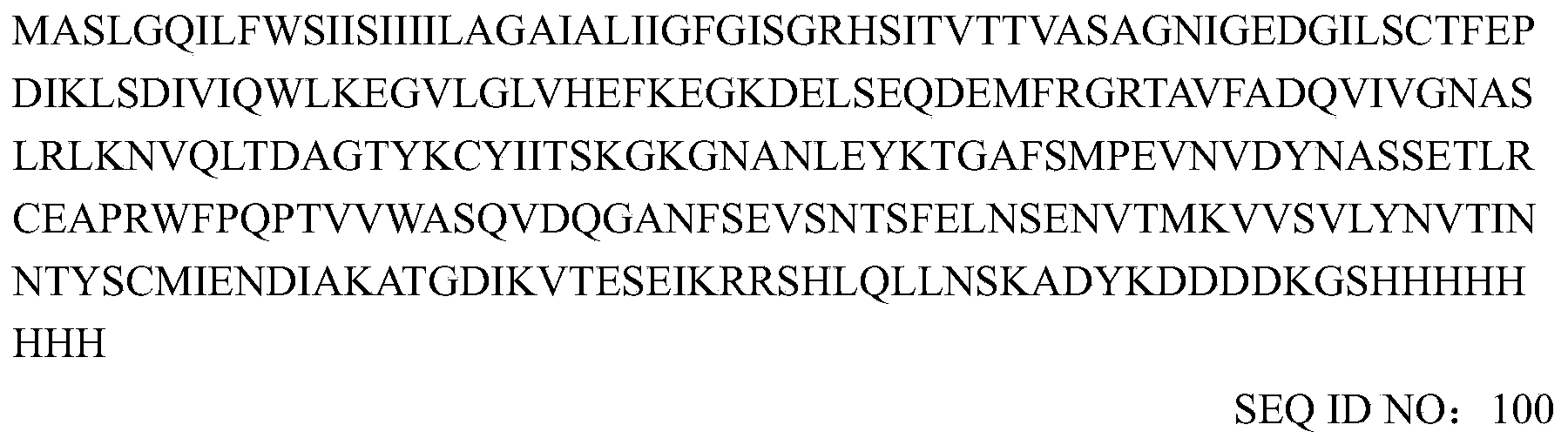
huB7-H4-his纯化步骤:huB7-H4-his purification steps:
将细胞表达上清样品高速离心去除杂质,并将缓冲液换置换为PBS,加入咪唑至终浓度为5mM。用含有5mM咪唑的PBS溶液平衡镍柱,冲洗2-5倍柱体积。将置换后的上清样品上柱。用含有5mM咪唑的PBS溶液冲洗柱子,至A 280读数降至基线。后用PBS+10mM咪唑冲洗层析柱,除去非特异结合的杂蛋白,并收集流出液。再用含有300mM咪唑的PBS溶液洗脱目的蛋白,并收集洗脱峰。收集的洗脱液用离子交换(SP柱)进一步纯化。配置A液:0.01M PB,pH8.0。配置B液:A液+1M NaCl。先将咪唑的PBS溶液洗脱目的蛋白置换到A液,并使用A液平衡SP柱,上样,B液浓度梯度0-100%,10倍柱体积洗脱,收集各洗脱峰。所得到的蛋白经电泳,鉴定为正确后分装备用。得到带HisFlag标签的人B7-H4(hu-B7-H4 his)。 The cell expression supernatant sample was centrifuged at high speed to remove impurities, and the buffer was exchanged for PBS, and imidazole was added to a final concentration of 5 mM. The nickel column was equilibrated with PBS solution containing 5 mM imidazole and rinsed 2-5 column volumes. The displaced supernatant sample was applied to the column. The column was washed with PBS containing 5 mM imidazole until the A280 reading dropped to baseline. The column was washed with PBS + 10 mM imidazole, the non-specifically bound heteroprotein was removed, and the effluent was collected. The protein of interest was eluted with PBS containing 300 mM imidazole, and the eluted peak was collected. The collected eluate was further purified by ion exchange (SP column). Configure solution A: 0.01 M PB, pH 8.0. Configure liquid B: liquid A + 1 M NaCl. First, the imidazole in PBS solution was eluted to the A solution, and the SP column was equilibrated with the A solution. The concentration of the B solution was 0-100%, and 10 column volumes were eluted to collect the elution peaks. The obtained protein was electrophoresed and identified as correct and then used. The human B7-H4 (hu-B7-H4 his) with the HisFlag tag was obtained.
huB7-H4-Fc纯化步骤:huB7-H4-Fc purification step:
将HEK293细胞表达的上清样品高速离心去除杂质,并将缓冲液换置换为PBS。用含有10mM磷酸缓冲液平衡Protein A亲和力柱,冲洗2-5倍柱体积。将置换后的上清样品上柱。用含有25倍柱体积缓冲液冲洗柱子,至A 280读数降至基线。再用pH 3.5的0.8%醋酸缓冲液洗脱目的蛋白,并收集洗脱峰,分装后立刻加入1M Tris-Cl pH8.0缓冲液中和,然后使用Millipore’s Amico-15滤柱置换溶液为PBS。所得到的蛋白经电泳,肽图,LC-MS鉴定后分装备用。 The supernatant sample expressed by HEK293 cells was centrifuged at high speed to remove impurities, and the buffer was exchanged for PBS. The Protein A affinity column was equilibrated with 10 mM phosphate buffer and rinsed 2-5 column volumes. The displaced supernatant sample was applied to the column. Rinse the column with 25 column volumes of buffer until the A 280 reading drops to baseline. The target protein was eluted with 0.8% acetate buffer at pH 3.5, and the elution peak was collected. Immediately after the addition, the mixture was neutralized with 1 M Tris-Cl pH 8.0 buffer, and then the solution was replaced with Millipore's Amico-15 filter column. . The obtained protein was electrophoresed, peptide map, LC-MS identified and used.
稳定CHO-S细胞池构建:Stable CHO-S cell pool construction:
编码人或食蟹猴B7-H4蛋白(huB7-H4或cyB7-H4)的全长序列由Integrated DNA Technology(IDT)公司合成(以上B7-H3重组蛋白均由本发明设计模版序列),分别克隆到改造过的pcDNA3.1载体上,pcDNA3.1/puro(Invitrogen#V79020)。CHO-S(ATCC)细胞于CD-CHO培养基(Life Technologies,#10743029)内培养至0.5x10 6/ml。将10ug编码huB7H3或cyB7H3基因的载体与50ul LF-LTX(Life Technologies,#A12621)在1ml Opti-MEM培养基(Life Technologies,#31985088)中混合,室温孵育20分钟后,加入CHO细胞培养液中并放入二氧化碳培养箱培养。24小时后更换新培养基并加入10ug/ml嘌呤霉素。之后每2-3天更换一次新培养液,经过10-12天筛选后得到稳定CHO-S细胞池。 The full-length sequence encoding the human or cynomolgus B7-H4 protein (huB7-H4 or cyB7-H4) was synthesized by Integrated DNA Technology (IDT) (the above B7-H3 recombinant proteins were designed by the template of the present invention) and cloned into On the engineered pcDNA3.1 vector, pcDNA3.1/puro (Invitrogen #V79020). CHO-S (ATCC) cells were cultured in the CD-CHO medium (Life Technologies, # 10743029) to 0.5x10 6 / ml. 10 ug of the vector encoding the huB7H3 or cyB7H3 gene was mixed with 50 ul of LF-LTX (Life Technologies, #A12621) in 1 ml Opti-MEM medium (Life Technologies, #31985088), incubated for 20 minutes at room temperature, and added to CHO cell culture medium. And put it into a carbon dioxide incubator for cultivation. After 24 hours, the new medium was replaced and 10 ug/ml puromycin was added. After that, the new culture solution was changed every 2-3 days, and after 10-12 days of screening, a stable CHO-S cell pool was obtained.
实施例2:鼠杂交瘤及抗体序列的获得Example 2: Acquisition of murine hybridomas and antibody sequences
用人抗原huB7-H4-Fc进行动物免疫,共5只Balb/c和5只A/J小鼠,雌性,10周龄,使用Sigma完全弗氏佐剂(CFA)和Sigma不完全弗氏佐剂(IFA),免疫原和免疫佐剂以1:1的比例充分混合乳化,制成稳定“油包水”液体;注射剂量25μg/200μL/小鼠。Animal immunization with human antigen huB7-H4-Fc, 5 Balb/c and 5 A/J mice, female, 10 weeks old, using Sigma Complete Freund's Adjuvant (CFA) and Sigma Incomplete Freund's Adjuvant (IFA), the immunogen and the immunoadjuvant were thoroughly mixed and emulsified in a ratio of 1:1 to prepare a stable "water-in-oil" liquid; the injection dose was 25 μg/200 μL/mouse.
对免疫小鼠血清使用如实施例3所述的间接ELISA、捕获ELISA法评估血清效价及结合细胞表面抗原的能力,对照效价检测情况(大于10万倍稀释度)决定启动细胞融合。选择血清效价、亲和力和FACS结合强的免疫小鼠进行一次终免疫后处死小鼠,取脾细胞和SP2/0骨髓瘤细胞融合后铺板获得杂交瘤,通过间接ELISA和捕获ELISA筛选到目标杂交瘤,并通过有限稀释法建株为单克隆细胞株。得到的阳性抗体株进一步使用稳转表达B7-H4的CHO-S细胞,对比空白CHO-S细胞以排除非特异性结合抗体杂交瘤株,用流式分选方法进行筛选,从而选定8株结合重组蛋白且也结合细胞表达抗原的杂交瘤。收集对数生长期杂交瘤细胞,用Trizol(Invitrogen,15596-018)提取RNA并反转录(PrimeScript TM Reverse Transcriptase,Takara#2680A)。将反转录得到的cDNA采用mouse Ig-Primer Set(Novagen,TB326 Rev.B 0503)进行PCR扩增后测序,最终得到8株鼠源抗体的序列。 The indirect ELISA, capture ELISA method as described in Example 3 was used to evaluate serum titer and the ability to bind cell surface antigens, and the control titer assay (greater than 100,000 fold dilution) was used to initiate cell fusion. The mice were sacrificed after a final immunization with serum titer, affinity and FACS binding. The spleen cells and SP2/0 myeloma cells were fused and plated to obtain hybridomas. The target hybridization was screened by indirect ELISA and capture ELISA. Tumors were constructed and cloned into monoclonal cell lines by limiting dilution. The obtained positive antibody strain was further subjected to CHO-S cells stably expressing B7-H4, and the blank CHO-S cells were compared to exclude non-specific antibody-binding hybridoma strains, and the cells were selected by flow sorting, thereby selecting 8 strains of binding. A recombinant protein that also binds to a cell expressing an antigen. Hybridoma cells in logarithmic growth phase were collected, RNA was extracted with Trizol (Invitrogen, 15596-018) and reverse transcription (PrimeScript TM Reverse Transcriptase, Takara # 2680A). The cDNA obtained by reverse transcription was subjected to PCR amplification using a mouse Ig-Primer Set (Novagen, TB326 Rev. B 0503) and sequenced, and finally a sequence of 8 murine antibody was obtained.
鼠单抗2F7的重链和轻链可变区序列如下:The heavy and light chain variable region sequences of murine mAb 2F7 are as follows:


其含有下列CDR序列:It contains the following CDR sequences:
M1的重链和轻链可变区序列如下:The heavy and light chain variable region sequences of M1 are as follows:

其含有下列CDR序列:It contains the following CDR sequences:
鼠单抗2F8的重链和轻链可变区序列如下:The heavy and light chain variable region sequences of murine mAb 2F8 are as follows:


其含有下列CDR序列:It contains the following CDR sequences:
鼠单抗2F4的重链和轻链可变区序列如下:The heavy and light chain variable region sequences of murine mAb 2F4 are as follows:

其含有下列CDR序列:It contains the following CDR sequences:
鼠单抗2A10的重链和轻链可变区序列如下:The heavy and light chain variable region sequences of murine mAb 2A10 are as follows:
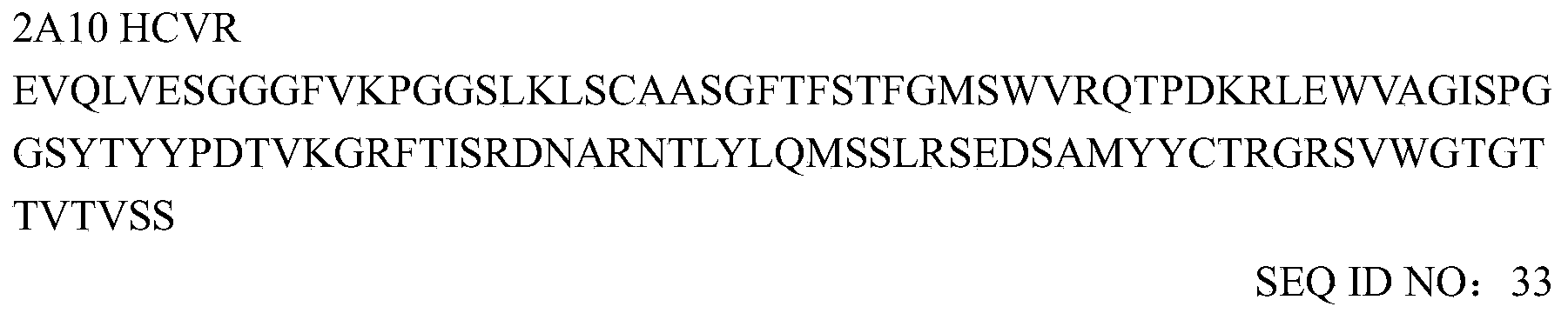

其含有下列CDR序列:It contains the following CDR sequences:
鼠单抗2E4的重链和轻链可变区序列如下:The heavy and light chain variable region sequences of murine mAb 2E4 are as follows:
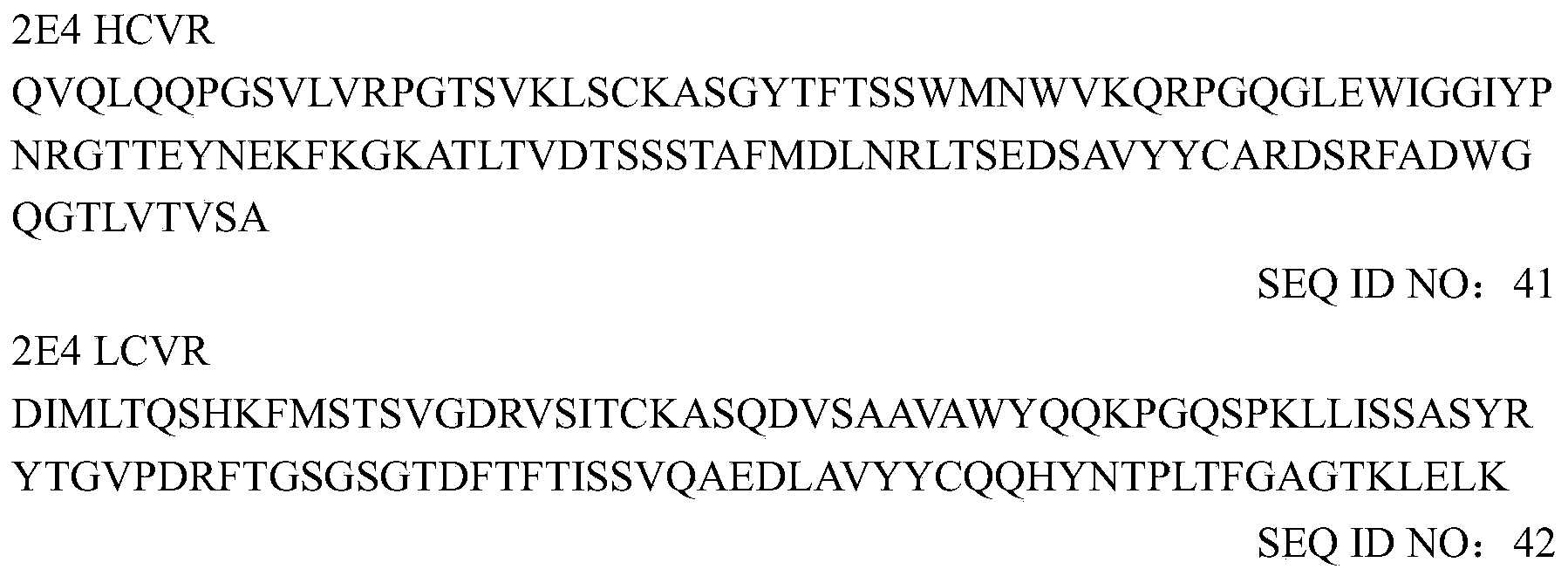
其含有下列CDR序列:It contains the following CDR sequences:
鼠单抗1E4的重链和轻链可变区序列如下:The heavy and light chain variable region sequences of murine mAb 1E4 are as follows:


其含有下列CDR序列:It contains the following CDR sequences:
鼠单抗2G6的重链和轻链可变区序列如下:The heavy and light chain variable region sequences of murine mAb 2G6 are as follows:

其含有下列CDR序列:It contains the following CDR sequences:
鼠单抗1C9的重链和轻链可变区序列如下:The heavy and light chain variable region sequences of murine mAb 1C9 are as follows:


其含有下列CDR序列:It contains the following CDR sequences:
使用每株鼠抗的重链和轻链可变区分别克隆进入含人IgG1重链恒定区和κ轻链恒定区,按实施例4所描述的方法纯化、鉴定,并进行相关活性检测。The heavy and light chain variable regions of each mouse antiserum were separately cloned into the human IgG1 heavy chain constant region and the kappa light chain constant region, purified, identified, and tested for activity as described in Example 4.
实施例3:抗体的体外结合活性检测方法Example 3: Detection method of in vitro binding activity of antibody
(1)体外间接ELISA结合实验:(1) In vitro indirect ELISA combined with experiments:
用pH7.4的PBS将huB7-H4 His蛋白(Sino Biological Inc.,cat#10738-H08H)稀释至1μg/ml浓度,以100μl/孔的体积加入96孔高亲和力酶标板中,于4℃冰箱孵育过夜(16-20小时)。用PBST(pH7.4 PBS含0.05%Tween-20)洗板4次后,加入用PBST稀释的3%牛血清白蛋白(BSA)封闭液150μl/孔,室温孵育1小时进行封闭。封闭结束后,弃去封闭液,并用PBST缓冲液洗板4次。The huB7-H4 His protein (Sino Biological Inc., cat#10738-H08H) was diluted to a concentration of 1 μg/ml with PBS of pH 7.4, and added to a 96-well high-affinity microtiter plate at a volume of 100 μl/well at 4 °C. Incubate overnight in the refrigerator (16-20 hours). After washing the
用含3%BSA的PBST稀释待测抗体,1μM起始,10倍梯度,10个剂量,以100μl/孔加到酶标板中,放于室温孵育1小时。孵育结束后用PBST洗板4次,加入100μl/孔用含3%BSA的PBST稀释的HRP标记羊抗人二抗(Abcam,cat#ab97225),室温孵育1小时。用PBST洗板4次后,加入100μl/孔TMB显色底物(Cell Signaling Technology,cat#7004S),于室温避光孵育1分钟,加入100μl/孔Stop Solution(Cell Signaling Technology,cat#7002S)终止反应,用酶标仪(BioTek,型号Synergy H1)在450nm处读取吸收值,分析数据。做浓度信号值曲线分析结果,如下表所示:The antibody to be tested was diluted with PBS containing 3% BSA, starting at 1 μM, 10 fold gradient, 10 doses, added to the plate at 100 μl/well, and incubated for 1 hour at room temperature. After the end of the incubation, the plate was washed 4 times with PBST, and 100 μl/well of HRP-labeled goat anti-human secondary antibody (Abeam, cat#ab97225) diluted with 3% BSA in PBST was added, and incubated for 1 hour at room temperature. After washing the plate 4 times with PBST, 100 μl/well TMB chromogenic substrate (Cell Signaling Technology, cat#7004S) was added, and the mixture was incubated at room temperature for 1 minute in the dark, and 100 μl/well of Stop Solution (Cell Signaling Technology, cat#7002S) was added. The reaction was terminated, and the absorbance was read at 450 nm using a microplate reader (BioTek, model Synergy H1), and the data was analyzed. The results of the concentration signal value curve analysis are shown in the following table:

(2)竞争性ELISA实验:(2) Competitive ELISA experiments:
用pH7.4的PBS将huB7-H4His蛋白(Sino Biological Inc.,cat#10738-H08H)稀释至1μg/ml浓度,以100μl/孔的体积加入96孔高亲和力酶标板中,于4℃冰箱孵育过夜(16-20小时),用PBST(pH7.4PBS含0.05%Tween-20)洗板4次后,加入用PBST稀释的3%牛血清白蛋白(BSA)封闭液150μl/孔,室温孵育1小时进行封闭。封闭结束后,弃去封闭液,并用PBST缓冲液洗板4次。The huB7-H4His protein (Sino Biological Inc., cat#10738-H08H) was diluted to a concentration of 1 μg/ml with PBS of pH 7.4, and added to a 96-well high-affinity microtiter plate at a volume of 100 μl/well in a refrigerator at 4 ° C. Incubate overnight (16-20 hours), wash the
用含3%BSA的PBST配制0.1nM的参照嵌合抗体,用该抗体作为稀释液将待测鼠源抗体稀释为100nM起始,10倍梯度,10个剂量,将稀释好的抗体以100μl/孔加到酶标板中,放于室温孵育1小时。孵育结束后用PBST洗板4次,加入100μl/孔用含3%BSA的PBST稀释的HRP标记羊抗人二抗(Abcam,cat#ab97225),室温孵育1小时。用PBST洗板4次后,加入100μl/孔TMB显色底物(Cell Signaling Technology,cat#7004S),于室温避光孵育1分钟,加入100μl/孔Stop Solution(Cell Signaling Technology,cat#7002S)终止反应,用酶标仪(BioTek,型号Synergy H1)在450nm处读取吸收值,分析数据。竞争性抑制率=((参照抗体吸光值-竞争抗体吸光值)/Abv抗体吸光值)*100。0.1 nM of the reference chimeric antibody was prepared with PBS containing 3% BSA, and the murine antibody to be tested was diluted to 100 nM with the antibody as a dilution, 10 fold gradient, 10 doses, and the diluted antibody was 100 μl/ The wells were added to the plate and incubated for 1 hour at room temperature. After the end of the incubation, the plate was washed 4 times with PBST, and 100 μl/well of HRP-labeled goat anti-human secondary antibody (Abeam, cat#ab97225) diluted with 3% BSA in PBST was added, and incubated for 1 hour at room temperature. After washing the
(3)体外捕获ELISA结合实验:(3) In vitro capture ELISA binding assay:
用pH7.4的PBS缓冲液将山羊抗小鼠IgG二抗(Jackson Immuno Research,cat#115-006-071)稀释至2ug/ml浓度,以100ul/孔的体积加入96孔酶标板中,于37℃孵育箱中放置2小时。用PBST洗板一次后,加入用PBST稀释的5%脱脂牛奶(光明脱脂奶粉)封闭液200ul/孔,37℃孵育箱孵育2小时或4℃放置过夜(16-18小时)进行封闭。封闭结束后,弃去封闭液,并用PBST洗板4次。The goat anti-mouse IgG secondary antibody (Jackson Immuno Research, cat #115-006-071) was diluted to a concentration of 2 ug/ml with PBS buffer pH 7.4, and added to the 96-well microtiter plate at a volume of 100 ul/well. Place in the incubator at 37 ° C for 2 hours. After washing the plate once with PBST, a 5% skim milk (bright skim milk powder) blocking solution diluted with PBST was added at 200 ul/well, and incubated at 37 ° C for 2 hours or at 4 ° C overnight (16-18 hours) for blocking. After the end of the closure, the blocking solution was discarded and the plate was washed 4 times with PBST.
用含5%NHS的样品稀释液(2.5%脱脂牛奶的PBST)稀释待测小鼠血清或纯化重组抗体成不同浓度,室温孵育40分钟后,100ul/孔加到酶标板中,放于37℃孵育箱孵育40分钟。孵育结束后用PBST洗板4次,加入100ul/孔用样品稀释液稀释的生物素化huB7-H4-his(义翘神州#10738-H08H)蛋白溶液,37℃孵育40分钟。孵育结束后用PBST洗板4次,加入100ul/孔用PBST稀释的HRP标记链霉亲和素(Jackson Immuno Research,cat#016-030-084),37℃孵育40分钟。用PBST洗板4次后,加入100μl/孔TMB显色底物(湖州英创生物科技公司),于室温避光孵育10-15min,加入50μl/孔1M H
2SO
4终止反应,用酶标仪(北京普朗新技术有限公司,型号DNM-9602)在450nm处读取吸收值,分析数据。
Dilute the test mouse serum or purified recombinant antibody to different concentrations with 5% NHS sample dilution (2.5% skim milk PBST), incubate for 40 minutes at room temperature, add 100 μl/well to the plate, and place at 37 Incubate for 40 minutes at °C incubator. After the incubation, the plate was washed 4 times with PBST, and 100 μl/well of the biotinylated huB7-H4-his (Yicang Shenzhou #10738-H08H) protein solution diluted with the sample dilution was added, and incubated at 37 ° C for 40 minutes. After the end of the incubation, the plate was washed 4 times with PBST, and 100 ul/well of HRP-labeled streptavidin diluted with PBST (Jackson Immuno Research, cat #016-030-084) was added, and incubated at 37 ° C for 40 minutes. After washing the
(4)体外细胞结合实验:(4) In vitro cell binding assay:
收集培养好的CHO-huB7-H4稳定转染细胞或SK-BR3细胞,调节细胞密度后分铺于96孔U底板,每孔1~2x10⁵个细胞。1200g,5min离心,去上清,添加100ul已梯度稀释的抗体溶液或小鼠免疫血清,4℃度孵育60min;1200g,5min离心,去上清,PBS洗细胞2次后,添加荧光标记二抗(PE-GAM或PE-GAH)100ul每孔,4℃度孵 育60min。1200g,5min离心去上清。PBS洗细胞2次后,再重悬于PBS,使用流式细胞计数仪检测信号,并作浓度曲线分析结果。The cultured CHO-huB7-H4 stably transfected cells or SK-BR3 cells were collected, adjusted for cell density, and then plated in a 96-well U-bottom plate, 1 to 2 x 10⁵ cells per well. Centrifuge at 1200g, 5min, remove the supernatant, add 100ul of the diluted antibody solution or mouse immune serum, incubate at 4 °C for 60min; 1200g, centrifuge for 5min, remove the supernatant, wash the cells twice with PBS, add fluorescent labeled secondary antibody (PE-GAM or PE-GAH) 100 ul per well, incubate for 60 min at 4 °C. 1200 g, centrifuged to remove the supernatant at 5 min. After washing the cells twice with PBS, they were resuspended in PBS, and the signals were detected using a flow cytometer, and the results of concentration curve analysis were performed.
实施例4:抗B7-H4重组嵌合抗体构建表达Example 4: Construction of anti-B7-H4 recombinant chimeric antibody
将本发明中的各鼠源抗体重链可变区(VH)和轻链可变区(VL)分别做FR(framework region)区域的定点氨基酸突变,根据不同的氨基酸突变组合,设计不同的人源化抗体重链和轻链,将不同的轻重链组合质粒转染细胞可以生产出人源化抗体。The murine antibody heavy chain variable region (VH) and the light chain variable region (VL) of the present invention are respectively designated as site-directed amino acid mutations in the FR (framework region) region, and different people are designed according to different amino acid mutation combinations. Humanized antibodies can be produced by transfecting the antibody heavy and light chains and transfecting different light and heavy chain combination plasmids into cells.
重链载体设计如下:信号肽+突变的重链可变区序列+人的IgG1恒定区序列。The heavy chain vector was designed as follows: signal peptide + mutated heavy chain variable region sequence + human IgGl constant region sequence.
轻链载体设计如下:信号肽+突变的轻链可变区序列+人的Kappa恒定区序列。The light chain vector is designed as follows: signal peptide + mutated light chain variable region sequence + human Kappa constant region sequence.
分别将上述序列插入pCEP4载体。按照上述设计合成表达载体,得到载体质粒后,大抽质粒,将质粒送测序验证。将验证合格的质粒用PEI转染至人293F细胞中,连续培养,将293F细胞用无血清培养液(上海奥浦迈生物,OPM-293CD03)培养至对数生长期用于细胞转染。将21.4μg人源化抗体轻链质粒和23.6μg人源化抗体重链质粒溶解在10ml

实施例5:体外结合亲和力和动力学实验:Example 5: In vitro binding affinity and kinetic experiments:
Biacore方法是公认的客观检测蛋白相互间亲和力和动力学的检测方法。通过Biacore T200(GE)分析本发明待测B7-H4抗体表征亲和力及结合动力学。The Biacore method is recognized as a method for the objective detection of the affinity and kinetics of proteins. The affinities and binding kinetics of the B7-H4 antibodies of the invention to be tested were analyzed by Biacore T200 (GE).
利用由Biacore提供的试剂盒,采用NHS标准氨基偶联法将本发明待测抗B7-H4抗体共价连接至CM5(GE)芯片上。然后:The anti-B7-H4 antibody of the present invention to be tested was covalently linked to a CM5 (GE) chip by a NHS standard amino coupling method using a kit supplied by Biacore. then:
a).将稀释于同样缓冲液中的50nM人huB7-H4-his蛋白(义翘神州#10738-H08H)进样,流速10uL/min,进样后均以试剂盒内配再生试剂再生。追踪抗原-抗体结合动力学3分钟并追踪解离动力学10分钟。使用GE的BIAevaluation软件以1:1(Langmuir)结合模型分析所得数据,以此法估测的各鼠源抗体单点kd(koff)数据如下表所示。a). Inject 50 nM human huB7-H4-his protein (Yicang Shenzhou #10738-H08H) diluted in the same buffer at a flow rate of 10 uL/min, and regenerate with the regeneration reagent in the kit after injection. Antigen-antibody binding kinetics were followed for 3 minutes and dissociation kinetics were followed for 10 minutes. The data obtained by analyzing the 1:1 (Langmuir) binding model using GE's BIAevaluation software, the single-point kd(koff) data of each mouse antibody estimated by this method are shown in the following table.

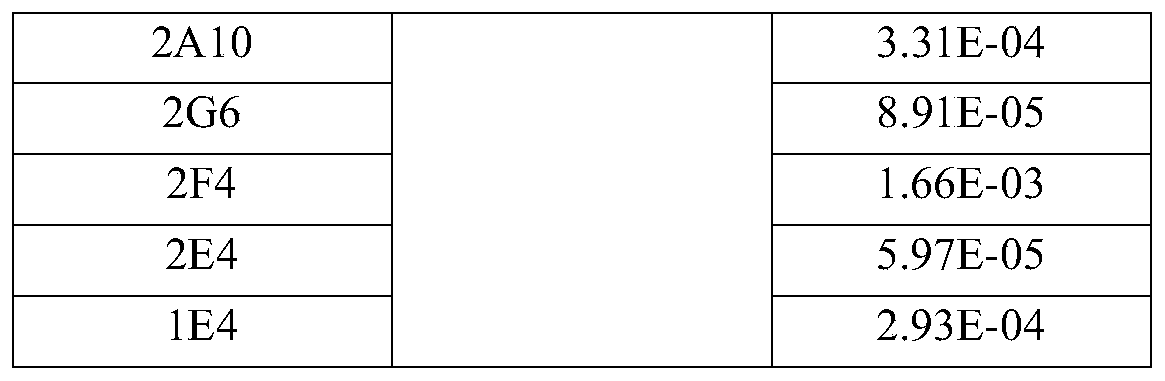
b).稀释于同样缓冲液中的一系列浓度梯度的人huB7-H4-his蛋白于前后各个循环进样,流速10uL/min,进样后均以试剂盒内配再生试剂再生。追踪抗原-抗体结合动力学3分钟并追踪解离动力学10分钟。使用GE的BIAevaluation软件以1:1(Langmuir)结合模型分析所得数据,以此法测定的嵌合抗体ka(kon)、kd(koff)和K D值显示于下表所示。 b). A series of concentration gradients of human huB7-H4-his protein diluted in the same buffer were injected at various cycles before and after the flow rate was 10 uL/min. After the injection, the regeneration reagent was regenerated with the reagent in the kit. Antigen-antibody binding kinetics were followed for 3 minutes and dissociation kinetics were followed for 10 minutes. GE's BIAevaluation software using 1: 1 (Langmuir) binding model resulting data analysis, determination of this chimeric antibody ka (kon), kd (koff ) and K D values are shown in the following table.
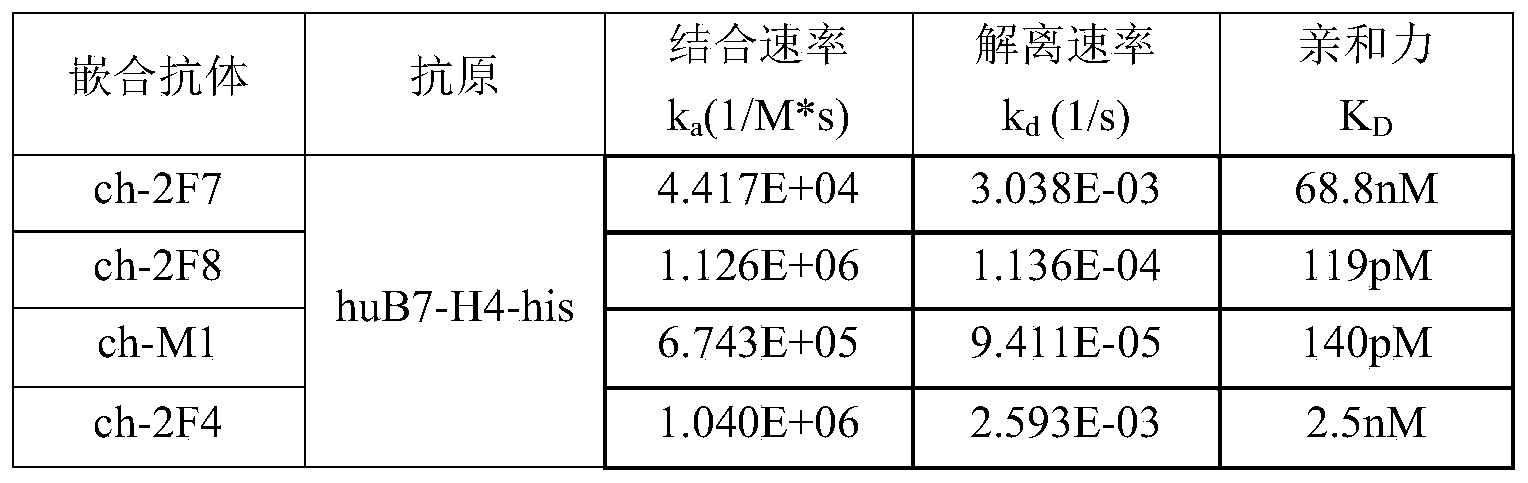
实施例6:小鼠抗体人源化实验Example 6: Mouse antibody humanization experiment
鼠源抗人B7-H4单克隆抗体人源化如本领域许多文献公示的方法进行。简言之,使用人恒定结构域替代亲本(鼠源抗体)恒定结构域,根据鼠源抗体和人抗体的同源性选择人种抗体序列,本发明将鼠源候选分子2F7、2F8、2G6和1C9进行人源化。Humanization of murine anti-human B7-H4 monoclonal antibodies was performed as disclosed in many literatures in the art. Briefly, the human constant domain is used in place of the parental (murine antibody) constant domain, and the human antibody sequence is selected based on the homology of the murine antibody and the human antibody. The present invention provides the murine candidate molecules 2F7, 2F8, 2G6 and 1C9 is humanized.
在所获得的鼠源抗体VH/VL CDR典型结构的基础上,将重、轻链可变区序列与人源抗体种系数据库比较,获得同源性高的人种系模板。Based on the typical structure of the obtained murine antibody VH/VL CDR, the heavy and light chain variable region sequences were compared with the human antibody germline database to obtain a human germline template with high homology.
将鼠源抗体2F7、2F8、2G6和1C9的CDR区移植到选择好的相应人源化模板上。其中,2F8的HCDR1区(GYTFTNSWMN,SEQ ID NO:19)和HCDR2区(GIYPNSGNIEYNEKFKG,SEQ ID NO:20)分别突变为GYTFTSSWMN(SEQ ID NO:73)和GIYPNRGNIEYNEKFKG(SEQ ID NO:74)以去除潜在的脱酰胺不稳定位点。替换人源化可变区,再与IgG恒定区(优选重链为IgG1,轻链为κ)重组。然后,以鼠源抗体的三维结构为基础,对包埋残基、与CDR区有直接相互作用的残基,以及对VL和VH的构象有重要影响的残基进行回复突变,并对CDR区化学不稳定氨基酸残基优化,设计并检测人源化轻重链可变区序列组合而成的抗体。The CDR regions of the murine antibodies 2F7, 2F8, 2G6 and 1C9 were grafted onto the selected corresponding humanized template. Wherein the HFR1 region of 2F8 (GYTFTNSWMN, SEQ ID NO: 19) and the HCDR2 region (GIYPNSGNIEYNEKFKG, SEQ ID NO: 20) were mutated to GYTFTSSWMN (SEQ ID NO: 73) and GIYPNRGNIEYNEKFKG (SEQ ID NO: 74), respectively, to remove potential Deacetylation unstable sites. The humanized variable region is replaced and recombined with an IgG constant region (preferably the heavy chain is IgG1 and the light chain is κ). Then, based on the three-dimensional structure of the murine antibody, the residues which have an important interaction with the CDRs and the residues of the CDRs, and the residues which have an important influence on the conformation of VL and VH are subjected to back mutation and the CDR regions are Optimization of chemically labile amino acid residues, designing and detecting antibodies resulting from the combination of humanized light and heavy chain variable region sequences.
经表达测试和回复突变数量对比,选择出最终的人源化hu2F7、hu2F8、hu2G6和hu1C9抗体分子,其各自重链和轻链可变区序列如SEQ ID NO:75-82所示,其 各自重链和轻链序列如SEQ ID NO:83-90所示。The final humanized hu2F7, hu2F8, hu2G6 and hu1C9 antibody molecules were selected by expression test and the number of back mutations, and the respective heavy and light chain variable region sequences are shown in SEQ ID NOs: 75-82, each of which The heavy and light chain sequences are set forth in SEQ ID NOs: 83-90.


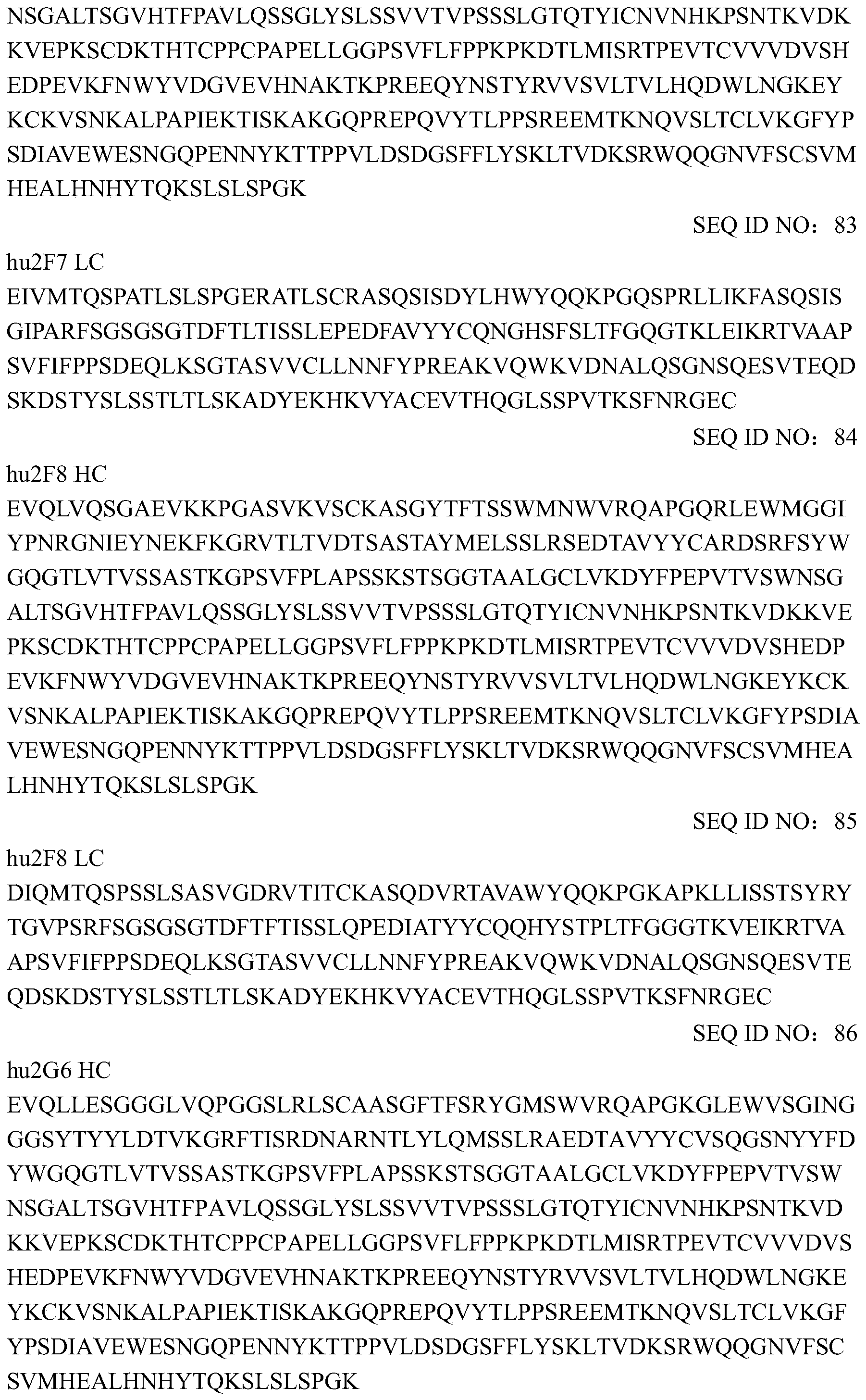
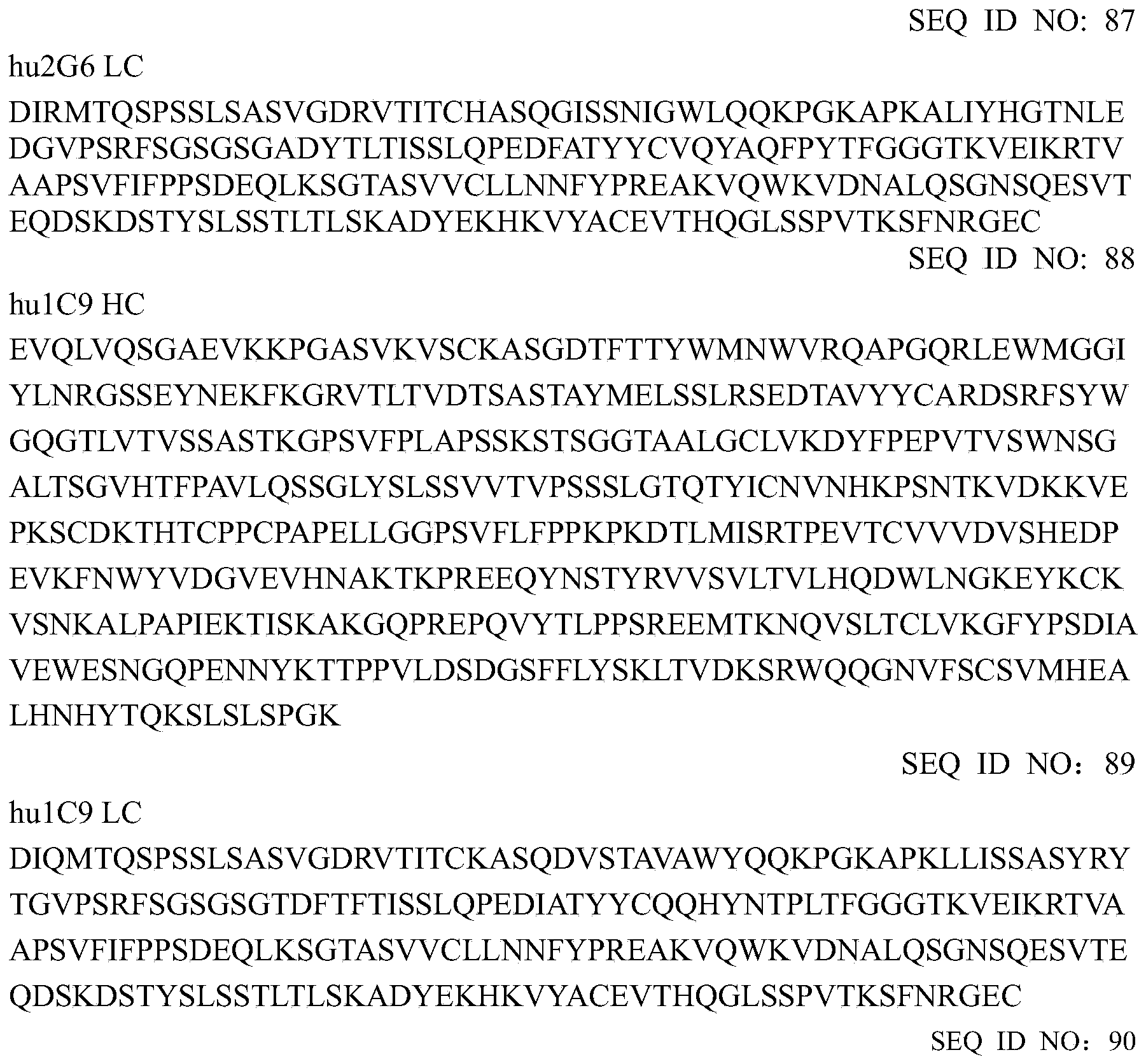
根据以上各人源化抗体轻链和重链的氨基酸序列合成cDNA片段,插入到pcDNA3.1表达载体(Life Technologies Cat.No.V790-20)中。将表达载体和转染试剂PEI(Polysciences,Inc.Cat.No.23966)以1:2的比例转染HEK293细胞(Life Technologies Cat.No.11625019),并置于CO 2孵育箱中孵育4-5天。表达的抗体通过离心回收后,按实施例4方法进行抗体纯化,得到本发明的人源化抗体蛋白hu2F7和hu2F8。 A cDNA fragment was synthesized based on the amino acid sequences of the above humanized antibody light and heavy chains, and inserted into a pcDNA3.1 expression vector (Life Technologies Cat. No. V790-20). The expression vector and the transfection reagent PEI (Polysciences, Inc. Cat. No. 23966) were transfected into HEK293 cells (Life Technologies Cat. No. 11625019) at a ratio of 1:2 and placed in a CO 2 incubator for incubation 4- 5 days. After the expressed antibody was recovered by centrifugation, antibody purification was carried out in accordance with the method of Example 4 to obtain humanized antibody proteins hu2F7 and hu2F8 of the present invention.
实施例7:人源化抗体活性测定Example 7: Determination of humanized antibody activity
对hu2F7和hu2F8人源化抗体在体外进行了以下实验测定:The following experimental assays were performed on humanized antibodies against hu2F7 and hu2F8 in vitro:
1.体外细胞结合实验:1. In vitro cell binding assay:
收集培养好的MX-1细胞,用pH为7.4的PBS调节细胞密度后分铺于96孔V型底板,每孔1x10⁵个细胞。2000rpm离心5分钟,去上清,每孔加入100μl已梯度稀释的嵌合抗体溶液(用含0.5%BSA的PBS稀释,1μM起始,3倍梯度,10个剂量),混匀,4℃摇床孵育1个小时;2000rpm离心5分钟,去上清,PBS洗细胞2次后,每孔加入100μl用0.5%BSA的PBS稀释的FITC标记羊抗人二抗 (Abcam,cat#ab97224),混匀,4℃摇床孵育30分钟。2000rpm离心5分钟,去上清。PBS洗细胞2次后,再重悬于PBS,使用流式细胞计数仪(BECKMANCOULTER,型号DxFLEX)检测信号,并作浓度曲线分析结果。结果如图表所示,人源化抗体2F7、2F8、2G6和1C9均与高表达B7-H4的MX-1细胞阳性结合。The cultured MX-1 cells were collected, adjusted for cell density with PBS of pH 7.4, and then plated on a 96-well V-shaped bottom plate with 1 x 10⁵ cells per well. Centrifuge at 2000 rpm for 5 minutes, remove the supernatant, add 100 μl of the serially diluted chimeric antibody solution (diluted with 0.5% BSA in PBS, 1 μM starting, 3 fold gradient, 10 doses) per well, mix, shake at 4 °C The bed was incubated for 1 hour; centrifuged at 2000 rpm for 5 minutes, the supernatant was removed, and the cells were washed twice with PBS, and 100 μl of FITC-labeled goat anti-human secondary antibody (Abeam, cat#ab97224) diluted with 0.5% BSA in PBS was added to each well. Stir well and incubate for 30 minutes on a 4 °C shaker. Centrifuge at 2000 rpm for 5 minutes and remove the supernatant. After washing the cells twice with PBS, they were resuspended in PBS, and the signals were detected using a flow cytometer (BECKMANCOULTER, model DxFLEX), and the results of concentration curve analysis were performed. Results As shown in the graph, humanized antibodies 2F7, 2F8, 2G6 and 1C9 all positively bind to MX-1 cells highly expressing B7-H4.
2.亲和力动力学实验(方法步骤同实施例5),结果如下表所示,人源化抗体hu2F7、hu2F8、hu2G6和hu1C9均对人B7-H4抗原蛋白显出很强的亲和力。2. Affinity kinetic experiments (method steps are the same as in Example 5). The results are shown in the following table. Humanized antibodies hu2F7, hu2F8, hu2G6 and hu1C9 all showed strong affinity for human B7-H4 antigen protein.

实施例8:人源化抗体结合表位测定Example 8: Humanized antibody binding epitope assay
方法步骤同实施3(1)体外间接ELISA结合实验。将SEQ ID NO:92的B7-H4分解为长度为20个氨基酸的抗原片段,通过体外间接ELISA结合实验发现抗原片段P12(氨基酸序列:TVASAGNIGEDGILSCTFEP)与人源化抗B7-H4抗体hu2F7有特异性结合,结果如图2所示。为进一步确证抗体结合表位,在抗原片段P12中做丙氨酸扫描,即将P12中的单个氨基酸分别突变为丙氨酸。通过体外间接ELISA结合实验发现氨基酸序列:ILSCTFE部分的突变显著减弱了抗体与抗原片段的结合,显示抗体结合表位位于氨基酸序列:TVASAGNIGEDGILSCTFEP中的氨基酸序列:ILSCTFE(SEQ ID NO:109)部分。结果如下表所示:The method steps were the same as the implementation of the 3(1) in vitro indirect ELISA binding assay. The B7-H4 of SEQ ID NO: 92 was decomposed into an antigen fragment of 20 amino acids in length, and the antigen fragment P12 (amino acid sequence: TVASAGNIGEDGILSCTFEP) was found to be specific to the humanized anti-B7-H4 antibody hu2F7 by indirect indirect ELISA. Combined, the results are shown in Figure 2. To further confirm the antibody binding epitope, an alanine scan was performed in the antigen fragment P12, that is, a single amino acid in P12 was separately mutated to alanine. Amino acid sequence was found by in vitro indirect ELISA binding experiments: Mutation of the ILSCTFE portion significantly attenuated binding of the antibody to the antigenic fragment, showing that the antibody binding epitope is located in the amino acid sequence: ILASCTFE (SEQ ID NO: 109). The results are shown in the following table:
通过体外间接ELISA结合实验发现抗原片段P12(氨基酸序列:TVASAGNIGEDGILSCTFEP)与人源化抗B7-H4抗体hu1C9有特异性结合,结果如下表所示。为进一步确证抗体结合表位,在抗原片段P12中做丙氨酸扫描,即将P12中的单个氨基酸分别突变为丙氨酸。通过体外间接ELISA结合实验发现氨基酸序列:LSCTF部分的突变显著减弱了抗体与抗原片段的结合,显示抗体结合表位位于氨基酸序列:TVASAGNIGEDGILSCTFEP中的氨基酸序列:LSCTF(SEQ ID NO:110)部分。结果如下表所示:The antigen fragment P12 (amino acid sequence: TVASAGNIGEDGILSCTFEP) was specifically bound to the humanized anti-B7-H4 antibody hu1C9 by an indirect indirect ELISA binding assay, and the results are shown in the following table. To further confirm the antibody binding epitope, an alanine scan was performed in the antigen fragment P12, that is, a single amino acid in P12 was separately mutated to alanine. Amino acid sequence was found by in vitro indirect ELISA binding experiments: mutations in the LSCTF portion significantly attenuated binding of the antibody to the antigenic fragment, showing the amino acid sequence of the antibody binding epitope in the amino acid sequence: TVASAGNIGEDGILSCTFEP: LSCTF (SEQ ID NO: 110). The results are shown in the following table:
通过体外间接ELISA结合实验发现抗原片段P12(氨基酸序列:TVASAGNIGEDGILSCTFEP)与人源化抗B7-H4抗体hu2G6有特异性结合,结果如下表所示。为进一步确证抗体结合表位,在抗原片段P12中做丙氨酸扫描,即将P12中的单个氨基酸分别突变为丙氨酸。通过体外间接ELISA结合实验发现氨基酸序列:ILSCTFEP部分的突变显著减弱了抗体与抗原片段的结合,显示抗体结合表位位于氨基酸序列:TVASAGNIGEDGILSCTFEP中的氨基酸序列:ILSCTFEP(SEQ ID NO:111)部分。结果如下表所示:The antigen fragment P12 (amino acid sequence: TVASAGNIGEDGILSCTFEP) was specifically bound to the humanized anti-B7-H4 antibody hu2G6 by an indirect indirect ELISA binding assay, and the results are shown in the following table. To further confirm the antibody binding epitope, an alanine scan was performed in the antigen fragment P12, that is, a single amino acid in P12 was separately mutated to alanine. Amino acid sequence was found by in vitro indirect ELISA binding experiments: mutations in the ILSCTFEP portion significantly attenuated binding of the antibody to the antigenic fragment, showing the amino acid sequence of the antibody binding epitope in the amino acid sequence: TVASAGNIGEDGILSCTFEP: ILSCTFEP (SEQ ID NO: 111). The results are shown in the following table:
实施例9:人源化抗体抗肿瘤效果Example 9: Anti-tumor effect of humanized antibody
在通过基因编辑技术导入人B7-H4基因的小鼠中植入MC38肿瘤细胞,待肿瘤生长到平均100mm 3后,开始给小鼠每3天注射一次对照或人源化B7-H4抗体hu1C9(10mg/kg或30mg/kg)。通过对肿瘤大小的观察发现,hu1C9具有显著的抑制肿瘤生长的功能,具有抗肿瘤效果。具体结果如图3及下表所示: MC38 tumor cells were implanted in mice into which human B7-H4 gene was introduced by gene editing technology, and after the tumor grew to an average of 100 mm 3 , the mice were injected with control or humanized B7-H4 antibody hu1C9 every 3 days ( 10 mg/kg or 30 mg/kg). By observing the size of the tumor, it was found that hu1C9 has a remarkable function of inhibiting tumor growth and has an anti-tumor effect. The specific results are shown in Figure 3 and the following table:

实施例10:人源化抗体增强免疫的效果Example 10: Effect of humanized antibody on enhancing immunity
抗B7-H4的抗肿瘤效果可能是通过增强肿瘤免疫效果所介导的。为验证该机理,从人外周血中提取CD4阳性的T细胞后,在培养的T细胞中加入不同浓度的抗B7-H4抗体,包括人源化抗体hu2G6和人源化抗体hu1C9。具体结果如图4及下表所示,人源化抗体hu2G6和人源化抗体hu1C9具有提高T细胞增殖的作用,可通过增强肿瘤免疫达到抗肿瘤的效果。The anti-tumor effect of anti-B7-H4 may be mediated by enhancing tumor immune effects. To verify this mechanism, after extracting CD4-positive T cells from human peripheral blood, different concentrations of anti-B7-H4 antibodies, including the humanized antibody hu2G6 and the humanized antibody hu1C9, were added to the cultured T cells. Specific results As shown in Fig. 4 and the following table, the humanized antibody hu2G6 and the humanized antibody hu1C9 have an effect of increasing T cell proliferation, and can achieve an antitumor effect by enhancing tumor immunity.

Claims (34)
Priority Applications (13)
| Application Number | Priority Date | Filing Date | Title |
|---|---|---|---|
| AU2019218319A AU2019218319B2 (en) | 2018-02-11 | 2019-02-01 | Anti-B7-H4 antibody, antigen-binding fragment thereof and pharmaceutical use thereof |
| BR112020015736-8A BR112020015736A2 (en) | 2018-02-11 | 2019-02-01 | ANTI-B7-H4 ANTIBODY, ANTIGEN BINDING FRAGMENT OF THE SAME AND PHARMACEUTICAL USE OF THE SAME |
| CA3089246A CA3089246A1 (en) | 2018-02-11 | 2019-02-01 | Anti-b7-h4 antibody, antigen-binding fragment thereof and pharmaceutical use thereof |
| CN202310820681.5A CN116693686A (en) | 2018-02-11 | 2019-02-01 | anti-B7-H4 antibody, antigen binding fragment thereof and medical application thereof |
| KR1020207026012A KR20200119846A (en) | 2018-02-11 | 2019-02-01 | Anti-B7 H4 antibody, antigen-binding fragment thereof, and pharmaceutical use thereof |
| US16/967,016 US11472882B2 (en) | 2018-02-11 | 2019-02-01 | Anti-B7-H4 antibody, antigen-binding fragment thereof and pharmaceutical use thereof |
| JP2020542138A JP7393337B2 (en) | 2018-02-11 | 2019-02-01 | Anti-B7-H4 antibody, antigen-binding fragment thereof and its medical use |
| CN201980001361.9A CN110366560B (en) | 2018-02-11 | 2019-02-01 | anti-B7-H4 antibody, antigen binding fragment thereof and medical application thereof |
| RU2020124155A RU2792748C2 (en) | 2018-02-11 | 2019-02-01 | Antibody to b7-h4, its antigen-binding fragment and its pharmaceutical use |
| MX2020008181A MX2020008181A (en) | 2018-02-11 | 2019-02-01 | ANTI-B7-H4 ANTIBODY, ANTIGEN-BINDING FRAGMENT AND PHARMACEUTICAL USE OF THE SAME. |
| EP19750949.0A EP3753951A4 (en) | 2018-02-11 | 2019-02-01 | ANTI-B7-H4 ANTIBODY, ANTIGEN BINDING FRAGMENT THEREOF AND PHARMACEUTICAL USE THEREOF |
| ZA2020/04701A ZA202004701B (en) | 2018-02-11 | 2020-07-29 | Anti-b7-h4 antibody, antigen-binding fragment thereof and pharmaceutical use thereof |
| JP2023197481A JP2024026132A (en) | 2018-02-11 | 2023-11-21 | Anti-B7-H4 antibody, antigen-binding fragment thereof and its medical use |
Applications Claiming Priority (2)
| Application Number | Priority Date | Filing Date | Title |
|---|---|---|---|
| CN201810142118 | 2018-02-11 | ||
| CN201810142118.6 | 2018-02-11 |
Publications (1)
| Publication Number | Publication Date |
|---|---|
| WO2019154315A1 true WO2019154315A1 (en) | 2019-08-15 |
Family
ID=67548182
Family Applications (1)
| Application Number | Title | Priority Date | Filing Date |
|---|---|---|---|
| PCT/CN2019/074397 Ceased WO2019154315A1 (en) | 2018-02-11 | 2019-02-01 | Anti-b7-h4 antibody, antigen-binding fragment thereof and pharmaceutical use thereof |
Country Status (12)
| Country | Link |
|---|---|
| US (1) | US11472882B2 (en) |
| EP (1) | EP3753951A4 (en) |
| JP (2) | JP7393337B2 (en) |
| KR (1) | KR20200119846A (en) |
| CN (2) | CN110366560B (en) |
| AU (1) | AU2019218319B2 (en) |
| BR (1) | BR112020015736A2 (en) |
| CA (1) | CA3089246A1 (en) |
| MX (1) | MX2020008181A (en) |
| TW (1) | TWI823895B (en) |
| WO (1) | WO2019154315A1 (en) |
| ZA (1) | ZA202004701B (en) |
Cited By (8)
| Publication number | Priority date | Publication date | Assignee | Title |
|---|---|---|---|---|
| WO2020244657A1 (en) * | 2019-06-06 | 2020-12-10 | 上海翰森生物医药科技有限公司 | Anti-b7-h4 antibody–drug conjugate and medicinal use thereof |
| WO2022200525A1 (en) | 2021-03-26 | 2022-09-29 | Innate Pharma | Multispecific proteins comprising an nkp46-binding site, a cancer antgienge binding site fused to a cytokine for nk cell engaging |
| WO2022258662A1 (en) | 2021-06-09 | 2022-12-15 | Innate Pharma | Multispecific proteins binding to nkp46, a cytokine receptor, a tumour antigen and cd16a |
| WO2022258691A1 (en) | 2021-06-09 | 2022-12-15 | Innate Pharma | Multispecific proteins binding to nkg2d, a cytokine receptor, a tumour antigen and cd16a |
| WO2022258678A1 (en) | 2021-06-09 | 2022-12-15 | Innate Pharma | Multispecific proteins binding to nkp30, a cytokine receptor, a tumour antigen and cd16a |
| US11964024B2 (en) | 2021-01-04 | 2024-04-23 | Mersana Therapeutics, Inc. | B7H4-targeted antibody-drug conjugates and methods of use thereof |
| WO2024208818A1 (en) | 2023-04-04 | 2024-10-10 | Innate Pharma | Modular chimeric antigen receptor |
| WO2024213081A1 (en) | 2023-04-12 | 2024-10-17 | 上海翰森生物医药科技有限公司 | Use of antibody-drug conjugate in preparation of drug for preventing and/or treating cancer |
Families Citing this family (9)
| Publication number | Priority date | Publication date | Assignee | Title |
|---|---|---|---|---|
| CN110366560B (en) * | 2018-02-11 | 2023-07-28 | 江苏豪森药业集团有限公司 | anti-B7-H4 antibody, antigen binding fragment thereof and medical application thereof |
| WO2021190480A1 (en) * | 2020-03-24 | 2021-09-30 | 上海翰森生物医药科技有限公司 | Antibody-drug conjugate and medical use thereof |
| TW202144425A (en) * | 2020-04-17 | 2021-12-01 | 大陸商上海翰森生物醫藥科技有限公司 | Specific antigen binding molecule, preparation method and pharmaceutical use thereof |
| IL299329A (en) | 2020-06-24 | 2023-02-01 | Prothena Biosciences Ltd | Antibodies recognizing sortilin |
| MX2024002013A (en) * | 2020-08-18 | 2024-03-08 | Abl Bio Inc | Anti-b7-h4/anti-4-1bb bispecific antibodies and use thereof. |
| WO2023283345A1 (en) * | 2021-07-07 | 2023-01-12 | Incyte Corporation | Anti-b7-h4 antibodies and uses thereof |
| AU2022402985A1 (en) * | 2021-12-01 | 2024-07-11 | Kadmon Corporation, Llc | B7-h4 antibodies and anti-b7-h4 antibody/il-15 fusion proteins |
| CA3242070A1 (en) * | 2021-12-23 | 2023-06-29 | Andriani IOANNOU | Antibodies recognizing sortilin |
| KR20240163098A (en) * | 2022-03-30 | 2024-11-18 | 듀얼리티 바이올로직스 (쑤저우) 컴퍼니 리미티드 | B7H4 antibody-drug conjugate and uses thereof |
Citations (9)
| Publication number | Priority date | Publication date | Assignee | Title |
|---|---|---|---|---|
| WO2009073533A2 (en) * | 2007-11-30 | 2009-06-11 | Medarex, Inc. | Anti-b7h4 monoclonal antibody-drug conjugate and methods of use |
| WO2013025779A1 (en) | 2011-08-15 | 2013-02-21 | Amplimmune, Inc. | Anti-b7-h4 antibodies and their uses |
| CN103981150A (en) * | 2014-03-28 | 2014-08-13 | 苏州大学 | Anti-human B7-H4 monoclonal antibody, and preparation method and application thereof |
| US20140322129A1 (en) | 2013-03-14 | 2014-10-30 | Genentech, Inc. | Anti-b7-h4 antibodies and immunoconjugates |
| CN104955475A (en) * | 2012-12-19 | 2015-09-30 | 艾普利穆恩公司 | Anti-human B7-H4 antibody and use thereof |
| CN105189552A (en) * | 2013-03-14 | 2015-12-23 | 基因泰克公司 | Anti-B7-H4 antibodies and immunoconjugates |
| WO2016040724A1 (en) * | 2014-09-12 | 2016-03-17 | Genentech, Inc. | Anti-b7-h4 antibodies and immunoconjugates |
| CN107299085A (en) * | 2017-05-26 | 2017-10-27 | 广东医科大学 | Secrete the extracellular monoclonal antibody hybridoma cell strains of anti-human B7 H4 and anti-human B7 H4 monoclonal antibodies and its application |
| CN107531782A (en) * | 2015-03-27 | 2018-01-02 | 南加利福尼亚大学 | CAR T cells for the treatment of the entity tumor of expressing B7 H4 |
Family Cites Families (11)
| Publication number | Priority date | Publication date | Assignee | Title |
|---|---|---|---|---|
| US20030091580A1 (en) * | 2001-06-18 | 2003-05-15 | Mitcham Jennifer L. | Compositions and methods for the therapy and diagnosis of ovarian cancer |
| US6858710B2 (en) * | 1998-12-17 | 2005-02-22 | Corixa Corporation | Compositions and methods for the therapy and diagnosis of ovarian cancer |
| US8759490B2 (en) * | 2005-03-24 | 2014-06-24 | Millennium Pharamaceuticals, Inc. | Antibodies that bind OV064 and methods of use therefor |
| WO2006104677A2 (en) * | 2005-03-24 | 2006-10-05 | Millennium Pharmaceuticals, Inc. | Antibodies that bind ov064 and methods of use therefor |
| CN104072614B (en) * | 2005-07-08 | 2017-04-26 | 生物基因Ma公司 | Anti-alpha[v]beta[6] antibodies and uses thereof |
| PT3042917T (en) * | 2010-08-12 | 2018-05-02 | Lilly Co Eli | ANTI-N3PGLU BETA AMYLOID PEPTIDE ANTIBODIES AND ITS USES |
| WO2013157105A1 (en) * | 2012-04-18 | 2013-10-24 | 公立大学法人大阪市立大学 | Mucin 5ac specific human antibody and use thereof |
| US11433141B2 (en) * | 2016-07-26 | 2022-09-06 | Shizuoka Prefecture | Anti-B7-H4 antibody |
| CN110366560B (en) * | 2018-02-11 | 2023-07-28 | 江苏豪森药业集团有限公司 | anti-B7-H4 antibody, antigen binding fragment thereof and medical application thereof |
| JP2021516051A (en) * | 2018-03-02 | 2021-07-01 | ファイブ プライム セラピューティクス, インコーポレイテッド | B7-H4 antibody and how to use it |
| KR102227515B1 (en) | 2018-12-18 | 2021-03-12 | 주식회사 포스코 | Zeolite and manufaturing method of the same |
-
2019
- 2019-02-01 CN CN201980001361.9A patent/CN110366560B/en active Active
- 2019-02-01 AU AU2019218319A patent/AU2019218319B2/en active Active
- 2019-02-01 CA CA3089246A patent/CA3089246A1/en active Pending
- 2019-02-01 WO PCT/CN2019/074397 patent/WO2019154315A1/en not_active Ceased
- 2019-02-01 MX MX2020008181A patent/MX2020008181A/en unknown
- 2019-02-01 BR BR112020015736-8A patent/BR112020015736A2/en unknown
- 2019-02-01 EP EP19750949.0A patent/EP3753951A4/en active Pending
- 2019-02-01 JP JP2020542138A patent/JP7393337B2/en active Active
- 2019-02-01 CN CN202310820681.5A patent/CN116693686A/en active Pending
- 2019-02-01 US US16/967,016 patent/US11472882B2/en active Active
- 2019-02-01 KR KR1020207026012A patent/KR20200119846A/en active Pending
- 2019-02-11 TW TW108104453A patent/TWI823895B/en active
-
2020
- 2020-07-29 ZA ZA2020/04701A patent/ZA202004701B/en unknown
-
2023
- 2023-11-21 JP JP2023197481A patent/JP2024026132A/en active Pending
Patent Citations (9)
| Publication number | Priority date | Publication date | Assignee | Title |
|---|---|---|---|---|
| WO2009073533A2 (en) * | 2007-11-30 | 2009-06-11 | Medarex, Inc. | Anti-b7h4 monoclonal antibody-drug conjugate and methods of use |
| WO2013025779A1 (en) | 2011-08-15 | 2013-02-21 | Amplimmune, Inc. | Anti-b7-h4 antibodies and their uses |
| CN104955475A (en) * | 2012-12-19 | 2015-09-30 | 艾普利穆恩公司 | Anti-human B7-H4 antibody and use thereof |
| US20140322129A1 (en) | 2013-03-14 | 2014-10-30 | Genentech, Inc. | Anti-b7-h4 antibodies and immunoconjugates |
| CN105189552A (en) * | 2013-03-14 | 2015-12-23 | 基因泰克公司 | Anti-B7-H4 antibodies and immunoconjugates |
| CN103981150A (en) * | 2014-03-28 | 2014-08-13 | 苏州大学 | Anti-human B7-H4 monoclonal antibody, and preparation method and application thereof |
| WO2016040724A1 (en) * | 2014-09-12 | 2016-03-17 | Genentech, Inc. | Anti-b7-h4 antibodies and immunoconjugates |
| CN107531782A (en) * | 2015-03-27 | 2018-01-02 | 南加利福尼亚大学 | CAR T cells for the treatment of the entity tumor of expressing B7 H4 |
| CN107299085A (en) * | 2017-05-26 | 2017-10-27 | 广东医科大学 | Secrete the extracellular monoclonal antibody hybridoma cell strains of anti-human B7 H4 and anti-human B7 H4 monoclonal antibodies and its application |
Non-Patent Citations (9)
| Title |
|---|
| CHOI IH ET AL., J IMMUNOL., vol. 171, no. 9, 1 November 2003 (2003-11-01), pages 4650 - 4 |
| HOLLIGERHUDSON, NAT. BIOTECHNOL., vol. 23, 2005, pages 1126 - 1136 |
| J. BIOL. CHEM, vol. 243, 1968, pages 3558 |
| KRYCZEK, I. ET AL., J. EXP. MED., vol. 203, no. 4, 2006, pages 871 - 881 |
| NING ZHANG , PENG FANG , ZONG-JIANG GU: "Preparation and Characterization of Monoclonal Antibody Against Human B7-H4 Molecule", MONOCLONAL ANTIBODIES IN IMMUNODIAGNOSIS AND IMMUNOTHERAPY, vol. 33, no. 4, 29 August 2014 (2014-08-29), pages 270 - 274, XP055468610, ISSN: 2167-9436, DOI: 10.1089/mab.2013.0082 * |
| SICA GL ET AL., IMMUNITY, vol. 18, no. 6, June 2003 (2003-06-01), pages 849 - 61 |
| SUH WK ET AL., BLOOD. MOL CELL BIOL., vol. 26, no. 17, September 2006 (2006-09-01), pages 6403 - 11 |
| ZHANG BIAO , FANG PENG , ZHANG NING , GU ZONG-JIANG : "The Preparation of Anti-Human B7-H4 Monoclonal Antibody and Its Function Study", CHINESE JOURNAL OF HEMORHEOLOGY, vol. 25, no. 1, 31 December 2015 (2015-12-31), pages 18 - 21, XP009523002, ISSN: 1009-881x, DOI: 10.3969./j.issn.1009-881x.2015.01.005 * |
| ZHU G ET AL., BLOOD, vol. 113, no. 8, 19 February 2009 (2009-02-19), pages 1759 - 67 |
Cited By (11)
| Publication number | Priority date | Publication date | Assignee | Title |
|---|---|---|---|---|
| WO2020244657A1 (en) * | 2019-06-06 | 2020-12-10 | 上海翰森生物医药科技有限公司 | Anti-b7-h4 antibody–drug conjugate and medicinal use thereof |
| CN112351797A (en) * | 2019-06-06 | 2021-02-09 | 上海翰森生物医药科技有限公司 | anti-B7-H4 antibody-drug conjugate and medical application thereof |
| US20230072897A1 (en) * | 2019-06-06 | 2023-03-09 | Shanghai Hansoh Biomedical Co., Ltd. | Anti-b7-h4 antibody-drug conjugate and medicinal use thereof |
| CN112351797B (en) * | 2019-06-06 | 2023-12-22 | 上海翰森生物医药科技有限公司 | Anti-B7-H4 antibody-drug conjugates and their medicinal uses |
| US11964024B2 (en) | 2021-01-04 | 2024-04-23 | Mersana Therapeutics, Inc. | B7H4-targeted antibody-drug conjugates and methods of use thereof |
| WO2022200525A1 (en) | 2021-03-26 | 2022-09-29 | Innate Pharma | Multispecific proteins comprising an nkp46-binding site, a cancer antgienge binding site fused to a cytokine for nk cell engaging |
| WO2022258662A1 (en) | 2021-06-09 | 2022-12-15 | Innate Pharma | Multispecific proteins binding to nkp46, a cytokine receptor, a tumour antigen and cd16a |
| WO2022258691A1 (en) | 2021-06-09 | 2022-12-15 | Innate Pharma | Multispecific proteins binding to nkg2d, a cytokine receptor, a tumour antigen and cd16a |
| WO2022258678A1 (en) | 2021-06-09 | 2022-12-15 | Innate Pharma | Multispecific proteins binding to nkp30, a cytokine receptor, a tumour antigen and cd16a |
| WO2024208818A1 (en) | 2023-04-04 | 2024-10-10 | Innate Pharma | Modular chimeric antigen receptor |
| WO2024213081A1 (en) | 2023-04-12 | 2024-10-17 | 上海翰森生物医药科技有限公司 | Use of antibody-drug conjugate in preparation of drug for preventing and/or treating cancer |
Also Published As
| Publication number | Publication date |
|---|---|
| RU2020124155A (en) | 2022-03-11 |
| MX2020008181A (en) | 2020-09-18 |
| AU2019218319A1 (en) | 2020-08-13 |
| CN110366560A (en) | 2019-10-22 |
| CN116693686A (en) | 2023-09-05 |
| TWI823895B (en) | 2023-12-01 |
| JP2021513331A (en) | 2021-05-27 |
| EP3753951A1 (en) | 2020-12-23 |
| CN110366560B (en) | 2023-07-28 |
| JP2024026132A (en) | 2024-02-28 |
| KR20200119846A (en) | 2020-10-20 |
| US11472882B2 (en) | 2022-10-18 |
| TW201934581A (en) | 2019-09-01 |
| EP3753951A4 (en) | 2022-03-16 |
| AU2019218319B2 (en) | 2025-11-13 |
| BR112020015736A2 (en) | 2020-12-08 |
| CA3089246A1 (en) | 2019-08-15 |
| ZA202004701B (en) | 2023-12-20 |
| JP7393337B2 (en) | 2023-12-06 |
| US20210032347A1 (en) | 2021-02-04 |
Similar Documents
| Publication | Publication Date | Title |
|---|---|---|
| US11472882B2 (en) | Anti-B7-H4 antibody, antigen-binding fragment thereof and pharmaceutical use thereof | |
| TWI673287B (en) | Anti-b7-h3 antibody, antigen-binding fragment thereof and pharmaceutical use thereof | |
| TWI840399B (en) | Antibody binding to human il-4r, antigen-binding fragment thereof and medical use thereof | |
| US11525005B2 (en) | Anti-CD40 antibody, antigen binding fragment thereof and medical use thereof | |
| WO2019141268A1 (en) | Anti-4-1bb antibody, antigen-binding fragment thereof and medical use thereof | |
| CN112243443B (en) | anti-TROP-2 antibodies, antigen-binding fragments thereof, and medical uses thereof | |
| CN113227148A (en) | anti-GPC 3 antibody, antigen-binding fragment thereof, and medicinal use thereof | |
| CN110461874B (en) | anti-GITR antibodies, antigen binding fragments thereof, and medical uses thereof | |
| CN115298216A (en) | Antibody or antigen binding fragment thereof, preparation method and medical application thereof | |
| WO2019080889A1 (en) | Anti-csf-1r antibody, antigen-binding fragment thereof and pharmaceutical use thereof | |
| CN115109157A (en) | Antibody or antigen binding fragment thereof, preparation method and medical application thereof | |
| WO2021209066A1 (en) | Specific antigen binding molecule, and preparation method and pharmaceutical use therefor | |
| WO2022078490A1 (en) | Anti-erbb3 antibody or antigen-binding fragment thereof, and medical use thereof | |
| RU2792748C2 (en) | Antibody to b7-h4, its antigen-binding fragment and its pharmaceutical use | |
| HK40012331B (en) | Anti-b7-h4 antibody, antigen-binding fragment thereof and pharmaceutical use thereof | |
| HK40036076A (en) | Anti-trop-2 antibody, antigen binding fragment thereof and medical use thereof | |
| HK40036076B (en) | Anti-trop-2 antibody, antigen binding fragment thereof and medical use thereof | |
| HK40012331A (en) | Anti-b7-h4 antibody, antigen-binding fragment thereof and pharmaceutical use thereof |
Legal Events
| Date | Code | Title | Description |
|---|---|---|---|
| 121 | Ep: the epo has been informed by wipo that ep was designated in this application |
Ref document number: 19750949 Country of ref document: EP Kind code of ref document: A1 |
|
| ENP | Entry into the national phase |
Ref document number: 3089246 Country of ref document: CA |
|
| ENP | Entry into the national phase |
Ref document number: 2020542138 Country of ref document: JP Kind code of ref document: A |
|
| NENP | Non-entry into the national phase |
Ref country code: DE |
|
| ENP | Entry into the national phase |
Ref document number: 2019218319 Country of ref document: AU Date of ref document: 20190201 Kind code of ref document: A |
|
| ENP | Entry into the national phase |
Ref document number: 20207026012 Country of ref document: KR Kind code of ref document: A |
|
| ENP | Entry into the national phase |
Ref document number: 2019750949 Country of ref document: EP Effective date: 20200911 |
|
| REG | Reference to national code |
Ref country code: BR Ref legal event code: B01A Ref document number: 112020015736 Country of ref document: BR |
|
| ENP | Entry into the national phase |
Ref document number: 112020015736 Country of ref document: BR Kind code of ref document: A2 Effective date: 20200731 |