WO2019077529A2 - Flame retardant polyamide composition - Google Patents
Flame retardant polyamide composition Download PDFInfo
- Publication number
- WO2019077529A2 WO2019077529A2 PCT/IB2018/058065 IB2018058065W WO2019077529A2 WO 2019077529 A2 WO2019077529 A2 WO 2019077529A2 IB 2018058065 W IB2018058065 W IB 2018058065W WO 2019077529 A2 WO2019077529 A2 WO 2019077529A2
- Authority
- WO
- WIPO (PCT)
- Prior art keywords
- composition
- polyamide
- polyamide composition
- accordance
- acid
- Prior art date
- Legal status (The legal status is an assumption and is not a legal conclusion. Google has not performed a legal analysis and makes no representation as to the accuracy of the status listed.)
- Ceased
Links
Classifications
-
- C—CHEMISTRY; METALLURGY
- C08—ORGANIC MACROMOLECULAR COMPOUNDS; THEIR PREPARATION OR CHEMICAL WORKING-UP; COMPOSITIONS BASED THEREON
- C08K—Use of inorganic or non-macromolecular organic substances as compounding ingredients
- C08K13/00—Use of mixtures of ingredients not covered by one single of the preceding main groups, each of these compounds being essential
- C08K13/04—Ingredients characterised by their shape and organic or inorganic ingredients
-
- C—CHEMISTRY; METALLURGY
- C08—ORGANIC MACROMOLECULAR COMPOUNDS; THEIR PREPARATION OR CHEMICAL WORKING-UP; COMPOSITIONS BASED THEREON
- C08K—Use of inorganic or non-macromolecular organic substances as compounding ingredients
- C08K3/00—Use of inorganic substances as compounding ingredients
- C08K3/38—Boron-containing compounds
-
- C—CHEMISTRY; METALLURGY
- C08—ORGANIC MACROMOLECULAR COMPOUNDS; THEIR PREPARATION OR CHEMICAL WORKING-UP; COMPOSITIONS BASED THEREON
- C08K—Use of inorganic or non-macromolecular organic substances as compounding ingredients
- C08K5/00—Use of organic ingredients
- C08K5/0008—Organic ingredients according to more than one of the "one dot" groups of C08K5/01 - C08K5/59
- C08K5/0066—Flame-proofing or flame-retarding additives
-
- C—CHEMISTRY; METALLURGY
- C08—ORGANIC MACROMOLECULAR COMPOUNDS; THEIR PREPARATION OR CHEMICAL WORKING-UP; COMPOSITIONS BASED THEREON
- C08K—Use of inorganic or non-macromolecular organic substances as compounding ingredients
- C08K5/00—Use of organic ingredients
- C08K5/49—Phosphorus-containing compounds
- C08K5/51—Phosphorus bound to oxygen
- C08K5/53—Phosphorus bound to oxygen bound to oxygen and to carbon only
- C08K5/5313—Phosphinic compounds, e.g. R2=P(:O)OR'
-
- C—CHEMISTRY; METALLURGY
- C08—ORGANIC MACROMOLECULAR COMPOUNDS; THEIR PREPARATION OR CHEMICAL WORKING-UP; COMPOSITIONS BASED THEREON
- C08K—Use of inorganic or non-macromolecular organic substances as compounding ingredients
- C08K5/00—Use of organic ingredients
- C08K5/49—Phosphorus-containing compounds
- C08K5/51—Phosphorus bound to oxygen
- C08K5/53—Phosphorus bound to oxygen bound to oxygen and to carbon only
- C08K5/5317—Phosphonic compounds, e.g. R—P(:O)(OR')2
- C08K5/5333—Esters of phosphonic acids
- C08K5/5353—Esters of phosphonic acids containing also nitrogen
-
- C—CHEMISTRY; METALLURGY
- C08—ORGANIC MACROMOLECULAR COMPOUNDS; THEIR PREPARATION OR CHEMICAL WORKING-UP; COMPOSITIONS BASED THEREON
- C08K—Use of inorganic or non-macromolecular organic substances as compounding ingredients
- C08K7/00—Use of ingredients characterised by shape
- C08K7/02—Fibres or whiskers
- C08K7/04—Fibres or whiskers inorganic
- C08K7/14—Glass
-
- C—CHEMISTRY; METALLURGY
- C08—ORGANIC MACROMOLECULAR COMPOUNDS; THEIR PREPARATION OR CHEMICAL WORKING-UP; COMPOSITIONS BASED THEREON
- C08L—COMPOSITIONS OF MACROMOLECULAR COMPOUNDS
- C08L77/00—Compositions of polyamides obtained by reactions forming a carboxylic amide link in the main chain; Compositions of derivatives of such polymers
-
- C—CHEMISTRY; METALLURGY
- C08—ORGANIC MACROMOLECULAR COMPOUNDS; THEIR PREPARATION OR CHEMICAL WORKING-UP; COMPOSITIONS BASED THEREON
- C08L—COMPOSITIONS OF MACROMOLECULAR COMPOUNDS
- C08L77/00—Compositions of polyamides obtained by reactions forming a carboxylic amide link in the main chain; Compositions of derivatives of such polymers
- C08L77/02—Polyamides derived from omega-amino carboxylic acids or from lactams thereof
-
- C—CHEMISTRY; METALLURGY
- C08—ORGANIC MACROMOLECULAR COMPOUNDS; THEIR PREPARATION OR CHEMICAL WORKING-UP; COMPOSITIONS BASED THEREON
- C08L—COMPOSITIONS OF MACROMOLECULAR COMPOUNDS
- C08L77/00—Compositions of polyamides obtained by reactions forming a carboxylic amide link in the main chain; Compositions of derivatives of such polymers
- C08L77/06—Polyamides derived from polyamines and polycarboxylic acids
-
- H—ELECTRICITY
- H01—ELECTRIC ELEMENTS
- H01R—ELECTRICALLY-CONDUCTIVE CONNECTIONS; STRUCTURAL ASSOCIATIONS OF A PLURALITY OF MUTUALLY-INSULATED ELECTRICAL CONNECTING ELEMENTS; COUPLING DEVICES; CURRENT COLLECTORS
- H01R13/00—Details of coupling devices of the kinds covered by groups H01R12/70 or H01R24/00 - H01R33/00
- H01R13/02—Contact members
- H01R13/03—Contact members characterised by the material, e.g. plating, or coating materials
-
- C—CHEMISTRY; METALLURGY
- C08—ORGANIC MACROMOLECULAR COMPOUNDS; THEIR PREPARATION OR CHEMICAL WORKING-UP; COMPOSITIONS BASED THEREON
- C08K—Use of inorganic or non-macromolecular organic substances as compounding ingredients
- C08K3/00—Use of inorganic substances as compounding ingredients
- C08K3/38—Boron-containing compounds
- C08K2003/387—Borates
-
- C—CHEMISTRY; METALLURGY
- C08—ORGANIC MACROMOLECULAR COMPOUNDS; THEIR PREPARATION OR CHEMICAL WORKING-UP; COMPOSITIONS BASED THEREON
- C08K—Use of inorganic or non-macromolecular organic substances as compounding ingredients
- C08K3/00—Use of inorganic substances as compounding ingredients
- C08K3/01—Use of inorganic substances as compounding ingredients characterized by their specific function
- C08K3/013—Fillers, pigments or reinforcing additives
-
- C—CHEMISTRY; METALLURGY
- C08—ORGANIC MACROMOLECULAR COMPOUNDS; THEIR PREPARATION OR CHEMICAL WORKING-UP; COMPOSITIONS BASED THEREON
- C08K—Use of inorganic or non-macromolecular organic substances as compounding ingredients
- C08K3/00—Use of inorganic substances as compounding ingredients
- C08K3/01—Use of inorganic substances as compounding ingredients characterized by their specific function
- C08K3/016—Flame-proofing or flame-retarding additives
-
- C—CHEMISTRY; METALLURGY
- C08—ORGANIC MACROMOLECULAR COMPOUNDS; THEIR PREPARATION OR CHEMICAL WORKING-UP; COMPOSITIONS BASED THEREON
- C08K—Use of inorganic or non-macromolecular organic substances as compounding ingredients
- C08K3/00—Use of inorganic substances as compounding ingredients
- C08K3/32—Phosphorus-containing compounds
-
- C—CHEMISTRY; METALLURGY
- C08—ORGANIC MACROMOLECULAR COMPOUNDS; THEIR PREPARATION OR CHEMICAL WORKING-UP; COMPOSITIONS BASED THEREON
- C08K—Use of inorganic or non-macromolecular organic substances as compounding ingredients
- C08K5/00—Use of organic ingredients
- C08K5/49—Phosphorus-containing compounds
-
- C—CHEMISTRY; METALLURGY
- C08—ORGANIC MACROMOLECULAR COMPOUNDS; THEIR PREPARATION OR CHEMICAL WORKING-UP; COMPOSITIONS BASED THEREON
- C08K—Use of inorganic or non-macromolecular organic substances as compounding ingredients
- C08K7/00—Use of ingredients characterised by shape
- C08K7/02—Fibres or whiskers
- C08K7/04—Fibres or whiskers inorganic
-
- C—CHEMISTRY; METALLURGY
- C08—ORGANIC MACROMOLECULAR COMPOUNDS; THEIR PREPARATION OR CHEMICAL WORKING-UP; COMPOSITIONS BASED THEREON
- C08L—COMPOSITIONS OF MACROMOLECULAR COMPOUNDS
- C08L2201/00—Properties
- C08L2201/02—Flame or fire retardant/resistant
-
- C—CHEMISTRY; METALLURGY
- C08—ORGANIC MACROMOLECULAR COMPOUNDS; THEIR PREPARATION OR CHEMICAL WORKING-UP; COMPOSITIONS BASED THEREON
- C08L—COMPOSITIONS OF MACROMOLECULAR COMPOUNDS
- C08L2203/00—Applications
- C08L2203/20—Applications use in electrical or conductive gadgets
-
- C—CHEMISTRY; METALLURGY
- C08—ORGANIC MACROMOLECULAR COMPOUNDS; THEIR PREPARATION OR CHEMICAL WORKING-UP; COMPOSITIONS BASED THEREON
- C08L—COMPOSITIONS OF MACROMOLECULAR COMPOUNDS
- C08L2205/00—Polymer mixtures characterised by other features
- C08L2205/02—Polymer mixtures characterised by other features containing two or more polymers of the same C08L -group
Definitions
- the present invention is directed to a polyamide composition that contains at least one polyamide resin in combination with inorganic fibers and a flame retardant system that includes a zinc phosphinate and a nitrogen-containing polyphosphate.
- polyamides constitute from about
- the present inventors have discovered that the resulting polyamide composition can achieve a unique combination of flame retardancy and good mechanical properties even when formed into a shape part having a relatively small thickness, such as about 4 millimeters or less, in some embodiments about from about 0.2 to about 3.2 millimeters or less, and in some embodiments, from about 0.4 to about 1 .6 millimeters (e.g., 0.4 or 0.8 millimeters).
- the flame retardancy of the composition can be any flame retardancy. As is known in the art, the flame retardancy of the composition can be any flame retardancy.
- the flame retardancy of the composition can also be any flame retardancy of the composition.
- the composition may also exhibit a total number of drips of burning particles that ignite cotton of 0.
- the composition of the present invention may also exhibit a comparative tracking index ("CTI") that is relatively high when determined in accordance with IEC 601 12:2003 at a part thickness such as noted above.
- CTI comparative tracking index
- the composition may exhibit a CTI that is about 550 volts or more, in some embodiments about 575 volts or more, in some embodiments about 600 volts or more, and in some embodiments, about 625 volts or more.
- compositions having flame retardant properties could not achieve the desired mechanical properties for various applications.
- the present inventors have discovered, however, that the composition of the present invention can still achieve good impact strength, tensile properties, and flexural properties.
- the polyamide for example, the polyamide
- composition may exhibit a Charpy unnotched impact strength of about 5 kJ/m 2 or more, in some embodiments about 6 kJ/m 2 or more, in some embodiments from about 7 to about 30 kJ/m 2 , and in some embodiments, from about 8 to about 25 kJ/m 2 , measured at 23°C or -30°C according to ISO Test No. 179-1 :2010
- the composition may also exhibit a flexural strength of from about 70 to about 500 MPa, in some embodiments from about 80 to about 400 MPa, and in some embodiments, from about 90 to about 300 MPa and/or a flexural modulus of from about 10,000 MPa to about 30,000 MPa, in some embodiments from about 12,000 MPa to about 25,000 MPa, and in some embodiments, from about 14,000 MPa to about 20,000 MPa.
- the flexural properties may be determined in accordance with ISO Test No. 178:2010
- Polyamides generally have a CO-NH linkage in the main chain and are obtained by condensation of a diamine and a dicarboxylic acid, by ring opening polymerization of lactam, or self-condensation of an amino carboxylic acid.
- the polyamide may contain aliphatic repeating units derived from an aliphatic diamine, which typically has from 4 to 14 carbon atoms.
- diamines examples include linear aliphatic alkylenediamines, such as 1 ,4- tetramethylenediamine, 1 ,6-hexanediamine, 1 ,7-heptanediamine, 1 ,8- octanediamine, 1 ,9-nonanediamine, 1 ,10-decanediamine, 1 ,1 1 -undecanediamine,
- aromatic dicarboxylic acids e.g., terephthalic acid, isophthalic acid, 2,6-naphthalenedicarboxylic acid, 2,7-naphthalenedicarboxylic acid, 1 ,4-naphthalenedicarboxylic acid, 1 ,4-phenylenedioxy-diacetic acid, 1 ,3- phenylenedioxy-diacetic acid, diphenic acid, 4,4'-oxydibenzoic acid,
- aromatic dicarboxylic acids e.g., terephthalic acid, isophthalic acid, 2,6-naphthalenedicarboxylic acid, 2,7-naphthalenedicarboxylic acid, 1 ,4-naphthalenedicarboxylic acid, 1 ,4-phenylenedioxy-diacetic acid, 1 ,3- phenylenedioxy-diacetic acid, diphenic acid, 4,4'-oxydibenzoic acid,
- diphenylmethane-4,4'-dicarboxylic acid diphenylsulfone-4,4'-dicarboxylic acid, 4,4'-biphenyldicarboxylic acid, etc.
- aliphatic dicarboxylic acids e.g., adipic acid, sebacic acid, etc.
- lactams include pyrrolidone, aminocaproic acid, caprolactam, undecanlactam, lauryl lactam, and so forth.
- amino carboxylic acids include amino fatty acids, which are compounds of the aforementioned lactams that have been ring opened by water.
- an "aliphatic" polyamide is employed that is formed only from aliphatic monomer units (e.g., diamine and dicarboxylic acid monomer units).
- aliphatic monomer units e.g., diamine and dicarboxylic acid monomer units.
- aliphatic polyamides include, for instance, nylon-4 (poly-a-pyrrolidone), nylon-6 (polycaproamide), nylon-1 1
- nylon-6 and nylon-66 are particularly suitable.
- aromatic monomer units in the polyamide such that it is considered semi- aromatic (contains both aliphatic and aromatic monomer units) or wholly aromatic (contains only aromatic monomer units).
- suitable semi-aromatic polyamides may include poly(nonamethylene terephthalamide) (PA9T),
- PA9T/910 poly(nonamethylene terephthalamide/nonamethylene decanediamide)
- PA9T/910 poly(nonamethylene terephthalamide/nonamethylene dodecanediamide)
- PA9T/912 poly(nonamethylene terephthalamide/1 1 -aminoundecanamide) (PA9T/1 1 ), poly(nonamethylene terephthalamide/12-aminododecanamide)
- PA10T/12 poly(decamethylene terephthalamide/decamethylene decanediamide) (PA10T/1010), poly(decamethylene terephthalamide/decamethylene dodecanediamide) (PA10T/1012), poly(decamethylene
- the polyamide may also have a relatively high glass transition temperature, such as about 30°C or more, in some embodiments about 40°C or more, and in some embodiments, from about 45°C to about 140°C.
- the glass transition and melting temperatures may be determined as is well known in the art using differential scanning calorimetry
- the inorganic fibers generally have a high degree of tensile strength relative to their mass. For example, the ultimate tensile strength of the fibers
- the high strength fibers may be formed from materials that are also electrically insulative in nature, such as glass, ceramics (e.g., alumina or silica), etc., as well as mixtures thereof. Glass fibers are particularly suitable, such as E-glass, A- glass, C-glass, D-glass, AR-glass, R-glass, S1 -glass, S2-glass, etc., and mixtures thereof.
- the inorganic fibers may have a relatively small median diameter, such as about 50 micrometers or less, in some embodiments from about 0.1 to about 40 micrometers, and in some embodiments, from about 2 to about 20 micrometers, such as determined using laser diffraction techniques in accordance with ISO
- the average length of the inorganic fibers may be relatively small, such as from about 10 to about 800 micrometers, in some embodiments from about 100 to about 700 micrometers, and in some
- the polyamide composition also contains a flame retardant system that is capable of achieving the desired flammability performance, smoke suppression, and mechanical properties without the need for conventional halogen-based flame retardants. Consequently, the flame retardant system includes at least one low halogen flame retardant.
- the halogen (e.g., bromine, chlorine, and/or fluorine) content of such an agent is about
- phosphinate as one type of a halogen-free flame retardant. Without intending to be limited by theory, it is believed that the use of a zinc salt can enhance the flame retardancy of the overall composition, particularly for relatively thin parts.
- Such zinc phosphinates typically constitute from about 10 wt.% to about 55 wt.%, in some embodiments from about 20 wt.% to about 54 wt.%, and in some
- a zinc phosphinate is a salt of a phosphinic acid and/or diphosphinic acid having the general formula (I) and/or formula (II):
- R 9 is a substituted or unsubstituted, straight chain, branched, or cyclic C C-io alkylene, arylene, arylalkylene, or alkylarylene group, such as a methylene, ethylene, n-propylene, iso-propylene, n-butylene, tert-butylene, n-pentylene, n- octylene, n-dodecylene, phenylene, naphthylene, methylphenylene,
- ethylphenylene tert-butylphenylene, methylnaphthylene, ethylnaphthylene, t- butylnaphthylene, phenylethylene, phenylpropylene or phenylbutylene group;
- Z is zinc
- Suitable nitrogen bases may include those having a substituted or unsubstituted ring structure, along with at least one nitrogen heteroatom in the ring structure (e.g., heterocyclic or heteroaryl group) and/or at least one nitrogen- containing functional group (e.g., amino, acylamino, etc.) substituted at a carbon atom and/or a heteroatom of the ring structure.
- nitrogen heteroatoms e.g., heterocyclic or heteroaryl group
- nitrogen- containing functional group e.g., amino, acylamino, etc.
- heterocyclic groups may include, for instance, pyrrolidine, imidazoline, pyrazolidine,
- nitrogen-containing synergists may be employed that act in conjunction with the zinc phosphinate and/or other components to result in a more effective flame retardant system.
- nitrogen-containing synergists may include those of the formulae (III) to (VIII), or a mixture of thereof:
- n is from 1 to 4.
- ring B is a 6-membered aromatic ring wherein 1 to 3 ring carbon atoms are optionally replaced by nitrogen or oxygen, wherein each nitrogen is optionally oxidized, and wherein ring B may be optionally fused or linked to a 5- or 6- membered aryl, heteroaryl, cycloalkyl, or heterocyclyl;
- q is from 0 to 10, in some embodiments from 0 to 4, and in some
- the apparent shear rate during melt blending may also range from about 100 seconds "1 to about 10,000 seconds “1 , in some embodiments from about 500 seconds “1 to about 5000 seconds “1 , and in some embodiments, from about 800 seconds “1 to about 1200 seconds “1 .
- the apparent shear rate is equal to 4Q/nR 3 , where Q is the volumetric flow rate ("m 3 /s") of the polymer melt and R is the radius ("m") of the capillary (e.g., extruder die) through which the melted polymer flows. [0031] Regardless of the particular manner in which it is formed, the resulting polyamide composition can possess excellent thermal properties.
- Comparative Tracking Index may be determined in accordance with International Standard IEC 601 12- 2003 to provide a quantitative indication of the ability of a composition to perform as an electrical insulating material under wet and/or contaminated conditions.
- CTI Comparative Tracking Index
- two electrodes are placed on a molded test specimen. A voltage differential is then established between the electrodes while a 0.1 % aqueous ammonium chloride solution is dropped onto a test specimen. The maximum voltage at which five (5) specimens withstand the test period for 50 drops without failure is determined. The test voltages range from 100 to 600 V in 25 V increments.
- Specimens must not burn with flaming combustion for more than 30 seconds after either test flame application.
- V-2 Specimens must not burn with flaming or glowing combustion up to the specimen holding clamp.
- compositions were then injected molded at a temperature of about 280°C and a tool temperature of from 80°C to 90°C.
Landscapes
- Chemical & Material Sciences (AREA)
- Health & Medical Sciences (AREA)
- Chemical Kinetics & Catalysis (AREA)
- Medicinal Chemistry (AREA)
- Polymers & Plastics (AREA)
- Organic Chemistry (AREA)
- Compositions Of Macromolecular Compounds (AREA)
Abstract
A polyamide composition comprising a polyamide; a plurality of inorganic fibers; and a flame retardant system comprising a zinc phosphinate and a nitrogen-containing polyphosphate is provided. At thicknesses of from about 0.4 to about 3.2 millimeters, the composition exhibits a Glow Wire Ignition Temperature of about 775QC or more as determined in accordance with IEC- 60695-2-1 3:2010; a Glow Wire End Product Temperature (without flame) of about 750QC or more as determined in accordance with IEC-60335-1 :2010; a Glow Wire Flammability Index of about 850QC or more as determined in accordance with IEC-60695-2-1 2:2010; a V0 rating as determined in accordance with UL94; and/or a comparative tracking index of about 550 volts or more as determined in accordance with IEC 601 12:2003..
Description
FLAME RETARDANT POLYAMIDE COMPOSITION
Related Application
[0001 ] The present application claims priority to U.S. Application Serial No. 62/573,285 (filed on October 1 7, 201 7), which is incorporated herein in its entirety by reference thereto.
Background of the Invention
[0002] Electrical connectors are commonly used in household and industrial appliances to provide a connection between the product and an electrical circuit, or between different components within the product itself. Due to their small size and complex geometry, many of these electrical connectors are formed from polyamide compositions. Recently, the International Electrotechnical Commission (IEC) has adopted the ignition resistance in several electrical safety standards (IEC 60335-1 and the second parts of the same) to assess the safety of electrical end products. This comes to integrate the existing requirements of resistance to heat and fire for polyamide compositions and other resins used in components for appliances, when they are used as an insulating material. Applicable ignition and combustion resistance tests are described in the "glow wire" standards (IEC 60695- 2/1 0/1 11λ 2/1 3). Because polyamide compounds, especially when reinforced with glass fibers, have a relative low degree of inherent ignition resistance, most conventional attempts in satisfying these glow wire standards have involved the addition of external halogen-based flame retardants (e.g., brominated compounds) to the polyamide composition. Unfortunately, however, the presence of halogens is not desired in most electrical applications due to environmental concerns when the composition is burned. While halogen-free flame retardants have been developed, the use of such materials in polyamide resins is typically associated with a corresponding adverse impact on the mechanical properties of the composition.
[0003] As such, a need currently exists for flame retardant polyamide compositions that can satisfy the IEC glow wire requirements without the need for halogen-based flame retardants, but still maintain good mechanical properties
(e.g., similar to equivalent grades without flame retardants), as well as other properties, such as elevated CTI and good insulation properties.
Summary of the Invention
[0004] In accordance with one embodiment of the present invention, a polyamide composition is disclosed that comprises a polyamide, a plurality of inorganic fibers, and a flame retardant system comprising a zinc phosphinate and a nitrogen-containing polyphosphate. At thicknesses of from about 0.4 to about 3.2 millimeters, the composition exhibits a Glow Wire Ignition Temperature of about 775QC or more as determined in accordance with IEC-60695-2-13:2010; a Glow Wire End Product Temperature (without flame) of about 750QC or more as determined in accordance with IEC-60335-1 :2010; a Glow Wire Flammability Index of about 850QC or more as determined in accordance with IEC-60695-2-12:2010; a V0 rating as determined in accordance with UL94; and/or a comparative tracking index of about 550 volts or more as determined in accordance with IEC
601 12:2003.
[0005] In accordance with another embodiment of the present invention, an electrical connector that comprises opposing walls between which a passageway is defined for receiving a contact pin. At least one of the walls has a thickness of about 4 millimeters or less and contains a polyamide composition comprising a polyamide and glass fibers, wherein the composition exhibits a Glow Wire End Product Temperature (without flame) of about 750QC or more as determined in accordance with IEC-60335-1 :2010; a Glow Wire Ignition Temperature of about 775QC or more as determined in accordance with IEC-60695-2-13:2010; a Glow Wire Flammability Index of about 850QC or more as determined in accordance with IEC-60695-2-12:2010; a V0 rating as determined in accordance with UL94; and/or a comparative tracking index of about 550 volts or more as determined in accordance with IEC 601 12:2003.
[0006] Other features and aspects of the present invention are set forth in greater detail below.
Detailed Description
[0007] It is to be understood by one of ordinary skill in the art that the present discussion is a description of exemplary embodiments only, and is not intended as limiting the broader aspects of the present invention.
[0008] Generally speaking, the present invention is directed to a polyamide composition that contains at least one polyamide resin in combination with inorganic fibers and a flame retardant system that includes a zinc phosphinate and a nitrogen-containing polyphosphate. Typically, polyamides constitute from about
30 wt.% to about 80 wt.%, in some embodiments from about 35 wt.% to about 75 wt.%, and in some embodiments, from about 40 wt.% to about 70 wt.% of the composition. Inorganic fibers may constitute from about 5 wt.% to about 50 wt.%, in some embodiments from about 10 wt.% to about 40 wt.%, and in some embodiments, from about 15 wt.% to about 30 wt.% of the composition. Likewise, the flame retardant system typically constitutes from about 5 wt.% to about 40 wt.%, in some embodiments from about 10 wt.% to about 40 wt.%, and in some embodiments, from about 15 wt.% to about 35 wt.% of the polyamide composition.
[0009] Through selective control over the nature of these and relative concentration of these components, the present inventors have discovered that the resulting polyamide composition can achieve a unique combination of flame retardancy and good mechanical properties even when formed into a shape part having a relatively small thickness, such as about 4 millimeters or less, in some embodiments about from about 0.2 to about 3.2 millimeters or less, and in some embodiments, from about 0.4 to about 1 .6 millimeters (e.g., 0.4 or 0.8 millimeters).
As is known in the art, the flame retardancy of the composition can be
characterized by glow wire testing. For example, during glow wire testing, the temperature at which the composition will ignite and burn for longer than 5 seconds when placed into contact with a heated test plate can be measured. This temperature is known as the Glow Wire Ignition Temperature ("GWIT") and is determined in accordance with IEC-60695-2-13:2010 at a part thickness such as noted above (e.g., from about 0.4 to about 3.2 millimeters). Generally speaking, the composition of the present invention can exhibit a GWIT of about 775QC or more, in some embodiments about 800QC, and in some embodiments, about
825QC or more. The flame retardancy of the composition can also be
characterized by the highest temperature at which the material does not ignite or self-extinguish within 30 seconds after removal of the heated element during a glow wire test conducted in accordance with IEC-60695-2-12:2010 at a part thickness such as noted above (e.g., from about 0.4 to about 3.2 millimeters). This
temperature is known as the Glow Wire Flammability Index ("GWFI") and is typically about 850QC or more, in some embodiments about 875QC or more, and in some embodiments, about 900QC or more of the composition of the present invention. The composition may also exhibit a Glow Wire End Product
Temperature ("GWEPT") (without flame) of about 750QC or more, in some embodiments about 775QC or more, and in some embodiments, about 800QC or more as determined in accordance with IEC-60335-1 :2010 for a standard part (e.g., terminal block/connector) having a thickness such as noted above (e.g., from about 0.4 to about 3.2 millimeters). The part may be tested in more than one position (e.g., position 1 , 2, or 3) if desired, which may be based on the position of the internal live connections.
[0010] In addition to the glow wire test, the flammability of the composition of the present invention can also be characterized in accordance the procedure of Underwriter's Laboratory Bulletin 94 entitled "Tests for Flammability of Plastic Materials, UL94." Several ratings can be applied based on the time to extinguish ((total flame time of a set of 5 specimens) and ability to resist dripping as described in more detail below. According to this procedure, for example, the composition may exhibit a V0 rating at a part thickness such as noted above (e.g., from about 0.4 to about 3.2 millimeters), which means that it has a total flame time of about 50 seconds or less. To achieve a V0 rating, the composition may also exhibit a total number of drips of burning particles that ignite cotton of 0. The composition of the present invention may also exhibit a comparative tracking index ("CTI") that is relatively high when determined in accordance with IEC 601 12:2003 at a part thickness such as noted above. For example, the composition may exhibit a CTI that is about 550 volts or more, in some embodiments about 575 volts or more, in some embodiments about 600 volts or more, and in some embodiments, about 625 volts or more.
[0011] Conventionally, it was believed that compositions having flame retardant properties could not achieve the desired mechanical properties for various applications. The present inventors have discovered, however, that the composition of the present invention can still achieve good impact strength, tensile properties, and flexural properties. For example, the polyamide
composition may exhibit a Charpy unnotched impact strength of about 5 kJ/m2 or
more, in some embodiments about 6 kJ/m2 or more, in some embodiments from about 7 to about 30 kJ/m2, and in some embodiments, from about 8 to about 25 kJ/m2, measured at 23°C or -30°C according to ISO Test No. 179-1 :2010
(technically equivalent to ASTM D256-10, Method B). The composition may also exhibit a tensile strength of about 40 Megapascals ("MPa") or more, in some embodiments about 50 MPa or more, in some embodiments from about 55 to about 200 MPa, and in some embodiments, from about 60 to about 150 MPa, as well as a tensile modulus of about 7,000 MPa or more, in some embodiments about 8,000 MPa or more, in some embodiments about 9,000 MPa or more, in some embodiments from about 1 1 ,000 to about 50,000 MPa, and in some embodiments, from about 12,000 to about 25,000 MPa, wherein the tensile properties are determined in accordance with ISO Test No. 527:2012 (technically equivalent to ASTM D638-14 at 23°C. The composition may also exhibit a flexural strength of from about 70 to about 500 MPa, in some embodiments from about 80 to about 400 MPa, and in some embodiments, from about 90 to about 300 MPa and/or a flexural modulus of from about 10,000 MPa to about 30,000 MPa, in some embodiments from about 12,000 MPa to about 25,000 MPa, and in some embodiments, from about 14,000 MPa to about 20,000 MPa. The flexural properties may be determined in accordance with ISO Test No. 178:2010
(technically equivalent to ASTM D790-10) at 23°C.
[0012] Various embodiments of the present invention will now be described in more detail.
I. Polvamide Composition
A. Polvamide
[0013] Polyamides generally have a CO-NH linkage in the main chain and are obtained by condensation of a diamine and a dicarboxylic acid, by ring opening polymerization of lactam, or self-condensation of an amino carboxylic acid. For example, the polyamide may contain aliphatic repeating units derived from an aliphatic diamine, which typically has from 4 to 14 carbon atoms. Examples of such diamines include linear aliphatic alkylenediamines, such as 1 ,4- tetramethylenediamine, 1 ,6-hexanediamine, 1 ,7-heptanediamine, 1 ,8- octanediamine, 1 ,9-nonanediamine, 1 ,10-decanediamine, 1 ,1 1 -undecanediamine,
1 ,12-dodecanediamine, etc.; branched aliphatic alkylenediamines, such as 2-
methyl-1 ,5-pentanediamine, 3-methyl-1 ,5 pentanediamine, 2,2,4-trimethyl-1 ,6- hexanediamine, 2,4,4-trimethyl-1 ,6-hexanediamine, 2,4-dimethyl-1 ,6- hexanediamine, 2-methyl-1 ,8-octanediamine, 5-methyl-1 ,9-nonanediamine, etc.; as well as combinations thereof. Of course, aromatic and/or alicyclic diamines may also be employed. Furthermore, examples of the dicarboxylic acid
component may include aromatic dicarboxylic acids (e.g., terephthalic acid, isophthalic acid, 2,6-naphthalenedicarboxylic acid, 2,7-naphthalenedicarboxylic acid, 1 ,4-naphthalenedicarboxylic acid, 1 ,4-phenylenedioxy-diacetic acid, 1 ,3- phenylenedioxy-diacetic acid, diphenic acid, 4,4'-oxydibenzoic acid,
diphenylmethane-4,4'-dicarboxylic acid, diphenylsulfone-4,4'-dicarboxylic acid, 4,4'-biphenyldicarboxylic acid, etc.), aliphatic dicarboxylic acids (e.g., adipic acid, sebacic acid, etc.), and so forth. Examples of lactams include pyrrolidone, aminocaproic acid, caprolactam, undecanlactam, lauryl lactam, and so forth.
Likewise, examples of amino carboxylic acids include amino fatty acids, which are compounds of the aforementioned lactams that have been ring opened by water.
[0014] In certain embodiments, an "aliphatic" polyamide is employed that is formed only from aliphatic monomer units (e.g., diamine and dicarboxylic acid monomer units). Particular examples of such aliphatic polyamides include, for instance, nylon-4 (poly-a-pyrrolidone), nylon-6 (polycaproamide), nylon-1 1
(polyundecanamide), nylon-12 (polydodecanamide), nylon-46 (polytetramethylene adipamide), nylon-66 (polyhexamethylene adipamide), nylon-610, and nylon-612. Nylon-6 and nylon-66 are particularly suitable. Of course, it is also possible to include aromatic monomer units in the polyamide such that it is considered semi- aromatic (contains both aliphatic and aromatic monomer units) or wholly aromatic (contains only aromatic monomer units). For instance, suitable semi-aromatic polyamides may include poly(nonamethylene terephthalamide) (PA9T),
poly(nonamethylene terephthalamide/nonamethylene decanediamide) (PA9T/910), poly(nonamethylene terephthalamide/nonamethylene dodecanediamide)
(PA9T/912), poly(nonamethylene terephthalamide/1 1 -aminoundecanamide) (PA9T/1 1 ), poly(nonamethylene terephthalamide/12-aminododecanamide)
(PA9T/12), poly(decamethylene terephthalamide/1 1 -aminoundecanamide)
(PA10T/1 1 ), poly(decamethylene terephthalamide/12-aminododecanamide)
(PA10T/12), poly(decamethylene terephthalamide/decamethylene decanediamide)
(PA10T/1010), poly(decamethylene terephthalamide/decamethylene dodecanediamide) (PA10T/1012), poly(decamethylene
terephlhalamide/tetramethylene hexanediamide) (PA10T/46), poly(decamethylene terephthalamide/caprolactam) (PA10T/6), poly(decamethylene
terephthalamide/hexamethylene hexanediamide) (PA10T/66),
poly(dodecamethylene lerephthalamide/dodecamelhylene dodecanediamide) (PA12T/1212), poly(dodecamethylene terephthalamide/caprolactam) (PA12T/6), poly(dodecamethylene terephthalamide/hexamethylene hexanediamide)
(PA12T/66), and so forth.
[0015] The polyamide employed in the polyamide composition is typically crystalline or semi-crystalline in nature and thus has a measurable melting temperature. The melting temperature may be relatively high such that the composition can provide a substantial degree of heat resistance to a resulting part. For example, the polyamide may have a melting temperature of about
220°C or more, in some embodiments from about 240°C to about 325°C, and in some embodiments, from about 250°C to about 335°C. The polyamide may also have a relatively high glass transition temperature, such as about 30°C or more, in some embodiments about 40°C or more, and in some embodiments, from about 45°C to about 140°C. The glass transition and melting temperatures may be determined as is well known in the art using differential scanning calorimetry
("DSC"), such as determined by ISO Test No. 1 1 357-2:201 3 (glass transition) and 1 1357-3:201 1 (melting).
B. Inorganic Fibers
[0016] The inorganic fibers generally have a high degree of tensile strength relative to their mass. For example, the ultimate tensile strength of the fibers
(determined in accordance with ASTM D2101 ) is typically from about 1 ,000 to about 15,000 MPa, in some embodiments from about 2,000 MPa to about 10,000
MPa, and in some embodiments, from about 3,000 MPa to about 6,000 MPa. The high strength fibers may be formed from materials that are also electrically insulative in nature, such as glass, ceramics (e.g., alumina or silica), etc., as well as mixtures thereof. Glass fibers are particularly suitable, such as E-glass, A- glass, C-glass, D-glass, AR-glass, R-glass, S1 -glass, S2-glass, etc., and mixtures thereof. The inorganic fibers may have a relatively small median diameter, such
as about 50 micrometers or less, in some embodiments from about 0.1 to about 40 micrometers, and in some embodiments, from about 2 to about 20 micrometers, such as determined using laser diffraction techniques in accordance with ISO
13320:2009 (e.g., with a Horiba LA-960 particle size distribution analyzer). It is believed that the small diameter of such fibers can allow their length to be more readily reduced during melt blending, which can further improve surface
appearance and mechanical properties. After formation of the polymer
composition, for example, the average length of the inorganic fibers may be relatively small, such as from about 10 to about 800 micrometers, in some embodiments from about 100 to about 700 micrometers, and in some
embodiments, from about 200 to about 600 micrometers. The inorganic fibers may also have a relatively high aspect ratio (average length divided by nominal diameter), such as from about 1 to about 100, in some embodiments from about
10 to about 60, and in some embodiments, from about 30 to about 50.
C. Flame Retardant System
[0017] In addition to the components above, the polyamide composition also contains a flame retardant system that is capable of achieving the desired flammability performance, smoke suppression, and mechanical properties without the need for conventional halogen-based flame retardants. Consequently, the flame retardant system includes at least one low halogen flame retardant. The halogen (e.g., bromine, chlorine, and/or fluorine) content of such an agent is about
1 ,500 parts per million by weight ("ppm") or less, in some embodiments about 900 ppm or less, and in some embodiments, about 50 ppm or less. In certain embodiments, the flame retardants are complete free of halogens (i.e., 0 ppm).
[0018] In this regard, the flame retardant system includes a zinc
phosphinate as one type of a halogen-free flame retardant. Without intending to be limited by theory, it is believed that the use of a zinc salt can enhance the flame retardancy of the overall composition, particularly for relatively thin parts. Such zinc phosphinates typically constitute from about 10 wt.% to about 55 wt.%, in some embodiments from about 20 wt.% to about 54 wt.%, and in some
embodiments, from about 30 wt.% to about 52 wt.% of the flame retardant system, and also from about 0.5 wt.% to about 15 wt.%, in some embodiments from about
1 wt.% to about 14 wt.%, and in some embodiments, from about 5 wt.% to about
1 3 wt.% of the entire polyamide composition. One example of such a zinc phosphinate is a salt of a phosphinic acid and/or diphosphinic acid having the general formula (I) and/or formula (II):

O O

R7 R0
(II)
wherein,
R7 and Rs are, independently, hydrogen or substituted or unsubstituted, straight chain, branched, or cyclic hydrocarbon groups (e.g., alkyl, alkenyl, alkylnyl, aralkyl, aryl, alkaryl, etc.) having 1 to 6 carbon atoms, particularly alkyl groups having 1 to 4 carbon atoms, such as methyl, ethyl, n-propyl, iso-propyl, n-butyl, or tert-butyl groups;
R9 is a substituted or unsubstituted, straight chain, branched, or cyclic C C-io alkylene, arylene, arylalkylene, or alkylarylene group, such as a methylene, ethylene, n-propylene, iso-propylene, n-butylene, tert-butylene, n-pentylene, n- octylene, n-dodecylene, phenylene, naphthylene, methylphenylene,
ethylphenylene, tert-butylphenylene, methylnaphthylene, ethylnaphthylene, t- butylnaphthylene, phenylethylene, phenylpropylene or phenylbutylene group;
Z is zinc;
y and n are 1 ; and
m is 2.
[0019] The zinc phosphinates may be prepared using any known technique, such as by reacting a phosphinic acid with a zinc carbonate, zinc hydroxide or metal oxides in aqueous solution. Particularly suitable phosphinates include, for example, zinc salts of dimethylphosphinic acid, ethylmethylphosphinic acid, diethylphosphinic acid, methyl-n-propylphosphinic acid, methane-
di(methylphosphinic acid), ethane-1 ,2-di(methylphosphinic acid), hexane-1 ,6- di(methylphosphinic acid), benzene-1 ,4-di(methylphosphinic acid),
methylphenylphosphinic acid, diphenylphosphinic acid, hypophosphoric acid, etc. The resulting salts are typically monomeric compounds; however, polymeric phosphinates may also be formed. One particularly suitable zinc phosphinate is zinc diethylphosphinate, such as commercially available from Clariant under the name EXOLIT® OP 950.
[0020] In addition to a zinc phosphinate, the flame retardant system also contains a nitrogen-containing polyphosphate, which is also halogen-free. Such nitrogen-containing polyphosphates typically constitute from about 30 wt.% to about 80 wt.%, in some embodiments from about 40 wt.% to about 70 wt.%, and in some embodiments, from about 45 wt.% to about 65 wt.% of the flame retardant system, and also from about 1 wt.% to about 30 wt.%, in some embodiments from about 2 wt.% to about 25 wt.%, and in some embodiments, from about 5 wt.% to about 20 wt.% of the entire polyamide composition. One example of such a polyphosphate has the following general formula:

v is from 1 to 1000, in some embodiments from 2 to 500, in some
embodiments from 3 to 100, and in some embodiments, from 5 to 50; and
Q is a nitrogen base.
[0021] Suitable nitrogen bases may include those having a substituted or unsubstituted ring structure, along with at least one nitrogen heteroatom in the ring structure (e.g., heterocyclic or heteroaryl group) and/or at least one nitrogen- containing functional group (e.g., amino, acylamino, etc.) substituted at a carbon atom and/or a heteroatom of the ring structure. Examples of such heterocyclic groups may include, for instance, pyrrolidine, imidazoline, pyrazolidine,
oxazolidine, isoxazolidine, thiazolidine, isothiazolidine, piperidine, piperazine, thiomorpholine, etc. Likewise, examples of heteroaryl groups may include, for instance, pyrrole, imidazole, pyrazole, oxazole, isoxazole, thiazole, isothiazole,
triazole, furazan, oxadiazole, tetrazole, pyridine, diazine, oxazine, triazine, tetrazine, and so forth. If desired, the ring structure of the base may also be substituted with one or more functional groups, such as acyl, acyloxy, acylamino, alkoxy, alkenyl, alkyl, amino, aryl, aryloxy, carboxyl, carboxyl ester, cycloalkyl, hydroxyl, halo, haloalkyl, heteroaryl, heterocyclyl, etc. Substitution may occur at a heteroatom and/or a carbon atom of the ring structure. For instance, one suitable nitrogen base may be a triazine in which one or more of the carbon atoms in the ring structure are substituted by an amino group. One particularly suitable base is melamine, which contains three carbon atoms in the ring structure substituted with an amino functional group. Such bases may form a melamine polyphosphate, such as those commercially available from BASF under the name MELAPUR® (e.g., MELAPUR® 200 or 200/70).
[0022] In certain embodiments of the present invention, the flame retardant system may be formed entirely of zinc phosphinates and nitrogen-containing polyphosphates, such as those described above. In certain embodiments, however, it may be desired to employ additional compounds to help increase the effectiveness of the system. For example, inorganic compounds may be employed as low halogen char-forming agents and/or smoke suppressants in combination with an organophosphorous compound. Suitable inorganic compounds
(anhydrous or hydrates) may include, for instance, inorganic molybdates, such as zinc molybdate (e.g., commercially available under the designation Kemgard® from Huber Engineered Materials), calcium molybdate, ammonium octamolybdate, zinc molybdate-magnesium silicate, etc. Other suitable inorganic compounds may include inorganic borates, such as zinc borate (commercially available under the designation Firebrake® from Rio Tento Minerals), etc.); zinc phosphate, zinc hydrogen phosphate, zinc pyrophosphate, basic zinc chromate (VI) (zinc yellow), zinc chromite, zinc permanganate, silica, magnesium silicate, calcium silicate, calcium carbonate, titanium dioxide, magnesium dihydroxide, and so forth. In particular embodiments, it may be desired to use an inorganic zinc compound, such as zinc molybdate, zinc borate, etc., to enhance the overall performance of the composition. When employed, such inorganic compounds (e.g., zinc borate) may, for example, constitute from about 1 wt.% to about 20 wt.%, in some embodiments from about 2 wt.% to about 15 wt.%, and in some embodiments,
from about 3 wt.% to about 10 wt.% of the flame retardant system, and also from about 0.1 wt.% to about 10 wt.%, in some embodiments from about 0.2 wt.% to about 5 wt.%, and in some embodiments, from about 0.5 wt.% to about 4 wt.% of the entire polyamide composition.
[0023] If desired, other additives may also be employed in the flame retardant system of the present invention. For instance, nitrogen-containing synergists may be employed that act in conjunction with the zinc phosphinate and/or other components to result in a more effective flame retardant system. Such nitrogen-containing synergists may include those of the formulae (III) to (VIII), or a mixture of thereof:

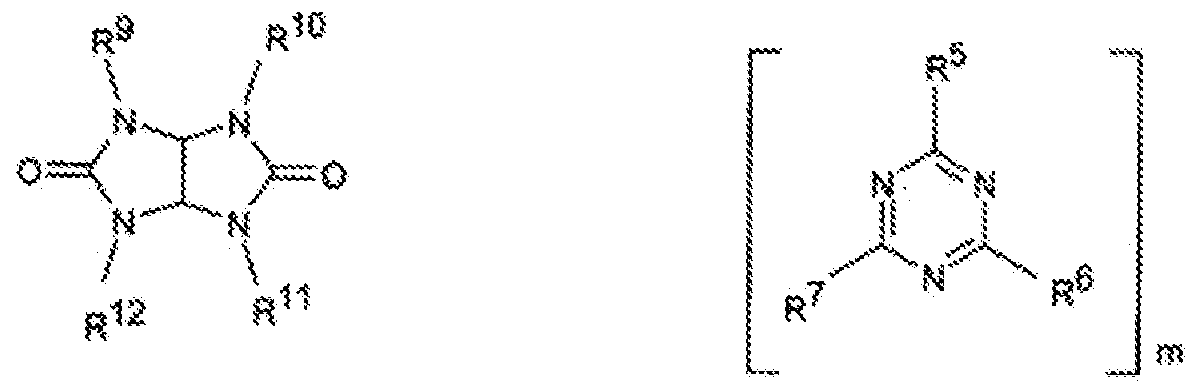

wherein,
R5, R6, R7, R9, R-io, R-11 , R12, and R13 are, independently, hydrogen; C-| -C8 alkyl; C5-Ci6-cycloalkyl or alkylcycloalkyi, optionally substituted with a hydroxy or a Ci-C4 hydroxyalkyi; C2-C8 alkenyl; C-i -Cs alkoxy, acyl, or acyloxy; C6-C-i2-aryl or arylalkyl; OR8 or N(R8) R9, wherein R8 is hydrogen, C C8 alkyl, C5-Ci6 cycloalkyl or alkylcycloalkyi, optionally substituted with a hydroxy or a C-i -C4 hydroxyalkyi, C2-C8 alkenyl, C-i -Cs alkoxy, acyl, or acyloxy, or C6-C12 aryl or arylalkyl;
m is from 1 to 4;
n is from 1 to 4;
X is an acid that can form adducts with triazine compounds of the formula III. For example, the nitrogen-containing synergist may include benzoguanamine, tris(hydroxyethyl) isocyanurate, allantoin, glycoluril, melamine, melamine cyanurate, dicyandiamide, guanidine, etc. Examples of such synergists are described in U.S. Patent Nos. 6,365,071 to Jenewein, et al.; 7,255,814 to Hoerold, et al.; and 7,259,200 to Bauer, et al. One particularly suitable synergist is melamine cyanurate, such as commercially available from BASF under the name MELAPUR® MC (e.g., MELAPUR® MC 15, MC25, MC50).
[0024] When employed, nitrogen-containing synergists may, for example, constitute about from about 0.5 wt.% to about 30 wt.%, in some embodiments from about 1 wt.% to about 25 wt.%, and in some embodiments, from about 2 wt.% to about 20 wt.% of the flame retardant system, and also from about 0.1 wt.% to about 10 wt.%, in some embodiments from about 0.5 wt.% to about 8 wt.%, and in some embodiments, from about 1 wt.% to about 6 wt.% of the entire polyamide composition.
[0025] Yet another suitable flame retardant additive that may be employed in the polyamide composition is an aromatic compound. Without intending to be limited by theory, the present inventors have discovered that the use of such compounds can reduce the overall flammability of the composition. Suitable aromatic compounds may, for instance, include those having the following general structure Formula (IX):
(

or a metal salt thereof, wherein,
ring B is a 6-membered aromatic ring wherein 1 to 3 ring carbon atoms are optionally replaced by nitrogen or oxygen, wherein each nitrogen is optionally oxidized, and wherein ring B may be optionally fused or linked to a 5- or 6- membered aryl, heteroaryl, cycloalkyl, or heterocyclyl;
R4 is OH or COOH;
R5 is acyl, acyloxy (e.g., acetyloxy), acylamino (e.g., acetylamino), alkoxy, alkenyl, alkyl, amino, aryl, aryloxy, carboxyl, carboxyl ester, cycloalkyl,
cycloalkyloxy, hydroxyl, halo, haloalkyl, heteroaryl, heteroaryloxy, heterocyclyl, or heterocycloxy;
m is from 0 to 4, in some embodiments from 0 to 2, and in some
embodiments, from 0 to 1 ; and
n is from 1 to 3, and in some embodiments, from 1 to 2. When the compound is in the form of a metal salt, suitable metal counterions may include transition metal counterions (e.g., copper, iron, etc.), alkali metal counterions (e.g., potassium, sodium, etc.), alkaline earth metal counterions (e.g., calcium, magnesium, etc.), and/or main group metal counterions (e.g., aluminum).
[0026] In one embodiment, for example, B is phenyl in Formula (IX) such that the resulting phenolic compounds have the following general formula (X):

or a metal salt thereof, wherein,
R4 is OH or COOH;
R6 is acyl, acyloxy, acylamino, alkoxy, alkenyl, alkyl, amino, carboxyl, carboxyl ester, hydroxyl, halo, or haloalkyl; and
q is from 0 to 10, in some embodiments from 0 to 4, and in some
embodiments, from 0 to 2. Particular examples of such phenolic compounds include, for instance, benzoic acid (R4 is COOH and q is 0); 4-hydroxybenzoic acid (R4 is COOH, R6 is OH, and q is 1 ); phthalic acid (R4 is COOH, R6 is COOH, and q is 1 ); isophthalic acid (R4 is COOH, R6 is COOH, and q is 1 ); terephthalic acid (R4 is COOH, R6 is COOH, and q is 1 ); 2-methylterephthalic acid (R4 is COOH, R6 is COOH, and CH3 and q is 2); 4-hydroxybenzoic acid (R4 is OH, R6 is C(O)OH, and q is 1 ), etc., as well as combinations thereof.
[0027] When employed, such aromatic compounds may constitute about from about 1 wt.% to about 25 wt.%, in some embodiments from about 2 wt.% to about 20 wt.%, and in some embodiments, from about 4 wt.% to about 15 wt.% of the flame retardant system, and also from about 0.1 wt.% to about 10 wt.%, in
some embodiments from about 0.2 wt.% to about 8 wt.%, and in some embodiments, from about 0.5 wt.% to about 5 wt.% of the entire polyamide composition.
[0028] The flame retardant system and/or the polyamide composition itself generally has a relatively low content of halogens (i.e., bromine, fluorine, and/or chlorine), such as about 15,000 parts per million ("ppm") or less, in some embodiments about 5,000 ppm or less, in some embodiments about 1 ,000 ppm or less, in some embodiments about 800 ppm or less, and in some embodiments, from about 1 ppm to about 600 ppm. Nevertheless, in certain embodiments of the present invention, halogen-based flame retardants may still be employed as an optional component. Particularly suitable halogen-based flame retardants are fluoropolymers, such as polytetrafluoroethylene (PTFE), fluorinated ethylene polypropylene (FEP) copolymers, perfluoroalkoxy (PFA) resins,
polychlorotrifluoroethylene (PCTFE) copolymers, ethylene-chlorotrifluoroethylene
(ECTFE) copolymers, ethylene-tetrafluoroethylene (ETFE) copolymers,
polyvinylidene fluoride (PVDF), polyvinylfluoride (PVF), and copolymers and blends and other combination thereof. When employed, such halogen-based flame retardants typically constitute only about 10 wt.% or less, in some
embodiments about 5 wt.% or less, and in some embodiments, about 1 wt.% or less of the flame retardant system. Likewise, the halogen-based flame retardants typically constitute about 5 wt.% or less, in some embodiments about 1 wt.% or less, and in some embodiments, about 0.5 wt.% or less of the entire polyamide composition.
D. Other Components
[0029] A wide variety of additional additives can also be included in the polyamide composition, such as impact modifiers, compatibilizers, particulate fillers
(e.g., mineral fillers), lubricants, pigments, antioxidants, light stabilizers, heat stabilizers, and/or other materials added to enhance properties and processability.
In certain embodiments, for example, the composition may contain a UV stabilizer.
Suitable UV stabilizers may include, for instance, benzophenones, benzotriazoles
(e.g., 2-(2-hydroxy-3,5-di-a-cumylphenyl)-2H-benzotriazole (TINUVIN® 234), 2-(2- hydroxy-5-tert-octylphenyl)-2H-benzotriazole (TINUVIN® 329), 2-(2-hydroxy-3-a- cumyl-5-tert-octylphenyl)-2H-benzotriazole (TINUVIN® 928), etc.), triazines (e.g.,
2,4-diphenyl-6-(2-hydroxy-4-hexyloxyphenyl)-s-triazine (TINUVIN® 1577)), sterically hindered amines (e.g., bis(2,2,6,6-tetramethyl-4-piperidyl)sebacate (TINUVIN® 770) or a polymer of dimethyl succinate and 1 -(2-hydroxyethyl)-4- hydroxy-2,2,6,6-tetramethyl-4-piperidine (TINUVIN®622)), and so forth, as well as mixtures thereof. When employed, such UV stabilizers typically constitute from about 0.05 wt.% to about 2 wt.% in some embodiments from about 0.1 wt.% to about 1 .5 wt.%, and in some embodiments, from about 0.2 wt.% to about 1 .0 wt.% of the composition.
II. Formation
[0030] The polyamide, inorganic fibers, flame retardant system, and other optional additives may be melt processed or blended together. The components may be supplied separately or in combination to an extruder that includes at least one screw rotatably mounted and received within a barrel (e.g., cylindrical barrel) and may define a feed section and a melting section located downstream from the feed section along the length of the screw. The fibers may optionally be added a location downstream from the point at which the polyamide is supplied (e.g., hopper). If desired, the flame retardant(s) may also be added to the extruder a location downstream from the point at which the polyamide is supplied. One or more of the sections of the extruder are typically heated, such as within a temperature range of from about 200°C to about 450°C, in some embodiments, from about 220°C to about 350°C, and in some embodiments, from about 250°C to about 350°C to form the composition. The speed of the screw may be selected to achieve the desired residence time, shear rate, melt processing temperature, etc. For example, the screw speed may range from about 50 to about 800 revolutions per minute ("rpm"), in some embodiments from about 70 to about 150 rpm, and in some embodiments, from about 80 to about 120 rpm. The apparent shear rate during melt blending may also range from about 100 seconds"1 to about 10,000 seconds"1 , in some embodiments from about 500 seconds"1 to about 5000 seconds"1 , and in some embodiments, from about 800 seconds"1 to about 1200 seconds"1. The apparent shear rate is equal to 4Q/nR3, where Q is the volumetric flow rate ("m3/s") of the polymer melt and R is the radius ("m") of the capillary (e.g., extruder die) through which the melted polymer flows.
[0031] Regardless of the particular manner in which it is formed, the resulting polyamide composition can possess excellent thermal properties. For example, the melt viscosity of the polyamide composition may be low enough so that it can readily flow into the cavity of a mold having small dimensions. In one particular embodiment, the polyamide composition may have a melt viscosity of from about 400 to about 1 ,000 Pascal-seconds ("Pa-s"), in some embodiments from about 450 to about 900 Pa-s, and in some embodiments, from about 500 to about 800 Pa-s, determined at a shear rate of 1000 seconds"1. Melt viscosity may be determined in accordance with ISO Test No. 1 1443:2005 at a
temperature that is 15°C higher than the melting temperature of the composition (e.g., 285°C).
III. Shaped Parts
[0032] Shaped parts may be formed from the polyamide composition using a variety of different techniques. Suitable techniques may include, for instance, injection molding, low-pressure injection molding, extrusion compression molding, gas injection molding, foam injection molding, low-pressure gas injection molding, low-pressure foam injection molding, gas extrusion compression molding, foam extrusion compression molding, extrusion molding, foam extrusion molding, compression molding, foam compression molding, gas compression molding, etc. For example, an injection molding system may be employed that includes a mold within which the polyamide composition may be injected. The time inside the injector may be controlled and optimized so that polymer matrix is not pre- solidified. When the cycle time is reached and the barrel is full for discharge, a piston may be used to inject the composition to the mold cavity. Compression molding systems may also be employed. As with injection molding, the shaping of the polyamide composition into the desired article also occurs within a mold. The composition may be placed into the compression mold using any known technique, such as by being picked up by an automated robot arm. The temperature of the mold may be maintained at or above the solidification temperature of the polymer matrix for a desired time period to allow for solidification. The molded product may then be solidified by bringing it to a temperature below that of the melting
temperature. The resulting product may be de-molded. The cycle time for each
molding process may be adjusted to suit the polymer matrix, to achieve sufficient bonding, and to enhance overall process productivity.
[0033] Regardless of the shaping technique employed, a wide variety of parts may be formed from the polyamide composition of the present invention. For example, the present inventors have discovered that the polyamide composition is particularly suitable for use in electrical connectors, such as those employed in household appliances. The connector may contain insertion passageways that are configured to receive contact pins. These passageways are defined by opposing walls, which may be formed from the polyamide composition of the present invention. The walls may have a width of from about 500 micrometers or less, in some embodiments from about 100 to about 450 micrometers, and in some embodiments, from about 200 to about 400 micrometers.
[0034] The present invention may be better understood with reference to the following examples.
Test Methods
[0035] Tensile Modulus, Tensile Stress, and Tensile Elongation at Break: Tensile properties may be tested according to ISO Test No. 527:2012 (technically equivalent to ASTM D638-14). Modulus and strength measurements may be made on the same test strip sample having a length of 80 mm, thickness of 1 0 mm, and width of 4 mm. The testing temperature may be 23°C, and the testing speeds may be 1 or 5 mm/min.
[0036] Flexural Modulus and Flexural Stress: Flexural properties may be tested according to ISO Test No. 178:2010 (technically equivalent to ASTM D790-10). This test may be performed on a 64 mm support span. Tests may be run on the center portions of uncut ISO 3167 multi-purpose bars. The testing temperature may be 23°C and the testing speed may be 2 mm/min.
[0037] Unotched Charpy Impact Strength: Unotched Charpy properties may be tested according to ISO Test No. ISO 179-1 :201 0) (technically equivalent to ASTM D256-1 0, Method B). This test may be run using a Type 1 specimen size (length of 80 mm, width of 10 mm, and thickness of 4 mm). Specimens may be cut from the center of a multi-purpose bar using a single tooth milling machine. The testing temperature may be 23°C.
[0038] Notched Charpy Impact Strength: Notched Charpy properties may be tested according to ISO Test No. ISO 1 79-1 :2010) (technically equivalent to ASTM D256-10, Method B). This test may be run using a Type A notch (0.25 mm base radius) and Type 1 specimen size (length of 80 mm, width of 10 mm, and thickness of 4 mm). Specimens may be cut from the center of a multipurpose bar using a single tooth milling machine. The testing temperature may be 23°C or -30°C.
[0039] Comparative Tracking Index ("CTI")\ The comparative tracking index (CTI) may be determined in accordance with International Standard IEC 601 12- 2003 to provide a quantitative indication of the ability of a composition to perform as an electrical insulating material under wet and/or contaminated conditions. In determining the CTI rating of a composition, two electrodes are placed on a molded test specimen. A voltage differential is then established between the electrodes while a 0.1 % aqueous ammonium chloride solution is dropped onto a test specimen. The maximum voltage at which five (5) specimens withstand the test period for 50 drops without failure is determined. The test voltages range from 100 to 600 V in 25 V increments. The numerical value of the voltage that causes failure with the application of fifty (50) drops of the electrolyte is the "comparative tracking index." The value provides an indication of the relative track resistance of the material. An equivalent method for determining the CTI is ASTM D-3638-12.
[0040] UL94: A specimen is supported in a vertical position and a flame is applied to the bottom of the specimen. The flame is applied for ten (10) seconds and then removed until flaming stops, at which time the flame is reapplied for another ten (10) seconds and then removed. Two (2) sets of five (5) specimens are tested. The sample size is a length of 125 mm, width of 13 mm, and thickness of 0.8 mm. The two sets are conditioned before and after aging. For unaged testing, each thickness is tested after conditioning for 48 hours at 23°C and 50% relative humidity. For aged testing, five (5) samples of each thickness are tested after conditioning for 7 days at 70°C.
Vertical
Requirements
Ratings
Specimens must not burn with flaming combustion for more than 10 seconds after either test flame application.
Total flaming combustion time must not exceed 50 seconds for each set of 5 specimens.
V-0 Specimens must not burn with flaming or glowing combustion up to the specimen holding clamp.
Specimens must not drip flaming particles that ignite the cotton.
No specimen can have glowing combustion remain for longer than 30 seconds after removal of the test flame.
Specimens must not burn with flaming combustion for more than 30 seconds after either test flame application.
Total flaming combustion time must not exceed 250 seconds for each set of 5 specimens.
V-1 Specimens must not burn with flaming or glowing combustion up to the specimen holding clamp.
Specimens must not drip flaming particles that ignite the cotton.
No specimen can have glowing combustion remain for longer than 60 seconds after removal of the test flame.
Specimens must not burn with flaming combustion for more than 30 seconds after either test flame application.
Total flaming combustion time must not exceed 250 seconds for each set of 5 specimens.
V-2 Specimens must not burn with flaming or glowing combustion up to the specimen holding clamp.
Specimens can drip flaming particles that ignite the cotton.
No specimen can have glowing combustion remain for longer than 60 seconds after removal of the test flame.
EXAMPLES 1-6
[0041] Six (6) different polyamide resin samples are formed from the following components:

[0042] The samples of Examples 1 -6 were tested for various properties as described above. The results are set forth below.
Ex. 1 Ex. 2 Ex. 3 Ex. 4 Ex. 5 Ex. 6
UL94 0.4mm VO V2 V0/V2 VO V2 VO
UL94 0.8mm VO VO VO VO VO VO
UL94 1 .6mm VO VO VO VO VO VO
GWIT (0.4 mm) 750 825 800 825 800 825
GWIT (0.8 mm) 775 800 775 800 775 800
GWIT (1 .5 mm) 775 800 800 800 800 800
GWIT (3.0mm) 800 775 800 775 800 825
GWFI (0.4-3.0 mm) >850 >850 >850 >850 >850 >850
CTI (3.0 mm) 600 600 600 600 600 600
EXAMPLES 7-14
[0043] Eight (8) different polyamide resin samples are formed using a co- rotating twin-screw extruder (ZSK40 by Coperion) having a standard screw design. The extruder is equipped with a "weight loss" multi-feeder system, with the option to add the components from the main hopper and downstream. The temperatures of the barrel and the die head are between 270 to 290°C, the melt temperature is below 300°C, and the throughput range is 80 to 120 kilograms per hour. The components of each formulation are set forth in more detail below.

[0044] Once formed, the resulting compositions were then injected molded at a temperature of about 280°C and a tool temperature of from 80°C to 90°C.
[0045] The injection molded samples of Examples 7-14 were tested for various properties as described above. The results are set forth below.
Ex. 7 Ex. 8 Ex. 9 Ex. 10 Ex.1 1 Ex. 12 Ex. 13 Ex. 14
UL94 0.4mm VO V0/V2 V0/V2 V0/V2 V0/V2 VO VO VO
UL94 0.8mm VO VO VO VO V2 VO VO VO
UL94 1 .6mm VO VO VO VO VO VO VO VO
GWIT (0.4 mm) > 800 775 800 775 775 850 825 825
GWIT (0.8 mm) > 800 675 725 725 775 850 825 825
GWIT (1 .6 mm) > 800 675 725 725 775 850 825 825
GWIT (3.2 mm) > 800 - - - 775 850 850 850
GWFI (0.4 mm) > 850 960 960 960 960 960 960 960
GWFI (0.8 mm) > 850 960 960 960 960 960 960 960
GWFI (1 .6 mm) > 800 960 960 960 960 960 960 960
GWFI (3.2 mm) > 850 - - - 960 960 960 960
CTI (3.0 mm) > 325 600 600 600 - 600 600 600

[0046] The compositions were also formed into standard terminal blocks/connectors and tested at three positions for GWEPT as described above. The results are set forth below.

[0047] These and other modifications and variations of the present invention may be practiced by those of ordinary skill in the art, without departing from the spirit and scope of the present invention. In addition, it should be understood that aspects of the various embodiments may be interchanged both in whole or in part. Furthermore, those of ordinary skill in the art will appreciate that the foregoing description is by way of example only, and is not intended to limit the invention so further described in such appended claims.
Claims
1 . A polyamide composition comprising a polyamide, a plurality of inorganic fibers, and a flame retardant system comprising a zinc phosphinate and a nitrogen-containing polyphosphate, wherein at thicknesses of from about 0.4 to about 3.2 millimeters, the composition exhibits:
a Glow Wire Ignition Temperature of about 775QC or more as determined in accordance with IEC-60695-2-13:2010;
a Glow Wire End Product Temperature (without flame) of about 750QC or more as determined in accordance with IEC-60335-1 :2010;
a Glow Wire Flammability Index of about 850QC or more as determined in accordance with IEC-60695-2-1 2:2010;
a V0 rating as determined in accordance with UL94; and/or
a comparative tracking index of about 550 volts or more as determined in accordance with IEC 601 12:2003.
2. The polyamide composition of claim 1 , wherein polyamides constitute from about 30 wt.% to about 80 wt.% of the composition, inorganic fibers constitute from about 5 wt.% to about 50 wt.% of the composition, and/or the flame retardant system constitutes from about 5 wt.% to about 40 wt.% of the composition.
3. The polyamide composition of claim 1 , wherein the zinc phosphinate has the general formula I) and/or formula (II):

O O
II
o P— R9 P o n
R '8,
(II)
wherein,
R7 and Rs are, independently, hydrogen or substituted or unsubstituted, straight chain, branched, or cyclic hydrocarbon groups having 1 to 6 carbon atoms;
R9 is a substituted or unsubstituted, straight chain, branched, or cyclic C C10 alkylene, arylene, arylalkylene, or alkylarylene group;
Z is zinc;
y and n are 1 ; and
m is 2.
4. The polyamide composition of claim 1 , wherein the phosphinate is a zinc salt of dimethylphosphinic acid, ethylmethylphosphinic acid,
diethylphosphinic acid, methyl-n-propylphosphinic acid, methane- di(methylphosphinic acid), ethane-1 ,2-di(methylphosphinic acid), hexane-1 ,6- di(methylphosphinic acid), benzene-1 ,4-di(methylphosphinic acid),
methylphenylphosphinic acid, diphenylphosphinic acid, hypophosphoric acid, or a mixture thereof.
5. The polyamide composition of claim 1 , wherein zinc phosphinates constitute from about 0.5 wt.% to about 15 wt.% of the composition.
6. The polyamide composition of claim 1 , wherein the nitrogen-containing polyphosphate has the following general formula:

v is from 1 to 1000; and
Q is a nitrogen base.
7. The polyamide composition of claim 6, wherein the nitrogen base is melamine.
8. The polyamide composition of claim 1 , wherein nitrogen-containing polyphosphates constitute from about 1 wt.% to about 30 wt.% of the
composition.
9. The polyamide composition of claim 1 , wherein the flame retardant system further includes an inorganic compound.
10. The polyamide composition of claim 9, wherein the inorganic compound includes zinc borate.
1 1 . The polyamide composition of claim 9, wherein inorganic compounds constitute from about 0.1 wt.% to about 10 wt.% of the composition.
12. The polyamide composition of claim 1 , wherein the flame retardant system further includes an aromatic compound.
13. The polyamide composition of claim 1 2, wherein the inorganic compound includes terephthalic acid.
14. The polyamide composition of claim 1 2, wherein inorganic compounds constitute from about 1 wt.% to about 25 wt.% of the composition.
15. The polyamide composition of claim 1 , wherein the polyamide is an aliphatic polyamide.
16. The polyamide composition of claim 1 5, wherein the aliphatic polyamide is nylon-6, nylon-6,6, or a combination thereof.
17. The polyamide composition of claim 1 , wherein the polyamide is a semi-aromatic polyamide or a wholly aromatic polyamide.
18. The polyamide composition of claim 1 , wherein the inorganic fibers include glass fibers.
19. The polyamide composition of claim 1 , wherein the halogen content of the flame retardant system is about 1 ,000 parts per million or less.
20. The polyamide composition of claim 1 , wherein the halogen content of the composition is about 1 ,000 parts per million or less.
21 . An electrical connector that comprises opposing walls between which a passageway is defined for receiving a contact pin, wherein at least one of the walls contains the polyamide composition of claim 1 .
22. The electrical connector of claim 21 , wherein at least one of the walls has a thickness of about 4 millimeters or less.
23. An electrical connector that comprises opposing walls between which a passageway is defined for receiving a contact pin, wherein at least one of the walls contains the polyamide composition of claim 1 and has a thickness of about 4 millimeters or less, wherein the compositions exhibits:
a Glow Wire End Product Temperature (without flame) of about 750QC or more as determined in accordance with IEC-60335-1 :2010;
a Glow Wire Ignition Temperature of about 775QC or more as determined in accordance with IEC-60695-2-13:2010;
a Glow Wire Flammability Index of about 850QC or more as determined in accordance with IEC-60695-2-1 2:2010;
a V0 rating as determined in accordance with UL94; and/or
a comparative tracking index of about 550 volts or more as determined in accordance with IEC 601 12:2003.
Priority Applications (3)
| Application Number | Priority Date | Filing Date | Title |
|---|---|---|---|
| KR1020207014025A KR102716628B1 (en) | 2017-10-17 | 2018-10-17 | Flame retardant polyamide composition |
| EP18799854.7A EP3697838A2 (en) | 2017-10-17 | 2018-10-17 | Flame retardant polyamide composition |
| CN201880067743.7A CN111315810A (en) | 2017-10-17 | 2018-10-17 | Flame Retardant Polyamide Composition |
Applications Claiming Priority (2)
| Application Number | Priority Date | Filing Date | Title |
|---|---|---|---|
| US201762573285P | 2017-10-17 | 2017-10-17 | |
| US62/573,285 | 2017-10-17 |
Publications (2)
| Publication Number | Publication Date |
|---|---|
| WO2019077529A2 true WO2019077529A2 (en) | 2019-04-25 |
| WO2019077529A3 WO2019077529A3 (en) | 2019-06-13 |
Family
ID=64184139
Family Applications (1)
| Application Number | Title | Priority Date | Filing Date |
|---|---|---|---|
| PCT/IB2018/058065 Ceased WO2019077529A2 (en) | 2017-10-17 | 2018-10-17 | Flame retardant polyamide composition |
Country Status (5)
| Country | Link |
|---|---|
| US (2) | US11401416B2 (en) |
| EP (1) | EP3697838A2 (en) |
| KR (1) | KR102716628B1 (en) |
| CN (1) | CN111315810A (en) |
| WO (1) | WO2019077529A2 (en) |
Cited By (1)
| Publication number | Priority date | Publication date | Assignee | Title |
|---|---|---|---|---|
| DE102019201727A1 (en) * | 2019-02-11 | 2020-08-13 | Clariant Plastics & Coatings Ltd | Flame retardant mixture for thermoplastic polymers |
Families Citing this family (9)
| Publication number | Priority date | Publication date | Assignee | Title |
|---|---|---|---|---|
| WO2019077529A2 (en) * | 2017-10-17 | 2019-04-25 | Celanese Sales Germany Gmbh | Flame retardant polyamide composition |
| WO2022132495A1 (en) | 2020-12-17 | 2022-06-23 | Ticona Llc | Fiber-reinforced propylene polymer composition |
| US20220302640A1 (en) * | 2021-03-17 | 2022-09-22 | Celanese International Corporation | High Voltage Connector for Use in an Electric Vehicle |
| KR102712860B1 (en) * | 2021-04-30 | 2024-10-02 | 롯데케미칼 주식회사 | Thermoplastic resin composition and molded product using the same |
| CN113736254B (en) * | 2021-09-28 | 2023-06-27 | 浙江新力新材料股份有限公司 | Low-dielectric-constant flame-retardant reinforced bio-based high-temperature polyamide material and preparation method thereof |
| WO2023114134A1 (en) * | 2021-12-13 | 2023-06-22 | Celanese International Corporation | Heat-stabilized, flame retardant polymer composition |
| WO2023114133A1 (en) * | 2021-12-13 | 2023-06-22 | Celanese International Corporation | Flame retardant thermoplastic polymer composition |
| EP4369098A1 (en) * | 2022-11-14 | 2024-05-15 | Cubicure GmbH | Resin composition |
| WO2025184155A1 (en) * | 2024-02-27 | 2025-09-04 | Celanese Polymers Holding, Inc. | Halogen-free flame retardant thermoplastic polymer composition with increased glow wire performance |
Citations (3)
| Publication number | Priority date | Publication date | Assignee | Title |
|---|---|---|---|---|
| US6365071B1 (en) | 1996-04-12 | 2002-04-02 | Clariant Gmbh | Synergistic flame protection agent combination for thermoplastic polymers |
| US7255814B2 (en) | 2003-03-03 | 2007-08-14 | Clariant Produkte (Deutschland) Gmbh | Flame retardant and stabilizer combined for thermoplastics polymers |
| US7259200B2 (en) | 2003-10-07 | 2007-08-21 | Clariant Produkte (Deutschland) Gmbh | Phosphorus-containing flame retardant agglomerates |
Family Cites Families (214)
| Publication number | Priority date | Publication date | Assignee | Title |
|---|---|---|---|---|
| GB1070327A (en) * | 1963-05-25 | 1967-06-01 | Kanegafuchi Spinning Co Ltd | Improvements in the preparation of polyamide resins |
| DE19607635A1 (en) | 1996-02-29 | 1997-09-04 | Hoechst Ag | Flame retardant polyamide molding compounds |
| JPH1142674A (en) | 1997-07-25 | 1999-02-16 | Toshiba Silicone Co Ltd | Method for producing adhesive composite of polybutylene terephthalate resin and silicone rubber |
| JP3720604B2 (en) | 1998-01-23 | 2005-11-30 | 三菱レイヨン株式会社 | Polyester resin composition |
| JPH11310691A (en) | 1998-04-28 | 1999-11-09 | Dainippon Ink & Chem Inc | Flame retardant polyester resin composition |
| DE19820398A1 (en) | 1998-05-07 | 1999-11-11 | Basf Ag | Flame-retardant polyester molding compounds |
| EP1024167B1 (en) | 1999-01-30 | 2005-12-21 | Clariant GmbH | Combination of flame retardants for thermoplastic polymers |
| FR2789996B1 (en) * | 1999-02-24 | 2001-04-13 | Rhodia Eng Plastics Srl | FLAME RETARDANT POLYAMIDE COMPOSITION |
| JP4024437B2 (en) | 1999-03-24 | 2007-12-19 | ポリプラスチックス株式会社 | Insert molded product |
| JP2000290479A (en) | 1999-04-08 | 2000-10-17 | Kanebo Ltd | Flame-retardant polyester resin composition and molding product comprising the same |
| WO2000078867A1 (en) | 1999-06-23 | 2000-12-28 | Polyplastics Co., Ltd. | Thermoplastic polyester resin composition |
| DE19933901A1 (en) | 1999-07-22 | 2001-02-01 | Clariant Gmbh | Flame retardant combination |
| JP2001323171A (en) | 2000-05-19 | 2001-11-20 | Daicel Chem Ind Ltd | Thermoplastic resin composition |
| NL1016340C2 (en) | 2000-10-05 | 2002-04-08 | Dsm Nv | Halogen-free flame-retardant composition and flame-retardant polyamide composition. |
| JP3876141B2 (en) | 2001-03-28 | 2007-01-31 | 東レ株式会社 | Polyester resin composition and molded article thereof |
| DE10226732A1 (en) | 2002-06-14 | 2004-01-08 | Clariant Gmbh | Mixtures of a phosphonite and other components |
| DE10241126A1 (en) | 2002-09-03 | 2004-03-25 | Clariant Gmbh | Flame retardant-stabilizer combination for thermoplastic polymers |
| US7109260B2 (en) | 2002-10-17 | 2006-09-19 | Ciba Specialty Chemicals Corporation | Flame retardant compositions |
| EP1431340A1 (en) | 2002-12-19 | 2004-06-23 | DSM IP Assets B.V. | Flame retardant polyamide compound |
| JP4951187B2 (en) | 2002-12-26 | 2012-06-13 | ポリプラスチックス株式会社 | Flame retardant resin composition |
| KR100523477B1 (en) | 2002-12-30 | 2005-10-24 | 제일모직주식회사 | Polymer Composition of Polyester for Metal Deposition |
| JP4307880B2 (en) | 2003-03-26 | 2009-08-05 | 旭化成ケミカルズ株式会社 | Flame retardant reinforced polyamide resin composition |
| KR100584909B1 (en) | 2003-06-05 | 2006-05-30 | 주식회사 삼양사 | Non-halogen flame retardant polybutylene terephthalate resin composition |
| JP2007514011A (en) | 2003-11-13 | 2007-05-31 | ダウ・コーニング・コーポレイション | Method for bonding silicone gel to plastic |
| JP4434711B2 (en) | 2003-12-03 | 2010-03-17 | ポリプラスチックス株式会社 | Resin composition for laser marking |
| US7812077B2 (en) | 2003-12-17 | 2010-10-12 | Sabic Innovative Plastics Ip B.V. | Polyester compositions, method of manufacture, and uses thereof |
| DE602004002076T2 (en) | 2003-12-18 | 2007-03-15 | Mitsubishi Engineering-Plastics Corp. | Flameproof polyamide compositions |
| ES2305710T3 (en) | 2004-01-07 | 2008-11-01 | Italmatch Chemicals S.P.A. | POLYAMIDE COMPOSITIONS WITH FLAME DELAY BY ALUMINUM HYPOPHOSPHITE. |
| US20050250885A1 (en) | 2004-05-04 | 2005-11-10 | General Electric Company | Halogen-free flame retardant polyamide composition with improved electrical properties |
| US7803856B2 (en) | 2004-05-04 | 2010-09-28 | Sabic Innovative Plastics Ip B.V. | Halogen-free flame retardant polyamide composition with improved electrical and flammability properties |
| DE102004023085A1 (en) * | 2004-05-11 | 2005-12-15 | Clariant Gmbh | Dialkylphosphinic acid salts, a process for their preparation and their use |
| RU2007102080A (en) | 2004-06-22 | 2008-07-27 | СУПРЕСТА ЭлЭлСи (US) | Phosphorus-Containing Flame Arrester for Thermoplastic Polymers |
| DE102004035508A1 (en) | 2004-07-22 | 2006-02-16 | Clariant Gmbh | Flame-retardant polymer molding compounds |
| DE102004048876A1 (en) | 2004-09-13 | 2006-03-30 | Bayer Ag | Halogen-free flame-retardant thermoplastic molding compounds based on polyamide with increased glow wire resistance |
| US7592382B2 (en) | 2004-11-22 | 2009-09-22 | Sabic Innovative Plastics Ip B.V. | Flame retardant poly(arylene ether)/polyamide compositions, methods, and articles |
| DE102005013957A1 (en) | 2005-03-26 | 2006-09-28 | Clariant Produkte (Deutschland) Gmbh | Phosphorus-containing thermally stabilized flame retardant agglomerates |
| WO2006112205A1 (en) | 2005-04-08 | 2006-10-26 | Mitsui Chemicals, Inc. | Flame-retardant polyamide composition |
| WO2007007663A1 (en) | 2005-07-08 | 2007-01-18 | Polyplastics Co., Ltd. | Flame retardant resin composition |
| JP2007092038A (en) | 2005-08-30 | 2007-04-12 | Toray Ind Inc | Resin composition and molded product formed out thereof |
| DE102005041966A1 (en) * | 2005-09-03 | 2007-03-08 | Clariant Produkte (Deutschland) Gmbh | Polyamide moulding material, e.g. for production of electrical switches and plugs, contains thermoplastic polyamide, phosphinate salt, synergist or phosphorus-nitrogen fire retardant, reinforcing fibres and filler |
| JP5224431B2 (en) | 2005-10-20 | 2013-07-03 | 旭化成ケミカルズ株式会社 | Flame retardant polyamide resin composition |
| EP1969052B2 (en) | 2005-12-01 | 2013-06-05 | ICL-IP America Inc. | Flame retardant compositions containing mixtures of disubstituted phosphinate salts and monosubstituted phosphinate salts |
| US7923506B2 (en) | 2006-01-27 | 2011-04-12 | Sabic Innovative Plastics Ip B.V. | Molding compositions containing modified polybutylene terephthalate (PBT) random copolymers derived from polyethylene terephthalate (PET) |
| JP5331291B2 (en) | 2006-02-28 | 2013-10-30 | ユニチカ株式会社 | Flame retardant reinforced polyamide resin composition |
| US7968629B2 (en) * | 2006-03-17 | 2011-06-28 | Mitsubishi Engineering-Plastics Corporation | Flame retardant polyamide resin composition and molded article |
| US8710132B2 (en) | 2006-11-20 | 2014-04-29 | Mitsui Chemicals, Inc. | Flame-retardant polyamide composition |
| JP5243006B2 (en) | 2006-12-04 | 2013-07-24 | 三菱エンジニアリングプラスチックス株式会社 | Flame retardant polyamide resin composition and molded article |
| JP4270270B2 (en) | 2006-12-05 | 2009-05-27 | ソニー株式会社 | Electronic device, imaging apparatus, electronic device control method and program |
| TWI419913B (en) | 2007-03-30 | 2013-12-21 | Mitsui Chemicals Inc | Flame-retardant polyamide composition |
| JP5431300B2 (en) | 2007-04-03 | 2014-03-05 | ビーエーエスエフ ソシエタス・ヨーロピア | DOPO flame retardant composition |
| US8193263B2 (en) | 2007-09-07 | 2012-06-05 | Unitika Ltd. | Flame-retardant glass fiber-reinforced polyamide resin composition |
| WO2009037859A1 (en) | 2007-09-21 | 2009-03-26 | Mitsui Chemicals, Inc. | Flame-retardant polyamide composition |
| TWI435906B (en) | 2007-09-21 | 2014-05-01 | Mitsui Chemicals Inc | Flame-retardant polyamide composition |
| JP5351415B2 (en) | 2007-12-26 | 2013-11-27 | ウィンテックポリマー株式会社 | Polybutylene terephthalate resin composition |
| CN101503569B (en) | 2008-02-04 | 2011-04-13 | 金发科技股份有限公司 | Glass fiber reinforced halogen-free flame-retardant PA66 and preparation thereof |
| JP4645669B2 (en) | 2008-03-26 | 2011-03-09 | 富士ゼロックス株式会社 | Resin molded body |
| US8426519B2 (en) | 2008-08-01 | 2013-04-23 | Union Carbide Chemicals & Plastics Technology Llc | Silicone-thermoplastic polymer reactive blends and copolymer products |
| DE102008063668A1 (en) | 2008-12-18 | 2010-07-01 | Clariant International Limited | Process for the preparation of alkylphosphonic acids, esters and salts by oxidation of alkylphosphonous acids and their use |
| DE102008064003A1 (en) | 2008-12-19 | 2010-06-24 | Clariant International Limited | Process for the preparation of monofunctionalized dialkylphosphinic acids, esters and salts and their use |
| TWI470027B (en) | 2008-12-22 | 2015-01-21 | Mitsui Chemicals Inc | Flame-retardant polyamine composition, molded body, method for producing a molded body of polyamine composition, and electric and electronic parts |
| FR2941460B1 (en) | 2009-01-28 | 2011-02-18 | Arkema France | FLAME RETARDANT AND REINFORCED POLYAMIDE COMPOSITION |
| JP5760319B2 (en) | 2009-02-26 | 2015-08-05 | 東レ株式会社 | Flame retardant polyamide resin composition |
| US9221948B2 (en) | 2009-05-13 | 2015-12-29 | Chemtura Corporation | Phosphorus-containing flame retardants |
| EP2430090B1 (en) | 2009-05-13 | 2013-01-09 | Chemtura Corporation | Phosphorus-containing flame retardants for glass-filled polyamide resins |
| EP2264093A1 (en) | 2009-06-16 | 2010-12-22 | THOR GmbH | Flame-retardant polyamide moulding materials |
| US8575246B2 (en) | 2009-07-17 | 2013-11-05 | Toray Industries, Inc. | Flame-retardant thermoplastic resin composition and molded article |
| CN102666693A (en) | 2009-10-27 | 2012-09-12 | 巴斯夫欧洲公司 | Heat aging resistant polyamide with flame retardancy |
| CN101812231A (en) | 2010-04-16 | 2010-08-25 | 北京化工大学 | Halogen free flame retardant nylon 6 composite with high CTI value and preparation method thereof |
| DE102010018680A1 (en) | 2010-04-29 | 2011-11-03 | Clariant International Limited | Flame retardant stabilizer combination for thermoplastic and thermosetting polymers |
| DE102010018681A1 (en) | 2010-04-29 | 2011-11-03 | Clariant International Ltd. | Flame retardant stabilizer combination for thermoplastic and thermosetting polymers |
| DE102010026973A1 (en) | 2010-07-13 | 2012-01-19 | Clariant International Ltd. | Flame retardant stabilizer combination for thermoplastic polymers |
| JP5717378B2 (en) | 2010-08-31 | 2015-05-13 | ユニチカ株式会社 | Flame retardant reinforced polyamide resin composition |
| DE102010048025A1 (en) | 2010-10-09 | 2012-04-12 | Clariant International Ltd. | Flame retardant stabilizer combination for thermoplastic polymers |
| KR101286149B1 (en) | 2010-10-20 | 2013-07-15 | 제일모직주식회사 | Glass Fiber Reinforced Polyester Resin Composition With Color Stability at High Temperature |
| DE102010049968A1 (en) | 2010-10-28 | 2012-05-03 | Clariant International Ltd. | Flame-resistant polyester compounds |
| CN102464881A (en) | 2010-11-10 | 2012-05-23 | 杜邦公司 | Halogen-free flame-retardant polyamide composition |
| CN102002218B (en) | 2010-11-24 | 2013-01-09 | 广东省石油化工研究院 | Halogen-free compound flame retardant for glass fiber reinforced PBT (Polybutylene Terephthalate) material and preparation method thereof |
| ES2604186T3 (en) | 2011-05-10 | 2017-03-03 | Basf Se | Thermoplastic molding flame retardant compositions |
| TWI563034B (en) | 2011-05-13 | 2016-12-21 | Dsm Ip Assets Bv | Flame retardant semi-aromatic polyamide composition and moulded products made therefrom |
| EP2736975B1 (en) | 2011-07-27 | 2015-08-19 | DSM IP Assets B.V. | Flame retardant polyamide composition |
| CN102321362B (en) * | 2011-08-05 | 2013-07-10 | 四川大学 | High-retardant polyamide |
| JP5502819B2 (en) | 2011-08-24 | 2014-05-28 | 帝人株式会社 | Flame retardant resin composition and molded product therefrom |
| BR112014007243B1 (en) | 2011-09-27 | 2022-04-19 | Basf Se | Composition, components and lighting device |
| CN103946289B (en) | 2011-09-28 | 2017-03-29 | 伊塔尔麦奇化学股份公司 | Halogen-free flame-retardant daiamid composition |
| WO2013074624A2 (en) | 2011-11-17 | 2013-05-23 | Dow Corning Corporation | Silicone resins comprising metallosiloxane |
| DE102011120190A1 (en) | 2011-12-05 | 2013-06-06 | Clariant International Limited | Mixtures of aluminum hydrogen phosphites with aluminum salts, process for their preparation and their use |
| DE102011120191A1 (en) | 2011-12-05 | 2013-06-06 | Clariant International Ltd. | Mixtures of aluminum phosphite with sparingly soluble aluminum salts and foreign ions, process for their preparation and their use |
| DE102011120200A1 (en) | 2011-12-05 | 2013-06-06 | Clariant International Ltd. | Flame retardant mixtures containing flame retardants and aluminum phosphites, process for their preparation and their use |
| CN102558850A (en) | 2011-12-13 | 2012-07-11 | 中国科学院宁波材料技术与工程研究所 | Flame-retardant functional masterbatch special for nylon 6 and preparation method for masterbatch |
| EP2794758A1 (en) | 2011-12-22 | 2014-10-29 | DSM IP Assets B.V. | Live part in unattended household appliances |
| CN103946272B (en) | 2011-12-23 | 2017-03-08 | 埃姆斯·帕特恩特股份有限公司 | Polyamide molding material, its purposes, and moulding part prepared therefrom |
| WO2013099522A1 (en) | 2011-12-27 | 2013-07-04 | 東レ株式会社 | Flame-retardant polyamide resin composition and molded article formed from same |
| JP5924526B2 (en) | 2012-03-28 | 2016-05-25 | Dic株式会社 | Flame retardant polyamide resin composition and molded article thereof |
| CN102618026B (en) | 2012-04-25 | 2014-07-02 | 中国科学院宁波材料技术与工程研究所 | Halogen-free and flame-retardant nylon master batch with high CTI (Comparative Tracking Index) value and preparation method thereof |
| CN202570325U (en) | 2012-04-28 | 2012-12-05 | 广州金凯新材料有限公司 | Nozzle for preparing high-purity powder |
| CN202639334U (en) | 2012-04-28 | 2013-01-02 | 广州金凯新材料有限公司 | Air and water atomizing nozzle device for preparing superfine metal powder |
| CN202613969U (en) | 2012-04-28 | 2012-12-19 | 广州金凯新材料有限公司 | Lining of intermediate frequency furnace |
| CN202516545U (en) | 2012-05-02 | 2012-11-07 | 广州金凯新材料有限公司 | Internal recycle heating device of reaction still |
| CN202538892U (en) | 2012-05-03 | 2012-11-21 | 广州金凯新材料有限公司 | Grinding room of jet mill |
| CN202613970U (en) | 2012-05-04 | 2012-12-19 | 广州金凯新材料有限公司 | Graphite crucible |
| CN202630677U (en) | 2012-05-07 | 2012-12-26 | 广州金凯新材料有限公司 | Graphite crucible |
| WO2013175452A1 (en) | 2012-05-24 | 2013-11-28 | Sabic Innovative Plastics Ip B.V. | Improved flame retardant polymer compositions |
| CN103525041A (en) | 2012-07-03 | 2014-01-22 | 青岛欣展塑胶有限公司 | Polybutylene terephthalate with improved impact toughness and preparation method thereof |
| JP6044821B2 (en) | 2012-07-26 | 2016-12-14 | Dic株式会社 | Flame retardant polyamide resin composition and molded article thereof |
| JP6079051B2 (en) | 2012-08-24 | 2017-02-15 | Dic株式会社 | Flame retardant polyamide resin composition and molded article thereof |
| US20140066551A1 (en) | 2012-08-30 | 2014-03-06 | Sabic Innovative Plastics Ip B.V. | Glass-filled polyamide composition and article |
| CN103073881B (en) | 2012-09-17 | 2014-12-24 | 天津金发新材料有限公司 | Nylon composition, preparation method and applications thereof |
| CN103073577B (en) | 2012-09-19 | 2015-11-04 | 广州金凯新材料有限公司 | A kind of dialkylphosphinic salts and preparation method thereof |
| CN103073574B (en) | 2012-09-19 | 2015-11-04 | 广州金凯新材料有限公司 | The preparation method of a kind of dialkyl phosphinic acid and salt thereof |
| CN103087097B (en) | 2012-09-19 | 2015-12-16 | 广州金凯新材料有限公司 | A kind of dialkylphosphinic salts and preparation method thereof |
| CN103073575B (en) | 2012-09-19 | 2015-11-11 | 广州金凯新材料有限公司 | A kind of dialkylphosphinic salts and preparation method thereof |
| CN103087098B (en) | 2012-09-19 | 2016-01-20 | 广州金凯新材料有限公司 | A kind of dialkylphosphinic salts and preparation method thereof |
| CN103086334B (en) | 2012-09-19 | 2014-12-10 | 广州金凯新材料有限公司 | Preparation method of high-concentration hypophosphorous acid |
| CN103073576B (en) | 2012-09-19 | 2015-09-23 | 广州金凯新材料有限公司 | The preparation method of a kind of dialkyl phosphinic acid and salt thereof |
| CN103073879B (en) | 2012-09-26 | 2015-04-22 | 天津金发新材料有限公司 | Polyamide composition, and preparation method and application thereof |
| US8592549B1 (en) | 2012-12-05 | 2013-11-26 | Sabic Innovative Plastics Ip B.V. | Polyamide composition, method, and article |
| CN103013101B (en) | 2012-12-06 | 2015-06-03 | 上海日之升新技术发展有限公司 | Flame-retardant glass fiber-reinforced PA6/PA66 alloy material with high CTI value and high GWIT value |
| CN103865255A (en) | 2012-12-12 | 2014-06-18 | 辽宁辽杰科技有限公司 | Continuous glass fiber reinforced halogen-free fire retardation nylon 6 prepreg tape and preparation method thereof |
| US20150337204A1 (en) | 2012-12-17 | 2015-11-26 | Adeka Corporation | Flame retardant composition and flame-retardant synthetic resin composition |
| EP2746340B1 (en) | 2012-12-21 | 2014-12-24 | Ems-Patent Ag | Flame-retardant polyamide moulding masses and their applications |
| JP6136334B2 (en) | 2013-02-14 | 2017-05-31 | 東洋紡株式会社 | Flame retardant polyamide resin composition |
| CN103172665B (en) | 2013-02-27 | 2015-04-08 | 广州金凯新材料有限公司 | Preparation method and application of dialkyl phosphinate with high density and large particle size |
| CN103172667B (en) | 2013-02-27 | 2016-03-30 | 广州金凯新材料有限公司 | A kind of size controlling method of dialkylphosphinic salts and application thereof |
| CN104059101B (en) | 2013-02-27 | 2015-09-09 | 广州金凯新材料有限公司 | A kind of dialkylphosphinic salts with good free-running property |
| CN103172666B (en) | 2013-02-27 | 2016-03-30 | 广州金凯新材料有限公司 | The preparation method of the dialkylphosphinic salts that a kind of thermostability is high |
| CN103102367B (en) | 2013-02-27 | 2015-07-15 | 广州金凯新材料有限公司 | Preparation method and application of dialkyl phosphinate with high density and large diameter |
| CN103172663B (en) | 2013-02-27 | 2015-09-30 | 广州金凯新材料有限公司 | A kind of preparation method of dialkyl metal phosphinate |
| CN103172669B (en) | 2013-03-04 | 2015-02-11 | 广州金凯新材料有限公司 | Monoalkyl/dialkyl phosphinate and preparation method thereof |
| CN103172670B (en) | 2013-03-04 | 2015-09-30 | 广州金凯新材料有限公司 | A kind of monoalkyl/dialkylphosphinic salts and preparation method thereof |
| CN103172668A (en) | 2013-03-04 | 2013-06-26 | 广州金凯新材料有限公司 | Monoalkyl/dialkyl phosphinate and preparation method thereof |
| DE102013004046A1 (en) | 2013-03-08 | 2014-09-11 | Clariant International Ltd. | Flame retardant polyamide composition |
| KR101805230B1 (en) | 2013-03-13 | 2017-12-05 | 롯데첨단소재(주) | Flame-Retardant Polyamide Resin Composition and Molded Article Using Same |
| ES2636801T3 (en) | 2013-03-28 | 2017-10-09 | Deutsche Institute Für Textil- Und Faserforschung Denkendorf | Flame retardant polyamide, a procedure for its preparation and use |
| CN103160111B (en) * | 2013-04-06 | 2015-07-15 | 浙江通力改性工程塑料有限公司 | Halogen-free flame retardant thermoplastic polyamide composition |
| CN103172671B (en) | 2013-04-09 | 2015-02-11 | 广州金凯新材料有限公司 | Preparation method for improving bulk density of dialkyl phosphinate |
| BR112015020979B8 (en) | 2013-04-15 | 2020-07-07 | Basf Se | use of thermoplastic molding compounds and molding body |
| EP2989151A1 (en) | 2013-04-26 | 2016-03-02 | DSM IP Assets B.V. | Junction box and polymer compositions for a junction box |
| PL2810983T3 (en) | 2013-06-06 | 2016-06-30 | Ems Patent Ag | Glass fiber reinforced flame retardant polyamide moulding materials |
| EP3009478B1 (en) | 2013-06-13 | 2023-11-22 | Kuraray Co., Ltd. | Polyamide resin composition and molded article produced therefrom |
| JP6354379B2 (en) | 2013-06-28 | 2018-07-11 | 東レ株式会社 | Polyamide resin composition |
| CN103351618A (en) | 2013-06-28 | 2013-10-16 | 广东威林工程塑料有限公司 | Antistatic, halogen-free, and fire-retardant enhanced master batch dedicated for polyamide and preparation method thereof |
| US10017628B2 (en) | 2013-07-17 | 2018-07-10 | Dsm Ip Assets B.V. | Flame retarded thermoplastic moulding composition |
| US9765204B2 (en) | 2013-07-24 | 2017-09-19 | Lanxess Solutions Us Inc. | Halogen free high temperature polyamide compositions comprising phosphorus containing flame retardants |
| US9745449B2 (en) | 2013-07-24 | 2017-08-29 | Lanxess Solutions Us Inc. | Phosphorus containing flame retardants |
| US9752011B2 (en) | 2013-07-24 | 2017-09-05 | Lanxess Solutions Us Inc. | Phosphorus containing flame retardants |
| JP5800096B2 (en) | 2013-08-05 | 2015-10-28 | 東洋紡株式会社 | Flame retardant polyamide resin composition |
| US9879137B2 (en) | 2013-08-08 | 2018-01-30 | Polyone Corporation | Flame retardant poly(hexamethylene adipamide) |
| US9879136B2 (en) | 2013-08-08 | 2018-01-30 | Polyone Corporation | Flame retardant poly(hexano-6-lactam) |
| CN105745281B (en) | 2013-11-21 | 2018-03-09 | 帝斯曼知识产权资产管理有限公司 | Flame-retardant polyamide composition |
| JP6334150B2 (en) | 2013-12-06 | 2018-05-30 | 帝人株式会社 | Flame retardant resin composition and molded product thereof |
| ES2656960T3 (en) | 2013-12-12 | 2018-03-01 | Italmatch Chemicals S.P.A | Halogen-free flame retardant polyamide molding compositions with increased resistance to incandescent wire and fire |
| US9905961B2 (en) | 2013-12-20 | 2018-02-27 | Dsm Ip Assets B.V. | Fine pitch connector socket |
| CN103788125B (en) | 2013-12-31 | 2015-02-11 | 邓娟 | Additive for polymer and preparation method for additive |
| CN103772918B (en) | 2014-01-02 | 2016-03-16 | 广州金凯新材料有限公司 | Dialkylphosphinic salts is as the purposes of the additive of raising polymer blend electrical property |
| CN103756012A (en) | 2014-01-02 | 2014-04-30 | 广州金凯新材料有限公司 | Application of dialkyl hypophosphite as additive for regulating deflection of polymer composition |
| CN103756011B (en) | 2014-01-02 | 2015-10-21 | 广州金凯新材料有限公司 | Dialkylphosphinic salts is as the purposes of the additive of raising mobility of polymer composition |
| CN103772972B (en) | 2014-01-02 | 2016-04-20 | 广州金凯新材料有限公司 | Dialkylphosphinic salts is as the purposes of additive improving nylon resin composition electrical property and amount of deflection |
| DE102014001222A1 (en) | 2014-01-29 | 2015-07-30 | Clariant lnternational Ltd | Halogen-free solid flame retardant mixture and its use |
| CN103937027A (en) | 2014-03-18 | 2014-07-23 | 广州金凯新材料有限公司 | Additive for plastics, application thereof, and flame-retardant polymer molding composition composed of the same |
| WO2015141708A1 (en) | 2014-03-19 | 2015-09-24 | 東洋紡株式会社 | Flame-retardant polyester resin composition |
| CN106232723A (en) | 2014-04-24 | 2016-12-14 | 帝斯曼知识产权资产管理有限公司 | The method producing the moulded products of the polymer composition comprising polyamide, halogen-free flame retardants and glass fibre |
| CN103923444B (en) | 2014-04-30 | 2015-10-14 | 上海瀚氏模具成型有限公司 | Heat-resisting PBT plastic of automotive upholstery halogen-free flameproof and preparation method thereof |
| CN104004350B (en) | 2014-06-20 | 2017-02-15 | 江苏兆鋆新材料股份有限公司 | Glass fiber reinforced halogen-free flame retardant polyamide 6 composite material and manufacturing method thereof |
| CN104177824B (en) | 2014-08-26 | 2016-06-22 | 北京工商大学 | A kind of novel phosphor nitrogen system halogen-free flame-retardant nylon 6 and preparation method thereof |
| CN104262955B (en) | 2014-09-17 | 2017-04-12 | 上海日之升新技术发展有限公司 | High-GWIT carbon fiber reinforced halogen-free flame-retardant PA46 composite material and preparation thereof |
| CN104371142B (en) | 2014-10-29 | 2016-07-13 | 广州金凯新材料有限公司 | A kind of additive composition for polymer and its preparation method and flame-retardant thermoplastic polymer molding material composed thereof |
| JP2017534737A (en) * | 2014-11-18 | 2017-11-24 | サビック グローバル テクノロジーズ ベスローテン フェンノートシャップ | Flame retardant reinforced polyamide-poly (phenylene ether) composition |
| EP3242912B1 (en) | 2015-01-09 | 2020-12-09 | LANXESS Corporation | Process stabilization of polymer compositions comprising phosphorous containing flame retardants |
| US9752009B2 (en) | 2015-01-26 | 2017-09-05 | Lanxess Solutions Us Inc. | Flame retardant polymer compositions comprising heat treated phosphorus compounds and melam |
| CN104804430B (en) | 2015-03-26 | 2018-03-30 | 珠海万通特种工程塑料有限公司 | A kind of polyamide moulding composition |
| DE102015004662A1 (en) | 2015-04-13 | 2016-10-13 | Clariant International Ltd. | Process for the preparation of flame-retardant, non-corrosive and stable polyamide molding compounds |
| CN104845297B (en) | 2015-05-11 | 2019-06-18 | 深圳华力兴新材料股份有限公司 | A kind of PBT engineering plastic composition for NMT technology |
| JP2017002146A (en) | 2015-06-08 | 2017-01-05 | ユニチカ株式会社 | Fire retardant polyamide resin composition and molded body composed of the same |
| CN104861206B (en) | 2015-06-18 | 2017-12-29 | 广州金凯新材料有限公司 | A kind of cladded type fire retardant and preparation method and application and the polymeric compositions being made from it |
| CN104877177B (en) | 2015-06-18 | 2017-12-29 | 广州金凯新材料有限公司 | A kind of cladded type fire retardant and preparation method and application and the moulding compound being made from it |
| CN104861205B (en) | 2015-06-18 | 2017-12-29 | 广州金凯新材料有限公司 | A kind of cladded type fire retardant and preparation method and application and the polymeric compositions being made from it |
| CN105062050B (en) | 2015-07-17 | 2017-06-16 | 中国科学院理化技术研究所 | Acid-alkali-resistant halogen-free flame-retardant glass fiber reinforced nylon 66 composite material and preparation method thereof |
| CN105061500A (en) | 2015-07-27 | 2015-11-18 | 广州金凯新材料有限公司 | Superfine particle size dialkylphosphinate, preparation method and applications thereof, and high polymer composition comprising dialkylphosphinate |
| CN105199145B (en) | 2015-09-23 | 2016-09-14 | 广州金凯新材料有限公司 | A kind of fire retardant combination for polymer and its preparation method and application and consisting of flame-retardant polymer moulding compound |
| CN105111735B (en) | 2015-10-16 | 2018-01-12 | 浙江金海环境技术股份有限公司 | The method of modifying of halogen-free flame-proof nylon 66 composition and nylon66 fiber |
| CN107189098B (en) | 2015-10-30 | 2021-04-06 | 珠海万通化工有限公司 | Additive for polymer, preparation method and application thereof, and flame-retardant polymer molding composition composed of additive |
| JP2017088687A (en) | 2015-11-06 | 2017-05-25 | 東レ株式会社 | Polyamide resin composition and molded article |
| CN108350271B (en) | 2015-11-12 | 2020-11-03 | 尤尼吉可株式会社 | Polyamide resin composition and molded article obtained by molding the same |
| CN105400179B (en) | 2015-12-14 | 2018-05-18 | 中广核三角洲(苏州)高聚物有限公司 | Halogen-free flame-resistant high-temperature-resistant polyester elastomer and preparation method thereof |
| JP6788967B2 (en) | 2015-12-25 | 2020-11-25 | 太平化学産業株式会社 | Flame-retardant resin composition |
| CN105907087A (en) | 2016-05-31 | 2016-08-31 | 黄河科技学院 | Flame retardant nylon material and preparation method thereof |
| CN107828207B (en) | 2016-09-15 | 2020-12-25 | 科莱恩塑料和涂料有限公司 | Flame retardant-stabilizer combinations for thermoplastic polymers |
| CN107828084A (en) | 2016-09-15 | 2018-03-23 | 科莱恩塑料和涂料有限公司 | Fire retardant combination of stabilizers for thermoplastic polymer |
| MX2018012043A (en) | 2016-10-18 | 2019-03-28 | Ascend Performance Mat Operations Llc | Low-halogen flame retardant polyamide compositions resistant to heat aging. |
| CN106519654B (en) * | 2016-11-08 | 2019-06-14 | 广东中塑新材料有限公司 | Halogen-free flame-retardant reinforced polyamide composite material and preparation method thereof |
| CN106519665B (en) | 2016-11-08 | 2019-04-23 | 广东中塑新材料有限公司 | Flame retardancy reinforced polyamide composite material and preparation method thereof |
| JP6436249B2 (en) | 2016-11-15 | 2018-12-12 | 東レ株式会社 | Polyamide resin composition and molded article containing the same |
| US20190338123A1 (en) | 2016-12-06 | 2019-11-07 | Toray Industries, Inc. | Flame-retardant polyamide resin composition and molded article comprising same |
| KR20190091472A (en) | 2016-12-22 | 2019-08-06 | 디에스엠 아이피 어셋츠 비.브이. | Improved Heat- and Electric-Resistant Thermoplastic Compositions |
| BR112019018985A2 (en) | 2017-03-28 | 2020-04-14 | Basf Se | thermoplastic molding material, process for the production of thermoplastic molding materials, use of thermoplastic molding materials, molded article, fiber or film, process for the production of molded articles, fibers or films and use of a mixture |
| CN107033585B (en) | 2017-04-21 | 2020-03-24 | 杭州本松新材料技术股份有限公司 | Halogen-free reinforced flame-retardant polyamide composite material and application thereof |
| CN107057348A (en) | 2017-05-12 | 2017-08-18 | 佛山市合宏泰业科技有限公司 | A kind of High glow wire halogen-free flame retardant PA66 materials and preparation method thereof |
| CN106995618A (en) | 2017-06-01 | 2017-08-01 | 东至县科创塑料制品有限公司 | A kind of flame retardant plastics |
| CN109467922A (en) | 2017-09-07 | 2019-03-15 | 南通星辰合成材料有限公司 | High Flow Halogen Free Flame Retardant Reinforced PA66 Composition |
| CN107629450A (en) | 2017-10-16 | 2018-01-26 | 中山康诺德新材料有限公司 | A kind of environment friendly non-halogen type fiber glass reinforced polyamide fire retardant |
| WO2019077529A2 (en) * | 2017-10-17 | 2019-04-25 | Celanese Sales Germany Gmbh | Flame retardant polyamide composition |
| CN109694568B (en) | 2017-10-24 | 2022-07-05 | 广州市寅源新材料股份有限公司 | High glow wire halogen-free flame-retardant polyamide compound and preparation method and application thereof |
| CN107652596A (en) | 2017-10-27 | 2018-02-02 | 安徽嘉中金属材料有限公司 | A kind of fire-resistant cable material of high temperature resistant cracking resistance and preparation method thereof |
| CN107936297A (en) | 2017-11-22 | 2018-04-20 | 江苏利思德新材料有限公司 | Glass fiber enhanced nylon halogen-free flameproof compound system and its application in halogen-free flame-retardant glass fiber strengthens nylon material |
| CN108148407A (en) | 2017-12-25 | 2018-06-12 | 江苏金发科技新材料有限公司 | High tenacity MCA flame-retardant PA 66 composite materials and preparation method thereof |
| CN108165004A (en) | 2017-12-27 | 2018-06-15 | 上海普利特复合材料股份有限公司 | A kind of new-energy automobile fiberglass reinforced high fire-retardance PA66 composite materials and preparation method thereof |
| US20190322805A1 (en) | 2018-04-18 | 2019-10-24 | Invista North America S.A R.L. | Flame-retardant polyamide composition |
| CN109265992A (en) | 2018-09-18 | 2019-01-25 | 吴立国 | Low-cost high-strength high heat-resistant halogen-free flame-retardant PA66 composition and preparation method thereof |
| TR201821369A2 (en) | 2018-12-31 | 2020-07-21 | Izmir Egitim Saglik Sanayi Yatirim Anonim Sirketi | HALOGEN-FREE POLYAMIDE-BASED COMPOSITE MATERIAL |
| KR102581751B1 (en) | 2019-01-07 | 2023-09-21 | 어센드 퍼포먼스 머티리얼즈 오퍼레이션즈 엘엘씨 | Non-halogenated flame retardant polyamide composition |
| KR102578733B1 (en) | 2019-03-12 | 2023-09-15 | 주식회사 엘지화학 | Flame-retardant polyamide composition, method for preparing the same and method for preparing molding product containing the same |
| CN113661214A (en) | 2019-04-01 | 2021-11-16 | 奥升德功能材料运营有限公司 | Non-halogenated flame retardant polyamide composition |
| CN110183848A (en) | 2019-06-20 | 2019-08-30 | 横店集团得邦工程塑料有限公司 | A kind of high hygrometric state dielectric strength flame-retardant PA 66 composite material and preparation method |
| CN110183849B (en) | 2019-06-27 | 2021-11-05 | 横店集团得邦工程塑料有限公司 | Halogen-free flame-retardant reinforced PA66 composite material and preparation method thereof |
-
2018
- 2018-10-17 WO PCT/IB2018/058065 patent/WO2019077529A2/en not_active Ceased
- 2018-10-17 US US16/162,474 patent/US11401416B2/en active Active
- 2018-10-17 EP EP18799854.7A patent/EP3697838A2/en active Pending
- 2018-10-17 CN CN201880067743.7A patent/CN111315810A/en active Pending
- 2018-10-17 KR KR1020207014025A patent/KR102716628B1/en active Active
-
2022
- 2022-07-20 US US17/868,835 patent/US11981812B2/en active Active
Patent Citations (3)
| Publication number | Priority date | Publication date | Assignee | Title |
|---|---|---|---|---|
| US6365071B1 (en) | 1996-04-12 | 2002-04-02 | Clariant Gmbh | Synergistic flame protection agent combination for thermoplastic polymers |
| US7255814B2 (en) | 2003-03-03 | 2007-08-14 | Clariant Produkte (Deutschland) Gmbh | Flame retardant and stabilizer combined for thermoplastics polymers |
| US7259200B2 (en) | 2003-10-07 | 2007-08-21 | Clariant Produkte (Deutschland) Gmbh | Phosphorus-containing flame retardant agglomerates |
Cited By (1)
| Publication number | Priority date | Publication date | Assignee | Title |
|---|---|---|---|---|
| DE102019201727A1 (en) * | 2019-02-11 | 2020-08-13 | Clariant Plastics & Coatings Ltd | Flame retardant mixture for thermoplastic polymers |
Also Published As
| Publication number | Publication date |
|---|---|
| EP3697838A2 (en) | 2020-08-26 |
| WO2019077529A3 (en) | 2019-06-13 |
| CN111315810A (en) | 2020-06-19 |
| US11981812B2 (en) | 2024-05-14 |
| US20220363898A1 (en) | 2022-11-17 |
| US20190112476A1 (en) | 2019-04-18 |
| KR102716628B1 (en) | 2024-10-15 |
| US11401416B2 (en) | 2022-08-02 |
| KR20200062336A (en) | 2020-06-03 |
Similar Documents
| Publication | Publication Date | Title |
|---|---|---|
| US11981812B2 (en) | Flame retardant polyamide composition | |
| JP4243754B2 (en) | Halogen-free flame retardant composition and flame retardant polyamide composition | |
| JP5548625B2 (en) | Process for producing polyamide and polyester molding materials with flame resistance, non-corrosion and good flow | |
| JP5570103B2 (en) | Flame retardant mixture for thermoplastic polymer and flame retardant polymer | |
| US20090030124A1 (en) | Flame resistant semiaromatic polyamide resin composition and articles therefrom | |
| JP2005036231A (en) | Flame retardant polyamide | |
| US20220302640A1 (en) | High Voltage Connector for Use in an Electric Vehicle | |
| US20230183479A1 (en) | Heat Stabilized, Flame Retardant Polymer Composition | |
| EP2297236A1 (en) | Flame resistant semiaromatic polyamide resin composition including zinc stannate, and articles therefrom | |
| JP2012523469A (en) | Improved halogen-free flame retardant polyamide composition | |
| US20100025643A1 (en) | Flame-retardant mixture for thermoplastic polymers, and flame-retardant polymers | |
| EP1741753A1 (en) | Flame-retardant resin composition | |
| JP5331291B2 (en) | Flame retardant reinforced polyamide resin composition | |
| US20250270387A1 (en) | Halogen Free Flame Retardant Polyamide Composite With Improved Glow Wire Performance | |
| JP5570892B2 (en) | Method for producing polyamide resin composition | |
| US20240194428A1 (en) | Pyrotechnic Switch for an Electric Vehicle | |
| CN116997481A (en) | High voltage connectors for electric vehicles | |
| JP2009120701A (en) | Fire-resistant polyamide resin composition reinforced by glass fiber |
Legal Events
| Date | Code | Title | Description |
|---|---|---|---|
| 121 | Ep: the epo has been informed by wipo that ep was designated in this application |
Ref document number: 18799854 Country of ref document: EP Kind code of ref document: A2 |
|
| NENP | Non-entry into the national phase |
Ref country code: DE |
|
| ENP | Entry into the national phase |
Ref document number: 20207014025 Country of ref document: KR Kind code of ref document: A |
|
| ENP | Entry into the national phase |
Ref document number: 2018799854 Country of ref document: EP Effective date: 20200518 |