WO2019043723A1 - Emulsions for ophthalmic delivery of antioxidants - Google Patents
Emulsions for ophthalmic delivery of antioxidants Download PDFInfo
- Publication number
- WO2019043723A1 WO2019043723A1 PCT/IN2018/050170 IN2018050170W WO2019043723A1 WO 2019043723 A1 WO2019043723 A1 WO 2019043723A1 IN 2018050170 W IN2018050170 W IN 2018050170W WO 2019043723 A1 WO2019043723 A1 WO 2019043723A1
- Authority
- WO
- WIPO (PCT)
- Prior art keywords
- oil
- sodium
- combination
- ophthalmic emulsion
- acid
- Prior art date
- Legal status (The legal status is an assumption and is not a legal conclusion. Google has not performed a legal analysis and makes no representation as to the accuracy of the status listed.)
- Ceased
Links
Classifications
-
- A—HUMAN NECESSITIES
- A61—MEDICAL OR VETERINARY SCIENCE; HYGIENE
- A61K—PREPARATIONS FOR MEDICAL, DENTAL OR TOILETRY PURPOSES
- A61K9/00—Medicinal preparations characterised by special physical form
- A61K9/0012—Galenical forms characterised by the site of application
- A61K9/0048—Eye, e.g. artificial tears
-
- A—HUMAN NECESSITIES
- A61—MEDICAL OR VETERINARY SCIENCE; HYGIENE
- A61K—PREPARATIONS FOR MEDICAL, DENTAL OR TOILETRY PURPOSES
- A61K31/00—Medicinal preparations containing organic active ingredients
- A61K31/01—Hydrocarbons
- A61K31/015—Hydrocarbons carbocyclic
-
- A—HUMAN NECESSITIES
- A61—MEDICAL OR VETERINARY SCIENCE; HYGIENE
- A61K—PREPARATIONS FOR MEDICAL, DENTAL OR TOILETRY PURPOSES
- A61K31/00—Medicinal preparations containing organic active ingredients
- A61K31/045—Hydroxy compounds, e.g. alcohols; Salts thereof, e.g. alcoholates
- A61K31/047—Hydroxy compounds, e.g. alcohols; Salts thereof, e.g. alcoholates having two or more hydroxy groups, e.g. sorbitol
-
- A—HUMAN NECESSITIES
- A61—MEDICAL OR VETERINARY SCIENCE; HYGIENE
- A61K—PREPARATIONS FOR MEDICAL, DENTAL OR TOILETRY PURPOSES
- A61K31/00—Medicinal preparations containing organic active ingredients
- A61K31/045—Hydroxy compounds, e.g. alcohols; Salts thereof, e.g. alcoholates
- A61K31/07—Retinol compounds, e.g. vitamin A
-
- A—HUMAN NECESSITIES
- A61—MEDICAL OR VETERINARY SCIENCE; HYGIENE
- A61K—PREPARATIONS FOR MEDICAL, DENTAL OR TOILETRY PURPOSES
- A61K31/00—Medicinal preparations containing organic active ingredients
- A61K31/33—Heterocyclic compounds
- A61K31/335—Heterocyclic compounds having oxygen as the only ring hetero atom, e.g. fungichromin
- A61K31/35—Heterocyclic compounds having oxygen as the only ring hetero atom, e.g. fungichromin having six-membered rings with one oxygen as the only ring hetero atom
- A61K31/352—Heterocyclic compounds having oxygen as the only ring hetero atom, e.g. fungichromin having six-membered rings with one oxygen as the only ring hetero atom condensed with carbocyclic rings, e.g. methantheline
- A61K31/353—3,4-Dihydrobenzopyrans, e.g. chroman, catechin
- A61K31/355—Tocopherols, e.g. vitamin E
-
- A—HUMAN NECESSITIES
- A61—MEDICAL OR VETERINARY SCIENCE; HYGIENE
- A61K—PREPARATIONS FOR MEDICAL, DENTAL OR TOILETRY PURPOSES
- A61K33/00—Medicinal preparations containing inorganic active ingredients
- A61K33/04—Sulfur, selenium or tellurium; Compounds thereof
-
- A—HUMAN NECESSITIES
- A61—MEDICAL OR VETERINARY SCIENCE; HYGIENE
- A61K—PREPARATIONS FOR MEDICAL, DENTAL OR TOILETRY PURPOSES
- A61K47/00—Medicinal preparations characterised by the non-active ingredients used, e.g. carriers or inert additives; Targeting or modifying agents chemically bound to the active ingredient
- A61K47/06—Organic compounds, e.g. natural or synthetic hydrocarbons, polyolefins, mineral oil, petrolatum or ozokerite
-
- A—HUMAN NECESSITIES
- A61—MEDICAL OR VETERINARY SCIENCE; HYGIENE
- A61K—PREPARATIONS FOR MEDICAL, DENTAL OR TOILETRY PURPOSES
- A61K47/00—Medicinal preparations characterised by the non-active ingredients used, e.g. carriers or inert additives; Targeting or modifying agents chemically bound to the active ingredient
- A61K47/06—Organic compounds, e.g. natural or synthetic hydrocarbons, polyolefins, mineral oil, petrolatum or ozokerite
- A61K47/08—Organic compounds, e.g. natural or synthetic hydrocarbons, polyolefins, mineral oil, petrolatum or ozokerite containing oxygen, e.g. ethers, acetals, ketones, quinones, aldehydes, peroxides
- A61K47/14—Esters of carboxylic acids, e.g. fatty acid monoglycerides, medium-chain triglycerides, parabens or PEG fatty acid esters
-
- A—HUMAN NECESSITIES
- A61—MEDICAL OR VETERINARY SCIENCE; HYGIENE
- A61K—PREPARATIONS FOR MEDICAL, DENTAL OR TOILETRY PURPOSES
- A61K47/00—Medicinal preparations characterised by the non-active ingredients used, e.g. carriers or inert additives; Targeting or modifying agents chemically bound to the active ingredient
- A61K47/44—Oils, fats or waxes according to two or more groups of A61K47/02-A61K47/42; Natural or modified natural oils, fats or waxes, e.g. castor oil, polyethoxylated castor oil, montan wax, lignite, shellac, rosin, beeswax or lanolin
-
- A—HUMAN NECESSITIES
- A61—MEDICAL OR VETERINARY SCIENCE; HYGIENE
- A61K—PREPARATIONS FOR MEDICAL, DENTAL OR TOILETRY PURPOSES
- A61K9/00—Medicinal preparations characterised by special physical form
- A61K9/10—Dispersions; Emulsions
- A61K9/107—Emulsions ; Emulsion preconcentrates; Micelles
-
- A—HUMAN NECESSITIES
- A61—MEDICAL OR VETERINARY SCIENCE; HYGIENE
- A61P—SPECIFIC THERAPEUTIC ACTIVITY OF CHEMICAL COMPOUNDS OR MEDICINAL PREPARATIONS
- A61P27/00—Drugs for disorders of the senses
- A61P27/02—Ophthalmic agents
-
- A—HUMAN NECESSITIES
- A61—MEDICAL OR VETERINARY SCIENCE; HYGIENE
- A61P—SPECIFIC THERAPEUTIC ACTIVITY OF CHEMICAL COMPOUNDS OR MEDICINAL PREPARATIONS
- A61P39/00—General protective or antinoxious agents
- A61P39/06—Free radical scavengers or antioxidants
Definitions
- This invention relates to drug delivery dosage forms and methods to treat medical conditions of the eye. Specifically, this invention relates to emulsiondrug delivery dosage forms of antioxidants for drug delivery within the eye.
- Age related macular degeneration is a severe problem of the eye which accounts for the loss of vision of huge number of elderly population across the globe.
- the disease which starts as a mild innocent problem of the eye, including occasional floaters and black dots in front of the eye gradually progresses to the loss of peripheral vision to complete loss of vision
- Antioxidants are well known to slow down the progression of the ARMD disease.
- antioxidants like Alpha Tocopherol, Lutein, Zeaxanthin, Beta Carotene, Selenium, etc for oral administration for slowing down the progression of the disease.
- the invention provides new topical drug delivery system that releases the active agent in a sustain manner to provide the desired therapeutic effects, and methods of making such systems.
- the topical drug delivery system of the invention as disclosed herein is an emulsion.
- the emulsion compositionas disclosed herein provides release of the active agent in sustained manner and repeated administration of the formulation several times a day will lead to a steady concentration of antioxidants in the aqueous &vitreous humor increasing the macular pigment optical density (MPOD), which will be helpful for better management of Age Related Macular Degeneration.
- MPOD macular pigment optical density
- the emulsion composition as disclosed herein is a stable oil-in- water ophthalmic emulsion comprising one or more antioxidants, at least one oil from vegetable, mineral or animal origin, at least one surfactant and at least one pharmaceutically acceptable excipient, wherein the pH range is from about 4 to 8.
- the concentration of the antioxidant in the emulsion composition as disclosed herein is in the range of about 0.0003%-().3% w/v and the antioxidant is selected from the group comprising of lutein, zeaxanthin, tocopherol, beta carotene, selenium or a combination thereof.
- the oil is a vegetable oil or mineral oil or animal oil or a combination thereof.
- the vegetable oil is selected from the group comprising of Castor Oil, Cotton seed Oil, Peanut Oil, Coconut oil, Rice bran oil, Sunflower oil. Sesame oil, Soyabeen oil, Flax oil, Canola oil, Olive oil. Mustard Oil, Jojoba oil or a combination thereof.
- the animal oil is selected from the group comprising of fish oil. shark liver oil, cod liver oil or a combination thereof.
- the mineral oil is Liquid Paraffin, .
- the surfactant is selected from the group comprising of Polyoxyethylated nonionic surfactants like PoiysorhateSQ, Polysorbate 60, Polysorbate, 40, Polysorbate 20, Cremophors, Tyloxapols, Poloxamers, Benzaikoniurn chloride, Benzethonium chloride, Cetyi alcohol, Carbomer, Cholesterol, Cocamidopropyi betaine, glyceryl monostearate, lanolin alcohols, lauralkoniuni chlorides, N lauroylsarcosine, Nonoxynoi 9, Oetoxynol 40, Polyoxyl 35 castor oil, Poiyoxyi 40 hydrgenated castor oil.
- Polyoxyethylated nonionic surfactants like PoiysorhateSQ, Polysorbate 60, Polysorbate, 40, Polysorbate 20, Cremophors, Tyloxapols, Poloxamers, Benzaikoniurn chloride, Benzeth
- the emulsion composition as described herein further comprises at least one pH adjusting agent, at least one buffering agent, at least one osmolality control agent and at least one antimicrobial preservative.
- the pH adjusting agent selected from the group comprising of Hydrochloric Acid, Sodium Hydroxide, Sulphuric Acid, Sodium Sulphate, Acetic Acid, Sodium Citrate, Ammonium Hydroxide, Citric Acid, Diethanolarnine, Nitric Acid, Phosphoric Acid or a combination thereof.
- the buffering agent selected from the group comprising of Acetic Acid, Boric Acid, Citric Acid, Phosphoric Acid, Potassium Acetate, Potassium Phosphate, Potassium Sulphate, Potassium Sorbate, Sodium Acetate, Sodium borate, Sodium Carbomate, Sodium Citrate, Sodium Phosphate, Sorbic Acid, Tromethamine or a combination thereof.
- the osmolality control agent selected from the group comprising of Sodium Chloride, Sodium Sulphate, Sodium Nitrate, Sorbitol, Mannitol, Calcium Chloride, Glycerine, Magnesium Chloride, PEG 300, PEG 400, Potassium Chloride, Propylene Glycol or a combination thereof.
- the antimicrobial preservative selected from the group comprising of Quaternary ammonium compounds selected from Benzalkonium Chloride, Benzethonium chloride, Benzododecinium bromide or Polyquatermium-1 ; or Acid/Base compounds selected from Boric acid, sodium acetate or sodium borate; or Alcohols selected from chlorobutanol or Phenylethyl alcohol; or Organic Mercuric compounds selected from Phenyl mercuric acetate, Phenyl mercuric nitrate or Thimerosai; or Parabens selected from methyl paraben or Propyl Paraben; or Oxidizing agent sodium chlorite; or Metal salt Zinc Chloride or a combination thereof.
- the disclosure provides emulsion compositions for ocular delivery of antioxidants that releases the active agent in sustained manner and repeated administration of the formulation several times a day will lead to a steady concentration of antioxidants in the aqueous and vitreous humor increasing the macular pigment optical density (MPOD), which will be helpful for better management of Age Related Macular Degeneration.
- MPOD macular pigment optical density
- the emulsion composition as disclosed herein is a stable oil -in- water ophthalmic emulsion comprising one or more antioxidants, at least one oil from vegetable, mineral or animal origin, at least one surfactant and at least one pharmaceutically acceptable excipient, wherein the pFI range is from about 4 to 8.
- the antioxidant is selected from the group comprising of lutein, zeaxanthin, tocopherol, beta carotene, selenium or a combination thereof.
- concentration of the antioxidant in the emulsion composition as disclosed herein is in the range of about 0.0003 %-0.3% w/v.
- the emulsion composition as described herein further comprises at least one pH adjusting agent, at least one buffering agent, at least one osrnolarity control agent and at least one antimicrobial preservative.
- the oil is a vegetable oil or mineral oil or animal oil or a combination thereof.
- the vegetable oil is selected from the group comprising of Castor Oil, Cotton seed Oil, Peanut Oil, Coconut oil, Rice bran oil, Sunflower oil, Sesame oil, Soyabeen oil, Flax oil, Canola oil, Olive oil, Mustard Oil, Jojoba oil or a combination thereof.
- the animal oil is selected from the group comprising of fish oil, shark liver oil, cod liver oil or a combination thereof.
- the mineral oil is Liquid Paraffin.
- the surfactant is selected from the group comprising of Polyoxyethylated nonionic surfactants like PolysorbateSO, Polysorbate 60, Polysorbate, 40, Polysorbate 20, Cremophors, Tyloxapols, Poloxamers, Benzalkonium chloride, Benzethonium chloride, Cetyl alcohol, Carbomer, Cholesterol, Cocarnidopropyl betaine, glyceryl monostearate, lanolin alcohols, lauralkonium chlorides, N lauroylsarcosine, Nonoxynol 9, Octoxynol 40, Poiyoxyl 35 castor oil, Polyoxyl 40 hydrgenated castor oil.
- Polyoxyethylated nonionic surfactants like PolysorbateSO, Polysorbate 60, Polysorbate, 40, Polysorbate 20, Cremophors, Tyloxapols, Poloxamers, Benzalkonium chloride, Benzethonium chloride, Cetyl alcohol, Carbomer
- the topical ocular suspension comprises the antioxidants lutein and zeaxanthin and pharmaceutical excipients.
- Seasame oil was heated to about 70° C and to it was added Lutein & Zeaxanthin and stirred to completely dissolve the same in the oil phase.
- Sterile purified water was heated to about 70° C,and to it polysorbate 80, Sodium citrate, Benzalkonium Chloride and HPMC was added and mixed to form the aqueous phase.
- the oil phase was added while stiring the aqueous phase with a high shear mixerto form the emulsion.
- the ophthalmic emulsion comprises the antioxidants lutein, zeaxanthin, alpha tocopherol, and selenium and pharmaceutical excipients.
- Peanut oil was heated to about 70° C and to it was added Lutein, Zeaxanthin and alpha tocopherol and stirred to completely dissolve the same in the oil phase.
- Sterile purified water was heated to about 70° C ,and to it Selenium, Poloxamer 188, Polyethylene Glycol (PEG) 400, Sodium Chloride, and Phenyl mercuric nitrate was added and mixed to form the aqueous phase.
- the oil phase was added while stirring the aqueous phase with a high shear mixerto form the emulsion.
- This crude emulsion was finely divided in a high pressure homogenizer to form a stable emulsion of antioxidants and the volume was made up with sufficient quantity of water for injection and the pH was adjusted using either sodium hydroxide/ hydrochloric acid and sterilized by filtration through 0.22 ⁇ m membrane filter to form the sterile ophthalmic emulsion of antioxidants, which is filled into containers aseptically and sealed.
- This crude emulsion was finely divided in a high pressure homogenizer to form a stable emulsion of antioxidants and the volume was made up with sufficient quantity of water for injection and the pH was adjusted using either sodium hydroxide/ hydrochloric acid and sterilized by filtration through 0.22 ⁇ m membrane filter to form the sterile ophthalmic emulsion of antioxidants, which is filled into containers aseptically and sealed.
- the ophthalmic emuslion comprises of beta carotene and pharmaceutical excipients.
- This crude emulsion was finely divided in a high pressure homogenizer to form a stable emulsion of antioxidants and the volume was made up with sufficient quantity of water for injection and the pH was adjusted using either sodium hydroxide/ hydrochloric acid and sterilized by filtration through 0.22 ⁇ m membrane filter to form the sterile ophthalmic emulsion of antioxidants, which is filled into containers aseptically and sealed.
- the ophthalmic emuslion comprises of zeaxanthin and pharmaceutical excipients.
- Liquid Paraffin was heated to about 70° C and to it was added Zeaxanthin and stirred to completely dissolve the same in the oil phase.
- Sterile purified water was heated to about 70° C,and to it Polyethylene glycol oleyl ether (Brij® 93), Sodium Borate, Boric Acid, Sorbitol and Benzalkonium Chloride was added and mixed to form the aqueous phase.
- the oil phase was added to the aqueous phase while stirring the aqueous phase with a high shear mixerto form the emulsion.
- This crude emulsion was finely divided in a high pressure homogenizer to form a stable emulsion of antioxidants and the volume was made up with sufficient quantity of water for injection and the pH was adjusted using either sodium hydroxide/ hydrochloric acid and sterilized by filtration through 0.22 ⁇ m membrane filter to form the sterile ophthalmic emulsion of antioxidants, which is filled into containers aseptically and sealed.
- the ophthalmic emuslion comprises of lutein and pharmaceutical excipients.
- Liquid Paraffin was heated to about 70° C and to it was added Lutein and stirred to completely dissolve the same in the oil phase.
- Sterile purified water was heated to about 70° C,and to it Polyethylene glycol oleyl ether (Brij® 93), Sodium Borate, Boric Acid, Sorbitol and Benzalkonium Chloride were added and mixed to form the aqueous phase.
- the oil phase was added to the aqueous phase while stirring the aqueous phase with a high shear mixerto form the emulsion.
- This crude emulsion was finely divided in a high pressure homogenizer to form a stable emulsion of antioxidants and the volume was made up with sufficient quantity of water for injection and the pH was adjusted using either sodium hydroxide/ hydrochloric acid and sterilized by filtration through 0.22 ⁇ m membrane filter to form the sterile ophthalmic emulsion of antioxidants, which is filled into containers aseptically and sealed.
- the method for preparing the topical ocular suspension according to the disclosure described herein is not limited to the above methods.
- the ophthalmic emulsion for ocular delivery of antioxidants according to the disclosure described herein can be prepared by using various other techniques.
Landscapes
- Health & Medical Sciences (AREA)
- Chemical & Material Sciences (AREA)
- Life Sciences & Earth Sciences (AREA)
- Veterinary Medicine (AREA)
- Medicinal Chemistry (AREA)
- Pharmacology & Pharmacy (AREA)
- Animal Behavior & Ethology (AREA)
- General Health & Medical Sciences (AREA)
- Public Health (AREA)
- Epidemiology (AREA)
- Chemical Kinetics & Catalysis (AREA)
- General Chemical & Material Sciences (AREA)
- Oil, Petroleum & Natural Gas (AREA)
- Ophthalmology & Optometry (AREA)
- Engineering & Computer Science (AREA)
- Organic Chemistry (AREA)
- Nuclear Medicine, Radiotherapy & Molecular Imaging (AREA)
- Dispersion Chemistry (AREA)
- Inorganic Chemistry (AREA)
- Biochemistry (AREA)
- Toxicology (AREA)
- Bioinformatics & Cheminformatics (AREA)
- Medicinal Preparation (AREA)
- Acyclic And Carbocyclic Compounds In Medicinal Compositions (AREA)
Abstract
A ophthalmic emulsion for ocular delivery of antioxidants comprising one or more antioxidants, at least one oil of vegetable, mineral or animal origin, at least one surfactant and at least one pharmaceutically acceptable excipient, wherein the pH is in the range of about 4 to 8.
Description
EMULSIONS FOR OPHTHALMIC DELIVERY OF ANTIOXIDANTS
FIELD OF THE INVENTION
This invention relates to drug delivery dosage forms and methods to treat medical conditions of the eye. Specifically, this invention relates to emulsiondrug delivery dosage forms of antioxidants for drug delivery within the eye.
BACKGROUD
Age related macular degeneration (ARMD) is a severe problem of the eye which accounts for the loss of vision of huge number of elderly population across the globe. The disease which starts as a mild innocent problem of the eye, including occasional floaters and black dots in front of the eye gradually progresses to the loss of peripheral vision to complete loss of vision
Antioxidants are well known to slow down the progression of the ARMD disease. There are several formulations available in the market containing single or combination of antioxidants like Alpha Tocopherol, Lutein, Zeaxanthin, Beta Carotene, Selenium, etc for oral administration for slowing down the progression of the disease. There are several drawbacks with orally administered drugs or bioactivesas the drug does not reach the eye at appropriate concentrations and has either none or very poor pharmacological action in the eye when administered through oral route.
Hence, there is a need for a topical formulation of antioxidants for ocular administrationthat will release the drug in a sustained manner in the eye which on repeated administration will lead to a steady concentration of antioxidants in the aqueous and vitreous humor thereby increasing the macular pigment optical density
(MPOD), which will be helpful for better management of Age Related Macular
Degeneration.
SUMMARY
Accordingly, the invention provides new topical drug delivery system that releases the active agent in a sustain manner to provide the desired therapeutic effects, and methods of making such systems. The topical drug delivery system of the invention as disclosed herein is an emulsion. The emulsion compositionas disclosed herein provides release of the active agent in sustained manner and repeated administration of the formulation several times a day will lead to a steady concentration of antioxidants in the aqueous &vitreous humor increasing the macular pigment optical density (MPOD), which will be helpful for better management of Age Related Macular Degeneration.
The emulsion composition as disclosed herein is a stable oil-in- water ophthalmic emulsion comprising one or more antioxidants, at least one oil from vegetable, mineral or animal origin, at least one surfactant and at least one pharmaceutically acceptable excipient, wherein the pH range is from about 4 to 8. The concentration of the antioxidant in the emulsion composition as disclosed herein is in the range of about 0.0003%-().3% w/v and the antioxidant is selected from the group comprising of lutein, zeaxanthin, tocopherol, beta carotene, selenium or a combination thereof.
The oil is a vegetable oil or mineral oil or animal oil or a combination thereof. The vegetable oil is selected from the group comprising of Castor Oil, Cotton seed Oil, Peanut Oil, Coconut oil, Rice bran oil, Sunflower oil. Sesame oil, Soyabeen oil, Flax oil, Canola oil, Olive oil. Mustard Oil, Jojoba oil or a combination thereof.The animal oil is selected from the group comprising of fish oil. shark liver oil, cod liver oil or a combination thereof.The mineral oil is Liquid Paraffin, .
The surfactant is selected from the group comprising of Polyoxyethylated nonionic surfactants like PoiysorhateSQ, Polysorbate 60, Polysorbate, 40, Polysorbate 20, Cremophors, Tyloxapols, Poloxamers, Benzaikoniurn chloride, Benzethonium chloride, Cetyi alcohol, Carbomer, Cholesterol, Cocamidopropyi betaine, glyceryl monostearate, lanolin alcohols, lauralkoniuni chlorides, N lauroylsarcosine, Nonoxynoi 9, Oetoxynol 40, Polyoxyl 35 castor oil, Poiyoxyi 40 hydrgenated castor oil. Polyoxyl 40 stearate, Sorbitanmonolaureate, Sorbitan monooleate, Sorbitanmonopalmitate, Polyoxyethylene (2) Steryl Ether, Polyoxyethylene (2) Cetyl Ether, Polyoxyethylene (2) Oleyl Ether, Polyeoxyethyllene (2) Nonylphenylether, Polyoxyethylene (2) isooctylphenyl ether, Polyoxyletheylene (4) lauryl ether, Polyoxylethylene (5) isooctylphenylether or a combination thereof.
The emulsion composition as described herein further comprises at least one pH adjusting agent, at least one buffering agent, at least one osmolality control agent and at least one antimicrobial preservative.
The pH adjusting agent selected from the group comprising of Hydrochloric Acid, Sodium Hydroxide, Sulphuric Acid, Sodium Sulphate, Acetic Acid, Sodium Citrate, Ammonium Hydroxide, Citric Acid, Diethanolarnine, Nitric Acid, Phosphoric Acid or a combination thereof.
The buffering agent selected from the group comprising of Acetic Acid, Boric Acid, Citric Acid, Phosphoric Acid, Potassium Acetate, Potassium Phosphate, Potassium Sulphate, Potassium Sorbate, Sodium Acetate, Sodium borate, Sodium Carbomate, Sodium Citrate, Sodium Phosphate, Sorbic Acid, Tromethamine or a combination thereof.
The osmolality control agent selected from the group comprising of Sodium Chloride, Sodium Sulphate, Sodium Nitrate, Sorbitol, Mannitol, Calcium Chloride,
Glycerine, Magnesium Chloride, PEG 300, PEG 400, Potassium Chloride, Propylene Glycol or a combination thereof.
The antimicrobial preservative selected from the group comprising of Quaternary ammonium compounds selected from Benzalkonium Chloride, Benzethonium chloride, Benzododecinium bromide or Polyquatermium-1 ; or Acid/Base compounds selected from Boric acid, sodium acetate or sodium borate; or Alcohols selected from chlorobutanol or Phenylethyl alcohol; or Organic Mercuric compounds selected from Phenyl mercuric acetate, Phenyl mercuric nitrate or Thimerosai; or Parabens selected from methyl paraben or Propyl Paraben; or Oxidizing agent sodium chlorite; or Metal salt Zinc Chloride or a combination thereof.
DETAILED DESCRIPTION
As described herein, the disclosure provides emulsion compositions for ocular delivery of antioxidants that releases the active agent in sustained manner and repeated administration of the formulation several times a day will lead to a steady concentration of antioxidants in the aqueous and vitreous humor increasing the macular pigment optical density (MPOD), which will be helpful for better management of Age Related Macular Degeneration.
The emulsion composition as disclosed herein is a stable oil -in- water ophthalmic emulsion comprising one or more antioxidants, at least one oil from vegetable, mineral or animal origin, at least one surfactant and at least one pharmaceutically acceptable excipient, wherein the pFI range is from about 4 to 8.
The antioxidant is selected from the group comprising of lutein, zeaxanthin, tocopherol, beta carotene, selenium or a combination thereof. The concentration of
the antioxidant in the emulsion composition as disclosed herein is in the range of about 0.0003 %-0.3% w/v.
The emulsion composition as described herein further comprises at least one pH adjusting agent, at least one buffering agent, at least one osrnolarity control agent and at least one antimicrobial preservative.
The oil is a vegetable oil or mineral oil or animal oil or a combination thereof. The vegetable oil is selected from the group comprising of Castor Oil, Cotton seed Oil, Peanut Oil, Coconut oil, Rice bran oil, Sunflower oil, Sesame oil, Soyabeen oil, Flax oil, Canola oil, Olive oil, Mustard Oil, Jojoba oil or a combination thereof.The animal oil is selected from the group comprising of fish oil, shark liver oil, cod liver oil or a combination thereof.The mineral oil is Liquid Paraffin.
The surfactant is selected from the group comprising of Polyoxyethylated nonionic surfactants like PolysorbateSO, Polysorbate 60, Polysorbate, 40, Polysorbate 20, Cremophors, Tyloxapols, Poloxamers, Benzalkonium chloride, Benzethonium chloride, Cetyl alcohol, Carbomer, Cholesterol, Cocarnidopropyl betaine, glyceryl monostearate, lanolin alcohols, lauralkonium chlorides, N lauroylsarcosine, Nonoxynol 9, Octoxynol 40, Poiyoxyl 35 castor oil, Polyoxyl 40 hydrgenated castor oil. Polyoxyl 40 stearate, Sorbitanmonolaureate, Sorbitan monooleate, Sorbitanmonopalmitate, Poiyoxyethyiene (2) Steryl Ether, Polyoxyethylene (2) Cetyl Ether, Polyoxyethylene (2) Oleyl Ether, Polyeoxyethyllene (2) Nonylphenylether, Polyoxyethylene (2) isooctylphenyl ether, Polyoxyletheylene (4) lauryl ether, Polyoxylethylene (5) isooctylphenylether or a combination thereof.
In one embodiment, the topical ocular suspension comprises the antioxidants lutein and zeaxanthin and pharmaceutical excipients.
Example: 1
Lutein + ZeaxanthinOphthalmic Emulsion
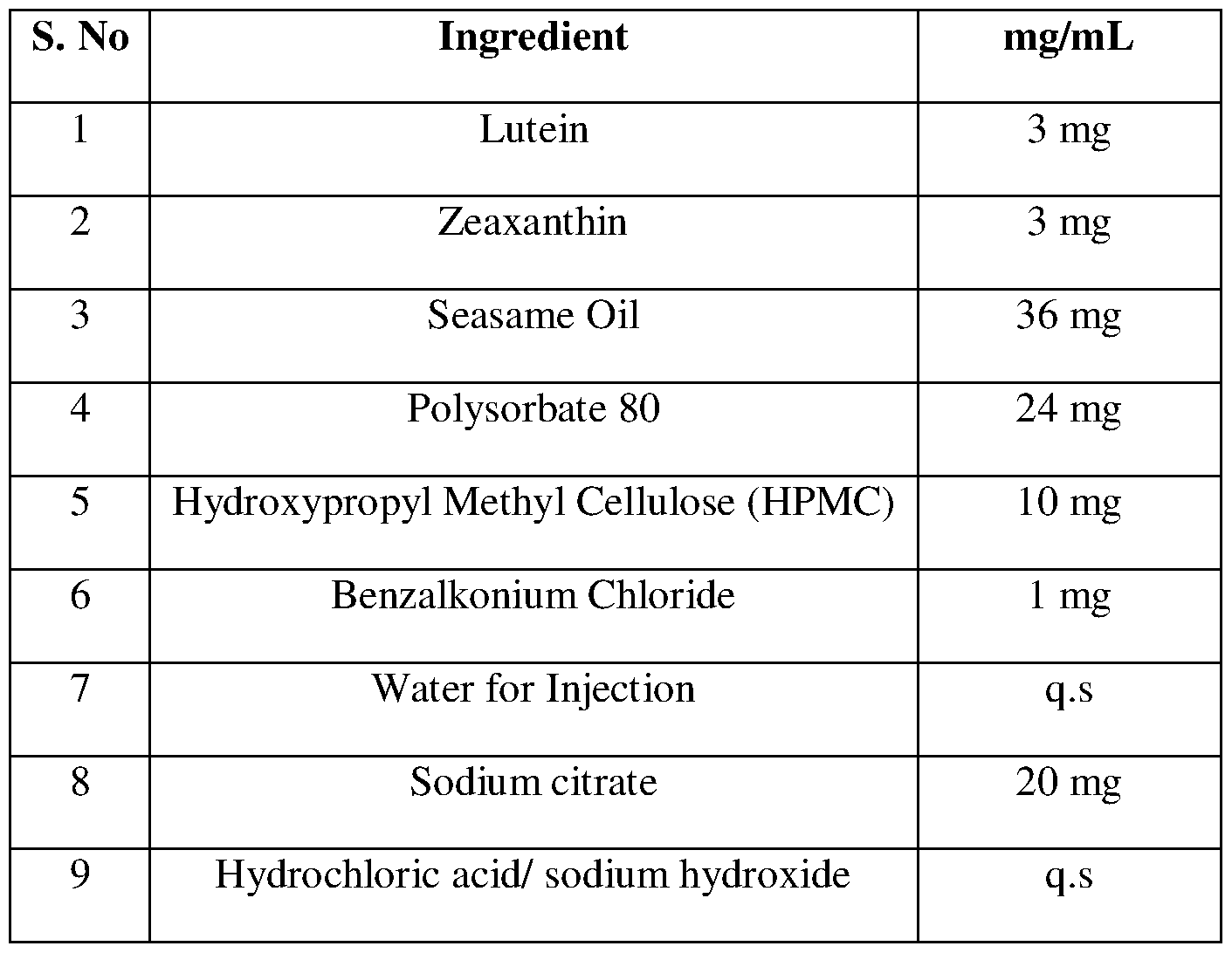
Process: Seasame oil was heated to about 70° C and to it was added Lutein & Zeaxanthin and stirred to completely dissolve the same in the oil phase. Sterile purified water was heated to about 70° C,and to it polysorbate 80, Sodium citrate, Benzalkonium Chloride and HPMC was added and mixed to form the aqueous phase. The oil phase was added while stiring the aqueous phase with a high shear mixerto form the emulsion. This crude emulsion was finely divided in a high pressure homogenizer and the volume was made up with sufficient quantity of water for injection and the pH was adjusted using either sodium hydroxide/ hydrochloric acid and sterilized by filtration through 0.22 μm membrane filter to form the sterile ophthalmic emulsion of antioxidants, which is filled into containers aseptically and sealed.
In another embodiment, the ophthalmic emulsion comprises the antioxidants lutein, zeaxanthin, alpha tocopherol, and selenium and pharmaceutical excipients.
Example: 2
Lutein , Zeaxanthin, Alpha Tocopherol & SeleniumOphthalmic Emulsion

Process: Peanut oil was heated to about 70° C and to it was added Lutein, Zeaxanthin and alpha tocopherol and stirred to completely dissolve the same in the oil phase. Sterile purified water was heated to about 70° C ,and to it Selenium, Poloxamer 188, Polyethylene Glycol (PEG) 400, Sodium Chloride, and Phenyl mercuric nitrate was added and mixed to form the aqueous phase. The oil phase was added while stirring the aqueous phase with a high shear mixerto form the emulsion. This crude emulsion
was finely divided in a high pressure homogenizer to form a stable emulsion of antioxidants and the volume was made up with sufficient quantity of water for injection and the pH was adjusted using either sodium hydroxide/ hydrochloric acid and sterilized by filtration through 0.22 μm membrane filter to form the sterile ophthalmic emulsion of antioxidants, which is filled into containers aseptically and sealed.
In another embodiment of the invention, the ophthalmic emuslioncomprises lutein, alpha tocopherol and pharmaceutical excipients.
Example: 3
Lutein + AlphaTocopherolOphthalmic Emulsion

Process: Medium Chain Triglycerides was heated to about 70° C and to it was added Lutein, and alpha tocopherol and stirred to completely dissolve the same in the oil
phase. Sterile purified water was heated to about 70° C,and to it Poloxamer 407, Sodium Citrate, Citric Acid, and Benzalkonium Chloride was added and mixed to form the aqueous phase. The oil phase was added while stirring the aqueous phase with a high shear mixerto form the emulsion. This crude emulsion was finely divided in a high pressure homogenizer to form a stable emulsion of antioxidants and the volume was made up with sufficient quantity of water for injection and the pH was adjusted using either sodium hydroxide/ hydrochloric acid and sterilized by filtration through 0.22 μm membrane filter to form the sterile ophthalmic emulsion of antioxidants, which is filled into containers aseptically and sealed.
In another embodiment of the invention, the ophthalmic emuslion comprises of beta carotene and pharmaceutical excipients.
Example: 4
Beta Carotene Ophthalmic Emulsion

In another embodiment of the invention, the ophthalmic emuslion comprises of zeaxanthin and pharmaceutical excipients.
Example: S Zeaxanthin Ophthalmic Emulsion

In another embodiment of the invention, the ophthalmic emuslion comprises of lutein and pharmaceutical excipients.
Example:6 Lutein Ophthalmic Emulsion
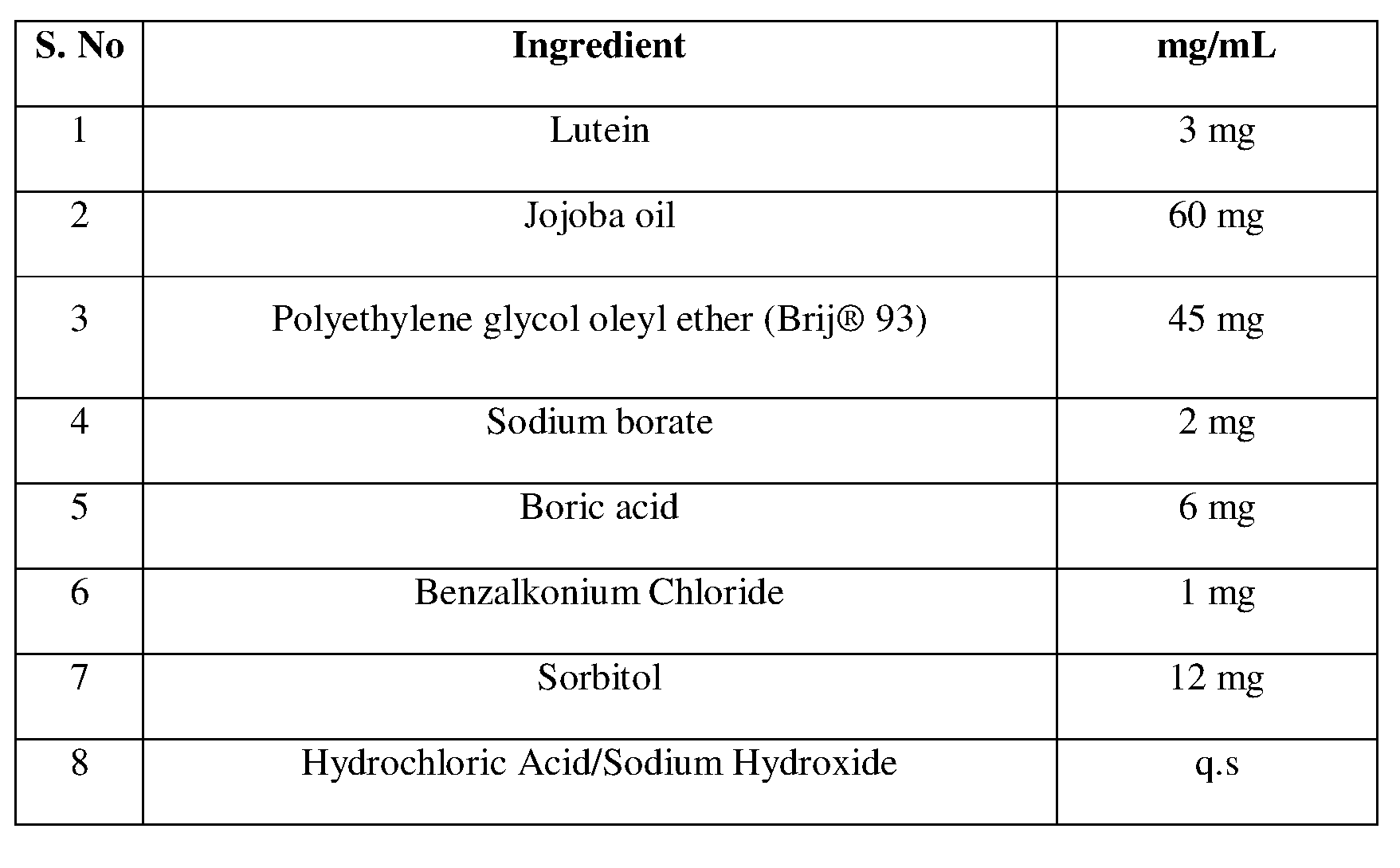

Process: Liquid Paraffin was heated to about 70° C and to it was added Lutein and stirred to completely dissolve the same in the oil phase. Sterile purified water was heated to about 70° C,and to it Polyethylene glycol oleyl ether (Brij® 93), Sodium Borate, Boric Acid, Sorbitol and Benzalkonium Chloride were added and mixed to form the aqueous phase. The oil phase was added to the aqueous phase while stirring the aqueous phase with a high shear mixerto form the emulsion. This crude emulsion was finely divided in a high pressure homogenizer to form a stable emulsion of antioxidants and the volume was made up with sufficient quantity of water for injection and the pH was adjusted using either sodium hydroxide/ hydrochloric acid and sterilized by filtration through 0.22 μm membrane filter to form the sterile ophthalmic emulsion of antioxidants, which is filled into containers aseptically and sealed.
The method for preparing the topical ocular suspension according to the disclosure described herein is not limited to the above methods. The ophthalmic emulsion for ocular delivery of antioxidants according to the disclosure described herein can be prepared by using various other techniques.
Claims
1. A stable oil-in-water ophthalmic emulsion for ocular delivery of antioxidants comprising one or more antioxidants as an active pharmaceutical ingredient, at least one oil of vegetable, mineral or animal origin or a combination thereof, at least one surfactant and at least one pharmaceutically acceptable excipient, wherein the pFI is in the range of about 4 to 8.
2. The stable oil-in-water ophthalmic emulsion of claim 1, wherein the antioxidant is selected from the group comprising of lutein, zeaxanthin, tocopherol, beta carotene, selenium or a combination thereof.
3. The stable oil-in-water ophthalmic emulsion of claim 1 , wherein theconcentration of antioxidant is in the range of about 0.0003%-0.3% w/v.
4. The stable oil-in-water ophthalmic emulsion of claim 1, wherein the oil is a vegetable oil or mineral oil or animal oil or a combination thereof,
5. The stable oil-in-water ophthalmic emulsion of claim 1, wherein the vegetable oil is selected from the group comprising of Castor Oil, Cotton seed Oil, Peanut Oil, Coconut oil, Rice bran oil, Sunflower oil, Sesame oil, Soyabeen oil, Flax oil, Canoia oil, Olive oil, Mustard Oil, Jojoba oil or a combination thereof.
6. The stable oil-in-water ophthalmic emulsion of claim 1 , wherein the animal oil is selected from the group comprising of fish oil, shark liver oil, cod liver oil or a combination thereof.
7. The stable oil-in-water ophthalmic emulsion of claim 1, wherein the mineral oil is Liquid Paraffin and White Mineral Oil or a combination thereof.
8. The stable oil-in-water ophthalmic emulsion of claim 1 , wherein the surfactant is selected from the group comprising of Polyoxyethylated nonionic surfactants like PolysorbateSO, Polysorbate 60, Polysorbate, 40, Polysorbate 20, Cremophors, Tyloxapols, Poloxamers, Benzalkonium chloride, Benzethonium chloride, Cetyl alcohol, Carbomer, Cholesterol, Cocamidopropyl betaine, glyceryl monostearate, lanolin alcohols, lauralkonium chlorides, N lauroylsarcosine, Nonoxynol 9, Octoxynol 40, Polyoxyl 35 castor oil, Polyoxyl 40 hydrgenated castor oil. Polyoxyl 40 stearate, Sorbitanmonolaureate, Sorbitan monooleate, Sorbitanmonopalmitate, Polyoxyethylene (2) Steryl Ether, Polyoxyethylene (2) Cetyl Ether, Polyoxyethylene (2) Qleyl Ether, Polyeoxyethyllene (2) Nonylphenylether, Polyoxyethylene (2) isooctylphenyl ether, Polyoxyletheylene (4) lauryl ether, Polyoxylethylene (5) isooctylphenylether or a combination thereof.
9. The stable oil-in-water ophthalmic emulsion of claim 1, further comprises at least one pH adjusting agent selected from the group comprising of Hydrochloric Acid, Sodium Hydroxide, Sulphuric Acid, Sodium Sulphate, Acetic Acid, Sodium Citrate, Ammonium Hydroxide, Citric Acid, Diethanoiamine, Nitric Acid, Phosphoric Acid or a combination thereof.
10. The stable oil-in-water ophthalmic emulsion of claim 1, further comprises at least one buffering agent selected from the group comprising of Acetic Acid, Boric Acid, Citric Acid, Phosphoric Acid, Potassium Acetate, Potassium Phosphate, Potassium Sulphate, Potassium Sorbate, Sodium Acetate, Sodium borate, Sodium Carbonate, Sodium Citrate, Sodium Phosphate, Sorbic Acid, Tromethamine or a combination thereof.
11. The stable oil-in-water ophthalmic emulsion of claim ] , further comprises at least one osmolarity control agent selected from the group comprising of Sodium Chloride, Sodium Sulphate, Sodium Nitrate, Sorbitol, Mannitol, Calcium Chloride, Glycerine, Magnesium Chloride, PEC} 300, PEG 400, Potassium Chloride, Propylene Glycol or a combination thereof.
12. The stable oil-in-water ophthalmic emulsion of claim 1 , further comprises at least one antimicrobial preservative selected from the group comprising of Quaternary ammonium compounds selected from Benzalkonium Chloride, Benzethonium chloride, Benzododecinium bromide or Polyquatermium- 1 ;or Acid/Base compounds selected from Boric acid, sodium acetate or sodium borate ;or Alcohols selected fromchlorobutanol or Phenylethyl alcohol;or Organic Mercuric compounds selected from Phenyl mercuric acetate, Phenyl mercuric nitrate or Thimerosal; or Parabens selected from methyl paraben or Propyl Paraben;or Oxidizing agent sodium chlorite; or Metal salt Zinc Chloride or a combination thereof.
Priority Applications (1)
| Application Number | Priority Date | Filing Date | Title |
|---|---|---|---|
| US16/641,403 US20200352987A1 (en) | 2017-08-30 | 2018-03-26 | Emulsions for ophthalmic delivery of antioxidants |
Applications Claiming Priority (2)
| Application Number | Priority Date | Filing Date | Title |
|---|---|---|---|
| IN201741030659 | 2017-08-30 | ||
| IN201741030659 | 2017-08-30 |
Publications (1)
| Publication Number | Publication Date |
|---|---|
| WO2019043723A1 true WO2019043723A1 (en) | 2019-03-07 |
Family
ID=65525153
Family Applications (1)
| Application Number | Title | Priority Date | Filing Date |
|---|---|---|---|
| PCT/IN2018/050170 Ceased WO2019043723A1 (en) | 2017-08-30 | 2018-03-26 | Emulsions for ophthalmic delivery of antioxidants |
Country Status (2)
| Country | Link |
|---|---|
| US (1) | US20200352987A1 (en) |
| WO (1) | WO2019043723A1 (en) |
Cited By (1)
| Publication number | Priority date | Publication date | Assignee | Title |
|---|---|---|---|---|
| WO2020070751A1 (en) * | 2018-10-03 | 2020-04-09 | Tathagata Dutta | Semisolid dosage forms for ophthalmic delivery of antioxidants |
Families Citing this family (1)
| Publication number | Priority date | Publication date | Assignee | Title |
|---|---|---|---|---|
| CN113332237B (en) * | 2021-04-30 | 2022-07-01 | 北京诺康达医药科技股份有限公司 | Selenium-containing injection and preparation method thereof |
Citations (4)
| Publication number | Priority date | Publication date | Assignee | Title |
|---|---|---|---|---|
| US5496811A (en) * | 1992-08-28 | 1996-03-05 | Pharmos Corp. | Submicron emulsions as ocular drug delivery vehicles |
| US20130108674A1 (en) * | 2010-06-11 | 2013-05-02 | Medivis S.R.L. | Ophthalmic compositions for the administration of liposoluble active ingredients |
| US20130253070A1 (en) * | 2009-12-14 | 2013-09-26 | Gupron Gmbh | Combination of carotenoids and epi-lutein |
| US20140170247A1 (en) * | 2012-09-14 | 2014-06-19 | Guardion Health Sciences, Llc | Emulsion of Carotenoids and Ocular Antioxidants |
-
2018
- 2018-03-26 WO PCT/IN2018/050170 patent/WO2019043723A1/en not_active Ceased
- 2018-03-26 US US16/641,403 patent/US20200352987A1/en not_active Abandoned
Patent Citations (4)
| Publication number | Priority date | Publication date | Assignee | Title |
|---|---|---|---|---|
| US5496811A (en) * | 1992-08-28 | 1996-03-05 | Pharmos Corp. | Submicron emulsions as ocular drug delivery vehicles |
| US20130253070A1 (en) * | 2009-12-14 | 2013-09-26 | Gupron Gmbh | Combination of carotenoids and epi-lutein |
| US20130108674A1 (en) * | 2010-06-11 | 2013-05-02 | Medivis S.R.L. | Ophthalmic compositions for the administration of liposoluble active ingredients |
| US20140170247A1 (en) * | 2012-09-14 | 2014-06-19 | Guardion Health Sciences, Llc | Emulsion of Carotenoids and Ocular Antioxidants |
Cited By (1)
| Publication number | Priority date | Publication date | Assignee | Title |
|---|---|---|---|---|
| WO2020070751A1 (en) * | 2018-10-03 | 2020-04-09 | Tathagata Dutta | Semisolid dosage forms for ophthalmic delivery of antioxidants |
Also Published As
| Publication number | Publication date |
|---|---|
| US20200352987A1 (en) | 2020-11-12 |
Similar Documents
| Publication | Publication Date | Title |
|---|---|---|
| JP5441058B2 (en) | Composition comprising a quaternary ammonium compound | |
| CN106074568B (en) | Ophthalmic preparation for preventing and treating cataract and preparation method thereof | |
| CN102159186B (en) | Flurbiprofen axetil ophthalmic nanoemulsion-in-situ gel preparation and preparation method thereof | |
| US20120108658A1 (en) | Ophthalmic composition | |
| CN101502485A (en) | Nano cubic liquid crystal dexamethasone preparation for eye and preparation method thereof | |
| US6281224B1 (en) | Pranoprofen eyedrops containing organic amine | |
| US20250073196A1 (en) | Ophthalmic compositions containing a nitric oxide releasing prostamide | |
| WO2019043723A1 (en) | Emulsions for ophthalmic delivery of antioxidants | |
| CN113577024A (en) | Ophthalmic composition and preparation method and application thereof | |
| EP1283043B1 (en) | Ophthalmic solution | |
| JP2013181020A (en) | Ophthalmic composition | |
| WO2019030767A1 (en) | Ophthalmic solution of antioxidant | |
| WO2020070751A1 (en) | Semisolid dosage forms for ophthalmic delivery of antioxidants | |
| TWI712429B (en) | Water-based pharmaceutical composition | |
| WO2004112789A1 (en) | Ophthalmic composition | |
| JP6213715B2 (en) | Multi-component eye drops | |
| CN1883469B (en) | An ocular microemulsion containing Vitamin A and Vitamin E and preparation method thereof | |
| JP2004059479A (en) | Eye drop composition | |
| EP0529499A1 (en) | Compositions for topical administration to the nose or the eyes containing bradykinin antagonists | |
| JP2019094300A (en) | Eye-drop composition | |
| CN103202833A (en) | Pharmaceutical composition of olopatadine or salts of olopatadine, and preparation method thereof | |
| JP5627235B2 (en) | Ophthalmic composition | |
| CA2929965C (en) | Method and composition for treating glaucoma | |
| WO2019021299A9 (en) | A topical ocular suspension of antioxidants |
Legal Events
| Date | Code | Title | Description |
|---|---|---|---|
| 121 | Ep: the epo has been informed by wipo that ep was designated in this application |
Ref document number: 18850324 Country of ref document: EP Kind code of ref document: A1 |
|
| DPE1 | Request for preliminary examination filed after expiration of 19th month from priority date (pct application filed from 20040101) | ||
| NENP | Non-entry into the national phase |
Ref country code: DE |
|
| 122 | Ep: pct application non-entry in european phase |
Ref document number: 18850324 Country of ref document: EP Kind code of ref document: A1 |