WO2019026540A1 - Three-dimensional structure with biological activity and production method therefor - Google Patents
Three-dimensional structure with biological activity and production method therefor Download PDFInfo
- Publication number
- WO2019026540A1 WO2019026540A1 PCT/JP2018/025632 JP2018025632W WO2019026540A1 WO 2019026540 A1 WO2019026540 A1 WO 2019026540A1 JP 2018025632 W JP2018025632 W JP 2018025632W WO 2019026540 A1 WO2019026540 A1 WO 2019026540A1
- Authority
- WO
- WIPO (PCT)
- Prior art keywords
- dimensional structure
- coating film
- main body
- titanium alkoxide
- coating
- Prior art date
- Legal status (The legal status is an assumption and is not a legal conclusion. Google has not performed a legal analysis and makes no representation as to the accuracy of the status listed.)
- Ceased
Links
Images


Classifications
-
- A—HUMAN NECESSITIES
- A61—MEDICAL OR VETERINARY SCIENCE; HYGIENE
- A61L—METHODS OR APPARATUS FOR STERILISING MATERIALS OR OBJECTS IN GENERAL; DISINFECTION, STERILISATION OR DEODORISATION OF AIR; CHEMICAL ASPECTS OF BANDAGES, DRESSINGS, ABSORBENT PADS OR SURGICAL ARTICLES; MATERIALS FOR BANDAGES, DRESSINGS, ABSORBENT PADS OR SURGICAL ARTICLES
- A61L27/00—Materials for grafts or prostheses or for coating grafts or prostheses
- A61L27/28—Materials for coating prostheses
- A61L27/30—Inorganic materials
-
- A—HUMAN NECESSITIES
- A61—MEDICAL OR VETERINARY SCIENCE; HYGIENE
- A61L—METHODS OR APPARATUS FOR STERILISING MATERIALS OR OBJECTS IN GENERAL; DISINFECTION, STERILISATION OR DEODORISATION OF AIR; CHEMICAL ASPECTS OF BANDAGES, DRESSINGS, ABSORBENT PADS OR SURGICAL ARTICLES; MATERIALS FOR BANDAGES, DRESSINGS, ABSORBENT PADS OR SURGICAL ARTICLES
- A61L27/00—Materials for grafts or prostheses or for coating grafts or prostheses
- A61L27/50—Materials characterised by their function or physical properties, e.g. injectable or lubricating compositions, shape-memory materials, surface modified materials
- A61L27/54—Biologically active materials, e.g. therapeutic substances
-
- A—HUMAN NECESSITIES
- A61—MEDICAL OR VETERINARY SCIENCE; HYGIENE
- A61F—FILTERS IMPLANTABLE INTO BLOOD VESSELS; PROSTHESES; DEVICES PROVIDING PATENCY TO, OR PREVENTING COLLAPSING OF, TUBULAR STRUCTURES OF THE BODY, e.g. STENTS; ORTHOPAEDIC, NURSING OR CONTRACEPTIVE DEVICES; FOMENTATION; TREATMENT OR PROTECTION OF EYES OR EARS; BANDAGES, DRESSINGS OR ABSORBENT PADS; FIRST-AID KITS
- A61F2/00—Filters implantable into blood vessels; Prostheses, i.e. artificial substitutes or replacements for parts of the body; Appliances for connecting them with the body; Devices providing patency to, or preventing collapsing of, tubular structures of the body, e.g. stents
- A61F2/02—Prostheses implantable into the body
- A61F2/30—Joints
- A61F2/3094—Designing or manufacturing processes
-
- A—HUMAN NECESSITIES
- A61—MEDICAL OR VETERINARY SCIENCE; HYGIENE
- A61F—FILTERS IMPLANTABLE INTO BLOOD VESSELS; PROSTHESES; DEVICES PROVIDING PATENCY TO, OR PREVENTING COLLAPSING OF, TUBULAR STRUCTURES OF THE BODY, e.g. STENTS; ORTHOPAEDIC, NURSING OR CONTRACEPTIVE DEVICES; FOMENTATION; TREATMENT OR PROTECTION OF EYES OR EARS; BANDAGES, DRESSINGS OR ABSORBENT PADS; FIRST-AID KITS
- A61F2/00—Filters implantable into blood vessels; Prostheses, i.e. artificial substitutes or replacements for parts of the body; Appliances for connecting them with the body; Devices providing patency to, or preventing collapsing of, tubular structures of the body, e.g. stents
- A61F2/02—Prostheses implantable into the body
- A61F2/30—Joints
- A61F2/44—Joints for the spine, e.g. vertebrae, spinal discs
- A61F2/4455—Joints for the spine, e.g. vertebrae, spinal discs for the fusion of spinal bodies, e.g. intervertebral fusion of adjacent spinal bodies, e.g. fusion cages
-
- A—HUMAN NECESSITIES
- A61—MEDICAL OR VETERINARY SCIENCE; HYGIENE
- A61F—FILTERS IMPLANTABLE INTO BLOOD VESSELS; PROSTHESES; DEVICES PROVIDING PATENCY TO, OR PREVENTING COLLAPSING OF, TUBULAR STRUCTURES OF THE BODY, e.g. STENTS; ORTHOPAEDIC, NURSING OR CONTRACEPTIVE DEVICES; FOMENTATION; TREATMENT OR PROTECTION OF EYES OR EARS; BANDAGES, DRESSINGS OR ABSORBENT PADS; FIRST-AID KITS
- A61F2/00—Filters implantable into blood vessels; Prostheses, i.e. artificial substitutes or replacements for parts of the body; Appliances for connecting them with the body; Devices providing patency to, or preventing collapsing of, tubular structures of the body, e.g. stents
- A61F2/02—Prostheses implantable into the body
- A61F2/30—Joints
- A61F2/44—Joints for the spine, e.g. vertebrae, spinal discs
- A61F2/4455—Joints for the spine, e.g. vertebrae, spinal discs for the fusion of spinal bodies, e.g. intervertebral fusion of adjacent spinal bodies, e.g. fusion cages
- A61F2/447—Joints for the spine, e.g. vertebrae, spinal discs for the fusion of spinal bodies, e.g. intervertebral fusion of adjacent spinal bodies, e.g. fusion cages substantially parallelepipedal, e.g. having a rectangular or trapezoidal cross-section
-
- A—HUMAN NECESSITIES
- A61—MEDICAL OR VETERINARY SCIENCE; HYGIENE
- A61L—METHODS OR APPARATUS FOR STERILISING MATERIALS OR OBJECTS IN GENERAL; DISINFECTION, STERILISATION OR DEODORISATION OF AIR; CHEMICAL ASPECTS OF BANDAGES, DRESSINGS, ABSORBENT PADS OR SURGICAL ARTICLES; MATERIALS FOR BANDAGES, DRESSINGS, ABSORBENT PADS OR SURGICAL ARTICLES
- A61L27/00—Materials for grafts or prostheses or for coating grafts or prostheses
- A61L27/02—Inorganic materials
- A61L27/04—Metals or alloys
- A61L27/06—Titanium or titanium alloys
-
- A—HUMAN NECESSITIES
- A61—MEDICAL OR VETERINARY SCIENCE; HYGIENE
- A61L—METHODS OR APPARATUS FOR STERILISING MATERIALS OR OBJECTS IN GENERAL; DISINFECTION, STERILISATION OR DEODORISATION OF AIR; CHEMICAL ASPECTS OF BANDAGES, DRESSINGS, ABSORBENT PADS OR SURGICAL ARTICLES; MATERIALS FOR BANDAGES, DRESSINGS, ABSORBENT PADS OR SURGICAL ARTICLES
- A61L27/00—Materials for grafts or prostheses or for coating grafts or prostheses
- A61L27/14—Macromolecular materials
- A61L27/18—Macromolecular materials obtained otherwise than by reactions only involving carbon-to-carbon unsaturated bonds
-
- A—HUMAN NECESSITIES
- A61—MEDICAL OR VETERINARY SCIENCE; HYGIENE
- A61L—METHODS OR APPARATUS FOR STERILISING MATERIALS OR OBJECTS IN GENERAL; DISINFECTION, STERILISATION OR DEODORISATION OF AIR; CHEMICAL ASPECTS OF BANDAGES, DRESSINGS, ABSORBENT PADS OR SURGICAL ARTICLES; MATERIALS FOR BANDAGES, DRESSINGS, ABSORBENT PADS OR SURGICAL ARTICLES
- A61L27/00—Materials for grafts or prostheses or for coating grafts or prostheses
- A61L27/28—Materials for coating prostheses
- A61L27/30—Inorganic materials
- A61L27/306—Other specific inorganic materials not covered by A61L27/303 - A61L27/32
-
- A—HUMAN NECESSITIES
- A61—MEDICAL OR VETERINARY SCIENCE; HYGIENE
- A61F—FILTERS IMPLANTABLE INTO BLOOD VESSELS; PROSTHESES; DEVICES PROVIDING PATENCY TO, OR PREVENTING COLLAPSING OF, TUBULAR STRUCTURES OF THE BODY, e.g. STENTS; ORTHOPAEDIC, NURSING OR CONTRACEPTIVE DEVICES; FOMENTATION; TREATMENT OR PROTECTION OF EYES OR EARS; BANDAGES, DRESSINGS OR ABSORBENT PADS; FIRST-AID KITS
- A61F2/00—Filters implantable into blood vessels; Prostheses, i.e. artificial substitutes or replacements for parts of the body; Appliances for connecting them with the body; Devices providing patency to, or preventing collapsing of, tubular structures of the body, e.g. stents
- A61F2/02—Prostheses implantable into the body
- A61F2/30—Joints
- A61F2002/30001—Additional features of subject-matter classified in A61F2/28, A61F2/30 and subgroups thereof
- A61F2002/30003—Material related properties of the prosthesis or of a coating on the prosthesis
- A61F2002/3006—Properties of materials and coating materials
- A61F2002/30062—(bio)absorbable, biodegradable, bioerodable, (bio)resorbable, resorptive
- A61F2002/30064—Coating or prosthesis-covering structure made of biodegradable material
-
- A—HUMAN NECESSITIES
- A61—MEDICAL OR VETERINARY SCIENCE; HYGIENE
- A61F—FILTERS IMPLANTABLE INTO BLOOD VESSELS; PROSTHESES; DEVICES PROVIDING PATENCY TO, OR PREVENTING COLLAPSING OF, TUBULAR STRUCTURES OF THE BODY, e.g. STENTS; ORTHOPAEDIC, NURSING OR CONTRACEPTIVE DEVICES; FOMENTATION; TREATMENT OR PROTECTION OF EYES OR EARS; BANDAGES, DRESSINGS OR ABSORBENT PADS; FIRST-AID KITS
- A61F2/00—Filters implantable into blood vessels; Prostheses, i.e. artificial substitutes or replacements for parts of the body; Appliances for connecting them with the body; Devices providing patency to, or preventing collapsing of, tubular structures of the body, e.g. stents
- A61F2/02—Prostheses implantable into the body
- A61F2/30—Joints
- A61F2002/30001—Additional features of subject-matter classified in A61F2/28, A61F2/30 and subgroups thereof
- A61F2002/30316—The prosthesis having different structural features at different locations within the same prosthesis; Connections between prosthetic parts; Special structural features of bone or joint prostheses not otherwise provided for
- A61F2002/30535—Special structural features of bone or joint prostheses not otherwise provided for
- A61F2002/30593—Special structural features of bone or joint prostheses not otherwise provided for hollow
-
- A—HUMAN NECESSITIES
- A61—MEDICAL OR VETERINARY SCIENCE; HYGIENE
- A61F—FILTERS IMPLANTABLE INTO BLOOD VESSELS; PROSTHESES; DEVICES PROVIDING PATENCY TO, OR PREVENTING COLLAPSING OF, TUBULAR STRUCTURES OF THE BODY, e.g. STENTS; ORTHOPAEDIC, NURSING OR CONTRACEPTIVE DEVICES; FOMENTATION; TREATMENT OR PROTECTION OF EYES OR EARS; BANDAGES, DRESSINGS OR ABSORBENT PADS; FIRST-AID KITS
- A61F2/00—Filters implantable into blood vessels; Prostheses, i.e. artificial substitutes or replacements for parts of the body; Appliances for connecting them with the body; Devices providing patency to, or preventing collapsing of, tubular structures of the body, e.g. stents
- A61F2/02—Prostheses implantable into the body
- A61F2/30—Joints
- A61F2/30767—Special external or bone-contacting surface, e.g. coating for improving bone ingrowth
- A61F2/30771—Special external or bone-contacting surface, e.g. coating for improving bone ingrowth applied in original prostheses, e.g. holes or grooves
- A61F2002/30841—Sharp anchoring protrusions for impaction into the bone, e.g. sharp pins, spikes
-
- A—HUMAN NECESSITIES
- A61—MEDICAL OR VETERINARY SCIENCE; HYGIENE
- A61F—FILTERS IMPLANTABLE INTO BLOOD VESSELS; PROSTHESES; DEVICES PROVIDING PATENCY TO, OR PREVENTING COLLAPSING OF, TUBULAR STRUCTURES OF THE BODY, e.g. STENTS; ORTHOPAEDIC, NURSING OR CONTRACEPTIVE DEVICES; FOMENTATION; TREATMENT OR PROTECTION OF EYES OR EARS; BANDAGES, DRESSINGS OR ABSORBENT PADS; FIRST-AID KITS
- A61F2/00—Filters implantable into blood vessels; Prostheses, i.e. artificial substitutes or replacements for parts of the body; Appliances for connecting them with the body; Devices providing patency to, or preventing collapsing of, tubular structures of the body, e.g. stents
- A61F2/02—Prostheses implantable into the body
- A61F2/30—Joints
- A61F2/30767—Special external or bone-contacting surface, e.g. coating for improving bone ingrowth
- A61F2/30771—Special external or bone-contacting surface, e.g. coating for improving bone ingrowth applied in original prostheses, e.g. holes or grooves
- A61F2002/30904—Special external or bone-contacting surface, e.g. coating for improving bone ingrowth applied in original prostheses, e.g. holes or grooves serrated profile, i.e. saw-toothed
-
- A—HUMAN NECESSITIES
- A61—MEDICAL OR VETERINARY SCIENCE; HYGIENE
- A61F—FILTERS IMPLANTABLE INTO BLOOD VESSELS; PROSTHESES; DEVICES PROVIDING PATENCY TO, OR PREVENTING COLLAPSING OF, TUBULAR STRUCTURES OF THE BODY, e.g. STENTS; ORTHOPAEDIC, NURSING OR CONTRACEPTIVE DEVICES; FOMENTATION; TREATMENT OR PROTECTION OF EYES OR EARS; BANDAGES, DRESSINGS OR ABSORBENT PADS; FIRST-AID KITS
- A61F2/00—Filters implantable into blood vessels; Prostheses, i.e. artificial substitutes or replacements for parts of the body; Appliances for connecting them with the body; Devices providing patency to, or preventing collapsing of, tubular structures of the body, e.g. stents
- A61F2/02—Prostheses implantable into the body
- A61F2/30—Joints
- A61F2/3094—Designing or manufacturing processes
- A61F2/30942—Designing or manufacturing processes for designing or making customized prostheses, e.g. using templates, CT or NMR scans, finite-element analysis or CAD-CAM techniques
- A61F2002/30957—Designing or manufacturing processes for designing or making customized prostheses, e.g. using templates, CT or NMR scans, finite-element analysis or CAD-CAM techniques using a positive or a negative model, e.g. moulds
-
- A—HUMAN NECESSITIES
- A61—MEDICAL OR VETERINARY SCIENCE; HYGIENE
- A61F—FILTERS IMPLANTABLE INTO BLOOD VESSELS; PROSTHESES; DEVICES PROVIDING PATENCY TO, OR PREVENTING COLLAPSING OF, TUBULAR STRUCTURES OF THE BODY, e.g. STENTS; ORTHOPAEDIC, NURSING OR CONTRACEPTIVE DEVICES; FOMENTATION; TREATMENT OR PROTECTION OF EYES OR EARS; BANDAGES, DRESSINGS OR ABSORBENT PADS; FIRST-AID KITS
- A61F2310/00—Prostheses classified in A61F2/28 or A61F2/30 - A61F2/44 being constructed from or coated with a particular material
- A61F2310/00389—The prosthesis being coated or covered with a particular material
- A61F2310/00592—Coating or prosthesis-covering structure made of ceramics or of ceramic-like compounds
- A61F2310/00598—Coating or prosthesis-covering structure made of compounds based on metal oxides or hydroxides
- A61F2310/00616—Coating made of titanium oxide or hydroxides
-
- A—HUMAN NECESSITIES
- A61—MEDICAL OR VETERINARY SCIENCE; HYGIENE
- A61L—METHODS OR APPARATUS FOR STERILISING MATERIALS OR OBJECTS IN GENERAL; DISINFECTION, STERILISATION OR DEODORISATION OF AIR; CHEMICAL ASPECTS OF BANDAGES, DRESSINGS, ABSORBENT PADS OR SURGICAL ARTICLES; MATERIALS FOR BANDAGES, DRESSINGS, ABSORBENT PADS OR SURGICAL ARTICLES
- A61L2300/00—Biologically active materials used in bandages, wound dressings, absorbent pads or medical devices
- A61L2300/40—Biologically active materials used in bandages, wound dressings, absorbent pads or medical devices characterised by a specific therapeutic activity or mode of action
- A61L2300/412—Tissue-regenerating or healing or proliferative agents
-
- A—HUMAN NECESSITIES
- A61—MEDICAL OR VETERINARY SCIENCE; HYGIENE
- A61L—METHODS OR APPARATUS FOR STERILISING MATERIALS OR OBJECTS IN GENERAL; DISINFECTION, STERILISATION OR DEODORISATION OF AIR; CHEMICAL ASPECTS OF BANDAGES, DRESSINGS, ABSORBENT PADS OR SURGICAL ARTICLES; MATERIALS FOR BANDAGES, DRESSINGS, ABSORBENT PADS OR SURGICAL ARTICLES
- A61L2400/00—Materials characterised by their function or physical properties
- A61L2400/18—Modification of implant surfaces in order to improve biocompatibility, cell growth, fixation of biomolecules, e.g. plasma treatment
-
- A—HUMAN NECESSITIES
- A61—MEDICAL OR VETERINARY SCIENCE; HYGIENE
- A61L—METHODS OR APPARATUS FOR STERILISING MATERIALS OR OBJECTS IN GENERAL; DISINFECTION, STERILISATION OR DEODORISATION OF AIR; CHEMICAL ASPECTS OF BANDAGES, DRESSINGS, ABSORBENT PADS OR SURGICAL ARTICLES; MATERIALS FOR BANDAGES, DRESSINGS, ABSORBENT PADS OR SURGICAL ARTICLES
- A61L2420/00—Materials or methods for coatings medical devices
- A61L2420/02—Methods for coating medical devices
-
- A—HUMAN NECESSITIES
- A61—MEDICAL OR VETERINARY SCIENCE; HYGIENE
- A61L—METHODS OR APPARATUS FOR STERILISING MATERIALS OR OBJECTS IN GENERAL; DISINFECTION, STERILISATION OR DEODORISATION OF AIR; CHEMICAL ASPECTS OF BANDAGES, DRESSINGS, ABSORBENT PADS OR SURGICAL ARTICLES; MATERIALS FOR BANDAGES, DRESSINGS, ABSORBENT PADS OR SURGICAL ARTICLES
- A61L2430/00—Materials or treatment for tissue regeneration
- A61L2430/02—Materials or treatment for tissue regeneration for reconstruction of bones; weight-bearing implants
-
- A—HUMAN NECESSITIES
- A61—MEDICAL OR VETERINARY SCIENCE; HYGIENE
- A61L—METHODS OR APPARATUS FOR STERILISING MATERIALS OR OBJECTS IN GENERAL; DISINFECTION, STERILISATION OR DEODORISATION OF AIR; CHEMICAL ASPECTS OF BANDAGES, DRESSINGS, ABSORBENT PADS OR SURGICAL ARTICLES; MATERIALS FOR BANDAGES, DRESSINGS, ABSORBENT PADS OR SURGICAL ARTICLES
- A61L2430/00—Materials or treatment for tissue regeneration
- A61L2430/24—Materials or treatment for tissue regeneration for joint reconstruction
-
- A—HUMAN NECESSITIES
- A61—MEDICAL OR VETERINARY SCIENCE; HYGIENE
- A61L—METHODS OR APPARATUS FOR STERILISING MATERIALS OR OBJECTS IN GENERAL; DISINFECTION, STERILISATION OR DEODORISATION OF AIR; CHEMICAL ASPECTS OF BANDAGES, DRESSINGS, ABSORBENT PADS OR SURGICAL ARTICLES; MATERIALS FOR BANDAGES, DRESSINGS, ABSORBENT PADS OR SURGICAL ARTICLES
- A61L2430/00—Materials or treatment for tissue regeneration
- A61L2430/38—Materials or treatment for tissue regeneration for reconstruction of the spine, vertebrae or intervertebral discs
Definitions
- the present invention relates to a bioactive three-dimensional structure used as a bone repair material, a joint prosthesis material, an intervertebral cage, and the like, and a method for producing the same.
- Titanium metal or its alloy is mainly used as a material of a three-dimensional structure used for bone repair in a portion to which a large load is applied in vivo. While these metals or alloys have the advantage of having good bone integrity, they have a much higher modulus of elasticity than bone tissue and are stress shielding (the stress does not act on the bone and the When the three-dimensional structure is an intervertebral cage or the like, there is a problem that the cage sinks or the like occurs.
- a polymer material having an elastic modulus close to that of bone tissue is used as a material for bone repair, and it is made of, for example, polyetheretherketone (PEEK) Intervertebral spacers are in practical use.
- PEEK polyetheretherketone
- polymers such as PEEK do not have bone bonding properties, by forming a coating film made of titanium oxide or the like on the surface of the three-dimensional structure body made of polymer such as PEEK, bone bonding to the three-dimensional structure body is possible. Methods to impart sex are being investigated.
- Patent Documents 1 to 3 and Non-Patent Document 1 disclose a method of forming a titanium oxide coating film on a three-dimensional structural body made of a polymer such as PEEK by a general sol-gel method using a titanium alkoxide. ing. Specifically, in Patent Document 1 and Non-patent Document 1, a treatment in which a steric body is dipped and pulled in a sol prepared by partially hydrolyzing titanium tetraisopropoxide (TTIP) and then dried ( Hereinafter, it is described that a coating film is formed by passing through "dip coating treatment".
- TTIP titanium tetraisopropoxide
- Patent Document 4 discloses that the three-dimensional structure body is oxidized while being fixed and rotated on a spin coater. There is disclosed a method using a so-called spin coating process in which titanium sol or the like is dropped and coated and then dried.
- the three-dimensional structure main body which necessarily constitutes the intervertebral spacer, one having a sawtooth-like concavo-convex shape in cross section is used on the surface thereof.
- the sol is easily stored at the bottom of the concave portion or the base of the convex portion when performing dip coating. Uneven film thickness occurs, and adhesion to the three-dimensional structure main body becomes insufficient at a portion where the film thickness is large, and cracking and peeling occur. This is because a large stress is generated in the coating film due to the film thickness unevenness of the coating film obtained after drying, and this stress causes cracks, cracks, etc.
- the coating film can be made thinner by appropriately setting the conditions of dip coating treatment, and thereby it is possible to suppress cracking and peeling of the coating film, but It is not practical because the bone integrity also decreases or disappears with the decrease.
- a method of forming a coating film, wherein the three-dimensional structure obtained when the coating film is formed on a three-dimensional structure body having a recess and / or a protrusion by these methods is useful. It is unclear whether it will be equipped with a high coating film.
- the present invention has been made based on the circumstances as described above, and the surface of the three-dimensional structure main body having concave and / or convex portions on the surface is high in coating film made of titanium alkoxide hydrolysis product. It is an object of the present invention to provide a bioactive three-dimensional structure coated with adhesive strength and a method for producing the same.
- a coating film precursor comprising a titanium alkoxide partial hydrolysis product is provided on the surface of a three-dimensional structure body having recesses and / or protrusions on the surface.
- the excess coating film precursor dispersion stored at the bottom of the recess or at the base of the protrusion is scattered or cast. Therefore, the film thickness of the coating film by the hydrolysis product of titanium alkoxide can be made uniform on any surface of the concave portion, the convex portion and the flat portion, and as a result, the obtained coating film has high adhesion strength. It discovers that it will have and completed this invention.
- the bioactive three-dimensional structure of the present invention is formed on a surface including a three-dimensional structure main body made of a polymer having concave and / or convex portions on the surface, and concave and / or convex portions in this three-dimensional structural main body. And a covering film made of a titanium alkoxide hydrolysis product having a thickness of 10 to 200 nm,
- the coating film is a film in which no cracking or peeling of the coating film is observed when a concave portion and / or a convex portion on the surface of the three-dimensional structure is observed with a scanning electron microscope at a magnification of 300 times. It is characterized in that it has bioactivity when it is evaluated under the conditions defined in ISO 23317.
- the coating film preferably has an adhesion strength of 40 N / 10 mm or more as measured by a 180 degree peel test according to JIS-K6854.
- the thickness of the coating film is preferably 20 to 200 nm.
- the steric structure body is preferably made of polyetheretherketone.
- the bioactive three-dimensional structure of the present invention is preferably used as a bone repair material, a joint prosthesis material or an intervertebral cage.
- the method for producing a bioactive three-dimensional structure comprises the steps of: preparing a three-dimensional structure having a recess and / or a protrusion on its surface; A coating film precursor containing a coating film precursor comprising a titanium alkoxide partial hydrolysis product by mixing 0.08 to 1.5 mol parts of titanium alkoxide and water with respect to 37 mol parts of an organic solvent A dispersion preparation step of preparing a dispersion; A precursor coating step of applying the coating film precursor dispersion to the surface of the three-dimensional structure body; and rotating the three-dimensional structure body so that a centrifugal force acts on its center of gravity, the three-dimensional structure body A coating film forming step of forming a coating film comprising a titanium alkoxide hydrolysis product on the surface of And D. a bioactivation treatment step of bioactivation treatment of the covering membrane.
- a main body modification treatment step of modifying the surface of the three-dimensional structure main body before performing the precursor coating step it is preferable to have a main body modification treatment step of modifying the surface of the three-dimensional structure main body before performing the precursor coating step.
- the relative centrifugal acceleration of the centrifugal force acting on the center of gravity of the three-dimensional structure body is preferably 10 to 500 G in the covering film forming step.
- the coating film forming step is dried at a temperature of 50 to 200 ° C. with respect to the three-dimensional structure body coated with the covering film by rotating. It is preferred to carry out the treatment.
- a coating film made of a titanium alkoxide hydrolysis product is coated with high adhesion strength on the surface of the three-dimensional structure main body having concave and / or convex portions on the surface. ing. And since the said coating film has bioactivity when evaluated in the conditions prescribed
- FIG. 1 It is a photograph which shows an example of the intervertebral cage which is a three-dimensional structure which has bioactivity of this invention.
- FIG. 1 It is a schematic diagram of the three-dimensional structure main body used for Example 1, Comprising: (a) is a top view, (b) is a side view, (c) is an enlarged side view of the part enclosed with the broken line in (b). .
- 5 is a scanning electron micrograph of the surface of the coating film produced in Example 1 taken at a magnification of 50 times.
- 5 is a scanning electron micrograph of the surface of the coating film produced in Example 1 taken at a magnification of 300 times.
- FIG. 5 is a scanning electron micrograph of the surface of the coated film produced in Example 1 taken at a magnification of 1000 times. It is a scanning electron micrograph which image
- FIG. It is a scanning electron micrograph taken at 50 times the magnification of the surface of the coating film manufactured by comparative example 1.
- FIG. 6 is a scanning electron photomicrograph taken at a magnification of 300 times of the surface of the coating film produced in Comparative Example 1.
- FIG. It is a scanning electron micrograph which image
- FIG. It is a scanning electron micrograph which image
- the biologically active three-dimensional structure of the present invention has a three-dimensional structure main body made of a polymer having a recess and / or a convex part on the surface, and a thickness of 10 to 200 nm formed on the surface of this three-dimensional structure main body And a coated film made of a titanium alkoxide hydrolysis product, and has the following properties (1) and (2).
- a coated film made of a titanium alkoxide hydrolysis product
- a polymer which comprises a three-dimensional-structure main body if it is a polymer used for a bone repair material etc., it can use without being specifically limited.
- Polyaryl ketone resin is a thermoplastic resin having aromatic nucleus bond, ether bond and ketone bond in its structural unit, and many have a linear polymer structure in which benzene ring is connected by ether bond and ketone bond.
- Representative examples of polyaryl ketone resins include polyether ketone (PEK), polyether ether ketone (PEEK), polyether ketone ketone (PEKK), polyether ketone ether ketone ketone (PEKEKK), etc.
- PEEK polyetheretherketone
- PEEK polyetheretherketone
- polysulfone resin is an amorphous thermoplastic resin having a sulfonyl group in its structural unit, and often contains an aromatic ring in order to achieve high functionalization.
- Polyether sulfone resin (PES) and polyphenyl sulfone resin (PPSU) are also included in the polysulfone resin as a sulfonyl group-containing resin.
- the three-dimensional structure body has at least one recess and / or protrusion on the surface, depending on the use of the finally obtained three-dimensional structure having biological activity (bone repair material, indirect prosthetic material, intervertebral cage, etc.) For example, it may have at least a pair of uneven structures.
- a three-dimensional structure having a concave portion and / or a convex portion on the surface includes one in which a cavity communicating with the outside is formed inside the three-dimensional structure main body.
- the depressions and / or projections formed on the surface of the three-dimensional structure main body are, for example, those in which the depth of the depressions or the height of the projections is in the range of 0.2 mm or more, preferably It is in the range of 0.2 to 20 mm, more preferably in the range of 0.2 to 5 mm.
- the width of the recess or the protrusion is, for example, 2.0 to 15 mm.
- FIG. 1 An intervertebral cage, which is a kind of intervertebral spacer, is shown in FIG. 1 as an example of a three-dimensional structure having a cavity inside.
- the intervertebral cage 10 has a substantially rectangular parallelepiped shape extending in the front-rear direction, and a through hole 11 having a rectangular cross section, which penetrates from the upper surface 16 to the lower surface 17, is formed.
- a plurality of lateral holes 12 communicating with the through holes 11 are formed in the side surface portion 15 of the intervertebral cage 10.
- a plurality of ridges 13 extending in a direction perpendicular to the side surface portion 15 are formed in parallel to one another.
- the plurality of protrusions 13 form a recess and a protrusion of the three-dimensional structure main body.
- the depth (height) of the recess and / or protrusion in this intervertebral cage 10 is 0.5 mm, and its width is 5 mm.
- the surface of the three-dimensional structure body on which the covering film is formed is preferably subjected to a modification treatment.
- the contact angle of water of the surface of the three-dimensional structure body is preferably 0 to 40 °, more preferably 0 to 30 °, and still more preferably 0 to 20 °.
- the coating film formed on the surface of the three-dimensional structure body is made of a titanium alkoxide hydrolysis product.
- the titanium alkoxide hydrolysis product constituting the coating film is obtained by gelation of the sol formed by partial hydrolysis and polymerization of the titanium alkoxide by drying.
- a titanium alkoxide hydrolysis product is produced by the progress of hydrolysis reaction and polymerization reaction, and this titanium alkoxide hydrolysis product is In a broad sense, it is called titanium oxide.
- the thickness of the coating film is 10 to 200 nm, preferably 20 to 200 nm, and more preferably 30 to 100 nm.
- the thickness of the coating film is within the above range, adhesion of the coating film to the surface of the three-dimensional structure body is sufficiently obtained, and the coating is performed even when the three-dimensional structure is applied in vivo. Peeling off of the membrane is unlikely to occur, and moreover, effective bone bonding can be obtained for the three-dimensional structure.
- the thickness of the coating film is less than 10 nm, there is a possibility that the desired three-dimensional structure can not obtain desired biological activity (bone bonding ability).
- the thickness of a coating film exceeds 200 nm, a crack peeling of a coating film may arise and there exists a possibility that the bondability (bone bonding property) with a bone component can not be ensured.
- the thickness of the coating film can be measured by observation of a cross section using a transmission electron microscope.
- an optical interference type film thickness meter for example, “FE-3000” (manufactured by Otsuka Electronics Co., Ltd.)
- an ellipsometer for example, “UVISEL2” (for example, Horiba, Ltd.)
- It can also be measured optically.
- a method of measuring the optical density of a three-dimensional structure UV absorbance by regular transmitted light measured using “UV-2550” (manufactured by Shimadzu Corporation)
- calculating the film thickness by a calibration curve prepared in advance The thickness of the coated film can also be measured by the calibration curve method.
- a dispersion (coating film precursor dispersion) containing a titanium alkoxide partial hydrolysis product used to coat a three-dimensional structure is simply applied to a borosilicate glass substrate in practice.
- a sample for measuring the thickness of the coating film is prepared by performing the precursor coating step and the coating film forming step described in detail below under the same conditions as in the three-dimensional structure, and coating using this sample The thickness of the membrane can also be measured.
- the coating film is one in which peeling of the coating film is not observed when the concave portions and / or the convex portions on the surface of the three-dimensional structure are observed with a scanning electron microscope at a magnification of 300 times.
- Adhesion strength test (C)”
- the coating film is observed by a scanning electron microscope at a magnification of greater than 300 times, specifically at a magnification of 1000, the concave and / or convex portions on the surface of the three-dimensional structure are cracked and peeled off of the coating film.
- the position on the surface of the three-dimensional structure observed by a scanning electron microscope is a flat surface and a recess and / or a protrusion.
- the coating film is a test in which a transparent pressure-sensitive adhesive tape (width 25 mm, adhesion sensitivity 4 N / 10 mm) specified in JIS-K5600 is attached to the surface of a three-dimensional structure and peeled off (hereinafter referred to as “adhesion strength test (A It is preferable that peeling of the said coating film is not visually recognized, when it is said).
- a transparent pressure-sensitive adhesive tape width 25 mm, adhesion sensitivity 4 N / 10 mm
- JIS-K5600 a transparent pressure-sensitive adhesive tape (width 25 mm, adhesion sensitivity 4 N / 10 mm) specified in JIS-K5600 is attached to the surface of a three-dimensional structure and peeled off
- Sellotape (trademark) manufactured by Nichiban Co., Ltd. can be used as the transparent pressure-sensitive adhesive tape used in the adhesion strength test (A).
- the position on the surface of the three-dimensional structure to which the transparent pressure-sensitive adhesive tape is attached may be a flat flat portion or a part of a recess and / or a protrusion.
- the coating film preferably has an adhesion strength (hereinafter referred to as "adhesion strength test (B)") of 40 N / 10 mm or more measured by a 180 degree peel test in accordance with JIS-K6854. Preferably it is 41 N / 10 mm or more, More preferably, it is 43 N / 10 mm or more.
- a bonding tape Y-4950 for acrylic foam structure (adhesive strength 34 N / 10 mm (T-type peeling force for SUS304, 10 mm width)” (10 mm width) on the surface of a three-dimensional structure ”( 3) is applied, the joint tape for acrylic foam structure is pulled at a speed of 300 mm / min at 180 degrees, and the peeling resistance is measured.
- the position on the surface of the three-dimensional structure to which the acrylic foam structural bonding tape is attached is a flat surface.
- the three-dimensional structure shows bioactivity when in vitro evaluation of the apatite-forming ability of the implant material is performed under the conditions defined in ISO23317. Specifically, a simulated body fluid (SBF) defined in ISO 23317 is prepared, the sample (three-dimensional structure) is immersed in it, stored at 36.5 ° C. for 3 days, and apatite formation on the surface after 3 days The presence or absence of is examined by observing with a scanning electron microscope at a magnification of 1000 times.
- SBF simulated body fluid
- the ratio (coverage) of the area of the part where the apatite is deposited is less than 10% with respect to the area of the surface of the sample, it is "-", and when it is 10% or more and less than 50%
- the case where it is "50% or more and less than 90%” is shown as "++", the case where it is 90% or more as “+++”, and the case where the apatite coverage is 10% or more is evaluated as having bioactivity.
- the surface of the three-dimensional structure main body having concave and / or convex portions on the surface is coated with a coating film made of a titanium alkoxide hydrolysis product with high adhesion strength. It is done. And since the said coating film has bioactivity when evaluated in the conditions prescribed
- the method for producing a bioactive three-dimensional structure comprises the steps of preparing a three-dimensional structure having concave and / or convex portions on its surface, and preparing a titanium alkoxide 0.08 to 37 molar parts of organic solvent.
- the method for producing a biologically active three-dimensional structure it is preferable to rotate the three-dimensional structure main body coated with the covering film by rotating in the covering film forming step. Moreover, it is preferable to have a main-body modification process process which carries out the modification process of the surface of a three-dimensional structure main body, before performing a precursor coating process.
- a three-dimensional structure main body is prepared.
- the three-dimensional structure body is produced by cutting the polymer base material based on the shape according to the three-dimensional structure application (bone repair material, joint prosthesis material, intervertebral cage, etc.) can do.
- the three-dimensional structure body can also be manufactured by a molding method such as an injection molding method.
- the three-dimensional structure body can also be produced by three-dimensional modeling using a 3D printer or the like.
- the produced three-dimensional structure body is preferably washed with water, alcohol or the like.
- the main body reforming process is performed as necessary in consideration of the material of the three-dimensional structure main body, the use of the three-dimensional structure, and the like. Specifically, the modification treatment of the surface of the three-dimensional structure body is performed by providing a hydrophilic group to the surface of the three-dimensional structure body made of a polymer. When a hydrophilic group is provided on the surface of the three-dimensional structure main body made of a polymer, a coated film made of a titanium alkoxide hydrolysis product can be formed more firmly.
- a method by plasma treatment in an oxygen atmosphere disclosed in Patent Document 1 or Non-patent Document 1 or a method by ultraviolet irradiation treatment is adopted.
- the time for performing plasma treatment in an oxygen atmosphere is preferably 30 seconds or more, more preferably 5 minutes or more.
- the time which performs an ultraviolet irradiation process becomes like this. Preferably it is 5 minutes or more, More preferably, it is 30 minutes or more.
- a method of modification treatment other than the above-mentioned method for example, a method of forming surface roughness by blasting or acid etching may be adopted.
- a coating film precursor comprising a titanium alkoxide partial hydrolysis product is obtained by mixing 0.08 to 1.5 mol parts of titanium alkoxide and water with 37 mol parts of an organic solvent.
- a coating film precursor dispersion to be contained is prepared.
- titanium alkoxide and water are brought into contact with each other to form a titanium alkoxide partial hydrolysis product in a sol state.
- the degree of hydrolysis of the titanium alkoxide can be set as appropriate, and is preferably 5 to 70%, more preferably 10 to 50%, in molar conversion.
- the hydrolysis rate of the titanium alkoxide can be calculated from the ratio of the amount of water to be added to the amount of water that hydrolyzes the titanium alkoxide 100%.
- the titanium alkoxide is diluted with an organic solvent such as alcohol and hydrolyzed.
- titanium alkoxide partially hydrolyzed 0.08 to 1.5 parts by mole, preferably 0.09 to 1.0 parts by mole of titanium alkoxide and 37 parts by mole of organic solvent are mixed with water to obtain titanium alkoxide partially hydrolyzed.
- a coated film precursor dispersion containing a coated film precursor consisting of decomposition products is prepared.
- the titanium alkoxide partial hydrolysis product in the coating film precursor dispersion has an appropriate concentration by being diluted with an organic solvent and hydrolyzed, whereby the three-dimensional structure main body is obtained.
- a coating film having excellent adhesion can be formed on the surface.
- the amount of water used is preferably 0.1 to 4 parts by mole, and more preferably 0.5 to 3 parts by mole, with respect to 1 part by mole of the titanium alkoxide.
- the amount of the acid or alkali used is preferably 0.01 to 2.0 parts by mole, and more preferably 0.05 to 1.0 parts by mole, with respect to 1 part by mole of the titanium alkoxide.
- titanium alkoxides include tetraethoxytitanate, tetra (n-propoxy) titanate, tetra (isopropoxy) titanate, tetra (n-butoxy) titanate, tetra (isobutoxy) titanate, and tetra (tert-butoxy) titanate.
- titanium alkoxides of aliphatic alcohols having 1 to 8 carbon atoms include titanium alkoxides of aliphatic alcohols having 1 to 8 carbon atoms.
- organic solvent examples include alcohols such as methanol, ethanol, propanol, butanol and ethylene glycol, dimethyl ether, methyl tert-butyl ether, methyl propyl ether, diethyl ether, ethyl methyl ether, ethyl tert-butyl ether and dibutyl ether Etc. can be used.
- alcohols such as methanol, ethanol, propanol, butanol and ethylene glycol
- dimethyl ether methyl tert-butyl ether, methyl propyl ether, diethyl ether, ethyl methyl ether, ethyl tert-butyl ether and dibutyl ether Etc.
- the coating film precursor dispersion is applied to the surface of the three-dimensional structure body.
- the method for applying the coating film precursor dispersion to the surface of the three-dimensional structure body is not particularly limited. For example, a method for immersing and pulling up the three-dimensional structure body in the coating film precursor dispersion, three-dimensional structure body A method of spraying the coating film precursor dispersion, a method of coating with a brush or the like, a method of wetting the surface of the three-dimensional structure body with the coating film precursor dispersion, and the like can be used.
- the coating film precursor dispersion is applied to the surface of the three-dimensional structure main body, it is preferable that the three-dimensional structure main body be fixed on an appropriate substrate.
- screwing to a substrate can be used, and depending on the shape and structure of the three-dimensional structure body, for example, the coating film precursor dispersion is applied to the entire surface of the three-dimensional structure body.
- a fixing tool such as a long screw so as not to contact the substrate.
- the three-dimensional structure body When using a method of immersing and pulling up the three-dimensional structure body in the covering film precursor dispersion as a method of applying the coating film precursor dispersion to the surface of the three-dimensional structure body, the three-dimensional structure body is covered
- the speed of pulling up from the coating precursor dispersion is appropriately set in consideration of the thickness of the coating to be formed, the coating precursor dispersion, and the like, and is, for example, 1 to 100 mm / second.
- the titanium alkoxide is applied to the surface of the three-dimensional structure body by rotating the three-dimensional structure body coated with the covering film precursor dispersion so that a centrifugal force acts on its center of gravity. It is possible to form a coating film composed of a partial hydrolysis product or a titanium alkoxide hydrolysis product obtained by progress of hydrolysis reaction and polymerization reaction by rotation or drying treatment.
- the application of the coating film precursor dispersion to the surface of the three-dimensional structure body and the application of the centrifugal force to the three-dimensional structure body may be performed simultaneously, but a covering film with high thickness uniformity is formed.
- a centrifugal force to the three-dimensional structure body after applying the coating film precursor dispersion to the surface of the three-dimensional structure body.
- Excessive coating film precursor dispersion is scattered and removed by rotating the three-dimensional structure body so that a centrifugal force acts on the center of gravity, or the three-dimensional structure of the coating film precursor dispersion It is cast on the surface of the main body to make the film thickness uniform by the dispersion.
- a method of rotating the three-dimensional structure main body a method using a spin coater, a centrifuge, a centrifuge or the like is mentioned, and it is particularly preferable to use a method using a centrifuge or a centrifuge.
- the three-dimensional structure main body In rotation of the three-dimensional structure main body, the three-dimensional structure main body is fixed so as to be separated from the center of rotation (rotational axis) and the center of gravity of the three-dimensional structure main body. Furthermore, in a state where the three-dimensional structure body is fixed so that the center of gravity of the three-dimensional structure body is separated from the rotation center (rotation axis), the three-dimensional structure body looks at the other from one side along the rotation axis It is more preferable to set it as rotation of the rotation revolution type
- the distance between the center of rotation (rotational axis) and the position of the center of gravity of the three-dimensional structure main body is, for example, preferably 5 mm or more, and more preferably 10 to 1000 mm.
- rotation of the three-dimensional structure main body it is preferable that all of the concave portions and / or the convex portions of the three-dimensional structure main body be separated from the center of rotation (rotational axis).
- the concave portion and / or the convex portion of the three-dimensional structure main body is, for example, a ridge or a groove extending in one direction, the extending direction of the ridge or the groove coincides with the direction in which the centrifugal force acts. Also, they do not have to match.
- a rotation mechanism for rotating the three-dimensional structure main body in the direction opposite to the rotation direction is provided.
- the rotation mechanism may be a small motor or may use a cam mechanism that is reversed in the rotational direction.
- the rotational speed of rotation can be set as appropriate, preferably 100 to 10000 rpm, and more preferably 1000 to 5000 rpm.
- the time from applying the coating film precursor dispersion to the surface of the three-dimensional structure body to rotating is short. Specifically, it is preferably within 5 minutes, and more preferably within 30 seconds.
- the relative centrifugal acceleration of the centrifugal force acting on the center of gravity of the three-dimensional structure body is preferably 10 to 500 G, more preferably 20 to 250 G, and 50 to 200 G Is more preferred.
- the relative centrifugal acceleration of the centrifugal force acting on the center of gravity of the three-dimensional structure body is within the above range, the excess coating film precursor dispersion is sufficiently scattered, or the coating film precursor dispersion has a three-dimensional structure It is cast on the surface of the article body to make the thickness of the film uniform by the dispersion.
- the centrifugal acceleration increases in proportion to the square of the absolute value of the distance from the rotation center and the angular velocity of the rotational movement.
- relative centrifugal acceleration RCF is calculated
- required from the formula of relative centrifugal acceleration RCF (G) centrifugal acceleration / gravity acceleration of the earth.
- the centrifugal force acting on the center of gravity of the three-dimensional structure body by changing either or both of the distance between the pivot axis and the center of gravity of the three-dimensional structure body and the rotational speed related to the rotation of the three-dimensional structure body Relative centrifugal acceleration can be adjusted.
- drying treatment of the coating film precursor in the form of a sol and / or the alkoxide hydrolysis product in the form of a gel, which is coated on the three-dimensional structure body may be carried out as necessary.
- a coated film of the alkoxide hydrolysis product can be formed.
- the drying process is carried out at a temperature at which the polymer forming the three-dimensional structure body does not plasticize, and may be naturally dried stored in a room or the like, for example, preferably carried out at a temperature of 50 to 200 ° C., preferably 70 to 140 ° C. More preferably,
- the drying time can be set appropriately, and can be, for example, about 10 minutes to 48 hours.
- the coating film is bioactivated to make the steric structure biologically active.
- the bioactivation treatment is a treatment for causing the coating film to exhibit bone bonding by apatite formation in vivo, and is, for example, an acid treatment disclosed in Patent Document 1 and Non-patent Document 1. Is preferred.
- an aqueous solution containing at least one or more selected from hydrochloric acid, nitric acid and sulfuric acid is used.
- the acid concentration of this aqueous solution is preferably 0.001 mol / L to 5 mol / L, and more preferably 0.01 mol / L to 0.5 mol / L.
- the zeta potential of the coating film can be charged to +3 mV to +20 mV in a relatively short time.
- the bioactivation treatment after acid treatment, it may be appropriately washed and dried.
- the drying is carried out at a temperature at which the polymer does not plasticize, specifically at a temperature of 50 to 200 ° C., and more preferably at a temperature of 70 to 140 ° C.
- the drying time can be set appropriately, and can be, for example, about 10 minutes to 48 hours.
- the three-dimensional structure having bioactivity of the present invention is used as a bone repair material such as bone quality and teeth, and specifically used as an artificial bone, a bone defect prosthetic material or a filling material.
- a bone repair material such as bone quality and teeth
- it can be used for vertebroplasty, vertebral bone formation, femur formation, skull defect repair and the like, and is used for various cages such as intervertebral cages. It is also used as a joint prosthesis material.
- the biologically active steric structure of the present invention can be prepared by coating a titanium alkoxide hydrolysis product with a radiopaque substance such as barium sulfate or zirconium oxide, or silver if necessary according to such applications. Antibacterial substances such as copper and antibiotics may be contained.
- a coating film precursor comprising a titanium alkoxide partial hydrolysis product on the surface of the three-dimensional structure main body having a recess and / or a protrusion on the surface
- Example 1 Preparation Example of Three-Dimensional Structure [A]
- Main Body Preparation Step A three-dimensional structure main body (hereinafter referred to as “main body [A]”) of the form shown in FIG. 2 made of polyetheretherketone (PEEK) was prepared.
- the main body [A] is a rectangular plate having a vertical width (t1) of 5 mm, a horizontal width (t2) of 39.35 mm, and a thickness (t3) of 2 mm.
- the main body [A] has a concavo-convex portion (50) in the central region in the direction of the long side in one side.
- the concavo-convex portion (50) is formed such that nine ridge-like grooves (51) extending in the short side direction are arranged in the long side direction.
- the width (t6) of each groove (51) is 2.15 mm
- the depth (t7) of each groove (51) is 0.5 mm.
- one side (51a) extends in the thickness direction of the main body [A]
- 51b) extends in a direction inclined to the thickness direction of the main body [A], and the angle ⁇ between one side (51a) and the other side (51b) is 76.9 °.
- Flat portions (52, 53) are formed on both sides of the uneven portion (50) in the main body [A].
- the widths (t4, t5) of the flat portions (52, 53) in the long side direction of the main body [A] are each 10 mm.
- the other surface of the main body [A] is a flat portion (55) on the entire surface.
- Step Solution A prepared by mixing 0.01 mol of titanium tetraisopropoxide (TTIP) and 0.185 mol of ethanol, and 0.01 mol of water, 0.185 mol of ethanol and 0.001 parts of nitric acid Solutions B mixed with mols were prepared, respectively, and the solution B was gradually dropped to the solution A while stirring to prepare a TTIP partially hydrolyzed product sol [1].
- the hydrolysis rate of TTIP in the obtained TTIP partial hydrolysis product sol [1] was 25% in molar conversion.
- the TTIP partially hydrolyzed product sol [1] is diluted with ethanol so that the amount of TTIP used is 0.8 parts by mole to the total used amount of 37 parts of ethanol, and the coating film precursor dispersion liquid was prepared.
- the hydrolysis rate of TTIP in the obtained coated film precursor dispersion was 25% in molar conversion.
- Precursor coating step (5) Coating film forming step Immerse the main body [A] which has been subjected to O 2 plasma treatment in the coating film precursor dispersion, and sink at a speed of 10 mm / sec, 10 mm / sec After pulling up at the speed of (Dip coating), the dip-coated main body [A] is, as shown in FIG.
- the distance d to the center of gravity X of W) in was fixed so as to be 40 mm, and was rotated for 30 seconds at a rotational speed of 1500 rpm. At this time, the relative centrifugal acceleration is set to 100G. Subsequently, the drying process was performed by heating at 80 ° C. for 24 hours in a stationary state in which no centrifugal force is applied.
- Examples 2 to 4 Examples of preparation of three-dimensional structures [B] to [D]
- the TTIP partially hydrolyzed product sol [1] is diluted with ethanol so that the amount of TTIP used relative to the total used amount of ethanol is as shown in Table 1, and coated.
- Three-dimensional structures [B] to [D] were obtained in the same manner as in Example 1 except that the film precursor dispersion was prepared.
- Comparative Example 1 Preparation Example of Three-Dimensional Structure [E]
- a TTIP partially hydrolyzed product sol [1] itself was used as a coating film precursor dispersion, and a main body [A] subjected to O 2 plasma treatment was 2 mm / sec.
- the solid structure [E] was obtained in the same manner as in Example 1 except that it was sunk at a speed of 1 h and pulled up at a speed of 1 cm / min (dip coat treatment) and then subjected to a drying process without rotating. .
- Comparative Examples 2 to 5 Preparation Examples of Three-Dimensional Structures [F] to [I]
- the TTIP partially hydrolyzed product sol [1] is diluted with ethanol so that the amount of TTIP used relative to the total used amount of ethanol is as shown in Table 2, and then coated.
- Three-dimensional structures [F] to [I] were obtained in the same manner as in Comparative Example 1 except that the film precursor dispersion was prepared.
- Comparative Example 6 Preparation Example of Three-Dimensional Structure [J]
- the TTIP partially hydrolyzed product sol [1] is diluted with ethanol so that the amount of TTIP used relative to the total used amount of ethanol is as shown in Table 2, and then coated.
- a three-dimensional structure [J] was obtained in the same manner as in Example 1 except that the film precursor dispersion was prepared.
- the thickness of the coating film is the regular transmission light measured using the optical density of the three-dimensional structures [A] to [J] (“UV-2550” (manufactured by Shimadzu Corporation) The UV absorption degree) was measured, and the film thickness was calculated by a calibration curve prepared in advance (calibration curve method).
- the ratio (coverage) of the area of the part where the apatite is deposited is less than 10% with respect to the area of the surface of the sample, it is "-", and when it is 10% or more and less than 50%
- the case of “50% or more and less than 90%” is indicated as “++” and the case of 90% or more as “+++”.
- the case where the coverage with apatite is 10% or more was evaluated as having bioactivity.
- FIG. 4 shows a scanning electron micrograph taken at 300 times the magnification of the coating film.
- FIG. 5 shows a scanning electron micrograph taken at a magnification of 1000 times of the coating film in FIG.
- FIG. 8 shows a scanning electron micrograph taken at a magnification of 50 times of the covering film of the three-dimensional structure [E] according to Comparative Example 1, and a scanning electron microscope taken at a magnification of 300 times of the covering film.
- a photograph is shown in FIG. 9, and a scanning electron micrograph taken at 1000 times the magnification of the coating film is shown in FIG.
- Examples 5 to 9 Examples of preparation of three-dimensional structures [K] to [O]
- the dip-coated main body [A] is fixed to a spin coater such that the distance from the rotation axis C to the center of gravity X of the main body [A] is as shown in Table 3;
- Three-dimensional structures [K] to [O] were obtained in the same manner as in Example 1 except that rotation was performed at a rotation speed according to Table 3.
- a coating film made of a titanium alkoxide hydrolysis product having high thickness uniformity is provided on the surface of the three-dimensional structure body having a recess and / or a protrusion on the surface. It is coated with high adhesion strength. And since the said coating film has bioactivity when evaluated in the conditions prescribed
- Reference Signs List 10 intervertebral cage 11 through hole 12 lateral hole 13 ridge 15 side surface 16 upper surface 17 lower surface 50 concave and convex portion 51 groove 51a side 51b other side 52, 53, 55 flat surface C rotation axis S rotation substrate W main body [A] Center of gravity of X body [A]
Landscapes
- Health & Medical Sciences (AREA)
- Chemical & Material Sciences (AREA)
- Life Sciences & Earth Sciences (AREA)
- General Health & Medical Sciences (AREA)
- Oral & Maxillofacial Surgery (AREA)
- Transplantation (AREA)
- Veterinary Medicine (AREA)
- Public Health (AREA)
- Animal Behavior & Ethology (AREA)
- Engineering & Computer Science (AREA)
- Biomedical Technology (AREA)
- Medicinal Chemistry (AREA)
- Epidemiology (AREA)
- Dermatology (AREA)
- Orthopedic Medicine & Surgery (AREA)
- Neurology (AREA)
- Inorganic Chemistry (AREA)
- Vascular Medicine (AREA)
- Heart & Thoracic Surgery (AREA)
- Cardiology (AREA)
- Chemical Kinetics & Catalysis (AREA)
- Molecular Biology (AREA)
- Manufacturing & Machinery (AREA)
- Prostheses (AREA)
- Materials For Medical Uses (AREA)
Abstract
Description
本発明は、骨修復材料、関節補綴材料及び椎間ケージ等として用いられる生体活性を有する立体構造物及びその製造方法に関する。 The present invention relates to a bioactive three-dimensional structure used as a bone repair material, a joint prosthesis material, an intervertebral cage, and the like, and a method for producing the same.
生体内の大きな荷重の加わる部分における骨修復に用いる立体構造物の材料としては、チタン金属あるいはその合金が主に使用されている。これらの金属あるいは合金は、良好な骨結合性を有するという利点がある一方、骨組織よりもはるかに高い弾性率を有するためにストレス・シールディング(骨に応力が作用しなくなって骨が痩せてしまう現象)や、立体構造物が椎間ケージ等である場合にはケージの沈み込みなどが発生してしまうという問題を有する。 Titanium metal or its alloy is mainly used as a material of a three-dimensional structure used for bone repair in a portion to which a large load is applied in vivo. While these metals or alloys have the advantage of having good bone integrity, they have a much higher modulus of elasticity than bone tissue and are stress shielding (the stress does not act on the bone and the When the three-dimensional structure is an intervertebral cage or the like, there is a problem that the cage sinks or the like occurs.
このような問題を解消するために、近年では、骨修復のための材料として、骨組織の弾性率に近い弾性率を有するポリマー材料が用いられており、例えばポリエーテルエーテルケトン(PEEK)よりなる椎間スペーサーなどが実用化されている。
一方、PEEK等のポリマーは骨結合性を有さないため、PEEK等のポリマー製の立体構造物本体の表面に酸化チタン等よりなる被覆膜を形成することにより、立体構造物本体に骨結合性を付与する方法が研究されている。
例えば特許文献1~3及び非特許文献1には、PEEK等のポリマー製の立体構造物本体に、チタンアルコキシドを用いた一般的なゾルゲル法により酸化チタンの被覆膜を形成させる方法が開示されている。具体的には、特許文献1及び非特許文献1には、チタンテトライソプロポキシド(TTIP)を部分加水分解して調製したゾルに立体構造物本体を浸漬して引き上げた後、乾燥する処理(以下、「ディップコート処理」という。)を経ることによって被覆膜を形成させることが記載されている。
In order to solve such problems, in recent years, a polymer material having an elastic modulus close to that of bone tissue is used as a material for bone repair, and it is made of, for example, polyetheretherketone (PEEK) Intervertebral spacers are in practical use.
On the other hand, since polymers such as PEEK do not have bone bonding properties, by forming a coating film made of titanium oxide or the like on the surface of the three-dimensional structure body made of polymer such as PEEK, bone bonding to the three-dimensional structure body is possible. Methods to impart sex are being investigated.
For example, Patent Documents 1 to 3 and Non-Patent Document 1 disclose a method of forming a titanium oxide coating film on a three-dimensional structural body made of a polymer such as PEEK by a general sol-gel method using a titanium alkoxide. ing. Specifically, in Patent Document 1 and Non-patent Document 1, a treatment in which a steric body is dipped and pulled in a sol prepared by partially hydrolyzing titanium tetraisopropoxide (TTIP) and then dried ( Hereinafter, it is described that a coating film is formed by passing through "dip coating treatment".
また、立体構造物本体の表面に被覆膜を形成させる別の方法として、特許文献4には、スピンコーターの上に立体構造物本体を固定して回転させながら、当該立体構造物本体へ酸化チタンゾル等を滴下してコートした後、乾燥する、いわゆるスピンコート処理を用いる方法が開示されている。 In addition, as another method of forming a coating film on the surface of a three-dimensional structure body, Patent Document 4 discloses that the three-dimensional structure body is oxidized while being fixed and rotated on a spin coater. There is disclosed a method using a so-called spin coating process in which titanium sol or the like is dropped and coated and then dried.
然るに、ディップコート処理を用いて被覆膜を有する立体構造物を作製する場合には、以下のような問題が生じる。
例えば立体構造物本体に対してディップコート処理を行うと、立体構造物本体における表面が平坦な平面部においては形成された被覆膜に優れた密着性が得られる。しかしながら、例えば立体構造物が椎間スペーサーである場合には、生体内にインサートした後の当該椎間スペーサーのずれを防止するために、その表面に断面がのこぎり刃状の凹凸形状が形成されている。従って、必然的に当該椎間スペーサーを構成する立体構造物本体としても、その表面に断面がのこぎり刃状の凹凸形状が形成されたものを用いる。そして、このように立体構造物本体の表面に凹部や凸部が存在すると、ディップコート処理を行う際に凹部の底部や凸部の基部にゾルが貯留されやすいことにより、得られる被覆膜に膜厚ムラが生じ、膜厚が厚い部分において立体構造物本体への密着性が不十分となると共に、割れや剥がれが生じてしまう。これは、乾燥後に得られる被覆膜の膜厚ムラに起因して当該被覆膜に大きな応力が生じ、この応力によって、立体構造物本体における膜厚が相対的に厚い部分においてひびや割れなどが生じて剥離するものと推測される。
そして、このように密着性に劣る部分を有する被覆膜を備える立体構造物を骨修復材料等として用いても、生体内における使用の際に立体構造物本体から被覆膜が剥がれてしまい、骨と一体化させることができない、という問題が生じる。
なお、被覆膜は、ディップコート処理の条件を適宜に設定することにより膜厚をより薄くすることができ、これにより被覆膜の割れ剥がれを抑止することは可能であるが、膜厚の低下に伴い、骨結合性も低下あるいは消失することから、実用的とは言えない。
このように、特許文献1又は非特許文献1に開示された立体構造物本体に被覆膜を形成させる方法によれば、立体構造物本体が凹部や凸部を有さないものである場合には有用な被覆膜を被覆させることができるものの、この方法によって実用性のある凹凸形状を有する椎間スペーサー等を作製することができるとは言いがたい。
また、特許文献2~4に開示されたディップコート処理又はスピンコート処理による被覆膜の形成方法は、いずれも、凹部や凸部を有さない平面部から構成された立体構造物本体に対して被覆膜を形成する方法であって、これらの方法によって凹部及び/又は凸部を有する立体構造物本体に対して被覆膜を形成したときに、得られた立体構造物が実用性の高い被覆膜を備えるものとなるかは不明である。
However, in the case of producing a three-dimensional structure having a coating film using dip coating, the following problems occur.
For example, when dip coating treatment is performed on the three-dimensional structure body, excellent adhesion can be obtained to the formed coating film in a flat portion having a flat surface in the three-dimensional structure body. However, for example, when the three-dimensional structure is an intervertebral spacer, in order to prevent the displacement of the intervertebral spacer after insertion into the living body, a sawtooth-like concavo-convex shape having a sawtooth cross section is formed on the surface There is. Therefore, as the three-dimensional structure main body which necessarily constitutes the intervertebral spacer, one having a sawtooth-like concavo-convex shape in cross section is used on the surface thereof. And, when a concave portion or a convex portion is present on the surface of the three-dimensional structure main body as described above, the sol is easily stored at the bottom of the concave portion or the base of the convex portion when performing dip coating. Uneven film thickness occurs, and adhesion to the three-dimensional structure main body becomes insufficient at a portion where the film thickness is large, and cracking and peeling occur. This is because a large stress is generated in the coating film due to the film thickness unevenness of the coating film obtained after drying, and this stress causes cracks, cracks, etc. in the relatively thick film portion in the three-dimensional structure main body. Is presumed to occur and to peel off.
And, even if a three-dimensional structure provided with a covering film having a portion with poor adhesion as described above is used as a bone repair material etc., the covering film peels off from the three-dimensional structure main body during use in vivo. The problem arises that it can not be integrated with bones.
The coating film can be made thinner by appropriately setting the conditions of dip coating treatment, and thereby it is possible to suppress cracking and peeling of the coating film, but It is not practical because the bone integrity also decreases or disappears with the decrease.
Thus, according to the method for forming a coating film on the three-dimensional structure main body disclosed in Patent Document 1 or Non-Patent Document 1, when the three-dimensional structure main body does not have a recess or a protrusion Although it is possible to coat a useful coating film, it can not be said that an intervertebral spacer having a concavo-convex shape having practicality can be produced by this method.
Further, in any of the methods for forming a coating film by dip coating treatment or spin coating treatment disclosed in Patent Documents 2 to 4, the method for forming a three-dimensional structure body including a flat portion having neither a recess nor a protrusion is described. A method of forming a coating film, wherein the three-dimensional structure obtained when the coating film is formed on a three-dimensional structure body having a recess and / or a protrusion by these methods is useful. It is unclear whether it will be equipped with a high coating film.
本発明は、以上のような事情に基づいてなされたものであって、表面に凹部及び/又は凸部を有する立体構造物本体の表面に、チタンアルコキシド加水分解生成物よりなる被覆膜が高い密着強度で被覆されてなる生体活性を有する立体構造物及びその製造方法を提供することを目的とする。 The present invention has been made based on the circumstances as described above, and the surface of the three-dimensional structure main body having concave and / or convex portions on the surface is high in coating film made of titanium alkoxide hydrolysis product. It is an object of the present invention to provide a bioactive three-dimensional structure coated with adhesive strength and a method for producing the same.
本発明者らは、鋭意検討を行った結果、表面に凹部及び/又は凸部を有する立体構造物本体の表面に、チタンアルコキシド部分加水分解生成物よりなる被覆膜前駆体を含有する被覆膜前駆体分散液を塗布した状態において立体構造物本体に遠心力を作用させることにより、凹部の底部や凸部の基部に貯留された余剰の被覆膜前駆体分散液が飛散又は流延されるため、凹部、凸部及び平面部のいずれの表面においてもチタンアルコキシド加水分解生成物による被覆膜の膜厚の均一化を図ることができる結果、得られた被覆膜が高い密着強度を有するものとなることを見出し、本発明を完成した。 As a result of intensive investigations, the present inventors have found that a coating film precursor comprising a titanium alkoxide partial hydrolysis product is provided on the surface of a three-dimensional structure body having recesses and / or protrusions on the surface. By applying centrifugal force to the three-dimensional structure main body in the state where the film precursor dispersion is applied, the excess coating film precursor dispersion stored at the bottom of the recess or at the base of the protrusion is scattered or cast. Therefore, the film thickness of the coating film by the hydrolysis product of titanium alkoxide can be made uniform on any surface of the concave portion, the convex portion and the flat portion, and as a result, the obtained coating film has high adhesion strength. It discovers that it will have and completed this invention.
本発明の生体活性を有する立体構造物は、表面に凹部及び/又は凸部を有するポリマーよりなる立体構造物本体と、この立体構造物本体における凹部及び/又は凸部を含む表面に形成された、厚みが10~200nmであるチタンアルコキシド加水分解生成物よりなる被覆膜とを有してなり、
前記被覆膜は、立体構造物の表面における凹部及び/又は凸部を走査型電子顕微鏡で300倍の倍率で観察したときに被覆膜の割れ剥がれが認められないものであり、
ISO23317で規定された条件において評価を行ったときに、生体活性を有するものであることを特徴とする。
The bioactive three-dimensional structure of the present invention is formed on a surface including a three-dimensional structure main body made of a polymer having concave and / or convex portions on the surface, and concave and / or convex portions in this three-dimensional structural main body. And a covering film made of a titanium alkoxide hydrolysis product having a thickness of 10 to 200 nm,
The coating film is a film in which no cracking or peeling of the coating film is observed when a concave portion and / or a convex portion on the surface of the three-dimensional structure is observed with a scanning electron microscope at a magnification of 300 times.
It is characterized in that it has bioactivity when it is evaluated under the conditions defined in ISO 23317.
本発明の生体活性を有する立体構造物においては、前記被覆膜は、JIS-K6854に準拠した180度はく離試験により測定した密着強度が40N/10mm以上のものであることが好ましい。 In the three-dimensional structure having bioactivity according to the present invention, the coating film preferably has an adhesion strength of 40 N / 10 mm or more as measured by a 180 degree peel test according to JIS-K6854.
本発明の生体活性を有する立体構造物においては、前記被覆膜の厚みが20~200nmであることが好ましい。 In the three-dimensional structure having bioactivity of the present invention, the thickness of the coating film is preferably 20 to 200 nm.
本発明の生体活性を有する立体構造物においては、前記立体構造物本体が、ポリエーテルエーテルケトンよりなるものであることが好ましい。 In the biologically active steric structure of the present invention, the steric structure body is preferably made of polyetheretherketone.
本発明の生体活性を有する立体構造物は、骨修復材料、関節補綴材料又は椎間ケージとして用いられることが好ましい。 The bioactive three-dimensional structure of the present invention is preferably used as a bone repair material, a joint prosthesis material or an intervertebral cage.
本発明の生体活性を有する立体構造物の製造方法は、表面に凹部及び/又は凸部を有する立体構造物本体を準備する本体準備工程と、
有機溶媒37モル部に対してチタンアルコキシド0.08~1.5モル部と水とを混合することにより、チタンアルコキシド部分加水分解生成物よりなる被覆膜前駆体を含有する被覆膜前駆体分散液を調製する分散液調製工程と、
前記立体構造物本体の表面に前記被覆膜前駆体分散液を塗布する前駆体被覆工程と、当該立体構造物本体をその重心に遠心力が作用するよう回動させて、前記立体構造物本体の表面にチタンアルコキシド加水分解生成物よりなる被覆膜を形成する被覆膜形成工程と、
前記被覆膜を生体活性化処理する生体活性化処理工程と
を有することを特徴とする。
The method for producing a bioactive three-dimensional structure according to the present invention comprises the steps of: preparing a three-dimensional structure having a recess and / or a protrusion on its surface;
A coating film precursor containing a coating film precursor comprising a titanium alkoxide partial hydrolysis product by mixing 0.08 to 1.5 mol parts of titanium alkoxide and water with respect to 37 mol parts of an organic solvent A dispersion preparation step of preparing a dispersion;
A precursor coating step of applying the coating film precursor dispersion to the surface of the three-dimensional structure body; and rotating the three-dimensional structure body so that a centrifugal force acts on its center of gravity, the three-dimensional structure body A coating film forming step of forming a coating film comprising a titanium alkoxide hydrolysis product on the surface of
And D. a bioactivation treatment step of bioactivation treatment of the covering membrane.
本発明の生体活性を有する立体構造物の製造方法においては、前記前駆体被覆工程を行う前に、前記立体構造物本体の表面を改質処理する本体改質処理工程を有することが好ましい。 In the method for producing a bioactive three-dimensional structure of the present invention, it is preferable to have a main body modification treatment step of modifying the surface of the three-dimensional structure main body before performing the precursor coating step.
本発明の生体活性を有する立体構造物の製造方法においては、前記被覆膜形成工程において、立体構造物本体の重心に作用する遠心力の相対遠心加速度が10~500Gであることが好ましい。 In the method for producing a three-dimensional structure having bioactivity according to the present invention, the relative centrifugal acceleration of the centrifugal force acting on the center of gravity of the three-dimensional structure body is preferably 10 to 500 G in the covering film forming step.
本発明の生体活性を有する立体構造物の製造方法においては、前記被覆膜形成工程において、回動させて被覆膜が被覆された立体構造物本体に対して50~200℃の温度で乾燥処理を行うことが好ましい。 In the method for producing a bioactive three-dimensional structure according to the present invention, the coating film forming step is dried at a temperature of 50 to 200 ° C. with respect to the three-dimensional structure body coated with the covering film by rotating. It is preferred to carry out the treatment.
本発明の生体活性を有する立体構造物によれば、表面に凹部及び/又は凸部を有する立体構造物本体の表面に、チタンアルコキシド加水分解生成物よりなる被覆膜が高い密着強度で被覆されている。そして、当該被覆膜は、ISO23317で規定された条件において評価を行ったときに生体活性を有する、すなわち優れた骨結合性を有するので、生体内において骨修復材料、関節補綴材料及び椎間ケージ等として適用することができ、かつ、長期間の使用に耐えることができる。 According to the biologically active three-dimensional structure of the present invention, a coating film made of a titanium alkoxide hydrolysis product is coated with high adhesion strength on the surface of the three-dimensional structure main body having concave and / or convex portions on the surface. ing. And since the said coating film has bioactivity when evaluated in the conditions prescribed | regulated to ISO23317, ie, it has the outstanding bone bonding property, in-vivo bone repair material, joint prosthetic material, and the intervertebral cage Etc. and can withstand long-term use.
以下、本発明の実施の形態について詳細に説明する。 Hereinafter, embodiments of the present invention will be described in detail.
本発明の生体活性を有する立体構造物は、表面に凹部及び/又は凸部を有するポリマーよりなる立体構造物本体と、この立体構造物本体の表面に形成された、厚みが10~200nmであるチタンアルコキシド加水分解生成物よりなる被覆膜とを有してなり、以下(1)及び(2)の特性を有する。
(1)被覆膜が、立体構造物の表面における凹部及び/又は凸部を走査型電子顕微鏡で300倍の倍率で観察したときに被覆膜の割れ剥がれが認められない。
(2)ISO23317で規定された条件において評価を行ったときに生体活性を示す。
The biologically active three-dimensional structure of the present invention has a three-dimensional structure main body made of a polymer having a recess and / or a convex part on the surface, and a thickness of 10 to 200 nm formed on the surface of this three-dimensional structure main body And a coated film made of a titanium alkoxide hydrolysis product, and has the following properties (1) and (2).
(1) When the coating film is observed at a magnification of 300 times of the concave and / or convex portions on the surface of the three-dimensional structure by a scanning electron microscope, no cracking or peeling of the coating film is observed.
(2) When it evaluates on the conditions prescribed by ISO23317, bioactivity is shown.
〔立体構造物本体〕
立体構造物本体を構成するポリマーとしては、骨修復材料等に用いられるポリマーであれば特に限定されずに用いることができる。具体的には、例えば、ポリアクリル酸、ポリメタクリル酸及びこれらの塩、ポリエチレン、ポリプロピレン、ポリテトラフルオロエチレン、テトラフルオロエチレン・パーフルオロアルキルビニルエーテル共重合体、テトラフルオロエチレン・ヘキサフルオロプロピレン共重合体、テトラフルオロエチレン・エチレン共重合体、ポリビニリデンフルオライド、ポリクロロトリフルオロエチレン、クロロトリフルオエチレン・エチレン共重合体、ポリエチレンテレフタレート、ポリアミド、ポリウレタン、ポリシロキサン、ポリシロキサンエラストマー、ポリアリールケトン樹脂及びポリスルホン樹脂等のポリマーが挙げられる。
[Three-dimensional structure main body]
As a polymer which comprises a three-dimensional-structure main body, if it is a polymer used for a bone repair material etc., it can use without being specifically limited. Specifically, for example, polyacrylic acid, polymethacrylic acid and salts thereof, polyethylene, polypropylene, polytetrafluoroethylene, tetrafluoroethylene / perfluoroalkylvinylether copolymer, tetrafluoroethylene / hexafluoropropylene copolymer , Tetrafluoroethylene / ethylene copolymer, polyvinylidene fluoride, polychlorotrifluoroethylene, chlorotrifluoroethylene / ethylene copolymer, polyethylene terephthalate, polyamide, polyurethane, polysiloxane, polysiloxane elastomer, polyaryl ketone resin and polysulfone Polymers, such as resin, are mentioned.
ポリアリールケトン樹脂は、その構造単位中に芳香核結合、エーテル結合及びケトン結合を有する熱可塑性樹脂であり、多くは、ベンゼン環がエーテル結合とケトン結合とにより結合された直鎖状ポリマー構造を有する。ポリアリールケトン樹脂の代表例としては、ポリエーテルケトン(PEK)、ポリエーテルエーテルケトン(PEEK)、ポリエーテルケトンケトン(PEKK)、ポリエーテルケトンエーテルケトンケトン(PEKEKK)などが挙げられ、これらの中でも、立体構造物本体を構成するポリマーとしては、骨に近い弾性率を有する観点から、ポリエーテルエーテルケトン(PEEK)を用いることが好ましい。
また、ポリスルホン樹脂(PSF)は、その構造単位中にスルホニル基を有する非晶質の熱可塑性樹脂であり、高機能化のために芳香族環を含有するものが多い。ポリエーテルスルホン樹脂(PES)やポリフェニルスルホン樹脂(PPSU)もスルホニル基含有樹脂としてポリスルホン樹脂に含まれる。
Polyaryl ketone resin is a thermoplastic resin having aromatic nucleus bond, ether bond and ketone bond in its structural unit, and many have a linear polymer structure in which benzene ring is connected by ether bond and ketone bond. Have. Representative examples of polyaryl ketone resins include polyether ketone (PEK), polyether ether ketone (PEEK), polyether ketone ketone (PEKK), polyether ketone ether ketone ketone (PEKEKK), etc. As the polymer constituting the steric body, it is preferable to use polyetheretherketone (PEEK) from the viewpoint of having a modulus of elasticity close to that of bone.
In addition, polysulfone resin (PSF) is an amorphous thermoplastic resin having a sulfonyl group in its structural unit, and often contains an aromatic ring in order to achieve high functionalization. Polyether sulfone resin (PES) and polyphenyl sulfone resin (PPSU) are also included in the polysulfone resin as a sulfonyl group-containing resin.
立体構造物本体は、最終的に得られる生体活性を有する立体構造物の用途(骨修復材料、間接補綴材料及び椎間ケージ等)に応じて、表面に少なくとも一つの凹部及び/又は凸部を有し、例えば、少なくとも一対の凹凸構造を有するものであってもよい。また、その表面に凹部及び/又は凸部を有する立体構造物には、立体構造物本体の内部に、外部と連通する空洞が形成されてなるものも含まれる。 The three-dimensional structure body has at least one recess and / or protrusion on the surface, depending on the use of the finally obtained three-dimensional structure having biological activity (bone repair material, indirect prosthetic material, intervertebral cage, etc.) For example, it may have at least a pair of uneven structures. In addition, a three-dimensional structure having a concave portion and / or a convex portion on the surface includes one in which a cavity communicating with the outside is formed inside the three-dimensional structure main body.
立体構造物本体の表面に形成された凹部及び/又は凸部は、具体的には、例えは凹部の深さ又は凸部の高さが0.2mm以上の範囲にあるものであり、好ましくは0.2~20mmの範囲、より好ましくは0.2~5mmの範囲にあるものである。また、凹部又は凸部の幅は、例えば2.0~15mmである。 Specifically, the depressions and / or projections formed on the surface of the three-dimensional structure main body are, for example, those in which the depth of the depressions or the height of the projections is in the range of 0.2 mm or more, preferably It is in the range of 0.2 to 20 mm, more preferably in the range of 0.2 to 5 mm. Further, the width of the recess or the protrusion is, for example, 2.0 to 15 mm.
内部に空洞を有する立体構造物の一例として、椎間スペーサーの一種である椎間ケージを図1に示す。
この椎間ケージ10は、前後方向に伸びる略直方体形状を有し、上面部16から下面部17に貫通する、断面が矩形の貫通孔11が形成されている。椎間ケージ10の側面部15には、貫通孔11と連通する複数の横孔12が形成されている。
そして、この椎間ケージ10の上面部16及び下面部17の表面には、各々、側面部15に垂直な方向に伸びる複数の突条13が、互いに並行に形成されている。この複数の突条13によって立体構造物本体の凹部及び凸部が形成されている。
この椎間ケージ10における凹部及び/又は凸部の深さ(高さ)は0.5mmであり、その幅は5mmである。
An intervertebral cage, which is a kind of intervertebral spacer, is shown in FIG. 1 as an example of a three-dimensional structure having a cavity inside.
The
Then, on the surfaces of the
The depth (height) of the recess and / or protrusion in this
立体構造物本体における被覆膜が形成される表面は、改質処理が施されていることが好ましい。具体的には、立体構造物本体の表面は、水の接触角が0~40°であることが好ましく、より好ましくは0~30°であり、更に好ましくは0~20°である。 The surface of the three-dimensional structure body on which the covering film is formed is preferably subjected to a modification treatment. Specifically, the contact angle of water of the surface of the three-dimensional structure body is preferably 0 to 40 °, more preferably 0 to 30 °, and still more preferably 0 to 20 °.
〔被覆膜〕
立体構造物本体の表面に形成される被覆膜は、チタンアルコキシド加水分解生成物よりなる。
被覆膜を構成するチタンアルコキシド加水分解生成物は、具体的には、チタンアルコキシドが部分的に加水分解及び重合してなるゾルが、乾燥によってゲル化して得られるものである。具体的には、チタンアルコキシド部分加水分解生成物よりなるゾルを乾燥する際に、加水分解反応及び重合反応が進行することによってチタンアルコキシド加水分解生成物が生成され、このチタンアルコキシド加水分解生成物は、広義には酸化チタンと称されるものである。
[Coating film]
The coating film formed on the surface of the three-dimensional structure body is made of a titanium alkoxide hydrolysis product.
Specifically, the titanium alkoxide hydrolysis product constituting the coating film is obtained by gelation of the sol formed by partial hydrolysis and polymerization of the titanium alkoxide by drying. Specifically, when the sol consisting of a titanium alkoxide partial hydrolysis product is dried, a titanium alkoxide hydrolysis product is produced by the progress of hydrolysis reaction and polymerization reaction, and this titanium alkoxide hydrolysis product is In a broad sense, it is called titanium oxide.
被覆膜の厚みは、10~200nmとされ、好ましくは20~200nmであり、より好ましくは30~100nmである。
被覆膜の厚みが上記範囲内であることにより、被覆膜の立体構造物本体の表面への密着性が十分に得られて、立体構造物が生体内に適用されたときにも被覆膜の剥がれが生じ難く、しかも、立体構造物に有効な骨結合性が得られる。一方、被覆膜の厚みが10nm未満である場合は、得られる立体構造物に所期の生体活性(骨結合性)が得られないおそれがある。また、被覆膜の厚みが200nmを超える場合は、被覆膜の割れ剥がれが生じ、骨成分との接合性(骨結合性)を確保することができないおそれがある。
The thickness of the coating film is 10 to 200 nm, preferably 20 to 200 nm, and more preferably 30 to 100 nm.
When the thickness of the coating film is within the above range, adhesion of the coating film to the surface of the three-dimensional structure body is sufficiently obtained, and the coating is performed even when the three-dimensional structure is applied in vivo. Peeling off of the membrane is unlikely to occur, and moreover, effective bone bonding can be obtained for the three-dimensional structure. On the other hand, when the thickness of the coating film is less than 10 nm, there is a possibility that the desired three-dimensional structure can not obtain desired biological activity (bone bonding ability). Moreover, when the thickness of a coating film exceeds 200 nm, a crack peeling of a coating film may arise and there exists a possibility that the bondability (bone bonding property) with a bone component can not be ensured.
被覆膜の厚みは、透過型電子顕微鏡を用いた断面の観察により測定することができる。
また、被覆膜の厚みの別の方法としては、光干渉式膜厚計(例えば「FE-3000」(大塚電子社製))、エリプソメーター(例えば「UVISEL2」(堀場製作所))などを用いて光学的に測定することもできる。また、立体構造物の光学濃度(「UV-2550」(島津製作所社製)を用いて測定した正透過光によるUV吸収度)を測定し、予め作成した検量線により膜厚を算出する方法(検量線法)によって、被覆膜の厚みを測定することもできる。なお、簡易的に、立体構造物に被覆するために使用するチタンアルコキシド部分加水分解生成物を含有する分散液(被覆膜前駆体分散液)を疑似的にホウ珪酸ガラス基板に塗布し、実際の立体構造物と同じ条件で後記に詳述する前駆体被覆工程及び被覆膜形成工程を行うことにより、被覆膜の厚みを測定するための試料を作製し、この試料を用いて被覆膜の厚みを測定することもできる。
The thickness of the coating film can be measured by observation of a cross section using a transmission electron microscope.
Moreover, as another method of the thickness of the coating film, an optical interference type film thickness meter (for example, “FE-3000” (manufactured by Otsuka Electronics Co., Ltd.)), an ellipsometer (for example, “UVISEL2” (for example, Horiba, Ltd.)), etc. It can also be measured optically. Also, a method of measuring the optical density of a three-dimensional structure (UV absorbance by regular transmitted light measured using “UV-2550” (manufactured by Shimadzu Corporation)) and calculating the film thickness by a calibration curve prepared in advance ( The thickness of the coated film can also be measured by the calibration curve method. In addition, a dispersion (coating film precursor dispersion) containing a titanium alkoxide partial hydrolysis product used to coat a three-dimensional structure is simply applied to a borosilicate glass substrate in practice. A sample for measuring the thickness of the coating film is prepared by performing the precursor coating step and the coating film forming step described in detail below under the same conditions as in the three-dimensional structure, and coating using this sample The thickness of the membrane can also be measured.
〔(1)密着強度〕
被覆膜は、立体構造物の表面における凹部及び/又は凸部を走査型電子顕微鏡で300倍の倍率で観察したときに被覆膜の剥離が認められないものである。
[(1) Adhesion strength]
The coating film is one in which peeling of the coating film is not observed when the concave portions and / or the convex portions on the surface of the three-dimensional structure are observed with a scanning electron microscope at a magnification of 300 times.
走査型電子顕微鏡による立体構造物の表面の評価(以下、「密着強度試験(C)」という。)は300倍の倍率で観察して行う。
また、被覆膜は、立体構造物の表面における凹部及び/又は凸部を走査型電子顕微鏡で300倍より大きい倍率、具体的には1000倍の倍率で観察したときに被覆膜の割れ剥がれが認められないものであることがより好ましい。
走査型電子顕微鏡によって観察する、立体構造物の表面における位置は、平坦な平面部、及び、凹部及び/又は凸部である。
Evaluation of the surface of the three-dimensional structure by a scanning electron microscope (hereinafter, referred to as “adhesion strength test (C)”) is performed by observing at a magnification of 300 times.
In addition, when the coating film is observed by a scanning electron microscope at a magnification of greater than 300 times, specifically at a magnification of 1000, the concave and / or convex portions on the surface of the three-dimensional structure are cracked and peeled off of the coating film. It is more preferable that
The position on the surface of the three-dimensional structure observed by a scanning electron microscope is a flat surface and a recess and / or a protrusion.
また、被覆膜は、JIS-K5600に規定する透明感圧付着テープ(幅25mm,密着感度4N/10mm)を立体構造物の表面に貼付して剥離する試験(以下、「密着強度試験(A)」という。)を行ったときに、当該被覆膜の剥離が目視で認められないものであることが好ましい。
密着強度試験(A)に用いる透明感圧付着テープとしては、具体的には、ニチバン製セロテープ(登録商標)を用いることができる。
密着強度試験(A)において、密着強度試験(A)後の透明感圧付着テープの粘着面を目視で観察したときに被覆膜片が付着していない場合を、被覆膜の剥離が目視で認められないという。
透明感圧付着テープを貼付する立体構造物の表面における位置は、平坦な平面部であってもよく、凹部及び/又は凸部の一部であってもよい。
In addition, the coating film is a test in which a transparent pressure-sensitive adhesive tape (width 25 mm, adhesion sensitivity 4 N / 10 mm) specified in JIS-K5600 is attached to the surface of a three-dimensional structure and peeled off (hereinafter referred to as “adhesion strength test (A It is preferable that peeling of the said coating film is not visually recognized, when it is said).
Specifically, Sellotape (trademark) manufactured by Nichiban Co., Ltd. can be used as the transparent pressure-sensitive adhesive tape used in the adhesion strength test (A).
In the adhesion strength test (A), when the adhesive surface of the transparent pressure-sensitive adhesive tape after the adhesion strength test (A) is visually observed, peeling of the coating film is visually observed when no piece of the coating film is attached It is not accepted.
The position on the surface of the three-dimensional structure to which the transparent pressure-sensitive adhesive tape is attached may be a flat flat portion or a part of a recess and / or a protrusion.
また、被覆膜は、JIS-K6854に準拠した180度はく離試験により測定した密着強度(以下、「密着強度試験(B)」という。)が40N/10mm以上のものであることが好ましく、より好ましくは41N/10mm以上であり、さらに好ましくは43N/10mm以上である。
この密着強度試験(B)は、立体構造物の表面に「アクリルフォーム構造用接合テープ Y-4950(密着強度34N/10mm(SUS304を対象としたときのT型剥離力)、10mm幅)」(3M社製)を貼付し、アクリルフォーム構造用接合テープを180度で300mm/分の速さで引っ張り、はく離抵抗を測定するものである。
アクリルフォーム構造用接合テープを貼付する立体構造物の表面における位置は、平坦な平面部とされる。
Further, the coating film preferably has an adhesion strength (hereinafter referred to as "adhesion strength test (B)") of 40 N / 10 mm or more measured by a 180 degree peel test in accordance with JIS-K6854. Preferably it is 41 N / 10 mm or more, More preferably, it is 43 N / 10 mm or more.
In this adhesion strength test (B), “A bonding tape Y-4950 for acrylic foam structure (adhesive strength 34 N / 10 mm (T-type peeling force for SUS304, 10 mm width)” (10 mm width) on the surface of a three-dimensional structure ”( 3) is applied, the joint tape for acrylic foam structure is pulled at a speed of 300 mm / min at 180 degrees, and the peeling resistance is measured.
The position on the surface of the three-dimensional structure to which the acrylic foam structural bonding tape is attached is a flat surface.
〔(2)生体活性〕
立体構造物は、ISO23317で規定された条件においてインプラント材料のアパタイト形成能のインビトロ評価を行ったときに生体活性を示すものである。
具体的には、ISO23317で規定される擬似体液(SBF)を調製し、その中に試料(立体構造物)を浸漬し、36.5℃で3日間保管し、3日後にその表面におけるアパタイト形成の有無を走査型電子顕微鏡で1000倍の倍率で観察することによって調べる。そして、試料の表面の面積に対して、アパタイトが析出している部分の面積の割合(被覆率)が10%未満である場合を「-」、10%以上50%未満である場合を「+」、50%以上90%未満である場合を「++」、90%以上である場合を「+++」として示し、アパタイトによる被覆率が10%以上である場合を、生体活性を有するとして評価する。
[(2) Biological activity]
The three-dimensional structure shows bioactivity when in vitro evaluation of the apatite-forming ability of the implant material is performed under the conditions defined in ISO23317.
Specifically, a simulated body fluid (SBF) defined in ISO 23317 is prepared, the sample (three-dimensional structure) is immersed in it, stored at 36.5 ° C. for 3 days, and apatite formation on the surface after 3 days The presence or absence of is examined by observing with a scanning electron microscope at a magnification of 1000 times. And, when the ratio (coverage) of the area of the part where the apatite is deposited is less than 10% with respect to the area of the surface of the sample, it is "-", and when it is 10% or more and less than 50% The case where it is "50% or more and less than 90%" is shown as "++", the case where it is 90% or more as "+++", and the case where the apatite coverage is 10% or more is evaluated as having bioactivity.
以上のような生体活性を有する立体構造物によれば、表面に凹部及び/又は凸部を有する立体構造物本体の表面に、チタンアルコキシド加水分解生成物よりなる被覆膜が高い密着強度で被覆されている。そして、当該被覆膜は、ISO23317で規定された条件において評価を行ったときに生体活性を有する、すなわち優れた骨結合性を有するので、生体内において骨修復材料、関節補綴材料及び椎間ケージ等として適用することができ、かつ、長期間の使用に耐えることができる。 According to the three-dimensional structure having bioactivity as described above, the surface of the three-dimensional structure main body having concave and / or convex portions on the surface is coated with a coating film made of a titanium alkoxide hydrolysis product with high adhesion strength. It is done. And since the said coating film has bioactivity when evaluated in the conditions prescribed | regulated to ISO23317, ie, it has the outstanding bone bonding property, in-vivo bone repair material, joint prosthetic material, and the intervertebral cage Etc. and can withstand long-term use.
〔立体構造物の製造方法〕
本発明の生体活性を有する立体構造物の製造方法は、表面に凹部及び/又は凸部を有する立体構造物本体を準備する本体準備工程と、有機溶媒37モル部に対してチタンアルコキシド0.08~1.5モル部と水とを混合することにより、チタンアルコキシド部分加水分解生成物よりなる被覆膜前駆体を含有する被覆膜前駆体分散液を調製する分散液調製工程と、立体構造物本体の表面に被覆膜前駆体分散液を塗布する前駆体被覆工程と、当該立体構造物本体をその重心に遠心力が作用するよう回動させて、立体構造物本体の表面にチタンアルコキシド加水分解生成物よりなる被覆膜を形成する被覆膜形成工程と、被覆膜を生体活性化処理する生体活性化処理工程とを有する。
本発明の生体活性を有する立体構造物の製造方法においては、被覆膜形成工程において、回動させて被覆膜が被覆された立体構造物本体に対して乾燥処理を行うことが好ましい。また、前駆体被覆工程を行う前に、立体構造物本体の表面を改質処理する本体改質処理工程を有することが好ましい。
[Method for producing three-dimensional structure]
The method for producing a bioactive three-dimensional structure according to the present invention comprises the steps of preparing a three-dimensional structure having concave and / or convex portions on its surface, and preparing a titanium alkoxide 0.08 to 37 molar parts of organic solvent. A dispersion preparation step of preparing a coating film precursor dispersion containing a coating film precursor consisting of a titanium alkoxide partial hydrolysis product by mixing ̃1.5 mol parts with water; Precursor coating step of applying a coating film precursor dispersion to the surface of the object body, and rotating the three-dimensional structure body so that centrifugal force acts on its center of gravity, titanium alkoxide on the surface of the three-dimensional structure body It has the coating film formation process of forming the coating film which consists of a hydrolysis product, and the bioactivation process process of carrying out the bioactivation process of the coating film.
In the method for producing a biologically active three-dimensional structure according to the present invention, it is preferable to rotate the three-dimensional structure main body coated with the covering film by rotating in the covering film forming step. Moreover, it is preferable to have a main-body modification process process which carries out the modification process of the surface of a three-dimensional structure main body, before performing a precursor coating process.
<本体準備工程>
本体準備工程においては、立体構造物本体を準備する。
具体的には、立体構造物本体は、ポリマーよりなる基材を、立体構造物の用途(骨修復材料、関節補綴材料及び椎間ケージ等)に従った形状に基づいて切削することによって、作製することができる。また、立体構造物本体は、射出成形法等の成形法によって作製することもできる。さらにまた、立体構造物本体は、3Dプリンターなどによる立体造形法によって作製することもできる。
作製された立体構造物本体は、水やアルコール等で洗浄することが好ましい。
<Main body preparation process>
In the main body preparation step, a three-dimensional structure main body is prepared.
Specifically, the three-dimensional structure body is produced by cutting the polymer base material based on the shape according to the three-dimensional structure application (bone repair material, joint prosthesis material, intervertebral cage, etc.) can do. The three-dimensional structure body can also be manufactured by a molding method such as an injection molding method. Furthermore, the three-dimensional structure body can also be produced by three-dimensional modeling using a 3D printer or the like.
The produced three-dimensional structure body is preferably washed with water, alcohol or the like.
<本体改質処理工程>
本体改質処理工程は、立体構造物本体の材質や立体構造物の用途などを考慮して、必要に応じて行われる。立体構造物本体の表面の改質処理は、具体的には、ポリマーよりなる立体構造物本体の表面に親水基を付与することによって行われる。ポリマーよりなる立体構造物本体の表面に親水基を付与すると、チタンアルコキシド加水分解生成物よりなる被覆膜をより強固に形成することができる。
立体構造物本体の表面の改質処理の具体的な方法としては、例えば特許文献1や非特許文献1に開示された酸素雰囲気下におけるプラズマ処理による方法、又は、紫外線照射処理による方法を採用することができる。このとき、酸素雰囲気下におけるプラズマ処理を行う時間は、好ましくは30秒間以上であり、より好ましくは5分間以上である。また、紫外線照射処理を行う時間は、好ましくは5分間以上であり、より好ましくは30分間以上である。酸素雰囲気下におけるプラズマ処理又は紫外線照射処理により、オキシカルボニル基(-O-C=O)又はカルボニル基(-C=O)等の親水基が形成されると考えられる。上記の方法以外の改質処理の方法として、例えばブラスティング又は酸エッチングによって表面粗さを形成する方法を採用してもよい。
<Main body reforming process>
The main body reforming process is performed as necessary in consideration of the material of the three-dimensional structure main body, the use of the three-dimensional structure, and the like. Specifically, the modification treatment of the surface of the three-dimensional structure body is performed by providing a hydrophilic group to the surface of the three-dimensional structure body made of a polymer. When a hydrophilic group is provided on the surface of the three-dimensional structure main body made of a polymer, a coated film made of a titanium alkoxide hydrolysis product can be formed more firmly.
As a specific method of reforming the surface of the three-dimensional structure body, for example, a method by plasma treatment in an oxygen atmosphere disclosed in Patent Document 1 or Non-patent Document 1 or a method by ultraviolet irradiation treatment is adopted. be able to. At this time, the time for performing plasma treatment in an oxygen atmosphere is preferably 30 seconds or more, more preferably 5 minutes or more. Moreover, the time which performs an ultraviolet irradiation process becomes like this. Preferably it is 5 minutes or more, More preferably, it is 30 minutes or more. It is thought that hydrophilic groups such as an oxycarbonyl group (—O—C = O) or a carbonyl group (—C = O) are formed by plasma treatment or ultraviolet irradiation treatment in an oxygen atmosphere. As a method of modification treatment other than the above-mentioned method, for example, a method of forming surface roughness by blasting or acid etching may be adopted.
<分散液調製工程>
分散液調製工程においては、有機溶媒37モル部に対してチタンアルコキシド0.08~1.5モル部と水とを混合することにより、チタンアルコキシド部分加水分解生成物よりなる被覆膜前駆体を含有する被覆膜前駆体分散液を調製する。
分散液調製工程においては、チタンアルコキシドと水とを接触させ、ゾル状態のチタンアルコキシド部分加水分解生成物を生成させる。チタンアルコキシドの加水分解率は適宜設定することができ、モル換算で5~70%であることが好ましく、10~50%であることがより好ましい。ここで、チタンアルコキシドの加水分解率は、添加する水の量と、チタンアルコキシドを100%加水分解する水の量との比率から計算することができる。
また、チタンアルコキシド部分加水分解生成物を生成させる際は、硝酸、塩酸等の酸又はアンモニア等のアルカリの存在下でチタンアルコキシドと水とを混合して加水分解させることが好ましい。
本発明の生体活性を有する立体構造物の製造方法においては、チタンアルコキシドはアルコール等の有機溶媒で希釈して加水分解させる。具体的には、有機溶媒37モル部に対して、チタンアルコキシド0.08~1.5モル部、好ましくは0.09~1.0モル部と、水とを混合して、チタンアルコキシド部分加水分解生成物よりなる被覆膜前駆体を含有する被覆膜前駆体分散液を調製する。このように有機溶媒で希釈して加水分解させることにより、被覆膜前駆体分散液中のチタンアルコキシド部分加水分解生成物が適度な濃度となるものと考えられ、これにより、立体構造物本体の表面に密着性に優れた被覆膜を形成することができる。
被覆膜前駆体分散液は、各成分の使用量がモル比でチタンアルコキシド:水:有機溶媒:酸又はアルカリ=a:b:37:0.1(ただし、aは1.0~1.5、好ましくは1.0、bは1.0~1.5、好ましくは1.0である)となるように混合してチタンアルコキシドを部分加水分解させ、必要に応じてその後に、更に有機溶媒で希釈することによってチタンアルコキシドの使用量が有機溶媒の総使用量に対して上記の範囲となるよう調製することが好ましい。
また、得られる被覆膜前駆体分散液の粘度は、20℃で測定して0.8~100mPa・sであることが好ましい。
<Dispersion liquid preparation process>
In the dispersion liquid preparation step, a coating film precursor comprising a titanium alkoxide partial hydrolysis product is obtained by mixing 0.08 to 1.5 mol parts of titanium alkoxide and water with 37 mol parts of an organic solvent. A coating film precursor dispersion to be contained is prepared.
In the dispersion liquid preparation step, titanium alkoxide and water are brought into contact with each other to form a titanium alkoxide partial hydrolysis product in a sol state. The degree of hydrolysis of the titanium alkoxide can be set as appropriate, and is preferably 5 to 70%, more preferably 10 to 50%, in molar conversion. Here, the hydrolysis rate of the titanium alkoxide can be calculated from the ratio of the amount of water to be added to the amount of water that hydrolyzes the titanium alkoxide 100%.
Moreover, when producing a titanium alkoxide partial hydrolysis product, it is preferable to mix and hydrolyze titanium alkoxide and water in the presence of an acid such as nitric acid or hydrochloric acid or an alkali such as ammonia.
In the method for producing a biologically active steric structure of the present invention, the titanium alkoxide is diluted with an organic solvent such as alcohol and hydrolyzed. Specifically, 0.08 to 1.5 parts by mole, preferably 0.09 to 1.0 parts by mole of titanium alkoxide and 37 parts by mole of organic solvent are mixed with water to obtain titanium alkoxide partially hydrolyzed. A coated film precursor dispersion containing a coated film precursor consisting of decomposition products is prepared. Thus, it is considered that the titanium alkoxide partial hydrolysis product in the coating film precursor dispersion has an appropriate concentration by being diluted with an organic solvent and hydrolyzed, whereby the three-dimensional structure main body is obtained. A coating film having excellent adhesion can be formed on the surface.
The coating film precursor dispersion contains titanium alkoxide: water: organic solvent: acid or alkali = a: b: 37 (where a is 1.0 to 1.) in the molar ratio of the components used. (5), preferably 1.0, b is 1.0 to 1.5, preferably 1.0) to partially hydrolyze the titanium alkoxide, and if necessary, further organic It is preferable to adjust the amount of titanium alkoxide used to be in the above range with respect to the total amount of the organic solvent by diluting with a solvent.
Further, the viscosity of the obtained coating film precursor dispersion is preferably 0.8 to 100 mPa · s measured at 20 ° C.
チタンアルコキシド1モル部に対する水の使用量は、0.1~4モル部であることが好ましく、より好ましくは0.5~3モル部である。
また、チタンアルコキシド1モル部に対する酸又はアルカリの使用量は、0.01~2.0モル部であることが好ましく、より好ましくは0.05~1.0モル部である。
The amount of water used is preferably 0.1 to 4 parts by mole, and more preferably 0.5 to 3 parts by mole, with respect to 1 part by mole of the titanium alkoxide.
The amount of the acid or alkali used is preferably 0.01 to 2.0 parts by mole, and more preferably 0.05 to 1.0 parts by mole, with respect to 1 part by mole of the titanium alkoxide.
チタンアルコキシドとしては、具体的には、テトラエトキシチタネート、テトラ(n-プロポキシ)チタネート、テトラ(イソプロポキシ)チタネート、テトラ(n-ブトキシ)チタネート、テトラ(イソブトキシ)チタネート、テトラ(tert-ブトキシ)チタネートなどの炭素数が1~8の脂肪族アルコールによるチタンアルコキシドを用いることができる。
有機溶媒としては、具体的には、メタノール、エタノール、プロパノール、ブタノール、エチレングリコール等のアルコール、ジメチルエーテル、メチルtert-ブチルエーテル、メチルプロピルエーテル、ジエチルエーテル、エチルメチルエーテル、エチル-tert-ブチルエーテル、ジブチルエーテル等のエーテル等を用いることができる。
Specific examples of titanium alkoxides include tetraethoxytitanate, tetra (n-propoxy) titanate, tetra (isopropoxy) titanate, tetra (n-butoxy) titanate, tetra (isobutoxy) titanate, and tetra (tert-butoxy) titanate. And titanium alkoxides of aliphatic alcohols having 1 to 8 carbon atoms.
Specific examples of the organic solvent include alcohols such as methanol, ethanol, propanol, butanol and ethylene glycol, dimethyl ether, methyl tert-butyl ether, methyl propyl ether, diethyl ether, ethyl methyl ether, ethyl tert-butyl ether and dibutyl ether Etc. can be used.
<前駆体被覆工程>
前駆体被覆工程においては、立体構造物本体の表面に被覆膜前駆体分散液を塗布する。
立体構造物本体の表面に被覆膜前駆体分散液を塗布する方法としては、特に限定されないが、例えば被覆膜前駆体分散液に立体構造物本体を浸漬して引き上げる方法、立体構造物本体に被覆膜前駆体分散液をスプレーする方法、刷毛等により塗布する方法、被覆膜前駆体分散液によって立体構造物本体の表面を湿潤させる方法などを用いることができる。
立体構造物本体の表面に被覆膜前駆体分散液を塗布する際、立体構造物本体は適宜の基板上に固定された状態とされることが好ましい。固定する手段としては、例えば基板へのねじ留め等を用いることができ、立体構造物本体の形状及び構造に応じて、例えば立体構造物本体の全表面に被覆膜前駆体分散液が塗布されるよう、長ねじ等の固定具を用いて基板に接触しない状態で固定することが好ましい。
立体構造物本体の表面に被覆膜前駆体分散液を塗布する方法として、被覆膜前駆体分散液に立体構造物本体を浸漬して引き上げる方法を用いる場合には、立体構造物本体を被覆膜前駆体分散液から引き上げる速度は、形成すべき被覆膜の厚みや、被覆膜前駆体分散液などを考慮して適宜設定されるが、例えば1~100mm/秒である。
<Precursor coating process>
In the precursor coating step, the coating film precursor dispersion is applied to the surface of the three-dimensional structure body.
The method for applying the coating film precursor dispersion to the surface of the three-dimensional structure body is not particularly limited. For example, a method for immersing and pulling up the three-dimensional structure body in the coating film precursor dispersion, three-dimensional structure body A method of spraying the coating film precursor dispersion, a method of coating with a brush or the like, a method of wetting the surface of the three-dimensional structure body with the coating film precursor dispersion, and the like can be used.
When the coating film precursor dispersion is applied to the surface of the three-dimensional structure main body, it is preferable that the three-dimensional structure main body be fixed on an appropriate substrate. As means for fixing, for example, screwing to a substrate can be used, and depending on the shape and structure of the three-dimensional structure body, for example, the coating film precursor dispersion is applied to the entire surface of the three-dimensional structure body. In order to fix the substrate, it is preferable to use a fixing tool such as a long screw so as not to contact the substrate.
When using a method of immersing and pulling up the three-dimensional structure body in the covering film precursor dispersion as a method of applying the coating film precursor dispersion to the surface of the three-dimensional structure body, the three-dimensional structure body is covered The speed of pulling up from the coating precursor dispersion is appropriately set in consideration of the thickness of the coating to be formed, the coating precursor dispersion, and the like, and is, for example, 1 to 100 mm / second.
<被覆膜形成工程>
被覆膜形成工程においては、被覆膜前駆体分散液が塗布された立体構造物本体を、その重心に遠心力が作用するよう回動させることにより、立体構造物本体の表面に、チタンアルコキシド部分加水分解生成物や回動や乾燥処理などによって加水分解反応及び重合反応が進行して得られるチタンアルコキシド加水分解生成物よりなる被覆膜を形成することができる。立体構造物本体の表面への被覆膜前駆体分散液の塗布と、立体構造物本体への遠心力の付与とは、同時に行ってもよいが、厚みの均一性の高い被覆膜を形成することができるという観点から、立体構造物本体の表面への被覆膜前駆体分散液の塗布後、立体構造物本体への遠心力の付与を行うことが好ましい。
立体構造物本体を、その重心に遠心力が作用するよう回動させることにより、余剰の被覆膜前駆体分散液が飛散されて除去される、又は被覆膜前駆体分散液が立体構造物本体の表面上に流延されて分散液による膜の厚みの均一化が図られる。
立体構造物本体を回動させる方法としては、スピンコーター、遠心機、遠心分離機等を利用する方法等が挙げられ、特に、遠心機又は遠心分離機を利用する方法を用いることが好ましい。
<Coating film formation process>
In the coating film forming step, the titanium alkoxide is applied to the surface of the three-dimensional structure body by rotating the three-dimensional structure body coated with the covering film precursor dispersion so that a centrifugal force acts on its center of gravity. It is possible to form a coating film composed of a partial hydrolysis product or a titanium alkoxide hydrolysis product obtained by progress of hydrolysis reaction and polymerization reaction by rotation or drying treatment. The application of the coating film precursor dispersion to the surface of the three-dimensional structure body and the application of the centrifugal force to the three-dimensional structure body may be performed simultaneously, but a covering film with high thickness uniformity is formed. From the viewpoint of being able to be applied, it is preferable to apply a centrifugal force to the three-dimensional structure body after applying the coating film precursor dispersion to the surface of the three-dimensional structure body.
Excessive coating film precursor dispersion is scattered and removed by rotating the three-dimensional structure body so that a centrifugal force acts on the center of gravity, or the three-dimensional structure of the coating film precursor dispersion It is cast on the surface of the main body to make the film thickness uniform by the dispersion.
As a method of rotating the three-dimensional structure main body, a method using a spin coater, a centrifuge, a centrifuge or the like is mentioned, and it is particularly preferable to use a method using a centrifuge or a centrifuge.
立体構造物本体の回動においては、立体構造物本体を回動中心(回動軸)と立体構造物本体の重心と離間するよう固定して公転型の回動を行う。さらに、回動中心(回動軸)から立体構造物本体の重心が離間するよう立体構造物本体を固定した状態で、立体構造物本体が、回動軸に沿って一方から他方を見たときの回動方向と逆方向に自転する自転公転型の回動とすることがより好ましい。
回動中心(回動軸)と立体構造物本体の重心の位置との距離は、例えば5mm以上であることが好ましく、10~1000mmであることがより好ましい。
立体構造物本体の回動においては、立体構造物本体の凹部及び/又は凸部のすべてが、回動中心(回動軸)から離間された状態とされることが好ましい。また、立体構造物本体の凹部及び/又は凸部が例えば一方向に伸びる突条や溝等よりなる場合に、当該突条や溝の伸びる方向は、遠心力が作用する方向と一致していてもよく、一致していなくてもよい。
立体構造物本体を自転させる場合において、具体的な条件としては、立体構造物本体を回動方向と逆方向に自転するための回転機構を備える。この回転機構は、小型モータによるものであってもよいし、回動方向に反転するカム機構を用いたものであってもよい。自転の回転速度は適宜設定することができ、100~10000rpmであることが好ましく、1000~5000rpmであることがより好ましい。
In rotation of the three-dimensional structure main body, the three-dimensional structure main body is fixed so as to be separated from the center of rotation (rotational axis) and the center of gravity of the three-dimensional structure main body. Furthermore, in a state where the three-dimensional structure body is fixed so that the center of gravity of the three-dimensional structure body is separated from the rotation center (rotation axis), the three-dimensional structure body looks at the other from one side along the rotation axis It is more preferable to set it as rotation of the rotation revolution type | mold which rotates in the reverse direction and the rotation direction of (4).
The distance between the center of rotation (rotational axis) and the position of the center of gravity of the three-dimensional structure main body is, for example, preferably 5 mm or more, and more preferably 10 to 1000 mm.
In rotation of the three-dimensional structure main body, it is preferable that all of the concave portions and / or the convex portions of the three-dimensional structure main body be separated from the center of rotation (rotational axis). Further, in the case where the concave portion and / or the convex portion of the three-dimensional structure main body is, for example, a ridge or a groove extending in one direction, the extending direction of the ridge or the groove coincides with the direction in which the centrifugal force acts. Also, they do not have to match.
When rotating the three-dimensional structure main body, as a specific condition, a rotation mechanism for rotating the three-dimensional structure main body in the direction opposite to the rotation direction is provided. The rotation mechanism may be a small motor or may use a cam mechanism that is reversed in the rotational direction. The rotational speed of rotation can be set as appropriate, preferably 100 to 10000 rpm, and more preferably 1000 to 5000 rpm.
立体構造物本体の表面に被覆膜前駆体分散液を塗布してから回動するまでの時間は、短いことが好ましい。具体的には5分間以内であることが好ましく、30秒間以内であることがより好ましい。 It is preferable that the time from applying the coating film precursor dispersion to the surface of the three-dimensional structure body to rotating is short. Specifically, it is preferably within 5 minutes, and more preferably within 30 seconds.
立体構造物本体の回動においては、立体構造物本体の重心に作用する遠心力の相対遠心加速度が10~500Gであることが好ましく、20~250Gであることがより好ましく、50~200Gであることが更に好ましい。
立体構造物本体の重心に作用する遠心力の相対遠心加速度が上記範囲であることにより、余剰の被覆膜前駆体分散液が十分に飛散される、又は被覆膜前駆体分散液が立体構造物本体の表面上に流延されて分散液による膜の厚みの均一化が図られる。遠心加速度は、回動中心からの距離の絶対値及び回転運動の角速度の二乗に比例して大きくなる。すなわち、遠心加速度aは、a=rω2 (ここで、rは回動中心からの位置ベクトル(半径)(m)であり、ωは角速度(rad/s)である。)で表される。また、角速度ω=2πN/60(ここで、Nは回転数(rpm)である。)で表される。そして、相対遠心加速度RCF(G)=遠心加速度/地球の重力加速度の式から、相対遠心加速度RCFが求められる。
従って、回動軸と立体構造物本体の重心との距離及び立体構造物本体の回動に係る回転速度のいずれか一方又は両方を変更することにより、立体構造物本体の重心に作用する遠心力の相対遠心加速度を調整することができる。
In rotation of the three-dimensional structure body, the relative centrifugal acceleration of the centrifugal force acting on the center of gravity of the three-dimensional structure body is preferably 10 to 500 G, more preferably 20 to 250 G, and 50 to 200 G Is more preferred.
When the relative centrifugal acceleration of the centrifugal force acting on the center of gravity of the three-dimensional structure body is within the above range, the excess coating film precursor dispersion is sufficiently scattered, or the coating film precursor dispersion has a three-dimensional structure It is cast on the surface of the article body to make the thickness of the film uniform by the dispersion. The centrifugal acceleration increases in proportion to the square of the absolute value of the distance from the rotation center and the angular velocity of the rotational movement. That is, the centrifugal acceleration a is represented by a = rω 2 (where, r is a position vector (radius) (m) from the rotation center and ω is an angular velocity (rad / s)). Further, it is expressed by an angular velocity ω = 2πN / 60 (here, N is the number of revolutions (rpm)). And relative centrifugal acceleration RCF is calculated | required from the formula of relative centrifugal acceleration RCF (G) = centrifugal acceleration / gravity acceleration of the earth.
Therefore, the centrifugal force acting on the center of gravity of the three-dimensional structure body by changing either or both of the distance between the pivot axis and the center of gravity of the three-dimensional structure body and the rotational speed related to the rotation of the three-dimensional structure body Relative centrifugal acceleration can be adjusted.
被覆膜形成工程においては、立体構造物本体に被覆された、ゾルの状態の被覆膜前駆体及び/又はゲルの状態のアルコキシド加水分解生成物の乾燥処理を必要に応じて行うことにより、アルコキシド加水分解生成物の被覆膜を形成することができる。
乾燥処理は、立体構造物本体を形成するポリマーが可塑しない温度で行い、室内等に保管する自然乾燥でもよいが、例えば50~200℃の温度で行われることが好ましく、70~140℃の温度で行われることがより好ましい。乾燥時間は適宜設定することができ、例えば10分間~48時間程度とすることができる。
In the coating film forming step, drying treatment of the coating film precursor in the form of a sol and / or the alkoxide hydrolysis product in the form of a gel, which is coated on the three-dimensional structure body, may be carried out as necessary. A coated film of the alkoxide hydrolysis product can be formed.
The drying process is carried out at a temperature at which the polymer forming the three-dimensional structure body does not plasticize, and may be naturally dried stored in a room or the like, for example, preferably carried out at a temperature of 50 to 200 ° C., preferably 70 to 140 ° C. More preferably, The drying time can be set appropriately, and can be, for example, about 10 minutes to 48 hours.
<生体活性化処理工程>
生体活性化処理工程においては、被覆膜が生体活性化処理されて、立体構造物が生体活性を有するものとされる。
生体活性化処理は、被覆膜が、生体内においてアパタイト形成によって骨結合性を発現するものとされるための処理であり、例えば特許文献1や非特許文献1に開示された酸処理であることが好ましい。酸処理においては、例えば塩酸、硝酸及び硫酸のうちから選ばれる少なくとも一種以上を含有する水溶液が用いられる。この水溶液の酸の濃度は、0.001モル/L以上5モル/L以下であることが好ましく、より好ましくは0.01モル/L以上0.5モル/L以下である。このような酸の濃度の水溶液を用いて酸処理を行うことにより、比較的短時間で被覆膜のゼータ電位を+3mV~+20mVに帯電させることができる。
生体活性化処理においては、酸処理した後、適宜洗浄し、乾燥してもよい。乾燥は、ポリマーが可塑しない温度で行い、具体的には、50~200℃の温度で行われることが好ましく、70~140℃の温度で行われることがより好ましい。乾燥時間は適宜設定することができ、例えば10分間~48時間程度とすることができる。
<Bioactivation treatment process>
In the bioactivation treatment step, the coating film is bioactivated to make the steric structure biologically active.
The bioactivation treatment is a treatment for causing the coating film to exhibit bone bonding by apatite formation in vivo, and is, for example, an acid treatment disclosed in Patent Document 1 and Non-patent Document 1. Is preferred. In the acid treatment, for example, an aqueous solution containing at least one or more selected from hydrochloric acid, nitric acid and sulfuric acid is used. The acid concentration of this aqueous solution is preferably 0.001 mol / L to 5 mol / L, and more preferably 0.01 mol / L to 0.5 mol / L. By performing the acid treatment using an aqueous solution having such an acid concentration, the zeta potential of the coating film can be charged to +3 mV to +20 mV in a relatively short time.
In the bioactivation treatment, after acid treatment, it may be appropriately washed and dried. The drying is carried out at a temperature at which the polymer does not plasticize, specifically at a temperature of 50 to 200 ° C., and more preferably at a temperature of 70 to 140 ° C. The drying time can be set appropriately, and can be, for example, about 10 minutes to 48 hours.
〔用途〕
本発明の生体活性を有する立体構造物は、骨質及び歯等の骨修復材料として用いられ、具体的には人工骨、骨欠損部補綴材料又は充填材料として用いられる。また、例えば、椎体形成、椎骨形成、大腿骨形成、頭蓋骨欠陥修復などに用いることができ、椎間ケージ等の種々のケージに用いられる。また、関節補綴材料としても用いられる。
本発明の生体活性を有する立体構造物は、このような用途に従った必要に応じて、被覆膜にチタンアルコキシド加水分解生成物と共に硫酸バリウム、酸化ジルコニウム等の放射線不透過性物質や、銀、銅、抗生物質等の抗菌性物質が含有されていてもよい。
[Use]
The three-dimensional structure having bioactivity of the present invention is used as a bone repair material such as bone quality and teeth, and specifically used as an artificial bone, a bone defect prosthetic material or a filling material. For example, it can be used for vertebroplasty, vertebral bone formation, femur formation, skull defect repair and the like, and is used for various cages such as intervertebral cages. It is also used as a joint prosthesis material.
The biologically active steric structure of the present invention can be prepared by coating a titanium alkoxide hydrolysis product with a radiopaque substance such as barium sulfate or zirconium oxide, or silver if necessary according to such applications. Antibacterial substances such as copper and antibiotics may be contained.
以上のような生体活性を有する立体構造物の製造方法によれば、表面に凹部及び/又は凸部を有する立体構造物本体の表面に、チタンアルコキシド部分加水分解生成物よりなる被覆膜前駆体を含有する被覆膜前駆体分散液を塗布した状態において立体構造物本体に遠心力を作用させることにより、凹部や凸部によって形成された底部に溜まった余剰の被覆膜前駆体分散液が飛散するため、凹部、凸部及び平面部のいずれの表面においてもチタンアルコキシド加水分解生成物による被覆膜の膜厚の均一化を図ることができる。その結果、被覆膜が高い密着強度で被覆された生体活性を有する立体構造物を製造することができる。 According to the method for producing a three-dimensional structure having bioactivity as described above, a coating film precursor comprising a titanium alkoxide partial hydrolysis product on the surface of the three-dimensional structure main body having a recess and / or a protrusion on the surface By applying a centrifugal force to the three-dimensional structure main body in the state where the coating film precursor dispersion containing the above is applied, the excess coating film precursor dispersion accumulated on the bottom portion formed by the concave portion and the convex portion Since it scatters, equalization of the film thickness of the coating film by a titanium alkoxide hydrolysis product can be achieved also in any surface of a crevice, a convex part, and a plane part. As a result, it is possible to produce a bioactive three-dimensional structure in which the coating film is coated with high adhesion strength.
以上、本発明の実施形態について説明したが、本発明は上記の実施形態に限定されるものではなく、種々の変更を加えることができる。 As mentioned above, although embodiment of this invention was described, this invention is not limited to said embodiment, A various change can be added.
以下、本発明の具体的な実施例について説明するが、本発明はこれらに限定されるものではない。 EXAMPLES Hereinafter, specific examples of the present invention will be described, but the present invention is not limited thereto.
〔実施例1:立体構造物〔A〕の作製例〕
(1)本体準備工程
ポリエーテルエーテルケトン(PEEK)よりなる、図2に示す形態の立体構造物本体(以下、「本体〔A〕」という。)を準備した。この本体〔A〕は、縦幅(t1)が5mm、横幅(t2)が39.35mm、厚み(t3)が2mmの矩形の板状のものである。
本体〔A〕は、その一面おける長辺方向の中央部領域に凹凸部(50)を有する。この凹凸部(50)は、それぞれ短辺方向に伸びる楔状の9本の溝(51)が長辺方向に並ぶよう形成されてなる。各溝(51)の幅(t6)は2.15mm、各溝(51)の深さ(t7)は0.5mmである。
本体〔A〕を長辺方向に沿って厚み方向に切断した断面において、溝(51)の内面に係る2辺のうち、一辺(51a)は、本体〔A〕の厚み方向に伸び、他辺(51b)は、本体〔A〕の厚み方向に傾斜した方向に伸びており、一辺(51a)と他辺(51b)とのなす角θは76.9°である。
本体〔A〕における凹凸部(50)の両側には、それぞれ平面部(52,53)が形成されている。本体〔A〕の長辺方向における平面部(52,53)の幅(t4,t5)は、それぞれ10mmである。
また、本体〔A〕の他面は、全面が平面部(55)とされている。
上記の本体〔A〕をエタノールで洗浄し、次いで、純水で洗浄した後、乾燥機で乾燥した。
(2)本体改質処理工程
洗浄・乾燥させた本体〔A〕に対して、蒸着装置「IE-5」(エイコー社製)を使用し、酸素ガス分圧10Pa、プラズマ0.6kV-8mA、陽極-本体〔A〕間距離55mm、処理時間5分間の条件でプラズマ処理(以下、「O2 プラズマ処理」という。)を施した。O2 プラズマ処理された本体〔A〕の表面における水の接触角は20°であった。
Example 1 Preparation Example of Three-Dimensional Structure [A]
(1) Main Body Preparation Step A three-dimensional structure main body (hereinafter referred to as “main body [A]”) of the form shown in FIG. 2 made of polyetheretherketone (PEEK) was prepared. The main body [A] is a rectangular plate having a vertical width (t1) of 5 mm, a horizontal width (t2) of 39.35 mm, and a thickness (t3) of 2 mm.
The main body [A] has a concavo-convex portion (50) in the central region in the direction of the long side in one side. The concavo-convex portion (50) is formed such that nine ridge-like grooves (51) extending in the short side direction are arranged in the long side direction. The width (t6) of each groove (51) is 2.15 mm, and the depth (t7) of each groove (51) is 0.5 mm.
In a cross section obtained by cutting the main body [A] in the thickness direction along the long side, of the two sides of the inner surface of the groove (51), one side (51a) extends in the thickness direction of the main body [A] (51b) extends in a direction inclined to the thickness direction of the main body [A], and the angle θ between one side (51a) and the other side (51b) is 76.9 °.
Flat portions (52, 53) are formed on both sides of the uneven portion (50) in the main body [A]. The widths (t4, t5) of the flat portions (52, 53) in the long side direction of the main body [A] are each 10 mm.
Further, the other surface of the main body [A] is a flat portion (55) on the entire surface.
The above main body [A] was washed with ethanol, then with pure water, and then dried with a drier.
(2) Body reforming process step For the cleaned and dried body [A], using an evaporation apparatus "IE-5" (manufactured by Eiko Co., Ltd.), oxygen gas partial pressure 10Pa, plasma 0.6kV-8mA, Plasma treatment (hereinafter referred to as “O 2 plasma treatment”) was performed under the conditions of a distance between the anode and the main body [A] of 55 mm and a treatment time of 5 minutes. The contact angle of water on the surface of the O 2 plasma-treated main body [A] was 20 °.
(3)分散液調製工程
チタンテトライソプロポキシド(TTIP)0.01モルとエタノール0.185モルとを混合した溶液A、及び、水0.01モルとエタノール0.185モルと硝酸0.001モルとを混合した溶液Bをそれぞれ調製し、溶液Aを撹拌しながらこれに溶液Bを徐々に滴下することにより、TTIP部分加水分解生成物ゾル〔1〕を調製した。TTIP部分加水分解生成物ゾル〔1〕を形成するために使用した各成分のモル比は、TTIP:H2O:EtOH:HNO3 =1:1:37:0.1である。得られたTTIP部分加水分解生成物ゾル〔1〕におけるTTIPの加水分解率は、モル換算で25%であった。
このTTIP部分加水分解生成物ゾル〔1〕を、エタノールの総使用量37モル部に対してTTIPの使用量が0.8モル部となるよう、エタノールで希釈して被覆膜前駆体分散液を調製した。
得られた被覆膜前駆体分散液におけるTTIPの加水分解率は、モル換算で25%であった。
(4)前駆体被覆工程・(5)被覆膜形成工程
被覆膜前駆体分散液にO2 プラズマ処理を施した本体〔A〕を浸漬し、10mm/秒の速度で沈め、10mm/秒の速度で引き上げた後(ディップコート処理)、ディップコート処理された本体〔A〕を、図3に示すように、スピンコーターの回転基板S上に、回転軸Cから本体〔A〕(図3におけるW)の重心Xまでの距離dが40mmとなるよう固定し、1500rpmの回転速度で30秒間、回転させた。このとき、相対遠心加速度は100Gとされる。
次いで、遠心力を作用させない静置した状態において80℃で24時間加熱して乾燥処理を行った。
(6)生体活性化処理工程
その後、乾燥させた本体〔A〕を0.01モル/Lの塩酸に80℃で24時間浸漬し(以下、「酸処理」という。)、純水で30秒間洗浄することにより、本体〔A〕の表面に対して生体活性化処理を行い、以て、立体構造物〔A〕を得た。
(3) Dispersion Preparation Step Solution A prepared by mixing 0.01 mol of titanium tetraisopropoxide (TTIP) and 0.185 mol of ethanol, and 0.01 mol of water, 0.185 mol of ethanol and 0.001 parts of nitric acid Solutions B mixed with mols were prepared, respectively, and the solution B was gradually dropped to the solution A while stirring to prepare a TTIP partially hydrolyzed product sol [1]. The molar ratio of each component used to form TTIP partial hydrolysis product sol [1] is TTIP: H 2 O: EtOH: HNO 3 = 1: 1: 37: 0.1. The hydrolysis rate of TTIP in the obtained TTIP partial hydrolysis product sol [1] was 25% in molar conversion.
The TTIP partially hydrolyzed product sol [1] is diluted with ethanol so that the amount of TTIP used is 0.8 parts by mole to the total used amount of 37 parts of ethanol, and the coating film precursor dispersion liquid Was prepared.
The hydrolysis rate of TTIP in the obtained coated film precursor dispersion was 25% in molar conversion.
(4) Precursor coating step (5) Coating film forming step Immerse the main body [A] which has been subjected to O 2 plasma treatment in the coating film precursor dispersion, and sink at a speed of 10 mm / sec, 10 mm / sec After pulling up at the speed of (Dip coating), the dip-coated main body [A] is, as shown in FIG. The distance d to the center of gravity X of W) in was fixed so as to be 40 mm, and was rotated for 30 seconds at a rotational speed of 1500 rpm. At this time, the relative centrifugal acceleration is set to 100G.
Subsequently, the drying process was performed by heating at 80 ° C. for 24 hours in a stationary state in which no centrifugal force is applied.
(6) Bioactivation Treatment Step Thereafter, the dried main body [A] is immersed in 0.01 mol / L hydrochloric acid at 80 ° C. for 24 hours (hereinafter referred to as “acid treatment”), and pure water for 30 seconds. The surface of the main body [A] was subjected to a bioactivation treatment by washing to obtain a three-dimensional structure [A].
〔実施例2~4:立体構造物〔B〕~〔D〕の作製例〕
実施例1の分散液調製工程において、エタノールの総使用量に対するTTIPの使用量が、表1の通りの比率となるようにTTIP部分加水分解生成物ゾル〔1〕をエタノールで希釈して被覆膜前駆体分散液を調製したこと以外は、実施例1と同様にして、立体構造物〔B〕~〔D〕を得た。
[Examples 2 to 4: Examples of preparation of three-dimensional structures [B] to [D]
In the dispersion liquid preparation step of Example 1, the TTIP partially hydrolyzed product sol [1] is diluted with ethanol so that the amount of TTIP used relative to the total used amount of ethanol is as shown in Table 1, and coated. Three-dimensional structures [B] to [D] were obtained in the same manner as in Example 1 except that the film precursor dispersion was prepared.
〔比較例1:立体構造物〔E〕の作製例〕
実施例1の前駆体被覆工程において、被覆膜前駆体分散液としてTTIP部分加水分解生成物ゾル〔1〕そのものを用い、これにO2 プラズマ処理を施した本体〔A〕を、2mm/秒の速度で沈め、1cm/分の速度で引き上げた後(ディップコート処理)、回転させずに乾燥処理に供したこと以外は、実施例1と同様にして、立体構造物〔E〕を得た。
Comparative Example 1: Preparation Example of Three-Dimensional Structure [E]
In the precursor coating step of Example 1, a TTIP partially hydrolyzed product sol [1] itself was used as a coating film precursor dispersion, and a main body [A] subjected to O 2 plasma treatment was 2 mm / sec. The solid structure [E] was obtained in the same manner as in Example 1 except that it was sunk at a speed of 1 h and pulled up at a speed of 1 cm / min (dip coat treatment) and then subjected to a drying process without rotating. .
〔比較例2~5:立体構造物〔F〕~〔I〕の作製例〕
比較例1の分散液調製工程において、エタノールの総使用量に対するTTIPの使用量が、表2の通りの比率となるようにTTIP部分加水分解生成物ゾル〔1〕をエタノールで希釈して被覆膜前駆体分散液を調製したこと以外は、比較例1と同様にして、立体構造物〔F〕~〔I〕を得た。
Comparative Examples 2 to 5: Preparation Examples of Three-Dimensional Structures [F] to [I]
In the dispersion liquid preparation step of Comparative Example 1, the TTIP partially hydrolyzed product sol [1] is diluted with ethanol so that the amount of TTIP used relative to the total used amount of ethanol is as shown in Table 2, and then coated. Three-dimensional structures [F] to [I] were obtained in the same manner as in Comparative Example 1 except that the film precursor dispersion was prepared.
〔比較例6:立体構造物〔J〕の作製例〕
実施例1の分散液調製工程において、エタノールの総使用量に対するTTIPの使用量が、表2の通りの比率となるようにTTIP部分加水分解生成物ゾル〔1〕をエタノールで希釈して被覆膜前駆体分散液を調製したこと以外は、実施例1と同様にして、立体構造物〔J〕を得た。
Comparative Example 6: Preparation Example of Three-Dimensional Structure [J]
In the dispersion liquid preparation step of Example 1, the TTIP partially hydrolyzed product sol [1] is diluted with ethanol so that the amount of TTIP used relative to the total used amount of ethanol is as shown in Table 2, and then coated. A three-dimensional structure [J] was obtained in the same manner as in Example 1 except that the film precursor dispersion was prepared.
以上の立体構造物〔A〕~〔J〕を試料として、被覆膜の厚みを測定すると共に、密着性及び生体活性について評価した。結果を表1及び表2に示す。 Using the above three-dimensional structures [A] to [J] as samples, the thickness of the coating film was measured, and the adhesion and the biological activity were evaluated. The results are shown in Tables 1 and 2.
(1)被覆膜の厚みの測定
被覆膜の厚みは、立体構造物〔A〕~〔J〕の光学濃度(「UV-2550」(島津製作所社製)を用いて測定した正透過光によるUV吸収度)を測定し、予め作成した検量線により膜厚を算出する方法(検量線法)により測定した。
(1) Measurement of Thickness of Coating Film The thickness of the coating film is the regular transmission light measured using the optical density of the three-dimensional structures [A] to [J] (“UV-2550” (manufactured by Shimadzu Corporation) The UV absorption degree) was measured, and the film thickness was calculated by a calibration curve prepared in advance (calibration curve method).
(2)密着性の評価
(A)被覆膜の平面部に、JIS-K5600に規定する透明感圧付着テープ(幅25mm,密着感度4N/10mm)を立体構造物の表面に貼付して剥離した。この透明感圧付着テープの粘着面を目視で観察したときに被覆膜片が付着していない場合を、密着強度が高いと評価して表1及び表2中「○」で示し、被覆膜片が付着している場合を密着強度が低いと評価して表1及び表2中「×」で示した。
(2) Evaluation of adhesion (A) A transparent pressure-sensitive adhesive tape (width 25 mm, adhesion sensitivity 4 N / 10 mm) specified in JIS-K5600 is attached to the surface of the coating film and peeled off on the surface of the three-dimensional structure. did. When the adhesive surface of this transparent pressure-sensitive adhesive tape is visually observed, the case where the coating film piece is not attached is evaluated as having high adhesion strength, and is indicated by "o" in Table 1 and Table 2; The case where it adheres was evaluated as low adhesion strength, and it showed by "x" in Table 1 and Table 2.
(B)被覆膜の平面部に、「アクリルフォーム構造用接合テープ Y-4950(密着強度34N/10mm(SUS304を対象としたときのT型剥離力)、10mm幅)」(3M社製)を貼付し、アクリルフォーム構造用接合テープを180度で300mm/分の速さで引っ張り、はく離抵抗を測定した。
このはく離抵抗が42[N/10mm]以上である場合を密着強度が高いとして評価した。
(B) “Attachment tape for acrylic foam structure Y-4950 (adhesion strength 34 N / 10 mm (T-peel force for
The case where the peeling resistance was 42 [N / 10 mm] or more was evaluated as having high adhesion strength.
(C)試料の平面部及び凹凸部のそれぞれを、走査型電子顕微鏡を用いて300倍の倍率で観察した。また、凹凸部については、走査型電子顕微鏡を用いて50倍の倍率、および、1000倍の倍率でも観察した。平面部の300倍の倍率での観察、凹凸部の300倍および1000倍の倍率での観察の結果、被覆膜の割れ剥がれが認められない場合を密着強度が高いと評価して表1及び表2中「○」で示し、割れ剥がれが認められる場合を密着強度が低いと評価して表1及び表2中「×」で示した。 (C) Each of the flat portion and the uneven portion of the sample was observed at a magnification of 300 using a scanning electron microscope. Moreover, about the uneven | corrugated | grooved part, it observed also by 50 times magnification and 1000 times magnification using the scanning electron microscope. As a result of the observation at a magnification of 300 times of the flat portion and the observation at a magnification of 300 times and 1000 times of the concavo-convex portion, the case where no cracking of the coating film was observed was evaluated as having high adhesion strength. It showed by "(circle)" in Table 2, and it evaluated that the adhesive strength was low when the crack peeling was recognized, and showed by "x" in Table 1 and Table 2.
(3)生体活性の評価
ISO23317で規定された擬似体液(SBF)を調製し、その中に試料を浸漬し、36.5℃で3日間保管し、3日後にその表面におけるアパタイト形成の有無を薄膜X線回折にて調べると共に、形成されたアパタイトの量を走査型電子顕微鏡で1000倍の倍率で観察することによって調べた。そして、試料の表面の面積に対して、アパタイトが析出している部分の面積の割合(被覆率)が10%未満である場合を「-」、10%以上50%未満である場合を「+」、50%以上90%未満である場合を「++」、90%以上である場合を「+++」として示した。本発明において、アパタイトによる被覆率が10%以上である場合を、生体活性を有するとして評価した。
(3) Evaluation of biological activity Prepare a simulated body fluid (SBF) defined in ISO 23317, immerse the sample in it, store it at 36.5 ° C for 3 days, and after 3 days, determine whether there is apatite formation on the surface While examining by thin film X-ray diffraction, the amount of apatite formed was examined by observing with a scanning electron microscope at a magnification of 1000 times. And, when the ratio (coverage) of the area of the part where the apatite is deposited is less than 10% with respect to the area of the surface of the sample, it is "-", and when it is 10% or more and less than 50% The case of “50% or more and less than 90%” is indicated as “++” and the case of 90% or more as “+++”. In the present invention, the case where the coverage with apatite is 10% or more was evaluated as having bioactivity.


表1及び表2から明らかなように、実施例1~4に係る立体構造物〔A〕~〔D〕は、いずれも高い密着強度を有して被覆膜の割れ剥がれがなく、かつ、生体活性を有することが確認された。一方、比較例1~4に係る立体構造物〔E〕~〔H〕の遠心力を作用させなかった試料は、立体構造物の凹凸部において割れ剥がれが確認され、密着強度が低いことが確認された。実施例1に係る立体構造物〔A〕の被覆膜の50倍の倍率で撮影した走査型電子顕微鏡写真を図4、当該被覆膜の300倍の倍率で撮影した走査型電子顕微鏡写真を図5、当該被覆膜の1000倍の倍率で撮影した走査型電子顕微鏡写真を図6にそれぞれ示す。また、比較例1に係る立体構造物〔E〕の被覆膜の50倍の倍率で撮影した走査型電子顕微鏡写真を図8、当該被覆膜の300倍の倍率で撮影した走査型電子顕微鏡写真を図9、当該被覆膜の1000倍の倍率で撮影した走査型電子顕微鏡写真を図10にそれぞれ示す。また、有機溶媒(エタノール)の総使用量に対するTTIPの使用量が相対的に小さい、比較例5及び比較例6に係る立体構造物〔I〕及び〔J〕は、被覆膜の薄膜が薄いために高い密着強度が得られるものの、十分な生体活性が得られないことが確認された。実施例1に係る立体構造物〔A〕、比較例5に係る立体構造物〔I〕、比較例6に係る立体構造物〔J〕に対して生体活性の評価を行った後の表面の走査型電子顕微鏡写真を、図7、図11、図12にそれぞれ示す。 As is clear from Tables 1 and 2, all of the three-dimensional structures [A] to [D] according to Examples 1 to 4 have high adhesion strength and no cracking of the coating film, and It was confirmed to have biological activity. On the other hand, in the samples not subjected to the centrifugal force of the three-dimensional structures [E] to [H] according to Comparative Examples 1 to 4, cracking and peeling were confirmed in the concavo-convex portions of the three-dimensional structures, confirming that the adhesion strength was low. It was done. Fig. 4 shows a scanning electron micrograph taken at 50 times the magnification of the coating film of the three-dimensional structure [A] according to Example 1, and Fig. 4 shows a scanning electron micrograph taken at 300 times the magnification of the coating film. FIG. 5 shows a scanning electron micrograph taken at a magnification of 1000 times of the coating film in FIG. Further, FIG. 8 shows a scanning electron micrograph taken at a magnification of 50 times of the covering film of the three-dimensional structure [E] according to Comparative Example 1, and a scanning electron microscope taken at a magnification of 300 times of the covering film. A photograph is shown in FIG. 9, and a scanning electron micrograph taken at 1000 times the magnification of the coating film is shown in FIG. Further, in the steric structures [I] and [J] according to Comparative Example 5 and Comparative Example 6 in which the use amount of TTIP relative to the total used amount of the organic solvent (ethanol) is relatively small, the thin film of the coating film is thin. As a result, it was confirmed that sufficient bioactivity could not be obtained although high adhesion strength was obtained. Scanning of the surface of the steric structure [A] according to Example 1, the steric structure [I] according to Comparative Example 5, and the steric structure [J] according to Comparative Example 6 after evaluation of biological activity Type electron micrographs are shown in FIG. 7, FIG. 11, and FIG. 12, respectively.
〔実施例5~9:立体構造物〔K〕~〔O〕の作製例〕
実施例1の前駆体被覆工程において、ディップコート処理された本体〔A〕を、スピンコーターに、回転軸Cから本体〔A〕の重心Xまでの距離が表3の通りとなるよう固定し、表3に従った回転速度で回転したこと以外は、実施例1と同様にして、立体構造物〔K〕~〔O〕を得た。
[Examples 5 to 9: Examples of preparation of three-dimensional structures [K] to [O]
In the precursor coating step of Example 1, the dip-coated main body [A] is fixed to a spin coater such that the distance from the rotation axis C to the center of gravity X of the main body [A] is as shown in Table 3; Three-dimensional structures [K] to [O] were obtained in the same manner as in Example 1 except that rotation was performed at a rotation speed according to Table 3.
以上の立体構造物〔K〕~〔O〕を試料として、立体構造物〔A〕と同様にして被覆膜の厚みを測定すると共に、密着性の評価(C)を行った。結果を表3に示す。 Using the above three-dimensional structures [K] to [O] as samples, the thickness of the coating film was measured in the same manner as the three-dimensional structures [A], and the adhesion was evaluated (C). The results are shown in Table 3.
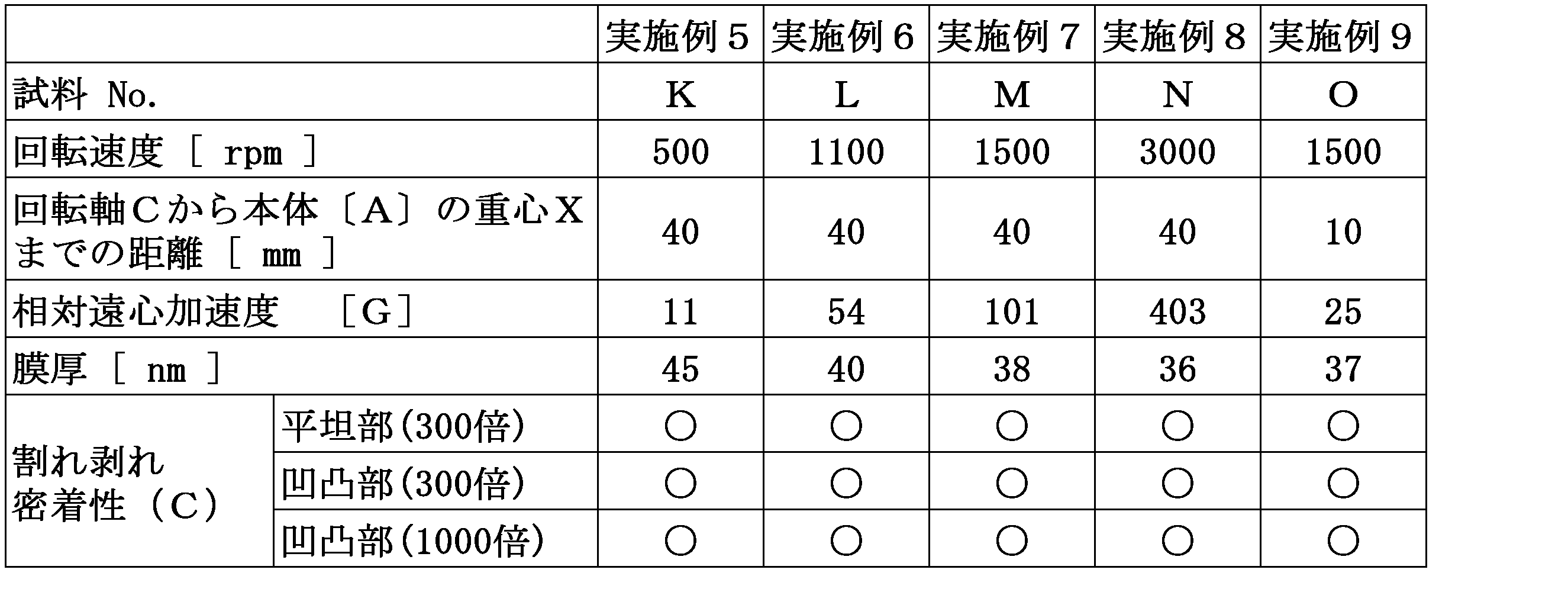
表3から明らかなように、相対遠心加速度が11G以上であれば、被覆膜に高い密着強度が得られると共に、立体構造物の凹凸部においても割れ剥がれが生じないことが確認された。 As apparent from Table 3, when the relative centrifugal acceleration is 11 G or more, high adhesion strength is obtained for the coating film, and it is confirmed that cracking and peeling do not occur even in the uneven portion of the three-dimensional structure.
本発明の生体活性を有する立体構造物は、表面に凹部及び/又は凸部を有する立体構造物本体の表面に、厚みの均一性が高い、チタンアルコキシド加水分解生成物よりなる被覆膜が、高い密着強度で被覆されている。そして、当該被覆膜は、ISO23317で規定された条件において評価を行ったときに生体活性を有する、すなわち優れた骨結合性を有するので、生体内において骨修復材料、関節補綴材料及び椎間ケージ等として好適に用いることができる。 In the bioactive three-dimensional structure of the present invention, a coating film made of a titanium alkoxide hydrolysis product having high thickness uniformity is provided on the surface of the three-dimensional structure body having a recess and / or a protrusion on the surface. It is coated with high adhesion strength. And since the said coating film has bioactivity when evaluated in the conditions prescribed | regulated to ISO23317, ie, it has the outstanding bone bonding property, in-vivo bone repair material, joint prosthetic material, and the intervertebral cage It can be suitably used as etc.
10 椎間ケージ
11 貫通孔
12 横孔
13 突条
15 側面部
16 上面部
17 下面部
50 凹凸部
51 溝
51a 一辺
51b 他辺
52,53,55 平面部
C 回転軸
S 回転基板
W 本体〔A〕
X 本体〔A〕の重心
Center of gravity of X body [A]
Claims (9)
前記被覆膜は、立体構造物の表面における凹部及び/又は凸部を走査型電子顕微鏡で300倍の倍率で観察したときに被覆膜の割れ剥がれが認められないものであり、
ISO23317で規定された条件において評価を行ったときに、生体活性を有するものであることを特徴とする生体活性を有する立体構造物。 Titanium alkoxide hydrolysis having a thickness of 10 to 200 nm, which is formed on a surface including a three-dimensional structure main body made of a polymer having concave and / or convex portions on the surface and the concave and / or convex portions in this three-dimensional structure main body And a covering film comprising the product,
The coating film is a film in which no cracking or peeling of the coating film is observed when a concave portion and / or a convex portion on the surface of the three-dimensional structure is observed with a scanning electron microscope at a magnification of 300 times.
A three-dimensional structure having bioactivity characterized by having bioactivity when evaluated under the conditions defined in ISO 23317.
有機溶媒37モル部に対してチタンアルコキシド0.08~1.5モル部と水とを混合することにより、チタンアルコキシド部分加水分解生成物よりなる被覆膜前駆体を含有する被覆膜前駆体分散液を調製する分散液調製工程と、
前記立体構造物本体の表面に前記被覆膜前駆体分散液を塗布する前駆体被覆工程と、当該立体構造物本体をその重心に遠心力が作用するよう回動させて、前記立体構造物本体の表面にチタンアルコキシド加水分解生成物よりなる被覆膜を形成する被覆膜形成工程と、
前記被覆膜を生体活性化処理する生体活性化処理工程と
を有することを特徴とする生体活性を有する立体構造物の製造方法。 A body preparation step of preparing a three-dimensional structure body having a recess and / or a protrusion on the surface;
A coating film precursor containing a coating film precursor comprising a titanium alkoxide partial hydrolysis product by mixing 0.08 to 1.5 mol parts of titanium alkoxide and water with respect to 37 mol parts of an organic solvent A dispersion preparation step of preparing a dispersion;
A precursor coating step of applying the coating film precursor dispersion to the surface of the three-dimensional structure body; and rotating the three-dimensional structure body so that a centrifugal force acts on its center of gravity, the three-dimensional structure body A coating film forming step of forming a coating film comprising a titanium alkoxide hydrolysis product on the surface of
And B. a bioactivation treatment step of bioactivation treatment of the coating film.
9. The method according to claim 6, wherein in the coating film forming step, the three-dimensional structure main body covered with the coating film is rotated and dried at a temperature of 50 to 200 ° C. The manufacturing method of the three-dimensional structure which has the biological activity as described in any one.
Priority Applications (3)
| Application Number | Priority Date | Filing Date | Title |
|---|---|---|---|
| US16/635,377 US20210069383A1 (en) | 2017-08-01 | 2018-07-06 | Three-dimensional structure having bioactivity and production method therefor |
| JP2019533998A JPWO2019026540A1 (en) | 2017-08-01 | 2018-07-06 | Bioactive three-dimensional structure and method for producing the same |
| EP18841574.9A EP3662938A4 (en) | 2017-08-01 | 2018-07-06 | THREE-DIMENSIONAL STRUCTURE WITH BIOLOGICAL ACTIVITY AND MANUFACTURING PROCESS FOR IT |
Applications Claiming Priority (2)
| Application Number | Priority Date | Filing Date | Title |
|---|---|---|---|
| JP2017148853 | 2017-08-01 | ||
| JP2017-148853 | 2017-08-01 |
Publications (1)
| Publication Number | Publication Date |
|---|---|
| WO2019026540A1 true WO2019026540A1 (en) | 2019-02-07 |
Family
ID=65232638
Family Applications (1)
| Application Number | Title | Priority Date | Filing Date |
|---|---|---|---|
| PCT/JP2018/025632 Ceased WO2019026540A1 (en) | 2017-08-01 | 2018-07-06 | Three-dimensional structure with biological activity and production method therefor |
Country Status (5)
| Country | Link |
|---|---|
| US (1) | US20210069383A1 (en) |
| EP (1) | EP3662938A4 (en) |
| JP (1) | JPWO2019026540A1 (en) |
| TW (1) | TW201919719A (en) |
| WO (1) | WO2019026540A1 (en) |
Cited By (2)
| Publication number | Priority date | Publication date | Assignee | Title |
|---|---|---|---|---|
| JP7546858B1 (en) * | 2023-03-24 | 2024-09-09 | 国立大学法人 東京医科歯科大学 | PEEK/TITANIUM COMPOSITE SPINAL CAGE AND ITS MANUFACTURING METHOD |
| WO2024203520A1 (en) * | 2023-03-24 | 2024-10-03 | 国立大学法人 東京医科歯科大学 | Spine cage composed of composite of peek and titanium, and production method therefor |
Families Citing this family (10)
| Publication number | Priority date | Publication date | Assignee | Title |
|---|---|---|---|---|
| US10709570B2 (en) | 2015-04-29 | 2020-07-14 | Institute for Musculoskeletal Science and Education, Ltd. | Implant with a diagonal insertion axis |
| US10449051B2 (en) | 2015-04-29 | 2019-10-22 | Institute for Musculoskeletal Science and Education, Ltd. | Implant with curved bone contacting elements |
| EP3288501B1 (en) | 2015-04-29 | 2020-11-25 | Institute For Musculoskeletal Science And Education, Ltd. | Coiled implants |
| US10492921B2 (en) | 2015-04-29 | 2019-12-03 | Institute for Musculoskeletal Science and Education, Ltd. | Implant with arched bone contacting elements |
| US10478312B2 (en) | 2016-10-25 | 2019-11-19 | Institute for Musculoskeletal Science and Education, Ltd. | Implant with protected fusion zones |
| US11033394B2 (en) | 2016-10-25 | 2021-06-15 | Institute for Musculoskeletal Science and Education, Ltd. | Implant with multi-layer bone interfacing lattice |
| US10512549B2 (en) | 2017-03-13 | 2019-12-24 | Institute for Musculoskeletal Science and Education, Ltd. | Implant with structural members arranged around a ring |
| US10357377B2 (en) | 2017-03-13 | 2019-07-23 | Institute for Musculoskeletal Science and Education, Ltd. | Implant with bone contacting elements having helical and undulating planar geometries |
| US10744001B2 (en) | 2017-11-21 | 2020-08-18 | Institute for Musculoskeletal Science and Education, Ltd. | Implant with improved bone contact |
| US10940015B2 (en) | 2017-11-21 | 2021-03-09 | Institute for Musculoskeletal Science and Education, Ltd. | Implant with improved flow characteristics |
Citations (5)
| Publication number | Priority date | Publication date | Assignee | Title |
|---|---|---|---|---|
| JP2006502762A (en) * | 2002-09-17 | 2006-01-26 | ビオサー−エントヴィックルングス−ゲーエムベーハー | Biocompatible titanium oxide coating for implants resistant to infection and method for its preparation |
| JP2010501309A (en) * | 2006-09-01 | 2010-01-21 | ビオサー−エントヴィックルングス−ゲーエムベーハー | Structural coatings for implants and methods for their production |
| JP2014514124A (en) * | 2011-05-11 | 2014-06-19 | デントスプリー・アイエイチ・エービー | Biocompatible material |
| JP2015511666A (en) * | 2012-03-02 | 2015-04-20 | シンセス・ゲーエムベーハーSynthes GmbH | Anodized titanium apparatus and related methods |
| JP2015136553A (en) | 2014-01-24 | 2015-07-30 | 学校法人中部大学 | Bone repair material based on PEEK and method for producing the same |
Family Cites Families (1)
| Publication number | Priority date | Publication date | Assignee | Title |
|---|---|---|---|---|
| US20120304671A1 (en) * | 2011-04-05 | 2012-12-06 | Institute | Mixed-phase generator and use thereof |
-
2018
- 2018-07-06 WO PCT/JP2018/025632 patent/WO2019026540A1/en not_active Ceased
- 2018-07-06 EP EP18841574.9A patent/EP3662938A4/en not_active Withdrawn
- 2018-07-06 JP JP2019533998A patent/JPWO2019026540A1/en active Pending
- 2018-07-06 US US16/635,377 patent/US20210069383A1/en not_active Abandoned
- 2018-07-19 TW TW107124906A patent/TW201919719A/en unknown
Patent Citations (8)
| Publication number | Priority date | Publication date | Assignee | Title |
|---|---|---|---|---|
| JP2006502762A (en) * | 2002-09-17 | 2006-01-26 | ビオサー−エントヴィックルングス−ゲーエムベーハー | Biocompatible titanium oxide coating for implants resistant to infection and method for its preparation |
| JP4606165B2 (en) | 2002-09-17 | 2011-01-05 | ビオサー−エントヴィックルングス−ゲーエムベーハー | Biocompatible titanium oxide coating for implants resistant to infection and method for its preparation |
| JP2010501309A (en) * | 2006-09-01 | 2010-01-21 | ビオサー−エントヴィックルングス−ゲーエムベーハー | Structural coatings for implants and methods for their production |
| JP5271907B2 (en) | 2006-09-01 | 2013-08-21 | ビオサー−エントヴィックルングス−ゲーエムベーハー | Structural coatings for implants and methods for their production |
| JP2014514124A (en) * | 2011-05-11 | 2014-06-19 | デントスプリー・アイエイチ・エービー | Biocompatible material |
| JP6073293B2 (en) | 2011-05-11 | 2017-02-01 | デントスプリー・アイエイチ・エービーDentsply Ih Ab | Biocompatible material |
| JP2015511666A (en) * | 2012-03-02 | 2015-04-20 | シンセス・ゲーエムベーハーSynthes GmbH | Anodized titanium apparatus and related methods |
| JP2015136553A (en) | 2014-01-24 | 2015-07-30 | 学校法人中部大学 | Bone repair material based on PEEK and method for producing the same |
Non-Patent Citations (4)
| Title |
|---|
| BALAS, F. ET AL.: "Bonelike apatite formation titania-coated synthetic polymers", PROCEEDINGS OF THE 25TH CONFERENCE OF JAPANESE SOCIETY FOR BIOMATERIALS, 2013, pages 161 * |
| See also references of EP3662938A4 |
| TAKASHI KIZUKI ET AL.: "Apatite-forming PEEK with Ti02 surface layer coating", J MATER SCI: MATER MED, vol. 26, 2015, pages 41 |
| TAKAYOSHI SHIMIZU : "Bioactivity evaluation of PEEK coated with Ti02 by sol-gel method in dog anterior cervical fusion model", JOURNAL OF SPINE RESEARCH, vol. 8, no. 3, 28 February 2017 (2017-02-28), pages 676, XP009518874, ISSN: 1884-7137 * |
Cited By (2)
| Publication number | Priority date | Publication date | Assignee | Title |
|---|---|---|---|---|
| JP7546858B1 (en) * | 2023-03-24 | 2024-09-09 | 国立大学法人 東京医科歯科大学 | PEEK/TITANIUM COMPOSITE SPINAL CAGE AND ITS MANUFACTURING METHOD |
| WO2024203520A1 (en) * | 2023-03-24 | 2024-10-03 | 国立大学法人 東京医科歯科大学 | Spine cage composed of composite of peek and titanium, and production method therefor |
Also Published As
| Publication number | Publication date |
|---|---|
| EP3662938A4 (en) | 2021-04-28 |
| EP3662938A1 (en) | 2020-06-10 |
| TW201919719A (en) | 2019-06-01 |
| US20210069383A1 (en) | 2021-03-11 |
| JPWO2019026540A1 (en) | 2020-06-11 |
Similar Documents
| Publication | Publication Date | Title |
|---|---|---|
| WO2019026540A1 (en) | Three-dimensional structure with biological activity and production method therefor | |
| Alipal et al. | Evolution of anodised titanium for implant applications | |
| Manabe et al. | Biocompatible slippery fluid-infused films composed of chitosan and alginate via layer-by-layer self-assembly and their antithrombogenicity | |
| Zahran et al. | Effect of hydrofluoric acid etching time on titanium topography, chemistry, wettability, and cell adhesion | |
| Paterlini et al. | The role played by modified bioinspired surfaces in interfacial properties of biomaterials | |
| Minagar et al. | Fabrication and characterization of nanoporous niobia, and nanotubular tantala, titania and zirconia via anodization | |
| Kim et al. | Chemically robust antifog nanocoating through multilayer deposition of silica composite nanofilms | |
| CN103180059A (en) | Engineered surfaces for reducing bacterial adhesion | |
| Mahadik et al. | Biocompatible superhydrophobic coating material for biomedical applications | |
| TW201434738A (en) | Anti-fog nanotextured surfaces and articles containing the same | |
| EP3642153B1 (en) | Nanostructured transparent article with both hydrophobic and antifog properties and methods for making it | |
| CN104258459B (en) | Medical titanium implant and preparation method thereof | |
| Casagrande et al. | Pretreatment effect of the pure titanium surface on hybrid coating adhesion based on tetraethoxysilane and methyltriethoxysilane | |
| Zhou et al. | Fabrication of a hydrophilic low-friction poly (hydroxyethyl methacrylate) coating on silicon rubber | |
| Nahum et al. | Surface properties of Ti65Zr alloy modified with TiZr oxide and hydroxyapatite | |
| Malakauskaite-Petruleviciene et al. | Sol–gel synthesis of calcium hydroxyapatite thin films on quartz substrate using dip-coating and spin-coating techniques | |
| Conradi et al. | Fine-tuning of surface properties of dual-size TiO2 nanoparticle coatings | |
| Kongsong et al. | Effect of different chemical etching solutions on physical and chemical surface properties of commercially pure titanium grade 2 | |
| CN103520776B (en) | Medical titanium substrate material and manufacturing method thereof | |
| Stewart et al. | Utilizing lubricant loss from omniphobic coatings as a multifunctional delivery mechanism | |
| WO2019026539A1 (en) | THREE DIMENSIONAL STRUCTURE, METHOD FOR MANUFACTURING SAME, AND COATING DEVICE | |
| Lee et al. | Micro/nanostructure-based surface modification after electropolishing of TiAl6V4 manufactured by selective laser melting process: superhydrophilic, superhydrophobic, SLIPS | |
| Grumezescu et al. | Nanocoatings and thin films | |
| Nowińska et al. | Anodic production and characterization of biomimetic oxide layers on grade 4 titanium for medical applications | |
| Leppäniemi et al. | Non‐stick properties of thin‐film coatings on dental‐restorative instruments |
Legal Events
| Date | Code | Title | Description |
|---|---|---|---|
| 121 | Ep: the epo has been informed by wipo that ep was designated in this application |
Ref document number: 18841574 Country of ref document: EP Kind code of ref document: A1 |
|
| ENP | Entry into the national phase |
Ref document number: 2019533998 Country of ref document: JP Kind code of ref document: A |
|
| NENP | Non-entry into the national phase |
Ref country code: DE |
|
| ENP | Entry into the national phase |
Ref document number: 2018841574 Country of ref document: EP Effective date: 20200302 |