WO2018222366A2 - Atomic layer deposition of stable lithium ion conductive interfacial layer for stable cathode cycling - Google Patents
Atomic layer deposition of stable lithium ion conductive interfacial layer for stable cathode cycling Download PDFInfo
- Publication number
- WO2018222366A2 WO2018222366A2 PCT/US2018/032008 US2018032008W WO2018222366A2 WO 2018222366 A2 WO2018222366 A2 WO 2018222366A2 US 2018032008 W US2018032008 W US 2018032008W WO 2018222366 A2 WO2018222366 A2 WO 2018222366A2
- Authority
- WO
- WIPO (PCT)
- Prior art keywords
- lithium
- coated
- interfacial layer
- cathode material
- ald
- Prior art date
- Legal status (The legal status is an assumption and is not a legal conclusion. Google has not performed a legal analysis and makes no representation as to the accuracy of the status listed.)
- Ceased
Links
Classifications
-
- H—ELECTRICITY
- H01—ELECTRIC ELEMENTS
- H01M—PROCESSES OR MEANS, e.g. BATTERIES, FOR THE DIRECT CONVERSION OF CHEMICAL ENERGY INTO ELECTRICAL ENERGY
- H01M4/00—Electrodes
- H01M4/02—Electrodes composed of, or comprising, active material
- H01M4/36—Selection of substances as active materials, active masses, active liquids
- H01M4/362—Composites
- H01M4/366—Composites as layered products
-
- C—CHEMISTRY; METALLURGY
- C23—COATING METALLIC MATERIAL; COATING MATERIAL WITH METALLIC MATERIAL; CHEMICAL SURFACE TREATMENT; DIFFUSION TREATMENT OF METALLIC MATERIAL; COATING BY VACUUM EVAPORATION, BY SPUTTERING, BY ION IMPLANTATION OR BY CHEMICAL VAPOUR DEPOSITION, IN GENERAL; INHIBITING CORROSION OF METALLIC MATERIAL OR INCRUSTATION IN GENERAL
- C23C—COATING METALLIC MATERIAL; COATING MATERIAL WITH METALLIC MATERIAL; SURFACE TREATMENT OF METALLIC MATERIAL BY DIFFUSION INTO THE SURFACE, BY CHEMICAL CONVERSION OR SUBSTITUTION; COATING BY VACUUM EVAPORATION, BY SPUTTERING, BY ION IMPLANTATION OR BY CHEMICAL VAPOUR DEPOSITION, IN GENERAL
- C23C16/00—Chemical coating by decomposition of gaseous compounds, without leaving reaction products of surface material in the coating, i.e. chemical vapour deposition [CVD] processes
- C23C16/22—Chemical coating by decomposition of gaseous compounds, without leaving reaction products of surface material in the coating, i.e. chemical vapour deposition [CVD] processes characterised by the deposition of inorganic material, other than metallic material
- C23C16/30—Deposition of compounds, mixtures or solid solutions, e.g. borides, carbides, nitrides
-
- C—CHEMISTRY; METALLURGY
- C23—COATING METALLIC MATERIAL; COATING MATERIAL WITH METALLIC MATERIAL; CHEMICAL SURFACE TREATMENT; DIFFUSION TREATMENT OF METALLIC MATERIAL; COATING BY VACUUM EVAPORATION, BY SPUTTERING, BY ION IMPLANTATION OR BY CHEMICAL VAPOUR DEPOSITION, IN GENERAL; INHIBITING CORROSION OF METALLIC MATERIAL OR INCRUSTATION IN GENERAL
- C23C—COATING METALLIC MATERIAL; COATING MATERIAL WITH METALLIC MATERIAL; SURFACE TREATMENT OF METALLIC MATERIAL BY DIFFUSION INTO THE SURFACE, BY CHEMICAL CONVERSION OR SUBSTITUTION; COATING BY VACUUM EVAPORATION, BY SPUTTERING, BY ION IMPLANTATION OR BY CHEMICAL VAPOUR DEPOSITION, IN GENERAL
- C23C16/00—Chemical coating by decomposition of gaseous compounds, without leaving reaction products of surface material in the coating, i.e. chemical vapour deposition [CVD] processes
- C23C16/44—Chemical coating by decomposition of gaseous compounds, without leaving reaction products of surface material in the coating, i.e. chemical vapour deposition [CVD] processes characterised by the method of coating
- C23C16/455—Chemical coating by decomposition of gaseous compounds, without leaving reaction products of surface material in the coating, i.e. chemical vapour deposition [CVD] processes characterised by the method of coating characterised by the method used for introducing gases into reaction chamber or for modifying gas flows in reaction chamber
- C23C16/45523—Pulsed gas flow or change of composition over time
- C23C16/45525—Atomic layer deposition [ALD]
- C23C16/45527—Atomic layer deposition [ALD] characterized by the ALD cycle, e.g. different flows or temperatures during half-reactions, unusual pulsing sequence, use of precursor mixtures or auxiliary reactants or activations
- C23C16/45531—Atomic layer deposition [ALD] characterized by the ALD cycle, e.g. different flows or temperatures during half-reactions, unusual pulsing sequence, use of precursor mixtures or auxiliary reactants or activations specially adapted for making ternary or higher compositions
-
- C—CHEMISTRY; METALLURGY
- C23—COATING METALLIC MATERIAL; COATING MATERIAL WITH METALLIC MATERIAL; CHEMICAL SURFACE TREATMENT; DIFFUSION TREATMENT OF METALLIC MATERIAL; COATING BY VACUUM EVAPORATION, BY SPUTTERING, BY ION IMPLANTATION OR BY CHEMICAL VAPOUR DEPOSITION, IN GENERAL; INHIBITING CORROSION OF METALLIC MATERIAL OR INCRUSTATION IN GENERAL
- C23C—COATING METALLIC MATERIAL; COATING MATERIAL WITH METALLIC MATERIAL; SURFACE TREATMENT OF METALLIC MATERIAL BY DIFFUSION INTO THE SURFACE, BY CHEMICAL CONVERSION OR SUBSTITUTION; COATING BY VACUUM EVAPORATION, BY SPUTTERING, BY ION IMPLANTATION OR BY CHEMICAL VAPOUR DEPOSITION, IN GENERAL
- C23C16/00—Chemical coating by decomposition of gaseous compounds, without leaving reaction products of surface material in the coating, i.e. chemical vapour deposition [CVD] processes
- C23C16/44—Chemical coating by decomposition of gaseous compounds, without leaving reaction products of surface material in the coating, i.e. chemical vapour deposition [CVD] processes characterised by the method of coating
- C23C16/455—Chemical coating by decomposition of gaseous compounds, without leaving reaction products of surface material in the coating, i.e. chemical vapour deposition [CVD] processes characterised by the method of coating characterised by the method used for introducing gases into reaction chamber or for modifying gas flows in reaction chamber
- C23C16/45523—Pulsed gas flow or change of composition over time
- C23C16/45525—Atomic layer deposition [ALD]
- C23C16/45553—Atomic layer deposition [ALD] characterized by the use of precursors specially adapted for ALD
-
- C—CHEMISTRY; METALLURGY
- C23—COATING METALLIC MATERIAL; COATING MATERIAL WITH METALLIC MATERIAL; CHEMICAL SURFACE TREATMENT; DIFFUSION TREATMENT OF METALLIC MATERIAL; COATING BY VACUUM EVAPORATION, BY SPUTTERING, BY ION IMPLANTATION OR BY CHEMICAL VAPOUR DEPOSITION, IN GENERAL; INHIBITING CORROSION OF METALLIC MATERIAL OR INCRUSTATION IN GENERAL
- C23C—COATING METALLIC MATERIAL; COATING MATERIAL WITH METALLIC MATERIAL; SURFACE TREATMENT OF METALLIC MATERIAL BY DIFFUSION INTO THE SURFACE, BY CHEMICAL CONVERSION OR SUBSTITUTION; COATING BY VACUUM EVAPORATION, BY SPUTTERING, BY ION IMPLANTATION OR BY CHEMICAL VAPOUR DEPOSITION, IN GENERAL
- C23C16/00—Chemical coating by decomposition of gaseous compounds, without leaving reaction products of surface material in the coating, i.e. chemical vapour deposition [CVD] processes
- C23C16/44—Chemical coating by decomposition of gaseous compounds, without leaving reaction products of surface material in the coating, i.e. chemical vapour deposition [CVD] processes characterised by the method of coating
- C23C16/455—Chemical coating by decomposition of gaseous compounds, without leaving reaction products of surface material in the coating, i.e. chemical vapour deposition [CVD] processes characterised by the method of coating characterised by the method used for introducing gases into reaction chamber or for modifying gas flows in reaction chamber
- C23C16/45523—Pulsed gas flow or change of composition over time
- C23C16/45525—Atomic layer deposition [ALD]
- C23C16/45555—Atomic layer deposition [ALD] applied in non-semiconductor technology
-
- H—ELECTRICITY
- H01—ELECTRIC ELEMENTS
- H01M—PROCESSES OR MEANS, e.g. BATTERIES, FOR THE DIRECT CONVERSION OF CHEMICAL ENERGY INTO ELECTRICAL ENERGY
- H01M10/00—Secondary cells; Manufacture thereof
- H01M10/05—Accumulators with non-aqueous electrolyte
- H01M10/052—Li-accumulators
- H01M10/0525—Rocking-chair batteries, i.e. batteries with lithium insertion or intercalation in both electrodes; Lithium-ion batteries
-
- H—ELECTRICITY
- H01—ELECTRIC ELEMENTS
- H01M—PROCESSES OR MEANS, e.g. BATTERIES, FOR THE DIRECT CONVERSION OF CHEMICAL ENERGY INTO ELECTRICAL ENERGY
- H01M4/00—Electrodes
- H01M4/02—Electrodes composed of, or comprising, active material
- H01M4/04—Processes of manufacture in general
- H01M4/0402—Methods of deposition of the material
- H01M4/0404—Methods of deposition of the material by coating on electrode collectors
-
- H—ELECTRICITY
- H01—ELECTRIC ELEMENTS
- H01M—PROCESSES OR MEANS, e.g. BATTERIES, FOR THE DIRECT CONVERSION OF CHEMICAL ENERGY INTO ELECTRICAL ENERGY
- H01M4/00—Electrodes
- H01M4/02—Electrodes composed of, or comprising, active material
- H01M4/04—Processes of manufacture in general
- H01M4/0402—Methods of deposition of the material
- H01M4/0421—Methods of deposition of the material involving vapour deposition
-
- H—ELECTRICITY
- H01—ELECTRIC ELEMENTS
- H01M—PROCESSES OR MEANS, e.g. BATTERIES, FOR THE DIRECT CONVERSION OF CHEMICAL ENERGY INTO ELECTRICAL ENERGY
- H01M4/00—Electrodes
- H01M4/02—Electrodes composed of, or comprising, active material
- H01M4/04—Processes of manufacture in general
- H01M4/0402—Methods of deposition of the material
- H01M4/0421—Methods of deposition of the material involving vapour deposition
- H01M4/0428—Chemical vapour deposition
-
- H—ELECTRICITY
- H01—ELECTRIC ELEMENTS
- H01M—PROCESSES OR MEANS, e.g. BATTERIES, FOR THE DIRECT CONVERSION OF CHEMICAL ENERGY INTO ELECTRICAL ENERGY
- H01M4/00—Electrodes
- H01M4/02—Electrodes composed of, or comprising, active material
- H01M4/13—Electrodes for accumulators with non-aqueous electrolyte, e.g. for lithium-accumulators; Processes of manufacture thereof
- H01M4/131—Electrodes based on mixed oxides or hydroxides, or on mixtures of oxides or hydroxides, e.g. LiCoOx
-
- H—ELECTRICITY
- H01—ELECTRIC ELEMENTS
- H01M—PROCESSES OR MEANS, e.g. BATTERIES, FOR THE DIRECT CONVERSION OF CHEMICAL ENERGY INTO ELECTRICAL ENERGY
- H01M4/00—Electrodes
- H01M4/02—Electrodes composed of, or comprising, active material
- H01M4/13—Electrodes for accumulators with non-aqueous electrolyte, e.g. for lithium-accumulators; Processes of manufacture thereof
- H01M4/139—Processes of manufacture
- H01M4/1391—Processes of manufacture of electrodes based on mixed oxides or hydroxides, or on mixtures of oxides or hydroxides, e.g. LiCoOx
-
- H—ELECTRICITY
- H01—ELECTRIC ELEMENTS
- H01M—PROCESSES OR MEANS, e.g. BATTERIES, FOR THE DIRECT CONVERSION OF CHEMICAL ENERGY INTO ELECTRICAL ENERGY
- H01M4/00—Electrodes
- H01M4/02—Electrodes composed of, or comprising, active material
- H01M4/36—Selection of substances as active materials, active masses, active liquids
- H01M4/48—Selection of substances as active materials, active masses, active liquids of inorganic oxides or hydroxides
- H01M4/50—Selection of substances as active materials, active masses, active liquids of inorganic oxides or hydroxides of manganese
- H01M4/505—Selection of substances as active materials, active masses, active liquids of inorganic oxides or hydroxides of manganese of mixed oxides or hydroxides containing manganese for inserting or intercalating light metals, e.g. LiMn2O4 or LiMn2OxFy
-
- H—ELECTRICITY
- H01—ELECTRIC ELEMENTS
- H01M—PROCESSES OR MEANS, e.g. BATTERIES, FOR THE DIRECT CONVERSION OF CHEMICAL ENERGY INTO ELECTRICAL ENERGY
- H01M4/00—Electrodes
- H01M4/02—Electrodes composed of, or comprising, active material
- H01M4/36—Selection of substances as active materials, active masses, active liquids
- H01M4/48—Selection of substances as active materials, active masses, active liquids of inorganic oxides or hydroxides
- H01M4/52—Selection of substances as active materials, active masses, active liquids of inorganic oxides or hydroxides of nickel, cobalt or iron
- H01M4/525—Selection of substances as active materials, active masses, active liquids of inorganic oxides or hydroxides of nickel, cobalt or iron of mixed oxides or hydroxides containing iron, cobalt or nickel for inserting or intercalating light metals, e.g. LiNiO2, LiCoO2 or LiCoOxFy
-
- H—ELECTRICITY
- H01—ELECTRIC ELEMENTS
- H01M—PROCESSES OR MEANS, e.g. BATTERIES, FOR THE DIRECT CONVERSION OF CHEMICAL ENERGY INTO ELECTRICAL ENERGY
- H01M4/00—Electrodes
- H01M4/02—Electrodes composed of, or comprising, active material
- H01M4/62—Selection of inactive substances as ingredients for active masses, e.g. binders, fillers
- H01M4/628—Inhibitors, e.g. gassing inhibitors, corrosion inhibitors
-
- Y—GENERAL TAGGING OF NEW TECHNOLOGICAL DEVELOPMENTS; GENERAL TAGGING OF CROSS-SECTIONAL TECHNOLOGIES SPANNING OVER SEVERAL SECTIONS OF THE IPC; TECHNICAL SUBJECTS COVERED BY FORMER USPC CROSS-REFERENCE ART COLLECTIONS [XRACs] AND DIGESTS
- Y02—TECHNOLOGIES OR APPLICATIONS FOR MITIGATION OR ADAPTATION AGAINST CLIMATE CHANGE
- Y02E—REDUCTION OF GREENHOUSE GAS [GHG] EMISSIONS, RELATED TO ENERGY GENERATION, TRANSMISSION OR DISTRIBUTION
- Y02E60/00—Enabling technologies; Technologies with a potential or indirect contribution to GHG emissions mitigation
- Y02E60/10—Energy storage using batteries
Definitions
- a coated cathode material includes a cathode active material and an interfacial layer coating the cathode active material.
- the interfacial layer includes a lithium-containing fluoride which includes at least one additional metal different from lithium.
- a method of forming a coated cathode material includes providing a cathode active material and forming, via atomic layer deposition, an interfacial layer coating the cathode active material.
- the interfacial layer includes a lithium-containing fluoride which includes at least one additional metal different from lithium.
- Figure 1 Calculated electrochemical stability windows of Li 3 N, Li 2 0, LiF, LiA10 2 , L1PO 4 and L1AIF 4 .
- the windows of the first five candidates are reported values (see the methods section and supporting information for detailed calculation of the decomposition potentials and reactions); Density functional theory (DFT) is used to calculate the window of L1AIF 4 .
- the operating electrochemical window of LiNio .8 Mn 0. iCoo . i0 2 (NMC-811) and typical operation electrochemical window of LiCo0 2 are included for comparison;
- selection criteria chemical stability, electrochemical stability and Li ion conductivity
- FIG. 1 (a-c) Thickness characterizations of LiF, A1F 3 and L1AIF 4 films with different atomic layer deposition (ALD) cycle numbers, (d-f) Scanning electron microscopy (SEM) characterizations of ALD grown LiF, A1F 3 and L1AIF 4 films on silicon wafers. Inset images are cross section views.
- Figure 3 X-ray photoelectron spectroscopy (XPS) Characterizations, (a) XPS characterizations of ALD grown LiF, A1F 3 and L1AIF 4 films; (b) depth profile of L1AIF 4 film prepared by ALD; (c-e) fine XPS scans of Li Is peaks, Al 2p peaks and F Is peaks of LiF, A1F 3 and L1AIF 4 films.
- XPS X-ray photoelectron spectroscopy
- FIG. 4 Electrochemical impedance spectroscopy (EIS) characterizations of L1AIF 4 films with different thicknesses at room temperature - inset shows the EIS characterization setup; (b) enlarged EIS spectra shown in Figure 4a - inset shows the corresponding circuit; (c) EIS characterizations at different temperatures; (d) conductivity vs. temperature plot of LiAlF 4 film and reported lithium ion conductivities of evaporated LiF and AIF 3 films, ALD deposited L1AIO 2 and ALD deposited lithium phosphorus oxynitride (LiPON) films.
- EIS Electrochemical impedance spectroscopy
- FIG. 5 Rate performance of pristine, 20 cycles ALD L1AIF 4 coated, 20 cycles ALD LiF coated, 20 cycles ALD A1F 3 coated MC-811 electrodes at room temperature with an electrochemical window of about 2.75-4.50 V vs. Li + /Li; (b, c) voltage vs. capacity plots of pristine, 20 cycles ALD L1AIF 4 coated, 20 cycles ALD LiF coated, 20 cycles ALD A1F 3 coated NMC-811 electrodes at 5 th cycle and 35 th cycle, respectively.
- Figure 6. (a) Cycle performance of pristine and 20 cycles ALD L1AIF 4 coated NMC-811 electrodes at room temperature with an electrochemical window of about 2.75- 4.50 V vs. Li + /Li; (b-c) EIS characterizations of pristine and 20 cycles ALD L1AIF 4 coated NMC-811 electrodes after 1 st , 10 th , 25 th and 50 th cycle; (d) voltage vs.
- Figure 7 Phase diagram of Li-Al-F and formation energies of various Li-Al-F compounds.
- Figure 8. (a) XPS characterizations of ALD LiF films grown at different temperatures; (b) refractive index (n) and extinction coefficient (k) of ALD LiF film; (c) growth rate per cycle of ALD LiF at different temperatures.
- Figure 9 (a) XPS characterizations of ALD LiF before and after sputtering; (b) chemical compositions of ALD LiF film analyzed by XPS; (c) XPS characterizations of ALD AIF 3 before (left bar) and after sputtering (right bar); (d) chemical compositions of ALD A1F 3 film analyzed by XPS before (left bar) and after sputtering (right bar).
- Figure 10 (a, b) Lithium ion conductivity measurements using EIS; (c) conductivity vs. temperature plot of L1AIF 4 film.
- Figure 11 (a, b) SEM characterizations of NMC-811; (c) X-ray diffraction (XRD) characterization of pristine NMC-811; (d) Inductively coupled plasma-mass spectrometry (ICP-MS) characterization of pristine NMC-811.
- XRD X-ray diffraction
- ICP-MS Inductively coupled plasma-mass spectrometry
- Figure 12. (a) Cycle performance of pristine NMC-811 electrodes at room temperature with electrochemical windows of about 2.75-4.20 V and about 2.75-4.50 V vs. Li + /Li.
- Figure 13. (a) Cycle performance of 20 cycles ALD LiAlF 4 coated NMC-811 electrodes with an electrochemical window of about 2.75-4.50 V vs. Li + /Li at room temperature. Three cells were tested at about 50 mA/g.
- FIG. 14 Cathode including a coated cathode material according to some embodiments.
- Figure 15 Coated cathode material according to other embodiments.
- FIG. 16 Battery including a coated cathode material according to some embodiments.
- Cathode including a coated cathode material :
- FIG 14 shows a cathode 100 including a coated cathode material 102 according to some embodiments.
- the coated cathode material 102 includes particles 104 of a cathode active material, and an interfacial layer 106 which conformally coats or covers individual ones of the particles 104.
- the cathode 100 also includes a polymeric binder 108 and conductive additives 110, such as carbonaceous or metallic additives, and the particles 104 each coated with the interfacial layer 106 are dispersed in the polymeric binder 108 along with the conductive additives 110, which are disposed over or adjacent to a current collector 112.
- the coated cathode material 102 can take on other shapes or configurations, such as a planar configuration of a film 114 including the cathode active material, and the interfacial layer 106 which coats or covers a surface of the film 114.
- Other cathode active materials are encompassed by this disclosure, such as lithium cobalt oxide (e.g., L1C0O 2 ), lithium iron phosphate (e.g., LiFeP0 4 ), and lithium manganese oxide (e.g., LiMn 2 0 4 ).
- the particles 104 of the cathode active material are provided as micron-sized particles, but also can be provided as nano-sized particles.
- the particles 104 can have sizes in a range of about 10 nm to about 100 ⁇ , such as about 10 nm to about 500 nm, about 500 nm to about 1 ⁇ , about 500 nm to about 10 ⁇ , about 1 ⁇ to about 10 ⁇ , or about 10 ⁇ to about 100 ⁇ .
- the interfacial layer 106 includes a lithium-containing compound.
- the lithium-containing compound is a lithium-containing halide, such as a lithium-containing fluoride.
- the lithium-containing compound, such as a lithium-containing fluoride includes at least one additional metal different from lithium.
- the additional metal is a Group 13 metal, such as aluminum.
- the additional metal is another post-transition metal or a transition metal.
- the lithium-containing compound is a lithium aluminum fluoride represented as Li x Al y F z where 0.5 ⁇ x ⁇ 3.5 (or 0.5 ⁇ x ⁇ 1.5 or 1 ⁇ x ⁇ 1.4 or 2.5 ⁇ x ⁇ 3.5 or 2.8 ⁇ x ⁇ 3.2), 0.5 ⁇ y ⁇ 1.5 (or 0.8 ⁇ y ⁇ 1.2), and 3.5 ⁇ z ⁇ 6.5 (or 3.5 ⁇ z ⁇ 5 or 4 ⁇ z ⁇ 4.8 or 5.5 ⁇ z ⁇ 6.5 or 5.8 ⁇ z ⁇ 6.2).
- an atomic ratio of Li:Al is about 1 or greater than about 1, such as about 2 or greater, about 2.5 or greater, or about 3 or greater.
- an atomic ratio of F:Li is about 1 or greater than about 1, such as about 1.5 or greater, about 2 or greater, or about 3 or greater, or about 4 or greater.
- the lithium-containing compound is LiAlF 4 or Li 3 AlF 6 .
- Other ternary or higher order compounds are encompassed by this disclosure.
- the above relationships expressed with respect to Al is more generally applicable to other metals included as the additional metal different from lithium.
- the lithium-containing compound has a lithium ion conductivity of at least about 1 ⁇ 10 ⁇ 10 S/cm, at least about 5 ⁇ 10 ⁇ 10 S/cm, at least about 1 ⁇ 10 ⁇ 9 S/cm, at least about 5 10 ⁇ 9 S/cm, at least about 1 ⁇ 10 ⁇ 8 S/cm, or at least about 3 ⁇ 10 ⁇ 9 S/cm, as measured at 25 °C.
- the lithium-containing compound has a reduction potential no greater than about 2.8 V vs. Li/Li + , no greater than about 2.7 V vs. Li/Li + , no greater than about 2.6 V vs. Li/Li + , no greater than about 2.5 V vs. Li/Li + , no greater than about 2.4 V vs. Li/Li + , no greater than about 2.3 V vs. Li/Li + , no greater than about 2.2 V vs. Li/Li + , or no greater than about 2.1 V vs. Li/Li + .
- the lithium-containing compound has an oxidation potential of at least about 4.5 V vs. Li/Li + , at least about 4.7 V vs. Li/Li + , at least about 4.9 V vs. Li/Li + , at least about 5.1 V vs. Li/Li + , at least about 5.3 V vs. Li/Li + , at least about 5.5 V vs. Li/Li + , or at least about 5.7 V vs. Li/Li + .
- a thickness of the interfacial layer 106 is in a range of about 1 nm to about 200 nm, such as about 1 nm to about 150 nm, about 1 nm to about 100 nm, about 1 nm to about 80 ⁇ , about 1 nm to about 60 ⁇ , about 1 nm to about 40 nm, about 1 nm to about 20 nm, or about 1 nm to about 10 nm.
- the lithium-containing compound is at least primarily crystalline by weight or volume, such as at least about 51%, at least about 55%, at least about 60%, at least about 70%, or at least about 80%.
- the interfacial layer 106 is at least primarily amorphous by weight or volume.
- a method of forming a coated cathode material includes providing a cathode active material, and forming, via atomic layer deposition, an interfacial layer which coats or covers the cathode active material.
- the cathode active material is provided as particles of the cathode active material, and the interfacial layer is formed so as to coat or cover individual ones of the particles.
- the cathode active material can take on other shapes or configurations, such as a planar configuration of a film including the cathode active material, and the interfacial layer is formed so as to coat or cover a surface of the film.
- the interfacial layer includes a lithium- containing compound.
- the lithium-containing compound is a lithium- containing halide, such as a lithium-containing fluoride.
- the lithium- containing compound, such as a lithium-containing fluoride includes at least one additional metal different from lithium.
- the additional metal is a Group 13 metal, such as aluminum.
- the additional metal is another post-transition metal or a transition metal.
- the lithium-containing compound is a lithium aluminum fluoride represented as Li x Al y F z where 0.5 ⁇ x ⁇ 3.5 (or 0.5 ⁇ x ⁇ 1.5 or 1 ⁇ x ⁇ 1.4 or 2.5 ⁇ x ⁇ 3.5 or 2.8 ⁇ x ⁇ 3.2), 0.5 ⁇ y ⁇ 1.5 (or 0.8 ⁇ y ⁇ 1.2), and 3.5 ⁇ z ⁇ 6.5 (or 3.5 ⁇ z ⁇ 5 or 4 ⁇ z ⁇ 4.8 or 5.5 ⁇ z ⁇ 6.5 or 5.8 ⁇ z ⁇ 6.2).
- an atomic ratio of Li:Al is about 1 or greater than about 1, such as about 2 or greater, about 2.5 or greater, or about 3 or greater.
- an atomic ratio of F:Li is about 1 or greater than about 1, such as about 1.5 or greater, about 2 or greater, or about 3 or greater, or about 4 or greater.
- the lithium-containing compound is LiAlF 4 or Li 3 AlF 6 .
- Other ternary or higher order compounds are encompassed by this disclosure.
- the above relationships expressed with respect to Al is more generally applicable to other metals included as the additional metal different from lithium.
- the method of forming the coated cathode material includes sequentially performing a first atomic layer deposition cycle to deposit a lithium-containing fluoride on the cathode active material, followed by performing a second atomic layer deposition cycle to deposit a fluoride containing the additional metal, such as an aluminum-containing fluoride.
- the first deposition cycle and the second deposition cycle can be repeated sequentially to form the interfacial layer having a desired thickness. It is noted that the first deposition cycle can be repeated multiple times before the second deposition cycle, and that the second deposition cycle can be repeated multiple times before the first deposition cycle. It is also noted that either deposition cycle can be performed first.
- performing the first deposition cycle includes sequentially introducing deposition gases of chemical precursors or reactants including a first precursor and a second precursor.
- the first precursor is a lithium-containing precursor
- the second precursor is a fluorine-containing precursor.
- performing the second deposition cycle includes sequentially introducing deposition gases of chemical precursors or reactants including a third precursor and a fourth precursor.
- the third precursor is an aluminum-containing precursor
- the fourth precursor is a fluorine-containing precursor.
- Electrochemical energy storage devices [0039] Electrochemical energy storage devices:
- a resulting battery 200 includes a cathode 202, an anode 204, and a separator 206 that is disposed between the cathode 202 and the anode 204.
- the battery 200 also includes an electrolyte 208, which is disposed between the cathode 202 and the anode 204.
- the cathode 202 can include a coated cathode material as described herein.
- Li + /Li for LiAlF 4 excellent stability can be achieved for high Ni content LiNio .8 Mno .1 Coo .1 O 2 electrodes with L1AIF 4 interfacial layer at a wide electrochemical window of about 2.75-4.50 V vs. Li + /Li.
- a superior film which satisfies various criteria simultaneously including being electrochemically inert, chemically stable, lithium ion conductive and highly uniform is still desired.
- a L1AIF 4 thin film is prepared by atomic layer deposition (ALD), which satisfies all four criteria mentioned above for a cathode to operate at wide electrochemical windows.
- An interface between an electrode and an electrolyte is one of the most important components of a battery. It should be stable enough to withstand years of battery operation without degradation while retaining low resistance for lithium ions to diffuse through. Therefore, in order for an interfacial layer to operate properly to enhance the stability of a cathode rather than to constrain its performance, certain criteria should be met simultaneously.
- the interfacial layer should be electrochemically and chemically stable to withstand harsh battery operation conditions.
- an electrochemical stability window of the interfacial layer should be wide enough so that it doesn't participate in redox reactions.
- the stability windows of a few candidate lithium-containing compounds for this purpose are provided, using the formation energy reported in the Materials Project database. Among them, nitrides (e.g., Li 3 N, 0-0.6 V vs. Li + /Li), oxides (e.g., Li 2 0, 0-3.1 V vs. Li + /Li; LiA10 2 , 0.2-3.7 V vs.
- Li + /Li Li + /Li
- phosphates e.g., Li 3 P0 4 , 0.7-4.2 V vs. Li + /Li
- fluorides are promising due to their superior stability.
- the stability window is as wide as about 0-6.4 V vs. Li + /Li for LiF, a binary fluoride compound. Using these same methods, it can be found that the stability window of fluorides remains wide even with the addition of secondary metal ions.
- Density functional theory (DFT) calculations on LiAlF 4 are performed to find a formation energy of about -3.547 eV/atom or about -2053.4 kJ/mol for LiAlF 4 and predict an electrochemical window of about 2.0-5.2 V vs. Li + /Li (see supporting information for detailed calculation).
- DFT Density functional theory
- the calculations indicate LiAlF 4 is thermodynamically stable in the entire operation window of the layered lithium transition metal oxides, unlike most other candidates.
- fluoride compounds have superior chemical stability at an interface when compared with other chemical compositions. For example, oxides and nitrides can be attacked by trace amounts of H 2 0 and HF in an electrolyte.
- the interfacial layer should be lithium ion conductive to maintain a power density of a battery.
- An uniform coating of poor lithium ion conductors such as metal oxides or fluorides (e.g., A1 2 0 3 and A1F 3 ) can induce an increased overpotential and a reduced capacity.
- lithium-containing thin films e.g., Li 3 N, LiF, LiA10 2 , LiPON, and LiFeP0 4
- fluorides are particularly promising due to the above mentioned stability. While LiF is a poor lithium ion conductor, mixing LiF with divalent fluoride or trivalent fluoride can yield improved lithium ion conductivity.
- the interfacial layer should be substantially uniform across a large high surface area of an electrode. While solution phase coating methods on individual particles of cathode materials holds advantages of being cost effective and ready integration for large scale production, non-uniformity may be present upon post-growth annealing and film cracking may take place during slurry making and/or calendaring processes. And due to the complexity and compatibility of synthesis, LiAlF 4 synthesis can be performed by physical evaporation. However, evaporation methods constrain the application of LiAlF 4 to devices with a planar geometry. Compared to the above-mentioned methods, ALD is particularly positioned to achieve uniform coating on high surface area electrodes directly.
- a LiF ALD chemistry is developed based on lithium tert- butoxide as a lithium source.
- Lithium tert-butoxide LiOtBu
- LiF thin films can be acquired at growth temperatures ranging from about 200 to about 300 °C (see supporting information for more details). The highest growth rate achieved was about 0.5 A per ALD cycle at about 250 °C. At about 250 °C, the coverage of LiF deposition is uniform and featured small grains ( Figure 2d).
- A1F 3 deposition was performed following reported methods. The deposition rate of A1F 3 at about 250 °C is close to about 1 A per ALD cycle.
- an A1F 3 film prepared by ALD is uniform and featureless (Figure 2e).
- ALD provides great flexibility to prepare complex films by integrating different procedures.
- a LiAlF 4 film was prepared by introducing alternative sub-cycles of LiF (LiOtBu and TiF 4 ) and A1F 3 (A1C1 3 and TiF 4 ).
- the LiAlF 4 prepared by this method is substantially uniform (Figure 2f), and its thickness increased linearly with total ALD cycles (Figure 2c).
- X-ray photoelectron spectroscopy (XPS) characterizations were carried out to analyze chemical compositions of ALD grown films ( Figure 3).
- the ALD LiF film showed a distinct Li Is peak and F Is peak at about 55.3 eV and about 684.8 eV, both agreeing well with reported values for bulk LiF.
- the ALD A1F 3 film showed a clear Al 2p peak at about 76.2 eV, also in agreement with a reported value for bulk A1F 3 . Due to the higher electronegativity of Al compared to Li, the F I s peak in A1F 3 shifted to higher binding energy compared to the F I s peak in LiF.
- ALD L1AIF 4 film had all three elements with Li I s, Al 2p and F I s peaks at about 55.6 eV, about 75.3 eV and about 685.5 eV.
- the Li I s peak in the L1AIF 4 film shifted to higher binding energy and the Al 2p peak in the L1AIF 4 film shifted to lower binding energy.
- the F I s peak in L1AIF 4 film also shifted to higher binding energy compared to the F I s peak in LiF, but lower binding energy compared to the F I s peak in A1F 3 .
- the peak position analysis demonstrated that the L1AIF 4 film forms a single chemical composition rather than a physical mixture of LiF and A1F 3 .
- the depth profile of the L1AIF 4 film was also investigated (Figure 3b).
- the C and O impurities on the surface were low and quickly disappeared after a first sputtering cycle, indicating the nature of surface absorbed impurities.
- Ti, C and O impurities remained low throughout the entire film.
- the Li: Al: F atomic ratio was consistent across different film depths with an average being about 1.2: about 1.0: about 4.5 according to XPS.
- the F/Li atomic ratio in ALD LiF film and F/Al atomic ratio in ALD AIF 3 film were about 0.97 and about 3.45, respectively (see supporting information).
- A1F 3 ALD can show excess of fluorine compared to metal ions. The excess of fluorine may create metal vacancies in ALD grown films for enhanced lithium ion conductivity.
- FIG. 4a The lithium ion conductivity of ALD L1AIF 4 film was tested by depositing films with different thicknesses onto stainless steel substrates, which were then assembled into coin cells (the setup is shown as an inset of Figure 4a).
- Figure 4a and 4b show electrochemical impedance spectroscopy (EIS) spectra of L1AIF 4 films as a function of film thickness.
- the conductivity was determined to be 3.5 ⁇ 0.5 > ⁇ 10 ⁇ 8 S/cm using a corresponding circuit model shown as an inset of Figure 4b.
- the corresponding circuit includes two parallel R/CPE at both high (CPESE RSE) and medium (CPESE/LE RSE LE) frequencies.
- CPESE/RSE describes ionic conduction processes in the L1AIF4 film and CPESE LE RSE LE describes ionic conduction processes across the solid electrolyte interface. Additionally, Ro is used to describe the electrolyte and contact resistance; and CPE D L is used to describe the capacitance at the electrode interface.
- the measured lithium ion conductivity of ALD L1AIF 4 is four orders of magnitude higher than that reported for LiF or A1F 3 .
- the lithium ion conductivities of other lithium containing films (LiPON and LiA10 2 ) prepared by ALD are also plotted in Figure 4d.
- the conductivity of L1AIF 4 reported here is close to ALD grown LiPON.
- the advantage of using LiAlF 4 is its wide electrochemical stability window, which allows it to be used as a protection film on cathode materials without being oxidized or reduced.
- High Ni content layered lithium transition metal oxides are attractive and promising due to low cost and high capacity.
- MC-811 (about 80% Ni content, see supporting information for basic material characterization of NMC-811 tested) can deliver a capacity exceeding about 200 mAh/g at a wide electrochemical window (about 2.75-4.50 V vs. Li + /Li), it can be constrained to cycle at a much narrower electrochemical window to maintain proper long-term stability (see supporting information for its cycle stabilities at different electrochemical windows).
- the fast capacity decay is related to its interface instability when cycled at a wide electrochemical window.
- the long- term stability has been improved significantly and rate performance has not been compromised when an L1AIF 4 interfacial layer was applied using ALD.
- the L1AIF 4 coated electrode delivered an average capacity of about 197.7 mAh/g at about 20 mA/g during l-lO 111 cycle and about 147.6 mAh/g at about 200 mA/g during 31-41 st cycle, both of which were close to or even higher than pristine NMC-811 (about 200.8 mAh/g at about 20 mA/g and about 142.0 mAh/g at about 200 mA/g).
- a dense and uniform LiF coating on the surface of cathode materials would hinder lithium ion transport and cause polarization.
- the average capacities of LiF coated electrodes were about 170.8 mAh/g at about 20 mA/g during l- ⁇ 0 th cycle and about 94.5 mAh/g at about 200 mA/g during 31 -41 st cycle.
- A1F 3 can be used as a coating layer to stabilize both anodes and cathodes in lithium ion batteries, the mechanism of how lithium ion conducts through the coating layer is not clear.
- AIF 3 may convert to Li 3 AlF 6 , LiF, Al and various Li x Al y alloys on an anode depending on how low an equilibrium potential is applied (see supporting information for detailed calculation).
- the phase transformation itself may lead to a porous film, which allows lithium ions to pass through as well.
- the porosity of the film may lead to battery degradation by allowing interfacial reactions between an electrode and an electrolyte.
- On a cathode part owing to the high operation voltage, it is unlikely for lithiation to take place in A1F 3 thermodynamically according to a thermodynamic calculation. As a result, a thicker coating can lead to higher overpotential and reduced capacity. This phenomenon becomes more substantial when metal fluoride is applied using ALD, which allows for conformity of coverage.
- the average capacities of A1F 3 coated electrodes were about 183.7 mAh/g at about 20 mA/g and about 106.0 mAh/g at about 200 mA/g.
- a similar phenomenon can be observed for other fluoride coating with five ALD cycles.
- a uniform ALD coating provides enhanced stability, but comes at the cost of serving as an additional lithium ion diffusion barrier.
- the lithium ion conductivity of the film is low (such as LiF and A1F 3 )
- such barrier leads to a high overpotential during cycling ( Figure 5b and 5c) and thus a poor rate performance.
- the results show that having a stable and lithium ion conductive interfacial layer is desired.
- the average coulombic efficiency of the L1AIF 4 coated electrode was about 99.8%, compared to that of the pristine electrode of about 99.3%.
- the stability enhancement was universal among different samples tested (see supporting information for more details). Calculations show that L1AIF 4 is thermodynamically stable across the whole electrochemical window of operation, so it did not decompose when the cell was cycled to a high applied potential of about 4.5 V vs. Li + /Li.
- the L1AIF 4 is also chemically resistant to trace amounts of HF in the electrolyte. It is believed that an accumulation of side product on an electrode-electrolyte interface may cause capacities to fade; with the aid of the stable interfacial layer, the growth of internal resistance is suppressed upon cycling.
- the reducing reaction is predicted to occur at a potential of about 2.05 V vs. Li/Li + according to the following reaction:
- VASP Vienna Ab Initio Simulation Package
- GGA generalized gradient approximation
- PAW projector augmented wave
- PAW PBE Li sv PAW PBE Li sv
- PAW PBE CI PAW PBE F.
- a plane wave cutoff energy of 520 eV, and k-mes with a density of at least 1500/atom are used.
- LiF deposition was performed using a Savannah SI 00 ALD system (Ultratech/Cambridge Nanotech).
- the LiF deposition includes alternating pulse and purge of lithium tert-butoxide (about 99%, Alfa Aesar) and TiF 4 (Sigma Aldrich) as precursors. TiF 4 was gently grinded prior to use.
- Typical pulse and purge durations for lithium tert-butoxide sub-cycle are about 1 s and about 15 s, respectively.
- Typical pulse and purge durations for TiF 4 sub-cycle are about 0.1 s and about 15 s, respectively.
- Lithium tert-butoxide was heated to about 160-170 °C and TiF 4 was kept at about 120-130 °C.
- LiF thin films can be obtained at deposition temperatures ranging from about 200 °C to about 300 °C.
- A1F 3 ALD deposition was performed flowing reported procedures.
- the A1F 3 deposition includes alternating pulse and purge of A1C1 3 (> about 99%, Sigma Aldrich) and TiF 4 as precursors.
- Typical pulse and purge durations for A1C1 3 sub-cycle are about 0.1 s and about 15 s, respectively.
- Typical pulse and purge durations for TiF 4 sub-cycle are about 0.1 s and about 15 s, respectively.
- Both A1C1 3 and TiF 4 precursors were kept at about 120-130 °C.
- A1F 3 thin films can be obtained at a deposition temperature of about 250 °C.
- LiAlF 4 ALD deposition was performed by alternating LiF and A1F 3 sub-cycles with about 1 : 1 ratio. LiAlF 4 thin films were obtained at about 250 °C. High purity Argon gas was used as a carrier gas and a purging gas for all ALD processes mentioned above.
- SEM images were captured on FEI XL30 Sirion.
- a Woollam M2000 Spectroscopic Ellipsometer was used for measuring and fitting optical properties of ALD thin films on silicon substrates with native oxides.
- EIS measurements were conducted using a Biologic VSP potentiostat over the frequency range of about 0.1 Hz to about 1 MHz in a temperature controlled environmental chamber (BTU-133, ESPEC North American, Inc.) from about 20 to about 90 °C and then about 80 to 0 °C.
- LiAlF 4 thin film was deposited on a stainless steel (SS) spacer.
- a coin cell was then assembled with a piece of LiAlF 4 /SS spacer as a working electrode and a piece of bare SS spacer as a counter electrode.
- EC ethylene carbonate
- DEC diethyl carbonate
- MC-811 powders were acquired from Li-Fun Tech. Battery cycling performance was evaluated by the galvanostatic cycling of coin cells with NMC-811 or coated NMC-811 as working electrodes and Li foils as counter electrodes. The working electrodes were made through typical slurry-making, drying and calendaring processes. LiF, A1F 3 and L1AIF 4 coatings were applied on NMC-811 directly using ALD.
- X-ray diffraction (XRD, PANalytical X'Pert Diffractometer) was used for phase identification using Cu Ka radiation of about 0.15406 nm.
- XRD X-ray diffraction
- PANalytical X'Pert Diffractometer PANalytical X'Pert Diffractometer
- Li + /Li for L1AIF 4 based on the anodic reaction (El) and cathodic reaction (E2) listed below.
- the about 2.05-5.72 V vs. Li + /Li electrochemical window is wider than the operation electrochemical windows of most cathodes typically used.
- A1F Depending on the exact applied potential, it is thermodynamically possible for A1F : to convert to other phases (such as Li 3 AlF 6 and Li x Al y alloys). These phases may have high intrinsic lithium ion conductivity and porous structures due to volume change upon phase transformation, both of which can facilitate lithium ion transport across a film. However, A1F 3 film remains intact on a cathode and it should not be lithiated according to the calculation.
- ALD LiF films can be obtained at a temperature range from about 200 to about 300 °C.
- the as-prepared films were characterized by XPS, which displayed distinct Li and F peaks ( Figure 8a).
- the thicknesses of LiF films were measured using an ellipsometer.
- the refractive index of ALD LiF was close to about 1.4 and the extinction coefficient was close to 0 ( Figure 8b).
- the highest deposition rate of about 0.5 A/cycle was achieved at a deposition temperature of about 250 °C ( Figure 8c).
- Figure 11a and l ib show the morphology of NMC-811 powders used. XRD characterization confirmed that the NMC-811 particle is of single phase ( Figure 11c). The
- Ni:Mn:Co atomic ratio is about 0.79: about 0.10: about 0.11 according to ICP-MS ( Figure l id).
- High nickel content NMC-811 can exhibit instability when cycled to high cut-off potentials.
- long-term cycle stability of pristine NMC-811 is tested with different electrochemical windows. The one cycled to about 4.2 V vs. Li + /Li has a lower initial specific capacity, but a higher capacity retention than the one cycled to about 4.5 V vs. Li + /Li.
- High Ni content NMC e.g., NMC-811
- LCO lithium cobalt oxide
- NMC-811 the capacity retention per cycle decreased significantly with increased cut-off potentials.
- ALD L1AIF 4 coating the capacity retention per cycle is improved to higher than about 99.9% at a wide electrochemical widow of about 2.75-4.50 V vs. Li + /Li. Further optimization of L1AIF 4 ALD (chemical composition, lithium ion conductivity and thickness) may yield higher stability.
- the terms “substantially,” “substantial,” and “about” are used to describe and account for small variations. When used in conjunction with an event or circumstance, the terms can refer to instances in which the event or circumstance occurs precisely as well as instances in which the event or circumstance occurs to a close approximation.
- the terms when used in conjunction with a numerical value, can encompass a range of variation of less than or equal to ⁇ 10% of that numerical value, such as less than or equal to ⁇ 5%, less than or equal to ⁇ 4%, less than or equal to ⁇ 3%, less than or equal to ⁇ 2%, less than or equal to ⁇ 1%, less than or equal to ⁇ 0.5%, less than or equal to ⁇ 0.1%, or less than or equal to ⁇ 0.05%.
- a size of an object that is circular or spherical can refer to a diameter of the object.
- a size of the object can refer to a diameter of a corresponding circular or spherical object, where the corresponding circular or spherical object exhibits or has a particular set of derivable or measurable characteristics that are substantially the same as those of the non-circular or non- spherical object.
- the objects can have a distribution of sizes around the particular size.
- a size of a set of objects can refer to a typical size of a distribution of sizes, such as an average size, a median size, or a peak size.
- range format is used for convenience and brevity and should be understood flexibly to include numerical values explicitly specified as limits of a range, but also to include all individual numerical values or sub-ranges encompassed within that range as if each numerical value and sub-range is explicitly specified.
- a range of about 1 to about 200 should be understood to include the explicitly recited limits of about 1 and about 200, but also to include individual values such as about 2, about 3, and about 4, and sub-ranges such as about 10 to about 50, about 20 to about 100, and so forth.
Landscapes
- Chemical & Material Sciences (AREA)
- General Chemical & Material Sciences (AREA)
- Chemical Kinetics & Catalysis (AREA)
- Engineering & Computer Science (AREA)
- Electrochemistry (AREA)
- Materials Engineering (AREA)
- Mechanical Engineering (AREA)
- Metallurgy (AREA)
- Organic Chemistry (AREA)
- Manufacturing & Machinery (AREA)
- Inorganic Chemistry (AREA)
- Composite Materials (AREA)
- Battery Electrode And Active Subsutance (AREA)
Abstract
A coated cathode material includes a cathode active material and an interfacial layer coating the cathode active material. The interfacial layer includes a lithium-containing fluoride which includes at least one additional metal different from lithium.
Description
ATOMIC LAYER DEPOSITION OF STABLE LITHIUM ION CONDUCTIVE INTERFACIAL LAYER FOR STABLE CATHODE CYCLING
Cross-Reference to Related Application
[0001] This application claims the benefit of U.S. Provisional Application No. 62/513,376, filed May 31, 2017, the contents of which are incorporated herein by reference in their entirety.
Statement Regarding Federally Sponsored Research or Development
[0002] This invention was made with Government support under contract DE-AC02- 76SF00515 awarded by the Department of Energy. The Government has certain rights in the invention.
Background
[0003] Driven by increasing energy storage demands in consumer electronics, electrical vehicles and even grid scale power, modern lithium ion batteries are often desired to operate at wide electrochemical windows for enhanced specific capacities and higher voltage outputs. Operating at extreme voltages posts grand challenges in the field of materials research, as issues with instability plague electrodes, electrolytes and their interfaces. To maintain a long cycle life, developing a stable interfacial layer is desired, as degradation typically starts to propagate where an electrode and an electrolyte meet. The accumulation of byproducts at the interface leads to high internal resistance, which can eventually cause battery failure. Great efforts have been devoted to achieve a stable interfacial layer. An example of such is a solid electrolyte interphase (SEI) formation on a graphite anode. On a cathode side, developing a stable interfacial layer is more and more important as its instability has becoming a constraining factor for batteries to operate safely for tens of years, especially when cut-off potentials have been aggressively pushed to more positive for greater energy output.
[0004] It is against this background that a need arose to develop embodiments of this disclosure.
Summary
[0005] In some embodiments, a coated cathode material includes a cathode active material and an interfacial layer coating the cathode active material. The interfacial layer includes a
lithium-containing fluoride which includes at least one additional metal different from lithium.
[0006] In some embodiments, a method of forming a coated cathode material includes providing a cathode active material and forming, via atomic layer deposition, an interfacial layer coating the cathode active material. The interfacial layer includes a lithium-containing fluoride which includes at least one additional metal different from lithium.
[0007] Other aspects and embodiments of this disclosure are also contemplated. The foregoing summary and the following detailed description are not meant to restrict this disclosure to any particular embodiment but are merely meant to describe some embodiments of this disclosure.
Brief Description of the Drawings
[0008] For a better understanding of the nature and objects of some embodiments of this disclosure, reference should be made to the following detailed description taken in conjunction with the accompanying drawings.
[0009] Figure 1. (a) Calculated electrochemical stability windows of Li3N, Li20, LiF, LiA102, L1PO4 and L1AIF4. The windows of the first five candidates are reported values (see the methods section and supporting information for detailed calculation of the decomposition potentials and reactions); Density functional theory (DFT) is used to calculate the window of L1AIF4. The operating electrochemical window of LiNio.8Mn0.iCoo.i02 (NMC-811) and typical operation electrochemical window of LiCo02 are included for comparison; (b) selection criteria (chemical stability, electrochemical stability and Li ion conductivity) of a few interfacial materials.
[0010] Figure 2. (a-c) Thickness characterizations of LiF, A1F3 and L1AIF4 films with different atomic layer deposition (ALD) cycle numbers, (d-f) Scanning electron microscopy (SEM) characterizations of ALD grown LiF, A1F3 and L1AIF4 films on silicon wafers. Inset images are cross section views.
[0011] Figure 3. X-ray photoelectron spectroscopy (XPS) Characterizations, (a) XPS characterizations of ALD grown LiF, A1F3 and L1AIF4 films; (b) depth profile of L1AIF4 film prepared by ALD; (c-e) fine XPS scans of Li Is peaks, Al 2p peaks and F Is peaks of LiF, A1F3 and L1AIF4 films.
[0012] Figure 4. (a) Electrochemical impedance spectroscopy (EIS) characterizations of L1AIF4 films with different thicknesses at room temperature - inset shows the EIS characterization setup; (b) enlarged EIS spectra shown in Figure 4a - inset shows the
corresponding circuit; (c) EIS characterizations at different temperatures; (d) conductivity vs. temperature plot of LiAlF4 film and reported lithium ion conductivities of evaporated LiF and AIF3 films, ALD deposited L1AIO2 and ALD deposited lithium phosphorus oxynitride (LiPON) films.
[0013] Figure 5. (a) Rate performance of pristine, 20 cycles ALD L1AIF4 coated, 20 cycles ALD LiF coated, 20 cycles ALD A1F3 coated MC-811 electrodes at room temperature with an electrochemical window of about 2.75-4.50 V vs. Li+/Li; (b, c) voltage vs. capacity plots of pristine, 20 cycles ALD L1AIF4 coated, 20 cycles ALD LiF coated, 20 cycles ALD A1F3 coated NMC-811 electrodes at 5th cycle and 35th cycle, respectively.
[0014] Figure 6. (a) Cycle performance of pristine and 20 cycles ALD L1AIF4 coated NMC-811 electrodes at room temperature with an electrochemical window of about 2.75- 4.50 V vs. Li+/Li; (b-c) EIS characterizations of pristine and 20 cycles ALD L1AIF4 coated NMC-811 electrodes after 1st, 10th, 25th and 50th cycle; (d) voltage vs. capacity plots of pristine and 20 cycles ALD L1AIF4 coated NMC-811 electrodes at 2nd cycle and 50th cycle; (e) cycle performance of pristine and 20 cycles ALD L1AIF4 coated NMC-811 electrodes at elevated temperature with an electrochemical window of about 2.75-4.50 V vs. Li+/Li.
[0015] Figure 7. Phase diagram of Li-Al-F and formation energies of various Li-Al-F compounds.
[0016] Figure 8. (a) XPS characterizations of ALD LiF films grown at different temperatures; (b) refractive index (n) and extinction coefficient (k) of ALD LiF film; (c) growth rate per cycle of ALD LiF at different temperatures.
[0017] Figure 9. (a) XPS characterizations of ALD LiF before and after sputtering; (b) chemical compositions of ALD LiF film analyzed by XPS; (c) XPS characterizations of ALD AIF3 before (left bar) and after sputtering (right bar); (d) chemical compositions of ALD A1F3 film analyzed by XPS before (left bar) and after sputtering (right bar).
[0018] Figure 10. (a, b) Lithium ion conductivity measurements using EIS; (c) conductivity vs. temperature plot of L1AIF4 film.
[0019] Figure 11. (a, b) SEM characterizations of NMC-811; (c) X-ray diffraction (XRD) characterization of pristine NMC-811; (d) Inductively coupled plasma-mass spectrometry (ICP-MS) characterization of pristine NMC-811.
[0020] Figure 12. (a) Cycle performance of pristine NMC-811 electrodes at room temperature with electrochemical windows of about 2.75-4.20 V and about 2.75-4.50 V vs. Li+/Li.
[0021] Figure 13. (a) Cycle performance of 20 cycles ALD LiAlF4 coated NMC-811 electrodes with an electrochemical window of about 2.75-4.50 V vs. Li+/Li at room temperature. Three cells were tested at about 50 mA/g. (b) Cycle performance of pristine NMC-811 electrodes with an electrochemical window of about 2.75-4.50 V vs. Li+/Li at room temperature. Two cells were tested at about 50 mA/g.
[0022] Figure 14. Cathode including a coated cathode material according to some embodiments.
[0023] Figure 15. Coated cathode material according to other embodiments.
[0024] Figure 16. Battery including a coated cathode material according to some embodiments.
Description
[0025] Cathode including a coated cathode material:
[0026] Figure 14 shows a cathode 100 including a coated cathode material 102 according to some embodiments. In some embodiments, the coated cathode material 102 includes particles 104 of a cathode active material, and an interfacial layer 106 which conformally coats or covers individual ones of the particles 104. In some embodiments, the cathode 100 also includes a polymeric binder 108 and conductive additives 110, such as carbonaceous or metallic additives, and the particles 104 each coated with the interfacial layer 106 are dispersed in the polymeric binder 108 along with the conductive additives 110, which are disposed over or adjacent to a current collector 112. In other embodiments as shown in Figure 15, the coated cathode material 102 can take on other shapes or configurations, such as a planar configuration of a film 114 including the cathode active material, and the interfacial layer 106 which coats or covers a surface of the film 114.
[0027] In some embodiments of the coated cathode material 102, the cathode active material is a layered lithium transition metal oxide, such as a lithium nickel manganese cobalt oxide represented as LiNixMnyCoz02 where x+y+z = 1 (e.g., LiNio.8Mno.1Coo.1O2). Other cathode active materials are encompassed by this disclosure, such as lithium cobalt oxide (e.g., L1C0O2), lithium iron phosphate (e.g., LiFeP04), and lithium manganese oxide (e.g., LiMn204). In some embodiments, the particles 104 of the cathode active material are provided as micron-sized particles, but also can be provided as nano-sized particles. For example, the particles 104 can have sizes in a range of about 10 nm to about 100 μπι, such as
about 10 nm to about 500 nm, about 500 nm to about 1 μηι, about 500 nm to about 10 μηι, about 1 μηι to about 10 μηι, or about 10 μιη to about 100 μιη.
[0028] In some embodiments of the coated cathode material 102, the interfacial layer 106 includes a lithium-containing compound. In some embodiments, the lithium-containing compound is a lithium-containing halide, such as a lithium-containing fluoride. In some embodiments, the lithium-containing compound, such as a lithium-containing fluoride, includes at least one additional metal different from lithium. In some embodiments, the additional metal is a Group 13 metal, such as aluminum. In some embodiments, the additional metal is another post-transition metal or a transition metal. In some embodiments, the lithium-containing compound is a lithium aluminum fluoride represented as LixAlyFz where 0.5 < x < 3.5 (or 0.5 < x < 1.5 or 1 < x < 1.4 or 2.5 < x < 3.5 or 2.8 < x < 3.2), 0.5 < y < 1.5 (or 0.8 < y < 1.2), and 3.5 < z < 6.5 (or 3.5 < z < 5 or 4 < z < 4.8 or 5.5 < z < 6.5 or 5.8 < z < 6.2). In some embodiments, an atomic ratio of Li:Al (or x/y) is about 1 or greater than about 1, such as about 2 or greater, about 2.5 or greater, or about 3 or greater. In some embodiments, an atomic ratio of F:Li (or z/x) is about 1 or greater than about 1, such as about 1.5 or greater, about 2 or greater, or about 3 or greater, or about 4 or greater. For example, the lithium-containing compound is LiAlF4 or Li3AlF6. Other ternary or higher order compounds are encompassed by this disclosure. Also, the above relationships expressed with respect to Al is more generally applicable to other metals included as the additional metal different from lithium.
[0029] In some embodiments of the coated cathode material 102, the lithium-containing compound has a lithium ion conductivity of at least about 1 χ 10~10 S/cm, at least about 5 χ 10~10 S/cm, at least about 1 χ 10~9 S/cm, at least about 5 10~9 S/cm, at least about 1 χ 10~8 S/cm, or at least about 3 χ 10~9 S/cm, as measured at 25 °C.
[0030] In some embodiments of the coated cathode material 102, the lithium-containing compound has a reduction potential no greater than about 2.8 V vs. Li/Li+, no greater than about 2.7 V vs. Li/Li+, no greater than about 2.6 V vs. Li/Li+, no greater than about 2.5 V vs. Li/Li+, no greater than about 2.4 V vs. Li/Li+, no greater than about 2.3 V vs. Li/Li+, no greater than about 2.2 V vs. Li/Li+, or no greater than about 2.1 V vs. Li/Li+. In some embodiments, the lithium-containing compound has an oxidation potential of at least about 4.5 V vs. Li/Li+, at least about 4.7 V vs. Li/Li+, at least about 4.9 V vs. Li/Li+, at least about 5.1 V vs. Li/Li+, at least about 5.3 V vs. Li/Li+, at least about 5.5 V vs. Li/Li+, or at least about 5.7 V vs. Li/Li+.
[0031] In some embodiments of the coated cathode material 102, a thickness of the interfacial layer 106 is in a range of about 1 nm to about 200 nm, such as about 1 nm to about 150 nm, about 1 nm to about 100 nm, about 1 nm to about 80 μπι, about 1 nm to about 60 μπι, about 1 nm to about 40 nm, about 1 nm to about 20 nm, or about 1 nm to about 10 nm.
[0032] In some embodiments of the coated cathode material 102, the lithium-containing compound is at least primarily crystalline by weight or volume, such as at least about 51%, at least about 55%, at least about 60%, at least about 70%, or at least about 80%. In some embodiments, the interfacial layer 106 is at least primarily amorphous by weight or volume.
[0033] Method of forming a coated cathode material:
[0034] In some embodiments, a method of forming a coated cathode material includes providing a cathode active material, and forming, via atomic layer deposition, an interfacial layer which coats or covers the cathode active material. In some embodiments, the cathode active material is provided as particles of the cathode active material, and the interfacial layer is formed so as to coat or cover individual ones of the particles. In other embodiments, the cathode active material can take on other shapes or configurations, such as a planar configuration of a film including the cathode active material, and the interfacial layer is formed so as to coat or cover a surface of the film.
[0035] In some embodiments of the method, the interfacial layer includes a lithium- containing compound. In some embodiments, the lithium-containing compound is a lithium- containing halide, such as a lithium-containing fluoride. In some embodiments, the lithium- containing compound, such as a lithium-containing fluoride, includes at least one additional metal different from lithium. In some embodiments, the additional metal is a Group 13 metal, such as aluminum. In some embodiments, the additional metal is another post-transition metal or a transition metal. In some embodiments, the lithium-containing compound is a lithium aluminum fluoride represented as LixAlyFz where 0.5 < x < 3.5 (or 0.5 < x < 1.5 or 1 < x≤1.4 or 2.5 < x < 3.5 or 2.8 < x < 3.2), 0.5 < y≤1.5 (or 0.8 < y < 1.2), and 3.5 < z < 6.5 (or 3.5 < z < 5 or 4 < z < 4.8 or 5.5 < z < 6.5 or 5.8 < z < 6.2). In some embodiments, an atomic ratio of Li:Al (or x/y) is about 1 or greater than about 1, such as about 2 or greater, about 2.5 or greater, or about 3 or greater. In some embodiments, an atomic ratio of F:Li (or z/x) is about 1 or greater than about 1, such as about 1.5 or greater, about 2 or greater, or about 3 or greater, or about 4 or greater. For example, the lithium-containing compound is LiAlF4 or Li3AlF6. Other ternary or higher order compounds are encompassed by this disclosure. Also, the above relationships expressed with respect to Al is more generally applicable to other metals included as the additional metal different from lithium.
[0036] In some embodiments of the method, the method of forming the coated cathode material includes sequentially performing a first atomic layer deposition cycle to deposit a lithium-containing fluoride on the cathode active material, followed by performing a second atomic layer deposition cycle to deposit a fluoride containing the additional metal, such as an aluminum-containing fluoride. The first deposition cycle and the second deposition cycle can be repeated sequentially to form the interfacial layer having a desired thickness. It is noted that the first deposition cycle can be repeated multiple times before the second deposition cycle, and that the second deposition cycle can be repeated multiple times before the first deposition cycle. It is also noted that either deposition cycle can be performed first.
[0037] In some embodiments of the method, performing the first deposition cycle includes sequentially introducing deposition gases of chemical precursors or reactants including a first precursor and a second precursor. In the case of the lithium-containing fluoride, the first precursor is a lithium-containing precursor, and the second precursor is a fluorine-containing precursor.
[0038] In some embodiments of the method, performing the second deposition cycle includes sequentially introducing deposition gases of chemical precursors or reactants including a third precursor and a fourth precursor. In the case of the fluoride containing the additional metal which is aluminum, the third precursor is an aluminum-containing precursor, and the fourth precursor is a fluorine-containing precursor.
[0039] Electrochemical energy storage devices:
[0040] The cathodes and coated cathode materials described herein can be used for a variety of batteries and other electrochemical energy storage devices. For example, the cathodes can be substituted in place of, or used in conjunction with, other electrodes for lithium ion batteries or other types of batteries. As shown in some embodiments of Figure 16, a resulting battery 200 includes a cathode 202, an anode 204, and a separator 206 that is disposed between the cathode 202 and the anode 204. The battery 200 also includes an electrolyte 208, which is disposed between the cathode 202 and the anode 204. The cathode 202 can include a coated cathode material as described herein.
Example
[0041] The following example describes specific aspects of some embodiments of this disclosure to illustrate and provide a description for those of ordinary skill in the art. The example should not be construed as limiting this disclosure, as the example merely provides
specific methodology useful in understanding and practicing some embodiments of this disclosure.
Atomic Layer Deposition of L1AIF4 Lithium Ion Conductive Interfacial Layer for Stable
Cathode Cycling
[0042] Overview:
[0043] Modern lithium ion batteries are often desired to operate at a wide electrochemical window to maximize energy densities. While pushing cut-off potentials allows a battery to provide greater energy densities with enhanced specific capacities and higher voltage outputs, it raises challenges with thermodynamic and kinetic stability in the battery. This is especially true for layered lithium transition metal oxides, where capacities can improve but stabilities are compromised as wider electrochemical windows are applied. In some embodiments, atomic layer deposition is used to develop a LiAlF4 solid thin film with robust stability and good ion conductivity, which is superior to LiF and A1F3. With a predicted stable electrochemical window of about 2.0-5.7 V vs. Li+/Li for LiAlF4, excellent stability can be achieved for high Ni content LiNio.8Mno.1Coo.1O2 electrodes with L1AIF4 interfacial layer at a wide electrochemical window of about 2.75-4.50 V vs. Li+/Li.
[0044] Introduction:
[0045] To address the challenge of a stable interfacial layer on a cathode side, methods including surface coating, surface modification by doping, and electrolyte additive formulation have been proposed. Thin films including A1203, A1F3, and lithium-containing compounds can be deposited using different coating methods with varying levels of successes. However, a superior film which satisfies various criteria simultaneously including being electrochemically inert, chemically stable, lithium ion conductive and highly uniform is still desired. In some embodiments, a L1AIF4 thin film is prepared by atomic layer deposition (ALD), which satisfies all four criteria mentioned above for a cathode to operate at wide electrochemical windows. Evaluation is made of the effect of coating on high Ni content LiNi0.8Mno.iCoo.i02 (NMC-811) cycled at about 2.75-4.50 V vs. Li+/Li. The high Ni content layered lithium transition metal oxides have attracted great interest owing to their high capacity and low cost. However, the replacement of Co with Ni reduces the structural stability, especially at high applied potentials and on interfaces. The film that is developed served as a stable and lithium permeable interfacial layer for NMC-811. Good cycling
stability can be obtained for 300 cycles with capacity retention higher than about 99.9% per cycle at a wide electrochemical window of about 2.75-4.50 V vs. Li+/Li.
[0046] Experiments and discussions:
[0047] An interface between an electrode and an electrolyte is one of the most important components of a battery. It should be stable enough to withstand years of battery operation without degradation while retaining low resistance for lithium ions to diffuse through. Therefore, in order for an interfacial layer to operate properly to enhance the stability of a cathode rather than to constrain its performance, certain criteria should be met simultaneously.
[0048] Firstly, the interfacial layer should be electrochemically and chemically stable to withstand harsh battery operation conditions. To avoid the risk of decomposition by reduction or oxidation during cycling, an electrochemical stability window of the interfacial layer should be wide enough so that it doesn't participate in redox reactions. In Figure la, the stability windows of a few candidate lithium-containing compounds for this purpose are provided, using the formation energy reported in the Materials Project database. Among them, nitrides (e.g., Li3N, 0-0.6 V vs. Li+/Li), oxides (e.g., Li20, 0-3.1 V vs. Li+/Li; LiA102, 0.2-3.7 V vs. Li+/Li), and phosphates (e.g., Li3P04, 0.7-4.2 V vs. Li+/Li) are thermodynamically unstable (see supporting information for detailed calculation) in the range where lithiation/delithiation of layered lithium transition metal oxides takes place, and therefore are prone to be decomposed by oxidation with years of battery operation. For comparison, fluorides are promising due to their superior stability. The stability window is as wide as about 0-6.4 V vs. Li+/Li for LiF, a binary fluoride compound. Using these same methods, it can be found that the stability window of fluorides remains wide even with the addition of secondary metal ions. Density functional theory (DFT) calculations on LiAlF4 are performed to find a formation energy of about -3.547 eV/atom or about -2053.4 kJ/mol for LiAlF4 and predict an electrochemical window of about 2.0-5.2 V vs. Li+/Li (see supporting information for detailed calculation). As seen in the far right bar in Figure la, the calculations indicate LiAlF4 is thermodynamically stable in the entire operation window of the layered lithium transition metal oxides, unlike most other candidates. In addition to its wide electrochemical window, fluoride compounds have superior chemical stability at an interface when compared with other chemical compositions. For example, oxides and nitrides can be attacked by trace amounts of H20 and HF in an electrolyte. Even in ambient air, fluorides are considered to be more resistant against moisture and C02 than oxides and nitrides, which makes the handling and processing of coated electrodes easier.
[0049] Secondly, the interfacial layer should be lithium ion conductive to maintain a power density of a battery. An uniform coating of poor lithium ion conductors such as metal oxides or fluorides (e.g., A1203 and A1F3) can induce an increased overpotential and a reduced capacity. In order to reduce the ion resistance, lithium-containing thin films (e.g., Li3N, LiF, LiA102, LiPON, and LiFeP04) can be considered. Among them, fluorides are particularly promising due to the above mentioned stability. While LiF is a poor lithium ion conductor, mixing LiF with divalent fluoride or trivalent fluoride can yield improved lithium ion conductivity.
[0050] In addition, the interfacial layer should be substantially uniform across a large high surface area of an electrode. While solution phase coating methods on individual particles of cathode materials holds advantages of being cost effective and ready integration for large scale production, non-uniformity may be present upon post-growth annealing and film cracking may take place during slurry making and/or calendaring processes. And due to the complexity and compatibility of synthesis, LiAlF4 synthesis can be performed by physical evaporation. However, evaporation methods constrain the application of LiAlF4 to devices with a planar geometry. Compared to the above-mentioned methods, ALD is particularly positioned to achieve uniform coating on high surface area electrodes directly.
[0051] In some embodiments, a LiF ALD chemistry is developed based on lithium tert- butoxide as a lithium source. Lithium tert-butoxide (LiOtBu) has a relatively high vapor pressure and good thermal stability among different lithium organometallic compounds. LiF thin films can be acquired at growth temperatures ranging from about 200 to about 300 °C (see supporting information for more details). The highest growth rate achieved was about 0.5 A per ALD cycle at about 250 °C. At about 250 °C, the coverage of LiF deposition is uniform and featured small grains (Figure 2d). A1F3 deposition was performed following reported methods. The deposition rate of A1F3 at about 250 °C is close to about 1 A per ALD cycle. Unlike LiF which shows individual grains, an A1F3 film prepared by ALD is uniform and featureless (Figure 2e). ALD provides great flexibility to prepare complex films by integrating different procedures. In some embodiments, a LiAlF4 film was prepared by introducing alternative sub-cycles of LiF (LiOtBu and TiF4) and A1F3 (A1C13 and TiF4). The LiAlF4 prepared by this method is substantially uniform (Figure 2f), and its thickness increased linearly with total ALD cycles (Figure 2c).
[0052] X-ray photoelectron spectroscopy (XPS) characterizations were carried out to analyze chemical compositions of ALD grown films (Figure 3). The ALD LiF film showed a distinct Li Is peak and F Is peak at about 55.3 eV and about 684.8 eV, both agreeing well
with reported values for bulk LiF. The ALD A1F3 film showed a clear Al 2p peak at about 76.2 eV, also in agreement with a reported value for bulk A1F3. Due to the higher electronegativity of Al compared to Li, the F I s peak in A1F3 shifted to higher binding energy compared to the F I s peak in LiF. The observed peak position of about 686.5 eV was close to the F I s peak in 01-AIF3. ALD L1AIF4 film had all three elements with Li I s, Al 2p and F I s peaks at about 55.6 eV, about 75.3 eV and about 685.5 eV. Compared to ALD LiF and A1F3 films, the Li I s peak in the L1AIF4 film shifted to higher binding energy and the Al 2p peak in the L1AIF4 film shifted to lower binding energy. The F I s peak in L1AIF4 film also shifted to higher binding energy compared to the F I s peak in LiF, but lower binding energy compared to the F I s peak in A1F3. The peak position analysis demonstrated that the L1AIF4 film forms a single chemical composition rather than a physical mixture of LiF and A1F3.
[0053] The depth profile of the L1AIF4 film was also investigated (Figure 3b). The C and O impurities on the surface were low and quickly disappeared after a first sputtering cycle, indicating the nature of surface absorbed impurities. Ti, C and O impurities remained low throughout the entire film. The Li: Al: F atomic ratio was consistent across different film depths with an average being about 1.2: about 1.0: about 4.5 according to XPS. For comparison, the F/Li atomic ratio in ALD LiF film and F/Al atomic ratio in ALD AIF3 film were about 0.97 and about 3.45, respectively (see supporting information). A1F3 ALD can show excess of fluorine compared to metal ions. The excess of fluorine may create metal vacancies in ALD grown films for enhanced lithium ion conductivity.
[0054] The lithium ion conductivity of ALD L1AIF4 film was tested by depositing films with different thicknesses onto stainless steel substrates, which were then assembled into coin cells (the setup is shown as an inset of Figure 4a). Figure 4a and 4b show electrochemical impedance spectroscopy (EIS) spectra of L1AIF4 films as a function of film thickness. The conductivity was determined to be 3.5 ± 0.5 >< 10~8 S/cm using a corresponding circuit model shown as an inset of Figure 4b. The corresponding circuit includes two parallel R/CPE at both high (CPESE RSE) and medium (CPESE/LE RSE LE) frequencies. CPESE/RSE describes ionic conduction processes in the L1AIF4 film and CPESE LE RSE LE describes ionic conduction processes across the solid electrolyte interface. Additionally, Ro is used to describe the electrolyte and contact resistance; and CPEDL is used to describe the capacitance at the electrode interface. The measured lithium ion conductivity of ALD L1AIF4 is four orders of magnitude higher than that reported for LiF or A1F3. For comparison purposes, the lithium ion conductivities of other lithium containing films (LiPON and LiA102) prepared by ALD are also plotted in Figure 4d. The conductivity of L1AIF4 reported here is close to ALD grown
LiPON. However, the advantage of using LiAlF4 is its wide electrochemical stability window, which allows it to be used as a protection film on cathode materials without being oxidized or reduced.
[0055] High Ni content layered lithium transition metal oxides are attractive and promising due to low cost and high capacity. Although MC-811 (about 80% Ni content, see supporting information for basic material characterization of NMC-811 tested) can deliver a capacity exceeding about 200 mAh/g at a wide electrochemical window (about 2.75-4.50 V vs. Li+/Li), it can be constrained to cycle at a much narrower electrochemical window to maintain proper long-term stability (see supporting information for its cycle stabilities at different electrochemical windows). The fast capacity decay is related to its interface instability when cycled at a wide electrochemical window. In some embodiments, the long- term stability has been improved significantly and rate performance has not been compromised when an L1AIF4 interfacial layer was applied using ALD.
[0056] In Figure 5, the rate performance of pristine and ALD coated NMC-811 electrodes are tested with an electrochemical window of about 2.75-4.50 V vs. Li+/Li. At the lowest rate of about 20 mA/g, the discharge capacity of the pristine NMC-811 electrode quickly dropped from about 206.0 mAh/g to about 195.9 mAh/g within the first ten cycles. While cathodes with 20 cycles ALD LiF coating, A1F3 coating and L1AIF4 coating all showed improved stability, their specific capacities were different. With the highest lithium ion conductivity among the three, the L1AIF4 coated electrode delivered an average capacity of about 197.7 mAh/g at about 20 mA/g during l-lO111 cycle and about 147.6 mAh/g at about 200 mA/g during 31-41st cycle, both of which were close to or even higher than pristine NMC-811 (about 200.8 mAh/g at about 20 mA/g and about 142.0 mAh/g at about 200 mA/g). However, owing to the poor conductivity of LiF, a dense and uniform LiF coating on the surface of cathode materials would hinder lithium ion transport and cause polarization. The average capacities of LiF coated electrodes were about 170.8 mAh/g at about 20 mA/g during l-\0th cycle and about 94.5 mAh/g at about 200 mA/g during 31 -41 st cycle. While A1F3 can be used as a coating layer to stabilize both anodes and cathodes in lithium ion batteries, the mechanism of how lithium ion conducts through the coating layer is not clear. For instance, AIF3 may convert to Li3AlF6, LiF, Al and various LixAly alloys on an anode depending on how low an equilibrium potential is applied (see supporting information for detailed calculation). In addition to the lithium ion conductivity provided by some of these products, the phase transformation itself may lead to a porous film, which allows lithium ions to pass through as well. However, the porosity of the film may lead to battery degradation by
allowing interfacial reactions between an electrode and an electrolyte. On a cathode part, owing to the high operation voltage, it is unlikely for lithiation to take place in A1F3 thermodynamically according to a thermodynamic calculation. As a result, a thicker coating can lead to higher overpotential and reduced capacity. This phenomenon becomes more substantial when metal fluoride is applied using ALD, which allows for conformity of coverage. The average capacities of A1F3 coated electrodes were about 183.7 mAh/g at about 20 mA/g and about 106.0 mAh/g at about 200 mA/g. A similar phenomenon can be observed for other fluoride coating with five ALD cycles. A uniform ALD coating provides enhanced stability, but comes at the cost of serving as an additional lithium ion diffusion barrier. When the lithium ion conductivity of the film is low (such as LiF and A1F3), such barrier leads to a high overpotential during cycling (Figure 5b and 5c) and thus a poor rate performance. The results show that having a stable and lithium ion conductive interfacial layer is desired.
[0057] The long-term stability of pristine and ALD L1AIF4 coated MC-811 electrodes was further analyzed using galvanostatic cycling at both room temperature and an elevated temperature (Figure 6) at a wide electrochemical window of about 2.75-4.50 V vs. Li+/Li. At room temperature, the electrode with L1AIF4 coating maintained a capacity higher than about 140 mAh/g after 300 cycles (about 24% decay over 300 cycles or about 0.08% per cycle). For pristine NMC-811, the capacity dropped quickly to less than about 140 mAh/g after 113 cycles (about 29% decay over 113 cycles or about 0.26% per cycle). The average coulombic efficiency of the L1AIF4 coated electrode was about 99.8%, compared to that of the pristine electrode of about 99.3%. The stability enhancement was universal among different samples tested (see supporting information for more details). Calculations show that L1AIF4 is thermodynamically stable across the whole electrochemical window of operation, so it did not decompose when the cell was cycled to a high applied potential of about 4.5 V vs. Li+/Li. The L1AIF4 is also chemically resistant to trace amounts of HF in the electrolyte. It is believed that an accumulation of side product on an electrode-electrolyte interface may cause capacities to fade; with the aid of the stable interfacial layer, the growth of internal resistance is suppressed upon cycling. The impedance of coated samples showed little change (Figure 6b) compared to steady increments of resistance for pristine samples (Figure 6c). It is also noticed that the voltage hysteresis increased slower for coated samples when compared to pristine NMC-811 (Figure 6d). High Ni content NMC electrodes can have poor stability at high temperature. Therefore, a galvanostatic cycling experiment is performed at an elevated temperature of about 50 °C to evaluate the temperature dependence of the coating performance. Owing to the enhanced lithium ion conductivity of both the coating layer and
NMC-811 itself at elevated temperature, the cathode can be cycled at a higher rate of about 200 mAh/g (Figure 6e). The capacities of pristine NMC-811 electrodes decayed fast to less than about 100 mAh/g within 100 cycles. Both ALD LiAlF4 coated samples showed excellent capacity retention within 100 cycles.
[0058] To summarize, disclosed is the design and synthesis of a stable and lithium ion conductive LiAlF4 interfacial layer on lithium ion battery cathodes using ALD. Calculations show that the fluoride-based interfacial layer is thermodynamically stable within a wide electrochemical window. The stable and lithium ion conductive interfacial layer improved the stability of high Ni content NMC-811 electrodes without sacrificing rate performance. If a stable interface between an electrode and an electrolyte can be achieved by rational materials design, lithium ion batteries with higher energy density and longer cycle life may find more applications including portable electronic, vehicle electrification, and grid scale energy storage and beyond.
[0059] Methods:
[0060] DFT calculations
[0061] To derive the electrochemical window, calculation is first performed on the formation energy of crystalline LiAlF4 and then the phase diagram building tool in the Materials Project (MP) database is used. To generate the stable LiAlF4 structure, substitution of F for CI is made in the stable LiAlCl4 structure in the MP database (MPID mp-22983) and the lattice vectors and the positions of the ions are fully relaxed. The resulting formation energy is about -3.55 eV/atom. This value is calculated at 0 K and 0 atm and uses a reference energy of zero for the pure elements. According to the MP phase diagram for the Li-Al-F ternary system, LiAlF4 is predicted to oxidize at a potential of about 5.72 V vs. Li/Li+ according to the following reaction:
[0062] LiAlF4→Li + 0.5F2 + AlF3
[0063] The reducing reaction is predicted to occur at a potential of about 2.05 V vs. Li/Li+ according to the following reaction:
[0064] LiAlF4 + Li→ 2/3Li3AlF6 + 1/3 Al
[0065] For the DFT calculations, the Vienna Ab Initio Simulation Package (VASP) is used with the generalized gradient approximation (GGA) of Perdew-Burke-Ernzerhof (PBE) and the projector augmented wave (PAW) method. The following pseudopotentials are used: PAW PBE Li sv, PAW PBE CI, and PAW PBE F. A plane wave cutoff energy of 520 eV, and k-mes with a density of at least 1500/atom are used.
[0066] Materials synthesis and preparation
[0067] LiF deposition was performed using a Savannah SI 00 ALD system (Ultratech/Cambridge Nanotech). The LiF deposition includes alternating pulse and purge of lithium tert-butoxide (about 99%, Alfa Aesar) and TiF4 (Sigma Aldrich) as precursors. TiF4 was gently grinded prior to use. Typical pulse and purge durations for lithium tert-butoxide sub-cycle are about 1 s and about 15 s, respectively. Typical pulse and purge durations for TiF4 sub-cycle are about 0.1 s and about 15 s, respectively. Lithium tert-butoxide was heated to about 160-170 °C and TiF4 was kept at about 120-130 °C. LiF thin films can be obtained at deposition temperatures ranging from about 200 °C to about 300 °C. A1F3 ALD deposition was performed flowing reported procedures. The A1F3 deposition includes alternating pulse and purge of A1C13 (> about 99%, Sigma Aldrich) and TiF4 as precursors. Typical pulse and purge durations for A1C13 sub-cycle are about 0.1 s and about 15 s, respectively. Typical pulse and purge durations for TiF4 sub-cycle are about 0.1 s and about 15 s, respectively. Both A1C13 and TiF4 precursors were kept at about 120-130 °C. A1F3 thin films can be obtained at a deposition temperature of about 250 °C. LiAlF4 ALD deposition was performed by alternating LiF and A1F3 sub-cycles with about 1 : 1 ratio. LiAlF4 thin films were obtained at about 250 °C. High purity Argon gas was used as a carrier gas and a purging gas for all ALD processes mentioned above.
[0068] Materials characterizations
[0069] SEM images were captured on FEI XL30 Sirion. XPS was performed on PHI 5000 VersaProbe, using an Al Κα (λ = about 0.83 nm, hu = about 1486.7 eV) X-ray source operated at about 2 kV and about 20 mA. A Woollam M2000 Spectroscopic Ellipsometer was used for measuring and fitting optical properties of ALD thin films on silicon substrates with native oxides.
[0070] Electrochemical measurements
[0071] EIS measurements were conducted using a Biologic VSP potentiostat over the frequency range of about 0.1 Hz to about 1 MHz in a temperature controlled environmental chamber (BTU-133, ESPEC North American, Inc.) from about 20 to about 90 °C and then about 80 to 0 °C. LiAlF4 thin film was deposited on a stainless steel (SS) spacer. A coin cell was then assembled with a piece of LiAlF4/SS spacer as a working electrode and a piece of bare SS spacer as a counter electrode. A liquid electrolyte with about 1 M LiPF6 in about 1 : 1 ethylene carbonate (EC) and diethyl carbonate (DEC) (BASF) was confined in between the two electrodes with a polyimide ring spacer.
[0072] MC-811 powders were acquired from Li-Fun Tech. Battery cycling performance was evaluated by the galvanostatic cycling of coin cells with NMC-811 or coated NMC-811 as working electrodes and Li foils as counter electrodes. The working electrodes were made through typical slurry-making, drying and calendaring processes. LiF, A1F3 and L1AIF4 coatings were applied on NMC-811 directly using ALD. For coin cell testing, about 50 μΐ^ of about 1 M LiPF6 in about 1 : 1 EC and DEC (BASF) was added as the electrolyte. Battery cycling data was collected using a LAND 8-channel battery tester at both room temperature and about 50 °C. EIS measurements for both pristine NMC-811 and coated NMC-811 were also conducted for coin cells after certain numbers of cycles at room temperature.
[0073] Supplementary Information:
[0074] Additional experimental details
[0075] Materials characterizations
[0076] X-ray diffraction (XRD, PANalytical X'Pert Diffractometer) was used for phase identification using Cu Ka radiation of about 0.15406 nm. To measure the Ni, Mn and Co contents, NMC-811 powders were dissolved using aqua regia. The resulting solution was then diluted and tested using inductively coupled plasma-mass spectrometry (ICP-MS).
[0077] Prediction of electrochemical stability window and lithiation potentials
[0078] The phase diagram of Li-Al-F and formation energies of LiF, A1F3, Li3AlF6, LiAl, Li3Al2 and Li9Al4 were acquired from the MP database (materialsproject.org) (Figure 7). DFT calculation predicted a formation energy of about -3.547 eV/atom or about -2053.4 kJ/mol for LiAlF4. It was more stable than L1AICI4 (about -2.042 eV/atom) but less stable than LiYF4 (about -4.059 eV/atom). The calculated stability window was about 2.05-5.72 V vs. Li+/Li for L1AIF4 based on the anodic reaction (El) and cathodic reaction (E2) listed below. The about 2.05-5.72 V vs. Li+/Li electrochemical window is wider than the operation electrochemical windows of most cathodes typically used.
[0079] (El) L1AIF4→ Li + 0.5F2 + A1F3 E = 5.72 V vs. Li+/Li
[0080] (E2) L1AIF4 + Li→ 2/3Li3AlF6 + 1/3 Al E = 2.05 V vs. Li+/Li
[0081] The electrochemical stability window of Li3N, Li20, LiF, LiA102 and Li3P04 were calculated based on the same procedure described above. Their decomposition reactions were listed as below:
[0082] (E3) Li3N→3Li + 0.5N2 E= 0.61 V vs. Li+/Li
[0083] (E4) Li2O→2Li + 0.5O2 E= 3.11 V vs. Li+/Li
[0084] (E5) LiF— > Li + 0.5F2 6.36 V vs. Li+/Li
[0085] (E6) LiA102→ 0.8Li + 0.2LiAl5O8 + 0.2O2 3.70 V vs. Li+/Li
[0086] (E7) LiA102 + 2.25Li→ 0.5Li5AlO4 + 0.25Li3Al2 0.17 V vs. Li+/Li
[0087] (E8) Li3P04→ Li + 0.5Li4P2O7 + 0.25O2 E = 4.21 V vs. Li+/Li
[0088] (E9) Li3P04 + 8Li→ 4Li20 + Li3P E = 0.69 V vs. Li+/Li
[0089] According to these decomposition reactions, it is concluded that the electrochemical stability windows for the following compounds are as follows: Li3N (about 0-0.61 V vs. Li+/Li), Li20 (about 0-3.11 V vs. Li+/Li), LiF (about 0-6.36 V vs. Li+/Li), LiA102 (about 0.17-3.70 V vs. Li+/Li) and Li3P04 (about 0.69-4.21 V vs. Li+/Li).
[0090] Five degradation reactions are thermodynamically possible when A1F3 was applied as a protection film in lithium ion batteries.
[0091] (E10) A1F3 + 1.5Li→ 0.5Li3AlF6 + 0.5A1 E = 1.28V vs. Li+/Li
[0092] (El l) 0.5Li3AlF6 + 0.5A1 + 1.5Li→ 3LiF + Al E = 1.06V vs. Li+/Li
[0093] (El 2) 3 LiF + Al + Li→ 3LiF + LiAl E = 0.36V vs. Li+/Li
[0094] (E13) 3 LiF + LiAl + 0.5Li→ 3 LiF + 0.5Li3Al2 E = 0.19V vs. Li+/Li
[0095] (E14) 3 LiF + 0.5Li3Al2 + 0.75Li→ 3 LiF + 0.25Li9Al4 E = 0.07V vs. Li+/Li
[0096] Depending on the exact applied potential, it is thermodynamically possible for A1F: to convert to other phases (such as Li3AlF6 and LixAly alloys). These phases may have high intrinsic lithium ion conductivity and porous structures due to volume change upon phase transformation, both of which can facilitate lithium ion transport across a film. However, A1F3 film remains intact on a cathode and it should not be lithiated according to the calculation.
[0097] XPS analysis of ALD LiF and AIF^ films
[0098] ALD LiF films can be obtained at a temperature range from about 200 to about 300 °C. The as-prepared films were characterized by XPS, which displayed distinct Li and F peaks (Figure 8a). The thicknesses of LiF films were measured using an ellipsometer. The refractive index of ALD LiF was close to about 1.4 and the extinction coefficient was close to 0 (Figure 8b). The highest deposition rate of about 0.5 A/cycle was achieved at a deposition temperature of about 250 °C (Figure 8c).
[0099] XPS characterizations were carried out for both LiF and A1F3 films (Figure 9a and 9c). There were C and O impurities presumably absorbed on the surfaces of both films before sputtering (Figure 9b and 9d). The C and O contents were higher on A1F3 than those on LiF, which might be explained by the hygroscopic nature of A1F3. XPS characterizations were then carried out for both films after sputtering (Figure 9a and 9c). The intensities of both C
and O peaks were reduced after mild sputtering (Figure 9b and 9d). While the Li:F atomic ratio in ALD LiF film obtained was close to its stoichiometry value of 1 (Li:F = about 1 :0.97), the ALD A1F3 film showed excess of F with A1:F atomic ratio being about 1 :3.45. Different ALD processes may yield films with different A1:F ratios.
[00100] EIS characterizations of LiAlF film from about 80 °C to 0 °C
[00101] EIS spectra were also recorded for LiAlF4 film by decreasing testing temperatures from about 80 to 0 °C (Figure 10a and 10b). The calculated lithium ion conductivities and activation energy were similar compared to the numbers acquired by increasing temperatures from about 20 to about 90 °C (Figure 10c).
[00102] SEM. XRD and ICP-MS characterizations of NMC-811 powder
[00103] Figure 11a and l ib show the morphology of NMC-811 powders used. XRD characterization confirmed that the NMC-811 particle is of single phase (Figure 11c). The
Ni:Mn:Co atomic ratio is about 0.79: about 0.10: about 0.11 according to ICP-MS (Figure l id).
[00104] Cycle stability of NMC-811 at different electrochemical windows
[00105] High nickel content NMC-811 can exhibit instability when cycled to high cut-off potentials. In Figure 12, long-term cycle stability of pristine NMC-811 is tested with different electrochemical windows. The one cycled to about 4.2 V vs. Li+/Li has a lower initial specific capacity, but a higher capacity retention than the one cycled to about 4.5 V vs. Li+/Li.
[00106] Cycle stabilities of multiple LiAlF4 coated NMC-811 and pristine NMC-811 samples
[00107] Multiple cells with and without ALD coating have been tested to confirm the effectiveness of coating layer in enhancing cathode stability (Figure 13). Three cells were tested for LiAlF4 coated NMC-811 and show similar stabilities in the range of 100 cycles. Two cells were tested for pristine NMC-811 and also show similar stabilities in the range of 100 cycles.
[00108] Summary of cycle stability of MC-811 of this example and reported values
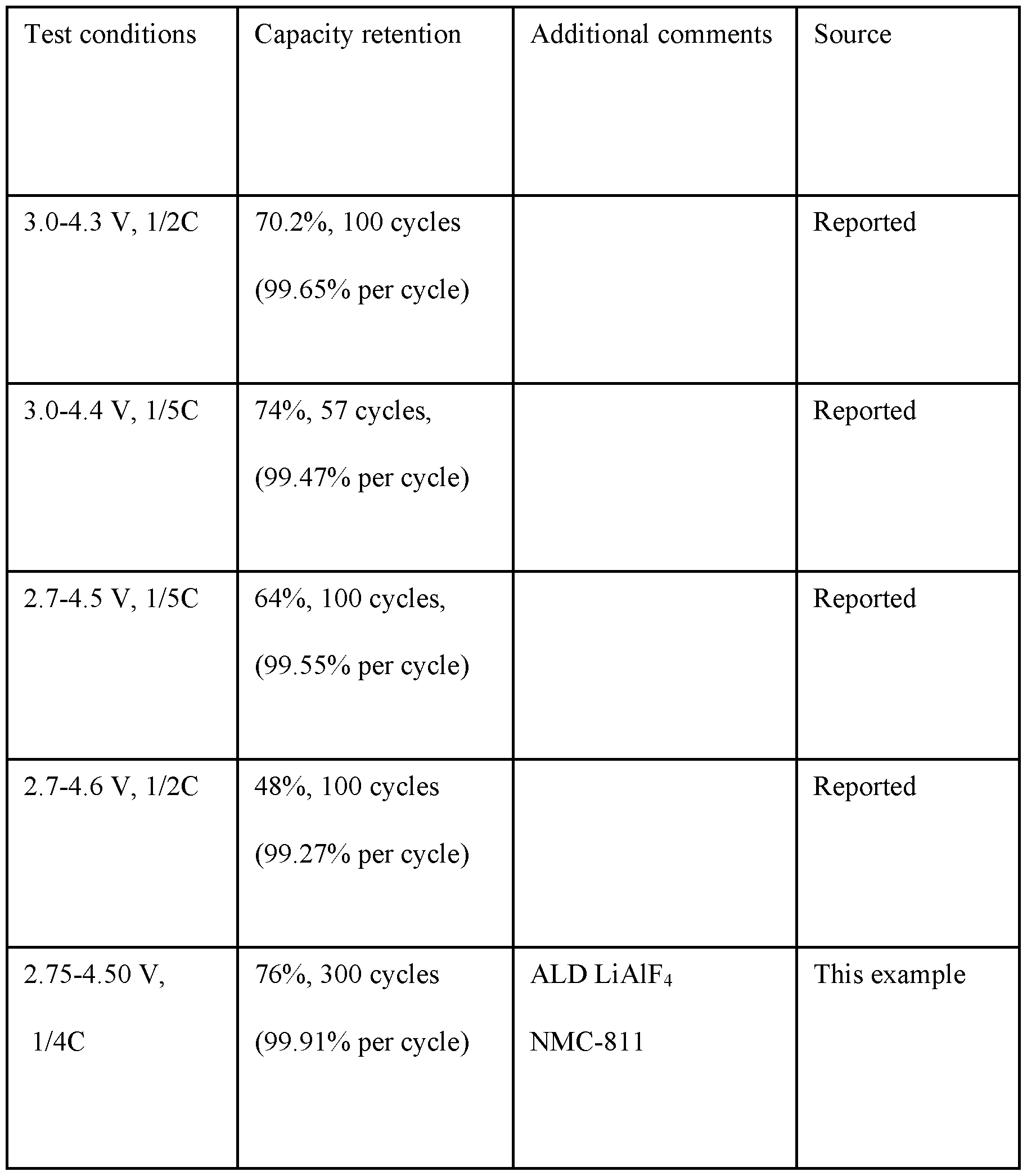
Table 1 : Stability of NMC-811 in this example compared to reported values.
[00109] High Ni content NMC (e.g., NMC-811) can exhibit instability compared to lithium cobalt oxide (LCO) or low Ni content NMC. Depending on cathode preparation methods and detailed cycle conditions, capacity retentions per cycle are often in the range of about 99.3%- about 99.6%). For pristine NMC-811, the capacity retention per cycle decreased significantly with increased cut-off potentials. With ALD L1AIF4 coating, the capacity retention per cycle is improved to higher than about 99.9% at a wide electrochemical widow of about 2.75-4.50
V vs. Li+/Li. Further optimization of L1AIF4 ALD (chemical composition, lithium ion conductivity and thickness) may yield higher stability.
[00110] As used herein, the singular terms "a," "an," and "the" may include plural referents unless the context clearly dictates otherwise. Thus, for example, reference to an object may include multiple objects unless the context clearly dictates otherwise.
[00111] As used herein, the terms "substantially," "substantial," and "about" are used to describe and account for small variations. When used in conjunction with an event or circumstance, the terms can refer to instances in which the event or circumstance occurs precisely as well as instances in which the event or circumstance occurs to a close approximation. For example, when used in conjunction with a numerical value, the terms can encompass a range of variation of less than or equal to ±10% of that numerical value, such as less than or equal to ±5%, less than or equal to ±4%, less than or equal to ±3%, less than or equal to ±2%, less than or equal to ±1%, less than or equal to ±0.5%, less than or equal to ±0.1%, or less than or equal to ±0.05%.
[00112] As used herein, the term "size" refers to a characteristic dimension of an object. Thus, for example, a size of an object that is circular or spherical can refer to a diameter of the object. In the case of an object that is non-circular or non-spherical, a size of the object can refer to a diameter of a corresponding circular or spherical object, where the corresponding circular or spherical object exhibits or has a particular set of derivable or measurable characteristics that are substantially the same as those of the non-circular or non- spherical object. When referring to a set of objects as having a particular size, it is contemplated that the objects can have a distribution of sizes around the particular size. Thus, as used herein, a size of a set of objects can refer to a typical size of a distribution of sizes, such as an average size, a median size, or a peak size.
[00113] Additionally, amounts, ratios, and other numerical values are sometimes presented herein in a range format. It is to be understood that such range format is used for convenience and brevity and should be understood flexibly to include numerical values explicitly specified as limits of a range, but also to include all individual numerical values or sub-ranges encompassed within that range as if each numerical value and sub-range is explicitly specified. For example, a range of about 1 to about 200 should be understood to include the explicitly recited limits of about 1 and about 200, but also to include individual values such as about 2, about 3, and about 4, and sub-ranges such as about 10 to about 50, about 20 to about 100, and so forth.
[00114] While this disclosure has been described with reference to the specific embodiments thereof, it should be understood by those skilled in the art that various changes may be made and equivalents may be substituted without departing from the true spirit and scope of this disclosure as defined by the appended claims. In addition, many modifications may be made to adapt a particular situation, material, composition of matter, method, operation or operations, to the objective, spirit and scope of this disclosure. All such modifications are intended to be within the scope of the claims appended hereto. In particular, while certain methods may have been described with reference to particular operations performed in a particular order, it will be understood that these operations may be combined, sub-divided, or re-ordered to form an equivalent method without departing from the teachings of this disclosure. Accordingly, unless specifically indicated herein, the order and grouping of the operations are not a limitation of this disclosure.
Claims
1. A coated cathode material comprising:
a cathode active material; and
an interfacial layer coating the cathode active material,
wherein the interfacial layer includes a lithium-containing fluoride which includes at least one additional metal different from lithium.
2. The coated cathode material of claim 1, wherein the lithium-containing fluoride is a compound of lithium, fluorine, and the additional metal.
3. The coated cathode material of claim 1, wherein the additional metal is aluminum.
4. The coated cathode material of claim 3, wherein the lithium-containing fluoride is a lithium aluminum fluoride.
5. The coated cathode material of claim 4, wherein the lithium aluminum fluoride is represented as LixAlyFz where 0.5 < x < 3.5, 0.5 < y < 1.5, and 3.5 < z < 6.5.
6. The coated cathode material of claim 4, wherein an atomic ratio of lithium to aluminum is about 1.
7. The coated cathode material of claim 4, wherein an atomic ratio of lithium to aluminum is greater than 1.
8. The coated cathode material of claim 4, wherein an atomic ratio of fluorine to lithium is greater than 1.
9. The coated cathode material of claim 1, wherein the lithium-containing fluoride has a lithium ion conductivity of at least 1 x 10~10 S/cm.
10. The coated cathode material of claim 1, wherein the lithium-containing fluoride has a reduction potential no greater than 2.8 V vs. Li/Li+.
11. The coated cathode material of claim 1, wherein the lithium-containing fluoride has an oxidation potential of at least 4.5 V vs. Li/Li+.
12. The coated cathode material of claim 1, wherein the cathode active material is a layered lithium transition metal oxide.
13. The coated cathode material of claim 1, wherein the cathode active material is in the form of a particle, and the interfacial layer covers the particle.
14. The coated cathode material of claim 13, wherein the particle has a dimension in a range of 10 nm to 100 μιη.
15. The coated cathode material of claim 1, wherein a thickness of the interfacial layer is in a range of 1 nm to 200 nm.
16. A cathode for a lithium ion battery, comprising a current collector and the coated cathode material of claim 1 disposed adjacent to the current collector.
17. A method of forming a coated cathode material, comprising:
providing a cathode active material; and
forming, via atomic layer deposition, an interfacial layer coating the cathode active material,
wherein the interfacial layer includes a lithium-containing fluoride which includes at least one additional metal different from lithium.
18. The method of claim 17, wherein the interfacial layer includes a lithium aluminum fluoride.
19. The method of claim 18, wherein forming the interfacial layer includes:
performing a first atomic layer deposition cycle to deposit a lithium-containing fluoride; and
performing a second atomic layer deposition cycle to deposit an aluminum-containing fluoride.
Priority Applications (1)
| Application Number | Priority Date | Filing Date | Title |
|---|---|---|---|
| US16/616,933 US11894546B2 (en) | 2017-05-31 | 2018-05-10 | Atomic layer deposition of stable lithium ion conductive interfacial layer for stable cathode cycling |
Applications Claiming Priority (2)
| Application Number | Priority Date | Filing Date | Title |
|---|---|---|---|
| US201762513376P | 2017-05-31 | 2017-05-31 | |
| US62/513,376 | 2017-05-31 |
Publications (2)
| Publication Number | Publication Date |
|---|---|
| WO2018222366A2 true WO2018222366A2 (en) | 2018-12-06 |
| WO2018222366A3 WO2018222366A3 (en) | 2019-03-28 |
Family
ID=64454939
Family Applications (1)
| Application Number | Title | Priority Date | Filing Date |
|---|---|---|---|
| PCT/US2018/032008 Ceased WO2018222366A2 (en) | 2017-05-31 | 2018-05-10 | Atomic layer deposition of stable lithium ion conductive interfacial layer for stable cathode cycling |
Country Status (2)
| Country | Link |
|---|---|
| US (1) | US11894546B2 (en) |
| WO (1) | WO2018222366A2 (en) |
Cited By (5)
| Publication number | Priority date | Publication date | Assignee | Title |
|---|---|---|---|---|
| WO2020251710A3 (en) * | 2019-05-14 | 2021-01-21 | The Curators Of The University Of Missouri | Fluorination of al2o3 coating for lithium-ion battery |
| CN112531138A (en) * | 2019-09-17 | 2021-03-19 | 通用汽车环球科技运作有限责任公司 | Electrode additives and coatings for minimizing cathode transition metal dissolution |
| CN113629247A (en) * | 2020-05-08 | 2021-11-09 | 北京当升材料科技股份有限公司 | Lithium cobaltate positive electrode material and preparation method and application thereof |
| US20220298633A1 (en) * | 2019-06-16 | 2022-09-22 | The Regents Of The University Of Colorado, A Body Corporate | Method of controlling an amount of soluble base content of material comprising lithium carbonate and structure, cathode, and battery formed using the method |
| US12191485B2 (en) | 2020-06-03 | 2025-01-07 | The Curators Of The University Of Missouri | Ultrathin film coating and element doping for lithium-ion battery electrodes |
Families Citing this family (15)
| Publication number | Priority date | Publication date | Assignee | Title |
|---|---|---|---|---|
| KR102659195B1 (en) * | 2016-07-11 | 2024-04-19 | 삼성전자주식회사 | Plasma chemical vapor deposition apparatus and method of forming Li based thin film |
| EP4174022A4 (en) * | 2020-06-29 | 2023-12-27 | Panasonic Intellectual Property Management Co., Ltd. | Positive electrode material and battery |
| CN114649531B (en) * | 2020-12-18 | 2024-08-30 | 中国石油化工股份有限公司 | Modified electrode and preparation method and application thereof |
| CN117083735A (en) * | 2021-03-30 | 2023-11-17 | 松下知识产权经营株式会社 | Coated positive electrode active material, positive electrode material, battery, and manufacturing method of coated positive electrode active material |
| JP7784077B2 (en) * | 2021-07-07 | 2025-12-11 | 三星電子株式会社 | A coated positive electrode active material for a non-aqueous electrolyte secondary battery and a non-aqueous electrolyte secondary battery containing the coated positive electrode active material. |
| WO2023013305A1 (en) * | 2021-08-06 | 2023-02-09 | パナソニックIpマネジメント株式会社 | Cathode material, battery using said cathode material, and method for charging battery |
| CA3236275A1 (en) * | 2021-10-29 | 2023-05-04 | Michael Kozlowski | Pulsed control for vibrating particle feeder |
| US12119484B2 (en) * | 2021-12-10 | 2024-10-15 | GM Global Technology Operations LLC | Lithium-containing coatings for cathode materials |
| CN114614012B (en) * | 2022-03-14 | 2024-06-18 | 宁波容百新能源科技股份有限公司 | A ternary composite material for all-solid-state battery, preparation method thereof and application thereof |
| WO2023245659A1 (en) * | 2022-06-24 | 2023-12-28 | 宁德时代新能源科技股份有限公司 | Positive electrode material and preparation method therefor, secondary battery, and battery module |
| CN116093276B (en) * | 2022-11-30 | 2025-02-18 | 宁德时代新能源科技股份有限公司 | Positive electrode material and preparation method, positive electrode sheet and preparation method and application |
| JP2024128793A (en) * | 2023-03-10 | 2024-09-24 | 国立大学法人東北大学 | Arrangement of solid electrolyte in all-solid-state cell and battery |
| CN118016865B (en) * | 2024-04-10 | 2024-06-14 | 江苏蓝固新能源科技有限公司 | Negative electrode material, negative electrode current collector, negative electrode piece and lithium ion battery |
| EP4687175A1 (en) * | 2024-07-30 | 2026-02-04 | BASF Coatings GmbH | Multilayer film coated lithium substrate, its manufacture and use in secondary batteries |
| CN119361598B (en) * | 2024-10-28 | 2025-09-16 | 合肥国轩高科动力能源有限公司 | Silicon-carbon negative electrode piece, preparation method thereof and all-solid-state lithium ion battery |
Family Cites Families (14)
| Publication number | Priority date | Publication date | Assignee | Title |
|---|---|---|---|---|
| JP2009043477A (en) * | 2007-08-07 | 2009-02-26 | Sony Corp | Positive electrode active material, positive electrode and non-aqueous electrolyte battery using the same |
| US8993051B2 (en) | 2007-12-12 | 2015-03-31 | Technische Universiteit Delft | Method for covering particles, especially a battery electrode material particles, and particles obtained with such method and a battery comprising such particle |
| JP5442635B2 (en) | 2007-12-28 | 2014-03-12 | ウニヴァーシテテット イ オスロ | Formation of lithium-containing structure on substrate by ALD |
| US8735003B2 (en) | 2010-06-16 | 2014-05-27 | Alliance For Sustainable Energy, Llc | Lithium-ion batteries having conformal solid electrolyte layers |
| CN102610822A (en) * | 2012-03-07 | 2012-07-25 | 宁德新能源科技有限公司 | Lithium ion secondary battery and anode material thereof |
| US9570748B2 (en) | 2012-10-12 | 2017-02-14 | Ut-Battelle, Llc | Lipon coatings for high voltage and high temperature Li-ion battery cathodes |
| US9059451B2 (en) | 2012-10-18 | 2015-06-16 | GM Global Technology Operations LLC | Coatings for lithium titanate to suppress gas generation in lithium-ion batteries and methods for making and use thereof |
| US9531004B2 (en) | 2013-12-23 | 2016-12-27 | GM Global Technology Operations LLC | Multifunctional hybrid coatings for electrodes made by atomic layer deposition techniques |
| JP2017509112A (en) * | 2014-02-11 | 2017-03-30 | コーニング インコーポレイテッド | Lithium-ion battery containing stabilized lithium composite particles |
| US12401042B2 (en) * | 2015-06-01 | 2025-08-26 | Forge Nano Inc. | Nano-engineered coatings for anode active materials, cathode active materials, and solid-state electrolytes and methods of making batteries containing nano-engineered coatings |
| KR102679976B1 (en) | 2015-07-13 | 2024-07-02 | 삼성전자주식회사 | Composite cathode active material for lithium battery, cathode for lithium battery including the same, and lithium battery including the cathode |
| EP3335258A4 (en) | 2015-08-11 | 2019-04-10 | Technion - Research & Development Foundation Ltd | Metal fluoride coated lithium intercalation material and methods of making same and uses thereof |
| KR102436419B1 (en) * | 2015-10-30 | 2022-08-25 | 삼성에스디아이 주식회사 | Composite positive electrode active material, preparing method thereof, and lithium secondary battery including positive electrode comprising the same |
| KR101768374B1 (en) * | 2016-04-29 | 2017-08-14 | 주식회사 엘지화학 | Composite transition metal oxide precursor and preparing method thereof, and cathode active material using the same |
-
2018
- 2018-05-10 WO PCT/US2018/032008 patent/WO2018222366A2/en not_active Ceased
- 2018-05-10 US US16/616,933 patent/US11894546B2/en active Active
Cited By (6)
| Publication number | Priority date | Publication date | Assignee | Title |
|---|---|---|---|---|
| WO2020251710A3 (en) * | 2019-05-14 | 2021-01-21 | The Curators Of The University Of Missouri | Fluorination of al2o3 coating for lithium-ion battery |
| US20220298633A1 (en) * | 2019-06-16 | 2022-09-22 | The Regents Of The University Of Colorado, A Body Corporate | Method of controlling an amount of soluble base content of material comprising lithium carbonate and structure, cathode, and battery formed using the method |
| CN112531138A (en) * | 2019-09-17 | 2021-03-19 | 通用汽车环球科技运作有限责任公司 | Electrode additives and coatings for minimizing cathode transition metal dissolution |
| CN113629247A (en) * | 2020-05-08 | 2021-11-09 | 北京当升材料科技股份有限公司 | Lithium cobaltate positive electrode material and preparation method and application thereof |
| CN113629247B (en) * | 2020-05-08 | 2023-04-07 | 北京当升材料科技股份有限公司 | Lithium cobaltate positive electrode material and preparation method and application thereof |
| US12191485B2 (en) | 2020-06-03 | 2025-01-07 | The Curators Of The University Of Missouri | Ultrathin film coating and element doping for lithium-ion battery electrodes |
Also Published As
| Publication number | Publication date |
|---|---|
| US20200152976A1 (en) | 2020-05-14 |
| US11894546B2 (en) | 2024-02-06 |
| WO2018222366A3 (en) | 2019-03-28 |
Similar Documents
| Publication | Publication Date | Title |
|---|---|---|
| US11894546B2 (en) | Atomic layer deposition of stable lithium ion conductive interfacial layer for stable cathode cycling | |
| US20230402613A1 (en) | Materials and methods for components of lithium batteries | |
| Bae et al. | High-performance magnesium metal batteries via switching the passivation film into a solid electrolyte interphase | |
| US11862783B2 (en) | Metal fluoride passivation coatings prepared by atomic layer deposition for Li-ion batteries | |
| CN108292780B (en) | Material for solid electrolyte | |
| US10547088B2 (en) | High Coulombic efficiency cycling of metal batteries | |
| US10854915B2 (en) | Fluoride compounds as lithium super-ionic conductors, solid electrolyte and coating layer for lithium metal battery and lithium ion battery | |
| US9531004B2 (en) | Multifunctional hybrid coatings for electrodes made by atomic layer deposition techniques | |
| US10608249B2 (en) | Conformal coating of lithium anode via vapor deposition for rechargeable lithium ion batteries | |
| Le et al. | Bi-layer lithium phosphorous oxynitride/aluminium substituted lithium lanthanum titanate as a promising solid electrolyte for long-life rechargeable lithium–oxygen batteries | |
| WO2011089710A1 (en) | Negative electrode structure for aqueous electrolyte battery, and aqueous electrolyte battery comprising the negative electrode structure | |
| Yoo et al. | Binder-free SnO 2–TiO 2 composite anode with high durability for lithium-ion batteries | |
| Li et al. | Enhanced electrochemical properties of SiO2-Li2SiO3-coated NCM811 cathodes by reducing surface residual lithium | |
| US20180047983A1 (en) | Surface-treated cathode active material for aqueous lithium secondary battery | |
| Sun et al. | Interface engineering of inorganic solid‐state lithium batteries via atomic and molecular layer deposition | |
| Yarmiayev et al. | Fast kinetics in free-standing porous Cu3P anode for Li-ion batteries | |
| Jones et al. | Communication—Atomic layer deposition of aluminum fluoride for lithium metal anodes | |
| US20230275222A1 (en) | Surface-treated electrode, protection of solid electrolytes, and elements, modules and batteries comprising said electrode | |
| US8821767B2 (en) | Cathode active material | |
| EP2884567A1 (en) | Precursor of electrode active material coated with metal, and method for preparing same | |
| US20200343539A1 (en) | Manganese phosphate coated lithium nickel oxide materials | |
| JP7807758B2 (en) | Ytterbium-containing solid lithium ion conductive material and method for preparing same | |
| US12087948B2 (en) | Ternary nitride negative electrode based lithium-ion battery | |
| EP4106047A1 (en) | Anode for lithium secondary battery, manufacturing method thereof, and lithium secondary battery including same | |
| WO2025159209A1 (en) | Secondary battery component, secondary battery, and method for manufacturing secondary battery component |
Legal Events
| Date | Code | Title | Description |
|---|---|---|---|
| 121 | Ep: the epo has been informed by wipo that ep was designated in this application |
Ref document number: 18809453 Country of ref document: EP Kind code of ref document: A2 |
|
| NENP | Non-entry into the national phase |
Ref country code: DE |
|
| 122 | Ep: pct application non-entry in european phase |
Ref document number: 18809453 Country of ref document: EP Kind code of ref document: A2 |