WO2018202490A1 - Method for the discontinuous production of superabsorber particles by polymerizing an aqueous monomer solution dispersed in a hydrophobic solvent - Google Patents
Method for the discontinuous production of superabsorber particles by polymerizing an aqueous monomer solution dispersed in a hydrophobic solvent Download PDFInfo
- Publication number
- WO2018202490A1 WO2018202490A1 PCT/EP2018/060548 EP2018060548W WO2018202490A1 WO 2018202490 A1 WO2018202490 A1 WO 2018202490A1 EP 2018060548 W EP2018060548 W EP 2018060548W WO 2018202490 A1 WO2018202490 A1 WO 2018202490A1
- Authority
- WO
- WIPO (PCT)
- Prior art keywords
- time
- batch
- stirred tank
- monomer solution
- reaction
- Prior art date
- Legal status (The legal status is an assumption and is not a legal conclusion. Google has not performed a legal analysis and makes no representation as to the accuracy of the status listed.)
- Ceased
Links
Classifications
-
- C—CHEMISTRY; METALLURGY
- C08—ORGANIC MACROMOLECULAR COMPOUNDS; THEIR PREPARATION OR CHEMICAL WORKING-UP; COMPOSITIONS BASED THEREON
- C08F—MACROMOLECULAR COMPOUNDS OBTAINED BY REACTIONS ONLY INVOLVING CARBON-TO-CARBON UNSATURATED BONDS
- C08F2/00—Processes of polymerisation
- C08F2/04—Polymerisation in solution
- C08F2/06—Organic solvent
- C08F2/08—Organic solvent with the aid of dispersing agents for the polymer
-
- C—CHEMISTRY; METALLURGY
- C08—ORGANIC MACROMOLECULAR COMPOUNDS; THEIR PREPARATION OR CHEMICAL WORKING-UP; COMPOSITIONS BASED THEREON
- C08F—MACROMOLECULAR COMPOUNDS OBTAINED BY REACTIONS ONLY INVOLVING CARBON-TO-CARBON UNSATURATED BONDS
- C08F2/00—Processes of polymerisation
- C08F2/01—Processes of polymerisation characterised by special features of the polymerisation apparatus used
-
- C—CHEMISTRY; METALLURGY
- C08—ORGANIC MACROMOLECULAR COMPOUNDS; THEIR PREPARATION OR CHEMICAL WORKING-UP; COMPOSITIONS BASED THEREON
- C08L—COMPOSITIONS OF MACROMOLECULAR COMPOUNDS
- C08L33/00—Compositions of homopolymers or copolymers of compounds having one or more unsaturated aliphatic radicals, each having only one carbon-to-carbon double bond, and only one being terminated by only one carboxyl radical, or of salts, anhydrides, esters, amides, imides or nitriles thereof; Compositions of derivatives of such polymers
- C08L33/02—Homopolymers or copolymers of acids; Metal or ammonium salts thereof
Definitions
- the present invention relates to a process for the batchwise preparation of Su ⁇ perabsorberpumblen by polymerizing a disper ⁇ alloyed in a hydrophobic solvent aqueous monomer, wherein the at least two stirred tank to be operated at different times.
- superabsorbent particles are used as aqueous solutions absorbing products for the production of diapers, tampons, sanitary napkins and other hygiene articles, but also as whatsoeverzu ⁇ retaining agents in agricultural horticulture.
- the properties of the superabsorbent particles can be adjusted via the degree of crosslinking. With increasing degree of crosslinking gel strength rises and the Absorptionska ⁇ capacity.
- superabsorbent particles are generally surface postcrosslinked. This increases only the Vernet ⁇ utilization factor of the particle surface, whereby the absorbency under load (AUL) and the centrifuges retention capacity (CRC) to be at least partially decoupled.
- JP 2012-7062 A2 US 5,807,916 A and WO 2008/084031 A1 disclose processes for the manufacture of superabsorbent polymer particles by polymerisation of a dispersed aqueous Mono ⁇ merown.
- the object of the present invention to provide an improved process for the batchwise preparation of superabsorbents by polymerisation of a dispersed in a solvent hyd ⁇ rophoben aqueous monomer solution, in particular, the performance of the cooling system is better utilized.
- the object was achieved by a process for the discontinuous production of super ⁇ absorber particles by polymerization of a disperse in a hydrophobic solvent.
- gated aqueous monomer solution in at least two parallel stirred vessels characterized ge ⁇ indicates that the at least two stirred vessels are operated offset in time and the relative time difference of starting the reaction of two successive successive stirred tank in the range of 50% / n to 150% / n is the batch time, where n is the number of parallel agitator and the batch time is the time between the start of the reaction to the start of the following reaction in the same stirred tank.
- the batch time is thus the time from the filling of the stirred tank through all the reaction steps in the stirred tank and the emptying of the stirred tank until it is again filled with the stirred tank.
- the difference in time of the beginning of the batches of each of two temporally successive stirred vessels is preferably from 65% / n to 135% / n, more preferably from 80% / n to 120% / n, most preferably from 90% / n to 110% / n, the batch time.
- the time difference of the beginning of the batches of the two temporally successive stirred containers is preferably from 32.5% to 67.5%, more preferably from 40% to 60%, most preferably from 45% to 55%, of the batch time.
- Suitable hydrophobic solvents are hydrocarbons and hydrocarbon mixtures ⁇ are usually used.
- the hydrocarbons or hydrocarbon mixtures boil preferably in the range of 50 to 150 ° C, more preferably in the range of 60 to 130 ° C, most preferably in the range of 70 to 110 ° C.
- the aqueous monomer solution used for the preparation of the superabsorbent particles usually contains a) at least one ethylenically unsaturated, acid group-carrying monomer which may be neutralized to ⁇ at least partially,
- the monomers a) are preferably water-soluble, ie the solubility in water at 23 ° C. is typically at least 1 g / 100 g of water, preferably at least 5 g / 100 g of water, more preferably at least 25 g / 100 g of water, most preferably at least 35 g / 100 g of water.
- Suitable monomers a) are for example ethylenically unsaturated carboxylic acids such as Ac ⁇ rylklare, methacrylic acid, maleic acid and itaconic acid. Particularly preferred monomers are acrylic acid and methacrylic acid. Very particular preference is given to acrylic acid. Further suitable monomers a) are, for example, ethylenically unsaturated sulfonic acids, such as styrenesulfonic acid and 2-acrylamido-2-methylpropanesulfonic acid (AMPS).
- AMPS 2-acrylamido-2-methylpropanesulfonic acid
- the proportion of acrylic acid and / or salts thereof in the total amount of monomers a) be ⁇ contributes preferably at least 50 mol%, more preferably at least 90 mol, most preferably at least 95 mol%.
- the acid groups of the monomers a) may be partially neutralized.
- the neutralization is carried out at the monomer stage. This is usually done by Einmi ⁇ research of the neutralizing agent as an aqueous solution or else preferably as a solid.
- the degree of neutralization is preferably from 25 to 95 mol%, particularly preferably from 30 to 80 mol%, very particularly preferably from 40 to 75 mol%, for which the customary Neutrali ⁇ sationsstoff can be used, preferably alkali metal hydroxides, Alkalime ⁇ -metal oxides, alkali metal carbonates or alkali metal and their Mix ⁇ gen.
- alkali metal salts and ammonium salts can be used.
- Sodium and potassium are particularly preferred as alkali metals, but most preferred are sodium hydroxide, sodium carbonate or sodium bicarbonate and mixtures thereof.
- the monomers a) usually contain polymerization inhibitors, preferably hydroquinone monomethyl ether (M EHQ), as a storage stabilizer.
- M EHQ hydroquinone monomethyl ether
- Suitable crosslinkers b) are compounds having at least two groups suitable for crosslinking. Such groups are, for example, ethylenically unsaturated groups which can be radically copolymerized into the polymer chain, and functional groups which can form covalent bonds with the acid groups of the monomer a). Furthermore, polyvalent metal salts which can form coordinate bonds with at least two acid groups of the monomer a) are also suitable as crosslinker b).
- the initiators c) all radicals under the polymerization erzeu ⁇ constricting compounds can be used, for example, thermal initiators, redox initiators, photoinitiators.
- acid group-carrying monomers a) copolymerizable ethylenically unsaturated monomers d) are, for example, acrylamide, methacrylamide, Hydroxyethyl acrylate, hydroxyethyl methacrylate, dimethylaminoethyl methacrylate, dimethylaminoethyl noethylacrylat, dimethylaminopropyl, diethylaminopropyl, dimethylaminoethyl ⁇ methacrylate, diethylaminoethyl.
- water-soluble polymers e) include polyvinyl alcohol, polyvinylpyrrolidone, starch, Horde ⁇ derivatives, modified cellulose, such as methylcellulose or hydroxyethylcellulose, gelatin, poly glycols or polyacrylic acids, preferably starch, starch derivatives and modified cellulose may be used.
- the preferred polymerization inhibitors require dissolved oxygen for optimum performance. Therefore, the monomer solution before the polymerization by inertization, ie flowing through with an inert gas, preferably nitrogen or carbon dioxide, are released from Geloes ⁇ tem oxygen.
- an inert gas preferably nitrogen or carbon dioxide
- the oxygen content of the monomer solution before polymerization is reduced to less than 1 ppm by weight, more preferably less than 0.5 ppm by weight, most preferably less than 0.1 ppm by weight.
- the polymerization is carried out under sufficient reflux, may be dispensed to the Inerti ⁇ tion.
- the dissolved oxygen is removed together with the evaporation ⁇ fenden solvent from the stirred tank.
- the aqueous monomer solution is dispersed in the hydrophobic solvent.
- Suitable hydrophobic solvents are all solvents known to those skilled in the art for use in reverse suspension polymerization. Aliphatic ⁇ specific hydrocarbons such as n-hexane, n-heptane, n-octane, n-nonane, n-decane, cyclohexane or mixtures thereof are preferably used from it. Hydrophobic solvents have at 23 ° C, a soln ⁇ friendliness in water of less than 5 g / 100 g, preferably less than 1 g / 100 g, particularly ⁇ vorzugt be less than 0.5 g / 100 g.
- the ratio between hydrophobic solvent and aqueous monomer solution is 0.5 to 3, preferably 0.7 to 2.5, and more preferably from 0.8 to 2.2.
- the average diameter of the aqueous monomer solution droplets in the dispersion, if no agglomeration is carried out preferably at least 100 ⁇ , more preferably from 100 to 1000 ⁇ , more preferably from 150 to 850 ⁇ , most preferably from 300 to 600 ⁇ , wherein the droplet diameter can be determined by light scattering and means the volume-averaged mean diameter.
- the diameter of the aqueous monomer solution droplets may be adjusted via the stirring registered ⁇ energy and by means of suitable dispersing aids. Suitable dispersing aids are, for example, anionic, cationic, nonionic or amphoteric surfactants, or natural, semisynthetic or synthetic polymers.
- Anionic surfactants are, for example, sodium polyoxyethylene dodecyl ether sulfate and sodium dodecyl ether sulfate.
- a cationic surfactant is, for example, trimethylstearylammonium chloride.
- An amphoteric surfactant is, for example, carboxymethyldimethylcetylammonium.
- Nonionic surfactants are, for example, sucrose fatty acid esters, such as sucrose monostearate and sucrose dilaurate, sorbitan esters, such as sorbitan monostearate, sorbitan ester-based polyoxyalkylene compounds, such as polyoxyethylene sorbitan monostearate.
- Natural or semisynthetic polymers are, for example, cellulose derivatives, such as cellulose ethers, for example ethylcellulose, and cellulose esters, for example cellulose acetates.
- Syn ⁇ thetic polymers include polyvinyl alcohols, polyvinyl alcohol derivatives, maleic acid-butadiene copolymers, and quaternary salts such as Styroldimethylaminoethylmethactylat.
- the dispersing assistant is usually dissolved or dispersed in the hydrophobic solvent.
- the dispersing aid is used in amounts between 0.01 and 10% by weight, preferably between 0.2 and 5% by weight, particularly preferably between 0.5 and 2% by weight, based on the aqueous monomer solution.
- the reaction is preferably carried out under reduced pressure, for example at a pressure of 800 mbar.
- the pressure of the boiling point of the reaction mixture can be adjusted to the desired reaction temperature.
- the resulting, dispersed superabsorbent particles can be agglomerated by addition of further aqueous monomer solution and renewed polymerization.
- the aqueous monomer solution may have a composition different from the first aqueous monomer solution. Agglomeration can Vedas also repeatedly Runaway ⁇ leads.
- the superabsorbent polymer particles obtained are dispersed azeotropically ent skis ⁇ sert and separated from the hydrophobic solvent by filtration.
- the dispersion obtained after thezeotropic dehydration is not or not completely cooled.
- the still warm filtrate is recycled as a hydrophobic solvent in the polymerization.
- the superabsorbent particles can be surface postcrosslinked to further improve the properties. Suitable surface postcrosslinkers are compounds containing Minim ⁇ least two groups, the covalent bonds with the carboxylate groups of the hydrogel may form Bin ⁇ applications.
- Suitable compounds are, for example, alkoxysilyl compounds, Polyaziridines, polyamines, polyamidoamines, di- or polyepoxides (for example, Denacol EX810 ®) as described in EP 83,022 A2, EP 543303 A1 and EP 937 736 A2, di- or po ⁇ lyfunktionelle alcohols as described in DE 33 14 019 A1 DE 35 23 617 A1 and EP 450 922 A2 beschrie ⁇ ben, or ß-hydroxyalkylamides, as described in DE 102 04 938 A1 and US 6,239,230.
- the amount of surface postcrosslinker is preferably from 0.01 to 1 wt .-%, particularly preferably 0.05 to 0.5 wt .-%, most preferably 0.1 to 0.2 wt -.%, In each bezo ⁇ gene on the polymer.
- polyvalent cations are applied to the particle surface.
- polyvalent cations include for example divalent cations such as the cations of zinc, magnesium, calcium and strontium, three ⁇ valent cations such as the cations of aluminum, iron, chromium, rare earths and manganese, tetravalent cations such as the cations of Titanium and zirconium.
- divalent cations such as the cations of zinc, magnesium, calcium and strontium
- three ⁇ valent cations such as the cations of aluminum, iron, chromium, rare earths and manganese
- tetravalent cations such as the cations of Titanium and zirconium.
- the amount of polyvalent cation used is, for example, from 0.001 to 0.5% by weight, preferably from 0.005 to 0.2% by weight, particularly preferably from 0.02 to 0.1% by weight. in each case based on the polymer.
- the surface post can be done in two different ways ⁇ to.
- the surface postcrosslinking is usually carried out in such a way that a solution of the surface postcrosslinker and optionally a solution of the polyvalent cation is sprayed onto the superabsorbent particles. After the spraying is dried ther ⁇ mixed, wherein the surface postcrosslinking can take place both before and currency ⁇ rend drying.
- the spraying of a solution of the surface postcrosslinker is preferably carried out in mixers with agitated mixing tools, such as screw mixers, paddle mixers, disk mixers, plowshare mixers and paddle mixers.
- Suitable mixers include Lödige mixers, Bepex mixers, Nauta mixers, Processall mixers and Schugi mixers.
- the thermal drying is preferably carried out in contact dryers, more preferably paddle dryers, very particularly preferably disk dryers.
- Suitable dryers include Bepex dryers and Nara dryers.
- we ⁇ bel lactrockner can be used.
- the drying can take place in the mixer itself, by heating the jacket or blowing hot air.
- a downstream dryer such as a Horde dryer, a rotary kiln or a heated screw. Particularly advantageous is mixed and dried in a fluidized bed dryer.
- Preferred drying temperatures are in the range 100 to 250 ° C, preferably 120 to 220 ° C, and particularly preferably 130 to 210 ° C.
- the preferred residence time at this temperature-temperature in the reaction mixer or dryer is preferably at least 10 minutes, be ⁇ Sonders preferably at least 20 minutes, most preferably at least 30 Minu ⁇ th.
- reactive surface post such as di- or polyepoxides, preferably a ⁇ set.
- thermal surface postcrosslinking is optionally azeotropically entinhos ⁇ sert, filtered and dried.
Landscapes
- Chemical & Material Sciences (AREA)
- Health & Medical Sciences (AREA)
- Chemical Kinetics & Catalysis (AREA)
- Medicinal Chemistry (AREA)
- Polymers & Plastics (AREA)
- Organic Chemistry (AREA)
- Polymerisation Methods In General (AREA)
- Addition Polymer Or Copolymer, Post-Treatments, Or Chemical Modifications (AREA)
- Processes Of Treating Macromolecular Substances (AREA)
Abstract
Description
Verfahren zur diskontinuierlichen Herstellung von Superabsorberpartikeln durch Polymerisa¬ tion einer in einem hydrophoben Lösungsmittel dispergierten wässrigen Monomerlösung A process for the discontinuous production of superabsorbent polymer particles by polymerisation ¬ tion of a dispersed aqueous monomer solution in a hydrophobic solvent
Beschreibung description
Die vorliegende Erfindung betrifft ein Verfahren zur diskontinuierlichen Herstellung von Su¬ perabsorberpartikeln durch Polymerisation einer in einem hydrophoben Lösungsmittel disper¬ gierten wässrigen Monomerlösung, wobei die mindestens zwei Rührbehälter zeitlich versetzt betrieben werden. The present invention relates to a process for the batchwise preparation of Su ¬ perabsorberpartikeln by polymerizing a disper ¬ alloyed in a hydrophobic solvent aqueous monomer, wherein the at least two stirred tank to be operated at different times.
Die Herstellung von Superabsorberpartikeln wird in der Monographie " Modern Superabsor- bent Polymer Technology" , Fl. Buchholz und AT. Graham, Wiley-VCH, 1998, Seiten 69 bis 117, beschrieben. Superabsorberpartikel werden als wässrige Lösungen absorbierende Produkte zur Herstellung von Windeln, Tampons, Damenbinden und anderen Hygieneartikeln, aber auch als wasserzu¬ rückhaltende Mittel im landwirtschaftlichen Gartenbau verwendet. The production of superabsorbent particles is described in the monograph "Modern Superabsorbed Polymer Technology", Fl. Buchholz and AT. Graham, Wiley-VCH, 1998, pages 69-117. Superabsorbent particles are used as aqueous solutions absorbing products for the production of diapers, tampons, sanitary napkins and other hygiene articles, but also as wasserzu ¬ retaining agents in agricultural horticulture.
Die Eigenschaften der Superabsorberpartikel können über den Vernetzungsgrad eingestellt werden. Mit steigendem Vernetzungsgrad steigt die Gelfestigkeit und sinkt die Absorptionska¬ pazität. The properties of the superabsorbent particles can be adjusted via the degree of crosslinking. With increasing degree of crosslinking gel strength rises and the Absorptionska ¬ capacity.
Zur Verbesserung der Anwendungseigenschaften, wie beispielsweise Flüssigkeitsweiterleitung im geguollenen Gelbett (SFC) in der Windel und Absorption unter Druck (AUL), werden Su- perabsorberpartikel im allgemeinen oberflächennachvernetzt. Dadurch steigt nur der Vernet¬ zungsgrad der Partikeloberfläche, wodurch die Absorption unter Druck (AUL) und die Zentri- fugenretentionskapazität (CRC) zumindest teilweise entkoppelt werden können. To improve application properties, such as fluid transfer in the sagged gel bed (SFC) in the diaper and absorption under pressure (AUL), superabsorbent particles are generally surface postcrosslinked. This increases only the Vernet ¬ utilization factor of the particle surface, whereby the absorbency under load (AUL) and the centrifuges retention capacity (CRC) to be at least partially decoupled.
JP 2012-7062 A2, US 5,807,916 A und WO 2008/084031 A1 offenbaren Verfahren zur Herstel- lung von Superabsorberpartikeln durch Polymerisation einer dispergierten wässrigen Mono¬ merlösung. JP 2012-7062 A2, US 5,807,916 A and WO 2008/084031 A1 disclose processes for the manufacture of superabsorbent polymer particles by polymerisation of a dispersed aqueous Mono ¬ merlösung.
US 2015/0080539 beschreibt ein diskontinuierliches Verfahren unter Verwendung eines spezi¬ ellen Rührbehälters zur Verkürzung des Aufheizens bzw. Abkühlens. US 2015/0080539 describes a batchwise method using a specific ¬ economic stirred tank in order to shorten the heating or cooling.
Aufgabe der vorliegenden Erfindung war die Bereitstellung eines verbesserten Verfahrens zur diskontinuierlichen Herstellung von Superabsorbern durch Polymerisation einer in einem hyd¬ rophoben Lösungsmittel dispergierten wässrigen Monomerlösung, wobei insbesondere die Leistung der Kühlung besser ausgenutzt wird. The object of the present invention to provide an improved process for the batchwise preparation of superabsorbents by polymerisation of a dispersed in a solvent hyd ¬ rophoben aqueous monomer solution, in particular, the performance of the cooling system is better utilized.
Gelöst wurde die Aufgabe durch ein Verfahren zur diskontinuierlichen Herstellung von Super¬ absorberpartikeln durch Polymerisation einer in einem hydrophoben Lösungsmittel disper- gierten wässrigen Monomerlösung in mindestens zwei parallelen Rührbehältern, dadurch ge¬ kennzeichnet, dass die mindestens zwei Rührbehälter zeitlich versetzt betrieben werden und die relative zeitliche Differenz des Anfahrens der Reaktion jeweils zweier zeitlich aufeinander folgender Rührbehälter im Bereich von 50%/n bis 150%/n der Chargenzeit beträgt, wobei n die Anzahl der parallelen Rührbehälter und die Chargenzeit die Zeit zwischen dem Anfahren der Reaktion bis zum Anfahren der folgenden Reaktion im selben Rührbehälter ist. The object was achieved by a process for the discontinuous production of super ¬ absorber particles by polymerization of a disperse in a hydrophobic solvent. gated aqueous monomer solution in at least two parallel stirred vessels, characterized ge ¬ indicates that the at least two stirred vessels are operated offset in time and the relative time difference of starting the reaction of two successive successive stirred tank in the range of 50% / n to 150% / n is the batch time, where n is the number of parallel agitator and the batch time is the time between the start of the reaction to the start of the following reaction in the same stirred tank.
Die Chargenzeit ist also die Zeit vom Befüllen des Rührbehälters über alle Reaktionsschritte im Rührbehälter und dem Entleeren des Rührbehälters bis zum erneuten Befüllen des Rührbehäl- ters. The batch time is thus the time from the filling of the stirred tank through all the reaction steps in the stirred tank and the emptying of the stirred tank until it is again filled with the stirred tank.
Die zeitliche Differenz des Anfangs der Chargen jeweils zweier zeitlich aufeinander folgender Rührbehälter beträgt vorzugsweise von 65%/n bis 135%/n, besonders bevorzugt von 80%/n bis 120%/n, ganz besonders bevorzugt von 90%/n bis 110%/n, der Chargenzeit. The difference in time of the beginning of the batches of each of two temporally successive stirred vessels is preferably from 65% / n to 135% / n, more preferably from 80% / n to 120% / n, most preferably from 90% / n to 110% / n, the batch time.
In einer bevorzugten Ausführungsform der vorliegenden Erfindung werden zwei, drei oder vier parallele Rührbehälter betrieben werden (n = 2, 3, 4). In a preferred embodiment of the present invention, two, three or four parallel agitation vessels will be operated (n = 2, 3, 4).
In einer ganz bevorzugten Ausführungsform der vorliegenden Erfindung werden zwei paral- lele Rührbehälter betrieben werden (n = 2). Die zeitliche Differenz des Anfangs der Chargen der zwei zeitlich aufeinander folgenden Rührbehälter beträgt vorzugsweise von 32,5% bis 67,5%, besonders bevorzugt von 40% bis 60%, ganz besonders bevorzugt von 45% bis 55%, der Chargenzeit. Als hydrophobe Lösungsmittel werden üblicherweise Kohlenwasserstoffe und Kohlenwasser¬ stoffgemische eingesetzt. In a very preferred embodiment of the present invention, two parallel stirred tanks will be operated (n = 2). The time difference of the beginning of the batches of the two temporally successive stirred containers is preferably from 32.5% to 67.5%, more preferably from 40% to 60%, most preferably from 45% to 55%, of the batch time. Suitable hydrophobic solvents are hydrocarbons and hydrocarbon mixtures ¬ are usually used.
Die Kohlenwasserstoffe oder Kohlenwasserstoffgemische sieden vorzugsweise im Bereich von 50 bis 150°C, besonders bevorzugt im Bereich von 60 bis 130°C, ganz besonders im Bereich von 70 bis 110°C. The hydrocarbons or hydrocarbon mixtures boil preferably in the range of 50 to 150 ° C, more preferably in the range of 60 to 130 ° C, most preferably in the range of 70 to 110 ° C.
Im Folgenden wird die Herstellung der Superabsorberpartikel erläutert: The following describes the preparation of the superabsorbent particles:
Die zur Herstellung der Superabsorberpartikel eingesetzte wässrige Monomerlösung enthält üblicherweise a) mindestens ein ethylenisch ungesättigtes, säuregruppentragendes Monomer, das zu¬ mindest teilweise neutralisiert sein kann, The aqueous monomer solution used for the preparation of the superabsorbent particles usually contains a) at least one ethylenically unsaturated, acid group-carrying monomer which may be neutralized to ¬ at least partially,
b) mindestens einen Vernetzer, b) at least one crosslinker,
c) mindestens einen Initiator c) at least one initiator
d) optional ein oder mehrere mit den unter a) genannten Monomeren copolymerisierbare ethylenisch ungesättigte Monomere und d) optionally one or more copolymerizable with the monomers mentioned under a) ethylenically unsaturated monomers and
e) optional ein oder mehrere wasserlösliche Polymere. Die Monomeren a) sind vorzugsweise wasserlöslich, d.h. die Löslichkeit in Wasser bei 23°C beträgt typischerweise mindestens 1 g/100 g Wasser, vorzugsweise mindestens 5 g/100 g Wasser, besonders bevorzugt mindestens 25 g/100 g Wasser, ganz besonders bevorzugt mindestens 35 g/100 g Wasser. e) optionally one or more water-soluble polymers. The monomers a) are preferably water-soluble, ie the solubility in water at 23 ° C. is typically at least 1 g / 100 g of water, preferably at least 5 g / 100 g of water, more preferably at least 25 g / 100 g of water, most preferably at least 35 g / 100 g of water.
Geeignete Monomere a) sind beispielsweise ethylenisch ungesättigte Carbonsäuren, wie Ac¬ rylsäure, Methacrylsäure, Maleinsäure und Itaconsäure. Besonders bevorzugte Monomere sind Acrylsäure und Methacrylsäure. Ganz besonders bevorzugt ist Acrylsäure. Weitere geeignete Monomere a) sind beispielsweise ethylenisch ungesättigte Sulfonsäuren, wie Styrolsulfonsäure und 2-Acrylamido-2-methylpropansulfonsäure (AMPS). Suitable monomers a) are for example ethylenically unsaturated carboxylic acids such as Ac ¬ rylsäure, methacrylic acid, maleic acid and itaconic acid. Particularly preferred monomers are acrylic acid and methacrylic acid. Very particular preference is given to acrylic acid. Further suitable monomers a) are, for example, ethylenically unsaturated sulfonic acids, such as styrenesulfonic acid and 2-acrylamido-2-methylpropanesulfonic acid (AMPS).
Der Anteil an Acrylsäure und/oder deren Salzen an der Gesamtmenge der Monomeren a) be¬ trägt vorzugsweise mindestens 50 mol-%, besonders bevorzugt mindestens 90 mol- , ganz besonders bevorzugt mindestens 95 mol-%. The proportion of acrylic acid and / or salts thereof in the total amount of monomers a) be ¬ contributes preferably at least 50 mol%, more preferably at least 90 mol, most preferably at least 95 mol%.
Die Säuregruppen der Monomere a) können teilweise neutralisiert sein. Die Neutralisation wird auf der Stufe der Monomeren durchgeführt. Dies geschieht üblicherweise durch Einmi¬ schung des Neutralisationsmittels als wässrige Lösung oder bevorzugt auch als Feststoff. Der Neutralisationsgrad beträgt vorzugsweise von 25 bis 95 mol-%, besonders bevorzugt von 30 bis 80 mol-%, ganz besonders bevorzugt von 40 bis 75 mol-%, wobei die üblichen Neutrali¬ sationsmittel verwendet werden können, vorzugsweise Alkalimetallhydroxide, Alkalime¬ talloxide, Alkalimetallkarbonate oder Alkalimetallhydrogenkarbonate sowie deren Mischun¬ gen. Statt Alkalimetallsalze können auch Ammoniumsalze verwendet werden. Natrium und Kalium sind als Alkalimetalle besonders bevorzugt, ganz besonders bevorzugt sind jedoch Natriumhydroxid, Natriumkarbonat oder Natriumhydrogenkarbonat sowie deren Mischungen. The acid groups of the monomers a) may be partially neutralized. The neutralization is carried out at the monomer stage. This is usually done by Einmi ¬ research of the neutralizing agent as an aqueous solution or else preferably as a solid. The degree of neutralization is preferably from 25 to 95 mol%, particularly preferably from 30 to 80 mol%, very particularly preferably from 40 to 75 mol%, for which the customary Neutrali ¬ sationsmittel can be used, preferably alkali metal hydroxides, Alkalime ¬-metal oxides, alkali metal carbonates or alkali metal and their Mix ¬ gen. Instead of alkali metal salts and ammonium salts can be used. Sodium and potassium are particularly preferred as alkali metals, but most preferred are sodium hydroxide, sodium carbonate or sodium bicarbonate and mixtures thereof.
Die Monomere a) enthalten üblicherweise Polymerisationsinhibitoren, vorzugsweise Hydrochi- nonmonomethylether (M EHQ), als Lagerstabilisator. The monomers a) usually contain polymerization inhibitors, preferably hydroquinone monomethyl ether (M EHQ), as a storage stabilizer.
Geeignete Vernetzer b) sind Verbindungen mit mindestens zwei zur Vernetzung geeigneten Gruppen. Derartige Gruppen sind beispielsweise ethylenisch ungesättigte Gruppen, die in die Polymerkette radikalisch einpolymerisiert werden können, und funktionelle Gruppen, die mit den Säuregruppen des Monomeren a) kovalente Bindungen ausbilden können. Weiterhin sind auch polyvalente Metallsalze, die mit mindestens zwei Säuregruppen des Monomeren a) ko- ordinative Bindungen ausbilden können, als Vernetzer b) geeignet. Suitable crosslinkers b) are compounds having at least two groups suitable for crosslinking. Such groups are, for example, ethylenically unsaturated groups which can be radically copolymerized into the polymer chain, and functional groups which can form covalent bonds with the acid groups of the monomer a). Furthermore, polyvalent metal salts which can form coordinate bonds with at least two acid groups of the monomer a) are also suitable as crosslinker b).
Als Initiatoren c) können sämtliche unter den Polymerisationsbedingungen Radikale erzeu¬ gende Verbindungen eingesetzt werden, beispielsweise thermische Initiatoren, Redox-Initiato- ren, Photoinitiatoren. The initiators c) all radicals under the polymerization erzeu ¬ constricting compounds can be used, for example, thermal initiators, redox initiators, photoinitiators.
Mit den ethylenisch ungesättigten, säuregruppentragenden Monomeren a) copolymerisier- bare ethylenisch ungesättigte Monomere d) sind beispielsweise Acrylamid, Methacrylamid, Hydroxyethylacrylat, Hydroxyethylmethacrylat, Dimethylaminoethylmethacrylat, Dimethylami- noethylacrylat, Dimethylaminopropylacrylat, Diethylaminopropylacrylat, Dimethylaminoethyl¬ methacrylat, Diethylaminoethylmethacrylat. Als wasserlösliche Polymere e) können Polyvinylalkohol, Polyvinylpyrrolidon, Stärke, Stärkede¬ rivate, modifizierte Cellulose, wie Methylcellulose oder Hydroxyethylcellulose, Gelatine, Poly- glykole oder Polyacrylsäuren, vorzugsweise Stärke, Stärkederivate und modifizierte Cellulose, eingesetzt werden. With the ethylenically unsaturated, acid group-carrying monomers a) copolymerizable ethylenically unsaturated monomers d) are, for example, acrylamide, methacrylamide, Hydroxyethyl acrylate, hydroxyethyl methacrylate, dimethylaminoethyl methacrylate, dimethylaminoethyl noethylacrylat, dimethylaminopropyl, diethylaminopropyl, dimethylaminoethyl ¬ methacrylate, diethylaminoethyl. As water-soluble polymers e) include polyvinyl alcohol, polyvinylpyrrolidone, starch, Stärkede ¬ derivatives, modified cellulose, such as methylcellulose or hydroxyethylcellulose, gelatin, poly glycols or polyacrylic acids, preferably starch, starch derivatives and modified cellulose may be used.
Die bevorzugten Polymerisationsinhibitoren benötigen für eine optimale Wirkung gelösten Sauerstoff. Daher kann die Monomerlösung vor der Polymerisation durch Inertisierung, d.h. Durchströmen mit einem inerten Gas, vorzugsweise Stickstoff oder Kohlendioxid, von gelös¬ tem Sauerstoff befreit werden. Vorzugsweise wird der Sauerstoffgehalt der Monomerlösung vor der Polymerisation auf weniger als 1 Gew.-ppm, besonders bevorzugt auf weniger als 0,5 Gew.-ppm, ganz besonders bevorzugt auf weniger als 0,1 Gew.-ppm, gesenkt. The preferred polymerization inhibitors require dissolved oxygen for optimum performance. Therefore, the monomer solution before the polymerization by inertization, ie flowing through with an inert gas, preferably nitrogen or carbon dioxide, are released from Geloes ¬ tem oxygen. Preferably, the oxygen content of the monomer solution before polymerization is reduced to less than 1 ppm by weight, more preferably less than 0.5 ppm by weight, most preferably less than 0.1 ppm by weight.
Wird die Polymerisation unter ausreichendem Rückfluss durchgeführt, so kann auf die Inerti¬ sierung verzichtet werden. Dabei wird der gelöste Sauerstoff zusammen mit dem verdamp¬ fenden Lösungsmittel aus dem Rührbehälter entfernt. If the polymerization is carried out under sufficient reflux, may be dispensed to the Inerti ¬ tion. In this case, the dissolved oxygen is removed together with the evaporation ¬ fenden solvent from the stirred tank.
Zur Polymerisation wird die wässrige Monomerlösung in dem hydrophoben Lösungsmittel dispergiert. For polymerization, the aqueous monomer solution is dispersed in the hydrophobic solvent.
Als hydrophobe Lösungsmittel sind alle dem Fachmann zum Einsatz bei der umgekehrten Suspensionspolymerisation bekannten Lösungsmittel einsetzbar. Bevorzugt werden aliphati¬ sche Kohlenwasserstoffe, wie n-Hexan, n-Heptan, n-Oktan, n-Nonan, n-Dekan, Cyclohexan oder Mischungen daraus, verwendet. Hydrophobe Lösungsmittel weisen bei 23°C eine Lös¬ lichkeit in Wasser zu weniger als 5 g/100 g, vorzugsweise weniger als 1 g/100 g, besonders be¬ vorzugt weniger als 0,5 g/100 g, auf. Suitable hydrophobic solvents are all solvents known to those skilled in the art for use in reverse suspension polymerization. Aliphatic ¬ specific hydrocarbons such as n-hexane, n-heptane, n-octane, n-nonane, n-decane, cyclohexane or mixtures thereof are preferably used from it. Hydrophobic solvents have at 23 ° C, a soln ¬ friendliness in water of less than 5 g / 100 g, preferably less than 1 g / 100 g, particularly ¬ vorzugt be less than 0.5 g / 100 g.
Das Verhältnis zwischen hydrophoben Lösungsmittel und wässriger Monomerlösung beträgt 0,5 bis 3, bevorzugt 0,7 bis 2,5 und ganz bevorzugt von 0,8 bis 2,2. The ratio between hydrophobic solvent and aqueous monomer solution is 0.5 to 3, preferably 0.7 to 2.5, and more preferably from 0.8 to 2.2.
Der mittlere Durchmesser der wässrigen Monomerlösungstropfen in der Dispersion beträgt, wenn keine Agglomeration durchgeführt wird, vorzugsweise mindestens 100 μιτι, besonders bevorzugt von 100 bis 1000 μιτι, besonders bevorzugt von 150 bis 850 μιτι, ganz besonders bevorzugt von 300 bis 600 μιτι, wobei der Tropfendurchmesser durch Lichtstreuung bestimmt werden kann und den volumengemittelten mittleren Durchmesser bedeutet. Der Durchmesser der wässrigen Monomerlösungstropfen kann über die eingetragene Rühr¬ energie und durch geeignete Dispergierhilfsmittel eingestellt werden. Geeignete Dispergierhilfsmittel sind beispielsweise anionische, kationische, nichtionische oder amphotere Tenside, oder natürliche, halbsynthetische oder synthetische Polymere. The average diameter of the aqueous monomer solution droplets in the dispersion, if no agglomeration is carried out, preferably at least 100 μιτι, more preferably from 100 to 1000 μιτι, more preferably from 150 to 850 μιτι, most preferably from 300 to 600 μιτι, wherein the droplet diameter can be determined by light scattering and means the volume-averaged mean diameter. The diameter of the aqueous monomer solution droplets may be adjusted via the stirring registered ¬ energy and by means of suitable dispersing aids. Suitable dispersing aids are, for example, anionic, cationic, nonionic or amphoteric surfactants, or natural, semisynthetic or synthetic polymers.
Anionische Tenside sind beispielsweise Natriumpolyoxyethylendodecylethersulfat und Natri- umdodecylethersulfat. Ein kationisches Tensid ist beispielsweise Trimethylstearylammonium- chlorid. Ein amphoteres Tensid ist beispielsweise Carboxymethyldimethylcetylammonium. Nichtionische Tenside sind beispielsweise Saccharosefettsäureester, wie Saccharosemonostea- rat und Saccharosedilaurat, Sorbitanester, wie Sorbitanmonostearat, Polyoxyalkylen-Verbin- dungen auf Basis von Sorbitanestern, wie Polyoxyethylensorbitanmonostearat. Anionic surfactants are, for example, sodium polyoxyethylene dodecyl ether sulfate and sodium dodecyl ether sulfate. A cationic surfactant is, for example, trimethylstearylammonium chloride. An amphoteric surfactant is, for example, carboxymethyldimethylcetylammonium. Nonionic surfactants are, for example, sucrose fatty acid esters, such as sucrose monostearate and sucrose dilaurate, sorbitan esters, such as sorbitan monostearate, sorbitan ester-based polyoxyalkylene compounds, such as polyoxyethylene sorbitan monostearate.
Natürliche oder halbsynthetische Polymere sind beispielsweise Cellulosederivate, wie Cellulo- seether, beispielsweise Ethylcellulose, und Celluloseester, beispielsweise Celluloseacetate. Syn¬ thetische Polymere sind beispielsweise Polyvinylalkohole, Polyvinylalkohol-Derivate, Malein- säure-Butadien-Copolymere und guaternäre Salze, wie Styroldimethylaminoethylmethactylat. Natural or semisynthetic polymers are, for example, cellulose derivatives, such as cellulose ethers, for example ethylcellulose, and cellulose esters, for example cellulose acetates. Syn ¬ thetic polymers include polyvinyl alcohols, polyvinyl alcohol derivatives, maleic acid-butadiene copolymers, and quaternary salts such as Styroldimethylaminoethylmethactylat.
Das Dispergierhilfsmittel wird üblicherweise im hydrophoben Lösungsmittel gelöst oder dis- pergiert. The dispersing assistant is usually dissolved or dispersed in the hydrophobic solvent.
Das Dispergierhilfsmittel wird in Mengen zwischen 0.01 und 10 Gew.-%, bevorzugt zwischen 0,2 und 5 Gew.-%, besonders bevorzugt zwischen 0,5 und 2 Gew.-%, bezogen auf die wäss- rige Monomerlösung, eingesetzt. The dispersing aid is used in amounts between 0.01 and 10% by weight, preferably between 0.2 and 5% by weight, particularly preferably between 0.5 and 2% by weight, based on the aqueous monomer solution.
Die Reaktion wird vorzugsweise unter vermindertem Druck durchgeführt, beispielsweise bei einem Druck von 800 mbar. Über den Druck kann der Siedepunkt der Reaktionsmischung auf die gewünschte Reaktionstemperatur eingestellt werden. The reaction is preferably carried out under reduced pressure, for example at a pressure of 800 mbar. The pressure of the boiling point of the reaction mixture can be adjusted to the desired reaction temperature.
Nach beendeter Polymerisation können die erhaltenen, dispergierten Superabsorberpartikel durch Zusatz weiterer wässriger Monomerlösung und erneuter Polymerisation agglomeriert werden. Die wässrige Monomerlösung kann eine von der ersten wässrigen Monomerlösung verschiedene Zusammensetzung haben. Die Agglomeration kann auch mehrfach durchge¬ führt weden. After completion of the polymerization, the resulting, dispersed superabsorbent particles can be agglomerated by addition of further aqueous monomer solution and renewed polymerization. The aqueous monomer solution may have a composition different from the first aqueous monomer solution. Agglomeration can Vedas also repeatedly Runaway ¬ leads.
Anschließend werden die erhaltenen, dispergierten Superabsorberpartikel azeotrop entwäs¬ sert und mittels Filtration vom hydrophoben Lösungsmittel abgetrennt. Then, the superabsorbent polymer particles obtained are dispersed azeotropically entwäs ¬ sert and separated from the hydrophobic solvent by filtration.
In einer bevorzugten Ausführungsform der vorliegenden Erfindung wird die nach der aze- otropen Entwässerung erhaltene Dispersion nicht bzw. nicht vollständig abgekühlt. Das noch warme Filtrat wird als hydrophobes Lösungsmittel in die Polymerisation rückgeführt. Die Superabsorberpartikel können zur weiteren Verbesserung der Eigenschaften oberflächen- nachvernetzt werden. Geeignete Oberflächennachvernetzer sind Verbindungen, die mindes¬ tens zwei Gruppen enthalten, die mit den Carboxylatgruppen des Hydrogels kovalente Bin¬ dungen bilden können. Geeignete Verbindungen sind beispielsweise Alkoxysiliylverbindungen, Polyaziridine, Polyamine, Polyamidoamine, Di- oder Polyepoxide (beispielsweise Denacol ® EX810), wie in EP 83 022 A2, EP 543 303 A1 und EP 937 736 A2 beschrieben, di- oder po¬ lyfunktionelle Alkohole, wie in DE 33 14 019 A1, DE 35 23 617 A1 und EP 450 922 A2 beschrie¬ ben, oder ß-Hydroxyalkylamide, wie in DE 102 04 938 A1 und US 6,239,230 beschrieben. In a preferred embodiment of the present invention, the dispersion obtained after thezeotropic dehydration is not or not completely cooled. The still warm filtrate is recycled as a hydrophobic solvent in the polymerization. The superabsorbent particles can be surface postcrosslinked to further improve the properties. Suitable surface postcrosslinkers are compounds containing Minim ¬ least two groups, the covalent bonds with the carboxylate groups of the hydrogel may form Bin ¬ applications. Suitable compounds are, for example, alkoxysilyl compounds, Polyaziridines, polyamines, polyamidoamines, di- or polyepoxides (for example, Denacol EX810 ®) as described in EP 83,022 A2, EP 543303 A1 and EP 937 736 A2, di- or po ¬ lyfunktionelle alcohols as described in DE 33 14 019 A1 DE 35 23 617 A1 and EP 450 922 A2 beschrie ¬ ben, or ß-hydroxyalkylamides, as described in DE 102 04 938 A1 and US 6,239,230.
Des Weiteren sind in DE 40 20 780 C1 zyklische Karbonate, in DE 198 07 502 A1 2-Oxazolidon und dessen Derivate, wie 2-Hydroxyethyl-2-oxazolidon, in DE 198 07 992 C1 Bis- und Poly-2- oxazolidinone, in DE 198 54 573 A1 2-Oxotetrahydro-1,3-oxazin und dessen Derivate, in DE 198 54 574 A1 N-Acyl-2-Oxazolidone, in DE 102 04 937 A1 zyklische Harnstoffe, in DE 103 34 584 A1 bizyklische Amidacetale, in EP 1 199 327 A2 Oxetane und zyklische Harnstoffe und in WO 2003/31482 A1 Morpholin-2,3-dion und dessen Derivate als geeignete Oberflächennach- vernetzer beschrieben. Furthermore, in DE 40 20 780 C1 cyclic carbonates, in DE 198 07 502 A1 2-oxazolidone and its derivatives, such as 2-hydroxyethyl-2-oxazolidone, in DE 198 07 992 C1 bis- and poly-2-oxazolidinone, in DE 198 54 573 A1 2-oxotetrahydro-1,3-oxazine and its derivatives, in DE 198 54 574 A1 N-acyl-2-oxazolidones, in DE 102 04 937 A1 cyclic ureas, in DE 103 34 584 A1 bicyclic amide acetals, EP 1 199 327 A2 describes oxetanes and cyclic ureas and, in WO 2003/31482 A1, morpholine-2,3-dione and its derivatives as suitable surface postcrosslinkers.
Die Menge an Oberflächennachvernetzer beträgt vorzugsweise 0,01 bis 1 Gew.-%, besonders bevorzugt 0,05 bis 0,5 Gew.-%, ganz besonders bevorzugt 0,1 bis 0,2 Gew. -%, jeweils bezo¬ gen auf das Polymer. The amount of surface postcrosslinker is preferably from 0.01 to 1 wt .-%, particularly preferably 0.05 to 0.5 wt .-%, most preferably 0.1 to 0.2 wt -.%, In each bezo ¬ gene on the polymer.
In einer bevorzugten Ausführungsform der vorliegenden Erfindung werden zusätzlich zu den Oberflächennachvernetzern polyvalente Kationen auf die Partikeloberfläche aufgebracht. In a preferred embodiment of the present invention, in addition to the surface postcrosslinkers, polyvalent cations are applied to the particle surface.
Die im erfindungsgemäßen Verfahren einsetzbaren polyvalenten Kationen sind beispielsweise zweiwertige Kationen, wie die Kationen von Zink, Magnesium, Kalzium und Strontium, drei¬ wertige Kationen, wie die Kationen von Aluminium, Eisen, Chrom, Seltenerden und Mangan, vierwertige Kationen, wie die Kationen von Titan und Zirkonium. Als Gegenion sind Chlorid, Bromid, Sulfat, Hydrogensulfat, Carbonat, Hydrogencarbonat, Nitrat, Phosphat, Hydrogen- phosphat, Dihydrogenphosphat und Carboxylat, wie Acetat und Lactat, möglich. Alumini¬ umsulfat ist bevorzugt. The usable in the inventive method polyvalent cations include for example divalent cations such as the cations of zinc, magnesium, calcium and strontium, three ¬ valent cations such as the cations of aluminum, iron, chromium, rare earths and manganese, tetravalent cations such as the cations of Titanium and zirconium. As a counterion, chloride, bromide, sulfate, hydrogen sulfate, carbonate, bicarbonate, nitrate, phosphate, hydrogen phosphate, dihydrogen phosphate and carboxylate, such as acetate and lactate, are possible. Alumini ¬ sulfate is preferred.
Die Einsatzmenge an polyvalentem Kation beträgt beispielsweise 0,001 bis 0,5 Gew.-%, vor- zugsweise 0,005 bis 0,2 Gew.-%, besonders bevorzugt 0,02 bis 0,1 Gew. -%. jeweils bezogen auf das Polymer. The amount of polyvalent cation used is, for example, from 0.001 to 0.5% by weight, preferably from 0.005 to 0.2% by weight, particularly preferably from 0.02 to 0.1% by weight. in each case based on the polymer.
Die Oberflächennachvernetzung kann auf zwei unterschiedlichen Wegen durchgeführt wer¬ den. The surface post can be done in two different ways ¬ to.
So ist es möglich die entwässerte Dispersion zu filtrieren, wahlweise zu trocknen und erst die so erhaltenen Superabsorberpartikel oberflächennachzuvernetzen (Oberflächennachvernet¬ zung A). Die Oberflächennachvernetzung wird dabei üblicherweise so durchgeführt, dass eine Lösung des Oberflächennachvernetzers und wahlweise eine Lösung des polyvalenten Kations auf die Superabsorberpartikel aufgesprüht wird. Im Anschluss an das Aufsprühen wird ther¬ misch getrocknet, wobei die Oberflächennachvernetzungsreaktion sowohl vor als auch wäh¬ rend der Trocknung stattfinden kann. Das Aufsprühen einer Lösung des Oberflächennachvernetzers wird vorzugsweise in Mischern mit bewegten Mischwerkzeugen, wie Schneckenmischer, Paddelmischer, Scheibenmischer, Pflugscharmischer und Schaufelmischer, durchgeführt werden. Besonders bevorzugt sind Ver¬ tikalmischer, ganz besonders bevorzugt sind Pflugscharmischer und Schaufelmischer. Geeig- nete Mischer sind beispielsweise Lödige-Mischer, Bepex-Mischer, Nauta-Mischer, Processall- Mischer und Schugi-Mischer. It is thus possible to filter the dehydrated dispersion, optionally to dry and then to surface postcrosslink the superabsorbent particles obtained in this way (surface postcrosslinking A). The surface postcrosslinking is usually carried out in such a way that a solution of the surface postcrosslinker and optionally a solution of the polyvalent cation is sprayed onto the superabsorbent particles. After the spraying is dried ther ¬ mixed, wherein the surface postcrosslinking can take place both before and currency ¬ rend drying. The spraying of a solution of the surface postcrosslinker is preferably carried out in mixers with agitated mixing tools, such as screw mixers, paddle mixers, disk mixers, plowshare mixers and paddle mixers. Particular preference is given Ver ¬ tikalmischer, very particular preference to plowshare mixers and shovel mixers. Suitable mixers include Lödige mixers, Bepex mixers, Nauta mixers, Processall mixers and Schugi mixers.
Die thermische Trocknung wird vorzugsweise in Kontakttrocknern, besonders bevorzugt Schaufeltrocknern, ganz besonders bevorzugt Scheibentrocknern, durchgeführt. Geeignete Trockner sind beispielsweise Bepex-Trockner und Nara-Trockner. Überdies können auch Wir¬ belschichttrockner eingesetzt werden. The thermal drying is preferably carried out in contact dryers, more preferably paddle dryers, very particularly preferably disk dryers. Suitable dryers include Bepex dryers and Nara dryers. Moreover, we ¬ belschichttrockner can be used.
Die Trocknung kann im Mischer selbst erfolgen, durch Beheizung des Mantels oder Einblasen von Warmluft. Ebenso geeignet ist ein nachgeschalteter Trockner, wie beispielsweise ein Hor- dentrockner, ein Drehrohrofen oder eine beheizbare Schnecke. Besonders vorteilhaft wird in einem Wirbelschichttrockner gemischt und getrocknet. The drying can take place in the mixer itself, by heating the jacket or blowing hot air. Also suitable is a downstream dryer, such as a Horde dryer, a rotary kiln or a heated screw. Particularly advantageous is mixed and dried in a fluidized bed dryer.
Bevorzugte Trocknungstemperaturen liegen im Bereich 100 bis 250°C, bevorzugt 120 bis 220°C, und besonders bevorzugt 130 bis 210°C. Die bevorzugte Verweilzeit bei dieser Tempe- ratur im Reaktionsmischer oder Trockner beträgt vorzugsweise mindestens 10 Minuten, be¬ sonders bevorzugt mindestens 20 Minuten, ganz besonders bevorzugt mindestens 30 Minu¬ ten. Preferred drying temperatures are in the range 100 to 250 ° C, preferably 120 to 220 ° C, and particularly preferably 130 to 210 ° C. The preferred residence time at this temperature-temperature in the reaction mixer or dryer is preferably at least 10 minutes, be ¬ Sonders preferably at least 20 minutes, most preferably at least 30 Minu ¬ th.
Es ist aber auch möglich die Oberflächennachvernetzer und wahlweise die polyvalenten Kati¬ onen der wahlweise entwässerten Dispersion zuzusetzen, vorzugsweise als wässrige Lösung (Oberflächennachvernetzung B). Anschließend wird thermisch oberflächennachvernetzt. However, it is also possible to use surface and optionally the polyvalent Kati ¬ ones of the optionally dewatered add dispersion, preferably as an aqueous solution (surface postcrosslinking B). Subsequently, it is thermally surface postcrosslinked.
Hierzu werden reaktive Oberflächennachvernetzer, wie Di- oder Polyepoxide, bevorzugt ein¬ gesetzt. Nach der thermischen Oberflächennachvernetzung wird wahlweise azeotrop entwäs¬ sert, filtriert und getrocknet. For this purpose, reactive surface post, such as di- or polyepoxides, preferably a ¬ set. After the thermal surface postcrosslinking is optionally azeotropically entwäs ¬ sert, filtered and dried.
Beispiele 1 bis 10 Examples 1 to 10
Für die Berechnungen wurde das Verfahren aus Comparative Example 1 der US 2015/0080539 verwendet. Es wurden zwei parallele Rührbehälter als Reaktoren angenommen. Die Chargen- zeit eines Rührbehälters ist die Dauer eines Reaktionszyklusses, d.h. die Zeit zwischen dem Anfahren der Reaktion bis zum Anfahren der folgenden Reaktion im selben Rührbehälter. Die Reaktion im zweiten Rührbehälter wurde zeitlich nach der Reaktion im ersten Rührbehälter angefahren. Es wurde jeweils die maximal erforderliche Kühlleistung für beide Rührbehälter berechnet. For the calculations, the method of Comparative Example 1 of US 2015/0080539 was used. Two parallel stirred tanks were assumed to be reactors. The batch time of a stirred tank is the duration of a reaction cycle, i. the time between the start of the reaction until the start of the following reaction in the same stirred tank. The reaction in the second stirred tank was started in time after the reaction in the first stirred tank. In each case the maximum required cooling capacity was calculated for both stirred tanks.
Das Ergebnis ist in Tabelle 1 dargestellt. Der zeitliche Abstand zwischen dem Anfahren der Re¬ aktion im ersten Rührbehälter und dem Anfahren der Reaktion im zweiten Rührbehälter ist in Prozent der Chargenzeit angegeben. Tab. 1: Einfluss des zeitlich versetzten Anfah The result is shown in Table 1. The time interval between the start of the re ¬ action in the first stirred vessel and the start-up of the reaction in the second stirred tank is given in percent of the cycle time. Tab. 1: Influence of the staggered approach

*) Vergleichsbeispiel Beispiele 11 bis 13 *) Comparative Example Examples 11 to 13
Analog zu den Beispielen 1 bis 10 wurde die maximale Einsparung an maximaler Kühlenergie für zwei (Beispiel 11), drei (Beispiel 12) und vier (Beispiel 13) parallele Rührbehälter berechnet. Analogously to Examples 1 to 10, the maximum savings of maximum cooling energy for two (Example 11), three (Example 12) and four (Example 13) parallel stirred tank was calculated.
Tab. 2: Einsparung an maximaler Kühlleistung bei mehreren Rührbehältern Tab. 2: Saving on maximum cooling capacity with several stirred tanks
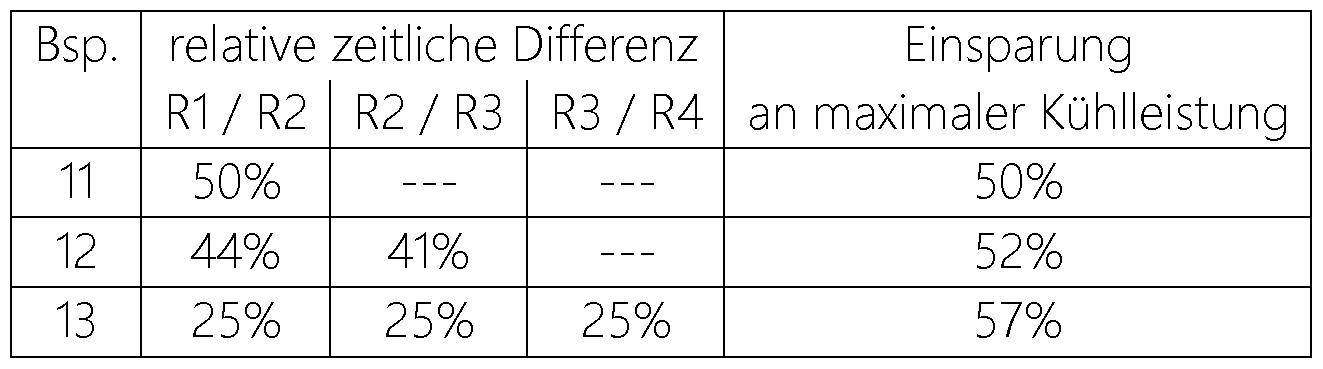
Die Beispiele zeigen, dass die Spitzen bei der Kühlleistung gesenkt werden können. Dies er- möglicht die Verwendung kleinerer, kostengünstigerer Kühler und eine bessere Ausnutzung der Kühlleistung. The examples show that the peaks in cooling performance can be reduced. This allows the use of smaller, less expensive coolers and better utilization of cooling capacity.
Claims
Priority Applications (4)
| Application Number | Priority Date | Filing Date | Title |
|---|---|---|---|
| KR1020197034783A KR102555560B1 (en) | 2017-05-02 | 2018-04-25 | Discontinuous production method of superabsorbent particles by polymerization of an aqueous monomer solution dispersed in a hydrophobic solvent |
| JP2019560172A JP7520512B2 (en) | 2017-05-02 | 2018-04-25 | Discontinuous method for producing superabsorbent particles by polymerization of aqueous monomer solutions dispersed in a hydrophobic solvent |
| SG11201909971Y SG11201909971YA (en) | 2017-05-02 | 2018-04-25 | Method for the discontinuous production of superabsorber particles by polymerizing an aqueous monomer solution dispersed in a hydrophobic solvent |
| EP18718477.5A EP3619243B1 (en) | 2017-05-02 | 2018-04-25 | Method for the discontinuous production of superabsorber particles by polymerizing an aqueous monomer solution dispersed in a hydrophobic solvent |
Applications Claiming Priority (2)
| Application Number | Priority Date | Filing Date | Title |
|---|---|---|---|
| EP17169021 | 2017-05-02 | ||
| EP17169021.7 | 2017-05-02 |
Publications (1)
| Publication Number | Publication Date |
|---|---|
| WO2018202490A1 true WO2018202490A1 (en) | 2018-11-08 |
Family
ID=58669640
Family Applications (1)
| Application Number | Title | Priority Date | Filing Date |
|---|---|---|---|
| PCT/EP2018/060548 Ceased WO2018202490A1 (en) | 2017-05-02 | 2018-04-25 | Method for the discontinuous production of superabsorber particles by polymerizing an aqueous monomer solution dispersed in a hydrophobic solvent |
Country Status (5)
| Country | Link |
|---|---|
| EP (1) | EP3619243B1 (en) |
| JP (1) | JP7520512B2 (en) |
| KR (1) | KR102555560B1 (en) |
| SG (1) | SG11201909971YA (en) |
| WO (1) | WO2018202490A1 (en) |
Cited By (1)
| Publication number | Priority date | Publication date | Assignee | Title |
|---|---|---|---|---|
| CN119661765A (en) * | 2023-09-21 | 2025-03-21 | 中国石油天然气集团有限公司 | Plugging composition and preparation method and application thereof |
Citations (21)
| Publication number | Priority date | Publication date | Assignee | Title |
|---|---|---|---|---|
| EP0083022A2 (en) | 1981-12-30 | 1983-07-06 | Seitetsu Kagaku Co., Ltd. | Water-absorbent resin having improved water-absorbency and improved water-dispersibility and process for producing same |
| DE3314019A1 (en) | 1982-04-19 | 1984-01-12 | Nippon Shokubai Kagaku Kogyo Co. Ltd., Osaka | ABSORBENT OBJECT |
| DE3523617A1 (en) | 1984-07-02 | 1986-01-23 | Nippon Shokubai Kagaku Kogyo Co. Ltd., Osaka | WATER ABSORBING AGENT |
| DE4020780C1 (en) | 1990-06-29 | 1991-08-29 | Chemische Fabrik Stockhausen Gmbh, 4150 Krefeld, De | |
| EP0450922A2 (en) | 1990-04-02 | 1991-10-09 | Nippon Shokubai Kagaku Kogyo Co. Ltd. | Method for production of fluid stable aggregate |
| EP0543303A1 (en) | 1991-11-22 | 1993-05-26 | Hoechst Aktiengesellschaft | Hydrophilic hydrogels having a high swelling capacity |
| US5807916A (en) | 1995-04-11 | 1998-09-15 | Elf Atochem S. A. | Process for obtaining polymers which are superabsorbent for water and aqueous fluids in the form of particle aggregates |
| DE19807992C1 (en) | 1998-02-26 | 1999-07-15 | Clariant Gmbh | Water absorbent polymers, surface crosslinked using bis-2-oxazolidinone and/or poly-2-oxazolidinones |
| EP0937736A2 (en) | 1998-02-24 | 1999-08-25 | Nippon Shokubai Co., Ltd. | Crosslinking a water-absorbing agent |
| DE19807502A1 (en) | 1998-02-21 | 1999-09-16 | Basf Ag | Process for post-crosslinking hydrogels with 2-oxazolidinones |
| DE19854573A1 (en) | 1998-11-26 | 2000-05-31 | Basf Ag | Process for post-crosslinking hydrogels with 2-oxo-tetrahydro-1,3-oxazines |
| DE19854574A1 (en) | 1998-11-26 | 2000-05-31 | Basf Ag | Process for post-crosslinking hydrogels with N-acyl-2-oxazolidinones |
| US6239230B1 (en) | 1999-09-07 | 2001-05-29 | Bask Aktiengesellschaft | Surface-treated superabsorbent polymer particles |
| EP1199327A2 (en) | 2000-10-20 | 2002-04-24 | Nippon Shokubai Co., Ltd. | Water-absorbing agent and process for producing the same |
| WO2003031482A1 (en) | 2001-10-05 | 2003-04-17 | Basf Aktiengesellschaft | Method for crosslinking hydrogels with morpholine-2,3-diones |
| DE10204938A1 (en) | 2002-02-07 | 2003-08-21 | Stockhausen Chem Fab Gmbh | Process for post-crosslinking of a water absorbing polymer surface with a cyclic urea useful in foams, fibers, films, cables, especially sealing materials, liquid absorbing hygiene articles, packaging materials, and soil additives |
| DE10204937A1 (en) | 2002-02-07 | 2003-08-21 | Stockhausen Chem Fab Gmbh | Process for post-crosslinking of a water absorbing polymer surface with a cyclic urea useful in foams, fibers, films, cables, especially sealing materials and liquid absorbing hygiene articles |
| DE10334584A1 (en) | 2003-07-28 | 2005-02-24 | Basf Ag | Post crosslinking of water absorbing polymers, useful for hygiene articles and packaging, comprises treatment with a bicyclic amideacetal crosslinking agent with simultaneous or subsequent heating |
| WO2008084031A2 (en) | 2007-01-11 | 2008-07-17 | Basf Se | Method for producing water-absorbing polymer particles by suspension polymerisation |
| JP2012007062A (en) | 2010-06-24 | 2012-01-12 | San-Dia Polymer Ltd | Absorbent resin particle, absorber containing the same, and absorbent article |
| US20150080539A1 (en) | 2012-03-29 | 2015-03-19 | Sumitomo Seika Chemicals Co., Ltd. | Polymerization reactor and method for producing water absorbent resin |
Family Cites Families (6)
| Publication number | Priority date | Publication date | Assignee | Title |
|---|---|---|---|---|
| EP2371869A1 (en) * | 2010-03-30 | 2011-10-05 | Evonik Stockhausen GmbH | A process for the production of a superabsorbent polymer |
| JP5956232B2 (en) * | 2012-04-24 | 2016-07-27 | 住友精化株式会社 | Method for producing water absorbent resin |
| EP2975065A4 (en) * | 2013-03-11 | 2016-11-16 | Sumitomo Seika Chemicals | APPARATUS FOR PRODUCING WATER ABSORBING RESIN |
| CA2919311C (en) * | 2013-07-31 | 2020-06-30 | Basf Se | Reverse-phase polymerisation process |
| WO2015014825A1 (en) * | 2013-07-31 | 2015-02-05 | Basf Se | Reverse-phase polymerisation process |
| JP6425341B2 (en) * | 2014-12-26 | 2018-11-21 | 株式会社日本触媒 | Method for producing polyacrylic acid (salt) -based water absorbent resin |
-
2018
- 2018-04-25 WO PCT/EP2018/060548 patent/WO2018202490A1/en not_active Ceased
- 2018-04-25 EP EP18718477.5A patent/EP3619243B1/en active Active
- 2018-04-25 SG SG11201909971Y patent/SG11201909971YA/en unknown
- 2018-04-25 KR KR1020197034783A patent/KR102555560B1/en active Active
- 2018-04-25 JP JP2019560172A patent/JP7520512B2/en active Active
Patent Citations (21)
| Publication number | Priority date | Publication date | Assignee | Title |
|---|---|---|---|---|
| EP0083022A2 (en) | 1981-12-30 | 1983-07-06 | Seitetsu Kagaku Co., Ltd. | Water-absorbent resin having improved water-absorbency and improved water-dispersibility and process for producing same |
| DE3314019A1 (en) | 1982-04-19 | 1984-01-12 | Nippon Shokubai Kagaku Kogyo Co. Ltd., Osaka | ABSORBENT OBJECT |
| DE3523617A1 (en) | 1984-07-02 | 1986-01-23 | Nippon Shokubai Kagaku Kogyo Co. Ltd., Osaka | WATER ABSORBING AGENT |
| EP0450922A2 (en) | 1990-04-02 | 1991-10-09 | Nippon Shokubai Kagaku Kogyo Co. Ltd. | Method for production of fluid stable aggregate |
| DE4020780C1 (en) | 1990-06-29 | 1991-08-29 | Chemische Fabrik Stockhausen Gmbh, 4150 Krefeld, De | |
| EP0543303A1 (en) | 1991-11-22 | 1993-05-26 | Hoechst Aktiengesellschaft | Hydrophilic hydrogels having a high swelling capacity |
| US5807916A (en) | 1995-04-11 | 1998-09-15 | Elf Atochem S. A. | Process for obtaining polymers which are superabsorbent for water and aqueous fluids in the form of particle aggregates |
| DE19807502A1 (en) | 1998-02-21 | 1999-09-16 | Basf Ag | Process for post-crosslinking hydrogels with 2-oxazolidinones |
| EP0937736A2 (en) | 1998-02-24 | 1999-08-25 | Nippon Shokubai Co., Ltd. | Crosslinking a water-absorbing agent |
| DE19807992C1 (en) | 1998-02-26 | 1999-07-15 | Clariant Gmbh | Water absorbent polymers, surface crosslinked using bis-2-oxazolidinone and/or poly-2-oxazolidinones |
| DE19854573A1 (en) | 1998-11-26 | 2000-05-31 | Basf Ag | Process for post-crosslinking hydrogels with 2-oxo-tetrahydro-1,3-oxazines |
| DE19854574A1 (en) | 1998-11-26 | 2000-05-31 | Basf Ag | Process for post-crosslinking hydrogels with N-acyl-2-oxazolidinones |
| US6239230B1 (en) | 1999-09-07 | 2001-05-29 | Bask Aktiengesellschaft | Surface-treated superabsorbent polymer particles |
| EP1199327A2 (en) | 2000-10-20 | 2002-04-24 | Nippon Shokubai Co., Ltd. | Water-absorbing agent and process for producing the same |
| WO2003031482A1 (en) | 2001-10-05 | 2003-04-17 | Basf Aktiengesellschaft | Method for crosslinking hydrogels with morpholine-2,3-diones |
| DE10204938A1 (en) | 2002-02-07 | 2003-08-21 | Stockhausen Chem Fab Gmbh | Process for post-crosslinking of a water absorbing polymer surface with a cyclic urea useful in foams, fibers, films, cables, especially sealing materials, liquid absorbing hygiene articles, packaging materials, and soil additives |
| DE10204937A1 (en) | 2002-02-07 | 2003-08-21 | Stockhausen Chem Fab Gmbh | Process for post-crosslinking of a water absorbing polymer surface with a cyclic urea useful in foams, fibers, films, cables, especially sealing materials and liquid absorbing hygiene articles |
| DE10334584A1 (en) | 2003-07-28 | 2005-02-24 | Basf Ag | Post crosslinking of water absorbing polymers, useful for hygiene articles and packaging, comprises treatment with a bicyclic amideacetal crosslinking agent with simultaneous or subsequent heating |
| WO2008084031A2 (en) | 2007-01-11 | 2008-07-17 | Basf Se | Method for producing water-absorbing polymer particles by suspension polymerisation |
| JP2012007062A (en) | 2010-06-24 | 2012-01-12 | San-Dia Polymer Ltd | Absorbent resin particle, absorber containing the same, and absorbent article |
| US20150080539A1 (en) | 2012-03-29 | 2015-03-19 | Sumitomo Seika Chemicals Co., Ltd. | Polymerization reactor and method for producing water absorbent resin |
Non-Patent Citations (1)
| Title |
|---|
| F.L. BUCHHOLZ; A.T. GRAHAM: "Monographie", 1998, WILEY-VCH, article "Modern Superabsorbent Polymer Technology", pages: 69 - 117 |
Cited By (1)
| Publication number | Priority date | Publication date | Assignee | Title |
|---|---|---|---|---|
| CN119661765A (en) * | 2023-09-21 | 2025-03-21 | 中国石油天然气集团有限公司 | Plugging composition and preparation method and application thereof |
Also Published As
| Publication number | Publication date |
|---|---|
| JP7520512B2 (en) | 2024-07-23 |
| EP3619243A1 (en) | 2020-03-11 |
| KR20190140995A (en) | 2019-12-20 |
| SG11201909971YA (en) | 2019-11-28 |
| JP2020518702A (en) | 2020-06-25 |
| EP3619243B1 (en) | 2021-02-17 |
| KR102555560B1 (en) | 2023-07-17 |
Similar Documents
| Publication | Publication Date | Title |
|---|---|---|
| EP2922580B1 (en) | Method for producing superabsorbers based on renewable raw materials | |
| EP2411422B1 (en) | Method for producing surface post-cross-linked, water absorbing polymer particles | |
| EP2539382B1 (en) | Method for producing water-absorbing polymer particles | |
| EP2300060B1 (en) | Method for producing water-absorbing polymer particles | |
| EP2731975B1 (en) | Method for producing water-absorbing polymer particles having a high swelling speed | |
| EP2257574A1 (en) | Method for manufacturing water-absorbing polymer particles with a low centrifuge retention capacity | |
| EP2238181A1 (en) | Method for the production of water-absorbing polymer particles | |
| EP2274087B1 (en) | Method for producing water-absorbing polymer particles | |
| EP2870183A1 (en) | Method for producing water-absorbent polymer particles with improved properties | |
| WO2008084031A2 (en) | Method for producing water-absorbing polymer particles by suspension polymerisation | |
| EP3827031A1 (en) | Method for the production of superabsorbers | |
| EP2705075B1 (en) | Method for the production of water-absorbing polymer particles | |
| WO2018202490A1 (en) | Method for the discontinuous production of superabsorber particles by polymerizing an aqueous monomer solution dispersed in a hydrophobic solvent | |
| EP2385816A1 (en) | Method for producing odor inhibiting, water absorbing polymer particles | |
| EP2300061A1 (en) | Method for the surface post-crosslinking of water absorbing polymer particles | |
| EP2539381A1 (en) | Method for producing water-absorbing polymer particles | |
| EP3619244B1 (en) | Method for the discontinuous production of superabsorber particles by polymerizing an aqueous monomer solution dispersed in a hydrophobic solvent | |
| EP2714750B1 (en) | Process for the continuous production of water absorbable polymer particles | |
| EP2485773B1 (en) | Use of heating steam condensate for producing water-absorbent polymer particles | |
| EP2861631B1 (en) | Method for producing water-absorbing polymer particles in a polymerization reactor having at least two axially parallel rotating shafts | |
| EP2714103B1 (en) | Process for the continuous production of water-absorbing polymer particles | |
| WO2012107344A1 (en) | Method for producing water-absorbing polymer particles | |
| WO2020151971A1 (en) | Method for producing superabsorbent particles | |
| EP2485774A1 (en) | Method for continuous production of water-absorbent polymer particles |
Legal Events
| Date | Code | Title | Description |
|---|---|---|---|
| 121 | Ep: the epo has been informed by wipo that ep was designated in this application |
Ref document number: 18718477 Country of ref document: EP Kind code of ref document: A1 |
|
| ENP | Entry into the national phase |
Ref document number: 2019560172 Country of ref document: JP Kind code of ref document: A |
|
| NENP | Non-entry into the national phase |
Ref country code: DE |
|
| ENP | Entry into the national phase |
Ref document number: 20197034783 Country of ref document: KR Kind code of ref document: A |
|
| ENP | Entry into the national phase |
Ref document number: 2018718477 Country of ref document: EP Effective date: 20191202 |