WO2018098796A1 - Process to form a composition containing functionalized and un-functionalized ethylene-based polymers - Google Patents
Process to form a composition containing functionalized and un-functionalized ethylene-based polymers Download PDFInfo
- Publication number
- WO2018098796A1 WO2018098796A1 PCT/CN2016/108309 CN2016108309W WO2018098796A1 WO 2018098796 A1 WO2018098796 A1 WO 2018098796A1 CN 2016108309 W CN2016108309 W CN 2016108309W WO 2018098796 A1 WO2018098796 A1 WO 2018098796A1
- Authority
- WO
- WIPO (PCT)
- Prior art keywords
- ethylene
- polymer
- based polymer
- functionalized
- composition
- Prior art date
- Legal status (The legal status is an assumption and is not a legal conclusion. Google has not performed a legal analysis and makes no representation as to the accuracy of the status listed.)
- Ceased
Links
Images


Classifications
-
- C—CHEMISTRY; METALLURGY
- C08—ORGANIC MACROMOLECULAR COMPOUNDS; THEIR PREPARATION OR CHEMICAL WORKING-UP; COMPOSITIONS BASED THEREON
- C08F—MACROMOLECULAR COMPOUNDS OBTAINED BY REACTIONS ONLY INVOLVING CARBON-TO-CARBON UNSATURATED BONDS
- C08F2/00—Processes of polymerisation
- C08F2/04—Polymerisation in solution
-
- C—CHEMISTRY; METALLURGY
- C08—ORGANIC MACROMOLECULAR COMPOUNDS; THEIR PREPARATION OR CHEMICAL WORKING-UP; COMPOSITIONS BASED THEREON
- C08F—MACROMOLECULAR COMPOUNDS OBTAINED BY REACTIONS ONLY INVOLVING CARBON-TO-CARBON UNSATURATED BONDS
- C08F2/00—Processes of polymerisation
- C08F2/01—Processes of polymerisation characterised by special features of the polymerisation apparatus used
-
- C—CHEMISTRY; METALLURGY
- C08—ORGANIC MACROMOLECULAR COMPOUNDS; THEIR PREPARATION OR CHEMICAL WORKING-UP; COMPOSITIONS BASED THEREON
- C08F—MACROMOLECULAR COMPOUNDS OBTAINED BY REACTIONS ONLY INVOLVING CARBON-TO-CARBON UNSATURATED BONDS
- C08F210/00—Copolymers of unsaturated aliphatic hydrocarbons having only one carbon-to-carbon double bond
- C08F210/16—Copolymers of ethene with alpha-alkenes, e.g. EP rubbers
-
- C—CHEMISTRY; METALLURGY
- C08—ORGANIC MACROMOLECULAR COMPOUNDS; THEIR PREPARATION OR CHEMICAL WORKING-UP; COMPOSITIONS BASED THEREON
- C08J—WORKING-UP; GENERAL PROCESSES OF COMPOUNDING; AFTER-TREATMENT NOT COVERED BY SUBCLASSES C08B, C08C, C08F, C08G or C08H
- C08J3/00—Processes of treating or compounding macromolecular substances
- C08J3/005—Processes for mixing polymers
-
- C—CHEMISTRY; METALLURGY
- C08—ORGANIC MACROMOLECULAR COMPOUNDS; THEIR PREPARATION OR CHEMICAL WORKING-UP; COMPOSITIONS BASED THEREON
- C08L—COMPOSITIONS OF MACROMOLECULAR COMPOUNDS
- C08L23/00—Compositions of homopolymers or copolymers of unsaturated aliphatic hydrocarbons having only one carbon-to-carbon double bond; Compositions of derivatives of such polymers
- C08L23/02—Compositions of homopolymers or copolymers of unsaturated aliphatic hydrocarbons having only one carbon-to-carbon double bond; Compositions of derivatives of such polymers not modified by chemical after-treatment
- C08L23/04—Homopolymers or copolymers of ethene
- C08L23/08—Copolymers of ethene
- C08L23/0807—Copolymers of ethene with unsaturated hydrocarbons only containing four or more carbon atoms
- C08L23/0815—Copolymers of ethene with unsaturated hydrocarbons only containing four or more carbon atoms with aliphatic 1-olefins containing one carbon-to-carbon double bond
-
- C—CHEMISTRY; METALLURGY
- C08—ORGANIC MACROMOLECULAR COMPOUNDS; THEIR PREPARATION OR CHEMICAL WORKING-UP; COMPOSITIONS BASED THEREON
- C08L—COMPOSITIONS OF MACROMOLECULAR COMPOUNDS
- C08L23/00—Compositions of homopolymers or copolymers of unsaturated aliphatic hydrocarbons having only one carbon-to-carbon double bond; Compositions of derivatives of such polymers
- C08L23/02—Compositions of homopolymers or copolymers of unsaturated aliphatic hydrocarbons having only one carbon-to-carbon double bond; Compositions of derivatives of such polymers not modified by chemical after-treatment
- C08L23/16—Ethene-propene or ethene-propene-diene copolymers
-
- C—CHEMISTRY; METALLURGY
- C08—ORGANIC MACROMOLECULAR COMPOUNDS; THEIR PREPARATION OR CHEMICAL WORKING-UP; COMPOSITIONS BASED THEREON
- C08L—COMPOSITIONS OF MACROMOLECULAR COMPOUNDS
- C08L51/00—Compositions of graft polymers in which the grafted component is obtained by reactions only involving carbon-to-carbon unsaturated bonds; Compositions of derivatives of such polymers
- C08L51/06—Compositions of graft polymers in which the grafted component is obtained by reactions only involving carbon-to-carbon unsaturated bonds; Compositions of derivatives of such polymers grafted on to homopolymers or copolymers of aliphatic hydrocarbons containing only one carbon-to-carbon double bond
-
- C—CHEMISTRY; METALLURGY
- C08—ORGANIC MACROMOLECULAR COMPOUNDS; THEIR PREPARATION OR CHEMICAL WORKING-UP; COMPOSITIONS BASED THEREON
- C08F—MACROMOLECULAR COMPOUNDS OBTAINED BY REACTIONS ONLY INVOLVING CARBON-TO-CARBON UNSATURATED BONDS
- C08F2500/00—Characteristics or properties of obtained polyolefins; Use thereof
- C08F2500/12—Melt flow index or melt flow ratio
-
- C—CHEMISTRY; METALLURGY
- C08—ORGANIC MACROMOLECULAR COMPOUNDS; THEIR PREPARATION OR CHEMICAL WORKING-UP; COMPOSITIONS BASED THEREON
- C08F—MACROMOLECULAR COMPOUNDS OBTAINED BY REACTIONS ONLY INVOLVING CARBON-TO-CARBON UNSATURATED BONDS
- C08F6/00—Post-polymerisation treatments
- C08F6/06—Treatment of polymer solutions
- C08F6/10—Removal of volatile materials, e.g. solvents
-
- C—CHEMISTRY; METALLURGY
- C08—ORGANIC MACROMOLECULAR COMPOUNDS; THEIR PREPARATION OR CHEMICAL WORKING-UP; COMPOSITIONS BASED THEREON
- C08F—MACROMOLECULAR COMPOUNDS OBTAINED BY REACTIONS ONLY INVOLVING CARBON-TO-CARBON UNSATURATED BONDS
- C08F6/00—Post-polymerisation treatments
- C08F6/26—Treatment of polymers prepared in bulk also solid polymers or polymer melts
-
- C—CHEMISTRY; METALLURGY
- C08—ORGANIC MACROMOLECULAR COMPOUNDS; THEIR PREPARATION OR CHEMICAL WORKING-UP; COMPOSITIONS BASED THEREON
- C08J—WORKING-UP; GENERAL PROCESSES OF COMPOUNDING; AFTER-TREATMENT NOT COVERED BY SUBCLASSES C08B, C08C, C08F, C08G or C08H
- C08J2323/00—Characterised by the use of homopolymers or copolymers of unsaturated aliphatic hydrocarbons having only one carbon-to-carbon double bond; Derivatives of such polymers
- C08J2323/02—Characterised by the use of homopolymers or copolymers of unsaturated aliphatic hydrocarbons having only one carbon-to-carbon double bond; Derivatives of such polymers not modified by chemical after treatment
- C08J2323/04—Homopolymers or copolymers of ethene
- C08J2323/08—Copolymers of ethene
-
- C—CHEMISTRY; METALLURGY
- C08—ORGANIC MACROMOLECULAR COMPOUNDS; THEIR PREPARATION OR CHEMICAL WORKING-UP; COMPOSITIONS BASED THEREON
- C08J—WORKING-UP; GENERAL PROCESSES OF COMPOUNDING; AFTER-TREATMENT NOT COVERED BY SUBCLASSES C08B, C08C, C08F, C08G or C08H
- C08J2451/00—Characterised by the use of graft polymers in which the grafted component is obtained by reactions only involving carbon-to-carbon unsaturated bonds; Derivatives of such polymers
- C08J2451/06—Characterised by the use of graft polymers in which the grafted component is obtained by reactions only involving carbon-to-carbon unsaturated bonds; Derivatives of such polymers grafted on to homopolymers or copolymers of aliphatic hydrocarbons containing only one carbon-to-carbon double bond
-
- C—CHEMISTRY; METALLURGY
- C08—ORGANIC MACROMOLECULAR COMPOUNDS; THEIR PREPARATION OR CHEMICAL WORKING-UP; COMPOSITIONS BASED THEREON
- C08L—COMPOSITIONS OF MACROMOLECULAR COMPOUNDS
- C08L2203/00—Applications
- C08L2203/16—Applications used for films
-
- C—CHEMISTRY; METALLURGY
- C08—ORGANIC MACROMOLECULAR COMPOUNDS; THEIR PREPARATION OR CHEMICAL WORKING-UP; COMPOSITIONS BASED THEREON
- C08L—COMPOSITIONS OF MACROMOLECULAR COMPOUNDS
- C08L2205/00—Polymer mixtures characterised by other features
- C08L2205/02—Polymer mixtures characterised by other features containing two or more polymers of the same C08L -group
-
- C—CHEMISTRY; METALLURGY
- C08—ORGANIC MACROMOLECULAR COMPOUNDS; THEIR PREPARATION OR CHEMICAL WORKING-UP; COMPOSITIONS BASED THEREON
- C08L—COMPOSITIONS OF MACROMOLECULAR COMPOUNDS
- C08L23/00—Compositions of homopolymers or copolymers of unsaturated aliphatic hydrocarbons having only one carbon-to-carbon double bond; Compositions of derivatives of such polymers
- C08L23/26—Compositions of homopolymers or copolymers of unsaturated aliphatic hydrocarbons having only one carbon-to-carbon double bond; Compositions of derivatives of such polymers modified by chemical after-treatment
Definitions
- Grafted ethylene-based polymers are useful in adhesive formulations, in tie layers for multilayer structures, as coupling agents for highly filled or halogen-free flame retardant (HFFR) formulations, and as compatibilizers in polymer blends.
- the grafted (e.g., MAH) functionality helps chemical interaction of the ethylene-based polymers to polar polymers like nylon, ethylene vinyl alcohol (EVOH) , and inorganic fillers.
- the grafted functionality also increases the surface polarity of the ethylene-based polymers, to improve adhesion to paints, and printing inks.
- compositions containing functionalized polymers, and processes to form the same, are described in the following references: WO2004/022661 (discloses blends of a grafted material with a non-grafted material being produced on a gas phase train, using a twin screw is used for blending) and, U.S. Publication No. 2007/0208110 (non extrusion process for functionalization of low viscosity polymers) , and International Application No. PCT/US16/05307 (filed September 22, 2016) . See also U.S. Patent 8876365 and U.S. Application No. 62/272390 (filed December 29, 2015) .
- a process is provided to form a polymer composition comprising an ethylene-based polymer and a functionalized ethylene-based polymer, said process comprising at least the following:
- Figure 1 depicts a schematic of an incumbent (comparative) process to make a single pellet composition (3 step process) .
- Figure 2 depicts an inventive process to a make single pellet composition (2 step process)
- a manufacturing process has been discovered to produce a polymer composition, preferably in pellet form, and containing an ethylene-based polymer, a functionalized ethylene-based polymer and optionally additives. It has been discovered that this polymer composition that has adhesive characteristics, and can function as a tie layer to bond multilayer structures, comprising layers of non-polar olefin-based polymers and polar polymers, such as, for example, EVOH or nylon. It has been discovered that this polymer composition can be prepared, in-line, with a solution polymerization process, and without the need for an additional melting step, before extruding the polymer composition, in pellet form (for example, a single pellet) , into a final end product, such as a film. See, for example, Figure 2. It has also been discovered that the polymer composition has low gel levels.
- a process is provided to form a polymer composition comprising an ethylene-based polymer and a functionalized ethylene-based polymer, said process comprising at least the following:
- the above process may comprise a combination of two or more embodiments as described herein.
- step b) ⁇ 60 wt%, or ⁇ 70 wt%, or ⁇ 80 wt%, or ⁇ 90 wt%, of the solvent in the polymer solution formed after the solution polymerization process, is removed.
- the wt% is based on the weight of the solvent in the polymer solution.
- ⁇ 0.15 wt%, or ⁇ 0.10 wt%, or ⁇ 0.05 wt%residual solvent based on the weight of the resulting polymer melt, remains in the polymer melt.
- the polymer solution and polymer melt can each be examined by Head Space GC (Gas Chromatography) to determine the amount of solvent in the respective form of the polymer product. ”
- step b) ⁇ 90 wt%, or ⁇ 95 wt%, or ⁇ 98 wt%, or ⁇ 99 wt%, of the solvent in the polymer solution formed after the solution polymerization process, is removed.
- the wt% is based on the weight of the solvent in the polymer solution.
- ⁇ 0.15 wt%, or ⁇ 0.10 wt%, or ⁇ 0.05 wt%residual solvent based on the weight of the resulting polymer melt, remains in the polymer melt.
- the polymer solution and polymer melt can each be examined by Head Space GC (Gas Chromatography) to determine the amount of solvent in the respective form of the polymer product. ”
- the ethylene-based polymer differs from the functionalized ethylene-based polymer in one or more properties, such as the presence of one or more heteroatoms incorporated into the polymer molecules, the amount of functionalization, density, melt index I2, Mw, Mn, MWD, type of comonomer, and/or amount of comonomer.
- the ethylene-based polymer does not comprise a heteroatom.
- the ethylene-based polymer is a polyethylene homopolymer.
- the ethylene-based polymer is an ethylene/alpha-olefin interpolymer.
- Suitable ⁇ -olefins include C 3 -C 20 ⁇ -olefins, and preferably C 3 -C 10 ⁇ -olefins.
- the ethylene-based polymer is an ethylene/alpha-olefin copolymer.
- Suitable ⁇ -olefins include C 3 -C 20 ⁇ -olefins, and preferably C 3 -C 10 ⁇ -olefins.
- the functionalized ethylene-based polymer, in melt form is introduced into the polymer melt, using a side-arm extruder.
- the transition time required to the purge the polymer composition from the extruder is less than 60 minutes, further less than 30 minutes, further less than 20 minutes, further less than 10 minutes.
- the static mixer comprises ⁇ 1, or ⁇ 2, or ⁇ 3 mixing elements, such as helical mixing elements.
- Static mixers are available, for example, from Chemineer (KM, KMX, HEV) , Fluitec Georg AG (CES, CSE-X, CSE-XR) , Komax Systems (ASeries, M Series) , Lightnin’ Mixer (Inliner Series 45) , Ross Mixers Statiflo International (ISG, LPD, STM, STX) , Sulzer Chemtech (SMX, SMXL, SMV, SMF, SMR, KVM) and Pittaluga Static Mixers (XP, VP, X, XL) .
- Chemineer KM, KMX, HEV
- CES Fluitec Georg AG
- CSE-X CSE-XR
- Komax Systems ASeries, M Series
- Lightnin’ Mixer Inliner Series 45
- Ross Mixers Statiflo International ISG, LPD, STM,
- the process further comprises pelletizing the polymer composition.
- the pelletization apparatus is in-line with the static mixer, and the polymer composition is fed into the pelletization apparatus, after exiting the static mixer.
- the reactor is a loop reactor or a continuous stirred tank reactor. In one embodiment, the reactor is a loop reactor.
- the polymer composition has a gel content (GI200) of ⁇ 20, or ⁇ 18, or ⁇ 16, or ⁇ 14, or ⁇ 12, or ⁇ 10, or ⁇ 8.0, or ⁇ 7.0, or ⁇ 6.0, or ⁇ 5.0 mm 2 per 24.6 cm 3 of film.
- GI200 gel content
- the functionalized ethylene-based polymer is present in an amount from 2 wt%to 50 wt%, or from 2 to 45 wt%, or from 2 wt%to 40 wt%, or from 2 wt%to 35 wt%, or from 2 wt%to 30 wt%, based on the weight of the polymer composition.
- the functionalized ethylene-based polymer is present in an amount from 2 wt%to 25wt%, or from 2 to 20 wt%, or from 2 wt%to 15 wt%, or from 2 wt%to 10 wt%, or from 2 wt%to 5 wt%, based on the weight of the polymer composition.
- the functionalized ethylene-based polymer is present in an amount from 2 wt%to 50 wt%, or from 2 to 45 wt%, or from 2 wt%to 40 wt%, or from 2 wt%to 35 wt%, or from 2 wt%to 30 wt%, based on the weight of the ethylene-based polymer and the functionalized ethylene-based polymer.
- the functionalized ethylene-based polymer is present in an amount from 2 wt%to 25wt%, or from 2 to 20 wt%, or from 2 wt%to 15 wt%, or from 2 wt%to 10 wt%, or from 2 wt%to 5 wt%, based on the weight of the ethylene-based polymer and the functionalized ethylene-based polymer.
- the weight ratio of functionalized ethylene-based polymer to ethylene-based polymer is from 1/20 to 1/3, or from 1/20 to 1/5, or from 1/20 to 1/7, or from 1/20 to 1/9.
- the weight ratio of functionalized ethylene-based polymer to ethylene-based polymer is from 1/20 to 1/4, or from 1/20 to 1/6, or from 1/20 to 1/8, or from 1/20 to 1/10.
- the composition comprises ⁇ 90 wt%, or ⁇ 92 wt%, or ⁇ 95 wt%, or ⁇ 98 wt%, or ⁇ 99 wt%of the sum weight of the ethylene-based polymer and the functionalized ethylene-based polymer, based on the weight of the composition.
- the composition further comprises a second ethylene-based polymer.
- the functionalized ethylene-based polymer is an anhydride functionalized ethylene-based polymer, and further an anhydride grafted ethylene-based polymer. In one embodiment, the functionalized ethylene-based polymer is a maleic anhydride functionalized ethylene-based polymer, and further a maleic anhydride grafted ethylene-based polymer.
- the composition comprises a functionalization content of ⁇ 0.05 wt%, or ⁇ 0.08 wt%, or ⁇ 0.10 wt%, or ⁇ 0.11 wt%, or ⁇ 0.12 wt% based on the total weight of the polymer composition. In one embodiment, the composition comprises a functionalize-tion content of ⁇ 2.00 wt%, or ⁇ 1.50 wt%, or ⁇ 1.00 wt%, or ⁇ 0.50 wt%, based on the total weight of the polymer composition.
- the polymer composition is in a pellet form (for example, a single pellet) .
- composition formed by the process of any one or more embodiments described herein, and preferably in pellet form (for example, single pellet form) .
- the composition has a melt index (I 2 ) ⁇ 0.25 dg/min, or ⁇ 0.50 dg/min, or ⁇ 1.0 dg/min, or ⁇ 1.5 dg/min, or ⁇ 2.0 dg/min, or ⁇ 5.0 dg/min, or ⁇ 10 dg/min. In one embodiment, the composition has a melt index (I 2 ) ⁇ 200 dg/min, or ⁇ 150 dg/min, or ⁇ 100 dg/min, or ⁇ 50 dg/min.
- the composition has a density ⁇ 0.880 g/cc, or ⁇ 0.890 g/cc, or ⁇ 0.900 g/cc. In one embodiment, the composition has a density ⁇ 0.940 g/cc, or ⁇ 0.935 g/cc, or ⁇ 0.930 g/cc.
- the polymer composition has a gel content (GI200) of ⁇ 20, or ⁇ 18, or ⁇ 16, or ⁇ 14, or ⁇ 12, or ⁇ 10, or ⁇ 8.0, or ⁇ 7.0, or ⁇ 6.0, or ⁇ 5.0 mm 2 per 24.6 cm 3 of film.
- GI200 gel content
- the functionalized ethylene-based polymer is present in an amount from 2 wt%to 50 wt%, or from 2 to 45 wt%, or from 2 wt%to 40 wt%, or from 2 wt%to 35 wt%, or from 2 wt%to 30 wt%, based on the weight of the polymer composition.
- the functionalized ethylene-based polymer is present in an amount from 2 wt%to 25wt%, or from 2 to 20 wt%, or from 2 wt%to 15 wt%, or from 2 wt%to 10 wt%, or from 2 wt%to 5 wt%, based on the weight of the polymer composition.
- the functionalized ethylene-based polymer is present in an amount from 2 wt%to 50 wt%, or from 2 to 45 wt%, or from 2 wt%to 40 wt%, or from 2 wt%to 35 wt%, or from 2 wt%to 30 wt%, based on the weight of the ethylene-based polymer and the functionalized ethylene-based polymer.
- the functionalized ethylene-based polymer is present in an amount from 2 wt%to 25wt%, or from 2 to 20 wt%, or from 2 wt%to 15 wt%, or from 2 wt%to 10 wt%, or from 2 wt%to 5 wt%, based on the weight of the ethylene-based polymer and the functionalized ethylene-based polymer.
- the weight ratio of functionalized ethylene-based polymer to ethylene-based polymer is from 1/20 to 1/3, or from 1/20 to 1/5, or from 1/20 to 1/7, or from 1/20 to 1/9.
- the weight ratio of functionalized ethylene-based polymer to ethylene-based polymer is from 1/20 to 1/4, or from 1/20 to 1/6, or from 1/20 to 1/8, or from 1/20 to 1/10.
- the composition comprises ⁇ 90 wt%, or ⁇ 92 wt%, or ⁇ 95 wt%, or ⁇ 98 wt%, or ⁇ 99 wt%of the sum weight of the ethylene-based polymer and the functionalized ethylene-based polymer, based on the weight of the composition.
- the composition further comprises a second ethylene-based polymer.
- the functionalized ethylene-based polymer is an anhydride functionalized ethylene-based polymer, and further an anhydride grafted ethylene-based polymer. In one embodiment, the functionalized ethylene-based polymer is a maleic anhydride functionalized ethylene-based polymer, and further a maleic anhydride grafted ethylene-based polymer.
- the composition comprises a functionalization content of ⁇ 0.05 wt%, or ⁇ 0.08 wt%, or ⁇ 0.09 wt%, or ⁇ 0.10 wt%, or ⁇ 0.11 wt%, or ⁇ 0.12 wt% based on the total weight of the polymer composition. In one embodiment, the composition comprises a functionalization content of ⁇ 2.00 wt%, or ⁇ 1.50 wt%, or ⁇ 1.00 wt%, or ⁇ 0.50 wt%, based on the total weight of the polymer composition.
- the composition further comprises one or more additives.
- the article is selected from a film structure comprising one or more layers, an adhesive primer composition, a dispersion, an automotive part, or a building or construction part. In one embodiment, the article is selected from a film structure comprising one or more layers.
- the article is selected from a film comprising ⁇ 1 layer, or ⁇ 2 layers, or ⁇ 3 layers, or ⁇ 4 layers, or ⁇ 5 layers.
- the film comprises ⁇ 3 layers. In a further embodiment, at least two layers are formed from the same polymer composition, as described herein. In a further embodiment, these two layers are separated by a layer formed from a composition comprising a polar polymer, such as nylon, EVOH, or a combination thereof.
- the film has an average load peel adhesion ⁇ 10.0, or ⁇ 11.0, or ⁇ 12.0, or ⁇ 12.5, or ⁇ 13.0 N/2.54 cm. In one embodiment, the film has peak load peel adhesion ⁇ 14.0, or ⁇ 14.5, or ⁇ 15.0, or ⁇ 15.5 N/2.54 cm.
- the ethylene-based polymer is an ethylene homopolymer or ethylene-based interpolymer. In a further embodiment, the ethylene-based polymer is an ethylene homopolymer or an ethylene-based copolymer.
- the ethylene-based polymer is an ethylene-based interpolymer.
- the ethylene-based interpolymer comprises greater than, or equal to, 60 wt%, further greater than, or equal to, 70 wt%, further greater than, or equal to, 80 wt%, further greater than, or equal to, 85 wt%, polymerized ethylene, based on the weight of the interpolymer.
- the ethylene-based interpolymer is an ethylene-based copolymer.
- the ethylene-based interpolymer is an ethylene/alpha-olefin interpolymer, and further an ethylene/alpha-olefin copolymer.
- Suitable ⁇ -olefins include, but are not limited to, C 3 -C 20 ⁇ -olefins, and preferably C 3 -C 10 ⁇ -olefins. More preferred ⁇ -olefins include propylene, 1-butene, 1-pentene, 1-hexene, 1-heptene and 1-octene, further include propylene, 1-butene, 1-hexene and 1-octene, and further 1-butene, 1-hexene and 1-octene.
- the ethylene-based polymer has a density from 0.880 g/cc to 0.950 g/cc, further from 0.890 g/cc to 0.940 g/cc, and further from 0.900 g/cc to 0.930 g/cc.
- the ethylene-based polymer is an ethylene/alpha-olefin interpolymer, and further an ethylene/alpha-olefin copolymer. Suitable ⁇ -olefins are described above.
- the ethylene-based polymer has a density from 0.900 g/cc to 0.935 g/cc, further from 0.905 g/cc to 0.930 g/cc, and further from 0.910 g/cc to 0.925 g/cc.
- the ethylene-based polymer is an ethylene/alpha-olefin interpolymer, and further an ethylene/alpha-olefin copolymer. Suitable ⁇ -olefins are described above.
- the ethylene-based polymer has a melt index (I 2 , 2.16 kg, 190°C) ⁇ 0.25 dg/min , ⁇ 0.5 dg/min, or ⁇ 0.6 dg/min, or ⁇ 0.7 dg/min, or ⁇ 0.8 dg/min, or ⁇ 0.9 dg/min, or ⁇ 1.0 dg/min, or greater than or equal to 1.2 dg/min.
- the ethylene-based polymer has a melt index (I 2 , 2.16 kg, 190°C) ⁇ 100 dg/min, or ⁇ 50 dg/min, or ⁇ 20 dg/min, or ⁇ 10 dg/min, or ⁇ 5.0 dg/min.
- the ethylene-based polymer is an ethylene/alpha-olefin interpolymer, and further an ethylene/alpha-olefin copolymer. Suitable ⁇ -olefins are described above.
- the ethylene-based polymer is free from any oxo-boron compounds. In one embodiment, the ethylene-based polymer composition is free from any borane-containing compounds.
- the ethylene-based polymer may comprise a combination of two or more embodiments as described herein.
- the functionalized ethylene-based polymer is a functionalized ethylene-based homopolymer or a functionalized ethylene-based interpolymer, and further a functionalized ethylene-based copolymer, with the ethylene-based copolymer as described above.
- the functionalized ethylene-based polymer is an anhydride, carboxylic acid and/or silane functionalized ethylene-based polymer, or further an anhydride functionalized ethylene-based polymer, or further a maleic anhydride functionalized ethylene-based polymer.
- the functionalized ethylene-based polymer is an anhydride, carboxylic acid and/or silane functionalized ethylene-based homopolymer or anhydride, carboxylic acid and/or silane functionalized ethylene-based interpolymer.
- the functionalized ethylene-based polymer is an anhydride, carboxylic acid and/or silane functionalized ethylene-based interpolymer, or further an anhydride, carboxylic acid and/or silane functionalized ethylene-based copolymer, or further an anhydride, carboxylic acid and/or silane functionalized ethylene/ ⁇ -olefin copolymer.
- the functionalized ethylene-based polymer is an anhydride and/or carboxylic acid functionalized ethylene-based homopolymer, or anhydride and/or carboxylic acid functionalized ethylene-based interpolymer, and further an anhydride and/or carboxylic acid functionalized ethylene-based copolymer.
- the functionalized ethylene-based polymer is an anhydride functionalized ethylene-based homopolymer or anhydride functionalized ethylene-based interpolymer, and further an anhydride functionalized ethylene-based copolymer.
- the functionalized ethylene-based polymer is a maleic anhydride functionalized ethylene-based homopolymer or a maleic anhydride functionalized ethylene-based interpolymer, and further a maleic anhydride functionalized ethylene-based copolymer.
- the functionalized ethylene-based polymer is a grafted ethylene-based polymer. In one embodiment, the functionalized ethylene-based polymer is a grafted ethylene homopolymer or grafted ethylene-based interpolymer. In an embodiment, the grafted ethylene-based interpolymer is a grafted ethylene-based copolymer.
- the functionalized ethylene-based polymer is an anhydride, carboxylic acid and/or silane grafted ethylene-based homopolymer, or anhydride, carboxylic acid and/or silane grafted ethylene-based interpolymer, or further an anhydride, carboxylic acid and/or silane grafted ethylene-based copolymer.
- the functionalized ethylene-based polymer is an anhydride and/or carboxylic acid grafted ethylene-based homopolymer, or an anhydride and/or carboxylic acid grafted ethylene-based interpolymer, or further an anhydride and/or carboxylic acid grafted ethylene-based copolymer.
- the functionalized ethylene-based polymer is an anhydride, carboxylic acid and/or silane grafted ethylene/ ⁇ -olefin interpolymer, or further an anhydride, carboxylic acid and/or silane grafted ethylene/ ⁇ -olefin copolymer.
- Suitable ⁇ -olefins include C 3 -C 20 ⁇ -olefins, and preferably C 3 -C 10 ⁇ -olefins.
- the functionalized ethylene-based polymer is an anhydride and/or carboxylic acid grafted ethylene-based homopolymer, or an anhydride and/or carboxylic acid grafted ethylene/ ⁇ -olefin interpolymer, or further an anhydride and/or acid grafted ethylene-/ ⁇ -olefin copolymer.
- Suitable ⁇ -olefins include C 3 -C 20 ⁇ -olefins, and preferably C 3 -C 10 ⁇ -olefins.
- the functionalized ethylene-based polymer is an anhydride grafted ethylene/ ⁇ -olefin interpolymer, or further an anhydride grafted ethylene/ ⁇ -olefin copolymer.
- Suitable ⁇ -olefins include C 3 -C 20 ⁇ -olefins, and preferably C 3 -C 10 ⁇ -olefins.
- the functionalized ethylene-based polymer is a maleic anhydride grafted ethylene-based homopolymer or a maleic anhydride grafted ethylene-based interpolymer.
- the functionalized ethylene-based polymer is a maleic anhydride grafted ethylene/ ⁇ -olefin interpolymer, or further a maleic anhydride grafted ethylene/ ⁇ -olefin copolymer.
- Suitable ⁇ -olefins include C 3 -C 20 ⁇ -olefins, and preferably C 3 -C 10 ⁇ -olefins.
- the functionalized ethylene-based polymer comprises ⁇ 0.6 weight percent (wt%) , or ⁇ 0.8 wt%, or ⁇ 1.0 wt%, or ⁇ 1.1 wt%, or ⁇ 1.2 wt%, of the functionalization agent (functionalization content) , based on the weight of the functionalized ethylene-based polymer.
- the functionalization agent is an anhydride, carboxylic acid and/or silane, further an anhydride, and further maleic anhydride.
- the functionalized ethylene-based polymer comprises ⁇ 1.4 wt%, or ⁇ 1.6 wt%, or ⁇ 1.8 wt%, or ⁇ 2.0 wt%of the functionalization agent (functionalization content) based on the weight of the functionalized ethylene-based polymer composition.
- the functionalization agent is an anhydride and/or carboxylic acid, further anhydride, and further maleic anhydride.
- the functionalized ethylene-based polymer is a maleic anhydride grafted ethylene-based interpolymer, or further a maleic anhydride grafted ethylene-based copolymer, or further a maleic anhydride grafted ethylene/ ⁇ -olefin copolymer and contains greater than 0.01 wt%of anti-oxidants, or greater than 0.02 wt%anti-oxidants, or greater than 0.03 wt%anti-oxidants, based on the weight of the functionalized ethylene-based polymer, and less than 2.0 wt%, or less than 1.0 wt%, or less than 0.5 wt%anti-oxidants, based on the weight of the functionalized ethylene-based polymer.
- the functionalized ethylene-based polymer is free from any oxo- boron compounds. In one embodiment, the functionalized ethylene-based polymer is free from any borane-containing compounds.
- a functionalized ethylene-based polymer may comprise a combination of two or more embodiments as described herein.
- the polymer composition comprises greater than or equal to 90 wt%, or greater than or equal to 92 wt%, or greater than or equal to 95 wt%, or greater than or equal to 98 wt%, or greater than or equal to 99 wt%of the sum weight of the ethylene-based polymer and the functionalized ethylene-based polymer, based on the weight of the composition.
- the weight ratio of functionalized ethylene-based polymer to ethylene-based polymer is from 1/20 to 1/4, or from 1/20 to 1/9.
- the polymer composition comprises two functionalized ethylene-based polymers. In an embodiment, the polymer composition comprises greater than or equal to 90 wt%, or greater than or equal to 92 wt%, or greater than or equal to 95 wt%, or greater than or equal to 98 wt%, or greater than or equal to 99 wt%the sum weight of the ethylene-based polymer and the two functionalized ethylene-based polymers, based on the weight of the polymer composition.
- the composition comprises two ethylene-based polymers. In one embodiment, the composition comprises greater than or equal to 90 wt%, or greater than or equal to 92 wt%, or greater than or equal to 95 wt%, or greater than or equal to 98 wt%, or greater than or equal to 99 wt%the sum weight of the two ethylene-based polymers and the functionalized ethylene-based polymer, based on the weight of the polymer composition.
- the polymer composition comprises two functionalized ethylene-based polymers and two ethylene-based polymers. In an embodiment, the polymer composition comprises greater than or equal to 95 wt%, or greater than or equal to 98 wt%, or greater than or equal to 99 wt%the sum weight of the two functionalized ethylene-based polymers and the two ethylene-based polymers, based on the weight of the polymer composition.
- the polymer composition has a yellowness index (YI) value ⁇ 45, or ⁇ 40, or ⁇ 38, or ⁇ 37, or ⁇ 35.
- YI yellowness index
- the polymer composition has a gel content, GI200 ⁇ 20, or ⁇ 18, or ⁇ 15, or ⁇ 12, or ⁇ 10, or ⁇ 8.0, or ⁇ to 7.0, or ⁇ to 6.0, or ⁇ 5.0.
- the polymer composition has a melt index (I 2 , 2.16 kg, 190°C) of greater than or equal to 0.5 dg/min, or greater than or equal to 1.5 dg/min, or greater than or equal to 2 dg/min, or greater than or equal to 2.5 dg/min, or greater than or equal to 2.6 dg/min, or greater than or equal to 2.7 dg/min, or greater than or equal to 2.8 dg/min.
- I 2 , 2.16 kg, 190°C melt index of greater than or equal to 0.5 dg/min, or greater than or equal to 1.5 dg/min, or greater than or equal to 2 dg/min, or greater than or equal to 2.5 dg/min, or greater than or equal to 2.6 dg/min, or greater than or equal to 2.7 dg/min, or greater than or equal to 2.8 dg/min.
- the polymer composition has a melt index (I 2 , 2.16 kg, 190°C) of less than or equal to 50 dg/min, or less than or equal to 40 dg/min, or less than or equal to 30 dg/min, or less than or equal to 20 dg/min, or less than or equal to 15 dg/min, or less than or equal to 10 dg/min, or less than or equal to 6.0 dg/min.
- I 2 , 2.16 kg, 190°C melt index of less than or equal to 50 dg/min, or less than or equal to 40 dg/min, or less than or equal to 30 dg/min, or less than or equal to 20 dg/min, or less than or equal to 15 dg/min, or less than or equal to 10 dg/min, or less than or equal to 6.0 dg/min.
- the polymer composition comprises greater than, or equal to, 0.02 weight percent (wt%) , or greater than, or equal to 0.04 wt%, or greater than or equal to 0.06 wt%, or greater than, or equal to, 0.08 wt%, or greater than, or equal to, 0.10 wt%, or greater than, or equal to, 0.12 wt%of the functionalization agent (functionalization content) , based on the weight of the polymer composition.
- the functionalization agent is an anhydride, carboxylic acid and/or silane, or an anhydride, and or maleic anhydride.
- the polymer composition comprises less than, or equal to, 5.0 weight percent (wt%) , or less than, or equal to 4.0 wt%, or less than or equal to 3.0 wt%, or less than, or equal to, 2.0 wt%, of the functionalization agent (functionalization content) , based on the weight of the polymer composition.
- the functionalization agent is an anhydride, carboxylic acid and/or silane, or an anhydride, and or maleic anhydride.
- the polymer composition is free from any oxo-boron compounds. In one embodiment, the polymer composition is free from any borane-containing compounds.
- the polymer composition is an adhesive or a tie layer composition. In one embodiment, the polymer composition a tie layer composition.
- the polymer composition may comprise a combination of two or more embodiments as described herein.
- a final composition comprising a polymer composition as described herein.
- the final composition may comprise one or more additives.
- Additives include, but are not limited to, anti-oxidants, fire retardants, UV stabilizers, plasticizers, colorants, fillers (e.g., inorganic fillers) , and slip agents.
- the functionalized ethylene-based polymer composition comprises ⁇ 10.0 wt%, or ⁇ 5.0 wt%, or ⁇ 2.0 wt%, or ⁇ 1.0 wt%, or ⁇ 0.5 wt%of the combined weight of one or more additives, based on the weight of the final composition.
- the final composition comprises at least one flame retardant and/or at least one filler (e.g., inorganic filler) .
- the final composition may further comprise one other polymer, in addition to the ethylene-based polymer and the functionalized ethylene-based polymer and.
- Suitable polymers for blending include natural and synthetic polymers. Suitable polymers include propylene-based polymers (both impact modifying polypropylene, isotactic polypropylene, atactic polypropylene, and random propylene/ethylene copolymers) , polystyrene, impact modified polystyrene, ABS, styrene/butadiene block copolymers, and hydrogenated derivatives thereof (SBS and SEBS) , and thermoplastic polyurethanes.
- propylene-based polymers both impact modifying polypropylene, isotactic polypropylene, atactic polypropylene, and random propylene/ethylene copolymers
- polystyrene impact modified polystyrene
- ABS styrene/butadiene block copolymers
- hydrogenated derivatives thereof SBS and SEBS
- composition includes a material or mixture of materials which comprise the composition, as well as reaction products and decomposition products formed from the materials of the composition. Typically, any reaction products and/or decomposition products are present in trace amounts.
- polymer refers to a polymeric compound prepared by polymerizing monomers, whether of the same or a different type.
- the generic term polymer thus embraces the term homopolymer (employed to refer to polymers prepared from only one type of monomer, with the understanding that trace amounts of impurities can be incorporated into the polymer structure) , and the term interpolymer as defined hereinafter. Trace amounts of impurities, for example, catalyst residues, may be incorporated into and/or within the polymer.
- interpolymer refers to polymers prepared by the polymeri-zation of at least two different types of monomers.
- the generic term interpolymer thus includes copolymers (employed to refer to polymers prepared from two different types of monomers) , and polymers prepared from more than two different types of monomers.
- olefin-based polymer refers to a polymer that typically comprises, in polymerized form, at least a majority amount of an olefin monomer, for example, ethylene or propylene, based on the weight of the polymer, and optionally may comprise one or more comonomers. If the olefin-based polymer is an ethylene-based polymer, see the definition below. In one embodiment, the olefin-based polymer comprises a majority amount of the olefin monomer (based on the weight of the polymer) and optionally may comprise one or more comonomers.
- propylene-based polymer refers to a polymer that comprises, in polymerized form, a majority amount of propylene monomer based on the weight of the polymer and, optionally may comprise one or more comonomers.
- ethylene-based polymer refers to a polymer that comprises, in polymerized form, at least 50 wt%or a majority amount of ethylene monomer (based on the weight of the polymer) , and optionally may comprise one or more comonomers.
- the ethylene-based polymer comprises a majority amount of ethylene monomer (based on the weight of the ethylene-based polymer) , and optionally may comprise one or more comonomers.
- ethylene-based interpolymer refers to an interpolymer that comprises, in polymerized form, at least 50 wt%or a majority amount of ethylene monomer (based on the weight of the interpolymer) , and at least one comonomer.
- the ethylene-based interpolymer comprise a majority amount of ethylene (based on the total weight of the ethylene-based interpolymer) and at least one comonomer.
- ethylene-based copolymer refers to a copolymer that comprises, in polymerized form, at least 50 wt%or a majority amount of ethylene monomer (based on the weight of the copolymer) , and a comonomer, as the only two monomer types.
- the ethylene-based copolymer comprises a majority amount of ethylene monomer (based on the weight of the ethylene-based copolymer) and a comonomer as the only two monomer types.
- ethylene/ ⁇ -olefin interpolymer refers to an interpolymer that comprises, in polymerized form, at least 50 wt%or a majority amount of ethylene monomer (based on the weight of the interpolymer) , and at least one ⁇ -olefin.
- the ethylene/ ⁇ -olefin interpolymer comprises a majority amount of ethylene monomer (based on the weight of the ethylene-based copolymer) and at least one ⁇ -olefin.
- ethylene/ ⁇ -olefin copolymer refers to a copolymer that comprises, in polymerized form, at least 50 wt%or a majority amount of ethylene monomer (based on the weight of the copolymer) , and an ⁇ -olefin, as the only two monomer types.
- the ethylene/ ⁇ -olefin copolymer comprises a majority amount of ethylene monomer (based on the weight of the ethylene-based copolymer) and an ⁇ -olefin as the only monomer types.
- polymer composition refers to a composition comprising an ethylene-based polymer, and a functionalized ethylene-based polymer. Examples of ethylene-based polymers are described above. Examples of functionalized ethylene-based polymers are described above.
- ethylene-based polymer refers to an ethylene-based polymer, as defined above, comprising bonded (for example, grafted) functional groups.
- ethylene-based interpolymer refers to an ethylene-based interpolymer, as defined above, comprising bonded (for example, grafted) functional groups.
- ethylene-based copolymer refers to an ethylene-based copolymer, as defined above, comprising bonded (for example, grafted) functional groups.
- ethylene/ ⁇ -olefin interpolymer refers to an ethylene/ ⁇ -olefin interpolymer, as defined above, comprising bonded (for example, grafted) functional groups.
- ethylene/ ⁇ -olefin copolymer refers to an ethylene/ ⁇ -olefin copolymer, as defined above, comprising bonded (for example, grafted) functional groups.
- anhydride, carboxylic acid, and/or silane functionalized ethylene-based polymer, refer to an ethylene-based polymer comprising bonded anhydride groups, bonded carboxylic acid groups and/or bonded silane groups.
- anhydride and/or carboxylic acid functionalized ethylene-based polymer refer to an ethylene-based polymer comprising bonded anhydride groups and/or bonded carboxylic acid groups.
- anhydride functionalized ethylene-based polymer refers to an ethylene-based polymer comprising bonded anhydride groups. As understood in the art, trace amounts of anhydride groups may form carboxylic acid groups due to reaction with water, for example, in an atmosphere.
- the term "functionalization agent, " as used herein, refers to a compound containing at least one functional group which may be bonded into (for example, incorporated) and/or onto (for example, grafted) a polymer (i.e., an ethylene-based polymer) .
- a functional group may additionally contain unsaturation.
- Exemplary functional groups include, but are not limited to, anhydrides, amines, acids, organic amides, esters and alcohols.
- the term "functionalization content, " as used herein, refers to the amount of bonded (for example, grafted) functionalization agent to the ethylene-based polymer of the ethylene-based polymer composition. This amount can be determined based, for example, on the weight of the polymer composition, or on the weight of the functionalized ethylene-based polymer.
- free-radical initiator refers to a compound that produces radical species for radical reactions.
- borane-containing compound refers to any molecule or compound containing a borane group.
- static mixer refers to a mixer with a motionless mixing design, and with at least one mixing element designed for the continuous mixing of fluid (e.g., gas or liquid (i.e., polymer melt) ) materials.
- fluid e.g., gas or liquid (i.e., polymer melt)
- solvent refers to a non-reactive fluid in which one or more monomers dissolve.
- the polymerization reaction occurs in presence of a catalyst in the solvent, and results in a polymer which is also soluble in the solvent.
- side arm extruder refers to an extruder, for example, a single screw extruder, that is use to melt, and pump, the functionalized ethylene base polymer into another extruder, at a location after the gear pump of this other extruder, but before one or more static mixing elements.
- polymer melt as used herein if reference to the polymeric material exiting the at least one devolatilizer, refers to a composition comprising at least 90 wt%of at least one ethylene-based polymer, at a temperature at or above the melting temperature of the at least one ethylene-based polymer.
- devolatilization refers to the removal of volatile contaminants such as unreacted monomer, solvent, or water, from a polymer solution. Devolatilization is an important post-reactor unit operation in the processing of polymeric materials. In some embodiments, “devolatilization” may be referred to as polymer devolatilization for removal of the contaminants that are generally volatile relative to the polymeric material. Typically a devolatilization takes place in a devolatilizer.
- reactor configuration refers the apparatus used to polymerize a polymer, and which comprises one or more reactors, and optionally one or more reactor pre-heaters.
- reactors include, but are not limited to, loop reactor (s) , stir tank reactor (s) , and combinations thereof.
- compositions claimed through use of the term “comprising” may include any additional additive, adjuvant, or compound, whether polymeric or otherwise, unless stated to the contrary.
- the term, “consis-ting essentially of” excludes from the scope of any succeeding recitation any other compo-nent, step or procedure, excepting those that are not essential to operability.
- the term “consisting of” excludes any component, step or procedure not specifically delineated or listed.
- Cast Film Die ribbon die, 150x0.5 mm, available from OCS Optical Control Systems GmbH, or equivalent.
- Air Knife OCS air knife to pin the film on the chill roll, available from OCS Optical Control Systems GmbH, or equivalent.
- Cast Film Chill Rolls and Winding Unit OCS Model CR-8, available from OCS Optical Control Systems GmbH, or equivalent.
- OCS FSA-100 line gel counter consisting of a lighting unit, a CCD detector and an image processor with the Gel counter software version 5.0.4.6, available form OCS Optical Control Systems GmbH, or equivalent.
- One analysis inspects 25 parcels, where a parcel is defined as 24.6 cm 3 of film, or 0.324 m 2 for a film thickness of 76 ⁇ m.
- the gel count is the number of gels detected by the gel camera; the counted gels are further classified based on the equivalent circular diameter of the area measured into the following categories: ⁇ 100 micron, from ⁇ 100 to 150 microns, from >150 to 200 microns, from > 200 to 400 microns, from > 400 to 800 microns, from > 800 to 1600 microns, and > 1600 microns.
- GI200 is defined as the sum of the areas of all gels with a diameter > 200 ⁇ m, averaged over 25 parcels (GI200 units mm 2 per 24.6 cm 3 of film) .
- the diameter of a gel is determined as the diameter of a circle having an equivalent area.
- One analysis cycle inspects 24.6 cm 3 of film. The corresponding area is 0.324m 2 for a film thickness of 76 ⁇ m and 0.647 m 2 for a film thickness of 38 ⁇ m.
- the level of functionalization (wt%) for maleic anhydride (MAH) is determined by the ratio of peak heights of the MAH (FTIR MAH ) and the peak heights of the maleic acid (FTIR MA ) to the peak heights of the polymer reference (FTIR ref ) .
- the peak heights of MAH are at wave number 1791 cm -1
- the peak heights of MA are at 1721 cm -1
- the peak heights of the polyethylene, which can be used as the polymer reference are at 2019 cm -1 .
- the ratio of peak heights are multiplied by the appropriate calibration constants (A and B) , and the products of the ratios and calibration constants are added together to equal the MAH wt%.
- the MAH wt% is calculated according to the following MAH wt%formula:
- the calibration “A” constant can be determined using C 13 NMR standards, which are known in the field.
- the actual calibration constant may differ slightly depending on the instrument and the polymers.
- the peak heights of maleic acid account for the presence of maleic acid in the polyolefins, which is negligible for freshly grafted polyolefins. However, over time, and in the presence of moisture, maleic anhydride is converted to maleic acid. For MAH grafted polyolefins having a high surface area, significant hydrolysis can occur under ambient conditions in just a few days.
- the calibration constant B is a correction for the difference in extinction coefficients between the anhydride and acid groups, which can be determined by standards known in the field.
- the MAH wt%formula takes different sample thicknesses into account to normalize the data.
- a sample of the MAH grafted polyolefin can be prepared for FTIR analyst in a heating press.
- the sample of the adhesive layer about 0.05 mm to about 0.15 mm in thickness, is placed between suitable protective films, such as MYLAR or TEFLON, to protect it from the platens of the heating press.
- suitable protective films such as MYLAR or TEFLON
- Aluminum foil should not be used as a protective film because MAH reacts with aluminum.
- the sample is then placed in the heating press at about 150-180°C and the platens should be under about 10 tons of pressure for about five minutes. The sample remains in the heating press for about one hour and then is allowed to cool to room temperature before being scanned in the FTIR.
- a background scan should be run on the FTIR before each sample is scanned, or as needed.
- the sample is placed in an appropriate FTIR sample holder and then scanned in the FTIR.
- the FTIR will typically display an electronic graph providing the peak heights of MAH at wave number 1791 cm -1 , the peak heights of maleic acid at 1721 cm -1 , and the peak heights of polyethylene at 2019 cm -1 .
- the FTIR test should have an inherent variability less than +/-5%.
- One section of film (about 8 inches by about 11 inches) was place in contact (machine direction in parallel with machine direction) with a second section of film (about 8 inches by about 11 inches) , such that the following configuration resulted: layer A (DOWLEX 2046G) /layer B (tie layer) /layer C (nylon) /layer D (tie layer) /layer E (DOWLEX 2045G) //layer E (DOWLEX 2045G) /layer D (tie layer) /layer C (nylon) /layer B (tie layer) /layer A (DOWLEX 2045G) .
- Each 5-layer film thickness 100 microns.
- a portion of this pre-test configuration was sealed with a seal bar having a surface area of “5 mm x 8 inches. ”
- the seal bar was placed two inches from the end of the pre-test configuration, such that the length of the seal bar ran the entire width of the pre-test configuration, and the length of the seal bar ran parallel to the cross-direction of each film layer of the pre-test configuration.
- the seal bar as applied to the pre-test configuration, was equilibrated at a temperature of 130C, and a pressure of 40 psi was applied for a 0.5 second period. This resulted in a bond area of “5 mm x 8 inches” across the 8 inch width of the pre-test configuration, and located 2 inches from the pre-test configuration, to result in a bonded pre-test configuration.
- Pre-test strips where cut from the bonded pre-test configuration using a manual punch press die, and having the following dimensions: 1 inch (cross direction) x 6 inches (machine direction) .
- the bond area (0.5 mm x 1 inch) was located one inch from the end of the pre-test strip, such that the pre-test strip has an unbonded area at one end, of one inch in length, and an unbonded area at the other end of the pre-test strip, of 5 inches in length.
- the free “1 inch” ends of a pre-test strip are inserted into the respective jaws of an INSTRON, and ends are pulled at a rate of one inch per minutes (temp. 23°C ⁇ 2°C; RH (relative humidity) of 50% ⁇ 10%) .
- This initial pull was done to force a partial separation at one tie layer –nylon interface (weakest interface) in one “5-layer” film.
- the pre-test strip was removed from the jaws of the INSTRON, and the “in-tack” 5-layer film section was removed from the test strip using scissors, to form a test strip (5-layer film, delaminated at the tie/nylon interface) for further analysis.
- test strip The free ends of the test strip are then inserted into the respective jaws of the INSTON, and ends are pulled at a rate of 12 inches per minutes, to a distance of 5 inches of crosshead travel of the INSTON (temp. 23°C ⁇ 2°C; RH (relative humidity) of 50% ⁇ 10%) , to further separate the film at the tie layer/nylon interface.
- the maximum (peak) force (peak load) used to separate the noted layers was recorded by the INSTRON.
- the average load determine by taking the average force of a defined segment (force measured from 1 inch to 4 inches of crosshead travel) , was also recorded by the INSTON. Five test strips were analyzed per film, and the average of these five samples were reported in Table 6 below.
- the set-up described herein represents a lab simulation of an inventive process.
- the set-up consisted of a twin screw extruder that was used to melt the ethylene-based polymer (LLDPE; this LLDPE is prepared in a solution polymerization and isolated (each not shown) ) .
- This LLDPE melt was fed to a gear pump, and pumped through a static mixer set-up, where the functionalized ethylene-based polymer (MAH-grafted LLDPE) was side-armed through a melt injector, using a single screw extruder and prior to the static mixing elements. After mixing, the resultant adhesive blend was passed through a divert valve and pelletized using an underwater pelletizer.
- the equipment specifications and operating conditions were as follows:
- a “40mm CENTURY co-rotating” twin screw extruder with a 150 HP motor /1200 rpm max screw speed was used.
- the functionalized ethylene-based polymer was fed using a loss-in-weight K-TRON T-35 feeder.
- the temperature was 100°C in Zone 2, 220°C in Zones 3-9 and 220°C in the adaptor.
- the screw speed was set at 175 rpm, and all experiments were run at 100 lbs/hr (45.4 kg/hr) .
- the “polymer melt pump” was a MAAG 100 cc/revolution pump (Model S-60) powered by a 15 hp motor with a 20.55/1 reduction gear.
- the pump was equipped with a pressure transducer on the suction and discharge spool pieces, and a 5200 PSI rupture disc on the outlet transition piece.
- a STERLING 2 1/2 (63.5mm) Inch Single Screw Extruder was used as the side arm extruder, to melt the functionalized ethylene based polymer and pumped this melt just prior to the static mixers using a injector.
- the single screw extruder was operated in a starved mode, and fed with a K-TRON T-20 feeder. The temperature of all four zones were set at 200°C, and the screw speed was set to 30 rpm. The feed rate was varied based on the formulation desired.
- the static mixing section consisted of a “25 inch (635 mm) ” KENICS KME mixer with nine helical elements, followed by a “17 inch (432 mm) ” KENICS KME mixer with six helical elements, situated inside of a pipe and down-stream of the melt injector.
- the inside of the pipe was 3.1 inch (79 mm) in diameter, and the pipe had seven heating zones. All seven zones were set at 230°C.
- the resulting adhesive blend was pumped through a divert valve and pelletized using a Gala underwater pelletizer system (Model 6) .
- the Gala was equipped with a 12 hole (2.36 mm hole diameter) Gala die and the cutter hub had 4 blades.
- Table 5 shows results from the side-arming and transitioning experiments.
- a comparative polymer composition (Comp. 1 –twin screw) was prepared by using a twin screw extruder in which all ingredients (grafted, ungrafted LLDPE and anti-oxidants) in the formulation were fed through the main feed throat.
- the twin screw process conditions were same as those for the side-arming experiments. The only difference in this experiment was that the gear pump, static mixer and the side arm were removed, and the twin screw extruder was followed immediately by an adaptor to a divert valve and underwater pelletizer system. See results in Table 3 above.
- the multi-layer blown film samples were produced on a LABTECH, 5-Layer blown film line.
- the five layers are represented as A/B/C/D/E with the “A” layer being in the inside of the bubble.
- the individual feed lines vary by position on the bubble.
- Layers “A” and “E” (outside layers) were fed from a 25 mm single flight screw, which contains no mixing elements.
- Layers “B” , “C” , and “D” three inner layers are fed from a “20 mm” single flight screw, which contains no mixing elements.
- the 5 extruders combined fed to the 75 mm 5-layer flat die (30/11/18/11/30) of 23 kg/hr.
- the blow up ratio was 2.5.
- the barrel temperatures ranged from 166°C to 232°C.
- the standard frost line height was 30 cm.
- the layer compositions are outlined in Table 4.
- Table 4 The formulations shown in Table 4 were made on the side-arm set-up (see, for example, Figure 2) , except for “Comp. 1” which was made using the twin screw (see, for example, Figure 1) .
- a-Graft 1-3.0MI (190C, 2.16kg) , 0.912 desity, MAH graft level is 1.2% by weight.
- b-Graft 2-2.0 MI (190C, 2.16kg) , 0.912 density, MAH graft level is 2.3%by weight.
- the adhesion results are shown in Table 6.
- the peak load and average load peel strength data shows that the low intensity mixing that the static mixer imparts is adequate to achieve acceptable adhesion. Surprisingly, this data compares well with the comparative sample made using a twin screw extruder which mixes with much higher intensity (higher energy input) .
- the average load is greater than 12.5 N/2.54cm
- the peak load is greater than “15 N/2.54cm” in all cases, and these results show each composition, prepared using the inventive process, functions well as a tie layer between the polyethylene and polyamide.
- the blends have maleic anhydride (MAH) levels from 0.12 wt%to 0.23 wt%maleic anhydride (MAH) .
- the grafted polyethylene has an advantage, in that a relatively a small amount (5%-15%by wt) of this polymer, in the single pellet composition, is required to achieve the desired properties.
- This enables the possibility to “side-arm” the grafted ethylene-based polymer, formed in a solution polymerization, which reduces the number of steps required to make the final adhesive composition, as compared to the number of steps required for incumbent technologies.
- side-arming ⁇ 25 wt%of the functionalized ethylene based polymer provides for the optimum use of design elements and for favorable economics.
- the use of static mixers are adequate to impart the necessary mixing of the ethylene-based polymer and the functionalized ethylene-based polymer.
- the resultant single pellet composition provides acceptable adhesive with good adhesion properties, which are similar to compositions mixed in a relatively high shear mixing device, such as a twin screw extruder.
- the gel level of the resultant single pellet composition is also acceptable.
- transitioning from the polymer composition, containing both the ethylene-based polymer and the functionalized ethylene-based polymer, to a composition containing only the ethylene-based polymer was found to not be an issue. Purging for less than 60 minutes is sufficient to clean the static mixer.
Landscapes
- Chemical & Material Sciences (AREA)
- Health & Medical Sciences (AREA)
- Chemical Kinetics & Catalysis (AREA)
- Medicinal Chemistry (AREA)
- Polymers & Plastics (AREA)
- Organic Chemistry (AREA)
- Compositions Of Macromolecular Compounds (AREA)
- Addition Polymer Or Copolymer, Post-Treatments, Or Chemical Modifications (AREA)
- Processes Of Treating Macromolecular Substances (AREA)
Abstract
A process to form a polymer composition comprising an ethylene-based polymer and a functionalized ethylene-based polymer, said process comprising the steps described herein, which include passing a polymer melt through at least one static mixer, and wherein the functionalized ethylene-based polymer, in melt form, is introduced into the polymer melt, before the polymer melt enters the static mixer.
Description
Grafted ethylene-based polymers, particularly ethylene-based copolymers grafted with maleic anhydride (MAH) , are useful in adhesive formulations, in tie layers for multilayer structures, as coupling agents for highly filled or halogen-free flame retardant (HFFR) formulations, and as compatibilizers in polymer blends. The grafted (e.g., MAH) functionality helps chemical interaction of the ethylene-based polymers to polar polymers like nylon, ethylene vinyl alcohol (EVOH) , and inorganic fillers. The grafted functionality also increases the surface polarity of the ethylene-based polymers, to improve adhesion to paints, and printing inks. Unfortunately, the methods used to make highly grafted ethylene-based polymers tend to have inherent process inefficiencies, resulting in low production rates, and typically produce grafted polymers with high gel levels. Compositions containing functionalized polymers, and processes to form the same, are described in the following references: WO2004/022661 (discloses blends of a grafted material with a non-grafted material being produced on a gas phase train, using a twin screw is used for blending) and, U.S. Publication No. 2007/0208110 (non extrusion process for functionalization of low viscosity polymers) , and International Application No. PCT/US16/05307 (filed September 22, 2016) . See also U.S. Patent 8876365 and U.S. Application No. 62/272390 (filed December 29, 2015) .
There is a need for an efficient process to form a polymer composition containing an ethylene-based polymer and a functionalized ethylene-base polymer, and preferably in pellet form (for example, a single pellet) . The process should reduce the number re-melting steps, as compared to conventional processes. These needs have been met by the following invention.
SUMMARY OF THE INVENTION
A process is provided to form a polymer composition comprising an ethylene-based polymer and a functionalized ethylene-based polymer, said process comprising at least the following:
a) polymerizing, in a solution polymerization, ethylene and optionally one or more comonomers, in a solvent, in a reactor configuration comprising at least one reactor, to form a polymer solution comprising the ethylene-based polymer;
b) passing the polymer solution through at least one devolatilizer to remove the “bulk of the solvent, ” based on the weight of the solvent in the polymer solution, to form a polymer melt;
c) passing the polymer melt through at least one static mixer, and wherein the functionalized ethylene-based polymer, in melt form, is introduced into the polymer melt, before the polymer melt enters the static mixer; and
d) mixing the polymer melt and the functionalized ethylene-based polymer in the static mixer, to form the polymer composition.
BRIEF DESCRIPTIONS OF THE DRAWINGS
Figure 1 depicts a schematic of an incumbent (comparative) process to make a single pellet composition (3 step process) .
Figure 2 depicts an inventive process to a make single pellet composition (2 step process)
A manufacturing process has been discovered to produce a polymer composition, preferably in pellet form, and containing an ethylene-based polymer, a functionalized ethylene-based polymer and optionally additives. It has been discovered that this polymer composition that has adhesive characteristics, and can function as a tie layer to bond multilayer structures, comprising layers of non-polar olefin-based polymers and polar polymers, such as, for example, EVOH or nylon. It has been discovered that this polymer composition can be prepared, in-line, with a solution polymerization process, and without the need for an additional melting step, before extruding the polymer composition, in pellet form (for example, a single pellet) , into a final end product, such as a film. See, for example, Figure 2. It has also been discovered that the polymer composition has low gel levels.
As discussed above, a process is provided to form a polymer composition comprising an ethylene-based polymer and a functionalized ethylene-based polymer, said process comprising at least the following:
a) polymerizing, in a solution polymerization, ethylene and optionally one or more comonomers, in a solvent, in a reactor configuration comprising at least one reactor, to form a polymer solution comprising the ethylene-based polymer;
b) passing the polymer solution through at least one devolatilizer to remove the “bulk of the solvent, ” based on the weight of the solvent in the polymer solution, to form a
polymer melt;
c) passing the polymer melt through at least one static mixer, and wherein the functionalized ethylene-based polymer, in melt form, is introduced into the polymer melt, before the polymer melt enters the static mixer; and
d) mixing the polymer melt and the functionalized ethylene-based polymer in the static mixer, to form the polymer composition.
The above process may comprise a combination of two or more embodiments as described herein.
In one embodiment, in step b) , ≥ 60 wt%, or ≥ 70 wt%, or ≥ 80 wt%, or ≥ 90 wt%, of the solvent in the polymer solution formed after the solution polymerization process, is removed. The wt%is based on the weight of the solvent in the polymer solution. In one embodiment, after the bulk of solvent is removed in step b) , < 0.15 wt%, or < 0.10 wt%, or <0.05 wt%residual solvent, based on the weight of the resulting polymer melt, remains in the polymer melt. “The polymer solution and polymer melt can each be examined by Head Space GC (Gas Chromatography) to determine the amount of solvent in the respective form of the polymer product. ”
In one embodiment, in step b) , ≥ 90 wt%, or ≥ 95 wt%, or ≥ 98 wt%, or ≥ 99 wt%, of the solvent in the polymer solution formed after the solution polymerization process, is removed. The wt%is based on the weight of the solvent in the polymer solution. In one embodiment, after the bulk of solvent is removed in step b) , < 0.15 wt%, or < 0.10 wt%, or <0.05 wt%residual solvent, based on the weight of the resulting polymer melt, remains in the polymer melt. “The polymer solution and polymer melt can each be examined by Head Space GC (Gas Chromatography) to determine the amount of solvent in the respective form of the polymer product. ”
The ethylene-based polymer differs from the functionalized ethylene-based polymer in one or more properties, such as the presence of one or more heteroatoms incorporated into the polymer molecules, the amount of functionalization, density, melt index I2, Mw, Mn, MWD, type of comonomer, and/or amount of comonomer.
In one embodiment, the ethylene-based polymer does not comprise a heteroatom.
In one embodiment, the ethylene-based polymer is a polyethylene homopolymer.
In one embodiment, the ethylene-based polymer is an ethylene/alpha-olefin interpolymer. Suitable α-olefins include C3-C20 α-olefins, and preferably C3-C10 α-olefins.
In one embodiment, the ethylene-based polymer is an ethylene/alpha-olefin copolymer. Suitable α-olefins include C3-C20 α-olefins, and preferably C3-C10 α-olefins.
In one embodiment, the functionalized ethylene-based polymer, in melt form, is introduced into the polymer melt, using a side-arm extruder. In one embodiment, the transition time required to the purge the polymer composition from the extruder is less than 60 minutes, further less than 30 minutes, further less than 20 minutes, further less than 10 minutes.
In one embodiment, the static mixer comprises ≥ 1, or ≥ 2, or ≥ 3 mixing elements, such as helical mixing elements. Static mixers are available, for example, from Chemineer (KM, KMX, HEV) , Fluitec Georg AG (CES, CSE-X, CSE-XR) , Komax Systems (ASeries, M Series) , Lightnin’ Mixer (Inliner Series 45) , Ross Mixers Statiflo International (ISG, LPD, STM, STX) , Sulzer Chemtech (SMX, SMXL, SMV, SMF, SMR, KVM) and Pittaluga Static Mixers (XP, VP, X, XL) .
In one embodiment, the process further comprises pelletizing the polymer composition. In a further embodiment, the pelletization apparatus is in-line with the static mixer, and the polymer composition is fed into the pelletization apparatus, after exiting the static mixer.
In one embodiment, the reactor is a loop reactor or a continuous stirred tank reactor. In one embodiment, the reactor is a loop reactor.
In one embodiment, the polymer composition has a gel content (GI200) of ≤ 20, or ≤18, or ≤ 16, or ≤ 14, or ≤ 12, or ≤ 10, or ≤ 8.0, or ≤ 7.0, or ≤ 6.0, or ≤ 5.0 mm2 per 24.6 cm3 of film.
In one embodiment, the functionalized ethylene-based polymer is present in an amount from 2 wt%to 50 wt%, or from 2 to 45 wt%, or from 2 wt%to 40 wt%, or from 2 wt%to 35 wt%, or from 2 wt%to 30 wt%, based on the weight of the polymer composition.
In one embodiment, the functionalized ethylene-based polymer is present in an amount from 2 wt%to 25wt%, or from 2 to 20 wt%, or from 2 wt%to 15 wt%, or from 2 wt%to 10 wt%, or from 2 wt%to 5 wt%, based on the weight of the polymer composition.
In one embodiment, the functionalized ethylene-based polymer is present in an amount from 2 wt%to 50 wt%, or from 2 to 45 wt%, or from 2 wt%to 40 wt%, or from 2 wt%to 35 wt%, or from 2 wt%to 30 wt%, based on the weight of the ethylene-based polymer and the functionalized ethylene-based polymer.
In one embodiment, the functionalized ethylene-based polymer is present in an amount from 2 wt%to 25wt%, or from 2 to 20 wt%, or from 2 wt%to 15 wt%, or from 2 wt%to 10 wt%, or from 2 wt%to 5 wt%, based on the weight of the ethylene-based polymer and the functionalized ethylene-based polymer.
In one embodiment, the weight ratio of functionalized ethylene-based polymer to ethylene-based polymer is from 1/20 to 1/3, or from 1/20 to 1/5, or from 1/20 to 1/7, or from 1/20 to 1/9.
In one embodiment, the weight ratio of functionalized ethylene-based polymer to ethylene-based polymer is from 1/20 to 1/4, or from 1/20 to 1/6, or from 1/20 to 1/8, or from 1/20 to 1/10.
In one embodiment, the composition comprises ≥ 90 wt%, or ≥ 92 wt%, or ≥ 95 wt%, or ≥ 98 wt%, or ≥ 99 wt%of the sum weight of the ethylene-based polymer and the functionalized ethylene-based polymer, based on the weight of the composition.
In one embodiment, the composition further comprises a second ethylene-based polymer.
In one embodiment, the functionalized ethylene-based polymer is an anhydride functionalized ethylene-based polymer, and further an anhydride grafted ethylene-based polymer. In one embodiment, the functionalized ethylene-based polymer is a maleic anhydride functionalized ethylene-based polymer, and further a maleic anhydride grafted ethylene-based polymer.
In one embodiment, the composition comprises a functionalization content of ≥ 0.05 wt%, or ≥ 0.08 wt%, or ≥ 0.10 wt%, or ≥ 0.11 wt%, or ≥ 0.12 wt% based on the total weight of the polymer composition. In one embodiment, the composition comprises a functionalize-tion content of ≤ 2.00 wt%, or ≤ 1.50 wt%, or ≤ 1.00 wt%, or ≤ 0.50 wt%, based on the total weight of the polymer composition.
In one embodiment, the polymer composition is in a pellet form (for example, a single pellet) .
Also is provided a composition formed by the process of any one or more embodiments described herein, and preferably in pellet form (for example, single pellet form) .
In one embodiment, the composition has a melt index (I2) ≥ 0.25 dg/min, or ≥ 0.50 dg/min, or ≥ 1.0 dg/min, or ≥ 1.5 dg/min, or ≥ 2.0 dg/min, or ≥ 5.0 dg/min, or ≥ 10 dg/min. In one embodiment, the composition has a melt index (I2) ≤ 200 dg/min, or ≤ 150 dg/min, or ≤ 100 dg/min, or ≤ 50 dg/min.
In one embodiment, the composition has a density ≥ 0.880 g/cc, or ≥ 0.890 g/cc, or ≥0.900 g/cc. In one embodiment, the composition has a density ≤ 0.940 g/cc, or ≤ 0.935 g/cc, or ≤ 0.930 g/cc.
In one embodiment, the polymer composition has a gel content (GI200) of ≤ 20, or ≤
18, or ≤ 16, or ≤ 14, or ≤ 12, or ≤ 10, or ≤ 8.0, or ≤ 7.0, or ≤ 6.0, or ≤ 5.0 mm2 per 24.6 cm3 of film.
In one embodiment, the functionalized ethylene-based polymer is present in an amount from 2 wt%to 50 wt%, or from 2 to 45 wt%, or from 2 wt%to 40 wt%, or from 2 wt%to 35 wt%, or from 2 wt%to 30 wt%, based on the weight of the polymer composition.
In one embodiment, the functionalized ethylene-based polymer is present in an amount from 2 wt%to 25wt%, or from 2 to 20 wt%, or from 2 wt%to 15 wt%, or from 2 wt%to 10 wt%, or from 2 wt%to 5 wt%, based on the weight of the polymer composition.
In one embodiment, the functionalized ethylene-based polymer is present in an amount from 2 wt%to 50 wt%, or from 2 to 45 wt%, or from 2 wt%to 40 wt%, or from 2 wt%to 35 wt%, or from 2 wt%to 30 wt%, based on the weight of the ethylene-based polymer and the functionalized ethylene-based polymer.
In one embodiment, the functionalized ethylene-based polymer is present in an amount from 2 wt%to 25wt%, or from 2 to 20 wt%, or from 2 wt%to 15 wt%, or from 2 wt%to 10 wt%, or from 2 wt%to 5 wt%, based on the weight of the ethylene-based polymer and the functionalized ethylene-based polymer.
In one embodiment, the weight ratio of functionalized ethylene-based polymer to ethylene-based polymer is from 1/20 to 1/3, or from 1/20 to 1/5, or from 1/20 to 1/7, or from 1/20 to 1/9.
In one embodiment, the weight ratio of functionalized ethylene-based polymer to ethylene-based polymer is from 1/20 to 1/4, or from 1/20 to 1/6, or from 1/20 to 1/8, or from 1/20 to 1/10.
In one embodiment, the composition comprises ≥ 90 wt%, or ≥ 92 wt%, or ≥ 95 wt%, or ≥ 98 wt%, or ≥ 99 wt%of the sum weight of the ethylene-based polymer and the functionalized ethylene-based polymer, based on the weight of the composition.
In one embodiment, the composition further comprises a second ethylene-based polymer.
In one embodiment, the functionalized ethylene-based polymer is an anhydride functionalized ethylene-based polymer, and further an anhydride grafted ethylene-based polymer. In one embodiment, the functionalized ethylene-based polymer is a maleic anhydride functionalized ethylene-based polymer, and further a maleic anhydride grafted ethylene-based polymer.
In one embodiment, the composition comprises a functionalization content of ≥ 0.05 wt%, or ≥ 0.08 wt%, or ≥ 0.09 wt%, or ≥ 0.10 wt%, or ≥ 0.11 wt%, or ≥ 0.12 wt% based on
the total weight of the polymer composition. In one embodiment, the composition comprises a functionalization content of ≤ 2.00 wt%, or ≤ 1.50 wt%, or ≤ 1.00 wt%, or ≤ 0.50 wt%, based on the total weight of the polymer composition.
In one embodiment, the composition further comprises one or more additives.
Also is provided an article that comprises at least one component formed from the composition of one or more embodiments described herein.
In one embodiment, the article is selected from a film structure comprising one or more layers, an adhesive primer composition, a dispersion, an automotive part, or a building or construction part. In one embodiment, the article is selected from a film structure comprising one or more layers.
In one embodiment, the article is selected from a film comprising ≥ 1 layer, or ≥ 2 layers, or ≥ 3 layers, or ≥ 4 layers, or ≥ 5 layers.
In one embodiment, the film comprises ≥ 3 layers. In a further embodiment, at least two layers are formed from the same polymer composition, as described herein. In a further embodiment, these two layers are separated by a layer formed from a composition comprising a polar polymer, such as nylon, EVOH, or a combination thereof. In one embodiment, the film has an average load peel adhesion ≥ 10.0, or ≥ 11.0, or ≥ 12.0, or ≥ 12.5, or ≥ 13.0 N/2.54 cm. In one embodiment, the film has peak load peel adhesion ≥ 14.0, or ≥ 14.5, or ≥15.0, or ≥ 15.5 N/2.54 cm.
Ethylene-based Polymer
In one embodiment, the ethylene-based polymer is an ethylene homopolymer or ethylene-based interpolymer. In a further embodiment, the ethylene-based polymer is an ethylene homopolymer or an ethylene-based copolymer.
In on embodiment, the ethylene-based polymer is an ethylene-based interpolymer. In one embodiment, the ethylene-based interpolymer comprises greater than, or equal to, 60 wt%, further greater than, or equal to, 70 wt%, further greater than, or equal to, 80 wt%, further greater than, or equal to, 85 wt%, polymerized ethylene, based on the weight of the interpolymer. In a further embodiment, the ethylene-based interpolymer is an ethylene-based copolymer. In one embodiment, the ethylene-based interpolymer is an ethylene/alpha-olefin interpolymer, and further an ethylene/alpha-olefin copolymer. Suitable α-olefins include, but are not limited to, C3-C20 α-olefins, and preferably C3-C10 α-olefins. More preferred α-olefins include propylene, 1-butene, 1-pentene, 1-hexene, 1-heptene and 1-octene, further include propylene, 1-butene, 1-hexene and 1-octene, and further 1-butene, 1-hexene and 1-octene.
In one embodiment, the ethylene-based polymer has a density ≥ 0.880 g/cc, or ≥ 0.890 g/cc, or ≥ 0.900 g/cc, or ≥ 0.910 g/cc (1 cc = 1 cm3) . In one embodiment, the ethylene-based polymer has a density ≤ 0.950 g/cc, or ≤ 0.945 g/cc, or ≤ 0.940 g/cc, or ≤ 0.935 g/cc, or ≤0.930 g/cc, or ≤ 0.925 g/cc, or ≤, 0.920 g/cc. In one embodiment, the ethylene-based polymer is an ethylene/alpha-olefin interpolymer, and further an ethylene/alpha-olefin copolymer. Suitable α-olefins are described above.
In one embodiment, the ethylene-based polymer has a density from 0.880 g/cc to 0.950 g/cc, further from 0.890 g/cc to 0.940 g/cc, and further from 0.900 g/cc to 0.930 g/cc. In one embodiment, the ethylene-based polymer is an ethylene/alpha-olefin interpolymer, and further an ethylene/alpha-olefin copolymer. Suitable α-olefins are described above.
In one embodiment, the ethylene-based polymer has a density from 0.900 g/cc to 0.935 g/cc, further from 0.905 g/cc to 0.930 g/cc, and further from 0.910 g/cc to 0.925 g/cc. In one embodiment, the ethylene-based polymer is an ethylene/alpha-olefin interpolymer, and further an ethylene/alpha-olefin copolymer. Suitable α-olefins are described above.
In one embodiment, the ethylene-based polymer has a melt index (I2, 2.16 kg, 190℃) ≥ 0.25 dg/min , ≥ 0.5 dg/min, or ≥ 0.6 dg/min, or ≥ 0.7 dg/min, or ≥ 0.8 dg/min, or ≥ 0.9 dg/min, or ≥ 1.0 dg/min, or greater than or equal to 1.2 dg/min. In one embodiment, the ethylene-based polymer has a melt index (I2, 2.16 kg, 190℃) ≤ 100 dg/min, or ≤ 50 dg/min, or ≤ 20 dg/min, or ≤ 10 dg/min, or ≤ 5.0 dg/min. In one embodiment, the ethylene-based polymer is an ethylene/alpha-olefin interpolymer, and further an ethylene/alpha-olefin copolymer. Suitable α-olefins are described above.
In one embodiment, the ethylene-based polymer is free from any oxo-boron compounds. In one embodiment, the ethylene-based polymer composition is free from any borane-containing compounds.
The ethylene-based polymer may comprise a combination of two or more embodiments as described herein.
Functionalized Ethylene-Based Polymer
In one embodiment, the functionalized ethylene-based polymer is a functionalized ethylene-based homopolymer or a functionalized ethylene-based interpolymer, and further a functionalized ethylene-based copolymer, with the ethylene-based copolymer as described above.
In one embodiment, the functionalized ethylene-based polymer is an anhydride, carboxylic acid and/or silane functionalized ethylene-based polymer, or further an anhydride
functionalized ethylene-based polymer, or further a maleic anhydride functionalized ethylene-based polymer.
In one embodiment, the functionalized ethylene-based polymer is an anhydride, carboxylic acid and/or silane functionalized ethylene-based homopolymer or anhydride, carboxylic acid and/or silane functionalized ethylene-based interpolymer.
In one embodiment, the functionalized ethylene-based polymer is an anhydride, carboxylic acid and/or silane functionalized ethylene-based interpolymer, or further an anhydride, carboxylic acid and/or silane functionalized ethylene-based copolymer, or further an anhydride, carboxylic acid and/or silane functionalized ethylene/α-olefin copolymer.
In one embodiment, the functionalized ethylene-based polymer is an anhydride and/or carboxylic acid functionalized ethylene-based homopolymer, or anhydride and/or carboxylic acid functionalized ethylene-based interpolymer, and further an anhydride and/or carboxylic acid functionalized ethylene-based copolymer.
In one embodiment, the functionalized ethylene-based polymer is an anhydride functionalized ethylene-based homopolymer or anhydride functionalized ethylene-based interpolymer, and further an anhydride functionalized ethylene-based copolymer.
In one embodiment, the functionalized ethylene-based polymer is a maleic anhydride functionalized ethylene-based homopolymer or a maleic anhydride functionalized ethylene-based interpolymer, and further a maleic anhydride functionalized ethylene-based copolymer.
In one embodiment, the functionalized ethylene-based polymer is a grafted ethylene-based polymer. In one embodiment, the functionalized ethylene-based polymer is a grafted ethylene homopolymer or grafted ethylene-based interpolymer. In an embodiment, the grafted ethylene-based interpolymer is a grafted ethylene-based copolymer.
In one embodiment, the functionalized ethylene-based polymer is an anhydride, carboxylic acid and/or silane grafted ethylene-based homopolymer, or anhydride, carboxylic acid and/or silane grafted ethylene-based interpolymer, or further an anhydride, carboxylic acid and/or silane grafted ethylene-based copolymer.
In one embodiment, the functionalized ethylene-based polymer is an anhydride and/or carboxylic acid grafted ethylene-based homopolymer, or an anhydride and/or carboxylic acid grafted ethylene-based interpolymer, or further an anhydride and/or carboxylic acid grafted ethylene-based copolymer.
In one embodiment, the functionalized ethylene-based polymer is an anhydride, carboxylic acid and/or silane grafted ethylene/α-olefin interpolymer, or further an anhydride, carboxylic acid and/or silane grafted ethylene/α-olefin copolymer. Suitable α-olefins include
C3-C20 α-olefins, and preferably C3-C10 α-olefins.
In one embodiment, the functionalized ethylene-based polymer is an anhydride and/or carboxylic acid grafted ethylene-based homopolymer, or an anhydride and/or carboxylic acid grafted ethylene/α-olefin interpolymer, or further an anhydride and/or acid grafted ethylene-/α-olefin copolymer. Suitable α-olefins include C3-C20 α-olefins, and preferably C3-C10 α-olefins.
In one embodiment, the functionalized ethylene-based polymer is an anhydride grafted ethylene/α-olefin interpolymer, or further an anhydride grafted ethylene/α-olefin copolymer. Suitable α-olefins include C3-C20 α-olefins, and preferably C3-C10 α-olefins.
In one embodiment, the functionalized ethylene-based polymer is a maleic anhydride grafted ethylene-based homopolymer or a maleic anhydride grafted ethylene-based interpolymer.
In one embodiment, the functionalized ethylene-based polymer is a maleic anhydride grafted ethylene/α-olefin interpolymer, or further a maleic anhydride grafted ethylene/α-olefin copolymer. Suitable α-olefins include C3-C20 α-olefins, and preferably C3-C10 α-olefins.
In one embodiment, the functionalized ethylene-based polymer comprises ≥ 0.6 weight percent (wt%) , or ≥ 0.8 wt%, or ≥ 1.0 wt%, or ≥ 1.1 wt%, or ≥ 1.2 wt%, of the functionalization agent (functionalization content) , based on the weight of the functionalized ethylene-based polymer. In a further embodiment, the functionalization agent is an anhydride, carboxylic acid and/or silane, further an anhydride, and further maleic anhydride.
In one embodiment, the functionalized ethylene-based polymer comprises ≥ 1.4 wt%, or ≥ 1.6 wt%, or ≥ 1.8 wt%, or ≥ 2.0 wt%of the functionalization agent (functionalization content) based on the weight of the functionalized ethylene-based polymer composition. In a further embodiment, the functionalization agent is an anhydride and/or carboxylic acid, further anhydride, and further maleic anhydride.
In one embodiment, the functionalized ethylene-based polymer is a maleic anhydride grafted ethylene-based interpolymer, or further a maleic anhydride grafted ethylene-based copolymer, or further a maleic anhydride grafted ethylene/α-olefin copolymer and contains greater than 0.01 wt%of anti-oxidants, or greater than 0.02 wt%anti-oxidants, or greater than 0.03 wt%anti-oxidants, based on the weight of the functionalized ethylene-based polymer, and less than 2.0 wt%, or less than 1.0 wt%, or less than 0.5 wt%anti-oxidants, based on the weight of the functionalized ethylene-based polymer.
In one embodiment, the functionalized ethylene-based polymer is free from any oxo-
boron compounds. In one embodiment, the functionalized ethylene-based polymer is free from any borane-containing compounds.
A functionalized ethylene-based polymer may comprise a combination of two or more embodiments as described herein.
Polymer Composition
In one embodiment, the polymer composition comprises greater than or equal to 90 wt%, or greater than or equal to 92 wt%, or greater than or equal to 95 wt%, or greater than or equal to 98 wt%, or greater than or equal to 99 wt%of the sum weight of the ethylene-based polymer and the functionalized ethylene-based polymer, based on the weight of the composition.
In one embodiment, the weight ratio of functionalized ethylene-based polymer to ethylene-based polymer is from 1/20 to 1/4, or from 1/20 to 1/9.
In one embodiment, the polymer composition comprises two functionalized ethylene-based polymers. In an embodiment, the polymer composition comprises greater than or equal to 90 wt%, or greater than or equal to 92 wt%, or greater than or equal to 95 wt%, or greater than or equal to 98 wt%, or greater than or equal to 99 wt%the sum weight of the ethylene-based polymer and the two functionalized ethylene-based polymers, based on the weight of the polymer composition.
In one embodiment, the composition comprises two ethylene-based polymers. In one embodiment, the composition comprises greater than or equal to 90 wt%, or greater than or equal to 92 wt%, or greater than or equal to 95 wt%, or greater than or equal to 98 wt%, or greater than or equal to 99 wt%the sum weight of the two ethylene-based polymers and the functionalized ethylene-based polymer, based on the weight of the polymer composition.
In one embodiment, the polymer composition comprises two functionalized ethylene-based polymers and two ethylene-based polymers. In an embodiment, the polymer composition comprises greater than or equal to 95 wt%, or greater than or equal to 98 wt%, or greater than or equal to 99 wt%the sum weight of the two functionalized ethylene-based polymers and the two ethylene-based polymers, based on the weight of the polymer composition.
In one embodiment, the polymer composition has a yellowness index (YI) value ≤ 45, or ≤ 40, or ≤ 38, or ≤ 37, or ≤ 35.
In an embodiment, the polymer composition has a gel content, GI200≤ 20, or ≤ 18, or ≤ 15, or ≤ 12, or ≤ 10, or ≤ 8.0, or ≤ to 7.0, or ≤ to 6.0, or ≤ 5.0.
In one embodiment, the polymer composition has a melt index (I2, 2.16 kg, 190℃) of greater than or equal to 0.5 dg/min, or greater than or equal to 1.5 dg/min, or greater than or equal to 2 dg/min, or greater than or equal to 2.5 dg/min, or greater than or equal to 2.6 dg/min, or greater than or equal to 2.7 dg/min, or greater than or equal to 2.8 dg/min.
In one embodiment, the polymer composition has a melt index (I2, 2.16 kg, 190℃) of less than or equal to 50 dg/min, or less than or equal to 40 dg/min, or less than or equal to 30 dg/min, or less than or equal to 20 dg/min, or less than or equal to 15 dg/min, or less than or equal to 10 dg/min, or less than or equal to 6.0 dg/min.
In one embodiment, the polymer composition comprises greater than, or equal to, 0.02 weight percent (wt%) , or greater than, or equal to 0.04 wt%, or greater than or equal to 0.06 wt%, or greater than, or equal to, 0.08 wt%, or greater than, or equal to, 0.10 wt%, or greater than, or equal to, 0.12 wt%of the functionalization agent (functionalization content) , based on the weight of the polymer composition. In one embodiment, the functionalization agent is an anhydride, carboxylic acid and/or silane, or an anhydride, and or maleic anhydride.
In one embodiment, the polymer composition comprises less than, or equal to, 5.0 weight percent (wt%) , or less than, or equal to 4.0 wt%, or less than or equal to 3.0 wt%, or less than, or equal to, 2.0 wt%, of the functionalization agent (functionalization content) , based on the weight of the polymer composition. In one embodiment, the functionalization agent is an anhydride, carboxylic acid and/or silane, or an anhydride, and or maleic anhydride.
In one embodiment, the polymer composition is free from any oxo-boron compounds. In one embodiment, the polymer composition is free from any borane-containing compounds.
In one embodiment, the polymer composition is an adhesive or a tie layer composition. In one embodiment, the polymer composition a tie layer composition.
The polymer composition may comprise a combination of two or more embodiments as described herein.
Additives and Applications
Also provided is a final composition comprising a polymer composition as described herein. The final composition may comprise one or more additives. Additives include, but are not limited to, anti-oxidants, fire retardants, UV stabilizers, plasticizers, colorants, fillers (e.g., inorganic fillers) , and slip agents. In one embodiment, the functionalized ethylene-based polymer composition comprises ≤ 10.0 wt%, or ≤ 5.0 wt%, or ≤ 2.0 wt%, or ≤ 1.0 wt%, or ≤ 0.5 wt%of the combined weight of one or more additives, based on the weight of the
final composition. In one embodiment, the final composition comprises at least one flame retardant and/or at least one filler (e.g., inorganic filler) .
The final composition may further comprise one other polymer, in addition to the ethylene-based polymer and the functionalized ethylene-based polymer and. Suitable polymers for blending include natural and synthetic polymers. Suitable polymers include propylene-based polymers (both impact modifying polypropylene, isotactic polypropylene, atactic polypropylene, and random propylene/ethylene copolymers) , polystyrene, impact modified polystyrene, ABS, styrene/butadiene block copolymers, and hydrogenated derivatives thereof (SBS and SEBS) , and thermoplastic polyurethanes.
DEFINITIONS
Unless stated to the contrary, all test methods are current as of the filing date of this disclosure.
The term “composition, ” as used herein, includes a material or mixture of materials which comprise the composition, as well as reaction products and decomposition products formed from the materials of the composition. Typically, any reaction products and/or decomposition products are present in trace amounts.
The term "polymer, " as used herein, refers to a polymeric compound prepared by polymerizing monomers, whether of the same or a different type. The generic term polymer thus embraces the term homopolymer (employed to refer to polymers prepared from only one type of monomer, with the understanding that trace amounts of impurities can be incorporated into the polymer structure) , and the term interpolymer as defined hereinafter. Trace amounts of impurities, for example, catalyst residues, may be incorporated into and/or within the polymer.
The term "interpolymer, " as used herein, refers to polymers prepared by the polymeri-zation of at least two different types of monomers. The generic term interpolymer thus includes copolymers (employed to refer to polymers prepared from two different types of monomers) , and polymers prepared from more than two different types of monomers.
The term "olefin-based polymer, " as used herein, refers to a polymer that typically comprises, in polymerized form, at least a majority amount of an olefin monomer, for example, ethylene or propylene, based on the weight of the polymer, and optionally may comprise one or more comonomers. If the olefin-based polymer is an ethylene-based polymer, see the definition below. In one embodiment, the olefin-based polymer comprises a majority amount of the olefin monomer (based on the weight of the polymer) and optionally
may comprise one or more comonomers.
The term "propylene-based polymer, " as used herein, refers to a polymer that comprises, in polymerized form, a majority amount of propylene monomer based on the weight of the polymer and, optionally may comprise one or more comonomers.
The term, “ethylene-based polymer, ” as used herein, refers to a polymer that comprises, in polymerized form, at least 50 wt%or a majority amount of ethylene monomer (based on the weight of the polymer) , and optionally may comprise one or more comonomers. In one embodiment, the ethylene-based polymer comprises a majority amount of ethylene monomer (based on the weight of the ethylene-based polymer) , and optionally may comprise one or more comonomers.
The term, “ethylene-based interpolymer, ” as used herein, refers to an interpolymer that comprises, in polymerized form, at least 50 wt%or a majority amount of ethylene monomer (based on the weight of the interpolymer) , and at least one comonomer. In one embodiment, the ethylene-based interpolymer comprise a majority amount of ethylene (based on the total weight of the ethylene-based interpolymer) and at least one comonomer.
The term, “ethylene-based copolymer, ” as used herein, refers to a copolymer that comprises, in polymerized form, at least 50 wt%or a majority amount of ethylene monomer (based on the weight of the copolymer) , and a comonomer, as the only two monomer types. In one embodiment, the ethylene-based copolymer comprises a majority amount of ethylene monomer (based on the weight of the ethylene-based copolymer) and a comonomer as the only two monomer types.
The term, “ethylene/α-olefin interpolymer, ” as used herein, refers to an interpolymer that comprises, in polymerized form, at least 50 wt%or a majority amount of ethylene monomer (based on the weight of the interpolymer) , and at least one α-olefin. In one embodiment, the ethylene/α-olefin interpolymer comprises a majority amount of ethylene monomer (based on the weight of the ethylene-based copolymer) and at least one α-olefin.
The term, “ethylene/α-olefin copolymer, ” as used herein, refers to a copolymer that comprises, in polymerized form, at least 50 wt%or a majority amount of ethylene monomer (based on the weight of the copolymer) , and an α-olefin, as the only two monomer types. In one embodiment, the ethylene/α-olefin copolymer comprises a majority amount of ethylene monomer (based on the weight of the ethylene-based copolymer) and an α-olefin as the only monomer types.
The term "polymer composition, " as used herein, refers to a composition comprising an ethylene-based polymer, and a functionalized ethylene-based polymer. Examples of
ethylene-based polymers are described above. Examples of functionalized ethylene-based polymers are described above.
The term, “functionalized ethylene-based polymer, ” as used herein, refers to an ethylene-based polymer, as defined above, comprising bonded (for example, grafted) functional groups.
The term, “functionalized ethylene-based interpolymer, ” as used herein, refers to an ethylene-based interpolymer, as defined above, comprising bonded (for example, grafted) functional groups.
The term, “functionalized ethylene-based copolymer, ” as used herein, refers to an ethylene-based copolymer, as defined above, comprising bonded (for example, grafted) functional groups.
The term, “functionalized ethylene/α-olefin interpolymer, ” as used herein, refers to an ethylene/α-olefin interpolymer, as defined above, comprising bonded (for example, grafted) functional groups.
The term, “functionalized ethylene/α-olefin copolymer, ” as used herein, refers to an ethylene/α-olefin copolymer, as defined above, comprising bonded (for example, grafted) functional groups.
The term “anhydride, carboxylic acid, and/or silane functionalized ethylene-based polymer, ” and similar terms, as used herein, refer to an ethylene-based polymer comprising bonded anhydride groups, bonded carboxylic acid groups and/or bonded silane groups.
The term "anhydride and/or carboxylic acid functionalized ethylene-based polymer, " and similar terms, as used herein, refer to an ethylene-based polymer comprising bonded anhydride groups and/or bonded carboxylic acid groups.
The term "anhydride functionalized ethylene-based polymer, " and similar terms, as used herein, refer to an ethylene-based polymer comprising bonded anhydride groups. As understood in the art, trace amounts of anhydride groups may form carboxylic acid groups due to reaction with water, for example, in an atmosphere.
The term "functionalization agent, " as used herein, refers to a compound containing at least one functional group which may be bonded into (for example, incorporated) and/or onto (for example, grafted) a polymer (i.e., an ethylene-based polymer) .
The term "functional group, " as used herein, refers to a chemical group comprising at least one heteroatom (e.g., O, N, Si, Cl) . A functional group may additionally contain unsaturation. Exemplary functional groups include, but are not limited to, anhydrides, amines, acids, organic amides, esters and alcohols.
The term "functionalization content, " as used herein, refers to the amount of bonded (for example, grafted) functionalization agent to the ethylene-based polymer of the ethylene-based polymer composition. This amount can be determined based, for example, on the weight of the polymer composition, or on the weight of the functionalized ethylene-based polymer.
The term "free-radical initiator, " as used herein, refers to a compound that produces radical species for radical reactions.
The term "borane-containing compound, " as used herein, refers to any molecule or compound containing a borane group.
The term "static mixer, " as used herein, refers to a mixer with a motionless mixing design, and with at least one mixing element designed for the continuous mixing of fluid (e.g., gas or liquid (i.e., polymer melt) ) materials.
The term "solvent" as used herein, refers to a non-reactive fluid in which one or more monomers dissolve. The polymerization reaction occurs in presence of a catalyst in the solvent, and results in a polymer which is also soluble in the solvent.
The term “side arm extruder” , as used herein, refers to an extruder, for example, a single screw extruder, that is use to melt, and pump, the functionalized ethylene base polymer into another extruder, at a location after the gear pump of this other extruder, but before one or more static mixing elements.
The term "bulk of solvent, " in reference to a polymer isolation step, as used herein, refers to the ≥ 50 wt%of the solvent, based on the weight of the solvent in the polymer solution formed after the solution polymerization process. In one embodiment ≥ 90 wt%, or ≥ 95 wt%, or ≥ 98 wt%, or ≥ 99wt%, of the solvent in the polymer solution formed after the solution polymerization process, is removed. The bulk of solvent is removed after the devolatilization process, and typically < 0.15 wt%, or < 0.10 wt%, or < 0.05 wt%residual solvent, based on the weight of the resulting polymer melt, remains in the polymer melt.
The term "polymer melt, " as used herein if reference to the polymeric material exiting the at least one devolatilizer, refers to a composition comprising at least 90 wt%of at least one ethylene-based polymer, at a temperature at or above the melting temperature of the at least one ethylene-based polymer.
The term "devolatilization, " as used herein, refers to the removal of volatile contaminants such as unreacted monomer, solvent, or water, from a polymer solution. Devolatilization is an important post-reactor unit operation in the processing of polymeric materials. In some embodiments, "devolatilization" may be referred to as polymer
devolatilization for removal of the contaminants that are generally volatile relative to the polymeric material. Typically a devolatilization takes place in a devolatilizer.
The term “reactor configuration, ” as used herein, refers the apparatus used to polymerize a polymer, and which comprises one or more reactors, and optionally one or more reactor pre-heaters. Such reactors include, but are not limited to, loop reactor (s) , stir tank reactor (s) , and combinations thereof.
The terms “comprising, ” “including, ” “having, ” and their derivatives, are not intended to exclude the presence of any additional component, step or procedure, whether or not the same is specifically disclosed. In order to avoid any doubt, all compositions claimed through use of the term “comprising” may include any additional additive, adjuvant, or compound, whether polymeric or otherwise, unless stated to the contrary. In contrast, the term, “consis-ting essentially of” excludes from the scope of any succeeding recitation any other compo-nent, step or procedure, excepting those that are not essential to operability. The term “consisting of” excludes any component, step or procedure not specifically delineated or listed.
TEST METHODS
Density
Density was measured in accordance with ASTM D-792.
Melt Index (I2)
Melt index (2.16 kg, 190℃) for the ethylene-based polymer and the functionalized ethylene-based polymer were each measured in accordance with ASTM D-1238.
Gel Content (GI200)
Gel content was measured using a single screw extruder-Model OCS ME 20 available from OCS Optical Control Systems GmbH Wullener Feld 36, 58454 Witten, Germany or equivalent. The specifications of this equipment were as follows:

Cast Film Die: ribbon die, 150x0.5 mm, available from OCS Optical Control Systems GmbH, or equivalent.
Air Knife: OCS air knife to pin the film on the chill roll, available from OCS Optical Control Systems GmbH, or equivalent.
Cast Film Chill Rolls and Winding Unit: OCS Model CR-8, available from OCS Optical Control Systems GmbH, or equivalent.
Table 1: Conditions of Gel Measurement on OCS
| Throat Set Temperature | ℃ | 25+/-3 |
| Zone 1 Set Temperature | ℃ | 179+/-5 |
| Zone 2 Set Temperature | ℃ | 191+/-5 |
| Zone 3 Set Temperature | ℃ | 204+/-5 |
| Clamp Ring Set Temperature | ℃ | 216+/-5 |
| Adapter Set Temperature | ℃ | 221+/-5 |
| Die Set Temperature | ℃ | 221+/-5 |
| Screw Type | Mixing | |
| Screw Speed | RPM | 70+/-2 |
| Chill Speed | m/min | 3+/-1 |
| Chill Temperature | ℃ | 20+/-2 |
| Tension Speed | m/min | 4+/-2 |
| Winder Torque | N | 4+/-1 |
| Lab Temperature | ℃ | 23+/-2 |
| Lab Humidity | % | <70 |
| Width | mm | 125+/-18 |
| Thickness | μm | 76/-5 |
Gel Counter: OCS FSA-100 line gel counter consisting of a lighting unit, a CCD detector and an image processor with the Gel counter software version 5.0.4.6, available form OCS Optical Control Systems GmbH, or equivalent. One analysis inspects 25 parcels, where a parcel is defined as 24.6 cm3 of film, or 0.324 m2 for a film thickness of 76 μm.
Gel Count: The gel count is the number of gels detected by the gel camera; the counted gels are further classified based on the equivalent circular diameter of the area measured into the following categories: < 100 micron, from ≥ 100 to 150 microns, from >150 to 200 microns, from > 200 to 400 microns, from > 400 to 800 microns, from > 800 to 1600 microns, and > 1600 microns. GI200 is defined as the sum of the areas of all gels with a diameter > 200 μm, averaged over 25 parcels (GI200 units mm2 per 24.6 cm3 of film) . The diameter of a gel is determined as the diameter of a circle having an equivalent area. One analysis cycle inspects 24.6 cm3 of film. The corresponding area is 0.324m2 for a film thickness of 76μm and 0.647 m2 for a film thickness of 38 μm.
Level of Functionalization (wt%)
The level of functionalization (wt%) for maleic anhydride (MAH) is determined by
the ratio of peak heights of the MAH (FTIRMAH) and the peak heights of the maleic acid (FTIRMA) to the peak heights of the polymer reference (FTIRref) . The peak heights of MAH are at wave number 1791 cm-1, the peak heights of MA are at 1721 cm-1, and the peak heights of the polyethylene, which can be used as the polymer reference, are at 2019 cm-1. The ratio of peak heights are multiplied by the appropriate calibration constants (A and B) , and the products of the ratios and calibration constants are added together to equal the MAH wt%. When polyethylene is the reference polymer, the MAH wt%is calculated according to the following MAH wt%formula:

The calibration “A” constant can be determined using C13 NMR standards, which are known in the field. The actual calibration constant may differ slightly depending on the instrument and the polymers. The peak heights of maleic acid account for the presence of maleic acid in the polyolefins, which is negligible for freshly grafted polyolefins. However, over time, and in the presence of moisture, maleic anhydride is converted to maleic acid. For MAH grafted polyolefins having a high surface area, significant hydrolysis can occur under ambient conditions in just a few days. The calibration constant B is a correction for the difference in extinction coefficients between the anhydride and acid groups, which can be determined by standards known in the field. The MAH wt%formula takes different sample thicknesses into account to normalize the data.
A sample of the MAH grafted polyolefin can be prepared for FTIR analyst in a heating press. The sample of the adhesive layer, about 0.05 mm to about 0.15 mm in thickness, is placed between suitable protective films, such as MYLAR or TEFLON, to protect it from the platens of the heating press. Aluminum foil should not be used as a protective film because MAH reacts with aluminum. The sample is then placed in the heating press at about 150-180℃ and the platens should be under about 10 tons of pressure for about five minutes. The sample remains in the heating press for about one hour and then is allowed to cool to room temperature before being scanned in the FTIR.
A background scan should be run on the FTIR before each sample is scanned, or as needed. The sample is placed in an appropriate FTIR sample holder and then scanned in the FTIR. The FTIR will typically display an electronic graph providing the peak heights of MAH at wave number 1791 cm-1, the peak heights of maleic acid at 1721 cm-1, and the peak heights of polyethylene at 2019 cm-1. The FTIR test should have an inherent variability less
than +/-5%.
Adhesion Testing (Peel Strength)
One section of film (about 8 inches by about 11 inches) was place in contact (machine direction in parallel with machine direction) with a second section of film (about 8 inches by about 11 inches) , such that the following configuration resulted: layer A (DOWLEX 2046G) /layer B (tie layer) /layer C (nylon) /layer D (tie layer) /layer E (DOWLEX 2045G) //layer E (DOWLEX 2045G) /layer D (tie layer) /layer C (nylon) /layer B (tie layer) /layer A (DOWLEX 2045G) . Each 5-layer film thickness = 100 microns. A portion of this pre-test configuration was sealed with a seal bar having a surface area of “5 mm x 8 inches. ” The seal bar was placed two inches from the end of the pre-test configuration, such that the length of the seal bar ran the entire width of the pre-test configuration, and the length of the seal bar ran parallel to the cross-direction of each film layer of the pre-test configuration. To form the seal, the seal bar, as applied to the pre-test configuration, was equilibrated at a temperature of 130C, and a pressure of 40 psi was applied for a 0.5 second period. This resulted in a bond area of “5 mm x 8 inches” across the 8 inch width of the pre-test configuration, and located 2 inches from the pre-test configuration, to result in a bonded pre-test configuration.
Pre-test strips where cut from the bonded pre-test configuration using a manual punch press die, and having the following dimensions: 1 inch (cross direction) x 6 inches (machine direction) . The bond area (0.5 mm x 1 inch) was located one inch from the end of the pre-test strip, such that the pre-test strip has an unbonded area at one end, of one inch in length, and an unbonded area at the other end of the pre-test strip, of 5 inches in length.
The free “1 inch” ends of a pre-test strip are inserted into the respective jaws of an INSTRON, and ends are pulled at a rate of one inch per minutes (temp. 23℃ ± 2℃; RH (relative humidity) of 50%± 10%) . This initial pull was done to force a partial separation at one tie layer –nylon interface (weakest interface) in one “5-layer” film. After the partial separation (typically 0.2 cm to 0.5 cm in length) occurred, the pre-test strip was removed from the jaws of the INSTRON, and the “in-tack” 5-layer film section was removed from the test strip using scissors, to form a test strip (5-layer film, delaminated at the tie/nylon interface) for further analysis.
The free ends of the test strip are then inserted into the respective jaws of the INSTON, and ends are pulled at a rate of 12 inches per minutes, to a distance of 5 inches of crosshead travel of the INSTON (temp. 23℃ ± 2℃; RH (relative humidity) of 50%± 10%) , to further separate the film at the tie layer/nylon interface. The maximum (peak) force (peak
load) used to separate the noted layers was recorded by the INSTRON. The average load, determine by taking the average force of a defined segment (force measured from 1 inch to 4 inches of crosshead travel) , was also recorded by the INSTON. Five test strips were analyzed per film, and the average of these five samples were reported in Table 6 below.
EXPERIMENTAL
Materials
The materials used in this study are shown in Table 2.
Table 2: Materials
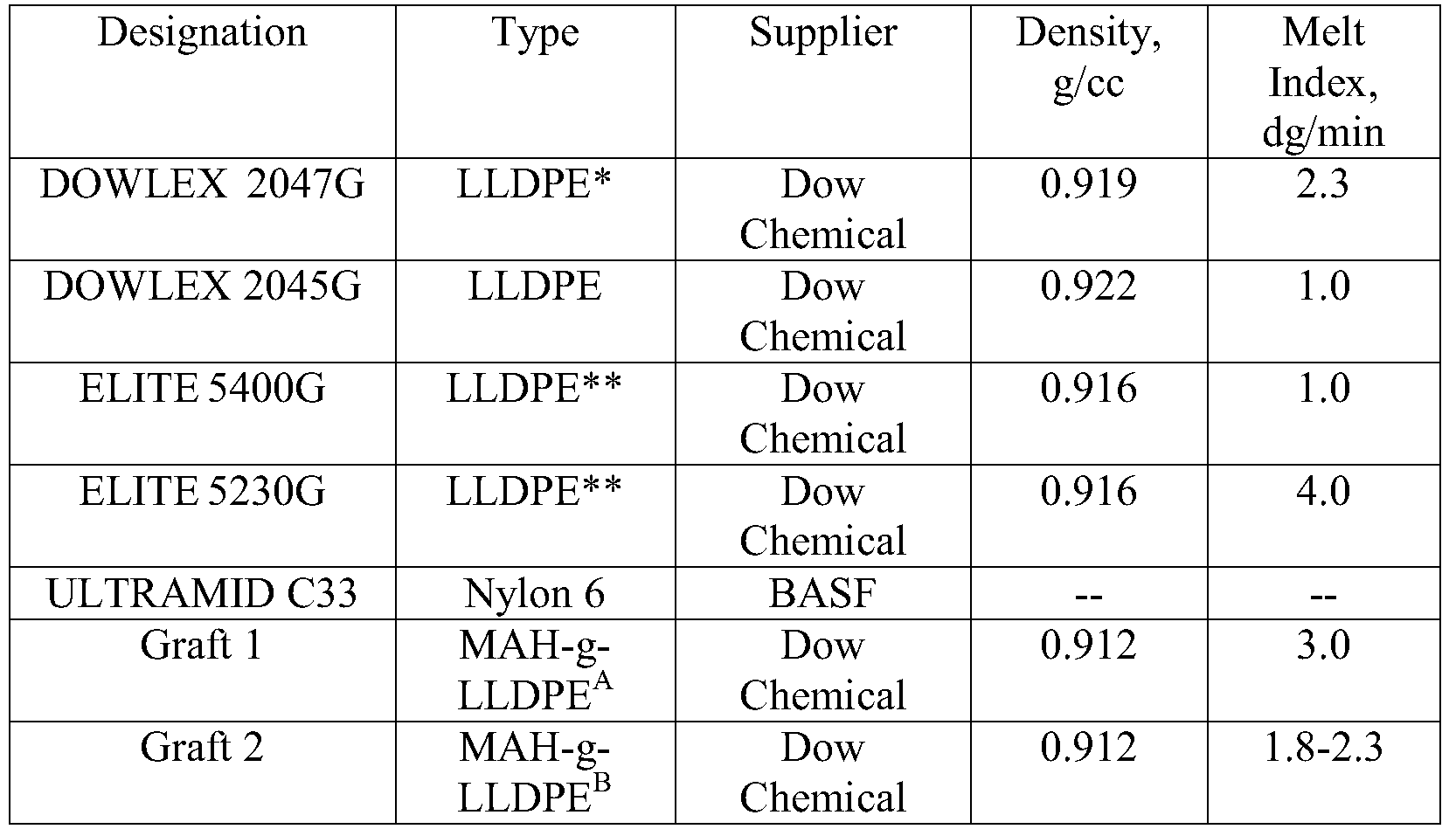
*LLDPE –Linear Low Density Polyethylene.
**In reactor blend
A) AMPLIFY TY 1057H, MAH Graft Level 1.0 –1.5 wt %, based on the weight of the functionalized polymer.
B) MAH Graft Level 2.3-2.5 wt %, based on the weight of the functionalized polymer (see “MAH-grafted IE 1” from US 62/272390, filed December 29, 2015) .
Side-Arming Experiments Set-up
The set-up described herein represents a lab simulation of an inventive process. The set-up consisted of a twin screw extruder that was used to melt the ethylene-based polymer (LLDPE; this LLDPE is prepared in a solution polymerization and isolated (each not shown) ) . This LLDPE melt was fed to a gear pump, and pumped through a static mixer set-up, where the functionalized ethylene-based polymer (MAH-grafted LLDPE) was side-armed through a melt injector, using a single screw extruder and prior to the static mixing elements. After mixing, the resultant adhesive blend was passed through a divert valve and pelletized using an underwater pelletizer. The equipment specifications and operating conditions were as follows:
A “40mm CENTURY co-rotating” twin screw extruder with a 150 HP motor /1200 rpm max screw speed was used. A “36 L/D” set-up, with a mild melting screw, was used in the twin screw extruder. The functionalized ethylene-based polymer was fed using a loss-in-weight K-TRON T-35 feeder. The temperature was 100℃ in Zone 2, 220℃ in Zones 3-9 and 220℃ in the adaptor. The screw speed was set at 175 rpm, and all experiments were run at 100 lbs/hr (45.4 kg/hr) .
The “polymer melt pump” was a MAAG 100 cc/revolution pump (Model S-60) powered by a 15 hp motor with a 20.55/1 reduction gear. The pump was equipped with a pressure transducer on the suction and discharge spool pieces, and a 5200 PSI rupture disc on the outlet transition piece. There were heater zones on the melt pump and on the inlet and outlet transition pieces. All zones were set at 220℃, and the melt pump operated at 112 rpm.
A STERLING 2 1/2 (63.5mm) Inch Single Screw Extruder was used as the side arm extruder, to melt the functionalized ethylene based polymer and pumped this melt just prior to the static mixers using a injector. The single screw extruder was operated in a starved mode, and fed with a K-TRON T-20 feeder. The temperature of all four zones were set at 200℃, and the screw speed was set to 30 rpm. The feed rate was varied based on the formulation desired.
The static mixing section consisted of a “25 inch (635 mm) ” KENICS KME mixer with nine helical elements, followed by a “17 inch (432 mm) ” KENICS KME mixer with six helical elements, situated inside of a pipe and down-stream of the melt injector. The inside of the pipe was 3.1 inch (79 mm) in diameter, and the pipe had seven heating zones. All seven zones were set at 230℃.
After the static mixers, the resulting adhesive blend was pumped through a divert valve and pelletized using a Gala underwater pelletizer system (Model 6) . The Gala was equipped with a 12 hole (2.36 mm hole diameter) Gala die and the cutter hub had 4 blades.
Purge Experiment
Experiments were also conducted to evaluate the ease of transitioning from side-arming the grafted polyethylene to a neat base resin with no grafted component. The purpose of this was to understand how long it would take to purge the functionalized component out of the static mixer. Long purge times (>30-60 minutes of side arming the ethylene-based polymer) would be undesirable. To evaluate this, polymer pellets were collected at t=0, 30 and 60 minutes, after running the side arm with ethylene-based polymer, and the gel level (GI 200) on these pellets was measured.
Table 5 shows results from the side-arming and transitioning experiments. The data
point at t=0 min (no purge) was obtained after running the desired formulation (non-functional ethylene-based polymer and functionalized ethylene-based polymer) for > 2hours, and then collecting pellets for gel and adhesion testing. After collecting these pellets, non-functionalized polymer was fed to the side-arm, whereas the other primary feeder to the extruder continued to feed the non-functionalized polymer. Samples (pellets) were then collected at t=30 min and t=60 min. Results are shown in Table 3.
The results show that the static mixer does a good job at mixing the side-armed grafted polymer and the ungrafted polyethylene as seen by the low gel (GI200) numbers which are lower than 5 mm2/24.6 cm3 (see results for t = 0) . Further, the transitioning experiments surprisingly show that the gel level, in most cases, drops to acceptable levels after purging for 30 and 60 min. This is indicative of the grafted polymer not adhering to the metal surfaces of the static mixer and piping, and then breaking loose over a period of time, and appearing as gels in the gel test sample. A purge time of 60 min is considered acceptable from an operating standpoint.
Table 3: Gels from Side-Arming &Transitioning Experiments

*Calculated value
**GI200 units: mm2 per 24.6 cm3, average of 25 parcels reported.
Comparative Composition on Twin Screw
A comparative polymer composition (Comp. 1 –twin screw) was prepared by using a twin screw extruder in which all ingredients (grafted, ungrafted LLDPE and anti-oxidants) in the formulation were fed through the main feed throat. The twin screw process conditions were same as those for the side-arming experiments. The only difference in this experiment was that the gear pump, static mixer and the side arm were removed, and the twin screw extruder was followed immediately by an adaptor to a divert valve and underwater pelletizer system. See results in Table 3 above.
Preparation of Multi-layer Film
The multi-layer blown film samples were produced on a LABTECH, 5-Layer blown film line. The five layers are represented as A/B/C/D/E with the “A” layer being in the inside of the bubble. The individual feed lines vary by position on the bubble. Layers “A” and “E” (outside layers) were fed from a 25 mm single flight screw, which contains no mixing elements. Layers “B” , “C” , and “D” (three inner layers) are fed from a “20 mm” single flight screw, which contains no mixing elements. The 5 extruders combined fed to the 75 mm 5-layer flat die (30/11/18/11/30) of 23 kg/hr. The blow up ratio was 2.5. The barrel temperatures ranged from 166℃ to 232℃. The standard frost line height was 30 cm. The layer compositions are outlined in Table 4.
Table 4: Blown Film Composition [ [tie layer = PE + fn-PE blend. ] ]

1) ULTRAMID C33 –the nylon was dried before use.
The formulations shown in Table 4 were made on the side-arm set-up (see, for example, Figure 2) , except for “Comp. 1” which was made using the twin screw (see, for example, Figure 1) . Each sample in Table 5 below was collected in normal operation (no purge, t=0 min) .
Table 5: Polymer Composition –Tie layer compositions

a-Graft 1-3.0MI (190C, 2.16kg) , 0.912 desity, MAH graft level is 1.2% by weight. b-Graft 2-2.0 MI (190C, 2.16kg) , 0.912 density, MAH graft level is 2.3%by weight. c -AO a 1: 2 wt: wt blend of IRGANOX 1010 AND IRGAFOS 168.
Multi-Layer Film Adhesion
The adhesion results are shown in Table 6. The peak load and average load peel strength data shows that the low intensity mixing that the static mixer imparts is adequate to achieve acceptable adhesion. Surprisingly, this data compares well with the comparative sample made using a twin screw extruder which mixes with much higher intensity (higher energy input) . In the adhesion testing, the average load is greater than 12.5 N/2.54cm, and the peak load is greater than “15 N/2.54cm” in all cases, and these results show each composition, prepared using the inventive process, functions well as a tie layer between the polyethylene and polyamide. In addition, a surprising finding is that in Experiment 4, even a lower loading of functionalized ethylene-based polymer (5 wt%of Graft 2) is sufficient to provide acceptable adhesion. This is highly desirable, as less functionalized polymer has to be side-armed into the process.
Table 6: Adhesion Results

*Delamination (separation) at tie layer and nylon interface. Average of five test strips reported.
As seen above in Table 3, the blends have maleic anhydride (MAH) levels from 0.12 wt%to 0.23 wt%maleic anhydride (MAH) . Further, the grafted polyethylene has an advantage, in that a relatively a small amount (5%-15%by wt) of this polymer, in the single pellet composition, is required to achieve the desired properties. This enables the possibility to “side-arm” the grafted ethylene-based polymer, formed in a solution polymerization, which reduces the number of steps required to make the final adhesive composition, as compared to the number of steps required for incumbent technologies. Preferably, side-arming ≤ 25 wt%of the functionalized ethylene based polymer provides for the optimum use of design elements and for favorable economics.
Surprisingly, the use of static mixers are adequate to impart the necessary mixing of the ethylene-based polymer and the functionalized ethylene-based polymer. The resultant
single pellet composition provides acceptable adhesive with good adhesion properties, which are similar to compositions mixed in a relatively high shear mixing device, such as a twin screw extruder. The gel level of the resultant single pellet composition is also acceptable. Further, transitioning from the polymer composition, containing both the ethylene-based polymer and the functionalized ethylene-based polymer, to a composition containing only the ethylene-based polymer, was found to not be an issue. Purging for less than 60 minutes is sufficient to clean the static mixer. These improvements over the incumbent processes are advantageous, and help eliminate certain steps, such as excessive material handling, pelletizing, and re-melting the ethylene-based polymer, and result in a more efficient process. These improvements, such as the reduction in material handling requirements, pelletization, re-melting and storage, result in savings in energy and time, and eliminates the need for additional blending devices. Also, a single pellet adhesive resin is desired, because it provides for easier handling when transporting via railcars, and when storing in silos.
Claims (10)
- A process to form a polymer composition comprising an ethylene-based polymer and a functionalized ethylene-based polymer, said process comprising at least the following:a) polymerizing, in a solution polymerization, ethylene and optionally one or more comonomers, in a solvent, in a reactor configuration comprising at least one reactor, to form a polymer solution comprising the ethylene-based polymer;b) passing the polymer solution through at least one devolatilizer to remove the “bulk of the solvent, ” based on the weight of the solvent in the polymer solution, to form a polymer melt;c) passing the polymer melt through at least one static mixer, and wherein the functionalized ethylene-based polymer, in melt form, is introduced into the polymer melt, before the polymer melt enters the static mixer; andd) mixing the polymer melt and the functionalized ethylene-based polymer in the static mixer, to form the polymer composition.
- The process of claim 1, wherein the functionalized ethylene-based polymer, in melt form, is introduced into the polymer melt, using a side-arm extruder.
- The process of claim 1 or claim 2, wherein the polymer composition has a gel content (GI200) ≤ 20.
- The process of anyone of the previous claims, wherein the reactor is a loop reactor.
- The process of anyone of the previous claims, wherein the functionalized ethylene-based polymer is present in an amount from 2 wt% to 25 wt% based on the weight of the polymer composition.
- The process of anyone of the previous claims, wherein the polymer composition comprises ≥ 90 wt% of the sum weight of the ethylene-based polymer and the functionalized ethylene-based polymer, based on the weight of the polymer composition.
- The process of any one of the previous claims, wherein the functionalization ethylene-based polymer is a maleic anhydride functionalized ethylene-based polymer, and further a maleic anhydride grafted ethylene-based polymer.
- A polymer composition formed by the process of anyone of the previous claims.
- A final composition comprising the polymer composition of claim 8.
- An article comprising at least one component formed from the composition of claim 8 or claim 9.
Priority Applications (9)
| Application Number | Priority Date | Filing Date | Title |
|---|---|---|---|
| PCT/CN2016/108309 WO2018098796A1 (en) | 2016-12-02 | 2016-12-02 | Process to form a composition containing functionalized and un-functionalized ethylene-based polymers |
| US16/465,927 US11981758B2 (en) | 2016-12-02 | 2017-11-11 | Process to form a composition containing functionalized and un-functionalized ethylene-based polymers |
| TW106139102A TW201840591A (en) | 2016-12-02 | 2017-11-13 | Process to form a composition containing functionalized and un-functionalized ethylene-based polymers |
| KR1020197018298A KR102522376B1 (en) | 2016-12-02 | 2017-11-17 | Methods for Forming Compositions Containing Functionalized and Non-Functionalized Ethylene-Based Polymers |
| BR112019011212-0A BR112019011212B1 (en) | 2016-12-02 | 2017-11-17 | PROCESS FOR FORMING A POLYMER COMPOSITION COMPRISING AN ETHYLENE-BASED POLYMER AND A FUNCTIONALIZED ETHYLENE-BASED POLYMER |
| JP2019529160A JP7084923B2 (en) | 2016-12-02 | 2017-11-17 | The process of forming compositions containing functionalized and defunctional ethylene-based polymers |
| EP17825634.3A EP3548520B1 (en) | 2016-12-02 | 2017-11-17 | Process to form a composition containing functionalized and un-functionalized ethylene-based polymers |
| PCT/US2017/062161 WO2018102148A1 (en) | 2016-12-02 | 2017-11-17 | Process to form a composition containing functionalized and un-functionalized ethylene-based polymers |
| CN201780082167.9A CN110167970B (en) | 2016-12-02 | 2017-11-17 | Method of forming compositions containing functionalized and unfunctionalized ethylene-based polymers |
Applications Claiming Priority (1)
| Application Number | Priority Date | Filing Date | Title |
|---|---|---|---|
| PCT/CN2016/108309 WO2018098796A1 (en) | 2016-12-02 | 2016-12-02 | Process to form a composition containing functionalized and un-functionalized ethylene-based polymers |
Publications (1)
| Publication Number | Publication Date |
|---|---|
| WO2018098796A1 true WO2018098796A1 (en) | 2018-06-07 |
Family
ID=60935926
Family Applications (2)
| Application Number | Title | Priority Date | Filing Date |
|---|---|---|---|
| PCT/CN2016/108309 Ceased WO2018098796A1 (en) | 2016-12-02 | 2016-12-02 | Process to form a composition containing functionalized and un-functionalized ethylene-based polymers |
| PCT/US2017/062161 Ceased WO2018102148A1 (en) | 2016-12-02 | 2017-11-17 | Process to form a composition containing functionalized and un-functionalized ethylene-based polymers |
Family Applications After (1)
| Application Number | Title | Priority Date | Filing Date |
|---|---|---|---|
| PCT/US2017/062161 Ceased WO2018102148A1 (en) | 2016-12-02 | 2017-11-17 | Process to form a composition containing functionalized and un-functionalized ethylene-based polymers |
Country Status (8)
| Country | Link |
|---|---|
| US (1) | US11981758B2 (en) |
| EP (1) | EP3548520B1 (en) |
| JP (1) | JP7084923B2 (en) |
| KR (1) | KR102522376B1 (en) |
| CN (1) | CN110167970B (en) |
| BR (1) | BR112019011212B1 (en) |
| TW (1) | TW201840591A (en) |
| WO (2) | WO2018098796A1 (en) |
Families Citing this family (3)
| Publication number | Priority date | Publication date | Assignee | Title |
|---|---|---|---|---|
| US10797894B2 (en) * | 2017-12-28 | 2020-10-06 | Ofinno, Llc | Service type and device type-based policy and charging control |
| JP7373501B2 (en) | 2018-04-12 | 2023-11-02 | ダウ グローバル テクノロジーズ エルエルシー | Functionalized ethylene/alpha-olefin interpolymers with high grafting levels |
| EP4251693A1 (en) * | 2020-11-25 | 2023-10-04 | Dow Global Technologies LLC | Polymer blends having increased temperature resistance |
Citations (2)
| Publication number | Priority date | Publication date | Assignee | Title |
|---|---|---|---|---|
| WO2004022661A2 (en) * | 2002-09-04 | 2004-03-18 | Msi Technology, Llc | Polyolefin adhesive and production process therefor |
| WO2015191066A1 (en) * | 2014-06-12 | 2015-12-17 | Dow Global Technologies Llc | An improved process for producing pelletized polymer compositions |
Family Cites Families (33)
| Publication number | Priority date | Publication date | Assignee | Title |
|---|---|---|---|---|
| JPH0645730B2 (en) * | 1985-07-24 | 1994-06-15 | 三菱化成株式会社 | Modified polyethylene resin composition |
| EP0703280B1 (en) * | 1994-09-23 | 2000-03-01 | Ciba SC Holding AG | Isomer mixtures of alkoxyphtalocyanines and process for their manufacture |
| US6417298B1 (en) * | 1999-06-07 | 2002-07-09 | Eastman Chemical Company | Process for producing ethylene/olefin interpolymers |
| DE19947630A1 (en) | 1999-10-04 | 2001-04-05 | Bayer Ag | Production of thermoplastic blends from polycarbonate and polyester and/or vinyl polymer, used for e.g. panels or tubes, comprises taking one component direct from production as melt and mixing it with other components |
| DE102004013201A1 (en) * | 2004-03-17 | 2005-10-06 | Kuraray Specialities Europe Gmbh | Process for the coextrusion of melt streams of different composition |
| US7803876B2 (en) * | 2005-01-31 | 2010-09-28 | Exxonmobil Chemical Patent Inc. | Processes for producing polymer blends and polymer blend pellets |
| ATE515533T1 (en) * | 2005-05-11 | 2011-07-15 | Basell Poliolefine Srl | POLYMERIZATION PROCESS FOR PRODUCING POLYOLEFIN BLENDS |
| CA2616681A1 (en) * | 2005-07-27 | 2007-02-08 | Basell Poliolefine Italia S.R.L. | Polymerization process for preparing polyolefins |
| US8852738B2 (en) * | 2005-08-31 | 2014-10-07 | Transilwrap Company, Inc. | Intrusion resistant thermal laminating film |
| US20070208110A1 (en) | 2006-03-03 | 2007-09-06 | Sigworth William D | Coupling agents for natural fiber-filled polyolefins |
| US8124234B2 (en) * | 2006-11-01 | 2012-02-28 | Dow Global Technologies Llc | Polyurethane compositions and articles prepared therefrom, and methods for making the same |
| US8143352B2 (en) * | 2006-12-20 | 2012-03-27 | Exxonmobil Research And Engineering Company | Process for fluid phase in-line blending of polymers |
| EP2231772B1 (en) * | 2007-12-20 | 2014-04-16 | ExxonMobil Research and Engineering Company | Polypropylene ethylene-propylene copolymer blends and in-line process to produce them |
| US7994237B2 (en) * | 2007-12-20 | 2011-08-09 | Exxonmobil Research And Engineering Company | In-line process to produce pellet-stable polyolefins |
| US20110182134A1 (en) | 2010-01-22 | 2011-07-28 | Dow Global Technologies Inc. | Mixing system comprising an extensional flow mixer |
| US8673451B2 (en) * | 2011-08-26 | 2014-03-18 | Equistar Chemicals, Lp | Multilayer thermoplastic structures with improved tie layers |
| EP2768899B1 (en) * | 2011-10-20 | 2020-12-02 | Dow Global Technologies LLC | Ethylene-based polymer compositions and articles prepared therefrom |
| EP2855150B1 (en) * | 2012-06-05 | 2016-09-14 | Dow Global Technologies LLC | Films containing functional ethylene-based polymer compositions |
| US20140079897A1 (en) | 2012-09-14 | 2014-03-20 | Henkel Corporation | Adhesive Compositions and Use Thereof |
| ES2743912T3 (en) * | 2012-11-05 | 2020-02-21 | Dow Global Technologies Llc | Compositions of functionalized polymers and films formed therefrom |
| CN103772611A (en) * | 2013-03-07 | 2014-05-07 | 宁波能之光新材料科技有限公司 | Method and device for producing high-purity graft polymer |
| KR102354070B1 (en) | 2013-12-30 | 2022-01-24 | 다우 글로벌 테크놀로지스 엘엘씨 | Method to produce functionalized, low viscosity ethylene-based polymers |
| CN107108792B (en) * | 2014-12-29 | 2021-07-16 | 陶氏环球技术有限责任公司 | Method for forming an oil-containing ethylene-based polymer |
| ES2863574T3 (en) * | 2015-03-18 | 2021-10-11 | Dow Global Technologies Llc | Protective films, mixtures and manufacturing methods thereof |
| CN107922517B (en) | 2015-09-25 | 2022-02-08 | 陶氏环球技术有限责任公司 | Non-extrusion process for functionalizing low viscosity polyolefins |
| EP3394113B1 (en) * | 2015-12-21 | 2025-11-26 | Borealis GmbH | A process and apparatus for in-line blending of polymers |
| BR112018012872B1 (en) * | 2015-12-21 | 2022-07-26 | Borealis Ag | LINE MIXING PROCESS FOR POLYMERS |
| BR112018013064B1 (en) | 2015-12-29 | 2023-05-09 | Dow Global Technologies Llc | PROCESS FOR FORMING A FUNCTIONALIZED ETHYLENE-BASED POLYMER COMPOSITION, FUNCTIONALIZED ETHYLENE-BASED POLYMER COMPOSITION AND ARTICLE |
| SG11201805903XA (en) * | 2016-01-28 | 2018-08-30 | Dow Global Technologies Llc | Process for producing functionalized ethylene-based polymers with a low gel content |
| KR102466728B1 (en) * | 2016-03-07 | 2022-11-15 | 다우 글로벌 테크놀로지스 엘엘씨 | Polymer Compositions for Fiber Optic Cable Components |
| US10870754B2 (en) * | 2016-06-23 | 2020-12-22 | Dow Global Technologies Llc | Overmold material for polycarbonate |
| WO2018071507A1 (en) | 2016-10-12 | 2018-04-19 | Dow Global Technologies Llc | Method to produce functionalized ethylene-based polymers |
| WO2019050954A1 (en) * | 2017-09-08 | 2019-03-14 | Equistar Chemicals, Lp | Polyolefin based adhesive compositions having grafted polyolefin copolymers and methods of formation |
-
2016
- 2016-12-02 WO PCT/CN2016/108309 patent/WO2018098796A1/en not_active Ceased
-
2017
- 2017-11-11 US US16/465,927 patent/US11981758B2/en active Active
- 2017-11-13 TW TW106139102A patent/TW201840591A/en unknown
- 2017-11-17 BR BR112019011212-0A patent/BR112019011212B1/en active IP Right Grant
- 2017-11-17 CN CN201780082167.9A patent/CN110167970B/en active Active
- 2017-11-17 EP EP17825634.3A patent/EP3548520B1/en active Active
- 2017-11-17 WO PCT/US2017/062161 patent/WO2018102148A1/en not_active Ceased
- 2017-11-17 JP JP2019529160A patent/JP7084923B2/en active Active
- 2017-11-17 KR KR1020197018298A patent/KR102522376B1/en active Active
Patent Citations (2)
| Publication number | Priority date | Publication date | Assignee | Title |
|---|---|---|---|---|
| WO2004022661A2 (en) * | 2002-09-04 | 2004-03-18 | Msi Technology, Llc | Polyolefin adhesive and production process therefor |
| WO2015191066A1 (en) * | 2014-06-12 | 2015-12-17 | Dow Global Technologies Llc | An improved process for producing pelletized polymer compositions |
Also Published As
| Publication number | Publication date |
|---|---|
| TW201840591A (en) | 2018-11-16 |
| JP7084923B2 (en) | 2022-06-15 |
| EP3548520A1 (en) | 2019-10-09 |
| CN110167970A (en) | 2019-08-23 |
| BR112019011212A2 (en) | 2019-10-15 |
| JP2020500979A (en) | 2020-01-16 |
| EP3548520B1 (en) | 2021-02-24 |
| WO2018102148A1 (en) | 2018-06-07 |
| KR102522376B1 (en) | 2023-04-18 |
| US11981758B2 (en) | 2024-05-14 |
| CN110167970B (en) | 2021-11-26 |
| KR20190083363A (en) | 2019-07-11 |
| US20200079883A1 (en) | 2020-03-12 |
| BR112019011212B1 (en) | 2022-12-27 |
Similar Documents
| Publication | Publication Date | Title |
|---|---|---|
| US8247053B2 (en) | Adhesive composition containing grafted polyethylene | |
| CN103124638B (en) | There is the articulamentum adhesive of the graft composition for being bonded to metal base | |
| EP3397665B1 (en) | Highly grafted ethylene-based polymers, highly grafted ethylene-based polymer compositions, and processes for forming the same | |
| EP3197972B1 (en) | Polyolefin-based compositions, adhesives, and related multi-layered structures prepared therefrom | |
| US11981758B2 (en) | Process to form a composition containing functionalized and un-functionalized ethylene-based polymers | |
| US6914097B2 (en) | Process for producing acid functionalized polyolefins and products | |
| JP7037556B2 (en) | Methods for Producing Functionalized Ethylene Polymers | |
| JP7668267B2 (en) | Multilayer structure, its manufacturing method, sheet for preventing diffusion of harmful substances, landfill geomembrane and multilayer pipe | |
| WO2019183871A1 (en) | Resins for use as tie layer in multilayer structure and multilayer structures comprising the same | |
| CN114207010B (en) | Low density polyethylene with enhanced hot tack strength and metal adhesion by addition of ionomers | |
| WO2019190714A1 (en) | Resins for use as tie layer in multilayer structure and multilayer structures comprising the same |
Legal Events
| Date | Code | Title | Description |
|---|---|---|---|
| 121 | Ep: the epo has been informed by wipo that ep was designated in this application |
Ref document number: 16922672 Country of ref document: EP Kind code of ref document: A1 |
|
| NENP | Non-entry into the national phase |
Ref country code: DE |
|
| 122 | Ep: pct application non-entry in european phase |
Ref document number: 16922672 Country of ref document: EP Kind code of ref document: A1 |