WO2018053427A1 - Von willebrand factor (vwf)-targeting agents and methods of using the same - Google Patents
Von willebrand factor (vwf)-targeting agents and methods of using the same Download PDFInfo
- Publication number
- WO2018053427A1 WO2018053427A1 PCT/US2017/052063 US2017052063W WO2018053427A1 WO 2018053427 A1 WO2018053427 A1 WO 2018053427A1 US 2017052063 W US2017052063 W US 2017052063W WO 2018053427 A1 WO2018053427 A1 WO 2018053427A1
- Authority
- WO
- WIPO (PCT)
- Prior art keywords
- aptamer
- idt
- polynucleotide
- vwf
- seq
- Prior art date
- Legal status (The legal status is an assumption and is not a legal conclusion. Google has not performed a legal analysis and makes no representation as to the accuracy of the status listed.)
- Ceased
Links
Classifications
-
- C—CHEMISTRY; METALLURGY
- C12—BIOCHEMISTRY; BEER; SPIRITS; WINE; VINEGAR; MICROBIOLOGY; ENZYMOLOGY; MUTATION OR GENETIC ENGINEERING
- C12N—MICROORGANISMS OR ENZYMES; COMPOSITIONS THEREOF; PROPAGATING, PRESERVING, OR MAINTAINING MICROORGANISMS; MUTATION OR GENETIC ENGINEERING; CULTURE MEDIA
- C12N15/00—Mutation or genetic engineering; DNA or RNA concerning genetic engineering, vectors, e.g. plasmids, or their isolation, preparation or purification; Use of hosts therefor
- C12N15/09—Recombinant DNA-technology
- C12N15/11—DNA or RNA fragments; Modified forms thereof; Non-coding nucleic acids having a biological activity
- C12N15/113—Non-coding nucleic acids modulating the expression of genes, e.g. antisense oligonucleotides; Antisense DNA or RNA; Triplex- forming oligonucleotides; Catalytic nucleic acids, e.g. ribozymes; Nucleic acids used in co-suppression or gene silencing
-
- A—HUMAN NECESSITIES
- A61—MEDICAL OR VETERINARY SCIENCE; HYGIENE
- A61K—PREPARATIONS FOR MEDICAL, DENTAL OR TOILETRY PURPOSES
- A61K31/00—Medicinal preparations containing organic active ingredients
- A61K31/70—Carbohydrates; Sugars; Derivatives thereof
- A61K31/7088—Compounds having three or more nucleosides or nucleotides
-
- A—HUMAN NECESSITIES
- A61—MEDICAL OR VETERINARY SCIENCE; HYGIENE
- A61K—PREPARATIONS FOR MEDICAL, DENTAL OR TOILETRY PURPOSES
- A61K31/00—Medicinal preparations containing organic active ingredients
- A61K31/70—Carbohydrates; Sugars; Derivatives thereof
- A61K31/7088—Compounds having three or more nucleosides or nucleotides
- A61K31/7105—Natural ribonucleic acids, i.e. containing only riboses attached to adenine, guanine, cytosine or uracil and having 3'-5' phosphodiester links
-
- A—HUMAN NECESSITIES
- A61—MEDICAL OR VETERINARY SCIENCE; HYGIENE
- A61K—PREPARATIONS FOR MEDICAL, DENTAL OR TOILETRY PURPOSES
- A61K31/00—Medicinal preparations containing organic active ingredients
- A61K31/70—Carbohydrates; Sugars; Derivatives thereof
- A61K31/7088—Compounds having three or more nucleosides or nucleotides
- A61K31/7115—Nucleic acids or oligonucleotides having modified bases, i.e. other than adenine, guanine, cytosine, uracil or thymine
-
- A—HUMAN NECESSITIES
- A61—MEDICAL OR VETERINARY SCIENCE; HYGIENE
- A61K—PREPARATIONS FOR MEDICAL, DENTAL OR TOILETRY PURPOSES
- A61K45/00—Medicinal preparations containing active ingredients not provided for in groups A61K31/00 - A61K41/00
- A61K45/06—Mixtures of active ingredients without chemical characterisation, e.g. antiphlogistics and cardiaca
-
- A—HUMAN NECESSITIES
- A61—MEDICAL OR VETERINARY SCIENCE; HYGIENE
- A61K—PREPARATIONS FOR MEDICAL, DENTAL OR TOILETRY PURPOSES
- A61K47/00—Medicinal preparations characterised by the non-active ingredients used, e.g. carriers or inert additives; Targeting or modifying agents chemically bound to the active ingredient
- A61K47/50—Medicinal preparations characterised by the non-active ingredients used, e.g. carriers or inert additives; Targeting or modifying agents chemically bound to the active ingredient the non-active ingredient being chemically bound to the active ingredient, e.g. polymer-drug conjugates
- A61K47/51—Medicinal preparations characterised by the non-active ingredients used, e.g. carriers or inert additives; Targeting or modifying agents chemically bound to the active ingredient the non-active ingredient being chemically bound to the active ingredient, e.g. polymer-drug conjugates the non-active ingredient being a modifying agent
- A61K47/54—Medicinal preparations characterised by the non-active ingredients used, e.g. carriers or inert additives; Targeting or modifying agents chemically bound to the active ingredient the non-active ingredient being chemically bound to the active ingredient, e.g. polymer-drug conjugates the non-active ingredient being a modifying agent the modifying agent being an organic compound
- A61K47/554—Medicinal preparations characterised by the non-active ingredients used, e.g. carriers or inert additives; Targeting or modifying agents chemically bound to the active ingredient the non-active ingredient being chemically bound to the active ingredient, e.g. polymer-drug conjugates the non-active ingredient being a modifying agent the modifying agent being an organic compound the modifying agent being a steroid plant sterol, glycyrrhetic acid, enoxolone or bile acid
-
- A—HUMAN NECESSITIES
- A61—MEDICAL OR VETERINARY SCIENCE; HYGIENE
- A61K—PREPARATIONS FOR MEDICAL, DENTAL OR TOILETRY PURPOSES
- A61K47/00—Medicinal preparations characterised by the non-active ingredients used, e.g. carriers or inert additives; Targeting or modifying agents chemically bound to the active ingredient
- A61K47/50—Medicinal preparations characterised by the non-active ingredients used, e.g. carriers or inert additives; Targeting or modifying agents chemically bound to the active ingredient the non-active ingredient being chemically bound to the active ingredient, e.g. polymer-drug conjugates
- A61K47/51—Medicinal preparations characterised by the non-active ingredients used, e.g. carriers or inert additives; Targeting or modifying agents chemically bound to the active ingredient the non-active ingredient being chemically bound to the active ingredient, e.g. polymer-drug conjugates the non-active ingredient being a modifying agent
- A61K47/56—Medicinal preparations characterised by the non-active ingredients used, e.g. carriers or inert additives; Targeting or modifying agents chemically bound to the active ingredient the non-active ingredient being chemically bound to the active ingredient, e.g. polymer-drug conjugates the non-active ingredient being a modifying agent the modifying agent being an organic macromolecular compound, e.g. an oligomeric, polymeric or dendrimeric molecule
- A61K47/59—Medicinal preparations characterised by the non-active ingredients used, e.g. carriers or inert additives; Targeting or modifying agents chemically bound to the active ingredient the non-active ingredient being chemically bound to the active ingredient, e.g. polymer-drug conjugates the non-active ingredient being a modifying agent the modifying agent being an organic macromolecular compound, e.g. an oligomeric, polymeric or dendrimeric molecule obtained otherwise than by reactions only involving carbon-to-carbon unsaturated bonds, e.g. polyureas or polyurethanes
- A61K47/60—Medicinal preparations characterised by the non-active ingredients used, e.g. carriers or inert additives; Targeting or modifying agents chemically bound to the active ingredient the non-active ingredient being chemically bound to the active ingredient, e.g. polymer-drug conjugates the non-active ingredient being a modifying agent the modifying agent being an organic macromolecular compound, e.g. an oligomeric, polymeric or dendrimeric molecule obtained otherwise than by reactions only involving carbon-to-carbon unsaturated bonds, e.g. polyureas or polyurethanes the organic macromolecular compound being a polyoxyalkylene oligomer, polymer or dendrimer, e.g. PEG, PPG, PEO or polyglycerol
-
- A—HUMAN NECESSITIES
- A61—MEDICAL OR VETERINARY SCIENCE; HYGIENE
- A61K—PREPARATIONS FOR MEDICAL, DENTAL OR TOILETRY PURPOSES
- A61K47/00—Medicinal preparations characterised by the non-active ingredients used, e.g. carriers or inert additives; Targeting or modifying agents chemically bound to the active ingredient
- A61K47/50—Medicinal preparations characterised by the non-active ingredients used, e.g. carriers or inert additives; Targeting or modifying agents chemically bound to the active ingredient the non-active ingredient being chemically bound to the active ingredient, e.g. polymer-drug conjugates
- A61K47/51—Medicinal preparations characterised by the non-active ingredients used, e.g. carriers or inert additives; Targeting or modifying agents chemically bound to the active ingredient the non-active ingredient being chemically bound to the active ingredient, e.g. polymer-drug conjugates the non-active ingredient being a modifying agent
- A61K47/62—Medicinal preparations characterised by the non-active ingredients used, e.g. carriers or inert additives; Targeting or modifying agents chemically bound to the active ingredient the non-active ingredient being chemically bound to the active ingredient, e.g. polymer-drug conjugates the non-active ingredient being a modifying agent the modifying agent being a protein, peptide or polyamino acid
- A61K47/64—Drug-peptide, drug-protein or drug-polyamino acid conjugates, i.e. the modifying agent being a peptide, protein or polyamino acid which is covalently bonded or complexed to a therapeutically active agent
-
- A—HUMAN NECESSITIES
- A61—MEDICAL OR VETERINARY SCIENCE; HYGIENE
- A61P—SPECIFIC THERAPEUTIC ACTIVITY OF CHEMICAL COMPOUNDS OR MEDICINAL PREPARATIONS
- A61P7/00—Drugs for disorders of the blood or the extracellular fluid
- A61P7/02—Antithrombotic agents; Anticoagulants; Platelet aggregation inhibitors
-
- C—CHEMISTRY; METALLURGY
- C12—BIOCHEMISTRY; BEER; SPIRITS; WINE; VINEGAR; MICROBIOLOGY; ENZYMOLOGY; MUTATION OR GENETIC ENGINEERING
- C12N—MICROORGANISMS OR ENZYMES; COMPOSITIONS THEREOF; PROPAGATING, PRESERVING, OR MAINTAINING MICROORGANISMS; MUTATION OR GENETIC ENGINEERING; CULTURE MEDIA
- C12N15/00—Mutation or genetic engineering; DNA or RNA concerning genetic engineering, vectors, e.g. plasmids, or their isolation, preparation or purification; Use of hosts therefor
- C12N15/09—Recombinant DNA-technology
- C12N15/11—DNA or RNA fragments; Modified forms thereof; Non-coding nucleic acids having a biological activity
- C12N15/115—Aptamers, i.e. nucleic acids binding a target molecule specifically and with high affinity without hybridising therewith ; Nucleic acids binding to non-nucleic acids, e.g. aptamers
-
- C—CHEMISTRY; METALLURGY
- C12—BIOCHEMISTRY; BEER; SPIRITS; WINE; VINEGAR; MICROBIOLOGY; ENZYMOLOGY; MUTATION OR GENETIC ENGINEERING
- C12N—MICROORGANISMS OR ENZYMES; COMPOSITIONS THEREOF; PROPAGATING, PRESERVING, OR MAINTAINING MICROORGANISMS; MUTATION OR GENETIC ENGINEERING; CULTURE MEDIA
- C12N2310/00—Structure or type of the nucleic acid
- C12N2310/10—Type of nucleic acid
- C12N2310/11—Antisense
- C12N2310/113—Antisense targeting other non-coding nucleic acids, e.g. antagomirs
-
- C—CHEMISTRY; METALLURGY
- C12—BIOCHEMISTRY; BEER; SPIRITS; WINE; VINEGAR; MICROBIOLOGY; ENZYMOLOGY; MUTATION OR GENETIC ENGINEERING
- C12N—MICROORGANISMS OR ENZYMES; COMPOSITIONS THEREOF; PROPAGATING, PRESERVING, OR MAINTAINING MICROORGANISMS; MUTATION OR GENETIC ENGINEERING; CULTURE MEDIA
- C12N2310/00—Structure or type of the nucleic acid
- C12N2310/10—Type of nucleic acid
- C12N2310/16—Aptamers
-
- C—CHEMISTRY; METALLURGY
- C12—BIOCHEMISTRY; BEER; SPIRITS; WINE; VINEGAR; MICROBIOLOGY; ENZYMOLOGY; MUTATION OR GENETIC ENGINEERING
- C12N—MICROORGANISMS OR ENZYMES; COMPOSITIONS THEREOF; PROPAGATING, PRESERVING, OR MAINTAINING MICROORGANISMS; MUTATION OR GENETIC ENGINEERING; CULTURE MEDIA
- C12N2310/00—Structure or type of the nucleic acid
- C12N2310/30—Chemical structure
- C12N2310/31—Chemical structure of the backbone
- C12N2310/317—Chemical structure of the backbone with an inverted bond, e.g. a cap structure
-
- C—CHEMISTRY; METALLURGY
- C12—BIOCHEMISTRY; BEER; SPIRITS; WINE; VINEGAR; MICROBIOLOGY; ENZYMOLOGY; MUTATION OR GENETIC ENGINEERING
- C12N—MICROORGANISMS OR ENZYMES; COMPOSITIONS THEREOF; PROPAGATING, PRESERVING, OR MAINTAINING MICROORGANISMS; MUTATION OR GENETIC ENGINEERING; CULTURE MEDIA
- C12N2310/00—Structure or type of the nucleic acid
- C12N2310/30—Chemical structure
- C12N2310/31—Chemical structure of the backbone
- C12N2310/318—Chemical structure of the backbone where the PO2 is completely replaced, e.g. MMI or formacetal
- C12N2310/3183—Diol linkers, e.g. glycols or propanediols
-
- C—CHEMISTRY; METALLURGY
- C12—BIOCHEMISTRY; BEER; SPIRITS; WINE; VINEGAR; MICROBIOLOGY; ENZYMOLOGY; MUTATION OR GENETIC ENGINEERING
- C12N—MICROORGANISMS OR ENZYMES; COMPOSITIONS THEREOF; PROPAGATING, PRESERVING, OR MAINTAINING MICROORGANISMS; MUTATION OR GENETIC ENGINEERING; CULTURE MEDIA
- C12N2310/00—Structure or type of the nucleic acid
- C12N2310/30—Chemical structure
- C12N2310/32—Chemical structure of the sugar
- C12N2310/321—2'-O-R Modification
-
- C—CHEMISTRY; METALLURGY
- C12—BIOCHEMISTRY; BEER; SPIRITS; WINE; VINEGAR; MICROBIOLOGY; ENZYMOLOGY; MUTATION OR GENETIC ENGINEERING
- C12N—MICROORGANISMS OR ENZYMES; COMPOSITIONS THEREOF; PROPAGATING, PRESERVING, OR MAINTAINING MICROORGANISMS; MUTATION OR GENETIC ENGINEERING; CULTURE MEDIA
- C12N2310/00—Structure or type of the nucleic acid
- C12N2310/30—Chemical structure
- C12N2310/32—Chemical structure of the sugar
- C12N2310/322—2'-R Modification
-
- C—CHEMISTRY; METALLURGY
- C12—BIOCHEMISTRY; BEER; SPIRITS; WINE; VINEGAR; MICROBIOLOGY; ENZYMOLOGY; MUTATION OR GENETIC ENGINEERING
- C12N—MICROORGANISMS OR ENZYMES; COMPOSITIONS THEREOF; PROPAGATING, PRESERVING, OR MAINTAINING MICROORGANISMS; MUTATION OR GENETIC ENGINEERING; CULTURE MEDIA
- C12N2310/00—Structure or type of the nucleic acid
- C12N2310/30—Chemical structure
- C12N2310/35—Nature of the modification
- C12N2310/351—Conjugate
-
- C—CHEMISTRY; METALLURGY
- C12—BIOCHEMISTRY; BEER; SPIRITS; WINE; VINEGAR; MICROBIOLOGY; ENZYMOLOGY; MUTATION OR GENETIC ENGINEERING
- C12N—MICROORGANISMS OR ENZYMES; COMPOSITIONS THEREOF; PROPAGATING, PRESERVING, OR MAINTAINING MICROORGANISMS; MUTATION OR GENETIC ENGINEERING; CULTURE MEDIA
- C12N2310/00—Structure or type of the nucleic acid
- C12N2310/30—Chemical structure
- C12N2310/35—Nature of the modification
- C12N2310/351—Conjugate
- C12N2310/3513—Protein; Peptide
-
- C—CHEMISTRY; METALLURGY
- C12—BIOCHEMISTRY; BEER; SPIRITS; WINE; VINEGAR; MICROBIOLOGY; ENZYMOLOGY; MUTATION OR GENETIC ENGINEERING
- C12N—MICROORGANISMS OR ENZYMES; COMPOSITIONS THEREOF; PROPAGATING, PRESERVING, OR MAINTAINING MICROORGANISMS; MUTATION OR GENETIC ENGINEERING; CULTURE MEDIA
- C12N2310/00—Structure or type of the nucleic acid
- C12N2310/30—Chemical structure
- C12N2310/35—Nature of the modification
- C12N2310/351—Conjugate
- C12N2310/3515—Lipophilic moiety, e.g. cholesterol
-
- C—CHEMISTRY; METALLURGY
- C12—BIOCHEMISTRY; BEER; SPIRITS; WINE; VINEGAR; MICROBIOLOGY; ENZYMOLOGY; MUTATION OR GENETIC ENGINEERING
- C12N—MICROORGANISMS OR ENZYMES; COMPOSITIONS THEREOF; PROPAGATING, PRESERVING, OR MAINTAINING MICROORGANISMS; MUTATION OR GENETIC ENGINEERING; CULTURE MEDIA
- C12N2310/00—Structure or type of the nucleic acid
- C12N2310/30—Chemical structure
- C12N2310/35—Nature of the modification
- C12N2310/351—Conjugate
- C12N2310/3517—Marker; Tag
-
- C—CHEMISTRY; METALLURGY
- C12—BIOCHEMISTRY; BEER; SPIRITS; WINE; VINEGAR; MICROBIOLOGY; ENZYMOLOGY; MUTATION OR GENETIC ENGINEERING
- C12N—MICROORGANISMS OR ENZYMES; COMPOSITIONS THEREOF; PROPAGATING, PRESERVING, OR MAINTAINING MICROORGANISMS; MUTATION OR GENETIC ENGINEERING; CULTURE MEDIA
- C12N2310/00—Structure or type of the nucleic acid
- C12N2310/30—Chemical structure
- C12N2310/35—Nature of the modification
- C12N2310/352—Nature of the modification linked to the nucleic acid via a carbon atom
- C12N2310/3521—Methyl
-
- C—CHEMISTRY; METALLURGY
- C12—BIOCHEMISTRY; BEER; SPIRITS; WINE; VINEGAR; MICROBIOLOGY; ENZYMOLOGY; MUTATION OR GENETIC ENGINEERING
- C12N—MICROORGANISMS OR ENZYMES; COMPOSITIONS THEREOF; PROPAGATING, PRESERVING, OR MAINTAINING MICROORGANISMS; MUTATION OR GENETIC ENGINEERING; CULTURE MEDIA
- C12N2310/00—Structure or type of the nucleic acid
- C12N2310/30—Chemical structure
- C12N2310/35—Nature of the modification
- C12N2310/353—Nature of the modification linked to the nucleic acid via an atom other than carbon
- C12N2310/3533—Halogen
Definitions
- VWF VON WILLEBRAND FACTOR
- the invention generally relates to compositions and methods for preventing and treating thrombosis. More specifically, the invention relates to Von Willebrand Factor (VWF)-targeting agents and their use in preventing blood clotting (anti-thrombotic activity) and treating and/or reducing formed blood clots (thrombolytic activity).
- VWF Von Willebrand Factor
- Thrombosis is a major underlying problem in many cardiovascular and cerebrovascular diseases and is also a major post-surgical complication.
- Antithromotic drugs have been developed over the past 25 years with the goal of reducing the complications associated with cerebrovascular and cardiovascular disease. However, while reducing thrombotic events in patients, these drugs create a challenge with regard to hemorrhagic risk due to the lack of rapid and predictable reversibility.
- Aptamers are single-stranded nucleic acids that adopt specific secondary and tertiary structures based on their sequence which enables specific binding to their target. Aptamers can bind to and inhibit protein targets. They are commonly generated by an in vitro selection process called SELEX (Systematic Evolution of Ligands by Exponential enrichment). See, e.g., Ellington AD, Szostak JW. 1990. In vitro selection of RNA molecules that bind specific ligands, Nature 346:818-22; Tuerk C, Gold L. 1990. Systematic evolution of ligands by exponential enrichment: RNA ligands to bacteriophage T4 DNA polymerase, Science 249:505-10.
- SELEX Systematic Evolution of Ligands by Exponential enrichment
- Aptamers can be systematically isolated to virtually any protein and may undergo extensive molecular modifications to optimize their pharmacokinetics for an intended use.
- Pegaptanib sodium developed to treat macular degeneration, was the first aptamer approved for use and other compounds are in development. See, e.g., Wang P, Yang Y, Hong H, Zhang Y, Cai W, Fang D. 2011. Aptamers as therapeutics in cardiovascular diseases. Curr Med Chem 18:4169-74. Aptamers offer a promising safer class of anti-thrombotics given that aptamer activity may be rapidly reversed using universal or rationally designed antidotes.
- RNA aptamers as reversible antagonists of coagulation factor IXa, Nature 419:90-4; WO/2008/066621 A3; and WO/2008/121354.
- VWF Von Willebrand Factor
- VWF is a multimeric plasma glycoprotein that binds to glycoprotein IblX, resulting in platelet adhesion—the first non-redundant step in platelet aggregation, resulting in a thrombus.
- the basic subunit is 260 kDa and is produced in endothelium and platelets.
- VWF is required for normal hemostatic plug formation and is a carrier protein for factor VIII. Aptamers targeting VWF have been shown to inhibit the formation of blood clots. See, e.g., WO/2008/066621 A3.
- VWF-targeting aptamer compositions and antidote compositions targeting such aptamer compositions as well as methods for preventing and treating blood clots using VWF-targeting agents.
- aptamers are provided.
- the aptamer may include a polynucleotide having at least 50%, 60%, 70%, 80%, 85%, 90%, 95%, 98%, 99%, or 100% sequence identity to SEQ ID NO: 1 and SEQ ID NO: 2, or any one of SEQ ID NOs: 3-102. See Tables 1 and 2 below.
- the aptamer may include a polynucleotide having at least 50%, 60%, 70%, 80%, 85%, 90%, 95%, 98%, 99%, or 100% sequence identity to a polynucleotide comprising from 5' to 3' a first stem forming region comprising or consisting of 2, 3, 4, or 5 nucleotides, a first loop region comprising or consisting of the nucleotide sequence AAC, a second stem forming region comprising or consisting of 3, 4, or 5 nucleotides, a second loop region comprising or consisting of the nucleotide sequence CC, a third stem forming region consisting of 2-8 nucleotides, a third loop region consisting of 1-12 nucleotides and/or a spacer sequence, a fourth stem forming region consisting of 2-8 nucleotides and capable of forming a stem with the third stem forming region, a fourth loop region comprising or consisting of the nucleotide C, a fifth stem
- the aptamers described herein may be no more than 58, 57, 56, 55, 54, 53, 52, 51, 50, 49, 48, 47, 46, 45, 44, 43, 42, 41, 40, 39, 38, 37, 36, 35, 34, 33, 32, 31, 30, 29, 28, 27, 26, 25, 24, 23, 22, 21, 20, 19, 18, 17, or 16 nucleotides in length.
- the polynucleotide comprises unmodified nucleotides.
- the polynucleotide comprises a modified form having at least one nucleotide base modification.
- the nucleotide base modifications include a 2' O-methyl or 2' fluoro modification of the nucleotide.
- the dissociation binding constant of the aptamer for vWF (Kd) is less than 500nM, less than ⁇ , less than 50nM, less than ⁇ , less than 5nM, less than 3nM, or less than 2nM.
- dimers, trimers, and tetramers including the aptamers described herein are also disclosed.
- antidotes to the aptamers described herein are provided.
- the antidotes may include a polynucleotide having at least 50%, 60%, 70%, 80%, 85%, 90%, 95%, 98%, 99%, or 100% sequence identity to any one of SEQ ID NOs: 103-180 (the nucleotide sequences in Table 3).
- the antidote may include a polynucleotide having sequence reverse complementary to and capable of hybridizing to at least 8, 9, 10, 11, 12, 13, 14, 15, 16, 17, 18, 19, 20, 21, 22, 23, 24 or more nucleotides of any one of the aptamers described herein.
- pharmaceutical compositions including any of the aptamers or antidotes described herein are provided.
- the pharmaceutical compositions may include a pharmaceutical carrier, excipient, or diluent (i.e., agents), which are nontoxic to the cell or mammal being exposed thereto at the dosages and concentrations employed.
- the methods may include administering to the subject any one of the aptamer compositions described herein in a therapeutically effective amount to prevent blood clot formation in the subject.
- methods for treating a blood clot in a subject are also provided.
- the methods may include administering to the subject a VWF-targeting agent in a therapeutically effective amount to reduce the blood clot in the subject.
- Figure 1 shows a summary of VWF9.14 truncations T10 (SEQ ID NO: 10), T25 (SEQ ID NO: 6), T49 (SEQ ID NO: 5), T59 (SEQ ID NO: 4), and T79 (SEQ ID NO: 3).
- the length (nt), Kd (nM), and Bmax (%) (as determined by in vitro nitrocellulose filter binding assays) of these aptamers are shown at the bottom of these secondary structures. It was found that the aptamer could be truncated from 60 to 30 nucleotides without a reduction in its ability to bind to VWF.
- FIG. 2 shows the predicted secondary structures of the VWF9.14T59 (SEQ ID NO: 4) and VWF9.14T79 (SEQ ID NO: 3) aptamers.
- the T79 aptamer includes the T59 aptamer in addition to a 3' uracil tail to facilitate antidote binding.
- the dots on the T59 and T79 structures show the location of binding by designed antidotes VWF9.14T59-A011 (AOl l; SEQ ID NO: 113) and VWF9.14T79-A02 (A055; SEQ ID NO: 157), respectively.
- Figure 3 shows the predicted secondary structure of the optimized VWF aptamer, T79 VRT7 (SEQ ID NO: 7). 2'-0-methyl modified bases are highlighted in red and 2'-fluoro modified bases are highlighted in green; the length (nt), Kd (nM), and Bmax (%) (as determined by in vitro nitrocellulose filter binding assays) of these aptamers are shown at the bottom of these secondary structures.
- Figure 4 shows a carotid artery blood flow tracing in a murine arterial thrombosis model experiment injecting a vehicle (no aptamer/negative control) prior to FeCl 3 injury. Based on measurements from the flow probe, the vessel was occluded in approximately 4 to 5 minutes following removal of the FeCl 3 patch.
- Figure 5 shows a carotid artery blood flow tracing in two murine arterial thrombosis model experiments injecting the VWF9.14T79-VRT7 aptamer at a dosing of 0.375 mg/kg (top tracing) or 0.0375 mg/kg (bottom tracing) prior to FeCl 3 injury. Based on measurements from the flow probe, the vessel remained patent for > 60 minutes following removal of the FeCl 3 patch.
- Figure 6 shows a carotid artery blood flow tracing in a murine arterial thrombosis model experiment injecting the PEG-VWF9.14T79-VRT7 aptamer at a dosing of 0.375 mg/kg prior to FeCl 3 injury. Based on measurements from the flow probe, the vessel remained patent for > 60 minutes following removal of two 7.5% FeCl 3 patches.
- Figure 7 shows a summary of the percent carotid blood flow in a murine arterial thrombosis model experiment injecting the VWF9.14T79-VRT7 aptamer at various doses (0.009375 mg/kg to 0.375 mg/kg) prior to FeCl 3 injury. Negative control is shown for reference. Based on measurements from the flow probe, dosing as low as 0.0375 mg/kg was sufficient to maintain >75% blood flow (compared to blood flow prior to patch placement) for 60 minutes following removal of the FeCl 3 patch.
- Figure 8 shows a scatter plot of the number of clot disruptions before (PRE) and after
- Figure 9A shows a scatter plot of the clot disruptions before and after injection of a 10 fold molar ratio of VWF9.14T79-A02 (DTRI-025; SEQ ID NO: 157) antidote or no antidote (Saline) following injection of either saline (Control) or the VWF9.14T79-VRT7 aptamer (dose 0.375 mg/kg; SEQ ID NO: 7) in the murine saphenous vein bleeding model.
- Figure 9B shows a bar graph of the clot disruptions before and after injection of a 10 fold molar ratio of VWF9.14T79-A02 (DTRI-025; SEQ ID NO: 157) antidote or no antidote (Saline) following injection of either saline (Control) or the VWF9.14T79-VRT7 aptamer (dose 0.375 mg/kg; SEQ ID NO: 7) in the murine saphenous vein bleeding model.
- Figure 10 shows an example of a carotid artery blood flow tracing and timeline from a single study of the combined arterial thrombosis and saphenous vein bleeding model.
- the left side of the figure captures the first half of the study evaluating carotid artery vessel patency after thrombosis challenge.
- the right side captures vessel transection, bleeding, and clot formation before and after antidote administration.
- Figure 11 shows the number of disruptions before (PRE) and after (POST) injection of the VWF9.14T9-A02 (A055; SEQ ID NO: 157) antidote post-thrombosis saphenous vein bleeding following injection of the PEG-VWF9.14T79-VRT7 aptamer (SEQ ID NO: 7), the
- VRT7 aptamer in the combined murine arterial thrombosis and saphenous vein bleeding model.
- FIG. 12 shows platelet function assay (PFA) results for VWF9.14T59 (SEQ ID NO: 4) with and without antidotes VWF9.14T59-AO3,-AO10, and -AOl l (A03 (SEQ ID NO: 105), AO10 (SEQ ID NO: 112), and AOl l (SEQ ID NO: 113, respectively). Also shown are PFA results for aptamer VWF9.14T79 (SEQ ID NO: 3) with and without antidotes VWF9.14T79-
- AOl (A048; SEQ ID NO: 150) and VWF9.14T84-A02 (AO60; SEQ ID NO: 162)).
- Figure 13 shows PFA results for VWF9.14T86 (SEQ ID NO: 82), VWF9.14T87 (SEQ ID NO: 82), VWF9.14T87 (SEQ ID NO: 82), VWF9.14T87 (SEQ ID NO: 82), VWF9.14T87 (SEQ ID NO: 82), VWF9.14T87 (SEQ ID NO: 82), VWF9.14T87 (SEQ ID NO: 82), VWF9.14T87 (SEQ ID NO: 82), VWF9.14T87 (SEQ ID NO: 82), VWF9.14T87 (SEQ ID NO: 82), VWF9.14T87 (SEQ ID NO: 82), VWF9.14T87 (SEQ ID NO: 82), VWF9.14T87 (SEQ ID NO: 82), VWF9.14T87 (SEQ ID NO: 82), VWF9.14T87 (SEQ ID NO: 82), VWF9.14T87 (SEQ ID NO: 82), VWF9.14T87 (
- VWF9.14T89 SEQ ID NO: 85
- VWF9.14T90 SEQ ID NO: 86
- VWF9.14T93 SEQ ID NO: 83
- VWF9.14T94 SEQ ID NO: 90
- VWF9.14T95 SEQ ID NO: 91
- antidotes A061 (SEQ ID NO: 163)
- A062 SEQ ID NO: 164
- A063 SEQ ID NO:
- Figure 14 shows the predicted secondary structure and PFA data for VWF9.14T79vrt7
- FIG. 15 shows the predicted secondary structures of the T79 vrt7/DTRI-031 (SEQ ID NO: 7) and T59 vrtl9 (SEQ ID NO: 4 and Table 2) aptamers and the sequences of the DTRI-006 - DTRI-013 aptamers (see Table 2 and SEQ ID NOs: 4, 98, 99, 100, and 101, respectively).
- DTRI-008 SEQ ID NO: 4
- DTRI-009 showed a K D comparable to DTRI-006 but lower Bmax.
- DTRI- 013 (SEQ ID NO: 101) showed a K D comparable to DTRI-006 but lower Bmax.
- Figure 16 shows predicted secondary structure and nitrocellulose filter binding assay data for the DTRI-019 (SEQ ID NO: 8) aptamer.
- Figure 17 shows nitrocellulose filter binding assay data for T79VRT7/DTRI-031 (SEQ ID NO: 7) aptamer.
- Figure 18 shows a graph indicating the percentage of initial carotid flow at various time points after occlusion in mice treated with control, rTPA (recombinant tissue plasminogen activator), anti-VWF aptamer (both VWF9.14T79VRT7 and Cholesterol- VWF9.14T79-VRT7), or no perfusion.
- the anti-VWF aptamer VWF9.14T79VRT7; SEQ ID NO: 7 had superior thrombolytic activity compared to rTPA.
- Figure 19 shows a graph indicating stroke volume following vascular injury in the murine intracranial hemorrhage model in mice treated with vehicle, rTPA, anti-VWF aptamer (VWF9.14T79-VRT7; SEQ ID NO: 7), or anti-VWF aptamer (VWF9.14T79-VRT7) and VWF antidote (VWF9.14T79-T79-A02, also called A055; SEQ ID NO: 157).
- Figure 20 shows aptamer 9.14T79vrt7 (SEQ ID NO: 7) inhibits platelet adhesion under high shear, inhibits platelet aggregation in whole blood and prevents thrombosis in vivo.
- the aptamer prevented human platelet adhesion in a dose-dependent manner.
- Figure 20A Buffer control demonstrated 100% platelet adhesion. Aptamer activity was measured as a percentage of the control.
- Figure 20D shows aptamer 9.14T79vrt7 (SEQ ID NO: 7) inhibits platelet adhesion under high shear, inhibits platelet aggregation in whole blood and prevents thrombosis in vivo. The aptamer prevented human platelet adhesion in a dose-dependent manner.
- Figure 20A Buffer control demonstrated 100% platelet adhesion.
- Figure 21 is a graph showing PFA-100 results demonstrating that T79vrt7 (SEQ ID NO:
- Figure 23 shows aptamer 9.14T79vrt7/DTRI-031 (SEQ ID NO: 7) demonstrates superior thrombolysis in murine carotid artery occlusion compared to rTPA.
- Figure 24 shows aptamer 9.14T79vrt7/DTRI-031 (SEQ ID NO: 7) prevents platelet adhesion and aggregation in Total Thrombus-formation Analysis System in canine whole blood, recanalizes carotid artery occlusion in canines and demonstrates no brain hemorrhage or embolization.
- Figure 24B Still images of whole blood flowing over collagen tubules from the first 10 seconds of each minute.
- the cloudy patches seen in the control group are aggregated platelets.
- 9.14T79vrt7 dose was lOOnmol/L.
- Figure 24C-G After 45 minutes of occlusion, 9.14T79vrt7 administration resulted in recanalization in each of the 3 dogs tested ( Figure 24C - E) compared to Figure 24F.
- Figure 24H. 9.14T79vrt7 did not cause intracranial hemorrhage nor cerebral thromboembolism compared to Figure 241.
- Carotid artery histology verified recanalization of the occluded segment in Figure 24K.
- 9.14T79vrt7-treated dog compared to Figure 24L.
- Figure 25 shows an antidote oligonucleotide reverses 9.14T79vrt7/DTRI-031 (SEQ ID NO: 7) ex vivo and in a murine femoral vein bleeding model.
- the graph is represented as a % of normal hemostasis in a mouse without any treatment.
- the present disclosure is based, in part, on the inventors' discovery of new optimized reversible VWF-targeting aptamers useful for both preventing (anti-thrombotic activity) and treating (thrombolytic activity) blood clots.
- the presently disclosed VWF-targeting aptamers have increased stability against nuclease degradation, are smaller in size to facilitate chemical synthesis, and demonstrate increased circulation times in vivo.
- compositions of aptamers and antidotes as well as methods for preventing and treating blood clots in a subject using VWF-targeting agents such as the newly discovered VWF-targeting aptamers.
- These compositions and methods may be useful in several applications including, without limitation, prevention or treatment of thrombi (in vitro, in vivo, or ex vivo), or the prevention or treatment of thrombi associated with stroke, cerebrovascular thrombi, deep vein thrombosis (DVT), pulmonary embolism (PE), atrial fibrillation, coronary artery thrombus, intra-cardiac thrombi, post-surgical thrombi, cancer-induced thrombosis, cancer-related thrombin expression, infection, and disseminated intravascular coagulation (DIC).
- thrombi in vitro, in vivo, or ex vivo
- PE pulmonary embolism
- PE pulmonary embolism
- atrial fibrillation coronary artery thrombus
- aptamers are provided herein.
- the term "aptamer” refers to single- stranded oligonucleotides that bind specifically to targets molecules with high affinity. Aptamers can be generated against target molecules, such as VWF, by screening combinatorial oligonucleotide libraries for high affinity binding to the target (See, e.g. , Ellington and Szostak, Nature 1990; 346: 8 18-22 (1990), Tuerk and Gold, Science 249:505-1 0 (1990)). The aptamers disclosed herein may be synthesized using methods well-known in the art.
- the disclosed aptamers may be synthesized using standard oligonucleotide synthesis technology employed by various commercial vendors including Integrated DNA Technologies, Inc. (IDT), Sigma-Aldrich, Life Technologies, or Bio-Synthesis, Inc.
- IDT Integrated DNA Technologies, Inc.
- Sigma-Aldrich Sigma-Aldrich
- Life Technologies Life Technologies
- the aptamer may include a polynucleotide having at least 50%, 60%, 70%, 80%, 85%,
- the aptamer may include a polynucleotide having at least 70%, 75%, 80%, 85%, 90%, 95%, 98%, 99%, or 100% sequence identity to any one of SEQ ID NOs: 3-6 (nucleotide sequences T25, T49, T59, or T79 in Table 1).
- the aptamer includes SEQ ID NO: 7 (T79vrt7 in Table 2), SEQ ID NO: 8 (nucleotide sequence DTRI-019 in Table 2), or SEQ ID NO: 9 (nucleotide sequence DTRI-021 in Table 2).
- polynucleotide refers to a nucleotide, oligonucleotide, polynucleotide (which terms may be used interchangeably), or any fragment thereof. These phrases may refer to DNA or RNA of genomic, natural, or synthetic origin.
- sequence identity Aspercent identity, and
- % identity refers to the percentage of base matches between at least two nucleotide sequences aligned using a standardized algorithm. Such an algorithm may insert, in a standardized and reproducible way, gaps in the sequences being compared in order to optimize alignment between two sequences, and therefore achieve a more meaningful comparison of the two sequences. Sequence identity for a nucleotide sequence may be determined as understood in the art. (See, e.g., U.S. Patent No. 7,396,664). A suite of commonly used and freely available sequence comparison algorithms is provided by the National Center for Biotechnology Information (NCBI) Basic Local Alignment Search Tool (BLAST), which is available from several sources, including the NCBI, Bethesda, Md., at its website.
- NCBI National Center for Biotechnology Information
- BLAST Basic Local Alignment Search Tool
- the BLAST software suite includes various sequence analysis programs including “blastn,” that is used to align a known nucleotide sequence with other polynucleotide sequences from a variety of databases. Also available is a tool called “BLAST 2 Sequences” that is used for direct pairwise comparison of two nucleotide sequences. “BLAST 2 Sequences” can be accessed and used interactively at the NCBI website.
- sequence identity is measured over the length of an entire defined nucleotide sequence, for example, as defined by a particular sequence identified herein. Furthermore, sequence identity, as measured herein, is based on the identity of the nucleotide base in the nucleotide sequence, irrespective of any further modifications to the nucleotide sequence.
- the nucleotide sequences in the tables described herein may include modifications to the nucleotide sequences such 2' flouro, 2'O-methyl, and inverted deoxythymidine (idT) modifications. These modifications are not considered in determining sequence identity.
- a base for example, is a 2'fluoro adenine (or 2'O-methyl, etc.), it is understood to be an adenine for purposes of determining sequence identity with another sequence.
- 3' idT modifications to the nucleotide sequences in the tables described herein also are not considered in determining sequence identity.
- the aptamer may include a polynucleotide having at least 50%, 60%, 70%, 80%, 85%, 90%, 95%, 98%, 99%, or 100% sequence identity to a polynucleotide comprising from 5' to 3' a first stem forming region comprising or consisting of 2, 3, 4, or 5 nucleotides, a first loop region comprising or consisting of the nucleotide sequence AAC, a second stem forming region comprising or consisting of 3, 4, or 5 nucleotides, a second loop region comprising or consisting of the nucleotide sequence CC, a third stem forming region consisting of 2-8 nucleotides, a third loop region consisting of 1-12 nucleotides or a spacer sequence, a fourth stem forming region consisting of 2-8 nucleotides and capable of forming a stem with the third stem forming region, a fourth loop region comprising or consisting of the nucleotide C, a fifth stem forming region
- a "spacer sequence” may be any chemical spacer that does not interfere with the binding activity of the aptamer.
- the spacer sequence may include, without limitation, a hexaethylene glycol spacer (see, e.g., DTRI-009), a C3 spacer, spacer 9, or any other suitable stable linker known to those skilled in the art which would facilitate and maintain the proper folding and secondary structure of the aptamer.
- the aptamer may include a polynucleotide having at least 50%, 60%, 70%, 80%, 85%, 90%, 95%, 99%, or 100% sequence identity to a polynucleotide comprising from 5' to 3' SEQ ID NO: 1 (CGAAC(U/T)GCCC(U T)C), a variable nucleotide sequence consisting of 1-18 (or any range therein) nucleotides or a spacer sequence, and SEQ ID NO: 2 (GACGCACAGACG).
- a "variable nucleotide sequence” may be any of the possible nucleotide sequences for a given length.
- a "variable nucleotide sequence” consisting of 5 nucleotides may include any of the 4 5 (or 1,025) possible nucleotide sequences having 5 nucleotides.
- the aptamer may be no more than 58, 57, 56, 55, 54, 53, 52, 51, 50, 49, 48, 47, 46, 45, 44, 43, 42, 41, 40, 39, 38, 37, 36, 35, 34, 33, 32, 31, 30, 29, 28, 27, 26, 25, 24, 23, 22, 21, 20, 19, 18, 17, or 16 nucleotides in length.
- the aptamer may have a dissociation constant (K D ) for the human VWF protein that is less than 150, 125, 100, 90, 80, 70, 65, 60, 55, 50, 45, 40, 35, 30, 25, 20, 15, 10, 5, 2.5, 2, 1, 0.5, or 0.1 nanomolar (nM).
- K D dissociation constant
- the K D of an aptamer may be measured using the methodology used by the inventors in the Examples. For example, binding studies using the double-filter nitrocellulose-filter binding assay with the human VWF protein may be performed.
- the aptamers may include a polynucleotide (RNA, DNA, or peptide nucleic acid (PNA)) that is in an unmodified form or may be in a modified form including at least one nucleotide base modification.
- RNA, DNA, or peptide nucleic acid (PNA) a polynucleotide
- PNA peptide nucleic acid
- Nucleotide base modifications of polynucleotides to, for example, protect the polynucleotide from nuclease degradation and/or increase the stability of the polynucleotide are well-known in the art.
- nucleotide base modifications that may be used in accordance with the present invention include, without limitation, deoxyribonucleotides, 2'-0-Methyl bases, 2'-Fluoro bases, 2' Amino bases, inverted deoxythymidine bases, 5' modifications, and 3' modifications.
- the aptamer may include a polynucleotide including a modified form including at least one nucleotide base modification selected from the group consisting of a 2'fluoro modification, a 2'O-methyl modification, a 5' modification, and a 3 'modification.
- Typical 5' modifications may include, without limitation, inverted deoxythymidine bases, addition of a linker sequence such as C6, addition of a cholesterol, addition of a reactive linker sequence which could be conjugated to another moiety such as a PEG.
- Typical 3' modifications may include, without limitation, inverted deoxythymidine bases, and inverted abasic residues.
- the aptamer may further include a tail nucleotide sequence at the 5' end or the 3' end of the polynucleotide which is not capable of base pairing with 2, 3, 4, 5, 6, 7, 8, 9, 10, 11, 12, 13, 14 or more consecutive nucleotides in the polynucleotide.
- the tail nucleotide sequence may consist of 2-20 nucleotides or any range therein.
- the present inventors added a 5-nucleotide Uracil (oligo-U tail) to the 3'- end of an aptamer as a potential artificial nucleation site for antidote binding.
- the tail nucleotide sequence may include the nucleotide sequence (U/T)(U/T)(U/T)(U/T)(U/T).
- nucleotide sequences could serve as tail nucleotide sequences so as that they were not capable of base pairing with 2, 3, 4, 5, 6, 7, 8, 9, 10, 11, 12, 13, 14 or more consecutive nucleotides in the polynucleotide of the aptamer.
- tail nucleotide sequences were also added successfully to the 5' end of the aptamer without significantly affecting the activity of the aptamer.
- the aptamer may include a polynucleotide including a 5' linker and/or a 3' linker.
- Common 5' and/or 3' linkers for polynucleotides are known in the art and may include peptides, amino acids, nucleic acids, as well as omof nction ai linkers or heterofunctional linkers.
- Particularly useful conjugation reagents that can facilitate formation of a covalent bond with an aptamer may comprise a N-hydroxysuccinimide (NHS) ester and/or a maieimide or using click chemistry.
- Typical 5' and/or 3' linkers for polynucleotides may include without limitation, amino C3, C4, C5, C6, or C12-linkers.
- the aptamer may further include a stability agent.
- a "stability agent” refers to any substance(s) that may increase the stability and/or increase the circulation time of a polynucleotide in vivo.
- Typical stability agents are known in the art and may include, without limitation, polyethylene glycol (PEG), cholesterol, albumin, or Elastin-like polypeptide.
- the aptamer and stability agent may be "linked” either covalently or non-covalently. Additionally, the aptamer and stability agent may be linked using the 5' and/or 3' linkers described herein. The aptamer and stability agent may be linked at the 5' end and/or the 3' end of the aptamer. To link the aptamer and stability agent non-covalently, the aptamer and the stability agent may be linked by a tag system, A "tag system" may include any group of agents capable of binding one another with a high affinity.
- tag systems are well-known in the ait and include, without limitation, biotin/avidin, biotin/streptavidin, biotin/NeutrAvidin, or digoxigenin (DIG) systems.
- the tag system comprises biotin/avidin or biotin/streptavidin.
- the aptamer may be modified at either the 5' or 3' end to include bio tin while the stability agent may be modified to include streptavidin or avidin.
- the aptamer may be modified at either the 5' or 3' end to include streptavidin or avidin while the stability agent may be modified to include biotin.
- Dimers, trimers, and tetramers including any one of the aptamers described herein are also provided.
- a “dimer” refers to the linking together of two aptamer molecules in order to, for example, to increase the stability and/or increase the circulation time of a polynucleotide in vivo.
- a “trimer” refers to the linking together of three aptamer molecules in order to, for example, to increase the stability and/or increase the circulation time of a polynucleotide in vivo.
- a “tetramer” refers to the linking together of four aptamer molecules in order to, for example, to increase the stability and/or increase the circulation time of a polynucleotide in vivo.
- the aptamer molecules may be linked together covalently, noncovalently, or a combination of both.
- the aptamer molecules may be linked at their 5' or 3' ends.
- the aptamers may be linked by a tag system or through a scaffold system.
- Antidotes are also provided herein and include a polynucleotide having at least 50%, 60%, 70%, 80%, 85%, 90%, 95%, 98%, 99%, or 100% sequence identity to any one of SEQ ID NOS: 103-180 (the nucleotide sequences in Table 3).
- the antidote may include a polynucleotide having sequence reverse complementary to and capable of hybridizing to at least 8, 9, 10, 11, 12, 13, 14, 15, 16, 17, 18, 19, 20, 21, 22, 23, 24 or more nucleotides of any one of the aptamers described herein.
- compositions including any of the aptamers or antidotes described herein are provided.
- the pharmaceutical compositions may include a pharmaceutical carrier, excipient, or diluent (i.e., agents), which are nontoxic to the cell or mammal being exposed thereto at the dosages and concentrations employed.
- a pharmaceutical agent is in an aqueous pH buffered solution.
- Examples of pharmaceutical carriers include buffers such as phosphate, citrate, and other organic acids; antioxidants including ascorbic acid; low molecular weight (less than about 10 residues) polypeptides; proteins, such as serum albumin, gelatin, or immunoglobulins; hydrophilic polymers such as polyvinylpyrrolidone; amino acids such as glycine, glutamine, asparagine, arginine or lysine; monosaccharides, disaccharides, and other carbohydrates including glucose, mannose, or dextrins; chelating agents such as EDTA; sugar alcohols such as mannitol or sorbitol; salt-forming counterions such as sodium; and/or nonionic surfactants such as TWEENTM brand surfactant, polyethylene glycol (PEG), and PLURONICSTM surfactant.
- the pharmaceutical carrier may include a buffer including about 20 mM Hepes, pH 7.4; 150 mM NaCl; 1 mM CaCl 2 ;
- Methods for preventing blood clot formation in a subject are provided.
- the methods may include administering to the subject any one of the aptamer compositions described herein in a therapeutically effective amount to prevent blood clot formation in the subject.
- Preventing blood clot formation may include reducing the likelihood of blood clots, reducing the size of blood clots or slowing further progression of blood clotting.
- the term “subject” refers to both human and non-human animals.
- non-human animals of the disclosure includes all vertebrates, e.g., mammals and non- mammals, such as non-human primates, sheep, dog, cat, horse, cow, mice, chickens, amphibians, reptiles, and the like.
- the subject is a human patient.
- the subject in need of blood clot prevention may need prevention of blood clots associated with, for example without limitation, stroke, cerebrovascular thrombi, deep vein thrombosis (DVT), pulmonary embolism (PE), atrial fibrillation, coronary artery thrombus, intra- cardiac thrombi, post-surgical thrombi, cancer-induced thrombosis, cancer-related thrombin expression, infection, disseminated intravascular coagulation (DIC), and arterial thrombosis including cerebral arteries, coronary arteries and peripheral arteries in the head and neck, visceral arteries, arms and legs arteries.
- the subject in need of blood clot prevention may suffer from atrial fibrillation, or be at risk of having a Deep Vein Thrombosis, a stroke, a heart attack, or a pulmonary embolism.
- a therapeutically effective amount or an effective amount as used herein means the amount of a composition that, when administered to a subject for preventing or treating a blood clot is sufficient to effect a treatment (as defined above).
- the therapeutically effective amount will vary depending on the formulation or composition, the disease and its severity and the age, weight, physical condition and responsiveness of the subject to be treated.
- the inventors demonstrate that VWF-targeting agents may be used thrombolytically to reduce or "bust" blood clots that have already formed.
- VWF-targeting aptamers T79vrt7/DTRI-031
- rTPA tissue plasminogen activator
- methods for treating a blood clot in a subject are also provided.
- the methods may include administering to the subject a VWF- targeting agent in a therapeutically effective amount to reduce the blood clot in the subject.
- Treating a blood clot or “reducing a blood clot” refers to reducing the size and/or shape of the blood clot so as to allow blood flow to increase at the clot site.
- the subject in need of blood clot treatment may need treatment of blood clots associated with, for example without limitation, stroke, cerebrovascular thrombi, deep vein thrombosis (DVT), pulmonary embolism (PE), atrial fibrillation, coronary artery thrombus, intra-cardiac thrombi, post-surgical thrombi, cancer-induced thrombosis, cancer-related thrombin expression, infection, disseminated intravascular coagulation (DIC), and arterial thrombosis including cerebral arteries, coronary arteries and peripheral arteries in the head and neck, visceral arteries, arms and legs arteries.
- the subject in need of blood clot treatment suffers from a Deep Vein Thrombosis, a stroke, a heart attack, or a pulmonary embolism.
- VWF-targeting agent is any agent capable of partially or fully blocking, inhibiting, or neutralizing one or more of the biological activities of a von Willebrand Factor (VWF) protein including, without limitation, a polypeptide, a polynucleotide, or a small molecule.
- VWF von Willebrand Factor
- a VWF-targeting agent may include an agent capable of binding to the Al domain of a VWF protein and blocking the VWF protein's binding with a gplb alpha protein.
- a VWF-targeting agent may function in a direct or indirect manner.
- the VWF-targeting agent may directly bind to a VWF protein, thus partially or fully blocking, inhibiting or neutralizing one or more biological activities of the VWF protein, in vitro or in vivo.
- the VWF-targeting agent may also function indirectly by (1) interacting with (e.g., activating, inducing, blocking or inhibiting) another molecule that can bind to VWF or (2) modulating or affecting the expression (i.e, transcription or translation) of a VWF protein in a cell.
- VWF proteins may be any of the VWF proteins found in any mammal including, without limitation, humans or domesticated animals such as dogs, cats, horses, cows, pigs, mice, or rats.
- the VWF-targeting agent may be a polypeptide including, without limitation, a peptide or an antibody.
- the term "antibody” is used in the broadest sense used in the art to refer to polypeptide affinity agents based on antibodies.
- the antibody may include a polyclonal antibody, a monoclonal antibody, a single chain antibody, or antibody fragments such as Fab, Fab', F(ab') 2 , Fv fragments, diabodies, linear antibodies, nanobodies, or multispecific antibodies formed from antibody fragments.
- the antibody may be chimeric, humanized, or fully human.
- the antibody may be any one of the five known major classes of immunoglobulins including IgA, IgD, IgE, IgG, and IgM.
- the VWF- targeting agent may be an anti-VWF antibody that is capable of binding a VWF protein and thereby partially or fully blocking, inhibiting, or neutralizing one or more of the biological activities of the VWF protein.
- Suitable anti-VWF antibodies include, without limitation, caplacizumab, ALX-0681, or ALX-0081.
- Peptides useful as VWF-targeting agents may be identified using techniques well-known in the art such as phage display.
- the VWF-targeting agent may be an aptamer that is capable of binding a VWF protein and thereby partially or fully blocking, inhibiting, or neutralizing one or more of the biological activities of the VWF protein.
- Suitable VWF aptamers include, without limitation those described in WO/2008/066621 A3 to Sullenger et al. and the aptamers described herein.
- the VWF-targeting agent may also be a small molecule.
- the small molecule may be chemical molecule having a molecular weight below about 2500 Daltons, 2000 Daltons, 1000 Daltons, or 500 Daltons.
- the methods of preventing or treating blood clots described herein may further include administering to the subject an antidote in a therapeutically effective amount to neutralize the aptamer or the VWF-targeting agent.
- Negtralizing the aptamer or VWF-targeting agent refers to decreasing either the anti-thrombotic or thrombolytic activity of the aptamer or VWF-targeting agent.
- Antidotes that may be used in accordance with the present methods may include sequence-specific antidotes such as the antidotes described herein and those described in WO/2008/066621 A3. The antidotes may also include sequence non-specific antidotes (i.e., cationic polymers) described in, for example, WO/2008/121354.
- compositions i.e. aptamers, antidotes, and pharmaceutical compositions
- the compositions may be formulated as an ingestable, injectable, topical or suppository formulation.
- Administration of the compositions to a subject may exhibit beneficial effects in a dose-dependent manner. Thus, within broad limits, administration of larger quantities of the compositions is expected to achieve increased beneficial biological effects than administration of smaller amount. Moreover, efficacy is also contemplated at dosages below the level at which toxicity is seen.
- the specific dosage administered in any given case will be adjusted in accordance with the composition(s) being administered, the disease to be treated or inhibited, the condition of the subject, and other relevant medical factors that may modify the activity of the compositions or the response of the subject, as is well known by those skilled in the art.
- the specific dose for a particular subject depends on age, body weight, general state of health, diet, the timing and mode of administration, the rate of excretion, medicaments used in combination and the severity of the particular disorder to which the therapy is applied. Dosages for a given patient can be determined using conventional considerations, e.g., by customary comparison of the differential activities of the compositions described herein and of a known agent, such as by means of an appropriate conventional pharmacological protocol.
- the maximal dosage for a subject is the highest dosage that does not cause undesirable or intolerable side effects.
- the number of variables in regard to an individual treatment regimen is large, and a considerable range of doses is expected.
- the route of administration will also impact the dosage requirements. It is anticipated that dosages of the compositions will prevent or treat blot clots by at least 10%, 20%, 30%, 40%, 50%, 60%, 70%, 80%, 90%, 100% or more as compared to no treatment.
- the compositions described herein may be administered one time or more than one time to the subject to effectively prevent or treat blood clots. Suitable dosage ranges are of the order of several hundred micrograms effective ingredient with a range from about 0.01 to 10 mg/kg/day, preferably in the range from about 0.1 to 1 mg/kg/day.
- RNA Unless otherwise specified or indicated by context, the terms “a”, “an”, and “the” mean “one or more.”
- a protein or “an RNA” should be interpreted to mean “one or more proteins” or “one or more RNAs,” respectively.
- RNA APTAMER PREPARATION AND FOLDING RNA aptamers were synthesized using conventional oligonucleotide synthetic methods in house. Prior to platelet function analysis (PFA) and in vivo models, RNA-based aptamers may be "folded" in an appropriate physiological buffer, e.g. Platelet Binding Buffer (20 niM Hepes, pH 7.4; 150 niM NaCl; 1 niM CaCl 2 ; lmM MgCl 2 ; 5 niM KC1). Aptamer solution is heated to 95°C for 3 minutes, immediately placed on ice for 3 minutes, and then allowed to come to room temperature over approximately 5 to 10 minutes.
- PFA platelet function analysis
- Aptamer solution is heated to 95°C for 3 minutes, immediately placed on ice for 3 minutes, and then allowed to come to room temperature over approximately 5 to 10 minutes.
- K values were determined using double-filter nitrocellulose filter binding assays (Rusconi et al, Thromb. Baemost 84:841 -848 (2000)). All binding studies were performed in binding buffer F (20 niM HEPES, pH 7.4, 150 niM NaCl, 2 mM CaCi 2 , and 0.01% BSA) at 37°C. Human purified VWF (factor VIII free) was purchased from Haematologic Technologies Inc. (Essex Junction, VT) and used in the double-filter nitrocellulose filter binding assay to determine the 3 ⁇ 4 of the aptamers.
- RNA were end- labeled at the 5 * end with T4 polynucleotide kinase (New England Biolabs, Beverly, MA) and [j ⁇ P] ATP (Amersham Pharmacia Biotech, Piscataway, NJ) (Fitzwater and Poiisky, Methods Enzymol. 267:275-301 ( 1996)).
- End-labeled RNA was diluted in binding buffer F, heat denatured at 65 °C for 5 minutes, and subsequently equilibrated at 37°C. Direct binding was performed by incubating trace 32 P- RNA with varying concentrations of VWF protein in binding buffer F at 37°C for 5 min.
- the fraction of the nucleic acid-protein complex which bound to the nitrocellulose membrane was quantified with a p osphorimager (Molecular Dynamics, Sunnyvale, CA). Non-specific binding of the radiolabeled nucleic acid was subtracted out of the binding such that only specific binding remained (Wong and Lohman, Proc. Natl Acad. Sci. USA 90:5428-5432 (1993)).
- a FeCl 3 chemical injury model for inducing arterial thrombosis in the mouse is described.
- the anesthesia was induced with 4 to 5% isoflurane inhaled in a sealed chamber for 5-7 minutes prior to intubation.
- a single injection of Avertin/tribromoethanol (1.25%, 12.5mg/ml) was given ⁇ with 27g 1 ⁇ 2" needle at a dose between 100-250 mg/kg depending on effect.
- the total volume ranged from 0.15 to 0.50 cc depending on weight (typically 20-25g mouse).
- the animal was returned to the induction chamber for 1-2 more minutes prior to attempting intubation.
- the mouse was moved to a purpose built intubation stand and intubated with a needleless 20 to 22-gauge catheter. Once intubation was confirmed, the ventral neck was shaved and the mouse transferred to a heated surgery table. While in dorsal recumbency the mouse was immediately connected to a Harvard Apparatus rodent ventilator and maintained with a 70% nitrogen:30% oxygen mix at approximately 90-110 breaths per minute and a tidal volume of ⁇ 0.2ml. Isoflurane was maintained at -1-3%. Body temperature was maintained at approximately 37°C with a Physitemp TCAT-2DF.
- a midline cervical incision of the skin was made and the fascia was bluntly dissected to expose the right common carotid artery.
- the left jugular vein was exposed by blunt dissection and three 7-0 silk ligatures placed.
- a small incision was made with microsurgical scissors, hemostasis maintained with a single 7-0 silk ligature, and a PE-10 polyethylene catheter, or equivalent, was placed in the vein and secured with the two remaining 7-0 silk ligatures.
- antithrombotic test drug or control
- a normal blood flow 1.0 to 3.0 mL/min
- antithrombotic test drug or control
- Aptamer drug doses ranged from 0.005 to 1.0 mg/kg.
- a saphenous vein bleeding model for evaluating hemostasis in the mouse is described. Anesthesia was induced with 4 to 5% isoflurane inhaled in a sealed chamber for 2-3 minutes. A single injection of Avertin/tribromoethanol (1.25%, 12.5 mg/mL) was given IP with 27g 1 ⁇ 2" needle at a dose between 100-250 mg/kg depending on effect. The total volume ranged from 0.15 to 0.50 cc depending on weight (typically 20-25g mouse). The animal was then returned to the induction chamber for 1-2 more minutes prior to intubation. The mouse was then moved to a purpose built intubation stand and intubated with a needleless 20 to 22-gauge catheter.
- a midline cervical incision of the skin was made. Surgical exposure of the left jugular vein was accomplished by blunt dissection. Once the jugular vein was isolated, a PE-10 polyethylene catheter, or equivalent, was placed in the vein and secured with two encircling 7-0 silk ligatures. Once catheter patency was confirmed with 0.9% saline, a continuous rate infusion of 0.9% saline was started with a Harvard Apparatus PHD2000 (or equivalent) infusion pump at a rate between 0.5-3 ⁇ / ⁇ and maintained until the end of study.
- a Harvard Apparatus PHD2000 or equivalent
- the skin on the medial aspect of the left or right pelvic limb was incised to expose a length of the saphenous vascular bundle (saphenous vein and artery, medial saphenous vein).
- the bundle was maintained under 1-2 drops of 0.9% saline to prevent drying.
- Test drug or control was administered IV via the jugular catheter in a volume of 100 to
- Clot disruption was repeated after every incidence of hemostasis for a total time of 15 to 30 minutes after the initial injury.
- Injury, clot disruption, hemostasis, and temperature measurements were captured with LabChart Software (ADInstruments) throughout the study.
- Corresponding antidote molecules were then administered IV via the jugular catheter in a volume of 100 to 200 ⁇ L ⁇ after the test drug.
- RNA-based oligonucleotide antidotes ranged from 0.005 to 100 mg/kg. Approximately 5 minutes after the administration of the antidote, the clot on the distal portion of the vessel was again removed with a 23-26g needle to restart bleeding. Blood was wicked away until hemostasis re-occurs.
- Clot disruption was repeated after every incidence of hemostasis for a total time of 15 to 30 minutes. Once the endpoint was reached, ⁇ 0.5mL of blood was collected via cardiac puncture or withdrawn from the caudal vena cava. The animal was then euthanized by an overdose of anesthetic gas followed by a secondary physical method.
- PFA100 Protocol Platelet Function Analyzer PFA-100 (Dade Bearing, Deerfield, IL) provides a quantitative measure of platelet function in anti -coagulated whole blood (Ortei et al, Thromb. Haemost. 84:93-97 (2000)). Briefly, aptamers were diluted in an appropriate buffer (i.e. 150 mM NaCl; 20 mM HEPES pH: 7.4; 5 mM KCl; 1 mM MgCl 2 and 1 mM CaCl 2 ⁇ or 150 mM NaCl; 20 mM HEPES pH: 7.4; 2mM CaCl 2 ; or PBS) and heat denatured.
- an appropriate buffer i.e. 150 mM NaCl; 20 mM HEPES pH: 7.4; 5 mM KCl; 1 mM MgCl 2 and 1 mM CaCl 2 ⁇ or 150 mM NaCl; 20 mM HEPES pH: 7.4
- Aptamers were added to fresh whole blood at the final concentration indicated; incubated at RT for 3-5 minutes and then run utilizing a collagen /ADP test cartridge in a PFA-100.
- the maximum closing time of the PFA- 100 is 300 seconds.
- Antidote activity of aptamer was measured by mixing whole blood with aptamer in buffer followed by administration of antidote and measuring in PFA.
- VWF9.14 aptamer truncation variants we generated several VWF9.14 aptamer truncation variants and several VWF9.14 aptamer modification variants. See, e.g., Figures 1-3.
- the VWF9.14 aptamer truncation variants are listed in Table 1 below.
- the VWF9.14 aptamer modification variants created are listed in Table 2 below.
- (C6L) hexylamino linker
- AmGmAfCrGfU-idT 85 mAmCmGmAmAmCmUmGfCfCfCmUmCmG
- Lengths are not inclusive of inverted deoxythymidine
- VWF9.14 aptamer variants were tested in a murine arterial thrombosis model and a murine saphenous vein bleeding model. See Figures 4-11.
- the murine arterial thrombosis model the left jugular vein was cannulated and the right carotid artery was exposed and a flow probe was placed. After 5 minutes the vehicle indicated was injected i.v. into the mouse and a 10% FeCl 3 patch was placed on the carotid artery for 3 minutes.
- the VWF9.14T79-VRT7 aptamer was also injected at a dosing of 0.0375 mg/kg into the model prior to FeCl 3 injury, which resulted in the vessel remained patent for > 60 minutes following removal of the FeCl 3 patches. See Figure 5. This result demonstrated that the dosing of the VWF9.14T79-VRT7 aptamer may be decreased and still exhibit potent anti-thrombotic activity.
- the dose range study is presented in Figure 7.
- the left jugular vein of a mouse is cannulated and the right medial saphenous vein is exposed prior to injecting the aptamer at the indicated dose.
- Five minutes after injecting the aptamer the saphenous vein is transected and bleeding is followed for 15 minutes, the antidote is then injected to reverse the effects of the aptamer and bleeding is followed for an additional 20 minutes.
- the activity of the PEG- VWF9.14T79-VRT7 aptamer could be successfully reversed by injecting the VWF9.14T79-A02 (A055) antidote. See Figure 8.
- the clot disruptions increased after injection of the VWF9.14T9-A02 (A055) antidote demonstrating that the activity of the aptamers could be reversed.
- the T79VRT7 aptamer was also tested for thrombolytic activity in a murine carotid artery occlusion model and a murine intracranial hemorrhage model. See Figures 18-19.
- VWF9.14T79VRT7 anti- VWF aptamer
- rTPA tissue plasminogen activator
- the percentage of initial carotid flow increased to a greater degree over time with the T79VRT7 aptamer verses rTPA, control, or no perfusion.
- the VWF T79VRT7 aptamer had superior thrombolytic activity compared to rTPA.
- MRI magnetic resonance imaging
- Figure 19 shows a graph indicating stroke volume following vascular injury in the murine intracranial hemorrhage model in mice treated with vehicle, rTPA, anti-VWF aptamer (VWF9.14T79-VRT7), or anti-VWF aptamer (VWF9.14T79-VRT7) and VWF antidote (VWF9.14T79-A02, also called A055).
- Ischemic stroke is a leading cause of death and disability in the western world.
- Approved thrombolytic stroke therapy using recombinant tissue plasminogen activator (rTPA) is limited by several critical factors. First, the significant risk of hemorrhagic conversion resulting from in part, the inability to reverse rTPA activity. Second, the short therapeutic window for rTPA renders more than 90% of stroke patients ineligible for therapy. 2 ' 3 Finally, rTPA only achieves approximately 30% recanalization and re-occlusion commonly occurs after primary thrombolysis, resulting in loss of initial neurological improvement.
- VWF von Willebrand factor
- gpIIb/IIIa glycoprotein lb alpha- IX- V complex on the platelet surface to induce platelet adhesion to the vessel wall. 4 Following this glycoprotein Ilb/IIIa (gpIIb/IIIa) becomes activated and binds to fibrinogen resulting in thrombus formation, von Willebrand disease (VWD) can be both a qualitative and quantitative reduction and von Willebrand factor.
- Type I VWD the predominant form of VWF disease presents with mild bleeding after dental procedures or during menses and not spontaneous hemorrhage. 5 Moreover, VWD Type I patients are protected from cerebrovascular and cardiovascular events. 6 VWF therefore represents an attractive target in arterial thrombosis and may be superior to current therapies.
- Aptamers are single-stranded oligonucleotides that have potential advantages over other classes of therapeutic agents. They bind to their target with high affinity and specificity. They can be chemically modified to customize their bioavailability, chemically synthesized in large scale and most pertinent to our application, can be rapidly reversed. 8-11
- aptamer 9.14T79vrt7 inhibits platelet adhesion under high shear stress in a dose-dependent manner and prevents platelet aggregation. It prevents thrombus formation in a murine carotid injury model. It also demonstrates superior thrombolytic activity in both a murine and canine models of arterial occlusion compared to rTPA and did so without inducing intracranial hemorrhage or shedding of embolic clot to the brain. Finally, an antidote oligonucleotide designed against 9.14T79vrt7 reverses the antiplatelet activity of the aptamer within 2 minutes both in human blood and a murine model of bleeding.
- RNA aptamer truncates were either transcribed or synthesized in-house. Briefly, T7 RNA polymerase was used to transcribe RNA aptamer truncates T10, T21, and T22. Aptamer truncates, modifications, and antidotes were synthesized using a MerMade 6/12 Oligonucleotide synthesizer (BioAutomation, Irving, TX). Software predicting RNA secondary structure (Mfold by M. Zuker) was used to predict secondary structure.
- RNA-based aptamers may be used.
- the VenafluxTM microfluidics system measures platelet adhesion on a collagen surface.
- Human blood was collected into hirudin tubes from healthy volunteers by vena puncture.
- An aliquot containing 300 ⁇ of whole blood treated with aptamer or platelet-binding buffer alone was flowed through collagen-coated micro-channels at 60 dynes for 3 minutes. Channels were then rinsed with saline for 3 minutes to wash away RBC and unbound platelets.
- Venaflux imaging software and Image Pro Plus were used to image bound platelets and calculate covered surface area. Aptamer was incubated at 95 °C for 3 minutes, placed on ice for 3 minutes, then incubated for 10 minutes at room temperature.
- T-TAS Total Thrombus-formation Analysis System
- the T-TAS (Zacrox, Fujimori Kogyo Co. Ltd., Tokyo, Japan) was used to assess thrombus formation in both human and canine whole blood. 15 Blood was collected in a tube with hirudin in a PL chip that contains 25 capillary channels coated with type 1 collagen. The blood flow across the chip was maintained at a rate of 14 ⁇ /min. Platelet aggregation was measured as a function of the amount of pressure (kPa) needed to maintain the flow rate. A camera was also used to observe platelet activity across the collagen-coated capillary channels.
- C57BL/6 mice were obtained from the Jackson Laboratory. Thrombosis/occlusion was achieved using Whatman filter paper soaked in FeCl 3 . Following 20 minutes of carotid occlusion, treatment was initiated. Male and female 8-week old C57BL/6 mice were obtained from the Jackson Laboratory. Animals were anesthetized with ketamine (55 mg/kg) and xylazine (15 mg/kg). Through a midline ventral incision, the animal was intubated (Harvard Apparatus mouse ventilator, Holliston, MA) and the common carotid artery was isolated. Baseline carotid flow was obtained with a Doppler flow probe (Transonic Systems Inc., Ithaca, NY).
- Murine femoral vein bleeding model was performed on male and female 8-week old C57BL/6 mice were obtained from the Jackson Laboratory to assess reversibility of antidote oligonucleotide. 16 Animals were anesthetized with isoflurane. The hair on the ventral side of both hind limbs was removed. They were then placed supine on a temperature and ECG monitoring board. Extremities were gently restrained. The skin on the left and right ventral hind limb was incised exposing a length of the saphenous neurovascular bundle; the bundle was covered with normal saline to prevent drying. The left saphenous vein was cannulated for drug administration.
- the right saphenous vein was transected by piercing it with a 23-G needle followed by a longitudinal incision made in the distal portion of the vessel. Blood was gently wicked away until hemostasis occurred. The clot was then removed to restart bleeding and the blood was again wicked away until hemostasis occurs again. Clot disruption was repeated after every incidence of hemostasis for 30 minutes. Two parameters were measured: 1) the number of times that hemostasis occurs in a 30-minute period, and 2) the time required for each hemostasis.
- Canine carotid artery occlusion studies were performed on male and female adult beagles (7 - 11 kg). Carotid occlusion was induced with FeCl 3 and stabilized for 45 minutes before treatment was initiated. Dogs were anesthetized and intubated. Right femoral arterial and venous catheter was obtained. The right carotid artery was exposed, and baseline carotid flow was obtained using a Doppler flow probe. Thrombosis was induced with a 50% ferric chloride patch for 15 minutes, and the clot was stabilized for 45 minutes. Dogs were then intravenously infused with vehicle, 0.9 mg/kg TPA or 0.5 mg/kg VWF aptamer.
- the aptamer and vehicle were administered as a bolus while the rTPA was administered by standard clinical protocol of 10% bolus followed by the remaining drug infused over 45 minutes.
- Carotid flow was monitored for 120 minutes.
- a flow probe distal to the site of thrombosis monitored blood flow transit time throughout the experiment.
- Carotid angiography demonstrated baseline patency, thrombotic occlusion, and recanalization.
- Periodic blood draws assessed platelet inhibition (Platelet Function Analyzer- 100).
- the brain and carotid arteries of each animal were collected and embedded for histological analysis.
- the aptamer's effect on platelet aggregation was measured ex vivo in a PFA-100 human whole blood assay.
- the VWF aptamer completely inhibited platelet aggregation in this system at doses over lOOnmol/L, where platelet plug formation and closing time exceeded 300 seconds, representing the upper limit of the assay ( Figure 21).
- VWF aptamer 9.14T79vrt7 prevents both platelet adhesion and aggregation ex vivo.
- a murine model of carotid artery occlusion was next used to evaluate aptamer thrombolytic activity. After 20 minutes of stable carotid artery occlusion, animals received aptamer 9.14T79, saline control or rTPA. The dose of rTPA used in this experiment was 10 mg/kg, 11 -fold higher than 0.9 mg/kg (the dose used to treat humans who present with ischemic strokes within 3 - 4.5 hours of last known well) because this was the dose reported to be effective for recanalization in murine models of arterial thrombosis.
- T-TAS Tujimori Kogyo Co., Yokohama, Japan
- 9.14T79vrt7 inhibited canine platelet aggregation and maintained blood flow pressure at doses between 18.75 - 100 nmol/L
- Figure 24B At a dose of 100 nmol/L, there was complete inhibition of platelet adhesion and aggregation ( Figure 24B).
- Each picture represents the first 10 seconds of minutes 1 through 5.
- the areas of white haze seen from minutes 3 - 5 in the buffer control panel are platelets adhering to the horizontal capillary channel.
- the aptamer panel shows no such platelet accumulation indicating that 9.14T79vrt7 is potent inhibitor of canine platelet function under sheer stress in vitro.
- a canine model of cerebrovascular thrombotic disease was used to corroborate the murine results in a large, clinically relevant animal.
- Arterial occlusion established and persistent for 45 minutes before treatment. Animals received an intravenous injection of 0.5 mg/kg of 9.14T79vrt7 as a bolus or 0.9 mg/kg of rTPA by the standard clinical protocol of 10% injection followed by the remaining 90% infused over 45 minutes.
- the carotid arteries of all 3 dogs that received 9.14T79vrt7 recanalized between 5 and 15 minutes after administration ( Figures 24F, 24G, respectively).
- the top carotid section is through the area of vessel damage where occlusion occurred while the bottom section is from the patent portion adjacent to the diagnostic catheter.
- both the rTPA and saline-treated control group of animals contained thrombi that continued to occlude the damaged carotids consistent with the inability of these approaches to restore blood flow (Figure 24L and 24M respectively).
- An antidote oligonucleotide can rapidly reverse the antiplatelet activity of 9.14T79vrt7 in vitro and in vivo
- 9.14T79vrt7 maintained arterial patency and maintain a transit time greater than 75% at a dose as low as 0.0188mg/kg (Figure 22).
- 9.14T79vrt7 demonstrated superior thrombolytic activity in a murine model of carotid occlusion ( Figure 23).
- the dose of IV rTPA used is 10-fold higher than is used clinically largely because that is the dose required to achieve thrombolysis in mice. 17
- the rTPA group achieved 25% transit time of pre-injury flow compared to 75% for the aptamer-treated group. This effect persisted greater than 100 minutes after drug administration.
- glycoprotein Ilb/IIIa glycoprotein Ilb/IIIa (gpIIb/IIIa) inhibitors (Abciximab, Eptifibatide and Tirofiban). These agents significantly improved outcomes in acute coronary syndromes (ACS) and percutaneous coronary interventions (PCI). 21 When tested in acute ischemic stroke however, they resulted in significant increase in intracranial hemorrhage without improvement in morbidity or mortality. 22 Therefore, we developed an antidote oligonucleotide that can readily reverse VWF aptamer activity in case of hemorrhage.
- gpIIb/IIIa glycoprotein Ilb/IIIa inhibitors
- Nimjee SM Rusconi CP, Harrington RA and Sullenger BA. The potential of aptamers as anticoagulants. Trends in cardiovascular medicine . 2005;15:41-5. 9. Nimjee SM, Oney S, Volovyk Z, Bompiani KM, Long SB, Hoffman M and Sullenger
- Nimjee SM Layzer J, Que-Gewirth N, Ginsburg D, Becker RC, Arepally G and Sullenger BA. Antidote-controlled platelet inhibition targeting von Willebrand factor with aptamers. Oligonucleotides. 2007;17:265-74. 13. Nimjee SM, Lohrmann JD, Wang H, Snyder DJ, Cummings TJ, Becker RC, Oney S and Sullenger BA. Rapidly regulating platelet activity in vivo with an antidote controlled platelet inhibitor. Molecular therapy : the journal of the American Society of Gene Therapy.
- T-TAS Total Thrombus-Formation Analysis System
- WiUebrand inhibitor ARC 1779 reduces cerebral embolization after carotid endarterectomy: a randomized trial. Stroke. 2011;42:2149-53.
- P-selectin inhibition therapeutically promotes thrombus resolution and prevents vein wall fibrosis better than enoxaparin and an inhibitor to von WiUebrand factor.
- Arteriosclerosis, thrombosis, and vascular biology 2015;35:829-37.
Landscapes
- Health & Medical Sciences (AREA)
- Life Sciences & Earth Sciences (AREA)
- Chemical & Material Sciences (AREA)
- Engineering & Computer Science (AREA)
- General Health & Medical Sciences (AREA)
- Bioinformatics & Cheminformatics (AREA)
- Veterinary Medicine (AREA)
- Public Health (AREA)
- Animal Behavior & Ethology (AREA)
- Molecular Biology (AREA)
- Genetics & Genomics (AREA)
- Pharmacology & Pharmacy (AREA)
- Medicinal Chemistry (AREA)
- Epidemiology (AREA)
- Biomedical Technology (AREA)
- Organic Chemistry (AREA)
- Biochemistry (AREA)
- General Engineering & Computer Science (AREA)
- Wood Science & Technology (AREA)
- Zoology (AREA)
- Biotechnology (AREA)
- Physics & Mathematics (AREA)
- Plant Pathology (AREA)
- Microbiology (AREA)
- Biophysics (AREA)
- Proteomics, Peptides & Aminoacids (AREA)
- Chemical Kinetics & Catalysis (AREA)
- Hematology (AREA)
- Diabetes (AREA)
- General Chemical & Material Sciences (AREA)
- Nuclear Medicine, Radiotherapy & Molecular Imaging (AREA)
- Botany (AREA)
- Pharmaceuticals Containing Other Organic And Inorganic Compounds (AREA)
- Medicines That Contain Protein Lipid Enzymes And Other Medicines (AREA)
- Medicinal Preparation (AREA)
Abstract
Provided herein are aptamers capable of inhibiting the activity of Von Willebrand Factor (VWF). Pharmaceutical compositions comprising these aptamers are also provided. Methods of preventing blood clot formation in a subject by administering the aptamers are provided and methods of treating a blood clot by administering a VWF-targeting agent are also provided.
Description
VON WILLEBRAND FACTOR (VWF)-TARGETING AGENTS AND METHODS OF
USING THE SAME
CROSS-REFERENCE TO RELATED APPLICATIONS
This patent application claims the benefit of priority of United States Provisional Patent
Application No. 62/395,642, filed September 16, 2016, which is incorporated herein by reference in its entirety.
STATEMENT REGARDING FEDERALLY SPONSORED RESEARCH
This invention was made with government support by the National Institutes of Health under Award Numbers 1U54HL112307 and 5K12NS080223-3.220901. The government has certain rights in the invention.
SEQUENCE LISTING
This application is being filed electronically via EFS-Web and includes an electronically submitted Sequence Listing in .txt format. The .txt file contains a sequence listing entitled "2017- 09-18 5667-00413_ST25_Seq_Listing.txt" created on September 18, 2017 and is 35,071 bytes in size. The Sequence Listing contained in this .txt file is part of the specification and is hereby incorporated by reference herein in its entirety.
FIELD OF INVENTION
The invention generally relates to compositions and methods for preventing and treating thrombosis. More specifically, the invention relates to Von Willebrand Factor (VWF)-targeting agents and their use in preventing blood clotting (anti-thrombotic activity) and treating and/or reducing formed blood clots (thrombolytic activity).
INTRODUCTION
Thrombosis is a major underlying problem in many cardiovascular and cerebrovascular diseases and is also a major post-surgical complication. Antithromotic drugs have been developed over the past 25 years with the goal of reducing the complications associated with cerebrovascular and cardiovascular disease. However, while reducing thrombotic events in patients, these drugs create a challenge with regard to hemorrhagic risk due to the lack of rapid and predictable reversibility.
Aptamers are single-stranded nucleic acids that adopt specific secondary and tertiary structures based on their sequence which enables specific binding to their target. Aptamers can
bind to and inhibit protein targets. They are commonly generated by an in vitro selection process called SELEX (Systematic Evolution of Ligands by Exponential enrichment). See, e.g., Ellington AD, Szostak JW. 1990. In vitro selection of RNA molecules that bind specific ligands, Nature 346:818-22; Tuerk C, Gold L. 1990. Systematic evolution of ligands by exponential enrichment: RNA ligands to bacteriophage T4 DNA polymerase, Science 249:505-10. Aptamers can be systematically isolated to virtually any protein and may undergo extensive molecular modifications to optimize their pharmacokinetics for an intended use. Pegaptanib sodium, developed to treat macular degeneration, was the first aptamer approved for use and other compounds are in development. See, e.g., Wang P, Yang Y, Hong H, Zhang Y, Cai W, Fang D. 2011. Aptamers as therapeutics in cardiovascular diseases. Curr Med Chem 18:4169-74. Aptamers offer a promising safer class of anti-thrombotics given that aptamer activity may be rapidly reversed using universal or rationally designed antidotes. See, e.g., Rusconi CP, Scardino E, Layzer J, Pitoc GA, Ortel TL, et al. 2002, RNA aptamers as reversible antagonists of coagulation factor IXa, Nature 419:90-4; WO/2008/066621 A3; and WO/2008/121354.
Von Willebrand Factor (VWF) is a promising target for aptamer-based anti-thrombotics.
VWF is a multimeric plasma glycoprotein that binds to glycoprotein IblX, resulting in platelet adhesion— the first non-redundant step in platelet aggregation, resulting in a thrombus. The basic subunit is 260 kDa and is produced in endothelium and platelets. VWF is required for normal hemostatic plug formation and is a carrier protein for factor VIII. Aptamers targeting VWF have been shown to inhibit the formation of blood clots. See, e.g., WO/2008/066621 A3.
There is a need in the art, however, for new VWF-targeting aptamers having increased stability against nuclease degradation, smaller sizes to facilitate chemical synthesis, and increased circulation times in vivo.
SUMMARY
Provided herein are VWF-targeting aptamer compositions and antidote compositions targeting such aptamer compositions as well as methods for preventing and treating blood clots using VWF-targeting agents.
In one aspect, aptamers are provided. The aptamer may include a polynucleotide having at least 50%, 60%, 70%, 80%, 85%, 90%, 95%, 98%, 99%, or 100% sequence identity to SEQ ID NO: 1 and SEQ ID NO: 2, or any one of SEQ ID NOs: 3-102. See Tables 1 and 2 below.
Alternatively, the aptamer may include a polynucleotide having at least 50%, 60%, 70%, 80%, 85%, 90%, 95%, 98%, 99%, or 100% sequence identity to a polynucleotide comprising from 5' to 3' a first stem forming region comprising or consisting of 2, 3, 4, or 5 nucleotides, a first loop region comprising or consisting of the nucleotide sequence AAC, a second stem forming region comprising or consisting of 3, 4, or 5 nucleotides, a second loop region comprising or consisting of the nucleotide sequence CC, a third stem forming region consisting of 2-8 nucleotides, a third loop region consisting of 1-12 nucleotides and/or a spacer sequence, a fourth stem forming region consisting of 2-8 nucleotides and capable of forming a stem with the third stem forming region, a fourth loop region comprising or consisting of the nucleotide C, a fifth stem forming region comprising or consisting of 3, 4, or 5 nucleotides and capable of forming a stem with the second stem forming region, a fifth loop region comprising or consisting the nucleotide sequence CAGA, and a sixth stem forming region comprising or consisting of 2, 3, 4, or 5 nucleotides and capable of forming a stem with the first stem forming region.
In some embodiments, the aptamers described herein may be no more than 58, 57, 56, 55, 54, 53, 52, 51, 50, 49, 48, 47, 46, 45, 44, 43, 42, 41, 40, 39, 38, 37, 36, 35, 34, 33, 32, 31, 30, 29, 28, 27, 26, 25, 24, 23, 22, 21, 20, 19, 18, 17, or 16 nucleotides in length. In some embodiments the polynucleotide comprises unmodified nucleotides. In other embodiments, the polynucleotide comprises a modified form having at least one nucleotide base modification. The nucleotide base modifications include a 2' O-methyl or 2' fluoro modification of the nucleotide.
In some embodiments, the dissociation binding constant of the aptamer for vWF (Kd) is less than 500nM, less than ΙΟΟηΜ, less than 50nM, less than ΙΟηΜ, less than 5nM, less than 3nM, or less than 2nM.
In another aspect, dimers, trimers, and tetramers including the aptamers described herein are also disclosed.
In another aspect, antidotes to the aptamers described herein are provided. The antidotes may include a polynucleotide having at least 50%, 60%, 70%, 80%, 85%, 90%, 95%, 98%, 99%, or 100% sequence identity to any one of SEQ ID NOs: 103-180 (the nucleotide sequences in Table 3). Alternatively, the antidote may include a polynucleotide having sequence reverse complementary to and capable of hybridizing to at least 8, 9, 10, 11, 12, 13, 14, 15, 16, 17, 18, 19, 20, 21, 22, 23, 24 or more nucleotides of any one of the aptamers described herein.
In a further aspect, pharmaceutical compositions including any of the aptamers or antidotes described herein are provided. The pharmaceutical compositions may include a pharmaceutical carrier, excipient, or diluent (i.e., agents), which are nontoxic to the cell or mammal being exposed thereto at the dosages and concentrations employed.
In another aspect, methods for preventing blood clot formation in a subject are provided.
The methods may include administering to the subject any one of the aptamer compositions described herein in a therapeutically effective amount to prevent blood clot formation in the subject.
In a further aspect, methods for treating a blood clot in a subject are also provided. The methods may include administering to the subject a VWF-targeting agent in a therapeutically effective amount to reduce the blood clot in the subject.
BRIEF DESCRIPTION OF THE DRAWINGS
Figure 1 shows a summary of VWF9.14 truncations T10 (SEQ ID NO: 10), T25 (SEQ ID NO: 6), T49 (SEQ ID NO: 5), T59 (SEQ ID NO: 4), and T79 (SEQ ID NO: 3). In addition to the predicted secondary structures of these aptamers, the length (nt), Kd (nM), and Bmax (%) (as determined by in vitro nitrocellulose filter binding assays) of these aptamers are shown at the bottom of these secondary structures. It was found that the aptamer could be truncated from 60 to 30 nucleotides without a reduction in its ability to bind to VWF. NOTE: Nucleotides highlighted in RED signify major deletions created at each subsequent progressive step. Nucleotides highlighted in Yellow signify a base substitution. VWF aptamer 9.14T79 is T59 with five uracil nucleotides at the 3' end.
Figure 2 shows the predicted secondary structures of the VWF9.14T59 (SEQ ID NO: 4) and VWF9.14T79 (SEQ ID NO: 3) aptamers. The T79 aptamer includes the T59 aptamer in addition to a 3' uracil tail to facilitate antidote binding. The dots on the T59 and T79 structures show the location of binding by designed antidotes VWF9.14T59-A011 (AOl l; SEQ ID NO: 113) and VWF9.14T79-A02 (A055; SEQ ID NO: 157), respectively.
Figure 3 shows the predicted secondary structure of the optimized VWF aptamer, T79 VRT7 (SEQ ID NO: 7). 2'-0-methyl modified bases are highlighted in red and 2'-fluoro modified bases are highlighted in green; the length (nt), Kd (nM), and Bmax (%) (as determined by in vitro nitrocellulose filter binding assays) of these aptamers are shown at the bottom of these secondary structures.
Figure 4 shows a carotid artery blood flow tracing in a murine arterial thrombosis model experiment injecting a vehicle (no aptamer/negative control) prior to FeCl3 injury. Based on measurements from the flow probe, the vessel was occluded in approximately 4 to 5 minutes following removal of the FeCl3 patch.
Figure 5 shows a carotid artery blood flow tracing in two murine arterial thrombosis model experiments injecting the VWF9.14T79-VRT7 aptamer at a dosing of 0.375 mg/kg (top tracing) or 0.0375 mg/kg (bottom tracing) prior to FeCl3 injury. Based on measurements from the flow probe, the vessel remained patent for > 60 minutes following removal of the FeCl3 patch.
Figure 6 shows a carotid artery blood flow tracing in a murine arterial thrombosis model experiment injecting the PEG-VWF9.14T79-VRT7 aptamer at a dosing of 0.375 mg/kg prior to FeCl3 injury. Based on measurements from the flow probe, the vessel remained patent for > 60 minutes following removal of two 7.5% FeCl3 patches.
Figure 7 shows a summary of the percent carotid blood flow in a murine arterial thrombosis model experiment injecting the VWF9.14T79-VRT7 aptamer at various doses (0.009375 mg/kg to 0.375 mg/kg) prior to FeCl3 injury. Negative control is shown for reference. Based on measurements from the flow probe, dosing as low as 0.0375 mg/kg was sufficient to maintain >75% blood flow (compared to blood flow prior to patch placement) for 60 minutes following removal of the FeCl3 patch.
Figure 8 shows a scatter plot of the number of clot disruptions before (PRE) and after
(POST) injection of a 10 fold molar ratio of VWF9.14T79-A02 (A055; SEQ ID NO: 157) antidote or no antidote (Neg) following injection of either saline or the PEG-VWF9.14T79- VRT7 (SEQ ID NO: 7) aptamer (dose 0.375 mg/kg) in the murine saphenous vein bleeding model.
Figure 9A shows a scatter plot of the clot disruptions before and after injection of a 10 fold molar ratio of VWF9.14T79-A02 (DTRI-025; SEQ ID NO: 157) antidote or no antidote (Saline) following injection of either saline (Control) or the VWF9.14T79-VRT7 aptamer (dose 0.375 mg/kg; SEQ ID NO: 7) in the murine saphenous vein bleeding model.
Figure 9B shows a bar graph of the clot disruptions before and after injection of a 10 fold molar ratio of VWF9.14T79-A02 (DTRI-025; SEQ ID NO: 157) antidote or no antidote (Saline)
following injection of either saline (Control) or the VWF9.14T79-VRT7 aptamer (dose 0.375 mg/kg; SEQ ID NO: 7) in the murine saphenous vein bleeding model.
Figure 10 shows an example of a carotid artery blood flow tracing and timeline from a single study of the combined arterial thrombosis and saphenous vein bleeding model. The left side of the figure captures the first half of the study evaluating carotid artery vessel patency after thrombosis challenge. The right side captures vessel transection, bleeding, and clot formation before and after antidote administration.
Figure 11 shows the number of disruptions before (PRE) and after (POST) injection of the VWF9.14T9-A02 (A055; SEQ ID NO: 157) antidote post-thrombosis saphenous vein bleeding following injection of the PEG-VWF9.14T79-VRT7 aptamer (SEQ ID NO: 7), the
Cholesterol- VWF9.14T79-VRT7 aptamer, or the Elastin-like polypeptide (ELP)-VWF9.14T79-
VRT7 aptamer in the combined murine arterial thrombosis and saphenous vein bleeding model.
Figure 12 shows platelet function assay (PFA) results for VWF9.14T59 (SEQ ID NO: 4) with and without antidotes VWF9.14T59-AO3,-AO10, and -AOl l (A03 (SEQ ID NO: 105), AO10 (SEQ ID NO: 112), and AOl l (SEQ ID NO: 113, respectively). Also shown are PFA results for aptamer VWF9.14T79 (SEQ ID NO: 3) with and without antidotes VWF9.14T79-
AOl (A043; SEQ ID NO: 145) and VWF9.14T79-A02 (A055; SEQ ID NO: 157). Results are shown for aptamer VWF9.14T82 (SEQ ID NO: 78) with and without antidotes VWF9.14T82-
AOl (A046; SEQ ID NO: 148) and VWF9.14T82-A02 (A058; SEQ ID NO: 160). Results are shown for aptamer VWF9.14T84 (SEQ ID NO: 80) with and without antidotes VWF9.14T84-
AOl (A048; SEQ ID NO: 150) and VWF9.14T84-A02 (AO60; SEQ ID NO: 162)).
Figure 13 shows PFA results for VWF9.14T86 (SEQ ID NO: 82), VWF9.14T87 (SEQ ID
NO: 83), VWF9.14T89 (SEQ ID NO: 85), VWF9.14T90 (SEQ ID NO: 86), VWF9.14T93(SEQ
ID NO: 89), VWF9.14T94 (SEQ ID NO: 90), and VWF9.14T95 (SEQ ID NO: 91) with and without antidotes (A061 (SEQ ID NO: 163), A062 (SEQ ID NO: 164), A063 (SEQ ID NO:
165), A064 (SEQ ID NO: 166), A065 (SEQ ID NO: 167), A066 (SEQ ID NO: 168), and A067
(SEQ ID NO: 169), respectively.
Figure 14 shows the predicted secondary structure and PFA data for VWF9.14T79vrt7
(DTRI-031; SEQID NO: 7) without or with varying molar ratios of the antidote DTRI-038 (SEQ ID NO: 180).
Figure 15 shows the predicted secondary structures of the T79 vrt7/DTRI-031 (SEQ ID NO: 7) and T59 vrtl9 (SEQ ID NO: 4 and Table 2) aptamers and the sequences of the DTRI-006 - DTRI-013 aptamers (see Table 2 and SEQ ID NOs: 4, 98, 99, 100, and 101, respectively). DTRI-008 (SEQ ID NO: 4) showed no impact and was comparable to DTRI-006 (SEQ ID NO: 4). DTRI-009 (SEQ ID NO: 98) showed a KD comparable to DTRI-006 but lower Bmax. DTRI- 013 (SEQ ID NO: 101) showed a KD comparable to DTRI-006 but lower Bmax.
Figure 16 shows predicted secondary structure and nitrocellulose filter binding assay data for the DTRI-019 (SEQ ID NO: 8) aptamer.
Figure 17 shows nitrocellulose filter binding assay data for T79VRT7/DTRI-031 (SEQ ID NO: 7) aptamer.
Figure 18 shows a graph indicating the percentage of initial carotid flow at various time points after occlusion in mice treated with control, rTPA (recombinant tissue plasminogen activator), anti-VWF aptamer (both VWF9.14T79VRT7 and Cholesterol- VWF9.14T79-VRT7), or no perfusion. As indicated in the graph, the anti-VWF aptamer (VWF9.14T79VRT7; SEQ ID NO: 7) had superior thrombolytic activity compared to rTPA.
Figure 19 shows a graph indicating stroke volume following vascular injury in the murine intracranial hemorrhage model in mice treated with vehicle, rTPA, anti-VWF aptamer (VWF9.14T79-VRT7; SEQ ID NO: 7), or anti-VWF aptamer (VWF9.14T79-VRT7) and VWF antidote (VWF9.14T79-T79-A02, also called A055; SEQ ID NO: 157).
Figure 20 shows aptamer 9.14T79vrt7 (SEQ ID NO: 7) inhibits platelet adhesion under high shear, inhibits platelet aggregation in whole blood and prevents thrombosis in vivo. The aptamer prevented human platelet adhesion in a dose-dependent manner. Figure 20A. Buffer control demonstrated 100% platelet adhesion. Aptamer activity was measured as a percentage of the control. Figure 20B. 56nmol/L demonstrated approximately 50% platelet adhesion in this assay while Figure 20C. 900 nmol/L demonstrated complete inhibition (n=3 per group). Figure 20D. Aptamer inhibited platelet adhesion in a dose-dependent manner with significant inhibition at doses between 56 - 900 nmol/L (p<0.05) (n=3 per group). Figure 20E. A linear regression analysis of the dose response curve determined the loglCso of the aptamer was 1.86 (72.5 nmol/L).
Figure 21 is a graph showing PFA-100 results demonstrating that T79vrt7 (SEQ ID NO:
7) completely inhibits platelet aggregation. Doses between 100 - 400 nmol/L exceeded the
upper limit of the assay and 25 nM demonstrated significant platelet aggregation compared to control (n=4 per group) (p<0.01).
Figure 22 is a graph showing murine carotid artery thrombosis, dose range 0.009375 mg/kg - 3 mg/kg., 9.14T79vrt7 (SEQ ID NO: 7)-treated mice demonstrated that at dose as low as 0.0185 mg/kg, there was patency of the carotid artery compared to negative control (n=3 per group). Doses over 0.0375mg/kg not shown for clarity, but all demonstrate vessel patency.
Figure 23 shows aptamer 9.14T79vrt7/DTRI-031 (SEQ ID NO: 7) demonstrates superior thrombolysis in murine carotid artery occlusion compared to rTPA. Figure 23A. Aptamer- treated animals at a dose of 0.5 mg/kg (n=8) demonstrated superior thrombolysis compared to both rTPA-treated animals at a dose of 10 mg/kg (n=8) (p<0.05) and saline control (n=8) (p<0.01). Histopathology of mouse carotid arteries demonstrated that Figure 23B. aptamer- treated animals had patent vessels free of occlusive thrombus compared to Figure 23C rTPA animals and Figure 23D saline control (n=8 per group).
Figure 24 shows aptamer 9.14T79vrt7/DTRI-031 (SEQ ID NO: 7) prevents platelet adhesion and aggregation in Total Thrombus-formation Analysis System in canine whole blood, recanalizes carotid artery occlusion in canines and demonstrates no brain hemorrhage or embolization. Figure 24A. Canine whole blood incubated with 9.14T79vrt7 at doses of 12.5 nmol/L, 18.75 nmol/L, 25 nmol/L and 100 nmol/L compared to negative saline control (n=5 per group) (p<0.05). Figure 24B. Still images of whole blood flowing over collagen tubules from the first 10 seconds of each minute. The cloudy patches seen in the control group are aggregated platelets. 9.14T79vrt7 dose was lOOnmol/L. (Figure 24C-G) After 45 minutes of occlusion, 9.14T79vrt7 administration resulted in recanalization in each of the 3 dogs tested (Figure 24C - E) compared to Figure 24F. rTPA or Figure 24G. Saline control (n=3 per group). Figure 24H. 9.14T79vrt7 did not cause intracranial hemorrhage nor cerebral thromboembolism compared to Figure 241. rTPA or Figure 24 J. control (n=3 per group). Carotid artery histology verified recanalization of the occluded segment in Figure 24K. 9.14T79vrt7-treated dog compared to Figure 24L. rTPA and Figure 24M. control (n=3 per group).
Figure 25 shows an antidote oligonucleotide reverses 9.14T79vrt7/DTRI-031 (SEQ ID NO: 7) ex vivo and in a murine femoral vein bleeding model. The graph is represented as a % of normal hemostasis in a mouse without any treatment. The untreated control group (not shown) was similar to the saline-treated group of (n=7 per group). 9.14T79 administered at 0.375 mg/kg
demonstrated no clot disruptions (n=l l) compared to the control and control and saline-treated groups (p<0.0001). Adding antidote 5 minutes after aptamer administration and measuring clot disruption 2 minutes later revealed complete reversal of bleeding similar to animals that never received the aptamer (n=7). AO administered alone did not result in increased thrombosis compared to negative control (data not shown) (*=statistical significance).
DETAILED DESCRIPTION
The present disclosure is based, in part, on the inventors' discovery of new optimized reversible VWF-targeting aptamers useful for both preventing (anti-thrombotic activity) and treating (thrombolytic activity) blood clots. Compared to previous VWF-targeting aptamers, the presently disclosed VWF-targeting aptamers have increased stability against nuclease degradation, are smaller in size to facilitate chemical synthesis, and demonstrate increased circulation times in vivo.
Disclosed herein are compositions of aptamers and antidotes as well as methods for preventing and treating blood clots in a subject using VWF-targeting agents such as the newly discovered VWF-targeting aptamers. These compositions and methods may be useful in several applications including, without limitation, prevention or treatment of thrombi (in vitro, in vivo, or ex vivo), or the prevention or treatment of thrombi associated with stroke, cerebrovascular thrombi, deep vein thrombosis (DVT), pulmonary embolism (PE), atrial fibrillation, coronary artery thrombus, intra-cardiac thrombi, post-surgical thrombi, cancer-induced thrombosis, cancer-related thrombin expression, infection, and disseminated intravascular coagulation (DIC).
Aptamers are provided herein. As used herein, the term "aptamer" refers to single- stranded oligonucleotides that bind specifically to targets molecules with high affinity. Aptamers can be generated against target molecules, such as VWF, by screening combinatorial oligonucleotide libraries for high affinity binding to the target (See, e.g. , Ellington and Szostak, Nature 1990; 346: 8 18-22 (1990), Tuerk and Gold, Science 249:505-1 0 (1990)). The aptamers disclosed herein may be synthesized using methods well-known in the art. For example, the disclosed aptamers may be synthesized using standard oligonucleotide synthesis technology employed by various commercial vendors including Integrated DNA Technologies, Inc. (IDT), Sigma-Aldrich, Life Technologies, or Bio-Synthesis, Inc.
The aptamer may include a polynucleotide having at least 50%, 60%, 70%, 80%, 85%,
90%, 95%, 98%, 99%, or 100% sequence identity to SEQ ID NO: 1 and SEQ ID NO: 2, or any
one of SEQ ID NOS: 3- 102. The aptamer may include a polynucleotide having at least 70%, 75%, 80%, 85%, 90%, 95%, 98%, 99%, or 100% sequence identity to any one of SEQ ID NOs: 3-6 (nucleotide sequences T25, T49, T59, or T79 in Table 1). In some embodiments, the aptamer includes SEQ ID NO: 7 (T79vrt7 in Table 2), SEQ ID NO: 8 (nucleotide sequence DTRI-019 in Table 2), or SEQ ID NO: 9 (nucleotide sequence DTRI-021 in Table 2).
The terms "polynucleotide," "nucleotide sequence," "polynucleotide sequence," "nucleic acid" and "nucleic acid sequence" refer to a nucleotide, oligonucleotide, polynucleotide (which terms may be used interchangeably), or any fragment thereof. These phrases may refer to DNA or RNA of genomic, natural, or synthetic origin.
Regarding nucleotide sequences, the terms "sequence identity," "percent identity," and
"% identity" refer to the percentage of base matches between at least two nucleotide sequences aligned using a standardized algorithm. Such an algorithm may insert, in a standardized and reproducible way, gaps in the sequences being compared in order to optimize alignment between two sequences, and therefore achieve a more meaningful comparison of the two sequences. Sequence identity for a nucleotide sequence may be determined as understood in the art. (See, e.g., U.S. Patent No. 7,396,664). A suite of commonly used and freely available sequence comparison algorithms is provided by the National Center for Biotechnology Information (NCBI) Basic Local Alignment Search Tool (BLAST), which is available from several sources, including the NCBI, Bethesda, Md., at its website. The BLAST software suite includes various sequence analysis programs including "blastn," that is used to align a known nucleotide sequence with other polynucleotide sequences from a variety of databases. Also available is a tool called "BLAST 2 Sequences" that is used for direct pairwise comparison of two nucleotide sequences. "BLAST 2 Sequences" can be accessed and used interactively at the NCBI website.
Regarding nucleotide sequences, sequence identity is measured over the length of an entire defined nucleotide sequence, for example, as defined by a particular sequence identified herein. Furthermore, sequence identity, as measured herein, is based on the identity of the nucleotide base in the nucleotide sequence, irrespective of any further modifications to the nucleotide sequence. For example, the nucleotide sequences in the tables described herein may include modifications to the nucleotide sequences such 2' flouro, 2'O-methyl, and inverted deoxythymidine (idT) modifications. These modifications are not considered in determining sequence identity. Thus if a base, for example, is a 2'fluoro adenine (or 2'O-methyl, etc.), it is
understood to be an adenine for purposes of determining sequence identity with another sequence. Likewise, the 3' idT modifications to the nucleotide sequences in the tables described herein also are not considered in determining sequence identity.
Alternatively, the aptamer may include a polynucleotide having at least 50%, 60%, 70%, 80%, 85%, 90%, 95%, 98%, 99%, or 100% sequence identity to a polynucleotide comprising from 5' to 3' a first stem forming region comprising or consisting of 2, 3, 4, or 5 nucleotides, a first loop region comprising or consisting of the nucleotide sequence AAC, a second stem forming region comprising or consisting of 3, 4, or 5 nucleotides, a second loop region comprising or consisting of the nucleotide sequence CC, a third stem forming region consisting of 2-8 nucleotides, a third loop region consisting of 1-12 nucleotides or a spacer sequence, a fourth stem forming region consisting of 2-8 nucleotides and capable of forming a stem with the third stem forming region, a fourth loop region comprising or consisting of the nucleotide C, a fifth stem forming region comprising or consisting of 3, 4, or 5 nucleotides and capable of forming a stem with the second stem forming region, a fifth loop region comprising or consisting the nucleotide sequence CAGA, and a sixth stem forming region comprising or consisting of 2, 3, 4, or 5 nucleotides and capable of forming a stem with the first stem forming region. Nonlimiting examples of such aptamers are shown as T25, T49, T59, T59 vrtl9, T79, T79 vrt7, or DTRI-019 in Figures 1-3 and 15-16.
As used herein, a "spacer sequence" may be any chemical spacer that does not interfere with the binding activity of the aptamer. For example, the spacer sequence may include, without limitation, a hexaethylene glycol spacer (see, e.g., DTRI-009), a C3 spacer, spacer 9, or any other suitable stable linker known to those skilled in the art which would facilitate and maintain the proper folding and secondary structure of the aptamer.
Based on the general aptamer structure presented, for example, in Figures 1-3 and 15-16, a person of ordinary skill in the art would readily recognize that several modifications could be made to the sequence while preserving the overall structure and presumably the function of the aptamer. For example, a person of ordinary skill in the art could simply switch the first stem forming region ACG and the sixth stem forming region CGU to UGC and GCA or CCG and CGG (DTRI-013; SEQ ID NO: 101), respectively, and still retain the stem structure of the aptamer. Additionally, modifications to the stem regions could be made that change the bases within the stem region but conserve the overall pyrimidine and purine base composition so that
the stem region hybridizes at a similar melting temperature. A person of ordinary skill would also recognize that changes made to the aptamer that disturbed the general aptamer stem loop structure would likely result in an aptamer incapable of efficiently binding its target.
In some embodiments, the aptamer may include a polynucleotide having at least 50%, 60%, 70%, 80%, 85%, 90%, 95%, 99%, or 100% sequence identity to a polynucleotide comprising from 5' to 3' SEQ ID NO: 1 (CGAAC(U/T)GCCC(U T)C), a variable nucleotide sequence consisting of 1-18 (or any range therein) nucleotides or a spacer sequence, and SEQ ID NO: 2 (GACGCACAGACG).
As used herein, a "variable nucleotide sequence" may be any of the possible nucleotide sequences for a given length. For example, a "variable nucleotide sequence" consisting of 5 nucleotides may include any of the 45 (or 1,025) possible nucleotide sequences having 5 nucleotides.
In some embodiments, the aptamer may be no more than 58, 57, 56, 55, 54, 53, 52, 51, 50, 49, 48, 47, 46, 45, 44, 43, 42, 41, 40, 39, 38, 37, 36, 35, 34, 33, 32, 31, 30, 29, 28, 27, 26, 25, 24, 23, 22, 21, 20, 19, 18, 17, or 16 nucleotides in length.
In some embodiments, the aptamer may have a dissociation constant (KD) for the human VWF protein that is less than 150, 125, 100, 90, 80, 70, 65, 60, 55, 50, 45, 40, 35, 30, 25, 20, 15, 10, 5, 2.5, 2, 1, 0.5, or 0.1 nanomolar (nM). The KD of an aptamer may be measured using the methodology used by the inventors in the Examples. For example, binding studies using the double-filter nitrocellulose-filter binding assay with the human VWF protein may be performed.
The aptamers may include a polynucleotide (RNA, DNA, or peptide nucleic acid (PNA)) that is in an unmodified form or may be in a modified form including at least one nucleotide base modification. Nucleotide base modifications of polynucleotides to, for example, protect the polynucleotide from nuclease degradation and/or increase the stability of the polynucleotide are well-known in the art. Common nucleotide base modifications that may be used in accordance with the present invention include, without limitation, deoxyribonucleotides, 2'-0-Methyl bases, 2'-Fluoro bases, 2' Amino bases, inverted deoxythymidine bases, 5' modifications, and 3' modifications.
In some embodiments, the aptamer may include a polynucleotide including a modified form including at least one nucleotide base modification selected from the group consisting of a 2'fluoro modification, a 2'O-methyl modification, a 5' modification, and a 3 'modification.
Typical 5' modifications may include, without limitation, inverted deoxythymidine bases, addition of a linker sequence such as C6, addition of a cholesterol, addition of a reactive linker sequence which could be conjugated to another moiety such as a PEG. Typical 3' modifications may include, without limitation, inverted deoxythymidine bases, and inverted abasic residues.
In some embodiments, the aptamer may further include a tail nucleotide sequence at the 5' end or the 3' end of the polynucleotide which is not capable of base pairing with 2, 3, 4, 5, 6, 7, 8, 9, 10, 11, 12, 13, 14 or more consecutive nucleotides in the polynucleotide. The tail nucleotide sequence may consist of 2-20 nucleotides or any range therein. As an exemplary tail nucleotide sequence, the present inventors added a 5-nucleotide Uracil (oligo-U tail) to the 3'- end of an aptamer as a potential artificial nucleation site for antidote binding. Thus, in some embodiments, the tail nucleotide sequence may include the nucleotide sequence (U/T)(U/T)(U/T)(U/T)(U/T). However, it is also contemplated that other nucleotide sequences could serve as tail nucleotide sequences so as that they were not capable of base pairing with 2, 3, 4, 5, 6, 7, 8, 9, 10, 11, 12, 13, 14 or more consecutive nucleotides in the polynucleotide of the aptamer. Additionally, tail nucleotide sequences were also added successfully to the 5' end of the aptamer without significantly affecting the activity of the aptamer.
As additional 5' and/or 3' modifications, the aptamer may include a polynucleotide including a 5' linker and/or a 3' linker. Common 5' and/or 3' linkers for polynucleotides are known in the art and may include peptides, amino acids, nucleic acids, as well as omof nction ai linkers or heterofunctional linkers. Particularly useful conjugation reagents that can facilitate formation of a covalent bond with an aptamer may comprise a N-hydroxysuccinimide (NHS) ester and/or a maieimide or using click chemistry. Typical 5' and/or 3' linkers for polynucleotides may include without limitation, amino C3, C4, C5, C6, or C12-linkers.
The aptamer may further include a stability agent. As used herein, a "stability agent" refers to any substance(s) that may increase the stability and/or increase the circulation time of a polynucleotide in vivo. Typical stability agents are known in the art and may include, without limitation, polyethylene glycol (PEG), cholesterol, albumin, or Elastin-like polypeptide.
The aptamer and stability agent may be "linked" either covalently or non-covalently. Additionally, the aptamer and stability agent may be linked using the 5' and/or 3' linkers described herein. The aptamer and stability agent may be linked at the 5' end and/or the 3' end of the aptamer. To link the aptamer and stability agent non-covalently, the aptamer and the
stability agent may be linked by a tag system, A "tag system" may include any group of agents capable of binding one another with a high affinity. Several tag systems are well-known in the ait and include, without limitation, biotin/avidin, biotin/streptavidin, biotin/NeutrAvidin, or digoxigenin (DIG) systems. In some embodiments, the tag system comprises biotin/avidin or biotin/streptavidin. In such embodiments, the aptamer may be modified at either the 5' or 3' end to include bio tin while the stability agent may be modified to include streptavidin or avidin. Alternatively, the aptamer may be modified at either the 5' or 3' end to include streptavidin or avidin while the stability agent may be modified to include biotin.
Dimers, trimers, and tetramers including any one of the aptamers described herein are also provided. A "dimer" refers to the linking together of two aptamer molecules in order to, for example, to increase the stability and/or increase the circulation time of a polynucleotide in vivo. A "trimer" refers to the linking together of three aptamer molecules in order to, for example, to increase the stability and/or increase the circulation time of a polynucleotide in vivo. A "tetramer" refers to the linking together of four aptamer molecules in order to, for example, to increase the stability and/or increase the circulation time of a polynucleotide in vivo. The aptamer molecules may be linked together covalently, noncovalently, or a combination of both. The aptamer molecules may be linked at their 5' or 3' ends. To link the aptamers noncovalently, the aptamers may be linked by a tag system or through a scaffold system.
Antidotes are also provided herein and include a polynucleotide having at least 50%, 60%, 70%, 80%, 85%, 90%, 95%, 98%, 99%, or 100% sequence identity to any one of SEQ ID NOS: 103-180 (the nucleotide sequences in Table 3). Alternatively, the antidote may include a polynucleotide having sequence reverse complementary to and capable of hybridizing to at least 8, 9, 10, 11, 12, 13, 14, 15, 16, 17, 18, 19, 20, 21, 22, 23, 24 or more nucleotides of any one of the aptamers described herein.
Pharmaceutical compositions including any of the aptamers or antidotes described herein are provided. The pharmaceutical compositions may include a pharmaceutical carrier, excipient, or diluent (i.e., agents), which are nontoxic to the cell or mammal being exposed thereto at the dosages and concentrations employed. Often a pharmaceutical agent is in an aqueous pH buffered solution. Examples of pharmaceutical carriers include buffers such as phosphate, citrate, and other organic acids; antioxidants including ascorbic acid; low molecular weight (less than about 10 residues) polypeptides; proteins, such as serum albumin, gelatin, or
immunoglobulins; hydrophilic polymers such as polyvinylpyrrolidone; amino acids such as glycine, glutamine, asparagine, arginine or lysine; monosaccharides, disaccharides, and other carbohydrates including glucose, mannose, or dextrins; chelating agents such as EDTA; sugar alcohols such as mannitol or sorbitol; salt-forming counterions such as sodium; and/or nonionic surfactants such as TWEEN™ brand surfactant, polyethylene glycol (PEG), and PLURONICS™ surfactant. In some embodiments, the pharmaceutical carrier may include a buffer including about 20 mM Hepes, pH 7.4; 150 mM NaCl; 1 mM CaCl2; ImM MgCl2; 5 mM KC1.
Methods for preventing blood clot formation in a subject are provided. The methods may include administering to the subject any one of the aptamer compositions described herein in a therapeutically effective amount to prevent blood clot formation in the subject. "Preventing blood clot formation" may include reducing the likelihood of blood clots, reducing the size of blood clots or slowing further progression of blood clotting.
As used herein, the term "subject" refers to both human and non-human animals. The term "non-human animals" of the disclosure includes all vertebrates, e.g., mammals and non- mammals, such as non-human primates, sheep, dog, cat, horse, cow, mice, chickens, amphibians, reptiles, and the like. In some embodiments, the subject is a human patient.
The subject in need of blood clot prevention may need prevention of blood clots associated with, for example without limitation, stroke, cerebrovascular thrombi, deep vein thrombosis (DVT), pulmonary embolism (PE), atrial fibrillation, coronary artery thrombus, intra- cardiac thrombi, post-surgical thrombi, cancer-induced thrombosis, cancer-related thrombin expression, infection, disseminated intravascular coagulation (DIC), and arterial thrombosis including cerebral arteries, coronary arteries and peripheral arteries in the head and neck, visceral arteries, arms and legs arteries. In some embodiments, the subject in need of blood clot prevention may suffer from atrial fibrillation, or be at risk of having a Deep Vein Thrombosis, a stroke, a heart attack, or a pulmonary embolism.
A therapeutically effective amount or an effective amount as used herein means the amount of a composition that, when administered to a subject for preventing or treating a blood clot is sufficient to effect a treatment (as defined above). The therapeutically effective amount will vary depending on the formulation or composition, the disease and its severity and the age, weight, physical condition and responsiveness of the subject to be treated.
In addition to disclosing methods of preventing blood clots in a subject, the inventors demonstrate that VWF-targeting agents may be used thrombolytically to reduce or "bust" blood clots that have already formed. In the Examples, the inventors demonstrate that one of the disclosed VWF-targeting aptamers, T79vrt7/DTRI-031, was superior to recombinant tissue plasminogen activator (rTPA) in a murine carotid artery occlusion model. These results surprisingly demonstrate that VWF-targeting agents may also be used to treat formed blood clots (thrombolytic activity) as well as being used to prevent blood clot formation (anti-thrombotic activity).
Based on this new use of VWF-targeting agents, methods for treating a blood clot in a subject are also provided. The methods may include administering to the subject a VWF- targeting agent in a therapeutically effective amount to reduce the blood clot in the subject. "Treating a blood clot" or "reducing a blood clot" refers to reducing the size and/or shape of the blood clot so as to allow blood flow to increase at the clot site.
The subject in need of blood clot treatment may need treatment of blood clots associated with, for example without limitation, stroke, cerebrovascular thrombi, deep vein thrombosis (DVT), pulmonary embolism (PE), atrial fibrillation, coronary artery thrombus, intra-cardiac thrombi, post-surgical thrombi, cancer-induced thrombosis, cancer-related thrombin expression, infection, disseminated intravascular coagulation (DIC), and arterial thrombosis including cerebral arteries, coronary arteries and peripheral arteries in the head and neck, visceral arteries, arms and legs arteries.. In some embodiments, the subject in need of blood clot treatment suffers from a Deep Vein Thrombosis, a stroke, a heart attack, or a pulmonary embolism.
As used herein, a "VWF-targeting agent" is any agent capable of partially or fully blocking, inhibiting, or neutralizing one or more of the biological activities of a von Willebrand Factor (VWF) protein including, without limitation, a polypeptide, a polynucleotide, or a small molecule. In some embodiments, a VWF-targeting agent may include an agent capable of binding to the Al domain of a VWF protein and blocking the VWF protein's binding with a gplb alpha protein. A VWF-targeting agent may function in a direct or indirect manner. For example, the VWF-targeting agent may directly bind to a VWF protein, thus partially or fully blocking, inhibiting or neutralizing one or more biological activities of the VWF protein, in vitro or in vivo. The VWF-targeting agent may also function indirectly by (1) interacting with (e.g., activating, inducing, blocking or inhibiting) another molecule that can bind to VWF or (2)
modulating or affecting the expression (i.e, transcription or translation) of a VWF protein in a cell.
VWF proteins may be any of the VWF proteins found in any mammal including, without limitation, humans or domesticated animals such as dogs, cats, horses, cows, pigs, mice, or rats.
The VWF-targeting agent may be a polypeptide including, without limitation, a peptide or an antibody. As used herein, the term "antibody" is used in the broadest sense used in the art to refer to polypeptide affinity agents based on antibodies. For example, the antibody may include a polyclonal antibody, a monoclonal antibody, a single chain antibody, or antibody fragments such as Fab, Fab', F(ab')2, Fv fragments, diabodies, linear antibodies, nanobodies, or multispecific antibodies formed from antibody fragments. The antibody may be chimeric, humanized, or fully human. The antibody may be any one of the five known major classes of immunoglobulins including IgA, IgD, IgE, IgG, and IgM. In some embodiments, the VWF- targeting agent may be an anti-VWF antibody that is capable of binding a VWF protein and thereby partially or fully blocking, inhibiting, or neutralizing one or more of the biological activities of the VWF protein. Suitable anti-VWF antibodies include, without limitation, caplacizumab, ALX-0681, or ALX-0081.
Peptides useful as VWF-targeting agents may be identified using techniques well-known in the art such as phage display.
In some embodiments, the VWF-targeting agent may be an aptamer that is capable of binding a VWF protein and thereby partially or fully blocking, inhibiting, or neutralizing one or more of the biological activities of the VWF protein. Suitable VWF aptamers include, without limitation those described in WO/2008/066621 A3 to Sullenger et al. and the aptamers described herein.
The VWF-targeting agent may also be a small molecule. The small molecule may be chemical molecule having a molecular weight below about 2500 Daltons, 2000 Daltons, 1000 Daltons, or 500 Daltons.
The methods of preventing or treating blood clots described herein may further include administering to the subject an antidote in a therapeutically effective amount to neutralize the aptamer or the VWF-targeting agent. "Neutralizing" the aptamer or VWF-targeting agent refers to decreasing either the anti-thrombotic or thrombolytic activity of the aptamer or VWF-targeting agent.
Antidotes that may be used in accordance with the present methods may include sequence-specific antidotes such as the antidotes described herein and those described in WO/2008/066621 A3. The antidotes may also include sequence non-specific antidotes (i.e., cationic polymers) described in, for example, WO/2008/121354.
The compositions (i.e. aptamers, antidotes, and pharmaceutical compositions) described herein may be administered by any means known to those skilled in the art, including, but not limited to, oral, topical, intranasal, intraperitoneal, parenteral, intravenous, intramuscular, subcutaneous, intrathecal, transcutaneous, nasopharyngeal, intra-lesional, intra-tumoral, intradermal, or transmucosal absorption. Thus the compositions may be formulated as an ingestable, injectable, topical or suppository formulation. Administration of the compositions to a subject may exhibit beneficial effects in a dose-dependent manner. Thus, within broad limits, administration of larger quantities of the compositions is expected to achieve increased beneficial biological effects than administration of smaller amount. Moreover, efficacy is also contemplated at dosages below the level at which toxicity is seen.
It will be appreciated that the specific dosage administered in any given case will be adjusted in accordance with the composition(s) being administered, the disease to be treated or inhibited, the condition of the subject, and other relevant medical factors that may modify the activity of the compositions or the response of the subject, as is well known by those skilled in the art. For example, the specific dose for a particular subject depends on age, body weight, general state of health, diet, the timing and mode of administration, the rate of excretion, medicaments used in combination and the severity of the particular disorder to which the therapy is applied. Dosages for a given patient can be determined using conventional considerations, e.g., by customary comparison of the differential activities of the compositions described herein and of a known agent, such as by means of an appropriate conventional pharmacological protocol.
The maximal dosage for a subject is the highest dosage that does not cause undesirable or intolerable side effects. The number of variables in regard to an individual treatment regimen is large, and a considerable range of doses is expected. The route of administration will also impact the dosage requirements. It is anticipated that dosages of the compositions will prevent or treat blot clots by at least 10%, 20%, 30%, 40%, 50%, 60%, 70%, 80%, 90%, 100% or more as compared to no treatment.
The compositions described herein may be administered one time or more than one time to the subject to effectively prevent or treat blood clots. Suitable dosage ranges are of the order of several hundred micrograms effective ingredient with a range from about 0.01 to 10 mg/kg/day, preferably in the range from about 0.1 to 1 mg/kg/day. Precise amounts of effective ingredient required to be administered depend on the judgment of the practitioner and may be peculiar to each subject. It will be apparent to those of skill in the art that the therapeutically effective amount of the compositions described herein will depend, inter alia, upon the administration schedule, the unit dose of drug administered, whether the composition is administered in combination with other therapeutic agents, the status and health of the recipient, and the therapeutic activity of the particular composition.
The present disclosure is not limited to the specific details of construction, arrangement of components, or method steps set forth herein. The compositions and methods disclosed herein are capable of being made, practiced, used, carried out and/or formed in various ways that will be apparent to one of skill in the art in light of the disclosure that follows. The phraseology and terminology used herein is for the purpose of description only and should not be regarded as limiting to the scope of the claims. Ordinal indicators, such as first, second, and third, as used in the description and the claims to refer to various structures or method steps, are not meant to be construed to indicate any specific structures or steps, or any particular order or configuration to such structures or steps. All methods described herein can be performed in any suitable order unless otherwise indicated herein or otherwise clearly contradicted by context. The use of any and all examples, or exemplary language (e.g., "such as") provided herein, is intended merely to facilitate the disclosure and does not imply any limitation on the scope of the disclosure unless otherwise claimed. No language in the specification, and no structures shown in the drawings, should be construed as indicating that any non-claimed element is essential to the practice of the disclosed subject matter. The use herein of the terms "including," "comprising," or "having," and variations thereof, is meant to encompass the elements listed thereafter and equivalents thereof, as well as additional elements. Embodiments recited as "including," "comprising," or "having" certain elements are also contemplated as "consisting essentially of and "consisting of those certain elements.
Recitation of ranges of values herein are merely intended to serve as a shorthand method of referring individually to each separate value falling within the range, unless otherwise
indicated herein, and each separate value is incorporated into the specification as if it were individually recited herein. For example, if a concentration range is stated as 1% to 50%, it is intended that values such as 2% to 40%, 10% to 30%, or 1% to 3%, etc., are expressly enumerated in this specification. These are only examples of what is specifically intended, and all possible combinations of numerical values between and including the lowest value and the highest value enumerated are to be considered to be expressly stated in this disclosure. Use of the word "about" to describe a particular recited amount or range of amounts is meant to indicate that values very near to the recited amount are included in that amount, such as values that could or naturally would be accounted for due to manufacturing tolerances, instrument and human error in forming measurements, and the like. All percentages referring to amounts are by weight unless indicated otherwise.
No admission is made that any reference, including any non-patent or patent document cited in this specification, constitutes prior art. In particular, it will be understood that, unless otherwise stated, reference to any document herein does not constitute an admission that any of these documents forms part of the common general knowledge in the art in the United States or in any other country. Any discussion of the references states what their authors assert, and the applicant reserves the right to challenge the accuracy and pertinence of any of the documents cited herein. All references cited herein are fully incorporated by reference in their entirety, unless explicitly indicated otherwise. The present disclosure shall control in the event there are any disparities between any definitions and/or description found in the cited references.
Unless otherwise specified or indicated by context, the terms "a", "an", and "the" mean "one or more." For example, "a protein" or "an RNA" should be interpreted to mean "one or more proteins" or "one or more RNAs," respectively.
The following examples are meant only to be illustrative and are not meant as limitations on the scope of the invention or of the appended claims.
EXAMPLES
Example 1 - VWF Aptamer Optimization
Materials and Methods
RNA APTAMER PREPARATION AND FOLDING RNA aptamers were synthesized using conventional oligonucleotide synthetic methods in house. Prior to platelet function analysis (PFA) and in vivo models, RNA-based aptamers may
be "folded" in an appropriate physiological buffer, e.g. Platelet Binding Buffer (20 niM Hepes, pH 7.4; 150 niM NaCl; 1 niM CaCl2; lmM MgCl2; 5 niM KC1). Aptamer solution is heated to 95°C for 3 minutes, immediately placed on ice for 3 minutes, and then allowed to come to room temperature over approximately 5 to 10 minutes.
APTAMER BINDING ASSAYS
Affinity constants (K values) were determined using double-filter nitrocellulose filter binding assays (Rusconi et al, Thromb. Baemost 84:841 -848 (2000)). All binding studies were performed in binding buffer F (20 niM HEPES, pH 7.4, 150 niM NaCl, 2 mM CaCi2, and 0.01% BSA) at 37°C. Human purified VWF (factor VIII free) was purchased from Haematologic Technologies Inc. (Essex Junction, VT) and used in the double-filter nitrocellulose filter binding assay to determine the ¾ of the aptamers. Briefly, RNA were end- labeled at the 5* end with T4 polynucleotide kinase (New England Biolabs, Beverly, MA) and [j^P] ATP (Amersham Pharmacia Biotech, Piscataway, NJ) (Fitzwater and Poiisky, Methods Enzymol. 267:275-301 ( 1996)). End-labeled RNA was diluted in binding buffer F, heat denatured at 65 °C for 5 minutes, and subsequently equilibrated at 37°C. Direct binding was performed by incubating trace 32P- RNA with varying concentrations of VWF protein in binding buffer F at 37°C for 5 min. The fraction of the nucleic acid-protein complex which bound to the nitrocellulose membrane was quantified with a p osphorimager (Molecular Dynamics, Sunnyvale, CA). Non-specific binding of the radiolabeled nucleic acid was subtracted out of the binding such that only specific binding remained (Wong and Lohman, Proc. Natl Acad. Sci. USA 90:5428-5432 (1993)).
FeCl3-INDUCED ARTERIAL THROMBOSIS
A FeCl3 chemical injury model for inducing arterial thrombosis in the mouse is described. The anesthesia was induced with 4 to 5% isoflurane inhaled in a sealed chamber for 5-7 minutes prior to intubation. After gas induction, a single injection of Avertin/tribromoethanol (1.25%, 12.5mg/ml) was given ΓΡ with 27g ½" needle at a dose between 100-250 mg/kg depending on effect. The total volume ranged from 0.15 to 0.50 cc depending on weight (typically 20-25g mouse). The animal was returned to the induction chamber for 1-2 more minutes prior to attempting intubation. The mouse was moved to a purpose built intubation stand and intubated with a needleless 20 to 22-gauge catheter. Once intubation was confirmed, the ventral neck was shaved and the mouse transferred to a heated surgery table. While in dorsal recumbency the mouse was immediately connected to a Harvard Apparatus rodent ventilator and
maintained with a 70% nitrogen:30% oxygen mix at approximately 90-110 breaths per minute and a tidal volume of ~0.2ml. Isoflurane was maintained at -1-3%. Body temperature was maintained at approximately 37°C with a Physitemp TCAT-2DF.
After ensuring a surgical plane of anesthesia, a midline cervical incision of the skin was made and the fascia was bluntly dissected to expose the right common carotid artery. After exposure and isolation of the right common carotid artery, the left jugular vein was exposed by blunt dissection and three 7-0 silk ligatures placed. A small incision was made with microsurgical scissors, hemostasis maintained with a single 7-0 silk ligature, and a PE-10 polyethylene catheter, or equivalent, was placed in the vein and secured with the two remaining 7-0 silk ligatures. Once catheter patency was confirmed with 0.9% saline, a continuous rate infusion of 0.9% saline was started with a Harvard Apparatus PHD2000 (or equivalent) infusion pump at a rate between 0.5-3 μΙ7ηιίη and maintained until the end of study. A 0.5-PSB transit- time flow probe (Transonic Systems Inc.) was placed around the carotid artery to measure blood flow. Blood flow and temperature measurements were captured with LabChart Software (AD Instruments) throughout the study. Once a normal blood flow (1.0 to 3.0 mL/min) was maintained for at least 5 minutes, antithrombotic test drug, or control, was administered via the jugular catheter in a volume of 100 to 200μ1 with a saline based vehicle and given over one minute of time. Aptamer drug doses ranged from 0.005 to 1.0 mg/kg.
Approximately 5 minutes after drug or antidote administration, one or two small pieces of filter paper (1 mm x 2 mm) was saturated with 2.5% to 10% FeCl3. These "patches" were then placed on the ventral +/- dorsal aspect of the exposed carotid artery proximal to the flow probe. They were left in place for 3 minutes. After removal of the patches, the respective region of the artery was lightly rinsed with 0.9% saline. Carotid artery blood transit time was then continually measured until the endpoint of the study. The endpoint of the procedure was defined as no more than 60 minutes beyond the formation of a stable thrombus (ie. -0.0 ml/min carotid artery transit time) or no more than 60 minutes beyond the application of the FeCl3 patches. Once the endpoint was reached, isoflurane was increased to 2-4%. Two encircling ligatures of 7-0 silk were then placed on the artery proximal to the site of thrombus formation. The flow probe was removed and the artery was transected between the silk ligatures and at a point approximately 5 to 8 mm distal. The artery section was removed for histopathology. The animals were then euthanized by an overdose of anesthetic gas followed by a secondary physical method.
SAPHENOUS VEIN BLEEDING MODEL
A saphenous vein bleeding model for evaluating hemostasis in the mouse is described. Anesthesia was induced with 4 to 5% isoflurane inhaled in a sealed chamber for 2-3 minutes. A single injection of Avertin/tribromoethanol (1.25%, 12.5 mg/mL) was given IP with 27g ½" needle at a dose between 100-250 mg/kg depending on effect. The total volume ranged from 0.15 to 0.50 cc depending on weight (typically 20-25g mouse). The animal was then returned to the induction chamber for 1-2 more minutes prior to intubation. The mouse was then moved to a purpose built intubation stand and intubated with a needleless 20 to 22-gauge catheter. Once intubation was confirmed, the ventral neck and the medial aspect of both pelvic limbs was shaved and the mouse transferred to a heated surgery table. While in dorsal recumbency the mouse was immediately connected to a Harvard Apparatus rodent ventilator and maintained with a 70% nitrogen:30% oxygen mix at approximately 90-110 breaths per minute and a tidal volume of -0.2 mL. Isoflurane was maintained at -1-3%. Body temperature was maintained at approximately 37°C with a Physitemp TCAT-2DF and rectal probe.
After ensuring a surgical plane of anesthesia, a midline cervical incision of the skin was made. Surgical exposure of the left jugular vein was accomplished by blunt dissection. Once the jugular vein was isolated, a PE-10 polyethylene catheter, or equivalent, was placed in the vein and secured with two encircling 7-0 silk ligatures. Once catheter patency was confirmed with 0.9% saline, a continuous rate infusion of 0.9% saline was started with a Harvard Apparatus PHD2000 (or equivalent) infusion pump at a rate between 0.5-3 μί/ηιίη and maintained until the end of study. After catheter placement was complete, the skin on the medial aspect of the left or right pelvic limb was incised to expose a length of the saphenous vascular bundle (saphenous vein and artery, medial saphenous vein). The bundle was maintained under 1-2 drops of 0.9% saline to prevent drying.
Test drug or control was administered IV via the jugular catheter in a volume of 100 to
200 μΐ^ with a saline vehicle and given over one minute of time. Aptamer drug doses ranged from 0.005 to 1.0 mg/kg. Approximately 5 to 120 minutes after the test drug was given, the exposed saphenous vein was transected with a 23-26g needle followed by a -1 to 2 mm longitudinal incision made in the distal portion of the vessel with micro-dissecting scissors. Extravasated blood was gently wicked away with a tapered mini cotton-tipped applicator until hemostasis occurs. The clot on the distal portion of the vessel was then removed with a 23-26g
needle to restart bleeding. Blood was again wicked away until hemostasis re-occurs. Clot disruption was repeated after every incidence of hemostasis for a total time of 15 to 30 minutes after the initial injury. Injury, clot disruption, hemostasis, and temperature measurements were captured with LabChart Software (ADInstruments) throughout the study. Corresponding antidote molecules were then administered IV via the jugular catheter in a volume of 100 to 200 μL· after the test drug. RNA-based oligonucleotide antidotes ranged from 0.005 to 100 mg/kg. Approximately 5 minutes after the administration of the antidote, the clot on the distal portion of the vessel was again removed with a 23-26g needle to restart bleeding. Blood was wicked away until hemostasis re-occurs. Clot disruption was repeated after every incidence of hemostasis for a total time of 15 to 30 minutes. Once the endpoint was reached, ~0.5mL of blood was collected via cardiac puncture or withdrawn from the caudal vena cava. The animal was then euthanized by an overdose of anesthetic gas followed by a secondary physical method.
PFA100 Protocol Platelet Function Analyzer, PFA-100 (Dade Bearing, Deerfield, IL) provides a quantitative measure of platelet function in anti -coagulated whole blood (Ortei et al, Thromb. Haemost. 84:93-97 (2000)). Briefly, aptamers were diluted in an appropriate buffer (i.e. 150 mM NaCl; 20 mM HEPES pH: 7.4; 5 mM KCl; 1 mM MgCl2 and 1 mM CaCl2< or 150 mM NaCl; 20 mM HEPES pH: 7.4; 2mM CaCl2; or PBS) and heat denatured. Aptamers were added to fresh whole blood at the final concentration indicated; incubated at RT for 3-5 minutes and then run utilizing a collagen /ADP test cartridge in a PFA-100. The maximum closing time of the PFA- 100 is 300 seconds. Antidote activity of aptamer was measured by mixing whole blood with aptamer in buffer followed by administration of antidote and measuring in PFA.
Results
VWF9.14 variants
To optimize the VWF9.14 aptamer, we generated several VWF9.14 aptamer truncation variants and several VWF9.14 aptamer modification variants. See, e.g., Figures 1-3. The VWF9.14 aptamer truncation variants are listed in Table 1 below.
I D L Γ_ ± . Truncated Aptamers
A = 2ΌΗ adenine; C = 2'fluorocytosine; G = 2ΌΗ guanine; U = 2'flourouracil
idT = inverted deoxythymidine on 3' end (Sequence lengths and SEQ ID NOs: below do not include the idT)
NB = No Binding; ND = Not Determined
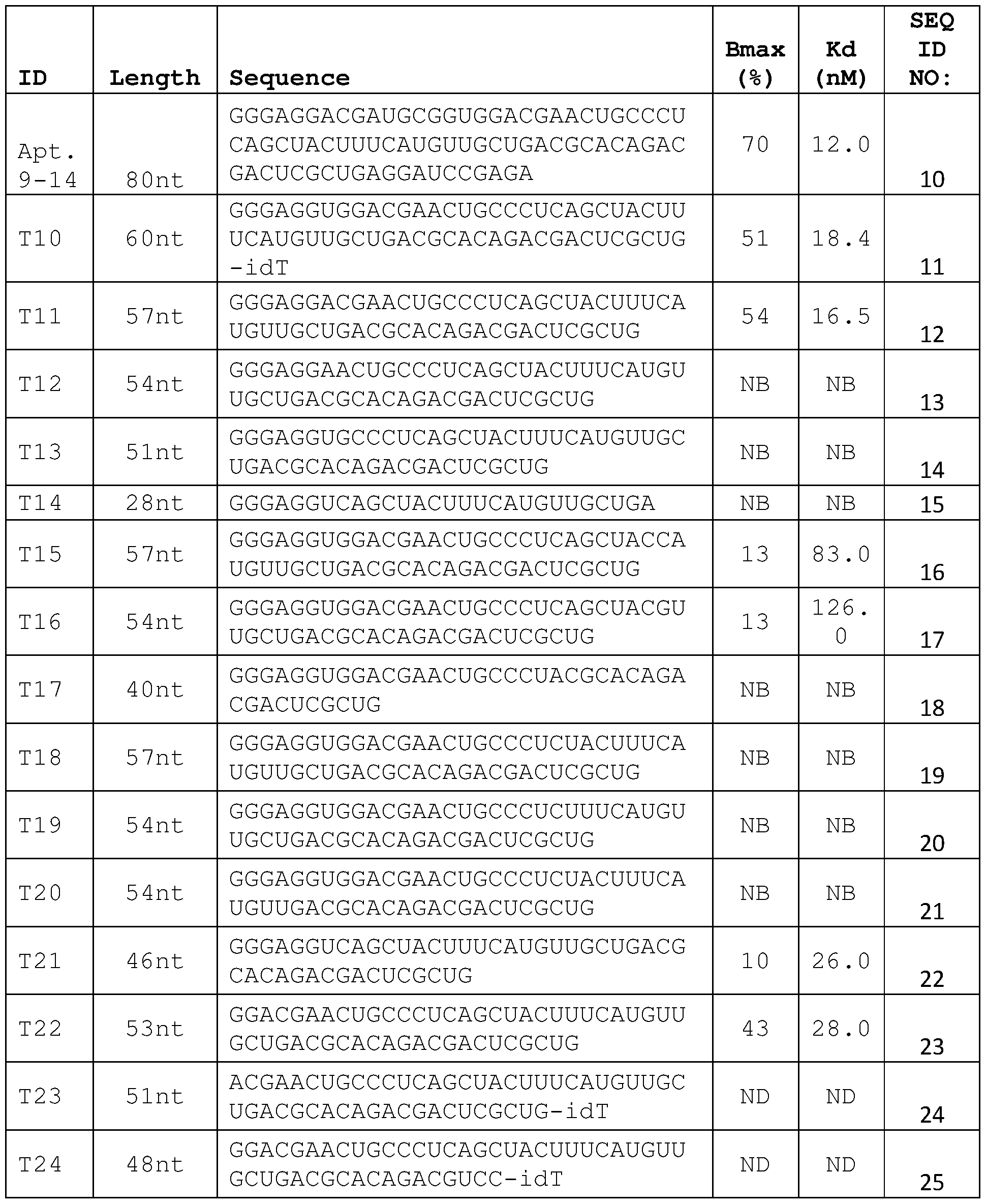
T25 44nt 54 13.4
UGACGCACAGACGU-idT 6
CCGAACUGCCCUCAGCUACUUUCAUGUUGC
T26 44nt ND ND
UGACGCACAGACGG-idT 26
GGGAGGACGAACUGCCCUCAGCUACUUAUG
T27 55nt ND ND
UUGCUGACGCACAGACGACUCGCUG-idT 27
GGGAGGACGAACUGCCCUCAGCUACUUCAU
T28 56nt ND ND
GUUGCUGACGCACAGACGACUCGCUG-idT 28
GGGAGGACGAACUGCCCUCAGCUAUUAUUA
T29 53nt ND ND
GCUGACGCACAGACGACUCGCUG-idT 29
CCGAACUGCCCUCAGCUAUUAUUAGCUGAC
T30 40nt 21 39.3
GCACAGACGG-idT 30
GGGAACUGCCCUCAGCUACUUUCAUGUUGC
T31 44nt ND ND
UGACGCACAGACCC-idT 31
GGACGAACUGCCCUCAGCUACUUUCAUGUU
T32 48nt ND ND
GCUGACGCACAGACGACU-idT 32
ACGAACUGCCCUCAGCACUUUCAUGUGCUG
T33 42nt 66 15.0
ACGCACAGACGU-idT 33
ACGAACUGCCCUCGCUACUUUCAUGUUGCG
T34 42nt 61 10.0
ACGCACAGACGU-idT 34
ACGAACUGCCCUCAGUACUUUCAUGUUCUG
T35 42nt 66 12.0
ACGCACAGACGU-idT 35
ACGAACUGCCCUCAGCUAUUUCAUUUGCUG
T36 42nt 58 11.0
ACGCACAGACGU-idT 36
ACGAACUGCCCUCAGCUACUUAUGUUGCUG
T37 42nt 68 10.0
ACGCACAGACGU-idT 37
ACGAACUGCCCUCGCACUUUCAUGUGCGAC
T38 40nt 55 9.6
GCACAGACGU-idT 38
ACGAACUGCCCUCAGACUUUCAUGUCUGAC
T39 40nt 50 11.0
GCACAGACGU-idT 39
ACGAACUGCCCUCAGCAUUUCAUUGCUGAC
T40 40nt 54 11.0
GCACAGACGU-idT 40
ACGAACUGCCCUCAGCACUUAUGUGCUGAC
T41 40nt 49 8.6
GCACAGACGU-idT 41
ACGAACUGCCCUCGUACUUUCAUGUUCGAC
T42 40nt ND ND
GCACAGACGU-idT 42
ACGAACUGCCCUCGCUAUUUCAUUUGCGAC
T43 40nt ND ND
GCACAGACGU-idT 43
ACGAACUGCCCUCGCUACUUAUGUUGCGAC
T44 40nt ND ND
GCACAGACGU-idT 44
ACGAACUGCCCUCAGUAUUUCAUUUCUGAC
T45 40nt ND ND
GCACAGACGU-idT 45
ACGAACUGCCCUCAGUACUUAUGUUCUGAC
T46 40nt ND ND
GCACAGACGU-idT 46
ACGAACUGCCCUCAGCUAUUAUUUGCUGAC
T47 40nt ND ND
GCACAGACGU-idT 47
ACGAACUGCCCUCGACUUAUGUCGACGCAC
T48 36nt 52 12.0
AGACGU-idT 48
ACGAACUGCCCUCGAUUAUUCGACGCACAG
T49 34nt 60 10.5
ACGU-idT 5
ACGAACUGCCCUCGCACUUAUGUGCGACGC
T50 38nt 61 9.6
ACAGACGU-idT 49
ACGAACUGCCCUCAGACUUAUGUCUGACGC
T51 38nt 56 17.0
ACAGACGU-idT 50
ACGAACUGCCCUCAGCAUUAUUGCUGACGC
T52 38nt 58 16.0
ACAGACGU-idT 51
ACGAACUGCCCUCAGCUACUUUCAUGUUGC
T53 43nt NB NB
UGACGCACAACGU-idT 52
ACGAACUGCCCUCAGCUACUUUCAUGUUGC
T54 43nt NB NB
UGACGCACGACGU-idT 53
ACGACUGCCCUCAGCUACUUUCAUGUUGCU
T55 41nt NB NB
GACGCACACGU-idT 54
T56 24nt ACGAACUGCCCUACGCACAGACGU-idT NB NB 55
T57 26nt ACGAACUGCCCUCGACGCACAGACGU-idT NB NB 56
ACGAACUGCCCUCGCGACGCACAGACGU-
T58 28nt NB NB
idT 57
ACGAACUGCCCUCGAUCGACGCACAGACGU
T59 30nt 78 8.8
-idT 4
ACGAACUGCCCUCGAUUUCGACGCACAGAC
T60 32nt 71 12.5
GU-idT 58
T61 22nt ACGAACUGCCCCGCACAGACGU-idT NB NB 59
ACGAACUCCCUCGAUUAUUCGACGACAGAC
T62 32nt NB NB
GU-idT 60
ACGAACGCCCUCGAUUAUUCGACGCACGAC
T63 32nt 10 83.0
GU-idT 61
ACGAACUGCCCUAUUAUUACGCACAGACGU
T64 30nt 13 54.0
-idT 62
ACGAACUGCCCUUUAUACGCACAGACGU-
T65 28nt NB NB
idT 63
ACGAACUGCUCGAUUAUUCGAGCACAGACG
T66 31nt NB NB
U-idT 64
ACGAACUGCCCUCGAUUAUUCGACCACAGA
T67 33nt NB NB
CGU-idT 65
ACGAACUGCCCUCUUAUGACGCACAGACGU
T68 30nt 82 16.0
-idT 66
ACGAACUGCCCUGAUUAUUCACGCACAGAC
T69 32nt 52 26.0
GU-idT 67
ACGAACUGCCCUCAUUAUUGACGCACAGAC
T70 32nt 81 13.0
GU-idT 68
ACGAACUGCCCUCGUUAUCGACGCACAGAC
T71 32nt 77 10.0
GU-idT 69
GCAUAACGAACUGCCCUCGAUCGACGCACA
T73 35nt ND ND
GACGU-idT 70
CCCACGAACUGCCCUCGAUCGACGCACAGA
T74 33nt 37 23.0
CGU-idT 71
CCCCCACGAACUGCCCUCGAUCGACGCACA
T75 35nt ND ND
GACGU-idT 72
CACACACGAACUGCCCUCGAUCGACGCACA
T76 35nt ND ND
GACGU-idT 73
AAAAACGAACUGCCCUCGAUCGACGCACAG
T77 34nt 59 8.8
ACGU-idT 74
CCCAAAACGAACUGCCCUCGAUCGACGCAC
T78 36nt 55 6.6
AGACGU-idT 75
ACGAACUGCCCUCGAUCGACGCACAGACGU
T79 35nt 64 1.6
UUUUU-idT 3
ACGAACUGCCCUCGAUCGACGCACAGACGU
T80 33nt 77 6.3
AAA-idT 76
ACGAACUGCCCUCGAUCGACGCACAGACGU
T81 35nt 63 4.2
ACACA-idT 77
ACGAACUGCCCUCGAUCGACGCACAGACGU
T82 35nt 76 5.3
ACCCG-idT 78
ACGAACUGCCCUCGAUCGACGCACAGACGU
T83 35nt 61 3.5
AAAAA-idT 79
ACGAACUGCCCUCGAUCGACGCACAGACGU
T84 35nt 76 3.7
ACACG-idT 80
ACGAACUGCCCUCGAUUUCAUUCGACGCAC
T85 36nt ND ND
AGACGU-idT 81
ACGAACUGCCCUCGUUUCAUCGACGCACAG
T86 34nt 88 16.0
ACGU-idT 82
ACGAACUGCCCUCUUUCAUGACGCACAGAC
T87 32nt 86 11.0
GU-idT 83
ACGAACUGCCCUCGAUAUUAUUUUCGACGC
T88 38nt ND ND
ACAGACGU-idT 84
ACGAACUGCCCUCGUAUUAUUUCGACGCAC
T89 36nt 79 12.0
AGACGU-idT 85
ACGAACUGCCCUCUAUUAUUUGACGCACAG
T90 34nt 77 3.8
ACGU-idT 86
ACGAACUGCCCUCGAUAUUUCAUUUUCGAC
T91 40nt ND ND
GCACAGACGU-idT 87
ACGAACUGCCCUCGUAUUUCAUUUCGACGC
T92 38nt ND ND
ACAGACGU-idT 88
ACGAACUGCCCUCUAUUUCAUUUGACGCAC
T93 36nt 76 6.4
AGACGU-idT 89
ACGAACUGCCCUCUUUUUUGACGCACAGAC
T94 32nt 87 5.0
GU-idT 90
ACGAACUGCCCUCUUUUUUUUGACGCACAG
T95 34nt 81 12.0
ACGU-idT 91
ACGAACUGCCCUCUUUUUUUUGACGCACCC
T96 34nt NB NB
CCGU-idT 92
ACGAACUGCCCUCGUUUCAUCGACGCACCC
T97 34nt NB NB
CCGU-idT 93
ACGAACUGCCCUCUUUCAUGACGCACCCCC
T98 32nt NB NB
GU-idT 94
ACGAACUGCCCUCUAUUAUUUGACGCACCC
T99 34nt NB NB
CCGU-idT 95
ACGAACUGCCCUCUAUUUCAUUUGACGCAC
T100 36nt ND ND
CCCCGU-idT 96
ACGAACUGCCCUCUUUUUUGACGCACCCCC
T101 32nt NB NB
GU-idT 97
The VWF9.14 aptamer modification variants created are listed in Table 2 below.
Table 2 - Modified Versions of VWF9.14 Aptamer Truncates
Table Legend: All sequences are in 5' to 3' orientation Lengths are not inclusive of inverted deoxythymidine fU = 2'fluorouracil fA = 2'fluoroadenine fC = 2'fluorocytosine mA = 2'0-methyladenine mC = 2'0-methylcytosine mG = 2'0-methylguanine
mU = 2'0-methyluracil fG = 2'fluoroguanine rG = 2' riboguanine rA = 2' riboadenine idT = inverted deoxythymidine on 3' end
(C6L)=hexylamino linker; (6GLY)=hexaethylene glycol linker (incorporated using 9-0- Dimethoxytrityl-triethylene glycol, l-[(2-cyanoethyl)-(N,N-diisopropyl)]-phosphoramidite); cholesterol=cholesterol triethyleneglycol amidite incorporated on 5' end
NB = No Binding; ND= Not Determined

T25
44nt CmUmUmUmCmAmUmGfUfUrGfCfUrGrAfC 59 7.1 vrtl2
rGfCrAfCrArGrAfCrGfU-idT 6 rAfCrGmAmAmCfUrGfCfCfCfUmCmAniGmC
T25 mUmAmCmUmUmUmCmAmUmGmUmUniG
44nt 79 1.9 vrtl3 mCmUmGrAfCrGfCrAmCmAmGniAfCrGfU- idT 6 niAfCrGrArAfCfUrGfCfCfCfUfCrArGfCfUrAf
T25
44nt CfUfUfUfCrAfUrGfUfUrGfCfUrGrAfCrGfCrA 54 9.2 vrtl4
fCrArGrAfCrGmU-idT 6 rAmCrGrArAfCfUrGfCfCfCfUfCrArGfCfUrAf
T25
44nt CfUfUfUfCrAfUrGfUfUrGfCfUrGrAfCrGfCrA 73 7.3 vrtl5
fCrArGrAfCmGfU-idT 6 rAfCmGrArAfCfUrGfCfCfCfUfCrArGfCfUrAf
T25
44nt CfUfUfUfCrAfUrGfUfUrGfCfUrGrAfCrGfCrA 78 4.3 vrtl6
fCrArGrAmCrGfU-idT 6 rAfCrGrArAfCmUrGfCfCfCfUfCrArGfCfUrAf
T25
44nt CfUfUfUfCrAfUrGfUfUrGfCfUrGrAfCrGfCm 56 23.0 vrtl7
AfCrArGrAfCrGfU-idT 6 rAfCrGrArAfCfUmGfCfCfCfUfCrArGfCfUrAf
T25
44nt CfUfUfUfCrAfUrGfUfUrGfCfUrGrAfCrGmCr NB NB
vrtl8
AfCrArGrAfCrGfU-idT 6 rAfCrGrArAfCfUrGmCfCfCfUfCrArGfCfUrAf
T25
44nt CfUfUfUfCrAfUrGfUfUrGfCfUrGrAfCmGfCr NB NB
vrtl9
AfCrArGrAfCrGfU-idT 6 rAfCrGrArAfCfUrGfCmCmCfUfCrArGfCfUrA
T25
44nt fCfUfUfUfCrAfUrGfUfUrGfCfUrGrAmCrGfCr NB NB
vrt20
AfCrArGrAfCrGfU-idT 6 rAfCrGrArAfCfUrGfCfCfCmUfCrArGfCfUrAf
T25
44nt CfUfUfUfCrAfUrGfUfUrGfCfUrGmAfCrGfCr 62 17.0 vrt21
AfCrArGrAfCrGfU-idT 6 rAfCrGrArAfCfUrGfCmCfCfUfCrArGfCfUrAf
T25
44nt CfUfUfUfCrAfUrGfUfUrGfCfUrGrAfCrGfCrA NB NB
vrt22
fCrArGrAfCrGfU-idT 6 rAfCrGrArAfCfUrGfCfCmCfUfCrArGfCfUrAf
T25
44nt CfUfUfUfCrAfUrGfUfUrGfCfUrGrAfCrGfCrA NB NB
vrt23
fCrArGrAfCrGfU-idT 6 rAfCrGrArAfCfUrGfCfCfCfUfCrArGfCfUrAfC
T25
44nt fUfUfUfCrAfUrGfUfUrGfCfUrGrAmCrGfCrAf 25 55.0 vrt24
CrArGrAfCrGfU-idT 6
T59 rAfCrGmAmAmCfUrGfCfCfCfUmCmGniAmU
30nt 76 1.5 vrtl mCmGrAfCrGfCrAmCmAmGniAfCrGfU-idT 4 rAfCrGmAmAmCfUrGfCfCfCmUmCmGniAm
T59
30nt UmCmGmAfCrGfCrAmCmAmGmAfCrGfU- 87 5.5 vrt2
idT 4
rAfCrGmAmAmCfUniGfCfCfCfUmCmGniAm
T59
30nt UmCmGrAfCmGfCmAmCmAmGmAfCrGfU- 49 288.0 vrt3
idT 4 mAfCmGrnAmAmCfUniGfCfCfCfUmCmGniA
T59
30nt mUmCmGmAfCmGfCmAmCmAmGmAfCmGf 53 364.0 vrt4
U-idT 4 mAmCmGmAmAmCfUmGfCfCfCmUmCmGm
T59
30nt AmUmCmGmAfCmGfCmAmCmAmGmAmC 61 260.0 vrt5
mGfU-idT 4 mAmCmGmAmAmCfUrGfCfCfCfUmCmGniA
T59
30nt mUmCmGrAfCrGfCrAmCmAmGmAmCniGfU 82 0.5 vrt6
-idT 4 mAfCmGniAmAmCfUrGfCfCfCfUmCmGniA
T59
30nt mUmCmGrAfCrGfCrAmCmAmGmAfCniGfU- 84 0.8 vrt7
idT 4
T59 mAfCrGmAniAmCfUrGfCfCfCfUmCmGniAm
30nt 86 1.8 vrt8 UmCmGrAfCrGfCrAmCmAmGmAfCrGfU-idT 4 rAmCrGmAmAmCfUrGfCfCfCfUmCmGniAm
T59
30nt UmCmGrAfCrGfCrAmCmAmGmAfCmGfU- 86 1.0 vrt9
idT 4 rAfCmGniAmAmCfUrGfCfCfCfUmCmGniAm
T59
30nt UmCmGrAfCrGfCrAmCmAmGmAmCrGfU- 81 0.4 vrtlO
idT 4
T59 rAfCrGmAmAmCfUniGfCfCfCfUmCmGniAm
30nt 88 1.3 vrtl l UmCmGrAfCrGfCrAmCmAmGmAfCrGfU-idT 4
T59 rAfCrGmAmAmCfUrGfCfCfCfUmCmGniAmU
30nt 85 6.9 vrtl2 mCmGrAfCrGfCmAmCmAmGniAfCrGfU-idT 4
T59 rAfCrGmAmAmCfUrGfCfCfCfUmCmGniAmU
30nt 76 29.0 vrtl3 mCmGrAfCniGfCrAmCmAmGniAfCrGfU-idT 4 mAmCmGmAmAmCfUrGfCfCfCmUmCniGm
T59
30nt AmUmCmGmAfCrGfCrAmCmAmGmAmCmG 81 1.7 vrtl4
fU-idT 4 mAmCmGmAmAmCfUmGfCfCfCmUmCmGm
T59
30nt AmUmCmGmAfCmGfCrAmCmAmGmAmCm 65 32.5 vrtl5
GfU-idT 4 mAmCmGmAmAmCfUrGfCfCfCmUmCmGm
T59
30nt AmUmCmGmAfCmGfCmAmCmAmGmAmC 57 132.5 vrtl6
mGfU-idT 4 mAmCmGmAmAmCfUmGfCfCfCmUmCmGm
T59
30nt AmUmCmGmAfCrGfCmAmCmAmGmAmCm 70 13.0 vrtl7
GfU-idT 4 mAmCmGmAmAmCmUrGfCfCfCmUmCmGm
T59
30nt AmUmCmGmAfCrGfCmAmCmAmGmAmCm 83 5.7 vrtl8
GfU-idT 4
mAmCmGniAmAmCmUniGfCfCfCmUmCmG
T59
30nt mAmUmCmGniAfCrGfCmAmCmAmGniAmC 82 5.5 vrtl9
mGfU-idT 4 mAmCmGmAmAmCmUrGfCfCfCmUmCmGm
T59
30nt AmUmCmGmAfCmGfCmAmCmAmGmAmC NB NB
vrt20
mGfU-idT 4 mAmCmGrnAmAmCfUniGfCfCfCfUmCniGm
T59
30nt AmUmCmGmAfCmGfCrAmCmAmGmAmCm 85 27.0 vrt21
GfU-idT 4 mAmCmGmAmAmCfUrGfCfCfCfUmCmGniA
T59
30nt mUmCmGmAfCmGfCniAmCmAmGniAmCm NB NB
vrt22
GfU-idT 4 mAmCmGmAmAmCfUmGfCfCfCfUmCniGm
T59
30nt AmUmCmGmAfCrGfCmAmCmAmGmAmCm 77 1.7 vrt23
GfU-idT 4 mAmCmGmAmAmCfUmGfCfCfCfUmCniGm
T59
30nt AmUmCmGrAfCrGfCmAmCmAmGmAmCmG 83 2.4 vrt24
fU-idT 4 mAmCmGmAmAmCfUrGfCfCfCfUmCmGmA
T59
30nt mUmCmGrAfCmGfCmAmCmAmGmAmCmGf 86 76.0 vrt25
U-idT 4 mAmCmGmAmAmCmUmGfCfCfCmUmCmG
T59
30nt mAmUmCmGmAfCrGfCmAmCmAmGmAmC 89 18.0 vrt26
mGmU-idT 4 mAmCmGmAmAmCmUmGfCfCfCmUmCmG
T59
30nt mAmUmCmGmAfCrGmCmAmCmAmGmAm NB NB
vrt27
CmGfU-idT 4 mAmCmGmAmAmCmUmGfCfCfCmUmCmG
T59
30nt mAmUmCmGmAfCmGfCmAmCmAmGmAm NB NB
vrt28
CmGfU-idT 4 mAmCmGmAmAmCmUmGmCfCfCmUmCm
T59
30nt GmAmUmCmGmAfCrGfCmAmCmAmGmAm 76 19.0 vrt29
CmGfU-idT 4 mAmCmGmAmAmCmUmGfCfCfCmUmCmG
T59
30nt mAmUmCmGmAfCmGfCmAmCmAmGmAm ND ND
vrt30
CmGmU-idT 4 mAmCmGmAmAmCmUmGfCfCfCmUmCmG
T59
30nt mAmUmCmGmAfCmGmCmAmCmAmGmAm ND ND
vrt31
CmGfU-idT 4 mAmCmGmAmAmCmUmGfCfCfCmUmCmG
T59
30nt mAmUmCmGmAfCfGfCmAmCmAmGmAmC ND ND
vrt32
mGmU-idT 4 rAfCrGmAmAmCfUrGfCfCfCfUmCmGmAmU
T79
35nt mCmGrAfCrGfCrAmCmAmGmAfCrGfUmUm 78 1.9 vrtl
UmUmUmU-idT 3
mAmCmGmAmAmCmUmGfCfCfCmUmCmG
T79
35nt mAmUmCmGmAfCrGfCmAmCmAmGmAmC 81 24.0 vrt2
mGfUmUmUmUmUmU-idT 3 mAmCmGmAmAmCmUmGfCfCfCmUmCmG
T79
35nt mAmUmCmGmAfCmGfCmAmCmAmGmAm 20 66.0 vrt3
CmGfUmUmUmUmUmU-idT 3 mAmCmGmAmAmCmUmGfCfCfCmUmCmG
T79
35nt mAmUmCmGmAfCrGfCmAmCmAmGmAmC 75 13.0 vrt4
mGmUmUmUmUmUmU-idT 3 mAmCmGmAmAmCmUmGfCfCfCmUmCmG
T79
35nt mAmUmCmGmAfCfGfCmAmCmAmGmAmC 61 60.5 vrt6
mGfUmUmUmUmUmU-idT 3
T79
vrt7; mAmCmGmAmAmCmUmGfCfCfCmUmCmG
DTR 35nt mAmUmCmGmAfCfGfCmAmCmAmGmAmC 56 11.2 3; I- mGmUmUmUmUmUmU-idT modifie
031 d: 7 mAmCmGmAmAmCfUfGfCfCfCfUmCmGmA
T79
35nt mUmCmGfAfCfGfCfAmCmAmGmAmCmGfU NB NB
vrt8
mUmUmUmUmU-idT 3 mAmCmGmAmAmCfUfGfCfCfCfUmCmGmA
T79
35nt mUmCmGfAfCfGfCfAmCmAmGmAmCmGm ND ND
vrt9
UmUmUmUmUmU-idT 3 rAfCrGmAmAmCfUrGfCfCfCfUmCmGmAmU
T82
35nt mCmGrAfCrGfCrAmCmAmGmAfCrGfUmAm 76 3.8 vrtl
CmCmCmG-idT 78 mAmCmGmAmAmCmUmGfCfCfCmUmCmG
T82
35nt mAmUmCmGmAfCrGfCmAmCmAmGmAmC 87 38.5 vrt4
mGmUmAmCmCmCmG-idT 78 mAmCmGmAmAmCmUmGfCfCfCmUmCmG
T82
35nt mAmUmCmGmAfCfGfCmAmCmAmGmAmC 67 223.0 vrt6
mGfUmAmCmCmCmG-idT 78 mAmCmGmAmAmCmUmGfCfCfCmUmCmG
T82
35nt mAmUmCmGmAfCfGfCmAmCmAmGmAmC 78 268.5 vrt7
mGmUmAmCmCmCmG-idT 78 mAmCmGmAmAmCfUfGfCfCfCfUmCmGmA
T82
35nt mUmCmGfAfCfGfCfAmCmAmGmAmCmGfU NB NB
vrt8
mAmCmCmCmG-idT 78 rAfCrGmAmAmCfUrGfCfCfCfUmCmGmAmU
T83
35nt mCmGrAfCrGfCrAmCmAmGmAfCrGfUmAm 73 2.1 vrtl
AmAmAmA-idT 79 mAmCmGmAmAmCmUmGfCfCfCmUmCmG
T83
35nt mAmUmCmGmAfCrGfCmAmCmAmGmAmC 77 20.0 vrt4
mGmUmAmAmAmAmA-idT 79
T83 mAmCmGmAmAmCmUmGfCfCfCmUmCmG
35nt 67 209.0 vrt6 mAmUmCmGmAfCfGfCmAmCmAmGmAmC 79
mGfUmAmAmAmAmA-idT mAmCmGmAmAmCmUmGfCfCfCmUmCmG
T83
35nt mAmUmCmGmAfCfGfCmAmCmAmGmAmC 83 265.0 vrt7
mGmUmAmAmAmAmA-idT 79 mAmCmGmAmAmCfUfGfCfCfCfUmCmGmA
T83
35nt mUmCmGfAfCfGfCfAmCmAmGmAmCmGfU NB NB
vrt8
mAmAmAmAmA-idT 79 rAfCrGmAmAmCfUrGfCfCfCfUmCmGmAmU
T84
35nt mCmGrAfCrGfCrAmCmAmGmAfCrGfUmAm 72 1.7 vrtl
CmAmCmG-idT 80 mAmCmGmAmAmCmUmGfCfCfCmUmCmG
T84
35nt mAmUmCmGmAfCrGfCmAmCmAmGmAmC 77 22.0 vrt4
mGmUmAmCmAmCmG-idT 80 mAmCmGmAmAmCmUmGfCfCfCmUmCmG
T84
35nt mAmUmCmGmAfCfGfCmAmCmAmGmAmC 71 149.0 vrt6
mGfUmAmCmAmCmG-idT 80 mAmCmGmAmAmCmUmGfCfCfCmUmCmG
T84
35nt mAmUmCmGmAfCfGfCmAmCmAmGmAmC 74 182.0 vrt7
mGmUmAmCmAmCmG-idT 80 mAmCmGmAmAmCfUfGfCfCfCfUmCmGmA
T84
35nt mUmCmGfAfCfGfCfAmCmAmGmAmCmGfU NB NB
vrt8
mAmCmAmCmG-idT 80 rAfCrGmAmAmCfUrGfCfCfCfUmCmGmUmU
T86
34nt mUmCmAmUmCmGrAfCrGfCrAmCmAmGm 80 0.9 vrtl
AfCrGfU-idT 82 mAmCmGmAmAmCmUmGfCfCfCmUmCmG
T86
34nt mUmUmUmCmAmUmCmGmAfCrGfCmAmC 88 12.0 vrt4
mAmGmAmCmGmU-idT 82 mAmCmGmAmAmCmUmGfCfCfCmUmCmG
T86
34nt mUmUmUmCmAmUmCmGmAfCfGfCmAmC 85 52.0 vrt6
mAmGmAmCmGfU-idT 82 mAmCmGmAmAmCmUmGfCfCfCmUmCmG
T86
34nt mUmUmUmCmAmUmCmGmAfCfGfCmAmC 88 50.0 vrt7
mAmGmAmCmGmU-idT 82 mAmCmGmAmAmCfUfGfCfCfCfUmCmGmU
T86
34nt mUmUmCmAmUmCmGfAfCfGfCfAmCmAm NB NB
vrt8
GmAmCmGfU-idT 82 rAfCrGmAmAmCfUrGfCfCfCfUmCmUmUmU
T87
32nt mCmAmUmGrAfCrGfCrAmCmAmGmAfCrGf 85 1.5 vrtl
U-idT 83 rAfCrGmAmAmCfUrGfCfCfCfUmCmGmUmA
T89
36nt mUmUmAmUmUmUmCmGrAfCrGfCrAmCm 84 1.2 vrtl
AmGmAfCrGfU-idT 85
mAmCmGmAmAmCmUmGfCfCfCmUmCmG
T89
36nt mUmAmUmUmAmUmUmUmCmGmAfCrGfC 80 12.0 vrt2
mAmCmAmGmAmCmGfU-idT 85 mAmCmGmAmAmCmUmGfCfCfCmUmCmG
T89
36nt mUmAmUmUmAmUmUmUmCmGmAfCmGf 49 63.0 vrt3
CmAmCmAmGmAmCmGfU-idT 85 mAmCmGmAmAmCmUmGfCfCfCmUmCmG
T89
36nt mUmAmUmUmAmUmUmUmCmGmAfCrGfC 85 8.4 vrt4
mAmCmAmGmAmCmGmU-idT 85 mAmCmGmAmAmCmUmGfCfCfCmUmCmG
T89
36nt mUmAmUmUmAmUmUmUmCmGmAfCfGfC 73 34.5 vrt6
mAmCmAmGmAmCmGfU-idT 85 mAmCmGmAmAmCmUmGfCfCfCmUmCmG
T89
36nt mUmAmUmUmAmUmUmUmCmGmAfCfGfC 75 38.5 vrt7
mAmCmAmGmAmCmGmU-idT 85 mAmCmGmAmAmCfUfGfCfCfCfUmCmGmU
T89
36nt mAmUmUmAmUmUmUmCmGfAfCfGfCfAm NB NB
vrt8
CmAmGmAmCmGfU-idT 85 mAmCmGmAmAmCfUfGfCfCfCfUmCmGmU
T89
36nt mAmUmUmAmUmUmUmCmGfAfCfGfCfAm ND ND
vrt9
CmAmGmAmCmGmU-idT 85 mAmCmGmAmAmCmUfGfCfCfCmUmCmGm
T89
36nt UmAmUmUmAmUmUmUmCmGfAfCfGfCfA 86 548.0 vrtlO
mCmAmGmAmCmGmU-idT 85 rAfCrGmAmAmCfUrGfCfCfCfUmCmUmAmU
T90
34nt mUmAmUmUmUmGrAfCrGfCrAmCmAmGm 87 0.9 vrtl
AfCrGfU-idT 86 mAmCmGmAmAmCmUmGfCfCfCmUmCmU
T90
34nt mAmUmUmAmUmUmUmGmAfCrGfCmAmC 85 10.2 vrt4
mAmGmAmCmGmU-idT 86 mAmCmGmAmAmCmUmGfCfCfCmUmCmU
T90
34nt mAmUmUmAmUmUmUmGmAfCfGfCmAmC 80 46.0 vrt6
mAmGmAmCmGfU-idT 86 mAmCmGmAmAmCmUmGfCfCfCmUmCmU
T90
34nt mAmUmUmAmUmUmUmGmAfCfGfCmAmC 80 42.0 vrt7
mAmGmAmCmGmU-idT 86 mAmCmGmAmAmCfUfGfCfCfCfUmCmUmA
T90
34nt mUmUmAmUmUmUmGfAfCfGfCfAmCmAm ND ND
vrt8
GmAmCmGfU-idT 86 rAfCrGmAmAmCfUrGfCfCfCfUmCmUmAmU
T93
36nt mUmUmCmAmUmUmUmGrAfCrGfCrAmCm 89 0.8 vrtl
AmGmAfCrGfU-idT 89 mAmCmGmAmAmCmUmGfCfCfCmUmCmU
T93
36nt mAmUmUmUmCmAmUmUmUmGmAfCrGfC 82 5.7 vrt4
mAmCmAmGmAmCmGmU-idT 89
mAmCmGmAmAmCmUmGfCfCfCmUmCmU
T93
36nt mAmUmUmUmCmAmUmUmUmGmAfCfGfC 82 33.0 vrt6
mAmCmAmGmAmCmGfU-idT 89 mAmCmGmAmAmCmUmGfCfCfCmUmCmU
T93
36nt mAmUmUmUmCmAmUmUmUmGmAfCfGfC 76 20.0 vrt7
mAmCmAmGmAmCmGmU-idT 89 mAmCmGmAmAmCfUfGfCfCfCfUmCmUmA
T93
36nt mUmUmUmCmAmUmUmUmGfAfCfGfCfAm ND ND
vrt8
CmAmGmAmCmGfU-idT 89 rAfCrGmAmAmCfUrGfCfCfCfUmCmUmUmU
T94
32nt mUmUmUmGrAfCrGfCrAmCmAmGmAfCrGf 90 0.9
vrtl
U-idT 90 mAmCmGmAmAmCmUmGfCfCfCmUmCmU
T94
32nt mUmUmUmUmUmGmAfCfGfCmAmCmAmG 78 42.0 vrt6
mAmCmGfU-idT 90 mAmCmGmAmAmCmUmGfCfCfCmUmCmU
T94
32nt mUmUmUmUmUmGmAfCfGfCmAmCmAmG 71 29.0 vrt7
mAmCmGmU-idT 90 mAmCmGmAmAmCfUfGfCfCfCfUmCmUmU
T94
32nt mUmUmUmUmGfAfCfGfCfAmCmAmGmAm ND ND
vrt8
CmGfU-idT 90 rAfCrGmAmAmCfUrGfCfCfCfUmCmUmUmU
T95
34nt mUmUmUmUmUmGrAfCrGfCrAmCmAmGm 90 0.9
vrtl
AfCrGfU-idT 91
DTR mAmCmGmAmAmCmUmGfCfCfCmUmCmG
I- mAmUmCmGmAfCrGfCmAmCmAmGmAmC
006 30nt mGfUidT 80 7.0 4
DTR mAmCmGmAmAmCmUmGfCfCfCmUmCmG
I- mAmUmCmGmAfCfGfCmAmCmAmGmAmC 4
007 30nt mGfUidT 44 16.0
DTR mAmCmGmAmAmCmUmGfCfCfCmUmCmG
I- mAmUmCmGmAfCrGfCmAmCmAmGmAmC 4
008 30nt mGmUidT 67 7.0
DTR mAmCmGmAmAmCmUmGfCfCfCmUmC(6G
I- LY)mGmAfCrGfCmAmCmAmGmAmCmGfUi 98
009 26nt dT 60 11.0
DTR mAmCmGmAmAmCmUmGfCfCfCmUmCmG
I- mAmUmCmGmAfCdGfCmAmCmAmGmAmC 4
010 30nt mGfUidT
DTR mAmCmGmAmAmCmUmGfCfCfCmUmCmG
I- mUmAmAmGmAfCrGfCmAmCmAmGmAmC 99
011 30nt mGfUidT 72 3.8
DTR mAmCmGmAmAmCmUmGfCfCfCmUmCmG
I- mUmAmAmGmAfCrGfCmAmCmAmGmAmC 100
012 35nt mGfUmUmUmUmUmUidT 73 5.5
DTR mCmCmGmAmAmCmUmGfCfCfCmUmCmG
I- mAmUmCmGmAfCrGfCmAmCmAmGmAmC 101
013 30nt niGmGidT 58 5.4
DTR mAmCmGmAmAmCmUmGfCfCfCmUmCmG 100 I- mUmAmAmGmAfCrGfCmAmCmAmGmAmC unmod;
019 35nt mGmUmUmUmUmUmUidT 64.8 4.3 mod: 8;
DTR (C6L)mAmCmGmAmAmCmUmGfCfCfCmUm
I- CmGmUmAmAmGmAfCrGfCmAmCmAmGm 100
020 35nt AmCmGmUmUmUmUmUmUidT ND ND unmod
Cholesterol-
DTR mAmCmGmAmAmCmUmGfCfCfCmUmCmG unmod: I- mUmAmAmGmAfCrGfCmAmCmAmGmAmC 100;
021 35nt mGmUmUmUmUmUmUidT ND ND mod: 9;
DTR mAmCmGmAmAmAmUmGmGmAmAmUmC
I- mGmUmAmAmGmAmAmCmCmAmCmAmG
022 35nt mAmCmGmUmUmUmUmUmUidT NB NB 102
Cholesterol-
DTR mAmCmGmAmAmAmUmGmGmAmAmUmC
I- mGmUmAmAmGmAmAmCmCmAmCmAmG
023 35nt mAmCmGmUmUmUmUmUmUidT ND ND 102
DTR mAmCmGmAmAmCmUmGfCfCfCmUmCmG
I- mUmAmAmGmAfCfGfCmAmCmAmGmAmC
034 35nt mGmUmUmUmUmUmUidT 60 2.8 100
In addition to creating the VWF9.14 aptamer truncation variants and the VWF9.14 aptamer modification variants, we created several antidote sequences targeting these variants, which are listed in Table 3 below.
Table 3: Antidote Sequences
All sequences are represented in a 5' to 3' orientation
Lengths are not inclusive of inverted deoxythymidine
mG=2'0-Methyl G; mA=2'0-Methyl A; mC=2'0-Methyl C; mU=2'0-Methyl U;
idT-inverted deoxythymidine

AO4 T59-A04 16nt 106 idT
mGmUmCmGmAmUmCmGmAmGmGmGmCmAmGmUmU-
AO5 T59-A05 17nt 107 idT
AO6 T59-A06 14nt mGmUmCmGmAmUmCmGmAmGmGmGmCmA-idT 108 mUmGmCmGmUmCmGmAmUmCmGmAmGmGmGmCmA-
AO7 T59-A07 17nt 109 idT
mUmGmUmGmCmGmUmCmGmAmUmCmGmAmGmGmG-
AO8 T59-A08 17nt 110 idT
mUmCmUmGmUmGmCmGmUmCmGmAmUmCmGmAmGm
AO9 T59-A09 19nt 111
GmG-idT
mUmCmUmGmUmGmCmGmUmCmGmAmUmCmGmA-
AO10 T59-AO10 16nt 112 idT
AOll T59-A011 14nt mUmCmUmGmUmGmCmGmUmCmGmAmUmC-idT 113 mAmCmGmUmCmUmGmUmGmCmGmUmCmGmAmUmC-
A012 T59-A012 17nt 114 idT
mAmAmUmGmAmGmGmGmCmAmGmUmUmCmGmU-
A013 T70-AO1 16nt 115 idT
mAmUmAmAmUmGmAmGmGmGmCmAmGmUmUmCmGm
A014 T70-AO2 18nt 116
U-idT
A015 T70-AO3 13nt mAmAmUmGmAmGmGmGmCmAmGmUmU-idT 117
A016 T70-AO4 15nt mAmUmAmAmUmGmAmGmGmGmCmAmGmUmU-idT 118 mUmCmAmAmUmAmAmUmGmAmGmGmGmCmAmGmUm
A017 T70-AO5 18nt 119
U-idT
mGmUmCmAmAmUmAmAmUmGmAmGmGmGmCmAmGm
A018 T70-AO6 19nt 120
UmU-idT
mGmUmCmAmAmUmAmAmUmGmAmGmGmGmCmA-
A019 T70-AO7 16nt 121 idT
mUmGmCmGmUmCmAmAmUmAmAmUmGmAmGmGmGm
AO20 T70-AO8 19nt 122
CmA-idT
A021 T70-AO9 13nt mGmUmCmAmAmUmAmAmUmGmAmGmG-idT 123 mUmGmCmGmUmCmAmAmUmAmAmUmGmAmGmG-
A022 T70-AO10 16nt 124 idT
A023 T70-AO11 15nt mUmCmUmGmUmGmCmGmUmCmAmAmUmAmA-idT 125 mAmCmGmUmCmUmGmUmGmCmGmUmCmAmAmUmAm
A024 T70-AO12 18nt 126
A-idT
mAmAmUmCmGmAmGmGmGmCmAmGmUmUmCmGmU-
A025 T49-A01 17nt 127 idT
mAmUmAmAmUmCmGmAmGmGmGmCmAmGmUmUmCm
A026 T49-A02 19nt 128
GmU-idT
A027 T49-A03 14nt mAmAmUmCmGmAmGmGmGmCmAmGmUmU-idT 129 mAmUmAmAmUmCmGmAmGmGmGmCmAmGmUmU-
A028 T49-A04 16nt 130 idT
mUmCmGmAmAmUmAmAmUmCmGmAmGmGmGmCmAm
A029 T49-A05 20nt 131
GmUmU-idT
mGmUmCmGmAmAmUmAmAmUmCmGmAmGmGmGmCm
AO30 T49-A06 21nt 132
AmGmUmU-idT
mGmUmCmGmAmAmUmAmAmUmCmGmAmGmGmGmCm
A031 T49-A07 18nt 133
A-idT
mUmGmCmGmUmCmGmAmAmUmAmAmUmCmGmAmGm
A032 T49-A08 21nt 134
GmGmCmA-idT
A033 T49-A09 15nt mGmUmCmGmAmAmUmAmAmUmCmGmAmGmG-idT 135 mUmGmCmGmUmCmGmAmAmUmAmAmUmCmGmAmGm
A034 T49-AO10 18nt 136
G-idT
mUmCmUmGmUmGmCmGmUmCmGmAmAmUmAmA-
A035 T49-A011 16nt 137 idT
mAmCmGmUmCmUmGmUmGmCmGmUmCmGmAmAmUm
A036 T49-A012 19nt 138
AmA-idT
mGmAmUmCmGmAmGmGmGmCmAmGmUmUmCmGmUm
A037 T73-A01 22nt 139
UmAmUmGmC-idT
mGmAmUmCmGmAmGmGmGmCmAmGmUmUmCmGmUm
A038 T74-A01 20nt 140
GmGmG-idT
mGmAmUmCmGmAmGmGmGmCmAmGmUmUmCmGmUm
A039 T75-A01 22nt 141
GmGmGmGmG-idT
mGmAmUmCmGmAmGmGmGmCmAmGmUmUmCmGmUm
AO40 T76-A01 22nt 142
GmUmGmUmG-idT
mGmAmUmCmGmAmGmGmGmCmAmGmUmUmCmGmUm
A041 T77-A01 21nt 143
UmUmUmU-idT
mGmAmUmCmGmAmGmGmGmCmAmGmUmUmCmGmUm
A042 T78-A01 23nt 144
UmUmUmGmGmG-idT
mAmAmAmAmAmAmCmGmUmCmUmGmUmGmCmGmUm
A043 T79-A01 22nt 145
CmGmAmUmC-idT
mUmUmUmAmCmGmUmCmUmGmUmGmCmGmUmCmGm
A044 T80-AO1 20nt 146
AmUmC-idT
mUmGmUmGmUmAmCmGmUmCmUmGmUmGmCmGmUm
A045 T81-A01 22nt 147
CmGmAmUmC-idT
mCmGmGmGmUmAmCmGmUmCmUmGmUmGmCmGmUm
A046 T82-A01 22nt 148
CmGmAmUmC-idT
mUmUmUmUmUmAmCmGmUmCmUmGmUmGmCmGmUm
A047 T83-A01 22nt 149
CmGmAmUmC-idT
mCmGmUmGmUmAmCmGmUmCmUmGmUmGmCmGmUm
A048 T84-A01 22nt 150
CmGmAmUmC-idT
mGmGmGmCmAmGmUmUmCmGmUmUmAmUmGmC-
A049 T73-A02 16nt 151 idT
AO50 T74-A02 14nt mGmGmGmCmAmGmUmUmCmGmUmGmGmG-idT 152 mGmGmGmCmAmGmUmUmCmGmUmGmGmGmGmG-
A051 T75-A02 16nt 153 idT
mGmGmGmCmAmGmUmUmCmGmUmGmUmGmUmG-
A052 T76-A02 16nt 154 idT
A053 T77-A02 15nt mGmGmGmCmAmGmUmUmCmGmUmUmUmUmU-idT 155 mGmGmGmCmAmGmUmUmCmGmUmUmUmUmGmGmG-
A054 T78-A02 17nt 156 idT
T79- mAmAmAmAmAmAmCmGmUmCmUmGmUmGmCmG-
A055 A02/DTRI 16nt 157 idT
-025
A056 T80-AO2 14nt mUmUmUmAmCmGmUmCmUmGmUmGmCmG-idT 158 mUmGmUmGmUmAmCmGmUmCmUmGmUmGmCmG-
A057 T81-A02 16nt 159 idT
mCmGmGmGmUmAmCmGmUmCmUmGmUmGmCmG-
A058 T82-A02 16nt 160 idT
mUmUmUmUmUmAmCmGmUmCmUmGmUmGmCmG-
A059 T83-A02 16nt 161 idT
mCmGmUmGmUmAmCmGmUmCmUmGmUmGmCmG-
AO60 T84-A02 16nt 162 idT
mUmCmUmGmUmGmCmGmUmCmGmAmUmGmAmAmA-
A061 T86-A01 17nt 163 idT
mUmCmUmGmUmGmCmGmUmCmAmUmGmAmAmA-
A062 T87-A01 16nt 164 idT
mUmCmUmGmUmGmCmGmUmCmGmAmAmAmUmAmAm
A063 T89-A01 19nt 165
UmA-idT
mUmCmUmGmUmGmCmGmUmCmAmAmAmUmAmAmUm
A064 T90-AO1 18nt 166
A-idT
mUmCmUmGmUmGmCmGmUmCmAmAmAmUmGmAmAm
A065 T93-A01 20nt 167
AmUmA-idT
mUmCmUmGmUmGmCmGmUmCmAmAmAmAmAmA-
A066 T94-A01 16nt 168 idT
mUmCmUmGmUmGmCmGmUmCmAmAmAmAmAmAmAm
A067 T95-A01 18nt 169
A-idT
mGmGmGmGmUmGmCmGmUmCmAmAmAmAmAmAmAm
A068 T96-A01 18nt 170
A-idT
mGmGmGmGmUmGmCmGmUmCmGmAmUmGmAmAmA-
A069 T97-A01 17nt 171 idT
mGmGmGmGmUmGmCmGmUmCmAmUmGmAmAmA-
AO70 T98-A01 16nt 172 idT
mGmGmGmGmUmGmCmGmUmCmAmAmAmUmAmAmUm
A071 T99-A01 18nt 173
A-idT
mGmGmGmGmUmGmCmGmUmCmAmAmAmAmAmA-
A072 T101-AO1 16nt 174 idT
mAmAmAmAmAmAmCmGmUmCmUmGmUmAmGmUmU-
A073 T79-A03 17nt 175 idT
A074 T79-A04 15nt mAmAmAmAmAmAmCmGmUmCmUmGmGmUmU-idT 176 mAmAmAmAmAmAmCmGmUmCmUmGmUmAmGmUmUm
A075 T79-A05 20nt 177
CmGmU-idT
mAmAmAmAmAmAmCmGmUmCmUmGmGmUmUmCmGm
A076 T79-A06 18nt 178
U-idT
A085 T59-A013 12nt mUmCmUmGmUmGmCmGmUmCmGmA-idT 179
T79-
A086 A07/DTRI 16nt mAmAmAmAmAmAmCmGmUmCmUmGmUmGmCmG 180 -038
Binding Studies
To determine the binding affinity of the VWF9.14 aptamer variants for the VWF protein, we performed binding assays with several of the variants. The binding data is summarized above in Tables 1-2. See also Figures 1, and 16-17.
PFA Analysis of VWF9.14 aptamer variants
As shown in Figure 12 and 13, we performed platelet function assay (PFA) for VWF9.14T59 with and without antidotes VWF9.14T59-AO3,-AO10, and -AOl l (A03, AO10, and AOl l respectively). Also shown are PFA results for aptamer VWF9.14T79 with and without antidotes VWF9.14T79-A01 (A043) and VWF9.14T79-A02 (A055). Results are shown for aptamer VWF9.14T82 with and without antidotes VWF9.14T82-A01 (A046) and VWF9.14T82-A02 (A058). Results are shown for aptamer VWF9.14T84 with and without antidotes VWF9.14T84-A01 (A048) and VWF9.14T84-A02 (AO60). These results demonstrate that the anti-thrombotic activity of several of the VWF9.14 aptamers could be reversed using designed antidotes.
In vivo testing of VWF9.14 aptamer variants
Several of the VWF9.14 aptamer variants were tested in a murine arterial thrombosis model and a murine saphenous vein bleeding model. See Figures 4-11. In the murine arterial thrombosis model, the left jugular vein was cannulated and the right carotid artery was exposed and a flow probe was placed. After 5 minutes the vehicle indicated was injected i.v. into the mouse and a 10% FeCl3 patch was placed on the carotid artery for 3 minutes. The blood flow in the carotid artery was then monitored for 1 hour and recorded using the probe In the murine arterial thrombosis model, injecting a vehicle (no aptamer/negative control) prior to FeCl3 injury resulted in the vessel becoming occluded in approximately 2 minutes following removal of the FeCl3 patches. See Figure 4. On the other hand, injecting either T79vrt7/DTRI-031 or PEG- VWF9.14T79-VRT7/DTRI-031 aptamer at a dosing of 0.375 mg/kg into this model prior to FeCl3 injury resulted in the vessel remaining patent for 60 minutes following removal of the FeCl3 patches. See Figures 5 and 7. These results demonstrate that the aptamers had potent antithrombotic activity.
The VWF9.14T79-VRT7 aptamer was also injected at a dosing of 0.0375 mg/kg into the model prior to FeCl3 injury, which resulted in the vessel remained patent for > 60 minutes following removal of the FeCl3 patches. See Figure 5. This result demonstrated that the dosing of the VWF9.14T79-VRT7 aptamer may be decreased and still exhibit potent anti-thrombotic activity. The dose range study is presented in Figure 7.
In the murine saphenous vein bleeding model, the left jugular vein of a mouse is cannulated and the right medial saphenous vein is exposed prior to injecting the aptamer at the indicated dose. Five minutes after injecting the aptamer the saphenous vein is transected and bleeding is followed for 15 minutes, the antidote is then injected to reverse the effects of the aptamer and bleeding is followed for an additional 20 minutes. The activity of the PEG- VWF9.14T79-VRT7 aptamer could be successfully reversed by injecting the VWF9.14T79-A02 (A055) antidote. See Figure 8. For example, as shown in Figure 8, the clot disruptions increased after injection of the VWF9.14T9-A02 (A055) antidote demonstrating that the activity of the aptamers could be reversed.
Furthermore, we tested the PEG-VWF9.14T79-VRT7 aptamer, the Cholesterol- VWF9.14T79-VRT7 aptamer, the Elastin-like polypeptide (ELP)-VWF9.14T79-VRT7 aptamer, and the VWF9.14T79-A02 (A055) antidote in a combined murine arterial thrombosis and saphenous vein bleeding model. In this model the left jugular vein was cannulated and the right
carotid artery was exposed and a transonic flow probe was placed in the animal. Five minutes after placement of the probe the aptamer was injected at the indicated dose. After an additional 5 minutes two 7.5% FeCl3 patches were placed on the right carotid artery for 3 minutes prior to removal. Thirty minutes after removal the saphenous vein was exposed and transected and bleeding monitored for 15 minutes. The antidote was injected and clot formation was observed for an additional 15 minutes. See Figures 10-11. In this model, after first demonstrating the potent anti-thrombotic activity of each aptamer, the VWF9.14T79-A02 (A055) antidote could still successfully reverse the activities of the aptamers.
Example 2 - VWF Aptamer Thrombolytic Activity
The T79VRT7 aptamer and was also tested for thrombolytic activity in a murine carotid artery occlusion model and a murine intracranial hemorrhage model. See Figures 18-19.
Murine Carotid Artery Occlusion and Thrombolysis Model
We employed a murine carotid artery occlusion model where we intubated adult C57BL/6J mice (Jackson Laboratory, Bar Harbor, ME) (18-24 g) and exposed the left jugular vein. Next, we exposed the right common carotid artery and placed a transonic flow probe (Transonic Systems Incorporated, Ithaca, NY) around the artery. The blood flow was measured for 5 minutes to achieve a stable baseline. We then induced thrombosis by applying 10% ferric chloride- soaked Whatmann paper on the vessel. The time to occlusion was then recorded. Twenty minutes after occlusion, we intravenously inject either saline (negative control), anti- VWF aptamer (VWF9.14T79VRT7) at a dose of 0.5 mg/kg, or recombinant tissue plasminogen activator (rTPA) at a dose of 10 mg/kg. We monitored for reperfusion using the Doppler flow probe and determine the time to re-establish perfusion. We terminated the experiment if no recanalization occurred after 60 minutes. The animals were then sacrificed and the brain and common carotid arteries harvested for analysis.
As shown in Figure 18, in the murine carotid artery occlusion model, the percentage of initial carotid flow increased to a greater degree over time with the T79VRT7 aptamer verses rTPA, control, or no perfusion. Thus, the VWF T79VRT7 aptamer had superior thrombolytic activity compared to rTPA.
Murine Intracranial Hemorrhage Model
We anesthetized adult C57BL/6J mice (18-24 g) and exposed the left jugular vein and right common carotid artery. We then injected either saline (negative control), anti-VWF
aptamer (VWF9.14T79-VRT7) at a dose of 0.5 mg/kg, rTPA at dose of 10 mg/kg or anti-VWF aptamer (0.5 mg/kg) and matched antidote oligonucleotide (VWF9.14T79 -A02, also called A055) at a dose of 2.5 mg/kg 5 minutes after the aptamer. To induce intracranial hemorrhage, we inserted a silicone-coated 6-0 nylon filament into the carotid artery and advanced it until we punctured the internal carotid artery (ICA) terminus, resulting in subarachnoid hemorrhage (SAH). To evaluate the volume of infarct and hemorrhage, we performed magnetic resonance imaging (MRI) on a 9.4 Tesla MRI (Bruker Biospin, BiUerica, MA) 90 minutes after induced intracranial hemorrhage.
Figure 19 shows a graph indicating stroke volume following vascular injury in the murine intracranial hemorrhage model in mice treated with vehicle, rTPA, anti-VWF aptamer (VWF9.14T79-VRT7), or anti-VWF aptamer (VWF9.14T79-VRT7) and VWF antidote (VWF9.14T79-A02, also called A055).
Example 3 - Additional In vivo Studies with a VWF Aptamer
Ischemic stroke is a leading cause of death and disability in the western world.1 Approved thrombolytic stroke therapy using recombinant tissue plasminogen activator (rTPA) is limited by several critical factors. First, the significant risk of hemorrhagic conversion resulting from in part, the inability to reverse rTPA activity. Second, the short therapeutic window for rTPA renders more than 90% of stroke patients ineligible for therapy. 2 ' 3 Finally, rTPA only achieves approximately 30% recanalization and re-occlusion commonly occurs after primary thrombolysis, resulting in loss of initial neurological improvement.
von Willebrand factor (VWF) is a glycoprotein involved in the seminal event of platelet plug formation. VWF interacts with glycoprotein lb alpha- IX- V complex on the platelet surface to induce platelet adhesion to the vessel wall.4 Following this glycoprotein Ilb/IIIa (gpIIb/IIIa) becomes activated and binds to fibrinogen resulting in thrombus formation, von Willebrand disease (VWD) can be both a qualitative and quantitative reduction and von Willebrand factor. Type I VWD, the predominant form of VWF disease presents with mild bleeding after dental procedures or during menses and not spontaneous hemorrhage.5 Moreover, VWD Type I patients are protected from cerebrovascular and cardiovascular events.6 VWF therefore represents an attractive target in arterial thrombosis and may be superior to current therapies.
Aptamers are single-stranded oligonucleotides that have potential advantages over other classes of therapeutic agents. They bind to their target with high affinity and specificity. They
can be chemically modified to customize their bioavailability, chemically synthesized in large scale and most pertinent to our application, can be rapidly reversed. 8-11
In this Example, the inventors demonstrate that aptamer 9.14T79vrt7 inhibits platelet adhesion under high shear stress in a dose-dependent manner and prevents platelet aggregation. It prevents thrombus formation in a murine carotid injury model. It also demonstrates superior thrombolytic activity in both a murine and canine models of arterial occlusion compared to rTPA and did so without inducing intracranial hemorrhage or shedding of embolic clot to the brain. Finally, an antidote oligonucleotide designed against 9.14T79vrt7 reverses the antiplatelet activity of the aptamer within 2 minutes both in human blood and a murine model of bleeding.
The studies in this Example suggest that the 9.14T79vrt7 aptamer represents a novel and potentially safer approach to treat ischemic stroke and other acute thrombotic events.
Materials and Methods
Synthesis of aptamer truncates, modifications and antidote oligonucleotides (AOs)
Aptamer truncates were either transcribed or synthesized in-house. Briefly, T7 RNA polymerase was used to transcribe RNA aptamer truncates T10, T21, and T22. Aptamer truncates, modifications, and antidotes were synthesized using a MerMade 6/12 Oligonucleotide synthesizer (BioAutomation, Irving, TX). Software predicting RNA secondary structure (Mfold by M. Zuker) was used to predict secondary structure.
RNA aptamer preparation and folding
Prior to platelet function analysis (PFA) and in vivo models, RNA-based aptamers may be
"folded" in an appropriate physiological buffer. 13 Aptamer solution is heated to 95°C for 3 minutes, immediately placed on ice for 3 minutes, and then allowed to come to room temperature over approximately 5 to 10 minutes.
Human whole blood studies
Human blood was collected from healthy volunteers by vena puncture after written informed consent. Blood draws were performed in accordance with protocols that have been approved by the Institutional Review Board from both the Durham Veterans Administration Medical Center and Duke University Medical Center.
Platelet adhesion analysis
The Venaflux™ microfluidics system (Cellix, Dublin, Ireland) measures platelet adhesion on a collagen surface. Human blood was collected into hirudin tubes from healthy volunteers by vena
puncture. An aliquot containing 300 μΐ of whole blood treated with aptamer or platelet-binding buffer alone was flowed through collagen-coated micro-channels at 60 dynes for 3 minutes. Channels were then rinsed with saline for 3 minutes to wash away RBC and unbound platelets. Venaflux imaging software and Image Pro Plus were used to image bound platelets and calculate covered surface area. Aptamer was incubated at 95 °C for 3 minutes, placed on ice for 3 minutes, then incubated for 10 minutes at room temperature. After cooling, aptamer was kept on ice until use. Total surface area covered by bound platelets in treated blood was expressed as a percentage of total coverage in negative control blood. Statistical significance was determined by analysis of variance; IC50 of the aptamer was calculated using a fitted linear regression curve. Total Thrombus-formation Analysis System (T-TAS)
The T-TAS (Zacrox, Fujimori Kogyo Co. Ltd., Tokyo, Japan) was used to assess thrombus formation in both human and canine whole blood.15 Blood was collected in a tube with hirudin in a PL chip that contains 25 capillary channels coated with type 1 collagen. The blood flow across the chip was maintained at a rate of 14 μΐ/min. Platelet aggregation was measured as a function of the amount of pressure (kPa) needed to maintain the flow rate. A camera was also used to observe platelet activity across the collagen-coated capillary channels.
Murine in vivo studies
Investigators that performed surgery or analyzed carotid flow and imaging data were blinded to the treatment groups. All in vivo experiments were approved by the Duke University Institutional Animal Care and Use Committee and The Ohio State University Institutional Animal Care and Use Committee. Moreover, these committees adhere to the NIH Guide for the Care and Use of Laboratory Animals.
Carotid artery occlusion and thrombolysis
Murine carotid artery occlusion studies were performed on male and female 8-week old
C57BL/6 mice were obtained from the Jackson Laboratory. Thrombosis/occlusion was achieved using Whatman filter paper soaked in FeCl3. Following 20 minutes of carotid occlusion, treatment was initiated. Male and female 8-week old C57BL/6 mice were obtained from the Jackson Laboratory. Animals were anesthetized with ketamine (55 mg/kg) and xylazine (15 mg/kg). Through a midline ventral incision, the animal was intubated (Harvard Apparatus mouse ventilator, Holliston, MA) and the common carotid artery was isolated. Baseline carotid
flow was obtained with a Doppler flow probe (Transonic Systems Inc., Ithaca, NY). Whatman filter paper soaked in 10% ferric chloride was placed on the artery for 3 minutes. Following 20 minutes of carotid occlusion, treatment was initiated. Through an intravenous saphenous infusion (Harvard Apparatus PHD 2000 Infusion Pump, Holliston, MA), animals were treated with control (platelet-binding buffer), VWF aptamer, TPA, aptamer/antidote, TPA/VWF aptamer or no perfusion. Carotid flow was monitored for an additional 90 minutes to assess reperfusion. Heart rate, EKG (AD Instruments PowerLab 4/35 EKG monitoring system, Sydney, Australia) and blood pressure (Kent Scientific CODA Non-Invasive BP Measurement system, Torrington, CT) were monitored throughout the procedure. Histological analysis was performed on the carotid arteries.
Femoral vein bleeding
Murine femoral vein bleeding model was performed on male and female 8-week old C57BL/6 mice were obtained from the Jackson Laboratory to assess reversibility of antidote oligonucleotide.16 Animals were anesthetized with isoflurane. The hair on the ventral side of both hind limbs was removed. They were then placed supine on a temperature and ECG monitoring board. Extremities were gently restrained. The skin on the left and right ventral hind limb was incised exposing a length of the saphenous neurovascular bundle; the bundle was covered with normal saline to prevent drying. The left saphenous vein was cannulated for drug administration. To assess hemostasis, the right saphenous vein was transected by piercing it with a 23-G needle followed by a longitudinal incision made in the distal portion of the vessel. Blood was gently wicked away until hemostasis occurred. The clot was then removed to restart bleeding and the blood was again wicked away until hemostasis occurs again. Clot disruption was repeated after every incidence of hemostasis for 30 minutes. Two parameters were measured: 1) the number of times that hemostasis occurs in a 30-minute period, and 2) the time required for each hemostasis.
Canine carotid artery occlusion and thrombolysis
Canine carotid artery occlusion studies were performed on male and female adult beagles (7 - 11 kg). Carotid occlusion was induced with FeCl3 and stabilized for 45 minutes before treatment was initiated. Dogs were anesthetized and intubated. Right femoral arterial and venous catheter was obtained. The right carotid artery was exposed, and baseline carotid flow was obtained
using a Doppler flow probe. Thrombosis was induced with a 50% ferric chloride patch for 15 minutes, and the clot was stabilized for 45 minutes. Dogs were then intravenously infused with vehicle, 0.9 mg/kg TPA or 0.5 mg/kg VWF aptamer. The aptamer and vehicle were administered as a bolus while the rTPA was administered by standard clinical protocol of 10% bolus followed by the remaining drug infused over 45 minutes. Carotid flow was monitored for 120 minutes. A flow probe distal to the site of thrombosis monitored blood flow transit time throughout the experiment. Carotid angiography demonstrated baseline patency, thrombotic occlusion, and recanalization. Periodic blood draws assessed platelet inhibition (Platelet Function Analyzer- 100). At the conclusion of the experiment, the brain and carotid arteries of each animal were collected and embedded for histological analysis.
Statistical analysis
Values are expressed as mean + SD Statistical analysis was performed using multiple t-tests, chi- square analysis and two-way ANOVA where appropriate.
Results
Optimized VWF aptamer 9.14T79 binds and inhibits VWF activity in vitro and ex vivo
To create a VWF aptamer that would be amenable for future clinical, we designed and tested a series of VWF aptamer derivatives derived from the 2' Fluoro-pyrimidine modified RNA aptamer VWF9.14. 12 ' 13 See Example 1. This effort resulted in a lead VWF aptamer, T59, which is 30 nucleotides long that retained high affinity binding and inhibitory activity. Next, to improve nuclease resistance and optimize the composition, we systematically substituted 2' O-methyl and/or 2' Fluoro moieties into the T25 and T59 aptamer truncates. Almost 90 truncates were synthetized and tested in vitro. The fully optimized aptamer 9.14T79vrt7 is 35-nucleotides and binds to VWF with a dissociation constant (Kd)=11.2 nmol/L, Bmax= 56% compared to the 60- mer Kd=18.4 nmol/L, Bmax=51% (See Tables 1 and 2 above and Figures 1-3).
To evaluate the inhibitory effect of the aptamer on platelet adhesion, human whole blood samples were treated with aptamer starting at 900 nmol/L with 2-fold dilutions to 14 nmol/L and tested by measuring platelet adhesion under high-shear stress. The aptamer prevented platelet adhesion to the collagen surface in a dose-dependent manner (Figure 20-22). Near complete inhibition of platelet adhesion was achieved at doses from 225 to 900 nmol/L (Figure 20C and 20D) and intermediate inhibition at doses from 56 to 112 nmol/L (Figure 20B and 20D). Log-
dose versus response data fitting resulted in a loglCso calculation of 1.9 (72.6 nmol/L) (Figure 20E).
The aptamer's effect on platelet aggregation was measured ex vivo in a PFA-100 human whole blood assay. The VWF aptamer completely inhibited platelet aggregation in this system at doses over lOOnmol/L, where platelet plug formation and closing time exceeded 300 seconds, representing the upper limit of the assay (Figure 21). Thus VWF aptamer 9.14T79vrt7 prevents both platelet adhesion and aggregation ex vivo.
9.14T79 demonstrates increased thrombolysis in a murine model of carotid occlusion than recombinant tissue plasminogen activator (rTPA)
A murine model of carotid artery occlusion was next used to evaluate aptamer thrombolytic activity. After 20 minutes of stable carotid artery occlusion, animals received aptamer 9.14T79, saline control or rTPA. The dose of rTPA used in this experiment was 10 mg/kg, 11 -fold higher than 0.9 mg/kg (the dose used to treat humans who present with ischemic strokes within 3 - 4.5 hours of last known well) because this was the dose reported to be effective for recanalization in murine models of arterial thrombosis. 17 The aptamer was dosed at 0.5 mg/kg and as shown in Figure 23A demonstrated significantly higher recanalization compared to rTPA (p<0.05) and buffer control (n=8 per group) (p<0.01). Histological analysis of the carotid arteries from each group grossly correlated with the degree of recanalization measured by the flow probe (Figure 23B, 23C, and 23D). Examination of the cross-sections of the affected carotid artery of the buffer-control group demonstrated complete occlusion of all animals tested (n=8) (Figure 23D). Vessel sections from the rTPA-treated mice, showed nearly complete thrombosis and occlusion of the carotid (n=8) (Figure 23C). Finally, the histology of the carotid artery section of the VWF aptamer-treated mice demonstrated complete patency in 6 of the samples and only evidence of small clot in a section of two of the previously occluded vessels (n=8) (p=0.01) (Figure 23B).
9.14T79vrt7 demonstrates dose-dependent platelet inhibition of canine whole blood
In order to evaluate platelet thrombus formation under high shear, and begin to assess the aptamer in a large animal model, we tested the VWF aptamer in a Total Thrombus-formation
Analysis System (T-TAS) (Fujimori Kogyo Co., Yokohama, Japan) 18. 9.14T79vrt7 inhibited canine platelet aggregation and maintained blood flow pressure at doses between 18.75 - 100 nmol/L (Figure 24A) (n=5 per group) (p<0.05 compared to buffer control). At a dose of 100
nmol/L, there was complete inhibition of platelet adhesion and aggregation (Figure 24B). Each picture represents the first 10 seconds of minutes 1 through 5. The areas of white haze seen from minutes 3 - 5 in the buffer control panel are platelets adhering to the horizontal capillary channel. The aptamer panel shows no such platelet accumulation indicating that 9.14T79vrt7 is potent inhibitor of canine platelet function under sheer stress in vitro.
9.14T79vrt7 demonstrates recanalization in a canine model of carotid occlusion
A canine model of cerebrovascular thrombotic disease was used to corroborate the murine results in a large, clinically relevant animal. Arterial occlusion established and persistent for 45 minutes before treatment. Animals received an intravenous injection of 0.5 mg/kg of 9.14T79vrt7 as a bolus or 0.9 mg/kg of rTPA by the standard clinical protocol of 10% injection followed by the remaining 90% infused over 45 minutes. The carotid arteries of all 3 dogs that received 9.14T79vrt7 recanalized between 5 and 15 minutes after administration (Figures 24F, 24G, respectively). By contrast animals treated with rTPA or saline control demonstrated no recanalization after treatment (n=3 per group).
To investigate the safety of 9.14T79vrt7, we evaluated bleeding and clotting in the brain of these dogs. 9.14T79vrt7 did not induce intracranial hemorrhage nor did carotid artery recanalization result in cerebral thromboemboli in any of the 3 animals (Figure 24H - J). Brain histology from both the 9.14T79vrt7 and rTPA group is identical to the control saline-treated group. The lack of cerebral thromboembolism in the aptamer group was reassuring as the carotid artery histology demonstrated essentially complete recanalization of the vessel (Figure 24K). The top carotid section is through the area of vessel damage where occlusion occurred while the bottom section is from the patent portion adjacent to the diagnostic catheter. By sharp contrast, both the rTPA and saline-treated control group of animals contained thrombi that continued to occlude the damaged carotids consistent with the inability of these approaches to restore blood flow (Figure 24L and 24M respectively).
An antidote oligonucleotide can rapidly reverse the antiplatelet activity of 9.14T79vrt7 in vitro and in vivo
We created an antidote oligonucleotide (AO, also called VWF9.14T79-A02 or A055) to reverse 9.14T79vrt7 activity if needed. None of the antidotes initially tested could reverse the 30-nucleotide aptamer T59 likely because they could not access a good nucleation site on the aptamer once it was tightly bound to VWF. Therefore, we added a 5-nucleotide Uracil (oligo-U
tail) to the 3 '-end of the molecule as an artificial nucleation site and tested a 16-nucleotide antidote complementary to this tail and the 3' end of the aptamer. The antidote oligonucleotide (AO) reversed the aptamer' s antiplatelet activity in vitro within 2 minutes at a ratio as low as of 2: 1 over 9.14T79vrt7 (Figure 14) (n=2 per group).
The ability of the antidote to reverse the antiplatelet aptamer was evaluated in a murine femoral vein bleeding model.16 The control untreated mice group demonstrated 12 + 3 disruptions, (n=7) which were similar to the saline group of 17 + 3 disruptions (n=7) (p>0.05). 9.14T79vrt7 administered at a dose of 0.375 mg/kg resulted in no clot disruptions, which was highly significant compared to untreated control and saline treated animals (n=l l) (p<0.0001). 9.14T79vrt7 administration followed by antidote oligonucleotide addition demonstrated 16 + 9 disruptions, which was similar to animals that never received the aptamer (n=7). This data was expressed as a % of normal thrombosis (Figure 25). Administration of antidote alone did not result in an increased or decreased clot disruption (data not shown). Thus, the antidote can rapidly reverse any bleeding associated with aptamer-mediated inhibition of VWF. Discussion
Currently, there are no acute treatment options for the vast majority of ischemic stroke patients. rTPA treatment, results in hemorrhage, it time-limited and cannot be reversed. Our research demonstrates that an antidote-controlled VWF inhibitor may provide a robust yet safe treatment option for these patients. 9.14T79vrt7 demonstrated improved binding affinity compared to the full-length aptamer, 12 commensurate with the potency of a monoclonal antibody. 7 ' 19 Aptamer 9.14T79vrt7 prevented adhesion of human platelets to a collagen surface (Figure 20-22) as well as under high sheer stress (Figure 24).
In vivo, 9.14T79vrt7 maintained arterial patency and maintain a transit time greater than 75% at a dose as low as 0.0188mg/kg (Figure 22). In comparison to both negative control and intravenous rTPA, 9.14T79vrt7 demonstrated superior thrombolytic activity in a murine model of carotid occlusion (Figure 23). The dose of IV rTPA used is 10-fold higher than is used clinically largely because that is the dose required to achieve thrombolysis in mice. 17 Sixty minutes after drug administration, the rTPA group achieved 25% transit time of pre-injury flow compared to 75% for the aptamer-treated group. This effect persisted greater than 100 minutes after drug administration. The aptamer was infused over 5 minutes while the rTPA was infused over 45 minutes due to the risk of hemorrhage associated with rTPA.
At first glance, the idea of a drug that targets an endothelial and platelet factor breaking up a formed arterial thrombus is not intuitive, however, a growing body of literature supports the "disaggregation" activity of VWF inhibitors. An in vitro study, high fluid shear stress and irregular vessel surface showed that VWF collates into thick bundles and meshes that span the vessel lumen, binding platelets together, resulting in arterial occlusion. 20 Anti-VWF therapy could therefore have an impact on arterial occlusion. This hypothesis is supported by our observation that even in major arteries in dogs, VWF aptamer 9.14T79vrt7 can engender recanalization of an occluded vessel (Figure 24).
The main class of parenteral anti-platelet agents used clinically is glycoprotein Ilb/IIIa (gpIIb/IIIa) inhibitors (Abciximab, Eptifibatide and Tirofiban). These agents significantly improved outcomes in acute coronary syndromes (ACS) and percutaneous coronary interventions (PCI). 21 When tested in acute ischemic stroke however, they resulted in significant increase in intracranial hemorrhage without improvement in morbidity or mortality. 22 Therefore, we developed an antidote oligonucleotide that can readily reverse VWF aptamer activity in case of hemorrhage. The antidote completely reversed 9.14T7vrt79 activity at a molar ratio of aptamer to antidote as low as 1:2 (Figure 14). Durable reversal of aptamer was demonstrated in vivo in a venous model of bleeding (Figure 9A and 9B).13' 16 At a dose of 0.375 mg/kg of aptamer, no clotting occurred; however administration of ten-fold molar excess of antidote oligonucleotide reversed the aptamer and restored normal hemostasis. The ability to completely and rapidly reverse such a potent antiplatelet agent by a matched antidote agent represents a significant step forward in developing safer potent parenteral anti-platelet drugs to treat thrombosis and particularly acute ischemic stroke.
References
1. Adams HP, Jr. Stroke: a vascular pathology with inadequate management. Hypertens 2003;21:S3-7.
2. Tissue Plasminogen Activator for Acute Ischemic Stroke. New England Journal of Medicine. 1995;333: 1581-1588. 3. Lansberg MG, Bluhmki E and Thijs VN. Efficacy and safety of tissue plasminogen activator 3 to 4.5 hours after acute ischemic stroke: a metaanalysis. Stroke. 2009;40:2438-41.
4. Hoffman M and Monroe DM, 3rd. A cell-based model of hemostasis. Thrombosis and haemostasis. 2001;85:958-65.
5. Leebeek FW and Eikenboom JC. Von Willebrand's Disease. The New England journal of medicine. 2016;375:2067-2080.
6. Sanders YV, Eikenboom J, de Wee EM, van der Bom JG, Cnossen MH, Degenaar- Dujardin ME, Fijnvandraat K, Kamphuisen PW, Laros-van Gorkom BA, Meijer K, Mauser-
Bunschoten EP, Leebeek FW and Wi NSG. Reduced prevalence of arterial thrombosis in von Willebrand disease. Journal of thrombosis and haemostasis : JTH. 2013;11:845-54.
7. Nimjee SM, Rusconi CP and Sullenger BA. Aptamers: an emerging class of therapeutics. Annual review of medicine . 2005;56:555-83.
8. Nimjee SM, Rusconi CP, Harrington RA and Sullenger BA. The potential of aptamers as anticoagulants. Trends in cardiovascular medicine . 2005;15:41-5. 9. Nimjee SM, Oney S, Volovyk Z, Bompiani KM, Long SB, Hoffman M and Sullenger
BA. Synergistic effect of aptamers that inhibit exosites 1 and 2 on thrombin. Rna. 2009; 15:2105- 11.
10. Rusconi CP, Roberts JD, Pitoc GA, Nimjee SM, White RR, Quick G, Jr., Scardino E, Fay WP and Sullenger BA. Antidote-mediated control of an anticoagulant aptamer in vivo. Nature biotechnology. 2004;22: 1423-8.
11. Rusconi CP, Scardino E, Layzer J, Pitoc GA, Ortel TL, Monroe D and Sullenger BA. RNA aptamers as reversible antagonists of coagulation factor IXa. Nature. 2002;419:90-4.
12. Oney S, Nimjee SM, Layzer J, Que-Gewirth N, Ginsburg D, Becker RC, Arepally G and Sullenger BA. Antidote-controlled platelet inhibition targeting von Willebrand factor with aptamers. Oligonucleotides. 2007;17:265-74. 13. Nimjee SM, Lohrmann JD, Wang H, Snyder DJ, Cummings TJ, Becker RC, Oney S and Sullenger BA. Rapidly regulating platelet activity in vivo with an antidote controlled platelet inhibitor. Molecular therapy : the journal of the American Society of Gene Therapy.
2012;20:391-7. 14. Ortel TL, James AH, Thames EH, Moore KD and Greenberg CS. Assessment of primary hemostasis by PFA-100 analysis in a tertiary care center. Thrombosis and haemostasis.
2000;84:93-7.
15. Daidone V, Barbon G, Cattini MG, Pontara E, Romualdi C, Di Pasquale I, Hosokawa K and Casonato A. Usefulness of the Total Thrombus-Formation Analysis System (T-TAS) in the diagnosis and characterization of von Willebrand disease. Haemophilia : the official journal of the World Federation of Hemophilia. 2016;22:949-956.
16. Monroe DM and Hoffman M. A mouse bleeding model to study oral anticoagulants. Thrombosis research. 2014; 133 Suppl l:S6-8.
17. Orset C, Macrez R, Young AR, Panthou D, Angles-Cano E, Maubert E, Agin V and Vivien D. Mouse model of in situ thromboembolic stroke and reperfusion. Stroke. 2007;38:2771- 8. 18. Yamaguchi Y, Moriki T, Igari A, Matsubara Y, Ohnishi T, Hosokawa K and Murata M. Studies of a microchip flow-chamber system to characterize whole blood thrombogenicity in healthy individuals. Thrombosis research. 2013;132:263-70.
19. Nimjee SM, White RR, Becker RC and Sullenger BA. Aptamers as Therapeutics. Annual review of pharmacology and toxicology. 2017;57:61-79.
20. Zheng Y, Chen J and Lopez JA. Flow-driven assembly of VWF fibres and webs in in vitro microvessels. Nature communications. 2015;6:7858. 21. Topol EJ. Novel antithrombotic approaches to coronary artery disease. The American journal of cardiology. 1995;75:27B-33B.
22. Ciccone A, Motto C, Abraha I, Cozzolino F and Santilli I. Glycoprotein Ilb-IIIa inhibitors for acute ischaemic stroke. The Cochrane database of systematic reviews.
2014;3:CD005208.
23. Markus HS, McCollum C, Imray C, Goulder MA, Gilbert J and King A. The von
WiUebrand inhibitor ARC 1779 reduces cerebral embolization after carotid endarterectomy: a randomized trial. Stroke. 2011;42:2149-53.
24. Diaz JA, Wrobleski SK, Alvarado CM, Hawley AE, Doornbos NK, Lester PA, Lowe SE, Gabriel JE, Roelofs KJ, Henke PK, Schaub RG, Wakefield TW and Myers DD, Jr. P-selectin inhibition therapeutically promotes thrombus resolution and prevents vein wall fibrosis better than enoxaparin and an inhibitor to von WiUebrand factor. Arteriosclerosis, thrombosis, and vascular biology . 2015;35:829-37.
Claims
1. An aptamer comprising
a polynucleotide having at least 70% sequence identity to SEQ ID NO: 1 and SEQ ID NO: 2, or any one of SEQ ID NOS: 3-102, or
a polynucleotide having at least 70% sequence identity to a polynucleotide comprising from 5' to 3' a first stem forming region comprising 3 nucleotides, a first loop region comprising the nucleotide sequence AAC, a second stem forming region comprising 3 nucleotides, a second loop region comprising the nucleotide sequence CC, a third stem forming region consisting of 2-8 nucleotides, a third loop region consisting of 1-12 nucleotides or a spacer sequence, a fourth stem forming region consisting of 2-8 nucleotides and capable of forming a stem with the third stem forming region, a fourth loop region comprising the nucleotide C, a fifth stem forming region comprising 3 nucleotides and capable of forming a stem with the second stem forming region, a fifth loop region comprising the nucleotide sequence CAGA, and a sixth stem forming region comprising 3 nucleotides and capable of forming a stem with the first stem forming region,
wherein the polynucleotide comprises an unmodified form or comprises a modified form comprising at least one nucleotide base modification, and
wherein the aptamer is no more than 53 nucleotides in length.
2. The aptamer of any one of the preceding claims, wherein the aptamer comprises a
polynucleotide having at least 70% sequence identity to a polynucleotide comprising from 5' to 3' SEQ ID NO: 1, a variable nucleotide sequence consisting of 1-18 nucleotides or a spacer sequence, and SEQ ID NO: 2.
3. The aptamer of any one of the preceding claims, wherein the aptamer comprises a
polynucleotide having at least 90% sequence identity to any one of SEQ ID NOS: 3-6.
4. The aptamer of any one of the preceding claims, wherein the dissociation constant (KD) of the aptamer for the human VWF protein is less than 100 nanomolar (nM).
5. The aptamer of any one of the preceding claims, further comprising a tail nucleotide sequence at the 5' end or the 3' end of the polynucleotide which is not capable of base
pairing with 3 or more consecutive nucleotides in the polynucleotide, wherein the tail nucleotide sequence consists of 2-12 nucleotides.
6. The aptamer of claim 5, wherein the tail nucleotide sequence is at the 3' end of the
polynucleotide and consists of the nucleotide sequence (U/T)(U/T)(U/T)(U/T)(U/T).
7. The aptamer of any one of the preceding claims, wherein the aptamer is no more than 39 nucleotides in length.
8. The aptamer of any one of the preceding claims, wherein the polynucleotide comprises an RNA polynucleotide.
9. The aptamer of any one of the preceding claims, wherein the polynucleotide comprises a modified form comprising at least one nucleotide base modification selected from the group consisting of a 2'fluoro modification, a 2'0-methyl modification, a 5'
modification, and a 3 'modification.
10. The aptamer of any one of the preceding claims, wherein the aptamer comprises SEQ ID NO: 7, SEQ ID NO: 8, or SEQ ID NO: 9.
11. The aptamer of any one of the preceding claims, wherein the polynucleotide comprises a 5' linker and/or a 3' linker.
12. The aptamer of any one of the preceding claims, wherein the polynucleotide further comprises a stability agent.
13. The aptamer of claim 12, wherein the stability agent is selected from the group consisting of polyethylene glycol (PEG), cholesterol, albumin, and Elastin-like polypeptide.
14. The aptamer of any one of claims 12-13, wherein the stability agent is linked to the 5' end of the polynucleotide.
15. The aptamer of any one of claims 12-14, wherein the polynucleotide and the stability agent are linked by a covalent bond.
16. The aptamer of any one of claims 12-15, wherein the polynucleotide and the stability agent are linked by a tag system.
17. The aptamer of any one of claims 12-16, wherein the tag system is selected from the group consisting of biotin/avidin, biotin/streptavidin, and biotin/NeutrAvidin.
18. A dimer, trimer, or tetramer comprising any one of the aptamers of claims 1-17.
19. An antidote comprising a polynucleotide having at least 70% sequence identity to any one of SEQ ID NOS: 103-180.
20. An antidote comprising a polynucleotide having sequence reverse complementary to and capable of hybridizing to at least 8 nucleotides of any one of the aptamers of claims 1-18.
21. A pharmaceutical composition comprising a pharmaceutical carrier and any one of the compositions of claims 1-18 or the antidotes of claims 19-20.
22. The pharmaceutical composition of claim 21, wherein the pharmaceutical carrier
comprises 20 mM Hepes, pH 7.4; 150 mM NaCl; 1 mM CaC12; ImM MgC12; 5 mM KCl or buffered saline.
23. A method for preventing blood clot formation in a subject comprising administering to the subject any one of the compositions of claims 1-18, 21, or 22 in a therapeutically effective amount to prevent blood clot formation in the subject.
24. The method of claim 23, wherein the subject suffers from atrial fibrillation or is at risk of having a Deep Vein Thrombosis, a stroke, a heart attack, or a pulmonary embolism.
25. A method for treating a blood clot in a subject comprising administering to the subject a VWF-targeting agent in a therapeutically effective amount to reduce the blood clot in the subject.
26. The method of claim 25, wherein the VWF-targeting agent comprises an aptamer.
27. The method of claim 26, wherein the VWF-targeting agent comprises any one of the compositions of claims 1-18, 20, or 21.
28. The method of any one of claims 25-27, wherein the subject suffers a Deep Vein
Thrombosis, a stroke, a heart attack, or a pulmonary embolism.
29. The method of any one of claims 23-28, further comprising administering to the subject an antidote in a therapeutically effective amount to neutralize the aptamer or the VWF- targeting agent.
30. The method of claim 29, wherein the antidote comprises any one of the antidotes of
claims 19-20.
31. Use of the composition of any one of claims 1-22 in the manufacture of a medicament for preventing blood clot formation in a subject.
32. Use of a VWF-targeting agent in the manufacture of a medicament for treating a blood clot in a subject.
33. The method or use of any one of claims 23-32, wherein the subject is a mammal.
34. The method or use of claim 33, wherein the mammal is a human.
Priority Applications (7)
| Application Number | Priority Date | Filing Date | Title |
|---|---|---|---|
| EP17851722.3A EP3512526A4 (en) | 2016-09-16 | 2017-09-18 | Von willebrand factor (vwf)-targeting agents and methods of using the same |
| JP2019515294A JP7560821B2 (en) | 2016-09-16 | 2017-09-18 | Von Willebrand Factor (VWF) Targeting Agents and Methods of Using Same |
| CN201780069446.1A CN109982707A (en) | 2016-09-16 | 2017-09-18 | von Willebrand factor (VWF) targeting agents and methods of use |
| US16/334,307 US10889816B2 (en) | 2016-09-16 | 2017-09-18 | Von Willebrand Factor (VWF)—targeting agents and methods of using the same |
| US17/146,147 US11965160B2 (en) | 2016-09-16 | 2021-01-11 | Von Willebrand Factor (VWF)-targeting agents and methods of using the same |
| JP2022176918A JP7675990B2 (en) | 2016-09-16 | 2022-11-04 | Von Willebrand Factor (VWF) Targeting Agents and Methods of Using Same |
| US18/622,413 US20240318178A1 (en) | 2016-09-16 | 2024-03-29 | Von willebrand factor (vwf)-targeting agents and methods of using the same |
Applications Claiming Priority (2)
| Application Number | Priority Date | Filing Date | Title |
|---|---|---|---|
| US201662395642P | 2016-09-16 | 2016-09-16 | |
| US62/395,642 | 2016-09-16 |
Related Child Applications (2)
| Application Number | Title | Priority Date | Filing Date |
|---|---|---|---|
| US16/334,307 A-371-Of-International US10889816B2 (en) | 2016-09-16 | 2017-09-18 | Von Willebrand Factor (VWF)—targeting agents and methods of using the same |
| US17/146,147 Division US11965160B2 (en) | 2016-09-16 | 2021-01-11 | Von Willebrand Factor (VWF)-targeting agents and methods of using the same |
Publications (1)
| Publication Number | Publication Date |
|---|---|
| WO2018053427A1 true WO2018053427A1 (en) | 2018-03-22 |
Family
ID=61619783
Family Applications (1)
| Application Number | Title | Priority Date | Filing Date |
|---|---|---|---|
| PCT/US2017/052063 Ceased WO2018053427A1 (en) | 2016-09-16 | 2017-09-18 | Von willebrand factor (vwf)-targeting agents and methods of using the same |
Country Status (5)
| Country | Link |
|---|---|
| US (3) | US10889816B2 (en) |
| EP (1) | EP3512526A4 (en) |
| JP (2) | JP7560821B2 (en) |
| CN (1) | CN109982707A (en) |
| WO (1) | WO2018053427A1 (en) |
Cited By (5)
| Publication number | Priority date | Publication date | Assignee | Title |
|---|---|---|---|---|
| WO2020122090A1 (en) * | 2018-12-11 | 2020-06-18 | 日産化学株式会社 | Antidote |
| CN112384236A (en) * | 2018-03-27 | 2021-02-19 | Umc乌得勒支控股有限公司 | Targeted thrombolysis for the treatment of microvascular thrombosis |
| WO2022252280A1 (en) * | 2021-06-02 | 2022-12-08 | 苏州大学 | Use of free hemoglobin and derivative thereof against platelet aggregation |
| US11565002B2 (en) | 2015-04-28 | 2023-01-31 | Duke University | Thrombus imaging aptamers and methods of using same |
| EP4100121A4 (en) * | 2020-02-04 | 2024-04-10 | Band Therapeutics, LLC | Regulation of von willebrand factor (vwf) |
Families Citing this family (1)
| Publication number | Priority date | Publication date | Assignee | Title |
|---|---|---|---|---|
| WO2025076424A1 (en) * | 2023-10-06 | 2025-04-10 | Ohio State Innovation Foundation | Aptamer bb-031 and methods of using thereof |
Citations (5)
| Publication number | Priority date | Publication date | Assignee | Title |
|---|---|---|---|---|
| WO2008066621A2 (en) | 2006-10-19 | 2008-06-05 | Duke University | Reversible platelet inhibition |
| US7396664B2 (en) | 1999-06-08 | 2008-07-08 | Regeneron Pharmaceuticals, Inc. | VEGF-binding fusion proteins and nucleic acids encoding the same |
| WO2008121354A1 (en) | 2007-03-30 | 2008-10-09 | Duke University | A method of modulating the activity of a nucleic acid molecule |
| US20120264815A1 (en) | 2006-10-19 | 2012-10-18 | Duke University | Reversible platelet inhibition |
| WO2014169049A1 (en) | 2013-04-09 | 2014-10-16 | Duke University | 2' fluoro-modified rnas as immunostimulators |
Family Cites Families (38)
| Publication number | Priority date | Publication date | Assignee | Title |
|---|---|---|---|---|
| US5770198A (en) | 1988-05-18 | 1998-06-23 | The Research Foundation Of The State Of New York | Platelet-specific chimeric 7E3 immunoglobulin |
| US6261774B1 (en) | 1990-06-11 | 2001-07-17 | Gilead Sciences, Inc. | Truncation selex method |
| US5660985A (en) | 1990-06-11 | 1997-08-26 | Nexstar Pharmaceuticals, Inc. | High affinity nucleic acid ligands containing modified nucleotides |
| US5756291A (en) | 1992-08-21 | 1998-05-26 | Gilead Sciences, Inc. | Aptamers specific for biomolecules and methods of making |
| CA2147605A1 (en) | 1992-10-23 | 1994-05-11 | Michael R. Green | Small molecule inhibition of rna/ligand binding |
| US6780850B1 (en) | 1999-06-22 | 2004-08-24 | Triumf | Extending the lifetime of anticoagulant oligodeoxynucleotide aptamers in blood |
| GB0014136D0 (en) | 2000-06-10 | 2000-08-02 | Astrazeneca Ab | Combination therapy |
| GB0014134D0 (en) | 2000-06-10 | 2000-08-02 | Astrazeneca Ab | Combination therapy |
| US6376190B1 (en) | 2000-09-22 | 2002-04-23 | Somalogic, Inc. | Modified SELEX processes without purified protein |
| AU2001296305B2 (en) | 2000-09-26 | 2007-12-06 | Duke University | RNA aptamers and methods for identifying the same |
| EP1401853B1 (en) | 2001-05-25 | 2010-09-22 | Duke University | Modulators of pharmacological agents |
| AUPR604101A0 (en) | 2001-06-29 | 2001-07-26 | Unisearch Limited | Aptamers |
| US20070071744A1 (en) | 2002-06-07 | 2007-03-29 | Gotz Munch | Agents which bind to epitopes of glycoprotein VI |
| EP2380900A1 (en) * | 2002-09-23 | 2011-10-26 | E. I. du Pont de Nemours and Company | Isolation and use of ryanodine receptors |
| US20060193821A1 (en) | 2004-03-05 | 2006-08-31 | Diener John L | Aptamers to the human IL-12 cytokine family and their use as autoimmune disease therapeutics |
| DK1745062T3 (en) | 2004-04-22 | 2014-08-11 | Regado Biosciences Inc | Enhanced modulators of coagulation factors |
| US7566701B2 (en) | 2004-09-07 | 2009-07-28 | Archemix Corp. | Aptamers to von Willebrand Factor and their use as thrombotic disease therapeutics |
| WO2006029258A2 (en) | 2004-09-07 | 2006-03-16 | Archemix Corp. | Aptamer medicinal chemistry |
| KR20070101227A (en) | 2004-09-07 | 2007-10-16 | 아케믹스 코포레이션 | Aptamers for von Willebrand factor and their use as therapeutic agents for thrombosis |
| TWI403334B (en) | 2004-12-23 | 2013-08-01 | Merck Sharp & Dohme | Antithrombotic dual inhibitors comprising a biotin residue |
| US7795009B2 (en) | 2005-06-15 | 2010-09-14 | Saint Louis University | Three-component biosensors for detecting macromolecules and other analytes |
| US20100076060A1 (en) | 2005-09-15 | 2010-03-25 | Duke University | Aptamers as agonists |
| CA2622765A1 (en) | 2005-09-15 | 2007-03-29 | Duke University | Focused libraries, functional profiling, laser selex and deselex |
| JP2009538325A (en) | 2006-05-26 | 2009-11-05 | リガド・バイオサイエンシーズ・インコーポレーテツド | Administration of REG1 anticoagulant system |
| US8372427B2 (en) | 2007-03-05 | 2013-02-12 | Abbott Cardiovascular Systems Inc. | Therapeutic composition with enhanced endothelium targeting |
| US20090203766A1 (en) * | 2007-06-01 | 2009-08-13 | Archemix Corp. | vWF aptamer formulations and methods for use |
| WO2010020423A2 (en) | 2008-08-22 | 2010-02-25 | Baxter Healthcare S.A. | Methods for treating bleeding disorders |
| KR20120055529A (en) | 2009-06-03 | 2012-05-31 | 레가도 바이오사이언스, 인코포레이티드 | Nucleic acid modulators of glycoprotein vi |
| CA2764609C (en) | 2009-06-10 | 2018-10-02 | Alnylam Pharmaceuticals, Inc. | Improved cationic lipid of formula i |
| IN2012DN02345A (en) | 2009-09-16 | 2015-08-21 | Univ Duke | |
| US9061043B2 (en) | 2010-10-13 | 2015-06-23 | Duke University | Aptamers to glycoprotein VI |
| WO2012149024A2 (en) * | 2011-04-28 | 2012-11-01 | Mayo Foundation For Medical Education And Research | Dna aptamers for promoting remyelination |
| WO2012151575A2 (en) | 2011-05-05 | 2012-11-08 | Duke University | A method of controlling coagulation |
| WO2013043902A1 (en) | 2011-09-21 | 2013-03-28 | Nplex Laboratory Inc. | Targeted nanoparticles joined to reporter molecules through multiple mechanisms |
| BR112015009138A2 (en) * | 2012-10-23 | 2020-10-20 | Caris Life Sciences Switzerland Holdings, S.A.R.L. | methods for characterizing cancer |
| WO2014193800A2 (en) * | 2013-05-28 | 2014-12-04 | The Johns Hopkins University | Aptamers for the treatment of sickle cell disease |
| CA2956718A1 (en) | 2014-07-31 | 2016-02-04 | Academia Sinica | An antagonistic pd-1 aptamer and its applications in cancer therapy related applications |
| WO2016176426A1 (en) | 2015-04-28 | 2016-11-03 | Duke University | Thrombus imaging aptamers and methods of using same |
-
2017
- 2017-09-18 WO PCT/US2017/052063 patent/WO2018053427A1/en not_active Ceased
- 2017-09-18 EP EP17851722.3A patent/EP3512526A4/en active Pending
- 2017-09-18 JP JP2019515294A patent/JP7560821B2/en active Active
- 2017-09-18 CN CN201780069446.1A patent/CN109982707A/en active Pending
- 2017-09-18 US US16/334,307 patent/US10889816B2/en active Active
-
2021
- 2021-01-11 US US17/146,147 patent/US11965160B2/en active Active
-
2022
- 2022-11-04 JP JP2022176918A patent/JP7675990B2/en active Active
-
2024
- 2024-03-29 US US18/622,413 patent/US20240318178A1/en active Pending
Patent Citations (5)
| Publication number | Priority date | Publication date | Assignee | Title |
|---|---|---|---|---|
| US7396664B2 (en) | 1999-06-08 | 2008-07-08 | Regeneron Pharmaceuticals, Inc. | VEGF-binding fusion proteins and nucleic acids encoding the same |
| WO2008066621A2 (en) | 2006-10-19 | 2008-06-05 | Duke University | Reversible platelet inhibition |
| US20120264815A1 (en) | 2006-10-19 | 2012-10-18 | Duke University | Reversible platelet inhibition |
| WO2008121354A1 (en) | 2007-03-30 | 2008-10-09 | Duke University | A method of modulating the activity of a nucleic acid molecule |
| WO2014169049A1 (en) | 2013-04-09 | 2014-10-16 | Duke University | 2' fluoro-modified rnas as immunostimulators |
Non-Patent Citations (35)
| Title |
|---|
| "Tissue Plasminogen Activator for Acute Ischemic Stroke.", NEW ENGLAND JOURNAL OF MEDICINE., vol. 333, 1995, pages 1581 - 1588 |
| ADAMS HP: "Jr. Stroke: a vascular pathology with inadequate management.", J HYPERTENS SUPPL., vol. 21, 2003, pages 3 - 7 |
| CICCONE AMOTTO CABRAHA ICOZZOLINO FSANTILLI I: "Glycoprotein IIb-IIIa inhibitors for acute ischaemic stroke.", THE COCHRANE DATABASE OF SYSTEMATIC REVIEWS, vol. 3, 2014, pages CD005208 |
| DAIDONE VBARBON GCATTINI MGPONTARA EROMUALDI CDI PASQUALE IHOSOKAWA KCASONATO A: "Usefulness of the Total Thrombus-Formation Analysis System (T-TAS) in the diagnosis and characterization of von Willebrand disease", HAEMOPHILIA : THE OFFICIAL JOURNAL OF THE WORLD FEDERATION OF HEMOPHILIA., vol. 22, 2016, pages 949 - 956 |
| DATABASE Nucleotide [O] 28 January 2014 (2014-01-28), "Bradyrhizobium sp. BTAi1, complete genome", XP055486137, Database accession no. CP000494 * |
| DIAZ JAWROBLESKI SKALVARADO CMHAWLEY AEDOORNBOS NKLESTER PALOWE SEGABRIEL JEROELOFS KJHENKE PK: "P-selectin inhibition therapeutically promotes thrombus resolution and prevents vein wall fibrosis better than enoxaparin and an inhibitor to von Willebrand factor.", ARTERIOSCLEROSIS, THROMBOSIS, AND VASCULAR BIOLOGY., vol. 35, 2015, pages 829 - 37, XP055578111, DOI: 10.1161/ATVBAHA.114.304457 |
| ELLINGTON ADSZOSTAK JW: "In vitro selection of RNA molecules that bind specific ligands", NATURE, vol. 346, 1990, pages 818 - 22, XP002926508, DOI: 10.1038/346818a0 |
| ELLINGTONSZOSTAK, NATURE, vol. 8, 1990, pages 18 - 22 |
| FITZWATERPOLISKY, METHODS ENZYMOL., vol. 267, 1996, pages 275 - 301 |
| HOFFMAN MMONROE DM: "A cell-based model of hemostasis", THROMBOSIS AND HAEMOSTASIS., vol. 85, 2001, pages 958 - 65 |
| LANSBERG MGBLUHMKI ETHIJ S VN: "Efficacy and safety of tissue plasminogen activator 3 to 4.5 hours after acute ischemic stroke: a metaanalysis.", STROKE., vol. 40, 2009, pages 2438 - 41, XP008157442, DOI: 10.1161/STROKEAHA.109.552547 |
| LEEBEEK FWEIKENBOOM JC: "Von Willebrand's Disease.", THE NEW ENGLAND JOURNAL OF MEDICINE., vol. 375, 2016, pages 2067 - 2080 |
| MARKUS HSMCCOLLUM CIMRAY CGOULDER MAGILBERT JKING A: "The von Willebrand inhibitor ARC1779 reduces cerebral embolization after carotid endarterectomy: a randomized trial.", STROKE., vol. 42, 2011, pages 2149 - 53, XP055501688, DOI: 10.1161/STROKEAHA.111.616649 |
| MONROE DMHOFFMAN M.: "A mouse bleeding model to study oral anticoagulants", THROMBOSIS RESEARCH., vol. 1, 2014, pages 6 - 8 |
| NIMJEE ET AL., MOL THER., vol. 20, no. 2, February 2012 (2012-02-01), pages 391 - 7 |
| NIMJEE SMLOHRMANN JDWANG HSNYDER DJCUMMINGS TJBECKER RCONEY SSULLENGER BA: "Rapidly regulating platelet activity in vivo with an antidote controlled platelet inhibitor.", MOLECULAR THERAPY : THE JOURNAL OF THE AMERICAN SOCIETY OF GENE THERAPY, vol. 20, 2012, pages 319 - 7 |
| NIMJEE SMONEY SVOLOVYK ZBOMPIANI KMLONG SBHOFFMAN MSULLENGER BA: "Synergistic effect of aptamers that inhibit exosites 1 and 2 on thrombin.", RNA., vol. 15, 2009, pages 2105 - 11, XP055146255, DOI: 10.1261/rna.1240109 |
| NIMJEE SMRUSCONI CPHARRINGTON RASULLENGER BA: "The potential of aptamers as anticoagulants.", TRENDS IN CARDIOVASCULAR MEDICINE., vol. 15, 2005, pages 41 - 5, XP004808000, DOI: 10.1016/j.tcm.2005.01.002 |
| NIMJEE SMRUSCONI CPSULLENGER BA: "Aptamers: an emerging class of therapeutics", ANNUAL REVIEW OF MEDICINE., vol. 56, 2005, pages 555 - 83, XP009055846, DOI: 10.1146/annurev.med.56.062904.144915 |
| NIMJEE SMWHITE RRBECKER RCSULLENGER BA: "Aptamers as Therapeutics.", ANNUAL REVIEW OF PHARMACOLOGY AND TOXICOLOGY., vol. 57, 2017, pages 61 - 79, XP055732928, DOI: 10.1146/annurev-pharmtox-010716-104558 |
| ONEY SNIMJEE SMLAYZER JQUE-GEWIRTH NGINSBURG DBECKER RCAREPALLY GSULLENGER BA: "Antidote-controlled platelet inhibition targeting von Willebrand factor with aptamers.", OLIGONUCLEOTIDES., vol. 17, 2007, pages 265 - 74, XP002552136, DOI: 10.1089/oli.2007.0089 |
| ORSET CMACREZ RYOUNG ARPANTHOU DANGLES-CANO EMAUBERT EAGIN VVIVIEN D: "Mouse model of in situ thromboembolic stroke and reperfusion.", STROKE., vol. 38, 2007, pages 2771 - 8 |
| ORTEL TLJAMES AHTHAMES EHMOORE KDGREENBERG CS: "Assessment of primary hemostasis by PFA-100 analysis in a tertiary care center.", THROMBOSIS AND HAEMOSTASIS, vol. 84, 2000, pages 93 - 7 |
| RUSCONI CPROBERTS JDPITOC GANIMJEE SMWHITE RRQUICK G, JR.SCARDINO EFAY WPSULLENGER BA: "Antidote-mediated control of an anticoagulant aptamer in vivo.", NATURE BIOTECHNOLOGY, vol. 22, 2004, pages 1423 - 8, XP055230211, DOI: 10.1038/nbt1023 |
| RUSCONI CPSCARDINO ELAYZER JPITOC GAORTEL TLMONROE DSULLENGER BA: "RNA aptamers as reversible antagonists of coagulation factor IXa.", NATURE, vol. 419, 2002, pages 90 - 4, XP002956811, DOI: 10.1038/nature00963 |
| RUSCONI ET AL., THROMB. HAEMOST., vol. 84, 2000, pages 841 - 848 |
| SANDERS YVEIKENBOOM JDE WEE EMVAN DER BOM JGCNOSSEN MHDEGENAAR-DUJARDIN MEFIJNVANDRAAT KKAMPHUISEN PWLAROS-VAN GORKOM BAMEIJER K: "Reduced prevalence of arterial thrombosis in von Willebrand disease.", JOURNAL OF THROMBOSIS AND HAEMOSTASIS : JTH., vol. 11, 2013, pages 845 - 54 |
| See also references of EP3512526A4 |
| TOPOL EJ.: "Novel antithrombotic approaches to coronary artery disease.", THE AMERICAN JOURNAL OF CARDIOLOGY., vol. 75, 1995, pages 27B - 33B |
| TUERK CGOLD L.: "Systematic evolution of ligands by exponential enrichment: RNA ligands to bacteriophage T4 DNA polymerase", SCIENCE, vol. 249, 1990, pages 505 - 10, XP002002712, DOI: 10.1126/science.2200121 |
| TUERKGOLD, SCIENCE, vol. 249, 1990, pages 505 - 10 |
| WANG PYANG YHONG HZHANG YCAI WFANG D: "Aptamers as therapeutics in cardiovascular diseases.", CURR MED CHEM, vol. 18, 2011, pages 4169 - 74, XP055037395, DOI: 10.2174/092986711797189673 |
| WONGLOHMAN, PROC. NATL. ACAD. SCI. USA, vol. 90, 1993, pages 5428 - 5432 |
| YAMAGUCHI YMORIKI TIGARI AMATSUBARA YOHNISHI THOSOKAWA KMURATA M: "Studies of a microchip flow-chamber system to characterize whole blood thrombogenicity in healthy individuals.", THROMBOSIS RESEARCH., vol. 132, 2013, pages 263 - 70, XP028710521, DOI: 10.1016/j.thromres.2013.05.026 |
| ZHENG YCHEN JLOPEZ JA.: "Flow-driven assembly of VWF fibres and webs in in vitro microvessels.", NATURE COMMUNICATIONS., vol. 6, 2015, pages 7858 |
Cited By (5)
| Publication number | Priority date | Publication date | Assignee | Title |
|---|---|---|---|---|
| US11565002B2 (en) | 2015-04-28 | 2023-01-31 | Duke University | Thrombus imaging aptamers and methods of using same |
| CN112384236A (en) * | 2018-03-27 | 2021-02-19 | Umc乌得勒支控股有限公司 | Targeted thrombolysis for the treatment of microvascular thrombosis |
| WO2020122090A1 (en) * | 2018-12-11 | 2020-06-18 | 日産化学株式会社 | Antidote |
| EP4100121A4 (en) * | 2020-02-04 | 2024-04-10 | Band Therapeutics, LLC | Regulation of von willebrand factor (vwf) |
| WO2022252280A1 (en) * | 2021-06-02 | 2022-12-08 | 苏州大学 | Use of free hemoglobin and derivative thereof against platelet aggregation |
Also Published As
| Publication number | Publication date |
|---|---|
| US11965160B2 (en) | 2024-04-23 |
| EP3512526A1 (en) | 2019-07-24 |
| US20240318178A1 (en) | 2024-09-26 |
| JP2019528739A (en) | 2019-10-17 |
| EP3512526A4 (en) | 2020-05-27 |
| JP2023014102A (en) | 2023-01-26 |
| US20210222170A1 (en) | 2021-07-22 |
| JP7675990B2 (en) | 2025-05-14 |
| US20190218553A1 (en) | 2019-07-18 |
| JP7560821B2 (en) | 2024-10-03 |
| CN109982707A (en) | 2019-07-05 |
| US10889816B2 (en) | 2021-01-12 |
Similar Documents
| Publication | Publication Date | Title |
|---|---|---|
| US11965160B2 (en) | Von Willebrand Factor (VWF)-targeting agents and methods of using the same | |
| TWI826365B (en) | ALPHA-1 ANTITRYPSIN (AAT) RNAi AGENTS, COMPOSITIONS INCLUDING AAT RNAi AGENTS, AND METHODS OF USE | |
| JP2023156455A (en) | Compositions and methods for inhibiting factor XII gene expression | |
| ES2527695T3 (en) | Complement binding aptamers and anti-C5 agents useful in the treatment of eye disorders | |
| ES2300366T3 (en) | OLIGONUCLEOTID ANTISENTIDO AGAINST VR1. | |
| JP7591866B2 (en) | Factor IX Polypeptide Preparations | |
| TW202307207A (en) | Rnai agents for inhibiting expression of xanthine dehydrogenase (xdh), pharmaceutical compositions thereof, and methods of use | |
| CA3101462A1 (en) | Compositions and methods for treating immune thrombocytopenia | |
| CN110832077B (en) | RNAi agents for inhibiting α-ENaC expression and methods of use | |
| CA2718749A1 (en) | The calcium sensor stim1 and the platelet soc channel orai1 (cracm1) are essential for pathological thrombus formation | |
| US20240352463A1 (en) | Conjugate | |
| TW202304474A (en) | Rnai agents for inhibiting expression of receptor for advanced glycation end-products, compositions thereof, and methods of use | |
| JP7109160B2 (en) | Therapy using factor XII inhibitors in neurotraumatic disorders | |
| WO2016106387A2 (en) | Nucleic acid aptamers to treat histone-induced disease states | |
| EP3149172B1 (en) | Methods and compositions for preventing ischemia reperfusion injury in organs | |
| Yu et al. | Applications and future of aptamers that achieve rapid-onset anticoagulation | |
| TW201215414A (en) | Lyophilized formulation of recombinant human bone morphogenetic protein-2 | |
| TW201918555A (en) | RNAi agents and compositions for inhibiting expression of Asialoglycoprotein receptor 1 | |
| WO2016176426A1 (en) | Thrombus imaging aptamers and methods of using same | |
| JP2021507942A (en) | Compositions for the treatment of patients with respiratory diseases associated with chronic inflammation, and methods and uses of the compositions. | |
| US20250333735A1 (en) | RNAi Agents for Inhibiting Expression of Complement Component C3 (C3), Pharmaceutical Compositions Thereof, and Methods of Use | |
| ES2985069T3 (en) | Treatment and prevention of atherothrombosis by inhibiting Bruton's tyrosine kinase (BTK) | |
| WO2024245424A1 (en) | Double-stranded nucleotide compound for immune disease and use thereof | |
| EA049533B1 (en) | C5a INHIBITORS FOR THE TREATMENT OF CORONAVIRUS INFECTION | |
| HK40006602A (en) | Treatment and prevention of atherothrombosis by inhibition of bruton’s tyrosine kinase (btk) |
Legal Events
| Date | Code | Title | Description |
|---|---|---|---|
| 121 | Ep: the epo has been informed by wipo that ep was designated in this application |
Ref document number: 17851722 Country of ref document: EP Kind code of ref document: A1 |
|
| ENP | Entry into the national phase |
Ref document number: 2019515294 Country of ref document: JP Kind code of ref document: A |
|
| NENP | Non-entry into the national phase |
Ref country code: DE |
|
| ENP | Entry into the national phase |
Ref document number: 2017851722 Country of ref document: EP Effective date: 20190416 |