WO2018018486A1 - Methods of reference quantization parameter derivation for signaling of quantization parameter in quad-tree plus binary tree structure - Google Patents
Methods of reference quantization parameter derivation for signaling of quantization parameter in quad-tree plus binary tree structure Download PDFInfo
- Publication number
- WO2018018486A1 WO2018018486A1 PCT/CN2016/092011 CN2016092011W WO2018018486A1 WO 2018018486 A1 WO2018018486 A1 WO 2018018486A1 CN 2016092011 W CN2016092011 W CN 2016092011W WO 2018018486 A1 WO2018018486 A1 WO 2018018486A1
- Authority
- WO
- WIPO (PCT)
- Prior art keywords
- block
- yqg
- xqg
- luma
- current
- Prior art date
- Legal status (The legal status is an assumption and is not a legal conclusion. Google has not performed a legal analysis and makes no representation as to the accuracy of the status listed.)
- Ceased
Links
Images



Classifications
-
- H—ELECTRICITY
- H04—ELECTRIC COMMUNICATION TECHNIQUE
- H04N—PICTORIAL COMMUNICATION, e.g. TELEVISION
- H04N19/00—Methods or arrangements for coding, decoding, compressing or decompressing digital video signals
- H04N19/10—Methods or arrangements for coding, decoding, compressing or decompressing digital video signals using adaptive coding
- H04N19/102—Methods or arrangements for coding, decoding, compressing or decompressing digital video signals using adaptive coding characterised by the element, parameter or selection affected or controlled by the adaptive coding
- H04N19/124—Quantisation
-
- H—ELECTRICITY
- H04—ELECTRIC COMMUNICATION TECHNIQUE
- H04N—PICTORIAL COMMUNICATION, e.g. TELEVISION
- H04N19/00—Methods or arrangements for coding, decoding, compressing or decompressing digital video signals
- H04N19/10—Methods or arrangements for coding, decoding, compressing or decompressing digital video signals using adaptive coding
- H04N19/169—Methods or arrangements for coding, decoding, compressing or decompressing digital video signals using adaptive coding characterised by the coding unit, i.e. the structural portion or semantic portion of the video signal being the object or the subject of the adaptive coding
- H04N19/17—Methods or arrangements for coding, decoding, compressing or decompressing digital video signals using adaptive coding characterised by the coding unit, i.e. the structural portion or semantic portion of the video signal being the object or the subject of the adaptive coding the unit being an image region, e.g. an object
- H04N19/174—Methods or arrangements for coding, decoding, compressing or decompressing digital video signals using adaptive coding characterised by the coding unit, i.e. the structural portion or semantic portion of the video signal being the object or the subject of the adaptive coding the unit being an image region, e.g. an object the region being a slice, e.g. a line of blocks or a group of blocks
-
- H—ELECTRICITY
- H04—ELECTRIC COMMUNICATION TECHNIQUE
- H04N—PICTORIAL COMMUNICATION, e.g. TELEVISION
- H04N19/00—Methods or arrangements for coding, decoding, compressing or decompressing digital video signals
- H04N19/10—Methods or arrangements for coding, decoding, compressing or decompressing digital video signals using adaptive coding
- H04N19/169—Methods or arrangements for coding, decoding, compressing or decompressing digital video signals using adaptive coding characterised by the coding unit, i.e. the structural portion or semantic portion of the video signal being the object or the subject of the adaptive coding
- H04N19/17—Methods or arrangements for coding, decoding, compressing or decompressing digital video signals using adaptive coding characterised by the coding unit, i.e. the structural portion or semantic portion of the video signal being the object or the subject of the adaptive coding the unit being an image region, e.g. an object
- H04N19/176—Methods or arrangements for coding, decoding, compressing or decompressing digital video signals using adaptive coding characterised by the coding unit, i.e. the structural portion or semantic portion of the video signal being the object or the subject of the adaptive coding the unit being an image region, e.g. an object the region being a block, e.g. a macroblock
-
- H—ELECTRICITY
- H04—ELECTRIC COMMUNICATION TECHNIQUE
- H04N—PICTORIAL COMMUNICATION, e.g. TELEVISION
- H04N19/00—Methods or arrangements for coding, decoding, compressing or decompressing digital video signals
- H04N19/10—Methods or arrangements for coding, decoding, compressing or decompressing digital video signals using adaptive coding
- H04N19/189—Methods or arrangements for coding, decoding, compressing or decompressing digital video signals using adaptive coding characterised by the adaptation method, adaptation tool or adaptation type used for the adaptive coding
- H04N19/196—Methods or arrangements for coding, decoding, compressing or decompressing digital video signals using adaptive coding characterised by the adaptation method, adaptation tool or adaptation type used for the adaptive coding being specially adapted for the computation of encoding parameters, e.g. by averaging previously computed encoding parameters
-
- H—ELECTRICITY
- H04—ELECTRIC COMMUNICATION TECHNIQUE
- H04N—PICTORIAL COMMUNICATION, e.g. TELEVISION
- H04N19/00—Methods or arrangements for coding, decoding, compressing or decompressing digital video signals
- H04N19/46—Embedding additional information in the video signal during the compression process
- H04N19/463—Embedding additional information in the video signal during the compression process by compressing encoding parameters before transmission
-
- H—ELECTRICITY
- H04—ELECTRIC COMMUNICATION TECHNIQUE
- H04N—PICTORIAL COMMUNICATION, e.g. TELEVISION
- H04N19/00—Methods or arrangements for coding, decoding, compressing or decompressing digital video signals
- H04N19/70—Methods or arrangements for coding, decoding, compressing or decompressing digital video signals characterised by syntax aspects related to video coding, e.g. related to compression standards
-
- H—ELECTRICITY
- H04—ELECTRIC COMMUNICATION TECHNIQUE
- H04N—PICTORIAL COMMUNICATION, e.g. TELEVISION
- H04N19/00—Methods or arrangements for coding, decoding, compressing or decompressing digital video signals
- H04N19/90—Methods or arrangements for coding, decoding, compressing or decompressing digital video signals using coding techniques not provided for in groups H04N19/10-H04N19/85, e.g. fractals
- H04N19/96—Tree coding, e.g. quad-tree coding
Definitions
- the invention relates generally to video coding.
- the present invention relates to methods and apparatuses of reference quantization parameter derivation for signaling of quantization parameter in quad-tree plus binary tree structure.
- High-efficiency video coding is the latest video coding standard developed by the Joint Collaborative Team on Video Coding (JCT-VC) .
- JCT-VC Joint Collaborative Team on Video Coding
- one slice is partitioned into multiple coding tree units (CTU) .
- CTU coding tree units
- SPS sequence parameter set
- a raster scan method is used for processing the CTU.
- the CTU is further partitioned into multiple coding units (CU) to adapt to various local characteristics.
- a quadtree denoted as the coding tree is used to partition the CTU into multiple CUs.
- CTU size be MxM where M is one of the values of 64, 32, or 16.
- the CTU can be a single CU or can be split into four smaller units of equal sizes of M/2xM/2, which are nodes of coding tree. If units are leaf nodes of coding tree, the units become CUs. Otherwise, the quadtree splitting process can be iterated until the size for a node reaches a minimum allowed CU size specified in the SPS. This representation results in a recursive structure specified by a coding tree as shown in Fig. 1.
- the solid lines indicate CU boundaries.
- the decision whether to code a picture area using inter picture (temporal) or intra picture (spatial) prediction is made at the CU level. Since the minimum CU size can be 8x8, the minimum granularity for switching different basic prediction type is 8x8.
- One or more prediction units are specified for each CU. Coupled with the CU, the PU works as a basic representative block for sharing the prediction information. Inside one PU, the same prediction process is applied and the relevant information is transmitted to the decoder on a PU basis.
- a CU can be split into one, two, or four PUs according to the PU splitting type.
- HEVC defines eight shapes for splitting a CU into PU as shown in Fig. 2. Unlike the CU, the PU may only be split once.
- a CU After obtaining the residual block by prediction process based on PU splitting type, a CU can be partitioned into transform units (TU) according to another quadtree structure which is analogous to the coding tree for the CU as shown in Fig. 1.
- the solid lines indicate CU boundaries and dotted lines indicate TU boundaries.
- the TU is a basic representative block having residual or transform coefficients for applying the integer transform and quantization. For each TU, one integer transform having the same size to the TU is applied to obtain residual coefficients. These coefficients are transmitted to the decoder after quantization on a TU basis.
- coding tree block CB
- CB coding block
- PB prediction block
- TB transform block
- Quadtree plus binary tree (QTBT) structure In order to balance the complexity and coding efficiency, it was proposed to combine the quadtree and binary tree structure, which is called as quadtree plus binary tree (QTBT) structure.
- QTBT binary tree plus binary tree
- a block is firstly partitioned by a quadtree structure, the quadtree splitting can be iterated until the size for a splitting block reaches the minimum allowed quadtree leaf node size.
- the leaf quadtree block is not larger than the maximum allowed binary tree root node size, it can be further partitioned by a binary tree structure, the binary tree splitting can be iterated until the size (width or height) for a splitting block reaches the minimum allowed binary tree leaf node size (width or height) or the binary tree depth reaches the maximum allowed binary tree depth.
- the minimum allowed quadtree leaf node size, the maximum allowed binary tree root node size, the minimum allowed binary tree leaf node width and height, and the maximum allowed binary tree depth can be indicated in the high level syntax such as in SPS.
- Fig. 3 illustrates an example of block partitioning (left) and its corresponding QTBT (right) .
- the solid lines indicate quadtree splitting and dotted lines indicate binary tree splitting.
- each splitting (i.e., non-leaf) node of the binary tree one flag indicates which splitting type (horizontal or vertical) is used, 0 indicates horizontal splitting and 1 indicates vertical splitting.
- the quantization parameter (QP) is determined by reference QP and delta QP.
- delta QP signaling is controlled by two flags, cu_qp_delta_enabled_flag and diff_cu_qp_delta_depth.
- the former is used to indicate delta QP signaling is enabled or disabled; the latter is used to set the minimum size of units in delta QP signaling, referred to as quantization group or quantization unit.
- the CUs in one quantization group share the same delta QP.
- the reference QP is derived from QPs of left and above neighboring coded quantization groups. If left/above neighboring coded quantization group is not available, it’s replaced by the previous coded quantization group in decoding order. If previous coded quantization group in decoding order is also not available, use the slice QP instead.
- luma location (xCb, yCb ) specifies the top-left sample of the current luma coding block relative to the top-left luma sample of the current picture.
- the luma location (xQg, yQg ) specifies the top-left luma sample of the current quantization group relative to the top-left luma sample of the current picture.
- the horizontal and vertical positions xQg and yQg are set equal to xCb - (xCb & ( (1 ⁇ Log2MinCuQpDeltaSize) -1 ) ) and yCb - (yCb & ( (1 ⁇ Log2MinCuQpDeltaSize) -1 ) , respectively.
- Log2MinCuQpDeltaSize is the minimum luma size of a quantization group.
- the decoding order is z-scan order. So, the previous block in decoding order can be easily derived using the index minus 1 in z-scan order.
- the horizontal and vertical positions xQg and yQg cannot be simply derived by xCb - (xCb & ( (1 ⁇ Log2MinCuQpDeltaSize) -1 ) ) and yCb - (yCb & ( (1 ⁇ Log2MinCuQpDeltaSize) -1 ) ) .
- the z-scan order is not necessary the decoding order. Therefore, the previous block in decoding order also cannot be simply derived.
- An example is shown in Fig. 4. The block is first partitioned by vertical split, and then the left partition is further partitioned by horizontal split. Let curr denote the z-order index of current coding unit, then curr-1 is the block at the top of left half. However, the previous block in decoding order is the block at the bottom of left half, denoted as prev.
- a derivation process that derives the luma location (xQg, yQg ) that specifies the top-left luma sample of the current quantization group relative to the top-left luma sample of the current picture.
- (xQg, yQg ) is tracked during encoding/decoding.
- the QP of previous coded quantization group is tracked during encoding/decoding. Given the tracked location (xQg, yQg ) and the QP of previous coded quantization group, the reference QP can be derived similarly as in HEVC.
- Fig. 1 is a diagram illustrating an example of coding tree in HEVC.
- Fig. 2 is a diagram illustrating the PU partition types in HEVC.
- Fig. 3 is a diagram illustrating an example of QTBT partition.
- Fig. 4 is a diagram illustrating an example of current coding block and its previous coded block in decoding order.
- Fig. 5 is a diagram illustrating an example of syntax table of coding quadtree plus binary tree.
- Fig. 6 is a diagram illustrating an example of brief syntax table of coding unit.
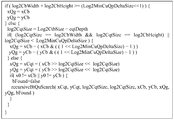
- Fig. 7 is a diagram shows the pseudo code of a method of deriving the luma location of current quantization group.
- Fig. 8 is a diagram shows the pseudo code of the recursive process that used in the derivation of luma location of current quantization group.
- luma location (xCb, yCb ) specifies the top-left sample of the current luma coding block relative to the top-left luma sample of the current picture.
- log2CbWidth and log2CbHeight specify the log 2 of width and height of current luma coding block, respectively.
- Log2CtbSize specifies the log 2 of the size of luma coding tree block. Note that the width and height for a coding tree block are equal, but not neccesarily equal for a coding block in QTBT.
- cqtDepth specifies the quadtree depth of quadtree leaf node that contains current block.
- the luma location (xQg, yQg ) specifies the top-left luma sample of the current quantization group relative to the top-left luma sample of the current picture.
- the luma quadtree leaf node block is defined as the block at which the quadtree splitting stopped. And the binary splitting can begin at luma quadtree leaf node block. Note that the quadtree leaf node block is always square.
- the luma location (xQg, yQg ) is equal to the luma location (xCb, yCb ) .
- current block is a quadtree leaf node block or the area of current leaf node block that contains current block is smaller than the minimum area of quantization group, then the location (xQg, yQg ) can be derived as in HEVC.
- xQg xCb - (xCb & ( (1 ⁇ Log2MinCuQpDeltaSize) -1 ) )
- yQg yCb - (yCb & ( (1 ⁇ Log2MinCuQpDeltaSize) -1 ) )
- xQg (xCb >> Log2MinCuQpDeltaSize ⁇ Log2MinCuQpDeltaSize)
- yQg (yCb >> Log2MinCuQpDeltaSize ⁇ Log2MinCuQpDeltaSize) .
- the luma location (xCqt, yCqt ) specifies the top-left sample of the current luma quadtree leaf node block that contains current block, it can be derived by
- yCqt yCb - (yCb & ( (1 ⁇ log2CqtSize) -1 ) ) .
- An variable bFound specifies that whether the luma location (xQg, yQg ) of current quantization group is found.
- the inputs to the recursion are luma location (x0, y0) initialized as (xCqt, yCqt) , log 2 of block width log2Width initialized as log2CqtSize, log 2 of block height log2Height initialized as log2CqtSize, (xCb, yCb ) , (xQg, yQg ) and bFound initialized as false.
- (xQg, yQg ) is set equal to the luma location (x0, y0 ) of current recursion if the area of block of current recursion is larger than or equal to minimum area of quantization group.
- bFound is set to true if the luma location of current recursion is equal to (xCb, yCb) . The recursion stopped if bFound is true.
- qt_split_flag [x0] [y0] specifies whether a block at luma location (x0, y0 ) is quadtree split.
- bt_cu_split_flag [x0] [y0] specifies the binary tree split type of a block at luma location (x0, y0 ) , 0 indicates no further split, 1 indicates horizontal split, 2 indicates vertical split.
- (xQg, yQg ) is initialized to the luma location of top-left luma sample of current coding tree block.
- (xQg, yQg ) is set equal to luma location of current block. Details of corresponding syntax table can be found in Fig. 5.
- QuLastCodedQP QP of previous coded quantization group
- LastCodedQP Another variable that specifies the QP of previous coded coding unit can be also defined to assist the tracking.
- QuLastCodedQP and LastCodedQP are initialized at the beginning of coding each CTU, the initial value is set to the LastCodedQP of previous coded CTU. If previous coded CTU is not available, the initial value is set to the slice QP.
- QuLastCodedQP is set equal to LastCodedQP.
- QuLastCodedQP is set equal to LastCodedQP.
- LastCodedQP is set equal to the QP of current coding unit Qp Y .
- An example of corresponding syntax table can be found in Fig. 6.
- the reference QP of a coding unit can be derived similarly as in HEVC. That is, using the luma location (xQg, yQg ) to identify its left and above neighboring coded block. If left/above neighboring coded block is available, QpLeft/QpAbove is set equal to the QP of left/above neighboring coded block, otherwise, QpLeft/QpAbove is set equal to QuLastCodedQP instead. Then, the reference QP is calculated as (QpLeft + QpAbove + 1 ) >> 1.
- QuLastCodedQP is also initialized at the beginning of coding each CTU as described above. After the derivation process for quantization parameters of a coding unit, the QuLastCodedQP is updated as the derived QP, i.e. Qp Y .
- Input to this process is a luma location (xCb, yCb ) specifying the top-left sample of the current luma coding block relative to the top-left luma sample of the current picture, and the luma location (xQg, yQg ) , specifies the top-left luma sample of the current quantization group relative to the top-left luma sample of the current picture.
- variable Qp Y the luma quantization parameter Qp′ Y , and the chroma quantization parameters Qp′ Cb and Qp′ Cr are derived.
- the luma size of a quantization group determines the luma size of the smallest area inside a coding tree block that shares the same qP Y_PRED .
- the predicted luma quantization parameter qP Y_PRED is derived by the following ordered steps:
- variable qP Y_PREV is derived as follows:
- qP Y_PREV is set equal to SliceQp Y :
- the current quantization group is the first quantization group in a slice.
- the current quantization group is the first quantization group in a tile.
- the current quantization group is the first quantization group in a coding tree block row and entropy_coding_sync_enabled_flag is equal to 1.
- qP Y_PREV is set equal to QuLastCodedQP.
- the availability derivation process for a block is invoked with the location (xCurr, yCurr ) set equal to (xCb, yCb ) and the neighbouring location (xNbY, yNbY ) set equal to (xQg -1, yQg ) as inputs, and the output is assigned to availableA.
- the variable qP Y_A is derived as follows:
- qP Y_A is set equal to qP Y_PREV :
- – availableA is equal to FALSE.
- the coding tree block address ctbAddrA of the coding tree block containing the luma coding block covering the luma location (xQg -1, yQg ) is not equal to CtbAddrInTs, where ctbAddrA is derived as follows:
- MinTbAddrA MinTbAddrZs [xTmp ] [yTmp ]
- qP Y_A is set equal to the luma quantization parameter Qp Y of the coding unit containing the luma coding block covering (xQg -1, yQg ) .
- the availability derivation process for a block is invoked with the location (xCurr, yCurr ) set equal to (xCb, yCb ) and the neighbouring location (xNbY, yNbY ) set equal to (xQg, yQg -1 ) as inputs, and the output is assigned to availableB.
- the variable qP Y_B is derived as follows:
- qP Y_B is set equal to qP Y_PREV :
- – availableB is equal to FALSE.
- the coding tree block address ctbAddrB of the coding tree block containing the luma coding block covering the luma location (xQg, yQg -1 ) is not equal to CtbAddrInTs, where ctbAddrB is derived as follows:
- MinTbAddrB MinTbAddrZs [xTmp ] [yTmp ]
- qP Y_B is set equal to the luma quantization parameter Qp Y of the coding unit containing the luma coding block covering (xQg, yQg -1 ) .
- the predicted luma quantization parameter qP Y_PRED is derived as follows:
- variable Qp Y is derived as follows:
- Qp Y ( (qP Y_PRED + CuQpDeltaVal + 52 + 2 *QpBdOffset Y ) % (52 + QpBdOffset Y ) ) -QpBd Offset Y .
- an embodiment of the present invention can be a circuit integrated into a video compression chip or program codes integrated into video compression software to perform the processing described herein.
- An embodiment of the present invention may also be program codes to be executed on a Digital Signal Processor (DSP) to perform the processing described herein.
- DSP Digital Signal Processor
- the invention may also involve a number of functions to be performed by a computer processor, a digital signal processor, a microprocessor, or field programmable gate array (FPGA) .
- processors can be configured to perform particular tasks according to the invention, by executing machine-readable software code or firmware code that defines the particular methods embodied by the invention.
- the software code or firmware codes may be developed in different programming languages and different format or style.
- the software code may also be compiled for different target platform.
- different code formats, styles and languages of software codes and other means of configuring code to perform the tasks in accordance with the invention will not depart from the spirit and scope of the invention.
Landscapes
- Engineering & Computer Science (AREA)
- Multimedia (AREA)
- Signal Processing (AREA)
- Computing Systems (AREA)
- Theoretical Computer Science (AREA)
- Compression Or Coding Systems Of Tv Signals (AREA)
- Image Processing (AREA)
Abstract
Methods of reference quantization parameter derivation for QTBT structure are disclosed. Including: a derivation process for the luma location (xQg, yQg ) that specifies the top-left luma sample of the current quantization group relative to the top-left luma sample of the current picture; the luma location (xQg, yQg ) is tracked during encoding/decoding; the QP of previous coded quantization group is tracked during encoding/decoding; given the tracked location (xQg, yQg ) and the QP of previous coded quantization group, the reference QP can be derived similarly as in HEVC.
Description
The invention relates generally to video coding. In particular, the present invention relates to methods and apparatuses of reference quantization parameter derivation for signaling of quantization parameter in quad-tree plus binary tree structure.
High-efficiency video coding (HEVC) is the latest video coding standard developed by the Joint Collaborative Team on Video Coding (JCT-VC) . In HEVC, one slice is partitioned into multiple coding tree units (CTU) . In main profile, the minimum and the maximum sizes of CTU are specified by the syntax elements in the sequence parameter set (SPS) among the sizes of 8x8, 16x16, 32x32, and 64x64. Inside a slice, a raster scan method is used for processing the CTU.
The CTU is further partitioned into multiple coding units (CU) to adapt to various local characteristics. A quadtree denoted as the coding tree is used to partition the CTU into multiple CUs. Let CTU size be MxM where M is one of the values of 64, 32, or 16. The CTU can be a single CU or can be split into four smaller units of equal sizes of M/2xM/2, which are nodes of coding tree. If units are leaf nodes of coding tree, the units become CUs. Otherwise, the quadtree splitting process can be iterated until the size for a node reaches a minimum allowed CU size specified in the SPS. This representation results in a recursive structure specified by a coding tree as shown in Fig. 1. The solid lines indicate CU boundaries. The decision whether to code a picture area using inter picture (temporal) or intra picture (spatial) prediction is made at the CU level. Since the minimum CU size can be 8x8, the minimum granularity for switching different basic prediction type is 8x8.
One or more prediction units (PU) are specified for each CU. Coupled with the CU, the PU works as a basic representative block for sharing the prediction information. Inside one PU, the same prediction process is applied and the relevant information is transmitted to the decoder on a PU basis. A CU can be split into one, two, or four PUs according to the PU splitting type. HEVC defines eight shapes for splitting a CU into PU as shown in Fig. 2. Unlike the CU, the PU may only be split once.
After obtaining the residual block by prediction process based on PU splitting type, a
CU can be partitioned into transform units (TU) according to another quadtree structure which is analogous to the coding tree for the CU as shown in Fig. 1. The solid lines indicate CU boundaries and dotted lines indicate TU boundaries. The TU is a basic representative block having residual or transform coefficients for applying the integer transform and quantization. For each TU, one integer transform having the same size to the TU is applied to obtain residual coefficients. These coefficients are transmitted to the decoder after quantization on a TU basis.
The terms coding tree block (CTB) , coding block (CB) , prediction block (PB) , and transform block (TB) are defined to specify the 2-D sample array of one color component associated with CTU, CU, PU, and TU, respectively. Thus, a CTU consists of one luma CTB, two chroma CTBs, and associated syntax elements. A similar relationship is valid for CU, PU, and TU. The tree partitioning is generally applied simultaneously to both luma and chroma, although exceptions apply when certain minimum sizes are reached for chroma.
Binary tree structure is more flexible than quadtree structure, since much more partition shapes can be supported which is also the source of coding efficiency improvement. However, the encoding complexity and signaling overhead will also increase in order to select the best partition shape. In order to balance the complexity and coding efficiency, it was proposed to combine the quadtree and binary tree structure, which is called as quadtree plus binary tree (QTBT) structure. In the QTBT structure, a block is firstly partitioned by a quadtree structure, the quadtree splitting can be iterated until the size for a splitting block reaches the minimum allowed quadtree leaf node size. If the leaf quadtree block is not larger than the maximum allowed binary tree root node size, it can be further partitioned by a binary tree structure, the binary tree splitting can be iterated until the size (width or height) for a splitting block reaches the minimum allowed binary tree leaf node size (width or height) or the binary tree depth reaches the maximum allowed binary tree depth. In the QTBT structure, the minimum allowed quadtree leaf node size, the maximum allowed binary tree root node size, the minimum allowed binary tree leaf node width and height, and the maximum allowed binary tree depth can be indicated in the high level syntax such as in SPS. Fig. 3 illustrates an example of block partitioning (left) and its corresponding QTBT (right) . The solid lines indicate quadtree splitting and dotted lines indicate binary tree splitting. In each splitting (i.e., non-leaf) node of the binary tree, one flag indicates which splitting type (horizontal or vertical) is used, 0 indicates horizontal splitting and 1 indicates vertical splitting.
In HEVC, when adaptive QP or multi-QP optimization is on, the quantization parameter (QP) is determined by reference QP and delta QP. delta QP signaling is controlled by two flags, cu_qp_delta_enabled_flag and diff_cu_qp_delta_depth. The former is used to indicate delta QP signaling is enabled or disabled; the latter is used to set the minimum size of units in delta QP signaling, referred to as quantization group or quantization unit. The CUs in one quantization group
share the same delta QP. The reference QP is derived from QPs of left and above neighboring coded quantization groups. If left/above neighboring coded quantization group is not available, it’s replaced by the previous coded quantization group in decoding order. If previous coded quantization group in decoding order is also not available, use the slice QP instead.
Let luma location (xCb, yCb ) specifies the top-left sample of the current luma coding block relative to the top-left luma sample of the current picture. The luma location (xQg, yQg ) specifies the top-left luma sample of the current quantization group relative to the top-left luma sample of the current picture. In HEVC, the horizontal and vertical positions xQg and yQg are set equal to xCb - (xCb & ( (1 << Log2MinCuQpDeltaSize) -1 ) ) and yCb - (yCb & ( (1 << Log2MinCuQpDeltaSize) -1 ) ) , respectively. Log2MinCuQpDeltaSize is the minimum luma size of a quantization group. In HEVC, the decoding order is z-scan order. So, the previous block in decoding order can be easily derived using the index minus 1 in z-scan order.
However, in the QTBT structure, in the case of binary tree split block, the horizontal and vertical positions xQg and yQg cannot be simply derived by xCb - (xCb & ( (1 << Log2MinCuQpDeltaSize) -1 ) ) and yCb - (yCb & ( (1 << Log2MinCuQpDeltaSize) -1 ) ) . This is because quantization group is not necessary to be square. Also, the z-scan order is not necessary the decoding order. Therefore, the previous block in decoding order also cannot be simply derived. An example is shown in Fig. 4. The block is first partitioned by vertical split, and then the left partition is further partitioned by horizontal split. Let curr denote the z-order index of current coding unit, then curr-1 is the block at the top of left half. However, the previous block in decoding order is the block at the bottom of left half, denoted as prev.
SUMMARY
In light of the previously described problems, methods of reference quantization parameter derivation for QTBT are proposed. A derivation process that derives the luma location (xQg, yQg ) that specifies the top-left luma sample of the current quantization group relative to the top-left luma sample of the current picture. Alternatively, (xQg, yQg ) is tracked during encoding/decoding. Second, the QP of previous coded quantization group is tracked during encoding/decoding. Given the tracked location (xQg, yQg ) and the QP of previous coded quantization group, the reference QP can be derived similarly as in HEVC.
Other aspects and features of the invention will become apparent to those with ordinary skill in the art upon review of the following descriptions of specific embodiments.
The invention can be more fully understood by reading the subsequent detailed description and examples with references made to the accompanying drawings, wherein:
Fig. 1 is a diagram illustrating an example of coding tree in HEVC.
Fig. 2 is a diagram illustrating the PU partition types in HEVC.
Fig. 3 is a diagram illustrating an example of QTBT partition.
Fig. 4 is a diagram illustrating an example of current coding block and its previous coded block in decoding order.
Fig. 5 is a diagram illustrating an example of syntax table of coding quadtree plus binary tree.
Fig. 6 is a diagram illustrating an example of brief syntax table of coding unit.
Fig. 7 is a diagram shows the pseudo code of a method of deriving the luma location of current quantization group.
Fig. 8 is a diagram shows the pseudo code of the recursive process that used in the derivation of luma location of current quantization group.
The following description is of the best-contemplated mode of carrying out the invention. This description is made for the purpose of illustrating the general principles of the invention and should not be taken in a limiting sense. The scope of the invention is best determined by reference to the appended claims.
Let luma location (xCb, yCb ) specifies the top-left sample of the current luma coding block relative to the top-left luma sample of the current picture. log2CbWidth and log2CbHeight specify the log 2 of width and height of current luma coding block, respectively. Log2CtbSize specifies the log 2 of the size of luma coding tree block. Note that the width and height for a coding tree block are equal, but not neccesarily equal for a coding block in QTBT. cqtDepth specifies the quadtree depth of quadtree leaf node that contains current block. The luma location (xQg, yQg ) specifies the top-left luma sample of the current quantization group relative to the top-left luma sample of the current picture. The luma quadtree leaf node block is defined as the block at which the quadtree splitting stopped. And the binary splitting can begin at luma quadtree leaf node block. Note that the quadtree leaf node block is always square.
If the size of current block is larger than or equal to the minimum area of quantization group, i.e. log2CbWidth + log2CbHeight >= (Log2MinCuQpDeltaSize<<1) , then the luma
location (xQg, yQg ) is equal to the luma location (xCb, yCb ) .
If current block is a quadtree leaf node block or the area of current leaf node block that contains current block is smaller than the minimum area of quantization group, then the location (xQg, yQg ) can be derived as in HEVC.
xQg = xCb - (xCb & ( (1 << Log2MinCuQpDeltaSize) -1 ) )
yQg = yCb - (yCb & ( (1 << Log2MinCuQpDeltaSize) -1 ) )
or, equivalently,
xQg = (xCb >> Log2MinCuQpDeltaSize << Log2MinCuQpDeltaSize)
yQg = (yCb >> Log2MinCuQpDeltaSize << Log2MinCuQpDeltaSize) .
In other cases, a recursive process recursiveBtQuSearch is invoked to derive the luma location (xQg, yQg ) . log2CqtSize specifies the log 2 of size of current luma quadtree leaf node block, it’s derived by log2CqtSize = Log2CtbSize -cqtDepth. The luma location (xCqt, yCqt ) specifies the top-left sample of the current luma quadtree leaf node block that contains current block, it can be derived by
xCqt = (xCb >> log2CqtSize << log2CqtSize)
yCqt = (yCb >> log2CqtSize << log2CqtSize)
or, equivalently,
xCqt = xCb - (xCb & ( (1 << log2CqtSize) -1 ) )
yCqt = yCb - (yCb & ( (1 << log2CqtSize) -1 ) ) .
An variable bFound specifies that whether the luma location (xQg, yQg ) of current quantization group is found. The inputs to the recursion are luma location (x0, y0) initialized as (xCqt, yCqt) , log 2 of block width log2Width initialized as log2CqtSize, log 2 of block height log2Height initialized as log2CqtSize, (xCb, yCb ) , (xQg, yQg ) and bFound initialized as false.
In the recursive process, (xQg, yQg ) is set equal to the luma location (x0, y0 ) of current recursion if the area of block of current recursion is larger than or equal to minimum area of quantization group. bFound is set to true if the luma location of current recursion is equal to (xCb, yCb) . The recursion stopped if bFound is true.
The pseudo-code of derivation of (xQg, yQg ) is shown in Fig. 7 and Fig. 8. qt_split_flag [x0] [y0] specifies whether a block at luma location (x0, y0 ) is quadtree split. bt_cu_split_flag [x0] [y0] specifies the binary tree split type of a block at luma location (x0, y0 ) , 0 indicates no further split, 1 indicates horizontal split, 2 indicates vertical split.
In the other method, it is proposed to track the luma location (xQg, yQg ) during coding. (xQg, yQg ) is initialized to the luma location of top-left luma sample of current coding tree block. When coding quadtree plus binary-tree, if cu_qp_delta_enabled_flag is true and log2CbWidth+log2CbHeight >= (Log2MinCuQpDeltaSize<<1) , then (xQg, yQg ) is set equal to
luma location of current block. Details of corresponding syntax table can be found in Fig. 5.
It’s also proposed to track the QP of previous coded quantization group, denoted as QuLastCodedQP. Another variable LastCodedQP that specifies the QP of previous coded coding unit can be also defined to assist the tracking. QuLastCodedQP and LastCodedQP are initialized at the beginning of coding each CTU, the initial value is set to the LastCodedQP of previous coded CTU. If previous coded CTU is not available, the initial value is set to the slice QP.
When coding quadtree plus binary-tree, if cu_qp_delta_enabled_flag is true and log2CbWidth+log2CbHeight >= (Log2MinCuQpDeltaSize<<1) , then QuLastCodedQP is set equal to LastCodedQP. In other words, whenever the first coding block of a quantization group is encountered during coding, QuLastCodedQP is set equal to LastCodedQP. An example of corresponding syntax table can be found in Fig. 5.
After coding a coding unit, LastCodedQP is set equal to the QP of current coding unit QpY. An example of corresponding syntax table can be found in Fig. 6.
Given the derived luma location (xQg, yQg ) and corresponding QuLastCodedQP, the reference QP of a coding unit can be derived similarly as in HEVC. That is, using the luma location (xQg, yQg ) to identify its left and above neighboring coded block. If left/above neighboring coded block is available, QpLeft/QpAbove is set equal to the QP of left/above neighboring coded block, otherwise, QpLeft/QpAbove is set equal to QuLastCodedQP instead. Then, the reference QP is calculated as (QpLeft + QpAbove + 1 ) >> 1.
In another method of tracking the QP of previous coded quantization group, no assist variable is used. QuLastCodedQP is also initialized at the beginning of coding each CTU as described above. After the derivation process for quantization parameters of a coding unit, the QuLastCodedQP is updated as the derived QP, i.e. QpY.
The derivation process for quantization parameters QpY is as following:
Input to this process is a luma location (xCb, yCb ) specifying the top-left sample of the current luma coding block relative to the top-left luma sample of the current picture, and the luma location (xQg, yQg ) , specifies the top-left luma sample of the current quantization group relative to the top-left luma sample of the current picture.
In this process, the variable QpY, the luma quantization parameter Qp′Y, and the chroma quantization parameters Qp′Cb and Qp′Cr are derived.
The luma size of a quantization group, Log2MinCuQpDeltaSize, determines the luma size of the smallest area inside a coding tree block that shares the same qPY_PRED.
The predicted luma quantization parameter qPY_PRED is derived by the following ordered steps:
1. The variable qPY_PREV is derived as follows:
– If one or more of the following conditions are true, qPY_PREV is set equal to SliceQpY:
– The current quantization group is the first quantization group in a slice.
– The current quantization group is the first quantization group in a tile.
– The current quantization group is the first quantization group in a coding tree block row and entropy_coding_sync_enabled_flag is equal to 1.
– Otherwise, qPY_PREV is set equal to QuLastCodedQP.
2. The availability derivation process for a block is invoked with the location (xCurr, yCurr ) set equal to (xCb, yCb ) and the neighbouring location (xNbY, yNbY ) set equal to (xQg -1, yQg ) as inputs, and the output is assigned to availableA. The variable qPY_Ais derived as follows:
– If one or more of the following conditions are true, qPY_Ais set equal to qPY_PREV:
– availableA is equal to FALSE.
– the coding tree block address ctbAddrA of the coding tree block containing the luma coding block covering the luma location (xQg -1, yQg ) is not equal to CtbAddrInTs, where ctbAddrA is derived as follows:
xTmp = (xQg -1 ) >> Log2MinTrafoSize
yTmp = yQg >> Log2MinTrafoSize
minTbAddrA = MinTbAddrZs [xTmp ] [yTmp ]
ctbAddrA = (minTbAddrA >> 2 ) * (CtbLog2SizeY -Log2MinTrafoSize)
– Otherwise, qPY_Ais set equal to the luma quantization parameter QpYof the coding unit containing the luma coding block covering (xQg -1, yQg ) .
3. The availability derivation process for a block is invoked with the location (xCurr, yCurr ) set equal to (xCb, yCb ) and the neighbouring location (xNbY, yNbY ) set equal to (xQg, yQg -1 ) as inputs, and the output is assigned to availableB. The variable qPY_B is derived as follows:
– If one or more of the following conditions are true, qPY_B is set equal to qPY_PREV:
– availableB is equal to FALSE.
– the coding tree block address ctbAddrB of the coding tree block containing the luma coding block covering the luma location (xQg, yQg -1 ) is not equal to CtbAddrInTs, where ctbAddrB is derived as follows:
xTmp = xQg >> Log2MinTrafoSize
yTmp = (yQg -1 ) >> Log2MinTrafoSize
minTbAddrB = MinTbAddrZs [xTmp ] [yTmp ]
ctbAddrB = (minTbAddrB >> 2 ) * (CtbLog2SizeY -Log2MinTrafoSize)
– Otherwise, qPY_B is set equal to the luma quantization parameter QpYof the coding unit
containing the luma coding block covering (xQg, yQg -1 ) .
4. The predicted luma quantization parameter qPY_PRED is derived as follows:
qPY_PRED = (qPY_A+ qPY_B + 1 ) >> 1
The variable QpY is derived as follows:
QpY = ( (qPY_PRED + CuQpDeltaVal + 52 + 2 *QpBdOffsetY ) % (52 + QpBdOffsetY ) ) -QpBd OffsetY.
The methods described above can be used in a video encoder as well as in a video decoder. Embodiments of the methods according to the present invention as described above may be implemented in various hardware, software codes, or a combination of both. For example, an embodiment of the present invention can be a circuit integrated into a video compression chip or program codes integrated into video compression software to perform the processing described herein. An embodiment of the present invention may also be program codes to be executed on a Digital Signal Processor (DSP) to perform the processing described herein. The invention may also involve a number of functions to be performed by a computer processor, a digital signal processor, a microprocessor, or field programmable gate array (FPGA) . These processors can be configured to perform particular tasks according to the invention, by executing machine-readable software code or firmware code that defines the particular methods embodied by the invention. The software code or firmware codes may be developed in different programming languages and different format or style. The software code may also be compiled for different target platform. However, different code formats, styles and languages of software codes and other means of configuring code to perform the tasks in accordance with the invention will not depart from the spirit and scope of the invention.
The invention may be embodied in other specific forms without departing from its spirit or essential characteristics. The described examples are to be considered in all respects only as illustrative and not restrictive. To the contrary, it is intended to cover various modifications and similar arrangements (as would be apparent to those skilled in the art) . Therefore, the scope of the appended claims should be accorded the broadest interpretation so as to encompass all such modifications and similar arrangements.
Claims (19)
- Methods of deriving reference quantization parameter for signaling quantization parameter (QP) in quandtree plus binary tree (QTBT) structure, including:1) deriving the luma location (xQg, yQg) that specifies the top-left sample of current quantization group using a recursive process;2) tracking the luma location (xQg, yQg) that specifies the top-left sample of current quantization group during coding;3) tracking the last coded QP of current quantization group during coding.
- The method as claimed in claim 1, the derivation process of the luma location (xQg, yQg) is as follows:1) if the size of current block is larger than or equal to the minimum area of quantization group, i.e. log2CbWidth + log2CbHeight >= (Log2MinCuQpDeltaSize<<1) , then the luma location (xQg, yQg ) is equal to the luma location (xCb, yCb ) ;2) if current block is a quadtree leaf node block or the area of current leaf node block that contains current block is smaller than the minimum area of quantization group, then the location (xQg, yQg ) can be derived as in HEVC,xQg = xCb - (xCb & ( (1 < < Log2MinCuQpDeltaSize) - 1 ) )yQg = yCb - (yCb & ( (1 < < Log2MinCuQpDeltaSize) - 1 ) )or, equivalently,xQg = (xCb >> Log2MinCuQpDeltaSize << Log2MinCuQpDeltaSize)yQg = (yCb >> Log2MinCuQpDeltaSize << Log2MinCuQpDeltaSize) ;3) in other cases, a variable log2CqtSize specifies the log 2 of size of current luma quadtree leaf node block is derived by log2CqtSize = Log2CtbSize-cqtDepth. Then a recursive process recursiveBtQuSearch is invoked to derive the luma location (xQg, yQg ) .
- The method as claimed in claim 2, the inputs to the recursiveBtQuSearch are: (x0, y0) that specifies the luma location, log2Width that specifies log 2 of block width, log2Height that specifies log 2 of block height, (xCb, yCb ) , (xQg, yQg) and bFound that specifies the termination of the process.
- The method as claimed in claim 3, bFound is initialized as false, log2Width is initialized by log2CqtSize, log2Height is initialized by log2CqtSize, and (x0, y0) is initialized by (xCqt, yCqt ) ; the luma location (xCqt, yCqt ) specifies the top-left sample of the current luma quadtree leaf node block that contains current block, it can be derived byxCqt = (xCb >> log2CqtSize << log2CqtSize)yCqt = (yCb >> log2CqtSize << log2CqtSize)or , equivalently,xCqt = xCb - (xCb & ( (1 << log2CqtSize) - 1 ) )yCqt = yCb - (yCb & ( (1 << log2CqtSize) - 1 ) ) .
- The method as claimed in claim 2, in the recursive process, (xQg, yQg) is set equal to the luma location (x0, y0) of current recursion if the area of block of current recursion is larger than or equal to minimum area of quantization group; bFound is set to true if the luma location of current recursion is equal to (xCb, yCb) ; the recursion stopped if bFound is true.
- The method as claimed in claim 2, the pseudo code of the derivation process and recursion are shown in Fig. 7 and Fig. 8; qt_split_flag [x0] [y0] specifies whether a block at luma location (x0, y0) is quadtree split; bt_cu_split_flag [x0] [y0] specifies the binary tree split type of a block at luma location (x0, y0) , 0 indicates no further split, 1 indicates horizontal split, 2 indicates vertical split.
- The method as claimed in claim 1, the luma location (xQg, yQg) is initialized to the luma location of top-left luma sample of current coding tree block; when coding quadtree plus binary tree, if cu_qp_delta_enabled_flag is true and log2CbWidth+log2CbHeight >= (Log2MinCuQpDeltaSize<<1) , then (xQg, yQg) is set equal to luma location of current block.
- The method as claimed in claim 7, the corresponding syntax table is shown in Fig. 5.
- The method as claimed in claim 1, the last coded QP of current quantization group during coding is tracked as QuLastCodedQP; and another variable LastCodedQP specifies the QP of previous coded coding unit is also defined to assist tracking.
- The method as claimed in claim 9, QuLastCodedQP and LastCodedQP are initialized at the beginning of coding each CTU, the initial value is set to the LastCodedQP of previous coded CTU; if previous coded CTU is not available, the initial value is set to the slice QP.
- The method as claimed in claim 9, when coding quadtree plus binary-tree, if cu_qp_delta_enabled_flag is true and log2CbWidth+log2CbHeight >= (Log2MinCuQpDeltaSize<<1) , then QuLastCodedQP is set equal to LastCodedQP.
- The method as claimed in claim 11, whenever the first coding block of a quantization group is encountered during coding, QuLastCodedQP is set equal to LastCodedQP.
- The method as claimed in claim 11, an example of corresponding syntax table can be found in Fig. 5.
- The method as claimed in claim 9, after coding a coding unit, LastCodedQP is set equal to the QP of current coding unit QpY.
- The method as claimed in claim 14, an example of corresponding syntax table can be found in Fig. 6.
- The method as claimed in claim 1, given the derived luma location (xQg, yQg ) and corresponding QuLastCodedQP, the reference QP of a coding unit can be derived similarly as in HEVC.
- The method as claimed in claim 16, the luma location (xQg, yQg ) is used to identify its left and above neighboring coded block; if left/above neighboring coded block is available, QpLeft/QpAbove is set equal to the QP of left/above neighboring coded block, otherwise, QpLeft/QpAbove is set equal to QuLastCodedQP instead; then, the reference QP is calculated as (QpLeft + QpAbove + 1) >> 1.
- The method as claimed in claim1, another method of tracking the QP of previous coded quantization group, no assist variable is used; QuLastCodedQP is also initialized at the beginning of coding each CTU, its value is equal to QuLastCodedQP of previous coded CTU; if previous coded CTU is not available, the initial value is set to the slice QP. After the derivation process for quantization parameters of a coding unit, the QuLastCodedQP is updated as the derived QP, i.e. QpY.
- The method as claimed in claim 1, if luma and chroma CTB are separated, then the similar process can be done separately for luma and chroma.
Priority Applications (7)
| Application Number | Priority Date | Filing Date | Title |
|---|---|---|---|
| PCT/CN2016/092011 WO2018018486A1 (en) | 2016-07-28 | 2016-07-28 | Methods of reference quantization parameter derivation for signaling of quantization parameter in quad-tree plus binary tree structure |
| BR112019001415-2A BR112019001415B1 (en) | 2016-07-28 | 2017-07-26 | METHOD FOR PROCESSING VIDEO DATA IN A CONVERSION SYSTEM INTO VIDEO CODE, APPARATUS FOR PROCESSING VIDEO DATA IN A CONVERSION SYSTEM, AND NON-TRAINER COMPUTER READABLE MEDIA |
| EP17833551.9A EP3476126B1 (en) | 2016-07-28 | 2017-07-26 | Methods and apparatuses of reference quantization parameter derivation in video processing system |
| PCT/CN2017/094431 WO2018019248A1 (en) | 2016-07-28 | 2017-07-26 | Methods and apparatuses of reference quantization parameter derivation in video processing system |
| US16/319,917 US10681351B2 (en) | 2016-07-28 | 2017-07-26 | Methods and apparatuses of reference quantization parameter derivation in video processing system |
| CN201780042173.1A CN109479139B (en) | 2016-07-28 | 2017-07-26 | Method and apparatus for reference quantization parameter derivation in video processing system |
| TW106125262A TWI645711B (en) | 2016-07-28 | 2017-07-27 | Methods and apparatuses of reference quantization parameter derivation in video processing system |
Applications Claiming Priority (1)
| Application Number | Priority Date | Filing Date | Title |
|---|---|---|---|
| PCT/CN2016/092011 WO2018018486A1 (en) | 2016-07-28 | 2016-07-28 | Methods of reference quantization parameter derivation for signaling of quantization parameter in quad-tree plus binary tree structure |
Publications (1)
| Publication Number | Publication Date |
|---|---|
| WO2018018486A1 true WO2018018486A1 (en) | 2018-02-01 |
Family
ID=61015438
Family Applications (2)
| Application Number | Title | Priority Date | Filing Date |
|---|---|---|---|
| PCT/CN2016/092011 Ceased WO2018018486A1 (en) | 2016-07-28 | 2016-07-28 | Methods of reference quantization parameter derivation for signaling of quantization parameter in quad-tree plus binary tree structure |
| PCT/CN2017/094431 Ceased WO2018019248A1 (en) | 2016-07-28 | 2017-07-26 | Methods and apparatuses of reference quantization parameter derivation in video processing system |
Family Applications After (1)
| Application Number | Title | Priority Date | Filing Date |
|---|---|---|---|
| PCT/CN2017/094431 Ceased WO2018019248A1 (en) | 2016-07-28 | 2017-07-26 | Methods and apparatuses of reference quantization parameter derivation in video processing system |
Country Status (5)
| Country | Link |
|---|---|
| US (1) | US10681351B2 (en) |
| EP (1) | EP3476126B1 (en) |
| CN (1) | CN109479139B (en) |
| TW (1) | TWI645711B (en) |
| WO (2) | WO2018018486A1 (en) |
Cited By (6)
| Publication number | Priority date | Publication date | Assignee | Title |
|---|---|---|---|---|
| CN108322745A (en) * | 2018-02-28 | 2018-07-24 | 中南大学 | Fast selecting method in a kind of frame based on inseparable quadratic transformation pattern |
| CN110881129A (en) * | 2018-09-05 | 2020-03-13 | 华为技术有限公司 | Video decoding method and video decoder |
| CN112335242A (en) * | 2018-06-25 | 2021-02-05 | 韩国电子通信研究院 | Method and apparatus for encoding/decoding images using quantization parameters, and recording medium for storing bitstreams |
| TWI720584B (en) * | 2018-08-16 | 2021-03-01 | 聯發科技股份有限公司 | Methods and apparatuses of chroma quantization parameter derivation in video processing system |
| CN112956198A (en) * | 2019-06-22 | 2021-06-11 | 株式会社 Xris | Method for encoding/decoding image signal and apparatus therefor |
| CN120091135A (en) * | 2018-11-21 | 2025-06-03 | 华为技术有限公司 | Intra-frame prediction method and device |
Families Citing this family (30)
| Publication number | Priority date | Publication date | Assignee | Title |
|---|---|---|---|---|
| US10666943B2 (en) * | 2017-09-15 | 2020-05-26 | Futurewei Technologies, Inc. | Block partition structure in video compression |
| US11277609B2 (en) * | 2017-12-29 | 2022-03-15 | Sharp Kabushiki Kaisha | Systems and methods for partitioning video blocks for video coding |
| RU2771291C2 (en) * | 2018-01-02 | 2022-04-29 | Самсунг Электроникс Ко., Лтд. | Encoding method and apparatus therefor, and decoding method and apparatus therefor |
| WO2019234612A1 (en) | 2018-06-05 | 2019-12-12 | Beijing Bytedance Network Technology Co., Ltd. | Partition tree with four sub-blocks symmetric or asymmetric |
| CN118509586A (en) | 2018-06-21 | 2024-08-16 | 瑞典爱立信有限公司 | Block partition with sub-blocks in video coding |
| US11711530B2 (en) | 2018-06-21 | 2023-07-25 | Telefonaktiebolaget Lm Ericsson (Publ) | Tile shuffling for 360 degree video decoding |
| WO2019243541A2 (en) | 2018-06-21 | 2019-12-26 | Telefonaktiebolaget Lm Ericsson (Publ) | Flexible tile partitions |
| US11303904B2 (en) * | 2018-09-28 | 2022-04-12 | Qualcomm Incorporated | Rectangular block transform scaling |
| CN112823525B (en) * | 2018-10-02 | 2024-12-06 | 瑞典爱立信有限公司 | Encode and decode images based on tile group ID |
| EP4351144A3 (en) * | 2018-11-08 | 2024-05-22 | InterDigital VC Holdings, Inc. | Quantization for video encoding or decoding based on the surface of a block |
| CN113170147B (en) * | 2018-12-04 | 2023-04-18 | 华为技术有限公司 | Video encoder, video decoder, and corresponding methods |
| EP3912345A4 (en) * | 2019-01-16 | 2022-11-09 | Sharp Kabushiki Kaisha | SYSTEMS AND METHODS FOR DERIVING QUANTIZATION PARAMETERS FOR VIDEO BLOCKS IN VIDEO ENCODING |
| KR20200133185A (en) * | 2019-05-15 | 2020-11-26 | 현대자동차주식회사 | Method and Apparatus for Quantization Used in Image Decoding Device |
| CN112004083B (en) * | 2019-05-27 | 2022-04-01 | 北京君正集成电路股份有限公司 | Method and system for optimizing code rate control by utilizing inter-frame prediction characteristics |
| KR102627821B1 (en) | 2019-06-04 | 2024-01-23 | 베이징 바이트댄스 네트워크 테크놀로지 컴퍼니, 리미티드 | Construction of motion candidate list using neighboring block information |
| EP3989547A4 (en) * | 2019-06-21 | 2023-04-19 | Samsung Electronics Co., Ltd. | VIDEO ENCODING METHOD AND DEVICE, AND VIDEO DECODER METHOD AND DEVICE |
| WO2020263022A1 (en) * | 2019-06-27 | 2020-12-30 | 삼성전자 주식회사 | Image encoding method and apparatus, and image decoding method and apparatus |
| CN114175636B (en) | 2019-07-14 | 2024-01-12 | 北京字节跳动网络技术有限公司 | Indication of adaptive loop filtering in adaptive parameter sets |
| ES3048492T3 (en) | 2019-09-14 | 2025-12-10 | Bytedance Inc | Quantization parameter offset for chroma deblocking filtering |
| CN114450959B (en) * | 2019-09-28 | 2024-08-02 | 北京字节跳动网络技术有限公司 | Geometric partitioning modes in video coding and decoding |
| CN114651442B (en) | 2019-10-09 | 2025-06-13 | 字节跳动有限公司 | Cross-component adaptive loop filtering in video coding |
| EP4029264A4 (en) | 2019-10-14 | 2022-11-23 | ByteDance Inc. | JOINT CODING OF CHROMINANCE RESIDUE AND FILTERING IN VIDEO PROCESSING |
| KR20220106116A (en) | 2019-12-09 | 2022-07-28 | 바이트댄스 아이엔씨 | Using quantization groups in video coding |
| CN114902657B (en) | 2019-12-31 | 2025-06-13 | 字节跳动有限公司 | Adaptive color conversion in video encoding and decoding |
| WO2021136553A1 (en) | 2020-01-05 | 2021-07-08 | Beijing Bytedance Network Technology Co., Ltd. | Using adaptive color transform in video coding |
| WO2021143896A1 (en) | 2020-01-18 | 2021-07-22 | Beijing Bytedance Network Technology Co., Ltd. | Adaptive colour transform in image/video coding |
| WO2021180020A1 (en) | 2020-03-07 | 2021-09-16 | Beijing Bytedance Network Technology Co., Ltd. | Implicit multiple transform set signaling in video coding |
| US11722672B2 (en) * | 2020-10-06 | 2023-08-08 | Qualcomm Incorporated | Adaptively deriving rice parameter values for high bit-depth video coding |
| CN116074531B (en) * | 2021-11-11 | 2025-01-24 | 杭州海康威视数字技术股份有限公司 | Decoding method, encoding method and device |
| CN115037935B (en) * | 2022-05-31 | 2025-10-28 | 上海顺久电子科技有限公司 | Method for determining quantization parameters in encoding, chip system, display device and medium |
Citations (5)
| Publication number | Priority date | Publication date | Assignee | Title |
|---|---|---|---|---|
| US20050169374A1 (en) * | 2004-01-30 | 2005-08-04 | Detlev Marpe | Video frame encoding and decoding |
| US20120243614A1 (en) * | 2011-03-22 | 2012-09-27 | Danny Hong | Alternative block coding order in video coding |
| CN104205845A (en) * | 2012-04-12 | 2014-12-10 | 华为技术有限公司 | LM mode with uniform bit-width multipliers |
| US20160073111A1 (en) * | 2014-03-10 | 2016-03-10 | Euclid Discoveries, Llc | Perceptual optimization for model-based video encoding |
| WO2016090568A1 (en) * | 2014-12-10 | 2016-06-16 | Mediatek Singapore Pte. Ltd. | Binary tree block partitioning structure |
Family Cites Families (13)
| Publication number | Priority date | Publication date | Assignee | Title |
|---|---|---|---|---|
| US8588297B2 (en) * | 2009-12-23 | 2013-11-19 | Oracle America, Inc. | Quantization parameter prediction |
| US20120114034A1 (en) | 2010-11-08 | 2012-05-10 | Mediatek Inc. | Method and Apparatus of Delta Quantization Parameter Processing for High Efficiency Video Coding |
| CN103947204A (en) * | 2011-06-28 | 2014-07-23 | 三星电子株式会社 | Method and device for image encoding and decoding using adaptive quantization parameter difference |
| TW201315246A (en) * | 2011-09-27 | 2013-04-01 | Sony Corp | Image processing device and method |
| US9510020B2 (en) * | 2011-10-20 | 2016-11-29 | Qualcomm Incorporated | Intra pulse code modulation (IPCM) and lossless coding mode deblocking for video coding |
| KR101965388B1 (en) * | 2011-11-04 | 2019-04-04 | 주식회사 골드피크이노베이션즈 | Methods of coding quantization parameter and appratuses using the same |
| TWI578764B (en) * | 2011-12-21 | 2017-04-11 | Jvc Kenwood Corp | Dynamic image decoding device, dynamic image decoding method, and dynamic image decoding program |
| US9510002B2 (en) * | 2013-09-09 | 2016-11-29 | Apple Inc. | Chroma quantization in video coding |
| US10362333B2 (en) | 2014-01-02 | 2019-07-23 | Qualcomm Incorporated | Color index coding for palette-based video coding |
| US10271052B2 (en) | 2014-03-14 | 2019-04-23 | Qualcomm Incorporated | Universal color-space inverse transform coding |
| US10142642B2 (en) * | 2014-06-04 | 2018-11-27 | Qualcomm Incorporated | Block adaptive color-space conversion coding |
| US9628803B2 (en) | 2014-11-25 | 2017-04-18 | Blackberry Limited | Perceptual image and video coding |
| US10448056B2 (en) * | 2016-07-15 | 2019-10-15 | Qualcomm Incorporated | Signaling of quantization information in non-quadtree-only partitioned video coding |
-
2016
- 2016-07-28 WO PCT/CN2016/092011 patent/WO2018018486A1/en not_active Ceased
-
2017
- 2017-07-26 US US16/319,917 patent/US10681351B2/en active Active
- 2017-07-26 WO PCT/CN2017/094431 patent/WO2018019248A1/en not_active Ceased
- 2017-07-26 CN CN201780042173.1A patent/CN109479139B/en active Active
- 2017-07-26 EP EP17833551.9A patent/EP3476126B1/en active Active
- 2017-07-27 TW TW106125262A patent/TWI645711B/en active
Patent Citations (5)
| Publication number | Priority date | Publication date | Assignee | Title |
|---|---|---|---|---|
| US20050169374A1 (en) * | 2004-01-30 | 2005-08-04 | Detlev Marpe | Video frame encoding and decoding |
| US20120243614A1 (en) * | 2011-03-22 | 2012-09-27 | Danny Hong | Alternative block coding order in video coding |
| CN104205845A (en) * | 2012-04-12 | 2014-12-10 | 华为技术有限公司 | LM mode with uniform bit-width multipliers |
| US20160073111A1 (en) * | 2014-03-10 | 2016-03-10 | Euclid Discoveries, Llc | Perceptual optimization for model-based video encoding |
| WO2016090568A1 (en) * | 2014-12-10 | 2016-06-16 | Mediatek Singapore Pte. Ltd. | Binary tree block partitioning structure |
Cited By (22)
| Publication number | Priority date | Publication date | Assignee | Title |
|---|---|---|---|---|
| CN108322745A (en) * | 2018-02-28 | 2018-07-24 | 中南大学 | Fast selecting method in a kind of frame based on inseparable quadratic transformation pattern |
| CN108322745B (en) * | 2018-02-28 | 2019-12-03 | 中南大学 | Fast selecting method in a kind of frame based on inseparable quadratic transformation mode |
| CN112335242A (en) * | 2018-06-25 | 2021-02-05 | 韩国电子通信研究院 | Method and apparatus for encoding/decoding images using quantization parameters, and recording medium for storing bitstreams |
| US12069257B2 (en) | 2018-08-16 | 2024-08-20 | Hfi Innovation Inc. | Methods and apparatuses of signaling quantization parameter in video processing system |
| US11438590B2 (en) | 2018-08-16 | 2022-09-06 | Hfi Innovation Inc. | Methods and apparatuses of chroma quantization parameter derivation in video processing system |
| TWI720584B (en) * | 2018-08-16 | 2021-03-01 | 聯發科技股份有限公司 | Methods and apparatuses of chroma quantization parameter derivation in video processing system |
| US11431997B2 (en) | 2018-09-05 | 2022-08-30 | Huawei Technologies Co., Ltd. | Video decoding method and video decoder |
| KR20230170817A (en) * | 2018-09-05 | 2023-12-19 | 후아웨이 테크놀러지 컴퍼니 리미티드 | Video decoding method and video decoder |
| EP3840378A4 (en) * | 2018-09-05 | 2021-06-23 | Huawei Technologies Co., Ltd. | VIDEO DECODING PROCESS AND VIDEO DECODER |
| CN112040229B (en) * | 2018-09-05 | 2021-06-29 | 华为技术有限公司 | Video decoding method, video decoder, and computer-readable storage medium |
| KR20210047949A (en) * | 2018-09-05 | 2021-04-30 | 후아웨이 테크놀러지 컴퍼니 리미티드 | Video decoding method and video decoder |
| CN112040229A (en) * | 2018-09-05 | 2020-12-04 | 华为技术有限公司 | Video decoding method and video decoder |
| KR102612489B1 (en) | 2018-09-05 | 2023-12-08 | 후아웨이 테크놀러지 컴퍼니 리미티드 | Video decoding methods and video decoders |
| EP4648423A3 (en) * | 2018-09-05 | 2026-01-14 | Huawei Technologies Co., Ltd. | Video decoding method and video decoder |
| CN110881129B (en) * | 2018-09-05 | 2024-01-05 | 华为技术有限公司 | Video decoding method and video decoder |
| JP2024091646A (en) * | 2018-09-05 | 2024-07-05 | 華為技術有限公司 | Video decoding method and video decoder |
| CN110881129A (en) * | 2018-09-05 | 2020-03-13 | 华为技术有限公司 | Video decoding method and video decoder |
| US12231669B2 (en) | 2018-09-05 | 2025-02-18 | Huawei Technologies Co., Ltd. | Video decoding method and video decoder using quantization groupings |
| JP7751014B2 (en) | 2018-09-05 | 2025-10-07 | 華為技術有限公司 | Video decoding method and video decoder |
| KR102848262B1 (en) | 2018-09-05 | 2025-08-19 | 후아웨이 테크놀러지 컴퍼니 리미티드 | Video decoding method and video decoder |
| CN120091135A (en) * | 2018-11-21 | 2025-06-03 | 华为技术有限公司 | Intra-frame prediction method and device |
| CN112956198A (en) * | 2019-06-22 | 2021-06-11 | 株式会社 Xris | Method for encoding/decoding image signal and apparatus therefor |
Also Published As
| Publication number | Publication date |
|---|---|
| EP3476126B1 (en) | 2024-05-22 |
| EP3476126A4 (en) | 2020-02-26 |
| CN109479139B (en) | 2022-03-18 |
| WO2018019248A1 (en) | 2018-02-01 |
| US20190273923A1 (en) | 2019-09-05 |
| BR112019001415A2 (en) | 2019-05-07 |
| TW201811034A (en) | 2018-03-16 |
| TWI645711B (en) | 2018-12-21 |
| US10681351B2 (en) | 2020-06-09 |
| BR112019001415A8 (en) | 2023-02-07 |
| EP3476126A1 (en) | 2019-05-01 |
| CN109479139A (en) | 2019-03-15 |
Similar Documents
| Publication | Publication Date | Title |
|---|---|---|
| WO2018018486A1 (en) | Methods of reference quantization parameter derivation for signaling of quantization parameter in quad-tree plus binary tree structure | |
| US10863207B2 (en) | Method and apparatus of entropy coding and context modelling for video and image coding | |
| EP3298777B1 (en) | Method of conditional binary tree block partitioning structure for video and image coding | |
| WO2016090568A1 (en) | Binary tree block partitioning structure | |
| US20240179311A1 (en) | Method and Apparatus of Luma-Chroma Separated Coding Tree Coding with Constraints | |
| WO2017219342A1 (en) | Methods of signaling quantization parameter for quad-tree plus binary tree structure | |
| US11039147B2 (en) | Method and apparatus of palette mode coding for colour video data | |
| US20170244964A1 (en) | Method and Apparatus of Flexible Block Partition for Video Coding | |
| EP3449633A1 (en) | Method and apparatus of palette mode coding for colour video data | |
| US20220286714A1 (en) | Method and Apparatus of Partitioning Small Size Coding Units with Partition Constraints | |
| EP3881534B1 (en) | Method and apparatus of luma-chroma separated coding tree coding with constraints | |
| WO2017088170A1 (en) | Entropy coding the binary tree block partitioning structure | |
| US11785258B2 (en) | Methods and apparatus for signaling coding unit partitioning of video data | |
| US20220224890A1 (en) | Method and Apparatus of Partitioning Small Size Coding Units with Partition Constraints | |
| WO2017114450A1 (en) | Method and apparatus of prediction binary tree structure for video and image coding | |
| US20250240425A1 (en) | Method and Apparatus of Using Separate Splitting Trees for Colour Components in Video Coding System |
Legal Events
| Date | Code | Title | Description |
|---|---|---|---|
| 121 | Ep: the epo has been informed by wipo that ep was designated in this application |
Ref document number: 16910067 Country of ref document: EP Kind code of ref document: A1 |
|
| NENP | Non-entry into the national phase |
Ref country code: DE |
|
| 122 | Ep: pct application non-entry in european phase |
Ref document number: 16910067 Country of ref document: EP Kind code of ref document: A1 |