WO2017207696A1 - Novel mutations in anaplastic lymphoma kinase predicting response to alk inhibitor therapy in lung cancer patients - Google Patents
Novel mutations in anaplastic lymphoma kinase predicting response to alk inhibitor therapy in lung cancer patients Download PDFInfo
- Publication number
- WO2017207696A1 WO2017207696A1 PCT/EP2017/063318 EP2017063318W WO2017207696A1 WO 2017207696 A1 WO2017207696 A1 WO 2017207696A1 EP 2017063318 W EP2017063318 W EP 2017063318W WO 2017207696 A1 WO2017207696 A1 WO 2017207696A1
- Authority
- WO
- WIPO (PCT)
- Prior art keywords
- alk
- patient
- inhibitor compound
- mutations
- administering
- Prior art date
- Legal status (The legal status is an assumption and is not a legal conclusion. Google has not performed a legal analysis and makes no representation as to the accuracy of the status listed.)
- Ceased
Links
Classifications
-
- C—CHEMISTRY; METALLURGY
- C12—BIOCHEMISTRY; BEER; SPIRITS; WINE; VINEGAR; MICROBIOLOGY; ENZYMOLOGY; MUTATION OR GENETIC ENGINEERING
- C12Q—MEASURING OR TESTING PROCESSES INVOLVING ENZYMES, NUCLEIC ACIDS OR MICROORGANISMS; COMPOSITIONS OR TEST PAPERS THEREFOR; PROCESSES OF PREPARING SUCH COMPOSITIONS; CONDITION-RESPONSIVE CONTROL IN MICROBIOLOGICAL OR ENZYMOLOGICAL PROCESSES
- C12Q1/00—Measuring or testing processes involving enzymes, nucleic acids or microorganisms; Compositions therefor; Processes of preparing such compositions
- C12Q1/68—Measuring or testing processes involving enzymes, nucleic acids or microorganisms; Compositions therefor; Processes of preparing such compositions involving nucleic acids
- C12Q1/6876—Nucleic acid products used in the analysis of nucleic acids, e.g. primers or probes
- C12Q1/6883—Nucleic acid products used in the analysis of nucleic acids, e.g. primers or probes for diseases caused by alterations of genetic material
- C12Q1/6886—Nucleic acid products used in the analysis of nucleic acids, e.g. primers or probes for diseases caused by alterations of genetic material for cancer
-
- A—HUMAN NECESSITIES
- A61—MEDICAL OR VETERINARY SCIENCE; HYGIENE
- A61P—SPECIFIC THERAPEUTIC ACTIVITY OF CHEMICAL COMPOUNDS OR MEDICINAL PREPARATIONS
- A61P35/00—Antineoplastic agents
-
- A—HUMAN NECESSITIES
- A61—MEDICAL OR VETERINARY SCIENCE; HYGIENE
- A61K—PREPARATIONS FOR MEDICAL, DENTAL OR TOILETRY PURPOSES
- A61K2123/00—Preparations for testing in vivo
-
- C—CHEMISTRY; METALLURGY
- C12—BIOCHEMISTRY; BEER; SPIRITS; WINE; VINEGAR; MICROBIOLOGY; ENZYMOLOGY; MUTATION OR GENETIC ENGINEERING
- C12Q—MEASURING OR TESTING PROCESSES INVOLVING ENZYMES, NUCLEIC ACIDS OR MICROORGANISMS; COMPOSITIONS OR TEST PAPERS THEREFOR; PROCESSES OF PREPARING SUCH COMPOSITIONS; CONDITION-RESPONSIVE CONTROL IN MICROBIOLOGICAL OR ENZYMOLOGICAL PROCESSES
- C12Q2600/00—Oligonucleotides characterized by their use
- C12Q2600/106—Pharmacogenomics, i.e. genetic variability in individual responses to drugs and drug metabolism
-
- C—CHEMISTRY; METALLURGY
- C12—BIOCHEMISTRY; BEER; SPIRITS; WINE; VINEGAR; MICROBIOLOGY; ENZYMOLOGY; MUTATION OR GENETIC ENGINEERING
- C12Q—MEASURING OR TESTING PROCESSES INVOLVING ENZYMES, NUCLEIC ACIDS OR MICROORGANISMS; COMPOSITIONS OR TEST PAPERS THEREFOR; PROCESSES OF PREPARING SUCH COMPOSITIONS; CONDITION-RESPONSIVE CONTROL IN MICROBIOLOGICAL OR ENZYMOLOGICAL PROCESSES
- C12Q2600/00—Oligonucleotides characterized by their use
- C12Q2600/156—Polymorphic or mutational markers
-
- C—CHEMISTRY; METALLURGY
- C12—BIOCHEMISTRY; BEER; SPIRITS; WINE; VINEGAR; MICROBIOLOGY; ENZYMOLOGY; MUTATION OR GENETIC ENGINEERING
- C12Q—MEASURING OR TESTING PROCESSES INVOLVING ENZYMES, NUCLEIC ACIDS OR MICROORGANISMS; COMPOSITIONS OR TEST PAPERS THEREFOR; PROCESSES OF PREPARING SUCH COMPOSITIONS; CONDITION-RESPONSIVE CONTROL IN MICROBIOLOGICAL OR ENZYMOLOGICAL PROCESSES
- C12Q2600/00—Oligonucleotides characterized by their use
- C12Q2600/158—Expression markers
-
- C—CHEMISTRY; METALLURGY
- C12—BIOCHEMISTRY; BEER; SPIRITS; WINE; VINEGAR; MICROBIOLOGY; ENZYMOLOGY; MUTATION OR GENETIC ENGINEERING
- C12Q—MEASURING OR TESTING PROCESSES INVOLVING ENZYMES, NUCLEIC ACIDS OR MICROORGANISMS; COMPOSITIONS OR TEST PAPERS THEREFOR; PROCESSES OF PREPARING SUCH COMPOSITIONS; CONDITION-RESPONSIVE CONTROL IN MICROBIOLOGICAL OR ENZYMOLOGICAL PROCESSES
- C12Q2600/00—Oligonucleotides characterized by their use
- C12Q2600/172—Haplotypes
Definitions
- the present disclosure relates to cancer diagnostics and companion diagnostics for cancer therapies.
- the invention relates to the detection of mutations that are useful for diagnosis and prognosis as well as predicting the effectiveness of treatment of cancer.
- ALK Anaplastic Lymphoma Kinase
- NSCLC n on -small cell lung cancer
- XALKORF crizotinib
- Crizotinib has been shown to significantly improve progression-free survival of patients with ALK fusions.
- patients do inevitabl progress after being given crizotinib, due at least in part to the emergence of resistance mutations.
- missense mutations known so far are L1152R, C1156Y, F1174L, L1196M, G1269A, and G1548E (reviewed in Van der Wekken et al. (2016) Crit. Rev. One. Hematol. 100:107.).
- ALK ALK-like mutations
- a clinical test for ALK mutations targets as many mutations as possible. This will assure that patients with rare mutations do not receive a "false negative" test result. If a rare mutation goes undetected, the patient with such a mutation will not receive an optimal treatment plan and may be given an ineffective medication for his or her tumor. Therefore when a new mutation in the ALK gene is discovered, detecting this mutation has the potential of affecting the clinical outcome in some patients.
- Figure 1 shows detection of the R 1209Q mutat ion and mutation frequencies in patient samples before and after alectinib treatment. The mutation was detected in five of the six patients after alectinib treatment.
- Figure 2 shows different mutations found in the sixth patient before and after alectinib treatment.
- FIG 3 shows Progression Free Survival (PFS) of patients with and without ALK resistance (ALKR) mutations. Months of PFS are indicated on the x-axis. Those without an ALK resistance mutation have significantly longer PFS.
- PFS Progression Free Survival
- FIG 4 shows Overall Survival (OS) of patients with and without ALK resistance mutations. Months of OS are indicated on the x-axis. Those without an ALK resistance mutation have significantl longer OS.
- Figure 5 shows P FS of patients with or without ALK resistance (ALKR) mutations, and w ith or w ithout ALK fusions (ALK). Patients with neither ALKR nor an ALK fusion had the longest PFS, followed by those with an ALK fusion and no ALKR, followed by those with an ALK fusion and an ALKR mutation.
- Figure 6 shows OS of pat ients with or without ALK resistance (ALKR) mutations, and with or without ALK fusions (ALK). Patients with neither ALKR nor an ALK fusion had the longest OS, followed by those with an ALK fusion and no ALKR, followed b those with an ALK fusion and an ALKR mutation.
- Figure 7 shows the effect of more ALK and n on -ALK mutations on PFS.
- Figure 8 shows the effect of variant 3 ALK fusion compared to other ALK fusions on progression free survival time. PFS is significantl lower for patients with a variant 3 ALK fusion compared to that of patients with a non-variant 3 ALK fusion.
- a method of treating a patient having a tumor possibly harboring cells with a mutation in anaplastic lymphoma kinase (ALK) gene comprising: testing a sample from the patient for the presence of at least one of the mutations R 1209Q (G3636A) and 1 1268V (A3802G). If the mutation R 1209Q is present, the method comprises not administering to the patient an ALK inhibitor compound, or if the patient is receiving an ALK inhibitor compound,
- the method comprises administering to the patient an ALK inhibitor compound.
- the ALK inhibitor compound can be alectinib, crizotinib, ceritinib, brigatinib, lorlatinib, or en t recti nib.
- the testing is performed using an oligonucleotide complementary to the mutant sequence, for example, the testing may be performed by allele-specific PCR or PCR (e.g., qPCR or real time PCR) with an allele-specific probe.
- the method further comprise testing the sample for the presence of one or more ALK mutations G 1202R, 1 1 171 T, V I 180 L, 1 1 171 N, 1 1 171 S, R 1209Q, T 1 151 , and G1548E and if any of the mutations is present, not administering to the patient the ALK inhibitor compound, or if the patient is receiving an ALK inhibitor compound, administering an alternative ALK inhibitor compound or not administering an ALK inhibitor compound.
- the method further comprises testing the sample for the presence of one or more ALK mutations I1268V, S1206F, S1206Y, G1269A, L1196M, L1196Q, C1156Y, L1152R, Fl 174L, Fl 174C, and Fl 174V and if any of the mutations is present, administering an ALK inhibitor compound or alternative ALK inhibitor compound if treatment is ongoing.
- the method further comprises testing the sample for the presence of one or more ALK fusion products.
- the ALK fusion product is an EML4-ALK fusion.
- the ALK fusion product is an EML4-ALK fusion variant 3. If an ALK fusion product is present, the method further comprises administering an ALK inhibitor compound.
- the method further comprises administering alternative therapy (e.g., alternative ALK inhibitor therapy) if the patient is receiving or has received an ALK inhibitor compound, or not administering an ALK inhibitor compound.
- alternative therapy e.g., alternative ALK inhibitor therapy
- the method further comprises
- the ALK inhibitor compound or alternative ALK inhibitor compound is selected from alectinib, crizotinib, ceritinib, brigatinib, lorlatinib, or entrectinib.
- the sample from the patient includes RNA and the one or more ALK mutation and/ or one or more ALK fusion products is detected using reverse transcription PCR (RT-PCR) or Fluorescence In Situ Hybridization (FISH).
- RT-PCR reverse transcription PCR
- FISH Fluorescence In Situ Hybridization
- the sample includes DNA and the one or more ALK mutation and/ or one or more ALK fusion products is detected using PCR or another nucleic amplification technique.
- ALK inhibitor therapy e.g., ALK inhibitor compound
- the ALK inhibitor compound is selected from the group consisting of crizotinib, ceritinib, alectinib, brigatinib, lorlatinib, and entrectinib. In some embodiments, the testing is performed using an
- the method further comprises testing the sample for the presence of one or more ALK mutations selected from the group consisting of G1202R, 1 1 171 T, V I 180 L, 1 1 171 N, 1 1 171 S, R 1 209Q, T 1 151 , and G1548E. If any of the mutations is present, the method comprises reporting that the patient is not likely to respond to an ALK inhibitor compound, or is unlikely to continue responding to the same ALK inhibitor compound if the patient has received treatment with an ALK inhibitor compound.
- the method further comprises testing the sample for the presence of one or more ALK fusion products.
- the ALK fusion product is an EML4- ALK fusion.
- the ALK fusion product is an EML4-ALK fusion variant 3. If an ALK fusion product is present, the method comprises reporting that the patient is likely to respond to an ALK inhibitor compound.
- the method comprises reporting that the patient may respond to an alternative therapy (e.g., alternative ALK inhibitor therapy) if the patient is receiving or has received an ALK inhibitor compound, or will not respond to an ALK inhibitor compound.
- an alternative therapy e.g., alternative ALK inhibitor therapy
- ALK aplastic lymphoma kinase
- the method comprises testing the sample for the presence of one or more ALK mutations selected from the group consisting of G 1202R, 1 1 171 T, V I 180 L, 1 1 171 N, 1 1 171 S, R 1 209Q, T 1 151 , and G 1548E and if any of the mutations is present, not selecting or not administering to the patient an ALK inhibitor compound, or selecting or administering an alternative ALK inhibitor compound for the patient.
- the alternative ALK inhibitor compound is selected from the group consisting of crizotinib, ceritinib, brigatinib, and entrectinib.
- the method further comprises testing the sample for the presence of one or more ALK fusion products.
- the ALK fusion product is an EML4-ALK fusion. In some embodiments, the ALK fusion product is an EML4-ALK fusion variant 3. If an ALK fusion product is present, the method comprises selecting or administering an ALK inhibitor compound for the patient. If an ALK fusion product is detected as well as at least one ALK mutation selected from the group consisting of G1202R, 1 1 171 T, V 1 180L, 1 1 171 N, 1 1 171 S, R 1209Q, T 1 151 , and G 1548E, the method comprises selecting or administering no ALK inhibitor compound, or selecting or administering an alternative ALK inhibitor compound.
- kits for detecting mutations in the ALK gene comprising oligonucleotides for specific detection of the R 1209Q ALK mutation, e.g., primers and at least one probe (e.g., labeled probe).
- the kit further comprises oligonucleotides for the specific detection of at least one ALK resistance mutation selected from the group consisting of G 1202R, 1 1 171 T, V I 180 L, 1 1 171 N, 1 1 171 S, R I 209Q, T 1 151 , and G 1548E.
- the kit further comprises oligonucleotides for the specific detection of the 11268V ALK mutation.
- the kit further comprises oligonucleotide for the detection of at least one ALK fusion product.
- the at least one ALK fusion product includes an EML4-ALK fusion, e.g., EML4-ALK fusion variant 3.
- the kits further comprise reagents for carrying out amplification and detection using the included oligonucleotides, e.g., nucleic acid polymerase(s), reverse transcriptase, cofactors, dNTPs, buffers, etc.
- kits for detecting mutations in the ALK gene comprising oligonucleotides for specific detection of the 1 1 268 V ALK mutation, e.g., primers and at least one probe (e.g., labeled probe).
- the kit further comprises oligonucleotides for the specific detection of at least one ALK resistance mutation selected from the group consisting of G 1202R, 1 1 171 T, V I 180 L, 1 1 171 N, 1 1 171 S, R 1209Q, T 1 151 , and G 1548E.
- the kit further comprises oligonucleotides for the specific detection of the R1209Q ALK mutation.
- the kit further comprises oligonucleotide for the detection of at least one ALK fusion product.
- the at least one ALK fusion product includes an EML4-ALK fusion, e.g., and EML4-ALK fusion variant 3.
- the kits further comprise reagents for carrying out amplification and detection using the included oligonucleotides, e.g., nucleic acid polymerase(s), reverse transcriptase, cofactors, dNTPs, buffers, etc.
- the method comprises (a) testing a sample from the patient for the presence of one or more ALK fusion products; (b) if one or more ALK fusion products are present, determining that the patient will be responsive to an ALK inhibitor compound; (c) testing the sample (or a different sample) from the patient for the presence of one or more ALK resistance mutations selected from the group consisting of G1202R, 1 1 171 T, V 1 180L, 1 1 171 N, 1 1 171 S, R 1209Q, T1 151 , and G 1548E; and (d) if one or more ALK resistance mutations is present, determining that the patient will not be responsive to an ALK inhibitor compound, or will not be responsive to the same ALK inhibitor compound if the patient has received ALK inhibitor compound therapy.
- the method further comprises treating the patient according to the determination.
- the ALK inhibitor compound or alternative ALK inhibitor compound is selected from the group consisting of alectinib, crizotinib, ceritinib, brigatinib, lolatinib, and entrectinib.
- the at least one ALK fusion product includes an EM 1,4- ALK fusion.
- the method comprises determining the presence or absence of a variant 3 EML4-ALK fusion product in a sample from the patient; predicting a worse prognosis e.g., reduced progression free survival time, reduced overall survival time, more severe disease symptoms, etc.) for the patient if the presence of a variant 3 EML4-ALK fusion product is detected compared to the prognosis of a patient with a different (non-variant 3) ALK fusion product.
- the determining is carried out by a method selected from the group consisting of NGS, PCR, FISH, and IHC
- the sample is selected from the group consisting of blood or a blood product, and a tissue sample from the patient including tumor tissue ⁇ e.g., fresh tissue or FFPET sample).
- the method comprises determining the number of mutations in a sample from the patient. In some embodiments, the method comprises determining the number of mutations in the patient sample; and predicting a worse prognosis ⁇ e.g., reduced progression free survival time, reduced overall survival time, more severe disease symptoms, etc.) for the patient if the patient sample includes more than 4 mutations compared to the prognosis of a patient with 4 or less mutations. In some embodiments, the determining is carried out by a method selected from the group consisting of NGS, PCR, FISH, and IHC (immunohistochemistry).
- the sample is selected from the group consisting of blood or a blood product, and a tissue sample from the patient including tumor tissue ⁇ e.g., fresh tissue or FFPET sample).
- the mutations detected are selected from cancer associated genes, e.g., ALK and other genes shown in Example 5 (Tables 2, 4, and 5). In some embodiments, mutations for at least 10, 20, 30, 40, 50, 60, 70, 80, 90, 100, 250, 500, 1000, or more genes are tested for mutation status.
- ALK resistant mutation refers to mutations in the ALK gene that confer resistance to ALK inhibition, e.g., alectinib.
- ALK resistant mutations include R1209Q, L1152R, C1156Y, F1174L, L1196M, G1269A, and G1548E.
- ALK fusion refers to gene fusion products involving ALK. Many of these fusion products result in
- abnormally high expression and/ or kinase activity of ALK examples include fusions of EML4, KIF5B, HIP1, KLC1, or TFG with ALK. Specific fusions are shown in Tables 2 and 5 herein.
- responsive to therapy refers to a positive response to therapy or inhibitor compound by a cancer patient.
- the responsiveness can be increased progression free survival (PFS) or overall survival, reduced tumor size, reduced rate of tumor growth or metastasis, improved well-being, etc.
- PFS progression free survival
- overall survival reduced tumor size, reduced rate of tumor growth or metastasis, improved well-being, etc.
- allele-specific PCR or "PCR with allele-specific primer” refer to PCR with a primer that hybridizes to more than one variant of the target sequence (e.g., wild-type and mutant variants), but is capable of discriminating between the variants of the target sequence in that only with one of the variants (e.g., the mutant variant), the primer is efficiently extended by the nucleic acid polymerase under suitable conditions. With other variants of the target sequence (e.g., wild type), the extension is less efficient, inefficient or undetectable.
- sample refers to any composition containing or presumed to contain target nucleic acid.
- This includes a sample of tissue or fluid isolated from an individual for example, skin, plasma, serum, spinal fluid, lymph fluid, synovial fluid, urine, tears, blood cells, organs and tumors, and also to samples of in vitro cultures established from cells taken from an individual, including the formalin-fixed paraffin embedded tissues (FFPET) and nucleic acids isolated therefrom.
- a sample may also include cell-free material, such as cell-free blood fraction that contains cell-free DNA (cfDNA) or circulating tumor DNA (ctDNA).
- a sample can also refer to processed tissue or biological fluid, e.g., purified or partially purified nucleic acids.
- nucleic acid can be used interchangeably to refer to a multimer or polymer of single nucleotides.
- Oligonucleotide is a term sometimes used to describe a shorter polynucleotide.
- An oligonucleotide may be comprised of at least 6 nucleotides, for example at least about 10-12 nucleotides, or at least about 15-30 nucleotides, e.g., corresponding to a region of the designated nucleotide sequence.
- nucleotide typically refers to a monomer or single base.
- primer refers to an oligonucleotide which hybridizes with a sequence in the target nucleic acid and is capable of acting as a point of initiation of synthesis along a complementary strand of nucleic acid under conditions suitable for such synthesis.
- a forward primer and reverse primer set the boundaries of an amplicon and produce an amplification product when exposed to a nucleic acid polymerase under appropriate conditions.
- probe refers to an oligonucleotide which hybridizes with a sequence in the target nucleic acid and is usually detectably labeled.
- the probe can have modifications, such as a 3'- terminus modification that makes the probe non-extendable by nucleic acid polymerases, and one or more non-naturally occurring labels, e.g., fiuorophore, chromophore, optionally in combination with a quencher.
- modifications such as a 3'- terminus modification that makes the probe non-extendable by nucleic acid polymerases, and one or more non-naturally occurring labels, e.g., fiuorophore, chromophore, optionally in combination with a quencher.
- An oligonucleotide with the same sequence may serve as a primer in one assay and a probe in a different assay.
- target sequence refers to a portion of the nucleic acid sequence in the sample which is to be detected or analyzed.
- target includes all variants of the target sequence, e.g., one or more mutant variants and the wild type variant.
- sequencing refers to any method of determining the sequence of nucleotides in the target nucleic acid.
- patient and “subject” refer to an individual that may or may not be diagnosed with or treated for a disease, but is the subject of medical care.
- administer is not limited to physical administration, but include recommending or prescribing a therapeutic regimen (e.g., drug or chemotherapeutic treatment).
- a therapeutic regimen e.g., drug or chemotherapeutic treatment.
- Novel mutations in the kinase domain of ALK that are useful for cancer diagnosis and prognosis, as well as a designing a therapy regimen and predicting success of the therapy regimen are provided herein. Moreover, the effect of multiple abnormalities in the ALK gene (e.g., ALK fusion products and ALK resistance mutations) on prognosis and therapeutic efficacy is described herein.
- ALK Abnormal activation of ALK is known to drive several types of cancer. Approximately 60% of anaplast ic lymphomas and 3-5% of non-small cell lung cancers (NSCI.C) have ALK activated through gene fusions and mutations. ALK has also been found to be abnormall active in neuroblastomas, glioblastomas, esophageal and breast cancers. Abnormal activation of ALK often involves a gene fusion, most commonly EML4-ALK (echinoderm microtubule-associated protein like 4-anaplastic lymphoma kinase). EML4-ALK fusions are associated with non- small cell lung cancer (NSCLC).
- NSCLC non- small cell lung cancer
- EML4 or KIF5B, HIP1, KLC1, or TFG.
- the expression of the resulting fusion gene is driven by a strong promoter, e.g., the EML promoter, resulting in higher expression of the intracellular tyrosine kinase domain of ALK.
- EML4 forms a coiled-coil that results in ligand- independent dimerization, and constitutive activation of the ALK tyrosine kinase domain
- R 1 209Q corresponds to
- chr2:29443591:C>T and 1 1 268V correspond to chr2:29432686:T>C.
- R I 209Q corresponds to chr2:29220725:C>T
- 1 1 268V corresponds to chr2:29209820:T>C.
- the variant R1209Q is detected after the ALK inhibitor therapy was administered, providing evidence that the mutat ion may confer resistance to therapy.
- the mutation was, however, present both before and after the ALK inhibitor therapy was administered in one patient studied.
- the other variant, 1 1 268V was identified in patients only before the therapy was administered suggesting that it may confer sensitivity to the therapy.
- Mutant ALK gene or gene product i.e., mutant mRNA or mutant protein
- tumor tissue e.g., fresh or FFPET tissue
- bronchoaveolar lavage or other body samples such as urine, sputum, plasma, or serum where tumor cells or tumor nucleic acids may be present.
- the mutations can also be detected in cell- free material where cell-free tumor DNA or RNA may be present, e.g., urine, sputum, plasma, or serum.
- DNA is prepared, and used as template for the presently disclosed amplification and detection methods.
- RNA Is prepared.
- a reverse transcription step is required to prepare cDNA.
- a DNA polymerase such as Taq, Taq derivatives, or other thermostable polymerases can then be used to carry out amplification.
- allele-specific primers e.g., allele-specific primer
- An allele-specific primer typically possesses a 3' end matched to the target sequence (e.g., the mutant sequence) and mismatched to the alternative sequence (e.g., the wild-type sequence).
- allele-specific primers may contain internal mismatches with both the wild-type and mutant target sequence. Additional mismatches in allele-specific PCR primers have been shown to increase selectivity of the primers. See U.S. Patent 8,586,299.
- the method further comprises using allele-specific PCR to detect one or more ALK mutations G1202R, I1171T, V1180L, I1171N, I1171S, R1209Q, T1151, G1548E, 1 1268V, S 1206F, S 1206Y, G 1269 A, L1196M, L I 196Q, C1156Y, L1152R, F1174L, F1174C, and F1174V in the patient sample in any combination.
- the method further comprises determining if a sample from a patient includes at least one ALK fusion product (see, e.g., Table 2), e.g., in RNA from the sample.
- Fusion products can be detected using amplification primers on either side of the fusion point (e.g., one primer complementary to ALK sequence and the other primer complementary to sequence from the fusion partner, e.g., EML4) or with one primer that is complementary to sequence encompassing the fusion point of a particular fusion product.
- amplification primers on either side of the fusion point (e.g., one primer complementary to ALK sequence and the other primer complementary to sequence from the fusion partner, e.g., EML4) or with one primer that is complementary to sequence encompassing the fusion point of a particular fusion product.
- a fusion is detected using a labeled probe that is complementary (hybridizes) to sequence encompassing the fusion point of a particular fusion product.
- the labeled probe is complementary to sequence in ALK or its fusion partner, and a fusion is detected based on the size or presence of the amplification product that hybridizes to the probe.
- a typical mutation-specific detection probe forms a stable hybrid with the target sequence (e.g., the mutant sequence) and does not form a stable hybrid with the alternative sequence (e.g., the wild-type sequence at the same site) under the reaction conditions at which the detection is carried out.
- the probe needs to have at least partial complementarity to the target sequence.
- the probe has a particular structure, including a protein- nucleic acid (PNA), a locked nucleic acid (LNA), a molecular beacon probe (Tyagi et al. (1996) Nat. Biotechnol. 3:303-308) or can be included in SCORPIONS * self- probing primers (Whitcombe et al. (1999) Nat. Biotechnol. 8:804-807).
- PNA protein- nucleic acid
- LNA locked nucleic acid
- SCORPIONS * self- probing primers Whitcombe et al. (1999) Nat. Biotechnol. 8:804-807).
- a probe can be labeled with a radioactive, a fluorescent or a chromophore label, optionally in combination with a quencher moiety, e.g., BHQ.
- the mutations may be detected by real-time allele-specific polymerase chain reaction, where hybridization of a probe to the amplification product results in enzymatic digestion of the probe and detection of the digestion products (TaqMan probe, Holland et al, (1991) P.N.A.S. USA 88:7276-7280).
- Hybridization between the probe and the target may also be detected by detecting a change in fluorescence due to the nucleic acid duplex formation.
- the method further comprises using hybridization probes to detect one or more ALK mutations G 1202R, I I 171 X, V I 1 , SOL, I I 171 N, I I 171 S, R I 209Q, Tl 151 , G1548E, 1 1268V, S 1206F, S1206Y, G1269A, L1196M, L1196Q, C1156Y, L1152R, F1174L, F1174C, and Fl 174V in the patient sample in any combination.
- the method further comprises determining if a sample from a patient includes at least one ALK fusion product (see, e.g., Table 2), e.g., in RNA from the sample.
- ALK mutations R 1209Q G3626A
- 11268V A3802G
- the method further comprises administering ALK inhibitor therapy (e.g., ALK inhibitor compound such as crizotinib, ceritinib, alectinib, brigatinib, lor!atinib, or en t recti nib) but if the mutation R1209Q is found, the method further comprises administering alternative therapy (e.g., alternative ALK inhibitor therapy) if ALK inhibitor therapy is already ongoing, or not administering the ALK inhibitor therapy.
- ALK inhibitor therapy e.g., ALK inhibitor compound such as crizotinib, ceritinib, alectinib, brigatinib, lor!atinib, or en t recti nib
- alternative therapy e.g., alternative ALK inhibitor therapy
- the method further comprises testing the patient sample for the presence of one or more ALK mutations selected from the group consisting of: G 1202R, I I 171 X, V I 1 , SOL, I I 171 N, I I 171 S, T l 151 , and G1548E (e.g., any 1, 2, 3, 4, 5, 6, 7, of the ALK resistance mutations in any combination, or all 8 ALK resistance mutations), and if at least one of those mutations is found, the method further comprises administering alternative therapy (e.g., alternative ALK inhibitory therapy) if ALK inhibitory therapy is ongoing, or not administering the group consisting of: G 1202R, I I 171 X, V I 1 , SOL, I I 171 N, I I 171 S, T l 151 , and G1548E (e.g., any 1, 2, 3, 4, 5, 6, 7, of the ALK resistance mutations in any combination, or all 8 ALK resistance mutations), and if at least one of those mutations is found, the method further comprises
- the method further comprises testing the patient sample for the presence of one or more ALK mutations selected from the group consisting of S 1206F, S 1206Y, G 1269A, L 1 196M, L 1 196Q, C 1 156Y, L1152R, F1174L, F1174C, and F1174V (e.g., any 1, 2, 3, 4, 5, 6, 7, 8, 9, 10 of the ALK susceptibility mutations in any combination, or all 11 susceptibility mutations), and if at least one susceptibility mutation is detected, administering ALK inhibitor therapy (e.g., an alternative ALK inhibitor if treatment is ongoing).
- ALK inhibitor therapy e.g., an alternative ALK inhibitor if treatment is ongoing.
- the method further comprises determining if a sample from a patient includes at least one ALK fusion product. In the event an ALK fusion product is detected, the method further comprises administering ALK inhibitor therapy. In the event an ALK fusion product is detected as well as at least one ALK mutation selected from the group consisting of: G1202R, I1171T, V1180L, I1171N, I I 171 S, R1209Q, T l 151 , and G1548E (e.g., any 1 , 2, 3, 4, 5, 6, 7, of the ALK resistance mutations in any combination, or all 8 ALK resistance mutations), the method further comprises administering alternative therapy (e.g., alternative ALK inhibitor therapy) in the event ALK inhibitor therapy is ongoing, or not administering ALK inhibitor therapy.
- alternative therapy e.g., alternative ALK inhibitor therapy
- the method further comprises testing the patient sample for the presence of one or more ALK mutations selected from t he group consisting of S I 206 F, S 1206Y, G 1269 A, L 1 196M, L 1 196Q, C 1 156Y, L 1 152R, F1174L, F1174C, and F1174V (e.g., any 1, 2, 3, 4, 5, 6, 7, 8, 9, 10 of the ALK susceptibility mutations in any combination, or all 11 susceptibility mutations), and if at least one susceptibility mutation is detected, administering ALK inhibitor therapy (e.g., an alternative ALK inhibitor if treatment is ongoing).
- ALK inhibitor therapy e.g., an alternative ALK inhibitor if treatment is ongoing.
- the ALK inhibitor therapy e.g., ALK inhibitor compound
- alternative ALK inhibitor therapy is selected from alectinib, crizotinib, ceritinib, brigatin ib, lorlatin ib, or entrectinib.
- Multiple mutations can be detected simultaneously or separately by using hybridization to multiple probes, for example in a dot-blot or nucleic acid array format, multiplex PCR, for example multiplex allele-specific PCR and multiplex PCR followed by a probe melting assay with each probe characterized by a mutation-specific melting temperature. Multiple mutations may also be detected by nucleic acid sequencing. Sequencing can be performed by any method known in the art. Especially advantageous is the high-throughput single molecule sequencing (next generation sequencing, or NGS).
- Illumina HiSeq platform Illumina, San Diego, Cal
- Ion Torrent platform Life Technologies, Grand Island, NY
- Pacific Biosciences platform utilizing the SMRT * reagents Pacific Biosciences, Menlo Park, Cal.
- nanopore-based sequencing technology developed by Genia Technologies (Roche Genia, Santa Clara, Cal.) or
- Fusions can be detected by designing primers or probes specific for particular ALK fusions, or that can detect the presence of more than one ALK fusion, e.g., as described in US7700339 and US20160304937.
- the sequencing technology may include a data analysis step that is able to increase sensitivity and specificity of detecting very small amounts of target nucleic acid, e.g., from circulating tumor DNA (ctDNA) present in a patient's blood serum in very small amounts.
- target nucleic acid e.g., from circulating tumor DNA (ctDNA) present in a patient's blood serum in very small amounts. Examples of such methods including sample barcoding and error correction are described in U.S. patent applications US20140296081 and
- the method comprises testing a sample from the patient for the presence of one or both of the mutations R 1209Q (G3626A) and 1 1268V (A3802G). If the mutation 1 1268V is found, the method comprises reporting that the patient is likely to respond to ALK inhibitor therapy (e.g., ALK inhibitor compound). If the mutation R 1209Q is found, the method comprises reporting that the patient is not likely to respond to the ALK inhibitor therapy, in particular if the patient is being treated with an ALK inhibitor.
- ALK inhibitor therapy e.g., ALK inhibitor compound
- the method comprises reporting that the patient is unlikely to respond to the same ALK inhibitor therapy, but that the patient may respond to alternative therapy, including alternative ALK inhibitor therapy.
- the method further comprises testing the sample from the patient for the presence of one or more ALK resistance mutations selected from LI 152R, C1156Y, F1174L, L1196M, G1269A, and G1548E and if at least one of the ALK resistance mutations is found, reporting that the patient is not likely to respond to ALK inhibitor therapy, in particular if the patient is being treated with an ALK inhibitor.
- the method comprises reporting that the patient is unlikely to respond to the same ALK inhibitor therapy, but that the patient may respond to alternative therapy, including alternative ALK inhibitor therapy.
- the ALK inhibitor therapy is selected from alectinib, crizotinib, ceritinib, brigatin ib, lorlatinib, or entrectinib.
- the method further comprises determining if a sample from a patient includes at least one ALK fusion product. In the event an ALK fusion product is detected, the method further comprises administering ALK inhibitor therapy.
- the method further comprises administering alternative therapy (e.g., alternative ALK inhibitor therapy) in the event ALK inhibitor therapy is ongoing, or not administering ALK inhibitor therapy.
- alternative therapy e.g., alternative ALK inhibitor therapy
- methods for selecting an ALK inhibitor for a patient with a malignant tumor who has been treated with alectinib comprises testing a sample from the patient for the presence of one or both of the mutations R 1209Q (G3626A) and 1 1268V (A3802G).
- the method comprises selecting alectinib as the ALK inhibitor therapy. If the mutation R 1209Q is found, the method comprises selecting alternative therapy (e.g., alternative ALK inhibitor therapy) or no ALK inhibitor therapy. In some embodiments, the method further comprises testing the sample from the patient for the presence of one or more ALK mutations selected from LI 152R, CI 156Y, F1174L, L1196M, G 1269 A, and G1548E and if at least one of the mutations is found, selecting alternative therapy (e.g., alternative ALK inhibitor therapy) or no ALK inhibitor therapy. In some embodiments, the method further comprises determining if a sample from a patient includes at least one ALK fusion product.
- the method further comprises administering ALK inhibitor therapy, e.g., including alectinib.
- ALK inhibitor therapy e.g., including alectinib.
- the method further comprises administering alternative therapy (e.g., alternative ALK inhibitor therapy) or not administering ALK inhibitor therapy.
- alternative ALK inhibitor therapy is selected from crizotinib, ceritinib, brigatinib, lorlatinib, or entrectin ib.
- kits containing reagents necessary for detecting one or both of the mutations R 1 209Q (G3626A) and 1 1268V (A3802G) in the ALK gene.
- the kit comprises oligonucleotides such as probes and amplification primers specific for the mutated sequences (i.e., able to distinguish wild type sequence from the mutated sequences) or capture probes for capturing the portions of the ALK gene where mutations R 1209Q and 1 1268V are located.
- the kit contains reagents necessary for detecting mutations R 1 209Q (G3626A) and 1 1 268V (A3802G) in DNA or the corresponding mRNA sequence.
- the kit further comprises reagents necessary for the performance of amplification and detection assay, such as the components of PCR, real-time PCR, quantitative PCR, reverse transcription (e.g., for RT-PCR), and/or transcription mediated amplification (TMA).
- the mutation-specific oligonucleotide is detectably labeled.
- the kit comprises reagents for labeling and detecting the label.
- the kit may comprise a streptavidin reagent with an enzyme and its chromogenic substrate.
- the kit further includes reagents for detecting at least one more mutation in the ALK gene selected from the group consisting of G1202R, I1171T, V1180L, I1171N, I1171S, R I 209Q, T l 151 , and G1548E (e.g., any 1, 2, 3, 4, 5, 6, 7, of the ALK resistance mutations in any combination, or all 8 ALK resistance mutations).
- reagents for detecting at least one more mutation in the ALK gene selected from the group consisting of G1202R, I1171T, V1180L, I1171N, I1171S, R I 209Q, T l 151 , and G1548E (e.g., any 1, 2, 3, 4, 5, 6, 7, of the ALK resistance mutations in any combination, or all 8 ALK resistance mutations).
- the kit further includes reagents for detecting at least one more mutation in the ALK gene selected from the group consisting of 11268V, S1206F, S1206Y, G1269A, L1196M, L1196Q, C1156Y, L1152R, F1174L, F1174C, and Fl 174V (e.g., any 1, 2, 3, 4, 5, 6, 7, 8, 9, 10 of the ALK susceptibility mutations in any combination, or all 11 susceptibility mutations).
- reagents for detecting at least one more mutation in the ALK gene selected from the group consisting of 11268V, S1206F, S1206Y, G1269A, L1196M, L1196Q, C1156Y, L1152R, F1174L, F1174C, and Fl 174V (e.g., any 1, 2, 3, 4, 5, 6, 7, 8, 9, 10 of the ALK susceptibility mutations in any combination, or all 11 susceptibility mutations).
- the kit comprises reagents for detecting mutations R 1209Q (G3626A) and 1 1268V (A3802G) in mRNA.
- This embodiment shares elements with the kit for detecting the mutations in DNA and further comprises reagents for RNA- based detection including one or more of the following: a DNA polymerase with reverse transcriptase activit or a reverse transcriptase, an enzyme with RNAse 1 1 act ivity and an oligo-dT capture reagent.
- the kit comprises reagents for detecting mutations R 1209Q and 1 1 268V in the ALK protein.
- the kit may comprise antibodies specific to the mutant ALK protein but not wild-type ALK protein, in some embodiments, the kit contains reagents for detecting the mutant protein in a blood (e.g., plasma or serum) sample from a patient. In some embodiments, the kit includes reagents for detect ing the mutant in a tissue sample from a patient.
- kits are provided for detecting the presence of at least one ALK mutation or ALK fusion
- the kit includes oligonucleotides (e.g., primers and probes, or variants thereof such as Scorpion probes) for specifically detecting the ALK mutation R 1209Q (i.e., able to
- the kit includes oligonucleotides for specifically detecting the ALK mutation 1 1268V. In some embodiments, the kit includes ol igonucleotides for specifically detecting at least one ALK resistance mutation selected from the group consisting of: G 1202R, 1 1 171 T, V I 1 , SOL, I I 171 N, I I 171 S, R 1209Q, T l 151 , and G1548E (e.g., any 1 , 2, 3, 4, 5, 6, 7, of the ALK resistance mutations in any combination, or all 8 ALK resistance mutations).
- the kit further includes reagents for detecting at least one more mutation in the ALK gene selected from the group consisting of 11268V, S1206F, S1206Y, G1269A, L1196M, L1196Q, C1156Y, L1152R, F1174L, F1174C, and F1174V (e.g., any 1, 2, 3, 4, 5, 6, 7, 8, 9, 10 of the ALK susceptibility mutations in any combination, or all 11 susceptibility mutations).
- reagents for detecting at least one more mutation in the ALK gene selected from the group consisting of 11268V, S1206F, S1206Y, G1269A, L1196M, L1196Q, C1156Y, L1152R, F1174L, F1174C, and F1174V (e.g., any 1, 2, 3, 4, 5, 6, 7, 8, 9, 10 of the ALK susceptibility mutations in any combination, or all 11 susceptibility mutations).
- the kit includes oligonucleotides for detecting at least one ALK fusion product.
- the kit can include primers that fall on either side of the fusion point of one or more ALK fusion products, and probes that specifically detect individual fusion products, or that detect more than one fusion product.
- the kit includes oligonucleotides for specifically detecting at least one ALK resistance mutation selected from the group consisti ng of: G 1202R, I I 171 X, V I 1 , SOL, I I 171 N, I I 171 S, R 1209Q, T l 151 , and G1548E (e.g., any 1 , 2, 3, 4, 5, 6, 7, of the ALK resistance mutations in any combination, or all 8 ALK resistance mutations), and one or more ALK fusion products.
- ALK resistance mutation selected from the group consisti ng of: G 1202R, I I 171 X, V I 1 , SOL, I I 171 N, I I 171 S, R 1209Q, T l 151 , and G1548E (e.g., any 1 , 2, 3, 4, 5, 6, 7, of the ALK resistance mutations in any combination, or all 8 ALK resistance mutations), and one or more ALK fusion products.
- the kit further includes reagents for detecting at least one more mutation in the ALK gene selected from the group consisting of 11268V, S1206F, S1206Y, G1269A, L1196M, L1196Q, C1156Y, L1152R, F1174L, F1174C, and Fl 174V (e.g., any 1, 2, 3, 4, 5, 6, 7, 8, 9, 10 of the ALK susceptibility mutations in any combination, or all 11 susceptibility mutations).
- reagents for detecting at least one more mutation in the ALK gene selected from the group consisting of 11268V, S1206F, S1206Y, G1269A, L1196M, L1196Q, C1156Y, L1152R, F1174L, F1174C, and Fl 174V (e.g., any 1, 2, 3, 4, 5, 6, 7, 8, 9, 10 of the ALK susceptibility mutations in any combination, or all 11 susceptibility mutations).
- the one or more ALK fusion products can be selected from one or more of EML4- ALK (e.g., those listed in Table 2), KIF5B-ALK, HIP1-ALK, KLC1-ALK, and TFG-ALK.
- EML4- ALK e.g., those listed in Table 2
- KIF5B-ALK KIF5B-ALK
- HIP1-ALK KLC1-ALK
- TFG-ALK TFG-ALK
- the kit further includes a thermostable DNA polymerase, reverse transcriptase, an enzyme with both activities, and/ or any cofactors necessary for activity of the enzyme(s).
- the kit further provides additional reagents that can be used in nucleic acid amplification, e.g., dNTPs and/ or buffer reagents.
- the kit further includes disposable components such as tubes, multiwell plates or capillary chips, etc.
- the kit further comprises primers and at least one probe for detecting an internal control in a sample from a patient, e.g., a housekeeping gene.
- the kit further comprises at least one positive control, e.g., for each ALK mutation and ALK fusion detectable by the kit components.
- the kit further comprises a negative control, e.g., wild type ALK human DNA or RNA.
- SNVs single nucleotide variations
- Figure 1 shows detection of mutations and mutation frequencies in patient samples before and after alectinib treatment.
- R1209Q was identified in 6 patients. In 5/6 patients, it was only present after alectinib therapy, providing evidence that it ma confer resistance to alectinib.
- the other variant, 1 1268V was identified in one patient, but onl before alectinib treatment, suggesting it may confer sensitivity to alectinib.
- Figure 2 shows different mutations found in the sixth patient before and after alectinib treatment.
- known resistance variants to alectinib were detected, so a separate clone may have conferred alectinib resistance.
- Table 1 shows that the hazard rat io for patients with the ALK fusion variant 3 (EML4 exon 6 joined to ALK exon 20) is much higher than for those without.
- Figure 8 shows that the Progression Free Survival (PFS) is significantly shorter for patients with Variant 3 fusions versus other ALK fusions. This was found to be true regardless of race and treatment status (i.e., an individual with ALK fusion variant 3 on ALK inhibitor treatment would have a worse outcome than an individual with a different ALK fusion on ALK inhibitor treatment). On average, one is about 2.6 times more likely to progress with the variant 3 fusion (p value 0.0012).
- This hazard ratio of 2.6 was from a Cox PH Mult ivariable Model performed on 72 patient plasm samples taken prior to treatment with alectinib.
- the model predicted progression free survival (PFS) from the variant 3 fusion effect, adjust ing for confounders (race, baseline tumor measurement, etc.).
- the hazard ratios are based on a value of 1 for Asian race. For example, a white individual with an ALK fusion has a 2.091 -fold higher risk than an Asian individual with an ALK fusion.
- Plasma samples were collected from 188 Stage IIIB-IV NSCLC (non-small cell lung cancer) patients who had progressed after crizotinib treatment (prior to 2 nd line treatment, e.g., with alectinib). These patients had been previously determined ALK-fusion positive by fluorescence in situ hybridization (FISH). The presence or absence of the most common ALK fusions was detected using a circulating tumor DNA panel (Avenio ctDNA panel). Table 2 shows the frequency of the detected fusions.
- FISH fluorescence in situ hybridization
- ALK resistance mutations include
- G 1202R, 1 1 171 T, V I 180 L, 1 1 171 N, 1 1 171 S, R 1 209Q, L1 152R, C1 156Y, F 1 174L, LI 196M, G1269A, and G1548E and ALK fusions include those disclosed in Table 2.
- ALK resistant (ALKR) mutation positive (11) and negative (177) patients were tracked for ALK resistant (ALKR) mutation positive (11) and negative (177) patients. As shown in ALK resistant (ALKR) mutation positive (11) and negative (177) patients. As shown in ALK resistant (ALKR) mutation positive (11) and negative (177) patients. As shown in ALK resistant (ALKR) mutation positive (11) and negative (177) patients. As shown in ALK resistant (ALKR) mutation positive (11) and negative (177) patients. As shown in ALK resistant (ALKR) mutation positive (11) and negative (177) patients.
- ALK fusion positive ALK
- ALKR ALK resistant mutation positive
- ALK fusion positive ALK resistant mutation negative patients
- ALK fusion negative, ALK resistant mutation negative patients (107). As shown in Figures 5 and 6, patients neither an ALK fusion or resistance mutation survived longest, followed by patents with an ALK fusion, but no ALK resistance mutation. Patients with both an ALK fusion and an ALK resistance mutation had the lowest survival rates.
- Progression free survival and overall survival of patients with or without an ALK resistance mutation was correlated with the number of days on crizotinib first line treatment, followed by alectinib second line treatment. No significant correlation was found between the duration of crizotinib treatment and either progression free or overall survival.
- Progression free survival was tracked in patients with 4 or fewer ALK and non-ALK mutations and compared to those with more than 4 ALK and non-ALK mutations. These mutations include those shown in Table 2, Table 4, and Table 5. For non-ALK mutations, each gene was counted once, even if a patient had multiple mutations in that gene. Patients with fewer mutations had longer progression free survival, as shown in Figure 7. The hazard ratio for having >4 mutations compared to 4 or fewer mutations was 2.12. The single nucleotide variant (SNV) ALK mutations detected include mutations that indicate
- Table 4 shows additional ALK fusions, as well as non-ALK mutations.
- CNA indicates copy number amplification.
Landscapes
- Chemical & Material Sciences (AREA)
- Health & Medical Sciences (AREA)
- Life Sciences & Earth Sciences (AREA)
- Organic Chemistry (AREA)
- Proteomics, Peptides & Aminoacids (AREA)
- Immunology (AREA)
- Zoology (AREA)
- Analytical Chemistry (AREA)
- Pathology (AREA)
- Genetics & Genomics (AREA)
- Engineering & Computer Science (AREA)
- Wood Science & Technology (AREA)
- General Health & Medical Sciences (AREA)
- Oncology (AREA)
- Microbiology (AREA)
- General Engineering & Computer Science (AREA)
- Biotechnology (AREA)
- Hospice & Palliative Care (AREA)
- Biochemistry (AREA)
- Bioinformatics & Cheminformatics (AREA)
- Biophysics (AREA)
- Physics & Mathematics (AREA)
- Molecular Biology (AREA)
- Animal Behavior & Ethology (AREA)
- Veterinary Medicine (AREA)
- Public Health (AREA)
- Medicinal Chemistry (AREA)
- Pharmacology & Pharmacy (AREA)
- Nuclear Medicine, Radiotherapy & Molecular Imaging (AREA)
- General Chemical & Material Sciences (AREA)
- Chemical Kinetics & Catalysis (AREA)
- Measuring Or Testing Involving Enzymes Or Micro-Organisms (AREA)
- Pharmaceuticals Containing Other Organic And Inorganic Compounds (AREA)
- Medicines That Contain Protein Lipid Enzymes And Other Medicines (AREA)
- Mycology (AREA)
- Epidemiology (AREA)
Abstract
The invention comprises novel methods and compositions for detecting whether a patient will be responsive to ALK inhibitors and methods of treating the patient.
Description
NOVEL MUTATIONS IN ANAPLASTIC LYMPHOMA KINASE PREDICTING RESPONSE TO ALK INHIBITOR THERAPY IN LUNG
CANCER PATIENTS
FI ELD OF TH E INVENTION
The present disclosure relates to cancer diagnostics and companion diagnostics for cancer therapies. In particular, the invention relates to the detection of mutations that are useful for diagnosis and prognosis as well as predicting the effectiveness of treatment of cancer.
BACKGROUND O F TH E INV ENTION
Gene activation via fusions in the int rons of Anaplastic Lymphoma Kinase (ALK) are a common genomic driver of n on -small cell lung cancer (NSCLC). In lung cancer patients where ALK fusions are detected, targeted ant i- ALK therapy can be prescribed. For example, the drug crizotinib (XALKORF) is an inhibitor of among others, the ALK protein. Crizotinib has been shown to significantly improve progression-free survival of patients with ALK fusions. However, patients do inevitabl progress after being given crizotinib, due at least in part to the emergence of resistance mutations. The missense mutations known so far are L1152R, C1156Y, F1174L, L1196M, G1269A, and G1548E (reviewed in Van der Wekken et al. (2016) Crit. Rev. One. Hematol. 100:107.).
There are second-line therapies which are effective in prolonging progression-free survival of patients who have progressed on first -line therapy. However, pat ients respond to these second-line therapies to different extents.
Knowing the genetic basis for which patients respond well to second-line therapies
and which patients do not would great ly help selection of treatment for pat ients that progress on the first-line therapy.
Some mutations in ALK are common, while others occur less frequently. Ideally, a clinical test for ALK mutations targets as many mutations as possible. This will assure that patients with rare mutations do not receive a "false negative" test result. If a rare mutation goes undetected, the patient with such a mutation will not receive an optimal treatment plan and may be given an ineffective medication for his or her tumor. Therefore when a new mutation in the ALK gene is discovered, detecting this mutation has the potential of affecting the clinical outcome in some patients.
BRIEF DESCRIPTION OF THE DRAWINGS
Figure 1 shows detection of the R 1209Q mutat ion and mutation frequencies in patient samples before and after alectinib treatment. The mutation was detected in five of the six patients after alectinib treatment.
Figure 2 shows different mutations found in the sixth patient before and after alectinib treatment.
Figure 3 shows Progression Free Survival (PFS) of patients with and without ALK resistance (ALKR) mutations. Months of PFS are indicated on the x-axis. Those without an ALK resistance mutation have significantly longer PFS.
Figure 4 shows Overall Survival (OS) of patients with and without ALK resistance mutations. Months of OS are indicated on the x-axis. Those without an ALK resistance mutation have significantl longer OS.
Figure 5 shows P FS of patients with or without ALK resistance (ALKR) mutations, and w ith or w ithout ALK fusions (ALK). Patients with neither ALKR nor an ALK fusion had the longest PFS, followed by those with an ALK fusion and no ALKR, followed by those with an ALK fusion and an ALKR mutation.
Figure 6 shows OS of pat ients with or without ALK resistance (ALKR) mutations, and with or without ALK fusions (ALK). Patients with neither ALKR nor an ALK fusion had the longest OS, followed by those with an ALK fusion and no ALKR, followed b those with an ALK fusion and an ALKR mutation. Figure 7 shows the effect of more ALK and n on -ALK mutations on PFS.
Patients with 4 or fewer mutations had a longer PFS than patients with more than 4 mutations.
Figure 8 shows the effect of variant 3 ALK fusion compared to other ALK fusions on progression free survival time. PFS is significantl lower for patients with a variant 3 ALK fusion compared to that of patients with a non-variant 3 ALK fusion.
SUMMARY OF TH E INVENTION
Provided herein is a method of treating a patient having a tumor possibly harboring cells with a mutation in anaplastic lymphoma kinase (ALK) gene, comprising: testing a sample from the patient for the presence of at least one of the mutations R 1209Q (G3636A) and 1 1268V (A3802G). If the mutation R 1209Q is present, the method comprises not administering to the patient an ALK inhibitor compound, or if the patient is receiving an ALK inhibitor compound,
administering an alternative ALK inhibitor compound or not administering an
ALK inhibitor compound. If the mutation 11268V is present or no mutations are present, the method comprises administering to the patient an ALK inhibitor compound. In some embodiments, the ALK inhibitor compound can be alectinib, crizotinib, ceritinib, brigatinib, lorlatinib, or en t recti nib. In some embodiments, the testing is performed using an oligonucleotide complementary to the mutant sequence, for example, the testing may be performed by allele-specific PCR or PCR (e.g., qPCR or real time PCR) with an allele-specific probe. In some embodiments,
the method further comprise testing the sample for the presence of one or more ALK mutations G 1202R, 1 1 171 T, V I 180 L, 1 1 171 N, 1 1 171 S, R 1209Q, T 1 151 , and G1548E and if any of the mutations is present, not administering to the patient the ALK inhibitor compound, or if the patient is receiving an ALK inhibitor compound, administering an alternative ALK inhibitor compound or not administering an ALK inhibitor compound. In some embodiments, the method further comprises testing the sample for the presence of one or more ALK mutations I1268V, S1206F, S1206Y, G1269A, L1196M, L1196Q, C1156Y, L1152R, Fl 174L, Fl 174C, and Fl 174V and if any of the mutations is present, administering an ALK inhibitor compound or alternative ALK inhibitor compound if treatment is ongoing.
In some embodiments, the method further comprises testing the sample for the presence of one or more ALK fusion products. In some embodiments, the ALK fusion product is an EML4-ALK fusion. In some embodiments, the ALK fusion product is an EML4-ALK fusion variant 3. If an ALK fusion product is present, the method further comprises administering an ALK inhibitor compound. If an ALK fusion product is detected as well as at least one ALK mutation selected from the group consisting of G1202R, 1 1 171 T, V I 180 L, 1 1 171 N, 1 1 171 S, R 1 209Q, T 1 151 , and G1548E, the method further comprises administering alternative therapy (e.g., alternative ALK inhibitor therapy) if the patient is receiving or has received an ALK inhibitor compound, or not administering an ALK inhibitor compound. If an ALK fusion product is detected as well as at least one ALK mutation selected from the group consisting of I1268V, S1206F, S1206Y, G1269A, L1196M, L1196Q, C1156Y, L1152R, F1174L, F1174C, and F1174V, the method further comprises
administering ALK inhibitor therapy. In some embodiments, the ALK inhibitor compound or alternative ALK inhibitor compound is selected from alectinib, crizotinib, ceritinib, brigatinib, lorlatinib, or entrectinib.
In some embodiments, the sample from the patient includes RNA and the one or more ALK mutation and/ or one or more ALK fusion products is detected using reverse transcription PCR (RT-PCR) or Fluorescence In Situ Hybridization (FISH). In some embodiments, the sample includes DNA and the one or more ALK mutation and/ or one or more ALK fusion products is detected using PCR or another nucleic amplification technique.
Further provided are methods for determining the likelihood of response of a cancer patient to ALK inhibitor therapy (e.g., ALK inhibitor compound) comprising: testing a sample from the patient for one or both ALK mutations R 1209Q and 1 1268V. If the mutation R 1209Q is present, the method comprises reporting that the patient likely will not respond to an ALK inhibitor compound or will not continue to respond to an ALK inhibitor compound that has been administered to the patient. If the mutation 11268V is present or no mutation is present, reporting that the patient will likely respond to an ALK inhibitor compound. In some embodiments, the ALK inhibitor compound is selected from the group consisting of crizotinib, ceritinib, alectinib, brigatinib, lorlatinib, and entrectinib. In some embodiments, the testing is performed using an
oligonucleotide complementary to the mutant sequence, for example the testing may be performed by allele-specific PCR or PCR (e.g., qPCR or real time PCR) with an allele-specific probe. In some embodiments, the method further comprises testing the sample for the presence of one or more ALK mutations selected from the group consisting of G1202R, 1 1 171 T, V I 180 L, 1 1 171 N, 1 1 171 S, R 1 209Q, T 1 151 , and G1548E. If any of the mutations is present, the method comprises reporting that the patient is not likely to respond to an ALK inhibitor compound, or is unlikely to continue responding to the same ALK inhibitor compound if the patient has received treatment with an ALK inhibitor compound. In some embodiments, the method further comprises testing the sample for the presence of one or more ALK fusion products. In some embodiments, the ALK fusion product is an EML4-
ALK fusion. In some embodiments, the ALK fusion product is an EML4-ALK fusion variant 3. If an ALK fusion product is present, the method comprises reporting that the patient is likely to respond to an ALK inhibitor compound. If an ALK fusion product is detected as well as at least one ALK mutation selected from the group consisting of G1202R, 1 1 171 T, V I 180 L, 1 1 171 N, 1 1 171 S, R 1209Q, T 1 151 , and G1548E, the method comprises reporting that the patient may respond to an alternative therapy (e.g., alternative ALK inhibitor therapy) if the patient is receiving or has received an ALK inhibitor compound, or will not respond to an ALK inhibitor compound. Also provided are methods of selecting anaplastic lymphoma kinase (ALK) inhibitor therapy for a patient having a tumor with an ALK mutation in the gene who has been previously treated with alectinib, comprising testing a sample from the patient for the presence of one or both ALK mutations R 1209Q (G 3636 A) and 1 1268V (A3802G). If the R 1209Q mutation is present the method comprises not selecting or not administering an ALK inhibitor compound, or selecting or administering an alternative ALK inhibitor compound. If the 11268V mutation is present or no mutations are present, selecting or administering alectinib for the patient. In some embodiments, the method comprises testing the sample for the presence of one or more ALK mutations selected from the group consisting of G 1202R, 1 1 171 T, V I 180 L, 1 1 171 N, 1 1 171 S, R 1 209Q, T 1 151 , and G 1548E and if any of the mutations is present, not selecting or not administering to the patient an ALK inhibitor compound, or selecting or administering an alternative ALK inhibitor compound for the patient. In some embodiments, the alternative ALK inhibitor compound is selected from the group consisting of crizotinib, ceritinib, brigatinib, and entrectinib. In some embodiments, the method further comprises testing the sample for the presence of one or more ALK fusion products. In some embodiments, the ALK fusion product is an EML4-ALK fusion. In some embodiments, the ALK fusion product is an EML4-ALK fusion variant 3. If an
ALK fusion product is present, the method comprises selecting or administering an ALK inhibitor compound for the patient. If an ALK fusion product is detected as well as at least one ALK mutation selected from the group consisting of G1202R, 1 1 171 T, V 1 180L, 1 1 171 N, 1 1 171 S, R 1209Q, T 1 151 , and G 1548E, the method comprises selecting or administering no ALK inhibitor compound, or selecting or administering an alternative ALK inhibitor compound.
Also provided herein are kits for detecting mutations in the ALK gene comprising oligonucleotides for specific detection of the R 1209Q ALK mutation, e.g., primers and at least one probe (e.g., labeled probe). In some embodiments, the kit further comprises oligonucleotides for the specific detection of at least one ALK resistance mutation selected from the group consisting of G 1202R, 1 1 171 T, V I 180 L, 1 1 171 N, 1 1 171 S, R I 209Q, T 1 151 , and G 1548E. In some embodiments, the kit further comprises oligonucleotides for the specific detection of the 11268V ALK mutation. In some embodiments, the kit further comprises oligonucleotide for the detection of at least one ALK fusion product. In some embodiments, the at least one ALK fusion product includes an EML4-ALK fusion, e.g., EML4-ALK fusion variant 3. In some embodiments, the kits further comprise reagents for carrying out amplification and detection using the included oligonucleotides, e.g., nucleic acid polymerase(s), reverse transcriptase, cofactors, dNTPs, buffers, etc.
Also provided herein are kits for detecting mutations in the ALK gene comprising oligonucleotides for specific detection of the 1 1 268 V ALK mutation, e.g., primers and at least one probe (e.g., labeled probe). In some embodiments, the kit further comprises oligonucleotides for the specific detection of at least one ALK resistance mutation selected from the group consisting of G 1202R, 1 1 171 T, V I 180 L, 1 1 171 N, 1 1 171 S, R 1209Q, T 1 151 , and G 1548E. In some embodiments, the kit further comprises oligonucleotides for the specific detection of the R1209Q ALK mutation. In some embodiments, the kit further comprises oligonucleotide for the detection of at least one ALK fusion product. In some embodiments, the at least
one ALK fusion product includes an EML4-ALK fusion, e.g., and EML4-ALK fusion variant 3. In some embodiments, the kits further comprise reagents for carrying out amplification and detection using the included oligonucleotides, e.g., nucleic acid polymerase(s), reverse transcriptase, cofactors, dNTPs, buffers, etc.
Further provided are methods for determining if a cancer patient will be responsive to an ALK inhibitor compound. In some embodiments, the method comprises (a) testing a sample from the patient for the presence of one or more ALK fusion products; (b) if one or more ALK fusion products are present, determining that the patient will be responsive to an ALK inhibitor compound; (c) testing the sample (or a different sample) from the patient for the presence of one or more ALK resistance mutations selected from the group consisting of G1202R, 1 1 171 T, V 1 180L, 1 1 171 N, 1 1 171 S, R 1209Q, T1 151 , and G 1548E; and (d) if one or more ALK resistance mutations is present, determining that the patient will not be responsive to an ALK inhibitor compound, or will not be responsive to the same ALK inhibitor compound if the patient has received ALK inhibitor compound therapy. If both the one or more ALK fusion products and one or more ALK resistance mutations are present, determining that the patient will not be responsive to an ALK inhibitor compound, or will not be responsive to the same ALK inhibitor compound if the patient has received ALK inhibitor compound therapy. In some embodiments, the method further comprises treating the patient according to the determination. That is, if an ALK fusion product is present, administering an ALK inhibitor compound to the patient; if an ALK resistance mutation is present, not administering an ALK inhibitor compound, or administering an alternative ALK inhibitor compound if the patient has received ALK inhibitor compound therapy; or if both an ALK fusion product and an ALK resistance mutation are present, not administering an ALK inhibitor compound, or administering an alternative ALK inhibitor compound if the patient has received ALK inhibitor compound therapy. In some embodiments, the ALK inhibitor
compound or alternative ALK inhibitor compound is selected from the group consisting of alectinib, crizotinib, ceritinib, brigatinib, lolatinib, and entrectinib. In some embodiments, the at least one ALK fusion product includes an EM 1,4- ALK fusion.
Further included are methods for predicting prognosis in a patient with cancer, e.g., NSCLC. In some embodiments, the method comprises determining the presence or absence of a variant 3 EML4-ALK fusion product in a sample from the patient; predicting a worse prognosis e.g., reduced progression free survival time, reduced overall survival time, more severe disease symptoms, etc.) for the patient if the presence of a variant 3 EML4-ALK fusion product is detected compared to the prognosis of a patient with a different (non-variant 3) ALK fusion product. In some embodiments, the determining is carried out by a method selected from the group consisting of NGS, PCR, FISH, and IHC
(immunohistochemistry). In some embodiments, the sample is selected from the group consisting of blood or a blood product, and a tissue sample from the patient including tumor tissue {e.g., fresh tissue or FFPET sample).
Further included are methods for predicting prognosis in a patient with cancer, e.g., NSCLC. In some embodiments, the method comprises determining the number of mutations in a sample from the patient. In some embodiments, the method comprises determining the number of mutations in the patient sample; and predicting a worse prognosis {e.g., reduced progression free survival time, reduced overall survival time, more severe disease symptoms, etc.) for the patient if the patient sample includes more than 4 mutations compared to the prognosis of a patient with 4 or less mutations. In some embodiments, the determining is carried out by a method selected from the group consisting of NGS, PCR, FISH, and IHC (immunohistochemistry). In some embodiments, the sample is selected from the group consisting of blood or a blood product, and a tissue sample from the patient including tumor tissue {e.g., fresh tissue or FFPET sample). In some embodiments,
the mutations detected are selected from cancer associated genes, e.g., ALK and other genes shown in Example 5 (Tables 2, 4, and 5). In some embodiments, mutations for at least 10, 20, 30, 40, 50, 60, 70, 80, 90, 100, 250, 500, 1000, or more genes are tested for mutation status.
DETA I LED DESCRI PTION OF TH E INVENTION
Definitions
The following definitions aid in understanding of this disclosure.
The terms "ALK resistant mutation," "ALK resistance mutation," "ALK inhibitor resistant mutation," "ALK therapy resistant mutation" and like terms are used to refer to mutations in the ALK gene that confer resistance to ALK inhibition, e.g., alectinib. Examples of ALK resistant mutations include R1209Q, L1152R, C1156Y, F1174L, L1196M, G1269A, and G1548E.
The term "ALK fusion," "ALK fusion product," and like terms refer to gene fusion products involving ALK. Many of these fusion products result in
abnormally high expression and/ or kinase activity of ALK. Examples include fusions of EML4, KIF5B, HIP1, KLC1, or TFG with ALK. Specific fusions are shown in Tables 2 and 5 herein.
As used herein the term "responsive to therapy," "responsive to an inhibitor compound," and like terms refers to a positive response to therapy or inhibitor compound by a cancer patient. The responsiveness can be increased progression free survival (PFS) or overall survival, reduced tumor size, reduced rate of tumor growth or metastasis, improved well-being, etc.
The term "allele-specific PCR" or "PCR with allele-specific primer" refer to PCR with a primer that hybridizes to more than one variant of the target sequence (e.g., wild-type and mutant variants), but is capable of discriminating between the variants of the target sequence in that only with one of the variants (e.g., the mutant variant), the primer is efficiently extended by the nucleic acid polymerase under
suitable conditions. With other variants of the target sequence (e.g., wild type), the extension is less efficient, inefficient or undetectable.
The terms "sample," "sample from a patient," patient sample," and like terms refer to any composition containing or presumed to contain target nucleic acid. This includes a sample of tissue or fluid isolated from an individual for example, skin, plasma, serum, spinal fluid, lymph fluid, synovial fluid, urine, tears, blood cells, organs and tumors, and also to samples of in vitro cultures established from cells taken from an individual, including the formalin-fixed paraffin embedded tissues (FFPET) and nucleic acids isolated therefrom. A sample may also include cell-free material, such as cell-free blood fraction that contains cell-free DNA (cfDNA) or circulating tumor DNA (ctDNA). A sample can also refer to processed tissue or biological fluid, e.g., purified or partially purified nucleic acids.
The terms "nucleic acid," "polynucleotide," and "oligonucleotide" can be used interchangeably to refer to a multimer or polymer of single nucleotides.
"Oligonucleotide" is a term sometimes used to describe a shorter polynucleotide. An oligonucleotide may be comprised of at least 6 nucleotides, for example at least about 10-12 nucleotides, or at least about 15-30 nucleotides, e.g., corresponding to a region of the designated nucleotide sequence. The term "nucleotide" typically refers to a monomer or single base.
The term "primer" refers to an oligonucleotide which hybridizes with a sequence in the target nucleic acid and is capable of acting as a point of initiation of synthesis along a complementary strand of nucleic acid under conditions suitable for such synthesis. A forward primer and reverse primer set the boundaries of an amplicon and produce an amplification product when exposed to a nucleic acid polymerase under appropriate conditions. As used herein, the term "probe" refers to an oligonucleotide which hybridizes with a sequence in the target nucleic acid and is usually detectably labeled. The probe can have modifications, such as a 3'- terminus modification that makes the probe non-extendable by nucleic acid
polymerases, and one or more non-naturally occurring labels, e.g., fiuorophore, chromophore, optionally in combination with a quencher. An oligonucleotide with the same sequence may serve as a primer in one assay and a probe in a different assay.
As used herein, the terms "target sequence", "target nucleic acid" or "target" refer to a portion of the nucleic acid sequence in the sample which is to be detected or analyzed. The term target includes all variants of the target sequence, e.g., one or more mutant variants and the wild type variant.
The term "sequencing" refers to any method of determining the sequence of nucleotides in the target nucleic acid.
The terms "patient" and "subject" refer to an individual that may or may not be diagnosed with or treated for a disease, but is the subject of medical care.
The terms "administer," "administering," and like terms are not limited to physical administration, but include recommending or prescribing a therapeutic regimen (e.g., drug or chemotherapeutic treatment).
Methods for detecting ALK mutations and fusion variants, prognosis, and treatment
Novel mutations in the kinase domain of ALK that are useful for cancer diagnosis and prognosis, as well as a designing a therapy regimen and predicting success of the therapy regimen are provided herein. Moreover, the effect of multiple abnormalities in the ALK gene (e.g., ALK fusion products and ALK resistance mutations) on prognosis and therapeutic efficacy is described herein.
Abnormal activation of ALK is known to drive several types of cancer. Approximately 60% of anaplast ic lymphomas and 3-5% of non-small cell lung cancers (NSCI.C) have ALK activated through gene fusions and mutations. ALK has also been found to be abnormall active in neuroblastomas, glioblastomas, esophageal and breast cancers. Abnormal activation of ALK often involves a gene fusion, most commonly EML4-ALK (echinoderm microtubule-associated protein
like 4-anaplastic lymphoma kinase). EML4-ALK fusions are associated with non- small cell lung cancer (NSCLC). In the case of most fusions, the N terminal, extracellular portion of ALK is replaced by EML4 (or KIF5B, HIP1, KLC1, or TFG). The expression of the resulting fusion gene is driven by a strong promoter, e.g., the EML promoter, resulting in higher expression of the intracellular tyrosine kinase domain of ALK. In addition, EML4 forms a coiled-coil that results in ligand- independent dimerization, and constitutive activation of the ALK tyrosine kinase domain
Several small-molecule inhibitors of the ALK kinase are currently on the market or in clinical trials. These include crizotinib (XALKORP), ceritinib
(ZYKADIA*), alectinib (A LEG ENS A*), brigatinib, lorlatinib, entrectinib and other compounds that are currently in early stages of development. Analysis of clinical outcomes as well as in vitro cell line studies revealed that resistance to ALK inhibitors often develops as a result of missense mutations in the ALK gene
(reviewed in Van der Wekken et al. (2016) Crit. Rev. One. Hematol. 100:107.)
Described herein are novel variants R 1209Q (G3626A) and 1 1268V
(A3802G) in the ALK gene discovered in cancer patients undergoing ALK inhibitor therapy, in the reference human genome hg 19, R 1 209Q corresponds to
chr2:29443591:C>T and 1 1 268V correspond to chr2:29432686:T>C. In the reference human genome hg38, R I 209Q corresponds to chr2:29220725:C>T nd 1 1 268V corresponds to chr2:29209820:T>C.
In most patients, the variant R1209Q is detected after the ALK inhibitor therapy was administered, providing evidence that the mutat ion may confer resistance to therapy. The mutation was, however, present both before and after the ALK inhibitor therapy was administered in one patient studied. The other variant, 1 1 268V, was identified in patients only before the therapy was administered suggesting that it may confer sensitivity to the therapy.
Mutant ALK gene or gene product (i.e., mutant mRNA or mutant protein) can be detected in tumor tissue (e.g., fresh or FFPET tissue), bronchoaveolar lavage, or other body samples such as urine, sputum, plasma, or serum where tumor cells or tumor nucleic acids may be present. The mutations can also be detected in cell- free material where cell-free tumor DNA or RNA may be present, e.g., urine, sputum, plasma, or serum.
Methods for isolating nucleic acids from biological samples are known, e.g., as described in Sambrook et al, MOLECULAR CLONING, A LABORATORY MANUAL, Cold Springs Harbor Press (Cold Springs Harbor, N.Y. 1989), and several kits are commercially available (e.g., High Pure RNA Isolation Kit, High Pure Viral Nucleic Acid Kit, and MagNA Pure LC Total Nucleic Acid Isolation Kit from Roche). In some embodiments, DNA is prepared, and used as template for the presently disclosed amplification and detection methods. In some
embodiments, RNA Is prepared. When RNA is used as template for amplification by PCR, a reverse transcription step is required to prepare cDNA. A DNA polymerase such as Taq, Taq derivatives, or other thermostable polymerases can then be used to carry out amplification.
Provided herein are methods of detecting mutations R 1209Q (G3626A) and 1 1268V (A3802G) in ALK gene by allele-specific PCR with mutation-specific oligonucleotide primers (e.g., allele-specific primer). An allele-specific primer typically possesses a 3' end matched to the target sequence (e.g., the mutant sequence) and mismatched to the alternative sequence (e.g., the wild-type sequence). Optionally, allele-specific primers may contain internal mismatches with both the wild-type and mutant target sequence. Additional mismatches in allele-specific PCR primers have been shown to increase selectivity of the primers. See U.S. Patent 8,586,299.
In some embodiments, the method further comprises using allele-specific PCR to detect one or more ALK mutations G1202R, I1171T, V1180L, I1171N, I1171S,
R1209Q, T1151, G1548E, 1 1268V, S 1206F, S 1206Y, G 1269 A, L1196M, L I 196Q, C1156Y, L1152R, F1174L, F1174C, and F1174V in the patient sample in any combination. In some embodiments, the method further comprises determining if a sample from a patient includes at least one ALK fusion product (see, e.g., Table 2), e.g., in RNA from the sample. Fusion products can be detected using amplification primers on either side of the fusion point (e.g., one primer complementary to ALK sequence and the other primer complementary to sequence from the fusion partner, e.g., EML4) or with one primer that is complementary to sequence encompassing the fusion point of a particular fusion product. In some
embodiments, a fusion is detected using a labeled probe that is complementary (hybridizes) to sequence encompassing the fusion point of a particular fusion product. In some embodiments, the labeled probe is complementary to sequence in ALK or its fusion partner, and a fusion is detected based on the size or presence of the amplification product that hybridizes to the probe.
Further provided are methods for detecting mutations R 1 209Q (G3626A) and 1 1268V (A3802G) in ALK gene with a specific probe. The probe may be used in a number of nucleic acid detection technologies, e.g., Southern or Northern hybridization, real-time PCR, or NGS. A typical mutation-specific detection probe forms a stable hybrid with the target sequence (e.g., the mutant sequence) and does not form a stable hybrid with the alternative sequence (e.g., the wild-type sequence at the same site) under the reaction conditions at which the detection is carried out. For successful probe hybridization, the probe needs to have at least partial complementarity to the target sequence. Generally, complementarity close to the central portion of the probe is more critical than complementarity at the ends of the probe. See, e.g., Innis et al, Academic Press, NY, 1990 Chapter 32, pp. 262-267. In some embodiments, the probe has a particular structure, including a protein- nucleic acid (PNA), a locked nucleic acid (LNA), a molecular beacon probe (Tyagi et al. (1996) Nat. Biotechnol. 3:303-308) or can be included in SCORPIONS* self-
probing primers (Whitcombe et al. (1999) Nat. Biotechnol. 8:804-807). A probe can be labeled with a radioactive, a fluorescent or a chromophore label, optionally in combination with a quencher moiety, e.g., BHQ. For example, the mutations may be detected by real-time allele-specific polymerase chain reaction, where hybridization of a probe to the amplification product results in enzymatic digestion of the probe and detection of the digestion products (TaqMan probe, Holland et al, (1991) P.N.A.S. USA 88:7276-7280). Hybridization between the probe and the target may also be detected by detecting a change in fluorescence due to the nucleic acid duplex formation. (U.S. application Ser. No. 12/330,694, filed on Dec. 9, 2008) or by detecting the characteristic melting temperature of the hybrid between the probe and the target (U.S. Pat. No. 5,871,908). In some embodiments, the method further comprises using hybridization probes to detect one or more ALK mutations G 1202R, I I 171 X, V I 1 , SOL, I I 171 N, I I 171 S, R I 209Q, Tl 151 , G1548E, 1 1268V, S 1206F, S1206Y, G1269A, L1196M, L1196Q, C1156Y, L1152R, F1174L, F1174C, and Fl 174V in the patient sample in any combination. In some embodiments, the method further comprises determining if a sample from a patient includes at least one ALK fusion product (see, e.g., Table 2), e.g., in RNA from the sample.
Provided herein are methods of treating a patient having a tumor possibly harboring cells with a mutant ALK gene with an ALK inhibitor, the method comprising testing the patient sample for the presence of one or both ALK mutations R 1209Q (G3626A) and 11268V (A3802G). If the mutation 11268V is found, the method further comprises administering ALK inhibitor therapy (e.g., ALK inhibitor compound such as crizotinib, ceritinib, alectinib, brigatinib, lor!atinib, or en t recti nib) but if the mutation R1209Q is found, the method further comprises administering alternative therapy (e.g., alternative ALK inhibitor therapy) if ALK inhibitor therapy is already ongoing, or not administering the ALK inhibitor therapy. In some embodiments, the method further comprises testing the patient sample for the presence of one or more ALK mutations selected from the
group consisting of: G 1202R, I I 171 X, V I 1 , SOL, I I 171 N, I I 171 S, T l 151 , and G1548E (e.g., any 1, 2, 3, 4, 5, 6, 7, of the ALK resistance mutations in any combination, or all 8 ALK resistance mutations), and if at least one of those mutations is found, the method further comprises administering alternative therapy (e.g., alternative ALK inhibitory therapy) if ALK inhibitory therapy is ongoing, or not administering the
ALK inhibitor therapy. In some embodiments, the method further comprises testing the patient sample for the presence of one or more ALK mutations selected from the group consisting of S 1206F, S 1206Y, G 1269A, L 1 196M, L 1 196Q, C 1 156Y, L1152R, F1174L, F1174C, and F1174V (e.g., any 1, 2, 3, 4, 5, 6, 7, 8, 9, 10 of the ALK susceptibility mutations in any combination, or all 11 susceptibility mutations), and if at least one susceptibility mutation is detected, administering ALK inhibitor therapy (e.g., an alternative ALK inhibitor if treatment is ongoing). In some embodiments, the method further comprises determining if a sample from a patient includes at least one ALK fusion product. In the event an ALK fusion product is detected, the method further comprises administering ALK inhibitor therapy. In the event an ALK fusion product is detected as well as at least one ALK mutation selected from the group consisting of: G1202R, I1171T, V1180L, I1171N, I I 171 S, R1209Q, T l 151 , and G1548E (e.g., any 1 , 2, 3, 4, 5, 6, 7, of the ALK resistance mutations in any combination, or all 8 ALK resistance mutations), the method further comprises administering alternative therapy (e.g., alternative ALK inhibitor therapy) in the event ALK inhibitor therapy is ongoing, or not administering ALK inhibitor therapy. In some embodiments, the method further comprises testing the patient sample for the presence of one or more ALK mutations selected from t he group consisting of S I 206 F, S 1206Y, G 1269 A, L 1 196M, L 1 196Q, C 1 156Y, L 1 152R, F1174L, F1174C, and F1174V (e.g., any 1, 2, 3, 4, 5, 6, 7, 8, 9, 10 of the ALK susceptibility mutations in any combination, or all 11 susceptibility mutations), and if at least one susceptibility mutation is detected, administering ALK inhibitor therapy (e.g., an alternative ALK inhibitor if treatment is ongoing). In some
embodiments, the ALK inhibitor therapy (e.g., ALK inhibitor compound) or alternative ALK inhibitor therapy is selected from alectinib, crizotinib, ceritinib, brigatin ib, lorlatin ib, or entrectinib.
Multiple mutations can be detected simultaneously or separately by using hybridization to multiple probes, for example in a dot-blot or nucleic acid array format, multiplex PCR, for example multiplex allele-specific PCR and multiplex PCR followed by a probe melting assay with each probe characterized by a mutation-specific melting temperature. Multiple mutations may also be detected by nucleic acid sequencing. Sequencing can be performed by any method known in the art. Especially advantageous is the high-throughput single molecule sequencing (next generation sequencing, or NGS). Examples of such technologies include Illumina HiSeq platform (Illumina, San Diego, Cal), Ion Torrent platform (Life Technologies, Grand Island, NY), Pacific Biosciences platform utilizing the SMRT* reagents (Pacific Biosciences, Menlo Park, Cal.), or nanopore-based sequencing technology developed by Genia Technologies (Roche Genia, Santa Clara, Cal.) or
Oxford Nanopore Technologies (Cambridge, UK) or any other presently existing or future single-molecule sequencing technology that does or does not involve sequencing by synthesis. Fusions can be detected by designing primers or probes specific for particular ALK fusions, or that can detect the presence of more than one ALK fusion, e.g., as described in US7700339 and US20160304937.
The sequencing technology may include a data analysis step that is able to increase sensitivity and specificity of detecting very small amounts of target nucleic acid, e.g., from circulating tumor DNA (ctDNA) present in a patient's blood serum in very small amounts. Examples of such methods including sample barcoding and error correction are described in U.S. patent applications US20140296081 and
US20160032396.
Further provided are methods for determining a likelihood of response of a malignant tumor in a patient to ALK inhibitors. In some embodiments, the
method comprises testing a sample from the patient for the presence of one or both of the mutations R 1209Q (G3626A) and 1 1268V (A3802G). If the mutation 1 1268V is found, the method comprises reporting that the patient is likely to respond to ALK inhibitor therapy (e.g., ALK inhibitor compound). If the mutation R 1209Q is found, the method comprises reporting that the patient is not likely to respond to the ALK inhibitor therapy, in particular if the patient is being treated with an ALK inhibitor. In such cases, the method comprises reporting that the patient is unlikely to respond to the same ALK inhibitor therapy, but that the patient may respond to alternative therapy, including alternative ALK inhibitor therapy. In some embodiments, the method further comprises testing the sample from the patient for the presence of one or more ALK resistance mutations selected from LI 152R, C1156Y, F1174L, L1196M, G1269A, and G1548E and if at least one of the ALK resistance mutations is found, reporting that the patient is not likely to respond to ALK inhibitor therapy, in particular if the patient is being treated with an ALK inhibitor. In such cases, the method comprises reporting that the patient is unlikely to respond to the same ALK inhibitor therapy, but that the patient may respond to alternative therapy, including alternative ALK inhibitor therapy. In some embodiments, the ALK inhibitor therapy is selected from alectinib, crizotinib, ceritinib, brigatin ib, lorlatinib, or entrectinib. In some embodiments, the method further comprises determining if a sample from a patient includes at least one ALK fusion product. In the event an ALK fusion product is detected, the method further comprises administering ALK inhibitor therapy. In the event an ALK fusion product is detected as well as at least one ALK resistance mutation selected from the group consisting of R1209, L1152R, C1156Y, F1174L, L1196M, G1269A, and G1548E, the method further comprises administering alternative therapy (e.g., alternative ALK inhibitor therapy) in the event ALK inhibitor therapy is ongoing, or not administering ALK inhibitor therapy.
Further provided are methods for selecting an ALK inhibitor for a patient with a malignant tumor who has been treated with alectinib. The method comprises testing a sample from the patient for the presence of one or both of the mutations R 1209Q (G3626A) and 1 1268V (A3802G). If the mutation 1 1268V is found, the method comprises selecting alectinib as the ALK inhibitor therapy. If the mutation R 1209Q is found, the method comprises selecting alternative therapy (e.g., alternative ALK inhibitor therapy) or no ALK inhibitor therapy. In some embodiments, the method further comprises testing the sample from the patient for the presence of one or more ALK mutations selected from LI 152R, CI 156Y, F1174L, L1196M, G 1269 A, and G1548E and if at least one of the mutations is found, selecting alternative therapy (e.g., alternative ALK inhibitor therapy) or no ALK inhibitor therapy. In some embodiments, the method further comprises determining if a sample from a patient includes at least one ALK fusion product. In the event an ALK fusion product is detected, the method further comprises administering ALK inhibitor therapy, e.g., including alectinib. In the event an ALK fusion product is detected as well as at least one ALK resistance mutation selected from the group consisting of R1209, L1152R, C1156Y, F1174L, L1196M, G1269A, and G1548E, the method further comprises administering alternative therapy (e.g., alternative ALK inhibitor therapy) or not administering ALK inhibitor therapy. In some embodiments, the alternative ALK inhibitor therapy is selected from crizotinib, ceritinib, brigatinib, lorlatinib, or entrectin ib.
Provided herein are kits containing reagents necessary for detecting one or both of the mutations R 1 209Q (G3626A) and 1 1268V (A3802G) in the ALK gene. In some embodiments, the kit comprises oligonucleotides such as probes and amplification primers specific for the mutated sequences (i.e., able to distinguish wild type sequence from the mutated sequences) or capture probes for capturing the portions of the ALK gene where mutations R 1209Q and 1 1268V are located. In some embodiments, the kit contains reagents necessary for detecting mutations
R 1 209Q (G3626A) and 1 1 268V (A3802G) in DNA or the corresponding mRNA sequence. For example, the kit further comprises reagents necessary for the performance of amplification and detection assay, such as the components of PCR, real-time PCR, quantitative PCR, reverse transcription (e.g., for RT-PCR), and/or transcription mediated amplification (TMA). In some embodiments, the mutation-specific oligonucleotide is detectably labeled. In some embodiments, the kit comprises reagents for labeling and detecting the label. For example, if the oligonucleotide is labeled with biotin, the kit may comprise a streptavidin reagent with an enzyme and its chromogenic substrate. In some embodiments, the kit further includes reagents for detecting at least one more mutation in the ALK gene selected from the group consisting of G1202R, I1171T, V1180L, I1171N, I1171S, R I 209Q, T l 151 , and G1548E (e.g., any 1, 2, 3, 4, 5, 6, 7, of the ALK resistance mutations in any combination, or all 8 ALK resistance mutations). In some embodiments, the kit further includes reagents for detecting at least one more mutation in the ALK gene selected from the group consisting of 11268V, S1206F, S1206Y, G1269A, L1196M, L1196Q, C1156Y, L1152R, F1174L, F1174C, and Fl 174V (e.g., any 1, 2, 3, 4, 5, 6, 7, 8, 9, 10 of the ALK susceptibility mutations in any combination, or all 11 susceptibility mutations).
In some embodiments, the kit comprises reagents for detecting mutations R 1209Q (G3626A) and 1 1268V (A3802G) in mRNA. This embodiment shares elements with the kit for detecting the mutations in DNA and further comprises reagents for RNA- based detection including one or more of the following: a DNA polymerase with reverse transcriptase activit or a reverse transcriptase, an enzyme with RNAse 1 1 act ivity and an oligo-dT capture reagent.
In some embodiments, the kit comprises reagents for detecting mutations R 1209Q and 1 1 268V in the ALK protein. The kit may comprise antibodies specific to the mutant ALK protein but not wild-type ALK protein, in some embodiments, the kit contains reagents for detecting the mutant protein in a blood (e.g., plasma or
serum) sample from a patient. In some embodiments, the kit includes reagents for detect ing the mutant in a tissue sample from a patient.
In some embodiments, kits are provided for detecting the presence of at least one ALK mutation or ALK fusion, in some embodiments, the kit includes oligonucleotides (e.g., primers and probes, or variants thereof such as Scorpion probes) for specifically detecting the ALK mutation R 1209Q (i.e., able to
distinguish the mutant sequence from, e.g., wild type sequence at the nucleotide positions encoding amino acid 1209). In some embodiments, the kit includes oligonucleotides for specifically detecting the ALK mutation 1 1268V. In some embodiments, the kit includes ol igonucleotides for specifically detecting at least one ALK resistance mutation selected from the group consisting of: G 1202R, 1 1 171 T, V I 1 , SOL, I I 171 N, I I 171 S, R 1209Q, T l 151 , and G1548E (e.g., any 1 , 2, 3, 4, 5, 6, 7, of the ALK resistance mutations in any combination, or all 8 ALK resistance mutations). In some embodiments, the kit further includes reagents for detecting at least one more mutation in the ALK gene selected from the group consisting of 11268V, S1206F, S1206Y, G1269A, L1196M, L1196Q, C1156Y, L1152R, F1174L, F1174C, and F1174V (e.g., any 1, 2, 3, 4, 5, 6, 7, 8, 9, 10 of the ALK susceptibility mutations in any combination, or all 11 susceptibility mutations).
In some embodiments, the kit includes oligonucleotides for detecting at least one ALK fusion product. For example, the kit can include primers that fall on either side of the fusion point of one or more ALK fusion products, and probes that specifically detect individual fusion products, or that detect more than one fusion product. In some embodiments, the kit includes oligonucleotides for specifically detecting at least one ALK resistance mutation selected from the group consisti ng of: G 1202R, I I 171 X, V I 1 , SOL, I I 171 N, I I 171 S, R 1209Q, T l 151 , and G1548E (e.g., any 1 , 2, 3, 4, 5, 6, 7, of the ALK resistance mutations in any combination, or all 8 ALK resistance mutations), and one or more ALK fusion products. In some
embodiments, the kit further includes reagents for detecting at least one more
mutation in the ALK gene selected from the group consisting of 11268V, S1206F, S1206Y, G1269A, L1196M, L1196Q, C1156Y, L1152R, F1174L, F1174C, and Fl 174V (e.g., any 1, 2, 3, 4, 5, 6, 7, 8, 9, 10 of the ALK susceptibility mutations in any combination, or all 11 susceptibility mutations). In some embodiments, the one or more ALK fusion products can be selected from one or more of EML4- ALK (e.g., those listed in Table 2), KIF5B-ALK, HIP1-ALK, KLC1-ALK, and TFG-ALK.
In some embodiments, the kit further includes a thermostable DNA polymerase, reverse transcriptase, an enzyme with both activities, and/ or any cofactors necessary for activity of the enzyme(s). In some embodiments, the kit further provides additional reagents that can be used in nucleic acid amplification, e.g., dNTPs and/ or buffer reagents. In some embodiments, the kit further includes disposable components such as tubes, multiwell plates or capillary chips, etc.
In some embodiments, the kit further comprises primers and at least one probe for detecting an internal control in a sample from a patient, e.g., a housekeeping gene. In some embodiments, the kit further comprises at least one positive control, e.g., for each ALK mutation and ALK fusion detectable by the kit components. In some embodiments, the kit further comprises a negative control, e.g., wild type ALK human DNA or RNA.
EXAM PLES
Example 1. Detecting ALK mutations in lung cancer patients
Cell free DNA from patients was isolated before alecitnib treatment and after alectinib treatment. This cfDNA was subjected to next-generation sequencing using the standard Illumina HiSeq workflow and analysis as described in
US20140296081. Patient's single nucleotide variations (SNVs) were identified using the sequencing data, and SNVs that were present in only one of the two time points for a given patient were examined further. One variant, R1209Q, was identified in 6 patients. In 5/6 patients, it was only present after alectinib therapy
(Figure 1), providing evidence that it may confer resistance to alectinib. In the sixth patient, known resistance variants to alectinib were detected, so a separate clone may have conferred alectinib resistance (Figure 2). The other variant, 11268V, was identified in one patient, but only before alectinib treatment, suggesting it may confer sensitivity to alectinib.
Figure 1 shows detection of mutations and mutation frequencies in patient samples before and after alectinib treatment. On variant, R1209Q, was identified in 6 patients. In 5/6 patients, it was only present after alectinib therapy, providing evidence that it ma confer resistance to alectinib. The other variant, 1 1268V, was identified in one patient, but onl before alectinib treatment, suggesting it may confer sensitivity to alectinib.
Figure 2 shows different mutations found in the sixth patient before and after alectinib treatment. In this patient, known resistance variants to alectinib were detected, so a separate clone may have conferred alectinib resistance.
Example 2: Factors Affecting ALK Fusion Outcomes
Table 1 shows that the hazard rat io for patients with the ALK fusion variant 3 (EML4 exon 6 joined to ALK exon 20) is much higher than for those without. Figure 8 shows that the Progression Free Survival (PFS) is significantly shorter for patients with Variant 3 fusions versus other ALK fusions. This was found to be true regardless of race and treatment status (i.e., an individual with ALK fusion variant 3 on ALK inhibitor treatment would have a worse outcome than an individual with a different ALK fusion on ALK inhibitor treatment). On average, one is about 2.6 times more likely to progress with the variant 3 fusion (p value 0.0012). This hazard ratio of 2.6 was from a Cox PH Mult ivariable Model performed on 72 patient plasm samples taken prior to treatment with alectinib. The model predicted progression free survival (PFS) from the variant 3 fusion effect, adjust ing for confounders (race, baseline tumor measurement, etc.). The
hazard ratios are based on a value of 1 for Asian race. For example, a white individual with an ALK fusion has a 2.091 -fold higher risk than an Asian individual with an ALK fusion.
Table 1

Example 3: Single Nucleotide Variation (SNV) and ALK Fusion Analysis
Plasma samples were collected from 188 Stage IIIB-IV NSCLC (non-small cell lung cancer) patients who had progressed after crizotinib treatment (prior to 2nd line treatment, e.g., with alectinib). These patients had been previously determined ALK-fusion positive by fluorescence in situ hybridization (FISH). The presence or absence of the most common ALK fusions was detected using a circulating tumor DNA panel (Avenio ctDNA panel). Table 2 shows the frequency of the detected fusions.
Table 2
Fusion variant Number
EML4 exon 13- ALK exon 20 26
EML4 exon 13- ALK exon 24 1
EML4 exon 14- ALK exon 20 1
EML4 exon 18- ALK exon 20 3
EML4 exon 19- ALK exon 20 1
EML4 exon 20-ALK exon 20 4
EML4 exon 21 -ALK exon 20 3
EML4 exon 6-ALK exon 20 33
None detected 107
Other fusion variants 9
The presence of ALK resistance mutations and ALK fusions in the samples was correlated as shown in Table 3. The ALK resistance mutations include
G 1202R, 1 1 171 T, V I 180 L, 1 1 171 N, 1 1 171 S, R 1 209Q, L1 152R, C1 156Y, F 1 174L, LI 196M, G1269A, and G1548E and ALK fusions include those disclosed in Table 2.
The results show that resistance mutations arise in ALK fusion variants.
Table 3
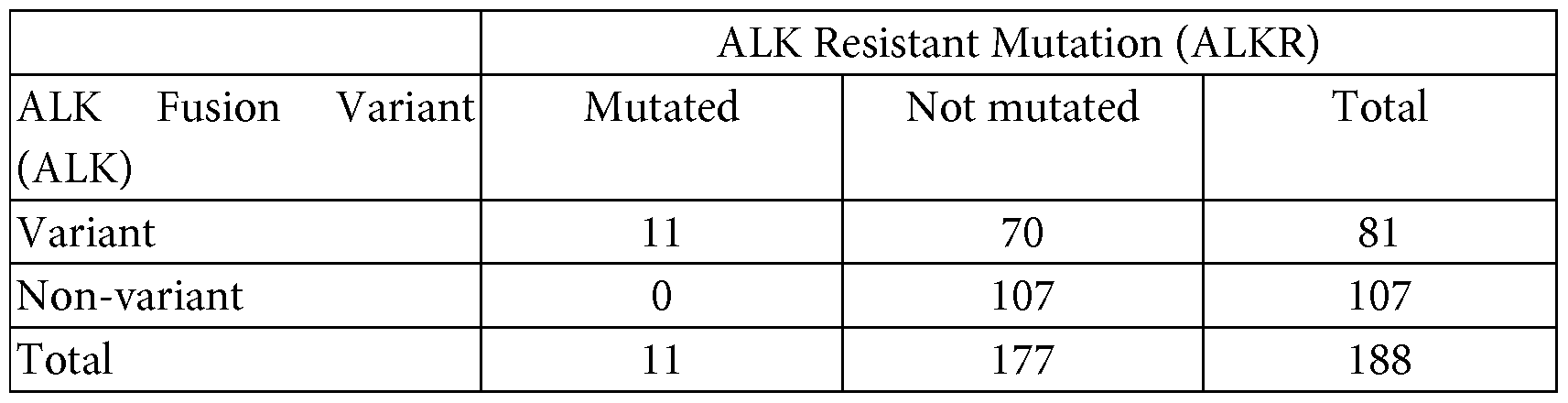
Progression free survival and overall survival rates were tracked for ALK resistant (ALKR) mutation positive (11) and negative (177) patients. As shown in
Figures 3 and 4, survival rates were significantly lower in patients carrying a resistance mutation.
Progression free survival and overall survival rates were also tracked for (i) ALK fusion positive (ALK), ALK resistant mutation positive (ALKR) patients (11); (ii) ALK fusion positive, ALK resistant mutation negative patients (70); and (iii)
ALK fusion negative, ALK resistant mutation negative patients (107). As shown in Figures 5 and 6, patients neither an ALK fusion or resistance mutation survived longest, followed by patents with an ALK fusion, but no ALK resistance mutation.
Patients with both an ALK fusion and an ALK resistance mutation had the lowest survival rates.
Example 4: Effect of Treatment Duration and Number of ALK Resistance Mutations on Survival
Progression free survival and overall survival of patients with or without an ALK resistance mutation was correlated with the number of days on crizotinib first line treatment, followed by alectinib second line treatment. No significant correlation was found between the duration of crizotinib treatment and either progression free or overall survival.
Example 5: Effect of Number of ALK and Non-ALK Mutations on Survival
Progression free survival was tracked in patients with 4 or fewer ALK and non-ALK mutations and compared to those with more than 4 ALK and non-ALK mutations. These mutations include those shown in Table 2, Table 4, and Table 5. For non-ALK mutations, each gene was counted once, even if a patient had multiple mutations in that gene. Patients with fewer mutations had longer progression free survival, as shown in Figure 7. The hazard ratio for having >4 mutations compared to 4 or fewer mutations was 2.12. The single nucleotide variant (SNV) ALK mutations detected include mutations that indicate
susceptibility to treatment, resistance to treatment, and unknown significance for treatment. These are shown in Table 4. Table 5 shows additional ALK fusions, as well as non-ALK mutations. CNA indicates copy number amplification.
T le 4
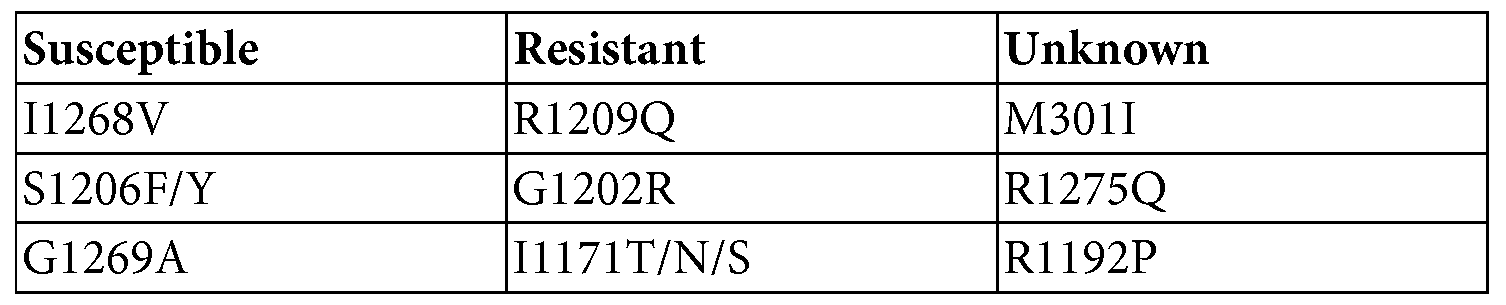

Table 5
GENE VARIANT TYPE
DCDC2 DCDC2 CNA CNA
ALK EML4-ALK E9;A20 ALK-fusion
SLC17A8 SLC17A8 CNA CNA
INSL5 INSL5 CNA CNA
GRM8 GRM8CNA CNA
PDGFRB PDGFRB CNA CNA
ERBB3 ERBB3 CNA CNA
CTNNB1 CTNNBlc.94G>Tp.D32Y SNV
ZIC4 ZIC4 c.525G>T p.W175C SNV
GRM8 GRM8c.l495G>Cp.V499L SNV
GRK7 GRK7 c.l444G>Ap.D482N SNV
ERBB3 ERBB3 c.974G>Ap.G325E SNV
JAK3 JAK3 c.l993C>Ap.P665T SNV
KIT KITc.l757G>Tp.R586l SNV
KIT KITc.l758A>Tp.R586S SNV
TP53 TP53 c.695T>Ap.l232N SNV
KIT KITc.2709G>C p.M903l SNV
CPXCRl CPXCRl c.674G>T p.G225V SNV
JAK2 JAK2 c.l849G>Tp.V617F SNV
KIT KITc.2307G>Tp.L769F SNV
ABL1 ABL1 C.1249T>C p.S417P SNV
N AS NRASc.l81C>Ap.Q61K SNV
SMAD4 SMAD4 C.1081OT p.R361C SNV
JAK2 JAK2 c.l849G>Tp.V617F SNV
TRIM58 TRIM58 C.1254A>T p.E418D SNV
ERBB3 ERBB3 c.836A>Tp.K279M SNV
ARAF ARAF c.641G>T p.R214L SNV
KIT KIT C.8960G p.A299G SNV
PIK3CA PIK3CAc.3062A>G p.Y1021C SNV
ALK CCDC142-ALK ALK-fusion other EML4-CCDC142 Fusion
SPTA1 SPTA1 C.26710T p.R891* SNV
IDH1 IDH1 C.401OA p.A134D SNV
ROB02 R0B02c.280OTp.R94C SNV
EPHX4 EPHX4 CNA CNA
GRM8 GRM8CNA CNA
INSL5 INSL5 CNA CNA other CD74-RABGAP1L Fusion
MET MET c.3803T>C p.M1268T SNV
ATM ATM c.7202T>Cp.l2401T SNV
ROSl ROSl c.5109A>T p.K1703N SNV
TP53 TP53 c.736A>G p.M246V SNV
MET METC.35830G p.L1195V SNV
DDR2 DDR2 c.l754T>Ap.M585K SNV
PGM5 PGM5 C.14210G p.A474G SNV
TP53 TP53 c.743G>Ap.R248Q SNV
MET MET Exonl4del Indel
ALK STRN-ALK ALK-fusion
KIF5B KIF5BCNA CNA
ATM ATM CNA CNA
KIT KIT CNA CNA
CNBD1 CNBD1 CNA CNA
C6 C6 CNA CNA
CWF19L2 CWF19L2 CNA CNA
TNR TNRc.682G>Tp.D228Y SNV
KRAS KRASc.37G>Tp.G13C SNV
KIF5B KIF5BCNA CNA
EML4 EML4c.13390Tp.Q447* SNV
ERBB3 ERBB3 c.303OAp.N101K SNV
TP53 TP53 c.5740Tp.Q192* SNV
SMAD4 SMAD4 C.1028OA p.S343* SNV
TP53 TP53 c.886G>Ap.D296N SNV
 HCN1 HCNl c.2503G>C p.V835L SNV
PIK3CA PIK3CA c.35G>A p.G12D SNV
TP53 TP53 C.8330G p.P278R SNV
FBXW7 FBXW7 C.1448T>C p.L483P SNV
TP53 TP53 C.5740G p.Q192E SNV
ALK RAD51AP2-ALK ALK-fusion other EML4-AKAP13 Fusion
IDH1 IDH1 c.394C>T p.R132C SNV
MET MET c.3979C>T p.R1327C SNV
TP53 TP53 c.658T>C p.Y220H SNV
UNC5C UNC5C C.1495T>A p.S499T SNV
CTNNB1 CTNNBl c.110OT p.S37F SNV
TP53 TP53 c.380C>T p.S127F SNV
NPM 1 NPM1 CNA CNA
AKT1 AKT1 CNA CNA
SLC5A10 SLC5A10 CNA CNA
IDH2 IDH2 CNA CNA
SLC17A8 SLC17A8 CNA CNA
FGFR1 FGFR1 CNA CNA
PDGFRB PDGFRB CNA CNA
KIT KIT CNA CNA
ERBB3 ERBB3 CNA CNA
FGFR2 FGFR2 CNA CNA
MAP2K1 MAP2K1 CNA CNA
SLPI SLPI CNA CNA
TP53 TP53 CNA CNA
CWF19L2 CWF19L2 CNA CNA
ERBB2 ERBB2 CNA CNA
CCND1 CCND1 CNA CNA
TRIM58 TRIM58 C.14330T p.A478V SNV
ZIC4 ZIC4 c.531G>T p.E177D SNV
CNTNAP2 c.ll38G>T
CNTNAP2 P.A380S SNV
TP53 TP53 c.452C>A p.P151H SNV
KRAS KRAS C.183A>C p.Q61H SNV
JAK3 JAK3 c.2896G>T p.A966S SNV
TP53 TP53 C.8320G p.P278A SNV
ST6GAL2 ST6GAL2 C.1544A>T p.Q515L SNV
KRAS KRAS c.35G>T p.G12V SNV
GATA3 GATA3 C.1082G>C p.G361A SNV
IDH2 IDH2 c.514A>G p.R172G SNV
CPXCRl CPXCRl c.755G>A p.G252D SNV
GRM8 GRM8 C.1820G>A p.R607H SNV
VHL VHL Deletion Indel
CPXCR1 CPXCR1 c.365A>T p.N122l SNV
TP53 TP53 c.817C>T p.R273C SNV
LRIG3 LRIG3 c.2779G>T p.G927C SNV
CSMD3 CSM D3 c.2210A>G p.Y737C SNV
ERBB2 ERBB2 c.2720A>G p.K907R SNV
TP53 TP53 c.524G>A p.R175H SNV
POM121L12 C.141G>T
POM121L12 P.Q47H SNV
CTNNB1 CTNNBl c.94G>C p.D32H SNV
FERD3L FERD3L CNA CNA
IDH2 IDH2 CNA CNA
ERBB3 ERBB3 CNA CNA
KIF5B KIF5B CNA CNA
CCND2 CCND2 CNA CNA
GNA11 GNA11 CNA CNA
KRAS KRAS CNA CNA
ALK DCTN1-ALK ALK-fusion
KIT KIT c.978C>G p.N326K SNV
TRHDE TRHDE c.973C>A p.P325T SNV
ATM ATM c.9023G>A p.R3008H SNV
MLH1 MLH1 C.1232T>G p.l411S SNV
R0B02 ROB02 C.32540T p.T1085M SNV
FGFR2 FGFR2 C.1675G>A p.A559T SNV
ABL1 ABL1 C.1165A>G p.T389A SNV
TP53 TP53 C.4550G p.P152R SNV
CDH9 CDH9 c.2318G>C p.R773P SNV
TP53 TP53 c.853G>A p.E285K SNV
DCDC1 DCDCl c.801G>T p.L267F SNV
CDKN2A CDKN2A c.35C>T p.S12L SNV
TP53 TP53 c.517G>T p.V173L SNV
SATB2 SATB2 C.1429G>T p.E477* SNV
HCN1 HCNl c.2549T>C ρ.Ι850Τ SNV
SLPI SLPI c.309T>G p.N103K SNV
VHL VHL Deletion Indel other ETV6-R0S1 Fusion
KCNB2 KCNB2 c.338A>T p.E113V SNV
SLC34A2 SLC34A2 C.2850G p.F95L SNV
CWF19L2 CWF19L2 CNA CNA other EML4-AFF3 Fusion
PTPRD PTPRD c.3631T>C p.Y1211H SNV
SLC34A2 SLC34A2 C.1462G>A p.A488T SNV
EPHA6 EPHA6 c.857G>C p.G286A SNV
ATM ATM c.8495G>A p.R2832H SNV
EML4 EML4 c.2668G>A p.E890K SNV
GNAS GNAS c.2524C>T p.R842C SNV
FGFR1 FGFRl c.l520G>A p.R507H SNV
REG3A REG3A c.455G>T p.S152l SNV
CSM D3 C.10859OG
CSMD3 P.S3620* SNV
ZIC4 ZIC4 c.l37T>A p.L46H SNV
LRIG3 LRIG3 c.2768T>G p.L923W SNV
DDR2 DDR2 c.2063A>C p.K688T SNV
POM121L12 c.418G>A
POM121L12 P.G140R SNV
PNPLA1 PNPLAl c.l75G>A p.V59l SNV
R0S1 ROS1 c.5131G>T p.A1711S SNV
CCND1 CCND1 CNA CNA
TP53 TP53 c.637C>T p.R213* SNV
TP53 TP53 c.745A>T p.R249W SNV
SMAD4 SMAD4 C.1049T>A p.V350D SNV
ALK EML4-ALK E6;A16 ALK-fusion
ALK EML4-ALK E6;A19 ALK-fusion
TP53 TP53 c.653T>G p.V218G SNV
CSMD3 CSM D3 c.9029A>G p.K3010R SNV
GRM8 GRM8 C.1820G>A p.R607H SNV
JAK2 JAK2 c.l849G>T p.V617F SNV
ADAMTS5 C.1437G>T
ADAMTS5 P.Q479H SNV
TP53 TP53 c.536A>G p.H179R SNV
CTNNB1 CTNNBl c.l01G>T p.G34V SNV
TP53 TP53 c.589G>C p.V197L SNV
ESR1 ESR1 C.7750G p.R259G SNV
MAP2K1 MAP2K1 c.412G>A p.E138K SNV
LRP1B LRPlB c.l065C>A p.D355E SNV
KRAS KRAS c.34G>T p.G12C SNV
LRRIQ3 LRRIQ3 C.1490OA p.A497D SNV
EPHA6 EPHA6 C.1099G>A p.E367K SNV
TP53 TP53 c.526T>A p.C176S SNV
ALK EM L4-ALK E17;A20 ALK-fusion
HCN1 HCNl c.2549T>C ρ.Ι850Τ SNV
ERBB3 ERBB3 c.2821T>A p.Y941N SNV
GRM8 GRM8 CNA CNA
TNR TNR CNA CNA
SLC17A8 SLC17A8 CNA CNA
INSL5 INSL5 CNA CNA
DUSP22 DUSP22 C.138G>C p.W46C SNV
SLC34A2 SLC34A2 C.17170T p.R573* SNV
ZNF598 ZNF598 C.1491G>T p.E497D SNV
TP53 TP53 c.659A>G p.Y220C SNV
INSL5 INSL5 CNA CNA
GRM8 GRM8 CNA CNA
MYD88 MYD88 CNA CNA
ESR1 ESR1 CNA CNA
DI02 DI02 CNA CNA
TNR TNR CNA CNA
EX0C4 EXOC4 CNA CNA
FGFR1 FGFR1 CNA CNA
AR AR CNA CNA
PDGFRB PDGFRB CNA CNA
FERD3L FERD3L CNA CNA
SLPI SLPI CNA CNA
other EML4-CUX1 Fusion
CTNNB1 CTNNBl c.110OA p.S37Y SNV
ATM ATM c.7213A>G p.M2405V SNV
DUSP22 DUSP22 c.2470T p.R83W SNV
ALK EM L4-ALK E13;A20 ALK-fusion
TP53 TP53 C.9HOT p.T304l SNV
EGFR EGFR C.25910T p.A864V SNV
Claims
1. A method of treating a patient having a tumor possibly harboring cells with a mutation in anaplastic lymphoma kinase (ALK) gene, comprising:
(a) testing a sample from the patient for the presence of ALK mutations
R I 209Q (G3636A) and/ or 11268V (A3802G), and
(b) if the mutation R 1209Q is present, not administering an ALK inhibitor compound to the patient, or if the patient is already receiving an ALK inhibitor compound, administering an alternative ALK inhibitor compound; and
(c) if the mutation 11268V is present or no mutations are present, administering an ALK inhibitor compound to the patient.
2. The method of claim 1, wherein the ALK inhibitor compound or alternative ALK inhibitor compound is selected from the group consisting of alectinib, crizotinib, ceritinib, alectinib, brigatinib, lorlatinib, and entrectinib.
3. The method of claim 1 or 2, wherein the testing is performed using an oligonucleotide complementary to the mutant sequence.
4. The method of any one of the foregoing claims, further comprising testing the sample from the patient for the presence of one or more of the ALK mutations selected from the group consisting of L1152R, C1156Y, F1174L, L1196M, G1269A, and G1548E and if any of the mutations is present, not administering an ALK inhibitor compound to the patient, or if the patient is already receiving an ALK inhibitor compound, administering an alternative ALK inhibitor compound.
5. The method of any one of the foregoing claims, further comprising:
testing the sample from the patient for the presence of one or more ALK fusion products;
if one or more ALK fusion products is present, administering an ALK inhibitor compound to the patient; and
if one or more ALK fusion products and one or more mutations selected from the group consisting of R1209Q, L1152R, C1156Y, F1174L, L1196M, G1269A, and G1548E is present, not administering an ALK inhibitor compound to the patient, or if the patient is already receiving an ALK inhibitor compound, administering an alternative ALK inhibitor compound.
6. A method for determining the likelihood of response of a cancer patient to an ALK inhibitor compound comprising: testing a sample from the patient for ALK mutations R 1209Q and/ or 1 1268V and, if the mutation R 1209Q is present, reporting that the patient will likely not respond to the ALK inhibitor compound and if the mutation 11268V is present or no mutation is present, reporting that the patient will likely respond to the ALK inhibitor compound.
7. The method of claim 6 , wherein the testing is performed using an oligonucleotide complementary to the mutant sequence.
8. The method of any one of claims 6-7, further comprising testing the sample for the presence of one or more of ALK mutations selected from the group consisting of L1152R, C1156Y, F1174L, L1196M, G1269A, and G1548E, and if any of the mutations is present, reporting that the patient is not likely to respond to the ALK inhibitor compound, or if the patient is already receiving an ALK inhibitor compound, administering an alternative ALK inhibitor compound.
9. The method of any one of claims 6-8, further comprising:
testing the sample from the patient for the presence of one or more ALK fusion products;
if one or more ALK fusion products is present, administering an ALK inhibitor compound to the patient; and
if one or more ALK fusion products and one or more mutations selected from the group consisting of R1209Q, L1152R, C1156Y, F1174L, L1196M, G1269A, and G1548E is present, not administering an ALK inhibitor compound to the patient, or if the patient is already receiving an ALK inhibitor compound, administering an alternative ALK inhibitor compound.
10. A method for selecting anaplastic lymphoma kinase (ALK) inhibitor therapy for a patient having a tumor harboring cells with a mutation in the gene who has been previously treated with alectinib, comprising:
(a) testing a sample from the patient for the presence of ALK mutations R 1209Q (G3636A) and/ or 11268V (A3802G), and
(b) if the mutation R 1209Q is present, not administering to the patient an ALK inhibitor compound or administering an alternative ALK inhibitor compound, and
(c) if the mutation 11268V is present or no mutations are present, administering alectinib to the patient.
11. The method of claim 10, further comprising testing the sample for the presence of one or more of the ALK mutations L1152R, C1156Y, F1174L, L1196M, G 1269 A, and G1548E and if any of the mutations is present, not administering to the patient the ALK inhibitor compound or administering an alternative ALK inhibitor compound.
12. A kit for detecting mutations in the ALK gene comprising an
oligonucleotide that specifically binds to mutations R 1209Q and 11268V in the
ALK gene.
13. The kit of claim 12, further comprising one or more oligonucleotides that specifically hybridize to one or more ALK mutations LI 152R, CI 156Y, Fl 174L, L1196M, G1269A, and G1548E.
14. The kit of any one of claims 11-12, further comprising one or more oligonucleotides that specifically detect an ALK fusion product.
15. A method of treating a patient having a tumor possibly harboring cells with a mutation in anaplastic lymphoma kinase (ALK) gene, comprising:
(a) testing a sample from the patient for the presence of one or more ALK fusion products;
(b) if the one or more ALK fusion products tested in (a) is present, administering an ALK inhibitor compound;
(c) testing a sample from the patient for the presence of one or more ALK resistance mutations selected from the group consisting of R ! 209Q, LI 152R, CI 156Y, Fl 174L, LI 196M, G1269A, and G1548E; and
(d) if the one or more ALK resistance mutations tested in (c) is present, not administering an ALK inhibitor compound to the patient, or if the patient is already receiving an ALK inhibitor compound, administering an alternative ALK inhibitor compound,
wherein if both the one or more ALK fusion products and one or more ALK resistance mutation are present, not administering an ALK inhibitor compound to the patient, or if the patient is already receiving an ALK inhibitor compound, administering an alternative ALK inhibitor compound.
Priority Applications (3)
| Application Number | Priority Date | Filing Date | Title |
|---|---|---|---|
| EP17728807.3A EP3464625A1 (en) | 2016-06-01 | 2017-06-01 | Novel mutations in anaplastic lymphoma kinase predicting response to alk inhibitor therapy in lung cancer patients |
| JP2018562969A JP2019519540A (en) | 2016-06-01 | 2017-06-01 | Novel Mutations in Anaplastic Lymphoma Kinase to Predict Response to ALK Inhibitor Therapy in Lung Cancer Patients |
| CN201780034006.2A CN109312406A (en) | 2016-06-01 | 2017-06-01 | Novel mutations in anaplastic lymphoma kinase that predict response to ALK inhibitor therapy in lung cancer patients |
Applications Claiming Priority (2)
| Application Number | Priority Date | Filing Date | Title |
|---|---|---|---|
| US201662344297P | 2016-06-01 | 2016-06-01 | |
| US62/344,297 | 2016-06-01 |
Publications (1)
| Publication Number | Publication Date |
|---|---|
| WO2017207696A1 true WO2017207696A1 (en) | 2017-12-07 |
Family
ID=59030929
Family Applications (1)
| Application Number | Title | Priority Date | Filing Date |
|---|---|---|---|
| PCT/EP2017/063318 Ceased WO2017207696A1 (en) | 2016-06-01 | 2017-06-01 | Novel mutations in anaplastic lymphoma kinase predicting response to alk inhibitor therapy in lung cancer patients |
Country Status (5)
| Country | Link |
|---|---|
| US (1) | US20170349953A1 (en) |
| EP (1) | EP3464625A1 (en) |
| JP (1) | JP2019519540A (en) |
| CN (1) | CN109312406A (en) |
| WO (1) | WO2017207696A1 (en) |
Families Citing this family (11)
| Publication number | Priority date | Publication date | Assignee | Title |
|---|---|---|---|---|
| SMT201900203T1 (en) | 2010-05-20 | 2019-05-10 | Array Biopharma Inc | Macrocyclic compounds as trk kinase inhibitors |
| CA3049136C (en) | 2017-01-18 | 2022-06-14 | Array Biopharma Inc. | Substituted pyrazolo[1,5-a]pyrazine compounds as ret kinase inhibitors |
| JOP20190213A1 (en) | 2017-03-16 | 2019-09-16 | Array Biopharma Inc | Macrocyclic compounds as ros1 kinase inhibitors |
| JP6997876B2 (en) | 2018-01-18 | 2022-02-04 | アレイ バイオファーマ インコーポレイテッド | Substituted pyrazolyl [4,3-C] pyridine compound as a RET kinase inhibitor |
| EP3740491A1 (en) | 2018-01-18 | 2020-11-25 | Array Biopharma, Inc. | Substituted pyrrolo[2,3-d]pyrimidines compounds as ret kinase inhibitors |
| US11524963B2 (en) | 2018-01-18 | 2022-12-13 | Array Biopharma Inc. | Substituted pyrazolo[3,4-d]pyrimidines as RET kinase inhibitors |
| EP3768275A1 (en) * | 2018-03-19 | 2021-01-27 | ARIAD Pharmaceuticals, Inc. | Methods of treating cancer in pediatric patients |
| ES2922314T3 (en) | 2018-09-10 | 2022-09-13 | Array Biopharma Inc | Fused Heterocyclic Compounds as RET Kinase Inhibitors |
| WO2021138391A1 (en) | 2019-12-30 | 2021-07-08 | Tyra Biosciences, Inc. | Indazole compounds |
| WO2024017352A1 (en) * | 2022-07-22 | 2024-01-25 | 四川大学 | Method and kit for diagnosis and treatment of rdaa-positive diseases |
| CN115927564B (en) * | 2022-09-29 | 2023-09-12 | 杭州联川基因诊断技术有限公司 | Primer combination, kit and method for detecting gene fusion in biological sample |
Citations (11)
| Publication number | Priority date | Publication date | Assignee | Title |
|---|---|---|---|---|
| US5871908A (en) | 1992-02-05 | 1999-02-16 | Evotec Biosystems Gmbh | Process for the determination of in vitro amplified nucleic acids |
| US7700339B2 (en) | 2006-04-14 | 2010-04-20 | Cell Signaling Technology, Inc. | Gene defects and mutant ALK kinase in human solid tumors |
| WO2011095894A2 (en) * | 2010-02-04 | 2011-08-11 | Jichi Medical University | Identification, assessment, and therapy of cancers with innate or acquired resistance to alk inhibitors |
| WO2012158880A2 (en) * | 2011-05-17 | 2012-11-22 | The Johns Hopkins University | Anaplastic thyroid cancers harbor novel oncogenic mutations of the alk gene |
| WO2013074518A1 (en) * | 2011-11-14 | 2013-05-23 | Tesaro, Inc. | Modulating certain tyrosine kinases |
| US8586299B2 (en) | 2008-10-20 | 2013-11-19 | Roche Molecular Systems, Inc. | Allele-specific amplification |
| EP2711435A1 (en) * | 2012-09-24 | 2014-03-26 | ARKRAY, Inc. | Mutation detection probe, mutation detection method, method of evaluating drug efficacy, and mutation detection kit |
| US20140296081A1 (en) | 2013-03-15 | 2014-10-02 | The Board Of Trustees Of The Leland Stanford Junior University | Identification and use of circulating tumor markers |
| WO2014182521A1 (en) * | 2013-05-06 | 2014-11-13 | Medimmune, Llc | Diagnostic methods and treatments for cancer |
| WO2016094248A1 (en) * | 2014-12-08 | 2016-06-16 | Memorial Sloan Kettering Cancer Center | Methods of treating and prognosing nonhematopoietic malignant tumors |
| US20160304937A1 (en) | 2015-04-17 | 2016-10-20 | Roche Molecular Systems, Inc. | Multiplex pcr to detect gene fusions |
Family Cites Families (1)
| Publication number | Priority date | Publication date | Assignee | Title |
|---|---|---|---|---|
| US9611283B1 (en) * | 2013-04-10 | 2017-04-04 | Ariad Pharmaceuticals, Inc. | Methods for inhibiting cell proliferation in ALK-driven cancers |
-
2017
- 2017-06-01 JP JP2018562969A patent/JP2019519540A/en active Pending
- 2017-06-01 CN CN201780034006.2A patent/CN109312406A/en active Pending
- 2017-06-01 EP EP17728807.3A patent/EP3464625A1/en not_active Withdrawn
- 2017-06-01 US US15/611,612 patent/US20170349953A1/en not_active Abandoned
- 2017-06-01 WO PCT/EP2017/063318 patent/WO2017207696A1/en not_active Ceased
Patent Citations (12)
| Publication number | Priority date | Publication date | Assignee | Title |
|---|---|---|---|---|
| US5871908A (en) | 1992-02-05 | 1999-02-16 | Evotec Biosystems Gmbh | Process for the determination of in vitro amplified nucleic acids |
| US7700339B2 (en) | 2006-04-14 | 2010-04-20 | Cell Signaling Technology, Inc. | Gene defects and mutant ALK kinase in human solid tumors |
| US8586299B2 (en) | 2008-10-20 | 2013-11-19 | Roche Molecular Systems, Inc. | Allele-specific amplification |
| WO2011095894A2 (en) * | 2010-02-04 | 2011-08-11 | Jichi Medical University | Identification, assessment, and therapy of cancers with innate or acquired resistance to alk inhibitors |
| WO2012158880A2 (en) * | 2011-05-17 | 2012-11-22 | The Johns Hopkins University | Anaplastic thyroid cancers harbor novel oncogenic mutations of the alk gene |
| WO2013074518A1 (en) * | 2011-11-14 | 2013-05-23 | Tesaro, Inc. | Modulating certain tyrosine kinases |
| EP2711435A1 (en) * | 2012-09-24 | 2014-03-26 | ARKRAY, Inc. | Mutation detection probe, mutation detection method, method of evaluating drug efficacy, and mutation detection kit |
| US20140296081A1 (en) | 2013-03-15 | 2014-10-02 | The Board Of Trustees Of The Leland Stanford Junior University | Identification and use of circulating tumor markers |
| US20160032396A1 (en) | 2013-03-15 | 2016-02-04 | The Board Of Trustees Of The Leland Stanford Junior University | Identification and Use of Circulating Nucleic Acid Tumor Markers |
| WO2014182521A1 (en) * | 2013-05-06 | 2014-11-13 | Medimmune, Llc | Diagnostic methods and treatments for cancer |
| WO2016094248A1 (en) * | 2014-12-08 | 2016-06-16 | Memorial Sloan Kettering Cancer Center | Methods of treating and prognosing nonhematopoietic malignant tumors |
| US20160304937A1 (en) | 2015-04-17 | 2016-10-20 | Roche Molecular Systems, Inc. | Multiplex pcr to detect gene fusions |
Non-Patent Citations (6)
| Title |
|---|
| HOLLAND ET AL., P.N.A.S. USA, vol. 88, 1991, pages 7276 - 7280 |
| SAMBROOK ET AL.: "MOLECULAR CLONING, A LABORATORY MANUAL", 1989, COLD SPRINGS HARBOR PRESS |
| TYAGI ET AL., NAT. BIOTECHNOL., vol. 3, 1996, pages 303 - 308 |
| VAN DER WEKKEN ET AL., CRIT. REV. ONE. HEMATOL., vol. 100, 2016, pages 107 |
| WEKKEN ET AL., CRIT. REV. ONE. HEMATOL., vol. 100, 2016, pages 107 |
| WHITCOMBE ET AL., NAT. BIOTECHNOL., vol. 8, 1999, pages 804 - 807 |
Also Published As
| Publication number | Publication date |
|---|---|
| US20170349953A1 (en) | 2017-12-07 |
| JP2019519540A (en) | 2019-07-11 |
| CN109312406A (en) | 2019-02-05 |
| EP3464625A1 (en) | 2019-04-10 |
Similar Documents
| Publication | Publication Date | Title |
|---|---|---|
| EP3464625A1 (en) | Novel mutations in anaplastic lymphoma kinase predicting response to alk inhibitor therapy in lung cancer patients | |
| US20240294989A1 (en) | Compositions and methods for screening solid tumors | |
| US12516372B2 (en) | Compositions and methods for screening mutations in thyroid cancer | |
| NZ566387A (en) | Method to predict or monitor the response of a patient to an ErbB receptor drug by screening for mutations in an ErbB receptor | |
| US11261482B2 (en) | Composition for detecting epidermal cell growth factor receptor gene mutation, and kit comprising same | |
| CA2468312A1 (en) | Single nucleotide polymorphisms and combinations thereof predictive for paclitaxel responsiveness | |
| US9738935B2 (en) | Complex mutations in the epidermal growth factor receptor kinase domain | |
| US20140341884A1 (en) | Novel Complex Mutations in the Epidermal Growth Factor Receptor Kinase Domain | |
| JP6694429B2 (en) | Mutations in the epidermal growth factor receptor kinase domain | |
| US20250197945A1 (en) | Method for Detecting Microsatellite Instability in Cancer Patient |
Legal Events
| Date | Code | Title | Description |
|---|---|---|---|
| 121 | Ep: the epo has been informed by wipo that ep was designated in this application |
Ref document number: 17728807 Country of ref document: EP Kind code of ref document: A1 |
|
| ENP | Entry into the national phase |
Ref document number: 2018562969 Country of ref document: JP Kind code of ref document: A |
|
| NENP | Non-entry into the national phase |
Ref country code: DE |
|
| ENP | Entry into the national phase |
Ref document number: 2017728807 Country of ref document: EP Effective date: 20190102 |