WO2017127835A2 - Aqueous formulations and methods of preparation and use thereof - Google Patents
Aqueous formulations and methods of preparation and use thereof Download PDFInfo
- Publication number
- WO2017127835A2 WO2017127835A2 PCT/US2017/014623 US2017014623W WO2017127835A2 WO 2017127835 A2 WO2017127835 A2 WO 2017127835A2 US 2017014623 W US2017014623 W US 2017014623W WO 2017127835 A2 WO2017127835 A2 WO 2017127835A2
- Authority
- WO
- WIPO (PCT)
- Prior art keywords
- formulation
- cyclodextrin
- months
- solubilizer
- cpmm
- Prior art date
- Legal status (The legal status is an assumption and is not a legal conclusion. Google has not performed a legal analysis and makes no representation as to the accuracy of the status listed.)
- Ceased
Links
Classifications
-
- A—HUMAN NECESSITIES
- A61—MEDICAL OR VETERINARY SCIENCE; HYGIENE
- A61K—PREPARATIONS FOR MEDICAL, DENTAL OR TOILETRY PURPOSES
- A61K31/00—Medicinal preparations containing organic active ingredients
- A61K31/33—Heterocyclic compounds
- A61K31/395—Heterocyclic compounds having nitrogen as a ring hetero atom, e.g. guanethidine or rifamycins
- A61K31/41—Heterocyclic compounds having nitrogen as a ring hetero atom, e.g. guanethidine or rifamycins having five-membered rings with two or more ring hetero atoms, at least one of which being nitrogen, e.g. tetrazole
- A61K31/4164—1,3-Diazoles
- A61K31/4174—Arylalkylimidazoles, e.g. oxymetazolin, naphazoline, miconazole
-
- A—HUMAN NECESSITIES
- A61—MEDICAL OR VETERINARY SCIENCE; HYGIENE
- A61K—PREPARATIONS FOR MEDICAL, DENTAL OR TOILETRY PURPOSES
- A61K45/00—Medicinal preparations containing active ingredients not provided for in groups A61K31/00 - A61K41/00
- A61K45/06—Mixtures of active ingredients without chemical characterisation, e.g. antiphlogistics and cardiaca
-
- A—HUMAN NECESSITIES
- A61—MEDICAL OR VETERINARY SCIENCE; HYGIENE
- A61K—PREPARATIONS FOR MEDICAL, DENTAL OR TOILETRY PURPOSES
- A61K47/00—Medicinal preparations characterised by the non-active ingredients used, e.g. carriers or inert additives; Targeting or modifying agents chemically bound to the active ingredient
- A61K47/02—Inorganic compounds
-
- A—HUMAN NECESSITIES
- A61—MEDICAL OR VETERINARY SCIENCE; HYGIENE
- A61K—PREPARATIONS FOR MEDICAL, DENTAL OR TOILETRY PURPOSES
- A61K47/00—Medicinal preparations characterised by the non-active ingredients used, e.g. carriers or inert additives; Targeting or modifying agents chemically bound to the active ingredient
- A61K47/06—Organic compounds, e.g. natural or synthetic hydrocarbons, polyolefins, mineral oil, petrolatum or ozokerite
- A61K47/08—Organic compounds, e.g. natural or synthetic hydrocarbons, polyolefins, mineral oil, petrolatum or ozokerite containing oxygen, e.g. ethers, acetals, ketones, quinones, aldehydes, peroxides
- A61K47/12—Carboxylic acids; Salts or anhydrides thereof
-
- A—HUMAN NECESSITIES
- A61—MEDICAL OR VETERINARY SCIENCE; HYGIENE
- A61K—PREPARATIONS FOR MEDICAL, DENTAL OR TOILETRY PURPOSES
- A61K47/00—Medicinal preparations characterised by the non-active ingredients used, e.g. carriers or inert additives; Targeting or modifying agents chemically bound to the active ingredient
- A61K47/30—Macromolecular organic or inorganic compounds, e.g. inorganic polyphosphates
- A61K47/36—Polysaccharides; Derivatives thereof, e.g. gums, starch, alginate, dextrin, hyaluronic acid, chitosan, inulin, agar or pectin
- A61K47/40—Cyclodextrins; Derivatives thereof
-
- A—HUMAN NECESSITIES
- A61—MEDICAL OR VETERINARY SCIENCE; HYGIENE
- A61K—PREPARATIONS FOR MEDICAL, DENTAL OR TOILETRY PURPOSES
- A61K9/00—Medicinal preparations characterised by special physical form
- A61K9/08—Solutions
-
- A—HUMAN NECESSITIES
- A61—MEDICAL OR VETERINARY SCIENCE; HYGIENE
- A61K—PREPARATIONS FOR MEDICAL, DENTAL OR TOILETRY PURPOSES
- A61K9/00—Medicinal preparations characterised by special physical form
- A61K9/14—Particulate form, e.g. powders, Processes for size reducing of pure drugs or the resulting products, Pure drug nanoparticles
- A61K9/19—Particulate form, e.g. powders, Processes for size reducing of pure drugs or the resulting products, Pure drug nanoparticles lyophilised, i.e. freeze-dried, solutions or dispersions
-
- A—HUMAN NECESSITIES
- A61—MEDICAL OR VETERINARY SCIENCE; HYGIENE
- A61M—DEVICES FOR INTRODUCING MEDIA INTO, OR ONTO, THE BODY; DEVICES FOR TRANSDUCING BODY MEDIA OR FOR TAKING MEDIA FROM THE BODY; DEVICES FOR PRODUCING OR ENDING SLEEP OR STUPOR
- A61M5/00—Devices for bringing media into the body in a subcutaneous, intra-vascular or intramuscular way; Accessories therefor, e.g. filling or cleaning devices, arm-rests
- A61M5/178—Syringes
- A61M5/20—Automatic syringes, e.g. with automatically actuated piston rod, with automatic needle injection, filling automatically
- A61M5/2033—Spring-loaded one-shot injectors with or without automatic needle insertion
Definitions
- the disclosure relates generally to anesthetic formulations and their methods of preparation and use. More particularly, the disclosure relates to stabilized aqueous formulations of cyclopropyl-MOC-metomidate (CPMM).
- CPMM cyclopropyl-MOC-metomidate
- pharmacodynamics are well-matched to the procedures being performed.
- current agents are either too long-acting and/or do not take effect quickly enough.
- the result is a clear unmet need for safer, more effective drugs that exhibit predictable, rapid PK/PD and allow precisely-tailored control of sedation and anesthesia.
- sedative/anesthetic drugs and drug products that (i) are highly potent, (ii) have minimal hemodynamic effects or other toxicities, (iii) have PK/PD profiles that enable them to be more readily titratable and enable rapid emergence from anesthesia, and (iv) are convenient for use and well-tolerated, are highly desired to meet evolving patient and healthcare needs.
- Cyclopropyl-MOC-metomidate is an intravenously-administered general anesthetic for monitored anesthesia care (MAC) and/or general anesthesia in patients undergoing diagnostic or therapeutic procedures.
- CPMM is a potent positive allosteric modulator of the ⁇ -aminobutyric acid Type A (GABAA) receptor, which is a ligand-gated ion channel, and leads to CPMM's sedative and anesthetic effects.
- GABAA ⁇ -aminobutyric acid Type A
- CPMM contains a methoxycarbonyl ester moiety that is designed to undergo rapid hydrolysis in the body by plasma and tissue esterases to produce an inactive carboxylic acid metabolite, CPM-acid. This mechanism of inactivation results in a very rapid and predictable profile for offset of action.
- CPMM exhibits only moderate solubility in aqueous solution and the metabolically-labile ester is also somewhat unstable in aqueous solution, which can lead to degradation of the compound upon storage in an aqueous medium.
- anesthetic compounds such as CPMM, in which the anesthetic is sufficiently soluble and, additionally, has a desired level of stability.
- formulations of CPMM or pharmaceutically acceptable salt thereof, and a solubilizer are preferably sterile.
- the CPMM can be present in an amount of 0.1 mg/mL to 20 mg/mL, e.g., 1 to 10 mg/mL or 2 to 5 mg/mL.
- the formulation can have a pH in a range of 2 to 7, e.g., 3 to 7, 4 to 6.5, or 5 to 6.5. In some cases, the pH is 6 to 7.4.
- the formulation can optionally further comprise a buffer.
- the buffer can comprise one or more of NaOH, KOH, triethylamine, meglumine, diethanolamine, triethylamine, ammonium hydroxide, ammonium acetate, L-arginine, histidine, citrate buffer, a phosphate buffer, sodium bicarbonate, tris(hydroxymethyl)aminomethane), N-(2-hydroxyethyl)piperazine- N'-2-ethanesulfonic acid, acetate, citrate, ascorbate, glycine, glutamate, lactate, malate, formate, and sulfate.
- the buffer comprises citrate buffer and NaOH.
- the solubilizer comprises a cyclodextrin, e.g., ⁇ -cyclodextrin, or more specifically, sulfobutylether-P-cyclodextrin, hydroxypropyl-P-cyclodextrin, or a combination thereof.
- the solubilizer comprises sulfobutylether-P-cyclodextrin.
- the solubilizer can be present in a concentration in a range of about 6 % w/w to about 30 % w/w, e.g., about 8 % w/w to about 20 % w/w, or about 8 % w/w to about 12 % w/w, or more specifically, about 10 % w/w.
- the solubilizer can be present in a molar ratio to the compound (CPMM) of 1 : 1 to 8: 1, e.g., 1 : 1 to 4: 1. In some cases, the ratio of compound complexed to the solubilizer to uncomplexed compound is 1.5: 1 to 16: 1.
- the formulation disclosed herein can comprise the compound at a concentration in a range of 2 mg/mL to 5 mg/mL, the solubilizer comprises hydroxypropyl- ⁇ - cyclodextrin at a concentration in a range of 8 % w/v or w/w to 12 % w/v or w/w, and the formulation has a pH in a range of about 5 to 7.
- the formulation disclosed herein can comprise the compound at a concentration in a range of 2 mg/mL to 5 mg/mL, the solubilizer comprises sulfobutylether-P-cyclodextrin at a concentration in a range of 6 % w/v or w/w to 12 % w/v or w/w, and the formulation has a pH in a range of about 3 to 7 (e.g., 5 to 6).
- the formulations disclosed herein can further comprise an antimicrobial agent.
- the formulations disclosed herein can have 5 % or less (e.g., 1 % or less) total degradants after storage at a temperature of 2 °C to 8 °C for at least 6 months, at least 12 months, or at least 24 months.
- the formulations disclosed herein can have 5 % or less (e.g., 1 % or less) total degradants after storage at frozen conditions (e.g., a temperature of -10 °C to 0 °C) for at least 12 months, or at least 24 months.
- the formulations disclosed herein can have 5% or less (e.g., 1 % or less) total degradants after storage at room temperature (e.g., a temperature of 15 °C to 30 °C) for at least 6 months.
- the formulations disclosed herein can be lyophilized.
- the lyophilized formulation is provided in a kit, with the lyophilized formulation in a container and with instructions for preparing an aqueous, sterile formulation form the lyophilized formulation and a diluent (e.g., saline, sterile water, PBS, or a mixture thereof).
- a diluent e.g., saline, sterile water, PBS, or a mixture thereof.
- a liquid pharmaceutical formulation consisting essentially of (1) cyclopropyl-MOC-metomidate (CPMM) or a pharmaceutically acceptable salt thereof, (2) a solubilizer, and (3) a buffer or base in an aqueous medium.
- the solubilizer can be ⁇ -cyclodextrin (e.g., sulfobutylether-P-cyclodextrin, hydroxypropyl-P-cyclodextrin, or a combination thereof).
- the buffer can comprise citrate.
- a pre-filled syringe comprising a formulation as disclosed herein.
- the formulations disclosed herein can be used to induce anesthesia or sedation via, e.g., injection or infusion administration to a subject in need of anesthesia or sedation.
- Figure 1 shows CPMM solubility in different aqueous buffer media.
- Figure 2 shows log solubility curve of CPMM.
- Figure 3 shows 1- and 2-week stability of CPMM in aqueous pH buffer media stored at 25 °C under 60 % relative humidity.
- Figure 4 shows 1- and 2-week stability of CPMM in aqueous pH buffer media stored at 40 °C under 75 % relative humidity.
- Figure 6 shows overlay chromatograms of Formulation SBECD-D at 25 °C/60 % relative humidity.
- An anesthetic formulation for clinical and veterinary use can be an aqueous solution that can afford ease of storage and administration and avoid pain to the patient upon, e.g., intravenous administration.
- CPMM is only moderately soluble the metabolically-labile ester is also somewhat unstable, both of which can lead to degradation of the compound upon storage in an aqueous medium.
- aqueous CPMM formulations that are stable and/or provide a desired level of solubility of the compound, as discussed in detail below.
- Formulations suitable for convenient intravenous injection are also described herein, e.g. ready-to-use formulations or lyophilized formulations that can be reconstituted for
- injectable formulations of these compounds e.g., CPMM at adequate concentration and/or stability that can be suitable for intravenous injection in humans and animals to induce and maintain monitored anesthesia care (MAC) and/or general anesthesia in patients or animals undergoing diagnostic or therapeutic procedures and/or sedation.
- MAC monitored anesthesia care
- compositions, formulations, and methods are contemplated to include embodiments covering any combination of one or more of the additional optional elements, features, and steps further described below, unless stated otherwise.
- the lyophilized formulation can be reconstituted with an aqueous diluent prior to administration.
- diluents include saline, water, and buffer.
- the lyophilized formulation comprises the salt form of an active agent, a solubilizer, and optionally a buffer, acid, and/or base.
- the aqueous formulation can be made to have a pH that is tolerable to a subject upon administration, e.g., by injection or infusion.
- the pH can be in a range of about 2 to about 7.
- the pH is a property of the formulation after reconstitution.
- CPMM which has an IUPAC chemical name of l-(methoxycarbonyl)cyclopropyl-l- [(lR)-l-phenylethyl]-lH-imidazole-5-carboxylate, has the following structure:
- CPMM or a pharmaceutically acceptable salt thereof, is the active compound in the formulations disclosed herein.
- the term "pharmaceutically-acceptable salts” refers to the conventional non-toxic salts or quaternary ammonium salts of compounds described herein, e.g., from nontoxic organic or inorganic acids. These salts can be prepared in situ in the administration vehicle or the dosage form manufacturing process, or by separately reacting a compound described herein in its free base or acid form with a suitable organic or inorganic acid or base, and isolating the salt thus formed during subsequent purification.
- non-toxic salts include those derived from inorganic acids such as hydrochloric, hydrobromic, sulfuric, sulfamic, phosphoric, nitric, and the like; and the salts prepared from organic acids such as acetic, propionic, succinic, glycolic, stearic, lactic, malic, tartaric, citric, ascorbic, palmitic, maleic, hydroxymaleic, phenylacetic, glutamic, benzoic, salicyclic, sulfanilic, 2-acetoxybenzoic, fumaric,
- Exemplary salts also include the hydrobromide, hydrochloride, sulfate, bisulfate, phosphate, nitrate, acetate, succinate, valerate, oleate, palmitate, stearate, laurate, benzoate, lactate, phosphate, tosylate, citrate, maleate, fumarate, succinate, tartrate, naphthylate, mesylate, glucoheptonate, lactobionate,
- Suitable acids that are capable of forming salts with CPMM include inorganic acids such as hydrochloric acid, hydrobromic acid, perchloric acid, nitric acid, thiocyanic acid, sulfuric acid, phosphoric acid, and the like; and organic acids such as formic acid, acetic acid, propionic acid, glycolic acid, lactic acid, pyruvic acid, oxalic acid, malonic acid, succinic acid, maleic acid, fumaric acid, anthranilic acid, cinnamic acid, naphthalene sulfonic acid, sulfanilic acid, trifluoroacetic acid, methansulfonic acid, benzenesulfonic acid, p-toulenesulfonic acid, and the like.
- the compound can be present in a liquid formulation as disclosed herein at a
- the concentration of about 0.1 mg/mL to about 20 mg/mL, or about 1 mg/mL to 10 mg/mL. In some cases, the concentration is about 2 mg/mL to about 5 mg/mL. Since the compound can be administered as a short-acting anesthetic and continuously administered while anesthesia is desired, a subject is often administered high amounts of the compound. Thus, high
- concentrations of the compound in a formulation are contemplated to minimize the total volume of formulation administered and minimize the total amounts of other excipients (e.g.,
- the concentration refers to the amount of compound once reconstituted, or as instructed for reconstitution, e.g., by associated labeling.
- the concentration of the compound can be about 1 mg/mL, about 2 mg/mL, about 3 mg/mL, about 4 mg/mL, about 5 mg/mL, about 6 mg/mL, about 7 mg/mL, about 8 mg/mL, about 9 mg/mL, about 10 mg/mL, about 11 mg/mL, about 12 mg/mL, about 13 mg/mL, about 14 mg/mL, about 15 mg/mL, about 16 mg/mL, about 17 mg/mL, about 18 mg/mL, about 19 mg/mL, or about 20 mg/mL.
- the solubility of compounds as disclosed herein is pH-dependent.
- the imidazole nitrogen in position 3 of CPMM has a pKa of approximately 2.5, as determined by solubility analysis and titration.
- CPMM is very water soluble at low pH, but solubility decreases with increasing pH, such that it is lower at pH 3-8.
- the compound as disclosed herein at lower pHs e.g., 4 or less, or about 2.5 to about 4
- the solubilizer for use in the formulation will be pharmaceutically acceptable, e.g., for injection.
- the solubilizer can be a cyclodextrin.
- the solubilizer can additionally or alternatively be a co-solvent.
- Contemplated co-solvents include one or more of ethanol, t-butyl alcohol, DMSO, glycerol, propylene glycol, and polyethylene glycol.
- the compositions disclosed herein can also contain at least one cyclodextrin.
- Cyclodextrin is a cyclic structure of sugar units, typically having 6 (a-cyclodextrin), 7 ( ⁇ - cyclodextrin), 8 ( ⁇ -cyclodextrin), or 9 ( ⁇ -cyclodextrin) sugar units in one cyclodextrin molecule. Also contemplated are cyclodextrins having 5, 10, 11, 12, 13, or more sugar units.
- Cyclodextrins may be amorphous or crystalline. Cyclodextrins are commercially available, or may be synthesized via means well known in the art. Examples of useful cyclodextrins include, but are not limited to, modified or unmodified ⁇ -, ⁇ -, ⁇ -, and ⁇ - cyclodextrins. Derivatives of cyclodextrins include derivatives wherein some of the OH groups are converted to OR groups.
- Cyclodextrin derivatives include those with short chain alkyl groups such as methylated, ethylated, propylated, and butylated cyclodextrins, wherein R is a methyl, ethyl, propyl, or butyl group; those with hydroxyalkyl substituted groups, such as, e.g., hydroxypropyl cyclodextrins and/or hydroxyethyl cyclodextrins, wherein R is a
- branched cyclodextrins such as maltose-bonded cyclodextrins; cationic cyclodextrins such as those containing 2-hydroxy-3- (dimethylamino)propyl ether, wherein R is CH 2 CH(OH)CH 2 N(CH 3 ) 2 ; quaternary ammonium, e.g., 2-hydroxy-3-(trimethylammonio)propyl ether chloride groups, wherein R is
- anionic cyclodextrins such as carboxymethyl cyclodextrins, cyclodextrin sulfates, and cyclodextrin succinylates; amphoteric cyclodextrins such as carboxymethyl/quaternary ammonium cyclodextrins; cyclodextrins wherein at least one glucopyranose unit has a 3-6-anhydro-cyclomalto structure, e.g., mono-3-6- anhydrocyclodextrins, as disclosed in "Optimal Performances with Minimal Chemical
- Cyclodextrins F. Diedaini-Pilard et al., The 7th International Cyclodextrin Symposium Abstracts, April 1994, p 49; and mixtures thereof.
- Other specific modifications contemplated include one or more hydroxyalkyl ether (e.g., R is Ci -6 alkylenehydroxy) moieties; one or more sulfoalkyl ether (e.g., R is C 2-6 alkyleneS0 3 -) moieties; carboxyalkyl (e.g., R is C(0)Ci-6alkyl) moieties; 6-perdeoxy-6-per(4-carboxyphenyl)thio moieties (Cooper et al., Org. Biomol.
- Cyclodextrin derivatives suitable for use herein include hydroxypropyl a-cyclodextrin, methylated a-cyclodextrin, methylated ⁇ -cyclodextrin, hydroxyethyl ⁇ -cyclodextrin, and hydroxypropyl ⁇ -cyclodextrin.
- a known methylated ⁇ -cyclodextrin is heptakis-2,6-di-0-methyl- ⁇ -cyclodextrin, commonly known as DIMEB, in which each glucose unit has about 2 methyl groups with a degree of substitution of about 14.
- Another commercially available cyclodextrin which can be used in the disclosed compositions is methylated ⁇ -cyclodextrin, a randomly methylated ⁇ -cyclodextrin, commonly known as RAMEB.
- the cyclodextrins can be a-cyclodextrins, ⁇ -cyclodextrins, ⁇ -cyclodextrins, and/or ⁇ -cyclodextrins.
- the cyclodextrins can be modified cyclodextrins (e.g. a modified a-cyclodextrin, ⁇ -cyclodextrin, ⁇ -cyclodextrin, and/or
- ⁇ -cyclodextrin ⁇ -cyclodextrin
- Specific modifications include, but are not limited to, hydroxyalkyl ethers and sulfoalkyl ethers.
- the cyclodextrins can be one or more of hydroxypropyl ⁇ -cyclodextrin (HPBCD or ⁇ interchangeably) and sulfobutylether-p-cyclodextrin (SBEBCD or 8 ⁇ interchangeably).
- the modified cyclodextrins can be sulfobutylether-l ⁇ -cyclodextrin, sulfobutylether-4 ⁇ -cyclodextrin, sulfobutylether-7 ⁇ -cyclodextrin, and/or hydroxypropylether- ⁇ -cyclodextrin.
- the modified cyclodextrin can comprise sulfobutylether-7 ⁇ -cyclodextrin, for example.
- the cyclodextrin is sulfobutylether ⁇ -cyclodextrin, hydroxypropyl- ⁇ - cyclodextrin, or a combination thereof.
- the amount of solubilizer, e.g., cyclodextrin, in a composition disclosed herein may be widely adjusted to achieve desired physical characteristics, such as solubility, stability, and/or decreased toxicity of the formulation.
- the solubilizer, e.g., cyclodextrin can be present in an amount in a range of about 6 % to about 30 %, about 6 % to about 20 %, or about 6 % to about 12 % by weight based on weight of cyclodextrin per volume (% w/v) or weight (% w/w) of solution.
- Specific weight percentages of cyclodextrin present in a composition of the present invention can include about 6 %, about 7 %, about 8 %, about 9 %, about 10 %, about 11 %, about 12 %, about 13 %, about 14 %, about 15 %, about 16 %, about 17 %, about 18 %, about 19 %, about 20 %, about 21 %, about 22 %, about 23 %, about 24 %, about 25 %, about 26 %, about 27 %, about 28 %, about 29 %, about 30 % weight by weight (% w/w) or weight by volume (% w/v), for example.
- the solubilizer can be present in a molar ratio to the compound of about 1 mol solubilizer to 1 mol compound (CPMM) (1 : 1) to about 8 mol solubilizer to 1 mol compound (8: 1). In some cases, the ratio or solubilizer to compound is about 1 : 1 to about 4: 1. In cases where the solubilizer is a cyclodextrin, the ratio of compound complexed to the cyclodextrin to
- uncomplexed compound is 1.5 mol complexed to 1 mol uncomplexed to 16 mol complexed to 1 mol complexed (1.5: 1 to 16: 1). In some cases, the ratio of complexed to uncomplexed is 2: 1 to 15: 1, 3 : 1 to 15: 1, 10: 1 to 15: 1, or 5: 1 to 16: 1.
- the pH of an aqueous solution of a salt of a compound as disclosed herein, e.g., CPMM is in a range of about 2.5 to about 4, based upon the pKa of the CPMM salt.
- the solubilizer can allow for the maintenance of or increased solubility and/or stability of the compound in a liquid formulation at pH greater than 2.5, about 2.5 to about 4, about 3 to about 7, or about 6 to about 7.4.
- the pH of the aqueous formulation can be adjusted by inclusion of a buffer and/or pH adjuster (e.g., an acid or base).
- the pH of the aqueous formulation can be in a range of about 2 to about 7, about 2.5 to about 7.4, about 2.5 to about 4, about 4 to about 6.5, about 5 to about 6.5, or about 6 to about 7.4.
- the buffer or base can be an amine-based buffer or base.
- the buffer will be one that is pharmaceutically acceptable, e.g., for an injectable formulation.
- Specific buffers, acids, and bases contemplated include, but are not limited to, NaOH, KOH, triethylamine, meglumine, diethanolamine, ammonium hydroxide, ammonium acetate, arginine, lysine, histidine, a phosphate buffer (e.g., sodium phosphate tribasic, sodium phosphate dibasic, sodium phosphate monobasic, or o-phosphoric acid), sodium bicarbonate, a Britton-Robinson buffer, a Tris buffer (containing Tris(hydroxymethyl)aminomethane), a HEPES buffer (containing N-(2- hydroxyethyl)piperazine-N'-(2-ethanesulfonic acid), acetate, a citrate buffer (e.g., citric acid, citric acid anhydrous, citrate
- the aqueous formulations disclosed herein can be storage stable, as assessed by the total amount of degradants measured and the amount of any single degradant after a period of time following making the formulation from the pure active compound.
- the formulation can exhibit 5 % or less, 4 % or less, 3 % or less, 2 % or less, or 1 % or less total degradants after a particular time period under particular temperatures, and optionally elevated humidity.
- the degradant level(s) can be assessed as an absolute measurement or as a relative measurement, based upon the starting purity of the active compound, e.g., an increase in degradants of 5 % or less, 4 % or less, 3 % or less, 2 % or less, or 1 % or less, relative to the starting amounts in the original active compound.
- the formulation is assayed and the amount of degradants and active agent are measured to determine the stability of the formulation under the specific storage conditions.
- the stability can be assessed after 1 hour, 4 hours, 6 hours, 8 hours, 12 hours, 18 hours, 24 hours, 2 days, 3 days, 1 week, 2 weeks, 1 month, 2 months, 3 months, 4 months, 5 months, 6 months, 7 months, 8 months, 9 months, 10 months, 11 months, 1 year (12 months), 18 months, 2 years (24 months), 2.5 years (30 months), or 3 years (36 months) or longer.
- the temperature at which the formulation is held to assess stability can be at less than 0 °C, less than -10 °C, in a range of about -20 °C to -10 °C, in a range of about 2 °C to about 8 °C, or about 15 °C to about 30 °C (e.g., room temperature).
- the formulation is reconstituted with an aqueous diluent just prior to assessing the amount of degradants.
- the stability of the formulation can be assessed after 1 week stored at less than -10 °C or -20 °C to -10 °C; after 1 month stored at less than -10 °C or -20 °C to -10 °C; after 3 months stored at less than -10 °C or -20 °C to -10 °C; after 6 months stored at less than -10 °C or -20 °C to -10 °C; after 1 year stored at less than -10 °C or -20 °C to -10 °C; after 1 week stored at less than 0 °C; after 1 month stored at less than 0 °C; after 3 months stored at less than 0 °C; after 6 months stored at less than 0 °C; after 1 year stored at less than 0 °C; after 1 week stored at 2-8 °C; after 1 month stored at 2
- Cyclodextrin-based formulations can be obtained by preparing a solution of a
- cyclodextrin (8-20 % w/w), to which is added the active compound (0.1-20 mg/mL).
- the pH can then be adjusted to the desired level (pH 2.5-7.4) using an appropriate acid, base, or buffer.
- the resulting solution can be filtered to sterility into a container.
- cyclodextrin-based formulations can be obtained by preparing a cyclodextrin solution having the desired level of pH before adding the active compound.
- the solution may be used immediately or stored under appropriate conditions, e.g., frozen (approximately -20 °C or -20 °C to -10 °C), refrigerated (2-8 °C) or at ambient temperature (15-30 °C) depending upon the duration of storage.
- the formulation can be lyophilized after preparation and stored under appropriate conditions, e.g., frozen (approximately -20 to -10 °C), refrigerated (2-8 °C) or at ambient temperature (16-28 °C) depending upon the duration of storage. Prior to use (e.g., 24 hours or less, or 12 hours or less, or 6 hours or less, or 2 hours or less), the healthcare professional can reconstitute the lyophilized formulation, as described above.
- the lyophilized formulation can further include one or more modifiers.
- the modifier can be selected from one or more members of each of the following categories, and one or more agent in each category: bulking agents, tonicif ing agents, antimicrobial agents, antioxidants, and collapse temperature modifiers.
- Bulking agents include sugars (mannitol, lactose, sucrose, trehalose, sorbitol, glucose, raffinose), amino acids (arginine, glycine, histidine), and polymers (polyethylene glycol (PEG), dextran, polyvinylpyrrolidone (PVP)).
- Tonicifying agents include sodium chloride, sucrose, mannitol, and dextrose.
- Antimicrobial agents include benzyl alcohol, phenol, m-cresol, methyl paraben, and ethyl paraben.
- Antioxidants include ascorbic acid, glutamate, sulfite, and bisulfite.
- Collapse temperature modifiers include dextran, hydroxyethyl starch, ficoll, and gelatin.
- the modifier can be added to the formulation prior to lyophilization.
- Non-limiting examples of modifiers for use in lyophilized formulations include dextran, hydroxyethyl starch,
- a formulation as disclosed herein can be placed into a syringe, as a "pre-filled syringe,” for later use.
- a formulation as disclosed herein can be drawn into a syringe or filled in an intravenous infusion bottle or bag and administered to the human or animal as a bolus and/or continuous infusion.
- bolus administration can be made manually with a formulation from a syringe.
- continuous infusion administration can be made either from a syringe mounted in a syringe pump set to deliver formulation at an appropriate rate, or from an intravenous bag or bottle with administration rate regulated by a drip rate or peristaltic pump.
- bolus administration can be used to induce anesthesia prior to continuous infusion to sustain anesthesia.
- Bolus administration and infusion administration are each contemplated for inducing sedation.
- the formulations are administered so that the active compound is used or given at a dose from 1 ⁇ g/kg to 1000 mg/kg; 1 ⁇ g/kg to 500 mg/kg; 1 ⁇ g/kg to 150 mg/kg, 1 ⁇ g/kg to
- the range 1 mg/kg to 10 mg/kg includes 1 mg/kg to 2 mg/kg, 1 mg/kg to 3 mg/kg, 1 mg/kg to 4 mg/kg, 1 mg/kg to 5 mg/kg, 1 mg/kg to 6 mg/kg, 1 mg/kg to 7 mg/kg, 1 mg/kg to 8 mg/kg, 1 mg/kg to 9 mg/kg, 2 mg/kg to 10 mg/kg, 3 mg/kg to 10 mg/kg, 4 mg/kg to 10 mg/kg, 5 mg/kg to 10 mg/kg, 6 mg/kg to 10 mg/kg, 7 mg/kg to 10 mg/kg, 8 mg/kg to 10 mg/kg, 9 mg/kg to 10 mg/kg, and the like.
- ranges intermediate to those given above are also within the scope of this disclosure, for example, in the range 1 mg/kg to 10 mg/kg, for example use or dose ranges such as 2 mg/kg to 8 mg/kg, 3mg/kg to 7 mg/kg, 4 mg/kg to 6 mg/kg, and the like.
- the formulation can be administered as a single bolus or multiple boluses, as a continuous infusion, or a combination thereof.
- the formulation can be administered as a single bolus initially, and then administered as a continuous infusion following the bolus.
- the rate of the infusion can be any rate sufficient to affect anesthesia or sedation.
- Some contemplated infusion rates include from 1 ⁇ g/kg/min to 100 mg/kg/min, or from 1 ⁇ g/kg/hr to 1000 mg/kg/hr.
- the rate of infusion can be determined based upon the dose necessary to induce sedation or anesthesia and the rate of elimination of the compound, such that the formulation is administered via infusion at a rate sufficient to safely maintain a sufficient amount of compound in the bloodstream to affect anesthesia or sedation.
- the formulation is used or administered at a dosage so that the active compound has an in vivo concentration of less than 500 nM, less than 400 nM, less than 300 nM, less than 250 nM, less than 200 nM, less than 150 nM, less than 100 nM, less than 50 nM, less than 25 nM, less than 20, nM, less than 10 nM, less than 5 nM, less than 1 nM, less than 0.5 nM, less than 0.1 nM, less than 0.05 nM, less than 0.01 nM, less than 0.005 nM, or less than 0.001 nM, at and/or after a specific time following use or administration, such as 15 mins, 30 mins, 1 hr, 1.5 hrs, 2 hrs, 2.5 hrs, 3 hrs, 4 hrs, 5 hrs, 6 hrs, 7 hrs, 8 hrs, 9 hrs, 10 hrs, 11 hrs, 12 hrs or
- the active compound in a formulation as disclosed herein is administered at a dosage so that it has an in vivo concentration of less than 500 nM at 30 minutes after use or administration.
- the active compound is administered at a dosage so that its inactive metabolite has an in vivo concentration of less than 500 nM at 1 hr after use or administration.
- the formulation is used or administered at a dosage so that the active compound has an initial in vivo concentration of about 1 ⁇ to about 10 ⁇ to achieve anesthesia, then is administered as an infusion to maintain anesthesia. After administrations of the infusion, the compound concentration drops to less than 500 nM as noted above.
- administration of and or “administering" a compound should be understood to mean providing a compound or a composition described herein to a subject in need of inducing anesthesia. As such, the term “administer” refers to the placement of a compound or
- composition described herein into a subject by a method or route which results in at least partial localization of the compound or composition at a desired site such that general anesthesia or conscious sedation is induced and/or maintained in the subject.
- CPMM was weighted into 1.0 mL of each solution, vortex mixed to solubilize, and placed on a shaker table until saturated. Additional CPMM was added and replaced on the shaker table until a saturated solution was obtained. The one exception was the pH 1 sample solution, which never reached saturation level due to the CPMM's high solubility at that pH range. Saturated solutions were centrifuged and the supernatants were analyzed by HPLC. The maximum CPMM concentrations of each aqueous buffer solution is listed in Table 1 and plotted in Figure 1.
- CPMM solubility was used to generate a log solubility curve, which is shown in Figure 2. Based on this data, the pKa was estimated to be about 2.5.
- CPMM solubility was also evaluated in common solvents: water, methanol, ethanol, acetonitrile, and isopropanol. CPMM was weighed into 1.0 mL of each solvent and vortex- mixed. Only the water sample was saturated with CPMM; the other solvents never achieved saturation due to their high CPMM solubility. The screening was stopped after 100 mg of bulk CPMM had been added. Table 2 lists the ABP-700 solubility results in common solvents.
- pH 7 (Phosphoric Acid) 98.16 % -0.39 % -0.96 % -2.90 % -5.62 %
- pH 8 (Phosphoric Acid) 98.32 % -1.76 % -3.62 % -11.39 % -22.20 %
- pH 9 (Boric Acid) 94.98 % -25.38 % -44.67 % -78.47 % -92.14 %
- CPMM was evaluated for compatibility with excipients that are suitable for IV administration.
- a buffer solution (phosphate at pH 3) was selected as the diluent for excipient screening studies.
- Table 4 shows the IV-compatible excipients and their respective amounts in the phosphate pH 3 buffer diluent.
- CPMM was solubilized in each excipient solution at 1 mg/mL.
- Target concentration corresponds to the free base form and accounts for HPLC purity but not water content and residual solvents.
- Target concentration corresponds to the free base form and accounts for HPLC purity but not water content and residual solvents.
- Solubility was measured when the formulations were at room temperature, as well as tested when the formulations were under sub-ambient conditions (2-8 °C) to evaluate whether the solubility would be affected at lower temperatures for long term storage at (2-8 °C). The results are shown in Table 10. Table 10. Maximum solubility in CPMM formulations with different concentrations of citrate buffer.
- the citrate solutions containing no SBECD had approximately 0.3 mg/mL solubility, which was expected based on previous pre-formulation experiments.
- the 10 % SBECD solutions at all citrate concentrations all had approximately 5.5 mg/mL solubility regardless of the condition. This indicates that the maximum solubility of ABP-700 is most likely not affected by citrate concentration from 10 mM to 50 mM and the storage condition either room
- each formulation was assessed, at time points 0.5 months (2 weeks), 1 month, 2 months, 3 months, 6 months, 12 months, 18 months, and 24 months, when stored at (i) 2-8 °C at ambient relative humidity (RH), (ii) 25 °C at 60 % RH, and (iii) 40 °C at 75 % RH.
- Each formulation was assessed for potency (e.g., amount of CPMM), pH, related substances (e.g., degradants), and osmolality.
- the formulations were tested for stability after storage under various conditions at time points 0, 0.5 months, 1 month, 3 months, 6 months, and 12 months.
- the formulations were stored in a 10 mL clear type 1 tubing glass vial, which were asceptically filled. Stability was measured using HPLC.
- Table 16 3-, 6-, and 12-month stability data for Formulation 1 stored at 25 °C, 60 % relative humidity.
- Table 18 2-, 3, and 6-month stability data for Formulation 2 stored at 40 °C under 75 % relative humidity.
- Table 20 3-, 6-, and 12-month stability data for Formulation 2 stored at 25 °C, 60 % relative humidity.
- Table 22 2-, 3-, and 6-month stability data for Formulation 3 stored at 40 °C under 75 % relative humidity.
- Table 24 3-, 6-, and 12-month stability data for Formulation 3 stored at 25 °C, 60 % relative humidity.
- Table 26 2-, 3-, and 6-month stability data for Formulation 4 stored at 40 °C under 75 % relative humidity.
- Table 30 2-, 3-, and 6-month stability data for Formulation 5 stored at 40 °C under 75 % relative humidity.
- Table 32 3-, 6-, and 12-month stability data for Formulation 5 stored at 25 °C, 60 % relative humidity.
- Appearance Report results solution free of solution free of solution free of solution free of solution free of particles particles particles pH Report results 5.91 5.94 5.97 5.96
- Table 33 0.5-, and 1-month stability data for Formulation 6 stored at 40 °C under 75 % relative humidity.
- Table 34 2-, 3-, and 6-month stability data for Formulation 6 stored at 40 °C under 75 % relative humidity.
- Appearance Report results solution free of solution free of solution free of solution free of particles particles particles pH Report results 5.43 5.44 5.60 5.51
- Table 35 3-month stability data for Formulation 6 stored at 25 °C under ambient relative humidity.
- Table 36 0.5- and 1-month stability data for Formulation 6 stored at 60 °C under ambient relative humidity.
- Table 37 3-, 6-, and 12-month stability data for Formulation 6 stored at 2-8 °C.
- Table 38 3-, 6-, and 12-month stability data for Formulation 6 stored at 25 °C, 60 % relative humidity.
- Appearance Report results solution free of solution free of solution free of solution free of particles particles particles pH Report results 5.43 5.49 5.51 5.49
- Table 39 0.5- and 1-month stability data for Formulation 7 stored at 40 °C under 75 % relative humidity.
- Table 40 2-, 3-, and 6-month stability data for Formulation 7 stored at 40 °C under 75 % relative humidity.
- Appearance Report results solution free of solution free of solution free of solution free of solution free of particles particles particles pH Report results 5.92 5.93 6.09 5.96
- Table 41 3-, 6-, and 12-month stability data for Formulation 7 stored at 2-8 °C.
- Table 42 3-, 6-, and 12-month stability data for Formulation 7 stored at 25 °C, 60 % relative humidity.
- Appearance Report results solution free of solution free of solution free of solution free of particles particles particles pH Report results 5.92 5.96 5.98 5.97
- Table 43 0.5- and 1-month stability data for Formulation 8 stored at 40 °C under 75 % relative humidity.
- Table 44 2-, 3-, and 6-month stability data for Formulation 8 stored at 40 °C under 75 % relative humidity.
- Table 45 3-, 6-, and 12-month stability data for Formulation 8 stored at 2-8 °C.
- Table 46 3-, 6-, and 12-month stability data for Formulation 8 stored at 25 °C under 60 % relative humidity.
- Appearance Report results solution free of solution free of solution free of solution free of particles particles particles pH Report results 5.43 5.53 5.52 5.49
- Table 47 0.5- and 1-month stability data for Formulation 9 stored at 40 °C under 75 % relative humidity.
- Table 48 2-, 3-, and 6-month stability data for Formulation 9 stored at 40 °C under 75 % relative humidity.
- Appearance Report results solution free of solution free of solution free of solution free of solution free of particles particles particles pH Report results 5.88 5.93 6.08 6.03
- Appearance Report results solution free of solution free of solution free of solution free of particles particles particles particles pH Report results 5.88 5.97 5.97 5.99 Potency by 90.0-110.0 %
- Table 51 0.5- and 1-month stability data for Formulation 10 stored at 40 °C under 75 % relative humidity.
- Table 52 2-, 3-, and 6-month stability data for Formulation 10 stored at 40 °C under 75 % relative humidity.
- Appearance Report results solution free of solution free of solution free of solution free of solution free of particles particles particles pH Report results 4.89 4.90 5.06 5.04
- Table 53 3-, 6-, and 12-month stability data for Formulation 10 stored at 2-8 °C.
- Table 54 3-, 6-, and 12-month stability data for Formulation 10 stored at 25 °C under 60 % relative humidity.
- Appearance Report results solution free of solution free of solution free of solution free of particles particles particles particles pH Report results 4.89 5.00 5.02 4.93 Potency by 90.0-110.0 %
- compositions are described as including components or materials, it is contemplated that the compositions can also consist essentially of, or consist of, any combination of the recited components or materials, unless described otherwise.
- methods are described as including particular steps, it is contemplated that the methods can also consist essentially of, or consist of, any combination of the recited steps, unless described otherwise.
- the invention illustratively disclosed herein suitably may be practiced in the absence of any element or step which is not specifically disclosed herein.
Landscapes
- Health & Medical Sciences (AREA)
- Chemical & Material Sciences (AREA)
- Life Sciences & Earth Sciences (AREA)
- Animal Behavior & Ethology (AREA)
- General Health & Medical Sciences (AREA)
- Public Health (AREA)
- Veterinary Medicine (AREA)
- Medicinal Chemistry (AREA)
- Pharmacology & Pharmacy (AREA)
- Epidemiology (AREA)
- Engineering & Computer Science (AREA)
- Inorganic Chemistry (AREA)
- Bioinformatics & Cheminformatics (AREA)
- Chemical Kinetics & Catalysis (AREA)
- General Chemical & Material Sciences (AREA)
- Oil, Petroleum & Natural Gas (AREA)
- Vascular Medicine (AREA)
- Anesthesiology (AREA)
- Biomedical Technology (AREA)
- Heart & Thoracic Surgery (AREA)
- Hematology (AREA)
- Pharmaceuticals Containing Other Organic And Inorganic Compounds (AREA)
- Medicinal Preparation (AREA)
- Acyclic And Carbocyclic Compounds In Medicinal Compositions (AREA)
Abstract
Provided herein are stable aqueous formulations of anesthetic compounds, suitable for ection or infusion.
Description
TITLE
AQUEOUS FORMULATIONS AND METHODS OF PREPARATION AND USE THEREOF CROSS-REFERENCE TO RELATED APPLICATIONS
[001] This application claims the benefit of U.S. Provisional Application No. 62/281,853, filed on January 22, 2016, the contents of which are incorporated by reference herein, in their entirety and for all purposes.
FIELD OF THE DISCLOSURE
[002] The disclosure relates generally to anesthetic formulations and their methods of preparation and use. More particularly, the disclosure relates to stabilized aqueous formulations of cyclopropyl-MOC-metomidate (CPMM).
BACKGROUND
[003] The number of surgical procedures performed has been steadily increasing. At the same time, surgical care and procedural medicine continue to move towards care with lighter anesthesia, minimal and focused procedural sedation, primarily outpatient care and management, and non-physician care providers. The highly dynamic nature of surgical and procedural intervention, as well as the often very short duration of these procedures, is better suited to potent yet rapidly reversible sedative/anesthetic agents whose pharmacokinetics (PK) and
pharmacodynamics (PD) are well-matched to the procedures being performed. In general, current agents are either too long-acting and/or do not take effect quickly enough. The result is a clear unmet need for safer, more effective drugs that exhibit predictable, rapid PK/PD and allow precisely-tailored control of sedation and anesthesia. The development of newer
sedative/anesthetic drugs and drug products that (i) are highly potent, (ii) have minimal hemodynamic effects or other toxicities, (iii) have PK/PD profiles that enable them to be more readily titratable and enable rapid emergence from anesthesia, and (iv) are convenient for use and well-tolerated, are highly desired to meet evolving patient and healthcare needs.
[004] Cyclopropyl-MOC-metomidate (CPMM) is an intravenously-administered general anesthetic for monitored anesthesia care (MAC) and/or general anesthesia in patients undergoing diagnostic or therapeutic procedures.
[005] CPMM is a potent positive allosteric modulator of the γ-aminobutyric acid Type A (GABAA) receptor, which is a ligand-gated ion channel, and leads to CPMM's sedative and anesthetic effects. CPMM contains a methoxycarbonyl ester moiety that is designed to undergo
rapid hydrolysis in the body by plasma and tissue esterases to produce an inactive carboxylic acid metabolite, CPM-acid. This mechanism of inactivation results in a very rapid and predictable profile for offset of action.
[006] However, CPMM exhibits only moderate solubility in aqueous solution and the metabolically-labile ester is also somewhat unstable in aqueous solution, which can lead to degradation of the compound upon storage in an aqueous medium. Thus, a need exists for formulation of anesthetic compounds, such as CPMM, in which the anesthetic is sufficiently soluble and, additionally, has a desired level of stability.
SUMMARY
[007] Provided herein are formulations of CPMM or pharmaceutically acceptable salt thereof, and a solubilizer. The formulations disclosed herein are preferably sterile. The CPMM can be present in an amount of 0.1 mg/mL to 20 mg/mL, e.g., 1 to 10 mg/mL or 2 to 5 mg/mL. The formulation can have a pH in a range of 2 to 7, e.g., 3 to 7, 4 to 6.5, or 5 to 6.5. In some cases, the pH is 6 to 7.4. The formulation can optionally further comprise a buffer. The buffer can comprise one or more of NaOH, KOH, triethylamine, meglumine, diethanolamine, triethylamine, ammonium hydroxide, ammonium acetate, L-arginine, histidine, citrate buffer, a phosphate buffer, sodium bicarbonate, tris(hydroxymethyl)aminomethane), N-(2-hydroxyethyl)piperazine- N'-2-ethanesulfonic acid, acetate, citrate, ascorbate, glycine, glutamate, lactate, malate, formate, and sulfate. In some cases, the buffer comprises citrate buffer and NaOH.
[008] In various cases, the solubilizer comprises a cyclodextrin, e.g., β-cyclodextrin, or more specifically, sulfobutylether-P-cyclodextrin, hydroxypropyl-P-cyclodextrin, or a combination thereof. In some specific cases, the solubilizer comprises sulfobutylether-P-cyclodextrin. The solubilizer can be present in a concentration in a range of about 6 % w/w to about 30 % w/w, e.g., about 8 % w/w to about 20 % w/w, or about 8 % w/w to about 12 % w/w, or more specifically, about 10 % w/w. The solubilizer can be present in a molar ratio to the compound (CPMM) of 1 : 1 to 8: 1, e.g., 1 : 1 to 4: 1. In some cases, the ratio of compound complexed to the solubilizer to uncomplexed compound is 1.5: 1 to 16: 1.
[009] In certain embodiments, the formulation disclosed herein can comprise the compound at a concentration in a range of 2 mg/mL to 5 mg/mL, the solubilizer comprises hydroxypropyl-β- cyclodextrin at a concentration in a range of 8 % w/v or w/w to 12 % w/v or w/w, and the formulation has a pH in a range of about 5 to 7. In some embodiments, the formulation disclosed herein can comprise the compound at a concentration in a range of 2 mg/mL to 5 mg/mL, the
solubilizer comprises sulfobutylether-P-cyclodextrin at a concentration in a range of 6 % w/v or w/w to 12 % w/v or w/w, and the formulation has a pH in a range of about 3 to 7 (e.g., 5 to 6).
[010] The formulations disclosed herein can further comprise an antimicrobial agent. The formulations disclosed herein can have 5 % or less (e.g., 1 % or less) total degradants after storage at a temperature of 2 °C to 8 °C for at least 6 months, at least 12 months, or at least 24 months. The formulations disclosed herein can have 5 % or less (e.g., 1 % or less) total degradants after storage at frozen conditions (e.g., a temperature of -10 °C to 0 °C) for at least 12 months, or at least 24 months. The formulations disclosed herein can have 5% or less (e.g., 1 % or less) total degradants after storage at room temperature (e.g., a temperature of 15 °C to 30 °C) for at least 6 months.
[011] The formulations disclosed herein can be lyophilized. In some cases, the lyophilized formulation is provided in a kit, with the lyophilized formulation in a container and with instructions for preparing an aqueous, sterile formulation form the lyophilized formulation and a diluent (e.g., saline, sterile water, PBS, or a mixture thereof).
[012] Further provided herein is a liquid pharmaceutical formulation consisting essentially of (1) cyclopropyl-MOC-metomidate (CPMM) or a pharmaceutically acceptable salt thereof, (2) a solubilizer, and (3) a buffer or base in an aqueous medium. The solubilizer can be β-cyclodextrin (e.g., sulfobutylether-P-cyclodextrin, hydroxypropyl-P-cyclodextrin, or a combination thereof). The buffer can comprise citrate.
[013] Further provided is a pre-filled syringe comprising a formulation as disclosed herein. The formulations disclosed herein can be used to induce anesthesia or sedation via, e.g., injection or infusion administration to a subject in need of anesthesia or sedation.
BRIEF DESCRIPTION OF THE FIGURES
[014] Reference is made to the following description of an exemplary embodiment of the present invention, and to the accompanying drawings, wherein:
[015] Figure 1 shows CPMM solubility in different aqueous buffer media.
[016] Figure 2 shows log solubility curve of CPMM.
[017] Figure 3 shows 1- and 2-week stability of CPMM in aqueous pH buffer media stored at 25 °C under 60 % relative humidity.
[018] Figure 4 shows 1- and 2-week stability of CPMM in aqueous pH buffer media stored at 40 °C under 75 % relative humidity.
[019] Figure 5 shows 1- and 2-week stability of CPMM in aqueous pH buffer media stored at 25 °C under 60 % relative humidity or at 40 °C under 75 % relative humidity (t=0 normalized).
[020] Figure 6 shows overlay chromatograms of Formulation SBECD-D at 25 °C/60 % relative humidity.
DETAILED DESCRIPTION
[021] An anesthetic formulation for clinical and veterinary use can be an aqueous solution that can afford ease of storage and administration and avoid pain to the patient upon, e.g., intravenous administration. However, in an aqueous solution, CPMM is only moderately soluble the metabolically-labile ester is also somewhat unstable, both of which can lead to degradation of the compound upon storage in an aqueous medium. Provided herein, then, are aqueous CPMM formulations that are stable and/or provide a desired level of solubility of the compound, as discussed in detail below.
[022] Formulations suitable for convenient intravenous injection are also described herein, e.g. ready-to-use formulations or lyophilized formulations that can be reconstituted for
administration. Further provided are injectable formulations of these compounds, e.g., CPMM at adequate concentration and/or stability that can be suitable for intravenous injection in humans and animals to induce and maintain monitored anesthesia care (MAC) and/or general anesthesia in patients or animals undergoing diagnostic or therapeutic procedures and/or sedation.
[023] The compositions, formulations, and methods are contemplated to include embodiments covering any combination of one or more of the additional optional elements, features, and steps further described below, unless stated otherwise.
[024] In jurisdictions that forbid the patenting of methods that are practiced on the human body, the meaning of "administering" of a composition to a human subject shall be restricted to prescribing a controlled substance that a human subject will self-administer by any technique (e.g., orally, inhalation, topical application, injection, insertion, etc.). The broadest reasonable interpretation that is consistent with laws or regulations defining patentable subject matter is intended. In jurisdictions that do not forbid the patenting of methods that are practiced on the human body, the "administering" of compositions includes both methods practiced on the human body and also the foregoing activities.
[025] The lyophilized formulation can be reconstituted with an aqueous diluent prior to administration. Non-limiting examples of diluents include saline, water, and buffer. The
lyophilized formulation comprises the salt form of an active agent, a solubilizer, and optionally a buffer, acid, and/or base.
[026] The aqueous formulation can be made to have a pH that is tolerable to a subject upon administration, e.g., by injection or infusion. For example, the pH can be in a range of about 2 to about 7. In the case of a lyophilized formulation, the pH is a property of the formulation after reconstitution.
[027] CPMM, which has an IUPAC chemical name of l-(methoxycarbonyl)cyclopropyl-l- [(lR)-l-phenylethyl]-lH-imidazole-5-carboxylate, has the following structure:
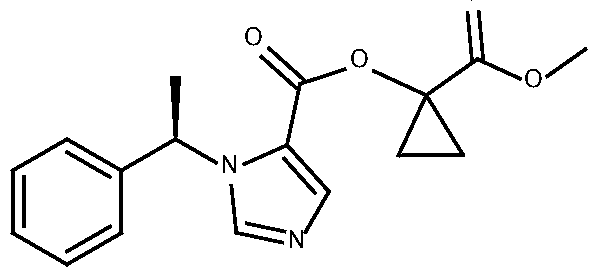
CPMM, or a pharmaceutically acceptable salt thereof, is the active compound in the formulations disclosed herein.
[028] As used herein, the term "pharmaceutically-acceptable salts" refers to the conventional non-toxic salts or quaternary ammonium salts of compounds described herein, e.g., from nontoxic organic or inorganic acids. These salts can be prepared in situ in the administration vehicle or the dosage form manufacturing process, or by separately reacting a compound described herein in its free base or acid form with a suitable organic or inorganic acid or base, and isolating the salt thus formed during subsequent purification. Conventional non-toxic salts include those derived from inorganic acids such as hydrochloric, hydrobromic, sulfuric, sulfamic, phosphoric, nitric, and the like; and the salts prepared from organic acids such as acetic, propionic, succinic, glycolic, stearic, lactic, malic, tartaric, citric, ascorbic, palmitic, maleic, hydroxymaleic, phenylacetic, glutamic, benzoic, salicyclic, sulfanilic, 2-acetoxybenzoic, fumaric,
toluenesulfonic, methanesulfonic, ethane disulfonic, oxalic, isothionic, and the like. See, for example, Berge et al., "Pharmaceutical Salts", J. Pharm. Sci. 66: 1-19 (1977), the content of which is herein incorporated by reference in its entirety. Exemplary salts also include the hydrobromide, hydrochloride, sulfate, bisulfate, phosphate, nitrate, acetate, succinate, valerate, oleate, palmitate, stearate, laurate, benzoate, lactate, phosphate, tosylate, citrate, maleate, fumarate, succinate, tartrate, naphthylate, mesylate, glucoheptonate, lactobionate,
laurylsulphonate salts, and the like. In certain embodiments, the pharmaceutically acceptable salt can be the hydrochloride salt.
[029] Suitable acids that are capable of forming salts with CPMM include inorganic acids such as hydrochloric acid, hydrobromic acid, perchloric acid, nitric acid, thiocyanic acid, sulfuric acid, phosphoric acid, and the like; and organic acids such as formic acid, acetic acid, propionic acid, glycolic acid, lactic acid, pyruvic acid, oxalic acid, malonic acid, succinic acid, maleic acid, fumaric acid, anthranilic acid, cinnamic acid, naphthalene sulfonic acid, sulfanilic acid, trifluoroacetic acid, methansulfonic acid, benzenesulfonic acid, p-toulenesulfonic acid, and the like.
[030] The compound can be present in a liquid formulation as disclosed herein at a
concentration of about 0.1 mg/mL to about 20 mg/mL, or about 1 mg/mL to 10 mg/mL. In some cases, the concentration is about 2 mg/mL to about 5 mg/mL. Since the compound can be administered as a short-acting anesthetic and continuously administered while anesthesia is desired, a subject is often administered high amounts of the compound. Thus, high
concentrations of the compound in a formulation are contemplated to minimize the total volume of formulation administered and minimize the total amounts of other excipients (e.g.,
solubilizers) administered. In the case of lyophilized formulations, the concentration refers to the amount of compound once reconstituted, or as instructed for reconstitution, e.g., by associated labeling. The concentration of the compound can be about 1 mg/mL, about 2 mg/mL, about 3 mg/mL, about 4 mg/mL, about 5 mg/mL, about 6 mg/mL, about 7 mg/mL, about 8 mg/mL, about 9 mg/mL, about 10 mg/mL, about 11 mg/mL, about 12 mg/mL, about 13 mg/mL, about 14 mg/mL, about 15 mg/mL, about 16 mg/mL, about 17 mg/mL, about 18 mg/mL, about 19 mg/mL, or about 20 mg/mL.
Solubility, pH, and Solubilizers
[031] The solubility of compounds as disclosed herein is pH-dependent. The imidazole nitrogen in position 3 of CPMM has a pKa of approximately 2.5, as determined by solubility analysis and titration. For example, CPMM is very water soluble at low pH, but solubility decreases with increasing pH, such that it is lower at pH 3-8. Thus, the compound as disclosed herein at lower pHs (e.g., 4 or less, or about 2.5 to about 4) has a higher solubility in aqueous liquid formulations.
[032] The solubilizer for use in the formulation will be pharmaceutically acceptable, e.g., for injection. The solubilizer can be a cyclodextrin. The solubilizer can additionally or alternatively be a co-solvent. Contemplated co-solvents include one or more of ethanol, t-butyl alcohol, DMSO, glycerol, propylene glycol, and polyethylene glycol.
[033] The compositions disclosed herein can also contain at least one cyclodextrin. Cyclodextrin is a cyclic structure of sugar units, typically having 6 (a-cyclodextrin), 7 (β- cyclodextrin), 8 (γ-cyclodextrin), or 9 (δ-cyclodextrin) sugar units in one cyclodextrin molecule. Also contemplated are cyclodextrins having 5, 10, 11, 12, 13, or more sugar units.
[034] Cyclodextrins may be amorphous or crystalline. Cyclodextrins are commercially available, or may be synthesized via means well known in the art. Examples of useful cyclodextrins include, but are not limited to, modified or unmodified α-, β-, γ-, and δ- cyclodextrins. Derivatives of cyclodextrins include derivatives wherein some of the OH groups are converted to OR groups. Cyclodextrin derivatives include those with short chain alkyl groups such as methylated, ethylated, propylated, and butylated cyclodextrins, wherein R is a methyl, ethyl, propyl, or butyl group; those with hydroxyalkyl substituted groups, such as, e.g., hydroxypropyl cyclodextrins and/or hydroxyethyl cyclodextrins, wherein R is a
-CH2CH(OH)CH3 or a -CH2CH2OH group; branched cyclodextrins such as maltose-bonded cyclodextrins; cationic cyclodextrins such as those containing 2-hydroxy-3- (dimethylamino)propyl ether, wherein R is CH2CH(OH)CH2N(CH3)2; quaternary ammonium, e.g., 2-hydroxy-3-(trimethylammonio)propyl ether chloride groups, wherein R is
-CH2CH(0H)CH2N+(CH3)3C1-; anionic cyclodextrins such as carboxymethyl cyclodextrins, cyclodextrin sulfates, and cyclodextrin succinylates; amphoteric cyclodextrins such as carboxymethyl/quaternary ammonium cyclodextrins; cyclodextrins wherein at least one glucopyranose unit has a 3-6-anhydro-cyclomalto structure, e.g., mono-3-6- anhydrocyclodextrins, as disclosed in "Optimal Performances with Minimal Chemical
Modification of Cyclodextrins", F. Diedaini-Pilard et al., The 7th International Cyclodextrin Symposium Abstracts, April 1994, p 49; and mixtures thereof. Other specific modifications contemplated include one or more hydroxyalkyl ether (e.g., R is Ci-6alkylenehydroxy) moieties; one or more sulfoalkyl ether (e.g., R is C2-6alkyleneS03-) moieties; carboxyalkyl (e.g., R is C(0)Ci-6alkyl) moieties; 6-perdeoxy-6-per(4-carboxyphenyl)thio moieties (Cooper et al., Org. Biomol. Chem., 3 : 1863 (2005)); substituted phenoxy moieties, such as 6-O-phenyl, 6-0(4- formyl-phenyl), 6-0-(4-nitrophenyl), 6-0-(4-bromophenyl), 6-0-(4-chlorophenyl), and 6-0-(4- hydroxybenzyl) (Liu et al., J. Org. Chem., 69: 173 (2004)); 6-amino-6-deoxy cyclodextrins (Rekharsky et al., J. Am. Chem. Soc, 124: 12361 (2002)); tryptophan moieties (Wang et al., J. Org. Chem. 70:8703 (2005)); or mixtures thereof.
[035] Cyclodextrin derivatives suitable for use herein include hydroxypropyl a-cyclodextrin, methylated a-cyclodextrin, methylated β-cyclodextrin, hydroxyethyl β-cyclodextrin, and hydroxypropyl β-cyclodextrin. A known methylated β-cyclodextrin is heptakis-2,6-di-0-methyl-
β-cyclodextrin, commonly known as DIMEB, in which each glucose unit has about 2 methyl groups with a degree of substitution of about 14. Another commercially available cyclodextrin which can be used in the disclosed compositions is methylated β-cyclodextrin, a randomly methylated β-cyclodextrin, commonly known as RAMEB.
[036] Other modified cyclodextrins are described, for example, in U.S. Pat. Nos. 3,426,011; 3,453,257; 3,453,258; 3,453,259; 3,453,260; 3,459,731; 3,453,257; 3,420,788; 3,426,011;
3,553,191; 3,565,887; 4,535, 152; 4,616,008; 4,638,058; 4,678,598; 4,727,064; 4,746,734;
5,376,645; 5,134, 127; 5,376,645; 5,602,112; 5,804,568; 5,824,668; 5,874,418; 6,046,177;
6,048,845; 6,133,248; 6,136,846; 6,218,374; 6,284,747; 6,509,370; 6,583, 125; and 6,982,253, each incorporated by reference in its entirety herein.
[037] In the formulations described herein, the cyclodextrins can be a-cyclodextrins, β-cyclodextrins, γ-cyclodextrins, and/or δ-cyclodextrins. The cyclodextrins can be modified cyclodextrins (e.g. a modified a-cyclodextrin, β-cyclodextrin, γ-cyclodextrin, and/or
δ-cyclodextrin). Specific modifications include, but are not limited to, hydroxyalkyl ethers and sulfoalkyl ethers. The cyclodextrins can be one or more of hydroxypropyl^-cyclodextrin (HPBCD or ΗΡβΟϋ interchangeably) and sulfobutylether-p-cyclodextrin (SBEBCD or 8ΒΕβΟϋ interchangeably). The modified cyclodextrins can be sulfobutylether-l^-cyclodextrin, sulfobutylether-4^-cyclodextrin, sulfobutylether-7^-cyclodextrin, and/or hydroxypropylether- β-cyclodextrin. The modified cyclodextrin can comprise sulfobutylether-7^-cyclodextrin, for example. In some cases, the cyclodextrin is sulfobutylether^-cyclodextrin, hydroxypropyl-β- cyclodextrin, or a combination thereof.
[038] The amount of solubilizer, e.g., cyclodextrin, in a composition disclosed herein may be widely adjusted to achieve desired physical characteristics, such as solubility, stability, and/or decreased toxicity of the formulation. The solubilizer, e.g., cyclodextrin, can be present in an amount in a range of about 6 % to about 30 %, about 6 % to about 20 %, or about 6 % to about 12 % by weight based on weight of cyclodextrin per volume (% w/v) or weight (% w/w) of solution. Specific weight percentages of cyclodextrin present in a composition of the present invention can include about 6 %, about 7 %, about 8 %, about 9 %, about 10 %, about 11 %, about 12 %, about 13 %, about 14 %, about 15 %, about 16 %, about 17 %, about 18 %, about 19 %, about 20 %, about 21 %, about 22 %, about 23 %, about 24 %, about 25 %, about 26 %, about 27 %, about 28 %, about 29 %, about 30 % weight by weight (% w/w) or weight by volume (% w/v), for example.
[039] The solubilizer can be present in a molar ratio to the compound of about 1 mol solubilizer to 1 mol compound (CPMM) (1 : 1) to about 8 mol solubilizer to 1 mol compound (8: 1). In some cases, the ratio or solubilizer to compound is about 1 : 1 to about 4: 1. In cases where the solubilizer is a cyclodextrin, the ratio of compound complexed to the cyclodextrin to
uncomplexed compound is 1.5 mol complexed to 1 mol uncomplexed to 16 mol complexed to 1 mol complexed (1.5: 1 to 16: 1). In some cases, the ratio of complexed to uncomplexed is 2: 1 to 15: 1, 3 : 1 to 15: 1, 10: 1 to 15: 1, or 5: 1 to 16: 1.
[040] The pH of an aqueous solution of a salt of a compound as disclosed herein, e.g., CPMM, is in a range of about 2.5 to about 4, based upon the pKa of the CPMM salt. The solubilizer can allow for the maintenance of or increased solubility and/or stability of the compound in a liquid formulation at pH greater than 2.5, about 2.5 to about 4, about 3 to about 7, or about 6 to about 7.4. The pH of the aqueous formulation can be adjusted by inclusion of a buffer and/or pH adjuster (e.g., an acid or base). The pH of the aqueous formulation can be in a range of about 2 to about 7, about 2.5 to about 7.4, about 2.5 to about 4, about 4 to about 6.5, about 5 to about 6.5, or about 6 to about 7.4.
[041] The buffer or base can be an amine-based buffer or base. The buffer will be one that is pharmaceutically acceptable, e.g., for an injectable formulation. Specific buffers, acids, and bases contemplated include, but are not limited to, NaOH, KOH, triethylamine, meglumine, diethanolamine, ammonium hydroxide, ammonium acetate, arginine, lysine, histidine, a phosphate buffer (e.g., sodium phosphate tribasic, sodium phosphate dibasic, sodium phosphate monobasic, or o-phosphoric acid), sodium bicarbonate, a Britton-Robinson buffer, a Tris buffer (containing Tris(hydroxymethyl)aminomethane), a HEPES buffer (containing N-(2- hydroxyethyl)piperazine-N'-(2-ethanesulfonic acid), acetate, a citrate buffer (e.g., citric acid, citric acid anhydrous, citrate monobasic, citrate dibasic, citrate tribasic, citrate salt), ascorbate, glycine, glutamate, lactate, malate, formate, sulfate, and mixtures thereof. In some cases, the buffer comprises a citrate buffer and NaOH. Buffer salts can be anhydrous or hydrates. Buffers can be sodium salts or potassium salts.
Stability
[042] The aqueous formulations disclosed herein can be storage stable, as assessed by the total amount of degradants measured and the amount of any single degradant after a period of time following making the formulation from the pure active compound. The formulation can exhibit 5 % or less, 4 % or less, 3 % or less, 2 % or less, or 1 % or less total degradants after a particular time period under particular temperatures, and optionally elevated humidity. The degradant level(s) can be assessed as an absolute measurement or as a relative measurement, based upon the
starting purity of the active compound, e.g., an increase in degradants of 5 % or less, 4 % or less, 3 % or less, 2 % or less, or 1 % or less, relative to the starting amounts in the original active compound. The formulation is assayed and the amount of degradants and active agent are measured to determine the stability of the formulation under the specific storage conditions. The stability can be assessed after 1 hour, 4 hours, 6 hours, 8 hours, 12 hours, 18 hours, 24 hours, 2 days, 3 days, 1 week, 2 weeks, 1 month, 2 months, 3 months, 4 months, 5 months, 6 months, 7 months, 8 months, 9 months, 10 months, 11 months, 1 year (12 months), 18 months, 2 years (24 months), 2.5 years (30 months), or 3 years (36 months) or longer. The temperature at which the formulation is held to assess stability can be at less than 0 °C, less than -10 °C, in a range of about -20 °C to -10 °C, in a range of about 2 °C to about 8 °C, or about 15 °C to about 30 °C (e.g., room temperature). In cases where the formulation is lyophilized, the formulation is reconstituted with an aqueous diluent just prior to assessing the amount of degradants. The stability of the formulation can be assessed after 1 week stored at less than -10 °C or -20 °C to -10 °C; after 1 month stored at less than -10 °C or -20 °C to -10 °C; after 3 months stored at less than -10 °C or -20 °C to -10 °C; after 6 months stored at less than -10 °C or -20 °C to -10 °C; after 1 year stored at less than -10 °C or -20 °C to -10 °C; after 1 week stored at less than 0 °C; after 1 month stored at less than 0 °C; after 3 months stored at less than 0 °C; after 6 months stored at less than 0 °C; after 1 year stored at less than 0 °C; after 1 week stored at 2-8 °C; after 1 month stored at 2-8 °C; after 3 months stored at 2-8 °C; after 6 months stored at less than 2-8 °C; after 1 year stored at 2-8 °C; after 1 week stored at 16-28 °C; after 1 month stored at 15-30 °C; after 3 months stored at 15-30 °C; after 6 months stored at 15-30 °C; after 1 year stored at 15-30 °C; or a combination thereof.
Methods of Making Formulations
[043] Cyclodextrin-based formulations can be obtained by preparing a solution of a
cyclodextrin (8-20 % w/w), to which is added the active compound (0.1-20 mg/mL). The pH can then be adjusted to the desired level (pH 2.5-7.4) using an appropriate acid, base, or buffer. The resulting solution can be filtered to sterility into a container. Alternatively, cyclodextrin-based formulations can be obtained by preparing a cyclodextrin solution having the desired level of pH before adding the active compound. The solution may be used immediately or stored under appropriate conditions, e.g., frozen (approximately -20 °C or -20 °C to -10 °C), refrigerated (2-8 °C) or at ambient temperature (15-30 °C) depending upon the duration of storage.
[044] Optionally, the formulation can be lyophilized after preparation and stored under appropriate conditions, e.g., frozen (approximately -20 to -10 °C), refrigerated (2-8 °C) or at ambient temperature (16-28 °C) depending upon the duration of storage. Prior to use (e.g., 24
hours or less, or 12 hours or less, or 6 hours or less, or 2 hours or less), the healthcare professional can reconstitute the lyophilized formulation, as described above. The lyophilized formulation can further include one or more modifiers. The modifier can be selected from one or more members of each of the following categories, and one or more agent in each category: bulking agents, tonicif ing agents, antimicrobial agents, antioxidants, and collapse temperature modifiers. Bulking agents include sugars (mannitol, lactose, sucrose, trehalose, sorbitol, glucose, raffinose), amino acids (arginine, glycine, histidine), and polymers (polyethylene glycol (PEG), dextran, polyvinylpyrrolidone (PVP)). Tonicifying agents include sodium chloride, sucrose, mannitol, and dextrose. Antimicrobial agents include benzyl alcohol, phenol, m-cresol, methyl paraben, and ethyl paraben. Antioxidants include ascorbic acid, glutamate, sulfite, and bisulfite. Collapse temperature modifiers include dextran, hydroxyethyl starch, ficoll, and gelatin. The modifier can be added to the formulation prior to lyophilization. Non-limiting examples of modifiers for use in lyophilized formulations include dextran, hydroxyethyl starch,
hydroxymethyl starch, Ficoll, gelatin, mannitol, lactose, sucrose, trehalose, sorbitol, glucose and raffinose.
[045] A formulation as disclosed herein can be placed into a syringe, as a "pre-filled syringe," for later use.
Methods of Administration
[046] For intravenous administration, a formulation as disclosed herein can be drawn into a syringe or filled in an intravenous infusion bottle or bag and administered to the human or animal as a bolus and/or continuous infusion. To induce brief periods of anesthesia or induce anesthesia to be maintained for longer durations, bolus administration can be made manually with a formulation from a syringe. To achieve extended duration of anesthesia, continuous infusion administration can be made either from a syringe mounted in a syringe pump set to deliver formulation at an appropriate rate, or from an intravenous bag or bottle with administration rate regulated by a drip rate or peristaltic pump. Typically, bolus administration can be used to induce anesthesia prior to continuous infusion to sustain anesthesia. Bolus administration and infusion administration are each contemplated for inducing sedation.
[047] The formulations are administered so that the active compound is used or given at a dose from 1 μg/kg to 1000 mg/kg; 1 μg/kg to 500 mg/kg; 1 μg/kg to 150 mg/kg, 1 μg/kg to
100 mg/kg, 1 μg/kg to 50 mg/kg, 1 μg/kg to 20 mg/kg, 1 μg/kg to 10 mg/kg, 1 μg/kg to 1 mg/kg,
100 μg/kg to 100 mg/kg, 100 μg/kg to 50 mg/kg, 100 μg/kg to 20 mg/kg, 100 μg/kg to 10 mg/kg,
100 μg/kg to 1 mg/kg, 1 mg/kg to 100 mg/kg, 1 mg/kg to 50 mg/kg, 1 mg/kg to 20 mg/kg,
1 mg/kg to 10 mg/kg, 10 mg/kg to 100 mg/kg, 10 mg/kg to 50 mg/kg, or 10 mg/kg to 20 mg/kg.
It is to be understood that ranges given here include all intermediate ranges, for example, the range 1 mg/kg to 10 mg/kg includes 1 mg/kg to 2 mg/kg, 1 mg/kg to 3 mg/kg, 1 mg/kg to 4 mg/kg, 1 mg/kg to 5 mg/kg, 1 mg/kg to 6 mg/kg, 1 mg/kg to 7 mg/kg, 1 mg/kg to 8 mg/kg, 1 mg/kg to 9 mg/kg, 2 mg/kg to 10 mg/kg, 3 mg/kg to 10 mg/kg, 4 mg/kg to 10 mg/kg, 5 mg/kg to 10 mg/kg, 6 mg/kg to 10 mg/kg, 7 mg/kg to 10 mg/kg, 8 mg/kg to 10 mg/kg, 9 mg/kg to 10 mg/kg, and the like. It is to be further understood that the ranges intermediate to those given above are also within the scope of this disclosure, for example, in the range 1 mg/kg to 10 mg/kg, for example use or dose ranges such as 2 mg/kg to 8 mg/kg, 3mg/kg to 7 mg/kg, 4 mg/kg to 6 mg/kg, and the like.
[048] The formulation can be administered as a single bolus or multiple boluses, as a continuous infusion, or a combination thereof. For example, the formulation can be administered as a single bolus initially, and then administered as a continuous infusion following the bolus. The rate of the infusion can be any rate sufficient to affect anesthesia or sedation. Some contemplated infusion rates include from 1 μg/kg/min to 100 mg/kg/min, or from 1 μg/kg/hr to 1000 mg/kg/hr. It will be appreciated that the rate of infusion can be determined based upon the dose necessary to induce sedation or anesthesia and the rate of elimination of the compound, such that the formulation is administered via infusion at a rate sufficient to safely maintain a sufficient amount of compound in the bloodstream to affect anesthesia or sedation.
[049] In some embodiments, the formulation is used or administered at a dosage so that the active compound has an in vivo concentration of less than 500 nM, less than 400 nM, less than 300 nM, less than 250 nM, less than 200 nM, less than 150 nM, less than 100 nM, less than 50 nM, less than 25 nM, less than 20, nM, less than 10 nM, less than 5 nM, less than 1 nM, less than 0.5 nM, less than 0.1 nM, less than 0.05 nM, less than 0.01 nM, less than 0.005 nM, or less than 0.001 nM, at and/or after a specific time following use or administration, such as 15 mins, 30 mins, 1 hr, 1.5 hrs, 2 hrs, 2.5 hrs, 3 hrs, 4 hrs, 5 hrs, 6 hrs, 7 hrs, 8 hrs, 9 hrs, 10 hrs, 11 hrs, 12 hrs or more of time after use or administration of the composition. For example, the active compound in a formulation as disclosed herein is administered at a dosage so that it has an in vivo concentration of less than 500 nM at 30 minutes after use or administration. As another example, the active compound is administered at a dosage so that its inactive metabolite has an in vivo concentration of less than 500 nM at 1 hr after use or administration.
[050] In some cases, the formulation is used or administered at a dosage so that the active compound has an initial in vivo concentration of about 1 μΜ to about 10 μΜ to achieve anesthesia, then is administered as an infusion to maintain anesthesia. After administrations of the infusion, the compound concentration drops to less than 500 nM as noted above.
[051] The terms "administration of and or "administering" a compound should be understood to mean providing a compound or a composition described herein to a subject in need of inducing anesthesia. As such, the term "administer" refers to the placement of a compound or
composition described herein into a subject by a method or route which results in at least partial localization of the compound or composition at a desired site such that general anesthesia or conscious sedation is induced and/or maintained in the subject.
EXAMPLES
Example 1
[052] Early work showed that CPMM quickly hydrolyzed into etomidate acid in an aqueous solution. Studies were performed to develop a CPMM formulation that slowed this hydrolysis reaction.
Aqueous pH Solubility
[053] CPMM was evaluated for maximum solubility in aqueous pH 1-9 buffer solutions.
CPMM was weighted into 1.0 mL of each solution, vortex mixed to solubilize, and placed on a shaker table until saturated. Additional CPMM was added and replaced on the shaker table until a saturated solution was obtained. The one exception was the pH 1 sample solution, which never reached saturation level due to the CPMM's high solubility at that pH range. Saturated solutions were centrifuged and the supernatants were analyzed by HPLC. The maximum CPMM concentrations of each aqueous buffer solution is listed in Table 1 and plotted in Figure 1.
Table 1. Maximum solubility of CPMM in aqueous pH 1-9 buffer media.

* not a true maximum solubility concentration
[054] The CPMM solubility data was used to generate a log solubility curve, which is shown in Figure 2. Based on this data, the pKa was estimated to be about 2.5.
[055] CPMM solubility was also evaluated in common solvents: water, methanol, ethanol, acetonitrile, and isopropanol. CPMM was weighed into 1.0 mL of each solvent and vortex- mixed. Only the water sample was saturated with CPMM; the other solvents never achieved saturation due to their high CPMM solubility. The screening was stopped after 100 mg of bulk CPMM had been added. Table 2 lists the ABP-700 solubility results in common solvents.
Table 2. CPMM solubility in common solvents.

[056] The aqueous CPMM pH 1-9 samples described above were diluted as necessary to approximately 0.3 mg/mL and placed on accelerated stability at 25 °C/60 % relative humidity and 40 °C/75 % relative humidity conditions for two weeks. Samples were pulled at t=0, 1, and 2 weeks from set-up, and analyzed by HPLC. Samples were diluted to approximately 0.3 mg/mL, which well below the HPLC method nominal concentration, due to concerns of precipitation during the two week stability study. The injection volume was increased to compensate for the lower drug concentration in solution. The change in CPMM purity over the study duration is listed in Table 3 and plotted in Figures 3-5.
[057] The pH 1 sample was placed on stability at a non-diluted concentration due to an error. This sample was re-diluted at the one-week time point to match the concentration in the pH 2-9 samples and re-placed on stability. The pH 9 sample results were not included in Figures 3-5 due to excessive degradation and for easier visual assessment over the more relevant pH 2-8 range.
Table 3. 1- and 2-week stability data for CPMM in aqueous pH buffer media.

Binary Excipient Screening
[058] CPMM was evaluated for compatibility with excipients that are suitable for IV administration. A buffer solution (phosphate at pH 3) was selected as the diluent for excipient screening studies. Table 4 shows the IV-compatible excipients and their respective amounts in the phosphate pH 3 buffer diluent. CPMM was solubilized in each excipient solution at 1 mg/mL.
Table 4. IV-compatible excipients and their respective amounts in the phosphate pH 3 buffer diluent.

[059] At a 1 mg/mL concentration, CPMM readily dissolved in the two cyclodextrin solutions, as well as all of the surfactant solutions. However, slow CPMM solubilization was observed for all other excipient samples during solution preparation. While CPMM completely dissolved in
the control sample within several minutes, many of the excipient solutions required overnight storage at 5 °C to solubilize the drug.
[060] Each excipient sample solution was placed on a two-week stability study at 25 °C/60 % relative humidity and 40 °C/75 % relative humidity, and analyzed for CPMM purity at t=0, 1, and 2 weeks by comparing individual samples to their respective excipient blank solution. The excipient compatibility data are listed in Table 5.
Table 5. 1- and 2-week stability data for CPMM in aqueous solution containing different IV-compatible excipients.
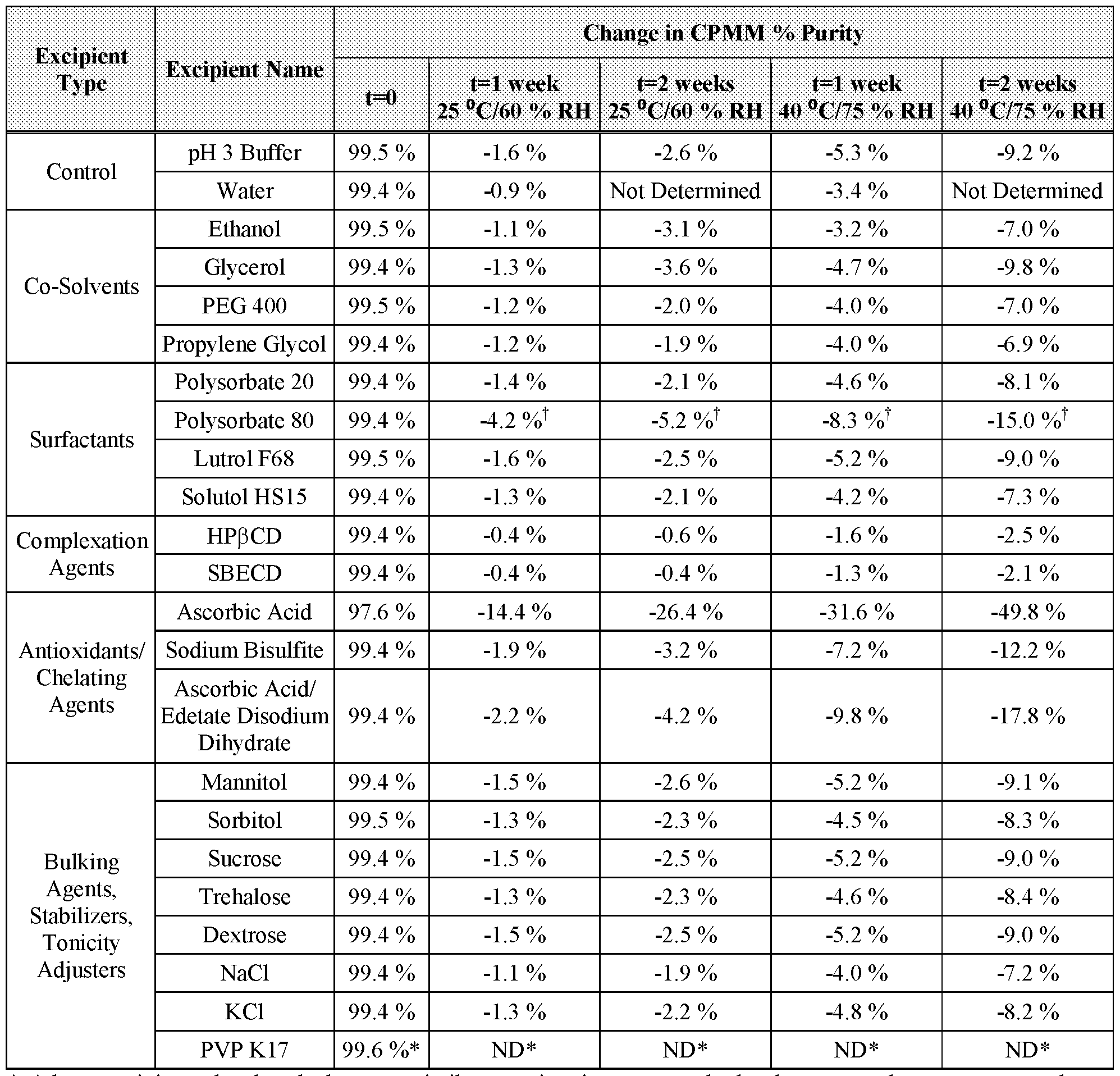
are not accounted
RH: Relative Humidity
ND: Not Detected
[061] Complexation agents at pH 3 were the only excipients that were found to be more stabilizing than the water control sample at neutral pH. All other excipient solutions either only minimally stabilized CPMM or de-stabilized CPMM also at pH 3.
Example 2
[062] Based on the excipient screening and pH solubility data, initial studies focused on the use of cyclodextrins to solubilize CPMM in an aqueous formulation. Selected test formulations containing are HP CD and SBECD are described in Tables 6 and 7, respectively.
Table 6. Summary of results from initial studies on select test HPpCD formulations.
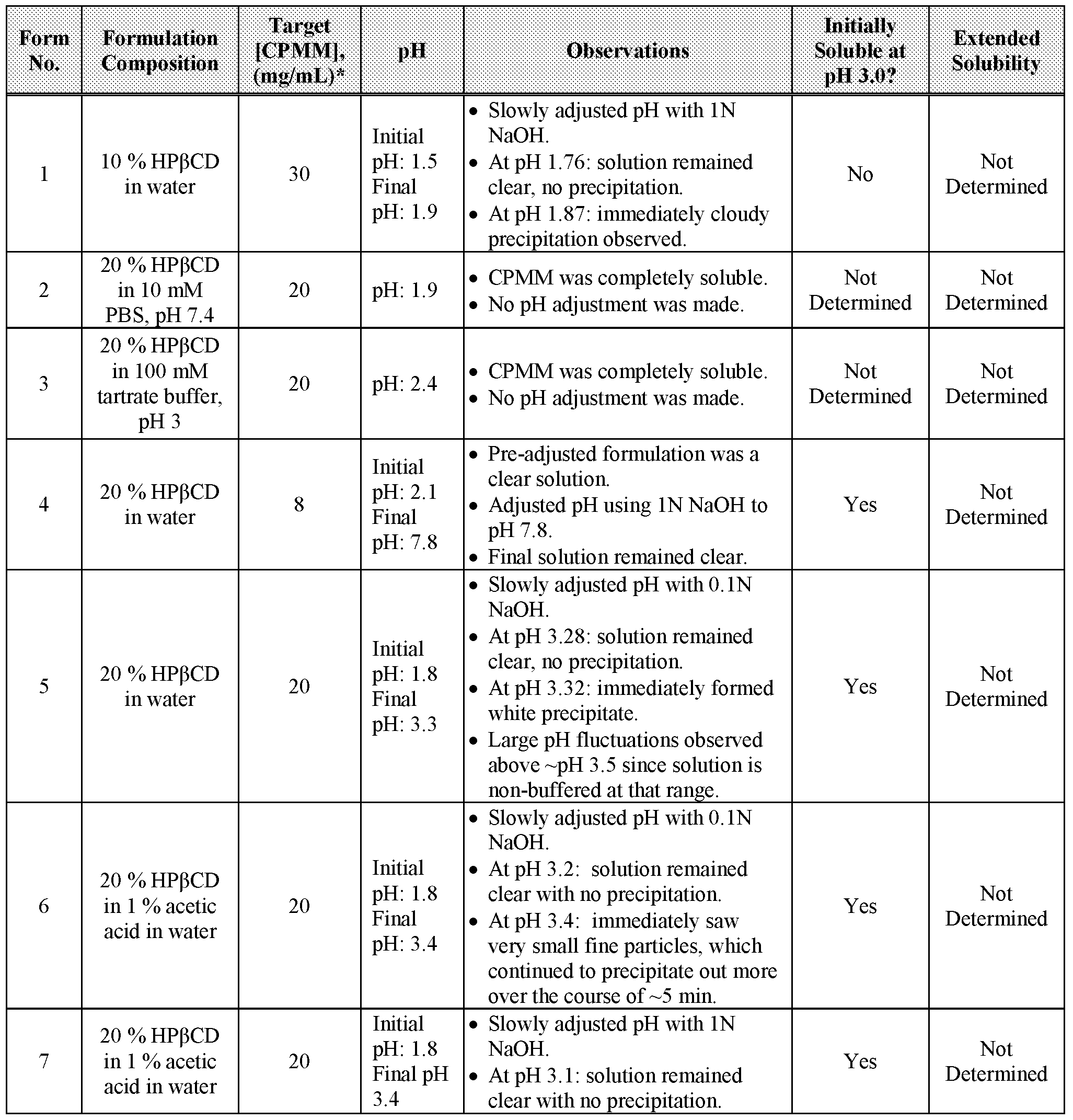
precipitates after the last addition
of IN NaOH.
• Prep 1 : adjusted pH with IN
NaOH.
• At pH 3.0: solution remained
clear, no precipitation.
• Solution is physically stable at
room temperature for at least ~4- 6 hours. Crystalline precipitate
observed after that time.
Physically
• Prep 2: adjusted pH with IN stable for ~6 NaOH.
Initial hours
20 % ΗΡβΟϋ pH: 1.8 • At pH 3.0: solution remained at RT and 3
20 Yes in water Final clear, no precipitation. days when pH: 3.0 • Filtered solution through a filtered
0.2 μπι PVDF filter - and stored and stored at in new glass vials at room 2-8°C temperature and 2-8°C. The
filtered room temp solution was
stored overnight and crystalline
precipitates were observed the
following morning (~15 hours).
The filtered 2-8°C solution
remained completely soluble for
3 days.
• Slowly adjusted pH with IN
NaOH.
Initial • At pH 2.8: solution remained
20 % HP CD pH: 1.8 clear with no precipitation. Not
25 No in water Final pH • At pH 2.9: immediately saw very Determined
2.9 small fine particles, which
continued to precipitate out more
over the course of ~5 min.
• Slowly adjusted pH with IN
NaOH.
.25 % HPMC Initial
• At pH 3.1 : solution remained
in 20 % pH: 1.7 Not
25 clear with no precipitation. Yes HP CD in Final pH Determined water 3.2 • At pH 3.2: immediately saw
small particles, which continued
to precipitate out.
• Slowly adjusted pH with IN
Initial Precipitates.25 % PVP in NaOH.
pH: 1.7 within 20 % HP CD 25
Final pH • At pH 3.0: solution remained Yes
~60 seconds in water
3.0 clear initially, but then started to at RT precipitate within <60 seconds.
• Slowly adjusted pH with 0. IN
NaOH.
• At pH 2.8: solution remained
Initial clear with no precipitation.
20 % HP CD
pH: 1.8 Added another 20 μΐ, of 0. IN Not in 1 % acetic 30 • No
Final pH Determined acid in water NaOH (pH 2.8): immediately
2.8 saw very small fine particles,
which continued to precipitate
out more over the course of
~5 min.
Initial • Added IN NaOH to adjust to Target pH is
Precipitates
20 % HP CD pH: 1.8
30 pH 2.5: solution initially 2.5.
after ~ 10 in water Final pH remained clear with no Formulation
min at RT 2.5 precipitation, but then began to is initially
precipitate after ~10 min. from soluble at
the time of prep. pH 2.5
• Added IN NaOH to adjust the
Initial pH to 3.1 : solution remained
10 % ΗΡβΟϋ pH: 2.0 clear with no precipitation. Not
14 11.5 Yes
in water Final pH • Added additional IN NaOH Determined
3.2 (pH 3.2): precipitation observed
immediately.
• Added IN NaOH to adjust the
Precipitates
Initial pH to 3.0: solution remained
within
5 % HP CD in pH: 2.2 clear with no precipitation.
15 7.3 Yes ~2 min after water Final • Added additional IN NaOH
preparation pH: 3.3 (pH 3.4): precipitation observed
at RT immediately.
• Added IN NaOH to adjust the Precipitates
Initial pH to 3.0: solution was initially within
5 % HP CD in pH: 2.3 clear with no precipitation, but ~10 min
16 6.5 Yes
water Final then began to precipitate after after pH: 3.0 ~10 minutes from the time of preparation prep. at RT
Target concentration corresponds to the free base form and accounts for HPLC purity but not water content and residual solvents.
Table 7. Summary of results from initial studies on select test SBECD.

over the course of ~5 min.
• Added IN NaOH to adjust to
pH 2.8: solution remained clear
Initial with no precipitation.
20 % SBECD pH: 2.4 • Added additional IN NaOH Not
6 25 No
in water Final pH (pH 2.9): immediately saw very determined
2.9 small fine particles, which
continued to precipitate out more
over ~5 min.
• Added IN NaOH to adjust to
pH 3.6: solution remained clear,
Initial no precipitation.
5 % SBECD in pH: 2.8 • Added additional IN NaOH Not
7 7.3 Yes
water Final (pH 3.8): immediately saw small determined pH: 3.8 fine particles which continued to
precipitate out more over ~5
min.
Target concentration corresponds to the free base form and accounts for HPLC purity but not water content and residual solvents.
Example 3
[063] Based on the pH evaluations and studies described in Examples 1 and 2, six CPMM formulations containing HP CD or SBECD were prepared and tested. These formulations are shown in Table 8.
Table 8. CPMM formulations containing HPPCD or SBECD.

[064] These six formulations were scaled up, filtered through a 0.2 μπι PVDF membrane filter (13 mm), and stored at 2-8 °C and ambient temperature/ambient humidity. These formulations were evaluated for physical and chemical stability over two weeks, with time points at t=0, 1 and 2 weeks. The data from this 2-week stability study are reported in Table 9.
Table 9. 1- and 2-week stability data for CPMM formulations containing HPPCD or SBECD.
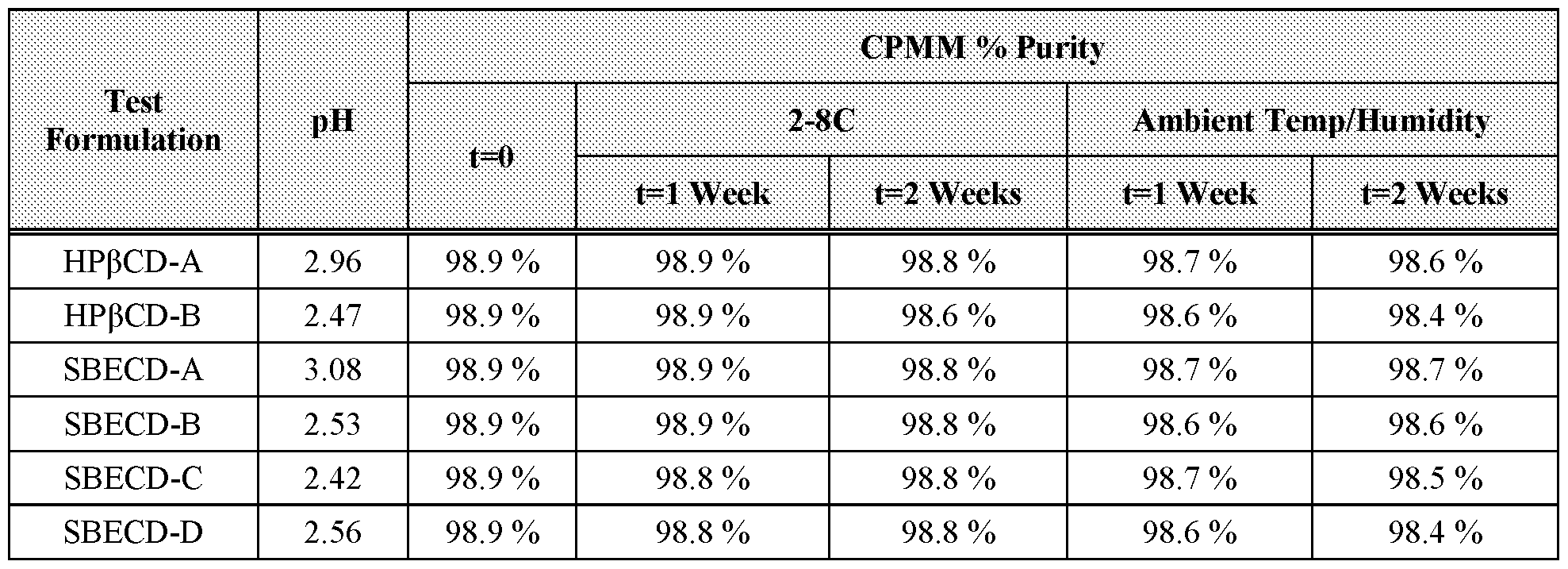
[065] Formulations containing HPpCD versus SBECD at the same active concentrations resulted in similar CPMM purities on stability.
[066] The SBECD formulation remained soluble after multiple freeze-thaw cycles with a consistent pH from t=0. While degradation is observed at or above 25 °C/60 % relative humidity, the SBECD formulation appeared relatively stable at below ambient temperature conditions. Etomidate acid, which elutes at 4.3 minutes, is the main degradation product for the SBECD formulation at pH 2.5 (see Figure 6).
Example 4
[067] A study was conducted to evaluate whether buffer concentration affects the maximum solubility of CPMM. The formulations that were tested contained CPMM, 10 % SPECD, and citrate buffer at 10 mM, 25 mM, or 50 mM. The solutions were prepared and CPMM was added until saturation was achieved. The pH was controlled by continually titrating the solutions to pH 6 using NaOH. Saturation was determined to have been achieved after the pH had stabilized and undissolved remained in the vial after overnight shaking. Solubility was evaluated by taking two separate samplings over the course of two days to verify that saturation had been achieved. Solubility was measured when the formulations were at room temperature, as well as tested when the formulations were under sub-ambient conditions (2-8 °C) to evaluate whether the solubility would be affected at lower temperatures for long term storage at (2-8 °C). The results are shown in Table 10.
Table 10. Maximum solubility in CPMM formulations with different concentrations of citrate buffer.
( I'M M Amount
( nip sili n ( ndili n pi " ( in» ni l .)
10 mM Citrate RT/Ambient RH 5.96 0.30
25 mM Citrate RT/Ambient RH 6.00 0.28
50 mM Citrate RT/Ambient RH 5.98 0.23
RT/Ambient RH 5.98 5.47
10% SBECD in 10 mM Citrate
2-8 °C/ambient RH 6.05 5.48
RT/Ambient RH 5.98 5.49
10 % SBECD in 25 mM Citrate
2-8 °C/ambient RH 6.02 5.59
10 % SBECD in 50 mM Citrate RT/Ambient RH 5.99 5.68 room temperature
relative humidity
[068] The citrate solutions containing no SBECD had approximately 0.3 mg/mL solubility, which was expected based on previous pre-formulation experiments. The 10 % SBECD solutions at all citrate concentrations all had approximately 5.5 mg/mL solubility regardless of the condition. This indicates that the maximum solubility of ABP-700 is most likely not affected by citrate concentration from 10 mM to 50 mM and the storage condition either room
temperature or sub-ambient.
Example 5
[069] Ten CPMM formulations containing SBECD were prepared to study their stability over different storage durations. The components of the formulations are shown in Table 11 below.
Table 11. CPMM formulations

[071] The materials and equipment used to prepare the formulations are shown in Table 12 below.
Table 12. Materials and equipment

[072] The following steps were used to prepare 10 mM citrate buffer pH 6: 0.00170 mM citric acid, 0.00830 mM sodium citrate (2000 mL scale):
1. Weighed 653.22 mg ± 13.01 mg of citric acid anhydrous and transferred into a 2000- mL volumetric flask.
2. Weighed 4283.95 mg ± 20.00 mg of sodium citrate (tribasic) and transferred into the same flask.
3. Diluted to -80% volume with SWFI and swirled to dissolve all solids.
4. Adjusted pH with IN NaOH as necessary to obtain a pH of 6.00 ± 0.05.
5. QS'd to volume and mixed by inversion.
[073] The following steps were used to prepare 10 mM citrate buffer pH 5: 0.00398 mM citric acid, 0.00602 mM sodium citrate, (2000 mL scale):
1. Weighed 1529.31 mg ± 20.00 mg of citric acid anhydrous and transferred into a 2000- mL volumetric flask.
2. Weighed 3107.15 mg ± 20.00 mg of sodium citrate (tribasic) and transferred into the same flask.
3. Diluted flask to -80% volume with SWFI and swirled to dissolve all solids.
4. Adjusted pH as necessary to obtain a pH of 5.00 ± 0.05.
5. QS'd flask to volume with additional SWFI and mixed by inversion.
[074] The following steps were used to prepare 10 mM citrate buffer pH 5.5: 0.00287 mM citric acid, 0.00713 mM sodium citrate, 1000 mL:
1. Weighed 551.40 mg ± 11.03 mg of citric acid anhydrous and transferred into a 1000- mL volumetric flask.
2. Weighed 1840.03 mg ± 20.00 mg of sodium citrate (tribasic) and transferred into the same flask.
3. Diluted flask to -80% volume with SWFI and swirled to dissolve all solids.
4. Adjusted pH with IN NaOH as necessary to obtain a pH of 5.50 ± 0.05.
5. QS'd flask to volume with additional SWFI and mixed by inversion.
[075] The following steps were used to prepare 22% SBECD solution in 10 mM citrate, pH 5 (300-g scale):
1. Weighed 68.82 g of SBECD into a 1000-mL solvent bottle.
2. Weighed 231.18 g of 10 mM citrate, pH 5 into the same bottle.
3. Placed on shaker to dissolve all solids.
[076] The following steps were used to prepare 22% SBECD solution in 10 mM citrate, pH 6 (300-g scale):
1. Weighed 68.82 g of SBECD into a 1000-mL solvent bottle.
2. Weighed 231.18 g of 10 mM citrate, pH 6 into the same bottle.
3. Placed on shaker to dissolve all solids.
[077] The following steps were used to prepare 18% SBECD solution in 10 mM citrate, pH 5 (300-g scale):
1. Weighed 56.31 g of SBECD into a 1000-mL solvent bottle.
2. Weighed 243.69 g of 10 mM citrate, pH 5 into the same bottle.
3. Placed on shaker to dissolve all solids.
[078] The following steps were used to prepare 18% SBECD solution in 10 mM citrate, pH 6 (300-g scale):
1. Weighed 56.31 g of SBECD into a 1000-mL solvent bottle.
2. Weighed 243.69 g of 10 mM citrate, pH 6 into the same bottle.
3. Placed on shaker to dissolve all solids.
[079] The following steps were used to prepare 20% SBECD solution in 10 mM citrate, pH 5.5 (300-g scale):
1. Weighed 62.57 g of SBECD into a 1000-mL solvent bottle.
2. Weighed 237.43 g of 10 mM citrate, pH 5.5 into the same bottle.
3. Placed on shaker to dissolve all solids.
[080] The following steps were used to prepare a generic formulation (250-mL scale):
1. Added a stir bar into a 250-mL solvent bottle.
2. Recorded tare weight of bottle with stir bar.
3. Weighed target amount of ABP-700 into same bottle.
4. Weighed 125 mL (-137.5 g) of SBECD solution in 10 mM citrate buffer into same bottle.
5. Stirred to completely solubilize all API.
6. Transferred 100 mL (-100 g) of 10 mM citrate buffer into the same bottle.
7. Titrated solution to target pH ± 0.05 with 0.5N NaOH.
8. QS'd solution to 250-mL with additional 10 mM citrate buffer.
[081] The formulations were tested for stability after storage under various conditions at time points 0, 0.5 months, 1 month, 3 months, 6 months, and 12 months. The formulations were stored in a 10 mL clear type 1 tubing glass vial, which were asceptically filled. Stability was measured using HPLC.
[082] The stability data at 0.5, 1, 2, 3, and 6 months for Formulation 1 (5 mg/mL CPMM, 9.0% SBECD, 10 mM citrate, at pH 5.0) stored at 40 °C under 75 % relative humidity is shown in Tables 13 and 14 below.
Table 13. 0.5- and 1-month stability data for Formulation 1 stored at 40 °C under 75 % relative humidity.

RH: Relative Humidity
RRT: Relative Retention Time
NT: Not Tested
ND: Not Detected or <0.05% area
Table 14. 2-, 3-, and 6-month stability data for Formulation 1 stored at 40 °C under 75 % relative humidity.

[083] The stability data at 3-, 6-, and 12-months for Formulation 1 (5 mg/mL CPMM, 9.0% SBECD, 10 mM citrate, at pH 5.0) stored at 2-8 °C is shown in Table 15 below.
Table 15. 3-, 6-, and 12-month stability data for Formulation 1 stored at 2-8 °C.

[084] The stability data at 3-, 6-, and 12-months for Formulation 1 (5 mg/mL CPMM, 9.0% SBECD, 10 mM citrate, at pH 5.0) stored at 25 °C, 60 % relative humidity is shown in Table 16 below.
Table 16. 3-, 6-, and 12-month stability data for Formulation 1 stored at 25 °C, 60 % relative humidity.

[085] The stability data at 0.5, 1, 2, 3, and 6 months for Formulation 2 (3 mg/mL CPMM, 9.0% SBECD, 10 mM citrate, at pH 5.0) stored at 40 °C under 75 % relative humidity is shown in Tables 17 and 18 below.
Table 17. 0.5- and 1-month stability data for Formulation 2 stored at 40 °C under 75 % relative humidity.

Table 18. 2-, 3, and 6-month stability data for Formulation 2 stored at 40 °C under 75 % relative humidity.

[086] The stability data at 3-, 6-, and 12-months for Formulation 2 (3 mg/mL CPMM, 9.0% SBECD, 10 mM citrate, at pH 5.0) stored at 2-8 °C is shown in Table 19 below.
Table 19. 3-, 6-, and 12-month stability data for Formulation 2 stored at 2-8 °C.

[087] The stability data at 3-, 6-, and 12-months for Formulation 2 (3 mg/mL CPMM, 9.0% SBECD, 10 mM citrate, at pH 5.0) stored at 25 °C, 60 % relative humidity is shown in Table 20 below.
Table 20. 3-, 6-, and 12-month stability data for Formulation 2 stored at 25 °C, 60 % relative humidity.

[088] The stability data at 0.5, 1, 2, 3, and 6 months for Formulation 3 (5 mg/mL CPMM, 11.0% SBECD, 10 mM citrate, at pH 6.0) stored at 40 °C under 75 % relative humidity is shown in Tables 21 and 22 below.
Table 21. 0.5- and 1-month stability data for Formulation 3 stored at 40 °C under 75 % relative humidity.

Table 22. 2-, 3-, and 6-month stability data for Formulation 3 stored at 40 °C under 75 % relative humidity.

[089] The stability data at 3-, 6-, and 12-months for Formulation 3 (5 mg/mL CPMM, 11.0% SBECD, 10 mM citrate, at pH 6.0) stored at 2-8 °C is shown in Table 23 below.
Table 23. 3-, 6-, and 12-month stability data for Formulation 3 stored at 2-8 °C.

[090] The stability data at 3-, 6-, and 12-months for Formulation 3 (5 mg/mL CPMM,
11.0% SBECD, 10 mM citrate, at pH 6.0) stored at 25 °C, 60 % relative humidity is shown in
Table 24 below.
Table 24. 3-, 6-, and 12-month stability data for Formulation 3 stored at 25 °C, 60 % relative humidity.

[091] The stability data at 0.5, 1, 2, 3, and 6 months for Formulation 4 (3 mg/mL CPMM, 11.0% SBECD, 10 mM citrate, at pH 5.0) stored at 40 °C under 75 % relative humidity is shown in Tables 25 and 26 below.
Table 25. 0.5- and 1-month stability data for Formulation 4 stored at 40 °C under 75 % relative humidity.

Table 26. 2-, 3-, and 6-month stability data for Formulation 4 stored at 40 °C under 75 % relative humidity.

[092] The stability data at 3-, 6-, and 12-months for Formulation 4 (3 mg/mL CPMM, 11.0% SBECD, 10 mM citrate, at pH 5.0) stored at 2-8 °C is shown in Table 27 below.
Table 27. 3-, 6-, and 12-month stability data for Formulation 4 stored at 2-8 °C.

[093] The stability data at 3-, 6-, and 12-months for Formulation 4 (3 mg/mL CPMM,
11.0% SBECD, 10 mM citrate, at pH 5.0) stored at 25 °C, 60 % relative humidity is shown in
Table 28 below.
Table 28. 3-, 6-, and 12-month stability data for Formulation 4 stored at 25 °C, 60 % relative humidity.
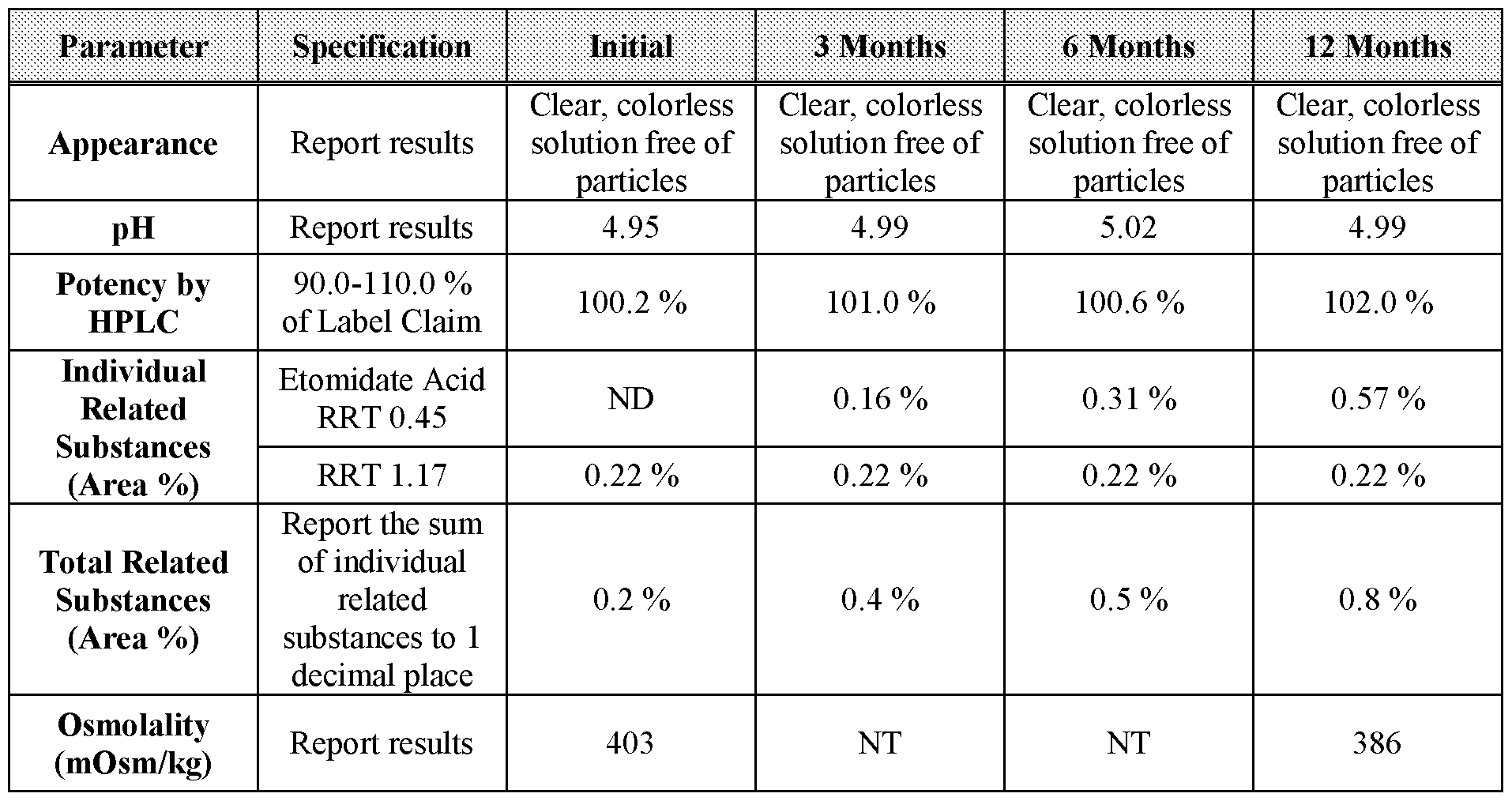
[094] The stability data at 0.5, 1, 2, 3, and 6 months for Formulation 5 (5 mg/mL CPMM, 9.0% SBECD, 10 mM citrate, at pH 6.0) stored at 40 °C under 75 % relative humidity is shown in Tables 29 and 30 below.
Table 29. 0.5- and 1-month stability data for Formulation 5 stored at 40 °C under 75 % relative humidity.
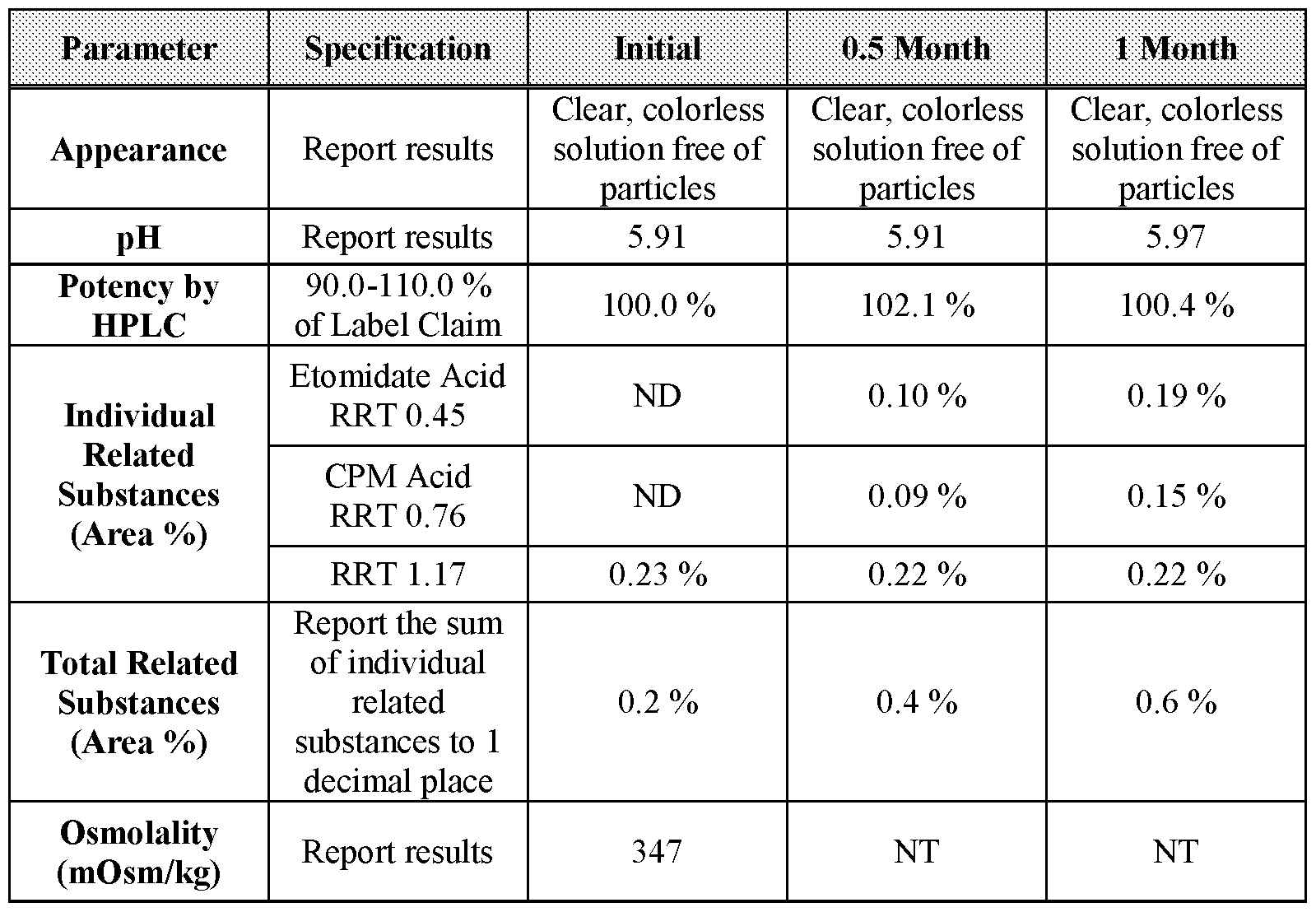
Table 30. 2-, 3-, and 6-month stability data for Formulation 5 stored at 40 °C under 75 % relative humidity.

[095] The stability data at 3-, 6-, and 12-months for Formulation 5 (5 mg/mL CPMM, 9.0% SBECD, 10 mM citrate, at pH 6.0) stored at 2-8 °C is shown in Table 31 below.
Table 31. 3-, 6-, and 12-month stability data for Formulation 5 stored at 2-8 °C.

[096] The stability data at 3-, 6-, and 12-months for Formulation 5 (5 mg/mL CPMM, 9.0% SBECD, 10 mM citrate, at pH 6.0) stored at 25 °C, 60 % relative humidity is shown in Table 32 below.
Table 32. 3-, 6-, and 12-month stability data for Formulation 5 stored at 25 °C, 60 % relative humidity.
Parameter Specil icalion Initial 3 Months <· Monllis 12 Monllis
Clear, colorless Clear, colorless Clear, colorless Clear, colorless
Appearance Report results solution free of solution free of solution free of solution free of particles particles particles particles pH Report results 5.91 5.94 5.97 5.96
Potency by 90.0-110.0 %
100.0 % 100.3 % 99.3 % 101.1 % HPLC of Label Claim
Etomidate Acid
ND 0.12 % 0.25 % 0.46 %
Individual RRT 0.45
Related
CPM Acid
Substances ND 0.08 % 0.12 % 0.22 %
RRT 0.76
(Area %)
RRT 1.17 0.23 % 0.22 % 0.21 % 0.21 %
Report the sum
Total Related of individual
Substances related 0.2 % 0.4 % 0.6 % 0.9 % (Area %) substances to 1
decimal place
Osmolality
Report results 347 NT NT 322 (mOsm/kg)
[097] The stability data at 0.5, 1, 2, 3, and 6 months for Formulation 6 (4 mg/mL CPMM, 10.0% SBECD, 10 mM citrate, at pH 5.5) stored at 40 °C under 75 % relative humidity is shown in Tables 33 and 34 below.
Table 33. 0.5-, and 1-month stability data for Formulation 6 stored at 40 °C under 75 % relative humidity.
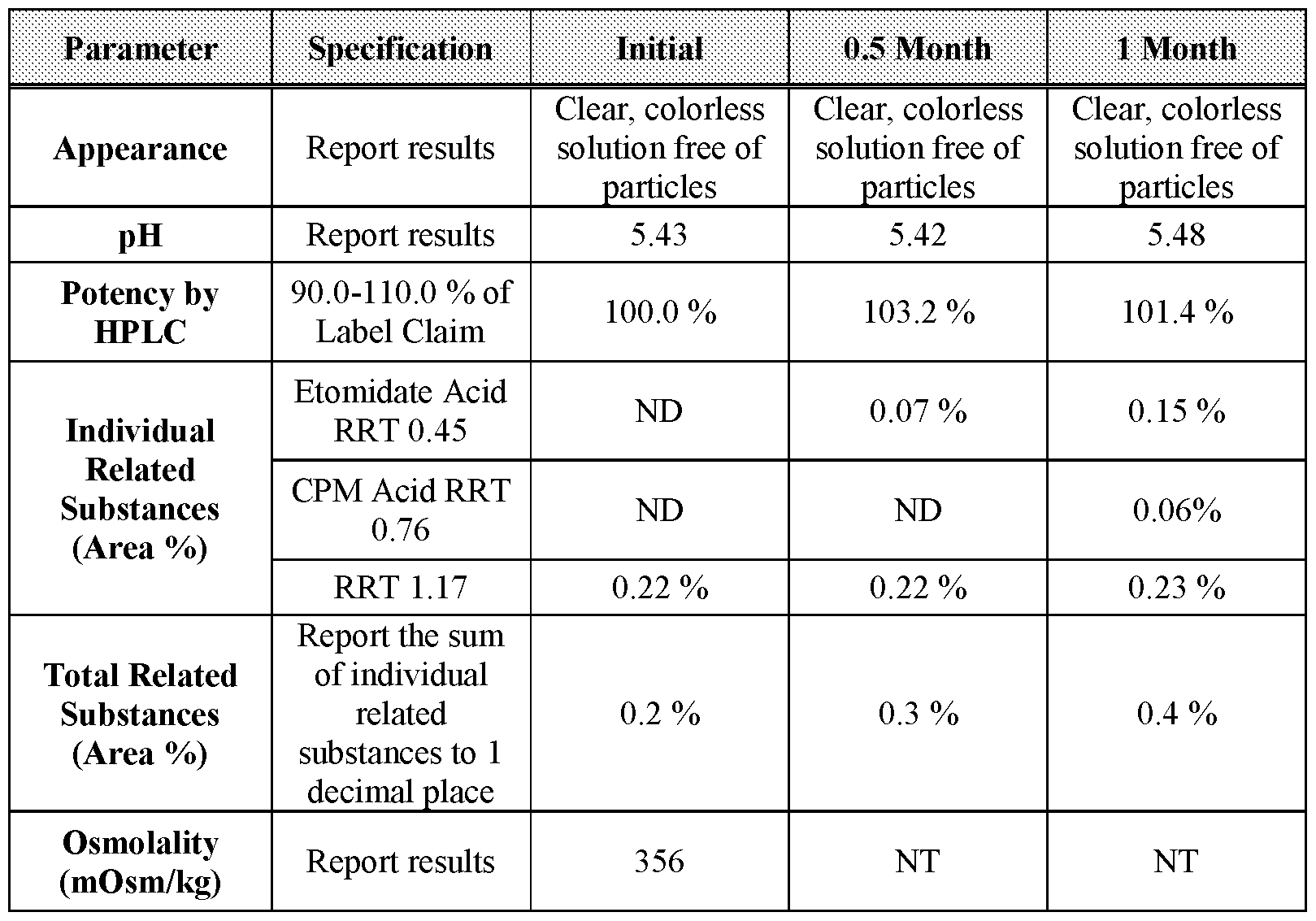
Table 34. 2-, 3-, and 6-month stability data for Formulation 6 stored at 40 °C under 75 % relative humidity.
Parameter Specif ication Initial 2 Months 3 Months (· Months
Clear, colorless Clear, colorless Clear, colorless Clear, colorless
Appearance Report results solution free of solution free of solution free of solution free of particles particles particles particles pH Report results 5.43 5.44 5.60 5.51
Potency by 90.0-110.0 % of
100.0 % 103.4 % 99.9 % 99.7 % HPLC Label Claim
Etomidate Acid
ND 0.39 % 0.59 % 1.17 % RRT 0.45
Individual
Related CPM Acid RRT
ND 0.10 % 0.09 % 0.13 % Substances 0.76
(Area %) RRT 0.97 ND ND ND 0.06 %
RRT 1.17 0.22 % 0.21 % 0.23 % 0.22 %
Report the sum
Total Related of individual
Substances related 0.2 % 0.7 % 0.9 % 1.6 % (Area %) substances to 1
decimal place
Osmolality
Report results 356 NT NT NT (mOsm/kg)
[098] The stability data at 3 months for Formulation 6 (4 mg/mL CPMM, 10.0% SBECD, 10 mM citrate, at pH 5.5) stored at 25 °C under ambient relative humidity is shown in Table 35 below.
Table 35. 3-month stability data for Formulation 6 stored at 25 °C under ambient relative humidity.

[099] The stability data at 0.5 and 1 month for Formulation 6 (4 mg/mL CPMM, 10.0% SBECD, 10 mM citrate, at pH 5.5) stored at 60 °C under ambient relative humidity is shown in Table 36 below.
Table 36. 0.5- and 1-month stability data for Formulation 6 stored at 60 °C under ambient relative humidity.
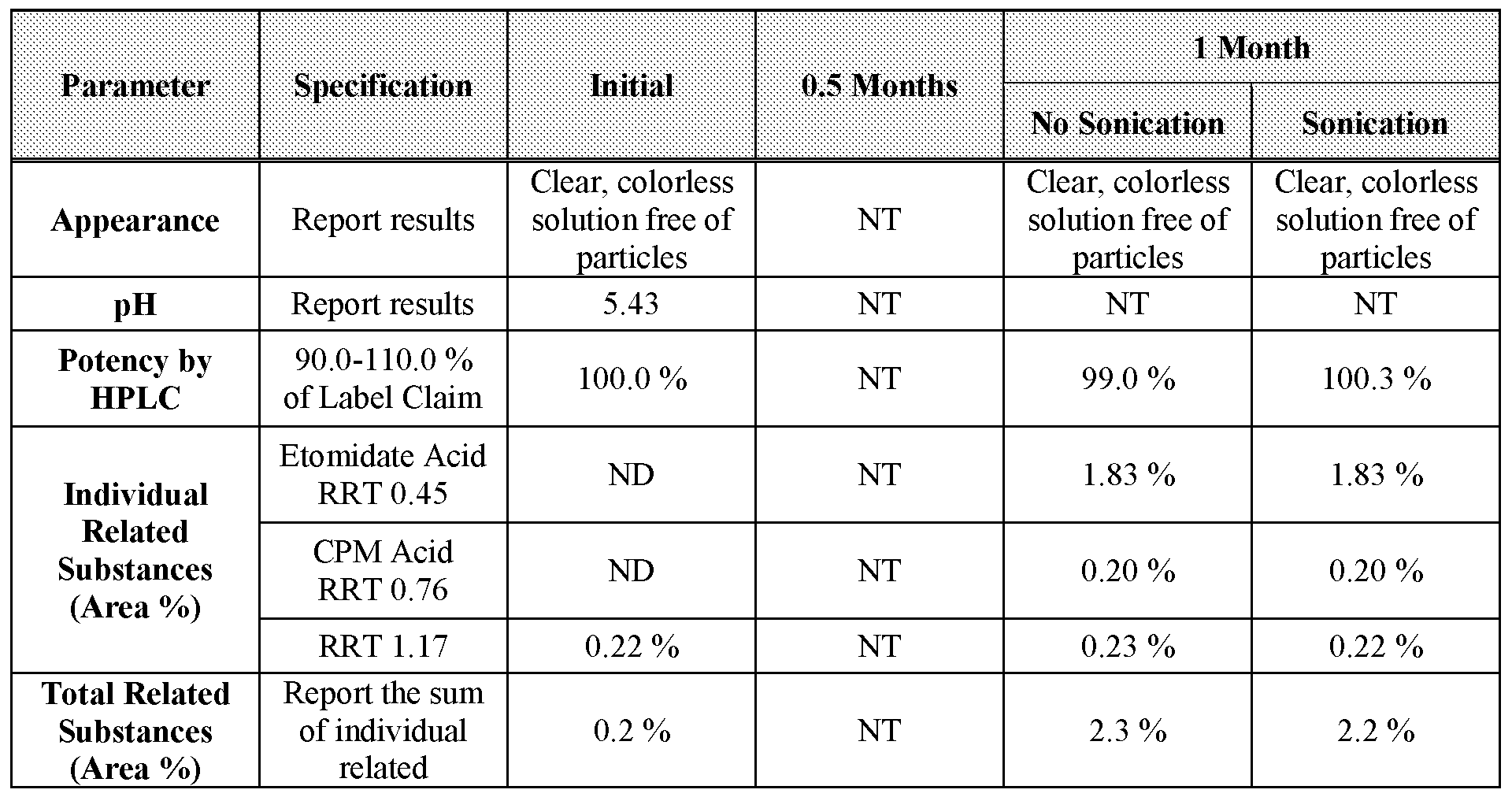
decimal place
Osmolality
Report results 356 NT NT NT
(mOsm/kg)
[0100] The stability data at 3-, 6-, and 12-months for Formulation 6 (4 mg/mL CPMM, 10.0% SBECD, 10 mM citrate, at pH 5.5) stored at 2-8 °C is shown in Table 37 below.
Table 37. 3-, 6-, and 12-month stability data for Formulation 6 stored at 2-8 °C.

[0101] The stability data at 3-, 6-, and 12-months for Formulation 6 (4 mg/mL CPMM, 10.0% SBECD, 10 mM citrate, at pH 5.5) stored at 25 °C, 60 % relative humidity is shown in Table 38 below.
Table 38. 3-, 6-, and 12-month stability data for Formulation 6 stored at 25 °C, 60 % relative humidity.
I'ar mclcr Specil icalion Inilial 3 Months (i Monlhs 12 Monlhs
Clear, colorless Clear, colorless Clear, colorless Clear, colorless
Appearance Report results solution free of solution free of solution free of solution free of particles particles particles particles pH Report results 5.43 5.49 5.51 5.49
Potency by 90.0-110.0 %
100.0 % 101.0 % 101.0 % 102.4 % HPLC of Label Claim
Etomidate Acid
ND 0.11 % 0.22 % 0.41 %
Individual RRT 0.45
Related
CPM Acid
Substances ND ND 0.05 % 0.07 %
RRT 0.76
(Area %)
RRT 1.17 0.22 % 0.22 % 0.22 % 0.22 %
Report the sum
Total Related of individual
Substances related 0.2 % 0.3 % 0.5 % 0.7 % (Area %) substances to 1
decimal place
Osmolality
Report results 356 NT NT 348 (mOsm/kg)
[0102] The stability data at 0.5, 1, 2, 3, and 6 month for Formulation 7 (3 mg/mL CPMM, 9.0% SBECD, 10 mM citrate, at pH 6.0) stored at 40 °C under 75 % relative humidity is shown in Tables 39 and 40 below.
Table 39. 0.5- and 1-month stability data for Formulation 7 stored at 40 °C under 75 % relative humidity.

Table 40. 2-, 3-, and 6-month stability data for Formulation 7 stored at 40 °C under 75 % relative humidity.
I'aramclcr Specilicalion Initial 2 Months 3 Months (> Months
Clear, colorless Clear, colorless Clear, colorless Clear, colorless
Appearance Report results solution free of solution free of solution free of solution free of particles particles particles particles pH Report results 5.92 5.93 6.09 5.96
Potency by 90.0-110.0 %
101.1 % 103.0 % 99.8 % 99.1 % HPLC of Label Claim
Individual Etomidate Acid
ND 0.41 % 0.69 % 1.49 %
Related RRT 0.45
Substances CPM Acid
(Area %) ND 0.22 % 0.30 % 0.44 %
RRT 0.76
RRT 1.17 0.23 % 0.22 % 0.22 % 0.22 %
Report the sum
Total Related of individual
Substances related 0.2 % 0.8 % 1.2 % 2.1 % (Area %) substances to 1
decimal place
Osmolality
Report results 322 NT NT NT
(mOsm/kg)
[0103] The stability data at 3-, 6-, and 12-months for Formulation 7 (3 mg/mL CPMM, 9.0% SBECD, 10 mM citrate, at pH 6.0) stored at 2-8 °C is shown in Table 41 below.
Table 41. 3-, 6-, and 12-month stability data for Formulation 7 stored at 2-8 °C.

[0104] The stability data at 3-, 6-, and 12-months for Formulation 7 (3 mg/mL CPMM, 9.0% SBECD, 10 mM citrate, at pH 6.0) stored at 25 °C, 60 % relative humidity is shown in Table 42 below.
Table 42. 3-, 6-, and 12-month stability data for Formulation 7 stored at 25 °C, 60 % relative humidity.
Par mclcr Specil icalion Initial 3 Months (> Months 12 Months
Clear, colorless Clear, colorless Clear, colorless Clear, colorless
Appearance Report results solution free of solution free of solution free of solution free of particles particles particles particles pH Report results 5.92 5.96 5.98 5.97
Potency by 90.0-110.0 %
101.1 % 100.5 % 101.6 % 102.9 % HPLC of Label Claim
Individual Etomidate Acid
ND 0.10 % 0.21 % 0.40 % Related RRT 0.45
Substances CPM Acid
(Area %) ND 0.07 % 0.12 % 0.20 %
RRT 0.76
RRT 1.17 0.23 % 0.22 % 0.21 % 0.21 %
Report the sum
Total Related of individual
Substances related 0.2 % 0.4 % 0.5 % 0.8 % (Area %) substances to 1
decimal place
Osmolality
Report results 322 NT NT 322 (mOsm/kg)
[0105] The stability data at 0.5, 1, 2, 3, and 6 months for Formulation 8 (4 mg/mL CPMM, 10.0% SBECD, 10 mM citrate, at pH 5.5) stored at 40 °C under 75 % relative humidity is shown in Tables 43 and 44 below.
Table 43. 0.5- and 1-month stability data for Formulation 8 stored at 40 °C under 75 % relative humidity.

Table 44. 2-, 3-, and 6-month stability data for Formulation 8 stored at 40 °C under 75 % relative humidity.
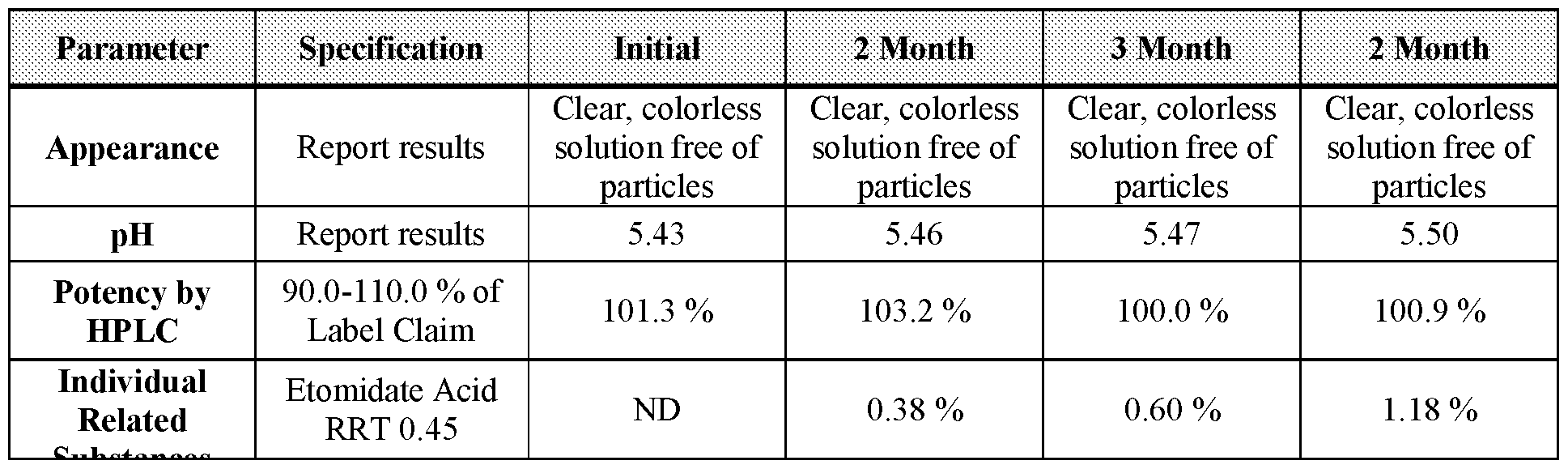
ND 0.08 % 0.10 % 0.12 % 0.76
RRT 1.17 0.22 % 0.22 % 0.22 % 0.23 %
Report the sum
Total Related of individual
Substances related 0.2 % 0.7 % 0.9 % 1.5 % (Area %) substances to 1
decimal place
Osmolality
Report results 370 NT NT NT (mOsm/kg)
[0106] The stability data at 3-, 6-, and 12-months for Formulation 8 (4 mg/mL CPMM, 10.0% SBECD, 10 mM citrate, at pH 5.5) stored at 2-8 °C is shown in Table 45 below.
Table 45. 3-, 6-, and 12-month stability data for Formulation 8 stored at 2-8 °C.
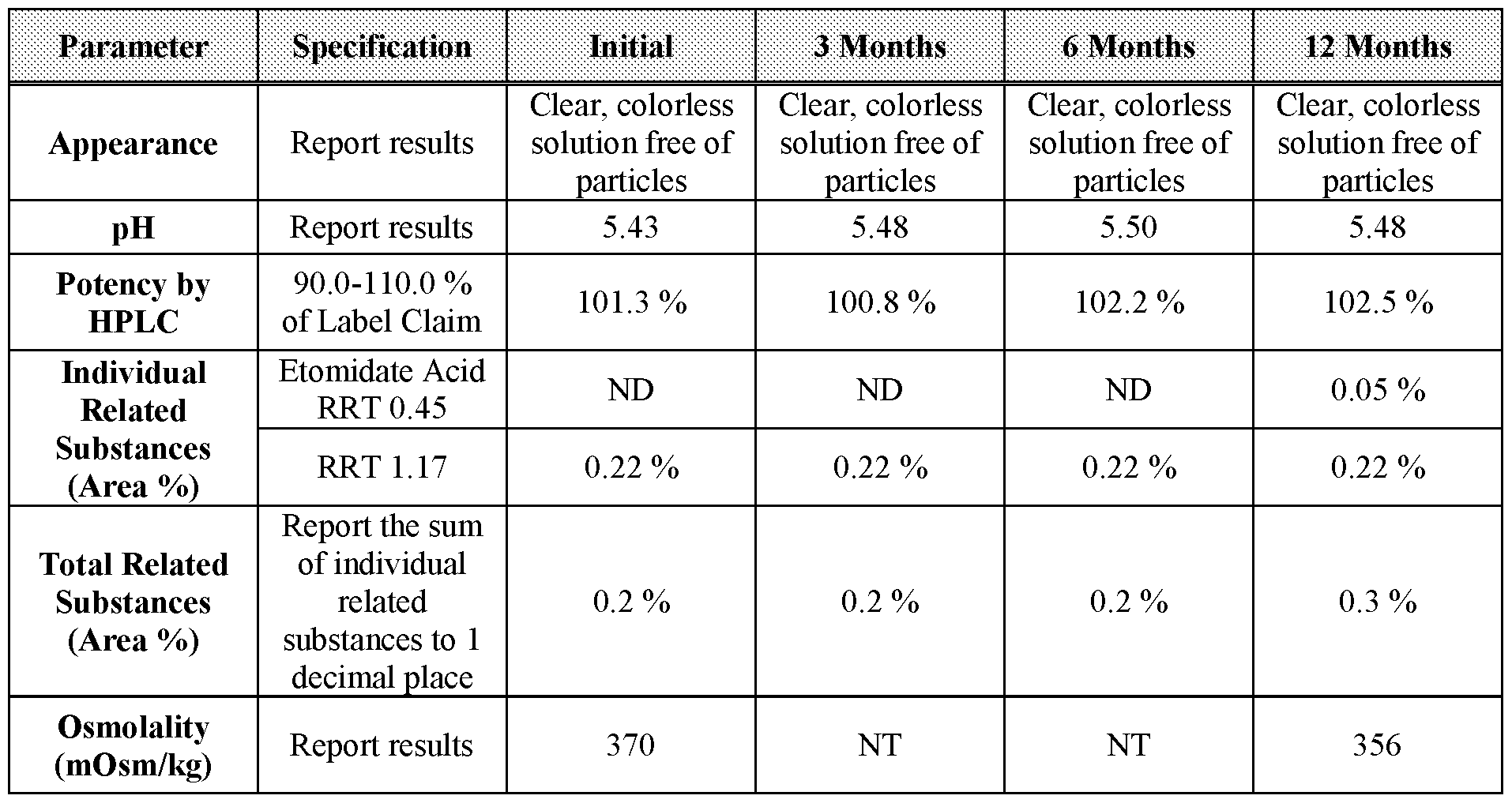
[0107] The stability data at 3-, 6-, and 12-months for Formulation 8 (4 mg/mL CPMM, 10.0% SBECD, 10 mM citrate, at pH 5.5) stored at 25 °C under 60 % relative humidity is shown in Table 46 below.
Table 46. 3-, 6-, and 12-month stability data for Formulation 8 stored at 25 °C under 60 % relative humidity.
I'arameler Specil icalion Initial 3 Months <· Months 12 Months
Clear, colorless Clear, colorless Clear, colorless Clear, colorless
Appearance Report results solution free of solution free of solution free of solution free of particles particles particles particles pH Report results 5.43 5.53 5.52 5.49
Potency by 90.0-110.0 %
101.3 % 100.6 % 101.3 % 102.3 % HPLC of Label Claim
Etomidate Acid
ND 0.13 % 0.22 % 0.41 %
Individual RRT 0.45
Related
CPM Acid
Substances ND ND 0.05 % 0.06 %
RRT 0.76
(Area %)
RRT 1.17 0.22 % 0.22 % 0.21 % 0.22 %
Report the sum
Total Related of individual
Substances related 0.2 % 0.3 % 0.5 % 0.7 % (Area %) substances to 1
decimal place
Osmolality
Report results 370 NT NT 349 (mOsm/kg)
[0108] The stability data at 0.5, 1, 2, 3, and 6 months for Formulation 9 (3 mg/mL CPMM, 11.0% SBECD, 10 mM citrate, at pH 6.0) stored at 40 °C under 75 % relative humidity is shown in Tables 47 and 48 below.
Table 47. 0.5- and 1-month stability data for Formulation 9 stored at 40 °C under 75 % relative humidity.

Table 48. 2-, 3-, and 6-month stability data for Formulation 9 stored at 40 °C under 75 % relative humidity.
Parameter Specil icalion Inilial 2 Months 3 Months (· Months
Clear, colorless Clear, colorless Clear, colorless Clear, colorless
Appearance Report results solution free of solution free of solution free of solution free of particles particles particles particles pH Report results 5.88 5.93 6.08 6.03
Potency by 90.0-110.0 %
101.2 % 103.0 % 99.5 % 99.3 % HPLC of Label Claim
Etomidate Acid
ND 0.35 % 0.55 % 1.23 %
Individual RRT 0.45
Related
CPM Acid
Substances ND 0.20 % 0.27 % 0.41 %
RRT 0.76
(Area %)
RRT 1.17 0.22 % 0.22 % 0.22 % 0.21 %
Report the sum
Total Related of individual
Substances related 0.2 % 0.8 % 1.0 % 1.9 % (Area %) substances to 1
decimal place
Osmolality
Report results 405 NT NT NT (mOsm/kg)
[0109] The stability data at 3-, 6-, and 12-months for Formulation 9 (3 mg/mL CPMM, 11.0% SBECD, 10 mM citrate, at pH 6.0) stored at 2-8 °C is shown in Table 49 below.
Table 49. 3-, 6-, and 12-month stability data for Formulation 9 stored at 2-8 °C.
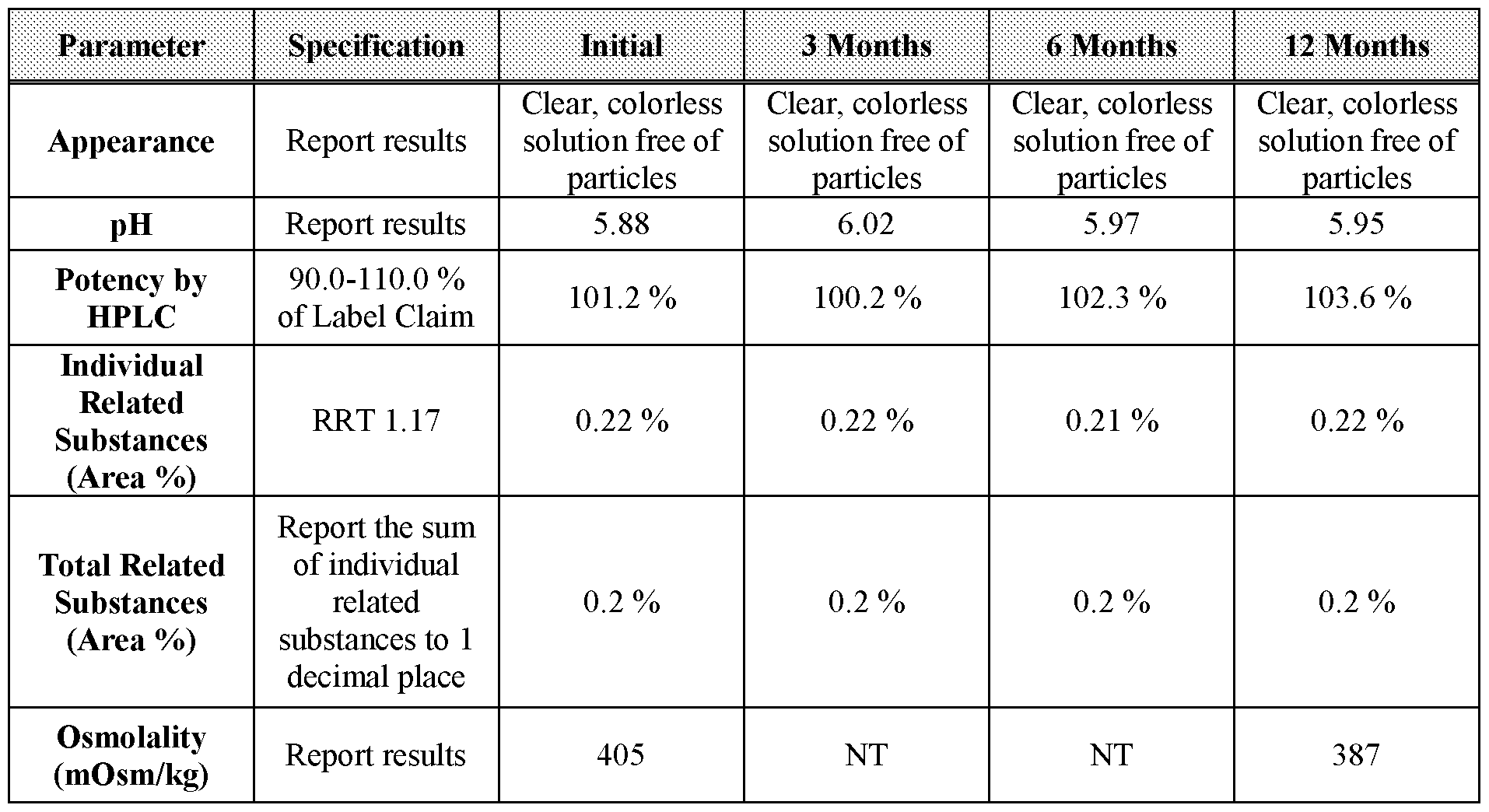
[0110] The stability data at 3-, 6-, and 12-months for Formulation 9 (3 mg/mL CPMM, 11.0% SBECD, 10 mM citrate, at pH 6.0) stored at 25 °C under 60 % relative humidity is shown in Table 50 below.
Table 50. 3-, 6-, and 12-month stability data for Formulation 9 stored at 25 °C under
60 % relative humidity.
Parameter Specil icalion Initial 3 Months (· Months 12 Months
Clear, colorless Clear, colorless Clear, colorless Clear, colorless
Appearance Report results solution free of solution free of solution free of solution free of particles particles particles particles pH Report results 5.88 5.97 5.97 5.99
Potency by 90.0-110.0 %
101.2 % 101.4 % 101.5 % 102.3 % HPLC of Label Claim
Etomidate Acid
ND 0.09 % 0.17 % 0.33 %
Individual RRT 0.45
Related
CPM Acid
Substances ND 0.07 % 0.12 % 0.19 %
RRT 0.76
(Area %)
RRT 1.17 0.22 % 0.22 % 0.22 % 0.22 %
Report the sum
Total Related of individual
Substances related 0.2 % 0.4 % 0.5 % 0.7 %
(Area %) substances to 1
decimal place
Osmolality
Report results 405 NT NT 422
(mOsm/kg)
[0111] The stability data at 0.5, 1, 2, 3, and 6 months for Formulation 10 (5 mg/mL CPMM, 11.0% SBECD, 10 mM citrate, at pH 5.0) stored at 40 °C under 75 % relative humidity is shown in Tables 51 and 52 below.
Table 51. 0.5- and 1-month stability data for Formulation 10 stored at 40 °C under 75 % relative humidity.
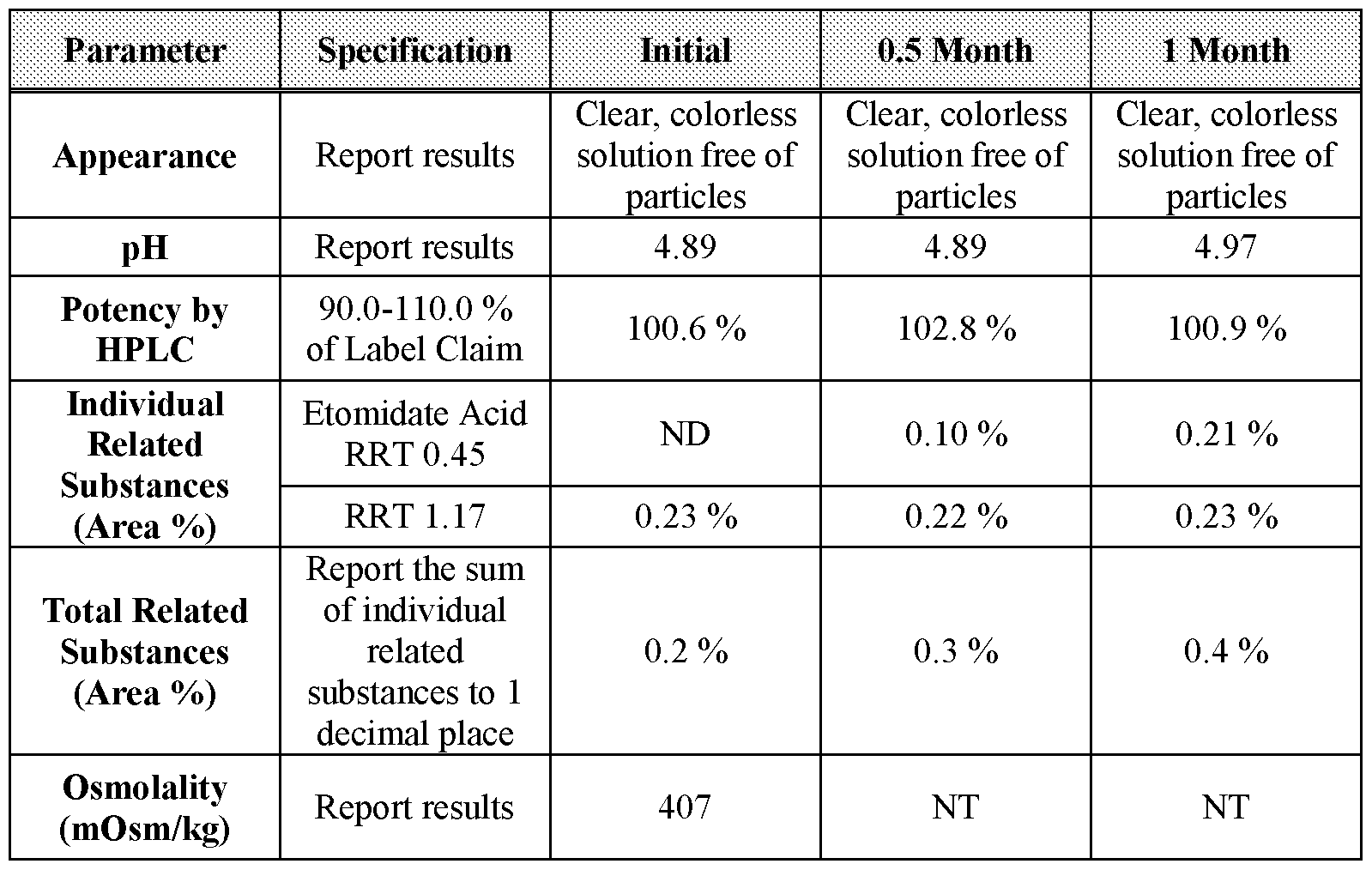
Table 52. 2-, 3-, and 6-month stability data for Formulation 10 stored at 40 °C under 75 % relative humidity.
I'aramclcr Specil icalion Initial 2 Months 3 Months Months
Clear, colorless Clear, colorless Clear, colorless Clear, colorless
Appearance Report results solution free of solution free of solution free of solution free of particles particles particles particles pH Report results 4.89 4.90 5.06 5.04
Potency by 90.0-110.0 %
100.6 % 101.2 % 99.6 % 99.0 % HPLC of Label Claim
Etomidate Acid
ND 0.51 % 0.56 % 1.57 %
Individual RRT 0.45
Related
CPM Acid
Substances ND ND 0.27 % ND
RRT 0.76
(Area %)
RRT 1.17 0.23 % 0.25 % 0.21 % 0.21 %
Report the sum
Total Related of individual
Substances related 0.2 % 0.7 % 1.0 % 1.8 % (Area %) substances to 1
decimal place
Osmolality
Report results 407 NT NT NT (mOsm/kg)
[0112] The stability data at 3-, 6-, and 12-months for Formulation 10 (5 mg/mL CPMM, 11.0% SBECD, 10 mM citrate, at pH 5.0) stored at 2-8 °C is shown in Table 53 below.
Table 53. 3-, 6-, and 12-month stability data for Formulation 10 stored at 2-8 °C.

[0113] The stability data at 3-, 6-, and 12-months for Formulation 10 (5 mg/mL CPMM, 11.0% SBECD, 10 mM citrate, at pH 5.0) stored at 25 °C under 60 % relative humidity is shown in Table 54 below.
Table 54. 3-, 6-, and 12-month stability data for Formulation 10 stored at 25 °C under 60 % relative humidity.
Parameter Specil icalion Initial 3 Months (> Months 12 Months
Clear, colorless Clear, colorless Clear, colorless Clear, colorless
Appearance Report results solution free of solution free of solution free of solution free of particles particles particles particles pH Report results 4.89 5.00 5.02 4.93
Potency by 90.0-110.0 %
100.6 % 101.5 % 101.7 % 101.6 % HPLC of Label Claim
Etomidate Acid
ND 0.08 % 0.35 % 0.64 %
Individual RRT 0.45
Related
CPM Acid
Substances ND 0.06 % ND ND
RRT 0.76
(Area %)
RRT 1.17 0.23 % 0.22 % 0.21 % 0.22 %
Report the sum
Total Related of individual
Substances related 0.2 % 0.4 % 0.6 % 0.9 %
(Area %) substances to 1
decimal place
Osmolality
Report results 407 NT NT 395
(mOsm/kg)
[0114] The foregoing description is given for clearness of understanding only, and no unnecessary limitations should be understood therefrom, as modifications within the scope of the invention may be apparent to those having ordinary skill in the art.
[0115] Throughout this specification and the claims which follow, unless the context requires otherwise, the word "comprise" and variations such as "comprises" and "comprising" will be understood to imply the inclusion of a stated integer or step or group of integers or steps but not the exclusion of any other integer or step or group of integers or steps.
[0116] Throughout the specification, where compositions are described as including components or materials, it is contemplated that the compositions can also consist essentially of, or consist of, any combination of the recited components or materials, unless described otherwise. Likewise, where methods are described as including particular steps, it is contemplated that the methods can also consist essentially of, or consist of, any combination of the recited steps, unless described otherwise. The invention illustratively disclosed herein suitably may be practiced in the absence of any element or step which is not specifically disclosed herein.
[0117] The practice of a method disclosed herein, and individual steps thereof, can be performed manually and/or with the aid of or automation provided by electronic equipment. Although processes have been described with reference to particular embodiments, a person of ordinary skill in the art will readily appreciate that other ways of performing the acts associated with the methods may be used. For example, the order of various of the steps may be changed without departing from the scope or spirit of the method, unless described otherwise. In addition, some of the individual steps can be combined, omitted, or further subdivided into additional steps.
[0118] All patents, publications and references cited herein are hereby fully incorporated by reference. In case of conflict between the present disclosure and incorporated patents, publications and references, the present disclosure should control.
Claims
1. A formulation comprising a solubilizer and a compound cyclopropyl-MOC- metomidate (CPMM) having a structure
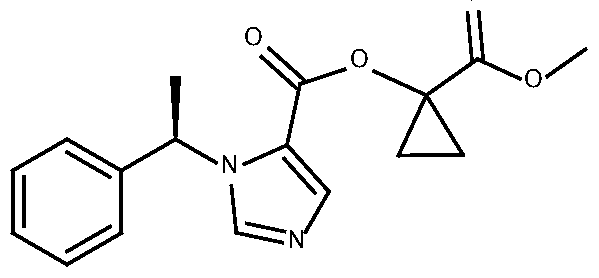
2. The formulation of claim 1, wherein the compound is present in a concentration of 0.1 mg/mL to 20 mg/mL.
3. The formulation of claim 2, wherein the compound is present in a concentration of 1 mg/mL to 10 mg/mL.
4. The formulation of claim 3, wherein the compound is present in a concentration of 2 mg/mL to 5 mg/mL.
5. The formulation of any one of claims 1 to 4 having a pH in a range of 2 to 7.
6. The formulation of claim 5 having a pH in a range of 3 to about 7.
7. The formulation of claim 5 having a pH in a range of about 4 to about 6.5.
8. The formulation of claim 5 having a pH in a range of about 5 to about 6.5.
9. The formulation of any one of claims 1 to 4 having a pH in a range of about 6 to about 7.4.
10. The formulation of any one of claims 1 to 9 further comprising a buffer.
11. The formulation of claim 10, wherein the buffer comprises one or more of NaOH, KOH, triethylamine, meglumine, diethanolamine, triethylamine, ammonium hydroxide, ammonium acetate, L-arginine, histidine, citrate buffer, a phosphate buffer, sodium bicarbonate, tris(hydroxymethyl)aminomethane), N-(2-hydroxyethyl)piperazine-N'-2- ethanesulfonic acid, acetate, citrate, ascorbate, glycine, glutamate, lactate, malate, formate, and sulfate.
12. The formulation of any one of claims 10, wherein the buffer comprises citrate buffer and NaOH.
13. The formulation of any one of claims 1 to 12, wherein the solubilizer comprises a cyclodextrin.
14. The formulation of claim 13, wherein the cyclodextrin is a β-cyclodextrin.
15. The formulation of claim 14, wherein the cyclodextrin is sulfobutylether-β- cyclodextrin, hydroxypropyl-P-cyclodextrin, a combination thereof, or salts thereof.
16. The formulation of claim 14, wherein the cyclodextrin comprises sulfobutylether-P-cyclodextrin or sulfobutylether-P-cyclodextrin sodium salt.
17. The formulation of any one of claims 1 to 16, wherein the solubilizer is present in a concentration in a range of about 6 % w/w to about 30 % w/w.
18. The formulation of claim 17, wherein the solubilizer is present in a concentration in a range of about 6 % w/w to about 20 % w/w.
19. The formulation of claim 17, wherein the solubilizer is present in a concentration in a range of about 6 % w/w to about 12 % w/w.
20. The formulation of claim 17, wherein the solubilizer is present in a concentration of about 10 % w/w.
21. The formulation of any one of claims 1 to 16, wherein the solubilizer is present at a molar ratio to the compound of 1 : 1 to 8: 1.
22. The formulation of claim 21, wherein the ratio of solubilizer to compound is
1 : 1 to 4: l .
23. The formulation of any one of claims 1 to 22, wherein the ratio of compound complexed to the solubilizer to uncomplexed compound is 1.5: 1 to 16: 1.
24. The formulation of any one of claims 1 to 23 further comprising an antimicrobial agent.
25. The formulation of any one of claims 1 to 24 having 5 % or less total degradants after storage at a temperature of 2 °C to 8 °C for at least 6 months.
26. The formulation of claim 25 having 5 % or less total degradants after storage at a temperature of 2 °C to 8 °C for 12 months.
27. The formulation of claim 25 having 5 % or less total degradants after storage at a temperature of 2 °C to 8 °C for 24 months.
28. The formulation of any one of claims 25 to 27 having 1 % or less total degradants after said storage.
29. The formulation of any one of claims 1 to 24 having 5 % or less total degradants after storage at frozen conditions (e.g., -10 °C to 0 °C) for at least 12 months.
30. The formulation of claim 29 having 5 % or less total degradants after storage at frozen conditions for 24 months.
31. The formulation of claim 29 or 30 having 1 % or less total degradants after said storage.
32. The formulation of any one of claims 1 to 24 having 5 % or less total degradants after storage at room temperature (e.g., 15 to 30 °C) for at least 6 months.
33. The formulation of claim 32 having 1% or less total degradants after said storage.
34. The formulation of any one of claims 1 and 24 to 33, wherein the compound is at a concentration in a range of 2 mg/mL to 5 mg/mL, the solubilizer comprises
hydroxypropyl-P-cyclodextrin at a concentration in a range of 8 % w/v or w/w to 12 % w/v or w/w, and the formulation has a pH in a range of about 5 to 7.
35. The formulation any one of claims 1 and 24 to 33, wherein the compound is at a concentration in a range of 2 mg/mL to 5 mg/mL, the solubilizer comprises sulfobutylether- β-cyclodextrin at a concentration in a range of 8 % w/v or w/w to 12 % w/v or w/w, and the formulation has a pH in a range of about 3 to 7.
36. The formulation of claim 35 at a pH of about 5 to 6.
37. A lyophilized pharmaceutical composition made from the formulation of any one of claims 1 to 36.
38. A kit comprising the lyophilized formulation of claim 37 in a container and instructions for preparing an aqueous, sterile formulation from the lyophilized formulation and a diluent.
39. The kit of claim 38, wherein the diluent comprises saline, sterile water, PBS, or a mixture thereof.
40. A liquid pharmaceutical formulation consisting essentially of (1) cyclopropyl- MOC-metomidate (CPMM) or a pharmaceutically acceptable salt thereof, (2) a solubilizer, and (3) a buffer or base in an aqueous medium.
41. The liquid formulation of claim 40, wherein the solubilizer comprises a β- cyclodextrin.
42. The liquid formulation of claim 41, wherein the β-cyclodextrin is sulfobutylether-P-cyclodextrin, hydroxypropyl-P-cyclodextrin, or a combination thereof.
43. The liquid formulation of any one of claims 40 to 42, wherein the buffer comprises citrate.
44. The formulation of any one of claims 1 to 36 and 40 to 43 which is sterile.
45. A pre-filled syringe comprising the formulation of any one of claims 1 to 36 and 40 to 44.
46. A method comprising administering to a subject a formulation of any one of claims 1 to 36 and 40 to 44 to induce anesthesia.
47. A method comprising administering to a subject a formulation of any one of claims 1 to 36 and 40 to 44 to induce sedation.
Applications Claiming Priority (2)
| Application Number | Priority Date | Filing Date | Title |
|---|---|---|---|
| US201662281853P | 2016-01-22 | 2016-01-22 | |
| US62/281,853 | 2016-01-22 |
Publications (2)
| Publication Number | Publication Date |
|---|---|
| WO2017127835A2 true WO2017127835A2 (en) | 2017-07-27 |
| WO2017127835A3 WO2017127835A3 (en) | 2017-09-28 |
Family
ID=59362288
Family Applications (1)
| Application Number | Title | Priority Date | Filing Date |
|---|---|---|---|
| PCT/US2017/014623 Ceased WO2017127835A2 (en) | 2016-01-22 | 2017-01-23 | Aqueous formulations and methods of preparation and use thereof |
Country Status (2)
| Country | Link |
|---|---|
| US (1) | US20170224662A1 (en) |
| WO (1) | WO2017127835A2 (en) |
Cited By (1)
| Publication number | Priority date | Publication date | Assignee | Title |
|---|---|---|---|---|
| CN109761906A (en) * | 2019-03-02 | 2019-05-17 | 成都安诺晨创医药科技有限公司 | A kind of substituted imidazole formate ester derivative and application thereof |
Families Citing this family (12)
| Publication number | Priority date | Publication date | Assignee | Title |
|---|---|---|---|---|
| CA2952692C (en) | 2008-09-22 | 2020-04-28 | Array Biopharma Inc. | Substituted imidazo[1,2b]pyridazine compounds |
| PT3372605T (en) | 2008-10-22 | 2021-12-09 | Array Biopharma Inc | Substituted pyrazolo[1,5-a]pyrimidine compounds as trk kinase inhibitors |
| AR077468A1 (en) | 2009-07-09 | 2011-08-31 | Array Biopharma Inc | PIRAZOLO COMPOUNDS (1,5-A) PYRIMIDINE SUBSTITUTED AS TRK-QUINASA INHIBITORS |
| SMT201900203T1 (en) | 2010-05-20 | 2019-05-10 | Array Biopharma Inc | Macrocyclic compounds as trk kinase inhibitors |
| CA2967951C (en) | 2014-11-16 | 2023-11-07 | Array Biopharma, Inc. | Crystalline form of (s)-n-(5-((r)-2-(2,5-difluorophenyl)-pyrrolidin-1-yl)-pyrazolo[1,5-a]pyrimidin-3-yl)-3-hydroxypyrrolidine-1-carboxamide hydrogen sulfate |
| CA3003153A1 (en) | 2015-10-26 | 2017-05-04 | Loxo Oncology, Inc. | Point mutations in trk inhibitor-resistant cancer and methods relating to the same |
| PH12018502124B1 (en) | 2016-04-04 | 2024-04-12 | Loxo Oncology Inc | Liquid formulations of (s)-n-(5-((r)-2-(2,5-difluorophenyl)-pyrrolidin-1-yl)-pyrazolo[1,5-a]pyrimidin-3-yl)-3-hydroxypyrrolidine-1-carboxamide |
| US10045991B2 (en) | 2016-04-04 | 2018-08-14 | Loxo Oncology, Inc. | Methods of treating pediatric cancers |
| PT3458456T (en) | 2016-05-18 | 2020-12-07 | Array Biopharma Inc | Preparation of (s)-n-(5-((r)-2-(2,5-difluorophenyl)pyrrolidin-1-yl)pyrazolo[1,5-a]pyrimidin-3-y l)-3-hydroxypyrrolidine-1-carboxamide |
| JOP20190092A1 (en) | 2016-10-26 | 2019-04-25 | Array Biopharma Inc | PROCESS FOR THE PREPARATION OF PYRAZOLO[1,5-a]PYRIMIDINES AND SALTS THEREOF |
| JOP20190213A1 (en) | 2017-03-16 | 2019-09-16 | Array Biopharma Inc | Macrocyclic compounds as ros1 kinase inhibitors |
| EP4255503A4 (en) * | 2020-12-04 | 2025-08-06 | COMPOSITIONS AND METHODS OF USE THEREOF |
Family Cites Families (1)
| Publication number | Priority date | Publication date | Assignee | Title |
|---|---|---|---|---|
| JP4334229B2 (en) * | 2001-03-20 | 2009-09-30 | サイデックス・ファーマシューティカルズ・インコーポレイテッド | Formulation containing propofol and sulfoalkyl ether cyclodextrin |
-
2017
- 2017-01-23 WO PCT/US2017/014623 patent/WO2017127835A2/en not_active Ceased
- 2017-01-23 US US15/413,213 patent/US20170224662A1/en not_active Abandoned
Cited By (2)
| Publication number | Priority date | Publication date | Assignee | Title |
|---|---|---|---|---|
| CN109761906A (en) * | 2019-03-02 | 2019-05-17 | 成都安诺晨创医药科技有限公司 | A kind of substituted imidazole formate ester derivative and application thereof |
| CN109761906B (en) * | 2019-03-02 | 2023-08-11 | 成都麻沸散医药科技有限公司 | Substituted imidazole formate derivative and application thereof |
Also Published As
| Publication number | Publication date |
|---|---|
| US20170224662A1 (en) | 2017-08-10 |
| WO2017127835A3 (en) | 2017-09-28 |
Similar Documents
| Publication | Publication Date | Title |
|---|---|---|
| WO2017127835A2 (en) | Aqueous formulations and methods of preparation and use thereof | |
| CN107261152B (en) | Method for preserving injectable pharmaceutical compositions comprising cyclodextrin and hydrophobic drug | |
| KR102455648B1 (en) | Preserved etherified cyclodextrin derivatives containing liquid aqueous pharmaceutical composition | |
| CA2668733C (en) | Liquid preparation comprising a complex of pimobendan and cyclodextrin | |
| US20070191308A1 (en) | Intranasal formulation of rotigotine | |
| CN101444510A (en) | Pharmaceutical preparation containing Voriconazole and preparation method thereof | |
| KR101829685B1 (en) | Composition for injection having improved solubility and stability | |
| CN110022857A (en) | Based on the amidine of modified cyclodextrin and acidulant replace 'beta '-lactam compounds novel formulation, its preparation and as antimicrobial pharmceutical compositions purposes | |
| HUP0500842A2 (en) | Medicinal product containing dronedarone for parenteral administration | |
| US11730815B2 (en) | Stable liquid pharmaceutical compositions comprising bendamustine | |
| CN112912108A (en) | Cyclodextrin-based formulations of BCL-2 inhibitors | |
| EP3556349B1 (en) | Parenteral liquid preparation comprising carbamate compound | |
| US12263176B2 (en) | Pharmaceutical liquid compositions of meloxicam | |
| WO2021090183A1 (en) | Liquid melphalan composition | |
| US20220008337A1 (en) | Pharmaceutical liquid compositions of meloxicam | |
| CN111107837A (en) | Parenteral formulation comprising siponimod | |
| JP2005521712A (en) | Solubilization of weak bases | |
| JP2005520856A (en) | Eplerenone formulation stable during storage | |
| US20250186342A1 (en) | Antiemetic combinations | |
| EP1864664A1 (en) | Pharmaceutical preparation | |
| HK40052668A (en) | Cyclodextrin-based formulation of a bcl-2 inhibitor | |
| WO2006034849A1 (en) | Antitumoral pharmaceutical compositions comprising a spisulosine and a cyclodextrin |
Legal Events
| Date | Code | Title | Description |
|---|---|---|---|
| NENP | Non-entry into the national phase |
Ref country code: DE |
|
| 121 | Ep: the epo has been informed by wipo that ep was designated in this application |
Ref document number: 17742128 Country of ref document: EP Kind code of ref document: A2 |
|
| 122 | Ep: pct application non-entry in european phase |
Ref document number: 17742128 Country of ref document: EP Kind code of ref document: A2 |