WO2017088585A1 - Uplink access method, user equipment, and base station - Google Patents
Uplink access method, user equipment, and base station Download PDFInfo
- Publication number
- WO2017088585A1 WO2017088585A1 PCT/CN2016/100767 CN2016100767W WO2017088585A1 WO 2017088585 A1 WO2017088585 A1 WO 2017088585A1 CN 2016100767 W CN2016100767 W CN 2016100767W WO 2017088585 A1 WO2017088585 A1 WO 2017088585A1
- Authority
- WO
- WIPO (PCT)
- Prior art keywords
- base station
- user equipment
- frequency base
- high frequency
- random access
- Prior art date
- Legal status (The legal status is an assumption and is not a legal conclusion. Google has not performed a legal analysis and makes no representation as to the accuracy of the status listed.)
- Ceased
Links
Images




Classifications
-
- H—ELECTRICITY
- H04—ELECTRIC COMMUNICATION TECHNIQUE
- H04B—TRANSMISSION
- H04B7/00—Radio transmission systems, i.e. using radiation field
- H04B7/02—Diversity systems; Multi-antenna system, i.e. transmission or reception using multiple antennas
- H04B7/04—Diversity systems; Multi-antenna system, i.e. transmission or reception using multiple antennas using two or more spaced independent antennas
- H04B7/08—Diversity systems; Multi-antenna system, i.e. transmission or reception using multiple antennas using two or more spaced independent antennas at the receiving station
- H04B7/0868—Hybrid systems, i.e. switching and combining
- H04B7/088—Hybrid systems, i.e. switching and combining using beam selection
-
- H—ELECTRICITY
- H04—ELECTRIC COMMUNICATION TECHNIQUE
- H04W—WIRELESS COMMUNICATION NETWORKS
- H04W16/00—Network planning, e.g. coverage or traffic planning tools; Network deployment, e.g. resource partitioning or cells structures
- H04W16/24—Cell structures
- H04W16/28—Cell structures using beam steering
-
- H—ELECTRICITY
- H04—ELECTRIC COMMUNICATION TECHNIQUE
- H04B—TRANSMISSION
- H04B7/00—Radio transmission systems, i.e. using radiation field
- H04B7/02—Diversity systems; Multi-antenna system, i.e. transmission or reception using multiple antennas
- H04B7/04—Diversity systems; Multi-antenna system, i.e. transmission or reception using multiple antennas using two or more spaced independent antennas
- H04B7/06—Diversity systems; Multi-antenna system, i.e. transmission or reception using multiple antennas using two or more spaced independent antennas at the transmitting station
- H04B7/0686—Hybrid systems, i.e. switching and simultaneous transmission
- H04B7/0695—Hybrid systems, i.e. switching and simultaneous transmission using beam selection
- H04B7/06952—Selecting one or more beams from a plurality of beams, e.g. beam training, management or sweeping
-
- H—ELECTRICITY
- H04—ELECTRIC COMMUNICATION TECHNIQUE
- H04W—WIRELESS COMMUNICATION NETWORKS
- H04W72/00—Local resource management
- H04W72/04—Wireless resource allocation
- H04W72/044—Wireless resource allocation based on the type of the allocated resource
- H04W72/0446—Resources in time domain, e.g. slots or frames
-
- H—ELECTRICITY
- H04—ELECTRIC COMMUNICATION TECHNIQUE
- H04W—WIRELESS COMMUNICATION NETWORKS
- H04W72/00—Local resource management
- H04W72/20—Control channels or signalling for resource management
- H04W72/21—Control channels or signalling for resource management in the uplink direction of a wireless link, i.e. towards the network
-
- H—ELECTRICITY
- H04—ELECTRIC COMMUNICATION TECHNIQUE
- H04W—WIRELESS COMMUNICATION NETWORKS
- H04W74/00—Wireless channel access
- H04W74/08—Non-scheduled access, e.g. ALOHA
-
- H—ELECTRICITY
- H04—ELECTRIC COMMUNICATION TECHNIQUE
- H04W—WIRELESS COMMUNICATION NETWORKS
- H04W74/00—Wireless channel access
- H04W74/08—Non-scheduled access, e.g. ALOHA
- H04W74/0833—Random access procedures, e.g. with 4-step access
- H04W74/0838—Random access procedures, e.g. with 4-step access using contention-free random access [CFRA]
-
- H—ELECTRICITY
- H04—ELECTRIC COMMUNICATION TECHNIQUE
- H04W—WIRELESS COMMUNICATION NETWORKS
- H04W72/00—Local resource management
- H04W72/04—Wireless resource allocation
-
- H—ELECTRICITY
- H04—ELECTRIC COMMUNICATION TECHNIQUE
- H04W—WIRELESS COMMUNICATION NETWORKS
- H04W74/00—Wireless channel access
- H04W74/04—Scheduled access
Definitions
- the present invention relates to the field of communications technologies, and in particular, to a method, a user equipment, and a base station for uplink access.
- the high frequency band represented by the millimeter wave band is mainly used in indoor short-range communication scenarios.
- the high frequency band is easy to implement a large-scale array antenna, and can achieve a large directional antenna gain by beam-forming technology, thereby effectively compensating for its high path loss, which is also high in the outdoor frequency band.
- the application of medium to long distance transmission of the scene offers the possibility.
- a base station used in a high-frequency communication system is called a high-frequency base station
- a base station used in a low-frequency communication system is called a low-frequency base station.
- both a high-frequency base station and a user equipment can Beamforming is performed using a large-scale antenna array, and directional beams of different widths can be formed by adjusting the phase, amplitude, and/or digital weighting vectors on multiple radio frequencies (Radio Frequency, English abbreviation: RF) channels of each antenna unit. (wide beam, narrow beam).
- radio frequencies Radio Frequency, English abbreviation: RF
- LTE Long Term Evolution
- HF communication system must use directional beams to perform LTE randomization.
- the access process cannot be directly used in high frequency communication systems, Combined with the characteristics of high-frequency directional antennas, further improvements or new designs are made.
- the random access procedure in the LTE system is extended to a high-frequency communication system, and the directional beam pair is traversed and transmitted to achieve the effect of omnidirectional antenna transmission and reception, and at the same time, the optimal transmission directional beam pair is obtained.
- the transmission power and beam width of the retransmitted random access signal can be adjusted to enhance the success rate of the random access and expand the coverage of the uplink access.
- the high path loss caused by the high frequency band needs to be compensated by the high beam gain brought by the antenna array.
- the acquisition of the high beam gain is based on the beam alignment of the transmitting and receiving ends. Above. Once the beam is mis-aligned at both ends, the received signal quality will drop dramatically and normal data communication will be interrupted. Therefore, in the high-frequency communication system, in order to ensure normal data communication, beam training is required to be performed periodically or irregularly, so that both ends of the transmitting and receiving can transmit data using the optimal transmitting and receiving beam pair.
- the above prior art only considers the initial random access procedure in the high frequency communication system, and is not considered in conjunction with the subsequent beam training process.
- the present application provides a method, user equipment, and a base station for uplink access, which controls system overhead and ensures the accuracy of beam training, thereby improving the performance of the high frequency communication system.
- a high frequency base station comprising:
- An initial random access unit configured to allocate a non-contention sequence to the user equipment during initial random access of the user equipment to the high frequency base station, and send the non-contention sequence to the location by using the first random access response message
- a beam training unit configured to detect, after the user equipment completes the initial random access to the high frequency base station, in the beam training process, by detecting, by the user equipment, each of the high frequency base stations receiving the wide beam a non-contention sequence, determining an optimal receiving wide beam of the high frequency base station and an optimal transmitting narrow beam of the user equipment;
- a sending unit configured to send, by using the best receiving wide beam of the high frequency base station, a second random access response message to the user equipment, where the second random access response message includes the best Receiving a wide beam and the user equipment optimally transmitting narrow beam information.
- the user equipment Since the initial random access unit is in the process of initially randomly accessing the high frequency base station by the user equipment, The user equipment allocates a non-contention sequence, and sends a non-contention sequence to the user equipment by using the first random access response message, and the beam training unit performs the initial random access high frequency base station after the user equipment completes the beam training process.
- the receiving the wide beam detecting the non-contention sequence sent by the user equipment, determining the best receiving wide beam of the high frequency base station and the best transmitting narrow beam of the user equipment, and sending the unit to the user equipment, including redetermining the high frequency base station.
- the high-frequency base station optimally receives the wide beam and the second random access response message of the user equipment that transmits the narrow beam, and the whole process realizes the initial implementation of the user equipment on the random access resources of the high-frequency communication system. Random access and subsequent beam training control system overhead and ensure the accuracy of beam training, thereby improving the performance of high-frequency communication systems.
- the beam training unit is specifically configured to:
- the beam training unit can determine the best receiving wide beam of the high frequency base station and the best transmitting narrow beam of the user equipment by detecting the non-contention sequence sent by the user equipment, and the initial random access procedure and beam training will be performed through the non-contention sequence.
- the combination of processes ensures the accuracy of beam training and thus improves the performance of high frequency communication systems.
- the beam training unit is specifically configured to: uplink random access/beam in a special subframe of a radio frame Detecting, in the ULBP period of the training interval, the non-contention sequence sent by the user equipment on each receiving wide beam of the high-frequency base station, where the radio frame is pre-configured with at least one special subframe, the special sub-frame At least one ULBP period is reserved in the frame for receiving the preamble sequence.
- the beam training unit detects the non-competitive sequence on the reserved ULBP period of the set special subframe, thereby realizing reasonable utilization of resources and reducing system overhead.
- the sending unit Before the high frequency base station detects the non-contention sequence sent by the user equipment, the sending unit is further configured to send a synchronization signal to the user equipment by using different wide beams, so that the user equipment determines that the user equipment is the best. Transmitting a wide beam, and sequentially switching the narrow beam in the best transmitting wide beam of the user equipment on a time slice corresponding to different receiving wide beams of the high frequency base station, and transmitting the non-contention sequence, the high frequency
- the receiving wide beam of the base station has a one-to-one corresponding time slice;
- the beam training unit is specifically configured to determine a target time slice corresponding to the best received wide beam of the high frequency base station, and determine to send the narrow beam of the non-contention sequence on the target time slice, where the user equipment is The best transmission narrow beam.
- the beam training unit can further determine that the target time slice is transmitted on the target time slice by determining the target time slice corresponding to the best receiving wide beam of the high frequency base station.
- the narrow beam is transmitted by the non-contention sequence, and the narrow beam is optimally transmitted for the user equipment, and the solution is simple to implement.
- a user equipment including:
- An initial random access unit configured to receive a first random access response message sent by the high frequency base station, where the first random access response message is included in the process of the user equipment initially randomly accessing the high frequency base station a non-contention sequence allocated by the frequency base station to the user equipment;
- a beam training unit configured to send the non-contention sequence to the high frequency base station during beam training after the user equipment completes the initial random access high frequency base station;
- a receiving unit configured to receive a second random access response message sent by the high frequency base station, where the second random access response message is that the high frequency base station detects the non-contention sequence
- the second random access response message sent by the user equipment includes information about the best receiving wide beam of the high frequency base station and the best transmitting narrow beam of the user equipment; the high frequency base station is optimal. And receiving, by the high-frequency base station, the non-contention sequence sent by the user equipment on each receiving wide beam.
- the initial random access unit receives the non-contention sequence allocated by the high-frequency base station during the initial random access of the user equipment to the high-frequency base station, and after the user equipment completes the initial random access high-frequency base station, in the beam training process. And the beam training unit sends the non-contention sequence to the high frequency base station, so that the high frequency base station determines the best receiving wide beam of the high frequency base station and the best narrow beam for transmitting the user equipment, and sends the second random access response message.
- the receiving unit receives the second sequel sent by the HF base station
- the machine accesses the response message, and the whole process realizes the initial random access and subsequent beam training of the user equipment on the random access resources of the high-frequency communication system, controls the system overhead, and ensures the precision of the beam training, thereby improving The performance of high frequency communication systems.
- the beam training unit is specifically configured to determine an optimal receiving wide beam of the user equipment, and send the non-contention sequence to the high frequency base station by using the narrow beam in the wide beam of the user equipment to receive the wide beam. .
- Beam training is more accurate because the non-contention sequence is transmitted by the determined user equipment optimally receiving narrow beams in the wide beam.
- the beam training unit is specifically configured to:
- the receiving wide beam of the high frequency base station has a one-to-one corresponding time slice.
- the beam training unit sequentially switches the user equipment in the best receiving wide beam on the time slice corresponding to the different receiving wide beams of the high frequency base station, respectively, because the receiving wide beam of the high frequency base station has a one-to-one time slice. And transmitting, by the narrow beam, the non-contention sequence, so that the high frequency base station can further determine to send the non-contention sequence on the target time slice by determining a target time slice corresponding to the best receiving wide beam of the high frequency base station.
- the narrow beam is transmitted, and the narrow beam is optimally transmitted for the user equipment, and the solution is simple to implement.
- the beam training unit is specifically configured to be in a ULBP period of a special subframe of a radio frame, where the high The time slot corresponding to the best receiving wide beam of the frequency base station sequentially switches the narrow beam in the best receiving wide beam of the user equipment, and sends the non-contention sequence, wherein the radio frame is preset with at least one special a subframe in which at least one ULBP period is reserved for transmitting a preamble sequence.
- the beam training unit sends a non-contention sequence on the reserved ULBP period of the set special subframe, thereby realizing reasonable utilization of resources and reducing system overhead.
- an uplink access method including:
- the user equipment receives a first random access response message sent by the high frequency base station, where the user equipment initially randomly accesses the high frequency base station, where the first random access response message includes the high frequency base station Determining a non-contention sequence assigned by the user equipment;
- the user equipment After the user equipment completes the initial random access to the high frequency base station, in the beam training process, the user equipment sends the non-contention sequence to the high frequency base station;
- the second random access response message includes: an optimal receiving wide beam of the high frequency base station and an optimal narrow beam transmitting information of the user equipment; and the best receiving of the high frequency base station
- the wide beam and the best transmitted narrow beam of the user equipment are determined by the high frequency base station detecting the non-contention sequence sent by the user equipment on each receiving wide beam.
- the user equipment sends the non-contention sequence to the high frequency base station by using the narrow beam in the wide beam of the user equipment to receive the best.
- Determining, by the user equipment, the best receiving wide beam of the user equipment including:
- the user equipment switches the receiving beam to perform detection of the synchronization signal, and determines an optimal transmitting wide beam of the high frequency base station and an optimal receiving wide beam of the user equipment, where the synchronization signal is sent by the high frequency base station;
- the user equipment sequentially switches the narrow beam in the best receiving wide beam of the user equipment on the time slice corresponding to the different receiving wide beams of the high frequency base station, and sends the non-contention sequence to make the high
- the frequency base station determines that the high frequency base station is the best receiving wide beam and the user equipment is the most Preferably, the narrow beam is transmitted, and the receiving wide beam of the high frequency base station has a one-to-one time slice.
- the user equipment sequentially switches the narrow beam in the best receiving wide beam of the user equipment on the time slice corresponding to the different receiving wide beams of the high frequency base station, and sends the non-contention sequence, including:
- the user equipment sequentially switches the narrow beam in the receiving wide beam of the user equipment according to the time slice corresponding to the different receiving wide beams of the high frequency base station in the ULBP period of the special subframe of the radio frame. Transmitting the non-contention sequence, wherein the radio frame is pre-configured with at least one special subframe, and at least one ULBP period is reserved in the special subframe for transmitting a preamble sequence.
- an uplink access method including:
- the high-frequency base station allocates a non-contention sequence to the user equipment, and sends the non-contention sequence to the user equipment by using a first random access response message;
- the high frequency base station After the user equipment completes the initial random access to the high frequency base station, the high frequency base station detects the non-transmission sent by the user equipment by receiving the wide beam on each of the high frequency base stations in the beam training process. a competition sequence, determining an optimal reception wide beam of the high frequency base station and an optimal transmission narrow beam of the user equipment;
- the high frequency base station sends a second random access response message to the user equipment, where the second random access response message includes an optimal receiving wide beam of the high frequency base station and an optimal sending of the user equipment. Narrow beam information.
- the high frequency base station detects the non-contention sequence sent by the user equipment on each receiving wide beam of the high frequency base station, and determines that the high frequency base station is the best receiving wide beam and the user equipment is the best.
- Send narrow beams including:
- the high frequency base station detects the non-contention sequence sent by the user equipment on each receiving wide beam of the high frequency base station;
- the high frequency base station determines a receiving wide beam of the high frequency base station corresponding to the non-contention sequence with the strongest received signal, and is the best receiving wide beam of the high frequency base station;
- the high frequency base station determines that the high frequency base station is the best receiving narrow beam corresponding to the wide beam, and is The user equipment optimally transmits a narrow beam.
- the high-frequency base station detects the non-contention sequence sent by the user equipment on each receiving wide beam of the high-frequency base station, including:
- the radio frame is pre-configured with at least one special subframe, and at least one ULBP period is reserved in the special subframe for receiving the preamble sequence.
- the method includes:
- the high-frequency base station determines a transmission narrow beam corresponding to the best receiving wide beam of the high-frequency base station, and sends the narrow beam optimally for the user equipment, including:
- a user equipment including a receiver, a transmitter, and a processor;
- the receiver is configured to receive a first random access response message sent by the high frequency base station in a process of the user equipment initially randomly accessing the high frequency base station, where the first random access response message includes the high frequency base station a non-contention sequence allocated by the user equipment;
- the transmitter is configured to send the non-contention sequence to the high frequency base station in a beam training process after the user equipment completes the initial random access to the high frequency base station;
- the receiver is further configured to receive a second random access response message sent by the high frequency base station, where The second random access response message is sent by the high frequency base station to the user equipment when the non-contention sequence is detected, and the second random access response message includes the highest frequency base station
- the receiver is further configured to receive a second random access response message sent by the high frequency base station, where The second random access response message is sent by the high frequency base station to the user equipment when the non-contention sequence is detected, and the second random access response message includes the highest frequency base station
- the receiver is further configured to receive a second random access response message sent by the high frequency base station, where The second random access response message is sent by the high frequency base station to the user equipment when the non-contention sequence is detected, and the second random access response message includes the highest frequency base station
- the receiver is further configured to receive a second random access response message sent by the high frequency base station, where The second random access response message is sent by the high frequency base station to the user equipment when the non-contention sequence is detected, and the second random access
- the present application has the following advantages:
- the high-frequency base station allocates a non-contention sequence to the user equipment during the initial random access of the user equipment to the high-frequency base station, and after the user equipment completes the initial random access to the high-frequency base station, the beam training process is high.
- the frequency base station determines the best receiving wide beam of the high frequency base station and the best transmitting narrow beam of the user equipment by detecting the non-contention sequence sent by the user equipment, and notifies the user equipment, thereby realizing the random access resources of the high frequency communication system.
- the initial random access and subsequent beam training of the user equipment can be implemented, the system overhead is controlled, the precision of the beam training is ensured, and the performance of the high frequency communication system is improved.
- FIG. 1 is a schematic diagram of a process of initial random access of a user equipment in this application
- FIG. 2 is a schematic diagram of an embodiment of a method for uplink access in the present application
- FIG. 3 is a schematic diagram of an embodiment of a wide and narrow beam in a high frequency communication system in the present application
- FIG. 4 is a schematic diagram showing a general frame structure of a high frequency communication system in the present application.
- FIG. 5 is a schematic structural diagram of a special subframe in the present application.
- FIG. 6 is a schematic diagram of a ULBP subinterval in the present application.
- FIG. 7 is a diagram showing an example of a ULBP resource in a 72 GHz system in the present application.
- FIG. 8 is a schematic diagram of user equipment synchronization signal detection in the present application.
- FIG. 9 is a schematic diagram of an embodiment of a method for uplink access in the present application.
- FIG. 10 is a schematic diagram of another embodiment of a method for uplink access in the present application.
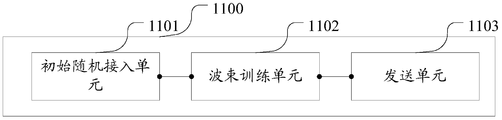
- FIG. 11 is a schematic diagram of an embodiment of a high frequency base station in the present application.
- FIG. 12 is a schematic diagram of an embodiment of a user equipment in this application.
- Figure 13 is a schematic diagram of one embodiment of a high frequency base station in the present application.
- the present application provides a method, user equipment, and a base station for uplink access, which controls system overhead and ensures the accuracy of beam training, thereby improving the performance of the high frequency communication system.
- Radio resource control (English name: Radio Resource Control, English abbreviation: RRC), RRC processing user equipment (English full name: User Equipment, English abbreviation: UE) and the third layer of information of the control plane between the base stations, such as paging (Paging) RRC connection establishment, RRC connection release, and the like.
- RRC Radio Resource Control
- UE User Equipment
- the user equipment needs to establish a normal communication link with the high-frequency base station.
- the downlink synchronization channel is used to obtain the downlink synchronization of the high-frequency system, and then the initial random access procedure is initiated through the random access channel to obtain the uplink synchronization.
- the initial beam alignment between the high frequency base station and the user equipment can be implemented by the downlink synchronization process and the initial uplink random access procedure.
- the user equipment After completing the initial system access, the user equipment needs to perform periodic or irregular beam tracking to ensure normal data communication.
- the UE defines two states, one is the RRC_IDLE state, which is referred to as the idle state, that is, the end-to-end link is not established with the base station, and the other is RRC_CONNECTED, which is referred to as the connected state, that is, the end-to-end is established with the base station. connection.
- the first is a contention based random access procedure and the second is a non-contention based random access procedure.
- contention For the contention of random access, there is a risk of collision.
- Loose events, rather than competing random access, are suitable for time-limited events due to fewer steps and faster time.
- the events that trigger the random access procedure defined in the LTE system mainly include the following:
- the base station instructs it to quickly resume uplink synchronization through the PDCCH.
- Upstream data arrival The user equipment is in the RRC_CONNECTED state, and the uplink synchronization state is “out of step” or the scheduling request (English full name: Scheduling Request, English abbreviation: SR) has no physical uplink control channel (English full name: Physical Uplink Control Channel, The English abbreviation: PUCCH) is available.
- the user equipment initiates a random access procedure to perform uplink synchronization.
- the user equipment is in the RRC_CONNECTED state, and the user equipment needs to be located.
- the user equipment obtains the timing advance (English name: Timing Advanced, English abbreviation: TA) through the random access process.
- TA Timing Advanced
- the initial access, reconstruction chain, and uplink data arrival should be mainly With the contention-based random access procedure, handover, downlink data arrival, and positioning are mainly applied based on the non-contention random access procedure.
- the UE sends a random access preamble to the base station. After the base station detects the random access preamble sent by the UE, the UE sends a random access response message to the UE. After receiving the random access response message sent by the base station, the UE sends an RRC connection to the base station. Request ⁇ UE receives an RRC connection request to establish a connection.
- Periodic beam training process After the user equipment successfully completes the initial random access high-frequency communication system (high-frequency base station), the beam training process needs to be performed periodically to maintain the accuracy of beam selection.
- the uplink access method provided in this application is on the high frequency base station side, and includes:
- the high frequency base station allocates a non-contention sequence to the user equipment, and sends the non-contention sequence to the user equipment by using a first random access response message;
- the high frequency base station detects the non-contention sequence sent by the user equipment on each receiving wide beam of the high frequency base station, and determines that the high frequency base station is the best receiving wide beam and the user equipment is the best. Sending a narrow beam;
- the high frequency base station sends a second random access response message to the user equipment, where the second random access response message includes an optimal receiving wide beam of the high frequency base station and an optimal sending of the user equipment. Narrow beam information.
- the uplink access method provided in this application is on the user equipment side, and includes:
- the second random access response message includes: an optimal receiving wide beam of the high frequency base station and an optimal narrow beam transmitting information of the user equipment; and the best receiving of the high frequency base station
- the wide beam and the best transmitted narrow beam of the user equipment are determined by the high frequency base station detecting the non-contention sequence sent by the user equipment on each receiving wide beam.
- an embodiment of the method for uplink access in this application includes:
- the high frequency base station allocates a non-contention sequence to the user equipment
- the non-contention sequence may be used in a non-contention based random access procedure.
- the non-contention sequence may be a sequence used by the user equipment for subsequent beam training.
- the first random access response message is a random access response message sent by the high frequency base station to the user equipment in the process of initially randomly accessing the high frequency base station by the user equipment.
- the number of wide and narrow beams in the high-frequency communication system is set as needed.
- the high-frequency cell the cell corresponding to the high-frequency base station
- the antenna array is capable of generating a narrow beam having a beam width of 7.5 degrees and a wide beam having a beam width of 15 degrees.
- the high frequency cell may be fully covered by 64 narrow beams (b0 to b63 as shown in FIG. 3), or fully covered by 16 wide beams (B0 to B15 as shown), and a wide beam may be used. Covering the area covered by the four narrow beams, as shown in FIG. 3, the wide beam B0 can cover the area covered by the narrow beams b0 to b3.
- the wide beam is used to transmit synchronization signals, broadcast signals, etc. to reduce system overhead
- the narrow beam is used to transmit random access signals and user data information to obtain high system capacity
- an uplink random access/Beam-training Period (ULBP) period and a downlink synchronization/beam training interval may be defined in advance in a high-frequency communication system (English name: Downlink synchronization & Beam-training Period, English)
- Abbreviation: DLBP) period is the general frame structure of the high-frequency communication system.
- the design of the general frame structure is compatible with the frame structure of the LTE system, using 10 milliseconds as the frame length of a radio frame, and a radio frame. It is composed of 10 wireless subframes each having a length of 1 millisecond.
- the wireless frame defines two types of wireless subframes: a general subframe and a special subframe.
- the general subframe is mainly used for normal data transmission, and is divided into eight time slots of 125 microseconds in length, each time slot is composed of Ns OFDM symbols, and the size of Ns depends on the frequency band used by the high frequency communication system. For 72 GHz, 28 GHz, and 14 GHz systems, typical Ns can take values of 80, 40, and 20, respectively.
- the special subframe is mainly used for downlink synchronization, uplink random access, and beam training, and is composed of a downlink synchronization/beam training interval, an uplink-downlink handover protection interval, and an uplink random access/beam training interval, such as Figure 5 shows.
- the uplink random access/beam training interval can be further subdivided into Mu ULBP subintervals.
- the base station traverses all the Nd receive beams in one ULBP subinterval, and sequentially receives the random access signals sent by the user equipment through different receive beams.
- the user equipment transmits a random access signal to the base station through a fixed transmit beam within one or more base station receive beam periods within one DLBP subinterval. In different ULBP subintervals, the user equipment can switch different transmit beams to send random access signals to the base station.
- the user equipment is supported to switch up to at most 50 transmit beams.
- the typical value of Mu is 4.
- B 0 to B Nd-1 are Nd high frequency base station receive beam periods, and corresponding receive beam receive signals are used on a high frequency base station receive beam period.
- the high frequency base station labeled B 0 receives the beam period
- the high frequency base station receives the signal with the receive beam of sequence number 0, and the base station receives the beam period of B Nd-1 , and the high frequency base station uses the sequence number Nd.
- the receive beam of -1 receives the signal.
- the user equipment transmits a random access signal on one or more high frequency base station receive beam periods of the ULBP.
- PRACH Physical Random Access Channel
- a Switching Guard Period (SGP) is reserved between the receiving periods of the two high-frequency base stations for switching between the receiving beams of the base station.
- a special beam switching guard interval (SGP*) is reserved after the last base station reception beam period in the ULBP for handover between user equipment transmit beams.
- Figure 7 shows an example of a ULBP resource in a 72 GHz system.
- the ULBP uses a subcarrier bandwidth of 180 kHz and an intermediate 450 MHz bandwidth.
- a total of 2492 subcarriers can be used to transmit random access signals.
- the high-frequency base station allocates a non-contention sequence to the user equipment, and sends the non-contention sequence to the user equipment by using the first random access response message, which may include:
- the high frequency base station utilizes reciprocity of the receive beam and the transmit beam through different
- the wide beam transmits a synchronization signal to the user equipment, so that the user equipment determines an optimal transmission wide beam of the high frequency base station and an optimal reception wide beam of the user equipment, and receives differently at the high frequency base station.
- the time slot corresponding to the wide beam sequentially switches the narrow beam in the best receiving wide beam of the user equipment, and sends a random preamble sequence.
- the receiving wide beam of the high frequency base station has a one-to-one corresponding time slice, and the time slice The length of time to receive wide beam reception;
- the high frequency base station determines that the best receiving wide beam of the high frequency base station and the best transmission of the user equipment are narrow by detecting a random preamble sequence sent by the user equipment on each receiving wide beam of the high frequency base station. Beams and allocating the non-contention sequence to the user equipment.
- the high frequency base station sends a first random access response message to the user equipment by using the best receiving wide beam of the high frequency base station, where the first random access response message includes the best of the high frequency base station Receiving a wide beam and the best transmitted narrow beam of the user equipment, and the non-contention sequence.
- the high-frequency base station determines the best receiving wide beam and the user equipment of the high-frequency base station by detecting a random preamble sequence sent by the user equipment on each receiving wide beam of the high-frequency base station.
- Sending a narrow beam can include:
- the high frequency base station detects the random preamble sequence sent by the user equipment on each receiving wide beam of the high frequency base station;
- the high frequency base station determines a receiving wide beam of the high frequency base station corresponding to the random preamble sequence with the strongest received signal, and is an optimal receiving wide beam of the high frequency base station;
- the high frequency base station determines that the high frequency base station optimally transmits the narrow beam corresponding to the wide beam, and transmits the narrow beam optimally for the user equipment.
- the high frequency base station may perform detection of a random preamble sequence on each of the received wide beams, compare the signal strengths of the random preamble sequences transmitted by the user equipment received by the different receiving wide beams, and determine the received signals by the high frequency base station.
- the receiving wide beam of the high-frequency base station corresponding to the strongest random preamble sequence is the best receiving wide beam for the high-frequency base station, and the high-frequency base station determines the best transmitting narrow beam corresponding to the receiving wide beam of the high-frequency base station.
- the user equipment optimally transmits a narrow beam.
- the detecting, by the high-frequency base station, the random preamble sequence sent by the user equipment, on each receiving the wide beam of the high-frequency base station may include:
- the radio frame is pre-configured with at least one special subframe in which at least one ULBP period is reserved for receiving a preamble sequence, wherein the preamble sequence may include a random preamble sequence and a non-contention sequence .
- the user equipment will complete the corresponding steps:
- the user equipment switches the receiving beam to perform detection of the synchronization signal, and determines an optimal transmitting wide beam of the high frequency base station and an optimal receiving wide beam of the user equipment;
- the user equipment sequentially switches the narrow beams in the best receiving wide beam of the user equipment on the time slice corresponding to the different receiving wide beams of the high frequency base station, and sends a random preamble sequence to enable the high frequency base station to Determining an optimal receiving wide beam of the high frequency base station and an optimal transmitting narrow beam of the user equipment, where the receiving wide beam of the high frequency base station has a one-to-one time slice; here, due to the receiving beam and the transmitting beam For reciprocity, it can be determined that the best receiving wide beam of the user equipment is the best transmitting wide beam of the user equipment; therefore, the user equipment can sequentially switch the user on the time slice corresponding to the best receiving wide beam of the base station in the ULBP period.
- the device preferably receives a narrow beam within the wide beam and transmits a random preamble sequence;
- the user equipment Receiving, by the user equipment, the first random access response message sent by the high frequency base station, where the first random access response message includes the best receiving wide beam and the high frequency base station determined by the high frequency base station
- the user equipment optimally transmits the information of the narrow beam and the non-contention sequence allocated by the high frequency base station to the user equipment.
- 0 is assumed that the user equipment is detected by the synchronization signal, detects the best base station high frequency transmitting / receiving beam width B is 0, the user equipment within the ULBP B 0 with a narrow interval corresponding to the time slot 0 1 transmits a preamble sequence S 0 on the beam 0 transmits the preamble sequence S 0, the user equipment B in the ULBP 1 interval to the base station 0 corresponding to the time slot with a narrow beam base station; similarly, assuming the best base station the user equipment 1 detects wide beam is B 1, the user device B in the ULBP 0 section transmits the preamble sequence S 1, a user equipment B in the ULBP 1 section a corresponding time slot to the base station with a narrow beam 0 is used on a corresponding time slice The narrow beam 1 transmits a preamble sequence S 1 to the base station.
- the user equipment receives the a random access response message
- the first random access response message includes a non-contention sequence allocated by the high frequency base station to the user equipment, and the high frequency base station determines in a initial random access procedure of the user equipment, where the high frequency base station The best received wide beam and the user equipment optimally transmit narrow beams.
- the user equipment after the user equipment completes the initial random access to the high frequency base station, in the beam training process, the user equipment sends the non-contention sequence to the high frequency base station;
- the user equipment sends the non-contention sequence to the high frequency base station, including:
- the user equipment sends the non-contention sequence to the high frequency base station by using the narrow beam in the wide beam of the user equipment to receive the best.
- the user equipment switches the receiving beam to perform detection of the synchronization signal, and determines an optimal transmitting wide beam of the high frequency base station and an optimal receiving wide beam of the user equipment, where the synchronization signal is the high frequency Transmitted by the base station;
- the user equipment sequentially switches the narrow beam in the best receiving wide beam of the user equipment on the time slice corresponding to the different receiving wide beams of the high frequency base station, and sends the non-contention sequence to make the high
- the frequency base station determines an optimal receiving wide beam of the high frequency base station and an optimal transmitting narrow beam of the user equipment, and the receiving wide beam of the high frequency base station has a one-to-one corresponding time slice.
- the user equipment determines the best manner for the user equipment to receive the wide beam.
- the method of determining the best receiving wide beam of the high frequency base station and the best transmitting the wide beam of the user equipment may be the same, for example,
- the user equipment switches the receiving beam to detect the synchronization signal, and determines the best receiving wide beam of the user equipment, which is not described here.
- the user equipment sequentially switches the narrow beam in the best receiving wide beam of the user equipment on the time slice corresponding to the different receiving wide beams of the high frequency base station, and sends the non-contention sequence, including :
- the user equipment sequentially switches the narrow beam in the receiving wide beam of the user equipment according to the time slice corresponding to the different receiving wide beams of the high frequency base station in the ULBP period of the special subframe of the radio frame. Transmitting the non-contention sequence, wherein the radio frame is pre-configured with at least one special subframe, and at least one ULBP period is reserved in the special subframe for transmitting a preamble sequence.
- the high frequency base station After the user equipment completes the initial random access to the high frequency base station, in the beam training process, the high frequency base station detects the non-contention sequence sent by the user equipment by receiving the wide beam on each of the high frequency base stations.
- the high frequency base station determines an optimal receiving wide beam of the high frequency base station and an optimal narrow beam for transmitting by the user equipment.
- the high frequency base station detects the non-contention sequence sent by the user equipment on each receiving wide beam of the high frequency base station, determines an optimal receiving wide beam of the high frequency base station, and the The user equipment optimally transmits narrow beams, including:
- the high frequency base station detects the non-contention sequence sent by the user equipment on each receiving wide beam of the high frequency base station;
- the high frequency base station determines a receiving wide beam of the high frequency base station corresponding to the non-contention sequence with the strongest received signal, and is the best receiving wide beam of the high frequency base station;
- the high frequency base station determines that the high frequency base station optimally transmits the narrow beam corresponding to the wide beam, and transmits the narrow beam optimally for the user equipment.
- the high-frequency base station detects the non-contention sequence sent by the user equipment on each receiving wide beam of the high-frequency base station, including:
- the radio frame is pre-configured with at least one special subframe, and at least one ULBP period is reserved in the special subframe for receiving the preamble sequence.
- the method includes:
- the high-frequency base station determines a transmission narrow beam corresponding to the best receiving wide beam of the high-frequency base station, and sends the narrow beam optimally for the user equipment, including:
- the high-frequency base station determines that the best receiving wide beam of the high-frequency base station and the best transmitting narrow beam of the user equipment are similar to the initial random access procedure of the user equipment, for example, performing the non-transmission on the wide beam by each of the high-frequency base stations.
- the detection of the contention sequence compares the signal strengths of the non-contention sequences transmitted by the user equipment received by the different receiving wide beams, and the high frequency base station determines the best reception of the user equipment corresponding to the strongest non-contention sequence of the received signals.
- the narrow beam in the wide beam is the best transmitting narrow beam for the user equipment, and the high frequency base station determines the receiving wide beam of the high frequency base station corresponding to the strongest non-contention sequence of the received signal, and is the best receiving wide beam for the high frequency base station. .
- the corresponding user equipment selects the narrow beam 1 in the wide beam to be selected.
- the best narrow beam is transmitted.
- the receiving wide beam corresponding to the high frequency base station is the best receiving wide beam of the high frequency base station.
- the high frequency base station sends a second random access response message to the user equipment, where the second random access response message includes an optimal receiving wide beam of the high frequency base station and the user equipment is optimal.
- the high frequency base station After detecting the non-contention sequence, determining the best receiving wide beam of the high frequency base station and the best transmitting narrow beam of the user equipment, the high frequency base station sends a second random access response message to the user equipment, to Notifying the user equipment that the high-frequency base station optimally receives the wide beam and the user equipment optimally transmits the narrow beam to maintain the accuracy of the beam selection, and the accuracy of the beam training is ensured, thereby improving the performance of the high-frequency communication system.
- the user equipment receives the second random access response message sent by the high frequency base station;
- the user equipment can communicate with the high frequency base station by using the best receiving wide beam of the high frequency base station and the best transmitting narrow beam of the user equipment in the received second random access response message.
- the high-frequency base station allocates a non-contention sequence to the user equipment, and determines the best receiving wide beam of the high-frequency base station and the optimal narrow beam for transmitting the user equipment, and Transmitting the non-contention sequence to the user equipment by using the first random access response message, and after the initial random access to the high frequency base station by the user equipment, during the periodic beam training process, the high frequency
- the base station detects the non-contention sequence sent by the user equipment by switching to receive the wide beam, and re-determines the best receiving wide beam of the high frequency base station and the best transmitting narrow beam of the user equipment, and the high frequency base station sends the high frequency base station to the user equipment.
- the re-determined high frequency base station optimally receives the wide beam and the user equipment optimal second narrow access response message for transmitting the narrow beam.
- the present invention can implement initial random access and subsequent beam training of the user equipment on the resources of the high frequency communication system, and control the system overhead, thereby ensuring the precision of the beam training, thereby improving the performance of the high frequency communication system.
- the uplink access method may further include:
- the method further includes:
- the high frequency base station receives a unique access preamble sequence that is sent by the low frequency base station and is allocated to the user equipment; when the high frequency base station receives the access preamble sequence sent by the user equipment, the high frequency base station indicates The user equipment successfully accesses the high frequency base station.
- the uplink access method further includes:
- the user equipment sends a random access request to the low frequency base station to access the high frequency base station, where the random access request includes a cell identifier that the low frequency base station requests to access the high frequency base station; Receiving, by the user equipment, the second random preamble sequence sent by the low frequency base station, where the second random preamble sequence is that the low frequency base station receives the random access request, and the cell identifier of the high frequency base station is the user Assigned by the device; the user equipment accesses the high frequency base station by using the second random preamble sequence.
- step 1 it is assumed that the user equipment has successfully accessed the low-frequency base station, and the user equipment sends a random access request to the low-frequency base station through the low frequency to request access to the high-frequency base station, where the random access request includes the cell ID of the requesting access to the high-frequency base station.
- the random access request can be transmitted through low frequency RRC signaling.
- Step 2 After receiving the random access request information sent by the user, the low frequency base station allocates a random access preamble sequence to the user equipment, and sends the random access preamble sequence to the user equipment. For request access For the user equipment of the same high-frequency base station, the low-frequency base station will assign a unique access preamble sequence to it. Through the access preamble sequence, the high frequency base station can recognize the unique user equipment.
- the embodiment of the method for uplink access of the high-frequency base station and the user equipment in the present application is described in the following.
- the following describes an embodiment of the method for uplink access on the high-frequency base station side and the user equipment side in the present application.
- an embodiment of a method for uplink access in this application includes:
- the high-frequency base station allocates a non-contention sequence to the user equipment during the initial random access of the user equipment to the high-frequency base station, and sends the non-contention sequence to the user equipment by using a first random access response message. ;
- the high frequency base station After the user equipment completes the initial random access to the high frequency base station, in the beam training process, the high frequency base station detects the location sent by the user equipment by receiving the wide beam on each of the high frequency base stations. Determining the non-contention sequence, determining the best receiving wide beam of the high frequency base station and the best transmitting narrow beam of the user equipment;
- the high frequency base station sends a second random access response message to the user equipment, where the second random access response message includes an optimal receiving wide beam of the high frequency base station and an optimal sending of the user equipment. Narrow beam information.
- the high-frequency base station allocates a non-contention sequence to the user equipment during the initial random access of the user equipment to the high-frequency base station, and sends the non-contention sequence to the user equipment by using the first random access response message, and the user equipment completes
- the non-contention sequence sent by the user equipment is detected by switching to receive the wide beam, and the best receiving wide beam of the high-frequency base station and the best transmission of the user equipment are determined.
- the narrow beam transmits a second random access response message including the best receiving wide beam of the high frequency base station and the best narrow beam transmitting beam of the user equipment to the user equipment, and the whole process is implemented at the high frequency.
- the resources randomly accessed by the communication system can implement initial random access and subsequent beam training of the user equipment, control system overhead, ensure the accuracy of beam training, and improve the performance of the high frequency communication system.
- another embodiment of the method for uplink access in this application includes:
- the user equipment receives a first random access response message sent by a high frequency base station, where the user equipment initially randomly accesses the high frequency base station, where the first random access response message includes the high frequency base station a non-contention sequence assigned to the user equipment;
- the user equipment After the user equipment completes the initial random access to the high frequency base station, in the beam training process, the user equipment sends the non-contention sequence to the high frequency base station;
- the user equipment receives a second random access response message sent by the high frequency base station, where the second random access response message is that the high frequency base station detects the non-contention sequence, to the And transmitting, by the user equipment, the second random access response message includes: an optimal receiving wide beam of the high frequency base station and an optimal narrow beam transmitting information of the user equipment; and the best receiving of the high frequency base station
- the wide beam and the best transmitted narrow beam of the user equipment are determined by the high frequency base station detecting the non-contention sequence sent by the user equipment on each receiving wide beam.
- the user equipment receives the non-contention sequence allocated by the high-frequency base station during the initial random access of the user equipment to the high-frequency base station, and after the user equipment completes the initial random access to the high-frequency base station, the beam training process is high.
- the frequency base station sends the non-contention sequence, so that the high frequency base station determines the best receiving wide beam of the high frequency base station and the best narrow beam of the user equipment, and sends the narrow beam to the user equipment through the second random access response message, and the receiving is high.
- the second random access response message sent by the frequency base station implements the initial random access and the subsequent beam training of the user equipment on the random access resources of the high frequency communication system, controls the system overhead, and ensures the beam. The precision of the training, thereby improving the performance of the high frequency communication system.
- Embodiments of the high frequency base station in the present application are described below.
- an embodiment of the high frequency base station 1100 of the present application includes:
- the initial random access unit 1101 is configured to allocate a non-contention sequence to the user equipment during the initial random access of the user equipment to the high frequency base station, and send the non-contention sequence to the first random access response message by using the first random access response message.
- the beam training unit 1102 is configured to detect, after the user equipment completes the initial random access to the high frequency base station, in the beam training process, by detecting, by the high frequency base station, each of the wide beams, Determining the non-contention sequence, determining the best receiving wide beam of the high frequency base station and the best transmitting narrow beam of the user equipment;
- the sending unit 1103 is configured to send, by using the best receiving wide beam of the high frequency base station, a second random access response message to the user equipment, where the second random access response message includes the best Receiving a wide beam and the user equipment optimally transmitting narrow beam information.
- the initial random access unit 1101 allocates a non-contention sequence to the user equipment during the initial random access of the user equipment to the high frequency base station, and sends the non-contention sequence to the user equipment by using the first random access response message.
- the beam training unit 1102 detects the non-contention sequence sent by the user equipment by switching the received wide beam during the beam training process, and determines the optimal reception width of the high frequency base station.
- the beam and the user equipment optimally transmit the narrow beam, and the sending unit 1103 sends, to the user equipment, a second random connection that includes the best receiving wide beam of the high frequency base station and the best narrow beam of the user equipment that is re-determined by the high frequency base station.
- the whole process realizes the initial random access and subsequent beam training of the user equipment on the random access resources of the high-frequency communication system, controls the system overhead, ensures the precision of the beam training, and thus improves the high frequency.
- the performance of the communication system is the whole process realizes the initial random access and subsequent beam training of the user equipment on the random access resources of the high-frequency communication system, controls the system overhead, ensures the precision of the beam training, and thus improves the high frequency.
- the beam training unit 1102 is:
- the beam training unit 1102 is configured to: after the uplink random access/beam training interval ULBP period of the special subframe of the radio frame, detect the sending by the user equipment on each receiving wide beam of the high frequency base station.
- the sending unit 1103 sends a synchronization signal to the user equipment by using different wide beams, so that Determining, by the user equipment, that the user equipment is the best transmitting wide beam, and sequentially switching the narrow beam in the best transmitting wide beam of the user equipment on the time slice corresponding to the different receiving wide beams of the high frequency base station, Transmitting the non-contention sequence, the receiving wide beam of the high frequency base station has a one-to-one corresponding time slice;
- the beam training unit 1102 determines a target time slice corresponding to the best receiving wide beam of the high frequency base station, and determines to send the narrow beam of the non-contention sequence on the target time slice, The user equipment optimally transmits a narrow beam.
- the user equipment has successfully accessed the low frequency base station before the user equipment initially randomly accesses the high frequency base station;
- the high frequency base station further includes:
- An access unit configured to receive a unique access preamble sequence that is sent by the low frequency base station and allocated to the user equipment, and when the access preamble sequence sent by the user equipment is received, the user equipment is Successfully accessing the high frequency base station.
- Embodiments of the user equipment in this application are described below.
- an embodiment of the user equipment 1200 provided in this application includes:
- the initial random access unit 1201 is configured to receive a first random access response message sent by the high frequency base station, where the first random access response message is included in the process of the user equipment initially randomly accessing the high frequency base station a non-contention sequence allocated by the high frequency base station to the user equipment;
- the beam training unit 1202 is configured to send the non-contention sequence to the high frequency base station in the beam training process after the user equipment completes the initial random access high frequency base station;
- the receiving unit 1203 is configured to receive a second random access response message sent by the high frequency base station, where the second random access response message is that the high frequency base station detects the non-contention sequence,
- the second random access response message sent by the user equipment includes information about the best receiving wide beam of the high frequency base station and the best transmitting narrow beam of the user equipment;
- the receiving wide beam and the best transmitting narrow beam of the user equipment are determined by the high frequency base station detecting the non-contention sequence sent by the user equipment on each receiving wide beam.
- the initial random access unit 1201 receives the non-contention sequence allocated by the high-frequency base station during the initial random access of the user equipment to the high-frequency base station, and after the user equipment completes the initial random access high-frequency base station, the beam training process
- the beam training unit 1202 sends the non-contention sequence to the high frequency base station, so that the high frequency base station determines the best receiving wide beam of the high frequency base station and the best narrow beam for transmitting the user equipment, and passes the second random access response.
- the message is sent to the user equipment, and the receiving unit 1203 receives the second random access response message sent by the high-frequency base station, and the whole process realizes initial random access and subsequent operation of the user equipment on the resource randomly accessed by the high-frequency communication system.
- Beam training controls system overhead and ensures the accuracy of beam training, thereby improving the performance of high-frequency communication systems.
- the beam training unit 1202 determines the best receiving wide beam of the user equipment, And transmitting, by the user equipment, the narrow beam in the wide beam, respectively, to the non-contention sequence to the high frequency base station.
- the beam training unit 1202 is specifically configured to:
- the receiving wide beam of the high frequency base station has a one-to-one corresponding time slice.
- the beam training unit 1202 sequentially switches the user equipment to the best time on the time slice corresponding to the best receiving wide beam in the ULBP period of the special subframe of the radio frame.
- the non-contention sequence is received by receiving a narrow beam in the wide beam, wherein the radio frame is pre-configured with at least one special subframe, and at least one ULBP period is reserved in the special subframe for transmitting the preamble sequence.
- the user equipment has successfully accessed the low frequency base station before the user equipment initially randomly accesses the high frequency base station;
- the user equipment further includes:
- An access unit configured to send, to the low frequency base station, a random access request for accessing the high frequency base station before the user equipment initially randomly accesses the high frequency base station, where the random access request includes Receiving, by the low frequency base station, a cell identifier of the high frequency base station; receiving a second random preamble sequence sent by the low frequency base station, where the second random preamble sequence is after the low frequency base station receives the random access request And the cell identifier of the high frequency base station is allocated to the user equipment; and the high frequency base station is accessed by using the second random preamble sequence.
- the user equipment in the present application is described above from the perspective of a unitized functional entity. The following describes the user equipment in the present application from the perspective of hardware processing. Referring to FIG. 13, the user equipment in this application includes: a transmitter 1301. Receiver 1302 and processor 1303 (which may have one or more), memory 1304.
- the user equipment referred to in this application may have more or fewer components than those shown in FIG. 13, may combine two or more components, or may have different component configurations or settings, each component may be It is implemented in hardware, software, or a combination of hardware and software including one or more signal processing and/or application specific integrated circuits.
- the receiver 1302 is configured to perform the following operations:
- the transmitter 1301 is configured to perform the following operations:
- the receiver 1302 is further configured to perform the following operations:
- the second random access response message includes: an optimal receiving wide beam of the high frequency base station and an optimal narrow beam transmitting information of the user equipment; and the best receiving wide beam and the high frequency base station
- the user equipment optimally transmits a narrow beam, which is determined by the high frequency base station detecting the non-contention sequence sent by the user equipment on each receiving wide beam.
- processor specific 1303 is configured to perform the following steps:
- the transmitter 1301 is specifically configured to perform the following operations:
- the non-contention sequence is respectively sent to the high frequency base station by the user equipment optimally receiving a narrow beam in the wide beam.
- processor specific 1303 is configured to perform the following steps:
- the transmitter 1301 is specifically configured to perform the following operations:
- the receiving wide beam of the high frequency base station has a one-to-one corresponding time slice.
- the transmitter 1301 is specifically configured to perform the following operations:
- the time slot corresponding to the different receiving wide beams of the high frequency base station sequentially switches the narrow beam in the best receiving wide beam of the user equipment, and sends the non-transmission a contention sequence, wherein the radio frame is pre-configured with at least one special subframe in which at least one ULBP period is reserved for transmitting a preamble sequence.
- the user equipment has successfully accessed the low frequency base station before the user equipment initially randomly accesses the high frequency base station;
- the transmitter 1301 is further configured to perform the following operations:
- the receiver 1302 is further configured to perform the following operations:
- the low frequency base station receives, by the low frequency base station, a second random preamble sequence, where the second random preamble sequence is that the low frequency base station receives the random access request, and allocates the cell identifier of the high frequency base station to the user equipment. And accessing the high frequency base station by the second random preamble sequence.
- the disclosed system, apparatus, and method may be implemented in other manners.
- the device embodiments described above are merely illustrative.
- the division of the unit is only a logical function division.
- there may be another division manner for example, multiple units or components may be combined or Can be integrated into another system, or Some features can be ignored or not executed.
- the mutual coupling or direct coupling or communication connection shown or discussed may be an indirect coupling or communication connection through some interface, device or unit, and may be in an electrical, mechanical or other form.
- the units described as separate components may or may not be physically separated, and the components displayed as units may or may not be physical units, that is, may be located in one place, or may be distributed to multiple network units. Some or all of the units may be selected according to actual needs to achieve the purpose of the solution of the embodiment.
- each functional unit in each embodiment of the present invention may be integrated into one processing unit, or each unit may exist physically separately, or two or more units may be integrated into one unit.
- the above integrated unit can be implemented in the form of hardware or in the form of a software functional unit.
- the integrated unit if implemented in the form of a software functional unit and sold or used as a standalone product, may be stored in a computer readable storage medium.
- the technical solution of the present invention which is essential or contributes to the prior art, or all or part of the technical solution, may be embodied in the form of a software product stored in a storage medium.
- a number of instructions are included to cause a computer device (which may be a personal computer, server, or network device, etc.) to perform all or part of the steps of the methods described in various embodiments of the present invention.
- the foregoing storage medium includes: a U disk, a mobile hard disk, a read-only memory (ROM), a random access memory (RAM), a magnetic disk, or an optical disk, and the like. .
Landscapes
- Engineering & Computer Science (AREA)
- Computer Networks & Wireless Communication (AREA)
- Signal Processing (AREA)
- Mobile Radio Communication Systems (AREA)
Abstract
Description
本申请要求于2015年11月26日提交中国专利局、申请号为201510843971.7、发明名称为“一种上行接入的方法、用户设备和基站”的中国专利申请的优先权,其全部内容通过引用结合在本申请中。The present application claims priority to Chinese Patent Application No. 201510843971.7, entitled "A Method for Uplink Access, User Equipment, and Base Station", filed on November 26, 2015, the entire contents of which are incorporated by reference. Combined in this application.
本发明涉及通信技术领域,特别涉及一种上行接入的方法、用户设备和基站。The present invention relates to the field of communications technologies, and in particular, to a method, a user equipment, and a base station for uplink access.
随着现今对于移动通信的数据传输速率、通信质量等要求的不断提升,现有的用于移动通信的频段已经变得非常拥挤。然而,在6-300GHz的毫米波频段上,仍然拥有大量的频谱资源还未被分配使用。把毫米波频段引入到蜂窝接入通信中来,充分利用毫米波频段的大带宽资源,是下一代5G(5-Generation)移动通信技术的重要研究方向之一。With the ever-increasing demands for data transmission rates, communication qualities, and the like for mobile communications today, existing frequency bands for mobile communications have become very crowded. However, in the millimeter-wave band of 6-300 GHz, a large amount of spectrum resources are still not allocated. Introducing the millimeter wave band into cellular access communication and making full use of the large bandwidth resources of the millimeter wave band is one of the important research directions of the next generation 5G (5-Generation) mobile communication technology.
在已有的研究中,以毫米波频段为代表的高频段主要应用于室内短距通信场景。室外场景中,由于其地形复杂,加上高频段路损较大、穿透障碍物能力弱以及在某些频点雨衰严重等特点,严重的制约了高频段在室外场景的应用。然而,高频段由于其波长短,易实现大规模阵列天线,可以通过波束成形(beam-forming)技术带来大的定向天线增益,从而有效的补偿其高路损,这也为高频段在室外场景的中长距离传输的应用提供了可能性。In the existing research, the high frequency band represented by the millimeter wave band is mainly used in indoor short-range communication scenarios. In outdoor scenes, due to its complex terrain, high path loss in high frequency bands, weak ability to penetrate obstacles, and severe rain attenuation at certain frequency points, the application of high frequency bands in outdoor scenes is severely restricted. However, due to its short wavelength, the high frequency band is easy to implement a large-scale array antenna, and can achieve a large directional antenna gain by beam-forming technology, thereby effectively compensating for its high path loss, which is also high in the outdoor frequency band. The application of medium to long distance transmission of the scene offers the possibility.
一般来说,应用在在高频通信系统中的基站,称为高频基站,应用在低频通信系统中的基站,称为低频基站,在高频通信系统中,高频基站与用户设备均能够使用大规模的天线阵列进行波束成形,通过调整各天线单元的相位、幅度和/或多个射频(英文全称:Radio Frequency,英文简称:RF)通道上的数字加权向量可形成不同宽度的定向波束(宽波束、窄波束)。In general, a base station used in a high-frequency communication system is called a high-frequency base station, and a base station used in a low-frequency communication system is called a low-frequency base station. In a high-frequency communication system, both a high-frequency base station and a user equipment can Beamforming is performed using a large-scale antenna array, and directional beams of different widths can be formed by adjusting the phase, amplitude, and/or digital weighting vectors on multiple radio frequencies (Radio Frequency, English abbreviation: RF) channels of each antenna unit. (wide beam, narrow beam).
目前的长期演进(英文全称:Long Term Evolution,英文简称:LTE)系统中定义的随机接入过程,均是基于全向波束的,而高频通信系统必须采用定向波束来进行,因此LTE的随机接入过程不能直接用于高频通信系统,需要 结合高频定向天线的特性,做进一步的改进或者全新的设计。The random access procedures defined in the current Long Term Evolution (English term: Long Term Evolution, English abbreviation: LTE) system are based on omnidirectional beams, and the HF communication system must use directional beams to perform LTE randomization. The access process cannot be directly used in high frequency communication systems, Combined with the characteristics of high-frequency directional antennas, further improvements or new designs are made.
已有的方案中,是通过把LTE系统中的随机接入流程拓展到高频通信系统中,遍历收发定向波束对从而达到全向天线收发的效果,同时获取最佳的传输定向波束对,在随机接入失败后,可以通过调整重传随机接入信号的发射功率、波束宽度来增强随机接入的成功率,拓展上行接入的覆盖范围。In the existing solution, the random access procedure in the LTE system is extended to a high-frequency communication system, and the directional beam pair is traversed and transmitted to achieve the effect of omnidirectional antenna transmission and reception, and at the same time, the optimal transmission directional beam pair is obtained. After the random access fails, the transmission power and beam width of the retransmitted random access signal can be adjusted to enhance the success rate of the random access and expand the coverage of the uplink access.
但在高频通信系统中,高频段带来的高路损需要通过天线阵列带来的高波束增益来进行补偿,高波束增益的获取是建立在收发两端波束对准(beam alignment)的基础之上的。一旦收发两端波束失配(mis-aligned),接收信号质量则会急剧下降,正常的数据通信会被中断。因此,在高频通信系统中,为了保证正常的数据通信,需要定期或者不定期的进行波束训练(beam training),使得收发两端能够采用最佳的收发波束对进行数据的传输。而上述现有技术仅仅考虑了高频通信系统中的初始随机接入过程,而未与后续的波束训练过程相结合考虑。However, in high-frequency communication systems, the high path loss caused by the high frequency band needs to be compensated by the high beam gain brought by the antenna array. The acquisition of the high beam gain is based on the beam alignment of the transmitting and receiving ends. Above. Once the beam is mis-aligned at both ends, the received signal quality will drop dramatically and normal data communication will be interrupted. Therefore, in the high-frequency communication system, in order to ensure normal data communication, beam training is required to be performed periodically or irregularly, so that both ends of the transmitting and receiving can transmit data using the optimal transmitting and receiving beam pair. The above prior art only considers the initial random access procedure in the high frequency communication system, and is not considered in conjunction with the subsequent beam training process.
发明内容Summary of the invention
本申请提供了一种上行接入的方法、用户设备和基站,控制了系统开销,保证了波束训练的精度,从而提升高频通信系统的性能。The present application provides a method, user equipment, and a base station for uplink access, which controls system overhead and ensures the accuracy of beam training, thereby improving the performance of the high frequency communication system.
第一方面,提供了一种高频基站,包括:In a first aspect, a high frequency base station is provided, comprising:
初始随机接入单元,用于在用户设备初始随机接入高频基站的过程中,为所述用户设备分配非竞争序列,并通过第一随机接入响应消息将所述非竞争序列发送给所述用户设备;An initial random access unit, configured to allocate a non-contention sequence to the user equipment during initial random access of the user equipment to the high frequency base station, and send the non-contention sequence to the location by using the first random access response message User equipment
波束训练单元,用于在所述用户设备完成了初始随机接入高频基站后,在波束训练过程中,通过在所述高频基站各个接收宽波束上,检测所述用户设备发送的所述非竞争序列,确定所述高频基站最佳的接收宽波束和所述用户设备最佳的发送窄波束;a beam training unit, configured to detect, after the user equipment completes the initial random access to the high frequency base station, in the beam training process, by detecting, by the user equipment, each of the high frequency base stations receiving the wide beam a non-contention sequence, determining an optimal receiving wide beam of the high frequency base station and an optimal transmitting narrow beam of the user equipment;
发送单元,用于通过所述高频基站最佳的接收宽波束向所述用户设备发送第二随机接入响应消息,所述第二随机接入响应消息中包括所述高频基站最佳的接收宽波束和所述用户设备最佳的发送窄波束的信息。a sending unit, configured to send, by using the best receiving wide beam of the high frequency base station, a second random access response message to the user equipment, where the second random access response message includes the best Receiving a wide beam and the user equipment optimally transmitting narrow beam information.
由于初始随机接入单元在用户设备初始随机接入高频基站的过程中,为用 户设备分配非竞争序列,并通过第一随机接入响应消息将非竞争序列发送给所述用户设备,波束训练单元在用户设备完成了初始随机接入高频基站后,在波束训练过程中,通过切换接收宽波束,检测用户设备发送的所述非竞争序列,确定高频基站最佳的接收宽波束和用户设备最佳的发送窄波束,发送单元向用户设备发送包括高频基站重新确定的所述高频基站最佳的接收宽波束和用户设备最佳的发送窄波束的第二随机接入响应消息,整个过程实现了在高频通信系统随机接入的资源上能够实现用户设备的初始随机接入和后续的波束训练,控制了系统开销,保证了波束训练的精度,从而提升高频通信系统的性能。Since the initial random access unit is in the process of initially randomly accessing the high frequency base station by the user equipment, The user equipment allocates a non-contention sequence, and sends a non-contention sequence to the user equipment by using the first random access response message, and the beam training unit performs the initial random access high frequency base station after the user equipment completes the beam training process. The receiving the wide beam, detecting the non-contention sequence sent by the user equipment, determining the best receiving wide beam of the high frequency base station and the best transmitting narrow beam of the user equipment, and sending the unit to the user equipment, including redetermining the high frequency base station. The high-frequency base station optimally receives the wide beam and the second random access response message of the user equipment that transmits the narrow beam, and the whole process realizes the initial implementation of the user equipment on the random access resources of the high-frequency communication system. Random access and subsequent beam training control system overhead and ensure the accuracy of beam training, thereby improving the performance of high-frequency communication systems.
结合第一方面,在第一方面的第一种可能的实现方式中,所述波束训练单元具体用于:In conjunction with the first aspect, in a first possible implementation manner of the first aspect, the beam training unit is specifically configured to:
在所述高频基站各个接收宽波束上,检测所述用户设备发送的所述非竞争序列;Detecting, on each receiving wide beam of the high frequency base station, the non-contention sequence sent by the user equipment;
确定接收的信号最强的所述非竞争序列对应的所述高频基站的接收宽波束,为所述高频基站最佳的接收宽波束;Determining a receiving wide beam of the high frequency base station corresponding to the non-contention sequence with the strongest received signal, and obtaining an optimal wide beam for the high frequency base station;
确定所述高频基站最佳的接收宽波束对应的发送窄波束,为所述用户设备最佳的发送窄波束。Determining, by the high-frequency base station, an optimal narrow beam corresponding to the received wide beam, and transmitting the narrow beam optimally for the user equipment.
这样,波束训练单元通过检测用户设备发送的非竞争序列,可以确定高频基站最佳的接收宽波束和用户设备最佳的发送窄波束,将通过非竞争序列将初始随机接入过程与波束训练过程结合,保证了波束训练的精度,从而提升高频通信系统的性能。In this way, the beam training unit can determine the best receiving wide beam of the high frequency base station and the best transmitting narrow beam of the user equipment by detecting the non-contention sequence sent by the user equipment, and the initial random access procedure and beam training will be performed through the non-contention sequence. The combination of processes ensures the accuracy of beam training and thus improves the performance of high frequency communication systems.
结合第一方面的第一种可能的实现方式,在第一方面的第二种可能的实现方式中,所述波束训练单元具体用于:在无线帧的特殊子帧的上行随机接入/波束训练区间ULBP周期内,在所述高频基站各个接收宽波束上,检测所述用户设备发送的所述非竞争序列,其中,所述无线帧预设有至少一个特殊子帧,所述特殊子帧中预留有至少一个ULBP周期用于接收前导序列。In conjunction with the first possible implementation of the first aspect, in a second possible implementation manner of the first aspect, the beam training unit is specifically configured to: uplink random access/beam in a special subframe of a radio frame Detecting, in the ULBP period of the training interval, the non-contention sequence sent by the user equipment on each receiving wide beam of the high-frequency base station, where the radio frame is pre-configured with at least one special subframe, the special sub-frame At least one ULBP period is reserved in the frame for receiving the preamble sequence.
此时,波束训练单元在设定好的特殊子帧的预留ULBP周期上检测非竞争序列,实现了资源的合理利用,降低了系统开销。At this time, the beam training unit detects the non-competitive sequence on the reserved ULBP period of the set special subframe, thereby realizing reasonable utilization of resources and reducing system overhead.
结合第一方面的第一种可能的实现方式或者第一方面的第二种可能的实现方式,在第一方面的第三种可能的实现方式中,在所述波束训练过程中,所 述高频基站检测所述用户设备发送的所述非竞争序列之前,所述发送单元还用于通过不同的宽波束向用户设备发送同步信号,以使得所述用户设备确定所述用户设备最佳的发送宽波束,并在所述高频基站不同的接收宽波束所对应的时间片上依次切换所述用户设备最佳的发送宽波束内的窄波束,发送所述非竞争序列,所述高频基站的接收宽波束具有一一对应的时间片;In conjunction with the first possible implementation of the first aspect or the second possible implementation of the first aspect, in a third possible implementation of the first aspect, in the beam training process, Before the high frequency base station detects the non-contention sequence sent by the user equipment, the sending unit is further configured to send a synchronization signal to the user equipment by using different wide beams, so that the user equipment determines that the user equipment is the best. Transmitting a wide beam, and sequentially switching the narrow beam in the best transmitting wide beam of the user equipment on a time slice corresponding to different receiving wide beams of the high frequency base station, and transmitting the non-contention sequence, the high frequency The receiving wide beam of the base station has a one-to-one corresponding time slice;
所述波束训练单元具体用于确定所述高频基站最佳的接收宽波束对应的目标时间片,并确定在所述目标时间片上发送所述非竞争序列的发送窄波束,为所述用户设备最佳的发送窄波束。The beam training unit is specifically configured to determine a target time slice corresponding to the best received wide beam of the high frequency base station, and determine to send the narrow beam of the non-contention sequence on the target time slice, where the user equipment is The best transmission narrow beam.
由于高频基站的接收宽波束具有一一对应的时间片,波束训练单元通过确定所述高频基站最佳的接收宽波束对应的目标时间片,即可进一步确定在所述目标时间片上发送所述非竞争序列的发送窄波束,为所述用户设备最佳的发送窄波束,方案实现简单。Since the receiving wide beam of the high frequency base station has a one-to-one time slice, the beam training unit can further determine that the target time slice is transmitted on the target time slice by determining the target time slice corresponding to the best receiving wide beam of the high frequency base station. The narrow beam is transmitted by the non-contention sequence, and the narrow beam is optimally transmitted for the user equipment, and the solution is simple to implement.
第二方面,提供了一种用户设备,包括:In a second aspect, a user equipment is provided, including:
初始随机接入单元,用于在用户设备初始随机接入高频基站的过程中,接收高频基站发送的第一随机接入响应消息,所述第一随机接入响应消息中包括所述高频基站为所述用户设备分配的非竞争序列;An initial random access unit, configured to receive a first random access response message sent by the high frequency base station, where the first random access response message is included in the process of the user equipment initially randomly accessing the high frequency base station a non-contention sequence allocated by the frequency base station to the user equipment;
波束训练单元,用于在所述用户设备完成了初始随机接入高频基站后,在波束训练过程中,向所述高频基站发送所述非竞争序列;a beam training unit, configured to send the non-contention sequence to the high frequency base station during beam training after the user equipment completes the initial random access high frequency base station;
接收单元,用于接收所述高频基站发送的第二随机接入响应消息,所述第二随机接入响应消息为所述高频基站在检测到所述非竞争序列的情况下,向所述用户设备发送的,所述第二随机接入响应消息中包括所述高频基站最佳的接收宽波束和所述用户设备最佳的发送窄波束的信息;所述高频基站最佳的接收宽波束和所述用户设备最佳的发送窄波束,为所述高频基站在各个接收宽波束上检测所述用户设备发送的所述非竞争序列确定的。a receiving unit, configured to receive a second random access response message sent by the high frequency base station, where the second random access response message is that the high frequency base station detects the non-contention sequence, The second random access response message sent by the user equipment includes information about the best receiving wide beam of the high frequency base station and the best transmitting narrow beam of the user equipment; the high frequency base station is optimal. And receiving, by the high-frequency base station, the non-contention sequence sent by the user equipment on each receiving wide beam.
由于初始随机接入单元在用户设备初始随机接入高频基站的过程中,接收了高频基站分配的非竞争序列,在用户设备完成了初始随机接入高频基站后,在波束训练过程中,波束训练单元向高频基站发送所述非竞争序列,以使得高频基站确定高频基站最佳的接收宽波束和用户设备最佳的发送窄波束,并通过第二随机接入响应消息发送给用户设备,接收单元接收高频基站发送的第二随 机接入响应消息,整个过程实现了在高频通信系统随机接入的资源上能够实现用户设备的初始随机接入和后续的波束训练,控制了系统开销,保证了波束训练的精度,从而提升高频通信系统的性能。The initial random access unit receives the non-contention sequence allocated by the high-frequency base station during the initial random access of the user equipment to the high-frequency base station, and after the user equipment completes the initial random access high-frequency base station, in the beam training process. And the beam training unit sends the non-contention sequence to the high frequency base station, so that the high frequency base station determines the best receiving wide beam of the high frequency base station and the best narrow beam for transmitting the user equipment, and sends the second random access response message. For the user equipment, the receiving unit receives the second sequel sent by the HF base station The machine accesses the response message, and the whole process realizes the initial random access and subsequent beam training of the user equipment on the random access resources of the high-frequency communication system, controls the system overhead, and ensures the precision of the beam training, thereby improving The performance of high frequency communication systems.
结合第二方面,在第二方面的第一种可能的实现方式中,In conjunction with the second aspect, in a first possible implementation of the second aspect,
所述波束训练单元具体用于确定所述用户设备最佳的接收宽波束,并通过所述用户设备最佳的接收宽波束中的窄波束,分别向所述高频基站发送所述非竞争序列。The beam training unit is specifically configured to determine an optimal receiving wide beam of the user equipment, and send the non-contention sequence to the high frequency base station by using the narrow beam in the wide beam of the user equipment to receive the wide beam. .
由于通过确定的用户设备最佳的接收宽波束中窄波束发送所述非竞争序列,使得波束训练更加准确。Beam training is more accurate because the non-contention sequence is transmitted by the determined user equipment optimally receiving narrow beams in the wide beam.
结合第二方面第一种可能的实现方式,在第二方面的第二种可能的实现方式中,所述波束训练单元具体用于:With reference to the first possible implementation of the second aspect, in a second possible implementation manner of the second aspect, the beam training unit is specifically configured to:
切换接收波束进行同步信号的检测,确定所述高频基站最佳的发送宽波束和所述用户设备最佳的接收宽波束,所述同步信号为所述高频基站发送的;Switching the receiving beam to perform detection of the synchronization signal, determining an optimal transmitting wide beam of the high frequency base station and an optimal receiving wide beam of the user equipment, where the synchronization signal is sent by the high frequency base station;
分别在所述高频基站不同的接收宽波束所对应的时间片上依次切换所述用户设备最佳的接收宽波束内的窄波束,发送所述非竞争序列,以使得所述高频基站确定所述高频基站最佳的接收宽波束和所述用户设备最佳的发送窄波束,所述高频基站的接收宽波束具有一一对应的时间片。And sequentially switching the narrow beams in the best receiving wide beam of the user equipment on the time slice corresponding to the different receiving wide beams of the high frequency base station, and transmitting the non-contention sequence, so that the high frequency base station determines The best receiving wide beam of the high frequency base station and the best transmitting narrow beam of the user equipment, the receiving wide beam of the high frequency base station has a one-to-one corresponding time slice.
由于高频基站的接收宽波束具有一一对应的时间片,波束训练单元分别在所述高频基站不同的接收宽波束所对应的时间片上依次切换所述用户设备最佳的接收宽波束内的窄波束,发送所述非竞争序列,以使得高频基站通过确定所述高频基站最佳的接收宽波束对应的目标时间片,即可进一步确定在所述目标时间片上发送所述非竞争序列的发送窄波束,为所述用户设备最佳的发送窄波束,方案实现简单。The beam training unit sequentially switches the user equipment in the best receiving wide beam on the time slice corresponding to the different receiving wide beams of the high frequency base station, respectively, because the receiving wide beam of the high frequency base station has a one-to-one time slice. And transmitting, by the narrow beam, the non-contention sequence, so that the high frequency base station can further determine to send the non-contention sequence on the target time slice by determining a target time slice corresponding to the best receiving wide beam of the high frequency base station The narrow beam is transmitted, and the narrow beam is optimally transmitted for the user equipment, and the solution is simple to implement.
结合第二方面第二种可能的实现方式,在第二方面的第三种可能的实现方式中,所述波束训练单元具体用于分别在无线帧的特殊子帧的ULBP周期内,所述高频基站最佳的接收宽波束所对应的时间片上,依次切换所述用户设备最佳的接收宽波束内的窄波束,发送所述非竞争序列,其中,所述无线帧预设有至少一个特殊子帧,所述特殊子帧中预留有至少一个ULBP周期用于发送前导序列。 With reference to the second possible implementation of the second aspect, in a third possible implementation manner of the second aspect, the beam training unit is specifically configured to be in a ULBP period of a special subframe of a radio frame, where the high The time slot corresponding to the best receiving wide beam of the frequency base station sequentially switches the narrow beam in the best receiving wide beam of the user equipment, and sends the non-contention sequence, wherein the radio frame is preset with at least one special a subframe in which at least one ULBP period is reserved for transmitting a preamble sequence.
此时,波束训练单元在设定好的特殊子帧的预留ULBP周期上发送非竞争序列,实现了资源的合理利用,降低了系统开销。At this time, the beam training unit sends a non-contention sequence on the reserved ULBP period of the set special subframe, thereby realizing reasonable utilization of resources and reducing system overhead.
第三方面,提供了一种上行接入方法,包括:In a third aspect, an uplink access method is provided, including:
在用户设备初始随机接入高频基站的过程中,所述用户设备接收高频基站发送的第一随机接入响应消息,所述第一随机接入响应消息中包括所述高频基站为所述用户设备分配的非竞争序列;The user equipment receives a first random access response message sent by the high frequency base station, where the user equipment initially randomly accesses the high frequency base station, where the first random access response message includes the high frequency base station Determining a non-contention sequence assigned by the user equipment;
在所述用户设备完成了初始随机接入高频基站后,在波束训练过程中,所述用户设备向所述高频基站发送所述非竞争序列;After the user equipment completes the initial random access to the high frequency base station, in the beam training process, the user equipment sends the non-contention sequence to the high frequency base station;
所述用户设备接收所述高频基站发送的第二随机接入响应消息,所述第二随机接入响应消息为所述高频基站在检测到所述非竞争序列的情况下,向所述用户设备发送的,所述第二随机接入响应消息中包括所述高频基站最佳的接收宽波束和所述用户设备最佳的发送窄波束的信息;所述高频基站最佳的接收宽波束和所述用户设备最佳的发送窄波束,为所述高频基站在各个接收宽波束上检测所述用户设备发送的所述非竞争序列确定的。Receiving, by the user equipment, a second random access response message sent by the high frequency base station, where the second random access response message is that the high frequency base station detects the non-contention sequence, to the And transmitting, by the user equipment, the second random access response message includes: an optimal receiving wide beam of the high frequency base station and an optimal narrow beam transmitting information of the user equipment; and the best receiving of the high frequency base station The wide beam and the best transmitted narrow beam of the user equipment are determined by the high frequency base station detecting the non-contention sequence sent by the user equipment on each receiving wide beam.
结合第三方面,在第三方面的第一种实现方式中,In conjunction with the third aspect, in a first implementation of the third aspect,
所述用户设备向所述高频基站发送所述非竞争序列,包括:Sending, by the user equipment, the non-contention sequence to the high frequency base station, including:
所述用户设备确定所述用户设备最佳的接收宽波束;Determining, by the user equipment, an optimal receiving wide beam of the user equipment;
所述用户设备通过所述用户设备最佳的接收宽波束中的窄波束,分别向所述高频基站发送所述非竞争序列。The user equipment sends the non-contention sequence to the high frequency base station by using the narrow beam in the wide beam of the user equipment to receive the best.
结合第三方面的第一种实现方式,在第三方面的第二种实现方式中,In conjunction with the first implementation of the third aspect, in a second implementation of the third aspect,
所述用户设备确定所述用户设备最佳的接收宽波束,包括:Determining, by the user equipment, the best receiving wide beam of the user equipment, including:
所述用户设备切换接收波束进行同步信号的检测,确定所述高频基站最佳的发送宽波束和所述用户设备最佳的接收宽波束,所述同步信号为所述高频基站发送的;The user equipment switches the receiving beam to perform detection of the synchronization signal, and determines an optimal transmitting wide beam of the high frequency base station and an optimal receiving wide beam of the user equipment, where the synchronization signal is sent by the high frequency base station;
所述通过所述用户设备最佳的接收宽波束中的窄波束,分别向所述高频基站发送所述非竞争序列,包括:Transmitting, by the user equipment, the narrow beam in the wide beam, and transmitting the non-contention sequence to the high frequency base station, respectively, including:
所述用户设备分别在所述高频基站不同的接收宽波束所对应的时间片上依次切换所述用户设备最佳的接收宽波束内的窄波束,发送所述非竞争序列,以使得所述高频基站确定所述高频基站最佳的接收宽波束和所述用户设备最 佳的发送窄波束,所述高频基站的接收宽波束具有一一对应的时间片。The user equipment sequentially switches the narrow beam in the best receiving wide beam of the user equipment on the time slice corresponding to the different receiving wide beams of the high frequency base station, and sends the non-contention sequence to make the high The frequency base station determines that the high frequency base station is the best receiving wide beam and the user equipment is the most Preferably, the narrow beam is transmitted, and the receiving wide beam of the high frequency base station has a one-to-one time slice.
结合第三方面的第二种实现方式,在第三方面的第三种实现方式中,In conjunction with the second implementation of the third aspect, in a third implementation manner of the third aspect,
所述用户设备分别在所述高频基站不同的接收宽波束所对应的时间片上依次切换所述用户设备最佳的接收宽波束内的窄波束,发送所述非竞争序列,包括:The user equipment sequentially switches the narrow beam in the best receiving wide beam of the user equipment on the time slice corresponding to the different receiving wide beams of the high frequency base station, and sends the non-contention sequence, including:
所述用户设备分别在无线帧的特殊子帧的ULBP周期内,所述高频基站不同的接收宽波束所对应的时间片上,依次切换所述用户设备最佳的接收宽波束内的窄波束,发送所述非竞争序列,其中,所述无线帧预设有至少一个特殊子帧,所述特殊子帧中预留有至少一个ULBP周期用于发送前导序列。The user equipment sequentially switches the narrow beam in the receiving wide beam of the user equipment according to the time slice corresponding to the different receiving wide beams of the high frequency base station in the ULBP period of the special subframe of the radio frame. Transmitting the non-contention sequence, wherein the radio frame is pre-configured with at least one special subframe, and at least one ULBP period is reserved in the special subframe for transmitting a preamble sequence.
第四方面,提供了上行接入方法,包括:In a fourth aspect, an uplink access method is provided, including:
在用户设备初始随机接入高频基站的过程中,高频基站为所述用户设备分配非竞争序列,并通过第一随机接入响应消息将所述非竞争序列发送给所述用户设备;The high-frequency base station allocates a non-contention sequence to the user equipment, and sends the non-contention sequence to the user equipment by using a first random access response message;
在所述用户设备完成了初始随机接入高频基站后,在波束训练过程中,所述高频基站通过在所述高频基站各个接收宽波束上,检测所述用户设备发送的所述非竞争序列,确定所述高频基站最佳的接收宽波束和所述用户设备最佳的发送窄波束;After the user equipment completes the initial random access to the high frequency base station, the high frequency base station detects the non-transmission sent by the user equipment by receiving the wide beam on each of the high frequency base stations in the beam training process. a competition sequence, determining an optimal reception wide beam of the high frequency base station and an optimal transmission narrow beam of the user equipment;
所述高频基站向所述用户设备发送第二随机接入响应消息,所述第二随机接入响应消息中包括所述高频基站最佳的接收宽波束和所述用户设备最佳的发送窄波束的信息。The high frequency base station sends a second random access response message to the user equipment, where the second random access response message includes an optimal receiving wide beam of the high frequency base station and an optimal sending of the user equipment. Narrow beam information.
结合第四方面,在第四方面的第一种可能的实现方式中,With reference to the fourth aspect, in a first possible implementation manner of the fourth aspect,
所述高频基站通过在所述高频基站各个接收宽波束上,检测所述用户设备发送的所述非竞争序列,确定所述高频基站最佳的接收宽波束和所述用户设备最佳的发送窄波束,包括:The high frequency base station detects the non-contention sequence sent by the user equipment on each receiving wide beam of the high frequency base station, and determines that the high frequency base station is the best receiving wide beam and the user equipment is the best. Send narrow beams, including:
所述高频基站在所述高频基站各个接收宽波束上,检测所述用户设备发送的所述非竞争序列;The high frequency base station detects the non-contention sequence sent by the user equipment on each receiving wide beam of the high frequency base station;
所述高频基站确定接收的信号最强的所述非竞争序列对应的所述高频基站的接收宽波束,为所述高频基站最佳的接收宽波束;The high frequency base station determines a receiving wide beam of the high frequency base station corresponding to the non-contention sequence with the strongest received signal, and is the best receiving wide beam of the high frequency base station;
所述高频基站确定所述高频基站最佳的接收宽波束对应的发送窄波束,为 所述用户设备最佳的发送窄波束。The high frequency base station determines that the high frequency base station is the best receiving narrow beam corresponding to the wide beam, and is The user equipment optimally transmits a narrow beam.
结合第四方面第一种可能的实现方式,在第四方面的第二种可能的实现方式中,With reference to the first possible implementation manner of the fourth aspect, in a second possible implementation manner of the fourth aspect,
所述高频基站在所述高频基站各个接收宽波束上,检测所述用户设备发送的所述非竞争序列,包括:The high-frequency base station detects the non-contention sequence sent by the user equipment on each receiving wide beam of the high-frequency base station, including:
所述高频基站在无线帧的特殊子帧的上行随机接入/波束训练区间ULBP周期内,在所述高频基站各个接收宽波束上,检测所述用户设备发送的所述非竞争序列,其中,所述无线帧预设有至少一个特殊子帧,所述特殊子帧中预留有至少一个ULBP周期用于接收前导序列。Detecting, in the uplink random access/beam training interval ULBP period of the special subframe of the radio frame, the non-contention sequence sent by the user equipment on each receiving wide beam of the high-frequency base station, The radio frame is pre-configured with at least one special subframe, and at least one ULBP period is reserved in the special subframe for receiving the preamble sequence.
结合第四方面第一种可能的实现方式或者第四方面的第二种可能的实现方式,在第四方面的第三种可能的实现方式中,In conjunction with the first possible implementation of the fourth aspect or the second possible implementation of the fourth aspect, in a third possible implementation manner of the fourth aspect,
在所述波束训练过程中,所述高频基站检测所述用户设备发送的所述非竞争序列之前,所述方法包括:Before the high frequency base station detects the non-contention sequence sent by the user equipment, the method includes:
所述高频基站通过不同的宽波束向用户设备发送同步信号,以使得所述用户设备确定所述用户设备最佳的接收宽波束,并在所述高频基站不同的接收宽波束所对应的时间片上依次切换所述用户设备最佳的接收宽波束内的窄波束,发送所述非竞争序列,所述高频基站的接收宽波束具有一一对应的时间片;Transmitting, by the high-frequency base station, a synchronization signal to the user equipment by using different wide beams, so that the user equipment determines that the user equipment is the best receiving wide beam, and corresponding to the different receiving wide beams of the high-frequency base station And sequentially transmitting, in a time slice, a narrow beam in the receiving wide beam of the user equipment, and transmitting the non-contention sequence, where the receiving wide beam of the high frequency base station has a one-to-one time slice;
所述高频基站确定所述高频基站最佳的接收宽波束对应的发送窄波束,为所述用户设备最佳的发送窄波束,包括:The high-frequency base station determines a transmission narrow beam corresponding to the best receiving wide beam of the high-frequency base station, and sends the narrow beam optimally for the user equipment, including:
所述高频基站确定所述高频基站最佳的接收宽波束对应的目标时间片,并确定在所述目标时间片上发送所述非竞争序列的发送窄波束,为所述用户设备最佳的发送窄波束。Determining, by the high frequency base station, a target time slice corresponding to the best receiving wide beam of the high frequency base station, and determining to transmit the narrow beam of the non-contention sequence on the target time slice, which is optimal for the user equipment Send a narrow beam.
第五方面,提供了一种用户设备,包括接收器、发送器和处理器;In a fifth aspect, a user equipment is provided, including a receiver, a transmitter, and a processor;
所述接收器用于在用户设备初始随机接入高频基站的过程中,接收高频基站发送的第一随机接入响应消息,所述第一随机接入响应消息中包括所述高频基站为所述用户设备分配的非竞争序列;The receiver is configured to receive a first random access response message sent by the high frequency base station in a process of the user equipment initially randomly accessing the high frequency base station, where the first random access response message includes the high frequency base station a non-contention sequence allocated by the user equipment;
所述发送器用于在所述用户设备完成了初始随机接入高频基站后,在波束训练过程中,向所述高频基站发送所述非竞争序列;The transmitter is configured to send the non-contention sequence to the high frequency base station in a beam training process after the user equipment completes the initial random access to the high frequency base station;
所述接收器还用于接收所述高频基站发送的第二随机接入响应消息,所述 第二随机接入响应消息为所述高频基站在检测到所述非竞争序列的情况下,向所述用户设备发送的,所述第二随机接入响应消息中包括所述高频基站最佳的接收宽波束和所述用户设备最佳的发送窄波束的信息;所述高频基站最佳的接收宽波束和所述用户设备最佳的发送窄波束,为所述高频基站在各个接收宽波束上检测所述用户设备发送的所述非竞争序列确定的。The receiver is further configured to receive a second random access response message sent by the high frequency base station, where The second random access response message is sent by the high frequency base station to the user equipment when the non-contention sequence is detected, and the second random access response message includes the highest frequency base station Preferably receiving the wide beam and the user equipment to transmit the narrow beam information optimally; the high frequency base station optimally receiving the wide beam and the user equipment optimally transmitting the narrow beam for each of the high frequency base stations The non-contention sequence determined by the user equipment is detected on the receiving wide beam.
从以上技术方案可以看出,本申请具有以下优点:As can be seen from the above technical solutions, the present application has the following advantages:
本申请中,高频基站通过在用户设备初始随机接入高频基站的过程中为用户设备分配非竞争序列,在用户设备完成了初始随机接入高频基站后,在波束训练过程中,高频基站通过检测用户设备发送的非竞争序列,确定高频基站最佳的接收宽波束和用户设备最佳的发送窄波束,并通知用户设备,实现了在高频通信系统随机接入的资源上能够实现用户设备的初始随机接入和后续的波束训练,控制了系统开销,保证了波束训练的精度,从而提升高频通信系统的性能。In the present application, the high-frequency base station allocates a non-contention sequence to the user equipment during the initial random access of the user equipment to the high-frequency base station, and after the user equipment completes the initial random access to the high-frequency base station, the beam training process is high. The frequency base station determines the best receiving wide beam of the high frequency base station and the best transmitting narrow beam of the user equipment by detecting the non-contention sequence sent by the user equipment, and notifies the user equipment, thereby realizing the random access resources of the high frequency communication system. The initial random access and subsequent beam training of the user equipment can be implemented, the system overhead is controlled, the precision of the beam training is ensured, and the performance of the high frequency communication system is improved.
图1是本申请中用户设备初始随机接入的过程示意图;1 is a schematic diagram of a process of initial random access of a user equipment in this application;
图2是本申请中上行接入的方法的一个实施例示意图;2 is a schematic diagram of an embodiment of a method for uplink access in the present application;
图3是本申请中高频通信系统中宽窄波束的一个实施例示意图;3 is a schematic diagram of an embodiment of a wide and narrow beam in a high frequency communication system in the present application;
图4是本申请中高频通信系统的通用帧结构示意图;4 is a schematic diagram showing a general frame structure of a high frequency communication system in the present application;
图5是本申请中特殊子帧结构示意图;FIG. 5 is a schematic structural diagram of a special subframe in the present application; FIG.
图6是本申请中ULBP子区间示意图;6 is a schematic diagram of a ULBP subinterval in the present application;
图7是本申请中72GHz系统下的ULBP资源示例图;7 is a diagram showing an example of a ULBP resource in a 72 GHz system in the present application;
图8是本申请中用户设备同步信号检测示意图;8 is a schematic diagram of user equipment synchronization signal detection in the present application;
图9是本申请中上行接入的方法的一个实施例示意图;9 is a schematic diagram of an embodiment of a method for uplink access in the present application;
图10是本申请中上行接入的方法的另一个实施例示意图;10 is a schematic diagram of another embodiment of a method for uplink access in the present application;
图11是本申请中高频基站的一个实施例示意图; 11 is a schematic diagram of an embodiment of a high frequency base station in the present application;
图12是本申请中用户设备的一个实施例示意图;12 is a schematic diagram of an embodiment of a user equipment in this application;
图13是本申请中高频基站的一个实施例示意图。Figure 13 is a schematic diagram of one embodiment of a high frequency base station in the present application.
本申请提供了一种上行接入的方法、用户设备和基站,控制了系统开销,保证了波束训练的精度,从而提升高频通信系统的性能。The present application provides a method, user equipment, and a base station for uplink access, which controls system overhead and ensures the accuracy of beam training, thereby improving the performance of the high frequency communication system.
为了使本技术领域的人员更好地理解本发明方案,下面将结合本申请中的附图,对本申请中的技术方案进行清楚、完整地描述,显然,所描述的实施例仅仅是本发明一部分的实施例,而不是全部的实施例。基于本发明中的实施例,本领域普通技术人员在没有做出创造性劳动前提下所获得的所有其他实施例,都应当属于本发明保护的范围。The technical solutions in the present application will be clearly and completely described in the following with reference to the accompanying drawings in the present application. It is obvious that the described embodiments are only a part of the present invention. Embodiments, rather than all of the embodiments. All other embodiments obtained by those skilled in the art based on the embodiments of the present invention without creative efforts shall fall within the scope of the present invention.
本发明的说明书和权利要求书及上述附图中的术语“第一”、“第二”等(如果存在)是用于区别类似的对象,而不必用于描述特定的顺序或先后次序。应该理解这样使用的数据在适当情况下可以互换,以便这里描述的实施例能够以除了在这里图示或描述的内容以外的顺序实施。此外,术语“包括”和“具有”以及他们的任何变形,意图在于覆盖不排他的包含,例如,包含了一系列步骤或单元的过程、方法、系统、产品或设备不必限于清楚地列出的那些步骤或单元,而是可包括没有清楚地列出的或对于这些过程、方法、产品或设备固有的其它步骤或单元。The terms "first", "second", and the like (if any) in the specification and claims of the present invention and the above figures are used to distinguish similar objects, and are not necessarily used to describe a particular order or order. It is to be understood that the data so used may be interchanged where appropriate so that the embodiments described herein can be implemented in a sequence other than what is illustrated or described herein. In addition, the terms "comprises" and "comprises" and "the" and "the" are intended to cover a non-exclusive inclusion, for example, a process, method, system, product, or device that comprises a series of steps or units is not necessarily limited to Those steps or units may include other steps or units not explicitly listed or inherent to such processes, methods, products or devices.
下面首先对本申请中涉及的一些概念进行简单的描述:The following briefly describes some of the concepts involved in this application:
无线资源控制(英文全称Radio Resource Control,英文简称:RRC),RRC处理用户设备(英文全称:User Equipment,英文简称:UE)和基站之间控制平面的第三层信息,例如寻呼(Paging)、RRC连接建立(RRC connection establishment)、RRC连接释放过程(RRC connection release)等。Radio resource control (English name: Radio Resource Control, English abbreviation: RRC), RRC processing user equipment (English full name: User Equipment, English abbreviation: UE) and the third layer of information of the control plane between the base stations, such as paging (Paging) RRC connection establishment, RRC connection release, and the like.
LTE高频通信系统中,用户设备要与高频基站建立正常的通信链路,首先需要通过下行同步信道获取高频系统下行同步,然后再通过随机接入信道发起初始随机接入过程获取上行同步,通过下行同步过程和初始上行随机接入过程能够实现高频基站与用户设备之间的初始波束对准。用户设备在完成初始系统接入之后,需要进行定期或者不定期的波束跟踪,以保证正常的数据通信。 In the LTE high-frequency communication system, the user equipment needs to establish a normal communication link with the high-frequency base station. First, the downlink synchronization channel is used to obtain the downlink synchronization of the high-frequency system, and then the initial random access procedure is initiated through the random access channel to obtain the uplink synchronization. The initial beam alignment between the high frequency base station and the user equipment can be implemented by the downlink synchronization process and the initial uplink random access procedure. After completing the initial system access, the user equipment needs to perform periodic or irregular beam tracking to ensure normal data communication.
在LTE系统中,UE定义了两种状态,一种是RRC_IDLE状态,简称空闲态,即未与基站建立端对端链接,另一种是RRC_CONNECTED,简称连接态,即与基站建立了端对端连接。In the LTE system, the UE defines two states, one is the RRC_IDLE state, which is referred to as the idle state, that is, the end-to-end link is not established with the base station, and the other is RRC_CONNECTED, which is referred to as the connected state, that is, the end-to-end is established with the base station. connection.
同时,在LTE系统中,定义了两种不同的随机接入过程。第一种为基于竞争的随机接入过程,第二种为基于非竞争的随机接入过程。对于竞争随机接入,存在冲突的风险,可能有多个用户设备同时传输相同前导序列,导致整个接入过程的时间加长,波束跟踪的精度和准确性没法得到保证,适用于对时限要求较宽松的事件,而非竞争的随机接入由于步骤少、时间快,适用于有时限要求的事件。At the same time, in the LTE system, two different random access procedures are defined. The first is a contention based random access procedure and the second is a non-contention based random access procedure. For the contention of random access, there is a risk of collision. There may be multiple user equipments transmitting the same preamble sequence at the same time, resulting in longer time of the entire access process. The accuracy and accuracy of beam tracking cannot be guaranteed. Loose events, rather than competing random access, are suitable for time-limited events due to fewer steps and faster time.
LTE系统中定义的触发随机接入过程的事件主要有以下几种:The events that trigger the random access procedure defined in the LTE system mainly include the following:
1)初始接入:用户设备开机后或者处于RRC_IDLE状态的时候,为了接入网络,开始发起初始接入;1) initial access: when the user equipment is powered on or in the RRC_IDLE state, initiating initial access in order to access the network;
2)重建链:用户设备处于RRC_CONNECTED状态,由于无线环境变化,用户设备掉链(Radio Link Failure),进行重新建立链接过程,试图回到RRC_CONNECTED状态;2) Rebuilding the link: The user equipment is in the RRC_CONNECTED state. Due to the change of the wireless environment, the user equipment is disconnected (Radio Link Failure), and the link re-establishment process is attempted to return to the RRC_CONNECTED state.
3)切换:用户设备处于RRC_CONNECTED状态,在移动过程中,用户设备需要从一个小区切换到另一个小区;3) handover: the user equipment is in the RRC_CONNECTED state, and the user equipment needs to switch from one cell to another during the mobile process;
4)下行数据到达:用户设备处于RRC_CONNECTED状态,上行的同步状态为“失步”,当有下行数据到达时,基站通过PDCCH指示其快速恢复上行同步;4) The downlink data arrives: the user equipment is in the RRC_CONNECTED state, and the uplink synchronization state is “out of synchronization”. When downlink data arrives, the base station instructs it to quickly resume uplink synchronization through the PDCCH.
5)上行数据到达:用户设备处于RRC_CONNECTED状态,上行的同步状态为“失步”或者调度请求(英文全称:Scheduling Request,英文简称:SR)没有物理上行控制信道(英文全称:Physical Uplink Control Channel,英文简称:PUCCH)资源可用,当有上行数据到达时,用户设备发起随机接入过程,进行上行同步;5) Upstream data arrival: The user equipment is in the RRC_CONNECTED state, and the uplink synchronization state is “out of step” or the scheduling request (English full name: Scheduling Request, English abbreviation: SR) has no physical uplink control channel (English full name: Physical Uplink Control Channel, The English abbreviation: PUCCH) is available. When uplink data arrives, the user equipment initiates a random access procedure to perform uplink synchronization.
6)定位:用户设备处于RRC_CONNECTED状态,需要为用户设备做定位,用户设备通过随机接入过程,获取定时提前(英文全称:Timing Advanced,英文简称:TA)信息。6) Positioning: The user equipment is in the RRC_CONNECTED state, and the user equipment needs to be located. The user equipment obtains the timing advance (English name: Timing Advanced, English abbreviation: TA) through the random access process.
上面触发随机接入的过程中,初始接入、重建链以及上行数据到达主要应 用基于竞争的随机接入过程,而切换、下行数据到达以及定位主要应用基于非竞争的随机接入过程。In the process of triggering random access above, the initial access, reconstruction chain, and uplink data arrival should be mainly With the contention-based random access procedure, handover, downlink data arrival, and positioning are mainly applied based on the non-contention random access procedure.
如图1所示,UE初始随机接入过程大约过程如下:As shown in Figure 1, the approximate process of the initial random access procedure of the UE is as follows:
UE向基站发送随机接入前导码→基站检测到UE发送的随机接入前导码后,向UE发送随机接入响应消息→UE接收到基站发送的随机接入响应消息后,向基站发送RRC连接请求→UE接收RRC连接请求建立连接。The UE sends a random access preamble to the base station. After the base station detects the random access preamble sent by the UE, the UE sends a random access response message to the UE. After receiving the random access response message sent by the base station, the UE sends an RRC connection to the base station. Request → UE receives an RRC connection request to establish a connection.
周期性的波束训练过程:用户设备成功的完成了初始随机接入高频通信系统(高频基站)之后,需要周期性的进行波束训练过程,以维系波束选择的准确性。Periodic beam training process: After the user equipment successfully completes the initial random access high-frequency communication system (high-frequency base station), the beam training process needs to be performed periodically to maintain the accuracy of beam selection.
下面介绍本申请中上行接入的方法的实施例。The following describes an embodiment of the method for uplink access in this application.
本申请中提供的上行接入方法在高频基站侧,包括:The uplink access method provided in this application is on the high frequency base station side, and includes:
高频基站为所述用户设备分配非竞争序列,并通过第一随机接入响应消息将所述非竞争序列发送给所述用户设备;The high frequency base station allocates a non-contention sequence to the user equipment, and sends the non-contention sequence to the user equipment by using a first random access response message;
所述高频基站通过在所述高频基站各个接收宽波束上,检测所述用户设备发送的所述非竞争序列,确定所述高频基站最佳的接收宽波束和所述用户设备最佳的发送窄波束;The high frequency base station detects the non-contention sequence sent by the user equipment on each receiving wide beam of the high frequency base station, and determines that the high frequency base station is the best receiving wide beam and the user equipment is the best. Sending a narrow beam;
所述高频基站向所述用户设备发送第二随机接入响应消息,所述第二随机接入响应消息中包括所述高频基站最佳的接收宽波束和所述用户设备最佳的发送窄波束的信息。The high frequency base station sends a second random access response message to the user equipment, where the second random access response message includes an optimal receiving wide beam of the high frequency base station and an optimal sending of the user equipment. Narrow beam information.
本申请中提供的上行接入方法在用户设备侧,包括:The uplink access method provided in this application is on the user equipment side, and includes:
用户设备接收高频基站发送的第一随机接入响应消息,所述第一随机接入响应消息中包括所述高频基站为所述用户设备分配的非竞争序列;Receiving, by the user equipment, a first random access response message sent by the high frequency base station, where the first random access response message includes a non-contention sequence allocated by the high frequency base station to the user equipment;
所述用户设备向所述高频基站发送所述非竞争序列;Transmitting, by the user equipment, the non-contention sequence to the high frequency base station;
所述用户设备接收所述高频基站发送的第二随机接入响应消息,所述第二随机接入响应消息为所述高频基站在检测到所述非竞争序列的情况下,向所述用户设备发送的,所述第二随机接入响应消息中包括所述高频基站最佳的接收宽波束和所述用户设备最佳的发送窄波束的信息;所述高频基站最佳的接收宽波束和所述用户设备最佳的发送窄波束,为所述高频基站在各个接收宽波束上检测所述用户设备发送的所述非竞争序列确定的。 Receiving, by the user equipment, a second random access response message sent by the high frequency base station, where the second random access response message is that the high frequency base station detects the non-contention sequence, to the And transmitting, by the user equipment, the second random access response message includes: an optimal receiving wide beam of the high frequency base station and an optimal narrow beam transmitting information of the user equipment; and the best receiving of the high frequency base station The wide beam and the best transmitted narrow beam of the user equipment are determined by the high frequency base station detecting the non-contention sequence sent by the user equipment on each receiving wide beam.
请参阅图2,本申请中上行接入的方法的一个实施例包括:Referring to FIG. 2, an embodiment of the method for uplink access in this application includes:
201、在用户设备初始随机接入高频基站的过程中,高频基站为所述用户设备分配非竞争序列;201. In a process of initially randomly accessing a high frequency base station by a user equipment, the high frequency base station allocates a non-contention sequence to the user equipment;
其中,所述非竞争序列可以用于基于非竞争的随机接入过程,本申请中,所述非竞争序列可以为所述用户设备用于后续波束训练的序列。The non-contention sequence may be used in a non-contention based random access procedure. In this application, the non-contention sequence may be a sequence used by the user equipment for subsequent beam training.
202、通过第一随机接入响应消息将所述非竞争序列发送给所述用户设备;202. Send the non-contention sequence to the user equipment by using a first random access response message.
其中,所述第一随机接入响应消息为所述用户设备初始随机接入高频基站的过程中,所述高频基站向所述用户设备发送的随机接入响应消息。The first random access response message is a random access response message sent by the high frequency base station to the user equipment in the process of initially randomly accessing the high frequency base station by the user equipment.
本实施例中,高频通信系统中宽窄波束的数量设置根据需要设定,例如,如图3所示,假设高频小区(高频基站对应的小区)需要覆盖水平方向60度、俯仰方向60度的区域。假设天线阵列能够生成波束宽度为7.5度的窄波束以及波束宽度为15度的宽波束。则该高频小区可以由64个窄波束(如图3所示的b0~b63)进行全覆盖,或者由16个宽波束(如图所示的B0~B15)进行全覆盖,一个宽波束可以覆盖4个窄波束所覆盖的区域,如图3所示,宽波束B0能够覆盖窄波束b0~b3所覆盖的区域。In this embodiment, the number of wide and narrow beams in the high-frequency communication system is set as needed. For example, as shown in FIG. 3, it is assumed that the high-frequency cell (the cell corresponding to the high-frequency base station) needs to cover the horizontal direction of 60 degrees and the pitch direction of 60. Area of degree. It is assumed that the antenna array is capable of generating a narrow beam having a beam width of 7.5 degrees and a wide beam having a beam width of 15 degrees. The high frequency cell may be fully covered by 64 narrow beams (b0 to b63 as shown in FIG. 3), or fully covered by 16 wide beams (B0 to B15 as shown), and a wide beam may be used. Covering the area covered by the four narrow beams, as shown in FIG. 3, the wide beam B0 can cover the area covered by the narrow beams b0 to b3.
其中,宽波束用于传输同步信号、广播信号等以减少系统开销,窄波束用于传输随机接入信号、用户数据信息,以获得高系统容量。The wide beam is used to transmit synchronization signals, broadcast signals, etc. to reduce system overhead, and the narrow beam is used to transmit random access signals and user data information to obtain high system capacity.
本申请中,高频通信系统中可以预先定义好上行随机接入/波束训练区间(Uplink random access&Beam-training Period,ULBP)周期和下行同步/波束训练区间(英文全称:Downlink synchronization&Beam-training Period,英文简称:DLBP)周期,如图4所示为高频通信系统的通用帧结构,该通用帧结构的设计考虑与LTE系统的帧结构兼容,采用10毫秒作为一个无线帧的帧长,一个无线帧由10个无线子帧构成,每个无线子帧的长度为1毫秒,无线帧定义了两种类型的无线子帧:一般子帧和特殊子帧。一般子帧主要用于正常的数据传输,被划分为8个长度为125微秒的时隙,每个时隙由Ns个OFDM符号构成,Ns的大小取决于高频通信系统所采用的频段,对于72GHz、28GHz以及14GHz系统,典型的Ns可以分别取值为80、40和20。In the present application, an uplink random access/Beam-training Period (ULBP) period and a downlink synchronization/beam training interval may be defined in advance in a high-frequency communication system (English name: Downlink synchronization & Beam-training Period, English) Abbreviation: DLBP) period, as shown in Figure 4 is the general frame structure of the high-frequency communication system. The design of the general frame structure is compatible with the frame structure of the LTE system, using 10 milliseconds as the frame length of a radio frame, and a radio frame. It is composed of 10 wireless subframes each having a length of 1 millisecond. The wireless frame defines two types of wireless subframes: a general subframe and a special subframe. The general subframe is mainly used for normal data transmission, and is divided into eight time slots of 125 microseconds in length, each time slot is composed of Ns OFDM symbols, and the size of Ns depends on the frequency band used by the high frequency communication system. For 72 GHz, 28 GHz, and 14 GHz systems, typical Ns can take values of 80, 40, and 20, respectively.
特殊子帧主要用于下行同步、上行随机接入以及波束训练,由下行同步/波束训练区间、上下行切换保护间隔、上行随机接入/波束训练区间组成,如 图5所示。上行随机接入/波束训练区间又可以细分为Mu个ULBP子区间。基站在一个ULBP子区间内遍历一遍所有Nd个接收波束,依次通过不同的接收波束接收用户设备发送的随机接入信号。用户设备在一个DLBP子区间内的一个或者多个基站接收波束周期内,通过一个固定的发送波束向基站发送随机接入信号。在不同的ULBP子区间,用户设备可以切换不同的发送波束来向基站发送随机接入信号。在一个特殊子帧内,支持用户设备最多切换Mu个发送波束。Mu的典型取值为4。The special subframe is mainly used for downlink synchronization, uplink random access, and beam training, and is composed of a downlink synchronization/beam training interval, an uplink-downlink handover protection interval, and an uplink random access/beam training interval, such as Figure 5 shows. The uplink random access/beam training interval can be further subdivided into Mu ULBP subintervals. The base station traverses all the Nd receive beams in one ULBP subinterval, and sequentially receives the random access signals sent by the user equipment through different receive beams. The user equipment transmits a random access signal to the base station through a fixed transmit beam within one or more base station receive beam periods within one DLBP subinterval. In different ULBP subintervals, the user equipment can switch different transmit beams to send random access signals to the base station. In a special subframe, the user equipment is supported to switch up to at most 50 transmit beams. The typical value of Mu is 4.
如图6所示,ULBP子区间更详细的描述如下:B0~BNd-1为Nd个高频基站接收波束周期,在一个高频基站接收波束周期上采用相对应的接收波束接收信号。例如,标记为B0的高频基站接收波束周期,则高频基站就用序号为0的接收波束接收信号,标记为BNd-1的基站接收波束周期,则高频基站就用序号为Nd-1的接收波束接收信号。用户设备在ULBP的一个或者多个高频基站接收波束周期上发送随机接入信号。图6中,假设在一个高频基站接收波束周期上发送一个由循环前缀和物理随机接入信道(英文全称:Physical Random Access Channel,英文简称:PRACH)前导序列构成的PRACH符号。PRACH符号的长度取决于高频通信系统所采用的频段、ULBP所占用的带宽、ULBP的子载波间隔。对于72GHz、28GHz以及14GHz系统,典型的PRACH符号长度分别取值为9.375微秒、9.375微秒和12.5微秒。对于在一个高频基站接收波束周期上发送多个PRACH符号的情况,需要根据实际ULBP所占的带宽、子载波间隔、频段来计算高频基站接收波束周期长度以及PRACH符号长度。As shown in FIG. 6, the ULBP subinterval is described in more detail as follows: B 0 to B Nd-1 are Nd high frequency base station receive beam periods, and corresponding receive beam receive signals are used on a high frequency base station receive beam period. For example, if the high frequency base station labeled B 0 receives the beam period, the high frequency base station receives the signal with the receive beam of sequence number 0, and the base station receives the beam period of B Nd-1 , and the high frequency base station uses the sequence number Nd. The receive beam of -1 receives the signal. The user equipment transmits a random access signal on one or more high frequency base station receive beam periods of the ULBP. In FIG. 6, it is assumed that a PRACH symbol consisting of a cyclic prefix and a physical random access channel (Physical Random Access Channel, PRACH) preamble sequence is transmitted on a high frequency base station receiving beam period. The length of the PRACH symbol depends on the frequency band used by the HF communication system, the bandwidth occupied by the ULBP, and the subcarrier spacing of the ULBP. For 72 GHz, 28 GHz, and 14 GHz systems, typical PRACH symbol lengths are 9.375 microseconds, 9.375 microseconds, and 12.5 microseconds, respectively. For the case of transmitting multiple PRACH symbols on a high-frequency base station receiving beam period, it is necessary to calculate the high-frequency base station receiving beam period length and the PRACH symbol length according to the bandwidth occupied by the actual ULBP, the sub-carrier spacing, and the frequency band.
在两个高频基站接收波束周期之间预留一个波束切换保护间隔切换保护间隔(Switching Guard Period,SGP),用于基站接收波束之间的切换。在ULBP内的最后一个基站接收波束周期之后预留一个特殊波束切换保护间隔(SGP*)用于用户设备发送波束之间的切换。A Switching Guard Period (SGP) is reserved between the receiving periods of the two high-frequency base stations for switching between the receiving beams of the base station. A special beam switching guard interval (SGP*) is reserved after the last base station reception beam period in the ULBP for handover between user equipment transmit beams.
图7给出了72GHz系统下的ULBP资源示例,ULBP采用180kHz的子载波带宽,中间450MHz带宽,共计2492个子载波可用于传输随机接入信号。Figure 7 shows an example of a ULBP resource in a 72 GHz system. The ULBP uses a subcarrier bandwidth of 180 kHz and an intermediate 450 MHz bandwidth. A total of 2492 subcarriers can be used to transmit random access signals.
本申请中,高频基站为所述用户设备分配非竞争序列,并通过第一随机接入响应消息将所述非竞争序列发送给所述用户设备,具体可以包括:In this application, the high-frequency base station allocates a non-contention sequence to the user equipment, and sends the non-contention sequence to the user equipment by using the first random access response message, which may include:
所述高频基站利用接收波束和发送波束的互易性(reciprocity),通过不同 的宽波束向用户设备发送同步信号,以使得所述用户设备确定所述高频基站最佳的发送宽波束和所述用户设备最佳的接收宽波束,并在所述高频基站不同的接收宽波束所对应的时间片上依次切换所述用户设备最佳的接收宽波束内的窄波束,发送随机前导序列,所述高频基站的接收宽波束具有一一对应的时间片,所述时间片为接收宽波束接收的时间长度;The high frequency base station utilizes reciprocity of the receive beam and the transmit beam through different The wide beam transmits a synchronization signal to the user equipment, so that the user equipment determines an optimal transmission wide beam of the high frequency base station and an optimal reception wide beam of the user equipment, and receives differently at the high frequency base station. The time slot corresponding to the wide beam sequentially switches the narrow beam in the best receiving wide beam of the user equipment, and sends a random preamble sequence. The receiving wide beam of the high frequency base station has a one-to-one corresponding time slice, and the time slice The length of time to receive wide beam reception;
所述高频基站通过在所述高频基站各个接收宽波束上检测所述用户设备发送的随机前导序列,确定所述高频基站最佳的接收宽波束和所述用户设备最佳的发送窄波束,并为所述用户设备分配所述非竞争序列。The high frequency base station determines that the best receiving wide beam of the high frequency base station and the best transmission of the user equipment are narrow by detecting a random preamble sequence sent by the user equipment on each receiving wide beam of the high frequency base station. Beams and allocating the non-contention sequence to the user equipment.
所述高频基站通过所述高频基站最佳的接收宽波束向所述用户设备发送第一随机接入响应消息,所述第一随机接入响应消息中包括所述高频基站最佳的接收宽波束和所述用户设备最佳的发送窄波束,以及所述非竞争序列。The high frequency base station sends a first random access response message to the user equipment by using the best receiving wide beam of the high frequency base station, where the first random access response message includes the best of the high frequency base station Receiving a wide beam and the best transmitted narrow beam of the user equipment, and the non-contention sequence.
其中,所述高频基站通过在所述高频基站各个接收宽波束上检测所述用户设备发送的随机前导序列,确定所述高频基站最佳的接收宽波束和所述用户设备最佳的发送窄波束,可以包括:The high-frequency base station determines the best receiving wide beam and the user equipment of the high-frequency base station by detecting a random preamble sequence sent by the user equipment on each receiving wide beam of the high-frequency base station. Sending a narrow beam can include:
所述高频基站在所述高频基站各个接收宽波束上,检测所述用户设备发送的所述随机前导序列;The high frequency base station detects the random preamble sequence sent by the user equipment on each receiving wide beam of the high frequency base station;
所述高频基站确定接收的信号最强的所述随机前导序列对应的所述高频基站的接收宽波束,为所述高频基站最佳的接收宽波束;The high frequency base station determines a receiving wide beam of the high frequency base station corresponding to the random preamble sequence with the strongest received signal, and is an optimal receiving wide beam of the high frequency base station;
所述高频基站确定所述高频基站最佳的接收宽波束对应的发送窄波束,为所述用户设备最佳的发送窄波束。The high frequency base station determines that the high frequency base station optimally transmits the narrow beam corresponding to the wide beam, and transmits the narrow beam optimally for the user equipment.
例如,高频基站可以在各个接收宽波束上进行随机前导序列的检测,对不同的接收宽波束接收到的所述用户设备发送的随机前导序列的信号强度进行比较,高频基站确定接收的信号最强的随机前导序列对应的高频基站的接收宽波束,为高频基站最佳的接收宽波束,高频基站确定所述高频基站最佳的接收宽波束对应的发送窄波束,为所述用户设备最佳的发送窄波束。For example, the high frequency base station may perform detection of a random preamble sequence on each of the received wide beams, compare the signal strengths of the random preamble sequences transmitted by the user equipment received by the different receiving wide beams, and determine the received signals by the high frequency base station. The receiving wide beam of the high-frequency base station corresponding to the strongest random preamble sequence is the best receiving wide beam for the high-frequency base station, and the high-frequency base station determines the best transmitting narrow beam corresponding to the receiving wide beam of the high-frequency base station. The user equipment optimally transmits a narrow beam.
可选的,所述高频基站在所述高频基站各个接收宽波束上,检测所述用户设备发送的所述随机前导序列,可以包括:Optionally, the detecting, by the high-frequency base station, the random preamble sequence sent by the user equipment, on each receiving the wide beam of the high-frequency base station, may include:
所述高频基站在无线帧的特殊子帧的上行随机接入/波束训练区间ULBP周期内,在所述高频基站各个接收宽波束上,检测所述用户设备发送的随机前 导序列,其中,所述无线帧预设有至少一个特殊子帧,所述特殊子帧中预留有至少一个ULBP周期用于接收前导序列,其中,前导序列可以包括随机前导序列和非竞争序列。Detecting, by the high-frequency base station, the random before the user equipment is sent, in the uplink random access/beam training interval ULBP period of the special subframe of the radio frame, on each receiving wide beam of the high-frequency base station a pilot sequence, wherein the radio frame is pre-configured with at least one special subframe in which at least one ULBP period is reserved for receiving a preamble sequence, wherein the preamble sequence may include a random preamble sequence and a non-contention sequence .
与高频基站对应的,在用户设备初始接入过程中,用户设备将完成对应的步骤:Corresponding to the high-frequency base station, in the initial access process of the user equipment, the user equipment will complete the corresponding steps:
所述用户设备切换接收波束进行同步信号的检测,确定所述高频基站最佳的发送宽波束和所述用户设备最佳的接收宽波束;The user equipment switches the receiving beam to perform detection of the synchronization signal, and determines an optimal transmitting wide beam of the high frequency base station and an optimal receiving wide beam of the user equipment;
所述用户设备分别在所述高频基站不同的接收宽波束所对应的时间片上依次切换所述用户设备最佳的接收宽波束内的窄波束,发送随机前导序列,以使得所述高频基站确定所述高频基站最佳的接收宽波束和所述用户设备最佳的发送窄波束,所述高频基站的接收宽波束具有一一对应的时间片;此处由于接收波束和发送波束的互易性,可以确定此时用户设备最佳的接收宽波束为用户设备最佳的发送宽波束;因此,用户设备可以在ULBP周期内的基站最佳接收宽波束所对应的时间片上依次切换用户设备最佳接收宽波束内的窄波束,发送随机前导序列;The user equipment sequentially switches the narrow beams in the best receiving wide beam of the user equipment on the time slice corresponding to the different receiving wide beams of the high frequency base station, and sends a random preamble sequence to enable the high frequency base station to Determining an optimal receiving wide beam of the high frequency base station and an optimal transmitting narrow beam of the user equipment, where the receiving wide beam of the high frequency base station has a one-to-one time slice; here, due to the receiving beam and the transmitting beam For reciprocity, it can be determined that the best receiving wide beam of the user equipment is the best transmitting wide beam of the user equipment; therefore, the user equipment can sequentially switch the user on the time slice corresponding to the best receiving wide beam of the base station in the ULBP period. The device preferably receives a narrow beam within the wide beam and transmits a random preamble sequence;
所述用户设备接收所述高频基站发送的第一随机接入响应消息,所述第一随机接入响应消息中包括所述高频基站确定的所述高频基站最佳的接收宽波束和所述用户设备最佳的发送窄波束的信息,以及所述高频基站为所述用户设备分配的非竞争序列。Receiving, by the user equipment, the first random access response message sent by the high frequency base station, where the first random access response message includes the best receiving wide beam and the high frequency base station determined by the high frequency base station The user equipment optimally transmits the information of the narrow beam and the non-contention sequence allocated by the high frequency base station to the user equipment.
如图8所示,假设用户设备0通过同步信号检测,检测出高频基站最佳的发送/接收宽波束为B0,则用户设备在ULBP0区间内的B0所对应的时间片上用窄波束0向基站发送前导序列S0,用户设备在ULBP1区间内的B0所对应的时间片上用窄波束1向基站发送前导序列S0;类似的,假设用户设备1检测出最佳的基站宽波束为B1,则用户设备在ULBP0区间内的B1所对应的时间片上用窄波束0向基站发送前导序列S1,用户设备在ULBP1区间内的B1所对应的时间片上用窄波束1向基站发送前导序列S1。8, 0 is assumed that the user equipment is detected by the synchronization signal, detects the best base station high frequency transmitting / receiving beam width B is 0, the user equipment within the ULBP B 0 with a narrow interval corresponding to the
在用户设备初始随机接入高频基站的过程中,在高频基站通过第一随机接入响应消息将所述非竞争序列发送给用户设备时,此时,用户设备接收高频基站发送的第一随机接入响应消息; During the initial random access of the user equipment to the high-frequency base station, when the high-frequency base station sends the non-contention sequence to the user equipment by using the first random access response message, the user equipment receives the a random access response message;
其中,所述第一随机接入响应消息中包括所述高频基站为所述用户设备分配的非竞争序列,以及高频基站在用户设备初始随机接入过程中确定的,所述高频基站最佳的接收宽波束和所述用户设备最佳的发送窄波束。The first random access response message includes a non-contention sequence allocated by the high frequency base station to the user equipment, and the high frequency base station determines in a initial random access procedure of the user equipment, where the high frequency base station The best received wide beam and the user equipment optimally transmit narrow beams.
301、在用户设备完成了初始随机接入高频基站后,在波束训练过程中,用户设备向所述高频基站发送所述非竞争序列;301, after the user equipment completes the initial random access to the high frequency base station, in the beam training process, the user equipment sends the non-contention sequence to the high frequency base station;
可选的,所述用户设备向所述高频基站发送所述非竞争序列,包括:Optionally, the user equipment sends the non-contention sequence to the high frequency base station, including:
所述用户设备确定所述用户设备最佳的接收宽波束;Determining, by the user equipment, an optimal receiving wide beam of the user equipment;
所述用户设备通过所述用户设备最佳的接收宽波束中的窄波束,分别向所述高频基站发送所述非竞争序列。The user equipment sends the non-contention sequence to the high frequency base station by using the narrow beam in the wide beam of the user equipment to receive the best.
可选的,所述用户设备切换接收波束进行同步信号的检测,确定所述高频基站最佳的发送宽波束和所述用户设备最佳的接收宽波束,所述同步信号为所述高频基站发送的;Optionally, the user equipment switches the receiving beam to perform detection of the synchronization signal, and determines an optimal transmitting wide beam of the high frequency base station and an optimal receiving wide beam of the user equipment, where the synchronization signal is the high frequency Transmitted by the base station;
所述通过所述用户设备最佳的接收宽波束中的窄波束,分别向所述高频基站发送所述非竞争序列,包括:Transmitting, by the user equipment, the narrow beam in the wide beam, and transmitting the non-contention sequence to the high frequency base station, respectively, including:
所述用户设备分别在所述高频基站不同的接收宽波束所对应的时间片上依次切换所述用户设备最佳的接收宽波束内的窄波束,发送所述非竞争序列,以使得所述高频基站确定所述高频基站最佳的接收宽波束和所述用户设备最佳的发送窄波束,所述高频基站的接收宽波束具有一一对应的时间片。The user equipment sequentially switches the narrow beam in the best receiving wide beam of the user equipment on the time slice corresponding to the different receiving wide beams of the high frequency base station, and sends the non-contention sequence to make the high The frequency base station determines an optimal receiving wide beam of the high frequency base station and an optimal transmitting narrow beam of the user equipment, and the receiving wide beam of the high frequency base station has a one-to-one corresponding time slice.
其中,用户设备确定用户设备最佳的接收宽波束的方式,与用户设备初始接入过程中,确定高频基站最佳的接收宽波束和用户设备最佳的发送宽波束的方式可以相同,例如所述用户设备切换接收波束进行同步信号的检测,确定所述用户设备最佳的接收宽波束,此处不再赘述。The user equipment determines the best manner for the user equipment to receive the wide beam. In the initial access process of the user equipment, the method of determining the best receiving wide beam of the high frequency base station and the best transmitting the wide beam of the user equipment may be the same, for example, The user equipment switches the receiving beam to detect the synchronization signal, and determines the best receiving wide beam of the user equipment, which is not described here.
可选的,所述用户设备分别在所述高频基站不同的接收宽波束所对应的时间片上依次切换所述用户设备最佳的接收宽波束内的窄波束,发送所述非竞争序列,包括:Optionally, the user equipment sequentially switches the narrow beam in the best receiving wide beam of the user equipment on the time slice corresponding to the different receiving wide beams of the high frequency base station, and sends the non-contention sequence, including :
所述用户设备分别在无线帧的特殊子帧的ULBP周期内,所述高频基站不同的接收宽波束所对应的时间片上,依次切换所述用户设备最佳的接收宽波束内的窄波束,发送所述非竞争序列,其中,所述无线帧预设有至少一个特殊子帧,所述特殊子帧中预留有至少一个ULBP周期用于发送前导序列。 The user equipment sequentially switches the narrow beam in the receiving wide beam of the user equipment according to the time slice corresponding to the different receiving wide beams of the high frequency base station in the ULBP period of the special subframe of the radio frame. Transmitting the non-contention sequence, wherein the radio frame is pre-configured with at least one special subframe, and at least one ULBP period is reserved in the special subframe for transmitting a preamble sequence.
203、在用户设备完成了初始随机接入高频基站后,在波束训练过程中,高频基站通过在所述高频基站各个接收宽波束上,检测所述用户设备发送的非竞争序列;203. After the user equipment completes the initial random access to the high frequency base station, in the beam training process, the high frequency base station detects the non-contention sequence sent by the user equipment by receiving the wide beam on each of the high frequency base stations.
204、高频基站确定所述高频基站最佳的接收宽波束和所述用户设备最佳的发送窄波束;204. The high frequency base station determines an optimal receiving wide beam of the high frequency base station and an optimal narrow beam for transmitting by the user equipment.
可选的,所述高频基站通过在所述高频基站各个接收宽波束上,检测所述用户设备发送的所述非竞争序列,确定所述高频基站最佳的接收宽波束和所述用户设备最佳的发送窄波束,包括:Optionally, the high frequency base station detects the non-contention sequence sent by the user equipment on each receiving wide beam of the high frequency base station, determines an optimal receiving wide beam of the high frequency base station, and the The user equipment optimally transmits narrow beams, including:
所述高频基站在所述高频基站各个接收宽波束上,检测所述用户设备发送的所述非竞争序列;The high frequency base station detects the non-contention sequence sent by the user equipment on each receiving wide beam of the high frequency base station;
所述高频基站确定接收的信号最强的所述非竞争序列对应的所述高频基站的接收宽波束,为所述高频基站最佳的接收宽波束;The high frequency base station determines a receiving wide beam of the high frequency base station corresponding to the non-contention sequence with the strongest received signal, and is the best receiving wide beam of the high frequency base station;
所述高频基站确定所述高频基站最佳的接收宽波束对应的发送窄波束,为所述用户设备最佳的发送窄波束。The high frequency base station determines that the high frequency base station optimally transmits the narrow beam corresponding to the wide beam, and transmits the narrow beam optimally for the user equipment.
进一步可选的,所述高频基站在所述高频基站各个接收宽波束上,检测所述用户设备发送的所述非竞争序列,包括:Further, the high-frequency base station detects the non-contention sequence sent by the user equipment on each receiving wide beam of the high-frequency base station, including:
所述高频基站在无线帧的特殊子帧的上行随机接入/波束训练区间ULBP周期内,在所述高频基站各个接收宽波束上,检测所述用户设备发送的所述非竞争序列,其中,所述无线帧预设有至少一个特殊子帧,所述特殊子帧中预留有至少一个ULBP周期用于接收前导序列。Detecting, in the uplink random access/beam training interval ULBP period of the special subframe of the radio frame, the non-contention sequence sent by the user equipment on each receiving wide beam of the high-frequency base station, The radio frame is pre-configured with at least one special subframe, and at least one ULBP period is reserved in the special subframe for receiving the preamble sequence.
进一步可选的,在所述波束训练过程中,所述高频基站检测所述用户设备发送的所述非竞争序列之前,所述方法包括:Further, optionally, before the high frequency base station detects the non-contention sequence sent by the user equipment, the method includes:
所述高频基站通过不同的宽波束向用户设备发送同步信号,以使得所述用户设备确定所述用户设备最佳的接收宽波束,并在所述高频基站不同的接收宽波束所对应的时间片上依次切换所述用户设备最佳的接收宽波束内的窄波束,发送所述非竞争序列,所述高频基站的接收宽波束具有一一对应的时间片;Transmitting, by the high-frequency base station, a synchronization signal to the user equipment by using different wide beams, so that the user equipment determines that the user equipment is the best receiving wide beam, and corresponding to the different receiving wide beams of the high-frequency base station And sequentially transmitting, in a time slice, a narrow beam in the receiving wide beam of the user equipment, and transmitting the non-contention sequence, where the receiving wide beam of the high frequency base station has a one-to-one time slice;
所述高频基站确定所述高频基站最佳的接收宽波束对应的发送窄波束,为所述用户设备最佳的发送窄波束,包括:The high-frequency base station determines a transmission narrow beam corresponding to the best receiving wide beam of the high-frequency base station, and sends the narrow beam optimally for the user equipment, including:
所述高频基站确定所述高频基站最佳的接收宽波束对应的目标时间片,并 确定在所述目标时间片上发送所述非竞争序列的发送窄波束,为所述用户设备最佳的发送窄波束。Determining, by the high frequency base station, a target time slice corresponding to the best receiving wide beam of the high frequency base station, and Determining that the narrow beam of the non-contention sequence is transmitted on the target time slice, and the narrow beam is optimally transmitted for the user equipment.
其中,高频基站确定高频基站最佳的接收宽波束和用户设备最佳的发送窄波束与用户设备的初始随机接入过程类似,例如,通过高频基站各个接收宽波束上进行所述非竞争序列的检测,对不同的接收宽波束接收到的所述用户设备发送的非竞争序列的信号强度进行比较,高频基站确定接收的信号最强的非竞争序列对应的用户设备最佳的接收宽波束内的窄波束,为用户设备最佳的发送窄波束,高频基站确定接收的信号最强的非竞争序列对应的高频基站的接收宽波束,为高频基站最佳的接收宽波束。The high-frequency base station determines that the best receiving wide beam of the high-frequency base station and the best transmitting narrow beam of the user equipment are similar to the initial random access procedure of the user equipment, for example, performing the non-transmission on the wide beam by each of the high-frequency base stations. The detection of the contention sequence compares the signal strengths of the non-contention sequences transmitted by the user equipment received by the different receiving wide beams, and the high frequency base station determines the best reception of the user equipment corresponding to the strongest non-contention sequence of the received signals. The narrow beam in the wide beam is the best transmitting narrow beam for the user equipment, and the high frequency base station determines the receiving wide beam of the high frequency base station corresponding to the strongest non-contention sequence of the received signal, and is the best receiving wide beam for the high frequency base station. .
具体的,如图7所示,若高频基站确定用户设备在ULBP1上发送的非竞争序列的信号最强,则其对应的用户设备最佳的发送宽波束内的窄波束1为其选择的最佳的发送窄波束,此时,高频基站对应的接收宽波束为高频基站最佳的接收宽波束。Specifically, as shown in FIG. 7, if the high frequency base station determines that the non-contention sequence signal sent by the user equipment on the ULBP1 is the strongest, the corresponding user equipment selects the
205、所述高频基站向所述用户设备发送第二随机接入响应消息,所述第二随机接入响应消息中包括所述高频基站最佳的接收宽波束和所述用户设备最佳的发送窄波束的信息;205. The high frequency base station sends a second random access response message to the user equipment, where the second random access response message includes an optimal receiving wide beam of the high frequency base station and the user equipment is optimal. Information for transmitting narrow beams;
高频基站在通过检测所述非竞争序列,确定所述高频基站最佳的接收宽波束和所述用户设备最佳的发送窄波束之后,向用户设备发送第二随机接入响应消息,以通知用户设备所述高频基站最佳的接收宽波束和所述用户设备最佳的发送窄波束,以维持波束选择的准确性,保证了波束训练的精度,从而提升高频通信系统的性能。After detecting the non-contention sequence, determining the best receiving wide beam of the high frequency base station and the best transmitting narrow beam of the user equipment, the high frequency base station sends a second random access response message to the user equipment, to Notifying the user equipment that the high-frequency base station optimally receives the wide beam and the user equipment optimally transmits the narrow beam to maintain the accuracy of the beam selection, and the accuracy of the beam training is ensured, thereby improving the performance of the high-frequency communication system.
此时,用户设备即接收所述高频基站发送的第二随机接入响应消息;At this time, the user equipment receives the second random access response message sent by the high frequency base station;
此时,用户设备可以利用接收到的第二随机接入响应消息中的所述高频基站最佳的接收宽波束和所述用户设备最佳的发送窄波束,与高频基站进行通信。At this time, the user equipment can communicate with the high frequency base station by using the best receiving wide beam of the high frequency base station and the best transmitting narrow beam of the user equipment in the received second random access response message.
本申请中,在用户设备初始随机接入高频基站的过程中,高频基站为用户设备分配非竞争序列,确定高频基站最佳的接收宽波束和用户设备最佳的发送窄波束,并通过第一随机接入响应消息将非竞争序列发送给所述用户设备,在用户设备完成了初始随机接入高频基站后,在周期性的波束训练过程中,高频 基站通过切换接收宽波束,检测用户设备发送的所述非竞争序列,重新确定高频基站最佳的接收宽波束和用户设备最佳的发送窄波束,高频基站向用户设备发送包括高频基站重新确定的所述高频基站最佳的接收宽波束和用户设备最佳的发送窄波束的第二随机接入响应消息。本申请在高频通信系统随机接入的资源上能够实现用户设备的初始随机接入和后续的波束训练,控制了系统开销,保证了波束训练的精度,从而提升高频通信系统的性能。In the present application, during the initial random access of the user equipment to the high-frequency base station, the high-frequency base station allocates a non-contention sequence to the user equipment, and determines the best receiving wide beam of the high-frequency base station and the optimal narrow beam for transmitting the user equipment, and Transmitting the non-contention sequence to the user equipment by using the first random access response message, and after the initial random access to the high frequency base station by the user equipment, during the periodic beam training process, the high frequency The base station detects the non-contention sequence sent by the user equipment by switching to receive the wide beam, and re-determines the best receiving wide beam of the high frequency base station and the best transmitting narrow beam of the user equipment, and the high frequency base station sends the high frequency base station to the user equipment. The re-determined high frequency base station optimally receives the wide beam and the user equipment optimal second narrow access response message for transmitting the narrow beam. The present invention can implement initial random access and subsequent beam training of the user equipment on the resources of the high frequency communication system, and control the system overhead, thereby ensuring the precision of the beam training, thereby improving the performance of the high frequency communication system.
由于高低频混合组网是高频通信系统布网的主打场景之一,有效的利用低频传输相应的信息加速接入高频系统是一种行之有效的方法,因此上述实施例中,在高频基站侧,在所述用户设备初始随机接入高频基站的过程之前,若所述用户设备已成功接入低频基站,则上行接入方法还可以包括:Since the high-low frequency hybrid networking is one of the main scenarios of the high-frequency communication system deployment network, it is an effective method to efficiently use the low-frequency transmission corresponding information to accelerate access to the high-frequency system, so in the above embodiment, the high On the radio base station side, before the user equipment is initially randomly connected to the high-frequency base station, if the user equipment has successfully accessed the low-frequency base station, the uplink access method may further include:
在所述用户设备初始随机接入高频基站的过程之前,所述方法还包括:Before the process of the user equipment initially randomly accessing the high frequency base station, the method further includes:
所述高频基站接收所述低频基站发送的分配给所述用户设备的一个唯一的接入前导序列;所述高频基站在接收到所述用户设备发送的所述接入前导序列时,表示所述用户设备成功接入所述高频基站。The high frequency base station receives a unique access preamble sequence that is sent by the low frequency base station and is allocated to the user equipment; when the high frequency base station receives the access preamble sequence sent by the user equipment, the high frequency base station indicates The user equipment successfully accesses the high frequency base station.
在用户设备侧,在所述用户设备初始随机接入高频基站的过程之前,若所述用户设备已成功接入低频基站;则在所述用户设备初始随机接入高频基站的过程之前,所述上行接入方法还包括:On the user equipment side, before the user equipment initially randomly accesses the high frequency base station, if the user equipment has successfully accessed the low frequency base station, before the user equipment initially randomly accesses the high frequency base station, The uplink access method further includes:
所述用户设备向所述低频基站发送请求接入所述高频基站的随机接入请求,所述随机接入请求中包括所述低频基站请求接入所述高频基站的小区标识;所述用户设备接收所述低频基站发送的第二随机前导序列,所述第二随机前导序列为所述低频基站接收到所述随机接入请求后,通过所述高频基站的小区标识为所述用户设备分配的;所述用户设备通过所述第二随机前导序列接入所述高频基站。The user equipment sends a random access request to the low frequency base station to access the high frequency base station, where the random access request includes a cell identifier that the low frequency base station requests to access the high frequency base station; Receiving, by the user equipment, the second random preamble sequence sent by the low frequency base station, where the second random preamble sequence is that the low frequency base station receives the random access request, and the cell identifier of the high frequency base station is the user Assigned by the device; the user equipment accesses the high frequency base station by using the second random preamble sequence.
在高低频混合组网下,用户设备接入高频系统的过程大致如下:Under the high and low frequency hybrid networking, the process of accessing the user equipment to the high frequency system is as follows:
步骤一,假设用户设备已经成功接入低频基站,用户设备通过低频向低频基站发送随机接入请求,请求接入高频基站,该随机接入请求中包括,请求接入高频基站的小区ID号,该随机接入请求可以通过低频RRC信令传送。In
步骤二,低频基站接收到用户发送的随机接入请求信息后,为该用户设备分配一个随机接入前导序列,并通过低频信令发送给用户设备。对于请求接入 同一个高频基站的用户设备,低频基站会为其分配一个唯一的接入前导序列。通过该接入前导序列,高频基站能够识别出该唯一的用户设备。Step 2: After receiving the random access request information sent by the user, the low frequency base station allocates a random access preamble sequence to the user equipment, and sends the random access preamble sequence to the user equipment. For request access For the user equipment of the same high-frequency base station, the low-frequency base station will assign a unique access preamble sequence to it. Through the access preamble sequence, the high frequency base station can recognize the unique user equipment.
上面介绍本申请中高频基站和用户设备交互的上行接入的方法实施例,下面分别介绍本申请中高频基站侧和用户设备侧的上行接入的方法的实施例。The embodiment of the method for uplink access of the high-frequency base station and the user equipment in the present application is described in the following. The following describes an embodiment of the method for uplink access on the high-frequency base station side and the user equipment side in the present application.
请参阅图9,本申请中上行接入的方法的一个实施例包括:Referring to FIG. 9, an embodiment of a method for uplink access in this application includes:
901、在用户设备初始随机接入高频基站的过程中,高频基站为所述用户设备分配非竞争序列,并通过第一随机接入响应消息将所述非竞争序列发送给所述用户设备;901. The high-frequency base station allocates a non-contention sequence to the user equipment during the initial random access of the user equipment to the high-frequency base station, and sends the non-contention sequence to the user equipment by using a first random access response message. ;
902、在所述用户设备完成了初始随机接入高频基站后,在波束训练过程中,所述高频基站通过在所述高频基站各个接收宽波束上,检测所述用户设备发送的所述非竞争序列,确定所述高频基站最佳的接收宽波束和所述用户设备最佳的发送窄波束;902. After the user equipment completes the initial random access to the high frequency base station, in the beam training process, the high frequency base station detects the location sent by the user equipment by receiving the wide beam on each of the high frequency base stations. Determining the non-contention sequence, determining the best receiving wide beam of the high frequency base station and the best transmitting narrow beam of the user equipment;
903、高频基站向所述用户设备发送第二随机接入响应消息,所述第二随机接入响应消息中包括所述高频基站最佳的接收宽波束和所述用户设备最佳的发送窄波束的信息。903. The high frequency base station sends a second random access response message to the user equipment, where the second random access response message includes an optimal receiving wide beam of the high frequency base station and an optimal sending of the user equipment. Narrow beam information.
由于在用户设备初始随机接入高频基站的过程中,高频基站为用户设备分配非竞争序列,并通过第一随机接入响应消息将非竞争序列发送给所述用户设备,在用户设备完成了初始随机接入高频基站后,在波束训练过程中,通过切换接收宽波束,检测用户设备发送的所述非竞争序列,确定高频基站最佳的接收宽波束和用户设备最佳的发送窄波束,向用户设备发送包括高频基站重新确定的所述高频基站最佳的接收宽波束和用户设备最佳的发送窄波束的第二随机接入响应消息,整个过程实现了在高频通信系统随机接入的资源上能够实现用户设备的初始随机接入和后续的波束训练,控制了系统开销,保证了波束训练的精度,从而提升高频通信系统的性能。The high-frequency base station allocates a non-contention sequence to the user equipment during the initial random access of the user equipment to the high-frequency base station, and sends the non-contention sequence to the user equipment by using the first random access response message, and the user equipment completes After the initial random access to the high-frequency base station, in the beam training process, the non-contention sequence sent by the user equipment is detected by switching to receive the wide beam, and the best receiving wide beam of the high-frequency base station and the best transmission of the user equipment are determined. The narrow beam transmits a second random access response message including the best receiving wide beam of the high frequency base station and the best narrow beam transmitting beam of the user equipment to the user equipment, and the whole process is implemented at the high frequency. The resources randomly accessed by the communication system can implement initial random access and subsequent beam training of the user equipment, control system overhead, ensure the accuracy of beam training, and improve the performance of the high frequency communication system.
本实施例中的具体实现过程可以参照上述交互实施例,此处不再赘述。For the specific implementation process in this embodiment, refer to the foregoing interaction embodiment, and details are not described herein again.
请参阅图10,本申请中上行接入的方法的另一个实施例包括:Referring to FIG. 10, another embodiment of the method for uplink access in this application includes:
1001、在用户设备初始随机接入高频基站的过程中,所述用户设备接收高频基站发送的第一随机接入响应消息,所述第一随机接入响应消息中包括所述高频基站为所述用户设备分配的非竞争序列; 1001: The user equipment receives a first random access response message sent by a high frequency base station, where the user equipment initially randomly accesses the high frequency base station, where the first random access response message includes the high frequency base station a non-contention sequence assigned to the user equipment;
1002、在所述用户设备完成了初始随机接入高频基站后,在波束训练过程中,所述用户设备向所述高频基站发送所述非竞争序列;1002: After the user equipment completes the initial random access to the high frequency base station, in the beam training process, the user equipment sends the non-contention sequence to the high frequency base station;
1003、用户设备接收所述高频基站发送的第二随机接入响应消息,所述第二随机接入响应消息为所述高频基站在检测到所述非竞争序列的情况下,向所述用户设备发送的,所述第二随机接入响应消息中包括所述高频基站最佳的接收宽波束和所述用户设备最佳的发送窄波束的信息;所述高频基站最佳的接收宽波束和所述用户设备最佳的发送窄波束,为所述高频基站在各个接收宽波束上检测所述用户设备发送的所述非竞争序列确定的。1003. The user equipment receives a second random access response message sent by the high frequency base station, where the second random access response message is that the high frequency base station detects the non-contention sequence, to the And transmitting, by the user equipment, the second random access response message includes: an optimal receiving wide beam of the high frequency base station and an optimal narrow beam transmitting information of the user equipment; and the best receiving of the high frequency base station The wide beam and the best transmitted narrow beam of the user equipment are determined by the high frequency base station detecting the non-contention sequence sent by the user equipment on each receiving wide beam.
由于在用户设备初始随机接入高频基站的过程中,用户设备接收了高频基站分配的非竞争序列,在用户设备完成了初始随机接入高频基站后,在波束训练过程中,向高频基站发送所述非竞争序列,以使得高频基站确定高频基站最佳的接收宽波束和用户设备最佳的发送窄波束,并通过第二随机接入响应消息发送给用户设备,接收高频基站发送的第二随机接入响应消息,整个过程实现了在高频通信系统随机接入的资源上能够实现用户设备的初始随机接入和后续的波束训练,控制了系统开销,保证了波束训练的精度,从而提升高频通信系统的性能。The user equipment receives the non-contention sequence allocated by the high-frequency base station during the initial random access of the user equipment to the high-frequency base station, and after the user equipment completes the initial random access to the high-frequency base station, the beam training process is high. The frequency base station sends the non-contention sequence, so that the high frequency base station determines the best receiving wide beam of the high frequency base station and the best narrow beam of the user equipment, and sends the narrow beam to the user equipment through the second random access response message, and the receiving is high. The second random access response message sent by the frequency base station implements the initial random access and the subsequent beam training of the user equipment on the random access resources of the high frequency communication system, controls the system overhead, and ensures the beam. The precision of the training, thereby improving the performance of the high frequency communication system.
本实施例中的具体实现过程可以参照上述交互实施例,此处不再赘述。For the specific implementation process in this embodiment, refer to the foregoing interaction embodiment, and details are not described herein again.
下面介绍本申请中高频基站的实施例。Embodiments of the high frequency base station in the present application are described below.
请参阅图11,本申请中高频基站1100的一个实施例包括:Referring to FIG. 11, an embodiment of the high
初始随机接入单元1101,用于在用户设备初始随机接入高频基站的过程中,为所述用户设备分配非竞争序列,并通过第一随机接入响应消息将所述非竞争序列发送给所述用户设备;The initial
波束训练单元1102,用于在所述用户设备完成了初始随机接入高频基站后,在波束训练过程中,通过在所述高频基站各个接收宽波束上,检测所述用户设备发送的所述非竞争序列,确定所述高频基站最佳的接收宽波束和所述用户设备最佳的发送窄波束;The
发送单元1103,用于通过所述高频基站最佳的接收宽波束向所述用户设备发送第二随机接入响应消息,所述第二随机接入响应消息中包括所述高频基站最佳的接收宽波束和所述用户设备最佳的发送窄波束的信息。
The sending
由于初始随机接入单元1101在用户设备初始随机接入高频基站的过程中,高为用户设备分配非竞争序列,并通过第一随机接入响应消息将非竞争序列发送给所述用户设备,波束训练单元1102在用户设备完成了初始随机接入高频基站后,在波束训练过程中,通过切换接收宽波束,检测用户设备发送的所述非竞争序列,确定高频基站最佳的接收宽波束和用户设备最佳的发送窄波束,发送单元1103向用户设备发送包括高频基站重新确定的所述高频基站最佳的接收宽波束和用户设备最佳的发送窄波束的第二随机接入响应消息,整个过程实现了在高频通信系统随机接入的资源上能够实现用户设备的初始随机接入和后续的波束训练,控制了系统开销,保证了波束训练的精度,从而提升高频通信系统的性能。The initial
可选的,所述波束训练单元1102于:Optionally, the
在所述高频基站各个接收宽波束上,检测所述用户设备发送的所述非竞争序列;Detecting, on each receiving wide beam of the high frequency base station, the non-contention sequence sent by the user equipment;
确定接收的信号最强的所述非竞争序列对应的所述高频基站的接收宽波束,为所述高频基站最佳的接收宽波束;Determining a receiving wide beam of the high frequency base station corresponding to the non-contention sequence with the strongest received signal, and obtaining an optimal wide beam for the high frequency base station;
确定所述高频基站最佳的接收宽波束对应的发送窄波束,为所述用户设备最佳的发送窄波束。Determining, by the high-frequency base station, an optimal narrow beam corresponding to the received wide beam, and transmitting the narrow beam optimally for the user equipment.
可选的,所述波束训练单元1102于:在无线帧的特殊子帧的上行随机接入/波束训练区间ULBP周期内,在所述高频基站各个接收宽波束上,检测所述用户设备发送的所述非竞争序列,其中,所述无线帧预设有至少一个特殊子帧,所述特殊子帧中预留有至少一个ULBP周期用于接收前导序列。Optionally, the
可选的,在所述波束训练过程中,所述高频基站检测所述用户设备发送的所述非竞争序列之前,所述发送单元1103通过不同的宽波束向用户设备发送同步信号,以使得所述用户设备确定所述用户设备最佳的发送宽波束,并在所述高频基站不同的接收宽波束所对应的时间片上依次切换所述用户设备最佳的发送宽波束内的窄波束,发送所述非竞争序列,所述高频基站的接收宽波束具有一一对应的时间片;Optionally, before the high-frequency base station detects the non-contention sequence sent by the user equipment, the sending
所述波束训练单元1102于确定所述高频基站最佳的接收宽波束对应的目标时间片,并确定在所述目标时间片上发送所述非竞争序列的发送窄波束,为
所述用户设备最佳的发送窄波束。The
可选的,在所述用户设备初始随机接入高频基站的过程之前,所述用户设备已成功接入低频基站;Optionally, the user equipment has successfully accessed the low frequency base station before the user equipment initially randomly accesses the high frequency base station;
所述高频基站还包括:The high frequency base station further includes:
接入单元,用于接收所述低频基站发送的分配给所述用户设备的一个唯一的接入前导序列;在接收到所述用户设备发送的所述接入前导序列时,表示所述用户设备成功接入所述高频基站。An access unit, configured to receive a unique access preamble sequence that is sent by the low frequency base station and allocated to the user equipment, and when the access preamble sequence sent by the user equipment is received, the user equipment is Successfully accessing the high frequency base station.
下面介绍本申请中用户设备的实施例。Embodiments of the user equipment in this application are described below.
请参照图12,本申请中提供的用户设备1200的一个实施例包括:Referring to FIG. 12, an embodiment of the
初始随机接入单元1201,用于在用户设备初始随机接入高频基站的过程中,接收高频基站发送的第一随机接入响应消息,所述第一随机接入响应消息中包括所述高频基站为所述用户设备分配的非竞争序列;The initial
波束训练单元1202,用于在所述用户设备完成了初始随机接入高频基站后,在波束训练过程中,向所述高频基站发送所述非竞争序列;The
接收单元1203,用于接收所述高频基站发送的第二随机接入响应消息,所述第二随机接入响应消息为所述高频基站在检测到所述非竞争序列的情况下,向所述用户设备发送的,所述第二随机接入响应消息中包括所述高频基站最佳的接收宽波束和所述用户设备最佳的发送窄波束的信息;所述高频基站最佳的接收宽波束和所述用户设备最佳的发送窄波束,为所述高频基站在各个接收宽波束上检测所述用户设备发送的所述非竞争序列确定的。The receiving
由于初始随机接入单元1201在用户设备初始随机接入高频基站的过程中,接收了高频基站分配的非竞争序列,在用户设备完成了初始随机接入高频基站后,在波束训练过程中,波束训练单元1202向高频基站发送所述非竞争序列,以使得高频基站确定高频基站最佳的接收宽波束和用户设备最佳的发送窄波束,并通过第二随机接入响应消息发送给用户设备,接收单元1203接收高频基站发送的第二随机接入响应消息,整个过程实现了在高频通信系统随机接入的资源上能够实现用户设备的初始随机接入和后续的波束训练,控制了系统开销,保证了波束训练的精度,从而提升高频通信系统的性能。The initial
可选的,所述波束训练单元1202于确定所述用户设备最佳的接收宽波束,
并通过所述用户设备最佳的接收宽波束中的窄波束,分别向所述高频基站发送所述非竞争序列。Optionally, the
可选的,所述波束训练单元1202具体用于:Optionally, the
切换接收波束进行同步信号的检测,确定所述高频基站最佳的发送宽波束和所述用户设备最佳的接收宽波束,所述同步信号为所述高频基站发送的;Switching the receiving beam to perform detection of the synchronization signal, determining an optimal transmitting wide beam of the high frequency base station and an optimal receiving wide beam of the user equipment, where the synchronization signal is sent by the high frequency base station;
分别在所述高频基站不同的接收宽波束所对应的时间片上依次切换所述用户设备最佳的接收宽波束内的窄波束,发送所述非竞争序列,以使得所述高频基站确定所述高频基站最佳的接收宽波束和所述用户设备最佳的发送窄波束,所述高频基站的接收宽波束具有一一对应的时间片。And sequentially switching the narrow beams in the best receiving wide beam of the user equipment on the time slice corresponding to the different receiving wide beams of the high frequency base station, and transmitting the non-contention sequence, so that the high frequency base station determines The best receiving wide beam of the high frequency base station and the best transmitting narrow beam of the user equipment, the receiving wide beam of the high frequency base station has a one-to-one corresponding time slice.
可选的,所述波束训练单元1202于分别在无线帧的特殊子帧的ULBP周期内,所述高频基站最佳的接收宽波束所对应的时间片上,依次切换所述用户设备最佳的接收宽波束内的窄波束,发送所述非竞争序列,其中,所述无线帧预设有至少一个特殊子帧,所述特殊子帧中预留有至少一个ULBP周期用于发送前导序列。Optionally, the
可选的,在所述用户设备初始随机接入高频基站的过程之前,所述用户设备已成功接入低频基站;Optionally, the user equipment has successfully accessed the low frequency base station before the user equipment initially randomly accesses the high frequency base station;
所述用户设备还包括:The user equipment further includes:
接入单元,用于在所述用户设备初始随机接入高频基站的过程之前,向所述低频基站发送请求接入所述高频基站的随机接入请求,所述随机接入请求中包括所述低频基站请求接入所述高频基站的小区标识;接收所述低频基站发送的第二随机前导序列,所述第二随机前导序列为所述低频基站接收到所述随机接入请求后,通过所述高频基站的小区标识为所述用户设备分配的;并通过所述第二随机前导序列接入所述高频基站。An access unit, configured to send, to the low frequency base station, a random access request for accessing the high frequency base station before the user equipment initially randomly accesses the high frequency base station, where the random access request includes Receiving, by the low frequency base station, a cell identifier of the high frequency base station; receiving a second random preamble sequence sent by the low frequency base station, where the second random preamble sequence is after the low frequency base station receives the random access request And the cell identifier of the high frequency base station is allocated to the user equipment; and the high frequency base station is accessed by using the second random preamble sequence.
上面从单元化功能实体的角度对本申请中的用户设备进行了描述,下面从硬件处理的角度对本申请中的用户设备进行描述,请参阅图13,本申请中的用户设备包括:发送器1301、接收器1302和处理器1303(可以有一个或多个)、存储器1304。The user equipment in the present application is described above from the perspective of a unitized functional entity. The following describes the user equipment in the present application from the perspective of hardware processing. Referring to FIG. 13, the user equipment in this application includes: a
本申请涉及的用户设备可以具有比图13所示出的更多或更少的部件,可以组合两个或更多个部件,或者可以具有不同的部件配置或设置,各个部件可 以在包括一个或多个信号处理和/或专用集成电路在内的硬件、软件或硬件和软件的组合实现。The user equipment referred to in this application may have more or fewer components than those shown in FIG. 13, may combine two or more components, or may have different component configurations or settings, each component may be It is implemented in hardware, software, or a combination of hardware and software including one or more signal processing and/or application specific integrated circuits.
所述接收器1302用于执行如下操作:The
在用户设备初始随机接入高频基站的过程中,接收高频基站发送的第一随机接入响应消息,所述第一随机接入响应消息中包括所述高频基站为所述用户设备分配的非竞争序列;And receiving, by the user equipment, the first random access response message sent by the high-frequency base station, where the first random access response message includes the high-frequency base station to allocate the user equipment Non-competitive sequence;
在所述用户设备完成了初始随机接入高频基站后,在波束训练过程中,所述发送器1301用于执行如下操作:After the user equipment completes the initial random access to the high frequency base station, in the beam training process, the
向所述高频基站发送所述非竞争序列。Transmitting the non-contention sequence to the high frequency base station.
所述接收器1302还用于执行如下操作:The
接收所述高频基站发送的第二随机接入响应消息,所述第二随机接入响应消息为所述高频基站在检测到所述非竞争序列的情况下,向所述用户设备发送的,所述第二随机接入响应消息中包括所述高频基站最佳的接收宽波束和所述用户设备最佳的发送窄波束的信息;所述高频基站最佳的接收宽波束和所述用户设备最佳的发送窄波束,为所述高频基站在各个接收宽波束上检测所述用户设备发送的所述非竞争序列确定的。Receiving, by the high frequency base station, a second random access response message, where the second random access response message is sent by the high frequency base station to the user equipment if the non-contention sequence is detected And the second random access response message includes: an optimal receiving wide beam of the high frequency base station and an optimal narrow beam transmitting information of the user equipment; and the best receiving wide beam and the high frequency base station Preferably, the user equipment optimally transmits a narrow beam, which is determined by the high frequency base station detecting the non-contention sequence sent by the user equipment on each receiving wide beam.
可选的,所述处理器具体1303用于执行如下步骤:Optionally, the processor specific 1303 is configured to perform the following steps:
确定所述用户设备最佳的接收宽波束;Determining an optimal receiving wide beam of the user equipment;
所述发送器1301具体用于执行如下操作:The
通过所述用户设备最佳的接收宽波束中的窄波束,分别向所述高频基站发送所述非竞争序列。The non-contention sequence is respectively sent to the high frequency base station by the user equipment optimally receiving a narrow beam in the wide beam.
可选的,所述处理器具体1303用于执行如下步骤:Optionally, the processor specific 1303 is configured to perform the following steps:
切换接收波束进行同步信号的检测,确定所述高频基站最佳的发送宽波束和所述用户设备最佳的接收宽波束,所述同步信号为所述高频基站发送的;Switching the receiving beam to perform detection of the synchronization signal, determining an optimal transmitting wide beam of the high frequency base station and an optimal receiving wide beam of the user equipment, where the synchronization signal is sent by the high frequency base station;
所述发送器1301具体用于执行如下操作:The
分别在所述高频基站不同的接收宽波束所对应的时间片上依次切换所述用户设备最佳的接收宽波束内的窄波束,发送所述非竞争序列,以使得所述高频基站确定所述高频基站最佳的接收宽波束和所述用户设备最佳的发送窄波束,所述高频基站的接收宽波束具有一一对应的时间片。 And sequentially switching the narrow beams in the best receiving wide beam of the user equipment on the time slice corresponding to the different receiving wide beams of the high frequency base station, and transmitting the non-contention sequence, so that the high frequency base station determines The best receiving wide beam of the high frequency base station and the best transmitting narrow beam of the user equipment, the receiving wide beam of the high frequency base station has a one-to-one corresponding time slice.
可选的,所述发送器1301具体用于执行如下操作:Optionally, the
分别在无线帧的特殊子帧的ULBP周期内,所述高频基站不同的接收宽波束所对应的时间片上,依次切换所述用户设备最佳的接收宽波束内的窄波束,发送所述非竞争序列,其中,所述无线帧预设有至少一个特殊子帧,所述特殊子帧中预留有至少一个ULBP周期用于发送前导序列。And respectively, in the ULBP period of the special subframe of the radio frame, the time slot corresponding to the different receiving wide beams of the high frequency base station sequentially switches the narrow beam in the best receiving wide beam of the user equipment, and sends the non-transmission a contention sequence, wherein the radio frame is pre-configured with at least one special subframe in which at least one ULBP period is reserved for transmitting a preamble sequence.
可选的,在所述用户设备初始随机接入高频基站的过程之前,所述用户设备已成功接入低频基站;Optionally, the user equipment has successfully accessed the low frequency base station before the user equipment initially randomly accesses the high frequency base station;
所述发送器1301还用于执行如下操作:The
在所述用户设备初始随机接入高频基站的过程之前,向所述低频基站发送请求接入所述高频基站的随机接入请求,所述随机接入请求中包括所述低频基站请求接入所述高频基站的小区标识;Before the process of the user equipment initially randomly accessing the high-frequency base station, sending, to the low-frequency base station, a random access request for accessing the high-frequency base station, where the random access request includes the low-frequency base station requesting to connect Entering a cell identifier of the high frequency base station;
所述接收器1302还用于执行如下操作:The
接收所述低频基站发送的第二随机前导序列,所述第二随机前导序列为所述低频基站接收到所述随机接入请求后,通过所述高频基站的小区标识为所述用户设备分配的;并通过所述第二随机前导序列接入所述高频基站。Receiving, by the low frequency base station, a second random preamble sequence, where the second random preamble sequence is that the low frequency base station receives the random access request, and allocates the cell identifier of the high frequency base station to the user equipment. And accessing the high frequency base station by the second random preamble sequence.
所属领域的技术人员可以清楚地了解到,为描述的方便和简洁,上述描述的系统,装置和单元的具体工作过程,可以参考前述方法实施例中的对应过程,在此不再赘述。A person skilled in the art can clearly understand that for the convenience and brevity of the description, the specific working process of the system, the device and the unit described above can refer to the corresponding process in the foregoing method embodiment, and details are not described herein again.
需要说明的是,对于前述的各方法实施例,为了简单描述,故将其都表述为一系列的动作组合,但是本领域技术人员应该知悉,本发明并不受所描述的动作顺序的限制,因为依据本发明,某些步骤可以采用其他顺序或者同时进行。其次,本领域技术人员也应该知悉,说明书中所描述的实施例均属于优选实施例,所涉及的动作和模块并不一定是本发明所必须的。It should be noted that, for the foregoing method embodiments, for the sake of simple description, they are all expressed as a series of action combinations, but those skilled in the art should understand that the present invention is not limited by the described action sequence. Because certain steps may be performed in other sequences or concurrently in accordance with the present invention. In addition, those skilled in the art should also understand that the embodiments described in the specification are all preferred embodiments, and the actions and modules involved are not necessarily required by the present invention.
在上述实施例中,对各个实施例的描述都各有侧重,某个实施例中没有详述的部分,可以参见其他实施例的相关描述。In the above embodiments, the descriptions of the various embodiments are different, and the details that are not detailed in a certain embodiment can be referred to the related descriptions of other embodiments.
在本申请所提供的几个实施例中,应该理解到,所揭露的系统,装置和方法,可以通过其它的方式实现。例如,以上所描述的装置实施例仅仅是示意性的,例如,所述单元的划分,仅仅为一种逻辑功能划分,实际实现时可以有另外的划分方式,例如多个单元或组件可以结合或者可以集成到另一个系统,或 一些特征可以忽略,或不执行。另一点,所显示或讨论的相互之间的耦合或直接耦合或通信连接可以是通过一些接口,装置或单元的间接耦合或通信连接,可以是电性,机械或其它的形式。In the several embodiments provided by the present application, it should be understood that the disclosed system, apparatus, and method may be implemented in other manners. For example, the device embodiments described above are merely illustrative. For example, the division of the unit is only a logical function division. In actual implementation, there may be another division manner, for example, multiple units or components may be combined or Can be integrated into another system, or Some features can be ignored or not executed. In addition, the mutual coupling or direct coupling or communication connection shown or discussed may be an indirect coupling or communication connection through some interface, device or unit, and may be in an electrical, mechanical or other form.
所述作为分离部件说明的单元可以是或者也可以不是物理上分开的,作为单元显示的部件可以是或者也可以不是物理单元,即可以位于一个地方,或者也可以分布到多个网络单元上。可以根据实际的需要选择其中的部分或者全部单元来实现本实施例方案的目的。The units described as separate components may or may not be physically separated, and the components displayed as units may or may not be physical units, that is, may be located in one place, or may be distributed to multiple network units. Some or all of the units may be selected according to actual needs to achieve the purpose of the solution of the embodiment.
另外,在本发明各个实施例中的各功能单元可以集成在一个处理单元中,也可以是各个单元单独物理存在,也可以两个或两个以上单元集成在一个单元中。上述集成的单元既可以采用硬件的形式实现,也可以采用软件功能单元的形式实现。In addition, each functional unit in each embodiment of the present invention may be integrated into one processing unit, or each unit may exist physically separately, or two or more units may be integrated into one unit. The above integrated unit can be implemented in the form of hardware or in the form of a software functional unit.
所述集成的单元如果以软件功能单元的形式实现并作为独立的产品销售或使用时,可以存储在一个计算机可读取存储介质中。基于这样的理解,本发明的技术方案本质上或者说对现有技术做出贡献的部分或者该技术方案的全部或部分可以以软件产品的形式体现出来,该计算机软件产品存储在一个存储介质中,包括若干指令用以使得一台计算机设备(可以是个人计算机,服务器,或者网络设备等)执行本发明各个实施例所述方法的全部或部分步骤。而前述的存储介质包括:U盘、移动硬盘、只读存储器(ROM,Read-Only Memory)、随机存取存储器(RAM,Random Access Memory)、磁碟或者光盘等各种可以存储程序代码的介质。The integrated unit, if implemented in the form of a software functional unit and sold or used as a standalone product, may be stored in a computer readable storage medium. Based on such understanding, the technical solution of the present invention, which is essential or contributes to the prior art, or all or part of the technical solution, may be embodied in the form of a software product stored in a storage medium. A number of instructions are included to cause a computer device (which may be a personal computer, server, or network device, etc.) to perform all or part of the steps of the methods described in various embodiments of the present invention. The foregoing storage medium includes: a U disk, a mobile hard disk, a read-only memory (ROM), a random access memory (RAM), a magnetic disk, or an optical disk, and the like. .
以上所述,以上实施例仅用以说明本发明的技术方案,而非对其限制;尽管参照前述实施例对本发明进行了详细的说明,本领域的普通技术人员应当理解:其依然可以对前述各实施例所记载的技术方案进行修改,或者对其中部分技术特征进行等同替换;而这些修改或者替换,并不使相应技术方案的本质脱离本发明各实施例技术方案的精神和范围。 The above embodiments are only used to illustrate the technical solutions of the present invention, and are not intended to be limiting; although the present invention has been described in detail with reference to the foregoing embodiments, those skilled in the art will understand that The technical solutions described in the embodiments are modified, or the equivalents of the technical features are replaced by the equivalents of the technical solutions of the embodiments of the present invention.
Claims (17)
Priority Applications (4)
| Application Number | Priority Date | Filing Date | Title |
|---|---|---|---|
| JP2018527142A JP6595110B2 (en) | 2015-11-26 | 2016-09-29 | Uplink access method, user equipment, and base station |
| BR112018010039-0A BR112018010039A2 (en) | 2015-11-26 | 2016-09-29 | uphill link access method, user equipment and base station |
| EP16867812.6A EP3379858B1 (en) | 2015-11-26 | 2016-09-29 | Uplink access method, user equipment, and base station |
| US15/972,969 US10531311B2 (en) | 2015-11-26 | 2018-05-07 | Uplink access method, user equipment, and base station |
Applications Claiming Priority (2)
| Application Number | Priority Date | Filing Date | Title |
|---|---|---|---|
| CN201510843971.7 | 2015-11-26 | ||
| CN201510843971.7A CN106804043B (en) | 2015-11-26 | 2015-11-26 | An uplink access method, user equipment and base station |
Related Child Applications (1)
| Application Number | Title | Priority Date | Filing Date |
|---|---|---|---|
| US15/972,969 Continuation US10531311B2 (en) | 2015-11-26 | 2018-05-07 | Uplink access method, user equipment, and base station |
Publications (1)
| Publication Number | Publication Date |
|---|---|
| WO2017088585A1 true WO2017088585A1 (en) | 2017-06-01 |
Family
ID=58763933
Family Applications (1)
| Application Number | Title | Priority Date | Filing Date |
|---|---|---|---|
| PCT/CN2016/100767 Ceased WO2017088585A1 (en) | 2015-11-26 | 2016-09-29 | Uplink access method, user equipment, and base station |
Country Status (6)
| Country | Link |
|---|---|
| US (1) | US10531311B2 (en) |
| EP (1) | EP3379858B1 (en) |
| JP (1) | JP6595110B2 (en) |
| CN (1) | CN106804043B (en) |
| BR (1) | BR112018010039A2 (en) |
| WO (1) | WO2017088585A1 (en) |
Cited By (2)
| Publication number | Priority date | Publication date | Assignee | Title |
|---|---|---|---|---|
| CN110572863A (en) * | 2019-09-02 | 2019-12-13 | 深圳职业技术学院 | A system access method for high-frequency Internet of Things |
| CN110679094A (en) * | 2017-06-15 | 2020-01-10 | 摩托罗拉移动有限责任公司 | Send beam recovery request |
Families Citing this family (16)
| Publication number | Priority date | Publication date | Assignee | Title |
|---|---|---|---|---|
| CN107040998B (en) * | 2016-02-03 | 2021-08-20 | 华为技术有限公司 | A communication method and device |
| CN109906666B (en) * | 2016-11-02 | 2023-05-30 | 瑞典爱立信有限公司 | Network node and wireless communication device for random access in a beam-based system |
| CN109104220B (en) * | 2017-06-20 | 2021-06-22 | 华为技术有限公司 | Beam training method, initiator device and responder device |
| US10779350B2 (en) * | 2017-08-10 | 2020-09-15 | Futurewei Technologies, Inc. | Beam failure recovery request |
| CN107466108B (en) * | 2017-08-29 | 2020-02-18 | 维沃移动通信有限公司 | A communication connection method and mobile terminal |
| WO2019080120A1 (en) * | 2017-10-27 | 2019-05-02 | Oppo广东移动通信有限公司 | Wireless communication method and device |
| RU2751543C1 (en) * | 2017-11-29 | 2021-07-14 | Нтт Докомо, Инк. | User apparatus |
| CN109963350B (en) * | 2017-12-26 | 2021-10-15 | 华为技术有限公司 | Message receiving method and terminal |
| US11102819B2 (en) * | 2018-01-04 | 2021-08-24 | Qualcomm Incorporated | Joint low-band and high-band operation in NR-SS |
| CN110611956B (en) | 2018-06-15 | 2022-05-17 | 成都华为技术有限公司 | Repeat transmission method and communication device |
| WO2020030282A1 (en) * | 2018-08-10 | 2020-02-13 | Telefonaktiebolaget Lm Ericsson (Publ) | Beamforming for random access channel (rach) |
| CN113169777B (en) * | 2018-09-28 | 2024-08-20 | 诺基亚技术有限公司 | Beam Alignment |
| WO2020234932A1 (en) * | 2019-05-17 | 2020-11-26 | 株式会社Nttドコモ | User terminal |
| CN114071775B (en) | 2020-08-05 | 2025-01-03 | 北京三星通信技术研究有限公司 | Method and device for uplink transmission |
| US12316408B2 (en) | 2021-05-24 | 2025-05-27 | Samsung Electronics Co., Ltd. | Beam determination method, apparatus, electronic device and computer readable storage medium |
| CN116579121B (en) * | 2023-03-23 | 2024-04-26 | 西南交通大学 | Man-machine cooperation disassembly line balancing method for recycling power battery module |
Citations (6)
| Publication number | Priority date | Publication date | Assignee | Title |
|---|---|---|---|---|
| CN102036410A (en) * | 2009-09-25 | 2011-04-27 | 英特尔公司 | Configurable contention-based epochs in MMWAVE wireless systems |
| CN103891161A (en) * | 2011-10-19 | 2014-06-25 | 三星电子株式会社 | Uplink control method and apparatus in wireless communication system |
| WO2014124048A1 (en) * | 2013-02-07 | 2014-08-14 | Interdigital Patent Holdings, Inc. | Method and apparatus for directional mesh initialization |
| US20150004918A1 (en) * | 2011-12-08 | 2015-01-01 | Interdigital Patent Holdings, Inc. | Method and apparatus for a millimeter wave communication system |
| CN104734759A (en) * | 2013-12-20 | 2015-06-24 | 中兴通讯股份有限公司 | Wave beam recognition method, related device and system for MIMO beam forming communication system |
| WO2015090353A1 (en) * | 2013-12-16 | 2015-06-25 | Huawei Technologies Co., Ltd. | Methods and devices for adjusting beam width in a wireless communication system |
Family Cites Families (20)
| Publication number | Priority date | Publication date | Assignee | Title |
|---|---|---|---|---|
| US8280443B2 (en) * | 2004-07-30 | 2012-10-02 | Hong Kong Applied Science And Technology Research Institute Co., Ltd. | WLAN access point with extended coverage area |
| WO2007091150A2 (en) * | 2006-02-07 | 2007-08-16 | Nokia Corporation | Apparatus, method and computer program product providing fast and reliable uplink synchronization using dedicated resources for user equipment in need of synchronization |
| CN101478824B (en) * | 2009-02-02 | 2015-05-13 | 中兴通讯股份有限公司 | Method and base station for identifying downlink component carrier in random access process |
| US9338672B2 (en) * | 2010-09-13 | 2016-05-10 | Blinq Wireless Inc. | System and method for coordinating hub-beam selection in fixed wireless backhaul networks |
| CN107197516B (en) * | 2011-08-05 | 2020-05-15 | 太阳专利信托公司 | Terminal device and communication method |
| JP6212043B2 (en) * | 2011-09-15 | 2017-10-11 | サムスン エレクトロニクス カンパニー リミテッド | Apparatus and method for selecting a beam in a beamforming based wireless communication system |
| US9215650B2 (en) | 2011-10-19 | 2015-12-15 | Samsung Electronics Co., Ltd. | Uplink control method and apparatus in wireless communication system |
| US9094977B2 (en) | 2011-11-11 | 2015-07-28 | Samsung Electronics Co., Ltd. | Apparatus and method for supporting mobility management in communication systems with large number of antennas |
| US9380582B2 (en) | 2012-04-16 | 2016-06-28 | Samsung Electronics Co., Ltd. | Methods and apparatus for flexible beam communications in random access in system with large number of antennas |
| KR20130125903A (en) * | 2012-05-10 | 2013-11-20 | 삼성전자주식회사 | Apparatus and method for performing beamforming in communication system |
| KR101995798B1 (en) * | 2012-07-03 | 2019-07-03 | 삼성전자주식회사 | Device and method for random access in a wireless communication system using beamformig |
| US9699811B2 (en) | 2012-07-12 | 2017-07-04 | Samsung Electronics Co., Ltd. | Apparatus and method for random access with multiple antennas in a wireless network |
| KR20140109633A (en) * | 2013-03-06 | 2014-09-16 | 삼성전자주식회사 | Method and apparatus for transmission and reception of uplink random access channel slot in a radio communication system using beamforming |
| CN104619025A (en) * | 2013-11-01 | 2015-05-13 | 中兴通讯股份有限公司 | Physical random access channel resource allocation method and physical random access channel resource allocation system |
| CN105765882B (en) * | 2013-11-12 | 2019-04-12 | Lg电子株式会社 | Methods to obtain uplink synchronization and configure uplink connections |
| CN105338589A (en) * | 2014-08-11 | 2016-02-17 | 中兴通讯股份有限公司 | Transmission method and device for random access response message |
| CN107251627B (en) * | 2015-01-30 | 2021-04-27 | 诺基亚通信公司 | Physical random access channel and random access response detection of user equipment |
| RU2687033C1 (en) * | 2015-04-08 | 2019-05-06 | Нокиа Солюшнс энд Нетуоркс Ой | Transmitting a random access response message |
| US10292158B2 (en) * | 2015-05-23 | 2019-05-14 | Qualcomm Incorporated | Techniques for adjusting clear channel assessment (CCA) window for transmissions in a shared radio frequency spectrum band |
| KR101563469B1 (en) * | 2015-06-17 | 2015-10-27 | 중앙대학교 산학협력단 | Mobile station and Method for controlling the mobile station performing random access with switched beamforming, and Method for controlling base station |
-
2015
- 2015-11-26 CN CN201510843971.7A patent/CN106804043B/en active Active
-
2016
- 2016-09-29 BR BR112018010039-0A patent/BR112018010039A2/en not_active IP Right Cessation
- 2016-09-29 WO PCT/CN2016/100767 patent/WO2017088585A1/en not_active Ceased
- 2016-09-29 EP EP16867812.6A patent/EP3379858B1/en active Active
- 2016-09-29 JP JP2018527142A patent/JP6595110B2/en not_active Expired - Fee Related
-
2018
- 2018-05-07 US US15/972,969 patent/US10531311B2/en active Active
Patent Citations (6)
| Publication number | Priority date | Publication date | Assignee | Title |
|---|---|---|---|---|
| CN102036410A (en) * | 2009-09-25 | 2011-04-27 | 英特尔公司 | Configurable contention-based epochs in MMWAVE wireless systems |
| CN103891161A (en) * | 2011-10-19 | 2014-06-25 | 三星电子株式会社 | Uplink control method and apparatus in wireless communication system |
| US20150004918A1 (en) * | 2011-12-08 | 2015-01-01 | Interdigital Patent Holdings, Inc. | Method and apparatus for a millimeter wave communication system |
| WO2014124048A1 (en) * | 2013-02-07 | 2014-08-14 | Interdigital Patent Holdings, Inc. | Method and apparatus for directional mesh initialization |
| WO2015090353A1 (en) * | 2013-12-16 | 2015-06-25 | Huawei Technologies Co., Ltd. | Methods and devices for adjusting beam width in a wireless communication system |
| CN104734759A (en) * | 2013-12-20 | 2015-06-24 | 中兴通讯股份有限公司 | Wave beam recognition method, related device and system for MIMO beam forming communication system |
Non-Patent Citations (2)
| Title |
|---|
| "Vision on 5G Radio Access Technologies", HUAWEI TECHNOLOGIES 3GPP RAN WORKSHOP ON 5G, 18 September 2015 (2015-09-18), pages 2 - 17, XP051043758 * |
| See also references of EP3379858A4 * |
Cited By (3)
| Publication number | Priority date | Publication date | Assignee | Title |
|---|---|---|---|---|
| CN110679094A (en) * | 2017-06-15 | 2020-01-10 | 摩托罗拉移动有限责任公司 | Send beam recovery request |
| CN110572863A (en) * | 2019-09-02 | 2019-12-13 | 深圳职业技术学院 | A system access method for high-frequency Internet of Things |
| CN110572863B (en) * | 2019-09-02 | 2021-05-11 | 深圳职业技术学院 | System access method of high-frequency Internet of things |
Also Published As
| Publication number | Publication date |
|---|---|
| JP2019503113A (en) | 2019-01-31 |
| BR112018010039A2 (en) | 2018-11-21 |
| US10531311B2 (en) | 2020-01-07 |
| EP3379858B1 (en) | 2020-04-22 |
| CN106804043B (en) | 2020-12-15 |
| US20180255468A1 (en) | 2018-09-06 |
| CN106804043A (en) | 2017-06-06 |
| EP3379858A1 (en) | 2018-09-26 |
| JP6595110B2 (en) | 2019-10-23 |
| EP3379858A4 (en) | 2018-11-21 |
Similar Documents
| Publication | Publication Date | Title |
|---|---|---|
| CN106804043B (en) | An uplink access method, user equipment and base station | |
| US11653346B2 (en) | Beam selection and resource allocation for beam-formed random access procedure | |
| US10595304B2 (en) | Apparatus and method for performing random access in beam-formed system | |
| CN107852217B (en) | Beam detection and tracking in wireless networks | |
| TWI734887B (en) | Method, system and apparatus | |
| US10355761B2 (en) | Beam administration methods for cellular/wireless networks | |
| EP3509384B1 (en) | Communication method, device and storage medium | |
| KR101919705B1 (en) | Method and apparatus for random access in a wireless communication system | |
| KR101563469B1 (en) | Mobile station and Method for controlling the mobile station performing random access with switched beamforming, and Method for controlling base station | |
| KR101973713B1 (en) | Apparatus and method for supporting network entry in a millimeter-wave mobile broadband communication system | |
| EP2342837B1 (en) | Asymmetric beam steering protocol | |
| EP3048852B1 (en) | Method and apparatus for improving beam finding in a wireless communication system | |
| WO2018232308A1 (en) | Radio communications using random access in wireless networks | |
| JP6960251B2 (en) | Terminal equipment, base station equipment, communication methods, and integrated circuits | |
| US20190342912A1 (en) | Low-latency random access for wireless networks | |
| CN108811173B (en) | Random access method, base station equipment and user equipment | |
| JP2017535211A (en) | Terminal, base station, base station controller, and millimeter wave cellular communication method | |
| CN117063580A (en) | Communication method and device for low-performance user equipment in wireless communication system | |
| EP4018563A1 (en) | Apparatus, method and computer program for determining beamforming direction | |
| WO2018230726A1 (en) | Terminal device, base station device, communication method, and integrated circuit | |
| US20250192867A1 (en) | Methods, communications devices and infrastructure equipment | |
| CN107645767A (en) | The measuring method and device of Timing Advance | |
| KR101769701B1 (en) | Random access method in bdma system and random access method in pattern/polarization bdma system | |
| JP2019180092A (en) | Terminal, base station, base station controller, and millimetric wave cellular communication method | |
| US20250317820A1 (en) | Transmission configuration indicator (tci) activation |
Legal Events
| Date | Code | Title | Description |
|---|---|---|---|
| 121 | Ep: the epo has been informed by wipo that ep was designated in this application |
Ref document number: 16867812 Country of ref document: EP Kind code of ref document: A1 |
|
| WWE | Wipo information: entry into national phase |
Ref document number: 2018527142 Country of ref document: JP |
|
| NENP | Non-entry into the national phase |
Ref country code: DE |
|
| REG | Reference to national code |
Ref country code: BR Ref legal event code: B01A Ref document number: 112018010039 Country of ref document: BR |
|
| WWE | Wipo information: entry into national phase |
Ref document number: 2016867812 Country of ref document: EP |
|
| ENP | Entry into the national phase |
Ref document number: 112018010039 Country of ref document: BR Kind code of ref document: A2 Effective date: 20180517 |