WO2017076157A1 - Data scheduling and transmission method, apparatus, and system - Google Patents
Data scheduling and transmission method, apparatus, and system Download PDFInfo
- Publication number
- WO2017076157A1 WO2017076157A1 PCT/CN2016/102179 CN2016102179W WO2017076157A1 WO 2017076157 A1 WO2017076157 A1 WO 2017076157A1 CN 2016102179 W CN2016102179 W CN 2016102179W WO 2017076157 A1 WO2017076157 A1 WO 2017076157A1
- Authority
- WO
- WIPO (PCT)
- Prior art keywords
- scheduling
- subframe
- lbt
- data
- uplink
- Prior art date
- Legal status (The legal status is an assumption and is not a legal conclusion. Google has not performed a legal analysis and makes no representation as to the accuracy of the status listed.)
- Ceased
Links
Images


Classifications
-
- H—ELECTRICITY
- H04—ELECTRIC COMMUNICATION TECHNIQUE
- H04L—TRANSMISSION OF DIGITAL INFORMATION, e.g. TELEGRAPHIC COMMUNICATION
- H04L5/00—Arrangements affording multiple use of the transmission path
- H04L5/003—Arrangements for allocating sub-channels of the transmission path
- H04L5/0053—Allocation of signalling, i.e. of overhead other than pilot signals
- H04L5/0055—Physical resource allocation for ACK/NACK
-
- H—ELECTRICITY
- H04—ELECTRIC COMMUNICATION TECHNIQUE
- H04W—WIRELESS COMMUNICATION NETWORKS
- H04W72/00—Local resource management
- H04W72/12—Wireless traffic scheduling
- H04W72/1263—Mapping of traffic onto schedule, e.g. scheduled allocation or multiplexing of flows
- H04W72/1268—Mapping of traffic onto schedule, e.g. scheduled allocation or multiplexing of flows of uplink data flows
-
- H—ELECTRICITY
- H04—ELECTRIC COMMUNICATION TECHNIQUE
- H04L—TRANSMISSION OF DIGITAL INFORMATION, e.g. TELEGRAPHIC COMMUNICATION
- H04L1/00—Arrangements for detecting or preventing errors in the information received
- H04L1/12—Arrangements for detecting or preventing errors in the information received by using return channel
- H04L1/16—Arrangements for detecting or preventing errors in the information received by using return channel in which the return channel carries supervisory signals, e.g. repetition request signals
- H04L1/18—Automatic repetition systems, e.g. Van Duuren systems
- H04L1/1867—Arrangements specially adapted for the transmitter end
- H04L1/1887—Scheduling and prioritising arrangements
-
- H—ELECTRICITY
- H04—ELECTRIC COMMUNICATION TECHNIQUE
- H04L—TRANSMISSION OF DIGITAL INFORMATION, e.g. TELEGRAPHIC COMMUNICATION
- H04L1/00—Arrangements for detecting or preventing errors in the information received
- H04L1/12—Arrangements for detecting or preventing errors in the information received by using return channel
- H04L1/16—Arrangements for detecting or preventing errors in the information received by using return channel in which the return channel carries supervisory signals, e.g. repetition request signals
- H04L1/18—Automatic repetition systems, e.g. Van Duuren systems
- H04L1/1867—Arrangements specially adapted for the transmitter end
- H04L1/1896—ARQ related signaling
-
- H—ELECTRICITY
- H04—ELECTRIC COMMUNICATION TECHNIQUE
- H04L—TRANSMISSION OF DIGITAL INFORMATION, e.g. TELEGRAPHIC COMMUNICATION
- H04L5/00—Arrangements affording multiple use of the transmission path
- H04L5/003—Arrangements for allocating sub-channels of the transmission path
- H04L5/0044—Allocation of payload; Allocation of data channels, e.g. PDSCH or PUSCH
-
- H—ELECTRICITY
- H04—ELECTRIC COMMUNICATION TECHNIQUE
- H04L—TRANSMISSION OF DIGITAL INFORMATION, e.g. TELEGRAPHIC COMMUNICATION
- H04L5/00—Arrangements affording multiple use of the transmission path
- H04L5/0091—Signalling for the administration of the divided path, e.g. signalling of configuration information
- H04L5/0094—Indication of how sub-channels of the path are allocated
-
- H—ELECTRICITY
- H04—ELECTRIC COMMUNICATION TECHNIQUE
- H04W—WIRELESS COMMUNICATION NETWORKS
- H04W72/00—Local resource management
- H04W72/04—Wireless resource allocation
- H04W72/044—Wireless resource allocation based on the type of the allocated resource
- H04W72/0446—Resources in time domain, e.g. slots or frames
-
- H—ELECTRICITY
- H04—ELECTRIC COMMUNICATION TECHNIQUE
- H04W—WIRELESS COMMUNICATION NETWORKS
- H04W72/00—Local resource management
- H04W72/12—Wireless traffic scheduling
- H04W72/1215—Wireless traffic scheduling for collaboration of different radio technologies
-
- H—ELECTRICITY
- H04—ELECTRIC COMMUNICATION TECHNIQUE
- H04W—WIRELESS COMMUNICATION NETWORKS
- H04W72/00—Local resource management
- H04W72/20—Control channels or signalling for resource management
- H04W72/21—Control channels or signalling for resource management in the uplink direction of a wireless link, i.e. towards the network
-
- H—ELECTRICITY
- H04—ELECTRIC COMMUNICATION TECHNIQUE
- H04W—WIRELESS COMMUNICATION NETWORKS
- H04W72/00—Local resource management
- H04W72/20—Control channels or signalling for resource management
- H04W72/23—Control channels or signalling for resource management in the downlink direction of a wireless link, i.e. towards a terminal
-
- H—ELECTRICITY
- H04—ELECTRIC COMMUNICATION TECHNIQUE
- H04W—WIRELESS COMMUNICATION NETWORKS
- H04W72/00—Local resource management
- H04W72/50—Allocation or scheduling criteria for wireless resources
- H04W72/52—Allocation or scheduling criteria for wireless resources based on load
-
- H—ELECTRICITY
- H04—ELECTRIC COMMUNICATION TECHNIQUE
- H04W—WIRELESS COMMUNICATION NETWORKS
- H04W74/00—Wireless channel access
- H04W74/08—Non-scheduled access, e.g. ALOHA
- H04W74/0808—Non-scheduled access, e.g. ALOHA using carrier sensing, e.g. carrier sense multiple access [CSMA]
Definitions
- the present invention relates to the field of communications, and in particular to a method, device and system for data scheduling and transmission.
- DCI Format 1 can be used for uplink scheduling in the LTE/LTE-A system.
- Downlink Control Information mainly includes some scheduling configuration parameters.
- the scheduling configuration parameters are generally divided into resource configuration parameters and transmission configuration parameters.
- the resource configuration parameters may be resource block allocation parameters, and the transmission configuration parameters may be specifically It is a carrier indication, a format identifier, a modulation code scheme (MCS) level and a redundancy version (RV), a new data indicator (NDI), and a transmission power control (Transmit Power Control). , referred to as TPC) commands, etc.
- MCS modulation code scheme
- RV redundancy version
- NDI new data indicator
- TPC transmission power control
- the LTE/LTE-A system adopts a synchronous adaptive or non-adaptive hybrid automatic repeat request (HARQ) mechanism, and the HARQ process number is used. No need to be given in DCI.
- the DCI needs to include the HARQ process number of each data packet in order to distinguish different processes and implement data packet merging.
- the base station In the case of the unlicensed spectrum downlink low load uplink high load scenario, the base station only schedules uplink subframes, and transmitting one downlink subframe for each uplink subframe has a large resource waste. For the case where the authorized carrier schedules other carriers across carriers, the control signaling overhead of the licensed carrier is even more a problem.
- LTE performs uplink data transmission during unlicensed operation, and User Equipment (UE) needs to perform Listening Before Talk (LBT) before scheduling data transmission. , resulting in lower efficiency of uplink data transmission.
- the embodiment of the invention provides a method, device and system for data scheduling and transmission, so as to at least solve the related art. Due to the lack of techniques for reducing the signaling overhead and increasing the uplink transmission rate of the unlicensed spectrum, the uplink data transmission efficiency is reduced.
- a data scheduling method including: configuring scheduling information according to a predetermined scheduling manner of an unlicensed uplink subframe, where the scheduling information is used to indicate that the terminal performs uplink data in an unlicensed spectrum. Transmission; receiving uplink data sent by the terminal according to the scheduling information.
- the method before configuring the scheduling information according to the scheduling manner of the predetermined unlicensed uplink subframe, the method further includes: determining a scheduling manner according to the preset condition, where the preset condition includes one of the following: an unlicensed carrier downlink load/uplink load When the ratio is lower than the predefined threshold; within one transmission opportunity TXOP, the number of downlink subframes is less than the number of uplink subframes; the uplink data fails to receive k consecutive times within a predetermined time T, where k is an integer.
- the scheduling manner includes: scheduling at least one uplink data burst burst of the terminal each time, wherein each uplink data burst burst includes consecutive m uplink subframes, where m is a positive integer and greater than or equal to 1.
- the scheduling information includes: public scheduling information shared by all scheduling subframes in an uplink data burst burst and dedicated scheduling information of each scheduling subframe in an uplink data burst burst, wherein the proprietary scheduling information includes at least the following One: first listen to the mechanism LBT type, new data indicates NDI, redundancy version RV, hybrid automatic upload HARQ process number.
- configuring the scheduling information according to the scheduling manner of the predetermined unlicensed uplink subframe includes one of the following: when scheduling each subframe in an uplink data burst burst to carry a new data packet, the scheduling information includes a scheduling parameter combination.
- the scheduling parameter combination includes: the new data indicates the NDI, the redundancy version RV, and the hybrid automatic upload HARQ process ID; when each subframe in the scheduling one uplink data burst burst carries the retransmission packet, and the retransmission packet corresponds to the first transmission
- the scheduling information includes a scheduling parameter combination, wherein the scheduling parameter combination includes the following parameters: new data indicating NDI, redundancy version RV, and hybrid automatic upload HARQ process number; when scheduling an uplink data burst burst When the new data packet and the retransmission packet are carried, the multiple sets of scheduling parameters are allocated to the new data packet and the retransmission packet, and the scheduling parameter combination includes: new data indicating NDI, redund
- allocating a plurality of sets of scheduling parameter combinations to the new data packet and the retransmission packet includes one of: assigning a scheduling parameter combination to the new data packet and the retransmission packet respectively, and the scheduling parameter combination includes: new data indicating NDI, redundancy version The RV and hybrid automatically upload the HARQ process number; each packet is assigned a scheduling parameter combination.
- configuring the scheduling information according to the scheduling manner of the predetermined unlicensed uplink subframe includes: when scheduling a new data packet receiving error in an uplink data burst burst, configuring scheduling information of the next retransmission packet includes one of the following Each retransmission packet is separately scheduled; each retransmission packet is assigned a scheduling parameter combination, and the scheduling parameter combination includes: new data indicating NDI, redundancy version RV, and hybrid automatic upload HARQ process number; retransmission packet scheduling the same scheduling parameter combination.
- the method further includes: sending the scheduling information to the terminal, where the sending the scheduling information to the terminal includes at least one of: transmitting the public scheduling in the scheduling information by using the downlink control channel bearer Information; transmitting the proprietary scheduling information in the scheduling information through the downlink data channel bearer or listening to the machine first The LBT type or the first to listen to the mechanism LBT contention window or the first to say the mechanism LBT backoff value indication or scheduling or transmission burst length indication at least one.
- the sending the scheduling information to the terminal further includes: transmitting the scheduling information by using the control information corresponding to the existing control information format to the terminal; and configuring the control information format or the control information corresponding to the transmission mode or the specific RNTI to scramble
- the control information bearer scheduling information is sent to the terminal.
- the uplink data sent by the receiving terminal according to the scheduling information includes at least one of: uniformly feeding back new data indicating NDI and/or response message for the same data packet in the same uplink data; and different data packets in the same uplink data. Retrieving new new data indicating NDI and/or response message respectively, wherein the response message includes: confirming ACK or denying NACK.
- the scheduling information further includes at least one of the following: first listening to the mechanism, LBT type, first listening mechanism, LBT contention window, first listening mechanism, LBT backoff value indication, carrier indication, resource block indication, modulation coding level , mixed automatic retransmission process number, scheduling or transmission burst length indication, UL index.
- the LBT type includes: full bandwidth energy detection, scheduling a partial bandwidth LBT of a subband to which the physical resource block PRB belongs, or an LBT for scheduling a partial bandwidth of a physical resource block PRB, a predefined pattern detection, not performing LBT, performing an LBT, LBT with multiple detections for back-off.
- indicating that the LBT is not performed includes one of the following: when the data of the last scheduled UE is received in the subframe N, and the UE is also required to schedule or transmit data in the UL subframe N+1, the indication is in the N.
- the LBT is not executed before the +1 subframe transmits the data; when the subframe N receives the data of the other scheduled UEs, and it is found that the UE needs to be scheduled in the UL subframe N+1, the UE is instructed to send the data in the N+1 subframe.
- the LBT is not executed before; when there is downlink data transmission in the subframe N, and it is found that the UE needs to be scheduled in the UL subframe N+1, it indicates that the LBT is not executed before the N+1 subframe transmits data.
- the type of the LBT is said to be one of the following: when the first scheduling subframe is the first uplink subframe, indicating that the full bandwidth LBT is performed, otherwise, indicating that the scheduling subband or scheduling resource is performed.
- carrying the scheduling information by using the downlink data channel includes: the scheduling information is carried in a predefined frequency domain location of the downlink data channel of the subframe where the public scheduling information of the scheduling subframe is located in the DCI format 0 or 4, and the modulation and coding scheme MCS is also a pre-defined value; the scheduling information is carried in the frequency domain location of the RRC message configuration of the downlink data channel of the subframe in which the DCI format 0 or 4 or the scheduling subframe of the public scheduling information is located; the scheduling information is in DCI format 0 or 4 or the scheduler The frequency domain location bearer of the downlink data channel indicated by the downlink control channel of the subframe in which the public scheduling information of the frame is located.
- a data transmission method including: receiving scheduling information sent by a base station, where scheduling information is used to indicate that a terminal performs uplink data transmission in an unlicensed spectrum; and determining a transmission mode of uplink data; Performing the listening and speaking mechanism LBT according to the transmission mode; when the execution result is successful, sending to the base station according to the scheduling information Upstream data.
- determining the transmission mode of the uplink data includes: determining, according to the preset condition, a transmission mode of the uplink data, where the preset condition includes one of the following: a format of the downlink control information; a display indication signaling in the downlink control information; and scheduling information
- the value of the transmission or scheduling burst length indication field; the value of the uplink index UL index in the scheduling information; the RRC semi-static configuration signaling through the radio resource; the temporary C-RNTI identification through the specific cell radio network; and the cell through the semi-persistent scheduling The value of the radio network temporary SPS-C-RNTI identifier and the scheduling period parameter uplink scheduling interval semiPersistSchedIntervalUL in the RRC configuration information is equal to one.
- the LBT is performed according to the transmission mode, and the LBT includes one of the following: when the first scheduled transmission subframe is the first uplink subframe, the full bandwidth LBT is executed; otherwise, the scheduling subband/RB level is executed. LBT; or, in the first scheduling subframe, the LBT of the full bandwidth is executed, the subsequent subframe performs the LBT of the partial bandwidth of the scheduling subband or the RB level; the LBT of the full bandwidth is executed in the first scheduling subframe, and the subsequent scheduling sub
- the frame performs the LBT of the predefined pattern detection; after the LBT is successfully executed in the Kth scheduling subframe, the subsequent subframe does not perform the LBT, and directly transmits the scheduled m uplink subframes or the remaining m-k+1 subframes, wherein , m is the number of subframes included in the scheduling uplink data burst; the LBT mechanism with the fallback is performed in the first scheduling subframe, the subsequent subframe performs the LBT mechanism without the backoff, or the implementation carries the backoff
- the value is decremented by one LBT mechanism; when the terminal transmits the scheduled data in the UL subframe N, it is determined that the scheduled data needs to be transmitted in the UL subframe N+1, and does not need to be executed before the N+1 subframe. CCA.
- sending the uplink data to the base station according to the scheduling information includes one of the following: when only one set of parameters is combined in the scheduling information, each scheduling subframe in the uplink data is transmitted according to a combination of parameters; when there are multiple groups in the scheduling information When the new data indicates the NDI and the hybrid automatic upload HARQ process ID, each subframe in the uplink data is sent according to the NDI and the HARQ process ID for the transmission of the new data packet or the retransmission packet; when the scheduling information has multiple groups of new data indicating the NDI and the When the hybrid automatic uploading of the HARQ process ID is performed, the new data packet is transmitted according to the smallest one of the HARQ process numbers corresponding to the NDI and the corresponding HARQ process number, and the original HARQ process number is used for the retransmission packet.
- the method further includes one of: when the execution result is a failure, performing LBT on the second idle channel evaluation CCA position of the uplink data until scheduling the last subframe in the uplink data; when the execution result is failure, The LBT is continuously executed, and when the remaining length mk of the uplink data is less than the preset threshold, the transmission is abandoned, m and k are positive integers, and m is greater than k; when the execution result is a failure, the transmission is abandoned.
- an apparatus for data scheduling including: a first configuration module, configured to configure scheduling information according to a scheduling manner of a predetermined unlicensed uplink subframe, where scheduling information is used to indicate a terminal
- the uplink data is transmitted in the unlicensed spectrum
- the receiving module is configured to receive the uplink data sent by the terminal according to the scheduling information configured by the configuration module.
- the foregoing apparatus further includes: a second configuration module, configured to determine a scheduling manner according to a preset condition before configuring scheduling information according to a predetermined scheduling manner of the unlicensed uplink subframe, where the preset condition includes one of the following: When the ratio of the downlink load/upload load of the authorized carrier is lower than the predefined threshold; in a transmission opportunity TXOP, the number of downlink subframes is less than the number of uplink subframes; and the uplink data fails to receive k consecutive times within the predetermined time T, wherein k is an integer.
- the scheduling manner includes: scheduling at least one uplink data burst burst of the terminal each time, wherein each uplink data burst burst includes consecutive m uplink subframes, where m is a positive integer and greater than or equal to 1.
- the scheduling information includes: public scheduling information shared by all scheduling subframes in an uplink data burst burst and dedicated scheduling information of each scheduling subframe in an uplink data burst burst, wherein the proprietary scheduling information includes at least the following One: first listen to the mechanism LBT type, new data indicates NDI, redundancy version RV, hybrid automatic upload HARQ process number.
- the first configuration module includes one of the following: a first configuration unit, configured to: when each subframe in an uplink data burst burst is scheduled to carry a new data packet, the scheduling information includes a scheduling parameter combination, and a scheduling parameter combination
- the method includes: a new data indicating an NDI, a redundancy version RV, and a hybrid automatic uploading HARQ process ID; and a second configuration unit configured to: when each subframe in the uplink data burst burst is scheduled, the retransmission packet is carried, and the retransmission packet corresponds to
- the scheduling information includes a scheduling parameter combination, wherein the scheduling parameter combination includes the following parameters: new data indicating NDI, redundancy version RV, and hybrid automatic upload HARQ process number;
- third configuration unit When the new data packet and the retransmission packet are carried in an uplink data burst burst, the multiple sets of scheduling parameters are allocated to the new data packet and the retransmission packet, and the scheduling parameters
- the third configuration unit includes one of the following: the first configuration subunit is configured to respectively allocate a scheduling parameter combination to the new data packet and the retransmission packet, where the scheduling parameter combination includes: new data indicating NDI, redundancy version RV, and The hybrid automatically uploads the HARQ process number; the second configuration subunit is set to assign a scheduling parameter combination to each data packet.
- the first configuration module includes: a fourth configuration unit, configured to configure scheduling information of the next retransmission packet when scheduling a new data packet reception error in an uplink data burst burst;
- the fourth configuration unit includes the following A: a third configuration subunit, configured to separately schedule each retransmission packet; a fourth configuration subunit, configured to allocate a scheduling parameter combination for each retransmission packet, the scheduling parameter combination includes: new data indicating NDI, redundancy version The RV and the hybrid automatically upload the HARQ process number; the fifth configuration subunit is set to retransmit the packet scheduling the same scheduling parameter combination.
- the foregoing apparatus further includes: a sending module, configured to send scheduling information to the terminal before receiving the uplink data sent by the terminal according to the scheduling information; wherein the sending module includes one of the following: the first sending unit is configured to pass the downlink control The channel carries the public scheduling information in the scheduling information; the second sending unit is configured to send the dedicated scheduling information in the scheduling information through the downlink data channel bearer or the LBT type of the first listening mechanism or the LBT contention window or Listen to the mechanism LBT backoff value indication or schedule or transmit the burst length indication at least one.
- the sending module includes one of the following: the first sending unit is configured to pass the downlink control The channel carries the public scheduling information in the scheduling information; the second sending unit is configured to send the dedicated scheduling information in the scheduling information through the downlink data channel bearer or the LBT type of the first listening mechanism or the LBT contention window or Listen to the mechanism LBT backoff value indication or schedule or transmit the burst length indication at least one.
- the sending module further includes at least one of the following: the third sending unit is configured to send the control information bearer scheduling information corresponding to the existing control information format to the terminal; and the fourth sending unit is configured to configure the control information format or The control information corresponding to the transmission mode or the specific RNTI scrambled control information bearer scheduling information is sent to the terminal.
- the receiving module includes at least one of the following: the first feedback unit is configured to uniformly feed back the new data indicating the NDI and/or the response message to the same data packet in the same uplink data; and the second feedback unit is set to be the same The different data packets in the uplink data respectively feed back new new data indicating the NDI and/or the response message.
- the response message includes: confirming the ACK or denying the NACK.
- the scheduling information further includes at least one of the following: first listening to the mechanism, LBT type, first listening mechanism, LBT contention window, first listening mechanism, LBT backoff value indication, carrier indication, resource block indication, modulation coding level , mixed automatic retransmission process number, scheduling or transmission burst length indication, UL index.
- the LBT type includes: full bandwidth energy detection, scheduling a partial bandwidth LBT of a subband to which the physical resource block PRB belongs, or an LBT for scheduling a partial bandwidth of a physical resource block PRB, a predefined pattern detection, not performing LBT, performing an LBT, LBT with multiple detections for back-off.
- indicating that the LBT is not performed includes one of the following: when the data of the last scheduled UE is received in the subframe N, and the UE is also required to schedule or transmit data in the UL subframe N+1, the indication is in the N.
- the LBT is not executed before the +1 subframe transmits the data; when the subframe N receives the data of the other scheduled UEs, and it is found that the UE needs to be scheduled in the UL subframe N+1, the UE is instructed to send the data in the N+1 subframe.
- the LBT is not executed before; when there is downlink data transmission in the subframe N, and it is found that the UE needs to be scheduled in the UL subframe N+1, it indicates that the LBT is not executed before the N+1 subframe transmits data.
- the first configuration module is further configured to indicate a listening and speaking mechanism LBT type, and the indicated LBT type includes one of the following: when the first scheduling subframe is the first uplink subframe, indicating that the full bandwidth is performed.
- LBT otherwise, indicates an LBT that performs scheduling subband or scheduling resource block RB level, or an LBT that performs predefined pattern detection, wherein the LBT type of the predefined pattern detection includes: enhanced energy detection at the last one or two symbols And detecting a cell-specific physical uplink shared channel resource particle silence cell-specific PUSCH RE muting pattern or a sounding reference signal SRS comb frequency domain resource reserved pattern identifier sent by another UE.
- the sending module is further configured to: at least one of the downlink data channel bearer scheduling information includes: at least one of the scheduling information in the DCI format 0 or 4 or a predefined frequency domain of the downlink data channel of the subframe in which the public scheduling information of the scheduling subframe is located
- the location bearer, and the modulation and coding scheme MCS is also a predefined value
- the scheduling information is carried in the frequency domain location of the RRC message configuration of the downlink data channel of the subframe in which the DCI format 0 or 4 or the public scheduling information of the scheduling subframe is located
- scheduling information The frequency domain location of the downlink data channel indicated by the downlink control channel of the subframe in which the public scheduling information of the DCI format 0 or 4 or the scheduling subframe is located is carried.
- an apparatus for data transmission including: a receiving module, configured to receive scheduling information sent by a base station, where the scheduling information is used to indicate that the terminal performs uplink data transmission in an unlicensed spectrum;
- the module is configured to determine a transmission mode of the uplink data;
- the data processing module is configured to execute the first listening and speaking mechanism LBT according to the transmission mode determined by the configuration module;
- the sending module is configured to receive according to the receiving module if the execution result is successful
- the scheduling information sends uplink data to the base station.
- the configuration module includes: a configuration unit, configured to determine a transmission mode of the uplink data according to the preset condition, where the preset condition includes one of the following: a format of the downlink control information; a display indication signaling in the downlink control information; The value of the burst length indication field in the information transmission or scheduling; the value of the uplink index UL index in the scheduling information; the RRC semi-static configuration signaling through the radio resource control; the temporary C-RNTI identification through the specific cell radio network; and the semi-static scheduling through the semi-static scheduling
- the value of the cell radio network temporary SPS-C-RNTI identifier and the scheduling period parameter uplink scheduling interval semiPersistSchedIntervalUL in the RRC configuration information is equal to 1.
- the data processing module includes one of the following: the first data processing unit is configured to perform a full bandwidth LBT when the first scheduled transmission subframe is the first uplink subframe, and otherwise, execute the scheduling subband/RB. Level LBT; or, the second data processing unit is configured to perform full bandwidth LBT in the first scheduling subframe, and the subsequent subframe performs LBT of partial bandwidth of the scheduling subband or RB level; the third data processing unit sets In order to execute the full bandwidth LBT in the first scheduling subframe, the subsequent scheduling subframe performs the LBT of the predefined pattern detection; the fourth data processing unit is configured to: after the LBT is successfully executed in the Kth scheduling subframe, the subsequent subframe is not Performing LBT, directly transmitting the scheduled m uplink subframes or remaining m-k+1 subframes, where m is the number of subframes included in the scheduling uplink data burst; the fifth data processing unit is set to be the first The scheduling subframe performs an LBT mechanism with a fallback, the subsequent subframe performs an LBT
- the sending module includes one of the following: the first sending unit is configured to: when there is only one set of parameter combinations in the scheduling information, each scheduling subframe in the uplink data is transmitted according to the parameter combination; the second sending unit sets When there are multiple sets of new data indicating the NDI and the hybrid automatic upload HARQ process ID in the scheduling information, each subframe in the uplink data is sent according to the NDI and the HARQ process ID for the transmission of the new data packet or the retransmission packet; the third sending unit, When there are multiple sets of new data indicating the NDI and a hybrid automatic upload HARQ process number in the scheduling information, for the new transport packet, the new data packet is sent according to the NDI and the smallest one of the HARQ process numbers corresponding to the corresponding HARQ process number. For the retransmission packet, use the original HARQ process ID to send.
- the apparatus further includes one of: a first execution module, configured to perform LBT on the second idle channel evaluation CCA location of the uplink data until the execution results are failed, until the last subframe in the uplink data is scheduled;
- the second execution module is configured to continue to execute the LBT when the execution result is a failure, and abandon the transmission when the remaining length mk of the uplink data is less than a preset threshold, m and k are positive integers, and m is greater than k; the third execution module , set to abandon the transfer when the execution result is a failure.
- a system for data scheduling and transmission including: a base station and a terminal, a base station and a terminal communication connection, wherein the base station is a device for scheduling data provided above; and the terminal is provided by the foregoing A device for data transmission.
- the scheduling information is configured according to the scheduling manner of the predetermined unlicensed uplink subframe, the scheduling information is used to indicate that the terminal performs uplink data transmission in the unlicensed spectrum, and the uplink data sent by the terminal is received according to the scheduling information.
- the invention solves the problem that the uplink data transmission efficiency is reduced due to the lack of the signaling overhead in the related art, and the uplink data transmission efficiency is reduced, thereby reducing the signaling overhead and improving the uplink transmission rate of the unlicensed spectrum. .
- FIG. 1 is a flow chart of a method of data scheduling in accordance with an embodiment of the present invention
- FIG. 2 is a schematic diagram of a base station scheduling UE transmitting in three uplink subframes according to an embodiment of the present application
- FIG. 3 is a flow chart of a method of data transmission in accordance with an embodiment of the present invention.
- FIG. 4 is a schematic diagram of determining, by a UE, a final transmission subframe pattern according to an embodiment of the present application
- FIG. 5 is a structural block diagram of an apparatus for data scheduling according to an embodiment of the present invention.
- FIG. 6 is a structural block diagram of another apparatus for data scheduling according to an embodiment of the present invention.
- FIG. 7 is a structural block diagram of still another apparatus for data scheduling according to an embodiment of the present invention.
- FIG. 8 is a structural block diagram of an apparatus for data transmission according to another embodiment of the present invention.
- FIG. 9 is a structural block diagram of a system for data scheduling and transmission according to still another embodiment of the present invention.
- FIG. 10 is a schematic diagram of multi-user multiplexing in a data scheduling and transmission method provided by an embodiment of the present application
- FIG. 11 is a schematic diagram of a multi-user multiplexing in a data scheduling and transmission method provided by an embodiment of the present application.
- FIG. 1 is a flowchart of a method for data scheduling according to an embodiment of the present invention. As shown in FIG. 1 , on the base station side, the process includes the following steps:
- Step S102 Configure scheduling information according to a predetermined scheduling manner of the unlicensed uplink subframe, where the scheduling information is used to indicate that the terminal performs uplink data transmission in the unlicensed spectrum.
- the data scheduling method provided by the embodiment of the present application may be applied to a Long Term Evolution (LTE/LTE-A) system, and may be applied to a carrier service of an unlicensed spectrum.
- the transmission is performed by being encapsulated in Downlink Control Information (DCI).
- DCI Downlink Control Information
- the base station after determining the scheduling mode of the uplink subframe, the base station configures a transmission mode corresponding to the transmission of the uplink data, and configures scheduling information corresponding to the transmission mode, where the scheduling information may be uplink data transmission that the base station has already contend The same unlicensed carrier is sent or sent on the authorized carrier.
- the scheduling information is carried by the existing DCI format 0 or 4, or the modified existing DCI format bearer, or a new DCI format bearer is defined, or some public scheduling parameters in the scheduling information are carried by the existing DCI format.
- the proprietary scheduling parameters in the scheduling information are carried by the downlink data channel.
- the length of the scheduled uplink transmission data burst burst is displayed by modifying the definition of the existing UL index field in the DCI 0 or 4; or by a predefined definition; or by using a new burst length indication field defined in the DCI. Instructions.
- Step S104 Receive uplink data sent by the terminal according to the scheduling information.
- the base station performs blind detection on the data packet in the scheduled uplink subframe according to the timing relationship, and according to the hybrid automatic retransmission (Hybrid Automatic) Repeat Request (HARQ) process number combines and demodulates data.
- Hybrid Automatic Hybrid Automatic Repeat Request
- the data scheduling method provided by the embodiment of the present application is configured to configure scheduling information according to a predetermined scheduling manner of the unlicensed uplink subframe, where the scheduling information is used to indicate that the terminal performs uplink data transmission in the unlicensed spectrum; Upstream data.
- the invention solves the problem that the uplink data transmission efficiency is reduced due to the lack of the signaling overhead in the related art, and the uplink data transmission efficiency is reduced, thereby reducing the signaling overhead and improving the uplink transmission rate of the unlicensed spectrum. .
- the data scheduling method provided by the embodiment of the present application further includes:
- Step S101 Determine a scheduling mode according to a preset condition, where the preset condition includes one of the following: when the ratio of the downlink load/upload load of the unlicensed carrier is lower than a predefined threshold (for example, the downlink load and the uplink load are respectively separated from the first threshold) Comparing with the second threshold, when the downlink load is less than the first threshold, the downlink load of the unlicensed carrier is considered to be low; similarly, when the uplink load is greater than the second threshold, the uplink load is considered to be high.
- a predefined threshold for example, the downlink load and the uplink load are respectively separated from the first threshold
- the first threshold and the second threshold may be According to the actual situation, the settings may be equal or unequal; in a transmission opportunity TXOP, the number of downlink subframes is less than the number of uplink subframes; the uplink data fails to receive k consecutive times within a predetermined time T, where k Is an integer.
- the terminal may be a user equipment such as a smart phone, a notebook computer, a tablet computer, a wearable device, or a handheld business.
- the scheduling mode includes scheduling a UL data transmission burst of one UE at a time.
- the number of uplink subframes included in the burst is 1, the existing single subframe is scheduled.
- the number of uplink subframes included in the burst is greater than 1, the multiple subframes are scheduled.
- the number of uplink subframes included in the burst is greater than 1, that is, the data scheduling method provided in this embodiment is used to implement continuous uplink multi-subframe scheduling.
- one downlink subframe schedules multiple uplink subframes.
- the base station may schedule multiple uplink subframes in one downlink subframe.
- the base station may schedule multiple uplink subframes in one downlink subframe.
- the process of determining, by the base station, the number of subframes scheduled by the UE for one time scheduling, that is, the scheduling mode determined by the base station is as follows:
- Case 1 When the UE does not succeed in LBT detection for a long time, the base station can schedule one UL burst to contain multiple consecutive uplink subframes. or,
- Case 2 When the base station continuously receives m data packets of a certain UE as NACK, the UE may be scheduled to be an uplink transmission mode in which one UL burst contains multiple consecutive uplink subframes. or,
- Case 3 On an unlicensed carrier, when the number of downlink subframes is less than the number of uplink subframes in a TXOP after the base station first competes successfully, the base station can self-schedule multiple uplinks by using one downlink subframe on the unlicensed carrier. Subframe. or,
- Case 4 When the downlink load is low and the uplink load is high, the base station can schedule multiple uplink subframes in one unlicensed downlink subframe.
- the base station determines the number of uplink subframes scheduled on the unlicensed carrier according to the Buffer Status Report (BSR) size of the UE and the authorized carrier transmission amount.
- BSR Buffer Status Report
- step S101 includes:
- At least one uplink data burst burst of the terminal is scheduled each time, wherein each uplink data burst burst includes consecutive m uplink subframes, where m is a positive integer and greater than or equal to 1.
- the number of the scheduled uplink subframes included in the burst is carried in the existing UL index domain in the downlink control information format format 0 or format 4, or is carried by the new domain-scheduling or transmission burst length indication domain, or The predefined length is determined.
- the scheduling information includes: public scheduling information shared by all scheduling subframes in an uplink data burst burst and dedicated scheduling information of each scheduling subframe in an uplink data burst burst, wherein the proprietary scheduling information includes at least the following One: first listen to the mechanism LBT type, new data indicates NDI, redundancy version RV, hybrid automatic upload HARQ process number.
- configuring the scheduling information according to the scheduling manner of the predetermined unlicensed uplink subframe in step S102 includes at least one of the following:
- the scheduling information when each subframe in an uplink data burst burst is scheduled to carry a new data packet, the scheduling information includes a combination of scheduling parameters, and the scheduling parameter combination includes: a new data indicator (NDI), and redundancy. Version (Redundancy Version, RV for short) and Hybrid Automatic Repeat Request (HARQ) process number;
- NDI new data indicator
- RV Redundancy Version
- HARQ Hybrid Automatic Repeat Request
- the NDI and RV versions are the same, and the HARQ process number is also When the same packet is shared, and the new packet corresponding to the same packet is scheduled to be retransmitted together, the NDI, RV version, and HARQ process ID are also the same.
- the scheduling information includes a scheduling parameter combination, where the scheduling parameter The combination includes the following parameters: new data indicates NDI, redundancy version RV, and hybrid automatic upload HARQ process number;
- the weight is heavy.
- a set of NDI, RV, and HARQ process number parameters are also given in the DCI corresponding to the packet scheduling, and these data packets share the same set of parameters.
- the scheduling parameter combination includes: new data indicating NDI, redundancy version RV and hybrid automatically upload the HARQ process number.
- the burst contains only new data packets, and each of the retransmission packets is separately scheduled, and the adaptive retransmission is used, or the retransmission packets are scheduled together, or the retransmission packets are scheduled in the authorized carrier.
- the NDI of each data packet is independently indicated and corresponds to the scheduling subframe bitmap one by one
- the process number information is also independently indicated and corresponds to the scheduling subframe bitmap one by one.
- the process number indication of the first scheduling subframe is given, and the process number of the other subframe corresponds to the smallest one of the available process numbers.
- the retransmission packets are placed in the lower subframe scheduling of the consecutive subframes.
- the base station may also provide NDI information of each scheduling subframe and HARQ process number information of the first scheduling subframe.
- the allocating the multiple sets of scheduling parameters to the new data packet and the retransmission packet in the foregoing manner 3 includes at least one of the following:
- the method for determining the HARQ process corresponding to the k subframes included in the UL burst in the data scheduling method provided by the embodiment of the present application is specifically as follows.
- the HARQ process number does not need to be given in the DCI.
- the process ID of each subframe is determined to include the following allocation methods:
- a new data packet and a retransmission packet are respectively assigned a scheduling parameter combination, and the scheduling parameter combination includes: new data indicating NDI, redundancy version RV, and hybrid automatic uploading HARQ process number;
- the k subframes can share the same process number, and are also scheduled together when subsequent retransmissions are performed.
- the base station receives and demodulates the four packets, and as a result, the data packets of subframes 1 and 3 receive errors and need to be retransmitted, and then the retransmission packets of subframes 1 and 3 are scheduled together at the next scheduling, and the process number is still used. 2, and so on, until the four packets are transmitted correctly, the process number is released.
- each packet is assigned a scheduling parameter combination.
- each data packet has a single HARQ process ID.
- the process number can be indicated in the following ways:
- Mode 1 The DCI signaling shows the process ID of each packet.
- the number of bits included in each field corresponds to the number of multiple subframes. For example, if 4 subframes are scheduled, the NDI is given by 4 bits and corresponds to the scheduling subframe bitmap.
- each subframe corresponds to a set of parameters.
- the first set of parameters corresponds to the first subframe of the schedule
- the second set of parameters corresponds to the second subframe of the schedule.
- the indication information of the first subframe is 001, indicating that the NDI is 0, the value of the RV is 1, the indication information of the second subframe is 110, the NDI is 1, and the value of the RV is 2.
- Manner 2 In the DCI signaling, only the HARQ process ID of the first scheduling subframe and the NDI information of each subframe are given, and the process ID of the subsequent subframe is determined by a predefined rule.
- the predefined rule is to select the smallest one from the available process number for each process number.
- the first scheduled uplink subframe index is 2, 3, 4, and 5 subframes
- the HARQ process numbers used are 1, 2, 3, and 4, respectively.
- the base station does not successfully decode the data packets of the second and third subframes, and the corresponding process numbers 1 and 4 can be released when the first and fourth subframes are correctly transmitted.
- the base station still schedules four subframes, including two retransmission packets corresponding to the last process numbers 2 and 3, and two new data packets.
- the base station gives the NDI information 0110 bitmap corresponding four packets scheduled to be new packets or retransmitted packet information, and then gives the process number of the first subframe is 1, the UE still uses the original process number according to the retransmission packet.
- the new packet selects the smallest rule from the available process numbers to determine the process number information of the remaining three subframes.
- configuring the scheduling information according to the scheduling manner of the predetermined unlicensed uplink subframe in step S102 includes:
- the scheduling information for configuring the next retransmission packet includes at least one of the following:
- the method when the retransmission packet is scheduled for the unlicensed carrier, the method includes:
- each retransmission packet is separately scheduled
- the retransmission packet is a single subframe scheduling, and is not scheduled together with other subframes.
- the HARQ process number and the NDI information of the retransmission packet can be separately given by the DCI, and the adaptive retransmission mode can also be adopted, that is, the retransmission packet is not completely identical to the transmission parameter of the first scheduling.
- each retransmission packet is assigned a scheduling parameter combination, and the scheduling parameter combination includes: new data indicating NDI, redundancy version RV, and hybrid automatic upload HARQ process number;
- the retransmission packet is retransmitted each time. That is, a partial retransmission packet corresponding to multiple new data packets in the same schedule Scheduling together, for example, for the first time, a UL burst containing m new data packets is scheduled, where n (n is less than or equal to m) packets need to be retransmitted, and the second time can still be used to schedule the n weights together with one DCI. Pass the package.
- the data scheduling method provided by the embodiment of the present application further includes:
- Mode 4 The retransmission packet is forwarded to the authorized carrier scheduling.
- Manner 5 The retransmission packet is sent in the subframe after the scheduled multiple subframes.
- the retransmission packet is scheduled to be allocated to the lower uplink subframe of the burst.
- the method for data scheduling provided by the embodiment of the present application further includes:
- Step S103 sending scheduling information to the terminal
- the sending the scheduling information to the terminal in step S103 includes at least one of the following:
- the public scheduling information in the scheduling information is sent by using the downlink control channel bearer
- Manner 2 transmitting the proprietary scheduling information in the scheduling information through the downlink data channel bearer or the LBT type of the listening mechanism, or the LBT contention window or the LBT backoff value indication or the scheduling or transmission burst
- the length indicates at least one.
- the downlink control information is divided into two parts, and the public scheduling indication information shared by all the scheduling subframes in one transmission burst and each Scheduling subframe-specific scheduling indication information.
- the public scheduling information is carried in the existing control information format, and the proprietary scheduling information is carried by the downlink data channel.
- sending the scheduling information to the terminal in step S103 further includes at least one of the following:
- the scheduling information is carried by the existing DCI format 0 or 4, or the modified existing DCI format, or a new DCI format bearer is defined. Or some public scheduling parameters are carried by the existing DCI format, and the proprietary scheduling parameters are carried by the downlink data channel.
- control information bearer scheduling information corresponding to the existing control information format is sent to the terminal;
- the DCI format 0 can be reused to implement an uplink transmission burst of the LAA. Scheduling. At this time, the burst includes at least one uplink subframe, and preferably includes consecutive m (m is greater than or equal to 1) uplink subframes. frame.
- the parameters of the LBT performed by the UE before the data transmission are predefined values, for example, the LBT is only performed once for a predefined duration, such as 25 microseconds or 34 microseconds, or the UE does not need to perform LBT, or performs a backoff value.
- the LBT is a predefined value.
- the scheduling indication information of consecutive m (m is greater than or equal to 1) uplink subframes included in the scheduled burst is identical, for example, the indication information domain name and the corresponding number of bits given in the DCI content are as follows: Show.
- DCI bit field name Number of bits Carrier indication 3
- DCI format indication 1 Centralized/distributed identification 1
- Frequency hopping identifier 1 Resource allocation type 1 Resource block allocation
- Modulation coding level and redundancy version indication I MCS 5 TPC command 2
- the transmission burst length indication field is a 2-bit field in an Uplink Index (UP Index) or a Downlink Assignment Index (DAI) in the original DCI. Used to indicate the length of the UL burst, that is, the number of consecutive uplink subframes. For example, 00 represents one subframe, 01 represents 2 subframes, 10 represents 3 subframes, and 11 represents 4 subframes.
- UP Index Uplink Index
- DAI Downlink Assignment Index
- the scheduling information of the consecutive m subframes is the same.
- modulation coding level and redundancy version indication information For the resource block allocation information, the m subframes may be identical, and the size and location of the resource block are determined according to the resource block indication information and the resource allocation type.
- pre-defining a frequency domain offset information such as p physical resource blocks (PRBs), indicating that the information is only the resource block information of the first subframe, and then each subsequent scheduling subframe.
- PRBs physical resource blocks
- the frequency domain positions are all shifted upward by p PRBs on the basis of the previous subframe.
- the data packet carried in each subframe of the burst is a new data packet, or a partial retransmission packet corresponding to multiple new data packets in the same scheduling, that is, the first time one DCI format 0 is used to contain one m.
- the UL burst of the new data packet, where n (n is less than or equal to m) packets need to be retransmitted, the second time can still use the DCI format 0 to schedule the n retransmission packets together.
- adaptive or non-adaptive retransmission can be used.
- the UE determines the scheduling mode by using the value of the UL burst to schedule one UL burst at a time, and the burst includes consecutive k uplink subframes. The UE then prepares a data packet corresponding to each subframe in the burst according to the DCI information.
- the burst length is predefined to be 2 ms, that is, two uplink subframes. Moreover, the MCS level and the NDI information of the original two transport blocks are reused as the MCS level and NDI information of the transport block corresponding to the two subframes included in the scheduled one UL burst.
- the manner and/or parameters for the UE to perform LBT are still predefined, or high-level information is notified.
- the process number information of HARQ is the difference between format 4 and format 0 is that two NDIs can be used to schedule new data packets and retransmission packets together, and two different modulation and coding schemes (MCS) and RV version configurations.
- MCS modulation and coding schemes
- the first two data packets are scheduled for the first time, and the corresponding NDI bit fields in the DCI are all 00. Then, after the UE continuously transmits two subframes according to the scheduling information, the base station only receives the data packets of the first subframe correctly. Two receiving errors. Then, when the next scheduling is performed, the NDI bit 10 can be sent to indicate that a new data packet and a retransmission data packet are scheduled together, and the MCS of the new packet and the retransmission packet can be separately configured, for example, the MCS of the new packet and the bit of the RV version.
- the value of the field is 100, and the value of the bit field of the MCS and RV versions of the second subframe transmission retransmission packet is 110.
- the other scheduling configuration parameters are identical.
- control information corresponding to the control information format or the transmission mode bearer scheduling information is sent to the terminal.
- the embodiment of the present application provides a detailed description of a method for implementing the uplink burst scheduling of the present invention by modifying an existing DCI format 0 or format 4, or defining a new DCI format X.
- the DCI information includes two parts: a common set of scheduling parameter information of all the scheduling subframes and the dedicated scheduling parameter information of each subframe, and the m group parameters respectively correspond to the m subframes included in the scheduling burst.
- each successive subframe set or one UL burst contains a subframe sharing part of the same set of DCI scheduling parameter information. interest.
- the contents of specific public DCI content and proprietary DCI are shown in Table 3 below.
- the relevant parameters of the LBT indicate information. Including at least one of the following: LBT type, LBT mechanism, LBT competition window, LBT fallback value.
- the LBT type includes one of the following: the LBT type includes: full bandwidth energy detection, scheduling a partial bandwidth LBT of a subband to which the physical resource block PRB belongs, or an LBT for scheduling a physical resource block (PRB) location partial bandwidth. , Pre-defined pattern detection, LBT without performing LBT, LBT with multiple detections, and multiple detections with back-off.
- the LBT competition window includes 3, 7, 15, 31, 63.
- the LBT's fallback value is a positive integer less than or equal to the contention window.
- the length of the scheduled Burst indicates that the value is a predefined value, such as 1 ms, or 2 ms, or 4 ms. When it is not 0, it is determined by the value of the indication information, for example, 110 represents that 7 uplink subframes are continuously scheduled.
- uplink asynchronous HARQ can be implemented by giving corresponding NDI information and HARQ process number index information for each scheduling subframe.
- the original 1-bit NDI information is modified into m subframes corresponding to the m-bit bitmap.
- the 4*m-bit HARQ process number index is introduced to correspond to the HARQ process number corresponding to the m data packets.
- the type of the LBT is said to be one of the following: when the first scheduling subframe is the first uplink subframe, indicating that the full bandwidth LBT is performed, otherwise, indicating that the scheduling subband or scheduling resource is performed.
- the channel resource particle silences the cell-specific PUSCH RE muting pattern or the Sounding Reference Signal (SRS) comb-like frequency domain resource reserved pattern identifier.
- SRS Sounding Reference Signal
- carrying the scheduling information by using the downlink data channel includes: the scheduling information is carried in a predefined frequency domain location of the downlink data channel of the subframe where the public scheduling information of the scheduling subframe is located in the DCI format 0 or 4, and the modulation and coding scheme MCS is also a pre-defined value; the scheduling information is carried in the frequency domain location of the RRC message configuration of the downlink data channel of the subframe in which the DCI format 0 or 4 or the scheduling subframe of the public scheduling information is located; the scheduling information is in DCI format 0 or 4 or the scheduler The frequency domain location bearer of the downlink data channel indicated by the downlink control channel of the subframe in which the public scheduling information of the frame is located.
- the proprietary DCI content can be carried over the downlink traffic channel in addition to being carried over the control channel.
- the specific bearer mode is as follows:
- the remaining configuration information In addition to using the existing DCI format 0 or 4 bit field to carry the corresponding configuration information, the remaining configuration information, or the following scheduling indication information, such as LBT parameters, scheduling transmission burst length, HARQ process number information, RV version information or One or more of the NDI information is carried over the PDSCH channel.
- scheduling indication information such as LBT parameters, scheduling transmission burst length, HARQ process number information, RV version information or One or more of the NDI information is carried over the PDSCH channel.
- the information is sent in a predefined frequency domain location of the downlink data channel, such as at the kth PRB location of the system bandwidth, k is a predefined value, or dynamically indicated by a downlink DL grant, or semi-statically configured through an RRC message. Value.
- the specific subframe is in the same subframe as other information carrying other UL grant scheduling information.
- MCS level used for transmitting information in a predefined frequency domain position of the downlink data channel for new information (such as LBT parameters, length of scheduled transmission burst, HARQ process number information, RV version information or NDI information)
- new information such as LBT parameters, length of scheduled transmission burst, HARQ process number information, RV version information or NDI information
- the UE first obtains a part of the uplink scheduling information after the downlink control channel blindly detects the DCI format 0 or 4, and then receives the remaining scheduling information at a predefined position of the downlink data channel of the same subframe. Then combine the two parts is the complete DCI information of this scheduling.
- the terminal first receives the frequency domain location information of the new scheduling information configured by the RRC message in the downlink data channel, and then receives the RRC message configuration on the downlink data channel after the control channel is resolved in the subframe where the DCI format 0 or 4 is located.
- the remaining scheduling indication information is received at the frequency domain location where the new scheduling information is located.
- the terminal obtains dynamic frequency domain location information of the new scheduling information on the downlink data channel by receiving the DL grant, Then, by receiving and decoding the information in the corresponding frequency domain location, new scheduling information is obtained. Then, the UL grant information in the DCI is combined to obtain all the indication information of the complete uplink scheduling.
- the UE determines the scheduling mode by using the transmission mode to which the DCI format X belongs, and then performs blind detection on the DCI according to the format to determine a specific value of the scheduling configuration parameter. Then, according to the scheduling configuration parameter, resource competition is performed on the carrier indicated by the scheduling, and after successful, the uplink transmission burst is sent according to the parameter.
- the uplink data sent by the receiving terminal according to the scheduling information includes at least one of the following:
- the unified feedback new data indicates the NDI and/or the response packet
- the response message includes: confirming an ACK or denying a NACK.
- the base station decodes and feeds one NDI together with the same data packet of the same UE, and different data packets separately receive the separate feedback NDI.
- the base station may immediately send new scheduling information, and the new information may include the new determined by the base station according to the NACK.
- the parameters of the LBT, as well as the new scheduling resource configuration information, for example, the frequency domain location of the burst can be adjusted to another bandwidth, or offset by a certain predefined or signaling indication.
- FIG. 2 is a schematic diagram of a base station scheduling UE transmitting in three uplink subframes according to an embodiment of the present disclosure. As shown in FIG. 2, the base station scheduling UE transmits in three uplink subframes. Since the UE has not been able to transmit data without success, the result is that the data packet received by the base station in the first two subframes is interference. This is because the base station immediately sends a new DCI message to the UE, which may indicate a new scheduled carrier indication, or a new resource location for the carrier.
- the scheduling information further includes at least one of the following: first listening to the mechanism, LBT type, first listening mechanism, LBT contention window, first listening mechanism, LBT backoff value indication, carrier indication, resource block indication, modulation coding level , mixed automatic retransmission process number, scheduling or transmission burst length indication or UL index.
- the LBT type includes: full-bandwidth energy detection, scheduling of a sub-band LBT of a radio bearer RB, or partial bandwidth energy detection of a scheduled PRB, pre-defined pattern detection, non-execution of LBT, execution of an LBT, or multiple detections with back-off. LBT.
- indicating that the LBT is not performed refers to: when the subframe N receives the data of the last scheduled UE, and finds that the UE further needs to schedule or transmit data in the UL subframe N+1, it indicates that it is at N+1. LBT is not executed before the subframe transmits data;
- the UE When the data of the other scheduled UEs is received in the subframe N, and it is found that the UE needs to be scheduled in the UL subframe N+1, the UE is instructed not to perform the LBT before the N+1 subframe transmits the data;
- the base station when the base station indicates that the UE performs the UL CCA standard or the CCA parameter, the base station notifies the UE to perform the CCA parameter before transmitting the data in the UL subframe N, and finds that the UE needs to send the data in the UL subframe N+1.
- the base station configures the UE to not perform CCA or perform CCA of a CCA slot before transmitting data in the N+1 subframe.
- the base station For example, the first time the base station schedules the UE to perform data transmission in subframes 1, 2, 3, 4, and 5.
- the base station suddenly finds that the UE has other data to be scheduled on the carrier, and when the base station sends the scheduling information to the UE, the base station also instructs the UE to perform data transmission in the subframe 6.
- the CCA When the CCA is not executed, the second scheduled data transmission is directly performed after the last scheduled data transmission is completed. Or the UE performs only one CCA of the CCA slot.
- FIG. 3 is a flowchart of a method for data transmission according to an embodiment of the present invention. As shown in FIG. 3, on the terminal side, the process includes the following steps:
- Step S302 Receive scheduling information sent by the base station, where the scheduling information is used to indicate that the terminal performs uplink data transmission in the unlicensed spectrum.
- the method for data transmission provided by the embodiment of the present application may be applied to a Long Term Evolution (LTE/LTE-A) system, and may be applied to a carrier service of an unlicensed spectrum.
- the transmission is performed by being encapsulated in Downlink Control Information (DCI).
- DCI Downlink Control Information
- Step S304 determining a transmission mode of the uplink data
- the terminal determines the format of the downlink control information by using the transmission mode, and then determines the continuous multiple subframe transmission manner according to the indication information in the format.
- the terminal determines the burst length indication information by blindly checking the DCI, and/or analyzing the transmission information in the DCI or the indication information of the uplink index UL index, so as to determine a specific uplink subframe index of the scheduling.
- the terminal determines whether the single subframe scheduling or the multiple subframe scheduling is performed by using the indication information displayed in the downlink control information, such as a value of 1 bit. For example, 0 represents single subframe scheduling, and 1 represents multi-subframe scheduling.
- the terminal determines the uplink multi-subframe scheduling mode by using the base station RRC high-level signaling semi-static configuration information. For example, when the information is notified, the multi-subframe scheduling mode is enabled. When not notified, the default is single sub-frame scheduling.
- the terminal determines the manner in which multiple subframes are scheduled or transmitted in a predefined manner. If the terminal does not send the single-subframe scheduling data for k consecutive times, after the k+1 LBT succeeds, the multi-subframe is continuously transmitted by default.
- the terminal determines, by using a specific RNTI, how the uplink multi-subframe is scheduled or transmitted.
- Step S306 performing a listening and speaking mechanism LBT according to the transmission mode
- the scheduling information of the subframe n is received, and the symbol is LBT before the subframe n+k or the n+k subframe start symbol.
- the value of k is related to the unlicensed uplink and downlink subframe configuration.
- the terminal may be a user equipment (User Equipment, UE for short) such as a smart phone, a notebook computer, a tablet computer, a wearable device, or a handheld business.
- UE User Equipment
- the specific manner for the UE to determine the execution of the LBT includes:
- the UE Before receiving the data, the UE receives the occupation length information sent by the base station and the subframe type (uplink subframe or downlink subframe) information of each subframe.
- the subframe type uplink subframe or downlink subframe
- the UE determines, according to this information, a subframe index of the first transmission subframe of the scheduling in the entire uplink subframe.
- Step S308 when the execution result is successful, the uplink data is sent to the base station according to the scheduling information.
- the UE may send the prepared data according to the scheduling information.
- the UE performs corresponding first packet transmission or retransmission data packet according to the NDI information and the HARQ process number information.
- the UE when the UE performs the LBT successfully, the plurality of subframes are continuously transmitted, and the UE performs data transmission on the subframe of the remaining scheduling subframe after the LBT succeeds.
- the number of subframes of the burst length of the continuous transmission scheduling is performed, and the subsequent unscheduled subframes are transmitted by using MU-MIMO.
- the UE may further determine a subframe pattern of the uplink data transmission according to the contention result.
- the data transmission method provided by the embodiment of the present application receives the scheduling information sent by the base station, where the scheduling information is used to indicate that the terminal performs uplink data transmission in the unlicensed spectrum, determines the transmission mode of the uplink data, and performs the first listening according to the transmission mode.
- Mechanism LBT when the execution result is successful, the uplink data is sent to the base station according to the scheduling information.
- the invention solves the problem that the uplink data transmission efficiency is reduced due to the lack of the signaling overhead in the related art, and the uplink data transmission efficiency is reduced, thereby reducing the signaling overhead and improving the uplink transmission rate of the unlicensed spectrum. .
- the transmission mode of the uplink data is determined according to the preset condition, where the preset condition includes at least one of: a format of downlink control information; display indication signaling in downlink control information; and scheduling information Transmit or schedule the value of the burst length indication field; the value of the uplink index UL index in the scheduling information; semi-static configuration signaling through Radio Resource Control (RRC); through a specific cell radio network temporary (Cell Radio Network Temporary) Identifier (C-RNTI) identifier; the Semi-Persistent Scheduling-C-RNTI (SPS-C-RNTI) identifier and the scheduling period parameter in the RRC configuration information
- RRC Radio Resource Control
- C-RNTI Cell Radio Network Temporary
- SPS-C-RNTI Semi-Persistent Scheduling-C-RNTI
- the row scheduling interval semiPersistSchedIntervalUL has a value equal to 1.
- the UE when the UE performs LBT successfully before the first scheduling subframe transmission according to the scheduling information and the LBT parameter and the type, the UE continuously transmits, in the scheduling indication, the m uplink subframes indicated by the burst length indication field, or Continuously transmit a predefined length, such as two uplink subframes, or four uplink subframes.
- the corresponding frequency domain location is the frequency domain location in the scheduling configuration indication.
- the LBT is not successful before the first scheduled uplink subframe transmission, and if the UE performs LBT successfully before the second scheduling subframe, the UE may continue to continuously transmit m-1 subframes. Or, m subframes can still be transmitted, where the mth transmission subframe is transmitted by MU-MIMO. If the UE still fails to perform LBT in the second scheduling subframe, the UE continues to perform LBT in the third scheduling subframe, and after successful transmission, continuously transmits m-2 subframes, or continuously transmits m subframes, where m-1 And the mth subframe is transmitted by MU-MIMO.
- the value of the cyclic shift of the pilot used in the MU transmission is obtained by the LTE prior art.
- the difference between the last subframe of consecutive transmissions and the first scheduled subframe cannot exceed a predefined threshold.
- the maximum number of subframes that can limit the UE's deferred transmission is 4.
- the base station schedules a UE to transmit in subframe 2, 3, 4, and 5 subframes. If the UE performs CCA success in subframe 2, the UE can continuously transmit subframes 2, 3, 4, and 5, that is, subsequent subframes. There is no need to perform CCA again. If the UE performs CCA failure in subframe 2 and performs CCA success in subframe 3, the UE may continuously transmit subframes 3, 4, 5 without performing CCA in the middle. Or if the subframe 6 is still an uplink subframe, the UE may also perform scheduling data transmission in the subframes 3, 4, 5, and 6, and the subframe 6 needs to be sent by using the MU.
- FIG. 4 is a schematic diagram of determining, by the UE, the final transmission subframe pattern according to the embodiment of the present application, as shown in FIG. 4 . Show that there are two types of continuous and non-continuous, and the UE determines the final transmission subframe pattern according to the preemption result.
- the base station needs to give a cyclic shift parameter of the pilot of the multi-user MU-MIMO.
- the UE If the UE succeeds in the subframe 4LBT, it can be transmitted in the manner of Pattern2, that is, four subframes of 4, 5, 6, and 7 are continuously transmitted.
- the data transmission is performed in the subframes 8 and 9 by using the MU after the preemption transmission in the subframe 8 is performed according to the scheduling mode of the Pattern1.
- step S306 performs the first listening mechanism according to the transmission mode
- the LBT includes at least one of the following:
- the LBT of the full bandwidth is executed. Otherwise, the LBT of the scheduling subband/RB level is executed, or the last one or two symbols are directly enhanced.
- Energy detection detecting cell-specific PUSCH RE muting sent by other UEs or transmitting RE comb frequency domain resource reservation identifier;
- Manner 2 performing LBT of full bandwidth in the first scheduling subframe, and performing LBT of partial bandwidth of the scheduling subband or RB level in the subsequent subframe;
- the full-bandwidth LBT is performed in the first scheduling subframe, and the subsequent scheduling subframe performs the LBT of the predefined pattern detection.
- the LBT mechanism with the backoff is performed in the first scheduling subframe, the LBT mechanism without the backoff is performed in the subsequent subframe, or the LBT mechanism with the backoff value and the backoff value is sequentially decreased by one.
- Mode 6 When the terminal transmits the scheduled data in the UL subframe N and determines that the scheduled data needs to be transmitted in the UL subframe N+1, the CCA does not need to be performed before the N+1 subframe.
- the terminal performs the first listening and speaking mechanism LBT according to the transmission mode as follows:
- the UE When the first scheduling transmission subframe is exactly the first uplink subframe, the UE performs the full bandwidth LBT. Otherwise, the UE performs the LBT of the scheduling subband/RB level, or performs enhanced energy detection directly in the last symbol. Detecting cell-specific PUSCH RE muting sent by other UEs or sending an RE comb frequency domain resource reservation identifier.
- the UE directly performs the full bandwidth LBT in the first scheduling subframe, and the subsequent subframe performs the scheduling subband or the RB level LBT.
- the subsequent subframe does not perform the LBT, and directly transmits the scheduled m uplink subframes, and the last one or two OFDM symbols in each scheduling subframe are pre- Leave the RE resource of the predefined pattern.
- the UE performs the LBT mechanism with the back-off in the first scheduling subframe, and the LBT mechanism without the back-off is performed in the subsequent subframe, or the LBT mechanism with the back-off value and the back-off value is sequentially decreased by one.
- the UE sends data according to the scheduling indication information. If there is still scheduled data transmission in the k+1th subframe, the UE does not perform CCA in the k+1th subframe, and directly uses the non- Authorized carrier transmission.
- sending the uplink data to the base station according to the scheduling information in step S308 includes at least one of the following:
- each scheduling subframe in the uplink data is transmitted according to a combination of parameters
- each subframe in the uplink data is sent according to the NDI and the HARQ process ID to send a new data packet or a retransmission packet;
- the new data packet is selected according to the NDI and the smallest HARQ process ID in the corresponding HARQ process ID.
- Send send the original HARQ process ID for the retransmission packet.
- the terminal sends the uplink data to the base station according to the scheduling information.
- the body is as follows:
- the LBT parameters here include the contention window size and/or the backoff value N.
- the UE when the UE performs the LBT in a manner that only one CCA slot is executed at a time, the UE only needs to determine the type of the LBT, and it is no longer necessary to determine the backoff value or the contention window size.
- the LBT level corresponding to the LBT contention window and/or the backoff value is determined by:
- the LBT contention window and/or the backoff value parameter are determined according to the LBT parameter corresponding to the lowest service level in the data packet.
- the LBT contention window and/or the backoff value parameter are determined according to the highest LBT level in the data packet.
- the LBT contention window and/or the backoff value parameter are determined according to the lowest LBT level in the data packet.
- the LBT contention window and/or the backoff value are determined according to the LBT parameters corresponding to the lowest service priority in the data packet.
- the scheduled M subframes can be continuously transmitted.
- the UE needs to reserve the RE resource of the predefined frequency domain pattern in the last one or two OFDM symbols of each uplink subframe continuously transmitted, or to reserve the first or the first two OFDM symbols of the subframe. Pre-defined RE domain resources for the frequency domain pattern.
- the m subframes of the scheduling burst length may be continuously transmitted at the scheduled resource location, or the remaining n (n is less than m) subframes of the subframe may be scheduled.
- the method for data transmission provided by the embodiment of the present application further includes at least one of the following:
- the LBT is performed on the second idle channel evaluation CCA position of the uplink data until the last subframe in the uplink data is scheduled;
- the UE if the first scheduling subframe LBT is unsuccessful, the UE continues to perform LBT at the location of the second CCA, and the N of the LBT starts from the last LBT end time, and does not need to be restarted. Generated; or the value of N is reduced by a predefined value from the backoff value of the LBT of the first subframe, such as 1, and so on until the last subframe of the schedule; or when the remaining length of the burst is less than the threshold L, the UE Abandon the multi-subframe scheduling transmission; or the UE directly abandons the scheduling burst transmission.
- the UE continues to perform LBT at the position of the next CCA. If the LBT mode with the backoff is adopted, the LBT backoff value N is from the last LBT end. Start counting, There is no need to regenerate; or the value of N is reduced by a predefined value from the LBT backoff value of the first subframe, such as 1, and so on, until the last subframe of the schedule, if the LBT is still not successful, then give up;
- the UE discards the multi-subframe scheduling transmission
- the UE directly discards the scheduled burst transmission if the LBT is unsuccessful in the first scheduling subframe.
- the method according to the above embodiment can be implemented by means of software plus a necessary general hardware platform, and of course, by hardware, but in many cases, the former is A better implementation.
- the technical solution of the present invention which is essential or contributes to the prior art, may be embodied in the form of a software product stored in a storage medium (such as ROM/RAM, disk,
- the optical disc includes a number of instructions for causing a terminal device (which may be a cell phone, a computer, a server, or a network device, etc.) to perform the methods described in various embodiments of the present invention.
- a device for data scheduling is further provided, and the device is configured to implement the foregoing embodiments and preferred embodiments, and details are not described herein.
- the term "module” may implement a combination of software and/or hardware of a predetermined function.
- the apparatus described in the following embodiments is preferably implemented in software, hardware, or a combination of software and hardware, is also possible and contemplated.
- FIG. 5 is a structural block diagram of an apparatus for data scheduling according to an embodiment of the present invention. As shown in FIG. 5, on the base station side, the apparatus includes: a first configuration module 52 and a receiving module 54, wherein
- the first configuration module 52 is configured to configure scheduling information according to a predetermined scheduling manner of the unlicensed uplink subframe, where the scheduling information is used to indicate that the terminal performs uplink data transmission in the unlicensed spectrum.
- the receiving module 54 is configured to receive uplink data sent by the terminal according to the scheduling information configured by the configuration module 52.
- the apparatus for data scheduling configureds scheduling information according to a scheduling manner of a predetermined unlicensed uplink subframe, where the scheduling information is used to indicate that the terminal performs uplink data transmission in an unlicensed spectrum; Upstream data.
- the invention solves the problem that the uplink data transmission efficiency is reduced due to the lack of the signaling overhead in the related art, and the uplink data transmission efficiency is reduced, thereby reducing the signaling overhead and improving the uplink transmission rate of the unlicensed spectrum. .
- FIG. 6 is a structural block diagram of another apparatus for data scheduling according to an embodiment of the present invention.
- the apparatus for data scheduling provided by the embodiment of the present application further includes: a second configuration module 51, where
- the second configuration module 51 is configured to determine a scheduling manner according to a preset condition before configuring scheduling information according to a predetermined scheduling manner of the unlicensed uplink subframe, where the preset condition includes at least one of the following: an unlicensed carrier downlink load/uplink When the ratio of the load is lower than the predefined threshold; in a transmission opportunity TXOP, the number of downlink subframes is less than the number of uplink subframes; and the uplink data fails to receive k consecutive times within a predetermined time T, where k is an integer.
- the scheduling manner includes: scheduling at least one uplink data burst burst of the terminal each time, wherein each uplink data burst burst includes consecutive m uplink subframes, where m is a positive integer and greater than or equal to 1.
- the scheduling information includes: public scheduling information shared by all scheduling subframes in an uplink data burst burst and dedicated scheduling information of each scheduling subframe in an uplink data burst burst, wherein the proprietary scheduling information includes at least the following One: first listen to the mechanism LBT type, new data indicates NDI, redundancy version RV, hybrid automatic upload HARQ process number.
- the first configuration module 52 includes at least one of the following:
- the first configuration unit is configured to: when each subframe in an uplink data burst burst is scheduled to carry a new data packet, the scheduling information includes a combination of scheduling parameters, and the scheduling parameter combination includes: new data indicating NDI, redundancy version RV, and Hybrid automatic upload of HARQ process number;
- a second configuration unit configured to: when each subframe in an uplink data burst burst is scheduled to carry a retransmission packet, and the first packet corresponding to the retransmission packet shares a scheduling parameter combination, the scheduling information includes a scheduling parameter combination,
- the scheduling parameter combination includes the following parameters: new data indicating NDI, redundancy version RV, and hybrid automatic upload HARQ process number;
- the third configuration unit is configured to allocate a plurality of sets of scheduling parameters to the new data packet and the retransmission packet when scheduling an uplink data burst burst to carry the new data packet and the retransmission packet, where the scheduling parameter combination includes: the new data indicates the NDI , redundancy version RV and hybrid automatic upload HARQ process number.
- the third configuration unit includes at least one of the following:
- the first configuration subunit is configured to respectively allocate a scheduling parameter combination to the new data packet and the retransmission packet, where the scheduling parameter combination includes: new data indicating NDI, redundancy version RV, and hybrid automatic upload HARQ process number;
- the second configuration subunit is arranged to assign a scheduling parameter combination to each data packet.
- the first configuration module 52 includes:
- a fourth configuration unit configured to: when scheduling a new data packet receiving error in an uplink data burst burst, configuring scheduling information of the next retransmission packet; the fourth configuration unit includes at least one of the following:
- a third configuration subunit configured to separately schedule each retransmission packet
- a fourth configuration subunit configured to allocate a scheduling parameter combination for each retransmission packet, where the scheduling parameter combination includes: new data indicating NDI, redundancy version RV, and hybrid automatic upload HARQ process number;
- the fifth configuration subunit is configured to retransmit the same scheduling parameter combination for the retransmission packet.
- FIG. 7 is a structural block diagram of another apparatus for data scheduling according to an embodiment of the present invention.
- the apparatus for data scheduling provided by the embodiment of the present application further includes: a sending module 53, where
- the sending module 53 is configured to send a scheduling letter to the terminal before receiving the uplink data sent by the terminal according to the scheduling information.
- the sending module 53 includes at least one of the following:
- the first sending unit is configured to transmit the public scheduling information in the scheduling information by using the downlink control channel bearer;
- the second sending unit is configured to send the exclusive scheduling information in the scheduling information by using the downlink data channel bearer or the LBT type of the first listening mechanism or the LBT contention window or the LBT backoff value indication Scheduling or transmitting a burst length indication at least one.
- the sending module 53 further includes at least one of the following:
- the third sending unit is configured to send the control information bearer scheduling information corresponding to the existing control information format to the terminal;
- the fourth sending unit is configured to send the control information bearer scheduling information corresponding to the control information format or the transmission mode or the specific RNTI scrambled control information to the terminal.
- the receiving module 54 includes at least one of the following:
- the first feedback unit is configured to uniformly feed back the new data indicating the NDI and/or the response message to the same data packet in the same uplink data;
- the second feedback unit is configured to feed back new new data indication NDI and/or response message to different data packets in the same uplink data, where the response message includes: acknowledge ACK or deny NACK.
- the scheduling information further includes at least one of the following: first listening to the mechanism, LBT type, first listening mechanism, LBT contention window, first listening mechanism, LBT backoff value indication, carrier indication, resource block indication, modulation coding level , mixed automatic retransmission process number, scheduling or transmission burst length indication, UL index.
- the LBT type includes: full bandwidth energy detection, scheduling a partial bandwidth LBT of a subband to which the physical resource block PRB belongs, or an LBT for scheduling a partial bandwidth of a physical resource block PRB, a predefined pattern detection, not performing LBT, performing an LBT, LBT with multiple detections for back-off.
- indicating that the LBT is not performed includes one of the following: when the data of the last scheduled UE is received in the subframe N, and the UE is also required to schedule or transmit data in the UL subframe N+1, the indication is in the N.
- the LBT is not executed before the +1 subframe transmits the data; when the subframe N receives the data of the other scheduled UEs, and it is found that the UE needs to be scheduled in the UL subframe N+1, the UE is instructed to send the data in the N+1 subframe.
- the LBT is not executed before; when there is downlink data transmission in the subframe N, and it is found that the UE needs to be scheduled in the UL subframe N+1, it indicates that the LBT is not executed before the N+1 subframe transmits data.
- the first configuration module 52 is further configured to indicate a listening and speaking mechanism LBT type, and the indicated LBT type includes at least one of the following: when the first scheduling subframe is the first uplink subframe, the indication is performed.
- the LBT of the bandwidth otherwise, indicates the LBT that performs the scheduling subband or the scheduling resource block RB level, or the LBT that performs the predefined pattern detection, wherein the LBT type of the predefined pattern detection includes: enhancement at the last one or two symbols
- the energy detection detects a cell-specific physical uplink shared channel resource particle silence cell-specific PUSCH RE muting pattern or a sounding reference signal SRS comb frequency domain resource reserved pattern identifier sent by other UEs.
- the sending module 53 is further configured to: at least one of the downlink data channel bearer scheduling information includes: at least one of the scheduling information in the DCI format 0 or 4 or a predefined frequency of the downlink data channel of the subframe in which the public scheduling information of the scheduling subframe is located.
- the domain location bearer, and the modulation and coding scheme MCS is also a predefined value; the scheduling information is carried in the frequency domain location of the RRC message configuration of the downlink data channel of the subframe in which the DCI format 0 or 4 or the public scheduling information of the scheduling subframe is located; scheduling The information is carried in the frequency domain position of the downlink data channel indicated by the downlink control channel of the subframe in which the DCI format 0 or 4 or the scheduling information of the scheduling subframe is located.
- FIG. 8 is a structural block diagram of an apparatus for data transmission according to another embodiment of the present invention. As shown in FIG. 8, on the terminal side, the apparatus includes: a receiving module 82, a configuration module 84, a data processing module 86, and a transmitting module. 88, of which,
- the receiving module 82 is configured to receive scheduling information sent by the base station, where the scheduling information is used to indicate that the terminal performs uplink data transmission in the unlicensed spectrum.
- the configuration module 84 is configured to determine a transmission mode of the uplink data.
- the data processing module 86 is configured to execute the first listening and speaking mechanism LBT according to the transmission mode determined by the configuration module 84;
- the sending module 88 is configured to send uplink data to the base station according to the scheduling information received by the receiving module 82 if the execution result is successful.
- the apparatus for data transmission receives the scheduling information sent by the base station, where the scheduling information is used to indicate that the terminal performs uplink data transmission in the unlicensed spectrum; determines the transmission mode of the uplink data; and performs the first listening according to the transmission mode.
- Mechanism LBT when the execution result is successful, the uplink data is sent to the base station according to the scheduling information.
- the invention solves the problem that the uplink data transmission efficiency is reduced due to the lack of the signaling overhead in the related art, and the uplink data transmission efficiency is reduced, thereby reducing the signaling overhead and improving the uplink transmission rate of the unlicensed spectrum. .
- the configuration module 84 includes:
- the configuration unit is configured to determine a transmission mode of the uplink data according to the preset condition, where the preset condition includes at least one of the following: a format of the downlink control information, a display indication signaling in the downlink control information, and a transmission or scheduling burst in the scheduling information.
- the value of the scheduling period parameter uplink scheduling interval semiPersistSchedIntervalUL in the C-RNTI identifier and the RRC configuration information is equal to one.
- the data processing module 86 includes at least one of the following:
- a first data processing unit configured to perform a full bandwidth LBT when the first scheduled transmission subframe is the first uplink subframe; otherwise, perform a scheduling subband/RB level LBT;
- a second data processing unit configured to perform a full bandwidth LBT in the first scheduling subframe, and the subsequent subframe performs a LBT of a partial bandwidth of the scheduling subband or RB level;
- a third data processing unit configured to perform a full bandwidth LBT in the first scheduling subframe, and the subsequent scheduling subframe performs the LBT of the predefined pattern detection
- the fourth data processing unit is configured to: after the LBT is successfully executed in the Kth scheduling subframe, the subsequent subframes do not perform the LBT, and directly transmit the scheduled m uplink subframes or the remaining m-k+1 subframes, where m is the number of subframes included in the scheduling uplink data burst;
- the fifth data processing unit is configured to perform an LBT mechanism with a backoff in the first scheduling subframe, and perform an LBT mechanism without a backoff in the subsequent subframe, or perform a backoff value, and the backoff value is sequentially decreased by one.
- LBT mechanism LBT mechanism
- the sixth data processing unit is configured to: when the terminal transmits the scheduled data in the UL subframe N, and determines that the scheduled data needs to be sent in the UL subframe N+1, it is not required to be executed before the N+1 subframe. CCA.
- the sending module 88 includes at least one of the following:
- the first sending unit is configured to: when there is only one set of parameter combinations in the scheduling information, each scheduling subframe in the uplink data is transmitted according to the parameter combination;
- the second sending unit is configured to: when there are multiple sets of new data indicating the NDI and the hybrid automatic uploading HARQ process ID in the scheduling information, each subframe in the uplink data is sent by using a NDI and a HARQ process ID to send a new data packet or a retransmission packet. ;
- the third sending unit is configured to: when there are multiple sets of new data indicating the NDI and a hybrid automatic uploading HARQ process number in the scheduling information, for the new transmitting packet, according to the NDI and selecting the smallest one of the HARQ process numbers corresponding to the HARQ process number The transmission of the new data packet is performed using the original HARQ process number for the retransmission packet.
- the apparatus for data transmission provided by the embodiment of the present application further includes at least one of the following:
- a first execution module configured to perform LBT on a second idle channel evaluation CCA location of the uplink data when the execution result is a failure, until the last subframe in the uplink data is scheduled;
- the second execution module is configured to continue to execute the LBT when the execution result is a failure, and abandon the transmission when the remaining length m-k of the uplink data is less than a preset threshold, where m and k are positive integers, and m is greater than k;
- the third execution module is set to abandon the transmission when the execution result is a failure.
- FIG. 9 is a structural block diagram of a system for data scheduling and transmission according to another embodiment of the present invention.
- the system includes: a base station 91 and a terminal 92.
- the base station 91 and the terminal 92 are in communication connection, wherein the base station 91 is The apparatus for data scheduling shown in any of Figs. 5 to 7; the terminal 92 is the apparatus for data transmission shown in Fig. 8.
- the embodiment of the present invention is described by taking a base station as an example, the method is also applicable to nodes at the same level as the base station, such as a relay relay station, an access point, and the like.
- the embodiment of the present application implements one downlink subframe scheduling by using the existing Semi-Persistent Scheduling (SPS) scheduling, and the uplink transmission burst includes a plurality of consecutive uplink subframes as follows:
- SPS Semi-Persistent Scheduling
- RRC Radio Resource Control
- the terminal After receiving the SPS configuration information and the SPS scheduling indication information, the terminal performs LBT first, and then successfully performs data transmission of each subframe according to DCI.
- the base station determines the release of the SPS scheduling mode by giving the burst length indication information in the DCI.
- the terminal may continue to transmit some CSI report information or BSR information on the contending carrier.
- the base station sends a new DCI on the authorized carrier to display the release of the SPS schedule before the indication.
- the DCI may indicate a new resource block location or MCS level modification.
- FIG. 10 is a schematic diagram of multi-user multiplexing in the data scheduling and transmission method provided by the embodiment of the present application. As shown in FIG. 10, how to implement other scheduling UEs in the uplink multi-subframe continuous transmission provided by the embodiment of the present application
- the method of user multiplexing is as follows:
- the UE can perform data transmission without affecting other UEs performing LBT success in the same subframe, and implement uplink multi-user multiplexing, and various types of LBTs can be defined.
- the types of LBT include full bandwidth energy detection; partial bandwidth energy detection; and RE reserved resource pattern detection.
- the specific method for determining the LBT type is as follows:
- the base station determines the type of the downlink subframe in the subframe in the public search space of the downlink subframe or other indication signaling, and the UE determines the subframe index of each subframe in the scheduling burst according to the information, and then the UE follows the subframe of each scheduling subframe.
- the sub-frame index determines the LBT type or parameter.
- the sequence and index of the uplink and downlink subframes notified by the base station through the DCI signaling are as shown in FIG. 3.
- a full bandwidth conventional LBT is performed before the burst transmission.
- four subframes are continuously transmitted on the scheduled resource location. If the UE 3 does not succeed in performing the LBT in the first uplink subframe, the UE continues to perform the scheduling PRB or the sub-band LBT in the second scheduling subframe. The remaining 2 subframes of the schedule are continuously transmitted on the scheduled PRB.
- the UE performs CCA directly on the scheduled subband/RB according to the frequency domain resource allocation information in the DCI. After successful, data transmission can be performed on the scheduled subframe.
- the two UEs may perform a full bandwidth LBT on the first scheduling subframe and perform the remaining scheduling subframes.
- the line schedules the LBT of the RB or subband.
- the UE can perform LBT success in the case of continuously transmitting multiple subframes without affecting other UEs scheduled to be in the same subframe, thereby implementing multi-user multiplexing.
- FIG. 11 is a schematic diagram of a multi-user multiplexing in the data scheduling and transmission method provided by the embodiment of the present application. As shown in FIG. 11 , the embodiment of the present application further provides how to implement multiple uplink continuous transmission.
- the method of user multiplexing is as follows:
- the UE can perform pre-defined frequency domain on the last one or two OFDM symbols of each uplink subframe continuously transmitted, so that the UE can perform data transmission without affecting other UEs performing LBT success.
- the RE resource of the pattern, or the first or the first two OFDM symbols of the transmission subframe reserves the RE resource of the predefined frequency domain pattern.
- the specific method for the UE to perform LBT type determination is as follows:
- the base station determines the type of the uplink and downlink subframes in the subframe in the public search space of the downlink subframe, and the UE determines the subframe index of each subframe in the scheduling burst according to the information, and then the UE determines the LBT according to the subframe index of each scheduling subframe. Types of.
- the sequence and index of the uplink and downlink subframes notified by the base station through the DCI signaling are as shown in FIG. 4.
- the base station sends the DCI information in the first downlink subframe, and the UE1 performs data transmission in the 1, 2, 3, and 4 subframes of the uplink subframe, and UE3 transmits data in the uplink subframes 1, 2, and 3, in the second.
- the downlink subframe scheduling UE2 performs data transmission only in the uplink subframe 2.
- the full bandwidth conventional LBT is executed before the first uplink subframe.
- UE1 succeeds in 4 consecutive subframes, while pre-defined pattern RE resources of RB or full bandwidth are reserved in the last one or two OFDM symbols of each transmission subframe.
- the UE3 first scheduling subframe full bandwidth LBT is unsuccessful, and like UE2, performs enhanced energy detection in the second uplink subframe, detects cell-specific PUSCH RE muting sent by other UE1, or sends RE comb frequency domain resources.
- the identifier is reserved, and after detecting the identifier or the pattern, data transmission can be performed in the second uplink subframe, thereby implementing multi-user multiplexing.
- the data scheduling and transmission system provided by the embodiment of the present application provides a scheduling and transmission method for an unlicensed spectrum uplink subframe to solve the specific problem of resource competition when the LTE performs uplink data transmission on the unlicensed carrier, and improves the terminal scheduling execution.
- the probability of LBT success finally improves the probability of uplink scheduling data transmission, reduces the delay of uplink transmission, and alleviates the problem of control signaling corresponding to UL grant and waste of allocated resources due to the failure of the terminal to perform LBT.
- each of the above modules may be implemented by software or hardware.
- the foregoing may be implemented by, but not limited to, the foregoing modules are all located in the same processor; or, the modules are located in multiple In the processor.
- Embodiments of the present invention also provide a storage medium.
- the foregoing storage medium may be configured to store program code for performing the following steps:
- the storage medium is further arranged to store program code for performing the following steps:
- S1 determining a scheduling mode according to a preset condition, where the preset condition includes at least one of the following: an unlicensed carrier downlink load is low, and an uplink load is high; in a transmission opportunity TXOP, the number of downlink subframes is less than the number of uplink subframes; It is unsuccessful to receive uplink data for consecutive k times in T, where k is an integer.
- the foregoing storage medium may include, but not limited to, a USB flash drive, a Read-Only Memory (ROM), a Random Access Memory (RAM), a mobile hard disk, and a magnetic memory.
- ROM Read-Only Memory
- RAM Random Access Memory
- a mobile hard disk e.g., a hard disk
- magnetic memory e.g., a hard disk
- the determining, by the processor, the scheduling manner according to the preset condition, according to the stored program code in the storage medium includes: invoking at least one uplink data burst burst of the terminal, wherein each uplink data The burst burst includes consecutive m uplink subframes, where m is an integer and is greater than or equal to one.
- the processor performs, according to the stored program code stored in the storage medium, the scheduling information according to the scheduling manner of the predetermined unlicensed uplink subframe, including at least one of: when scheduling an uplink data burst.
- each sub-frame in the burst carries a new data packet, each new data packet shares a parameter combination, and the parameter combination includes: new data indicating NDI, redundancy version RV, and hybrid automatic upload HARQ process number;
- the parameter combination includes the following parameters: the new data indicates the NDI, The redundancy version RV and the hybrid automatic upload HARQ process number; when scheduling an uplink data burst burst to carry a new data packet and a retransmission packet, assigning multiple sets of parameters to the new data packet and the
- the processor performs, according to the stored program code in the storage medium, performing the allocation of the plurality of sets of parameter combinations to the new data packet and the retransmission packet, including at least one of: separately for the new data packet and the retransmission packet
- a parameter combination is assigned, and the parameter combination includes: new data indicating NDI, redundancy version RV, and hybrid automatic upload HARQ process number; each parameter packet is assigned a parameter combination.
- the configuring, by the processor, the scheduling information according to the scheduling manner of the predetermined unlicensed uplink subframe according to the stored program code in the storage medium includes: when scheduling each of the uplink data bursts burst When all the subframes carry the retransmission packet, the configuration scheduling information includes at least one of the following: separately scheduling the retransmission packet; each retransmission packet invokes a parameter combination, and the parameter combination includes: new data indicating NDI, redundancy version RV, and hybrid automatic Upload the HARQ process ID; schedule the same parameter combination.
- the processor performs, according to the stored program code in the storage medium, before receiving the uplink data sent by the terminal according to the scheduling information, the method further includes: sending the scheduling information to the terminal; where, sending the scheduling to the terminal
- the information includes at least one of the following: a public scheduling in the transmission scheduling information by using a downlink control information DCI format format bearer Information; transmitting the proprietary scheduling information in the scheduling information by using the downlink data channel bearer.
- the sending, by the processor, the scheduling information to the terminal according to the stored program code in the storage medium further includes at least one of the following: sending the scheduling information to the terminal by using the existing control information format; The control information format or the transmission mode bearer scheduling information is sent to the terminal.
- the processor performs, according to the stored program code in the storage medium, the uplink data sent by the receiving terminal according to the scheduling information, including at least one of the following: unified feedback to the same data packet in the same uplink data.
- the data indicates the NDI; for the different data packets in the same uplink data, the new new data is respectively fed back to the NDI.
- modules or steps of the present invention described above can be implemented by a general-purpose computing device that can be centralized on a single computing device or distributed across a network of multiple computing devices. Alternatively, they may be implemented by program code executable by the computing device such that they may be stored in the storage device by the computing device and, in some cases, may be different from the order herein.
- the steps shown or described are performed, or they are separately fabricated into individual integrated circuit modules, or a plurality of modules or steps thereof are fabricated as a single integrated circuit module.
- the invention is not limited to any specific combination of hardware and software.
- the method, device, and system for data scheduling and transmission provided by the embodiments of the present invention have the following beneficial effects: configured to instruct the terminal to perform uplink in an unlicensed spectrum according to a predetermined scheduling manner of the unlicensed uplink subframe.
Landscapes
- Engineering & Computer Science (AREA)
- Signal Processing (AREA)
- Computer Networks & Wireless Communication (AREA)
- Mobile Radio Communication Systems (AREA)
Abstract
Description
本发明涉及通信领域,具体而言,涉及一种数据调度及传输的方法、装置及系统。The present invention relates to the field of communications, and in particular to a method, device and system for data scheduling and transmission.
随着数据业务的快速增长,授权频谱的载波上承受的数据传输压力也越来越大,因此,通过非授权频谱的载波来分担授权载波中的数据流量成为后续长期演进(Long Term Evolution,简称LTE)发展的一个重要的演进方向。With the rapid growth of data services, the data transmission pressure on the carrier of the licensed spectrum is also increasing. Therefore, sharing the data traffic in the licensed carrier through the carrier of the unlicensed spectrum becomes the long-term evolution (Long Term Evolution, short for short). An important evolutionary direction of LTE development.
在LTE/LTE-A系统中对于上行调度可以使用DCI Format 0、DCI Format 4。下行控制信息(Downlink Control Information,简称DCI)主要包括一些调度配置参数,调度配置参数一般分为资源配置参数和传输配置参数,其中,资源配置参数具体可以为资源块分配参数,传输配置参数具体可以为载波指示、format标识、调制编码方案(Modulation Code Scheme,简称MCS)等级和冗余版本(Redundancy Version,简称RV)、新数据指示(New Data Indicator,简称NDI)、发射功率控制(Transmit Power Control,简称TPC)命令等。并且,为控制信令开销和调度灵活性的折中考虑,LTE/LTE-A系统上行采用同步自适应或非自适应的混合自动重传(Hybrid Automatic Repeat Request,简称HARQ)机制,HARQ进程号不需要在DCI里面给出。而对于异步HARQ机制,DCI里面需包含每个数据包的HARQ进程号以便区分不同的进程,实现数据包的合并。
对于非授权频谱下行低负载上行高负载的场景,基站仅为调度上行子帧,对应每个上行子帧都发送一个下行子帧有很大的资源浪费。对于授权载波跨载波调度其他载波的情形,授权载波的控制信令开销更是一个问题。并且,按照地区管制要求,LTE在非授权运营时对于上行数据传输,用户设备(User Equipment,简称UE)在调度数据传输之前大部分都需要执行先听后说机制(Listen Before Talk,简称LBT),从而导致上行数据传输效率降低。In the case of the unlicensed spectrum downlink low load uplink high load scenario, the base station only schedules uplink subframes, and transmitting one downlink subframe for each uplink subframe has a large resource waste. For the case where the authorized carrier schedules other carriers across carriers, the control signaling overhead of the licensed carrier is even more a problem. In addition, according to the regional control requirements, LTE performs uplink data transmission during unlicensed operation, and User Equipment (UE) needs to perform Listening Before Talk (LBT) before scheduling data transmission. , resulting in lower efficiency of uplink data transmission.
针对由于相关技术中缺少减小信令开销,提升非授权频谱上行传输速率的技术,导致上行数据传输效率降低的问题,目前尚未有具体的解决方案。The technology for improving the uplink transmission rate of the unlicensed spectrum due to the lack of signaling overhead in the related art, resulting in a problem of lowering the efficiency of uplink data transmission, has not yet been specifically solved.
发明内容Summary of the invention
本发明实施例提供了一种数据调度及传输的方法、装置及系统,以至少解决相关技术中 由于相关技术中缺少减小信令开销,提升非授权频谱上行传输速率的技术,导致上行数据传输效率降低的问题。The embodiment of the invention provides a method, device and system for data scheduling and transmission, so as to at least solve the related art. Due to the lack of techniques for reducing the signaling overhead and increasing the uplink transmission rate of the unlicensed spectrum, the uplink data transmission efficiency is reduced.
根据本发明实施例的一个方面,提供了一种数据调度的方法,包括:根据预先确定的非授权上行子帧的调度方式配置调度信息,调度信息用于指示终端在非授权频谱进行上行数据的传输;根据调度信息接收终端发送的上行数据。According to an aspect of the embodiments of the present invention, a data scheduling method is provided, including: configuring scheduling information according to a predetermined scheduling manner of an unlicensed uplink subframe, where the scheduling information is used to indicate that the terminal performs uplink data in an unlicensed spectrum. Transmission; receiving uplink data sent by the terminal according to the scheduling information.
进一步地,在根据预先确定的非授权上行子帧的调度方式配置调度信息之前,方法还包括:依据预设条件确定调度方式,预设条件包括以下之一:非授权载波下行负载/上行负载的比值低于预定义门限的时候;在一个传输机会TXOP内,下行子帧数目少于上行子帧数目;在预定时间T内连续k次接收上行数据失败,其中,k为整数。Further, before configuring the scheduling information according to the scheduling manner of the predetermined unlicensed uplink subframe, the method further includes: determining a scheduling manner according to the preset condition, where the preset condition includes one of the following: an unlicensed carrier downlink load/uplink load When the ratio is lower than the predefined threshold; within one transmission opportunity TXOP, the number of downlink subframes is less than the number of uplink subframes; the uplink data fails to receive k consecutive times within a predetermined time T, where k is an integer.
进一步地,该调度方式包括:每次调度终端的至少一个上行数据突发burst,其中,每个上行数据突发burst包括连续的m个上行子帧,m为正整数,且大于或等于1。Further, the scheduling manner includes: scheduling at least one uplink data burst burst of the terminal each time, wherein each uplink data burst burst includes consecutive m uplink subframes, where m is a positive integer and greater than or equal to 1.
进一步地,调度信息包括:一个上行数据突发burst中所有调度子帧共用的公有调度信息和一个上行数据突发burst中每个调度子帧专有调度信息,其中,专有调度信息包括以下至少之一:先听后说机制LBT类型、新数据指示NDI、冗余版本RV、混合自动上传HARQ进程号。Further, the scheduling information includes: public scheduling information shared by all scheduling subframes in an uplink data burst burst and dedicated scheduling information of each scheduling subframe in an uplink data burst burst, wherein the proprietary scheduling information includes at least the following One: first listen to the mechanism LBT type, new data indicates NDI, redundancy version RV, hybrid automatic upload HARQ process number.
进一步地,根据预先确定的非授权上行子帧的调度方式配置调度信息包括以下之一:当调度一个上行数据突发burst中的每个子帧都承载新数据包时,调度信息包括一个调度参数组合,调度参数组合包括:新数据指示NDI、冗余版本RV和混合自动上传HARQ进程号;当调度一个上行数据突发burst中的每个子帧都承载重传包,且重传包对应的首传包共享一个调度参数组合时,调度信息包括一个调度参数组合,其中,调度参数组合包括以下参数:新数据指示NDI、冗余版本RV和混合自动上传HARQ进程号;当调度一个上行数据突发burst中承载新数据包和重传包时,分配多组调度参数组合至新数据包和重传包,调度参数组合包括:新数据指示NDI、冗余版本RV和混合自动上传HARQ进程号。Further, configuring the scheduling information according to the scheduling manner of the predetermined unlicensed uplink subframe includes one of the following: when scheduling each subframe in an uplink data burst burst to carry a new data packet, the scheduling information includes a scheduling parameter combination. The scheduling parameter combination includes: the new data indicates the NDI, the redundancy version RV, and the hybrid automatic upload HARQ process ID; when each subframe in the scheduling one uplink data burst burst carries the retransmission packet, and the retransmission packet corresponds to the first transmission When the packet shares a scheduling parameter combination, the scheduling information includes a scheduling parameter combination, wherein the scheduling parameter combination includes the following parameters: new data indicating NDI, redundancy version RV, and hybrid automatic upload HARQ process number; when scheduling an uplink data burst burst When the new data packet and the retransmission packet are carried, the multiple sets of scheduling parameters are allocated to the new data packet and the retransmission packet, and the scheduling parameter combination includes: new data indicating NDI, redundancy version RV, and hybrid automatic upload HARQ process number.
进一步地,分配多组调度参数组合至新数据包和重传包包括以下之一:分别对新数据包和重传包分配一个调度参数组合,调度参数组合包括:新数据指示NDI、冗余版本RV和混合自动上传HARQ进程号;为每个数据包分配一个调度参数组合。Further, allocating a plurality of sets of scheduling parameter combinations to the new data packet and the retransmission packet includes one of: assigning a scheduling parameter combination to the new data packet and the retransmission packet respectively, and the scheduling parameter combination includes: new data indicating NDI, redundancy version The RV and hybrid automatically upload the HARQ process number; each packet is assigned a scheduling parameter combination.
进一步地,根据预先确定的非授权上行子帧的调度方式配置调度信息包括:当调度一个上行数据突发burst中的新数据包接收错误时,配置下次重传包的调度信息包括以下之一:单独调度每个重传包;每个重传包分配一个调度参数组合,调度参数组合包括:新数据指示NDI、冗余版本RV和混合自动上传HARQ进程号;重传包调度相同的调度参数组合。Further, configuring the scheduling information according to the scheduling manner of the predetermined unlicensed uplink subframe includes: when scheduling a new data packet receiving error in an uplink data burst burst, configuring scheduling information of the next retransmission packet includes one of the following Each retransmission packet is separately scheduled; each retransmission packet is assigned a scheduling parameter combination, and the scheduling parameter combination includes: new data indicating NDI, redundancy version RV, and hybrid automatic upload HARQ process number; retransmission packet scheduling the same scheduling parameter combination.
进一步地,在根据调度信息接收终端发送的上行数据之前,方法还包括:向终端发送调度信息;其中,向终端发送调度信息包括以下至少之一:通过下行控制信道承载发送调度信息中的公有调度信息;通过下行数据信道承载发送调度信息中的专有调度信息或先听后说机 制LBT类型或先听后说机制LBT竞争窗或先听后说机制LBT回退值指示或调度或传输burst长度指示至少之一。Further, before receiving the uplink data sent by the terminal according to the scheduling information, the method further includes: sending the scheduling information to the terminal, where the sending the scheduling information to the terminal includes at least one of: transmitting the public scheduling in the scheduling information by using the downlink control channel bearer Information; transmitting the proprietary scheduling information in the scheduling information through the downlink data channel bearer or listening to the machine first The LBT type or the first to listen to the mechanism LBT contention window or the first to say the mechanism LBT backoff value indication or scheduling or transmission burst length indication at least one.
进一步地,向终端发送调度信息还包括以下之一:通过已有的控制信息格式对应的控制信息承载调度信息发送至终端;通过配置控制信息格式或传输模式对应的控制信息或特定的RNTI加扰的控制信息承载调度信息发送至终端。Further, the sending the scheduling information to the terminal further includes: transmitting the scheduling information by using the control information corresponding to the existing control information format to the terminal; and configuring the control information format or the control information corresponding to the transmission mode or the specific RNTI to scramble The control information bearer scheduling information is sent to the terminal.
进一步地,根据调度信息接收终端发送的上行数据包括以下至少之一:对同一上行数据中的同一数据包,统一反馈新数据指示NDI和/或响应报文;对同一上行数据中的不同数据包,分别反馈新的新数据指示NDI和/或响应报文,其中,响应报文中包括:确认ACK或否认NACK。Further, the uplink data sent by the receiving terminal according to the scheduling information includes at least one of: uniformly feeding back new data indicating NDI and/or response message for the same data packet in the same uplink data; and different data packets in the same uplink data. Retrieving new new data indicating NDI and/or response message respectively, wherein the response message includes: confirming ACK or denying NACK.
进一步地,调度信息还包括以下至少之一:先听后说机制LBT类型、先听后说机制LBT竞争窗、先听后说机制LBT回退值指示、载波指示、资源块指示、调制编码等级、混合自动重传的进程号、调度或传输burst长度指示、UL index。Further, the scheduling information further includes at least one of the following: first listening to the mechanism, LBT type, first listening mechanism, LBT contention window, first listening mechanism, LBT backoff value indication, carrier indication, resource block indication, modulation coding level , mixed automatic retransmission process number, scheduling or transmission burst length indication, UL index.
进一步地,LBT类型包括:全带宽能量检测、调度物理资源块PRB所属的子带的部分带宽LBT或调度物理资源块PRB位置部分带宽的LBT、预定义图样检测、不执行LBT、执行一次LBT、带回退的多次检测的LBT。Further, the LBT type includes: full bandwidth energy detection, scheduling a partial bandwidth LBT of a subband to which the physical resource block PRB belongs, or an LBT for scheduling a partial bandwidth of a physical resource block PRB, a predefined pattern detection, not performing LBT, performing an LBT, LBT with multiple detections for back-off.
进一步地,指示不执行LBT包括以下之一:在子帧N接收到上次调度的UE的数据,且发现UE还需要在UL子帧N+1中调度或传输数据的时候,则指示在N+1子帧发送数据之前不执行LBT;在子帧N接收到其他调度UE的数据,且发现需要在UL子帧N+1中调度UE的时候,则指示UE在N+1子帧发送数据之前不执行LBT;在子帧N有下行数据发送,且发现需要在UL子帧N+1中调度UE的时候,则指示在N+1子帧发送数据之前不执行LBT。Further, indicating that the LBT is not performed includes one of the following: when the data of the last scheduled UE is received in the subframe N, and the UE is also required to schedule or transmit data in the UL subframe N+1, the indication is in the N. The LBT is not executed before the +1 subframe transmits the data; when the subframe N receives the data of the other scheduled UEs, and it is found that the UE needs to be scheduled in the UL subframe N+1, the UE is instructed to send the data in the N+1 subframe. The LBT is not executed before; when there is downlink data transmission in the subframe N, and it is found that the UE needs to be scheduled in the UL subframe N+1, it indicates that the LBT is not executed before the N+1 subframe transmits data.
进一步地,指示先听后说机制LBT的类型包括以下之一:当第一个调度子帧是第一个上行子帧时,指示执行全带宽的LBT,否则,指示执行调度子带或调度资源块RB级的LBT,或者指示执行预定义图样检测的LBT,其中,预定义图样检测的LBT类型包括:在最后一个或两个符号进行增强的能量检测,检测其他UE发送的小区特定物理上行共享信道资源粒子静默cell-specific PUSCH RE muting图样或探测参考信号SRS梳状频域资源预留图样标识。Further, indicating that the type of the LBT is said to be one of the following: when the first scheduling subframe is the first uplink subframe, indicating that the full bandwidth LBT is performed, otherwise, indicating that the scheduling subband or scheduling resource is performed. An LBT of the block RB level, or an LBT indicating that the predefined pattern detection is performed, wherein the LBT type of the predefined pattern detection includes: performing enhanced energy detection on the last one or two symbols, and detecting cell-specific physical uplink sharing sent by other UEs. Channel resource particle silence cell-specific PUSCH RE muting pattern or sounding reference signal SRS comb frequency domain resource reserved pattern identification.
进一步地,通过下行数据信道承载调度信息包括:调度信息在DCI format 0或4或者调度子帧的公有调度信息所在子帧的下行数据信道的预定义的频域位置承载,且调制编码方案MCS也为预定义的值;调度信息在DCI format 0或4或者调度子帧的公有调度信息所在子帧的下行数据信道的RRC消息配置的频域位置承载;调度信息在DCI format 0或4或者调度子帧的公有调度信息所在子帧的下行控制信道指示的下行数据信道的频域位置承载。Further, carrying the scheduling information by using the downlink data channel includes: the scheduling information is carried in a predefined frequency domain location of the downlink data channel of the subframe where the public scheduling information of the scheduling subframe is located in the
根据本发明实施例的一个方面,提供了一种数据传输的方法,包括:接收基站发送的调度信息,调度信息用于指示终端在非授权频谱进行上行数据的传输;确定上行数据的传输方式;依据传输方式执行先听后说机制LBT;当执行结果为成功时,依据调度信息向基站发送 上行数据。According to an aspect of the present invention, a data transmission method is provided, including: receiving scheduling information sent by a base station, where scheduling information is used to indicate that a terminal performs uplink data transmission in an unlicensed spectrum; and determining a transmission mode of uplink data; Performing the listening and speaking mechanism LBT according to the transmission mode; when the execution result is successful, sending to the base station according to the scheduling information Upstream data.
进一步地,确定上行数据的传输方式包括:依据预设条件确定上行数据的传输方式,其中,预设条件包括以下之一:下行控制信息的格式;下行控制信息中的显示指示信令;调度信息中传输或调度burst长度指示域的值;调度信息中上行索引UL index的值;通过无线资源控制RRC半静态配置信令;通过特定的小区无线网络临时C-RNTI标识;通过半静态调度的小区无线网络临时SPS-C-RNTI标识以及RRC配置信息中的调度周期参数上行调度间隔semiPersistSchedIntervalUL的值等于1。Further, determining the transmission mode of the uplink data includes: determining, according to the preset condition, a transmission mode of the uplink data, where the preset condition includes one of the following: a format of the downlink control information; a display indication signaling in the downlink control information; and scheduling information The value of the transmission or scheduling burst length indication field; the value of the uplink index UL index in the scheduling information; the RRC semi-static configuration signaling through the radio resource; the temporary C-RNTI identification through the specific cell radio network; and the cell through the semi-persistent scheduling The value of the radio network temporary SPS-C-RNTI identifier and the scheduling period parameter uplink scheduling interval semiPersistSchedIntervalUL in the RRC configuration information is equal to one.
进一步地,依据传输方式执行先听后说机制LBT包括以下之一:当第一个调度传输子帧是第一个上行子帧时,执行全带宽的LBT,否则,执行调度子带/RB级的LBT;或者,在第一个调度子帧执行全带宽的LBT,后续子帧执行调度子带或RB级的部分带宽的LBT;在第一个调度子帧执行全带宽的LBT,后续调度子帧执行预定义图样检测的LBT;在第K个调度子帧执行LBT成功后,后续子帧不执行LBT,直接连续传输调度的m个上行子帧或剩余的m-k+1个子帧,其中,m为调度上行数据burst包含的子帧数目;在第一个调度子帧执行带回退的LBT机制,后续子帧执行不带回退的LBT机制,或者执行带回退值,且回退值依次减一的LBT机制;当终端在UL子帧N中发送被调度的数据,确定还需要在UL子帧N+1中发送被调度的数据时,在N+1子帧之前不需要执行CCA。Further, the LBT is performed according to the transmission mode, and the LBT includes one of the following: when the first scheduled transmission subframe is the first uplink subframe, the full bandwidth LBT is executed; otherwise, the scheduling subband/RB level is executed. LBT; or, in the first scheduling subframe, the LBT of the full bandwidth is executed, the subsequent subframe performs the LBT of the partial bandwidth of the scheduling subband or the RB level; the LBT of the full bandwidth is executed in the first scheduling subframe, and the subsequent scheduling sub The frame performs the LBT of the predefined pattern detection; after the LBT is successfully executed in the Kth scheduling subframe, the subsequent subframe does not perform the LBT, and directly transmits the scheduled m uplink subframes or the remaining m-k+1 subframes, wherein , m is the number of subframes included in the scheduling uplink data burst; the LBT mechanism with the fallback is performed in the first scheduling subframe, the subsequent subframe performs the LBT mechanism without the backoff, or the implementation carries the backoff value, and the backoff is performed. The value is decremented by one LBT mechanism; when the terminal transmits the scheduled data in the UL subframe N, it is determined that the scheduled data needs to be transmitted in the UL subframe N+1, and does not need to be executed before the N+1 subframe. CCA.
进一步地,依据调度信息向基站发送上行数据包括以下之一:当调度信息中仅有一组参数组合时,上行数据中的每个调度子帧都按照参数组合进行传输;当调度信息中有多组新数据指示NDI及混合自动上传HARQ进程号时,上行数据中的每个子帧按照NDI及HARQ进程号进行新数据包或重传包的发送;当调度信息中有多组新数据指示NDI及一个混合自动上传HARQ进程号时,对于新传包,按照NDI及选择对应的HARQ进程号中最小的一个HARQ进程号进行新数据包的发送,对于重传包使用原HARQ进程号进行发送。Further, sending the uplink data to the base station according to the scheduling information includes one of the following: when only one set of parameters is combined in the scheduling information, each scheduling subframe in the uplink data is transmitted according to a combination of parameters; when there are multiple groups in the scheduling information When the new data indicates the NDI and the hybrid automatic upload HARQ process ID, each subframe in the uplink data is sent according to the NDI and the HARQ process ID for the transmission of the new data packet or the retransmission packet; when the scheduling information has multiple groups of new data indicating the NDI and the When the hybrid automatic uploading of the HARQ process ID is performed, the new data packet is transmitted according to the smallest one of the HARQ process numbers corresponding to the NDI and the corresponding HARQ process number, and the original HARQ process number is used for the retransmission packet.
进一步地,方法还包括以下之一:当执行结果为失败时,在上行数据的第二个空闲信道评估CCA位置执行LBT,直到调度上行数据中的最后一个子帧;当执行结果为失败时,继续执行LBT,且当上行数据剩余长度m-k小于预设阈值时,放弃传输,m与k为正整数,且m大于k;当执行结果为失败时,放弃传输。Further, the method further includes one of: when the execution result is a failure, performing LBT on the second idle channel evaluation CCA position of the uplink data until scheduling the last subframe in the uplink data; when the execution result is failure, The LBT is continuously executed, and when the remaining length mk of the uplink data is less than the preset threshold, the transmission is abandoned, m and k are positive integers, and m is greater than k; when the execution result is a failure, the transmission is abandoned.
根据本发明实施例的另一个方面,提供了一种数据调度的装置,包括:第一配置模块,设置为根据预先确定的非授权上行子帧的调度方式配置调度信息,调度信息用于指示终端在非授权频谱进行上行数据的传输;接收模块,设置为根据配置模块配置的调度信息接收终端发送的上行数据。According to another aspect of the present invention, an apparatus for data scheduling is provided, including: a first configuration module, configured to configure scheduling information according to a scheduling manner of a predetermined unlicensed uplink subframe, where scheduling information is used to indicate a terminal The uplink data is transmitted in the unlicensed spectrum; the receiving module is configured to receive the uplink data sent by the terminal according to the scheduling information configured by the configuration module.
进一步地,上述装置还包括:第二配置模块,设置为在根据预先确定的非授权上行子帧的调度方式配置调度信息之前,依据预设条件确定调度方式,预设条件包括以下之一:非授权载波下行负载/上行负载的比值低于预定义门限的时候;在一个传输机会TXOP内,下行子帧数目少于上行子帧数目;在预定时间T内连续k次接收上行数据失败,其中,k为整数。 Further, the foregoing apparatus further includes: a second configuration module, configured to determine a scheduling manner according to a preset condition before configuring scheduling information according to a predetermined scheduling manner of the unlicensed uplink subframe, where the preset condition includes one of the following: When the ratio of the downlink load/upload load of the authorized carrier is lower than the predefined threshold; in a transmission opportunity TXOP, the number of downlink subframes is less than the number of uplink subframes; and the uplink data fails to receive k consecutive times within the predetermined time T, wherein k is an integer.
进一步地,该调度方式包括:每次调度终端的至少一个上行数据突发burst,其中,每个上行数据突发burst包括连续的m个上行子帧,m为正整数,且大于或等于1。Further, the scheduling manner includes: scheduling at least one uplink data burst burst of the terminal each time, wherein each uplink data burst burst includes consecutive m uplink subframes, where m is a positive integer and greater than or equal to 1.
进一步地,调度信息包括:一个上行数据突发burst中所有调度子帧共用的公有调度信息和一个上行数据突发burst中每个调度子帧专有调度信息,其中,专有调度信息包括以下至少之一:先听后说机制LBT类型、新数据指示NDI、冗余版本RV、混合自动上传HARQ进程号。Further, the scheduling information includes: public scheduling information shared by all scheduling subframes in an uplink data burst burst and dedicated scheduling information of each scheduling subframe in an uplink data burst burst, wherein the proprietary scheduling information includes at least the following One: first listen to the mechanism LBT type, new data indicates NDI, redundancy version RV, hybrid automatic upload HARQ process number.
进一步地,第一配置模块包括以下之一:第一配置单元,设置为当调度一个上行数据突发burst中的每个子帧都承载新数据包时,调度信息包括一个调度参数组合,调度参数组合包括:新数据指示NDI、冗余版本RV和混合自动上传HARQ进程号;第二配置单元,设置为当调度一个上行数据突发burst中的每个子帧都承载重传包,且重传包对应的首传包共享一个调度参数组合时,调度信息包括一个调度参数组合,其中,调度参数组合包括以下参数:新数据指示NDI、冗余版本RV和混合自动上传HARQ进程号;第三配置单元,设置为当调度一个上行数据突发burst中承载新数据包和重传包时,分配多组调度参数组合至新数据包和重传包,调度参数组合包括:新数据指示NDI、冗余版本RV和混合自动上传HARQ进程号。Further, the first configuration module includes one of the following: a first configuration unit, configured to: when each subframe in an uplink data burst burst is scheduled to carry a new data packet, the scheduling information includes a scheduling parameter combination, and a scheduling parameter combination The method includes: a new data indicating an NDI, a redundancy version RV, and a hybrid automatic uploading HARQ process ID; and a second configuration unit configured to: when each subframe in the uplink data burst burst is scheduled, the retransmission packet is carried, and the retransmission packet corresponds to When the first transmission packet shares a scheduling parameter combination, the scheduling information includes a scheduling parameter combination, wherein the scheduling parameter combination includes the following parameters: new data indicating NDI, redundancy version RV, and hybrid automatic upload HARQ process number; third configuration unit, When the new data packet and the retransmission packet are carried in an uplink data burst burst, the multiple sets of scheduling parameters are allocated to the new data packet and the retransmission packet, and the scheduling parameter combination includes: new data indicating NDI, redundancy version RV And the hybrid automatically uploads the HARQ process number.
进一步地,第三配置单元包括以下之一:第一配置子单元,设置为分别对新数据包和重传包分配一个调度参数组合,调度参数组合包括:新数据指示NDI、冗余版本RV和混合自动上传HARQ进程号;第二配置子单元,设置为为每个数据包分配一个调度参数组合。Further, the third configuration unit includes one of the following: the first configuration subunit is configured to respectively allocate a scheduling parameter combination to the new data packet and the retransmission packet, where the scheduling parameter combination includes: new data indicating NDI, redundancy version RV, and The hybrid automatically uploads the HARQ process number; the second configuration subunit is set to assign a scheduling parameter combination to each data packet.
进一步地,第一配置模块包括:第四配置单元,设置为当调度一个上行数据突发burst中的新数据包接收错误时,配置下次重传包的调度信息;第四配置单元包括以下之一:第三配置子单元,设置为单独调度每个重传包;第四配置子单元,设置为每个重传包分配一个调度参数组合,调度参数组合包括:新数据指示NDI、冗余版本RV和混合自动上传HARQ进程号;第五配置子单元,设置为重传包调度相同的调度参数组合。Further, the first configuration module includes: a fourth configuration unit, configured to configure scheduling information of the next retransmission packet when scheduling a new data packet reception error in an uplink data burst burst; the fourth configuration unit includes the following A: a third configuration subunit, configured to separately schedule each retransmission packet; a fourth configuration subunit, configured to allocate a scheduling parameter combination for each retransmission packet, the scheduling parameter combination includes: new data indicating NDI, redundancy version The RV and the hybrid automatically upload the HARQ process number; the fifth configuration subunit is set to retransmit the packet scheduling the same scheduling parameter combination.
进一步地,上述装置还包括:发送模块,设置为在根据调度信息接收终端发送的上行数据之前,向终端发送调度信息;其中,发送模块包括以下之一:第一发送单元,设置为通过下行控制信道承载发送调度信息中的公有调度信息;第二发送单元,设置为通过下行数据信道承载发送调度信息中的专有调度信息或先听后说机制LBT类型或先听后说机制LBT竞争窗或先听后说机制LBT回退值指示或调度或传输burst长度指示至少之一。Further, the foregoing apparatus further includes: a sending module, configured to send scheduling information to the terminal before receiving the uplink data sent by the terminal according to the scheduling information; wherein the sending module includes one of the following: the first sending unit is configured to pass the downlink control The channel carries the public scheduling information in the scheduling information; the second sending unit is configured to send the dedicated scheduling information in the scheduling information through the downlink data channel bearer or the LBT type of the first listening mechanism or the LBT contention window or Listen to the mechanism LBT backoff value indication or schedule or transmit the burst length indication at least one.
进一步地,发送模块还包括以下至少之一:第三发送单元,设置为通过已有的控制信息格式对应的控制信息承载调度信息发送至终端;第四发送单元,设置为通过配置控制信息格式或传输模式对应的控制信息或特定的RNTI加扰的控制信息承载调度信息发送至终端。Further, the sending module further includes at least one of the following: the third sending unit is configured to send the control information bearer scheduling information corresponding to the existing control information format to the terminal; and the fourth sending unit is configured to configure the control information format or The control information corresponding to the transmission mode or the specific RNTI scrambled control information bearer scheduling information is sent to the terminal.
进一步地,接收模块包括以下至少之一:第一反馈单元,设置为对同一上行数据中的同一数据包,统一反馈新数据指示NDI和/或响应报文;第二反馈单元,设置为对同一上行数据中的不同数据包,分别反馈新的新数据指示NDI和/或响应报文;其中,响应报文中包括:确认ACK或否认NACK。 Further, the receiving module includes at least one of the following: the first feedback unit is configured to uniformly feed back the new data indicating the NDI and/or the response message to the same data packet in the same uplink data; and the second feedback unit is set to be the same The different data packets in the uplink data respectively feed back new new data indicating the NDI and/or the response message. The response message includes: confirming the ACK or denying the NACK.
进一步地,调度信息还包括以下至少之一:先听后说机制LBT类型、先听后说机制LBT竞争窗、先听后说机制LBT回退值指示、载波指示、资源块指示、调制编码等级、混合自动重传的进程号、调度或传输burst长度指示、UL index。Further, the scheduling information further includes at least one of the following: first listening to the mechanism, LBT type, first listening mechanism, LBT contention window, first listening mechanism, LBT backoff value indication, carrier indication, resource block indication, modulation coding level , mixed automatic retransmission process number, scheduling or transmission burst length indication, UL index.
进一步地,LBT类型包括:全带宽能量检测、调度物理资源块PRB所属的子带的部分带宽LBT或调度物理资源块PRB位置部分带宽的LBT、预定义图样检测、不执行LBT、执行一次LBT、带回退的多次检测的LBT。Further, the LBT type includes: full bandwidth energy detection, scheduling a partial bandwidth LBT of a subband to which the physical resource block PRB belongs, or an LBT for scheduling a partial bandwidth of a physical resource block PRB, a predefined pattern detection, not performing LBT, performing an LBT, LBT with multiple detections for back-off.
进一步地,指示不执行LBT包括以下之一:在子帧N接收到上次调度的UE的数据,且发现UE还需要在UL子帧N+1中调度或传输数据的时候,则指示在N+1子帧发送数据之前不执行LBT;在子帧N接收到其他调度UE的数据,且发现需要在UL子帧N+1中调度UE的时候,则指示UE在N+1子帧发送数据之前不执行LBT;在子帧N有下行数据发送,且发现需要在UL子帧N+1中调度UE的时候,则指示在N+1子帧发送数据之前不执行LBT。Further, indicating that the LBT is not performed includes one of the following: when the data of the last scheduled UE is received in the subframe N, and the UE is also required to schedule or transmit data in the UL subframe N+1, the indication is in the N. The LBT is not executed before the +1 subframe transmits the data; when the subframe N receives the data of the other scheduled UEs, and it is found that the UE needs to be scheduled in the UL subframe N+1, the UE is instructed to send the data in the N+1 subframe. The LBT is not executed before; when there is downlink data transmission in the subframe N, and it is found that the UE needs to be scheduled in the UL subframe N+1, it indicates that the LBT is not executed before the N+1 subframe transmits data.
进一步地,第一配置模块,还设置为指示先听后说机制LBT类型,指示的LBT类型包括以下之一:当第一个调度子帧是第一个上行子帧时,指示执行全带宽的LBT,否则,指示执行调度子带或调度资源块RB级的LBT,或者执行预定义图样检测的LBT,其中,预定义图样检测的LBT类型包括:在最后一个或两个符号进行增强的能量检测,检测其他UE发送的小区特定物理上行共享信道资源粒子静默cell-specific PUSCH RE muting图样或探测参考信号SRS梳状频域资源预留图样标识。Further, the first configuration module is further configured to indicate a listening and speaking mechanism LBT type, and the indicated LBT type includes one of the following: when the first scheduling subframe is the first uplink subframe, indicating that the full bandwidth is performed. LBT, otherwise, indicates an LBT that performs scheduling subband or scheduling resource block RB level, or an LBT that performs predefined pattern detection, wherein the LBT type of the predefined pattern detection includes: enhanced energy detection at the last one or two symbols And detecting a cell-specific physical uplink shared channel resource particle silence cell-specific PUSCH RE muting pattern or a sounding reference signal SRS comb frequency domain resource reserved pattern identifier sent by another UE.
进一步地,发送模块,还设置为通过下行数据信道承载调度信息包括至少之一:调度信息在DCI format 0或4或者调度子帧的公有调度信息所在子帧的下行数据信道的预定义的频域位置承载,且调制编码方案MCS也为预定义的值;调度信息在DCI format 0或4或者调度子帧的公有调度信息所在子帧的下行数据信道的RRC消息配置的频域位置承载;调度信息在DCI format 0或4或者调度子帧的公有调度信息所在子帧的下行控制信道指示的下行数据信道的频域位置承载。Further, the sending module is further configured to: at least one of the downlink data channel bearer scheduling information includes: at least one of the scheduling information in the
根据本发明实施例的另一个方面,提供了一种数据传输的装置,包括:接收模块,设置为接收基站发送的调度信息,调度信息用于指示终端在非授权频谱进行上行数据的传输;配置模块,设置为确定上行数据的传输方式;数据处理模块,设置为依据配置模块确定的传输方式执行先听后说机制LBT;发送模块,设置为在执行结果为成功的情况下,依据接收模块接收的调度信息向基站发送上行数据。According to another aspect of the present invention, an apparatus for data transmission is provided, including: a receiving module, configured to receive scheduling information sent by a base station, where the scheduling information is used to indicate that the terminal performs uplink data transmission in an unlicensed spectrum; The module is configured to determine a transmission mode of the uplink data; the data processing module is configured to execute the first listening and speaking mechanism LBT according to the transmission mode determined by the configuration module; and the sending module is configured to receive according to the receiving module if the execution result is successful The scheduling information sends uplink data to the base station.
进一步地,配置模块包括:配置单元,设置为依据预设条件确定上行数据的传输方式,其中,预设条件包括以下之一:下行控制信息的格式;下行控制信息中的显示指示信令;调度信息中传输或调度burst长度指示域的值;调度信息中上行索引UL index的值;通过无线资源控制RRC半静态配置信令;通过特定的小区无线网络临时C-RNTI标识;通过半静态调度的小区无线网络临时SPS-C-RNTI标识以及RRC配置信息中的调度周期参数上行调度间隔semiPersistSchedIntervalUL的值等于1。 Further, the configuration module includes: a configuration unit, configured to determine a transmission mode of the uplink data according to the preset condition, where the preset condition includes one of the following: a format of the downlink control information; a display indication signaling in the downlink control information; The value of the burst length indication field in the information transmission or scheduling; the value of the uplink index UL index in the scheduling information; the RRC semi-static configuration signaling through the radio resource control; the temporary C-RNTI identification through the specific cell radio network; and the semi-static scheduling through the semi-static scheduling The value of the cell radio network temporary SPS-C-RNTI identifier and the scheduling period parameter uplink scheduling interval semiPersistSchedIntervalUL in the RRC configuration information is equal to 1.
进一步地,数据处理模块包括以下之一:第一数据处理单元,设置为当第一个调度传输子帧是第一个上行子帧时,执行全带宽的LBT,否则,执行调度子带/RB级的LBT;或者,第二数据处理单元,设置为在第一个调度子帧执行全带宽的LBT,后续子帧执行调度子带或RB级的部分带宽的LBT;第三数据处理单元,设置为在第一个调度子帧执行全带宽的LBT,后续调度子帧执行预定义图样检测的LBT;第四数据处理单元,设置为在第K个调度子帧执行LBT成功后,后续子帧不执行LBT,直接连续传输调度的m个上行子帧或剩余的m-k+1个子帧,其中,m为调度上行数据burst包含的子帧数目;第五数据处理单元,设置为在第一个调度子帧执行带回退的LBT机制,后续子帧执行不带回退的LBT机制,或者执行带回退值,且回退值依次减一的LBT机制;第六数据处理单元,设置为当终端在UL子帧N中发送被调度的数据,确定还需要在UL子帧N+1中发送被调度的数据时,在N+1子帧之前不需要执行CCA。Further, the data processing module includes one of the following: the first data processing unit is configured to perform a full bandwidth LBT when the first scheduled transmission subframe is the first uplink subframe, and otherwise, execute the scheduling subband/RB. Level LBT; or, the second data processing unit is configured to perform full bandwidth LBT in the first scheduling subframe, and the subsequent subframe performs LBT of partial bandwidth of the scheduling subband or RB level; the third data processing unit sets In order to execute the full bandwidth LBT in the first scheduling subframe, the subsequent scheduling subframe performs the LBT of the predefined pattern detection; the fourth data processing unit is configured to: after the LBT is successfully executed in the Kth scheduling subframe, the subsequent subframe is not Performing LBT, directly transmitting the scheduled m uplink subframes or remaining m-
进一步地,发送模块包括以下之一:第一发送单元,设置为当调度信息中仅有一组参数组合时,上行数据中的每个调度子帧都按照参数组合进行传输;第二发送单元,设置为当调度信息中有多组新数据指示NDI及混合自动上传HARQ进程号时,上行数据中的每个子帧按照NDI及HARQ进程号进行新数据包或重传包的发送;第三发送单元,设置为当调度信息中有多组新数据指示NDI及一个混合自动上传HARQ进程号时,对于新传包,按照NDI及选择对应的HARQ进程号中最小的一个HARQ进程号进行新数据包的发送,对于重传包使用原HARQ进程号进行发送。Further, the sending module includes one of the following: the first sending unit is configured to: when there is only one set of parameter combinations in the scheduling information, each scheduling subframe in the uplink data is transmitted according to the parameter combination; the second sending unit sets When there are multiple sets of new data indicating the NDI and the hybrid automatic upload HARQ process ID in the scheduling information, each subframe in the uplink data is sent according to the NDI and the HARQ process ID for the transmission of the new data packet or the retransmission packet; the third sending unit, When there are multiple sets of new data indicating the NDI and a hybrid automatic upload HARQ process number in the scheduling information, for the new transport packet, the new data packet is sent according to the NDI and the smallest one of the HARQ process numbers corresponding to the corresponding HARQ process number. For the retransmission packet, use the original HARQ process ID to send.
进一步地,装置还包括以下之一:第一执行模块,设置为当执行结果为失败时,在上行数据的第二个空闲信道评估CCA位置执行LBT,直到调度上行数据中的最后一个子帧;第二执行模块,设置为当执行结果为失败时,继续执行LBT,且当上行数据剩余长度m-k小于预设阈值时,放弃传输,m与k为正整数,且m大于k;第三执行模块,设置为当执行结果为失败时,放弃传输。Further, the apparatus further includes one of: a first execution module, configured to perform LBT on the second idle channel evaluation CCA location of the uplink data until the execution results are failed, until the last subframe in the uplink data is scheduled; The second execution module is configured to continue to execute the LBT when the execution result is a failure, and abandon the transmission when the remaining length mk of the uplink data is less than a preset threshold, m and k are positive integers, and m is greater than k; the third execution module , set to abandon the transfer when the execution result is a failure.
根据本发明实施例的又一个方面,提供了一种数据调度及传输的系统,包括:基站和终端,基站和终端通信连接,其中,基站为上述提供的数据调度的装置;终端为上述提供的数据传输的装置。According to still another aspect of the present invention, a system for data scheduling and transmission is provided, including: a base station and a terminal, a base station and a terminal communication connection, wherein the base station is a device for scheduling data provided above; and the terminal is provided by the foregoing A device for data transmission.
通过本发明,采用根据预先确定的非授权上行子帧的调度方式配置调度信息,调度信息用于指示终端在非授权频谱进行上行数据的传输;根据调度信息接收终端发送的上行数据。解决了由于相关技术中缺少减小信令开销,提升非授权频谱上行传输速率的技术,导致上行数据传输效率降低的问题,进而达到了减小信令开销,提升非授权频谱上行传输速率的效果。The scheduling information is configured according to the scheduling manner of the predetermined unlicensed uplink subframe, the scheduling information is used to indicate that the terminal performs uplink data transmission in the unlicensed spectrum, and the uplink data sent by the terminal is received according to the scheduling information. The invention solves the problem that the uplink data transmission efficiency is reduced due to the lack of the signaling overhead in the related art, and the uplink data transmission efficiency is reduced, thereby reducing the signaling overhead and improving the uplink transmission rate of the unlicensed spectrum. .
此处所说明的附图用来提供对本发明的进一步理解,构成本申请的一部分,本发明的示 意性实施例及其说明用于解释本发明,并不构成对本发明的不当限定。在附图中:The drawings described herein are provided to provide a further understanding of the invention, which form a part of this application, The illustrative embodiments and the description thereof are illustrative of the invention and are not to be construed as limiting the invention. In the drawing:
图1是根据本发明实施例的数据调度的方法的流程图;1 is a flow chart of a method of data scheduling in accordance with an embodiment of the present invention;
图2是本申请实施例提供的基站调度UE在三个上行子帧传输的示意图;2 is a schematic diagram of a base station scheduling UE transmitting in three uplink subframes according to an embodiment of the present application;
图3是根据本发明实施例的数据传输的方法的流程图;3 is a flow chart of a method of data transmission in accordance with an embodiment of the present invention;
图4是本申请实施例提供的UE确定最终的传输子帧pattern的示意图;4 is a schematic diagram of determining, by a UE, a final transmission subframe pattern according to an embodiment of the present application;
图5是根据本发明实施例的一种数据调度的装置的结构框图;FIG. 5 is a structural block diagram of an apparatus for data scheduling according to an embodiment of the present invention; FIG.
图6是根据本发明实施例的另一种数据调度的装置的结构框图;6 is a structural block diagram of another apparatus for data scheduling according to an embodiment of the present invention;
图7是根据本发明实施例的又一种数据调度的装置的结构框图;FIG. 7 is a structural block diagram of still another apparatus for data scheduling according to an embodiment of the present invention; FIG.
图8是根据本发明另一实施例的一种数据传输的装置的结构框图;FIG. 8 is a structural block diagram of an apparatus for data transmission according to another embodiment of the present invention; FIG.
图9是根据本发明又一实施例的一种数据调度及传输的系统的结构框图;9 is a structural block diagram of a system for data scheduling and transmission according to still another embodiment of the present invention;
图10是本申请实施例提供的数据调度及传输的方法中多用户复用的示意图;10 is a schematic diagram of multi-user multiplexing in a data scheduling and transmission method provided by an embodiment of the present application;
图11是本申请实施例提供的数据调度及传输的方法中一种多用户复用的示意图。FIG. 11 is a schematic diagram of a multi-user multiplexing in a data scheduling and transmission method provided by an embodiment of the present application.
下文中将参考附图并结合实施例来详细说明本发明。需要说明的是,在不冲突的情况下,本申请中的实施例及实施例中的特征可以相互组合。The invention will be described in detail below with reference to the drawings in conjunction with the embodiments. It should be noted that the embodiments in the present application and the features in the embodiments may be combined with each other without conflict.
需要说明的是,本发明的说明书和权利要求书及上述附图中的术语“第一”、“第二”等是用于区别类似的对象,而不必用于描述特定的顺序或先后次序。It is to be understood that the terms "first", "second" and the like in the specification and claims of the present invention are used to distinguish similar objects, and are not necessarily used to describe a particular order or order.
实施例一
在本实施例中提供了一种数据调度的方法,图1是根据本发明实施例的数据调度的方法的流程图,如图1所示,在基站侧,该流程包括如下步骤:A method for data scheduling is provided in this embodiment. FIG. 1 is a flowchart of a method for data scheduling according to an embodiment of the present invention. As shown in FIG. 1 , on the base station side, the process includes the following steps:
步骤S102,根据预先确定的非授权上行子帧的调度方式配置调度信息,调度信息用于指示终端在非授权频谱进行上行数据的传输;Step S102: Configure scheduling information according to a predetermined scheduling manner of the unlicensed uplink subframe, where the scheduling information is used to indicate that the terminal performs uplink data transmission in the unlicensed spectrum.
本申请实施例提供的数据调度的方法可以适用于长期演进(Long Term Evolution,简称LTE/LTE-A)系统中,尤其可以应用于非授权频谱的载波业务,在本申请实施例中调度信息可以通过封装于下行控制信息(Downlink Control Information,简称DCI)进行传输。The data scheduling method provided by the embodiment of the present application may be applied to a Long Term Evolution (LTE/LTE-A) system, and may be applied to a carrier service of an unlicensed spectrum. The transmission is performed by being encapsulated in Downlink Control Information (DCI).
具体的,基站在确定完上行子帧的调度方式后,配置上行数据的传输对应的传输模式,并配置该传输模式对应的调度信息;其中,该调度信息可以在基站已经竞争到的上行数据传输所在的同一非授权载波发送,或者在授权载波发送。 Specifically, after determining the scheduling mode of the uplink subframe, the base station configures a transmission mode corresponding to the transmission of the uplink data, and configures scheduling information corresponding to the transmission mode, where the scheduling information may be uplink data transmission that the base station has already contend The same unlicensed carrier is sent or sent on the authorized carrier.
该调度信息通过现有的DCI format 0或4承载,或者修改的现有DCI format承载,或者定义一种新的DCI format承载,或者该调度信息中的部分公有调度参数通过现有的DCI format承载,该调度信息中的专有调度参数通过下行数据信道承载。The scheduling information is carried by the existing
其中,调度的上行传输数据突发burst的长度通过修改DCI 0或4中已有的UL index域的定义来显示指示;或者通过预定义确定;或者通过DCI中定义的新的burst长度指示域来指示。The length of the scheduled uplink transmission data burst burst is displayed by modifying the definition of the existing UL index field in the
步骤S104,根据调度信息接收终端发送的上行数据。Step S104: Receive uplink data sent by the terminal according to the scheduling information.
具体的,基于步骤S102,基站在根据调度信息接收终端发送的上行数据的过程中,基站在按照定时关系在调度的上行子帧对数据包进行盲检接收,同时根据混合自动重传(Hybrid Automatic Repeat Request,简称HARQ)进程号对数据进行合并解调。Specifically, in the process of receiving the uplink data sent by the terminal according to the scheduling information, the base station performs blind detection on the data packet in the scheduled uplink subframe according to the timing relationship, and according to the hybrid automatic retransmission (Hybrid Automatic) Repeat Request (HARQ) process number combines and demodulates data.
本申请实施例提供的数据调度的方法,通过根据预先确定的非授权上行子帧的调度方式配置调度信息,调度信息用于指示终端在非授权频谱进行上行数据的传输;根据调度信息接收终端发送的上行数据。解决了由于相关技术中缺少减小信令开销,提升非授权频谱上行传输速率的技术,导致上行数据传输效率降低的问题,进而达到了减小信令开销,提升非授权频谱上行传输速率的效果。The data scheduling method provided by the embodiment of the present application is configured to configure scheduling information according to a predetermined scheduling manner of the unlicensed uplink subframe, where the scheduling information is used to indicate that the terminal performs uplink data transmission in the unlicensed spectrum; Upstream data. The invention solves the problem that the uplink data transmission efficiency is reduced due to the lack of the signaling overhead in the related art, and the uplink data transmission efficiency is reduced, thereby reducing the signaling overhead and improving the uplink transmission rate of the unlicensed spectrum. .
优选的,在步骤S102中根据预先确定的非授权上行子帧的调度方式配置调度信息之前,本申请实施例提供的数据调度的方法还包括:Preferably, before the scheduling information is configured according to the scheduling manner of the predetermined unlicensed uplink subframe in the step S102, the data scheduling method provided by the embodiment of the present application further includes:
步骤S101,依据预设条件确定调度方式,预设条件包括以下之一:非授权载波下行负载/上行负载的比值低于预定义门限的时候(例如,将下行负载和上行负载分别和第一阈值和第二阈值进行比较,在下行负载小于第一阈值时,则认为非授权载波下行负载低;同样地,上行负载大于第二阈值时,则认为上行负载高。第一阈值和第二阈值可以根据实际情况进行设定,两者可以相等或不相等);在一个传输机会TXOP内,下行子帧数目少于上行子帧数目;在预定时间T内连续k次接收上行数据失败,其中,k为整数。Step S101: Determine a scheduling mode according to a preset condition, where the preset condition includes one of the following: when the ratio of the downlink load/upload load of the unlicensed carrier is lower than a predefined threshold (for example, the downlink load and the uplink load are respectively separated from the first threshold) Comparing with the second threshold, when the downlink load is less than the first threshold, the downlink load of the unlicensed carrier is considered to be low; similarly, when the uplink load is greater than the second threshold, the uplink load is considered to be high. The first threshold and the second threshold may be According to the actual situation, the settings may be equal or unequal; in a transmission opportunity TXOP, the number of downlink subframes is less than the number of uplink subframes; the uplink data fails to receive k consecutive times within a predetermined time T, where k Is an integer.
本申请实施例提供的数据调度的方法中,终端可以为智能手机、笔记本电脑、平板电脑、穿戴设备或掌上商务等用户设备,这里调度方式包括一次调度一个UE的UL数据传输burst。其中,当burst包含的上行子帧数目为1的时候为已有的单子帧调度,当burst包含的上行子帧数目大于1的时候为连续多子帧调度。在本申请实施例提供的数据调度的方法中,burst包含的上行子帧数目大于1,即,本申请实施例提供的数据调度的方法用于实现连续上行多子帧调度。In the data scheduling method provided by the embodiment of the present application, the terminal may be a user equipment such as a smart phone, a notebook computer, a tablet computer, a wearable device, or a handheld business. The scheduling mode includes scheduling a UL data transmission burst of one UE at a time. When the number of uplink subframes included in the burst is 1, the existing single subframe is scheduled. When the number of uplink subframes included in the burst is greater than 1, the multiple subframes are scheduled. In the data scheduling method provided by the embodiment of the present application, the number of uplink subframes included in the burst is greater than 1, that is, the data scheduling method provided in this embodiment is used to implement continuous uplink multi-subframe scheduling.
可选的,当非授权载波下行负载低上行负载高的时候,一个下行子帧调度多个上行子帧。或者当一个TXOP内,下行子帧数目少于上行子帧数目的时候,基站可以一个下行子帧调度多个上行子帧。或者当基站在预定时间T内连续k次都没有接收到或接收正确上行调度的数据的时候,基站可以一个下行子帧调度多个上行子帧。 Optionally, when the downlink load of the unlicensed carrier is low and the uplink load is high, one downlink subframe schedules multiple uplink subframes. Or, in a TXOP, when the number of downlink subframes is less than the number of uplink subframes, the base station may schedule multiple uplink subframes in one downlink subframe. Or, when the base station does not receive or receive the data of the correct uplink scheduling for a consecutive time in the predetermined time T, the base station may schedule multiple uplink subframes in one downlink subframe.
具体的,对基站如何确定调度UE一次调度的子帧数目,即,基站确定的调度方式的过程具体如下至少之一:Specifically, the process of determining, by the base station, the number of subframes scheduled by the UE for one time scheduling, that is, the scheduling mode determined by the base station is as follows:
情况一:当UE很长时间LBT检测没有成功的时候,则基站可以调度为一个UL burst包含多个连续的上行子帧。或者,Case 1: When the UE does not succeed in LBT detection for a long time, the base station can schedule one UL burst to contain multiple consecutive uplink subframes. or,
情况二:当基站连续接收某UE的m个数据包都为NACK的时候,则可以调度该UE为一个UL burst包含多个连续的上行子帧的上行传输方式。或者,Case 2: When the base station continuously receives m data packets of a certain UE as NACK, the UE may be scheduled to be an uplink transmission mode in which one UL burst contains multiple consecutive uplink subframes. or,
情况三:在非授权载波上,基站首先竞争成功后的一个TXOP内,下行子帧数目少于上行子帧数目的时候,基站可以用该非授权载波上的一个下行子帧自调度多个上行子帧。或者,Case 3: On an unlicensed carrier, when the number of downlink subframes is less than the number of uplink subframes in a TXOP after the base station first competes successfully, the base station can self-schedule multiple uplinks by using one downlink subframe on the unlicensed carrier. Subframe. or,
情况四:当下行负载低而上行负载高的时候,基站可以在一个非授权的下行子帧调度多个上行子帧。Case 4: When the downlink load is low and the uplink load is high, the base station can schedule multiple uplink subframes in one unlicensed downlink subframe.
同时基站根据UE的缓冲状态报告(Buffer Status Report,简称BSR)大小以及授权载波传输量确定非授权载波上调度的上行子帧的数目。At the same time, the base station determines the number of uplink subframes scheduled on the unlicensed carrier according to the Buffer Status Report (BSR) size of the UE and the authorized carrier transmission amount.
进一步地,步骤S101中的确定调度方式包括:Further, the determining the scheduling manner in step S101 includes:
每次调度终端的至少一个上行数据突发burst,其中,每个上行数据突发burst包括连续的m个上行子帧,m为正整数,且大于或等于1。At least one uplink data burst burst of the terminal is scheduled each time, wherein each uplink data burst burst includes consecutive m uplink subframes, where m is a positive integer and greater than or equal to 1.
这里burst中包含的调度的上行子帧的数目通过下行控制信息格式format 0或format 4中的已有的UL index域承载,或者通过新的定义域-调度或传输burst长度指示域承载,或者为预定义长度确定。The number of the scheduled uplink subframes included in the burst is carried in the existing UL index domain in the downlink control
进一步地,调度信息包括:一个上行数据突发burst中所有调度子帧共用的公有调度信息和一个上行数据突发burst中每个调度子帧专有调度信息,其中,专有调度信息包括以下至少之一:先听后说机制LBT类型、新数据指示NDI、冗余版本RV、混合自动上传HARQ进程号。Further, the scheduling information includes: public scheduling information shared by all scheduling subframes in an uplink data burst burst and dedicated scheduling information of each scheduling subframe in an uplink data burst burst, wherein the proprietary scheduling information includes at least the following One: first listen to the mechanism LBT type, new data indicates NDI, redundancy version RV, hybrid automatic upload HARQ process number.
优选地,步骤S102中根据预先确定的非授权上行子帧的调度方式配置调度信息包括以下至少之一:Preferably, configuring the scheduling information according to the scheduling manner of the predetermined unlicensed uplink subframe in step S102 includes at least one of the following:
方式一,当调度一个上行数据突发burst中的每个子帧都承载新数据包时,调度信息包括一个调度参数组合,调度参数组合包括:新数据指示(New Data Indicator,简称NDI)、冗余版本(Redundancy Version,简称RV)和混合自动上传(Hybrid Automatic Repeat Request,简称HARQ)进程号;In the first method, when each subframe in an uplink data burst burst is scheduled to carry a new data packet, the scheduling information includes a combination of scheduling parameters, and the scheduling parameter combination includes: a new data indicator (NDI), and redundancy. Version (Redundancy Version, RV for short) and Hybrid Automatic Repeat Request (HARQ) process number;
具体的,当burst中的多个子帧均为新包的时候,NDI,RV版本都相同,HARQ进程号也 共享同一个,且同一次调度包含的新包对应部分包一起调度重传时候,NDI,RV版本,HARQ进程号也都相同。Specifically, when multiple subframes in the burst are new packets, the NDI and RV versions are the same, and the HARQ process number is also When the same packet is shared, and the new packet corresponding to the same packet is scheduled to be retransmitted together, the NDI, RV version, and HARQ process ID are also the same.
方式二,当调度一个上行数据突发burst中的每个子帧都承载重传包,且重传包对应的首传包共享一个调度参数组合时,调度信息包括一个调度参数组合,其中,调度参数组合包括以下参数:新数据指示NDI、冗余版本RV和混合自动上传HARQ进程号;Manner 2: When each subframe in an uplink data burst burst is scheduled to carry a retransmission packet, and the first packet corresponding to the retransmission packet shares a scheduling parameter combination, the scheduling information includes a scheduling parameter combination, where the scheduling parameter The combination includes the following parameters: new data indicates NDI, redundancy version RV, and hybrid automatic upload HARQ process number;
具体的,当调度的一个burst中的每个子帧都承载重传包,且该重传包对应的首传包也是在一起调度共享相同的NDI,RV,HARQ进程号参数的时候,此次重传包调度对应DCI中也给出一组NDI,RV,HARQ进程号参数,这些数据包共享相同的这组参数。Specifically, when each subframe in a burst is scheduled to carry a retransmission packet, and the first packet corresponding to the retransmission packet is also scheduled to share the same NDI, RV, and HARQ process number parameters, the weight is heavy. A set of NDI, RV, and HARQ process number parameters are also given in the DCI corresponding to the packet scheduling, and these data packets share the same set of parameters.
方式三,当调度一个上行数据突发burst中承载新数据包和重传包时,分配多组调度参数组合至新数据包和重传包,调度参数组合包括:新数据指示NDI、冗余版本RV和混合自动上传HARQ进程号。In the third manner, when scheduling an uplink data burst and carrying a new data packet and a retransmission packet, assigning multiple sets of scheduling parameters to the new data packet and the retransmission packet, the scheduling parameter combination includes: new data indicating NDI, redundancy version RV and hybrid automatically upload the HARQ process number.
具体的,burst中仅包含新数据包,重传包每个都单独调度,且采用自适应重传,或者重传包一起调度,或者重传包在授权载波调度。Specifically, the burst contains only new data packets, and each of the retransmission packets is separately scheduled, and the adaptive retransmission is used, or the retransmission packets are scheduled together, or the retransmission packets are scheduled in the authorized carrier.
当burst中既有新数据包又有重传包的时候,每个数据包的NDI独立指示且跟调度子帧bitmap一一对应,进程号信息也独立指示且跟调度子帧bitmap一一对应,或者仅给出第一个调度子帧的进程号指示,其他子帧的进程号对应可用进程号里面最小的一个。When there are both new data packets and retransmission packets in the burst, the NDI of each data packet is independently indicated and corresponds to the scheduling subframe bitmap one by one, and the process number information is also independently indicated and corresponds to the scheduling subframe bitmap one by one. Or only the process number indication of the first scheduling subframe is given, and the process number of the other subframe corresponds to the smallest one of the available process numbers.
可选的,当burst中既有新数据包又有重传包的时候,将重传包放在连续子帧的靠后的子帧调度。Optionally, when there are both new data packets and retransmission packets in the burst, the retransmission packets are placed in the lower subframe scheduling of the consecutive subframes.
此外,基站还可以给出每个调度子帧的NDI信息及第一个调度子帧的HARQ进程号信息。In addition, the base station may also provide NDI information of each scheduling subframe and HARQ process number information of the first scheduling subframe.
进一步地,上述方式三中分配多组调度参数组合至新数据包和重传包包括以下至少之一:Further, the allocating the multiple sets of scheduling parameters to the new data packet and the retransmission packet in the foregoing
本申请实施例提供的数据调度的方法中对UL burst中包含的k个子帧对应的HARQ的进程号的确定具体如下,其中,当上行为同步HARQ的时候,DCI里面不需要给出HARQ进程号指示信息;当上行为异步HARQ的时候,基站需要给出至少第一个调度上行子帧的进程号信息。具体每个子帧的进程号确定包括下面几种分配方式:The method for determining the HARQ process corresponding to the k subframes included in the UL burst in the data scheduling method provided by the embodiment of the present application is specifically as follows. When the upper behavior is synchronous HARQ, the HARQ process number does not need to be given in the DCI. The indication information; when the behavior is asynchronous HARQ, the base station needs to provide the process number information of at least the first scheduled uplink subframe. The process ID of each subframe is determined to include the following allocation methods:
分配方式一,分别对新数据包和重传包分配一个调度参数组合,调度参数组合包括:新数据指示NDI、冗余版本RV和混合自动上传HARQ进程号;In the first allocation mode, a new data packet and a retransmission packet are respectively assigned a scheduling parameter combination, and the scheduling parameter combination includes: new data indicating NDI, redundancy version RV, and hybrid automatic uploading HARQ process number;
具体的,当k个子帧所传的数据包都为新数据包的时候,这个k个子帧可以共享相同的进程号,并且后续重传的时候,也一起调度。Specifically, when the data packets transmitted by the k subframes are all new data packets, the k subframes can share the same process number, and are also scheduled together when subsequent retransmissions are performed.
比如,第一次连续调度了4个子帧,第1,2,3,4个上行子帧,这四个子帧都传输的新数据包,并且这四个子帧共同使用的进程号为2,然后基站对这个四个包进行接收解调,结果子帧1和3的数据包接收错误,需要重传,则下次调度的时候子帧1和3的重传包一起调度,并且仍然用进程号2,依次类推,直到该四个数据包都传输正确的时候才释放该进程号。
For example, the first time, 4 subframes, 1st, 2, 3, and 4 uplink subframes are continuously scheduled, and the new subframes are transmitted by the four subframes, and the process number of the four subframes is 2, and then The base station receives and demodulates the four packets, and as a result, the data packets of
分配方式二,为每个数据包分配一个调度参数组合。In the second allocation mode, each packet is assigned a scheduling parameter combination.
具体的,每个数据包单独一个HARQ进程号。该进程号的指示方式有下面几种:Specifically, each data packet has a single HARQ process ID. The process number can be indicated in the following ways:
方式一:DCI信令里面显示给出每个数据包的进程号。Mode 1: The DCI signaling shows the process ID of each packet.
比如每个域包含的比特数目跟多子帧的数目对应。比如调度4个子帧,则NDI用4比特给出,且跟调度子帧bitmap对应。For example, the number of bits included in each field corresponds to the number of multiple subframes. For example, if 4 subframes are scheduled, the NDI is given by 4 bits and corresponds to the scheduling subframe bitmap.
或者每个子帧对应一组参数。第一组参数对应调度的第一个子帧,第二组参数对应调度的第二个子帧。比如第一个子帧的指示信息为001表示NDI为0,RV的值为1,第二个子帧的指示信息为110代表NDI为1,RV的值为2。Or each subframe corresponds to a set of parameters. The first set of parameters corresponds to the first subframe of the schedule, and the second set of parameters corresponds to the second subframe of the schedule. For example, the indication information of the first subframe is 001, indicating that the NDI is 0, the value of the RV is 1, the indication information of the second subframe is 110, the NDI is 1, and the value of the RV is 2.
方式二:DCI信令里面仅给出第一个调度子帧的HARQ进程号以及每个子帧的NDI信息,后面子帧的进程号通过预定义的规则确定。预定义的规则为每次进程号从可用的进程号里面选择最小的一个。Manner 2: In the DCI signaling, only the HARQ process ID of the first scheduling subframe and the NDI information of each subframe are given, and the process ID of the subsequent subframe is determined by a predefined rule. The predefined rule is to select the smallest one from the available process number for each process number.
比如第一次调度上行子帧索引为2,3,4,5子帧,用的HARQ进程号分别为1,2,3,4。结果基站对第二和第三个子帧的数据包没有解码成功,第一个和第四个子帧传输正确则对应的进程号1和4就可以释放出来。则下次调度的时候假设基站仍然调度四个子帧,其中包括两个上次进程号2和3对应的重传包,以及两个新数据包。则基站给出NDI信息0110bitmap对应调度的四个包是新包还是重传包信息,然后给出第一个子帧的进程号为1,则UE根据重传包仍然用原有的进程号,新包从可用进程号里选择最小一个规则就可以判断出剩余的三个子帧的进程号信息。For example, the first scheduled uplink subframe index is 2, 3, 4, and 5 subframes, and the HARQ process numbers used are 1, 2, 3, and 4, respectively. As a result, the base station does not successfully decode the data packets of the second and third subframes, and the
进一步地,步骤S102根据预先确定的非授权上行子帧的调度方式配置调度信息包括:Further, configuring the scheduling information according to the scheduling manner of the predetermined unlicensed uplink subframe in step S102 includes:
当调度一个上行数据突发burst中的新数据包接收错误时,配置下次重传包的调度信息包括以下至少之一:When scheduling a new data packet reception error in an uplink data burst burst, the scheduling information for configuring the next retransmission packet includes at least one of the following:
在本申请实施例提供的数据调度的方法中,重传包在非授权载波调度的时候包括:In the data scheduling method provided by the embodiment of the present application, when the retransmission packet is scheduled for the unlicensed carrier, the method includes:
方式一,单独调度每个重传包;In the first mode, each retransmission packet is separately scheduled;
具体的,重传包都是单子帧调度,不跟其他子帧一起调度。这样该重传包的HARQ进行号及NDI信息就可以单独通过DCI给出,并且也可以采用自适应重传的方式,即重传包跟首次调度的传输参数不完全相同。Specifically, the retransmission packet is a single subframe scheduling, and is not scheduled together with other subframes. Thus, the HARQ process number and the NDI information of the retransmission packet can be separately given by the DCI, and the adaptive retransmission mode can also be adopted, that is, the retransmission packet is not completely identical to the transmission parameter of the first scheduling.
方式二,每个重传包分配一个调度参数组合,调度参数组合包括:新数据指示NDI、冗余版本RV和混合自动上传HARQ进程号;In the second manner, each retransmission packet is assigned a scheduling parameter combination, and the scheduling parameter combination includes: new data indicating NDI, redundancy version RV, and hybrid automatic upload HARQ process number;
方式三,调度相同的调度参数组合。
具体的,重传包每次都是一起重传。即对应之前同一调度中多个新数据包的部分重传包 一起调度,比如第一次调度了一个包含m个新数据包的UL burst,其中n(n小于等于m)个数据包需要重传,则第二次仍然可以用一个DCI一起调度这n个重传包。Specifically, the retransmission packet is retransmitted each time. That is, a partial retransmission packet corresponding to multiple new data packets in the same schedule Scheduling together, for example, for the first time, a UL burst containing m new data packets is scheduled, where n (n is less than or equal to m) packets need to be retransmitted, and the second time can still be used to schedule the n weights together with one DCI. Pass the package.
此外,本申请实施例提供的数据调度的方法还包括:In addition, the data scheduling method provided by the embodiment of the present application further includes:
方式四:重传包转到授权载波调度。Mode 4: The retransmission packet is forwarded to the authorized carrier scheduling.
方式五:重传包在调度的多个子帧靠后的子帧发送。当DCI里面显示指示每个子帧的NDI以及HARQ进程号信息的时候,为了减少LBT失败对重传包传输概率降低的影响,尽量将重传包调度到burst的靠后的上行子帧。Manner 5: The retransmission packet is sent in the subframe after the scheduled multiple subframes. When the DCI and the HARQ process number information of each subframe are displayed in the DCI, in order to reduce the impact of the LBT failure on the transmission probability of the retransmission packet, the retransmission packet is scheduled to be allocated to the lower uplink subframe of the burst.
进一步地,在步骤S104中根据调度信息接收终端发送的上行数据之前,本申请实施例提供的数据调度的方法还包括:Further, before the receiving the uplink data sent by the terminal according to the scheduling information, the method for data scheduling provided by the embodiment of the present application further includes:
步骤S103,向终端发送调度信息;Step S103, sending scheduling information to the terminal;
其中,步骤S103中向终端发送调度信息包括以下至少之一:The sending the scheduling information to the terminal in step S103 includes at least one of the following:
方式一,通过下行控制信道承载发送调度信息中的公有调度信息;In the first manner, the public scheduling information in the scheduling information is sent by using the downlink control channel bearer;
方式二,通过下行数据信道承载发送调度信息中的专有调度信息或先听后说机制LBT类型或先听后说机制LBT竞争窗或先听后说机制LBT回退值指示或调度或传输burst长度指示至少之一。Manner 2: transmitting the proprietary scheduling information in the scheduling information through the downlink data channel bearer or the LBT type of the listening mechanism, or the LBT contention window or the LBT backoff value indication or the scheduling or transmission burst The length indicates at least one.
具体的,结合方式一和方式二,本申请实施例中在向终端发送调度信息的过程中,将下行控制信息分为两部分,一个传输burst中所有调度子帧共用的公有调度指示信息和每个调度子帧专有调度指示信息。其中,公有调度信息通过已有的控制信息格式承载,专有调度信息通过下行数据信道承载。Specifically, in the process of sending the scheduling information to the terminal, in the process of sending the scheduling information to the terminal, the downlink control information is divided into two parts, and the public scheduling indication information shared by all the scheduling subframes in one transmission burst and each Scheduling subframe-specific scheduling indication information. The public scheduling information is carried in the existing control information format, and the proprietary scheduling information is carried by the downlink data channel.
进一步地,步骤S103中向终端发送调度信息还包括以下至少之一:Further, sending the scheduling information to the terminal in step S103 further includes at least one of the following:
本申请实施例在向终端发送调度信息的过程中,该调度信息通过现有的DCI format 0或4承载,或者修改的现有DCI format承载,或者定义一种新的DCI format承载。或者部分公有调度参数通过现有的DCI format承载,专有调度参数通过下行数据信道承载。In the process of sending the scheduling information to the terminal, the scheduling information is carried by the existing
方式一,通过已有的控制信息格式对应的控制信息承载调度信息发送至终端;In the first manner, the control information bearer scheduling information corresponding to the existing control information format is sent to the terminal;
其中,基于上述,通过现有的DCI format 0或4承载发送调度信息的过程如下:The process of sending scheduling information through the existing
(1)当本申请实施例中对重用现有的DCI format 0实现上行burst调度的方法时,具体如下:(1) When the method for implementing uplink burst scheduling by using the existing
当发送DCI的子帧没有非周期CSI上报触发的时候,即DCI中的CSI请求比特域值全为0,且上行仍然为同步HARQ的时候,此时可以重用DCI format 0实现LAA一个上行传输burst调度。此时burst里面包含至少一个上行子帧,优选包括连续的m(m大于等于1)个上行子
帧。When the subframe in which the DCI is sent is not triggered by the aperiodic CSI, that is, the CSI request bit field value in the DCI is all 0, and the uplink is still synchronous HARQ, the
此时UE在数据传输之前进行LBT的参数为预定义的值,比如LBT为仅执行一次预定义时长的检测,比如25微秒或者34微秒,或者UE不需要进行LBT,或者执行回退值为预定义值的LBT。At this time, the parameters of the LBT performed by the UE before the data transmission are predefined values, for example, the LBT is only performed once for a predefined duration, such as 25 microseconds or 34 microseconds, or the UE does not need to perform LBT, or performs a backoff value. The LBT is a predefined value.
具体的,调度的这个burst里面包含的连续的m(m大于等于1)个上行子帧的调度指示信息完全相同,比如DCI内容里面给出的指示信息域名称及对应的比特数目如下表1所示。Specifically, the scheduling indication information of consecutive m (m is greater than or equal to 1) uplink subframes included in the scheduled burst is identical, for example, the indication information domain name and the corresponding number of bits given in the DCI content are as follows: Show.
表1Table 1
其中,传输burst长度指示域为重用原有DCI中的上行链路索引(UP Link index,简称UL index)比特域或者下行分配索引(Downlink Assignment Index,简称DAI)中的2bit域。用于指示UL burst的长度,即连续上行子帧的数目。例如,00代表一个子帧,01代表2个子帧,10代表3个子帧,11代表4个子帧。The transmission burst length indication field is a 2-bit field in an Uplink Index (UP Index) or a Downlink Assignment Index (DAI) in the original DCI. Used to indicate the length of the UL burst, that is, the number of consecutive uplink subframes. For example, 00 represents one subframe, 01 represents 2 subframes, 10 represents 3 subframes, and 11 represents 4 subframes.
由于这m个上行子帧共享一组调度参数,因此这连续的m个子帧的调度信息都是相同的, 比如调制编码等级及冗余版本指示信息。对于资源块分配信息,这m个子帧可以完全相同,并按照资源块指示信息及资源分配类型确定资源块的大小及位置。或者预定义一个频域偏移量信息,比如p个物理资源模块(Physical Resource Block,简称PRB),指示信息给出的仅是第一个子帧的资源块信息,然后后续每个调度子帧的频域位置都是在前一个子帧的基础上向上偏移p个PRB。或者采用n(n大于1小于m)个子帧预定义跳频p’个PRB的方式。Since the m uplink subframes share a set of scheduling parameters, the scheduling information of the consecutive m subframes is the same. For example, modulation coding level and redundancy version indication information. For the resource block allocation information, the m subframes may be identical, and the size and location of the resource block are determined according to the resource block indication information and the resource allocation type. Or pre-defining a frequency domain offset information, such as p physical resource blocks (PRBs), indicating that the information is only the resource block information of the first subframe, and then each subsequent scheduling subframe. The frequency domain positions are all shifted upward by p PRBs on the basis of the previous subframe. Or a method of predefining frequency hopping p' PRBs by using n (n is greater than 1 and less than m) subframes.
该情形下,burst中每个子帧承载的数据包均为新数据包,或者对应之前同一调度中多个新数据包的部分重传包,即第一次用DCI format 0调度了一个包含m个新数据包的UL burst,其中n(n小于等于m)个数据包需要重传,则第二次仍然可以用该DCI format 0一起调度这n个重传包。且采用自适应或非自适应重传都可以。In this case, the data packet carried in each subframe of the burst is a new data packet, or a partial retransmission packet corresponding to multiple new data packets in the same scheduling, that is, the first time one
此情况下,UE通过UL burst的值来确定调度方式为一次调度一个UL burst,该burst里面包括连续的k个上行子帧。然后UE按照DCI信息准备对应burst中的每个子帧的数据包。In this case, the UE determines the scheduling mode by using the value of the UL burst to schedule one UL burst at a time, and the burst includes consecutive k uplink subframes. The UE then prepares a data packet corresponding to each subframe in the burst according to the DCI information.
(2)当本申请实施例中对重用现有的DCI format 4实现上行burst调度的方法时,具体如下:(2) When the method for implementing uplink burst scheduling by using the existing
本实施例中对重用现有的DCI format 4实现本发明上行burst调度的方法进行说明。In this embodiment, a method for implementing the uplink burst scheduling of the present invention by using the existing
其中,burst长度预定义为2ms,即两个上行子帧。并且,重用原来的两个传输块的MCS等级及NDI信息为调度的一个UL burst包含的两个子帧对应的传输块的MCS等级及NDI信息。The burst length is predefined to be 2 ms, that is, two uplink subframes. Moreover, the MCS level and the NDI information of the original two transport blocks are reused as the MCS level and NDI information of the transport block corresponding to the two subframes included in the scheduled one UL burst.
具体如下表2所示:The details are as shown in Table 2 below:
表2Table 2
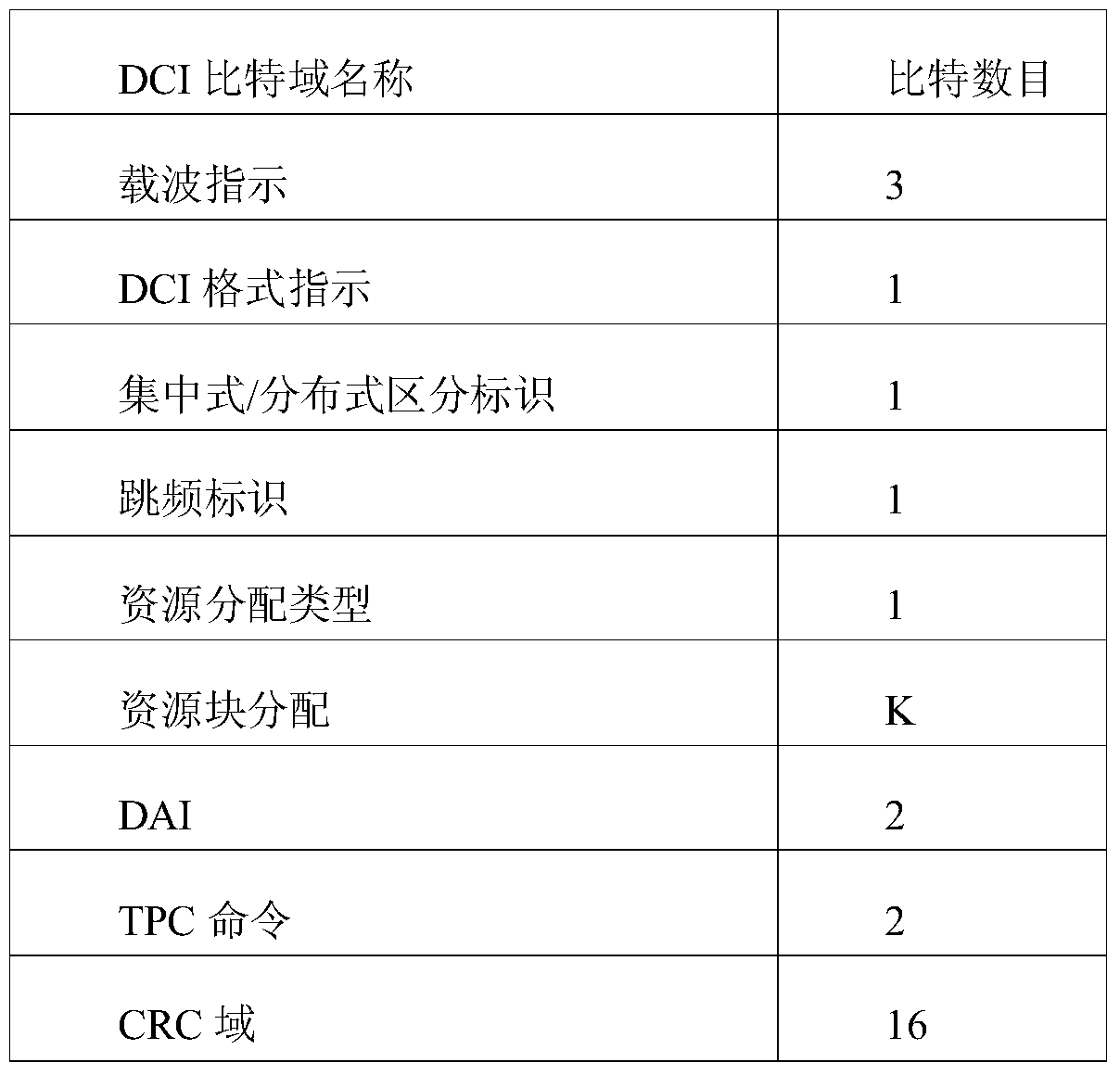
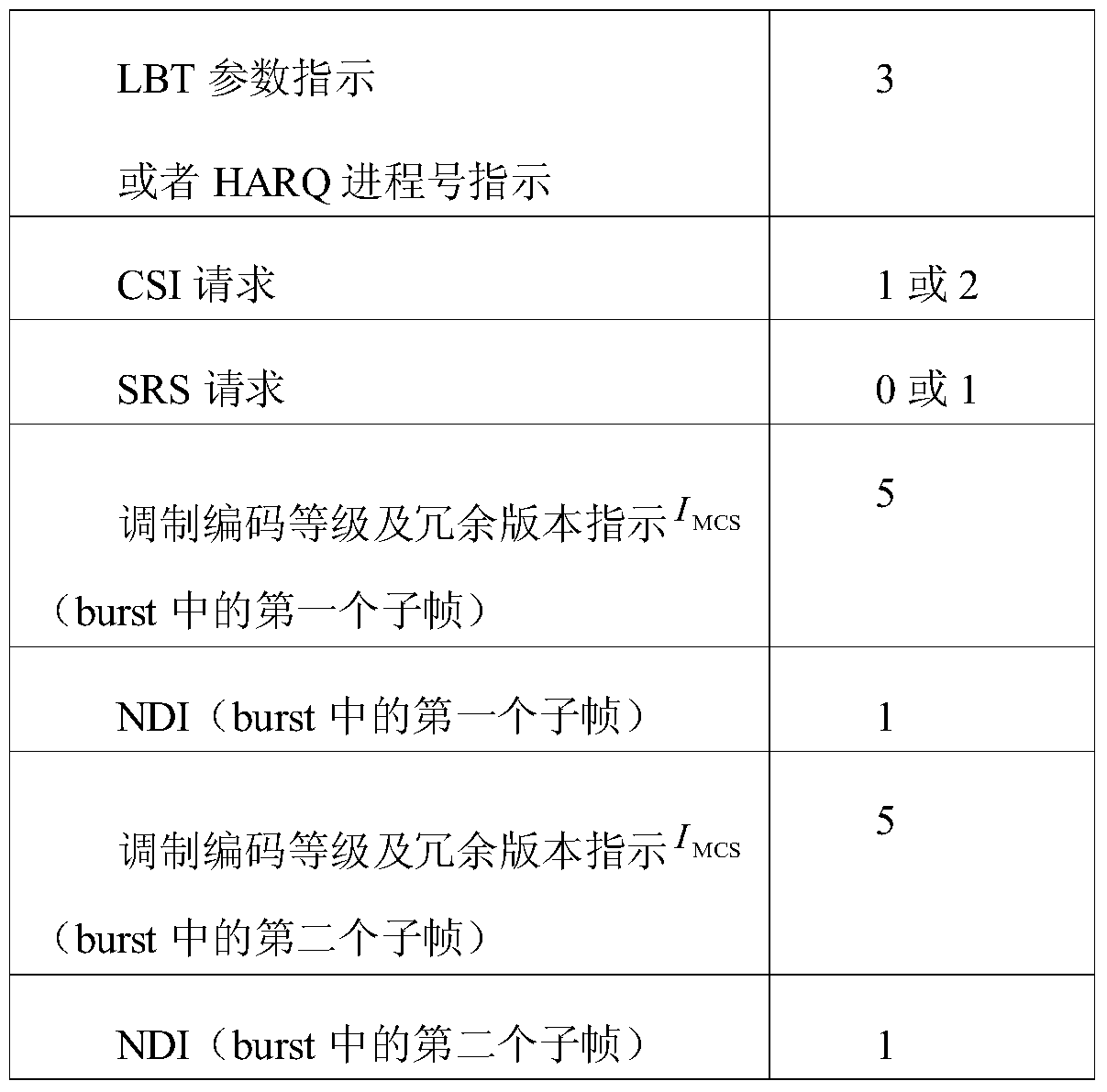
此情况,UE进行LBT的方式和/或参数仍然为预定义,或者高层信息通知。或者利用DCI format 4中原有的解调参考信号(Demodulation Reference Signal,简称DMRS)循环移位及正交卷积码(Orthogonal Convolutional Code,简称OCC)索引比特域来指示LBT的回退值,比如001代表LBT的回退值N=2。或者HARQ的进程号信息。利用format 4和format 0不同的是通过两个NDI可以实现新数据包和重传包一起调度,以及两个数据包不同的调制与编码策略(Modulation and Coding Scheme,简称MCS)及RV版本配置。比如第一次调度两个新数据包,DCI中对应的NDI比特域均为00,然后UE按照调度信息连续传输两个子帧后,结果基站仅对第一个子帧的数据包接收正确,第二个接收错误。则下次调度的时候可以通过发送NDI比特10来指示一起调度一个新数据包和一个重传数据包,并且新包和重传包的MCS可以单独配置,比如新包的MCS及RV版本的比特域的值为100,第二个子帧传输重传包的MCS及RV版本的比特域的值为110。其他的调度配置参数这两个数据包完全相同。In this case, the manner and/or parameters for the UE to perform LBT are still predefined, or high-level information is notified. Or use the original Demodulation Reference Signal (DMRS) cyclic shift and the Orthogonal Convolutional Code (OCC) index bit field in the
方式二,通过配置控制信息格式对应的控制信息或传输模式承载调度信息发送至终端。In the second manner, the control information corresponding to the control information format or the transmission mode bearer scheduling information is sent to the terminal.
(3)当本申请实施例中对利用修改现有DCI format 0或format 4,或者定义新的DCI format X来实现本发明上行burst调度的方法时,具体如下:(3) When the method for modifying the uplink burst scheduling of the present invention is implemented in the embodiment of the present application by modifying the existing
本申请实施例对利用修改现有DCI format 0或format 4,或者定义新的DCI format X来实现本发明上行burst调度的方法进行详细说明。The embodiment of the present application provides a detailed description of a method for implementing the uplink burst scheduling of the present invention by modifying an existing
该DCI信息包括两部分内容:所有调度子帧的公共的一组调度参数信息以及每个子帧的专有调度参数信息,包括m组参数分别比特映射bitmap对应调度burst包含的m个子帧。The DCI information includes two parts: a common set of scheduling parameter information of all the scheduling subframes and the dedicated scheduling parameter information of each subframe, and the m group parameters respectively correspond to the m subframes included in the scheduling burst.
即每一个连续子帧集合或一个UL burst包含的子帧共享部分相同的一组DCI调度参数信 息。具体公共DCI内容及专有DCI包含的内容如下表3所示。That is, each successive subframe set or one UL burst contains a subframe sharing part of the same set of DCI scheduling parameter information. interest. The contents of specific public DCI content and proprietary DCI are shown in Table 3 below.
表3table 3
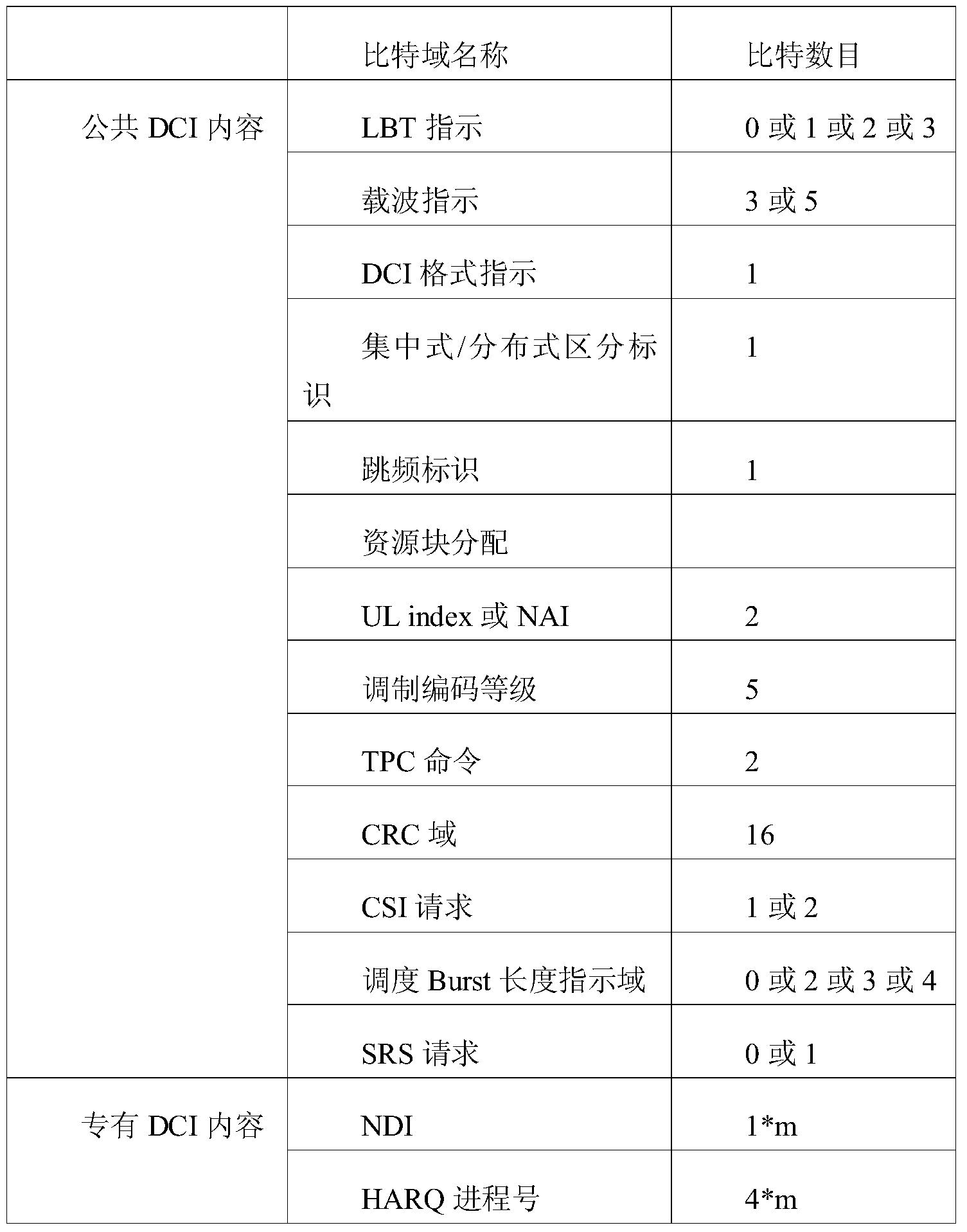
其中,LBT的相关参数指示信息。包括以下至少之一:LBT的类型,LBT的机制,LBT的竞争窗,LBT的回退值。Among them, the relevant parameters of the LBT indicate information. Including at least one of the following: LBT type, LBT mechanism, LBT competition window, LBT fallback value.
其中,LBT的类型包括以下之一:LBT类型包括:全带宽能量检测、调度物理资源块PRB所属的子带的部分带宽LBT或调度物理资源块(Physical Resource Block,简称PRB)位置部分带宽的LBT、预定义图样检测、不执行LBT、执行一次LBT、带回退的多次检测的LBT。LBT的竞争窗包括3,7,15,31,63。LBT的回退值为小于等于竞争窗的正整数。The LBT type includes one of the following: the LBT type includes: full bandwidth energy detection, scheduling a partial bandwidth LBT of a subband to which the physical resource block PRB belongs, or an LBT for scheduling a physical resource block (PRB) location partial bandwidth. , Pre-defined pattern detection, LBT without performing LBT, LBT with multiple detections, and multiple detections with back-off. The LBT competition window includes 3, 7, 15, 31, 63. The LBT's fallback value is a positive integer less than or equal to the contention window.
调度Burst的长度,即一次调度包含的连续上行子帧的数目,当比特域数目为0的时候表示该值为预定义的值,比如1ms,或者2ms,或者4ms。不为0的时候,则通过该指示信息的值确定,比如110代表连续调度7个上行子帧。 The length of the scheduled Burst, that is, the number of consecutive uplink subframes included in one scheduling, when the number of bit fields is 0, indicates that the value is a predefined value, such as 1 ms, or 2 ms, or 4 ms. When it is not 0, it is determined by the value of the indication information, for example, 110 represents that 7 uplink subframes are continuously scheduled.
并且,通过每个调度子帧都给出对应的NDI信息及HARQ进程号索引信息可以实现上行异步HARQ。将原有的1比特NDI信息修改为m比特bitmap对应调度的m个子帧。并且引入4*m比特HARQ进程号索引对应m个数据包对应的HARQ进程号。Moreover, uplink asynchronous HARQ can be implemented by giving corresponding NDI information and HARQ process number index information for each scheduling subframe. The original 1-bit NDI information is modified into m subframes corresponding to the m-bit bitmap. And the 4*m-bit HARQ process number index is introduced to correspond to the HARQ process number corresponding to the m data packets.
进一步地,指示先听后说机制LBT的类型包括以下之一:当第一个调度子帧是第一个上行子帧时,指示执行全带宽的LBT,否则,指示执行调度子带或调度资源块RB级的LBT,或者指示执行预定义图样检测的LBT,其中,预定义图样检测的LBT类型包括:在最后一个或两个符号进行增强的能量检测,检测其他UE发送的小区特定物理上行共享信道资源粒子静默cell-specific PUSCH RE muting图样或探测参考信号(Sounding Reference Signal,简称SRS)梳状频域资源预留图样标识。Further, indicating that the type of the LBT is said to be one of the following: when the first scheduling subframe is the first uplink subframe, indicating that the full bandwidth LBT is performed, otherwise, indicating that the scheduling subband or scheduling resource is performed. An LBT of the block RB level, or an LBT indicating that the predefined pattern detection is performed, wherein the LBT type of the predefined pattern detection includes: performing enhanced energy detection on the last one or two symbols, and detecting cell-specific physical uplink sharing sent by other UEs. The channel resource particle silences the cell-specific PUSCH RE muting pattern or the Sounding Reference Signal (SRS) comb-like frequency domain resource reserved pattern identifier.
进一步地,通过下行数据信道承载调度信息包括:调度信息在DCI format 0或4或者调度子帧的公有调度信息所在子帧的下行数据信道的预定义的频域位置承载,且调制编码方案MCS也为预定义的值;调度信息在DCI format 0或4或者调度子帧的公有调度信息所在子帧的下行数据信道的RRC消息配置的频域位置承载;调度信息在DCI format 0或4或者调度子帧的公有调度信息所在子帧的下行控制信道指示的下行数据信道的频域位置承载。Further, carrying the scheduling information by using the downlink data channel includes: the scheduling information is carried in a predefined frequency domain location of the downlink data channel of the subframe where the public scheduling information of the scheduling subframe is located in the
另外,可选的,专有的DCI内容除了通过控制信道承载外,还可以通过下行业务信道承载。具体承载方式如下:In addition, optionally, the proprietary DCI content can be carried over the downlink traffic channel in addition to being carried over the control channel. The specific bearer mode is as follows:
除了利用已有DCI format 0或4的比特域承载相应的配置信息外,剩余的配置信息,或者说以下调度指示信息,比如LBT参数,调度传输burst的长度,HARQ进程号信息,RV版本信息或NDI信息中的一个或多个通过PDSCH信道承载。In addition to using the existing
该信息在下行数据信道的预定义的频域位置发送,比如在系统带宽的第k个PRB位置发送,k为预定义值,或者通过下行DL grant动态指示的值,或者通过RRC消息半静态配置的值。具体子帧为与承载其他UL grant调度信息的其他信息在相同的子帧。The information is sent in a predefined frequency domain location of the downlink data channel, such as at the kth PRB location of the system bandwidth, k is a predefined value, or dynamically indicated by a downlink DL grant, or semi-statically configured through an RRC message. Value. The specific subframe is in the same subframe as other information carrying other UL grant scheduling information.
对于新增信息(比如LBT参数,调度传输burst的长度,HARQ进程号信息,RV版本信息或NDI信息中的一个或多个)在下行数据信道预定义频域位置发送的方式,所用的MCS等级等传输信息都是预定义的,比如MCS=9。UE先在下行控制信道盲检DCI format 0或4得到一部分上行调度信息后,然后到同一子帧的下行数据信道的预定义的位置接收剩余的调度信息。然后将这两部分合并就是本次调度的完整的DCI信息。MCS level used for transmitting information in a predefined frequency domain position of the downlink data channel for new information (such as LBT parameters, length of scheduled transmission burst, HARQ process number information, RV version information or NDI information) The information is always predefined, such as MCS=9. The UE first obtains a part of the uplink scheduling information after the downlink control channel blindly detects the
或者终端先接收到RRC消息配置的新增调度信息在下行数据信道的频域位置信息,然后在DCI format 0或4所在的子帧,解完控制信道后再接收下行数据信道上RRC消息配置的新增调度信息所在的频域位置上接收剩余的调度指示信息。Or the terminal first receives the frequency domain location information of the new scheduling information configured by the RRC message in the downlink data channel, and then receives the RRC message configuration on the downlink data channel after the control channel is resolved in the subframe where the
或者终端通过接收DL grant得到新增调度信息在下行数据信道的动态的频域位置信息, 然后到相应频域位置接收解码该信息就得到新增调度信息。然后将DCI中的UL grant信息合并就得到完整的上行调度的所有指示信息。Or the terminal obtains dynamic frequency domain location information of the new scheduling information on the downlink data channel by receiving the DL grant, Then, by receiving and decoding the information in the corresponding frequency domain location, new scheduling information is obtained. Then, the UL grant information in the DCI is combined to obtain all the indication information of the complete uplink scheduling.
该方式下,UE通过DCI format X所属的传输模式确定该调度方式,然后按照该格式对DCI进行盲检,确定调度配置参数的具体值。然后根据调度配置参数在调度指示的载波上进行资源竞争,成功后按照参数进行上行传输burst的发送。In this mode, the UE determines the scheduling mode by using the transmission mode to which the DCI format X belongs, and then performs blind detection on the DCI according to the format to determine a specific value of the scheduling configuration parameter. Then, according to the scheduling configuration parameter, resource competition is performed on the carrier indicated by the scheduling, and after successful, the uplink transmission burst is sent according to the parameter.
进一步地,根据调度信息接收终端发送的上行数据包括以下至少之一:Further, the uplink data sent by the receiving terminal according to the scheduling information includes at least one of the following:
方式一,对同一上行数据中的同一数据包,统一反馈新数据指示NDI和/或响应报文;In the first manner, for the same data packet in the same uplink data, the unified feedback new data indicates the NDI and/or the response packet;
方式二,对同一上行数据中的不同数据包,分别反馈新的新数据指示NDI和/或响应报文;In the second manner, different new data indicating different NDI and/or response packets are respectively sent to different data packets in the same uplink data.
其中,所述响应报文中包括:确认ACK或否认NACK。The response message includes: confirming an ACK or denying a NACK.
具体的,结合方式一和方式二,基站对同一UE的同一个数据包一起解码反馈一个NDI,不同数据包单独接收单独反馈NDI。Specifically, in combination with
或者基站检测burst中数据包NACK(包括DTX)的比例超过阈值时,即使burst还没有完全发送完毕或解码完毕,基站就可以立即发送新的调度信息,新的信息可以包括基站根据NACK确定的新的LBT的参数,以及新的调度资源配置信息,比如可以将burst的频域位置调整到另外的带宽,或者偏移某个预定义或信令指示的大小。Or, when the base station detects that the proportion of the data packet NACK (including DTX) in the burst exceeds the threshold, even if the burst is not completely transmitted or decoded, the base station may immediately send new scheduling information, and the new information may include the new determined by the base station according to the NACK. The parameters of the LBT, as well as the new scheduling resource configuration information, for example, the frequency domain location of the burst can be adjusted to another bandwidth, or offset by a certain predefined or signaling indication.
图2是本申请实施例提供的基站调度UE在三个上行子帧传输的示意图,如图2所示,基站调度UE在三个上行子帧传输。由于UE一直没有竞争成功没能发送数据,结果导致基站接收到前两个子帧的数据包都是干扰。这是基站立即发送一个新的DCI信息给UE,此信息可能指示新的调度载波指示,或者该载波的新的资源位置。FIG. 2 is a schematic diagram of a base station scheduling UE transmitting in three uplink subframes according to an embodiment of the present disclosure. As shown in FIG. 2, the base station scheduling UE transmits in three uplink subframes. Since the UE has not been able to transmit data without success, the result is that the data packet received by the base station in the first two subframes is interference. This is because the base station immediately sends a new DCI message to the UE, which may indicate a new scheduled carrier indication, or a new resource location for the carrier.
进一步地,调度信息还包括以下至少之一:先听后说机制LBT类型、先听后说机制LBT竞争窗、先听后说机制LBT回退值指示、载波指示、资源块指示、调制编码等级、混合自动重传的进程号、调度或传输burst长度指示或UL index。Further, the scheduling information further includes at least one of the following: first listening to the mechanism, LBT type, first listening mechanism, LBT contention window, first listening mechanism, LBT backoff value indication, carrier indication, resource block indication, modulation coding level , mixed automatic retransmission process number, scheduling or transmission burst length indication or UL index.
进一步地,LBT类型包括:全带宽能量检测、调度无线承载RB的子带LBT或调度PRB的部分带宽能量检测、预定义图样检测、不执行LBT、执行一次LBT或带回退的多次检测的LBT。Further, the LBT type includes: full-bandwidth energy detection, scheduling of a sub-band LBT of a radio bearer RB, or partial bandwidth energy detection of a scheduled PRB, pre-defined pattern detection, non-execution of LBT, execution of an LBT, or multiple detections with back-off. LBT.
进一步地,指示不执行LBT是指:在子帧N接收到上次调度的UE的数据,且发现UE还需要在UL子帧N+1中调度或传输数据的时候,则指示在N+1子帧发送数据之前不执行LBT;Further, indicating that the LBT is not performed refers to: when the subframe N receives the data of the last scheduled UE, and finds that the UE further needs to schedule or transmit data in the UL subframe N+1, it indicates that it is at N+1. LBT is not executed before the subframe transmits data;
在子帧N接收到其他调度UE的数据,且发现需要在UL子帧N+1中调度UE的时候,则指示UE在N+1子帧发送数据之前不执行LBT;When the data of the other scheduled UEs is received in the subframe N, and it is found that the UE needs to be scheduled in the UL subframe N+1, the UE is instructed not to perform the LBT before the N+1 subframe transmits the data;
在子帧N有下行数据发送,且发现需要在UL子帧N+1中调度UE的时候,则指示在N+1 子帧发送数据之前不执行LBT。When there is downlink data transmission in the subframe N, and it is found that the UE needs to be scheduled in the UL subframe N+1, it is indicated at N+1. LBT is not executed before the subframe transmits data.
进一步的,当基站指示UE执行UL CCA的制式或CCA的参数时,基站通知UE在UL子帧N中发送数据之前执行CCA的参数后,发现UE还需要在UL子帧N+1中发送数据时,则基站配置UE在N+1子帧发送数据之前不执行CCA或者执行一个CCA slot的CCA。Further, when the base station indicates that the UE performs the UL CCA standard or the CCA parameter, the base station notifies the UE to perform the CCA parameter before transmitting the data in the UL subframe N, and finds that the UE needs to send the data in the UL subframe N+1. The base station configures the UE to not perform CCA or perform CCA of a CCA slot before transmitting data in the N+1 subframe.
例如:第一次基站调度UE在子帧1,2,3,4,5进行数据传输。在上行数据传输过程中,比如子帧2,基站突然发现该UE还有其他数据在该载波进行调度,则基站给该UE发送调度信息的时候,同时指示该UE在子帧6进行数据传输的时候不用执行CCA在上次调度数据传输完毕后直接进行第二次调度数据的传输。或者该UE仅执行一个CCA slot的CCA。For example, the first time the base station schedules the UE to perform data transmission in
实施例二
在本实施例中提供了一种数据传输的方法,图3是根据本发明实施例的数据传输的方法的流程图,如图3所示,在终端侧,该流程包括如下步骤:A method for data transmission is provided in this embodiment. FIG. 3 is a flowchart of a method for data transmission according to an embodiment of the present invention. As shown in FIG. 3, on the terminal side, the process includes the following steps:
步骤S302,接收基站发送的调度信息,调度信息用于指示终端在非授权频谱进行上行数据的传输;Step S302: Receive scheduling information sent by the base station, where the scheduling information is used to indicate that the terminal performs uplink data transmission in the unlicensed spectrum.
本申请实施例提供的数据传输的方法可以适用于长期演进(Long Term Evolution,简称LTE/LTE-A)系统中,尤其可以应用于非授权频谱的载波业务,在本申请实施例中调度信息可以通过封装于下行控制信息(Downlink Control Information,简称DCI)进行传输。The method for data transmission provided by the embodiment of the present application may be applied to a Long Term Evolution (LTE/LTE-A) system, and may be applied to a carrier service of an unlicensed spectrum. The transmission is performed by being encapsulated in Downlink Control Information (DCI).
步骤S304,确定上行数据的传输方式;Step S304, determining a transmission mode of the uplink data;
其中,终端通过传输模式确定下行控制信息的格式,然后按照格式中的指示信息确定连续多个子帧传输方式。The terminal determines the format of the downlink control information by using the transmission mode, and then determines the continuous multiple subframe transmission manner according to the indication information in the format.
具体的,终端通过盲检DCI,和/或解析DCI中的传输或调度上行索引UL index的指示信息确定burst长度指示信息,从而确定该次调度的具体的上行子帧索引。Specifically, the terminal determines the burst length indication information by blindly checking the DCI, and/or analyzing the transmission information in the DCI or the indication information of the uplink index UL index, so as to determine a specific uplink subframe index of the scheduling.
或者通过SPS-C-RNTI标识以及RRC配置信息中的调度周期参数semiPersistSchedIntervalUL的值是否等于1确定。当semiPersistSchedIntervalUL=1的时候确定为多个连续的上行子帧调度。Or by the SPS-C-RNTI identifier and whether the value of the scheduling period parameter semiPersistSchedIntervalUL in the RRC configuration information is equal to 1. When semiPersistSchedIntervalUL=1, it is determined to be a plurality of consecutive uplink subframe scheduling.
或者终端通过下行控制信息中的显示的指示信息,比如1bit的值来确定是单子帧调度还是多子帧调度。比如0代表单子帧调度,1代表多子帧调度。Or the terminal determines whether the single subframe scheduling or the multiple subframe scheduling is performed by using the indication information displayed in the downlink control information, such as a value of 1 bit. For example, 0 represents single subframe scheduling, and 1 represents multi-subframe scheduling.
或者终端通过基站RRC高层信令半静态配置信息确定上行多子帧调度方式。比如当通知了该信息,代表多子帧调度方式使能,不通知的时候默认为单子帧调度。Or the terminal determines the uplink multi-subframe scheduling mode by using the base station RRC high-level signaling semi-static configuration information. For example, when the information is notified, the multi-subframe scheduling mode is enabled. When not notified, the default is single sub-frame scheduling.
或者终端通过预定义的方式确定多子帧调度或传输的方式。如果终端连续k次单子帧调度数据都没发送成功,在k+1次LBT成功后,默认就为多子帧连续传输。 Or the terminal determines the manner in which multiple subframes are scheduled or transmitted in a predefined manner. If the terminal does not send the single-subframe scheduling data for k consecutive times, after the k+1 LBT succeeds, the multi-subframe is continuously transmitted by default.
或者终端通过特定的RNTI确定上行多子帧调度或传输的方式。Or the terminal determines, by using a specific RNTI, how the uplink multi-subframe is scheduled or transmitted.
步骤S306,依据传输方式执行先听后说机制LBT;Step S306, performing a listening and speaking mechanism LBT according to the transmission mode;
其中,依据定时关系为接收到子帧n的调度信息,则在子帧n+k之前或n+k子帧开始符号进行LBT。k的值跟非授权上下行子帧配置相关。Wherein, according to the timing relationship, the scheduling information of the subframe n is received, and the symbol is LBT before the subframe n+k or the n+k subframe start symbol. The value of k is related to the unlicensed uplink and downlink subframe configuration.
这里本申请实施例提供的数据调度的方法中,终端可以为智能手机、笔记本电脑、平板电脑、穿戴设备或掌上商务等用户设备(User Equipment,简称UE),UE确定执行LBT的具体方式包括:In the data scheduling method provided by the embodiment of the present application, the terminal may be a user equipment (User Equipment, UE for short) such as a smart phone, a notebook computer, a tablet computer, a wearable device, or a handheld business. The specific manner for the UE to determine the execution of the LBT includes:
UE在数据传输之前,接收基站发送的占用长度信息以及每个子帧的子帧类型(上行子帧还是下行子帧)信息。Before receiving the data, the UE receives the occupation length information sent by the base station and the subframe type (uplink subframe or downlink subframe) information of each subframe.
UE根据此信息确定调度的第一个传输子帧在整个上行子帧中的子帧索引。The UE determines, according to this information, a subframe index of the first transmission subframe of the scheduling in the entire uplink subframe.
步骤S308,当执行结果为成功时,依据调度信息向基站发送上行数据。Step S308, when the execution result is successful, the uplink data is sent to the base station according to the scheduling information.
具体的,基于步骤S306,LBT竞争成功或者检测到同小区的UE已经在该载波发送数据的时候,UE就可以按照调度信息将准备好的数据发送出去。Specifically, based on step S306, when the LBT is successfully contending or detecting that the UE in the same cell has already transmitted data on the carrier, the UE may send the prepared data according to the scheduling information.
具体的,UE根据NDI信息以及HARQ进程号信息进行相应首传包或者重传数据包的发送。Specifically, the UE performs corresponding first packet transmission or retransmission data packet according to the NDI information and the HARQ process number information.
优选的,当UE执行LBT成功后,连续传输多个子帧的情形,UE是在LBT成功后剩余调度子帧的子帧上进行数据传输。Preferably, when the UE performs the LBT successfully, the plurality of subframes are continuously transmitted, and the UE performs data transmission on the subframe of the remaining scheduling subframe after the LBT succeeds.
可选的,无论UE在哪个调度子帧执行LBT成功,都是连续传输调度的burst长度的子帧数目,且后面非调度的子帧采用MU-MIMO的方式进行传输。Optionally, regardless of which scheduling subframe the UE performs LBT successfully, the number of subframes of the burst length of the continuous transmission scheduling is performed, and the subsequent unscheduled subframes are transmitted by using MU-MIMO.
可选的,UE还可以根据竞争结果确定上行数据传输的子帧图样。Optionally, the UE may further determine a subframe pattern of the uplink data transmission according to the contention result.
本申请实施例提供的数据传输的方法,通过接收基站发送的调度信息,调度信息用于指示终端在非授权频谱进行上行数据的传输;确定上行数据的传输方式;依据传输方式执行先听后说机制LBT;当执行结果为成功时,依据调度信息向基站发送上行数据。解决了由于相关技术中缺少减小信令开销,提升非授权频谱上行传输速率的技术,导致上行数据传输效率降低的问题,进而达到了减小信令开销,提升非授权频谱上行传输速率的效果。The data transmission method provided by the embodiment of the present application receives the scheduling information sent by the base station, where the scheduling information is used to indicate that the terminal performs uplink data transmission in the unlicensed spectrum, determines the transmission mode of the uplink data, and performs the first listening according to the transmission mode. Mechanism LBT; when the execution result is successful, the uplink data is sent to the base station according to the scheduling information. The invention solves the problem that the uplink data transmission efficiency is reduced due to the lack of the signaling overhead in the related art, and the uplink data transmission efficiency is reduced, thereby reducing the signaling overhead and improving the uplink transmission rate of the unlicensed spectrum. .
进一步地,依据所述预设条件确定所述上行数据的传输方式,其中,所述预设条件包括以下至少之一:下行控制信息的格式;下行控制信息中的显示指示信令;调度信息中传输或调度burst长度指示域的值;调度信息中上行索引UL index的值;通过无线资源控制(Radio Resource Control,简称RRC)半静态配置信令;通过特定的小区无线网络临时(Cell Radio Network Temporary Identifier,简称C-RNTI)标识;通过半静态调度的小区无线网络临时(Semi Persistent Scheduling-C-RNTI,简称SPS-C-RNTI)标识以及RRC配置信息中的调度周期参数上 行调度间隔semiPersistSchedIntervalUL的值等于1。Further, the transmission mode of the uplink data is determined according to the preset condition, where the preset condition includes at least one of: a format of downlink control information; display indication signaling in downlink control information; and scheduling information Transmit or schedule the value of the burst length indication field; the value of the uplink index UL index in the scheduling information; semi-static configuration signaling through Radio Resource Control (RRC); through a specific cell radio network temporary (Cell Radio Network Temporary) Identifier (C-RNTI) identifier; the Semi-Persistent Scheduling-C-RNTI (SPS-C-RNTI) identifier and the scheduling period parameter in the RRC configuration information The row scheduling interval semiPersistSchedIntervalUL has a value equal to 1.
具体的,当UE按照调度信息及LBT参数及类型在第一个调度子帧传输之前执行LBT成功,则该UE连续传输调度指示中调度或传输burst长度指示域指示的m个上行子帧,或者连续传输预定义长度,比如两个上行子帧,或者四个上行子帧。对应的频域位置为调度配置指示中的频域位置。Specifically, when the UE performs LBT successfully before the first scheduling subframe transmission according to the scheduling information and the LBT parameter and the type, the UE continuously transmits, in the scheduling indication, the m uplink subframes indicated by the burst length indication field, or Continuously transmit a predefined length, such as two uplink subframes, or four uplink subframes. The corresponding frequency domain location is the frequency domain location in the scheduling configuration indication.
当UE按照n+k的定时关系,在第一个调度的上行子帧传输前LBT没有成功,同时如果UE在第二调度子帧前执行LBT成功,则UE可以继续连续传输m-1个子帧,或者仍然可以传输m个子帧,其中第m个传输子帧采用MU-MIMO的方式传输。如果UE在第二个调度子帧执行LBT仍然没有成功,则UE继续在第三个调度子帧执行LBT,成功后连续传输m-2个子帧,或者连续传输m个子帧,其中第m-1和第m个子帧都是采用MU-MIMO的方式传输。其中,MU传输中用的导频的循环移位的值通过LTE现有技术获得。但是,连续传输的最后一个子帧与第一个调度子帧的差不能超过一个预定义的阈值。比如,限制UE可以递延传输的最大子帧数目为4。When the UE follows the timing relationship of n+k, the LBT is not successful before the first scheduled uplink subframe transmission, and if the UE performs LBT successfully before the second scheduling subframe, the UE may continue to continuously transmit m-1 subframes. Or, m subframes can still be transmitted, where the mth transmission subframe is transmitted by MU-MIMO. If the UE still fails to perform LBT in the second scheduling subframe, the UE continues to perform LBT in the third scheduling subframe, and after successful transmission, continuously transmits m-2 subframes, or continuously transmits m subframes, where m-1 And the mth subframe is transmitted by MU-MIMO. Among them, the value of the cyclic shift of the pilot used in the MU transmission is obtained by the LTE prior art. However, the difference between the last subframe of consecutive transmissions and the first scheduled subframe cannot exceed a predefined threshold. For example, the maximum number of subframes that can limit the UE's deferred transmission is 4.
例如,基站调度某UE在子帧2,3,4,5子帧传输,如果UE在子帧2执行CCA成功,则UE就可以连续传输子帧2,3,4,5,即后续子帧不需要再执行CCA。如果UE在子帧2执行CCA失败,而在子帧3执行CCA成功,则UE可以连续传输子帧3,4,5,中间不用再执行CCA。或者如果子帧6仍然是上行子帧,则该UE还可以在子帧3,4,5,6进行调度数据的发送,且子帧6需要采用MU的方式发送。For example, the base station schedules a UE to transmit in
此外,UE除了完全按照基站配置的子帧进行上行数据传输外,还可以预配置多个子帧pattern,图4是本申请实施例提供的UE确定最终的传输子帧pattern的示意图,如图4所示,连续的和非连续的两种,UE根据抢占结果确定最终的传输子帧pattern。In addition, the UE can pre-configure multiple subframe patterns in addition to the uplink data transmission in the subframe configured by the base station. FIG. 4 is a schematic diagram of determining, by the UE, the final transmission subframe pattern according to the embodiment of the present application, as shown in FIG. 4 . Show that there are two types of continuous and non-continuous, and the UE determines the final transmission subframe pattern according to the preemption result.
该方式下,基站需要给出多用户MU-MIMO的导频的循环移位参数。In this manner, the base station needs to give a cyclic shift parameter of the pilot of the multi-user MU-MIMO.
如果UE在子帧4LBT成功,则可以采用Pattern2的方式传输,即连续传输4,5,6,7四个子帧。If the UE succeeds in the subframe 4LBT, it can be transmitted in the manner of Pattern2, that is, four subframes of 4, 5, 6, and 7 are continuously transmitted.
如果UE子帧5LBT仍然没有成功,则再按照Pattern1的调度方式在子帧8抢占传输成功后,需要在子帧8和9采用MU的方式进行数据传输。If the UE subframe 5LBT is still unsuccessful, the data transmission is performed in the
进一步地,步骤S306中依据传输方式执行先听后说机制LBT包括以下至少之一:Further, the step S306 performs the first listening mechanism according to the transmission mode, and the LBT includes at least one of the following:
方式一,当第一个调度传输子帧是第一个上行子帧时,执行全带宽的LBT,否则,执行调度子带/RB级的LBT,或者直接在最后一个或两个符号进行增强的能量检测,检测其他UE发送的cell-specific PUSCH RE muting或发送RE梳状频域资源预留标识;In the first mode, when the first scheduling transmission subframe is the first uplink subframe, the LBT of the full bandwidth is executed. Otherwise, the LBT of the scheduling subband/RB level is executed, or the last one or two symbols are directly enhanced. Energy detection, detecting cell-specific PUSCH RE muting sent by other UEs or transmitting RE comb frequency domain resource reservation identifier;
方式二,在第一个调度子帧执行全带宽的LBT,后续子帧执行调度子带或RB级的部分带宽的LBT; Manner 2: performing LBT of full bandwidth in the first scheduling subframe, and performing LBT of partial bandwidth of the scheduling subband or RB level in the subsequent subframe;
方式三,在第一个调度子帧执行全带宽的LBT,后续调度子帧执行预定义图样检测的LBT;In the third mode, the full-bandwidth LBT is performed in the first scheduling subframe, and the subsequent scheduling subframe performs the LBT of the predefined pattern detection.
方式四,在第K个调度子帧执行LBT成功后,后续子帧不执行LBT,直接连续传输调度的m个上行子帧或剩余的m-k+1个子帧,其中,m为调度上行数据burst包含的子帧数目;Manner 4: After the LBT is successfully executed in the Kth scheduling subframe, the subsequent subframes do not perform the LBT, and directly transmit the scheduled m uplink subframes or the remaining m-
方式五,在第一个调度子帧执行带回退的LBT机制,后续子帧执行不带回退的LBT机制,或者执行带回退值,且回退值依次减一的LBT机制。In the fifth mode, the LBT mechanism with the backoff is performed in the first scheduling subframe, the LBT mechanism without the backoff is performed in the subsequent subframe, or the LBT mechanism with the backoff value and the backoff value is sequentially decreased by one.
方式六,当终端在UL子帧N中发送被调度的数据,确定还需要在UL子帧N+1中发送被调度的数据时,在N+1子帧之前不需要执行CCA。Mode 6: When the terminal transmits the scheduled data in the UL subframe N and determines that the scheduled data needs to be transmitted in the UL subframe N+1, the CCA does not need to be performed before the N+1 subframe.
具体的,结合方式一至方式六,终端依据传输方式执行先听后说机制LBT具体如下:Specifically, in combination with the first mode to the sixth mode, the terminal performs the first listening and speaking mechanism LBT according to the transmission mode as follows:
当第一个调度传输子帧正好是第一个上行子帧时,UE执行全带宽的LBT,否则,UE执行调度子带/RB级的LBT,或者直接在最后一个符号进行增强的能量检测,检测其他UE发送的cell-specific PUSCH RE muting或发送RE梳状频域资源预留标识。When the first scheduling transmission subframe is exactly the first uplink subframe, the UE performs the full bandwidth LBT. Otherwise, the UE performs the LBT of the scheduling subband/RB level, or performs enhanced energy detection directly in the last symbol. Detecting cell-specific PUSCH RE muting sent by other UEs or sending an RE comb frequency domain resource reservation identifier.
或者,UE直接在第一个调度子帧执行全带宽的LBT,后续子帧执行调度子带或RB级的LBT。Alternatively, the UE directly performs the full bandwidth LBT in the first scheduling subframe, and the subsequent subframe performs the scheduling subband or the RB level LBT.
或者,当UE在第一个调度子帧执行LBT成功后,后续子帧不执行LBT,直接连续传输调度的m个上行子帧,且在每个调度子帧的最后一个或两个OFDM符号预留预定义图样的RE资源。Or, after the UE performs the LBT successfully in the first scheduling subframe, the subsequent subframe does not perform the LBT, and directly transmits the scheduled m uplink subframes, and the last one or two OFDM symbols in each scheduling subframe are pre- Leave the RE resource of the predefined pattern.
或者UE在第一个调度子帧执行带回退的LBT机制,后续子帧执行不带回退的LBT机制,或者执行带回退值,且回退值依次减一的LBT机制。Or the UE performs the LBT mechanism with the back-off in the first scheduling subframe, and the LBT mechanism without the back-off is performed in the subsequent subframe, or the LBT mechanism with the back-off value and the back-off value is sequentially decreased by one.
或者如果UE在第k个子帧执行LBT成功,UE按照调度指示信息发送数据,如果在第k+1个子帧仍然有调度数据发送,则UE在第k+1个子帧不执行CCA,直接使用非授权载波发送。Or if the UE performs LBT successfully in the kth subframe, the UE sends data according to the scheduling indication information. If there is still scheduled data transmission in the k+1th subframe, the UE does not perform CCA in the k+1th subframe, and directly uses the non- Authorized carrier transmission.
进一步地,步骤S308中依据调度信息向基站发送上行数据包括以下至少之一:Further, sending the uplink data to the base station according to the scheduling information in step S308 includes at least one of the following:
方式一,当调度信息中仅有一组参数组合时,上行数据中的每个调度子帧都按照参数组合进行传输;In the first manner, when only one set of parameters is combined in the scheduling information, each scheduling subframe in the uplink data is transmitted according to a combination of parameters;
方式二,当调度信息中有多组新数据指示NDI及混合自动上传HARQ进程号时,上行数据中的每个子帧按照NDI及HARQ进程号进行新数据包或重传包的发送;In the second mode, when there are multiple sets of new data indicating the NDI and the hybrid automatic upload HARQ process ID in the scheduling information, each subframe in the uplink data is sent according to the NDI and the HARQ process ID to send a new data packet or a retransmission packet;
方式三,当调度信息中有多组新数据指示NDI及一个混合自动上传HARQ进程号时,对于新传包,按照NDI及选择对应的HARQ进程号中最小的一个HARQ进程号进行新数据包的发送,对于重传包使用原HARQ进程号进行发送。In the third mode, when there are multiple sets of new data indicating the NDI and a hybrid automatic uploading HARQ process ID in the scheduling information, for the new transport packet, the new data packet is selected according to the NDI and the smallest HARQ process ID in the corresponding HARQ process ID. Send, send the original HARQ process ID for the retransmission packet.
具体的,结合步骤方式一、方式二和方式三,终端依据调度信息向基站发送上行数据具 体如下:Specifically, in combination with the first mode, the second mode, and the third mode, the terminal sends the uplink data to the base station according to the scheduling information. The body is as follows:
这里的LBT参数包括竞争窗大小和/或回退值N。特别的,当UE执行LBT的方式为每次仅执行一个CCA时隙的时候,UE仅需要确定LBT的类型即可,不再需要确定回退值或竞争窗大小。The LBT parameters here include the contention window size and/or the backoff value N. In particular, when the UE performs the LBT in a manner that only one CCA slot is executed at a time, the UE only needs to determine the type of the LBT, and it is no longer necessary to determine the backoff value or the contention window size.
对于一个UL burst中包括m个数据包,则所执行的LBT竞争窗和/或回退值对应的LBT等级的确定方式为:For a UL burst including m data packets, the LBT level corresponding to the LBT contention window and/or the backoff value is determined by:
当连续m个子帧均调度新包的时候,LBT竞争窗和/或回退值参数按照数据包中业务等级最低对应的LBT参数确定。When a new packet is scheduled for each of the m subframes, the LBT contention window and/or the backoff value parameter are determined according to the LBT parameter corresponding to the lowest service level in the data packet.
当m个子帧均调度重传包的时候,LBT竞争窗和/或回退值参数按照数据包中LBT等级最高的确定。或者,当m个子帧均调度重传包的时候,LBT竞争窗和/或回退值参数按照数据包中LBT等级最低确定。When m subframes are scheduled to retransmit packets, the LBT contention window and/or the backoff value parameter are determined according to the highest LBT level in the data packet. Alternatively, when m subframes are scheduled to retransmit packets, the LBT contention window and/or the backoff value parameter are determined according to the lowest LBT level in the data packet.
当调度的多个子帧中既有新包又有重传包的时候,LBT竞争窗和/或回退值按照数据包中业务优先级最低对应的LBT参数确定。When there are both new packets and retransmission packets in the scheduled multiple subframes, the LBT contention window and/or the backoff value are determined according to the LBT parameters corresponding to the lowest service priority in the data packet.
如果UE在第一个调度子帧LBT成功就可以连续传输调度的M个子帧。可选的,UE需要在连续传输的每个上行子帧的最后一个或两个OFDM符号预留预定义频域图样的RE资源,或者传输子帧的第一个或前两个OFDM符号预留预定义频域图样的RE资源。If the UE succeeds in the first scheduling subframe LBT, the scheduled M subframes can be continuously transmitted. Optionally, the UE needs to reserve the RE resource of the predefined frequency domain pattern in the last one or two OFDM symbols of each uplink subframe continuously transmitted, or to reserve the first or the first two OFDM symbols of the subframe. Pre-defined RE domain resources for the frequency domain pattern.
一旦UE执行LBT成功,就可以在调度的资源位置连续传输调度burst长度的m个子帧,或者调度子帧剩余的n(n小于m)个子帧。Once the UE performs the LBT successfully, the m subframes of the scheduling burst length may be continuously transmitted at the scheduled resource location, or the remaining n (n is less than m) subframes of the subframe may be scheduled.
进一步地,本申请实施例提供的数据传输的方法还包括以下至少之一:Further, the method for data transmission provided by the embodiment of the present application further includes at least one of the following:
方式一,当执行结果为失败时,在上行数据的第二个空闲信道评估CCA位置执行LBT,直到调度上行数据中的最后一个子帧;In the first mode, when the execution result is a failure, the LBT is performed on the second idle channel evaluation CCA position of the uplink data until the last subframe in the uplink data is scheduled;
方式二,当执行结果为失败时,继续执行LBT,且当上行数据剩余长度m-k小于预设阈值时,放弃传输,m与k为正整数,且m大于k;In the second manner, when the execution result is a failure, the LBT is continuously executed, and when the remaining length m-k of the uplink data is less than the preset threshold, the transmission is abandoned, m and k are positive integers, and m is greater than k;
方式三,当执行结果为失败时,放弃传输。
这里结合方式一、方式二和方式三,如果第一个调度子帧LBT没有成功,则UE继续在第二个CCA的位置进行LBT,LBT的N从上次LBT结束时候开始算起,不用重新生成;或者N值比第一个子帧的LBT的回退值减小一个预定义的值,比如1,依次类推直到调度的最后一个子帧;或者当burst剩余长度小于阈值L的时候,UE放弃此次多子帧调度传输;或者UE直接放弃该调度burst传输。Here, combining
具体的,如果第一个调度子帧LBT没有成功,则UE继续在第下一个CCA的位置进行LBT,如果是采用带回退的LBT方式,则LBT的回退值N从上次LBT结束时候开始算起, 不用重新生成;或者N值比第一个子帧的LBT的回退值减小一个预定义的值,比如1,依次类推,直到调度的最后一个子帧,如果LBT仍然没有成功,则只能放弃;Specifically, if the first scheduling subframe LBT is unsuccessful, the UE continues to perform LBT at the position of the next CCA. If the LBT mode with the backoff is adopted, the LBT backoff value N is from the last LBT end. Start counting, There is no need to regenerate; or the value of N is reduced by a predefined value from the LBT backoff value of the first subframe, such as 1, and so on, until the last subframe of the schedule, if the LBT is still not successful, then give up;
或者当调度burst剩余长度小于阈值L的时候,UE就放弃此次多子帧调度传输;Or when the remaining length of the scheduling burst is less than the threshold L, the UE discards the multi-subframe scheduling transmission;
或者UE如果在第一个调度子帧LBT没有成功就直接放弃该调度burst传输。Or the UE directly discards the scheduled burst transmission if the LBT is unsuccessful in the first scheduling subframe.
实施例三
通过以上的实施方式的描述,本领域的技术人员可以清楚地了解到根据上述实施例的方法可借助软件加必需的通用硬件平台的方式来实现,当然也可以通过硬件,但很多情况下前者是更佳的实施方式。基于这样的理解,本发明的技术方案本质上或者说对现有技术做出贡献的部分可以以软件产品的形式体现出来,该计算机软件产品存储在一个存储介质(如ROM/RAM、磁碟、光盘)中,包括若干指令用以使得一台终端设备(可以是手机,计算机,服务器,或者网络设备等)执行本发明各个实施例所述的方法。Through the description of the above embodiments, those skilled in the art can clearly understand that the method according to the above embodiment can be implemented by means of software plus a necessary general hardware platform, and of course, by hardware, but in many cases, the former is A better implementation. Based on such understanding, the technical solution of the present invention, which is essential or contributes to the prior art, may be embodied in the form of a software product stored in a storage medium (such as ROM/RAM, disk, The optical disc includes a number of instructions for causing a terminal device (which may be a cell phone, a computer, a server, or a network device, etc.) to perform the methods described in various embodiments of the present invention.
在本实施例中还提供了一种数据调度的装置,该装置设置为实现上述实施例及优选实施方式,已经进行过说明的不再赘述。如以下所使用的,术语“模块”可以实现预定功能的软件和/或硬件的组合。尽管以下实施例所描述的装置较佳地以软件来实现,但是硬件,或者软件和硬件的组合的实现也是可能并被构想的。In this embodiment, a device for data scheduling is further provided, and the device is configured to implement the foregoing embodiments and preferred embodiments, and details are not described herein. As used below, the term "module" may implement a combination of software and/or hardware of a predetermined function. Although the apparatus described in the following embodiments is preferably implemented in software, hardware, or a combination of software and hardware, is also possible and contemplated.
图5是根据本发明实施例的一种数据调度的装置的结构框图,如图5所示,在基站侧,该装置包括:第一配置模块52和接收模块54,其中,FIG. 5 is a structural block diagram of an apparatus for data scheduling according to an embodiment of the present invention. As shown in FIG. 5, on the base station side, the apparatus includes: a first configuration module 52 and a receiving module 54, wherein
第一配置模块52,设置为根据预先确定的非授权上行子帧的调度方式配置调度信息,调度信息用于指示终端在非授权频谱进行上行数据的传输;The first configuration module 52 is configured to configure scheduling information according to a predetermined scheduling manner of the unlicensed uplink subframe, where the scheduling information is used to indicate that the terminal performs uplink data transmission in the unlicensed spectrum.
接收模块54,设置为根据配置模块52配置的调度信息接收终端发送的上行数据。The receiving module 54 is configured to receive uplink data sent by the terminal according to the scheduling information configured by the configuration module 52.
本申请实施例提供的数据调度的装置,通过根据预先确定的非授权上行子帧的调度方式配置调度信息,调度信息用于指示终端在非授权频谱进行上行数据的传输;根据调度信息接收终端发送的上行数据。解决了由于相关技术中缺少减小信令开销,提升非授权频谱上行传输速率的技术,导致上行数据传输效率降低的问题,进而达到了减小信令开销,提升非授权频谱上行传输速率的效果。The apparatus for data scheduling provided by the embodiment of the present application configures scheduling information according to a scheduling manner of a predetermined unlicensed uplink subframe, where the scheduling information is used to indicate that the terminal performs uplink data transmission in an unlicensed spectrum; Upstream data. The invention solves the problem that the uplink data transmission efficiency is reduced due to the lack of the signaling overhead in the related art, and the uplink data transmission efficiency is reduced, thereby reducing the signaling overhead and improving the uplink transmission rate of the unlicensed spectrum. .
进一步地,图6是根据本发明实施例的另一种数据调度的装置的结构框图,如图6所示,本申请实施例提供的数据调度的装置还包括:第二配置模块51,其中,Further, FIG. 6 is a structural block diagram of another apparatus for data scheduling according to an embodiment of the present invention. As shown in FIG. 6, the apparatus for data scheduling provided by the embodiment of the present application further includes: a second configuration module 51, where
第二配置模块51,设置为在根据预先确定的非授权上行子帧的调度方式配置调度信息之前,依据预设条件确定调度方式,预设条件包括以下至少之一:非授权载波下行负载/上行负载的比值低于预定义门限的时候;在一个传输机会TXOP内,下行子帧数目少于上行子帧数目;在预定时间T内连续k次接收上行数据失败,其中,k为整数。 The second configuration module 51 is configured to determine a scheduling manner according to a preset condition before configuring scheduling information according to a predetermined scheduling manner of the unlicensed uplink subframe, where the preset condition includes at least one of the following: an unlicensed carrier downlink load/uplink When the ratio of the load is lower than the predefined threshold; in a transmission opportunity TXOP, the number of downlink subframes is less than the number of uplink subframes; and the uplink data fails to receive k consecutive times within a predetermined time T, where k is an integer.
进一步地,该调度方式包括:每次调度终端的至少一个上行数据突发burst,其中,每个上行数据突发burst包括连续的m个上行子帧,m为正整数,且大于或等于1。Further, the scheduling manner includes: scheduling at least one uplink data burst burst of the terminal each time, wherein each uplink data burst burst includes consecutive m uplink subframes, where m is a positive integer and greater than or equal to 1.
进一步地,调度信息包括:一个上行数据突发burst中所有调度子帧共用的公有调度信息和一个上行数据突发burst中每个调度子帧专有调度信息,其中,专有调度信息包括以下至少之一:先听后说机制LBT类型、新数据指示NDI、冗余版本RV、混合自动上传HARQ进程号。Further, the scheduling information includes: public scheduling information shared by all scheduling subframes in an uplink data burst burst and dedicated scheduling information of each scheduling subframe in an uplink data burst burst, wherein the proprietary scheduling information includes at least the following One: first listen to the mechanism LBT type, new data indicates NDI, redundancy version RV, hybrid automatic upload HARQ process number.
进一步地,第一配置模块52包括以下至少之一:Further, the first configuration module 52 includes at least one of the following:
第一配置单元,设置为当调度一个上行数据突发burst中的每个子帧都承载新数据包时,调度信息包括一个调度参数组合,调度参数组合包括:新数据指示NDI、冗余版本RV和混合自动上传HARQ进程号;The first configuration unit is configured to: when each subframe in an uplink data burst burst is scheduled to carry a new data packet, the scheduling information includes a combination of scheduling parameters, and the scheduling parameter combination includes: new data indicating NDI, redundancy version RV, and Hybrid automatic upload of HARQ process number;
第二配置单元,设置为当调度一个上行数据突发burst中的每个子帧都承载重传包,且重传包对应的首传包共享一个调度参数组合时,调度信息包括一个调度参数组合,其中,调度参数组合包括以下参数:新数据指示NDI、冗余版本RV和混合自动上传HARQ进程号;a second configuration unit, configured to: when each subframe in an uplink data burst burst is scheduled to carry a retransmission packet, and the first packet corresponding to the retransmission packet shares a scheduling parameter combination, the scheduling information includes a scheduling parameter combination, The scheduling parameter combination includes the following parameters: new data indicating NDI, redundancy version RV, and hybrid automatic upload HARQ process number;
第三配置单元,设置为当调度一个上行数据突发burst中承载新数据包和重传包时,分配多组调度参数组合至新数据包和重传包,调度参数组合包括:新数据指示NDI、冗余版本RV和混合自动上传HARQ进程号。The third configuration unit is configured to allocate a plurality of sets of scheduling parameters to the new data packet and the retransmission packet when scheduling an uplink data burst burst to carry the new data packet and the retransmission packet, where the scheduling parameter combination includes: the new data indicates the NDI , redundancy version RV and hybrid automatic upload HARQ process number.
进一步地,第三配置单元包括以下至少之一:Further, the third configuration unit includes at least one of the following:
第一配置子单元,设置为分别对新数据包和重传包分配一个调度参数组合,调度参数组合包括:新数据指示NDI、冗余版本RV和混合自动上传HARQ进程号;The first configuration subunit is configured to respectively allocate a scheduling parameter combination to the new data packet and the retransmission packet, where the scheduling parameter combination includes: new data indicating NDI, redundancy version RV, and hybrid automatic upload HARQ process number;
第二配置子单元,设置为为每个数据包分配一个调度参数组合。The second configuration subunit is arranged to assign a scheduling parameter combination to each data packet.
进一步地,第一配置模块52包括:Further, the first configuration module 52 includes:
第四配置单元,设置为当调度一个上行数据突发burst中的新数据包接收错误时,配置下次重传包的调度信息;第四配置单元包括以下至少之一:And a fourth configuration unit, configured to: when scheduling a new data packet receiving error in an uplink data burst burst, configuring scheduling information of the next retransmission packet; the fourth configuration unit includes at least one of the following:
第三配置子单元,设置为单独调度每个重传包;a third configuration subunit, configured to separately schedule each retransmission packet;
第四配置子单元,设置为每个重传包分配一个调度参数组合,调度参数组合包括:新数据指示NDI、冗余版本RV和混合自动上传HARQ进程号;a fourth configuration subunit, configured to allocate a scheduling parameter combination for each retransmission packet, where the scheduling parameter combination includes: new data indicating NDI, redundancy version RV, and hybrid automatic upload HARQ process number;
第五配置子单元,设置为重传包调度相同的调度参数组合。The fifth configuration subunit is configured to retransmit the same scheduling parameter combination for the retransmission packet.
进一步地,图7是根据本发明实施例的又一种数据调度的装置的结构框图,如图7所示,本申请实施例提供的数据调度的装置还包括:发送模块53,其中,Further, FIG. 7 is a structural block diagram of another apparatus for data scheduling according to an embodiment of the present invention. As shown in FIG. 7, the apparatus for data scheduling provided by the embodiment of the present application further includes: a sending module 53, where
发送模块53,设置为在根据调度信息接收终端发送的上行数据之前,向终端发送调度信 息;其中,发送模块53包括以下至少之一:The sending module 53 is configured to send a scheduling letter to the terminal before receiving the uplink data sent by the terminal according to the scheduling information. The sending module 53 includes at least one of the following:
第一发送单元,设置为通过下行控制信道承载发送调度信息中的公有调度信息;The first sending unit is configured to transmit the public scheduling information in the scheduling information by using the downlink control channel bearer;
第二发送单元,设置为通过下行数据信道承载发送调度信息中的专有调度信息或先听后说机制LBT类型或先听后说机制LBT竞争窗或先听后说机制LBT回退值指示或调度或传输burst长度指示至少之一。The second sending unit is configured to send the exclusive scheduling information in the scheduling information by using the downlink data channel bearer or the LBT type of the first listening mechanism or the LBT contention window or the LBT backoff value indication Scheduling or transmitting a burst length indication at least one.
进一步地,发送模块53还包括以下至少之一:Further, the sending module 53 further includes at least one of the following:
第三发送单元,设置为通过已有的控制信息格式对应的控制信息承载调度信息发送至终端;The third sending unit is configured to send the control information bearer scheduling information corresponding to the existing control information format to the terminal;
第四发送单元,设置为通过配置控制信息格式或传输模式对应的控制信息或特定的RNTI加扰的控制信息承载调度信息发送至终端。The fourth sending unit is configured to send the control information bearer scheduling information corresponding to the control information format or the transmission mode or the specific RNTI scrambled control information to the terminal.
进一步地,接收模块54包括以下至少之一:Further, the receiving module 54 includes at least one of the following:
第一反馈单元,设置为对同一上行数据中的同一数据包,统一反馈新数据指示NDI和/或响应报文;The first feedback unit is configured to uniformly feed back the new data indicating the NDI and/or the response message to the same data packet in the same uplink data;
第二反馈单元,设置为对同一上行数据中的不同数据包,分别反馈新的新数据指示NDI和/或响应报文;其中,响应报文中包括:确认ACK或否认NACK。The second feedback unit is configured to feed back new new data indication NDI and/or response message to different data packets in the same uplink data, where the response message includes: acknowledge ACK or deny NACK.
进一步地,调度信息还包括以下至少之一:先听后说机制LBT类型、先听后说机制LBT竞争窗、先听后说机制LBT回退值指示、载波指示、资源块指示、调制编码等级、混合自动重传的进程号、调度或传输burst长度指示、UL index。Further, the scheduling information further includes at least one of the following: first listening to the mechanism, LBT type, first listening mechanism, LBT contention window, first listening mechanism, LBT backoff value indication, carrier indication, resource block indication, modulation coding level , mixed automatic retransmission process number, scheduling or transmission burst length indication, UL index.
进一步地,LBT类型包括:全带宽能量检测、调度物理资源块PRB所属的子带的部分带宽LBT或调度物理资源块PRB位置部分带宽的LBT、预定义图样检测、不执行LBT、执行一次LBT、带回退的多次检测的LBT。Further, the LBT type includes: full bandwidth energy detection, scheduling a partial bandwidth LBT of a subband to which the physical resource block PRB belongs, or an LBT for scheduling a partial bandwidth of a physical resource block PRB, a predefined pattern detection, not performing LBT, performing an LBT, LBT with multiple detections for back-off.
进一步地,指示不执行LBT包括以下之一:在子帧N接收到上次调度的UE的数据,且发现UE还需要在UL子帧N+1中调度或传输数据的时候,则指示在N+1子帧发送数据之前不执行LBT;在子帧N接收到其他调度UE的数据,且发现需要在UL子帧N+1中调度UE的时候,则指示UE在N+1子帧发送数据之前不执行LBT;在子帧N有下行数据发送,且发现需要在UL子帧N+1中调度UE的时候,则指示在N+1子帧发送数据之前不执行LBT。Further, indicating that the LBT is not performed includes one of the following: when the data of the last scheduled UE is received in the subframe N, and the UE is also required to schedule or transmit data in the UL subframe N+1, the indication is in the N. The LBT is not executed before the +1 subframe transmits the data; when the subframe N receives the data of the other scheduled UEs, and it is found that the UE needs to be scheduled in the UL subframe N+1, the UE is instructed to send the data in the N+1 subframe. The LBT is not executed before; when there is downlink data transmission in the subframe N, and it is found that the UE needs to be scheduled in the UL subframe N+1, it indicates that the LBT is not executed before the N+1 subframe transmits data.
进一步地,第一配置模块52,还设置为指示先听后说机制LBT类型,指示的LBT类型包括以下至少之一:当第一个调度子帧是第一个上行子帧时,指示执行全带宽的LBT,否则,指示执行调度子带或调度资源块RB级的LBT,或者执行预定义图样检测的LBT,其中,预定义图样检测的LBT类型包括:在最后一个或两个符号进行增强的能量检测,检测其他UE发送的小区特定物理上行共享信道资源粒子静默cell-specific PUSCH RE muting图样或探测参考信号SRS梳状频域资源预留图样标识。 Further, the first configuration module 52 is further configured to indicate a listening and speaking mechanism LBT type, and the indicated LBT type includes at least one of the following: when the first scheduling subframe is the first uplink subframe, the indication is performed. The LBT of the bandwidth, otherwise, indicates the LBT that performs the scheduling subband or the scheduling resource block RB level, or the LBT that performs the predefined pattern detection, wherein the LBT type of the predefined pattern detection includes: enhancement at the last one or two symbols The energy detection detects a cell-specific physical uplink shared channel resource particle silence cell-specific PUSCH RE muting pattern or a sounding reference signal SRS comb frequency domain resource reserved pattern identifier sent by other UEs.
进一步地,发送模块53,还设置为通过下行数据信道承载调度信息包括至少之一:调度信息在DCI format 0或4或者调度子帧的公有调度信息所在子帧的下行数据信道的预定义的频域位置承载,且调制编码方案MCS也为预定义的值;调度信息在DCI format 0或4或者调度子帧的公有调度信息所在子帧的下行数据信道的RRC消息配置的频域位置承载;调度信息在DCI format 0或4或者调度子帧的公有调度信息所在子帧的下行控制信道指示的下行数据信道的频域位置承载。Further, the sending module 53 is further configured to: at least one of the downlink data channel bearer scheduling information includes: at least one of the scheduling information in the
实施例四
图8是根据本发明另一实施例的一种数据传输的装置的结构框图,如图8所示,在终端侧,该装置包括:接收模块82、配置模块84、数据处理模块86和发送模块88,其中,FIG. 8 is a structural block diagram of an apparatus for data transmission according to another embodiment of the present invention. As shown in FIG. 8, on the terminal side, the apparatus includes: a receiving module 82, a configuration module 84, a data processing module 86, and a transmitting module. 88, of which,
接收模块82,设置为接收基站发送的调度信息,调度信息用于指示终端在非授权频谱进行上行数据的传输;The receiving module 82 is configured to receive scheduling information sent by the base station, where the scheduling information is used to indicate that the terminal performs uplink data transmission in the unlicensed spectrum.
配置模块84,设置为确定上行数据的传输方式;The configuration module 84 is configured to determine a transmission mode of the uplink data.
数据处理模块86,设置为依据配置模块84确定的传输方式执行先听后说机制LBT;The data processing module 86 is configured to execute the first listening and speaking mechanism LBT according to the transmission mode determined by the configuration module 84;
发送模块88,设置为在执行结果为成功的情况下,依据接收模块82接收的调度信息向基站发送上行数据。The sending module 88 is configured to send uplink data to the base station according to the scheduling information received by the receiving module 82 if the execution result is successful.
本申请实施例提供的数据传输的装置,通过接收基站发送的调度信息,调度信息用于指示终端在非授权频谱进行上行数据的传输;确定上行数据的传输方式;依据传输方式执行先听后说机制LBT;当执行结果为成功时,依据调度信息向基站发送上行数据。解决了由于相关技术中缺少减小信令开销,提升非授权频谱上行传输速率的技术,导致上行数据传输效率降低的问题,进而达到了减小信令开销,提升非授权频谱上行传输速率的效果。The apparatus for data transmission provided by the embodiment of the present application receives the scheduling information sent by the base station, where the scheduling information is used to indicate that the terminal performs uplink data transmission in the unlicensed spectrum; determines the transmission mode of the uplink data; and performs the first listening according to the transmission mode. Mechanism LBT; when the execution result is successful, the uplink data is sent to the base station according to the scheduling information. The invention solves the problem that the uplink data transmission efficiency is reduced due to the lack of the signaling overhead in the related art, and the uplink data transmission efficiency is reduced, thereby reducing the signaling overhead and improving the uplink transmission rate of the unlicensed spectrum. .
进一步地,配置模块84包括:Further, the configuration module 84 includes:
配置单元,设置为依据预设条件确定上行数据的传输方式,其中,预设条件包括以下至少之一:下行控制信息的格式;下行控制信息中的显示指示信令;调度信息中传输或调度burst长度指示域的值;调度信息中上行索引UL index的值;通过无线资源控制RRC半静态配置信令;通过特定的小区无线网络临时C-RNTI标识;通过半静态调度的小区无线网络临时SPS-C-RNTI标识以及RRC配置信息中的调度周期参数上行调度间隔semiPersistSchedIntervalUL的值等于1。The configuration unit is configured to determine a transmission mode of the uplink data according to the preset condition, where the preset condition includes at least one of the following: a format of the downlink control information, a display indication signaling in the downlink control information, and a transmission or scheduling burst in the scheduling information. The value of the length indication field; the value of the uplink index UL index in the scheduling information; the RRC semi-static configuration signaling through the radio resource control; the temporary C-RNTI identification through the specific cell radio network; and the temporary SPS of the cell radio network through the semi-persistent scheduling The value of the scheduling period parameter uplink scheduling interval semiPersistSchedIntervalUL in the C-RNTI identifier and the RRC configuration information is equal to one.
进一步地,数据处理模块86包括以下至少之一:Further, the data processing module 86 includes at least one of the following:
第一数据处理单元,设置为当第一个调度传输子帧是第一个上行子帧时,执行全带宽的LBT,否则,执行调度子带/RB级的LBT;或者, a first data processing unit configured to perform a full bandwidth LBT when the first scheduled transmission subframe is the first uplink subframe; otherwise, perform a scheduling subband/RB level LBT; or
第二数据处理单元,设置为在第一个调度子帧执行全带宽的LBT,后续子帧执行调度子带或RB级的部分带宽的LBT;a second data processing unit, configured to perform a full bandwidth LBT in the first scheduling subframe, and the subsequent subframe performs a LBT of a partial bandwidth of the scheduling subband or RB level;
第三数据处理单元,设置为在第一个调度子帧执行全带宽的LBT,后续调度子帧执行预定义图样检测的LBT;a third data processing unit, configured to perform a full bandwidth LBT in the first scheduling subframe, and the subsequent scheduling subframe performs the LBT of the predefined pattern detection;
第四数据处理单元,设置为在第K个调度子帧执行LBT成功后,后续子帧不执行LBT,直接连续传输调度的m个上行子帧或剩余的m-k+1个子帧,其中,m为调度上行数据burst包含的子帧数目;The fourth data processing unit is configured to: after the LBT is successfully executed in the Kth scheduling subframe, the subsequent subframes do not perform the LBT, and directly transmit the scheduled m uplink subframes or the remaining m-
第五数据处理单元,设置为在第一个调度子帧执行带回退的LBT机制,后续子帧执行不带回退的LBT机制,或者执行带回退值,且回退值依次减一的LBT机制;The fifth data processing unit is configured to perform an LBT mechanism with a backoff in the first scheduling subframe, and perform an LBT mechanism without a backoff in the subsequent subframe, or perform a backoff value, and the backoff value is sequentially decreased by one. LBT mechanism;
第六数据处理单元,设置为当终端在UL子帧N中发送被调度的数据,确定还需要在UL子帧N+1中发送被调度的数据时,在N+1子帧之前不需要执行CCA。The sixth data processing unit is configured to: when the terminal transmits the scheduled data in the UL subframe N, and determines that the scheduled data needs to be sent in the UL subframe N+1, it is not required to be executed before the N+1 subframe. CCA.
进一步地,发送模块88包括以下至少之一:Further, the sending module 88 includes at least one of the following:
第一发送单元,设置为当调度信息中仅有一组参数组合时,上行数据中的每个调度子帧都按照参数组合进行传输;The first sending unit is configured to: when there is only one set of parameter combinations in the scheduling information, each scheduling subframe in the uplink data is transmitted according to the parameter combination;
第二发送单元,设置为当调度信息中有多组新数据指示NDI及混合自动上传HARQ进程号时,上行数据中的每个子帧按照NDI及HARQ进程号进行新数据包或重传包的发送;The second sending unit is configured to: when there are multiple sets of new data indicating the NDI and the hybrid automatic uploading HARQ process ID in the scheduling information, each subframe in the uplink data is sent by using a NDI and a HARQ process ID to send a new data packet or a retransmission packet. ;
第三发送单元,设置为当调度信息中有多组新数据指示NDI及一个混合自动上传HARQ进程号时,对于新传包,按照NDI及选择对应的HARQ进程号中最小的一个HARQ进程号进行新数据包的发送,对于重传包使用原HARQ进程号进行发送。The third sending unit is configured to: when there are multiple sets of new data indicating the NDI and a hybrid automatic uploading HARQ process number in the scheduling information, for the new transmitting packet, according to the NDI and selecting the smallest one of the HARQ process numbers corresponding to the HARQ process number The transmission of the new data packet is performed using the original HARQ process number for the retransmission packet.
进一步地,本申请实施例提供的数据传输的装置还包括以下至少之一:Further, the apparatus for data transmission provided by the embodiment of the present application further includes at least one of the following:
第一执行模块,设置为当执行结果为失败时,在上行数据的第二个空闲信道评估CCA位置执行LBT,直到调度上行数据中的最后一个子帧;a first execution module, configured to perform LBT on a second idle channel evaluation CCA location of the uplink data when the execution result is a failure, until the last subframe in the uplink data is scheduled;
第二执行模块,设置为当执行结果为失败时,继续执行LBT,且当上行数据剩余长度m-k小于预设阈值时,放弃传输,m与k为正整数,且m大于k;The second execution module is configured to continue to execute the LBT when the execution result is a failure, and abandon the transmission when the remaining length m-k of the uplink data is less than a preset threshold, where m and k are positive integers, and m is greater than k;
第三执行模块,设置为当执行结果为失败时,放弃传输。The third execution module is set to abandon the transmission when the execution result is a failure.
实施例五
图9是根据本发明又一实施例的一种数据调度及传输的系统的结构框图,如图9所示,包括:基站91和终端92,基站91和终端92通信连接,其中,基站91为图5至图7任一所示的数据调度的装置;终端92为图8所示的数据传输的装置。 FIG. 9 is a structural block diagram of a system for data scheduling and transmission according to another embodiment of the present invention. As shown in FIG. 9, the system includes: a base station 91 and a terminal 92. The base station 91 and the terminal 92 are in communication connection, wherein the base station 91 is The apparatus for data scheduling shown in any of Figs. 5 to 7; the terminal 92 is the apparatus for data transmission shown in Fig. 8.
需要说明的是,虽然本发明实施例以基站为例进行说明,但是该方法对跟基站同级的节点,比如relay中继站,接入点等也同样适用。It should be noted that although the embodiment of the present invention is described by taking a base station as an example, the method is also applicable to nodes at the same level as the base station, such as a relay relay station, an access point, and the like.
具体的,本申请实施例对利用已有的半静态调度(Semi-Persistent Scheduling,简称SPS)调度实现一个下行子帧调度上行一个传输burst包含连续的多个上行子帧的情况具体如下:Specifically, the embodiment of the present application implements one downlink subframe scheduling by using the existing Semi-Persistent Scheduling (SPS) scheduling, and the uplink transmission burst includes a plurality of consecutive uplink subframes as follows:
首先,基站通过无线资源控制(Radio Resource Control,简称RRC)信令配置SPS中的调度周期参数semiPersistSchedIntervalUL=1ms,并且发送上行调度的下行控制信息DCI。First, the base station configures a scheduling period parameter semiPersistSchedIntervalUL=1 ms in the SPS by using Radio Resource Control (RRC) signaling, and transmits uplink scheduling downlink information DCI.
然后,终端接收到此SPS配置信息及SPS调度指示信息后,先进行LBT,成功后按照DCI进行每个子帧的数据传输。Then, after receiving the SPS configuration information and the SPS scheduling indication information, the terminal performs LBT first, and then successfully performs data transmission of each subframe according to DCI.
并且,基站通过在DCI里面给出burst长度指示信息来确定SPS调度方式的释放。当还没到释放的子帧的时候,终端可以在竞争到的载波上继续传输一些CSI上报信息或者BSR信息。And, the base station determines the release of the SPS scheduling mode by giving the burst length indication information in the DCI. When the subframe is not released, the terminal may continue to transmit some CSI report information or BSR information on the contending carrier.
或者基站在授权载波发送一个新的DCI来显示指示之前SPS调度的释放。该DCI可以指示新的资源块位置或者MCS等级修改。Or the base station sends a new DCI on the authorized carrier to display the release of the SPS schedule before the indication. The DCI may indicate a new resource block location or MCS level modification.
此外,图10是本申请实施例提供的数据调度及传输的方法中多用户复用的示意图,如图10所示,本申请实施例提供的上行多子帧连续传输下如何实现其他调度UE多用户复用的方法具体如下:In addition, FIG. 10 is a schematic diagram of multi-user multiplexing in the data scheduling and transmission method provided by the embodiment of the present application. As shown in FIG. 10, how to implement other scheduling UEs in the uplink multi-subframe continuous transmission provided by the embodiment of the present application The method of user multiplexing is as follows:
为实现连续传输的UE不影响其他调度在相同子帧的UE执行LBT成功也能进行数据传输,实现上行多用户复用,可以定义多种LBT的类型。具体的,LBT的类型包括全带宽能量检测;部分带宽能量检测;RE预留资源图样检测。In order to realize continuous transmission, the UE can perform data transmission without affecting other UEs performing LBT success in the same subframe, and implement uplink multi-user multiplexing, and various types of LBTs can be defined. Specifically, the types of LBT include full bandwidth energy detection; partial bandwidth energy detection; and RE reserved resource pattern detection.
LBT类型确定的具体方法如下:The specific method for determining the LBT type is as follows:
基站在下行子帧的公有搜索空间或其他指示信令给出子帧上下行子帧的类型,UE根据此信息确定调度burst中每个子帧的子帧索引,然后UE按照每个调度子帧的子帧索引确定LBT类型或参数。The base station determines the type of the downlink subframe in the subframe in the public search space of the downlink subframe or other indication signaling, and the UE determines the subframe index of each subframe in the scheduling burst according to the information, and then the UE follows the subframe of each scheduling subframe. The sub-frame index determines the LBT type or parameter.
比如,基站通过DCI信令通知UE上下行子帧的顺序及索引如附图3所示。For example, the sequence and index of the uplink and downlink subframes notified by the base station through the DCI signaling are as shown in FIG. 3.
对于调度在第一个上行子帧的UE(如图中的UE1连续调度4个子帧和UE3连续调度3个子帧),在burst传输之前执行全带宽常规的LBT。UE1LBT成功后则在调度的资源位置上连续传输4个子帧,UE3在第一个上行子帧执行LBT没有成功,则继续在第二个调度子帧执行调度PRB或子带的LBT,成功后也在调度的PRB上连续传输调度的剩余的2个子帧。For a UE scheduled in the first uplink subframe (such as UE1 continuously scheduling 4 subframes and UE3 continuously scheduling 3 subframes), a full bandwidth conventional LBT is performed before the burst transmission. After the UE1LBT succeeds, four subframes are continuously transmitted on the scheduled resource location. If the
如果UE调度burst的第一个子帧不是第一个上行子帧(如图中的UE2和UE4),则该UE根据DCI中的频域资源分配信息直接在调度的子带/RB上执行CCA,成功后就可以在调度的子帧上进行数据传输。If the first subframe of the UE scheduling burst is not the first uplink subframe (such as UE2 and UE4 in the figure), the UE performs CCA directly on the scheduled subband/RB according to the frequency domain resource allocation information in the DCI. After successful, data transmission can be performed on the scheduled subframe.
或者这两个UE也可以在第一个调度子帧上执行全带宽的LBT,在剩余的调度子帧上执 行调度RB或子带的LBT。Or the two UEs may perform a full bandwidth LBT on the first scheduling subframe and perform the remaining scheduling subframes. The line schedules the LBT of the RB or subband.
通过该方式,可以实现UE在连续传输多个子帧的情况下不影响其他调度在相同子帧的UE执行LBT成功,从而实现多用户复用。In this manner, the UE can perform LBT success in the case of continuously transmitting multiple subframes without affecting other UEs scheduled to be in the same subframe, thereby implementing multi-user multiplexing.
可选的,图11是本申请实施例提供的数据调度及传输的方法中一种多用户复用的示意图,如图11所示,本申请实施例还提供一种上行连续传输下如何实现多用户复用的方法具体如下:Optionally, FIG. 11 is a schematic diagram of a multi-user multiplexing in the data scheduling and transmission method provided by the embodiment of the present application. As shown in FIG. 11 , the embodiment of the present application further provides how to implement multiple uplink continuous transmission. The method of user multiplexing is as follows:
为实现连续传输的UE不影响其他UE执行LBT成功也能进行数据传输,实现多用户复用,UE可以在连续传输的每个上行子帧的最后一个或两个OFDM符号预留预定义频域图样的RE资源,或者传输子帧的第一个或前两个OFDM符号预留预定义频域图样的RE资源。The UE can perform pre-defined frequency domain on the last one or two OFDM symbols of each uplink subframe continuously transmitted, so that the UE can perform data transmission without affecting other UEs performing LBT success. The RE resource of the pattern, or the first or the first two OFDM symbols of the transmission subframe, reserves the RE resource of the predefined frequency domain pattern.
UE执行LBT的类型确定的具体方法如下:The specific method for the UE to perform LBT type determination is as follows:
基站在下行子帧的公有搜索空间给出子帧上下行子帧的类型,UE根据此信息确定调度burst中每个子帧的子帧索引,然后UE按照每个调度子帧的子帧索引确定LBT类型。The base station determines the type of the uplink and downlink subframes in the subframe in the public search space of the downlink subframe, and the UE determines the subframe index of each subframe in the scheduling burst according to the information, and then the UE determines the LBT according to the subframe index of each scheduling subframe. Types of.
比如,基站通过DCI信令通知UE上下行子帧的顺序及索引如附图4所示。For example, the sequence and index of the uplink and downlink subframes notified by the base station through the DCI signaling are as shown in FIG. 4.
然后基站在第一个下行子帧发送DCI信息调度UE1在上行子帧的1,2,3,4子帧进行数据传输和UE3在上行子帧1,2,3进行数据传输,在第二个下行子帧调度UE2仅在上行子帧2进行数据传输。Then, the base station sends the DCI information in the first downlink subframe, and the UE1 performs data transmission in the 1, 2, 3, and 4 subframes of the uplink subframe, and UE3 transmits data in the
对于调度在第一个上行子帧的UE(如图中的UE1和UE3),接收到下行控制信息后,在第一个上行子帧之前执行全带宽常规的LBT。UE1成功后连续4个子帧,同时在每个传输子帧的最后一个或两个OFDM符号预留调度RB或全带宽的预定义图样的RE资源。UE3第一个调度子帧全带宽LBT没有成功,则跟UE2一样,在第二个上行子帧执行增强的能量检测,检测其他UE1发送的cell-specific PUSCH RE muting或发送RE梳状频域资源预留标识,检测到该标识或图样后则就可以在第二个上行子帧进行数据传输,从而实现多用户复用。For the UEs scheduled in the first uplink subframe (UE1 and UE3 in the figure), after receiving the downlink control information, the full bandwidth conventional LBT is executed before the first uplink subframe. UE1 succeeds in 4 consecutive subframes, while pre-defined pattern RE resources of RB or full bandwidth are reserved in the last one or two OFDM symbols of each transmission subframe. The UE3 first scheduling subframe full bandwidth LBT is unsuccessful, and like UE2, performs enhanced energy detection in the second uplink subframe, detects cell-specific PUSCH RE muting sent by other UE1, or sends RE comb frequency domain resources. The identifier is reserved, and after detecting the identifier or the pattern, data transmission can be performed in the second uplink subframe, thereby implementing multi-user multiplexing.
本申请实施例提供的数据调度及传输的系统,提供的非授权频谱上行子帧的调度及传输方法解决了LTE在非授权载波进行上行数据传输时资源竞争的具体问题,提高了终端调度时候执行LBT成功的概率,最终提高了上行调度数据传输的概率,降低了上行传输的时延,以及缓解了由于终端执行LBT没有成功导致的UL grant对应的控制信令以及分配的资源的浪费的问题。The data scheduling and transmission system provided by the embodiment of the present application provides a scheduling and transmission method for an unlicensed spectrum uplink subframe to solve the specific problem of resource competition when the LTE performs uplink data transmission on the unlicensed carrier, and improves the terminal scheduling execution. The probability of LBT success finally improves the probability of uplink scheduling data transmission, reduces the delay of uplink transmission, and alleviates the problem of control signaling corresponding to UL grant and waste of allocated resources due to the failure of the terminal to perform LBT.
需要说明的是,上述各个模块是可以通过软件或硬件来实现的,对于后者,可以通过以下方式实现,但不限于此:上述模块均位于同一处理器中;或者,上述模块分别位于多个处理器中。It should be noted that each of the above modules may be implemented by software or hardware. For the latter, the foregoing may be implemented by, but not limited to, the foregoing modules are all located in the same processor; or, the modules are located in multiple In the processor.
本发明的实施例还提供了一种存储介质。可选地,在本实施例中,上述存储介质可以被设置为存储用于执行以下步骤的程序代码:Embodiments of the present invention also provide a storage medium. Optionally, in the embodiment, the foregoing storage medium may be configured to store program code for performing the following steps:
S1,根据预先确定的非授权上行子帧的调度方式配置调度信息,调度信息用于指示终端 在非授权频谱进行上行数据的传输;S1. Configure scheduling information according to a predetermined scheduling manner of the unlicensed uplink subframe, where the scheduling information is used to indicate the terminal. The transmission of uplink data in the unlicensed spectrum;
S2,根据调度信息接收终端发送的上行数据。S2. Receive uplink data sent by the terminal according to the scheduling information.
可选地,存储介质还被设置为存储用于执行以下步骤的程序代码:Optionally, the storage medium is further arranged to store program code for performing the following steps:
S1,依据预设条件确定调度方式,预设条件包括以下至少之一:非授权载波下行负载低上行负载高;在一个传输机会TXOP内,下行子帧数目少于上行子帧数目;在预定时间T内连续k次接收上行数据失败,其中,k为整数。S1, determining a scheduling mode according to a preset condition, where the preset condition includes at least one of the following: an unlicensed carrier downlink load is low, and an uplink load is high; in a transmission opportunity TXOP, the number of downlink subframes is less than the number of uplink subframes; It is unsuccessful to receive uplink data for consecutive k times in T, where k is an integer.
可选地,在本实施例中,上述存储介质可以包括但不限于:U盘、只读存储器(ROM,Read-Only Memory)、随机存取存储器(RAM,Random Access Memory)、移动硬盘、磁碟或者光盘等各种可以存储程序代码的介质。Optionally, in this embodiment, the foregoing storage medium may include, but not limited to, a USB flash drive, a Read-Only Memory (ROM), a Random Access Memory (RAM), a mobile hard disk, and a magnetic memory. A variety of media that can store program code, such as a disc or a disc.
可选地,在本实施例中,处理器根据存储介质中已存储的程序代码执行依据预设条件确定调度方式包括:每次调用终端的至少一个上行数据突发burst,其中,每个上行数据突发burst包括连续的m个上行子帧,m为整数,且大于或等于1。Optionally, in this embodiment, the determining, by the processor, the scheduling manner according to the preset condition, according to the stored program code in the storage medium, includes: invoking at least one uplink data burst burst of the terminal, wherein each uplink data The burst burst includes consecutive m uplink subframes, where m is an integer and is greater than or equal to one.
可选地,在本实施例中,处理器根据存储介质中已存储的程序代码执行根据预先确定的非授权上行子帧的调度方式配置调度信息包括以下至少之一:当调度一个上行数据突发burst中的每个子帧都承载新数据包时,每个新数据包共享一个参数组合,参数组合包括:新数据指示NDI、冗余版本RV和混合自动上传HARQ进程号;当调度一个上行数据突发burst中的每个子帧都承载重传包,且重传包对应的首传包共享一个参数组合时,调度相同的参数组合中的参数,其中,参数组合包括以下参数:新数据指示NDI、冗余版本RV和混合自动上传HARQ进程号;当调度一个上行数据突发burst中承载新数据包和重传包时,分配多组参数组合至新数据包和重传包,参数组合包括:新数据指示NDI、冗余版本RV和混合自动上传HARQ进程号。Optionally, in this embodiment, the processor performs, according to the stored program code stored in the storage medium, the scheduling information according to the scheduling manner of the predetermined unlicensed uplink subframe, including at least one of: when scheduling an uplink data burst. When each sub-frame in the burst carries a new data packet, each new data packet shares a parameter combination, and the parameter combination includes: new data indicating NDI, redundancy version RV, and hybrid automatic upload HARQ process number; when scheduling an uplink data burst Each sub-frame in the burst carries a retransmission packet, and when the first transmission packet corresponding to the retransmission packet shares a parameter combination, the parameters in the same parameter combination are scheduled, wherein the parameter combination includes the following parameters: the new data indicates the NDI, The redundancy version RV and the hybrid automatic upload HARQ process number; when scheduling an uplink data burst burst to carry a new data packet and a retransmission packet, assigning multiple sets of parameters to the new data packet and the retransmission packet, the parameter combination includes: new The data indicates the NDI, the redundancy version RV, and the hybrid automatic upload HARQ process number.
可选地,在本实施例中,处理器根据存储介质中已存储的程序代码执行分配多组参数组合至新数据包和重传包包括以下至少之一:分别对新数据包和重传包分配一个参数组合,参数组合包括:新数据指示NDI、冗余版本RV和混合自动上传HARQ进程号;为每个数据包分配一个参数组合。Optionally, in this embodiment, the processor performs, according to the stored program code in the storage medium, performing the allocation of the plurality of sets of parameter combinations to the new data packet and the retransmission packet, including at least one of: separately for the new data packet and the retransmission packet A parameter combination is assigned, and the parameter combination includes: new data indicating NDI, redundancy version RV, and hybrid automatic upload HARQ process number; each parameter packet is assigned a parameter combination.
可选地,在本实施例中,处理器根据存储介质中已存储的程序代码执行根据预先确定的非授权上行子帧的调度方式配置调度信息包括:当调度一个上行数据突发burst中的每个子帧都承载重传包时,配置调度信息包括以下至少之一:单独调度重传包;每个重传包调用一个参数组合,参数组合包括:新数据指示NDI、冗余版本RV和混合自动上传HARQ进程号;调度相同的参数组合。Optionally, in this embodiment, the configuring, by the processor, the scheduling information according to the scheduling manner of the predetermined unlicensed uplink subframe according to the stored program code in the storage medium includes: when scheduling each of the uplink data bursts burst When all the subframes carry the retransmission packet, the configuration scheduling information includes at least one of the following: separately scheduling the retransmission packet; each retransmission packet invokes a parameter combination, and the parameter combination includes: new data indicating NDI, redundancy version RV, and hybrid automatic Upload the HARQ process ID; schedule the same parameter combination.
可选地,在本实施例中,处理器根据存储介质中已存储的程序代码执行在根据调度信息接收终端发送的上行数据之前,方法还包括:向终端发送调度信息;其中,向终端发送调度信息包括以下至少之一:通过下行控制信息DCI format格式承载发送调度信息中的公有调度 信息;通过下行数据信道承载发送调度信息中的专有调度信息。Optionally, in this embodiment, the processor performs, according to the stored program code in the storage medium, before receiving the uplink data sent by the terminal according to the scheduling information, the method further includes: sending the scheduling information to the terminal; where, sending the scheduling to the terminal The information includes at least one of the following: a public scheduling in the transmission scheduling information by using a downlink control information DCI format format bearer Information; transmitting the proprietary scheduling information in the scheduling information by using the downlink data channel bearer.
可选地,在本实施例中,处理器根据存储介质中已存储的程序代码执行向终端发送调度信息还包括以下至少之一:通过已有的控制信息格式承载调度信息发送至终端;通过配置控制信息格式或传输模式承载调度信息发送至终端。Optionally, in this embodiment, the sending, by the processor, the scheduling information to the terminal according to the stored program code in the storage medium further includes at least one of the following: sending the scheduling information to the terminal by using the existing control information format; The control information format or the transmission mode bearer scheduling information is sent to the terminal.
可选地,在本实施例中,处理器根据存储介质中已存储的程序代码执行根据调度信息接收终端发送的上行数据包括以下至少之一:对同一上行数据中的同一数据包,统一反馈新数据指示NDI;对同一上行数据中的不同数据包,分别反馈新的新数据指示NDI。Optionally, in this embodiment, the processor performs, according to the stored program code in the storage medium, the uplink data sent by the receiving terminal according to the scheduling information, including at least one of the following: unified feedback to the same data packet in the same uplink data. The data indicates the NDI; for the different data packets in the same uplink data, the new new data is respectively fed back to the NDI.
可选地,本实施例中的具体示例可以参考上述实施例及可选实施方式中所描述的示例,本实施例在此不再赘述。For example, the specific examples in this embodiment may refer to the examples described in the foregoing embodiments and the optional embodiments, and details are not described herein again.
显然,本领域的技术人员应该明白,上述的本发明的各模块或各步骤可以用通用的计算装置来实现,它们可以集中在单个的计算装置上,或者分布在多个计算装置所组成的网络上,可选地,它们可以用计算装置可执行的程序代码来实现,从而,可以将它们存储在存储装置中由计算装置来执行,并且在某些情况下,可以以不同于此处的顺序执行所示出或描述的步骤,或者将它们分别制作成各个集成电路模块,或者将它们中的多个模块或步骤制作成单个集成电路模块来实现。这样,本发明不限制于任何特定的硬件和软件结合。It will be apparent to those skilled in the art that the various modules or steps of the present invention described above can be implemented by a general-purpose computing device that can be centralized on a single computing device or distributed across a network of multiple computing devices. Alternatively, they may be implemented by program code executable by the computing device such that they may be stored in the storage device by the computing device and, in some cases, may be different from the order herein. The steps shown or described are performed, or they are separately fabricated into individual integrated circuit modules, or a plurality of modules or steps thereof are fabricated as a single integrated circuit module. Thus, the invention is not limited to any specific combination of hardware and software.
以上所述仅为本发明的优选实施例而已,并不用于限制本发明,对于本领域的技术人员来说,本发明可以有各种更改和变化。凡在本发明的精神和原则之内,所作的任何修改、等同替换、改进等,均应包含在本发明的保护范围之内。The above description is only the preferred embodiment of the present invention, and is not intended to limit the present invention, and various modifications and changes can be made to the present invention. Any modifications, equivalent substitutions, improvements, etc. made within the spirit and scope of the present invention are intended to be included within the scope of the present invention.
如上所述,本发明实施例提供的一种数据调度及传输的方法、装置及系统具有以下有益效果:根据预先确定的非授权上行子帧的调度方式配置用于指示终端在非授权频谱进行上行数据的传输的调度信息,并根据调度信息接收终端发送的上行数据,由此减小信令开销,提升非授权频谱上行传输速率。 As described above, the method, device, and system for data scheduling and transmission provided by the embodiments of the present invention have the following beneficial effects: configured to instruct the terminal to perform uplink in an unlicensed spectrum according to a predetermined scheduling manner of the unlicensed uplink subframe. The scheduling information of the transmission of the data, and receiving the uplink data sent by the terminal according to the scheduling information, thereby reducing the signaling overhead and improving the uplink transmission rate of the unlicensed spectrum.
Claims (41)
Priority Applications (1)
| Application Number | Priority Date | Filing Date | Title |
|---|---|---|---|
| US15/772,770 US10581577B2 (en) | 2015-11-03 | 2016-10-14 | Data scheduling and transmission method, apparatus, and system |
Applications Claiming Priority (2)
| Application Number | Priority Date | Filing Date | Title |
|---|---|---|---|
| CN201510738692.4 | 2015-11-03 | ||
| CN201510738692.4A CN106658742B (en) | 2015-11-03 | 2015-11-03 | Method, device and system for data scheduling and transmission |
Publications (1)
| Publication Number | Publication Date |
|---|---|
| WO2017076157A1 true WO2017076157A1 (en) | 2017-05-11 |
Family
ID=58661532
Family Applications (1)
| Application Number | Title | Priority Date | Filing Date |
|---|---|---|---|
| PCT/CN2016/102179 Ceased WO2017076157A1 (en) | 2015-11-03 | 2016-10-14 | Data scheduling and transmission method, apparatus, and system |
Country Status (3)
| Country | Link |
|---|---|
| US (1) | US10581577B2 (en) |
| CN (1) | CN106658742B (en) |
| WO (1) | WO2017076157A1 (en) |
Cited By (6)
| Publication number | Priority date | Publication date | Assignee | Title |
|---|---|---|---|---|
| CN110708765A (en) * | 2019-10-15 | 2020-01-17 | 中兴通讯股份有限公司 | Uplink control information multiplexing method and device |
| CN111034291A (en) * | 2017-09-08 | 2020-04-17 | 中兴通讯股份有限公司 | Method and device for allocating uplink control channel resources |
| CN111165045A (en) * | 2017-11-02 | 2020-05-15 | Oppo广东移动通信有限公司 | Method, terminal device and network device for configuring resources |
| EP3643131A4 (en) * | 2017-06-21 | 2020-12-16 | Telefonaktiebolaget LM Ericsson (publ) | Method, base station and user equipment for uplink transmission and control thereof |
| EP3902330A4 (en) * | 2018-12-20 | 2022-11-23 | Beijing Xiaomi Mobile Software Co., Ltd. | UPLINK TRANSMISSION METHOD AND APPARATUS |
| US11564207B2 (en) * | 2016-02-02 | 2023-01-24 | Nec Corporation | Methods and apparatuses for uplink transmission on an unlicensed spectrum |
Families Citing this family (81)
| Publication number | Priority date | Publication date | Assignee | Title |
|---|---|---|---|---|
| CN105992346B (en) * | 2015-01-29 | 2021-09-24 | 中兴通讯股份有限公司 | A data transmission method and data transmission site |
| US10856175B1 (en) * | 2015-08-17 | 2020-12-01 | Sprint Spectrum L.P. | Method and system for managing congestion in inter-band carrier aggregation |
| US10609624B2 (en) * | 2015-10-16 | 2020-03-31 | Telefonaktiebolaget Lm Ericsson (Publ) | Apparatus and method for discovery reference signal aligned scheduling |
| US10674504B2 (en) * | 2015-12-18 | 2020-06-02 | Telefonaktiebolaget Lm Ericsson (Publ) | Scheduling of subframes at protocol layer L1 |
| WO2017126946A1 (en) * | 2016-01-21 | 2017-07-27 | 엘지전자(주) | Uplink transmission method in wireless communication system and device therefor |
| WO2017132840A1 (en) * | 2016-02-02 | 2017-08-10 | Nec Corporation | Methods and apparatuses for performing uplink scheduling and ul transmission |
| CN105722240B (en) * | 2016-03-31 | 2018-04-10 | 宇龙计算机通信科技(深圳)有限公司 | The method, apparatus and terminal of more subframe schedulings |
| EP3448108B1 (en) * | 2016-05-13 | 2024-05-22 | Huawei Technologies Co., Ltd. | Method and apparatus for transmitting uplink control information |
| US10470048B2 (en) * | 2017-01-17 | 2019-11-05 | Qualcomm Incorporated | Dynamic time-division duplexing (TDD) in new radio-spectrum sharing (NR-SS) and self-contained subframe structure |
| US10772113B2 (en) * | 2017-02-06 | 2020-09-08 | Qualcomm Incorporated | Autonomous uplink transmission techniques using shared radio frequency spectrum |
| US10812601B2 (en) * | 2017-03-07 | 2020-10-20 | Flash Networks Ltd. | Method and system for signaling and radio connection optimization over a cellular network |
| CN108696939B (en) * | 2017-04-04 | 2023-11-21 | 华为技术有限公司 | A method and network device for sending scheduling information |
| US11153866B2 (en) * | 2017-05-05 | 2021-10-19 | Qualcomm Incorporated | Shortened transmission time interval configuration based on user equipment capabilities |
| US11265849B2 (en) * | 2017-05-30 | 2022-03-01 | Huawei Technologies Co., Ltd. | Grant-based uplink transmission in unlicensed band |
| CN109005596B (en) * | 2017-06-06 | 2020-12-01 | 华为技术有限公司 | A method and device for adjusting contention window length |
| CN109152074A (en) * | 2017-06-16 | 2019-01-04 | 中兴通讯股份有限公司 | Data transmission method and device |
| CN109121166A (en) | 2017-06-22 | 2019-01-01 | 维沃移动通信有限公司 | A kind of data transmission method, base station and user terminal |
| CN109217974B (en) * | 2017-06-29 | 2021-07-09 | 华为技术有限公司 | A data transmission method and related equipment |
| CN109217990B (en) * | 2017-06-30 | 2021-07-09 | 华为技术有限公司 | A data transmission method and device |
| WO2019014988A1 (en) * | 2017-07-17 | 2019-01-24 | 华为技术有限公司 | Data transmission method, network device and terminal device |
| CN109309961B (en) * | 2017-07-28 | 2023-06-02 | 华为技术有限公司 | A method for configuring random access, network equipment and terminal equipment |
| JP7037635B2 (en) | 2017-08-04 | 2022-03-16 | 北京小米移動軟件有限公司 | Data transmission method, device, and computer readable storage medium |
| WO2019028823A1 (en) * | 2017-08-11 | 2019-02-14 | 北京小米移动软件有限公司 | Cross-carrier scheduling method and device |
| CN109391379B (en) * | 2017-08-11 | 2020-10-09 | 维沃移动通信有限公司 | A kind of HARQ indication method, apparatus and system |
| WO2019037733A1 (en) * | 2017-08-24 | 2019-02-28 | 华为技术有限公司 | Method and apparatus for sending or receiving uplink data |
| CN109428680B (en) * | 2017-08-24 | 2020-09-25 | 华为技术有限公司 | Method and apparatus for sending or receiving uplink data |
| CN109475009B (en) * | 2017-09-08 | 2021-04-20 | 华为技术有限公司 | Method and apparatus for unauthorized transmission |
| CN115987349A (en) | 2017-11-15 | 2023-04-18 | 上海朗帛通信技术有限公司 | Method and device used in user equipment and base station for wireless communication |
| CN109803395A (en) * | 2017-11-17 | 2019-05-24 | 索尼公司 | Device and method, computer readable storage medium in wireless communication system |
| CN109842939B (en) * | 2017-11-27 | 2021-04-02 | 上海诺基亚贝尔股份有限公司 | Uplink transmission method, apparatus and computer readable medium |
| CN109996340B (en) | 2017-12-29 | 2022-03-25 | 华为技术有限公司 | Method and device for indicating a channel interception type |
| WO2019136676A1 (en) * | 2018-01-11 | 2019-07-18 | 富士通株式会社 | Device and method for performing semi-persistent scheduling of bandwidth part |
| WO2019157639A1 (en) * | 2018-02-13 | 2019-08-22 | Oppo广东移动通信有限公司 | Method and apparatus for transmitting harq information, and computer storage medium |
| US10873423B2 (en) * | 2018-02-15 | 2020-12-22 | Huawei Technologies Co., Ltd. | Systems and methods for allocation of uplink control channel resources in unlicensed spectrum |
| CN110267350B (en) | 2018-03-12 | 2022-09-20 | 中兴通讯股份有限公司 | Downlink and uplink transmission method and device, base station, terminal and storage medium |
| CN112073950B (en) | 2018-03-26 | 2025-03-18 | 上海朗帛通信技术有限公司 | A method and device for user equipment and base station used for wireless communication |
| CN110324121B (en) * | 2018-03-28 | 2021-12-24 | 上海朗帛通信技术有限公司 | Method and arrangement in a communication node used for wireless communication |
| CN110366248B (en) * | 2018-04-04 | 2024-04-30 | 中兴通讯股份有限公司 | Uplink transmission, communication method, device, base station, terminal, storage medium |
| EP3787357B1 (en) * | 2018-05-11 | 2023-06-21 | Huawei Technologies Co., Ltd. | Communication method and communication apparatus |
| CN110719631B (en) * | 2018-07-12 | 2021-12-28 | 维沃移动通信有限公司 | Method for determining scheduling parameters, method for configuring scheduling parameters, terminal and network side equipment |
| CN110740018B (en) * | 2018-07-18 | 2021-12-14 | 维沃移动通信有限公司 | Scheduling method, listening method and apparatus on unlicensed frequency band |
| CN110752902B (en) * | 2018-07-24 | 2021-02-23 | 华为技术有限公司 | Information transmission method, network equipment and terminal equipment |
| CN111884788B (en) | 2018-07-30 | 2024-03-29 | 迪朵无线创新有限公司 | Method and device in user equipment, base station for wireless communication |
| CN110831163B (en) * | 2018-08-08 | 2022-02-22 | 展讯通信(上海)有限公司 | Method and device for configuring and determining active BWP in unlicensed spectrum, storage medium, base station and terminal |
| CN110830194B (en) * | 2018-08-08 | 2020-10-30 | 北京紫光展锐通信技术有限公司 | Indication and determination method of uplink channel resource, base station, terminal and medium |
| CN110913492B (en) * | 2018-09-14 | 2021-03-19 | 中国信息通信研究院 | An unlicensed frequency band uplink shared channel scheduling method, mobile terminal and network device |
| CN110971355B (en) * | 2018-09-28 | 2021-10-22 | 华为技术有限公司 | Configuration method and communication device for uplink dynamic authorization-free transmission |
| EP3858022B1 (en) | 2018-09-28 | 2025-02-12 | Lenovo (Beijing) Limited | Method and apparatus for subband based channel access on unlicensed spectrum |
| US12149463B2 (en) | 2018-09-28 | 2024-11-19 | Apple Inc. | Sounding reference signal and hybrid automatic repeat request for new radio-unlicensed |
| CN110972296A (en) * | 2018-09-30 | 2020-04-07 | 普天信息技术有限公司 | Data transmission method and device based on NR-U downlink bandwidth self-adaptive adjustment |
| US11832221B2 (en) | 2018-10-16 | 2023-11-28 | Beijing Xiaomi Mobile Software Co., Ltd. | Information retransmission method and apparatus, base station, and terminal |
| JP7121136B2 (en) * | 2018-10-25 | 2022-08-17 | 株式会社Nttドコモ | Terminal, wireless communication method, base station and system |
| CN109565381B (en) * | 2018-10-31 | 2021-08-17 | 北京小米移动软件有限公司 | Information feedback method and device |
| KR20200050849A (en) | 2018-11-02 | 2020-05-12 | 삼성전자주식회사 | Method and apparatus for radio resource allocation in wireless communication system |
| CN111182633B (en) * | 2018-11-13 | 2022-06-10 | 华为技术有限公司 | Communication method and device |
| CN111436130B (en) * | 2019-01-11 | 2023-07-18 | 中兴通讯股份有限公司 | Method and device for sending group downlink control information |
| CN111586854B (en) * | 2019-02-15 | 2024-03-08 | 大唐移动通信设备有限公司 | Transmission method, terminal and network equipment of physical uplink shared channel |
| WO2020167062A1 (en) * | 2019-02-15 | 2020-08-20 | 엘지전자 주식회사 | Method for transmitting and receiving signal in wireless communication system and apparatus supporting same |
| WO2020164155A1 (en) * | 2019-02-15 | 2020-08-20 | Lenovo (Beijing) Limited | Method and apparatus for resource mapping in unlicensed spectrum |
| CN111465035B (en) * | 2019-02-22 | 2023-04-28 | 维沃移动通信有限公司 | Scheduling method, reporting method and terminal |
| US11582077B2 (en) | 2019-02-25 | 2023-02-14 | Huawei Technologies Co., Ltd. | Systems and methods for transmission of uplink control information over multiple carriers in unlicensed spectrum |
| JP7289366B2 (en) * | 2019-03-20 | 2023-06-09 | 北京小米移動軟件有限公司 | Determining method, device, apparatus and storage medium for channel detection mechanism |
| EP3944525B1 (en) * | 2019-03-20 | 2025-09-24 | Beijing Xiaomi Mobile Software Co., Ltd. | Method, device and apparatus for determining channel detection mechanism, and storage medium |
| EP3952579A4 (en) | 2019-03-29 | 2022-04-13 | Fujitsu Limited | METHOD AND APPARATUS FOR UPLINK TRANSMISSION, METHOD AND APPARATUS FOR UPLINK SCHEDULING, AND COMMUNICATION SYSTEM |
| CN113924811B (en) * | 2019-04-05 | 2025-10-28 | 皇家飞利浦有限公司 | NR-U broadband enhancement |
| CN111865523B (en) * | 2019-04-29 | 2022-12-27 | 展讯半导体(南京)有限公司 | Method and device for indicating LBT (local binary Transmission) success sub-band and base station |
| KR20200127393A (en) * | 2019-05-02 | 2020-11-11 | 삼성전자주식회사 | Method and apparatus for determining channel access procedure in wireless communication system |
| WO2020223984A1 (en) | 2019-05-09 | 2020-11-12 | Oppo广东移动通信有限公司 | Resource configuration method and apparatus, computer device and storage medium |
| CN111600683B (en) * | 2019-06-06 | 2022-02-01 | 维沃移动通信有限公司 | Processing method and device |
| CN111615146B (en) * | 2019-06-28 | 2023-01-10 | 维沃移动通信有限公司 | Processing method and equipment |
| WO2021010666A1 (en) * | 2019-07-12 | 2021-01-21 | Samsung Electronics Co., Ltd. | Method and apparatus for transmitting uplink signal in a communication system |
| CN112235869B (en) * | 2019-07-15 | 2022-07-29 | 华为技术有限公司 | Data transmission method and device |
| CN111818644A (en) * | 2019-07-23 | 2020-10-23 | 维沃移动通信有限公司 | A channel transmission method and device |
| US11758580B2 (en) * | 2019-08-14 | 2023-09-12 | Qualcomm Incorporated | Channel access procedures for an unlicensed radio frequency spectrum band |
| US11751251B2 (en) * | 2019-09-19 | 2023-09-05 | Intel Corporation | Grant based PUSCH transmission and configured grant based PUSCH transmission in NR systems operating on unlicensed spectrum |
| JP6995823B2 (en) * | 2019-12-25 | 2022-02-04 | シャープ株式会社 | Terminal equipment, base station equipment, and communication methods |
| US11665700B2 (en) * | 2020-02-07 | 2023-05-30 | Qualcomm Incorporated | Adaptive contention window and burst length for receiver based ECCA for MMWAVE band |
| US12538353B2 (en) * | 2020-04-08 | 2026-01-27 | Lg Electronics Inc. | Method for performing channel access procedure and apparatus therefor |
| WO2022021162A1 (en) * | 2020-07-29 | 2022-02-03 | 北京小米移动软件有限公司 | Automatic retransmission indication method and apparatus, network device, ue, and storage medium |
| CN119070964A (en) * | 2023-06-02 | 2024-12-03 | 大唐移动通信设备有限公司 | Data transmission method, device, terminal and network equipment |
| US20250133589A1 (en) * | 2023-10-19 | 2025-04-24 | Qualcomm Incorporated | Sidelink listen-before-talk sensing |
Citations (3)
| Publication number | Priority date | Publication date | Assignee | Title |
|---|---|---|---|---|
| CN104539405A (en) * | 2015-01-28 | 2015-04-22 | 深圳酷派技术有限公司 | Channel detection method, channel detection system, base station and terminal |
| US20150172950A1 (en) * | 2013-12-13 | 2015-06-18 | Qualcomm Incorporated | Csi feedback in lte/lte-advanced systems with unlicensed spectrum |
| CN104917597A (en) * | 2014-03-13 | 2015-09-16 | 上海朗帛通信技术有限公司 | Transmission method on non-authorized spectrum and device |
Family Cites Families (5)
| Publication number | Priority date | Publication date | Assignee | Title |
|---|---|---|---|---|
| CN103874206A (en) * | 2012-12-13 | 2014-06-18 | 中兴通讯股份有限公司 | Resource allocation method and device |
| CN104796232A (en) * | 2014-01-18 | 2015-07-22 | 上海朗帛通信技术有限公司 | Method of transmission on unlicensed spectrum and device |
| CN104812032B (en) * | 2015-04-10 | 2018-09-07 | 宇龙计算机通信科技(深圳)有限公司 | A kind of method and device in unauthorized frequency range application DRX |
| US10375714B2 (en) * | 2015-08-12 | 2019-08-06 | Blackberry Limited | Uplink resource scheduling control in response to channel busy condition |
| WO2017052677A1 (en) * | 2015-09-24 | 2017-03-30 | Intel IP Corporation | Systems, methods and devices for sharing a wireless medium using listen before talk |
-
2015
- 2015-11-03 CN CN201510738692.4A patent/CN106658742B/en active Active
-
2016
- 2016-10-14 WO PCT/CN2016/102179 patent/WO2017076157A1/en not_active Ceased
- 2016-10-14 US US15/772,770 patent/US10581577B2/en active Active
Patent Citations (3)
| Publication number | Priority date | Publication date | Assignee | Title |
|---|---|---|---|---|
| US20150172950A1 (en) * | 2013-12-13 | 2015-06-18 | Qualcomm Incorporated | Csi feedback in lte/lte-advanced systems with unlicensed spectrum |
| CN104917597A (en) * | 2014-03-13 | 2015-09-16 | 上海朗帛通信技术有限公司 | Transmission method on non-authorized spectrum and device |
| CN104539405A (en) * | 2015-01-28 | 2015-04-22 | 深圳酷派技术有限公司 | Channel detection method, channel detection system, base station and terminal |
Cited By (9)
| Publication number | Priority date | Publication date | Assignee | Title |
|---|---|---|---|---|
| US11564207B2 (en) * | 2016-02-02 | 2023-01-24 | Nec Corporation | Methods and apparatuses for uplink transmission on an unlicensed spectrum |
| EP3643131A4 (en) * | 2017-06-21 | 2020-12-16 | Telefonaktiebolaget LM Ericsson (publ) | Method, base station and user equipment for uplink transmission and control thereof |
| US11178688B2 (en) | 2017-06-21 | 2021-11-16 | Telefonaktiebolaget Lm Ericsson (Publ) | Method, base station and user equipment for uplink transmission and control thereof |
| CN111034291A (en) * | 2017-09-08 | 2020-04-17 | 中兴通讯股份有限公司 | Method and device for allocating uplink control channel resources |
| US11470586B2 (en) | 2017-09-08 | 2022-10-11 | Zte Corporation | Uplink control channel resource allocation methods and devices |
| CN111165045A (en) * | 2017-11-02 | 2020-05-15 | Oppo广东移动通信有限公司 | Method, terminal device and network device for configuring resources |
| EP3902330A4 (en) * | 2018-12-20 | 2022-11-23 | Beijing Xiaomi Mobile Software Co., Ltd. | UPLINK TRANSMISSION METHOD AND APPARATUS |
| US11902965B2 (en) | 2018-12-20 | 2024-02-13 | Beijing Xiaomi Mobile Software Co., Ltd. | Uplink transmission method and apparatus |
| CN110708765A (en) * | 2019-10-15 | 2020-01-17 | 中兴通讯股份有限公司 | Uplink control information multiplexing method and device |
Also Published As
| Publication number | Publication date |
|---|---|
| CN106658742A (en) | 2017-05-10 |
| US10581577B2 (en) | 2020-03-03 |
| CN106658742B (en) | 2020-07-03 |
| US20180367282A1 (en) | 2018-12-20 |
Similar Documents
| Publication | Publication Date | Title |
|---|---|---|
| CN106658742B (en) | Method, device and system for data scheduling and transmission | |
| US12133223B2 (en) | Uplink control information transmitting method and apparatus | |
| CN108271430B (en) | Method and terminal for transmitting uplink signal in unlicensed frequency band | |
| EP3539340B1 (en) | Coexistence of grant-free and grant-based uplink transmissions | |
| US12418925B2 (en) | Method and apparatus for transmitting or receiving feedback information in communication system | |
| CN107295676B (en) | Data transmission method and device | |
| EP2903312B1 (en) | Method and device for processing trunking service, base station and user equipment | |
| CN111884770B (en) | HARQ-ACK codebook generation method | |
| WO2018202032A1 (en) | Data transmission method and apparatus, storage medium and processor | |
| CN107332646A (en) | HARQ-ACK sending method and device | |
| CN109842869B (en) | Method and device for receiving scheduling information | |
| CN113748629A (en) | Communication device, infrastructure equipment and method | |
| WO2017157181A1 (en) | Method and device scheduling and allocating resource | |
| CN105991243A (en) | Data repeat transmission method and device | |
| JP2018532287A (en) | Uplink control information transmission method and apparatus | |
| WO2014196616A1 (en) | Dl scheduling and harq-ack feedback for dl transmissions in flexible-tdd systems without and with cross-subframe scheduling | |
| CN102349346A (en) | Resource allocation in wireless communication systems | |
| US20170317790A1 (en) | Method and apparatus for performing hybrid automatic repeat request processes | |
| CN102484811A (en) | Radio base station and mobile communication method | |
| TWI864263B (en) | Method for jointly releasing multiple semi-persistently scheduled physical downlink shared channels, method for identifying jointly released multiple semi-persistently scheduled physical downlink shared channels, method for releasing semi-persistently scheduled physical downlink shared channel with aggregation factor and method for identifying released semi-persistently scheduled physical downlink shared channel with aggregation factor | |
| CN107567099A (en) | Ascending control channel is sent and method of reseptance and device | |
| CN104471998B (en) | For distributing the method and network node of the resource of uplink subframe | |
| CN117751539A (en) | Method, communication device and infrastructure equipment | |
| CN109831824A (en) | Method, apparatus and system for uplink piggyback |
Legal Events
| Date | Code | Title | Description |
|---|---|---|---|
| 121 | Ep: the epo has been informed by wipo that ep was designated in this application |
Ref document number: 16861425 Country of ref document: EP Kind code of ref document: A1 |
|
| NENP | Non-entry into the national phase |
Ref country code: DE |
|
| 122 | Ep: pct application non-entry in european phase |
Ref document number: 16861425 Country of ref document: EP Kind code of ref document: A1 |