WO2017073057A1 - Silver powder and method for producing same - Google Patents
Silver powder and method for producing same Download PDFInfo
- Publication number
- WO2017073057A1 WO2017073057A1 PCT/JP2016/004706 JP2016004706W WO2017073057A1 WO 2017073057 A1 WO2017073057 A1 WO 2017073057A1 JP 2016004706 W JP2016004706 W JP 2016004706W WO 2017073057 A1 WO2017073057 A1 WO 2017073057A1
- Authority
- WO
- WIPO (PCT)
- Prior art keywords
- silver powder
- silver
- particle size
- surface area
- shrinkage
- Prior art date
- Legal status (The legal status is an assumption and is not a legal conclusion. Google has not performed a legal analysis and makes no representation as to the accuracy of the status listed.)
- Ceased
Links
Images

Classifications
-
- B—PERFORMING OPERATIONS; TRANSPORTING
- B22—CASTING; POWDER METALLURGY
- B22F—WORKING METALLIC POWDER; MANUFACTURE OF ARTICLES FROM METALLIC POWDER; MAKING METALLIC POWDER; APPARATUS OR DEVICES SPECIALLY ADAPTED FOR METALLIC POWDER
- B22F1/00—Metallic powder; Treatment of metallic powder, e.g. to facilitate working or to improve properties
-
- B—PERFORMING OPERATIONS; TRANSPORTING
- B22—CASTING; POWDER METALLURGY
- B22F—WORKING METALLIC POWDER; MANUFACTURE OF ARTICLES FROM METALLIC POWDER; MAKING METALLIC POWDER; APPARATUS OR DEVICES SPECIALLY ADAPTED FOR METALLIC POWDER
- B22F9/00—Making metallic powder or suspensions thereof
- B22F9/02—Making metallic powder or suspensions thereof using physical processes
- B22F9/06—Making metallic powder or suspensions thereof using physical processes starting from liquid material
- B22F9/08—Making metallic powder or suspensions thereof using physical processes starting from liquid material by casting, e.g. through sieves or in water, by atomising or spraying
-
- C—CHEMISTRY; METALLURGY
- C22—METALLURGY; FERROUS OR NON-FERROUS ALLOYS; TREATMENT OF ALLOYS OR NON-FERROUS METALS
- C22C—ALLOYS
- C22C5/00—Alloys based on noble metals
- C22C5/06—Alloys based on silver
-
- H—ELECTRICITY
- H01—ELECTRIC ELEMENTS
- H01B—CABLES; CONDUCTORS; INSULATORS; SELECTION OF MATERIALS FOR THEIR CONDUCTIVE, INSULATING OR DIELECTRIC PROPERTIES
- H01B1/00—Conductors or conductive bodies characterised by the conductive materials; Selection of materials as conductors
-
- H—ELECTRICITY
- H01—ELECTRIC ELEMENTS
- H01B—CABLES; CONDUCTORS; INSULATORS; SELECTION OF MATERIALS FOR THEIR CONDUCTIVE, INSULATING OR DIELECTRIC PROPERTIES
- H01B1/00—Conductors or conductive bodies characterised by the conductive materials; Selection of materials as conductors
- H01B1/20—Conductive material dispersed in non-conductive organic material
- H01B1/22—Conductive material dispersed in non-conductive organic material the conductive material comprising metals or alloys
-
- H—ELECTRICITY
- H01—ELECTRIC ELEMENTS
- H01B—CABLES; CONDUCTORS; INSULATORS; SELECTION OF MATERIALS FOR THEIR CONDUCTIVE, INSULATING OR DIELECTRIC PROPERTIES
- H01B13/00—Apparatus or processes specially adapted for manufacturing conductors or cables
-
- H—ELECTRICITY
- H01—ELECTRIC ELEMENTS
- H01B—CABLES; CONDUCTORS; INSULATORS; SELECTION OF MATERIALS FOR THEIR CONDUCTIVE, INSULATING OR DIELECTRIC PROPERTIES
- H01B5/00—Non-insulated conductors or conductive bodies characterised by their form
Definitions
- the present invention relates to silver powder and a method for producing the same, and particularly used for conductive pastes used for electronic components such as internal electrodes of multilayer capacitors and multilayer inductors, conductor patterns of circuit boards, and electrodes and circuits of display panel boards.
- the present invention relates to a silver powder suitable for the manufacturing process and a method for producing the same.
- silver powder is added together with glass frit into an organic vehicle and kneaded as a conductive paste used for electronic components such as internal electrodes of multilayer capacitors and multilayer inductors, conductor patterns on circuit boards, and electrodes and circuits on display panel substrates.
- the conductive paste manufactured by this is used.
- JP 2002-80901 Japanese Unexamined Patent Publication No. 2007-18884 (paragraph numbers 0007-0012) JP 11-163487 A (paragraph 0009)
- an object of the present invention is to provide a silver powder having a small average particle size and a small thermal shrinkage and a method for producing the same.
- the inventors of the present invention have made silver powder by rapidly solidifying by blowing high-pressure water while dropping a molten silver heated to 330 to 730 ° C. higher than the melting point of silver. As a result, it was found that a silver powder having a small average particle size and a small thermal shrinkage can be produced, and the present invention has been completed.
- the method for producing silver powder according to the present invention is characterized in that silver is powdered by rapidly cooling and solidifying by blowing high-pressure water while dropping a molten silver heated to a temperature 330 to 730 ° C. higher than the melting point of silver. .
- high-pressure water is preferably sprayed at a water pressure of 90 to 160 MPa.
- the silver powder according to the present invention has an average particle size of 1 to 6 ⁇ m, a shrinkage rate at 500 ° C. of 8% or less, and a product of the average particle size and the shrinkage rate at 500 ° C. of 1 to 11 ⁇ m ⁇ %.
- This silver powder has a BET specific surface area (m 2 / g) ⁇ tap density (g / m 3 ) / crystallite diameter (m) of 1 ⁇ 10 13 to 6 ⁇ 10 13 (m ⁇ 2 ).
- the carbon content in silver powder is 0.1 mass% or less.
- the “average particle diameter” means a volume-based average particle diameter (cumulative 50% particle diameter D 50 ) determined by a laser diffraction method.
- silver powder having a small average particle size and a small heat shrinkage rate can be produced.
- silver powder when silver powder is produced by the water atomization method in which high-pressure water is sprayed and rapidly solidified while dropping the molten silver, 330 to 730 ° C. from the melting point of silver (962 ° C.). While dropping a molten silver heated to a high temperature (1292 to 1692 ° C.) (preferably at a water pressure of 90 to 160 MPa and a water amount of 80 to 190 L / min), silver is pulverized by rapid cooling and solidification.
- the average particle size is 1 to 6 ⁇ m
- the shrinkage at 500 ° C. is 8% or less (preferably 7% or less)
- the product of the average particle size and the shrinkage at 500 ° C. Is 1 to 11 ⁇ m ⁇ % (preferably 1.5 to 10.5 ⁇ m ⁇ %).
- the shrinkage rate of silver powder at 500 ° C tends to increase, but the average particle size of silver powder is 1 to 6 ⁇ m, the shrinkage rate at 500 ° C is 8% or less, and the average particle size and shrinkage at 500 ° C.
- silver powder having a small average particle size and a small heat shrinkage rate can be produced.
- the silver powder has a BET specific surface area of preferably 0.1 to 3 m 2 / g so that a highly conductive conductive film can be formed by using the silver powder as a conductive paste. More preferably, it is 1 m 2 / g.
- the tap density of the silver powder is preferably 1 to 7 g / cm 3 so that a high conductive film can be formed by using the conductive paste by increasing the packing density. More preferably, it is ⁇ 6 g / cm 3 .
- the surface area per unit volume of silver powder increases, it is considered that it is easily affected by heating and heat shrinks easily, and when the number of crystallites in the unit range of silver powder increases, the number of crystal grains that can be heat shrunk also increases.
- silver powder can be used for the conductive paste to form a highly conductive conductive film.
- the carbon content in the silver powder is preferably 0.1% by mass or less in order to use the silver powder as a conductive paste to form a conductive film having high adhesion to the substrate. More preferably, it is mass%.
- a conductive paste is prepared by mixing the above silver powder as a conductive powder with a resin, a solvent, glass frit or the like (mixing a dispersant or the like as necessary) and kneading. If a conductive film is produced by firing the film, a conductive film having a low linear shrinkage rate by firing can be obtained.
- Example 1 While dropping 12 kg of silver to 1600 ° C (temperature higher by 638 ° C than the melting point of silver (962 ° C)) and dropping the molten metal from the bottom of the tundish, high pressure water is sprayed at a water pressure of 150 MPa and a water volume of 160 L / min. The obtained powder was filtered, washed with water, dried and crushed, and coarse particles were removed by an air classifier (Classeal N-01 type manufactured by Seishin Enterprise Co., Ltd.) to obtain silver powder.
- an air classifier Classeal N-01 type manufactured by Seishin Enterprise Co., Ltd.
- the particle size distribution, shrinkage rate, crystallite diameter, BET specific surface area, tap density, and carbon content of the silver powder produced by such a water atomization method were determined.
- the particle size distribution of the silver powder was measured at a dispersion pressure of 5 bar using a laser diffraction type particle size distribution measuring device (Heros particle size distribution measuring device (HELOS & RODOS (airflow type drying module) manufactured by SYMPATEC)).
- HELOS & RODOS airflow type drying module manufactured by SYMPATEC
- the cumulative 10% particle diameter (D 10 ) was 0.6 ⁇ m
- the cumulative 50% particle diameter (D 50 ) was 1.6 ⁇ m
- the cumulative 90% particle diameter (D 90 ) was 2.7 ⁇ m.
- the shrinkage rate of silver powder is 0.5 g of silver powder mixed with 30 ⁇ L of butyl carbitol acetate as a solvent, placed in a cylindrical mold with an inner diameter of 5 mm, and a cylindrical pellet-shaped silver powder sample formed by applying a load of 1623 N.
- a thermomechanical analyzer TMA / SS6200, manufactured by Hitachi High-Tech Science Co., Ltd.
- the length of the sample when heated from room temperature to 800 ° C. at a heating rate of 10 ° C./min in an air atmosphere is measured. Asked.
- FIG. As shown in FIG. 1, in this example, when a cylindrical pellet-shaped silver powder sample is heated from room temperature to 800 ° C.
- the shrinkage rate at 500 ° C. was 6.2%, and the value of the shrinkage rate at a cumulative 50% particle size (D 50 ) ⁇ 500 ° C. was 9.9 ⁇ m ⁇ %.
- Dhkl is the crystallite size (crystallite size perpendicular to hkl) (angstrom)
- ⁇ is the wavelength of the measured X-ray (angstrom) (1.78989 angstrom when using the Co target)
- ⁇ is the diffraction line spread (rad) depending on the crystallite size (expressed by using the half width)
- ⁇ is the Bragg angle (rad) of the diffraction angle (the angle when the incident angle and the reflection angle are equal
- a powder X-ray diffractometer was used for the measurement, and peak data on the (111) plane was used for the calculation.
- the crystallite diameter (Dx) of the silver powder was 50.9 nm
- the BET specific surface area was degassed by flowing nitrogen gas at 105 ° C. for 20 minutes in a measuring instrument using a BET specific surface area measuring instrument (4 Sorb US made by Yuasa Ionics Co., Ltd.), While flowing a mixed gas (N 2 : 30% by volume, He: 70% by volume), the BET one-point method was used for measurement. As a result, the BET specific surface area of the silver powder was 0.62 m 2 / g.
- the tap density (TAP) of the silver powder is the same as the method described in Japanese Patent Application Laid-Open No. 2007-263860.
- the silver powder is filled into a bottomed cylindrical die having an inner diameter of 6 mm to form a silver powder layer.
- the height of the silver powder layer is measured, and the density of the silver powder is determined from the measured value of the height of the silver powder layer and the weight of the filled silver powder. It calculated
- the tap density of the silver powder was 4.9 g / cm 3 .
- the carbon content in the silver powder was measured with a carbon / sulfur analyzer (EMIA-220V manufactured by Horiba, Ltd.). As a result, the carbon content in the silver powder was 0.012% by mass.
- Example 2 The particle size distribution and shrinkage ratio of the silver powder obtained by the same method as in Example 1 except that the particle size was adjusted by removing silver aggregates larger than 10 ⁇ m when coarse particles were removed by an air classifier. The crystallite diameter, the BET specific surface area, the tap density, and the carbon content were determined.
- the cumulative 10% particle diameter (D 10 ) was 0.7 ⁇ m
- the cumulative 50% particle diameter (D 50 ) was 2.0 ⁇ m
- the cumulative 90% particle diameter (D 90 ) was 4.1 ⁇ m
- the shrinkage at 500 ° C. was 1.0%
- the value of shrinkage at a cumulative 50% particle size (D 50 ) ⁇ 500 ° C. was 2.0 ⁇ m ⁇ %.
- the crystallite diameter (Dx) is 84.4 nm
- the BET specific surface area is 0.48 m 2 / g
- the tap density is 5.2 g / cm 3
- the surface area per unit volume BET specific surface area (m 2 / g) ⁇
- carbon content was 0.010 mass%.
- Example 3 The silver powder obtained by the same method as in Example 1 except that the heating temperature was 1400 ° C. and the water pressure was 100 MPa, particle size distribution, shrinkage rate, crystallite diameter, BET specific surface area, tap density, carbon content Asked.
- the cumulative 10% particle diameter (D 10 ) was 1.0 ⁇ m
- the cumulative 50% particle diameter (D 50 ) was 3.0 ⁇ m
- the cumulative 90% particle diameter (D 90 ) was 6.1 ⁇ m
- the shrinkage at 500 ° C. was 3.4%
- the value of shrinkage at 50% cumulative particle size (D 50 ) ⁇ 500 ° C. was 10.2 ⁇ m ⁇ %.
- the crystallite diameter (Dx) is 80.3 nm
- the BET specific surface area is 0.36 m 2 / g
- the tap density is 5.4 g / cm 3
- the surface area per unit volume BET specific surface area (m 2 / g) ⁇
- carbon content was 0.017 mass%.
- Example 4 The silver powder obtained by the same method as in Example 1 except that the heating temperature was 1400 ° C. and the water pressure was 70 MPa, the particle size distribution, shrinkage rate, crystallite diameter, BET specific surface area, tap density, carbon content Asked.
- the cumulative 10% particle size (D 10 ) was 1.7 ⁇ m
- the cumulative 50% particle size (D 50 ) was 4.9 ⁇ m
- the cumulative 90% particle size (D 90 ) was 9.5 ⁇ m
- the shrinkage at 500 ° C. was 1.5%
- the value of shrinkage at a cumulative 50% particle size (D 50 ) ⁇ 500 ° C. was 7.4 ⁇ m ⁇ %.
- the crystallite diameter (Dx) is 131.6 nm
- the BET specific surface area is 0.26 m 2 / g
- the tap density is 5.6 g / cm 3
- the surface area per unit volume BET specific surface area (m 2 / g) ⁇
- carbon content was 0.008 mass%.
- Example 5 Except that the heating temperature was 1500 ° C., the particle size distribution, shrinkage rate, crystallite diameter, BET specific surface area, tap density, and carbon content were determined for the obtained silver powder by the same method as in Example 1.
- the cumulative 10% particle diameter (D 10 ) was 0.7 ⁇ m
- the cumulative 50% particle diameter (D 50 ) was 1.8 ⁇ m
- the cumulative 90% particle diameter (D 90 ) was 2.9 ⁇ m
- the shrinkage at 500 ° C. was 3.4%
- the value of shrinkage at a cumulative 50% particle size (D 50 ) ⁇ 500 ° C. was 6.1 ⁇ m ⁇ %.
- the crystallite diameter (Dx) is 45.4 nm
- the BET specific surface area is 0.60 m 2 / g
- the tap density is 4.5 g / cm 3
- the surface area per unit volume BET specific surface area (m 2 / g) ⁇
- carbon content was 0.008 mass%.
- Example 1 The silver powder obtained by the same method as in Example 1 except that the heating temperature was 1250 ° C. and the water pressure was 150 MPa, particle size distribution, shrinkage rate, crystallite diameter, BET specific surface area, tap density, carbon content Asked.
- the cumulative 10% particle diameter (D 10 ) was 0.5 ⁇ m
- the cumulative 50% particle diameter (D 50 ) was 1.3 ⁇ m
- the cumulative 90% particle diameter (D 90 ) was 2.4 ⁇ m
- the shrinkage at 500 ° C. was 9.7%
- the value of the shrinkage at a cumulative 50% particle size (D 50 ) ⁇ 500 ° C. was 12.6 ⁇ m ⁇ %.
- the crystallite diameter (Dx) is 61.9 nm
- the BET specific surface area is 0.90 m 2 / g
- the tap density is 4.2 g / cm 3
- the surface area per unit volume BET specific surface area (m 2 / g) ⁇
- carbon content was 0.020 mass%.
- the particle size distribution, shrinkage rate, crystallite diameter, BET specific surface area, tap density, and carbon content were determined for the silver powder produced by such a wet reduction method.
- the cumulative 10% particle diameter (D 10 ) was 0.9 ⁇ m
- the cumulative 50% particle diameter (D 50 ) was 1.9 ⁇ m
- the cumulative 90% particle diameter (D 90 ) was 3.0 ⁇ m
- the shrinkage at 500 ° C. was 14.1%
- the value of the shrinkage at a cumulative 50% particle size (D 50 ) ⁇ 500 ° C. was 26.8 ⁇ m ⁇ %.
- the crystallite diameter (Dx) is 40.7 nm
- the BET specific surface area is 0.43 m 2 / g
- the tap density is 6.5 g / cm 3
- the surface area per unit volume BET specific surface area (m 2 / g) ⁇
- carbon content was 0.196 mass%.
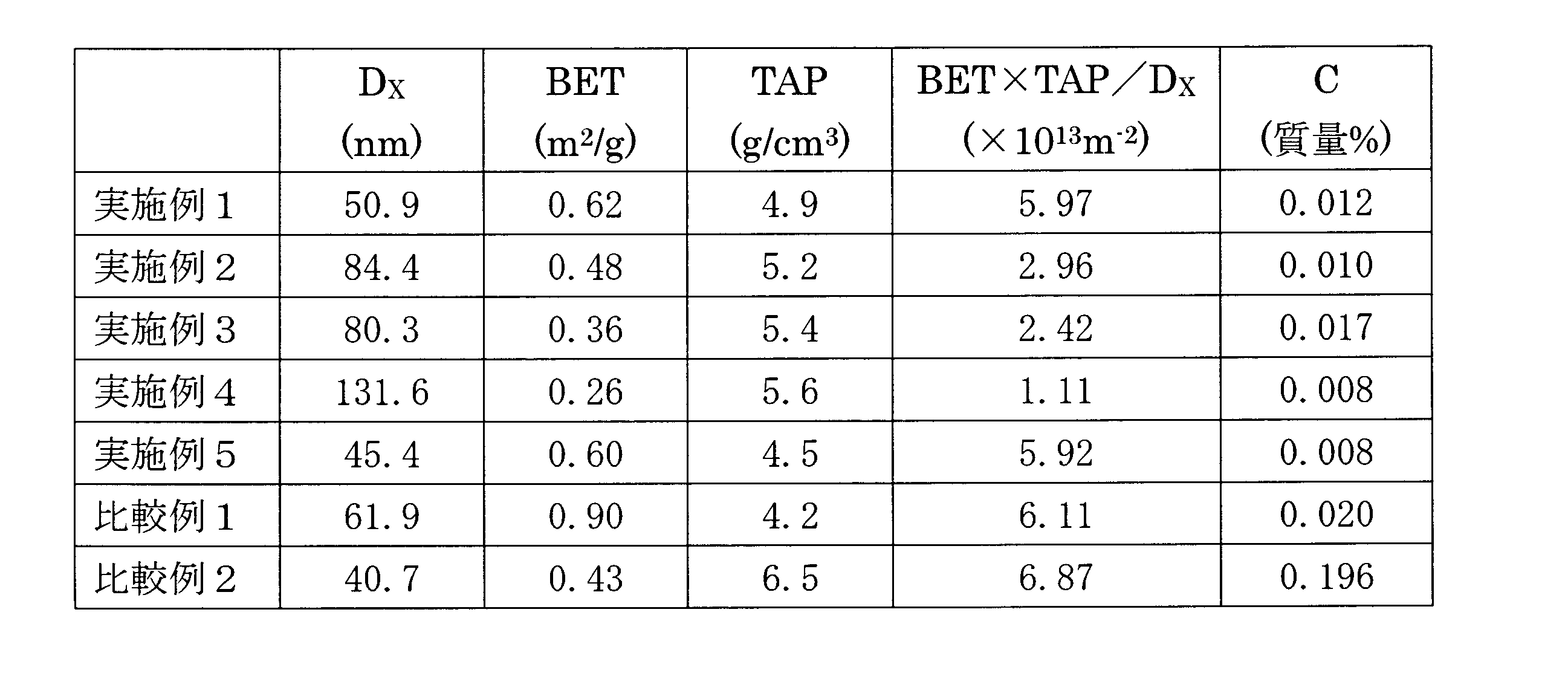
- Tables 1 to 3 show the production conditions and characteristics of the silver powders of these examples and comparative examples, and FIG. 1 shows the change in shrinkage with temperature.
Landscapes
- Chemical & Material Sciences (AREA)
- Engineering & Computer Science (AREA)
- Materials Engineering (AREA)
- Mechanical Engineering (AREA)
- Metallurgy (AREA)
- Organic Chemistry (AREA)
- Physics & Mathematics (AREA)
- Dispersion Chemistry (AREA)
- Spectroscopy & Molecular Physics (AREA)
- Manufacturing & Machinery (AREA)
- Powder Metallurgy (AREA)
Abstract
Description
本発明は、銀粉およびその製造方法に関し、特に、積層コンデンサや積層インダクタの内部電極や回路基板の導体パターン、ディスプレイパネル用基板の電極や回路などの電子部品に使用する導電性ペーストに使用するのに適した銀粉およびその製造方法に関する。 The present invention relates to silver powder and a method for producing the same, and particularly used for conductive pastes used for electronic components such as internal electrodes of multilayer capacitors and multilayer inductors, conductor patterns of circuit boards, and electrodes and circuits of display panel boards. The present invention relates to a silver powder suitable for the manufacturing process and a method for producing the same.
従来、積層コンデンサや積層インダクタの内部電極、回路基板の導体パターン、ディスプレイパネル用基板の電極や回路などの電子部品に使用する導電性ペーストとして、銀粉をガラスフリットとともに有機ビヒクル中に加えて混練することによって製造される導電性ペーストが使用されている。 Conventionally, silver powder is added together with glass frit into an organic vehicle and kneaded as a conductive paste used for electronic components such as internal electrodes of multilayer capacitors and multilayer inductors, conductor patterns on circuit boards, and electrodes and circuits on display panel substrates. The conductive paste manufactured by this is used.
このような導電性ペースト用の銀粉を製造する方法として、湿式還元法やアトマイズ法によって銀粉を製造する方法が知られている(例えば、特許文献1~3参照)。 As a method for producing such silver powder for conductive paste, a method for producing silver powder by a wet reduction method or an atomizing method is known (see, for example, Patent Documents 1 to 3).
近年、このような導電性ペースト用の銀粉は、電子部品の小型化、導体パターンの高密度化、ファインライン化などに対応するため、粒径を小さくすることが望まれている。 In recent years, it has been desired that such silver powder for conductive paste has a small particle size in order to cope with downsizing of electronic parts, high density of conductive patterns, fine lines, and the like.
しかし、従来の銀粉の製造方法では、銀粉の粒径を小さくしようとすると、導電性ペースト用の銀粉として使用すると、導電性ペーストを焼成する際に大きく収縮するという問題があった。 However, in the conventional method for producing silver powder, there is a problem that if the particle size of the silver powder is made small, when it is used as the silver powder for the conductive paste, the conductive paste is greatly shrunk when fired.
したがって、本発明は、このような従来の問題点に鑑み、平均粒径が小さく且つ熱収縮率が小さい銀粉およびその製造方法を提供することを目的とする。 Therefore, in view of such conventional problems, an object of the present invention is to provide a silver powder having a small average particle size and a small thermal shrinkage and a method for producing the same.
本発明者らは、上記課題を解決するために鋭意研究した結果、銀の融点より330~730℃高い温度に加熱した銀溶湯を落下させながら高圧水を吹き付けて急冷凝固させることによって銀を粉末化することにより、平均粒径が小さく且つ熱収縮率が小さい銀粉を製造することができることを見出し、本発明を完成するに至った。 As a result of diligent research to solve the above problems, the inventors of the present invention have made silver powder by rapidly solidifying by blowing high-pressure water while dropping a molten silver heated to 330 to 730 ° C. higher than the melting point of silver. As a result, it was found that a silver powder having a small average particle size and a small thermal shrinkage can be produced, and the present invention has been completed.
すなわち、本発明による銀粉の製造方法は、銀の融点より330~730℃高い温度に加熱した銀溶湯を落下させながら高圧水を吹き付けて急冷凝固させることによって銀を粉末化することを特徴とする。この銀粉の製造方法において、高圧水を水圧90~160MPaで吹き付けるのが好ましい。 That is, the method for producing silver powder according to the present invention is characterized in that silver is powdered by rapidly cooling and solidifying by blowing high-pressure water while dropping a molten silver heated to a temperature 330 to 730 ° C. higher than the melting point of silver. . In this silver powder production method, high-pressure water is preferably sprayed at a water pressure of 90 to 160 MPa.
また、本発明による銀粉は、平均粒径が1~6μm、500℃における収縮率が8%以下であり、平均粒径と500℃における収縮率の積が1~11μm・%であることを特徴とする。この銀粉は、BET比表面積(m2/g)×タップ密度(g/m3)/結晶子径(m)の値が1×1013~6×1013(m-2)であるのが好ましい。また、銀粉中の炭素含有量が0.1質量%以下であるのが好ましい。 The silver powder according to the present invention has an average particle size of 1 to 6 μm, a shrinkage rate at 500 ° C. of 8% or less, and a product of the average particle size and the shrinkage rate at 500 ° C. of 1 to 11 μm ·%. And This silver powder has a BET specific surface area (m 2 / g) × tap density (g / m 3 ) / crystallite diameter (m) of 1 × 10 13 to 6 × 10 13 (m −2 ). preferable. Moreover, it is preferable that the carbon content in silver powder is 0.1 mass% or less.
なお、本明細書中において、「平均粒径」とは、レーザー回折法により求められる体積基準の平均粒径(累積50%粒子径D50)をいう。 In the present specification, the “average particle diameter” means a volume-based average particle diameter (cumulative 50% particle diameter D 50 ) determined by a laser diffraction method.
本発明によれば、平均粒径が小さく且つ熱収縮率が小さい銀粉を製造することができる。 According to the present invention, silver powder having a small average particle size and a small heat shrinkage rate can be produced.
本発明による銀粉の製造方法の実施の形態では、銀溶湯を落下させながら高圧水を吹き付けて急冷凝固させる水アトマイズ法により銀粉を製造する際に、銀の融点(962℃)より330~730℃高い温度(1292~1692℃)に加熱した銀溶湯を落下させながら(好ましくは、水圧90~160MPa、水量80~190L/分で)高圧水を吹き付けて急冷凝固させることによって銀を粉末化する。 In the embodiment of the method for producing silver powder according to the present invention, when silver powder is produced by the water atomization method in which high-pressure water is sprayed and rapidly solidified while dropping the molten silver, 330 to 730 ° C. from the melting point of silver (962 ° C.). While dropping a molten silver heated to a high temperature (1292 to 1692 ° C.) (preferably at a water pressure of 90 to 160 MPa and a water amount of 80 to 190 L / min), silver is pulverized by rapid cooling and solidification.
また、本発明による銀粉の実施の形態は、平均粒径が1~6μm、500℃における収縮率が8%以下(好ましくは7%以下)であり、平均粒径と500℃における収縮率の積が1~11μm・%(好ましくは1.5~10.5μm・%)である。銀粉の平均粒径が小さくなると、銀粉の500℃における収縮率は大きくなり易いが、銀粉の平均粒径を1~6μm、500℃における収縮率を8%以下、平均粒径と500℃における収縮率の積を1~11μm・%にすれば、平均粒径が小さく且つ熱収縮率が小さい銀粉を製造することができる。この銀粉のBET比表面積は、銀粉を導電性ペーストに使用して高い導電性の導電膜を形成することができるように、0.1~3m2/gであるのが好ましく、0.2~1m2/gであるのがさらに好ましい。また、銀粉のタップ密度は、充填密度を高くすることにより導電性ペーストに使用して高い導電性の導電膜を形成することができるように、1~7g/cm3であるのが好ましく、2~6g/cm3であるのがさらに好ましい。また、銀粉の結晶子径は、銀粉の粒界の数を少なくして高い導電性の導電膜を形成することができるように、10~200nmであるのが好ましく、30~150nmであるのがさらに好ましい。また、この銀粉は、単位体積当たりの表面積(=BET比表面積(m2/g)×タップ密度(g/m3))と、単位範囲における結晶子数(=1/結晶子径(m))との積が、1×1013~6×1013(m-2)であるのが好ましい。銀粉の単位体積当たりの表面積が大きくなると、加熱による影響を受け易くなり、熱収縮し易くなると考えられ、また、銀粉の単位範囲における結晶子数が多くなると、熱収縮し得る結晶粒の数も多くなるが、これらの積が上記の範囲内であれば、銀粉を導電性ペーストに使用して高い導電性の導電膜を形成することができると考えられる。また、銀粉中の炭素含有量は、銀粉を導電性ペーストに使用して基材との密着性の高い導電膜を形成するために、0.1質量%以下であるのが好ましく、0.05質量%であるのがさらに好ましい。 In the embodiment of the silver powder according to the present invention, the average particle size is 1 to 6 μm, the shrinkage at 500 ° C. is 8% or less (preferably 7% or less), and the product of the average particle size and the shrinkage at 500 ° C. Is 1 to 11 μm ·% (preferably 1.5 to 10.5 μm ·%). As the average particle size of silver powder decreases, the shrinkage rate of silver powder at 500 ° C tends to increase, but the average particle size of silver powder is 1 to 6 µm, the shrinkage rate at 500 ° C is 8% or less, and the average particle size and shrinkage at 500 ° C. When the product of the rates is 1 to 11 μm ·%, silver powder having a small average particle size and a small heat shrinkage rate can be produced. The silver powder has a BET specific surface area of preferably 0.1 to 3 m 2 / g so that a highly conductive conductive film can be formed by using the silver powder as a conductive paste. More preferably, it is 1 m 2 / g. Further, the tap density of the silver powder is preferably 1 to 7 g / cm 3 so that a high conductive film can be formed by using the conductive paste by increasing the packing density. More preferably, it is ˜6 g / cm 3 . The crystallite diameter of the silver powder is preferably 10 to 200 nm, and preferably 30 to 150 nm, so that a highly conductive conductive film can be formed by reducing the number of grain boundaries of the silver powder. Further preferred. Further, this silver powder has a surface area per unit volume (= BET specific surface area (m 2 / g) × tap density (g / m 3 )) and the number of crystallites in the unit range (= 1 / crystallite diameter (m). ) Is preferably 1 × 10 13 to 6 × 10 13 (m −2 ). When the surface area per unit volume of silver powder increases, it is considered that it is easily affected by heating and heat shrinks easily, and when the number of crystallites in the unit range of silver powder increases, the number of crystal grains that can be heat shrunk also increases. However, if these products are within the above range, it is considered that silver powder can be used for the conductive paste to form a highly conductive conductive film. The carbon content in the silver powder is preferably 0.1% by mass or less in order to use the silver powder as a conductive paste to form a conductive film having high adhesion to the substrate. More preferably, it is mass%.
なお、上記の銀粉を導電性粉体として、樹脂、溶剤、ガラスフリットなどと混合(必要に応じてさらに分散剤などを混合)して混練することにより導電性ペーストを作製し、この導電性ペーストを焼成して導電膜を作製すれば、焼成による線収縮率が小さい導電膜を得ることができる。 In addition, a conductive paste is prepared by mixing the above silver powder as a conductive powder with a resin, a solvent, glass frit or the like (mixing a dispersant or the like as necessary) and kneading. If a conductive film is produced by firing the film, a conductive film having a low linear shrinkage rate by firing can be obtained.
以下、本発明による銀粉およびその製造方法の実施例について詳細に説明する。 Hereinafter, examples of the silver powder and the production method thereof according to the present invention will be described in detail.
[実施例1]
銀12kgを1600℃(銀の融点(962℃)より638℃高い温度)に加熱して溶解した溶湯をタンディッシュ下部から落下させながら、水圧150MPa、水量160L/分で高圧水を吹き付けて急冷凝固させ、得られた粉末をろ過し、水洗し、乾燥し、解砕し、風力分級機(株式会社セイシン企業製のクラッシールN-01型)により粗大粒子を除去して、銀粉を得た。
[Example 1]
While dropping 12 kg of silver to 1600 ° C (temperature higher by 638 ° C than the melting point of silver (962 ° C)) and dropping the molten metal from the bottom of the tundish, high pressure water is sprayed at a water pressure of 150 MPa and a water volume of 160 L / min. The obtained powder was filtered, washed with water, dried and crushed, and coarse particles were removed by an air classifier (Classeal N-01 type manufactured by Seishin Enterprise Co., Ltd.) to obtain silver powder.
このような水アトマイズ法で製造された銀粉について、粒度分布、収縮率、結晶子径、BET比表面積、タップ密度、炭素含有量を求めた。 The particle size distribution, shrinkage rate, crystallite diameter, BET specific surface area, tap density, and carbon content of the silver powder produced by such a water atomization method were determined.
銀粉の粒度分布は、レーザー回折式粒度分布測定装置(SYMPATEC社製のへロス粒度分布測定装置(HELOS&RODOS(気流式の乾燥モジュール)))を使用して、分散圧5barで測定した。その結果、累積10%粒子径(D10)は0.6μm、累積50%粒子径(D50)は1.6μm、累積90%粒子径(D90)は2.7μmであった。 The particle size distribution of the silver powder was measured at a dispersion pressure of 5 bar using a laser diffraction type particle size distribution measuring device (Heros particle size distribution measuring device (HELOS & RODOS (airflow type drying module) manufactured by SYMPATEC)). As a result, the cumulative 10% particle diameter (D 10 ) was 0.6 μm, the cumulative 50% particle diameter (D 50 ) was 1.6 μm, and the cumulative 90% particle diameter (D 90 ) was 2.7 μm.
銀粉の収縮率は、銀粉0.5gと溶剤としてブチルカルビトールアセテート30μLとを混合して内径5mmの円筒形の金型に入れ、1623Nの加重をかけて成形した円柱形ペレット状の銀粉試料を、熱機械的分析装置(株式会社日立ハイテクサイエンス製のTMA/SS6200)を用いて、大気雰囲気中において室温から800℃まで昇温速度10℃/分で加熱した場合の試料の長さを測定して求めた。その結果を図1に示す。図1に示すように、この実施例では、円柱形ペレット状の銀粉試料を大気雰囲気中において室温から800℃まで昇温速度10℃/分で加熱した場合に、膨張せずに収縮していくのがわかる。なお、500℃における収縮率は6.2%であり、累積50%粒子径(D50)×500℃における収縮率の値を求めると9.9μm・%であった。 The shrinkage rate of silver powder is 0.5 g of silver powder mixed with 30 μL of butyl carbitol acetate as a solvent, placed in a cylindrical mold with an inner diameter of 5 mm, and a cylindrical pellet-shaped silver powder sample formed by applying a load of 1623 N. Using a thermomechanical analyzer (TMA / SS6200, manufactured by Hitachi High-Tech Science Co., Ltd.), the length of the sample when heated from room temperature to 800 ° C. at a heating rate of 10 ° C./min in an air atmosphere is measured. Asked. The result is shown in FIG. As shown in FIG. 1, in this example, when a cylindrical pellet-shaped silver powder sample is heated from room temperature to 800 ° C. in the air atmosphere at a heating rate of 10 ° C./min, it shrinks without expanding. I understand. The shrinkage rate at 500 ° C. was 6.2%, and the value of the shrinkage rate at a cumulative 50% particle size (D 50 ) × 500 ° C. was 9.9 μm ·%.
銀粉の結晶子径は、Scherrerの式(Dhkl=Kλ/βcosθ)によって求めた。この式中、Dhklは結晶子径の大きさ(hklに垂直な方向の結晶子の大きさ)(オングストローム)、λは測定X線の波長(オングストローム)(Coターゲット使用時1.7889オングストローム)、βは結晶子の大きさによる回折線の広がり(rad)(半価幅を用いて表す)、θは回折角のブラッグ角(rad)(入射角と反射角が等しいときの角度であり、ピークトップの角度を使用する)、KはScherrer定数(Dやβの定義により異なり、βに半価幅を用いる場合にはK=0.9)である。なお、測定には粉末X線回折装置を使用し、計算には(111)面のピークデータを使用した。その結果、銀粉の結晶子径(Dx)は50.9nmであった。 The crystallite diameter of silver powder was determined by the Scherrer equation (Dhkl = Kλ / βcos θ). In this equation, Dhkl is the crystallite size (crystallite size perpendicular to hkl) (angstrom), λ is the wavelength of the measured X-ray (angstrom) (1.78989 angstrom when using the Co target), β is the diffraction line spread (rad) depending on the crystallite size (expressed by using the half width), θ is the Bragg angle (rad) of the diffraction angle (the angle when the incident angle and the reflection angle are equal, and the peak K is a Scherrer constant (depending on the definition of D or β, and K = 0.9 when a half-value width is used for β). Note that a powder X-ray diffractometer was used for the measurement, and peak data on the (111) plane was used for the calculation. As a result, the crystallite diameter (Dx) of the silver powder was 50.9 nm.
BET比表面積は、BET比表面積測定器(ユアサアイオニクス株式会社製の4ソーブUS)を使用して、測定器内に105℃で20分間窒素ガスを流して脱気した後、窒素とヘリウムの混合ガス(N2:30体積%、He:70体積%)を流しながら、BET1点法により測定した。 その結果、銀粉のBET比表面積は0.62m2/gであった。 The BET specific surface area was degassed by flowing nitrogen gas at 105 ° C. for 20 minutes in a measuring instrument using a BET specific surface area measuring instrument (4 Sorb US made by Yuasa Ionics Co., Ltd.), While flowing a mixed gas (N 2 : 30% by volume, He: 70% by volume), the BET one-point method was used for measurement. As a result, the BET specific surface area of the silver powder was 0.62 m 2 / g.
銀粉のタップ密度(TAP)は、特開2007-263860号公報に記載された方法と同様に、銀粉を内径6mmの有底円筒形のダイに充填して銀粉層を形成し、この銀粉層の上面に0.160N/m2の圧力を均一に加えた後、銀粉層の高さを測定し、この銀粉層の高さの測定値と、充填された銀粉の重量とから、銀粉の密度を求めて、銀粉のタップ密度とした。その結果、銀粉のタップ密度は4.9g/cm3であった。 The tap density (TAP) of the silver powder is the same as the method described in Japanese Patent Application Laid-Open No. 2007-263860. The silver powder is filled into a bottomed cylindrical die having an inner diameter of 6 mm to form a silver powder layer. After uniformly applying a pressure of 0.160 N / m 2 on the upper surface, the height of the silver powder layer is measured, and the density of the silver powder is determined from the measured value of the height of the silver powder layer and the weight of the filled silver powder. It calculated | required and it was set as the tap density of silver powder. As a result, the tap density of the silver powder was 4.9 g / cm 3 .
なお、単位体積当たりの表面積=BET比表面積(m2/g)×タップ密度(g/m3)と、単位範囲における結晶子数=1/結晶子径(m)との積を求めると、5.97×1013(m-2)になる。 In addition, when obtaining the product of the surface area per unit volume = BET specific surface area (m 2 / g) × tap density (g / m 3 ) and the number of crystallites in the unit range = 1 / crystallite diameter (m), It becomes 5.97 × 10 13 (m −2 ).
銀粉中の炭素含有量は、炭素・硫黄分析装置(堀場製作所製のEMIA-220V)により測定した。その結果、銀粉中の炭素含有量は0.012質量%であった。 The carbon content in the silver powder was measured with a carbon / sulfur analyzer (EMIA-220V manufactured by Horiba, Ltd.). As a result, the carbon content in the silver powder was 0.012% by mass.
[実施例2]
風力分級機により粗大粒子を除去する際に10μmより大きい銀の凝集体を除去することにより粒度を調整した以外は、実施例1と同様の方法により、得られた銀粉について、粒度分布、収縮率、結晶子径、BET比表面積、タップ密度、炭素含有量を求めた。
[Example 2]
The particle size distribution and shrinkage ratio of the silver powder obtained by the same method as in Example 1 except that the particle size was adjusted by removing silver aggregates larger than 10 μm when coarse particles were removed by an air classifier. The crystallite diameter, the BET specific surface area, the tap density, and the carbon content were determined.
その結果、累積10%粒子径(D10)は0.7μm、累積50%粒子径(D50)は2.0μm、累積90%粒子径(D90)は4.1μm、500℃における収縮率は1.0%であり、累積50%粒子径(D50)×500℃における収縮率の値は2.0μm・%であった。結晶子径(Dx)は84.4nm、BET比表面積は0.48m2/g、タップ密度は5.2g/cm3であり、単位体積当たりの表面積=BET比表面積(m2/g)×タップ密度(g/m3)と単位範囲における結晶子数=1/結晶子径(m)との積は2.96×1013(m-2)であった。また、炭素含有量は0.010質量%であった。 As a result, the cumulative 10% particle diameter (D 10 ) was 0.7 μm, the cumulative 50% particle diameter (D 50 ) was 2.0 μm, the cumulative 90% particle diameter (D 90 ) was 4.1 μm, and the shrinkage at 500 ° C. Was 1.0%, and the value of shrinkage at a cumulative 50% particle size (D 50 ) × 500 ° C. was 2.0 μm ·%. The crystallite diameter (Dx) is 84.4 nm, the BET specific surface area is 0.48 m 2 / g, the tap density is 5.2 g / cm 3 , and the surface area per unit volume = BET specific surface area (m 2 / g) × The product of the tap density (g / m 3 ) and the number of crystallites in the unit range = 1 / crystallite diameter (m) was 2.96 × 10 13 (m −2 ). Moreover, carbon content was 0.010 mass%.
[実施例3]
加熱温度を1400℃とし、水圧を100MPaとした以外は、実施例1と同様の方法により、得られた銀粉について、粒度分布、収縮率、結晶子径、BET比表面積、タップ密度、炭素含有量を求めた。
[Example 3]
The silver powder obtained by the same method as in Example 1 except that the heating temperature was 1400 ° C. and the water pressure was 100 MPa, particle size distribution, shrinkage rate, crystallite diameter, BET specific surface area, tap density, carbon content Asked.
その結果、累積10%粒子径(D10)は1.0μm、累積50%粒子径(D50)は3.0μm、累積90%粒子径(D90)は6.1μm、500℃における収縮率は3.4%であり、累積50%粒子径(D50)×500℃における収縮率の値は10.2μm・%であった。結晶子径(Dx)は80.3nm、BET比表面積は0.36m2/g、タップ密度は5.4g/cm3であり、単位体積当たりの表面積=BET比表面積(m2/g)×タップ密度(g/m3)と単位範囲における結晶子数=1/結晶子径(m)との積は2.42×1013(m-2)であった。また、炭素含有量は0.017質量%であった。 As a result, the cumulative 10% particle diameter (D 10 ) was 1.0 μm, the cumulative 50% particle diameter (D 50 ) was 3.0 μm, the cumulative 90% particle diameter (D 90 ) was 6.1 μm, and the shrinkage at 500 ° C. Was 3.4%, and the value of shrinkage at 50% cumulative particle size (D 50 ) × 500 ° C. was 10.2 μm ·%. The crystallite diameter (Dx) is 80.3 nm, the BET specific surface area is 0.36 m 2 / g, the tap density is 5.4 g / cm 3 , and the surface area per unit volume = BET specific surface area (m 2 / g) × The product of the tap density (g / m 3 ) and the number of crystallites in the unit range = 1 / crystallite diameter (m) was 2.42 × 10 13 (m −2 ). Moreover, carbon content was 0.017 mass%.
[実施例4]
加熱温度を1400℃とし、水圧を70MPaとした以外は、実施例1と同様の方法により、得られた銀粉について、粒度分布、収縮率、結晶子径、BET比表面積、タップ密度、炭素含有量を求めた。
[Example 4]
The silver powder obtained by the same method as in Example 1 except that the heating temperature was 1400 ° C. and the water pressure was 70 MPa, the particle size distribution, shrinkage rate, crystallite diameter, BET specific surface area, tap density, carbon content Asked.
その結果、累積10%粒子径(D10)は1.7μm、累積50%粒子径(D50)は4.9μm、累積90%粒子径(D90)は9.5μm、500℃における収縮率は1.5%であり、累積50%粒子径(D50)×500℃における収縮率の値は7.4μm・%であった。結晶子径(Dx)は131.6nm、BET比表面積は0.26m2/g、タップ密度は5.6g/cm3であり、単位体積当たりの表面積=BET比表面積(m2/g)×タップ密度(g/m3)と単位範囲における結晶子数=1/結晶子径(m)との積は1.11×1013(m-2)であった。また、炭素含有量は0.008質量%であった。 As a result, the cumulative 10% particle size (D 10 ) was 1.7 μm, the cumulative 50% particle size (D 50 ) was 4.9 μm, the cumulative 90% particle size (D 90 ) was 9.5 μm, and the shrinkage at 500 ° C. Was 1.5%, and the value of shrinkage at a cumulative 50% particle size (D 50 ) × 500 ° C. was 7.4 μm ·%. The crystallite diameter (Dx) is 131.6 nm, the BET specific surface area is 0.26 m 2 / g, the tap density is 5.6 g / cm 3 , and the surface area per unit volume = BET specific surface area (m 2 / g) × The product of the tap density (g / m 3 ) and the number of crystallites in the unit range = 1 / crystallite diameter (m) was 1.11 × 10 13 (m −2 ). Moreover, carbon content was 0.008 mass%.
[実施例5]
加熱温度を1500℃とした以外は、実施例1と同様の方法により、得られた銀粉について、粒度分布、収縮率、結晶子径、BET比表面積、タップ密度、炭素含有量を求めた。
[Example 5]
Except that the heating temperature was 1500 ° C., the particle size distribution, shrinkage rate, crystallite diameter, BET specific surface area, tap density, and carbon content were determined for the obtained silver powder by the same method as in Example 1.
その結果、累積10%粒子径(D10)は0.7μm、累積50%粒子径(D50)は1.8μm、累積90%粒子径(D90)は2.9μm、500℃における収縮率は3.4%であり、累積50%粒子径(D50)×500℃における収縮率の値は6.1μm・%であった。結晶子径(Dx)は45.4nm、BET比表面積は0.60m2/g、タップ密度は4.5g/cm3であり、単位体積当たりの表面積=BET比表面積(m2/g)×タップ密度(g/m3)と単位範囲における結晶子数=1/結晶子径(m)との積は5.92×1013(m-2)であった。また、炭素含有量は0.008質量%であった。 As a result, the cumulative 10% particle diameter (D 10 ) was 0.7 μm, the cumulative 50% particle diameter (D 50 ) was 1.8 μm, the cumulative 90% particle diameter (D 90 ) was 2.9 μm, and the shrinkage at 500 ° C. Was 3.4%, and the value of shrinkage at a cumulative 50% particle size (D 50 ) × 500 ° C. was 6.1 μm ·%. The crystallite diameter (Dx) is 45.4 nm, the BET specific surface area is 0.60 m 2 / g, the tap density is 4.5 g / cm 3 , and the surface area per unit volume = BET specific surface area (m 2 / g) × The product of the tap density (g / m 3 ) and the number of crystallites in the unit range = 1 / crystallite diameter (m) was 5.92 × 10 13 (m −2 ). Moreover, carbon content was 0.008 mass%.
[比較例1]
加熱温度を1250℃とし、水圧を150MPaとした以外は、実施例1と同様の方法により、得られた銀粉について、粒度分布、収縮率、結晶子径、BET比表面積、タップ密度、炭素含有量を求めた。
[Comparative Example 1]
The silver powder obtained by the same method as in Example 1 except that the heating temperature was 1250 ° C. and the water pressure was 150 MPa, particle size distribution, shrinkage rate, crystallite diameter, BET specific surface area, tap density, carbon content Asked.
その結果、累積10%粒子径(D10)は0.5μm、累積50%粒子径(D50)は1.3μm、累積90%粒子径(D90)は2.4μm、500℃における収縮率は9.7%であり、累積50%粒子径(D50)×500℃における収縮率の値は12.6μm・%であった。結晶子径(Dx)は61.9nm、BET比表面積は0.90m2/g、タップ密度は4.2g/cm3であり、単位体積当たりの表面積=BET比表面積(m2/g)×タップ密度(g/m3)と単位範囲における結晶子数=1/結晶子径(m)との積は6.11×1013(m-2)であった。また、炭素含有量は0.020質量%であった。 As a result, the cumulative 10% particle diameter (D 10 ) was 0.5 μm, the cumulative 50% particle diameter (D 50 ) was 1.3 μm, the cumulative 90% particle diameter (D 90 ) was 2.4 μm, and the shrinkage at 500 ° C. Was 9.7%, and the value of the shrinkage at a cumulative 50% particle size (D 50 ) × 500 ° C. was 12.6 μm ·%. The crystallite diameter (Dx) is 61.9 nm, the BET specific surface area is 0.90 m 2 / g, the tap density is 4.2 g / cm 3 , and the surface area per unit volume = BET specific surface area (m 2 / g) × The product of the tap density (g / m 3 ) and the number of crystallites in the unit range = 1 / crystallite diameter (m) was 6.11 × 10 13 (m −2 ). Moreover, carbon content was 0.020 mass%.
[比較例2]
銀54kgを含む硝酸銀水溶液4500kgに、25質量%のアンモニア水203kgを添加して、銀アンミン錯塩水溶液を得た。この銀アンミン錯塩水溶液の液温を40℃とし、37質量%のホルマリン水溶液240kgを添加して銀粒子を析出させて銀含有スラリーを得た。この銀含有スラリー中に、銀に対して0.2質量%のステアリン酸を含むステアリン酸エマルジョンを添加した後、濾過し、水洗し、ケーキ15.0kgを得た。このケーキを乾燥機に投入し、乾燥粉13.6kgを得た。この乾燥粉を解砕した後、分級して10μmより大きい銀の凝集体を除去した。
[Comparative Example 2]
To 4500 kg of an aqueous silver nitrate solution containing 54 kg of silver, 203 kg of 25 mass% ammonia water was added to obtain an aqueous silver ammine complex salt solution. The liquid temperature of this silver ammine complex salt aqueous solution was 40 degreeC, 240 kg of 37 mass% formalin aqueous solution was added, silver particles were deposited, and the silver containing slurry was obtained. A stearic acid emulsion containing 0.2% by mass of stearic acid with respect to silver was added to the silver-containing slurry, followed by filtration and washing with water to obtain 15.0 kg of a cake. This cake was put into a dryer to obtain 13.6 kg of dried powder. The dried powder was crushed and classified to remove silver aggregates larger than 10 μm.
このような湿式還元法で製造された銀粉について、粒度分布、収縮率、結晶子径、BET比表面積、タップ密度、炭素含有量を求めた。 The particle size distribution, shrinkage rate, crystallite diameter, BET specific surface area, tap density, and carbon content were determined for the silver powder produced by such a wet reduction method.
その結果、累積10%粒子径(D10)は0.9μm、累積50%粒子径(D50)は1.9μm、累積90%粒子径(D90)は3.0μm、500℃における収縮率は14.1%であり、累積50%粒子径(D50)×500℃における収縮率の値は26.8μm・%であった。結晶子径(Dx)は40.7nm、BET比表面積は0.43m2/g、タップ密度は6.5g/cm3であり、単位体積当たりの表面積=BET比表面積(m2/g)×タップ密度(g/m3)と単位範囲における結晶子数=1/結晶子径(m)との積は6.87×1013(m-2)であった。また、炭素含有量は0.196質量%であった。 As a result, the cumulative 10% particle diameter (D 10 ) was 0.9 μm, the cumulative 50% particle diameter (D 50 ) was 1.9 μm, the cumulative 90% particle diameter (D 90 ) was 3.0 μm, and the shrinkage at 500 ° C. Was 14.1%, and the value of the shrinkage at a cumulative 50% particle size (D 50 ) × 500 ° C. was 26.8 μm ·%. The crystallite diameter (Dx) is 40.7 nm, the BET specific surface area is 0.43 m 2 / g, the tap density is 6.5 g / cm 3 , and the surface area per unit volume = BET specific surface area (m 2 / g) × The product of the tap density (g / m 3 ) and the number of crystallites in the unit range = 1 / crystallite diameter (m) was 6.87 × 10 13 (m −2 ). Moreover, carbon content was 0.196 mass%.
これらの実施例および比較例の銀粉の製造条件および特性を表1~表3を示し、収縮率の温度変化を図1に示す。 Tables 1 to 3 show the production conditions and characteristics of the silver powders of these examples and comparative examples, and FIG. 1 shows the change in shrinkage with temperature.


Claims (6)
A conductive paste comprising a solvent and a resin, and containing the silver powder according to claim 3 as a conductive powder.
Priority Applications (6)
| Application Number | Priority Date | Filing Date | Title |
|---|---|---|---|
| SG11201802822PA SG11201802822PA (en) | 2015-10-30 | 2016-10-26 | Silver powder and method for producing same |
| EP16859295.4A EP3357608B1 (en) | 2015-10-30 | 2016-10-26 | Method for producing a silver powder |
| CN201680063241.8A CN108349009A (en) | 2015-10-30 | 2016-10-26 | Silver powder and its manufacturing method |
| US15/768,065 US10828702B2 (en) | 2015-10-30 | 2016-10-26 | Silver powder and method for producing same |
| KR1020187014652A KR102446788B1 (en) | 2015-10-30 | 2016-10-26 | Silver powder and its manufacturing method |
| US17/086,552 US11407030B2 (en) | 2015-10-30 | 2020-11-02 | Silver powder and method for producing same |
Applications Claiming Priority (4)
| Application Number | Priority Date | Filing Date | Title |
|---|---|---|---|
| JP2015-213682 | 2015-10-30 | ||
| JP2015213682 | 2015-10-30 | ||
| JP2016204799A JP6856350B2 (en) | 2015-10-30 | 2016-10-19 | Silver powder and its manufacturing method |
| JP2016-204799 | 2016-10-19 |
Related Child Applications (2)
| Application Number | Title | Priority Date | Filing Date |
|---|---|---|---|
| US15/768,065 A-371-Of-International US10828702B2 (en) | 2015-10-30 | 2016-10-26 | Silver powder and method for producing same |
| US17/086,552 Division US11407030B2 (en) | 2015-10-30 | 2020-11-02 | Silver powder and method for producing same |
Publications (1)
| Publication Number | Publication Date |
|---|---|
| WO2017073057A1 true WO2017073057A1 (en) | 2017-05-04 |
Family
ID=58631484
Family Applications (1)
| Application Number | Title | Priority Date | Filing Date |
|---|---|---|---|
| PCT/JP2016/004706 Ceased WO2017073057A1 (en) | 2015-10-30 | 2016-10-26 | Silver powder and method for producing same |
Country Status (1)
| Country | Link |
|---|---|
| WO (1) | WO2017073057A1 (en) |
Citations (5)
| Publication number | Priority date | Publication date | Assignee | Title |
|---|---|---|---|---|
| JPH01180901A (en) * | 1988-01-08 | 1989-07-18 | Kobe Steel Ltd | Silver nickel composite powder for electric contact material and manufacture thereof |
| JPH07188702A (en) * | 1993-12-27 | 1995-07-25 | Matsushita Electric Works Ltd | Ag-base alloy powder and its production |
| WO2005075133A1 (en) * | 2004-02-10 | 2005-08-18 | Mitsui Mining & Smelting Co., Ltd. | Highly crystalline silver powder and method for production thereof |
| JP2007084906A (en) * | 2005-09-26 | 2007-04-05 | Fukuda Metal Foil & Powder Co Ltd | Ag-based metal powder, Cu-based metal powder and method for producing the same |
| JP2016141817A (en) * | 2015-01-29 | 2016-08-08 | Dowaエレクトロニクス株式会社 | Method for producing metal powder by water atomizing process |
-
2016
- 2016-10-26 WO PCT/JP2016/004706 patent/WO2017073057A1/en not_active Ceased
Patent Citations (5)
| Publication number | Priority date | Publication date | Assignee | Title |
|---|---|---|---|---|
| JPH01180901A (en) * | 1988-01-08 | 1989-07-18 | Kobe Steel Ltd | Silver nickel composite powder for electric contact material and manufacture thereof |
| JPH07188702A (en) * | 1993-12-27 | 1995-07-25 | Matsushita Electric Works Ltd | Ag-base alloy powder and its production |
| WO2005075133A1 (en) * | 2004-02-10 | 2005-08-18 | Mitsui Mining & Smelting Co., Ltd. | Highly crystalline silver powder and method for production thereof |
| JP2007084906A (en) * | 2005-09-26 | 2007-04-05 | Fukuda Metal Foil & Powder Co Ltd | Ag-based metal powder, Cu-based metal powder and method for producing the same |
| JP2016141817A (en) * | 2015-01-29 | 2016-08-08 | Dowaエレクトロニクス株式会社 | Method for producing metal powder by water atomizing process |
Non-Patent Citations (1)
| Title |
|---|
| See also references of EP3357608A4 * |
Similar Documents
| Publication | Publication Date | Title |
|---|---|---|
| JP7110421B2 (en) | Silver powder and its manufacturing method | |
| JP7039126B2 (en) | Copper powder and its manufacturing method | |
| JP7090511B2 (en) | Silver powder and its manufacturing method | |
| US12049684B2 (en) | Copper powder and method for producing same | |
| JP7272834B2 (en) | Silver powder and its manufacturing method | |
| KR102574302B1 (en) | Silver alloy powder and manufacturing method thereof | |
| JP7136970B2 (en) | Silver powder containing phosphorus and conductive paste containing the silver powder | |
| WO2017073057A1 (en) | Silver powder and method for producing same | |
| JP7084730B2 (en) | Silver alloy powder and its manufacturing method | |
| TWI755565B (en) | Silver powder and method for producing same | |
| JP4149385B2 (en) | Aluminum oxide coated fine silver powder and method for producing the same | |
| WO2017115462A1 (en) | Silver alloy powder and method for producing same |
Legal Events
| Date | Code | Title | Description |
|---|---|---|---|
| 121 | Ep: the epo has been informed by wipo that ep was designated in this application |
Ref document number: 16859295 Country of ref document: EP Kind code of ref document: A1 |
|
| WWE | Wipo information: entry into national phase |
Ref document number: 15768065 Country of ref document: US |
|
| WWE | Wipo information: entry into national phase |
Ref document number: 11201802822P Country of ref document: SG |
|
| NENP | Non-entry into the national phase |
Ref country code: DE |
|
| WWE | Wipo information: entry into national phase |
Ref document number: 2016859295 Country of ref document: EP |
|
| ENP | Entry into the national phase |
Ref document number: 20187014652 Country of ref document: KR Kind code of ref document: A |