WO2017041874A1 - Materials for organic electroluminescent devices - Google Patents
Materials for organic electroluminescent devices Download PDFInfo
- Publication number
- WO2017041874A1 WO2017041874A1 PCT/EP2016/001391 EP2016001391W WO2017041874A1 WO 2017041874 A1 WO2017041874 A1 WO 2017041874A1 EP 2016001391 W EP2016001391 W EP 2016001391W WO 2017041874 A1 WO2017041874 A1 WO 2017041874A1
- Authority
- WO
- WIPO (PCT)
- Prior art keywords
- group
- atoms
- formula
- substituted
- radicals
- Prior art date
- Legal status (The legal status is an assumption and is not a legal conclusion. Google has not performed a legal analysis and makes no representation as to the accuracy of the status listed.)
- Ceased
Links
- 0 *C1(*)c2ccccc2-c2ccccc12 Chemical compound *C1(*)c2ccccc2-c2ccccc12 0.000 description 7
Classifications
-
- C—CHEMISTRY; METALLURGY
- C07—ORGANIC CHEMISTRY
- C07D—HETEROCYCLIC COMPOUNDS
- C07D405/00—Heterocyclic compounds containing both one or more hetero rings having oxygen atoms as the only ring hetero atoms, and one or more rings having nitrogen as the only ring hetero atom
- C07D405/14—Heterocyclic compounds containing both one or more hetero rings having oxygen atoms as the only ring hetero atoms, and one or more rings having nitrogen as the only ring hetero atom containing three or more hetero rings
-
- C—CHEMISTRY; METALLURGY
- C07—ORGANIC CHEMISTRY
- C07D—HETEROCYCLIC COMPOUNDS
- C07D209/00—Heterocyclic compounds containing five-membered rings, condensed with other rings, with one nitrogen atom as the only ring hetero atom
- C07D209/56—Ring systems containing three or more rings
-
- C—CHEMISTRY; METALLURGY
- C07—ORGANIC CHEMISTRY
- C07D—HETEROCYCLIC COMPOUNDS
- C07D209/00—Heterocyclic compounds containing five-membered rings, condensed with other rings, with one nitrogen atom as the only ring hetero atom
- C07D209/02—Heterocyclic compounds containing five-membered rings, condensed with other rings, with one nitrogen atom as the only ring hetero atom condensed with one carbocyclic ring
- C07D209/04—Indoles; Hydrogenated indoles
- C07D209/08—Indoles; Hydrogenated indoles with only hydrogen atoms or radicals containing only hydrogen and carbon atoms, directly attached to carbon atoms of the hetero ring
-
- C—CHEMISTRY; METALLURGY
- C07—ORGANIC CHEMISTRY
- C07D—HETEROCYCLIC COMPOUNDS
- C07D209/00—Heterocyclic compounds containing five-membered rings, condensed with other rings, with one nitrogen atom as the only ring hetero atom
- C07D209/02—Heterocyclic compounds containing five-membered rings, condensed with other rings, with one nitrogen atom as the only ring hetero atom condensed with one carbocyclic ring
- C07D209/04—Indoles; Hydrogenated indoles
- C07D209/10—Indoles; Hydrogenated indoles with substituted hydrocarbon radicals attached to carbon atoms of the hetero ring
-
- C—CHEMISTRY; METALLURGY
- C07—ORGANIC CHEMISTRY
- C07D—HETEROCYCLIC COMPOUNDS
- C07D209/00—Heterocyclic compounds containing five-membered rings, condensed with other rings, with one nitrogen atom as the only ring hetero atom
- C07D209/56—Ring systems containing three or more rings
- C07D209/80—[b, c]- or [b, d]-condensed
- C07D209/94—[b, c]- or [b, d]-condensed containing carbocyclic rings other than six-membered
-
- C—CHEMISTRY; METALLURGY
- C07—ORGANIC CHEMISTRY
- C07D—HETEROCYCLIC COMPOUNDS
- C07D401/00—Heterocyclic compounds containing two or more hetero rings, having nitrogen atoms as the only ring hetero atoms, at least one ring being a six-membered ring with only one nitrogen atom
- C07D401/02—Heterocyclic compounds containing two or more hetero rings, having nitrogen atoms as the only ring hetero atoms, at least one ring being a six-membered ring with only one nitrogen atom containing two hetero rings
- C07D401/10—Heterocyclic compounds containing two or more hetero rings, having nitrogen atoms as the only ring hetero atoms, at least one ring being a six-membered ring with only one nitrogen atom containing two hetero rings linked by a carbon chain containing aromatic rings
-
- C—CHEMISTRY; METALLURGY
- C07—ORGANIC CHEMISTRY
- C07D—HETEROCYCLIC COMPOUNDS
- C07D403/00—Heterocyclic compounds containing two or more hetero rings, having nitrogen atoms as the only ring hetero atoms, not provided for by group C07D401/00
- C07D403/02—Heterocyclic compounds containing two or more hetero rings, having nitrogen atoms as the only ring hetero atoms, not provided for by group C07D401/00 containing two hetero rings
- C07D403/10—Heterocyclic compounds containing two or more hetero rings, having nitrogen atoms as the only ring hetero atoms, not provided for by group C07D401/00 containing two hetero rings linked by a carbon chain containing aromatic rings
-
- C—CHEMISTRY; METALLURGY
- C07—ORGANIC CHEMISTRY
- C07D—HETEROCYCLIC COMPOUNDS
- C07D405/00—Heterocyclic compounds containing both one or more hetero rings having oxygen atoms as the only ring hetero atoms, and one or more rings having nitrogen as the only ring hetero atom
- C07D405/02—Heterocyclic compounds containing both one or more hetero rings having oxygen atoms as the only ring hetero atoms, and one or more rings having nitrogen as the only ring hetero atom containing two hetero rings
- C07D405/10—Heterocyclic compounds containing both one or more hetero rings having oxygen atoms as the only ring hetero atoms, and one or more rings having nitrogen as the only ring hetero atom containing two hetero rings linked by a carbon chain containing aromatic rings
-
- C—CHEMISTRY; METALLURGY
- C07—ORGANIC CHEMISTRY
- C07D—HETEROCYCLIC COMPOUNDS
- C07D405/00—Heterocyclic compounds containing both one or more hetero rings having oxygen atoms as the only ring hetero atoms, and one or more rings having nitrogen as the only ring hetero atom
- C07D405/02—Heterocyclic compounds containing both one or more hetero rings having oxygen atoms as the only ring hetero atoms, and one or more rings having nitrogen as the only ring hetero atom containing two hetero rings
- C07D405/12—Heterocyclic compounds containing both one or more hetero rings having oxygen atoms as the only ring hetero atoms, and one or more rings having nitrogen as the only ring hetero atom containing two hetero rings linked by a chain containing hetero atoms as chain links
-
- C—CHEMISTRY; METALLURGY
- C07—ORGANIC CHEMISTRY
- C07D—HETEROCYCLIC COMPOUNDS
- C07D409/00—Heterocyclic compounds containing two or more hetero rings, at least one ring having sulfur atoms as the only ring hetero atoms
- C07D409/02—Heterocyclic compounds containing two or more hetero rings, at least one ring having sulfur atoms as the only ring hetero atoms containing two hetero rings
- C07D409/10—Heterocyclic compounds containing two or more hetero rings, at least one ring having sulfur atoms as the only ring hetero atoms containing two hetero rings linked by a carbon chain containing aromatic rings
-
- C—CHEMISTRY; METALLURGY
- C07—ORGANIC CHEMISTRY
- C07D—HETEROCYCLIC COMPOUNDS
- C07D409/00—Heterocyclic compounds containing two or more hetero rings, at least one ring having sulfur atoms as the only ring hetero atoms
- C07D409/02—Heterocyclic compounds containing two or more hetero rings, at least one ring having sulfur atoms as the only ring hetero atoms containing two hetero rings
- C07D409/12—Heterocyclic compounds containing two or more hetero rings, at least one ring having sulfur atoms as the only ring hetero atoms containing two hetero rings linked by a chain containing hetero atoms as chain links
-
- C—CHEMISTRY; METALLURGY
- C07—ORGANIC CHEMISTRY
- C07D—HETEROCYCLIC COMPOUNDS
- C07D409/00—Heterocyclic compounds containing two or more hetero rings, at least one ring having sulfur atoms as the only ring hetero atoms
- C07D409/14—Heterocyclic compounds containing two or more hetero rings, at least one ring having sulfur atoms as the only ring hetero atoms containing three or more hetero rings
-
- C—CHEMISTRY; METALLURGY
- C07—ORGANIC CHEMISTRY
- C07D—HETEROCYCLIC COMPOUNDS
- C07D491/00—Heterocyclic compounds containing in the condensed ring system both one or more rings having oxygen atoms as the only ring hetero atoms and one or more rings having nitrogen atoms as the only ring hetero atoms, not provided for by groups C07D451/00 - C07D459/00, C07D463/00, C07D477/00 or C07D489/00
- C07D491/02—Heterocyclic compounds containing in the condensed ring system both one or more rings having oxygen atoms as the only ring hetero atoms and one or more rings having nitrogen atoms as the only ring hetero atoms, not provided for by groups C07D451/00 - C07D459/00, C07D463/00, C07D477/00 or C07D489/00 in which the condensed system contains two hetero rings
- C07D491/04—Ortho-condensed systems
-
- C—CHEMISTRY; METALLURGY
- C09—DYES; PAINTS; POLISHES; NATURAL RESINS; ADHESIVES; COMPOSITIONS NOT OTHERWISE PROVIDED FOR; APPLICATIONS OF MATERIALS NOT OTHERWISE PROVIDED FOR
- C09K—MATERIALS FOR MISCELLANEOUS APPLICATIONS, NOT PROVIDED FOR ELSEWHERE
- C09K11/00—Luminescent, e.g. electroluminescent, chemiluminescent materials
- C09K11/06—Luminescent, e.g. electroluminescent, chemiluminescent materials containing organic luminescent materials
-
- H—ELECTRICITY
- H10—SEMICONDUCTOR DEVICES; ELECTRIC SOLID-STATE DEVICES NOT OTHERWISE PROVIDED FOR
- H10K—ORGANIC ELECTRIC SOLID-STATE DEVICES
- H10K50/00—Organic light-emitting devices
- H10K50/10—OLEDs or polymer light-emitting diodes [PLED]
- H10K50/11—OLEDs or polymer light-emitting diodes [PLED] characterised by the electroluminescent [EL] layers
-
- H—ELECTRICITY
- H10—SEMICONDUCTOR DEVICES; ELECTRIC SOLID-STATE DEVICES NOT OTHERWISE PROVIDED FOR
- H10K—ORGANIC ELECTRIC SOLID-STATE DEVICES
- H10K85/00—Organic materials used in the body or electrodes of devices covered by this subclass
- H10K85/60—Organic compounds having low molecular weight
- H10K85/631—Amine compounds having at least two aryl rest on at least one amine-nitrogen atom, e.g. triphenylamine
- H10K85/633—Amine compounds having at least two aryl rest on at least one amine-nitrogen atom, e.g. triphenylamine comprising polycyclic condensed aromatic hydrocarbons as substituents on the nitrogen atom
-
- H—ELECTRICITY
- H10—SEMICONDUCTOR DEVICES; ELECTRIC SOLID-STATE DEVICES NOT OTHERWISE PROVIDED FOR
- H10K—ORGANIC ELECTRIC SOLID-STATE DEVICES
- H10K85/00—Organic materials used in the body or electrodes of devices covered by this subclass
- H10K85/60—Organic compounds having low molecular weight
- H10K85/631—Amine compounds having at least two aryl rest on at least one amine-nitrogen atom, e.g. triphenylamine
- H10K85/636—Amine compounds having at least two aryl rest on at least one amine-nitrogen atom, e.g. triphenylamine comprising heteroaromatic hydrocarbons as substituents on the nitrogen atom
-
- H—ELECTRICITY
- H10—SEMICONDUCTOR DEVICES; ELECTRIC SOLID-STATE DEVICES NOT OTHERWISE PROVIDED FOR
- H10K—ORGANIC ELECTRIC SOLID-STATE DEVICES
- H10K85/00—Organic materials used in the body or electrodes of devices covered by this subclass
- H10K85/60—Organic compounds having low molecular weight
- H10K85/649—Aromatic compounds comprising a hetero atom
- H10K85/657—Polycyclic condensed heteroaromatic hydrocarbons
- H10K85/6572—Polycyclic condensed heteroaromatic hydrocarbons comprising only nitrogen in the heteroaromatic polycondensed ring system, e.g. phenanthroline or carbazole
-
- H—ELECTRICITY
- H10—SEMICONDUCTOR DEVICES; ELECTRIC SOLID-STATE DEVICES NOT OTHERWISE PROVIDED FOR
- H10K—ORGANIC ELECTRIC SOLID-STATE DEVICES
- H10K85/00—Organic materials used in the body or electrodes of devices covered by this subclass
- H10K85/60—Organic compounds having low molecular weight
- H10K85/649—Aromatic compounds comprising a hetero atom
- H10K85/657—Polycyclic condensed heteroaromatic hydrocarbons
- H10K85/6574—Polycyclic condensed heteroaromatic hydrocarbons comprising only oxygen in the heteroaromatic polycondensed ring system, e.g. cumarine dyes
-
- C—CHEMISTRY; METALLURGY
- C09—DYES; PAINTS; POLISHES; NATURAL RESINS; ADHESIVES; COMPOSITIONS NOT OTHERWISE PROVIDED FOR; APPLICATIONS OF MATERIALS NOT OTHERWISE PROVIDED FOR
- C09K—MATERIALS FOR MISCELLANEOUS APPLICATIONS, NOT PROVIDED FOR ELSEWHERE
- C09K2211/00—Chemical nature of organic luminescent or tenebrescent compounds
- C09K2211/10—Non-macromolecular compounds
- C09K2211/1018—Heterocyclic compounds
-
- C—CHEMISTRY; METALLURGY
- C09—DYES; PAINTS; POLISHES; NATURAL RESINS; ADHESIVES; COMPOSITIONS NOT OTHERWISE PROVIDED FOR; APPLICATIONS OF MATERIALS NOT OTHERWISE PROVIDED FOR
- C09K—MATERIALS FOR MISCELLANEOUS APPLICATIONS, NOT PROVIDED FOR ELSEWHERE
- C09K2211/00—Chemical nature of organic luminescent or tenebrescent compounds
- C09K2211/10—Non-macromolecular compounds
- C09K2211/1018—Heterocyclic compounds
- C09K2211/1025—Heterocyclic compounds characterised by ligands
- C09K2211/1029—Heterocyclic compounds characterised by ligands containing one nitrogen atom as the heteroatom
-
- C—CHEMISTRY; METALLURGY
- C09—DYES; PAINTS; POLISHES; NATURAL RESINS; ADHESIVES; COMPOSITIONS NOT OTHERWISE PROVIDED FOR; APPLICATIONS OF MATERIALS NOT OTHERWISE PROVIDED FOR
- C09K—MATERIALS FOR MISCELLANEOUS APPLICATIONS, NOT PROVIDED FOR ELSEWHERE
- C09K2211/00—Chemical nature of organic luminescent or tenebrescent compounds
- C09K2211/10—Non-macromolecular compounds
- C09K2211/1018—Heterocyclic compounds
- C09K2211/1025—Heterocyclic compounds characterised by ligands
- C09K2211/1088—Heterocyclic compounds characterised by ligands containing oxygen as the only heteroatom
-
- H—ELECTRICITY
- H10—SEMICONDUCTOR DEVICES; ELECTRIC SOLID-STATE DEVICES NOT OTHERWISE PROVIDED FOR
- H10K—ORGANIC ELECTRIC SOLID-STATE DEVICES
- H10K2101/00—Properties of the organic materials covered by group H10K85/00
- H10K2101/10—Triplet emission
-
- H—ELECTRICITY
- H10—SEMICONDUCTOR DEVICES; ELECTRIC SOLID-STATE DEVICES NOT OTHERWISE PROVIDED FOR
- H10K—ORGANIC ELECTRIC SOLID-STATE DEVICES
- H10K50/00—Organic light-emitting devices
- H10K50/10—OLEDs or polymer light-emitting diodes [PLED]
- H10K50/14—Carrier transporting layers
- H10K50/15—Hole transporting layers
-
- H—ELECTRICITY
- H10—SEMICONDUCTOR DEVICES; ELECTRIC SOLID-STATE DEVICES NOT OTHERWISE PROVIDED FOR
- H10K—ORGANIC ELECTRIC SOLID-STATE DEVICES
- H10K50/00—Organic light-emitting devices
- H10K50/10—OLEDs or polymer light-emitting diodes [PLED]
- H10K50/17—Carrier injection layers
-
- H—ELECTRICITY
- H10—SEMICONDUCTOR DEVICES; ELECTRIC SOLID-STATE DEVICES NOT OTHERWISE PROVIDED FOR
- H10K—ORGANIC ELECTRIC SOLID-STATE DEVICES
- H10K50/00—Organic light-emitting devices
- H10K50/10—OLEDs or polymer light-emitting diodes [PLED]
- H10K50/18—Carrier blocking layers
-
- H—ELECTRICITY
- H10—SEMICONDUCTOR DEVICES; ELECTRIC SOLID-STATE DEVICES NOT OTHERWISE PROVIDED FOR
- H10K—ORGANIC ELECTRIC SOLID-STATE DEVICES
- H10K85/00—Organic materials used in the body or electrodes of devices covered by this subclass
- H10K85/60—Organic compounds having low molecular weight
- H10K85/615—Polycyclic condensed aromatic hydrocarbons, e.g. anthracene
-
- H—ELECTRICITY
- H10—SEMICONDUCTOR DEVICES; ELECTRIC SOLID-STATE DEVICES NOT OTHERWISE PROVIDED FOR
- H10K—ORGANIC ELECTRIC SOLID-STATE DEVICES
- H10K85/00—Organic materials used in the body or electrodes of devices covered by this subclass
- H10K85/60—Organic compounds having low molecular weight
- H10K85/615—Polycyclic condensed aromatic hydrocarbons, e.g. anthracene
- H10K85/622—Polycyclic condensed aromatic hydrocarbons, e.g. anthracene containing four rings, e.g. pyrene
-
- H—ELECTRICITY
- H10—SEMICONDUCTOR DEVICES; ELECTRIC SOLID-STATE DEVICES NOT OTHERWISE PROVIDED FOR
- H10K—ORGANIC ELECTRIC SOLID-STATE DEVICES
- H10K85/00—Organic materials used in the body or electrodes of devices covered by this subclass
- H10K85/60—Organic compounds having low molecular weight
- H10K85/615—Polycyclic condensed aromatic hydrocarbons, e.g. anthracene
- H10K85/624—Polycyclic condensed aromatic hydrocarbons, e.g. anthracene containing six or more rings
-
- H—ELECTRICITY
- H10—SEMICONDUCTOR DEVICES; ELECTRIC SOLID-STATE DEVICES NOT OTHERWISE PROVIDED FOR
- H10K—ORGANIC ELECTRIC SOLID-STATE DEVICES
- H10K85/00—Organic materials used in the body or electrodes of devices covered by this subclass
- H10K85/60—Organic compounds having low molecular weight
- H10K85/615—Polycyclic condensed aromatic hydrocarbons, e.g. anthracene
- H10K85/626—Polycyclic condensed aromatic hydrocarbons, e.g. anthracene containing more than one polycyclic condensed aromatic rings, e.g. bis-anthracene
-
- H—ELECTRICITY
- H10—SEMICONDUCTOR DEVICES; ELECTRIC SOLID-STATE DEVICES NOT OTHERWISE PROVIDED FOR
- H10K—ORGANIC ELECTRIC SOLID-STATE DEVICES
- H10K85/00—Organic materials used in the body or electrodes of devices covered by this subclass
- H10K85/60—Organic compounds having low molecular weight
- H10K85/649—Aromatic compounds comprising a hetero atom
- H10K85/657—Polycyclic condensed heteroaromatic hydrocarbons
- H10K85/6576—Polycyclic condensed heteroaromatic hydrocarbons comprising only sulfur in the heteroaromatic polycondensed ring system, e.g. benzothiophene
-
- Y—GENERAL TAGGING OF NEW TECHNOLOGICAL DEVELOPMENTS; GENERAL TAGGING OF CROSS-SECTIONAL TECHNOLOGIES SPANNING OVER SEVERAL SECTIONS OF THE IPC; TECHNICAL SUBJECTS COVERED BY FORMER USPC CROSS-REFERENCE ART COLLECTIONS [XRACs] AND DIGESTS
- Y02—TECHNOLOGIES OR APPLICATIONS FOR MITIGATION OR ADAPTATION AGAINST CLIMATE CHANGE
- Y02E—REDUCTION OF GREENHOUSE GAS [GHG] EMISSIONS, RELATED TO ENERGY GENERATION, TRANSMISSION OR DISTRIBUTION
- Y02E10/00—Energy generation through renewable energy sources
- Y02E10/50—Photovoltaic [PV] energy
- Y02E10/549—Organic PV cells
Definitions
- the present invention relates to materials for use in electronic devices, in particular in organic electroluminescent devices, as well as electronic devices, in particular organic electroluminescent devices, containing them
- OLEDs organic electroluminescent devices
- organometallic complexes which exhibit phosphorescence instead of fluorescence are frequently used as emitting materials.
- OLEDs in particular OLEDs, show triplet emission (phosphorescence) but still need to be improved, for example with regard to efficiency, operating voltage and service life.
- the properties of phosphorescent OLEDs are not only determined by the triplet emitters used.
- the other materials used, in particular the matrix materials are of particular importance. Improvements to this
- indenocarbazole derivatives z. B. according to WO 2010/136109, WO 2012/014500 or WO 2013/04 176, used as matrix materials for phosphorescent emitters in organic electroluminescent, for example, indenocarbazole derivatives which are substituted with diarylamino groups or triaryl amino groups.
- indenocarbazole derivatives which are substituted with diarylamino groups or triaryl amino groups.
- the object of the present invention is to provide improved indenocarbazole materials which are particularly suitable for use as matrix material for phosphorescent emitters.
- the present invention therefore provides a compound according to the following formula (1)
- Ar 1 , Ar 2 is the same or different at each occurrence, an aromatic or heteroaromatic ring system having 5 to 30 aromatic ring atoms, which may be substituted by one or more radicals R, preferably non-aromatic radicals R;
- Ar 3 is a group of the following formula (2)
- P is 0 or 1.
- An aryl group in the sense of this invention contains 6 to 60 C atoms;
- a heteroaryl group contains 2 to 60 C atoms and at least one heteroatom, with the proviso that the sum of C atoms and heteroatoms gives at least 5.
- the heteroatoms are preferably selected from N, O and / or S.
- the heteroaryl preferably contains a maximum of three heteroatoms, of which at most one is selected from O or S and the other heteroatoms are N.
- an aryl group or heteroaryl group is either a simple aromatic cycle, ie benzene, or a simple heteroaromatic cycle, for example pyridine, pyrimidine, thiophene, etc., or a fused (fused) aryl or heteroaryl group, for example naphthalene, anthracene, Phenanthrene, quinoline, isoquinoline, etc., understood.
- aromatics linked to one another by single bond for example biphenyl or bipyridine, are not designated as aryl or heteroaryl group, but as aromatic or heteroaromatic ring system.
- An aromatic ring system in the sense of this invention contains 6 to 60 carbon atoms in the ring system.
- a heteroaromatic ring system in the sense of this invention contains 2 to 60 C atoms and at least one hetero atom in the ring system, with the proviso that the sum of C atoms and heteroatoms gives at least 5.
- the heteroatoms are preferably selected from N, O and / or S.
- the heteroaromatic ring system preferably contains per heteroaryl group, which is contained in the ring system, a maximum of three heteroatoms, of which at most one is selected from O or S and the other heteroatoms are N.
- an aromatic or heteroaromatic ring system is to be understood as meaning a system which does not necessarily contain only aryl or heteroaryl groups, but in which several aryl or heteroaryl groups are also bound by a nonaromatic moiety, such as.
- a C, N or O atom can be connected.
- systems such as fluorene, 9,9'-spirobifluorene, 9,9-diaryl fluorene, triarylamine, diaryl ether, stilbene, etc. are to be understood as aromatic ring systems in the context of this invention.
- An electron-rich heteroaromatic ring system in the context of the present invention is a heteroaromatic ring system which contains no electron-poor heteroaryl groups.
- Electron-poor heteroaryl rings in the context of the present invention are 5-membered heteroaromatic rings having two or more heteroatoms and 6-membered heteroaryl rings.
- An electron-rich heteroaromatic ring system thus contains only aryl rings and also 5-membered heteroaryl rings having exactly one heteroatom, in particular pyrrole, furan and / or thiophene, where the aryl rings and the 5-membered heteroaryl rings can also be fused to one another.
- suitable electron-rich heteroaromatic ring systems are carbazole, dibenzofuran and dibenzothiophene.
- an aliphatic hydrocarbon radical or an alkyl group or an alkenyl or alkynyl group which may contain 1 to 40 carbon atoms, and in which also individual hydrogen atoms or CH 2 groups are substituted by the abovementioned groups prefers the radicals methyl, ethyl, n-propyl, i-propyl, n-butyl, i-butyl, s-butyl, t-butyl, 2-methylbutyl, n-pentyl, s-pentyl, neo-pentyl, cyclopentyl, n-hexyl, neo-hexyl, cyclohexyl, n-heptyl, cycloheptyl, n-octyl, cyclooctyl, 2-ethylhexyl, trifluoromethyl, pentafluoroethyl, 2,2,2-
- a group OR 2 is preferably methoxy, trifluoromethoxy, ethoxy, n-propoxy, i-propoxy, n-butoxy, i-butoxy, s-butoxy, t-butoxy, n-pentoxy, s-pentoxy, 2-methylbutoxy , n-hexoxy, cyclohexyloxy, n-heptoxy, cycloheptyloxy, n-octyloxy, cyclooctyloxy, 2-ethylhexyloxy, pentafluoroethoxy and 2,2,2-trifluoroethoxy.
- a group SR 2 is especially methylthio, ethylthio, n-propylthio, i-propylthio, n-butylthio, i-butylthio, s-butylthio, t-butylthio, n-pentylthio, s-pentylthio, n-hexylthio, cyclohexylthio, n -Heptylthio, cycloheptylthio, n-octylthio, cyclooctylthio, 2-ethylhexylthio, trifluoromethylthio, pentafluoroethylthio, 2,2,2-trifluoroethylthio, ethenylthio, propenylthio, butenylthio, pentenylthio, cyclopentenylthio, hexenylthio, cycl
- one or more H atoms can also be replaced by D, F, Cl, Br, I, CN or NO 2, preferably F, Cl or CN, more preferably F or CN, particularly preferably CN.
- An aromatic or heteroaromatic ring system having 5-60 aromatic ring atoms which may be substituted in each case by the abovementioned radicals R 2 or a hydrocarbon radical and which may be linked via any position on the aromatic or heteroaromatic radical, is understood in particular to mean which are derived from benzene, naphthalene, anthracene, benzanthracene, phenanthrene, pyrene, chrysene, perylene, fluoranthene,
- Phenanthridine benzo-5,6-quinoline, benzo-6,7-quinoline, benzo-7,8-quinoline, phenothiazine, phenoxazine, pyrazole, indazole, imidazole, benzimidazole, naphthimidazole, phenanthrimidazole, pyrimididazole, pyrazine imidazole, quinoxaline imidazole, oxazole, Benzoxazole, naphthoxazole, anthroxazole, phenanthroxazole, isoxazole, 1, 2-thiazole, 1, 3-thiazole, benzothiazole,
- Indolizine and benzothiadiazole or groups derived from combinations of these systems are Indolizine and benzothiadiazole or groups derived from combinations of these systems.
- adjacent radicals or adjacent substituents are to be understood as meaning substituents which are bonded to carbon atoms, which in turn are directly bonded to one another, or substituents which are bonded to the same carbon atom.
- the indeno-carbazole skeleton has a total of at most two substituents R which are not H, more preferably at most one substituent R which is not H, and very particularly preferably no substituent R which is not H.
- the phenylene group which is unsubstituted in the indenocarbazole group and the group -Na 2 Ar 3 is unsubstituted. Very particular preference is thus a compound according to formula (3),
- the radicals R 1 which bind to the indenocarbazole parent are identically or differently chosen on each occurrence from the group consisting of a straight-chain alkyl group having 1 to 10 C atoms or a branched or cyclic alkyl group having 3 to 10 C atoms or an alkenyl group having 2 to 10 C atoms, each of which may be substituted by one or more radicals R 2 , wherein one or more non-adjacent CH 2 groups may be replaced by O and wherein one or more H atoms be replaced by D or F, or an aromatic or heteroaromatic ring system having 6 to 24 aromatic ring atoms, each of which may be substituted with one or more radicals R 2 , preferably non-aromatic radicals R 2 ;
- the two substituents R 1 can form a monocyclic or polycyclic, aliphatic, aromatic or heteroaromatic ring system which can be substituted by one or more radicals R 2 .
- radicals R 1 on each occurrence are identically or differently selected from the group consisting of a straight-chain alkyl group having 1 to 4 C atoms or a branched or cyclic alkyl group having 3 to 10 C atoms, each containing one or more radicals R 2 may be substituted, but is preferably unsubstituted, where one or more H atoms may be replaced by D or F, or an aromatic ring system having 6 to 24 aromatic ring atoms, which may be substituted with one or more non-aromatic radicals R 2 may, but is preferably unsubstituted;
- the two substituents R 1 may be a monocyclic or polycyclic, aliphatic or aromatic Form ring system which may be substituted with one or more radicals R 2 , but is preferably unsubstituted.
- radicals R 1 are the same or different at each occurrence selected from methyl, phenyl or two phenyl groups, which together form a ring system and thus form a spiro system.
- R 1 preference is given to compounds according to one of the following formulas (3-1) to (3-4),
- the indenocarbazole group and the group -NAr 2 Ar 2 are linked together by an optionally substituted but preferably unsubstituted phenylene group.
- the phenylene group can be linked via the ortho, meta or para positions, preferably via the meta or para positions and particularly preferably via the para positions.
- Preferred embodiments of the compound of formula (1) are thus the compounds of the following Formulas (1a) and (1b), the compound of the formula (1b) being particularly preferred,
- Ar 1 is an aromatic ring system having 6 to 24 aromatic ring atoms, which may be substituted by one or more radicals R, or an electron-rich heteroaromatic ring system having 5 to 24 aromatic ring atoms, which contains one or more radicals R, preferably with non-aromatic table radicals R, may be substituted.
- Ar 1 is particularly preferably an aromatic ring system having 6 to 24 aromatic ring atoms, which may be substituted by one or more non-aromatic radicals R, but is preferably unsubstituted.
- Preferred groups Ar 1 are selected from the group consisting of phenyl, biphenyl, in particular ortho, meta- or para-biphenyl, terphenyl, in particular ortho, meta, para or branched terphenyl, quaterphenyl, in particular ortho, meta, para- or branched quaterphenyl, fluorenyl, in particular 1-, 2-, 3- or 4-fluorenyl, spirobifluorenyl, in particular 1-, 2-, 3- or 4-spirobifluorenyl, dibenzofuranyl, in particular 1-, 2-, 3- or 4-dibenzofuranyl, dibenzothienyl, in particular 1-, 2-, 3- or 4-dibenzothienyl, or N-phenyl-carbazolyl, in particular N-phenyl-1-, 2-, 3- or 4-carbo- zolyl, where each of these groups may be substituted by one or more non-aromatic radicals R, but are preferably unsubstitute
- Suitable groups Ar 1 are the groups (Ar -1) to (Ar 1 -15) shown below,
- Particularly preferred embodiments of the group Ar 1 are the groups of the following formulas (Ar 1 -1-a) to (Ar 1 -15-b),
- Ar 2 is an aromatic ring system having 6 to 24 aromatic ring atoms which may be substituted by one or more radicals R, or an electron-rich heteroaromatic ring system having 5 to 24 aromatic ring atoms which is substituted by one or more radicals R, preferably with non-aromatic radicals R, may be substituted.
- Ar 2 is particularly preferably an aromatic ring system having 6 to 24 aromatic ring atoms, which may be substituted by one or more non-aromatic radicals R, but is preferably unsubstituted.
- Preferred groups Ar 2 are selected from the group consisting of phenyl, biphenyl, in particular ortho, meta- or para-biphenyl, terphenyl, in particular ortho, meta, para or branched terphenyl, quaterphenyl, in particular ortho, meta, para- or branched quaterphenyl, fluorenyl, in particular 1-, 2-, 3- or 4-fluorenyl, spirobifluorenyl, in particular 1-, 2-, 3- or 4-spirobifluorenyl, dibenzofuranyl, in particular 1-, 2-, 3- or 4-dibenzofuranyl, dibenzothienyl, in particular 1-, 2-, 3- or 4-dibenzothienyl, or N-phenyl-carbazolyl, in particular N-phenyl-1-, 2-, 3- or -carbazolyl, where these Groups may each be substituted by one or more non-aromatic radicals R, but are preferably unsubstituted.
- Ar 2 examples are the groups (Ar 2 -1) to (Ar 2 -15) depicted below
- Ar 2 (Ar 2 -14) (Ar 2 -15) where the dashed bond represents the linkage of this group, the structures may also be substituted by one or more radicals R, preferably non-aromatic radicals R, and the other symbols used have the abovementioned meanings , Particularly preferred embodiments of the group Ar 2 are the groups of the following formulas (Ar 2 -1a) to (Ar 2 -15b),
- the group Ar 3 ie the group of formula (2), will be described in more detail.
- p 0.
- the phenylene group represents an unsubstituted meta or para-linked phenylene group, especially a para-linked phenylene group.
- Preferred embodiments of the group of the formula (2) are thus the groups of the formulas (2a) to (2c),
- Embodiments of the group (2a) are the groups of the following formulas (2a-1) to (2a-9),
- X is C (R 1 ) 2 or O, particularly preferably C (R 1 ) 2.
- the group Ar 3 is preferably a group of the above-mentioned formula (2a-1) or (2a-3), particularly preferably a group of the above-mentioned formula (2a-3).
- the group Ar 3 is preferably a group of the above-mentioned formula (2a-4) or (2a-6).
- the group Ar 3 is preferably a group of the above-mentioned formula (2a-7) or (2a-9).
- the two substituents R 1 may form a monocyclic or polycyclic, aliphatic, aromatic or hetero
- radicals R 1 on each occurrence are identically or differently selected from the group consisting of a straight-chain alkyl group having 1 to 4 C atoms or a branched or cyclic alkyl group having 3 to 10 C atoms, each containing one or more radicals R 2 may be substituted, but is preferably unsubstituted, where one or more H atoms may be replaced by D or F, or an aromatic ring system having 6 to 24 aromatic ring atoms, which may be substituted with one or more non-aromatic radicals R 2 may, but is preferably unsubstituted;
- the two substituents R can form a monocyclic or polycyclic, aliphatic or aromatic ring system which may be substituted by one or more radicals R 2 , but is preferably unsubstituted.
- radicals R 1 are the same or different at each occurrence selected from methyl, phenyl or two phenyl groups, which together form a ring system and thus form a spiro system.
- both radicals R 1 are either methyl, or both radicals R are phenyl groups which together form a ring system and thus form a spirobifluorene.
- R is the same or different at each occurrence selected from the group consisting of H, D, F, CN, N (R 2 ) 2, OR 2 , a straight-chain alkyl group having 1 to 10 carbon atoms or a branched or cyclic alkyl group having from 3 to 10 carbon atoms or an alkenyl group having from 2 to 10 carbon atoms, each of which may be substituted with one or more R 2 groups, one or more non-adjacent CH 2 groups being replaced by O and wherein one or more H atoms may be replaced by D or F, or an aromatic or heteroaromatic ring system having from 5 to 30 aromatic ring atoms, each of which may be substituted by one or more R 2 radicals.
- R is the same or different at each occurrence selected from the group consisting of H, N (R 2 ) 2, a straight-chain alkyl group having 1 to 6 carbon atoms, in particular having 1 to 4 carbon atoms, or a branched or cyclic Alkyl group having 3 to 8 carbon atoms, in particular having 3 to 6 carbon atoms, each substituted with one or more radicals R 2 may, but is preferably unsubstituted, or an aromatic or heteroaromatic ring system having 5 to 24 aromatic ring atoms, which may be substituted in each case with one or more radicals R 2 , but is preferably unsubstituted.
- R is an aromatic or heteroaromatic ring system
- this radical R is preferably the same or different at each occurrence selected from the same groups as suitable as above
- the alkyl groups preferably have not more than five carbon atoms, more preferably not more than 4 carbon atoms, most preferably not more than 1 carbon atom.
- compounds which are substituted by alkyl groups, in particular branched alkyl groups, having up to 10 carbon atoms or which are oligoarylene, for example ortho, meta, para or branched Terphenyl- or Quaterphenyl groups are substituted.
- the triplet energy of the compound is equal to or higher as that of the phosphorescent emitter.
- the compound according to the invention contains no condensed aryl or heteroaryl groups in which more than two six-membered rings are directly fused to one another.
- the radicals R, R 1 , R 2 , Ar 1 and Ar 2 are not condensed aryl or
- heteroaryl groups in which two or more six-membered rings are directly fused together.
- these groups may also contain phenanthrene or triphenylene, since these aryl groups, despite the three or four condensed six-rings have a sufficiently high triplet energy.
- a primary amine Ar 2 -NH 2 is coupled in a CN coupling reaction, for example a Hartwig-Buchwald coupling, with an aryl group Ar 3 bearing a reactive leaving group. It is followed by reaction with a fluorine-substituted benzene bearing another reactive leaving group, followed by a C-C coupling reaction, for example Suzuki coupling, with the indenocarbazole.
- the group Ar 1 on the indenocarbazole by a CN coupling reaction such as a Hartwig-Buchwald coupling, with a Aryl group Ar 1 carrying a reactive leaving group introduced.
- Suitable reactive leaving groups in the reactions described above are, for example, bromine, iodine or tosylate.
- the correspondingly substituted starting materials can be used for the synthesis of appropriately substituted compounds.
- a further subject of the present invention is therefore a process for the synthesis of the compounds according to the invention comprising a coupling reaction between the Ar 2 Ar 3 N-phenylene unit which is substituted by a reactive leaving group and an indenocarbazole which is substituted by a reactive leaving group is.
- formulations of the compounds according to the invention are required. These formulations may be, for example, solutions, dispersions or emulsions. It may be preferable to use mixtures of two or more solvents for this purpose.
- Suitable and preferred solvents are, for example, toluene, anisole, o-, m- or p-xylene, methyl benzoate, mesitylene, tetralin, hexamethylindane, veratrol, THF, methyl THF, THP, chlorobenzene, dioxane, phenoxytoluene, in particular 3-phenoxy - toluene, (-) - fenchone, 1, 2,3,5-tetramethylbenzene, 1, 2,4,5-tetramethylbenzene, 1-methylnaphthalene, 2-methylbenzothiazole, 2-phenoxyethanol, 2-pyrrolidinone, 3-methylanisole , 4-methylanisole, 3,4-dimethylanisole, 3,5-dimethylanisole, acetophenone, terpineol, benzothiazole, butyl benzoate, cumene, cyclohexanol, cyclohexanone, cyclohex
- a further subject of the present invention is therefore a formulation comprising a compound according to the invention and at least at least one more connection.
- the further compound may be for example a solvent, in particular one of the abovementioned solvents or a mixture of these solvents.
- the further compound can also be at least one further organic or inorganic compound which is likewise used in the electronic device, for example an emitting compound and / or a further matrix material. Suitable emissive compounds and other matrix materials are listed in the background in connection with the organic electroluminescent device.
- This further compound may also be polymeric.
- the compounds according to the invention are suitable for use in an electronic device, in particular in an organic electroluminescent device.
- Another object of the present invention is therefore the use of a compound of the invention in an electronic device, in particular in an organic electroluminescent device.
- Yet another object of the present invention is an electronic device containing at least one compound of the invention.
- An electronic device in the sense of the present invention is a device which contains at least one layer which contains at least one organic compound.
- the component may also contain inorganic materials or layers which are completely composed of inorganic materials.
- the electronic device is preferably selected from the group consisting of organic electroluminescent devices (OLEDs), organic integrated circuits (O-ICs), organic field effect transistors (O-FETs), organic thin-film transistors (O-TFTs), organic light-emitting transistors ( O-LETs), organic solar cells (O-SCs), dye-sensitized organic solar cells (DSSCs), organic optical detectors, organic photoreceptors, organic field quench devices (O-FQDs), light-emitting electrochemical cells (LECs), organic laser diodes (O-lasers) and "organic plasmon emitting devices", but preferably organic electroluminescent devices (OLEDs) , particularly preferably phosphorescent OLEDs.
- OLEDs organic electroluminescent devices
- O-ICs organic integrated circuits
- O-FETs organic field effect transistors
- OF-TFTs organic thin-film transistors
- O-LETs organic light-emitting transistors
- O-SCs organic solar cells
- the organic electroluminescent device includes cathode, anode and at least one emitting layer. In addition to these layers, they may also contain further layers, for example one or more hole injection layers, hole transport layers, hole blocking layers, electron transport layers, electron injection layers, exciton blocking layers, electron blocking layers and / or
- interlayer may be introduced between two emitting layers which, for example, have an exciton-blocking function. It should be noted, however, that not necessarily each of these layers must be present.
- the organic electroluminescent device may contain an emitting layer, or it may contain a plurality of emitting layers. If multiple emission layers are present, they preferably have a total of several emission maxima between 380 nm and 750 nm, so that overall white emission results, ie. H.
- various emitting compounds are used which can fluoresce or phosphoresce.
- the organic electroluminescent device according to the invention may also be a tandem OLED, in particular also for white-emitting OLEDs.
- an organic electroluminescent device comprising a compound according to formula (1) or the preferred embodiments described above as matrix material for phosphorescent emitters in an emitting layer.
- the organic electroluminescent device may contain an emitting layer, or it may contain a plurality of emitting layers, wherein at least one emitting layer contains at least one compound according to the invention as matrix material.
- Preference is furthermore given to an organic electroluminescent device comprising a compound according to formula (1) or the preferred embodiments described above as electron-blocking material in an electron-blocking layer or as hole-transport material in a hole-transporting or hole-injection layer.
- the compound according to the invention is used as the matrix material for a phosphorescent compound in an emitting layer, it is preferably used in combination with one or more phosphorescent materials (triplet emitters). Under phosphorescence 5
- the luminescence is understood to mean an excited state with a higher spin multiplicity, ie a spin state> 1, in particular from an excited triplet state.
- the mixture of the compound of the invention and the emitting compound contains between 99 and 1% by volume, preferably between 98 and 10% by volume, more preferably between 97 and 605
- the mixture contains between 1 and 99% by volume, preferably between 2 and 90% by volume, more preferably between 3 and 40% by volume, in particular between 5 and 30% by volume of the emitter, based on the total mixture Emitter and matrix material.
- a further preferred embodiment of the present invention is the use of the compound according to the invention as matrix material for a phosphorescent emitter in combination with a further matrix material.
- the compound of the invention in combination is used with a further matrix material, their proportion is preferably from 20 to 50 vol .-%, based on the total mixture.
- the further matrix material is preferably an electron-transporting material.
- Suitable matrix materials which can be used in combination with the compounds according to the invention are aromatic ketones, aromatic phosphine oxides or aromatic
- Sulfoxides or sulfones e.g. B. according to WO 2004/013080, WO 2004/093207, WO 2006/005627 or WO 2010/006680, triarylamines, carbazole derivatives, z. B. CBP ( ⁇ , ⁇ -biscarbazolylbiphenyl) or in WO 2005/039246, US 2005/0069729, JP 2004/288381, EP 1205527, WO 2008/086851 or WO 2013/041176, Indolocarbazolderivate, z. B. according to WO 2007/063754 or WO 2008/056746, indenocarbazole derivatives, for. B. according to WO
- a further phosphorescent emitter which emits shorter wavelength than the actual emitter may be present as a co-host in the mixture or a compound which does not or does not participate in a significant extent in the charge transport, as described for example in WO 2010/108579.
- Suitable phosphorescent compounds are, in particular, compounds which emit light, preferably in the visible range, with suitable excitation and also contain at least one atom of atomic number greater than 20, preferably greater than 38 and less than 84, particularly preferably greater than 56 and less than 80, in particular a metal with this atomic number.
- the compounds of the invention are also particularly suitable as matrix materials for phosphorescent emitters in organic electroluminescent devices, as z.
- an additional blue emission layer is vapor-deposited over all pixels, even those with a different color from blue.
- the organic electroluminescent device according to the invention does not contain a separate hole injection layer and / or hole transport layer and / or hole blocking layer and / or electron transport layer, ie the emitting layer directly adjoins the hole injection layer or the anode, and / or the emitting layer directly adjoins the electron transport layer or the electron injection layer or the cathode, as described for example in WO 2005/053051.
- a metal complex which is the same or similar to the metal complex in the emitting layer, directly adjacent to the emitting layer as a hole-transporting or hole-injection material, such as.
- an organic electroluminescent device characterized in that one or more layers are coated with a sublimation process.
- the materials in vacuum sublimation systems become smaller at an initial pressure
- an organic electroluminescent device characterized in that one or more layers are coated with the OVPD (Organic Vapor Phase Deposition) method or with the aid of a carrier gas sublimation.
- the materials at a pressure between 10 "5 mbar and 1 bar are applied.
- a special case of this method is the OVJP (organic vapor jet printing)
- an organic electroluminescent device characterized in that one or more layers of solution, such. B. by spin coating, or with any printing process, such as As screen printing, flexographic printing, offset printing, LITI (Light Induced Thermal Imaging, thermal transfer printing), ink-jet printing (ink jet printing) or Nozzle Printing, are produced.
- any printing process such as As screen printing, flexographic printing, offset printing, LITI (Light Induced Thermal Imaging, thermal transfer printing), ink-jet printing (ink jet printing) or Nozzle Printing.
- soluble compounds are necessary, which are obtained for example by suitable substitution.
- hybrid methods are possible in which, for example, one or more layers of solution are applied and one or more further layers are vapor-deposited.
- the compounds according to the invention used in OLEDs as matrix material for phosphorescent emitters or as electron blocking material in an electron blocking layer, lead to improved lifetimes in comparison to the analogous matrix materials according to the prior art, which instead of a group of the formula (2) another aromatic ring system contain.
- Edukten specified numbers are the appropriate CAS numbers.
- Step 1 Preparation of biphenyl-4-yl- (9,9-dimethyl-9H-fluoren-4-yl) -amine 3a
- the brown residue is taken up in about 200 ml of toluene and filtered through silica gel. For further purification, recrystallization from toluene / heptane is carried out. 51.3g (142mmol, 80%) of amine 3a are obtained.
- Step 2 Preparation of (4-bromo-phenyl) - (9,9-dimethyl-9H-fluoren-4-yl) - ⁇ 4 - [(E) - ((Z) -1-propenyl) -buta-1 , 3-dienyl] -phenyl ⁇ -amine 5a
- Step 3 Preparation of biphenyl-4-yl- [4- (12,12-dimethyl-10,12-dihydro-10-aza-indeno [2,1-b] fluoren-7-yl) -phenyl] - ( 9,9-dimethyl-9H-fluoren-4-yl) -amine 7a
- aqueous extract is extracted three times with toluene, the combined organic phases dried over sodium sulfate and the solvent removed on a rotary evaporator. Recrystallization from toluene / heptane gives 81.2 g (113 mmol, 84%) of the desired product 7a.
- Step 4 Preparation of biphenyl-4-yl- (9,9-dimethyl-9H-fluoren-4-yl) - [4- (12,12-dimethyl-10-phenyl-10,12-dihydro-10-aza indeno [2,1-b] fluoren-7-yl) -phenyl] -amine 9a
- the solid is extracted hot with toluene / heptane, recrystallized twice from toluene / heptane and finally purified by sublimation. 11.2 g (14.1 mmol, 56%) of the desired target compound 9a with an HPLC purity> 99.9% are obtained.
- the OLEDs have in principle the following layer structure: substrate / hole transport layer (HTL) / optional interlayer (IL) / electron blocking layer (EBL) / emission layer (EML) / optional hole blocking layer (HBL) / electron transport layer (ETL) / optional electron injection layer (EIL) and finally a cathode.
- the cathode is formed by a 100 nm thick aluminum layer.
- Table 1 The exact structure of the OLEDs is shown in Table 1.
- the materials needed to make the OLEDs are shown in Table 3.
- the emission layer always consists of at least one matrix material (host material, host material) and an emitting dopant (dopant, emitter), which is admixed to the matrix material or the matrix materials by co-evaporation in a specific volume fraction.
- the electron transport layer may consist of a mixture of two materials.
- the OLEDs are characterized by default.
- the electroluminescence spectra are at a Luminance of 1000 cd / m 2 determined and calculated from the CIE 1931 x and y color coordinates.
- the indication U1000 in Table 2 indicates the voltage required for a luminance of 1000 cd / m 2 .
- EQE 000 denotes external quantum efficiency at an operating luminance of 1000 cd / m 2 .
- the lifetime LD is defined as the time after which the luminance drops from the start luminance to a certain amount of Li during operation with a constant current.
- Loj0j 20mA / cm 2
- Examples V1 to V29 are comparative examples according to the prior art, examples E1 to E20 show data of OLEDs according to the invention.
- the materials according to the invention provide significant improvements over the prior art, especially with regard to the lifetime of the OLED components.
- EML emission layer
- the compounds 9a, 9b, 9c and 9h according to the invention in combination with IC5 and the green dopant TEG1, an increase in the lifetime of more than 40% compared to the prior art SdT1-SdT9 can be observed (Comparison of Examples V1-V9 with E1 -E4).
- This also applies to the other compounds of the invention, as the examples in Table 2 can be found. This is a surprising and unpredictable result since the prior art compounds are structurally very similar to the compounds of the invention.
- the materials according to the invention When used as an electron-blocking material in the electron-blocking layer of phosphorescent OLEDs, the materials according to the invention also provide significant improvements over the prior art, especially with respect to their lifetime.
- compounds according to the invention for example compounds 9f, 9g, 9j, 9k, 9n, 9o and 9t in examples E7, E8, E10, E11, E14, E15 and E20, it is possible to prepare OLEDs with improved lifetimes.
- V1 SpA1 HATCN Sp A1 - IC5 SdT1: TEG1 ST2 ST2: LiQ - 70nm 5nm 70nm (60%: 30%: 10%) 30nm 10nm (50%: 50%) 30nm
- V2 SpA1 HATCN Sp A1 - IC5 SdT2: TEG1 ST2 ST2: LiQ ...
- V3 SpA1 HATCN SpMA1 - IC5 SdT3: TEG1 ST2 ST2: LiQ - 70nm 5nm 70nm (60%: 30%: 10%) 30nm 10nm (50%: 50%) 30nm
- V4 SpA1 HATCN SpMA1 - IC5 SdT4: TEG1 ST2 ST2: LiQ ...
- V5 SpA1 HATCN SpMA1 - IC5 SdT5: TEG1 ST2 ST2: LiQ ...
- V6 SpA1 HATCN SpMA1 - IC5 SdT6: TEG1 ST2 ST2: LiQ ...
- V7 SpA1 HATCN SpMA1 ... IC5 SdT7: TEG1 ST2 ST2: LiQ ...
- V8 SpA1 HATCN Sp A1 ... IC5 SDT8: TEG1 ST2 ST2: LiQ ...
- V9 SpA1 HATCN SpMA1 ... IC5 SdT9: TEG1 ST2 ST2: LiQ ...
- E9 SpA1 HATCN Sp A1 - IC5 9u: TEG1 ST2 ST2: LiQ - 70nm 5nm 70nm (50%: 40%: 10%) 30nm 10nm (50%: 50%) 30nm
- E10 SpA1 HATCN Sp A1 9j IC5: IC3: TEG1 ST2 ST2: LiQ - 70nm 5nm 50nm 20nm (45%: 45%: 10%) 30nm 10nm (50%: 50%) 30nm
- E11 SpA1 HATCN Sp A1 9k IC5 IC3: TEG1 ST2 ST2: LiQ - 70nm 5nm 50nm 20nm (45%: 45%: 10%) 30nm 10nm (50%: 50%) 30nm
- E12 SpA1 HATCN Sp A1 - IC5 9I: TEG1 ST2 ST2: LiQ - 70nm 5nm 70nm (60%: 30%: 10%) 30nm 10nm (50%: 50%) 30nm
- E13 SpA1 HATCN SpMA1 9m IC5 9m: TEG1 ST2 ST2: LiQ - 70nm 5nm 50nm 20nm (60%: 30%: 10%) 30nm 10nm (50%: 50%) 30nm
- E14 SpA1 HATCN SpMA1 9n IC1 TEG1 ST2 ST2: LiQ - 70nm 5nm 50nm 20nm (90%: 10%) 30nm 10nm (50%: 50%) 30nm
- E16 SpA1 HATCN SpMA1 9P IC5 9p: TEG1 ST2 ST2: LiQ - 70nm 5nm 50nm 20nm (60%: 30%: 10%) 30nm 10nm (50%: 50%) 30nm
- E17 SpA1 HATCN Sp A1 - IC5 9q: TEG1 ST2 ST2: LiQ - 70nm 5nm 70nm (60%: 30%: 10%) 30nm 10nm (50%: 50%) 30nm
- E18 SpA1 HATCN SpMA1 - IC5 9r: TEG1 ST2 ST2: LiQ - 70nm 5nm 70nm (60%: 30%: 10%) 30nm 0nm (50%: 50%) 30nm
- E19 SpA1 HATCN SpMA1 9s IC5 9s: TEG1 ST2 ST2: LiQ - 70nm 5nm 50nm 20nm (60%: 30%: 10%) 30nm 10nm (50%: 50%) 30nm
- E20 SpA1 HATCN Sp A1 9t IC5 IC3: TEG1 ST2 ST2: üQ - 70nm 5nm 50nm 20nm (45%: 45%: 10%) 30nm 10nm (50%: 50%) 30nm
- E21 SpA1 HATCN Sp A1 - IC5 9f: TEG1 ST2 ST2: LiQ - 70nm 5nm 70nm (60%: 30%: 10%) 30nm 10nm (50%: 50%) 30nm
- E22 SpA1 HATCN Sp A1 - IC5 9g: TEG1 ST2 ST2: LiQ - 70nm 5nm 70nm (60%: 30%: 10%) 30nm 10nm (50%: 50%) 30nm
- E23 SpA1 HATCN SpMA1 - IC5 9j: TEG1 ST2 ST2: LiQ - 70nm 5nm 70nm (60%: 30%: 10%) 30nm 0nm (50%: 50%) 30nm
- E24 SpA1 HATCN SpMA1 - IC5 9k: TEG1 ST2 ST2: LiQ - 70nm 5nm 70nm (60%: 30%: 10%) 30nm 10nm (50%: 50%) 30nm
- E24 SpA1 HATCN Sp A1 - IC5 9n: TEG1 ST2 ST2: LiQ - 70nm 5nm 70nm (60%: 30%: 10%) 30nm 10nm (50%: 50%) 30nm
- E25 SpA1 HATCN SpMA1 - IC5 9o: TEG1 ST2 ST2: LiQ - 70nm 5nm 70nm (60%: 30%: 10%) 30nm 10nm (50%: 50%) 30nm
- E26 SpA1 HATCN SpMA1 - IC5 9t: TEG1 ST2 ST2: LiQ - 70nm 5nm 70nm (60%: 30%: 10%) 30nm 10nm (50%: 50%) 30nm
- E27 SpA1 HATCN Sp A1 - IC5 9m: TEG1 ST2 ST2: LiQ - 70nm 5nm 70nm (60%: 30%: 10%) 30nm 10nm (50%: 50%) 30nm
- E28 SpA1 HATCN SpMA1 - IC5 9p: TEG1 ST2 ST2: LiQ - 70nm 5nm 70nm (60% ⁇ .30%: 10%) 30nm 10nm (50%: 50%) 30nm
- E29 SpA1 HATCN SpMA1 - IC5 9s: TEG1 ST2 ST2: LiQ - 70nm 5nm 70nm (60%: 30%: 10%) 30nm 10wn (50%: 50%) 30nm
- E30 SpA1 HATCN SpMA1 - IC5 9u: TEG1 ST2 ST2: LiQ - 70nm 5nm 70nm (60%: 30%: 10%) 30nm 10nm (50%: 50%) 30nm
Landscapes
- Chemical & Material Sciences (AREA)
- Organic Chemistry (AREA)
- Engineering & Computer Science (AREA)
- Materials Engineering (AREA)
- Physics & Mathematics (AREA)
- Spectroscopy & Molecular Physics (AREA)
- Optics & Photonics (AREA)
- Electroluminescent Light Sources (AREA)
- Plural Heterocyclic Compounds (AREA)
- Indole Compounds (AREA)
Abstract
Description
Materialien für organische Elektrolumineszenzvorrichtungen Materials for organic electroluminescent devices
Die vorliegende Erfindung betrifft Materialien für die Verwendung in elektronischen Vorrichtungen, insbesondere in organischen Elektrolumines- zenzvorrichtungen, sowie elektronische Vorrichtungen, insbesondere organische Elektrolumineszenzvorrichtungen, enthaltend diese The present invention relates to materials for use in electronic devices, in particular in organic electroluminescent devices, as well as electronic devices, in particular organic electroluminescent devices, containing them
Materialien. Materials.
In organischen Elektrolumineszenzvorrichtungen (OLEDs) werden als emittierende Materialien häufig metallorganische Komplexe eingesetzt, die Phosphoreszenz statt Fluoreszenz zeigen. Generell gibt es bei OLEDs, insbesondere auch bei OLEDs, die Triplettemission (Phosphoreszenz) zeigen, jedoch immer noch Verbesserungsbedarf, beispielsweise im Hinblick auf Effizienz, Betriebsspannung und Lebensdauer. Die Eigenschaften phosphoreszierender OLEDs werden nicht nur von den eingesetzten Triplettemittern bestimmt. Hier sind insbesondere auch die anderen verwendeten Materialien, insbesondere auch die Matrixmaterialien, von besonderer Bedeutung. Verbesserungen dieser In organic electroluminescent devices (OLEDs), organometallic complexes which exhibit phosphorescence instead of fluorescence are frequently used as emitting materials. In general, OLEDs, in particular OLEDs, show triplet emission (phosphorescence) but still need to be improved, for example with regard to efficiency, operating voltage and service life. The properties of phosphorescent OLEDs are not only determined by the triplet emitters used. Here, in particular, the other materials used, in particular the matrix materials, are of particular importance. Improvements to this
Materialien können somit auch zu deutlichen Verbesserungen der OLED- Eigenschaften führen. Materials can thus also lead to significant improvements in the OLED properties.
Gemäß dem Stand der Technik werden unter anderem Indenocarbazol- derivate, z. B. gemäß WO 2010/136109, WO 2012/014500 oder WO 2013/04 176, als Matrixmaterialien für phosphoreszierende Emitter in organischen Elektrolumineszenzvorrichtungen eingesetzt, beispielsweise Indenocarbazolderivate, welche mit Diarylaminogruppen bzw. Triaryl- aminogruppen substituiert sind. Bei den in diesen Dokumenten offenbarten Materialien sind weitere Verbesserungen wünschenswert, insbesondere in Bezug auf die Lebensdauer. In the prior art, inter alia, indenocarbazole derivatives, z. B. according to WO 2010/136109, WO 2012/014500 or WO 2013/04 176, used as matrix materials for phosphorescent emitters in organic electroluminescent, for example, indenocarbazole derivatives which are substituted with diarylamino groups or triaryl amino groups. In the materials disclosed in these documents, further improvements are desirable, particularly in terms of service life.
Aufgabe der vorliegenden Erfindung ist die Bereitstellung von verbesserten Indenocarbazolmaterialien, welche sich insbesondere für den Einsatz als Matrixmaterial für phosphoreszierende Emitter eignen. The object of the present invention is to provide improved indenocarbazole materials which are particularly suitable for use as matrix material for phosphorescent emitters.
Überraschend wurde gefunden, dass bestimmte, unten näher beschriebene Verbindungen diese Aufgabe lösen, sich gut für die Verwendung in OLEDs eignen und zu Verbesserungen der organischen Elektrolumines- zenzvorrichtung führen, wobei die Verbesserungen insbesondere die Lebensdauer betreffen. Es handelt sich bei diesen Materialien um Indeno- carbazolverbindungen, welche einen Triarylamin-Substituenten aufweisen, wobei das Amin mit einer 1-, 3- oder 4-Fluorenylgruppe, einer 1-, 3- oder 4-Dibenzofurangruppe oder einer 1-, 3- oder 4-Dibenzothiophengruppe substituiert ist. Diese Verbindungen sowie elektronische Vorrichtungen, insbesondere organische Elektrolumineszenzvorrichtungen, welche derartige Verbindungen enthalten, sind daher der Gegenstand der vorliegenden Erfindung. Surprisingly, it has been found that certain compounds described in more detail below solve this problem, are good for use in OLEDs and lead to improvements of the organic electroluminescent cenzvorrichtung, the improvements relate in particular the life. These materials are indenocarbazole compounds which have a triarylamine substituent, the amine having a 1-, 3- or 4-fluorenyl group, a 1-, 3- or 4-dibenzofurangroup or a 1-, 3- or 4-dibenzothiophene group. These compounds as well as electronic devices, in particular organic electroluminescent devices containing such compounds, are therefore the subject of the present invention.
Gegenstand der vorliegenden Erfindung ist daher eine Verbindung gemäß der folgenden Formel (1), The present invention therefore provides a compound according to the following formula (1)

Ar1, Ar2 ist bei jedem Auftreten gleich oder verschieden ein aromatisches oder heteroaromatisches Ringsystem mit 5 bis 30 aromatischen Ringatomen, das mit einem oder mehreren Resten R, bevorzugt nicht-aromatischen Resten R, substituiert sein kann; Ar 1 , Ar 2 is the same or different at each occurrence, an aromatic or heteroaromatic ring system having 5 to 30 aromatic ring atoms, which may be substituted by one or more radicals R, preferably non-aromatic radicals R;
Ar3 ist eine Gruppe der folgenden Formel (2), Ar 3 is a group of the following formula (2)

Formel (2) wobei die gestrichelte Bindung die Verknüpfung dieser Gruppe mit dem Stickstoffatom andeutet und die Fluoren- bzw. Dibenzofuran- bzw. Dibenzothiophengruppe über die 1-, 3- oder 4-Position für p = 1 mit der Phenylengruppe bzw. für p = 0 mit dem Stickstoff- atom verknüpft ist; ist C(R )2, O oder S; ist bei jedem Auftreten gleich oder verschieden ausgewählt aus der Gruppe bestehend aus H, D, F, Cl, Br, I, CN, NO2, N(R2)2, OR2, SR2, C(=O)R2, P(=O)R2, Si(R2)3, einer geradkettigen Alkyl- gruppe mit 1 bis 20 C-Atomen oder einer verzweigten oder cyclischen Alkylgruppe mit 3 bis 20 C-Atomen oder einer Alkenyl- oder Alkinylgruppe mit 2 bis 20 C-Atomen, wobei die Alkyl-, Alkenyl- oder Alkinylgruppe jeweils mit einem oder mehreren Resten R2 substituiert sein kann und wobei eine oder mehrere nicht-benachbarte Ch -Gruppen durch R2C=CR2, C=C, Si(R2)2, C=O, C=NR2, P(=O)(R2), SO, SO2, NR2, O, S oder CONR2 ersetzt sein können und wobei ein oder mehrere H-Atome durch D, F, Cl, Br, I, CN oder NO2 ersetzt sein können, einem aromatischen oder heteroaromatischen Ringsystem mit 5 bis 40 aromatischen Ringatomen, das jeweils mit einem oder mehreren Resten R2 substituiert sein kann; dabei können optional zwei benachbarte Substi- tuenten R bzw. zwei benachbarte Substituenten R1 ein mono- cyclisches oder polycyclisches, aliphatisches, aromatisches oder heteroaromatisches Ringsystem bilden, das mit einem oder mehreren Resten R2 substituiert sein kann; ist bei jedem Auftreten gleich oder verschieden ausgewählt aus der Gruppe bestehend aus H, D, F, CN, einem aliphatischen Kohlenwasserstoffrest mit 1 bis 20 C-Atomen, oder einem aromatischen oder heteroaromatischen Ringsystem mit 5 bis 30 aromatischen Ringatomen, in dem ein oder mehrere H-Atome durch D, F, CN oder eine Alkylgruppe mit 1 bis 10 C-Atomen ersetzt sein können, wobei zwei oder mehr benachbarte Substituenten R2 miteinander ein mono- oder polycyclisches, aliphatisches Ringsystem bilden können; m ist O, 1 , 2 oder 3; n ist bei jedem Auftreten gleich oder verschieden 0, 1 , 2, 3 oder 4; Formula (2) wherein the dashed bond indicates the linking of this group with the nitrogen atom and the fluorene or dibenzofuran or dibenzothiophene group via the 1, 3 or 4 position for p = 1 with the phenylene group or for p = 0 with the nitrogen - atom is linked; C (R) 2 , O or S; is identical or differently selected from the group consisting of H, D, F, Cl, Br, I, CN, NO 2 , N (R 2 ) 2, OR 2 , SR 2 , C (= O) R 2 for each occurrence P (= O) R 2 , Si (R 2 ) 3 , a straight-chain alkyl group having 1 to 20 C atoms or a branched or cyclic alkyl group having 3 to 20 C atoms or an alkenyl or alkynyl group having 2 to 20 C atoms, wherein the alkyl, alkenyl or alkynyl group may each be substituted by one or more radicals R 2 and wherein one or more non-adjacent Ch groups represented by R 2 C = CR 2 , C = C, Si (R 2 ) 2, C =O, C =NR 2 , P (OO) (R 2 ), SO, SO 2, NR 2 , O, S or CONR 2 may be replaced and where one or more H atoms are represented by D, F, Cl, Br, I, CN or NO2 may be replaced, an aromatic or heteroaromatic ring system having 5 to 40 aromatic ring atoms, each of which may be substituted by one or more radicals R 2 ; optionally two adjacent substituents R or two adjacent substituents R 1 can form a monocyclic or polycyclic, aliphatic, aromatic or heteroaromatic ring system which may be substituted by one or more radicals R 2 ; is the same or different at each occurrence selected from the group consisting of H, D, F, CN, an aliphatic hydrocarbon radical having 1 to 20 carbon atoms, or an aromatic or heteroaromatic ring system having 5 to 30 aromatic ring atoms, in which one or more H atoms may be replaced by D, F, CN or an alkyl group having 1 to 10 carbon atoms, wherein two or more adjacent substituents R 2 together form a mono- or polycyclic aliphatic ring system; m is O, 1, 2 or 3; n is the same or different 0, 1, 2, 3 or 4 at each occurrence;
P ist 0 oder 1. P is 0 or 1.
Der Übersichtlichkeit halber wird im Folgenden die in dieser Anmeldung verwendete Nummerierung der Kohlenstoffatome im Fluoren bzw. For the sake of clarity, the numbering of the carbon atoms in the fluorene or
Dibenzofuran bzw. Dibenzothiophen, wie es in der Struktur der Formel (2) auftritt, aufgeführt: Dibenzofuran or dibenzothiophene, as occurs in the structure of the formula (2) listed:

Eine Arylgruppe im Sinne dieser Erfindung enthält 6 bis 60 C-Atome; eine Heteroarylgruppe im Sinne dieser Erfindung enthält 2 bis 60 C-Atome und mindestens ein Heteroatom, mit der Maßgabe, dass die Summe aus C-Atomen und Heteroatomen mindestens 5 ergibt. Die Heteroatome sind bevorzugt ausgewählt aus N, O und/oder S. Dabei enthält die Heteroarylgruppe bevorzugt maximal drei Heteroatome, von denen maximal eines ausgewählt ist aus O oder S und die weiteren Heteroatome N sind. Dabei wird unter einer Arylgruppe bzw. Heteroarylgruppe entweder ein einfacher aromatischer Cyclus, also Benzol, bzw. ein einfacher heteroaromatischer Cyclus, beispielsweise Pyridin, Pyrimidin, Thiophen, etc., oder eine kondensierte (anellierte) Aryl- oder Heteroarylgruppe, beispielsweise Naphthalin, Anthracen, Phenanthren, Chinolin, Isochinolin, etc., verstanden. Miteinander durch Einfachbindung verknüpfte Aromaten, wie zum Beispiel Biphenyl oder Bipyridin, werden dagegen nicht als Aryl- oder Heteroarylgruppe, sondern als aromatisches bzw. heteroaromatisches Ringsystem bezeichnet. Ein aromatisches Ringsystem im Sinne dieser Erfindung enthält 6 bis 60 C-Atome im Ringsystem. Ein heteroaromatisches Ringsystem im Sinne dieser Erfindung enthält 2 bis 60 C-Atome und mindestens ein Hetero- atom im Ringsystem, mit der Maßgabe, dass die Summe aus C-Atomen und Heteroatomen mindestens 5 ergibt. Die Heteroatome sind bevorzugt ausgewählt aus N, O und/oder S. Dabei enthält das heteroaromatische Ringsystem bevorzugt pro Heteroarylgruppe, die in dem Ringsystem enthalten ist, maximal drei Heteroatome, von denen maximal eines ausgewählt ist aus O oder S und die weiteren Heteroatome N sind. Unter einem aromatischen oder heteroaromatischen Ringsystem im Sinne dieser Erfindung soll ein System verstanden werden, das nicht notwendigerweise nur Aryl- oder Heteroarylgruppen enthält, sondern in dem auch mehrere Aryl- oder Heteroarylgruppen durch eine nicht-aromatische Einheit, wie z. B. ein C-, N- oder O-Atom, verbunden sein können. So sollen beispielsweise auch Systeme wie Fluoren, 9,9'-Spirobifluoren, 9,9-Diarylfluoren, Triaryl- amin, Diarylether, Stilben, etc. als aromatische Ringsysteme im Sinne dieser Erfindung verstanden werden. An aryl group in the sense of this invention contains 6 to 60 C atoms; For the purposes of this invention, a heteroaryl group contains 2 to 60 C atoms and at least one heteroatom, with the proviso that the sum of C atoms and heteroatoms gives at least 5. The heteroatoms are preferably selected from N, O and / or S. Here, the heteroaryl preferably contains a maximum of three heteroatoms, of which at most one is selected from O or S and the other heteroatoms are N. In this case, an aryl group or heteroaryl group is either a simple aromatic cycle, ie benzene, or a simple heteroaromatic cycle, for example pyridine, pyrimidine, thiophene, etc., or a fused (fused) aryl or heteroaryl group, for example naphthalene, anthracene, Phenanthrene, quinoline, isoquinoline, etc., understood. By contrast, aromatics linked to one another by single bond, for example biphenyl or bipyridine, are not designated as aryl or heteroaryl group, but as aromatic or heteroaromatic ring system. An aromatic ring system in the sense of this invention contains 6 to 60 carbon atoms in the ring system. A heteroaromatic ring system in the sense of this invention contains 2 to 60 C atoms and at least one hetero atom in the ring system, with the proviso that the sum of C atoms and heteroatoms gives at least 5. The heteroatoms are preferably selected from N, O and / or S. Here, the heteroaromatic ring system preferably contains per heteroaryl group, which is contained in the ring system, a maximum of three heteroatoms, of which at most one is selected from O or S and the other heteroatoms are N. , For the purposes of this invention, an aromatic or heteroaromatic ring system is to be understood as meaning a system which does not necessarily contain only aryl or heteroaryl groups, but in which several aryl or heteroaryl groups are also bound by a nonaromatic moiety, such as. As a C, N or O atom can be connected. For example, systems such as fluorene, 9,9'-spirobifluorene, 9,9-diaryl fluorene, triarylamine, diaryl ether, stilbene, etc. are to be understood as aromatic ring systems in the context of this invention.
Ein elektronenreiches heteroaromatisches Ringsystem im Sinne der vorliegenden Erfindung ist ein heteroaromatisches Ringsystem, welches keine elektronenarmen Heteroarylgruppen enthält. Elektronenarme Heteroarylringe im Sinne der vorliegenden Erfindung sind 5-Ring-Hetero- arylringe mit zwei oder mehr Heteroatomen und 6-Ring-Heteroarylringe. Ein elektronenreiches heteroaromatisches Ringsystem enthält somit nur Arylringe sowie 5-Ring-Heteroarylringe mit genau einem Heteroatom, insbesondere Pyrrol, Furan und/oder Thiophen, wobei die Arylringe und die 5-Ring-Heteroarylringe auch aneinander ankondensiert sein können. Beispiele für geeignete elektronenreiche heteroaromatische Ringsysteme sind Carbazol, Dibenzofuran und Dibenzothiophen. An electron-rich heteroaromatic ring system in the context of the present invention is a heteroaromatic ring system which contains no electron-poor heteroaryl groups. Electron-poor heteroaryl rings in the context of the present invention are 5-membered heteroaromatic rings having two or more heteroatoms and 6-membered heteroaryl rings. An electron-rich heteroaromatic ring system thus contains only aryl rings and also 5-membered heteroaryl rings having exactly one heteroatom, in particular pyrrole, furan and / or thiophene, where the aryl rings and the 5-membered heteroaryl rings can also be fused to one another. Examples of suitable electron-rich heteroaromatic ring systems are carbazole, dibenzofuran and dibenzothiophene.
Im Rahmen der vorliegenden Erfindung werden unter einem aliphatischen Kohlenwasserstoffrest bzw. einer Alkylgruppe bzw. einer Alkenyl- oder Alkinylgruppe, die 1 bis 40 C-Atome enthalten kann, und in der auch einzelne H-Atome oder CH2-Gruppen durch die oben genannten Gruppen substituiert sein können, bevorzugt die Reste Methyl, Ethyl, n-Propyl, i- Propyl, n-Butyl, i-Butyl, s-Butyl, t-Butyl, 2-Methylbutyl, n-Pentyl, s-Pentyl, neo-Pentyl, Cyclopentyl, n-Hexyl, neo-Hexyl, Cyclohexyl, n-Heptyl, Cyclo- heptyl, n-Octyl, Cyclooctyl, 2-Ethylhexyl, Trifluormethyl, Pentafluorethyl, 2,2,2-Trifluorethyl, Ethenyl, Propenyl, Butenyl, Pentenyl, Cyclopentenyl, Hexenyl, Cyclohexenyl, Heptenyl, Cycloheptenyl, Octenyl, Cyclooctenyl, Ethinyl, Propinyl, Butinyl, Pentinyl, Hexinyl, Heptinyl oder Octinyl verstanden. Unter einer Gruppe OR2 werden bevorzugt Methoxy, Trifluor- methoxy, Ethoxy, n-Propoxy, i-Propoxy, n-Butoxy, i-Butoxy, s-Butoxy, t- Butoxy, n-Pentoxy, s-Pentoxy, 2-Methylbutoxy, n-Hexoxy, Cyclohexyloxy, n-Heptoxy, Cycloheptyloxy, n-Octyloxy, Cyclooctyloxy, 2-Ethylhexyloxy, Pentafluorethoxy und 2,2,2-Trifluorethoxy verstanden. Unter einer Gruppe SR2 werden insbesondere Methylthio, Ethylthio, n-Propylthio, i-Propylthio, n-Butylthio, i-Butylthio, s-Butylthio, t-Butylthio, n-Pentylthio, s-Pentylthio, n- Hexylthio, Cyclohexylthio, n-Heptylthio, Cycloheptylthio, n-Octylthio, Cyclo- octylthio, 2-Ethylhexylthio, Trifluormethylthio, Pentafluorethylthio, 2,2,2- Trifluorethylthio, Ethenylthio, Propenylthio, Butenylthio, Pentenylthio, Cyclopentenylthio, Hexenylthio, Cyclohexenylthio, Heptenylthio, Cyclo- heptenylthio, Octenylthio, Cyclooctenylthio, Ethinylthio, Propinylthio, Butinylthio, Pentinylthio, Hexinylthio, Heptinylthio oder Octinylthio verstanden. Allgemein können Alkyl-, Alkoxy- oder Thioalkylgruppen gemäß der vorliegenden Erfindung geradkettig, verzweigt oder cyclisch sein; In the context of the present invention, an aliphatic hydrocarbon radical or an alkyl group or an alkenyl or alkynyl group which may contain 1 to 40 carbon atoms, and in which also individual hydrogen atoms or CH 2 groups are substituted by the abovementioned groups prefers the radicals methyl, ethyl, n-propyl, i-propyl, n-butyl, i-butyl, s-butyl, t-butyl, 2-methylbutyl, n-pentyl, s-pentyl, neo-pentyl, cyclopentyl, n-hexyl, neo-hexyl, cyclohexyl, n-heptyl, cycloheptyl, n-octyl, cyclooctyl, 2-ethylhexyl, trifluoromethyl, pentafluoroethyl, 2,2,2-trifluoroethyl, ethenyl, propenyl, Butenyl, pentenyl, cyclopentenyl, hexenyl, cyclohexenyl, heptenyl, cycloheptenyl, octenyl, cyclooctenyl, ethynyl, propynyl, butynyl, pentynyl, hexynyl, heptynyl or octynyl. A group OR 2 is preferably methoxy, trifluoromethoxy, ethoxy, n-propoxy, i-propoxy, n-butoxy, i-butoxy, s-butoxy, t-butoxy, n-pentoxy, s-pentoxy, 2-methylbutoxy , n-hexoxy, cyclohexyloxy, n-heptoxy, cycloheptyloxy, n-octyloxy, cyclooctyloxy, 2-ethylhexyloxy, pentafluoroethoxy and 2,2,2-trifluoroethoxy. A group SR 2 is especially methylthio, ethylthio, n-propylthio, i-propylthio, n-butylthio, i-butylthio, s-butylthio, t-butylthio, n-pentylthio, s-pentylthio, n-hexylthio, cyclohexylthio, n -Heptylthio, cycloheptylthio, n-octylthio, cyclooctylthio, 2-ethylhexylthio, trifluoromethylthio, pentafluoroethylthio, 2,2,2-trifluoroethylthio, ethenylthio, propenylthio, butenylthio, pentenylthio, cyclopentenylthio, hexenylthio, cyclohexenylthio, heptenylthio, cyclohepthenylthio, octenylthio , Cyclooctenylthio, ethynylthio, propynylthio, butynylthio, pentynylthio, hexynylthio, heptynylthio or octynylthio. In general, alkyl, alkoxy or thioalkyl groups according to the present invention may be straight-chained, branched or cyclic;
weiterhin können auch ein oder mehrere H-Atome durch D, F, Cl, Br, I, CN oder NO2, bevorzugt F, Cl oder CN, weiter bevorzugt F oder CN, besonders bevorzugt CN ersetzt sein. Furthermore, one or more H atoms can also be replaced by D, F, Cl, Br, I, CN or NO 2, preferably F, Cl or CN, more preferably F or CN, particularly preferably CN.
Unter einem aromatischen oder heteroaromatischen Ringsystem mit 5 - 60 aromatischen Ringatomen, welches noch jeweils mit den oben genannten Resten R2 oder einem Kohlenwasserstoffrest substituiert sein kann und welches über beliebige Positionen am Aromaten bzw. Hetero- aromaten verknüpft sein kann, werden insbesondere Gruppen verstanden, die abgeleitet sind von Benzol, Naphthalin, Anthracen, Benz- anthracen, Phenanthren, Pyren, Chrysen, Perylen, Fluoranthen, An aromatic or heteroaromatic ring system having 5-60 aromatic ring atoms, which may be substituted in each case by the abovementioned radicals R 2 or a hydrocarbon radical and which may be linked via any position on the aromatic or heteroaromatic radical, is understood in particular to mean which are derived from benzene, naphthalene, anthracene, benzanthracene, phenanthrene, pyrene, chrysene, perylene, fluoranthene,
Naphthacen, Pentacen, Benzpyren, Biphenyl, Biphenylen, Terphenyl, Triphenylen, Fluoren, Spirobifluoren, Dihydrophenanthren, Dihydropyren, Tetrahydropyren, eis- oder trans-lndenofluoren, eis- oder trans-lndeno- carbazol, eis- oder trans-lndolocarbazol, Truxen, Isotruxen, Spirotruxen, Spiroisotruxen, Furan, Benzofuran, Isobenzofuran, Dibenzofuran, Thiophen, Benzothiophen, Isobenzothiophen, Dibenzothiophen, Pyrrol, Indol, Isoindol, Carbazol, Pyridin, Chinolin, Isochinolin, Acridin, Naphthacene, pentacene, benzpyrene, biphenyl, biphenylene, terphenyl, triphenylene, fluorene, spirobifluorene, dihydrophenanthrene, dihydropyrene, tetrahydropyrene, cis or trans indenofluorene, cis or trans indeno carbazole, cis or trans indolocarbazole, truxene, isotruxene , Spirotruxene, spiroisotruxene, furan, benzofuran, isobenzofuran, dibenzofuran, Thiophene, benzothiophene, isobenzothiophene, dibenzothiophene, pyrrole, indole, isoindole, carbazole, pyridine, quinoline, isoquinoline, acridine,
Phenanthridin, Benzo-5,6-chinolin, Benzo-6,7-chinolin, Benzo-7,8-chinolin, Phenothiazin, Phenoxazin, Pyrazol, Indazol, Imidazol, Benzimidazol, Naphthimidazol, Phenanthrimidazol, Pyridimidazol, Pyrazinimidazol, Chinoxalinimidazol, Oxazol, Benzoxazol, Naphthoxazol, Anthroxazol, Phenanthroxazol, Isoxazol, 1 ,2-Thiazol, 1 ,3-Thiazol, Benzothiazol, Phenanthridine, benzo-5,6-quinoline, benzo-6,7-quinoline, benzo-7,8-quinoline, phenothiazine, phenoxazine, pyrazole, indazole, imidazole, benzimidazole, naphthimidazole, phenanthrimidazole, pyrimididazole, pyrazine imidazole, quinoxaline imidazole, oxazole, Benzoxazole, naphthoxazole, anthroxazole, phenanthroxazole, isoxazole, 1, 2-thiazole, 1, 3-thiazole, benzothiazole,
Pyridazin, Hexaazatriphenylen, Benzopyridazin, Pyrimidin, Benzpyrimidin, Chinoxalin, 1 ,5-Diazaanthracen, 2,7-Diazapyren, 2,3-Diazapyren, Pyridazine, hexaazatriphenylene, benzopyridazine, pyrimidine, benzpyrimidine, quinoxaline, 1, 5-diazaanthracene, 2,7-diazapyrene, 2,3-diazapyrene,
1 ,6-Diazapyren, 1 ,8-Diazapyren, 4,5-Diazapyren, 4,5,9,10-Tetraaza- perylen, Pyrazin, Phenazin, Phenoxazin, Phenothiazin, Fluorubin, 1, 6-diazapyrene, 1,8-diazapyrene, 4,5-diazapyrene, 4,5,9,10-tetraaza perylene, pyrazine, phenazine, phenoxazine, phenothiazine, fluorubin,
Naphthyridin, Azacarbazol, Benzocarbolin, Phenanthrolin, 1 ,2,3-Triazol, 1 ,2,4-Triazol, Benzotriazol, 1 ,2,3-Oxadiazol, 1 ,2,4-Oxadiazol, 1 ,2,5-Oxadi- azol, 1 ,3,4-Oxadiazol, 1 ,2,3-Thiadiazol, 1 ,2,4-Thiadiazol, 1 ,2,5-Thiadiazol, 1 ,3,4-Thiadiazol, 1 ,3,5-Triazin, 1 ,2,4-Triazin, 1 ,2,3-Triazin, Tetrazol, 1 ,2,4,5-Tetrazin, 1 ,2,3,4-Tetrazin, 1 ,2,3,5-Tetrazin, Purin, Pteridin, Naphthyridine, azacarbazole, benzocarboline, phenanthroline, 1, 2,3-triazole, 1, 2,4-triazole, benzotriazole, 1, 2,3-oxadiazole, 1, 2,4-oxadiazole, 1, 2,5-oxadi- azole, 1, 3,4-oxadiazole, 1, 2,3-thiadiazole, 1, 2,4-thiadiazole, 1, 2,5-thiadiazole, 1, 3,4-thiadiazole, 1, 3,5-triazine, 1, 2,4-triazine, 1, 2,3-triazine, tetrazole, 1, 2,4,5-tetrazine, 1, 2,3,4-tetrazine, 1, 2,3,5-tetrazine, purine, pteridine,
Indolizin und Benzothiadiazol oder Gruppen, die abgeleitet sind von Kombination dieser Systeme. Indolizine and benzothiadiazole or groups derived from combinations of these systems.
Unter benachbarten Resten bzw. benachbarten Substituenten im Sinne der vorliegenden Anmeldung werden Substituenten verstanden, die an C- Atome gebunden sind, welche wiederum direkt aneinander gebunden sind, oder Substituenten, die an dasselbe C-Atom gebunden sind. For the purposes of the present application, adjacent radicals or adjacent substituents are to be understood as meaning substituents which are bonded to carbon atoms, which in turn are directly bonded to one another, or substituents which are bonded to the same carbon atom.
In einer bevorzugten Ausführungsform der Erfindung weist das Indeno- carbazolgrundgerüst insgesamt maximal zwei Substituenten R auf, die ungleich H sind, besonders bevorzugt maximal einen Substituenten R, der ungleich H ist, und ganz besonders bevorzugt keinen Substituenten R, der ungleich H ist. In einer weiteren bevorzugten Ausführungsform der Erfindung ist die Phenylengruppe, die die Indenocarbazolgruppe und die Gruppe -NAr2Ar3 miteinander verknüpft unsubstituiert. Ganz besonders bevorzugt handelt es sich also um eine Verbindung gemäß Formel (3), In a preferred embodiment of the invention, the indeno-carbazole skeleton has a total of at most two substituents R which are not H, more preferably at most one substituent R which is not H, and very particularly preferably no substituent R which is not H. In a further preferred embodiment of the invention, the phenylene group which is unsubstituted in the indenocarbazole group and the group -Na 2 Ar 3 is unsubstituted. Very particular preference is thus a compound according to formula (3),

In einer bevorzugten Ausführungsform der Erfindung sind die Reste R1, die an den Indenocarbazolgrundkörper binden, bei jedem Auftreten gleich oder verschieden ausgewählt aus der Gruppe bestehend aus einer geradkettigen Alkylgruppe mit 1 bis 10 C-Atomen oder einer verzweigten oder cyclischen Alkylgruppe mit 3 bis 10 C-Atomen oder einer Alkenylgruppe mit 2 bis 10 C-Atomen, die jeweils mit einem oder mehreren Resten R2 substituiert sein kann, wobei eine oder mehrere nicht-benachbarte CH2- Gruppen durch O ersetzt sein können und wobei ein oder mehrere H- Atome durch D oder F ersetzt sein können, oder einem aromatischen oder heteroaromatischen Ringsystem mit 6 bis 24 aromatischen Ringatomen, das jeweils mit einem oder mehreren Resten R2, bevorzugt nicht-aromatischen Resten R2, substituiert sein kann; dabei können die beiden Substi- tuenten R1 ein monocyclisches oder polycyclisches, aliphatisches, aromatisches oder heteroaromatisches Ringsystem bilden, das mit einem oder mehreren Resten R2 substituiert sein kann. Besonders bevorzugt sind die Reste R1 bei jedem Auftreten gleich oder verschieden ausgewählt aus der Gruppe bestehend aus einer geradkettigen Alkylgruppe mit 1 bis 4 C- Atomen oder einer verzweigten oder cyclischen Alkylgruppe mit 3 bis 10 C-Atomen, die jeweils mit einem oder mehreren Resten R2 substituiert sein kann, bevorzugt aber unsubstituiert ist, wobei eine oder mehrere H- Atome durch D oder F ersetzt sein können, oder einem aromatischen Ringsystem mit 6 bis 24 aromatischen Ringatomen, das mit einem oder mehreren nicht-aromatischen Resten R2 substituiert sein kann, bevorzugt aber unsubstituiert ist; dabei können die beiden Substituenten R1 ein monocyclisches oder polycyclisches, aliphatisches oder aromatisches Ringsystem bilden, das mit einem oder mehreren Resten R2 substituiert sein kann, bevorzugt aber unsubstituiert ist. Ganz besonders bevorzugt sind die Reste R1 gleich oder verschieden bei jedem Auftreten ausgewählt aus Methyl, Phenyl oder zwei Phenylgruppen, die miteinander ein Ringsystem bilden und so ein Spirosystem aufspannen. Bevorzugt sind also Verbindungen gemäß einer der folgenden Formeln (3-1) bis (3-4), In a preferred embodiment of the invention, the radicals R 1 which bind to the indenocarbazole parent are identically or differently chosen on each occurrence from the group consisting of a straight-chain alkyl group having 1 to 10 C atoms or a branched or cyclic alkyl group having 3 to 10 C atoms or an alkenyl group having 2 to 10 C atoms, each of which may be substituted by one or more radicals R 2 , wherein one or more non-adjacent CH 2 groups may be replaced by O and wherein one or more H atoms be replaced by D or F, or an aromatic or heteroaromatic ring system having 6 to 24 aromatic ring atoms, each of which may be substituted with one or more radicals R 2 , preferably non-aromatic radicals R 2 ; In this case, the two substituents R 1 can form a monocyclic or polycyclic, aliphatic, aromatic or heteroaromatic ring system which can be substituted by one or more radicals R 2 . With particular preference, the radicals R 1 on each occurrence are identically or differently selected from the group consisting of a straight-chain alkyl group having 1 to 4 C atoms or a branched or cyclic alkyl group having 3 to 10 C atoms, each containing one or more radicals R 2 may be substituted, but is preferably unsubstituted, where one or more H atoms may be replaced by D or F, or an aromatic ring system having 6 to 24 aromatic ring atoms, which may be substituted with one or more non-aromatic radicals R 2 may, but is preferably unsubstituted; The two substituents R 1 may be a monocyclic or polycyclic, aliphatic or aromatic Form ring system which may be substituted with one or more radicals R 2 , but is preferably unsubstituted. Most preferably, the radicals R 1 are the same or different at each occurrence selected from methyl, phenyl or two phenyl groups, which together form a ring system and thus form a spiro system. Thus, preference is given to compounds according to one of the following formulas (3-1) to (3-4),

Formel (3-3) Ar3' Formel (3-4) wobei die verwendeten Symbole die oben genannten Bedeutungen aufweisen. Formula (3-3) A r 3 'formula (3-4) wherein the symbols used have the meanings given above.
In den Verbindungen der Formel (1) sind die Indenocarbazolgruppe und die Gruppe -NAr2Ar2 durch eine optional substituierte, jedoch bevorzugt unsubstituierte Phenylengruppe miteinander verknüpft. Dabei kann die Phenylengruppe über die ortho-, meta- oder para-Positionen verknüpft sein, bevorzugt über die meta- oder para-Positionen und besonders bevorzugt über die para-Positionen. Bevorzugte Ausführungsformen der Verbindung der Formel (1) sind also die Verbindungen der folgenden Formeln (1a) und (1 b), wobei die Verbindung der Formel (1 b) besonders bevorzugt ist, In the compounds of formula (1), the indenocarbazole group and the group -NAr 2 Ar 2 are linked together by an optionally substituted but preferably unsubstituted phenylene group. In this case, the phenylene group can be linked via the ortho, meta or para positions, preferably via the meta or para positions and particularly preferably via the para positions. Preferred embodiments of the compound of formula (1) are thus the compounds of the following Formulas (1a) and (1b), the compound of the formula (1b) being particularly preferred,

Besonders bevorzugt sind die Verbindungen der folgenden Formeln (3a) und (3b), wobei die Verbindungen der Formel (3b) ganz besonders bevorzugt sind, Particular preference is given to the compounds of the following formulas (3a) and (3b), the compounds of the formula (3b) being very particularly preferred,
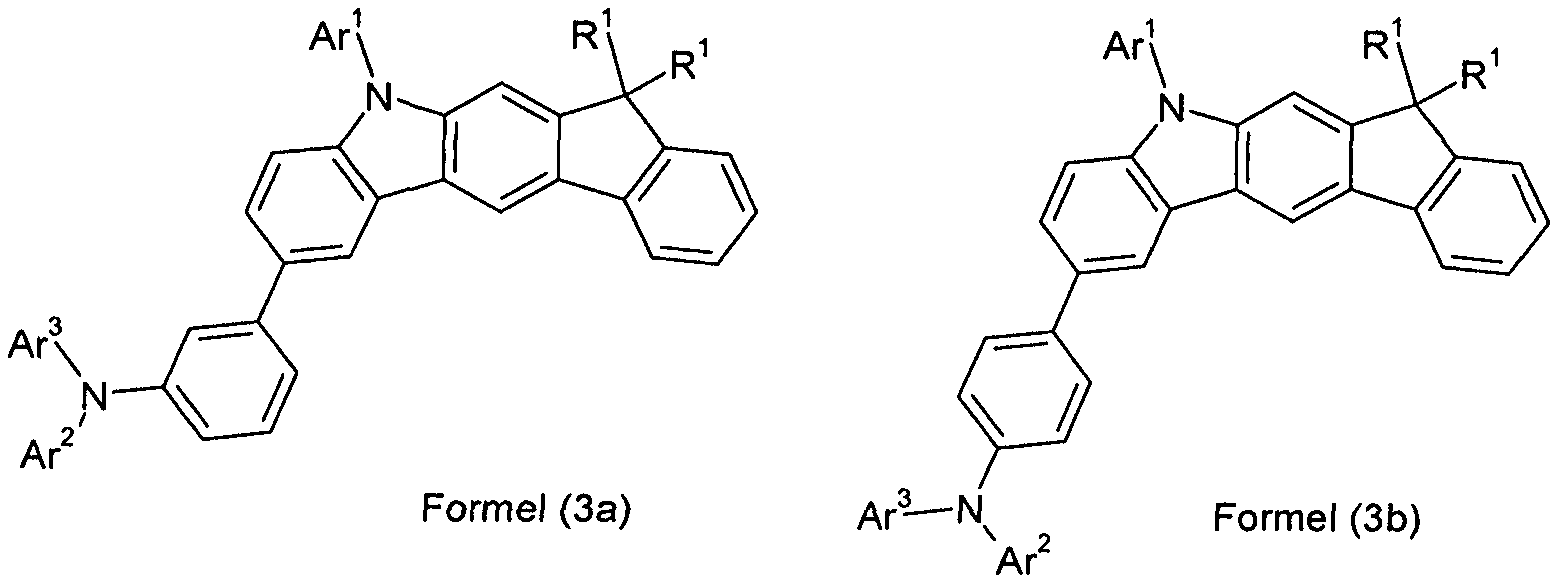
Im Folgenden wird die Gruppe Ar1 genauer beschrieben. In einer bevorzugten Ausführungsform der Erfindung ist Ar1 ein aromatisches Ringsystem mit 6 bis 24 aromatischen Ringatomen, welches mit einem oder mehreren Resten R substituiert sein kann, oder ein elektronenreiches heteroaromatisches Ringsystem mit 5 bis 24 aromatischen Ringatomen, welches mit einem oder mehreren Resten R, bevorzugt mit nicht-aroma- tischen Resten R, substituiert sein kann. Besonders bevorzugt ist Ar1 ein aromatisches Ringsystem mit 6 bis 24 aromatischen Ringatomen, welches mit einem oder mehreren nicht-aromatischen Resten R substituiert sein kann, bevorzugt aber unsubstituiert ist. Bevorzugte Gruppen Ar1 sind ausgewählt aus der Gruppe bestehend aus Phenyl, Biphenyl, insbesondere Ortho-, meta- oder para-Biphenyl, Terphenyl, insbesondere ortho-, meta-, para- oder verzweigtes Terphenyl, Quaterphenyl, insbesondere ortho-, meta-, para- oder verzweigtes Quaterphenyl, Fluorenyl, insbesondere 1-, 2-, 3- oder 4-Fluorenyl, Spirobifluorenyl, insbesondere 1-, 2-, 3- oder 4- Spirobifluorenyl, Dibenzofuranyl, insbesondere 1-, 2-, 3- oder 4-Dibenzo- furanyl, Dibenzothienyl, insbesondere 1-, 2-, 3- oder 4-Dibenzothienyl, oder N-Phenyl-Carbazolyl, insbesondere N-Phenyl-1-, 2-, 3- oder 4-Carba- zolyl, wobei diese Gruppen jeweils durch einen oder mehrere nicht-aromatische Reste R substituiert sein können, bevorzugt aber unsubstituiert sind. Ganz besonders bevorzugt sind Phenyl, Biphenyl, Terphenyl, Quaterphenyl und Fluorenyl. In the following, the group Ar 1 will be described in more detail. In a preferred embodiment of the invention, Ar 1 is an aromatic ring system having 6 to 24 aromatic ring atoms, which may be substituted by one or more radicals R, or an electron-rich heteroaromatic ring system having 5 to 24 aromatic ring atoms, which contains one or more radicals R, preferably with non-aromatic table radicals R, may be substituted. Ar 1 is particularly preferably an aromatic ring system having 6 to 24 aromatic ring atoms, which may be substituted by one or more non-aromatic radicals R, but is preferably unsubstituted. Preferred groups Ar 1 are selected from the group consisting of phenyl, biphenyl, in particular ortho, meta- or para-biphenyl, terphenyl, in particular ortho, meta, para or branched terphenyl, quaterphenyl, in particular ortho, meta, para- or branched quaterphenyl, fluorenyl, in particular 1-, 2-, 3- or 4-fluorenyl, spirobifluorenyl, in particular 1-, 2-, 3- or 4-spirobifluorenyl, dibenzofuranyl, in particular 1-, 2-, 3- or 4-dibenzofuranyl, dibenzothienyl, in particular 1-, 2-, 3- or 4-dibenzothienyl, or N-phenyl-carbazolyl, in particular N-phenyl-1-, 2-, 3- or 4-carbo- zolyl, where each of these groups may be substituted by one or more non-aromatic radicals R, but are preferably unsubstituted. Very particular preference is given to phenyl, biphenyl, terphenyl, quaterphenyl and fluorenyl.
Beispiele für geeignete Gruppen Ar1 sind die im Folgenden abgebildeten Gruppen (Ar -1) bis (Ar1-15), Examples of suitable groups Ar 1 are the groups (Ar -1) to (Ar 1 -15) shown below,

(Ar -1 ) (Ar -2) (Ar1-3) (Ar )

(Ar1-8) (Ar 1 -8)
(Ar -5) (Ar1-6) (Ari-7) (Ar -5) (Ar 1 -6) (Ari-7)


(Ar 3) <Ar 4) (Ar 5> wobei die gestrichelte Bindung die Verknüpfung dieser Gruppe darstellt, die Strukturen auch durch einen oder mehrere Reste R, bevorzugt nichtaromatische Reste R, substituiert sein können und die weiteren verwendeten Symbole die oben genannten Bedeutungen aufweisen. Bevorzugt sind die oben genannten Gruppen unsubstituiert. (Ar 3) < Ar 4 ) ( Ar 5 > where the dashed bond represents the linkage of this group, the structures may also be substituted by one or more radicals R, preferably nonaromatic radicals R, and the other symbols used have the abovementioned meanings Preferably, the abovementioned groups are unsubstituted.
Besonders bevorzugte Ausführungsformen der Gruppe Ar1 sind die Gruppen der folgenden Formeln (Ar1-1-a) bis (Ar1-15-b), Particularly preferred embodiments of the group Ar 1 are the groups of the following formulas (Ar 1 -1-a) to (Ar 1 -15-b),

(Ari-2-a) (Ar1-2-b) (Ai-i-2-c) (Ari-2-a) (Ar 1 -2-b) (Ai-i-2-c)

(Ar -8-a) (Ar1-8-b)(Ar-8-a) (Ar 1 -8-b)

(Ari-9-a) (Ari-9-b) (Ar1-9-c) (Ari-9-d) ( Ar i-9-a) (Ari-9-b) (Ar 1 -9-c) (Ar i -9-d)

(Ar1-10-a) (Ar1-10-b) (Ar1-10-c) (Ar

(Ai-i-11a) (Ar-11b) (Ar1-11c) (Ar1-11d)

(Ar1-12a) (Ar1-12b) (Ar 2c) (Ar-12d)

(Ar 3-a) (Ar 3-b) (Ar 3-c) (Ar 3-d) (Ar 3-e)

(Ar1-15-a) (Ar1-15-b) wobei die verwendeten Symbole die oben genannten Bedeutungen haben und die Strukturen auch durch einen oder mehrere Reste R substituiert sein können, bevorzugt aber unsubstituiert sind. (Ar 1 -15-a) (Ar 1 -15-b) where the symbols used have the abovementioned meanings and the structures may also be substituted by one or more radicals R, but are preferably unsubstituted.
Im Folgenden wird die Gruppe Ar2 genauer beschrieben. In einer bevorzugten Ausführungsform der Erfindung ist Ar2 ein aromatisches Ringsystem mit 6 bis 24 aromatischen Ringatomen, welches mit einem oder mehreren Resten R substituiert sein kann, oder ein elektronenreiches heteroaromatisches Ringsystem mit 5 bis 24 aromatischen Ringatomen, welches mit einem oder mehreren Resten R, bevorzugt mit nicht-aromatischen Resten R, substituiert sein kann. Besonders bevorzugt ist Ar2 ein aromatisches Ringsystem mit 6 bis 24 aromatischen Ringatomen, welches mit einem oder mehreren nicht-aromatischen Resten R substituiert sein kann, bevorzugt aber unsubstituiert ist. Bevorzugte Gruppen Ar2 sind ausgewählt aus der Gruppe bestehend aus Phenyl, Biphenyl, insbesondere Ortho-, meta- oder para-Biphenyl, Terphenyl, insbesondere Ortho-, meta-, para- oder verzweigtes Terphenyl, Quaterphenyl, insbesondere ortho-, meta-, para- oder verzweigtes Quaterphenyl, Fluorenyl, insbesondere 1-, 2-, 3- oder 4-Fluorenyl, Spirobifluorenyl, insbesondere 1-, 2-, 3- oder 4- Spirobifluorenyl, Dibenzofuranyl, insbesondere 1-, 2-, 3- oder 4-Dibenzo- furanyl, Dibenzothienyl, insbesondere 1-, 2-, 3- oder 4-Dibenzothienyl, oder N-Phenyl-Carbazolyl, insbesondere N-Phenyl-1-, 2-, 3- oder -Carba- zolyl, wobei diese Gruppen jeweils durch einen oder mehrere nicht-aroma- tische Reste R substituiert sein können, bevorzugt aber unsubstituiert sind. In the following, the group Ar 2 will be described in more detail. In a preferred embodiment of the invention, Ar 2 is an aromatic ring system having 6 to 24 aromatic ring atoms which may be substituted by one or more radicals R, or an electron-rich heteroaromatic ring system having 5 to 24 aromatic ring atoms which is substituted by one or more radicals R, preferably with non-aromatic radicals R, may be substituted. Ar 2 is particularly preferably an aromatic ring system having 6 to 24 aromatic ring atoms, which may be substituted by one or more non-aromatic radicals R, but is preferably unsubstituted. Preferred groups Ar 2 are selected from the group consisting of phenyl, biphenyl, in particular ortho, meta- or para-biphenyl, terphenyl, in particular ortho, meta, para or branched terphenyl, quaterphenyl, in particular ortho, meta, para- or branched quaterphenyl, fluorenyl, in particular 1-, 2-, 3- or 4-fluorenyl, spirobifluorenyl, in particular 1-, 2-, 3- or 4-spirobifluorenyl, dibenzofuranyl, in particular 1-, 2-, 3- or 4-dibenzofuranyl, dibenzothienyl, in particular 1-, 2-, 3- or 4-dibenzothienyl, or N-phenyl-carbazolyl, in particular N-phenyl-1-, 2-, 3- or -carbazolyl, where these Groups may each be substituted by one or more non-aromatic radicals R, but are preferably unsubstituted.
Beispiele für geeignete Gruppen Ar2 sind die im Folgenden abgebildeten Gruppen (Ar2-1 ) bis (Ar2-15), Examples of suitable groups Ar 2 are the groups (Ar 2 -1) to (Ar 2 -15) depicted below


(Ar2-14) (Ar2-15) wobei die gestrichelte Bindung die Verknüpfung dieser Gruppe darstellt, die Strukturen auch durch einen oder mehrere Reste R, bevorzugt nichtaromatische Reste R, substituiert sein können und die weiteren verwendeten Symbole die oben genannten Bedeutungen aufweisen. Besonders bevorzugte Ausführungsformen der Gruppe Ar2 sind die Gruppen der folgenden Formeln (Ar2-1a) bis (Ar2-15b),(Ar 2 -14) (Ar 2 -15) where the dashed bond represents the linkage of this group, the structures may also be substituted by one or more radicals R, preferably non-aromatic radicals R, and the other symbols used have the abovementioned meanings , Particularly preferred embodiments of the group Ar 2 are the groups of the following formulas (Ar 2 -1a) to (Ar 2 -15b),

(Ar2-7a) (Ar2-7b) (Ar2-7c) (Ar*-7cl) - 18- (Ar 2 -7a) (Ar 2 -7b) (Ar 2 -7c) (Ar * -7cl) - 18-


13a) (Ar*-13b) (Αι -13ο) (Ar 3d) (Ar 3e) 13a) (Ar * -13b) (Αι -13ο) (Ar 3d) (Ar 3e)

Im Folgenden wird die Gruppe Ar3, also die Gruppe der Formel (2), genauer beschrieben. In einer bevorzugten Ausführungsform der Erfindung ist p = 0. In einer weiteren bevorzugten Ausführungsform der Erfindung ist p = 1 und die Phenylengruppe steht für eine unsubstituierte meta- oder para-verknüpfte Phenylengruppe, insbesondere für eine para-verknüpfte Phenylengruppe. Bevorzugte Ausführungsformen der Gruppe der Formel (2) sind somit die Gruppen der Formeln (2a) bis (2c), In the following, the group Ar 3 , ie the group of formula (2), will be described in more detail. In a preferred embodiment of the invention, p = 0. In another preferred embodiment of the invention, p = 1 and the phenylene group represents an unsubstituted meta or para-linked phenylene group, especially a para-linked phenylene group. Preferred embodiments of the group of the formula (2) are thus the groups of the formulas (2a) to (2c),
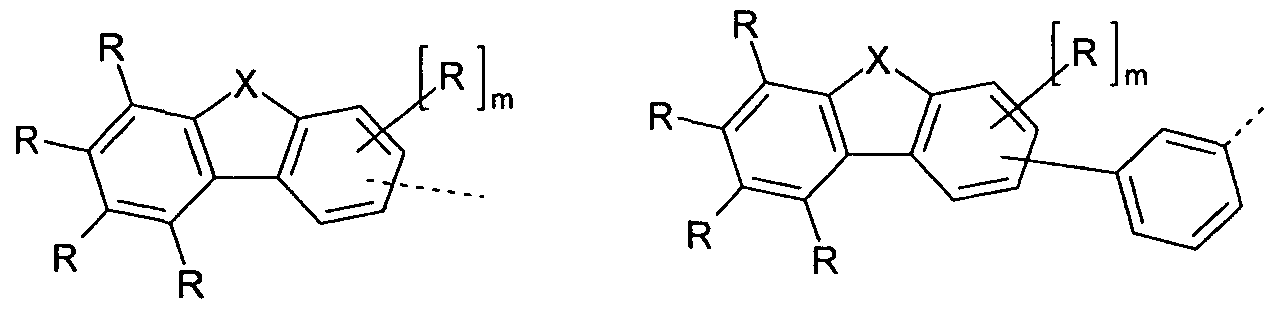
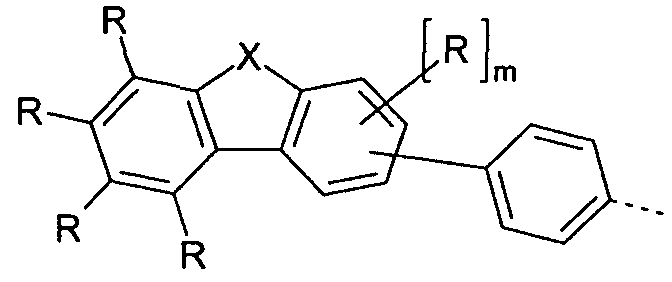
wobei die verwendeten Symbole und Indizes die oben genannten where the symbols and indices used are those mentioned above
Bedeutungen aufweisen und die Fluorengruppe bzw. Dibenzofurangruppe bzw. Dibenzothiophengruppe erfindungsgemäß über die 1-, 3- oder 4- Position verknüpft ist. Besonders bevorzugt ist eine Gruppe der Formel (2a). Have meanings and the fluorene group or dibenzofuran group or dibenzothiophene group according to the invention via the 1-, 3- or 4- position is linked. Particularly preferred is a group of formula (2a).
Ausführungsformen der Gruppe (2a) sind die Gruppen der folgenden Formeln (2a-1) bis (2a-9), Embodiments of the group (2a) are the groups of the following formulas (2a-1) to (2a-9),

Formel (2a-1 ) Formel (2a-2) Formel (2a-3) Formula (2a-1) Formula (2a-2) Formula (2a-3)

Formel (2a-4) Formel (2a-5) Formel (2a-6) Formula (2a-4) Formula (2a-5) Formula (2a-6)

Formel (2a-7) Formel (2a-8) Formel (2a-9) wobei die gestrichelte Bindung die Verknüpfung dieser Gruppe mit dem Stickstoffatom andeutet und die weiteren verwendeten Symbole die oben genannten Bedeutungen aufweisen. Formula (2a-7) Formula (2a-8) Formula (2a-9) where the dashed bond indicates the linking of this group with the nitrogen atom and the further symbols used have the abovementioned meanings.
Analog sind Gruppen der Formeln (2b) und (2c) möglich, wobei diese sich von den Strukturen der Formeln (2a-1 ) bis (2a-9) lediglich dadurch unterscheiden, dass sie zwischen der Fiuorengruppe bzw. Dibenzofurangruppe bzw. Dibenzothiophengruppe und dem Stickstoffatom des Amins noch eine meta- bzw. para-Phenylengruppe enthalten. Analogously, groups of the formulas (2b) and (2c) are possible, these differing from the structures of the formulas (2a-1) to (2a-9) only in that they between the Fiuorengruppe or Dibenzofurangruppe or dibenzothiophene and the Nitrogen atom of the amine still contain a meta or para-phenylene group.
Bevorzugt steht in der Gruppe der Formel (2) bzw. den bevorzugten Ausführungsformen X für C(R1 )2 oder O, besonders bevorzugt für C(R1 )2. Preferably, in the group of the formula (2) or the preferred embodiments, X is C (R 1 ) 2 or O, particularly preferably C (R 1 ) 2.
Wenn X für C(R1)2 steht, ist die Gruppe Ar3 bevorzugt eine Gruppe der oben genannten Formel (2a-1) oder (2a-3), besonders bevorzugt eine Gruppe der oben genannten Formel (2a-3). Wenn X für O steht, ist die Gruppe Ar3 bevorzugt eine Gruppe der oben genannten Formel (2a-4) oder (2a-6). Wenn X für S steht, ist die Gruppe Ar3 bevorzugt eine Gruppe der oben genannten Formel (2a-7) oder (2a-9). When X is C (R 1 ) 2, the group Ar 3 is preferably a group of the above-mentioned formula (2a-1) or (2a-3), particularly preferably a group of the above-mentioned formula (2a-3). When X is O, the group Ar 3 is preferably a group of the above-mentioned formula (2a-4) or (2a-6). When X is S, the group Ar 3 is preferably a group of the above-mentioned formula (2a-7) or (2a-9).
In einer bevorzugten Ausführungsform der Erfindung sind die Reste R1, die für X = C(R1 )2 an das Fluoren der Formel (2) bzw. die bevorzugten Ausführungsformen binden, bei jedem Auftreten gleich oder verschieden ausgewählt aus der Gruppe bestehend aus einer geradkettigen Alkyl- gruppe mit 1 bis 10 C-Atomen oder einer verzweigten oder cyclischen Alkylgruppe mit 3 bis 10 C-Atomen oder einer Alkenylgruppe mit 2 bis 10 C-Atomen, die jeweils mit einem oder mehreren Resten R2 substituiert sein kann, wobei eine oder mehrere nicht-benachbarte CF -Gruppen durch O ersetzt sein können und wobei ein oder mehrere H-Atome durch D oder F ersetzt sein können, oder einem aromatischen oder heteroaromatischen Ringsystem mit 6 bis 24 aromatischen Ringatomen, das jeweils mit einem oder mehreren Resten R2, bevorzugt nicht-aromatischen Resten R2, substituiert sein kann; dabei können die beiden Substituenten R1 ein monocyclisches oder polycyclisches, aliphatisches, aromatisches oder heteroaromatisches Ringsystem bilden, das mit einem oder mehreren Resten R2 substituiert sein kann. Besonders bevorzugt sind die Reste R1 bei jedem Auftreten gleich oder verschieden ausgewählt aus der Gruppe bestehend aus einer geradkettigen Alkylgruppe mit 1 bis 4 C- Atomen oder einer verzweigten oder cyclischen Alkylgruppe mit 3 bis 10 C-Atomen, die jeweils mit einem oder mehreren Resten R2 substituiert sein kann, bevorzugt aber unsubstituiert ist, wobei eine oder mehrere H- Atome durch D oder F ersetzt sein können, oder einem aromatischen Ringsystem mit 6 bis 24 aromatischen Ringatomen, das mit einem oder mehreren nicht-aromatischen Resten R2 substituiert sein kann, bevorzugt aber unsubstituiert ist; dabei können die beiden Substituenten R ein monocyclisches oder polycyclisches, aliphatisches oder aromatisches Ringsystem bilden, das mit einem oder mehreren Resten R2 substituiert sein kann, bevorzugt aber unsubstituiert ist. Ganz besonders bevorzugt sind die Reste R1 gleich oder verschieden bei jedem Auftreten ausgewählt aus Methyl, Phenyl oder zwei Phenylgruppen, die miteinander ein Ringsystem bilden und so ein Spirosystem aufspannen. Insbesondere bevorzugt sind beide Reste R1 entweder Methyl, oder beide Reste R sind Phenylgruppen, die miteinander ein Ringsystem bilden und so ein Spiro- bifluoren aufspannen. In a preferred embodiment of the invention, the radicals R 1 which, for X = C (R 1 ) 2, bind to the fluorene of the formula (2) or the preferred embodiments, are identically or differently chosen on each occurrence from the group consisting of one straight-chain alkyl group having 1 to 10 carbon atoms or a branched or cyclic alkyl group having 3 to 10 carbon atoms or an alkenyl group having 2 to 10 carbon atoms, each of which may be substituted by one or more radicals R 2 , wherein a or one or more non-adjacent CF groups may be replaced by O and wherein one or more H atoms may be replaced by D or F, or an aromatic or heteroaromatic ring system having from 6 to 24 aromatic ring atoms, each containing one or more R groups 2 , preferably non-aromatic radicals R 2 , may be substituted; In this case, the two substituents R 1 may form a monocyclic or polycyclic, aliphatic, aromatic or heteroaromatic ring system, with one or may be substituted by several radicals R 2 . With particular preference, the radicals R 1 on each occurrence are identically or differently selected from the group consisting of a straight-chain alkyl group having 1 to 4 C atoms or a branched or cyclic alkyl group having 3 to 10 C atoms, each containing one or more radicals R 2 may be substituted, but is preferably unsubstituted, where one or more H atoms may be replaced by D or F, or an aromatic ring system having 6 to 24 aromatic ring atoms, which may be substituted with one or more non-aromatic radicals R 2 may, but is preferably unsubstituted; In this case, the two substituents R can form a monocyclic or polycyclic, aliphatic or aromatic ring system which may be substituted by one or more radicals R 2 , but is preferably unsubstituted. Most preferably, the radicals R 1 are the same or different at each occurrence selected from methyl, phenyl or two phenyl groups, which together form a ring system and thus form a spiro system. Particularly preferably, both radicals R 1 are either methyl, or both radicals R are phenyl groups which together form a ring system and thus form a spirobifluorene.
In einer weiteren bevorzugten Ausführungsform der Erfindung ist R gleich oder verschieden bei jedem Auftreten ausgewählt aus der Gruppe bestehend aus H, D, F, CN, N(R2)2, OR2, einer geradkettigen Alkylgruppe mit 1 bis 10 C-Atomen oder einer verzweigten oder cyclischen Alkylgruppe mit 3 bis 10 C-Atomen oder einer Alkenylgruppe mit 2 bis 10 C-Atomen, die jeweils mit einem oder mehreren Resten R2 substituiert sein kann, wobei eine oder mehrere nicht-benachbarte CH2-Gruppen durch O ersetzt sein können und wobei ein oder mehrere H-Atome durch D oder F ersetzt sein können, oder einem aromatischen oder heteroaromatischen Ringsystem mit 5 bis 30 aromatischen Ringatomen, das jeweils mit einem oder mehreren Resten R2 substituiert sein kann. Besonders bevorzugt ist R gleich oder verschieden bei jedem Auftreten ausgewählt aus der Gruppe bestehend aus H, N(R2)2, einer geradkettigen Alkylgruppe mit 1 bis 6 C- Atomen, insbesondere mit 1 bis 4 C-Atomen, oder einer verzweigten oder cyclischen Alkylgruppe mit 3 bis 8 C-Atomen, insbesondere mit 3 bis 6 C- Atomen, die jeweils mit einem oder mehreren Resten R2 substituiert sein kann, bevorzugt aber unsubstiutiert ist, oder einem aromatischen oder heteroaromatischen Ringsystem mit 5 bis 24 aromatischen Ringatomen, das jeweils mit einem oder mehreren Resten R2 substituiert sein kann, bevorzugt aber unsubstituiert ist. In a further preferred embodiment of the invention, R is the same or different at each occurrence selected from the group consisting of H, D, F, CN, N (R 2 ) 2, OR 2 , a straight-chain alkyl group having 1 to 10 carbon atoms or a branched or cyclic alkyl group having from 3 to 10 carbon atoms or an alkenyl group having from 2 to 10 carbon atoms, each of which may be substituted with one or more R 2 groups, one or more non-adjacent CH 2 groups being replaced by O and wherein one or more H atoms may be replaced by D or F, or an aromatic or heteroaromatic ring system having from 5 to 30 aromatic ring atoms, each of which may be substituted by one or more R 2 radicals. More preferably, R is the same or different at each occurrence selected from the group consisting of H, N (R 2 ) 2, a straight-chain alkyl group having 1 to 6 carbon atoms, in particular having 1 to 4 carbon atoms, or a branched or cyclic Alkyl group having 3 to 8 carbon atoms, in particular having 3 to 6 carbon atoms, each substituted with one or more radicals R 2 may, but is preferably unsubstituted, or an aromatic or heteroaromatic ring system having 5 to 24 aromatic ring atoms, which may be substituted in each case with one or more radicals R 2 , but is preferably unsubstituted.
Wenn R für ein aromatisches oder heteroaromatisches Ringsystem steht, dann ist dieser Rest R bevorzugt gleich oder verschieden bei jedem Auftreten aus denselben Gruppen ausgewählt, wie oben als geeignete If R is an aromatic or heteroaromatic ring system, then this radical R is preferably the same or different at each occurrence selected from the same groups as suitable as above
Gruppen für Ar1 und Ar2 angegeben. Groups for Ar 1 and Ar 2 are given.
Dabei haben in Verbindungen, die durch Vakuumverdampfung verarbeitet werden, die Alkylgruppen bevorzugt nicht mehr als fünf C-Atome, besonders bevorzugt nicht mehr als 4 C-Atome, ganz besonders bevorzugt nicht mehr als 1 C-Atom. Für Verbindungen, die aus Lösung verarbeitet werden, eignen sich auch Verbindungen, die mit Alkylgruppen, insbesondere verzweigten Alkylgruppen, mit bis zu 10 C-Atomen substituiert sind oder die mit Oligoarylengruppen, beispielsweise Ortho-, meta-, para- oder verzweigten Terphenyl- oder Quaterphenylgruppen, substituiert sind. In this case, in compounds which are processed by vacuum evaporation, the alkyl groups preferably have not more than five carbon atoms, more preferably not more than 4 carbon atoms, most preferably not more than 1 carbon atom. For compounds which are processed from solution, compounds which are substituted by alkyl groups, in particular branched alkyl groups, having up to 10 carbon atoms or which are oligoarylene, for example ortho, meta, para or branched Terphenyl- or Quaterphenyl groups are substituted.
Wenn die Verbindung der Formel (1) bzw. die bevorzugten Ausführungsformen als Matrixmaterial für einen phosphoreszierenden Emitter oder in einer Schicht, die direkt an eine phosphoreszierende Schicht angrenzt, verwendet werden, ist es weiterhin bevorzugt, wenn die Triplettenergie der Verbindung gleich hoch oder höher ist als die des phosphoreszierenden Emitters. Dies kann insbesondere für grün und blau phosphoreszierende Emitter, welche eine höhere Triplettenergie als rot phosphoreszierende Emitter aufweisen, dadurch erreicht werden, dass die erfindungsgemäße Verbindung keine kondensierten Aryl- bzw. Heteroarylgruppen enthält, in denen mehr als zwei Sechsringe direkt aneinander ankondensiert sind. Solche Verbindungen sind daher eine weitere bevorzugte Ausführungsform der Erfindung. Insbesondere ist es für diese Verwendung bevorzugt, dass die Reste R, R1, R2, Ar1 und Ar2 keine kondensierten Aryl- bzw. Further, when the compound of the formula (1) or the preferred embodiments is used as a matrix material for a phosphorescent emitter or in a layer directly adjacent to a phosphorescent layer, it is preferable that the triplet energy of the compound is equal to or higher as that of the phosphorescent emitter. This can be achieved in particular for green and blue phosphorescent emitters, which have a higher triplet energy than red phosphorescent emitters, in that the compound according to the invention contains no condensed aryl or heteroaryl groups in which more than two six-membered rings are directly fused to one another. Such compounds are therefore a further preferred embodiment of the invention. In particular, it is preferred for this use that the radicals R, R 1 , R 2 , Ar 1 and Ar 2 are not condensed aryl or
Heteroarylgruppen enthalten, in denen zwei oder mehr Sechsringe direkt aneinander ankondensiert sind. Optional können diese Gruppen auch Phenanthren oder Triphenylen enthalten, da diese Arylgruppen trotz der drei bzw. vier kondensierten Sechsringe eine ausreichend hohe Triplettenergie aufweisen. Containing heteroaryl groups in which two or more six-membered rings are directly fused together. Optionally, these groups may also contain phenanthrene or triphenylene, since these aryl groups, despite the three or four condensed six-rings have a sufficiently high triplet energy.
Die oben genannten bevorzugten Ausführungsformen können beliebig miteinander kombiniert werden. In einer besonders bevorzugten Ausführungsform der Erfindung treten die oben genannten Bevorzugungen gleichzeitig auf. The above-mentioned preferred embodiments can be arbitrarily combined with each other. In a particularly preferred embodiment of the invention, the abovementioned preferences occur simultaneously.
Beispiele für geeignete Verbindungen gemäß den oben aufgeführten Ausführungsformen sind die in der folgenden Tabelle aufgeführten Verbindungen. Examples of suitable compounds according to the embodiments listed above are the compounds listed in the following table.
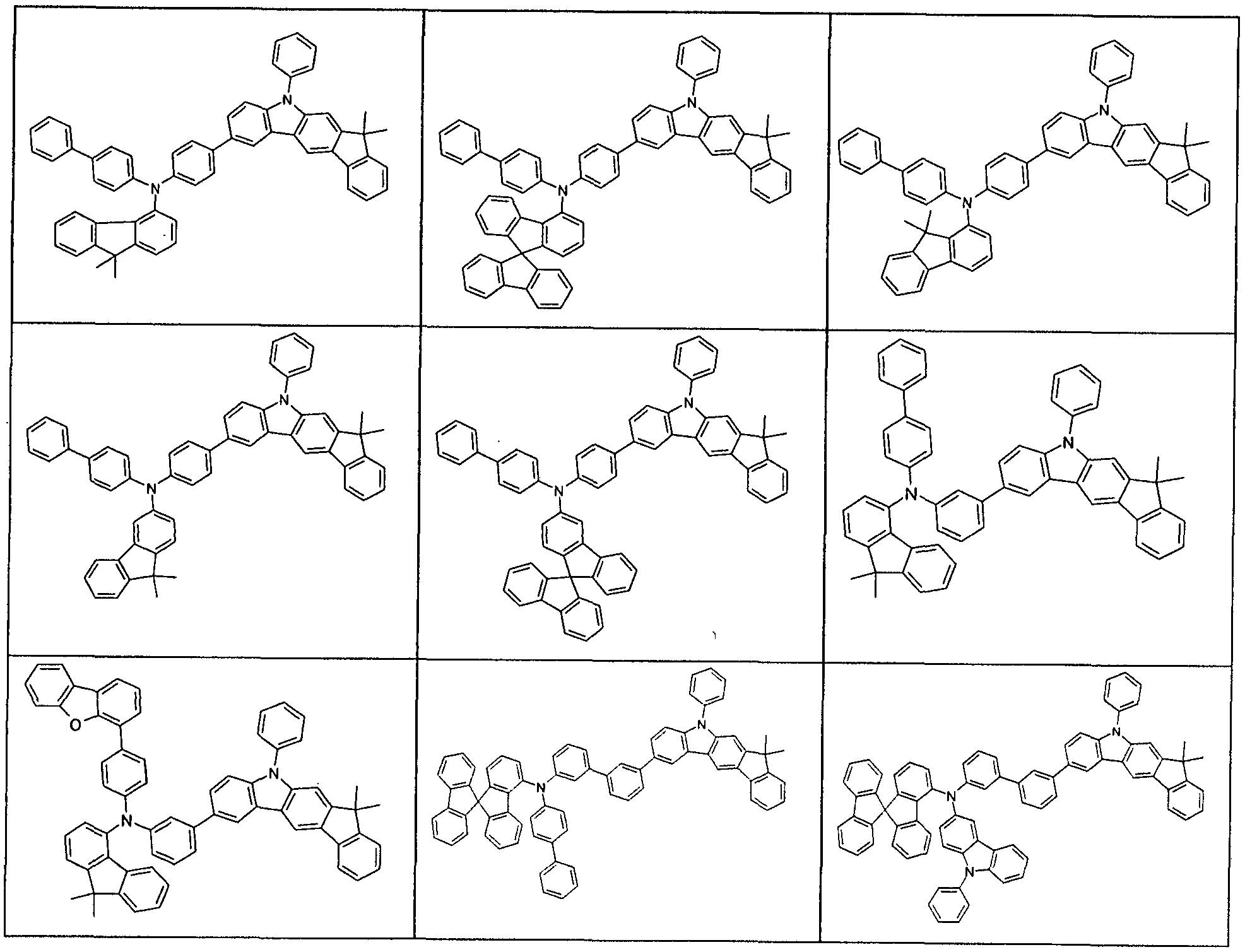


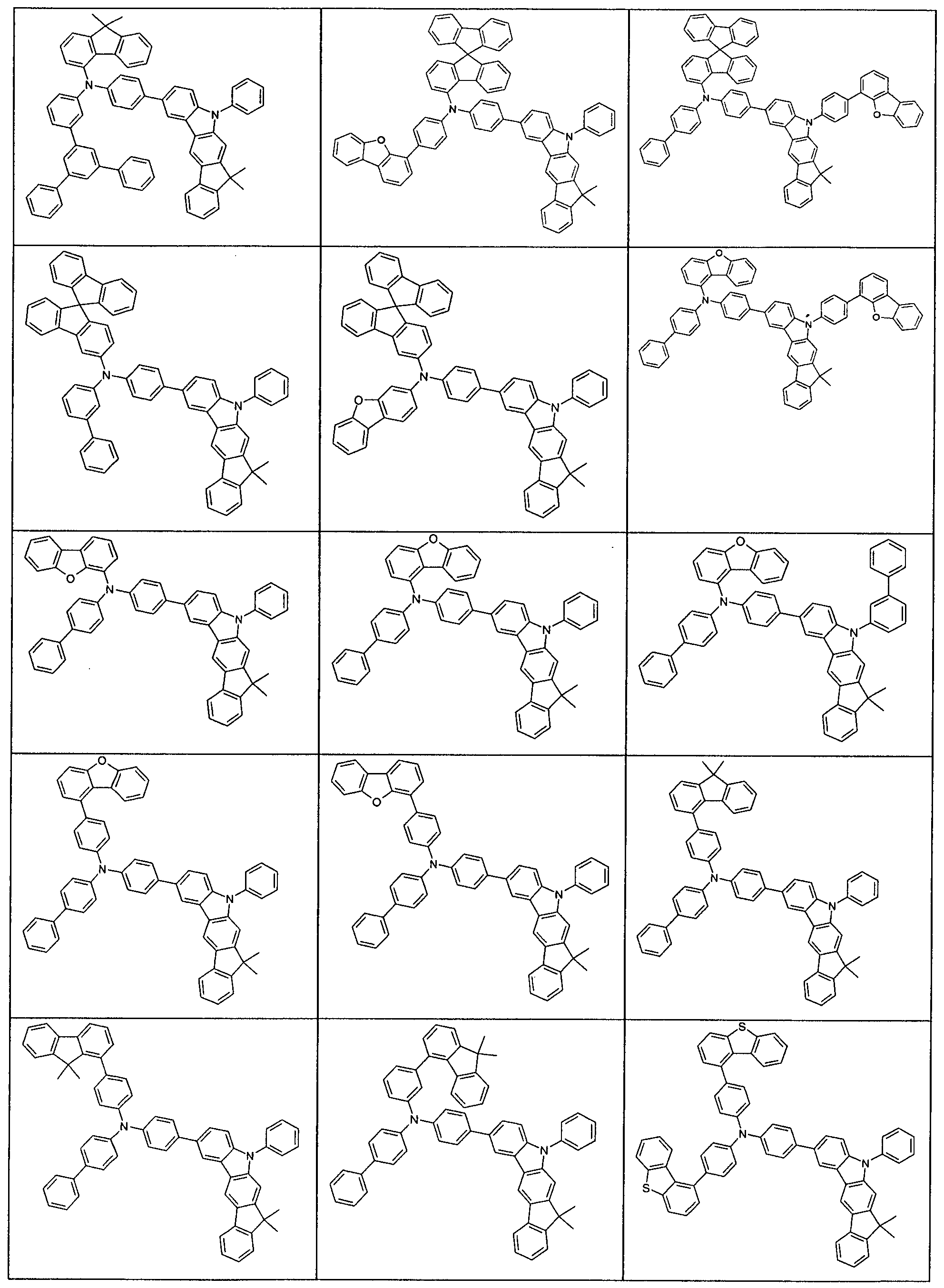


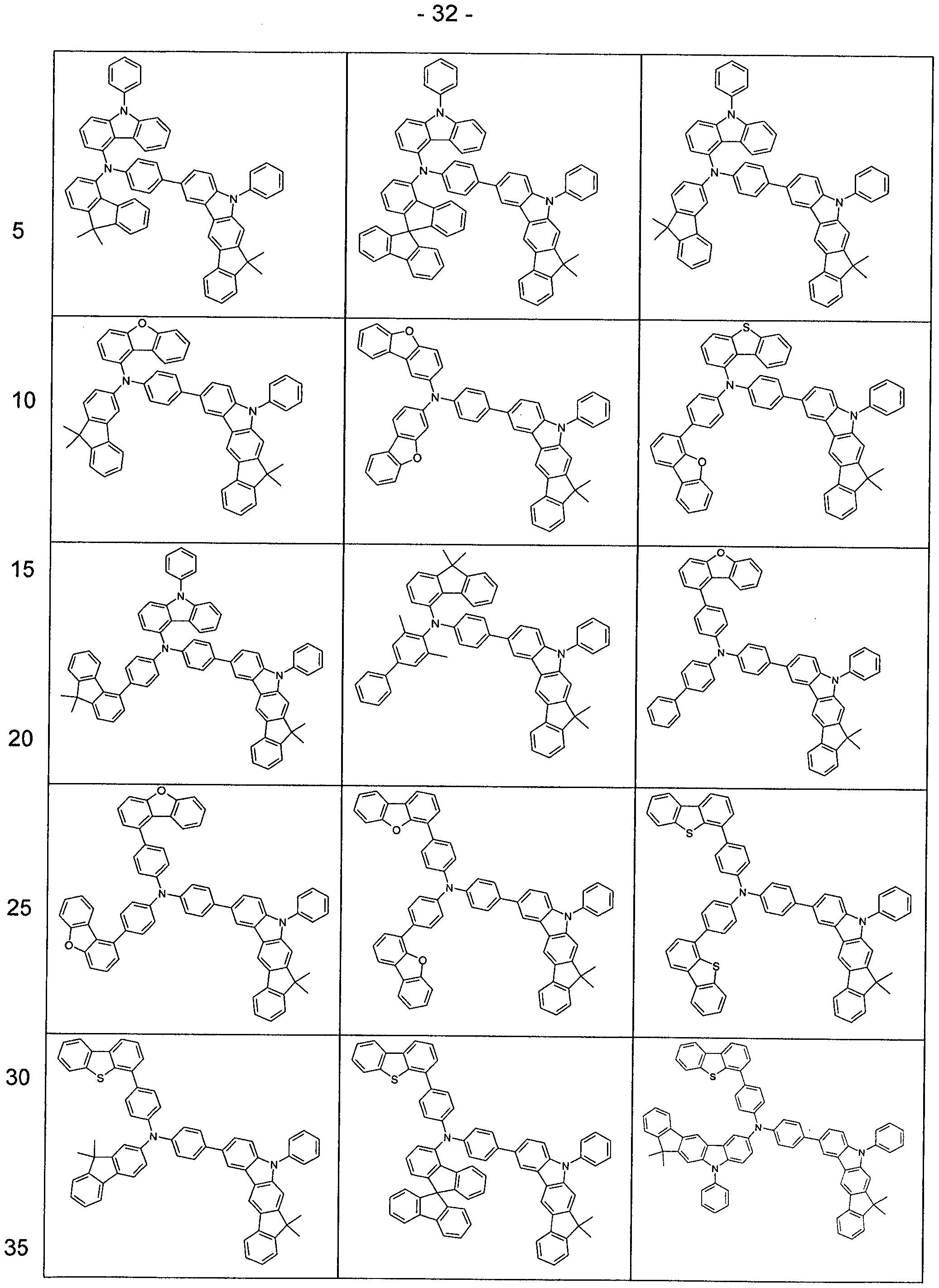


Die Synthese der erfindungsgemäßen Verbindungen kann auf dem im folgenden Schema allgemein skizzierten und nachfolgend beschriebenen Weg erfolgen: The synthesis of the compounds according to the invention can be carried out in the manner outlined in the following scheme and described below:

Ein primäres Amin Ar2-NH2 wird in einer C-N-Kupplungsreaktion, beispielsweise einer Hartwig-Buchwald-Kupplung, mit einer Arylgruppe Ar3, welche eine reaktive Abgangsgruppe trägt, gekuppelt. Es folgt Reaktion mit einem Fluor-substituierten Benzol, welches eine weitere reaktive Abgangsgruppe trägt, gefolgt von einer C-C-Kupplungsreaktion, beispielsweise einer Suzuki-Kupplung, mit dem Indenocarbazol. Im letzten Schritt wird die Gruppe Ar1 am Indenocarbazol durch eine C-N-Kupplungsreaktion, beispielsweise einer Hartwig-Buchwald-Kupplung, mit einer Arylgruppe Ar1, welche eine reative Abgangsgruppe trägt, eingeführt. Als reaktive Abgangsgruppe eignen sich in den vorstehend beschriebenen Reaktionen beispielsweise Brom, lod oder Tosylat. Weiterhin können zur Synthese entsprechend substituierter Verbindungen die entsprechend substituierten Edukte eingesetzt werden. A primary amine Ar 2 -NH 2 is coupled in a CN coupling reaction, for example a Hartwig-Buchwald coupling, with an aryl group Ar 3 bearing a reactive leaving group. It is followed by reaction with a fluorine-substituted benzene bearing another reactive leaving group, followed by a C-C coupling reaction, for example Suzuki coupling, with the indenocarbazole. In the last step, the group Ar 1 on the indenocarbazole by a CN coupling reaction, such as a Hartwig-Buchwald coupling, with a Aryl group Ar 1 carrying a reactive leaving group introduced. Suitable reactive leaving groups in the reactions described above are, for example, bromine, iodine or tosylate. Furthermore, the correspondingly substituted starting materials can be used for the synthesis of appropriately substituted compounds.
Ein weiterer Gegenstand der vorliegenden Erfindung ist daher ein Verfahren zur Synthese der erfindungsgemäßen Verbindungen, umfassend eine Kupplungsreaktion zwischen der Einheit Ar2Ar3N-Phenylen, welche mit einer reaktiven Abgangsgruppe substituiert ist, und einem Indeno- carbazol, welches mit einer reaktiven Abgangsgruppe substituiert ist. A further subject of the present invention is therefore a process for the synthesis of the compounds according to the invention comprising a coupling reaction between the Ar 2 Ar 3 N-phenylene unit which is substituted by a reactive leaving group and an indenocarbazole which is substituted by a reactive leaving group is.
Für die Verarbeitung der erfindungsgemäßen Verbindungen aus flüssiger Phase, beispielsweise durch Spin-Coating oder durch Druckverfahren, sind Formulierungen der erfindungsgemäßen Verbindungen erforderlich. Diese Formulierungen können beispielsweise Lösungen, Dispersionen oder Emulsionen sein. Es kann bevorzugt sein, hierfür Mischungen aus zwei oder mehr Lösemitteln zu verwenden. Geeignete und bevorzugte Lösemittel sind beispielsweise Toluol, Anisol, o-, m- oder p-Xylol, Methyl- benzoat, Mesitylen, Tetralin, Hexamethylindan, Veratrol, THF, Methyl- THF, THP, Chlorbenzol, Dioxan, Phenoxytoluol, insbesondere 3-Phenoxy- toluol, (-)-Fenchon, 1 ,2,3,5-Tetramethylbenzol, 1 ,2,4,5-Tetramethylbenzol, 1 -Methylnaphthalin, 2-Methylbenzothiazol, 2-Phenoxyethanol, 2-Pyrrolidi- non, 3-Methylanisol, 4-Methylanisol, 3,4-Dimethylanisol, 3,5-Dimethyl- anisol, Acetophenon, -Terpineol, Benzothiazol, Butylbenzoat, Cumol, Cyclohexanol, Cyclohexanon, Cyclohexylbenzol, Decalin, Dodecylbenzol, Ethylbenzoat, Indan, Methylbenzoat, NMP, p-Cymol, Phenetol, 1 ,4-Di- isopropylbenzol, Dibenzylether, Diethylenglycolbutylmethylether, Tri- ethylenglycolbutylmethylether, Diethylenglycoldibutylether, Triethylen- glycoldimethylether, Diethylenglycolmonobutylether, Tripropyleneglycol- dimethylether, Tetraethylenglycoldimethylether, 2-lsopropylnaphthalin, Pentylbenzol, Hexylbenzol, Heptylbenzol, Octylbenzol, 1 ,1-Bis(3,4-di- methylphenyl)ethan oder Mischungen dieser Lösemittel. For the processing of the compounds according to the invention from the liquid phase, for example by spin coating or by printing processes, formulations of the compounds according to the invention are required. These formulations may be, for example, solutions, dispersions or emulsions. It may be preferable to use mixtures of two or more solvents for this purpose. Suitable and preferred solvents are, for example, toluene, anisole, o-, m- or p-xylene, methyl benzoate, mesitylene, tetralin, hexamethylindane, veratrol, THF, methyl THF, THP, chlorobenzene, dioxane, phenoxytoluene, in particular 3-phenoxy - toluene, (-) - fenchone, 1, 2,3,5-tetramethylbenzene, 1, 2,4,5-tetramethylbenzene, 1-methylnaphthalene, 2-methylbenzothiazole, 2-phenoxyethanol, 2-pyrrolidinone, 3-methylanisole , 4-methylanisole, 3,4-dimethylanisole, 3,5-dimethylanisole, acetophenone, terpineol, benzothiazole, butyl benzoate, cumene, cyclohexanol, cyclohexanone, cyclohexylbenzene, decalin, dodecylbenzene, ethyl benzoate, indane, methyl benzoate, NMP, p Cymene, phenol, 1,4-diisopropylbenzene, dibenzyl ether, diethylene glycol butyl methyl ether, triethylene glycol butyl methyl ether, diethylene glycol dibutyl ether, triethylene glycol dimethyl ether, diethylene glycol monobutyl ether, tripropylene glycol dimethyl ether, tetraethylene glycol dimethyl ether, 2-isopropylnaphthalene, pentylbenzene, hexylbenzene, heptylbenzene, oct ylbenzene, 1, 1-bis (3,4-dimethylphenyl) ethane or mixtures of these solvents.
Ein weiterer Gegenstand der vorliegenden Erfindung ist daher eine Formulierung, enthaltend eine erfindungsgemäße Verbindung und mindes- tens eine weitere Verbindung. Die weitere Verbindung kann beispielsweise ein Lösemittel sein, insbesondere eines der oben genannten Lösemittel oder eine Mischung dieser Lösemittel. Die weitere Verbindung kann aber auch mindestens eine weitere organische oder anorganische Verbindung sein, die ebenfalls in der elektronischen Vorrichtung eingesetzt wird, beispielsweise eine emittierende Verbindung und/oder ein weiteres Matrixmaterial. Geeignete emittierende Verbindungen und weitere Matrixmaterialien sind hinten im Zusammenhang mit der organischen Elektro- lumineszenzvorrichtung aufgeführt. Diese weitere Verbindung kann auch polymer sein. A further subject of the present invention is therefore a formulation comprising a compound according to the invention and at least at least one more connection. The further compound may be for example a solvent, in particular one of the abovementioned solvents or a mixture of these solvents. However, the further compound can also be at least one further organic or inorganic compound which is likewise used in the electronic device, for example an emitting compound and / or a further matrix material. Suitable emissive compounds and other matrix materials are listed in the background in connection with the organic electroluminescent device. This further compound may also be polymeric.
Die erfindungsgemäßen Verbindungen eignen sich für die Verwendung in einer elektronischen Vorrichtung, insbesondere in einer organischen Elektrolumineszenzvorrichtung. The compounds according to the invention are suitable for use in an electronic device, in particular in an organic electroluminescent device.
Ein weiterer Gegenstand der vorliegenden Erfindung ist daher die Verwendung einer erfindungsgemäßen Verbindung in einer elektronischen Vorrichtung, insbesondere in einer organischen Elektrolumineszenzvorrichtung. Another object of the present invention is therefore the use of a compound of the invention in an electronic device, in particular in an organic electroluminescent device.
Ein nochmals weiterer Gegenstand der vorliegenden Erfindung ist eine elektronische Vorrichtung enthaltend mindestens eine erfindungsgemäße Verbindung. Yet another object of the present invention is an electronic device containing at least one compound of the invention.
Eine elektronische Vorrichtung im Sinne der vorliegenden Erfindung ist eine Vorrichtung, welche mindestens eine Schicht enthält, die mindestens eine organische Verbindung enthält. Das Bauteil kann dabei auch anorganische Materialien enthalten oder auch Schichten, welche vollständig aus anorganischen Materialien aufgebaut sind. An electronic device in the sense of the present invention is a device which contains at least one layer which contains at least one organic compound. The component may also contain inorganic materials or layers which are completely composed of inorganic materials.
Die elektronische Vorrichtung ist bevorzugt ausgewählt aus der Gruppe bestehend aus organischen Elektrolumineszenzvorrichtungen (OLEDs), organischen integrierten Schaltungen (O-ICs), organischen Feld-Effekt- Transistoren (O-FETs), organischen Dünnfilmtransistoren (O-TFTs), organischen lichtemittierenden Transistoren (O-LETs), organischen Solar- zellen (O-SCs), farbstoffsensibilisierten organischen Solarzellen (DSSCs), organischen optischen Detektoren, organischen Photorezeptoren, organischen Feld-Quench-Devices (O-FQDs), lichtemittierenden elektrochemischen Zellen (LECs), organischen Laserdioden (O-Laser) und „organic plasmon emitting devices", bevorzugt aber organischen Elektro- lumineszenzvorrichtungen (OLEDs), besonders bevorzugt phosphoreszierenden OLEDs. The electronic device is preferably selected from the group consisting of organic electroluminescent devices (OLEDs), organic integrated circuits (O-ICs), organic field effect transistors (O-FETs), organic thin-film transistors (O-TFTs), organic light-emitting transistors ( O-LETs), organic solar cells (O-SCs), dye-sensitized organic solar cells (DSSCs), organic optical detectors, organic photoreceptors, organic field quench devices (O-FQDs), light-emitting electrochemical cells (LECs), organic laser diodes (O-lasers) and "organic plasmon emitting devices", but preferably organic electroluminescent devices (OLEDs) , particularly preferably phosphorescent OLEDs.
Die organische Elektrolumineszenzvorrichtung enthält Kathode, Anode und mindestens eine emittierende Schicht. Außer diesen Schichten kann sie noch weitere Schichten enthalten, beispielsweise jeweils eine oder mehrere Lochinjektionsschichten, Lochtransportschichten, Lochblockierschichten, Elektronentransportschichten, Elektroneninjektionsschichten, Exzitonenblockierschichten, Elektronenblockierschichten und/oder The organic electroluminescent device includes cathode, anode and at least one emitting layer. In addition to these layers, they may also contain further layers, for example one or more hole injection layers, hole transport layers, hole blocking layers, electron transport layers, electron injection layers, exciton blocking layers, electron blocking layers and / or
Ladungserzeugungsschichten (Charge-Generation Layers). Ebenso können zwischen zwei emittierende Schichten Interlayer eingebracht sein, welche beispielsweise eine exzitonenblockierende Funktion aufweisen. Es sei aber darauf hingewiesen, dass nicht notwendigerweise jede dieser Schichten vorhanden sein muss. Dabei kann die organische Elektrolumineszenzvorrichtung eine emittierende Schicht enthalten, oder sie kann mehrere emittierende Schichten enthalten. Wenn mehrere Emissionsschichten vorhanden sind, weisen diese bevorzugt insgesamt mehrere Emissionsmaxima zwischen 380 nm und 750 nm auf, so dass insgesamt weiße Emission resultiert, d. h. in den emittierenden Schichten werden verschiedene emittierende Verbindungen verwendet, die fluoreszieren oder phosphoreszieren können. Insbesondere bevorzugt sind Systeme mit drei emittierenden Schichten, wobei die drei Schichten blaue, grüne und orange oder rote Emission zeigen (für den prinzipiellen Aufbau siehe z. B. WO 2005/011013). Es kann sich bei der erfindungsgemäßen organischen Elektrolumineszenzvorrichtung auch um eine Tandem-OLED handeln, insbesondere auch für weiß emittierende OLEDs. Charge Generation Layers (Charge Generation Layers). Likewise, interlayer may be introduced between two emitting layers which, for example, have an exciton-blocking function. It should be noted, however, that not necessarily each of these layers must be present. In this case, the organic electroluminescent device may contain an emitting layer, or it may contain a plurality of emitting layers. If multiple emission layers are present, they preferably have a total of several emission maxima between 380 nm and 750 nm, so that overall white emission results, ie. H. In the emitting layers, various emitting compounds are used which can fluoresce or phosphoresce. Particular preference is given to systems having three emitting layers, the three layers exhibiting blue, green and orange or red emission (for the basic structure see, for example, WO 2005/011013). The organic electroluminescent device according to the invention may also be a tandem OLED, in particular also for white-emitting OLEDs.
Die erfindungsgemäße Verbindung gemäß den oben aufgeführten Ausführungsformen kann dabei in unterschiedlichen Schichten eingesetzt werden, je nach genauer Struktur. Bevorzugt ist eine organische Elektrolumineszenzvorrichtung, enthaltend eine Verbindung gemäß Formel (1) bzw. den oben ausgeführten bevorzugten Ausführungsformen als Matrix- material für phosphoreszierende Emitter in einer emittierenden Schicht. Dabei kann die organische Elektrolumineszenzvorrichtung eine emittierende Schicht enthalten, oder sie kann mehrere emittierende Schichten enthalten, wobei mindestens eine emittierende Schicht mindestens eine erfindungsgemäße Verbindung als Matrixmaterial enthält. Bevorzugt ist weiterhin eine organische Elektrolumineszenzvorrichtung, enthaltend eine Verbindung gemäß Formel (1) bzw. den oben ausgeführten bevorzugten Ausführungsformen als Elektronenblockiermaterial in einer Elektronen- blockierschicht oder als Lochtransportmaterial in einer Lochtransport- oder Lochinjektionsschicht.The compound of the invention according to the embodiments listed above can be used in different layers, depending on the exact structure. Preferred is an organic electroluminescent device comprising a compound according to formula (1) or the preferred embodiments described above as matrix material for phosphorescent emitters in an emitting layer. In this case, the organic electroluminescent device may contain an emitting layer, or it may contain a plurality of emitting layers, wherein at least one emitting layer contains at least one compound according to the invention as matrix material. Preference is furthermore given to an organic electroluminescent device comprising a compound according to formula (1) or the preferred embodiments described above as electron-blocking material in an electron-blocking layer or as hole-transport material in a hole-transporting or hole-injection layer.
0 0
Wenn die erfindungsgemäße Verbindung als Matrixmaterial für eine phosphoreszierende Verbindung in einer emittierenden Schicht eingesetzt wird, wird sie bevorzugt in Kombination mit einem oder mehreren phosphoreszierenden Materialien (Triplettemitter) eingesetzt. Unter Phosphoreszenz 5 When the compound according to the invention is used as the matrix material for a phosphorescent compound in an emitting layer, it is preferably used in combination with one or more phosphorescent materials (triplet emitters). Under phosphorescence 5
im Sinne dieser Erfindung wird die Lumineszenz aus einem angeregten Zustand mit höherer Spinmultiplizität verstanden, also einem Spinzustand > 1 , insbesondere aus einem angeregten Triplettzustand. Im Sinne dieser Anmeldung sollen alle lumineszierenden Komplexe mit Übergangsmetallen oder Lanthaniden, insbesondere alle Iridium-, Platin- und Kupfer-Ω For the purposes of this invention, the luminescence is understood to mean an excited state with a higher spin multiplicity, ie a spin state> 1, in particular from an excited triplet state. For the purposes of this application, all luminescent complexes with transition metals or lanthanides, in particular all iridium, platinum and copper Ω
komplexe als phosphoreszierende Verbindungen angesehen werden. Complex can be regarded as phosphorescent compounds.
Die Mischung aus der erfindungsgemäßen Verbindung und der emittierenden Verbindung enthält zwischen 99 und 1 Vol.-%, vorzugsweise zwischen 98 und 10 Vol.-%, besonders bevorzugt zwischen 97 und 605 The mixture of the compound of the invention and the emitting compound contains between 99 and 1% by volume, preferably between 98 and 10% by volume, more preferably between 97 and 605
Vol.-%, insbesondere zwischen 95 und 80 Vol.-% der erfindungsgemäßen Verbindung bezogen auf die Gesamtmischung aus Emitter und Matrixmaterial. Entsprechend enthält die Mischung zwischen 1 und 99 Vol.-%, vorzugsweise zwischen 2 und 90 Vol.-%, besonders bevorzugt zwischen 3 und 40 Vol.-%, insbesondere zwischen 5 und 30 Vol.-% des Emitters bezogen auf die Gesamtmischung aus Emitter und Matrixmaterial. Vol .-%, in particular between 95 and 80 vol .-% of the compound according to the invention based on the total mixture of emitter and matrix material. Accordingly, the mixture contains between 1 and 99% by volume, preferably between 2 and 90% by volume, more preferably between 3 and 40% by volume, in particular between 5 and 30% by volume of the emitter, based on the total mixture Emitter and matrix material.
Eine weitere bevorzugte Ausführungsform der vorliegenden Erfindung ist der Einsatz der erfindungsgemäßen Verbindung als Matrixmaterial für einen phosphoreszierenden Emitter in Kombination mit einem weiteren ° Matrixmaterial. Wenn die erfindungsgemäße Verbindung in Kombination mit einem weiteren Matrixmaterial eingesetzt wird, liegt deren Anteil bevorzugt bei 20 bis 50 Vol.-%, bezogen auf die Gesamtmischung. Dabei ist das weitere Matrixmaterial bevorzugt ein elektronentransportierendes Material. Geeignete Matrixmaterialien, welche in Kombination mit den erfindungsgemäßen Verbindungen eingesetzt werden können, sind aromatische Ketone, aromatische Phosphinoxide oder aromatische A further preferred embodiment of the present invention is the use of the compound according to the invention as matrix material for a phosphorescent emitter in combination with a further matrix material. When the compound of the invention in combination is used with a further matrix material, their proportion is preferably from 20 to 50 vol .-%, based on the total mixture. In this case, the further matrix material is preferably an electron-transporting material. Suitable matrix materials which can be used in combination with the compounds according to the invention are aromatic ketones, aromatic phosphine oxides or aromatic
Sulfoxide oder Sulfone, z. B. gemäß WO 2004/013080, WO 2004/093207, WO 2006/005627 oder WO 2010/006680, Triarylamine, Carbazolderivate, z. B. CBP (Ν,Ν-Biscarbazolylbiphenyl) oder die in WO 2005/039246, US 2005/0069729, JP 2004/288381 , EP 1205527, WO 2008/086851 oder WO 2013/041176, Indolocarbazolderivate, z. B. gemäß WO 2007/063754 oder WO 2008/056746, Indenocarbazolderivate, z. B. gemäß WO Sulfoxides or sulfones, e.g. B. according to WO 2004/013080, WO 2004/093207, WO 2006/005627 or WO 2010/006680, triarylamines, carbazole derivatives, z. B. CBP (Ν, Ν-biscarbazolylbiphenyl) or in WO 2005/039246, US 2005/0069729, JP 2004/288381, EP 1205527, WO 2008/086851 or WO 2013/041176, Indolocarbazolderivate, z. B. according to WO 2007/063754 or WO 2008/056746, indenocarbazole derivatives, for. B. according to WO
2010/136109, WO 2011/000455, WO 2013/041176 oder WO 2010/136109, WO 2011/000455, WO 2013/041176 or WO
2013/056776, Azacarbazolderivate, z. B. gemäß EP 1617710, EP 2013/056776, Azacarbazolderivate, z. B. according to EP 1617710, EP
1617711 , EP 1731584, JP 2005/347160, bipolare Matrixmaterialien, z. B. gemäß WO 2007/137725, Silane, z. B. gemäß WO 2005/111172, Aza- borole oder Boronester, z. B. gemäß WO 2006/117052, Triazinderivate, z. B. gemäß WO 2007/063754, WO 2008/056746, WO 2010/015306, WO 2011/057706, WO 2011/060859 oder WO 2011/060877, Zinkkomplexe, z. B. gemäß EP 652273 oder WO 2009/062578, Diazasilol- bzw. Tetra- azasilol-Derivate, z. B. gemäß WO 2010/054729, Diazaphosphol-Derivate, z. B. gemäß WO 2010/054730, verbrückte Carbazol-Derivate, z. B. 1617711, EP 1731584, JP 2005/347160, bipolar matrix materials, for. B. according to WO 2007/137725, silanes, z. B. according to WO 2005/111172, azaborboole or Boronester, z. B. according to WO 2006/117052, triazine derivatives, z. For example, according to WO 2007/063754, WO 2008/056746, WO 2010/015306, WO 2011/057706, WO 2011/060859 or WO 2011/060877, zinc complexes, for. B. according to EP 652273 or WO 2009/062578, diazasilol or tetraazasilol derivatives, z. B. according to WO 2010/054729, diazaphosphole derivatives, z. B. according to WO 2010/054730, bridged carbazole derivatives, z. B.
gemäß WO 2011/042107, WO 2011/060867 , WO 2011/088877 und WO 2012/143080, oder Triphenylenderivate, z. B. gemäß WO 2012/048781 . Ebenso kann ein weiterer phosphoreszierender Emitter, welcher kürzerwellig als der eigentliche Emitter emittiert, als Co-Host in der Mischung vorhanden sein oder eine Verbindung, die nicht oder nicht in wesentlichem Umfang am Ladungstransport teilnimmt, wie beispielsweise in WO 2010/108579 beschrieben. according to WO 2011/042107, WO 2011/060867, WO 2011/088877 and WO 2012/143080, or Triphenylenderivate, z. B. according to WO 2012/048781. Likewise, a further phosphorescent emitter which emits shorter wavelength than the actual emitter may be present as a co-host in the mixture or a compound which does not or does not participate in a significant extent in the charge transport, as described for example in WO 2010/108579.
Als phosphoreszierende Verbindungen (= Triplettemitter) eignen sich insbesondere Verbindungen, die bei geeigneter Anregung Licht, vorzugsweise im sichtbaren Bereich, emittieren und außerdem mindestens ein Atom der Ordnungszahl größer 20, bevorzugt größer 38 und kleiner 84, besonders bevorzugt größer 56 und kleiner 80 enthalten, insbesondere ein Metall mit dieser Ordnungszahl. Bevorzugt werden als Phosphores- zenzemitter Verbindungen, die Kupfer, Molybdän, Wolfram, Rhenium, Ruthenium, Osmium, Rhodium, Iridium, Palladium, Platin, Silber, Gold oder Europium enthalten, verwendet, insbesondere Verbindungen, die Iridium oder Platin enthalten. Suitable phosphorescent compounds (= triplet emitters) are, in particular, compounds which emit light, preferably in the visible range, with suitable excitation and also contain at least one atom of atomic number greater than 20, preferably greater than 38 and less than 84, particularly preferably greater than 56 and less than 80, in particular a metal with this atomic number. Preference is given as phosphorus cenzemitter compounds containing copper, molybdenum, tungsten, rhenium, ruthenium, osmium, rhodium, iridium, palladium, platinum, silver, gold or europium, in particular compounds containing iridium or platinum.
Beispiele der oben beschriebenen Emitter können den Anmeldungen WO 00/70655, WO 2001/41512, WO 2002/02714, WO 2002/15645, EP 1 91613, EP 1191612, EP 1191614, WO 2005/033244, WO Examples of the emitters described above can be found in the applications WO 00/70655, WO 2001/41512, WO 2002/02714, WO 2002/15645, EP 1 91613, EP 1191612, EP 1191614, WO 2005/033244, WO
2005/019373, US 2005/0258742, WO 2010/086089, WO 2011/044988, WO 2011/157339, WO 2012/007086, WO 2012/163471 , WO 2005/019373, US 2005/0258742, WO 2010/086089, WO 2011/044988, WO 2011/157339, WO 2012/007086, WO 2012/163471, WO
2013/000531 und WO 2013/020631 , WO 2014/008982, WO 2013/000531 and WO 2013/020631, WO 2014/008982, WO
2014/023377, WO 2014/094962, WO 2014/094961 , WO 2014/094960, WO 2015/039723, WO 2015/104045, WO 2015/117718 und WO 2014/023377, WO 2014/094962, WO 2014/094961, WO 2014/094960, WO 2015/039723, WO 2015/104045, WO 2015/117718 and WO
2016/015815 entnommen werden. Weiterhin eignen sich beispielsweise die in den nicht offen gelegten Anmeldung EP 15000307.7 offenbarten Metallkomplexe. Generell eignen sich alle phosphoreszierenden Komplexe, wie sie gemäß dem Stand der Technik für phosphoreszierende OLEDs verwendet werden und wie sie dem Fachmann auf dem Gebiet der organischen Elektrolumineszenz bekannt sind, und der Fachmann kann ohne erfinderisches Zutun weitere phosphoreszierende Komplexe verwenden. 2016/015815 are taken. Furthermore, for example, the disclosed in the not disclosed application EP 15000307.7 metal complexes are suitable. In general, all phosphorescent complexes used in the prior art for phosphorescent OLEDs and as known to those skilled in the art of organic electroluminescence are suitable, and those skilled in the art may use other phosphorescent complexes without inventive step.
Die erfindungsgemäßen Verbindungen sind insbesondere auch geeignet als Matrixmaterialien für phosphoreszierende Emitter in organischen Elektrolumineszenzvorrichtungen, wie sie z. B. in WO 98/24271 , US 2011/0248247 und US 2012/0223633 beschrieben sind. In diesen mehrfarbigen Display-Bauteilen wird eine zusätzliche blaue Emissionsschicht vollflächig auf alle Pixel, auch diejenigen mit einer von Blau verschiedenen Farbe, aufgedampft. The compounds of the invention are also particularly suitable as matrix materials for phosphorescent emitters in organic electroluminescent devices, as z. In WO 98/24271, US 2011/0248247 and US 2012/0223633. In these multi-colored display components, an additional blue emission layer is vapor-deposited over all pixels, even those with a different color from blue.
In einer weiteren Ausführungsform der Erfindung enthält die erfindungsgemäße organische Elektrolumineszenzvorrichtung keine separate Lochinjektionsschicht und/oder Lochtransportschicht und/oder Lochblockierschicht und/oder Elektronentransportschicht, d. h. die emittierende Schicht grenzt direkt an die Lochinjektionschicht oder die Anode an, und/oder die emittierende Schicht grenzt direkt an die Elektronentransportschicht oder die Elektroneninjektionsschicht oder die Kathode an, wie zum Beispiel in WO 2005/053051 beschrieben. Weiterhin ist es möglich, einen Metallkomplex, der gleich oder ähnlich dem Metallkomplex in der emittierenden Schicht ist, direkt angrenzend an die emittierende Schicht als Lochtransport- bzw. Lochinjektionsmaterial zu verwenden, wie z. B. in WO In a further embodiment of the invention, the organic electroluminescent device according to the invention does not contain a separate hole injection layer and / or hole transport layer and / or hole blocking layer and / or electron transport layer, ie the emitting layer directly adjoins the hole injection layer or the anode, and / or the emitting layer directly adjoins the electron transport layer or the electron injection layer or the cathode, as described for example in WO 2005/053051. Furthermore, it is possible to use a metal complex, which is the same or similar to the metal complex in the emitting layer, directly adjacent to the emitting layer as a hole-transporting or hole-injection material, such as. In WO
2009/030981 beschrieben. 2009/030981 described.
In den weiteren Schichten der erfindungsgemäßen organischen Elektro- lumineszenzvorrichtung können alle Materialien verwendet werden, wie sie üblicherweise gemäß dem Stand der Technik eingesetzt werden. Der Fachmann kann daher ohne erfinderisches Zutun alle für organische Elektrolumineszenzvorrichtungen bekannten Materialien in Kombination mit den erfindungsgemäßen Verbindungen gemäß Formel (1) bzw. den oben ausgeführten bevorzugten Ausführungsformen einsetzen. In the other layers of the organic electroluminescent device according to the invention, all materials can be used as they are commonly used according to the prior art. The person skilled in the art can therefore use, without inventive step, all materials known for organic electroluminescent devices in combination with the compounds according to the invention of formula (1) or the preferred embodiments described above.
Weiterhin bevorzugt ist eine organische Elektrolumineszenzvorrichtung, dadurch gekennzeichnet, dass eine oder mehrere Schichten mit einem Sublimationsverfahren beschichtet werden. Dabei werden die Materialien in Vakuum-Sublimationsanlagen bei einem Anfangsdruck kleiner Further preferred is an organic electroluminescent device, characterized in that one or more layers are coated with a sublimation process. The materials in vacuum sublimation systems become smaller at an initial pressure
10"5 mbar, bevorzugt kleiner 10"6 mbar aufgedampft. Es ist aber auch möglich, dass der Anfangsdruck noch geringer ist, beispielsweise kleiner 10"7 mbar. 10 "5 mbar, preferably less than 10 " 6 mbar evaporated. But it is also possible that the initial pressure is even lower, for example less than 10 "7 mbar.
Bevorzugt ist ebenfalls eine organische Elektrolumineszenzvorrichtung, dadurch gekennzeichnet, dass eine oder mehrere Schichten mit dem OVPD (Organic Vapour Phase Deposition) Verfahren oder mit Hilfe einer Trägergassublimation beschichtet werden. Dabei werden die Materialien bei einem Druck zwischen 10"5 mbar und 1 bar aufgebracht. Ein Spezialfall dieses Verfahrens ist das OVJP (Organic Vapour Jet Printing) Also preferred is an organic electroluminescent device, characterized in that one or more layers are coated with the OVPD (Organic Vapor Phase Deposition) method or with the aid of a carrier gas sublimation. The materials at a pressure between 10 "5 mbar and 1 bar are applied. A special case of this method is the OVJP (organic vapor jet printing)
Verfahren, bei dem die Materialien direkt durch eine Düse aufgebracht und so strukturiert werden (z. B. M. S. Arnold et al., Appl. Phys. Lett. 2008, 92, 053301). Method in which the materials are applied directly through a nozzle and thus structured (eg, M.S. Arnold et al., Appl. Phys. Lett., 2008, 92, 053301).
Weiterhin bevorzugt ist eine organische Elektrolumineszenzvorrichtung, dadurch gekennzeichnet, dass eine oder mehrere Schichten aus Lösung, wie z. B. durch Spincoating, oder mit einem beliebigen Druckverfahren, wie z. B. Siebdruck, Flexodruck, Offsetdruck, LITI (Light Induced Thermal Imaging, Thermotransferdruck), Ink-Jet Druck (Tintenstrahldruck) oder Nozzle Printing, hergestellt werden. Hierfür sind lösliche Verbindungen nötig, welche beispielsweise durch geeignete Substitution erhalten werden. Further preferred is an organic electroluminescent device, characterized in that one or more layers of solution, such. B. by spin coating, or with any printing process, such as As screen printing, flexographic printing, offset printing, LITI (Light Induced Thermal Imaging, thermal transfer printing), ink-jet printing (ink jet printing) or Nozzle Printing, are produced. For this purpose, soluble compounds are necessary, which are obtained for example by suitable substitution.
Weiterhin sind Hybrid verfahren möglich, bei denen beispielsweise eine oder mehrere Schichten aus Lösung aufgebracht werden und eine oder mehrere weitere Schichten aufgedampft werden. Furthermore, hybrid methods are possible in which, for example, one or more layers of solution are applied and one or more further layers are vapor-deposited.
Diese Verfahren sind dem Fachmann generell bekannt und können von ihm ohne erfinderisches Zutun auf organische Elektrolumineszenzvor- richtungen enthaltend die erfindungsgemäßen Verbindungen angewandt werden. These methods are generally known to the person skilled in the art and can be applied by him without inventive step to organic electroluminescent devices comprising the compounds according to the invention.
Die erfindungsgemäßen Verbindungen, eingesetzt in OLEDs als Matrixmaterial für phosphoreszierende Emitter oder als Elektronenblockier- material in einer Elektronenblockierschicht, führen zu verbesserten Lebensdauern im Vergleich zu den analogen Matrixmaterialien gemäß dem Stand der Technik, die statt einer Gruppe der Formel (2) ein anderes aromatisches Ringsystem enthalten. Diese oben genannten Vorteile gehen nicht mit einer Verschlechterung der weiteren elektronischen Eigenschaften einher. The compounds according to the invention, used in OLEDs as matrix material for phosphorescent emitters or as electron blocking material in an electron blocking layer, lead to improved lifetimes in comparison to the analogous matrix materials according to the prior art, which instead of a group of the formula (2) another aromatic ring system contain. These advantages mentioned above are not accompanied by a deterioration of the other electronic properties.
Die Erfindung wird durch die nachfolgenden Beispiele näher erläutert, ohne sie dadurch einschränken zu wollen. Der Fachmann kann aus den Schilderungen die Erfindung im gesamten offenbarten Bereich ausführen und ohne erfinderisches Zutun weitere erfindungsgemäße Verbindungen herstellen und diese in elektronischen Vorrichtungen verwenden bzw. das erfindungsgemäße Verfahren anwenden. The invention is explained in more detail by the following examples without wishing to restrict them thereby. The person skilled in the art can, from the descriptions, carry out the invention in the entire disclosed area and produce other inventive compounds without inventive step and use them in electronic devices or use the method according to the invention.
Beispiele: Synthesebeispiele Examples: Synthesis examples
Die nachfolgenden Synthesen werden, sofern nicht anders angegeben, unter einer Schutzgasatmosphäre in getrockneten Lösungsmitteln durch- geführt. Die Lösungsmittel und Reagenzien können von ALDRICH bzw. ABCR bezogen werden. Die bei den nicht kommerziell erhältlichen Unless stated otherwise, the following syntheses are carried out under an inert gas atmosphere in dried solvents. guided. The solvents and reagents can be purchased from ALDRICH or ABCR. The in the non-commercially available
Edukten angegeben Nummern sind die entsprechenden CAS-Nummern. Edukten specified numbers are the appropriate CAS numbers.
Die Synthese der erfindungsgemäßen Verbindungen ist im folgenden Schema exemplarisch für eine Beispielstruktur angegeben. Derivate mit anderen Gruppen Ar1, Ar2, Ar2, R und R1 werden entsprechend synthetisiert. The synthesis of the compounds according to the invention is given in the following scheme by way of example for an example structure. Derivatives with other groups Ar 1 , Ar 2 , Ar 2 , R and R 1 are synthesized accordingly.

Stufe 1 : Darstellung von Biphenyl-4-yl-(9,9-dimethyl-9H-fluoren-4-yl)- amin 3a Step 1: Preparation of biphenyl-4-yl- (9,9-dimethyl-9H-fluoren-4-yl) -amine 3a
In einem 2L- Vierhalskolben werden 30.0g (177mmol, 1.0eq) 4-Amino- biphenyl [92-67-1] 1a zusammen mit 48.4g (177mmol, 1.0eq) 4-Bromo- 9,9-dimethyl-9H-fluoren [942615-32-9] 2a und 23.4g (212mmol, 1.20eq) Natrium-f-pentoxid [14593-46-5] in 600ml absolutem Toluol vorgelegt und für 30 Minuten entgast. Anschließend werden 398mg (1.77mmol, 0.01 eq) Palladium(ll)-acetat [3375-31-3] und 1.46g (3.56mmol, 0.02eq) 2-Dicyclo- hexylphosphino-2',6'-dimethoxybiphenyl SPHOS [657408-07-6] zugegeben und der Ansatz über Nacht unter Rückfluss erhitzt. Nach beendeter Reaktion wird der Ansatz auf Raumtemperatur abgekühlt und mit 500ml Wasser extrahiert. Anschließend wird die wässrige Phase dreifach mit Toluol gewaschen, die vereinten organischen Phasen über Natriumsulfat getrocknet und das Lösungsmittel am Rotationsverdampfer entfernt. Der braune Rückstand wird in ca. 200ml Toluol aufgenommen und über Silika- gel filtriert. Zur weiteren Aufreinigung wird eine Umkristallisation aus Toluol/Heptan durchgeführt. Es werden 51.3g (142mmol, 80%) des Amins 3a erhalten. In a 2L four necked flask, 30.0g (177mmol, 1.0eq) of 4-aminobiphenyl [92-67-1] 1a are combined with 48.4g (177mmol, 1.0eq) of 4-bromo-9,9-dimethyl-9H-fluorene [942615-32-9] 2a and 23.4g (212mmol, 1.20eq) of sodium f-pentoxide [14593-46-5] are placed in 600 mL of absolute toluene and degassed for 30 minutes. Subsequently, 398 mg (1.77 mmol, 0.01 eq) of palladium (II) acetate [3375-31-3] and 1.46 g (3.56 mmol, 0.02 eq) of 2-dicyclohexylphosphino-2 ', 6'-dimethoxybiphenyl SPHOS [657408- 07-6] was added and the reaction heated to reflux overnight. After finished Reaction, the batch is cooled to room temperature and extracted with 500ml of water. Subsequently, the aqueous phase is washed three times with toluene, the combined organic phases dried over sodium sulfate and the solvent removed on a rotary evaporator. The brown residue is taken up in about 200 ml of toluene and filtered through silica gel. For further purification, recrystallization from toluene / heptane is carried out. 51.3g (142mmol, 80%) of amine 3a are obtained.
Analog werden dargeste It: Analogously, it will be:


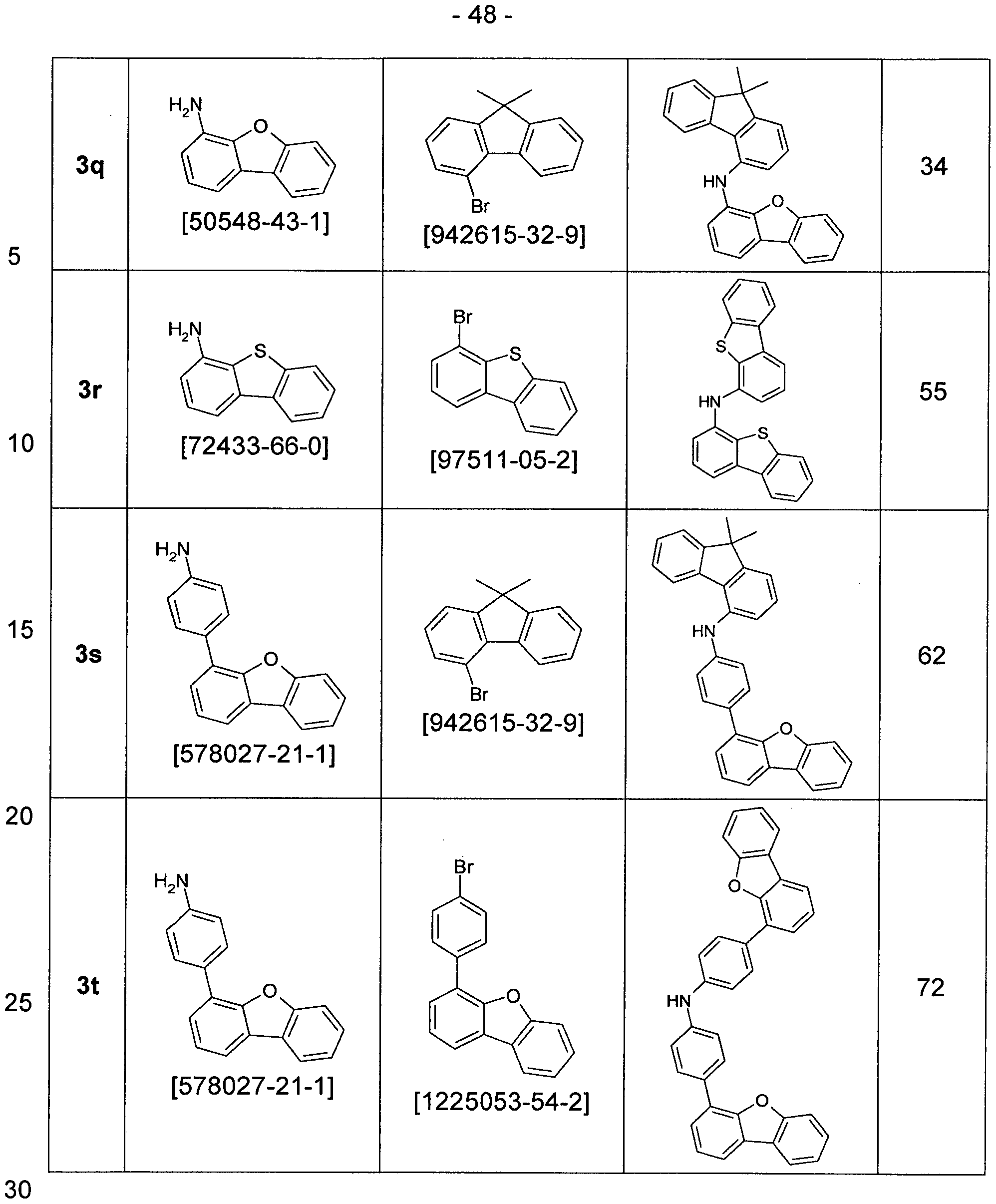

Stufe 2: Darstellung von (4-Bromo-phenyl)-(9,9-dimethyl-9H-fluoren- 4-yl)-{4-[(E)-((Z)-1 -propenyl)-buta-1 ,3-dienyl]-phenyl}-amin 5a Step 2: Preparation of (4-bromo-phenyl) - (9,9-dimethyl-9H-fluoren-4-yl) - {4 - [(E) - ((Z) -1-propenyl) -buta-1 , 3-dienyl] -phenyl} -amine 5a
In einem 1 L-Vierhalskolben werden 51.3g (142mmol, 1.00eq) des Amins 3a, sowie 75.6g (426mmol, 3.00eq) 1-Bromo-4-fluorobenzol [460-00-4] 4a und 92.5g (284mmol, 2.00eq) Cäsiumcarbonat [534-17-8] vorgelegt und mit 500ml Dimethylacetamid versetzt. Das Reaktionsgemisch wird für drei Tage bei 150°C gerührt. Nach beendeter Reaktion wird der Ansatz auf Raumtemperatur abgekühlt und der Feststoff über Celite abfiltriert. Die In a 1 L four necked flask, 51.3g (142mmol, 1.00eq) of the amine 3a, and 75.6g (426mmol, 3.00eq) of 1-bromo-4-fluorobenzene [460-00-4] 4a and 92.5g (284mmol, 2.00g) eq) cesium carbonate [534-17-8] and mixed with 500 ml of dimethylacetamide. The reaction mixture is stirred for three days at 150 ° C. After the reaction has ended, the batch is cooled to room temperature and the solid is filtered through Celite. The
Mutterlauge wird eingeengt und der ausgefallene Feststoff nach Filtration mit heißem Methanol ausgerührt. Nach Trocknung werden 43.5g Mother liquor is concentrated and the precipitated solid is stirred after filtration with hot methanol. After drying 43.5g
(135mmol, 95%) des farblosen Produktes 5a erhalten. Analog werden dargestellt: (135mmol, 95%) of the colorless product 5a. Analog are shown:

^^^^^^^^


Stufe 3: Darstellung von Biphenyl-4-yl-[4-(12,12-dimethyl-10,12- dihydro-10-aza-indeno[2,1-b]fluoren-7-yl)-phenyl]-(9,9-dimethyl-9H- fluoren-4-yl)-amin 7a Step 3: Preparation of biphenyl-4-yl- [4- (12,12-dimethyl-10,12-dihydro-10-aza-indeno [2,1-b] fluoren-7-yl) -phenyl] - ( 9,9-dimethyl-9H-fluoren-4-yl) -amine 7a
In einem 2L-Vierhalskolben werden 43.5g (135mmol, I .OOeq) des Amins 5a zusammen mit 61.0g (149mmol, 1.10eq) 5,7-Dihydro-7,7-dimethyl-2- (44,55-tetramethyl-1 ,3,2-dioxaborolan-2-yl)-indeno[2, 1 -öjcarbazol In a 2L four-necked flask, 43.5g (135mmol, IOOOOeq) of the amine 5a along with 61.0g (149mmol, 1.10eq) of 5,7-dihydro-7,7-dimethyl-2- (44,55-tetramethyl-1 , 3,2-dioxaborolan-2-yl) -indeno [2, 1-ozcarbazole
[1357286-77-1] und 53.9g (270mmol, 2.00eq) Trikaliumphosphat [7778- 53-2] in jeweils 300ml Toluol und Dioxan sowie 150ml VE-Waser vorgelegt und für 30 Minuten entgast. Anschließend werden 1.21g (5.40mmol, 0.04eq) Palladium(ll)-acetat [3375-31-3] und 2.47g (8.10mmol, 0.06eq) Tri-o-tolylphosphin [6163-58-2] zugegeben und der Ansatz über Nacht unter Rückfluss erhitzt. Nach beendeter Reaktion werden weitere 100ml Wasser zugegeben und die wässrige Phase abgetrennt. Das wässrige Extrakt wird dreimal mit Toluol extrahiert, die vereinten organischen Phasen über Natriumsulfat getrocknet und das Lösungsmittel am Rotationsverdampfer entfernt. Nach Umkristallisation aus Toluol/Heptan werden 81.2g (113mmol, 84%) des gewünschten Produktes 7a erhalten. [1357286-77-1] and 53.9g (270mmol, 2.00eq) tripotassium phosphate [7778- 53-2] in each 300ml toluene and dioxane and 150ml VE-Waser submitted and degassed for 30 minutes. Then 1.21g (5.40mmol, 0.04eq) of palladium (II) acetate [3375-31-3] and 2.47g (8.10mmol, 0.06eq) of tri-o-tolylphosphine [6163-58-2] was added and the reaction heated to reflux overnight. After completion of the reaction, a further 100 ml of water are added and the aqueous phase is separated off. The aqueous extract is extracted three times with toluene, the combined organic phases dried over sodium sulfate and the solvent removed on a rotary evaporator. Recrystallization from toluene / heptane gives 81.2 g (113 mmol, 84%) of the desired product 7a.
Analog werden dargestellt: Analog are shown:
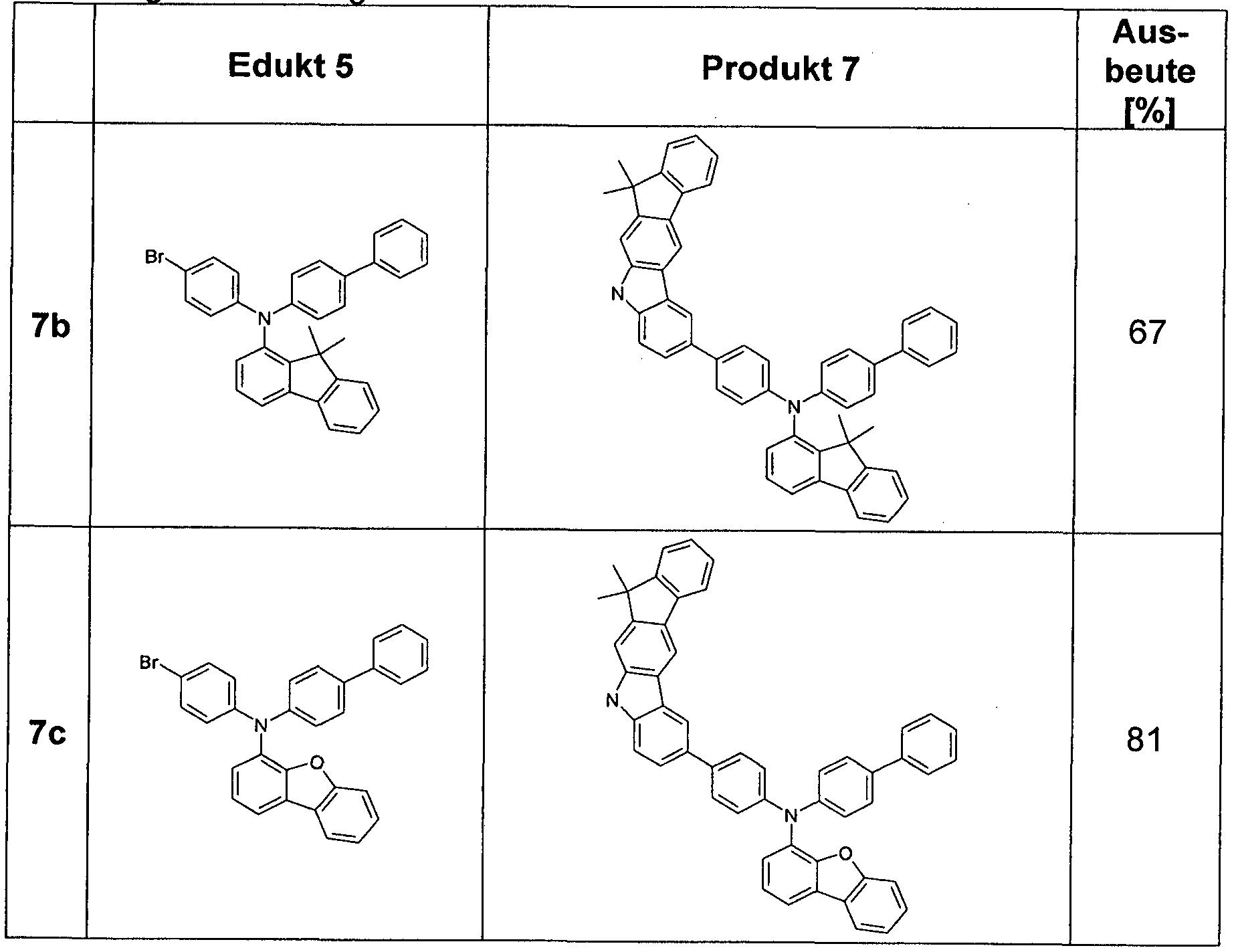


p 81q 73r 64 s 78 t 93 p 81q 73r 64 s 78 t 93
u 68 u 68
Stufe 4: Darstellung von Biphenyl-4-yl-(9,9-dimethyl-9H-fluoren-4-yl)- [4-(12,12-dimethyl-10-phenyl-10,12-dihydro-10-aza-indeno[2,1 - b]fluoren-7-yl)-phenyl]-amin 9a Step 4: Preparation of biphenyl-4-yl- (9,9-dimethyl-9H-fluoren-4-yl) - [4- (12,12-dimethyl-10-phenyl-10,12-dihydro-10-aza indeno [2,1-b] fluoren-7-yl) -phenyl] -amine 9a
In einem 1 L-Vierhalskolben werden 20.0g (25.2mmol, 1.00eq) des Zwischenproduktes 7a zusammen mit 11.3g (55.4mmol, 2.20eq) lod- benzol 8a [591-50-4] und 14.9g (101 mmol, 4.00eq) Kaliumcarbonat [584- 08-7] in 300ml absolutem DMF vorgelegt und für 30 Minuten entgast. Anschließend werden 570mg (2.52mmol, 0.1 Oeq) 1 ,3-Di(2-pyridyl)-1 ,3- propandion [10198-89-7] und 480mg (2.52mmol, 0.1 Oeq) Kupfer(l)-iodid [7681-65-4] zugegeben und der Ansatz für einen Tag unter Rückfluss erhitzt. Nach beendeter Reaktion wird das Reaktionsgemisch abgekühlt und langsam in 1000ml Wasser überführt. Der ausgefallene Feststoff wird abgesaugt und mit je 400ml gesättigter Ammoniumchlorid-Lösung, Wasser sowie je 200ml Ethanol und Heptan gewaschen. Zur Aufreinigung wird der Feststoff mit Toluol/Heptan heiß extrahiert, zweimal aus Toluol/ Heptan umkristallisiert und abschließend mittels Sublimation aufgereinigt. Es werden 11.2g (14.1 mmol, 56%) der gewünschten Zielverbindung 9a mit einer HPLC-Reinheit >99.9% erhalten.


Herstellung der OLEDs * Production of OLEDs *
In den folgenden Beispielen V1 bis V9 und E1 bis E20 (siehe Tabellen 1 und 2) werden die Daten verschiedener OLEDs vorgestellt. Vorbehandlung für die Beispiele V1-E20: Glasplättchen, die mit strukturiertem ITO (Indium Zinn Oxid) der Dicke 50 nm beschichtet sind, werden zur verbesserten Prozessierung mit 20 nm PEDOT:PSS beschichtet (Poly(3,4-ethylendioxythiophen) poly(styrolsulfonat), bezogen als CLEVIOS™ P VP AI 4083 von Heraeus Precious Metals GmbH Deutschland, aus wässriger Lösung aufgeschleudert). Diese beschichteten Glasplättchen bilden die Substrate, auf weiche die OLEDs aufgebracht werden. In the following examples V1 to V9 and E1 to E20 (see Tables 1 and 2) the data of different OLEDs are presented. Pretreatment for Examples V1-E20: Glass plates coated with structured 50 μm thick ITO (indium tin oxide) are coated with 20 nm PEDOT: PSS for improved processing (poly (3,4-ethylenedioxythiophene) poly (styrenesulfonate) , referred to as CLEVIOS ™ P VP AI 4083 from Heraeus Precious Metals GmbH Germany, spin-on from aqueous solution). These coated glass plates form the substrates to which the OLEDs are applied.
Die OLEDs haben prinzipiell folgenden Schichtaufbau: Substrat / Lochtransportschicht (HTL) / optionale Zwischenschicht (IL) / Elektronen- blockierschicht (EBL) / Emissionsschicht (EML) / optionale Lochblockierschicht (HBL) / Elektronentransportschicht (ETL) / optionale Elektroneninjektionsschicht (EIL) und abschließend eine Kathode. Die Kathode wird durch eine 100 nm dicke Aluminiumschicht gebildet. Der genaue Aufbau der OLEDs ist Tabelle 1 zu entnehmen. Die zur Herstellung der OLEDs benötigten Materialien sind in Tabelle 3 gezeigt. The OLEDs have in principle the following layer structure: substrate / hole transport layer (HTL) / optional interlayer (IL) / electron blocking layer (EBL) / emission layer (EML) / optional hole blocking layer (HBL) / electron transport layer (ETL) / optional electron injection layer (EIL) and finally a cathode. The cathode is formed by a 100 nm thick aluminum layer. The exact structure of the OLEDs is shown in Table 1. The materials needed to make the OLEDs are shown in Table 3.
Alle Materialien werden in einer Vakuumkammer thermisch aufgedampft. Dabei besteht die Emissionsschicht immer aus mindestens einem Matrixmaterial (Hostmaterial, Wirtsmaterial) und einem emittierenden Dotierstoff (Dotand, Emitter), der dem Matrixmaterial bzw. den Matrixmaterialien durch Coverdampfung in einem bestimmten Volumenanteil beigemischt wird. Eine Angabe wie IC5:9a:TEG1 (60%:30%:10%) bedeutet hierbei, dass das Material IC5 in einem Volumenanteil von 60%, 9a in einem Volumenanteil von 30% und TEG1 in einem Volumenanteil von 10% in der Schicht vorliegt. Analog kann auch die Elektronentransportschicht aus einer Mischung von zwei Materialien bestehen. All materials are thermally evaporated in a vacuum chamber. In this case, the emission layer always consists of at least one matrix material (host material, host material) and an emitting dopant (dopant, emitter), which is admixed to the matrix material or the matrix materials by co-evaporation in a specific volume fraction. An indication such as IC5: 9a: TEG1 (60%: 30%: 10%) here means that the material IC5 in a volume fraction of 60%, 9a in a volume fraction of 30% and TEG1 in a volume fraction of 10% in the layer is present. Similarly, the electron transport layer may consist of a mixture of two materials.
Die OLEDs werden standardmäßig charakterisiert. Hierfür werden die Elektrolumineszenzspektren, die Stromeffizienz (gemessen in cd/A), die Leistungseffizienz (gemessen in Im/W) und die externe Quanteneffizienz (EQE, gemessen in Prozent) in Abhängigkeit der Leuchtdichte, berechnet aus Strom-Spannungs-Leuchtdichte-Kennlinien (IUL-Kennlinien) unter Annahme einer lambertschen Abstrahlcharakteristik sowie die Lebensdauer bestimmt. Die Elektrolumineszenzspektren werden bei einer Leuchtdichte von 1000 cd/m2 bestimmt und daraus die CIE 1931 x und y Farbkoordinaten berechnet. Die Angabe U1000 in Tabelle 2 bezeichnet die Spannung, die für eine Leuchtdichte von 1000 cd/m2 benötigt wird. EQE 000 bezeichnet die externe Quanteneffizienz bei einer Betriebsleuchtdichte von 1000 cd/m2. Als Lebensdauer LD wird die Zeit definiert, nach der die Leuchtdichte bei Betrieb mit konstantem Strom von der Startleuchtdichte auf einen gewissen Anteil Li absinkt. Eine Angabe von Lo;jo = 4000 cd/m2 und Li = 70% in Tabelle 2 bedeutet, dass die in Spalte LD angegebene Lebensdauer der Zeit entspricht, nach der die Anfangsleuchtdichte von 4000 cd/m2 auf 2800 cd/m2 absinkt. Analog bedeutet Lo;jo = 20mA/cm2, Li= 80%, dass die Leuchtdichte bei Betrieb mit 20mA/cm2 nach der Zeit LD auf 80% ihres Anfangswertes absinkt. The OLEDs are characterized by default. For this, the electroluminescence spectra, the current efficiency (measured in cd / A), the power efficiency (measured in Im / W) and the external quantum efficiency (EQE, measured in percent) as a function of the luminance, calculated from current-voltage-luminance characteristics ( IUL characteristics) assuming a Lambertian radiation characteristic and the lifetime determined. The electroluminescence spectra are at a Luminance of 1000 cd / m 2 determined and calculated from the CIE 1931 x and y color coordinates. The indication U1000 in Table 2 indicates the voltage required for a luminance of 1000 cd / m 2 . EQE 000 denotes external quantum efficiency at an operating luminance of 1000 cd / m 2 . The lifetime LD is defined as the time after which the luminance drops from the start luminance to a certain amount of Li during operation with a constant current. An indication of Loj0j = 4000 cd / m 2 and Li = 70% in Table 2 means that the lifetime given in column LD corresponds to the time after which the initial luminance decreases from 4000 cd / m 2 to 2800 cd / m 2 , Analogously, Loj0j = 20mA / cm 2 , Li = 80% means that the luminance drops to 80% of its initial value after operation with 20 mA / cm 2 after the time LD.
Die Daten der verschiedenen OLEDs sind in Tabelle 2 zusammengefasst. Die Beispiele V1 bisV29 sind Vergleichsbeispiele gemäß dem Stand der Technik, die Beispiele E1-E20 zeigen Daten von erfindungsgemäßen OLEDs. The data of the different OLEDs are summarized in Table 2. Examples V1 to V29 are comparative examples according to the prior art, examples E1 to E20 show data of OLEDs according to the invention.
Im Folgenden werden einige der Beispiele näher erläutert, um die Vorteile der erfindungsgemäßen OLEDs zu verdeutlichen. In the following, some of the examples are explained in more detail in order to clarify the advantages of the OLEDs according to the invention.
Verwendung von erfindungsgemäßen Mischungen in der Emissionsschicht phosphoreszenter OLEDs Use of mixtures according to the invention in the emission layer of phosphorescent OLEDs
Die erfindungsgemäßen Materialien ergeben bei Einsatz in der Emissionsschicht (EML) phosphoreszierender OLEDs wesentliche Verbesserungen gegenüber dem Stand der Technik, vor allem bezüglich der Lebensdauer der OLED Bauteile. Durch Einsatz beispielsweise der erfindungsgemäßen Verbindungen 9a, 9b, 9c und 9h in Kombination mit IC5 und dem grünen Dotanden TEG1 lässt sich eine Erhöhung der Lebensdauer um mehr als 40% gegenüber dem Stand der Technik SdT1-SdT9 beobachten (Vergleich der Beispiele V1-V9 mit E1 -E4). Dies gilt auch für die weiteren erfindungsgemäßen Verbindungen, wie den Beispielen in Tabelle 2 entnommen werden kann. Dies ist ein überraschendes und nicht vorhersehbares Ergebnis, da die Verbindungen gemäß dem Stand der Technik den erfindungsgemäßen Verbindungen strukturell sehr ähnlich sind. Verwendung von erfindungsgemäßen Mischungen in der Elektronenblockierschicht phosphoreszenter OLEDs When used in the emission layer (EML) of phosphorescent OLEDs, the materials according to the invention provide significant improvements over the prior art, especially with regard to the lifetime of the OLED components. By using, for example, the compounds 9a, 9b, 9c and 9h according to the invention in combination with IC5 and the green dopant TEG1, an increase in the lifetime of more than 40% compared to the prior art SdT1-SdT9 can be observed (Comparison of Examples V1-V9 with E1 -E4). This also applies to the other compounds of the invention, as the examples in Table 2 can be found. This is a surprising and unpredictable result since the prior art compounds are structurally very similar to the compounds of the invention. Use of mixtures according to the invention in the electron blocking layer of phosphorescent OLEDs
Die erfindungsgemäßen Materialien ergeben auch bei Einsatz als Elek- tronenblockiermaterial in der Elektronenblockierschicht phosphoreszenter OLEDs wesentliche Verbesserungen gegenüber dem Stand der Technik, vor allem bezüglich der Lebensdauer. Durch Einsatz der erfindungsgemäßen Verbindungen, beispielsweise der Verbindungen 9f, 9g, 9j, 9k, 9n, 9o und 9t in den Beispielen E7, E8, E10, E11 , E14, E15 und E20 lassen sich OLEDs mit verbesserten Lebensdauern herstellen. When used as an electron-blocking material in the electron-blocking layer of phosphorescent OLEDs, the materials according to the invention also provide significant improvements over the prior art, especially with respect to their lifetime. By using the compounds according to the invention, for example compounds 9f, 9g, 9j, 9k, 9n, 9o and 9t in examples E7, E8, E10, E11, E14, E15 and E20, it is possible to prepare OLEDs with improved lifetimes.
Tabelle 1 : Aufbau der OLEDs Table 1: Structure of the OLEDs
Bsp. HIL IL HTL EBL EML HBL ETL EIL Dicke Dicke Dicke Dicke Dicke Dicke Dicke Dicke Eg HIL IL HTL EBL EML HBL ETL EIL Thickness Thickness Thickness Thickness Thickness Thickness Thickness
V1 SpA1 HATCN Sp A1 — IC5:SdT1 :TEG1 ST2 ST2:LiQ — 70nm 5nm 70nm (60%:30%:10%) 30nm 10nm (50%:50%) 30nmV1 SpA1 HATCN Sp A1 - IC5: SdT1: TEG1 ST2 ST2: LiQ - 70nm 5nm 70nm (60%: 30%: 10%) 30nm 10nm (50%: 50%) 30nm
V2 SpA1 HATCN Sp A1 — IC5:SdT2:TEG1 ST2 ST2:LiQ ... V2 SpA1 HATCN Sp A1 - IC5: SdT2: TEG1 ST2 ST2: LiQ ...
70nm 5nm 70nm (60%:30%:10%)30nm 10nm (50%:50%) 30nm 70nm 5nm 70nm (60%: 30%: 10%) 30nm 10nm (50%: 50%) 30nm
V3 SpA1 HATCN SpMA1 — IC5:SdT3:TEG1 ST2 ST2:LiQ — 70nm 5nm 70nm (60%:30%:10%)30nm 10nm (50%:50%) 30nmV3 SpA1 HATCN SpMA1 - IC5: SdT3: TEG1 ST2 ST2: LiQ - 70nm 5nm 70nm (60%: 30%: 10%) 30nm 10nm (50%: 50%) 30nm
V4 SpA1 HATCN SpMA1 — IC5:SdT4:TEG1 ST2 ST2:LiQ ... V4 SpA1 HATCN SpMA1 - IC5: SdT4: TEG1 ST2 ST2: LiQ ...
70nm 5nm 70nm (60%:30%:10%)30nm 10nm (50%:50%) 30nm 70nm 5nm 70nm (60%: 30%: 10%) 30nm 10nm (50%: 50%) 30nm
V5 SpA1 HATCN SpMA1 — IC5:SdT5:TEG1 ST2 ST2:LiQ ... V5 SpA1 HATCN SpMA1 - IC5: SdT5: TEG1 ST2 ST2: LiQ ...
70nm 5nm 70nm (60%:30%:10%)30nm 10nm (50%:50%) 30nm 70nm 5nm 70nm (60%: 30%: 10%) 30nm 10nm (50%: 50%) 30nm
V6 SpA1 HATCN SpMA1 — IC5:SdT6:TEG1 ST2 ST2:LiQ ... V6 SpA1 HATCN SpMA1 - IC5: SdT6: TEG1 ST2 ST2: LiQ ...
70nm 5nm 70nm (60%:30%:10%)30nm 10nm (50%:50%) 30nm 70nm 5nm 70nm (60%: 30%: 10%) 30nm 10nm (50%: 50%) 30nm
V7 SpA1 HATCN SpMA1 ... IC5:SdT7:TEG1 ST2 ST2:LiQ ... V7 SpA1 HATCN SpMA1 ... IC5: SdT7: TEG1 ST2 ST2: LiQ ...
70nm 5nm 70nm (60%:30%:10%) 30nm 10nm (50%: 50%) 30nm 70nm 5nm 70nm (60%: 30%: 10%) 30nm 10nm (50%: 50%) 30nm
V8 SpA1 HATCN Sp A1 ... IC5:SdT8:TEG1 ST2 ST2:LiQ ... V8 SpA1 HATCN Sp A1 ... IC5: SDT8: TEG1 ST2 ST2: LiQ ...
70nm 5nm 70nm (60%:30%:10%) 30nm 10nm (50%:50%) 30nm 70nm 5nm 70nm (60%: 30%: 10%) 30nm 10nm (50%: 50%) 30nm
V9 SpA1 HATCN SpMA1 ... IC5:SdT9:TEG1 ST2 ST2:LiQ ... V9 SpA1 HATCN SpMA1 ... IC5: SdT9: TEG1 ST2 ST2: LiQ ...
70nm 5nm 70nm (60%:30%:10%) 30nm 10nm (50%:50%) 30nm 70nm 5nm 70nm (60%: 30%: 10%) 30nm 10nm (50%: 50%) 30nm
E1 SpA1 HATCN SpMA1 ... IC5:9a:TEG1 ST2 ST2:LiQ ... E1 SpA1 HATCN SpMA1 ... IC5: 9a: TEG1 ST2 ST2: LiQ ...
70nm 5nm 70nm (60%:30%:10%) 30nm 10nm (50%:50%) 30nm 70nm 5nm 70nm (60%: 30%: 10%) 30nm 10nm (50%: 50%) 30nm
E2 SpA1 HATCN Sp A1 ... IC5:9b:TEG1 ST2 ST2:LiQ — 70nm 5nm 70nm (60%:30%:10%) 30nm 10nm (50%:50%) 30nmE2 SpA1 HATCN Sp A1 ... IC5: 9b: TEG1 ST2 ST2: LiQ - 70nm 5nm 70nm (60%: 30%: 10%) 30nm 10nm (50%: 50%) 30nm
E3 SpA1 HATCN SpMA1 ... IC5:9c:TEG1 ST2 ST2:LiQ — 70nm 5nm 70nm (60%:30%:10%) 30nm 10nm (50%:50%) 30nmE3 SpA1 HATCN SpMA1 ... IC5: 9c: TEG1 ST2 ST2: LiQ - 70nm 5nm 70nm (60%: 30%: 10%) 30nm 10nm (50%: 50%) 30nm
E4 SpA1 HATCN SpMA1 ... IC5:9h:TEG1 ST2 ST2:LiQ — 70nm 5nm 70nm (60%:30%:10%) 30nm 10nm (50%:50%) 30nmE4 SpA1 HATCN SpMA1 ... IC5: 9h: TEG1 ST2 ST2: LiQ - 70nm 5nm 70nm (60%: 30%: 10%) 30nm 10nm (50%: 50%) 30nm
E5 SpA1 HATCN Sp A1 ... IC5:9d:TEG1 ST2 ST2:LiQ — 70nm 5nm 70nm (60%:30%:10%) 30nm 10nm (50%: 50%) 30nmE5 SpA1 HATCN Sp A1 ... IC5: 9d: TEG1 ST2 ST2: LiQ - 70nm 5nm 70nm (60%: 30%: 10%) 30nm 10nm (50%: 50%) 30nm
E6 SpA1 HATCN Sp A1 ... IC5:9e:TEG1 ST2 ST2:LiQ — 70nm 5nm 70nm (60%:30%:10%) 30nm 10nm (50%:50%) 30nm E7 SpA1 HATCN SpMA1 9f IC5:IC3:TEG1 ST2 ST2.IJQ — 70nm 5nm 50nm 20nm (45%:45%:10%) 30nm 10nm (50%:50%) 30nmE6 SpA1 HATCN Sp A1 ... IC5: 9e: TEG1 ST2 ST2: LiQ - 70nm 5nm 70nm (60%: 30%: 10%) 30nm 10nm (50%: 50%) 30nm E7 SpA1 HATCN SpMA1 9f IC5: IC3: TEG1 ST2 ST2.IJQ - 70nm 5nm 50nm 20nm (45%: 45%: 10%) 30nm 10nm (50%: 50%) 30nm
E8 SpA1 HATCN Sp A1 9g IC5:IC3:TEG1 ST2 ST2:LiQ — 70nm 5nm 50nm 20nm (45%:45%:10%) 30nm 10nm (50%:50%) 30nmE8 SpA1 HATCN Sp A1 9g IC5: IC3: TEG1 ST2 ST2: LiQ - 70nm 5nm 50nm 20nm (45%: 45%: 10%) 30nm 10nm (50%: 50%) 30nm
E9 SpA1 HATCN Sp A1 — IC5:9u:TEG1 ST2 ST2:LiQ — 70nm 5nm 70nm (50%:40%:10%) 30nm 10nm (50%:50%) 30nmE9 SpA1 HATCN Sp A1 - IC5: 9u: TEG1 ST2 ST2: LiQ - 70nm 5nm 70nm (50%: 40%: 10%) 30nm 10nm (50%: 50%) 30nm
E10 SpA1 HATCN Sp A1 9j IC5:IC3:TEG1 ST2 ST2:LiQ — 70nm 5nm 50nm 20nm (45%:45%:10%) 30nm 10nm (50%:50%) 30nmE10 SpA1 HATCN Sp A1 9j IC5: IC3: TEG1 ST2 ST2: LiQ - 70nm 5nm 50nm 20nm (45%: 45%: 10%) 30nm 10nm (50%: 50%) 30nm
E11 SpA1 HATCN Sp A1 9k IC5:IC3:TEG1 ST2 ST2:LiQ — 70nm 5nm 50nm 20nm (45%:45%:10%) 30nm 10nm (50%:50%) 30nmE11 SpA1 HATCN Sp A1 9k IC5: IC3: TEG1 ST2 ST2: LiQ - 70nm 5nm 50nm 20nm (45%: 45%: 10%) 30nm 10nm (50%: 50%) 30nm
E12 SpA1 HATCN Sp A1 — IC5:9I:TEG1 ST2 ST2:LiQ — 70nm 5nm 70nm (60%:30%:10%) 30nm 10nm (50%:50%) 30nmE12 SpA1 HATCN Sp A1 - IC5: 9I: TEG1 ST2 ST2: LiQ - 70nm 5nm 70nm (60%: 30%: 10%) 30nm 10nm (50%: 50%) 30nm
E13 SpA1 HATCN SpMA1 9m IC5:9m:TEG1 ST2 ST2:LiQ — 70nm 5nm 50nm 20nm (60%:30%:10%) 30nm 10nm (50%:50%) 30nmE13 SpA1 HATCN SpMA1 9m IC5: 9m: TEG1 ST2 ST2: LiQ - 70nm 5nm 50nm 20nm (60%: 30%: 10%) 30nm 10nm (50%: 50%) 30nm
E14 SpA1 HATCN SpMA1 9n IC1 :TEG1 ST2 ST2:LiQ — 70nm 5nm 50nm 20nm (90%: 10%) 30nm 10nm (50%:50%) 30nmE14 SpA1 HATCN SpMA1 9n IC1: TEG1 ST2 ST2: LiQ - 70nm 5nm 50nm 20nm (90%: 10%) 30nm 10nm (50%: 50%) 30nm
E 15 SpA1 HATCN Sp A1 9o IC1 :TEG1 ST2 ST2:LiQ — 70nm 5nm 50nm 20nm (90%: 10%) 30nm 10nm (50%:50%) 30nmE 15 SpA1 HATCN Sp A1 9o IC1: TEG1 ST2 ST2: LiQ - 70nm 5nm 50nm 20nm (90%: 10%) 30nm 10nm (50%: 50%) 30nm
E16 SpA1 HATCN SpMA1 9P IC5:9p:TEG1 ST2 ST2:LiQ — 70nm 5nm 50nm 20nm (60%:30%:10%) 30nm 10nm (50%:50%) 30nmE16 SpA1 HATCN SpMA1 9P IC5: 9p: TEG1 ST2 ST2: LiQ - 70nm 5nm 50nm 20nm (60%: 30%: 10%) 30nm 10nm (50%: 50%) 30nm
E17 SpA1 HATCN Sp A1 — IC5:9q:TEG1 ST2 ST2:LiQ — 70nm 5nm 70nm (60%:30%:10%) 30nm 10nm (50%:50%) 30nmE17 SpA1 HATCN Sp A1 - IC5: 9q: TEG1 ST2 ST2: LiQ - 70nm 5nm 70nm (60%: 30%: 10%) 30nm 10nm (50%: 50%) 30nm
E18 SpA1 HATCN SpMA1 — IC5:9r:TEG1 ST2 ST2:LiQ — 70nm 5nm 70nm (60%:30%:10%)30nm 0nm (50%:50%) 30nmE18 SpA1 HATCN SpMA1 - IC5: 9r: TEG1 ST2 ST2: LiQ - 70nm 5nm 70nm (60%: 30%: 10%) 30nm 0nm (50%: 50%) 30nm
E19 SpA1 HATCN SpMA1 9s IC5:9s:TEG1 ST2 ST2:LiQ — 70nm 5nm 50nm 20nm (60%:30%:10%) 30nm 10nm (50%:50%) 30nmE19 SpA1 HATCN SpMA1 9s IC5: 9s: TEG1 ST2 ST2: LiQ - 70nm 5nm 50nm 20nm (60%: 30%: 10%) 30nm 10nm (50%: 50%) 30nm
E20 SpA1 HATCN Sp A1 9t IC5:IC3:TEG1 ST2 ST2:üQ — 70nm 5nm 50nm 20nm (45%:45%:10%) 30nm 10nm (50%:50%) 30nmE20 SpA1 HATCN Sp A1 9t IC5: IC3: TEG1 ST2 ST2: üQ - 70nm 5nm 50nm 20nm (45%: 45%: 10%) 30nm 10nm (50%: 50%) 30nm
E21 SpA1 HATCN Sp A1 — IC5:9f:TEG1 ST2 ST2:LiQ — 70nm 5nm 70nm (60%:30%:10%) 30nm 10nm (50%:50%) 30nmE21 SpA1 HATCN Sp A1 - IC5: 9f: TEG1 ST2 ST2: LiQ - 70nm 5nm 70nm (60%: 30%: 10%) 30nm 10nm (50%: 50%) 30nm
E22 SpA1 HATCN Sp A1 — IC5:9g:TEG1 ST2 ST2:LiQ — 70nm 5nm 70nm (60%:30%:10%) 30nm 10nm (50%:50%) 30nmE22 SpA1 HATCN Sp A1 - IC5: 9g: TEG1 ST2 ST2: LiQ - 70nm 5nm 70nm (60%: 30%: 10%) 30nm 10nm (50%: 50%) 30nm
E23 SpA1 HATCN SpMA1 — IC5:9j:TEG1 ST2 ST2:LiQ — 70nm 5nm 70nm (60%:30%:10%) 30nm 0nm (50%:50%) 30nmE23 SpA1 HATCN SpMA1 - IC5: 9j: TEG1 ST2 ST2: LiQ - 70nm 5nm 70nm (60%: 30%: 10%) 30nm 0nm (50%: 50%) 30nm
E24 SpA1 HATCN SpMA1 — IC5:9k:TEG1 ST2 ST2:LiQ — 70nm 5nm 70nm (60%:30%:10%) 30nm 10nm (50%:50%) 30nm E24 SpA1 HATCN Sp A1 — IC5:9n:TEG1 ST2 ST2:LiQ — 70nm 5nm 70nm (60%:30%:10%) 30nm 10nm (50%:50%) 30nmE24 SpA1 HATCN SpMA1 - IC5: 9k: TEG1 ST2 ST2: LiQ - 70nm 5nm 70nm (60%: 30%: 10%) 30nm 10nm (50%: 50%) 30nm E24 SpA1 HATCN Sp A1 - IC5: 9n: TEG1 ST2 ST2: LiQ - 70nm 5nm 70nm (60%: 30%: 10%) 30nm 10nm (50%: 50%) 30nm
E25 SpA1 HATCN SpMA1 — IC5:9o:TEG1 ST2 ST2:LiQ — 70nm 5nm 70nm (60%:30%:10%) 30nm 10nm (50%:50%) 30nmE25 SpA1 HATCN SpMA1 - IC5: 9o: TEG1 ST2 ST2: LiQ - 70nm 5nm 70nm (60%: 30%: 10%) 30nm 10nm (50%: 50%) 30nm
E26 SpA1 HATCN SpMA1 — IC5:9t:TEG1 ST2 ST2:LiQ — 70nm 5nm 70nm (60%:30%:10%) 30nm 10nm (50%:50%) 30nmE26 SpA1 HATCN SpMA1 - IC5: 9t: TEG1 ST2 ST2: LiQ - 70nm 5nm 70nm (60%: 30%: 10%) 30nm 10nm (50%: 50%) 30nm
E27 SpA1 HATCN Sp A1 — IC5:9m:TEG1 ST2 ST2:LiQ — 70nm 5nm 70nm (60%:30%:10%) 30nm 10nm (50%:50%) 30nmE27 SpA1 HATCN Sp A1 - IC5: 9m: TEG1 ST2 ST2: LiQ - 70nm 5nm 70nm (60%: 30%: 10%) 30nm 10nm (50%: 50%) 30nm
E28 SpA1 HATCN SpMA1 — IC5:9p:TEG1 ST2 ST2:LiQ — 70nm 5nm 70nm (60%·.30%:10%) 30nm 10nm (50%:50%) 30nmE28 SpA1 HATCN SpMA1 - IC5: 9p: TEG1 ST2 ST2: LiQ - 70nm 5nm 70nm (60% · .30%: 10%) 30nm 10nm (50%: 50%) 30nm
E29 SpA1 HATCN SpMA1 — IC5:9s:TEG1 ST2 ST2:LiQ — 70nm 5nm 70nm (60%:30%:10%) 30nm 10wn (50%:50%) 30nmE29 SpA1 HATCN SpMA1 - IC5: 9s: TEG1 ST2 ST2: LiQ - 70nm 5nm 70nm (60%: 30%: 10%) 30nm 10wn (50%: 50%) 30nm
E30 SpA1 HATCN SpMA1 — IC5:9u:TEG1 ST2 ST2:LiQ — 70nm 5nm 70nm (60%:30%:10%) 30nm 10nm (50%:50%) 30nm E30 SpA1 HATCN SpMA1 - IC5: 9u: TEG1 ST2 ST2: LiQ - 70nm 5nm 70nm (60%: 30%: 10%) 30nm 10nm (50%: 50%) 30nm
Tabelle 2: Daten der OLEDs Table 2: Data of the OLEDs
Bsp. U1000 EQE ; jo Li LD Eg U1000 EQE; jo Li LD
(V) 1000 % (h) (V) 1000% (h)
V1 3.1 15.3% 20 mA/cm2 80 130 V1 3.1 15.3% 20 mA / cm 2 80 130
V2 3.2 15.4% 20 mA cm2 80 120 V2 3.2 15.4% 20 mA cm 2 80 120
V3 3.2 15.2% 20 mA/cm2 80 140 V3 3.2 15.2% 20 mA / cm 2 80 140
V4 3.3 15.5% 20 mA/cm2 80 110 V4 3.3 15.5% 20 mA / cm 2 80 110
V5 3.1 15.6% 20 mA/cm2 80 105 V5 3.1 15.6% 20 mA / cm 2 80 105
V6 3.2 15.7% 20 mA/cm2 80 100 V6 3.2 15.7% 20 mA / cm 2 80 100
V7 3.1 15.6% 20 mA/cm2 80 115 V7 3.1 15.6% 20 mA / cm 2 80 115
V8 3.2 15.1 % 20 mA cm2 80 75 V8 3.2 15.1% 20 mA cm 2 80 75
V9 3.1 15.8% 20 mA/cm2 80 125 V9 3.1 15.8% 20 mA / cm 2 80 125
E1 3.2 16.1 % 20 mA cm2 80 260 E1 3.2 16.1% 20 mA cm 2 80 260
E2 3.3 16.3% 20 mA/cm2 80 230 E2 3.3 16.3% 20 mA / cm 2 80 230
E3 3.3 16.2% 20 mA/cm2 80 240 E3 3.3 16.2% 20 mA / cm 2 80 240
E4 3.2 16.0% 20 mA/cm2 80 255 E4 3.2 16.0% 20 mA / cm 2 80 255
E5 3.3 16.2% 20 mA/cm2 80 235 E5 3.3 16.2% 20 mA / cm 2 80 235
E6 3.2 16.1% 20 mA/cm2 80 225 E6 3.2 16.1% 20 mA / cm 2 80 225
E7 3.2 16.7% 20 mA/cm2 80 265 E7 3.2 16.7% 20 mA / cm 2 80 265
E8 3.3 16.5% 20 mA/cm2 80 225 E8 3.3 16.5% 20 mA / cm 2 80 225
E9 3.4 16.2% 20 mA cm2 80 250 E9 3.4 16.2% 20 mA cm 2 80 250
E10 3.4 16.6% 20 mA/cm2 80 225 E10 3.4 16.6% 20 mA / cm 2 80 225
E11 3.5 16.5% 20 mA cm2 80 220 E11 3.5 16.5% 20 mA cm 2 80 220
E12 3.1 16.0% 20 mA/cm2 80 210 E13 3.3 16.3% 20 mA/cm2 80 245E12 3.1 16.0% 20 mA / cm 2 80 210 E13 3.3 16.3% 20 mA / cm 2 80 245
E14 3.5 17.4% 20 mA/cm2 80 125E14 3.5 17.4% 20 mA / cm 2 80 125
E 15 3.4 17.5% 20 mA cm2 80 115E 15 3.4 17.5% 20 mA cm 2 80 115
E16 3.4 16.2% 20 mA/cm2 80 255E16 3.4 16.2% 20 mA / cm 2 80 255
E17 3.3 16.0% 20 mA/cm2 80 250E17 3.3 16.0% 20 mA / cm 2 80 250
E18 3.3 16.1 % 20 mA/cm2 80 245E18 3.3 16.1% 20 mA / cm 2 80 245
E19 3.3 16.2% 20 mA cm2 80 240E19 3.3 16.2% 20 mA cm 2 80 240
E20 3.3 16.5% 20 mA/cm2 80 270E20 3.3 16.5% 20 mA / cm 2 80 270
E21 3.4 15.6% 20 mA/cm2 80 50E21 3.4 15.6% 20 mA / cm 2 80 50
E22 3.4 15.5% 20 mA/cm2 80 155E22 3.4 15.5% 20 mA / cm 2 80 155
E23 3.3 15.8% 20 mA/cm2 80 160E23 3.3 15.8% 20 mA / cm 2 80 160
E24 3.4 15.9% 20 mA/cm2 80 150E24 3.4 15.9% 20 mA / cm 2 80 150
E24 3.4 16.1 % 20 mA/cm2 80 145E24 3.4 16.1% 20 mA / cm 2 80 145
E25 3.3 16.0% 20 mA/cm2 80 220E25 3.3 16.0% 20 mA / cm 2 80 220
E26 3.4 15.7% 20 mA/cm2 80 155E26 3.4 15.7% 20 mA / cm 2 80 155
E27 3.4 16.1 % 20 mA cm2 80 230E27 3.4 16.1% 20 mA cm 2 80 230
E28 3.5 16.2% 20 mA/cm2 80 245E28 3.5 16.2% 20 mA / cm 2 80 245
E29 3.3 16.0% 20 mA/cm2 80 250E29 3.3 16.0% 20 mA / cm 2 80 250
E30 3.4 16.2% 20 mA cm2 80 235 E30 3.4 16.2% 20 mA cm 2 80 235


Claims


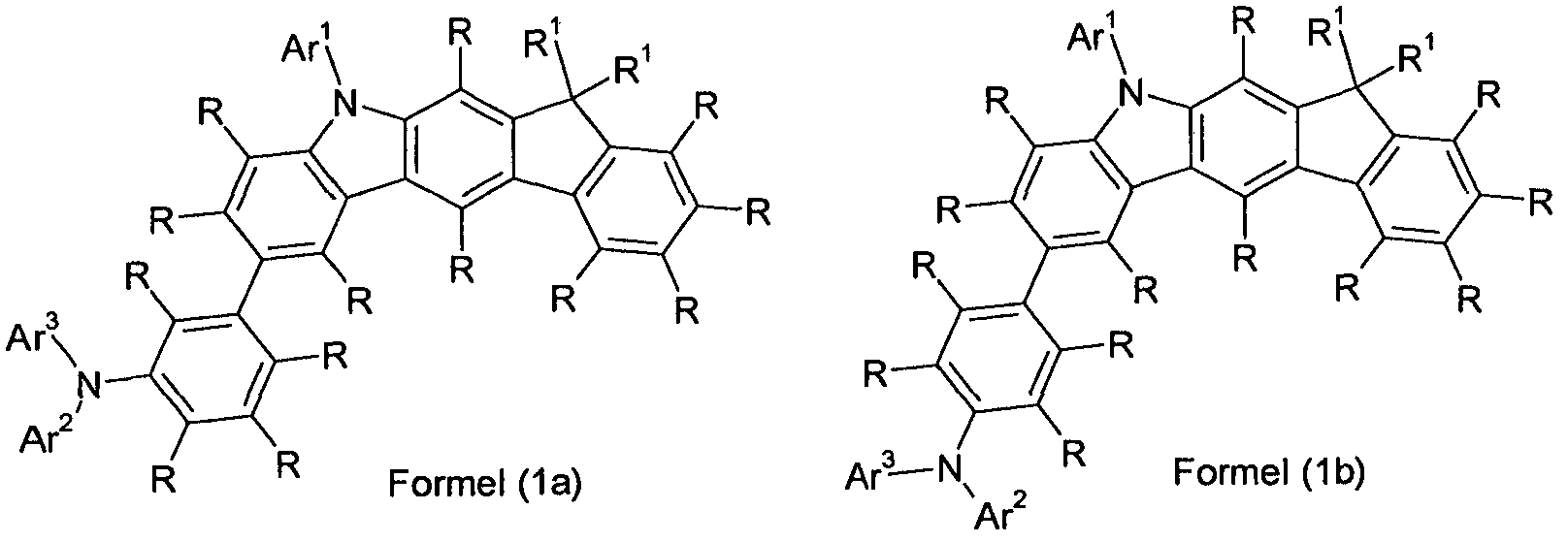

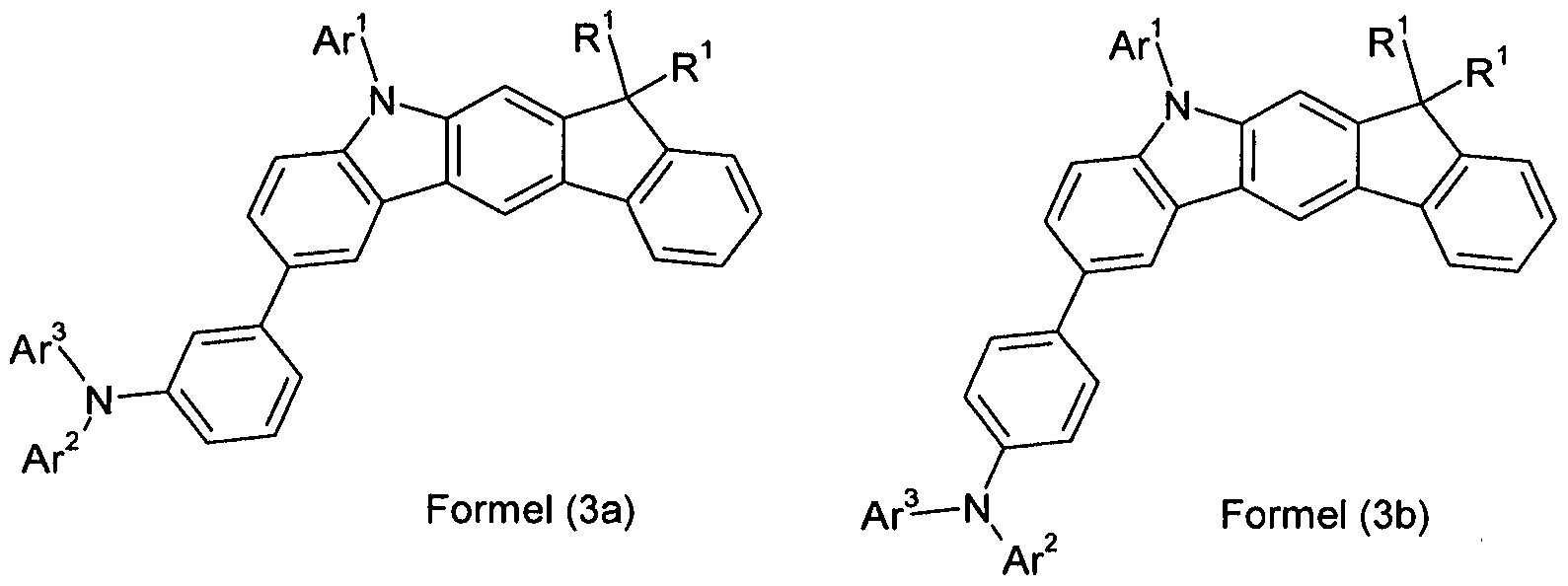


Priority Applications (5)
| Application Number | Priority Date | Filing Date | Title |
|---|---|---|---|
| KR1020187009573A KR102610950B1 (en) | 2015-09-08 | 2016-08-12 | Materials for organic electroluminescent devices |
| JP2018512538A JP6896710B2 (en) | 2015-09-08 | 2016-08-12 | Materials for OLED devices |
| CN201680051499.6A CN107922398B (en) | 2015-09-08 | 2016-08-12 | Material for organic electroluminescent device |
| US15/756,783 US11581491B2 (en) | 2015-09-08 | 2016-08-12 | Materials for organic electroluminescent devices |
| EP16753585.5A EP3347354B1 (en) | 2015-09-08 | 2016-08-12 | Materials for organic electroluminescent devices |
Applications Claiming Priority (2)
| Application Number | Priority Date | Filing Date | Title |
|---|---|---|---|
| EP15184191.3 | 2015-09-08 | ||
| EP15184191 | 2015-09-08 |
Publications (1)
| Publication Number | Publication Date |
|---|---|
| WO2017041874A1 true WO2017041874A1 (en) | 2017-03-16 |
Family
ID=54105641
Family Applications (1)
| Application Number | Title | Priority Date | Filing Date |
|---|---|---|---|
| PCT/EP2016/001391 Ceased WO2017041874A1 (en) | 2015-09-08 | 2016-08-12 | Materials for organic electroluminescent devices |
Country Status (7)
| Country | Link |
|---|---|
| US (1) | US11581491B2 (en) |
| EP (1) | EP3347354B1 (en) |
| JP (2) | JP6896710B2 (en) |
| KR (1) | KR102610950B1 (en) |
| CN (1) | CN107922398B (en) |
| TW (1) | TWI718179B (en) |
| WO (1) | WO2017041874A1 (en) |
Cited By (5)
| Publication number | Priority date | Publication date | Assignee | Title |
|---|---|---|---|---|
| CN108346753A (en) * | 2018-02-07 | 2018-07-31 | 上海道亦化工科技有限公司 | A kind of indeno carbazole compound and application thereof and organic electroluminescence device |
| JP2019114788A (en) * | 2017-12-20 | 2019-07-11 | 三星ディスプレイ株式會社Samsung Display Co.,Ltd. | Amine compound, and organic light-emitting element containing the same |
| EP3709375A4 (en) * | 2017-11-06 | 2021-08-25 | Hodogaya Chemical Co., Ltd. | CONNECTION WITH AN INDIAN CARBAZOLE RING STRUCTURE AND ORGANIC ELECTROLUMINESCENT ELEMENT |
| WO2022243403A1 (en) | 2021-05-21 | 2022-11-24 | Merck Patent Gmbh | Method for the continuous purification of at least one functional material and device for the continuous purification of at least one functional material |
| US12071405B2 (en) | 2017-09-08 | 2024-08-27 | Merck Patent Gmbh | Materials for electronic devices |
Families Citing this family (3)
| Publication number | Priority date | Publication date | Assignee | Title |
|---|---|---|---|---|
| CN107394051B (en) * | 2017-08-14 | 2019-12-27 | 上海天马有机发光显示技术有限公司 | Light emitting device and display device |
| CN108912038A (en) * | 2018-06-07 | 2018-11-30 | 长春海谱润斯科技有限公司 | A kind of aromatic amine compound and its organic electroluminescence device |
| CN113292544A (en) * | 2021-05-25 | 2021-08-24 | 上海钥熠电子科技有限公司 | Aromatic amine compound and organic electroluminescent display device comprising the same |
Citations (3)
| Publication number | Priority date | Publication date | Assignee | Title |
|---|---|---|---|---|
| WO2011037429A2 (en) * | 2009-09-28 | 2011-03-31 | 덕산하이메탈(주) | Compounds having 5-membered aryl-ring-condensed heterocyclic derivatives, organic electronic device using the compounds, and terminal comprising the organic electronic device |
| EP2599773A1 (en) * | 2010-07-30 | 2013-06-05 | Hodogaya Chemical Co., Ltd. | Compound having indenocarbazole ring structure and organic electroluminescent element |
| WO2014204464A1 (en) * | 2013-06-20 | 2014-12-24 | Universal Display Corporation | Phosphorescent organic light emitting devices having a hole-transporting host in the emissive region |
Family Cites Families (11)
| Publication number | Priority date | Publication date | Assignee | Title |
|---|---|---|---|---|
| DE102009023155A1 (en) | 2009-05-29 | 2010-12-02 | Merck Patent Gmbh | Materials for organic electroluminescent devices |
| KR101219481B1 (en) * | 2009-09-28 | 2013-01-15 | 덕산하이메탈(주) | Compound Containing Heterocyclic 5-Membered Ring Derivative Condensed Aryl Ring And Organic Electronic Element Using The Same, Terminal Thereof |
| WO2011096506A1 (en) * | 2010-02-05 | 2011-08-11 | 出光興産株式会社 | Aminoanthracene derivative and organic electroluminescent element formed using same |
| KR101181261B1 (en) * | 2010-04-21 | 2012-09-10 | 덕산하이메탈(주) | Compound Containing Dibenzothiophene, Arylamine Derivatives And Organic Electronic Element Using The Same, Terminal Thereof |
| DE102010056151A1 (en) | 2010-12-28 | 2012-06-28 | Merck Patent Gmbh | Materials for organic electroluminescent devices |
| US9385335B2 (en) | 2011-04-05 | 2016-07-05 | Merck Patent Gmbh | Organic electroluminescent device |
| CA2849087A1 (en) | 2011-09-21 | 2013-03-28 | Merck Patent Gmbh | Carbazole derivatives for organic electroluminescent devices |
| KR20130134202A (en) | 2012-05-30 | 2013-12-10 | 롬엔드하스전자재료코리아유한회사 | Novel organic electroluminescence compounds and organic electroluminescence device containing the same |
| WO2014020444A2 (en) | 2012-08-01 | 2014-02-06 | Pacylex Pharmaceuticals Inc. | Methods and compositions for diagnosis and prognosis in breast cancer |
| WO2014072017A1 (en) | 2012-11-12 | 2014-05-15 | Merck Patent Gmbh | Materials for electronic devices |
| JP6407883B2 (en) | 2012-12-14 | 2018-10-17 | メルク パテント ゲーエムベーハー | Materials for electronic devices |
-
2016
- 2016-08-12 EP EP16753585.5A patent/EP3347354B1/en active Active
- 2016-08-12 CN CN201680051499.6A patent/CN107922398B/en active Active
- 2016-08-12 US US15/756,783 patent/US11581491B2/en active Active
- 2016-08-12 KR KR1020187009573A patent/KR102610950B1/en active Active
- 2016-08-12 JP JP2018512538A patent/JP6896710B2/en active Active
- 2016-08-12 WO PCT/EP2016/001391 patent/WO2017041874A1/en not_active Ceased
- 2016-09-05 TW TW105128650A patent/TWI718179B/en not_active IP Right Cessation
-
2021
- 2021-03-29 JP JP2021055070A patent/JP2021107398A/en not_active Withdrawn
Patent Citations (3)
| Publication number | Priority date | Publication date | Assignee | Title |
|---|---|---|---|---|
| WO2011037429A2 (en) * | 2009-09-28 | 2011-03-31 | 덕산하이메탈(주) | Compounds having 5-membered aryl-ring-condensed heterocyclic derivatives, organic electronic device using the compounds, and terminal comprising the organic electronic device |
| EP2599773A1 (en) * | 2010-07-30 | 2013-06-05 | Hodogaya Chemical Co., Ltd. | Compound having indenocarbazole ring structure and organic electroluminescent element |
| WO2014204464A1 (en) * | 2013-06-20 | 2014-12-24 | Universal Display Corporation | Phosphorescent organic light emitting devices having a hole-transporting host in the emissive region |
Cited By (6)
| Publication number | Priority date | Publication date | Assignee | Title |
|---|---|---|---|---|
| US12071405B2 (en) | 2017-09-08 | 2024-08-27 | Merck Patent Gmbh | Materials for electronic devices |
| EP3709375A4 (en) * | 2017-11-06 | 2021-08-25 | Hodogaya Chemical Co., Ltd. | CONNECTION WITH AN INDIAN CARBAZOLE RING STRUCTURE AND ORGANIC ELECTROLUMINESCENT ELEMENT |
| JP2019114788A (en) * | 2017-12-20 | 2019-07-11 | 三星ディスプレイ株式會社Samsung Display Co.,Ltd. | Amine compound, and organic light-emitting element containing the same |
| JP7353034B2 (en) | 2017-12-20 | 2023-09-29 | 三星ディスプレイ株式會社 | Amine compounds and organic light-emitting devices containing them |
| CN108346753A (en) * | 2018-02-07 | 2018-07-31 | 上海道亦化工科技有限公司 | A kind of indeno carbazole compound and application thereof and organic electroluminescence device |
| WO2022243403A1 (en) | 2021-05-21 | 2022-11-24 | Merck Patent Gmbh | Method for the continuous purification of at least one functional material and device for the continuous purification of at least one functional material |
Also Published As
| Publication number | Publication date |
|---|---|
| JP2021107398A (en) | 2021-07-29 |
| CN107922398A (en) | 2018-04-17 |
| KR20180044423A (en) | 2018-05-02 |
| TW201722911A (en) | 2017-07-01 |
| US20180269400A1 (en) | 2018-09-20 |
| KR102610950B1 (en) | 2023-12-06 |
| JP2018528216A (en) | 2018-09-27 |
| TWI718179B (en) | 2021-02-11 |
| EP3347354B1 (en) | 2020-06-17 |
| EP3347354A1 (en) | 2018-07-18 |
| US11581491B2 (en) | 2023-02-14 |
| CN107922398B (en) | 2022-01-28 |
| JP6896710B2 (en) | 2021-06-30 |
Similar Documents
| Publication | Publication Date | Title |
|---|---|---|
| EP3744155B1 (en) | Materials for organic electroluminescent devices | |
| EP3180411B1 (en) | Materials for organic electroluminescent devices | |
| EP3080229B1 (en) | Materials for electronic devices | |
| EP3174954B1 (en) | Materials for organic electroluminescent devices | |
| WO2021037401A1 (en) | Materials for organic electroluminescent devices | |
| EP3160954B1 (en) | Materials for organic electroluminescent devices | |
| EP3107977B1 (en) | Materials for organic electroluminescent devices | |
| EP3423543A1 (en) | Materials for organic electroluminescence devices | |
| WO2018138306A1 (en) | Materials for organic electroluminescent devices | |
| EP3335254A1 (en) | Materials for organic electroluminescent devices | |
| WO2013041176A1 (en) | Carbazole derivatives for organic electroluminescence devices | |
| EP3347354B1 (en) | Materials for organic electroluminescent devices | |
| WO2016074755A1 (en) | Materials for organic electroluminescent devices | |
| WO2019052933A1 (en) | MATERIALS FOR ORGANIC ELECTROLUMINESCENT DEVICES | |
| WO2016128103A1 (en) | Electronic device containing cyclic lactams | |
| WO2018149769A1 (en) | Materials for organic electroluminescent devices | |
| EP4330240A1 (en) | Materials for organic electroluminescent devices | |
| EP3877373B1 (en) | 5,6-diphenyl-5,6-dihydro-dibenz[c,e][1,2]azaphosphorine and 6-phenyl-6h-dibenzo[c,e][1,2]thiazine-5,5-dioxide derivatives and related compounds as organic electroluminescent materials for oleds | |
| EP4192832A1 (en) | Materials for organic electroluminescent devices | |
| WO2018104194A1 (en) | Materials for organic electroluminescent devices | |
| EP3548485A1 (en) | Materials for organic electroluminescent devices | |
| EP4274827A1 (en) | Materials for organic electroluminescent devices |
Legal Events
| Date | Code | Title | Description |
|---|---|---|---|
| 121 | Ep: the epo has been informed by wipo that ep was designated in this application |
Ref document number: 16753585 Country of ref document: EP Kind code of ref document: A1 |
|
| WWE | Wipo information: entry into national phase |
Ref document number: 15756783 Country of ref document: US |
|
| ENP | Entry into the national phase |
Ref document number: 2018512538 Country of ref document: JP Kind code of ref document: A |
|
| NENP | Non-entry into the national phase |
Ref country code: DE |
|
| ENP | Entry into the national phase |
Ref document number: 20187009573 Country of ref document: KR Kind code of ref document: A |
|
| WWE | Wipo information: entry into national phase |
Ref document number: 2016753585 Country of ref document: EP |