WO2017028676A1 - Data transmission method, device and system - Google Patents
Data transmission method, device and system Download PDFInfo
- Publication number
- WO2017028676A1 WO2017028676A1 PCT/CN2016/092717 CN2016092717W WO2017028676A1 WO 2017028676 A1 WO2017028676 A1 WO 2017028676A1 CN 2016092717 W CN2016092717 W CN 2016092717W WO 2017028676 A1 WO2017028676 A1 WO 2017028676A1
- Authority
- WO
- WIPO (PCT)
- Prior art keywords
- terminal
- base station
- transmit
- data
- transceiver
- Prior art date
- Legal status (The legal status is an assumption and is not a legal conclusion. Google has not performed a legal analysis and makes no representation as to the accuracy of the status listed.)
- Ceased
Links
Images


Classifications
-
- H—ELECTRICITY
- H04—ELECTRIC COMMUNICATION TECHNIQUE
- H04B—TRANSMISSION
- H04B7/00—Radio transmission systems, i.e. using radiation field
- H04B7/02—Diversity systems; Multi-antenna system, i.e. transmission or reception using multiple antennas
- H04B7/04—Diversity systems; Multi-antenna system, i.e. transmission or reception using multiple antennas using two or more spaced independent antennas
- H04B7/06—Diversity systems; Multi-antenna system, i.e. transmission or reception using multiple antennas using two or more spaced independent antennas at the transmitting station
-
- H—ELECTRICITY
- H04—ELECTRIC COMMUNICATION TECHNIQUE
- H04B—TRANSMISSION
- H04B7/00—Radio transmission systems, i.e. using radiation field
- H04B7/02—Diversity systems; Multi-antenna system, i.e. transmission or reception using multiple antennas
- H04B7/04—Diversity systems; Multi-antenna system, i.e. transmission or reception using multiple antennas using two or more spaced independent antennas
- H04B7/06—Diversity systems; Multi-antenna system, i.e. transmission or reception using multiple antennas using two or more spaced independent antennas at the transmitting station
- H04B7/0613—Diversity systems; Multi-antenna system, i.e. transmission or reception using multiple antennas using two or more spaced independent antennas at the transmitting station using simultaneous transmission
- H04B7/0615—Diversity systems; Multi-antenna system, i.e. transmission or reception using multiple antennas using two or more spaced independent antennas at the transmitting station using simultaneous transmission of weighted versions of same signal
- H04B7/0619—Diversity systems; Multi-antenna system, i.e. transmission or reception using multiple antennas using two or more spaced independent antennas at the transmitting station using simultaneous transmission of weighted versions of same signal using feedback from receiving side
- H04B7/0621—Feedback content
- H04B7/0626—Channel coefficients, e.g. channel state information [CSI]
-
- H—ELECTRICITY
- H04—ELECTRIC COMMUNICATION TECHNIQUE
- H04B—TRANSMISSION
- H04B7/00—Radio transmission systems, i.e. using radiation field
- H04B7/02—Diversity systems; Multi-antenna system, i.e. transmission or reception using multiple antennas
- H04B7/04—Diversity systems; Multi-antenna system, i.e. transmission or reception using multiple antennas using two or more spaced independent antennas
- H04B7/06—Diversity systems; Multi-antenna system, i.e. transmission or reception using multiple antennas using two or more spaced independent antennas at the transmitting station
- H04B7/0613—Diversity systems; Multi-antenna system, i.e. transmission or reception using multiple antennas using two or more spaced independent antennas at the transmitting station using simultaneous transmission
- H04B7/0615—Diversity systems; Multi-antenna system, i.e. transmission or reception using multiple antennas using two or more spaced independent antennas at the transmitting station using simultaneous transmission of weighted versions of same signal
- H04B7/0619—Diversity systems; Multi-antenna system, i.e. transmission or reception using multiple antennas using two or more spaced independent antennas at the transmitting station using simultaneous transmission of weighted versions of same signal using feedback from receiving side
- H04B7/0621—Feedback content
- H04B7/0632—Channel quality parameters, e.g. channel quality indicator [CQI]
-
- H—ELECTRICITY
- H04—ELECTRIC COMMUNICATION TECHNIQUE
- H04B—TRANSMISSION
- H04B7/00—Radio transmission systems, i.e. using radiation field
- H04B7/02—Diversity systems; Multi-antenna system, i.e. transmission or reception using multiple antennas
- H04B7/04—Diversity systems; Multi-antenna system, i.e. transmission or reception using multiple antennas using two or more spaced independent antennas
- H04B7/08—Diversity systems; Multi-antenna system, i.e. transmission or reception using multiple antennas using two or more spaced independent antennas at the receiving station
-
- H—ELECTRICITY
- H04—ELECTRIC COMMUNICATION TECHNIQUE
- H04B—TRANSMISSION
- H04B7/00—Radio transmission systems, i.e. using radiation field
- H04B7/02—Diversity systems; Multi-antenna system, i.e. transmission or reception using multiple antennas
- H04B7/04—Diversity systems; Multi-antenna system, i.e. transmission or reception using multiple antennas using two or more spaced independent antennas
- H04B7/08—Diversity systems; Multi-antenna system, i.e. transmission or reception using multiple antennas using two or more spaced independent antennas at the receiving station
- H04B7/0868—Hybrid systems, i.e. switching and combining
- H04B7/088—Hybrid systems, i.e. switching and combining using beam selection
-
- H—ELECTRICITY
- H04—ELECTRIC COMMUNICATION TECHNIQUE
- H04B—TRANSMISSION
- H04B7/00—Radio transmission systems, i.e. using radiation field
- H04B7/02—Diversity systems; Multi-antenna system, i.e. transmission or reception using multiple antennas
- H04B7/04—Diversity systems; Multi-antenna system, i.e. transmission or reception using multiple antennas using two or more spaced independent antennas
- H04B7/06—Diversity systems; Multi-antenna system, i.e. transmission or reception using multiple antennas using two or more spaced independent antennas at the transmitting station
- H04B7/0613—Diversity systems; Multi-antenna system, i.e. transmission or reception using multiple antennas using two or more spaced independent antennas at the transmitting station using simultaneous transmission
- H04B7/0615—Diversity systems; Multi-antenna system, i.e. transmission or reception using multiple antennas using two or more spaced independent antennas at the transmitting station using simultaneous transmission of weighted versions of same signal
- H04B7/0617—Diversity systems; Multi-antenna system, i.e. transmission or reception using multiple antennas using two or more spaced independent antennas at the transmitting station using simultaneous transmission of weighted versions of same signal for beam forming
Definitions
- the present application relates to, but is not limited to, a Long Term Evolution Advanced System (LTE-Advanced), and more particularly to a data transmission method, apparatus, and system.
- LTE-Advanced Long Term Evolution Advanced System
- the transmitting end can concentrate the transmitting energy in a certain direction, and the energy is small or absent in other directions, that is, each beam has its own directivity, and each beam can only cover To a terminal in a certain direction, the transmitting end (ie, the base station) needs to transmit multiple beams to complete the full coverage.
- the preferred beam between the terminal and the high frequency station may be blocked, causing the link to fail, affecting the user experience, and the above phenomenon is more pronounced in the high frequency band than the coverage of the low frequency band. For example, if the terminal moves to an obstacle, the link will be invalidated. At this time, it takes more time to perform beam selection again.
- the embodiments of the present invention provide a data transmission method, device, and system, which are used to solve the problem that the related 3GPP or 802.11 technologies do not implement data transmission through dual beams or multiple beams.
- An embodiment of the present invention provides a data transmission method, including: a base station notifying a transmit beam capability of a terminal base station, and acquiring a receive beam capability of the terminal; the base station determining, according to channel state information of different transmit and receive beam pairs reported by the terminal, for transmitting data. Independently transmitting and receiving beam pairs; when the determined number of independent transceiving beam pairs is at least two, the base station transmits data for each terminal on each determined independent transceiving beam pair, and transmits the determined data form of the independent transceiving beam pair Notify the terminal.
- the embodiment of the present invention further provides a data transmission method, including: the terminal learns the transmit beam capability of the base station, and sends its own receive beam capability to the base station; the terminal reports the channel state information of the different transmit and receive beam pairs to the base station; A data transmission form of at least two independent transceiving beam pairs for transmitting data, receiving data transmitted on the at least two independent transceiving beam pairs, and combining the received data.
- the embodiment of the present invention further provides a data transmission apparatus, which is applied to a base station, and includes: a first beam capability interaction module, configured to notify a terminal base station of a transmit beam capability, and acquire a receive beam capability of the terminal; the first processing module is configured to Determining, according to channel state information of different transceiver beam pairs reported by the terminal, an independent transceiver beam pair for transmitting data; the first transmission module is configured to: when the number of independent transceiver beam pairs determined by the first processing module is at least two At this time, data is transmitted to the terminal on each of the determined independent transceiver beam pairs, and the determined data transmission form of the independent transceiver beam pair is notified to the terminal.
- a data transmission apparatus which is applied to a base station, and includes: a first beam capability interaction module, configured to notify a terminal base station of a transmit beam capability, and acquire a receive beam capability of the terminal; the first processing module is configured to Determining, according to channel state information of different transceiver beam pairs reported
- the embodiment of the present invention further provides a data transmission apparatus, which is applied to a terminal, and includes: a second beam capability interaction module, configured to learn the transmit beam capability of the base station, and send its own receive beam capability to the base station; and the second transmission module sets The channel processing information of the different transceiver beam pairs is reported to the base station; the second processing module is configured to receive the at least two independent transceivers according to the data transmission form of the at least two independent transceiver beam pairs for transmitting data notified by the base station. Number transmitted on the beam pair According to, and merge the received data.
- a data transmission apparatus which is applied to a terminal, and includes: a second beam capability interaction module, configured to learn the transmit beam capability of the base station, and send its own receive beam capability to the base station; and the second transmission module sets The channel processing information of the different transceiver beam pairs is reported to the base station; the second processing module is configured to receive the at least two independent transceivers according to the data transmission form of the at least two independent transceiver beam
- the embodiment of the invention further provides a data transmission system, comprising the above data transmission device applied to a base station and the above data transmission device applied to the terminal.
- the embodiment of the invention further provides a computer readable storage medium storing computer executable instructions, which are implemented to implement the above data transmission method applied to a base station.
- the embodiment of the invention further provides a computer readable storage medium storing computer executable instructions, which are implemented when the computer executable instructions are executed.
- the base station informs the terminal base station of the transmit beam capability, and acquires the receive beam capability of the terminal; the base station determines the independent transmit/transmit beam pair for transmitting data according to the channel state information of the different transmit and receive beam pairs reported by the terminal; When the number of the determined independent transceiver beam pairs is at least two, the base station transmits data to the terminal on each determined independent transceiver beam pair, and notifies the terminal of the determined data transmission form of the independent transceiver beam pair.
- data transmission is performed through at least two independent transceiver beam pairs, thereby improving the reliability of the millimeter wave link.
- the delay of the downlink synchronization and the identification process of the independent transceiver beam pair is reduced, thereby improving the access speed of the terminal to the high frequency station; reducing the complexity of the terminal for identifying the optimal independent transceiver beam pair, and improving the complexity
- the accuracy of the beam identification avoids the situation that the terminal cannot recognize the optimal independent transmit/transmit beam pair due to the difference of the high frequency station.
- FIG. 1 is a flowchart of a data transmission method according to an embodiment of the present invention
- FIG. 2 is a flowchart of another data transmission method according to an embodiment of the present invention.
- FIG. 3 is a flowchart of still another data transmission method according to an embodiment of the present invention.
- FIG. 4 is a schematic diagram of a first application scenario according to an embodiment of the present invention.
- FIG. 5 is a flowchart of Embodiment 1 of the present invention.
- FIG. 6 is a flowchart of Embodiment 2 of the present invention.
- FIG. 7 is a schematic diagram of a second application scenario according to an embodiment of the present invention.
- FIG. 8 is a flowchart of Embodiment 3 of the present invention.
- Embodiment 4 of the present invention is a flowchart of Embodiment 4 of the present invention.
- FIG. 10 is a flowchart of Embodiment 5 of the present invention.
- FIG. 11 is a schematic diagram of a third application scenario according to an embodiment of the present invention.
- FIG. 12 is a flowchart of Embodiment 7 of the present invention.
- FIG. 13 is a schematic diagram of a fourth application scenario according to an embodiment of the present invention.
- FIG. 14 is a flowchart of Embodiment 8 of the present invention.
- FIG. 15 is a flowchart of Embodiment 9 of the present invention.
- FIG. 16 is a schematic diagram of a data transmission apparatus according to an embodiment of the present invention.
- FIG. 17 is a schematic diagram of another data transmission apparatus according to an embodiment of the present invention.
- the wireless signal energy transmitted by millimeter wave has high directivity.
- the research results show that the wireless transmission is carried out in the 60 GHz band, and 99.99% of the signal energy is concentrated in the beam range of 4.7 degrees. Therefore, when wireless communication is performed using the millimeter wave band, usually Both directional antennas or phased arrays are used for directional transmission.
- Both directional antennas or phased arrays are used for directional transmission.
- the wavelength is 5 mm. If it is a 4 ⁇ 4 antenna array, the size of the antenna array is 1.5 cm ⁇ 1.5 cm.
- the terminal can Antenna arrays with more array elements or more antenna arrays, therefore, from the configuration point of view, can support dual beamforming (BF, Beam Forming) and even multi-beam BF.
- BF Beam Forming
- an embodiment of the present invention provides a data transmission method, including the following steps:
- Step 11 The base station informs the terminal base station of the transmit beam capability, and acquires the receive beam capability of the terminal.
- Step 12 The base station determines, according to channel state information of different transceiver beam pairs reported by the terminal, an independent transceiver beam pair for transmitting data.
- Step 13 When the determined number of independent transceiver beam pairs is at least two, the base station sends data to the terminal on each determined independent transceiver beam pair, and notifies the determined data transmission form of the independent transceiver beam pair to terminal.
- the transmit beam capability refers to the number of transmitter transmit beams at the same time.
- the receive beam capability refers to the number of receiver receive beams at the same time.
- the independent transmit/receive beam pair refers to one transmit beam of the transmitter corresponding to only one receiver of the receiver. Beam pair of beams.
- the base station notifying the transmit beam capability of the base station may include:
- the base station informs the terminal base station of the transmit beam capability by the discovery signal during the beam discovery process; and/or,
- the base station notifies the transmit beam capability of the terminal base station through broadcast or higher layer signaling.
- the base station acquiring the receiving beam capability of the terminal may include:
- the base station learns the receiving beam capability of the terminal by discovering the signal in the beam discovery process; and/or,
- the base station learns the receiving beam capability of the terminal through the established link.
- the transmit beam capability of the base station may include at least one of the following: a transmit beam capability of the same base station, a transmit beam capability of different base stations, and a transmit beam capability of a terminal acting as a relay node when the base station interacts with the terminal.
- the data transmission form may include:
- the relationship of each of the transmit beam bearer data may include at least one of the following:
- the data carried by different transmit beams is the same, but the transmission rate of different transmit beams is different;
- the transmission rate is the same, and the transmission rate is set according to the independent transceiver beam pair with the lowest channel state.
- the bearer mode of the control channel of the service data may include at least one of the following:
- Each transmit beam carries a control channel of the beam for indicating service data transmission of the beam
- the transmit beam with the best channel state carries the control channel of all beams, and is used to indicate the service data transmission of all beams;
- Each transmit beam carries a control channel of all beams for indicating service data transmission of all beams
- the transmit beam with the best channel state carries the control channel of the beam, and the modulation and coding mode of the transmission data indicated by the control channel carried by the transmit beam carrying the channel state is determined according to the fixed level deviation of the transmit beam.
- the base station notifies the terminal of the determined data transmission form of the independent transceiver beam pair, and may include at least one of the following:
- the base station notifies the terminal of the determined data transmission form of the independent transceiver beam pair by using broadcast or high layer signaling;
- the base station informs the terminal to enter a multi-beam link enhancement mode, wherein the multi-beam link enhancement mode stipulates a data transmission form for each of the independent transceiving beam pairs.
- the base station determines, according to channel state information of different transceiver beam pairs reported by the terminal, an independent transceiver beam pair for transmitting data, which may include at least one of the following:
- the base station determines, according to the channel state information of the different transceiver beam pairs reported by the terminal, that the transceiver beam pair whose channel state meets the first threshold is an independent transceiver beam pair for transmitting data, wherein the first threshold is that the code rate is greater than 1/10, a channel state transmitted by a specific modulation mode, where the specific modulation mode includes any one of the following: Binary Phase Shift Keying (BPSK), Quadrature Phase Shift Keying (QPSK), Quadrature Amplitude Modulation (QAM), however, this application is not limited thereto. In practical applications, other suitable specific modulation modes may be determined according to actual conditions;
- BPSK Binary Phase Shift Keying
- QPSK Quadrature Phase Shift Keying
- QAM Quadrature Amplitude Modulation
- the base station determines, according to the load of the base station, an independent transceiver beam pair for transmitting data from the pair of transceiver beams reported by the terminal;
- the base station selects at least two transceiver beams with the best channel state from the pair of transceiver beams reported by the terminal. Paired as separate transmit and receive beam pairs for transmitting data;
- the base station selects at least two transceiver beam pairs with the least interference from the transceiver beam pairs reported by the terminal as independent transmit and receive beam pairs for transmitting data.
- an embodiment of the present invention further provides a data transmission method, including the following steps:
- Step 21 The terminal learns the transmit beam capability of the base station, and sends its own receive beam capability to the base station.
- Step 22 The terminal reports channel state information of different transceiver beam pairs to the base station.
- Step 23 The terminal receives data transmitted on the at least two independent transceiver beam pairs according to data transmission forms of at least two independent transceiver beam pairs for transmitting data notified by the base station, and combines the received data.
- step 21 the terminal learns that the transmit beam capability of the base station may include:
- the terminal receives broadcast or higher layer signaling of the base station to learn the beam transmitting capability of the base station; and/or,
- the terminal learns the beam transmitting capability of the base station by discovering the signal in the beam discovery process.
- the terminal transmitting the capability of receiving the beam to the base station may include:
- the terminal notifies the base station of the receiving beam capability of the terminal by the discovery signal during the beam discovery process; and/or,
- the base station only identifies one transmit beam of the terminal, and the terminal informs the base station of the receive beam capability of the local terminal by signaling.
- the terminal reporting the channel state information of the different transceiver beam pairs to the base station may include: the terminal reporting, to the base station, channel state information of the transceiver beam pair whose channel state meets the second threshold.
- the second threshold is a channel state that meets a code rate greater than 1/10 and is transmitted in a specific modulation mode, where the specific modulation mode includes any one of the following: BPSK, QPSK, and QAM.
- the specific modulation mode includes any one of the following: BPSK, QPSK, and QAM.
- this application does not limit this. In practical applications, other suitable specific modulation methods may be determined according to actual conditions.
- the data transmission form may include:
- the relationship of each of the transmit beam bearer data may include at least one of the following:
- the data carried by different transmit beams is the same, but the transmission rate of different transmit beams is different;
- the transmission rate is the same, and the transmission rate is set according to the independent transceiver beam pair with the lowest channel state.
- the terminal After the terminal reports the channel state information of the different transceiver beam pairs to the base station, the terminal receives the at least two independent transceiver beam pairs according to the data transmission form of the at least two independent transceiver beam pairs for transmitting data notified by the base station.
- the method may at least include one of the following before transmitting the data and merging the received data:
- the terminal learns the data transmission form of the independent transceiver beam pair through broadcast or high layer signaling of the base station;
- the terminal Receiving, by the terminal, a notification of entering a multi-beam link enhancement mode from a base station, wherein the multi-beam link enhancement mode stipulates a data transmission form of each independent transceiving beam pair;
- the terminal learns the service data transmission situation by detecting the control channel of each beam.
- FIG. 3 is a flowchart of a data transmission method according to an embodiment of the present invention.
- the base station is a millimeter wave base station.
- the description of this embodiment is as follows:
- Step 31 The base station and the terminal perform beam capability information interaction; wherein, the base station informs the terminal base station of the transmit beam capability, and acquires the receive beam capability of the terminal; the terminal learns the transmit beam capability of the base station, and sends its own receive beam capability to the base station;
- the transmit beam capability refers to the number of transmitter transmit beams at the same time, and the receive beam capability refers to the number of receive beams received by the receiver at the same time;
- Step 32 Perform multi-beam training between the terminal and the base station; wherein the terminal determines a preferred transceiving beam pair (ie, a receive-transmit beam pair) based on multi-beam training;
- Step 33 The terminal reports channel state information of the preferred transceiver beam pair to the base station, where the channel state information is, for example, a received signal to noise ratio or a quantized value thereof;
- Step 34 The base station determines, according to the channel state information of the transceiver beam pair reported by the terminal, at least two independent transmit and receive beam pairs for transmitting data, and generates a data stream of each transmit beam.
- Independent transmit beam pair means that one transmit beam of the transmitter corresponds to only one beam beam of one receive beam of the receiver;
- Step 35 The base station notifies the terminal of the determined data transmission form of the at least two independent transceiver beam pairs for transmitting data.
- Step 36 The terminal performs reception and combining on the received data of the multiple receive beams.
- FIG. 4 is a schematic diagram of a first application scenario according to an embodiment of the present invention.
- the line-of-sight (LOS) path between the base station and the terminal is blocked by the object, and there is a good reflection path between the terminal and the base station, and the terminal has multi-beam receiving capability (see FIG. 4).
- it includes a receive beam (RX Beam) 1, a receive beam 2).
- FIG. 5 is a flowchart of Embodiment 1 of the present invention.
- the terminal identifies two pairs of excellent quality independent transmit and receive beam pairs based on the combination of the transmit and receive beams, and the terminal feeds back to the base station (such as a millimeter wave base station) to apply for multi-beam link enhancement.
- the description of this embodiment is as follows:
- Step 101 The base station sends a system message to the terminal, where the transmitting beam capability of the base station is carried.
- the base station informs the terminal base station of the multi-beam transmitting capability and the resource configuration of each transmitting beam by using a system message.
- the terminal does not perform the identification of the preferred beam when accessing the network. At this time, only low-rate data communication can be performed between the terminal and the base station;
- Step 102 The base station sends resource configuration information for beam training through a common channel, and the base station separately configures for different terminal beam capability levels.
- Step 103 The terminal reads the system message sent by the base station, and learns the transmit beam capability of the base station.
- Step 104 The terminal measures channel conditions.
- the terminal determines whether to perform multi-beam preferred beam identification according to the channel measurement result and the beam capability of the terminal; if the terminal determines that the link state of the terminal is superior according to the channel measurement result, for example, the terminal is located close to the base station, the terminal does not perform multi-beam optimization. Identification of the link; if the terminal judges that the link status of the terminal is poor according to the channel measurement result, the terminal needs to pass narrow beam identification to compensate for the link loss;
- Step 105 If the terminal needs to compensate the link loss through the narrow beam, the terminal connects according to itself. Selecting a beam training capability (ie, the number of receiving beams) to select a corresponding beam training set;
- Step 106 The terminal attempts different combinations of transceiver beams to identify a preferred independent transmit and receive beam pair (ie, a transmit-receive beam pair);
- Step 107 The terminal feeds back the plurality of selected transceiver beam pairs to the base station, where the preferred beam is a 1/2 code rate, Quadrature Phase Shift Keying (QPSK) transmission and reception beam pair. And apply to enter the multi-beam link enhancement mode;
- QPSK Quadrature Phase Shift Keying
- Step 108 The base station selects at least two independent transmit and receive beam pairs with the best channel state according to the feedback content of the terminal to perform a multi-beam link enhancement mode.
- Step 109 The base station notifies the terminal to switch to the multi-beam link enhanced mode by using the high-layer signaling, where the content carried in the signaling is as shown in Table 1, including: the transmit and receive beam numbers enabled in the link enhanced mode, and each transmit beam bearer. a data format, a modulation and coding scheme for each beam, and a beam carried by a control channel indicating service data;
- Step 110 The base station transmits the same data on the at least two transmit beams for the terminal.
- Step 111 The terminal acquires the high layer signaling of the base station, learns the beam pair that is enabled to be enhanced by the multi-beam link, and the corresponding data transmission form, and performs the data combining on the corresponding multiple receiving beams; wherein, when the terminal does not enter the multi-beam In the link enhancement mode, data reception is performed through a single beam.
- FIG. 4 is a schematic diagram of a first application scenario according to an embodiment of the present invention.
- the LOS path between the base station and the terminal is blocked by the object, and there is a good reflection path between the terminal and the base station, and the terminal has multi-beam receiving capability.
- FIG. 6 is a flowchart of Embodiment 2 of the present invention.
- the terminal always performs measurement based on the combination of the transmit and receive beams and feeds back the measured value to the base station, and the base station (such as the millimeter wave base station) identifies at least two preferred independent transmit and receive beam pairs according to the scheduling resource and the feedback of the terminal.
- the station informs the terminal to enter the multi-beam link enhancement mode.
- the description of this embodiment is as follows:
- Step 201 The base station sends a system message to the terminal, which carries the transmit beam capability of the base station.
- the base station informs the terminal base station of the multi-beam transmit capability and the resource configuration of each transmit beam by using a system message.
- the terminal does not perform the identification of the preferred beam when accessing the network. At this time, only low-rate data communication can be performed between the terminal and the base station;
- Step 202 The base station sends resource configuration information for beam training through a common channel, where the base station separately configures different terminal beam capability levels.
- Step 203 The terminal reads the system message sent by the base station, and learns the transmit beam capability of the base station.
- Step 204 The terminal measures channel conditions.
- Step 205 The terminal attempts to perform channel measurement by combining different transmit and receive beams (ie, receive-transmit beams) according to the received beam capability of the terminal and the transmit beam configuration notified by the base station.
- different transmit and receive beams ie, receive-transmit beams
- Step 206 The terminal feeds back the corresponding channel measurement result to the base station, and the terminal feeds back the transmit/transmit beam pair that satisfies the 3/4 code rate and the 16 Quadrature Amplitude Modulation (QAM) transmission; In the beam link enhancement mode, the terminal only reports the received signal to noise ratio of the transceiver beam pair to the base station;
- QAM Quadrature Amplitude Modulation
- Step 207 The base station determines, according to the feedback content of the terminal, the quality of service (QoS) level of the terminal, and the scheduling status of the base station resource, whether the terminal configures the multi-beam enhanced link.
- QoS quality of service
- Step 208 If the transmit beam corresponding to the preferred beam fed back by the terminal is light and the terminal has a high QoS level, the base station turns on multiple beams for the terminal, and the transmit and receive beam pairs satisfy 0.9 code rate, 64QAM transmission, and determine the open transmit beam. Number and data transmission form for each beam;
- Step 209 The base station informs the terminal to enter the multi-beam link enhancement mode by signaling, and the content carried in the signaling is as shown in Table 2, including: the transmit and receive beam number enabled in the link enhancement mode, the form of each transmit beam bearer data, a modulation coding scheme for each beam, and a beam carried by a control channel indicating service data;
- the base station does not enable multiple beams for the terminal
- Step 210 The base station transmits the same data on multiple transmit beams for the terminal.
- Step 211 The terminal acquires the high layer signaling of the base station, learns the beam pair that is enabled to enter the multi-beam link enhancement, and the corresponding data transmission form, and performs data reception and combining on the corresponding multiple receiving beams.
- the control channel used to indicate the arrival of the service data is always carried in the transmit beam i, and the receive signal to noise ratio corresponding to the transmit beam i is high.
- the present application is not limited thereto.
- the beam that dynamically controls the bearer control channel by polling or based on the load of the control channel is suitable for use in the present application.
- FIG. 7 is a schematic diagram of a second application scenario according to an embodiment of the present invention.
- FIG. 7 there is a LOS path between the terminal and the base station, and a non-line-of-sight (NLOS) path with excellent link quality, and the link quality difference between the LOS path and the NLOS path is large.
- FIG. 8 is a flowchart of Embodiment 3 of the present invention.
- the terminal attempts different combinations of the transmit and receive beams to measure and feed back the channel conditions of the preferred link
- the base station identifies at least two preferred independent transmit and receive beam pairs for link enhancement according to the feedback and scheduling resources of the terminal, and the base station notifies the terminal.
- Enter multi-beam link enhancement mode As shown in FIG. 8, the description of this embodiment is as follows:
- Step 301 The base station sends a system message to the terminal, where the capability of transmitting the beam of the base station is carried.
- the base station informs the terminal base station of the multi-beam transmission capability and the resource configuration of each transmit beam by using a system message.
- the terminal does not perform the identification of the preferred beam when accessing the network. At this time, only low-rate data communication can be performed between the terminal and the base station;
- Step 302 The base station sends resource configuration information for beam training through a common channel, and the base station separately configures different beam capability levels of the terminal.
- Step 303 The terminal reads the system message sent by the base station, and learns the transmit beam capability of the base station.
- Step 304 The terminal measures channel conditions.
- Step 305 The terminal attempts different receiving and transmitting beam combinations according to its own receiving beam capability and the transmit beam configuration notified by the base station, and satisfies the transmission and reception of 1/5 code rate and Binary Phase Shift Keying (BPSK) transmission.
- BPSK Binary Phase Shift Keying
- the beam pair is fed back to the base station; the terminal does not determine whether to enter the multi-beam link enhancement mode, and the terminal only reports the preferred transceiver beam pair and the corresponding received signal-to-noise ratio to the base station;
- BPSK Binary Phase Shift Keying
- Step 306 The base station determines, according to the feedback content of the terminal, the QoS level of the terminal, and the scheduling status of the base station resource, whether the terminal configures the multi-beam enhanced link.
- Step 307 If the transmit beam corresponding to the preferred beam fed back by the terminal is lightly loaded and the terminal has a high QoS level, the base station selects at least two transmit and receive beam pairs satisfying the 1/2 code rate and QPSK transmission for the terminal, on the beam pairs. Turn on multiple beams, and determine the number of open transmit beams and the data transmission form of each beam;
- Step 308 The base station notifies the terminal to enter the multi-beam link enhancement mode by signaling, and the content carried in the signaling is as shown in Table 3, including: the transmit and receive beam number enabled in the link enhancement mode, and the format of each transmit beam bearer data. a modulation coding scheme for each beam, and a beam carried by a control channel indicating service data;
- the base station does not enable multiple beams for the terminal
- Step 309 The base station transmits the same data on the multiple transmit beams for the terminal, where the terminal The received signal-to-noise ratio corresponding to the transmitted and received beams is different.
- the base station turns on multi-beam enhancement, the complete part of the data is transmitted on the beam with high received signal-to-noise ratio, and the partial redundancy of the data is transmitted on the beam with low received signal-to-noise ratio;
- Step 310 The terminal acquires the high layer signaling of the base station, learns the beam pair that is enabled to enter the multi-beam link enhancement, and the corresponding data transmission form, and performs data reception and combining on the corresponding multiple receiving beams.
- control channel for indicating the arrival of the service data is always transmitted from the transmit beam with the high received signal to noise ratio.
- the other embodiments are optional. Others dynamically select the bearer control channel by polling or based on the load of the control channel. Beams are suitable for this application.
- the redundant portion of the transmit/receive beam pair that transmits the data with a low signal-to-noise ratio is only an optional embodiment.
- FIG. 7 is a schematic diagram of a second application scenario according to an embodiment of the present invention. As shown in Figure 7, there is a LOS path between the terminal and the base station and a NLOS path with excellent link quality, and the LOS path and the non-LOS path link quality are different.
- FIG. 9 is a flowchart of Embodiment 4 of the present invention. In this embodiment, the terminal determines whether to apply for multi-beam link enhancement to the base station according to the channel measurement result. As shown in FIG. 9, the description of this embodiment is as follows:
- Step 401 The base station sends a system message to the terminal, where the capability of transmitting the beam of the base station is carried.
- the base station informs the terminal base station of the multi-beam transmission capability and the resource configuration of each transmit beam by using a system message.
- the terminal does not perform the identification of the preferred beam when accessing the network. At this time, only low-rate data communication can be performed between the terminal and the base station;
- Step 402 The base station sends resource configuration information for beam training through a common channel, and the base station separately configures different beam capability levels of the terminal.
- Step 403 The terminal reads the system message sent by the base station, and learns the transmit beam capability of the base station.
- Step 404 The terminal measures channel conditions.
- the terminal determines whether to perform multi-beam preferred beam identification according to the channel measurement result and the beam capability of the terminal; if the terminal determines that the link state of the terminal is superior according to the channel measurement result, for example, the terminal is close to the base If the location of the station is not, the terminal does not identify the multi-beam preferred link; if the terminal determines that the link status of the terminal is poor according to the channel measurement result, the terminal needs to pass narrow beam identification to compensate for the link loss;
- Step 405 If the terminal needs to compensate for the link loss through the narrow beam, the terminal attempts to select a different independent transmit/transmit beam pair according to the number of the received beams, and the terminal will satisfy the multiple received and received beam pairs.
- the 5 bit rate and the QPSK transmitted beam pair are fed back to the base station, and the feedback message carries the received signal to noise ratio of each beam pair;
- Step 406 The base station selects two independent transmit/receive beam pairs with the best channel state from the feedback content of the terminal to perform the multi-beam link enhancement mode.
- Step 407 The base station determines the number of open transmit beams and the data transmission form of each beam.
- Step 408 The base station notifies the terminal to switch to the multi-beam link enhancement mode by using the high-layer signaling, and the content carried in the signaling is as shown in Table 3, including: the transmit beam number enabled in the link enhancement mode, and each transmit beam bearer data format. a modulation coding scheme for each beam, and a bearer bearer for indicating a control channel;
- Step 409 The base station transmits the same data on the multiple transmit beams of the terminal, where the received signal to noise ratio corresponding to the transceiver beam reported by the terminal is large, and the base station transmits the data on the beam with high received signal to noise ratio when multi-beam enhancement is enabled.
- Step 410 The terminal acquires high-level signaling of the base station, and learns to enter the multi-beam link enhanced enabling beam and the corresponding data transmission form, and performs data reception and combining on the corresponding multiple receiving beams; wherein, when the terminal does not enter the multi-beam chain In the road enhancement mode, data reception is performed by a single beam.
- the terminal performs multi-beam link enhancement by explicit signaling, which is only an optional embodiment.
- Other implicit requests for the difference of the received signal-to-noise ratios of multiple transceiver beam pairs are also applicable to the present application.
- FIG. 4 is a schematic diagram of a first application scenario according to an embodiment of the present invention.
- the LOS path between the base station and the terminal is blocked by the object, and there is a good reflection path between the terminal and the base station, and the terminal has multi-beam receiving capability.
- FIG. 10 is a flowchart of Embodiment 5 of the present invention.
- the terminal identifies a plurality of preferred beams during initial access, and performs channel measurement based on the preferred beams.
- the beam link enhancement request, the base station receives the measurement and request of the terminal, and determines whether to perform multi-beam enhancement according to its scheduling resource.
- the description of this embodiment is as follows:
- Step 501 Performing beam identification and preferred beam selection by the terminal and the base station in the initial network access process
- Step 502 The base station sends a beam training sequence.
- Step 503 The terminal measures a channel condition of the preferred beam that is initially accessed.
- the terminal measures the received signal to noise ratio of different transceiver beams based on the preferred beam selected in the initial network access process and the number of received beams; the terminal determines whether the multiple beam chain should be requested according to the measured received signal to noise ratio. If the terminal judges the link state of the terminal according to the channel measurement result, for example, the terminal is located close to the base station, the terminal does not perform the identification of the multi-beam preferred link; if the terminal determines the link status of the terminal according to the channel measurement result Poor, the terminal needs to pass narrow beam identification to compensate for link loss;
- Step 504 If the terminal needs to compensate the link loss through the narrow beam, the terminal selects a corresponding beam training set according to the number of the received beams.
- Step 505 The terminal attempts different transmit and receive beam combinations (receive-transmit beam combination) to select a preferred independent transmit and receive beam pair.
- Step 506 The terminal feeds back the selected multiple transmit and receive beam pairs to the base station, and the terminal only feeds back the optimal four beams.
- the feedback message carries the channel status of each beam pair and applies for entering the multi-beam link enhancement mode.
- Step 507 The base station determines, according to the feedback content of the terminal, the QoS level of the terminal, and the scheduling status of the base station resource, whether the terminal configures the multi-beam enhanced link.
- Step 508 If the transmit beam corresponding to the preferred beam fed back by the terminal is light and the terminal has a high QoS level, the base station turns on multiple beams for the terminal, and selects at least two independent transmit and receive beam pairs that satisfy 1/3 code rate and QPSK transmission.
- the signaling is used to notify the terminal to enter the multi-beam link enhanced mode.
- the content carried in the signaling is as shown in Table 2, including: the transmit and receive beam number enabled in the link enhanced mode, the form of each transmit beam bearer data, and each beam. a modulation and coding scheme, a beam carried by a control channel indicating service data;
- Step 509 The base station transmits the same data on multiple beams for the terminal.
- Step 510 The terminal acquires the high layer signaling of the base station, learns the beam that enters the multi-beam link enhancement enablement, and the corresponding data composition form, and performs data reception and combining on the corresponding multiple receive beams; wherein, when the terminal does not enter the multi-beam chain In the road enhancement mode, data reception is performed by a single beam.
- the implementation of the multi-beam link enhancement mode notified by the high layer signaling in this embodiment is only an optional embodiment, and other methods for notifying the link enhancement by means of physical layer control signaling are also applicable to the present application.
- the base station comprehensively considers the QoS level of the terminal and the scheduling resource to determine whether to perform link enhancement for the terminal is only an optional embodiment, and the QoS or scheduling resource or other similar determination method is also applicable to the present application. .
- FIG. 7 is a schematic diagram of a second application scenario according to an embodiment of the present invention.
- the terminal completes the identification of the preferred beam at the time of initial access, the terminal attempts different measurement of the transmit and receive beam pairs, and the terminal measures the received signal and noise of the preferred beam and feeds back the measured value to the base station.
- the base station determines whether to perform multi-beam link enhancement according to the feedback of the terminal, the QoS level of the terminal, and the scheduling resource.
- the description of this embodiment is as follows:
- Step 601 Performing beam identification and preferred beam selection by the terminal and the base station in the initial network access process
- Step 602 The base station sends a beam training sequence.
- Step 603 The terminal measures a channel condition of the preferred beam that is initially accessed.
- the terminal measures the received signal to noise ratio of different transceiver beams based on the preferred beam selected in the initial network access process and the number of received beams; the terminal determines whether the request should be requested according to the channel measurement result and the movement condition of the terminal.
- the beam link enhancement mode if the terminal judges that the link state of the terminal is excellent according to the channel measurement result and the terminal is stationary or the moving speed is low, for example, the terminal is in a position close to the base station and is in a static state, the terminal does not perform the identification of the multi-beam preferred link. If the terminal judges that the link status of the terminal is poor according to the channel measurement result, or the terminal moves at a high speed, the terminal needs to enhance the link robustness by using multiple beam enhancement;
- Step 604 If the terminal needs to enhance the link robustness through the multi-beam link, the terminal root According to the number of receiving beams, try different combinations of transmitting and receiving beams to select a preferred independent transmitting and receiving beam pair;
- Step 605 The terminal will report the transmit/receive beam pair that satisfies the 1/5 code rate and the BPSK transmission to the base station, and the feedback message carries the received signal to noise ratio corresponding to each beam.
- Step 606 The base station determines, according to the feedback content of the terminal, the QoS level of the terminal, and the scheduling status of the base station resource, whether the terminal configures the multi-beam enhanced link.
- the base station If the terminal feeds back the received signal to noise ratio of one beam, the base station considers that the terminal does not have the requirement of multi-beam link enhancement;
- Step 607 If the terminal feeds back the received signal to noise ratio of the multiple beams, the base station considers that the terminal has multiple beam link enhancement requirements; if the preferred beam corresponding to the feedback beam of the terminal is lightly loaded and the terminal has a high QoS level, the base station does this.
- the terminal turns on multiple beams that meet the 1/2 code rate and QPSK transmission, and notifies the terminal to enter the multi-beam link enhancement mode by signaling, and the content carried in the signaling is as shown in Table 3, including: enabled in the link enhancement mode. Transmit beam number, each transmit beam bearer data form, a modulation coding scheme for each beam, and a beam carried by a control channel indicating service data;
- Step 608 The base station transmits the same data on multiple beams for the terminal.
- Step 609 The terminal acquires the high layer signaling of the base station, and learns to enter the multi-beam link enhanced enabling beam and the corresponding data transmission form, and performs receiving data combining on the corresponding multiple receiving beams; wherein, when the terminal does not enter the multi-beam chain In the road enhancement mode, data reception is performed by a single beam.
- the data transmission form of signaling the multi-beam by the signaling in this embodiment is only one optional embodiment.
- Other multi-beam data transmission forms in which the terminal always detects multiple preferred beams and agrees to link enhancement are also applicable to the present invention. Application.
- FIG. 11 is a schematic diagram of a third application scenario according to an embodiment of the present invention.
- the terminal has multi-beam receiving capability, and the terminal interacts with the base station (Node) 1 to control information.
- the terminal and the Node 1 and the Node 2 respectively identify a preferred beam, and the terminal has a good reflection path between the base stations (Node 1) with a relatively close distance, and the terminal and the distant base station (Node 2) have excellent quality.
- the LOS path, and the LOS path channel quality of Node 2 is better than the reflection path of Node 1.
- Figure 12 is the hair The flow chart of the seventh embodiment is shown. In this embodiment, the terminal feeds back to the base station to apply for multi-beam link enhancement. As shown in FIG. 12, the description of this embodiment is as follows:
- Step 701 The base station 1 and the base station 2 send a system message to the terminal, where the transmit beam capability of the base station is carried;
- Step 702 The base station 1 and the base station 2 send resource configuration information for beam training through a common channel, where the configuration information includes beam information of multiple base stations, and the base station separately configures different beam capability levels of the terminal;
- Step 703 The terminal reads the system message sent by the base station, and learns the transmit beam capability of the base station.
- Step 704 The terminal measures channel conditions of different transceiver beam combinations according to resource configuration of the multiple beams.
- the terminal determines that the link state of the terminal is superior according to the channel measurement result, for example, the terminal is located close to the base station, the terminal does not perform multi-beam link enhancement; if the terminal determines the link status of the terminal or the moving speed of the terminal according to the channel measurement result Fast, the terminal needs to be enhanced by multi-beam link to improve link robustness;
- Step 705 the terminal identifies the difference between the two preferred beams but preferably the link state of the beam, and the terminal has a high moving speed, and the terminal reports the channel condition of the beam that satisfies the 1/5 code rate and the BPSK transmission to the base station 1 ;
- Step 706 The reporting information of the base station 1 and the base station 2 interacting with the terminal and the respective scheduling load;
- Step 707 The base station 2 determines, according to the scheduling load and the QoS level of the terminal, whether to enable link enhancement of the terminal feedback beam.
- Step 708 The base station 2 informs the base station 1 of whether the corresponding beam reported by the terminal is applied to the multi-beam link enhancement, and informs the data transmission form of the beam.
- Step 709 The base station 1 determines the number of open transmit beams and the data transmission form of each beam.
- Step 710 The base station 1 sends the multi-beam link enhanced message to the terminal by using signaling, and the signaling content includes a link enhanced open time offset and a link enhanced data transmission form, as shown in Table 4:
- Step 711 The base station transmits the same data on multiple beams for the terminal.
- Step 712 The terminal acquires the control signaling of the base station, learns the beam that enters the multi-beam link enhancement enablement, and the corresponding data transmission form, and performs reception data combining on the corresponding multiple receive beams, where the terminal does not enter the multi-beam chain.
- data reception is performed by a single beam.
- the terminal only controls the message to be exchanged with the base station 1 as an optional embodiment.
- the other modes include that the terminal exchanges all beam information with each base station, and the terminal exchanges beam information of the base station with each base station, or any combination thereof is applicable. In this application.
- the multi-beam link enhanced time offset is enabled, that is, the multi-beam link enhanced mode is started in the corresponding time unit after receiving the message, and the terminal does not need to detect other beams before. Control business data.
- This mode is only an optional embodiment.
- Other methods include Configuring the beam-on time, limiting the on-time of the enhanced beam, and arranging that the terminal receives the notification message and then starts detecting the control data of the enhanced beam.
- FIG. 13 is a schematic diagram of a fourth application scenario according to an embodiment of the present invention.
- the terminal has multi-beam receiving capability, and the terminal receives a configuration message about the beam from the base station 1; there is no backhaul between the base station 1 and the base station 2 (such as a primary base station), and the base station 1
- the beam configuration information of the terminal base station 1 and the base station 2 is notified by signaling, and the beam configuration information includes the number of beams and the time-frequency code resource corresponding to the beam, and the terminal adjusts the reception beamwidth according to the beam configuration information of each base station, and the base station 1 and the base station 2
- a preferred beam is identified separately, and there is only one reflection path between the terminal and the base station 1.
- FIG. 14 is a flow chart of Embodiment 8 of the present invention. As shown in FIG. 14, the description of this embodiment is as follows:
- Step 801 The base station 1 sends a system message to the terminal, where the transmit beam capability of the base station 1 and the base station 2 is carried;
- Step 802 The base station 1 sends the resource configuration information for the beam training through the common channel.
- the configuration information includes the beam information of the multiple base stations.
- the beam capabilities of the different base stations are different.
- the beam of the base station 2 is wider.
- the configuration information carries the beam width. information;
- Step 803 The terminal reads the system message sent by the base station, and learns the transmit beam capability of the base station.
- Step 804 The terminal measures channel conditions of different transceiver beam combinations according to resource configurations of multiple beams and beamwidths of different base stations.
- the terminal judges the link state of the terminal according to the channel measurement result, for example, the terminal is close to the base station and the terminal is stationary or the mobile speed is slow, the terminal does not perform multi-beam link enhancement; if the terminal determines the link of the terminal according to the channel measurement result If the condition is poor or the terminal moves fast, the terminal needs to be enhanced by multi-beam link to improve link robustness;
- Step 805 In this embodiment, the terminal identifies the difference between the two preferred beams but preferably the link state of the beam, and the terminal has a high moving speed, and the terminal reports the channel condition of the preferred beam to the base station 1 and the base station 2;
- Step 806 The base station 2 determines whether to enable multi-beam link enhancement according to its own beam load and the QoS class of the terminal.
- Step 807 If the multi-beam link enhancement is enabled, the terminal needs to inform the terminal that the data transmission form of the beam is an integral part of the data, and the data is scrambled by using the identifier (ID) of the base station 2, and the notification content is as shown in Table 4;
- Step 808 The base station 1 transmits an intact part of the data on the preferred beam
- Step 809 The terminal acquires the control signaling of the base station, learns the beam that enters the multi-beam link enhancement enablement, and the corresponding data transmission form, and performs reception data combining on the corresponding multiple receive beams, where the terminal does not enter the multi-beam chain.
- data reception is performed by a single beam.
- FIG. 4 is a schematic diagram of a first application scenario according to an embodiment of the present invention.
- the terminal has multi-beam receiving capability.
- Figure 15 is a flow chart of Embodiment 9 of the present invention.
- the terminal receives a configuration message about the beam from the base station.
- the base station informs the beam configuration information of the terminal base station by signaling,
- the beam configuration information includes a number of beams and a time-frequency code resource corresponding to the beam.
- the terminal identifies the beam between the base station and the terminal according to the beam configuration information of the base station and measures the channel state of the feedback beam. There are two reflection paths between the terminal and the base station.
- the base station selects a preferred beam from the plurality of beam feedback values of the terminal for multi-beam link enhancement. As shown in FIG. 15, the description of this embodiment is as follows:
- Step 901 The base station sends a system message to the terminal, where the transmit beam capability of the base station and the resource corresponding to the transmit beam are carried.
- Step 902 The base station sends resource configuration information for beam training through a common channel, where the configuration information includes information for the terminal to perform beam discovery, such as a sequence corresponding to the beam, a pilot configuration corresponding to the beam, a time resource corresponding to the beam, and a beam correspondence.
- the configuration information includes information for the terminal to perform beam discovery, such as a sequence corresponding to the beam, a pilot configuration corresponding to the beam, a time resource corresponding to the beam, and a beam correspondence.
- Frequency domain resources such as a sequence corresponding to the beam, a pilot configuration corresponding to the beam, a time resource corresponding to the beam, and a beam correspondence.
- Step 903 The terminal measures a channel state.
- the terminal When the terminal finds a channel state difference corresponding to each beam according to the channel measurement value, and the terminal determines that it has a faster moving speed, the terminal sends a multi-beam link enhancement request to the base station;
- Step 904 The terminal selects a corresponding beam training set according to its own beam capability.
- Step 905 The terminal attempts multiple receive-transmit beam combinations to identify a preferred transmit-receive beam pair.
- Step 906 The terminal feeds back the preferred transmit-receive beam pair to the base station, and applies to enter the multi-beam link enhancement mode.
- the terminal acquires the system message of the base station to perform beam identification, and the terminal measures the channel state of the corresponding beam, and feeds back the transceiver beam pair and the corresponding channel state that meet the second threshold to the base station, where the second threshold is satisfied.
- the channel status of 1/5 code rate and binary phase shift keying (BPSK) transmission as shown in Table 5:
- the receiving beams iR and jR of the terminal correspond to three transmitting beams satisfying the second threshold, namely (iR, iT), (jR, jT), (jR, kT), and the channel states of the transmitting and receiving beam pairs are MCSx, respectively.
- MCSx, MCSy wherein the corresponding channel quality of the MCSx is higher than MCSy;
- Step 907 The base station receives the link enhancement request of the terminal and the channel state of the terminal for each beam, and the base station identifies the transmit beam for performing multi-beam link enhancement. Since the transmit beam numbers jT and kT correspond to the same receive beam, therefore, There is potential interference between the two beam combinations. In this case, the base station selects a transmit beam that satisfies the 1/5 code rate and the BPSK transmission numbers iT and jT for multi-beam link enhancement;
- Step 908 The base station notifies the terminal to enter the multi-beam link enhancement mode.
- the data transmitted by the base station on the two transmit beams is in the form of transmitting data at the same code rate and modulation order on both transmit beams, transmitting a complete portion of the data on the two transmit beams, and the base station is at two transmit beams.
- the control information of the arrival of the data is respectively sent, and the notification information is as shown in Table 6:
- Step 909 The base station transmits the same data on multiple beams for the terminal.
- Step 910 The terminal separately receives data on the receive beams iR and jR according to the control information indication of the base station, and combines data of two receive beams; wherein, when the terminal does not enter the multi-beam link enhanced mode, the single beam passes through Data reception.
- different nodes send the same content, or one of the nodes sends complete data, another node sends partial redundant data, or the data is respectively carried on the beams corresponding to the two nodes;
- the measurement beam link determines whether to request multi-beam link enhancement, or the terminal always feeds back the link status corresponding to the multiple beams, and the base station determines whether to perform link enhancement according to the scheduling resource;
- the node participating in the multi-beam may be a high-frequency node or has The end of high frequency function End device; one of the participating nodes acts as the master node, or the node participating in the link enhancement to reduce the delay and information interaction directly sends the configuration message and data to the terminal; thus, the embodiment of the present invention implements the high frequency communication. Improve link robustness.
- the embodiment of the present invention further provides a data transmission apparatus, which is applied to a base station, and includes: a first beam capability interaction module 161, configured to notify a terminal base station of a transmit beam capability, and acquire a receive beam of the terminal.
- the first processing module 162 is configured to determine an independent transceiver beam pair for transmitting data according to channel state information of different transceiver beam pairs reported by the terminal;
- the first transmission module 163 is configured to be the first processing module 162.
- the determined number of independent transceiver beam pairs is at least two, data is transmitted to the terminal on each determined independent transceiver beam pair, and the determined data transmission form of the independent transceiver beam pair is notified to the terminal.
- the first processing module 162 is, for example, a processor or other component having information processing capability
- the first beam capability interaction module 161 and the first transmission module 163 are, for example, communication elements having data transmission capabilities.
- the first processing module 162 is configured to perform at least one of the following:
- the transceiver beam pair whose channel state meets the first threshold is an independent transceiver beam pair for transmitting data; wherein, the first threshold is that the code rate is greater than 1/10, and the specific threshold is Channel state of the modulation mode transmission, where the specific modulation mode includes any one of the following: BPSK, QPSK, QAM;
- the at least two transceiver beam pairs with the least interference are selected from the transceiver beam pairs reported by the terminal as independent transmit and receive beam pairs for transmitting data.
- the embodiment of the present invention further provides a data transmission apparatus, which is applied to a terminal, and includes: a second beam capability interaction module 171, configured to learn the transmit beam capability of the base station, and send its own reception to the base station.
- the second transmission module 172 is configured to report channel state information of different transceiver beam pairs to the base station; the second processing module 173 is configured to notify according to the base station.
- the second processing module 173 is, for example, a processor or other component having information processing capability
- the second beam capability interaction module 171 and the second transmission module 172 are, for example, communication elements having data transmission capabilities.
- the second transmission module 172 is configured to: report, to the base station, channel state information of the transceiver beam pair whose channel state meets the second threshold.
- the second threshold is a channel state that meets a code rate greater than 1/10 and is transmitted in a specific modulation mode, where the specific modulation mode includes any one of the following: BPSK, QPSK, and QAM.
- the embodiment of the present invention further provides a data transmission system, including the data transmission device shown in FIG. 16 and the data transmission device shown in FIG.
- Embodiments of the present invention also provide a computer readable storage medium storing computer executable instructions, the computer executable to implement the above data transmission method applied to a base station when an instruction is executed.
- the embodiment of the invention further provides a computer readable storage medium storing computer executable instructions, the computer executable to implement the above data transmission method applied to the terminal when the instruction is executed.
- the embodiment of the present invention provides a data transmission method, device, and system, which implements data transmission through at least two independent transceiver beam pairs, improves reliability of a millimeter wave link, and reduces downlink synchronization and independent transmission and reception beam pairs.
- the delay of the identification process improves the access speed of the terminal to the high-frequency station; reduces the complexity of the terminal to identify the optimal independent transceiver beam pair, improves the accuracy of beam identification, and avoids the difference due to high-frequency stations.
- the resulting terminal cannot identify the optimal independent transmit and receive beam pair.
Landscapes
- Engineering & Computer Science (AREA)
- Computer Networks & Wireless Communication (AREA)
- Signal Processing (AREA)
- Mobile Radio Communication Systems (AREA)
Abstract
Description
本申请涉及但不限于长期演进高级系统(LTE-Advanced,Long Term Evolution Advanced System),尤其涉及一种数据传输方法、装置及系统。The present application relates to, but is not limited to, a Long Term Evolution Advanced System (LTE-Advanced), and more particularly to a data transmission method, apparatus, and system.
随着无线电技术的不断进步,各种各样的无线电业务大量涌现,然而,无线电业务所依托的频谱资源是有限的,面对人们对带宽需求的不断增加,传统商业通信主要使用的300MHz~3GHz之间的频谱资源表现出极为紧张的局面,已经无法满足未来无线通信的需求。With the continuous advancement of radio technology, a variety of radio services have emerged. However, the spectrum resources supported by the radio service are limited. In the face of increasing demand for bandwidth, the traditional commercial communication mainly uses 300MHz to 3GHz. The spectrum resources between them show extremely tight conditions and are no longer able to meet the needs of future wireless communications.
在未来无线通信中,将会采用比第四代(4G)通信系统所采用的载波频率更高的载波频率进行通信,比如28GHz、45GHz等等,这种高频信道具有自由传播损耗较大、容易被氧气吸收、受雨衰影响大等缺点,严重影响了高频通信系统的覆盖性能。但是,由于高频通信对应的载波频率具有更短的波长,因此,可以保证单位面积上能容纳更多的天线元素,而更多的天线元素意味着可以采用波束赋形的方法来提高天线增益,从而保证高频通信的覆盖性能。In future wireless communications, communication will be carried out using a carrier frequency higher than that of the fourth-generation (4G) communication system, such as 28 GHz, 45 GHz, etc., which has a large free propagation loss. The shortcomings of being easily absorbed by oxygen and affected by rain attenuation seriously affect the coverage performance of high-frequency communication systems. However, since the carrier frequency corresponding to the high-frequency communication has a shorter wavelength, it is possible to accommodate more antenna elements per unit area, and more antenna elements mean that beamforming can be used to improve the antenna gain. In order to ensure the coverage of high-frequency communication.
采用波束赋形的方法后,发射端可以将发射能量集中在某一方向上,而在其它方向上能量很小或者没有,也就是说,每个波束具有自身的方向性,每个波束只能覆盖到一定方向上的终端,发射端(即基站)需要发射多个波束才能完成全方位覆盖。After the beamforming method, the transmitting end can concentrate the transmitting energy in a certain direction, and the energy is small or absent in other directions, that is, each beam has its own directivity, and each beam can only cover To a terminal in a certain direction, the transmitting end (ie, the base station) needs to transmit multiple beams to complete the full coverage.
然而,由于终端或其它物体会移动,终端和高频站点间的优选波束可能会被遮挡而导致链路失效,影响用户体验,相较于低频段的覆盖,上述现象在高频段会更明显。例如,终端移动到障碍物后会导致链路失效,此时若重新进行波束选择会耗费较多时间。However, since the terminal or other objects may move, the preferred beam between the terminal and the high frequency station may be blocked, causing the link to fail, affecting the user experience, and the above phenomenon is more pronounced in the high frequency band than the coverage of the low frequency band. For example, if the terminal moves to an obstacle, the link will be invalidated. At this time, it takes more time to perform beam selection again.
然而,在相关的第三代合作伙伴计划(3GPP,3rd Generation Partnership Project)或802.11技术中并没有给出可实现的通过双波束或多波束实现数据 传输的解决方案。However, achievable data is implemented by dual beam or multiple beams in the related 3rd Generation Partnership Project (3GPP, 3rd Generation Partnership Project) or 802.11 technology. The solution for transmission.
发明内容Summary of the invention
以下是对本文详细描述的主题的概述。本概述并非是为了限制权利要求的保护范围。The following is an overview of the topics detailed in this document. This Summary is not intended to limit the scope of the claims.
本发明实施例提供一种数据传输方法、装置及系统,用来解决相关3GPP或802.11技术中没有通过双波束或多波束实现数据传输的问题。The embodiments of the present invention provide a data transmission method, device, and system, which are used to solve the problem that the related 3GPP or 802.11 technologies do not implement data transmission through dual beams or multiple beams.
本发明实施例提供一种数据传输方法,包括:基站告知终端基站的发射波束能力,并获取终端的接收波束能力;基站根据终端上报的不同收发波束对的信道状态信息,确定用于传输数据的独立收发波束对;当所确定的独立收发波束对的数目为至少两个时,基站在每个所确定的独立收发波束对上为终端发送数据,并将所确定的独立收发波束对的数据发送形式通知给终端。An embodiment of the present invention provides a data transmission method, including: a base station notifying a transmit beam capability of a terminal base station, and acquiring a receive beam capability of the terminal; the base station determining, according to channel state information of different transmit and receive beam pairs reported by the terminal, for transmitting data. Independently transmitting and receiving beam pairs; when the determined number of independent transceiving beam pairs is at least two, the base station transmits data for each terminal on each determined independent transceiving beam pair, and transmits the determined data form of the independent transceiving beam pair Notify the terminal.
本发明实施例还提供一种数据传输方法,包括:终端获知基站的发射波束能力,并向基站发送自己的接收波束能力;终端向基站上报不同收发波束对的信道状态信息;终端根据基站通知的至少两个用于传输数据的独立收发波束对的数据发送形式,接收在所述至少两个独立收发波束对上传输的数据,并合并接收的数据。The embodiment of the present invention further provides a data transmission method, including: the terminal learns the transmit beam capability of the base station, and sends its own receive beam capability to the base station; the terminal reports the channel state information of the different transmit and receive beam pairs to the base station; A data transmission form of at least two independent transceiving beam pairs for transmitting data, receiving data transmitted on the at least two independent transceiving beam pairs, and combining the received data.
本发明实施例还提供一种数据传输装置,应用于基站,包括:第一波束能力交互模块,设置为告知终端基站的发射波束能力,并获取终端的接收波束能力;第一处理模块,设置为根据终端上报的不同收发波束对的信道状态信息,确定用于传输数据的独立收发波束对;第一传输模块,设置为当所述第一处理模块所确定的独立收发波束对的数目为至少两个时,在每个所确定的独立收发波束对上为终端发送数据,并将所确定的独立收发波束对的数据发送形式通知给终端。The embodiment of the present invention further provides a data transmission apparatus, which is applied to a base station, and includes: a first beam capability interaction module, configured to notify a terminal base station of a transmit beam capability, and acquire a receive beam capability of the terminal; the first processing module is configured to Determining, according to channel state information of different transceiver beam pairs reported by the terminal, an independent transceiver beam pair for transmitting data; the first transmission module is configured to: when the number of independent transceiver beam pairs determined by the first processing module is at least two At this time, data is transmitted to the terminal on each of the determined independent transceiver beam pairs, and the determined data transmission form of the independent transceiver beam pair is notified to the terminal.
本发明实施例还提供一种数据传输装置,应用于终端,包括:第二波束能力交互模块,设置为获知基站的发射波束能力,并向基站发送自己的接收波束能力;第二传输模块,设置为向基站上报不同收发波束对的信道状态信息;第二处理模块,设置为根据基站通知的至少两个用于传输数据的独立收发波束对的数据发送形式,接收在所述至少两个独立收发波束对上传输的数 据,并合并接收的数据。The embodiment of the present invention further provides a data transmission apparatus, which is applied to a terminal, and includes: a second beam capability interaction module, configured to learn the transmit beam capability of the base station, and send its own receive beam capability to the base station; and the second transmission module sets The channel processing information of the different transceiver beam pairs is reported to the base station; the second processing module is configured to receive the at least two independent transceivers according to the data transmission form of the at least two independent transceiver beam pairs for transmitting data notified by the base station. Number transmitted on the beam pair According to, and merge the received data.
本发明实施例还提供一种数据传输系统,包括应用于基站的上述数据传输装置以及应用于终端的上述数据传输装置。The embodiment of the invention further provides a data transmission system, comprising the above data transmission device applied to a base station and the above data transmission device applied to the terminal.
本发明实施例还提供一种计算机可读存储介质,存储有计算机可执行指令,所述计算机可执行指令被执行时实现应用于基站的上述数据传输方法。The embodiment of the invention further provides a computer readable storage medium storing computer executable instructions, which are implemented to implement the above data transmission method applied to a base station.
本发明实施例还提供一种计算机可读存储介质,存储有计算机可执行指令,所述计算机可执行指令被执行时实现应用于终端的上述数据传输方法。The embodiment of the invention further provides a computer readable storage medium storing computer executable instructions, which are implemented when the computer executable instructions are executed.
在本发明实施例中,基站告知终端基站的发射波束能力,并获取终端的接收波束能力;基站根据终端上报的不同收发波束对的信道状态信息,确定用于传输数据的独立收发波束对;当所确定的独立收发波束对的数目为至少两个时,基站在每个所确定的独立收发波束对上为终端发送数据,并将所确定的独立收发波束对的数据发送形式通知给终端。通过本发明实施例,实现了通过至少两个独立收发波束对进行数据传输,提升了毫米波链路的可靠性。而且,减小了下行同步及对独立收发波束对识别过程的时延,进而提高了终端对高频站点的接入速度;降低了终端对最优的独立收发波束对识别的复杂度,提高了波束识别的准确性,避免了由于高频站点差异所导致的终端无法识别出最优独立收发波束对的情况。In the embodiment of the present invention, the base station informs the terminal base station of the transmit beam capability, and acquires the receive beam capability of the terminal; the base station determines the independent transmit/transmit beam pair for transmitting data according to the channel state information of the different transmit and receive beam pairs reported by the terminal; When the number of the determined independent transceiver beam pairs is at least two, the base station transmits data to the terminal on each determined independent transceiver beam pair, and notifies the terminal of the determined data transmission form of the independent transceiver beam pair. Through the embodiments of the present invention, data transmission is performed through at least two independent transceiver beam pairs, thereby improving the reliability of the millimeter wave link. Moreover, the delay of the downlink synchronization and the identification process of the independent transceiver beam pair is reduced, thereby improving the access speed of the terminal to the high frequency station; reducing the complexity of the terminal for identifying the optimal independent transceiver beam pair, and improving the complexity The accuracy of the beam identification avoids the situation that the terminal cannot recognize the optimal independent transmit/transmit beam pair due to the difference of the high frequency station.
在阅读并理解了附图和详细描述后,可以明白其他方面。Other aspects will be apparent upon reading and understanding the drawings and detailed description.
附图概述BRIEF abstract
图1为本发明实施例提供的一种数据传输方法的流程图;FIG. 1 is a flowchart of a data transmission method according to an embodiment of the present invention;
图2为本发明实施例提供的另一种数据传输方法的流程图;2 is a flowchart of another data transmission method according to an embodiment of the present invention;
图3为本发明实施例提供的再一种数据传输方法的流程图;FIG. 3 is a flowchart of still another data transmission method according to an embodiment of the present invention;
图4为本发明实施例的第一应用场景示意图;4 is a schematic diagram of a first application scenario according to an embodiment of the present invention;
图5为本发明实施例一的流程图;Figure 5 is a flowchart of Embodiment 1 of the present invention;
图6为本发明实施例二的流程图;Figure 6 is a flowchart of Embodiment 2 of the present invention;
图7为本发明实施例的第二应用场景示意图; FIG. 7 is a schematic diagram of a second application scenario according to an embodiment of the present invention;
图8为本发明实施例三的流程图;Figure 8 is a flowchart of Embodiment 3 of the present invention;
图9为本发明实施例四的流程图;9 is a flowchart of Embodiment 4 of the present invention;
图10为本发明实施例五的流程图;Figure 10 is a flowchart of Embodiment 5 of the present invention;
图11为本发明实施例的第三应用场景示意图;FIG. 11 is a schematic diagram of a third application scenario according to an embodiment of the present invention;
图12为本发明实施例七的流程图;Figure 12 is a flowchart of Embodiment 7 of the present invention;
图13为本发明实施例的第四应用场景示意图;FIG. 13 is a schematic diagram of a fourth application scenario according to an embodiment of the present invention;
图14为本发明实施例八的流程图;Figure 14 is a flowchart of Embodiment 8 of the present invention;
图15为本发明实施例九的流程图;Figure 15 is a flowchart of Embodiment 9 of the present invention;
图16为本发明实施例提供的一种数据传输装置的示意图;FIG. 16 is a schematic diagram of a data transmission apparatus according to an embodiment of the present invention;
图17为本发明实施例提供的另一种数据传输装置的示意图。FIG. 17 is a schematic diagram of another data transmission apparatus according to an embodiment of the present invention.
以下结合附图对本申请的实施例进行详细说明,应当理解,以下所说明的实施例仅用于说明和解释本申请,并不用于限定本申请。The embodiments of the present application are explained in detail below with reference to the accompanying drawings, and the embodiments described below are only used to illustrate and explain the present application.
采用毫米波发射的无线信号能量具有高度的方向性,研究结果表明采用60GHz频段进行无线传输,99.99%的信号能量集中在4.7度的波束范围内,所以在利用毫米波波段进行无线通信时,通常都采用定向天线或者相控阵进行方向性传输。以60GHz电磁波为例,波长为5毫米,如果是一个4×4的天线阵,天线阵的尺寸为1.5cm×1.5cm,相对于目前的终端尺寸而言,占用的面积非常小,所以终端可以具备更多阵元的天线阵或者更多的天线阵,因此,从配置上看,可以支持双波束成形(BF,Beam Forming)甚至多波束BF。The wireless signal energy transmitted by millimeter wave has high directivity. The research results show that the wireless transmission is carried out in the 60 GHz band, and 99.99% of the signal energy is concentrated in the beam range of 4.7 degrees. Therefore, when wireless communication is performed using the millimeter wave band, usually Both directional antennas or phased arrays are used for directional transmission. Taking a 60 GHz electromagnetic wave as an example, the wavelength is 5 mm. If it is a 4×4 antenna array, the size of the antenna array is 1.5 cm×1.5 cm. Compared with the current terminal size, the occupied area is very small, so the terminal can Antenna arrays with more array elements or more antenna arrays, therefore, from the configuration point of view, can support dual beamforming (BF, Beam Forming) and even multi-beam BF.
如图1所示,本发明实施例提供一种数据传输方法,包括以下步骤:As shown in FIG. 1 , an embodiment of the present invention provides a data transmission method, including the following steps:
步骤11:基站告知终端基站的发射波束能力,并获取终端的接收波束能力;Step 11: The base station informs the terminal base station of the transmit beam capability, and acquires the receive beam capability of the terminal.
步骤12:基站根据终端上报的不同收发波束对的信道状态信息,确定用于传输数据的独立收发波束对; Step 12: The base station determines, according to channel state information of different transceiver beam pairs reported by the terminal, an independent transceiver beam pair for transmitting data.
步骤13:当所确定的独立收发波束对的数目为至少两个时,基站在每个所确定的独立收发波束对上为终端发送数据,并将所确定的独立收发波束对的数据发送形式通知给终端。Step 13: When the determined number of independent transceiver beam pairs is at least two, the base station sends data to the terminal on each determined independent transceiver beam pair, and notifies the determined data transmission form of the independent transceiver beam pair to terminal.
其中,发射波束能力指在同一时刻发射机发射波束的个数,接收波束能力指同一时刻接收机接收波束的个数,独立收发波束对指发射机的一个发射波束仅对应于接收机的一个接收波束的波束对。The transmit beam capability refers to the number of transmitter transmit beams at the same time. The receive beam capability refers to the number of receiver receive beams at the same time. The independent transmit/receive beam pair refers to one transmit beam of the transmitter corresponding to only one receiver of the receiver. Beam pair of beams.
在步骤11中,基站告知终端基站的发射波束能力可以包括:In
基站在波束发现过程中通过发现信号告知终端基站的发射波束能力;和/或,The base station informs the terminal base station of the transmit beam capability by the discovery signal during the beam discovery process; and/or,
基站通过广播或高层信令通知终端基站的发射波束能力。The base station notifies the transmit beam capability of the terminal base station through broadcast or higher layer signaling.
在步骤11中,基站获取终端的接收波束能力可以包括:In
基站在波束发现过程中通过发现信号获知终端的接收波束能力;和/或,The base station learns the receiving beam capability of the terminal by discovering the signal in the beam discovery process; and/or,
在终端与基站建立连接后,基站通过已建立的链路获知终端的接收波束能力。After the terminal establishes a connection with the base station, the base station learns the receiving beam capability of the terminal through the established link.
其中,基站的发射波束能力可以包括以下至少之一:同一基站的发射波束能力、不同基站的发射波束能力、基站与终端交互时充当中继节点的终端的发射波束能力。The transmit beam capability of the base station may include at least one of the following: a transmit beam capability of the same base station, a transmit beam capability of different base stations, and a transmit beam capability of a terminal acting as a relay node when the base station interacts with the terminal.
于此,数据发送形式可以包括:Here, the data transmission form may include:
发射波束的个数;The number of transmit beams;
每个发射波束承载数据的码率;The code rate of each transmit beam carrying data;
每个发射波束承载数据的调制阶数;The modulation order of each transmit beam carrying data;
每个发射波束承载数据的关系;The relationship of each transmit beam carrying data;
业务数据的控制信道的承载方式;The bearer mode of the control channel of the service data;
其中,所述每个发射波束承载数据的关系至少可以包括以下之一:The relationship of each of the transmit beam bearer data may include at least one of the following:
不同发射波束承载的数据相同,但不同发射波束的传输码率不同;The data carried by different transmit beams is the same, but the transmission rate of different transmit beams is different;
不同发射波束承载的数据相同,传输码率相同,且传输码率按照信道状态最低的独立收发波束对进行设置; Different transmit beams carry the same data, the transmission rate is the same, and the transmission rate is set according to the independent transceiver beam pair with the lowest channel state.
不同发射波束承载的数据的完整性存在差异。There is a difference in the integrity of the data carried by different transmit beams.
其中,业务数据的控制信道的承载方式至少可以包括以下之一:The bearer mode of the control channel of the service data may include at least one of the following:
每个发射波束承载本波束的控制信道,用于指示本波束的业务数据传输;Each transmit beam carries a control channel of the beam for indicating service data transmission of the beam;
信道状态最优的发射波束承载所有波束的控制信道,用于指示所有波束的业务数据传输;The transmit beam with the best channel state carries the control channel of all beams, and is used to indicate the service data transmission of all beams;
每个发射波束承载所有波束的控制信道,用于指示所有波束的业务数据传输;Each transmit beam carries a control channel of all beams for indicating service data transmission of all beams;
信道状态最优的发射波束承载本波束的控制信道,根据信道状态最优的发射波束承载的控制信道指示的传输数据的调制编码方式与固定的等级偏差确定其他发射波束传输数据的调制编码方式。The transmit beam with the best channel state carries the control channel of the beam, and the modulation and coding mode of the transmission data indicated by the control channel carried by the transmit beam carrying the channel state is determined according to the fixed level deviation of the transmit beam.
在步骤13中,基站将所确定的独立收发波束对的数据发送形式通知给终端,至少可以包括以下之一:In
基站通过广播或高层信令将所确定的独立收发波束对的数据发送形式通知给终端;The base station notifies the terminal of the determined data transmission form of the independent transceiver beam pair by using broadcast or high layer signaling;
基站通知终端进入多波束链路增强模式,其中,所述多波束链路增强模式约定每个独立收发波束对的数据发送形式。The base station informs the terminal to enter a multi-beam link enhancement mode, wherein the multi-beam link enhancement mode stipulates a data transmission form for each of the independent transceiving beam pairs.
在步骤12中,基站根据终端上报的不同收发波束对的信道状态信息,确定用于传输数据的独立收发波束对,至少可以包括以下之一:In
基站根据终端上报的不同收发波束对的信道状态信息,确定信道状态满足第一门限的收发波束对为用于传输数据的独立收发波束对;其中,第一门限为满足码率大于1/10、特定调制方式传输的信道状态,其中,所述特定调制方式包括以下任一项:二进制相移键控(BPSK,Binary Phase Shift Keying)、正交相移键控(QPSK,Quadrature Phase Shift Keying)、正交幅度调制(QAM,Quadrature Amplitude Modulation),然而,本申请对此并不限定,于实际应用中,可根据实际情况确定其它合适的特定调制方式;The base station determines, according to the channel state information of the different transceiver beam pairs reported by the terminal, that the transceiver beam pair whose channel state meets the first threshold is an independent transceiver beam pair for transmitting data, wherein the first threshold is that the code rate is greater than 1/10, a channel state transmitted by a specific modulation mode, where the specific modulation mode includes any one of the following: Binary Phase Shift Keying (BPSK), Quadrature Phase Shift Keying (QPSK), Quadrature Amplitude Modulation (QAM), however, this application is not limited thereto. In practical applications, other suitable specific modulation modes may be determined according to actual conditions;
基站根据基站的负载从终端上报的收发波束对中确定用于传输数据的独立收发波束对;The base station determines, according to the load of the base station, an independent transceiver beam pair for transmitting data from the pair of transceiver beams reported by the terminal;
基站从终端上报的收发波束对中选择信道状态最好的至少两个收发波束 对作为用于传输数据的独立收发波束对;The base station selects at least two transceiver beams with the best channel state from the pair of transceiver beams reported by the terminal. Paired as separate transmit and receive beam pairs for transmitting data;
基站从终端上报的收发波束对中选择干扰最小的至少两个收发波束对作为用于传输数据的独立收发波束对。The base station selects at least two transceiver beam pairs with the least interference from the transceiver beam pairs reported by the terminal as independent transmit and receive beam pairs for transmitting data.
如图2所示,本发明实施例还提供一种数据传输方法,包括以下步骤:As shown in FIG. 2, an embodiment of the present invention further provides a data transmission method, including the following steps:
步骤21:终端获知基站的发射波束能力,并向基站发送自己的接收波束能力;Step 21: The terminal learns the transmit beam capability of the base station, and sends its own receive beam capability to the base station.
步骤22:终端向基站上报不同收发波束对的信道状态信息;Step 22: The terminal reports channel state information of different transceiver beam pairs to the base station.
步骤23:终端根据基站通知的至少两个用于传输数据的独立收发波束对的数据发送形式,接收在所述至少两个独立收发波束对上传输的数据,并合并接收的数据。Step 23: The terminal receives data transmitted on the at least two independent transceiver beam pairs according to data transmission forms of at least two independent transceiver beam pairs for transmitting data notified by the base station, and combines the received data.
在步骤21中,终端获知基站的发射波束能力可以包括:In
终端接收基站的广播或高层信令以获知基站的波束发射能力;和/或,The terminal receives broadcast or higher layer signaling of the base station to learn the beam transmitting capability of the base station; and/or,
终端在波束发现过程中通过发现信号获知基站的波束发射能力。The terminal learns the beam transmitting capability of the base station by discovering the signal in the beam discovery process.
在步骤21中,终端向基站发送自己的接收波束能力可以包括:In
终端在波束发现过程中通过发现信号告知基站本终端的接收波束能力;和/或,The terminal notifies the base station of the receiving beam capability of the terminal by the discovery signal during the beam discovery process; and/or,
在波束训练过程中基站仅识别终端的一个发射波束,终端通过信令告知基站本终端的接收波束能力。During the beam training process, the base station only identifies one transmit beam of the terminal, and the terminal informs the base station of the receive beam capability of the local terminal by signaling.
在步骤22中,终端向基站上报不同收发波束对的信道状态信息可以包括:终端向基站上报信道状态满足第二门限的收发波束对的信道状态信息。其中,第二门限为满足码率大于1/10、特定调制方式传输的信道状态,其中,所述特定调制方式包括以下任一项:BPSK、QPSK、QAM。然而,本申请对此并不限定,于实际应用中,可根据实际情况确定其它合适的特定调制方式In
于此,数据发送形式可以包括:Here, the data transmission form may include:
发射波束的个数;The number of transmit beams;
每个发射波束承载数据的码率;The code rate of each transmit beam carrying data;
每个发射波束承载数据的调制阶数; The modulation order of each transmit beam carrying data;
每个发射波束承载数据的关系;The relationship of each transmit beam carrying data;
业务数据的控制信道的承载方式;The bearer mode of the control channel of the service data;
其中,所述每个发射波束承载数据的关系至少可以包括以下之一:The relationship of each of the transmit beam bearer data may include at least one of the following:
不同发射波束承载的数据相同,但不同发射波束的传输码率不同;The data carried by different transmit beams is the same, but the transmission rate of different transmit beams is different;
不同发射波束承载的数据相同,传输码率相同,且传输码率按照信道状态最低的独立收发波束对进行设置;Different transmit beams carry the same data, the transmission rate is the same, and the transmission rate is set according to the independent transceiver beam pair with the lowest channel state.
不同发射波束承载的数据的完整性存在差异。There is a difference in the integrity of the data carried by different transmit beams.
于此,终端向基站上报不同收发波束对的信道状态信息之后,终端根据基站通知的至少两个用于传输数据的独立收发波束对的数据发送形式,接收在所述至少两个独立收发波束对上传输的数据,并合并接收的数据之前,该方法至少还可以包括以下之一:After the terminal reports the channel state information of the different transceiver beam pairs to the base station, the terminal receives the at least two independent transceiver beam pairs according to the data transmission form of the at least two independent transceiver beam pairs for transmitting data notified by the base station. The method may at least include one of the following before transmitting the data and merging the received data:
终端通过基站的广播或高层信令获知独立收发波束对的数据发送形式;The terminal learns the data transmission form of the independent transceiver beam pair through broadcast or high layer signaling of the base station;
终端接收来自基站的进入多波束链路增强模式的通知,其中,所述多波束链路增强模式约定每个独立收发波束对的数据发送形式;Receiving, by the terminal, a notification of entering a multi-beam link enhancement mode from a base station, wherein the multi-beam link enhancement mode stipulates a data transmission form of each independent transceiving beam pair;
终端通过检测每个波束的控制信道获知业务数据传输情况。The terminal learns the service data transmission situation by detecting the control channel of each beam.
图3为本发明实施例提供的数据传输方法的流程图。于本实施例中,基站为毫米波基站。如图3所示,本实施例的描述如下:FIG. 3 is a flowchart of a data transmission method according to an embodiment of the present invention. In this embodiment, the base station is a millimeter wave base station. As shown in FIG. 3, the description of this embodiment is as follows:
步骤31:基站与终端进行波束能力信息交互;其中,基站告知终端基站的发射波束能力,并获取终端的接收波束能力;终端获知基站的发射波束能力,并向基站发送自己的接收波束能力;其中,发射波束能力指在同一时刻发射机发射波束的个数,接收波束能力指同一时刻接收机接收波束的个数;Step 31: The base station and the terminal perform beam capability information interaction; wherein, the base station informs the terminal base station of the transmit beam capability, and acquires the receive beam capability of the terminal; the terminal learns the transmit beam capability of the base station, and sends its own receive beam capability to the base station; The transmit beam capability refers to the number of transmitter transmit beams at the same time, and the receive beam capability refers to the number of receive beams received by the receiver at the same time;
步骤32:终端与基站之间进行多波束训练;其中,终端基于多波束训练确定优选的收发波束对(即接收-发射波束对);Step 32: Perform multi-beam training between the terminal and the base station; wherein the terminal determines a preferred transceiving beam pair (ie, a receive-transmit beam pair) based on multi-beam training;
步骤33:终端向基站上报优选的收发波束对的信道状态信息,其中,信道状态信息例如为接收信噪比或其量化值;Step 33: The terminal reports channel state information of the preferred transceiver beam pair to the base station, where the channel state information is, for example, a received signal to noise ratio or a quantized value thereof;
步骤34:基站根据终端上报的收发波束对的信道状态信息,确定至少两个用于传输数据的独立收发波束对,并生成每个发射波束的数据流;其中, 独立收发波束对指发射机的一个发射波束仅对应于接收机的一个接收波束的波束对;Step 34: The base station determines, according to the channel state information of the transceiver beam pair reported by the terminal, at least two independent transmit and receive beam pairs for transmitting data, and generates a data stream of each transmit beam. Independent transmit beam pair means that one transmit beam of the transmitter corresponds to only one beam beam of one receive beam of the receiver;
步骤35:基站将确定的至少两个用于传输数据的独立收发波束对的数据发送形式通知给终端;Step 35: The base station notifies the terminal of the determined data transmission form of the at least two independent transceiver beam pairs for transmitting data.
步骤36:终端对多个接收波束的接收数据进行接收合并。Step 36: The terminal performs reception and combining on the received data of the multiple receive beams.
以下通过多个实例对本申请进行详细说明。The application is described in detail below through a plurality of examples.
实施例一Embodiment 1
图4为本发明实施例的第一应用场景示意图。如图4所示,基站和终端之间的视距(LOS,Line-of-Sight)径被物体遮挡,终端和基站之间存在质量优良的反射径,终端具备多波束接收能力(如图4所示,包括接收波束(RX Beam)1、接收波束2)。图5为本发明实施例一的流程图。于本实施例中,终端基于收发波束组合识别出两个质量优的独立收发波束对,终端向基站(如毫米波基站)反馈以申请多波束链路增强。如图5所示,本实施例的描述如下:FIG. 4 is a schematic diagram of a first application scenario according to an embodiment of the present invention. As shown in FIG. 4, the line-of-sight (LOS) path between the base station and the terminal is blocked by the object, and there is a good reflection path between the terminal and the base station, and the terminal has multi-beam receiving capability (see FIG. 4). As shown, it includes a receive beam (RX Beam) 1, a receive beam 2). FIG. 5 is a flowchart of Embodiment 1 of the present invention. In this embodiment, the terminal identifies two pairs of excellent quality independent transmit and receive beam pairs based on the combination of the transmit and receive beams, and the terminal feeds back to the base station (such as a millimeter wave base station) to apply for multi-beam link enhancement. As shown in FIG. 5, the description of this embodiment is as follows:
步骤101:基站向终端发送系统消息,其中携带基站的发射波束能力;于本实施例中,基站通过系统消息告知终端基站具备多波束发射能力以及每个发射波束的资源配置;Step 101: The base station sends a system message to the terminal, where the transmitting beam capability of the base station is carried. In this embodiment, the base station informs the terminal base station of the multi-beam transmitting capability and the resource configuration of each transmitting beam by using a system message.
于此,终端在接入网络时并未进行优选波束的识别,此时,终端和基站之间仅能进行低速率的数据通信;In this case, the terminal does not perform the identification of the preferred beam when accessing the network. At this time, only low-rate data communication can be performed between the terminal and the base station;
步骤102:基站通过公共信道发送用于波束训练的资源配置信息,基站针对不同的终端波束能力等级分别进行配置;Step 102: The base station sends resource configuration information for beam training through a common channel, and the base station separately configures for different terminal beam capability levels.
步骤103:终端读取基站发送的系统消息,获知基站的发射波束能力;Step 103: The terminal reads the system message sent by the base station, and learns the transmit beam capability of the base station.
步骤104:终端测量信道状况;Step 104: The terminal measures channel conditions.
其中,终端根据信道测量结果和终端的波束能力判断是否进行多波束优选波束识别;若终端根据信道测量结果判断终端的链路状态优,例如终端在靠近基站的位置,则终端不进行多波束优选链路的识别;若终端根据信道测量结果判断终端的链路状况差,则终端需要通过窄波束识别以补偿链路损耗;The terminal determines whether to perform multi-beam preferred beam identification according to the channel measurement result and the beam capability of the terminal; if the terminal determines that the link state of the terminal is superior according to the channel measurement result, for example, the terminal is located close to the base station, the terminal does not perform multi-beam optimization. Identification of the link; if the terminal judges that the link status of the terminal is poor according to the channel measurement result, the terminal needs to pass narrow beam identification to compensate for the link loss;
步骤105:若终端需要通过窄波束补偿链路损耗,则终端根据自身的接 收波束能力(即接收波束个数)选取对应的波束训练集;Step 105: If the terminal needs to compensate the link loss through the narrow beam, the terminal connects according to itself. Selecting a beam training capability (ie, the number of receiving beams) to select a corresponding beam training set;
步骤106:终端尝试不同的收发波束组合,识别出优选的独立收发波束对(即,发射-接收波束对);Step 106: The terminal attempts different combinations of transceiver beams to identify a preferred independent transmit and receive beam pair (ie, a transmit-receive beam pair);
步骤107:终端将识别出的多个优选的收发波束对反馈给基站,其中,优选波束为满足1/2码率、正交相移键控(QPSK,Quadrature Phase Shift Keying)传输收发波束对,并申请进入多波束链路增强模式;Step 107: The terminal feeds back the plurality of selected transceiver beam pairs to the base station, where the preferred beam is a 1/2 code rate, Quadrature Phase Shift Keying (QPSK) transmission and reception beam pair. And apply to enter the multi-beam link enhancement mode;
步骤108:基站根据终端的反馈内容从中选取至少两个信道状态最好的独立收发波束对进行多波束链路增强模式;Step 108: The base station selects at least two independent transmit and receive beam pairs with the best channel state according to the feedback content of the terminal to perform a multi-beam link enhancement mode.
步骤109:基站通过高层信令通知终端切换至多波束链路增强模式,其中,信令中携带的内容如表1所示,包括:链路增强模式中启用的收发波束编号、每个发射波束承载数据形式、每个波束的调制编码方案、指示业务数据的控制信道承载的波束;Step 109: The base station notifies the terminal to switch to the multi-beam link enhanced mode by using the high-layer signaling, where the content carried in the signaling is as shown in Table 1, including: the transmit and receive beam numbers enabled in the link enhanced mode, and each transmit beam bearer. a data format, a modulation and coding scheme for each beam, and a beam carried by a control channel indicating service data;

表1Table 1
步骤110:基站为终端在至少两个发射波束上传输相同的数据;Step 110: The base station transmits the same data on the at least two transmit beams for the terminal.
步骤111:终端获取基站的高层信令,获知进入多波束链路增强启用的波束对和对应的数据发送形式,在对应的多个接收波束上进行接收数据合并;其中,当终端未进入多波束链路增强模式时,通过单波束进行数据接收。Step 111: The terminal acquires the high layer signaling of the base station, learns the beam pair that is enabled to be enhanced by the multi-beam link, and the corresponding data transmission form, and performs the data combining on the corresponding multiple receiving beams; wherein, when the terminal does not enter the multi-beam In the link enhancement mode, data reception is performed through a single beam.
实施例二Embodiment 2
图4为本发明实施例的第一应用场景示意图。如图4所示,基站和终端之间的LOS径被物体遮挡,终端和基站之间存在质量优良的反射径,终端具备多波束接收能力。图6为本发明实施例二的流程图。于本实施例中,终端始终基于收发波束组合进行测量并将测量值反馈给基站,基站(如毫米波基站)根据调度资源和终端的反馈识别出至少两个优选的独立收发波束对,基 站通知终端进入多波束链路增强模式。如图6所示,本实施例的描述如下:FIG. 4 is a schematic diagram of a first application scenario according to an embodiment of the present invention. As shown in FIG. 4, the LOS path between the base station and the terminal is blocked by the object, and there is a good reflection path between the terminal and the base station, and the terminal has multi-beam receiving capability. FIG. 6 is a flowchart of Embodiment 2 of the present invention. In this embodiment, the terminal always performs measurement based on the combination of the transmit and receive beams and feeds back the measured value to the base station, and the base station (such as the millimeter wave base station) identifies at least two preferred independent transmit and receive beam pairs according to the scheduling resource and the feedback of the terminal. The station informs the terminal to enter the multi-beam link enhancement mode. As shown in FIG. 6, the description of this embodiment is as follows:
步骤201:基站向终端发送系统消息,其中携带基站的发射波束能力;于本实施例中,基站通过系统消息告知终端基站具备多波束发射能力以及每个发射波束的资源配置;Step 201: The base station sends a system message to the terminal, which carries the transmit beam capability of the base station. In this embodiment, the base station informs the terminal base station of the multi-beam transmit capability and the resource configuration of each transmit beam by using a system message.
于此,终端在接入网络时并未进行优选波束的识别,此时,终端和基站之间仅能进行低速率的数据通信;In this case, the terminal does not perform the identification of the preferred beam when accessing the network. At this time, only low-rate data communication can be performed between the terminal and the base station;
步骤202:基站通过公共信道发送用于波束训练的资源配置信息,基站针对不同的终端波束能力等级分别进行配置;Step 202: The base station sends resource configuration information for beam training through a common channel, where the base station separately configures different terminal beam capability levels.
步骤203:终端读取基站发送的系统消息,获知基站的发射波束能力;Step 203: The terminal reads the system message sent by the base station, and learns the transmit beam capability of the base station.
步骤204:终端测量信道状况;Step 204: The terminal measures channel conditions.
步骤205:终端根据自身的接收波束能力和基站通知的发射波束配置,尝试不同的收发波束(即接收-发射波束)组合进行信道测量;Step 205: The terminal attempts to perform channel measurement by combining different transmit and receive beams (ie, receive-transmit beams) according to the received beam capability of the terminal and the transmit beam configuration notified by the base station.
步骤206:终端将对应的信道测量结果反馈给基站,终端反馈满足3/4码率、16正交幅度调制(QAM,Quadrature Amplitude Modulation)传输的收发波束对;于此,终端不判断是否进入多波束链路增强模式,终端仅将收发波束对的接收信噪比上报给基站;Step 206: The terminal feeds back the corresponding channel measurement result to the base station, and the terminal feeds back the transmit/transmit beam pair that satisfies the 3/4 code rate and the 16 Quadrature Amplitude Modulation (QAM) transmission; In the beam link enhancement mode, the terminal only reports the received signal to noise ratio of the transceiver beam pair to the base station;
步骤207:基站根据终端的反馈内容、终端的服务质量(QoS,Quality of Service)等级、基站资源的调度状况确定此终端是否配置多波束增强链路;Step 207: The base station determines, according to the feedback content of the terminal, the quality of service (QoS) level of the terminal, and the scheduling status of the base station resource, whether the terminal configures the multi-beam enhanced link.
步骤208:若终端反馈的优选波束对应的发射波束负载轻且终端具有高QoS等级,则基站为此终端开启多波束,这些收发波束对满足0.9码率,64QAM传输,并确定开启的发射波束的个数及每个波束的数据发送形式;Step 208: If the transmit beam corresponding to the preferred beam fed back by the terminal is light and the terminal has a high QoS level, the base station turns on multiple beams for the terminal, and the transmit and receive beam pairs satisfy 0.9 code rate, 64QAM transmission, and determine the open transmit beam. Number and data transmission form for each beam;
步骤209:基站通过信令通知终端进入多波束链路增强模式,信令中携带的内容如表2所示,包括:链路增强模式中启用的收发波束编号、每个发射波束承载数据形式、每个波束的调制编码方案、指示业务数据的控制信道承载的波束; Step 209: The base station informs the terminal to enter the multi-beam link enhancement mode by signaling, and the content carried in the signaling is as shown in Table 2, including: the transmit and receive beam number enabled in the link enhancement mode, the form of each transmit beam bearer data, a modulation coding scheme for each beam, and a beam carried by a control channel indicating service data;

表2Table 2
若终端反馈的优选波束对应的发射波束负载重或终端不具备较高的QoS等级,则基站不为此终端开启多波束;If the transmit beam corresponding to the preferred beam fed back by the terminal is heavy or the terminal does not have a higher QoS class, the base station does not enable multiple beams for the terminal;
步骤210:基站为终端在多个发射波束上传输相同的数据;Step 210: The base station transmits the same data on multiple transmit beams for the terminal.
步骤211:终端获取基站的高层信令,获知进入多波束链路增强启用的波束对和对应的数据发送形式,在对应的多个接收波束上进行数据接收合并。Step 211: The terminal acquires the high layer signaling of the base station, learns the beam pair that is enabled to enter the multi-beam link enhancement, and the corresponding data transmission form, and performs data reception and combining on the corresponding multiple receiving beams.
于本实施例中,用以指示业务数据到达的控制信道始终承载于发射波束i,且发射波束i对应的接收信噪比高,然而,本申请对此并不限定。于其它实施例中,通过轮询或基于控制信道的负载动态选择承载控制信道的波束均适用于本申请。In this embodiment, the control channel used to indicate the arrival of the service data is always carried in the transmit beam i, and the receive signal to noise ratio corresponding to the transmit beam i is high. However, the present application is not limited thereto. In other embodiments, the beam that dynamically controls the bearer control channel by polling or based on the load of the control channel is suitable for use in the present application.
实施例三Embodiment 3
图7为本发明实施例的第二应用场景示意图。如图7所示,终端同基站之间存在一个LOS径和一个链路质量优的非视距(NLOS,Non Line-of-Sight)径,且LOS径和NLOS径的链路质量差异大。图8为本发明实施例三的流程图。于本实施例中,终端尝试不同的收发波束组合测量并反馈优选链路的信道状况,基站根据终端的反馈及调度资源识别出至少两个优选的独立收发波束对进行链路增强,基站通知终端进入多波束链路增强模式。如图8所示,本实施例的描述如下:FIG. 7 is a schematic diagram of a second application scenario according to an embodiment of the present invention. As shown in Figure 7, there is a LOS path between the terminal and the base station, and a non-line-of-sight (NLOS) path with excellent link quality, and the link quality difference between the LOS path and the NLOS path is large. FIG. 8 is a flowchart of Embodiment 3 of the present invention. In this embodiment, the terminal attempts different combinations of the transmit and receive beams to measure and feed back the channel conditions of the preferred link, and the base station identifies at least two preferred independent transmit and receive beam pairs for link enhancement according to the feedback and scheduling resources of the terminal, and the base station notifies the terminal. Enter multi-beam link enhancement mode. As shown in FIG. 8, the description of this embodiment is as follows:
步骤301:基站向终端发送系统消息,其中携带基站的发射波束能力;于本实施例中,基站通过系统消息告知终端基站具备多波束发射能力以及每个发射波束的资源配置;Step 301: The base station sends a system message to the terminal, where the capability of transmitting the beam of the base station is carried. In this embodiment, the base station informs the terminal base station of the multi-beam transmission capability and the resource configuration of each transmit beam by using a system message.
于此,终端在接入网络时并未进行优选波束的识别,此时,终端和基站之间仅能进行低速率的数据通信; In this case, the terminal does not perform the identification of the preferred beam when accessing the network. At this time, only low-rate data communication can be performed between the terminal and the base station;
步骤302:基站通过公共信道发送用于波束训练的资源配置信息,基站针对不同的终端波束能力等级分别进行配置;Step 302: The base station sends resource configuration information for beam training through a common channel, and the base station separately configures different beam capability levels of the terminal.
步骤303:终端读取基站发送的系统消息,获知基站的发射波束能力;Step 303: The terminal reads the system message sent by the base station, and learns the transmit beam capability of the base station.
步骤304:终端测量信道状况;Step 304: The terminal measures channel conditions.
步骤305:终端根据自身的接收波束能力和基站通知的发射波束配置,尝试不同的接收发射波束组合,将满足1/5码率、二进制相移键控(BPSK,Binary Phase Shift Keying)传输的收发波束对反馈给基站;于此,终端不判断是否进入多波束链路增强模式,终端仅将优选的收发波束对和对应的接收信噪比上报给基站;Step 305: The terminal attempts different receiving and transmitting beam combinations according to its own receiving beam capability and the transmit beam configuration notified by the base station, and satisfies the transmission and reception of 1/5 code rate and Binary Phase Shift Keying (BPSK) transmission. The beam pair is fed back to the base station; the terminal does not determine whether to enter the multi-beam link enhancement mode, and the terminal only reports the preferred transceiver beam pair and the corresponding received signal-to-noise ratio to the base station;
步骤306:基站根据终端的反馈内容、终端的QoS等级、基站资源的调度状况确定此终端是否配置多波束增强链路;Step 306: The base station determines, according to the feedback content of the terminal, the QoS level of the terminal, and the scheduling status of the base station resource, whether the terminal configures the multi-beam enhanced link.
步骤307:若终端反馈的优选波束对应的发射波束负载轻且终端具有高QoS等级,则基站为此终端选择至少两个满足1/2码率、QPSK传输的收发波束对,在这些波束对上开启多个波束,并确定开启的发送波束个数及每个波束的数据发送形式;Step 307: If the transmit beam corresponding to the preferred beam fed back by the terminal is lightly loaded and the terminal has a high QoS level, the base station selects at least two transmit and receive beam pairs satisfying the 1/2 code rate and QPSK transmission for the terminal, on the beam pairs. Turn on multiple beams, and determine the number of open transmit beams and the data transmission form of each beam;
步骤308:基站通过信令通知终端进入多波束链路增强模式,信令中携带的内容如表3所示,包括:链路增强模式中启用的收发波束编号、每个发送波束承载数据形式、每个波束的调制编码方案、指示业务数据的控制信道承载的波束;Step 308: The base station notifies the terminal to enter the multi-beam link enhancement mode by signaling, and the content carried in the signaling is as shown in Table 3, including: the transmit and receive beam number enabled in the link enhancement mode, and the format of each transmit beam bearer data. a modulation coding scheme for each beam, and a beam carried by a control channel indicating service data;

表3table 3
若终端反馈的优选波束对应的发射波束负载重或终端不具备较高的QoS等级,则基站不为此终端开启多波束;If the transmit beam corresponding to the preferred beam fed back by the terminal is heavy or the terminal does not have a higher QoS class, the base station does not enable multiple beams for the terminal;
步骤309:基站为终端在多个发射波束上传输相同的数据,其中,终端 上报的收发波束对应的接收信噪比差异大,基站开启多波束增强时在高接收信噪比的波束上传输数据的完整部分,在低接收信噪比的波束上传输数据的部分冗余;Step 309: The base station transmits the same data on the multiple transmit beams for the terminal, where the terminal The received signal-to-noise ratio corresponding to the transmitted and received beams is different. When the base station turns on multi-beam enhancement, the complete part of the data is transmitted on the beam with high received signal-to-noise ratio, and the partial redundancy of the data is transmitted on the beam with low received signal-to-noise ratio;
步骤310:终端获取基站的高层信令,获知进入多波束链路增强启用的波束对和对应的数据发送形式,在对应的多个接收波束上进行数据接收合并。Step 310: The terminal acquires the high layer signaling of the base station, learns the beam pair that is enabled to enter the multi-beam link enhancement, and the corresponding data transmission form, and performs data reception and combining on the corresponding multiple receiving beams.
于本实施例中,用于指示业务数据到达的控制信道始终从接收信噪比高的发射波束发送仅是可选的实施例,其他通过轮询或基于控制信道的负载动态选择承载控制信道的波束均适用于本申请。In this embodiment, the control channel for indicating the arrival of the service data is always transmitted from the transmit beam with the high received signal to noise ratio. The other embodiments are optional. Others dynamically select the bearer control channel by polling or based on the load of the control channel. Beams are suitable for this application.
另外,接收信噪比低的收发波束对发送数据的冗余部分仅是可选的实施例,其他通过编码将数据承载于两个独立收发波束对上,或者编码后的数据通过不同的凿孔机制承载于两个独立收发波束对上均适用于本申请。In addition, the redundant portion of the transmit/receive beam pair that transmits the data with a low signal-to-noise ratio is only an optional embodiment. Others encode the data on two independent transmit/transmit beam pairs, or the encoded data passes through different holes. The mechanism is carried on both independent transmit and receive beam pairs and is applicable to the present application.
实施例四Embodiment 4
图7为本发明实施例的第二应用场景示意图。如图7所示,终端同基站之间存在一个LOS径和一个链路质量优的NLOS径,且LOS径和非LOS径链路质量差异大。图9为本发明实施例四的流程图。于本实施例中,终端根据信道测量结果判断是否向基站申请多波束链路增强。如图9所示,本实施例的描述如下:FIG. 7 is a schematic diagram of a second application scenario according to an embodiment of the present invention. As shown in Figure 7, there is a LOS path between the terminal and the base station and a NLOS path with excellent link quality, and the LOS path and the non-LOS path link quality are different. FIG. 9 is a flowchart of Embodiment 4 of the present invention. In this embodiment, the terminal determines whether to apply for multi-beam link enhancement to the base station according to the channel measurement result. As shown in FIG. 9, the description of this embodiment is as follows:
步骤401:基站向终端发送系统消息,其中携带基站的发射波束能力;于本实施例中,基站通过系统消息告知终端基站具备多波束发射能力以及每个发射波束的资源配置;Step 401: The base station sends a system message to the terminal, where the capability of transmitting the beam of the base station is carried. In this embodiment, the base station informs the terminal base station of the multi-beam transmission capability and the resource configuration of each transmit beam by using a system message.
于此,终端在接入网络时并未进行优选波束的识别,此时,终端和基站之间仅能进行低速率的数据通信;In this case, the terminal does not perform the identification of the preferred beam when accessing the network. At this time, only low-rate data communication can be performed between the terminal and the base station;
步骤402:基站通过公共信道发送用于波束训练的资源配置信息,基站针对不同的终端波束能力等级分别进行配置;Step 402: The base station sends resource configuration information for beam training through a common channel, and the base station separately configures different beam capability levels of the terminal.
步骤403:终端读取基站发送的系统消息,获知基站的发射波束能力;Step 403: The terminal reads the system message sent by the base station, and learns the transmit beam capability of the base station.
步骤404:终端测量信道状况;Step 404: The terminal measures channel conditions.
终端根据信道测量结果和终端的波束能力判断是否进行多波束优选波束识别;若终端根据信道测量结果判断终端的链路状态优,例如终端在靠近基 站的位置,则终端不进行多波束优选链路的识别;若终端根据信道测量结果判断终端的链路状况差,则终端需要通过窄波束识别以补偿链路损耗;The terminal determines whether to perform multi-beam preferred beam identification according to the channel measurement result and the beam capability of the terminal; if the terminal determines that the link state of the terminal is superior according to the channel measurement result, for example, the terminal is close to the base If the location of the station is not, the terminal does not identify the multi-beam preferred link; if the terminal determines that the link status of the terminal is poor according to the channel measurement result, the terminal needs to pass narrow beam identification to compensate for the link loss;
步骤405:若终端需要通过窄波束补偿链路损耗,则终端根据自身接收波束个数,尝试不同的收发波束组合选取优选的独立收发波束对;终端将识别的多个收发波束对中满足1/5码率、QPSK传输的波束对反馈给基站,反馈消息中携带每个波束对的接收信噪比;Step 405: If the terminal needs to compensate for the link loss through the narrow beam, the terminal attempts to select a different independent transmit/transmit beam pair according to the number of the received beams, and the terminal will satisfy the multiple received and received beam pairs. The 5 bit rate and the QPSK transmitted beam pair are fed back to the base station, and the feedback message carries the received signal to noise ratio of each beam pair;
步骤406:基站根据终端的反馈内容从中选取两个以上信道状态最优的独立收发波束对进行多波束链路增强模式;Step 406: The base station selects two independent transmit/receive beam pairs with the best channel state from the feedback content of the terminal to perform the multi-beam link enhancement mode.
步骤407:基站确定开启的发射波束个数及每个波束的数据发送形式;Step 407: The base station determines the number of open transmit beams and the data transmission form of each beam.
步骤408:基站通过高层信令通知终端切换至多波束链路增强模式,信令中携带的内容如表3所示,包括:链路增强模式中启用的发射波束编号、每个发送波束承载数据形式、每个波束的调制编码方案、承载用于指示控制信道的波束编号;Step 408: The base station notifies the terminal to switch to the multi-beam link enhancement mode by using the high-layer signaling, and the content carried in the signaling is as shown in Table 3, including: the transmit beam number enabled in the link enhancement mode, and each transmit beam bearer data format. a modulation coding scheme for each beam, and a bearer bearer for indicating a control channel;
步骤409:基站为终端在多个发射波束上传输相同的数据,其中,终端上报的收发波束对应的接收信噪比差异大,基站开启多波束增强时在高接收信噪比的波束上传输数据的完整部分,在低接收信噪比的波束上传输数据的部分冗余;Step 409: The base station transmits the same data on the multiple transmit beams of the terminal, where the received signal to noise ratio corresponding to the transceiver beam reported by the terminal is large, and the base station transmits the data on the beam with high received signal to noise ratio when multi-beam enhancement is enabled. The complete part, the partial redundancy of the data transmitted on the beam with low received signal to noise ratio;
步骤410:终端获取基站的高层信令,获知进入多波束链路增强启用的波束和对应的数据发送形式,在对应的多个接收波束上进行数据接收合并;其中,当终端未进入多波束链路增强模式时,通过单波束进行数据接收。Step 410: The terminal acquires high-level signaling of the base station, and learns to enter the multi-beam link enhanced enabling beam and the corresponding data transmission form, and performs data reception and combining on the corresponding multiple receiving beams; wherein, when the terminal does not enter the multi-beam chain In the road enhancement mode, data reception is performed by a single beam.
本实施例中终端通过显式信令进行多波束链路增强只是可选实施例,其他通过多个收发波束对的接收信噪比的差异情况进行隐含请求也适用于本申请。In this embodiment, the terminal performs multi-beam link enhancement by explicit signaling, which is only an optional embodiment. Other implicit requests for the difference of the received signal-to-noise ratios of multiple transceiver beam pairs are also applicable to the present application.
实施例五Embodiment 5
图4为本发明实施例的第一应用场景示意图。如图4所示,基站和终端之间的LOS径被物体遮挡,终端和基站之间存在质量优良的反射径,终端具备多波束接收能力。图10为本发明实施例五的流程图。于本实施例中,终端在初始接入时识别了优选的多个波束,基于这些优选波束进行信道测量和多 波束链路增强请求,基站接收到终端的测量和请求根据自身的调度资源确定是否进行多波束增强。如图10所示,本实施例的描述如下:FIG. 4 is a schematic diagram of a first application scenario according to an embodiment of the present invention. As shown in FIG. 4, the LOS path between the base station and the terminal is blocked by the object, and there is a good reflection path between the terminal and the base station, and the terminal has multi-beam receiving capability. FIG. 10 is a flowchart of Embodiment 5 of the present invention. In this embodiment, the terminal identifies a plurality of preferred beams during initial access, and performs channel measurement based on the preferred beams. The beam link enhancement request, the base station receives the measurement and request of the terminal, and determines whether to perform multi-beam enhancement according to its scheduling resource. As shown in FIG. 10, the description of this embodiment is as follows:
步骤501:初始网络接入过程中终端和基站进行波束识别和优选波束选取;Step 501: Performing beam identification and preferred beam selection by the terminal and the base station in the initial network access process;
步骤502:基站发送波束训练序列;Step 502: The base station sends a beam training sequence.
步骤503:终端测量初始接入的优选波束的信道状况;Step 503: The terminal measures a channel condition of the preferred beam that is initially accessed.
于本实施例中,终端基于初始网络接入过程中选取的优选波束和自身的接收波束个数测量不同收发波束的接收信噪比;终端根据测量的接收信噪比判断是否应当请求多波束链路增强模式;若终端根据信道测量结果判断终端的链路状态优,例如终端在靠近基站的位置,则终端不进行多波束优选链路的识别;若终端根据信道测量结果判断终端的链路状况差,则终端需要通过窄波束识别以补偿链路损耗;In this embodiment, the terminal measures the received signal to noise ratio of different transceiver beams based on the preferred beam selected in the initial network access process and the number of received beams; the terminal determines whether the multiple beam chain should be requested according to the measured received signal to noise ratio. If the terminal judges the link state of the terminal according to the channel measurement result, for example, the terminal is located close to the base station, the terminal does not perform the identification of the multi-beam preferred link; if the terminal determines the link status of the terminal according to the channel measurement result Poor, the terminal needs to pass narrow beam identification to compensate for link loss;
步骤504:若终端需要通过窄波束补偿链路损耗,则终端根据自身接收波束个数选取对应的波束训练集;Step 504: If the terminal needs to compensate the link loss through the narrow beam, the terminal selects a corresponding beam training set according to the number of the received beams.
步骤505:终端尝试不同的收发波束组合(接收-发射波束组合)选取优选的独立收发波束对;Step 505: The terminal attempts different transmit and receive beam combinations (receive-transmit beam combination) to select a preferred independent transmit and receive beam pair.
步骤506:终端将识别出的优选的多个收发波束对反馈给基站,终端仅反馈最优的四个波束,反馈消息中携带每个波束对的信道状态,并申请进入多波束链路增强模式;Step 506: The terminal feeds back the selected multiple transmit and receive beam pairs to the base station, and the terminal only feeds back the optimal four beams. The feedback message carries the channel status of each beam pair and applies for entering the multi-beam link enhancement mode. ;
步骤507:基站根据终端的反馈内容、终端的QoS等级、基站资源的调度状况确定此终端是否配置多波束增强链路;Step 507: The base station determines, according to the feedback content of the terminal, the QoS level of the terminal, and the scheduling status of the base station resource, whether the terminal configures the multi-beam enhanced link.
步骤508:若终端反馈的优选波束对应的发射波束负载轻且终端具有高QoS等级,则基站为此终端开启多个波束,挑选至少两个满足1/3码率、QPSK传输的独立收发波束对,通过信令通知终端进入多波束链路增强模式,信令中携带的内容如表2所示,包括:链路增强模式中启用的收发波束编号、每个发送波束承载数据形式、每个波束的调制编码方案、指示业务数据的控制信道承载的波束;Step 508: If the transmit beam corresponding to the preferred beam fed back by the terminal is light and the terminal has a high QoS level, the base station turns on multiple beams for the terminal, and selects at least two independent transmit and receive beam pairs that satisfy 1/3 code rate and QPSK transmission. The signaling is used to notify the terminal to enter the multi-beam link enhanced mode. The content carried in the signaling is as shown in Table 2, including: the transmit and receive beam number enabled in the link enhanced mode, the form of each transmit beam bearer data, and each beam. a modulation and coding scheme, a beam carried by a control channel indicating service data;
步骤509:基站为终端在多个波束上传输相同的数据; Step 509: The base station transmits the same data on multiple beams for the terminal.
步骤510:终端获取基站的高层信令,获知进入多波束链路增强启用的波束和对应的数据组成形式,在对应的多个接收波束上进行数据接收合并;其中,当终端未进入多波束链路增强模式时,通过单波束进行数据接收。Step 510: The terminal acquires the high layer signaling of the base station, learns the beam that enters the multi-beam link enhancement enablement, and the corresponding data composition form, and performs data reception and combining on the corresponding multiple receive beams; wherein, when the terminal does not enter the multi-beam chain In the road enhancement mode, data reception is performed by a single beam.
本实施例给出的通过高层信令通知多波束链路增强模式的实现只是可选实施例,其他通过物理层控制信令的方式通知链路增强的方法同样适用于本申请。The implementation of the multi-beam link enhancement mode notified by the high layer signaling in this embodiment is only an optional embodiment, and other methods for notifying the link enhancement by means of physical layer control signaling are also applicable to the present application.
另外,在本实施例中,基站综合考虑终端的QoS等级和调度资源判断是否针对此终端进行链路增强只是可选实施例,仅依据QoS或调度资源或其他类似的判断方法也适用于本申请。In addition, in this embodiment, the base station comprehensively considers the QoS level of the terminal and the scheduling resource to determine whether to perform link enhancement for the terminal is only an optional embodiment, and the QoS or scheduling resource or other similar determination method is also applicable to the present application. .
实施例六Embodiment 6
图7为本发明实施例的第二应用场景示意图。如图7所示,终端同基站之间存在一个LOS径和一个链路质量优的NLOS径,且LOS径和非LOS径链路质量差异大。于本实施例中,终端在初始接入的时候完成优选波束的识别,终端尝试不同的收发波束对测量,终端测量优选波束的接收信噪并将测量值反馈给基站。基站根据终端的反馈、终端的QoS等级、调度资源判断是否进行多波束链路增强。本实施例的描述如下:FIG. 7 is a schematic diagram of a second application scenario according to an embodiment of the present invention. As shown in Figure 7, there is a LOS path between the terminal and the base station and a NLOS path with excellent link quality, and the LOS path and the non-LOS path link quality are different. In this embodiment, the terminal completes the identification of the preferred beam at the time of initial access, the terminal attempts different measurement of the transmit and receive beam pairs, and the terminal measures the received signal and noise of the preferred beam and feeds back the measured value to the base station. The base station determines whether to perform multi-beam link enhancement according to the feedback of the terminal, the QoS level of the terminal, and the scheduling resource. The description of this embodiment is as follows:
步骤601:初始网络接入过程中终端和基站进行波束识别和优选波束选取;Step 601: Performing beam identification and preferred beam selection by the terminal and the base station in the initial network access process;
步骤602:基站发送波束训练序列;Step 602: The base station sends a beam training sequence.
步骤603:终端测量初始接入的优选波束的信道状况;Step 603: The terminal measures a channel condition of the preferred beam that is initially accessed.
于本实施例中,终端基于初始网络接入过程中选取的优选波束和自身的接收波束个数测量不同收发波束的接收信噪比;终端根据信道测量结果和终端的移动情况判断是否应当请求多波束链路增强模式;若终端根据信道测量结果判断终端的链路状况优且终端静止或移动速度低,例如终端在靠近基站的位置且处于静止状况,则终端不进行多波束优选链路的识别;若终端根据信道测量结果判断终端的链路状况差,或终端移动速度高,则终端需要通过多波束增强以提升链路鲁棒性;In this embodiment, the terminal measures the received signal to noise ratio of different transceiver beams based on the preferred beam selected in the initial network access process and the number of received beams; the terminal determines whether the request should be requested according to the channel measurement result and the movement condition of the terminal. The beam link enhancement mode; if the terminal judges that the link state of the terminal is excellent according to the channel measurement result and the terminal is stationary or the moving speed is low, for example, the terminal is in a position close to the base station and is in a static state, the terminal does not perform the identification of the multi-beam preferred link. If the terminal judges that the link status of the terminal is poor according to the channel measurement result, or the terminal moves at a high speed, the terminal needs to enhance the link robustness by using multiple beam enhancement;
步骤604:若终端需要通过多波束链路增强提升链路鲁棒性,则终端根 据自身接收波束个数,尝试不同的收发波束组合选取优选的独立收发波束对;Step 604: If the terminal needs to enhance the link robustness through the multi-beam link, the terminal root According to the number of receiving beams, try different combinations of transmitting and receiving beams to select a preferred independent transmitting and receiving beam pair;
步骤605:终端将识别满足1/5码率、BPSK传输的收发波束对反馈给基站,反馈消息中携带每个波束对应的接收信噪比;Step 605: The terminal will report the transmit/receive beam pair that satisfies the 1/5 code rate and the BPSK transmission to the base station, and the feedback message carries the received signal to noise ratio corresponding to each beam.
步骤606:基站根据终端的反馈内容、终端的QoS等级、基站资源的调度状况确定此终端是否配置多波束增强链路;Step 606: The base station determines, according to the feedback content of the terminal, the QoS level of the terminal, and the scheduling status of the base station resource, whether the terminal configures the multi-beam enhanced link.
若终端反馈一个波束的接收信噪比,则基站认为终端没有多波束链路增强的需求;If the terminal feeds back the received signal to noise ratio of one beam, the base station considers that the terminal does not have the requirement of multi-beam link enhancement;
步骤607:若终端反馈多个波束的接收信噪比,则基站认为终端有多波束链路增强需求;如终端反馈的优选波束对应的发射波束负载轻且终端具有高QoS等级,则基站为此终端开启满足1/2码率、QPSK传输的多个波束,通过信令通知终端进入多波束链路增强模式,信令中携带的内容如表3所示,包括:链路增强模式中启用的收发波束编号、每个发送波束承载数据形式、每个波束的调制编码方案、指示业务数据的控制信道承载的波束;Step 607: If the terminal feeds back the received signal to noise ratio of the multiple beams, the base station considers that the terminal has multiple beam link enhancement requirements; if the preferred beam corresponding to the feedback beam of the terminal is lightly loaded and the terminal has a high QoS level, the base station does this. The terminal turns on multiple beams that meet the 1/2 code rate and QPSK transmission, and notifies the terminal to enter the multi-beam link enhancement mode by signaling, and the content carried in the signaling is as shown in Table 3, including: enabled in the link enhancement mode. Transmit beam number, each transmit beam bearer data form, a modulation coding scheme for each beam, and a beam carried by a control channel indicating service data;
步骤608:基站为终端在多个波束上传输相同的数据;Step 608: The base station transmits the same data on multiple beams for the terminal.
步骤609:终端获取基站的高层信令,获知进入多波束链路增强启用的波束和对应的数据发送形式,在对应的多个接收波束上进行接收数据合并;其中,当终端未进入多波束链路增强模式时,通过单波束进行数据接收。Step 609: The terminal acquires the high layer signaling of the base station, and learns to enter the multi-beam link enhanced enabling beam and the corresponding data transmission form, and performs receiving data combining on the corresponding multiple receiving beams; wherein, when the terminal does not enter the multi-beam chain In the road enhancement mode, data reception is performed by a single beam.
本实施例给出的通过反馈多个波束的信噪比来隐含通知多波束链路增强的方式只是可选实施例,其他通过显式信令通知的方式均适用于本申请。The manner of implicitly notifying the multi-beam link enhancement by feeding back the signal-to-noise ratio of the multiple beams given in this embodiment is only an optional embodiment, and other manners of explicitly signaling are applicable to the present application.
本实施例给出的通过信令通知多波束的数据发送形式只是其中的一种可选实施例,其他通过终端始终检测多个优选波束并约定链路增强的多波束数据发送形式也适用于本申请。The data transmission form of signaling the multi-beam by the signaling in this embodiment is only one optional embodiment. Other multi-beam data transmission forms in which the terminal always detects multiple preferred beams and agrees to link enhancement are also applicable to the present invention. Application.
实施例七Example 7
图11为本发明实施例的第三应用场景示意图。如图11所示,终端具备多波束接收能力,终端同基站(Node)1交互控制信息。终端同Node 1和Node 2分别识别一个优选波束,终端同距离较近的基站(Node 1)之间存在质量优良的反射径,终端和距离较远的基站(Node 2)之间存在质量优良的LOS径,且Node 2的LOS径信道质量优于Node 1的反射径。图12为本发 明实施例七的流程图。于本实施例中,终端向基站反馈以申请多波束链路增强。如图12所示,本实施例的描述如下:FIG. 11 is a schematic diagram of a third application scenario according to an embodiment of the present invention. As shown in FIG. 11, the terminal has multi-beam receiving capability, and the terminal interacts with the base station (Node) 1 to control information. The terminal and the Node 1 and the Node 2 respectively identify a preferred beam, and the terminal has a good reflection path between the base stations (Node 1) with a relatively close distance, and the terminal and the distant base station (Node 2) have excellent quality. The LOS path, and the LOS path channel quality of Node 2 is better than the reflection path of Node 1. Figure 12 is the hair The flow chart of the seventh embodiment is shown. In this embodiment, the terminal feeds back to the base station to apply for multi-beam link enhancement. As shown in FIG. 12, the description of this embodiment is as follows:
步骤701:基站1和基站2向终端发送系统消息,其中携带基站的发射波束能力;Step 701: The base station 1 and the base station 2 send a system message to the terminal, where the transmit beam capability of the base station is carried;
步骤702:基站1和基站2通过公共信道发送用于波束训练的资源配置信息,配置信息包括多个基站的波束信息,基站针对不同的终端波束能力等级分别进行配置;Step 702: The base station 1 and the base station 2 send resource configuration information for beam training through a common channel, where the configuration information includes beam information of multiple base stations, and the base station separately configures different beam capability levels of the terminal;
步骤703:终端读取基站发送的系统消息,获知基站的发射波束能力;Step 703: The terminal reads the system message sent by the base station, and learns the transmit beam capability of the base station.
步骤704:终端根据多波束的资源配置测量不同收发波束组合的信道状况;Step 704: The terminal measures channel conditions of different transceiver beam combinations according to resource configuration of the multiple beams.
若终端根据信道测量结果判断终端的链路状态优,例如终端在靠近基站的位置,则终端不进行多波束链路增强;若终端根据信道测量结果判断终端的链路状况差或终端的移动速度快,则终端需要通过多波束链路增强以提升链路鲁棒性;If the terminal determines that the link state of the terminal is superior according to the channel measurement result, for example, the terminal is located close to the base station, the terminal does not perform multi-beam link enhancement; if the terminal determines the link status of the terminal or the moving speed of the terminal according to the channel measurement result Fast, the terminal needs to be enhanced by multi-beam link to improve link robustness;
步骤705:本实施例终端识别了两个优选波束但优选波束的链路状态差,且终端具有高的移动速度,终端将满足1/5码率、BPSK传输的波束的信道状况上报给基站1;Step 705: In this embodiment, the terminal identifies the difference between the two preferred beams but preferably the link state of the beam, and the terminal has a high moving speed, and the terminal reports the channel condition of the beam that satisfies the 1/5 code rate and the BPSK transmission to the base station 1 ;
步骤706:基站1和基站2交互终端的上报信息和各自的调度负载;Step 706: The reporting information of the base station 1 and the base station 2 interacting with the terminal and the respective scheduling load;
步骤707:基站2根据调度负载和终端的QoS等级判断是否开启终端反馈波束的链路增强;Step 707: The base station 2 determines, according to the scheduling load and the QoS level of the terminal, whether to enable link enhancement of the terminal feedback beam.
步骤708:基站2将终端上报的对应波束是否应用于多波束链路增强的结果告知基站1并告知此波束的数据发送形式;Step 708: The base station 2 informs the base station 1 of whether the corresponding beam reported by the terminal is applied to the multi-beam link enhancement, and informs the data transmission form of the beam.
步骤709:基站1确定开启的发射波束个数及每个波束的数据发送形式;Step 709: The base station 1 determines the number of open transmit beams and the data transmission form of each beam.
步骤710:基站1将多波束链路增强的消息通过信令发送给终端,信令内容包括链路增强开启时间偏置和链路增强的数据发送形式,如表4所示: Step 710: The base station 1 sends the multi-beam link enhanced message to the terminal by using signaling, and the signaling content includes a link enhanced open time offset and a link enhanced data transmission form, as shown in Table 4:

表4Table 4
步骤711:基站为终端在多个波束上传输相同的数据;Step 711: The base station transmits the same data on multiple beams for the terminal.
步骤712:终端获取基站的控制信令,获知进入多波束链路增强启用的波束和对应的数据发送形式,在对应的多个接收波束上进行接收数据合并,其中,当终端未进入多波束链路增强模式时,通过单波束进行数据接收。Step 712: The terminal acquires the control signaling of the base station, learns the beam that enters the multi-beam link enhancement enablement, and the corresponding data transmission form, and performs reception data combining on the corresponding multiple receive beams, where the terminal does not enter the multi-beam chain. In the road enhancement mode, data reception is performed by a single beam.
本实施例中终端仅和基站1交互控制消息只是可选的实施例,其他方式包括终端向每个基站交互所有波束信息,终端向每个基站交互所属基站的波束信息,或者其任意组合均适用于本申请。In this embodiment, the terminal only controls the message to be exchanged with the base station 1 as an optional embodiment. The other modes include that the terminal exchanges all beam information with each base station, and the terminal exchanges beam information of the base station with each base station, or any combination thereof is applicable. In this application.
本实施例中基站的通知消息中包括开启多波束链路增强时间偏置,即在收到此消息后的相应时间单元多波束链路增强模式启动,而在此之前终端无需检测其他波束上的控制业务数据。这种方式只是可选的实施例,其他方式包括约定波束开启时间,不对增强波束的开启时间进行限定和约定终端收到此通知消息随即开始检测增强波束的控制业务数据。In the notification message of the base station in this embodiment, the multi-beam link enhanced time offset is enabled, that is, the multi-beam link enhanced mode is started in the corresponding time unit after receiving the message, and the terminal does not need to detect other beams before. Control business data. This mode is only an optional embodiment. Other methods include Configuring the beam-on time, limiting the on-time of the enhanced beam, and arranging that the terminal receives the notification message and then starts detecting the control data of the enhanced beam.
实施例八Example eight
图13为本发明实施例的第四应用场景示意图。如图13所示,终端具备多波束接收能力,终端从基站1接收关于波束的配置消息;基站1和基站2(如主基站(Donor Node))之间没有回程链路(backhaul),基站1通过信令告知终端基站1和基站2的波束配置信息,波束配置信息包括波束个数及波束对应的时频码资源,终端根据每个基站的波束配置信息调整接收波束宽度与基站1和基站2分别识别一个优选波束,终端同基站1之间仅存在一条反射径。受限于基站2的波束能力,基站2采用宽波束传输数据。基站1将终端的波束测量反馈转发给基站2,基站2将是否启用多波束增强的消息直接告知终端。图14为本发明实施例八的流程图。如图14所示,本实施例的描述如下: FIG. 13 is a schematic diagram of a fourth application scenario according to an embodiment of the present invention. As shown in FIG. 13, the terminal has multi-beam receiving capability, and the terminal receives a configuration message about the beam from the base station 1; there is no backhaul between the base station 1 and the base station 2 (such as a primary base station), and the base station 1 The beam configuration information of the terminal base station 1 and the base station 2 is notified by signaling, and the beam configuration information includes the number of beams and the time-frequency code resource corresponding to the beam, and the terminal adjusts the reception beamwidth according to the beam configuration information of each base station, and the base station 1 and the base station 2 A preferred beam is identified separately, and there is only one reflection path between the terminal and the base station 1. Limited to the beam capability of base station 2, base station 2 uses a wide beam to transmit data. The base station 1 forwards the beam measurement feedback of the terminal to the base station 2, and the base station 2 directly informs the terminal whether the message for enabling multi-beam enhancement is enabled. Figure 14 is a flow chart of Embodiment 8 of the present invention. As shown in FIG. 14, the description of this embodiment is as follows:
步骤801:基站1向终端发送系统消息,其中携带基站1和基站2的发射波束能力;Step 801: The base station 1 sends a system message to the terminal, where the transmit beam capability of the base station 1 and the base station 2 is carried;
步骤802:基站1通过公共信道发送用于波束训练的资源配置信息,配置信息包括多个基站的波束信息,不同基站的波束能力存在差异,基站2的波束较宽,配置信息中携带波束的宽度信息;Step 802: The base station 1 sends the resource configuration information for the beam training through the common channel. The configuration information includes the beam information of the multiple base stations. The beam capabilities of the different base stations are different. The beam of the base station 2 is wider. The configuration information carries the beam width. information;
步骤803:终端读取基站发送的系统消息,获知基站的发射波束能力;Step 803: The terminal reads the system message sent by the base station, and learns the transmit beam capability of the base station.
步骤804:终端根据多波束的资源配置和不同基站的波束宽度测量不同收发波束组合的信道状况;Step 804: The terminal measures channel conditions of different transceiver beam combinations according to resource configurations of multiple beams and beamwidths of different base stations.
若终端根据信道测量结果判断终端的链路状态优,例如终端在靠近基站的位置且终端静止或移动速度慢,则终端不进行多波束链路增强;若终端根据信道测量结果判断终端的链路状况差或终端的移动速度快,则终端需要通过多波束链路增强以提升链路鲁棒性;If the terminal judges the link state of the terminal according to the channel measurement result, for example, the terminal is close to the base station and the terminal is stationary or the mobile speed is slow, the terminal does not perform multi-beam link enhancement; if the terminal determines the link of the terminal according to the channel measurement result If the condition is poor or the terminal moves fast, the terminal needs to be enhanced by multi-beam link to improve link robustness;
步骤805:本实施例终端识别了两个优选波束但优选波束的链路状态差,且终端具有高的移动速度,终端将优选波束的信道状况上报给基站1和基站2;Step 805: In this embodiment, the terminal identifies the difference between the two preferred beams but preferably the link state of the beam, and the terminal has a high moving speed, and the terminal reports the channel condition of the preferred beam to the base station 1 and the base station 2;
步骤806:基站2根据自身的波束负载和终端的QoS等级判断是否启用多波束链路增强;Step 806: The base station 2 determines whether to enable multi-beam link enhancement according to its own beam load and the QoS class of the terminal.
步骤807:若启用多波束链路增强还需告知终端此波束的数据发送形式为数据的完整部分,数据使用基站2的标识(ID)进行加扰,通知内容如表4所示;Step 807: If the multi-beam link enhancement is enabled, the terminal needs to inform the terminal that the data transmission form of the beam is an integral part of the data, and the data is scrambled by using the identifier (ID) of the base station 2, and the notification content is as shown in Table 4;
步骤808:基站1在优选波束上发送数据的完整部分;Step 808: The base station 1 transmits an intact part of the data on the preferred beam;
步骤809:终端获取基站的控制信令,获知进入多波束链路增强启用的波束和对应的数据发送形式,在对应的多个接收波束上进行接收数据合并,其中,当终端未进入多波束链路增强模式时,通过单波束进行数据接收。Step 809: The terminal acquires the control signaling of the base station, learns the beam that enters the multi-beam link enhancement enablement, and the corresponding data transmission form, and performs reception data combining on the corresponding multiple receive beams, where the terminal does not enter the multi-beam chain. In the road enhancement mode, data reception is performed by a single beam.
实施例九Example nine
图4为本发明实施例的第一应用场景示意图。如图4所示,终端具备多波束接收能力。图15为本发明实施例九的流程图。于本实施例中,终端从基站接收关于波束的配置消息。基站通过信令告知终端基站的波束配置信息, 波束配置信息包括波束个数和波束对应的时频码资源。终端根据基站的波束配置信息识别基站和终端之间的波束并测量反馈波束的信道状态,终端同基站之间存在两条反射径。基站根据终端的多个波束反馈值从中选取优选波束进行多波束链路增强。如图15所示,本实施例的描述如下:FIG. 4 is a schematic diagram of a first application scenario according to an embodiment of the present invention. As shown in FIG. 4, the terminal has multi-beam receiving capability. Figure 15 is a flow chart of Embodiment 9 of the present invention. In this embodiment, the terminal receives a configuration message about the beam from the base station. The base station informs the beam configuration information of the terminal base station by signaling, The beam configuration information includes a number of beams and a time-frequency code resource corresponding to the beam. The terminal identifies the beam between the base station and the terminal according to the beam configuration information of the base station and measures the channel state of the feedback beam. There are two reflection paths between the terminal and the base station. The base station selects a preferred beam from the plurality of beam feedback values of the terminal for multi-beam link enhancement. As shown in FIG. 15, the description of this embodiment is as follows:
步骤901:基站向终端发送系统消息,其中携带基站的发射波束能力和发射波束对应的资源;Step 901: The base station sends a system message to the terminal, where the transmit beam capability of the base station and the resource corresponding to the transmit beam are carried.
步骤902:基站通过公共信道发送用于波束训练的资源配置信息,配置信息包括用于终端进行波束发现的信息,例如波束对应的序列、波束对应的导频配置、波束对应的时间资源、波束对应的频域资源;Step 902: The base station sends resource configuration information for beam training through a common channel, where the configuration information includes information for the terminal to perform beam discovery, such as a sequence corresponding to the beam, a pilot configuration corresponding to the beam, a time resource corresponding to the beam, and a beam correspondence. Frequency domain resources;
步骤903:终端测量信道状态;Step 903: The terminal measures a channel state.
终端根据信道测量值发现每个波束对应的信道状态差,且终端判断自身有较快的移动速度时,终端向基站发送多波束链路增强请求;When the terminal finds a channel state difference corresponding to each beam according to the channel measurement value, and the terminal determines that it has a faster moving speed, the terminal sends a multi-beam link enhancement request to the base station;
步骤904:终端根据自身的波束能力选取对应的波束训练集;Step 904: The terminal selects a corresponding beam training set according to its own beam capability.
步骤905:终端尝试多个接收-发射波束组合,识别出优选的发射-接收波束对;Step 905: The terminal attempts multiple receive-transmit beam combinations to identify a preferred transmit-receive beam pair.
步骤906:终端将优选的发射-接收波束对反馈给基站,并申请进入多波束链路增强模式;Step 906: The terminal feeds back the preferred transmit-receive beam pair to the base station, and applies to enter the multi-beam link enhancement mode.
于本实施例中,终端获取基站的系统消息进行波束识别,终端测量对应波束的信道状态,并将满足第二门限的收发波束对以及对应的信道状态反馈给基站,其中,第二门限为满足1/5码率、二进制相移键控(BPSK)传输的信道状态,反馈内容如表5所示:In this embodiment, the terminal acquires the system message of the base station to perform beam identification, and the terminal measures the channel state of the corresponding beam, and feeds back the transceiver beam pair and the corresponding channel state that meet the second threshold to the base station, where the second threshold is satisfied. The channel status of 1/5 code rate and binary phase shift keying (BPSK) transmission, as shown in Table 5:
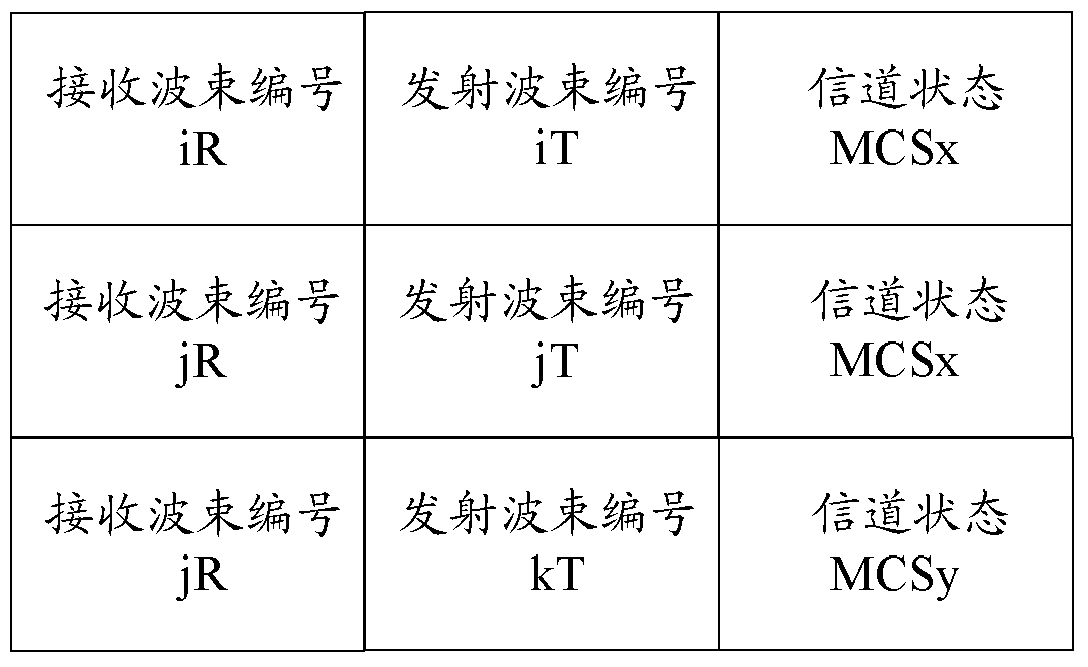
表5table 5
终端的接收波束iR和jR对应着三个满足第二门限的发射波束,分别是(iR,iT)、(jR,jT)、(jR,kT),上述收发波束对的信道状态分别是MCSx、MCSx、MCSy,其中,MCSx的对应的信道质量高于MCSy;The receiving beams iR and jR of the terminal correspond to three transmitting beams satisfying the second threshold, namely (iR, iT), (jR, jT), (jR, kT), and the channel states of the transmitting and receiving beam pairs are MCSx, respectively. MCSx, MCSy, wherein the corresponding channel quality of the MCSx is higher than MCSy;
步骤907:基站接收终端的链路增强请求和终端关于每个波束的信道状态,基站识别用于进行多波束链路增强的发射波束,由于发射波束编号jT和kT对应同一接收波束,因此,这两个波束组合存在潜在的干扰,于此,基站选择满足1/5码率、BPSK传输的编号为iT和jT的发射波束进行多波束链路增强;Step 907: The base station receives the link enhancement request of the terminal and the channel state of the terminal for each beam, and the base station identifies the transmit beam for performing multi-beam link enhancement. Since the transmit beam numbers jT and kT correspond to the same receive beam, therefore, There is potential interference between the two beam combinations. In this case, the base station selects a transmit beam that satisfies the 1/5 code rate and the BPSK transmission numbers iT and jT for multi-beam link enhancement;
步骤908:基站通知终端进入多波束链路增强模式;Step 908: The base station notifies the terminal to enter the multi-beam link enhancement mode.
基站在两个发射波束上发送的数据发送形式为:在两个发射波束上均以相同的码率和调制阶数发送数据,两个发射波束上发送数据的完整部分,基站在两个发射波束上分别发送数据到达的控制信息,于此,通知信息如表6所示:The data transmitted by the base station on the two transmit beams is in the form of transmitting data at the same code rate and modulation order on both transmit beams, transmitting a complete portion of the data on the two transmit beams, and the base station is at two transmit beams. The control information of the arrival of the data is respectively sent, and the notification information is as shown in Table 6:

表6Table 6
步骤909:基站为终端在多个波束上传输相同的数据;Step 909: The base station transmits the same data on multiple beams for the terminal.
步骤910:终端根据基站的控制信息指示,在接收波束iR和jR上分别接收数据,并对两个接收波束的数据进行合并;其中,当终端未进入多波束链路增强模式时,通过单波束进行数据接收。Step 910: The terminal separately receives data on the receive beams iR and jR according to the control information indication of the base station, and combines data of two receive beams; wherein, when the terminal does not enter the multi-beam link enhanced mode, the single beam passes through Data reception.
综上所述,通过本发明实施例,不同节点发送相同内容,或者其中一个节点发送完整数据,另一个节点发送部分冗余数据,或者数据分别承载在两个节点对应的波束上;而且,终端测量波束链路判断是否请求多波束链路增强,或者,终端始终反馈多个波束对应的链路状况,基站根据调度资源确定是否进行链路增强;参与多波束的节点可以是高频节点或具备高频功能的终 端设备;参与的其中一个节点充当主控节点,或者为了减少时延和信息交互参与链路增强的节点直接给终端发送配置消息和数据;如此,通过本发明实施例实现了在高频通信中提升链路鲁棒性。In summary, according to the embodiment of the present invention, different nodes send the same content, or one of the nodes sends complete data, another node sends partial redundant data, or the data is respectively carried on the beams corresponding to the two nodes; The measurement beam link determines whether to request multi-beam link enhancement, or the terminal always feeds back the link status corresponding to the multiple beams, and the base station determines whether to perform link enhancement according to the scheduling resource; the node participating in the multi-beam may be a high-frequency node or has The end of high frequency function End device; one of the participating nodes acts as the master node, or the node participating in the link enhancement to reduce the delay and information interaction directly sends the configuration message and data to the terminal; thus, the embodiment of the present invention implements the high frequency communication. Improve link robustness.
此外,如图16所示,本发明实施例还提供一种数据传输装置,应用于基站,包括:第一波束能力交互模块161,设置为告知终端基站的发射波束能力,并获取终端的接收波束能力;第一处理模块162,设置为根据终端上报的不同收发波束对的信道状态信息,确定用于传输数据的独立收发波束对;第一传输模块163,设置为当所述第一处理模块162所确定的独立收发波束对的数目为至少两个时,在每个所确定独立收发波束对上为终端发送数据,并将所确定的独立收发波束对的数据发送形式通知给终端。In addition, as shown in FIG. 16, the embodiment of the present invention further provides a data transmission apparatus, which is applied to a base station, and includes: a first beam capability interaction module 161, configured to notify a terminal base station of a transmit beam capability, and acquire a receive beam of the terminal. The first processing module 162 is configured to determine an independent transceiver beam pair for transmitting data according to channel state information of different transceiver beam pairs reported by the terminal; the first transmission module 163 is configured to be the first processing module 162. When the determined number of independent transceiver beam pairs is at least two, data is transmitted to the terminal on each determined independent transceiver beam pair, and the determined data transmission form of the independent transceiver beam pair is notified to the terminal.
于实际应用中,第一处理模块162例如为具有信息处理能力的处理器或其他元件,第一波束能力交互模块161及第一传输模块163例如为具有数据传输能力的通信元件。In a practical application, the first processing module 162 is, for example, a processor or other component having information processing capability, and the first beam capability interaction module 161 and the first transmission module 163 are, for example, communication elements having data transmission capabilities.
于一实施例中,所述第一处理模块162,设置为执行至少以下之一:In an embodiment, the first processing module 162 is configured to perform at least one of the following:
根据终端上报的不同收发波束对的信道状态信息,确定信道状态满足第一门限的收发波束对为用于传输数据的独立收发波束对;其中,第一门限为满足码率大于1/10、特定调制方式传输的信道状态,其中,所述特定调制方式包括以下任一项:BPSK、QPSK、QAM;And determining, according to the channel state information of the different transceiver beam pairs reported by the terminal, the transceiver beam pair whose channel state meets the first threshold is an independent transceiver beam pair for transmitting data; wherein, the first threshold is that the code rate is greater than 1/10, and the specific threshold is Channel state of the modulation mode transmission, where the specific modulation mode includes any one of the following: BPSK, QPSK, QAM;
根据基站的负载从终端上报的收发波束对中确定用于传输数据的独立收发波束对;Determining an independent transceiving beam pair for transmitting data from the transceiving beam pair reported by the terminal according to the load of the base station;
从终端上报的收发波束对中选择信道状态最好的至少两个收发波束对作为用于传输数据的独立收发波束对;Selecting at least two transceiver beam pairs with the best channel state from the transceiver beam pairs reported by the terminal as independent transmit and receive beam pairs for transmitting data;
从终端上报的收发波束对中选择干扰最小的至少两个收发波束对作为用于传输数据的独立收发波束对。The at least two transceiver beam pairs with the least interference are selected from the transceiver beam pairs reported by the terminal as independent transmit and receive beam pairs for transmitting data.
此外,如图17所示,本发明实施例还提供一种数据传输装置,应用于终端,包括:第二波束能力交互模块171,设置为获知基站的发射波束能力,并向基站发送自己的接收波束能力;第二传输模块172,设置为向基站上报不同收发波束对的信道状态信息;第二处理模块173,设置为根据基站通知 的至少两个用于传输数据的独立收发波束对的数据发送形式,接收在所述至少两个独立收发波束对上传输的数据,并合并接收的数据。In addition, as shown in FIG. 17, the embodiment of the present invention further provides a data transmission apparatus, which is applied to a terminal, and includes: a second beam capability interaction module 171, configured to learn the transmit beam capability of the base station, and send its own reception to the base station. The second transmission module 172 is configured to report channel state information of different transceiver beam pairs to the base station; the second processing module 173 is configured to notify according to the base station. A data transmission form of at least two independent transceiving beam pairs for transmitting data, receiving data transmitted on the at least two independent transceiving beam pairs, and combining the received data.
于实际应用中,第二处理模块173例如为具有信息处理能力的处理器或其他元件,第二波束能力交互模块171及第二传输模块172例如为具有数据传输能力的通信元件。In a practical application, the second processing module 173 is, for example, a processor or other component having information processing capability, and the second beam capability interaction module 171 and the second transmission module 172 are, for example, communication elements having data transmission capabilities.
于一实施例中,所述第二传输模块172,设置为:向基站上报信道状态满足第二门限的收发波束对的信道状态信息。其中,第二门限为满足码率大于1/10、特定调制方式传输的信道状态,其中,所述特定调制方式包括以下任一项:BPSK、QPSK、QAM。In an embodiment, the second transmission module 172 is configured to: report, to the base station, channel state information of the transceiver beam pair whose channel state meets the second threshold. The second threshold is a channel state that meets a code rate greater than 1/10 and is transmitted in a specific modulation mode, where the specific modulation mode includes any one of the following: BPSK, QPSK, and QAM.
另外,上述装置的处理流程同上述方法实施例所述,故于此不再赘述。In addition, the processing flow of the foregoing apparatus is the same as that of the foregoing method embodiment, and thus is not described herein again.
本发明实施例还提供一种数据传输系统,包括如图16所示的数据传输装置以及如图17所示的数据传输装置。The embodiment of the present invention further provides a data transmission system, including the data transmission device shown in FIG. 16 and the data transmission device shown in FIG.
本发明实施例还提供一种计算机可读存储介质,存储有计算机可执行指令,所述计算机可执行在指令被执行时实现应用于基站的上述数据传输方法。Embodiments of the present invention also provide a computer readable storage medium storing computer executable instructions, the computer executable to implement the above data transmission method applied to a base station when an instruction is executed.
本发明实施例还提供一种计算机可读存储介质,存储有计算机可执行指令,所述计算机可执行在指令被执行时实现应用于终端的上述数据传输方法。The embodiment of the invention further provides a computer readable storage medium storing computer executable instructions, the computer executable to implement the above data transmission method applied to the terminal when the instruction is executed.
本领域普通技术人员可以理解上述方法中的全部或部分步骤可通过程序来指令相关硬件(例如处理器)完成,所述程序可以存储于计算机可读存储介质中,如只读存储器、磁盘或光盘等。可选地,上述实施例的全部或部分步骤也可以使用一个或多个集成电路来实现。相应地,上述实施例中的模块/单元可以采用硬件的形式实现,例如通过集成电路来实现其相应功能,也可以采用软件功能模块的形式实现,例如通过处理器执行存储于存储器中的程序/指令来实现其相应功能。本发明实施例不限制于任何特定形式的硬件和软件的结合。One of ordinary skill in the art will appreciate that all or a portion of the above steps may be performed by a program to instruct related hardware, such as a processor, which may be stored in a computer readable storage medium, such as a read only memory, disk or optical disk. Wait. Alternatively, all or part of the steps of the above embodiments may also be implemented using one or more integrated circuits. Correspondingly, the modules/units in the foregoing embodiments may be implemented in the form of hardware, for example, by implementing an integrated circuit to implement their respective functions, or may be implemented in the form of a software function module, for example, executing a program stored in the memory by the processor/ Instructions to achieve their corresponding functions. Embodiments of the invention are not limited to any specific form of combination of hardware and software.
以上显示和描述了本申请的基本原理和主要特征和本申请的优点。本申请不受上述实施例的限制,上述实施例和说明书中描述的只是说明本申请的原理,在不脱离本申请精神和范围的前提下,本申请还会有各种变化和改进,这些变化和改进都落入要求保护的本申请范围内。 The basic principles and main features of the present application and the advantages of the present application are shown and described above. The present application is not limited by the above-described embodiments, and the above-described embodiments and the description are only for explaining the principles of the present application, and various changes and modifications may be made to the present application without departing from the spirit and scope of the application. And improvements are within the scope of the claimed invention.
本申请实施例提供一种数据传输方法、装置及系统,实现了通过至少两个独立收发波束对进行数据传输,提升了毫米波链路的可靠性;减小了下行同步及对独立收发波束对识别过程的时延,进而提高了终端对高频站点的接入速度;降低了终端对最优的独立收发波束对识别的复杂度,提高了波束识别的准确性,避免了由于高频站点差异所导致的终端无法识别出最优独立收发波束对的情况。 The embodiment of the present invention provides a data transmission method, device, and system, which implements data transmission through at least two independent transceiver beam pairs, improves reliability of a millimeter wave link, and reduces downlink synchronization and independent transmission and reception beam pairs. The delay of the identification process improves the access speed of the terminal to the high-frequency station; reduces the complexity of the terminal to identify the optimal independent transceiver beam pair, improves the accuracy of beam identification, and avoids the difference due to high-frequency stations. The resulting terminal cannot identify the optimal independent transmit and receive beam pair.
Claims (24)
Applications Claiming Priority (2)
| Application Number | Priority Date | Filing Date | Title |
|---|---|---|---|
| CN201510502297.6A CN106470062B (en) | 2015-08-14 | 2015-08-14 | Data transmission method and system |
| CN201510502297.6 | 2015-08-14 |
Publications (1)
| Publication Number | Publication Date |
|---|---|
| WO2017028676A1 true WO2017028676A1 (en) | 2017-02-23 |
Family
ID=58051921
Family Applications (1)
| Application Number | Title | Priority Date | Filing Date |
|---|---|---|---|
| PCT/CN2016/092717 Ceased WO2017028676A1 (en) | 2015-08-14 | 2016-08-01 | Data transmission method, device and system |
Country Status (2)
| Country | Link |
|---|---|
| CN (1) | CN106470062B (en) |
| WO (1) | WO2017028676A1 (en) |
Cited By (7)
| Publication number | Priority date | Publication date | Assignee | Title |
|---|---|---|---|---|
| CN109067440A (en) * | 2018-07-18 | 2018-12-21 | 中国传媒大学 | One kind is based on wave beam and the matched mimo antenna array of multipath |
| WO2019100220A1 (en) * | 2017-11-21 | 2019-05-31 | Zte Corporation | Methods, apparatus and systems for performing channel measurement in a multi-beam wireless communication network |
| WO2019128975A1 (en) * | 2017-12-28 | 2019-07-04 | Guangdong Oppo Mobile Telecommunications Corp., Ltd. | Method and apparatus for a beam failure recovery in a wireless communication system |
| CN112788614A (en) * | 2021-01-13 | 2021-05-11 | 上海闻泰信息技术有限公司 | Beamforming method and apparatus, beamforming system, and computer storage medium |
| US11121916B2 (en) | 2017-03-28 | 2021-09-14 | Huawei Technologies Co., Ltd. | Uplink transmission method and apparatus |
| WO2022083525A1 (en) * | 2020-10-23 | 2022-04-28 | 索尼集团公司 | Electronic device and method for wireless communication, and computer-readable storage medium |
| US11411628B2 (en) | 2017-11-17 | 2022-08-09 | Qualcomm Incorporated | Methods for beam determination after beam pair link indication |
Families Citing this family (18)
| Publication number | Priority date | Publication date | Assignee | Title |
|---|---|---|---|---|
| CN106851846A (en) * | 2017-01-23 | 2017-06-13 | 深圳市金立通信设备有限公司 | A kind of control information sending method, base station, user equipment and system |
| US10673652B2 (en) * | 2017-03-02 | 2020-06-02 | Futurewei Technologies, Inc. | System and method for providing explicit feedback in the uplink |
| SG11201908586RA (en) * | 2017-03-17 | 2019-10-30 | Guangdong Oppo Mobile Telecommunications Corp Ltd | Wireless communication method and device |
| CN114244407A (en) | 2017-03-18 | 2022-03-25 | 上海朗桦通信技术有限公司 | Method and device for multi-antenna transmission in base station and user equipment |
| CN108631889A (en) * | 2017-03-22 | 2018-10-09 | 株式会社Ntt都科摩 | Radio link failure detection method and user equipment |
| CN108632833A (en) * | 2017-03-23 | 2018-10-09 | 株式会社Ntt都科摩 | beam configuration method, mobile station and base station |
| CN109039395B (en) * | 2017-06-12 | 2022-08-05 | 中兴通讯股份有限公司 | Beam selection method and device |
| CN109716667A (en) * | 2017-06-14 | 2019-05-03 | 华为技术有限公司 | Data transmission method and relevant device |
| CN109150254B (en) * | 2017-06-16 | 2020-05-26 | 维沃移动通信有限公司 | Method and device for acquiring configuration parameters of beam training |
| CN109392123A (en) * | 2017-08-10 | 2019-02-26 | 株式会社Ntt都科摩 | Beam selection method, base station and user equipment |
| WO2018141163A1 (en) * | 2017-09-30 | 2018-08-09 | 北京小米移动软件有限公司 | Data transmission method and apparatus |
| CN109756279B (en) * | 2017-11-03 | 2021-08-31 | 大唐移动通信设备有限公司 | A beam detection method and device |
| EP3771269B1 (en) * | 2018-03-30 | 2024-05-01 | Beijing Xiaomi Mobile Software Co., Ltd. | Method and device for selecting beam |
| WO2020056697A1 (en) * | 2018-09-20 | 2020-03-26 | 北京小米移动软件有限公司 | Communication method and apparatus, terminal, base station, and storage medium |
| WO2021117108A1 (en) * | 2019-12-09 | 2021-06-17 | 株式会社Nttドコモ | Terminal and wireless communication method |
| CN114731181A (en) * | 2019-12-31 | 2022-07-08 | 华为技术有限公司 | Beam training method and device |
| WO2021155589A1 (en) * | 2020-02-07 | 2021-08-12 | Qualcomm Incorporated | User equipment capability on report related to uplink beam selection |
| CN113508610B (en) * | 2021-03-30 | 2023-10-24 | 北京小米移动软件有限公司 | Ability acquisition method and device, ability indication method and device |
Citations (5)
| Publication number | Priority date | Publication date | Assignee | Title |
|---|---|---|---|---|
| CN101272167A (en) * | 2007-03-23 | 2008-09-24 | 中兴通讯股份有限公司 | Multiple-input multiple-output system and method for outdoor macrocell of time division synchronous code division multiple access system |
| CN103688474A (en) * | 2013-09-27 | 2014-03-26 | 华为技术有限公司 | Communication method, base station, and user equipment |
| US20140120926A1 (en) * | 2012-10-29 | 2014-05-01 | Electronics And Telecommunications Research Institute | Method of operating base station and terminal in cellular telecommunication system for operating multiple beams |
| US20140187168A1 (en) * | 2013-01-02 | 2014-07-03 | Korea Advanced Institute Of Science And Technology | Method and apparatus for fast beam-link construction in mobile communication system |
| CN104734759A (en) * | 2013-12-20 | 2015-06-24 | 中兴通讯股份有限公司 | Wave beam recognition method, related device and system for MIMO beam forming communication system |
Family Cites Families (3)
| Publication number | Priority date | Publication date | Assignee | Title |
|---|---|---|---|---|
| CN101123599B (en) * | 2006-08-11 | 2010-04-21 | 华为技术有限公司 | Data transmission method, data transmission system and device |
| EP2378688B1 (en) * | 2010-04-16 | 2013-01-23 | Alcatel Lucent | Method for resource allocation in a radio communication system |
| US20130286960A1 (en) * | 2012-04-30 | 2013-10-31 | Samsung Electronics Co., Ltd | Apparatus and method for control channel beam management in a wireless system with a large number of antennas |
-
2015
- 2015-08-14 CN CN201510502297.6A patent/CN106470062B/en active Active
-
2016
- 2016-08-01 WO PCT/CN2016/092717 patent/WO2017028676A1/en not_active Ceased
Patent Citations (5)
| Publication number | Priority date | Publication date | Assignee | Title |
|---|---|---|---|---|
| CN101272167A (en) * | 2007-03-23 | 2008-09-24 | 中兴通讯股份有限公司 | Multiple-input multiple-output system and method for outdoor macrocell of time division synchronous code division multiple access system |
| US20140120926A1 (en) * | 2012-10-29 | 2014-05-01 | Electronics And Telecommunications Research Institute | Method of operating base station and terminal in cellular telecommunication system for operating multiple beams |
| US20140187168A1 (en) * | 2013-01-02 | 2014-07-03 | Korea Advanced Institute Of Science And Technology | Method and apparatus for fast beam-link construction in mobile communication system |
| CN103688474A (en) * | 2013-09-27 | 2014-03-26 | 华为技术有限公司 | Communication method, base station, and user equipment |
| CN104734759A (en) * | 2013-12-20 | 2015-06-24 | 中兴通讯股份有限公司 | Wave beam recognition method, related device and system for MIMO beam forming communication system |
Cited By (10)
| Publication number | Priority date | Publication date | Assignee | Title |
|---|---|---|---|---|
| US11121916B2 (en) | 2017-03-28 | 2021-09-14 | Huawei Technologies Co., Ltd. | Uplink transmission method and apparatus |
| US11411628B2 (en) | 2017-11-17 | 2022-08-09 | Qualcomm Incorporated | Methods for beam determination after beam pair link indication |
| TWI780262B (en) * | 2017-11-17 | 2022-10-11 | 美商高通公司 | Methods for beam determination after beam pair link indication |
| US11831374B2 (en) | 2017-11-17 | 2023-11-28 | Qualcomm Incorporated | Methods for beam determination after beam pair link indication |
| WO2019100220A1 (en) * | 2017-11-21 | 2019-05-31 | Zte Corporation | Methods, apparatus and systems for performing channel measurement in a multi-beam wireless communication network |
| US11211987B2 (en) | 2017-11-21 | 2021-12-28 | Zte Corporation | Methods, apparatus and systems for performing channel measurement in a multi-beam wireless communication network |
| WO2019128975A1 (en) * | 2017-12-28 | 2019-07-04 | Guangdong Oppo Mobile Telecommunications Corp., Ltd. | Method and apparatus for a beam failure recovery in a wireless communication system |
| CN109067440A (en) * | 2018-07-18 | 2018-12-21 | 中国传媒大学 | One kind is based on wave beam and the matched mimo antenna array of multipath |
| WO2022083525A1 (en) * | 2020-10-23 | 2022-04-28 | 索尼集团公司 | Electronic device and method for wireless communication, and computer-readable storage medium |
| CN112788614A (en) * | 2021-01-13 | 2021-05-11 | 上海闻泰信息技术有限公司 | Beamforming method and apparatus, beamforming system, and computer storage medium |
Also Published As
| Publication number | Publication date |
|---|---|
| CN106470062B (en) | 2021-11-16 |
| CN106470062A (en) | 2017-03-01 |
Similar Documents
| Publication | Publication Date | Title |
|---|---|---|
| WO2017028676A1 (en) | Data transmission method, device and system | |
| US9692459B2 (en) | Using multiple frequency bands with beamforming assistance in a wireless network | |
| US9571171B2 (en) | Apparatus and method for adaptive beam-forming in wireless communication system | |
| US9319124B2 (en) | Apparatus and method for supporting multi-antenna transmission in beamformed wireless communication system | |
| KR101124720B1 (en) | Techniques for receiver beamforming and yielding-threshold adjustments in peer-to-peer networks | |
| CN102769488B (en) | Method and apparatus for choosing and broadcasting receiver beamforming vectors in peer-to-peer (P2P) networks | |
| EP2538581B1 (en) | Method and apparatus for broadband wireless local area communication which use a relay in transceiving operation | |
| CN114902579B (en) | Millimeter wave multi-beam | |
| CN108141808A (en) | By microwave station to user equipment offer to the method and apparatus of the access at millimeter wave station | |
| CN111344958A (en) | Method for UE to request channel state information reference signal (CSI-RS) or Sounding Reference Signal (SRS) | |
| JP2009540765A (en) | Radio apparatus and method using directional antennas for peer-to-peer networks in millimeter waves for adaptive beam manipulation | |
| US12532190B2 (en) | Method and apparatus for certification of UE oriented beam management | |
| US12526722B2 (en) | Communication system and method for operating a 5G mesh network for service continuity | |
| CN117693904A (en) | Techniques for Beam Width Adjustment in Beamforming Communications | |
| CN120419234A (en) | Method and apparatus for triggering reporting in a wireless communication system | |
| US12401407B2 (en) | Facilitating explicit latency mode determination in beam switching | |
| KR20210116449A (en) | Method and system for adapting the beamwidth of beams in NR physical channels | |
| CN115398815B (en) | Beam management procedure for network nodes and terminal devices | |
| US20250167875A1 (en) | Method and device for data transmission in wireless communication system | |
| CN110719636A (en) | A beam management method and terminal device | |
| CN115039347B (en) | Transmission and configuration of reference signal resources | |
| US12519530B2 (en) | Indicating beam property changes across polarizations in non-co-located polarized array designs | |
| CN120604548A (en) | Method and apparatus for measuring and reporting antenna array adjustments in wireless communication systems | |
| KR20250155375A (en) | Method and apparatus for controlling inter-RAT handover based on low layer | |
| WO2024069489A1 (en) | Victim prioritization for crosslink interference handling in tdd and sbfd systems |
Legal Events
| Date | Code | Title | Description |
|---|---|---|---|
| 121 | Ep: the epo has been informed by wipo that ep was designated in this application |
Ref document number: 16836540 Country of ref document: EP Kind code of ref document: A1 |
|
| NENP | Non-entry into the national phase |
Ref country code: DE |
|
| 122 | Ep: pct application non-entry in european phase |
Ref document number: 16836540 Country of ref document: EP Kind code of ref document: A1 |