WO2017015101A1 - Methods for maximizing the efficiency of targeted gene correction - Google Patents
Methods for maximizing the efficiency of targeted gene correction Download PDFInfo
- Publication number
- WO2017015101A1 WO2017015101A1 PCT/US2016/042463 US2016042463W WO2017015101A1 WO 2017015101 A1 WO2017015101 A1 WO 2017015101A1 US 2016042463 W US2016042463 W US 2016042463W WO 2017015101 A1 WO2017015101 A1 WO 2017015101A1
- Authority
- WO
- WIPO (PCT)
- Prior art keywords
- donor
- nucleic acid
- sequence
- target
- hdr
- Prior art date
- Legal status (The legal status is an assumption and is not a legal conclusion. Google has not performed a legal analysis and makes no representation as to the accuracy of the status listed.)
- Ceased
Links
Classifications
-
- C—CHEMISTRY; METALLURGY
- C12—BIOCHEMISTRY; BEER; SPIRITS; WINE; VINEGAR; MICROBIOLOGY; ENZYMOLOGY; MUTATION OR GENETIC ENGINEERING
- C12N—MICROORGANISMS OR ENZYMES; COMPOSITIONS THEREOF; PROPAGATING, PRESERVING, OR MAINTAINING MICROORGANISMS; MUTATION OR GENETIC ENGINEERING; CULTURE MEDIA
- C12N15/00—Mutation or genetic engineering; DNA or RNA concerning genetic engineering, vectors, e.g. plasmids, or their isolation, preparation or purification; Use of hosts therefor
- C12N15/09—Recombinant DNA-technology
- C12N15/10—Processes for the isolation, preparation or purification of DNA or RNA
- C12N15/102—Mutagenizing nucleic acids
-
- A—HUMAN NECESSITIES
- A61—MEDICAL OR VETERINARY SCIENCE; HYGIENE
- A61K—PREPARATIONS FOR MEDICAL, DENTAL OR TOILETRY PURPOSES
- A61K38/00—Medicinal preparations containing peptides
- A61K38/16—Peptides having more than 20 amino acids; Gastrins; Somatostatins; Melanotropins; Derivatives thereof
- A61K38/43—Enzymes; Proenzymes; Derivatives thereof
- A61K38/46—Hydrolases (3)
- A61K38/465—Hydrolases (3) acting on ester bonds (3.1), e.g. lipases, ribonucleases
Definitions
- the present invention relates to methods of targeted genome engineering.
- DNA nicks are the most common form of DNA damage, but the potential of DNA nicks to contribute to genomic instability was overlooked for considerable time, because nicks were presumed to undergo immediate religation.
- This view was challenged when it became possible to compare outcomes of DNA nicks and double-strand breaks (DSBs) targeted to specific sites in genomic DNA by nickase derivatives of sequence-specific endonucleases.
- DSBs double-strand breaks
- Canonical HDR occurs at DSBs, generally uses a double stranded (ds) donor nucleic acid, and requires the protein factors BRCA2 and RAD51.
- Alternative HDR is suppressed by BRCA2 and RAD51.
- alternative HDR can be stimulated by inhibition of BRCA2 and/or RAD51.
- the alternative HDR pathway efficiently uses a single-stranded (ss) DNA or nicked dsDNA as a donor.
- the present invention relates in part to the discovery of a novel annealing-dependent strand synthesis (ADSS) pathway that supports HDR at targeted DNA nicks using single-stranded nucleic acids as a preferred donor.
- ADSS annealing-dependent strand synthesis
- the inventors demonstrate that the efficiency and precise outcome of this pathway are dependent upon the donor strandedness relative to the nicked target strand, homology of the donor to the target, and the location of non-homologous sequence in the donor relative to the nick.
- aspects of the invention relate to methods for optimized selection of sites of genomic nucleic acid targets and design of single-stranded donor nucleic acids to allow increased frequency of homology-directed modification at nicks in the selected target. Described herein are methods of designing and making a single-stranded donor nucleic acid for use in genome modification at a targeted nick. Also featured are methods for initiating homology-directed modification with higher frequency and fidelity using optimized single-stranded donor nucleic acid designed as disclosed herein for efficient targeted genome engineering and gene correction.
- a method of designing a single -stranded donor nucleic acid for homology-directed modification of a genomic nucleic acid at a sequence of interest in a reaction involving a directed nicking enzyme that generates a nicked strand and an intact strand at a directed site in or adjacent to the sequence of interest comprising: a) designing a single-stranded donor nucleic acid comprising a target-homologous sequence element and a gene modification sequence element, wherein the target-homologous sequence element of the donor hybridizes to the nicked strand bearing the 3 ' end of the nick and the gene modification sequence element of the donor is exclusively 3' of the nick when the target-homologous sequence element of the donor nucleic acid is hybridized to the nicked strand; or b) designing a single -stranded donor nucleic acid comprising a target-homologous sequence element and a gene modification sequence element, wherein the target-
- a method of making a single-stranded donor nucleic acid for homology-directed modification of a genomic nucleic acid at a sequence of interest in a reaction involving a directed nicking enzyme that generates a nicked strand and an intact strand at a directed site in or adjacent to the sequence of interest comprising: a) synthesizing a single-stranded donor nucleic acid comprising a target-homologous sequence element and a gene modification sequence element, wherein the target-homologous sequence element of the donor hybridizes to the nicked strand bearing the 3 ' end of the nick and the gene modification sequence element of the donor is exclusively 3 ' of the nick when the target-homologous sequence element of the donor nucleic acid is hybridized to the nicked strand; or b) synthesizing a single-stranded donor nucleic acid comprising a target-homologous sequence element and a gene modification sequence element,
- the target-homologous sequence element of the donor hybridizes to the intact strand and the donor heterology relative to sequence on the 5 ' side of the nick is less than 7 nucleotides. In other embodiments, the target-homologous sequence element of the donor hybridizes to the intact strand and the donor heterology relative to sequence on the 5 ' side of the nick is less than 6 nucleotides, 5 nucleotides, 4 nucleotides, 3 nucleotides, 2 nucleotides, or one nucleotide (i.e., no heterology). As demonstrated in the Examples herein, heterology greater than 7 nucleotides does not abolish alternative HDR.
- heterology on the 5 ' side of the nick in target-homologous sequence elements should preferably be 7 nucleotides or less.
- a method of homology-directed modification of a genomic nucleic acid at a sequence of interest comprising: a) making a single stranded donor nucleic acid according to the method described herein; and b) contacting a genomic target nucleic acid in a cell with: i) the single-stranded donor nucleic acid; and ii) a nicking enzyme that generates a nicked strand and an intact strand at a directed site in or adjacent to the sequence of interest; wherein the single-stranded donor replaces the genomic nucleic acid sequence at the sequence of interest via homology-directed repair, thereby effecting homology-directed modification of the genomic sequence at the sequence of interest.
- the method further comprises treating or contacting the cell with an inhibitor of one or more of RAD51, BRCA2, PALB2 and SHFM1.
- the method further comprises treating or contacting the cell with an agonist of BRCA1.
- the method further comprises treating or contacting the cell with an inhibitor of one or more of RAD51 , BRCA2, PALB2 and SHFM 1 , and with an agonist of BRCA1.
- the target-homologous sequence element of the donor hybridizes to the intact strand and the donor heterology relative to sequence on the 5 ' side of the nick is less than 7 nucleotides. In other embodiments, the target-homologous sequence element of the donor hybridizes to the intact strand and the donor heterology relative to sequence on the 5 ' side of the nick is less than 6 nucleotides, less than 5 nucleotides, less than 4 nucleotides, less than 3 nucleotides, less than 2 nucleotides, or there is no heterology (i.e., complete complementarity between the donor and the intact strand on the 5' side of the nick).
- the nicking enzyme is a nicking variant of a Cas enzyme.
- the Cas enzyme variant is a Cas9 enzyme variant.
- the Cas9 enzyme variant is S. pyogenes Cas9 D10A .
- the Cas enzyme variant has a mutation at a site selected from polypeptide sites corresponding to D 10, H840, N854, and N863 of the mature Cas9 polypeptide of S. pyogenes.
- the Cas enzyme variant has a mutation corresponding to a mutation selected from D10A, H840A, N854A and N863A of S. pyogenes Cas9.
- the technology described herein does not concern a process for cloning human beings, processes for modifying the germ line genetic identity of human beings, uses of human embryos for industrial or commercial purposes or processes for modifying the genetic identity of animals which are likely to cause them suffering without any substantial medical benefit to man or animal, and also animals resulting from such processes.
- FIGs. 1A-1D show single -stranded oligonucleotide (SSO) donor strand and target site preference of HDR.
- FIG. 1A Diagram of HDR at a nick by a SSO donor complementary to the intact (cl) or nicked (cN) target strand. Top, nicked DNA; bottom, annealed cl (left) and cN (right) donors, with sequence to be transferred shown in gray.
- FIG. IB Diagram of HDR at a nick by a SSO donor complementary to the intact (cl) or nicked (cN) target strand. Top, nicked DNA; bottom, annealed cl (left) and cN (right) donors, with sequence to be transferred shown in gray.
- FIG. IB Diagram of HDR at a nick by a SSO donor complementary to the intact (cl) or nicked (cN) target strand. Top, nicked DNA; bottom, annealed cl (left) and
- FIGs. 1C Diagram of the Traffic Light (TL) reporter used in the Examples described herein, showing the central 38 bp heterologous region; the positions of cleavage by gRNAs 1, 2, 8 and 9; and the 99 nt SSO-1 and SSO-2 donors carrying a central 17 nt region (gray) that must replace the heterologous region to permit GFP+ expression.
- FIGs. 2A-2B show unidirectional conversion of markers via the cN pathway.
- FIG. 2A Diagram of how Hindlll and Apol polymorphisms are incorporated into products of HDR by the pathways that promote conversion at nicks.
- FIG. 2B Top, diagram of Hindlll (H3) and Apol (Al) site polymorphisms on donor SSO-3. Bottom, restriction cleavage analysis of products of HDR at nicks using the cl and cN pathways. Fragment sizes indicated at right, percent of each fragment cleaved shown below.
- FIGs. 3A-3D show that HDR at DSBs by SSO donors is independent of BRCA2 and occurs predominantly via the ADSS pathway.
- FIG. 3A Diagram of the TL reporter showing the position of DSBs targeted by gRNAs 1, 2, 8 and 9. Donors SSO-2 and SSO-1 are shown below the diagram.
- FIG. 3B HDR frequencies at DSBs at each target/donor pair tested. HDR frequencies are shown as mean and SEM (n>6).
- FIG. 3C Restriction cleavage analysis of conversion of Hindlll (H3) and Apol (Al) site polymorphisms in products of HDR at DSBs targeted by gl or g8 and supported by donor SSO-3.
- FIG. 3D Postulated intermediate formed during HDR by SSO-3 at a DSB, using the ADSS pathway.
- FIG. 4 shows a contrasting role of RAD51 in HDR at DSBs and DNA nicks.
- a DSB undergoes 5 '-3' excision, then RAD51 loads on the exposed 3' ends to promote strand invasion.
- a nick is not excised but unwound at its 3' end (left) or both 3' and 5' ends, (right), then RAD51 loads to promote re-annealing of the target.
- FIG. 5 shows a diagram of a TL reporter, showing the central 38 bp heterologous region; the positions of cleavage by gRNAs 1, 2, 3 and 8; and the SSO donor carrying a central 17 nt region that must replace the heterologous region to permit GFP+ expression.
- Target sequence is SEQ ID NO: 1.
- ss donor sequence is SEQ ID NO: 2.
- FIG. 5, shows stimulation of alternative HDR upon inhibition of BRCA2.
- FIG. 6 shows that limiting heterology at the 3' end of nick promotes cN donor use.
- FIG. 7 shows that cN conversion tracts extend 3', but not 5' from the nick.
- FIG. 8 illustrates a proposed model for alternative HDR using a cN donor and cl donor.
- FIG. 9 provides sequence conversion diagrams for alternative HDR at a nick and the elucidated guidelines to optimize donor selection.
- Described herein are methods to optimize targeted homology-directed genomic modification.
- methods are described to optimize targeted homology-directed genomic modification at the site of a single -stranded nick.
- aspects of the invention relate to methods for optimized selection of genomic nucleic acid targets and design of single-stranded donor nucleic acids to allow increased frequency of homology-directed modification at nicks in the selected target via hybridization of the donor to the nicked strand (cN pathway) or intact strand (cl pathway) at targeted nicks in the selected region.
- methods of making a single -stranded donor nucleic acid for use in genome modification at a targeted nick Further embodiments include methods for initiating efficient homology-directed modification at a targeted nick within a genomic region of interest, using a single -stranded donor nucleic acid as disclosed herein.
- NHEJ Non-Homologous End-Joining
- HDR Homology-Directed Repair
- HDR "Homology-Directed Repair” involves a donor with homology to the genomic region subject to repair - the process uses a "donor” molecule to direct repair of a "target” molecule, and can lead to the transfer of genetic information from the donor to the target.
- HDR can occur at nicks or DSBs and can result in the alteration of the sequence of the target molecule (e.g., insertion, deletion, mutation, including site-directed mutation) if the donor nucleic acid molecule differs from the target molecule and part or all of the sequence of the donor molecule is incorporated into the target DNA.
- Canonical HDR requires BRCA2 and RAD51, and repairs a DSB, employing a double -stranded DNA (dsDNA) donor molecule.
- alternative HDR is an HDR mechanism that is suppressed by BRCA2, RAD51, and functionally -related genes (see, e.g. Table 5), and that repairs a DNA nick, using a ssDNA or nicked dsDNA donor molecule.
- alternative HDR is positively regulated by BRCA1 and/or requires BRCA1. The nicks that initiate alternative HDR induce less local mutagenesis than the DSBs that initiate canonical HDR, which suits alternative HDR well for genomic engineering.
- nicking enzymes also called “nickases” - can be targeted to nick genomic DNA at or near essentially any site (e.g., through the use of guide RNAs), though local sequence context may influence the precise site of the nick.
- the discovery of the influence of single-stranded donor strandedness and modifying sequence location relative to a nick therefore permits the optimal design of donors for genomic modification at the site nicked by any given targeted nickase enzyme.
- the single-stranded donor is complementary to the nicked strand, the donor is referred to as a "cN donor.”
- the donor is referred to as a "cl donor.”
- the conversion tract i.e., the tract of sequence including the change to be introduced by alternative HDR
- the conversion tract will extend exclusively 3 ' of the nick. This reflects the fact that the 3' end of the nick primes DNA synthesis using the donor as template. Thus, if and when the donor is complementary to the nicked strand, the sequence to be modified should be entirely 3 ' of the nick;
- an optimal donor will be completely homologous with the region 5 ' of the nick in the target genomic DNA, and the heterologous sequence used to modify the target will be exclusively 3 ' of the nick. See, for example, FIG. 9 for a schematic.
- conversion can occur at either or both sides of the nick. If and when the donor is complementary to the intact strand, there is a preference for the region to be modified to be 5 ' of the nick, but the sequence to be modified can be on either side of the nick. That is, targeting the nick such that the region to be modified is 5 ' of the nick is preferable, but not absolutely essential;
- a method of making a single -stranded donor nucleic acid for homology-directed modification of a genomic nucleic acid at a sequence of interest in a reaction involving a targeted nicking enzyme that generates a nicked strand and an intact strand at a targeted site in or adjacent to the sequence of interest comprising:
- alternative HDR and methods to stimulate alternative HDR as opposed to canonical HDR are described in WO 2014/172458, which is incorporated herein by reference.
- the use of a targeted nicking endonuclease enzyme, as opposed to a targeted endonuclease that cleaves both strands of a target DNA sequence, can promote modification via the alternative HDR pathway.
- the introduction of a construct encoding a targeted nicking endonuclease and a donor nucleic acid, e.g., a single-stranded donor nucleic acid with the properties as described herein can promote target locus modification to incorporate the donor sequence via alternative HDR.
- Alternative HDR can be further stimulated by inhibition of one or more of RAD51, BRCA2, PALB2 and SHFM1 and/or by an agonist of BRCA1 activity.
- RNA-guided nicking enzymes including RNA-guided nicking enzymes, inhibitors of RAD51, BRCA2, PALB2 and SHFM1 and agonists of BRCA1 that permit the practice of the technology described herein.
- the frequency or efficiency of alternative HDR can refer to the number or proportion of cells in a targeted population that effect a desired genomic modification via alternative HDR.
- the frequency or efficiency for a given HDR process is "increased" if it is at least 1% greater than the frequency or efficiency for a reference HDR process.
- the frequency is increased by at least 1.5%, at least 2.0%, at least 2.5%, at least 3.0%, at least 3.5%, at least 4.0%, at least 4.5%, at least 5.0%, at least 5.5%, at least 6.0%, at least 6.5%, at least 7.0%, at least 7.5%, at least 8.0%, at least 8.5%, at least 9.0%, at least 9.5%, at least 10.0%, at least 11%, at least 12%, at least 13%, at least 14%, at least 15% or more.
- the frequency is increased by at least 50%, at least 75%, at least 100%, at least 2-fold, at least 3-fold, at least 4-fold, at least 5-fold, at least 6-fold, at least 7-fold, at least 8-fold, at least 9-fold, at least 10-fold, at least 20-fold, at least 30-fold, at least 40 fold or more.
- the frequency of alternative homology -directed modification at targeted nicks is increased by using single-stranded donor nucleic acids designed as described herein. This frequency can be further increased upon inhibition of one or more of RAD51, BRCA2, SHFM1 (DSS 1) or PALB2 or by expression of BRC3 or a RAD51 variant with impaired ATPase activity.
- donor nucleic acid refers to a single-stranded nucleic acid molecule which has been introduced (i.e. introduced into a cell) to serve as a donor for HDR and thereby for homology-directed gene modification.
- a donor nucleic acid molecule can comprise a modification to be introduced into the target cell, e.g. , at a nick.
- a donor nucleic acid molecule can comprise, e.g., DNA, RNA, or modified versions thereof, e.g. LNA.
- Use of donor nucleic acid comprising RNA is described in the art, e.g., in Meers C et al. DNA Repair (Amst). May 16 (2016); Keskin H et al. Nature. 515(7527):436-9; Nov 20 (2014); Storici F et al. 447(7142):338-41; May 17 (2007).
- a single-stranded donor nucleic acid for use in the methods described herein will carry a target-homologous sequence element and a gene modification sequence element.
- the target-homologous sequence element will include sequence sufficient in length to permit hybridization of the donor to the target DNA via the homologous sequence element.
- the homologous sequence element in the donor will be complementary to 20 or more nucleotides of the target if there is no heterology, and to longer regions of the target if the homologous sequence element is interrupted by heterologous base pairs or heterologous sequence elements.
- the length and degree of sequence homology both contribute to the efficiency with which the donor anneals to the target, that the length and degree of sequence homology must be sufficient to permit annealing of the target homologous sequence element of the donor to the target DNA, and that annealing will depend upon the lengths of the homologous and heterologous elements, and on the base composition, and may be further affected by incorporation of bases other than the four naturally-occurring DNA bases (A, C, G or T) that have been chemically modified to improve annealing.
- bases other than the four naturally-occurring DNA bases A, C, G or T
- oligonucleotide donors in the range of 80-120 nucleotides with homology blocks of at least 35 nucleotides are therefore currently practical choices for many purposes.
- longer single-stranded donor oligonucleotides they can be produced, for example, by primer extension.
- the desired sequence can be subcloned into a phage vector, e.g., a bacteriophage M13 vector, that packages its genome into phage particles as a single strand.
- Longer RNA donors can be produced, for example, by runoff transcription from a DNA template.
- a donor nucleic acid may require a tract of target homologous sequence on either side of a gene modification sequence element.
- complementarity can be similar on both sides of the gene modification sequence element, but the lengths and degree of complementarity can also differ as long as one keeps in mind the criteria or rules provided herein regarding the location of heterology and strandedness relative to the nick.
- the gene modification sequence element of a single-stranded donor nucleic acid for use in the methods described herein will be located 3 ' of a target-homologous sequence (and can optionally be located between two target-homologous sequences), and will differ from the target sequence in the manner by which one wishes to modify the genome.
- the gene modification sequence element can include an insertion, deletion or change of one or more bases relative to the target sequence.
- the change to be introduced is small, e.g., introduction or correction of a point mutation
- the gene modification sequence element can be relatively short, including as little as one nucleotide that differs from the target sequence.
- the change can introduce new sequence encoding one or more polypeptides or portions thereof, including, for example, a protein or peptide tag, a reporter polypeptide, a negative regulator, such as an siRNA or antisense RNA expression cassette, among others, or a genetic regulatory element (e.g., that renders one or more genes susceptible to inducible control).
- the change can also disrupt a gene sequence, e.g., by insertional mutagenesis within a coding or regulatory portion of a target gene, or the change can excise all or a portion of a gene sequence. Insertion of a reporter expression cassette can be used to interrupt a target gene while at the same time providing an easy screen for cells that have incorporated the change on the basis of the reporter expression.
- a gene modification can introduce a detectable "tag" to an existing or endogenous gene present in the target nucleic acid. Because of the lower rates of mutagenesis caused by the methods described herein, they are particularly well suited to carry out such modifications.
- Detectable tags are nucleic acid sequences which generate or permit the generation of a detectable signal (e.g. by catalyzing a reaction converting a compound to a detectable product) either as a transcribed nucleic acid product or as a translated polypeptide product.
- Detectable tags can include, by way of non-limiting example, e.g., fluorescent polypeptides (e.g. GFP; mCherry; CFP; GFP; ZsGreenl; YFP; ZsYellowl; mBanana;
- mOrange DsRed; tdTomato; DsRed2; mStrawberry; HcRedl; mRaspberry; E2-Crimson; mPlum; Dendra 2; Timer; PAm Cherry; and Cerulean fluorescent protein
- epitope tags e.g. HA, FLAG, V5, VSV-G, HSV, biotin, Myc, or TRX.
- the modification can delete a region of sequence.
- the donor can include target-homologous sequence elements that are homologous to target sequence on either side of the region to be deleted, but omitting the sequence to be deleted. HDR will result in the removal of the region missing from the donor relative to the target region.
- a gene modification sequence element will necessarily differ from the sequence at a target sequence of interest in the genome, and will be at least 1 nucleotide in length, at least 10 nucleotides in length, at least 20 nucleotides in length, at least 30 nucleotides in length, at least 40 nucleotides in length, at least 50 nucleotides in length, at least 100 nucleotides in length, at least 200 nucleotides in length, at least 300 nucleotides in length, at least 400 nucleotides in length, at least 500 nucleotides in length or more, e.g., 1000 nucleotides or more.
- the gene modification sequence element can be between 1 and 1000 nucleotides, for example, between 1 and 500 nucleotides, between 1 and 400 nucleotides, between 1 and 300 nucleotides, between 1 and 200 nucleotides, or between 1 and 100 nucleotides.
- a nicking enzyme can produce a nick.
- the site at which a targeted nicking enzyme creates a nick can be determined for a given enzyme on the basis of review of the sequence in the area of the desired change relative to the sequence constraints of the targeted nicking enzyme.
- the Cas9 enzyme employed for DNA cleavage in the CRISPR gene-editing process requires that the genomic sequence cleaved be preceded 3 to 4 nucleotides upstream by a protospacer adjacent motif (PAM).
- the canonical PAM (SEQ ID NO: 3) is 5'-NGG-3', where N is any of G, A, T or C.
- the Cas9 nuclease (or a nickase variant thereof; see below) can be targeted very precisely using a heterologous guide RNA (gRNA) with homology to a given target
- gRNA heterologous guide RNA
- the sequence 5'-NGG-3' occurs frequently in the genome, but the exact site of cleavage is still dependent upon where near a desired target the PAM occurs.
- the local sequence constraints for other RNA-guided nucleases/nickases are known to those of skill in the art, such that the ordinarily skilled artisan can identify, for a given nuclease or nicking enzyme, where in or near a given target the enzyme of choice will cut or nick the genomic DNA.
- the criteria or rules described herein can be applied to design a donor nucleic acid, e.g., a single -stranded donor nucleic acid, that will mediate efficient alternative HDR to thereby introduce a desired modification to the genomic DNA.
- a donor complementary to the nicked strand can be designed in which the conversion tract (also referred to herein as the "gene modification sequence element," which includes sequence one wishes to introduce to the genome at the selected site) extends exclusively 3 ' of the nick, i.e., such that there is no heterologous sequence 5' of the nick. See, e.g., FIG. 9, top.
- the conversion tract also referred to herein as the "gene modification sequence element”
- such a donor will also be designed to be completely homologous with - i.e., fully complementary to - the region in the target that is 5 ' of the nick.
- a donor complementary to the intact strand cl donor
- conversion can occur at either or both sides of the nick.
- the region to be modified is 5 ' of the nick, and an optimal donor will carry limited heterology with the target on the 3 ' side of the nick. See, e.g., FIG. 9, bottom.
- the donor nucleic acid molecule can be at least about 50 nt in length. In further embodiments, the donor nucleic acid molecule can be at least about 60 nt in length, at least about 70 nt in length, at least about 100 nt in length, at least about 200 nt in length, at least about 300 nt in length, at least about 400 nt in length, at least about 500 nt in length, at least about 1 kb in length, at least about 2kb in length, at least about 3 kb in length, at least about 4 kb in length, or at least about 5 kb in length. In some embodiments, the donor nucleic acid molecule can be from about 50 nt to about 1000 nt in length. In some
- the donor nucleic acid molecule can be from about 50 nt to about 500 nt in length. In some embodiments, the donor nucleic acid molecule can be from about 50 nt to about 200 nt in length.
- limited heterology means that the target-homologous sequence element of a single -stranded donor molecule is at least 85% homologous to the target sequence, e.g., at least 90% homologous (10% heterologous or less), at least 91% homologous (9% heterologous or less), at least 92% homologous (8% heterologous or less), at least 93% homologous (7% heterologous or less), at least 94% homologous (6% heterologous or less), at least 95% homologous (5% heterologous or less), at least 96% homologous (4% heterologous or less), at least 97% homologous (3% heterologous or less), at least 98% homologous (2% heterologous or less), at least 99% homologous (1% heterologous or less) or even, for example, 100% homologous (no heterology).
- the donor and target are necessarily heterologous - i.e., they include sequence differences one wishes to introduce to the target sequence, the differences are referred to in terms of homology and heterology.
- heterology and homology are equivalent to the degree of non-complementarity and complementarity, respectively, between the target and the "target homologous sequence element" of the donor.
- the Examples herein demonstrate that, for example, limiting donor heterology 5 ' of the nick (i.e., at the 3' end of the nicked strand) promotes cN donor use. See, e.g., FIG. 6.
- nickases refers to a nuclease which cleaves only one strand of a dsDNA molecule, thereby generating a nick.
- Non-limiting examples of nickases can include a nuclease with one active site disabled; I-Anil with one active site disabled; or Cas9D10A, among others.
- any of a number of nucleases that use an RNA or other nucleic acid guide molecule to determine the site of cutting can be advantageously adapted.
- the specific sequence targeted for cleavage can be modified by altering the guide RNA's targeting sequence to be complementary to the selected target.
- Cas9-derived nucleases and nickases are targeted by means of guide nucleic acid molecules, e.g. guide RNAs, which can be engineered to hybridize specifically to a desired target nucleic acid molecule.
- Guide RNAs for nucleic acid-guided endonucleases and ways to modify them to change substrate sequence specificity are well known in the art.
- zinc finger nucleases can be targeted by a combinatorial assembly of multiple zinc finger domains with known DNA triplet specificities.
- Such targeting approaches are known in the art and described, e.g. in Silva et al. Curr Gene Ther 201111 : l l-27; Ran et al. Cell 2013 154: 1380-9; Jinek et al. Science 2013 337:816-821; Carlson et al. PNAS 212 109: 17382-7, Guerts et al. Science 2009 325:433-3; Takasu et al. Insect Biochem Mol Biol2010 40:759-765; and Watanabe et al. Nat. Commun. 2012 3; each of which is incorporated by reference herein in its entirety.
- variants of the RNA-guided Cas9 endonuclease are known that only nick one strand, rather than cleaving both stands.
- an aspartate-to-alanine substitution (D10A) in the RuvC I catalytic domain of Cas9 from S. pyogenes converts Cas9 from a nuclease that cleaves both strands to a nickase that only nicks at the target site.
- D10A aspartate-to-alanine substitution
- pyogenes is provided herein as SEQ ID NO: 4.
- Other examples of mutations that render Cas9 a nickase include, without limitation, H840A, N854A, and N863A.
- H840A, N854A, and N863A For any given nickase variant of a targeted nuclease, one of skill in the art can determine which strand of the target becomes nicked. It is contemplated that mutations of other Cas enzymes at sites corresponding to the D10A mutation in Cas9, or at sites corresponding to the H840, N854 and N863 sites of Cas9 may render the normally double-strand-cleaving enzymes capable of only nicking the target substrate.
- Corresponds to in this context is meant that in an alignment of wild-type S.
- the given amino acid of the other Cas enzyme protein is aligned with the Cas9 wt amino acid specified herein as, e.g., D10, H840, N854, or N863.
- Non-limiting examples of additional Cas proteins include Casl, CaslB, Cas2, Cas3, Cas4, Cas5, Cas6, Cas7, Cas8, CaslO, Csyl, Csy2, Csy3, Csel, Cse2, Cscl, Csc2, Csa5, Csn2, Csm2, Csm3, Csm4, Csm5, Csm6, Cmrl, Cmr3, Cmr4, Cmr5, Cmr6, Csbl, Csb2, Csb3, Csxl7, Csxl4, CsxlO, Csxl6, CsaX, Csx3, Csxl, Csxl5, Csfl, Csf2, Csf3, and Csf4.
- Embodiments of the methods herein can further comprise generating a nick in the nucleic acid molecule to be modified.
- the method can further comprise generating a nick in the transcribed strand of the nucleic acid molecule to be modified.
- the nick in the transcribed strand is generated by contacting the nucleic acid to be modified with a nickase specific for the transcribed strand of a dsDNA.
- transcribed strand refers to the strand of a dsDNA which serves as the template for transcription.
- the transcribed strand may also be referred to herein by as the "template strand.”
- template strand In a transcribable nucleic acid molecule of known sequence, one of skill in the art can readily distinguish a transcribed strand from its complement and/or by analyzing gene expression product sequences.
- a "transcribed strand" of a nucleic acid molecule to be modified and a donor nucleic acid molecule for alternative HDR may share homology and/or complementarity but are not necessarily related and should not be conflated.
- the nickase enzyme is generally expressed from a vector introduced to the cell targeted for genomic modification.
- Expression vectors and methods for their introduction into cells are known to those of ordinary skill in the art and are discussed further herein below.
- a construct encoding the nicking enzyme can be introduced into a cell, whereupon the enzyme is expressed and nicks the target sequence.
- the nucleic acid sequence encoding the nicking enzyme is
- codon-optimized for expression in particular cells such as eukaryotic cells.
- the eukaryotic cells can be derived from a particular organism, such as a mammal.
- Non-limiting examples of mammals can include human, mouse, rat, rabbit, dog, or non-human primate.
- codon optimization refers to a process of modifying a nucleic acid sequence for enhanced expression in the host cells of interest by replacing at least one codon (e.g., about or more than about 1, 2, 3, 4, 5, 10, 15, 20, 25, 50, or more codons) of the native sequence with codons that are more frequently or most frequently used in the genes of that host cell while maintaining the native amino acid sequence.
- the nicking enzyme is part of a fusion protein comprising one or more heterologous protein domains (e.g. about or more than about 1, 2, 3, 4, 5, 6, 7, 8, 9, 10, or more domains in addition to the endonuclease).
- a nicking enzyme fusion protein can comprise any additional protein sequence, and optionally a linker sequence between any two domains.
- protein domains that can be fused to a nicking enzyme include, without limitation, epitope tags, reporter gene sequences, and protein domains having one or more of the following activities: methylase activity, demethylase activity, transcription activation activity, transcription repression activity, transcription release factor activity, histone modification activity, RNA cleavage activity and nucleic acid binding activity.
- epitope tags include histidine (His) tags, V5 tags, FLAG tags, influenza hemagglutinin (HA) tags, Myc tags, VSV-G tags, and thioredoxin (Trx) tags.
- reporter genes include, but are not limited to, glutathione-S-transferase (GST), horseradish peroxidase (HRP), chloramphenicol acetyltransferase (CAT) beta-galactosidase, beta-glucuronidase, luciferase, green fluorescent protein (GFP), HcRed, DsRed, cyan fluorescent protein (CFP), yellow fluorescent protein (YFP), and autofluorescent proteins including blue fluorescent protein (BFP).
- GST glutathione-S-transferase
- HRP horseradish peroxidase
- CAT chloramphenicol acetyltransferase
- beta-galactosidase beta-galactosidase
- beta-glucuronidase beta-galactosidase
- luciferase green fluorescent protein
- GFP green fluorescent protein
- HcRed HcRed
- DsRed cyan fluorescent protein
- RNA-guided endonuclease can be fused to a gene sequence encoding a protein or a fragment of a protein that binds DNA molecules or binds to other cellular molecules, including but not limited to maltose binding protein (MBP), S-tag, Lex A DNA binding domain (DBD) fusions, GAL4 DNA binding domain fusions, and herpes simplex virus (HSV) VP 16 protein fusions.
- MBP maltose binding protein
- S-tag S-tag
- Lex A DNA binding domain (DBD) fusions Lex A DNA binding domain (DBD) fusions
- GAL4 DNA binding domain fusions GAL4 DNA binding domain fusions
- HSV herpes simplex virus
- a tagged endonuclease is used to identify the location of a target sequence.
- the method comprising contacting the nucleic acid with an inhibitor of a factor selected from Table 5.
- the inhibitor is an inhibitor of one or more, or any combination of RAD51, BRCA2, PALB2 and SHFM1 (DSS1).
- alternative HDR at targeted nicks is stimulated by inhibition of one or more of the expression of BRC3 and a RAD51 variant with reduced ATPase activity relative to wild-type.
- BRC3 and a RAD51 variant with reduced ATPase activity are considered alternative HDR at targeted nicks. The following discusses these factors and ways to modify their activity.
- BRCA2-related activity increases alternative HDR.
- the genes/gene products of Table 5 promote BRCA2 activity. It is therefore specifically contemplated herein that inhibition of one or more (e.g., one, two, three, four, five or more) of these genes or the factors they encode can increase alternative HDR.
- the methods described herein relate to inhibition of one or more of RAD51, BRCA2; PALB2 and/or SHFM1 or any combination thereof.
- RAD51 refers to a protein that forms a helical nucleoprotein filament on DNA and controls the homology search and strand pairing of DNA damage repair. Sequences for RAD51 polypeptides and nucleic acids encoding them for a number of species are known in the art, e.g. human RAD51 (NCBI Gene ID: 5888) polypeptide (SEQ ID NO: 5; NCBI Ref Seq: NP 001157741) and nucleic acid (SEQ ID NO: 6; NCBI Ref Seq: NM_001164269).
- BRCA2 refers to a tumor suppressor gene product that normally functions by binding single-stranded DNA at DNA damage sites and interacting with RAD51 to promote strand invasion. Sequences for BRCA2 polypeptides and nucleic acids encoding them for a number of species are known in the art, e.g. human BRCA2 (NCBI Gene ID: 675) polypeptide (SEQ ID NO: 7; NCBI Ref Seq: NP 000050) and nucleic acid (SEQ ID NO: 8; NCBI Ref Seq: NM_000059).
- DSS 1 and “SHFM1” refers to a 26S proteasome complex subunit that interacts directly with BRCA2. Sequences for DSS 1 polypeptides and nucleic acids
- PLB2 refers to a DNA-binding protein that binds to single-strand DNA and facilitates accumulation of BRCA2 at the site of DNA damage.
- PALB2 also interacts with RAD51 to promote strand invasion. Sequences for PALB2 polypeptides and nucleic acids encoding them for a number of species are known in the art, e.g. human PALB2 (NCBI Gene ID: 79728) polypeptide (SEQ ID NO: 11; NCBI Ref Seq: NP 078951) and nucleic acid (SEQ ID NO: 12; NCBI Ref Seq: NM_024675).
- the gene names listed in Table 5 are common names.
- the sequences and NCBI Gene ID numbers provided for each gene listed in Table 5 are the human sequences and accessions. Homologous genes from other species may be readily identified, e.g. the identified homologs in the NCBI database, or by querying databases, e.g. via BLAST.
- the term "inhibitor” refers to an agent which can decrease the expression and/or activity of the targeted expression product (e.g. mRNA encoding the target or a target polypeptide), e.g. by at least 10% or more, e.g. by 10% or more, 20% or more, 30% or more, 40% or more, 50% or more, 60% or more, 70% or more, 80% or more, 90% or more, 95% or more, or 98 % or more.
- the efficacy of an inhibitor of BRCA2 can be determined, e.g. by measuring the level of the expression product of BRCA2 (mRNA and/or protein) and/or the activity of BRCA2 (e.g.
- RT-PCR can be used to determine the level of RNA
- Western blotting with an antibody e.g. an anti-BRCA2 antibody, e.g. Cat No. ab97; Abeam; Cambridge, MA; antibodies to other factors described herein are also commercially available
- an antibody e.g. an anti-BRCA2 antibody, e.g. Cat No. ab97; Abeam; Cambridge, MA; antibodies to other factors described herein are also commercially available
- the HDR-influencing activity of, e.g. BRCA2, among others can be determined using methods known in the art and assays for alternative HDR described in the Examples herein.
- the inhibitor can be an inhibitory nucleic acid; an aptamer; an antibody reagent; an antibody; or a small molecule.
- an inhibitor will directly bind to the targeted factor, e.g. BRCA2 or to its mRNA. In some embodiments, an inhibitor will directly result in the cleavage of the targeted factor's mRNA, e.g., via RNA interference. In some embodiments, an inhibitor can act in a competitive manner to inhibit activity of the targeted factor. In some embodiments, an inhibitor can comprise a portion of the target factor and act as a competitive or dominant negative factor for interactions normally involving the targeted factor.
- the methods described herein can comprise treating or contacting the cell with two or more inhibitors, e.g. two inhibitors, three inhibitors, four inhibitors, or more.
- the methods described herein can comprise treating or contacting the cell with a plurality of inhibitors, e.g. an inhibitor of RAD51 and an inhibitor of BRCA2.
- an inhibitor can inhibit multiple targets, e.g. an antibody or other reagent with bispecificity.
- multiple types of inhibitors can be used, e.g. an antibody reagent specific for BRCA2 and a small molecule inhibitor of RAD51.
- an inhibitor of a gene expression product of a gene of Table 5 can be an inhibitory nucleic acid.
- the inhibitory nucleic acid is an inhibitory RNA (iRNA). Double -stranded RNA molecules (dsRNA) have been shown to block gene expression in a highly conserved regulatory mechanism known as RNA interference (RNAi).
- RNAi RNA interference
- the inhibitory nucleic acids described herein can include an RNA strand (the antisense strand) having a region which is 30 nucleotides or less in length, i.e., 15- 30 nucleotides in length, generally 19-24 nucleotides in length, which region is substantially complementary to at least part of the targeted mRNA transcript. The use of these iRNAs permits the targeted degradation of mRNA transcripts, resulting in decreased expression and/or activity of the target.
- iRNA refers to an agent that contains RNA, and which mediates the targeted cleavage of an RNA transcript via an RNA-induced silencing complex (RISC) pathway.
- RISC RNA-induced silencing complex
- an iRNA as described herein effects inhibition of the expression and/or activity of a gene selected from Table 5.
- contacting a cell with the inhibitor results in a decrease in the target mRNA level in a cell by at least about 5%, about 10%, about 20%, about 30%, about 40%, about 50%, about 60%, about 70%, about 80%, about 90%, about 95%, about 99% or more relative to the level without the iRNA.
- RNA interference molecules for inhibiting expression of a given target gene, including the introduction of such molecules into cells, whether directly via, e.g., lipid complexes, or via the introduction of nucleic acid constructs encoding the RNA interference molecules (e.g., shRNAs) or their precursors, is known to those of ordinary skill in the art.
- RNA interference molecules e.g., shRNAs
- a great deal of information is known to those of skill in the art regarding modifications to the RNA molecule and, e.g. conjugates with various agents that promote the stability and effectiveness of RNA interference agents.
- RNA interference agents are commercially available for a wide range of target genes.
- an inhibitor of a gene expression product of a gene of Table 5 can be an antibody reagent specific for the respective polypeptide.
- a BRCA2 inhibitor can be an anti-BRCA2 antibody reagent.
- Antibodies have, historically, been viewed as unable to cross the plasma membrane. However, antibodies have been demonstrated to gain access to intracellular protein targets (see, e.g. Guo et al., Science Translational Med. 2011 3:99ra85; W02008/136774; Guo et al. Cancer Biol and Ther 2008 7:752-9; and Ferrone. Sci Transl Med 2011 3:99ps38) both in cultured cells and in vivo.
- an "antibody” refers to IgG, IgM, IgA, IgD or IgE molecules or antigen-specific antibody fragments thereof (including, but not limited to, a Fab, F( ab')2, Fv, disulphide linked Fv, scFv, single domain antibody, closed conformation multispecific antibody, disulphide-linked scfv, diabody), whether derived from any species that naturally produces an antibody, or created by recombinant DNA technology; whether isolated from serum, B-cells, hybridomas, transfectomas, yeast or bacteria.
- An antibody reagent can comprise an antibody or a polypeptide comprising an antigen-binding domain of an antibody.
- an antibody reagent can comprise a monoclonal antibody or a polypeptide comprising an antigen-binding domain of a monoclonal antibody.
- an antibody can include a heavy (H) chain variable region (abbreviated herein as VH), and a light (L) chain variable region (abbreviated herein as VL).
- an antibody includes two heavy (H) chain variable regions and two light (L) chain variable regions.
- antibody reagent encompasses antigen-binding fragments of antibodies (e.g., single chain antibodies, Fab and sFab fragments, F(ab')2, Fd fragments, Fv fragments, scFv, CDRs, and domain antibody (dAb) fragments (see, e.g. de Wildt et al., Eur J. Immunol. 1996; 26(3):629-39; which is incorporated by reference herein in its entirety)) as well as complete antibodies.
- An antibody can have the structural features of IgA, IgG, IgE, IgD, or IgM (as well as subtypes and combinations thereof).
- Antibodies can be from any source, including mouse, rabbit, pig, rat, and primate (human and non-human primate) and primatized antibodies. Antibodies also include midibodies, humanized antibodies, chimeric antibodies, and the like.
- an inhibitor of a gene expression product of a gene of Table 5 can be a small molecule.
- Small molecule inhibitors of various targets described herein are known in the art.
- inhibitors of RAD51 can include but are not limited to IBR2; RI-1; RI-2; and B02. See, e.g., Zhu et al., EMBO Mol. Med. 5: 353-365 (2103), Budke et al., Nucleic Acids Res. 40: 7347-7317 (2012), Budke et al, J. Med. Chem. 56: 254-263 (2013), Alaqpulinsa et al., Front. Oncol. 4: 289 (2014).
- alternative HDR is positively regulated by BRCAl .
- BRCAl a BRCAl agonist can be used alone, or together with an inhibitor of one or more of RAD51 , BRCA2, PALB2 and/or SHFM 1 to promote alternative HDR as described herein.
- agonist refers to any agent that increases o level and/or activity of a target gene or its gene product, e.g., BRCAl .
- the term refers to an agent which increases the expression and/or activity of the target by at least 10% or more, e.g. by 20% or more, 30% or more, 40% or more, 50% or more, 75% or more, 100% or more, 200% or more, or 500% or more relative to the activity in the absence of the agonist.
- Expression levels are readily measured by, e.g., RT PCR (RNA expression level) and Western blot (protein level). Activity measurement can include assays for alternative HDR as described herein and in WO
- An agonist can include, for example, a construct or vectorthat encodes the target gene product.
- BRCA 1 refers to a gene encoding a polypeptide with a zinc finger domain and a BRCT domain, which is involved in DNA damage repair. BRCAl binds to DNA and interacts directly with RAD51. Sequences for BRCAl polypeptides and nucleic acids for a number of species are known in the art; human BRCAl mRNA sequence is available at, e.g. SEQ ID NO: 13; NCBI Ref Seq: NM_007294.3.
- the gene names listed in Table 5 are common names.
- the sequences and NCBI Gene ID numbers provided for each gene listed in the table are the human sequences and accessions. Homologous genes from other species may be readily identified, e.g. the identified homologs in the NCBI database, or by querying databases, e.g. via BLAST.
- a method of homology-directed modification of a genomic nucleic acid comprising making a single-stranded donor nucleic acid according to the methods and criteria set out herein and contacting a cell with: a) a said single-stranded donor nucleic acid, comprising the genomic modification to be made in the cell, and b) a nickase for which the donor nucleic acid was designed, that nicks in the target region.
- the method further comprises contacting the cell with c) an inhibitor of one or more genes of Table 5 and/or with d) an agonist of BRCAl .
- the inhibitor is an inhibitor of RAD51; BRCA2; PALB2 and/or SHFM1.
- the cell is contacted with the inhibitor prior to contact with the single-stranded donor nucleic acid and the nickase.
- the single-stranded donor nucleic acid is complementary to the nicked strand of the target sequence.
- the single-stranded donor nucleic acid is complementary to the intact strand of the target sequence.
- the single stranded donor nucleic acid molecule comprises a target homologous sequence element which hybridizes to the intact or nicked strand and a gene modification sequence element comprised of the sequence desired to be transferred to the target sequence of interest.
- the methods provided herein involve the delivery of one or more polynucleotides, such as or one or more vectors or plasmids encoding an enzyme, factor or nucleic acid molecule, one or more transcripts thereof, one or more proteins translated therefrom, one or more inhibitory nucleic acids or expression constructs therefor, to a host cell.
- a targeted nuclease e.g., an RNA-guided endonuclease or nickase, in combination with (and optionally complexed with) a guide sequence is delivered to a cell.
- an inhibitor of a factor such as an inhibitor of BRCA2 or RAD51, among others, is expressed in a cell from a vector, e.g., a vector encoding an shRNA or other inhibitory RNA (iRNA), or an antibody or intrabody.
- a factor that stimulates alternative HDR such as BRCA1
- a factor that stimulates alternative HDR can be expressed from a construct or vector introduced to a cell.
- Conventional viral- and non-viral-based gene transfer methods and vectors can be used to introduce nucleic acids to mammalian cells or target tissues. Such methods can be used to administer nucleic acids encoding components of the alternative HDR systems described herein to cells in culture, or to cells in a host organism.
- Vectors can include, but are not limited to, a cloning vector, an expression vector, a plasmid, phage, transposon, cosmid, chromosome, virus, virion, etc.
- Methods of non-viral delivery of nucleic acids include lipofection, nucleofection, microinjection, biolistics, virosomes, liposomes, immunoliposomes, polycation or lipid:nucleic acid conjugates, naked DNA, artificial virions, calcium phosphate precipitation, cationic polymer-mediated transfection, and agent-enhanced uptake of DNA.
- Lipofection is described in e.g., U.S. Pat. Nos. 5,049,386, 4,946,787; and 4,897,355) and lipofection reagents are sold commercially (e.g., TransfectamTM and LipofectinTM). Delivery can be to cells (e.g. in vitro or ex vivo administration) or target tissues (e.g. in vivo administration).
- lipid: nucleic acid complexes including targeted liposomes such as immunolipid complexes
- Boese et al. Cancer Gene Ther. 2:291-297 (1995); Behr et al., Bioconjugate Chem. 5:382-389 (1994); Remy et al., Bioconjugate Chem. 5:647-654 (1994); Gao et al., Gene Therapy 2:710-722 (1995); Ahmad et al., Cancer Res. 52:4817-4820 (1992); U.S. Pat. Nos. 4, 186, 183, 4,217,344, 4,235,871, 4,261,975, 4,485,054, 4,501,728, 4,774,085, 4,837,028, and 4,946,787).
- the nucleic acids can be administered to a cell by means of a viral vector, including adenoviral or retroviral (e.g., lentiviral) vectors.
- a viral vector including adenoviral or retroviral (e.g., lentiviral) vectors.
- Exemplary methods for introducing nucleic acid compositions for use in genome modification can be found in e.g., Mali et al. "RNA-guided human genome engineering with Cas9” Science (2013) 339:823-26; Dicarlo et al. "Genome engineering in Saccharomyces cerevisiae using CRISPR-Cas systems" Nucleic Acids Research (2013) 7:4336-43; Esvelt etal. "Orthogonal Cas9 proteins for RNA-guided genome regulation and editing” Nat Methods (2013) 10: 1116-21; Jao et al.
- Donor nucleic acids can be delivered by methods now standard for gene editing methods such as CRISPR gene editing.
- the donor nucleic acid can be delivered to the nucleus of cells in culture or cells removed from an animal or a patient (ex vivo) by experimental manipulations such as peptide-facilitated uptake, electroporation, calcium chloride, micro-injection, microprojectiles or other treatments well known to those skilled in the art.
- the donor nucleic acid can be delivered to cells or live animals simply by exposing the cells to the oligonucleotide that is included in the medium surrounding the cells, or in live animals or humans by bolus injection or continuous infusion.
- the donor nucleic acid may also be introduced into the cell in the form of a packaging system.
- a packaging system include DNA viruses, RNA viruses, and liposomes as used in various gene therapy approaches.
- the single -stranded donor nucleic acids can be dissolved in a physiologically -acceptable carrier, such as an aqueous solution or are incorporated within liposomes, and the carrier or liposomes are applied to cells in culture or, alternatively, injected into the organism undergoing genetic manipulation, such as an animal undergoing gene therapy.
- the route of injection in mammals can be intravenous. It is understood by those skilled in the art that single-stranded donor nucleic acids are taken up by cells and tissues in animals such as mice without special delivery methods, vehicles or solutions.
- Administration of single-stranded donor nucleic acids as described herein can also be performed locally to the area in need of treatment; this is achieved by, for example, and not by way of limitation, local infusion during surgery, topical application, or by means of an implant, the implant being of a porous, non-porous, or gelatinous material, including membranes, such as sialastic membranes, or fibers.
- Local infusion includes intradermal, subcutaneous, intranasal, and oral routes of administration.
- Oligonucleotides can be administered by any convenient route, for example by infusion or bolus injection, by absorption through epithelial or mucocutaneous linings (e.g., oral mucosa, rectal and intestinal mucosa, etc.).
- a solution containing the donor nucleic acids can be added directly to a solution containing the DNA molecules of interest in accordance with methods known to those skilled in the art.
- the delivery of a targeted nickase to the cell can also be accomplished by direct introduction of the nickase protein. See, for example: Ramakrishna et al., Genome Res.
- a viral-mediated delivery mechanism can also be employed to deliver RNA interference agents to cells in vitro and in vivo as described, for example, in Xia, H. et al. (2002) Nat Biotechnol 20(10): 1006). Plasmid- or viral -mediated delivery mechanisms of shRNA can also be employed to deliver shRNAs to cells in vitro and in vivo as described in Rubinson, D.A., et al. ((2003) Nat. Genet. 33:401-406) and Stewart, S.A., et al. ((2003) RNA 9:493-501).
- RNA interference agents e.g., siRNAs or shRNAs
- RNA interference agents can be introduced along with components that perform one or more of the following activities: enhance uptake of the RNA interfering agents, e.g., siRNA, by the cell, inhibit annealing of single strands, stabilize single strands, or otherwise facilitate delivery to the target cell and increase inhibition of the target gene, e.g., RAD51 or BRCA2, among others.
- the dose of the particular RNA interfering agent will be in an amount necessary to effect RNA interference, e.g., post translational gene silencing (PTGS), of the particular target gene, thereby leading to inhibition of target gene expression or inhibition of activity or level of the protein encoded by the target gene.
- PTGS post translational gene silencing
- NHEJ non-homologous end-joining
- Indels insertion/deletion mutations
- HDR homology directed repair
- one aspect of the present invention relates to a method of homology-directed modification of a genomic nucleic acid sequence of interest and to increased efficiency or frequency thereof.
- the method of homology-directed modification comprises making a single-stranded donor nucleic acid as described by the methods herein and contacting a genomic target nucleic acid in a cell with the said single-stranded donor nucleic acid and a nicking enzyme that generates a nicked strand and an intact strand at a directed site in or adjacent to the sequence of interest.
- the homology-directed modification of a genomic nucleic acid sequence of interest is nick-initiated.
- Frequency of alternative HDR refers to the percentage of recovered cells that have undergone a modification event.
- frequency can be determined as the proportion of cells that exhibit a particular phenotype.
- representative samples of the target genetic material can be sequenced to determine the percentage that have acquired the desired modification.
- Efficiency of gene modification can be represented as percentage of samples comprising the target genetic material that is identified to acquire the desired modification transferred by gene modification sequence element.
- the single-stranded donor nucleic acid may be designed to provide the desired amino acid sequence, while also providing for a restriction site which is not naturally present in the wild-type gene, nor in the defective gene. In this manner, transformed cells can be screened to identify the presence of the desired modification by restriction digestion of their DNA, which will generate a new pattern when the new restriction site is successfully introduced.
- higher frequency of alternative HDR would translate to higher efficiency of gene modification events.
- the initiating nick can be targeted so that the sequence to be modified is entirely 3' of the nick.
- the nick can be targeted so that the sequence to be modified is entirely 3 ' of the nick and the donor is complementary to the nicked strand.
- the nick can be targeted so that the sequence to be modified is entirely 3 ' of the nick and the donor which is complementary to the nicked strand comprises a target homologous sequence element with 100% homology to the sequence at 3' end of the nick.
- the frequency of homology-directed modification increases with a decrease in heterology between the "target-homologous sequence element" of the single -stranded donor and sequence at 3' end of the nick.
- the frequency of homology-directed modification is about 61% higher if there is no heterology relative to 1 nucleotide heterology.
- the frequency of homology-directed modification increases with decrease in heterology between the "target-homologous sequence element" of the single -stranded donor and sequence at 5' end of the nick.
- the frequency of homology-directed modification is about 4% with 7 nucleotide heterology, about 2% with 27 nucleotide heterology, and less than 1% when nucleotide heterology is 37 nucleotides or higher.
- the methods provided herein can be used for homology-directed modification at DSBs in the genomic nucleic acid of interest.
- the single -stranded donor nucleic acid for use in homology-directed modification at DSBs comprises of a "target homologous sequence element" which hybridizes to a nicked strand of the target sequence 5 ' of the nick and the "gene modification sequence element" is exclusively 3 ' of the nick.
- the "target homologous sequence element" of the single stranded donor nucleic acid for use in homology-directed modification of double-stranded breaks hybridizes to a nicked strand of the target sequence has sequence heterology of less than 31 nucleotides, less than 30 nucleotides, less than 27 nucleotides, less than 25 nucleotides, less than 20 nucleotides, less than 15 nucleotides, less than 1 1 nucleotides, less than 10 nucleotides, less than 7 nucleotides, less than 5 nucleotides, less than 2 nucleotides, or less than 1 nucleotide relative to the target sequence 5 ' of the nick.
- the "target homologous sequence element" of the single stranded donor nucleic acid for use in homology-directed modification of double-stranded breaks hybridizes to a nicked strand of the target sequence, and is 100% homologous to the target sequence on the 5 ' side of the nick.
- the efficiency of gene modification can be increased if the portion of the donor nucleic acid molecule which anneals to the target nucleic acid molecule is centered at the location of the nick generated in the target nucleic acid molecule. In some embodiments, the portion of the donor nucleic acid molecule that is complementary to a strand of the target nucleic acid molecule is substantially centered with respect to the location of the nick.
- a molecule can be substantially centered if no more than 70% of the molecule is located to either side of the reference point (e.g. the location of the nick), e.g. 70% or less, 65% or less, 60% or less, 55% or less, or about 50% of the molecule is located to either side of the reference point.
- a portion of a molecule can be substantially centered if no more than 70% of the portion of the molecule is located to either side of the reference point (e.g. the location of the nick), e.g. 70% or less, 65% or less, 60% or less, 55% or less, or about 50% of the portion of the molecule is located to either side of the reference point.
- the methods provided herein can be used for example for effecting gene transfer, mutation repair, and targeted mutagenesis at a specific sequence site on a native nucleic acid segment, either in cells or in a living organism.
- the modification can be introduced as a gene therapy, e.g., to repair a mutation or defect in the DNA of a cell and/or subject. Such repairs can restore wild type and/or normal function of a gene and/or reduce harmful effects of a gene.
- the methods of gene modification can be performed in vivo.
- the methods of gene modification can further comprise the step of implanting the modified cell in a subject.
- the cell can be autologous to the subject.
- the cell can be a stem cell, e.g. a somatic stem cell, a fetal stem cell, and/or an iPS cell.
- the modification can correct a mutation.
- a harmful or deleterious mutation is corrected, e.g. to the wildtype sequence and/or to a benign sequence.
- modification can introduce a mutation.
- a mutation can provide improved function.
- a modification introduced according to the methods described herein can cause improved cell function.
- improved cell function refers to an increase in at least one desirable activity that increases the productivity and/or survival of the cell or contributes positively to the health of an organism comprising the cell.
- improved cell function can include a beneficial function the cell did not previously demonstrate, or the loss of a deleterious function the cell did previously demonstrate.
- improved function can be accomplished by, e.g., modifying a viral gene or a gene comprising a dominant negative mutation.
- a latent viral gene e.g. HIV
- can be modified e.g. knocked-out or disabled.
- deletion of genomic sequences can, for example, confer resistance to viral infection.
- CCR5 Delta-32; Estrada-Aguirre et al., Curr. HIV Res. 11 : 506-510 (2013) can confer resistance to HIV infection.
- Another non-limiting example relates to collagen A mutations, which are often dominant negative. By specifically targeting a modification to the defective allele that prevented synthesis of proteins, collagen would become functional in the cell (e.g. a corrective modification and/or a modification which knocks out or knocks down the dominant negative allele).
- the rate of mutagenic end-joining is not increased as a result of the method. In some embodiments of the preceding aspects, the rate of mutagenic end-joining is not altered as a result of the method, e.g. it is neither increased nor decreased by a statistically significant amount.
- mutagenic end joining refers to any repair pathway that directly ligates the ends of nicks or DSBs and results in at least one mutation arising relative to the original sequence. Mutagenic end-joining can include, e.g., non-homologous end joining (NHEJ) and microhomology-mediated end joining (MMEJ).
- the single -stranded donor nucleic acid and methods herein can be advantageously used, for example, to introduce or correct multiple point mutations. Each mutation leads to the addition, deletion or substitution of at least one base pair.
- Such agents may, for example, be used to develop plants or animals with improved traits by rationally changing the sequence of selected genes in cultured cells.
- Modified cells can then optionally be cloned into whole plants or animals having the altered gene. See, e.g., U.S. Pat. No. 6,046,380 and U.S. Pat. No. 5,905,185, incorporated herein by reference.
- Targeted base pair substitution or frameshift mutations introduced by an oligonucleotide in the presence of a cell-free extract also provides a way to modify the sequence of extrachromosomal elements, including, for example, plasmids, cosmids and artificial chromosomes.
- the donor nucleic acids described herein also simplify the production of transgenic animals having particular modified or inactivated genes. Altered animal or plant model systems such as those produced using the methods and donor nucleic acids are invaluable in determining the function of a gene and in evaluating drugs.
- the donor nucleic acids and methods described herein can also be used for gene therapy to correct mutations causative of human diseases. Sequences of interest will frequently be associated with mutations causing diseases. These sequences may be involved with the globin genes, in sickle-cell anemia, and ⁇ -thalassemia, with the adenosine deaminase gene in severe combined immunodeficiency, etc.
- the situations where genetic modification will be desirable include sickle cell anemia and thalassemias, as well as other genetic diseases.
- the target gene contains a mutation that is the cause of a genetic disorder, then the donor nucleic acid and methods herein are useful for correction of the mutation that will restore the DNA sequence of the target gene to normal.
- the target gene is an oncogene causing unregulated proliferation, such as in a cancer cell, then the donor nucleic acid and methods described herein can be used for causing a mutation that inactivates the gene and terminates or reduces the uncontrolled proliferation of the cell.
- the donor nucleic acid and methods described herein also provide an anti-cancer approach for activating a repressor gene that has lost its ability to repress cell proliferation.
- the donor nucleic acid and methods described herein can provide an antiviral agent when the donor nucleic acid is specific for a portion of a viral genome necessary for proper proliferation or function of the virus.
- the donor nucleic acid and methods described herein can also be used to generate a specific mutation in a cell line or in an animal which will provide a model to study the function of the gene product. This model can also be used to test the efficacy of a potential therapeutic agent.
- Stem cells are used in a body to replace cells that are lost by natural cell death, injury or disease.
- the present invention can also be used for the correction and/or alteration of a gene in the pluripotent hematopoietic stem cells of humans in order to reconstitute all or part of the hematopoietic stem cell population of that individual.
- Stem cells of a particular tissue are capable of differentiating into a variety of different pancreatic cell types (including, but not limited to, pancreatic duct cells) when induced to proliferate.
- the method of the present invention can be used to alter a target nucleic acid (e.g., gene) in a stem cell for the repopulation of a particular tissue(s).
- the methods described herein can be used alone or in combination with other agents or therapeutic approaches.
- kits comprising a donor nucleic acid as described herein (e.g., made as described herein), and a nickase or a construct or vector encoding a nickase.
- a kit can further comprise an inhibitor of a gene expression product of a gene of Table 5, and/or an agonist of BRCA1.
- the inhibitor can be an inhibitor of RAD51 ; BRCA2; PALB2 or SHFM1.
- the nickase can be selected from the group consisting of: a nuclease with one active site disabled; I-Anil with one active site disabled; or Cas9 D10A .
- the inhibitor can be an inhibitory nucleic acid. In some embodiments, the inhibitor can be an antibody reagent. In some embodiments, the inhibitor can be a small molecule, including but not limited to a small molecule inhibitor of RAD51 selected from the group consisting of: IBR2; RI-1; RI-2; and B02.
- kits described herein can optionally comprise additional components useful for performing the methods and assays described herein.
- reagents can include, e.g. a donor nucleic acid, transfection or viral packaging reagents, cell culture media, buffer solutions, labels, and the like.
- reagents are known to the person skilled in the art and may vary depending on the particular cells and methods or assays to be carried out.
- the kit may comprise an instruction leaflet and/or may provide information as to the relevance of the obtained results.
- “reduction” or “inhibition” does not encompass a complete inhibition or reduction as compared to a reference level.
- the terms “increased”, “increase”, “enhance”, or “activate” can mean an increase of at least 10% as compared to a reference level, for example an increase of at least about 20%, or at least about 30%, or at least about 40%, or at least about 50%, or at least about 60%, or at least about 70%, or at least about 80%, or at least about 90% or up to and including a 100% increase or any increase between 10-100% as compared to a reference level, or at least about a 2-fold, or at least about a 3 -fold, or at least about a 4-fold, or at least about a 5 -fold or at least about a 10-fold increase, or any increase between 2-fold and 10-fold or greater as compared to a reference level.
- an "increase" is a statistically significant increase in such level.
- the term “complementary” refers to the hierarchy of hydrogen-bonded base pair formation preferences between the nucleotide bases G, A, T, C and U, such that when two given polynucleotides or polynucleotide sequences anneal to each other, A pairs with T and G pairs with C in DNA, and G pairs with C and A pairs with U in RNA.
- substantially complementary refers to a nucleic acid molecule or portion thereof having at least 90% complementarity over the entire length of the molecule or portion thereof with a second nucleotide sequence, e.g. 90% complementary, 95% complementary, 98% complementary, 99% complementary, or 100% complementary.
- substantially identical refers to a nucleic acid molecule or portion thereof having at least 90% identity over the entire length of a the molecule or portion thereof with a second nucleotide sequence, e.g. 90% identity, 95% identity, 98% identity, 99% identity, or 100% identity.
- telomere sequence specific for a target nucleic acid refers to a level of complementarity between the donor nucleic acid molecule and the target such that there exists an annealing temperature at which the donor nucleic acid molecule will anneal to and mediate repair of the target nucleic acid and will not anneal to or mediate repair of non-target sequences present in a sample.
- a "portion" of a nucleic acid molecule refers to contiguous set of nucleotides comprised by that molecule.
- a portion can comprise any subset less than all nucleotides comprised by the reference nucleic acid molecule.
- a portion can be
- agent refers generally to any entity which is normally not present or not present at the levels being administered to a cell, tissue or subject and which mediates or causes a desired effect within the context of a method as described herein.
- An agent can be selected from a group including but not limited to: polynucleotides; polypeptides; small molecules; and antibodies or antigen-binding fragments thereof.
- a polynucleotide can be RNA or DNA, and can be single or double stranded, and can be selected from a group including, for example, nucleic acids and nucleic acid analogues that encode a polypeptide.
- a polypeptide can be, but is not limited to, a naturally -occurring polypeptide, a mutated polypeptide or a fragment thereof that retains the function of interest.
- agents include, but are not limited to a nucleic acid aptamer, peptide-nucleic acid (PNA), locked nucleic acid (LNA), small organic or inorganic molecules; saccharide; oligosaccharides; polysaccharides;
- An agent can be applied to the media, where it contacts the cell and induces its effects.
- an agent can be intracellular as a result of introduction of a nucleic acid sequence encoding the agent into the cell and its transcription resulting in the production of the nucleic acid and/or protein within the cell.
- the agent is any chemical, entity or moiety, including without limitation synthetic and naturally-occurring non-proteinaceous entities that mediate or cause a desired effect within the context of a method as described herein.
- the agent is a small molecule having a chemical moiety selected, for example, from unsubstituted or substituted alkyl, aromatic, or heterocyclyl moieties including macrolides, leptomycins and related natural products or analogues thereof.
- Agents can be known to have a desired activity and/or property, or can be selected, on the basis of activity, from a library of diverse compounds.
- the term “small molecule” can refer to compounds that are "natural product-like,” however, the term “small molecule” is not limited to "natural product-like” compounds. Rather, a small molecule is typically characterized in that it contains several carbon-carbon bonds, and has a molecular weight more than about 50, but less than about 5000 Daltons (5 kD). Preferably the small molecule has a molecular weight of less than 3 kD, still more preferably less than 2 kD, and most preferably less than 1 kD. In some cases it is preferred that a small molecule have a molecular mass equal to or less than 700 Daltons.
- protein and “polypeptide” are used interchangeably herein to designate a series of amino acid residues, connected to each other by peptide bonds between the alpha-amino and carboxy groups of adjacent residues.
- protein and “polypeptide” refer to a polymer of amino acids, including modified amino acids (e.g., phosphorylated, glycated, glycosylated, etc.) and amino acid analogs, regardless of its size or function.
- modified amino acids e.g., phosphorylated, glycated, glycosylated, etc.
- amino acid analogs regardless of its size or function.
- Protein and “polypeptide” are often used in reference to relatively large polypeptides, whereas the term “peptide” is often used in reference to small polypeptides, but usage of these terms in the art overlaps.
- polypeptide proteins and “polypeptide” are used interchangeably herein when referring to a gene product and fragments thereof.
- exemplary polypeptides or proteins include gene products, naturally occurring proteins, homologs, orthologs, paralogs, fragments and other equivalents, variants, fragments, and analogs of the foregoing.
- Complementarity refers to the ability of a nucleic acid to form hydrogen bond(s) with another nucleic acid sequence by either traditional Watson-Crick base pairing or other non- traditional types.
- a percent complementarity indicates the percentage of residues in a nucleic acid molecule which can form hydrogen bonds (e.g., Watson-Crick base pairing) with a second nucleic acid sequence (e.g., 5, 6, 7, 8, 9, 10 out of 10 being 50%, 60%, 70%, 80%, 90%, and 100%) complementary).
- Perfectly complementary means that all the contiguous residues of a nucleic acid sequence will hydrogen bond with the same number of contiguous residues in a second nucleic acid sequence.
- Substantially complementary refers to a degree of complementarity that is at least 60%, 65%, 70%, 75%, 80%, 85%, 90%, 95%, 97%, 98%, 99%, or 100% over a region of 8, 9, 10, 11, 12, 13, 14, 15, 16, 17, 18, 19, 20, 21 , 22, 23, 24, 25, 30, 35, 40, 45, 50, or more nucleotides, or refers to two nucleic acids that hybridize under stringent conditions .
- the term "synthesizing,” when used in the context of a single -stranded donor nucleic acid, encompasses chemical synthesis of an oligonucleotide, as well as, for example, template-directed synthesis by, e.g., primer extension, or by the preparation of a single-stranded donor nucleic acid as an insert in a single-stranded bacteriophage, such as M13.
- genomic instability refers to the loss and/or alteration of genetic material.
- genomic instability can be a loss of heterozygosity.
- compositions, methods, and respective component(s) thereof are used in reference to compositions, methods, and respective component(s) thereof, that are essential to the method or composition, yet open to the inclusion of unspecified elements, whether essential or not.
- compositions, methods, and respective components thereof as described herein, which are exclusive of any element not recited in that description of the embodiment.
- the term "consisting essentially of” refers to those elements required for a given embodiment. The term permits the presence of elements that do not materially affect the basic and novel or functional characteristic(s) of that embodiment.
- a method of making a single -stranded donor nucleic acid for homology-directed modification of a genomic nucleic acid at a sequence of interest in a reaction involving a directed nicking enzyme that generates a nicked strand and an intact strand at a directed site in or adjacent to the sequence of interest comprising: a) synthesizing a single-stranded donor nucleic acid comprising a target-homologous sequence element and a gene modification sequence element, wherein the target-homologous sequence element of the donor hybridizes to the nicked strand bearing the 3' end of the nick and the gene modification sequence element of the donor is exclusively 3 ' of the nick when the target-homologous sequence element of the donor nucleic acid is hybridized to the nicked strand; or
- a method of homology-directed modification of a genomic nucleic acid at a sequence of interest comprising:
- nicking enzyme that generates a nicked strand and an intact strand at a directed site in or adjacent to the sequence of interest
- the single-stranded donor replaces the genomic nucleic acid sequence at the sequence of interest via homology-directed repair, thereby effecting homology-directed modification of the genomic sequence at the sequence of interest.
- a nick can be converted to a DSB in S phase, but the mechanism of HDR at nicks was readily distinguished from that of HDR at breaks by characteristic strand asymmetries in donor preference and in the response to transcription, which stimulates HDR at a nick on the transcribed strand but not the non-transcribed strand [2] .
- RAD51 is essential for canonical homology dependent repair (HDR) at DSBs in mammalian cells.
- HDR homology dependent repair
- 5 '-3' excision exposes single-stranded 3' ends
- RPA coats the single-stranded DNA
- BRCA2 promotes loading of RAD51, enabling strand invasion of the donor duplex [3, 4].
- HDR at nicks by single -stranded deoxyoligonucleotide (SSO) donors was stimulated 10-fold or more upon inhibition of RAD 51 [2]. Those results raised the possibility that HDR by SSO donors uses an alternative pathway distinct from canonical HDR.
- ADSS annealing-dependent strand synthesis
- HDR by SSO donors at nicks but not DSBs is stimulated by treatments that inhibit RAD51 loading onto DNA, including depletion of RAD51, BRCA2 or the BRCA2-associated factors SHFM1 and PALB2, expression of the BRC3 repeat region of BRCA2 which prevents BRCA2/RAD51 interaction [9], and expression of the dominant negative RAD51K133R mutant, which binds to but does not hydrolyze ATP [10, 11].
- mutEJ mutagenic end-joining
- the TL reporter has distinct fluorescence outputs that enable scoring of HDR as GFP+ cells, generated upon conversion of a 38 bp insert within the GFP coding sequence by a 17 bp heterologous donor sequence; and of a subset of mutEJ events as mCherry+ cells, generated by indels that cause a shift to the +2 reading frame.
- HDR was assayed in HEK293T cells carrying the chromosomal TL reporter and treated with siBRCA2 to inhibit canonical HDR.
- 17 nt heterologous region is flanked by 41 nt homology arms that support HDR by either the cl or cN pathway, depending on the target nick site (Fig. IB).
- HDR occurs by the cl pathway at nicks generated by Cas9D10A using guide RNAs g2 or g8 and the SSO-2 donor, or guide RNAs gl or g9 and the SSO-1 donor (Fig. IB). With these guide RNA/donor pairs, HDR frequencies varied over a 5-fold range (0.8-4.0%; Fig. 1C).
- HDR occurs by the cN pathway at nicks generated by Cas9D10A using guide RNAs gl or g9 and the SSO-2 donor, or guide RNAs g2 or g8 and the SSO-1 donor (Fig. IB). With these guide RNA/donor pairs, HDR frequencies varied over a 50-fold range (0.1-4.5%).
- a 99 nt single-stranded donor SSO-3
- SSO-3 a 99 nt single-stranded donor
- RFPs restriction fragment polymorphisms
- GFP+ cells were sorted, DNA isolated, and the region targeted for HDR was amplified by PCR, cleaved with Hindlll or Apol, and fragments resolved by gel electrophoresis to quantify sequence conversion.
- the cl pathway supports use of SSO-3 at nicks targeted gl (Fig.
- cN pathway supports use of SSO-3 at nicks targeted by g8 (Fig. 2A), and in cells corrected following targeting by g8, only the Hindlll site was transferred at an appreciable frequency (Apol 2%, Hindlll 40%; Fig. 2B).
- sequence conversion by the cl and cN pathways indicates that these pathways are mechanistically distinct, and supports the hypothesis that cN donors use an annealing-dependent strand synthesis (ADSS) pathway distinct from the pathway used by cl donors.
- ADSS annealing-dependent strand synthesis
- the strategies for RAD51 inhibition included expression of the inhibitory BRC3 repeat region of BRCA2, which competes with BRCA2 for interaction with RAD51 [14]; expression of the dominant-negative RAD51K133R ATPase mutant [15]; and treatment with siRNAs targeting RAD51, BRCA2, and BRCA2-interacting factors SHFM1 and PALB2 [16]. All these approaches stimulated HDR at nicks by SSO donors from 10-fold (RAD51K133R expression) to more than 40-fold (siBRCA2 treatment; Table 1). In all cases, increased frequencies of HDR at nicks by SSO donors contrasted with reduced frequencies of HDR at either nicks or DSBs by dsDNA donors (Table 1).
- Table 1 HDR frequencies in cells in which RAD51 is inhibited SSO donor SSO donor dsDNA donor
- RAD51 and BRCA2 have roles in maintenance of genomic stability independent of HDR [17-21].
- inhibition of RAD51 affected the frequency of mutEJ at nicks, the frequency of mCherry+ cells was determined in populations in which nicks were targeted by g9 in the presence of SSO-2; or gl in the presence of SSO-1.
- mutEJ frequencies were 0.02% (Table 2).
- Table 2 mutEJ frequencies in cells expressing or treated with inhibitors of canonical
- RPA is required for HDR at nicks by SSO donors
- RPA coats single -stranded DNA to enable a wide range of nuclear transactions [22, 23] .
- canonical HDR at DSBs ssDNA ends exposed by resection are bound by RPA, then BRCA2 replaces RPA with RAD51, enabling invasion of a duplex DNA donor [4].
- HDR frequencies were assayed in cells treated with siRPAl, which targets the largest subunit of the RPA heterotrimer.
- siRPAl treatment reduced the frequencies of HDR at nicks, as especially evident in cells expressing BRC3 (4.7-fold; p ⁇ 0.02; Table 3).
- siRPAl treatment also reduced frequencies of HDR at DSBs (4.3-fold; p ⁇ 0.002; Table 3), as predicted by other results [22, 24]. These results indicate that RPA bound to ssDNA stimulates HDR at nicks by SSO donors.
- HDR at DSBs by SSO donors occurs predominately by annealing-dependent strand synthesis (ADSS)
- SSOs can support HDR at DSBs [25] . To determine if this occurs by pathways related to those that support HDR at nicks, HDR frequencies were compared at DSBs targeted by gl, g2, g8 and g9, and supported by SSO-1 or SSO-2, or by a duplex plasmid DNA donor, pCVL SFFV dl4GFP (Fig. 3A). The SSO donors supported HDR with frequencies varying over a 15-fold range, from ⁇ 0.4% (SSO-2 at gl, g2, g8) to > 2% (SSO-1 at gl or g8; SSO-2 at g9).
- the duplex plasmid donor supported HDR with frequencies varying over a 2.5-fold range, from 2% (g2) to 5% (g9). At any given DSB site, the duplex donor supported somewhat more efficient HDR than either SSO donor, but in no case was the duplex donor more than twice as efficient as the better SSO donor at that site.
- ADSS annealing-dependent strand synthesis
- SSO's represent a valuable alternative to duplex donors for genome engineering applications. They are very convenient to generate, persist for a limited time in the nucleus, and offer the potential of multiplexing targeted mutagenesis. At nicks, use of SSO donors is greatly stimulated by a variety of treatments that inhibit RAD51 activity on DNA. Under these conditions SSO donors support HDR at higher frequencies than duplex plasmid donors. At DSBs, SSOs support HDR by a pathway independent of RAD51/BRCA2, with frequencies about half those of duplex plasmid donors.
- the ADSS pathway transfers only sequences from the 5' end of the donor to the target, and requires homology between the 3' end of the target and the SSO donor.
- the cl pathway transfers both 5' and 3' donor sequences to the target, and is more tolerant of heterology although extensive heterology with the 5' end of the nick does limit HDR.
- the interaction of Cas9 with its DNA target could also impact the efficiency of HDR by different SSO donors at different target sites.
- Cas9D10A nicks the strand annealed to the guide RNA and, in vitro, remains on the nicked strand while releasing the intact strand making it accessible for annealing [26] .
- targets nicked by Cas9D10A would be somewhat more permissive for cl than cN donor annealing, but a consistent difference between efficiencies of those donors was observed that could be explained by assymetric release of the target by Cas9D 10A.
- dwell times of Cas9 or Cas9D10A on DNA can be influenced by helicases and chromatin remodeling activities in living cells, and rates of release of cleaved target strands may vary between cell types, or even from locus to locus within a given cell type, these data strongly indicate that the primary contribution to HDR efficiency is the relationship between nick (or DSB) site and donor heterology.
- RAD51 may suppress genomic instability at nicks
- RAD51 inhibits HDR by SSO donors at nicks but not DSBs.
- a DSB undergoes 5 '-3' resection to expose 3' single-stranded tails, RPA binds these single stranded regions, activates the ATR kinase, and then is replaced by RAD51, which is loaded onto DNA by BRCA2 and its accessory factors, including SHFM1 and PALB2.
- the RAD51-coated single -stranded 3' tails of a resected DSB (Fig. 4, left) can invade a duplex donor or anneal directly with an SSO donor.
- a nick does not appear to undergo extensive 5'-3' resection, as suggested by the inhibitory effect of 5' heterology on the use of a cl donor (Fig. 1C).
- the inhibitory effect of 3' heterology on the use of a cN donor similarly indicates that resection from the 3' end of a nick is limited.
- a nick may undergo unwinding to expose a single -stranded region 3 ' and/or 5 ' of the nick on the nicked strand, and a gap on the intact.
- Exposed single-stranded regions are probably bound by RPA, which is necessary for HDR at nicks (Table 3), which is then replaced by RAD51.
- Treatments that inhibit RAD51 loading or activity stimulate HDR at nicks by SSO donors, including knockdown of RAD51, BRCA2, SHFM1 or PALB2; upon expression of the BRC3 peptide, which inhibits interaction of RAD51 and BRCA2; or the dominant negative RAD51K133R mutant. This indicates that RAD51 may favor reannealing of the complementary target strands, thus disfavoring HDR by SSO donors (Fig. 4, right).
- RAD51 can also promote ligation [27,28]. Reannealing and re ligation will prevent HDR by SSO donors, and may also prevent other disadvantageous repair events at nicks, such as mutEJ, as indicated by evidence that mutEJ frequencies at nicks (but not DSBs) are elevated when RAD51 activity is reduced (Table 2). This identifies a new and unanticipated role for RAD51 in maintenance of genomic stability, and indicate a new mechanism that promotes genomic instability in tumors deficient in RAD51 or factors that promote RAD51 loading onto DNA.
- Plasmids The pCas9D10A -T2A-BFP expression plasmid was created by swapping the Spel-Sbfl fragment of pCas9D10A [2], which contains the D10A mutation, into the Spel-Sbfl sites of pCas9(wt)-T2A-mTagBFP.
- Donor oligonucleotide sequences Sequences of donor oligonucleotides are shown below, with regions that are homologous with the target in upper cases, and regions of heterology in lower case.
- SSO-4 protects them or the converted target from cleavage.
- SSO-4 which is >96% homologous with the target, was designed to carry a single nt insertion plus three sequence polymorphisms to protect both the SSO donor and the converted genomic target from cleavage, and these are shown in lowercase.
- SSO-1 (SEQ ID NO: 14):
- HEK 293T cells stably transduced with the Traffic Light (TL) reporter, as previously described [2] .
- the TL reporter [13] bears a defective GFP gene in tandem with an mCherry gene in the +2 reading frame, so neither protein is correctly expressed and cells are GFP-mCherry-.
- HDR that replaces a 38 bp insertion in the defective GFP gene with 17 nt of heterologous donor sequence will generate a functional GFP gene and GFP+ cells; and HDR that substitutes a sequence bearing a 1 nt insertion enables mCherryTM to be correctly translated, generating mCherryTM+ cells.
- HEK293T were grown at 37°C, 5% CO 2 in Dulbecco-modified Eagle's medium (Hyclone) supplemented with 10% fetal bovine serum (Gemini Bio-Products), 200 units/ml penicillin, 200 ⁇ g/ml streptomycin (Hyclone) and 2 mM L-glutamine (Hyclone).
- Transfections were performed using Lipofectamine RNAiMAX (Life Technologies) for siRNA and Lipofectamine LTX (Life Technologies) for plasmids and SSOs according to the manufacturer's protocol. Briefly, on day 0, 293T cells were seeded in a 96-well plate at approximately 4 x 10 3 cells per well in 100 ⁇ medium.
- siBRCA2 or siRAD51 Thermo-Fisher ScientificTM; siRNA ID# s2085 and si 1734, respectively; a mixture of 0.125 ⁇ RNAiMAXTM, 0.5 ⁇ of 0.625 ⁇ siRNA and 9.875 ⁇ of OptiMEMTM (Life TechnologiesTM) was used to transfect each well.
- Flow cytometry For flow cytometry analysis, cells from two wells of a 96-well plate were, washed with PBS, trypsinized, pooled, fixed in 2% formaldehyde and analyzed on an LSR II flow cytometer (Becton Dickinson). Typically 50,000 events were gated for linear side scatter and forward scatter to identify cells, and cells gated for linear side scatter height and width to eliminate doublets. In all experiments Cas9 was co-expressed with mTagBFP (BFP) to enable identification of transfectants, and data are presented as GFP+ and mCherry+ frequencies among BFP+ cells.
- BFP mTagBFP
- GFP, mCherry, and mTagBFP fluorescence were detected with 488 nm, 561 nm and 406 nm lasers, respectively. Data were analyzed using Flow JoTM (Tree StarTM) and frequencies were transferred to Microsoft Excel. Statistical significance was determined by two-tailed t-test.
- Replication protein A single-stranded DNA's first responder: dynamic DNA-interactions allow replication protein A to direct single-strand DNA intermediates into different pathways for synthesis or repair. Bioessays, 2014. 36(12): p. 1156-61.
Landscapes
- Health & Medical Sciences (AREA)
- Life Sciences & Earth Sciences (AREA)
- Chemical & Material Sciences (AREA)
- Engineering & Computer Science (AREA)
- Bioinformatics & Cheminformatics (AREA)
- Genetics & Genomics (AREA)
- Biomedical Technology (AREA)
- Zoology (AREA)
- Biotechnology (AREA)
- General Engineering & Computer Science (AREA)
- General Health & Medical Sciences (AREA)
- Wood Science & Technology (AREA)
- Organic Chemistry (AREA)
- Microbiology (AREA)
- Medicinal Chemistry (AREA)
- Molecular Biology (AREA)
- Biophysics (AREA)
- Biochemistry (AREA)
- Physics & Mathematics (AREA)
- Crystallography & Structural Chemistry (AREA)
- Gastroenterology & Hepatology (AREA)
- Immunology (AREA)
- Plant Pathology (AREA)
- Pharmacology & Pharmacy (AREA)
- Proteomics, Peptides & Aminoacids (AREA)
- Epidemiology (AREA)
- Animal Behavior & Ethology (AREA)
- Public Health (AREA)
- Veterinary Medicine (AREA)
- Measuring Or Testing Involving Enzymes Or Micro-Organisms (AREA)
Abstract
The technology described herein relates to methods of making a single-stranded donor nucleic acid for use in genome modification at targeted nicks. Also featured are methods for initiating alternate homology directed modification using single-stranded donor nucleic acids as disclosed herein for efficient targeted gene modification. Aspects of the invention relate to optimized selection or targets and design of the single-stranded donor nucleic acid to result in increased frequency of alternative Homology-Directed Repair (HDR) at nicks in the selected target for efficient genome engineering.
Description
METHODS FOR MAXIMIZING THE EFFICIENCY OF TARGETED GENE
CORRECTION
CROSS-REFERENCE TO RELATED APPLICATION
[0001] This Application claims benefit under 35 U.S.C. § 119(e) of the U.S. Provisional Application No. 62/194,049 filed July 17, 2015, the contents of which are incorporated herein by reference in their entirety.
GOVERNMENT SUPPORT PARAGRAPH
[0002] This invention was made with government support under Grant No. 1 R01 CA 183967, awarded by the National Institutes of Health. The government has certain rights in the invention.
FIELD OF THE INVENTION
[0003] The present invention relates to methods of targeted genome engineering.
BACKGROUND
[0004] DNA nicks are the most common form of DNA damage, but the potential of DNA nicks to contribute to genomic instability was overlooked for considerable time, because nicks were presumed to undergo immediate religation. This view was challenged when it became possible to compare outcomes of DNA nicks and double-strand breaks (DSBs) targeted to specific sites in genomic DNA by nickase derivatives of sequence-specific endonucleases. Using the homing endonuclease I-Anil and its nicking derivative I-AniIK227M, it has been shown that nicks can initiate efficient Homology-Directed Repair (HDR) accompanied by relatively little local mutagenesis [1, 2].
[0005] The inventors' earlier studies showed that there are at least two different types of HDR, herein referred to as "canonical HDR" and "alternative HDR." Canonical HDR occurs at DSBs, generally uses a double stranded (ds) donor nucleic acid, and requires the protein factors BRCA2 and RAD51. Alternative HDR, on the other hand, is suppressed by BRCA2 and RAD51. Thus, alternative HDR can be stimulated by inhibition of BRCA2 and/or RAD51. The alternative HDR pathway efficiently uses a single-stranded (ss) DNA or nicked dsDNA as a donor.
[0006] Understanding the mechanism of HDR at a nick can permit the design of efficient donors and other improvements that exploit the mechanism for efficient genome modification or engineering.
SUMMARY
[0007] The present invention relates in part to the discovery of a novel annealing-dependent strand synthesis (ADSS) pathway that supports HDR at targeted DNA nicks using single-stranded nucleic acids as a preferred donor. The inventors demonstrate that the efficiency and precise outcome of this pathway are dependent upon the donor strandedness relative to the nicked target strand, homology of the donor to the target, and the location of non-homologous sequence in the donor relative to the nick.
[0008] Aspects of the invention relate to methods for optimized selection of sites of genomic nucleic acid targets and design of single-stranded donor nucleic acids to allow increased frequency of homology-directed modification at nicks in the selected target. Described herein are methods of designing and making a single-stranded donor nucleic acid for use in genome modification at a targeted nick. Also featured are methods for initiating homology-directed modification with higher frequency and fidelity using optimized single-stranded donor nucleic acid designed as disclosed herein for efficient targeted genome engineering and gene correction.
[0009] In one aspect, described herein is a method of designing a single -stranded donor nucleic acid for homology-directed modification of a genomic nucleic acid at a sequence of interest in a reaction involving a directed nicking enzyme that generates a nicked strand and an intact strand at a directed site in or adjacent to the sequence of interest, the method comprising: a) designing a single-stranded donor nucleic acid comprising a target-homologous sequence element and a gene modification sequence element, wherein the target-homologous sequence element of the donor hybridizes to the nicked strand bearing the 3 ' end of the nick and the gene modification sequence element of the donor is exclusively 3' of the nick when the target-homologous sequence element of the donor nucleic acid is hybridized to the nicked strand; or b) designing a single -stranded donor nucleic acid comprising a target-homologous sequence element and a gene modification sequence element, wherein the target-homologous sequence element of the donor hybridizes to the intact strand and wherein the gene modification sequence of the donor can be on either or both sides of the nick when the target-homologous sequence element of the donor is hybridized to the intact strand.
[00010] In one aspect, described herein is a method of making a single-stranded donor nucleic acid for homology-directed modification of a genomic nucleic acid at a sequence of interest in a reaction involving a directed nicking enzyme that generates a nicked strand and an intact strand at a directed site in or adjacent to the sequence of interest, the method comprising: a) synthesizing a single-stranded donor nucleic acid comprising a target-homologous sequence element and a gene modification sequence element, wherein the target-homologous sequence element of the donor hybridizes to the nicked strand bearing the 3 ' end of the nick and the gene modification sequence element of the donor is exclusively 3 ' of the nick when the target-homologous sequence element of the donor nucleic acid is hybridized to the nicked strand; or b) synthesizing a single-stranded donor nucleic acid comprising a target-homologous sequence element and a gene modification sequence element, wherein the target-homologous sequence element of the donor hybridizes to the intact strand and wherein the gene modification sequence of the donor may be on either or both sides of the nick when the target-homologous sequence element of the donor is hybridized to the intact strand.
[00011] In another embodiment, the target-homologous sequence element of the donor hybridizes to the intact strand and the donor heterology relative to sequence on the 5 ' side of the nick is less than 7 nucleotides. In other embodiments, the target-homologous sequence element of the donor hybridizes to the intact strand and the donor heterology relative to sequence on the 5 ' side of the nick is less than 6 nucleotides, 5 nucleotides, 4 nucleotides, 3 nucleotides, 2 nucleotides, or one nucleotide (i.e., no heterology). As demonstrated in the Examples herein, heterology greater than 7 nucleotides does not abolish alternative HDR. Indeed, tested heterology as high as 38 nucleotides permitted alternative HDR, albeit with relatively low efficiency. To maximize efficiency, heterology on the 5 ' side of the nick in target-homologous sequence elements should preferably be 7 nucleotides or less.
[00012] In another aspect, described herein is a method of homology-directed modification of a genomic nucleic acid at a sequence of interest, the method comprising: a) making a single stranded donor nucleic acid according to the method described herein; and b) contacting a genomic target nucleic acid in a cell with: i) the single-stranded donor nucleic acid; and ii) a nicking enzyme that generates a nicked strand and an intact strand at a directed site in or adjacent to the sequence of interest; wherein the single-stranded donor replaces the genomic nucleic acid sequence at the sequence of interest via homology-directed repair, thereby effecting homology-directed modification of the genomic sequence at the sequence of interest.
[00013] In one embodiment, the method further comprises treating or contacting the cell with an inhibitor of one or more of RAD51, BRCA2, PALB2 and SHFM1.
[00014] In another embodiment, the method further comprises treating or contacting the cell with an agonist of BRCA1.
[00015] In another embodiment, the method further comprises treating or contacting the cell with an inhibitor of one or more of RAD51 , BRCA2, PALB2 and SHFM 1 , and with an agonist of BRCA1.
[00016] In another embodiment, the target-homologous sequence element of the
single-stranded donor hybridizes to the nicked strand and homology directed repair gene modification frequency using the single-stranded donor is at least 2-fold greater than when the gene modification sequence element is not exclusively 5' of the nick. It is noted that in experiments described herein below, there is a gradient of change in HDR frequency (as assayed using the methods also described herein) with increasing heterology on the 3' side of the nick when the donor hybridizes to the nicked strand - a donor with no heterology (i.e., 100% complementary) on the 3' side of the nick showed 61% higher frequency than a donor with a single heterologous nucleotide on the 3 ' end of the nick, but 6.7-fold higher than a donor with 11 nucleotides of heterology on the 3 ' end of the nick and 45-fold higher than a donor with 31 nucleotides of heterology on the 3' end of the nick.
[00017] In another embodiment, the target-homologous sequence element of the donor hybridizes to the intact strand and the donor heterology relative to sequence on the 5 ' side of the nick is less than 7 nucleotides. In other embodiments, the target-homologous sequence element of the donor hybridizes to the intact strand and the donor heterology relative to sequence on the 5 ' side of the nick is less than 6 nucleotides, less than 5 nucleotides, less than 4 nucleotides, less than 3 nucleotides, less than 2 nucleotides, or there is no heterology (i.e., complete complementarity between the donor and the intact strand on the 5' side of the nick).
[00018] In another embodiment, the nicking enzyme is a nicking variant of a Cas enzyme.
[00019] In another embodiment, the Cas enzyme variant is a Cas9 enzyme variant.
[00020] In another embodiment, the Cas9 enzyme variant is S. pyogenes Cas9D10A .
[00021] In another embodiment, the Cas enzyme variant has a mutation at a site selected from polypeptide sites corresponding to D 10, H840, N854, and N863 of the mature Cas9 polypeptide of S. pyogenes.
[00022] In another embodiment, the Cas enzyme variant has a mutation corresponding to a mutation selected from D10A, H840A, N854A and N863A of S. pyogenes Cas9.
[00023] The technology described herein, in a preferred embodiment, does not concern a process for cloning human beings, processes for modifying the germ line genetic identity of
human beings, uses of human embryos for industrial or commercial purposes or processes for modifying the genetic identity of animals which are likely to cause them suffering without any substantial medical benefit to man or animal, and also animals resulting from such processes.
BRIEF DESCRIPTION OF THE FIGURES
[00024] FIGs. 1A-1D show single -stranded oligonucleotide (SSO) donor strand and target site preference of HDR. FIG. 1A. Diagram of HDR at a nick by a SSO donor complementary to the intact (cl) or nicked (cN) target strand. Top, nicked DNA; bottom, annealed cl (left) and cN (right) donors, with sequence to be transferred shown in gray. FIG. IB. Diagram of the Traffic Light (TL) reporter used in the Examples described herein, showing the central 38 bp heterologous region; the positions of cleavage by gRNAs 1, 2, 8 and 9; and the 99 nt SSO-1 and SSO-2 donors carrying a central 17 nt region (gray) that must replace the heterologous region to permit GFP+ expression. FIGs. 1C, ID. Postulated intermediates formed by annealing of cl and cN donors to nicks at each target site and HDR frequencies supported by each target/donor pair tested. Heterologies with donors at the 3' and 5' ends of nicks are indicated below the graph of HDR frequencies. HDR frequencies were enhanced by knockdown of BRCA2 and are shown as mean and standard error of the mean (SEM; n=6).
[00025] FIGs. 2A-2B show unidirectional conversion of markers via the cN pathway. FIG. 2A. Diagram of how Hindlll and Apol polymorphisms are incorporated into products of HDR by the pathways that promote conversion at nicks. FIG. 2B. Top, diagram of Hindlll (H3) and Apol (Al) site polymorphisms on donor SSO-3. Bottom, restriction cleavage analysis of products of HDR at nicks using the cl and cN pathways. Fragment sizes indicated at right, percent of each fragment cleaved shown below.
[00026] FIGs. 3A-3D show that HDR at DSBs by SSO donors is independent of BRCA2 and occurs predominantly via the ADSS pathway. FIG. 3A. Diagram of the TL reporter showing the position of DSBs targeted by gRNAs 1, 2, 8 and 9. Donors SSO-2 and SSO-1 are shown below the diagram. FIG. 3B. HDR frequencies at DSBs at each target/donor pair tested. HDR frequencies are shown as mean and SEM (n>6). FIG. 3C. Restriction cleavage analysis of conversion of Hindlll (H3) and Apol (Al) site polymorphisms in products of HDR at DSBs targeted by gl or g8 and supported by donor SSO-3. FIG. 3D. Postulated intermediate formed during HDR by SSO-3 at a DSB, using the ADSS pathway.
[00027] FIG. 4 shows a contrasting role of RAD51 in HDR at DSBs and DNA nicks. Left, a DSB undergoes 5 '-3' excision, then RAD51 loads on the exposed 3' ends to promote strand
invasion. Right, a nick is not excised but unwound at its 3' end (left) or both 3' and 5' ends, (right), then RAD51 loads to promote re-annealing of the target.
[00028] FIG. 5 (upper panel) shows a diagram of a TL reporter, showing the central 38 bp heterologous region; the positions of cleavage by gRNAs 1, 2, 3 and 8; and the SSO donor carrying a central 17 nt region that must replace the heterologous region to permit GFP+ expression. Target sequence is SEQ ID NO: 1. ss donor sequence is SEQ ID NO: 2. FIG. 5, (lower panel) shows stimulation of alternative HDR upon inhibition of BRCA2.
[00029] FIG. 6 shows that limiting heterology at the 3' end of nick promotes cN donor use.
[00030] FIG. 7 shows that cN conversion tracts extend 3', but not 5' from the nick.
[00031] FIG. 8 illustrates a proposed model for alternative HDR using a cN donor and cl donor.
[00032] FIG. 9 provides sequence conversion diagrams for alternative HDR at a nick and the elucidated guidelines to optimize donor selection.
DETAILED DESCRIPTION
[00033] Described herein are methods to optimize targeted homology-directed genomic modification. In particular, methods are described to optimize targeted homology-directed genomic modification at the site of a single -stranded nick. Aspects of the invention relate to methods for optimized selection of genomic nucleic acid targets and design of single-stranded donor nucleic acids to allow increased frequency of homology-directed modification at nicks in the selected target via hybridization of the donor to the nicked strand (cN pathway) or intact strand (cl pathway) at targeted nicks in the selected region. In certain embodiments, provided herein are methods of making a single -stranded donor nucleic acid for use in genome modification at a targeted nick. Further embodiments include methods for initiating efficient homology-directed modification at a targeted nick within a genomic region of interest, using a single -stranded donor nucleic acid as disclosed herein.
Homology-Directed Repair
[00034] Genome stability necessitates the correct and efficient repair of nicks and double stranded breaks (DSBs) in genomic DNA. In eukaryotic cells, mechanistic repair of genomic DNA occurs primarily by two pathways: Non-Homologous End-Joining (NHEJ) and
Homology-Directed Repair (HDR). NHEJ tends to introduce mutations (deletion, insertion, frame shift, etc.) at a higher frequency than HDR. As the name would imply,
"Homology-Directed Repair" involves a donor with homology to the genomic region subject to repair - the process uses a "donor" molecule to direct repair of a "target" molecule, and can lead to the transfer of genetic information from the donor to the target. HDR can occur at nicks or DSBs and can result in the alteration of the sequence of the target molecule (e.g., insertion, deletion, mutation, including site-directed mutation) if the donor nucleic acid molecule differs from the target molecule and part or all of the sequence of the donor molecule is incorporated into the target DNA.
[00035] It was previously discovered that there are in fact two distinct HDR pathways, now termed "canonical HDR" and "alternative HDR" (see WO2014/172458, the content of which is incorporated herein in its entirety). Canonical HDR requires BRCA2 and RAD51, and repairs a DSB, employing a double -stranded DNA (dsDNA) donor molecule. In contrast, alternative HDR is an HDR mechanism that is suppressed by BRCA2, RAD51, and functionally -related genes (see, e.g. Table 5), and that repairs a DNA nick, using a ssDNA or nicked dsDNA donor molecule. In some embodiments, alternative HDR is positively regulated by BRCA1 and/or requires BRCA1. The nicks that initiate alternative HDR induce less local mutagenesis than the DSBs that initiate canonical HDR, which suits alternative HDR well for genomic engineering.
[00036] Accurate genomic modification can be achieved when single -stranded donor molecules are used to effect genomic alterations at a nick via the alternative HDR mechanism. As described herein and demonstrated in the Examples, the efficiency of the alternative HDR-mediated alteration via a single -stranded donor molecule at a nick is affected by the strandedness of the donor relative to the nicked strand and the location of the gene- or genomic-modification sequence element of the single -stranded donor within the donor and relative to the nick. This discovery permits the design of donor nucleic acid molecules, e.g., single-stranded DNA donor nucleic acid molecules, that optimize the efficiency of genomic modification at a given nick site. Nicking enzymes - also called "nickases" - can be targeted to nick genomic DNA at or near essentially any site (e.g., through the use of guide RNAs), though local sequence context may influence the precise site of the nick. The discovery of the influence of single-stranded donor strandedness and modifying sequence location relative to a nick therefore permits the optimal design of donors for genomic modification at the site nicked by any given targeted nickase enzyme. In the description that follows, if the single-stranded donor is complementary to the nicked strand, the donor is referred to as a "cN donor."
Conversely, if the single-stranded donor is complementary to the intact strand, the donor is referred to as a "cl donor."
[00037] On the basis of studies including those described herein in the Examples, the following guidelines, criteria or rules for the design of single-stranded donor nucleic acids for alternative HDR are provided:
[00038] A. For a donor complementary to the nicked strand (cN donor):
1) the conversion tract (i.e., the tract of sequence including the change to be introduced by alternative HDR) will extend exclusively 3 ' of the nick. This reflects the fact that the 3' end of the nick primes DNA synthesis using the donor as template. Thus, if and when the donor is complementary to the nicked strand, the sequence to be modified should be entirely 3 ' of the nick; and
2) an optimal donor will be completely homologous with the region 5 ' of the nick in the target genomic DNA, and the heterologous sequence used to modify the target will be exclusively 3 ' of the nick. See, for example, FIG. 9 for a schematic.
B. For a donor complementary to the intact strand (cl donor):
1) conversion can occur at either or both sides of the nick. If and when the donor is complementary to the intact strand, there is a preference for the region to be modified to be 5 ' of the nick, but the sequence to be modified can be on either side of the nick. That is, targeting the nick such that the region to be modified is 5 ' of the nick is preferable, but not absolutely essential;
2) an optimal donor will carry limited heterology with the target on the 3 ' side of the nick. See, for example, FIG. 9 for a schematic.
[00039] In one embodiment, then, described herein is a method of making a single -stranded donor nucleic acid for homology-directed modification of a genomic nucleic acid at a sequence of interest in a reaction involving a targeted nicking enzyme that generates a nicked strand and an intact strand at a targeted site in or adjacent to the sequence of interest, the method comprising:
a) synthesizing a single-stranded donor nucleic acid comprising a target-homologous sequence element and a gene modification sequence element, wherein the region of the target-homologous sequence element at the 3' end of the donor hybridizes to the nicked strand bearing the 3' end of the nick and the gene modification sequence element of the donor is exclusively 3 ' of the nick when the target-homologous sequence element of the donor nucleic acid is hybridized to the nicked strand; or
b) synthesizing a single -stranded donor nucleic acid comprising a target-homologous sequence element and a gene modification sequence element, wherein the target-homologous
sequence element of the donor hybridizes to the intact strand and wherein the gene modification sequence of the donor can be on either or both sides of the nick when the target-homologous sequence element of the donor is hybridized to the intact strand.
[00040] Also described herein are methods of homology-directed modification of a genomic nucleic acid sequence at a site of interest that use a single-stranded donor prepared according to the guidelines, criteria or rules described above to effect an alternative-HDR reaction.
[00041] Considerations and guidance necessary to perform these methods and to otherwise use the discovery of the influence of donor strandedness and structure and nick location for alternative HDR-mediated gene or genomic modification via single -stranded donors are provided in the following description and in the Examples described herein.
Alternative HDR
[00042] As noted above, alternative HDR and methods to stimulate alternative HDR as opposed to canonical HDR are described in WO 2014/172458, which is incorporated herein by reference. The use of a targeted nicking endonuclease enzyme, as opposed to a targeted endonuclease that cleaves both strands of a target DNA sequence, can promote modification via the alternative HDR pathway. The introduction of a construct encoding a targeted nicking endonuclease and a donor nucleic acid, e.g., a single-stranded donor nucleic acid with the properties as described herein, can promote target locus modification to incorporate the donor sequence via alternative HDR. Alternative HDR can be further stimulated by inhibition of one or more of RAD51, BRCA2, PALB2 and SHFM1 and/or by an agonist of BRCA1 activity.
[00043] The following describes criteria and considerations for design of a single-stranded donor, as well as targeted nicking enzymes, including RNA-guided nicking enzymes, inhibitors of RAD51, BRCA2, PALB2 and SHFM1 and agonists of BRCA1 that permit the practice of the technology described herein.
[00044] The frequency or efficiency of alternative HDR can refer to the number or proportion of cells in a targeted population that effect a desired genomic modification via alternative HDR. The frequency or efficiency for a given HDR process is "increased" if it is at least 1% greater than the frequency or efficiency for a reference HDR process. In certain embodiments, the frequency is increased by at least 1.5%, at least 2.0%, at least 2.5%, at least 3.0%, at least 3.5%, at least 4.0%, at least 4.5%, at least 5.0%, at least 5.5%, at least 6.0%, at least 6.5%, at least 7.0%, at least 7.5%, at least 8.0%, at least 8.5%, at least 9.0%, at least 9.5%, at least 10.0%, at least 11%, at least 12%, at least 13%, at least 14%, at least 15% or more. In other embodiments, the frequency is increased by at least 50%, at least 75%, at least 100%, at least 2-fold, at least
3-fold, at least 4-fold, at least 5-fold, at least 6-fold, at least 7-fold, at least 8-fold, at least 9-fold, at least 10-fold, at least 20-fold, at least 30-fold, at least 40 fold or more. In various embodiments, the frequency of alternative homology -directed modification at targeted nicks is increased by using single-stranded donor nucleic acids designed as described herein. This frequency can be further increased upon inhibition of one or more of RAD51, BRCA2, SHFM1 (DSS 1) or PALB2 or by expression of BRC3 or a RAD51 variant with impaired ATPase activity.
Donor nucleic acid
[00045] As used herein, "donor nucleic acid " refers to a single-stranded nucleic acid molecule which has been introduced (i.e. introduced into a cell) to serve as a donor for HDR and thereby for homology-directed gene modification. A donor nucleic acid molecule can comprise a modification to be introduced into the target cell, e.g. , at a nick. In some embodiments, a donor nucleic acid molecule can comprise, e.g., DNA, RNA, or modified versions thereof, e.g. LNA. Use of donor nucleic acid comprising RNA is described in the art, e.g., in Meers C et al. DNA Repair (Amst). May 16 (2016); Keskin H et al. Nature. 515(7527):436-9; Nov 20 (2014); Storici F et al. 447(7142):338-41; May 17 (2007).
[00046] A single-stranded donor nucleic acid for use in the methods described herein will carry a target-homologous sequence element and a gene modification sequence element. The target-homologous sequence element will include sequence sufficient in length to permit hybridization of the donor to the target DNA via the homologous sequence element. In general, the homologous sequence element in the donor will be complementary to 20 or more nucleotides of the target if there is no heterology, and to longer regions of the target if the homologous sequence element is interrupted by heterologous base pairs or heterologous sequence elements. One of skill in the art will understand that the length and degree of sequence homology both contribute to the efficiency with which the donor anneals to the target, that the length and degree of sequence homology must be sufficient to permit annealing of the target homologous sequence element of the donor to the target DNA, and that annealing will depend upon the lengths of the homologous and heterologous elements, and on the base composition, and may be further affected by incorporation of bases other than the four naturally-occurring DNA bases (A, C, G or T) that have been chemically modified to improve annealing. One of skill in the art will also understand that as the length of the homologous region increases, the ability to hybridize to regions other than the target may increase. One of skill in the art will also appreciate that accuracy and efficiency of generating synthetic
oligonucleotides may decrease at lengths exceeding 120 nucleotides. Oligonucleotide donors in the range of 80-120 nucleotides with homology blocks of at least 35 nucleotides are therefore currently practical choices for many purposes. Where longer single-stranded donor oligonucleotides are desired, they can be produced, for example, by primer extension. It is also contemplated that the desired sequence can be subcloned into a phage vector, e.g., a bacteriophage M13 vector, that packages its genome into phage particles as a single strand. Longer RNA donors can be produced, for example, by runoff transcription from a DNA template.
[00047] A donor nucleic acid may require a tract of target homologous sequence on either side of a gene modification sequence element. When donors with two tracts of homologous sequence are used, the length of target homologous sequence and the degree of
complementarity can be similar on both sides of the gene modification sequence element, but the lengths and degree of complementarity can also differ as long as one keeps in mind the criteria or rules provided herein regarding the location of heterology and strandedness relative to the nick.
[00048] The gene modification sequence element of a single-stranded donor nucleic acid for use in the methods described herein will be located 3 ' of a target-homologous sequence (and can optionally be located between two target-homologous sequences), and will differ from the target sequence in the manner by which one wishes to modify the genome. Thus, the gene modification sequence element can include an insertion, deletion or change of one or more bases relative to the target sequence. Where, for example, the change to be introduced is small, e.g., introduction or correction of a point mutation, the gene modification sequence element can be relatively short, including as little as one nucleotide that differs from the target sequence. In other embodiments, the change can introduce new sequence encoding one or more polypeptides or portions thereof, including, for example, a protein or peptide tag, a reporter polypeptide, a negative regulator, such as an siRNA or antisense RNA expression cassette, among others, or a genetic regulatory element (e.g., that renders one or more genes susceptible to inducible control). The change can also disrupt a gene sequence, e.g., by insertional mutagenesis within a coding or regulatory portion of a target gene, or the change can excise all or a portion of a gene sequence. Insertion of a reporter expression cassette can be used to interrupt a target gene while at the same time providing an easy screen for cells that have incorporated the change on the basis of the reporter expression.
[00049] In some embodiments, a gene modification can introduce a detectable "tag" to an existing or endogenous gene present in the target nucleic acid. Because of the lower rates of mutagenesis caused by the methods described herein, they are particularly well suited to carry
out such modifications. Detectable tags are nucleic acid sequences which generate or permit the generation of a detectable signal (e.g. by catalyzing a reaction converting a compound to a detectable product) either as a transcribed nucleic acid product or as a translated polypeptide product. Detectable tags can include, by way of non-limiting example, e.g., fluorescent polypeptides (e.g. GFP; mCherry; CFP; GFP; ZsGreenl; YFP; ZsYellowl; mBanana;
mOrange; DsRed; tdTomato; DsRed2; mStrawberry; HcRedl; mRaspberry; E2-Crimson; mPlum; Dendra 2; Timer; PAm Cherry; and Cerulean fluorescent protein), and epitope tags (e.g. HA, FLAG, V5, VSV-G, HSV, biotin, Myc, or TRX).
[00050] In some embodiments, the modification can delete a region of sequence. In this instance, the donor can include target-homologous sequence elements that are homologous to target sequence on either side of the region to be deleted, but omitting the sequence to be deleted. HDR will result in the removal of the region missing from the donor relative to the target region.
[00051] A gene modification sequence element will necessarily differ from the sequence at a target sequence of interest in the genome, and will be at least 1 nucleotide in length, at least 10 nucleotides in length, at least 20 nucleotides in length, at least 30 nucleotides in length, at least 40 nucleotides in length, at least 50 nucleotides in length, at least 100 nucleotides in length, at least 200 nucleotides in length, at least 300 nucleotides in length, at least 400 nucleotides in length, at least 500 nucleotides in length or more, e.g., 1000 nucleotides or more. In some embodiments the gene modification sequence element can be between 1 and 1000 nucleotides, for example, between 1 and 500 nucleotides, between 1 and 400 nucleotides, between 1 and 300 nucleotides, between 1 and 200 nucleotides, or between 1 and 100 nucleotides.
[00052] Described herein are methods of tailoring a single-stranded donor nucleic acid sequence to increase the efficiency of alternative HDR at a given target site. As a first step for designing such a donor nucleic acid, one can identify where within or near a target sequence a nicking enzyme can produce a nick. The site at which a targeted nicking enzyme creates a nick can be determined for a given enzyme on the basis of review of the sequence in the area of the desired change relative to the sequence constraints of the targeted nicking enzyme. For example, the Cas9 enzyme employed for DNA cleavage in the CRISPR gene-editing process requires that the genomic sequence cleaved be preceded 3 to 4 nucleotides upstream by a protospacer adjacent motif (PAM). The canonical PAM (SEQ ID NO: 3) is 5'-NGG-3', where N is any of G, A, T or C. Thus, while the Cas9 nuclease (or a nickase variant thereof; see below) can be targeted very precisely using a heterologous guide RNA (gRNA) with homology to a given target, the enzyme requires the presence of a PAM sequence adjacent to the cut site. The sequence 5'-NGG-3' occurs frequently in the genome, but the exact site of cleavage is still
dependent upon where near a desired target the PAM occurs. The local sequence constraints for other RNA-guided nucleases/nickases are known to those of skill in the art, such that the ordinarily skilled artisan can identify, for a given nuclease or nicking enzyme, where in or near a given target the enzyme of choice will cut or nick the genomic DNA. Once this is known, the criteria or rules described herein can be applied to design a donor nucleic acid, e.g., a single -stranded donor nucleic acid, that will mediate efficient alternative HDR to thereby introduce a desired modification to the genomic DNA.
[00053] For example, if it is determined that the nickase cleavage site nearest the site one wishes to modify is 5 ' of the site one wishes to modify, a donor complementary to the nicked strand (cN donor) can be designed in which the conversion tract (also referred to herein as the "gene modification sequence element," which includes sequence one wishes to introduce to the genome at the selected site) extends exclusively 3 ' of the nick, i.e., such that there is no heterologous sequence 5' of the nick. See, e.g., FIG. 9, top. According to the criteria or rules provided herein, such a donor will also be designed to be completely homologous with - i.e., fully complementary to - the region in the target that is 5 ' of the nick.
[00054] Alternatively, if, for example, it is determined that the nickase cleavage site nearest the site one wishes to modify is within the target sequence one wishes to modify, rather than being on one side or other of the target sequence, it may be better to use a donor complementary to the intact strand (cl donor). When a donor complementary to the intact strand is used, conversion can occur at either or both sides of the nick. In the cl donor approach, it is preferable, but not absolutely essential that the region to be modified is 5 ' of the nick, and an optimal donor will carry limited heterology with the target on the 3 ' side of the nick. See, e.g., FIG. 9, bottom.
[00055] In some embodiments, the donor nucleic acid molecule can be at least about 50 nt in length. In further embodiments, the donor nucleic acid molecule can be at least about 60 nt in length, at least about 70 nt in length, at least about 100 nt in length, at least about 200 nt in length, at least about 300 nt in length, at least about 400 nt in length, at least about 500 nt in length, at least about 1 kb in length, at least about 2kb in length, at least about 3 kb in length, at least about 4 kb in length, or at least about 5 kb in length. In some embodiments, the donor nucleic acid molecule can be from about 50 nt to about 1000 nt in length. In some
embodiments, the donor nucleic acid molecule can be from about 50 nt to about 500 nt in length. In some embodiments, the donor nucleic acid molecule can be from about 50 nt to about 200 nt in length.
[00056] As used herein, "limited heterology" means that the target-homologous sequence element of a single -stranded donor molecule is at least 85% homologous to the target sequence,
e.g., at least 90% homologous (10% heterologous or less), at least 91% homologous (9% heterologous or less), at least 92% homologous (8% heterologous or less), at least 93% homologous (7% heterologous or less), at least 94% homologous (6% heterologous or less), at least 95% homologous (5% heterologous or less), at least 96% homologous (4% heterologous or less), at least 97% homologous (3% heterologous or less), at least 98% homologous (2% heterologous or less), at least 99% homologous (1% heterologous or less) or even, for example, 100% homologous (no heterology). Because the donor and target are necessarily heterologous - i.e., they include sequence differences one wishes to introduce to the target sequence, the differences are referred to in terms of homology and heterology. To avoid doubt, in the context of the degree of heterology or homology between the "target-homologous sequence element" of a donor nucleic acid molecule and the target sequence to which it hybridizes, heterology and homology are equivalent to the degree of non-complementarity and complementarity, respectively, between the target and the "target homologous sequence element" of the donor. The Examples herein demonstrate that, for example, limiting donor heterology 5 ' of the nick (i.e., at the 3' end of the nicked strand) promotes cN donor use. See, e.g., FIG. 6.
Nicking enzymes
[00057] Alternative HDR proceeding via a nick in genomic DNA requires the targeted introduction of that nick. Any of a number of targeted nicking endonucleases known to those of skill in the art (also referred to herein as "nickases") can be used for the methods described herein. As used herein, "nickase" refers to a nuclease which cleaves only one strand of a dsDNA molecule, thereby generating a nick. Non-limiting examples of nickases can include a nuclease with one active site disabled; I-Anil with one active site disabled; or Cas9D10A, among others.
[00058] For this purpose, however, any of a number of nucleases that use an RNA or other nucleic acid guide molecule to determine the site of cutting (an RNA-guided endonuclease) can be advantageously adapted. The specific sequence targeted for cleavage can be modified by altering the guide RNA's targeting sequence to be complementary to the selected target. For example, Cas9-derived nucleases and nickases are targeted by means of guide nucleic acid molecules, e.g. guide RNAs, which can be engineered to hybridize specifically to a desired target nucleic acid molecule. Guide RNAs for nucleic acid-guided endonucleases and ways to modify them to change substrate sequence specificity are well known in the art.
[00059] By way of a further non-limiting example, zinc finger nucleases can be targeted by a combinatorial assembly of multiple zinc finger domains with known DNA triplet specificities. Such targeting approaches are known in the art and described, e.g. in Silva et al. Curr Gene Ther 201111 : l l-27; Ran et al. Cell 2013 154: 1380-9; Jinek et al. Science 2013 337:816-821;
Carlson et al. PNAS 212 109: 17382-7, Guerts et al. Science 2009 325:433-3; Takasu et al. Insect Biochem Mol Biol2010 40:759-765; and Watanabe et al. Nat. Commun. 2012 3; each of which is incorporated by reference herein in its entirety.
[00060] As but one example of a variant of an RNA -guided endonuclease modified to be a nickase, variants of the RNA-guided Cas9 endonuclease, often used/expressed in CRISPR gene editing approaches, are known that only nick one strand, rather than cleaving both stands. For example, an aspartate-to-alanine substitution (D10A) in the RuvC I catalytic domain of Cas9 from S. pyogenes converts Cas9 from a nuclease that cleaves both strands to a nickase that only nicks at the target site. The sequence of the wild-type Cas9 enzyme of S. pyogenes is provided herein as SEQ ID NO: 4. Other examples of mutations that render Cas9 a nickase include, without limitation, H840A, N854A, and N863A. For any given nickase variant of a targeted nuclease, one of skill in the art can determine which strand of the target becomes nicked. It is contemplated that mutations of other Cas enzymes at sites corresponding to the D10A mutation in Cas9, or at sites corresponding to the H840, N854 and N863 sites of Cas9 may render the normally double-strand-cleaving enzymes capable of only nicking the target substrate. By "corresponds to" in this context is meant that in an alignment of wild-type S. pyogenes Cas9 and another Cas enzyme protein using the NCBI BLAST-P protein sequence alignment software package at default parameters, the given amino acid of the other Cas enzyme protein is aligned with the Cas9 wt amino acid specified herein as, e.g., D10, H840, N854, or N863. Non-limiting examples of additional Cas proteins include Casl, CaslB, Cas2, Cas3, Cas4, Cas5, Cas6, Cas7, Cas8, CaslO, Csyl, Csy2, Csy3, Csel, Cse2, Cscl, Csc2, Csa5, Csn2, Csm2, Csm3, Csm4, Csm5, Csm6, Cmrl, Cmr3, Cmr4, Cmr5, Cmr6, Csbl, Csb2, Csb3, Csxl7, Csxl4, CsxlO, Csxl6, CsaX, Csx3, Csxl, Csxl5, Csfl, Csf2, Csf3, and Csf4.
[00061] Further discussion of the various types of nucleases and how their site-specificity can be engineered can be found, e.g. in Silva et al., Curr. Gene Ther. 11 : 11-27 (2011); Gaj et al., Trends in Biotechnology 31 :397-405 (2013); and Humbert et al., Critical Reviews in
Biochemistry and Molecular Biology 47:264-281 (2012), each of which is incorporated herein by reference in its entirety. Nickases are also described, e.g., in Chan and Xu. NEB
Expressions vol 1.2 (2006); Ramierez et al., Nucleic Acids Research 40:5560-8 (2012); and Kim et al. Genome Research 22: 1327 -1333 (2012), each of which is incorporated by reference herein in its entirety.
[00062] Another sequence-specific nicking endonuclease is a variant of the I-Anil homing endonuclease. The variant I-AniIK227M nicks, rather than cleaving both strands at the target sequence.
[00063] Embodiments of the methods herein can further comprise generating a nick in the nucleic acid molecule to be modified. In some embodiments, the method can further comprise generating a nick in the transcribed strand of the nucleic acid molecule to be modified. In some embodiments, the nick in the transcribed strand is generated by contacting the nucleic acid to be modified with a nickase specific for the transcribed strand of a dsDNA. As used herein, "transcribed strand" refers to the strand of a dsDNA which serves as the template for transcription. The transcribed strand may also be referred to herein by as the "template strand." In a transcribable nucleic acid molecule of known sequence, one of skill in the art can readily distinguish a transcribed strand from its complement and/or by analyzing gene expression product sequences. A "transcribed strand" of a nucleic acid molecule to be modified and a donor nucleic acid molecule for alternative HDR may share homology and/or complementarity but are not necessarily related and should not be conflated.
[00064] In order to nick at a targeted site to promote alternative HDR, the nickase enzyme is generally expressed from a vector introduced to the cell targeted for genomic modification. Expression vectors and methods for their introduction into cells are known to those of ordinary skill in the art and are discussed further herein below.
[00065] To achieve nicking at a target sequence, a construct encoding the nicking enzyme can be introduced into a cell, whereupon the enzyme is expressed and nicks the target sequence. In some embodiments, the nucleic acid sequence encoding the nicking enzyme is
codon-optimized for expression in particular cells, such as eukaryotic cells. The eukaryotic cells can be derived from a particular organism, such as a mammal. Non-limiting examples of mammals can include human, mouse, rat, rabbit, dog, or non-human primate. In general, codon optimization refers to a process of modifying a nucleic acid sequence for enhanced expression in the host cells of interest by replacing at least one codon (e.g., about or more than about 1, 2, 3, 4, 5, 10, 15, 20, 25, 50, or more codons) of the native sequence with codons that are more frequently or most frequently used in the genes of that host cell while maintaining the native amino acid sequence.
[00066] In some embodiments, the nicking enzyme is part of a fusion protein comprising one or more heterologous protein domains (e.g. about or more than about 1, 2, 3, 4, 5, 6, 7, 8, 9, 10, or more domains in addition to the endonuclease). A nicking enzyme fusion protein can comprise any additional protein sequence, and optionally a linker sequence between any two domains. Examples of protein domains that can be fused to a nicking enzyme include, without limitation, epitope tags, reporter gene sequences, and protein domains having one or more of the following activities: methylase activity, demethylase activity, transcription activation activity,
transcription repression activity, transcription release factor activity, histone modification activity, RNA cleavage activity and nucleic acid binding activity. Non-limiting examples of epitope tags include histidine (His) tags, V5 tags, FLAG tags, influenza hemagglutinin (HA) tags, Myc tags, VSV-G tags, and thioredoxin (Trx) tags. Examples of reporter genes include, but are not limited to, glutathione-S-transferase (GST), horseradish peroxidase (HRP), chloramphenicol acetyltransferase (CAT) beta-galactosidase, beta-glucuronidase, luciferase, green fluorescent protein (GFP), HcRed, DsRed, cyan fluorescent protein (CFP), yellow fluorescent protein (YFP), and autofluorescent proteins including blue fluorescent protein (BFP). An RNA-guided endonuclease can be fused to a gene sequence encoding a protein or a fragment of a protein that binds DNA molecules or binds to other cellular molecules, including but not limited to maltose binding protein (MBP), S-tag, Lex A DNA binding domain (DBD) fusions, GAL4 DNA binding domain fusions, and herpes simplex virus (HSV) VP 16 protein fusions. In some embodiments, a tagged endonuclease is used to identify the location of a target sequence.
Inhibitors of BRCA2, RAD51, PALB2 and SHFM1
[00067] In certain embodiments, described herein is a method of promoting a
homology-directed modification of a genomic nucleic acid via alternative HDR at a target nucleic acid (e.g. DNA) nick, the method comprising contacting the nucleic acid with an inhibitor of a factor selected from Table 5. In some embodiments, the inhibitor is an inhibitor of one or more, or any combination of RAD51, BRCA2, PALB2 and SHFM1 (DSS1).
Alternatively, in certain embodiments, alternative HDR at targeted nicks is stimulated by inhibition of one or more of the expression of BRC3 and a RAD51 variant with reduced ATPase activity relative to wild-type. The following discusses these factors and ways to modify their activity.
[00068] The inhibition of BRCA2-related activity increases alternative HDR. The genes/gene products of Table 5 promote BRCA2 activity. It is therefore specifically contemplated herein that inhibition of one or more (e.g., one, two, three, four, five or more) of these genes or the factors they encode can increase alternative HDR. In some embodiments, the methods described herein relate to inhibition of one or more of RAD51, BRCA2; PALB2 and/or SHFM1 or any combination thereof.
[00069] As used herein, the term "RAD51" refers to a protein that forms a helical nucleoprotein filament on DNA and controls the homology search and strand pairing of DNA damage repair. Sequences for RAD51 polypeptides and nucleic acids encoding them for a number of species are known in the art, e.g. human RAD51 (NCBI Gene ID: 5888) polypeptide
(SEQ ID NO: 5; NCBI Ref Seq: NP 001157741) and nucleic acid (SEQ ID NO: 6; NCBI Ref Seq: NM_001164269).
[00070] As used herein, the term "BRCA2" refers to a tumor suppressor gene product that normally functions by binding single-stranded DNA at DNA damage sites and interacting with RAD51 to promote strand invasion. Sequences for BRCA2 polypeptides and nucleic acids encoding them for a number of species are known in the art, e.g. human BRCA2 (NCBI Gene ID: 675) polypeptide (SEQ ID NO: 7; NCBI Ref Seq: NP 000050) and nucleic acid (SEQ ID NO: 8; NCBI Ref Seq: NM_000059).
[00071] As used herein, the terms "DSS 1" and "SHFM1" refers to a 26S proteasome complex subunit that interacts directly with BRCA2. Sequences for DSS 1 polypeptides and nucleic acids
encoding them for a number of species are known in the art, e.g. human SHFM1 (NCBI Gene ID: 7979) polypeptide (SEQ ID NO: 9; NCBI Ref Seq: NP 006295) and nucleic acid (SEQ ID NO: 10; NCBI Ref Seq: NM_006304).
[00072] As used herein, the term "PALB2" refers to a DNA-binding protein that binds to single-strand DNA and facilitates accumulation of BRCA2 at the site of DNA damage.
[00073] PALB2 also interacts with RAD51 to promote strand invasion. Sequences for PALB2 polypeptides and nucleic acids encoding them for a number of species are known in the art, e.g. human PALB2 (NCBI Gene ID: 79728) polypeptide (SEQ ID NO: 11; NCBI Ref Seq: NP 078951) and nucleic acid (SEQ ID NO: 12; NCBI Ref Seq: NM_024675).
[00074] The gene names listed in Table 5 are common names. The sequences and NCBI Gene ID numbers provided for each gene listed in Table 5 are the human sequences and accessions. Homologous genes from other species may be readily identified, e.g. the identified homologs in the NCBI database, or by querying databases, e.g. via BLAST. In the following, reference is made to the exemplary factor BRCA2; it should be understood that the description in this regard applies equally to any of the noted factors RAD51, PALB2 and SHFM1.
[00075] As used herein, the term "inhibitor" refers to an agent which can decrease the expression and/or activity of the targeted expression product (e.g. mRNA encoding the target or a target polypeptide), e.g. by at least 10% or more, e.g. by 10% or more, 20% or more, 30% or more, 40% or more, 50% or more, 60% or more, 70% or more, 80% or more, 90% or more, 95% or more, or 98 % or more. The efficacy of an inhibitor of BRCA2 can be determined, e.g. by measuring the level of the expression product of BRCA2 (mRNA and/or protein) and/or the activity of BRCA2 (e.g. the ability of the factor to suppress alternative HDR in an assay as described herein and/or in WO 2014/172458).
[00076] Methods for measuring the level of a given mR A and/or polypeptide are known to one of skill in the art. For example, RT-PCR can be used to determine the level of RNA, and Western blotting with an antibody (e.g. an anti-BRCA2 antibody, e.g. Cat No. ab97; Abeam; Cambridge, MA; antibodies to other factors described herein are also commercially available) can be used to determine the level of a polypeptide. The HDR-influencing activity of, e.g. BRCA2, among others, can be determined using methods known in the art and assays for alternative HDR described in the Examples herein. In some embodiments, the inhibitor can be an inhibitory nucleic acid; an aptamer; an antibody reagent; an antibody; or a small molecule.
[00077] In some embodiments, an inhibitor will directly bind to the targeted factor, e.g. BRCA2 or to its mRNA. In some embodiments, an inhibitor will directly result in the cleavage of the targeted factor's mRNA, e.g., via RNA interference. In some embodiments, an inhibitor can act in a competitive manner to inhibit activity of the targeted factor. In some embodiments, an inhibitor can comprise a portion of the target factor and act as a competitive or dominant negative factor for interactions normally involving the targeted factor.
[00078] In some embodiments, the methods described herein can comprise treating or contacting the cell with two or more inhibitors, e.g. two inhibitors, three inhibitors, four inhibitors, or more. In some embodiments, the methods described herein can comprise treating or contacting the cell with a plurality of inhibitors, e.g. an inhibitor of RAD51 and an inhibitor of BRCA2. In some embodiments, an inhibitor can inhibit multiple targets, e.g. an antibody or other reagent with bispecificity. In some embodiments, multiple types of inhibitors can be used, e.g. an antibody reagent specific for BRCA2 and a small molecule inhibitor of RAD51.
[00079] In some embodiments, an inhibitor of a gene expression product of a gene of Table 5 can be an inhibitory nucleic acid. In some embodiments, the inhibitory nucleic acid is an inhibitory RNA (iRNA). Double -stranded RNA molecules ( dsRNA) have been shown to block gene expression in a highly conserved regulatory mechanism known as RNA interference (RNAi). The inhibitory nucleic acids described herein can include an RNA strand (the antisense strand) having a region which is 30 nucleotides or less in length, i.e., 15- 30 nucleotides in length, generally 19-24 nucleotides in length, which region is substantially complementary to at least part of the targeted mRNA transcript. The use of these iRNAs permits the targeted degradation of mRNA transcripts, resulting in decreased expression and/or activity of the target.
[00080] As used herein, the term "iRNA" refers to an agent that contains RNA, and which mediates the targeted cleavage of an RNA transcript via an RNA-induced silencing complex (RISC) pathway. In one embodiment, an iRNA as described herein effects inhibition of the expression and/or activity of a gene selected from Table 5. In certain embodiments, contacting
a cell with the inhibitor (e.g. an iR A) results in a decrease in the target mRNA level in a cell by at least about 5%, about 10%, about 20%, about 30%, about 40%, about 50%, about 60%, about 70%, about 80%, about 90%, about 95%, about 99% or more relative to the level without the iRNA.
[00081] The design and use of RNA interference molecules for inhibiting expression of a given target gene, including the introduction of such molecules into cells, whether directly via, e.g., lipid complexes, or via the introduction of nucleic acid constructs encoding the RNA interference molecules (e.g., shRNAs) or their precursors, is known to those of ordinary skill in the art. A great deal of information is known to those of skill in the art regarding modifications to the RNA molecule and, e.g. conjugates with various agents that promote the stability and effectiveness of RNA interference agents. RNA interference agents are commercially available for a wide range of target genes.
[00082] In some embodiments, an inhibitor of a gene expression product of a gene of Table 5 can be an antibody reagent specific for the respective polypeptide. For example, in some embodiments, a BRCA2 inhibitor can be an anti-BRCA2 antibody reagent. Antibodies have, historically, been viewed as unable to cross the plasma membrane. However, antibodies have been demonstrated to gain access to intracellular protein targets (see, e.g. Guo et al., Science Translational Med. 2011 3:99ra85; W02008/136774; Guo et al. Cancer Biol and Ther 2008 7:752-9; and Ferrone. Sci Transl Med 2011 3:99ps38) both in cultured cells and in vivo.
[00083] As used herein an "antibody" refers to IgG, IgM, IgA, IgD or IgE molecules or antigen-specific antibody fragments thereof (including, but not limited to, a Fab, F( ab')2, Fv, disulphide linked Fv, scFv, single domain antibody, closed conformation multispecific antibody, disulphide-linked scfv, diabody), whether derived from any species that naturally produces an antibody, or created by recombinant DNA technology; whether isolated from serum, B-cells, hybridomas, transfectomas, yeast or bacteria.
[00084] An antibody reagent can comprise an antibody or a polypeptide comprising an antigen-binding domain of an antibody. In some embodiments, an antibody reagent can comprise a monoclonal antibody or a polypeptide comprising an antigen-binding domain of a monoclonal antibody. For example, an antibody can include a heavy (H) chain variable region (abbreviated herein as VH), and a light (L) chain variable region (abbreviated herein as VL). In another example, an antibody includes two heavy (H) chain variable regions and two light (L) chain variable regions. The term "antibody reagent" encompasses antigen-binding fragments of antibodies (e.g., single chain antibodies, Fab and sFab fragments, F(ab')2, Fd fragments, Fv
fragments, scFv, CDRs, and domain antibody (dAb) fragments (see, e.g. de Wildt et al., Eur J. Immunol. 1996; 26(3):629-39; which is incorporated by reference herein in its entirety)) as well as complete antibodies. An antibody can have the structural features of IgA, IgG, IgE, IgD, or IgM (as well as subtypes and combinations thereof). Antibodies can be from any source, including mouse, rabbit, pig, rat, and primate (human and non-human primate) and primatized antibodies. Antibodies also include midibodies, humanized antibodies, chimeric antibodies, and the like.
[00085] Methods for raising antibodies and making antibody-based constructs that specifically bind and inhibit the activity of a given target are known to those of skill in the art. The inhibitory activity of a given antibody can be measured in terms of its effect on the frequency and/or efficiency of alternative HDR in cultured cells as described herein.
[00086] In some embodiments, an inhibitor of a gene expression product of a gene of Table 5 can be a small molecule. Small molecule inhibitors of various targets described herein are known in the art. For example, inhibitors of RAD51 can include but are not limited to IBR2; RI-1; RI-2; and B02. See, e.g., Zhu et al., EMBO Mol. Med. 5: 353-365 (2103), Budke et al., Nucleic Acids Res. 40: 7347-7317 (2012), Budke et al, J. Med. Chem. 56: 254-263 (2013), Alaqpulinsa et al., Front. Oncol. 4: 289 (2014).
[00087] In some embodiments, alternative HDR is positively regulated by BRCAl . Thus, in some embodiments, it can be advantageous to increase the level or activity of BRCAl to promote alternative HDR in the methods described herein. Thus, a BRCAl agonist can be used alone, or together with an inhibitor of one or more of RAD51 , BRCA2, PALB2 and/or SHFM 1 to promote alternative HDR as described herein.
[00088] As used herein, "agonist" refers to any agent that increases o level and/or activity of a target gene or its gene product, e.g., BRCAl . The term refers to an agent which increases the expression and/or activity of the target by at least 10% or more, e.g. by 20% or more, 30% or more, 40% or more, 50% or more, 75% or more, 100% or more, 200% or more, or 500% or more relative to the activity in the absence of the agonist. Expression levels are readily measured by, e.g., RT PCR (RNA expression level) and Western blot (protein level). Activity measurement can include assays for alternative HDR as described herein and in WO
2014/172458. An agonist can include, for example, a construct or vectorthat encodes the target gene product.
[00089] As used herein, the term "BRCA 1 " refers to a gene encoding a polypeptide with a zinc finger domain and a BRCT domain, which is involved in DNA damage repair. BRCAl binds to DNA and interacts directly with RAD51. Sequences for BRCAl polypeptides and nucleic acids for a number of species are known in the art; human BRCAl mRNA sequence is available at, e.g. SEQ ID NO: 13; NCBI Ref Seq: NM_007294.3.
Table 5 : Genes/Gene Product that Promote BRCA2 Activity

KIF4A 24137
LMNA 4000
MCPH1 79648
MGMT 4255
MLH1 4292
MLH3 27030
MND1 84057
MORF4L1 10933
MRE11A 4361
MSH4 4438
MTA2 9219
PALB2 79728
PCNA 5111
PDS5B 23047
PLKI 5347
PMSI 5378
PMS2 5395
PSMC3IP 29893
PSMD3 5709
PSMD6 9861
RAD21 5885
RAD23A 5886
RAD50 10111
RAD51 5888
RAD51B 5890
RAD51C 5889
RBBP8 5932
RPA1 6117
RPA2 6118
RPA3 6119
SERPINHI 871
SHFMI 7979
SIRTI 23411
SIRT2 22933
SKP2 6502
SMADI 4086
SMAD2 4087
SMAD3 4088
SMC3 9126
SPI 6667
SPOl l 23626
STAT5A 6776
SYCP3 50511
TEXIS 56154
TOP3A 7156
TP53 7157
UBC 7316
UQCCI 55245
USP11 8237
WDR16 146845
XRCC3 7517
[00090] The gene names listed in Table 5 are common names. The sequences and NCBI Gene ID numbers provided for each gene listed in the table are the human sequences and accessions. Homologous genes from other species may be readily identified, e.g. the identified homologs in the NCBI database, or by querying databases, e.g. via BLAST.
[00091] Because of the lower mutagenesis rate associated with DNA nicks relative to DNA DSBs, promotion of alternative HDR during gene modification (e.g. genetic engineering) initiated by a nick can reduce the rate of unwanted mutations introduced during modification. In one aspect, provided herein is a method of homology-directed modification of a genomic nucleic acid, the method comprising making a single-stranded donor nucleic acid according to the methods and criteria set out herein and contacting a cell with: a) a said single-stranded donor nucleic acid, comprising the genomic modification to be made in the cell, and b) a nickase for which the donor nucleic acid was designed, that nicks in the target region. In some embodiments, the method further comprises contacting the cell with c) an inhibitor of one or more genes of Table 5 and/or with d) an agonist of BRCAl . In some embodiments, the inhibitor is an inhibitor of RAD51; BRCA2; PALB2 and/or SHFM1. In some embodiments, the cell is contacted with the inhibitor prior to contact with the single-stranded donor nucleic acid and the nickase. In some embodiments, the single-stranded donor nucleic acid is complementary to the nicked strand of the target sequence. In some embodiments, the single-stranded donor nucleic acid is complementary to the intact strand of the target sequence. In some embodiments, the single stranded donor nucleic acid molecule comprises a target homologous sequence element which hybridizes to the intact or nicked strand and a gene modification sequence element comprised of the sequence desired to be transferred to the target sequence of interest.
Delivery of nucleic acid sequences to cells
[00092] In certain aspects, the methods provided herein involve the delivery of one or more polynucleotides, such as or one or more vectors or plasmids encoding an enzyme, factor or nucleic acid molecule, one or more transcripts thereof, one or more proteins translated therefrom, one or more inhibitory nucleic acids or expression constructs therefor, to a host cell.
For example, in some embodiments, a targeted nuclease, e.g., an RNA-guided endonuclease or nickase, in combination with (and optionally complexed with) a guide sequence is delivered to a cell. Similarly, in some embodiments, an inhibitor of a factor, such as an inhibitor of BRCA2 or RAD51, among others, is expressed in a cell from a vector, e.g., a vector encoding an shRNA or other inhibitory RNA (iRNA), or an antibody or intrabody. Alternatively, or in addition, a factor that stimulates alternative HDR, such as BRCA1, can be expressed from a construct or vector introduced to a cell. Conventional viral- and non-viral-based gene transfer methods and vectors can be used to introduce nucleic acids to mammalian cells or target tissues. Such methods can be used to administer nucleic acids encoding components of the alternative HDR systems described herein to cells in culture, or to cells in a host organism. Vectors can include, but are not limited to, a cloning vector, an expression vector, a plasmid, phage, transposon, cosmid, chromosome, virus, virion, etc.
[00093] Methods of non-viral delivery of nucleic acids include lipofection, nucleofection, microinjection, biolistics, virosomes, liposomes, immunoliposomes, polycation or lipid:nucleic acid conjugates, naked DNA, artificial virions, calcium phosphate precipitation, cationic polymer-mediated transfection, and agent-enhanced uptake of DNA. Lipofection is described in e.g., U.S. Pat. Nos. 5,049,386, 4,946,787; and 4,897,355) and lipofection reagents are sold commercially (e.g., Transfectam™ and Lipofectin™). Delivery can be to cells (e.g. in vitro or ex vivo administration) or target tissues (e.g. in vivo administration).
[00094] The preparation of lipid: nucleic acid complexes, including targeted liposomes such as immunolipid complexes, is known in the art (see, e.g., Crystal, Science 270:404-410 (1995); Blaese et al., Cancer Gene Ther. 2:291-297 (1995); Behr et al., Bioconjugate Chem. 5:382-389 (1994); Remy et al., Bioconjugate Chem. 5:647-654 (1994); Gao et al., Gene Therapy 2:710-722 (1995); Ahmad et al., Cancer Res. 52:4817-4820 (1992); U.S. Pat. Nos. 4, 186, 183, 4,217,344, 4,235,871, 4,261,975, 4,485,054, 4,501,728, 4,774,085, 4,837,028, and 4,946,787).
[00095] In another embodiment, the nucleic acids can be administered to a cell by means of a viral vector, including adenoviral or retroviral (e.g., lentiviral) vectors.
[00096] Exemplary methods for introducing nucleic acid compositions for use in genome modification can be found in e.g., Mali et al. "RNA-guided human genome engineering with Cas9" Science (2013) 339:823-26; Dicarlo et al. "Genome engineering in Saccharomyces cerevisiae using CRISPR-Cas systems" Nucleic Acids Research (2013) 7:4336-43; Esvelt etal.
"Orthogonal Cas9 proteins for RNA-guided genome regulation and editing" Nat Methods (2013) 10: 1116-21; Jao et al. "Efficient multiplex biallelic zebrafish genome editing using a CRISPR nuclease system" Proc Natl Acad Sci (2013) 110: 13904-9; Ding et al. "Enhanced Efficiency of Human Pluripotent Stem Cell Genome Editing through Replacing TALENs with CRISPRs" Cell Stem Cell (2013) 12(4):393-4, among others.
[00097] Donor nucleic acids can be delivered by methods now standard for gene editing methods such as CRISPR gene editing. The donor nucleic acid can be delivered to the nucleus of cells in culture or cells removed from an animal or a patient (ex vivo) by experimental manipulations such as peptide-facilitated uptake, electroporation, calcium chloride, micro-injection, microprojectiles or other treatments well known to those skilled in the art. For single-stranded donor nucleic acids of less than about 100 bases, the donor nucleic acid can be delivered to cells or live animals simply by exposing the cells to the oligonucleotide that is included in the medium surrounding the cells, or in live animals or humans by bolus injection or continuous infusion.
[00098] The donor nucleic acid may also be introduced into the cell in the form of a packaging system. Such systems include DNA viruses, RNA viruses, and liposomes as used in various gene therapy approaches. For administration and delivery, the single -stranded donor nucleic acids can be dissolved in a physiologically -acceptable carrier, such as an aqueous solution or are incorporated within liposomes, and the carrier or liposomes are applied to cells in culture or, alternatively, injected into the organism undergoing genetic manipulation, such as an animal undergoing gene therapy. The route of injection in mammals can be intravenous. It is understood by those skilled in the art that single-stranded donor nucleic acids are taken up by cells and tissues in animals such as mice without special delivery methods, vehicles or solutions. Administration of single-stranded donor nucleic acids as described herein can also be performed locally to the area in need of treatment; this is achieved by, for example, and not by way of limitation, local infusion during surgery, topical application, or by means of an implant, the implant being of a porous, non-porous, or gelatinous material, including membranes, such as sialastic membranes, or fibers. Local infusion includes intradermal, subcutaneous, intranasal, and oral routes of administration. Oligonucleotides, including single-stranded donor oligonucleotides, can be administered by any convenient route, for example by infusion or bolus injection, by absorption through epithelial or mucocutaneous linings (e.g., oral mucosa, rectal and intestinal mucosa, etc.). For in vitro research studies, a solution containing the donor nucleic acids can be added directly to a solution containing the DNA molecules of interest in accordance with methods known to those skilled in the art.
[00099] The delivery of a targeted nickase to the cell can also be accomplished by direct introduction of the nickase protein. See, for example: Ramakrishna et al., Genome Res. 24: 1020-1027 (2014), which describes the delivery of Cas9 protein conjugated to cell-penetrating peptide (CPP); Kim et al., Genome Res. 24: 1012-1019 (2014), which describes the electroporation of RNA-guided engineered nucleases; Liang et al, J. Biotechnol. 208: 44-53 (2015), which describes lipofection of protein or mRNA for Cas9; and Zuris et al, Nature Biotechnol. 33: 73-80 (2015), which describes the use of cationic lipid-mediated delivery of various recombinase proteins. Each of these references is incorporated herein by reference in its entirety. The methods described in these references can be readily adapted to the direct delivery of a nicking enzyme.
[000100] A viral-mediated delivery mechanism can also be employed to deliver RNA interference agents to cells in vitro and in vivo as described, for example, in Xia, H. et al. (2002) Nat Biotechnol 20(10): 1006). Plasmid- or viral -mediated delivery mechanisms of shRNA can also be employed to deliver shRNAs to cells in vitro and in vivo as described in Rubinson, D.A., et al. ((2003) Nat. Genet. 33:401-406) and Stewart, S.A., et al. ((2003) RNA 9:493-501). RNA interference agents, e.g., siRNAs or shRNAs, can be introduced along with components that perform one or more of the following activities: enhance uptake of the RNA interfering agents, e.g., siRNA, by the cell, inhibit annealing of single strands, stabilize single strands, or otherwise facilitate delivery to the target cell and increase inhibition of the target gene, e.g., RAD51 or BRCA2, among others. The dose of the particular RNA interfering agent will be in an amount necessary to effect RNA interference, e.g., post translational gene silencing (PTGS), of the particular target gene, thereby leading to inhibition of target gene expression or inhibition of activity or level of the protein encoded by the target gene.
Methods of homology-directed gene modification
[000101] Two competing pathways effect repairs in most cells, including mammalian cells. Repair of a nuclease-induced nicks and DSB by non-homologous end-joining (NHEJ) leads to the introduction of insertion/deletion mutations (indels) with high frequencies. By contrast, repair by homology directed repair (HDR) with a user- supplied "donor" nucleic acid can lead to the introduction of specific alterations (e.g., point mutations and insertions) or the correction of mutant sequences back to wild-type. As such, one aspect of the present invention relates to a method of homology-directed modification of a genomic nucleic acid sequence of interest and to increased efficiency or frequency thereof. In some embodiments, the method of homology-directed modification comprises making a single-stranded donor nucleic acid as described by the methods herein and contacting a genomic target nucleic acid in a cell with the
said single-stranded donor nucleic acid and a nicking enzyme that generates a nicked strand and an intact strand at a directed site in or adjacent to the sequence of interest. In such embodiments, the homology-directed modification of a genomic nucleic acid sequence of interest is nick-initiated.
[000102] "Frequency of alternative HDR" as used herein refers to the percentage of recovered cells that have undergone a modification event. Depending on the nature of the target genetic material, e.g. the genome of a cell, frequency can be determined as the proportion of cells that exhibit a particular phenotype. Alternatively, representative samples of the target genetic material can be sequenced to determine the percentage that have acquired the desired modification. Efficiency of gene modification can be represented as percentage of samples comprising the target genetic material that is identified to acquire the desired modification transferred by gene modification sequence element. The single-stranded donor nucleic acid may be designed to provide the desired amino acid sequence, while also providing for a restriction site which is not naturally present in the wild-type gene, nor in the defective gene. In this manner, transformed cells can be screened to identify the presence of the desired modification by restriction digestion of their DNA, which will generate a new pattern when the new restriction site is successfully introduced. Generally, higher frequency of alternative HDR would translate to higher efficiency of gene modification events.
[000103] Consistent with the discussion above, in some embodiments, the initiating nick can be targeted so that the sequence to be modified is entirely 3' of the nick. In some embodiments, the nick can be targeted so that the sequence to be modified is entirely 3 ' of the nick and the donor is complementary to the nicked strand. In some embodiments, the nick can be targeted so that the sequence to be modified is entirely 3 ' of the nick and the donor which is complementary to the nicked strand comprises a target homologous sequence element with 100% homology to the sequence at 3' end of the nick.
[000104] In some embodiments, wherein the "target-homologous sequence element" of the single -stranded donor hybridizes to the nicked strand, the frequency of homology-directed modification increases with a decrease in heterology between the "target-homologous sequence element" of the single -stranded donor and sequence at 3' end of the nick. For example as illustrated in FIG. 6, the frequency of homology-directed modification is about 61% higher if there is no heterology relative to 1 nucleotide heterology. This increases to about 6.7 fold higher relative to if there is 0 relative to 11 nucleotide heterology, and about 45 fold higher if
there is 0 relative to 31 nucleotide heterology between the target-homologous sequence element and sequence at 3 ' end of the nick.
[000105] In some embodiments, wherein the "target-homologous sequence element" of the single -stranded donor hybridizes to the intact strand, the frequency of homology-directed modification increases with decrease in heterology between the "target-homologous sequence element" of the single -stranded donor and sequence at 5' end of the nick. For example as illustrated in FIG.1C, the frequency of homology-directed modification is about 4% with 7 nucleotide heterology, about 2% with 27 nucleotide heterology, and less than 1% when nucleotide heterology is 37 nucleotides or higher.
[000106] In some embodiments, the methods provided herein can be used for homology-directed modification at DSBs in the genomic nucleic acid of interest. In some embodiments, the single -stranded donor nucleic acid for use in homology-directed modification at DSBs comprises of a "target homologous sequence element" which hybridizes to a nicked strand of the target sequence 5 ' of the nick and the "gene modification sequence element" is exclusively 3 ' of the nick. In some embodiments, the "target homologous sequence element" of the single stranded donor nucleic acid for use in homology-directed modification of double-stranded breaks hybridizes to a nicked strand of the target sequence, has sequence heterology of less than 31 nucleotides, less than 30 nucleotides, less than 27 nucleotides, less than 25 nucleotides, less than 20 nucleotides, less than 15 nucleotides, less than 1 1 nucleotides, less than 10 nucleotides, less than 7 nucleotides, less than 5 nucleotides, less than 2 nucleotides, or less than 1 nucleotide relative to the target sequence 5 ' of the nick. In some embodiments, the "target homologous sequence element" of the single stranded donor nucleic acid for use in homology-directed modification of double-stranded breaks hybridizes to a nicked strand of the target sequence, and is 100% homologous to the target sequence on the 5 ' side of the nick.
[000107] In some embodiments, the efficiency of gene modification can be increased if the portion of the donor nucleic acid molecule which anneals to the target nucleic acid molecule is centered at the location of the nick generated in the target nucleic acid molecule. In some embodiments, the portion of the donor nucleic acid molecule that is complementary to a strand of the target nucleic acid molecule is substantially centered with respect to the location of the nick.
[000108] In some embodiments, a molecule can be substantially centered if no more than 70% of the molecule is located to either side of the reference point (e.g. the location of the
nick), e.g. 70% or less, 65% or less, 60% or less, 55% or less, or about 50% of the molecule is located to either side of the reference point. In some embodiments, a portion of a molecule can be substantially centered if no more than 70% of the portion of the molecule is located to either side of the reference point (e.g. the location of the nick), e.g. 70% or less, 65% or less, 60% or less, 55% or less, or about 50% of the portion of the molecule is located to either side of the reference point.
Applications of the methods
[000109] The methods provided herein can be used for example for effecting gene transfer, mutation repair, and targeted mutagenesis at a specific sequence site on a native nucleic acid segment, either in cells or in a living organism.
[000110] In some embodiments, the modification can be introduced as a gene therapy, e.g., to repair a mutation or defect in the DNA of a cell and/or subject. Such repairs can restore wild type and/or normal function of a gene and/or reduce harmful effects of a gene. In some embodiments, the methods of gene modification can be performed in vivo. Alternatively, in some embodiments, the methods of gene modification can further comprise the step of implanting the modified cell in a subject. In some embodiments, the cell can be autologous to the subject. In some embodiments, the cell can be a stem cell, e.g. a somatic stem cell, a fetal stem cell, and/or an iPS cell. In some embodiments of the aspects described herein, the modification can correct a mutation. In some embodiments, a harmful or deleterious mutation is corrected, e.g. to the wildtype sequence and/or to a benign sequence. In some embodiments, modification can introduce a mutation. In some embodiments, a mutation can provide improved function. In some embodiments, a modification introduced according to the methods described herein can cause improved cell function. As used herein, "improved cell function" refers to an increase in at least one desirable activity that increases the productivity and/or survival of the cell or contributes positively to the health of an organism comprising the cell. In some embodiments, improved cell function can include a beneficial function the cell did not previously demonstrate, or the loss of a deleterious function the cell did previously demonstrate. By way of non-limiting example, improved function can be accomplished by, e.g., modifying a viral gene or a gene comprising a dominant negative mutation. For example, a latent viral gene (e.g. HIV) can be modified (e.g. knocked-out or disabled). Alternatively, it is contemplated that deletion of genomic sequences can, for example, confer resistance to viral infection. For example, a 32 base pair deletion variant of the CCR5 receptor gene (CCR5 Delta-32; Estrada-Aguirre et al., Curr. HIV Res. 11 : 506-510 (2013)) can confer resistance to
HIV infection. Another non-limiting example relates to collagen A mutations, which are often dominant negative. By specifically targeting a modification to the defective allele that prevented synthesis of proteins, collagen would become functional in the cell (e.g. a corrective modification and/or a modification which knocks out or knocks down the dominant negative allele).
[000111] In some embodiments of the preceding aspects, the rate of mutagenic end-joining is not increased as a result of the method. In some embodiments of the preceding aspects, the rate of mutagenic end-joining is not altered as a result of the method, e.g. it is neither increased nor decreased by a statistically significant amount. As used herein "mutagenic end joining" refers to any repair pathway that directly ligates the ends of nicks or DSBs and results in at least one mutation arising relative to the original sequence. Mutagenic end-joining can include, e.g., non-homologous end joining (NHEJ) and microhomology-mediated end joining (MMEJ).
[000112] Examples of therapeutic use are apparent. The single -stranded donor nucleic acid and methods herein can be advantageously used, for example, to introduce or correct multiple point mutations. Each mutation leads to the addition, deletion or substitution of at least one base pair. Such agents may, for example, be used to develop plants or animals with improved traits by rationally changing the sequence of selected genes in cultured cells.
Modified cells can then optionally be cloned into whole plants or animals having the altered gene. See, e.g., U.S. Pat. No. 6,046,380 and U.S. Pat. No. 5,905,185, incorporated herein by reference. Targeted base pair substitution or frameshift mutations introduced by an oligonucleotide in the presence of a cell-free extract also provides a way to modify the sequence of extrachromosomal elements, including, for example, plasmids, cosmids and artificial chromosomes.
[000113] The donor nucleic acids described herein also simplify the production of transgenic animals having particular modified or inactivated genes. Altered animal or plant model systems such as those produced using the methods and donor nucleic acids are invaluable in determining the function of a gene and in evaluating drugs. The donor nucleic acids and methods described herein can also be used for gene therapy to correct mutations causative of human diseases. Sequences of interest will frequently be associated with mutations causing diseases. These sequences may be involved with the globin genes, in sickle-cell anemia, and β-thalassemia, with the adenosine deaminase gene in severe combined immunodeficiency, etc. The situations where genetic modification will be desirable include sickle cell anemia and thalassemias, as well as other genetic diseases. If the target gene contains a mutation that is the cause of a genetic disorder, then the donor nucleic acid and methods
herein are useful for correction of the mutation that will restore the DNA sequence of the target gene to normal. If the target gene is an oncogene causing unregulated proliferation, such as in a cancer cell, then the donor nucleic acid and methods described herein can be used for causing a mutation that inactivates the gene and terminates or reduces the uncontrolled proliferation of the cell. The donor nucleic acid and methods described herein also provide an anti-cancer approach for activating a repressor gene that has lost its ability to repress cell proliferation. Furthermore, the donor nucleic acid and methods described herein can provide an antiviral agent when the donor nucleic acid is specific for a portion of a viral genome necessary for proper proliferation or function of the virus.
[000114] The donor nucleic acid and methods described herein can also be used to generate a specific mutation in a cell line or in an animal which will provide a model to study the function of the gene product. This model can also be used to test the efficacy of a potential therapeutic agent. Stem cells are used in a body to replace cells that are lost by natural cell death, injury or disease. The present invention can also be used for the correction and/or alteration of a gene in the pluripotent hematopoietic stem cells of humans in order to reconstitute all or part of the hematopoietic stem cell population of that individual. Stem cells of a particular tissue, for example the pancreas, are capable of differentiating into a variety of different pancreatic cell types (including, but not limited to, pancreatic duct cells) when induced to proliferate. The method of the present invention can be used to alter a target nucleic acid (e.g., gene) in a stem cell for the repopulation of a particular tissue(s). The methods described herein can be used alone or in combination with other agents or therapeutic approaches.
[000115] In one aspect, described herein is a kit comprising a donor nucleic acid as described herein (e.g., made as described herein), and a nickase or a construct or vector encoding a nickase. A kit can further comprise an inhibitor of a gene expression product of a gene of Table 5, and/or an agonist of BRCA1. In some embodiments, the inhibitor can be an inhibitor of RAD51 ; BRCA2; PALB2 or SHFM1. In some embodiments, the nickase can be selected from the group consisting of: a nuclease with one active site disabled; I-Anil with one active site disabled; or Cas9D10A. In some embodiments, the inhibitor can be an inhibitory nucleic acid. In some embodiments, the inhibitor can be an antibody reagent. In some embodiments, the inhibitor can be a small molecule, including but not limited to a small molecule inhibitor of RAD51 selected from the group consisting of: IBR2; RI-1; RI-2; and B02.
[000116] The kits described herein can optionally comprise additional components
useful for performing the methods and assays described herein. Such reagents can include, e.g. a donor nucleic acid, transfection or viral packaging reagents, cell culture media, buffer solutions, labels, and the like. Such reagents are known to the person skilled in the art and may vary depending on the particular cells and methods or assays to be carried out. Additionally, the kit may comprise an instruction leaflet and/or may provide information as to the relevance of the obtained results.
[000117] For convenience, the meaning of some terms and phrases used in the specification, examples, and appended claims, are provided below. Unless stated otherwise, or implicit from context, the following terms and phrases include the meanings provided below. The
definitions are provided to aid in describing particular embodiments, and are not intended to limit the claimed invention, because the scope of the invention is limited only by the claims.
[000118] Unless otherwise defined, all technical and scientific terms used herein have the same meaning as commonly understood by one of ordinary skill in the art to which this invention
belongs. If there is an apparent discrepancy between the usage of a term in the art and its definition provided herein, the definition provided within the specification shall prevail.
[00125] For convenience, certain terms employed herein, in the specification, examples and appended claims are collected here.
[000119] The terms "decrease", "reduced", "reduction", or "inhibit" are all used herein to mean a decrease by a statistically significant amount. In some embodiments, "reduce," "reduction" or "decrease" or "inhibit" typically means a statistically significant decrease relative to a reference. For the avoidance of doubt, these terms generally refer to a decrease by at least 10% as compared to a reference level (e.g. the absence of a given treatment) and can include, for
example, a decrease by at least about 10%, at least about 20%, at least about 25%, at least about 30%, at least about 35%, at least about 40%, at least about 45%, at least about 50%, at least about 55%, at least about 60%, at least about 65%, at least about 70%, at least about 75%, at least about 80%, at least about 85%, at least about 90%, at least about 95%, at least about 98%, at least about 99% , or more. As used herein, "reduction" or "inhibition" does not encompass a complete inhibition or reduction as compared to a reference level.
"Complete inhibition" is a 100% inhibition as compared to a reference level.
[000120] The terms "increased", "increase", "enhance", or "activate" are all used herein to
mean an increase by a statically significant amount. In some embodiments, the terms
"increased", "increase", "enhance", or "activate" can mean an increase of at least 10% as compared to a reference level, for example an increase of at least about 20%, or at least about 30%, or at least about 40%, or at least about 50%, or at least about 60%, or at least about 70%, or at least about 80%, or at least about 90% or up to and including a 100% increase or any increase between 10-100% as compared to a reference level, or at least about a 2-fold, or at least about a 3 -fold, or at least about a 4-fold, or at least about a 5 -fold or at least about a 10-fold increase, or any increase between 2-fold and 10-fold or greater as compared to a reference level. In the context of a marker or symptom, an "increase" is a statistically significant increase in such level.
[000121] As used herein, the term "complementary" refers to the hierarchy of hydrogen-bonded base pair formation preferences between the nucleotide bases G, A, T, C and U, such that when two given polynucleotides or polynucleotide sequences anneal to each other, A pairs with T and G pairs with C in DNA, and G pairs with C and A pairs with U in RNA. As used herein, "substantially complementary" refers to a nucleic acid molecule or portion thereof having at least 90% complementarity over the entire length of the molecule or portion thereof with a second nucleotide sequence, e.g. 90% complementary, 95% complementary, 98% complementary, 99% complementary, or 100% complementary. As used herein, "substantially identical" refers to a nucleic acid molecule or portion thereof having at least 90% identity over the entire length of a the molecule or portion thereof with a second nucleotide sequence, e.g. 90% identity, 95% identity, 98% identity, 99% identity, or 100% identity.
[000122] As used herein, "specific" when used in the context of a sequence specific for a target nucleic acid refers to a level of complementarity between the donor nucleic acid molecule and the target such that there exists an annealing temperature at which the donor nucleic acid molecule will anneal to and mediate repair of the target nucleic acid and will not anneal to or mediate repair of non-target sequences present in a sample.
[000123] As used herein, a "portion" of a nucleic acid molecule refers to contiguous set of nucleotides comprised by that molecule. A portion can comprise any subset less than all nucleotides comprised by the reference nucleic acid molecule. A portion can be
double -stranded or single-stranded.
[000124] The term "agent" refers generally to any entity which is normally not present or not present at the levels being administered to a cell, tissue or subject and which mediates or causes a desired effect within the context of a method as described herein. An agent can be selected from a group including but not limited to: polynucleotides; polypeptides; small molecules; and antibodies or antigen-binding fragments thereof. A polynucleotide can be RNA or DNA, and can be single or double stranded, and can be selected from a group including, for
example, nucleic acids and nucleic acid analogues that encode a polypeptide. A polypeptide can be, but is not limited to, a naturally -occurring polypeptide, a mutated polypeptide or a fragment thereof that retains the function of interest. Further examples of agents include, but are not limited to a nucleic acid aptamer, peptide-nucleic acid (PNA), locked nucleic acid (LNA), small organic or inorganic molecules; saccharide; oligosaccharides; polysaccharides;
biological macromolecules, peptidomimetics; nucleic acid analogs and derivatives; extracts made from biological materials such as bacteria, plants,
fungi, or mammalian cells or tissues and naturally occurring or synthetic compositions. An agent can be applied to the media, where it contacts the cell and induces its effects.
Alternatively, an agent can be intracellular as a result of introduction of a nucleic acid sequence encoding the agent into the cell and its transcription resulting in the production of the nucleic acid and/or protein within the cell. In some embodiments, the agent is any chemical, entity or moiety, including without limitation synthetic and naturally-occurring non-proteinaceous entities that mediate or cause a desired effect within the context of a method as described herein. In certain embodiments the agent is a small molecule having a chemical moiety selected, for example, from unsubstituted or substituted alkyl, aromatic, or heterocyclyl moieties including macrolides, leptomycins and related natural products or analogues thereof. Agents can be known to have a desired activity and/or property, or can be selected, on the basis of activity, from a library of diverse compounds. As used herein, the term "small molecule" can refer to compounds that are "natural product-like," however, the term "small molecule" is not limited to "natural product-like" compounds. Rather, a small molecule is typically characterized in that it contains several carbon-carbon bonds, and has a molecular weight more than about 50, but less than about 5000 Daltons (5 kD). Preferably the small molecule has a molecular weight of less than 3 kD, still more preferably less than 2 kD, and most preferably less than 1 kD. In some cases it is preferred that a small molecule have a molecular mass equal to or less than 700 Daltons.
[000125] As used herein, the terms "protein" and "polypeptide" are used interchangeably herein to designate a series of amino acid residues, connected to each other by peptide bonds between the alpha-amino and carboxy groups of adjacent residues. The terms "protein", and "polypeptide" refer to a polymer of amino acids, including modified amino acids (e.g., phosphorylated, glycated, glycosylated, etc.) and amino acid analogs, regardless of its size or function. "Protein" and "polypeptide" are often used in reference to relatively large polypeptides, whereas the term "peptide" is often used in reference to small polypeptides, but usage of these terms in the art overlaps. The terms "protein" and "polypeptide" are used interchangeably herein when referring to a gene product and fragments thereof. Thus,
exemplary polypeptides or proteins include gene products, naturally occurring proteins, homologs, orthologs, paralogs, fragments and other equivalents, variants, fragments, and analogs of the foregoing.
[000126] "Complementarity" refers to the ability of a nucleic acid to form hydrogen bond(s) with another nucleic acid sequence by either traditional Watson-Crick base pairing or other non- traditional types. A percent complementarity indicates the percentage of residues in a nucleic acid molecule which can form hydrogen bonds (e.g., Watson-Crick base pairing) with a second nucleic acid sequence (e.g., 5, 6, 7, 8, 9, 10 out of 10 being 50%, 60%, 70%, 80%, 90%, and 100%) complementary). "Perfectly complementary" means that all the contiguous residues of a nucleic acid sequence will hydrogen bond with the same number of contiguous residues in a second nucleic acid sequence. "Substantially complementary" as used herein refers to a degree of complementarity that is at least 60%, 65%, 70%, 75%, 80%, 85%, 90%, 95%, 97%, 98%, 99%, or 100% over a region of 8, 9, 10, 11, 12, 13, 14, 15, 16, 17, 18, 19, 20, 21 , 22, 23, 24, 25, 30, 35, 40, 45, 50, or more nucleotides, or refers to two nucleic acids that hybridize under stringent conditions .
[000127] As used herein, the term "synthesizing," when used in the context of a single -stranded donor nucleic acid, encompasses chemical synthesis of an oligonucleotide, as well as, for example, template-directed synthesis by, e.g., primer extension, or by the preparation of a single-stranded donor nucleic acid as an insert in a single-stranded bacteriophage, such as M13.
[000128] As used herein, "genomic instability" refers to the loss and/or alteration of genetic material. In some embodiments, genomic instability can be a loss of heterozygosity.
[000129] The term "statistically significant" or "significantly" refers to statistical significance and generally means a two standard deviation (2SD) or greater difference.
[000130] Other than in the operating examples, or where otherwise indicated, all numbers expressing quantities of ingredients or reaction conditions used herein should be understood as modified in all instances by the term "about." The term "about" when used in connection with percentages can mean ±1 %.
[000131] As used herein the term "comprising" or "comprises" is used in reference to compositions, methods, and respective component(s) thereof, that are essential to the method or composition, yet open to the inclusion of unspecified elements, whether essential or not.
[000132] The term "consisting of refers to compositions, methods, and respective components thereof as described herein, which are exclusive of any element not recited in that description of the embodiment.
[000133] As used herein the term "consisting essentially of refers to those elements
required for a given embodiment. The term permits the presence of elements that do not materially affect the basic and novel or functional characteristic(s) of that embodiment.
[000134] The singular terms "a," "an," and "the" include plural referents unless context clearly indicates otherwise. Similarly, the word "or" is intended to include "and" unless the context clearly indicates otherwise. Although methods and materials similar or equivalent to those described herein can be used in the practice or testing of this disclosure, suitable methods and materials are described below. The abbreviation, "e.g." is derived from the Latin exempli gratia, and is used herein to indicate a non-limiting example. Thus, the abbreviation "e.g." is synonymous with the term "for example."
[000135] Definitions of common terms in cell biology and molecular biology can be found in "The Merck Manual of Diagnosis and Therapy", 19th Edition, published by Merck Research Laboratories, 2011 (ISBN 0-911910-19-0); Robert S. Porter et al. ( eds.), The Encyclopedia of Molecular Biology, published by Blackwell Science Ltd., 1994 (ISBN 0- 632-02182-9); Benjamin Lewin, Genes X, published by Jones & Bartlett Publishing, 2009 (ISBN-10: 0763766321); Kendrew et al. (eds.), Molecular Biology and Biotechnology: a Comprehensive Desk Reference, published by VCH Publishers, Inc., 1995 (ISBN 1-56081- 569-8) and Current Protocols in Protein Sciences 2009, Wiley Intersciences, Coligan et al., eds. Unless otherwise stated, the present invention was performed using standard
procedures, as described, for example in Sambrook et al., Molecular Cloning: A Laboratory Manual ( 4 ed.), Cold Spring Harbor Laboratory Press, Cold Spring Harbor, N.Y., USA (2012); Davis et al., Basic Methods in Molecular Biology, Elsevier Science Publishing, Inc., New York, USA (1995); or Methods in Enzymology: Guide to Molecular Cloning
Techniques Vol.152, S. L. Berger and A. R. Kimmel Eds., Academic Press Inc., San Diego, USA (1987); Current Protocols in Protein Science (CPPS) (John E. Coligan, et. al, ed., John Wiley and Sons, Inc.), Current Protocols in Cell Biology (CPCB) (Juan S. Bonifacino et. al. ed., John Wiley and Sons, Inc.), and Culture of Animal Cells: A Manual of Basic Technique by R. Ian Freshney, Publisher: Wiley-Liss; 5th edition (2005), Animal Cell Culture Methods (Methods in Cell Biology, Vol. 57, Jennie P. Mather and David Barnes editors, Academic Press, 1st edition, 1998) which are all incorporated by reference herein in their entireties. Other terms are defined herein within the description of the various aspects of the invention.
[000136] All patents and other publications; including literature references, issued patents, published patent applications, and co-pending patent applications; cited throughout this application are expressly incorporated herein by reference for the purpose of describing and disclosing, for example, the methodologies described in such publications that might be used in connection with the technology described herein. These publications are provided solely for
their disclosure prior to the filing date of the present application. Nothing in this regard should be construed as an admission that the inventors are not entitled to antedate such disclosure by virtue of prior invention or for any other reason. All statements as to the date or representation as to the contents of these documents is based on the information available to the applicants and does not constitute any admission as to the correctness of the dates or contents of these documents.
[000137] The description of embodiments of the disclosure is not intended to be exhaustive or to limit the disclosure to the precise form disclosed. While specific embodiments of, and examples for, the disclosure are described herein for illustrative purposes, various equivalent modifications are possible within the scope of the disclosure, as those skilled in the relevant art will recognize. For example, while method steps or functions are presented in a given order, alternative embodiments may perform functions in a different order, or functions may be performed substantially concurrently. The teachings of the disclosure provided herein can be applied to other procedures or methods as appropriate. The various embodiments described herein can be combined to provide further embodiments. Aspects of the disclosure can be modified, if necessary, to employ the compositions, functions and concepts of the above references and application to provide yet further embodiments of the disclosure.
Moreover, due to biological functional equivalency considerations, some changes can be made in protein structure without affecting the biological or chemical action in kind or amount. These and other changes can be made to the disclosure in light of the detailed description. All such modifications are intended to be included within the scope of the appended claims.
[000138] Specific elements of any of the foregoing embodiments can be combined or substituted for elements in other embodiments. Furthermore, while advantages associated with certain embodiments of the disclosure have been described in the context of these embodiments, other embodiments may also exhibit such advantages, and not all embodiments need necessarily exhibit such advantages to fall within the scope of the disclosure.
Some embodiments of the technology described herein can be defined according to any of the following numbered paragraphs:
1. A method of making a single -stranded donor nucleic acid for homology-directed modification of a genomic nucleic acid at a sequence of interest in a reaction involving a directed nicking enzyme that generates a nicked strand and an intact strand at a directed site in or adjacent to the sequence of interest, the method comprising:
a) synthesizing a single-stranded donor nucleic acid comprising a target-homologous sequence element and a gene modification sequence element, wherein the target-homologous sequence element of the donor hybridizes to the nicked strand bearing the 3' end of the nick and the gene modification sequence element of the donor is exclusively 3 ' of the nick when the target-homologous sequence element of the donor nucleic acid is hybridized to the nicked strand; or
b) synthesizing a single -stranded donor nucleic acid comprising a target-homologous sequence element and a gene modification sequence element, wherein the target-homologous sequence element of the donor hybridizes to the intact strand and wherein the gene modification sequence of the donor can be on either or both sides of the nick when the target-homologous sequence element of the donor is hybridized to the intact strand.
2. A method of homology-directed modification of a genomic nucleic acid at a sequence of interest, the method comprising:
a) making a single stranded donor nucleic acid according to the method of claim 1 ; and b) contacting a genomic target nucleic acid in a cell with:
i) said single-stranded donor nucleic acid; and
ii) a nicking enzyme that generates a nicked strand and an intact strand at a directed site in or adjacent to the sequence of interest;
wherein the single-stranded donor replaces the genomic nucleic acid sequence at the sequence of interest via homology-directed repair, thereby effecting homology-directed modification of the genomic sequence at the sequence of interest.
3. The method of paragraph 2, further comprising contacting the cell with an inhibitor of one or more of RAD51, BRCA2, PALB2 and SHFM1.
4. The method of paragraph 2, further comprising contacting the cell with an agonist of BRCA1.
5. The method of paragraph 2, further comprising contacting the cell with an inhibitor of one or more of RAD51, BRCA2, PALB2 and SHFM1 and with an agonist of BRCA1.
6. The method of paragraph 2 wherein the target-homologous sequence element of the single -stranded donor hybridizes to the nicked strand bearing the 3' end of the nick and homology directed gene modification efficiency using the single-stranded donor is at least
2-fold greater than when the gene modification sequence element is not exclusively 3 ' of the nick.
7. The method of paragraph 2, wherein the target-homologous sequence element of the donor hybridizes to the intact strand and wherein the donor heterology relative to sequence on the 5 ' side of the nick is less than 7 nucleotides.
8. The method of paragraph 2, wherein the level or activity of RAD51 is reduced or inhibited to increase frequencies of HDR.
9. The method of paragraph 2, further comprising contacting the cell with an agonist of BRCA1.
10. The method of paragraph 2, wherein the nicking enzyme is nicking variant of a Cas enzyme.
11. The method of paragraph 10, wherein the Cas enzyme variant is a Cas9 enzyme variant.
12. The method of paragraph 11, wherein the Cas9 enzyme variant is S. pyogenes Cas9D10A.
13. The method of paragraph 10, wherein the Cas enzyme variant has a mutation at a site selected from polypeptide sites corresponding to D10, H840, N854, and N863 of the mature Cas9 polypeptide of S. pyogenes.
14. The method of paragraph 13, wherein the Cas enzyme variant has a mutation
corresponding to a mutation selected from D10A, H840A, N854A and N863A of S. pyogenes Cas9.
15. The method of paragraph 2, wherein the homology-directed modification comprises a deletion of nucleic acid sequence.
[000139] The technology described herein is further illustrated by the following examples which in no way should be construed as being further limiting.
EXAMPLES
[000140] DNA nicks are the most common form of DNA damage, but the potential of
DNA nicks to contribute to genomic instability was overlooked for considerable time, because
nicks were presumed to undergo immediate religation. This view was challenged when it became possible to compare outcomes of DNA nicks and double-strand breaks (DSBs) targeted to specific sites in genomic DNA by nickase derivatives of sequence-specific endonuclease s. Using the homing endonuclease I-Anil and its nicking derivative I-AniIK227M , it has been shown that nicks can initiate efficient homology-directed repair (HDR) accompanied by relatively little local mutagenesis [1, 2]. A nick can be converted to a DSB in S phase, but the mechanism of HDR at nicks was readily distinguished from that of HDR at breaks by characteristic strand asymmetries in donor preference and in the response to transcription, which stimulates HDR at a nick on the transcribed strand but not the non-transcribed strand [2] .
[000141] RAD51 is essential for canonical homology dependent repair (HDR) at DSBs in mammalian cells. At a DSB, 5 '-3' excision exposes single-stranded 3' ends, RPA coats the single-stranded DNA, then BRCA2 promotes loading of RAD51, enabling strand invasion of the donor duplex [3, 4]. It has been shown that HDR at nicks by single -stranded deoxyoligonucleotide (SSO) donors was stimulated 10-fold or more upon inhibition of RAD 51 [2]. Those results raised the possibility that HDR by SSO donors uses an alternative pathway distinct from canonical HDR.
[000142] Here, a novel annealing-dependent strand synthesis (ADSS) Pathway is identified that supports HDR by SSO donors at nicks and DSBs. RNA-guided Cas9 endonuclease and its Cas9D10A nickase derivative [5-8] are used to define the mechanism of this pathway, and to establish guidelines for coordinated design of targets and donors for gene correction based on this mechanism. It is shown in this study that HDR by SSO donors at nicks but not DSBs is stimulated by treatments that inhibit RAD51 loading onto DNA, including depletion of RAD51, BRCA2 or the BRCA2-associated factors SHFM1 and PALB2, expression of the BRC3 repeat region of BRCA2 which prevents BRCA2/RAD51 interaction [9], and expression of the dominant negative RAD51K133R mutant, which binds to but does not hydrolyze ATP [10, 11]. These same treatments also stimulate mutagenic end-joining (mutEJ) at nicks, but not at DSBs. Thus, nicks have the potential to initiate recombination and local mutagenesis, but this potential is normally suppressed by RAD51, BRCA2 and associated factors.
RESULTS
[000143] Templated HDR by SSO donors via an annealing-dependent strand synthesis
[000144] It was previously reported that RAD51 strongly inhibits (7- to 40-fold) HDR at nicksby SSO donors complementary to either the intact or nicked strand (cl and cN donors, respectively; [2]). The pathways by which cl and cN donors support HDR must be distinct. A cl
donor could anneal to the target and be physically incorporated into the chromosome ([12]; Fig. 1A left); while a cN donor could promote HDR via a distinct annealing-dependent strand synthesis (ADSS) pathway, in which the 3' end of the nick anneals to the SSO donor and primes new DNA synthesis using the donor as template (Fig. 1A right). The model in Fig. 1A predicts (1) that HDR by the cN pathway will be most efficient if the very 3' end of the nicked DNA is homologous to the donor; and (2) that sequences transferred by the cN pathway will derive solely from the 5 ' arm of the donor, while sequences transferred by the cl pathway may derive from either the 5 Or 3' arm of the donor.
[000145] To test the importance of target/donor homology at the 3' end of a nick, the efficiency of HDR initiated by nicks targeted to four different sites was compared within or adjacent to the region of heterology in the Traffic Light (TL) reporter [13]. The TL reporter has distinct fluorescence outputs that enable scoring of HDR as GFP+ cells, generated upon conversion of a 38 bp insert within the GFP coding sequence by a 17 bp heterologous donor sequence; and of a subset of mutEJ events as mCherry+ cells, generated by indels that cause a shift to the +2 reading frame. HDR was assayed in HEK293T cells carrying the chromosomal TL reporter and treated with siBRCA2 to inhibit canonical HDR.
[000146] Two complementary 99 nt donors were used, SSO-1 and SSO-2, in which the
17 nt heterologous region is flanked by 41 nt homology arms that support HDR by either the cl or cN pathway, depending on the target nick site (Fig. IB). HDR occurs by the cl pathway at nicks generated by Cas9D10A using guide RNAs g2 or g8 and the SSO-2 donor, or guide RNAs gl or g9 and the SSO-1 donor (Fig. IB). With these guide RNA/donor pairs, HDR frequencies varied over a 5-fold range (0.8-4.0%; Fig. 1C). The highest HDR frequency was at the nick targeted by gl, the site with the least heterology between the 5' end of the nick and the donor; the frequency of HDR at the other nicks decreased as the length of 5 ' end heterology increased (Fig. 1C). This indicates that the 5' end of a nick may undergo only limited resection or unwinding in HEK 293T cells. HDR occurs by the cN pathway at nicks generated by Cas9D10A using guide RNAs gl or g9 and the SSO-2 donor, or guide RNAs g2 or g8 and the SSO-1 donor (Fig. IB). With these guide RNA/donor pairs, HDR frequencies varied over a 50-fold range (0.1-4.5%). The highest HDR frequency was at the nick targeted by g9, which creates a nick with no heterology between the 3' end and the SSO donor; and the frequency of HDR at the other nicks decreased as the length of 3 ' end heterology increased (Fig. ID). This is consistent with the model in which the annealed 3' end primes repair synthesis and further indicates that, in HEK293T cells, limited heterology at the 3' end of a nick may be removed by exonuclease activities.
[000147] Unidirectional conversion of markers via the cN pathway
[000148] To test the prediction that the cN pathway transfers sequence from only the donor 5' arm, a 99 nt single-stranded donor, SSO-3, was used which carries silent nucleotide changes that create Hindlll or Apol restriction fragment polymorphisms (RFPs) 5' or 3' of the heterology, respectively. GFP+ cells were sorted, DNA isolated, and the region targeted for HDR was amplified by PCR, cleaved with Hindlll or Apol, and fragments resolved by gel electrophoresis to quantify sequence conversion. The cl pathway supports use of SSO-3 at nicks targeted gl (Fig. 2A); and in cells in which HDR occurred following targeting by gl, the two restriction sites were transferred with similar efficiency (Apol 55%, Hindlll 56%; Fig. 2B). The cN pathway supports use of SSO-3 at nicks targeted by g8 (Fig. 2A), and in cells corrected following targeting by g8, only the Hindlll site was transferred at an appreciable frequency (Apol 2%, Hindlll 40%; Fig. 2B). The clear distinction between sequence conversion by the cl and cN pathways indicates that these pathways are mechanistically distinct, and supports the hypothesis that cN donors use an annealing-dependent strand synthesis (ADSS) pathway distinct from the pathway used by cl donors.
[000149] RAD51 inhibits HDR at nicks by SSO donors
[000150] It was previously shown that HDR at nicks by SSO donors is stimulated by treatment with siRAD51 or siBRCA2, or expression of the RAD51K133R ATPase mutant [2] . That analysis did not use optimized target/donor pairs optimized for the cN or cl pathways, so the frequencies of HDR was tested at nicks initiated and repaired by the optimized target/donor pairs identified above (cN: g9/SS02; cl: gl/SSO-1) in cells treated to inhibit RAD51 function in six different ways (Table 1). The strategies for RAD51 inhibition included expression of the inhibitory BRC3 repeat region of BRCA2, which competes with BRCA2 for interaction with RAD51 [14]; expression of the dominant-negative RAD51K133R ATPase mutant [15]; and treatment with siRNAs targeting RAD51, BRCA2, and BRCA2-interacting factors SHFM1 and PALB2 [16]. All these approaches stimulated HDR at nicks by SSO donors from 10-fold (RAD51K133R expression) to more than 40-fold (siBRCA2 treatment; Table 1). In all cases, increased frequencies of HDR at nicks by SSO donors contrasted with reduced frequencies of HDR at either nicks or DSBs by dsDNA donors (Table 1).
Table 1: HDR frequencies in cells in which RAD51 is inhibited
 SSO donor SSO donor dsDNA donor
SSA
ADSS
(gl/SSO-1)
(g9/SSO-2)
~ 0.13 ± 0.02 0.23 ± 0.01 0.47 ± 0.04
BRC3 3.88 ± 0.29 2.63 ± 0.17 0.19 ± 0.03
RAD51K133R 2.16 ± 0.24 2.34 ± 0.18 0.18 ± 0.01 siRAD51 3.64 ± 0.48 3.19 ± 0.43 0.20 ± 0.07 siBRCA2 5.80 ± 0.43 3.87 ± 0.27 0.15 ± 0.02 siSHFMl (DSS1) 4.54 ± 0.28 3.35 ± 0.22 0.12 ± 0.03 siPALB2 2.4 ± 0.32 2.34 ± 0.27 0.19 ± 0.05
[000151] RAD51 inhibits mutEJ at nicks
[000152] RAD51 and BRCA2 have roles in maintenance of genomic stability independent of HDR [17-21]. To ask if inhibition of RAD51 affected the frequency of mutEJ at nicks, the frequency of mCherry+ cells was determined in populations in which nicks were targeted by g9 in the presence of SSO-2; or gl in the presence of SSO-1. In the absence of treatments that inhibit RAD51, mutEJ frequencies were 0.02% (Table 2). Each of the strategies for RAD51 inhibition - expression of the inhibitory BRC3 repeat region of BRCA2 or the RAD51K133R ATPase mutant as well as treatment with siRNAs targeting RAD51, BRCA2, or the BRCA2-interacting factors SHFM1 and PALB2 - increased the frequency of mutEJ at nicks, with a range from 2.1- to 15.2-fold; Table 2). In contrast, these same treatments had very modest effects at DSBs, where they decreased the frequencies of mutEJ no more than 2-fold (Table 2). In all cases, frequencies of mutEJ at nicks were well below frequencies of mutEJ at DSBs (5- to 15-fold; Table 2). These results establish that DNA nicks have the potential to initiate mutagenic end-joining but that this potential is normally suppressed by RAD51.
Table 2: mutEJ frequencies in cells expressing or treated with inhibitors of canonical
HDR factors.
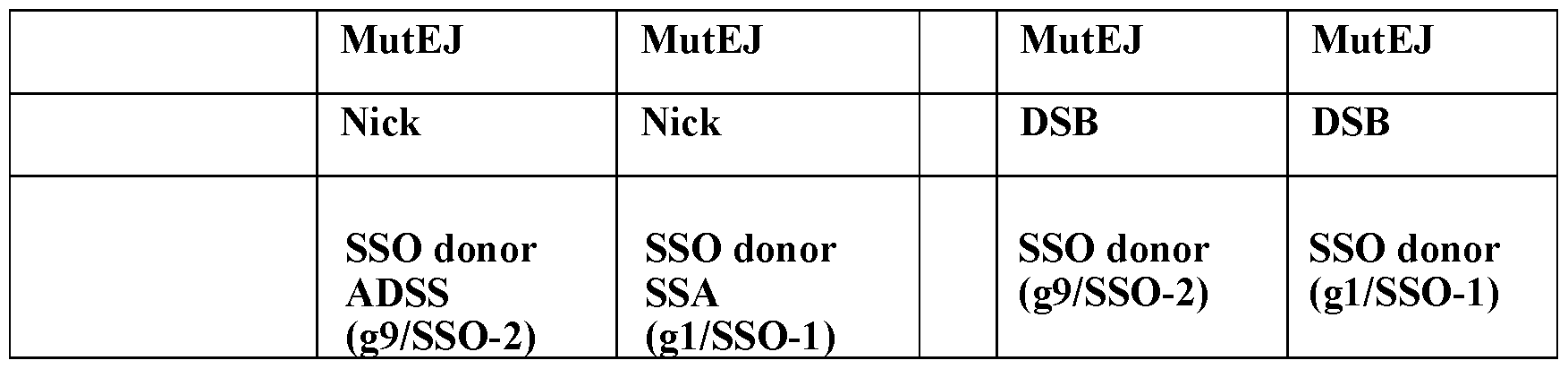
BRC3 0.086 ± 0.007 0.201 ± 0.027 1.09 ± 0.14 2.88 ± 0.06
RAD51K133 0.048 ± 0.008 0.135 ± 0.020 0.49 ± 0.03 1.77 ± 0.11 siRAD51 0.043 ± 0.012 0.077 ± 0.007 0.66 ± 0.06 1.69 ± 0.19 siBRCA2 0.197 ± 0.017 0.320 ± 0.019 0.98 ± 0.10 2.24 ± 0.19 siDSSl 0.144 ± 0.019 0.215 ± 0.020 0.73 ± 0.05 2.00 ± 0.12 siPALB2 0.168 ± 0.017 0.268 ± 0.030 0.77 ± 0.04 2.83 ± 0.07
[000153] RPA is required for HDR at nicks by SSO donors
[000154] RPA coats single -stranded DNA to enable a wide range of nuclear transactions [22, 23] . In canonical HDR at DSBs, ssDNA ends exposed by resection are bound by RPA, then BRCA2 replaces RPA with RAD51, enabling invasion of a duplex DNA donor [4]. To ask if RPA participates in HDR at nicks by SSO donors, HDR frequencies were assayed in cells treated with siRPAl, which targets the largest subunit of the RPA heterotrimer. siRPAl treatment reduced the frequencies of HDR at nicks, as especially evident in cells expressing BRC3 (4.7-fold; p < 0.02; Table 3). siRPAl treatment also reduced frequencies of HDR at DSBs (4.3-fold; p < 0.002; Table 3), as predicted by other results [22, 24]. These results indicate that RPA bound to ssDNA stimulates HDR at nicks by SSO donors.
Table 3: HDR frequencies in cells treated with siRPAl

[000155] HDR at DSBs by SSO donors occurs predominately by annealing-dependent strand synthesis (ADSS)
[000156] SSOs can support HDR at DSBs [25] . To determine if this occurs by pathways related to those that support HDR at nicks, HDR frequencies were compared at DSBs targeted by gl, g2, g8 and g9, and supported by SSO-1 or SSO-2, or by a duplex plasmid DNA donor,
pCVL SFFV dl4GFP (Fig. 3A). The SSO donors supported HDR with frequencies varying over a 15-fold range, from <0.4% (SSO-2 at gl, g2, g8) to > 2% (SSO-1 at gl or g8; SSO-2 at g9). The duplex plasmid donor supported HDR with frequencies varying over a 2.5-fold range, from 2% (g2) to 5% (g9). At any given DSB site, the duplex donor supported somewhat more efficient HDR than either SSO donor, but in no case was the duplex donor more than twice as efficient as the better SSO donor at that site.
[000157] At each site the higher frequency of HDR by SSO donor was associated with the SSO donor that annealed to the free 3' end of the DSB with the least heterology (Fig. 3B). At the four different DSB sites tested, the frequency of HDR supported by the preferred donor decreased as the length of 3' end heterology increased (Fig. 3B). This indicated that SSOs support HDR at DSBs using a pathways analogous to the ADSS pathway used by cN donors at nicks.
[000158] To further test the hypothesis that the ADSS pathway supports HDR at DSBs by SSO's, SSO-3 (Fig. 2A) was used as a repair donor and the frequency with which the Hindlll and Apol polymorphisms appeared among products of HDR at DSBs targeted by gl or g8 was determined. The Hindlll polymorphism in the donor 5' arm was transferred much more frequently than the Apol polymorphism in the 3' arm (gl : 62% vs. 15%; g8: 88% vs. 11%; Fig. 3C). This supports the hypothesis that sequence conversion occurs predominately by the ADSS pathway, in which the 5' arm of the donor SSO anneals to the free 3' end of the cleaved target and is used as a template for repair synthesis (Fig. 3D).
[000159] HDR at DSBs by SSO donors is RAD 51 -independent
[000160] It was next asked if the inhibition by RAD51 of HDR by SSO donors evident at nicks (Table 1) was also evident at DSBs. Frequencies of HDR at DSBs were compared in untreated cells and cells expressing RAD51K133R or BRC3; or treated with siRAD51, siBRCA2, siDSS l or siPALB2. Frequencies of HDR at DSBs by SSO donors ranged from 2.2% to nearly 4%, slightly higher than frequencies of HDR at DSBs with dsDNA donors (Table 4). Surprisingly, frequencies of HDR at DSBs by SSO donors were affected modestly, if at all, by inhibition of RAD51 loading or activity while HDR at DSBs by dsDNA donors was significantly reduced (Table 4). That RAD51 does not inhibit HDR by SSO donors at DSBs as it does at nicks may reflect the distinct structures of the recombination intermediates at nicks and DSBs, as discussed below.
Table 4: HDR frequencies at DSBs by dsDNA and SSO donors

[000161] A novel pathway of HDR, annealing-dependent strand synthesis (ADSS) is defined herein, and it is shown that this pathway promotes HDR by SSO donors at Cas9-targeted nicks and DSBs. The hallmark of this pathway is priming of DNA repair synthesis by the 3' end of the nick or DSB using the SSO as a template. Sequence transfer by the ADSS pathway is therefore unidirectional from the site of the nick or DSB. At nicks, the ADSS pathway supports HDR by SSO donors complementary to the nicked strand. A distinct pathway that transfers sequence to both sides of the nick supports HDR at nicks by SSO donors complementary to the intact strand.
[000162] SSO's represent a valuable alternative to duplex donors for genome engineering applications. They are very convenient to generate, persist for a limited time in the nucleus, and offer the potential of multiplexing targeted mutagenesis. At nicks, use of SSO donors is greatly stimulated by a variety of treatments that inhibit RAD51 activity on DNA. Under these conditions SSO donors support HDR at higher frequencies than duplex plasmid donors. At DSBs, SSOs support HDR by a pathway independent of RAD51/BRCA2, with frequencies about half those of duplex plasmid donors.
[000163] Mechanism-based guidelines for design of SSO donors for HDR
[000164] Guidelines for optimizing design of SSO donors for gene correction at both targeted DSBs and nicks emerge from the pathways outlined in Fig. 1A. Within any region of DNA, possible target sites are limited by the requirement for annealing of the guide RNA adjacent to a PAM site, and the orientation of the PAM site will determine the strand that will
be nicked. Working within those constraints, the mechanisms of the ADSS and cl pathways may further inform target choice, and dictate donor design. At DSBs, HDR is predominately by the ADSS pathway. At nicks, HDR may occur by either the ADSS or cl pathway, which use donors complementary to the nicked or intact strand, respectively.
[000165] The ADSS pathway transfers only sequences from the 5' end of the donor to the target, and requires homology between the 3' end of the target and the SSO donor. The cl pathway transfers both 5' and 3' donor sequences to the target, and is more tolerant of heterology although extensive heterology with the 5' end of the nick does limit HDR. The interaction of Cas9 with its DNA target could also impact the efficiency of HDR by different SSO donors at different target sites. In vitro
analyses show that Cas9 asymmetrically releases cleaved DNA ends at a DSB, as Cas9 interactions with the strand annealed to the guide RNA persist following release of one end of the opposite strand [26]. At Cas9-targeted genomic DSBs, asymmetric strand release might be evident as preferred use of SSO donors complementary to the first strand released. This was not an obvious factor in donor preference in the current experiments: DSBs produced by both gl and g8 gave similarly high frequencies of HDR using SSO-1 despite being oriented to favor release of opposite strands. Cas9D10A nicks the strand annealed to the guide RNA and, in vitro, remains on the nicked strand while releasing the intact strand making it accessible for annealing [26] . Without wishing to be bound by theory, this could indicate that targets nicked by Cas9D10A would be somewhat more permissive for cl than cN donor annealing, but a consistent difference between efficiencies of those donors was observed that could be explained by assymetric release of the target by Cas9D 10A. While dwell times of Cas9 or Cas9D10A on DNA can be influenced by helicases and chromatin remodeling activities in living cells, and rates of release of cleaved target strands may vary between cell types, or even from locus to locus within a given cell type, these data strongly indicate that the primary contribution to HDR efficiency is the relationship between nick (or DSB) site and donor heterology.
[000166] RAD51 may suppress genomic instability at nicks
[000167] The distinct structures of recombination intermediates at nicks and DSBs may explain why RAD51 inhibits HDR by SSO donors at nicks but not DSBs. A DSB undergoes 5 '-3' resection to expose 3' single-stranded tails, RPA binds these single stranded regions, activates the ATR kinase, and then is replaced by RAD51, which is loaded onto DNA by BRCA2 and its accessory factors, including SHFM1 and PALB2. The RAD51-coated
single -stranded 3' tails of a resected DSB (Fig. 4, left) can invade a duplex donor or anneal directly with an SSO donor.
[000168] In contrast to a DSB, a nick does not appear to undergo extensive 5'-3' resection, as suggested by the inhibitory effect of 5' heterology on the use of a cl donor (Fig. 1C). The inhibitory effect of 3' heterology on the use of a cN donor similarly indicates that resection from the 3' end of a nick is limited.
[000169] Rather than resection, a nick may undergo unwinding to expose a single -stranded region 3 ' and/or 5 ' of the nick on the nicked strand, and a gap on the intact. The evidence that either cl or cN donors can support HDR at nicks, albeit with different efficiencies, establishes that either the unwound 3' end of a nick or the gap on the intact strand may be the target for recombination. Exposed single-stranded regions are probably bound by RPA, which is necessary for HDR at nicks (Table 3), which is then replaced by RAD51. Treatments that inhibit RAD51 loading or activity stimulate HDR at nicks by SSO donors, including knockdown of RAD51, BRCA2, SHFM1 or PALB2; upon expression of the BRC3 peptide, which inhibits interaction of RAD51 and BRCA2; or the dominant negative RAD51K133R mutant. This indicates that RAD51 may favor reannealing of the complementary target strands, thus disfavoring HDR by SSO donors (Fig. 4, right).
[000170] These results indicate that one physiological function of RAD51 is to promote reannealing of nicked DNA. RAD51 can also promote ligation [27,28]. Reannealing and re ligation will prevent HDR by SSO donors, and may also prevent other disadvantageous repair events at nicks, such as mutEJ, as indicated by evidence that mutEJ frequencies at nicks (but not DSBs) are elevated when RAD51 activity is reduced (Table 2). This identifies a new and unanticipated role for RAD51 in maintenance of genomic stability, and indicate a new mechanism that promotes genomic instability in tumors deficient in RAD51 or factors that promote RAD51 loading onto DNA.
[000171] METHODS
[000172] Plasmids: The pCas9D10A -T2A-BFP expression plasmid was created by swapping the Spel-Sbfl fragment of pCas9D10A [2], which contains the D10A mutation, into the Spel-Sbfl sites of pCas9(wt)-T2A-mTagBFP.
[000173] Donor oligonucleotide sequences: Sequences of donor oligonucleotides are shown below, with regions that are homologous with the target in upper cases, and regions of heterology in lower case.
The central heterology in all donors but SSO-4 protects them or the converted target from cleavage. SSO-4, which is >96% homologous with the target, was designed to carry a single nt
insertion plus three sequence polymorphisms to protect both the SSO donor and the converted genomic target from cleavage, and these are shown in lowercase.
SSO-1 (SEQ ID NO: 14):
5 ' -CGGTGGTGCAGATGAACTTCAGGGTCAGCTTGCCGTAGGTGgcatcgccctcac cctcGCCGGACACGCTGAACTTGTGGCCGTTTACGTCGCCGTCCA-3'
SSO-2 (SEQ ID NO: 15):
5 ' -TGGACGGCGACGTAAACGGCCACAAGTTCAGCGTGTCCGGCgagggtgagggc gatgcCACCTACGGCAAGCTGACCCTGAAGTTCATCTGCACCACCG-3'
SSO-3 (SEQ ID NO: 16):
5 ' -CGGTGGTGCAGATGAACTTCAGGGTaAGCTTGCCGTAGGTGgcatcgccctcac cctcGCCGGACACGCTGAAtTTGTGGCCGTTTACGTCGCCGTCCA
SSO-4 (SEQ ID NO: 17):
5 ' -CGGTGGTGCAGATGAACTTCAGGGTCAGCTTGCCGTAGGTtAGCTCTTAGC TTTACAGAGAAgACCTgCTCACGGTCcAGGCCGGACACGCTGAACTTGTGG CCGTTTACGTCGCCGTCCA -3'
SSO-4sc (SEQ ID NO: 18):
5 ' -CGGTGGTGCAGATGAACTTCAGGGTCAGCTTGCCGTAGGTtcttcgggtccatatc ccggaaagatgctccagcatgaatGCCGGACACGCTGAACTTGTGGCCGTTTACGTC
GCCGTCCA -3'
[000174] Reporter target and HDR assays: HDR was assayed in populations of human
HEK 293T cells stably transduced with the Traffic Light (TL) reporter, as previously described [2] . The TL reporter [13] bears a defective GFP gene in tandem with an mCherry gene in the +2 reading frame, so neither protein is correctly expressed and cells are GFP-mCherry-. HDR that replaces a 38 bp insertion in the defective GFP gene with 17 nt of heterologous donor sequence will generate a functional GFP gene and GFP+ cells; and HDR that substitutes a sequence bearing a 1 nt insertion enables mCherry™ to be correctly translated, generating mCherry™+ cells. The latter assay permits the use of donors with minimal heterology and takes advantage of the fact that background frequencies of frameshifts caused by targeted nicking of the TL reporter are significantly less than the frequency of HDR in siRAD51 treated cells.
[000175] Cell culture and transfection: The human embryonic kidney cell line
HEK293T were grown at 37°C, 5% CO2 in Dulbecco-modified Eagle's medium (Hyclone) supplemented with 10% fetal bovine serum (Gemini Bio-Products), 200 units/ml penicillin, 200 μg/ml streptomycin (Hyclone) and 2 mM L-glutamine (Hyclone). Transfections were performed using Lipofectamine RNAiMAX (Life Technologies) for siRNA and Lipofectamine LTX (Life Technologies) for plasmids and SSOs according to the manufacturer's protocol. Briefly, on day 0, 293T cells were seeded in a 96-well plate at approximately 4 x 10³ cells per well in 100 μΐ medium. On day 1, to stimulate HDR, canonical HDR was downregulated by transfection with siBRCA2 or siRAD51 (Thermo-Fisher Scientific™; siRNA ID# s2085 and si 1734, respectively); a mixture of 0.125 μΐ RNAiMAX™, 0.5 μΐ of 0.625 μΜ siRNA and 9.875 μΐ of OptiMEM™ (Life Technologies™) was used to transfect each well. On day 2 cells were transfected with expression plasmids and SSO or duplex DNA donors for HDRs, in mixes containing: 30 ng of Cas9 expression plasmid, 15 ng of guide RNA (gRNA) expression plasmid, and 30 ng of pCS14GFP dsDNA plasmid donor (approximately 0.08 pmol) or 2.5 pmol SSO donor and 0.24 μΐ Lipofectamine™ LTX, in 20 μΐ of OptiMEM™, per well. On day 5, cells were collected for analysis.
[000176] Flow cytometry: For flow cytometry analysis, cells from two wells of a 96-well plate were, washed with PBS, trypsinized, pooled, fixed in 2% formaldehyde and analyzed on an LSR II flow cytometer (Becton Dickinson). Typically 50,000 events were gated for linear side scatter and forward scatter to identify cells, and cells gated for linear side scatter height and width to eliminate doublets. In all experiments Cas9 was co-expressed with mTagBFP (BFP) to enable identification of transfectants, and data are presented as GFP+ and mCherry+ frequencies among BFP+ cells. GFP, mCherry, and mTagBFP fluorescence were detected with 488 nm, 561 nm and 406 nm lasers, respectively. Data were analyzed using Flow Jo™ (Tree Star™) and frequencies were transferred to Microsoft Excel. Statistical significance was determined by two-tailed t-test.
[000177] Restriction cut site conversion analysis: Cells were seeded at 6.4 x 10⁴ cells per well, and transfections carried out as above, but scaled up 16-fold; on day 3 cells were expanded into 10 cm plates; and on day 8-10 processed for live cell sorting on a Becton Dickinson Aria II flow cytometer. Sorted cells were cultured for 4-6 days and genomic DNA was prepared (Qiagen™). The region targeted for conversion was PCR-amplified using primers SFFV-F1 ( SEQ ID NO: 19)
(5 ' -CCAAGGACCTGAAATGACC-3 ' ) and oLD7 (SEQ ID NO: 20)
(5 ' -GTCCTCCTTGAAGTCGATGC-3 '), using Taq DNA polymerase and ThermoPol™ buffer (NEB™, Ipswich, MA). Hindlll and Apol digestions were performed directly in the ThermoPol™ buffer and DNA fragments resolved on a 1.5% agarose gel.
S. Pyogenes Cas9 (wt) polypeptide sequence. SEQ ID NO: 4
MDKKYSIGLD IGTNSVGWAV ITDEYKVPSK KFKVLGNTDR HSIKKNLIGA LLFDSGETAE ATRLKRTARR RYTRRKNRIC YLQEIFSNEM AKVDDSFFHR LEESFLVEED KKHERHPIFG NIVDEVAYHE KYPTIYHLRK KLVDSTDKAD LRLIYLALAH MIKFRGHFLI EGDLNPDNSD VDKLFIQLVQ TYNQLFEENP INASGVDAKA ILSARLSKSR RLENLIAQLP GEKKNGLFGN LIALSLGLTP NFKSNFDLAE DAKLQLSKDT YDDDLDNLLA QIGDQYADLF LAAKNLSDAI LLSDILRVNT EITKAPLSAS MIKRYDEHHQ DLTLLKALVR QQLPEKYKEI FFDQSKNGYA GYIDGGASQE EFYKFIKPIL EKMDGTEELL VKLNREDLLR KQRTFDNGSI PHQIHLGELH AILRRQEDFY PFLKDNREKI EKILTFRIPY YVGPLARGNS RFAWMTRKSE ETITPWNFEE VVDKGASAQS FIERMTNFDK NLPNEKVLPK HSLLYEYFTV YNELTKVKYV TEGMRKPAFL SGEQKKAIVD LLFKTNRKVT VKQLKEDYFK KIECFDSVEI SGVEDRFNAS LGTYHDLLKI IKDKDFLDNE ENEDILEDIV LTLTLFEDRE MIEERLKTYA HLFDDKVMKQ LKRRRYTGWG RLSRKLINGI RDKQSGKTIL DFLKSDGFAN RNFMQLIHDD SLTFKEDIQK AQVSGQGDSL HEHIANLAGS PAIKKGILQT VKVVDELVKV MGRHKPENIV IEMARENQTT QKGQKNSRER MKRIEEGIKE LGSQILKEHP VENTQLQNEK LYLYYLQNGR DMYVDQELDI NRLSDYDVDH IVPQSFLKDD SIDNKVLTRS DKNRGKSDNV PSEEVVKKMK NYWRQLLNAK LITQRKFDNL TKAERGGLSE LDKAGFIKRQ LVETRQITKH VAQILDSRMN TKYDENDKLI REVKVITLKS KLVSDFRKDF QFYKVREINN YHHAHDAYLN AVVGTALIKK YPKLESEFVY GDYKVYDVRK MIAKSEQEIG KATAKYFFYS NIMNFFKTEI TLANGEIRKR PLIETNGETG EIVWDKGRDF ATVRKVLSMP QVNIVKKTEV QTGGFSKESI LPKRNSDKLI ARKKDWDPKK YGGFDSPTVA YSVLVVAKVE KGKSKKLKSV KELLGITIME RSSFEKNPID FLEAKGYKEV KKDLIIKLPK YSLFELENGR KRMLASAGEL QKGNELALPS KYVNFLYLAS HYEKLKGSPE DNEQKQLFVE QHKHYLDEII EQISEFSKRV ILADANLDKV LSAYNKHRDK PIREQAENII HLFTLTNLGA PAAFKYFDTT IDRKRYTSTK EVLDATLIHQ SITGLYETRI DLSQLGGD
REFERENCES
1. Davis, L. and N. Maizels, DNA nicks promote efficient and safe targeted gene correction. PLoS One, 2011. 6(9): p. e23981.
2. Davis, L. and N. Maizels, Homology-directed repair of DNA nicks via pathways distinct from canonical double-strand break repair. Proc Natl Acad Sci U S A, 2014. 111 : p. E924-32.
3. Heyer, W.D., K.T. Ehmsen, and J. Liu, Regulation of homologous recombination in eukaryotes. Annu Rev Genet, 2010. 44: p. 113-39.
4. Symington, L.S. and J. Gautier, Double-strand break end resection and repair pathway choice. Annu Rev Genet, 2011. 45: p. 247-71.
5. Cong, L., et al., Multiplex genome engineering using CRISPR/Cas systems. Science, 2013. 339(6121): p. 819-23.
6. Gasiunas, G., et al., Cas9-crRNA ribonucleoprotein complex mediates specific DNA cleavage for adaptive immunity in bacteria. Proc Natl Acad Sci U S A, 2012. 109(39): p. E2579-86.
7. Jinek, M., et al., A programmable dual-RNA-guided DNA endonuclease in adaptive bacterial immunity. Science, 2012. 337(6096): p. 816-21.
8. Mali, P., et al, RNA-guided human genome engineering via Cas9. Science, 2013. 339(6121): p. 823-6.
9. Davies, A.A., et al., Role of BRCA2 in control of the RAD51 recombination and DNA repair protein. Mol Cell, 2001. 7(2): p. 273-82.
10. Chi, P., et al., Roles of ATP binding and ATP hydrolysis in human Rad51 recombinase function. DNA Repair (Amst), 2006. 5(3): p. 381-91.
11. Stark, J.M., et al., ATP hydrolysis by mammalian RAD51 has a key role during homology-directed DNA repair. J Biol Chem, 2002. 277(23): p.20185-94.
12. Radecke, S., et al., Physical incorporation of a single -stranded oligodeoxynucleotide during targeted repair of a human chromosomal locus. J Gene Med, 2006. 8(2): p. 217-28.
13. Certo, M.T., et al., Tracking genome engineering outcome at individual DNA breakpoints. Nat Methods, 2011. 8(8): p. 671-6.
14. Saeki, H., et al, Suppression of the DNA repair defects of BRCA2 -deficient cells with heterologous protein fusions. Proc Natl Acad Sci U SA, 2006. 103(23): p. 8768-73.
15. Stark, J.M., et al., Genetic steps of mammalian homologous repair with distinct mutagenic consequences. Mol Cell Biol, 2004. 24(21): p. 9305-16.
16. Prakash, R., et al, Homologous recombination and human health: the roles of BRCA1, BRCA2, and associated proteins. Cold Spring Harb Perspect Biol, 2015. 7(4): p. aO 16600.
17. Schlacher, K., et al, Double-strand break repair-independent role for BRCA2 in blocking stalled replication fork degradation by MRE11. Cell, 2011. 145(4): p. 529-42.
18. Higgs, M.R., et al., BOD1L Is Required to Suppress Deleterious Resection of Stressed Replication Forks. Mol Cell, 2015. 59(3): p. 462-77.
19. Yata, K., et al., BRCA2 coordinates the activities of cell-cycle kinases to promote genome stability. Cell Rep, 2014. 7(5): p. 1547-59.
20. Vallerga, M.B., et al, Rad51 recombinase prevents Mrel 1 nuclease-dependent degradation and excessive PrimPol-mediated elongation of nascent DNA after UV irradiation. Proc Natl Acad Sci U S A, 2015. 112(48): p. E6624-33.
21. Wang, A.T., et al., A Dominant Mutation in Human RAD51 Reveals Its Function in DNA Interstrand Crosslink Repair Independent of Homologous Recombination. Mol Cell, 2015. 59(3): p. 78-90.
22. Chen, R. and M.S. Wold, Replication protein A: single-stranded DNA's first responder: dynamic DNA-interactions allow replication protein A to direct single-strand DNA intermediates into different pathways for synthesis or repair. Bioessays, 2014. 36(12): p. 1156-61.
23. Deng, S.K., H. Chen, and L.S. Symington, Replication protein A prevents promiscuous annealing between short sequence homologies: Implications for genome integrity. Bioessays, 2015. 37(3): p. 305-13.
24. Wang, X. and J.E. Haber, Role of Saccharomyces single-stranded DNA-binding protein RPA in the strand invasion step of double-strand break repair. PLoS Biol, 2004. 2(1): p. E21.
25. Chen, F., et al., High-frequency genome editing using ssDNA oligonucleotides with zinc-finger nucleases. Nat Methods, 2011. 8(9): p.753-5.
26. Richardson, CD., et al., Enhancing homology -directed genome editing by catalytically active and inactive CRISPR-Cas9 using asymmetric donor DNA. Nat Biotechnol, 2016. 34(3): p. 339-44.
27. Baumann, P., F.E. Benson, and S.C. West, Human Rad51 protein promotes ATP -dependent homologous pairing and strand transfer reactions in vitro. Cell, 1996. 87(4): p. 757-66.
28. Bogliolo, M., et al, Reduced ligation during DNA base excision repair supported by BRCA2 mutant cells. Oncogene, 2000. 19(50): p. 5781-7.
29. Meers C et al., DNA repair by RNA: Templated, or not templated, that is the question. DNA Repair (Amst). 2016 May 16. pii: S1568-7864(16)30080-5.
30. Keskin H et al., Transcript-RNA-templated DNA recombination and repair. Nature. 2014 Nov 20;515(7527):436-9.
31. Storici F et al. RNA-templated DNA repair. Nature. 2007 May 17;447(7142):338-41.
Claims
1. A method of making a single -stranded donor nucleic acid for homology-directed modification of a genomic nucleic acid at a sequence of interest in a reaction involving a directed nicking enzyme that generates a nicked strand and an intact strand at a directed site in or adjacent to the sequence of interest, the method comprising:
a) synthesizing a single-stranded donor nucleic acid comprising a target-homologous sequence element and a gene modification sequence element, wherein the target-homologous sequence element of the donor hybridizes to the nicked strand bearing the 3' end of the nick and the gene modification sequence element of the donor is exclusively 3 ' of the nick when the target-homologous sequence element of the donor nucleic acid is hybridized to the nicked strand; or
b) synthesizing a single -stranded donor nucleic acid comprising a target-homologous sequence element and a gene modification sequence element, wherein the target-homologous sequence element of the donor hybridizes to the intact strand and wherein the gene modification sequence of the donor can be on either or both sides of the nick when the target-homologous sequence element of the donor is hybridized to the intact strand.
2. A method of homology-directed modification of a genomic nucleic acid at a sequence of interest, the method comprising:
a) making a single stranded donor nucleic acid according to the method of claim 1 ; and b) contacting a genomic target nucleic acid in a cell with:
i) said single-stranded donor nucleic acid; and
ii) a nicking enzyme that generates a nicked strand and an intact strand at a directed site in or adjacent to the sequence of interest;
wherein the single-stranded donor replaces the genomic nucleic acid sequence at the sequence of interest via homology-directed repair, thereby effecting homology-directed modification of the genomic sequence at the sequence of interest.
3. The method of claim 2, further comprising contacting the cell with an inhibitor of one or more of RAD51, BRCA2, PALB2 and SHFM1.
4. The method of claim 2, further comprising contacting the cell with an agonist of BRCA1.
5. The method of claim 2, further comprising contacting the cell with an inhibitor of one or more of RAD51, BRCA2, PALB2 and SHFM1 and with an agonist of BRCA1.
6. The method of claim 2 wherein the target-homologous sequence element of the single -stranded donor hybridizes to the nicked strand bearing the 3' end of the nick and homology directed gene modification efficiency using the single-stranded donor is at least 2-fold greater than when the gene modification sequence element is not exclusively 3 ' of the nick.
7. The method of claim 2, wherein the target-homologous sequence element of the donor hybridizes to the intact strand and wherein the donor heterology relative to sequence on the 5 ' side of the nick is less than 7 nucleotides.
8. The method of claim 2, wherein the level or activity of RAD51 is reduced or inhibited to increase frequencies of HDR.
9. The method of claim 2, further comprising contacting the cell with an agonist of BRCA1.
10. The method of claim 2, wherein the nicking enzyme is nicking variant of a Cas enzyme.
11. The method of claim 10, wherein the Cas enzyme variant is a Cas9 enzyme variant.
12. The method of claim 11, wherein the Cas9 enzyme variant is S. pyogenes Cas9D10A .
13. The method of claim 10, wherein the Cas enzyme variant has a mutation at a site selected from polypeptide sites corresponding to D10, H840, N854, and N863 of the mature Cas9 polypeptide of S. pyogenes.
14. The method of claim 13, wherein the Cas enzyme variant has a mutation corresponding to a mutation selected from D10A, H840A, N854A and N863A ofS. Pyogenes Cas9.
15. The method of claim 2, wherein the homology-directed modification comprises a deletion of nucleic acid sequence.
Applications Claiming Priority (2)
| Application Number | Priority Date | Filing Date | Title |
|---|---|---|---|
| US201562194049P | 2015-07-17 | 2015-07-17 | |
| US62/194,049 | 2015-07-17 |
Publications (1)
| Publication Number | Publication Date |
|---|---|
| WO2017015101A1 true WO2017015101A1 (en) | 2017-01-26 |
Family
ID=57834494
Family Applications (1)
| Application Number | Title | Priority Date | Filing Date |
|---|---|---|---|
| PCT/US2016/042463 Ceased WO2017015101A1 (en) | 2015-07-17 | 2016-07-15 | Methods for maximizing the efficiency of targeted gene correction |
Country Status (1)
| Country | Link |
|---|---|
| WO (1) | WO2017015101A1 (en) |
Cited By (41)
| Publication number | Priority date | Publication date | Assignee | Title |
|---|---|---|---|---|
| US9999671B2 (en) | 2013-09-06 | 2018-06-19 | President And Fellows Of Harvard College | Delivery of negatively charged proteins using cationic lipids |
| US10077453B2 (en) | 2014-07-30 | 2018-09-18 | President And Fellows Of Harvard College | CAS9 proteins including ligand-dependent inteins |
| US10113163B2 (en) | 2016-08-03 | 2018-10-30 | President And Fellows Of Harvard College | Adenosine nucleobase editors and uses thereof |
| US10167457B2 (en) | 2015-10-23 | 2019-01-01 | President And Fellows Of Harvard College | Nucleobase editors and uses thereof |
| US10323236B2 (en) | 2011-07-22 | 2019-06-18 | President And Fellows Of Harvard College | Evaluation and improvement of nuclease cleavage specificity |
| WO2019157326A1 (en) | 2018-02-08 | 2019-08-15 | Zymergen Inc. | Genome editing using crispr in corynebacterium |
| US10465176B2 (en) | 2013-12-12 | 2019-11-05 | President And Fellows Of Harvard College | Cas variants for gene editing |
| US10508298B2 (en) | 2013-08-09 | 2019-12-17 | President And Fellows Of Harvard College | Methods for identifying a target site of a CAS9 nuclease |
| WO2020047344A1 (en) * | 2018-08-31 | 2020-03-05 | Yale University | Compositions and methods for enhancing donor oligonucleotide-based gene editing |
| US10597679B2 (en) | 2013-09-06 | 2020-03-24 | President And Fellows Of Harvard College | Switchable Cas9 nucleases and uses thereof |
| US10745677B2 (en) | 2016-12-23 | 2020-08-18 | President And Fellows Of Harvard College | Editing of CCR5 receptor gene to protect against HIV infection |
| US10858639B2 (en) | 2013-09-06 | 2020-12-08 | President And Fellows Of Harvard College | CAS9 variants and uses thereof |
| CN112912502A (en) * | 2018-08-31 | 2021-06-04 | 耶鲁大学 | Compositions and methods for enhancing triplex- and nuclease-based gene editing |
| US11046948B2 (en) | 2013-08-22 | 2021-06-29 | President And Fellows Of Harvard College | Engineered transcription activator-like effector (TALE) domains and uses thereof |
| US11236313B2 (en) | 2016-04-13 | 2022-02-01 | Editas Medicine, Inc. | Cas9 fusion molecules, gene editing systems, and methods of use thereof |
| US11268082B2 (en) | 2017-03-23 | 2022-03-08 | President And Fellows Of Harvard College | Nucleobase editors comprising nucleic acid programmable DNA binding proteins |
| US11306324B2 (en) | 2016-10-14 | 2022-04-19 | President And Fellows Of Harvard College | AAV delivery of nucleobase editors |
| US11319532B2 (en) | 2017-08-30 | 2022-05-03 | President And Fellows Of Harvard College | High efficiency base editors comprising Gam |
| US11447770B1 (en) | 2019-03-19 | 2022-09-20 | The Broad Institute, Inc. | Methods and compositions for prime editing nucleotide sequences |
| US11542509B2 (en) | 2016-08-24 | 2023-01-03 | President And Fellows Of Harvard College | Incorporation of unnatural amino acids into proteins using base editing |
| US11542496B2 (en) | 2017-03-10 | 2023-01-03 | President And Fellows Of Harvard College | Cytosine to guanine base editor |
| US11560566B2 (en) | 2017-05-12 | 2023-01-24 | President And Fellows Of Harvard College | Aptazyme-embedded guide RNAs for use with CRISPR-Cas9 in genome editing and transcriptional activation |
| US11597924B2 (en) | 2016-03-25 | 2023-03-07 | Editas Medicine, Inc. | Genome editing systems comprising repair-modulating enzyme molecules and methods of their use |
| US11661590B2 (en) | 2016-08-09 | 2023-05-30 | President And Fellows Of Harvard College | Programmable CAS9-recombinase fusion proteins and uses thereof |
| US11667911B2 (en) | 2015-09-24 | 2023-06-06 | Editas Medicine, Inc. | Use of exonucleases to improve CRISPR/CAS-mediated genome editing |
| US11680268B2 (en) | 2014-11-07 | 2023-06-20 | Editas Medicine, Inc. | Methods for improving CRISPR/Cas-mediated genome-editing |
| US11732274B2 (en) | 2017-07-28 | 2023-08-22 | President And Fellows Of Harvard College | Methods and compositions for evolving base editors using phage-assisted continuous evolution (PACE) |
| US11795443B2 (en) | 2017-10-16 | 2023-10-24 | The Broad Institute, Inc. | Uses of adenosine base editors |
| US11850284B2 (en) | 2019-08-30 | 2023-12-26 | Yale University | Compositions and methods for delivery of nucleic acids to cells |
| US11866726B2 (en) | 2017-07-14 | 2024-01-09 | Editas Medicine, Inc. | Systems and methods for targeted integration and genome editing and detection thereof using integrated priming sites |
| US11898179B2 (en) | 2017-03-09 | 2024-02-13 | President And Fellows Of Harvard College | Suppression of pain by gene editing |
| US11912985B2 (en) | 2020-05-08 | 2024-02-27 | The Broad Institute, Inc. | Methods and compositions for simultaneous editing of both strands of a target double-stranded nucleotide sequence |
| US12157760B2 (en) | 2018-05-23 | 2024-12-03 | The Broad Institute, Inc. | Base editors and uses thereof |
| US12201699B2 (en) | 2014-10-10 | 2025-01-21 | Editas Medicine, Inc. | Compositions and methods for promoting homology directed repair |
| US12281338B2 (en) | 2018-10-29 | 2025-04-22 | The Broad Institute, Inc. | Nucleobase editors comprising GeoCas9 and uses thereof |
| US12351837B2 (en) | 2019-01-23 | 2025-07-08 | The Broad Institute, Inc. | Supernegatively charged proteins and uses thereof |
| US12390514B2 (en) | 2017-03-09 | 2025-08-19 | President And Fellows Of Harvard College | Cancer vaccine |
| US12406749B2 (en) | 2017-12-15 | 2025-09-02 | The Broad Institute, Inc. | Systems and methods for predicting repair outcomes in genetic engineering |
| US12435330B2 (en) | 2019-10-10 | 2025-10-07 | The Broad Institute, Inc. | Methods and compositions for prime editing RNA |
| US12473543B2 (en) | 2019-04-17 | 2025-11-18 | The Broad Institute, Inc. | Adenine base editors with reduced off-target effects |
| US12522807B2 (en) | 2018-07-09 | 2026-01-13 | The Broad Institute, Inc. | RNA programmable epigenetic RNA modifiers and uses thereof |
Citations (5)
| Publication number | Priority date | Publication date | Assignee | Title |
|---|---|---|---|---|
| US20140068797A1 (en) * | 2012-05-25 | 2014-03-06 | University Of Vienna | Methods and compositions for rna-directed target dna modification and for rna-directed modulation of transcription |
| US20140170753A1 (en) * | 2012-12-12 | 2014-06-19 | Massachusetts Institute Of Technology | Crispr-cas systems and methods for altering expression of gene products |
| WO2014172458A1 (en) * | 2013-04-16 | 2014-10-23 | University Of Washington Through Its Center For Commercialization | Activating an alternative pathway for homology-directed repair to stimulate targeted gene correction and genome engineering |
| US20140357530A1 (en) * | 2012-12-12 | 2014-12-04 | The Broad Institute Inc. | Functional genomics using crispr-cas systems, compositions, methods, knock out libraries and applications thereof |
| WO2015070083A1 (en) * | 2013-11-07 | 2015-05-14 | Editas Medicine,Inc. | CRISPR-RELATED METHODS AND COMPOSITIONS WITH GOVERNING gRNAS |
-
2016
- 2016-07-15 WO PCT/US2016/042463 patent/WO2017015101A1/en not_active Ceased
Patent Citations (5)
| Publication number | Priority date | Publication date | Assignee | Title |
|---|---|---|---|---|
| US20140068797A1 (en) * | 2012-05-25 | 2014-03-06 | University Of Vienna | Methods and compositions for rna-directed target dna modification and for rna-directed modulation of transcription |
| US20140170753A1 (en) * | 2012-12-12 | 2014-06-19 | Massachusetts Institute Of Technology | Crispr-cas systems and methods for altering expression of gene products |
| US20140357530A1 (en) * | 2012-12-12 | 2014-12-04 | The Broad Institute Inc. | Functional genomics using crispr-cas systems, compositions, methods, knock out libraries and applications thereof |
| WO2014172458A1 (en) * | 2013-04-16 | 2014-10-23 | University Of Washington Through Its Center For Commercialization | Activating an alternative pathway for homology-directed repair to stimulate targeted gene correction and genome engineering |
| WO2015070083A1 (en) * | 2013-11-07 | 2015-05-14 | Editas Medicine,Inc. | CRISPR-RELATED METHODS AND COMPOSITIONS WITH GOVERNING gRNAS |
Cited By (80)
| Publication number | Priority date | Publication date | Assignee | Title |
|---|---|---|---|---|
| US10323236B2 (en) | 2011-07-22 | 2019-06-18 | President And Fellows Of Harvard College | Evaluation and improvement of nuclease cleavage specificity |
| US12006520B2 (en) | 2011-07-22 | 2024-06-11 | President And Fellows Of Harvard College | Evaluation and improvement of nuclease cleavage specificity |
| US10508298B2 (en) | 2013-08-09 | 2019-12-17 | President And Fellows Of Harvard College | Methods for identifying a target site of a CAS9 nuclease |
| US10954548B2 (en) | 2013-08-09 | 2021-03-23 | President And Fellows Of Harvard College | Nuclease profiling system |
| US11920181B2 (en) | 2013-08-09 | 2024-03-05 | President And Fellows Of Harvard College | Nuclease profiling system |
| US11046948B2 (en) | 2013-08-22 | 2021-06-29 | President And Fellows Of Harvard College | Engineered transcription activator-like effector (TALE) domains and uses thereof |
| US10858639B2 (en) | 2013-09-06 | 2020-12-08 | President And Fellows Of Harvard College | CAS9 variants and uses thereof |
| US12473573B2 (en) | 2013-09-06 | 2025-11-18 | President And Fellows Of Harvard College | Switchable Cas9 nucleases and uses thereof |
| US11299755B2 (en) | 2013-09-06 | 2022-04-12 | President And Fellows Of Harvard College | Switchable CAS9 nucleases and uses thereof |
| US9999671B2 (en) | 2013-09-06 | 2018-06-19 | President And Fellows Of Harvard College | Delivery of negatively charged proteins using cationic lipids |
| US10597679B2 (en) | 2013-09-06 | 2020-03-24 | President And Fellows Of Harvard College | Switchable Cas9 nucleases and uses thereof |
| US10682410B2 (en) | 2013-09-06 | 2020-06-16 | President And Fellows Of Harvard College | Delivery system for functional nucleases |
| US10912833B2 (en) | 2013-09-06 | 2021-02-09 | President And Fellows Of Harvard College | Delivery of negatively charged proteins using cationic lipids |
| US10465176B2 (en) | 2013-12-12 | 2019-11-05 | President And Fellows Of Harvard College | Cas variants for gene editing |
| US12215365B2 (en) | 2013-12-12 | 2025-02-04 | President And Fellows Of Harvard College | Cas variants for gene editing |
| US11053481B2 (en) | 2013-12-12 | 2021-07-06 | President And Fellows Of Harvard College | Fusions of Cas9 domains and nucleic acid-editing domains |
| US11124782B2 (en) | 2013-12-12 | 2021-09-21 | President And Fellows Of Harvard College | Cas variants for gene editing |
| US10077453B2 (en) | 2014-07-30 | 2018-09-18 | President And Fellows Of Harvard College | CAS9 proteins including ligand-dependent inteins |
| US11578343B2 (en) | 2014-07-30 | 2023-02-14 | President And Fellows Of Harvard College | CAS9 proteins including ligand-dependent inteins |
| US10704062B2 (en) | 2014-07-30 | 2020-07-07 | President And Fellows Of Harvard College | CAS9 proteins including ligand-dependent inteins |
| US12398406B2 (en) | 2014-07-30 | 2025-08-26 | President And Fellows Of Harvard College | CAS9 proteins including ligand-dependent inteins |
| US12201699B2 (en) | 2014-10-10 | 2025-01-21 | Editas Medicine, Inc. | Compositions and methods for promoting homology directed repair |
| US11680268B2 (en) | 2014-11-07 | 2023-06-20 | Editas Medicine, Inc. | Methods for improving CRISPR/Cas-mediated genome-editing |
| US11667911B2 (en) | 2015-09-24 | 2023-06-06 | Editas Medicine, Inc. | Use of exonucleases to improve CRISPR/CAS-mediated genome editing |
| US11214780B2 (en) | 2015-10-23 | 2022-01-04 | President And Fellows Of Harvard College | Nucleobase editors and uses thereof |
| US12043852B2 (en) | 2015-10-23 | 2024-07-23 | President And Fellows Of Harvard College | Evolved Cas9 proteins for gene editing |
| US12344869B2 (en) | 2015-10-23 | 2025-07-01 | President And Fellows Of Harvard College | Nucleobase editors and uses thereof |
| US10167457B2 (en) | 2015-10-23 | 2019-01-01 | President And Fellows Of Harvard College | Nucleobase editors and uses thereof |
| US11597924B2 (en) | 2016-03-25 | 2023-03-07 | Editas Medicine, Inc. | Genome editing systems comprising repair-modulating enzyme molecules and methods of their use |
| US11236313B2 (en) | 2016-04-13 | 2022-02-01 | Editas Medicine, Inc. | Cas9 fusion molecules, gene editing systems, and methods of use thereof |
| US12049651B2 (en) | 2016-04-13 | 2024-07-30 | Editas Medicine, Inc. | Cas9 fusion molecules, gene editing systems, and methods of use thereof |
| US11702651B2 (en) | 2016-08-03 | 2023-07-18 | President And Fellows Of Harvard College | Adenosine nucleobase editors and uses thereof |
| US10113163B2 (en) | 2016-08-03 | 2018-10-30 | President And Fellows Of Harvard College | Adenosine nucleobase editors and uses thereof |
| US10947530B2 (en) | 2016-08-03 | 2021-03-16 | President And Fellows Of Harvard College | Adenosine nucleobase editors and uses thereof |
| US11999947B2 (en) | 2016-08-03 | 2024-06-04 | President And Fellows Of Harvard College | Adenosine nucleobase editors and uses thereof |
| US11661590B2 (en) | 2016-08-09 | 2023-05-30 | President And Fellows Of Harvard College | Programmable CAS9-recombinase fusion proteins and uses thereof |
| US11542509B2 (en) | 2016-08-24 | 2023-01-03 | President And Fellows Of Harvard College | Incorporation of unnatural amino acids into proteins using base editing |
| US12084663B2 (en) | 2016-08-24 | 2024-09-10 | President And Fellows Of Harvard College | Incorporation of unnatural amino acids into proteins using base editing |
| US11306324B2 (en) | 2016-10-14 | 2022-04-19 | President And Fellows Of Harvard College | AAV delivery of nucleobase editors |
| US11820969B2 (en) | 2016-12-23 | 2023-11-21 | President And Fellows Of Harvard College | Editing of CCR2 receptor gene to protect against HIV infection |
| US10745677B2 (en) | 2016-12-23 | 2020-08-18 | President And Fellows Of Harvard College | Editing of CCR5 receptor gene to protect against HIV infection |
| US12390514B2 (en) | 2017-03-09 | 2025-08-19 | President And Fellows Of Harvard College | Cancer vaccine |
| US11898179B2 (en) | 2017-03-09 | 2024-02-13 | President And Fellows Of Harvard College | Suppression of pain by gene editing |
| US12516308B2 (en) | 2017-03-09 | 2026-01-06 | President And Fellows Of Harvard College | Suppression of pain by gene editing |
| US12435331B2 (en) | 2017-03-10 | 2025-10-07 | President And Fellows Of Harvard College | Cytosine to guanine base editor |
| US11542496B2 (en) | 2017-03-10 | 2023-01-03 | President And Fellows Of Harvard College | Cytosine to guanine base editor |
| US11268082B2 (en) | 2017-03-23 | 2022-03-08 | President And Fellows Of Harvard College | Nucleobase editors comprising nucleic acid programmable DNA binding proteins |
| US11560566B2 (en) | 2017-05-12 | 2023-01-24 | President And Fellows Of Harvard College | Aptazyme-embedded guide RNAs for use with CRISPR-Cas9 in genome editing and transcriptional activation |
| US11866726B2 (en) | 2017-07-14 | 2024-01-09 | Editas Medicine, Inc. | Systems and methods for targeted integration and genome editing and detection thereof using integrated priming sites |
| US11732274B2 (en) | 2017-07-28 | 2023-08-22 | President And Fellows Of Harvard College | Methods and compositions for evolving base editors using phage-assisted continuous evolution (PACE) |
| US12359218B2 (en) | 2017-07-28 | 2025-07-15 | President And Fellows Of Harvard College | Methods and compositions for evolving base editors using phage-assisted continuous evolution (PACE) |
| US11319532B2 (en) | 2017-08-30 | 2022-05-03 | President And Fellows Of Harvard College | High efficiency base editors comprising Gam |
| US11932884B2 (en) | 2017-08-30 | 2024-03-19 | President And Fellows Of Harvard College | High efficiency base editors comprising Gam |
| US11795443B2 (en) | 2017-10-16 | 2023-10-24 | The Broad Institute, Inc. | Uses of adenosine base editors |
| US12406749B2 (en) | 2017-12-15 | 2025-09-02 | The Broad Institute, Inc. | Systems and methods for predicting repair outcomes in genetic engineering |
| WO2019157326A1 (en) | 2018-02-08 | 2019-08-15 | Zymergen Inc. | Genome editing using crispr in corynebacterium |
| US12157760B2 (en) | 2018-05-23 | 2024-12-03 | The Broad Institute, Inc. | Base editors and uses thereof |
| US12522807B2 (en) | 2018-07-09 | 2026-01-13 | The Broad Institute, Inc. | RNA programmable epigenetic RNA modifiers and uses thereof |
| EP3844275A1 (en) * | 2018-08-31 | 2021-07-07 | Yale University | Compositions and methods for enhancing triplex and nuclease-based gene editing |
| CN112912502A (en) * | 2018-08-31 | 2021-06-04 | 耶鲁大学 | Compositions and methods for enhancing triplex- and nuclease-based gene editing |
| JP7570106B2 (en) | 2018-08-31 | 2024-10-21 | イェール ユニバーシティー | Compositions and methods for enhancing triplex and nuclease-based gene editing |
| US12441814B2 (en) | 2018-08-31 | 2025-10-14 | Yale University | Compositions and methods for enhancing donor oligonucleotide-based gene editing |
| CN112930399A (en) * | 2018-08-31 | 2021-06-08 | 耶鲁大学 | Compositions and methods for enhancing donor oligonucleotide-based gene editing |
| JP2021534788A (en) * | 2018-08-31 | 2021-12-16 | イェール ユニバーシティーYale University | Compositions and Methods for Enhancing Triple Chain and nuclease-Based Gene Editing |
| WO2020047344A1 (en) * | 2018-08-31 | 2020-03-05 | Yale University | Compositions and methods for enhancing donor oligonucleotide-based gene editing |
| US12281338B2 (en) | 2018-10-29 | 2025-04-22 | The Broad Institute, Inc. | Nucleobase editors comprising GeoCas9 and uses thereof |
| US12351837B2 (en) | 2019-01-23 | 2025-07-08 | The Broad Institute, Inc. | Supernegatively charged proteins and uses thereof |
| US11447770B1 (en) | 2019-03-19 | 2022-09-20 | The Broad Institute, Inc. | Methods and compositions for prime editing nucleotide sequences |
| US11795452B2 (en) | 2019-03-19 | 2023-10-24 | The Broad Institute, Inc. | Methods and compositions for prime editing nucleotide sequences |
| US12281303B2 (en) | 2019-03-19 | 2025-04-22 | The Broad Institute, Inc. | Methods and compositions for prime editing nucleotide sequences |
| US11643652B2 (en) | 2019-03-19 | 2023-05-09 | The Broad Institute, Inc. | Methods and compositions for prime editing nucleotide sequences |
| US12509680B2 (en) | 2019-03-19 | 2025-12-30 | The Broad Institute, Inc. | Methods and compositions for prime editing nucleotide sequences |
| US12473543B2 (en) | 2019-04-17 | 2025-11-18 | The Broad Institute, Inc. | Adenine base editors with reduced off-target effects |
| US12005121B2 (en) | 2019-08-30 | 2024-06-11 | Yale University | Compositions and methods for delivery of nucleic acids to cells |
| US11872286B2 (en) | 2019-08-30 | 2024-01-16 | Yale University | Compositions and methods for delivery of nucleic acids to cells |
| US12485180B2 (en) | 2019-08-30 | 2025-12-02 | Yale University | Compositions and methods for delivery of nucleic acids to cells |
| US11850284B2 (en) | 2019-08-30 | 2023-12-26 | Yale University | Compositions and methods for delivery of nucleic acids to cells |
| US12435330B2 (en) | 2019-10-10 | 2025-10-07 | The Broad Institute, Inc. | Methods and compositions for prime editing RNA |
| US11912985B2 (en) | 2020-05-08 | 2024-02-27 | The Broad Institute, Inc. | Methods and compositions for simultaneous editing of both strands of a target double-stranded nucleotide sequence |
| US12031126B2 (en) | 2020-05-08 | 2024-07-09 | The Broad Institute, Inc. | Methods and compositions for simultaneous editing of both strands of a target double-stranded nucleotide sequence |
Similar Documents
| Publication | Publication Date | Title |
|---|---|---|
| WO2017015101A1 (en) | Methods for maximizing the efficiency of targeted gene correction | |
| JP7431891B2 (en) | High-specificity genome editing using chemically modified guide RNAs | |
| US20230365951A1 (en) | Tracking and Manipulating Cellular RNA via Nuclear Delivery of CRISPR/CAS9 | |
| EP3765616B1 (en) | Novel crispr dna and rna targeting enzymes and systems | |
| JP2024116275A (en) | Lentiviral-Based Vectors for Eukaryotic Gene Editing and Related Systems and Methods | |
| JP2021118714A (en) | CRISPR-based compositions and methods of use | |
| JP2023022254A (en) | Crispr/cpf1 systems and methods | |
| KR20220004674A (en) | Methods and compositions for editing RNA | |
| US20160264934A1 (en) | METHODS FOR MODULATING AND ASSAYING m6A IN STEM CELL POPULATIONS | |
| CA3026110A1 (en) | Novel crispr enzymes and systems | |
| CA3072610A1 (en) | Rna targeting methods and compositions | |
| JP2020534812A (en) | Methods for improved homologous recombination and compositions thereof | |
| KR20230162134A (en) | Methods for increasing the efficiency of homology directed repair (hdr) in the cellular genome | |
| WO2017137768A1 (en) | Replicative transposon system | |
| US20230046668A1 (en) | Targeted integration in mammalian sequences enhancing gene expression | |
| WO2016149612A2 (en) | Assay for telomere length regulators | |
| US20230340437A1 (en) | Modified nucleases | |
| Chakraborty et al. | Combination of engineered FnCas9 and extended gRNAs for PAM-flexible, robust and nucleobase specific editing and diagnostics | |
| Elguindy | Regulation of Pumilio RNA Binding Proteins by Long Noncoding RNA NORAD | |
| Cherney | Recruitment of PRC2 by lncRNAs | |
| Darwish | Determining the role of inverted repeat sequences in the 3’UTR of MDM2 | |
| Chang | A Programable CRISPR System to Methylate and Demethylate N6-Methlyadenosine on Specific Transcripts in Mammalian Cells | |
| WO2025160115A1 (en) | Inhibition of nhej, mmej, and 53bp1 promotes high levels of hdr | |
| WO2023086026A2 (en) | Method and composition for inhibiting telomerase activity | |
| WO2025216732A1 (en) | Methods and compositions relating to ecdna biogenesis |
Legal Events
| Date | Code | Title | Description |
|---|---|---|---|
| 121 | Ep: the epo has been informed by wipo that ep was designated in this application |
Ref document number: 16828298 Country of ref document: EP Kind code of ref document: A1 |
|
| NENP | Non-entry into the national phase |
Ref country code: DE |
|
| 122 | Ep: pct application non-entry in european phase |
Ref document number: 16828298 Country of ref document: EP Kind code of ref document: A1 |