WO2017009744A1 - Flooring board with a thin veneer wood aesthetic and durable surface - Google Patents
Flooring board with a thin veneer wood aesthetic and durable surface Download PDFInfo
- Publication number
- WO2017009744A1 WO2017009744A1 PCT/IB2016/054056 IB2016054056W WO2017009744A1 WO 2017009744 A1 WO2017009744 A1 WO 2017009744A1 IB 2016054056 W IB2016054056 W IB 2016054056W WO 2017009744 A1 WO2017009744 A1 WO 2017009744A1
- Authority
- WO
- WIPO (PCT)
- Prior art keywords
- flooring board
- janka
- flooring
- layer
- hardness rating
- Prior art date
- Legal status (The legal status is an assumption and is not a legal conclusion. Google has not performed a legal analysis and makes no representation as to the accuracy of the status listed.)
- Ceased
Links
Classifications
-
- B—PERFORMING OPERATIONS; TRANSPORTING
- B32—LAYERED PRODUCTS
- B32B—LAYERED PRODUCTS, i.e. PRODUCTS BUILT-UP OF STRATA OF FLAT OR NON-FLAT, e.g. CELLULAR OR HONEYCOMB, FORM
- B32B21/00—Layered products comprising a layer of wood, e.g. wood board, veneer, wood particle board
- B32B21/04—Layered products comprising a layer of wood, e.g. wood board, veneer, wood particle board comprising wood as the main or only constituent of a layer, which is next to another layer of the same or of a different material
- B32B21/042—Layered products comprising a layer of wood, e.g. wood board, veneer, wood particle board comprising wood as the main or only constituent of a layer, which is next to another layer of the same or of a different material of wood
-
- B—PERFORMING OPERATIONS; TRANSPORTING
- B32—LAYERED PRODUCTS
- B32B—LAYERED PRODUCTS, i.e. PRODUCTS BUILT-UP OF STRATA OF FLAT OR NON-FLAT, e.g. CELLULAR OR HONEYCOMB, FORM
- B32B21/00—Layered products comprising a layer of wood, e.g. wood board, veneer, wood particle board
- B32B21/02—Layered products comprising a layer of wood, e.g. wood board, veneer, wood particle board the layer being formed of fibres, chips, or particles, e.g. MDF, HDF, OSB, chipboard, particle board, hardboard
-
- B—PERFORMING OPERATIONS; TRANSPORTING
- B32—LAYERED PRODUCTS
- B32B—LAYERED PRODUCTS, i.e. PRODUCTS BUILT-UP OF STRATA OF FLAT OR NON-FLAT, e.g. CELLULAR OR HONEYCOMB, FORM
- B32B21/00—Layered products comprising a layer of wood, e.g. wood board, veneer, wood particle board
- B32B21/14—Layered products comprising a layer of wood, e.g. wood board, veneer, wood particle board comprising wood board or veneer
-
- B—PERFORMING OPERATIONS; TRANSPORTING
- B32—LAYERED PRODUCTS
- B32B—LAYERED PRODUCTS, i.e. PRODUCTS BUILT-UP OF STRATA OF FLAT OR NON-FLAT, e.g. CELLULAR OR HONEYCOMB, FORM
- B32B37/00—Methods or apparatus for laminating, e.g. by curing or by ultrasonic bonding
- B32B37/14—Methods or apparatus for laminating, e.g. by curing or by ultrasonic bonding characterised by the properties of the layers
-
- E—FIXED CONSTRUCTIONS
- E04—BUILDING
- E04F—FINISHING WORK ON BUILDINGS, e.g. STAIRS, FLOORS
- E04F15/00—Flooring
- E04F15/02—Flooring or floor layers composed of a number of similar elements
- E04F15/04—Flooring or floor layers composed of a number of similar elements only of wood or with a top layer of wood, e.g. with wooden or metal connecting members
- E04F15/041—Flooring or floor layers composed of a number of similar elements only of wood or with a top layer of wood, e.g. with wooden or metal connecting members with a top layer of wood in combination with a lower layer of other material
- E04F15/042—Flooring or floor layers composed of a number of similar elements only of wood or with a top layer of wood, e.g. with wooden or metal connecting members with a top layer of wood in combination with a lower layer of other material the lower layer being of fibrous or chipped material, e.g. bonded with synthetic resins
-
- B—PERFORMING OPERATIONS; TRANSPORTING
- B32—LAYERED PRODUCTS
- B32B—LAYERED PRODUCTS, i.e. PRODUCTS BUILT-UP OF STRATA OF FLAT OR NON-FLAT, e.g. CELLULAR OR HONEYCOMB, FORM
- B32B2262/00—Composition or structural features of fibres which form a fibrous or filamentary layer or are present as additives
- B32B2262/06—Vegetal fibres
- B32B2262/062—Cellulose fibres, e.g. cotton
- B32B2262/067—Wood fibres
-
- B—PERFORMING OPERATIONS; TRANSPORTING
- B32—LAYERED PRODUCTS
- B32B—LAYERED PRODUCTS, i.e. PRODUCTS BUILT-UP OF STRATA OF FLAT OR NON-FLAT, e.g. CELLULAR OR HONEYCOMB, FORM
- B32B2307/00—Properties of the layers or laminate
- B32B2307/50—Properties of the layers or laminate having particular mechanical properties
- B32B2307/536—Hardness
-
- B—PERFORMING OPERATIONS; TRANSPORTING
- B32—LAYERED PRODUCTS
- B32B—LAYERED PRODUCTS, i.e. PRODUCTS BUILT-UP OF STRATA OF FLAT OR NON-FLAT, e.g. CELLULAR OR HONEYCOMB, FORM
- B32B2317/00—Animal or vegetable based
- B32B2317/16—Wood, e.g. woodboard, fibreboard, woodchips
-
- B—PERFORMING OPERATIONS; TRANSPORTING
- B32—LAYERED PRODUCTS
- B32B—LAYERED PRODUCTS, i.e. PRODUCTS BUILT-UP OF STRATA OF FLAT OR NON-FLAT, e.g. CELLULAR OR HONEYCOMB, FORM
- B32B2419/00—Buildings or parts thereof
- B32B2419/04—Tiles for floors or walls
Definitions
- Flooring materials to be installed in an aesthetic setting are generally selected based at least in part on their appearance.
- aesthetic setting e.g., a residential or commercial setting
- consumers and builders often utilize various types of flooring, including tile, carpet, hardwood flooring, laminate flooring, engineered wood flooring, and other types of flooring in order to enhance the aesthetics of the area in which they are installed.
- types of flooring including tile, carpet, hardwood flooring, laminate flooring, engineered wood flooring, and other types of flooring in order to enhance the aesthetics of the area in which they are installed.
- the selection of potential flooring materials is limited by the hardness of the materials utilized to manufacture the flooring materials.
- flooring materials are often subject to significant localized pressures during normal use (e.g., resulting from objects dropped onto the flooring material, persons walking in high-heeled shoes on the flooring material, and/or the like), the flooring materials must have a hardness rating sufficient to resist denting of the aesthetic surface of the flooring material caused by high localized pressures during normal use.
- the raw materials utilized in the flooring materials are tested to meet a minimum hardness prior to being used to construct the flooring materials.
- One well known test for solid wood is the Janka Hardness testing method as defined by American Society for Testing and Materials (“ASTM”) in ASTM D 143.
- ASTM American Society for Testing and Materials
- wood flooring materials are again tested in their final board form according to a modified Janka testing method (as explained in more detail below) to ensure that the aesthetic and durable surface of the completed flooring material has an adequate hardness to withstand the high localized pressures of normal use.
- the hardness required to withstand the significant localized pressures experienced by flooring materials during normal use generally limits the use of certain species of wood having low hardness ratings.
- substantially all gymnosperm species commonly referred to as "softwoods”
- certain angiosperm species commonly referred to as “hardwoods”
- softwoods substantially all gymnosperm species
- hardwoods certain angiosperm species
- at least some of these species of wood can have an aesthetic appearance that is considered exotic, or is otherwise desirable, over traditionally used species of wood.
- a hard flooring board having the desirable appearance of gymnosperm or low- hardness angiosperm wood species is provided.
- the thin veneer layer may comprise a wood species having a low Janka hardness rating
- the overall flooring board can have a sufficiently high modified Janka hardness rating to resist denting during normal use with a sufficiently thin veneer layer.
- a flooring board comprising a fiberboard core layer, such as an HDF or MDF core layer, having a thickness between about 6.25 mm and about 6.75 mm and a veneer layer adhered to a side of the core layer such that the veneer layer defines an aesthetic and durable surface of the flooring board.
- the veneer layer comprises a natural wood species having a Janka side hardness rating between about 350 Ibf and about 850 Ibf when tested in block form, and a thickness between about 0.6 mm and about 2.0 mm when adhered to the core layer.
- the flooring board has a modified Janka hardness rating measured on the aesthetic and durable surface of the flooring board of at least about 120% of the Janka side hardness rating of the wood species tested in block form.
- the flooring board has a modified Janka hardness rating measured on the aesthetic and durable surface of the flooring board of at least about 200% of the Janka side hardness rating of the wood species tested in block form.
- the natural wood species of the veneer layer is a gymnosperm, such as pine or fir.
- the natural wood species of the veneer layer is an angiosperm having a low Janka hardness rating when measured in block form, such as sweetgum, poplar, or aspen.
- the veneer layer is coated.
- the veneer layer has a thickness between about 0.6 mm and about 1.75 mm and has a modified Janka hardness rating measured on the aesthetic and durable surface of the flooring board of at least about 130% of the Janka side hardness rating of the wood species tested in block form. In various embodiments, the veneer layer has a thickness between about 0.6 mm and about 1.5 mm and has a modified Janka hardness rating measured on the aesthetic and durable surface of the flooring board of at least about 135% of the Janka side hardness rating of the wood species tested in block form. Moreover, in various embodiments the core layer has a thickness between about 6.25 mm and about 6.75 mm.
- the flooring board additionally comprises a backing layer adhered to the core layer on a side opposite the veneer layer.
- the backing layer comprises a southern red oak, and has a thickness between about 0.96 mm and about 2.12 mm.
- Various embodiments are directed to flooring board comprising a fiberboard core layer, such as an HDF or MDF core layer having a thickness between about 6.25 mm and about 6.75 mm and a veneer layer adhered to a side of the core layer such that the veneer layer defines an aesthetic and durable surface of the flooring board.
- the veneer layer comprises a gymnosperm, and has a thickness between about 0.6 mm and about 2.0 mm when adhered to the core layer.
- the flooring board has a modified Janka hardness rating of at least about 1 ,050 lbf measured on the aesthetic and durable surface of the flooring board.
- the veneer layer is coated.
- the veneer layer has a thickness between about 0.6 mm and about 1.75 mm, or between about 0.6 mm and about 1.5 mm.
- the core layer has a thickness between about 6.25 mm and about 6.75 mm.
- the flooring board additionally comprises a backing layer adhered to the core layer on a side opposite the veneer layer.
- the backing layer comprises a southern red oak, and has a thickness between about 0.96 mm and about 2.12 mm.
- a flooring board comprising a fiberboard core layer, such as an HDF or MDF core layer having a thickness between about 6.25 mm and about 6.75 mm and a veneer layer adhered to a side of the core layer such that the veneer layer defines an aesthetic and durable surface of the flooring board.
- the veneer layer comprises sweetgum having a Janka side hardness rating of about 850 lbf, and has a thickness between about 0.6 mm and about 2.0 mm when adhered to the core layer.
- the flooring board has a modified Janka hardness rating measured on the aesthetic and durable surface of the flooring board of at least about 120% of the Janka side hardness rating of the sweetgum tested in block form.
- the veneer layer is coated.
- the veneer layer has a thickness between about 0.6 mm and about 1.75 mm and has a modified Janka hardness rating measured on the aesthetic and durable surface of the flooring board of at least about 130% of the Janka side hardness rating of the sweetgum tested in block form. In various embodiments, the veneer layer has a thickness between about 0.6 mm and about 1.5 mm and has a modified Janka hardness rating measured on the aesthetic and durable surface of the flooring board of at least about 135% of the Janka side hardness rating of the sweetgum tested in block form. Moreover, in various embodiments the core layer has a thickness between about 6.25 mm and about 6.75 mm.
- the flooring board additionally comprises a backing layer adhered to the core layer on a side opposite the veneer layer.
- the backing layer comprises a southern red oak, and has a thickness between about 0.96 mm and about 2.12 mm.
- a flooring board comprising a fiberboard core layer, such as an HDF or MDF core layer having a thickness between about 6.25 mm and about 6.75 mm and a veneer layer adhered to a side of the core layer such that the veneer layer defines an aesthetic and durable surface of the flooring board.
- the veneer layer comprises poplar having a Janka side hardness rating of about 540 lbf, and has a thickness between about 0.6 mm and about 2.0 mm when adhered to the core layer.
- the flooring board has a modified Janka hardness rating measured on the aesthetic and durable surface of the flooring board of at least about 200% of the Janka side hardness rating of the poplar tested in block form.
- the veneer layer is coated.
- the veneer layer has a thickness between about 0.6 mm and about 1.75 mm and has a modified Janka hardness rating measured on the aesthetic and durable surface of the flooring board of at least about 205% of the Janka side hardness rating of the poplar tested in block form. In various embodiments, the veneer layer has a thickness between about 0.6 mm and about 1.5 mm and has a modified Janka hardness rating measured on the aesthetic and durable surface of the flooring board of at least about 210% of the Janka side hardness rating of the poplar tested in block form. Moreover, in various embodiments the core layer has a thickness between about 6.25 mm and about 6.75 mm.
- the flooring board additionally comprises a backing layer adhered to the core layer on a side opposite the veneer layer.
- the backing layer comprises a southern red oak, and has a thickness between about 0.96 mm and about 2.12 mm.
- a flooring board comprising a fiberboard core layer, such as an HDF or MDF core layer having a thickness between about 6.25 mm and about 6.75 mm and a veneer layer adhered to a side of the core layer such that the veneer layer defines an aesthetic and durable surface of the flooring board.
- the veneer layer comprises aspen having a Janka side hardness rating of about 350 lbf, and has a thickness between about 0.6 mm and about 2.0 mm when adhered to the core layer.
- the flooring board has a modified Janka hardness rating measured on the aesthetic and durable surface of the flooring board of at least about 288% of the Janka side hardness rating of the aspen tested in block form.
- the veneer layer is coated.
- the veneer layer has a thickness between about 0.6 mm and about 1.75 mm and has a modified Janka hardness rating measured on the aesthetic and durable surface of the flooring board of at least about 300% of the Janka side hardness rating of the aspen tested in block form. In various embodiments, the veneer layer has a thickness between about 0.6 mm and about 1.5 mm and has a modified Janka hardness rating measured on the aesthetic and durable surface of the flooring board of at least about 315% of the Janka side hardness rating of the aspen tested in block form. Moreover, in various embodiments the core layer has a thickness between about 6.25 mm and about 6.75 mm.
- the flooring board additionally comprises a backing layer adhered to the core layer on a side opposite the veneer layer.
- the backing layer comprises a southern red oak, and has a thickness between about 0.96 mm and about 2.12 mm.
- Various embodiments are directed to a method of manufacturing a flooring board comprising steps for providing a core layer comprising a fiberboard material; adhering a veneer layer to a side of the core layer such that the veneer layer defines an aesthetic and durable surface of the flooring board wherein the veneer layer defines an aesthetic and durable surface of the flooring board wherein the veneer layer comprises a natural wood species having a Janka side hardness rating between about 350 lbf and about 850 lbf when tested in block form, such as a gymnosperm, sweetgum, poplar, or aspen; and reducing the thickness of the veneer layer to a final thickness between about 0.6 mm and about 2.0 mm by sanding or other reducing methods such that the flooring board has a modified Janka hardness rating measured on the aesthetic and durable surface of the flooring board of at least about 120% of the Janka side hardness rating of the wood species tested in block form.
- the veneer layer is reduced to a final thickness between about 0.6 mm and about 1.75 mm, and in certain embodiment
- various embodiments additionally comprise steps for coating the aesthetic and durable surface with a coating.
- the method of manufacturing a flooring board additionally comprises adhering a backing layer to a second side of the core layer opposite the veneer layer.
- various embodiments additionally comprise steps for forming a tongue-side and a groove-side opposite the tongue-side and generally perpendicular to the veneer layer on the core layer.
- adhering the veneer layer to the core layer comprises steps for applying an adhesive between the veneer layer and the core layer; cold pressing the veneer layer against the side of the core layer; and hot pressing the veneer layer against the side of the core layer to cure the adhesive.
- Figure 1 is a perspective view of a flooring board according to various embodiments
- Figure 2 is a graphical representation of hardness testing results for sample flooring boards having a sweetgum veneer layer
- Figure 3 is a graphical representation of hardness testing results for sample flooring boards having a poplar veneer layer
- Figure 4 is a graphical representation of hardness testing results for sample flooring boards having an aspen veneer layer.
- the flooring boards described herein, as well as materials included in the flooring boards were tested to determine their hardness according to well-known hardness testing methods.
- the raw wood materials were tested according to the established Janka hardness testing method as described in ASTM D 143.
- the Janka hardness testing method measures the force required to embed an 11.28 mm (0.444 in) steel ball into a 6-inch long by 2-inch wide by 2-inch deep solid block of material to a depth equal to half the ball's diameter.
- the steel ball is pressed into the surface of the test block at a set velocity of 0.25 in/min.
- the amount of force necessary to embed the steel ball in the material to a depth equal to half the ball's diameter is the Janka hardness rating of the material.
- the Janka hardness testing method tests all sides of the solid block of wood to determine the side hardness rating (indicative of the hardness of the wood in a direction perpendicular to the grain of the wood) and end hardness rating of the wood (indicative of the hardness of the wood in a direction parallel to the grain of the wood). Because wood flooring generally includes wood having the grain parallel to the surface of the floor, the Janka side hardness rating of various wood species is often considered when determining whether the wood species is suitable for use as a flooring material.
- a modified Janka hardness test (utilized by North Carolina State University) is commonly used to measure the hardness of a flooring board.
- the modified Janka hardness test may be used to measure the hardness of a flooring board, such as a laminate board, an engineered wood board, a solid wood board, and/or the like. Accordingly, the modified Janka hardness test may be utilized to measure the hardness of a board having one or more layers therein.
- the modified Janka test is substantially similar to the Janka test defined in ASTM D 143 and comprises steps for measuring the force required to embed an 11.28 mm steel ball into the aesthetic and durable surface of a flooring board.
- the modified Janka test comprises steps for moving the steel ball into the aesthetic and durable surface of the flooring board at 0.25 in/min, the same set velocity used in the Janka test defined in ASTM D 143.
- the amount of force necessary to embed the steel ball in the flooring board is the modified Janka hardness rating of the flooring board.
- the modified Janka test method involves testing multiple points on the aesthetic and durable surface of the flooring board along the length of the flooring board.
- a flooring board having a thin veneer layer comprising a natural wood species adhered to a core layer.
- the core layer may comprise a High-Density Fiberboard (HDF) or a Medium-Density Fiberboard (MDF).
- the veneer layer may comprise a wood having a low hardness rating determined according to the Janka test methods defined in ASTM D 143 (e.g., a gymnosperm or an angiosperm having a low hardness rating).
- the veneer layer may comprise a wood species having a low hardness that is itself generally insufficient to resist denting as a flooring material
- the overall flooring board combines the desirable and often exotic appearance of the wood species utilized in the veneer with a high modified Janka hardness adequate for general flooring applications.
- the veneer layer may comprise sweetgum having a
- the veneer layer has a thickness between about 0.6 mm and about 2.0 mm, a thickness between about 0.6 mm and about 1.75 mm, or a thickness between about 0.6 mm and about 1.5 mm.
- the flooring board When the veneer layer is adhered to the core layer to form the flooring board, the flooring board has a modified Janka hardness rating substantially greater than the Janka side hardness rating of the wood species of the veneer layer alone when tested in sold block form.
- a flooring board having a veneer layer of sweetgum may have a modified Janka hardness between about 1 ,075 lbf and about 1,170 lbf compared to a Janka side hardness rating of about 850 lbf for sweetgum when measured in block form.
- the flooring board may have an aesthetic and durable surface defined by a veneer layer of a wood species having a low Janka hardness rating while the aesthetic and durable surface of the overall flooring board has a high modified Janka hardness rating as determined using a modified Janka hardness test method.
- the flooring board provides the aesthetic qualities of a wood species having a low Janka side hardness rating while maintaining a high modified Janka hardness rating sufficient for use as a flooring board.
- the flooring board may have an elongated shape to define a plank, however, the flooring board may have any of a variety of shapes, including square, rectangular, triangular, and/or any other shape and may take the form of a tile.
- the flooring board may have a shape permitting interlocking of a plurality of flooring boards to form a continuous flooring surface with no substantial gaps or holes extending between flooring boards.
- the flooring board may additionally comprise a coating over the wood veneer (e.g., a polyurethane coating) and/or a backing layer adhered to the core layer on a surface opposite the veneer layer.
- a coating over the wood veneer e.g., a polyurethane coating
- a backing layer adhered to the core layer on a surface opposite the veneer layer e.g., a polyurethane coating
- the flooring board 10 comprises a plurality of layers of various materials.
- the flooring board 10 comprises a core layer 11 which may comprise a fiberboard material comprising compressed ground wood particles (e.g., fibers) and a binder material (e.g., a resin), such as an MDF or HDF.
- a fiberboard core layer may have a Janka hardness rating of at least 900 lbf.
- an HDF core layer may have a Janka hardness rating of about 965 lbf.
- other materials, having at least a medium or high Janka hardness may be utilized as a core layer material for various reasons including lower cost.
- the core layer 11 comprises at least a first surface and a second surface opposite the first surface and has a thickness t c .
- the core layer 11 may have a thickness between about 6.25 mm and about 6.75 mm.
- the core layer 11 may have a "tongue-and-groove" profile defined by a tongue 11a and a groove lib.
- the tongue 11a comprises a projection extending away from a third surface of the core layer 11 extending between and generally perpendicular to the first surface and the second surface
- the groove lib comprises a channel in a fourth surface of the core layer 11 opposite the third surface and having a profile corresponding to the profile of the tongue 11a.
- the tongue 11a and groove lib may have integrated mechanical locking elements configured to facilitate the connection of adjacent flooring boards 10.
- Example mechanical locking elements are described in U.S. Patent No. 8 ,997,429 entitled “Floor Panels with Edge Connectors", which is incorporated by reference herein in its entirety.
- the tongue 11a may have one or more protrusions extending away from the surface of the tongue 11a, and the groove lib may have a plurality of recesses corresponding to the various protrusions of the tongue 11a.
- the flooring board 10 comprises a veneer layer 12 adhered to the first surface of the core layer 11 to define an aesthetic and durable surface of the flooring board 10 visible when the flooring board 10 is installed.
- the veneer layer 12 may cover the entire first surface of the core layer 11 such that the core layer 11 is not visible when the flooring board 10 is installed in association with a plurality of flooring boards 10 (e.g., as a flooring surface for a room). Accordingly, when installed with a plurality of flooring boards 10, the flooring boards provide the aesthetic appearance of the veneer layer 12.
- the veneer layer 12 may be a veneer formed from a natural wood species having a low Janka side hardness rating, such as a wood species having a Janka side hardness rating between about 350 lbf and about 850 lbf.
- the veneer layer may thus provide the aesthetic qualities of gymnosperms and low-Janka side hardness angiosperms to thereby provide an exotic or otherwise desirable appearance for the flooring board 10.
- the veneer layer 12 is a veneer of a gymnosperm species (softwood), such as pine or fir.
- the veneer layer 12 is a veneer of an angiosperm species (hardwood) having a Janka side hardness rating between about 350 lbf and about 850 lbf.
- the veneer layer 12 is a veneer of aspen, poplar, or sweetgum.
- other species could also be used to provide a desirable appearance for an aesthetic and durable surface of a flooring board 10.
- the veneer layer 12 has a thickness t v between about 0.6 mm and about 2.0 mm; a thickness between about 0.6 mm and about 1.75 mm; or a thickness between about 0.6 mm and about 1.5 mm.
- the thickness of the veneer layer 12 may be selected based at least in part on the ability to form a veneer of a particular wood species, the cost of the wood species, the hardness of the wood species, the size of visible pores extending through the wood species, the ability to form a veneer from a trunk of the wood species, the ability to perform further processing (e.g., sanding, planning, jointing, coating, and/or the like) on the wood species, and/or the like.
- the veneer layer thickness t v may sufficiently thick the avoid cracking or splitting during processing.
- a flooring board 10 having a veneer layer 12 with a thickness t v less than about 2.0 mm has a hardness adequate for use in general flooring applications, and flooring boards 10 having thin wood veneers with a thickness t v less than about 1.75 mm provide exceptional strength for use in general flooring applications.
- a flooring board 10 having an HDF core layer 11 and a sweetgum veneer layer 12 having a thickness t v of about 1.62 mm was found to have a modified Janka hardness rating of about 1,078 lbf.
- a flooring board 10 having an HDF core layer 11 and a sweetgum veneer layer 12 having a thickness t v of about 1.21 mm was found to have a modified Janka hardness of about 1 ,161 lbf.
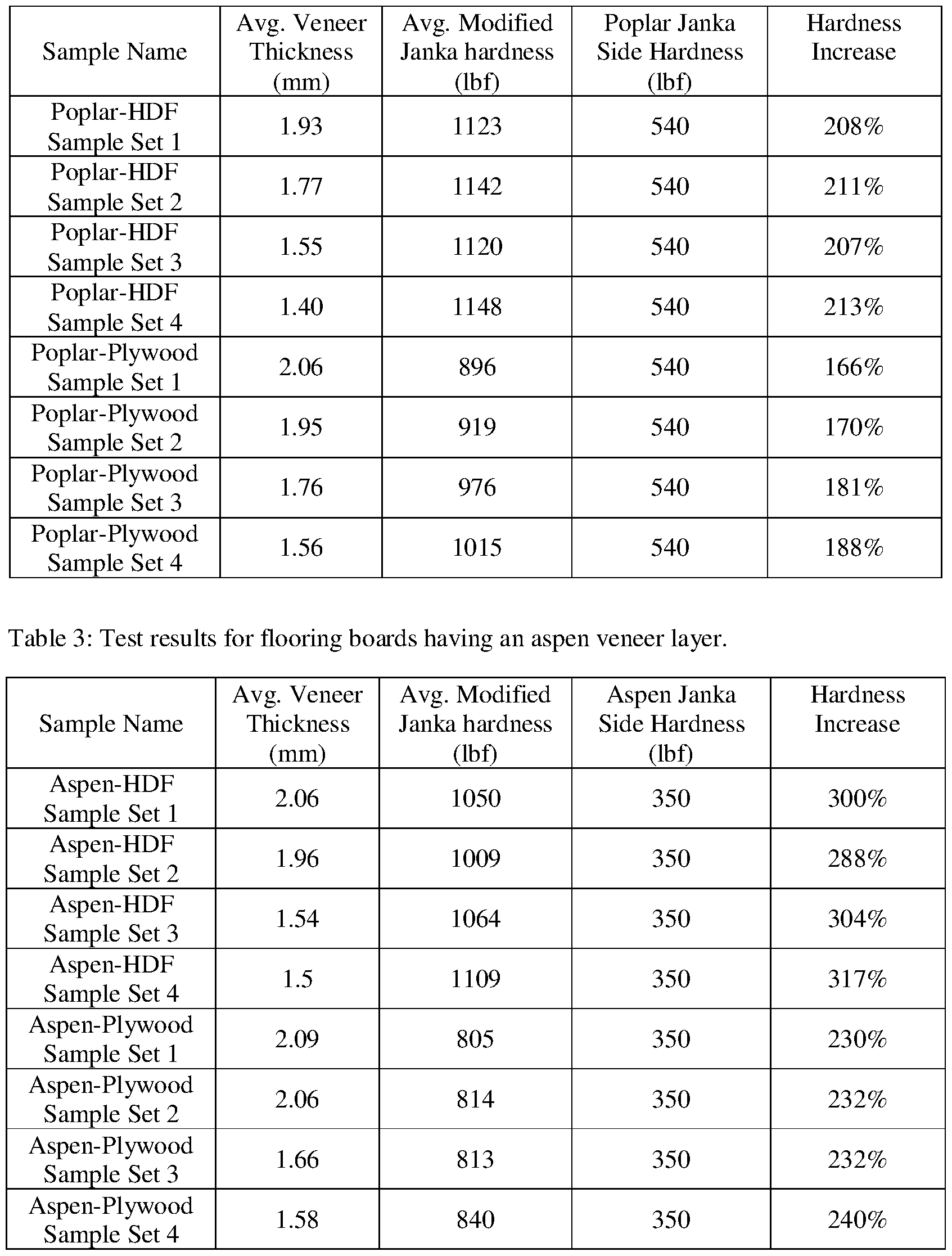
- a flooring board 10 having an HDF core layer 11 and a poplar veneer layer 12 having a thickness t v of about 1.40 mm was found to have a modified Janka hardness rating of about 1,148 lbf.
- a flooring board 10 having an HDF core layer 11 and an aspen veneer layer 12 having a thickness t v of about 1.5 mm was found to have a modified Janka hardness rating of about 1,109 lbf.
- the aesthetic and durable surface of the veneer layer 12 opposite the core layer 11 can be coated with a coating 13.
- the coating may be a polyurethane coating, wax coating, and/or the like.
- the coating 13 may provide additional surface protection to the veneer layer 12 against scratches and stains, while providing a desired level of luster to the flooring board 10.
- the coating 13 may provide a high-gloss, semi-gloss, satin, or fiat luster to the flooring board 10.
- the flooring board 10 comprises a backing layer 14 adhered to the second side of the core layer 11 opposite the veneer layer 12.
- the backing layer 14 may comprise a wood material (e.g., an angiosperm or a gymnosperm) or a fiberboard material (e.g., MDF or HDF).
- the backing layer 14 may comprise a southern red oak plank.
- the backing layer may have a thickness h between about 0.96 mm and about 2.12 mm.
- the backing layer 14 may have one or more grooves extending along the length of the flooring board 10 to facilitate flexing of the flooring board 10.
- the flooring board 10 may be manufactured by adhering the various layers through a cold-press and hot-press process.
- the process may begin by obtaining a veneer layer 12 having an initial thickness.
- the veneer layer 12 is adhered to the first surface of the core layer 11.
- a backing layer 14 is additionally included in the flooring board 10, the backing layer 14 is adhered to the second surface of the core layer 11 opposite the veneer layer 12 either before or after the veneer layer 12 is adhered to the core layer 11.
- the combined core layer 11, veneer layer 12, and backing layer 14 with adhesive therebetween are cold pressed for a first period of time before the combined core layer 11, veneer layer 12, backing layer 14, and adhesive are heated and heat pressed for a second period of time to cure the adhesive between the various layers.
- the veneer layer 12 and the backing layer 14 may be adhered to the core layer 11 in separate steps (e.g., consecutively).
- the veneer layer 12 is reduced to a final thickness that is less than the initial thickness.
- the veneer layer 12 may have an initial thickness of 1.75 mm when adhered to the core layer, and may have a final thickness less than 1.75 mm, but greater than 0.6 mm after reducing.
- the veneer layer 12 may be reduced in thickness by sanding the veneer layer 12 after it is adhered to the core layer 11.
- the veneer layer 12 may be reduced using a variety of other methods, such as planing and/or jointing the veneer layer 12 in addition to, or as an alternative to, the sanding.
- one or more finishing processes may be performed on the combination of the core layer 11, veneer layer 12, and backing layer 14 to form the final flooring board 10.
- the various layers may be cut to a desired length and/or width, tongue- and-groove features 11a, lib may be machined (e.g., routed) into sides of the core layer 11, one or more coatings 13 may be applied to the surface of the veneer layer 12, and/or the like.
- flooring boards 10 as described herein were tested according to the modified Janka test method described herein and utilized by North Carolina State University. Surprisingly, by performing the modified Janka test on a plurality of flooring boards, it was found that a flooring board 10 having a veneer layer 12 with a thickness t v less than about 2.0 mm and adhered to a fiberboard core layer 11 has a modified Janka hardness rating sufficient for use as a flooring material. Further flooring boards 10 having a veneer layer having a thickness t v less than about 1.75 mm provide exceptional hardness for use as a flooring material. In contrast to conventional wisdom, by decreasing the thickness t v of the veneer layer 12, the overall hardness of the flooring board 10 having a fiberboard core layer 11 increases.
- flooring boards 10 having a veneer layer 12 of a wood species having a low hardness rating may have a modified Janka hardness rating greater than about 120% of the Janka hardness rating of the wood species measured in block form, or greater than about 200% of the Janka hardness rating of the wood species measured in block form.
- a flooring board 10 comprising a sweetgum wood veneer layer 12 having a thickness of about 1.21 mm adhered to an HDF core layer 11 was determined to have a modified Janka hardness rating of about 1 ,161 lbf, compared to a Janka side hardness rating of about 850 lbf for the sweetgum wood species alone.
- a flooring board 10 comprising a poplar wood veneer layer 12 having a thickness of about 1.40 mm adhered to an HDF core layer 11 was determined to have a modified Janka hardness rating of about 1,148 lbf, compared to a Janka side hardness rating of about 540 lbf for the poplar wood species alone.
- a flooring board 10 comprising an aspen wood veneer layer 12 having a thickness of about 1.5 mm adhered to an HDF core layer 11 was determined to have a modified Janka hardness rating of about 1 ,109 lbf, compared to a Janka side hardness rating of about 350 lbf for the aspen wood species alone.
- the modified Janka hardness test was performed on four sets of 30 sample flooring boards for each veneer layer natural wood species adhered to an HDF core layer having a Janka hardness of about 965 lbf, each set having a selected target veneer layer thickness.
- 120 sample boards of varying thicknesses were tested at 4 sample locations along the length of each board, for a total of 480 measurements for each wood species utilized in the veneer layer.
- Each of the tested boards comprises a veneer layer of the tested wood species and thickness, an HDF core layer having an average thickness of about 6.41 mm, and a southern red oak backing layer having an average thickness of about 1.63 mm.
- the multi-layer plywood core layer included a first poplar layer adjacent the veneer layer having an average thickness of about 2.06 mm, a sweetgum center layer adhered to the first poplar layer having an average thickness of about 2.02 mm, and a second poplar layer adhered to the sweetgum center layer having an average thickness of about 2.07 mm.
- Each flooring board additionally included a southern red oak backing layer adhered to the plywood core layer and having an average thickness of about 1.73 mm. The results of the tests are summarized in Tables 1-3, below, and graphically in Figures 2-4.
- the average veneer thickness for each tested sample set is provided, along with the average modified Janka hardness for each sample set of flooring boards.
- the Janka side hardness of the wood species of the veneer layer is provided, along with a hardness increase percentage representing the modified Janka hardness of the overall flooring board as a percentage of the Janka side hardness of the wood species of the respective veneer layers.
- Table 1 Test results for flooring boards having a sweetgum veneer layer.
- Table 2 Test results for flooring boards having a poplar veneer layer.
- flooring boards 10 comprising a fiberboard core layer 11 and a veneer layer 12 of a wood species having a low Janka side hardness rating may have a modified Janka hardness rating higher than the wood species and sufficient for use as a flooring material.
- flooring boards 10 comprising a fiberboard core layer 11 and a thin veneer layer 12 of sweetgum, which has a Janka side hardness rating of about 860 lbf when measured in block form, were found to have a modified Janka hardness rating measured on the aesthetic and durable surface greater than about 120% of the sweetgum Janka hardness rating.
- flooring boards 10 comprising a fiberboard core layer 11 and a thin veneer layer 12 of poplar, which has a Janka side hardness rating of about 540 lbf when measured in block form, were found to have a modified Janka hardness rating measured on the aesthetic and durable surface greater than about 200% of the poplar Janka hardness rating.
- flooring boards 10 comprising a fiberboard core layer 11 and a thin veneer layer 12 of aspen, which has a Janka side hardness rating of about 350 lbf when measured in block form, were found to have a modified Janka hardness rating measured on the aesthetic and durable surface greater than about 288% of the aspen Janka hardness rating.
- flooring boards 10 may thus provide an aesthetic and durable surface having a modified Janka hardness rating adequate to endure normal use associated with flooring materials (e.g., forces associated with persons walking on the flooring material in high- heel shoes), while providing the appearance of a gymnosperm or other low-hardness wood species.
- Flooring boards 10 having a fiberboard core layer 11 and a veneer layer 12 having a thickness between about 0.6 mm and about 2.0 mm may thus have a modified Janka hardness rating adequate for use as a flooring material.
- flooring boards having a fiberboard core layer 11 and a veneer layer 12 having a thickness between about 0.6 mm and about 1.75 mm provide a modified Janka hardness rating sufficient for use as a flooring material.
- flooring boards having a fiberboard core layer 11 and a veneer layer 12 having a thickness between about 0.6 mm and about 1.5 mm provide a modified Janka hardness rating sufficient for use as a flooring material
- a veneer layer of any of a variety of wood species may be utilized in a flooring board 10 as described herein in order to provide a flooring board 10 having an aesthetic and durable surface having an enhanced hardness rating greater than the hardness of the wood species alone.
- a veneer layer of Brazilian rosewood, cherry, maple, and/or the like may be utilized herein.
- flooring boards 10 as described herein may comprise a veneer layer 12 of a wood material having an inconsistent Janka hardness rating across the surface of the material.
- veneer layers of one or more figured wood varieties, ambrosia wood varieties, and/or spalted wood varieties may be utilized.
- the veneer layer 12 may comprise stabilized and/or impregnated wood varieties. Although wood species having a low Janka hardness rating need not be stabilized and/or impregnated with strengthening materials (e.g., resins) in order to provide a flooring board 10 having an aesthetic and durable surface having a high modified Janka hardness rating, the veneer layer 12 may be stabilized and/or impregnated to provide an alternative appearance of the flooring board 10.
- strengthening materials e.g., resins
Landscapes
- Engineering & Computer Science (AREA)
- Life Sciences & Earth Sciences (AREA)
- Wood Science & Technology (AREA)
- Architecture (AREA)
- Civil Engineering (AREA)
- Structural Engineering (AREA)
- Floor Finish (AREA)
- Dry Formation Of Fiberboard And The Like (AREA)
- Laminated Bodies (AREA)
Abstract
Description

Claims
Priority Applications (6)
| Application Number | Priority Date | Filing Date | Title |
|---|---|---|---|
| EP16736635.0A EP3320159B1 (en) | 2015-07-10 | 2016-07-06 | Flooring board with a thin veneer wood aesthetic and durable surface |
| BR112018000449A BR112018000449A2 (en) | 2015-07-10 | 2016-07-06 | paving board and paving board manufacturing method |
| MX2018000356A MX2018000356A (en) | 2015-07-10 | 2016-07-06 | Flooring board with a thin veneer wood aesthetic and durable surface. |
| CA2991399A CA2991399C (en) | 2015-07-10 | 2016-07-06 | Flooring board with a thin veneer wood aesthetic and durable surface |
| HRP20241398TT HRP20241398T1 (en) | 2015-07-10 | 2016-07-06 | FLOOR PANEL WITH AESTHETIC AND DURABLE SURFACE MADE OF THIN VENEER |
| CN201680046691.6A CN107849850A (en) | 2015-07-10 | 2016-07-06 | Flooring panel having an aesthetic and durable surface of thin veneer lumber |
Applications Claiming Priority (2)
| Application Number | Priority Date | Filing Date | Title |
|---|---|---|---|
| US14/796,543 | 2015-07-10 | ||
| US14/796,543 US10576715B2 (en) | 2015-07-10 | 2015-07-10 | Flooring board with a thin veneer wood aesthetic and durable surface |
Publications (1)
| Publication Number | Publication Date |
|---|---|
| WO2017009744A1 true WO2017009744A1 (en) | 2017-01-19 |
Family
ID=56373099
Family Applications (1)
| Application Number | Title | Priority Date | Filing Date |
|---|---|---|---|
| PCT/IB2016/054056 Ceased WO2017009744A1 (en) | 2015-07-10 | 2016-07-06 | Flooring board with a thin veneer wood aesthetic and durable surface |
Country Status (8)
| Country | Link |
|---|---|
| US (1) | US10576715B2 (en) |
| EP (1) | EP3320159B1 (en) |
| CN (1) | CN107849850A (en) |
| BR (1) | BR112018000449A2 (en) |
| CA (1) | CA2991399C (en) |
| HR (1) | HRP20241398T1 (en) |
| MX (1) | MX2018000356A (en) |
| WO (1) | WO2017009744A1 (en) |
Cited By (4)
| Publication number | Priority date | Publication date | Assignee | Title |
|---|---|---|---|---|
| WO2019135141A1 (en) | 2018-01-08 | 2019-07-11 | Unilin, Bvba | Floor panel and methods for manufacturing floor panels |
| US10472833B2 (en) | 2015-07-02 | 2019-11-12 | Unilin, Bvba | Floor panel and method for manufacturing floor panels |
| WO2022115462A2 (en) | 2020-11-24 | 2022-06-02 | Aladdin Manufacturing Corporation | Floor panel and methods for manufacturing floor panels |
| US11413852B2 (en) | 2018-01-08 | 2022-08-16 | Flooring Industries Limited, Sarl | Floor panel and methods for manufacturing floor panels |
Families Citing this family (3)
| Publication number | Priority date | Publication date | Assignee | Title |
|---|---|---|---|---|
| US10590648B2 (en) * | 2017-02-06 | 2020-03-17 | Terry Allen Tebb | Outdoor wood decking board |
| CN110593521A (en) | 2019-09-03 | 2019-12-20 | 浙江永裕竹业股份有限公司 | Decorative surface composite SPC stone plastic floor |
| USD938621S1 (en) * | 2019-12-18 | 2021-12-14 | Ningbo Helong New Material Co., Ltd | WPC panel |
Citations (3)
| Publication number | Priority date | Publication date | Assignee | Title |
|---|---|---|---|---|
| US20090223162A1 (en) * | 2008-03-05 | 2009-09-10 | Mannington Mills, Inc. | Connecting System For Surface Coverings |
| WO2014160938A1 (en) * | 2013-03-29 | 2014-10-02 | Armstrong World Industries, Inc. | Hybrid wood products |
| US8997429B2 (en) | 1996-06-11 | 2015-04-07 | Unilin Beheer B.V. | Floor panels with edge connectors |
Family Cites Families (71)
| Publication number | Priority date | Publication date | Assignee | Title |
|---|---|---|---|---|
| US2831793A (en) | 1958-04-22 | Composite veneer or plywood panel | ||
| US2412534A (en) | 1942-12-05 | 1946-12-10 | Tekwood Inc | Impregnated composite board |
| GB785008A (en) | 1953-07-09 | 1957-10-23 | Elmendorf Armin | Process for manufacturing veneer panels |
| BE537418A (en) | 1954-05-31 | |||
| US3287203A (en) | 1962-03-14 | 1966-11-22 | Elmendorf Res Inc | Hardwood flooring |
| US3658622A (en) * | 1969-04-09 | 1972-04-25 | Georgia Pacific Corp | Process for making wood laminate |
| JPS5115602A (en) | 1974-07-24 | 1976-02-07 | Sumitomo Durez Co | Fuenoorujushiganshinkyokamokuzaino seizohoho |
| JPS5915308B2 (en) | 1977-05-31 | 1984-04-09 | 松下電工株式会社 | Wood veneer decorative board and its manufacturing method |
| GB2050941A (en) | 1979-04-03 | 1981-01-14 | Scia Soc Compensati Impiallacc | A reinforced, laminated wood panel and a method for producing such a panel |
| JPH07102535B2 (en) | 1989-01-17 | 1995-11-08 | 朝日ウッドテック株式会社 | Manufacturing method of grooved decorative board |
| US5492756A (en) * | 1994-07-22 | 1996-02-20 | Mississippi State University | Kenaf core board material |
| US5755068A (en) | 1995-11-17 | 1998-05-26 | Ormiston; Fred I. | Veneer panels and method of making |
| JPH1086107A (en) | 1996-09-17 | 1998-04-07 | Asai Gohan Kojo:Kk | Reconstituted veneer for plywood and method for producing reconstituted veneer or plywood for plywood |
| US5925211A (en) | 1997-04-21 | 1999-07-20 | International Paper Company | Low pressure melamine/veneer panel and method of making the same |
| WO1998049248A1 (en) | 1997-04-25 | 1998-11-05 | Georgia Pacific Resins, Inc. | B-staged resin impregnated fiber mat plywood glue |
| US6162312A (en) | 1999-01-19 | 2000-12-19 | Abney; Dennis R. | Method of making a resin impregnated composite wood product from waste, scrap, and used wood |
| DE19919823B4 (en) | 1999-05-01 | 2015-01-22 | Dieffenbacher GmbH Maschinen- und Anlagenbau | Method for bonding plywood or LVL boards |
| DE10001076C1 (en) | 2000-01-13 | 2001-10-04 | Huelsta Werke Huels Kg | Panel element to construct floor covering; has groove and spring on opposite longitudinal sides and has groove and tongue on opposite end faces, to connect and secure adjacent panel elements |
| SE518184C2 (en) | 2000-03-31 | 2002-09-03 | Perstorp Flooring Ab | Floor covering material comprising disc-shaped floor elements which are joined together by means of interconnecting means |
| BE1013553A3 (en) | 2000-06-13 | 2002-03-05 | Unilin Beheer Bv | Floor covering. |
| US6667108B2 (en) | 2002-02-07 | 2003-12-23 | Erick Ellstrom | Wearprotected wood veneer |
| SE525657C2 (en) | 2002-04-08 | 2005-03-29 | Vaelinge Innovation Ab | Flooring boards for floating floors made of at least two different layers of material and semi-finished products for the manufacture of floorboards |
| CN1202949C (en) | 2002-07-02 | 2005-05-25 | 中国国际海运集装箱(集团)股份有限公司 | Veneer board for container floor board and its production method |
| DE10245914B4 (en) | 2002-10-01 | 2010-09-16 | Witex Flooring Products Gmbh | Process for the manufacture of parquet or veneer floorboards |
| FR2846687B1 (en) * | 2002-10-30 | 2004-12-31 | Tarkett Sommer Sa | MOISTURE TREATED SURFACE COATING AND PROCESSING METHOD |
| BE1015232A3 (en) | 2002-12-04 | 2004-11-09 | Flooring Ind Ltd | Antistatic layer object. |
| JP2004204449A (en) * | 2002-12-24 | 2004-07-22 | Kiyotaka Higashihama | Floor plate material and floor structure |
| US7404422B2 (en) * | 2003-02-05 | 2008-07-29 | Eagle Analytical Company, Inc. | Viscoelastic thermal compression of wood |
| SE526179C2 (en) | 2003-12-02 | 2005-07-19 | Vaelinge Innovation Ab | Flooring and method of laying |
| NL1025082C2 (en) | 2003-12-19 | 2005-06-21 | Hakhold B V | Shelf for indoor use. |
| US20050268571A1 (en) | 2004-06-08 | 2005-12-08 | Tryggvi Magnusson | Hardwood flooring board |
| US20060070325A1 (en) | 2004-04-20 | 2006-04-06 | Tryggvi Magnusson | Hardwood flooring board |
| US20050257888A1 (en) | 2004-05-20 | 2005-11-24 | Georgia-Pacific Resins, Inc. | Phenolic resin-based adhesives and methods of using same in preparing laminated veneer lumber (LVL) |
| DE202004010083U1 (en) | 2004-06-25 | 2005-06-30 | M. Kaindl Kommanditgesellschaft | Veneered plate |
| CN1281391C (en) | 2004-12-08 | 2006-10-25 | 中国林业科学研究院木材工业研究所 | Soft material single-board materials and wooden products with surface hardness improve |
| WO2006081346A2 (en) * | 2005-01-26 | 2006-08-03 | Chemcraft International, Inc. | Methods of reducing surface checking on wood compositions |
| KR100750479B1 (en) | 2005-04-13 | 2007-08-22 | 주식회사 엘지화학 | Anti-caster wood flooring |
| US20070102108A1 (en) * | 2005-11-08 | 2007-05-10 | Jun Zheng | Process for making wood laminates using fast setting adhesives at ambient temperature |
| BE1017049A6 (en) | 2006-04-06 | 2007-12-04 | Flooring Ind Ltd | METHOD FOR MANUFACTURING FLOOR PANELS AND FLOOR PANEL. |
| CN101092848A (en) | 2006-06-20 | 2007-12-26 | 韦尔蒂奇私人控股有限公司 | Engineered wood floor using core material with vertical glue-line position |
| KR100768517B1 (en) | 2006-12-12 | 2007-10-18 | 주식회사 한솔홈데코 | Manufacturing method of the decorative board |
| US7669879B2 (en) | 2007-03-05 | 2010-03-02 | Dykema Robert A | Skateboard deck and method of making same |
| KR20090006503A (en) | 2007-07-12 | 2009-01-15 | 신호열 | Strain-resistant natural veneer surface synthetic resin sheet |
| DE102007043202A1 (en) | 2007-09-11 | 2009-03-26 | Guido Schulte | Floor/wall/ceiling panel, has carrier plate made of fiber material, upper-sided solid wood layer constituted of stamped surface structure, and intermediate layer provided between carrier plate and wood layer |
| WO2009065769A2 (en) | 2007-11-19 | 2009-05-28 | Välinge Innovation Belgium BVBA | Fibre based panels with a wear resistance surface |
| US9783996B2 (en) | 2007-11-19 | 2017-10-10 | Valinge Innovation Ab | Fibre based panels with a wear resistance surface |
| DE102007058034B4 (en) | 2007-11-30 | 2009-11-26 | Flooring Technologies Ltd. | Panel comprising a support plate with a real wood veneer |
| EP2344311B1 (en) | 2008-04-07 | 2018-08-22 | Välinge Innovation AB | Method of manufacturing a wood fibre based floor board |
| CN101676078A (en) | 2008-09-19 | 2010-03-24 | 斯戴尔有限责任上市公司 | Artificial timber product and production method thereof |
| JP5593613B2 (en) | 2009-02-12 | 2014-09-24 | ヤマハ株式会社 | WOOD MATERIAL FOR SOUND, PROCESS FOR PRODUCING THE SAME AND ACOUSTIC |
| KR101091432B1 (en) | 2009-04-08 | 2011-12-07 | 이건산업 주식회사 | Manufacturing method of floorboard combined with high hardness multilayer natural veneer |
| BE1018728A3 (en) | 2009-04-22 | 2011-07-05 | Flooring Ind Ltd Sarl | FLOOR PANEL. |
| KR20110059137A (en) | 2009-11-27 | 2011-06-02 | (주)엘지하우시스 | Patterned reinforced wooden floor and its manufacturing method |
| US8480831B2 (en) | 2010-03-11 | 2013-07-09 | Weyerhaeuser Nr Company | System and method for manufacturing composite wood products |
| BE1019259A5 (en) | 2010-03-24 | 2012-05-08 | Flooring Ind Ltd Sarl | METHODS FOR MANUFACTURING PANELS. |
| EP2576242B1 (en) | 2010-05-31 | 2021-11-03 | Välinge Innovation AB | A method of manufacturing a decorative floor panel comprising a dry powder layer |
| WO2012004699A2 (en) | 2010-07-09 | 2012-01-12 | Flooring Industries Limited, Sarl | Panel and method for manufacturing panels |
| KR101204623B1 (en) | 2010-12-22 | 2012-11-23 | (주)엘지하우시스 | Surface Reinforced Natural Flooring And A Method For Manufacturing Thereof |
| AU2011236087A1 (en) | 2011-10-18 | 2013-05-02 | Pamb Pty Ltd | Wood veneer panel and method of making the same |
| ITBO20130231A1 (en) | 2013-05-20 | 2014-11-21 | Sorbini Service S R L | APPARATUS FOR THE CATALYSTING IN THE INHERENT ENVIRONMENT OF THE VARNISH TO THE UV THAT LOOKS TO EXTENSIONALLY PLAN EXTENSIONS |
| CN103452295A (en) * | 2013-08-21 | 2013-12-18 | 山西蒲津塑钢板业制造有限公司 | Waterproof and mothproof floor board |
| CN103522384B (en) | 2013-10-21 | 2016-01-06 | 中南林业科技大学 | Surface peening fir wood floor base material modelled after an antique and manufacture method thereof |
| DE102013113125A1 (en) | 2013-11-27 | 2015-05-28 | Guido Schulte | Floor, wall or ceiling panel and method of making the same |
| DE102013113109A1 (en) | 2013-11-27 | 2015-06-11 | Guido Schulte | floorboard |
| DE102013113130B4 (en) | 2013-11-27 | 2022-01-27 | Välinge Innovation AB | Method of manufacturing a floorboard |
| DE202013012020U1 (en) | 2013-11-27 | 2015-02-03 | Guido Schulte | Floor, wall or ceiling panel |
| CN105873761A (en) | 2014-01-10 | 2016-08-17 | 瓦林格创新股份有限公司 | Wood fiber based board with surface layer |
| EP4596809A3 (en) | 2014-04-11 | 2025-10-29 | Unilin, BV | Method of manufacturing a timber composite and decorative panels comprising a timber composite |
| CN104309229A (en) | 2014-09-26 | 2015-01-28 | 圣象(江苏)木业研究有限公司 | Coated veneer and manufacturing method thereof |
| WO2016151435A1 (en) | 2015-03-20 | 2016-09-29 | Unilin, Bvba | Method for manufacturing a decorative panel and decorative panel |
| BE1023310B1 (en) | 2015-07-02 | 2017-01-31 | Unilin, Bvba | Floor panel and method for manufacturing floor panels. |
-
2015
- 2015-07-10 US US14/796,543 patent/US10576715B2/en active Active
-
2016
- 2016-07-06 WO PCT/IB2016/054056 patent/WO2017009744A1/en not_active Ceased
- 2016-07-06 BR BR112018000449A patent/BR112018000449A2/en not_active Application Discontinuation
- 2016-07-06 CA CA2991399A patent/CA2991399C/en active Active
- 2016-07-06 MX MX2018000356A patent/MX2018000356A/en unknown
- 2016-07-06 CN CN201680046691.6A patent/CN107849850A/en active Pending
- 2016-07-06 HR HRP20241398TT patent/HRP20241398T1/en unknown
- 2016-07-06 EP EP16736635.0A patent/EP3320159B1/en active Active
Patent Citations (3)
| Publication number | Priority date | Publication date | Assignee | Title |
|---|---|---|---|---|
| US8997429B2 (en) | 1996-06-11 | 2015-04-07 | Unilin Beheer B.V. | Floor panels with edge connectors |
| US20090223162A1 (en) * | 2008-03-05 | 2009-09-10 | Mannington Mills, Inc. | Connecting System For Surface Coverings |
| WO2014160938A1 (en) * | 2013-03-29 | 2014-10-02 | Armstrong World Industries, Inc. | Hybrid wood products |
Cited By (9)
| Publication number | Priority date | Publication date | Assignee | Title |
|---|---|---|---|---|
| US10472833B2 (en) | 2015-07-02 | 2019-11-12 | Unilin, Bvba | Floor panel and method for manufacturing floor panels |
| US11008762B2 (en) | 2015-07-02 | 2021-05-18 | Unilin Bv | Floor panel and method for manufacturing floor panels |
| US11668102B2 (en) | 2015-07-02 | 2023-06-06 | Flooring Industries Limited Sarl | Floor panel and method for manufacturing floor panels |
| US12497784B2 (en) | 2015-07-02 | 2025-12-16 | Unilin Bv | Floor panel and method for manufacturing floor panels |
| WO2019135141A1 (en) | 2018-01-08 | 2019-07-11 | Unilin, Bvba | Floor panel and methods for manufacturing floor panels |
| US11413852B2 (en) | 2018-01-08 | 2022-08-16 | Flooring Industries Limited, Sarl | Floor panel and methods for manufacturing floor panels |
| US11820108B2 (en) | 2018-01-08 | 2023-11-21 | Flooring Industries Limited, Sarl | Floor panel and methods for manufacturing floor panels |
| US12502871B2 (en) | 2018-01-08 | 2025-12-23 | Unilin, Bv | Floor panel and methods for manufacturing floor panels |
| WO2022115462A2 (en) | 2020-11-24 | 2022-06-02 | Aladdin Manufacturing Corporation | Floor panel and methods for manufacturing floor panels |
Also Published As
| Publication number | Publication date |
|---|---|
| EP3320159A1 (en) | 2018-05-16 |
| BR112018000449A2 (en) | 2018-09-11 |
| CA2991399A1 (en) | 2017-01-19 |
| EP3320159B1 (en) | 2024-09-04 |
| US20170008258A1 (en) | 2017-01-12 |
| CN107849850A (en) | 2018-03-27 |
| CA2991399C (en) | 2019-12-10 |
| US10576715B2 (en) | 2020-03-03 |
| MX2018000356A (en) | 2018-08-15 |
| HRP20241398T1 (en) | 2024-12-20 |
Similar Documents
| Publication | Publication Date | Title |
|---|---|---|
| CA2991399C (en) | Flooring board with a thin veneer wood aesthetic and durable surface | |
| CN102421973B (en) | floor panel | |
| US8215078B2 (en) | Building panel with compressed edges and method of making same | |
| RU2352466C2 (en) | Product made of plywood with increased stability of dimensions and resistance to buckling and flaking | |
| US7665263B2 (en) | Hardwood flooring system | |
| KR100918559B1 (en) | Interior product having transfer-printed base layer and process for preparing the same | |
| US6173540B1 (en) | Stair tread | |
| EP1691005A1 (en) | Building panel with compressed edges | |
| EP2668349B1 (en) | Tread cap and methods and processes related thereto | |
| CN102080441A (en) | Reinforced wood flooring and method for manufacturing same | |
| CN101107122B (en) | multilayer board | |
| WO2023150111A1 (en) | Surfacing products with multiple veneer segments | |
| JP5248004B2 (en) | Floor material and manufacturing method thereof | |
| JP6346707B1 (en) | Cosmetic material | |
| US20160060881A1 (en) | Composite engineered wood material piece composed of an HDF mid-layer and an OSB bottom layer | |
| US20210246666A1 (en) | Systems and Methods Related to Natural Wood Products | |
| CN105415456A (en) | Mechanical ecological board and manufacturing method thereof | |
| Millaniyage et al. | Engineered flooring from low-density plantation hardwood: Evaluation of long-term in-service trials | |
| WO2008009778A1 (en) | A coated wooden board, a method for its manufacture, and its use | |
| AU2010209995A1 (en) | Composite Board | |
| KR102552334B1 (en) | Sheet material using fiberboard and method for manufacturing the same | |
| CA2855667C (en) | Composite engineered wood material piece composed of an hdf mid-layer and an osb bottom layer | |
| JP2010007276A (en) | Floor member | |
| KARA et al. | EFFECT OF LAMINATION CONDITIONS ON TECHNOLOGICAL PROPERTIES OF HDF LAMINATE PARQUET | |
| KR20070015747A (en) | Floor boards for floor finishing and its manufacturing method |
Legal Events
| Date | Code | Title | Description |
|---|---|---|---|
| 121 | Ep: the epo has been informed by wipo that ep was designated in this application |
Ref document number: 16736635 Country of ref document: EP Kind code of ref document: A1 |
|
| ENP | Entry into the national phase |
Ref document number: 2991399 Country of ref document: CA |
|
| WWE | Wipo information: entry into national phase |
Ref document number: MX/A/2018/000356 Country of ref document: MX |
|
| NENP | Non-entry into the national phase |
Ref country code: DE |
|
| WWE | Wipo information: entry into national phase |
Ref document number: 2016736635 Country of ref document: EP |
|
| REG | Reference to national code |
Ref country code: BR Ref legal event code: B01A Ref document number: 112018000449 Country of ref document: BR |
|
| ENP | Entry into the national phase |
Ref document number: 112018000449 Country of ref document: BR Kind code of ref document: A2 Effective date: 20180109 |