WO2016154963A1 - Methods for chroma coding in video codec - Google Patents
Methods for chroma coding in video codec Download PDFInfo
- Publication number
- WO2016154963A1 WO2016154963A1 PCT/CN2015/075672 CN2015075672W WO2016154963A1 WO 2016154963 A1 WO2016154963 A1 WO 2016154963A1 CN 2015075672 W CN2015075672 W CN 2015075672W WO 2016154963 A1 WO2016154963 A1 WO 2016154963A1
- Authority
- WO
- WIPO (PCT)
- Prior art keywords
- square
- intra
- chroma
- prediction
- split
- Prior art date
- Legal status (The legal status is an assumption and is not a legal conclusion. Google has not performed a legal analysis and makes no representation as to the accuracy of the status listed.)
- Ceased
Links
Images


Classifications
-
- H—ELECTRICITY
- H04—ELECTRIC COMMUNICATION TECHNIQUE
- H04N—PICTORIAL COMMUNICATION, e.g. TELEVISION
- H04N19/00—Methods or arrangements for coding, decoding, compressing or decompressing digital video signals
- H04N19/50—Methods or arrangements for coding, decoding, compressing or decompressing digital video signals using predictive coding
- H04N19/593—Methods or arrangements for coding, decoding, compressing or decompressing digital video signals using predictive coding involving spatial prediction techniques
-
- H—ELECTRICITY
- H04—ELECTRIC COMMUNICATION TECHNIQUE
- H04N—PICTORIAL COMMUNICATION, e.g. TELEVISION
- H04N19/00—Methods or arrangements for coding, decoding, compressing or decompressing digital video signals
- H04N19/10—Methods or arrangements for coding, decoding, compressing or decompressing digital video signals using adaptive coding
- H04N19/102—Methods or arrangements for coding, decoding, compressing or decompressing digital video signals using adaptive coding characterised by the element, parameter or selection affected or controlled by the adaptive coding
- H04N19/103—Selection of coding mode or of prediction mode
- H04N19/105—Selection of the reference unit for prediction within a chosen coding or prediction mode, e.g. adaptive choice of position and number of pixels used for prediction
-
- H—ELECTRICITY
- H04—ELECTRIC COMMUNICATION TECHNIQUE
- H04N—PICTORIAL COMMUNICATION, e.g. TELEVISION
- H04N19/00—Methods or arrangements for coding, decoding, compressing or decompressing digital video signals
- H04N19/10—Methods or arrangements for coding, decoding, compressing or decompressing digital video signals using adaptive coding
- H04N19/102—Methods or arrangements for coding, decoding, compressing or decompressing digital video signals using adaptive coding characterised by the element, parameter or selection affected or controlled by the adaptive coding
- H04N19/12—Selection from among a plurality of transforms or standards, e.g. selection between discrete cosine transform [DCT] and sub-band transform or selection between H.263 and H.264
- H04N19/122—Selection of transform size, e.g. 8x8 or 2x4x8 DCT; Selection of sub-band transforms of varying structure or type
-
- H—ELECTRICITY
- H04—ELECTRIC COMMUNICATION TECHNIQUE
- H04N—PICTORIAL COMMUNICATION, e.g. TELEVISION
- H04N19/00—Methods or arrangements for coding, decoding, compressing or decompressing digital video signals
- H04N19/10—Methods or arrangements for coding, decoding, compressing or decompressing digital video signals using adaptive coding
- H04N19/134—Methods or arrangements for coding, decoding, compressing or decompressing digital video signals using adaptive coding characterised by the element, parameter or criterion affecting or controlling the adaptive coding
- H04N19/157—Assigned coding mode, i.e. the coding mode being predefined or preselected to be further used for selection of another element or parameter
-
- H—ELECTRICITY
- H04—ELECTRIC COMMUNICATION TECHNIQUE
- H04N—PICTORIAL COMMUNICATION, e.g. TELEVISION
- H04N19/00—Methods or arrangements for coding, decoding, compressing or decompressing digital video signals
- H04N19/10—Methods or arrangements for coding, decoding, compressing or decompressing digital video signals using adaptive coding
- H04N19/169—Methods or arrangements for coding, decoding, compressing or decompressing digital video signals using adaptive coding characterised by the coding unit, i.e. the structural portion or semantic portion of the video signal being the object or the subject of the adaptive coding
- H04N19/17—Methods or arrangements for coding, decoding, compressing or decompressing digital video signals using adaptive coding characterised by the coding unit, i.e. the structural portion or semantic portion of the video signal being the object or the subject of the adaptive coding the unit being an image region, e.g. an object
- H04N19/176—Methods or arrangements for coding, decoding, compressing or decompressing digital video signals using adaptive coding characterised by the coding unit, i.e. the structural portion or semantic portion of the video signal being the object or the subject of the adaptive coding the unit being an image region, e.g. an object the region being a block, e.g. a macroblock
-
- H—ELECTRICITY
- H04—ELECTRIC COMMUNICATION TECHNIQUE
- H04N—PICTORIAL COMMUNICATION, e.g. TELEVISION
- H04N19/00—Methods or arrangements for coding, decoding, compressing or decompressing digital video signals
- H04N19/10—Methods or arrangements for coding, decoding, compressing or decompressing digital video signals using adaptive coding
- H04N19/169—Methods or arrangements for coding, decoding, compressing or decompressing digital video signals using adaptive coding characterised by the coding unit, i.e. the structural portion or semantic portion of the video signal being the object or the subject of the adaptive coding
- H04N19/186—Methods or arrangements for coding, decoding, compressing or decompressing digital video signals using adaptive coding characterised by the coding unit, i.e. the structural portion or semantic portion of the video signal being the object or the subject of the adaptive coding the unit being a colour or a chrominance component
-
- H—ELECTRICITY
- H04—ELECTRIC COMMUNICATION TECHNIQUE
- H04N—PICTORIAL COMMUNICATION, e.g. TELEVISION
- H04N19/00—Methods or arrangements for coding, decoding, compressing or decompressing digital video signals
- H04N19/90—Methods or arrangements for coding, decoding, compressing or decompressing digital video signals using coding techniques not provided for in groups H04N19/10-H04N19/85, e.g. fractals
- H04N19/96—Tree coding, e.g. quad-tree coding
Definitions
- the invention relates generally to video processing.
- the present invention relates to methods for specifying coding structures and prediction methods for chroma component in video/picture.
- the HEVC standard (a.k.a H.265) is based on the well-known block-based hybrid coding architecture, combining inter/intra prediction and transform coding with high-efficiency entropy coding. Below we will see the descriptions of the coding structures and prediction in HEVC.
- Coding unit CU
- coding tree structure in HEVC
- the coding unit is a square region, represented as the leaf node of a quadtree partitioning of the CTU, which shares the same prediction mode: intra, inter or skipped.
- the quad-tree partitioning structure allows recursive splitting into four equally sized nodes, starting from the CTU as illustrated in Fig. 1. This process gives a content-adaptive coding tree structure comprised of CUs, each of which may be as large as the CTU or as small as 8x8.
- Each non-skipped CU is assigned to one of two prediction modes: intra prediction or inter prediction.
- a skipped CU is considered to be an inter prediction mode without coding of motion vector differences and residual information.
- the prediction unit is a region, defined by partitioning the CU, on which the same prediction is applied.
- the PU is not restricted to being square in shape, in order to facilitate partitioning which matches the boundaries of real objects in the picture.
- Each CU contains one, two or four PUs depending on the partition mode.
- Fig. 2 illustrates the eight partition modes that may be used to define the PUs for an inter-coded CU.
- the PART_2Nx2N and PART_NxN partition modes are used for an intra-coded CU.
- the partition mode PART_NxN is allowed only when the corresponding CU size is equal to the minimum CU size.
- the HM supports PU sizes from 64x64 down to 4x4 samples. However, in order to reduce the memory bandwidth of motion compensation, the 4x4 block size is not allowed for an inter-coded PU.
- the transform unit is a square region, defined by quad-tree partitioning of the CU, which shares the same transform and quantization processes.
- the TU shape is always square and it may take a size from 32x32 down to 4x4 samples.
- the maximum quad-tree depth is adjustable and is specified in the slice header syntax.
- the decoded boundary samples of adjacent blocks are used as reference data for spatial prediction in regions where inter picture prediction is not performed.
- All TUs within a PU use the same associated intra prediction mode for the luma component and the chroma components. Note that the prediction process is performed at TU level, in other words, each TU uses its immediately adjacent reconstructed pixels to generate the predictors.
- the encoder selects the best luma intra prediction mode of each PU from 35 options: 33 directional prediction modes, a DC mode and a Planar mode. The mapping between the intra prediction direction and the intra prediction mode number is specified in Fig. 3.
- the encoder selects the best chroma prediction modes among five modes including Planar, DC, Horizontal, Vertical and a direct copy of the intra prediction mode for the luma component (also called derived mode, DM mode) .
- the intra prediction direction of 34 is used for the intra prediction sample generation for the chroma component.
- LM mode luma-predict-chroma mode
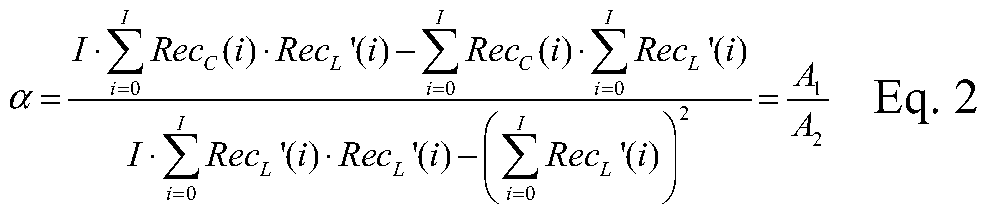
- LM mode Chroma predictor is predicted from reconstructed luma using Eq. 1.
- ⁇ and ⁇ are derived from causal reconstructed samples around the current block (Luma needs to be down-sampled for 4:2:0 which is the same as the chroma down-sampling method in the normal YCbCr4:4:4 to YCbCr4:2:0 down-sampling) using the Eq. 2 and 3 (least square solution) .
- Rec c is the vector of reconstructed chroma samples around the current chroma block;
- Rec’ L is the vector of down-sampled reconstructed luma samples around the current luma block and I is the number of used neighboring samples around current block.
- LM mode There are also some variant of LM mode.
- the LM parameters ⁇ and ⁇ can be selectively generated by different sets of neighboring reconstructed pixels.
- Each inter coded PU has a set of motion parameters consisting of motion vector, reference picture index, reference picture list usage flag to be used for inter prediction sample generation, signalled in an explicit or implicit manner.
- the CU When a CU is coded with skip mode, the CU is represented as one PU that has no significant transform coefficients and motion vectors, reference picture index and reference picture list usage flag obtained by merge mode.
- the merge mode is to find the neighbouring inter coded PU such that its motion parameters (motion vector, reference picture index, and reference picture list usage flag) can be inferred as the ones for the current PU.
- the encoder can select the best inferred motion parameters from multiple candidates formed by spatially neighbouring PUs and temporally neighbouring PUs, and transmit the corresponding index indicating the chosen candidate.
- the merge mode can be applied to any inter coded PU, not only for skip mode.
- the encoder can use merge mode or explicit transmission of motion parameters, where motion vector, corresponding reference picture index for each reference picture list and reference picture list usage flag are signalled explicitly per each PU.
- significant transform coefficients are sent to decoder.
- luma component and two chroma components share the same CU split structure.
- PU structures, prediction modes and prediction parameters are also shared between luma and chroma when the current CU is coded in inter mode.
- PU and intra prediction modes can be different for luma and chroma components, respectively.
- the PU for luma component can be either 2Nx2N or NxN but the PU for chroma component can only be 2Nx2N.
- Fig. 1 is a diagram illustrating an example of coding tree structure.
- Fig. 2 is a diagram illustrating 8 partition modes for inter PU.
- Fig. 3 is a diagram illustrating mapping between intra prediction direction and intra prediction mode.
- Fig. 4 is a diagram illustrating samples used to derive LM parameters.
- Fig. 5 is a diagram illustrating quad-tree split, horizontal binary split and vertical binary split.
- Fig. 6 is a diagram illustrating additional samples for chroma prediction.
- Fig. 7 is a diagram illustrating removed samples for chroma prediction.
- the main feature of this invention is to enable non-square intra prediction for chroma components for achieving higher coding performance. This idea can be realized in different ways as described below.
- the non-square intra prediction can be realized by enabling various partition modes for chroma components in intra CU.
- the enabled partition modes are not limited to the 8 partition modes as shown in Fig. 2. Under this scheme, when the number of the supported partition mode is larger than 1, the partition mode needs to be signaled for each intra chroma CU.
- the non-square intra prediction can be realized by enabling non-square CU for intra chroma prediction.
- the non-square CU can be in any shape of rectangle with “width not equal to height” and “width and height are both power of 2” .
- the non-square intra prediction can be realized by enabling non-square transform.
- the non-square transform unit can be in any shape of rectangle with “width not equal to height” and “width and height are both power of 2”
- each CTU or CU can be split into smaller CUs using either horizontal binary-tree split, vertical binary-tree split or quad-tree split as shown in Fig. 5.
- CU can be in non-square shape.
- PU and TU are both equal to CU, the chroma components prediction in intra CU can then be performed in a way of non-square intra prediction.
- intra DC prediction method is modified to make sure the number of the averaged samples will be power of 2 by taking additional samples or removing samples for DC calculation. With the proposed modifications, the process of taking average can then be done by shift operation.
- additional X (X is equal to the length of long side minus short side) samples along the short side of current block are used to calculate the DC value as shown in Fig. 6 (a) .
- additional samples can be the second lines of the short side as shown in Fig. 6 (b) .
- X can be any number to make sure the number of the samples used to calculate the DC value will be power of 2 and the additional samples can be any subset of the neighbor reconstructed pixels.
- X samples can be any number to make sure the number of the samples used to calculate the DC value will be power of 2 and the removed samples can be any subset of the neighbor reconstructed pixels.
- the DC is calculated as the average of the DC of above samples and the DC of the left samples.
- the LM mode is modified to make sure the number of the samples used to derive the LM parameters ⁇ and ⁇ will be power of 2 by taking additional samples or removing samples for LM parameters derivation. With the proposed modifications, the process of LM parameter derivation can then be done by shift operation.
- additional X (X is equal to the length of long side minus short side) samples along the short side of current block are used to derive the LM parameters as shown in Fig. 6 (a) .
- additional samples can be the second lines of the short side as shown in Fig. 6 (b) .
- X can be any number to make sure the number of the samples used to derive the LM parameters will be power of 2 and the additional samples can be any subset of the neighbor reconstructed pixels.
- X samples can be any number to make sure the number of the samples used to derive the LM parameters will be power of 2 and the removed samples can be any subset of the neighbor reconstructed pixels.
Landscapes
- Engineering & Computer Science (AREA)
- Multimedia (AREA)
- Signal Processing (AREA)
- Physics & Mathematics (AREA)
- Discrete Mathematics (AREA)
- General Physics & Mathematics (AREA)
- Compression Or Coding Systems Of Tv Signals (AREA)
Abstract
Methods for non-square intra chroma prediction in video coding are disclosed. With the proposed method, the chroma components can perform non-square intra prediction to achieve higher coding performance.
Description
The invention relates generally to video processing. In particular, the present invention relates to methods for specifying coding structures and prediction methods for chroma component in video/picture.
The HEVC standard (a.k.a H.265) is based on the well-known block-based hybrid coding architecture, combining inter/intra prediction and transform coding with high-efficiency entropy coding. Below we will see the descriptions of the coding structures and prediction in HEVC.
Coding unit (CU) and coding tree structure in HEVC
The coding unit (CU) is a square region, represented as the leaf node of a quadtree partitioning of the CTU, which shares the same prediction mode: intra, inter or skipped. The quad-tree partitioning structure allows recursive splitting into four equally sized nodes, starting from the CTU as illustrated in Fig. 1. This process gives a content-adaptive coding tree structure comprised of CUs, each of which may be as large as the CTU or as small as 8x8. Each non-skipped CU is assigned to one of two prediction modes: intra prediction or inter prediction. A skipped CU is considered to be an inter prediction mode without coding of motion vector differences and residual information.
Prediction unit (PU) structure in HEVC
The prediction unit (PU) is a region, defined by partitioning the CU, on which the same prediction is applied. In general, the PU is not restricted to being square in shape, in order to facilitate partitioning which matches the boundaries of real objects in the picture.
Each CU contains one, two or four PUs depending on the partition mode. Fig. 2 illustrates the eight partition modes that may be used to define the PUs for an inter-coded CU. The PART_2Nx2N and PART_NxN partition modes are used for an intra-coded CU. The partition mode PART_NxN is allowed only when the corresponding
CU size is equal to the minimum CU size. In general, the HM supports PU sizes from 64x64 down to 4x4 samples. However, in order to reduce the memory bandwidth of motion compensation, the 4x4 block size is not allowed for an inter-coded PU.
Transform unit (TU) and transform tree structure in HEVC
The transform unit (TU) is a square region, defined by quad-tree partitioning of the CU, which shares the same transform and quantization processes. The TU shape is always square and it may take a size from 32x32 down to 4x4 samples. The maximum quad-tree depth is adjustable and is specified in the slice header syntax.
Intra Prediction in HEVC
Prediction modes
The decoded boundary samples of adjacent blocks are used as reference data for spatial prediction in regions where inter picture prediction is not performed. All TUs within a PU use the same associated intra prediction mode for the luma component and the chroma components. Note that the prediction process is performed at TU level, in other words, each TU uses its immediately adjacent reconstructed pixels to generate the predictors. The encoder selects the best luma intra prediction mode of each PU from 35 options: 33 directional prediction modes, a DC mode and a Planar mode. The mapping between the intra prediction direction and the intra prediction mode number is specified in Fig. 3.
For the chroma component of an intra PU, the encoder selects the best chroma prediction modes among five modes including Planar, DC, Horizontal, Vertical and a direct copy of the intra prediction mode for the luma component (also called derived mode, DM mode) .
When the intra prediction mode number for the chroma component is not 4 and it is identical to the intra prediction mode number for the luma component, the intra prediction direction of 34 is used for the intra prediction sample generation for the chroma component.
Similar to DM mode, another mode called the luma-predict-chroma mode (LM mode) takes advantage of the inter-channel correlation but behaves differently (LM mode is not used in HEVC) . As shown in Fig. 4, in LM mode, Chroma predictor is predicted from reconstructed luma using Eq. 1.
PredC[x,y]=α·RecL'[x,y]+β Eq.1
where α and β are derived from causal reconstructed samples around the current block (Luma needs to be down-sampled for 4:2:0 which is the same as the chroma
down-sampling method in the normal YCbCr4:4:4 to YCbCr4:2:0 down-sampling) using the Eq. 2 and 3 (least square solution) . Recc is the vector of reconstructed chroma samples around the current chroma block; Rec’L is the vector of down-sampled reconstructed luma samples around the current luma block and I is the number of used neighboring samples around current block.

There are also some variant of LM mode. The LM parameters α and β can be selectively generated by different sets of neighboring reconstructed pixels.
Inter Prediction in HEVC
Prediction modes
Each inter coded PU has a set of motion parameters consisting of motion vector, reference picture index, reference picture list usage flag to be used for inter prediction sample generation, signalled in an explicit or implicit manner. When a CU is coded with skip mode, the CU is represented as one PU that has no significant transform coefficients and motion vectors, reference picture index and reference picture list usage flag obtained by merge mode. The merge mode is to find the neighbouring inter coded PU such that its motion parameters (motion vector, reference picture index, and reference picture list usage flag) can be inferred as the ones for the current PU. The encoder can select the best inferred motion parameters from multiple candidates formed by spatially neighbouring PUs and temporally neighbouring PUs, and transmit the corresponding index indicating the chosen candidate. The merge mode can be applied to any inter coded PU, not only for skip mode. In any inter coded PUs, the encoder can use merge mode or explicit transmission of motion parameters, where motion vector, corresponding reference picture index for each reference picture list and reference picture list usage flag are signalled explicitly per each PU. For inter coded PU, significant transform coefficients are sent to decoder. The details are presented in the following sections.
Please note that, in HEVC, luma component and two chroma components share the same CU split structure. PU structures, prediction modes and prediction parameters (e.g. motion vectors and reference index) are also shared between luma
and chroma when the current CU is coded in inter mode. However, when the current CU is coded in intra mode, PU and intra prediction modes can be different for luma and chroma components, respectively. To be specific, in a intra CU, the PU for luma component can be either 2Nx2N or NxN but the PU for chroma component can only be 2Nx2N.
In this invention, we mainly focus on improving the coding structure and prediction efficiency of chroma components by allowing flexible coding structure and prediction for chroma components.
SUMMARY
In light of the previously described problems, the sub-PU prediction restriction methods are proposed.
Other aspects and features of the invention will become apparent to those with ordinary skill in the art upon review of the following descriptions of specific embodiments.
BRIEF DESCRIPTION OF DRAWINGS
The invention can be more fully understood by reading the subsequent detailed description and examples with references made to the accompanying drawings, wherein:
Fig. 1 is a diagram illustrating an example of coding tree structure.
Fig. 2 is a diagram illustrating 8 partition modes for inter PU.
Fig. 3 is a diagram illustrating mapping between intra prediction direction and intra prediction mode.
Fig. 4 is a diagram illustrating samples used to derive LM parameters.
Fig. 5 is a diagram illustrating quad-tree split, horizontal binary split and vertical binary split.
Fig. 6 is a diagram illustrating additional samples for chroma prediction.
Fig. 7 is a diagram illustrating removed samples for chroma prediction.
The following description is of the best-contemplated mode of carrying out the invention. This description is made for the purpose of illustrating the general principles of the invention and should not be taken in a limiting sense. The scope of the invention is best determined by reference to the appended claims.
The main feature of this invention is to enable non-square intra prediction for chroma components for achieving higher coding performance. This idea can be realized in different ways as described below.
The non-square intra prediction can be realized by enabling various partition modes for chroma components in intra CU. The enabled partition modes are not limited to the 8 partition modes as shown in Fig. 2. Under this scheme, when the number of the supported partition mode is larger than 1, the partition mode needs to be signaled for each intra chroma CU.
In another embodiment, the non-square intra prediction can be realized by enabling non-square CU for intra chroma prediction. The non-square CU can be in any shape of rectangle with “width not equal to height” and “width and height are both power of 2” .
Yet in another embodiment, the non-square intra prediction can be realized by enabling non-square transform. The non-square transform unit can be in any shape of rectangle with “width not equal to height” and “width and height are both power of 2”
In one example of the invention, each CTU or CU can be split into smaller CUs using either horizontal binary-tree split, vertical binary-tree split or quad-tree split as shown in Fig. 5. With the binary-tree split, CU can be in non-square shape. When PU and TU are both equal to CU, the chroma components prediction in intra CU can then be performed in a way of non-square intra prediction.
To support non-square intra prediction for chroma components, some modifications may need to be made for existed chroma intra modes. The modifications are illustrated as below.
When current intra chroma block is non-square (MxN) , intra DC prediction method is modified to make sure the number of the averaged samples will be power of 2 by taking additional samples or removing samples for DC calculation.
With the proposed modifications, the process of taking average can then be done by shift operation. To be specific, additional X (X is equal to the length of long side minus short side) samples along the short side of current block are used to calculate the DC value as shown in Fig. 6 (a) . In another embodiment, additional samples can be the second lines of the short side as shown in Fig. 6 (b) . Yet in another embodiment, X can be any number to make sure the number of the samples used to calculate the DC value will be power of 2 and the additional samples can be any subset of the neighbor reconstructed pixels.
Yet in another embodiment, we can remove the X samples from the neighboring samples around the current block (X is equal to the length of short side) . As shown in Fig. 7 (a) , X samples are removed from the long side of current block. As shown in Fig. 7 (b) , X samples are removed from the long side of current block interleavingly. Yet in another embodiment, X can be any number to make sure the number of the samples used to calculate the DC value will be power of 2 and the removed samples can be any subset of the neighbor reconstructed pixels.
Yet in another embodiment, the DC is calculated as the average of the DC of above samples and the DC of the left samples.
When current intra chroma block is non-square (MxN) , the LM mode is modified to make sure the number of the samples used to derive the LM parameters αand β will be power of 2 by taking additional samples or removing samples for LM parameters derivation. With the proposed modifications, the process of LM parameter derivation can then be done by shift operation. To be specific, additional X (X is equal to the length of long side minus short side) samples along the short side of current block are used to derive the LM parameters as shown in Fig. 6 (a) . In another embodiment, additional samples can be the second lines of the short side as shown in Fig. 6 (b) . Yet in another embodiment, X can be any number to make sure the number of the samples used to derive the LM parameters will be power of 2 and the additional samples can be any subset of the neighbor reconstructed pixels.
Yet in another embodiment, we can remove the X samples from the neighboring samples around the current block (X is equal to the length of short side) . As shown in Fig. 7 (a) , X samples are removed from the long side of current block. As shown in Fig. 7 (b) , X samples are removed from the long side of current block interleavingly. Yet in another embodiment, X can be any number to make sure the
number of the samples used to derive the LM parameters will be power of 2 and the removed samples can be any subset of the neighbor reconstructed pixels.
Claims (13)
- A scheme of non-square intra prediction for chroma components in video coding.
- The method as claimed in claim 1, wherein the intra chroma CU can have non-square prediction unit (PU) .
- The method as claimed in claim 1, wherein the intra chroma CU can have the non-square prediction unit (PU) and the non-square transform unit (TU) , and the size of non-square prediction unit is equal to the size of the no-square transform unit.
- The method as claimed in claim1, wherein the intra chroma processing unit can have non-square coding unit, for the 2NxN or Nx2N non-square coding unit, it will be further divided into two NxN transform units.
- The method as claimed in claim1, wherein the intra chroma processing unit can have non-square prediction unit, for the 2NxN or Nx2N non-square prediction unit, it will be further divided into two NxN transform units.
- The method as claimed in claim 1, wherein the intra chroma CU can be in the shape of non-square.
- The method as claimed in claim 3, wherein the intra chroma CTU or CU can be split using conventional quad-tree split, horizontal binary split or vertical binary split.
- The method as claimed in claim 1, wherein non-square transform unit is applied for intra chroma CU.
- The method as claimed in claim 1, wherein the intra DC prediction method is modified for non-square intra chroma prediction to make sure the number of the averaged samples will be power of 2 by taking additional samples or removing samples for DC calculation
- The method as claimed in claim 1, wherein the LM mode is modified for non-square intra chroma prediction to make sure the number of the samples used to derive the LM parameters will be power of 2 by taking additional samples or removing samples for LM parameters derivation.
- The method as claimed in claim 1, for the non-square, quad-tree split, horizontal binary split or vertical binary split intra prediction unit (PU) , the reconstructed pixels adjacent to current PU are used to derive the intra predictors.
- The method as claimed in claim 1, for the non-square, quad-tree split, horizontal binary split or vertical binary split intra prediction unit (PU) , the reconstructed pixels adjacent to the CU coving current PU are used to derive the intra predictors.
- The method as claimed in claim 1, wherein the partition of the chroma prediction block is directly inherited from the partition of the luma prediction block. When the luma intra prediction unit is non-square block, quad-tree split, horizontal binary split or vertical binary split, the chroma intra prediction unit will also be non-square block, quad-tree split, horizontal binary split or vertical binary split.
Priority Applications (8)
| Application Number | Priority Date | Filing Date | Title |
|---|---|---|---|
| PCT/CN2015/075672 WO2016154963A1 (en) | 2015-04-01 | 2015-04-01 | Methods for chroma coding in video codec |
| EP16771396.5A EP3257249B1 (en) | 2015-04-01 | 2016-03-31 | Method and apparatus of non-square intra prediction for chroma components in coding system with quad-tree and binary-tree partition |
| BR112017021051-7A BR112017021051B1 (en) | 2015-04-01 | 2016-03-31 | METHOD AND APPARATUS FOR DECODING VIDEO WITH THE USE OF INTRAPREDICTION FOR COLOR COMPONENT OF VIDEO DATA AND METHOD FOR CODING VIDEO WITH THE USE OF INTRAPREDITION FOR COLOR COMPONENT OF VIDEO DATA |
| US15/561,110 US10944989B2 (en) | 2015-04-01 | 2016-03-31 | Method and apparatus of non-square intra prediction for chroma components in coding system with quad-tree and binary-tree partition |
| CN201680017548.4A CN108464006A (en) | 2015-04-01 | 2016-03-31 | Method and apparatus for non-square intra prediction of chroma components in coding systems using quadtree and binary tree partitioning |
| CA2981185A CA2981185C (en) | 2015-04-01 | 2016-03-31 | Method and apparatus of non-square intra prediction for chroma components in coding system with quad-tree and binary-tree partition |
| SG11201708024QA SG11201708024QA (en) | 2015-04-01 | 2016-03-31 | Method and apparatus of non-square intra prediction for chroma components in coding system with quad-tree and binary-tree partition |
| PCT/CN2016/077961 WO2016155641A1 (en) | 2015-04-01 | 2016-03-31 | Method and apparatus of non-square intra prediction for chroma components in coding system with quad-tree and binary-tree partition |
Applications Claiming Priority (1)
| Application Number | Priority Date | Filing Date | Title |
|---|---|---|---|
| PCT/CN2015/075672 WO2016154963A1 (en) | 2015-04-01 | 2015-04-01 | Methods for chroma coding in video codec |
Publications (1)
| Publication Number | Publication Date |
|---|---|
| WO2016154963A1 true WO2016154963A1 (en) | 2016-10-06 |
Family
ID=57004759
Family Applications (2)
| Application Number | Title | Priority Date | Filing Date |
|---|---|---|---|
| PCT/CN2015/075672 Ceased WO2016154963A1 (en) | 2015-04-01 | 2015-04-01 | Methods for chroma coding in video codec |
| PCT/CN2016/077961 Ceased WO2016155641A1 (en) | 2015-04-01 | 2016-03-31 | Method and apparatus of non-square intra prediction for chroma components in coding system with quad-tree and binary-tree partition |
Family Applications After (1)
| Application Number | Title | Priority Date | Filing Date |
|---|---|---|---|
| PCT/CN2016/077961 Ceased WO2016155641A1 (en) | 2015-04-01 | 2016-03-31 | Method and apparatus of non-square intra prediction for chroma components in coding system with quad-tree and binary-tree partition |
Country Status (6)
| Country | Link |
|---|---|
| US (1) | US10944989B2 (en) |
| EP (1) | EP3257249B1 (en) |
| CN (1) | CN108464006A (en) |
| CA (1) | CA2981185C (en) |
| SG (1) | SG11201708024QA (en) |
| WO (2) | WO2016154963A1 (en) |
Cited By (1)
| Publication number | Priority date | Publication date | Assignee | Title |
|---|---|---|---|---|
| CN110999291A (en) * | 2017-08-03 | 2020-04-10 | 夏普株式会社 | System and method for partitioning video blocks in an inter-predicted slice of video data |
Families Citing this family (40)
| Publication number | Priority date | Publication date | Assignee | Title |
|---|---|---|---|---|
| US20170150186A1 (en) * | 2015-11-25 | 2017-05-25 | Qualcomm Incorporated | Flexible transform tree structure in video coding |
| US10212444B2 (en) | 2016-01-15 | 2019-02-19 | Qualcomm Incorporated | Multi-type-tree framework for video coding |
| US11223852B2 (en) | 2016-03-21 | 2022-01-11 | Qualcomm Incorporated | Coding video data using a two-level multi-type-tree framework |
| CN116684580A (en) * | 2016-08-03 | 2023-09-01 | 株式会社Kt | Method and apparatus for encoding and decoding video |
| CN109937571B (en) * | 2016-09-05 | 2022-01-18 | Lg电子株式会社 | Image encoding/decoding method and apparatus thereof |
| US10609423B2 (en) | 2016-09-07 | 2020-03-31 | Qualcomm Incorporated | Tree-type coding for video coding |
| CN109792529A (en) * | 2016-09-22 | 2019-05-21 | Lg 电子株式会社 | In image compiling system based on prediction technique between illuminance compensation and equipment |
| WO2018066991A1 (en) * | 2016-10-04 | 2018-04-12 | 김기백 | Image data encoding/decoding method and apparatus |
| KR20190052128A (en) | 2016-10-04 | 2019-05-15 | 김기백 | Image data encoding / decoding method and apparatus |
| US10477240B2 (en) * | 2016-12-19 | 2019-11-12 | Qualcomm Incorporated | Linear model prediction mode with sample accessing for video coding |
| US10848788B2 (en) | 2017-01-06 | 2020-11-24 | Qualcomm Incorporated | Multi-type-tree framework for video coding |
| KR20180082330A (en) | 2017-01-09 | 2018-07-18 | 에스케이텔레콤 주식회사 | Apparatus and Method for Video Encoding or Decoding |
| US20180199062A1 (en) * | 2017-01-11 | 2018-07-12 | Qualcomm Incorporated | Intra prediction techniques for video coding |
| US11146795B2 (en) | 2017-03-10 | 2021-10-12 | Qualcomm Incorporated | Intra filtering flag in video coding |
| CN114760470B (en) * | 2017-04-13 | 2025-03-25 | Lg电子株式会社 | Image encoding/decoding method and device thereof |
| JP6680260B2 (en) | 2017-04-28 | 2020-04-15 | 株式会社Jvcケンウッド | IMAGE ENCODING DEVICE, IMAGE ENCODING METHOD, IMAGE ENCODING PROGRAM, IMAGE DECODING DEVICE, IMAGE DECODING METHOD, AND IMAGE DECODING PROGRAM |
| US10805641B2 (en) | 2017-06-15 | 2020-10-13 | Qualcomm Incorporated | Intra filtering applied together with transform processing in video coding |
| US10567772B2 (en) * | 2017-07-11 | 2020-02-18 | Google Llc | Sub8×8 block processing |
| EP4468700A1 (en) * | 2017-07-17 | 2024-11-27 | Industry-University Cooperation Foundation Hanyang University | Method and apparatus for encoding/decoding image |
| EP3518537A1 (en) * | 2018-01-26 | 2019-07-31 | InterDigital VC Holdings, Inc. | Method and apparatus for video encoding and decoding based on a linear model responsive to neighboring samples |
| EP3744092A1 (en) * | 2018-01-26 | 2020-12-02 | InterDigital VC Holdings, Inc. | Method and apparatus for video encoding and decoding based on a linear model responsive to neighboring samples |
| US10986343B2 (en) * | 2018-04-15 | 2021-04-20 | Arris Enterprises Llc | Reducing overhead for multiple-hypothesis temporal prediction |
| US10972754B2 (en) * | 2018-04-18 | 2021-04-06 | Panasonic Intellectual Property Corporation Of America | Encoder, decoder, encoding method, and decoding method of generating power of 2 transform block sizes |
| CN114598870B (en) | 2018-05-30 | 2024-09-24 | 华为技术有限公司 | A method and device for image segmentation |
| TWI814890B (en) | 2018-08-17 | 2023-09-11 | 大陸商北京字節跳動網絡技術有限公司 | Simplified cross component prediction |
| TWI827675B (en) | 2018-09-12 | 2024-01-01 | 大陸商北京字節跳動網絡技術有限公司 | Size dependent down-sampling in cross component linear model |
| CN111050176B (en) * | 2018-10-15 | 2021-10-15 | 腾讯科技(深圳)有限公司 | Video coding, video decoding method, apparatus, computer equipment and storage medium |
| CN111107378B (en) * | 2018-10-26 | 2024-05-14 | 北京字节跳动网络技术有限公司 | Signaling of segmentation information |
| US11102513B2 (en) * | 2018-12-06 | 2021-08-24 | Tencent America LLC | One-level transform split and adaptive sub-block transform |
| WO2020118222A1 (en) | 2018-12-07 | 2020-06-11 | Futurewei Technologies, Inc. | Constrained prediction mode for video coding |
| CA3125904A1 (en) | 2019-01-08 | 2020-07-16 | Huawei Technologies Co., Ltd. | Image prediction method, apparatus, system, device, and storage medium for processing performance and speed |
| CN113711615B (en) * | 2019-02-15 | 2025-09-16 | 北京字节跳动网络技术有限公司 | Non-quadratic power segmentation tree in video compression |
| CA3122891A1 (en) * | 2019-03-12 | 2020-09-17 | Guangdong Oppo Mobile Telecommunications Corp., Ltd. | Intra prediction method and apparatus, and computer-readable storage medium |
| KR102801981B1 (en) * | 2019-03-12 | 2025-04-30 | 텐센트 아메리카 엘엘씨 | Method and device for color conversion in VVC |
| KR102213901B1 (en) * | 2019-03-21 | 2021-02-08 | 삼성전자주식회사 | Method and apparatus for video decoding in which block size varies according to block shapes, method and apparatus for video encoding thereof |
| BR112022003469A2 (en) * | 2019-08-23 | 2022-05-24 | Hfi Innovation Inc | Small size encoding drive partitioning method and apparatus with partition restrictions |
| US11546592B2 (en) * | 2020-01-08 | 2023-01-03 | Tencent America LLC | Flexible block partitioning for chroma component |
| US11425368B1 (en) * | 2021-02-17 | 2022-08-23 | Adobe Inc. | Lossless image compression using block based prediction and optimized context adaptive entropy coding |
| US12413734B2 (en) * | 2022-01-13 | 2025-09-09 | Tencent America LLC | Cross-channel prediction based on multiple prediction modes |
| US12425648B2 (en) * | 2023-04-24 | 2025-09-23 | Tencent America LLC | Upsampling of displacement field in mesh compression |
Citations (4)
| Publication number | Priority date | Publication date | Assignee | Title |
|---|---|---|---|---|
| CN103313055A (en) * | 2013-06-03 | 2013-09-18 | 电子科技大学 | Intra-frame prediction method based on segmented chrominance and video coding and decoding method |
| CN103596004A (en) * | 2013-11-19 | 2014-02-19 | 北京邮电大学 | Intra-frame prediction method and device based on mathematical statistics and classification training in HEVC |
| CN103636215A (en) * | 2011-07-01 | 2014-03-12 | 高通股份有限公司 | Applying non-square transforms to video data |
| CN103748877A (en) * | 2011-08-17 | 2014-04-23 | 联发科技(新加坡)私人有限公司 | Method and apparatus for intra prediction using non-square blocks |
Family Cites Families (8)
| Publication number | Priority date | Publication date | Assignee | Title |
|---|---|---|---|---|
| CN105472387B (en) * | 2010-04-09 | 2018-11-02 | Lg电子株式会社 | The method and apparatus for handling video data |
| US9532058B2 (en) * | 2011-06-03 | 2016-12-27 | Qualcomm Incorporated | Intra prediction mode coding with directional partitions |
| CN102857752B (en) * | 2011-07-01 | 2016-03-30 | 华为技术有限公司 | A kind of pixel prediction method and apparatus |
| KR101606131B1 (en) * | 2011-08-08 | 2016-03-25 | 구글 테크놀로지 홀딩스 엘엘씨 | Residual tree structure of transform unit partitioning |
| US9787982B2 (en) * | 2011-09-12 | 2017-10-10 | Qualcomm Incorporated | Non-square transform units and prediction units in video coding |
| US9280835B2 (en) * | 2011-10-18 | 2016-03-08 | Nokia Technologies Oy | Method for coding and an apparatus based on a DC prediction value |
| US9167245B2 (en) * | 2012-02-05 | 2015-10-20 | Google Technology Holdings LLC | Method of determining binary codewords for transform coefficients |
| EP3021578B1 (en) * | 2013-07-10 | 2019-01-02 | KDDI Corporation | Sub-sampling of reference pixels for chroma prediction based on luma intra prediction mode |
-
2015
- 2015-04-01 WO PCT/CN2015/075672 patent/WO2016154963A1/en not_active Ceased
-
2016
- 2016-03-31 EP EP16771396.5A patent/EP3257249B1/en active Active
- 2016-03-31 US US15/561,110 patent/US10944989B2/en active Active
- 2016-03-31 CN CN201680017548.4A patent/CN108464006A/en not_active Withdrawn
- 2016-03-31 WO PCT/CN2016/077961 patent/WO2016155641A1/en not_active Ceased
- 2016-03-31 SG SG11201708024QA patent/SG11201708024QA/en unknown
- 2016-03-31 CA CA2981185A patent/CA2981185C/en active Active
Patent Citations (4)
| Publication number | Priority date | Publication date | Assignee | Title |
|---|---|---|---|---|
| CN103636215A (en) * | 2011-07-01 | 2014-03-12 | 高通股份有限公司 | Applying non-square transforms to video data |
| CN103748877A (en) * | 2011-08-17 | 2014-04-23 | 联发科技(新加坡)私人有限公司 | Method and apparatus for intra prediction using non-square blocks |
| CN103313055A (en) * | 2013-06-03 | 2013-09-18 | 电子科技大学 | Intra-frame prediction method based on segmented chrominance and video coding and decoding method |
| CN103596004A (en) * | 2013-11-19 | 2014-02-19 | 北京邮电大学 | Intra-frame prediction method and device based on mathematical statistics and classification training in HEVC |
Cited By (2)
| Publication number | Priority date | Publication date | Assignee | Title |
|---|---|---|---|---|
| CN110999291A (en) * | 2017-08-03 | 2020-04-10 | 夏普株式会社 | System and method for partitioning video blocks in an inter-predicted slice of video data |
| CN110999291B (en) * | 2017-08-03 | 2023-09-26 | 夏普株式会社 | Systems and methods for partitioning video blocks in inter-predicted segments of video data |
Also Published As
| Publication number | Publication date |
|---|---|
| SG11201708024QA (en) | 2017-10-30 |
| WO2016155641A1 (en) | 2016-10-06 |
| CA2981185A1 (en) | 2016-10-06 |
| BR112017021051A8 (en) | 2023-02-07 |
| EP3257249A1 (en) | 2017-12-20 |
| CA2981185C (en) | 2021-06-22 |
| CN108464006A (en) | 2018-08-28 |
| EP3257249B1 (en) | 2021-03-10 |
| US10944989B2 (en) | 2021-03-09 |
| EP3257249A4 (en) | 2018-06-27 |
| US20180131962A1 (en) | 2018-05-10 |
| BR112017021051A2 (en) | 2018-07-24 |
Similar Documents
| Publication | Publication Date | Title |
|---|---|---|
| WO2016154963A1 (en) | Methods for chroma coding in video codec | |
| KR102839015B1 (en) | Method for encoding/decoding video and apparatus thereof | |
| TWI646829B (en) | Method and apparatus of video encoding used by a video encoding system | |
| KR102853343B1 (en) | Method and apparatus for encoding/decoding image and recording medium for storing bitstream | |
| KR20240132230A (en) | A method for encoding/decoding a video and a readable medium therefor | |
| WO2021104474A1 (en) | Selective switch for parallel processing | |
| EP2942957A1 (en) | Apparatus for decoding images for intra-prediction | |
| WO2018028615A1 (en) | Methods and apparatuses of predictor-based partition in video processing system | |
| TW202021355A (en) | Method and apparatus of simplified sub-mode for video coding | |
| CN111052741A (en) | Image encoding/decoding method and apparatus based on efficiently transmitted differential quantization parameter | |
| KR102858382B1 (en) | Method for encoding/decoding video and apparatus thereof |
Legal Events
| Date | Code | Title | Description |
|---|---|---|---|
| 121 | Ep: the epo has been informed by wipo that ep was designated in this application |
Ref document number: 15886933 Country of ref document: EP Kind code of ref document: A1 |
|
| NENP | Non-entry into the national phase |
Ref country code: DE |
|
| 122 | Ep: pct application non-entry in european phase |
Ref document number: 15886933 Country of ref document: EP Kind code of ref document: A1 |