WO2016133948A1 - Benzofuran compounds for the treatment of hepatitis c - Google Patents
Benzofuran compounds for the treatment of hepatitis c Download PDFInfo
- Publication number
- WO2016133948A1 WO2016133948A1 PCT/US2016/018151 US2016018151W WO2016133948A1 WO 2016133948 A1 WO2016133948 A1 WO 2016133948A1 US 2016018151 W US2016018151 W US 2016018151W WO 2016133948 A1 WO2016133948 A1 WO 2016133948A1
- Authority
- WO
- WIPO (PCT)
- Prior art keywords
- alkyl
- cycloalkyl
- optionally substituted
- halo
- hydrogen
- Prior art date
- Legal status (The legal status is an assumption and is not a legal conclusion. Google has not performed a legal analysis and makes no representation as to the accuracy of the status listed.)
- Ceased
Links
- 0 *c1c(C(N(*)O*)=O)c2cc(-c3cc(*)ccc3)c(*)cc2[o]1 Chemical compound *c1c(C(N(*)O*)=O)c2cc(-c3cc(*)ccc3)c(*)cc2[o]1 0.000 description 1
- LHVMHQOVZUFVQO-UHFFFAOYSA-N COC(c1cccc(-c(cc2c(C(Nc3c-4ccc(F)c3)=O)c-4[o]c2c2)c2N)c1)=O Chemical compound COC(c1cccc(-c(cc2c(C(Nc3c-4ccc(F)c3)=O)c-4[o]c2c2)c2N)c1)=O LHVMHQOVZUFVQO-UHFFFAOYSA-N 0.000 description 1
- IYKYPJDZLYUTDT-UHFFFAOYSA-N COC(c1cccc(-c(cc2c(C(Nc3c-4ccc(F)c3)=O)c-4[o]c2c2)c2NS(C)(=O)=O)c1)=O Chemical compound COC(c1cccc(-c(cc2c(C(Nc3c-4ccc(F)c3)=O)c-4[o]c2c2)c2NS(C)(=O)=O)c1)=O IYKYPJDZLYUTDT-UHFFFAOYSA-N 0.000 description 1
Classifications
-
- C—CHEMISTRY; METALLURGY
- C07—ORGANIC CHEMISTRY
- C07D—HETEROCYCLIC COMPOUNDS
- C07D307/00—Heterocyclic compounds containing five-membered rings having one oxygen atom as the only ring hetero atom
- C07D307/77—Heterocyclic compounds containing five-membered rings having one oxygen atom as the only ring hetero atom ortho- or peri-condensed with carbocyclic rings or ring systems
- C07D307/78—Benzo [b] furans; Hydrogenated benzo [b] furans
- C07D307/82—Benzo [b] furans; Hydrogenated benzo [b] furans with hetero atoms or with carbon atoms having three bonds to hetero atoms with at the most one bond to halogen, e.g. ester or nitrile radicals, directly attached to carbon atoms of the hetero ring
-
- A—HUMAN NECESSITIES
- A61—MEDICAL OR VETERINARY SCIENCE; HYGIENE
- A61P—SPECIFIC THERAPEUTIC ACTIVITY OF CHEMICAL COMPOUNDS OR MEDICINAL PREPARATIONS
- A61P1/00—Drugs for disorders of the alimentary tract or the digestive system
- A61P1/16—Drugs for disorders of the alimentary tract or the digestive system for liver or gallbladder disorders, e.g. hepatoprotective agents, cholagogues, litholytics
-
- C—CHEMISTRY; METALLURGY
- C07—ORGANIC CHEMISTRY
- C07D—HETEROCYCLIC COMPOUNDS
- C07D307/00—Heterocyclic compounds containing five-membered rings having one oxygen atom as the only ring hetero atom
- C07D307/77—Heterocyclic compounds containing five-membered rings having one oxygen atom as the only ring hetero atom ortho- or peri-condensed with carbocyclic rings or ring systems
- C07D307/78—Benzo [b] furans; Hydrogenated benzo [b] furans
- C07D307/82—Benzo [b] furans; Hydrogenated benzo [b] furans with hetero atoms or with carbon atoms having three bonds to hetero atoms with at the most one bond to halogen, e.g. ester or nitrile radicals, directly attached to carbon atoms of the hetero ring
- C07D307/84—Carbon atoms having three bonds to hetero atoms with at the most one bond to halogen
-
- C—CHEMISTRY; METALLURGY
- C07—ORGANIC CHEMISTRY
- C07D—HETEROCYCLIC COMPOUNDS
- C07D405/00—Heterocyclic compounds containing both one or more hetero rings having oxygen atoms as the only ring hetero atoms, and one or more rings having nitrogen as the only ring hetero atom
- C07D405/02—Heterocyclic compounds containing both one or more hetero rings having oxygen atoms as the only ring hetero atoms, and one or more rings having nitrogen as the only ring hetero atom containing two hetero rings
- C07D405/04—Heterocyclic compounds containing both one or more hetero rings having oxygen atoms as the only ring hetero atoms, and one or more rings having nitrogen as the only ring hetero atom containing two hetero rings directly linked by a ring-member-to-ring-member bond
-
- C—CHEMISTRY; METALLURGY
- C07—ORGANIC CHEMISTRY
- C07D—HETEROCYCLIC COMPOUNDS
- C07D405/00—Heterocyclic compounds containing both one or more hetero rings having oxygen atoms as the only ring hetero atoms, and one or more rings having nitrogen as the only ring hetero atom
- C07D405/02—Heterocyclic compounds containing both one or more hetero rings having oxygen atoms as the only ring hetero atoms, and one or more rings having nitrogen as the only ring hetero atom containing two hetero rings
- C07D405/12—Heterocyclic compounds containing both one or more hetero rings having oxygen atoms as the only ring hetero atoms, and one or more rings having nitrogen as the only ring hetero atom containing two hetero rings linked by a chain containing hetero atoms as chain links
Definitions
- the invention relates to novel compounds, including their salts, which have activity against hepatitis C virus (HCV) and which are useful in treating those infected with HCV.
- HCV hepatitis C virus
- the invention also relates to compositions and methods of making and using these compounds.
- HCV Hepatitis C virus
- HCV is a positive-stranded RNA virus. Based on a comparison of the deduced amino acid sequence and the extensive similarity in the 5 '-untranslated region, HCV has been classified as a separate genus in the Flaviviridae family. All members of the Flaviviridae family have enveloped virions that contain a positive stranded RNA genome encoding all known virus-specific proteins via translation of a single, uninterrupted, open reading frame.
- HCV RNA genome is approximately 9500 nucleotides in length and has a single open reading frame (ORF) encoding a single large polyprotein of about 3000 amino acids. In infected cells, this polyprotein is cleaved at multiple sites by cellular and viral proteases to produce the structural and non-structural (NS) proteins.
- ORF open reading frame
- NS2, NS3, NS4A, NS4B, NS5A, and NS5B are effected by two viral proteases.
- the first one is believed to be a metalloprotease and cleaves at the NS2-NS3 junction; the second one is a serine protease contained within the N-terminal region of NS3 (also referred to as NS3 protease) and mediates all the subsequent cleavages downstream of NS3, both in cis, at the NS3-NS4A cleavage site, and in trans, for the remaining NS4A-NS4B, NS4B-NS5A, NS5A-NS5B sites.
- the NS4A protein appears to serve multiple functions, acting as a cofactor for the NS3 protease and possibly assisting in the membrane localization of NS3 and other viral replicase components.
- the complex formation of the NS3 protein with NS4A seems necessary to the processing events, enhancing the proteolytic efficiency at all of the sites.
- the NS3 protein also exhibits nucleoside triphosphatase and RNA helicase activities.
- NS5B (also referred to as HCV polymerase) is a RNA-dependent RNA polymerase that is involved in the replication of HCV.
- the HCV NS5B protein is described in "Structural Analysis of the Hepatitis C Virus RNA Polymerase in Complex with Ribonucleotides
- HCV-796 an HCV NS5B inhibitor
- HCV-796 has shown an ability to reduce HCV RNA levels in patients.
- the viral RNA levels decreased transiently and then rebounded during dosing when treatment was with the compound as a single agent but levels dropped more robustly when combined with the standard of care which is a form of interferon and ribavirin.
- the development of this compound was suspended due to hepatic toxicity observed during extended dosing of the combination regimens.
- US patent 7,265, 152 and the corresponding PCT patent application WO2004/041201 describe compounds of the HCV-796 class. Other compounds have been disclosed; see for example, WO2009/101022, as well as WO 2012/058125.
- R° and R 1 are independently hydrogen or methyl
- R 2 is optionally substituted aryl with 0-2 halo
- R 4 is COOR 101 or CON(R 102 )(R 103 );
- R 101 is hydrogen or optionally substituted Ci-C 6 alkyl with 0-2 substituents selected from halo, hydroxyl, alkoxy, and haloalkoxy;
- R 102 and R 103 are each independently hydrogen, -(CR 10 R U )R 12 , optionally substituted Ci-C 6 alkyl, optionally substituted C 3 -C 8 cycloalkyl, with 0-3 substituents selected from halo, CN, CF 3 , OH, OR 104 , NH 2 , NR 105 R 106 , COOR 104 , CONR 105 R 106 , S(0) 2 R 104 , S(O) 2 NR 105 R 106 , NR 104 CONR 105 R 106 , OR 104 CONR 105 R 106 ,
- R and R can be taken together with the nitrogen atom to form a 4-7 membered ring optionally containing 1-2 additional nitrogen atoms, said ring optionally substituted with 0-3 substituents selected from OH, Ci-C 6 alkyl, halo substituted phenyl, phenyl, C1-C3 alkoxy C1-C3 alkyl, hydroxy C1-C3 alkyl,
- R 104 is hydrogen, optionally substituted Ci-C 6 alkyl or optionally substituted C3-C8 cycloalkyl with 0-3 substituents selected from halo, hydroxyl, alkoxy, and haloalkoxy;
- R 105 and R 106 are each independently hydrogen, optionally substituted Ci-C 6 alkyl or optionally substituted C3-C8 cycloalkyl with 0-3 substituents selected from halo, hydroxyl, alkoxy, and haloalkoxy; or
- R 107 and R 108 are each independently hydrogen, optionally substituted Ci-C 6 alkyl or optionally substituted C3-C8 cycloalkyl with 0-3 substituents selected from halo, hydroxyl, alkoxy, and haloalkoxy; or
- R 10 and R 11 are independently hydrogen or Ci-C 6 alkyl
- R 12 is substituted Ci-C 6 alkynyl, C3-C8 cycloalkyl, -COO Ci-C 6 alkyl, phenyl
- R 3 is R 201 R 202 ;
- R 201 is selected from the group of hydrogen, -SO2 C1-C3 alkyl, alkenyl, alkynyl, haloalkyl, haloalkenyl, haloalkynyl, cyanoalkyl, cyanoalkenyl,
- R 202 is selected from the group of CN(Ci-C 6 alkyl), C 3 -C 6 cycloalkyl(Ci-C 6 alkyl), halo(Ci-C 6 alkyl)trust, halo(C 2 -C 6 alkenyl) classroom, CF 3 CF 2 (Ci-C 6 alkyl) classroom, CF 3 (Ci-C 6 alkyl) n , alkyl, hydroxyalkyl, alkoxyalkyl, alkylsulfonyl, alkenyl, alkynyl, haloalkyl, haloalkenyl, haloalkynyl, cyanoalkyl, cyanoalkenyl, cyanoalkynyl, cycloalkyl, halocycloalkyl, (haloalkyl)cycloalkyl, (halocycloalkyl)cycloalkyl, cyanocycloalkyl, (cyanoalky
- n 1, 2, 3 or 4;
- the invention also relates to pharmaceutical compositions comprising a compound of Formula I, including a pharmaceutically acceptable salt thereof , and a pharmaceutically acceptable carrier.
- the invention provides one or more methods of treating hepatitis C infection comprising administering a therapeutically effective amount of a compound of Formula I to a patient.
- Haldrogen or “H” refers to hydrogen, including its isotopes, such as deuterium.
- Halo means fluoro, chloro, bromo, or iodo.
- Alkyl means a straight or branched alkyl group composed of 1 to 6 carbons.
- Alkenyl means a straight or branched alkyl group composed of 2 to 6 carbons with at least one double bond.
- Cycloalkyl means a monocyclic ring system composed of 3 to 7 carbons.
- Hydroxroxyalkyl “alkoxy” and other terms with a substituted alkyl moiety include straight and branched isomers composed of 1 to 6 carbon atoms for the alkyl moiety.
- Halo includes all halogenated isomers from monohalo substituted to perhalo substituted in substituents defined with halo, for example, "Haloalkyl” and “haloalkoxy”,
- Aryl means a monocyclic or bicyclic aromatic hydrocarbon groups having 6 to 12 carbon atoms, or a bicyclic fused ring system wherein one or both of the rings is a phenyl group.
- Bicyclic fused ring systems consist of a phenyl group fused to a four- to six-membered aromatic or non-aromatic carbocyclic ring.
- Representative examples of aryl groups include, but are not limited to, indanyl, indenyl, naphthyl, phenyl, and tetrahydronaphthyl.
- Heteroaryl means a 5 to 7 membered monocyclic or 8 to 11 membered bicyclic aromatic ring system with 1-5 heteroatoms independently selected from nitrogen, oxygen, and sulfur.
- Parenthetic and multiparenthetic terms are intended to clarify bonding relationships to those skilled in the art.
- a term such as ((R)alkyl) means an alkyl substituent further substituted with the substituent R.
- Substituents which are illustrated by chemical drawing to bond at variable positions on a multiple ring system are intended to bond to the ring where they are drawn to append.
- the invention includes all pharmaceutically acceptable salt forms of the compounds.
- Pharmaceutically acceptable salts are those in which the counter ions do not contribute significantly to the physiological activity or toxicity of the compounds and as such function as pharmacological equivalents. These salts can be made according to common organic techniques employing commercially available reagents. Some anionic salt forms include acetate, acistrate, besylate, bromide, camsylate, chloride, citrate, fumarate, glucouronate, hydrobromide, hydrochloride, hydroiodide, iodide, lactate, maleate, mesylate, nitrate, pamoate, phosphate, succinate, sulfate, tartrate, tosylate, and xinofoate.
- Some cationic salt forms include ammonium, aluminum, benzathine, bismuth, calcium, choline, diethylamine, diethanolamine, lithium, magnesium, meglumine, 4-phenylcyclohexylamine, piperazine, potassium, sodium, tromethamine, and zinc.
- the invention includes all stereoisomeric forms, including enantiomers and diastereomers as well as mixtures of stereoisomers such as racemates. Some stereoisomers can be made using methods known in the art. Stereoisomeric mixtures of the compounds and related intermediates can be separated into individual isomers according to methods commonly known in the art. The use of wedges or hashes in the depictions of molecular structures in the following schemes and tables is intended only to indicate relative stereochemistry, and should not be interpreted as implying absolute stereochemical assignments.
- the invention is intended to include all isotopes of atoms occurring in the present compounds.
- Isotopes include those atoms having the same atomic number but different mass numbers.
- isotopes of hydrogen include deuterium and tritium.
- Isotopes of carbon include C and 14 C.
- Isotopically-labeled compounds of the invention can generally be prepared by conventional techniques known to those skilled in the art or by processes analogous to those described herein, using an appropriate isotopically-labeled reagent in place of the non-labeled reagent otherwise employed. Such compounds may have a variety of potential uses, for example as standards and reagents in determining biological activity. In the case of stable isotopes, such compounds may have the potential to favorably modify biological, pharmacological, or pharmacokinetic properties.
- the invention is directed to one or more compounds of Formula I, including pharmaceutically acceptable salts and/or stereoisomers thereof:
- R° and R 1 are independently hydrogen or methyl
- R 2 is optionally substituted aryl with 0-2 halo
- R 4 is COOR 101 or CON(R 102 )(R 103 );
- R 101 is hydrogen or optionally substituted Ci-C 6 alkyl with 0-2 substituents selected from halo, hydroxyl, alkoxy, and haloalkoxy;
- R 102 and R 103 are each independently hydrogen, -(CR 10 R U )R 12 , optionally substituted Ci-C 6 alkyl, optionally substituted C 3 -C 8 cycloalkyl, with 0-3 substituents selected from halo, CN, CF 3 , OH, OR 104 , H 2 , R 105 R 106 , COOR 104 , CO R 105 R 106 , S(0) 2 R 104 , S(O) 2 R 105 R 106 , R 104 CO R 105 R 106 , OR 104 CO R 105 R 106 ,
- R 102 and R 103 can be taken together with the nitrogen atom to form a 4-7 membered ring optionally containing 1-2 additional nitrogen atoms, said ring optionally substituted with 0-3 substituents selected from OH, Ci-C 6 alkyl, halo substituted phenyl, phenyl, C1-C3 alkoxy C1-C3 alkyl, hydroxy C1-C3 alkyl,
- R 104 is hydrogen, optionally substituted Ci-C 6 alkyl or optionally substituted C3-C8 cycloalkyl with 0-3 substituents selected from halo, hydroxyl, alkoxy, and haloalkoxy;
- R 105 and R 106 are each independently hydrogen, optionally substituted Ci-C 6 alkyl or optionally substituted C3-C8 cycloalkyl with 0-3 substituents selected from halo, hydroxyl, alkoxy, and haloalkoxy; or
- R 107 and R 108 are each independently hydrogen, optionally substituted Ci-C 6 alkyl or optionally substituted C3-C8 cycloalkyl with 0-3 substituents selected from halo, hydroxyl, alkoxy, and haloalkoxy; or
- R 10 and R 11 are independently hydrogen or Ci-C 6 alkyl
- R 12 is substituted Ci-C 6 alkynyl, C3-C8 cycloalkyl, -COO Ci-C 6 alkyl, phenyl
- R 3 is R 201 R 202 ;
- R 201 is selected from the group of hydrogen, -SO2 C1-C3 alkyl, alkenyl, alkynyl, haloalkyl, haloalkenyl, haloalkynyl, cyanoalkyl, cyanoalkenyl,
- R 202 is selected from the group of CN(Ci-C 6 alkyl), C 3 -C 6 cycloalkyl(Ci-C 6 alkyl), halo(Ci-C 6 alkyl)trust, halo(C 2 -C 6 alkenyl) classroom, CF 3 CF 2 (Ci-C 6 alkyl) classroom, CF 3 (Ci-C 6 alkyl) n , alkyl, hydroxyalkyl, alkoxyalkyl, alkylsulfonyl, alkenyl, alkynyl, haloalkyl, haloalkenyl, haloalkynyl, cyanoalkyl, cyanoalkenyl, cyanoalkynyl, cycloalkyl, halocycloalkyl, (haloalkyl)cycloalkyl, (halocycloalkyl)cycloalkyl, cyanocycloalkyl, (cyanoalky
- n 1, 2, 3 or 4;
- R is hydrogen
- R 1 is methyl
- R 2 is phenyl substituted with 1-2 halo
- R 4 is COOR 101 or CON(R 102 )(R 103 );
- R 101 is hydrogen or optionally substituted Ci-C 6 alkyl with 0-2 substituents selected from halo, hydroxyl, alkoxy, and haloalkoxy;
- R 102 and R 103 are each independently hydrogen, -(CR 10 R U )R 12 , optionally substituted Ci-C 6 alkyl, optionally substituted C 3 -C 8 cycloalkyl, with 0-3 substituents selected from halo, CN, CF 3 , OH, OR 104 , H 2 , R 105 R 106 , COOR 104 , CO R 105 R 106 , S(0) 2 R 104 , S(O) 2 R 105 R 106 , R 104 CO R 105 R 106 , OR 104 CO R 105 R 106 ,
- R 102 and R 103 can be taken together with the nitrogen atom to form a 4-7 membered ring optionally containing 1-2 additional nitrogen atoms, said ring optionally substituted with 0-3 substituents selected from OH, Ci-C 6 alkyl, halo substituted phenyl, phenyl, Ci-C 3 alkoxy Ci-C 3 alkyl, hydroxy Ci-C 3 alkyl,
- R 104 is hydrogen, optionally substituted Ci-C 6 alkyl or optionally substituted C 3 -C 8 cycloalkyl with 0-3 substituents selected from halo, hydroxyl, alkoxy, and haloalkoxy;
- R 105 and R 106 are each independently hydrogen, optionally substituted Ci-C 6 alkyl or optionally substituted C 3 -C 8 cycloalkyl with 0-3 substituents selected from halo, hydroxyl, alkoxy, and haloalkoxy; or R 107 and R 108 are each independently hydrogen, optionally substituted C i-Ce alkyl or optionally substituted C 3 -C 8 cycloalkyl with 0-3 substituents selected from halo, hydroxyl, alkoxy, and haloalkoxy; or
- R 10 and R 11 are independently hydrogen or Ci-C 6 alkyl
- R 12 is substituted C i-C 6 alkynyl, C 3 -C 8 cycloalkyl, -COO Ci-C 6 alkyl, phenyl or CF 2 CF 3 ;
- R 3 is R 201 R 202 ;
- R 201 is hydrogen or S0 2 Ci-C 3 alkyl
- R 202 is CN Ci-Ce alkyl, C 3 -C 6 cycloalkyl Ci-Ce alkyl, halo (Ci-C 6 alkyl) n , halo (C 2 -C 6 alkenyl) proposition, CF 3 CF 2 (Ci-C 6 alkyl) exploitor CF 3 (Ci-C 6 alkyl)trust;
- n 1, 2, 3 or 4;
- R° is hydrogen
- R 1 is methyl
- R 2 is phenyl substituted with fluoro
- R 4 is COOR 101 or CONH(R 103 );
- R 101 is hydrogen or optionally substituted C 1-C3 alkyl with 0-2 substituents selected from halo, hydroxyl, alkoxy, and haloalkoxy;
- R 103 is hydrogen, -(CR 10 R U )R 12 , optionally substituted Ci-Ce alkyl, optionally substituted C 3 -C 8 cycloalkyl, with 0-3 substituents selected from halo, CN, CF 3 , OH, OR 104 , NR 105 R 106 , COOR 104 , CONR 105 R 106 , haloalkoxy; or
- R 102 and R 103 can be taken together with the nitrogen atom to form a 4-7 membered ring optionally containing 1-2 additional nitrogen atoms, said ring optionally substituted with 0-3 substituents selected from OH, Ci-C 6 alkyl, halo substituted phenyl, phenyl, C1-C3 alkoxy C1-C3 alkyl, hydroxy C1-C3 alkyl,
- R 104 is hydrogen, optionally substituted Ci-C 6 alkyl or optionally substituted C 3 -C 8 cycloalkyl with 0-3 substituents selected from halo, hydroxyl, alkoxy, and haloalkoxy;
- R 1C and R 106 are each independently hydrogen, optionally substituted Ci-Ce alkyl or optionally substituted C3-C8 cycloalkyl with 0-3 substituents selected from halo, hydroxyl, alkoxy, and haloalkoxy; or
- R 10 and R 11 are independently hydrogen or Ci-C 6 alkyl
- R 12 is substituted Ci-Ce alkynyl, C3-C8 cycloalkyl, -COO Ci-Ce alkyl, phenyl
- R 3 is R 201 R 202 ;
- R 201 is hydrogen or S0 2 C1-C3 alkyl
- R 202 is CN Ci-Ce alkyl, C 3 -C 6 cycloalkyl Ci-C 6 alkyl, halo (Ci-C 6 alkyl) n , halo (C 2 -C 6 alkeny n. CF 3 CF 2 (Ci-C 6 alkyl) n or CF 3 (Ci-Ce alkyl) n ;
- n 1, 2, 3 or 4;
- R° is hydrogen
- R 1 is methyl
- R 2 is phenyl substituted with fluoro
- R 4 is COOR 101 or CO H(R 103 );
- R 101 is hydrogen or C1-C3 alkyl
- R 103 is hydrogen, -(CR 10 R U )R 12 , optionally substituted Ci-Ce alkyl, optionally substituted C 3 -C 8 cycloalkyl, with 0-3 substituents selected from halo, CN, CF 3 , OH, OR 104 , R 105 R 106 , COOR 104 , CO R 105 R 106 , haloalkoxy; or
- R 102 and R 103 can be taken together with the nitrogen atom to form a 4-7 membered ring optionally containing 1-2 additional nitrogen atoms, said ring optionally substituted with 0-3 substituents selected from OH, Ci-C 6 alkyl, halo substituted phenyl, phenyl, Ci-C 3 alkoxy Ci-C 3 alkyl, hydroxy Ci-C 3 alkyl,
- R 104 is hydrogen, optionally substituted Ci-C 6 alkyl or optionally substituted C 3 -C 8 cycloalkyl with 0-3 substituents selected from halo, hydroxyl, alkoxy, and haloalkoxy;
- R 105 and R 106 are each independently hydrogen, optionally substituted Ci-C 6 alkyl or optionally substituted C 3 -C 8 cycloalkyl with 0-3 substituents selected from halo, hydroxyl, alkoxy, and haloalkoxy; or
- R 10 and R 11 are independently hydrogen or Ci-C 6 alkyl
- R 12 is substituted Ci-C 6 alkynyl, C 3 -C 8 cycloalkyl, -COO Ci-C 6 alkyl, phenyl or CF 2 CF 3 ;
- R 3 is R 201 R 202 ;
- R 201 is S0 2 Ci-C 3 alkyl
- R 202 is CN Ci-Ce alkyl, C 3 -C 6 cycloalkyl Ci-C 6 alkyl, halo (Ci-C 6 alkyl) protest, halo
- n 1, 2 or 3;
- R° is hydrogen; 1 is methyl;
- R 4 is COOR 101 or CO H(R 103 );
- R 101 is hydrogen or C1-C3 alkyl
- R 103 is hydrogen, -(CR 10 R U )R 12 , optionally substituted Ci-Ce alkyl, optionally substituted C 3 -C 8 cycloalkyl, with 0-3 substituents selected from halo, CN, CF 3 , OH, OR 104 , R 105 R 106 , COOR 104 , CO R 105 R 106 , haloalkoxy; or
- R 102 and R 103 can be taken together with the nitrogen atom to form a 4-7 membered ring optionally containing 1-2 additional nitrogen atoms, said ring optionally substituted with 0-3 substituents selected from OH, Ci-C 6 alkyl, halo substituted phenyl, phenyl, Ci-C 3 alkoxy Ci-C 3 alkyl, hydroxy Ci-C 3 alkyl,
- R 104 is hydrogen, optionally substituted Ci-C 6 alkyl or optionally substituted C 3 -C 8 cycloalkyl with 0-3 substituents selected from halo, hydroxyl, alkoxy, and haloalkoxy;
- R 105 and R 106 are each independently hydrogen, optionally substituted Ci-C 6 alkyl or optionally substituted C 3 -C 8 cycloalkyl with 0-3 substituents selected from halo, hydroxyl, alkoxy, and haloalkoxy;
- R 10 and R 11 are independently hydrogen or Ci-C 6 alkyl
- R 12 is substituted Ci-Ce alkynyl, C 3 -C 8 cycloalkyl, -COO Ci-Ce alkyl, phenyl or CF 2 CF 3 ;
- R 3 is R 201 R 202 ;
- R 201 is S0 2 Ci-C 3 alkyl
- R 202 is CN Ci-Ce alkyl, C 3 -C 6 cycloalkyl Ci-C 6 alkyl, halo (Ci-C 6 alkyl)trust, halo (C 2 -C 6 alkenyl)trust, CF 3 CF 2 (Ci-C 6 alkyl) exploitor CF 3 (Ci-C 6 alkyl)trust;
- n 1, 2 or 3;
- R 4 is COOR 101 or CO H(R 103 );
- R 101 is hydrogen or methyl
- R 103 is hydrogen, -(CR 10 R U )R 12 , optionally substituted Ci-Ce alkyl, optionally substituted C 3 -C 8 cycloalkyl, with 0-3 substituents selected from halo, CN, CF 3 , OH, OR 104 , R 105 R 106 , COOR 104 , CO R 105 R 106 , haloalkoxy; or
- R 102 and R 103 can be taken together with the nitrogen atom to form a 4-7 membered ring optionally containing 1-2 additional nitrogen atoms, said ring optionally substituted with 0-3 substituents selected from OH, Ci-C 6 alkyl, halo substituted phenyl, phenyl, Ci-C 3 alkoxy Ci-C 3 alkyl, hydroxy Ci-C 3 alkyl,
- R 104 is hydrogen, optionally substituted Ci-C 6 alkyl or optionally substituted C 3 -C 8 cycloalkyl with 0-3 substituents selected from halo, hydroxyl, alkoxy, and haloalkoxy;
- R 105 and R 106 are each independently hydrogen, optionally substituted Ci-C 6 alkyl or optionally substituted C 3 -C 8 cycloalkyl with 0-3 substituents selected from halo, hydroxyl, alkoxy, and haloalkoxy;
- R 10 and R 11 are independently hydrogen or Ci-C 6 alkyl
- R 12 is substituted Ci-C 6 alkynyl, C 3 -C 8 cycloalkyl, -COO Ci-C 6 alkyl, phenyl or CF 2 CF 3 ;
- R 3 is R 201 R 202 ;
- R 201 is S0 2 CH 3 ;
- compositions and Methods of Treatment demonstrate activity against HCV NS5B, and can be useful in treating HCV and HCV infection. Therefore, another aspect of the invention is a composition comprising a compound of Formula I, or a pharmaceutically acceptable salt thereof, and a pharmaceutically acceptable carrier.
- compositions further comprising an additional compound having anti-HCV activity.
- compositions where the compound having anti-HCV activity is an interferon or a ribavirin.
- interferon is selected from interferon alpha 2B, pegylated interferon alpha, consensus interferon, interferon alpha 2A, interferon lambda, and
- lymphoblastoid interferon tau
- compositions where the compound having anti-HCV activity is a cyclosporin.
- cyclosporin is cyclosporin A.
- compositions where the compound having anti-HCV activity is selected from the group consisting of interleukin 2, interleukin 6, interleukin 12, a compound that enhances the development of a type 1 helper T cell response, interfering RNA, anti-sense RNA, Imiqimod, ribavirin, an inosine 5'- monophospate dehydrogenase inhibitor, amantadine, and rimantadine.
- Another aspect of the invention is a composition where the compound having anti-HCV activity is effective to inhibit the function of a target selected from HCV metalloprotease, HCV serine protease, HCV polymerase, HCV helicase, HCV NS4B protein, HCV entry, HCV assembly, HCV egress, HCV NS5A protein, IMPDH, and a nucleoside analog for the treatment of an HCV infection.
- a composition comprising a compound of Formula I, or a pharmaceutically acceptable salt thereof, a pharmaceutically acceptable carrier, an interferon and ribavirin.
- Another aspect of the invention is a method of inhibiting the function of the HCV replicon comprising contacting the HCV replicon with a compound of Formula I or a pharmaceutically acceptable salt thereof.
- Another aspect of the invention is a method of inhibiting the function of the HCV NS5B protein comprising contacting the HCV NS5B protein with a compound of Formula I or a pharmaceutically acceptable salt thereof.
- Another aspect of the invention is a method of treating an HCV infection in a patient comprising administering to the patient a therapeutically effective amount of a compound of Formula I or a pharmaceutically acceptable salt thereof.
- the compound is effective to inhibit the function of the HCV replicon.
- the compound is effective to inhibit the function of the HCV NS5B protein.
- Another aspect of the invention is a method of treating an HCV infection in a patient comprising administering to the patient a therapeutically effective amount of a compound of Formula I, or a pharmaceutically acceptable salt thereof, in conjunction with (prior to, after, or concurrently) another compound having anti-HCV activity.
- Another aspect of the invention is the method wherein the other compound having anti-HCV activity is an interferon or a ribavirin.
- interferon is selected from interferon alpha 2B, pegylated interferon alpha, consensus interferon, interferon alpha 2A, interferon lambda, and lymphoblastoid interferon tau.
- Another aspect of the invention is the method where the other compound having anti-HCV activity is a cyclosporin.
- Another aspect of the invention is the method where the cyclosporin is cyclosporin A.
- Another aspect of the invention is the method where the other compound having anti-HCV activity is selected from interleukin 2, interleukin 6, interleukin 12, a compound that enhances the development of a type 1 helper T cell response, interfering RNA, anti-sense RNA, Imiqimod, ribavirin, an inosine 5'-monophospate dehydrogenase inhibitor, amantadine, and rimantadine.
- Another aspect of the invention is the method wherein the other compound having anti-HCV activity is effective to inhibit the function of a target selected from the group consisting of HCV metalloprotease, HCV serine protease, HCV
- HCV helicase HCV NS4B protein
- HCV entry HCV assembly
- HCV egress HCV NS5 A protein
- EVIPDH a nucleoside analog for the treatment of an HCV infection.
- Another aspect of the invention is the method wherein the other compound having anti-HCV activity is effective to inhibit the function of target in the HCV life cycle other than the HCV NS5B protein.
- “Therapeutically effective” means the amount of agent required to provide a meaningful patient benefit as understood by practitioners in the field of hepatitis and HCV infection.
- Patient means a person infected with the HCV virus and suitable for therapy as understood by practitioners in the field of hepatitis and HCV infection.
- compositions comprised of a therapeutically effective amount of a compound or its pharmaceutically acceptable salt and a pharmaceutically acceptable carrier and may contain conventional excipients.
- Pharmaceutically acceptable carriers are those conventionally known carriers having acceptable safety profiles.
- Compositions encompass all common solid and liquid forms including for example capsules, tablets, lozenges, and powders as well as liquid suspensions, syrups, elixers, and solutions. Compositions are made using common formulation techniques, and conventional excipients (such as binding and wetting agents) and vehicles (such as water and alcohols) are generally used for compositions. See, for example,
- compositions are normally formulated in dosage units and compositions providing from about 1 to 1000 mg of the active ingredient per dose are preferred. Some examples of dosages are 1 mg, 10 mg, 100 mg, 250 mg, 500 mg, and 1000 mg. Generally, other agents will be present in a unit range similar to agents of that class used clinically. Typically, this is 0.25-1000 mg/unit.
- Liquid compositions are usually in dosage unit ranges. Generally, the liquid composition will be in a unit dosage range of 1-100 mg/mL. Some examples of dosages are 1 mg/mL, 10 mg/mL, 25 mg/mL, 50 mg/mL, and 100 mg/mL.
- agents will be present in a unit range similar to agents of that class used clinically. Typically, this is 1-100 mg/mL.
- the invention encompasses all conventional modes of administration; oral and parenteral methods are preferred.
- the dosing regimen will be similar to other agents used clinically.
- the daily dose will be 1-100 mg/kg body weight daily.
- more compound is required orally and less parenterally.
- the specific dosing regimen will be determined by a physician using sound medical judgment.
- the invention also encompasses methods where the compound is given in combination therapy. That is, the compound can be used in conjunction with, but separately from, other agents useful in treating hepatitis and HCV infection.
- the compound will generally be given in a daily dose of 1-100 mg/kg body weight daily in conjunction with other agents.
- the other agents generally will be given in the amounts used therapeutically.
- the specific dosing regimen will be determined by a physician using sound medical judgment.
- the compounds may be made by methods known in the art, including those described below. Some reagents and intermediates are known in the art. Other reagents and intermediates can be made by methods known in the art using commercially available materials.
- the variables (e.g. numbered "R" substituents) used to describe the synthesis of the compounds are intended only to illustrate how to make and are not to be confused with variables used in the claims or in other sections of the specification. Abbreviations used within the schemes generally follow conventions used in the art.
- DMSO dimethylsulfoxide
- H room temperature or retention time (context will dictate); "min” for minutes; "EtOAc” for ethyl acetate; “THF” for tetrahydrofuran; “EDTA” for ethylenediaminetetraacetic acid; "Et 2 0” for diethyl ether; "DMAP” for 4-dimethylaminopyridine; "DCE” for 1,2-dichloroethane; “ACN” for acetonitrile; “DME” for 1,2-dimethoxy ethane; "HOBt” for 1- hydroxybenzotriazole hydrate; "DIEA” for diisopropylethylamine.
- HPLC Method i.e., compound isolation.
- Compounds purified by preparative HPLC were diluted in methanol (1.2 mL) and purified using a Shimadzu LC-8A or LC-IOA or Dionex APS-3000 or Waters AcquityTM automated preparative HPLC system.
- Step 1 K2CO3 (0.021g) was added into a solution of Compound 1 (0.025 g) in methanol (3 mL) and water (1 mL). The reaction was heated at 70°C for 1 hour. After removal of solvents under vacuum, the residue was purified by preparative FIPLC system to give Compound 2.
- Step 2 iPr 2 Et (0.013 g) and HATU (0.026 g) were added into a solution of Compound 2 (0.025 g) and l, l,l-trifluoro-2-methylpropan-2-amine (7.90 mg) in DMF (1 mL). The reaction was stirred at room temperature for 16 hours. Compound 3 was isolated by preparative HPLC system.
- Step 3 Cs 2 C0 3 (0.033 g) and 2-iodoacetonitrile (0.017 g) were added into a solution of Compound 3 (0.020 g, 0.034 mmol) in DMF (1 mL). The reaction was stirred at room temperature for 1 hour. Compound 1002 was isolated by preparative HPLC system.
- Compound 2001 was prepared via the same procedure synthesizing Compound 1001, using (iodomethyl)cyclopropane as alkylation agent with reaction time 48 hours.
- Compound 2002 was prepared from Compound 2001, via the same procedure synthesizing Compound 2, with reaction time 3 hours.
- Compound 3001 was prepared via the same procedure synthesizing Compound 1001, using l-fluoro-2-iodoethane as alkylation agent with reaction time 16 hours.
- Compound 3002 was prepared from Compound 3001, via the same procedure synthesizing Compound 2, with reaction time 1 hour.
- Solvent B 95 % ACN: 5% Water : lOmM Ammonium Acetate
- Solvent B 95 % ACN: 5% Water : lOmM Ammonium Acetate
- Compound 4001 was prepared via the same procedure synthesizing Compound 1001, 5 using l-fluoro-3-iodopropane as alkylation agent with reaction time 72 hours.
- Compound 4002 was prepared from Compound 4001, via the same procedure synthesizing Compound 2, with reaction time 2 hours and reaction temperature 90°
- CS2CO3 (0.156 g) and l-fluoro-3-iodopropane (0.449 g) were added into a solution of methyl 3-(6-amino-2-(4-fluorophenyl)-3-(methylcarbamoyl)benzofuran-5- yl)benzoate (0.20 g) in DMF (1 mL). The reaction was stirred at room temperature for 16 hours. Compound 5001 was isolated by preparative HPLC system.
- Compound 6001 was prepared via the same procedure synthesizing Compound 1001, using difluoroiodomethane as alkylation agent with reaction time 48 hours.
- Compound 6002 was prepared from Compound 6001, via the same procedure synthesizing Compound 2, with reaction time 15 minutes. 6002
- Solvent B 95 % ACN: 5% Water : lOmM Ammonium Acetate
- Solvent B 95 % ACN: 5% Water : lOmM Ammonium Acetate
- Compound 7001 was prepared via the same procedure synthesizing Compound 1001, 5 using 1, l-difluoro-2-iodoethane as alkylation agent with reaction time 48 hours.
- Compound 7002 was prepared from Compound 7001, via the same procedure synthesizing Compound 2, with reaction time 1 hour.
- Compound 8001 was prepared via the same procedure synthesizing Compound 1001, using l-bromo-l, l-difluoro-3-iodopropane as alkylation agent with reaction time 16 hours. 8001
- Compound 9001 was prepared via the same procedure synthesizing Compound 1001, using l, l,l-trifluoro-3-iodopropane as alkylation agent with reaction time 72 hours.
- Compound 9002 was prepared from Compound 9001, via the same procedure synthesizing Compound 2, with reaction time 1 hour at 90°C.
- Solvent B 95 % ACN: 5% Water : lOmM Ammonium Acetate
- the compound demonstrated activity against HCV NS5B as determined in the following HCV RdRp assays.
- HCVNS5B RdRp cloning, expression, and purification The cDNA encoding NS5B proteins of HCV genotype lb (Conl), a genotype lb variant with amino acid 316 mutated from cysteine to asparagine, and genotype 2a (JFH-1), were cloned into the pET21a expression vector. Each untagged protein was expressed with an 18 amino acid C-terminal truncation to enhance the solubility.
- the E. coli competent cell line BL21(DE3) was used for expression of the protein. Cultures were grown at 37 °C for ⁇ 4 hours until the cultures reached an optical density of 2.0 at 600 nm. The cultures were cooled to 20 °C and induced with 1 mM IPTG. Fresh ampicillin was added to a final concentration of 50 ⁇ g/mL and the cells were grown overnight at 20 °C.
- Cell pellets (3L) were lysed for purification to yield 15-24 mgs of purified NS5B.
- the lysis buffer consisted of 20 mM Tris-HCl, pH 7.4, 500 mM NaCl, 0.5% triton X-100, 1 mM DTT, ImM EDTA, 20% glycerol, 0.5 mg/mL lysozyme, 10 mM MgCb, 15 ug/mL deoxyribonuclease I, and Complete TM protease inhibitor tablets (Roche). After addition of the lysis buffer, frozen cell pellets were resuspended using a tissue homogenizer.
- aliquots of the lysate were sonicated on ice using a microtip attached to a Branson sonicator.
- the sonicated lysate was centrifuged at 100,000 x g for 30 minutes at 4 °C and filtered through a 0.2 ⁇ filter unit (Corning).
- the protein was purified using two sequential chromatography steps:
- Heparin sepharose CL-6B and polyU sepharose 4B Heparin sepharose CL-6B and polyU sepharose 4B.
- the chromatography buffers were identical to the lysis buffer but contained no lysozyme, deoxyribonuclease I, MgCb or protease inhibitor and the NaCl concentration of the buffer was adjusted according to the requirements for charging the protein onto the column.
- Each column was eluted with a NaCl gradient which varied in length from 5-50 column volumes depending on the column type.
- the resulting purity of the enzyme is >90% based on SDS-PAGE analysis.
- the enzyme was aliquoted and stored at -80 °C.
- HCVNS5B RdRp enzyme assay An on-bead solid phase homogeneous assay was used in a 384-well format to assess NS5B inhibitors (WangY-K, Rigat K,
- the biotinylated oligo dTo primer was captured on streptavidin-coupled imaging beads (GE, RPNQ0261) by mixing primer and beads in IX buffer and incubating at room temperature for three hours. Unbound primer was removed after centrifugation. The primer-bound beads were resuspended in 3X reaction mix (20 mM Hepes buffer, pH 7.5, dT primer coupled beads, poly A template, 3 H-UTP, and RNAse inhibitor (Promega N2515)). Compounds were serially diluted 1 :3 in DMSO and aliquoted into assay plates.
- Equal volumes (5 ⁇ ) of water, 3X reaction mix, and enzyme in 3X assay buffer (60 mM Hepes buffer, pH 7.5, 7.5 mM MgCb, 7.5 mM KC1, 3 mM DTT, 0.03 mg/mL BSA, 6 % glycerol) were added to the diluted compound on the assay plate.
- the cell lines used to evaluate compounds consist of a human hepatocyte derived cell line (Huh-7) that constitutively expresses a genotype lb (Con-1) HCV replicon or a genotype lb (Con-1) HCV replicon with an asparagine replacing the cysteine at amino acid 316, or a genotype 2a (JFH-1) replicon, containing a Renilla luciferase reporter gene. These cells were maintained in Dulbecco's modified Eagle medium (DMEM) containing 10% FBS, 100 U/mL penicillin/streptomycin and 1.0 mg/mL G418. HCV replicon luciferase assay.
- DMEM Dulbecco's modified Eagle medium
- titrated compounds were transferred to sterile 384-well tissue culture treated plates, and the plates were seeded with HCV replicon cells (50 ⁇ _, at a density of 2.4 x 10 3 cells/well) in DMEM containing 4 % FBS (final DMSO concentration at 0.5 %). After 3 days incubation at 37°C, cells were analyzed for Renilla Luciferase activity using the EnduRen substrate (Promega cat #E6485) according to the manufacturer's directions. Briefly, the EnduRen substrate was diluted in DMEM and then added to the plates to a final concentration of 7.5 ⁇ . The plates were incubated for at least 1 h at 37°C then read on a Viewlux Imager (PerkinElmer) using a luminescence program. The 50% effective concentration (EC 50 ) was calculated using the four- parameter logistic Formula noted above.
Landscapes
- Chemical & Material Sciences (AREA)
- Organic Chemistry (AREA)
- Health & Medical Sciences (AREA)
- Gastroenterology & Hepatology (AREA)
- Engineering & Computer Science (AREA)
- Bioinformatics & Cheminformatics (AREA)
- Chemical Kinetics & Catalysis (AREA)
- General Chemical & Material Sciences (AREA)
- Medicinal Chemistry (AREA)
- Nuclear Medicine, Radiotherapy & Molecular Imaging (AREA)
- Pharmacology & Pharmacy (AREA)
- Life Sciences & Earth Sciences (AREA)
- Animal Behavior & Ethology (AREA)
- General Health & Medical Sciences (AREA)
- Public Health (AREA)
- Veterinary Medicine (AREA)
- Pharmaceuticals Containing Other Organic And Inorganic Compounds (AREA)
Abstract
Compounds of Formula I, including their salts, as well as compositions and methods of using the compounds are set forth. The compounds have activity against hepatitis C virus (HCV) and may be useful in treating those infected with HCV:
Description
BENZOFURAN COMPOUNDS FOR THE TREATMENT OF HEPATITIS C
CROSS REFERENCE TO RELATED APPLICATIONS
This application claims priority from U.S. Provisional Application No.
62/118048 filed February 19, 2015, the disclosure of which is incorporated herein by reference in its entirety.
FIELD OF THE INVENTION
The invention relates to novel compounds, including their salts, which have activity against hepatitis C virus (HCV) and which are useful in treating those infected with HCV. The invention also relates to compositions and methods of making and using these compounds.
BACKGROUND OF THE INVENTION
Hepatitis C virus (HCV) is a major human pathogen, infecting an estimated
170 million persons worldwide - roughly five times the number infected by human immunodeficiency virus type 1. A substantial fraction of these HCV infected individuals develop serious progressive liver disease, including cirrhosis and hepatocellular carcinoma (Lauer, G. M.; Walker, B. D. N. Engl. J. Med. 2001, 345, 41-52).
HCV is a positive-stranded RNA virus. Based on a comparison of the deduced amino acid sequence and the extensive similarity in the 5 '-untranslated region, HCV has been classified as a separate genus in the Flaviviridae family. All members of the Flaviviridae family have enveloped virions that contain a positive stranded RNA genome encoding all known virus-specific proteins via translation of a single, uninterrupted, open reading frame.
Considerable heterogeneity is found within the nucleotide and encoded amino acid sequence throughout the HCV genome. At least six major genotypes have been characterized, and more than 50 subtypes have been described. The major genotypes of HCV differ in their distribution worldwide, and the clinical significance of the genetic heterogeneity of HCV remains elusive despite numerous studies of the possible effect of genotypes on pathogenesis and therapy.
The single strand HCV RNA genome is approximately 9500 nucleotides in length and has a single open reading frame (ORF) encoding a single large polyprotein of about 3000 amino acids. In infected cells, this polyprotein is cleaved at multiple sites by cellular and viral proteases to produce the structural and non-structural (NS) proteins. In the case of HCV, the generation of mature non- structural proteins (NS2, NS3, NS4A, NS4B, NS5A, and NS5B) is effected by two viral proteases. The first one is believed to be a metalloprotease and cleaves at the NS2-NS3 junction; the second one is a serine protease contained within the N-terminal region of NS3 (also referred to as NS3 protease) and mediates all the subsequent cleavages downstream of NS3, both in cis, at the NS3-NS4A cleavage site, and in trans, for the remaining NS4A-NS4B, NS4B-NS5A, NS5A-NS5B sites. The NS4A protein appears to serve multiple functions, acting as a cofactor for the NS3 protease and possibly assisting in the membrane localization of NS3 and other viral replicase components. The complex formation of the NS3 protein with NS4A seems necessary to the processing events, enhancing the proteolytic efficiency at all of the sites. The NS3 protein also exhibits nucleoside triphosphatase and RNA helicase activities. NS5B (also referred to as HCV polymerase) is a RNA-dependent RNA polymerase that is involved in the replication of HCV. The HCV NS5B protein is described in "Structural Analysis of the Hepatitis C Virus RNA Polymerase in Complex with Ribonucleotides
(Bressanelli; S. et al., Journal of Virology 2002, 3482-3492; and Defrancesco and Rice, Clinics in Liver Disease 2003, 7, 211-242.
Currently, the most effective HCV therapy employs a combination of alpha- interferon and ribavirin, leading to sustained efficacy in 40% of patients (Poynard, T. et al. Lancet 1998, 352, 1426-1432). Recent clinical results demonstrate that pegylated alpha-interferon is superior to unmodified alpha-interferon as monotherapy (Zeuzem, S. et al. N. Engl. J. Med. 2000, 343, 1666-1672). However, even with experimental therapeutic regimens involving combinations of pegylated alpha- interferon and ribavirin, a substantial fraction of patients do not have a sustained reduction in viral load. Thus, there is a clear and important need to develop effective therapeutics for treatment of HCV infection.
HCV-796, an HCV NS5B inhibitor, has shown an ability to reduce HCV RNA levels in patients. The viral RNA levels decreased transiently and then rebounded during dosing when treatment was with the compound as a single agent
but levels dropped more robustly when combined with the standard of care which is a form of interferon and ribavirin. The development of this compound was suspended due to hepatic toxicity observed during extended dosing of the combination regimens. US patent 7,265, 152 and the corresponding PCT patent application WO2004/041201 describe compounds of the HCV-796 class. Other compounds have been disclosed; see for example, WO2009/101022, as well as WO 2012/058125.
What is therefore needed in the art are additional compounds which are novel and effective against hepatitis C. Additionally, these compounds should provide advantages for pharmaceutical uses, for example, with regard to one or more of their mechanism of action, binding, inhibition efficacy, target selectivity, solubility, safety profiles, or bioavailability. Also needed are new formulations and methods of treatment which utilize these compounds.
SUMMARY OF THE INVENTION
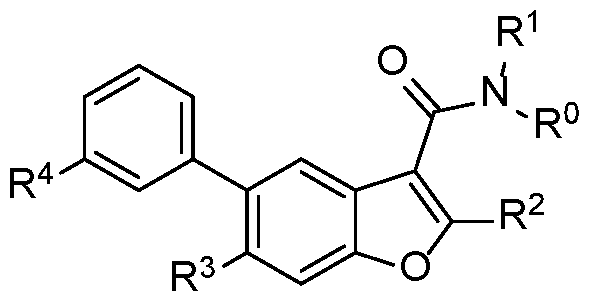
There are disclosed compounds of Formula I
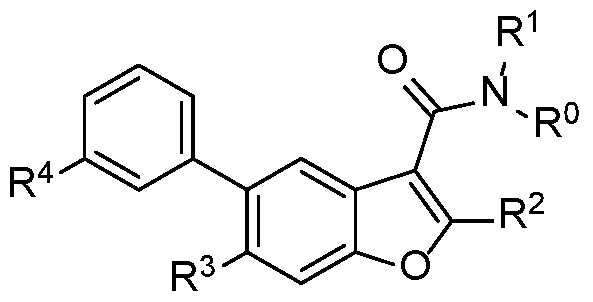
R° and R1 are independently hydrogen or methyl;
R2 is optionally substituted aryl with 0-2 halo;
R4 is COOR101 or CON(R102)(R103);
R101 is hydrogen or optionally substituted Ci-C6 alkyl with 0-2 substituents selected from halo, hydroxyl, alkoxy, and haloalkoxy;
R102 and R103 are each independently hydrogen, -(CR10RU)R12, optionally substituted Ci-C6 alkyl, optionally substituted C3-C8 cycloalkyl, with 0-3 substituents selected from halo, CN, CF3, OH, OR104, NH2, NR105R106, COOR104, CONR105R106, S(0)2R104, S(O)2NR105R106, NR104CONR105R106, OR104CONR105R106,
C(=NR107)NR105R106, NR108C(=NR107)NR105R106, haloalkoxy; or
R and R can be taken together with the nitrogen atom to form a 4-7 membered ring optionally containing 1-2 additional nitrogen atoms, said ring optionally substituted with 0-3 substituents selected from OH, Ci-C6 alkyl, halo substituted phenyl, phenyl, C1-C3 alkoxy C1-C3 alkyl, hydroxy C1-C3 alkyl,
COOR104- HCO C1-C3 alkyl;
R104 is hydrogen, optionally substituted Ci-C6 alkyl or optionally substituted C3-C8 cycloalkyl with 0-3 substituents selected from halo, hydroxyl, alkoxy, and haloalkoxy;
R105 and R106 are each independently hydrogen, optionally substituted Ci-C6 alkyl or optionally substituted C3-C8 cycloalkyl with 0-3 substituents selected from halo, hydroxyl, alkoxy, and haloalkoxy; or
R107 and R108 are each independently hydrogen, optionally substituted Ci-C6 alkyl or optionally substituted C3-C8 cycloalkyl with 0-3 substituents selected from halo, hydroxyl, alkoxy, and haloalkoxy; or
R10 and R11 are independently hydrogen or Ci-C6 alkyl;
R12 is substituted Ci-C6 alkynyl, C3-C8 cycloalkyl, -COO Ci-C6 alkyl, phenyl
R3 is R201R202;
R201 is selected from the group of hydrogen, -SO2 C1-C3 alkyl, alkenyl, alkynyl, haloalkyl, haloalkenyl, haloalkynyl, cyanoalkyl, cyanoalkenyl,
cyanoalkynyl, cycloalkyl, halocycloalkyl, (haloalkyl)cycloalkyl,
(halocycloalkyl)cycloalkyl, cyanocycloalkyl, (cyanoalkyl)cycloalkyl,
(cyanocycloalkyl)cycloalkyl, hydroxycycloalkyl, (hydroxyalkyl)cycloalkyl, (hydroxycycloalkyl)cycloalkyl alkoxycycloalkyl, (alkoxyalkyl)cycloalkyl, and (alkoxycycloalkyl)cycloalkyl;
R202 is selected from the group of CN(Ci-C6 alkyl), C3-C6 cycloalkyl(Ci-C6 alkyl), halo(Ci-C6 alkyl)„, halo(C2-C6 alkenyl)„, CF3CF2(Ci-C6 alkyl)„, CF3 (Ci-C6 alkyl)n, alkyl, hydroxyalkyl, alkoxyalkyl, alkylsulfonyl, alkenyl, alkynyl, haloalkyl, haloalkenyl, haloalkynyl, cyanoalkyl, cyanoalkenyl, cyanoalkynyl, cycloalkyl, halocycloalkyl, (haloalkyl)cycloalkyl, (halocycloalkyl)cycloalkyl, cyanocycloalkyl, (cyanoalkyl)cycloalkyl, (cyanocycloalkyl)cycloalkyl, hydroxycycloalkyl,
(hydroxyalkyl)cycloalkyl, (hydroxycycloalkyl)cycloalkyl alkoxycycloalkyl, (alkoxyalkyl)cycloalkyl, and (alkoxycycloalkyl)cycloalkyl;
n is 1, 2, 3 or 4;
and/or a pharmaceutically acceptable salt or stereoisomer thereof.
The invention also relates to pharmaceutical compositions comprising a compound of Formula I, including a pharmaceutically acceptable salt thereof , and a pharmaceutically acceptable carrier.
In addition, the invention provides one or more methods of treating hepatitis C infection comprising administering a therapeutically effective amount of a compound of Formula I to a patient.
Also provided as part of the invention are one or more methods for making the compounds of Formula I.
The present invention is directed to these, as well as other important embodiments, hereinafter described. DETAILED DESCRIPTION OF THE EMBODFMENTS
The singular forms "a", "an", and "the" include plural reference unless the context clearly dictates otherwise.
Unless otherwise specifically set forth elsewhere in the application, the following terms may be used herein and shall have the following meanings:
"Hydrogen" or "H" refers to hydrogen, including its isotopes, such as deuterium. "Halo" means fluoro, chloro, bromo, or iodo. "Alkyl" means a straight or branched alkyl group composed of 1 to 6 carbons. "Alkenyl" means a straight or branched alkyl group composed of 2 to 6 carbons with at least one double bond. "Cycloalkyl" means a monocyclic ring system composed of 3 to 7 carbons. "Hydroxyalkyl," "alkoxy" and other terms with a substituted alkyl moiety include straight and branched isomers composed of 1 to 6 carbon atoms for the alkyl moiety. "Halo" includes all halogenated isomers from monohalo substituted to perhalo substituted in substituents defined with halo, for example, "Haloalkyl" and "haloalkoxy",
"halophenyl", "halophenoxy." "Aryl" means a monocyclic or bicyclic aromatic hydrocarbon groups having 6 to 12 carbon atoms, or a bicyclic fused ring system wherein one or both of the rings is a phenyl group. Bicyclic fused ring systems consist of a phenyl group fused to a four- to six-membered aromatic or non-aromatic carbocyclic ring. Representative examples of aryl groups include, but are not limited
to, indanyl, indenyl, naphthyl, phenyl, and tetrahydronaphthyl. "Heteroaryl" means a 5 to 7 membered monocyclic or 8 to 11 membered bicyclic aromatic ring system with 1-5 heteroatoms independently selected from nitrogen, oxygen, and sulfur.
Parenthetic and multiparenthetic terms are intended to clarify bonding relationships to those skilled in the art. For example, a term such as ((R)alkyl) means an alkyl substituent further substituted with the substituent R. Substituents which are illustrated by chemical drawing to bond at variable positions on a multiple ring system (for example a bicyclic ring system) are intended to bond to the ring where they are drawn to append.
The invention includes all pharmaceutically acceptable salt forms of the compounds. Pharmaceutically acceptable salts are those in which the counter ions do not contribute significantly to the physiological activity or toxicity of the compounds and as such function as pharmacological equivalents. These salts can be made according to common organic techniques employing commercially available reagents. Some anionic salt forms include acetate, acistrate, besylate, bromide, camsylate, chloride, citrate, fumarate, glucouronate, hydrobromide, hydrochloride, hydroiodide, iodide, lactate, maleate, mesylate, nitrate, pamoate, phosphate, succinate, sulfate, tartrate, tosylate, and xinofoate. Some cationic salt forms include ammonium, aluminum, benzathine, bismuth, calcium, choline, diethylamine, diethanolamine, lithium, magnesium, meglumine, 4-phenylcyclohexylamine, piperazine, potassium, sodium, tromethamine, and zinc.
Some of the compounds of the invention possess asymmetric carbon atoms. The invention includes all stereoisomeric forms, including enantiomers and diastereomers as well as mixtures of stereoisomers such as racemates. Some stereoisomers can be made using methods known in the art. Stereoisomeric mixtures of the compounds and related intermediates can be separated into individual isomers according to methods commonly known in the art. The use of wedges or hashes in the depictions of molecular structures in the following schemes and tables is intended only to indicate relative stereochemistry, and should not be interpreted as implying absolute stereochemical assignments.
The invention is intended to include all isotopes of atoms occurring in the present compounds. Isotopes include those atoms having the same atomic number but different mass numbers. By way of general example and without limitation,
isotopes of hydrogen include deuterium and tritium. Isotopes of carbon include C and 14C. Isotopically-labeled compounds of the invention can generally be prepared by conventional techniques known to those skilled in the art or by processes analogous to those described herein, using an appropriate isotopically-labeled reagent in place of the non-labeled reagent otherwise employed. Such compounds may have a variety of potential uses, for example as standards and reagents in determining biological activity. In the case of stable isotopes, such compounds may have the potential to favorably modify biological, pharmacological, or pharmacokinetic properties.
As set forth above, the invention is directed to one or more compounds of Formula I, including pharmaceutically acceptable salts and/or stereoisomers thereof:

R° and R1 are independently hydrogen or methyl;
R2 is optionally substituted aryl with 0-2 halo;
R4 is COOR101 or CON(R102)(R103);
R101 is hydrogen or optionally substituted Ci-C6 alkyl with 0-2 substituents selected from halo, hydroxyl, alkoxy, and haloalkoxy;
R102 and R103 are each independently hydrogen, -(CR10RU)R12, optionally substituted Ci-C6 alkyl, optionally substituted C3-C8 cycloalkyl, with 0-3 substituents selected from halo, CN, CF3, OH, OR104, H2, R105R106, COOR104, CO R105R106, S(0)2R104, S(O)2 R105R106, R104CO R105R106, OR104CO R105R106,
C(= R107) R105R106, R108C(= R107) R105R106, haloalkoxy; or
R102 and R103 can be taken together with the nitrogen atom to form a 4-7 membered ring optionally containing 1-2 additional nitrogen atoms, said ring optionally substituted with 0-3 substituents selected from OH, Ci-C6 alkyl, halo
substituted phenyl, phenyl, C1-C3 alkoxy C1-C3 alkyl, hydroxy C1-C3 alkyl,
COOR104- HCO C1-C3 alkyl;
R104 is hydrogen, optionally substituted Ci-C6 alkyl or optionally substituted C3-C8 cycloalkyl with 0-3 substituents selected from halo, hydroxyl, alkoxy, and haloalkoxy;
R105 and R106 are each independently hydrogen, optionally substituted Ci-C6 alkyl or optionally substituted C3-C8 cycloalkyl with 0-3 substituents selected from halo, hydroxyl, alkoxy, and haloalkoxy; or
R107 and R108 are each independently hydrogen, optionally substituted Ci-C6 alkyl or optionally substituted C3-C8 cycloalkyl with 0-3 substituents selected from halo, hydroxyl, alkoxy, and haloalkoxy; or
R10 and R11 are independently hydrogen or Ci-C6 alkyl;
R12 is substituted Ci-C6 alkynyl, C3-C8 cycloalkyl, -COO Ci-C6 alkyl, phenyl
R3 is R201R202;
R201 is selected from the group of hydrogen, -SO2 C1-C3 alkyl, alkenyl, alkynyl, haloalkyl, haloalkenyl, haloalkynyl, cyanoalkyl, cyanoalkenyl,
cyanoalkynyl, cycloalkyl, halocycloalkyl, (haloalkyl)cycloalkyl,
(halocycloalkyl)cycloalkyl, cyanocycloalkyl, (cyanoalkyl)cycloalkyl,
(cyanocycloalkyl)cycloalkyl, hydroxycycloalkyl, (hydroxyalkyl)cycloalkyl, (hydroxycycloalkyl)cycloalkyl alkoxycycloalkyl, (alkoxyalkyl)cycloalkyl, and (alkoxycycloalkyl)cycloalkyl;;
R202 is selected from the group of CN(Ci-C6 alkyl), C3-C6 cycloalkyl(Ci-C6 alkyl), halo(Ci-C6 alkyl)„, halo(C2-C6 alkenyl)„, CF3CF2(Ci-C6 alkyl)„, CF3 (Ci-C6 alkyl)n, alkyl, hydroxyalkyl, alkoxyalkyl, alkylsulfonyl, alkenyl, alkynyl, haloalkyl, haloalkenyl, haloalkynyl, cyanoalkyl, cyanoalkenyl, cyanoalkynyl, cycloalkyl, halocycloalkyl, (haloalkyl)cycloalkyl, (halocycloalkyl)cycloalkyl, cyanocycloalkyl, (cyanoalkyl)cycloalkyl, (cyanocycloalkyl)cycloalkyl, hydroxycycloalkyl,
(hydroxyalkyl)cycloalkyl, (hydroxycycloalkyl)cycloalkyl alkoxycycloalkyl, (alkoxyalkyl)cycloalkyl, and (alkoxycycloalkyl)cycloalkyl;
n is 1, 2, 3 or 4;
and/or a pharmaceutically acceptable salt or stereoisomer thereof.
In another embodiment of the invention, there is disclosed a compound of Formula I
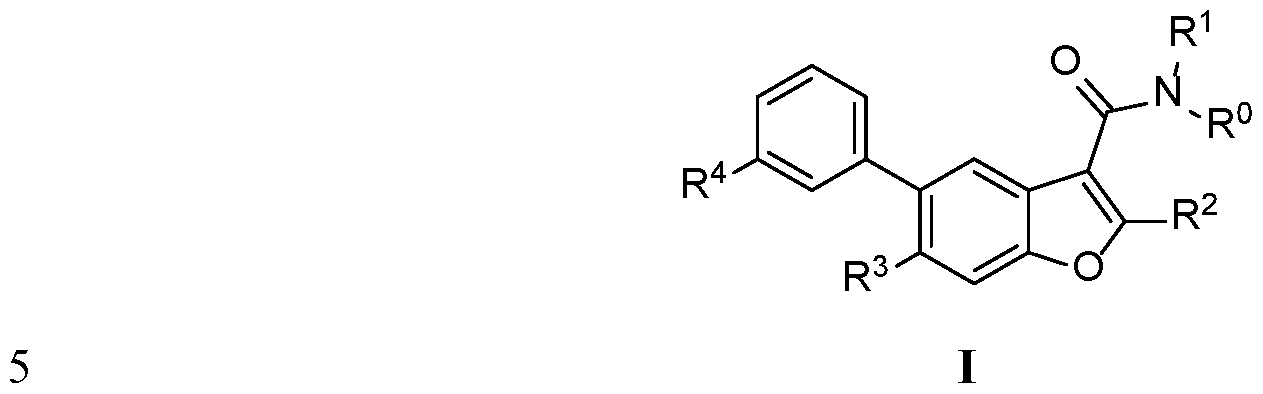
wherein
R is hydrogen;
R1 is methyl;
R2 is phenyl substituted with 1-2 halo;
R4 is COOR101 or CON(R102)(R103);
R101 is hydrogen or optionally substituted Ci-C6 alkyl with 0-2 substituents selected from halo, hydroxyl, alkoxy, and haloalkoxy;
R102 and R103 are each independently hydrogen, -(CR10RU)R12, optionally substituted Ci-C6 alkyl, optionally substituted C3-C8 cycloalkyl, with 0-3 substituents selected from halo, CN, CF3, OH, OR104, H2, R105R106, COOR104, CO R105R106, S(0)2R104, S(O)2 R105R106, R104CO R105R106, OR104CO R105R106,
C(= R107) R105R106, R108C(= R107) R105R106, haloalkoxy; or
R102 and R103 can be taken together with the nitrogen atom to form a 4-7 membered ring optionally containing 1-2 additional nitrogen atoms, said ring optionally substituted with 0-3 substituents selected from OH, Ci-C6 alkyl, halo substituted phenyl, phenyl, Ci-C3 alkoxy Ci-C3 alkyl, hydroxy Ci-C3 alkyl,
COOR104- HCO Ci-C3 alkyl;
R104 is hydrogen, optionally substituted Ci-C6 alkyl or optionally substituted C3-C8 cycloalkyl with 0-3 substituents selected from halo, hydroxyl, alkoxy, and haloalkoxy;
R105 and R106 are each independently hydrogen, optionally substituted Ci-C6 alkyl or optionally substituted C3-C8 cycloalkyl with 0-3 substituents selected from halo, hydroxyl, alkoxy, and haloalkoxy; or
R107 and R108 are each independently hydrogen, optionally substituted C i-Ce alkyl or optionally substituted C3-C8 cycloalkyl with 0-3 substituents selected from halo, hydroxyl, alkoxy, and haloalkoxy; or
R10 and R11 are independently hydrogen or Ci-C6 alkyl;
R12 is substituted C i-C6 alkynyl, C3-C8 cycloalkyl, -COO Ci-C6 alkyl, phenyl or CF2CF3;
R3 is R201R202;
R201 is hydrogen or S02 Ci-C3 alkyl;
R202 is CN Ci-Ce alkyl, C3-C6 cycloalkyl Ci-Ce alkyl, halo (Ci-C6 alkyl)n, halo (C2-C6 alkenyl)„, CF3CF2(Ci-C6 alkyl)„or CF3 (Ci-C6 alkyl)„;
n is 1, 2, 3 or 4;
and/or a pharmaceutically acceptable salt or stereoisomer thereof.
In another embodiment of the invention, there is disclosed a compound of Formula I
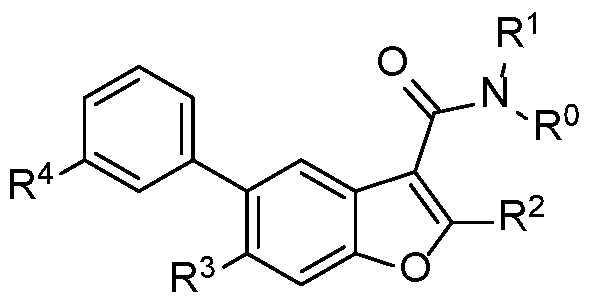
I
wherein
R° is hydrogen;
R1 is methyl;
R2 is phenyl substituted with fluoro;
R4 is COOR101 or CONH(R103);
R101 is hydrogen or optionally substituted C 1-C3 alkyl with 0-2 substituents selected from halo, hydroxyl, alkoxy, and haloalkoxy;
R103 is hydrogen, -(CR10RU)R12, optionally substituted Ci-Ce alkyl, optionally substituted C3-C8 cycloalkyl, with 0-3 substituents selected from halo, CN, CF3, OH, OR104, NR105R106, COOR104, CONR105R106, haloalkoxy; or
R102 and R103 can be taken together with the nitrogen atom to form a 4-7 membered ring optionally containing 1-2 additional nitrogen atoms, said ring optionally substituted with 0-3 substituents selected from OH, Ci-C6 alkyl, halo
substituted phenyl, phenyl, C1-C3 alkoxy C1-C3 alkyl, hydroxy C1-C3 alkyl,
COOR104- HCO C1-C3 alkyl;
R104 is hydrogen, optionally substituted Ci-C6 alkyl or optionally substituted C3-C8 cycloalkyl with 0-3 substituents selected from halo, hydroxyl, alkoxy, and haloalkoxy;
R1C and R106 are each independently hydrogen, optionally substituted Ci-Ce alkyl or optionally substituted C3-C8 cycloalkyl with 0-3 substituents selected from halo, hydroxyl, alkoxy, and haloalkoxy; or
R10 and R11 are independently hydrogen or Ci-C6 alkyl;
R12 is substituted Ci-Ce alkynyl, C3-C8 cycloalkyl, -COO Ci-Ce alkyl, phenyl
R3 is R201R202;
R201 is hydrogen or S02 C1-C3 alkyl;
R202 is CN Ci-Ce alkyl, C3-C6 cycloalkyl Ci-C6 alkyl, halo (Ci-C6 alkyl)n, halo (C2-C6 alkeny n. CF3CF2(Ci-C6 alkyl)n or CF3 (Ci-Ce alkyl)n;
n is 1, 2, 3 or 4;
and/or a pharmaceutically acceptable salt or stereoisomer thereof.
In another embodiment of the invention, there is disclosed a compound of Formula I
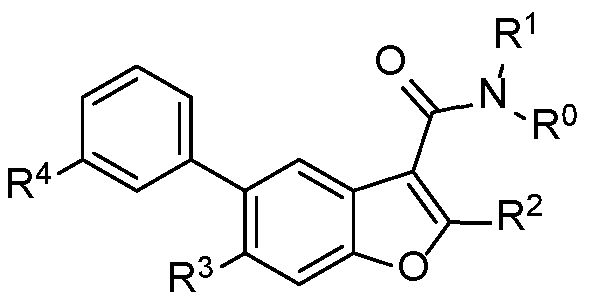
I
wherein
R° is hydrogen;
R1 is methyl;
R2 is phenyl substituted with fluoro;
R4 is COOR101 or CO H(R103);
R101 is hydrogen or C1-C3 alkyl;
R103 is hydrogen, -(CR10RU)R12, optionally substituted Ci-Ce alkyl, optionally substituted C3-C8 cycloalkyl, with 0-3 substituents selected from halo, CN, CF3, OH, OR104, R105R106, COOR104, CO R105R106, haloalkoxy; or
R102 and R103 can be taken together with the nitrogen atom to form a 4-7 membered ring optionally containing 1-2 additional nitrogen atoms, said ring optionally substituted with 0-3 substituents selected from OH, Ci-C6 alkyl, halo substituted phenyl, phenyl, Ci-C3 alkoxy Ci-C3 alkyl, hydroxy Ci-C3 alkyl,
COOR104- HCO Ci-C3 alkyl;
R104 is hydrogen, optionally substituted Ci-C6 alkyl or optionally substituted C3-C8 cycloalkyl with 0-3 substituents selected from halo, hydroxyl, alkoxy, and haloalkoxy;
R105 and R106 are each independently hydrogen, optionally substituted Ci-C6 alkyl or optionally substituted C3-C8 cycloalkyl with 0-3 substituents selected from halo, hydroxyl, alkoxy, and haloalkoxy; or
R10 and R11 are independently hydrogen or Ci-C6 alkyl;
R12 is substituted Ci-C6 alkynyl, C3-C8 cycloalkyl, -COO Ci-C6 alkyl, phenyl or CF2CF3;
R3 is R201R202;
R201 is S02 Ci-C3 alkyl;
R202 is CN Ci-Ce alkyl, C3-C6 cycloalkyl Ci-C6 alkyl, halo (Ci-C6 alkyl)„, halo
(C2-C6 alkenyl)„, CF3CF2(Ci-C6 alkyl)„or CF3 (Ci-C6 alkyl)„;
n is 1, 2 or 3;
and/or a pharmaceutically acceptable salt or stereoisomer thereof. In another embodiment of the invention, there is disclosed a compound of
Formula I
R° is hydrogen;
1 is methyl;

R4 is COOR101 or CO H(R103);
R101 is hydrogen or C1-C3 alkyl;
R103 is hydrogen, -(CR10RU)R12, optionally substituted Ci-Ce alkyl, optionally substituted C3-C8 cycloalkyl, with 0-3 substituents selected from halo, CN, CF3, OH, OR104, R105R106, COOR104, CO R105R106, haloalkoxy; or
R102 and R103 can be taken together with the nitrogen atom to form a 4-7 membered ring optionally containing 1-2 additional nitrogen atoms, said ring optionally substituted with 0-3 substituents selected from OH, Ci-C6 alkyl, halo substituted phenyl, phenyl, Ci-C3 alkoxy Ci-C3 alkyl, hydroxy Ci-C3 alkyl,
COOR104- HCO Ci-C3 alkyl;
R104 is hydrogen, optionally substituted Ci-C6 alkyl or optionally substituted C3-C8 cycloalkyl with 0-3 substituents selected from halo, hydroxyl, alkoxy, and haloalkoxy;
R105 and R106 are each independently hydrogen, optionally substituted Ci-C6 alkyl or optionally substituted C3-C8 cycloalkyl with 0-3 substituents selected from halo, hydroxyl, alkoxy, and haloalkoxy;
R10 and R11 are independently hydrogen or Ci-C6 alkyl;
R12 is substituted Ci-Ce alkynyl, C3-C8 cycloalkyl, -COO Ci-Ce alkyl, phenyl or CF2CF3;
R3 is R201R202;
R201 is S02 Ci-C3 alkyl;
R202 is CN Ci-Ce alkyl, C3-C6 cycloalkyl Ci-C6 alkyl, halo (Ci-C6 alkyl)„, halo (C2-C6 alkenyl)„, CF3CF2(Ci-C6 alkyl)„or CF3 (Ci-C6 alkyl)„;
n is 1, 2 or 3;
and/or a pharmaceutically acceptable salt or stereoisomer thereof.
In another embodiment of the invention, there is disclosed a compound of Formula I


R4 is COOR101 or CO H(R103);
R101 is hydrogen or methyl;
R103 is hydrogen, -(CR10RU)R12, optionally substituted Ci-Ce alkyl, optionally substituted C3-C8 cycloalkyl, with 0-3 substituents selected from halo, CN, CF3, OH, OR104, R105R106, COOR104, CO R105R106, haloalkoxy; or
R102 and R103 can be taken together with the nitrogen atom to form a 4-7 membered ring optionally containing 1-2 additional nitrogen atoms, said ring optionally substituted with 0-3 substituents selected from OH, Ci-C6 alkyl, halo substituted phenyl, phenyl, Ci-C3 alkoxy Ci-C3 alkyl, hydroxy Ci-C3 alkyl,
COOR104- HCO Ci-C3 alkyl;
R104 is hydrogen, optionally substituted Ci-C6 alkyl or optionally substituted C3-C8 cycloalkyl with 0-3 substituents selected from halo, hydroxyl, alkoxy, and haloalkoxy;
R105 and R106 are each independently hydrogen, optionally substituted Ci-C6 alkyl or optionally substituted C3-C8 cycloalkyl with 0-3 substituents selected from halo, hydroxyl, alkoxy, and haloalkoxy;
R10 and R11 are independently hydrogen or Ci-C6 alkyl;
R12 is substituted Ci-C6 alkynyl, C3-C8 cycloalkyl, -COO Ci-C6 alkyl, phenyl or CF2CF3;
R3 is R201R202;
R201 is S02CH3;
R202 is -CH3CN, -CH3 cyclopropyl, -(CH2)2F, -(CH2)3F, - H(CH2)3F, -CHF2, -CH2CHF2, -CH2CH=CHF2 , -(CH2)2CF3;
and/or a pharmaceutically acceptable salt or stereoisomer thereof.
In a further embodiment, there are disclosed the exemplified compounds of the invention.
Pharmaceutical Compositions and Methods of Treatment The compounds according to the various embodiments herein set forth demonstrate activity against HCV NS5B, and can be useful in treating HCV and HCV infection. Therefore, another aspect of the invention is a composition comprising a compound of Formula I, or a pharmaceutically acceptable salt thereof, and a pharmaceutically acceptable carrier.
Another aspect of the invention is a composition further comprising an additional compound having anti-HCV activity.
Another aspect of the invention is a composition where the compound having anti-HCV activity is an interferon or a ribavirin. Another aspect of the invention is wherein the interferon is selected from interferon alpha 2B, pegylated interferon alpha, consensus interferon, interferon alpha 2A, interferon lambda, and
lymphoblastoid interferon tau.
Another aspect of the invention is a composition where the compound having anti-HCV activity is a cyclosporin. Another aspect of the invention is where the cyclosporin is cyclosporin A.
Another aspect of the invention is a composition where the compound having anti-HCV activity is selected from the group consisting of interleukin 2, interleukin 6, interleukin 12, a compound that enhances the development of a type 1 helper T cell response, interfering RNA, anti-sense RNA, Imiqimod, ribavirin, an inosine 5'- monophospate dehydrogenase inhibitor, amantadine, and rimantadine.
Another aspect of the invention is a composition where the compound having anti-HCV activity is effective to inhibit the function of a target selected from HCV metalloprotease, HCV serine protease, HCV polymerase, HCV helicase, HCV NS4B protein, HCV entry, HCV assembly, HCV egress, HCV NS5A protein, IMPDH, and a nucleoside analog for the treatment of an HCV infection.
Another aspect of the invention is a composition comprising a compound of Formula I, or a pharmaceutically acceptable salt thereof, a pharmaceutically acceptable carrier, an interferon and ribavirin.
Another aspect of the invention is a method of inhibiting the function of the HCV replicon comprising contacting the HCV replicon with a compound of Formula I or a pharmaceutically acceptable salt thereof.
Another aspect of the invention is a method of inhibiting the function of the HCV NS5B protein comprising contacting the HCV NS5B protein with a compound of Formula I or a pharmaceutically acceptable salt thereof.
Another aspect of the invention is a method of treating an HCV infection in a patient comprising administering to the patient a therapeutically effective amount of a compound of Formula I or a pharmaceutically acceptable salt thereof. In another embodiment the compound is effective to inhibit the function of the HCV replicon. In another embodiment the compound is effective to inhibit the function of the HCV NS5B protein.
Another aspect of the invention is a method of treating an HCV infection in a patient comprising administering to the patient a therapeutically effective amount of a compound of Formula I, or a pharmaceutically acceptable salt thereof, in conjunction with (prior to, after, or concurrently) another compound having anti-HCV activity.
Another aspect of the invention is the method wherein the other compound having anti-HCV activity is an interferon or a ribavirin.
Another aspect of the invention is the method where the interferon is selected from interferon alpha 2B, pegylated interferon alpha, consensus interferon, interferon alpha 2A, interferon lambda, and lymphoblastoid interferon tau.
Another aspect of the invention is the method where the other compound having anti-HCV activity is a cyclosporin.
Another aspect of the invention is the method where the cyclosporin is cyclosporin A. Another aspect of the invention is the method where the other compound having anti-HCV activity is selected from interleukin 2, interleukin 6, interleukin 12, a compound that enhances the development of a type 1 helper T cell response,
interfering RNA, anti-sense RNA, Imiqimod, ribavirin, an inosine 5'-monophospate dehydrogenase inhibitor, amantadine, and rimantadine.
Another aspect of the invention is the method wherein the other compound having anti-HCV activity is effective to inhibit the function of a target selected from the group consisting of HCV metalloprotease, HCV serine protease, HCV
polymerase, HCV helicase, HCV NS4B protein, HCV entry, HCV assembly, HCV egress, HCV NS5 A protein, EVIPDH, and a nucleoside analog for the treatment of an HCV infection.
Another aspect of the invention is the method wherein the other compound having anti-HCV activity is effective to inhibit the function of target in the HCV life cycle other than the HCV NS5B protein.
"Therapeutically effective" means the amount of agent required to provide a meaningful patient benefit as understood by practitioners in the field of hepatitis and HCV infection.
"Patient" means a person infected with the HCV virus and suitable for therapy as understood by practitioners in the field of hepatitis and HCV infection.
"Treatment," "therapy," "regimen," "HCV infection," and related terms are used as understood by practitioners in the field of hepatitis and HCV infection.
The compounds of this invention are generally given as pharmaceutical compositions comprised of a therapeutically effective amount of a compound or its pharmaceutically acceptable salt and a pharmaceutically acceptable carrier and may contain conventional excipients. Pharmaceutically acceptable carriers are those conventionally known carriers having acceptable safety profiles. Compositions encompass all common solid and liquid forms including for example capsules, tablets, lozenges, and powders as well as liquid suspensions, syrups, elixers, and solutions. Compositions are made using common formulation techniques, and conventional excipients (such as binding and wetting agents) and vehicles (such as water and alcohols) are generally used for compositions. See, for example,
Remington's Pharmaceutical Sciences, Mack Publishing Company, Easton, PA, 17th edition, 1985.
Solid compositions are normally formulated in dosage units and compositions providing from about 1 to 1000 mg of the active ingredient per dose are preferred. Some examples of dosages are 1 mg, 10 mg, 100 mg, 250 mg, 500 mg, and 1000 mg.
Generally, other agents will be present in a unit range similar to agents of that class used clinically. Typically, this is 0.25-1000 mg/unit.
Liquid compositions are usually in dosage unit ranges. Generally, the liquid composition will be in a unit dosage range of 1-100 mg/mL. Some examples of dosages are 1 mg/mL, 10 mg/mL, 25 mg/mL, 50 mg/mL, and 100 mg/mL.
Generally, other agents will be present in a unit range similar to agents of that class used clinically. Typically, this is 1-100 mg/mL.
The invention encompasses all conventional modes of administration; oral and parenteral methods are preferred. Generally, the dosing regimen will be similar to other agents used clinically. Typically, the daily dose will be 1-100 mg/kg body weight daily. Generally, more compound is required orally and less parenterally. The specific dosing regimen, however, will be determined by a physician using sound medical judgment.
The invention also encompasses methods where the compound is given in combination therapy. That is, the compound can be used in conjunction with, but separately from, other agents useful in treating hepatitis and HCV infection. In these combination methods, the compound will generally be given in a daily dose of 1-100 mg/kg body weight daily in conjunction with other agents. The other agents generally will be given in the amounts used therapeutically. The specific dosing regimen, however, will be determined by a physician using sound medical judgment.
Some examples of compounds suitable for compositions and methods are listed in Table 1.
Table 1

Brand Name Physiological Class Source Company
Target
ISIS
Pharmaceuticals Inc,
ISIS 14803 Antiviral antisense Carlsbad, CA/Elan
Pharmaceuticals Inc., New York, NY
Endo
Pharmaceuticals
Summetrel Antiviral antiviral
Holdings Inc., Chadds Ford, PA
GS-9132 (ACH-
Antiviral HCV Inhibitor Achillion / Gilead 806)
Pyrazolopyrimidine
compounds and
salts Arrow Therapeutics
Antiviral HCV Inhibitors
From WO- Ltd.
2005047288
26 May 2005
Ribapharm Inc.,
Levovirin Antiviral IMPDH inhibitor
Costa Mesa, CA
Vertex
Merimepodib Pharmaceuticals
Antiviral IMPDH inhibitor
(VX-497) Inc., Cambridge,
MA
XTL
XTL-6865 (XTL-
Antiviral monoclonal antibody Biopharmaceuticals 002)
Ltd., Rehovot, Israel
Vertex
Pharmaceuticals
Telaprevir
NS3 serine protease Inc., Cambridge, (VX-950, LY- Antiviral
inhibitor MA/ Eli Lilly and 570310)
Co. Inc.,
Indianapolis, IN
Type of Inhibitor or
Brand Name Physiological Class Source Company
Target
NS5B Replicase
HCV-796 Antiviral Wyeth / Viropharma
Inhibitor
NS5B Replicase
NM-283 Antiviral Idenix / Novartis
Inhibitor
NS5B Replicase Gene Labs /
GL-59728 Antiviral
Inhibitor Novartis
NS5B Replicase Gene Labs /
GL-60667 Antiviral
Inhibitor Novartis
NS5B Replicase
2'C MeA Antiviral Gilead
Inhibitor
NS5B Replicase
PSI 6130 Antiviral Roche
Inhibitor
NS5B Replicase
R1626 Antiviral Roche
Inhibitor
2'C Methyl NS5B Replicase
Antiviral Merck
adenosine Inhibitor
Japan Tobacco Inc.,
JTK-003 Antiviral RdRp inhibitor
Tokyo, Japan
ICN
Levovirin Antiviral ribavirin Pharmaceuticals,
Costa Mesa, CA
Schering-Plough
Ribavirin Antiviral ribavirin Corporation,
Kenilworth, NJ
Ribapharm Inc.,
Viramidine Antiviral Ribavirin Prodrug
Costa Mesa, CA
Ribozyme
Heptazyme Antiviral ribozyme Pharmaceuticals
Inc., Boulder, CO
Boehringer serine protease Ingelheim Pharma
BILN-2061 Antiviral
inhibitor KG, Ingelheim,
Germany
Type of Inhibitor or
Brand Name Physiological Class Source Company
Target
serine protease
SCH 503034 Antiviral Schering Plough inhibitor
SciClone
Zadazim Immune modulator Immune modulator Pharmaceuticals
Inc., San Mateo, CA
Maxim
Ceplene Immunomodulator immune modulator Pharmaceuticals
Inc., San Diego, CA
F. Hoffmann-La
HCV IgG immuno¬
CellCept Immunosuppressant Roche LTD, Basel, suppressant
Switzerland
Nabi
HCV IgG immuno¬
Civacir Immunosuppressant Biopharmaceuticals suppressant
Inc., Boca Raton, FL
Human Genome
Albuferon - a Interferon albumin IFN-ot2b Sciences Inc.,
Rockville, MD
InterMune
IFN
Infergen A Interferon Pharmaceuticals alfacon-1
Inc., Brisbane, CA
Omega IFN Interferon IFN -co Intarcia Therapeutics
Transition
IFN-β and EMZ701 Interferon IFN-P and EMZ701 Therapeutics Inc.,
Ontario, Canada
Serono, Geneva,
Rebif Interferon IFN-p ia
Switzerland
F. Hoffmann-La
Roferon A Interferon IFN-cx2a Roche LTD, Basel,
Switzerland
Schering-Plough
Intron A Interferon IFN-cx2b Corporation,
Kenilworth, NJ
Type of Inhibitor or
Brand Name Physiological Class Source Company
Target
RegeneRx
Biopharma. Inc.,
Intron A and Bethesda, MD/
Interferon IFN-ot2b/ot 1 -thymosin
Zadaxin SciClone
Pharmaceuticals Inc, San Mateo, CA
Schering-Plough
Rebetron Interferon IFN-ot2b/ribavirin Corporation,
Kenilworth, NJ
InterMune Inc.,
Actimmune Interferon INF-γ
Brisbane, CA
Interferon-β Interferon Interferon-p-la Serono
Viragen/
Multiferon Interferon Long lasting IFN
Valentis
Lympho-blastoid IFN- GlaxoSmithKline
Wellferon Interferon
otnl pic, Uxbridge, UK
Viragen Inc.,
Omniferon Interferon natural IFN -a
Plantation, FL
F. Hoffmann-La
Pegasys Interferon PEGylated IFN-ot2a Roche LTD, Basel,
Switzerland
Maxim
Pegasys and PEGylated IFN-ot2a/
Interferon Pharmaceuticals Ceplene immune modulator
Inc., San Diego, CA
F. Hoffmann-La
Pegasys and PEGylated IFN-
Interferon Roche LTD, Basel, Ribavirin ot2a/ribavirin
Switzerland
Schering-Plough
PEG-Intron Interferon PEGylated IFN-ot2b Corporation,
Kenilworth, NJ
Schering-Plough
PEG-Intron / PEGylated IFN-
Interferon Corporation, Ribavirin a2b/ribavirin
Kenilworth, NJ
Type of Inhibitor or
Brand Name Physiological Class Source Company
Target
Indevus
IP-501 Liver protection antifibrotic Pharmaceuticals
Inc., Lexington, MA
Idun
IDN-6556 Liver protection caspase inhibitor Pharmaceuticals
Inc., San Diego, CA
InterMune serine protease
ITMN-191 (R-7227) Antiviral Pharmaceuticals inhibitor
Inc., Brisbane, CA
NS5B Replicase
GL-59728 Antiviral Genelabs
Inhibitor
ANA-971 Antiviral TLR-7 agonist Anadys
serine protease
Boceprevir Antiviral Schering Plough inhibitor
serine protease Tibotec BVBA,
TMS-435 Antiviral
inhibitor Mechelen, Belgium
Boehringer serine protease Ingelheim Pharma
BI-201335 Antiviral
inhibitor KG, Ingelheim,
Germany serine protease
MK-7009 Antiviral Merck
inhibitor
PF-00868554 Antiviral replicase inhibitor Pfizer
Anadys
Non-Nucleoside
Pharmaceuticals,
ANA598 Antiviral NS5B Polymerase
Inc., San Diego, CA, Inhibitor
USA
Idenix
Non-Nucleoside Pharmaceuticals,
IDX375 Antiviral
Replicase Inhibitor Cambridge, MA,
USA
Type of Inhibitor or
Brand Name Physiological Class Source Company
Target
Boehringer
NS5B Polymerase Ingelheim Canada
BILB 1941 Antiviral
Inhibitor Ltd R&D, Laval,
QC, Canada
Nucleoside Pharmasset,
PSI-7851 Antiviral
Polymerase Inhibitor Princeton, NJ, USA
Nucleotide NS5B Pharmasset,
PSI-7977 Antiviral
Polymerase Inhibitor Princeton, NJ, USA
Antiviral NS5B Polymerase
VCH-759 ViroChem Pharma
Inhibitor
Antiviral NS5B Polymerase
VCH-916 ViroChem Pharma
Inhibitor
Antiviral NS5B Polymerase
GS-9190 Gilead
Inhibitor
Peg -interferon Antiviral ZymoGenetics/Brist
Interferon
lambda ol -Myers Squibb
Synthesis Methods
The compounds may be made by methods known in the art, including those described below. Some reagents and intermediates are known in the art. Other reagents and intermediates can be made by methods known in the art using commercially available materials. The variables (e.g. numbered "R" substituents) used to describe the synthesis of the compounds are intended only to illustrate how to make and are not to be confused with variables used in the claims or in other sections of the specification. Abbreviations used within the schemes generally follow conventions used in the art.
Abbreviations used in the schemes generally follow conventions used in the art. Chemical abbreviations used in the specification and examples are defined as follows: "NaHMDS" for sodium bis(trimethylsilyl)amide; "DMF" for N,N- dimethylformamide; "MeOH" for methanol; " BS" for N-bromosuccinimide; "Ar" for aryl; "TFA" for trifluoroacetic acid; "LAH" for lithium aluminum hydride;
"DMSO" for dimethylsulfoxide; "h" for hours; "rt" for room temperature or retention
time (context will dictate); "min" for minutes; "EtOAc" for ethyl acetate; "THF" for tetrahydrofuran; "EDTA" for ethylenediaminetetraacetic acid; "Et20" for diethyl ether; "DMAP" for 4-dimethylaminopyridine; "DCE" for 1,2-dichloroethane; "ACN" for acetonitrile; "DME" for 1,2-dimethoxy ethane; "HOBt" for 1- hydroxybenzotriazole hydrate; "DIEA" for diisopropylethylamine.
For the section of compounds in the 0000 series all Liquid Chromatography (LC) data were recorded on a Shimadzu LC-10AS or LC-20AS liquid chromotograph using a SPD-10AV or SPD-20A UV-Vis detector and Mass Spectrometry (MS) data were determined with a Micromass Platform for LC in electrospray mode.
HPLC Method (i.e., compound isolation). Compounds purified by preparative HPLC were diluted in methanol (1.2 mL) and purified using a Shimadzu LC-8A or LC-IOA or Dionex APS-3000 or Waters Acquity™ automated preparative HPLC system.
Examples:
Preparation of Intermediate 1:
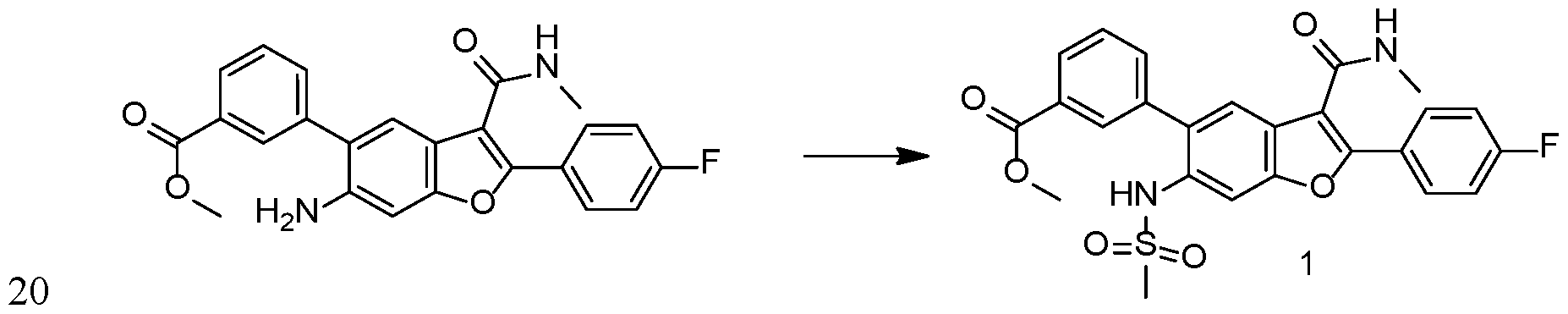
Pyridine (0.133 mL) and methanesulfonyl chloride (0.189 g) were added into a solution of ethyl 3-(6-amino-2-(4-fluorophenyl)-3-(methylcarbamoyl)benzofuran-5- yl)benzoate (0.23 g) in CH2C12 (5 mL). The reaction was stirred at room temperature for 16 hours. After removal of solvents under vacuum, the residue was purified by preparative HPLC system.

Retention Time 3.45 min
LC Condition
Solvent A 90% Water -10% Methanol-0.1% TFA
Solvent B 10% Water -90% Methanol-0.1% TFA
Start % B 0
Final % B 100
Gradient Time 4 min
Flow Rate 0.8 mL/min
Wavelength 220
Solvent Pair Water - Methanol- TFA
Column PHENOME EX-LUNA 2.0 x 50mm 3um
Preparation of 1001:

2-Iodoacetonitrile (6.72 mg) and CS2CO3 (0.013 g) were added into a solution of methyl 3-(2-(4-fluorophenyl)-3-(methylcarbamoyl)-6-
(methylsulfonamido)benzofuran-5-yl)benzoate (0.020 g) in DMF (2 mL). The reaction was stirred at room temperature for 1 hour. After removal of solvents under vacuum, the residue was purified by preparative HPLC system.
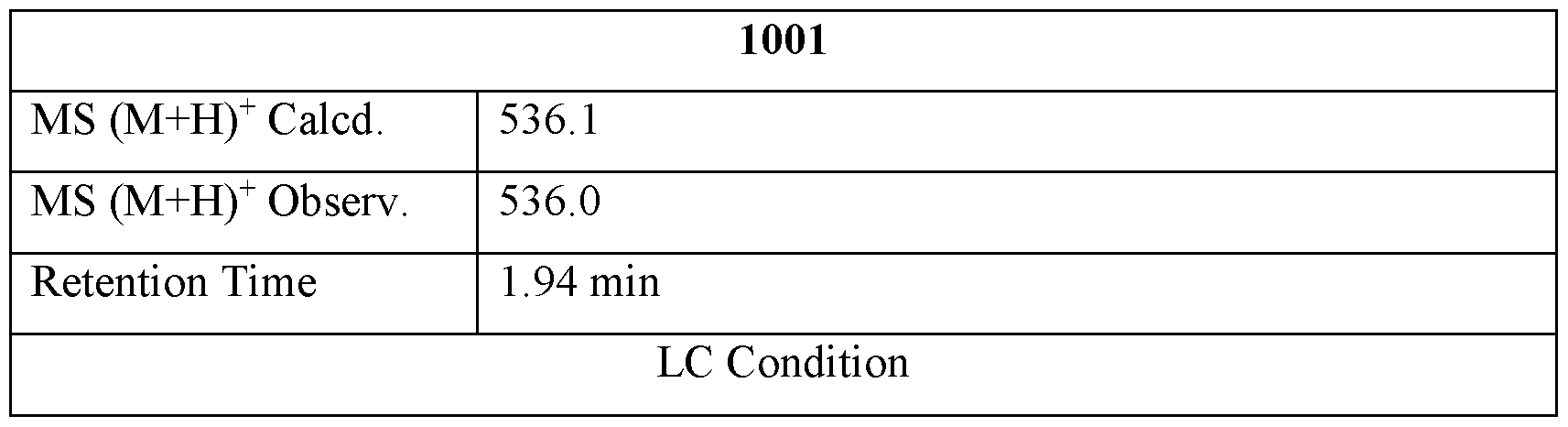
Solvent B 10% Water -90% Methanol-0.1% TFA
Start % B 0
Final % B 100
Gradient Time 2 min
Flow Rate 1 mL/min
Wavelength 220
Solvent Pair Water - Methanol- TFA
Column PHENOME EX-LUNA 2.0 x 30mm 3um
Preparation of 1002:

Step 1 : K2CO3 (0.021g) was added into a solution of Compound 1 (0.025 g) in methanol (3 mL) and water (1 mL). The reaction was heated at 70°C for 1 hour. After removal of solvents under vacuum, the residue was purified by preparative FIPLC system to give Compound 2.
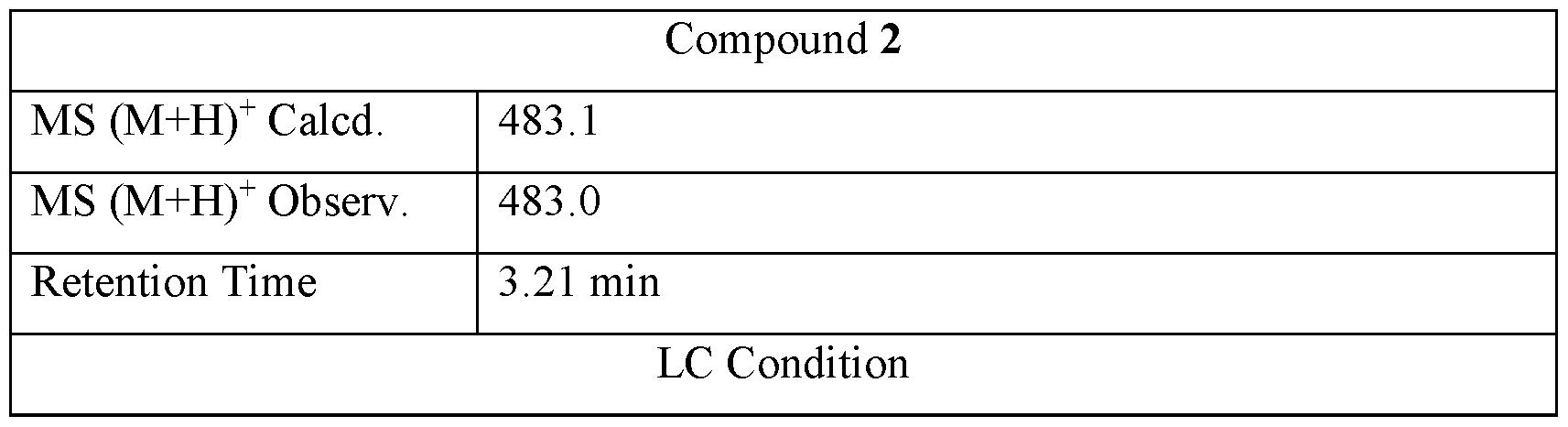
Solvent B 10% Water -90% Methanol-0.1% TFA
Start % B 0
Final % B 100
Gradient Time 4 min
Flow Rate 0.8 mL/min
Wavelength 220
Solvent Pair Water - Methanol- TFA
Column PHENOME EX-LUNA 2.0 x 50mm 3um
Step 2: iPr2 Et (0.013 g) and HATU (0.026 g) were added into a solution of Compound 2 (0.025 g) and l, l,l-trifluoro-2-methylpropan-2-amine (7.90 mg) in DMF (1 mL). The reaction was stirred at room temperature for 16 hours. Compound 3 was isolated by preparative HPLC system.

Step 3 : Cs2C03 (0.033 g) and 2-iodoacetonitrile (0.017 g) were added into a solution of Compound 3 (0.020 g, 0.034 mmol) in DMF (1 mL). The reaction was stirred at
room temperature for 1 hour. Compound 1002 was isolated by preparative HPLC system.

Compound 2001 was prepared via the same procedure synthesizing Compound 1001, using (iodomethyl)cyclopropane as alkylation agent with reaction time 48 hours.

Flow Rate 1 mL/min
Wavelength 220
Solvent Pair ACN: Water: Ammonium Acetate
Column Phenomenex LUNA CI 8, 30x2, 3u
Preparation of 2002:
Compound 2002 was prepared from Compound 2001, via the same procedure synthesizing Compound 2, with reaction time 3 hours.
2002
MS (M+H)+ Calcd. 537.1
MS (M+H)+ Observ. 537.1
Retention Time 2.02 min
LC Condition
Solvent A 90% Water -10% Methanol-0.1% TFA
Solvent B 10% Water -90% Methanol-0.1% TFA
Start % B 0
Final % B 100
Gradient Time 2 min
Flow Rate 1 mL/min
Wavelength 220
Solvent Pair Water - Methanol- TFA
Column PHENOMENEX-LUNA 2.0 x 30mm 3um
General procedure of amide formation, preparation of 2003, 2004, 2005 and 2006: iPr2NEt or Et3N (2 eq.) and HATU or HCTU or DEBPT (1.3 eq.) were added into solution of Compound 2002 (1 eq.) and amine (1.3 eq.) in DMF or THF. The
reaction was stirred at room temperature or 85°C for 30 minutes to 72 hours. The desired product was isolated by preparative HPLC system.


Preparation of 3001:
Compound 3001 was prepared via the same procedure synthesizing Compound 1001, using l-fluoro-2-iodoethane as alkylation agent with reaction time 16 hours.
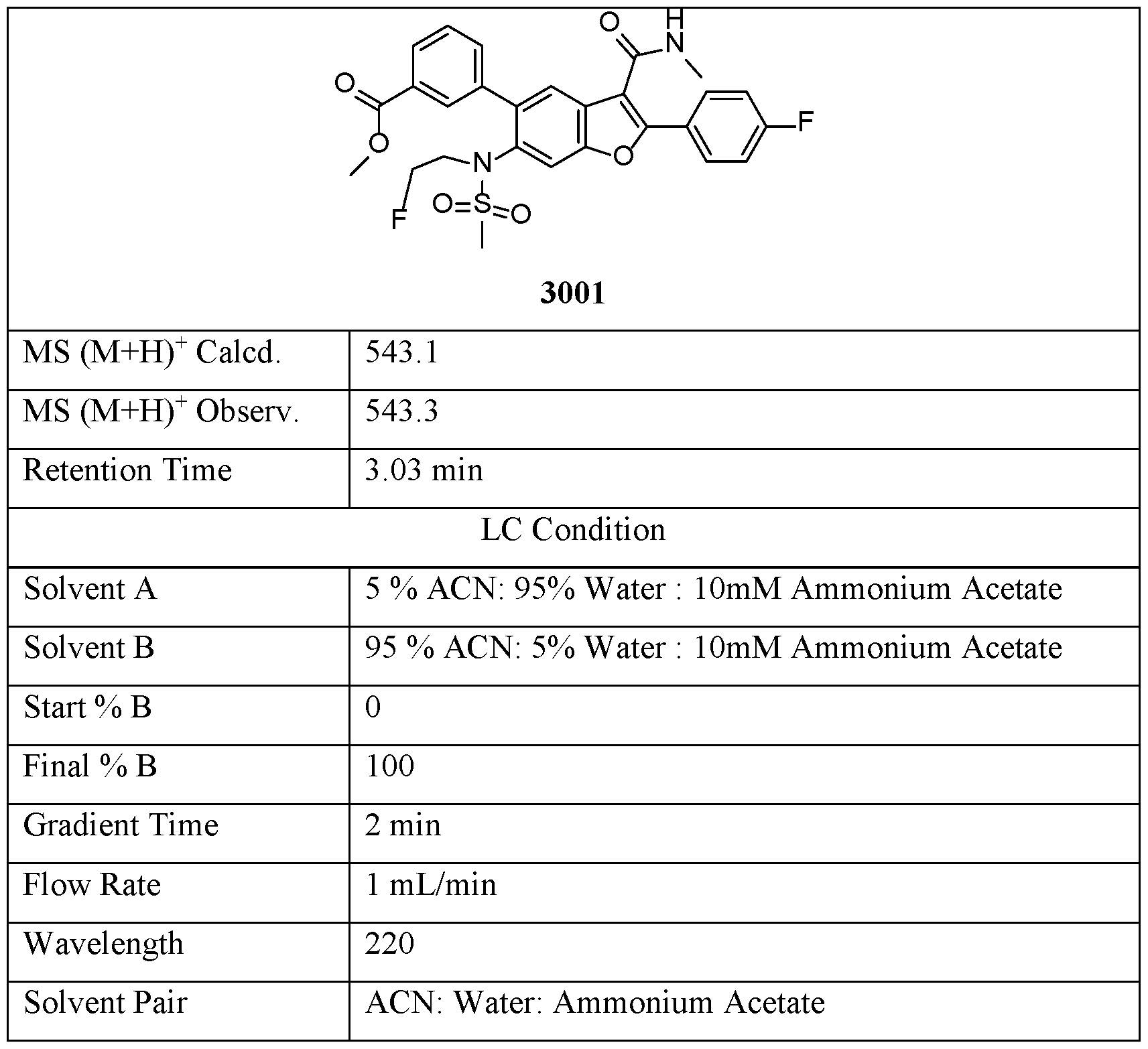
Preparation of 3002:
Compound 3002 was prepared from Compound 3001, via the same procedure synthesizing Compound 2, with reaction time 1 hour.

General procedure of amide formation, preparation of 3003 - 3044: iPr2NEt or Et3N (2 eq.) and HATU or HCTU or DEBPT (1.3 eq.) were added into solution of Compound 3002 (1 eq.) and amine (1.3 eq.) in DMF or THF. The reaction was stirred at room temperature or 85°C for 30 minutes to 72 hours. The desired product was isolated by preparative HPLC system.
LC Condition A
Solvent A 5 % ACN: 95% Water : lOmM Ammonium Acetate
Solvent B 95 % ACN: 5% Water : lOmM Ammonium Acetate
Start % B 0
Final % B 100
Gradient Time 2 min
Flow Rate 1 mL/min
Wavelength 220
Solvent Pair ACN: Water: Ammonium Acetate
Column Phenomenex LUNA CI 8, 30x2, 3u
LC Condition B
Solvent A 5 % ACN: 95% Water : lOmM Ammonium Acetate
Solvent B 95 % ACN: 5% Water : lOmM Ammonium Acetate
Start % B 0
Final % B 100
Gradient Time 4 min
Flow Rate 0.8 mL/min
Wavelength 220
Solvent Pair ACN: Water: Ammonium Acetate
Column PHENOMENEX-LUNA 2.0 X 50mm 3um
LC Condition C
Solvent A 90% Water -10% Methanol-0.1% TFA
Solvent B 10% Water -90% Methanol-0.1% TFA
Start % B 0
Final % B 100
Gradient Time 2 min
Flow Rate 1 mL/min
Wavelength 220
Solvent Pair Water - Methanol- TFA
Column PHENOMENEX-LUNA 2.0 X 30mm 3um


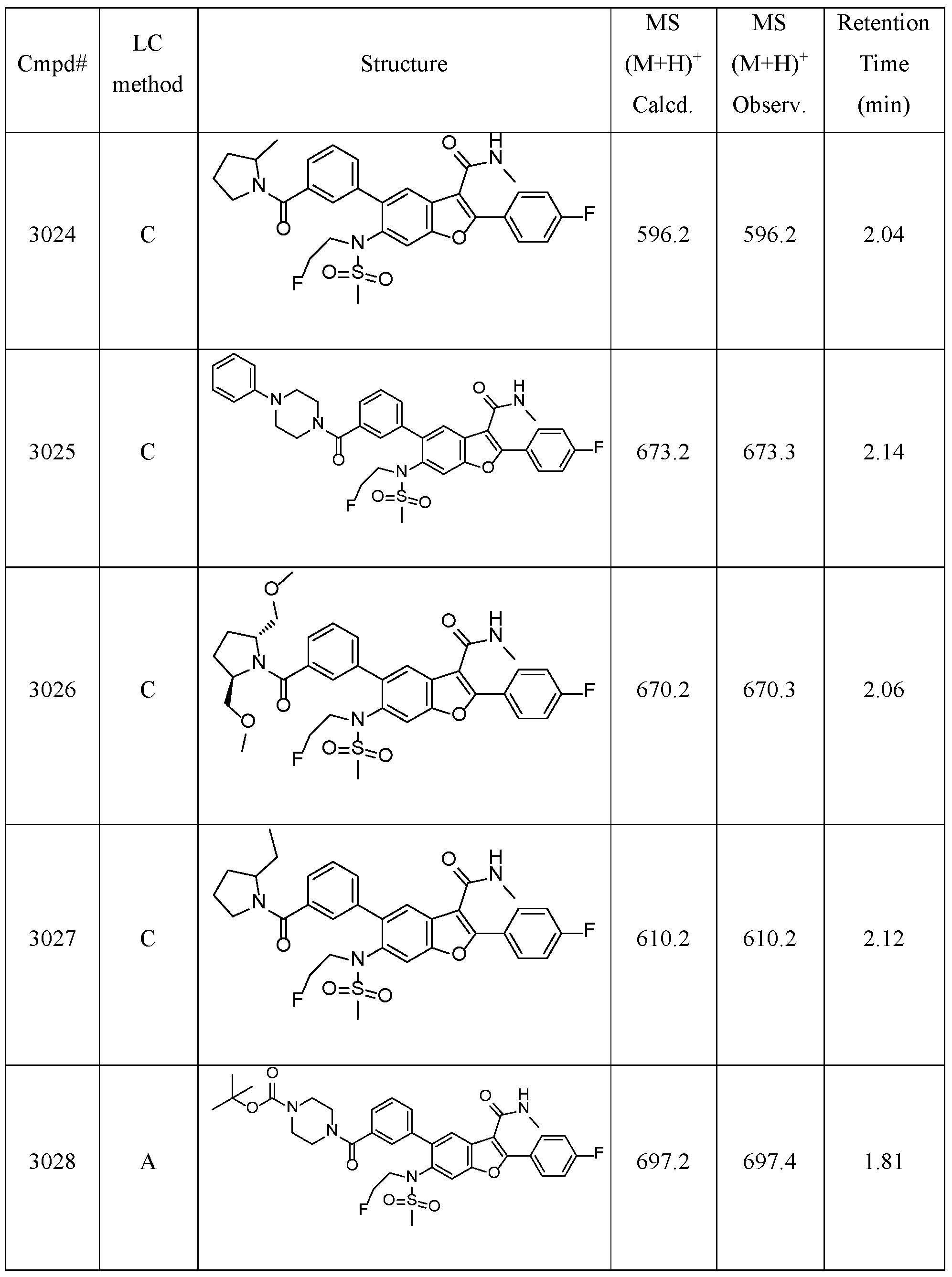

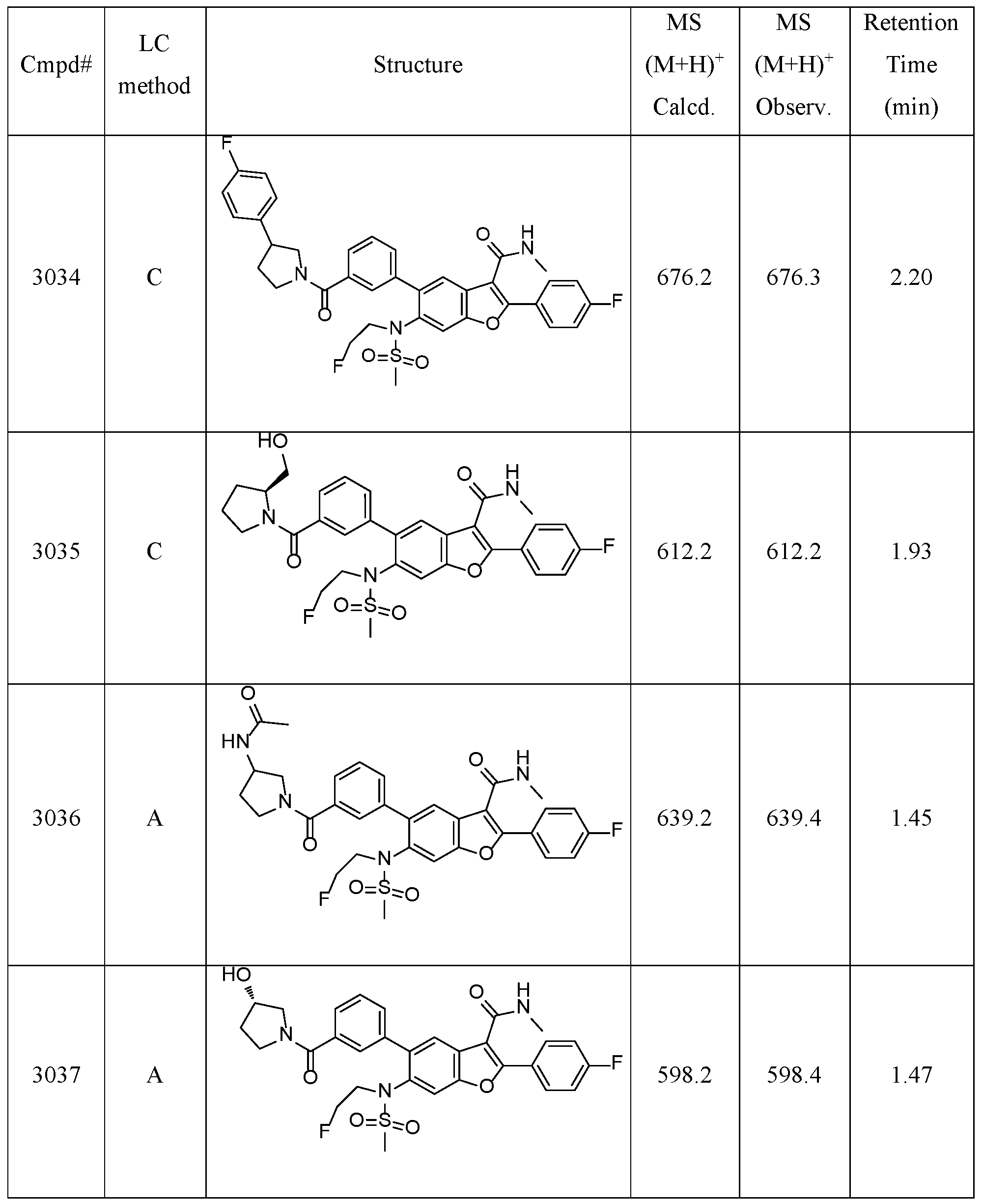


Preparation of 4001:
Compound 4001 was prepared via the same procedure synthesizing Compound 1001, 5 using l-fluoro-3-iodopropane as alkylation agent with reaction time 72 hours.
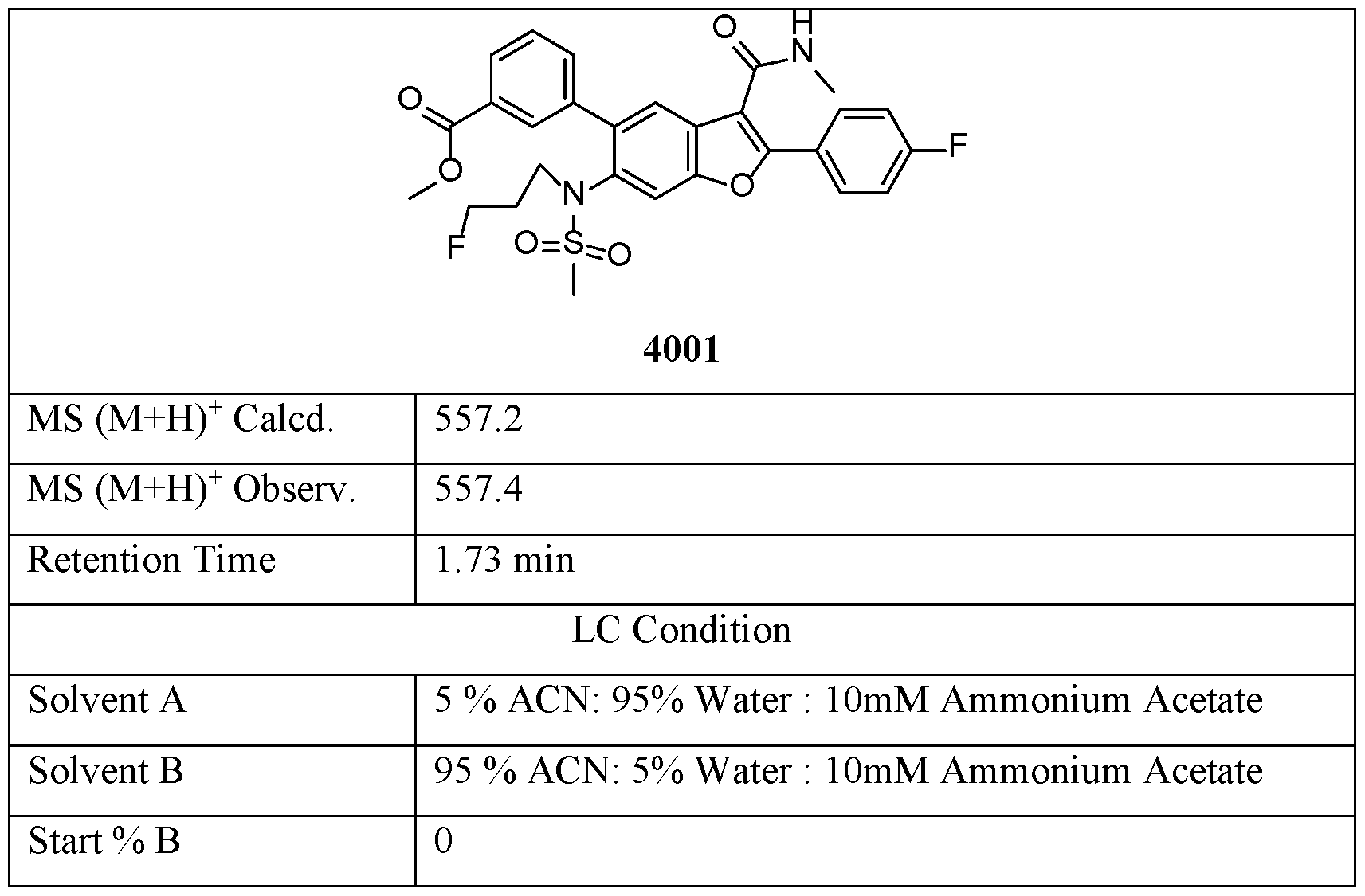
Gradient Time 2 min
Flow Rate 1 mL/min
Wavelength 220
Solvent Pair ACN: Water: Ammonium Acetate
Column Phenomenex LUNA CI 8, 30x2, 3u
Preparation of 4002:
Compound 4002 was prepared from Compound 4001, via the same procedure synthesizing Compound 2, with reaction time 2 hours and reaction temperature 90°
4002
MS (M+H)+ Calcd. 543.1
MS (M+H)+ Observ. 543.1
Retention Time 1.91 min
LC Condition
Solvent A 90% Water -10% Methanol-0.1% TFA
Solvent B 10% Water -90% Methanol-0.1% TFA
Start % B 0
Final % B 100
Gradient Time 2 min
Flow Rate 1 mL/min
Wavelength 220
Solvent Pair Water - Methanol- TFA
Column PHENOMENEX-LUNA 2.0 X 30mm 3um
General procedure of amide formation, preparation of 4003 - 4030: iPr2NEt or Et3N (2 eq.) and HATU or HCTU or DEBPT (1.3 eq.) were added into solution of Compound 4002 (1 eq.) and amine (1.3 eq.) in DMF or THF. The
reaction was stirred at room temperature or 85°C for 30 minutes to 72 hours. The desired product was isolated by preparative HPLC system.

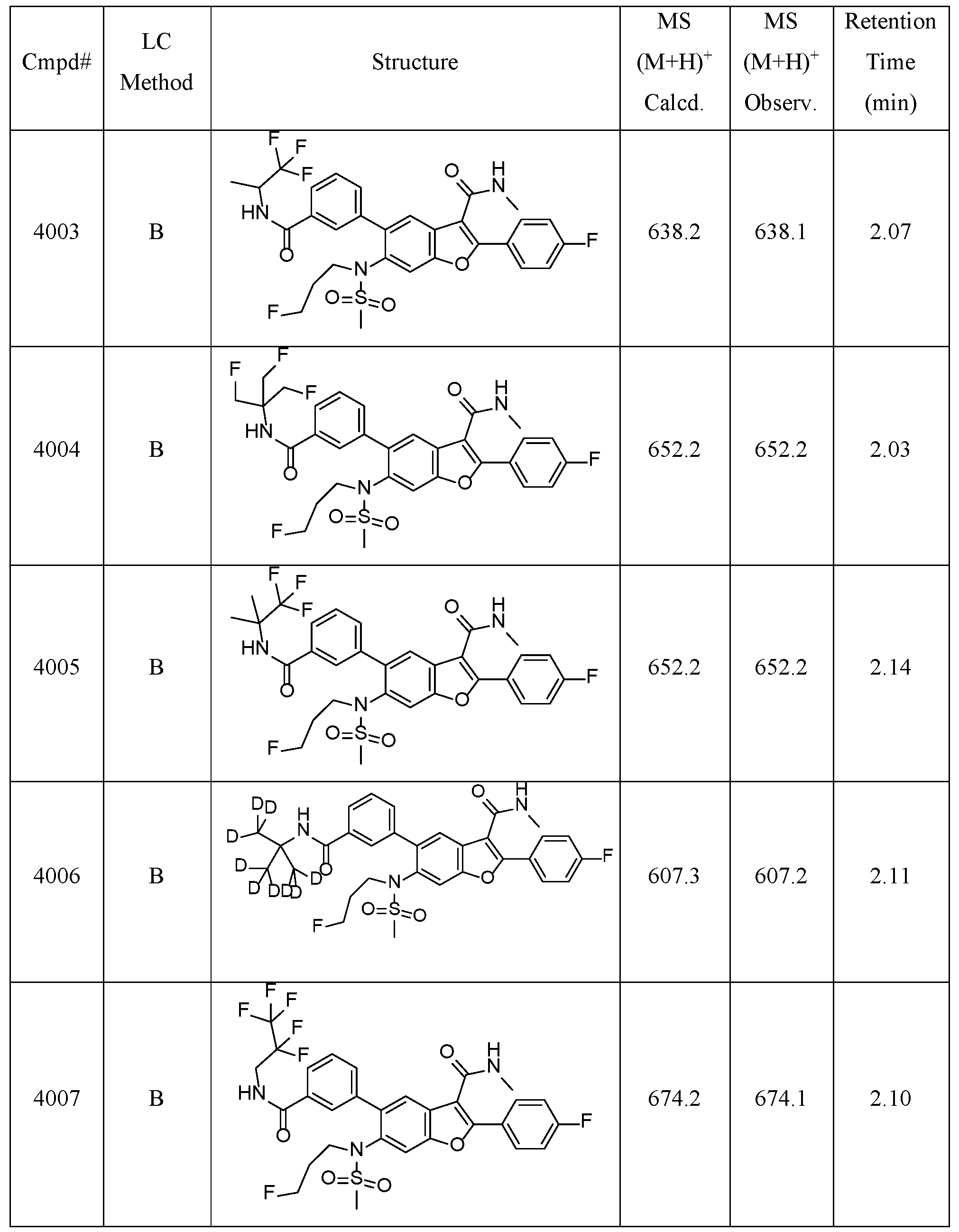


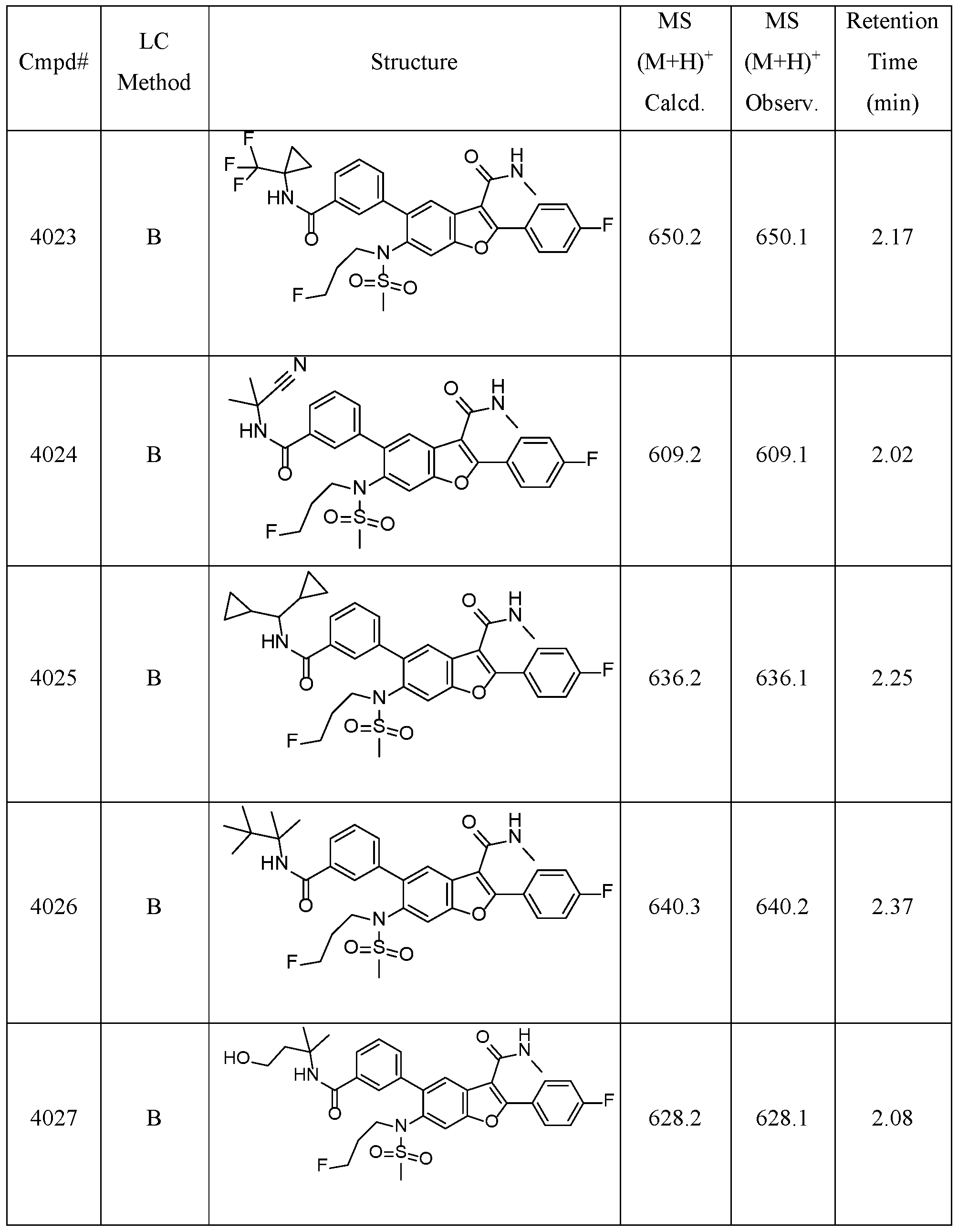

Preparation of 5001:

CS2CO3 (0.156 g) and l-fluoro-3-iodopropane (0.449 g) were added into a solution of methyl 3-(6-amino-2-(4-fluorophenyl)-3-(methylcarbamoyl)benzofuran-5-
yl)benzoate (0.20 g) in DMF (1 mL). The reaction was stirred at room temperature for 16 hours. Compound 5001 was isolated by preparative HPLC system.


To a suspension of Compound 5001 (75 mg) in THF (5 mL) and water (1 mL) was added NaOH (1 mL, 1 M). The mixture was heated at 80 °C for 4 hours, before being cooled and acidified with IN HC1 to pH ~ 3. The precipitate was collected by filtration to give Compound 5002.
5002
MS (M+H)+ Calcd. 465.2
MS (M+H)+ Observ. 465.0
Retention Time 1.90 min
LC Condition
Solvent A 90% Water -10% Methanol-0.1% TFA
Solvent B 10% Water -90% Methanol-0.1% TFA
Start % B 30
Final % B 100
Gradient Time 2 min
Flow Rate 1 mL/min
Wavelength 220
Solvent Pair Water - Methanol- TFA
Column PHENOME EX-LUNA 2.0 X 30mm 3um
General procedure of amide formation, preparation of 5003 - 5006: iPr2 Et or Et3N (2 eq.) and HATU or HCTU or DEBPT (1.3 eq.) were added into a solution of Compound 5002 (1 eq.) and amine (1.3 eq.) in DMF or THF. The reaction was stirred at room temperature or 85°C for 30 minutes to 72 hours. The desired product was isolated by preparative HPLC system.


Compound 6001 was prepared via the same procedure synthesizing Compound 1001, using difluoroiodomethane as alkylation agent with reaction time 48 hours.

Preparation of 6002:
Compound 6002 was prepared from Compound 6001, via the same procedure synthesizing Compound 2, with reaction time 15 minutes.
6002
MS (M+H)+ Calcd. 533.1
MS (M+H)+ Observ. 533.3
Retention Time 2.12 min
LC Condition
Solvent A 5 % ACN: 95% Water : lOmM Ammonium Acetate
Solvent B 95 % ACN: 5% Water : lOmM Ammonium Acetate
Start % B 0
Final % B 100
Gradient Time 4 min
Flow Rate 0.8 mL/min
Wavelength 220
Solvent Pair ACN: Water: Ammonium Acetate
Column Phenomenex LUNA CI 8, 50x2, 3u
General procedure of amide formation, preparation of 6003 - 6006: iPr2NEt or Et3N (2 eq.) and HATU or HCTU or DEBPT (1.3 eq.) were added into a solution of Compound 6002 (1 eq.) and amine (1.3 eq.) in DMF or THF. The reaction was stirred at room temperature or 85°C for 30 minutes to 72 hours. The desired product was isolated by preparative HPLC system.
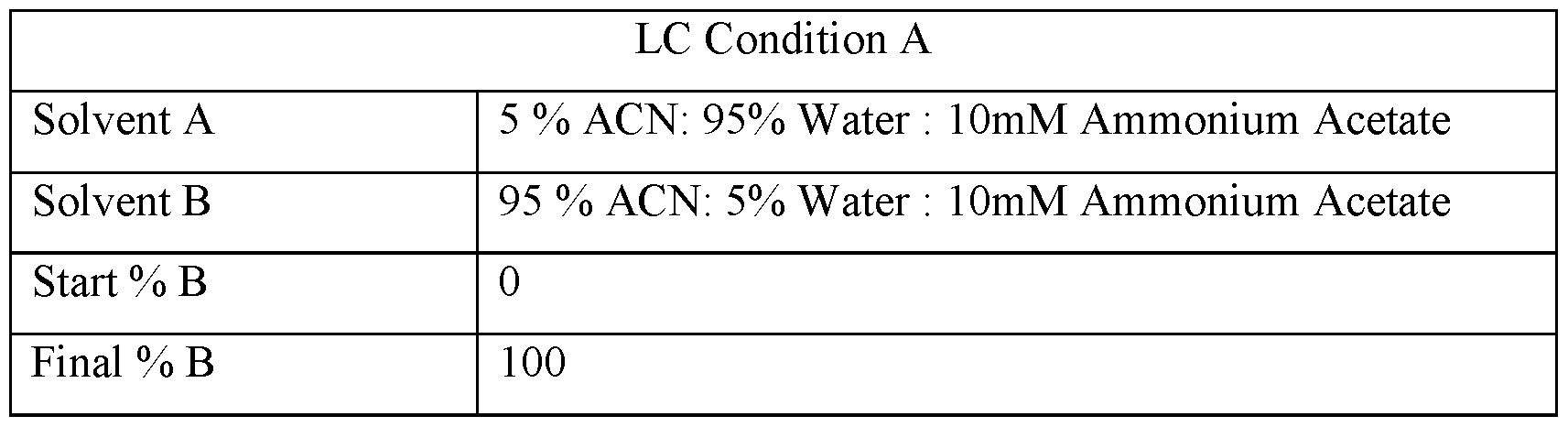
Flow Rate 1 mL/min
Wavelength 220
Solvent Pair ACN: Water: Ammonium Acetate
Column Phenomenex LUNA CI 8, 30x2, 3u
LC Condition B
Solvent A 5 % ACN: 95% Water : lOmM Ammonium Acetate
Solvent B 95 % ACN: 5% Water : lOmM Ammonium Acetate
Start % B 0
Final % B 100
Gradient Time 4 min
Flow Rate 0.8 mL/min
Wavelength 220
Solvent Pair ACN: Water: Ammonium Acetate
Column Phenomenex LUNA CI 8, 50x2, 3u


Preparation of 7001:
Compound 7001 was prepared via the same procedure synthesizing Compound 1001, 5 using 1, l-difluoro-2-iodoethane as alkylation agent with reaction time 48 hours.

Preparation of 7002:
Compound 7002 was prepared from Compound 7001, via the same procedure synthesizing Compound 2, with reaction time 1 hour.
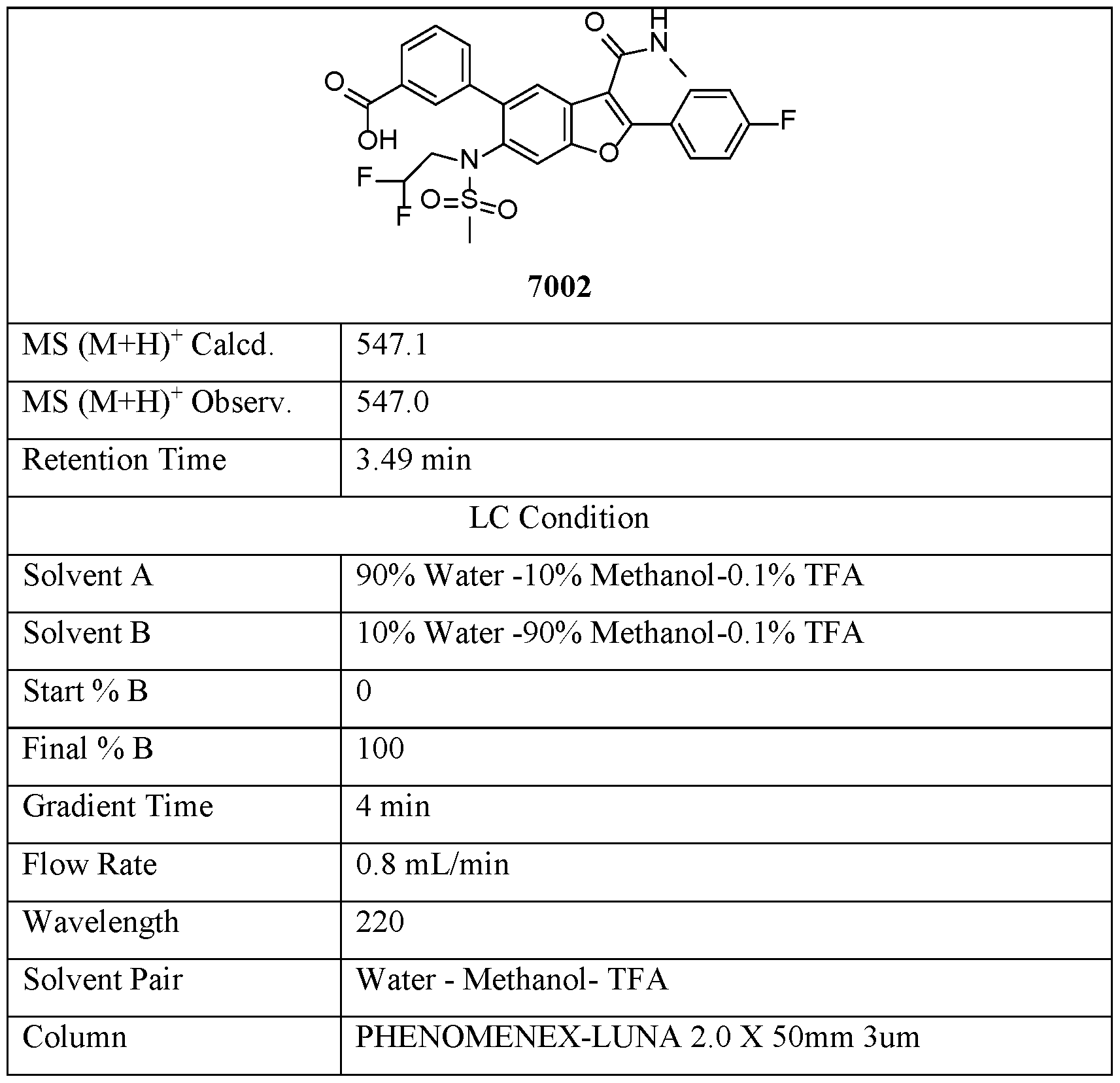
General procedure of amide formation, preparation of 7003 and 7004: iPriNEt or Et3N (2 eq.) and HATU or HCTU or DEBPT (1.3 eq.) were added into solution of Compound 7002 (1 eq.) and amine (1.3 eq.) in DMF or THF. The reaction was stirred at room temperature or 85°C for 30 minutes to 72 hours. The desired product was isolated by preparative HPLC system.
LC Condition
Solvent A 90% Water -10% Methanol-0.1% TFA
Solvent B 10% Water -90% Methanol-0.1% TFA
Start % B 0
Final % B 100
Gradient Time 2 min
Flow Rate 1 mL/min
Wavelength 220
Solvent Pair Water - Methanol- TFA
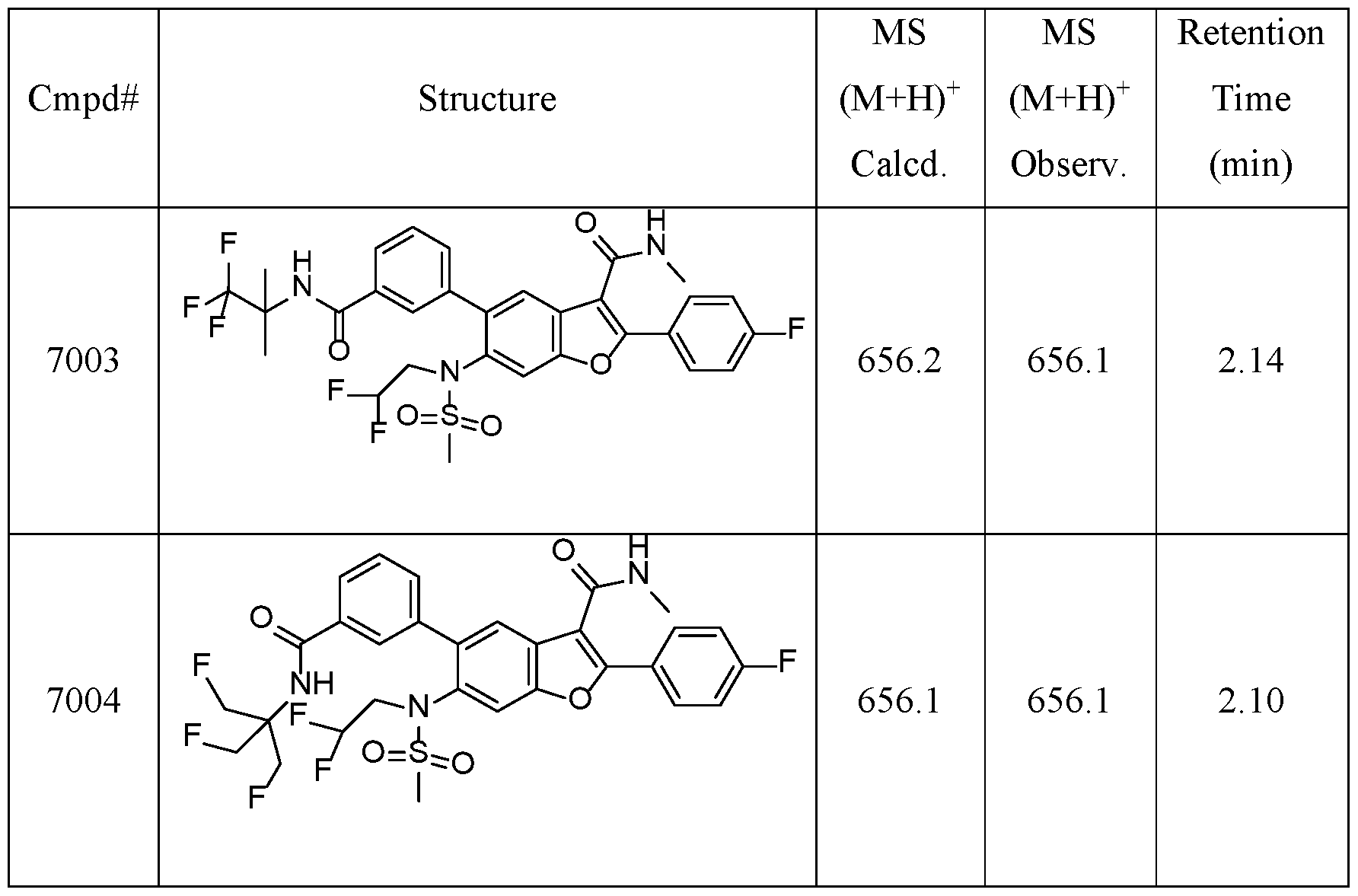
Preparation of 8001:
Compound 8001 was prepared via the same procedure synthesizing Compound 1001, using l-bromo-l, l-difluoro-3-iodopropane as alkylation agent with reaction time 16 hours.
8001
MS (M+H)+ Calcd. 573.1
MS (M+H)+ Observ. 573.1
Retention Time 3.86 min
LC Condition
Solvent A 90% Water -10% Methanol-0.1% TFA
Solvent B 10% Water -90% Methanol-0.1% TFA
Start % B 0
Final % B 100
Gradient Time 4 min
Flow Rate 0.8 mL/min
Wavelength 220
Solvent Pair Water - Methanol- TFA
Column PHENOMENEX-LUNA 2.0 X 50mm 3um
Preparation of 9001:
Compound 9001 was prepared via the same procedure synthesizing Compound 1001, using l, l,l-trifluoro-3-iodopropane as alkylation agent with reaction time 72 hours.

Final % B 100
Gradient Time 2 min
Flow Rate 1 mL/min
Wavelength 220
Solvent Pair ACN: Water: Ammonium Acetate
Column Phenomenex LUNA CI 8, 30x2, 3u
Preparation of 9002:
Compound 9002 was prepared from Compound 9001, via the same procedure synthesizing Compound 2, with reaction time 1 hour at 90°C.
9002
MS (M+H)+ Calcd. 579.1
MS (M+H)+ Observ. 579.3
Retention Time 1.38 min
LC Condition
Solvent A 5 % ACN: 95% Water : lOmM Ammonium Acetate
Solvent B 95 % ACN: 5% Water : lOmM Ammonium Acetate
Start % B 0
Final % B 100
Gradient Time 2 min
Flow Rate 1 mL/min
Wavelength 220
Solvent Pair ACN: Water: Ammonium Acetate
Column Phenomenex LUNA CI 8, 30x2, 3u
General procedure of amide formation, preparation of 9003 - 9007: iPr2NEt or Et3N (2 eq.) and HATU or HCTU or DEBPT (1.3 eq.) were added into solution of Compound 9002 (1 eq.) and amine (1.3 eq.) in DMF or THF. The
reaction was stirred at room temperature or 85°C for 30 minutes to 72 hours. The desired product was isolated by preparative HPLC system.


The compound demonstrated activity against HCV NS5B as determined in the following HCV RdRp assays.
HCVNS5B RdRp cloning, expression, and purification. The cDNA encoding NS5B proteins of HCV genotype lb (Conl), a genotype lb variant with amino acid 316 mutated from cysteine to asparagine, and genotype 2a (JFH-1), were cloned into the pET21a expression vector. Each untagged protein was expressed with an 18 amino acid C-terminal truncation to enhance the solubility. The E. coli competent cell line BL21(DE3) was used for expression of the protein. Cultures were grown at 37 °C for ~ 4 hours until the cultures reached an optical density of 2.0 at 600 nm. The cultures were cooled to 20 °C and induced with 1 mM IPTG. Fresh ampicillin was added to a final concentration of 50 μg/mL and the cells were grown overnight at 20 °C.
Cell pellets (3L) were lysed for purification to yield 15-24 mgs of purified NS5B. The lysis buffer consisted of 20 mM Tris-HCl, pH 7.4, 500 mM NaCl, 0.5% triton X-100, 1 mM DTT, ImM EDTA, 20% glycerol, 0.5 mg/mL lysozyme, 10 mM MgCb, 15 ug/mL deoxyribonuclease I, and Complete TM protease inhibitor tablets (Roche). After addition of the lysis buffer, frozen cell pellets were resuspended using a tissue homogenizer. To reduce the viscosity of the sample, aliquots of the lysate were sonicated on ice using a microtip attached to a Branson sonicator. The sonicated lysate was centrifuged at 100,000 x g for 30 minutes at 4 °C and filtered through a 0.2 μπι filter unit (Corning).
The protein was purified using two sequential chromatography steps:
Heparin sepharose CL-6B and polyU sepharose 4B. The chromatography buffers were identical to the lysis buffer but contained no lysozyme, deoxyribonuclease I, MgCb or protease inhibitor and the NaCl concentration of the buffer was adjusted according to the requirements for charging the protein onto the column. Each column was eluted with a NaCl gradient which varied in length from 5-50 column volumes depending on the column type. After the final chromatography step, the resulting
purity of the enzyme is >90% based on SDS-PAGE analysis. The enzyme was aliquoted and stored at -80 °C.
HCVNS5B RdRp enzyme assay. An on-bead solid phase homogeneous assay was used in a 384-well format to assess NS5B inhibitors (WangY-K, Rigat K,
Roberts S, and Gao M (2006) Anal Biochem, 359: 106-111). The biotinylated oligo dTo primer was captured on streptavidin-coupled imaging beads (GE, RPNQ0261) by mixing primer and beads in IX buffer and incubating at room temperature for three hours. Unbound primer was removed after centrifugation. The primer-bound beads were resuspended in 3X reaction mix (20 mM Hepes buffer, pH 7.5, dT primer coupled beads, poly A template, 3H-UTP, and RNAse inhibitor (Promega N2515)). Compounds were serially diluted 1 :3 in DMSO and aliquoted into assay plates. Equal volumes (5 μΕ) of water, 3X reaction mix, and enzyme in 3X assay buffer (60 mM Hepes buffer, pH 7.5, 7.5 mM MgCb, 7.5 mM KC1, 3 mM DTT, 0.03 mg/mL BSA, 6 % glycerol) were added to the diluted compound on the assay plate. Final concentration of components in 384-well assay: 0.36 nM template, 15 nM primer, 0.29 μΜ ¾-UTP (0.3 μθ), 1.6 υ/μΐ, RNAse inhibitor, 7 nM NS5B enzyme, 0.01 mg/mL BSA, 1 mM DTT, and 0.33 μg/μL beads, 20 mM Hepes buffer, pH 7.5, 2.5 mM MgCb, 2.5 mM KC1, and 0.1 % DMSO.
Reactions were allowed to proceed for 24 hours at 30° C and terminated by the addition of 50 mM EDTA (5 μΕ). After incubating for at least 15 minutes, plates were read on an Amersham LEADseeker multimodality imaging system.
IC50 values for compounds were determined using ten different [I]. IC50 values were calculated from the inhibition using the four-parameter logistic Formula y = A + ((B-A)/(l+((C/x)AD))), where A and B denote minimal and maximal % inhibition, respectively, C is the IC50, D is hill slope and x represents compound concentration. Cell lines. The cell lines used to evaluate compounds consist of a human hepatocyte derived cell line (Huh-7) that constitutively expresses a genotype lb (Con-1) HCV replicon or a genotype lb (Con-1) HCV replicon with an asparagine replacing the cysteine at amino acid 316, or a genotype 2a (JFH-1) replicon,
containing a Renilla luciferase reporter gene. These cells were maintained in Dulbecco's modified Eagle medium (DMEM) containing 10% FBS, 100 U/mL penicillin/streptomycin and 1.0 mg/mL G418. HCV replicon luciferase assay. To evaluate compound efficacy, titrated compounds were transferred to sterile 384-well tissue culture treated plates, and the plates were seeded with HCV replicon cells (50 μΙ_, at a density of 2.4 x 10³ cells/well) in DMEM containing 4 % FBS (final DMSO concentration at 0.5 %). After 3 days incubation at 37°C, cells were analyzed for Renilla Luciferase activity using the EnduRen substrate (Promega cat #E6485) according to the manufacturer's directions. Briefly, the EnduRen substrate was diluted in DMEM and then added to the plates to a final concentration of 7.5 μΜ. The plates were incubated for at least 1 h at 37°C then read on a Viewlux Imager (PerkinElmer) using a luminescence program. The 50% effective concentration (EC50) was calculated using the four- parameter logistic Formula noted above.
To assess cytotoxicity of compounds, Cell Titer-Blue (Promega) was added to the EnduRen-containing plates and incubated for at least 4 hrs at 37°C. The fluorescence signal from each well was read using a Viewlux Imager. All CC50 values were calculated using the four-parameter logistic Formula. Compound EC50 data is expressed as A: < 100 nM; B = 100-1000 nM; C >
1000 nM). Representative data for compounds are reported in Table 2.
Table 2


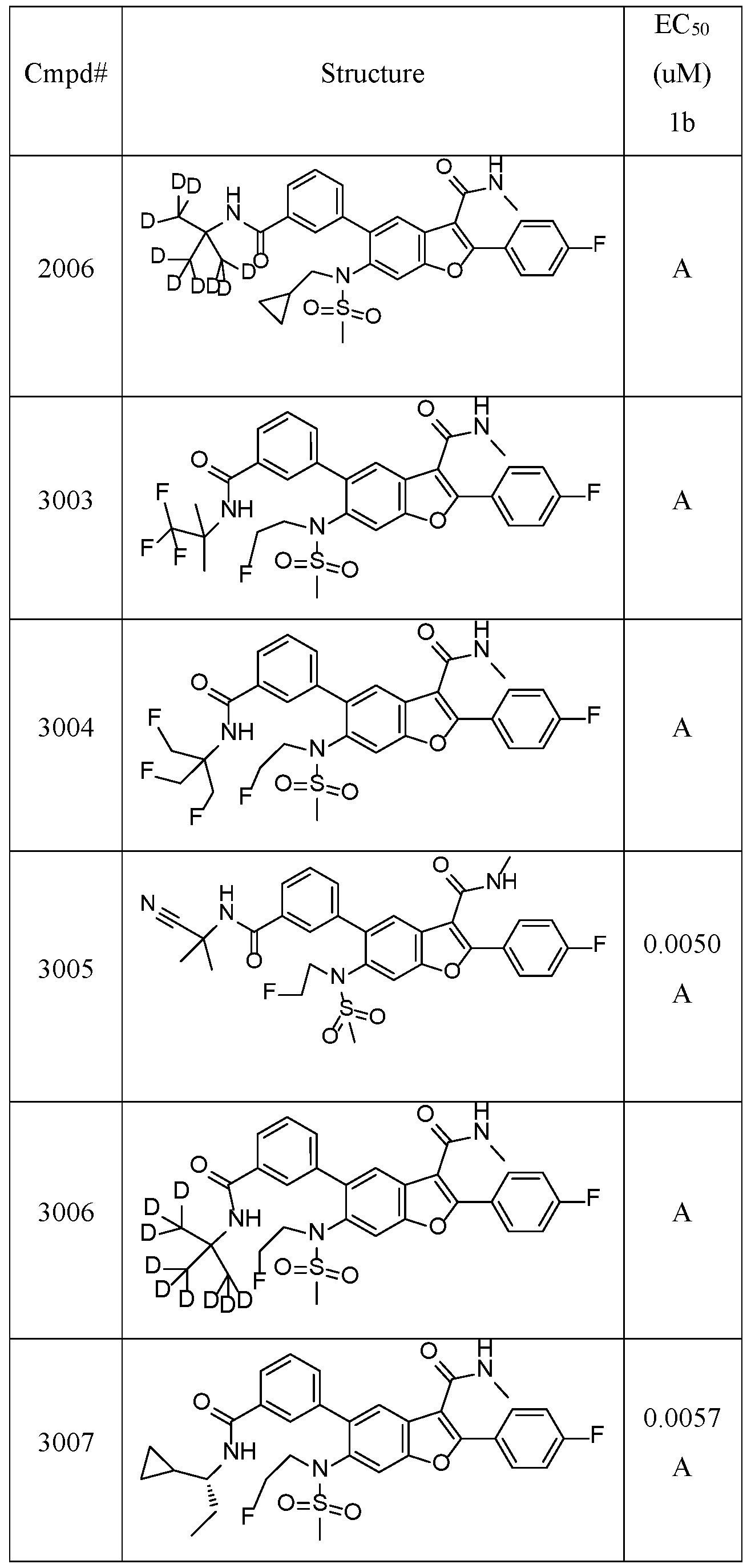


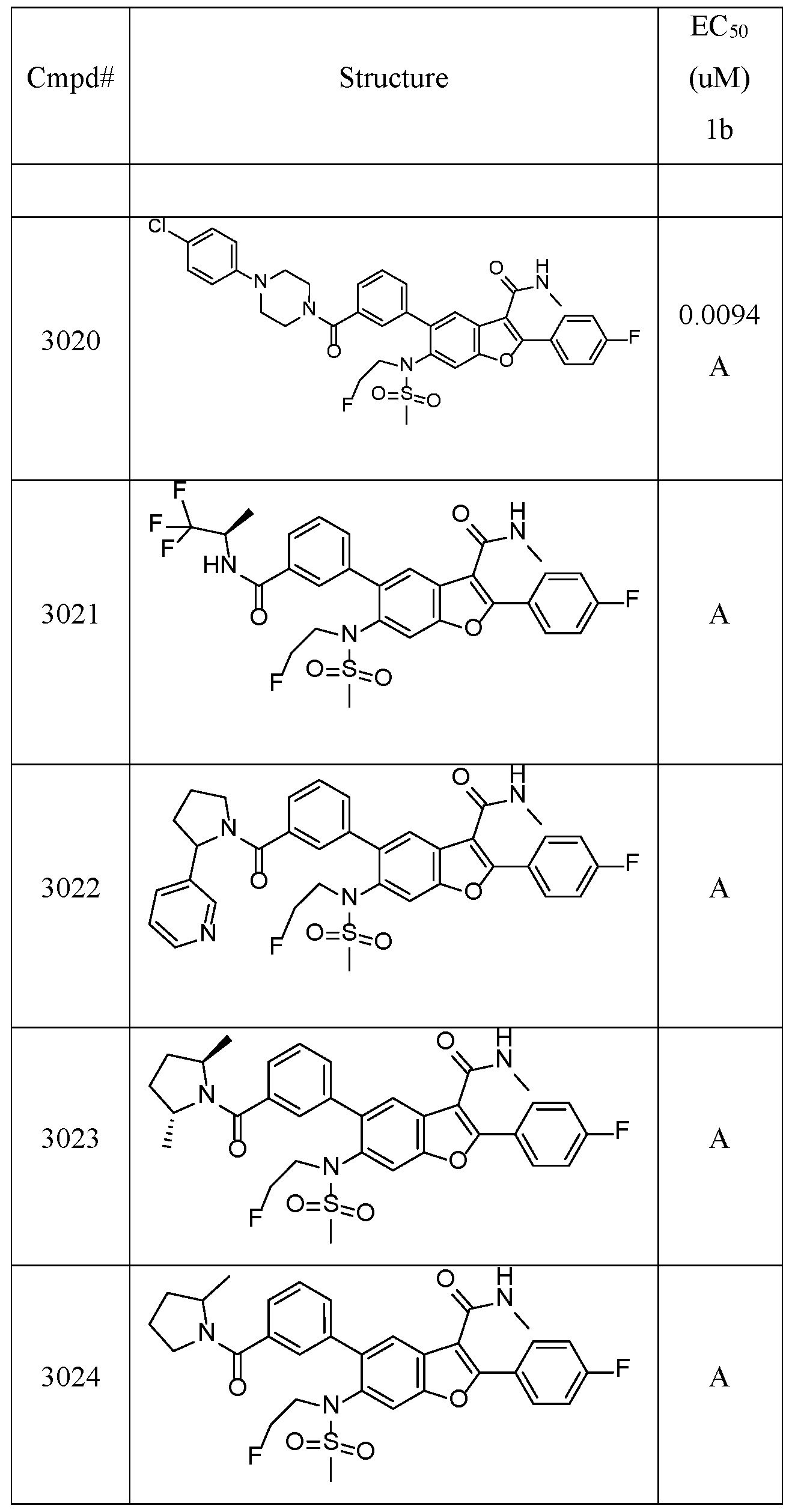


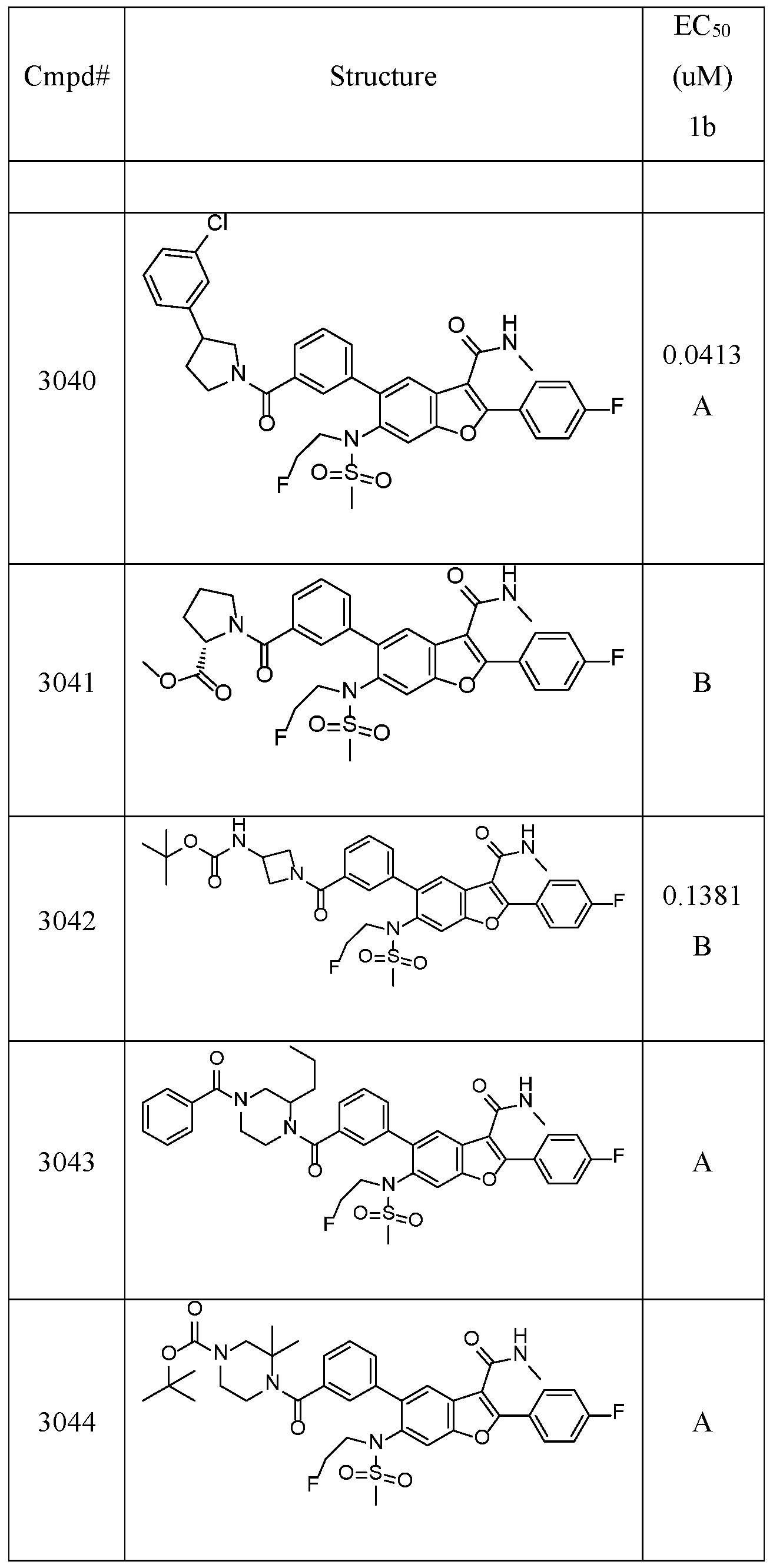


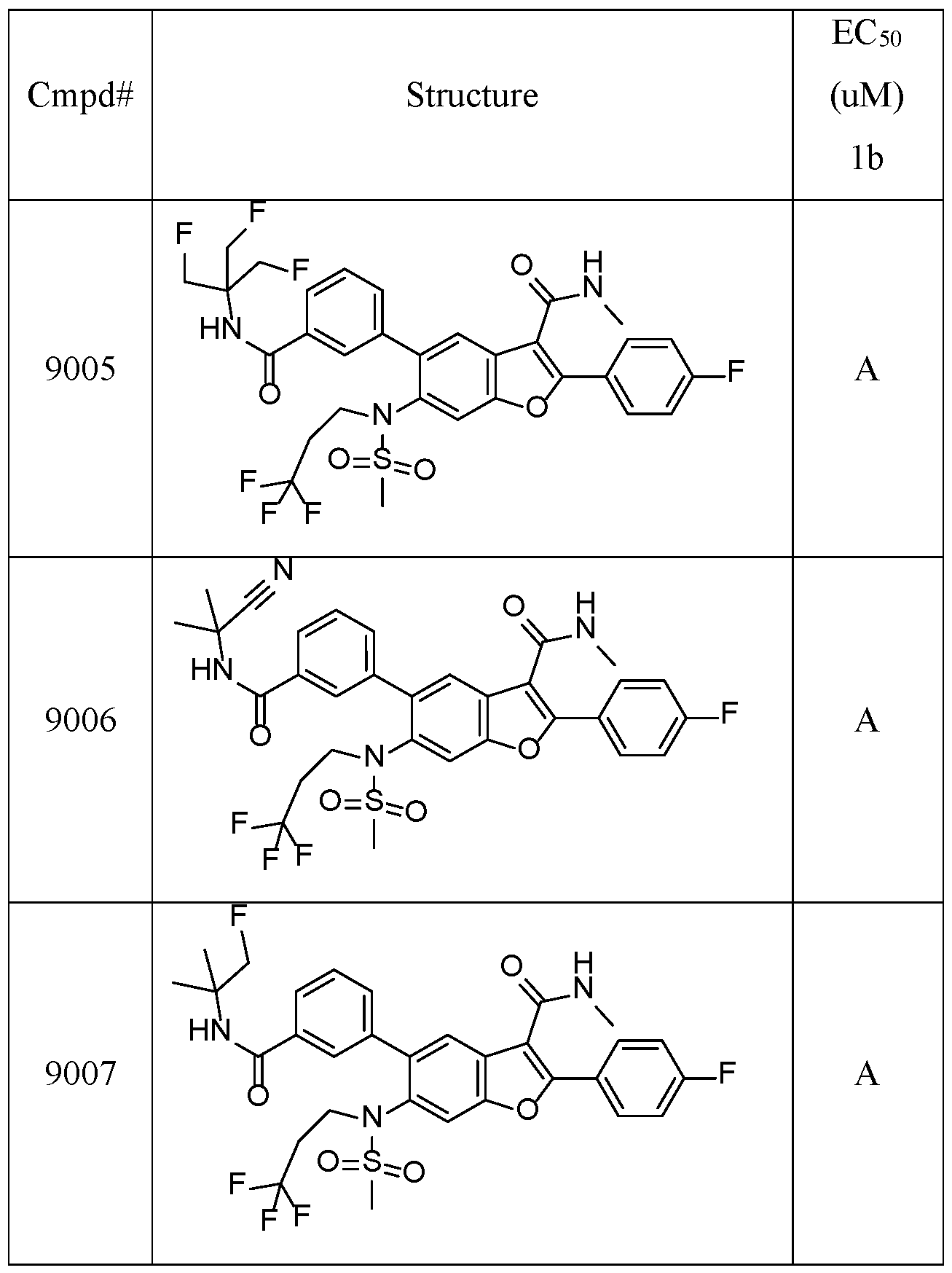
It will be evident to one skilled in the art that the present disclosure is not limited to the foregoing illustrative examples, and that it can be embodied in other specific forms without departing from the essential attributes thereof. It is therefore desired that the examples be considered in all respects as illustrative and not restrictive, reference being made to the appended claims, rather than to the foregoing examples, and all changes which come within the meaning and range of equivalency of the claims are therefore intended to be embraced therein.
Claims
1. A compound of Formula I

I
wherein
R° and R1 are independently hydrogen or methyl;
R2 is optionally substituted aryl with 0-2 halo;
R4 is COOR101 or CON(R102)(R103);
R101 is hydrogen or optionally substituted Ci-C6 alkyl with 0-2 substituents selected from halo, hydroxyl, alkoxy, and haloalkoxy;
R102 and R103 are each independently hydrogen, -(CR10RU)R12, optionally substituted Ci-C6 alkyl, optionally substituted C3-C8 cycloalkyl, with 0-3 substituents selected from halo, CN, CF3, OH, OR104, H2, R105R106, COOR104, CO R105R106, S(0)2R104, S(O)2 R105R106, R104CO R105R106, OR104CO R105R106,
C(= R107) R105R106, R108C(= R107) R105R106, haloalkoxy; or
R102 and R103 can be taken together with the nitrogen atom to form a 4-7 membered ring optionally containing 1-2 additional nitrogen atoms, said ring optionally substituted with 0-3 substituents selected from OH, Ci-C6 alkyl, halo substituted phenyl, phenyl, Ci-C3 alkoxy Ci-C3 alkyl, hydroxy Ci-C3 alkyl,
COOR104- HCO Ci-C3 alkyl;
R104 is hydrogen, optionally substituted Ci-C6 alkyl or optionally substituted C3-C8 cycloalkyl with 0-3 substituents selected from halo, hydroxyl, alkoxy, and haloalkoxy;
R105 and R106 are each independently hydrogen, optionally substituted Ci-C6 alkyl or optionally substituted C3-C8 cycloalkyl with 0-3 substituents selected from halo, hydroxyl, alkoxy, and haloalkoxy; or
R and R are each independently hydrogen, optionally substituted Ci-C6 alkyl or optionally substituted C3-C8 cycloalkyl with 0-3 substituents selected from halo, hydroxyl, alkoxy, and haloalkoxy; or
R10 and R11 are independently hydrogen or Ci-C6 alkyl;
R12 is substituted Ci-C6 alkynyl, C3-C8 cycloalkyl, -COO Ci-C6 alkyl, phenyl or CF2CF3;
R3 is R201R202;
R201 is selected from the group of hydrogen, -S02 Ci-C3 alkyl, alkenyl, alkynyl, haloalkyl, haloalkenyl, haloalkynyl, cyanoalkyl, cyanoalkenyl,
cyanoalkynyl, cycloalkyl, halocycloalkyl, (haloalkyl)cycloalkyl,
(halocycloalkyl)cycloalkyl, cyanocycloalkyl, (cyanoalkyl)cycloalkyl,
(cyanocycloalkyl)cycloalkyl, hydroxycycloalkyl, (hydroxyalkyl)cycloalkyl, (hydroxycycloalkyl)cycloalkyl alkoxycycloalkyl, (alkoxyalkyl)cycloalkyl, and (alkoxycycloalkyl)cycloalkyl;;
R202 is selected from the group of CN(Ci-C6 alkyl), C3-C6 cycloalkyl(Ci-C6 alkyl), halo(Ci-C6 alkyl)„, halo(C2-C6 alkenyl)„, CF3CF2(Ci-C6 alkyl)„, CF3 (Ci-C6 alkyl)n, alkyl, hydroxyalkyl, alkoxyalkyl, alkylsulfonyl, alkenyl, alkynyl, haloalkyl, haloalkenyl, haloalkynyl, cyanoalkyl, cyanoalkenyl, cyanoalkynyl, cycloalkyl, halocycloalkyl, (haloalkyl)cycloalkyl, (halocycloalkyl)cycloalkyl, cyanocycloalkyl, (cyanoalkyl)cycloalkyl, (cyanocycloalkyl)cycloalkyl, hydroxycycloalkyl,
(hydroxyalkyl)cycloalkyl, (hydroxycycloalkyl)cycloalkyl alkoxycycloalkyl, (alkoxyalkyl)cycloalkyl, and (alkoxycycloalkyl)cycloalkyl;
n is 1, 2, 3 or 4;
and/or a pharmaceutically acceptable salt or stereoisomer thereof.
2. The compound according to claim 1

I
wherein
R is hydrogen;
R1 is methyl;
R2 is phenyl substituted with 1-2 halo;
R4 is COOR101 or CON(R102)(R103);
R101 is hydrogen or optionally substituted Ci-C6 alkyl with 0-2 substituents selected from halo, hydroxyl, alkoxy, and haloalkoxy;
R102 and R103 are each independently hydrogen, -(CR10RU)R12, optionally substituted Ci-C6 alkyl, optionally substituted C3-C8 cycloalkyl, with 0-3 substituents selected from halo, CN, CF3, OH, OR104, H2, R105R106, COOR104, CO R105R106, S(0)2R104, S(O)2 R105R106, R104CO R105R106, OR104CO R105R106,
C(= R107) R105R106, R108C(= R107) R105R106, haloalkoxy; or
R102 and R103 can be taken together with the nitrogen atom to form a 4-7 membered ring optionally containing 1-2 additional nitrogen atoms, said ring optionally substituted with 0-3 substituents selected from OH, Ci-C6 alkyl, halo substituted phenyl, phenyl, Ci-C3 alkoxy Ci-C3 alkyl, hydroxy Ci-C3 alkyl,
COOR104- HCO Ci-C3 alkyl;
R104 is hydrogen, optionally substituted Ci-C6 alkyl or optionally substituted C3-C8 cycloalkyl with 0-3 substituents selected from halo, hydroxyl, alkoxy, and haloalkoxy;
R105 and R106 are each independently hydrogen, optionally substituted Ci-C6 alkyl or optionally substituted C3-C8 cycloalkyl with 0-3 substituents selected from halo, hydroxyl, alkoxy, and haloalkoxy; or
R107 and R108 are each independently hydrogen, optionally substituted Ci-C6 alkyl or optionally substituted C3-C8 cycloalkyl with 0-3 substituents selected from halo, hydroxyl, alkoxy, and haloalkoxy; or
R10 and R11 are independently hydrogen or Ci-C6 alkyl;
R12 is substituted Ci-C6 alkynyl, C3-C8 cycloalkyl, -COO Ci-C6 alkyl, phenyl or CF2CF3;
R3 is R201R202;
R201 is hydrogen or S02 Ci-C3 alkyl;
R202 is CN Ci-Ce alkyl, C3-C6 cycloalkyl Ci-C6 alkyl, halo (Ci-C6 alkyl)„, halo (C2-C6 alkenyl)„, CF3CF2(Ci-C6 alkyl)„or CF3 (Ci-C6 alkyl)„;
n is 1, 2, 3 or 4;
and/or a pharmaceutically acceptable salt or stereoisomer thereof.
3. The compound accordin to claim 2

I
wherein
R° is hydrogen;
R1 is methyl;
R2 is phenyl substituted with fluoro;
R4 is COOR101 or CO H(R103);
R101 is hydrogen or optionally substituted Ci-C3 alkyl with 0-2 substituents selected from halo, hydroxyl, alkoxy, and haloalkoxy;
R103 is hydrogen, -(CR10RU)R12, optionally substituted Ci-Ce alkyl, optionally substituted C3-C8 cycloalkyl, with 0-3 substituents selected from halo, CN, CF3, OH, OR104, NR105R106, COOR104, CONR105R106, haloalkoxy; or
R102 and R103 can be taken together with the nitrogen atom to form a 4-7 membered ring optionally containing 1-2 additional nitrogen atoms, said ring optionally substituted with 0-3 substituents selected from OH, Ci-C6 alkyl, halo substituted phenyl, phenyl, Ci-C3 alkoxy Ci-C3 alkyl, hydroxy Ci-C3 alkyl,
COOR104-NHCO Ci-C3 alkyl;
R104 is hydrogen, optionally substituted Ci-C6 alkyl or optionally substituted C3-C8 cycloalkyl with 0-3 substituents selected from halo, hydroxyl, alkoxy, and haloalkoxy;
R105 and R106 are each independently hydrogen, optionally substituted Ci-C6 alkyl or optionally substituted C3-C8 cycloalkyl with 0-3 substituents selected from halo, hydroxyl, alkoxy, and haloalkoxy; or
R10 and R11 are independently hydrogen or Ci-C6 alkyl;
R12 is substituted C i-C6 alkynyl, C3-C8 cycloalkyl, -COO Ci-C6 alkyl, phenyl or CF2CF3;
R3 is R201R202;
R201 is hydrogen or S02 Ci-C3 alkyl;
R202 is CN Ci-Ce alkyl, C3-C6 cycloalkyl C i-Ce alkyl, halo (Ci-C6 alkyl)n, halo (C2-C6 alkenyl)n, CF3CF2(C i-C6 alkyl)nor CF3 (C i-C6 alkyl)li;
n is 1, 2, 3 or 4;
and/or a pharmaceutically acceptable salt or stereoisomer thereof.
4. The compound accordin to claim 3

I
wherein
R° is hydrogen;
R1 is methyl;
R2 is phenyl substituted with fluoro;
R4 is COOR101 or CONH(R103);
R101 is hydrogen or C i-C3 alkyl;
R103 is hydrogen, -(CR10RU)R12, optionally substituted Ci-Ce alkyl, optionally substituted C3-C8 cycloalkyl, with 0-3 substituents selected from halo, CN, CF3, OH, OR104, NR105R106, COOR104, CONR105R106, haloalkoxy; or
R102 and R103 can be taken together with the nitrogen atom to form a 4-7 membered ring optionally containing 1-2 additional nitrogen atoms, said ring optionally substituted with 0-3 substituents selected from OH, C i-C6 alkyl, halo substituted phenyl, phenyl, C i-C3 alkoxy C1-C3 alkyl, hydroxy Ci-C3 alkyl,
COOR104-NHCO C1-C3 alkyl;
R104 is hydrogen, optionally substituted C1-C3 alkyl or optionally substituted C3-C8 cycloalkyl with 0-3 substituents selected from halo, hydroxyl, alkoxy, and haloalkoxy;
R105 and R106 are each independently hydrogen, optionally substituted Ci-C6 alkyl or optionally substituted C3-C8 cycloalkyl with 0-3 substituents selected from halo, hydroxyl, alkoxy, and haloalkoxy; or
R10 and R11 are independently hydrogen or Ci-Ce alkyl;
R12 is substituted Ci-Ce alkynyl, C3-C8 cycloalkyl, -COO Ci-Ce alkyl, phenyl or CF2CF3;
R3 is NR201R202;
R201 is SO2 C 1-C3 alkyl;
R202 is CN Ci-Ce alkyl, C3-C6 cycloalkyl Ci-C6 alkyl, halo (Ci-C6 alkyl)„, halo (C2-C6 alkenyl)n, CF CF2(Ci-C6 alkyl)„or CF (Ci-C6 alkyl)„;
n is 1, 2 or 3;
and/or a pharmaceutically acceptable salt or stereoisomer thereof.
5. The compound accordin to claim 4

R° is hydrogen;
1 is methyl;

R4 is COOR101 or CONH(R103);
R101 is hydrogen or Ci-C3 alkyl;
R103 is hydrogen, -(CR10RU)R12, optionally substituted Ci-Ce alkyl, optionally substituted C3-C8 cycloalkyl, with 0-3 substituents selected from halo, CN, CF3, OH, OR104, NR105R106, COOR104, CONR105R106, haloalkoxy; or
R102 and R103 can be taken together with the nitrogen atom to form a 4-7 membered ring optionally containing 1-2 additional nitrogen atoms, said ring optionally substituted with 0-3 substituents selected from OH, Ci-C6 alkyl, halo
substituted phenyl, phenyl, C1-C3 alkoxy C1-C3 alkyl, hydroxy C1-C3 alkyl,
COOR104- HCO C1-C3 alkyl;
R104 is hydrogen, optionally substituted Ci-C6 alkyl or optionally substituted C3-C8 cycloalkyl with 0-3 substituents selected from halo, hydroxyl, alkoxy, and haloalkoxy;
R105 and R106 are each independently hydrogen, optionally substituted Ci-C6 alkyl or optionally substituted C3-C8 cycloalkyl with 0-3 substituents selected from halo, hydroxyl, alkoxy, and haloalkoxy;
R10 and R11 are independently hydrogen or Ci-Ce alkyl;
R12 is substituted Ci-C6 alkynyl, C3-C8 cycloalkyl, -COO Ci-C6 alkyl, phenyl
R3 is NR201R202;
R201 is SO2 C 1-C3 alkyl;
R202 is CN Ci-Ce alkyl, C3-C6 cycloalkyl Ci-C6 alkyl, halo (Ci-C6 alkyl)„, halo (C2-C6 alkenyl)„, CF3CF2(Ci-C6 alkyl)„or CF3 (Ci-C6 alkyl)„;
n is 1, 2 or 3;
and/or a pharmaceutically acceptable salt or stereoisomer thereof.
6. The compound accordin to claim 5
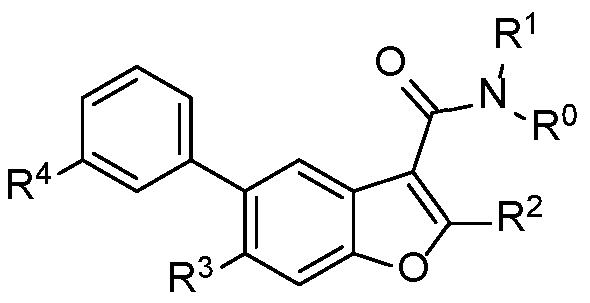
R° is hydrogen;
1 is methyl;

R4 is COOR101 or CO H(R103);
R101 is hydrogen or methyl;
R103 is hydrogen, -(CR10RU)R12, optionally substituted Ci-Ce alkyl, optionally substituted C3-C8 cycloalkyl, with 0-3 substituents selected from halo, CN, CF3, OH, OR104, R105R106, COOR104, CO R105R106, haloalkoxy; or
R102 and R103 can be taken together with the nitrogen atom to form a 4-7 membered ring optionally containing 1-2 additional nitrogen atoms, said ring optionally substituted with 0-3 substituents selected from OH, Ci-C6 alkyl, halo substituted phenyl, phenyl, Ci-C3 alkoxy Ci-C3 alkyl, hydroxy Ci-C3 alkyl,
COOR104- HCO Ci-C3 alkyl;
R104 is hydrogen, optionally substituted Ci-C6 alkyl or optionally substituted C3-C8 cycloalkyl with 0-3 substituents selected from halo, hydroxyl, alkoxy, and haloalkoxy;
R105 and R106 are each independently hydrogen, optionally substituted Ci-C6 alkyl or optionally substituted C3-C8 cycloalkyl with 0-3 substituents selected from halo, hydroxyl, alkoxy, and haloalkoxy;
R10 and R11 are independently hydrogen or Ci-C6 alkyl;
R12 is substituted Ci-C6 alkynyl, C3-C8 cycloalkyl, -COO Ci-C6 alkyl, phenyl or CF2CF3;
R3 is R201R202;
R201 is S02CH3;
R202 is -CH3CN, -CH3 cyclopropyl, -(CH2)2F, -(CH2)3F, - H(CH2)3F, -CHF2, -CH2CHF2, -CH2CH=CHF2 , -(CH2)2CF3;
and/or a pharmaceutically acceptable salt or stereoisomer thereof.
7. A compound of the Formula


95
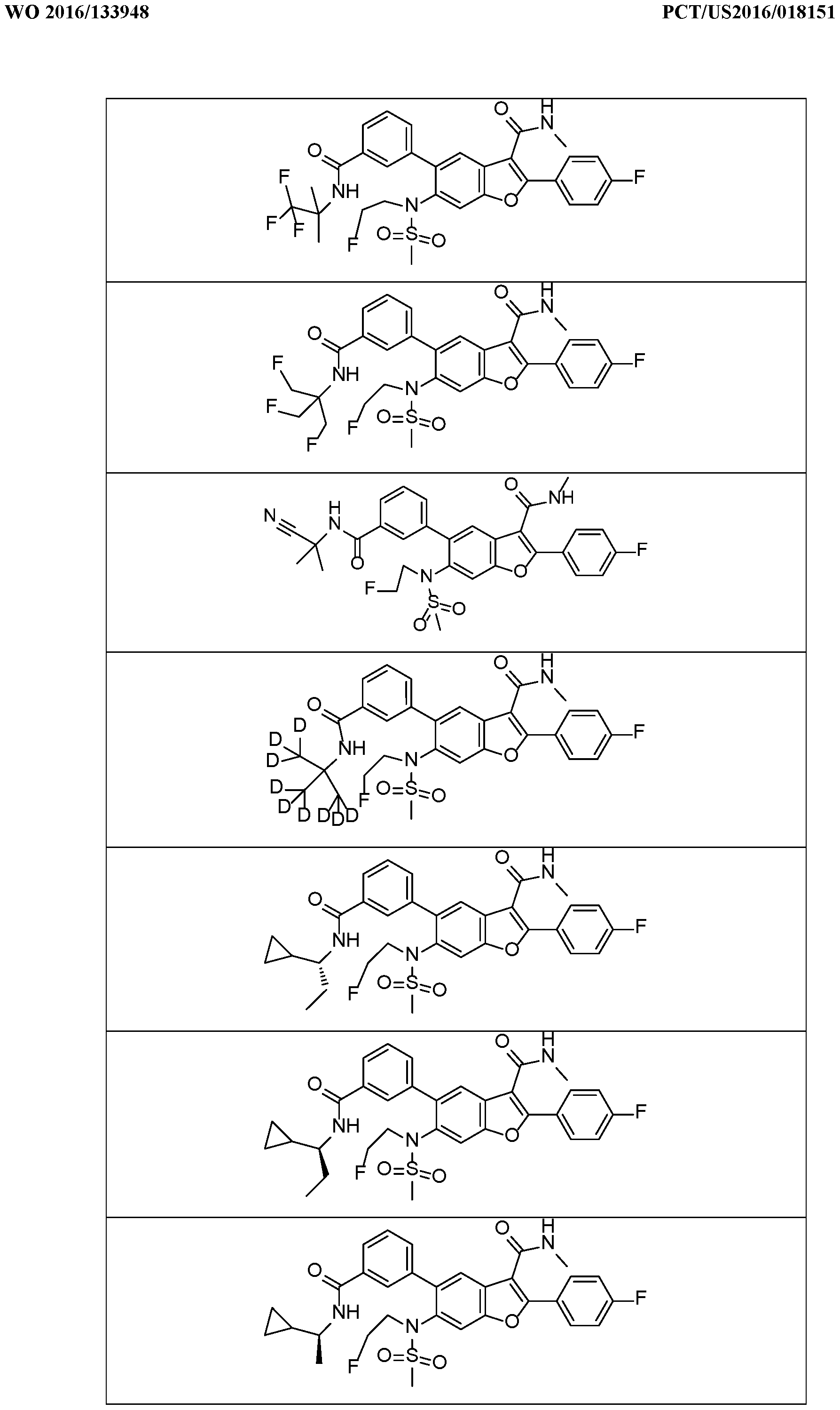
96
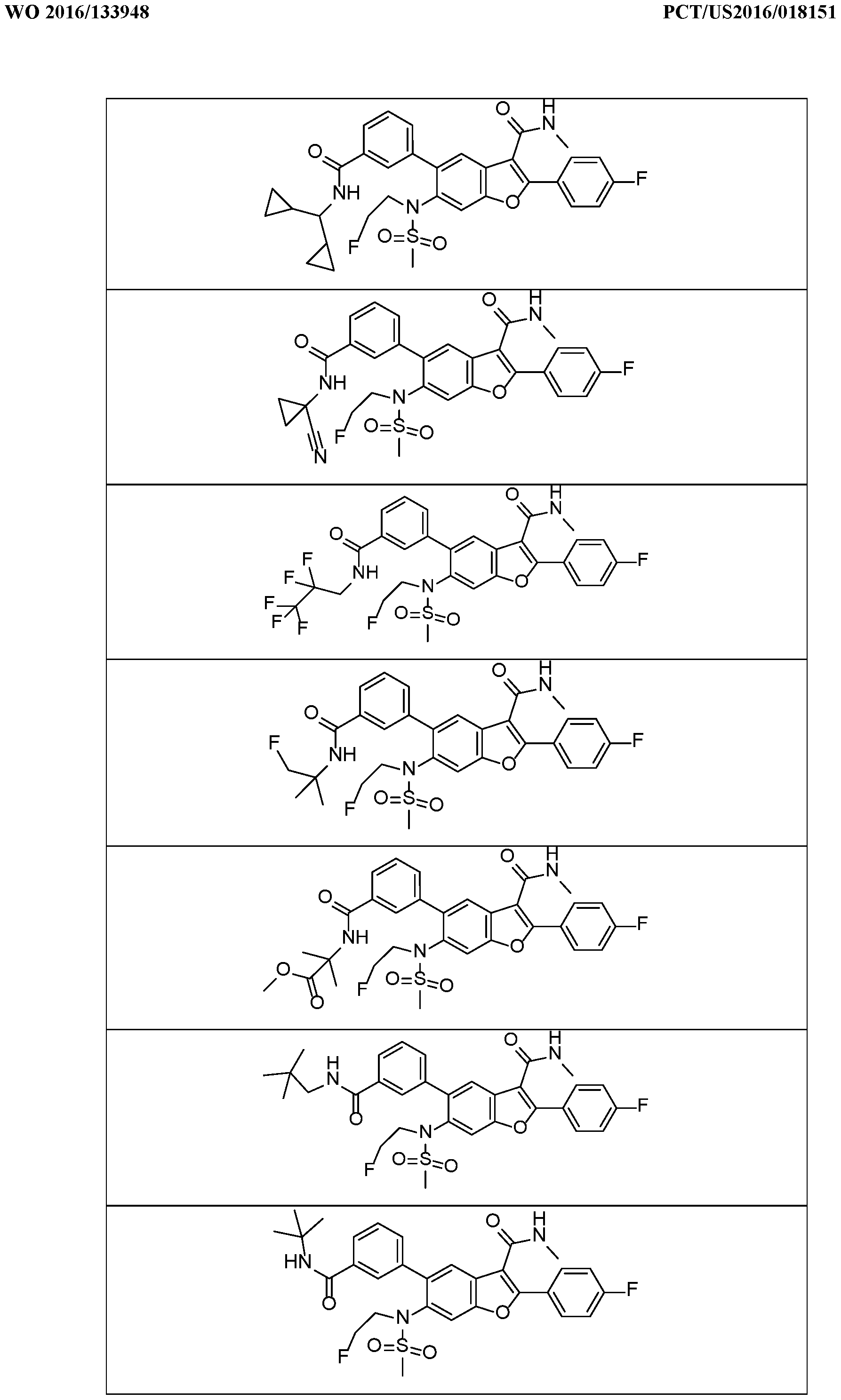
97
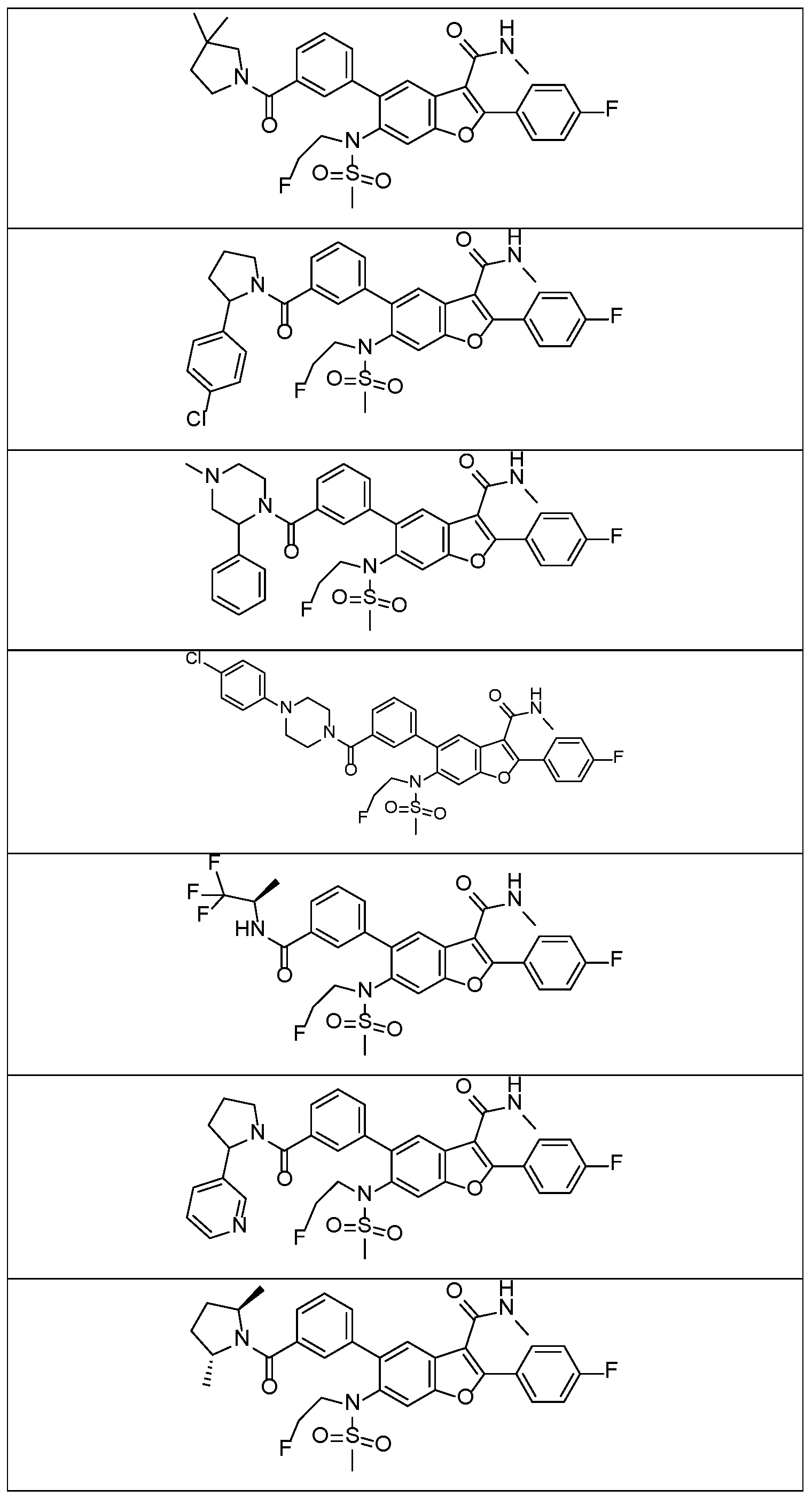
98

99

100
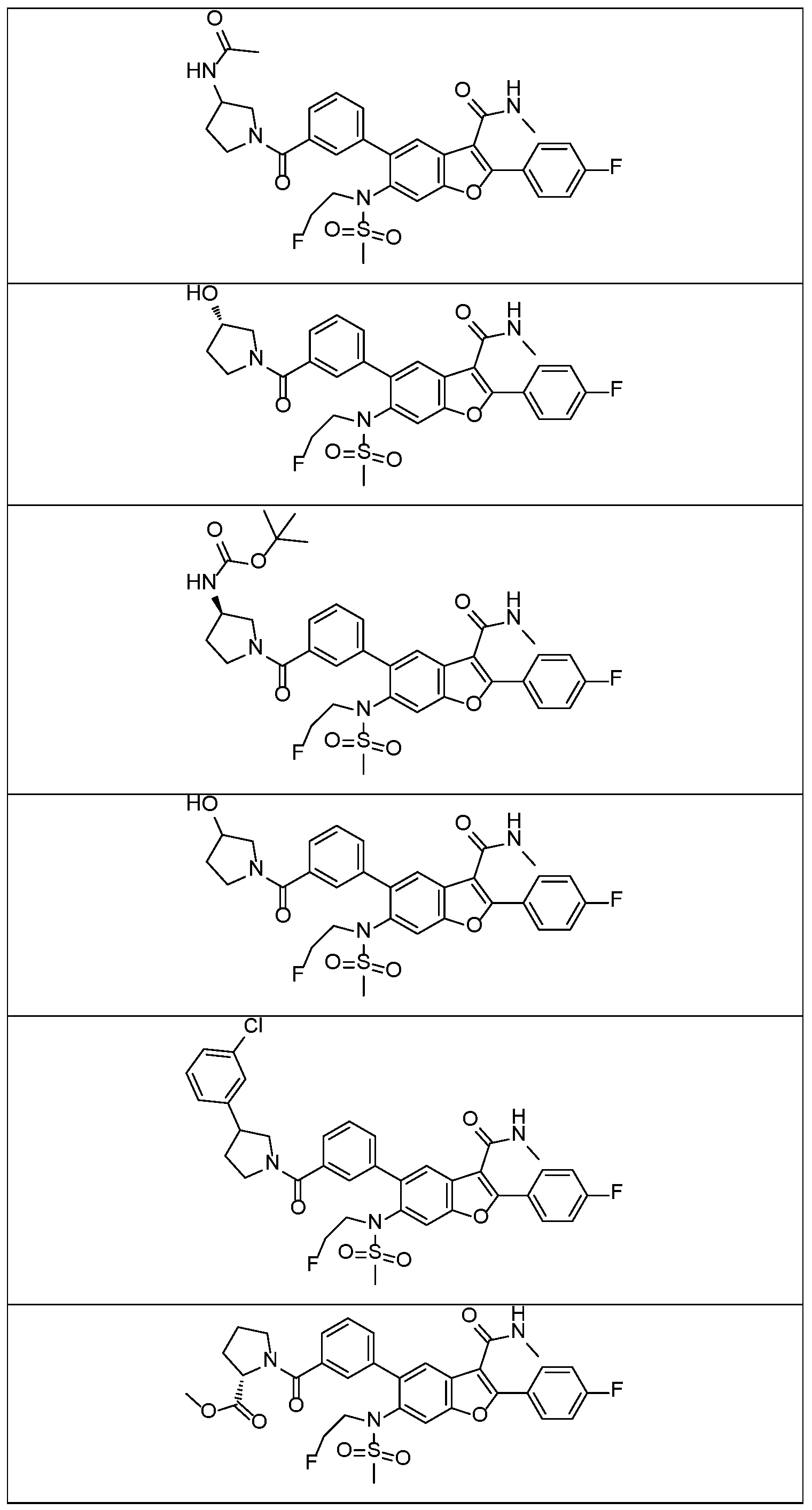
101

102

103

104
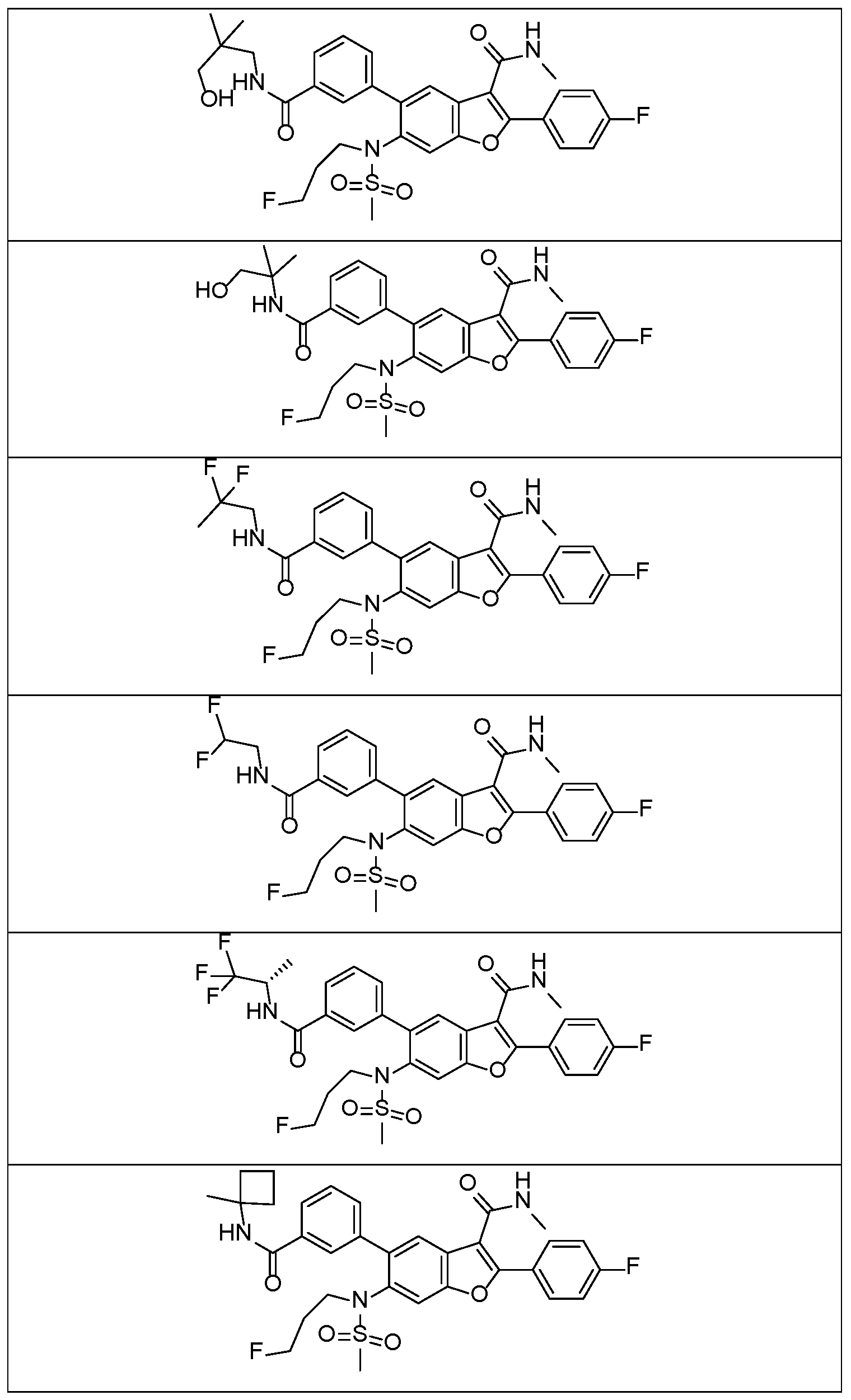
105

106

107

108

109

8. A pharmaceutical composition comprising one or more compounds according to claim 1 or a pharmaceutically acceptable salt thereof and a pharmaceutically acceptable carrier.
9. A composition comprising one or more compounds of claim 7 or a pharmaceutically acceptable salt thereof and a pharmaceutically acceptable carrier.
10. A method of treating hepatitis C infection comprising administering to a patient a therapeutically effective amount of one or more compounds according to claim 1.
Priority Applications (1)
| Application Number | Priority Date | Filing Date | Title |
|---|---|---|---|
| US15/551,002 US10125111B2 (en) | 2015-02-19 | 2016-02-17 | Benzofuran compounds for the treatment of hepatitis C |
Applications Claiming Priority (2)
| Application Number | Priority Date | Filing Date | Title |
|---|---|---|---|
| US201562118048P | 2015-02-19 | 2015-02-19 | |
| US62/118,048 | 2015-02-19 |
Publications (1)
| Publication Number | Publication Date |
|---|---|
| WO2016133948A1 true WO2016133948A1 (en) | 2016-08-25 |
Family
ID=55447151
Family Applications (1)
| Application Number | Title | Priority Date | Filing Date |
|---|---|---|---|
| PCT/US2016/018151 Ceased WO2016133948A1 (en) | 2015-02-19 | 2016-02-17 | Benzofuran compounds for the treatment of hepatitis c |
Country Status (2)
| Country | Link |
|---|---|
| US (1) | US10125111B2 (en) |
| WO (1) | WO2016133948A1 (en) |
Cited By (2)
| Publication number | Priority date | Publication date | Assignee | Title |
|---|---|---|---|---|
| WO2017165233A1 (en) * | 2016-03-21 | 2017-09-28 | Bristol-Myers Squibb Company | Benzofuran derivatives for the treatment of hepatitis c |
| US12274700B1 (en) | 2020-10-30 | 2025-04-15 | Accencio LLC | Methods of treating symptoms of coronavirus infection with RNA polymerase inhibitors |
Families Citing this family (1)
| Publication number | Priority date | Publication date | Assignee | Title |
|---|---|---|---|---|
| US10570108B2 (en) * | 2015-02-19 | 2020-02-25 | Bristol-Myers Squibb Company | Substituted benzofuran compounds for the treatment of hepatitis C |
Citations (4)
| Publication number | Priority date | Publication date | Assignee | Title |
|---|---|---|---|---|
| WO2004041201A2 (en) | 2002-11-01 | 2004-05-21 | Viropharma Incorporated | Benzofuran compounds, compositions and methods for treatment and prophylaxis of hepatitis c viral infections and associated diseases |
| WO2009101022A1 (en) | 2008-02-14 | 2009-08-20 | F. Hoffmann-La Roche Ag | Heterocyclic antiviral compounds |
| WO2011112191A1 (en) * | 2010-03-11 | 2011-09-15 | Bristol-Myers Squibb Company | Compounds for the treatment of hepatitis c |
| WO2012058125A1 (en) | 2010-10-26 | 2012-05-03 | Presidio Pharmaceuticals, Inc. | Inhibitors of hepatitis c virus |
Family Cites Families (3)
| Publication number | Priority date | Publication date | Assignee | Title |
|---|---|---|---|---|
| US7994171B2 (en) * | 2008-09-11 | 2011-08-09 | Bristol-Myers Squibb Company | Compounds for the treatment of hepatitis C |
| TW201136919A (en) * | 2010-03-02 | 2011-11-01 | Merck Sharp & Amp Dohme Corp | Inhibitors of hepatitis C virus NS5B polymerase |
| WO2015143256A1 (en) * | 2014-03-21 | 2015-09-24 | Bristol-Myers Squibb Company | Cyanoamino (aza)benzofuran compounds for the treatment of hepatitis c |
-
2016
- 2016-02-17 WO PCT/US2016/018151 patent/WO2016133948A1/en not_active Ceased
- 2016-02-17 US US15/551,002 patent/US10125111B2/en active Active
Patent Citations (5)
| Publication number | Priority date | Publication date | Assignee | Title |
|---|---|---|---|---|
| WO2004041201A2 (en) | 2002-11-01 | 2004-05-21 | Viropharma Incorporated | Benzofuran compounds, compositions and methods for treatment and prophylaxis of hepatitis c viral infections and associated diseases |
| US7265152B2 (en) | 2002-11-01 | 2007-09-04 | Viropharma Incorporated | Benzofuran compounds, compositions and methods for treatment and prophylaxis of hepatitis C viral infections and associated diseases |
| WO2009101022A1 (en) | 2008-02-14 | 2009-08-20 | F. Hoffmann-La Roche Ag | Heterocyclic antiviral compounds |
| WO2011112191A1 (en) * | 2010-03-11 | 2011-09-15 | Bristol-Myers Squibb Company | Compounds for the treatment of hepatitis c |
| WO2012058125A1 (en) | 2010-10-26 | 2012-05-03 | Presidio Pharmaceuticals, Inc. | Inhibitors of hepatitis c virus |
Non-Patent Citations (6)
| Title |
|---|
| BRESSANELLI; S. ET AL., JOURNAL OF VIROLOGY, 2002, pages 3482 - 3492 |
| DEFRANCESCO; RICE, CLINICS IN LIVER DISEASE, vol. 7, 2003, pages 211 - 242 |
| LAUER, G. M.; WALKER, B. D., N. ENGL. J. MED., vol. 345, 2001, pages 41 - 52 |
| POYNARD, T. ET AL., LANCET, vol. 352, 1998, pages 1426 - 1432 |
| WANGY-K; RIGAT K; ROBERTS S; GAO M, ANAL BIOCHEM, vol. 359, 2006, pages 106 - 111 |
| ZEUZEM, S. ET AL., TV. ENGL. J. MED., vol. 343, 2000, pages 1666 - 1672 |
Cited By (3)
| Publication number | Priority date | Publication date | Assignee | Title |
|---|---|---|---|---|
| WO2017165233A1 (en) * | 2016-03-21 | 2017-09-28 | Bristol-Myers Squibb Company | Benzofuran derivatives for the treatment of hepatitis c |
| US11161837B2 (en) | 2016-03-21 | 2021-11-02 | Bristol-Myers Squibb Company | Benzofuran derivatives for the treatment of hepatitis C |
| US12274700B1 (en) | 2020-10-30 | 2025-04-15 | Accencio LLC | Methods of treating symptoms of coronavirus infection with RNA polymerase inhibitors |
Also Published As
| Publication number | Publication date |
|---|---|
| US10125111B2 (en) | 2018-11-13 |
| US20180030016A1 (en) | 2018-02-01 |
Similar Documents
| Publication | Publication Date | Title |
|---|---|---|
| EP2812325A1 (en) | Novel compounds for the treatment of hepatitis c | |
| US9434738B2 (en) | Macrocyclic benzofuran and azabenzofuran compounds for the treatment of hepatitis C | |
| US10125111B2 (en) | Benzofuran compounds for the treatment of hepatitis C | |
| EP2831066B1 (en) | Benzofuran derivatives for the treatment of hepatitis c | |
| US9920036B2 (en) | Cyanoamino (aza)benzofuran compounds for the treatment of hepatitis C | |
| US10570108B2 (en) | Substituted benzofuran compounds for the treatment of hepatitis C | |
| US10125137B2 (en) | Benzofurans substituted with bicyclic secondary benzamide as HCV inhibitors | |
| US10131645B2 (en) | Benzofurans substituted with primary benzamide as HCV inhibitors | |
| US10087167B2 (en) | Benzofurans substituted with secondary benzamide as HCV inhibitors | |
| US9957278B2 (en) | Furopyridine compounds for the treatment of hepatitis C | |
| WO2015143255A1 (en) | Cyano containing azabenzofuran compounds for the treatment of hepatitis c | |
| EP3145932B1 (en) | 2-(aryl- or heteroaryl-)phenyl (aza)benzofuran compounds for the treatment of hepatitis c | |
| EP3119786B1 (en) | 6h-furo[2,3-e]indole compounds for the treatment of hepatitis c | |
| US10202403B2 (en) | Macrocyclic benzofuran compounds for the treatment of hepatitis C |
Legal Events
| Date | Code | Title | Description |
|---|---|---|---|
| 121 | Ep: the epo has been informed by wipo that ep was designated in this application |
Ref document number: 16707328 Country of ref document: EP Kind code of ref document: A1 |
|
| WWE | Wipo information: entry into national phase |
Ref document number: 15551002 Country of ref document: US |
|
| NENP | Non-entry into the national phase |
Ref country code: DE |
|
| 122 | Ep: pct application non-entry in european phase |
Ref document number: 16707328 Country of ref document: EP Kind code of ref document: A1 |