WO2016127915A1 - Method for preparing ibrutinib - Google Patents
Method for preparing ibrutinib Download PDFInfo
- Publication number
- WO2016127915A1 WO2016127915A1 PCT/CN2016/073537 CN2016073537W WO2016127915A1 WO 2016127915 A1 WO2016127915 A1 WO 2016127915A1 CN 2016073537 W CN2016073537 W CN 2016073537W WO 2016127915 A1 WO2016127915 A1 WO 2016127915A1
- Authority
- WO
- WIPO (PCT)
- Prior art keywords
- compound
- formula
- potassium
- sodium
- ibufenib
- Prior art date
- Legal status (The legal status is an assumption and is not a legal conclusion. Google has not performed a legal analysis and makes no representation as to the accuracy of the status listed.)
- Ceased
Links
- 0 *C(N(CCC1)C[C@@]1[n]1nc(*)c2c(N)ncnc12)=O Chemical compound *C(N(CCC1)C[C@@]1[n]1nc(*)c2c(N)ncnc12)=O 0.000 description 11
- XYFPWWZEPKGCCK-GOSISDBHSA-N C=CC(N(CCC1)C[C@@H]1[n](c1ncnc(N)c11)nc1-c(cc1)ccc1Oc1ccccc1)=O Chemical compound C=CC(N(CCC1)C[C@@H]1[n](c1ncnc(N)c11)nc1-c(cc1)ccc1Oc1ccccc1)=O XYFPWWZEPKGCCK-GOSISDBHSA-N 0.000 description 2
- KKXJSUAAPOQJSI-ZCFIWIBFSA-N Nc1c2c(Br)n[n]([C@H]3CNCCC3)c2ncn1 Chemical compound Nc1c2c(Br)n[n]([C@H]3CNCCC3)c2ncn1 KKXJSUAAPOQJSI-ZCFIWIBFSA-N 0.000 description 2
- XYBLNTXJBVNSIS-ZCFIWIBFSA-N Nc1c2c(I)n[n]([C@H]3CNCCC3)c2ncn1 Chemical compound Nc1c2c(I)n[n]([C@H]3CNCCC3)c2ncn1 XYBLNTXJBVNSIS-ZCFIWIBFSA-N 0.000 description 2
- JIDJAGAYQHJZOR-UHFFFAOYSA-N Bc(cc1)ccc1Oc1ccccc1 Chemical compound Bc(cc1)ccc1Oc1ccccc1 JIDJAGAYQHJZOR-UHFFFAOYSA-N 0.000 description 1
- CTFXOUXSBGMYTJ-MRVPVSSYSA-N C=CC(N(CCC1)C[C@@H]1[n](c1ncnc(N)c11)nc1I)=O Chemical compound C=CC(N(CCC1)C[C@@H]1[n](c1ncnc(N)c11)nc1I)=O CTFXOUXSBGMYTJ-MRVPVSSYSA-N 0.000 description 1
- GPSQYTDPBDNDGI-MRXNPFEDSA-N Nc1c(c(-c(cc2)ccc2Oc2ccccc2)n[n]2[C@H]3CNCCC3)c2ncn1 Chemical compound Nc1c(c(-c(cc2)ccc2Oc2ccccc2)n[n]2[C@H]3CNCCC3)c2ncn1 GPSQYTDPBDNDGI-MRXNPFEDSA-N 0.000 description 1
- XXBJBOWLTYFSGL-MRVPVSSYSA-N Nc1c2c(Br)n[n]([C@H](CCC3)CN3C(CCBr)=O)c2ncn1 Chemical compound Nc1c2c(Br)n[n]([C@H](CCC3)CN3C(CCBr)=O)c2ncn1 XXBJBOWLTYFSGL-MRVPVSSYSA-N 0.000 description 1
- VNQLJXNKOGKTFO-MRVPVSSYSA-N Nc1c2c(I)n[n]([C@H](CCC3)CN3C(CCBr)=O)c2ncn1 Chemical compound Nc1c2c(I)n[n]([C@H](CCC3)CN3C(CCBr)=O)c2ncn1 VNQLJXNKOGKTFO-MRVPVSSYSA-N 0.000 description 1
- KFXUHRXGLWUOJT-UHFFFAOYSA-N OB(c(cc1)ccc1Oc1ccccc1)O Chemical compound OB(c(cc1)ccc1Oc1ccccc1)O KFXUHRXGLWUOJT-UHFFFAOYSA-N 0.000 description 1
Classifications
-
- A—HUMAN NECESSITIES
- A61—MEDICAL OR VETERINARY SCIENCE; HYGIENE
- A61P—SPECIFIC THERAPEUTIC ACTIVITY OF CHEMICAL COMPOUNDS OR MEDICINAL PREPARATIONS
- A61P35/00—Antineoplastic agents
-
- A—HUMAN NECESSITIES
- A61—MEDICAL OR VETERINARY SCIENCE; HYGIENE
- A61P—SPECIFIC THERAPEUTIC ACTIVITY OF CHEMICAL COMPOUNDS OR MEDICINAL PREPARATIONS
- A61P35/00—Antineoplastic agents
- A61P35/02—Antineoplastic agents specific for leukemia
-
- A—HUMAN NECESSITIES
- A61—MEDICAL OR VETERINARY SCIENCE; HYGIENE
- A61P—SPECIFIC THERAPEUTIC ACTIVITY OF CHEMICAL COMPOUNDS OR MEDICINAL PREPARATIONS
- A61P43/00—Drugs for specific purposes, not provided for in groups A61P1/00-A61P41/00
-
- C—CHEMISTRY; METALLURGY
- C07—ORGANIC CHEMISTRY
- C07D—HETEROCYCLIC COMPOUNDS
- C07D487/00—Heterocyclic compounds containing nitrogen atoms as the only ring hetero atoms in the condensed system, not provided for by groups C07D451/00 - C07D477/00
- C07D487/02—Heterocyclic compounds containing nitrogen atoms as the only ring hetero atoms in the condensed system, not provided for by groups C07D451/00 - C07D477/00 in which the condensed system contains two hetero rings
- C07D487/04—Ortho-condensed systems
-
- Y—GENERAL TAGGING OF NEW TECHNOLOGICAL DEVELOPMENTS; GENERAL TAGGING OF CROSS-SECTIONAL TECHNOLOGIES SPANNING OVER SEVERAL SECTIONS OF THE IPC; TECHNICAL SUBJECTS COVERED BY FORMER USPC CROSS-REFERENCE ART COLLECTIONS [XRACs] AND DIGESTS
- Y02—TECHNOLOGIES OR APPLICATIONS FOR MITIGATION OR ADAPTATION AGAINST CLIMATE CHANGE
- Y02P—CLIMATE CHANGE MITIGATION TECHNOLOGIES IN THE PRODUCTION OR PROCESSING OF GOODS
- Y02P20/00—Technologies relating to chemical industry
- Y02P20/50—Improvements relating to the production of bulk chemicals
- Y02P20/55—Design of synthesis routes, e.g. reducing the use of auxiliary or protecting groups
Definitions
- This application relates to the field of medicinal chemistry.
- the present application relates to a process for the preparation of Ibrutinib (trade name: Imbruvica) and an intermediate for the preparation of itibinib.
- Ibbutinib is an oral Bruton's tyrosine kinase (BTK) inhibitor and is used in pre-treatment of mantle cell lymphoma (MCL), pre-treatment of chronic lymphocytic leukemia and carrying Del 17p removes the treatment of mutant chronic lymphocytic leukemia (CLL).
- BTK Bruton's tyrosine kinase
- CN101610676A discloses starting from 4-phenoxybenzoic acid, condensing with malononitrile after chlorination, and then cyclizing with anhydrous hydrazine to obtain a pyrazole intermediate, followed by cyclization with formamide to obtain 4-aminopyridinium.
- the oxazo[3,4-d]pyrimidine nucleus is obtained by condensation reaction with a chiral alcohol, de Boc protecting group and acrylation.
- the synthesis route is as follows:
- the synthetic route is tedious and has many steps.
- the yield of the light-delay reaction step is low (34%), the total yield is only 8.1%, and
- the triphenylphosphine resin, which is not easy to obtain, is finally purified by chromatography to obtain ibufenib, which makes the route industrialized with high cost and complicated operation.
- CN103121999A discloses a condition in which 3-bromo-4-aminopyrazolo[3,4-d]pyrimidine is used as a starting material, followed by coupling with 4-phenoxybenzeneboronic acid via Suzuki reaction, and using cesium carbonate as a base.
- Ilbutinib is obtained by condensation of the lower and chiral alcohols, protection by trifluoroacetyl group, de Boc protecting group, acrylylation and de-trifluoroacetyl group protection.
- the synthetic route is as follows:
- WO2014022390A1 reports the preparation of intermediate 3-iodo-1H-pyrazolo[3,4-d]pyrimidin-4-amine by iodo generation starting from 4-aminopyrazolo[3,4-d]pyrimidine. And then, by Suzuki reaction, coupled with 4-phenoxybenzeneboronic acid, condensation reaction with chiral alcohol, and then deprotected by hydrochloric acid to form salt, and finally obtained by acrylation to obtain ibufenib, synthetic route As follows:
- the catalyst used in the Suzuki reaction of this route has a high dosage of tetrakistriphenylphosphine palladium and a reaction time of up to 24 hours; a long delay reaction step, a low yield (38%), and a total route yield of only 9.3%, and requires Chromatographic purification is not suitable for industrial production.
- acryloyl chloride usually contains 1% to 3% of 3-chloropropionyl chloride, which causes the presence of 3-chloropropionylated impurities in the product ibufenib, resulting in difficulty in purification and difficulty in industrial application.
- the application provides a method for preparing ibu brinib, which comprises the following steps:
- Step 1 using a compound of formula 1 as a starting material, and reacting a compound of formula 2 in the presence of a base to form a compound of formula 3,
- Step 2 the compound of formula 3 is reacted with a compound of formula 4 in the presence of a base and a catalyst to form ibunotetin.
- X 1 is each independently selected from Cl, Br or I, preferably Cl or Br
- X 2 is independently selected from Cl or Br
- R' is selected from X 3 are each independently selected from Cl, Br or I, preferably Cl or Br.
- the present application provides another method for preparing ibu brinib, which comprises the following steps:
- Step 1 the compound of formula 1 is reacted with a compound of formula 4 in the presence of a base and a catalyst to form a compound of formula 8,
- Step 2 the compound of formula 8 is reacted with a compound of formula 2-1 in the presence of a base to form ibunotetin.
- X 1 are each independently selected from the group consisting of Cl, Br or I, preferably Cl or Br; X 2 are each independently selected from Cl or Br.
- the present application provides an intermediate compound as shown below which can be used to prepare ibufenib:
- X 1 and X 3 are each independently selected from Cl, Br or I.
- the application provides the use of an intermediate compound as shown below for the preparation of ibunotetin:
- X 1 and X 3 are each independently selected from Cl, Br or I.
- references to “an embodiment” or “an embodiment” or “in another embodiment” or “in certain embodiments” throughout this specification are meant to be included in the at least one embodiment.
- the appearances of the phrase “in one embodiment” or “in an embodiment” or “in another embodiment” or “in some embodiments” are not necessarily all referring to the same embodiment.
- the particular elements, structures, or characteristics may be combined in any suitable manner in one or more embodiments.
- a reaction including a “catalyst” includes a catalyst, or two or more catalysts.
- the term “or” is generally used in its meaning including “and/or” unless it is specifically defined otherwise.
- the application provides a preparation method of Ibubinib, which comprises the following steps:
- Step 1 using a compound of formula 1 as a starting material, and reacting a compound of formula 2 in the presence of a base to form a compound of formula 3,
- Step 2 the compound of formula 3 is reacted with a compound of formula 4 in the presence of a base and a catalyst to form ibunotetin.
- X 1 is each independently selected from Cl, Br or I, preferably Cl or Br
- X 2 is independently selected from Cl or Br
- R' is selected from X 3 are each independently selected from Cl, Br or I, preferably Cl or Br.
- the amount of the compound of formula 2 is from 0.9 to 2 equivalents, preferably from 1 to 1.2 equivalents, relative to the amount of the compound of formula 1.
- the base is an inorganic base and/or an organic base
- the inorganic base includes, but is not limited to, potassium carbonate, sodium carbonate, sodium hydrogencarbonate, potassium hydrogencarbonate, sodium hydroxide. , potassium hydroxide, potassium hydride or sodium hydride, etc.
- organic bases include, but are not limited to, triethylamine, lutidine, diisopropylethylamine or 1,8-diazabicyclo[5.4.0] eleven Carbon-7-ene or the like; preferably an inorganic base, more preferably sodium hydrogencarbonate and potassium hydrogencarbonate.
- the amount of the base relative to the amount of the compound of formula 1 is from 1 to 5 equivalents, preferably from 1.5 to 3 equivalents, more preferably 2 equivalents.
- the reaction solvent is a polar aprotic solvent, preferably tetrahydrofuran, 2-methyltetrahydrofuran, N,N-dimethylformamide, acetonitrile or acetone, etc., more preferably 2 -methyltetrahydrofuran.
- the amount of the compound of formula 4 is from 1 to 3 equivalents, preferably from 1.2 to 2 equivalents, more preferably 1.5 equivalents, to the compound of formula 3.
- the catalyst in step 2, is selected from the group consisting of Pd(PPh 3 ) 4 , PdCl 2 (PPh 3 ) 2 , PdCl 2 (PhCN) 2 , Pd(OAc) 2 , Pd/C Or PdCl 2 (dppf) 2 or the like, preferably Pd(PPh 3 ) 4 .
- the amount of the catalyst is from 0.001 to 0.1 equivalents, preferably from 0.005 to 0.05 equivalents, more preferably 0.01 equivalents, relative to the amount of the compound of formula 3.
- the base is an inorganic base, preferably potassium carbonate, sodium carbonate, cesium carbonate, potassium acetate, sodium acetate, potassium phosphate, sodium phosphate, sodium hydrogencarbonate, potassium hydrogencarbonate.
- the amount of the base relative to the amount of the compound of formula 3 is from 1 to 5 equivalents, preferably from 2 to 4 equivalents, more preferably from 3 to 3.5 equivalents.
- the reaction solvent is a mixed solvent of a polar aprotic solvent and water, preferably tetrahydrofuran, 1,4-dioxane, acetonitrile, acetone, N,N-dimethyl a mixed solvent with water such as carbamide (DMF), dimethyl sulfoxide, N-methylpyrrolidone or ethylene glycol dimethyl ether, more preferably 1,4-dioxane with water or ethylene glycol A mixed solvent of ether and water.
- a mixed solvent of a polar aprotic solvent and water preferably tetrahydrofuran, 1,4-dioxane, acetonitrile, acetone, N,N-dimethyl a mixed solvent with water such as carbamide (DMF), dimethyl sulfoxide, N-methylpyrrolidone or ethylene glycol dimethyl ether, more preferably 1,4-dioxane with water or ethylene glycol A mixed solvent of ether and water.
- the reaction temperature is 15 ° C or lower, preferably -10 ° C to 5 ° C, more preferably -5 ° C to 0 ° C.
- the reaction temperature is from 60 ° C to 120 ° C, preferably from 80 ° C to 100 ° C.
- Yet another aspect of the present application provides another method of preparing ibunoteini comprising the steps of:
- Step 1 the compound of formula 1 is reacted with a compound of formula 4 in the presence of a base and a catalyst to form a compound of formula 8,
- Step 2 the compound of formula 8 is reacted with a compound of formula 2-1 in the presence of a base to form ibunotetin.
- X 1 are each independently selected from the group consisting of Cl, Br or I, preferably Cl or Br; X 2 are each independently selected from Cl or Br.
- the amount of the compound of Formula 4 is from 1 to 3 equivalents, preferably from 1.2 to 2 equivalents, more preferably 1.5 equivalents to the amount of the compound of Formula 1.
- the catalyst is selected from the group consisting of Pd(PPh 3 ) 4 , PdCl 2 (PPh 3 ) 2 , PdCl 2 (PhCN) 2 , Pd(OAc) 2 , Pd/C or PdCl 2 (dppf 2, etc., preferably Pd(PPh 3 ) 4 .
- the amount of the catalyst is from 0.001 to 0.1 equivalents, preferably from 0.005 to 0.05 equivalents, more preferably 0.01 equivalents, relative to the amount of the compound of formula 1.
- the base used in the step 1 is an inorganic base, preferably potassium carbonate, sodium carbonate, cesium carbonate, potassium acetate, sodium acetate, potassium phosphate, sodium phosphate, sodium hydrogencarbonate, potassium hydrogencarbonate, Sodium hydroxide, potassium hydroxide, sodium hydride or potassium hydride, more preferably potassium phosphate or potassium carbonate.
- the amount of the base used in the step 1 is from 1 to 5 equivalents, preferably from 2 to 4 equivalents, more preferably from 3 to 3.5 equivalents, to the amount of the compound of the formula 1.
- the reaction solvent used in the step 1 is a mixed solvent of a polar aprotic solvent and water, preferably tetrahydrofuran, 1,4-dioxane, acetonitrile, acetone, N, N-di a mixed solvent of water such as methylformamide (DMF), dimethyl sulfoxide, N-methylpyrrolidone or ethylene glycol dimethyl ether, more preferably 1,4-dioxane with water or ethylene glycol a mixed solvent of methyl ether and water.
- a mixed solvent of a polar aprotic solvent and water preferably tetrahydrofuran, 1,4-dioxane, acetonitrile, acetone, N, N-di a mixed solvent of water such as methylformamide (DMF), dimethyl sulfoxide, N-methylpyrrolidone or ethylene glycol dimethyl ether, more preferably 1,4-dioxane with water or ethylene glycol
- the amount of the compound of the formula 2-1 is from 0.9 to 2 equivalents, preferably from 1 to 1.2 equivalents, to the amount of the compound of the formula 8.
- the base used in the step 2 is an inorganic base and/or an organic base, wherein the inorganic base is selected from the group consisting of potassium carbonate, sodium carbonate, sodium hydrogencarbonate, potassium hydrogencarbonate, sodium hydroxide, and hydroxide. Potassium, potassium hydride or sodium hydride; the organic base is selected from the group consisting of triethylamine, lutidine, diisopropylethylamine or 1,8-diazabicyclo[5.4.0]undec-7-ene Etc., preferably an inorganic base, more preferably sodium hydrogencarbonate and potassium hydrogencarbonate.
- the inorganic base is selected from the group consisting of potassium carbonate, sodium carbonate, sodium hydrogencarbonate, potassium hydrogencarbonate, sodium hydroxide, and hydroxide. Potassium, potassium hydride or sodium hydride
- the organic base is selected from the group consisting of triethylamine, lutidine, diisopropylethylamine or 1,8-diaza
- the amount of the base used in the step 2 is from 1 to 5 equivalents, preferably from 1.5 to 3 equivalents, more preferably 2 equivalents, to the amount of the compound of the formula 8.
- the reaction solvent used in the step 2 is a polar aprotic solvent, preferably tetrahydrofuran, 2-methyltetrahydrofuran, N,N-dimethylformamide, acetonitrile or acetone, etc., more preferably 2-methyltetrahydrofuran.
- the reaction temperature is from 60 ° C to 120 ° C, preferably from 80 ° C to 100 ° C.
- the reaction temperature is 15 ° C or lower, preferably -10 ° C to 5 ° C, more preferably -5 ° C to 0 ° C.
- the method of preparing ibunotetin described herein further comprises the steps of: preparing a compound of formula 1:
- the compound of formula 5 is reacted with a compound of formula 6 in the presence of a photoreaction reagent to form a compound of formula 7, and then the compound of formula 7 is removed in the presence of an acid to form a compound of formula 1:
- R is an amino protecting group
- X 1 is each independently selected from the group consisting of Cl, Br or I, preferably Cl or Br.
- the amount of the compound of the formula 6 is from 0.5 to 3 equivalents, preferably from 1 to 2 equivalents, more preferably 1.5 equivalents, to the amount of the compound of the formula 5.
- the photolatent reaction reagent is selected from a first reagent selected from the group consisting of triphenylphosphine (TPP), tributylphosphine (TBP) or trimethylphosphine (TMP) and is selected from the group consisting of azo Diisopropyl dicarboxylate (DIAD), di-tert-butyl azodicarboxylate (DBAD), diethyl azodicarboxylate (DEAD), di-p-chlorobenzyl azodicarboxylate (DCAD), 1,1' -(Azodicarbyl)dipiperidine (ADDP), N,N,N',N'-tetraisopropylazodicarboxyamide (TIPA), N,N,N',N'-tetra Azo azocarboxamide (TMAD) or 4,7-dimethyl-3,4,5,6,7,8-hexahydro-1,2,4,7-tetraazax
- TPP tripheny
- the amount of the first reagent and the amount of the second reagent in the photosensitivity reagent are equimolar to each other, and each of the compounds of Formula 5 is 1-5 equivalents, preferably 2 5 equivalents, more preferably 3-4 equivalents.
- the solvent for preparing the compound of Formula 7 is selected from a polar aprotic solvent or water, preferably tetrahydrofuran (THF), N,N-dimethylformamide, dimethyl sulfoxide, N-A. Pyryl pyrrolidone, acetonitrile or 1,4-dioxane, etc., more preferably tetrahydrofuran.
- a polar aprotic solvent or water preferably tetrahydrofuran (THF), N,N-dimethylformamide, dimethyl sulfoxide, N-A.
- Pyryl pyrrolidone acetonitrile or 1,4-dioxane, etc., more preferably tetrahydrofuran.
- R is preferably tert-butoxycarbonyl (Boc).
- the acid used is selected from the group consisting of hydrochloric acid, hydrobromic acid, sulfuric acid, phosphoric acid, acetic acid, methanesulfonic acid or trifluoroacetic acid, preferably hydrochloric acid.
- Another aspect of the present application provides an intermediate compound as shown below that can be used to prepare ibu brinib:
- X 1 and X 3 are each independently selected from Cl, Br or I.
- the intermediate compound useful for the preparation of Ibutinib is selected from the group consisting of Structured compound:
- Another aspect of the present application provides the use of an intermediate compound as shown below for the preparation of Ibubutinib:
- X 1 and X 3 are each independently selected from Cl, Br or I.
- the raw materials used are inexpensive and readily available, and only the acylation reaction and the Suzuki reaction are required to obtain ibutinib.
- the method for preparing ibufenib provided by the present application has the following advantages:
- the acylation reaction does not require additional protection of the functional group, and the product yield and purity are high;
- the photo-delay reaction is first carried out to significantly increase the conversion rate of the raw material, and the reaction product can be directly precipitated from the reaction liquid, thereby solving the disadvantage that the product of the photo-delay reaction in the prior art needs to be purified by chromatography.
- the product yield is improved, the purification method is simplified, and the raw material cost is lowered;
- the amount of the catalyst is much lower than that reported in the prior literature, and the conversion of the raw material is 100% after the reaction for 1-5 h. %, a very small amount of impurities generated in the reaction, the product can be purified only by forming the corresponding salt, and the purity of the product is high.
- the compound of the formula 1, the compound of the formula 3 or the compound of the formula 8 may be present in the form of a free base or in the form of a salt with an inorganic or organic acid, all within the scope of the present application. .
- the equivalent means the amount of the substance in terms of molar amount.
- the amount of the compound of Formula 2 described herein is from 0.9 to 2 equivalents relative to the compound of Formula 1, and the molar amount of the compound of Formula 2 is from 0.9 to 2 times the molar amount of the compound of Formula 1.
- the compound of formula 5-Br (20 g, 0.093 mol), the compound of formula 6-Boc (28.21 g, 0.14 mol) and triphenylphosphine (85.79 g, 0.33 mol) were added to anhydrous THF (200 mL) under nitrogen. Medium, light brown suspension. The reaction temperature was lowered to 0 ° C, DIAD (66.14 g, 0.33 mol) was added dropwise, and the temperature was kept below 5 ° C during the dropwise addition. The solution was gradually converted into a pale yellow clear solution, and the temperature was gradually raised to 0-10 ° C while stirring.
- the compound of the formula 1-Br (5 g, 0.017 mol) was dissolved in 2-methyltetrahydrofuran (50 mL) under a nitrogen atmosphere, and a 7% aqueous solution of sodium hydrogen carbonate (2.83 g, 0.034 mol) (40 mL) was added and then cooled.
- a solution of acryloyl chloride (1.52 g, 0.017 mol) in 2-methyltetrahydrofuran (5 mL) was slowly added dropwise to -5 °C. After the dropwise addition, the reaction temperature was kept below 0 ° C while stirring the reaction for 1 h. The reaction mixture was separated and the aqueous layer was evaporated.
- the compound of formula 1-I (5 g, 0.0145 mol) was dissolved in 2-methyltetrahydrofuran (50 mL) under a nitrogen atmosphere, and then 7% aqueous sodium hydrogen carbonate (2.44 g, 0.029 mol) (34.8 mL) The temperature was lowered to -5 ° C, and a solution of acryloyl chloride (1.31 g, 0.0145 mol) in 2-methyltetrahydrofuran (5 mL) was slowly added dropwise, and the reaction temperature was kept below 0 ° C while stirring for 1 h. The reaction mixture was separated and the aqueous layer was evaporated.
- the compound of the formula 1-Br (5 g, 0.017 mol) was dissolved in 2-methyltetrahydrofuran (50 mL) under a nitrogen atmosphere, and a 7% aqueous solution of sodium hydrogen carbonate (2.83 g, 0.034 mol) (40 mL) was added and then cooled. Slowly add 3-chloropropyl to -5 ° C A solution of the acid chloride (2.14 g, 0.017 mol) in 2-methyltetrahydrofuran (5 mL) was taken, and the reaction mixture was kept below 0 ° C and stirred for 1 h. The reaction mixture was separated and the aqueous layer was evaporated.
- the compound of the formula 1-Br (5 g, 0.017 mol) was dissolved in 2-methyltetrahydrofuran (50 mL) under a nitrogen atmosphere, and a 7% aqueous solution of sodium hydrogen carbonate (2.83 g, 0.034 mol) (40 mL) was added and then cooled.
- a solution of 3-bromopropionyl bromide (3.63 g, 0.017 mol) in 2-methyltetrahydrofuran (5 mL) was slowly added dropwise to -5 ° C, and the reaction temperature was kept below 0 ° C while stirring for 1 h. The reaction mixture was separated and the aqueous layer was evaporated.
- EtOAc mjjjjjjjjjjjjjjjjjjjjjjjjjjjjjjjjjjjjjjjjjjjjjjjjjjjjjjjjjjjjjjjjjjjjjjjjjjjjjjjjjjjjjjjjjjjjjjjjjjjjjjjjjjjjjjjjjjjjjjjjjjjjjjjjjjjjjjjjjjjjjjjjjjjjjjjjjjjjjjjjjjjjjjjjjjjjjjjjjjjjjjjjjjjjjjjjjjjjjjjjjjjjjjjjjjjjjjjjjjjjjjjjjjjjjjjjjjjjjjjjjjjjjjjjj
- the compound of formula 1-I (5 g, 0.0145 mol) was dissolved in 2-methyltetrahydrofuran (50 mL) under nitrogen. Add 7% aqueous solution of sodium hydrogencarbonate (2.44 g, 0.029 mol) (34.8 mL), then cool to -5 ° C, slowly add 3-chloropropanoyl chloride (1.84 g, 0.0145 mol) of 2-methyltetrahydrofuran (5 mL) The solution was centrifuged to maintain the reaction temperature below 0 ° C while stirring for 1 h. The reaction mixture was separated and the aqueous layer was evaporated.
- the compound of formula 1-I (5 g, 0.0145 mol) was dissolved in 2-methyltetrahydrofuran (50 mL) under a nitrogen atmosphere, and then 7% aqueous sodium hydrogen carbonate (2.44 g, 0.029 mol) (34.8 mL) The temperature was lowered to -5 ° C, and a solution of 3-bromopropionyl bromide (3.14 g, 0.0145 mol) in 2-methyltetrahydrofuran (5 mL) was slowly added dropwise, and the reaction temperature was kept below 0 ° C while stirring for 1 h. The reaction mixture was separated and the aqueous layer was evaporated.
- a compound of formula 3-2-Br-Cl (3 g, 7.74 mmol), a compound of formula 4 (2.48 g, 11.61 mmol) and potassium phosphate (5.75 g, 27.09 mmol) were added to 1,4-dioxane (30 mL) After bubbling with nitrogen gas for 20 min in a mixed solvent of water (12 mL), Pd(PPh 3 ) 4 (89.4 mg, 0.077 mmol) was added, and nitrogen gas was bubbled for 5 min, and then the mixture was heated under reflux and stirred for 1 h. Then, the reaction mixture was separated, and the organic layer was evaporated to dryness.
- a compound of formula 3-2-Br-Br (3 g, 6.94 mmol), a compound of formula 4 (2.23 g, 10.41 mmol) and potassium phosphate (5.16 g, 24.3 mmol) were added to 1,4-dioxane (30 mL) After bubbling with nitrogen gas for 20 min in a mixed solvent of water (12 mL), Pd(PPh 3 ) 4 (80.3 mg, 0.069 mmol) was added, and nitrogen gas was bubbled for 5 min, and then the mixture was heated under reflux and stirred for 1 h. Then, the reaction mixture was separated, and the organic layer was evaporated to dryness.
- the dihydrochloride salt of the compound of formula 1-Br (20 g, 0.054 mol), the compound of formula 4 (17.35 g, 0.081 mol) and potassium phosphate (40.15 g, 0.19 mol) were added to 1,4-dioxane (200 mL). And a mixture of water (80 mL), bubbling with nitrogen for 20 min, then adding Pd(PPh 3 ) 4 (0.62 g, 5.4 ⁇ 10 -4 mol), continuing to bubble with nitrogen for 5 min, then heating to reflux The reaction was stirred for 5 h.
- reaction solution was concentrated, and ethyl acetate (100 mL) and water (100 mL) were added to the residue, and the mixture was adjusted to pH 2-3 with hydrochloric acid, and the layers were separated and ethyl acetate (100 mL) Further, methylene chloride (200 mL) was added to the aqueous layer, and the mixture was adjusted to pH 9-10 with 6N sodium hydroxide solution, and the mixture was stirred. The organic layer was dried over anhydrous sodium sulfate and evaporated. It is the free base form of Compound 8, the yield is 90.0%, and the chemical purity is 98.5%. This free base was reacted with a solution of HCl in ethanol to form a salt to obtain 18.9 g of the hydrochloride salt of Compound 8 in a yield of 92% and a chemical purity of 99.1%.
- a compound of formula 1-Br (16.1 g, 0.054 mol), a compound of formula 4 (17.35 g, 0.081 mol) and potassium phosphate (48.5 g, 0.23 mol) were added to ethylene glycol dimethyl ether (200 mL) and water (80 mL). After bubbling with nitrogen gas for 20 min, Pd(PPh 3 ) 4 (0.62 g, 5.4 ⁇ 10 -4 mol) was added, and nitrogen gas was bubbled for 5 min, then heated under reflux and stirred for 5 h.
- reaction solution was concentrated, and ethyl acetate (100 mL) and water (100 mL) were added to the residue, and the mixture was adjusted to pH 2-3 with hydrochloric acid, and the layers were separated and ethyl acetate (100 mL) Further, methylene chloride (200 mL) was added to the aqueous layer, and the mixture was adjusted to pH 9-10 with 6N sodium hydroxide solution, and the mixture was stirred. The organic layer was dried over anhydrous sodium sulfate and evaporated. It is the free base form of Compound 8, the yield is 87.1%, and the chemical purity is 98.8%.
- the dihydrochloride salt of the compound of formula 1-Br (20 g, 0.054 mol), the compound of formula 4 (17.35 g, 0.081 mol) and potassium phosphate (40.15 g, 0.19 mol) were added to DMF (200 mL) and water (80 mL).
- DMF 200 mL
- water 80 mL
- Pd(PhCN) 2 Cl 2 0.21 g, 5.5 ⁇ 10 -4 mol
- reaction solution was concentrated, and ethyl acetate (100 mL) and water (100 mL) were added to the residue, and the mixture was adjusted to pH 2-3 with hydrochloric acid, and the layers were separated and ethyl acetate (100 mL) Further, dichloromethane (200 mL) was added to the aqueous layer, and the mixture was adjusted to pH 9-10 with 6N sodium hydroxide solution, and the mixture was stirred. The organic layer was dried over anhydrous sodium sulfate and evaporated. The yield was 65.1%.
- the dihydrochloride salt of the compound of formula 1-Br (20 g, 0.054 mol), the compound of formula 4 (17.35 g, 0.081 mol) and potassium carbonate (26.14 g, 0.19 mol) were added to 1,4-dioxane (200 mL) And a mixture of water (80 mL), bubbling with nitrogen for 20 min, then adding Pd(PPh 3 ) 4 (0.62 g, 5.4 ⁇ 10 -4 mol), continuing to bubble with nitrogen for 5 min, then heating to reflux The reaction was stirred for 5 h.
- reaction solution was concentrated, and ethyl acetate (100 mL) and water (100 mL) were added to the residue, and the mixture was adjusted to pH 2-3 with hydrochloric acid, and the layers were separated and ethyl acetate (100 mL) Further, dichloromethane (200 mL) was added to the aqueous layer, and the pH was adjusted to 9-10 with 6N sodium hydroxide solution, and the mixture was stirred. The organic layer was dried over anhydrous sodium sulfate and evaporated. The yield was 80.4%.
- the compound of formula 8 (10 g, 0.026 mol) was dissolved in 2-methyltetrahydrofuran (100 mL) under a nitrogen atmosphere, and 7% aqueous sodium bicarbonate (4.37 g, 0.052 mol) (62 mL) was added and then cooled to - A solution of acryloyl chloride (2.34 g, 0.026 mol) in 2-methyltetrahydrofuran (10 mL) was slowly added dropwise at 5 ° C, and the reaction temperature was kept below 0 ° C while stirring for 1 h.
- the reaction mixture was separated, and the aqueous layer was evaporated, mjjjjjjjjjjjjjjjjjjjjjjjjjjjjjjjjjjjjjjjjjjjjjjjjjjjjjjjjjjjjjjjjjjjjjjjjjjjjjjjjjjjjjjjjjjjjjjjjjjjjjjjjjjjjjjjjjjjjjjjjjjjjjjjjjjjjjjjjjjjjjjjjjjjjjjjjjjjjjjjjjjjjjjjjjjjjjjjjjjjjjjjjjjjjjjjjjjjjjjjjjjjjjjjjjjjjjjjjjjjjjjjjjjjjjjjjjjj
- the hydrochloride salt of the compound of formula 8 (11 g, 0.026 mol) was dissolved in 2-methyltetrahydrofuran (100 mL), and 7% aqueous sodium bicarbonate (5.04 g, 0.06 mol) (72 mL) Then, the temperature was lowered to -5 ° C, and a solution of acryloyl chloride (2.34 g, 0.026 mol) in 2-methyltetrahydrofuran (10 mL) was slowly added dropwise, and the reaction temperature was kept below 0 ° C while stirring for 1 h. The reaction mixture was separated and the aqueous phase was extracted with 2-methyltetrahydrofuran (50 mL).
Landscapes
- Chemical & Material Sciences (AREA)
- Organic Chemistry (AREA)
- Health & Medical Sciences (AREA)
- Life Sciences & Earth Sciences (AREA)
- Public Health (AREA)
- General Chemical & Material Sciences (AREA)
- Medicinal Chemistry (AREA)
- Nuclear Medicine, Radiotherapy & Molecular Imaging (AREA)
- Chemical Kinetics & Catalysis (AREA)
- Pharmacology & Pharmacy (AREA)
- Veterinary Medicine (AREA)
- Animal Behavior & Ethology (AREA)
- General Health & Medical Sciences (AREA)
- Oncology (AREA)
- Hematology (AREA)
- Engineering & Computer Science (AREA)
- Bioinformatics & Cheminformatics (AREA)
- Nitrogen Condensed Heterocyclic Rings (AREA)
- Low-Molecular Organic Synthesis Reactions Using Catalysts (AREA)
- Pharmaceuticals Containing Other Organic And Inorganic Compounds (AREA)
- Catalysts (AREA)
- Plural Heterocyclic Compounds (AREA)
- Heterocyclic Carbon Compounds Containing A Hetero Ring Having Oxygen Or Sulfur (AREA)
Abstract
Description
本申请涉及药物化学领域。具体而言,本申请涉及伊布替尼(Ibrutinib,商品名:Imbruvica)的制备方法以及用于制备伊布替尼的中间体。This application relates to the field of medicinal chemistry. In particular, the present application relates to a process for the preparation of Ibrutinib (trade name: Imbruvica) and an intermediate for the preparation of itibinib.
伊布替尼是一种口服的布鲁顿酪氨酸激酶(BTK)抑制剂,并用于已接受过前期治疗的套细胞淋巴瘤(MCL)、已接受过前期治疗的慢性淋巴细胞白血病和携带del 17p删除突变的慢性淋巴细胞白血病(CLL)的治疗。Ibbutinib is an oral Bruton's tyrosine kinase (BTK) inhibitor and is used in pre-treatment of mantle cell lymphoma (MCL), pre-treatment of chronic lymphocytic leukemia and carrying Del 17p removes the treatment of mutant chronic lymphocytic leukemia (CLL).
CN101610676A公开了以4-苯氧基苯甲酸为起始原料,经氯化后与丙二腈缩合,再与无水肼环合得到吡唑中间体,之后与甲酰胺环合得到4-氨基吡唑并[3,4-d]嘧啶母核,经光延反应与手性醇缩合,脱Boc保护基及丙烯酰化等步骤后得到产物,合成路线如下所示:CN101610676A discloses starting from 4-phenoxybenzoic acid, condensing with malononitrile after chlorination, and then cyclizing with anhydrous hydrazine to obtain a pyrazole intermediate, followed by cyclization with formamide to obtain 4-aminopyridinium. The oxazo[3,4-d]pyrimidine nucleus is obtained by condensation reaction with a chiral alcohol, de Boc protecting group and acrylation. The synthesis route is as follows:

该合成路线冗长,步骤繁多,光延反应步骤收率低(34%),总收率只有8.1%,且用到昂 贵不易得的三苯基膦树脂,最后经色谱纯化才能得到伊布替尼,使得该路线工业化成本高,操作复杂。The synthetic route is tedious and has many steps. The yield of the light-delay reaction step is low (34%), the total yield is only 8.1%, and The triphenylphosphine resin, which is not easy to obtain, is finally purified by chromatography to obtain ibufenib, which makes the route industrialized with high cost and complicated operation.
CN103121999A公开了以3-溴-4-氨基吡唑并[3,4-d]嘧啶为起始原料,依次经铃木反应与4-苯氧基苯硼酸偶联、在以碳酸铯为碱的条件下和手性醇缩合、通过三氟乙酰基保护,脱Boc保护基,丙烯酰化及脱三氟乙酰基保护等步骤后得到伊布替尼,合成路线如下所示:CN103121999A discloses a condition in which 3-bromo-4-aminopyrazolo[3,4-d]pyrimidine is used as a starting material, followed by coupling with 4-phenoxybenzeneboronic acid via Suzuki reaction, and using cesium carbonate as a base. Ilbutinib is obtained by condensation of the lower and chiral alcohols, protection by trifluoroacetyl group, de Boc protecting group, acrylylation and de-trifluoroacetyl group protection. The synthetic route is as follows:
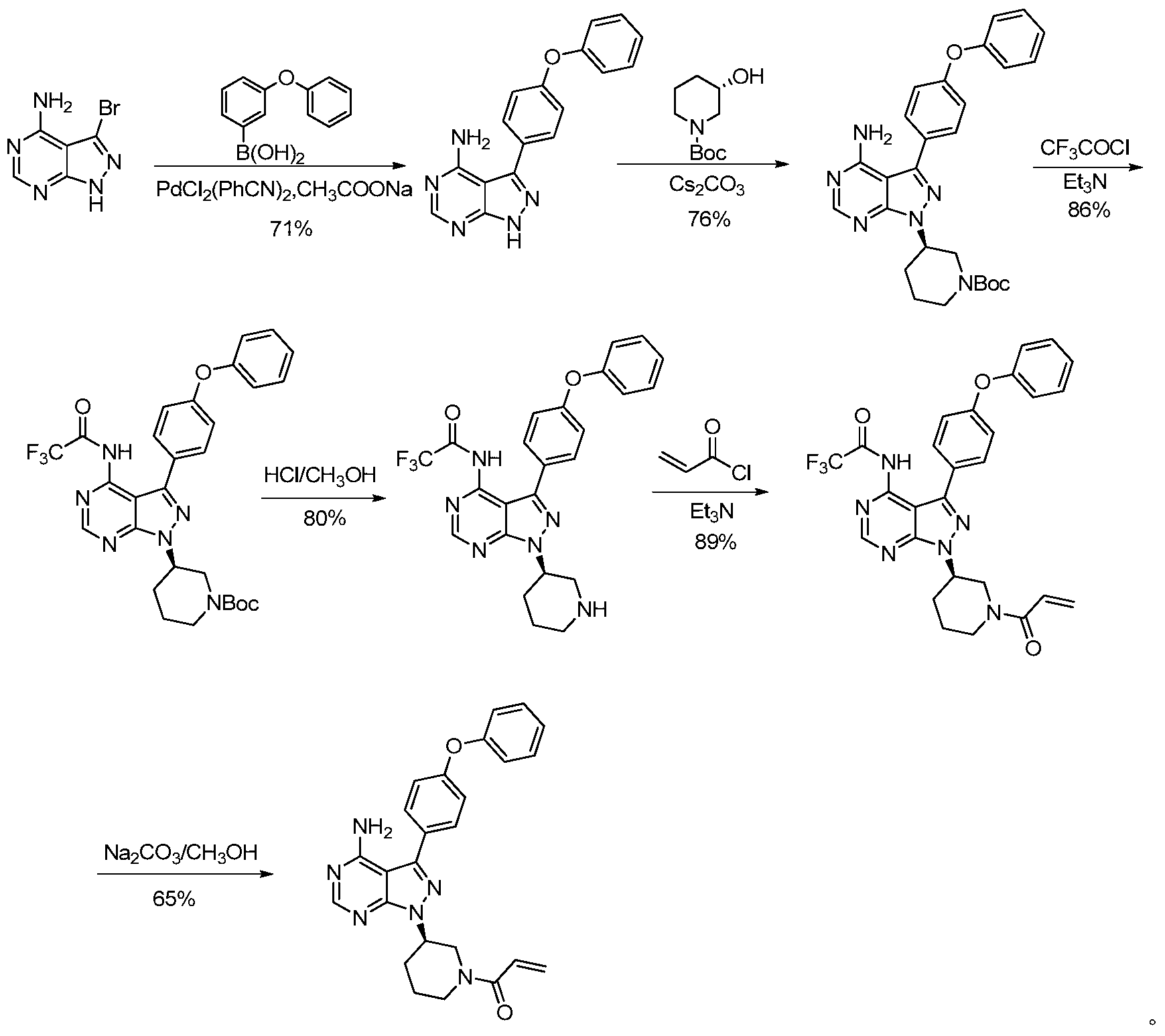
该合成路线冗长,其中以PdCl2(PhCN)2为催化剂的铃木反应不易重复,且催化剂用量大;以碳酸铯为碱的缩合步骤需24小时,反应时间长;对氨基的保护和脱保护步骤延长反应路线,降低了路线的总收率,总收率为21.5%(以3-溴-4-氨基吡唑并[3,4-d]嘧啶为起始原料),该工艺不适宜于进行工业化大规模生产。The synthetic route is tedious, wherein the Suzuki reaction with PdCl 2 (PhCN) 2 as a catalyst is not easy to repeat and the amount of catalyst is large; the condensation step with cesium carbonate as a base takes 24 hours, and the reaction time is long; the protection and deprotection steps for the amino group Prolong the reaction route and reduce the total yield of the route, the total yield is 21.5% (starting with 3-bromo-4-aminopyrazolo[3,4-d]pyrimidine), the process is not suitable for Industrialized mass production.
WO2014022390A1报道了以4-氨基吡唑并[3,4-d]嘧啶为起始原料,经碘代制备中间体3-碘-1H-吡唑并[3,4-d]嘧啶-4-胺,后依次经铃木反应与4-苯氧基苯硼酸偶联、经光延反应与手性醇缩合,再经盐酸脱Boc保护后成盐,最后经丙烯酰化后得到伊布替尼,合成路线如下所示: WO2014022390A1 reports the preparation of intermediate 3-iodo-1H-pyrazolo[3,4-d]pyrimidin-4-amine by iodo generation starting from 4-aminopyrazolo[3,4-d]pyrimidine. And then, by Suzuki reaction, coupled with 4-phenoxybenzeneboronic acid, condensation reaction with chiral alcohol, and then deprotected by hydrochloric acid to form salt, and finally obtained by acrylation to obtain ibufenib, synthetic route As follows:

该路线的铃木反应中所用的催化剂四三苯基膦钯用量高,反应时间长达24小时;光延反应步骤时间长,收率低(38%),路线总收率只有9.3%,且需经色谱纯化,不适宜于工业化生产。The catalyst used in the Suzuki reaction of this route has a high dosage of tetrakistriphenylphosphine palladium and a reaction time of up to 24 hours; a long delay reaction step, a low yield (38%), and a total route yield of only 9.3%, and requires Chromatographic purification is not suitable for industrial production.
另外,市售的丙烯酰氯通常会含有1%-3%的3-氯丙酰氯,这使得产物伊布替尼中存在3-氯丙酰化的杂质,导致纯化困难,难以工业化应用。Further, commercially available acryloyl chloride usually contains 1% to 3% of 3-chloropropionyl chloride, which causes the presence of 3-chloropropionylated impurities in the product ibufenib, resulting in difficulty in purification and difficulty in industrial application.
发明内容Summary of the invention
一方面,本申请提供了一种伊布替尼的制备方法,其包括如下步骤:In one aspect, the application provides a method for preparing ibu brinib, which comprises the following steps:
步骤1,以式1化合物为原料,与式2化合物在碱的存在下反应生成式3化合物,Step 1, using a compound of formula 1 as a starting material, and reacting a compound of formula 2 in the presence of a base to form a compound of formula 3,

步骤2,式3化合物与式4化合物在碱与催化剂的存在下反应生成伊布替尼, Step 2, the compound of formula 3 is reacted with a compound of formula 4 in the presence of a base and a catalyst to form ibunotetin.

其中,X1各自独立地选自Cl、Br或I,优选Cl或Br,X2各自独立地选自Cl或Br,R’选自
另一方面,本申请提供了另一种伊布替尼的制备方法,其包括如下步骤:In another aspect, the present application provides another method for preparing ibu brinib, which comprises the following steps:
步骤1,式1化合物与式4化合物在碱与催化剂的存在下反应生成式8化合物,Step 1, the compound of formula 1 is reacted with a compound of formula 4 in the presence of a base and a catalyst to form a compound of formula 8,

步骤2,式8化合物与式2-1化合物在碱的存在下反应生成伊布替尼,Step 2, the compound of formula 8 is reacted with a compound of formula 2-1 in the presence of a base to form ibunotetin.

其中,X1各自独立地选自Cl、Br或I,优选Cl或Br;X2各自独立地选自Cl或Br。Wherein X 1 are each independently selected from the group consisting of Cl, Br or I, preferably Cl or Br; X 2 are each independently selected from Cl or Br.
再一方面,本申请提供了如下所示的可用于制备伊布替尼的中间体化合物: In a further aspect, the present application provides an intermediate compound as shown below which can be used to prepare ibufenib:

其中,X1和X3各自独立地选自Cl、Br或I。Wherein X 1 and X 3 are each independently selected from Cl, Br or I.
再一方面,本申请提供了如下所示的中间体化合物在制备伊布替尼中的用途:In a further aspect, the application provides the use of an intermediate compound as shown below for the preparation of ibunotetin:

其中,X1和X3各自独立地选自Cl、Br或I。Wherein X 1 and X 3 are each independently selected from Cl, Br or I.
发明的详细说明Detailed description of the invention
在以下的说明中,包括某些具体的细节以对各个公开的实施方案提供全面的理解。然而,相关领域的技术人员会认识到,不采用一个或多个这些具体的细节,而采用其它方法、部件、材料等的情况下可实现实施方案。In the following description, certain specific details are included to provide a comprehensive understanding of the various disclosed embodiments. However, one skilled in the relevant art will recognize that the embodiments may be practiced without the use of one or more of these specific details, and other methods, components, materials, and the like.
除非本申请中另外要求,在整个说明书和其后的权利要求书中,词语“包括(comprise)”及其英文变体例如“包括(comprises)”和“包括(comprising)”应解释为开放式的、含括式的意义,即“包括但不限于”。The word "comprise" and its English variants such as "comprises" and "comprising" should be interpreted as open-ended throughout the specification and the claims that follow. Inclusive meaning, including but not limited to.
在整个本说明书中提到的“一实施方案”或“实施方案”或“在另一实施方案中”或“在某些实施方案中”意指在至少一实施方案中包括与该实施方案所述的相关的具体参考要素、结构或特征。因此,在整个说明书中不同位置出现的短语“在一实施方案中”或“在实施方案中”或“在另一实施方案中”或“在某些实施方案中”不必全部指同一实施方案。此外,具体要素、结构或特征可以任何适当的方式在一个或多个实施方案中结合。References to "an embodiment" or "an embodiment" or "in another embodiment" or "in certain embodiments" throughout this specification are meant to be included in the at least one embodiment. The specific reference elements, structures or features described. The appearances of the phrase "in one embodiment" or "in an embodiment" or "in another embodiment" or "in some embodiments" are not necessarily all referring to the same embodiment. Furthermore, the particular elements, structures, or characteristics may be combined in any suitable manner in one or more embodiments.
应当理解,在本申请说明书和附加的权利要求书中用到的单数形式的冠词“一”(对应于英文“a”、“an”和“the”)包括复数的对象,除非文中另外明确地规定。因此,例如提到的包括“催化剂”的反应包括一种催化剂,或两种或多种催化剂。还应当理解,术语“或”通常以其包括“和/或”的含义而使用,除非文中另外明确地规定。It will be understood that the singular articles "a", "the", "the", "the" Regulations. Thus, for example, a reaction including a "catalyst" includes a catalyst, or two or more catalysts. It is also to be understood that the term "or" is generally used in its meaning including "and/or" unless it is specifically defined otherwise.
本申请提供一种伊布替尼的制备方法,其包括如下步骤: The application provides a preparation method of Ibubinib, which comprises the following steps:
步骤1,以式1化合物为原料,与式2化合物在碱的存在下反应生成式3化合物,Step 1, using a compound of formula 1 as a starting material, and reacting a compound of formula 2 in the presence of a base to form a compound of formula 3,

步骤2,式3化合物与式4化合物在碱与催化剂的存在下反应生成伊布替尼,Step 2, the compound of formula 3 is reacted with a compound of formula 4 in the presence of a base and a catalyst to form ibunotetin.

其中,X1各自独立地选自Cl、Br或I,优选Cl或Br,X2各自独立地选自Cl或Br,R’选自
在本申请的一个实施方案中,在步骤1中,所述式2化合物的量相对式1化合物的量为0.9-2当量,优选为1-1.2当量。In one embodiment of the present application, in step 1, the amount of the compound of formula 2 is from 0.9 to 2 equivalents, preferably from 1 to 1.2 equivalents, relative to the amount of the compound of formula 1.
在本申请的一个实施方案中,在步骤1中,所述碱为无机碱和/或有机碱,其中无机碱包括但不限于碳酸钾、碳酸钠、碳酸氢钠、碳酸氢钾、氢氧化钠、氢氧化钾、氢化钾或氢化钠等;有机碱包括但不限于三乙胺、二甲基吡啶、二异丙基乙胺或1,8-二氮杂二环[5.4.0]十一碳-7-烯等;优选无机碱,更优选碳酸氢钠和碳酸氢钾。In one embodiment of the present application, in step 1, the base is an inorganic base and/or an organic base, wherein the inorganic base includes, but is not limited to, potassium carbonate, sodium carbonate, sodium hydrogencarbonate, potassium hydrogencarbonate, sodium hydroxide. , potassium hydroxide, potassium hydride or sodium hydride, etc.; organic bases include, but are not limited to, triethylamine, lutidine, diisopropylethylamine or 1,8-diazabicyclo[5.4.0] eleven Carbon-7-ene or the like; preferably an inorganic base, more preferably sodium hydrogencarbonate and potassium hydrogencarbonate.
在本申请的一个实施方案中,在步骤1中,所述碱的量相对式1化合物的量为1-5当量,优选1.5-3当量,更优选为2当量。In one embodiment of the present application, in step 1, the amount of the base relative to the amount of the compound of formula 1 is from 1 to 5 equivalents, preferably from 1.5 to 3 equivalents, more preferably 2 equivalents.
在本申请的一个实施方案中,在步骤1中,反应溶剂为极性非质子溶剂,优选四氢呋喃,2-甲基四氢呋喃、N,N-二甲基甲酰胺、乙腈或丙酮等,更优选2-甲基四氢呋喃。In one embodiment of the present application, in the step 1, the reaction solvent is a polar aprotic solvent, preferably tetrahydrofuran, 2-methyltetrahydrofuran, N,N-dimethylformamide, acetonitrile or acetone, etc., more preferably 2 -methyltetrahydrofuran.
在本申请的一个实施方案中,在步骤2中,所述式4化合物的量相对式3化合物的量为1-3当量,优选1.2-2当量,更优选为1.5当量。In one embodiment of the present application, in step 2, the amount of the compound of formula 4 is from 1 to 3 equivalents, preferably from 1.2 to 2 equivalents, more preferably 1.5 equivalents, to the compound of formula 3.
在本申请的一个实施方案中,在步骤2中,所述催化剂选自Pd(PPh3)4、PdCl2(PPh3)2、PdCl2(PhCN)2、Pd(OAc)2、Pd/C或PdCl2(dppf)2等,优选Pd(PPh3)4。 In one embodiment of the present application, in step 2, the catalyst is selected from the group consisting of Pd(PPh 3 ) 4 , PdCl 2 (PPh 3 ) 2 , PdCl 2 (PhCN) 2 , Pd(OAc) 2 , Pd/C Or PdCl 2 (dppf) 2 or the like, preferably Pd(PPh 3 ) 4 .
在本申请的一个实施方案中,在步骤2中,所述催化剂的量相对于式3化合物的量为0.001-0.1当量,优选为0.005-0.05当量,更优选为0.01当量。In one embodiment of the present application, in step 2, the amount of the catalyst is from 0.001 to 0.1 equivalents, preferably from 0.005 to 0.05 equivalents, more preferably 0.01 equivalents, relative to the amount of the compound of formula 3.
在本申请的一个实施方案中,在步骤2中,所述碱为无机碱,优选碳酸钾、碳酸钠、碳酸铯、醋酸钾、醋酸钠、磷酸钾、磷酸钠、碳酸氢钠、碳酸氢钾、氢氧化钠、氢氧化钾、氢化钠或氢化钾,更优选磷酸钾或碳酸钾。In one embodiment of the present application, in step 2, the base is an inorganic base, preferably potassium carbonate, sodium carbonate, cesium carbonate, potassium acetate, sodium acetate, potassium phosphate, sodium phosphate, sodium hydrogencarbonate, potassium hydrogencarbonate. Sodium hydroxide, potassium hydroxide, sodium hydride or potassium hydride, more preferably potassium phosphate or potassium carbonate.
在本申请的一个实施方案中,在步骤2中,所述碱的量相对式3化合物的量为1-5当量,优选2-4当量,更优选3-3.5当量。In one embodiment of the present application, in step 2, the amount of the base relative to the amount of the compound of formula 3 is from 1 to 5 equivalents, preferably from 2 to 4 equivalents, more preferably from 3 to 3.5 equivalents.
在本申请的一个实施方案中,在步骤2中,反应溶剂为极性非质子溶剂与水的混合溶剂,优选四氢呋喃、1,4-二氧六环、乙腈、丙酮、N,N-二甲基甲酰胺(DMF)、二甲基亚砜、N-甲基吡咯烷酮或乙二醇二甲醚等与水的混合溶剂,更优选1,4-二氧六环与水或乙二醇二甲醚与水的混合溶剂。In one embodiment of the present application, in the step 2, the reaction solvent is a mixed solvent of a polar aprotic solvent and water, preferably tetrahydrofuran, 1,4-dioxane, acetonitrile, acetone, N,N-dimethyl a mixed solvent with water such as carbamide (DMF), dimethyl sulfoxide, N-methylpyrrolidone or ethylene glycol dimethyl ether, more preferably 1,4-dioxane with water or ethylene glycol A mixed solvent of ether and water.
在本申请的一个实施方案中,在步骤1中,反应温度为15℃以下,优选-10℃~5℃,更优选-5℃~0℃。In one embodiment of the present application, in the step 1, the reaction temperature is 15 ° C or lower, preferably -10 ° C to 5 ° C, more preferably -5 ° C to 0 ° C.
在本申请的一个实施方案中,在步骤2中,反应温度为60℃~120℃,优选80℃~100℃。In one embodiment of the present application, in step 2, the reaction temperature is from 60 ° C to 120 ° C, preferably from 80 ° C to 100 ° C.
本申请的再一个方面提供了伊布替尼的另一种制备方法,其包括如下步骤:Yet another aspect of the present application provides another method of preparing ibunoteini comprising the steps of:
步骤1,式1化合物与式4化合物在碱与催化剂的存在下反应生成式8化合物,Step 1, the compound of formula 1 is reacted with a compound of formula 4 in the presence of a base and a catalyst to form a compound of formula 8,

步骤2,式8化合物与式2-1化合物在碱的存在下反应生成伊布替尼,Step 2, the compound of formula 8 is reacted with a compound of formula 2-1 in the presence of a base to form ibunotetin.

其中,X1各自独立地选自Cl、Br或I,优选Cl或Br;X2各自独立地选自Cl或Br。Wherein X 1 are each independently selected from the group consisting of Cl, Br or I, preferably Cl or Br; X 2 are each independently selected from Cl or Br.
在本申请的一个实施方案中,所述式4化合物的量相对式1化合物的量为1-3当量,优选1.2-2当量,更优选为1.5当量。In one embodiment of the present application, the amount of the compound of Formula 4 is from 1 to 3 equivalents, preferably from 1.2 to 2 equivalents, more preferably 1.5 equivalents to the amount of the compound of Formula 1.
在本申请的一个实施方案中,所述催化剂选自Pd(PPh3)4、PdCl2(PPh3)2、PdCl2(PhCN)2、Pd(OAc)2、Pd/C或PdCl2(dppf)2等,优选Pd(PPh3)4。In one embodiment of the present application, the catalyst is selected from the group consisting of Pd(PPh 3 ) 4 , PdCl 2 (PPh 3 ) 2 , PdCl 2 (PhCN) 2 , Pd(OAc) 2 , Pd/C or PdCl 2 (dppf 2, etc., preferably Pd(PPh 3 ) 4 .
在本申请的一个实施方案中,所述催化剂的量相对于式1化合物的量为0.001-0.1当量,优选为0.005-0.05当量,更优选为0.01当量。In one embodiment of the present application, the amount of the catalyst is from 0.001 to 0.1 equivalents, preferably from 0.005 to 0.05 equivalents, more preferably 0.01 equivalents, relative to the amount of the compound of formula 1.
在本申请的一个实施方案中,在步骤1中使用的碱为无机碱,优选碳酸钾、碳酸钠、碳酸铯、醋酸钾、醋酸钠、磷酸钾、磷酸钠、碳酸氢钠、碳酸氢钾、氢氧化钠、氢氧化钾、氢化钠或氢化钾,更优选磷酸钾或碳酸钾。In one embodiment of the present application, the base used in the step 1 is an inorganic base, preferably potassium carbonate, sodium carbonate, cesium carbonate, potassium acetate, sodium acetate, potassium phosphate, sodium phosphate, sodium hydrogencarbonate, potassium hydrogencarbonate, Sodium hydroxide, potassium hydroxide, sodium hydride or potassium hydride, more preferably potassium phosphate or potassium carbonate.
在本申请的一个实施方案中,在步骤1中使用的碱的量相对于式1化合物的量为1-5当量,优选2-4当量,更优选3-3.5当量。In one embodiment of the present application, the amount of the base used in the step 1 is from 1 to 5 equivalents, preferably from 2 to 4 equivalents, more preferably from 3 to 3.5 equivalents, to the amount of the compound of the formula 1.
在本申请的一个实施方案中,在步骤1中使用的反应溶剂为极性非质子溶剂与水的混合溶剂,优选四氢呋喃、1,4-二氧六环、乙腈、丙酮、N,N-二甲基甲酰胺(DMF)、二甲基亚砜、N-甲基吡咯烷酮或乙二醇二甲醚等与水的混合溶剂,更优选1,4-二氧六环与水或乙二醇二甲醚与水的混合溶剂。In one embodiment of the present application, the reaction solvent used in the step 1 is a mixed solvent of a polar aprotic solvent and water, preferably tetrahydrofuran, 1,4-dioxane, acetonitrile, acetone, N, N-di a mixed solvent of water such as methylformamide (DMF), dimethyl sulfoxide, N-methylpyrrolidone or ethylene glycol dimethyl ether, more preferably 1,4-dioxane with water or ethylene glycol a mixed solvent of methyl ether and water.
在本申请的一个实施方案中,在步骤2中,所述式2-1化合物的量相对式8化合物的量为0.9-2当量,优选为1-1.2当量。In one embodiment of the present application, in step 2, the amount of the compound of the formula 2-1 is from 0.9 to 2 equivalents, preferably from 1 to 1.2 equivalents, to the amount of the compound of the formula 8.
在本申请的一个实施方案中,在步骤2中使用的碱为无机碱和/或有机碱,其中无机碱选自碳酸钾、碳酸钠、碳酸氢钠、碳酸氢钾、氢氧化钠、氢氧化钾、氢化钾或氢化钠等;有机碱选自三乙胺、二甲基吡啶、二异丙基乙胺或1,8-二氮杂二环[5.4.0]十一碳-7-烯等,优选无机碱,更优选碳酸氢钠和碳酸氢钾。In one embodiment of the present application, the base used in the step 2 is an inorganic base and/or an organic base, wherein the inorganic base is selected from the group consisting of potassium carbonate, sodium carbonate, sodium hydrogencarbonate, potassium hydrogencarbonate, sodium hydroxide, and hydroxide. Potassium, potassium hydride or sodium hydride; the organic base is selected from the group consisting of triethylamine, lutidine, diisopropylethylamine or 1,8-diazabicyclo[5.4.0]undec-7-ene Etc., preferably an inorganic base, more preferably sodium hydrogencarbonate and potassium hydrogencarbonate.
在本申请的一个实施方案中,在步骤2中使用的碱的量相对于式8化合物的量为1-5当量,优选1.5-3当量,更优选为2当量。In one embodiment of the present application, the amount of the base used in the step 2 is from 1 to 5 equivalents, preferably from 1.5 to 3 equivalents, more preferably 2 equivalents, to the amount of the compound of the formula 8.
在本申请的一个实施方案,在步骤2中中使用的反应溶剂为极性非质子溶剂,优选四氢呋喃,2-甲基四氢呋喃、N,N-二甲基甲酰胺、乙腈或丙酮等,更优选2-甲基四氢呋喃。In one embodiment of the present application, the reaction solvent used in the step 2 is a polar aprotic solvent, preferably tetrahydrofuran, 2-methyltetrahydrofuran, N,N-dimethylformamide, acetonitrile or acetone, etc., more preferably 2-methyltetrahydrofuran.
在本申请的一个实施方案中,在步骤1中,反应温度为60℃~120℃,优选80℃~100℃。In one embodiment of the present application, in step 1, the reaction temperature is from 60 ° C to 120 ° C, preferably from 80 ° C to 100 ° C.
在本申请的一个实施方案中,在步骤2中,反应温度为15℃以下,优选-10℃~5℃,更优选-5℃~0℃。In one embodiment of the present application, in step 2, the reaction temperature is 15 ° C or lower, preferably -10 ° C to 5 ° C, more preferably -5 ° C to 0 ° C.
在本申请的一个实施方案中,本申请所述的制备伊布替尼的方法还包括如下步骤以制备式1化合物: In one embodiment of the present application, the method of preparing ibunotetin described herein further comprises the steps of: preparing a compound of formula 1:
式5化合物与式6化合物在光延反应试剂存在下进行反应生成式7化合物,然后,式7化合物在酸存在下脱除保护基生成式1化合物:The compound of formula 5 is reacted with a compound of formula 6 in the presence of a photoreaction reagent to form a compound of formula 7, and then the compound of formula 7 is removed in the presence of an acid to form a compound of formula 1:

其中,R为氨基保护基;X1各自独立地选自Cl、Br或I,优选Cl或Br。Wherein R is an amino protecting group; and X 1 is each independently selected from the group consisting of Cl, Br or I, preferably Cl or Br.
在本申请的一个实施方案中,所述式6化合物的量相对于式5化合物的量为0.5-3当量,优选为1-2当量,更优选为1.5当量。In one embodiment of the present application, the amount of the compound of the formula 6 is from 0.5 to 3 equivalents, preferably from 1 to 2 equivalents, more preferably 1.5 equivalents, to the amount of the compound of the formula 5.
在本申请的一个实施方案中,所述光延反应试剂由选自三苯基膦(TPP)、三丁基膦(TBP)或三甲基膦(TMP)的第一试剂与由选自偶氮二甲酸二异丙酯(DIAD)、偶氮二甲酸二叔丁酯(DBAD)、偶氮二甲酸二乙酯(DEAD)、偶氮二甲酸二对氯苄酯(DCAD)、1,1’-(偶氮二碳酰)二哌啶(ADDP)、N,N,N’,N’-四异丙基偶氮二羧酰胺(TIPA)、N,N,N’,N’-四甲基偶氮二羧酰胺(TMAD)或4,7-二甲基-3,4,5,6,7,8-六氢-1,2,4,7-四氮杂辛因-3,8-二酮(DHTD)的第二试剂组成,优选由TPP与DIAD组成。In one embodiment of the present application, the photolatent reaction reagent is selected from a first reagent selected from the group consisting of triphenylphosphine (TPP), tributylphosphine (TBP) or trimethylphosphine (TMP) and is selected from the group consisting of azo Diisopropyl dicarboxylate (DIAD), di-tert-butyl azodicarboxylate (DBAD), diethyl azodicarboxylate (DEAD), di-p-chlorobenzyl azodicarboxylate (DCAD), 1,1' -(Azodicarbyl)dipiperidine (ADDP), N,N,N',N'-tetraisopropylazodicarboxyamide (TIPA), N,N,N',N'-tetra Azo azocarboxamide (TMAD) or 4,7-dimethyl-3,4,5,6,7,8-hexahydro-1,2,4,7-tetraazaxinin-3,8 A second reagent composition of diketone (DHTD), preferably consisting of TPP and DIAD.
在本申请的一个实施方案中,所述光延反应试剂中的第一试剂的量和第二试剂的量彼此为等摩尔量,且相对于式5化合物各自为1-5当量,优选为2-5当量,更优选为3-4当量。In one embodiment of the present application, the amount of the first reagent and the amount of the second reagent in the photosensitivity reagent are equimolar to each other, and each of the compounds of Formula 5 is 1-5 equivalents, preferably 2 5 equivalents, more preferably 3-4 equivalents.
在本申请的一个实施方案中,制备式7化合物的溶剂选自极性非质子溶剂或水,优选为四氢呋喃(THF)、N,N-二甲基甲酰胺、二甲亚砜、N-甲基吡咯烷酮、乙腈或1,4-二氧六环等,更优选为四氢呋喃。In one embodiment of the present application, the solvent for preparing the compound of Formula 7 is selected from a polar aprotic solvent or water, preferably tetrahydrofuran (THF), N,N-dimethylformamide, dimethyl sulfoxide, N-A. Pyryl pyrrolidone, acetonitrile or 1,4-dioxane, etc., more preferably tetrahydrofuran.
在本申请的一个实施方案中,R优选为叔丁氧羰基(Boc)。In one embodiment of the present application, R is preferably tert-butoxycarbonyl (Boc).
在本申请的一个实施方案中,在将式7化合物进行脱保护时,使用的酸选自盐酸、氢溴酸、硫酸、磷酸、醋酸、甲磺酸或三氟乙酸,优选为盐酸。In one embodiment of the present application, when the compound of formula 7 is deprotected, the acid used is selected from the group consisting of hydrochloric acid, hydrobromic acid, sulfuric acid, phosphoric acid, acetic acid, methanesulfonic acid or trifluoroacetic acid, preferably hydrochloric acid.
本申请的另一个方面提供了如下所示的可用于制备伊布替尼的中间体化合物:Another aspect of the present application provides an intermediate compound as shown below that can be used to prepare ibu brinib:

其中,X1和X3各自独立地选自Cl、Br或I。Wherein X 1 and X 3 are each independently selected from Cl, Br or I.
在本申请的一个实施方案中,所述的可用于制备伊布替尼的中间体化合物选自由下述结 构表示的化合物:In one embodiment of the present application, the intermediate compound useful for the preparation of Ibutinib is selected from the group consisting of Structured compound:

本申请的另一个方面提供了如下所示的中间体化合物在制备伊布替尼中的用途:Another aspect of the present application provides the use of an intermediate compound as shown below for the preparation of Ibubutinib:

其中,X1和X3各自独立地选自Cl、Br或I。Wherein X 1 and X 3 are each independently selected from Cl, Br or I.
在本申请提供的制备伊布替尼的方法中,使用的原料廉价易得,并且仅需酰化反应和铃木反应就可得到伊布替尼。本申请提供的制备伊布替尼的方法具有如下优势:In the method for preparing ibunotetin provided in the present application, the raw materials used are inexpensive and readily available, and only the acylation reaction and the Suzuki reaction are required to obtain ibutinib. The method for preparing ibufenib provided by the present application has the following advantages:
1.酰化反应无需额外地保护官能团,产品收率及纯度均高;1. The acylation reaction does not require additional protection of the functional group, and the product yield and purity are high;
2.铃木反应中使用的催化剂的投料量远低于现有文献中所报道的投料量,且反应1-5h就可使原料的转化率达100%;2. The amount of catalyst used in the Suzuki reaction is much lower than that reported in the prior literature, and the conversion of the raw material can reach 100% by reacting for 1-5 hours;
3.当先进行酰化反应后发生铃木反应时,发生铃木反应的同时发生消除卤化氢的反应,缩短了反应步骤,降低产物中的杂质含量,提高了总收率;3. When the Suzuki reaction occurs after the acylation reaction, the reaction of eliminating the hydrogen halide occurs simultaneously with the Suzuki reaction, shortening the reaction step, reducing the impurity content in the product, and increasing the total yield;
4.以式5化合物作为原料,先进行光延反应,显著提高原料的转化率,并且反应产物可以直接从反应液中析出,解决了现有技术中光延反应的产物需要经色谱法进行纯化的缺点。特别是当X选自Br时,提高了产物收率,简便了纯化方法且降低了原料成本;4. Using the compound of formula 5 as a raw material, the photo-delay reaction is first carried out to significantly increase the conversion rate of the raw material, and the reaction product can be directly precipitated from the reaction liquid, thereby solving the disadvantage that the product of the photo-delay reaction in the prior art needs to be purified by chromatography. . In particular, when X is selected from Br, the product yield is improved, the purification method is simplified, and the raw material cost is lowered;
5.在式1化合物与式4化合物反应制备式8化合物的步骤中,催化剂的投料量远低于现有文献中所报道的投料量,且反应1-5h就可使原料的转化率达100%,反应中产生的极少量的杂质,产物仅需形成相应的盐就可进行纯化,产物的纯度高。 5. In the step of preparing the compound of the formula 8 by reacting the compound of the formula 1 with the compound of the formula 4, the amount of the catalyst is much lower than that reported in the prior literature, and the conversion of the raw material is 100% after the reaction for 1-5 h. %, a very small amount of impurities generated in the reaction, the product can be purified only by forming the corresponding salt, and the purity of the product is high.
在本申请中,所述式1化合物、式3化合物或式8化合物可以以游离碱的形式存在,也可以以与无机酸或有机酸形成的盐的形式存在,都在本申请的保护范围内。In the present application, the compound of the formula 1, the compound of the formula 3 or the compound of the formula 8 may be present in the form of a free base or in the form of a salt with an inorganic or organic acid, all within the scope of the present application. .
在本申请中,所述当量指以摩尔量计的物质的量。例如,本申请所描述的式2化合物的量相对于式1化合物为0.9-2当量,指式2化合物的摩尔量相对于式1化合物的摩尔量为0.9-2倍。In the present application, the equivalent means the amount of the substance in terms of molar amount. For example, the amount of the compound of Formula 2 described herein is from 0.9 to 2 equivalents relative to the compound of Formula 1, and the molar amount of the compound of Formula 2 is from 0.9 to 2 times the molar amount of the compound of Formula 1.
以下实施例旨在示例性描述本发明,而不构成对本申请范围的限制。The following examples are intended to illustrate the invention and are not to be construed as limiting the scope of the application.
实施例1Example 1

在氮气保护下,将式5-Br化合物(60g,0.28mol)、式6-Boc化合物(84.6g,0.42mol)和三苯基膦(257.4g,0.98mol)加入至无水THF(10eq体积)中,呈淡棕色悬浊液。将反应温度降至0℃,滴加入DIAD(198.4g,0.98mol),滴加过程保持温度为5℃以下,溶液逐渐转变为淡黄色澄清溶液。滴毕逐渐升温至20℃并同时搅拌反应3h,加入浓盐酸(10eq),升温至50℃再搅拌反应2h,然后降温至室温,并过滤。滤饼用少量THF洗涤后,真空浓缩至干至恒重,得到类白色固体74.0g,收率71.0%,化学纯度98.5%。取30g类白色固体,加入碳酸氢钠水溶液,得到游离的碱22.9g,收率95.1%,化学纯度98.5%。m/z(MH+)297,1H NMR(400MHz,DMSO)δ1.94-2.11(m,4H),2.92-2.98(m,1H),3.01-3.36(m,2H),3.45-3.47(m,1H),5.12-5.19(m,1H),8.50-8.51(s,1H),9.61-9.87(dd,2H)。The compound of formula 5-Br (60 g, 0.28 mol), the compound of formula 6-Boc (84.6 g, 0.42 mol) and triphenylphosphine (257.4 g, 0.98 mol) were added to anhydrous THF under nitrogen atmosphere (10 eq volume) Among them, it is a light brown suspension. The reaction temperature was lowered to 0 ° C, DIAD (198.4 g, 0.98 mol) was added dropwise, and the temperature was kept below 5 ° C during the dropwise addition, and the solution was gradually converted into a pale yellow clear solution. The temperature was gradually raised to 20 ° C while stirring for 3 h, concentrated hydrochloric acid (10 eq) was added, the temperature was raised to 50 ° C and the reaction was stirred for 2 h, then cooled to room temperature and filtered. The filter cake was washed with a small amount of THF and concentrated in vacuo to dryness to dryness to afford 74.0 g of white solid as a white solid. 30 g of a white solid were obtained, and aqueous sodium hydrogencarbonate solution was added to obtain 22.9 g of a free base. The yield was 95.1%, and the chemical purity was 98.5%. m/z (MH+) 297, 1H NMR (400 MHz, DMSO) δ 1.94-2.11 (m, 4H), 2.92-2.98 (m, 1H), 3.01-3.36 (m, 2H), 3.45-3.47 (m, 1H), 5.12-5.19 (m, 1H), 8.50-8.51 (s, 1H), 9.61-9.87 (dd, 2H).
实施例2Example 2

在氮气保护下,将式5-Br化合物(60g,0.28mol)、式6-Boc化合物(84.6g,0.42mol)和三苯基膦(257.4g,0.98mol)加入至无水THF(10eq体积)中,呈淡棕色悬浊液。将反应温度降至0℃,滴加入DEAD(170.8g,0.98mol),滴加过程保持温度为5℃以下,溶液逐渐转变为淡黄色澄清溶液。滴毕逐渐升温至20℃并同时搅拌反应3h,加入浓盐酸(10eq),升温至50℃再搅拌反应2h,然后降温至室温,并过滤。滤饼用少量THF洗涤后,真空浓缩至干至恒重,得到类白色固体70.3g,收率67.8%,化学纯度98.3%。The compound of formula 5-Br (60 g, 0.28 mol), the compound of formula 6-Boc (84.6 g, 0.42 mol) and triphenylphosphine (257.4 g, 0.98 mol) were added to anhydrous THF under nitrogen atmosphere (10 eq volume) Among them, it is a light brown suspension. The reaction temperature was lowered to 0 ° C, DEAD (170.8 g, 0.98 mol) was added dropwise, and the temperature was kept below 5 ° C during the dropwise addition, and the solution was gradually converted into a pale yellow clear solution. The temperature was gradually raised to 20 ° C while stirring for 3 h, concentrated hydrochloric acid (10 eq) was added, the temperature was raised to 50 ° C and the reaction was stirred for 2 h, then cooled to room temperature and filtered. The filter cake was washed with a small amount of THF and concentrated in vacuo to dryness to dryness to afford 70.3 g of white solid, yield 67.8%.
实施例3Example 3

在氮气保护下,将式5-Br化合物(20g,0.093mol)、式6-Boc化合物(28.21g,0.14mol)和三苯基膦(85.79g,0.33mol)加入至无水THF(200mL)中,呈淡棕色悬浊液。将反应温度降至0℃,滴加入DIAD(66.14g,0.33mol),滴加过程保持温度为5℃以下,溶液逐渐转变为淡黄色澄清溶液,滴毕逐渐升温至0-10℃并同时搅拌反应3h,加入浓盐酸(78mL),升温至50℃再搅拌反应2h,然后降温至室温,并过滤。滤饼加水溶解后,用6N氢氧化钠溶液调节pH至8,再用二氯甲烷提取,无水硫酸钠干燥有机相,过滤,真空浓缩至干,得到类白色固体19.5g,收率70%。The compound of formula 5-Br (20 g, 0.093 mol), the compound of formula 6-Boc (28.21 g, 0.14 mol) and triphenylphosphine (85.79 g, 0.33 mol) were added to anhydrous THF (200 mL) under nitrogen. Medium, light brown suspension. The reaction temperature was lowered to 0 ° C, DIAD (66.14 g, 0.33 mol) was added dropwise, and the temperature was kept below 5 ° C during the dropwise addition. The solution was gradually converted into a pale yellow clear solution, and the temperature was gradually raised to 0-10 ° C while stirring. After 3 h of reaction, concentrated hydrochloric acid (78 mL) was added, and the mixture was warmed to 50 ° C and then stirred for 2 h, then cooled to room temperature and filtered. After the filter cake was dissolved in water, the pH was adjusted to 8 with 6N sodium hydroxide solution, and then extracted with dichloromethane. The organic phase was dried over anhydrous sodium sulfate, filtered and evaporated to dryness .
实施例4Example 4

在氮气保护下,将式1-Br化合物(5g,0.017mol)溶于2-甲基四氢呋喃(50mL)中,加入7%的碳酸氢钠(2.83g,0.034mol)水溶液(40mL),然后降温至-5℃,缓慢滴加丙烯酰氯(1.52g,0.017mol)的2-甲基四氢呋喃(5mL)溶液。滴毕将反应温度保持0℃以下并同时搅拌反应1h。反应液分层,水相用2-甲基四氢呋喃(50mL)提取后,合并有机相,依次
用7%的碳酸氢钠水溶液(50mL)和水(50mL)洗涤有机相,无水硫酸钠干燥,真空浓缩至干,得到淡黄色固体5.03g,收率85.1%,HPLC检测含有1.05%的
实施例5Example 5

在氮气保护下,将式1-I化合物(5g,0.0145mol)溶于2-甲基四氢呋喃(50mL)中,加入7%的碳酸氢钠(2.44g,0.029mol)水溶液(34.8mL),然后降温至-5℃,缓慢滴加丙烯酰氯(1.31g,0.0145mol)的2-甲基四氢呋喃(5mL)溶液,滴毕将反应温度保持0℃以下并同时搅拌反应1h。反应液分层,水相用2-甲基四氢呋喃(50mL)提取后,合并有机相,依次用7%的碳酸氢钠水溶液(50mL)和水(50mL)洗涤有机相,无水硫酸钠干燥,真空浓缩至干,得到淡黄色固体4.67g,收率80.7%,HPLC检测含有1.01%的
实施例6 Example 6

将实施例4中得到的式3-1-Br化合物(3g,8.54mmol)(HPLC检测含有1.05%的

实施例7Example 7

在氮气保护下,将式1-Br化合物(5g,0.017mol)溶于2-甲基四氢呋喃(50mL)中,加入7%的碳酸氢钠(2.83g,0.034mol)水溶液(40mL),然后降温至-5℃,缓慢滴加3-氯丙 酰氯(2.14g,0.017mol)的2-甲基四氢呋喃(5mL)溶液,滴毕将反应温度保持0℃以下并同时搅拌反应1h。反应液分层,水相用2-甲基四氢呋喃(50mL)提取后,合并有机相,依次用7%的碳酸氢钠水溶液(50mL)和水(50mL)洗涤有机相,无水硫酸钠干燥,真空浓缩至干,得到淡黄色固体5.61g,收率86.6%。m/z(MH+)1H NMR(400MHz,DMSO)δ8.24(s,1H),4.47-4.56(m,1H),4.00-4.04(m,1H),4.69(m,0.5H),4.21-4.27(m,0.5H),3.80-3.82(m,0.5H),3.51-3.57(m,0.5H),3.76-3.80(m,1H),2.70-3.14(m,4H),2.05-2.16(m,2H),1.48-1.64(m,2H)。The compound of the formula 1-Br (5 g, 0.017 mol) was dissolved in 2-methyltetrahydrofuran (50 mL) under a nitrogen atmosphere, and a 7% aqueous solution of sodium hydrogen carbonate (2.83 g, 0.034 mol) (40 mL) was added and then cooled. Slowly add 3-chloropropyl to -5 ° C A solution of the acid chloride (2.14 g, 0.017 mol) in 2-methyltetrahydrofuran (5 mL) was taken, and the reaction mixture was kept below 0 ° C and stirred for 1 h. The reaction mixture was separated and the aqueous layer was evaporated. mjjjjjjjjjjjjjjjjjjjjjjjjjjjjjjjjjjjjjjjjjjjjjjjjjjjjjjjj Concentrated to dryness in vacuo to give a pale yellow solid, 5. <RTIgt; m/z (MH+) 1H NMR (400 MHz, DMSO) δ 8.24 (s, 1H), 4.47-4.56 (m, 1H), 4.40-4.04 (m, 1H), 4.69 (m, 0.5H), 4. 4.27 (m, 0.5H), 3.80-3.82 (m, 0.5H), 3.51-3.57 (m, 0.5H), 3.76-3.80 (m, 1H), 2.70-3.14 (m, 4H), 2.05-2.16 ( m, 2H), 1.48-1.64 (m, 2H).
实施例8Example 8

在氮气保护下,将式1-Br化合物(5g,0.017mol)溶于2-甲基四氢呋喃(50mL)中,加入7%的碳酸氢钠(2.83g,0.034mol)水溶液(40mL),然后降温至-5℃,缓慢滴加3-溴丙酰溴(3.63g,0.017mol)的2-甲基四氢呋喃(5mL)溶液,滴毕将反应温度保持0℃以下并同时搅拌反应1h。反应液分层,水相用2-甲基四氢呋喃(50mL)提取后,合并有机相,依次用7%的碳酸氢钠水溶液(50mL)和水(50mL)洗涤有机相,无水硫酸钠干燥,真空浓缩至干,得到淡黄色固体6.12g,收率84.1%。m/z(MH+)1H NMR(400MHz,DMSO)δ8.31(s,1H),4.71-4.76(m,1H),4.48-4.59(m,1H),4.20-4.23(m,0.5H),4.00-4.02(m,0.5H),3.86-3.89(m,0.5H),3.51-3.55(m,0.5H),3.55-3.67(m,1H),2.81-3.17(m,1H),2.06-2.21(m,2H),1.81-1.91(m,1H),1.46-1.68(m,1H)。The compound of the formula 1-Br (5 g, 0.017 mol) was dissolved in 2-methyltetrahydrofuran (50 mL) under a nitrogen atmosphere, and a 7% aqueous solution of sodium hydrogen carbonate (2.83 g, 0.034 mol) (40 mL) was added and then cooled. To a solution of 3-bromopropionyl bromide (3.63 g, 0.017 mol) in 2-methyltetrahydrofuran (5 mL) was slowly added dropwise to -5 ° C, and the reaction temperature was kept below 0 ° C while stirring for 1 h. The reaction mixture was separated and the aqueous layer was evaporated. mjjjjjjjjjjjjjjjjjjjjjjjjjjjjjjjjjjjjjjjjjjjjjjjjjjjjjjjj Concentrated in vacuo to dryness afforded EtOAc (EtOAc): m/z (MH+) 1H NMR (400 MHz, DMSO) δ 8.31 (s, 1H), 4.71-4.76 (m, 1H), 4.48-4.59 (m, 1H), 4.20-4.23 (m, 0.5H), 4.00-4.02 (m, 0.5H), 3.86-3.89 (m, 0.5H), 3.51-3.55 (m, 0.5H), 3.55-3.67 (m, 1H), 2.81-3.17 (m, 1H), 2.06- 2.21 (m, 2H), 1.81-1.91 (m, 1H), 1.46-1.68 (m, 1H).
实施例9Example 9

在氮气保护下,将式1-I化合物(5g,0.0145mol)溶于2-甲基四氢呋喃(50mL),中, 加入7%的碳酸氢钠(2.44g,0.029mol)水溶液(34.8mL),然后降温至-5℃,缓慢滴加3-氯丙酰氯(1.84g,0.0145mol)的2-甲基四氢呋喃(5mL)溶液,滴毕将反应温度保持0℃以下并同时搅拌反应1h。反应液分层,水相用2-甲基四氢呋喃(50mL)提取后,合并有机相,依次用7%的碳酸氢钠水溶液(50mL)和水(50mL)洗涤有机相,无水硫酸钠干燥,真空浓缩至干,得到淡黄色固体5.29g,收率83.8%。m/z(MH+),1H NMR(400MHz,DMSO)δ8.23(s,1H),4.66-4.71(m,0.5H),4.47-4.58(m,1H),4.21-4.24(m,0.5H),3.99-4.03(m,0.5H),3.87-3.90(m,0.5H),3.76-3.82(m,2H),2.71-3.15(m,4H),1.99-2.21(m,2H),1.80-1.89(m,1H),1.48-1.64(m,1H)。The compound of formula 1-I (5 g, 0.0145 mol) was dissolved in 2-methyltetrahydrofuran (50 mL) under nitrogen. Add 7% aqueous solution of sodium hydrogencarbonate (2.44 g, 0.029 mol) (34.8 mL), then cool to -5 ° C, slowly add 3-chloropropanoyl chloride (1.84 g, 0.0145 mol) of 2-methyltetrahydrofuran (5 mL) The solution was centrifuged to maintain the reaction temperature below 0 ° C while stirring for 1 h. The reaction mixture was separated and the aqueous layer was evaporated. mjjjjjjjjjjjjjjjjjjjjjjjjjjjjjjjjjjjjjjjjjjjjjjjjjjjjjjjj Concentrated in vacuo to dryness afforded 5.29 g, pale. m/z (MH+), 1H NMR (400MHz, DMSO) δ 8.23 (s, 1H), 4.66-4.71 (m, 0.5H), 4.47-4.58 (m, 1H), 4.21-4.24 (m, 0.5H) ), 3.99-4.03 (m, 0.5H), 3.87-3.90 (m, 0.5H), 3.76-3.82 (m, 2H), 2.71-3.15 (m, 4H), 1.99-2.21 (m, 2H), 1.80 -1.89 (m, 1H), 1.48-1.64 (m, 1H).
实施例10Example 10

在氮气保护下,将式1-I化合物(5g,0.0145mol)溶于2-甲基四氢呋喃(50mL)中,加入7%的碳酸氢钠(2.44g,0.029mol)水溶液(34.8mL),然后降温至-5℃,缓慢滴加3-溴丙酰溴(3.14g,0.0145mol)的2-甲基四氢呋喃(5mL)溶液,滴毕将反应温度保持0℃以下并同时搅拌反应1h。反应液分层,水相用2-甲基四氢呋喃(50mL)提取后,合并有机相,依次用7%的碳酸氢钠水溶液(50mL)和水(50mL)洗涤有机相,无水硫酸钠干燥,真空浓缩至干,得到淡黄色固体6.01g,收率86.3%。m/z(MH+),1H NMR(400MHz,DMSO)δ8.23(s,1H),4.69(m,0.5H),4.47-4.55(m,1H),4.20-4.24(m,0.5H),3.97-3.98(m,0.5H),3.86-3.89(m,0.5H),3.52-3.67(m,2H),2.83-3.12(m,4H),2.06-2.19(m,2H),1.86-1.89(m,1H),1.64-1.84(m,1H)。The compound of formula 1-I (5 g, 0.0145 mol) was dissolved in 2-methyltetrahydrofuran (50 mL) under a nitrogen atmosphere, and then 7% aqueous sodium hydrogen carbonate (2.44 g, 0.029 mol) (34.8 mL) The temperature was lowered to -5 ° C, and a solution of 3-bromopropionyl bromide (3.14 g, 0.0145 mol) in 2-methyltetrahydrofuran (5 mL) was slowly added dropwise, and the reaction temperature was kept below 0 ° C while stirring for 1 h. The reaction mixture was separated and the aqueous layer was evaporated. mjjjjjjjjjjjjjjjjjjjjjjjjjjjjjjjjjjjjjjjjjjjjjjjjjjjjjjjj Concentrated to dryness in vacuo to give a pale yellow solid, s. m/z (MH+), 1H NMR (400 MHz, DMSO) δ 8.23 (s, 1H), 4.69 (m, 0.5H), 4.47-4.55 (m, 1H), 4.20 - 4.24 (m, 0.5H), 3.97-3.98 (m, 0.5H), 3.86-3.89 (m, 0.5H), 3.52-3.67 (m, 2H), 2.83-3.12 (m, 4H), 2.06-2.19 (m, 2H), 1.86-1.89 (m, 1H), 1.64-1.84 (m, 1H).
实施例11 Example 11

将式3-2-Br-Cl化合物(3g,7.74mmol)、式4化合物(2.48g,11.61mmol)与磷酸钾(5.75g,27.09mmol)加入到1,4-二氧六环(30mL)和水(12mL)的混合溶剂中,通入氮气进行鼓泡20min后,加入Pd(PPh3)4(89.4mg,0.077mmol),继续通入氮气鼓泡5min,然后加热回流搅拌反应1h。然后反应混合物分层,将有机相蒸干后,用乙醇对残渣进行结晶,得到类白色固体2.87g,收率84.2%。A compound of formula 3-2-Br-Cl (3 g, 7.74 mmol), a compound of formula 4 (2.48 g, 11.61 mmol) and potassium phosphate (5.75 g, 27.09 mmol) were added to 1,4-dioxane (30 mL) After bubbling with nitrogen gas for 20 min in a mixed solvent of water (12 mL), Pd(PPh 3 ) 4 (89.4 mg, 0.077 mmol) was added, and nitrogen gas was bubbled for 5 min, and then the mixture was heated under reflux and stirred for 1 h. Then, the reaction mixture was separated, and the organic layer was evaporated to dryness.
实施例12Example 12

将式3-2-Br-Br化合物(3g,6.94mmol)、式4化合物(2.23g,10.41mmol)与磷酸钾(5.16g,24.3mmol)加入到1,4-二氧六环(30mL)和水(12mL)的混合溶剂中,通入氮气进行鼓泡20min后,加入Pd(PPh3)4(80.3mg,0.069mmol),继续通入氮气鼓泡5min,然后加热回流搅拌反应1h。然后反应混合物分层,将有机相蒸干后,用乙醇对残渣进行结晶,得到类白色固体2.64g,收率86.2%。A compound of formula 3-2-Br-Br (3 g, 6.94 mmol), a compound of formula 4 (2.23 g, 10.41 mmol) and potassium phosphate (5.16 g, 24.3 mmol) were added to 1,4-dioxane (30 mL) After bubbling with nitrogen gas for 20 min in a mixed solvent of water (12 mL), Pd(PPh 3 ) 4 (80.3 mg, 0.069 mmol) was added, and nitrogen gas was bubbled for 5 min, and then the mixture was heated under reflux and stirred for 1 h. Then, the reaction mixture was separated, and the organic layer was evaporated to dryness.
实施例13 Example 13

将式1-Br化合物的二盐酸盐(20g,0.054mol)、式4化合物(17.35g,0.081mol)与磷酸钾(40.15g,0.19mol)加入到1,4-二氧六环(200mL)和水(80mL)的混合溶剂中,通入氮气进行鼓泡20min后,加入Pd(PPh3)4(0.62g,5.4×10-4mol),继续通入氮气鼓泡5min,然后加热回流搅拌反应5h。随后,将反应液浓缩,向残余物中加入乙酸乙酯(100mL)和水(100mL),用盐酸调节pH至2-3,分层,水相中加入乙酸乙酯(100mL)提取一次,分液后水相中再加入二氯甲烷(200mL),用6N氢氧化钠溶液调节pH至9-10,搅拌分液,有机层用无水硫酸钠干燥,蒸干溶剂,得到类白色固体18.8g,为化合物8的游离碱形式,收率90.0%,化学纯度98.5%。将此游离碱与HCl的乙醇溶液反应以形成盐,得到化合物8的盐酸盐18.9g,收率92%,化学纯度99.1%。The dihydrochloride salt of the compound of formula 1-Br (20 g, 0.054 mol), the compound of formula 4 (17.35 g, 0.081 mol) and potassium phosphate (40.15 g, 0.19 mol) were added to 1,4-dioxane (200 mL). And a mixture of water (80 mL), bubbling with nitrogen for 20 min, then adding Pd(PPh 3 ) 4 (0.62 g, 5.4×10 -4 mol), continuing to bubble with nitrogen for 5 min, then heating to reflux The reaction was stirred for 5 h. Subsequently, the reaction solution was concentrated, and ethyl acetate (100 mL) and water (100 mL) were added to the residue, and the mixture was adjusted to pH 2-3 with hydrochloric acid, and the layers were separated and ethyl acetate (100 mL) Further, methylene chloride (200 mL) was added to the aqueous layer, and the mixture was adjusted to pH 9-10 with 6N sodium hydroxide solution, and the mixture was stirred. The organic layer was dried over anhydrous sodium sulfate and evaporated. It is the free base form of Compound 8, the yield is 90.0%, and the chemical purity is 98.5%. This free base was reacted with a solution of HCl in ethanol to form a salt to obtain 18.9 g of the hydrochloride salt of Compound 8 in a yield of 92% and a chemical purity of 99.1%.
实施例14Example 14

将式1-Br化合物(16.1g,0.054mol)、式4化合物(17.35g,0.081mol)与磷酸钾(48.5g,0.23mol)加入到乙二醇二甲醚(200mL)和水(80mL)的混合溶剂中,通入氮气进行鼓泡20min后,加入Pd(PPh3)4(0.62g,5.4×10-4mol),继续通入氮气鼓泡5min,然后加热回流搅拌反应5h。随后,将反应液浓缩,向残余物中加入乙酸乙酯(100mL)和水(100mL),用盐酸调节pH至2-3,分层,水相中加入乙酸乙酯(100mL)提取一次,分液后水相中再加入二氯甲烷(200mL),用6N氢氧化钠溶液调节pH至9-10,搅拌分液,有机层用无水硫酸钠干 燥,蒸干溶剂,得到类白色固体18.2g,为化合物8的游离碱形式,收率87.1%,化学纯度98.8%。A compound of formula 1-Br (16.1 g, 0.054 mol), a compound of formula 4 (17.35 g, 0.081 mol) and potassium phosphate (48.5 g, 0.23 mol) were added to ethylene glycol dimethyl ether (200 mL) and water (80 mL). After bubbling with nitrogen gas for 20 min, Pd(PPh 3 ) 4 (0.62 g, 5.4×10 -4 mol) was added, and nitrogen gas was bubbled for 5 min, then heated under reflux and stirred for 5 h. Subsequently, the reaction solution was concentrated, and ethyl acetate (100 mL) and water (100 mL) were added to the residue, and the mixture was adjusted to pH 2-3 with hydrochloric acid, and the layers were separated and ethyl acetate (100 mL) Further, methylene chloride (200 mL) was added to the aqueous layer, and the mixture was adjusted to pH 9-10 with 6N sodium hydroxide solution, and the mixture was stirred. The organic layer was dried over anhydrous sodium sulfate and evaporated. It is the free base form of Compound 8, the yield is 87.1%, and the chemical purity is 98.8%.
实施例15Example 15

将式1-Br化合物的二盐酸盐(20g,0.054mol)、式4化合物(17.35g,0.081mol)与磷酸钾(40.15g,0.19mol)加入到DMF(200mL)和水(80mL)的混合溶剂中,通入氮气进行鼓泡20min后,加入Pd(PhCN)2Cl2(0.21g,5.5×10-4mol),继续通入氮气鼓泡5min,然后加热回流搅拌反应5h。随后,将反应液浓缩,向残余物中加入乙酸乙酯(100mL)和水(100mL),用盐酸调节pH至2-3,分层,水相中加入乙酸乙酯(100mL)提取一次,分液后水相中再加入二氯甲烷(200mL),用6N氢氧化钠溶液调节pH至9-10,搅拌分液,有机层用无水硫酸钠干燥,蒸干溶剂,得到类白色固体13.6g,收率65.1%。The dihydrochloride salt of the compound of formula 1-Br (20 g, 0.054 mol), the compound of formula 4 (17.35 g, 0.081 mol) and potassium phosphate (40.15 g, 0.19 mol) were added to DMF (200 mL) and water (80 mL). In the mixed solvent, after bubbling with nitrogen for 20 min, Pd(PhCN) 2 Cl 2 (0.21 g, 5.5 × 10 -4 mol) was added, and nitrogen gas was bubbled for 5 min, and then the reaction was stirred under heating for 5 h. Subsequently, the reaction solution was concentrated, and ethyl acetate (100 mL) and water (100 mL) were added to the residue, and the mixture was adjusted to pH 2-3 with hydrochloric acid, and the layers were separated and ethyl acetate (100 mL) Further, dichloromethane (200 mL) was added to the aqueous layer, and the mixture was adjusted to pH 9-10 with 6N sodium hydroxide solution, and the mixture was stirred. The organic layer was dried over anhydrous sodium sulfate and evaporated. The yield was 65.1%.
实施例16Example 16

将式1-Br化合物的二盐酸盐(20g,0.054mol)、式4化合物(17.35g,0.081mol)与碳酸钾(26.14g,0.19mol)加入到1,4-二氧六环(200mL)和水(80mL)的混合溶剂中,通入氮气进行鼓泡20min后,加入Pd(PPh3)4(0.62g,5.4×10-4mol),继续通入氮气鼓泡5min,然后加热回流搅拌反应5h。随后,将反应液浓缩,向残余物中加入乙酸乙酯(100mL)和水(100mL),用盐酸调节pH至2-3,分层,水相中加入乙酸乙酯(100mL)提取一次,分液后 水相中再加入二氯甲烷(200mL),用6N氢氧化钠溶液调节pH至9-10,搅拌分液,有机层用无水硫酸钠干燥,蒸干溶剂,得到类白色固体16.8g,收率80.4%。The dihydrochloride salt of the compound of formula 1-Br (20 g, 0.054 mol), the compound of formula 4 (17.35 g, 0.081 mol) and potassium carbonate (26.14 g, 0.19 mol) were added to 1,4-dioxane (200 mL) And a mixture of water (80 mL), bubbling with nitrogen for 20 min, then adding Pd(PPh 3 ) 4 (0.62 g, 5.4×10 -4 mol), continuing to bubble with nitrogen for 5 min, then heating to reflux The reaction was stirred for 5 h. Subsequently, the reaction solution was concentrated, and ethyl acetate (100 mL) and water (100 mL) were added to the residue, and the mixture was adjusted to pH 2-3 with hydrochloric acid, and the layers were separated and ethyl acetate (100 mL) Further, dichloromethane (200 mL) was added to the aqueous layer, and the pH was adjusted to 9-10 with 6N sodium hydroxide solution, and the mixture was stirred. The organic layer was dried over anhydrous sodium sulfate and evaporated. The yield was 80.4%.
实施例17Example 17

在氮气保护下,将式8化合物(10g,0.026mol)溶于2-甲基四氢呋喃(100mL)中,加入7%的碳酸氢钠(4.37g,0.052mol)水溶液(62mL),然后降温至-5℃,缓慢滴加丙烯酰氯(2.34g,0.026mol)的2-甲基四氢呋喃(10mL)溶液,滴毕将反应温度保持0℃以下并同时搅拌反应1h。反应液分层,水相用2-甲基四氢呋喃(100mL)提取后,合并有机相,依次用7%的碳酸氢钠水溶液(50mL)和水(50mL)洗涤有机相,无水硫酸钠干燥,真空浓缩至干,得到得白色泡沫状固体10.5g,收率92.1%,用乙酸乙酯和正庚烷进行重结晶,得到10.0g白色晶体,收率95.0%,化学纯度99.6%,光学纯度99.5%。The compound of formula 8 (10 g, 0.026 mol) was dissolved in 2-methyltetrahydrofuran (100 mL) under a nitrogen atmosphere, and 7% aqueous sodium bicarbonate (4.37 g, 0.052 mol) (62 mL) was added and then cooled to - A solution of acryloyl chloride (2.34 g, 0.026 mol) in 2-methyltetrahydrofuran (10 mL) was slowly added dropwise at 5 ° C, and the reaction temperature was kept below 0 ° C while stirring for 1 h. The reaction mixture was separated, and the aqueous layer was evaporated, mjjjjjjjjjjjjjjjjjjjjjjjjjjjjjjjjjjjjjjjjjjjjjjjjjjjjjjjjjjjjjjjjjjjjjjjj The organic layer was concentrated to dryness to give crystals (10.5 g,yield: 92.1%, EtOAc (EtOAc: EtOAc) .
实施例18Example 18

在氮气保护下,将式8化合物的盐酸盐(11g,0.026mol)溶于2-甲基四氢呋喃(100mL)中,加入7%的碳酸氢钠(5.04g,0.06mol)水溶液(72mL),然后降温至-5℃,缓慢滴加丙烯酰氯(2.34g,0.026mol)的2-甲基四氢呋喃(10mL)溶液,滴毕将反应温度保持0℃以下并同时搅拌反应1h。反应液分层,水相用2-甲基四氢呋喃(50mL)提取后,合并有机相, 依次用7%的碳酸氢钠水溶液(50mL)和水(50mL)洗涤有机相,无水硫酸钠干燥,真空浓缩至干,得到白色泡沫状固体10.2g,收率89.9%,用乙酸乙酯和正庚烷进行重结晶,得到9.7g白色晶体,收率95.0%,化学纯度99.7%,光学纯度99.6%。 The hydrochloride salt of the compound of formula 8 (11 g, 0.026 mol) was dissolved in 2-methyltetrahydrofuran (100 mL), and 7% aqueous sodium bicarbonate (5.04 g, 0.06 mol) (72 mL) Then, the temperature was lowered to -5 ° C, and a solution of acryloyl chloride (2.34 g, 0.026 mol) in 2-methyltetrahydrofuran (10 mL) was slowly added dropwise, and the reaction temperature was kept below 0 ° C while stirring for 1 h. The reaction mixture was separated and the aqueous phase was extracted with 2-methyltetrahydrofuran (50 mL). The organic phase was washed with EtOAc EtOAc EtOAc EtOAc (EtOAc) The heptane was recrystallized to obtain 9.7 g of white crystals in a yield of 95.0%, a chemical purity of 99.7%, and an optical purity of 99.6%.
Claims (19)


Priority Applications (5)
| Application Number | Priority Date | Filing Date | Title |
|---|---|---|---|
| EP16748716.4A EP3257855B1 (en) | 2015-02-12 | 2016-02-04 | Method for preparing ibrutinib |
| US15/549,631 US10214532B2 (en) | 2015-02-12 | 2016-02-04 | Process for preparing ibrutinib |
| JP2017560860A JP6681922B2 (en) | 2015-02-12 | 2016-02-04 | Ibrutinib manufacturing method |
| CN201680009639.3A CN107207519B (en) | 2015-02-12 | 2016-02-04 | The preparation method of ibrutinib |
| RU2017131355A RU2712440C2 (en) | 2015-02-12 | 2016-02-04 | Method of ibrutinib producing |
Applications Claiming Priority (6)
| Application Number | Priority Date | Filing Date | Title |
|---|---|---|---|
| CN201510074031.6A CN105985344A (en) | 2015-02-12 | 2015-02-12 | Synthetic method for ibrutinib and intermediate of ibrutinib |
| CN201510075177.2A CN105985345A (en) | 2015-02-12 | 2015-02-12 | Preparation method for ibrutinib and intermediate of ibrutinib |
| CN201510075177.2 | 2015-02-12 | ||
| CN201510074023.1 | 2015-02-12 | ||
| CN201510074031.6 | 2015-02-12 | ||
| CN201510074023.1A CN105985343A (en) | 2015-02-12 | 2015-02-12 | Preparation method for ibrutinib |
Publications (1)
| Publication Number | Publication Date |
|---|---|
| WO2016127915A1 true WO2016127915A1 (en) | 2016-08-18 |
Family
ID=56614165
Family Applications (1)
| Application Number | Title | Priority Date | Filing Date |
|---|---|---|---|
| PCT/CN2016/073537 Ceased WO2016127915A1 (en) | 2015-02-12 | 2016-02-04 | Method for preparing ibrutinib |
Country Status (6)
| Country | Link |
|---|---|
| US (1) | US10214532B2 (en) |
| EP (1) | EP3257855B1 (en) |
| JP (1) | JP6681922B2 (en) |
| CN (2) | CN107207519B (en) |
| RU (1) | RU2712440C2 (en) |
| WO (1) | WO2016127915A1 (en) |
Cited By (4)
| Publication number | Priority date | Publication date | Assignee | Title |
|---|---|---|---|---|
| CN108295882A (en) * | 2018-01-30 | 2018-07-20 | 浙江树人学院 | The preparation of core-shell nano catalyst and for the application in Buddhist nun's class medicine preparation |
| JP2018536640A (en) * | 2015-10-28 | 2018-12-13 | サイノファーム タイワン,リミティド | Method for producing ibrutinib and its intermediate |
| JP2020532552A (en) * | 2017-09-03 | 2020-11-12 | 上海美志医薬科技有限公司Shanghai Meizer Pharmaceuticals Co., Ltd. | Compound having inhibitory and degrading activity of Bruton's tyrosine kinase Btk |
| CN112824417A (en) * | 2019-11-21 | 2021-05-21 | 上海天慈国际药业有限公司 | Preparation method of Laolatinib |
Families Citing this family (4)
| Publication number | Priority date | Publication date | Assignee | Title |
|---|---|---|---|---|
| AU2020278162A1 (en) | 2019-05-21 | 2021-11-18 | Janssen Pharmaceutica Nv | Processes and intermediates for preparing a BTK inhibitor |
| CN114105990A (en) * | 2020-08-31 | 2022-03-01 | 北京四环制药有限公司 | A kind of synthetic method of Ibrutinib |
| CN112125913B (en) * | 2020-10-29 | 2024-07-19 | 瑞阳制药股份有限公司 | Synthesis method of high-purity ibutenib |
| CN114516830B (en) * | 2022-02-14 | 2023-12-19 | 兰州优莱特化学科技有限公司 | Preparation method and application of risedronic acid |
Citations (3)
| Publication number | Priority date | Publication date | Assignee | Title |
|---|---|---|---|---|
| CN101610676A (en) * | 2006-09-22 | 2009-12-23 | 药品循环公司 | Inhibitors of Bruton's tyrosine kinase |
| CN103121999A (en) * | 2012-08-29 | 2013-05-29 | 苏州迪飞医药科技有限公司 | Method for synthesizing tyrosine kinase inhibitor PCI-32765 |
| CN105017256A (en) * | 2014-04-29 | 2015-11-04 | 浙江导明医药科技有限公司 | Polyfluorinated compound Bruton tyrosine kinase inhibitor |
Family Cites Families (6)
| Publication number | Priority date | Publication date | Assignee | Title |
|---|---|---|---|---|
| BRPI0810086B1 (en) * | 2007-03-28 | 2021-11-09 | Pharmacyclics Llc | BRUTON'S TYROSINE KINASE INHIBITOR COMPOUND, USE OF SUCH COMPOUND AND PHARMACEUTICAL COMPOSITION |
| US7718662B1 (en) * | 2009-10-12 | 2010-05-18 | Pharmacyclics, Inc. | Pyrazolo-pyrimidine inhibitors of bruton's tyrosine kinase |
| JP6261580B2 (en) * | 2012-07-30 | 2018-01-17 | コンサート ファーマシューティカルズ インコーポレイテッド | Deuterated ibrutinib |
| GB201309085D0 (en) * | 2013-05-20 | 2013-07-03 | Redx Pharma Ltd | Compounds |
| EP3221320A4 (en) * | 2014-11-19 | 2018-04-25 | Sun Pharmaceutical Industries Ltd | A process for the preparation of ibrutinib |
| MA41350A (en) * | 2015-01-14 | 2017-11-21 | Janssen Pharmaceutica Nv | SUMMARY OF A BRUTON TYROSINE KINASE INHIBITOR |
-
2016
- 2016-02-04 WO PCT/CN2016/073537 patent/WO2016127915A1/en not_active Ceased
- 2016-02-04 CN CN201680009639.3A patent/CN107207519B/en active Active
- 2016-02-04 CN CN201910949458.4A patent/CN111018862B/en active Active
- 2016-02-04 US US15/549,631 patent/US10214532B2/en active Active
- 2016-02-04 JP JP2017560860A patent/JP6681922B2/en active Active
- 2016-02-04 EP EP16748716.4A patent/EP3257855B1/en active Active
- 2016-02-04 RU RU2017131355A patent/RU2712440C2/en active
Patent Citations (3)
| Publication number | Priority date | Publication date | Assignee | Title |
|---|---|---|---|---|
| CN101610676A (en) * | 2006-09-22 | 2009-12-23 | 药品循环公司 | Inhibitors of Bruton's tyrosine kinase |
| CN103121999A (en) * | 2012-08-29 | 2013-05-29 | 苏州迪飞医药科技有限公司 | Method for synthesizing tyrosine kinase inhibitor PCI-32765 |
| CN105017256A (en) * | 2014-04-29 | 2015-11-04 | 浙江导明医药科技有限公司 | Polyfluorinated compound Bruton tyrosine kinase inhibitor |
Cited By (6)
| Publication number | Priority date | Publication date | Assignee | Title |
|---|---|---|---|---|
| JP2018536640A (en) * | 2015-10-28 | 2018-12-13 | サイノファーム タイワン,リミティド | Method for producing ibrutinib and its intermediate |
| EP3368537A4 (en) * | 2015-10-28 | 2019-06-19 | ScinoPharm Taiwan, Ltd. | Process for preparing ibrutinib and its intermediates |
| JP2020532552A (en) * | 2017-09-03 | 2020-11-12 | 上海美志医薬科技有限公司Shanghai Meizer Pharmaceuticals Co., Ltd. | Compound having inhibitory and degrading activity of Bruton's tyrosine kinase Btk |
| CN108295882A (en) * | 2018-01-30 | 2018-07-20 | 浙江树人学院 | The preparation of core-shell nano catalyst and for the application in Buddhist nun's class medicine preparation |
| CN108295882B (en) * | 2018-01-30 | 2020-07-14 | 浙江树人学院 | Preparation of core-shell nano catalyst and application of core-shell nano catalyst in preparation of tinib drugs |
| CN112824417A (en) * | 2019-11-21 | 2021-05-21 | 上海天慈国际药业有限公司 | Preparation method of Laolatinib |
Also Published As
| Publication number | Publication date |
|---|---|
| RU2712440C2 (en) | 2020-01-29 |
| EP3257855A1 (en) | 2017-12-20 |
| CN111018862A (en) | 2020-04-17 |
| US10214532B2 (en) | 2019-02-26 |
| CN111018862B (en) | 2021-12-24 |
| JP2018513205A (en) | 2018-05-24 |
| CN107207519B (en) | 2019-11-08 |
| EP3257855B1 (en) | 2020-04-22 |
| EP3257855A4 (en) | 2018-07-11 |
| JP6681922B2 (en) | 2020-04-15 |
| US20180044339A1 (en) | 2018-02-15 |
| RU2017131355A (en) | 2019-03-12 |
| CN107207519A (en) | 2017-09-26 |
| RU2017131355A3 (en) | 2019-08-07 |
Similar Documents
| Publication | Publication Date | Title |
|---|---|---|
| CN107207519B (en) | The preparation method of ibrutinib | |
| EP3464245B1 (en) | Benzazepine dicarboxamide compounds with tertiary amide function | |
| RU2489430C2 (en) | Derivatives of 4-aminopyrimidine | |
| CN111315742B (en) | Process for preparing aminopyrimidine derivatives | |
| CN113444105A (en) | Preparation method of Relugolix | |
| CN106366072B (en) | A kind of preparation method of AZD9291 | |
| CN105985343A (en) | Preparation method for ibrutinib | |
| CN106366022B (en) | It is a kind of to be used to prepare AZD9291 intermediate and its preparation method and application | |
| WO2016199020A1 (en) | Process for preparation of ceritinib | |
| CN109608468B (en) | Tofacitinib citrate impurity, and synthesis method and application thereof | |
| CN105985344A (en) | Synthetic method for ibrutinib and intermediate of ibrutinib | |
| CN107353291A (en) | Her a kind of cloth replaces the refined preparation method of Buddhist nun | |
| CN109153652B (en) | Preparation technology of 1-(arylmethyl)quinazoline-2,4(1H,3H)-dione | |
| CN108623602B (en) | A method of preparing and purifying ibrutinib | |
| HK1241368B (en) | Method for preparing ibrutinib | |
| CN116589372B (en) | Among the octenib Synthesis method of intermediate | |
| CN105884746A (en) | Synthesizing method of flumatinib | |
| KR101959711B1 (en) | Substituted phenyl compounds | |
| CN113302192A (en) | Process for preparing tetrahydropyridopyrimidines | |
| CN113896730B (en) | Preparation method of tofacitinib citrate and intermediate thereof | |
| HK1241368A1 (en) | Method for preparing ibrutinib | |
| CN111943853B (en) | Preparation method of pezopanib impurity | |
| CN112592347A (en) | Tofacitinib intermediate related substance and application thereof | |
| CN119161348A (en) | Ibrutinib and its synthesis method | |
| CN114773341A (en) | Preparation method of olprinone hydrochloride |
Legal Events
| Date | Code | Title | Description |
|---|---|---|---|
| 121 | Ep: the epo has been informed by wipo that ep was designated in this application |
Ref document number: 16748716 Country of ref document: EP Kind code of ref document: A1 |
|
| WWE | Wipo information: entry into national phase |
Ref document number: 15549631 Country of ref document: US |
|
| ENP | Entry into the national phase |
Ref document number: 2017560860 Country of ref document: JP Kind code of ref document: A |
|
| NENP | Non-entry into the national phase |
Ref country code: DE |
|
| REEP | Request for entry into the european phase |
Ref document number: 2016748716 Country of ref document: EP |
|
| ENP | Entry into the national phase |
Ref document number: 2017131355 Country of ref document: RU Kind code of ref document: A |