WO2016051591A1 - Re-encryption key generation device, re-encryption device, encryption device, decryption device and program - Google Patents
Re-encryption key generation device, re-encryption device, encryption device, decryption device and program Download PDFInfo
- Publication number
- WO2016051591A1 WO2016051591A1 PCT/JP2014/076562 JP2014076562W WO2016051591A1 WO 2016051591 A1 WO2016051591 A1 WO 2016051591A1 JP 2014076562 W JP2014076562 W JP 2014076562W WO 2016051591 A1 WO2016051591 A1 WO 2016051591A1
- Authority
- WO
- WIPO (PCT)
- Prior art keywords
- key
- encryption
- encryption key
- represented
- secret
- Prior art date
- Legal status (The legal status is an assumption and is not a legal conclusion. Google has not performed a legal analysis and makes no representation as to the accuracy of the status listed.)
- Ceased
Links
Images


Classifications
-
- H—ELECTRICITY
- H04—ELECTRIC COMMUNICATION TECHNIQUE
- H04L—TRANSMISSION OF DIGITAL INFORMATION, e.g. TELEGRAPHIC COMMUNICATION
- H04L9/00—Cryptographic mechanisms or cryptographic arrangements for secret or secure communications; Network security protocols
- H04L9/08—Key distribution or management, e.g. generation, sharing or updating, of cryptographic keys or passwords
- H04L9/0861—Generation of secret information including derivation or calculation of cryptographic keys or passwords
- H04L9/0869—Generation of secret information including derivation or calculation of cryptographic keys or passwords involving random numbers or seeds
-
- H—ELECTRICITY
- H04—ELECTRIC COMMUNICATION TECHNIQUE
- H04L—TRANSMISSION OF DIGITAL INFORMATION, e.g. TELEGRAPHIC COMMUNICATION
- H04L9/00—Cryptographic mechanisms or cryptographic arrangements for secret or secure communications; Network security protocols
- H04L9/08—Key distribution or management, e.g. generation, sharing or updating, of cryptographic keys or passwords
- H04L9/0816—Key establishment, i.e. cryptographic processes or cryptographic protocols whereby a shared secret becomes available to two or more parties, for subsequent use
- H04L9/0838—Key agreement, i.e. key establishment technique in which a shared key is derived by parties as a function of information contributed by, or associated with, each of these
- H04L9/0847—Key agreement, i.e. key establishment technique in which a shared key is derived by parties as a function of information contributed by, or associated with, each of these involving identity based encryption [IBE] schemes
-
- H—ELECTRICITY
- H04—ELECTRIC COMMUNICATION TECHNIQUE
- H04L—TRANSMISSION OF DIGITAL INFORMATION, e.g. TELEGRAPHIC COMMUNICATION
- H04L9/00—Cryptographic mechanisms or cryptographic arrangements for secret or secure communications; Network security protocols
- H04L9/08—Key distribution or management, e.g. generation, sharing or updating, of cryptographic keys or passwords
- H04L9/0894—Escrow, recovery or storing of secret information, e.g. secret key escrow or cryptographic key storage
- H04L9/0897—Escrow, recovery or storing of secret information, e.g. secret key escrow or cryptographic key storage involving additional devices, e.g. trusted platform module [TPM], smartcard or USB
-
- H—ELECTRICITY
- H04—ELECTRIC COMMUNICATION TECHNIQUE
- H04L—TRANSMISSION OF DIGITAL INFORMATION, e.g. TELEGRAPHIC COMMUNICATION
- H04L9/00—Cryptographic mechanisms or cryptographic arrangements for secret or secure communications; Network security protocols
- H04L9/14—Cryptographic mechanisms or cryptographic arrangements for secret or secure communications; Network security protocols using a plurality of keys or algorithms
-
- H—ELECTRICITY
- H04—ELECTRIC COMMUNICATION TECHNIQUE
- H04L—TRANSMISSION OF DIGITAL INFORMATION, e.g. TELEGRAPHIC COMMUNICATION
- H04L9/00—Cryptographic mechanisms or cryptographic arrangements for secret or secure communications; Network security protocols
- H04L9/30—Public key, i.e. encryption algorithm being computationally infeasible to invert or user's encryption keys not requiring secrecy
-
- H—ELECTRICITY
- H04—ELECTRIC COMMUNICATION TECHNIQUE
- H04L—TRANSMISSION OF DIGITAL INFORMATION, e.g. TELEGRAPHIC COMMUNICATION
- H04L9/00—Cryptographic mechanisms or cryptographic arrangements for secret or secure communications; Network security protocols
- H04L9/30—Public key, i.e. encryption algorithm being computationally infeasible to invert or user's encryption keys not requiring secrecy
- H04L9/3066—Public key, i.e. encryption algorithm being computationally infeasible to invert or user's encryption keys not requiring secrecy involving algebraic varieties, e.g. elliptic or hyper-elliptic curves
- H04L9/3073—Public key, i.e. encryption algorithm being computationally infeasible to invert or user's encryption keys not requiring secrecy involving algebraic varieties, e.g. elliptic or hyper-elliptic curves involving pairings, e.g. identity based encryption [IBE], bilinear mappings or bilinear pairings, e.g. Weil or Tate pairing
-
- H—ELECTRICITY
- H04—ELECTRIC COMMUNICATION TECHNIQUE
- H04L—TRANSMISSION OF DIGITAL INFORMATION, e.g. TELEGRAPHIC COMMUNICATION
- H04L2209/00—Additional information or applications relating to cryptographic mechanisms or cryptographic arrangements for secret or secure communication H04L9/00
- H04L2209/76—Proxy, i.e. using intermediary entity to perform cryptographic operations
Definitions
- Embodiments described herein relate generally to a re-encryption key generation device, a re-encryption device, an encryption device, a decryption device, and a program.
- a user who uploads a file to the server is assumed to be user A, and user A shares a file with user B and user C.
- each user has a set of a secret key and a public key that is different for each user.
- User A encrypts the file with User B's public key (which is an individual encryption key for User B) and uploads the encrypted file to the server.
- user A encrypts the file with user C's public key (which is an individual encryption key for user C) and uploads the encrypted file to the server. That is, the user A encrypts the file individually for all users who share the file.
- each user shares a set of a secret key and a public key common to each user.
- User A encrypts the file with a public key (which is an encryption key common to each user) and uploads the encrypted file to the server.
- Each user shares the same secret key.
- each user has a different private key / public key pair for each user, as in the individual key scheme (1).
- user A encrypts a file with a public key (hereinafter referred to as a group public key) of an entity (hereinafter referred to as a group administrator) that manages the group of users. Just do it.
- the server uses the re-encryption key to re-encrypt the encrypted file (uploaded by user A) into an encrypted file that only each user can decrypt. Details of the proxy re-encryption method will be described later.
- the method (1) is not suitable for the file sharing system because the process for adding a new user becomes complicated when the number of new users and the number of shared files are large.
- each user is allowed to prevent a certain user from sharing a file (excluding the user from the file sharing system) from a certain point of time (having allowed file sharing until that point). If a common secret key and public key update mechanism is required separately, or if a common secret key is leaked to each user, all encrypted files (the person who obtained the leaked key) If anyone), there is a disadvantage that it can be decrypted. For this reason, the common key method (2) is not suitable for the file sharing system.
- the server uses the re-encryption key to re-encrypt one cipher text into a cipher text that only each user can decrypt, so the user is informed of the re-encryption key. If there is no configuration, the above-mentioned disadvantages are solved. For this reason, the proxy re-encryption method (3) is suitable for a file sharing system.
- Non-Patent Document 1 and Non-Patent Document 2 in the proxy re-encryption method described in Non-Patent Document 1, even if the server and one user collide, the decryption authority is not transferred again without permission from the transfer source. Absent. However, there is no disclosure of a method that can achieve this safety even when there are two or more users who collide.
- the problem to be solved by the present invention is that a re-encryption key generation device, a re-encryption device, a cipher that can prevent decryption authority from being re-transferred without permission of the transfer source even when a server and a plurality of users are collaborated
- An information processing apparatus, a decoding apparatus, and a program are provided.
- the re-encryption key generation device of the embodiment re-encrypts the ciphertext data obtained by encrypting the plaintext data with the first public key of the first user device without decrypting it, and the second user device's second A re-encryption key is generated to obtain re-ciphertext data that can be decrypted with the secret key.
- the re-encryption key generation device includes first storage means, second storage means, and re-encryption key generation means.
- the first storage means stores a first secret key corresponding to the first public key.
- the second storage means stores a second re-encryption key generation key of the second user device that is different from the second public key corresponding to the second secret key.
- the re-encryption key generation unit generates the re-encryption key based on the first secret key, the second re-encryption key generation key, and a plurality of random numbers.
- the second re-encryption key generation key includes a plurality of system unique values and the second secret key.
- the re-encryption key includes a power index having a numerator part and a denominator part or a scalar having a numerator part and a denominator part.
- the numerator portion has a form of a linear combination of the second secret key in which at least one of a plurality of secret values that define the relationship between the system eigenvalues and the random numbers is applied.
- the denominator part consists of the first secret key.
- FIG. 1 is a schematic diagram illustrating a configuration of a re-encryption system according to the first embodiment.
- FIG. 2 is a sequence diagram for explaining the operation of the key setup process in the embodiment.
- FIG. 3 is a sequence diagram for explaining the operation of the encryption processing in the embodiment.
- FIG. 4 is a sequence diagram for explaining the operation of the re-encryption key generation process in the embodiment.
- FIG. 5 is a sequence diagram for explaining the operation of the re-encryption process in the embodiment.
- FIG. 6 is a sequence diagram for explaining the operation of the decoding process in the embodiment.
- FIG. 7 is a diagram illustrating a configuration of the file sharing system in the embodiment.
- FIG. 8 is a schematic diagram of the file sharing system in the embodiment.
- FIG. 9 is a diagram illustrating a configuration of the file sharing system according to the embodiment.
- FIG. 10 is a diagram illustrating a configuration of the file sharing system in the embodiment.
- FIG. 11 is a schematic diagram showing a configuration of a re-encryption key generation apparatus according to the embodiment.
- each of the following devices can be implemented with either a hardware configuration or a combination configuration of hardware resources and software.
- the software of the combined configuration is installed in the computer from a network or a non-transitory computer-readable storage medium (M1 to M5) in advance, and the processor of the computer.
- a program for realizing the function of the corresponding device is executed by being executed.
- the basic model of the proxy re-encryption method is composed of the following five functions (hereinafter also referred to as algorithms) of key generation, encryption, decryption, re-encryption key generation, and re-encryption.
- Key generation, encryption, and decryption functions are the same as those of ordinary public key encryption.
- Encryption Enc (pk A , m) ⁇ C A Encryption algorithm Enc, when the public key pk A and the message m of the user A is input, and outputs the ciphertext C A addressed to user A.
- the decryption algorithm Dec outputs a message m when the secret key sk A of the user A and the ciphertext C A addressed to the user A are input.
- Re-encryption key generation ReKeyGen (pk A , sk A , pk B , sk B ) ⁇ rk A ⁇ B
- ReKeyGen (pk A , sk A , pk B , sk B ) ⁇ rk A ⁇ B
- Re-encryption includes a re-encryption key rk A ⁇ B, if the ciphertext C A addressed to user A is inputted, and outputs the ciphertext C B addressed to the user B.
- public parameters may be included as inputs of functions of encryption, decryption, re-encryption key generation, and re-encryption.
- the ciphertext C A ⁇ C B can be re-encrypted with the re-encryption key rk A ⁇ B , while the reverse ciphertext C B ⁇ C A cannot be converted, which is called unidirectional.
- a model a model called bidirectional, which can perform reverse conversion.
- the re-encryption key rk A ⁇ B may be expressed as rk A ⁇ B .
- a scheme based on ID-based cryptography is also considered.
- the function setup (Setup) for generating the master key is increased, and the master key and ID are added to the input of the key generation algorithm KeyGen.
- the public key pk is the ID itself.
- the user B's re-encryption key generation key rk B is input instead of the user B's public key pk B as in the re-encryption scheme shown in the present embodiment.
- the key generation algorithm KeyGen and the re-encryption key generation algorithm ReKeyGen are expressed as follows.
- Re-encryption key generation ReKeyGen (sk A , rk B , par) ⁇ rk A ⁇ B
- the re-encryption key generation algorithm ReKeyGen outputs the re-encryption key rk A ⁇ B when the secret key sk A of the user A , the re-encryption key generation key rk B of the user B , and the public parameter par are input.
- the public key pk A of user A and the public parameter par may be added as input of the re-encryption algorithm ReEnc.
- the re-encryption algorithm ReEnc is expressed as follows.
- the file sharing system includes a server Sv, which is an information processing apparatus of a service provider that provides a service, and user apparatuses A, B, C,... (Hereinafter, information processing apparatuses of a user who is a user of the service).
- users A, B, C,... May also be referred to as a first user device, a second user device,.
- the server Sv and the user devices A, B, C,... Are connected via a communication network.
- the communication network is, for example, a wireless local area network (LAN), a wired LAN, an optical line network, a telephone line network, an intranet, Ethernet (registered trademark), the Internet, or a combination thereof.
- LAN wireless local area network
- wired LAN an optical line network
- telephone line network an intranet, Ethernet (registered trademark)
- Ethernet registered trademark
- the Internet or a combination thereof.
- Only one server Sv may be provided, or a plurality of servers may be provided.
- FIG. 8 is a schematic diagram of the file sharing system.
- This file sharing system includes a server Sv, a user A, a user B, a user C, a group manager, and a user manager.
- a user administrator is an entity that manages all users. The user administrator issues an ID and an initial password for allowing each user to log in to the file sharing system.
- each user i has a secret key sk i and a re-encryption key generation key rk i . That is, user A has sk A and rk A , user B has sk B and rk B , and user C has sk C and rk C.
- the server Sv and each user i can acquire the public parameter par and the public key pk i of each user i, but the description is omitted here and will be described in detail later.
- the plain text file data to be shared is denoted as m.
- the user C encrypts the file data m with the group administrator's public key pk Gr stored in the public key storage unit 1 and uploads the obtained ciphertext E (pk Gr , m) to the server Sv.
- E (PK, M) represents a ciphertext obtained by encrypting plaintext M using the public key PK.
- the server Sv stores this ciphertext in the ciphertext storage unit 2.
- User A transmits user A's re-encryption key generation key rk A to the group manager.
- the group manager uses the group manager's private key sk Gr and the user A's re-encryption key generation key rk A to send the ciphertext E (pk Gr , m) addressed to the group manager to the ciphertext addressed to the user A.
- a re-encryption key rk Gr ⁇ A for re-encryption to E (pk A , m) is generated.
- the group manager transmits the generated re-encryption key rk Gr ⁇ A to the server Sv.
- the server Sv stores the re-encryption key rk Gr ⁇ A in the re-encryption key storage unit 3.
- User A transmits a request to re-encrypt ciphertext E (pk Gr , m) to server Sv.
- the server Sv uses the re-encryption key rk Gr ⁇ A addressed to the user A stored in the re-encryption key storage unit 3 to use the ciphertext E (pk Gr , m).
- the re-ciphertext is a ciphertext obtained by re-encrypting the ciphertext.
- the user A decrypts the re-ciphertext E (pk A , m) downloaded from the server Sv with the private key sk A held by the user A, and uses the obtained file data m.
- the user C does not need to determine which user will share the file when uploading the ciphertext. That is, the user C only has to encrypt the file data m with the group administrator's public key pk Gr , and the key to be managed for encryption is only the group administrator's public key pk Gr. Can be reduced.
- the server Sv does not have the decryption key sk Gr for decrypting the ciphertext E (pk Gr , m). Therefore, the server Sv cannot decrypt this ciphertext. As a result, a threat that an unauthorized server Sv decrypts and leaks the ciphertext can be eliminated, so that strict management of the server Sv becomes unnecessary, leading to a reduction in management cost of the server Sv.
- the ciphertext decryption authority is re-encrypted by ciphertext destined for the transfer source (group manager in the above example) into ciphertext destined for the transfer destination (user A in the above example). Is transferred to the transferee.
- the re-encryption key generation algorithm ReKeyGen includes the transfer destination public key (not including the transfer destination secret key). Therefore, for example, the user i can generate another ciphertext E (pk A , m ′) addressed to the user A by encrypting the other file data m ′ using the public key pk A of the user A.
- the public key pk a user a (such as when launching the example system) are pre-published.
- FIG. 1 is a schematic diagram showing a configuration of a re-encryption system according to the first embodiment.
- This re-encryption system includes a key generation device 10, an encryption device 20, a re-encryption key generation device 30, a re-encryption device 40, and a decryption device 50.
- the key generation device 10 generates a public parameter of the re-encryption system, a public / private key pair of each device 30 and 50, and a re-encryption key generation key based on the security parameter.
- the re-encryption key generation key is a key different from the public key corresponding to the secret key of each device 30 and 50.
- the term “re-encryption key generation key” may be read as a desired name such as “re-encryption key generation data” or “re-encryption key generation permission data”.
- the encryption device 20 encrypts the plaintext data using the public key corresponding to the secret key of the re-encryption key generation device 30 and the public parameter, and transmits the obtained ciphertext data to the re-encryption device 40.
- the re-encryption key generation device 30 generates a re-encryption key based on the private key of the re-encryption key generation device 30, the re-encryption key generation key of the decryption device 50, and a plurality of random numbers.
- the encryption key is transmitted to the re-encryption device 40.
- the re-encryption generation key of the decryption device 50 is different from the public key corresponding to the private key of the decryption device 50.
- the re-encryption key is generated based on the private key of the re-encryption key generation device 30, the re-encryption key generation key of the decryption device 50, the public parameter, and a plurality of random numbers.
- the re-encryption device 40 receives the ciphertext data received from the encryption device 20 based on the public key and public parameters of the re-encryption key generation device 30 and the re-encryption key received from the re-encryption key generation device 30.
- the ciphertext data received from the encryption device 20 is re-encrypted without being decrypted, and the obtained re-ciphertext data is transmitted to the decryption device 50.
- the verification process is not essential and may be omitted.
- the decrypting device 50 verifies the re-ciphertext data received from the re-encrypting device 40 and decrypts the re-ciphertext data received from the re-encrypting device 40 based on the private key and public parameter of the device 50 itself. Process to get plain text data. However, the verification process is not essential and may be omitted. Note that a plurality of key generation apparatuses 10, encryption apparatuses 20, re-encryption key generation apparatuses 30, re-encryption apparatuses 40, and decryption apparatuses 50 may be provided, but here, one each is provided. The case is described as an example.
- the encryption device 20 may transmit the ciphertext data obtained by encrypting the plaintext data using the public key and the public parameter of the encryption device 20 to the re-encryption device 40.
- the key generation device 10 generates a public parameter, a public / private key pair of each of the devices 20 and 50, and a re-encryption key generation key.
- the re-encryption key generation device 30 generates a re-encryption key using the secret key of the encryption device 20, the re-encryption key generation key of the decryption device 50, the public parameter, and a plurality of random numbers.
- the re-encryption key is transmitted to the re-encryption device 40.
- Each device 10 to 50 is held by an entity that performs the processing.
- the user When a user generates his / her public key / private key pair and re-encryption key generation key, the user holds the key generation device 10.
- the key generation device 10 For example, when a user administrator or a group administrator generates a user's public / private key pair and a re-encryption key generation key, the user administrator or the group administrator holds the key generation device 10.
- the user holds the encryption device 20, the decryption device 50, or both.
- the group manager holds the re-encryption key generation device 30.
- the user administrator or the server Sv when the user administrator or the server Sv generates a re-encryption key, the user administrator or the server Sv holds the re-encryption key generation device 30.
- the server Sv holds the re-encryption device 40.
- the server Sv holds the public key storage unit 1 and the user C who performs encryption acquires the public key used for encryption from the public key storage unit 1.
- the user C may acquire the public key used for encryption from the key generation device 10 (which has generated the public key used for encryption).
- the server Sv stores the ciphertext E (pk Gr , m) generated by the user C in the ciphertext storage unit 2, but the ciphertext storage unit 2 may be included in the re-encryption device 40.
- An external storage device that is not included in the re-encryption device 40 may be used.
- Each entity may hold a part or all of the key generation device 10, the encryption device 20, the re-encryption key generation device 30, the re-encryption device 40, and the decryption device 50. That is, which entity holds which device is not limited to the above example, and various variations are conceivable.
- the user manager and the group manager may be the same or different. Further, the user may or may not serve as the user manager, the group manager, or both. In addition, the user manager or group manager may or may not serve as a user.
- Each user device used by each user may be called a first user device, a second user device,.
- the public key, secret key, and re-encryption key generation key of each user apparatus are the first public key, first secret key, and first re-encryption key generation key of the first user apparatus, and the second user.
- the second public key, the second secret key, and the second re-encryption key generation key of the device may be called.
- each entity may hold each device.
- the server Sv2 holds a key generation device 10, and public parameters, a combination of public key and private key of user A and a re-encryption key generation key, and a combination of public key and private key of user B and re-encryption. Generate a key generation key.
- the server Sv2 passes the public parameter, the set of the public key and secret key of the user A, and the re-encryption key generation key to the user A, and the public parameter, the set of the public key and secret key of user B, and the re-encryption key generation key To the user B, and the public parameters and the public key of the user A are passed to the server Sv1.
- the user A holds the encryption device 20, encrypts plaintext data using the public key and public parameters of the user A, and transmits the obtained ciphertext data to the server Sv1.
- the server Sv2 holds the re-encryption key generation device 30 and generates a re-encryption key based on the private key of the user A, the re-encryption key generation key of the user B, the public parameter, and a plurality of random numbers.
- the re-encryption key is passed to the server Sv1.
- the server Sv1 holds the re-encryption device 40, verifies the ciphertext data received from the user A based on the public key, public parameter, and re-encryption key of the user A received from the server Sv2, and
- the ciphertext data received from A is re-encrypted without being decrypted, and the obtained re-ciphertext data is passed to user B.
- the user B holds the decryption device 50 and verifies the re-ciphertext data received from the server Sv1 based on the user B's private key and public parameter, and decrypts the re-ciphertext data received from the server Sv1.
- plaintext data is not limited to electrical communication means such as wired communication or wireless communication.
- electrical communication means such as wired communication or wireless communication.
- physical communication means for delivering or handing off the storage medium storing the data.
- data exchange between the entities may be performed using a combination of electrical communication means and physical communication means.
- a user A holds a key generation device 10, and public parameters, a combination of a public key and a private key of user A and a re-encryption key generation key, and a combination of a public key and a private key of user B and re-encryption. Generate a key generation key.
- User A passes the public parameters, the set of the public key and secret key of user B, and the re-encryption key generation key to user B, and passes the public parameters and the public key of user A to server Sv1.
- the user A holds the encryption device 20, encrypts plaintext data using the public key and public parameters of the user A, and transmits the obtained ciphertext data to the server Sv1.
- User A holds the re-encryption key generation device 30 and generates a re-encryption key based on User A's private key, User B's re-encryption key generation key, public parameters, and a plurality of random numbers.
- the re-encryption key is passed to the server Sv1.
- the server Sv1 holds the re-encryption device 40, verifies the ciphertext data received from the user A based on the public key, public parameters, and re-encryption key of the user A received from the user A, and The ciphertext data received from A is re-encrypted without being decrypted, and the obtained re-ciphertext data is passed to user B.
- the user B holds the decryption device 50 and verifies the re-ciphertext data received from the server Sv1 based on the user B's private key and public parameter, and decrypts the re-ciphertext data received from the server Sv1. To obtain plaintext data.
- the key generation device 10 includes a key generation parameter storage unit 11, a temporary data storage unit 12, a public parameter generation unit 13, a key generation unit 14, a communication unit 15, and a control unit 16.
- the key generation parameter storage unit 11 is a storage device that stores key generation parameters.
- the temporary data storage unit 12 is a storage device that stores temporary data (hereinafter, also referred to as temporary data) such as the processing results and processing results of the generation units 13 and 14.
- the public parameter generation unit 13 generates public parameters for key generation.
- the key generation unit 14 generates a public / private key pair and a re-encryption key generation key.
- the communication unit 15 is a communication interface for communicating with the other devices 20 to 50.
- the communication unit 15 is controlled by the control unit 16 and public parameters in the temporary data storage unit 12, and public keys / private keys of 30, 50 respectively.
- the description to the effect that the communication unit 15 is passed may be omitted at the time of transmission / reception. The same applies to the communication units of the other devices 20-50.
- the control unit 16 has a function of controlling the units 11 to 15 so as to execute the operation shown in FIG.
- the encryption device 20 includes a temporary data storage unit 21, a communication unit 22, an encryption parameter generation unit 23, a ciphertext generation unit 24, and a control unit 25.
- the temporary data storage unit 21 stores temporary data such as the public parameters received from the key generation device 10 and the public key of the re-encryption key generation device 30, during the processing of the generation units 23 and 24, and processing results. Is a storage device.
- the communication unit 22 is a communication interface for communicating with the other devices 10, 30 to 50.
- the communication unit 22 acquires the public parameters received from the key generation device 10 and the public key of the re-encryption key generation device 30 and temporarily It has a function of writing to the data storage unit 21 and a function of transmitting ciphertext data in the temporary data storage unit 21 to the re-encryption device 40 under the control of the control unit 25.
- the encryption parameter generation unit 23 has a function of generating encryption parameters.
- the ciphertext generation unit 24 encrypts the plaintext data by using the public parameter read from the temporary data storage unit 21 and the public key of the re-encryption key generation device 30 (the first public key of the first user device). And a function of generating ciphertext data and a function of writing the obtained ciphertext data into the temporary data storage unit 21.
- the control unit 25 has a function of controlling the units 21 to 24 so as to execute the operation shown in FIG.
- the re-encryption key generation device 30 includes a secret key storage unit 31, a temporary data storage unit 32, a communication unit 33, a re-encryption key generation unit 34, a control unit 35, and a random number generation unit 36.
- the private key storage unit 31 is a storage device that stores the private key of the re-encryption key generation device 30 received from the key generation device 10.
- the temporary data storage unit 32 stores temporary data such as the public parameters received from the key generation device 10 and the re-encryption key generation key of the decryption device 50, the processing halfway of the re-encryption key generation unit 34, and the processing result. Device.
- the communication unit 33 is a communication interface for communicating with other devices 10, 20, 40, 50. For example, the communication unit 33 acquires the public parameters received from the key generation device 10 and the re-encryption key generation key of the decryption device 50. The function of writing to the temporary data storage unit 32 and the function of transmitting the re-encryption key in the temporary data storage unit 32 to the re-encryption device 40 under the control of the control unit 35.
- the re-encryption key generation unit 34 includes the private key of the re-encryption key generation device 30 read from the private key storage unit 31 (the first private key of the first user device) and the public parameter read from the temporary data storage unit 32. And the re-encryption key generation key (second re-encryption key generation key of the second user device) of the decryption device 50 and the plurality of random numbers generated by the random number generation unit 36. And a function of writing the re-encryption key in the temporary data storage unit 32.
- the second re-encryption key generation key includes a public parameter (a plurality of system unique values) and a secret key of the decryption device 50 (second secret key of the second user device).
- the re-encryption key includes a power index having a numerator part and a denominator part or a scalar having a numerator part and a denominator part.
- the numerator part has a form of a linear combination of a second secret key in which at least one of a plurality of secret values and random numbers that define a relationship between public parameters (each system unique value) is acted on.
- the denominator part consists of the private key of the re-encryption key generation device 30 (the first private key of the first user device).
- the control unit 35 has a function of controlling the units 31 to 34, 36 so as to execute the operation shown in FIG.
- the random number generator 36 has a function of generating a random number and sending it to the re-encryption key generator 34.
- the re-encryption key generation device 30 stores the re-encryption key generation key of the own device 30 received from the key generation device 10 when receiving the re-encryption key generation key of the own device 30 from the key generation device 10. And a re-encryption key generation key storage unit (not shown).
- the re-encryption device 40 includes a re-encryption key storage unit 41, a temporary data storage unit 42, a communication unit 43, a re-encryption processing unit 44, a re-encryption parameter generation unit 45, and a control unit 46.
- the re-encryption key storage unit 41 is a storage device that stores the re-encryption key received from the re-encryption key generation device 30.
- the temporary data storage unit 42 stores temporary data such as the public parameters received from the key generation device 10, the public key of the re-encryption key generation device 30, and the processing and results of the re-encryption processing unit 44. It is.
- the communication unit 43 is a communication interface for communicating with the other devices 10 to 30 and 50.
- the communication unit 43 temporarily acquires the public parameters received from the key generation device 10 and the public key of the re-encryption key generation device 30.
- the re-encryption processing unit 44 When receiving the ciphertext data from the encryption device 20, the re-encryption processing unit 44 re-encrypts the re-encryption key read from the re-encryption key storage unit 41 and the public parameter read from the temporary data storage unit 42.
- a function for obtaining re-ciphertext data by re-encrypting the ciphertext data without decryption using the public key of the key generation device 30 and writing the obtained re-ciphertext data in the temporary data storage unit 42 It has a function.
- the control unit 46 has a function of controlling the units 41 to 45 so as to execute the operation shown in FIG.
- the decryption device 50 includes a secret key storage unit 51, a temporary data storage unit 52, a communication unit 53, a decryption processing unit 54, a re-encryption key generation key storage unit 55, and a control unit 56.
- the private key storage unit 51 is a storage device that stores the private key of the own device 50 received from the key generation device 10.
- the temporary data storage unit 52 is a storage device that stores temporary data such as the public parameters received from the key generation device 10, the processing process of the decryption processing unit 54, and processing results.
- the communication unit 53 is a communication interface for communicating with the other devices 10 to 40.
- the communication unit 53 acquires the private key of the own device 50 received from the key generation device 10 and writes it in the private key storage unit 51. It has a function of acquiring the public parameter received from the key generation device 10 and writing it in the temporary data storage unit 52 and a function of sending the re-encrypted data received from the re-encryption device 40 to the decryption processing unit 54.
- the decryption processing unit 54 When receiving the re-ciphertext data from the re-encryption device 40, the decryption processing unit 54 reads the private key (second private key of the second user device) of the decryption device 50 read from the private key storage unit 51, and temporary data By using the public parameters read from the storage unit 52, the re-ciphertext data is decrypted to obtain plaintext data, and the obtained plaintext data is written to the temporary data storage unit 52.
- the re-encryption key generation key storage unit 55 is a storage device that stores the re-encryption key generation key of the own device 50 received from the key generation device 10.
- the control unit 56 has a function of controlling the respective units 51 to 55 so as to execute the operation shown in FIG.
- public parameters are stored in the temporary data storage unit of each device 10-50.
- the public parameter may be stored in a storage unit (separate from the temporary data storage unit) of each device 10 to 50.
- the public parameter is composed of a plurality of elements, each of the devices 20 to 50 may acquire only the elements necessary for each process described later from among the elements of the public parameter. The same applies to the embodiments and modifications described later.
- the following operations are executed in the sequence of (1) key setup processing, (2) encryption processing, (3) re-encryption key generation processing, (4) re-encryption processing, and (5) decryption processing. Is described as an example. However, the following operations do not necessarily have to be executed in the above procedure. For example, the re-encryption key generation may be performed before the encryption process. Further, the ciphertext data may be decrypted without executing the re-encryption process.
- the key setup process is executed by the key generation apparatus 10 as shown in FIG. 2 and the following steps ST1 to ST8.
- the public parameter generation unit 13 of the key generation device 10 uses the public parameter based on the security parameter ⁇ previously stored in the key parameter storage unit 11.
- the public parameter generating unit 13 based on the security parameter lambda previously stored in the key parameter storage unit 11, bilinear mapping group satisfying the quantile p> 2 ⁇ (bilinear map groups ) (G 1, G 2 , G T ).
- p is an integer.
- p may be a prime number or a composite number.
- Public parameter generating unit 13 a G 1 of the original (Gen) g from G 1, the original (Gen) h G 2 from the G 2, randomly selects each.
- g ⁇ represents g raised to the ⁇ power, that is, g multiplied by ⁇ in the group G 1 .
- ⁇ the group of ⁇ power
- alpha is a number (secret) defining the relationship between g and g 1 in G 1, when the group G 1 is the multiplicative group is marked "exponent".
- the public parameter generation unit 13 uses a one-time signature algorithm.
- a bilinear map (denoted as e) is a map of e: G 1 ⁇ G 2 ⁇ G T and satisfies the following three properties.
- Bilinear map groups (denoted as G 1 , G 2 , and G T ) are groups of order p in which a bilinear map e: G 1 ⁇ G 2 ⁇ G T exists.
- ⁇ , ⁇ , ⁇ , and ⁇ are a plurality of secret values that define the relationship between the system eigenvalues.
- the term “system fixed value” may be read as “fixed value”, “original”, “public parameter”, “system parameter”, or the like.
- both multiplicative group of G 1, G 2, G T is not limited to this, for G 1, G 2, G T, respectively, and additive group It can also be expressed in the notation. That is, for example, G 1, G 2 and additive group, may represent the G T as multiplicative group.
- G 1, G 2 of the original is a point on an elliptic curve, the original G T may be based on a finite field.
- G 1 and G 2 are additive groups, multiplication in G 1 and G 2 is replaced with addition.
- G 1 G 2 of the original is a point on the elliptic curve
- calculation in G 1 G 2 is a point addition.
- the following formulas can be replaced in the same manner.
- alpha is a secret value that defines the relationship between g and g 1 in G 1
- group G 1 is in particular the case of the additive group called "scalar".
- the calculation for obtaining ⁇ g is also called scalar multiplication.
- u 2 , v 1 , v 2 , Sig are made public (ST2). Note that if the public parameter has already been publicized before executing step ST1, the public parameter may be written to the temporary data storage unit 12 and step ST1 and step ST2 may be skipped.
- the key generation unit 14 when the identification information of the re-encryption key generator 30 was set to i, select Z p * of the original x i, y i, the z i randomly from Z p *, re-encryption
- the key generation unit 14 writes the generated public / private key pair and re-encryption key generation key in the temporary data storage unit 12.
- the communication unit 15 is controlled by the control unit 16 to transmit the secret key sk i and the re-encryption key generation key rk i in the temporary data storage unit 12 to the re-encryption key generation device 30 (ST4).
- the key generation device 10 discloses the public key pk i of the re-encryption key generation device 30 in the temporary data storage unit 12 (ST5).
- the public key pk j (X j , Y 1j , Z j , Z 1j ) of the decryption device 50 using the secret key sk j and the public parameter par.
- the key generation unit 14 writes the generated public / private key pair and re-encryption key generation key in the temporary data storage unit 12.
- the communication unit 15 is controlled by the control unit 16 to transmit the secret key sk j and the re-encryption key generation key rk j in the temporary data storage unit 12 to the decryption device 50 (ST7).
- the key generation device 10 discloses the public key pk j of the decryption device 50 in the temporary data storage unit 12 (ST8).
- the same processing as in steps ST6 to ST8 is performed on the secret key sk h , the public key pk h , and the re-encryption key generation key rk h of the encryption device 20, and the secret is stored in the encryption device 20.
- the key sk h and the re-encryption key generation key rk h may be transmitted to make the public key pk h public.
- the key generation device 10 may transmit only the secret key (without transmitting the re-encryption key generation key) to the encryption device 20, the re-encryption key generation device 30, or the decryption device 50.
- the key generation device 10 transmits a part or all of the public keys of all the public keys generated in the key setup process to the encryption device 20, the re-encryption key generation device 30, or the decryption device 50. You may do it. The same applies to the embodiments and modifications described later.
- each device 20, 30, 40, 50 can appropriately acquire and use public parameters and public keys disclosed in steps ST2, ST5, ST8.
- the encryption process is executed by the encryption apparatus 20 as shown in FIG. 3 and the following steps ST21 to ST24.
- the encryption device 20 assumes that the public key pk i of the re-encryption key generation device 30 has already been stored in the temporary data storage unit 21, but the encryption device 20 generates the re-encryption key. If the public key pk i of the apparatus 30 not yet acquired, the encryption apparatus 20, prior to the step ST22 to be described later, the public key pk i of the re-encryption key generator 30, for example, from the key generation apparatus 10 Get it.
- the encryption device 20 assumes that the public parameter par is already stored in the temporary data storage unit 21, but if the encryption device 20 has not yet acquired the public parameter par, the encryption device 20
- the encoding device 20 may acquire the public parameter par from, for example, the key generation device 10 before step ST21 described later.
- the encryption parameter generation unit 23 of the encryption device 20 has a security parameter ⁇ and key pair generation function in the public parameter par.
- the encryption parameter generation unit 23 generates a random number r ⁇ Z p * and sends it to the ciphertext generation unit 24.
- Ciphertext generating unit 24 the random number r, and the public key pk i of the re-encryption key generator 30, and a public parameter par with, for messages M ⁇ G T as plaintext data, the following encrypted data C 2X, C 2Y, C 2Z , C 2Z1, C 3, C 41, and generates a C 42 (ST22).
- C 3 , C 41 , C 42 , ⁇ ) are generated, and the obtained ciphertext data is written in the temporary data storage unit 21.
- the ciphertext data C i (C 1 , C 2X , C 2Y , C 2Z , C 2Z 1 , C 3 , C 41 , C 42 , ⁇ ) is decrypted when the verification process in step ST 41 described later is omitted.
- the process of generating the verification data (C 1 , C 41 , C 42 , ⁇ ) is also omitted.
- verification may be omitted or generation of verification data may be omitted. This is the same in the later-described embodiments and modifications. It is.
- the communication unit 22 is controlled by the control unit 25 and transmits the ciphertext data C i in the temporary data storage unit 21 to the re-encryption device 40 (ST24).
- the re-encryption key generation process is executed by the re-encryption key generation apparatus 30 as shown in FIG. 4 and the following steps ST31 to ST33. It is assumed that the re-encryption key generation device 30 has already stored the public parameter par in the temporary data storage unit 32, but the re-encryption key generation device 30 has not yet acquired the public parameter par. If not, the re-encryption key generation device 30 may acquire the public parameter par from, for example, the key generation device 10 before step ST32 described later.
- the decryption device 50 (for example, the user A in the example of FIG. 8) sends the ciphertext addressed to the re-encryption key generation device 30 (the group manager in the example of FIG. 8) to the decryption device 50 (the example of FIG. 8). Then, for example, it is assumed that the user has agreed to re-encrypt the ciphertext addressed to the user A) (that is, transfer to the user A having the authority to decrypt the ciphertext).
- the decryption device 50 transmits the re-encryption key generation key rk j of the decryption device 50 to the re-encryption key generation device 30.
- the communication unit 33 of the re-encryption key generation device 30 is controlled by the control unit 35 to acquire the re-encryption key generation key rk j of the decryption device 50 and write it in the temporary data storage unit 32 (ST31).
- the key generation device 10 (not the decryption device 50) may transmit the re-encryption key generation key rk j to the re-encryption key generation device 30. This also applies to embodiments and modifications described later.
- the re-encryption key generation device 30 includes a public parameter storage unit 321 and a re-encryption key generation key storage unit 322 in the temporary data storage unit 32.
- the public parameter par may be stored in the public parameter storage unit 321, and the re-encryption key generation key rk j of the decryption device 50 may be stored in the re-encryption key generation key storage unit 322.
- the public parameter storage unit 321 that stores the public parameter par may be outside the temporary data storage unit 32.
- the re-encryption key generation key storage unit 322 that stores the re-encryption key generation key rk j may be outside the temporary data storage unit 32.
- the communication unit 33 when the step ST4 described above, are written in the secret key storage unit 31 receives the secret key sk i of the re-encryption key generator 30 from the key generation device 10.
- the random number generation unit 36 generates a random number ⁇ , n ⁇ Z p * and sends it to the re-encryption key generation unit 34.
- the re-encryption key generation unit 34 includes the random number ⁇ , n, the secret key sk i of the re-encryption key generation device 30 in the secret key storage unit 31, and the re-encryption key of the decryption device 50 in the temporary data storage unit 32.
- the generation key rk j and the public parameter par the re-encryption key R ij is generated as shown in the following equation (ST32).
- R ij (R ij1 , R ij2 , R ij3 ) here,
- the re-encryption key R ij (R ij1 , R ij2 , R ij3 ) includes a power index having a numerator part and a denominator part.
- the re-encryption key includes a scalar instead of a power exponent.
- the numerator part of the power index (or scalar) is a plurality of secret values ( ⁇ , ⁇ ) and random numbers ( ⁇ , n) that define the relationship between the system eigenvalues (h, h 1 , h 2 ).
- the numerator portion of the power index includes a plurality of secret values ( ⁇ , ⁇ ) and random numbers ( ⁇ , n) that define the relationship between the system eigenvalues (h, h 1 , h 2 ).
- the second secret key ( ⁇ x j , ⁇ ( ⁇ n ⁇ 1) y j , nx j , ⁇ y j ) masked by at least one of them.
- the denominator portion of the power index is composed of the secret key sk i (first secret key) of the re-encryption key generation device 30.
- the random numbers ⁇ , n may be fixed for each pair of the secret key sk i and the re-encryption key generation key rk j , or may be different random numbers each time the re-encryption key is generated.
- a plurality of types of re-encryption keys are generated for each pair of the secret key sk i and the re-encryption key generation key rk j .
- R ij11 (T j ⁇ T 1j ⁇ ) 1 / xi
- R ij12 (T 1j ⁇ n ⁇ 1 ) 1 / xi
- the re-encryption key R ij is (R ij11 , R ij12 , R ij2 , R ij3 ).
- R ij1 is created by multiplying R ij11 and R ij12 at the time of calculation. Although two random numbers are selected here, three or more random numbers may be selected.
- a random number .theta.1, .theta.2, select n, T j ⁇ T j ⁇ 1 T j ⁇ 2 instead of, may be replaced to calculate the T 1j ⁇ 1 T 1j ⁇ 2 instead of T 1j theta.
- the re-encryption key R ij is (R ij1 , R ij2 , R ij31 , R ij32 ).
- R ij3 is created by multiplying R ij31 and R ij32 at the time of calculation.
- the re-encryption key generation unit 34 writes the generated re-encryption key R ij in the temporary data storage unit 32.
- the communication unit 33 is controlled by the control unit 35 and transmits the re-encryption key R ij in the temporary data storage unit 32 to the re-encryption device 40 (ST33).
- the re-encryption process is executed by the re-encryption device 40 as shown in FIG. 5 and the following steps ST41 to ST43. It is assumed that the re-encryption device 40 has already stored the public key pk i of the re-encryption key generation device 30 in the temporary data storage unit 42. If the public key pk i of the key generation device 30 has not yet been acquired, the re-encryption device 40 uses, for example, the re-encryption of the public key pk i of the re-encryption key generation device 30 before step ST41 described later. What is necessary is just to acquire from the key generation apparatus 30.
- the re-encryption device 40 has already stored the public parameter par in the temporary data storage unit 42. If the re-encryption device 40 has not yet acquired the public parameter par, The re-encryption device 40 may acquire the public parameter par from, for example, the key generation device 10 before step ST41 described later.
- the communication unit 43 of the re-encryption device 40 writes the ciphertext data C i transmitted at step ST24 and the re-encryption key R ij transmitted at step ST33, respectively, into the temporary data storage unit 42.
- the re-encryption processing unit 44 uses the public parameter par and the public key pk i of the re-encryption key generation device 30 to verify the ciphertext data C i in the temporary data storage unit 42 using the following verification formula (ST41). .
- the sixth verification expression of the equation (a1) verifies the disposable signature ⁇ for the encrypted data C 3 and C 41 that is the signature target data using the encrypted data C 1 as a verification key, and the disposable signature ⁇ . Is determined to be valid.
- the verification is successful if all the six verification formulas of the formula (a1) are satisfied, and the verification fails if any verification formula is not satisfied.
- the re-encryption parameter generation unit 45 If the verification is successful (or if the verification process in step ST41 is skipped), the re-encryption parameter generation unit 45 generates three random numbers s, t, k ⁇ Z p * and sends them to the re-encryption processing unit 44. Send it out.
- the re-encryption processing unit 44 publishes the random numbers s, t, k, the ciphertext data C i , the re-encryption key R ij , and the re-encryption key generation device 30 stored in the temporary data storage unit 42.
- the re-encrypted data C 2X ′ , C 2X ′′ , C 2Y ′ , C 2Y ′′ , C 2Z ′ , C 2Z ′′ , C 2Z ′′ , C 2Z1 ′ , C 2Z1 ′′ , C 5X , C 5Y , and C 5Z are generated (ST42).
- the re-encryption processing unit 44 converts all the re-encrypted data C 2X ′ to C 5Z into encrypted data C 2X , C 2Y , C 2Z , C 2Z1 in the ciphertext data C i .
- re-ciphertext data C j (C 1 , C 2X ′ , C 2X ′′ , C 2Y ′ , C 2Y ′′ , C 2Z ′ , C 2Z ′′ , C 2Z1 ′ , C 2Z1 ′′ , C 5X , C 5Y , C 5Z , C 3 , C 41 , C 42 , ⁇ ), and the obtained re-ciphertext data C j is written in the temporary data storage unit 42.
- the re encrypted data C j (C 1, C 2X ', C 2X'', C 2Y', C 2Y '', C 2Z ', C 2Z'', C 2Z1', C 2Z1 '', C 5X , C 5Y , C 5Z , C 3 , C 41 , C 42 , ⁇ ) are verification data (C 1 , C 2X ′ ) that are not used for decoding when the verification process in step ST51 in the decoding process described later is omitted.
- the process of generating the verification data (C 2X ' , C 2Y ' , C 2Z ' , C 2Z1 ' ) is also omitted.
- the communication unit 43 is controlled by the control unit 46 and transmits the re-ciphertext data C j in the temporary data storage unit 42 to the decryption device 50 (ST43).
- the re-encryption processing unit 44 may omit the verification process in step ST41 and perform the re-encrypted data generation process in step ST42. Also, even when the ciphertext data C i does not include verification data (C 1 , C 41 , C 42 , ⁇ ), the re-encryption processing unit 44 omits the verification process in step ST 41 and performs step ST 42 . The re-encrypted data generation process is performed.
- the decoding process is executed by the decoding device 50 as shown in FIG. 6 and the following steps ST51 and ST52.
- the decryption device 50 assumes that the public parameter par has already been stored in the temporary data storage unit 52. However, if the decryption device 50 has not yet obtained the public parameter par, the decryption device 50
- the public parameter par may be acquired from, for example, the key generation device 10 before step ST51 described later.
- the communication unit 53 of the decryption device 50 receives the re-ciphertext data C j transmitted in step ST43 and writes it in the temporary data storage unit 52.
- the decryption processing unit 54 uses the private key sk j of its own device 50 in the private key storage unit 51 and the public parameter par in the temporary data storage unit 52 to re-encrypt the reciphertext data C j in the temporary data storage unit 52. Verification is performed using the verification formula (ST51).
- the re-ciphertext data C j is decrypted to obtain the message m (ST52).
- the decoding process part 54 may abbreviate
- the decryption processing is also performed when the re-ciphertext data C j does not include verification data (C 1 , C 2X ′ , C 2Y ′ , C 2Z ′ , C 2Z1 ′ , C 41 , C 42 , ⁇ ).
- the unit 54 omits the verification process of step ST51 and performs the decoding process of step ST52.
- the processing order may be changed as appropriate.
- the order of the decryption process and the ciphertext verification process may be changed.
- the order of the re-encryption key generation process may be changed before the encryption process.
- the second re-encryption key generation key As the re-encryption key, the following configurations (A) to (D) are used.
- the second re-encryption key generation key consists of a plurality of system unique values and a second secret key.
- the re-encryption key includes a power index having a numerator part and a denominator part or a scalar having a numerator part and a denominator part.
- the numerator part has a form of linear combination of a second secret key in which at least one of a plurality of secret values and random numbers that define the relationship between the system eigenvalues is applied.
- the denominator consists of the first secret key.
- a re-encryption key is generated by a process including an operation of (directly) random multiplication or random multiplication of a re-encryption key generation key rk j different from the public key of the transfer destination (re-encryption destination) user B
- the information regarding the public key and secret key of the transferee user is concealed from the re-encryption key.
- the re-encryption key R ij is generated based on the re-encryption key generation key rk j , so that the transfer destination (for example, user A in the example of FIG. 8) transfers the re-encryption key generation key to the transfer source (FIG.
- the re-encryption key cannot be generated without notifying the group administrator), so re-encryption (that is, transfer of the decryption authority of the ciphertext to the transfer destination) without the consent of the transfer destination. It can be avoided.
- only a user having the decryption authority can calculate the verification formula for the ciphertext after re-encryption. That is, since the secret key of the user having the decryption authority is indispensable for calculating the ciphertext verification formula after re-encryption, the ciphertext can be prevented from being verified by an attacker on the communication path. Further, it is possible to prevent an attacker on the communication path from determining which ciphertext is transmitted to which user.
- the verification formula for verifying the correctness of the ciphertext after the re-encryption is calculated only with the ciphertext, the public parameters, and the public key of the user having the decryption authority. Yes (can be calculated without using a secret key). In other words, since it is possible to verify whether or not the ciphertext is correct only with public information, there is an inconvenience that anyone can determine which ciphertext is transmitted to which user.
- the verification formula (a2) of the re-ciphertext data C j includes the secret keys x j and y j of the user having the decryption authority, the above-described inconvenience can be solved.
- the ciphertext data is generated in the encryption device 20, the re-encryption device 40 re-encrypts the ciphertext data to generate re-ciphertext data, and the decryption device 50 generates the re-ciphertext data.
- the ciphertext data may be decrypted without being re-encrypted. In this case, only key setup processing, encryption processing, and decryption processing may be performed.
- the key setup process in this modification is the same as the key setup process in the first embodiment.
- the encryption process and the decryption process in this modification will be described.
- the identification information of the decoding device 50 is assumed to be i for convenience.
- the communication unit 22 of the encryption device 20 is controlled by the control unit 25 and transmits the ciphertext data C i in the temporary data storage unit 21 to the decryption device 50 (ST24 ′).
- the decryption device 50 verifies the ciphertext data C i generated in the encryption device 20 using the public parameter par and the private key sk i of the own device 50 by the following verification formula (ST51 ′).
- the decryption device 50 may verify the ciphertext data C i generated in the encryption device 20 using the public parameter par and the public key pk i of the own device 50 in the same manner as in step ST41.
- the decryption device 50 uses the private key sk i of the device 50 and the public parameter par to obtain ciphertext data C i as shown in the following equation. And message m is obtained (ST52 ′).
- the ciphertext data may be decrypted without being re-encrypted.
- key setup processing, encryption processing, and decryption processing need be performed.
- the key setup process and the decryption process in this modification are the same as the key setup process and the decryption process in the first embodiment, respectively.
- the encryption process and the decryption process in this modification will be described.
- the identification information of the decoding device 50 is j.
- the encryption parameter generation unit 23 generates four random numbers r, s, t, k ⁇ Z p * and sends them to the ciphertext generation unit 24.
- Ciphertext generating unit 24 these random numbers r, s, t, k, the public key pk j of the decoding device 50, and using the public parameters for messages M ⁇ G T as plaintext data, the following encryption Data C 2X ′ , C 2X ′′ , C 2Y ′ , C 2Y ′′ , C 2Z ′ , C 2Z ′′ , C 2Z1 ′ , C 2Z1 ′′ , C 5X , C 5Y , C 5Z , C 3 , C 41 and C 42 are generated (ST22 ′).
- step ST22 ' the ciphertext generation unit 24 generates a disposable signature ⁇ as in step ST23 (ST23').
- the communication unit 22 is controlled by the control unit 25 and transmits the ciphertext data C j in the temporary data storage unit 21 to the decryption device 50 (ST24 ′).
- the decryption device 50 verifies the ciphertext data C j generated in the encryption device 20 in the same manner as in step ST51 (ST51 ′).
- the decryption device 50 uses the private key sk j and the public parameter par of the own device 50, and the ciphertext data C j as shown in the following equation.
- message m is obtained (ST52 ′).
- a time parameter L is used as a parameter representing the period.
- the time parameter L is periodically changed to perform encryption processing, re-encryption key generation processing, and re-encryption processing.
- a key setup process, an encryption process, a re-encryption key generation process, a re-encryption process, and a decryption process in this embodiment will be described.
- the public parameter generation unit 13 of the key generation device 10 generates the public parameter par as in the first embodiment or obtains it from the outside (ST1).
- the public key pk i (X i , Y 1i , Z i , Z 1i , W i ) of the re-encryption key generation device 30.
- step ST21 of the encryption processing first embodiment the encryption parameter generating unit 23 of the encryption device 20, (ssk, svk) generates (ST21), verified the encrypted data C 1
- the encryption parameter generation unit 23 generates a random number r ⁇ Z p * and sends it to the ciphertext generation unit 24.
- Ciphertext generating unit 24 the random number r, the public key of the re-encryption key generator 30 pk i, using the public parameters par, and time parameters L, for messages M ⁇ G T as plaintext data, the following encrypted data C 2X, C 2Y, C 2Z , C 2Z1, C 2F, to produce a C 3, C 41, C 42 (ST22).
- the following method may be used as a time parameter acquisition method by the encryption device 20 (or a re-encryption key generation device 30 described later).
- a certain entity for example, the server Sv in FIG. 8, a server different from the server Sv, a user administrator, a group administrator, an administrator different from the user administrator or the group administrator, user A, user B, user B, Alternatively, a user other than the users A to C
- holds a time parameter generation device (not shown) for generating a time parameter, and the time parameter generation device is in the encryption device 20 (or the re-encryption key generation device 30). You may make it notify a time parameter.
- a function may be defined in which the input is time and the output is a time parameter, and the time parameter is generated using the time and the function.
- the encryption device 20 or the re-encryption key generation device 30 uses information (for example, encryption processing (re-encryption key generation processing) based on the time when the encryption processing (re-encryption key generation processing) is performed.
- the output value of the above function with the value of the date on which the operation is performed may be used as the time parameter L, and it is not necessary to acquire the time parameter from another device.
- the key generation device 10, the encryption device 20, the re-encryption key generation device 30, the re-encryption device 40, or the decryption device 50 generates a time parameter, and transmits it to a device other than the device concerned (generates the time parameter). The time parameter may be notified.
- the re-encryption key generation device 30 obtains the re-encryption key generation key of the decryption device 50 from the decryption device 50 as described later.
- the time parameter is also decrypted. You may acquire from the apparatus 50.
- FIG. In this case, the decoding device 50 may acquire the time parameter by any one of the methods described above. This also applies to embodiments and modifications described later.
- step ST22 the ciphertext generating unit 24, with respect to time parameters L and encrypted data C 3, C 41, signature generation function in the public parameter par
- the ciphertext generation unit 24 may generate the disposable signature ⁇ using the encrypted data C 3 and C 41 as signature target data without including the time parameter L as the signature target data. This also applies to embodiments and modifications described later.
- C 2Z , C 2Z 1 , C 2F , C 3 , C 41 , C 42 , ⁇ ) are generated, and the obtained ciphertext data is written in the temporary data storage unit 21.
- the communication unit 22 transmits the ciphertext data C i of the control unit 25 temporary data storage unit 21 is controlled to the re-encryption unit 40 (ST24).
- the decryption device 50 (for example, user A in the example of FIG. 8) is assigned a time parameter addressed to the re-encryption key generation device 30 (in the example of FIG. 8, a group administrator).
- the ciphertext generated using L as the value of is re-encrypted into a ciphertext addressed to the decryption device 50 (for example, user A in the example of FIG. 8) (that is, to the user A who has the authority to decrypt the ciphertext)
- the decryption device 50 transmits the re-encryption key generation key rk j of the decryption device 50 to the re-encryption key generation device 30.
- the communication unit 33 of the re-encryption key generation device 30 is controlled by the control unit 35 to acquire the re-encryption key generation key rk j of the decryption device 50 and write it in the temporary data storage unit 32 (ST31).
- the random number generation unit 36 generates four random numbers ⁇ , n, ⁇ x , ⁇ y ⁇ Z p * and sends them to the re-encryption key generation unit 34.
- the re-encryption key generation unit 34 uses these random numbers ⁇ , n, ⁇ x , ⁇ y , the secret key sk i of the re-encryption key generation device 30 in the secret key storage unit 31, and the decryption in the temporary data storage unit 32.
- a re-encryption key R ijL is generated as shown in the following equation (ST32).
- R ijL (R ijL1 , R ijL2 , R ijL3 , R ijL4 , R ijL5 ) here,
- the re-encryption key R ijL (R ijL1 , R ijL2 , R ijL3 , R ijL4 , R ijL5 ) includes a power index having a numerator part and a denominator part.
- G 1, G 2, G T respectively, when represented by the assumed notations and additive group, re-encryption key, in place of the exponent, including scalar having a molecular portion and denominator.
- the numerator part of the power index (or scalar) is a plurality of secret values ( ⁇ , ⁇ ) and random numbers ( ⁇ , n) that define the relationship between the system eigenvalues (h, h 1 , h 2 ). It has the form of a linear combination of second secret keys ( ⁇ x j , ⁇ ( ⁇ n ⁇ 1) y j , nx j , ⁇ y j ) with at least one acting.
- the numerator portion of the power index (or scalar) includes a plurality of secret values ( ⁇ , ⁇ ) and random numbers ( ⁇ , n) that define the relationship between the system eigenvalues (h, h 1 , h 2 ).
- the denominator portion of the power index is composed of the secret key sk i (first secret key) of the re-encryption key generation device 30.
- the re-encryption processing unit 44 of the re-encryption device 40 includes the public parameter par, the time parameter L included in the ciphertext data C i in the temporary data storage unit 42, and the re-encryption.
- the public key pk i of the key generation device 30 uses the public key pk i of the key generation device 30, the ciphertext data C i in the temporary data storage unit 42 is verified by the following verification formula (ST41).
- the re-encryption parameter generation unit 45 When the verification is successful (or when the verification process in step ST41 is skipped), the re-encryption parameter generation unit 45 generates four random numbers s, t, k, and ⁇ Z p * to generate the re-encryption processing unit. 44.
- the re-encryption processing unit 44 uses the random numbers s, t, k, and ⁇ , the ciphertext data C i , the re-encryption key R ijL , and the re-encryption key generation device 30 that are stored in the temporary data storage unit 42.
- the re-encryption processing unit 44 converts all the re-encrypted data C 2X ′ to C 5FY into encrypted data C 2X , C 2Y , C 2Z , C 2Z1 in the ciphertext data C i .
- C 2F and re-ciphertext data C j (L, C 1 , C 2X ′ , C 2X ′′ , C 2Y ′ , C 2Y ′′ , C 2Z ′ , C 2Z ′′ , C 2Z1 ′ , C 2Z1 ′′ , C 2F ′ , C 2F ′′ , C 5X , C 5Y , C 5Z , C 5FX , C 5FY , C 3 , C 41 , C 42 , ⁇ ), and the obtained ciphertext Data is written to the temporary data storage unit 42.
- the re encrypted data C j (L, C 1 , C 2X ', C 2X'', C 2Y', C 2Y '', C 2Z ', C 2Z'', C 2Z1', C 2Z1 '' , C 2F ′ , C 2F ′′ , C 5X , C 5Y , C 5Z , C 5FX , C 5FY , C 3 , C 41 , C 42 , ⁇ ) omits the verification process in step ST51 in the decoding process described later.
- the process of generating the verification data (C 2X ' , C 2Y ' , C 2Z ' , C 2Z1 ' ) is also omitted.
- the communication unit 43 is controlled by the control unit 46 and transmits the re-ciphertext data C j in the temporary data storage unit 42 to the decryption device 50 (ST43).
- the decryption processing unit 54 of the decryption device 50 uses the private key sk j of its own device 50 in the private key storage unit 51 and the public parameter par in the temporary data storage unit 52 to store in the temporary data storage unit 52.
- the re-ciphertext data C j is verified by the following verification formula (ST51).
- Verification is successful if all eight verification formulas in formula (a5) are satisfied, and verification fails if any one verification formula is not satisfied. At this time, it should be noted that the secret keys x j and y j are necessary to calculate the seventh expression of the expression (a5).
- the re-ciphertext data C j is decrypted to obtain the message m (ST52).
- the processing order may be changed as appropriate.
- the order of the decryption process and the ciphertext verification process may be changed.
- the order of the re-encryption key generation process may be changed before the encryption process.
- the re-encryption key R ijL is generated based on the random numbers ⁇ , n, ⁇ x , ⁇ y , the re-encryption key generation key rk j , and the time parameter L.
- whether or not to transfer the decryption authority can be determined for each period, and finer access control becomes possible.
- the decryption authority for the ciphertext for the transfer source (the group manager in the example of FIG. 8) is once transferred to the transfer destination (for example, the user A in the example of FIG.
- the ciphertext data is generated in the encryption device 20, the re-encryption device 40 re-encrypts the ciphertext data to generate re-ciphertext data, and the decryption device 50 generates the re-ciphertext data.
- the ciphertext data may be decrypted without being re-encrypted. In this case, only key setup processing, encryption processing, and decryption processing may be performed.
- the key setup process in this modification is the same as the key setup process in the second embodiment.
- the encryption process and the decryption process in this modification will be described.
- the identification information of the decoding device 50 is assumed to be i for convenience.
- the communication unit 22 of the encryption device 20 is controlled by the control unit 25 and transmits the ciphertext data C i in the temporary data storage unit 21 to the decryption device 50 (ST24 ′).
- the decryption device 50 verifies the ciphertext data C i generated in the encryption device 20 using the public parameter par and the private key sk i of the own device 50 by the following verification formula (ST51 ′).
- the decryption device 50 may verify the ciphertext data C i generated in the encryption device 20 using the public parameter par and the public key pk i of the own device 50 in the same manner as in step ST41.
- the decryption device 50 uses the private key sk i of the device 50 and the public parameter par to obtain ciphertext data C i as shown in the following equation. And message m is obtained (ST52 ′).
- the ciphertext data may be decrypted without being re-encrypted. In this case as well, only key setup processing, encryption processing, and decryption processing need be performed.
- the key setup process in this modification when the identification information of the decryption device 50 is j, the key generation unit 14 uses the secret key sk j and the public parameter par in addition to the key setup process in the second embodiment.
- W ′ j (X j , Y 1j , Z j , Z 1j , W j , W ′ j ) (second embodiment) W'j is added in comparison with).
- the decoding process in this modification is the same as the decoding process in the second embodiment.
- the encryption process and the decryption process in this modification will be described.
- the identification information of the decoding device 50 is j.
- the encryption parameter generation unit 23 generates seven random numbers r, s, t, k, ⁇ , ⁇ x , ⁇ y ⁇ Z p * and sends them to the ciphertext generation unit 24.
- the ciphertext generation unit 24 uses the random numbers r, s, t, k, ⁇ , ⁇ x , ⁇ y , the public key pk j of the decryption device 50, the public parameter, and the time parameter L as plaintext data.
- a message m ⁇ G T the following encrypted data C 2X ', C 2X'' , C 2Y', C 2Y '', C 2Z ', C 2Z1', C 2Z1 '', C 2F ', C 2F'' , C 5X, C 5Y, C 5Z, C 5FX, C 5FY, to produce a C 3, C 41, C 42 (ST22').
- step ST22 the ciphertext generation unit 24 generates a disposable signature ⁇ as in step ST23.
- the obtained ciphertext data is written in the temporary data storage unit 21.
- the communication unit 22 is controlled by the control unit 25 and transmits the ciphertext data C j in the temporary data storage unit 21 to the decryption device 50 (ST24 ′).
- the decryption device 50 verifies the ciphertext data C j generated in the encryption device 20 in the same manner as in step ST51 (ST51 ′).
- the decryption device 50 decrypts the ciphertext data C j using the secret key sk j and the public parameter par as shown in the following equation: A message m is obtained (ST52 ′).
- the second re-encryption key generation key As re-encryption keys, the following configurations (A) to (D) are used.
- the second re-encryption key generation key consists of a plurality of system unique values and a second secret key.
- the re-encryption key includes a power index having a numerator part and a denominator part or a scalar having a numerator part and a denominator part.
- the numerator part has a form of linear combination of a second secret key in which at least one of a plurality of secret values and random numbers that define the relationship between the system eigenvalues is applied.
- the denominator consists of the first secret key.
- the method (1) is not suitable for the file sharing system because the process for adding a new user becomes complicated when the number of new users and the number of shared files are large.
- the common key method of (2) when a user is excluded from the file sharing system, a mechanism for updating a secret key and a public key common to each user is required, or common to each user. If the secret key is leaked, all the encrypted files can be decrypted by the leaked key. For this reason, the common key method (2) is not suitable for the file sharing system.
- the server uses the re-encryption key to re-encrypt one cipher text into a cipher text that only each user can decrypt, so the user is informed of the re-encryption key. If there is no configuration, the above-mentioned disadvantages are solved. For this reason, the proxy re-encryption method (3) is suitable for a file sharing system.
- the proxy re-encryption method as described above has no particular problem, but in other words, the server is in a state where a re-ciphertext can be created without permission of each user. For this reason, the proxy re-encryption scheme has room for improvement from the viewpoint of realizing secure file sharing.
- the method described in each of the above embodiments can realize safe file sharing because the decryption authority can be prevented from being retransferred without permission of the transfer source even when a server and a plurality of users are colluded. be able to.
- the storage medium can store a program and can be read by a computer
- the storage format may be any form.
- An OS operating system
- MW middleware
- database management software such as database management software, network software, and the like
- the storage medium in each embodiment is not limited to a medium independent of a computer, but also includes a storage medium in which a program transmitted via a LAN, the Internet, or the like is downloaded and stored or temporarily stored.
- the number of storage media is not limited to one, and the case where the processing in each of the above embodiments is executed from a plurality of media is also included in the storage media in the present invention, and the media configuration may be any configuration.
- the computer in each embodiment executes each process in each of the above embodiments based on a program stored in a storage medium, and a single device such as a personal computer or a plurality of devices are connected to a network. Any configuration of the system or the like may be used.
- the computer in each embodiment is not limited to a personal computer, and includes an arithmetic processing device, a microcomputer, and the like included in an information processing device, and is a generic term for devices and devices that can realize the functions of the present invention by a program. Yes.
Landscapes
- Engineering & Computer Science (AREA)
- Computer Security & Cryptography (AREA)
- Computer Networks & Wireless Communication (AREA)
- Signal Processing (AREA)
- Theoretical Computer Science (AREA)
- Computing Systems (AREA)
- Physics & Mathematics (AREA)
- Algebra (AREA)
- General Physics & Mathematics (AREA)
- Mathematical Analysis (AREA)
- Mathematical Optimization (AREA)
- Mathematical Physics (AREA)
- Pure & Applied Mathematics (AREA)
- Storage Device Security (AREA)
Abstract
Description
本発明の実施形態は、再暗号化鍵生成装置、再暗号化装置、暗号化装置、復号装置及びプログラムに関する。 Embodiments described herein relate generally to a re-encryption key generation device, a re-encryption device, an encryption device, a decryption device, and a program.
ユーザがサーバにファイルをアップロードし、複数ユーザ間でそのファイルを共有するファイル共有システムにおいて、サーバに対してファイルデータの秘匿性を保つ方法として以下の三つの方式(1)~(3)が挙げられる。 In a file sharing system in which a user uploads a file to a server and the file is shared among a plurality of users, the following three methods (1) to (3) are listed as methods for maintaining the confidentiality of file data with respect to the server. It is done.
(1)各ユーザに個別の暗号化鍵でファイルを暗号化する個別鍵方式。 (1) An individual key method that encrypts a file with an individual encryption key for each user.
(2)各ユーザに共通の暗号化鍵でファイルを暗号化する共通鍵方式。 (2) A common key method that encrypts files with a common encryption key for each user.
(3)プロキシ再暗号化方式を用いてファイルを暗号化する再暗号化方式。 (3) Re-encryption method that encrypts files using proxy re-encryption method.
上記(1)~(3)の方式において、サーバにファイルをアップロードするユーザをユーザAとし、ユーザAがユーザB、ユーザCとファイルを共有するとする。 In the above methods (1) to (3), a user who uploads a file to the server is assumed to be user A, and user A shares a file with user B and user C.
(1)の個別鍵方式では、ユーザ毎に異なる秘密鍵と公開鍵の組を各ユーザがそれぞれ持つ。ユーザAは、(ユーザBに個別の暗号化鍵である)ユーザBの公開鍵でファイルを暗号化し、暗号化されたファイルをサーバへアップロードする。同様に、ユーザAは、(ユーザCに個別の暗号化鍵である)ユーザCの公開鍵でファイルを暗号化し、暗号化されたファイルをサーバへアップロードする。つまり、ユーザAは、ファイルを共有する全てのユーザそれぞれに対して個別にファイルを暗号化する。 (1) In the individual key method, each user has a set of a secret key and a public key that is different for each user. User A encrypts the file with User B's public key (which is an individual encryption key for User B) and uploads the encrypted file to the server. Similarly, user A encrypts the file with user C's public key (which is an individual encryption key for user C) and uploads the encrypted file to the server. That is, the user A encrypts the file individually for all users who share the file.
(2)の共通鍵方式では、各ユーザに共通の秘密鍵と公開鍵の組を各ユーザが共有する。ユーザAは、(各ユーザに共通の暗号化鍵である)公開鍵でファイルを暗号化し、暗号化されたファイルをサーバへアップロードする。各ユーザは、同一の秘密鍵を共有している。 (2) In the common key method, each user shares a set of a secret key and a public key common to each user. User A encrypts the file with a public key (which is an encryption key common to each user) and uploads the encrypted file to the server. Each user shares the same secret key.
(3)のプロキシ再暗号化方式では、(1)の個別鍵方式と同様に、ユーザ毎に異なる秘密鍵と公開鍵の組を各ユーザがそれぞれ持つ。しかしながら、(1)の個別鍵方式とは異なり、ユーザAは、ユーザのグループを管理するエンティティ(以下、グループ管理者と呼ぶ)の公開鍵(以下、グループ公開鍵と呼ぶ)でファイルを暗号化すれば良い。サーバは、再暗号化鍵を用いて(ユーザAがアップロードした)暗号化ファイルを各ユーザだけが復号できる暗号化ファイルにそれぞれ再暗号化する。プロキシ再暗号化方式の詳細は後述する。 (3) In the proxy re-encryption scheme, each user has a different private key / public key pair for each user, as in the individual key scheme (1). However, unlike the individual key method of (1), user A encrypts a file with a public key (hereinafter referred to as a group public key) of an entity (hereinafter referred to as a group administrator) that manages the group of users. Just do it. The server uses the re-encryption key to re-encrypt the encrypted file (uploaded by user A) into an encrypted file that only each user can decrypt. Details of the proxy re-encryption method will be described later.
(1)の個別鍵方式では、新たにユーザDともファイルを共有したいとき、ユーザAが(ユーザDに個別の暗号化鍵である)ユーザDの公開鍵でファイルを暗号化し、暗号化されたファイルをサーバへアップロードする必要があるという不都合がある。従って、(1)の方法は、新規ユーザ数や共有ファイル数が多い場合に、新規ユーザ追加時の処理が煩雑となるため、ファイル共有システムに不適である。 In the individual key method of (1), when a file is newly shared with the user D, the user A encrypts the file with the public key of the user D (which is an individual encryption key for the user D). There is an inconvenience that the file needs to be uploaded to the server. Therefore, the method (1) is not suitable for the file sharing system because the process for adding a new user becomes complicated when the number of new users and the number of shared files are large.
(2)の共通鍵方式では、ある時点から(その時点までファイル共有を許可していた)あるユーザがファイルを共有できないようにする(当該ユーザをファイル共有システムから排除する)際に、各ユーザに共通の秘密鍵と公開鍵を更新する機構が別途必要であることや、各ユーザに共通の秘密鍵が万が一漏洩してしまった場合、全ての暗号化ファイルが(当該漏洩鍵を入手した者ならば誰でも)復号可能となってしまう不都合がある。このため、(2)の共通鍵方式は、ファイル共有システムに不適である。 In the common key method of (2), each user is allowed to prevent a certain user from sharing a file (excluding the user from the file sharing system) from a certain point of time (having allowed file sharing until that point). If a common secret key and public key update mechanism is required separately, or if a common secret key is leaked to each user, all encrypted files (the person who obtained the leaked key) If anyone), there is a disadvantage that it can be decrypted. For this reason, the common key method (2) is not suitable for the file sharing system.
一方、(3)のプロキシ再暗号化方式では、サーバが再暗号化鍵を用いて一つの暗号文を各ユーザだけが復号できる暗号文に再暗号化するため、ユーザに再暗号化鍵を知らせない構成にすれば、上述した不都合を解決している。このため、(3)のプロキシ再暗号化方式は、ファイル共有システムに好適である。 On the other hand, in the proxy re-encryption method of (3), the server uses the re-encryption key to re-encrypt one cipher text into a cipher text that only each user can decrypt, so the user is informed of the re-encryption key. If there is no configuration, the above-mentioned disadvantages are solved. For this reason, the proxy re-encryption method (3) is suitable for a file sharing system.
非特許文献1、非特許文献2によると、非特許文献1記載のプロキシ再暗号化方式では、サーバと1人のユーザが結託しても、復号権限を移譲元の許可なく再移譲されることはない。しかしながら、結託するユーザが二人以上の場合にもこの安全性が達成できる方式は開示されていない。
According to Non-Patent Document 1 and
本発明が解決しようとする課題は、サーバと複数のユーザが結託した場合でも、復号権限が移譲元の許可なく再移譲されることを阻止し得る再暗号化鍵生成装置、再暗号化装置、暗号化装置、復号装置及びプログラムを提供することである。 The problem to be solved by the present invention is that a re-encryption key generation device, a re-encryption device, a cipher that can prevent decryption authority from being re-transferred without permission of the transfer source even when a server and a plurality of users are collaborated An information processing apparatus, a decoding apparatus, and a program are provided.
実施形態の再暗号化鍵生成装置は、第1ユーザ装置の第1公開鍵により平文データを暗号化して得られた暗号文データを復号せずに再暗号化して、第2ユーザ装置の第2秘密鍵により復号可能な再暗号文データを得るための再暗号化鍵を生成する。 The re-encryption key generation device of the embodiment re-encrypts the ciphertext data obtained by encrypting the plaintext data with the first public key of the first user device without decrypting it, and the second user device's second A re-encryption key is generated to obtain re-ciphertext data that can be decrypted with the secret key.
前記再暗号化鍵生成装置は、第1記憶手段、第2記憶手段及び再暗号化鍵生成手段を備えている。 The re-encryption key generation device includes first storage means, second storage means, and re-encryption key generation means.
前記第1記憶手段は、前記第1公開鍵に対応する第1秘密鍵を記憶する。 The first storage means stores a first secret key corresponding to the first public key.
前記第2記憶手段は、前記第2秘密鍵に対応する第2公開鍵とは異なる前記第2ユーザ装置の第2再暗号化鍵生成鍵を記憶する。 The second storage means stores a second re-encryption key generation key of the second user device that is different from the second public key corresponding to the second secret key.
前記再暗号化鍵生成手段は、前記第1秘密鍵、前記第2再暗号化鍵生成鍵及び複数の乱数に基づいて、前記再暗号化鍵を生成する。 The re-encryption key generation unit generates the re-encryption key based on the first secret key, the second re-encryption key generation key, and a plurality of random numbers.
前記第2再暗号化鍵生成鍵は、複数のシステム固有値及び前記第2秘密鍵からなる。 The second re-encryption key generation key includes a plurality of system unique values and the second secret key.
前記再暗号化鍵は、分子部分と分母部分とを有するベキ指数又は分子部分と分母部分とを有するスカラーを含む。 The re-encryption key includes a power index having a numerator part and a denominator part or a scalar having a numerator part and a denominator part.
前記分子部分は、前記各システム固有値間の関係性を定める複数の秘密値と前記各乱数とのうちの少なくとも一つを作用させた前記第2秘密鍵の線形結合の形を有している。 The numerator portion has a form of a linear combination of the second secret key in which at least one of a plurality of secret values that define the relationship between the system eigenvalues and the random numbers is applied.
前記分母部分は、前記第1秘密鍵からなる。 The denominator part consists of the first secret key.
以下、各実施形態について図面を用いて説明する。なお、以下の各装置は、それぞれハードウェア構成、又はハードウェア資源とソフトウェアとの組合せ構成のいずれでも実施可能となっている。組合せ構成のソフトウェアとしては、図1に示すように、予めネットワーク又は非一時的なコンピュータ読み取り可能な記憶媒体(non-transitory computer-readable storage medium)M1~M5からコンピュータにインストールされ、当該コンピュータのプロセッサに実行されることにより、対応する装置の機能を実現させるためのプログラムが用いられる。 Hereinafter, each embodiment will be described with reference to the drawings. Each of the following devices can be implemented with either a hardware configuration or a combination configuration of hardware resources and software. As shown in FIG. 1, the software of the combined configuration is installed in the computer from a network or a non-transitory computer-readable storage medium (M1 to M5) in advance, and the processor of the computer. A program for realizing the function of the corresponding device is executed by being executed.
(第1の実施形態)
始めに、プロキシ再暗号化方式について説明する。プロキシ再暗号化方式の基本的なモデルは以下の鍵生成、暗号化、復号、再暗号化鍵生成、再暗号化の5つの関数(以下、アルゴリズムともいう)からなる。鍵生成、暗号化、復号の機能は通常の公開鍵暗号と同様である。
(First embodiment)
First, the proxy re-encryption method will be described. The basic model of the proxy re-encryption method is composed of the following five functions (hereinafter also referred to as algorithms) of key generation, encryption, decryption, re-encryption key generation, and re-encryption. Key generation, encryption, and decryption functions are the same as those of ordinary public key encryption.
(鍵生成)KeyGen(λ)→(pk,sk)
鍵生成アルゴリズムKeyGenは、セキュリティパラメータλが入力されると、公開鍵pkと秘密鍵skの組(pk,sk)を出力する。
(Key generation) KeyGen (λ) → (pk, sk)
When the security parameter λ is input, the key generation algorithm KeyGen outputs a set (pk, sk) of the public key pk and the secret key sk.
(暗号化)Enc(pkA,m)→CA
暗号化アルゴリズムEncは、ユーザAの公開鍵pkAとメッセージmが入力されると、ユーザA宛の暗号文CAを出力する。
(Encryption) Enc (pk A , m) → C A
Encryption algorithm Enc, when the public key pk A and the message m of the user A is input, and outputs the ciphertext C A addressed to user A.
(復号)Dec(skA,CA)→m
復号アルゴリズムDecは、ユーザAの秘密鍵skAと、ユーザA宛の暗号文CAとが入力されると、メッセージmを出力する。
(Decryption) Dec (sk A , C A ) → m
The decryption algorithm Dec outputs a message m when the secret key sk A of the user A and the ciphertext C A addressed to the user A are input.
(再暗号化鍵生成)ReKeyGen(pkA,skA,pkB,skB)→rkA→B
再暗号化鍵生成アルゴリズムReKeyGenは、ユーザAの公開鍵pkA、ユーザAの秘密鍵skA、ユーザBの公開鍵pkB、ユーザBの秘密鍵skBが入力されると、再暗号化鍵rkA→Bを出力する。
(Re-encryption key generation) ReKeyGen (pk A , sk A , pk B , sk B ) → rk A → B
When the re-encryption key generation algorithm ReKeyGen is inputted with the public key pk A of the user A, the secret key sk A of the user A , the public key pk B of the user B, and the secret key sk B of the user B, the re-encryption key rk A → B is output.
(再暗号化)ReEnc(rkA→B,CA)→CB
再暗号化アルゴリズムReEncは、再暗号化鍵rkA→Bと、ユーザA宛の暗号文CAとが入力されると、ユーザB宛の暗号文CBを出力する。
(Re-encryption) ReEnc (rk A → B , C A ) → C B
Re-encryption algorithm ReEnc includes a re-encryption key rk A → B, if the ciphertext C A addressed to user A is inputted, and outputs the ciphertext C B addressed to the user B.
以上が基本的なモデルである。但し、再暗号化の実現方式に応じて、関数への入力が異なるモデルや、上記以外の関数や鍵を含むモデルも考えられている。 The above is the basic model. However, depending on the method of re-encryption, models with different input to functions and models including functions and keys other than the above are also considered.
例えば、本実施形態に示す再暗号化方式のように、暗号化、復号、再暗号化鍵生成、再暗号化の各関数の入力として公開パラメータ(詳しくは後述する)を含んでいても良い。 For example, as in the re-encryption method shown in the present embodiment, public parameters (details will be described later) may be included as inputs of functions of encryption, decryption, re-encryption key generation, and re-encryption.
例えば、本実施形態に示す再暗号化方式のように、再暗号化鍵生成アルゴリズムReKeyGenの入力において、ユーザBの秘密鍵skBを不要とした非相互作用的(non-interactive)と呼ばれるモデルが考えられている。また、ユーザAの秘密鍵skAに代えて、ユーザB宛の再暗号化鍵rkA→BとユーザCの秘密鍵skCとが入力されるモデルなども考えられている。 For example, as in the re-encryption scheme shown in the present embodiment, there is a model called non-interactive that does not require the secret key sk B of the user B at the input of the re-encryption key generation algorithm ReKeyGen. It is considered. In addition, a model in which the re-encryption key rk A → B addressed to the user B and the secret key sk C of the user C are input instead of the secret key sk A of the user A is also considered.
また、再暗号化鍵rkA→Bで暗号文CA→CBの再暗号化を行える一方で、その逆の暗号文CB→CAの変換を行えない一方向性(unidirectional)と呼ばれるモデル、逆の変換も行える双方向性(bidirectional)と呼ばれるモデルなども知られている。なお、双方向性モデルでは、再暗号化鍵rkA→BをrkA⇔Bと表すことがある。 Also, the ciphertext C A → C B can be re-encrypted with the re-encryption key rk A → B , while the reverse ciphertext C B → C A cannot be converted, which is called unidirectional. There is also known a model, a model called bidirectional, which can perform reverse conversion. In the bidirectional model, the re-encryption key rk A → B may be expressed as rk A⇔B .
さらに、公開鍵暗号の中でもIDベース暗号に基づく方式も考えられている。その場合、マスター鍵生成のための関数セットアップ(Setup)が増え、鍵生成アルゴリズムKeyGenの入力にマスター鍵とIDが追加される。IDベース暗号において、公開鍵pkはIDそのものである。 Furthermore, among public key cryptosystems, a scheme based on ID-based cryptography is also considered. In this case, the function setup (Setup) for generating the master key is increased, and the master key and ID are added to the input of the key generation algorithm KeyGen. In ID-based encryption, the public key pk is the ID itself.
また、本実施形態に示す再暗号化方式のように、再暗号化鍵生成アルゴリズムReKeyGenにおいて、ユーザBの公開鍵pkBに代えて、ユーザBの再暗号化鍵生成鍵rkBを入力するようにしても良い。この場合、鍵生成アルゴリズムKeyGenと再暗号化鍵生成アルゴリズムReKeyGenは、以下のように表される。 Further, in the re-encryption key generation algorithm ReKeyGen, the user B's re-encryption key generation key rk B is input instead of the user B's public key pk B as in the re-encryption scheme shown in the present embodiment. Anyway. In this case, the key generation algorithm KeyGen and the re-encryption key generation algorithm ReKeyGen are expressed as follows.
(鍵生成)KeyGen(λ)→(pk,sk,rk,par)
鍵生成アルゴリズムKeyGenは、セキュリティパラメータλが入力されると、公開鍵pk、秘密鍵sk、及び再暗号化鍵生成鍵rkの組(pk,sk,rk)と公開パラメータparを出力する。なお、本実施形態では、この処理を鍵セットアップ処理と呼ぶ。これは後述する実施形態や変形例においても同様である。
(Key generation) KeyGen (λ) → (pk, sk, rk, par)
When the security parameter λ is input, the key generation algorithm KeyGen outputs the public key pk, the secret key sk, and the re-encryption key generation key rk (pk, sk, rk) and the public parameter par. In the present embodiment, this process is called a key setup process. This also applies to embodiments and modifications described later.
(再暗号化鍵生成)ReKeyGen(skA,rkB,par)→rkA→B
再暗号化鍵生成アルゴリズムReKeyGenは、ユーザAの秘密鍵skA、ユーザBの再暗号化鍵生成鍵rkB、公開パラメータparが入力されると、再暗号化鍵rkA→Bを出力する。
(Re-encryption key generation) ReKeyGen (sk A , rk B , par) → rk A → B
The re-encryption key generation algorithm ReKeyGen outputs the re-encryption key rk A → B when the secret key sk A of the user A , the re-encryption key generation key rk B of the user B , and the public parameter par are input.
また、本実施形態に示す再暗号化方式のように、再暗号化アルゴリズムReEncの入力として、ユーザAの公開鍵pkAと公開パラメータparを追加しても良い。この場合、再暗号化アルゴリズムReEncは、以下のように表される。 Further, as in the re-encryption scheme shown in the present embodiment, the public key pk A of user A and the public parameter par may be added as input of the re-encryption algorithm ReEnc. In this case, the re-encryption algorithm ReEnc is expressed as follows.
(再暗号化)ReEnc(rkA→B,CA,pkA,par)→CB
再暗号化アルゴリズムReEncは、再暗号化鍵rkA→Bと、ユーザA宛の暗号文CAと、ユーザAの公開鍵pkAと、公開パラメータparとが入力されると、ユーザB宛の暗号文CBを出力する。
(Re-encryption) ReEnc (rk A → B, C A, pk A, par) → C B
When the re-encryption algorithm ReEnc is inputted with the re-encryption key rk A → B , the ciphertext C A addressed to the user A, the public key pk A of the user A, and the public parameter par, the re-encryption algorithm ReEnc Ciphertext C B is output.
次に、本実施形態に係るファイル共有システムの構成について図7を用いて説明する。ファイル共有システムは、サービスを提供するサービス提供者の有する情報処理装置であるサーバSvと、当該サービスの利用者であるユーザの有する情報処理装置であるユーザ装置A,B,C,…(以下、ユーザA,B,C,…と略記する場合もある。また、第1ユーザ装置,第2ユーザ装置,…と呼ぶこともある。)とを備えている。サーバSvと、ユーザ装置A,B,C,…とは通信網を介して接続されている。通信網とは、例えば、無線LAN(Local Area Network)、有線LAN、光回線網、電話回線網、イントラネット、イーサネット(登録商標)及びインターネットやこれらの組み合わせである。サーバSvは1台のみを設けてもよく、複数台を設けても良い。 Next, the configuration of the file sharing system according to the present embodiment will be described with reference to FIG. The file sharing system includes a server Sv, which is an information processing apparatus of a service provider that provides a service, and user apparatuses A, B, C,... (Hereinafter, information processing apparatuses of a user who is a user of the service). In some cases, users A, B, C,... May also be referred to as a first user device, a second user device,. The server Sv and the user devices A, B, C,... Are connected via a communication network. The communication network is, for example, a wireless local area network (LAN), a wired LAN, an optical line network, a telephone line network, an intranet, Ethernet (registered trademark), the Internet, or a combination thereof. Only one server Sv may be provided, or a plurality of servers may be provided.
図8は、ファイル共有システムの模式図である。このファイル共有システムは、サーバSv、ユーザA、ユーザB、ユーザC、グループ管理者、及びユーザ管理者からなる。ユーザ管理者とは、全ユーザを管理するエンティティである。ユーザ管理者は、ユーザがファイル共有システムにログインできるようにするためのIDと初期パスワードを各ユーザに対して発行する。 FIG. 8 is a schematic diagram of the file sharing system. This file sharing system includes a server Sv, a user A, a user B, a user C, a group manager, and a user manager. A user administrator is an entity that manages all users. The user administrator issues an ID and an initial password for allowing each user to log in to the file sharing system.
事前準備として、グループ管理者は秘密鍵skGrを持っているものとする。また、グループ管理者の公開鍵pkGrはサーバSvの公開鍵記憶部1に記憶されているとする。また、各ユーザiは、秘密鍵skiと再暗号化鍵生成鍵rkiを持っているものとする。つまり、ユーザAはskAとrkA、ユーザBはskBとrkB、ユーザCはskCとrkCをそれぞれ持っている。なお、サーバSvと各ユーザiは、公開パラメータparと各ユーザiの公開鍵pkiを取得可能であるが、ここでは説明を省略し、詳しくは後述する。また、共有しようとする平文のファイルデータをmと表記する。 As a preliminary preparation, it is assumed that the group administrator has a secret key sk Gr . Further, it is assumed that the public key pk Gr of the group manager is stored in the public key storage unit 1 of the server Sv. Each user i has a secret key sk i and a re-encryption key generation key rk i . That is, user A has sk A and rk A , user B has sk B and rk B , and user C has sk C and rk C. The server Sv and each user i can acquire the public parameter par and the public key pk i of each user i, but the description is omitted here and will be described in detail later. Also, the plain text file data to be shared is denoted as m.
ユーザCは、公開鍵記憶部1に記憶されているグループ管理者の公開鍵pkGrでファイルデータmを暗号化し、得られた暗号文E(pkGr,m)をサーバSvへアップロードする。ここで、E(PK,M)とは、公開鍵PKを用いて平文Mを暗号化した暗号文を表す。サーバSvは、暗号文記憶部2においてこの暗号文を保管する。
The user C encrypts the file data m with the group administrator's public key pk Gr stored in the public key storage unit 1 and uploads the obtained ciphertext E (pk Gr , m) to the server Sv. Here, E (PK, M) represents a ciphertext obtained by encrypting plaintext M using the public key PK. The server Sv stores this ciphertext in the
今、ユーザAがファイルデータmの共有を承諾したとする。ユーザAは、グループ管理者へユーザAの再暗号化鍵生成鍵rkAを送信する。グループ管理者は、グループ管理者の秘密鍵skGrとユーザAの再暗号化鍵生成鍵rkAを用いて、グループ管理者宛の暗号文E(pkGr,m)をユーザA宛の暗号文E(pkA,m)に再暗号化する再暗号化鍵rkGr→Aを生成する。グループ管理者は、生成した再暗号化鍵rkGr→AをサーバSvへ送信する。サーバSvは、再暗号化鍵記憶部3においてこの再暗号化鍵rkGr→Aを保管する。 Now, it is assumed that the user A has agreed to share the file data m. User A transmits user A's re-encryption key generation key rk A to the group manager. The group manager uses the group manager's private key sk Gr and the user A's re-encryption key generation key rk A to send the ciphertext E (pk Gr , m) addressed to the group manager to the ciphertext addressed to the user A. A re-encryption key rk Gr → A for re-encryption to E (pk A , m) is generated. The group manager transmits the generated re-encryption key rk Gr → A to the server Sv. The server Sv stores the re-encryption key rk Gr → A in the re-encryption key storage unit 3.
ユーザAは、サーバSvに対して暗号文E(pkGr,m)の再暗号化の要求を送信する。サーバSvは、ユーザAから受けた要求に対し、再暗号化鍵記憶部3に記憶されているユーザA宛の再暗号化鍵rkGr→Aを用いて、暗号文E(pkGr,m)をユーザA宛の再暗号文E(pkA,m)に再暗号化し、得られた再暗号文E(pkA,m)をユーザAに送信する。ここで、再暗号文とは、暗号文を再暗号化した暗号文である。 User A transmits a request to re-encrypt ciphertext E (pk Gr , m) to server Sv. In response to the request received from the user A, the server Sv uses the re-encryption key rk Gr → A addressed to the user A stored in the re-encryption key storage unit 3 to use the ciphertext E (pk Gr , m). Is re-encrypted into re-encrypted text E (pk A , m) addressed to user A, and the obtained re-encrypted text E (pk A , m) is transmitted to user A. Here, the re-ciphertext is a ciphertext obtained by re-encrypting the ciphertext.
ユーザAは、サーバSvからダウンロードした再暗号文E(pkA,m)を自身が保有する秘密鍵skAで復号し、得られたファイルデータmを利用する。 The user A decrypts the re-ciphertext E (pk A , m) downloaded from the server Sv with the private key sk A held by the user A, and uses the obtained file data m.
以上のようなファイル共有システムは、ユーザCによる暗号化からユーザAによる復号までの間、ファイルデータmが一度も復号されないため、ファイル共有の過程における情報の漏洩を阻止することができる。 In the file sharing system as described above, since the file data m is never decrypted during the period from the encryption by the user C to the decryption by the user A, it is possible to prevent information leakage during the file sharing process.
また、ユーザCは、暗号文をアップロードする時点で、どのユーザとファイル共有するかを決定する必要がない。つまり、ユーザCは、ファイルデータmをグループ管理者の公開鍵pkGrで暗号化すれば良く、暗号化に関して管理すべき鍵がグループ管理者の公開鍵pkGrのみで良いので、鍵管理のコストを低減させることができる。 Further, the user C does not need to determine which user will share the file when uploading the ciphertext. That is, the user C only has to encrypt the file data m with the group administrator's public key pk Gr , and the key to be managed for encryption is only the group administrator's public key pk Gr. Can be reduced.
本ファイル共有システムにおいて、サーバSvは、暗号文E(pkGr,m)を復号するための復号鍵skGrを持たない。従って、サーバSvはこの暗号文を復号できない。これにより、不正なサーバSvが暗号文を復号して漏洩させてしまうといった脅威を排除できるため、サーバSvの厳重な管理が不要となり、サーバSvの管理コストの低減に繋がる。 In this file sharing system, the server Sv does not have the decryption key sk Gr for decrypting the ciphertext E (pk Gr , m). Therefore, the server Sv cannot decrypt this ciphertext. As a result, a threat that an unauthorized server Sv decrypts and leaks the ciphertext can be eliminated, so that strict management of the server Sv becomes unnecessary, leading to a reduction in management cost of the server Sv.
プロキシ再暗号化方式では、移譲元(上述の例ではグループ管理者)宛の暗号文を移譲先(上述の例ではユーザA)宛の暗号文に再暗号化することにより、暗号文の復号権限が移譲先へ移譲される。ここで、プロキシ再暗号化方式では、再暗号化鍵生成アルゴリズムReKeyGenの入力に、(移譲先の秘密鍵は含まれず)移譲先の公開鍵が含まれる。このため、例えばユーザiが、ユーザAの公開鍵pkAを用いて別のファイルデータm’を暗号化してユーザA宛の暗号文E(pkA,m’)を生成できるようにするために、ユーザAの公開鍵pkAは(例えばシステムを立ち上げる際など)予め公開される。 In the proxy re-encryption scheme, the ciphertext decryption authority is re-encrypted by ciphertext destined for the transfer source (group manager in the above example) into ciphertext destined for the transfer destination (user A in the above example). Is transferred to the transferee. Here, in the proxy re-encryption method, the re-encryption key generation algorithm ReKeyGen includes the transfer destination public key (not including the transfer destination secret key). Therefore, for example, the user i can generate another ciphertext E (pk A , m ′) addressed to the user A by encrypting the other file data m ′ using the public key pk A of the user A. , the public key pk a user a (such as when launching the example system) are pre-published.
一方、ユーザAが暗号文の復号権限のユーザAへの移譲を承諾していない場合でも、ユーザAの公開鍵pkAが既に公開されているため、グループ管理者は再暗号化鍵rkGr→Aを生成できてしまう。従って、ユーザAの承諾なく再暗号化(つまり、暗号文の復号権限のユーザAへの移譲)を行われてしまう可能性がある。 On the other hand, even if the user A has not approved the transfer of the ciphertext decryption authority to the user A, the public key pk A of the user A has already been made public, so that the group administrator re-encrypts the key rk Gr → A can be generated. Accordingly, there is a possibility that re-encryption (that is, transfer of ciphertext decryption authority to the user A) may be performed without the consent of the user A.
それに対して、本ファイル共有システムにおいては、移譲先であるユーザAがユーザAの再暗号化鍵生成鍵rkAをグループ管理者に送信しなければ、グループ管理者は再暗号化鍵rkGr→Aを生成できない。従って、移譲先の承諾なく再暗号化(つまり、暗号文の復号権限の当該移譲先への移譲)を行えないようにすることができる。 On the other hand, in this file sharing system, if the user A who is the transfer destination does not transmit the re-encryption key generation key rk A of the user A to the group administrator, the group administrator re-encrypts the key rk Gr → A cannot be generated. Accordingly, it is possible to prevent re-encryption (that is, transfer of ciphertext decryption authority to the transfer destination) without consent of the transfer destination.
ユーザBがファイル共有を行う際も上記と同様である。 Same as above when user B shares files.
図1は第1の実施形態に係る再暗号化システムの構成を示す模式図である。(図1と図8の対応関係については後述する。)この再暗号化システムは、鍵生成装置10、暗号化装置20、再暗号化鍵生成装置30、再暗号化装置40及び復号装置50を備えている。ここで、鍵生成装置10は、セキュリティパラメータに基づいて、再暗号化システムの公開パラメータ及び各装置30,50の公開鍵・秘密鍵のペアと再暗号化鍵生成鍵を生成する。ここで、再暗号化鍵生成鍵は、各装置30,50の秘密鍵に対応する公開鍵とは異なる鍵である。なお、「再暗号化鍵生成鍵」の用語は、例えば、「再暗号化鍵生成データ」又は「再暗号化鍵生成許可データ」等といった所望の名称に読み替えてもよい。
FIG. 1 is a schematic diagram showing a configuration of a re-encryption system according to the first embodiment. (The correspondence relationship between FIGS. 1 and 8 will be described later.) This re-encryption system includes a
暗号化装置20は、再暗号化鍵生成装置30の秘密鍵に対応する公開鍵と公開パラメータを用いて平文データを暗号化し、得られた暗号文データを再暗号化装置40に送信する。
The
再暗号化鍵生成装置30は、再暗号化鍵生成装置30の秘密鍵、復号装置50の再暗号化鍵生成鍵、及び複数の乱数に基づいて再暗号化鍵を生成し、得られた再暗号化鍵を再暗号化装置40に送信する。なお、復号装置50の再暗号化生成鍵は、復号装置50の秘密鍵に対応する公開鍵とは異なる。また、本実施形態では、再暗号化鍵が、再暗号化鍵生成装置30の秘密鍵と、復号装置50の再暗号化鍵生成鍵と、公開パラメータと、複数の乱数とに基づいて生成される。但し、再暗号化鍵の生成の際に、乱数を直接用いることは必須ではなく、乱数に基づいて生成していればよい。例えば、乱数θを直接用いずに、乱数θ(=θ1+θ2)に基づく値「θ1+θ2」を用いて再暗号化鍵を生成してもよい。
The re-encryption
再暗号化装置40は、再暗号化鍵生成装置30の公開鍵、公開パラメータ、及び再暗号化鍵生成装置30から受けた再暗号化鍵に基づいて、暗号化装置20から受けた暗号文データを検証処理すると共に、暗号化装置20から受けた暗号文データを復号せずに再暗号化し、得られた再暗号文データを復号装置50に送信する。但し、検証処理は必須ではなく、省略してもよい。
The
復号装置50は、自装置50の秘密鍵と公開パラメータに基づいて、再暗号化装置40から受けた再暗号文データを検証処理すると共に、再暗号化装置40から受けた再暗号文データを復号処理して平文データを得る。但し、検証処理は必須ではなく、省略してもよい。なお、鍵生成装置10、暗号化装置20、再暗号化鍵生成装置30、再暗号化装置40及び復号装置50は、それぞれ複数台が設けられていてもよいが、ここでは一台ずつ設けられている場合を例に挙げて述べる。また、暗号化装置20は、暗号化装置20の公開鍵と公開パラメータを用いて平文データを暗号化して得られた暗号文データを再暗号化装置40に送信しても良い。この場合、鍵生成装置10は、公開パラメータ及び各装置20,50の公開鍵・秘密鍵のペアと再暗号化鍵生成鍵を生成する。再暗号化鍵生成装置30は、暗号化装置20の秘密鍵と、復号装置50の再暗号化鍵生成鍵と、公開パラメータと、複数の乱数とを用いて再暗号化鍵を生成し、得られた再暗号化鍵を再暗号化装置40に送信する。
The decrypting
図1と図8の対応関係について説明する。各装置10~50は、当該処理を行うエンティティにより保持される。ユーザが自身の公開鍵と秘密鍵の組と再暗号化鍵生成鍵を生成する場合、当該ユーザは鍵生成装置10を保持する。なお、例えば、ユーザ管理者又はグループ管理者がユーザの公開鍵と秘密鍵の組と再暗号化鍵生成鍵を生成する場合、ユーザ管理者又はグループ管理者が鍵生成装置10を保持する。ユーザは、暗号化装置20、復号装置50、又は両方を保持する。グループ管理者は、再暗号化鍵生成装置30を保持する。なお、例えば、ユーザ管理者又はサーバSvが再暗号化鍵を生成する場合、ユーザ管理者又はサーバSvが再暗号化鍵生成装置30を保持する。サーバSvは、再暗号化装置40を保持する。図8に例示したファイル共有システムにおいては、サーバSvが公開鍵記憶部1を保持し、暗号化を行うユーザCは、公開鍵記憶部1から暗号化に用いる公開鍵を取得しているが、これに限らず、後述するように、ユーザCは(暗号化に用いる公開鍵を生成した)鍵生成装置10から暗号化に用いる公開鍵を取得しても良い。また、サーバSvは、ユーザCが生成した暗号文E(pkGr,m)を暗号文記憶部2において保管するが、暗号文記憶部2は再暗号化装置40に含まれていても良いし、再暗号化装置40に含まれない外部の記憶装置であっても良い。
The correspondence between FIG. 1 and FIG. 8 will be described. Each
各エンティティは、鍵生成装置10、暗号化装置20、再暗号化鍵生成装置30、再暗号化装置40及び復号装置50の一部又は全部を保持しても良い。つまり、どのエンティティがどの装置を保持するかについては、上述の例に限定されるものではなく、様々なバリエーションが考えられる。また、ユーザ管理者とグループ管理者が同一の場合もあるし、異なる場合もある。また、ユーザがユーザ管理者、グループ管理者又は両者を兼ねる場合も兼ねない場合もある。また、ユーザ管理者又はグループ管理者がユーザを兼ねる場合も兼ねない場合もある。また、各ユーザが用いる各ユーザ装置は、第1ユーザ装置、第2ユーザ装置、…と呼んでもよい。同様に、各ユーザ装置の公開鍵、秘密鍵、及び再暗号化鍵生成鍵は、第1ユーザ装置の第1公開鍵、第1秘密鍵、及び第1再暗号化鍵生成鍵、第2ユーザ装置の第2公開鍵、第2秘密鍵、及び第2再暗号化鍵生成鍵、…と呼んでもよい。
Each entity may hold a part or all of the
また、例えば、図9、図10にそれぞれ示すように、各エンティティが各装置を保持しても良い。図9において、サーバSv2は鍵生成装置10を保持し、公開パラメータ、ユーザAの公開鍵と秘密鍵の組と再暗号化鍵生成鍵、及びユーザBの公開鍵と秘密鍵の組と再暗号化鍵生成鍵を生成する。サーバSv2は、公開パラメータ、ユーザAの公開鍵と秘密鍵の組と再暗号化鍵生成鍵をユーザAに渡し、公開パラメータ、ユーザBの公開鍵と秘密鍵の組と再暗号化鍵生成鍵をユーザBに渡し、公開パラメータ、ユーザAの公開鍵をサーバSv1に渡す。ユーザAは暗号化装置20を保持し、ユーザAの公開鍵と公開パラメータを用いて平文データを暗号化し、得られた暗号文データをサーバSv1に送信する。サーバSv2は再暗号化鍵生成装置30を保持し、ユーザAの秘密鍵、ユーザBの再暗号化鍵生成鍵、公開パラメータ、及び複数の乱数に基づいて再暗号化鍵を生成し、得られた再暗号化鍵をサーバSv1に渡す。サーバSv1は再暗号化装置40を保持し、サーバSv2から受けたユーザAの公開鍵、公開パラメータ、及び再暗号化鍵に基づいて、ユーザAから受けた暗号文データを検証処理すると共に、ユーザAから受けた暗号文データを復号せずに再暗号化し、得られた再暗号文データをユーザBに渡す。ユーザBは復号装置50を保持し、ユーザBの秘密鍵と公開パラメータに基づいて、サーバSv1から受けた再暗号文データを検証処理すると共に、サーバSv1から受けた再暗号文データを復号処理して平文データを得る。なお、各エンティティ間のデータの授受は、有線通信又は無線通信等の電気的な通信手段に限らず、例えば、再暗号化鍵生成鍵、再暗号化鍵、暗号文データ又は再暗号文データ等のデータを記憶した記憶媒体をオフラインで配送又は手渡しする物理的な通信手段を用いてもよい。あるいは、各エンティティ間のデータの授受は、電気的な通信手段と、物理的な通信手段とを組合せて用いてもよい。
Further, for example, as shown in FIGS. 9 and 10, each entity may hold each device. In FIG. 9, the server Sv2 holds a
図10において、ユーザAは鍵生成装置10を保持し、公開パラメータ、ユーザAの公開鍵と秘密鍵の組と再暗号化鍵生成鍵、及びユーザBの公開鍵と秘密鍵の組と再暗号化鍵生成鍵を生成する。ユーザAは、公開パラメータ、ユーザBの公開鍵と秘密鍵の組と再暗号化鍵生成鍵をユーザBに渡し、公開パラメータ、ユーザAの公開鍵をサーバSv1に渡す。ユーザAは暗号化装置20を保持し、ユーザAの公開鍵と公開パラメータを用いて平文データを暗号化し、得られた暗号文データをサーバSv1に送信する。ユーザAは再暗号化鍵生成装置30を保持し、ユーザAの秘密鍵、ユーザBの再暗号化鍵生成鍵、公開パラメータ、及び複数の乱数に基づいて再暗号化鍵を生成し、得られた再暗号化鍵をサーバSv1に渡す。サーバSv1は再暗号化装置40を保持し、ユーザAから受けたユーザAの公開鍵、公開パラメータ、及び再暗号化鍵に基づいて、ユーザAから受けた暗号文データを検証処理すると共に、ユーザAから受けた暗号文データを復号せずに再暗号化し、得られた再暗号文データをユーザBに渡す。ユーザBは復号装置50を保持し、ユーザBの秘密鍵と公開パラメータに基づいて、サーバSv1から受けた再暗号文データを検証処理すると共に、サーバSv1から受けた再暗号文データを復号処理して平文データを得る。
In FIG. 10, a user A holds a
続いて、各装置10~50の構成を具体的に説明する。
Subsequently, the configuration of each of the
鍵生成装置10は、鍵生成パラメータ記憶部11、一時データ記憶部12、公開パラメータ生成部13、鍵生成部14、通信部15及び制御部16を備えている。
The
ここで、鍵生成パラメータ記憶部11は、鍵生成パラメータを記憶する記憶装置である。
Here, the key generation
一時データ記憶部12は、各生成部13,14の処理途中及び処理結果などの一時的なデータ(以下、一時データともいう)を記憶する記憶装置である。
The temporary
公開パラメータ生成部13は、鍵生成の公開パラメータを生成する。
The public
鍵生成部14は、公開鍵・秘密鍵のペアと再暗号化鍵生成鍵を生成する。
The
通信部15は、他の装置20~50と通信するための通信インタフェースであり、例えば、制御部16に制御されて一時データ記憶部12内の公開パラメータ、各30,50の公開鍵・秘密鍵のペア及び再暗号化鍵生成鍵を当該各装置30,50に送信する機能と、制御部16に制御されて一時データ記憶部12内の再暗号化鍵生成装置30の公開鍵を暗号化装置20に送信する機能と、制御部16に制御されて一時データ記憶部12内の公開パラメータと再暗号化鍵生成装置30の公開鍵を再暗号化装置40に送信する機能と、をもっている。なお、以下の説明では、送受信時の冗長な記載を避ける観点から、送受信の際に、通信部15を介する旨の記載を省略する場合がある。これは他の装置20~50の通信部についても同様である。
The communication unit 15 is a communication interface for communicating with the
制御部16は、図2に示す動作を実行するように、各部11~15を制御する機能をもっている。
The
暗号化装置20は、一時データ記憶部21、通信部22、暗号化パラメータ生成部23、暗号文生成部24及び制御部25を備えている。
The
ここで、一時データ記憶部21は、鍵生成装置10から受けた公開パラメータと再暗号化鍵生成装置30の公開鍵や、各生成部23,24の処理途中及び処理結果などの一時的なデータを記憶する記憶装置である。
Here, the temporary
通信部22は、他の装置10,30~50と通信するための通信インタフェースであり、例えば、鍵生成装置10から受けた公開パラメータ及び再暗号化鍵生成装置30の公開鍵を取得して一時データ記憶部21に書き込む機能や、制御部25に制御されて一時データ記憶部21内の暗号文データを再暗号化装置40に送信する機能をもっている。
The communication unit 22 is a communication interface for communicating with the
暗号化パラメータ生成部23は、暗号化パラメータを生成する機能をもっている。
The encryption
暗号文生成部24は、一時データ記憶部21から読み出した公開パラメータ及び再暗号化鍵生成装置30の公開鍵(第1ユーザ装置の第1公開鍵)を用いて平文データを暗号化することにより、暗号文データを生成する機能と、得られた暗号文データを一時データ記憶部21に書き込む機能とをもっている。
The
制御部25は、図3に示す動作を実行するように、各部21~24を制御する機能をもっている。
The
再暗号化鍵生成装置30は、秘密鍵記憶部31、一時データ記憶部32、通信部33、再暗号化鍵生成部34、制御部35及び乱数生成部36を備えている。
The re-encryption
秘密鍵記憶部31は、鍵生成装置10から受けた再暗号化鍵生成装置30の秘密鍵を記憶する記憶装置である。
The private
一時データ記憶部32は、鍵生成装置10から受けた公開パラメータと復号装置50の再暗号化鍵生成鍵や、再暗号化鍵生成部34の処理途中及び処理結果などの一時データを記憶する記憶装置である。
The temporary
通信部33は、他の装置10,20,40,50と通信するための通信インタフェースであり、例えば、鍵生成装置10から受けた公開パラメータ及び復号装置50の再暗号化鍵生成鍵を取得して一時データ記憶部32に書き込む機能や、制御部35に制御されて一時データ記憶部32内の再暗号化鍵を再暗号化装置40に送信する機能をもっている。
The
再暗号化鍵生成部34は、秘密鍵記憶部31から読み出した再暗号化鍵生成装置30の秘密鍵(第1ユーザ装置の第1秘密鍵)と、一時データ記憶部32から読み出した公開パラメータ及び復号装置50の再暗号化鍵生成鍵(第2ユーザ装置の第2再暗号化鍵生成鍵)と、乱数生成部36により生成された複数の乱数とに基づいて再暗号化鍵を生成する機能と、この再暗号化鍵を一時データ記憶部32に書き込む機能とをもっている。
The re-encryption
ここで、第2再暗号化鍵生成鍵は、公開パラメータ(複数のシステム固有値)及び復号装置50の秘密鍵(第2ユーザ装置の第2秘密鍵)からなる。 Here, the second re-encryption key generation key includes a public parameter (a plurality of system unique values) and a secret key of the decryption device 50 (second secret key of the second user device).
再暗号化鍵は、分子部分と分母部分とを有するベキ指数又は分子部分と分母部分とを有するスカラーを含んでいる。 The re-encryption key includes a power index having a numerator part and a denominator part or a scalar having a numerator part and a denominator part.
分子部分は、公開パラメータ(各システム固有値)間の関係性を定める複数の秘密値と各乱数とのうちの少なくとも一つを作用させた第2秘密鍵の線形結合の形を有する。 The numerator part has a form of a linear combination of a second secret key in which at least one of a plurality of secret values and random numbers that define a relationship between public parameters (each system unique value) is acted on.
分母部分は、再暗号化鍵生成装置30の秘密鍵(第1ユーザ装置の第1秘密鍵)からなる。 The denominator part consists of the private key of the re-encryption key generation device 30 (the first private key of the first user device).
制御部35は、図4に示す動作を実行するように、各部31~34,36を制御する機能をもっている。
The
乱数生成部36は、乱数を生成して再暗号化鍵生成部34に送出する機能をもっている。
The
なお、再暗号化鍵生成装置30は、鍵生成装置10から自装置30の再暗号化鍵生成鍵を受信する場合、鍵生成装置10から受けた自装置30の再暗号化鍵生成鍵を記憶する記憶装置である再暗号化鍵生成鍵記憶部をもつ(図示せず)。
The re-encryption
再暗号化装置40は、再暗号化鍵記憶部41、一時データ記憶部42、通信部43、再暗号化処理部44、再暗号化パラメータ生成部45及び制御部46を備えている。
The
再暗号化鍵記憶部41は、再暗号化鍵生成装置30から受けた再暗号化鍵を記憶する記憶装置である。
The re-encryption
一時データ記憶部42は、鍵生成装置10から受けた公開パラメータと再暗号化鍵生成装置30の公開鍵や、再暗号化処理部44の処理途中及び処理結果などの一時データを記憶する記憶装置である。
The temporary data storage unit 42 stores temporary data such as the public parameters received from the
通信部43は、他の装置10~30,50と通信するための通信インタフェースであり、例えば、鍵生成装置10から受けた公開パラメータ及び再暗号化鍵生成装置30の公開鍵を取得して一時データ記憶部42に書き込む機能や、暗号化装置20から受けた暗号文データを再暗号化処理部44に送出する機能と、制御部46に制御されて一時データ記憶部42内の再暗号文データを復号装置50に送信する機能とをもっている。
The communication unit 43 is a communication interface for communicating with the
再暗号化処理部44は、暗号化装置20から暗号文データを受けると、再暗号化鍵記憶部41から読み出した再暗号化鍵、及び一時データ記憶部42から読み出した公開パラメータと再暗号化鍵生成装置30の公開鍵を用いて当該暗号文データを復号せずに再暗号化することにより、再暗号文データを得る機能と、得られた再暗号文データを一時データ記憶部42に書き込む機能とをもっている。
When receiving the ciphertext data from the
制御部46は、図5に示す動作を実行するように、各部41~45を制御する機能をもっている。
The
復号装置50は、秘密鍵記憶部51、一時データ記憶部52、通信部53、復号処理部54、再暗号化鍵生成鍵記憶部55、及び制御部56を備えている。
The
秘密鍵記憶部51は、鍵生成装置10から受けた自装置50の秘密鍵を記憶する記憶装置である。
The private
一時データ記憶部52は、鍵生成装置10から受けた公開パラメータや、復号処理部54の処理途中及び処理結果などの一時データを記憶する記憶装置である。
The temporary data storage unit 52 is a storage device that stores temporary data such as the public parameters received from the
通信部53は、他の装置10~40と通信するための通信インタフェースであり、例えば、鍵生成装置10から受けた自装置50の秘密鍵を取得して秘密鍵記憶部51に書き込む機能と、鍵生成装置10から受けた公開パラメータを取得して一時データ記憶部52に書き込む機能と、再暗号化装置40から受けた再暗号化データを復号処理部54に送出する機能とをもっている。
The
復号処理部54は、再暗号化装置40から再暗号文データを受けると、秘密鍵記憶部51から読み出した当該復号装置50の秘密鍵(第2ユーザ装置の第2秘密鍵)、及び一時データ記憶部52から読み出した公開パラメータを用いて、当該再暗号文データを復号処理することにより、平文データを得る機能と、得られた平文データを一時データ記憶部52に書き込む機能とをもっている。
When receiving the re-ciphertext data from the
再暗号化鍵生成鍵記憶部55は、鍵生成装置10から受けた自装置50の再暗号化鍵生成鍵を記憶する記憶装置である。
The re-encryption key generation key storage unit 55 is a storage device that stores the re-encryption key generation key of the
制御部56は、図6に示す動作を実行するように、各部51~55を制御する機能をもっている。
The
なお、本実施形態では、例えば公開パラメータは各装置10~50の一時データ記憶部に記憶される。しかしこれに限らず、公開パラメータは各装置10~50の(一時データ記憶部とは別の)記憶部に記憶されていても良い。このように、各装置10~50の一時データ記憶部に記憶されるデータの内、一時的なデータとして扱わなくてもよいデータは、(一時データ記憶部とは別の)記憶部にそれぞれ記憶されていても良い。また、公開パラメータが複数の要素で構成されている場合、各装置20~50は、公開パラメータの各要素の内、後述する各処理においてそれぞれ必要な要素のみを取得しても良い。これらは後述する実施形態や変形例においても同様である。
In this embodiment, for example, public parameters are stored in the temporary data storage unit of each device 10-50. However, the present invention is not limited to this, and the public parameter may be stored in a storage unit (separate from the temporary data storage unit) of each
次に、以上のように構成された再暗号化システムの動作を図2乃至図6のシーケンス図を用いて説明する。 Next, the operation of the re-encryption system configured as described above will be described with reference to the sequence diagrams of FIGS.
また、以下の動作は(1)鍵セットアップ処理、(2)暗号化処理、(3)再暗号化鍵生成処理、(4)再暗号化処理、(5)復号処理の手順で実行される場合を例に挙げて述べる。但し、以下の動作は、必ずしも上記手順で処理を実行しなくてもよい。例えば、再暗号化鍵生成は、暗号化処理の前に実行されてもよい。また、再暗号化処理が実行されずに、暗号文データが復号されてもよい。 The following operations are executed in the sequence of (1) key setup processing, (2) encryption processing, (3) re-encryption key generation processing, (4) re-encryption processing, and (5) decryption processing. Is described as an example. However, the following operations do not necessarily have to be executed in the above procedure. For example, the re-encryption key generation may be performed before the encryption process. Further, the ciphertext data may be decrypted without executing the re-encryption process.
(1)鍵セットアップ処理は、鍵生成装置10により、図2及び以下の各ステップST1~ST8に示すように実行される。
(1) The key setup process is executed by the
始めに、鍵生成装置10の公開パラメータ生成部13は、予め鍵パラメータ記憶部11に記憶したセキュリティパラメータλに基づいて、公開パラメータ

を生成する、又は外部から入手する(ST1)。具体的には、公開パラメータ生成部13は、予め鍵パラメータ記憶部11に記憶したセキュリティパラメータλに基づいて、位数p>2λを満たす双線型写像群(bilinear map groups)(G1,G2,GT)を選択する。ここで、pは整数である。pは素数であっても良いし、合成数であっても良い。
Is generated or obtained from the outside (ST1). Specifically, the public
公開パラメータ生成部13は、G1の元(げん)gをG1から、G2の元(げん)hをG2から、それぞれランダムに選択する。公開パラメータ生成部13は、α,β,δ,ωをZp
*からランダムに選択し、g1=gα,g2=gβ,u1=gδ,v1=gω,h1=hα,h2=hβ,u2=hδ,v2=hωを計算する。
Public
ここで、gαはgのα乗、すなわち、群G1においてgをα個掛けたものを表す。他についても同様である。 Here, g α represents g raised to the α power, that is, g multiplied by α in the group G 1 . The same applies to other cases.
また、g1=gαのとき、αはG1におけるgとg1の関係性を定める数(秘密値)であり,群G1が乗法群の場合、特に「ベキ指数」と呼ばれる。 Further, when g 1 = g alpha, alpha is a number (secret) defining the relationship between g and g 1 in G 1, when the group G 1 is the multiplicative group is marked "exponent".
なお、Zp *はZpかつpと互いに素な整数の集合(=(Z/pZ)*)であり、pに対する乗法群Zp *と呼んでもよい。Zpは0以上p未満の整数の集合(=(Z/pZ)である。 Z p * is a set of integers that are relatively prime to Z p and p (= (Z / pZ) * ), and may be called a multiplicative group Z p * for p . Z p is a set of integers of 0 or more and less than p (= (Z / pZ)).
さらに、公開パラメータ生成部13は、使い捨て署名(one-time signature)アルゴリズム

使い捨て署名については、A. Menezes, P. van Oorschot, S. Vanstone, “Handbook of Applied Cryptography”, CRC Press, (1996) pp.462-471, (1996)に詳しい。 About disposable signatures, please refer to A. Menezes, P. van Oorschot, S. Vanstone, Handbook of Applied Cryptography, CRC Press, (1996) pp.462-471, (1996).
また、双線型写像(eと表記する)とは、e:G1×G2→GTとなる写像であり、以下の3つの性質を満たす。 A bilinear map (denoted as e) is a map of e: G 1 × G 2 → G T and satisfies the following three properties.
1.任意の(g,h)∈G1×G2及びa,b∈Zについて、e(ga,hb)=e(g,h)abが成り立つ。ここで、Zとは整数の集合である。
1. Any (g, h) ∈G 1 ×
2.任意の(g,h)∈G1×G2について、e(g,h)が計算可能である。 2. For any (g, h) εG 1 × G 2 , e (g, h) can be calculated.
3.g,h≠1G1かつh≠1G2である場合は常にe(g,h)≠1GTが成り立つ。ここで、1G1とはG1の単位元であり、1G2とはG2の単位元であり、1GTとはGTの単位元である。 3. When g, h ≠ 1 G1 and h ≠ 1 G2 , e (g, h) ≠ 1 GT always holds. Here, the 1 G1 is a unity of the G 1, and 1 G2 are unity of G 2, the 1 GT is a unity of G T.
また、双線型写像群(bilinear map groups)(G1,G2,GTと表記する)とは、双線型写像e:G1×G2→GTが存在する位数pの群である。上記の定義は、G1の元g,g1,g2、G2の元h,h1,h2、について、g1=gα、g2=gβ、h1=hα、h2=hβとすると、次式が成り立つことも意味する。
Bilinear map groups (denoted as G 1 , G 2 , and G T ) are groups of order p in which a bilinear map e: G 1 × G 2 → G T exists. . Above definition, element g of G 1, g 1, g 2 ,
e(g,h1h2)=e(g,hα・hβ)=e(g,hα+β)=e(g,h)α+β=e(g,h)α・e(g,h)β =e(gα+β,h)=e(gα・gβ,h)=e(g1g2,h)
この関係より、以降の実施形態において、e(g1g2,h)をe(g,h1h2)に置き換えてもよい。なお、G1の複数の元g,g1,g2,u1,v1、およびG2の複数の元h,h1,h2,u2,v2は、予め定められた複数のシステム固定値となっている。α,β,δ,ωは、各システム固有値間の関係性を定める複数の秘密値である。また、「システム固定値」の語は、「固定値」、「元」、「公開パラメータ」又は「システムパラメータ」などと読み替えてもよい。
e (g, h 1 h 2 ) = e (g, h α · h β ) = e (g, h α + β ) = e (g, h) α + β = e (g, h) α · e (g, h ) Β = e (g α + β , h) = e (g α · g β , h) = e (g 1 g 2 , h)
From this relationship, e (g 1 g 2 , h) may be replaced with e (g, h 1 h 2 ) in the following embodiments. The plurality of element g of G 1, g 1, g 2 , u 1, v 1, and a plurality of element h of G 2, h 1, h 2 ,
また、本明細書では、G1、G2、GTをともに乗法群と想定した記法を採用しているが、これに限らず、G1、G2、GTそれぞれについて、加法群と想定した記法で表すことも可能である。つまり、例えば、G1、G2を加法群、GTを乗法群として表現しても良い。 例えば、G1、G2の元が楕円曲線上の点であり、GTの元が有限体上の元であっても良い。 Further, it assumed in the present specification adopts the notation assumes both multiplicative group of G 1, G 2, G T, is not limited to this, for G 1, G 2, G T, respectively, and additive group It can also be expressed in the notation. That is, for example, G 1, G 2 and additive group, may represent the G T as multiplicative group. For example, G 1, G 2 of the original is a point on an elliptic curve, the original G T may be based on a finite field.
G1、G2が加法群の場合、G1、G2における演算が、乗算が加算に置き換えられる。例えば、G1、G2の元が楕円曲線上の点である場合、G1、G2における演算は点加算となる。例えばg1は、g1=αgと置き換えられる。ここでg1=αgはgのα倍、すなわち、群G1においてgをα個足したものを表す。他の公開パラメータについても同様である。また、これ以降の数式も同様に置き換えることができる。 When G 1 and G 2 are additive groups, multiplication in G 1 and G 2 is replaced with addition. For example, when G 1, G 2 of the original is a point on the elliptic curve, calculation in G 1, G 2 is a point addition. For example, g 1 is replaced with g 1 = αg. Here, g 1 = αg represents α times g, that is, a value obtained by adding α to g in the group G 1 . The same applies to other public parameters. The following formulas can be replaced in the same manner.
また、g1=αgのとき、αはG1におけるgとg1の関係性を定める秘密値であり、群G1が加法群の場合特に「スカラー」と呼ばれる。例えば、G1、G2の元が楕円曲線上の点である場合、αgを求める演算はスカラー倍算とも呼ばれる。 Further, when g 1 = .alpha.g, alpha is a secret value that defines the relationship between g and g 1 in G 1, group G 1 is in particular the case of the additive group called "scalar". For example, when the elements of G 1 and G 2 are points on an elliptic curve, the calculation for obtaining αg is also called scalar multiplication.
また、双線形写像においては、G1の元g,g1,g2、G2の元h,h1,h2、について、g1=αg、g2=βg、h1=αh、h2=βhとすると、次式が成り立つ。
In the bilinear map, the element g of G 1, g 1, g 2 ,
e(g,h1+h2)=e(g,αh+βh)=e(g,(α+β)h)=e(g,h)α+β=e(g,h)α・e(g,h)β =e((α+β)g,h)=e(αg+βg,h)=e(g1+g2,h)
また、双線型写像として、双線型写像群G=G1=G2、GTについて、e:G×G→GTとなる写像を用いても良い。
e (g, h 1 + h 2 ) = e (g, αh + βh) = e (g, (α + β) h) = e (g, h) α + β = e (g, h) α · e (g, h) β = E ((α + β) g, h) = e (αg + βg, h) = e (g 1 + g 2 , h)
Further, as the bilinear map, the bilinear mapping group G = G 1 = G 2, G T, e: may be used mapping a G × G → G T.
続いて、公開パラメータ生成部13は、生成した公開パラメータparを一時データ記憶部12に書き込む。鍵生成装置10は、一時データ記憶部12内の公開パラメータpar=(λ,p,G1,G2,GT,g,g1,g2,h,h1,h2,u1,u2,v1,v2,Sig)を公開する(ST2)。なお、ステップST1を実行する前に公開パラメータが既に公開されていた場合、その公開パラメータを一時データ記憶部12に書き込み、ステップST1及びステップST2をスキップしても良い。
Subsequently, the public
また、鍵生成部14は、再暗号化鍵生成装置30の識別情報をiとしたとき、Zp
*の元xi,yi,ziをZp
*からランダムに選択し、再暗号化鍵生成装置30の秘密鍵ski=(xi,yi,zi)とする。そして、鍵生成部14は、この秘密鍵skiと公開パラメータparを用いて再暗号化鍵生成装置30の公開鍵pki=(Xi,Y1i,Zi,Z1i)を生成する。ここで、

である。さらに、鍵生成部14は、秘密鍵skiと公開パラメータparを用いて再暗号化鍵生成鍵rki=(Ti,T1i,T2i)を生成する(ST3)。ここで、

である。 It is.
続いて、鍵生成部14は、生成した公開鍵・秘密鍵のペアと再暗号化鍵生成鍵を一時データ記憶部12に書き込む。通信部15は、制御部16に制御されて一時データ記憶部12内の秘密鍵skiと再暗号化鍵生成鍵rkiを再暗号化鍵生成装置30に送信する(ST4)。鍵生成装置10は、一時データ記憶部12内の再暗号化鍵生成装置30の公開鍵pkiを公開する(ST5)。
Subsequently, the
また同様に、鍵生成部14は、復号装置50の識別情報をjとしたとき、Zp
*の元xj,yj,zjをZp
*からランダムに選択し、復号装置50の秘密鍵skj=(xj,yj,zj)とする。そして、鍵生成部14は、この秘密鍵skjと公開パラメータparを用いて復号装置50の公開鍵pkj=(Xj,Y1j,Zj,Z1j)を生成する。ここで、

である。さらに、鍵生成部14は、秘密鍵skjと公開パラメータparを用いて再暗号化鍵生成鍵rkj=(Tj,T1j,T2j)を生成する(ST6)。ここで、

である。ステップST6で生成された再暗号化生成鍵(第2再暗号化生成鍵)rkj=(Tj,T1j,T2j)は、複数のシステム固定値(h,h1,h2)及び復号装置50の秘密鍵(第2秘密鍵)からなる。
It is. The re-encryption generation key (second re-encryption generation key) rk j = (T j , T 1j , T 2j ) generated in step ST6 is a plurality of system fixed values (h, h 1 , h 2 ) and It consists of the secret key (second secret key) of the
続いて、鍵生成部14は、生成した公開鍵・秘密鍵のペアと再暗号化鍵生成鍵を一時データ記憶部12に書き込む。通信部15は、制御部16に制御されて一時データ記憶部12内の秘密鍵skjと再暗号化鍵生成鍵rkjを復号装置50に送信する(ST7)。鍵生成装置10は、一時データ記憶部12内の復号装置50の公開鍵pkjを公開する(ST8)。また、所望により、暗号化装置20の秘密鍵skh、公開鍵pkh、及び再暗号化鍵生成鍵rkhについても各ステップST6~ST8と同様の処理を実行して暗号化装置20に秘密鍵skhと再暗号化鍵生成鍵rkhを送信し、公開鍵pkhを公開してもよい。また、鍵生成装置10は、暗号化装置20、再暗号化鍵生成装置30、又は復号装置50に、(再暗号化鍵生成鍵を送信せず)秘密鍵のみを送信しても良い。また、鍵生成装置10は、暗号化装置20、再暗号化鍵生成装置30、又は復号装置50に、鍵セットアップ処理において生成された全ての公開鍵の内、一部又は全部の公開鍵を送信しても良い。これらは後述する実施形態や変形例においても同様である。
Subsequently, the
以上により、鍵セットアップ処理が完了する。以後、各装置20,30,40,50では、各ステップST2,ST5,ST8で公開された公開パラメータ及び公開鍵を適宜、取得して利用することができる。
This completes the key setup process. Thereafter, each
(2)暗号化処理は、暗号化装置20により、図3及び以下の各ステップST21~ST24に示すように実行される。なお、暗号化装置20は、再暗号化鍵生成装置30の公開鍵pkiを一時データ記憶部21に既に記憶していると想定しているが、もし暗号化装置20が再暗号化鍵生成装置30の公開鍵pkiを未だ取得していない場合は、暗号化装置20は、後述するステップST22の前に、再暗号化鍵生成装置30の公開鍵pkiを、例えば鍵生成装置10から取得すれば良い。同様に、暗号化装置20は、公開パラメータparを一時データ記憶部21に既に記憶していると想定しているが、もし暗号化装置20が公開パラメータparを未だ取得していない場合は、暗号化装置20は、後述するステップST21の前に、公開パラメータparを、例えば鍵生成装置10から取得すれば良い。
(2) The encryption process is executed by the
暗号化装置20の暗号化パラメータ生成部23は、公開パラメータparにおけるセキュリティパラメータλ及び鍵ペア生成機能

を生成し(ST21)、暗号化データC1に検証鍵svkをセットする(C1=svk)。 It generates (ST21), and sets the verification key svk to the encrypted data C 1 (C 1 = svk) .
また、暗号化パラメータ生成部23は、乱数r∈Zp
*を生成して暗号文生成部24に送出する。
Further, the encryption
暗号文生成部24は、この乱数r、再暗号化鍵生成装置30の公開鍵pki、及び公開パラメータparを用いて、平文データとしてのメッセージm∈GT に対して、以下の暗号化データC2X,C2Y,C2Z,C2Z1,C3,C41,C42を生成する(ST22)。

は、署名鍵と署名対象データを入力として、署名を出力する。 Receives a signature key and signature target data and outputs a signature.
しかる後、暗号文生成部24は、上記全ての暗号化データC1~C42と使い捨て署名σとを含む暗号文データCi=(C1,C2X,C2Y,C2Z,C2Z1,C3,C41,C42,σ)を生成し、得られた暗号文データを一時データ記憶部21に書き込む。
Thereafter, the
なお、暗号文データCi=(C1,C2X,C2Y,C2Z,C2Z1,C3,C41,C42,σ)は、後述するステップST41における検証処理を省略する場合、復号に用いない検証用データ(C1,C41,C42,σ)を省略して、Ci=(C2X,C2Y,C2Z,C2Z1,C3)としてもよい。この場合、検証用データ(C1,C41,C42,σ)を生成する処理も省略される。本実施形態においては、上述したように(また後述するように)検証を省略したり、検証用データの生成を省略したりしてもよいが、これは後述する実施形態や変形例においても同様である。 The ciphertext data C i = (C 1 , C 2X , C 2Y , C 2Z , C 2Z 1 , C 3 , C 41 , C 42 , σ) is decrypted when the verification process in step ST 41 described later is omitted. The verification data (C 1 , C 41 , C 42 , σ) that are not used in the above may be omitted, and C i = (C 2X , C 2Y , C 2Z , C 2Z 1 , C 3 ) may be used. In this case, the process of generating the verification data (C 1 , C 41 , C 42 , σ) is also omitted. In the present embodiment, as described above (and as will be described later), verification may be omitted or generation of verification data may be omitted. This is the same in the later-described embodiments and modifications. It is.
いずれにしても通信部22は、制御部25に制御されて一時データ記憶部21内の暗号文データCiを再暗号化装置40に送信する(ST24)。
In any case, the communication unit 22 is controlled by the
以上により、暗号化処理が完了する。 This completes the encryption process.
(3)再暗号化鍵生成処理は、再暗号化鍵生成装置30により、図4及び以下の各ステップST31~ST33に示すように実行される。なお、再暗号化鍵生成装置30は、公開パラメータparを一時データ記憶部32に既に記憶していると想定しているが、もし再暗号化鍵生成装置30が公開パラメータparを未だ取得していない場合は、再暗号化鍵生成装置30は、後述するステップST32の前に、公開パラメータparを、例えば鍵生成装置10から取得すれば良い。
(3) The re-encryption key generation process is executed by the re-encryption
今、復号装置50(図8の例では、例えばユーザA)が、再暗号化鍵生成装置30(図8の例では、グループ管理者)宛の暗号文を、復号装置50(図8の例では、例えばユーザA)宛の暗号文に再暗号化すること(つまり、暗号文の復号権限のユーザAへ移譲すること)を承諾したとする。復号装置50は、再暗号化鍵生成装置30に、復号装置50の再暗号化鍵生成鍵rkjを送信する。再暗号化鍵生成装置30の通信部33は、制御部35に制御されて、復号装置50の再暗号化鍵生成鍵rkjを取得して一時データ記憶部32に書き込む(ST31)。なお、ステップST31において、(復号装置50ではなく)鍵生成装置10が再暗号化鍵生成装置30に再暗号化鍵生成鍵rkjを送信しても良い。これは後述する実施形態や変形例においても同様である。
Now, the decryption device 50 (for example, the user A in the example of FIG. 8) sends the ciphertext addressed to the re-encryption key generation device 30 (the group manager in the example of FIG. 8) to the decryption device 50 (the example of FIG. 8). Then, for example, it is assumed that the user has agreed to re-encrypt the ciphertext addressed to the user A) (that is, transfer to the user A having the authority to decrypt the ciphertext). The
ここで、一時データ記憶部32について、図11に示すように、再暗号化鍵生成装置30は、一時データ記憶部32の中に公開パラメータ記憶部321と再暗号化鍵生成鍵記憶部322を保持し、公開パラメータparを公開パラメータ記憶部321に記憶し、復号装置50の再暗号化鍵生成鍵rkjを再暗号化鍵生成鍵記憶部322に記憶しても良い。また、公開パラメータparを記憶する公開パラメータ記憶部321は、一時データ記憶部32の外にあっても良い。また、再暗号化鍵生成鍵rkjを記憶する再暗号化鍵生成鍵記憶部322は、一時データ記憶部32の外にあっても良い。これらは後述する実施形態や変形例においても同様である。また、通信部33は、前述したステップST4のとき、再暗号化鍵生成装置30の秘密鍵skiを鍵生成装置10から受信して秘密鍵記憶部31に書き込んでいる。
Here, regarding the temporary
乱数生成部36は、乱数θ,n∈Zp
*を生成して再暗号化鍵生成部34に送出する。
The random
再暗号化鍵生成部34は、この乱数θ,n、秘密鍵記憶部31内の再暗号化鍵生成装置30の秘密鍵ski、一時データ記憶部32内の復号装置50の再暗号化鍵生成鍵rkj、及び公開パラメータparを用いて、再暗号化鍵Rijを次式に示すように生成する(ST32)。
The re-encryption
Rij=(Rij1,Rij2,Rij3 )
ここで、

here,
である。再暗号化鍵Rij=(Rij1,Rij2,Rij3 )は、分子部分と分母部分とを有するベキ指数を含んでいる。なお、G1、G2、GTそれぞれについて、加法群と想定した記法で表す場合、再暗号化鍵は、ベキ指数に代えて、スカラーを含む。ベキ指数(又はスカラー)の分子部分は、各システム固有値(h,h1,h2)間の関係性を定める複数の秘密値(α,β)と各乱数(θ,n)とのうちの少なくとも一つを作用させた第2秘密鍵(θxj,α(θ-n-1)yj,nxj,βyj)の線形結合の形を有している。本実施例では、ベキ指数(又はスカラー)の分子部分は、各システム固有値(h,h1,h2)間の関係性を定める複数の秘密値(α,β)と各乱数(θ,n)とのうちの少なくとも一つによりマスクした第2秘密鍵(θxj,α(θ-n-1)yj,nxj,βyj)の線形結合の形を有している。これにより、第2秘密鍵が秘匿され、サーバと複数のユーザが結託した場合でも、復号権限が移譲元の許可なく再移譲されることを阻止することができる。ベキ指数(又はスカラー)の分母部分は、再暗号化鍵生成装置30の秘密鍵ski(第1秘密鍵)からなる。
It is. The re-encryption key R ij = (R ij1 , R ij2 , R ij3 ) includes a power index having a numerator part and a denominator part. When each of G 1 , G 2 , and G T is expressed in a notation that is assumed to be an additive group, the re-encryption key includes a scalar instead of a power exponent. The numerator part of the power index (or scalar) is a plurality of secret values (α, β) and random numbers (θ, n) that define the relationship between the system eigenvalues (h, h 1 , h 2 ). It has the form of a linear combination of second secret keys (θx j , α (θ−n−1) y j , nx j , βy j ) with at least one acting. In the present embodiment, the numerator portion of the power index (or scalar) includes a plurality of secret values (α, β) and random numbers (θ, n) that define the relationship between the system eigenvalues (h, h 1 , h 2 ). ) And the second secret key (θx j , α (θ−n−1) y j , nx j , βy j ) masked by at least one of them. Thereby, even when the second secret key is concealed and the server and a plurality of users collide, it is possible to prevent the decryption authority from being transferred again without permission from the transfer source. The denominator portion of the power index (or scalar) is composed of the secret key sk i (first secret key) of the re-encryption
この時、乱数θ,nは、秘密鍵skiと再暗号化鍵生成鍵rkjのペア毎に固定してもよいし,再暗号化鍵を生成するたびに違う乱数としてもよい。前者の場合、秘密鍵skiと再暗号化鍵生成鍵rkjのペア毎に、再暗号化鍵は1種類となる。一方、後者の場合、秘密鍵skiと再暗号化鍵生成鍵rkjのペア毎に、複数種類の再暗号化鍵が生成されることになる。また、Rij1のθ部分とn部分とを分けてもよい。例えば、Rij11=(Tj θT1j θ)1/xi,Rij12=(T1j -n-1)1/xiとして、再暗号化鍵Rijを(Rij11,Rij12,Rij2,Rij3)とする。計算時にRij11と、Rij12とを乗算してRij1を作成する。また、ここでは乱数を2つ選択しているが、乱数を3つ以上選択してもよい。例えば、乱数θ1、θ2、nを選択し、Tj θの代わりにTj θ1Tj θ2、T1j θの代わりにT1j θ1T1j θ2を計算するように置き換えてもよい。例えば、Rij31=(Tj θ1T1j θ)1/zi,Rij32=(Tj θ2T2j)1/ziとして、再暗号化鍵Rijを(Rij1,Rij2,Rij31,Rij32)とする。計算時にRij31と、Rij32とを乗算してRij3を作成する。また、Rij1の方も、θ部分をθ=θ1’+θ2’に分けてもよい。 At this time, the random numbers θ, n may be fixed for each pair of the secret key sk i and the re-encryption key generation key rk j , or may be different random numbers each time the re-encryption key is generated. In the former case, there is one kind of re-encryption key for each pair of the secret key sk i and the re-encryption key generation key rk j . On the other hand, in the latter case, a plurality of types of re-encryption keys are generated for each pair of the secret key sk i and the re-encryption key generation key rk j . Further, the θ portion and the n portion of R ij1 may be separated. For example, assuming that R ij11 = (T j θ T 1j θ ) 1 / xi , R ij12 = (T 1j −n−1 ) 1 / xi , the re-encryption key R ij is (R ij11 , R ij12 , R ij2 , R ij3 ). R ij1 is created by multiplying R ij11 and R ij12 at the time of calculation. Although two random numbers are selected here, three or more random numbers may be selected. For example, a random number .theta.1, .theta.2, select n, T j θ T j θ1 T j θ2 instead of, may be replaced to calculate the T 1j θ1 T 1j θ2 instead of T 1j theta. For example, assuming that R ij31 = (T j θ1 T 1j θ ) 1 / zi and R ij32 = (T j θ2 T 2j ) 1 / zi , the re-encryption key R ij is (R ij1 , R ij2 , R ij31 , R ij32 ). R ij3 is created by multiplying R ij31 and R ij32 at the time of calculation. R ij1 may also divide the θ portion into θ = θ1 ′ + θ2 ′ .
しかる後、再暗号化鍵生成部34は、生成した再暗号化鍵Rijを一時データ記憶部32に書き込む。通信部33は、制御部35に制御されて、一時データ記憶部32内の再暗号化鍵Rijを再暗号化装置40に送信する(ST33)。
Thereafter, the re-encryption
以上により、再暗号化鍵生成処理が完了する。 This completes the re-encryption key generation process.
(4)再暗号化処理は、再暗号化装置40により、図5及び以下の各ステップST41~ST43に示すように実行される。なお、再暗号化装置40は、再暗号化鍵生成装置30の公開鍵pkiを一時データ記憶部42に既に記憶していると想定しているが、もし再暗号化装置40が再暗号化鍵生成装置30の公開鍵pkiを未だ取得していない場合は、再暗号化装置40は、後述するステップST41の前に、再暗号化鍵生成装置30の公開鍵pkiを、例えば再暗号化鍵生成装置30から取得すれば良い。同様に、再暗号化装置40は、公開パラメータparを一時データ記憶部42に既に記憶していると想定しているが、もし再暗号化装置40が公開パラメータparを未だ取得していない場合は、再暗号化装置40は、後述するステップST41の前に、公開パラメータparを、例えば鍵生成装置10から取得すれば良い。
(4) The re-encryption process is executed by the
再暗号化装置40の通信部43は、ステップST24で送信された暗号文データCiと、ステップST33で送信された再暗号化鍵Rijとをそれぞれ一時データ記憶部42に書き込む。
The communication unit 43 of the
再暗号化処理部44は、公開パラメータparと再暗号化鍵生成装置30の公開鍵pkiを用い、一時データ記憶部42内の暗号文データCiを次の検証式により検証する(ST41)。

は、検証鍵を用いて、署名検証データに対する署名を検証し、署名が正当であると判定した場合は“1”を出力し、正当でないと判定した場合は“1”以外(例えば“0”)を出力する。 Verifies the signature for the signature verification data using the verification key, and outputs “1” when it is determined that the signature is valid, and other than “1” when it is determined that the signature is not valid (for example, “0”). ) Is output.
従って、式(a1)の6番目の検証式は、暗号化データC1を検証鍵として用いて、署名対象データである暗号化データC3,C41に対する使い捨て署名σを検証し、使い捨て署名σが正当であると判定されることを表す。 Therefore, the sixth verification expression of the equation (a1) verifies the disposable signature σ for the encrypted data C 3 and C 41 that is the signature target data using the encrypted data C 1 as a verification key, and the disposable signature σ. Is determined to be valid.
ここで、式(a1)の6つの検証式が全て成立すれば検証は成功し、1つでも成立しない検証式があれば検証は失敗する。 Here, the verification is successful if all the six verification formulas of the formula (a1) are satisfied, and the verification fails if any verification formula is not satisfied.
検証が成功した場合(又はステップST41の検証処理をスキップした場合)、再暗号化パラメータ生成部45は、3つの乱数s,t,k∈Zp
*を生成して再暗号化処理部44に送出する。
If the verification is successful (or if the verification process in step ST41 is skipped), the re-encryption
再暗号化処理部44は、これらの乱数s,t,k、一時データ記憶部42に記憶されている、暗号文データCi、再暗号化鍵Rij、再暗号化鍵生成装置30の公開鍵pki、及び公開パラメータparを用いて、次式に示すように、再暗号化データC2X
’,C2X
’’,C2Y
’,C2Y
’’,C2Z
’,C2Z
’’,C2Z1
’,C2Z1
’’,C5X,C5Y,C5Zを生成する(ST42)。

ステップST42の終了後、再暗号化処理部44は、上記全ての再暗号化データC2X
’~C5Zを、暗号文データCi内の暗号化データC2X,C2Y,C2Z,C2Z1と置換して再暗号文データCj=(C1,C2X
’,C2X
’’,C2Y
’,C2Y
’’,C2Z
’,C2Z
’’,C2Z1
’,C2Z1
’’,C5X,C5Y,C5Z,C3,C41,C42,σ)を生成し、得られた再暗号文データCjを一時データ記憶部42に書き込む。なお、再暗号文データCj=(C1,C2X
’,C2X
’’,C2Y
’,C2Y
’’,C2Z
’,C2Z
’’,C2Z1
’,C2Z1
’’,C5X,C5Y,C5Z,C3,C41,C42,σ)は、後述する復号処理におけるステップST51の検証処理を省略する場合、復号に用いない検証用データ(C1,C2X
’,C2Y
’,C2Z
’,C2Z1
’,C41,C42,σ)を省略して、Cj=(C2X
’’,C2Y
’’,C2Z
’’,C2Z1
’’,C5X,C5Y,C5Z,C3)としてもよい。この場合、検証用データ(C2X
’,C2Y
’,C2Z
’,C2Z1
’)を生成する処理も省略される。
After step ST42, the
いずれにしても通信部43は、制御部46に制御されて一時データ記憶部42内の再暗号文データCjを復号装置50に送信する(ST43)。
In any case, the communication unit 43 is controlled by the
以上により、再暗号化処理が完了する。 This completes the re-encryption process.
なお、再暗号化処理部44は、ステップST41の検証処理を省略し、ステップST42の再暗号化データ生成処理を行ってもよい。また、暗号文データCiに検証用データ(C1,C41,C42,σ)が含まれていない場合も、再暗号化処理部44は、ステップST41の検証処理を省略し、ステップST42の再暗号化データ生成処理を行う。
Note that the
(5)復号処理は、復号装置50により、図6及び以下のステップST51及びST52に示すように実行される。なお、復号装置50は、公開パラメータparを一時データ記憶部52に既に記憶していると想定しているが、もし復号装置50が公開パラメータparを未だ取得していない場合は、復号装置50は、後述するステップST51の前に、公開パラメータparを、例えば鍵生成装置10から取得すれば良い。
(5) The decoding process is executed by the
復号装置50の通信部53は、ステップST43で送信された再暗号文データCjを受信して一時データ記憶部52に書き込む。
The
復号処理部54は、秘密鍵記憶部51内の自装置50の秘密鍵skjと一時データ記憶部52内の公開パラメータparを用い、一時データ記憶部52内の再暗号文データCjを次の検証式により検証する(ST51)。

式(a2)の7つの検証式が全て成立すれば検証は成功し、1つでも成立しない検証式があれば検証は失敗する。このとき,式(a2)の5番目の式を計算するには、秘密鍵xj,yjが必要であることに注意する。 If all the seven verification formulas in the formula (a2) are satisfied, the verification is successful, and if any one verification formula is not satisfied, the verification fails. At this time, it should be noted that the secret keys x j and y j are necessary to calculate the fifth expression of the expression (a2).
検証が成功した場合(又はステップST51の検証処理をスキップした場合)、復号処理部54は、秘密鍵記憶部51内の自装置50の秘密鍵skjと一時データ記憶部52内の公開パラメータparを用いて、次式に示すように、再暗号文データCjを復号し、メッセージmを得る(ST52)。

以上により、復号処理が完了する。 This completes the decryption process.
なお、復号処理部54は、ステップST51の検証処理を省略し、ステップST52の復号処理を行ってもよい。また、再暗号文データCjに検証用データ(C1,C2X ’,C2Y ’,C2Z ’,C2Z1 ’,C41,C42,σ)が含まれていない場合も、復号処理部54は、ステップST51の検証処理を省略し、ステップST52の復号処理を行う。また、上記mはメッセージそのものではなく、鍵であってもよい。例えば、共通鍵暗号における共通鍵ksymについて、m=ksymとして、mをksymに置き換えてもよい。この場合、共通鍵ksymを用いてメッセージを暗号化した暗号文を上記暗号文データや再暗号文データに付加すればよい。これらは後述する実施形態や変形例においても同様である。 In addition, the decoding process part 54 may abbreviate | omit the verification process of step ST51, and may perform the decoding process of step ST52. The decryption processing is also performed when the re-ciphertext data C j does not include verification data (C 1 , C 2X ′ , C 2Y ′ , C 2Z ′ , C 2Z1 ′ , C 41 , C 42 , σ). The unit 54 omits the verification process of step ST51 and performs the decoding process of step ST52. The m may be a key instead of the message itself. For example, for the common key k sym in the common key encryption, m may be replaced with k sym where m = k sym . In this case, a ciphertext obtained by encrypting a message using the common key k sym may be added to the ciphertext data or re-ciphertext data. The same applies to the embodiments and modifications described later.
なお、本実施形態は、適宜、処理の順番を変更してもよい。例えば、復号処理と暗号文検証処理の順番を変更してもよい。同様に、再暗号化鍵生成処理の順番を暗号化処理よりも前に変更してもよい。 In the present embodiment, the processing order may be changed as appropriate. For example, the order of the decryption process and the ciphertext verification process may be changed. Similarly, the order of the re-encryption key generation process may be changed before the encryption process.
上述したように本実施形態によれば、第1秘密鍵、第2再暗号化鍵生成鍵及び複数の乱数に基づいて再暗号化鍵を生成する場合に、第2再暗号化鍵生成鍵及び再暗号化鍵としては、次の(A)~(D)に示す構成を用いている。 As described above, according to the present embodiment, when the re-encryption key is generated based on the first secret key, the second re-encryption key generation key, and the plurality of random numbers, the second re-encryption key generation key and As the re-encryption key, the following configurations (A) to (D) are used.
(A)第2再暗号化鍵生成鍵が複数のシステム固有値及び第2秘密鍵からなる。 (A) The second re-encryption key generation key consists of a plurality of system unique values and a second secret key.
(B)再暗号化鍵が分子部分と分母部分とを有するベキ指数又は分子部分と分母部分とを有するスカラーを含む。 (B) The re-encryption key includes a power index having a numerator part and a denominator part or a scalar having a numerator part and a denominator part.
(C)分子部分は、各システム固有値間の関係性を定める複数の秘密値と各乱数とのうちの少なくとも一つを作用させた第2秘密鍵の線形結合の形を有する。 (C) The numerator part has a form of linear combination of a second secret key in which at least one of a plurality of secret values and random numbers that define the relationship between the system eigenvalues is applied.
(D)分母部分は、第1秘密鍵からなる。 (D) The denominator consists of the first secret key.
従って、このような構成により、サーバと複数のユーザが結託した場合でも、復号権限が移譲元の許可なく再移譲されることを阻止することができる。 Therefore, with such a configuration, it is possible to prevent the decryption authority from being transferred again without permission of the transfer source even when the server and a plurality of users collide.
補足すると、移譲先(再暗号化先)のユーザBの公開鍵とは異なる再暗号化鍵生成鍵rkjを(直接)乱数乗または乱数倍する演算を含む処理によって再暗号化鍵を生成することにより、再暗号化鍵から委譲先ユーザの公開鍵および秘密鍵に関する情報を秘匿する。これにより、サーバと複数のユーザが結託した場合でも、復号権限を移譲元の許可なく再移譲されることを防ぐことができる。また、これにより、サーバに対して極端な信頼を求める必要が無くなるため、ユーザがより安心して利用できるファイル共有システムを提供することができる。さらに、再暗号化鍵Rijを再暗号化鍵生成鍵rkjに基づいて生成する構成により、移譲先(図8の例では、例えばユーザA)が再暗号化鍵生成鍵を移譲元(図8の例では、グループ管理者)に通知しなければ再暗号化鍵が生成され得ないため、移譲先の承諾なく再暗号化(つまり、暗号文の復号権限の当該移譲先への移譲)を行わないようにすることができる。 Supplementally, a re-encryption key is generated by a process including an operation of (directly) random multiplication or random multiplication of a re-encryption key generation key rk j different from the public key of the transfer destination (re-encryption destination) user B As a result, the information regarding the public key and secret key of the transferee user is concealed from the re-encryption key. Thereby, even when the server and a plurality of users collide, it is possible to prevent the decryption authority from being reassigned without the permission of the transfer source. This eliminates the need for extreme reliability with respect to the server, thereby providing a file sharing system that the user can use with more peace of mind. Further, the re-encryption key R ij is generated based on the re-encryption key generation key rk j , so that the transfer destination (for example, user A in the example of FIG. 8) transfers the re-encryption key generation key to the transfer source (FIG. In the example of 8, the re-encryption key cannot be generated without notifying the group administrator), so re-encryption (that is, transfer of the decryption authority of the ciphertext to the transfer destination) without the consent of the transfer destination. It can be avoided.
また、本実施形態によれば、復号権限を持つユーザのみが再暗号化後の暗号文の検証式を計算することができる。すなわち、再暗号化後の暗号文の検証式の計算には復号権限を持つユーザの秘密鍵が必須であるため,通信路上の攻撃者に暗号文を検証されないようにすることができる。また、通信路上の攻撃者に、どの暗号文がどのユーザ向けに送信されたものかを判断されないようにすることができる。 Further, according to the present embodiment, only a user having the decryption authority can calculate the verification formula for the ciphertext after re-encryption. That is, since the secret key of the user having the decryption authority is indispensable for calculating the ciphertext verification formula after re-encryption, the ciphertext can be prevented from being verified by an attacker on the communication path. Further, it is possible to prevent an attacker on the communication path from determining which ciphertext is transmitted to which user.
補足すると、非特許文献1記載のプロキシ再暗号化方式では、再暗号化後の暗号文の正しさを検証する検証式は、暗号文、公開パラメータ、復号権限を持つユーザの公開鍵のみで計算できる(秘密鍵を用いなくとも計算できる)。すなわち、公開情報のみで暗号文が正しいかどうかの検証が行えるため、どの暗号文がどのユーザ向けに送信されたものか、だれでも判定できる不都合がある。これに対し、本実施形態では、復号権限を持つユーザの秘密鍵xj,yjを再暗号文データCjの検証式(a2)が含むため、前述した不都合を解消することができる。このことは、以下の各実施形態及び再暗号化を行う各変形例でも同様である。 Supplementally, in the proxy re-encryption method described in Non-Patent Document 1, the verification formula for verifying the correctness of the ciphertext after the re-encryption is calculated only with the ciphertext, the public parameters, and the public key of the user having the decryption authority. Yes (can be calculated without using a secret key). In other words, since it is possible to verify whether or not the ciphertext is correct only with public information, there is an inconvenience that anyone can determine which ciphertext is transmitted to which user. On the other hand, in the present embodiment, since the verification formula (a2) of the re-ciphertext data C j includes the secret keys x j and y j of the user having the decryption authority, the above-described inconvenience can be solved. The same applies to each of the following embodiments and each modified example in which re-encryption is performed.
[変形例1]
第1の実施形態では、暗号化装置20において暗号文データを生成し、再暗号化装置40において暗号文データを再暗号化して再暗号文データを生成し、復号装置50において再暗号文データを復号する例を挙げたが、再暗号化せずに暗号文データを復号する形態に変更しても良い。この場合、鍵セットアップ処理、暗号化処理、復号処理のみを行えば良い。本変形例における鍵セットアップ処理は、第1の実施形態における鍵セットアップ処理と同じである。以下、本変形例における暗号化処理及び復号処理について説明する。
[Modification 1]
In the first embodiment, the ciphertext data is generated in the
本変形例における暗号化処理と、第1の実施形態における暗号化処理との違いは、最終ステップのみである。前述の記号を流用して説明をするために、便宜上、復号装置50の識別情報をiとする。この場合、暗号化装置20の通信部22は、制御部25に制御されて一時データ記憶部21内の暗号文データCiを復号装置50に送信する(ST24’)。
The difference between the encryption process in this modification and the encryption process in the first embodiment is only the final step. In order to explain using the above-described symbols, the identification information of the
復号装置50は、公開パラメータparと自装置50の秘密鍵skiを用いて、暗号化装置20において生成された暗号文データCiを次の検証式により検証する(ST51’)。

なお、復号装置50は、公開パラメータparと自装置50の公開鍵pkiを用いて、暗号化装置20において生成された暗号文データCiをステップST41と同様に検証しても良い。
Note that the
式(a3)の6つの検証式が全て成立すれば検証は成功し、1つでも成立しない検証式があれば検証は失敗する。 If all the six verification formulas of formula (a3) are satisfied, the verification is successful, and if any one verification formula is not satisfied, the verification fails.
検証が成功した場合(又はステップST51’の検証処理をスキップした場合)、復号装置50は、自装置50の秘密鍵skiと公開パラメータparを用いて、次式のように暗号文データCiを復号し、メッセージmを得る(ST52’)。

[変形例2]
変形例1の他に、以下に説明するように、再暗号化せずに暗号文データを復号する形態に変更しても良い。この場合も、鍵セットアップ処理、暗号化処理、復号処理のみを行えば良い。本変形例における鍵セットアップ処理、復号処理は、第1の実施形態における鍵セットアップ処理、復号処理とそれぞれ同じである。以下、本変形例における暗号化処理及び復号処理について説明する。なお、本変形例においては、復号装置50の識別情報をjとする。
[Modification 2]
In addition to the modified example 1, as described below, the ciphertext data may be decrypted without being re-encrypted. In this case as well, only key setup processing, encryption processing, and decryption processing need be performed. The key setup process and the decryption process in this modification are the same as the key setup process and the decryption process in the first embodiment, respectively. Hereinafter, the encryption process and the decryption process in this modification will be described. In this modification, the identification information of the
暗号化装置20の暗号化パラメータ生成部23は、ステップST21と同様に(ssk,svk)を生成し(ST21’)、暗号化データC1に検証鍵svkをセットする(C1=svk)。
The encryption
また、暗号化パラメータ生成部23は、4つの乱数r,s,t,k∈Zp
*を生成して暗号文生成部24に送出する。
In addition, the encryption
暗号文生成部24は、これらの乱数r,s,t,k、復号装置50の公開鍵pkj、及び公開パラメータを用いて、平文データとしてのメッセージm∈GT に対して、以下の暗号化データC2X
’,C2X
’’, C2Y
’,C2Y
’’, C2Z
’,C2Z
’’, C2Z1
’,C2Z1
’’,C5X, C5Y,C5Z,C3,C41,C42を生成する(ST22’)。

ステップST22’の終了後、暗号文生成部24は、ステップST23と同様に、使い捨て署名σを生成する(ST23’)。
After step ST22 ', the
しかる後、暗号文生成部24は、上記全ての暗号化データC1~C42と使い捨て署名σとを含む暗号文データCj=(C1,C2X
’,C2X
’’, C2Y
’,C2Y
’’, C2Z
’,C2Z
’’, C2Z1
’,C2Z1
’’,C2
’’’,C5X, C5Y,C5Z,C3,C41,C42,σ)を生成し、得られた暗号文データを一時データ記憶部21に書き込む。
Thereafter, the
通信部22は、制御部25に制御されて一時データ記憶部21内の暗号文データCjを復号装置50に送信する(ST24’)。
The communication unit 22 is controlled by the
復号装置50は、暗号化装置20において生成された暗号文データCjをステップST51と同様に検証する(ST51’)。検証が成功した場合(又はステップST51’の検証処理をスキップした場合)、復号装置50は、自装置50の秘密鍵skjと公開パラメータparを用いて、次式のように暗号文データCjを復号し、メッセージmを得る(ST52’)。

[変形例3]
前述のとおり、双線形写像においては、e(g1g2,h)=e(g,h1h2)という関係が成り立つため、e(g1g2,h)をe(g,h1h2)に置き換えてもよい。すると、どのアルゴリズムにもg2が登場しなくなるため、パラメータからg2を削除してもよい。これにより、データ量を削減することができる。これは、変形例1、変形例2についても同様である。
[Modification 3]
As described above, in the bilinear mapping, since the relationship e (g 1 g 2 , h) = e (g, h 1 h 2 ) holds, e (g 1 g 2 , h) is changed to e (g, h). 1 h 2 ) may be substituted. Then, since g 2 does not appear in any algorithm, g 2 may be deleted from the parameter. Thereby, the amount of data can be reduced. The same applies to Modification 1 and
[変形例4]
第1の実施形態では、双線形写像としてe:G1×G2→GTを用いたが、前述のとおり、双線型写像群G=G1=G2、GTについて、e:G×G→GTとなる写像を用いても良い。この場合、gおよびh(ただしg≠h)を、共にG(G1=G2)から選び、あとは第1の実施形態と同様に計算すればよい。さらにこの時、アルゴリズム中のu2をu1に置き換え、v2をv1に置き換え、C42をC41に置き換え、さらに式(a1),式(a2),式(a3)から検証式「e(g,C42)=e(C41,h)」を削除してもよい。すると、アルゴリズム中にC42、u2、v2が登場しなくなるため、パラメータからu2、v2を削除し、暗号文からC42を削除してもよい。これにより、データ量を削減することができる。これは、変形例1、変形例2、変形例3についても同様である。
[Modification 4]
In the first embodiment, e as bilinear mapping: was used G 1 × G 2 → G T , as described above, the bilinear mapping group G = G 1 = G 2, G T, e: G × A map that satisfies G → G T may be used. In this case, both g and h (g ≠ h) may be selected from G (G 1 = G 2 ), and the rest may be calculated in the same manner as in the first embodiment. Further, at this time, u 2 in the algorithm is replaced with u 1 , v 2 is replaced with v 1 , C 42 is replaced with C 41 , and the verification formula “a1”, (a2), and (a3) e (g, C 42 ) = e (C 41 , h) ”may be deleted. Then, since the C 42, u 2, v 2 in the algorithm is no longer appeared, remove the u 2, v 2 from the parameter, may be to remove the C 42 from the ciphertext. Thereby, the amount of data can be reduced. The same applies to the first modification, the second modification, and the third modification.
(第2の実施形態)
本実施形態では、第1の実施形態において再暗号化鍵をある期間毎に更新する例を説明する。期間を表すパラメータとして、時間パラメータLを用いる。鍵セットアップ処理、暗号化処理、再暗号化鍵生成処理、再暗号化処理、及び復号処理の内、暗号化処理、再暗号化鍵生成処理、及び再暗号化処理において時間パラメータが用いられる。例えば、ある期間t1において暗号化処理を行う場合、L=t1として後述する暗号化処理を行い、次の期間t2において暗号化処理を行う場合、L=t2として後述する暗号化処理を行う、というように時間パラメータを用いる。すなわち、定期的に時間パラメータLを変えて、暗号化処理、再暗号化鍵生成処理、及び再暗号化処理を行う。以下、本実施形態における鍵セットアップ処理、暗号化処理、再暗号化鍵生成処理、再暗号化処理、及び復号処理について説明する。なお、前述の第1の実施形態と共通する部分については、同一の符号を使用して説明したり、説明を省略したりする。
(Second Embodiment)
In this embodiment, an example in which the re-encryption key is updated every certain period in the first embodiment will be described. A time parameter L is used as a parameter representing the period. Of the key setup process, encryption process, re-encryption key generation process, re-encryption process, and decryption process, the time parameter is used in the encryption process, re-encryption key generation process, and re-encryption process. For example, when encryption processing is performed in a certain period t 1 , encryption processing described later is performed with L = t 1 , and when encryption processing is performed in the next period t 2 , encryption processing described later is performed with L = t 2. The time parameter is used. That is, the time parameter L is periodically changed to perform encryption processing, re-encryption key generation processing, and re-encryption processing. Hereinafter, a key setup process, an encryption process, a re-encryption key generation process, a re-encryption process, and a decryption process in this embodiment will be described. In addition, about the part which is common in the above-mentioned 1st Embodiment, it demonstrates using the same code | symbol or abbreviate | omits description.
(1)鍵セットアップ処理
鍵生成装置10の公開パラメータ生成部13は、公開パラメータparを、第1の実施形態と同様に生成する、又は外部から入手する(ST1)。鍵生成部14は、再暗号化鍵生成装置30の識別情報をiとしたとき、Zp
*の元xi,yi,zi,wiをZp
*からランダムに選択し、再暗号化鍵生成装置30の秘密鍵ski=(xi,yi,zi,wi)とする。そして、鍵生成部14は、この秘密鍵skiと公開パラメータparを用いて再暗号化鍵生成装置30の公開鍵pki=(Xi,Y1i,Zi,Z1i,Wi)を生成する。ここで、

である。さらに、鍵生成部14は、秘密鍵skiと公開パラメータparを用いて再暗号化鍵生成鍵rki=(Ti,T1i,T2i)を生成する(ST3)。ここで、

である。 It is.
また同様に、鍵生成部14は、復号装置50の識別情報をjとしたとき、Zp
*の元xj,yj,zj,wjをZp
*からランダムに選択し、復号装置50の秘密鍵skj=(xj,yj,zj,wj)とする。そして、鍵生成部14は、この秘密鍵skjと公開パラメータparを用いて復号装置50の公開鍵pkj=(Xj,Y1j,Zj,Z1j,Wj)を生成する。ここで、

である。さらに、鍵生成部14は、秘密鍵skjと公開パラメータparを用いて再暗号化鍵生成鍵rkj=(Tj,T1j,T2j)を生成する(ST6)。ここで、

である。 It is.
(2)暗号化処理
第1の実施形態のステップST21と同様に、暗号化装置20の暗号化パラメータ生成部23は、(ssk,svk)を生成し(ST21)、暗号化データC1に検証鍵svkをセットする(C1=svk)。
(2) As in step ST21 of the encryption processing first embodiment, the encryption
また、暗号化パラメータ生成部23は、乱数r∈Zp
*を生成して暗号文生成部24に送出する。
Further, the encryption
暗号文生成部24は、この乱数r、再暗号化鍵生成装置30の公開鍵pki、公開パラメータpar、及び時間パラメータLを用いて、平文データとしてのメッセージm∈GT に対して、以下の暗号化データC2X,C2Y,C2Z,C2Z1,C2F,C3,C41,C42を生成する(ST22)。

暗号化装置20(又は後述する再暗号化鍵生成装置30)による時間パラメータの取得方法として、例えば、以下の方法を用いれば良い。あるエンティティ(例えば、図8のサーバSv、サーバSvとは別のサーバ、ユーザ管理者、グループ管理者、ユーザ管理者やグループ管理者とは別の管理者、ユーザA、ユーザB、ユーザB、又はユーザA~Cとは別のユーザ)が時間パラメータを生成する時間パラメータ生成装置(図示せず)を保持し、時間パラメータ生成装置が暗号化装置20(又は再暗号化鍵生成装置30)に時間パラメータを通知するようにしても良い。また、入力を時刻とし、出力を時間パラメータとする関数を定義し、時刻とその関数を用いて時間パラメータを生成しても良い。この場合、暗号化装置20(又は再暗号化鍵生成装置30)は、暗号化処理(再暗号化鍵生成処理)を行う時刻に基づいた情報(例えば、暗号化処理(再暗号化鍵生成処理)を行う日付を数値化した値)を入力とした上記関数の出力値を時間パラメータLとして用いれば良く、他の装置から時間パラメータを取得する必要はない。また、鍵生成装置10、暗号化装置20、再暗号化鍵生成装置30、再暗号化装置40、又は復号装置50が時間パラメータを生成し、(時間パラメータを生成する)当該装置以外の装置に時間パラメータを通知しても良い。また、再暗号化鍵生成装置30は、後述するように復号装置50の再暗号化鍵生成鍵を復号装置50から取得するが、この際に再暗号化鍵生成鍵に加えて時間パラメータも復号装置50から取得しても良い。この場合、復号装置50は、上述のいずれかの方法により時間パラメータを取得すれば良い。これは後述する実施形態や変形例においても同様である。
For example, the following method may be used as a time parameter acquisition method by the encryption device 20 (or a re-encryption
ステップST22の終了後、暗号文生成部24は、時間パラメータL及び暗号化データC3,C41に対し、公開パラメータparにおける署名生成機能

なお、暗号文生成部24は、署名対象データとして時間パラメータLを含めず、暗号化データC3,C41を署名対象データとして、使い捨て署名σを生成しても良い。これは後述する実施形態や変形例においても同様である。
The
しかる後、暗号文生成部24は、時間パラメータL、上記全ての暗号化データC1~C4、及び使い捨て署名σを含む暗号文データCi=(L,C1,C2X,C2Y,C2Z,C2Z1,C2F,C3,C41,C42,σ)を生成し、得られた暗号文データを一時データ記憶部21に書き込む。
Thereafter, the
通信部22は、制御部25に制御されて一時データ記憶部21内の暗号文データCiを再暗号化装置40に送信する(ST24)。
The communication unit 22 transmits the ciphertext data C i of the
(3)再暗号化鍵生成処理
今、復号装置50(図8の例では、例えばユーザA)が、再暗号化鍵生成装置30(図8の例では、グループ管理者)宛の、時間パラメータの値としてLを用いて生成された暗号文を、復号装置50(図8の例では、例えばユーザA)宛の暗号文に再暗号化すること(つまり、暗号文の復号権限のユーザAへ移譲すること)を承諾したとする。復号装置50は、再暗号化鍵生成装置30に、復号装置50の再暗号化鍵生成鍵rkjを送信する。再暗号化鍵生成装置30の通信部33は、制御部35に制御されて、復号装置50の再暗号化鍵生成鍵rkjを取得して一時データ記憶部32に書き込む(ST31)。
(3) Re-encryption key generation process Now, the decryption device 50 (for example, user A in the example of FIG. 8) is assigned a time parameter addressed to the re-encryption key generation device 30 (in the example of FIG. 8, a group administrator). The ciphertext generated using L as the value of is re-encrypted into a ciphertext addressed to the decryption device 50 (for example, user A in the example of FIG. 8) (that is, to the user A who has the authority to decrypt the ciphertext) Suppose you agree to transfer. The
乱数生成部36は、4つの乱数θ,n,δx,δy∈Zp
*を生成して再暗号化鍵生成部34に送出する。
The random
再暗号化鍵生成部34は、これらの乱数θ,n,δx,δy、秘密鍵記憶部31内の再暗号化鍵生成装置30の秘密鍵ski、一時データ記憶部32内の復号装置50の再暗号化鍵生成鍵rkj、公開パラメータpar、及び時間パラメータLを用いて、再暗号化鍵RijLを次式に示すように生成する(ST32)。
The re-encryption
RijL=(RijL1,RijL2,RijL3,RijL4,RijL5 )
ここで、

here,
である。再暗号化鍵RijL=(RijL1,RijL2,RijL3,RijL4,RijL5 )は、分子部分と分母部分とを有するベキ指数を含んでいる。なお、G1、G2、GTそれぞれについて、加法群と想定した記法で表す場合、再暗号化鍵は、ベキ指数に代えて、分子部分と分母部分とを有するスカラーを含む。ベキ指数(又はスカラー)の分子部分は、各システム固有値(h,h1,h2)間の関係性を定める複数の秘密値(α,β)と各乱数(θ,n)とのうちの少なくとも一つを作用させた第2秘密鍵(θxj,α(θ-n-1)yj,nxj,βyj)の線形結合の形を有している。本実施例では、ベキ指数(又はスカラー)の分子部分は、各システム固有値(h,h1,h2)間の関係性を定める複数の秘密値(α,β)と各乱数(θ,n)とのうちの少なくとも一つによりマスクした第2秘密鍵(θxj,α(θ-n-1)yj,nxj,βyj)の線形結合の形を有している。これにより、第2秘密鍵が秘匿され、サーバと複数のユーザが結託した場合でも、復号権限が移譲元の許可なく再移譲されることを阻止することができる。ベキ指数(又はスカラー)の分母部分は、再暗号化鍵生成装置30の秘密鍵ski(第1秘密鍵)からなる。
It is. The re-encryption key R ijL = (R ijL1 , R ijL2 , R ijL3 , R ijL4 , R ijL5 ) includes a power index having a numerator part and a denominator part. As for G 1, G 2, G T, respectively, when represented by the assumed notations and additive group, re-encryption key, in place of the exponent, including scalar having a molecular portion and denominator. The numerator part of the power index (or scalar) is a plurality of secret values (α, β) and random numbers (θ, n) that define the relationship between the system eigenvalues (h, h 1 , h 2 ). It has the form of a linear combination of second secret keys (θx j , α (θ−n−1) y j , nx j , βy j ) with at least one acting. In the present embodiment, the numerator portion of the power index (or scalar) includes a plurality of secret values (α, β) and random numbers (θ, n) that define the relationship between the system eigenvalues (h, h 1 , h 2 ). ) And the second secret key (θx j , α (θ−n−1) y j , nx j , βy j ) masked by at least one of them. Thereby, even when the second secret key is concealed and the server and a plurality of users collide, it is possible to prevent the decryption authority from being transferred again without permission from the transfer source. The denominator portion of the power index (or scalar) is composed of the secret key sk i (first secret key) of the re-encryption
(4)再暗号化処理
再暗号化装置40の再暗号化処理部44は、公開パラメータpar、一時データ記憶部42内の暗号文データCiに含まれている時間パラメータL、及び再暗号化鍵生成装置30の公開鍵pkiを用い、一時データ記憶部42内の暗号文データCiを次の検証式により検証する(ST41)。

なお、式(a4)の7番目の検証式について、使い捨て署名σの署名対象データとして時間パラメータLが含まれていない場合、署名対象データを暗号化データC3,C41として使い捨て署名σの検証を行う。これは、後述の使い捨て署名σの検証処理においても同様である。 When the time parameter L is not included as signature target data of the disposable signature σ for the seventh verification formula of the formula (a4), verification of the disposable signature σ is performed using the signature target data as encrypted data C 3 and C 41. I do. The same applies to the verification process of the disposable signature σ described later.
ここで、式(a4)の7つの検証式が全て成立すれば検証は成功し、1つでも成立しない検証式があれば検証は失敗する。 Here, if all the seven verification formulas of the formula (a4) are satisfied, the verification is successful, and if any one verification formula is not satisfied, the verification fails.
検証が成功した場合(又はステップST41の検証処理をスキップした場合)、再暗号化パラメータ生成部45は、4つの乱数s,t,k,π∈Zp
*を生成して再暗号化処理部44に送出する。
When the verification is successful (or when the verification process in step ST41 is skipped), the re-encryption
再暗号化処理部44は、これらの乱数s,t,k,π、一時データ記憶部42に記憶されている、暗号文データCi、再暗号化鍵RijL、再暗号化鍵生成装置30の公開鍵pki、及び公開パラメータparを用いて、次式に示すように、再暗号化データC2X
’,C2X
’’,C2Y
’,C2Y
’’,C2Z
’,C2Z
’’,C2Z1
’,C2Z1
’’,C2F
’,C2F
’’,C5X,C5Y,C5Z,C5FX,C5FYを生成する(ST42)。

ステップST42の終了後、再暗号化処理部44は、上記全ての再暗号化データC2X
’~ C5FYを、暗号文データCi内の暗号化データC2X,C2Y,C2Z,C2Z1,C2Fと置換して再暗号文データCj=(L,C1,C2X
’,C2X
’’,C2Y
’,C2Y
’’,C2Z
’,C2Z
’’,C2Z1
’,C2Z1
’’,C2F
’,C2F
’’,C5X,C5Y,C5Z,C5FX,C5FY,C3,C41,C42,σ)を生成し、得られた暗号文データを一時データ記憶部42に書き込む。なお、再暗号文データCj=(L,C1,C2X
’,C2X
’’,C2Y
’,C2Y
’’,C2Z
’,C2Z
’’,C2Z1
’,C2Z1
’’,C2F
’,C2F
’’,C5X,C5Y,C5Z,C5FX,C5FY,C3,C41,C42,σ)は、後述する復号処理におけるステップST51の検証処理を省略する場合、復号に用いない検証用データ(L,C1,C2X
’,C2Y
’,C2Z
’,C2Z1
’,C2F
’,C41,C42,σ)を省略して、Cj=(C2X
’’,C2Y
’’,C2Z
’’,C2Z1
’’,C2F
’’,C5X,C5Y,C5Z,C5FX,C5FY,C3)としてもよい。この場合、検証用データ(C2X
’,C2Y
’,C2Z
’,C2Z1
’)を生成する処理も省略される。
After step ST42, the
いずれにしても、通信部43は、制御部46に制御されて一時データ記憶部42内の再暗号文データCjを復号装置50に送信する(ST43)。
In any case, the communication unit 43 is controlled by the
(5)復号処理
復号装置50の復号処理部54は、秘密鍵記憶部51内の自装置50の秘密鍵skjと一時データ記憶部52内の公開パラメータparを用い、一時データ記憶部52内の再暗号文データCjを次の検証式により検証する(ST51)。

式(a5)の8つの検証式が全て成立すれば検証は成功し、1つでも成立しない検証式があれば検証は失敗する。このとき,式(a5)の7番目の式を計算するには、秘密鍵xj,yjが必要であることに注意する。 Verification is successful if all eight verification formulas in formula (a5) are satisfied, and verification fails if any one verification formula is not satisfied. At this time, it should be noted that the secret keys x j and y j are necessary to calculate the seventh expression of the expression (a5).
検証が成功した場合(又はステップST51の検証処理をスキップした場合)、復号処理部54は、秘密鍵記憶部51内の自装置50の秘密鍵skjと一時データ記憶部52内の公開パラメータparを用いて、次式に示すように、再暗号文データCjを復号し、メッセージmを得る(ST52)。

なお、本実施形態は、適宜、処理の順番を変更してもよい。例えば、復号処理と暗号文検証処理の順番を変更してもよい。同様に、再暗号化鍵生成処理の順番を暗号化処理よりも前に変更してもよい。 In the present embodiment, the processing order may be changed as appropriate. For example, the order of the decryption process and the ciphertext verification process may be changed. Similarly, the order of the re-encryption key generation process may be changed before the encryption process.
上述したように本実施形態によれば、再暗号化鍵RijLを乱数θ,n,δx,δy、再暗号化鍵生成鍵rkj、及び時間パラメータLに基づいて生成する構成により、第1の実施形態の効果に加え、復号権限を移譲するか否かを期間毎に決めることができ、よりきめ細かいアクセス制御が可能となる。また、これにより、ある期間において移譲元(図8の例では、グループ管理者)向けの暗号文についての復号権限を一度移譲先(図8の例では、例えばユーザA)へ移譲した後でも、次の期間については当該移譲元向けの暗号文についての復号権限を当該移譲先に与えない。つまり、(当該移譲元向けの暗号文についての)当該移譲先の復号権限を無効化することが可能となるため、利便性がより向上したファイル共有システムを提供することができる。 As described above, according to the present embodiment, the re-encryption key R ijL is generated based on the random numbers θ, n, δ x , δ y , the re-encryption key generation key rk j , and the time parameter L. In addition to the effects of the first embodiment, whether or not to transfer the decryption authority can be determined for each period, and finer access control becomes possible. In addition, as a result, even after the decryption authority for the ciphertext for the transfer source (the group manager in the example of FIG. 8) is once transferred to the transfer destination (for example, the user A in the example of FIG. 8), In the next period, the right to decrypt the ciphertext for the transfer source is not given to the transfer destination. That is, since it becomes possible to invalidate the decryption authority of the transfer destination (for the ciphertext for the transfer source), it is possible to provide a file sharing system with improved convenience.
[変形例5]
第2の実施形態では、暗号化装置20において暗号文データを生成し、再暗号化装置40において暗号文データを再暗号化して再暗号文データを生成し、復号装置50において再暗号文データを復号する例を挙げたが、再暗号化せずに暗号文データを復号する形態に変更しても良い。この場合、鍵セットアップ処理、暗号化処理、復号処理のみを行えば良い。本変形例における鍵セットアップ処理は、第2の実施形態における鍵セットアップ処理と同じである。以下、本変形例における暗号化処理及び復号処理について説明する。
[Modification 5]
In the second embodiment, the ciphertext data is generated in the
本変形例における暗号化処理と、第2の実施形態における暗号化処理との違いは、最終ステップのみである。前述の記号を流用して説明をするために、便宜上、復号装置50の識別情報をiとする。この場合、暗号化装置20の通信部22は、制御部25に制御されて一時データ記憶部21内の暗号文データCiを復号装置50に送信する(ST24’)。
The difference between the encryption process in this modification and the encryption process in the second embodiment is only the final step. In order to explain using the above-described symbols, the identification information of the
復号装置50は、公開パラメータparと自装置50の秘密鍵skiを用いて、暗号化装置20において生成された暗号文データCiを次の検証式により検証する(ST51’)。

なお、復号装置50は、公開パラメータparと自装置50の公開鍵pkiを用いて、暗号化装置20において生成された暗号文データCiをステップST41と同様に検証しても良い。
Note that the
式(a6)の7つの検証式が全て成立すれば検証は成功し、1つでも成立しない検証式があれば検証は失敗する。 If all the seven verification formulas of formula (a6) are satisfied, the verification is successful, and if any one verification formula is not satisfied, the verification fails.
検証が成功した場合(又はステップST51’の検証処理をスキップした場合)、復号装置50は、自装置50の秘密鍵skiと公開パラメータparを用いて、次式のように暗号文データCiを復号し、メッセージmを得る(ST52’)。

[変形例6]
変形例5の他に、以下に説明するように、再暗号化せずに暗号文データを復号する形態に変更しても良い。この場合も、鍵セットアップ処理、暗号化処理、復号処理のみを行えば良い。本変形例における鍵セットアップ処理は、復号装置50の識別情報をjとしたとき、鍵生成部14が、秘密鍵skjと公開パラメータparを用いて、第2の実施形態における鍵セットアップ処理に加え、W’jを生成し、再暗号化鍵生成装置30の公開鍵をpkj=(Xj,Y1j,Zj,Z1j,Wj,W’j)とする(第2の実施形態と比較してW’jが追加されている)。ここで

In addition to the modified example 5, as described below, the ciphertext data may be decrypted without being re-encrypted. In this case as well, only key setup processing, encryption processing, and decryption processing need be performed. In the key setup process in this modification, when the identification information of the
である。本変形例における復号処理は、第2の実施形態における復号処理と同じである。以下、本変形例における暗号化処理及び復号処理について説明する。なお、本変形例においては、復号装置50の識別情報をjとする。
It is. The decoding process in this modification is the same as the decoding process in the second embodiment. Hereinafter, the encryption process and the decryption process in this modification will be described. In this modification, the identification information of the
暗号化装置20の暗号化パラメータ生成部23は、第1の実施形態のステップST21と同様に(ssk,svk)を生成し(ST21’)、暗号化データC1に検証鍵svkをセットする(C1=svk)。
The encryption
また、暗号化パラメータ生成部23は、7つの乱数r,s,t,k,π,δx,δy∈Zp
*を生成して暗号文生成部24に送出する。
In addition, the encryption
暗号文生成部24は、これらの乱数r,s,t,k,π,δx,δy、復号装置50の公開鍵pkj、公開パラメータ、及び時間パラメータLを用いて、平文データとしてのメッセージm∈GT に対して、以下の暗号化データC2X
’,C2X
’’,C2Y
’,C2Y
’’,C2Z
’,C2Z
’’,C2Z1
’,C2Z1
’’,C2F
’,C2F
’’,C5X,C5Y,C5Z,C5FX,C5FY,C3,C41,C42を生成する(ST22’)。

ステップST22’の終了後、暗号文生成部24は、ステップST23と同様に、使い捨て署名σを生成する。
After step ST22 ', the
しかる後、暗号文生成部24は、時間パラメータL、上記全ての暗号化データC1~C42と使い捨て署名σとを含む暗号文データCj=(L,C1,C2X
’,C2X
’’,C2Y
’,C2Y
’’,C2Z
’,C2Z
’’,C2Z1
’,C2Z1
’’,C2F
’,C2F
’’,C5X,C5Y,C5Z,C5FX,C5FY,C3,C41,C42,σ)を生成し、得られた暗号文データを一時データ記憶部21に書き込む。
Thereafter, the
通信部22は、制御部25に制御されて一時データ記憶部21内の暗号文データCjを復号装置50に送信する(ST24’)。
The communication unit 22 is controlled by the
復号装置50は、暗号化装置20において生成された暗号文データCjをステップST51と同様に検証する(ST51’)。検証が成功した場合(又はステップST51’の検証処理をスキップした場合)、復号装置50は、秘密鍵skjと公開パラメータparを用いて、次式のように暗号文データCjを復号し、メッセージmを得る(ST52’)。

[変形例7]
前述のとおり、双線形写像においては、e(g1g2,h)=e(g,h1h2)という関係が成り立つため、e(g1g2,h)をe(g,h1h2)に置き換えてもよい。すると、どのアルゴリズムにもg2が登場しなくなるため、パラメータからg2を削除してもよい。これにより、データ量を削減することができる。これは、変形例5、変形例6についても同様である。
[Modification 7]
As described above, in the bilinear mapping, since the relationship e (g 1 g 2 , h) = e (g, h 1 h 2 ) holds, e (g 1 g 2 , h) is changed to e (g, h). 1 h 2 ) may be substituted. Then, since g 2 does not appear in any algorithm, g 2 may be deleted from the parameter. Thereby, the amount of data can be reduced. The same applies to
[変形例8]
第2の実施形態では、双線形写像としてe:G1×G2→GTを用いたが、前述のとおり、双線型写像群G=G1=G2、GTについて、e:G×G→GTとなる写像を用いても良い。この場合、gおよびh(ただしg≠h)を、共にG(G1=G2)から選び、あとは第1の実施形態と同様に計算すればよい。さらにこの時、アルゴリズム中のC42をC41に置き換え、u2をu1に置き換え、v2をv1に置き換え、さらに式(a4),式(a5),式(a6)から検証式「e(g,C42)=e(C41,h)」を削除してもよい。すると、アルゴリズム中にC42、u2、v2が登場しなくなるため、パラメータからu2、v2を削除し、暗号文からC42を削除してもよい。これにより、データ量を削減することができる。これは、変形例5、変形例6、変形例7についても同様である。
[Modification 8]
In the second embodiment, e as bilinear mapping: was used G 1 × G 2 → G T , as described above, the bilinear mapping group G = G 1 = G 2, G T, e: G × A map that satisfies G → G T may be used. In this case, both g and h (g ≠ h) may be selected from G (G 1 = G 2 ), and the rest may be calculated in the same manner as in the first embodiment. Further, at this time, C 42 in the algorithm is replaced with C 41 , u 2 is replaced with u 1 , v 2 is replaced with v 1 , and the verification formula “a4”, (a5), and (a6) e (g, C 42 ) = e (C 41 , h) ”may be deleted. Then, since the C 42, u 2, v 2 in the algorithm is no longer appeared, remove the u 2, v 2 from the parameter, may be to remove the C 42 from the ciphertext. Thereby, the amount of data can be reduced. The same applies to
以上説明した少なくとも一つの実施形態によれば、第1秘密鍵、第2再暗号化鍵生成鍵及び複数の乱数に基づいて再暗号化鍵を生成する場合に、第2再暗号化鍵生成鍵及び再暗号化鍵としては、次の(A)~(D)に示す構成を用いている。 According to at least one embodiment described above, when the re-encryption key is generated based on the first secret key, the second re-encryption key generation key, and the plurality of random numbers, the second re-encryption key generation key As re-encryption keys, the following configurations (A) to (D) are used.
(A)第2再暗号化鍵生成鍵が複数のシステム固有値及び第2秘密鍵からなる。 (A) The second re-encryption key generation key consists of a plurality of system unique values and a second secret key.
(B)再暗号化鍵が分子部分と分母部分とを有するベキ指数又は分子部分と分母部分とを有するスカラーを含む。 (B) The re-encryption key includes a power index having a numerator part and a denominator part or a scalar having a numerator part and a denominator part.
(C)分子部分は、各システム固有値間の関係性を定める複数の秘密値と各乱数とのうちの少なくとも一つを作用させた第2秘密鍵の線形結合の形を有する。 (C) The numerator part has a form of linear combination of a second secret key in which at least one of a plurality of secret values and random numbers that define the relationship between the system eigenvalues is applied.
(D)分母部分は、第1秘密鍵からなる。 (D) The denominator consists of the first secret key.
従って、このような構成により、サーバと複数のユーザが結託した場合でも、復号権限が移譲元の許可なく再移譲されることを阻止することができる。 Therefore, with such a configuration, it is possible to prevent the decryption authority from being transferred again without permission of the transfer source even when the server and a plurality of users collide.
なお、上記の各実施形態の利用場面について以下に記載する。 The usage scenes of the above embodiments will be described below.
ファイル共有システムにおいては、前述した通り、サーバに対してファイルデータの秘匿性を保つ方法として以下の三つの方式(1)~(3)が挙げられる。 In the file sharing system, as described above, there are the following three methods (1) to (3) as methods for maintaining the confidentiality of the file data with respect to the server.
(1)各ユーザに個別の暗号化鍵でファイルを暗号化する個別鍵方式。 (1) An individual key method that encrypts a file with an individual encryption key for each user.
(2)各ユーザに共通の暗号化鍵でファイルを暗号化する共通鍵方式。 (2) A common key method that encrypts files with a common encryption key for each user.
(3)プロキシ再暗号化方式を用いてファイルを暗号化する再暗号化方式。 (3) Re-encryption method that encrypts files using proxy re-encryption method.
ここで、(1)の個別鍵方式では、前述した通り、新たにユーザDともファイルを共有したいとき、ユーザAがユーザDの公開鍵でファイルを暗号化し、暗号化されたファイルをサーバへアップロードする必要があるという不都合がある。従って、(1)の方法は、新規ユーザ数や共有ファイル数が多い場合に、新規ユーザ追加時の処理が煩雑となるため、ファイル共有システムに不適である。 Here, in the individual key method of (1), as described above, when a new file is to be shared with user D, user A encrypts the file with user D's public key and uploads the encrypted file to the server. There is an inconvenience that you need to do. Therefore, the method (1) is not suitable for the file sharing system because the process for adding a new user becomes complicated when the number of new users and the number of shared files are large.
(2)の共通鍵方式では、前述した通り、ユーザをファイル共有システムから排除する際に、各ユーザに共通の秘密鍵と公開鍵を更新する機構が別途必要であることや、各ユーザに共通の秘密鍵が漏洩してしまった場合、全ての暗号化ファイルが当該漏洩鍵により復号可能となってしまう不都合がある。このため、(2)の共通鍵方式は、ファイル共有システムに不適である。 In the common key method of (2), as described above, when a user is excluded from the file sharing system, a mechanism for updating a secret key and a public key common to each user is required, or common to each user. If the secret key is leaked, all the encrypted files can be decrypted by the leaked key. For this reason, the common key method (2) is not suitable for the file sharing system.
一方、(3)のプロキシ再暗号化方式では、サーバが再暗号化鍵を用いて一つの暗号文を各ユーザだけが復号できる暗号文に再暗号化するため、ユーザに再暗号化鍵を知らせない構成にすれば、上述した不都合を解決している。このため、(3)のプロキシ再暗号化方式は、ファイル共有システムに好適である。以上のようなプロキシ再暗号化方式は、特に問題は無いが、しいて言えば、サーバが各ユーザの許可なしに再暗号文を作成可能な状態にある。このため、プロキシ再暗号化方式は、安全なファイル共有を実現する観点から、改善の余地がある。これに対し、上記の各実施形態に記載した手法は、サーバと複数のユーザが結託した場合でも、移譲元の許可なく復号権限が再移譲されることを阻止できるため、安全なファイル共有を実現することができる。 On the other hand, in the proxy re-encryption method of (3), the server uses the re-encryption key to re-encrypt one cipher text into a cipher text that only each user can decrypt, so the user is informed of the re-encryption key. If there is no configuration, the above-mentioned disadvantages are solved. For this reason, the proxy re-encryption method (3) is suitable for a file sharing system. The proxy re-encryption method as described above has no particular problem, but in other words, the server is in a state where a re-ciphertext can be created without permission of each user. For this reason, the proxy re-encryption scheme has room for improvement from the viewpoint of realizing secure file sharing. On the other hand, the method described in each of the above embodiments can realize safe file sharing because the decryption authority can be prevented from being retransferred without permission of the transfer source even when a server and a plurality of users are colluded. be able to.
なお、上記の各実施形態に記載した手法は、コンピュータに実行させることのできるプログラムとして、磁気ディスク(フロッピー(登録商標)ディスク、ハードディスクなど)、光ディスク(CD-ROM、DVDなど)、光磁気ディスク(MO)、半導体メモリなどの記憶媒体に格納して頒布することもできる。 Note that the methods described in the above embodiments are, as programs that can be executed by a computer, magnetic disks (floppy (registered trademark) disks, hard disks, etc.), optical disks (CD-ROM, DVD, etc.), magneto-optical disks. (MO), stored in a storage medium such as a semiconductor memory, and distributed.
また、この記憶媒体としては、プログラムを記憶でき、かつコンピュータが読み取り可能な記憶媒体であれば、その記憶形式は何れの形態であっても良い。 In addition, as long as the storage medium can store a program and can be read by a computer, the storage format may be any form.
そして、記憶媒体からコンピュータにインストールされたプログラムの指示に基づきコンピュータ上で稼働しているOS(オペレーティングシステム)や、データベース管理ソフト、ネットワークソフト等のMW(ミドルウェア)等が上記実施形態を実現するための各処理の一部を実行しても良い。 An OS (operating system) operating on the computer based on an instruction of a program installed in the computer from the storage medium, MW (middleware) such as database management software, network software, and the like implement the above-described embodiment. A part of each process may be executed.
さらに、各実施形態における記憶媒体は、コンピュータと独立した媒体に限らず、LANやインターネット等により伝送されたプログラムをダウンロードして記憶または一時記憶した記憶媒体も含まれる。 Furthermore, the storage medium in each embodiment is not limited to a medium independent of a computer, but also includes a storage medium in which a program transmitted via a LAN, the Internet, or the like is downloaded and stored or temporarily stored.
また、記憶媒体は1つに限らず、複数の媒体から上記の各実施形態における処理が実行される場合も本発明における記憶媒体に含まれ、媒体構成は何れの構成であっても良い。 Further, the number of storage media is not limited to one, and the case where the processing in each of the above embodiments is executed from a plurality of media is also included in the storage media in the present invention, and the media configuration may be any configuration.
なお、各実施形態におけるコンピュータは、記憶媒体に記憶されたプログラムに基づき、上記の各実施形態における各処理を実行するものであって、パソコン等の1つからなる装置、複数の装置がネットワーク接続されたシステム等の何れの構成であっても良い。 The computer in each embodiment executes each process in each of the above embodiments based on a program stored in a storage medium, and a single device such as a personal computer or a plurality of devices are connected to a network. Any configuration of the system or the like may be used.
また、各実施形態におけるコンピュータとは、パソコンに限らず、情報処理機器に含まれる演算処理装置、マイコン等も含み、プログラムによって本発明の機能を実現することが可能な機器、装置を総称している。 In addition, the computer in each embodiment is not limited to a personal computer, and includes an arithmetic processing device, a microcomputer, and the like included in an information processing device, and is a generic term for devices and devices that can realize the functions of the present invention by a program. Yes.
なお、本発明のいくつかの実施形態を説明したが、これらの実施形態は、例として提示したものであり、発明の範囲を限定することは意図していない。これら新規な実施形態は、その他の様々な形態で実施されることが可能であり、発明の要旨を逸脱しない範囲で、種々の省略、置き換え、変更を行うことができる。これら実施形態やその変形は、発明の範囲や要旨に含まれるとともに、特許請求の範囲に記載された発明とその均等の範囲に含まれる。 In addition, although several embodiment of this invention was described, these embodiment is shown as an example and is not intending limiting the range of invention. These novel embodiments can be implemented in various other forms, and various omissions, replacements, and changes can be made without departing from the scope of the invention. These embodiments and modifications thereof are included in the scope and gist of the invention, and are included in the invention described in the claims and the equivalents thereof.
Claims (14)
前記第1公開鍵に対応する第1秘密鍵を記憶する第1記憶手段と、
前記第2秘密鍵に対応する第2公開鍵とは異なる前記第2ユーザ装置の第2再暗号化鍵生成鍵を記憶する第2記憶手段と、
前記第1秘密鍵、前記第2再暗号化鍵生成鍵及び複数の乱数に基づいて、前記再暗号化鍵を生成する再暗号化鍵生成手段と
を備え、
前記第2再暗号化鍵生成鍵は、複数のシステム固有値及び前記第2秘密鍵からなり、
前記再暗号化鍵は、分子部分と分母部分とを有するベキ指数又は分子部分と分母部分とを有するスカラーを含み、
前記分子部分は、前記各システム固有値間の関係性を定める複数の秘密値と前記各乱数とのうちの少なくとも一つを作用させた前記第2秘密鍵の線形結合の形を有し、
前記分母部分は、前記第1秘密鍵からなる、
ことを特徴とする再暗号化鍵生成装置。 Re-encrypt the ciphertext data obtained by encrypting the plaintext data with the first public key of the first user device without decrypting it, and re-encrypted text data that can be decrypted with the second secret key of the second user device. A re-encryption key generation device for generating a re-encryption key to obtain,
First storage means for storing a first secret key corresponding to the first public key;
Second storage means for storing a second re-encryption key generation key of the second user device different from a second public key corresponding to the second secret key;
Re-encryption key generation means for generating the re-encryption key based on the first secret key, the second re-encryption key generation key and a plurality of random numbers;
The second re-encryption key generation key is composed of a plurality of system unique values and the second secret key,
The re-encryption key includes a power index having a numerator portion and a denominator portion or a scalar having a numerator portion and a denominator portion;
The numerator portion has a form of a linear combination of the second secret key obtained by applying at least one of a plurality of secret values defining the relationship between the system unique values and the random numbers,
The denominator portion comprises the first secret key;
A re-encryption key generation device characterized by the above.
前記第1公開鍵は、前記第1秘密鍵及び複数のシステム固定値に基づいて生成されており、
前記第2公開鍵は、前記第2秘密鍵及び前記複数のシステム固定値に基づいて生成されていることを特徴とする再暗号化鍵生成装置。 In the re-encryption key generation device according to claim 1,
The first public key is generated based on the first secret key and a plurality of system fixed values;
The re-encryption key generation apparatus, wherein the second public key is generated based on the second secret key and the plurality of system fixed values.
前記第1秘密鍵をski=(xi,yi,zi)で表し、前記第2秘密鍵をskj=(xj,yj,zj)で表し、前記第1公開鍵と前記第2公開鍵とに関する前記複数のシステム固定値をg,g1で表し(但し、双線型写像e:G1×G2→GTが存在する位数pの群である双線型写像群をG1,G2,GTで表したとき、g,g1∈G1)、前記第1公開鍵をpkiで表すとき、前記第1公開鍵pkiは、データXi,Y1i,Zi,Z1i を含んでおり(但し、

前記第2公開鍵をpkjで表すとき、前記第2公開鍵pkjは、データXj,Y1j,Zj,Z1j を含んでおり(但し、

前記第2再暗号化鍵生成鍵に関する前記複数のシステム固定値をh,h1,h2で表し(但し、h,h1,h2∈G2)前記第2再暗号化鍵生成鍵をrkjで表すとき、
rkj=(Tj,T1j,T2j)
であり(但し、

前記平文データをmで表し(但し、m∈GT)、前記暗号文データに関する乱数をrで表し、前記暗号文データに関するシステム固定値をg2で表し(但し、g2∈G1)、前記暗号文データをCiで表すとき(但し、前記双線型写像e:G1×G2→GTをe( , )で表す)、前記暗号文データCiは、データC2X,C2Y,C2Z,C2Z1,C3 を含んでおり(但し、

前記再暗号化鍵に関する各乱数をθ,nで表し、前記再暗号化鍵をRijで表すとき、
Rij=(Rij1,Rij2,Rij3 )
であり(但し、

前記再暗号文データをCjで表すとき(但し、3つの乱数をs,t,kで表す)、前記再暗号文データCjは、データC2X ’’,C2Y ’’,C2Z ’’,C2Z1 ’’,C5X,C5Y,C5Z,C3 を含んでおり(但し、

The first secret key is represented by sk i = (x i , y i , z i ), the second secret key is represented by sk j = (x j , y j , z j ), and the first public key and The plurality of system fixed values related to the second public key are represented by g and g 1 (however, a bilinear map group which is a group of order p in which bilinear map e: G 1 × G 2 → G T exists) , G 1 , G 2 , G T , g, g 1 ∈ G 1 ), and the first public key pk i , the first public key pk i is data X i , Y 1i. , Z i , Z 1i (however,
When the second public key is represented by pk j , the second public key pk j includes data X j , Y 1j , Z j , Z 1j (provided that
The plurality of system fixed values related to the second re-encryption key generation key are represented by h, h 1 , h 2 ( where h, h 1 , h 2 ∈G 2 ), and the second re-encryption key generation key is When expressed by rk j
rk j = (T j , T 1j , T 2j )
(However,
The plaintext data is represented by m (provided that mεG T ), the random number relating to the ciphertext data is represented by r, and the system fixed value relating to the ciphertext data is represented by g 2 (where g 2 εG 1 ), When the ciphertext data is represented by C i (where the bilinear mapping e: G 1 × G 2 → G T is represented by e (,)), the ciphertext data C i is data C 2X , C 2Y , C 2Z , C 2Z1 , and C 3 (however,
When each random number related to the re-encryption key is represented by θ, n and the re-encryption key is represented by R ij ,
R ij = (R ij1 , R ij2 , R ij3 )
(However,
When the re-ciphertext data is represented by C j (however, three random numbers are represented by s, t, and k), the re-ciphertext data C j is data C 2X ″ , C 2Y ″ , C 2Z ′. ' , C 2Z1 ″ , C 5X , C 5Y , C 5Z , C 3 (however,
前記第1秘密鍵をski=(xi,yi,zi,wi)で表し、前記第2秘密鍵をskj=(xj,yj,zj,wj)で表し、前記第1公開鍵と前記第2公開鍵とに関する前記複数のシステム固定値をg,g1で表し(但し、双線型写像e:G1×G2→GTが存在する位数pの群である双線型写像群をG1,G2,GTで表したとき、g,g1∈G1)、前記第1公開鍵をpkiで表すとき、前記第1公開鍵pkiは、データXi,Y1i,Zi,Z1i,Wi を含んでおり(但し、

前記第2公開鍵をpkjで表すとき、前記第2公開鍵pkjは、データXj,Y1j,Zj,Z1j,Wj を含んでおり(但し、

前記第2再暗号化鍵生成鍵に関する前記複数のシステム固定値をh,h1,h2で表し(但し、h,h1,h2∈G2)、前記第2再暗号化鍵生成鍵をrkjで表すとき、
rkj=(Tj,T1j,T2j)
であり(但し、

前記平文データをmで表し(但し、m∈GT)、前記暗号文データに関する乱数をrで表し、前記暗号文データに関するシステム固定値をg2で表し(但し、g2∈G1)、前記位数pに対する乗法群をZP *で表し、前記再暗号化鍵を更新する期間を示す時間パラメータをLで表し、前記暗号文データをCiで表すとき(但し、前記双線型写像e:G1×G2→GTをe( , )で表す)、前記暗号文データCiは、データC2X,C2Y,C2Z,C2Z1,C2F,C3 を含んでおり(但し、

前記再暗号化鍵に関する各乱数をθ,n,δx,δyで表し、前記再暗号化鍵をRijLで表すとき、
RijL=(RijL1,RijL2,RijL3,RijL4,RijL5 )
であり(但し、

前記再暗号文データをCjで表すとき(但し、4つの乱数をs,t,k,πで表す)、前記再暗号文データCjは、データC2X ’’,C2Y ’’,C2Z ’’,C2Z1 ’’,C2F ’’,C5X,C5Y,C5Z,C5FX,C5FY,C3 を含んでおり(但し、

The first secret key is represented by sk i = (x i , y i , z i , w i ), the second secret key is represented by sk j = (x j , y j , z j , w j ), The plurality of system fixed values related to the first public key and the second public key are represented by g and g 1 (however, a group of order p in which a bilinear map e: G 1 × G 2 → G T exists) when the bilinear mapping group represented by G 1, G 2, G T is, g, when expressed in g 1 ∈G 1), the first public key pk i, the first public key pk i is Data X i , Y 1i , Z i , Z 1i , W i are included (however,
When the second public key is represented by pk j , the second public key pk j includes data X j , Y 1j , Z j , Z 1j , W j (provided that
The plurality of system fixed values related to the second re-encryption key generation key are represented by h, h 1 , h 2 ( where h, h 1 , h 2 ∈G 2 ), and the second re-encryption key generation key Is represented by rk j ,
rk j = (T j , T 1j , T 2j )
(However,
The plaintext data is represented by m (provided that mεG T ), the random number relating to the ciphertext data is represented by r, and the system fixed value relating to the ciphertext data is represented by g 2 (where g 2 εG 1 ), represents multiplicative group for the order p in Z P *, wherein represents a time parameter indicating a time period for updating the re-encryption key in L, when representing the ciphertext data C i (where, the bilinear map e : G 1 × G 2 → G T is represented by e (,)), and the ciphertext data C i includes data C 2X , C 2Y , C 2Z , C 2Z 1 , C 2F , C 3 (however, ,
When each random number related to the re-encryption key is represented by θ, n, δ x , δ y and the re-encryption key is represented by R ijL ,
R ijL = (R ijL1 , R ijL2 , R ijL3 , R ijL4 , R ijL5 )
(However,
When the re-ciphertext data is represented by C j (where four random numbers are represented by s, t, k, and π), the re-ciphertext data C j is represented by data C 2X ″ , C 2Y ″ , C 2Z '', C 2Z1 '' , C 2F '', C 5X, C 5Y, C 5Z, C 5FX, C 5FY, includes a C 3 (where,
予め再暗号化鍵生成装置により生成された前記再暗号化鍵を記憶する記憶手段と、
前記暗号文データを復号せずに、前記記憶手段内の再暗号化鍵により再暗号化して前記再暗号文データを得る再暗号化手段と、
を備え、
前記再暗号化鍵は、前記第1公開鍵に対応する第1秘密鍵、前記第2秘密鍵に対応する第2公開鍵とは異なる前記第2ユーザ装置の第2再暗号化鍵生成鍵、及び複数の乱数に基づいて、生成されており、
前記第2再暗号化鍵生成鍵は、複数のシステム固有値及び前記第2秘密鍵からなり、
前記再暗号化鍵は、分子部分と分母部分とを有するベキ指数又は分子部分と分母部分とを有するスカラーを含み、
前記分子部分は、前記各システム固有値間の関係性を定める複数の秘密値と前記各乱数とのうちの少なくとも一つを作用させた前記第2秘密鍵の線形結合の形を有し、
前記分母部分は、前記第1秘密鍵からなる、
ことを特徴とする再暗号化装置。 The ciphertext data obtained by encrypting the plaintext data with the first public key of the first user device can be re-encrypted with the re-encryption key without being decrypted and decrypted with the second secret key of the second user device A re-encryption device for obtaining re-ciphertext data,
Storage means for storing the re-encryption key generated by the re-encryption key generating device in advance;
Re-encryption means for obtaining the re-ciphertext data by re-encrypting with the re-encryption key in the storage means without decrypting the cipher-text data;
With
The re-encryption key includes a first secret key corresponding to the first public key, a second re-encryption key generation key of the second user device different from a second public key corresponding to the second secret key, And based on a plurality of random numbers,
The second re-encryption key generation key is composed of a plurality of system unique values and the second secret key,
The re-encryption key includes a power index having a numerator portion and a denominator portion or a scalar having a numerator portion and a denominator portion;
The numerator portion has a form of a linear combination of the second secret key obtained by applying at least one of a plurality of secret values defining the relationship between the system unique values and the random numbers,
The denominator portion comprises the first secret key;
A re-encryption device.
前記第1公開鍵を記憶する記憶手段と、
前記記憶手段内の第1公開鍵を用いて前記平文データを暗号化して前記暗号文データを得る暗号化手段と、
を備え、
前記再暗号化鍵は、前記第1公開鍵に対応する第1秘密鍵、前記第2秘密鍵に対応する第2公開鍵とは異なる前記第2ユーザ装置の第2再暗号化鍵生成鍵、及び複数の乱数に基づいて、生成されており、
前記第2再暗号化鍵生成鍵は、複数のシステム固有値及び前記第2秘密鍵からなり、
前記再暗号化鍵は、分子部分と分母部分とを有するベキ指数又はスカラーを含み、
前記分子部分は、前記各システム固有値間の関係性を定める複数の秘密値と前記各乱数とのうちの少なくとも一つを作用させた前記第2秘密鍵の線形結合の形を有し、
前記分母部分は、前記第1秘密鍵からなる、
ことを特徴とする暗号化装置。 The ciphertext data obtained by encrypting the plaintext data with the first public key of the first user device can be re-encrypted with the re-encryption key without being decrypted and decrypted with the second secret key of the second user device An encryption device that generates the ciphertext data for a re-encryption device for obtaining reciphertext data,
Storage means for storing the first public key;
Encryption means for encrypting the plaintext data using the first public key in the storage means to obtain the ciphertext data;
With
The re-encryption key includes a first secret key corresponding to the first public key, a second re-encryption key generation key of the second user device different from a second public key corresponding to the second secret key, And based on a plurality of random numbers,
The second re-encryption key generation key is composed of a plurality of system unique values and the second secret key,
The re-encryption key includes a power index or scalar having a numerator portion and a denominator portion;
The numerator portion has a form of a linear combination of the second secret key obtained by applying at least one of a plurality of secret values defining the relationship between the system unique values and the random numbers,
The denominator portion comprises the first secret key;
An encryption device characterized by that.
前記第2秘密鍵を記憶する記憶手段と、
前記記憶手段内の第2秘密鍵に基づいて、前記再暗号文データを復号して前記平文データを得る復号手段と、
を備え、
前記再暗号化鍵は、前記第1公開鍵に対応する第1秘密鍵、前記第2秘密鍵に対応する第2公開鍵とは異なる前記第2ユーザ装置の第2再暗号化鍵生成鍵及び複数の乱数に基づいて、生成されており、
前記第2再暗号化鍵生成鍵は、複数のシステム固有値及び前記第2秘密鍵からなり、
前記再暗号化鍵は、分子部分と分母部分とを有するベキ指数又はスカラーを含み、
前記分子部分は、前記各システム固有値間の関係性を定める複数の秘密値と前記各乱数とのうちの少なくとも一つを作用させた前記第2秘密鍵の線形結合の形を有し、
前記分母部分は、前記第1秘密鍵からなる、
ことを特徴とする復号装置。 Based on the re-encryption key, the re-encryption device re-encrypts the ciphertext data obtained by encrypting the plaintext data with the first public key of the first user device without decrypting it, and A decryption device that decrypts the re-ciphertext data after obtaining re-ciphertext data that can be decrypted with the second secret key,
Storage means for storing the second secret key;
Decryption means for decrypting the re-ciphertext data to obtain the plaintext data based on a second secret key in the storage means;
With
The re-encryption key includes a first secret key corresponding to the first public key, a second re-encryption key generation key of the second user device different from a second public key corresponding to the second secret key, and Based on multiple random numbers,
The second re-encryption key generation key is composed of a plurality of system unique values and the second secret key,
The re-encryption key includes a power index or scalar having a numerator portion and a denominator portion;
The numerator portion has a form of a linear combination of the second secret key obtained by applying at least one of a plurality of secret values defining the relationship between the system unique values and the random numbers,
The denominator portion comprises the first secret key;
A decoding device characterized by the above.
前記再暗号化鍵生成装置を、
前記第1公開鍵に対応する第1秘密鍵を前記再暗号化鍵生成装置の第1記憶手段に書込む手段、
前記第2秘密鍵に対応する第2公開鍵とは異なる前記第2ユーザ装置の第2再暗号化鍵生成鍵を前記再暗号化鍵生成装置の第2記憶手段に書込む手段、
前記第1秘密鍵、前記第2再暗号化鍵生成鍵及び複数の乱数に基づいて、前記再暗号化鍵を生成する再暗号化鍵生成手段、
として機能させ、
前記第2再暗号化鍵生成鍵は、複数のシステム固有値及び前記第2秘密鍵からなり、
前記再暗号化鍵は、分子部分と分母部分とを有するベキ指数又は分子部分と分母部分とを有するスカラーを含み、
前記分子部分は、前記各システム固有値間の関係性を定める複数の秘密値と前記各乱数とのうちの少なくとも一つを作用させた前記第2秘密鍵の線形結合の形を有し、
前記分母部分は、前記第1秘密鍵からなる、
プログラム。 Re-encrypt the ciphertext data obtained by encrypting the plaintext data with the first public key of the first user device without decrypting it, and re-encrypted text data that can be decrypted with the second secret key of the second user device. A program used for a re-encryption key generation device for generating a re-encryption key for obtaining,
The re-encryption key generation device;
Means for writing a first secret key corresponding to the first public key into a first storage means of the re-encryption key generation device;
Means for writing a second re-encryption key generation key of the second user device different from a second public key corresponding to the second secret key into a second storage means of the re-encryption key generation device;
Re-encryption key generation means for generating the re-encryption key based on the first secret key, the second re-encryption key generation key and a plurality of random numbers;
Function as
The second re-encryption key generation key is composed of a plurality of system unique values and the second secret key,
The re-encryption key includes a power index having a numerator portion and a denominator portion or a scalar having a numerator portion and a denominator portion;
The numerator portion has a form of a linear combination of the second secret key obtained by applying at least one of a plurality of secret values defining the relationship between the system unique values and the random numbers,
The denominator portion comprises the first secret key;
program.
前記第1公開鍵は、前記第1秘密鍵及び複数のシステム固定値に基づいて生成されており、
前記第2公開鍵は、前記第2秘密鍵及び前記複数のシステム固定値に基づいて生成されているプログラム。 The program according to claim 8, wherein
The first public key is generated based on the first secret key and a plurality of system fixed values;
The second public key is a program generated based on the second secret key and the plurality of system fixed values.
前記第1秘密鍵をski=(xi,yi,zi)で表し、前記第2秘密鍵をskj=(xj,yj,zj)で表し、前記第1公開鍵と前記第2公開鍵とに関する前記複数のシステム固定値をg,g1で表し(但し、双線型写像e:G1×G2→GTが存在する位数pの群である双線型写像群をG1,G2,GTで表したとき、g,g1∈G1)、前記第1公開鍵をpkiで表すとき、前記第1公開鍵pkiは、データXi,Y1i,Zi,Z1i を含んでおり(但し、

前記第2公開鍵をpkjで表すとき、前記第2公開鍵pkjは、データXj,Y1j,Zj,Z1j を含んでおり(但し、

前記第2再暗号化鍵生成鍵に関する前記複数のシステム固定値をh,h1,h2で表し(但し、h,h1,h2∈G2)前記第2再暗号化鍵生成鍵をrkjで表すとき、
rkj=(Tj,T1j,T2j)
であり(但し、

前記平文データをmで表し(但し、m∈GT)、前記暗号文データに関する乱数をrで表し、前記暗号文データに関するシステム固定値をg2で表し(但し、g2∈G1)、前記暗号文データをCiで表すとき(但し、前記双線型写像e:G1×G2→GTをe( , )で表す)、前記暗号文データCiは、データC2X,C2Y,C2Z,C2Z1,C3 を含んでおり(但し、

前記再暗号化鍵に関する各乱数をθ,nで表し、前記再暗号化鍵をRijで表すとき、
Rij=(Rij1,Rij2,Rij3 )
であり(但し、

前記再暗号文データをCjで表すとき(但し、3つの乱数をs,t,kで表す)、前記再暗号文データCjは、データC2X ’’,C2Y ’’,C2Z ’’,C2Z1 ’’,C5X,C5Y,C5Z,C3 を含んでおり(但し、
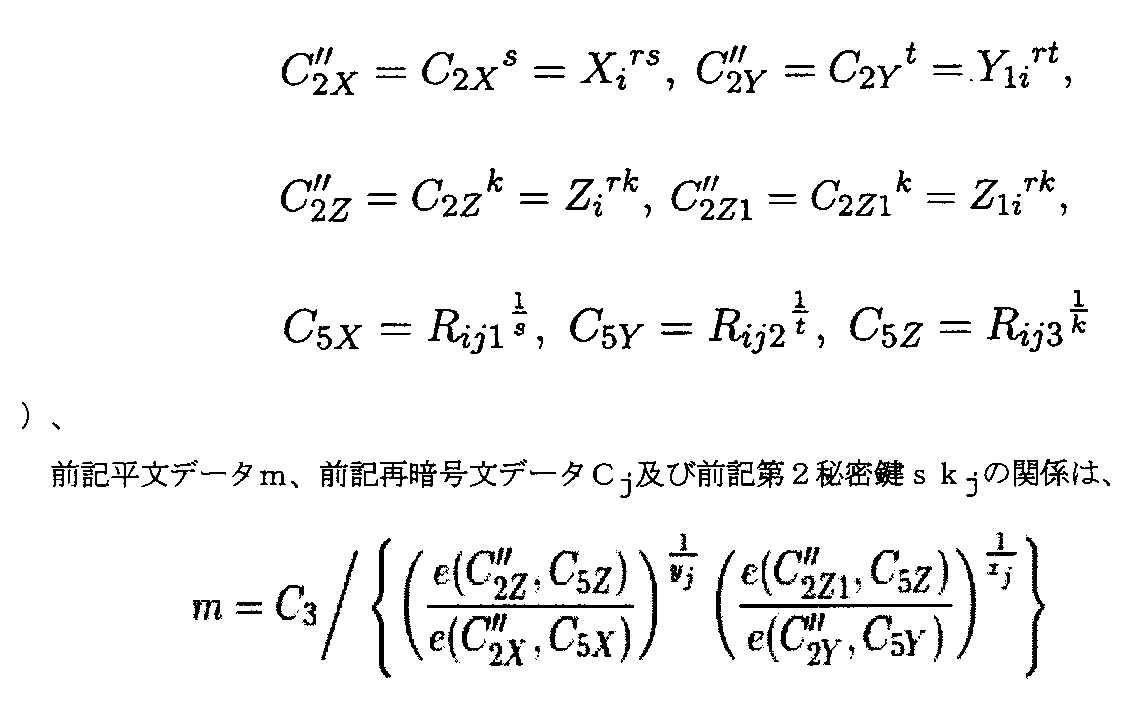
The first secret key is represented by sk i = (x i , y i , z i ), the second secret key is represented by sk j = (x j , y j , z j ), and the first public key and The plurality of system fixed values related to the second public key are represented by g and g 1 (however, a bilinear map group which is a group of order p in which bilinear map e: G 1 × G 2 → G T exists) , G 1 , G 2 , G T , g, g 1 ∈ G 1 ), and the first public key pk i , the first public key pk i is data X i , Y 1i. , Z i , Z 1i (however,
When the second public key is represented by pk j , the second public key pk j includes data X j , Y 1j , Z j , Z 1j (provided that
The plurality of system fixed values related to the second re-encryption key generation key are represented by h, h 1 , h 2 ( where h, h 1 , h 2 ∈G 2 ), and the second re-encryption key generation key is When expressed by rk j
rk j = (T j , T 1j , T 2j )
(However,
The plaintext data is represented by m (provided that mεG T ), the random number relating to the ciphertext data is represented by r, and the system fixed value relating to the ciphertext data is represented by g 2 (where g 2 εG 1 ), When the ciphertext data is represented by C i (where the bilinear mapping e: G 1 × G 2 → G T is represented by e (,)), the ciphertext data C i is data C 2X , C 2Y , C 2Z , C 2Z1 , and C 3 (however,
When each random number related to the re-encryption key is represented by θ, n and the re-encryption key is represented by R ij ,
R ij = (R ij1 , R ij2 , R ij3 )
(However,
When the re-ciphertext data is represented by C j (however, three random numbers are represented by s, t, and k), the re-ciphertext data C j is data C 2X ″ , C 2Y ″ , C 2Z ′. ' , C 2Z1 ″ , C 5X , C 5Y , C 5Z , C 3 (however,
前記第1秘密鍵をski=(xi,yi,zi,wi)で表し、前記第2秘密鍵をskj=(xj,yj,zj,wj)で表し、前記第1公開鍵と前記第2公開鍵とに関する前記複数のシステム固定値をg,g1で表し(但し、双線型写像e:G1×G2→GTが存在する位数pの群である双線型写像群をG1,G2,GTで表したとき、g,g1∈G1)、前記第1公開鍵をpkiで表すとき、前記第1公開鍵pkiは、データXi,Y1i,Zi,Z1i,Wi を含んでおり(但し、

前記第2公開鍵をpkjで表すとき、前記第2公開鍵pkjは、データXj,Y1j,Zj,Z1j,Wj を含んでおり(但し、

前記第2再暗号化鍵生成鍵に関する前記複数のシステム固定値をh,h1,h2で表し(但し、h,h1,h2∈G2)前記第2再暗号化鍵生成鍵をrkjで表すとき、
rkj=(Tj,T1j,T2j)
であり(但し、

前記平文データをmで表し(但し、m∈GT)、前記暗号文データに関する乱数をrで表し、前記暗号文データに関するシステム固定値をg2で表し(但し、g2∈G1)、前記位数pに対する乗法群をZP *で表し、前記再暗号化鍵を更新する期間を示す時間パラメータをLで表し、前記暗号文データをCiで表すとき(但し、前記双線型写像e:G1×G2→GTをe( , )で表す)、前記暗号文データCiは、データC2X,C2Y,C2Z,C2Z1,C2F,C3 を含んでおり(但し、

前記再暗号化鍵に関する各乱数をθ,n,δx,δyで表し、前記再暗号化鍵をRijLで表すとき、
RijL=(RijL1,RijL2,RijL3,RijL4,RijL5 )
であり(但し、

前記再暗号文データをCjで表すとき(但し、4つの乱数をs,t,k,πで表す)、前記再暗号文データCjは、データC2X ’’,C2Y ’’,C2Z ’’,C2Z1 ’’,C2F ’’,C5X,C5Y,C5Z,C5FX,C5FY,C3 を含んでおり(但し、

The first secret key is represented by sk i = (x i , y i , z i , w i ), the second secret key is represented by sk j = (x j , y j , z j , w j ), The plurality of system fixed values related to the first public key and the second public key are represented by g and g 1 (however, a group of order p in which a bilinear map e: G 1 × G 2 → G T exists) when the bilinear mapping group represented by G 1, G 2, G T is, g, when expressed in g 1 ∈G 1), the first public key pk i, the first public key pk i is Data X i , Y 1i , Z i , Z 1i , W i are included (however,
When the second public key is represented by pk j , the second public key pk j includes data X j , Y 1j , Z j , Z 1j , W j (provided that
The plurality of system fixed values related to the second re-encryption key generation key are represented by h, h 1 , h 2 ( where h, h 1 , h 2 ∈G 2 ), and the second re-encryption key generation key is When expressed by rk j
rk j = (T j , T 1j , T 2j )
(However,
The plaintext data is represented by m (provided that mεG T ), the random number relating to the ciphertext data is represented by r, and the system fixed value relating to the ciphertext data is represented by g 2 (where g 2 εG 1 ), represents multiplicative group for the order p in Z P *, wherein represents a time parameter indicating a time period for updating the re-encryption key in L, when representing the ciphertext data C i (where, the bilinear map e : G 1 × G 2 → G T is represented by e (,)), and the ciphertext data C i includes data C 2X , C 2Y , C 2Z , C 2Z 1 , C 2F , C 3 (however, ,
When each random number related to the re-encryption key is represented by θ, n, δ x , δ y and the re-encryption key is represented by R ijL ,
R ijL = (R ijL1 , R ijL2 , R ijL3 , R ijL4 , R ijL5 )
(However,
When the re-ciphertext data is represented by C j (where four random numbers are represented by s, t, k, and π), the re-ciphertext data C j is represented by data C 2X ″ , C 2Y ″ , C 2Z ″ , C 2Z1 ″ , C 2F ′ ′, C 5X , C 5Y , C 5Z , C 5FX , C 5FY , and C 3 (however,
前記再暗号化装置を、
予め再暗号化鍵生成装置により生成された前記再暗号化鍵を前記再暗号化装置の記憶手段に書込む手段、
前記暗号文データを復号せずに、前記記憶手段内の再暗号化鍵により再暗号化して前記再暗号文データを得る再暗号化手段、
として機能させ、
前記再暗号化鍵は、前記第1公開鍵に対応する第1秘密鍵、前記第2秘密鍵に対応する第2公開鍵とは異なる前記第2ユーザ装置の第2再暗号化鍵生成鍵、及び複数の乱数に基づいて、生成されており、
前記第2再暗号化鍵生成鍵は、複数のシステム固有値及び前記第2秘密鍵からなり、
前記再暗号化鍵は、分子部分と分母部分とを有するベキ指数又は分子部分と分母部分とを有するスカラーを含み、
前記分子部分は、前記各システム固有値間の関係性を定める複数の秘密値と前記各乱数とのうちの少なくとも一つを作用させた前記第2秘密鍵の線形結合の形を有し、
前記分母部分は、前記第1秘密鍵からなる、
プログラム。 The ciphertext data obtained by encrypting the plaintext data with the first public key of the first user device can be re-encrypted with the re-encryption key without being decrypted and decrypted with the second secret key of the second user device A program used in a re-encryption device for obtaining re-ciphertext data,
The re-encryption device;
Means for writing the re-encryption key previously generated by the re-encryption key generation apparatus into the storage means of the re-encryption apparatus;
Re-encrypting means for obtaining the re-ciphertext data by re-encrypting with the re-encryption key in the storage means without decrypting the cipher-text data;
Function as
The re-encryption key includes a first secret key corresponding to the first public key, a second re-encryption key generation key of the second user device different from a second public key corresponding to the second secret key, And based on a plurality of random numbers,
The second re-encryption key generation key is composed of a plurality of system unique values and the second secret key,
The re-encryption key includes a power index having a numerator portion and a denominator portion or a scalar having a numerator portion and a denominator portion;
The numerator portion has a form of a linear combination of the second secret key obtained by applying at least one of a plurality of secret values defining the relationship between the system unique values and the random numbers,
The denominator portion comprises the first secret key;
program.
前記暗号化装置を、
前記第1公開鍵を前記暗号化装置の記憶手段に書込む手段、
前記記憶手段内の第1公開鍵を用いて前記平文データを暗号化して前記暗号文データを得る暗号化手段、
として機能させ、
前記再暗号化鍵は、前記第1公開鍵に対応する第1秘密鍵、前記第2秘密鍵に対応する第2公開鍵とは異なる前記第2ユーザ装置の第2再暗号化鍵生成鍵に基づいて、生成されており、
前記第2再暗号化鍵生成鍵は、複数のシステム固有値及び前記第2秘密鍵からなり、
前記再暗号化鍵は、分子部分と分母部分とを有するベキ指数又は分子部分と分母部分とを有するスカラーを含み、
前記分子部分は、前記各システム固有値間の関係性を定める複数の秘密値と前記各乱数とのうちの少なくとも一つを作用させた前記第2秘密鍵の線形結合の形を有し、
前記分母部分は、前記第1秘密鍵からなる、
プログラム。 The ciphertext data obtained by encrypting the plaintext data with the first public key of the first user device can be re-encrypted with the re-encryption key without being decrypted and decrypted with the second secret key of the second user device A re-encryption device for obtaining re-ciphertext data, a program used in the encryption device for generating the ciphertext data,
The encryption device;
Means for writing the first public key into storage means of the encryption device;
Encryption means for encrypting the plaintext data using the first public key in the storage means to obtain the ciphertext data;
Function as
The re-encryption key is a first secret key corresponding to the first public key and a second re-encryption key generation key of the second user device different from the second public key corresponding to the second secret key. Is generated based on
The second re-encryption key generation key is composed of a plurality of system unique values and the second secret key,
The re-encryption key includes a power index having a numerator portion and a denominator portion or a scalar having a numerator portion and a denominator portion;
The numerator portion has a form of a linear combination of the second secret key obtained by applying at least one of a plurality of secret values defining the relationship between the system unique values and the random numbers,
The denominator portion comprises the first secret key;
program.
前記復号装置を、
前記第2秘密鍵を前記復号装置の記憶手段に書込む手段、
前記記憶手段内の第2秘密鍵に基づいて、前記再暗号文データを復号して前記平文データを得る復号手段、
として機能させ、
前記再暗号化鍵は、前記第1公開鍵に対応する第1秘密鍵、前記第2秘密鍵に対応する第2公開鍵とは異なる前記第2ユーザ装置の第2再暗号化鍵生成鍵、及び複数の乱数に基づいて、生成されており、
前記第2再暗号化鍵生成鍵は、複数のシステム固有値及び前記第2秘密鍵からなり、
前記再暗号化鍵は、分子部分と分母部分とを有するベキ指数又は分子部分と分母部分とを有するスカラーを含み、
前記分子部分は、前記各システム固有値間の関係性を定める複数の秘密値と前記各乱数とのうちの少なくとも一つを作用させた前記第2秘密鍵の線形結合の形を有し、
前記分母部分は、前記第1秘密鍵からなる、
プログラム。 Based on the re-encryption key, the re-encryption device re-encrypts the ciphertext data obtained by encrypting the plaintext data with the first public key of the first user device without decrypting it, and A program used in a decryption device for decrypting the re-ciphertext data after obtaining re-ciphertext data that can be decrypted with the second secret key,
The decoding device;
Means for writing the second secret key into storage means of the decryption device;
Decryption means for decrypting the re-ciphertext data to obtain the plaintext data based on a second secret key in the storage means;
Function as
The re-encryption key includes a first secret key corresponding to the first public key, a second re-encryption key generation key of the second user device different from a second public key corresponding to the second secret key, And based on a plurality of random numbers,
The second re-encryption key generation key is composed of a plurality of system unique values and the second secret key,
The re-encryption key includes a power index having a numerator portion and a denominator portion or a scalar having a numerator portion and a denominator portion;
The numerator portion has a form of a linear combination of the second secret key obtained by applying at least one of a plurality of secret values defining the relationship between the system unique values and the random numbers,
The denominator portion comprises the first secret key;
program.
Priority Applications (3)
| Application Number | Priority Date | Filing Date | Title |
|---|---|---|---|
| JP2016551451A JP6139804B2 (en) | 2014-10-03 | 2014-10-03 | Re-encryption key generation device, re-encryption device, encryption device, decryption device, and program |
| PCT/JP2014/076562 WO2016051591A1 (en) | 2014-10-03 | 2014-10-03 | Re-encryption key generation device, re-encryption device, encryption device, decryption device and program |
| US15/261,584 US10187207B2 (en) | 2014-10-03 | 2016-09-09 | Re-encryption key generator, re-encryption apparatus, encryption apparatus, decryption apparatus, and storage medium |
Applications Claiming Priority (1)
| Application Number | Priority Date | Filing Date | Title |
|---|---|---|---|
| PCT/JP2014/076562 WO2016051591A1 (en) | 2014-10-03 | 2014-10-03 | Re-encryption key generation device, re-encryption device, encryption device, decryption device and program |
Related Child Applications (1)
| Application Number | Title | Priority Date | Filing Date |
|---|---|---|---|
| US15/261,584 Continuation US10187207B2 (en) | 2014-10-03 | 2016-09-09 | Re-encryption key generator, re-encryption apparatus, encryption apparatus, decryption apparatus, and storage medium |
Publications (1)
| Publication Number | Publication Date |
|---|---|
| WO2016051591A1 true WO2016051591A1 (en) | 2016-04-07 |
Family
ID=55629676
Family Applications (1)
| Application Number | Title | Priority Date | Filing Date |
|---|---|---|---|
| PCT/JP2014/076562 Ceased WO2016051591A1 (en) | 2014-10-03 | 2014-10-03 | Re-encryption key generation device, re-encryption device, encryption device, decryption device and program |
Country Status (3)
| Country | Link |
|---|---|
| US (1) | US10187207B2 (en) |
| JP (1) | JP6139804B2 (en) |
| WO (1) | WO2016051591A1 (en) |
Cited By (1)
| Publication number | Priority date | Publication date | Assignee | Title |
|---|---|---|---|---|
| EP3258669A1 (en) * | 2016-06-17 | 2017-12-20 | Palo Alto Research Center, Incorporated | Computer-implemented system and method for protecting sensitive data via data re-encryption |
Families Citing this family (18)
| Publication number | Priority date | Publication date | Assignee | Title |
|---|---|---|---|---|
| WO2015142765A1 (en) | 2014-03-17 | 2015-09-24 | Coinbase, Inc | Bitcoin host computer system |
| US9735958B2 (en) * | 2015-05-19 | 2017-08-15 | Coinbase, Inc. | Key ceremony of a security system forming part of a host computer for cryptographic transactions |
| US10116633B2 (en) * | 2016-09-16 | 2018-10-30 | Bank Of America Corporation | Systems and devices for hardened remote storage of private cryptography keys used for authentication |
| US10680810B2 (en) * | 2016-10-26 | 2020-06-09 | Nxp B.V. | Method of generating an elliptic curve cryptographic key pair |
| US11366921B2 (en) * | 2017-02-22 | 2022-06-21 | Ringcentral, Inc. | Encrypting data records and processing encrypted records without exposing plaintext |
| US10587401B2 (en) * | 2017-04-03 | 2020-03-10 | Salesforce.Com, Inc. | Secure handling of customer-supplied encryption secrets |
| US10157290B1 (en) * | 2017-10-11 | 2018-12-18 | Symantec Corporation | Systems and methods for encrypting files |
| WO2019093201A1 (en) * | 2017-11-07 | 2019-05-16 | 日本電信電話株式会社 | Communication terminal, server device, and program |
| US10965653B2 (en) * | 2018-03-28 | 2021-03-30 | Xaptum, Inc. | Scalable and secure message brokering approach in a communication system |
| WO2019204426A1 (en) | 2018-04-17 | 2019-10-24 | Coinbase, Inc. | Offline storage system and method of use |
| US11362824B2 (en) * | 2018-05-25 | 2022-06-14 | Intertrust Technologies Corporation | Content management systems and methods using proxy reencryption |
| US11394543B2 (en) | 2018-12-13 | 2022-07-19 | Coinbase, Inc. | System and method for secure sensitive data storage and recovery |
| CN110378139B (en) * | 2019-07-25 | 2021-07-30 | 江苏芯盛智能科技有限公司 | A data key protection method, system, electronic device and storage medium |
| CN114730420B (en) | 2019-08-01 | 2025-11-07 | 科恩巴斯公司 | System and method for generating signatures |
| WO2021076868A1 (en) * | 2019-10-16 | 2021-04-22 | Coinbase, Inc. | Systems and methods for re-using cold storage keys |
| CN111404952B (en) * | 2020-03-24 | 2022-06-14 | 中国南方电网有限责任公司 | Transformer substation data encryption transmission method and device, computer equipment and storage medium |
| DE112020007079B4 (en) * | 2020-06-17 | 2024-04-25 | Mitsubishi Electric Corporation | RE-ENCRYPTION DEVICE, CRYPTOGRAPHIC SYSTEM, RE-ENCRYPTION METHOD AND RE-ENCRYPTION PROGRAM |
| KR102568418B1 (en) * | 2021-08-26 | 2023-08-18 | 하이파이브랩 주식회사 | Electronic authentication system and method supporting multi-signature |
Citations (1)
| Publication number | Priority date | Publication date | Assignee | Title |
|---|---|---|---|---|
| WO2014024956A1 (en) * | 2012-08-08 | 2014-02-13 | 株式会社 東芝 | Re-encryption key generation device, re-encryption device, encryption device, decryption device, and program |
Family Cites Families (8)
| Publication number | Priority date | Publication date | Assignee | Title |
|---|---|---|---|---|
| US7240200B2 (en) * | 2002-09-26 | 2007-07-03 | International Business Machines Corporation | System and method for guaranteeing software integrity via combined hardware and software authentication |
| US20050195975A1 (en) * | 2003-01-21 | 2005-09-08 | Kevin Kawakita | Digital media distribution cryptography using media ticket smart cards |
| EP1672831A1 (en) * | 2004-12-16 | 2006-06-21 | Nagravision S.A. | Method for transmission of digital data in a local network |
| DE102009001718B4 (en) * | 2009-03-20 | 2010-12-30 | Compugroup Holding Ag | Method for providing cryptographic key pairs |
| US8874929B2 (en) * | 2009-10-27 | 2014-10-28 | Lockheed Martin Corporation | Cross domain discovery |
| US8577029B2 (en) * | 2010-09-10 | 2013-11-05 | International Business Machines Corporation | Oblivious transfer with hidden access control lists |
| US20130091353A1 (en) * | 2011-08-01 | 2013-04-11 | General Instrument Corporation | Apparatus and method for secure communication |
| CN102404121B (en) * | 2011-11-30 | 2014-03-12 | 华为技术有限公司 | Ciphertext processing method, device and system |
-
2014
- 2014-10-03 WO PCT/JP2014/076562 patent/WO2016051591A1/en not_active Ceased
- 2014-10-03 JP JP2016551451A patent/JP6139804B2/en active Active
-
2016
- 2016-09-09 US US15/261,584 patent/US10187207B2/en active Active
Patent Citations (1)
| Publication number | Priority date | Publication date | Assignee | Title |
|---|---|---|---|---|
| WO2014024956A1 (en) * | 2012-08-08 | 2014-02-13 | 株式会社 東芝 | Re-encryption key generation device, re-encryption device, encryption device, decryption device, and program |
Non-Patent Citations (1)
| Title |
|---|
| RYOTARO HAYASHI ET AL.: "Unforgeability of re- encryption keys against collusion attack in proxy re-encryption", IWSEC'11 PROCEEDINGS OF THE 6TH INTERNATIONAL CONFERENCE ON ADVANCES IN INFORMATION AND COMPUTER SECURITY, 2011, pages 210 - 229, XP019168391, DOI: doi:10.1007/978-3-642-25141-2_14 * |
Cited By (5)
| Publication number | Priority date | Publication date | Assignee | Title |
|---|---|---|---|---|
| EP3258669A1 (en) * | 2016-06-17 | 2017-12-20 | Palo Alto Research Center, Incorporated | Computer-implemented system and method for protecting sensitive data via data re-encryption |
| JP2017225116A (en) * | 2016-06-17 | 2017-12-21 | パロ・アルト・リサーチ・センター・インコーポレーテッドPalo Alto Research Center Incorporated | Computer-implemented system and method for protecting sensitive data via data re-encryption |
| KR20170142872A (en) * | 2016-06-17 | 2017-12-28 | 팔로 알토 리서치 센터 인코포레이티드 | Computer-implemented system and method for protecting sensitive data via data re-encryption |
| US10277563B2 (en) | 2016-06-17 | 2019-04-30 | Palo Alto Research Center Incorporated | Computer-implemented system and method for protecting sensitive data via data re-encryption |
| KR102224998B1 (en) | 2016-06-17 | 2021-03-10 | 팔로 알토 리서치 센터 인코포레이티드 | Computer-implemented system and method for protecting sensitive data via data re-encryption |
Also Published As
| Publication number | Publication date |
|---|---|
| US20160380767A1 (en) | 2016-12-29 |
| US10187207B2 (en) | 2019-01-22 |
| JP6139804B2 (en) | 2017-05-31 |
| JPWO2016051591A1 (en) | 2017-04-27 |
Similar Documents
| Publication | Publication Date | Title |
|---|---|---|
| JP6139804B2 (en) | Re-encryption key generation device, re-encryption device, encryption device, decryption device, and program | |
| JP5932040B2 (en) | Re-encryption key generation apparatus and program | |
| JP5851558B2 (en) | RE-ENCRYPTION KEY GENERATION DEVICE, RE-ENCRYPTION DEVICE, AND PROGRAM | |
| JP5367039B2 (en) | Server apparatus and program | |
| US12155757B2 (en) | Systems and methods for deployment, management and use of dynamic cipher key systems | |
| JP6313074B2 (en) | Data management device, system, data sharing device, and program | |
| US9698984B2 (en) | Re-encrypted data verification program, re-encryption apparatus and re-encryption system | |
| US9813386B2 (en) | Cooperation service providing system and server apparatus | |
| WO2014034018A1 (en) | Re-encryption system, re-encryption method and re-encryption program | |
| JPWO2021009860A5 (en) | ||
| CN118487837A (en) | Revocable broadcast proxy re-encryption method based on SM9 in zero-trust network | |
| CN113141249B (en) | A threshold decryption method, system and readable storage medium | |
| WO2014141907A1 (en) | Encrypted data computation system, device, and program | |
| CN113141248B (en) | Threshold decryption method and system based on homomorphic encryption and readable storage medium | |
| JP2020053772A (en) | Communication system, server device, communication terminal, communication method, and program | |
| JP2015122799A (en) | Server apparatus, communication method, and program |
Legal Events
| Date | Code | Title | Description |
|---|---|---|---|
| 121 | Ep: the epo has been informed by wipo that ep was designated in this application |
Ref document number: 14903486 Country of ref document: EP Kind code of ref document: A1 |
|
| ENP | Entry into the national phase |
Ref document number: 2016551451 Country of ref document: JP Kind code of ref document: A |
|
| NENP | Non-entry into the national phase |
Ref country code: DE |
|
| 122 | Ep: pct application non-entry in european phase |
Ref document number: 14903486 Country of ref document: EP Kind code of ref document: A1 |