WO2016041676A1 - Whitening composition - Google Patents
Whitening composition Download PDFInfo
- Publication number
- WO2016041676A1 WO2016041676A1 PCT/EP2015/067274 EP2015067274W WO2016041676A1 WO 2016041676 A1 WO2016041676 A1 WO 2016041676A1 EP 2015067274 W EP2015067274 W EP 2015067274W WO 2016041676 A1 WO2016041676 A1 WO 2016041676A1
- Authority
- WO
- WIPO (PCT)
- Prior art keywords
- detergent composition
- laundry detergent
- composition according
- negatively charged
- alkoxylated
- Prior art date
- Legal status (The legal status is an assumption and is not a legal conclusion. Google has not performed a legal analysis and makes no representation as to the accuracy of the status listed.)
- Ceased
Links
Classifications
-
- C—CHEMISTRY; METALLURGY
- C11—ANIMAL OR VEGETABLE OILS, FATS, FATTY SUBSTANCES OR WAXES; FATTY ACIDS THEREFROM; DETERGENTS; CANDLES
- C11D—DETERGENT COMPOSITIONS; USE OF SINGLE SUBSTANCES AS DETERGENTS; SOAP OR SOAP-MAKING; RESIN SOAPS; RECOVERY OF GLYCEROL
- C11D1/00—Detergent compositions based essentially on surface-active compounds; Use of these compounds as a detergent
- C11D1/66—Non-ionic compounds
- C11D1/83—Mixtures of non-ionic with anionic compounds
- C11D1/831—Mixtures of non-ionic with anionic compounds of sulfonates with ethers of polyoxyalkylenes without phosphates
-
- C—CHEMISTRY; METALLURGY
- C11—ANIMAL OR VEGETABLE OILS, FATS, FATTY SUBSTANCES OR WAXES; FATTY ACIDS THEREFROM; DETERGENTS; CANDLES
- C11D—DETERGENT COMPOSITIONS; USE OF SINGLE SUBSTANCES AS DETERGENTS; SOAP OR SOAP-MAKING; RESIN SOAPS; RECOVERY OF GLYCEROL
- C11D1/00—Detergent compositions based essentially on surface-active compounds; Use of these compounds as a detergent
- C11D1/02—Anionic compounds
- C11D1/37—Mixtures of compounds all of which are anionic
-
- C—CHEMISTRY; METALLURGY
- C11—ANIMAL OR VEGETABLE OILS, FATS, FATTY SUBSTANCES OR WAXES; FATTY ACIDS THEREFROM; DETERGENTS; CANDLES
- C11D—DETERGENT COMPOSITIONS; USE OF SINGLE SUBSTANCES AS DETERGENTS; SOAP OR SOAP-MAKING; RESIN SOAPS; RECOVERY OF GLYCEROL
- C11D1/00—Detergent compositions based essentially on surface-active compounds; Use of these compounds as a detergent
- C11D1/66—Non-ionic compounds
- C11D1/83—Mixtures of non-ionic with anionic compounds
-
- C—CHEMISTRY; METALLURGY
- C11—ANIMAL OR VEGETABLE OILS, FATS, FATTY SUBSTANCES OR WAXES; FATTY ACIDS THEREFROM; DETERGENTS; CANDLES
- C11D—DETERGENT COMPOSITIONS; USE OF SINGLE SUBSTANCES AS DETERGENTS; SOAP OR SOAP-MAKING; RESIN SOAPS; RECOVERY OF GLYCEROL
- C11D3/00—Other compounding ingredients of detergent compositions covered in group C11D1/00
- C11D3/0005—Other compounding ingredients characterised by their effect
- C11D3/0036—Soil deposition preventing compositions; Antiredeposition agents
-
- C—CHEMISTRY; METALLURGY
- C11—ANIMAL OR VEGETABLE OILS, FATS, FATTY SUBSTANCES OR WAXES; FATTY ACIDS THEREFROM; DETERGENTS; CANDLES
- C11D—DETERGENT COMPOSITIONS; USE OF SINGLE SUBSTANCES AS DETERGENTS; SOAP OR SOAP-MAKING; RESIN SOAPS; RECOVERY OF GLYCEROL
- C11D3/00—Other compounding ingredients of detergent compositions covered in group C11D1/00
- C11D3/02—Inorganic compounds ; Elemental compounds
- C11D3/04—Water-soluble compounds
- C11D3/044—Hydroxides or bases
-
- C—CHEMISTRY; METALLURGY
- C11—ANIMAL OR VEGETABLE OILS, FATS, FATTY SUBSTANCES OR WAXES; FATTY ACIDS THEREFROM; DETERGENTS; CANDLES
- C11D—DETERGENT COMPOSITIONS; USE OF SINGLE SUBSTANCES AS DETERGENTS; SOAP OR SOAP-MAKING; RESIN SOAPS; RECOVERY OF GLYCEROL
- C11D3/00—Other compounding ingredients of detergent compositions covered in group C11D1/00
- C11D3/16—Organic compounds
- C11D3/20—Organic compounds containing oxygen
- C11D3/2003—Alcohols; Phenols
- C11D3/2041—Dihydric alcohols
- C11D3/2044—Dihydric alcohols linear
-
- C—CHEMISTRY; METALLURGY
- C11—ANIMAL OR VEGETABLE OILS, FATS, FATTY SUBSTANCES OR WAXES; FATTY ACIDS THEREFROM; DETERGENTS; CANDLES
- C11D—DETERGENT COMPOSITIONS; USE OF SINGLE SUBSTANCES AS DETERGENTS; SOAP OR SOAP-MAKING; RESIN SOAPS; RECOVERY OF GLYCEROL
- C11D3/00—Other compounding ingredients of detergent compositions covered in group C11D1/00
- C11D3/16—Organic compounds
- C11D3/20—Organic compounds containing oxygen
- C11D3/2075—Carboxylic acids-salts thereof
- C11D3/2086—Hydroxy carboxylic acids-salts thereof
-
- C—CHEMISTRY; METALLURGY
- C11—ANIMAL OR VEGETABLE OILS, FATS, FATTY SUBSTANCES OR WAXES; FATTY ACIDS THEREFROM; DETERGENTS; CANDLES
- C11D—DETERGENT COMPOSITIONS; USE OF SINGLE SUBSTANCES AS DETERGENTS; SOAP OR SOAP-MAKING; RESIN SOAPS; RECOVERY OF GLYCEROL
- C11D3/00—Other compounding ingredients of detergent compositions covered in group C11D1/00
- C11D3/16—Organic compounds
- C11D3/26—Organic compounds containing nitrogen
- C11D3/30—Amines; Substituted amines ; Quaternized amines
-
- C—CHEMISTRY; METALLURGY
- C11—ANIMAL OR VEGETABLE OILS, FATS, FATTY SUBSTANCES OR WAXES; FATTY ACIDS THEREFROM; DETERGENTS; CANDLES
- C11D—DETERGENT COMPOSITIONS; USE OF SINGLE SUBSTANCES AS DETERGENTS; SOAP OR SOAP-MAKING; RESIN SOAPS; RECOVERY OF GLYCEROL
- C11D3/00—Other compounding ingredients of detergent compositions covered in group C11D1/00
- C11D3/16—Organic compounds
- C11D3/37—Polymers
- C11D3/3703—Macromolecular compounds obtained otherwise than by reactions only involving carbon-to-carbon unsaturated bonds
- C11D3/3707—Polyethers, e.g. polyalkyleneoxides
-
- C—CHEMISTRY; METALLURGY
- C11—ANIMAL OR VEGETABLE OILS, FATS, FATTY SUBSTANCES OR WAXES; FATTY ACIDS THEREFROM; DETERGENTS; CANDLES
- C11D—DETERGENT COMPOSITIONS; USE OF SINGLE SUBSTANCES AS DETERGENTS; SOAP OR SOAP-MAKING; RESIN SOAPS; RECOVERY OF GLYCEROL
- C11D3/00—Other compounding ingredients of detergent compositions covered in group C11D1/00
- C11D3/50—Perfumes
-
- C—CHEMISTRY; METALLURGY
- C11—ANIMAL OR VEGETABLE OILS, FATS, FATTY SUBSTANCES OR WAXES; FATTY ACIDS THEREFROM; DETERGENTS; CANDLES
- C11D—DETERGENT COMPOSITIONS; USE OF SINGLE SUBSTANCES AS DETERGENTS; SOAP OR SOAP-MAKING; RESIN SOAPS; RECOVERY OF GLYCEROL
- C11D1/00—Detergent compositions based essentially on surface-active compounds; Use of these compounds as a detergent
- C11D1/008—Polymeric surface-active agents
-
- C—CHEMISTRY; METALLURGY
- C11—ANIMAL OR VEGETABLE OILS, FATS, FATTY SUBSTANCES OR WAXES; FATTY ACIDS THEREFROM; DETERGENTS; CANDLES
- C11D—DETERGENT COMPOSITIONS; USE OF SINGLE SUBSTANCES AS DETERGENTS; SOAP OR SOAP-MAKING; RESIN SOAPS; RECOVERY OF GLYCEROL
- C11D1/00—Detergent compositions based essentially on surface-active compounds; Use of these compounds as a detergent
- C11D1/02—Anionic compounds
- C11D1/04—Carboxylic acids or salts thereof
- C11D1/06—Ether- or thioether carboxylic acids
-
- C—CHEMISTRY; METALLURGY
- C11—ANIMAL OR VEGETABLE OILS, FATS, FATTY SUBSTANCES OR WAXES; FATTY ACIDS THEREFROM; DETERGENTS; CANDLES
- C11D—DETERGENT COMPOSITIONS; USE OF SINGLE SUBSTANCES AS DETERGENTS; SOAP OR SOAP-MAKING; RESIN SOAPS; RECOVERY OF GLYCEROL
- C11D1/00—Detergent compositions based essentially on surface-active compounds; Use of these compounds as a detergent
- C11D1/02—Anionic compounds
- C11D1/12—Sulfonic acids or sulfuric acid esters; Salts thereof
- C11D1/14—Sulfonic acids or sulfuric acid esters; Salts thereof derived from aliphatic hydrocarbons or mono-alcohols
- C11D1/146—Sulfuric acid esters
-
- C—CHEMISTRY; METALLURGY
- C11—ANIMAL OR VEGETABLE OILS, FATS, FATTY SUBSTANCES OR WAXES; FATTY ACIDS THEREFROM; DETERGENTS; CANDLES
- C11D—DETERGENT COMPOSITIONS; USE OF SINGLE SUBSTANCES AS DETERGENTS; SOAP OR SOAP-MAKING; RESIN SOAPS; RECOVERY OF GLYCEROL
- C11D1/00—Detergent compositions based essentially on surface-active compounds; Use of these compounds as a detergent
- C11D1/02—Anionic compounds
- C11D1/12—Sulfonic acids or sulfuric acid esters; Salts thereof
- C11D1/22—Sulfonic acids or sulfuric acid esters; Salts thereof derived from aromatic compounds
-
- C—CHEMISTRY; METALLURGY
- C11—ANIMAL OR VEGETABLE OILS, FATS, FATTY SUBSTANCES OR WAXES; FATTY ACIDS THEREFROM; DETERGENTS; CANDLES
- C11D—DETERGENT COMPOSITIONS; USE OF SINGLE SUBSTANCES AS DETERGENTS; SOAP OR SOAP-MAKING; RESIN SOAPS; RECOVERY OF GLYCEROL
- C11D1/00—Detergent compositions based essentially on surface-active compounds; Use of these compounds as a detergent
- C11D1/02—Anionic compounds
- C11D1/12—Sulfonic acids or sulfuric acid esters; Salts thereof
- C11D1/29—Sulfates of polyoxyalkylene ethers
-
- C—CHEMISTRY; METALLURGY
- C11—ANIMAL OR VEGETABLE OILS, FATS, FATTY SUBSTANCES OR WAXES; FATTY ACIDS THEREFROM; DETERGENTS; CANDLES
- C11D—DETERGENT COMPOSITIONS; USE OF SINGLE SUBSTANCES AS DETERGENTS; SOAP OR SOAP-MAKING; RESIN SOAPS; RECOVERY OF GLYCEROL
- C11D1/00—Detergent compositions based essentially on surface-active compounds; Use of these compounds as a detergent
- C11D1/02—Anionic compounds
- C11D1/34—Derivatives of acids of phosphorus
- C11D1/345—Phosphates or phosphites
-
- C—CHEMISTRY; METALLURGY
- C11—ANIMAL OR VEGETABLE OILS, FATS, FATTY SUBSTANCES OR WAXES; FATTY ACIDS THEREFROM; DETERGENTS; CANDLES
- C11D—DETERGENT COMPOSITIONS; USE OF SINGLE SUBSTANCES AS DETERGENTS; SOAP OR SOAP-MAKING; RESIN SOAPS; RECOVERY OF GLYCEROL
- C11D1/00—Detergent compositions based essentially on surface-active compounds; Use of these compounds as a detergent
- C11D1/66—Non-ionic compounds
- C11D1/72—Ethers of polyoxyalkylene glycols
- C11D1/721—End blocked ethers
-
- C—CHEMISTRY; METALLURGY
- C11—ANIMAL OR VEGETABLE OILS, FATS, FATTY SUBSTANCES OR WAXES; FATTY ACIDS THEREFROM; DETERGENTS; CANDLES
- C11D—DETERGENT COMPOSITIONS; USE OF SINGLE SUBSTANCES AS DETERGENTS; SOAP OR SOAP-MAKING; RESIN SOAPS; RECOVERY OF GLYCEROL
- C11D2111/00—Cleaning compositions characterised by the objects to be cleaned; Cleaning compositions characterised by non-standard cleaning or washing processes
- C11D2111/10—Objects to be cleaned
- C11D2111/12—Soft surfaces, e.g. textile
Definitions
- the present invention concerns the use of whitening and brightening laundry compositions.
- a problem is the redeposition of soil removed from one garment onto another.
- the problem is exacerbated by the presence of human oils (sebum) on garments and in the wash which serves to enhance the deposition of soil in the wash. This process leads to an overall loss of whiteness and cleaning across the washing load.
- dispersing polymer such as an alkoxylated polyethylene imines have been widely added to washing detergents.
- Ethoxylated PEI polyethylene imine
- Certain Cellulase enzymes have also been used to prevent redeposition by altering the surface properties of cotton fabrics.
- Novozymes describes in WO02/099091 and WO04/053039 cellulases for use in domestic laundry.
- EP1321510 (Shipley) describes an industrial cleaning composition that contain an alkoxylated polyarylphenol for stripping organic chemical residues from photoresists that are used in the manufacture of semi-conductors and other electronic devices and circuits.
- the organic chemical residues are materials left over from the production process and include photointiators, thermoinitiators, acrylic and methacrylic monomers.
- the present invention provides a laundry detergent composition comprising:
- (i) charged surfactant preferably the level of charged surfactant is from 4 to 50 wt%, more preferably 6 to 30 wt%, most preferably 8 to 20 wt%;
- perfume preferably 0.05 to 0.5 wt% perfume.
- the present invention provides a laundry detergent composition
- a laundry detergent composition comprising:
- anionic surfactant selected from: linear alkyl benzene sulphonates; alkyl sulphates; alkyl ether sulphates; and mixtures thereof.
- n is selected from: 6; 7; 8; 9; 10; 1 1 ; 12; 13; 14; 15; 16; 17; 18; 19; 20; 21 ; 22; 23; 24; 25; 26; 27; 28; 29; 30; 31 ; 32; 33; 34; 35; 36; 37; 38; 39; 40; 41 ; 42; 43; 44; 45; 46; 47; 48; 49; and, 50; and, (iii) perfume, preferably 0.05 to 0.5 wt% perfume.
- the present invention provides a domestic method of treating a textile, the method comprising the steps of: (i) treating a textile with an aqueous solution of the negatively charged alkoxylated
- polyalkylphenols the aqueous solution comprising from 10 ppm to 5000 ppm of the negatively charged alkoxylated polyalkylphenol; and, from 0.0 g/L to 6 g/L, preferably 0.2 to 4 g/L, of one or more surfactants; and, (ii) optionally rinsing and drying the textile.
- the level of the perfume in the aqueous solution is preferably from 0.1 to 100 ppm, more preferably 1 to 10 ppm.
- the surfactant used is preferably as preferred for the composition aspects of the present invention .
- the textile is preferably an item of clothing, bedding or table cloth.
- Preferred items of clothing are cotton containing shirts, trousers, underwear and jumpers.
- the negatively charged alkoxylated polyalkylphenol is an negatively charged alkoxylated trialkylphenol, most preferably alkoxylated tri(n-butyl)phenol.
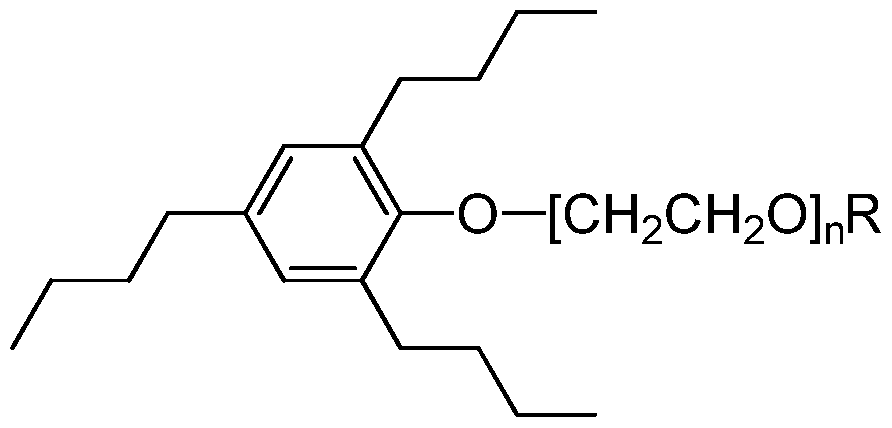
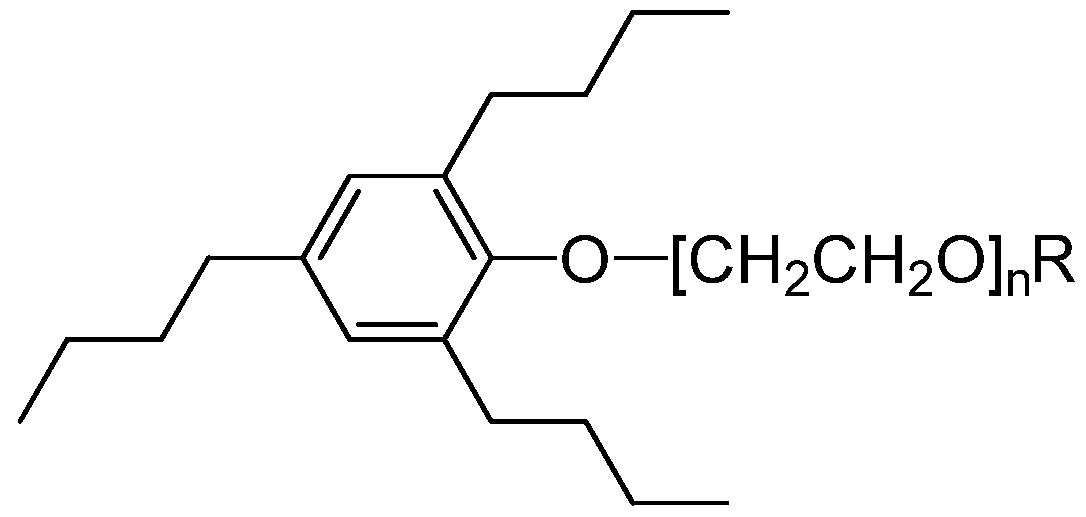
- the negatively charged alkoxylated trialkylphenol is a negatively charged polyethylene glycol mono(2,4,6-tris(n-butyl)phenyl) ether.
- the negatively charged alkoxylated polyalkylphenol contains an average of 2 to 70 alkoxy groups, most preferably 6 to 50 alkoxy groups.
- the alkoxylation is ethoxylation.
- the alkyl group in the alkoxylated polyalkylphenol is preferably selected from, linear or branched C3 to C15 alkyl groups.
- the negatively charged alkoxylated polyalkylphenol has 3 alkyl groups attached to the phenol. Preferably they are in the 2,4,6 position on the phenol. The alkoxylate is attached to the 1 position.
- the alkoxylate is capped by a negatively charged group selected from SO3 " COO " , and PO3 2" , preferably selected from selected from SO3 " and COO " .
- the alkyl group in the alkoxylated polyalkylphenol is preferably selected from, linear or branced C3 to C15 alkyl groups.
- alkoxylated polyethylene glycol mono(2,4,6-tris(n-butyl)phenyl) is a negatively charged alkoxylatedpolyalkylphenol of the following structure:
- R is selected from SO3; COO " and PO3 2" , preferably selected from selected from S0 3 " and COO " , most preferably S0 3 " .
- n is the average numbers of moles of alkoxy units in the polyalkoxy chain.
- Compounds are available from industrial suppliers, for example Rhodia, Clariant; Aoki Oil; Stepan; TOHO Chemical Industry Co.
- the negatively charged alkoxylated polyalkylphenol is not considered a surfactant and does not contribute numerically to the surfactant as defined herein.
- the laundry composition comprises charged surfactant and it is most preferred that the charged surfactant is anionic surfactant (which includes a mixture of the same).
- Suitable anionic detergent compounds which may be used are usually water- soluble alkali metal salts of organic sulphates and sulphonates having alkyl radicals containing from about 8 to about 22 carbon atoms, the term alkyl being used to include the alkyl portion of higher alkyl radicals.
- suitable synthetic anionic detergent compounds are sodium and potassium alkyl sulphates, especially those obtained by sulphating higher Cs to Cie alcohols, produced for example from tallow or coconut oil, sodium and potassium alkyl C9 to C20 benzene sulphonates, particularly sodium linear secondary alkyl C10 to Ci5 benzene sulphonates; and sodium alkyl glyceryl ether sulphates, especially those ethers of the higher alcohols derived from tallow or coconut oil and synthetic alcohols derived from petroleum.
- the anionic surfactant is preferably selected from: linear alkyl benzene sulphonate; alkyl sulphates; alkyl ether sulphates; soaps; alkyl (preferably methyl) ester sulphonates, and mixtures thereof.
- the most preferred anionic surfactants are selected from: linear alkyl benzene sulphonate; alkyl sulphates; alkyl ether sulphates and mixtures thereof.
- the alkyl ether sulphate is a C12-C14 n-alkyl ether sulphate with an average of 1 to 3EO (ethoxylate) units.
- Sodium lauryl ether sulphate is particularly preferred (SLES).
- the linear alkyl benzene sulphonate is a sodium C11 to C15 alkyl benzene sulphonates.
- the alkyl sulphates is a linear or branched sodium C12 to C18 alkyl sulphates.
- Sodium dodecyl sulphate is particularly preferred, (SDS, also known as primary alkyl sulphate).
- the level of anionic surfactant in the laundry composition is preferably from 4 to 50 wt%, more preferably 6 to 30 wt%, and most preferably 8 to 20 wt%.
- two or more anionic surfactant are present, for example linear alkyl benzene sulphonate together with an alkyl ether sulphate.
- the laundry composition in addition to the anionic surfactant comprises alkyl exthoylated non-ionic surfactant, preferably from 2 to 8 wt% of alkyl
- nonionic detergent compounds which may be used include, in particular, the reaction products of compounds having an aliphatic hydrophobic group and a reactive hydrogen atom, for example, aliphatic alcohols, acids or amides, especially ethylene oxide either alone or with propylene oxide.
- Specific nonionic detergent compounds are the condensation products of aliphatic Cs to C18 primary or secondary linear or branched alcohols with ethylene oxide.
- the alkyl ethoxylated non-ionic surfactant is a Cs to C18 primary alcohol with an average ethoxylation of 7EO to 9EO units.
- the nonionic and anionic surfactants of the surfactant system may be chosen from the surfactants described "Surface Active Agents" Vol. 1 , by Schwartz & Perry, Interscience 1949, Vol. 2 by Schwartz, Perry & Berch, Interscience 1958, in the current edition of "McCutcheon's Emulsifiers and Detergents" published by
- surfactants used are saturated.
- surfactants such as those described in EP-A-328 177
- the charged surfactant may be a cationic such that the
- the detergent compositions based on anionic or anionic/non-ionic surfactants is however the more preferred embodiment.
- the present invention When the present invention is used as a fabric conditioner it needs to contain a cationic compound.
- the quaternary ammonium compound is a quaternary ammonium compound having at least one C12 to C22 alkyl chain.
- the quaternary ammonium compound has the following formula:
- R1 -N-R3 X in which R 1 is a C12 to C22 alkyl or alkenyl chain; R 2 , R 3 and R 4 are independently selected from Ci to C 4 alkyl chains and X " is a compatible anion.
- a preferred compound of this type is the quaternary ammonium compound cetyl trimethyl quaternary ammonium bromide.
- a second class of materials for use with the present invention are the quaternary ammonium of the above structure in which R 1 and R 2 are independently selected from C12 to C22 alkyl or alkenyl chain; R 3 and R 4 are independently selected from Ci to C 4 alkyl chains and X " is a compatible anion.
- the composition optionally comprises a silicone.
- Builder materials may be selected from 1 ) calcium sequestrant materials, 2) precipitating materials, 3) calcium ion-exchange materials and 4) mixtures thereof.
- calcium sequestrant builder materials examples include alkali metal polyphosphates, such as sodium tripolyphosphate and organic sequestrants, such as ethylene diamine tetra-acetic acid.
- precipitating builder materials examples include sodium orthophosphate and sodium carbonate.
- Examples of calcium ion-exchange builder materials include the various types of water- insoluble crystalline or amorphous aluminosilicates, of which zeolites are the well known representatives, e.g. zeolite A, zeolite B (also known as zeolite P), zeolite C, zeolite X, zeolite Y and also the zeolite P-type as described in EP-A-0,384,070.
- zeolites are the well known representatives, e.g. zeolite A, zeolite B (also known as zeolite P), zeolite C, zeolite X, zeolite Y and also the zeolite P-type as described in EP-A-0,384,070.
- composition may also contain 0-65 % of a builder or complexing agent such as ethylenediaminetetraacetic acid, diethylenetriamine-pentaacetic acid, alkyl- or
- alkenylsuccinic acid nitrilotriacetic acid or the other builders mentioned below.
- Many builders are also bleach-stabilising agents by virtue of their ability to complex metal ions.
- Zeolite and carbonate carbonate (including bicarbonate and sesquicarbonate) are preferred builders with carbonates being particularly preferred.
- the composition may contain as builder a crystalline aluminosilicate, preferably an alkali metal aluminosilicate, more preferably a sodium aluminosilicate. This is typically present at a level of less than 15%w.
- Aluminosilicates are materials having the general formula:
- the preferred sodium aluminosilicates contain 1.5-3.5 S1O2 units in the formula above. They can be prepared readily by reaction between sodium silicate and sodium aluminate, as amply described in the literature.
- the ratio of surfactants to alumuminosilicate (where present) is preferably greater than 5:2, more preferably greater than 3:1 .
- phosphate builders may be used.
- 'phosphate' embraces diphosphate, triphosphate, and
- phosphonate species include silicates, such as soluble silicates, metasilicates, layered silicates (e.g. SKS-6 from Hoechst).
- silicates such as soluble silicates, metasilicates, layered silicates (e.g. SKS-6 from Hoechst).
- the laundry detergent formulation is a non-phosphate built laundry detergent formulation, i.e., contains less than 1 wt% of phosphate.
- powder laundry detergent formulations are predominantly carbonate built.
- Powders should preferably give an in use pH of 9.5-1 1 .
- the laundry detergent is an aqueous liquid laundry detergent, preferably with a pH of from 7 to 9.
- mono propylene glycol is present at a level from 1 to 30 wt%, most preferably 2 to 18 wt%, to provide the formulation with appropriate, pourable viscosity.
- the composition preferably comprises a fluorescent agent (optical brightener).
- fluorescent agents are well known and many such fluorescent agents are available commercially. Usually, these fluorescent agents are supplied and used in the form of their alkali metal salts, for example, the sodium salts.
- Preferred classes of fluorescer are: Di-styryl biphenyl compounds, e.g. Tinopal (Trade Mark) CBS-X, Di-amine stilbene di-sulphonic acid compounds, e.g. Tinopal DMS pure Xtra and Blankophor (Trade Mark) HRH, and Pyrazoline compounds, e.g. Blankophor SN.
- Di-styryl biphenyl compounds e.g. Tinopal (Trade Mark) CBS-X
- Di-amine stilbene di-sulphonic acid compounds e.g. Tinopal DMS pure Xtra and Blankophor (Trade Mark) HRH
- Pyrazoline compounds e.g. Blankophor SN.
- Preferred fluorescers are: sodium 2 (4-styryl-3-sulphophenyl)-2H-napthol[1 ,2-d]triazole, disodium 4,4'-bis ⁇ [(4-anilino-6-(N methyl-N-2 hydroxyethyl) amino 1 ,3,5-triazin-2- yl)]amino ⁇ stilbene-2-2' disulphonate, disodium 4,4'-bis ⁇ [(4-anilino-6-morpholino-1 ,3,5- triazin-2-yl)]amino ⁇ stilbene-2-2' disulphonate, and disodium 4,4'-bis(2- sulphostyryl)biphenyl.
- the composition comprises a perfume.
- the perfume is preferably in the range from 0.001 to 3 wt %, more preferably 0.05 to 0.5wt%, most preferably 0.1 to 1 wt %.
- CTFA Cosmetic, Toiletry and Fragrance
- the perfume comprises at least one note (compound) from: alpha-isomethyl ionone, benzyl salicylate; citronellol; coumarin; hexyl cinnamal; linalool; pentanoic acid, 2- methyl-, ethyl ester; octanal; benzyl acetate; 1 ,6-octadien-3-ol, 3,7-dimethyl-, 3-acetate; cyclohexanol, 2-(1 ,1-dimethylethyl)-, 1-acetate; delta-damascone; beta-ionone; verdyl acetate; dodecanal; hexyl cinnamic aldehyde; cyclopentadecanolide; benzeneacetic acid, 2-phenylethyl ester; amyl salicylate; beta-caryophyllene; ethyl undecylenate;
- Useful components of the perfume include materials of both natural and synthetic origin. They include single compounds and mixtures. Specific examples of such components may be found in the current literature, e.g., in Fenaroli's Handbook of Flavor Ingredients, 1975, CRC Press; Synthetic Food Adjuncts, 1947 by M. B. Jacobs, edited by
- compositions of the present invention it is envisaged that there will be four or more, preferably five or more, more preferably six or more or even seven or more different perfume components.
- top notes are defined by Poucher (Journal of the Society of Cosmetic Chemists 6(2):80 [1955]).
- Preferred top-notes are selected from citrus oils, linalool, linalyl acetate, lavender, dihydromyrcenol, rose oxide and cis-3-hexanol.
- Perfume top note may be used to cue the whiteness and brightness benefit of the invention.
- perfume may be encapsulated, typical perfume components which it is advantageous to encapsulate, include those with a relatively low boiling point, preferably those with a boiling point of less than 300, preferably 100-250 Celsius. It is also
- perfume ingredients which have a low CLog P (ie. those which will have a greater tendency to be partitioned into water), preferably with a CLog P of less than 3.0.
- CLog P ie. those which will have a greater tendency to be partitioned into water
- materials, of relatively low boiling point and relatively low CLog P have been called the "delayed blooming" perfume ingredients and include one or more of the following materials: allyl caproate, amyl acetate, amyl propionate, anisic aldehyde, anisole,
- benzaldehyde benzyl acetate, benzyl acetone, benzyl alcohol, benzyl formate, benzyl iso valerate, benzyl propionate, beta gamma hexenol, camphor gum, laevo- carvone, d-carvone, cinnamic alcohol, cinamyl formate, cis-jasmone, cis-3-hexenyl acetate, cuminic alcohol, cyclal c, dimethyl benzyl carbinol, dimethyl benzyl carbinol acetate, ethyl acetate, ethyl aceto acetate, ethyl amyl ketone, ethyl benzoate, ethyl butyrate, ethyl hexyl ketone, ethyl phenyl acetate, eucalyptol, eugenol, f
- propionate geraniol, hexenol, hexenyl acetate, hexyl acetate, hexyl formate, hydratropic alcohol, hydroxycitronellal, indone, isoamyl alcohol, iso menthone, isopulegyl acetate, isoquinolone, ligustral, linalool, linalool oxide, linalyl formate, menthone, menthyl acetphenone, methyl amyl ketone, methyl anthranilate, methyl benzoate, methyl benyl acetate, methyl eugenol, methyl heptenone, methyl heptine carbonate, methyl heptyl ketone, methyl hexyl ketone, methyl phenyl carbinyl acetate, methyl salicylate, methyl-n-methyl anthranilate, nerol, octalact
- compositions of the present invention it is envisaged that there will be four or more, preferably five or more, more preferably six or more or even seven or more different perfume components from the list given of delayed blooming perfumes given above present in the perfume.
- perfumes with which the present invention can be applied are the so-called aromatherapy' materials. These include many components also used in perfumery, including components of essential oils such as Clary Sage, Eucalyptus, Geranium,
- the laundry treatment composition does not contain a peroxygen bleach, e.g., sodium percarbonate, sodium perborate, and peracid.
- a peroxygen bleach e.g., sodium percarbonate, sodium perborate, and peracid.
- composition may comprise one or more further polymers. Examples are:
- carboxymethylcellulose poly (ethylene glycol), polyvinyl alcohol), polycarboxylates such as polyacrylates, maleic/acrylic acid copolymers and lauryl methacrylate/acrylic acid copolymers.
- Polymers present to prevent dye deposition may be present, for example
- One or more enzymes are preferred present in a laundry composition of the invention and when practicing a method of the invention.
- the level of each enzyme in the laundry composition of the invention is from 0.0001 wt% to 0.1 wt% protein.
- the enzyme is preferably selected from: proteases; lipases; and, cellulases, more preferably a protease.
- enzymes include proteases, alpha-amylases, cellulases, lipases, peroxidases/oxidases, pectate lyases, and mannanases, or mixtures thereof.
- Suitable lipases include those of bacterial or fungal origin. Chemically modified or protein engineered mutants are included. Examples of useful lipases include lipases from
- Humicola (synonym Thermomyces), e.g. from H. lanuginosa (T. lanuginosus) as described in EP 258 068 and EP 305 216 or from H. insolens as described in WO 96/13580, a Pseudomonas lipase, e.g. from P. alcaligenes or P. pseudoalcaligenes (EP 218 272), P. cepacia (EP 331 376), P. stutzeri (GB 1 ,372,034), P. fluorescens, Pseudomonas sp. strain SD 705 (WO 95/06720 and WO 96/27002), P.
- wisconsinensis (WO 96/12012), a Bacillus lipase, e.g. from B. subtilis (Dartois et al. (1993), Biochemica et Biophysica Acta, 1 131 , 253-360), B. stearothermophilus (JP 64/744992) or B. pumilus (WO 91/16422).
- B. subtilis Dartois et al. (1993), Biochemica et Biophysica Acta, 1 131 , 253-360
- B. stearothermophilus JP 64/744992
- B. pumilus (WO 91/16422).
- Other examples are lipase variants such as those described in WO 92/05249,
- LipolaseTM and Lipolase UltraTM LipexTM and LipocleanTM (Novozymes A/S).
- the method of the invention may be carried out in the presence of phospholipase classified as EC 3.1.1 .4 and/or EC 3.1.1.32.
- phospholipase is an enzyme which has activity towards phospholipids.
- Phospholipids such as lecithin or phosphatidylcholine, consist of glycerol esterified with two fatty acids in an outer (sn-1 ) and the middle (sn-2) positions and esterified with phosphoric acid in the third position; the phosphoric acid, in turn, may be esterified to an amino-alcohol.
- Phospholipases are enzymes which participate in the hydrolysis of phospholipids.
- phospholipases Ai and A2 which hydrolyze one fatty acyl group (in the sn-1 and sn-2 position, respectively) to form lysophospholipid
- lysophospholipase or phospholipase B
- Phospholipase C and phospholipase D release diacyl glycerol or phosphatidic acid respectively.
- proteases include those of animal, vegetable or microbial origin. Microbial origin is preferred. Chemically modified or protein engineered mutants are included.
- the protease may be a serine protease or a metallo protease, preferably an alkaline microbial protease or a trypsin-like protease.
- Preferred commercially available protease enzymes include AlcalaseTM, SavinaseTM, PrimaseTM, DuralaseTM, DyrazymTM, EsperaseTM, EverlaseTM, PolarzymeTM, and KannaseTM, (Novozymes A/S), MaxataseTM, MaxacalTM, MaxapemTM, ProperaseTM, PurafectTM, Purafect OxPTM, FN2TM, and FN3TM (Genencor International Inc.).
- the method of the invention may be carried out in the presence of cutinase. classified in EC 3.1.1.74.
- the cutinase used according to the invention may be of any origin.
- cutinases are of microbial origin, in particular of bacterial, of fungal or of yeast origin.
- Suitable amylases include those of bacterial or fungal origin.
- Amylases include, for example, alpha-amylases obtained from Bacillus, e.g. a special strain of Bacillus, e.g. a special strain of Bacillus, e.g. a special strain of Bacillus, e.g. a special strain of Bacillus, e.g. a special strain of Bacillus, e.g. a special strain of Bacillus, e.g. a special strain of Bacillus, e.g. a special strain of Bacillus, e.g. a special strain of Bacillus, e.g. a special strain of Bacillus, e.g. a special strain of Bacillus, e.g. a special strain of Bacillus, e.g. a special strain of Bacillus, e.g. a special strain of Bacillus, e.g. a special strain of Bacillus, e.g. a special strain of Bacillus, e.g. a special strain
- B. lichen iformis described in more detail in GB 1 ,296,839, or the Bacillus sp. strains disclosed in WO 95/026397 or WO 00/060060.
- Commercially available amylases are DuramylTM, TermamylTM, Termamyl UltraTM, NatalaseTM, StainzymeTM, FungamylTM and BANTM (Novozymes A/S), RapidaseTM and PurastarTM (from Genencor International Inc.).
- Suitable cellulases include those of bacterial or fungal origin. Chemically modified or protein engineered mutants are included. Suitable cellulases include cellulases from the genera Bacillus, Pseudomonas, Humicola, Fusarium, Thielavia, Acremonium, e.g. the fungal cellulases produced from Humicola insolens, Thielavia terrestris, Myceliophthora thermophila, and Fusarium oxysporum disclosed in US 4,435,307, US 5,648,263,
- CelluzymeTM Commercially available cellulases include CelluzymeTM, CarezymeTM, CellucleanTM, EndolaseTM, RenozymeTM (Novozymes A/S), ClazinaseTM and Puradax HATM (Genencor International Inc.), and KAC-500(B)TM (Kao Corporation). CellucleanTM is preferred.
- Suitable peroxidases/oxidases include those of plant, bacterial or fungal origin. Chemically modified or protein engineered mutants are included. Examples of useful peroxidases include peroxidases from Coprinus, e.g. from C. cinereus, and variants thereof as those described in WO 93/24618, WO 95/10602, and WO 98/15257. Commercially available peroxidases include GuardzymeTM and NovozymTM 51004 (Novozymes A/S).
- Any enzyme present in the composition may be stabilized using conventional stabilizing agents, e.g., a polyol such as propylene glycol or glycerol, a sugar or sugar alcohol, lactic acid, boric acid, or a boric acid derivative, e.g., an aromatic borate ester, or a phenyl boronic acid derivative such as 4-formylphenyl boronic acid, and the composition may be formulated as described in e.g. WO 92/19709 and
- alkyi groups are sufficiently long to form branched or cyclic chains, the alkyi groups encompass branched, cyclic and linear alkyi chains.
- the alkyi groups are preferably linear or branched, most preferably linear.
- indefinite article “a” or “an” and its corresponding definite article “the” as used herein means at least one, or one or more, unless specified otherwise.
- An aqueous liquid laundry detergent was prepared of the following formulation:
- the formulation was used to wash eight 5 x 5cm knitted cotton cloth pieces in a tergotometer set at 200rpm. A one hour wash was conducted in 800ml of 6° French Hard water at 20°C, with 2.3 g/L of the formulation. To simulate particulate soil 0.04g/L of 100% compressed carbon black (ex Sigma-Aldrich) was added to the wash liquor. To simulate oily soil (6.3 g) of an SBL2004 soil strip ( ex Warwick Equest) was added to the wash liquor. Once the wash had been completed the cotton monitors were removed and dried and the reflectance measured on a reflectometer. The greyness was assessed from the
- Formulations were tested containing 8.7wt% Sokalan HP20 (BASF), an ethoxylated polyethylene imine polymer PEI(600) 20EO, as a comparison polymer for anti-redeposition benefits.
- Formulation were tested containing 8.7wt% negatively charged Alkoxylated polyalkylphenol (Hostapal BV CONC ex Clariant which is 2,4,6-tributyl phenol ether sulphate with 7 EO).
- the results are summarised in the table below.
- the 95% confidence limits are also given calculated from the standard deviation on the measurements from the 8 monitors.
- the R740 value is the mean of the measurements from the 8 monitors.
- the tributyl phenol ether sulphate sodium salt increased the R740 of the monitors. High R 74 o values equate to a cleaner whiter fabrics.
- the alkoxylated polyalkylphenol provides significantly better benefits than the ethoxylated polyethyleneimine, Sokalan HP20, which under current condition provided no significant benefit.
Landscapes
- Chemical & Material Sciences (AREA)
- Life Sciences & Earth Sciences (AREA)
- Engineering & Computer Science (AREA)
- Chemical Kinetics & Catalysis (AREA)
- Oil, Petroleum & Natural Gas (AREA)
- Wood Science & Technology (AREA)
- Organic Chemistry (AREA)
- Health & Medical Sciences (AREA)
- Emergency Medicine (AREA)
- Inorganic Chemistry (AREA)
- Detergent Compositions (AREA)
Abstract
Description


Claims
Priority Applications (3)
| Application Number | Priority Date | Filing Date | Title |
|---|---|---|---|
| EP15741574.6A EP3194543B1 (en) | 2014-09-18 | 2015-07-28 | Whitening composition |
| CN201580047015.6A CN107207999B (en) | 2014-09-18 | 2015-07-28 | whitening composition |
| BR112017005495-7A BR112017005495B1 (en) | 2014-09-18 | 2015-07-28 | DETERGENT COMPOSITION FOR WASHING CLOTHES AND DOMESTIC FABRIC TREATMENT METHOD |
Applications Claiming Priority (2)
| Application Number | Priority Date | Filing Date | Title |
|---|---|---|---|
| EP14185265.7 | 2014-09-18 | ||
| EP14185265 | 2014-09-18 |
Publications (1)
| Publication Number | Publication Date |
|---|---|
| WO2016041676A1 true WO2016041676A1 (en) | 2016-03-24 |
Family
ID=51564532
Family Applications (1)
| Application Number | Title | Priority Date | Filing Date |
|---|---|---|---|
| PCT/EP2015/067274 Ceased WO2016041676A1 (en) | 2014-09-18 | 2015-07-28 | Whitening composition |
Country Status (5)
| Country | Link |
|---|---|
| EP (1) | EP3194543B1 (en) |
| CN (1) | CN107207999B (en) |
| AR (1) | AR101878A1 (en) |
| BR (1) | BR112017005495B1 (en) |
| WO (1) | WO2016041676A1 (en) |
Cited By (40)
| Publication number | Priority date | Publication date | Assignee | Title |
|---|---|---|---|---|
| WO2018085314A1 (en) | 2016-11-01 | 2018-05-11 | The Procter & Gamble Company | Reactive leuco compounds and compositions comprising the same |
| WO2018085389A1 (en) | 2016-11-01 | 2018-05-11 | Milliken & Company | Leuco polymers as bluing agents in laundry care compositions |
| WO2018085308A1 (en) | 2016-11-01 | 2018-05-11 | The Procter & Gamble Company | Leuco polymers as bluing agents in laundry care compositions |
| WO2018085301A1 (en) | 2016-11-01 | 2018-05-11 | The Procter & Gamble Company | Leuco triphenylmethane colorants as bluing agents in laundry care compositions |
| WO2018085372A1 (en) | 2016-11-01 | 2018-05-11 | Milliken & Company | Leuco polymers as bluing agents in laundry care compositions |
| WO2018085302A1 (en) | 2016-11-01 | 2018-05-11 | The Procter & Gamble Company | Leuco polymers as bluing agents in laundry care compositions |
| WO2018085303A1 (en) | 2016-11-01 | 2018-05-11 | The Procter & Gamble Company | Leuco polymers as bluing agents in laundry care compositions |
| WO2018085388A1 (en) | 2016-11-01 | 2018-05-11 | Milliken & Company | Leuco polymers as bluing agents in laundry care compositions |
| WO2018085304A1 (en) | 2016-11-01 | 2018-05-11 | The Procter & Gamble Company | Leuco polymers as bluing agents in laundry care compositions |
| WO2018085382A1 (en) | 2016-11-01 | 2018-05-11 | Milliken & Company | Leuco polymers as bluing agents in laundry care compositions |
| WO2018085380A1 (en) | 2016-11-01 | 2018-05-11 | Milliken & Company | Leuco polymers as bluing agents in laundry care compositions |
| WO2018085313A1 (en) | 2016-11-01 | 2018-05-11 | The Procter & Gamble Company | Methods of using leuco colorants as bluing agents in laundry care compositions |
| WO2018085305A1 (en) | 2016-11-01 | 2018-05-11 | The Procter & Gamble Company | Leuco polymers as bluing agents in laundry care compositions |
| WO2018085312A1 (en) | 2016-11-01 | 2018-05-11 | The Procter & Gamble Company | Leuco colorants as bluing agents in laundry care compositions |
| WO2018085386A1 (en) | 2016-11-01 | 2018-05-11 | Milliken & Company | Leuco polymers as bluing agents in laundry care compositions |
| WO2018085306A1 (en) | 2016-11-01 | 2018-05-11 | The Procter & Gamble Company | Leuco polymers as bluing agents in laundry care compositions |
| WO2018085309A1 (en) | 2016-11-01 | 2018-05-11 | The Procter & Gamble Company | Leuco polymers as bluing agents in laundry care compositions |
| WO2018085311A1 (en) | 2016-11-01 | 2018-05-11 | The Procter & Gamble Company | Leuco polymers as bluing agents in laundry care compositions |
| WO2018085378A1 (en) | 2016-11-01 | 2018-05-11 | Milliken & Company | Leuco polymers as bluing agents in laundry care compositions |
| WO2018085391A1 (en) | 2016-11-01 | 2018-05-11 | Milliken & Company | Leuco polymers as bluing agents in laundry care compositions |
| WO2018085300A1 (en) | 2016-11-01 | 2018-05-11 | The Procter & Gamble Company | Methods of using leuco colorants as bluing agents in laundry care compositions |
| WO2018085394A1 (en) | 2016-11-01 | 2018-05-11 | Milliken & Company | Reactive leuco compounds and compositions comprising the same |
| WO2019075223A1 (en) | 2017-10-12 | 2019-04-18 | Milliken & Company | Leuco compounds |
| WO2019075139A1 (en) | 2017-10-12 | 2019-04-18 | The Procter & Gamble Company | Laundry care compositions and methods for determining their age |
| WO2019075232A1 (en) | 2017-10-12 | 2019-04-18 | Milliken & Company | Triarylmethane leuco compounds and compositions comprising the same |
| WO2019075143A1 (en) | 2017-10-12 | 2019-04-18 | The Procter & Gamble Company | Leuco colorants as bluing agents in laundry care compositions |
| WO2019075145A1 (en) | 2017-10-12 | 2019-04-18 | The Procter & Gamble Company | Leuco colorants with extended conjugation as bluing agents in laundry care formulations |
| WO2019075141A1 (en) | 2017-10-12 | 2019-04-18 | The Procter & Gamble Company | Methods of using leuco colorants as bluing agents in laundry care compositions |
| WO2019075225A1 (en) | 2017-10-12 | 2019-04-18 | Milliken & Company | Leuco colorants with extended conjugation |
| WO2019075150A1 (en) | 2017-10-12 | 2019-04-18 | The Procter & Gamble Company | Leuco colorants as bluing agents in laundry care compositions |
| WO2019075149A1 (en) | 2017-10-12 | 2019-04-18 | The Procter & Gamble Company | Laundry care compositions comprising leuco compounds |
| WO2019075230A1 (en) | 2017-10-12 | 2019-04-18 | Milliken & Company | Leuco compounds and compositions comprising the same |
| WO2019075147A1 (en) | 2017-10-12 | 2019-04-18 | The Procter & Gamble Company | Methods of using leuco colorants as bluing agents in laundry care compositions |
| WO2019075142A1 (en) | 2017-10-12 | 2019-04-18 | The Procter & Gamble Company | Methods of using leuco colorants as bluing agents in laundry care compositions |
| WO2020023892A1 (en) | 2018-07-27 | 2020-01-30 | Milliken & Company | Polymeric amine antioxidants |
| WO2020023883A1 (en) | 2018-07-27 | 2020-01-30 | Milliken & Company | Polymeric phenolic antioxidants |
| WO2020023812A1 (en) | 2018-07-27 | 2020-01-30 | The Procter & Gamble Company | Leuco colorants as bluing agents in laundry care compositions |
| WO2020023897A1 (en) | 2018-07-27 | 2020-01-30 | Milliken & Company | Stabilized compositions comprising leuco compounds |
| WO2021076683A1 (en) | 2019-10-15 | 2021-04-22 | The Procter & Gamble Company | Detergent compositions |
| WO2024107400A1 (en) | 2022-11-15 | 2024-05-23 | Milliken & Company | Optical brightener composition and laundry care composition comprising the same |
Citations (53)
| Publication number | Priority date | Publication date | Assignee | Title |
|---|---|---|---|---|
| FR1313944A (en) * | 1960-11-22 | 1963-01-04 | Gen Aniline & Film Corp | New surfactants, and their preparation process |
| GB1296839A (en) | 1969-05-29 | 1972-11-22 | ||
| GB1372034A (en) | 1970-12-31 | 1974-10-30 | Unilever Ltd | Detergent compositions |
| EP0070074A2 (en) | 1981-07-13 | 1983-01-19 | THE PROCTER & GAMBLE COMPANY | Foaming surfactant compositions |
| US4435307A (en) | 1980-04-30 | 1984-03-06 | Novo Industri A/S | Detergent cellulase |
| CA1210009A (en) | 1982-12-23 | 1986-08-19 | Eugene P. Gosselink | Ethoxylated amine polymers having clay soil removal/anti-redeposition properties useful in detergent compositions |
| EP0218272A1 (en) | 1985-08-09 | 1987-04-15 | Gist-Brocades N.V. | Novel lipolytic enzymes and their use in detergent compositions |
| EP0258068A2 (en) | 1986-08-29 | 1988-03-02 | Novo Nordisk A/S | Enzymatic detergent additive |
| EP0260105A2 (en) | 1986-09-09 | 1988-03-16 | Genencor, Inc. | Preparation of enzymes having altered activity |
| EP0305216A1 (en) | 1987-08-28 | 1989-03-01 | Novo Nordisk A/S | Recombinant Humicola lipase and process for the production of recombinant humicola lipases |
| JPS6474992A (en) | 1987-09-16 | 1989-03-20 | Fuji Oil Co Ltd | Dna sequence, plasmid and production of lipase |
| EP0328177A2 (en) | 1988-02-10 | 1989-08-16 | Unilever N.V. | Liquid detergents |
| EP0331376A2 (en) | 1988-02-28 | 1989-09-06 | Amano Pharmaceutical Co., Ltd. | Recombinant DNA, bacterium of the genus pseudomonas containing it, and process for preparing lipase by using it |
| WO1989009259A1 (en) | 1988-03-24 | 1989-10-05 | Novo-Nordisk A/S | A cellulase preparation |
| EP0384070A2 (en) | 1988-11-03 | 1990-08-29 | Unilever Plc | Zeolite P, process for its preparation and its use in detergent compositions |
| EP0407225A1 (en) | 1989-07-07 | 1991-01-09 | Unilever Plc | Enzymes and enzymatic detergent compositions |
| WO1991016422A1 (en) | 1990-04-14 | 1991-10-31 | Kali-Chemie Aktiengesellschaft | Alkaline bacillus lipases, coding dna sequences therefor and bacilli which produce these lipases |
| WO1992005249A1 (en) | 1990-09-13 | 1992-04-02 | Novo Nordisk A/S | Lipase variants |
| WO1992019709A1 (en) | 1991-04-30 | 1992-11-12 | The Procter & Gamble Company | Built liquid detergents with boric-polyol complex to inhibit proteolytic enzyme |
| WO1992019708A1 (en) | 1991-04-30 | 1992-11-12 | The Procter & Gamble Company | Liquid detergents with aromatic borate ester to inhibit proteolytic enzyme |
| WO1993024618A1 (en) | 1992-06-01 | 1993-12-09 | Novo Nordisk A/S | Peroxidase variants with improved hydrogen peroxide stability |
| WO1994001541A1 (en) | 1992-07-06 | 1994-01-20 | Novo Nordisk A/S | C. antarctica lipase and lipase variants |
| WO1994025578A1 (en) | 1993-04-27 | 1994-11-10 | Gist-Brocades N.V. | New lipase variants for use in detergent applications |
| WO1995006720A1 (en) | 1993-08-30 | 1995-03-09 | Showa Denko K.K. | Novel lipase, microorganism producing the lipase, process for producing the lipase, and use of the lipase |
| WO1995010602A1 (en) | 1993-10-13 | 1995-04-20 | Novo Nordisk A/S | H2o2-stable peroxidase variants |
| WO1995014783A1 (en) | 1993-11-24 | 1995-06-01 | Showa Denko K.K. | Lipase gene and variant lipase |
| WO1995022615A1 (en) | 1994-02-22 | 1995-08-24 | Novo Nordisk A/S | A method of preparing a variant of a lipolytic enzyme |
| WO1995026397A1 (en) | 1994-03-29 | 1995-10-05 | Novo Nordisk A/S | Alkaline bacillus amylase |
| WO1995030744A2 (en) | 1994-05-04 | 1995-11-16 | Genencor International Inc. | Lipases with improved surfactant resistance |
| WO1995035381A1 (en) | 1994-06-20 | 1995-12-28 | Unilever N.V. | Modified pseudomonas lipases and their use |
| WO1996000292A1 (en) | 1994-06-23 | 1996-01-04 | Unilever N.V. | Modified pseudomonas lipases and their use |
| WO1996012012A1 (en) | 1994-10-14 | 1996-04-25 | Solvay S.A. | Lipase, microorganism producing same, method for preparing said lipase and uses thereof |
| WO1996013580A1 (en) | 1994-10-26 | 1996-05-09 | Novo Nordisk A/S | An enzyme with lipolytic activity |
| WO1996027002A1 (en) | 1995-02-27 | 1996-09-06 | Novo Nordisk A/S | Novel lipase gene and process for the production of lipase with the use of the same |
| WO1996029397A1 (en) | 1995-03-17 | 1996-09-26 | Novo Nordisk A/S | Novel endoglucanases |
| WO1997004079A1 (en) | 1995-07-14 | 1997-02-06 | Novo Nordisk A/S | A modified enzyme with lipolytic activity |
| WO1997007202A1 (en) | 1995-08-11 | 1997-02-27 | Novo Nordisk A/S | Novel lipolytic enzymes |
| US5648263A (en) | 1988-03-24 | 1997-07-15 | Novo Nordisk A/S | Methods for reducing the harshness of a cotton-containing fabric |
| WO1998012307A1 (en) | 1996-09-17 | 1998-03-26 | Novo Nordisk A/S | Cellulase variants |
| WO1998015257A1 (en) | 1996-10-08 | 1998-04-16 | Novo Nordisk A/S | Diaminobenzoic acid derivatives as dye precursors |
| WO2000060063A1 (en) | 1999-03-31 | 2000-10-12 | Novozymes A/S | Lipase variant |
| WO2000060060A2 (en) | 1999-03-31 | 2000-10-12 | Novozymes A/S | Polypeptides having alkaline alpha-amylase activity and nucleic acids encoding same |
| WO2002099091A2 (en) | 2001-06-06 | 2002-12-12 | Novozymes A/S | Endo-beta-1,4-glucanase from bacillus |
| EP1321510A2 (en) | 2001-12-18 | 2003-06-25 | Shipley Company LLC | Cleaning composition and method |
| US20040087458A1 (en) * | 2002-11-01 | 2004-05-06 | Nicca U.S.A., Inc. | Surfactant blends for removing oligomer deposits from polyester fibers and polyester processing equipment |
| WO2004053039A2 (en) | 2002-12-11 | 2004-06-24 | Novozymes A/S | Detergent composition comprising endo-glucanase |
| US20050107281A1 (en) * | 2003-11-17 | 2005-05-19 | Clariant Gmbh | Ether carboxylic acids based on alkoxylated styrylphenols |
| WO2009087524A1 (en) | 2008-01-04 | 2009-07-16 | The Procter & Gamble Company | Enzyme and fabric hueing agent containing compositions |
| WO2009090576A2 (en) | 2008-01-11 | 2009-07-23 | Procter & Gamble International Operations Sa | Cleaning and/or treatment compositions |
| WO2009107091A2 (en) | 2008-02-29 | 2009-09-03 | The Procter & Gamble Company | Detergent composition comprising lipase |
| WO2009111258A2 (en) | 2008-02-29 | 2009-09-11 | The Procter & Gamble Company | Detergent composition comprising lipase |
| WO2009148983A1 (en) | 2008-06-06 | 2009-12-10 | The Procter & Gamble Company | Detergent composition comprising a variant of a family 44 xyloglucanase |
| WO2013011071A1 (en) * | 2011-07-21 | 2013-01-24 | Unilever Plc | Liquid laundry composition |
Family Cites Families (2)
| Publication number | Priority date | Publication date | Assignee | Title |
|---|---|---|---|---|
| WO2007117512A1 (en) * | 2006-04-03 | 2007-10-18 | Stepan Company | Substituted alkoxylated phenols and branched sulfates for use in emulsion polymer latexes |
| AU2012300987A1 (en) * | 2011-08-31 | 2014-03-06 | Akzo Nobel Chemicals International B.V. | Laundry detergent compositions comprising soil release agent |
-
2015
- 2015-07-28 CN CN201580047015.6A patent/CN107207999B/en not_active Expired - Fee Related
- 2015-07-28 EP EP15741574.6A patent/EP3194543B1/en active Active
- 2015-07-28 WO PCT/EP2015/067274 patent/WO2016041676A1/en not_active Ceased
- 2015-07-28 BR BR112017005495-7A patent/BR112017005495B1/en not_active IP Right Cessation
- 2015-09-16 AR ARP150102950A patent/AR101878A1/en active IP Right Grant
Patent Citations (55)
| Publication number | Priority date | Publication date | Assignee | Title |
|---|---|---|---|---|
| FR1313944A (en) * | 1960-11-22 | 1963-01-04 | Gen Aniline & Film Corp | New surfactants, and their preparation process |
| GB1296839A (en) | 1969-05-29 | 1972-11-22 | ||
| GB1372034A (en) | 1970-12-31 | 1974-10-30 | Unilever Ltd | Detergent compositions |
| US4435307A (en) | 1980-04-30 | 1984-03-06 | Novo Industri A/S | Detergent cellulase |
| EP0070074A2 (en) | 1981-07-13 | 1983-01-19 | THE PROCTER & GAMBLE COMPANY | Foaming surfactant compositions |
| CA1210009A (en) | 1982-12-23 | 1986-08-19 | Eugene P. Gosselink | Ethoxylated amine polymers having clay soil removal/anti-redeposition properties useful in detergent compositions |
| EP0218272A1 (en) | 1985-08-09 | 1987-04-15 | Gist-Brocades N.V. | Novel lipolytic enzymes and their use in detergent compositions |
| EP0258068A2 (en) | 1986-08-29 | 1988-03-02 | Novo Nordisk A/S | Enzymatic detergent additive |
| EP0260105A2 (en) | 1986-09-09 | 1988-03-16 | Genencor, Inc. | Preparation of enzymes having altered activity |
| EP0305216A1 (en) | 1987-08-28 | 1989-03-01 | Novo Nordisk A/S | Recombinant Humicola lipase and process for the production of recombinant humicola lipases |
| JPS6474992A (en) | 1987-09-16 | 1989-03-20 | Fuji Oil Co Ltd | Dna sequence, plasmid and production of lipase |
| EP0328177A2 (en) | 1988-02-10 | 1989-08-16 | Unilever N.V. | Liquid detergents |
| EP0331376A2 (en) | 1988-02-28 | 1989-09-06 | Amano Pharmaceutical Co., Ltd. | Recombinant DNA, bacterium of the genus pseudomonas containing it, and process for preparing lipase by using it |
| US5691178A (en) | 1988-03-22 | 1997-11-25 | Novo Nordisk A/S | Fungal cellulase composition containing alkaline CMC-endoglucanase and essentially no cellobiohydrolase |
| WO1989009259A1 (en) | 1988-03-24 | 1989-10-05 | Novo-Nordisk A/S | A cellulase preparation |
| US5648263A (en) | 1988-03-24 | 1997-07-15 | Novo Nordisk A/S | Methods for reducing the harshness of a cotton-containing fabric |
| US5776757A (en) | 1988-03-24 | 1998-07-07 | Novo Nordisk A/S | Fungal cellulase composition containing alkaline CMC-endoglucanase and essentially no cellobiohydrolase and method of making thereof |
| EP0384070A2 (en) | 1988-11-03 | 1990-08-29 | Unilever Plc | Zeolite P, process for its preparation and its use in detergent compositions |
| EP0407225A1 (en) | 1989-07-07 | 1991-01-09 | Unilever Plc | Enzymes and enzymatic detergent compositions |
| WO1991016422A1 (en) | 1990-04-14 | 1991-10-31 | Kali-Chemie Aktiengesellschaft | Alkaline bacillus lipases, coding dna sequences therefor and bacilli which produce these lipases |
| WO1992005249A1 (en) | 1990-09-13 | 1992-04-02 | Novo Nordisk A/S | Lipase variants |
| WO1992019709A1 (en) | 1991-04-30 | 1992-11-12 | The Procter & Gamble Company | Built liquid detergents with boric-polyol complex to inhibit proteolytic enzyme |
| WO1992019708A1 (en) | 1991-04-30 | 1992-11-12 | The Procter & Gamble Company | Liquid detergents with aromatic borate ester to inhibit proteolytic enzyme |
| WO1993024618A1 (en) | 1992-06-01 | 1993-12-09 | Novo Nordisk A/S | Peroxidase variants with improved hydrogen peroxide stability |
| WO1994001541A1 (en) | 1992-07-06 | 1994-01-20 | Novo Nordisk A/S | C. antarctica lipase and lipase variants |
| WO1994025578A1 (en) | 1993-04-27 | 1994-11-10 | Gist-Brocades N.V. | New lipase variants for use in detergent applications |
| WO1995006720A1 (en) | 1993-08-30 | 1995-03-09 | Showa Denko K.K. | Novel lipase, microorganism producing the lipase, process for producing the lipase, and use of the lipase |
| WO1995010602A1 (en) | 1993-10-13 | 1995-04-20 | Novo Nordisk A/S | H2o2-stable peroxidase variants |
| WO1995014783A1 (en) | 1993-11-24 | 1995-06-01 | Showa Denko K.K. | Lipase gene and variant lipase |
| WO1995022615A1 (en) | 1994-02-22 | 1995-08-24 | Novo Nordisk A/S | A method of preparing a variant of a lipolytic enzyme |
| WO1995026397A1 (en) | 1994-03-29 | 1995-10-05 | Novo Nordisk A/S | Alkaline bacillus amylase |
| WO1995030744A2 (en) | 1994-05-04 | 1995-11-16 | Genencor International Inc. | Lipases with improved surfactant resistance |
| WO1995035381A1 (en) | 1994-06-20 | 1995-12-28 | Unilever N.V. | Modified pseudomonas lipases and their use |
| WO1996000292A1 (en) | 1994-06-23 | 1996-01-04 | Unilever N.V. | Modified pseudomonas lipases and their use |
| WO1996012012A1 (en) | 1994-10-14 | 1996-04-25 | Solvay S.A. | Lipase, microorganism producing same, method for preparing said lipase and uses thereof |
| WO1996013580A1 (en) | 1994-10-26 | 1996-05-09 | Novo Nordisk A/S | An enzyme with lipolytic activity |
| WO1996027002A1 (en) | 1995-02-27 | 1996-09-06 | Novo Nordisk A/S | Novel lipase gene and process for the production of lipase with the use of the same |
| WO1996029397A1 (en) | 1995-03-17 | 1996-09-26 | Novo Nordisk A/S | Novel endoglucanases |
| WO1997004079A1 (en) | 1995-07-14 | 1997-02-06 | Novo Nordisk A/S | A modified enzyme with lipolytic activity |
| WO1997007202A1 (en) | 1995-08-11 | 1997-02-27 | Novo Nordisk A/S | Novel lipolytic enzymes |
| WO1998012307A1 (en) | 1996-09-17 | 1998-03-26 | Novo Nordisk A/S | Cellulase variants |
| WO1998015257A1 (en) | 1996-10-08 | 1998-04-16 | Novo Nordisk A/S | Diaminobenzoic acid derivatives as dye precursors |
| WO2000060063A1 (en) | 1999-03-31 | 2000-10-12 | Novozymes A/S | Lipase variant |
| WO2000060060A2 (en) | 1999-03-31 | 2000-10-12 | Novozymes A/S | Polypeptides having alkaline alpha-amylase activity and nucleic acids encoding same |
| WO2002099091A2 (en) | 2001-06-06 | 2002-12-12 | Novozymes A/S | Endo-beta-1,4-glucanase from bacillus |
| EP1321510A2 (en) | 2001-12-18 | 2003-06-25 | Shipley Company LLC | Cleaning composition and method |
| US20040087458A1 (en) * | 2002-11-01 | 2004-05-06 | Nicca U.S.A., Inc. | Surfactant blends for removing oligomer deposits from polyester fibers and polyester processing equipment |
| WO2004053039A2 (en) | 2002-12-11 | 2004-06-24 | Novozymes A/S | Detergent composition comprising endo-glucanase |
| US20050107281A1 (en) * | 2003-11-17 | 2005-05-19 | Clariant Gmbh | Ether carboxylic acids based on alkoxylated styrylphenols |
| WO2009087524A1 (en) | 2008-01-04 | 2009-07-16 | The Procter & Gamble Company | Enzyme and fabric hueing agent containing compositions |
| WO2009090576A2 (en) | 2008-01-11 | 2009-07-23 | Procter & Gamble International Operations Sa | Cleaning and/or treatment compositions |
| WO2009107091A2 (en) | 2008-02-29 | 2009-09-03 | The Procter & Gamble Company | Detergent composition comprising lipase |
| WO2009111258A2 (en) | 2008-02-29 | 2009-09-11 | The Procter & Gamble Company | Detergent composition comprising lipase |
| WO2009148983A1 (en) | 2008-06-06 | 2009-12-10 | The Procter & Gamble Company | Detergent composition comprising a variant of a family 44 xyloglucanase |
| WO2013011071A1 (en) * | 2011-07-21 | 2013-01-24 | Unilever Plc | Liquid laundry composition |
Non-Patent Citations (10)
| Title |
|---|
| "Fenaroli's Handbook of Flavor Ingredients", 1975, CRC PRESS |
| "McCutcheon's Emulsifiers and Detergents", MANUFACTURING CONFECTIONERS COMPANY |
| CTFA (COSMETIC, TOILETRY AND FRAGRANCE ASSOCIATION): "International Buyers Guide", 1992, CFTA PUBLICATIONS |
| DARTOIS ET AL., BIOCHEMICA ET BIOPHYSICA ACTA, vol. 1131, 1993, pages 253 - 360 |
| H. STACHE: "Tenside-Taschenbuch, 2nd ed.", 1981, CARL HAUSER VERLAG |
| M. B. JACOBS: "Synthetic Food Adjuncts", 1947 |
| OPD: "Chemicals Buyers Directory 80th Annual Edition", 1993, SCHNELL PUBLISHING CO |
| S. ARCTANDER: "Perfume and Flavor Chemicals", 1969 |
| SCHWARTZ; PERRY: "Surface Active Agents", vol. 1, 1949, INTERSCIENCE |
| SCHWARTZ; PERRY; BERCH: "SURFACE ACTIVE AGENTS", vol. 2, INTERSCIENCE |
Cited By (40)
| Publication number | Priority date | Publication date | Assignee | Title |
|---|---|---|---|---|
| WO2018085314A1 (en) | 2016-11-01 | 2018-05-11 | The Procter & Gamble Company | Reactive leuco compounds and compositions comprising the same |
| WO2018085389A1 (en) | 2016-11-01 | 2018-05-11 | Milliken & Company | Leuco polymers as bluing agents in laundry care compositions |
| WO2018085308A1 (en) | 2016-11-01 | 2018-05-11 | The Procter & Gamble Company | Leuco polymers as bluing agents in laundry care compositions |
| WO2018085301A1 (en) | 2016-11-01 | 2018-05-11 | The Procter & Gamble Company | Leuco triphenylmethane colorants as bluing agents in laundry care compositions |
| WO2018085372A1 (en) | 2016-11-01 | 2018-05-11 | Milliken & Company | Leuco polymers as bluing agents in laundry care compositions |
| WO2018085302A1 (en) | 2016-11-01 | 2018-05-11 | The Procter & Gamble Company | Leuco polymers as bluing agents in laundry care compositions |
| WO2018085303A1 (en) | 2016-11-01 | 2018-05-11 | The Procter & Gamble Company | Leuco polymers as bluing agents in laundry care compositions |
| WO2018085388A1 (en) | 2016-11-01 | 2018-05-11 | Milliken & Company | Leuco polymers as bluing agents in laundry care compositions |
| WO2018085304A1 (en) | 2016-11-01 | 2018-05-11 | The Procter & Gamble Company | Leuco polymers as bluing agents in laundry care compositions |
| WO2018085382A1 (en) | 2016-11-01 | 2018-05-11 | Milliken & Company | Leuco polymers as bluing agents in laundry care compositions |
| WO2018085380A1 (en) | 2016-11-01 | 2018-05-11 | Milliken & Company | Leuco polymers as bluing agents in laundry care compositions |
| WO2018085313A1 (en) | 2016-11-01 | 2018-05-11 | The Procter & Gamble Company | Methods of using leuco colorants as bluing agents in laundry care compositions |
| WO2018085305A1 (en) | 2016-11-01 | 2018-05-11 | The Procter & Gamble Company | Leuco polymers as bluing agents in laundry care compositions |
| WO2018085312A1 (en) | 2016-11-01 | 2018-05-11 | The Procter & Gamble Company | Leuco colorants as bluing agents in laundry care compositions |
| WO2018085386A1 (en) | 2016-11-01 | 2018-05-11 | Milliken & Company | Leuco polymers as bluing agents in laundry care compositions |
| WO2018085306A1 (en) | 2016-11-01 | 2018-05-11 | The Procter & Gamble Company | Leuco polymers as bluing agents in laundry care compositions |
| WO2018085309A1 (en) | 2016-11-01 | 2018-05-11 | The Procter & Gamble Company | Leuco polymers as bluing agents in laundry care compositions |
| WO2018085311A1 (en) | 2016-11-01 | 2018-05-11 | The Procter & Gamble Company | Leuco polymers as bluing agents in laundry care compositions |
| WO2018085378A1 (en) | 2016-11-01 | 2018-05-11 | Milliken & Company | Leuco polymers as bluing agents in laundry care compositions |
| WO2018085391A1 (en) | 2016-11-01 | 2018-05-11 | Milliken & Company | Leuco polymers as bluing agents in laundry care compositions |
| WO2018085300A1 (en) | 2016-11-01 | 2018-05-11 | The Procter & Gamble Company | Methods of using leuco colorants as bluing agents in laundry care compositions |
| WO2018085394A1 (en) | 2016-11-01 | 2018-05-11 | Milliken & Company | Reactive leuco compounds and compositions comprising the same |
| WO2019075223A1 (en) | 2017-10-12 | 2019-04-18 | Milliken & Company | Leuco compounds |
| WO2019075139A1 (en) | 2017-10-12 | 2019-04-18 | The Procter & Gamble Company | Laundry care compositions and methods for determining their age |
| WO2019075232A1 (en) | 2017-10-12 | 2019-04-18 | Milliken & Company | Triarylmethane leuco compounds and compositions comprising the same |
| WO2019075143A1 (en) | 2017-10-12 | 2019-04-18 | The Procter & Gamble Company | Leuco colorants as bluing agents in laundry care compositions |
| WO2019075145A1 (en) | 2017-10-12 | 2019-04-18 | The Procter & Gamble Company | Leuco colorants with extended conjugation as bluing agents in laundry care formulations |
| WO2019075141A1 (en) | 2017-10-12 | 2019-04-18 | The Procter & Gamble Company | Methods of using leuco colorants as bluing agents in laundry care compositions |
| WO2019075225A1 (en) | 2017-10-12 | 2019-04-18 | Milliken & Company | Leuco colorants with extended conjugation |
| WO2019075150A1 (en) | 2017-10-12 | 2019-04-18 | The Procter & Gamble Company | Leuco colorants as bluing agents in laundry care compositions |
| WO2019075149A1 (en) | 2017-10-12 | 2019-04-18 | The Procter & Gamble Company | Laundry care compositions comprising leuco compounds |
| WO2019075230A1 (en) | 2017-10-12 | 2019-04-18 | Milliken & Company | Leuco compounds and compositions comprising the same |
| WO2019075147A1 (en) | 2017-10-12 | 2019-04-18 | The Procter & Gamble Company | Methods of using leuco colorants as bluing agents in laundry care compositions |
| WO2019075142A1 (en) | 2017-10-12 | 2019-04-18 | The Procter & Gamble Company | Methods of using leuco colorants as bluing agents in laundry care compositions |
| WO2020023892A1 (en) | 2018-07-27 | 2020-01-30 | Milliken & Company | Polymeric amine antioxidants |
| WO2020023883A1 (en) | 2018-07-27 | 2020-01-30 | Milliken & Company | Polymeric phenolic antioxidants |
| WO2020023812A1 (en) | 2018-07-27 | 2020-01-30 | The Procter & Gamble Company | Leuco colorants as bluing agents in laundry care compositions |
| WO2020023897A1 (en) | 2018-07-27 | 2020-01-30 | Milliken & Company | Stabilized compositions comprising leuco compounds |
| WO2021076683A1 (en) | 2019-10-15 | 2021-04-22 | The Procter & Gamble Company | Detergent compositions |
| WO2024107400A1 (en) | 2022-11-15 | 2024-05-23 | Milliken & Company | Optical brightener composition and laundry care composition comprising the same |
Also Published As
| Publication number | Publication date |
|---|---|
| EP3194543B1 (en) | 2018-04-04 |
| CN107207999B (en) | 2019-09-27 |
| CN107207999A (en) | 2017-09-26 |
| BR112017005495A2 (en) | 2017-12-19 |
| BR112017005495B1 (en) | 2021-11-30 |
| EP3194543A1 (en) | 2017-07-26 |
| AR101878A1 (en) | 2017-01-18 |
Similar Documents
| Publication | Publication Date | Title |
|---|---|---|
| EP3194543B1 (en) | Whitening composition | |
| EP3194546B1 (en) | Whitening composition | |
| EP3307862B1 (en) | Laundry detergent composition | |
| WO2016041678A1 (en) | Whitening composition | |
| EP3313968B1 (en) | Laundry detergent composition | |
| EP3194542B1 (en) | Whitening composition | |
| EP3194541B1 (en) | Liquid whitening composition | |
| EP3529342B1 (en) | Whitening composition | |
| EP3194545B1 (en) | Whitening composition | |
| EP3417042B1 (en) | Whitening composition | |
| EP3417039B1 (en) | Whitening composition |
Legal Events
| Date | Code | Title | Description |
|---|---|---|---|
| 121 | Ep: the epo has been informed by wipo that ep was designated in this application |
Ref document number: 15741574 Country of ref document: EP Kind code of ref document: A1 |
|
| DPE1 | Request for preliminary examination filed after expiration of 19th month from priority date (pct application filed from 20040101) | ||
| REEP | Request for entry into the european phase |
Ref document number: 2015741574 Country of ref document: EP |
|
| WWE | Wipo information: entry into national phase |
Ref document number: 2015741574 Country of ref document: EP |
|
| NENP | Non-entry into the national phase |
Ref country code: DE |
|
| REG | Reference to national code |
Ref country code: BR Ref legal event code: B01A Ref document number: 112017005495 Country of ref document: BR |
|
| ENP | Entry into the national phase |
Ref document number: 112017005495 Country of ref document: BR Kind code of ref document: A2 Effective date: 20170317 |