WO2015193506A1 - Anti-infective compounds - Google Patents
Anti-infective compounds Download PDFInfo
- Publication number
- WO2015193506A1 WO2015193506A1 PCT/EP2015/063982 EP2015063982W WO2015193506A1 WO 2015193506 A1 WO2015193506 A1 WO 2015193506A1 EP 2015063982 W EP2015063982 W EP 2015063982W WO 2015193506 A1 WO2015193506 A1 WO 2015193506A1
- Authority
- WO
- WIPO (PCT)
- Prior art keywords
- alkyl
- aryl
- heteroaryl
- cycloalkyl
- heterocyclyl
- Prior art date
- Legal status (The legal status is an assumption and is not a legal conclusion. Google has not performed a legal analysis and makes no representation as to the accuracy of the status listed.)
- Ceased
Links
- 0 *[n]1c([Re])nc2ccccc12 Chemical compound *[n]1c([Re])nc2ccccc12 0.000 description 7
- TYPWGDDXXTWORU-UHFFFAOYSA-N CN(CC1)CCN1[Re] Chemical compound CN(CC1)CCN1[Re] TYPWGDDXXTWORU-UHFFFAOYSA-N 0.000 description 2
- STRFPWHXHJCROG-UHFFFAOYSA-N COc(cc1)ccc1NC(c([s]1)cc2c1[s]c(N1CCCCC1)n2)=O Chemical compound COc(cc1)ccc1NC(c([s]1)cc2c1[s]c(N1CCCCC1)n2)=O STRFPWHXHJCROG-UHFFFAOYSA-N 0.000 description 2
- IFTWWQLODZVHNB-UHFFFAOYSA-N CC(C1)CN1[Re] Chemical compound CC(C1)CN1[Re] IFTWWQLODZVHNB-UHFFFAOYSA-N 0.000 description 1
- ZAOKUOIKVRZTLG-UHFFFAOYSA-N CC(CC1C)C(C)CN1[Re] Chemical compound CC(CC1C)C(C)CN1[Re] ZAOKUOIKVRZTLG-UHFFFAOYSA-N 0.000 description 1
- FERFKXKLCUEJPW-UHFFFAOYSA-N CCc1nc2cc([N+]([O-])=O)ccc2[o]1 Chemical compound CCc1nc2cc([N+]([O-])=O)ccc2[o]1 FERFKXKLCUEJPW-UHFFFAOYSA-N 0.000 description 1
- SJRJJKPEHAURKC-UHFFFAOYSA-N CN1CCOCC1 Chemical compound CN1CCOCC1 SJRJJKPEHAURKC-UHFFFAOYSA-N 0.000 description 1
- IVQFLYMNDFFXQO-UHFFFAOYSA-N Cc([o]1)nnc1[Re] Chemical compound Cc([o]1)nnc1[Re] IVQFLYMNDFFXQO-UHFFFAOYSA-N 0.000 description 1
- UCZSXRHVXKAGFU-UHFFFAOYSA-N Cc1nc(cc(cc2)[N+]([O-])=O)c2[o]1 Chemical compound Cc1nc(cc(cc2)[N+]([O-])=O)c2[o]1 UCZSXRHVXKAGFU-UHFFFAOYSA-N 0.000 description 1
- ZCHCHJQEWYIJDQ-UHFFFAOYSA-N Cc1ncc[o]1 Chemical compound Cc1ncc[o]1 ZCHCHJQEWYIJDQ-UHFFFAOYSA-N 0.000 description 1
- VLZVIIYRNMWPSN-UHFFFAOYSA-N Nc1cc([N+]([O-])=O)ccc1O Chemical compound Nc1cc([N+]([O-])=O)ccc1O VLZVIIYRNMWPSN-UHFFFAOYSA-N 0.000 description 1
- INICXNHFIUUAED-UHFFFAOYSA-N [O-][N+](c1ccc2[o]c(CN3CCOCC3)nc2c1)=O Chemical compound [O-][N+](c1ccc2[o]c(CN3CCOCC3)nc2c1)=O INICXNHFIUUAED-UHFFFAOYSA-N 0.000 description 1
- CYIPJNCLHDRXDE-UHFFFAOYSA-N [Re]c1nc2ccccc2[o]1 Chemical compound [Re]c1nc2ccccc2[o]1 CYIPJNCLHDRXDE-UHFFFAOYSA-N 0.000 description 1
- PLOXLMIGFVKGRC-UHFFFAOYSA-N [Re]c1nc2ccccc2[s]1 Chemical compound [Re]c1nc2ccccc2[s]1 PLOXLMIGFVKGRC-UHFFFAOYSA-N 0.000 description 1
Classifications
-
- C—CHEMISTRY; METALLURGY
- C07—ORGANIC CHEMISTRY
- C07D—HETEROCYCLIC COMPOUNDS
- C07D519/00—Heterocyclic compounds containing more than one system of two or more relevant hetero rings condensed among themselves or condensed with a common carbocyclic ring system not provided for in groups C07D453/00 or C07D455/00
-
- A—HUMAN NECESSITIES
- A61—MEDICAL OR VETERINARY SCIENCE; HYGIENE
- A61K—PREPARATIONS FOR MEDICAL, DENTAL OR TOILETRY PURPOSES
- A61K31/00—Medicinal preparations containing organic active ingredients
- A61K31/33—Heterocyclic compounds
- A61K31/395—Heterocyclic compounds having nitrogen as a ring hetero atom, e.g. guanethidine or rifamycins
- A61K31/41—Heterocyclic compounds having nitrogen as a ring hetero atom, e.g. guanethidine or rifamycins having five-membered rings with two or more ring hetero atoms, at least one of which being nitrogen, e.g. tetrazole
- A61K31/4164—1,3-Diazoles
- A61K31/4184—1,3-Diazoles condensed with carbocyclic rings, e.g. benzimidazoles
-
- A—HUMAN NECESSITIES
- A61—MEDICAL OR VETERINARY SCIENCE; HYGIENE
- A61K—PREPARATIONS FOR MEDICAL, DENTAL OR TOILETRY PURPOSES
- A61K31/00—Medicinal preparations containing organic active ingredients
- A61K31/33—Heterocyclic compounds
- A61K31/395—Heterocyclic compounds having nitrogen as a ring hetero atom, e.g. guanethidine or rifamycins
- A61K31/41—Heterocyclic compounds having nitrogen as a ring hetero atom, e.g. guanethidine or rifamycins having five-membered rings with two or more ring hetero atoms, at least one of which being nitrogen, e.g. tetrazole
- A61K31/42—Oxazoles
- A61K31/423—Oxazoles condensed with carbocyclic rings
-
- A—HUMAN NECESSITIES
- A61—MEDICAL OR VETERINARY SCIENCE; HYGIENE
- A61K—PREPARATIONS FOR MEDICAL, DENTAL OR TOILETRY PURPOSES
- A61K31/00—Medicinal preparations containing organic active ingredients
- A61K31/33—Heterocyclic compounds
- A61K31/395—Heterocyclic compounds having nitrogen as a ring hetero atom, e.g. guanethidine or rifamycins
- A61K31/41—Heterocyclic compounds having nitrogen as a ring hetero atom, e.g. guanethidine or rifamycins having five-membered rings with two or more ring hetero atoms, at least one of which being nitrogen, e.g. tetrazole
- A61K31/425—Thiazoles
- A61K31/428—Thiazoles condensed with carbocyclic rings
-
- A—HUMAN NECESSITIES
- A61—MEDICAL OR VETERINARY SCIENCE; HYGIENE
- A61K—PREPARATIONS FOR MEDICAL, DENTAL OR TOILETRY PURPOSES
- A61K31/00—Medicinal preparations containing organic active ingredients
- A61K31/33—Heterocyclic compounds
- A61K31/395—Heterocyclic compounds having nitrogen as a ring hetero atom, e.g. guanethidine or rifamycins
- A61K31/41—Heterocyclic compounds having nitrogen as a ring hetero atom, e.g. guanethidine or rifamycins having five-membered rings with two or more ring hetero atoms, at least one of which being nitrogen, e.g. tetrazole
- A61K31/425—Thiazoles
- A61K31/429—Thiazoles condensed with heterocyclic ring systems
-
- A—HUMAN NECESSITIES
- A61—MEDICAL OR VETERINARY SCIENCE; HYGIENE
- A61K—PREPARATIONS FOR MEDICAL, DENTAL OR TOILETRY PURPOSES
- A61K31/00—Medicinal preparations containing organic active ingredients
- A61K31/33—Heterocyclic compounds
- A61K31/395—Heterocyclic compounds having nitrogen as a ring hetero atom, e.g. guanethidine or rifamycins
- A61K31/435—Heterocyclic compounds having nitrogen as a ring hetero atom, e.g. guanethidine or rifamycins having six-membered rings with one nitrogen as the only ring hetero atom
- A61K31/438—The ring being spiro-condensed with carbocyclic or heterocyclic ring systems
-
- A—HUMAN NECESSITIES
- A61—MEDICAL OR VETERINARY SCIENCE; HYGIENE
- A61P—SPECIFIC THERAPEUTIC ACTIVITY OF CHEMICAL COMPOUNDS OR MEDICINAL PREPARATIONS
- A61P31/00—Antiinfectives, i.e. antibiotics, antiseptics, chemotherapeutics
- A61P31/04—Antibacterial agents
-
- A—HUMAN NECESSITIES
- A61—MEDICAL OR VETERINARY SCIENCE; HYGIENE
- A61P—SPECIFIC THERAPEUTIC ACTIVITY OF CHEMICAL COMPOUNDS OR MEDICINAL PREPARATIONS
- A61P31/00—Antiinfectives, i.e. antibiotics, antiseptics, chemotherapeutics
- A61P31/04—Antibacterial agents
- A61P31/06—Antibacterial agents for tuberculosis
-
- C—CHEMISTRY; METALLURGY
- C07—ORGANIC CHEMISTRY
- C07D—HETEROCYCLIC COMPOUNDS
- C07D215/00—Heterocyclic compounds containing quinoline or hydrogenated quinoline ring systems
- C07D215/02—Heterocyclic compounds containing quinoline or hydrogenated quinoline ring systems having no bond between the ring nitrogen atom and a non-ring member or having only hydrogen atoms or carbon atoms directly attached to the ring nitrogen atom
- C07D215/16—Heterocyclic compounds containing quinoline or hydrogenated quinoline ring systems having no bond between the ring nitrogen atom and a non-ring member or having only hydrogen atoms or carbon atoms directly attached to the ring nitrogen atom with hetero atoms or with carbon atoms having three bonds to hetero atoms with at the most one bond to halogen, e.g. ester or nitrile radicals, directly attached to ring carbon atoms
- C07D215/48—Carbon atoms having three bonds to hetero atoms with at the most one bond to halogen
-
- C—CHEMISTRY; METALLURGY
- C07—ORGANIC CHEMISTRY
- C07D—HETEROCYCLIC COMPOUNDS
- C07D277/00—Heterocyclic compounds containing 1,3-thiazole or hydrogenated 1,3-thiazole rings
- C07D277/60—Heterocyclic compounds containing 1,3-thiazole or hydrogenated 1,3-thiazole rings condensed with carbocyclic rings or ring systems
- C07D277/62—Benzothiazoles
- C07D277/68—Benzothiazoles with hetero atoms or with carbon atoms having three bonds to hetero atoms with at the most one bond to halogen, e.g. ester or nitrile radicals, directly attached in position 2
- C07D277/82—Nitrogen atoms
-
- C—CHEMISTRY; METALLURGY
- C07—ORGANIC CHEMISTRY
- C07D—HETEROCYCLIC COMPOUNDS
- C07D401/00—Heterocyclic compounds containing two or more hetero rings, having nitrogen atoms as the only ring hetero atoms, at least one ring being a six-membered ring with only one nitrogen atom
- C07D401/02—Heterocyclic compounds containing two or more hetero rings, having nitrogen atoms as the only ring hetero atoms, at least one ring being a six-membered ring with only one nitrogen atom containing two hetero rings
- C07D401/04—Heterocyclic compounds containing two or more hetero rings, having nitrogen atoms as the only ring hetero atoms, at least one ring being a six-membered ring with only one nitrogen atom containing two hetero rings directly linked by a ring-member-to-ring-member bond
-
- C—CHEMISTRY; METALLURGY
- C07—ORGANIC CHEMISTRY
- C07D—HETEROCYCLIC COMPOUNDS
- C07D417/00—Heterocyclic compounds containing two or more hetero rings, at least one ring having nitrogen and sulfur atoms as the only ring hetero atoms, not provided for by group C07D415/00
- C07D417/02—Heterocyclic compounds containing two or more hetero rings, at least one ring having nitrogen and sulfur atoms as the only ring hetero atoms, not provided for by group C07D415/00 containing two hetero rings
- C07D417/04—Heterocyclic compounds containing two or more hetero rings, at least one ring having nitrogen and sulfur atoms as the only ring hetero atoms, not provided for by group C07D415/00 containing two hetero rings directly linked by a ring-member-to-ring-member bond
-
- C—CHEMISTRY; METALLURGY
- C07—ORGANIC CHEMISTRY
- C07D—HETEROCYCLIC COMPOUNDS
- C07D495/00—Heterocyclic compounds containing in the condensed system at least one hetero ring having sulfur atoms as the only ring hetero atoms
- C07D495/02—Heterocyclic compounds containing in the condensed system at least one hetero ring having sulfur atoms as the only ring hetero atoms in which the condensed system contains two hetero rings
- C07D495/04—Ortho-condensed systems
-
- C—CHEMISTRY; METALLURGY
- C07—ORGANIC CHEMISTRY
- C07D—HETEROCYCLIC COMPOUNDS
- C07D513/00—Heterocyclic compounds containing in the condensed system at least one hetero ring having nitrogen and sulfur atoms as the only ring hetero atoms, not provided for in groups C07D463/00, C07D477/00 or C07D499/00 - C07D507/00
- C07D513/02—Heterocyclic compounds containing in the condensed system at least one hetero ring having nitrogen and sulfur atoms as the only ring hetero atoms, not provided for in groups C07D463/00, C07D477/00 or C07D499/00 - C07D507/00 in which the condensed system contains two hetero rings
- C07D513/04—Ortho-condensed systems
Definitions
- the present invention relates to small molecule compounds and their use in the treatment of bacterial infections, in particular Tuberculosis.
- Tuberculosis still claims the life of more than 1.8 million people each year.
- MDR multi-drug resistant
- the most urgent clinical need is to discover potent agents capable of reducing the time of M/XDR tuberculosis therapy with a success rate comparable to susceptible tuberculosis.
- the last decade has seen the discovery of promising new agent classes for the management of tuberculosis (Stover C.K. et al. Nature 2000 ; Andreis K. et al.
- Current chemotherapy consists of compounds that directly target Mycobacterium tuberculosis bacillus, by targeting either the synthesis of macromolecules such as DNA, RNA or protein synthesis, or key components of the cell-wall.
- the most widely used dedicated anti-tubercular drugs isoniazid, ethionamide and pyrazinamide are pro-drugs that first require activation. As active forms, they demonstrate inhibitory activity on primarily cell-wall synthesis and/or on a wide range of mycobacterial targets, which have not yet been fully characterized.
- tubercle bacillus persistence i.e. the location and state of latent bacteria in humans
- M. tuberculosis is thought to persists in primary granulomas and within various cell types (Houben et al., 2006; Neyrolles et al., 2006).
- the bacillus mainly localizes inside phagocytic cells, such as macrophages and dendritic cells, where it adapts drastically its metabolism to survive the harsh environment found in professional phagocytic cells (Rohde et al., 2007).
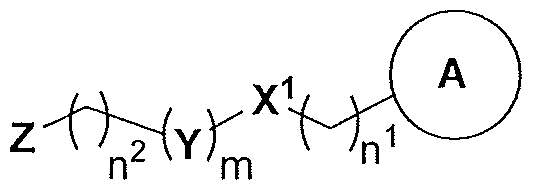
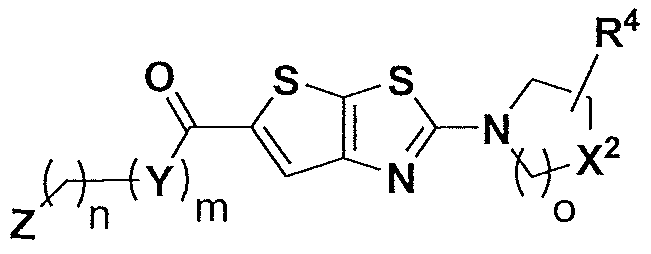
- the present invention relates to compounds having the general formula I:
- n and n are independently 0, 1, 2, or 3;
- n 0 or 1 ;
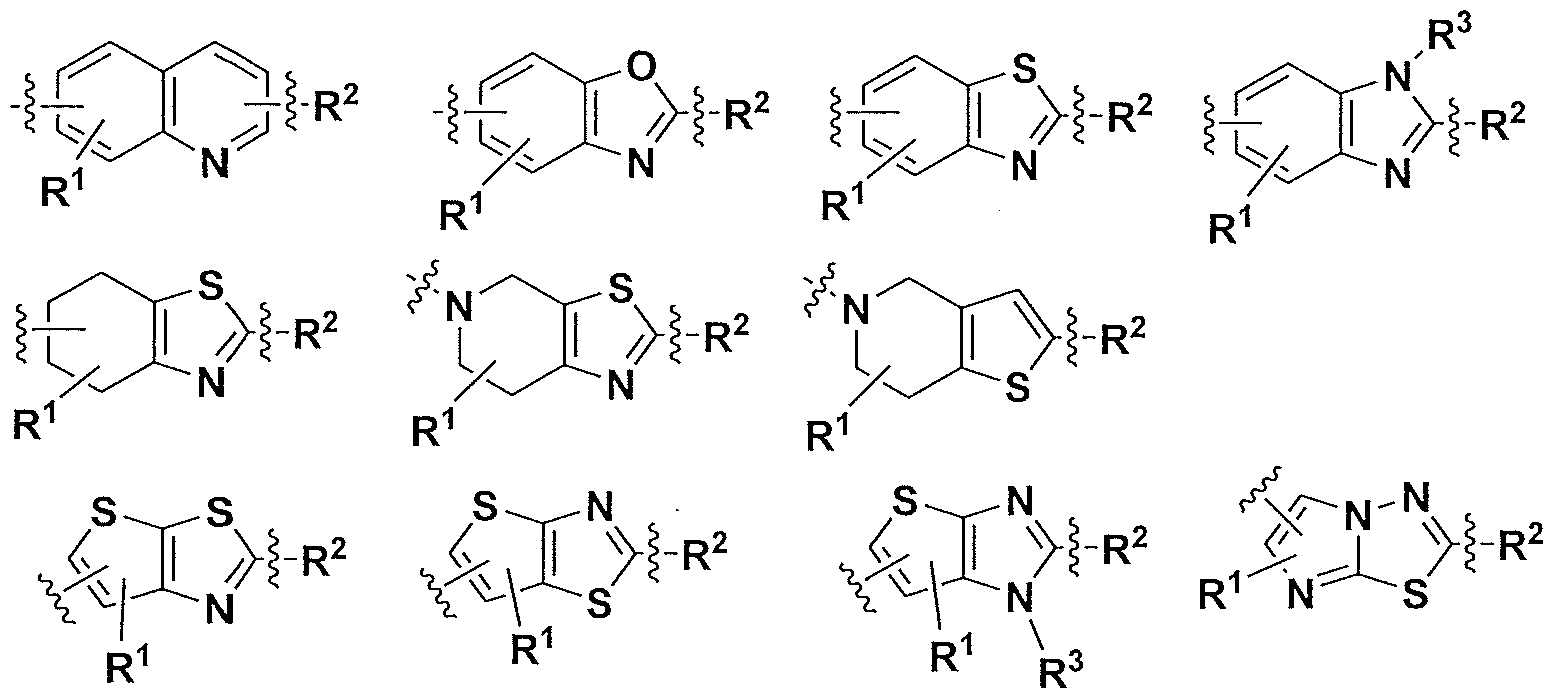
- A is a moiety selected from the group consisting of
- R is selected from the group consisting of hydrogen, halogen, Cj-Cio alkyl, C 3 - Ciocycloalkyl, d-C 3 haloalkyl, hydroxyl, -OR 3 , -CN, -N0 2 , -NH 2 , -NR b R c , aryl, heteroaryl and heterocyclyl group wherein each of said alkyl, cycloalkyl, aryl heteroaryl and heterocyclyl is optionally substituted with one to four R a groups;
- R is selected from the group consisting of hydrogen, halogen, Ci-Ci 0 alkyl, C 3 - Cocycloalkyl, Ci-C 3 haloalkyl, hydroxyl, -OR 3 , -CN, -N0 2 , -NH 2 , -NR b R c , -NR 6 C(0)R c , - (NR d )(V) p R e , aryl, heteroaryl, heterocyclyl group and groups of formula la shown below, wherein each of said alkyl, cycloalkyl, aryl, heteroaryl and heterocyclyl is optionally substituted with one to four R a groups;
- X 2 is selected from CR b R°, O, S, or NR 6 ;
- Y is Ci-C 6 alkylene, O, S or NR 6 ;
- V and W are independently, at each occurrence, Q-Q alkylene
- R is selected from the group consisting of hydrogen, Ci-Cio alkyl, C 3 -C 10 cycloalkyl, Q-Qo haloalkyl in particular, C t -Cshaloalkyl, Ci-C 6 alkyl-0-alkyl, C 2 -C 10 alkenyl, C 3 -C 10 cycloalkenyl, C2-C 10 alkynyl, aryl, heteroaryl and heterocyclyl group, wherein each of said alkyl, cycloalkyl, aryl, heteroaryl and heterocyclyl is optionally substituted with one to four R a groups;
- R 4 is selected from the group consisting of hydrogen, halogen, Cj-Cio alkyl, C 3 - C 10 cycloalkyl, C C 3 haloalkyl, hydroxyl, -OR 6 , -CN, -N0 2 , -NH 2 , -NR b R°, -N(R 6 )C(0)R 6 , - C(0)R 6 , -C(0)OR 6 , -C(0)NR b R° , -S(0)R 6 , -S(0) 2 R 6 , -S(0) 2 NR b R c , aryl, heteroaryl and heterocyclyl group wherein each of said alkyl, cycloalkyl, -OR 6 aryl, heteroaryl and heterocyclyl is optionally substituted with one to four R a groups;
- R 5 is selected from the group consisting of hydrogen, halogen, Ci-Qo alkyl, C 3 - docycloalkyl, d-Cshaloalkyl, hydroxyl, -OR 6 , -CN, -N0 2 , -NH 2 , -NR b R°, -N(R 6 )C(0)R 6 , - N(R 6 )C(0)OR 6 , -C(0)R 6 , -C(0)OR 6 , -C(0)NR b R c , -CHOHR 6 , -S(0)R 6 , -S(0) 2 R 6 , - S(0) 2 NR b R c , aryl, e.g. phenyl, benzyl, heteroaryl and heterocyclyl group wherein each of said alkyl, cycloalkyl, aryl, heteroaryl, and heterocyclyl group wherein each of said alkyl, cycloalkyl, aryl, hetero
- R 6 is independently, at each occurrence, selected from the group consisting of hydrogen, Q- C 10 alkyl, C 3 -C 10 cycloalkyl, Ci-C 3 haloalkyl, aryl, heteroaryl and heterocyclyl group , wherein each of said alkyl, cycloalkyl, aryl, heteroaryl and heterocyclyl is optionally substituted with one to four R a groups;
- Z is selected from the group consisting of Ci-Qo alkyl, C 3 -C 10 cycloalkyl, Q-Qhaloalkyl, OR , aryloxy, aryl, e.g. phenyl or benzyl, heteroaryl, heterocyclyl group, e.g. piperidinyl, morpholinyl, and groups of formula lb shown below, wherein each of said alkyl, cycloalkyl, aryl, heteroaryl, heterocyclyl and groups of formula lb is optionally substituted with one to four R a groups;
- p is 0 or 1;
- 1 is 1, 2 or 3;
- X 3 is, independently at each occurrence, selected from CH or N;
- R e if denoted in formula lb, may also occur twice as substituent at the same carbon atom wherein R e is independently selected at each occurrence;
- R a is independently, at each occurrence, selected from the group consisting of hydrogen, halogen, C ⁇ -Ci alkyl, C C 4 alkoxy, Q-Q alkoxy substituted with aryl, e.g. phenyl or benzyl, aryloxy; C C 3 haloalkyl, hydroxyl, Ci-C 3 alkylhydroxyl, -CN, N0 2 , -NR b R°, -C(0)NR b R°, -OR 0 , -C(0)R c , -C(0)OR°, sulfonyl, sulfoxide, C 3 -C 10 cycloalkyl, heterocyclyl, heteroaryl and aryl, e.g.
- R b and R° are independently, at each occurrence selected from the group consisting of hydrogen, Ci-Ci 0 alkyl, C 3 -C 10 cycloalkyl, C ⁇ Ce alkyl-O-alkyl, C2-Ci 0 alkenyl, Q-C4 alkoxy, C C 3 alkylhydroxyl, C3-Q0 cycloalkenyl, C 2 -CJO alkynyl, Q-Cio haloalkyl, in particular C - C 3 haloalkyl, aryl, e.g.
- each of said alkyl, cycloalkyl, aryl, heteroaryl and heterocyclyl is optionally substituted with one to four Q-C3 alkyl, C1-C4 alkoxy, e.g. methoxy, halogen, aryloxy, Ci-C 3 haloalkyl, e.g. trifluoromethyl, hydroxyl, Ci-C3 alkylhydroxyl, -CN, -N0 2 , -NH 2 , sulfonyl, sulfoxide, C 3 -C 10 cycloalkyl, heterocyclyl, aryl, e.g.
- phenyl, benzyl, heteroaryl wherein such substitution, if present, may occur in such a manner that there is more than one substituent, e.g. two or three substituents, per carbon atom, wherein such two or three substituents may be the same or different; or
- R b and R c are connected to each other to make a four, five or six membered saturated or unsaturated cyclic or heterocyclic ring, or they are connected to make a fused cyclic or heterocyclic ring structure;
- R d is independently, at each occurrence, selected from the group consisting of hydrogen, Q- C 10 alkyl, C 3 -Ciiocycloalkyl, C Cshaloalkyl, aryl, e.g. phenyl or benzyl, heteroaryl and heterocyclyl group, wherein each of said alkyl, cycloalkyl, aryl, heteroaryl and heterocyclyl is optionally substituted with one to four R a groups;
- R e is independently, at each occurrence, selected from the group consisting of hydrogen, halogen, d-Qo alkyl, C 3 -C 10 cycloalkyl, C 1 -C 3 haloalkyl, hydroxyl, -OR 7 , -CN, -(CH 2 )iR 7 , with 1 being 0, 1, 2 or 3, -N0 2 , -NH 2 , -NR b R°, -N(R 7 )C(0)R 7 , -C(0)R 7 , -C(0)OR 7 , - C(0)NR b R c , -S(0)R 7 , -S(0) 2 R 7 , -S(0) 2 NR b R c , aryl, e.g.
- R is independently, at each occurrence, selected from the group consisting of hydrogen, Q- C 10 alkyl, C 3 -C 10 cycloalkyl, C1 -C3 haloalkyl, aryl, e.g.
- phenyl or benzyl, heteroaryl, and heterocyclyl wherein each of said alkyl, cycloalkyl, aryl, heteroaryl and heterocyclyl is optionally substituted with one to four R a groups, and pharmaceutically acceptable salts thereof.
- n 0, 1, 2 or 3;
- n 0 or 1 ;
- o 0, 1, 2 or 3;
- X 2 is selected from CR b R c , O, S, or NR 6 ;
- Y is Ci-C 6 alkylene, O, S or NR 6 ;
- R 4 is selected from the group consisting of hydrogen, halogen, C1-C10 alkyl, C 3 - Ciocycloalkyl, Ci-C 3 haloalkyl, hydroxyl, -OR 6 , -CN, -N0 2 , -NH 2 , -NR b R c , -N(R 6 )C(0)R 6 , - C(0)R 6 , -C(0)OR 6 , -C(0)NR b R c > -S(0)R 6 , -S(0) 2 R 6 , -S(0) 2 NR b R c , aryl, e.g. phenyl or benzyl, heteroaryl and heterocyclyl group wherein each of said alkyl, cycloalkyl, aryl, heteroaryl and heterocyclyl group wherein each of said alkyl, cycloalkyl, aryl, heteroaryl and heterocyclyl group wherein each of said alkyl, cycl
- R 6 is independently, at each occurrence, selected from the group consisting of hydrogen, Q- C10 alkyl, C 3 -C 10 cycloalkyl, Ci-C 3 haloalkyl, aryl, e.g. phenyl or benzyl, heteroaryl and heterocyclyl group , wherein each of said alkyl, cycloalkyl, aryl, heteroaryl and heterocyclyl is optionally substituted with one to four R a groups;
- Z is selected from the group consisting of Q- o alkyl, C 3 -Ci 0 cycloalkyl, CrC 3 haloalkyl, OR 6 , aryloxy, aryl, e.g.
- p is 0 or 1 ;
- 1 is 1, 2 or 3;
- X is, independently at each occurrence, selected from CH or N;
- R e if denoted in formula lb, may also occur twice as substituent at the same carbon atom wherein R e is independently selected at each occurrence;
- R a is independently, at each occurrence, selected from the group consisting of hydrogen, halogen, Ci-C 3 alkyl, C C4 alkoxy, Ci-C 4 alkoxy substituted with aryl, e.g. phenyl, benzyl, aryloxy; C r C 3 haloalkyl, hydroxyl, C1-C3 alkylliydroxyl, -CN, N0 2 , -NR b R°, -C(0)NR b R c , - OR°, -C(0)R c , -C(0)OR°, sulfonyl, sulfoxide, C3-C10 cycloalkyl, heterocyclyl, heteroaryl and aryl, e.g.
- R b and R c are, independently at each occurrence, selected from the group consisting of hydrogen, C1-C10 alkyl, C 3 -Cio cycloalkyl, Ci-C 6 alkyl-O-alkyl, C 2 -Cio alkenyl, C1-C4 alkoxy, 1-C3 alkylhydroxyl, C3-C 10 cycloalkenyl, C 2 -C 10 alkynyl, CJ -CJO haloalkyl, in particular Q- C 3 haloalkyl, aryl, e.g.
- R b and R c are connected to each other to make a four, five or six membered saturated or unsaturated cyclic or heterocyclic ring, or they are connected to make a fused cyclic or heterocyclic ring structure;
- R e is independently, at each occurrence, selected from the group consisting of hydrogen, halogen, C1-C10 alkyl, C 3 -Ci 0 cycloalkyl, Ci-C 3 haloalkyl, hydroxyl, -OR 7 , -CN, -(CH ⁇ R 7 with 1 being 0, 1, 2 or 3, -N0 2 , -NH 2 , -NR b R°, -N(R 7 )C(0)R 7 , -C(0)R 7 , -C(0)OR 7 , - C(0)NR b R c , -S(0)R 7 , -S(0) 2 R 7 , -S(0) 2 NR b R c , aryl, heteroaryl and heterocyclyl group, wherein each of said alkyl, cycloalkyl, aryl, heteroaryl and heterocyclyl is optionally substituted with one to four R a groups;
- R 7 is independently, at each occurrence, selected from the group consisting of hydrogen, Q- C10 alkyl, C 3 -C 10 cycloalkyl, C1-C3 haloalkyl, aryl, heteroaryl and heterocyclyl, wherein each of said alkyl, cycloalkyl, aryl and heterocyclyl is optionally substituted with one to four R a groups, and pharmaceutically acceptable salts thereof.
- the compound has the general formula III:
- n 0 or 1 ;
- o 0, 1, 2 or 3;
- q is 0 or 1 ;
- X 2 is selected from CR b R°, O, S, or NR 6 ;
- Y is Ci-C 6 alkylene, O, S or NR 6 ;
- W is Ci-C 6 alkylene
- R 5 is selected from the group consisting of hydrogen, halogen, C Qo alkyl, C 3 - C 10 cycloalkyl, C r C 3 haloalkyl, hydroxyl, -OR 6 , -CN, -N0 2 , -NH 2 , -NR b R°, -N(R 6 )C(0)R 6 , - N(R 6 )C(0)OR 6 , -C(0)R 6 , -C(0)OR 6 , -C(0)NR b R° , -CHOHR 6 , -S(0)R 6 , -S(0) 2 R 6 , - S(0) 2 NR b R°, aryl, e.g. phenyl or benzyl, heteroaryl and heterocyclyl group wherein each of said alkyl, cycloalkyl, aryl, heteroaryl, and heterocyclyl group wherein each of said alkyl, cycloalkyl, aryl, heteroary
- R 6 is independently, at each occurrence, selected from the group consisting of hydrogen, Q- Cjo alkyl, C 3 -Cjocycloalkyl, CrC 3 haloalkyl, aryl, e.g. phenyl or benzyl, heteroaryl and heterocyclyl group , wherein each of said alkyl, cycloalkyl, aryl, heteroaryl and heterocyclyl is optionally substituted with one to four R a groups;
- R is selected from the group consisting of hydrogen, halogen, Ci-C 10 alkyl, C 3 - Cjocycloalkyl, Q-Qhaloalkyl, hydroxyl, -OR 9 , -CN, -N0 2 , -NH 2 , aryl, e.g. phenyl or benzyl, heteroaryl and heterocyclyl group wherein each of said alkyl, cycloalkyl, aryl, heteroaryl and heterocyclyl is optionally substituted with one to four R a groups;
- R 9 is selected from the group consisting of Ci-C 10 alkyl, C 3 -C 10 cycloalkyl, Ci-C 3 haloalkyl, aryl, e.g. phenyl or benzyl, heteroaryl and heterocyclyl group wherein each of said alkyl, cycloalkyl, aryl, heteroaryl and heterocyclyl is optionally substituted with one to four R a groups
- Z is selected from the group consisting of C ⁇ Cio alkyl, Cs-Ciocycloalkyl, C]-C 3 haloalkyl, OR 6 , aryloxy, aryl, e.g. phenyl or benzyl, heteroaryl, heterocyclyl group , and groups of formula lb shown below, wherein each of said alkyl, cycloalkyl, aryl, heteroaryl, heterocyclyl and groups of formula lb is optionally substituted with one to four R a groups;
- p is 0 or 1 ;
- 1 is 1, 2 or 3;
- X is, independently at each occurrence, selected from CH
- R e if denoted in fomiula lb, may also occur twice as substituent at the same carbon atom wherein R e is independently selected at each occurrence;
- R a is independently, at each occurrence, selected from the group consisting of hydrogen, halogen, Ci-C 3 alkyl, C C 4 alkoxy, C1-C4 alkoxy substituted with aryl, e.g. phenyl, aryloxy; C,-C 3 haloalkyl, hydroxyl, d-C 3 alkylhydroxyl, -CN, N0 2 , -NR b R c , -C(0)NR b R c , -OR c , -C(0)R c , -C(0)OR c , sulfonyl, sulfoxide, C 3 -C 10 cycloalkyl, heterocyclyl, heteroaryl and aryl, e.g.
- each of said alkyl, cycloalkyl, aryl, heteroaryl and heterocyclyl is optionally substituted with one to four Ci-C 3 alkyl, Ci-C 4 alkoxy, halogen, Cj-C 3 haloalkyl, hydroxyl, -N3 ⁇ 4 wherein such substitution, if present, may occur in such a manner that there is more than one substituent, e.g. two or three substituents, per carbon atom, wherein such two or three substituents may be the same or different;
- R b and R° are independently, at each occurrence, selected from the group consisting of hydrogen, Q-C10 alkyl, C 3 -C]io cycloalkyl, Q-C 6 alkyl-O-alkyl, C2-Ci 0 alkenyl, C ⁇ Q alkoxy, C ⁇ -C 3 alkylhydroxyl, C 3 -C 10 cycloalkenyl, C2-Cio alkynyl, Ci-C 10 haloalkyl, in particular Q- C 3 haloalkyl, aryl, e.g.
- each of said alkyl, cycloalkyl, aryl, heteroaryl and heterocyclyl is optionally substituted with one to four Ci-C 3 alkyl, C 1 -C 4 alkoxy, e.g. methoxy, halogen, aryloxy, C C 3 haloalkyl, e.g. trifluoromethyl, hydroxyl, C1-C3 alkylhydroxyl, -CN, -N0 2 , -NH 2 , sulfonyl, sulfoxide, C3-C10 cycloalkyl, heterocyclyl, aryl, e.g.
- phenyl, benzyl, heteroaryl wherein such substitution, if present, may occur in such a manner that there is more than one substituent, e.g. two or three substituents, per carbon atom, wherein such two or three substituents may be the same or different; or
- R b and R° are connected to each other to make a four, five or six membered saturated or unsaturated cyclic or heterocyclic ring, or they are connected to make a fused cyclic or heterocyclic ring structure;
- R e is independently, at each occurrence, selected from the group consisting of hydrogen, halogen, C]-C 10 alkyl, C 3 -C 10 cycloalkyl, C,-C 3 haloalkyl, hydroxyl, -OR 7 , -CN, -(C3 ⁇ 4)iR 7 with 1 being 0, 1 , 2 or 3, -N0 2 , -NH 2 , -NR b R c , -N(R 7 )C(0)R 7 , -C(0)R 7 , -C(0)OR 7 , - C(0)NR b R c , -S(0)R 7 , -S(0) 2 R 7 , -S(0) 2 NR b R c , aryl, e.g.
- phenyl or benzyl, heteroaryl and heterocyciyl group wherein each of said alkyl, cycloalkyl, aryl, heteroaryl and heterocyciyl is optionally substituted with one to four R a groups;
- R is independently, at each occurrence, selected from the group consisting of hydrogen, Q- Cio alkyl, C 3 -C 10 cycloalkyl, C1-C3 haloalkyl, aryl, e.g. phenyl or benzyl, heteroaryl, and heterocyciyl, wherein each of said alkyl, cycloalkyl, aryl, heteroaryl and heterocyciyl is optionally substituted with one to four R a groups, and pharmaceutically acceptable salts thereof.
- the compound has the general formula IV:
- n 0, 1 , 2 or 3;
- n 0 or 1 ;
- V is Ci-Ce alkyl ene
- R 10 and R d are independently at each occuiTence, selected from the group consisting of hydrogen, Ci-Qo alkyl, C 3 -C 10 cycloalkyl, Ci-C 3 haloalkyl, aryl, heteroaryl and heterocyciyl group, wherein each of said alkyl, cycloalkyl, aryl, heteroaryl and heterocyciyl is optionally substituted with one to four R a groups;
- R e is independently, at each occurrence, selected from the group consisting of hydrogen, halogen, Ci-C 10 alkyl, C 3 -Ci 0 cycloalkyl, Q-Qhaloalkyl, hydroxyl, -OR 7 , -CN, -(CH 2 )iR 7 with 1 being 0, 1, 2 or 3, -N0 2 , -NH 2 , -NR b R c , -N(R 7 )C(0)R 7 , -C(0)R 7 , -C(0)OR 7 , - C(0)NR b R c , -S(0)R 7 , -S(0) 2 R 7 , -S(0) 2 NR b R°, aryl, heteroaryl and heterocyciyl group, wherein each of said alkyl, cycloalkyl, aryl, e.g.
- R 7 is independently, at each occurrence, selected from the group consisting of hydrogen, Q- C 10 alkyl, Ca-Qocycloalkyl, Ci-C 3 haloalkyl, aryl, heteroaryl and heterocyclyl group , wherein each of said alkyl, cycloalkyl, aryl, e.g. phenyl or benzyl, heteroaryl and heterocyclyl is optionally substituted with one to four R a groups;
- Z is selected from the group consisting of C ⁇ -C ⁇ o alkyl, Cs-Ciocycloalkyl, Q-Cshaloalkyl, OR , aryloxy, aryl, e.g. phenyl or benzyl, heteroaryl, heterocyclyl group , and groups of formula lb shown below, wherein each of said alkyl, cycloalkyl, aryl, heteroaryl, heterocyclyl and groups of formula lb is optionally substituted with one to four R a groups;
- p is 0 or 1 ;
- 1 is 1, 2 or 3;
- X is, independently at each occurrence, selected from CH or N;
- R e if denoted in formula lb, may also occur twice as substituent at the same carbon atom wherein R e is independently selected at each occurrence;
- R a is independently, at each occurrence, selected from the group consisting of hydrogen, halogen, C1-C3 alkyl, C1-C4 alkoxy, C1-C 4 alkoxy substituted with aryl, e.g. phenyl or benzyl, aryloxy; C1-C 3 haloalkyl, hydroxyl, C1-C 3 alkylhydroxyl, -CN, N0 2 , -NR b R°, -C(0)NR b R c , - OR 0 , -C(0)R°, -C(0)OR c , sulfonyl, sulfoxide, C 3 -C 10 cycloalkyl, heterocyclyl, heteroaryl and aryl, e.g.
- R b and R° are independently, at each occurrence, selected from the group consisting of hydrogen, Ci-C 10 alkyl, C3-C10 cycloalkyl, Q-C3 haloalkyl, Ci-C 6 alkyl-O-alkyl, C 2 -Ci 0 alkenyl, Ci-C4 alkoxy, Q-C 3 alkylhydroxyl, C 3 -C ] 0 cycloalkenyl, C 2 -C 10 alkynyl, Q-Cio haloalkyl, aryl, e.g.
- each of said alkyl, cycloalkyl, aryl, heteroaryl and heterocyclyl is optionally substituted with one to four Ci-C 3 alkyl, Q-C4 alkoxy, e.g. methoxy, halogen, aryloxy, C1-C3 haloalkyl, e.g.
- R and R c are connected to each other to make a four, five or six membered saturated or unsaturated cyclic or heterocyclic ring, or they are connected to make a fused cyclic or heterocyclic ring structure;
- R d is independently, at each occurrence, selected from the group consisting of hydrogen, Q- CJO alkyl, C 3 -Ci 0 cycloalkyl, Ci-C 3 haloalkyl, aryl, e.g. phenyl or benzyl, heteroaryl and heterocyclyl group, wherein each of said alkyl, cycloalkyl, aryl, heteroaryl and heterocyclyl is optionally substituted with one to four R a groups;
- R e is independently, at each occurrence, selected from the group consisting of hydrogen, halogen, Cj-Cio alkyl, C 3 -C 10 cycloalkyl, Cj-C 3 haloalkyl, hydroxyl, -OR 7 , -CN, -(CH 2 )iR 7 with 1 being 0, 1, 2 or 3, -N0 2 , -NH 2 , -NR b R°, -N(R 7 )C(0)R 7 , -C(0)R 7 , -C(0)OR 7 , - C(0)NR b R c , -S(0)R 7 , -S(0) 2 R 7 , -S(0) 2 NR b R c , aryl, e.g. phenyl or benzyl, heteroaryl and heterocyclyl group, wherein each of said alkyl, cycloalkyl, aryl, heteroaryl and heterocyclyl group, wherein each of said alkyl,
- R is independently, at each occurrence, selected from the group consisting of hydrogen, C ⁇ - C 10 alkyl, C 3 -C 10 cycloalkyl, Q-Ca haloalkyl, aryl, e.g. phenyl or benzyl, heteroaryl, and heterocyclyl, wherein each of said alkyl, cycloalkyl, aryl, heteroaryl and heterocyclyl is optionally substituted with one to four R a groups, and pharmaceutically acceptable salts thereof.
- the present invention also relates to pharmaceutically acceptable salts of the compounds according to the present invention.
- alkyl refers to a monovalent straight or branched chain, saturated aliphatic hydrocarbon radical having a number of carbon atoms in the specified range.
- C Os alkyl refers to any of the hexyl alkyl and pentyl alkyl isomers as well as n-, iso-, sec-, and t-butyl, n- and isopropyl, ethyl and methyl.
- Alkyl groups may be optionally substituted with one or more substituents with one or more substituents as defined herein.
- Alkyl groups may be straight or branched. Representative branched alkyl groups have one, two, or three branches.
- "alkyl” refers to Ci, C 2 , C 3 , C 4 , C 5 , C 6 , C 7 , C 8 , C9, C 10 , Cn, C 12 , C 13 , Ci 4 , C15, C 16 Ci 7 , C 18 , C 19 , C 20 , C 21 , C 22 , C 23 and/or C 24 , alkyl, and combinations of any of the foregoing including the ranges Q to C 4 , alkyl, C 2 - C 4 alkyl, C 2 - C 12 alkyl, C 3 - C 6 alkyl, C 3 - C 12 alkyl, C 4 - C 6 alkyl, C 4 - C 8 alkyl, C 4 - C,o
- alkoxy means a group having the formula -O-alkyl, in which an alkyl group, as defined above, is attached to the parent molecule via an oxygen atom.
- the alkyl portion of an alkoxy group can have 1 to 20 carbon atoms (i.e., C -C 2 o alkoxy), 1 to 12 carbon atoms (i.e., Ci-C 12 alkoxy), or 1 to 6 carbon atoms (i.e., Cj-C 6 alkoxy).
- alkoxy groups include, but are not limited to, methoxy (-0-CH 3 or OMe), ethoxy (-OCH 2 CH 3 or - OEt), t-butoxy (-0-C(CH 3 ) 3 or -OtBu) and the like.
- alkenyl refers to a monovalent straight or branched chain aliphatic hydrocarbon radical containing one or more carbon-carbon double bonds and having a number of carbon atoms in the specified range.
- C 2 -C6 alkenyl refers to all of the hexenyl and pentenyl isomers as well as 1-buteiiyl, 2-butenyl, 3-butenyl, isobutenyl, 1-propenyl, 2- propenyl, and ethenyl (or vinyl).
- alkenyls useful in accordance with the present invention are C 2 - Cio, C 2 - C 9 , C 2 - Cg, C - C 7 , C 2 - C 6 , C 2 - C 5 and C 2 - C 4 alkenyl.
- alkynyl refers to a monovalent straight or branched chain aliphatic hydrocarbon radical containing one carbon-carbon triple bond and having a number of carbon atoms in the specified range.
- C 2 -C 6 alkynyl refers to all of the hexynyl and pentynyl isomers as well as 1-butynyl, 2-butynyl, 3-butynyl, 1-propynyl, 2-propynyl, and ethynyl.
- alkynyls useful in accordance with the present invention are C 2 — C 10 , C 2 — C 9 , C 2 - C 8 , C 2 - C 7 , C 2 - C 6 , C 2 - C 5 and C 2 - C 4 alkynyl.
- alkylene refers to a saturated, branched or straight chain or cyclic hydrocarbon radical having two monovalent radical centers derived by the removal of two hydrogen atoms from the same or two different carbon atoms, 1 to 10 carbon atoms, or 1 to 6 carbon atoms.
- Typical alkylene radicals include, but are not limited to, methylene (-CH 2 -), 1,1 -ethyl (- CH(CH 3 )-), 1,2-ethyl (-CH 2 CH 2 -), 1,1 -propyl (-CH(CH 2 CH 3 )-), 1,2-propyl (-C3 ⁇ 4CH(CH 3 )-), 1,3-propyl (-CH 2 CH 2 CH 2 -), 1,4-butyl (-CH 2 CH 2 CH 2 CH 2 -), and the like.
- alkenylene refers to an unsaturated, branched or straight chain or cyclic hydrocarbon radical having two monovalent radical centers derived by the removal of two hydrogen atoms from the same or two different carbon atoms of parent alkene.
- an alkenylene group can have 1 to 20 carbon atoms, 1 to 10 carbon atoms, or 1 to 6 carbon atoms.
- alkynylene refers to an unsaturated, branched or straight chain or cyclic hydrocarbon radical having two monovalent radical centers derived by the removal of two hydrogen atoms from the same or two different carbon atoms of parent alkyne.
- an alkynylene group can have 1 to 20 carbon atoms, 1 to 10 carbon atoms or 1 to 6 carbon atoms.
- Typical alkynylene radicals include, but are not limited to, acetylene (-C ⁇ C-), propargyl (-CH 2 C ⁇ C-), and 4-pentynyl (-CH 2 CH 2 CH 2 C ⁇ CH-).
- cycloalkyl refers to a group, such as optionally substituted or non-substituted cyclic hydrocarbon, having from three to eight carbon atoms, unless otherwise defined.
- C 3 -C 8 cycloalkyl refers to cyclopropyl, cyclobutyl, cyclopentyl, cyclohexyl, cycloheptyl, and cyclooctyl.
- Cycloalkyl groups may be optionally substituted with one or more substituents as defined herein.
- Cycloalkyl includes cyclopropyl, cyclobutyl, cyclopentyl, cyclohexyl, and cycloheptyl.
- substituents that are suitable include but are not limited to hydroxyl, halogen, cyano, sulfonyl, further aryl(s), Ci - C 5 alkyl, Ci - C 4 alkoxy, oxo, C 3 - C 6 cycloalkyl, heteroaryl, heterocycloalkyl, Q - C 3 sulfanyl.
- haloalkyl refers to an alkyl group, as defined herein that is substituted with at least one halogen.
- straight or branched chained “haloalkyl” groups useful in the present invention include, but are not limited to, methyl, ethyl, propyl, isopropyl, 77-butyl, and t-butyl substituted independently with one or more halogens, e.g. 2, 3, 4, 5 or 6 substituent halogens.
- haloalkyl should be interpreted to include such substituents such as -CH 2 F, -CHF 2 , -CF 3 , -CH 2 -CH 2 -F, -CHF-CH 2 F, -CH 2 -CF 3 , and the like.
- heteroalkyl refers to an alkyl group where one or more carbon atoms have been replaced with a heteroatom, such as, O, N, or S.
- a heteroatom such as, O, N, or S
- the resulting heteroalkyl groups are, respectively, an alkoxy group (e.g., -OCH 3 , etc.), an amine (e.g. , -NHCH 3 , -N(CH 3 ) 2 , etc.), or thioalkyl group (e.g., -SCH 3 , etc.).
- a non-terminal carbon atom of the alkyl group which is not attached to the parent molecule is replaced with a lieteroatom (e.g., O, N, or S) and the resulting heteroalkyi groups are, respectively, an alkyl ether (e.g., -CH 2 CH 2 -0-CH 3 , etc.), alkyl amine (e.g. , -CH 2 NHCH 3 , -CH 2 N(CH 3 ) 2 , etc.), or thioalkyl ether (e.g., -CH 2 -S-CH 3 ).
- an alkyl ether e.g., -CH 2 CH 2 -0-CH 3 , etc.
- alkyl amine e.g. , -CH 2 NHCH 3 , -CH 2 N(CH 3 ) 2 , etc.
- thioalkyl ether e.g., -CH 2 -S-CH 3
- halogen refers to fluorine, chlorine, bromine, or iodine.
- aryl refers to (i) optionally substituted phenyl, (ii) optionally substituted benzyl, (iii) optionally substituted 9- or 10 membered bicyclic, fused carbocyclic ring systems in which at least one ring is aromatic, and (iv) optionally substituted 1 1- to 14-membered tricyclic, fused carbocyclic ring systems in which at least one ring is aromatic.
- Suitable aryls include, for example, phenyl, biphenyl, naphthyl, tetrahydronaphthyl (tetralinyl), indenyl, anthracenyl, and fluorenyl.
- Aryl groups may be optionally substituted with one or more substituents as defined herein.
- substituents include but are not limited to hydroxyl, halogen, cyano, sulfonyl, further aryl(s), Q - C 5 alkyl, Ci - C 4 alkoxy, oxo, C 3 - C 6 cycloalkyl, heteroaryl, heterocycloalkyl, C] - C 3 sulfanyl.
- benzyl as used herein is meant to indicate an optionally substituted or non- substituted benzyl group.
- heteroaryl refers to (i) optionally substituted 5- and 6-membered heteroaromatic rings and (ii) optionally substituted 9- and 10-membered bicyclic, fused ring systems in which at least one ring is aromatic, wherein the heteroaromatic ring or the bicyclic, fused ring system contains from 1 to 4 heteroatoms independently selected from N, O, and S, where each N is optionally in the form of an oxide and each S in a ring which is not aromatic is optionally S(O) or S(0) 2 .
- Suitable 5- and 6-membered heteroaromatic rings include, for example, pyridyl, pyrrolyl, pyrazinyl, pyrimidinyl, pyridazinyl, triazinyl, thienyl, furanyl, imidazolyl, pyrazolyl, triazolyl, tetrazolyl, oxazolyl, isooxazolyl, oxadiazolyl, thiazolyl, isothiazolyl, and thiadiazolyl.
- Suitable 9-and 10-membered heterobicyclic, fused ring systems include, for example, benzofuranyl, indolyl, indazolyl, naphthyridinyl, isobenzofuranyl, benzopiperidinyl, benzisoxazolyl, benzoxazolyl, chromenyl, quinolinyl, isoquinolinyl, cinnolinyl, quinazolinyl, tetrahydroquinolinyl, tetrahydroisoquinolinyl, isoindolyl, benzodioxolyl, benzofuranyl, imidazo[l,2-a]pyridinyl, benzotriazolyl, dihydroindolyl, diliydroisoindolyl, indazolyl, indolinyl, isoindolinyl, quinoxalinyl, quinazolinyl, 2,3- dihydr
- heterocyclyl refers to (i) optionally substituted 4- to 8-membered, saturated and unsaturated but non-aromatic monocyclic rings containing at least one carbon atom and from 1 to 4 heteroatoms, (ii) optionally substituted bicyclic ring systems containing from 1 to 6 heteroatoms, and (iii) optionally substituted tricyclic ring systems, wherein each ring in (ii) or (iii) is independent of fused to, or bridged with the other ring or rings and each ring is saturated or unsaturated but nonaromatic, and wherein each heteroatom in (i), (ii), and (iii) is independently selected from N, O, and S, wherein each N is optionally in the form of an oxide and each S is optionally oxidized to S(O) or S(0)2.
- Suitable 4- to 8-membered saturated heterocyclyls include, for example, azetidinyl, piperidinyl, morpholinyl, thiomorpholinyl, thiazolidinyl, isothiazolidinyl, oxazolidinyl, isoxazolidinyl, pyrrolidinyl, imidazolidinyl, piperazinyl, tetrahydrofuranyl, tetrahydrothienyl, pyrazolidinyl, hexahydropyrimidinyl, thiazinanyl, thiazepanyl, azepanyl, diazepanyl, tetrahydropyranyl, tetrahydrothiopyranyl, dioxanyl, and azacyclooctyl.
- Suitable unsaturated heterocyclic rings include those corresponding to the saturated heterocyclic rings listed in the above sentence in which a single bond is replaced with a double bond. It is understood that the specific rings and ring systems suitable for use in the present invention are not limited to those listed in this and the preceding paragraphs. These rings and ring systems are merely representative.
- Optionally substituted indicates that a group, such as alkyl, alkenyl, alkynyl, aryl, cycloalkyl, cycloalkenyl, heterocycloalkyl, heterocyclyl or heteroaryl, may be unsubstituted, or the group may be substituted with one or more substituents as defined herein.
- “Pharmaceutically acceptable” refers to those compounds, materials, compositions, and dosage forms which are, within the scope of sound medical judgment, suitable for use in contact with the tissues of human beings or animals without excessive toxicity, irritation, or other problem or complication, commensurate with a reasonable benefit/risk ratio.
- Substituted in reference to a group indicates that one or more hydrogen atoms attached to a member atom within the group is replaced with a substituent selected from the group of defined or suitable substituents. It should be understood that the term “substituted” includes the implicit provision that such substitution be in accordance with the permitted valence of the substituted atom and the substituent, and that the substitution results in a stable compound. When it is stated that a group may contain one or more substituents, one or more member atom within the group may be substituted. In addition, a single member atom within the group may be substituted with more than one substituent as long as such substitution is in accordance with the permitted valence of the atom.
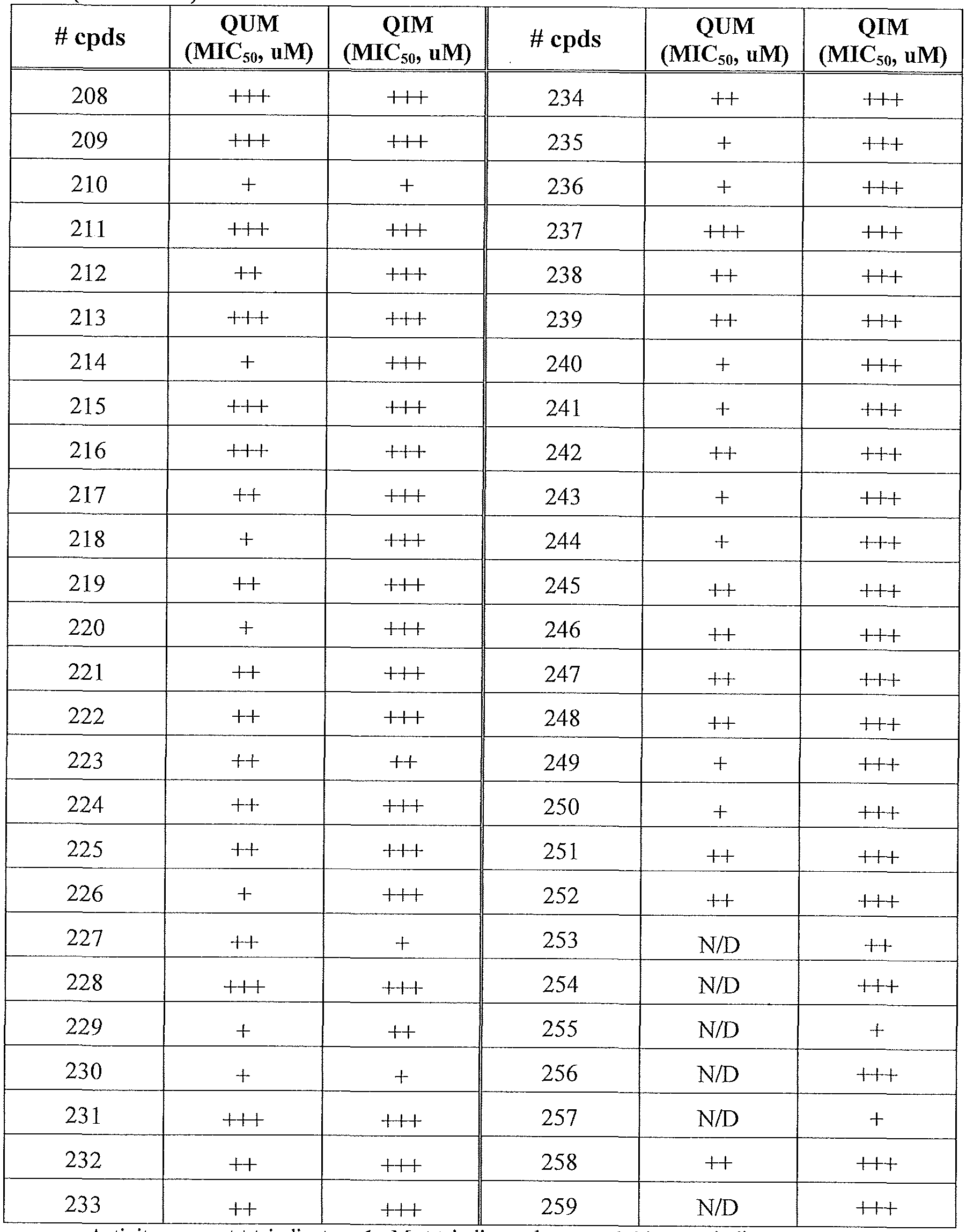
- MIC50 refers to the concentration of compound which inhibits bacterial growth, preferably growth of M. tuberculosis, in comparison to a control without any drug after five days by 50%.
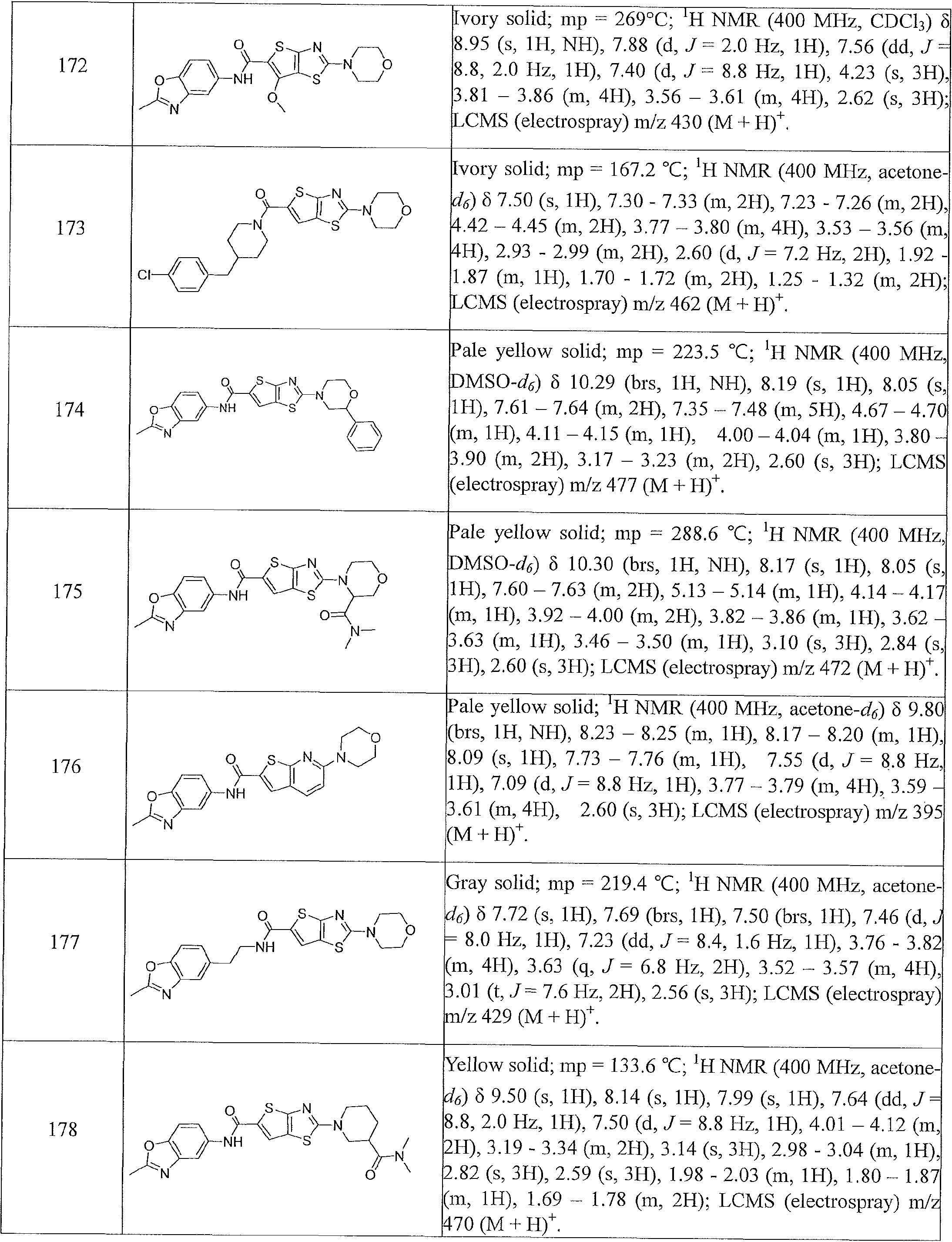
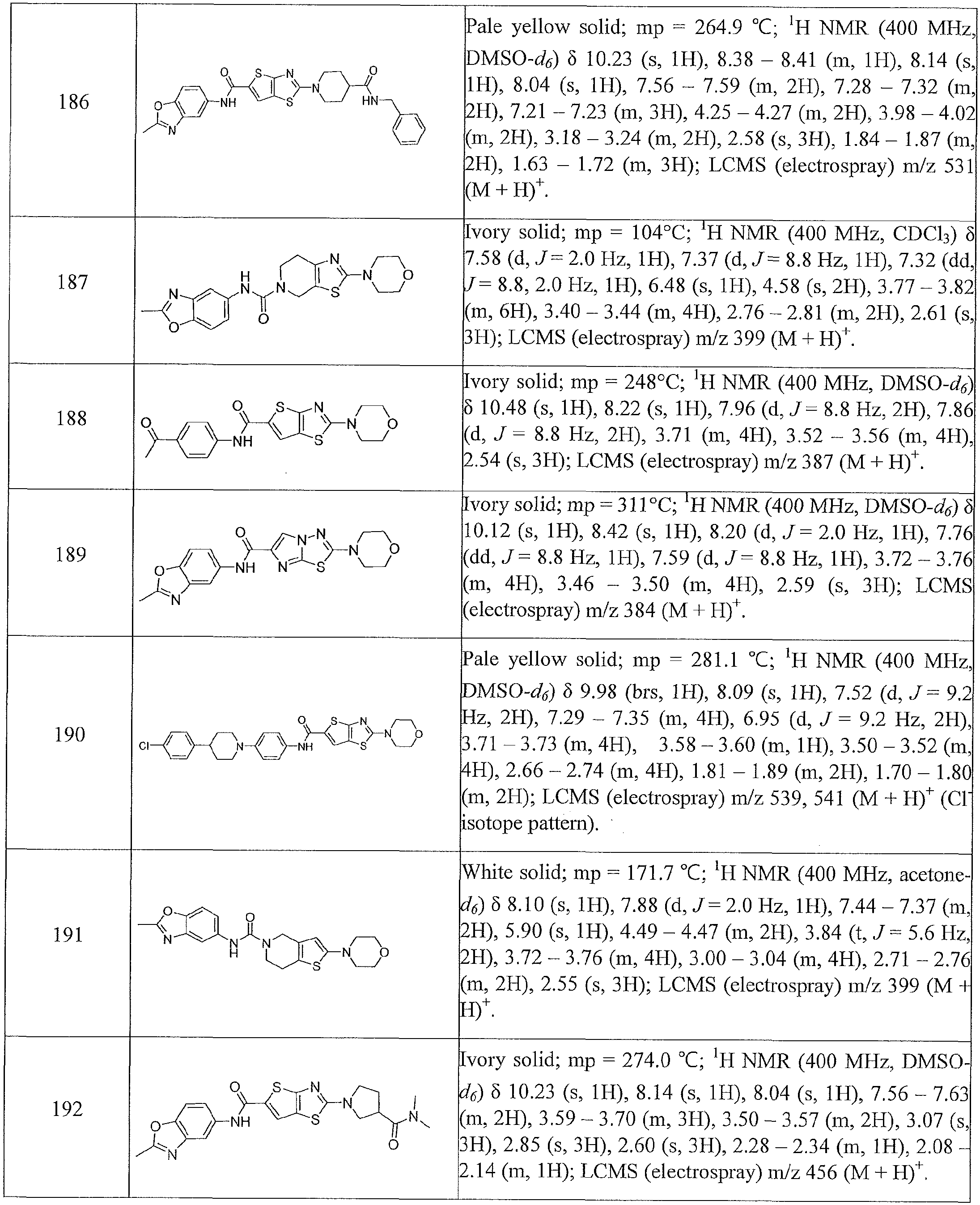
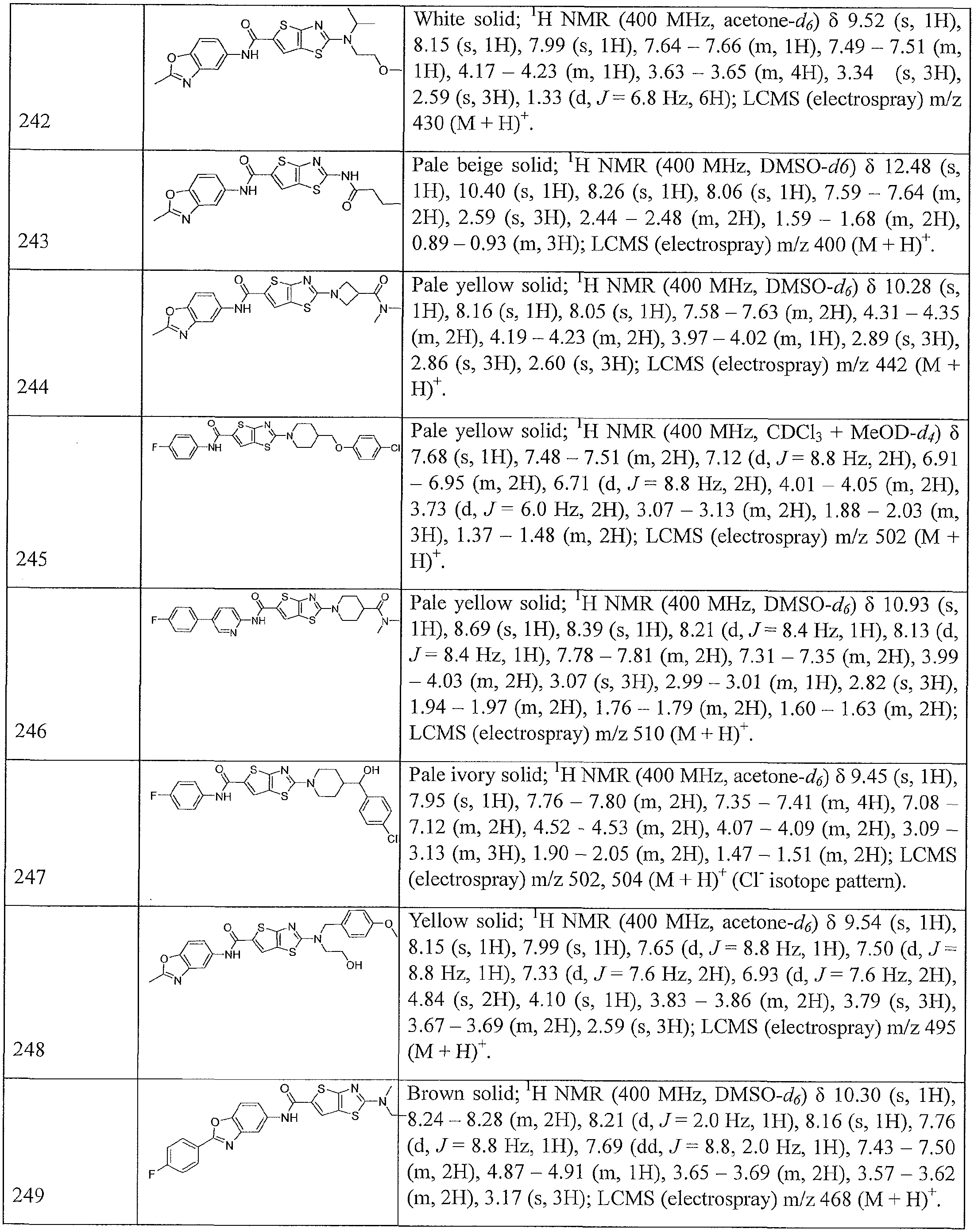
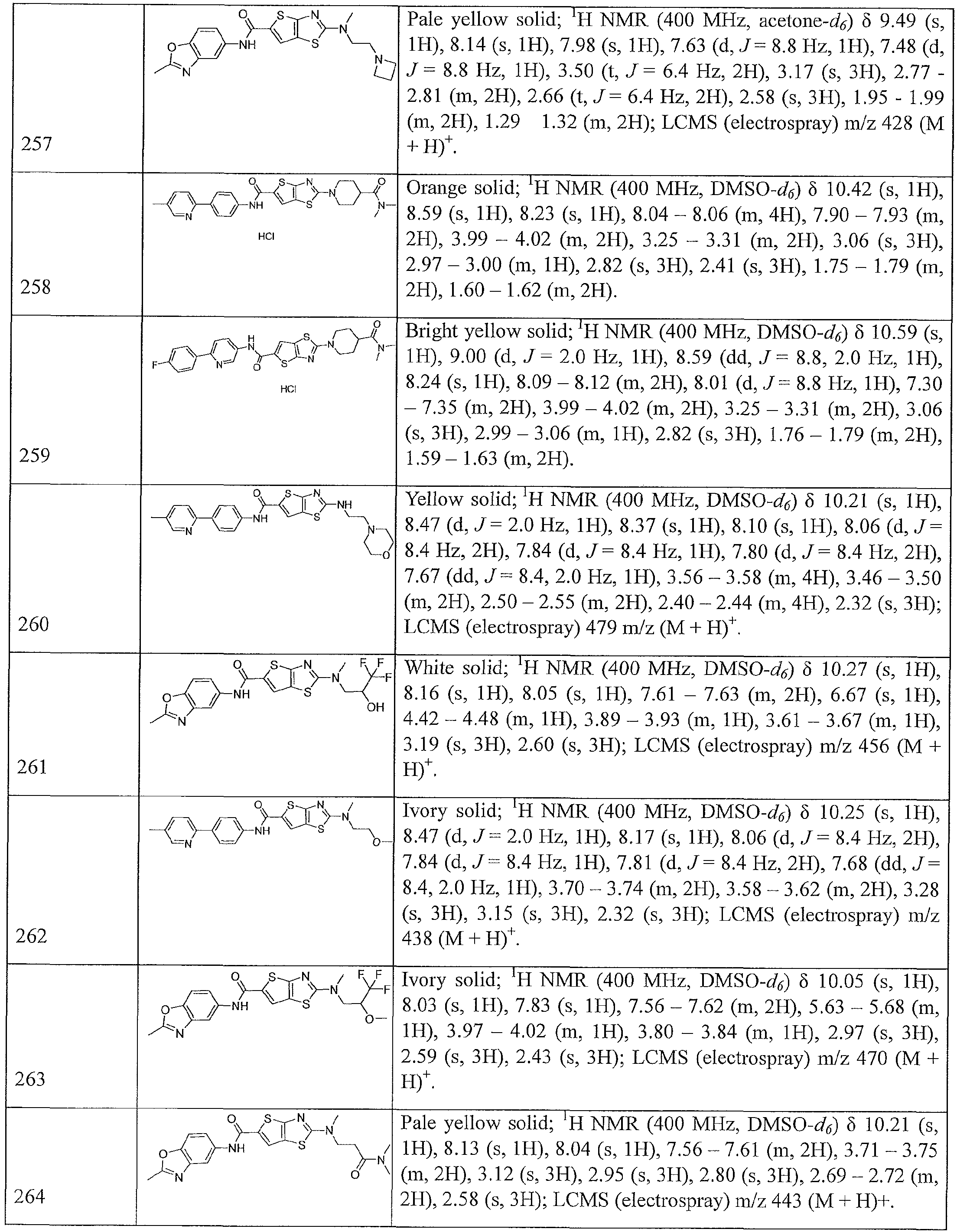
- the present invention relates to compounds having one of the formulae 1- 360, as shown in Tables 1-2, preferably 3, 6, 8, 13,14, 17-20, 22, 24, 25, 27-29, 32, 35, 36, 38-58, 60-68, 72, 74-80, 82-87, 90-92, 95-97, 99-101, 103-108, 110-112, 114-116, 118-122, 124-127, 129, 130, 132-140, 142-146, 149, 151-156, 158-162, 165, 167-169, 171, 174, 177, 178, 180, 183, 186, 188, 192-197, 199, 201-204, 206-209, 211-229, 231-254, 256, 258-262, 264-268, 271-279, 281-285, 287-294, 296-299, 301, 302, 304-309, 311, 313-325, 327-346, 348-355, 357-360, more preferably 3, 13, 14,
- the compounds as defined above have an inhibitory activity on bacterial growth, preferably on the growth of M. tuberculosis, inside a host cell, preferably a macrophage, at a concentration between 1-20 ⁇ , preferably less than 1 ⁇ .
- the present invention relates to compounds as defined above for use in the treatment of a bacterial infection, e.g. tuberculosis. In one aspect, the present invention relates to compounds as defined above for use in the treatment of Tuberculosis.
- the present invention relates to a composition, preferably a pharmaceutical composition comprising a compound as defined above, and a pharmaceutically acceptable carrier.
- the present invention relates to a method of treatment of a bacterial infection, in particular Tuberculosis, comprising the application of a suitable amount of a compound as defined above or of a pharmaceutical composition as defined above to a person in need thereof.
- a "suitable amount”, as used herein, is meant to refer to an amount in the range of from 0.01 mg/kg body weight to 1 g/kg body weight.
- the objects of the present invention are also solved by a compound that competitively inhibits the specific binding of a compound according to the present invention.
- a compound that competitively inhibits the specific binding is with respect to a target protein of said compound according to the present invention.
- the objects of the invention are also solved by a pharmaceutical composition comprising such competitively inhibiting compound, as defined above, and a pharmaceutically acceptable carrier.
- the objects of the present invention are also solved by a method of treatment of a bacterial infection, in particular tuberculosis comprising the application of a suitable amount of a compound which compound is characterized by an ability to competitively inhibit the specific binding of a compound according to the present invention to a target protein, or the application of a suitable amount of the pharmaceutical composition comprising such competitively inhibiting compound, to a person in need thereof.
- Examples of pharmaceutically acceptable addition salts include, without limitation, the nontoxic inorganic and organic acid addition salts such as the acetate derived from acetic acid, the aconate derived from aconitic acid, the ascorbate derived from ascorbic acid, the benzenesulfonate derived from benzensulfonic acid, the benzoate derived from benzoic acid, the cinnamate derived from cinnamic acid, the citrate derived from citric acid, the embonate derived from embonic acid, the enantate derived from enanthic acid, the formate derived from formic acid, the fumarate derived from fumaric acid, the glutamate derived from glutamic acid, the glycolate derived from glycolic acid, the hydrochloride derived from hydrochloric acid, the hydrobromide derived from hydrobromic acid, the lactate derived from lactic acid, the maleate derived from maleic acid, the malonate derived from malonic
- acids which may not be considered pharmaceutically acceptable, may be useful in the preparation of salts useful as intermediates in obtaining a chemical compound of the invention and its pharmaceutically acceptable acid addition salt.
- the compounds of the invention are used in their respective free base form according to the present invention.
- Metal salts of a chemical compound of the invention include alkali metal salts, such as the sodium salt of a chemical compound of the invention containing a carboxy group.
- the chemical compounds of the invention may be provided in unsolvated or solvated forms together with a pharmaceutically acceptable solvent(s) such as water, ethanol, and the like.
- Solvated forms may also include hydrated forms such as the monohydrate, the dihydrate, the hemihydrate, the trihydrate, the tetrahydrate, and the like. In general, solvated forms are considered equivalent to unsolvated forms for the purposes of this invention.
- the compounds of the invention may be administered in the form of the raw chemical compound, it is preferred to introduce the active ingredient, optionally in the form of a physiologically acceptable salt in a pharmaceutical composition together with one or more adjuvants, excipients, earners, buffers, diluents, and/or other customary pharmaceutical auxiliaries.
- Such salts of the compounds of the invention may be anhydrous or solvated.
- the invention provides medicaments comprising a compound useable according to the invention, or a pharmaceutically acceptable salt or derivative thereof, together with one or more pharmaceutically acceptable carriers therefor, and, optionally, other therapeutic and/or prophylactic ingredients.
- the carrier(s) must be "acceptable” in the sense of being compatible with the other ingredients of the formulation and not harmful to the recipient thereof.
- a medicament of the invention may be those suitable for oral, rectal, bronchial, nasal, topical, buccal, sub-lingual, transdermal, vaginal or parenteral (including cutaneous, subcutaneous, intramuscular, intraperitoneal, intravenous, intraarterial, intracerebral, intraocular injection or infusion) administration, or those in a form suitable for administration by inhalation or insufflation, including powders and liquid aerosol administration, or by sustained release systems.
- sustained release systems include semipermeable matrices of solid hydrophobic polymers containing the compound of the invention, which matrices may be in form of shaped articles, e.g. films or microcapsules.
- the compounds useable according to the invention may thus be placed into the form of medicament and unit dosages thereof.
- Such forms include solids, and in particular tablets, filled capsules, powder and pellet forms, and liquids, in particular aqueous or non-aqueous solutions, suspensions, emulsions, elixirs, and capsules filled with the same, all for oral use, suppositories for rectal administration, and sterile injectable solutions for parenteral use.
- Such medicament and unit dosage forms thereof may comprise conventional ingredients in conventional proportions, with or without additional active compounds or principles, and such unit dosage forms may contain any suitable effective amount of the active ingredient commensurate with the intended daily dosage range to be employed.
- the compounds useable according to the invention can be administered in a wide variety of oral and parenteral dosage forms. It will be obvious to those skilled in the art that the following dosage forms may comprise, as the active component, either a compound(s) useable according to the invention or a pharmaceutically acceptable salt of a compound(s) useable according to the invention.
- pharmaceutically acceptable carriers can be either solid or liquid.
- Solid form preparations include powders, tablets, pills, capsules, cachets, suppositories, and dispersible granules.
- a solid earner can be one or more substances which may also act as diluents, flavouring agents, solubilizers, lubricants, suspending agents, binders, preservatives, tablet disintegrating agents, or an encapsulating material.
- the carrier is a finely divided solid which is in a mixture with the finely divided active component.
- the active component is mixed with the earner having the necessary binding capacity in suitable proportions and compacted in the shape and size desired.
- Suitable carriers are magnesium carbonate, magnesium stearate, talc, sugar, lactose, pectin, dextrin, starch, gelatin, tragacanth, methylcellulose, sodium carboxymethylcellulose, a low melting wax, cocoa butter, and the like.
- the term "preparation” is intended to include the formulation of the active compound with encapsulating material as carrier providing a capsule in which the active component, with or without carriers, is surrounded by a carrier, which is thus in association with it.
- cachets and lozenges are included. Tablets, powders, capsules, pills, cachets, and lozenges can be used as solid forms suitable for oral administration.
- a low melting wax such as a mixture of fatty acid glyceride or cocoa butter
- the active component is dispersed homogeneously therein, as by stirring.
- the molten homogenous mixture is then poured into convenient sized moulds, allowed to cool, and thereby to solidify.
- Compositions suitable for vaginal administration may be presented as pessaries, tampons, creams, gels, pastes, foams or sprays containing in addition to the active ingredient such earners as are known in the art to be appropriate.
- Liquid preparations include solutions, suspensions, and emulsions, for example, water or water- propylene glycol solutions.
- parenteral injection liquid preparations can be formulated as solutions in aqueous polyethylene glycol solution.
- the chemical compounds according to the present invention may thus be formulated for parenteral administration (e.g. by injection, for example bolus injection or continuous infusion) and may be presented in unit dose form in ampoules, pre-filled syringes, small volume infusion or in multi-dose containers with an added preservative.
- the compositions may take such forms as suspensions, solutions, or emulsions in oily or aqueous vehicles, and may contain formulation agents such as suspending, stabilising and/or dispersing agents.
- the active ingredient may be in powder form, obtained by aseptic isolation of sterile solid or by lyophilization from solution, for constitution with a suitable vehicle, e.g. sterile, pyrogen-free water, before use.
- Aqueous solutions suitable for oral use can be prepared by dissolving the active component in water and adding suitable colorants, flavours, stabilising and thickening agents, as desired.
- Aqueous suspensions suitable for oral use can be made by dispersing the finely divided active component in water with viscous material, such as natural or synthetic gums, resins, methylcellulose, sodium carboxymethylcellulose, or other well known suspending agents.
- viscous material such as natural or synthetic gums, resins, methylcellulose, sodium carboxymethylcellulose, or other well known suspending agents.
- solid form preparations which are intended to be converted, shortly before use, to liquid form preparations for oral administration. Such liquid forms include solutions, suspensions, and emulsions. These preparations may contain, in addition to the active component, colorants, flavours, stabilisers, buffers, artificial and natural sweeteners, dispersants, thickeners, solubilizing agents, and the like.
- the medicament is applied topically or systemically or via a combination of the two routes.
- the compounds of the present invention may, in one embodiment, be administered in a formulation containing 0,001% to 70% per weight of the compound, preferably between 0,01% to 70% per weight of the compound, even more preferred between 0,P/o and 70% per weight of the compound.
- a suitable amount of compound administered is in the range of from 0.01 mg/kg body weight to 1 g/kg body weight.
- compositions suitable for administration also include lozenges comprising the active agent in a flavoured base, usually sucrose and acacia or tragacanth; pastilles comprising the active ingredient in an inert base such as gelatin and glycerol or sucrose and acacia; and mouthwashes comprising the active ingredient in a suitable liquid carrier.
- lozenges comprising the active agent in a flavoured base, usually sucrose and acacia or tragacanth
- pastilles comprising the active ingredient in an inert base such as gelatin and glycerol or sucrose and acacia
- mouthwashes comprising the active ingredient in a suitable liquid carrier.
- Solutions or suspensions are applied directly to the nasal cavity by conventional means, for example with a dropper, pipette or spray.
- the compositions may be provided in single or multi-dose form. In the latter case of a dropper or pipette, this may be achieved by the patient administering an appropriate, predetermined volume of the solution or suspension. In the case of a spray, this may be achieved for example by means of a metering atomising spray pump.
- Administration to the respiratory tract may also be achieved by means of an aerosol formulation in which the active ingredient is provided in a pressurised pack with a suitable propellant such as a chlorofluorocarbon (CFC) for example dichlorodifluoromethane, tricMorofluoiOinethane, or dichlorotetrafluoroethane, carbon dioxide, or other suitable gas.
- a suitable propellant such as a chlorofluorocarbon (CFC) for example dichlorodifluoromethane, tricMorofluoiOinethane, or dichlorotetrafluoroethane, carbon dioxide, or other suitable gas.
- CFC chlorofluorocarbon
- the aerosol may conveniently also contain a surfactant such as lecithin.
- the dose of drug may be controlled by provision of a metered valve.
- the active ingredients may be provided in the form of a dry powder, for example a powder mix of the compound in a suitable powder base such as lactose, starch, starch derivatives such as hydroxypropylmethyl cellulose and polyvinylpyrrolidone (PVP).
- a powder base such as lactose, starch, starch derivatives such as hydroxypropylmethyl cellulose and polyvinylpyrrolidone (PVP).
- PVP polyvinylpyrrolidone
- the powder composition may be presented in unit dose form for example in capsules or cartridges of, e.g., gelatin, or blister packs from which the powder may be administered by means of an inhaler.
- the compound In compositions intended for administration to the respiratory tract, including intranasal compositions, the compound will generally have a small particle size for example of the order of 5 microns or less. Such a particle size may be obtained by means known in the art, for example by micronization.
- compositions adapted to give sustained release of the active ingredient may be employed.
- the pharmaceutical preparations are preferably in unit dosage forms.
- the preparation is subdivided into unit doses containing appropriate quantities of the active component.
- the unit dosage form can be a packaged preparation, the package containing discrete quantities of preparation, such as packaged tablets, capsules, and powders in vials or ampoules.
- the unit dosage form can be a capsule, tablet, cachet, or lozenge itself, or it can be the appropriate number of any of these in packaged form. Tablets or capsules for oral administration and liquids for intravenous administration and continuous infusion are preferred compositions.
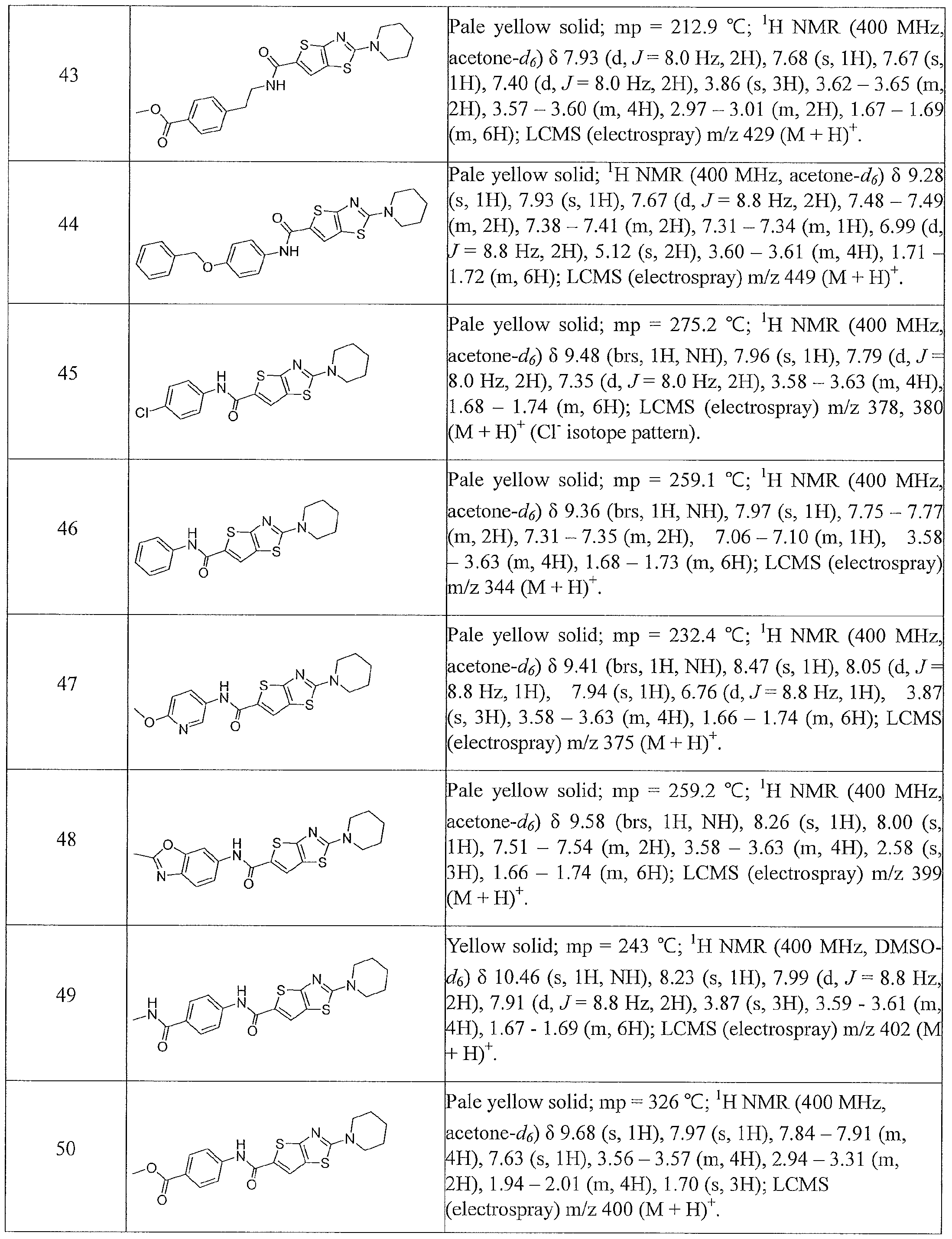
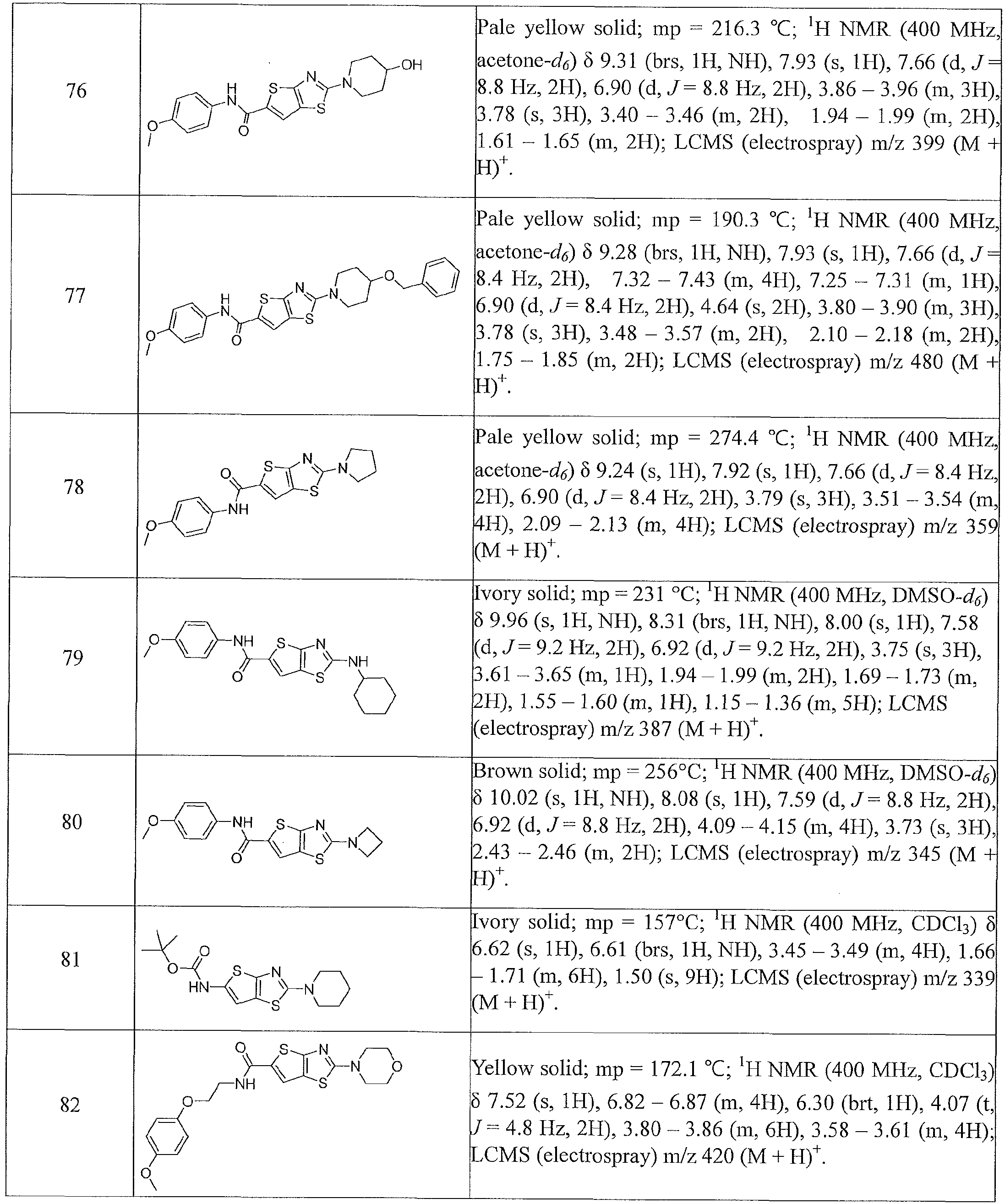
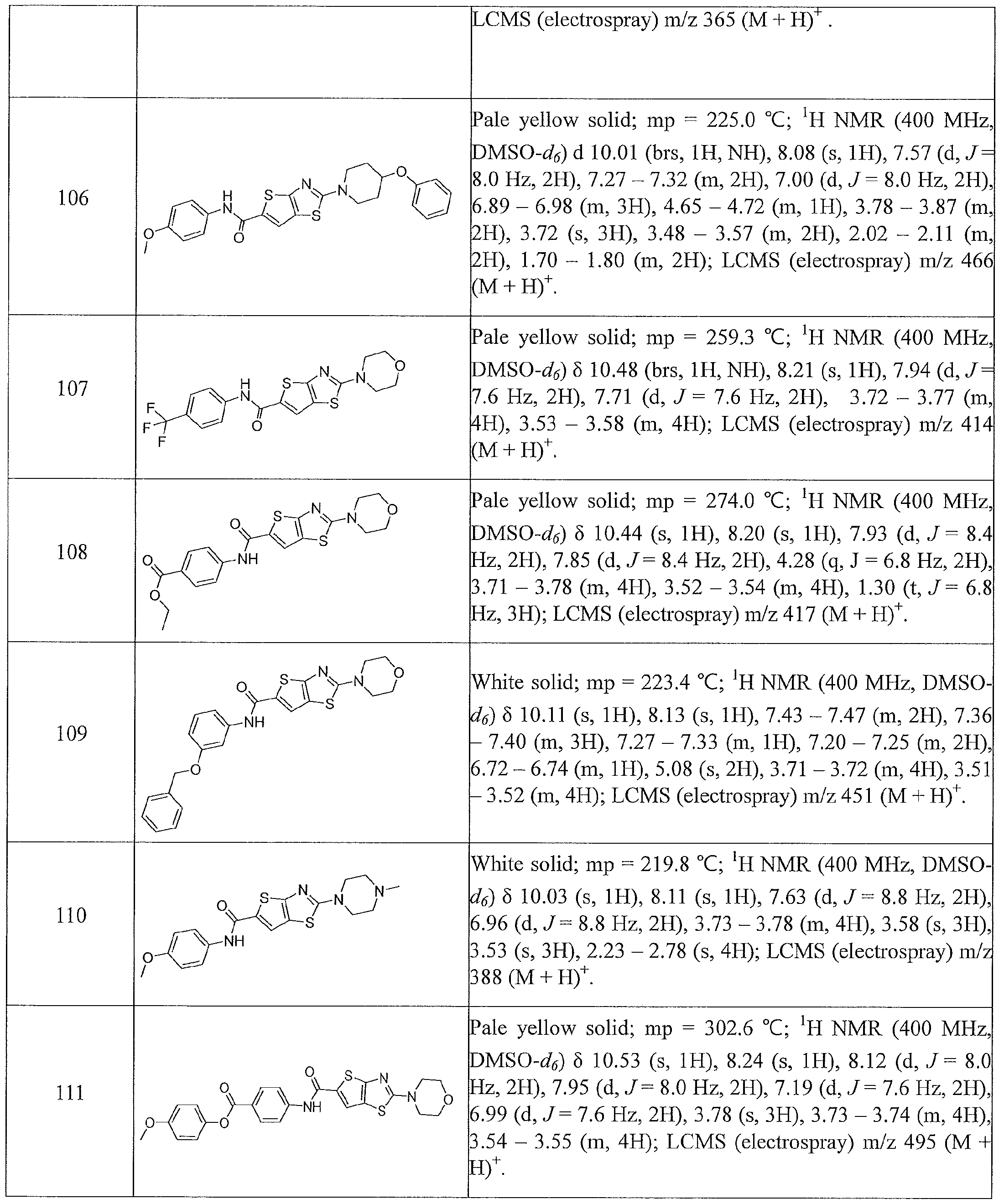
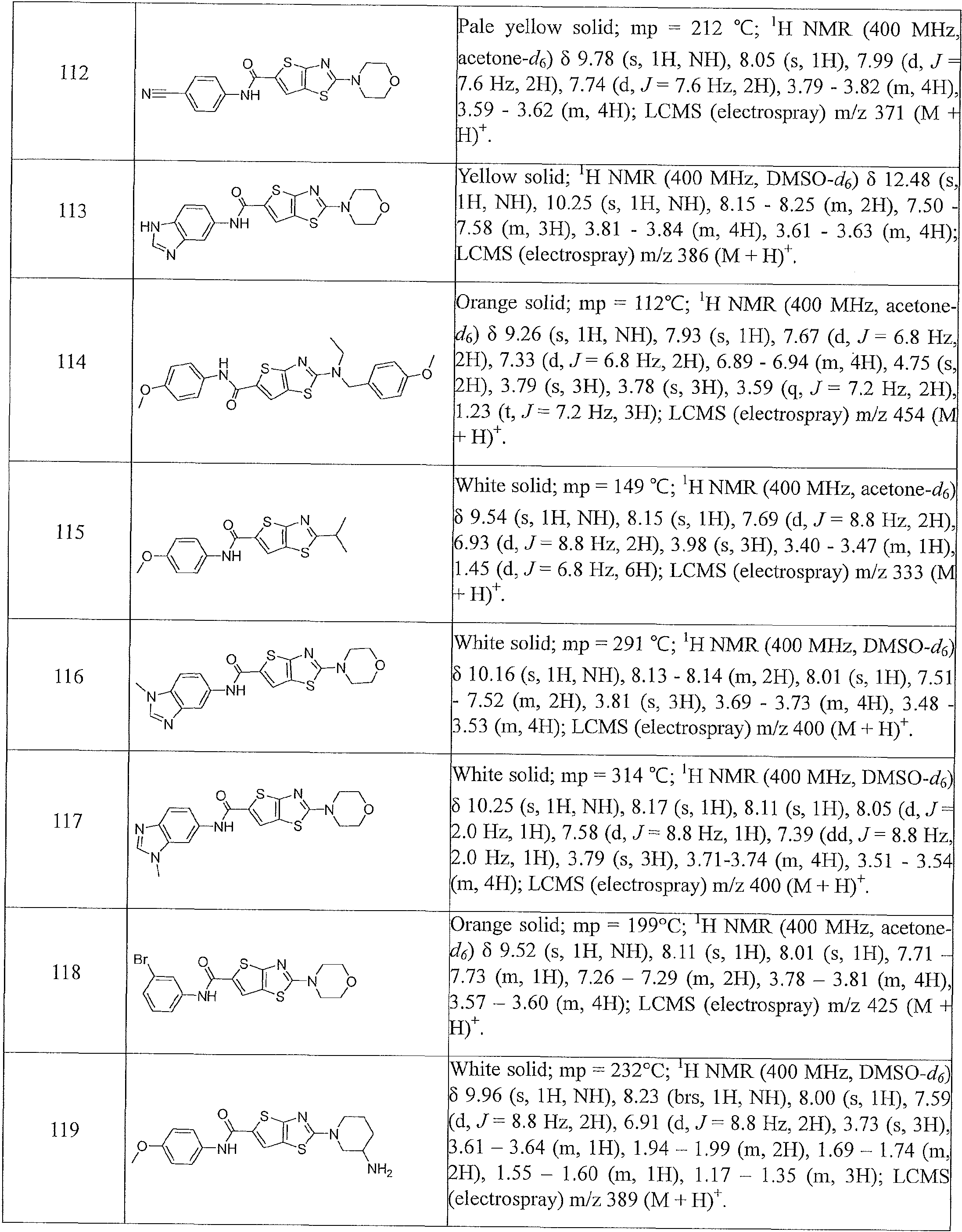
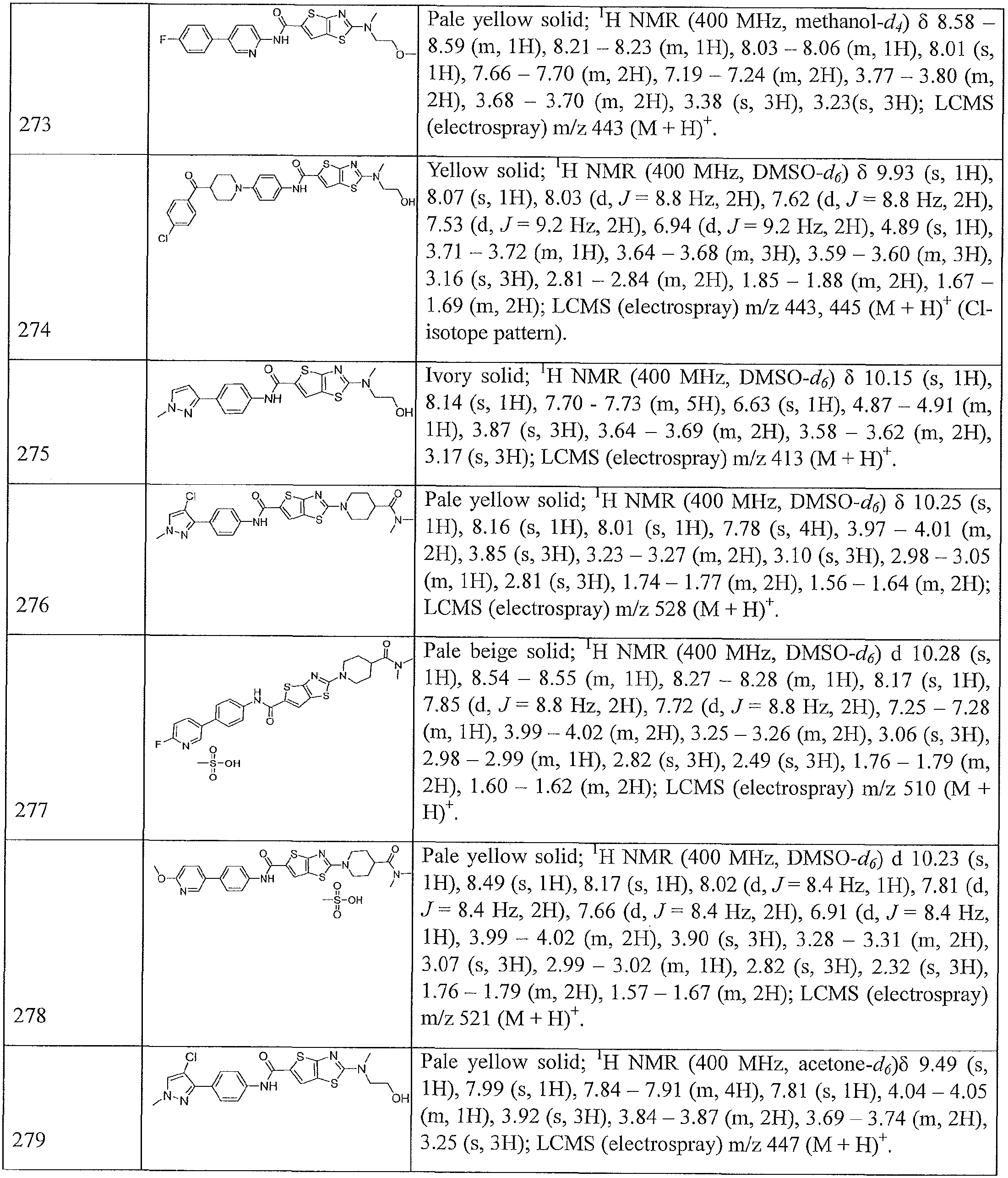
- Table 1 summarizes compounds 1-360 in terms of their structures and corresponding characteristics.
- Table 2 summarizes the compounds (general scaffolds I-IV) with their respective inhibitory activities; the in vitro growth fluorescence assay (QUM) and the intracellular growth assay (QIM).
- Table 3 shows anti-bacterial activity for compound 83, 127, 144and compound 202on several multi-drug resistant (MDR) strains.
- Example 1 Determination the Minimum Inhibitory Concentration (MIC) or MIC 50 of new chemical entities against M. tuberculosis
- QIM intracellular
- QUM in vitro
- the precultured H37Rv-GFP bacteria were then placed into 7H9-10%ADS-0.05% media after centrifugation.
- H37Rv-GFP bacterial suspension diluted to 2x 10 6 CFU/mL (based on GFP fluorescence assessment and a reference curve) was then added to the pre-prepared 384 plates resulting in a final volume of 50ul containing 1% DMSO. Plates were incubated at 37°C, 5% C0 2 for 5 days. Mycobacterial growth was determined by measuring GFP -fluorescence using a Victor 3 reader (Perkin-Elmer Life Science). The results are summarized in Table 2.
- MDR Mycobacteri W77?multi-drug resistant
- Target compound F2 was synthesized according to general procedure for the synthesis of E3&E7.
- Target compound G3 was synthesized according to general procedure for the synthesis of E3&E7.
- Target compounds H6 & H7 were synthesized according to general procedure for the synthesis of E3&E7.
- Target compound Y3 was synthesized according to general procedure for the synthesis of A5- method 2.
- Target compound Y5 was synthesized according to general procedure for the synthesis of H3.
- Target compound Z4-a and Z4-b were synthesized according to general procedure for the synthesis of U6.
- Target compound AB2 was synthesized according to general procedure for the synthesis of U6.
- 1H NMR 400 MHz, acetone-i3 ⁇ 4) ⁇ 5.23 (s, 2H), 3.74 - 3.76 (m, 4H), 3.38 (s, 3H), 3.08 - 3.11 (m, 4H).
- Target compound AF2 was synthesized according to general procedure for the synthesis of
- Target compound AF3 was synthesized according to general procedure for the synthesis of E2&E5.
- Target compound AF5 was synthesized according to general procedure for the synthesis of
- MDR-33, 137 and 146 clinical isolates of multidrug-resistance tuberculosis Activity range:
- +++ indicates ⁇ 2 times of MIC50 on wild type strain (H37Rv).
Landscapes
- Chemical & Material Sciences (AREA)
- Organic Chemistry (AREA)
- Health & Medical Sciences (AREA)
- Animal Behavior & Ethology (AREA)
- Veterinary Medicine (AREA)
- Public Health (AREA)
- Medicinal Chemistry (AREA)
- General Health & Medical Sciences (AREA)
- Pharmacology & Pharmacy (AREA)
- Life Sciences & Earth Sciences (AREA)
- Epidemiology (AREA)
- Chemical Kinetics & Catalysis (AREA)
- Nuclear Medicine, Radiotherapy & Molecular Imaging (AREA)
- General Chemical & Material Sciences (AREA)
- Oncology (AREA)
- Communicable Diseases (AREA)
- Pulmonology (AREA)
- Pharmaceuticals Containing Other Organic And Inorganic Compounds (AREA)
- Saccharide Compounds (AREA)
- Quinoline Compounds (AREA)
- Thiazole And Isothizaole Compounds (AREA)
- Heterocyclic Carbon Compounds Containing A Hetero Ring Having Oxygen Or Sulfur (AREA)
- Nitrogen And Oxygen Or Sulfur-Condensed Heterocyclic Ring Systems (AREA)
Abstract
Description

















Claims




Priority Applications (8)
| Application Number | Priority Date | Filing Date | Title |
|---|---|---|---|
| CN201580044269.2A CN107027307B (en) | 2014-06-20 | 2015-06-22 | an anti-infective compound |
| JP2016573851A JP2017518339A (en) | 2014-06-20 | 2015-06-22 | Anti-infective compounds |
| RU2016150134A RU2753403C2 (en) | 2014-06-20 | 2015-06-22 | Anti-infectious compounds |
| EP15730783.6A EP3157904B1 (en) | 2014-06-20 | 2015-06-22 | Anti-infective compounds |
| KR1020177001735A KR102582563B1 (en) | 2014-06-20 | 2015-06-22 | Anti-infective compounds |
| US15/319,983 US11279714B2 (en) | 2014-06-20 | 2015-06-22 | Anti-infective compounds |
| PH12016502436A PH12016502436A1 (en) | 2014-06-20 | 2016-12-06 | Anti-infective compounds |
| US17/588,947 US12227524B2 (en) | 2014-06-20 | 2022-01-31 | Anti-infective compounds |
Applications Claiming Priority (2)
| Application Number | Priority Date | Filing Date | Title |
|---|---|---|---|
| US201462015056P | 2014-06-20 | 2014-06-20 | |
| US62/015,056 | 2014-06-20 |
Related Child Applications (2)
| Application Number | Title | Priority Date | Filing Date |
|---|---|---|---|
| US15/319,983 A-371-Of-International US11279714B2 (en) | 2014-06-20 | 2015-06-22 | Anti-infective compounds |
| US17/588,947 Division US12227524B2 (en) | 2014-06-20 | 2022-01-31 | Anti-infective compounds |
Publications (1)
| Publication Number | Publication Date |
|---|---|
| WO2015193506A1 true WO2015193506A1 (en) | 2015-12-23 |
Family
ID=54934897
Family Applications (1)
| Application Number | Title | Priority Date | Filing Date |
|---|---|---|---|
| PCT/EP2015/063982 Ceased WO2015193506A1 (en) | 2014-06-20 | 2015-06-22 | Anti-infective compounds |
Country Status (8)
| Country | Link |
|---|---|
| US (2) | US11279714B2 (en) |
| EP (1) | EP3157904B1 (en) |
| JP (1) | JP2017518339A (en) |
| KR (1) | KR102582563B1 (en) |
| CN (1) | CN107027307B (en) |
| PH (1) | PH12016502436A1 (en) |
| RU (1) | RU2753403C2 (en) |
| WO (1) | WO2015193506A1 (en) |
Cited By (20)
| Publication number | Priority date | Publication date | Assignee | Title |
|---|---|---|---|---|
| WO2018197257A1 (en) | 2017-04-24 | 2018-11-01 | Bayer Aktiengesellschaft | Condensed bicyclic heterocyclic-compound derivatives as pest control agents |
| US10280164B2 (en) | 2016-09-09 | 2019-05-07 | Incyte Corporation | Pyrazolopyridone compounds and uses thereof |
| US10435405B2 (en) | 2016-09-09 | 2019-10-08 | Incyte Corporation | Pyrazolopyridine compounds and uses thereof |
| WO2019196111A1 (en) * | 2018-04-13 | 2019-10-17 | 上海交通大学医学院附属瑞金医院 | Anti-tumor multidrug resistance of heteroaryl amide compound, use in treatment of cancers and protein-drug molecular complex |
| US10722495B2 (en) | 2017-09-08 | 2020-07-28 | Incyte Corporation | Cyanoindazole compounds and uses thereof |
| US10745388B2 (en) | 2018-02-20 | 2020-08-18 | Incyte Corporation | Indazole compounds and uses thereof |
| US10752635B2 (en) | 2018-02-20 | 2020-08-25 | Incyte Corporation | Indazole compounds and uses thereof |
| US10800761B2 (en) | 2018-02-20 | 2020-10-13 | Incyte Corporation | Carboxamide compounds and uses thereof |
| US10899755B2 (en) | 2018-08-08 | 2021-01-26 | Incyte Corporation | Benzothiazole compounds and uses thereof |
| US11014929B2 (en) | 2016-09-09 | 2021-05-25 | Incyte Corporation | Pyrazolopyrimidine compounds and uses thereof |
| US11014908B2 (en) | 2018-11-29 | 2021-05-25 | Pfizer Inc. | Chemical compounds |
| US11066394B2 (en) | 2019-08-06 | 2021-07-20 | Incyte Corporation | Solid forms of an HPK1 inhibitor |
| US11111247B2 (en) | 2018-09-25 | 2021-09-07 | Incyte Corporation | Pyrazolopyrimidine compounds and uses thereof |
| US11242343B2 (en) | 2016-09-09 | 2022-02-08 | Incyte Corporation | Pyrazolopyridine compounds and uses thereof |
| US11299473B2 (en) | 2018-04-13 | 2022-04-12 | Incyte Corporation | Benzimidazole and indole compounds and uses thereof |
| US11406624B2 (en) | 2017-02-15 | 2022-08-09 | Incyte Corporation | Pyrazolopyridine compounds and uses thereof |
| EP4034106A4 (en) * | 2019-09-26 | 2023-10-25 | The Global Alliance for TB Drug Development, Inc. | THIAZOLE CARBOXAMIDE COMPOUNDS AND THEIR USE FOR THE TREATMENT OF MYCOBACTERIAL INFECTIONS |
| US11878968B2 (en) | 2021-07-09 | 2024-01-23 | Plexium, Inc. | Aryl compounds and pharmaceutical compositions that modulate IKZF2 |
| WO2024026061A1 (en) * | 2022-07-29 | 2024-02-01 | Biogen Ma Inc. | Compounds for treating huntington's disease |
| WO2025165930A1 (en) * | 2024-01-31 | 2025-08-07 | Biogen Ma Inc. | Methods for treating spinal muscular atrophy |
Families Citing this family (16)
| Publication number | Priority date | Publication date | Assignee | Title |
|---|---|---|---|---|
| US10118890B2 (en) | 2014-10-10 | 2018-11-06 | The Research Foundation For The State University Of New York | Trifluoromethoxylation of arenes via intramolecular trifluoromethoxy group migration |
| JP2021008407A (en) * | 2017-10-02 | 2021-01-28 | 武田薬品工業株式会社 | Heterocyclic compound |
| WO2020097398A1 (en) | 2018-11-07 | 2020-05-14 | Dana-Farber Cancer Institute, Inc. | Benzothiazole derivatives and 7-aza-benzothiazole derivatives as janus kinase 2 inhibitors and uses thereof |
| WO2020097396A1 (en) | 2018-11-07 | 2020-05-14 | Dana-Farber Cancer Institute, Inc. | Benzimidazole derivatives and aza-benzimidazole derivatives as janus kinase 2 inhibitors and uses thereof |
| WO2020097400A1 (en) | 2018-11-07 | 2020-05-14 | Dana-Farber Cancer Institute, Inc. | Imidazopyridine derivatives and aza-imidazopyridine derivatives as janus kinase 2 inhibitors and uses thereof |
| CN110156710B (en) * | 2019-04-30 | 2022-10-28 | 贵州省中国科学院天然产物化学重点实验室(贵州医科大学天然产物化学重点实验室) | Preparation method of polysubstituted oxazole compound |
| CN110343076A (en) * | 2019-08-23 | 2019-10-18 | 苏州络森生物科技有限公司 | A kind of synthetic method of the bromo- 5- thiazole carboxylic acid ethyl ester of 4- |
| WO2021100942A1 (en) * | 2019-11-22 | 2021-05-27 | 재단법인 한국파스퇴르연구소 | Thienothiazolecarboxamide derivative which is antituberculous compound |
| WO2021226261A1 (en) | 2020-05-06 | 2021-11-11 | Ajax Therapeutics, Inc. | 6-heteroaryloxy benzimidazoles and azabenzimidazoles as jak2 inhibitors |
| MX2023000167A (en) * | 2020-07-02 | 2023-05-03 | Remix Therapeutics Inc | 5-[5-(piperidin-4-yl)thieno[3,2-c]pyrazol-2-yl]indazole derivatives and related compounds as modulators for splicing nucleic acids and for the treatment of proliferative diseases. |
| CN116940578A (en) * | 2020-07-02 | 2023-10-24 | 雷密克斯医疗公司 | 5- [5- (piperidin-4-yl) thieno [3,2-C ] pyrazol-2-yl ] indazole derivatives and related compounds as modulators for splicing nucleic acids and for the treatment of proliferative diseases |
| US12043632B2 (en) | 2020-12-23 | 2024-07-23 | Ajax Therapeutics, Inc. | 6-heteroaryloxy benzimidazoles and azabenzimidazoles as JAK2 inhibitors |
| WO2023086320A1 (en) | 2021-11-09 | 2023-05-19 | Ajax Therapeutics, Inc. | Forms and compositions of inhibitors of jak2 |
| CA3234638A1 (en) | 2021-11-09 | 2023-05-19 | Ajax Therapeutics, Inc. | 6-heteroaryloxy benzimidazoles and azabenzimidazoles as jak2 inhibitors |
| WO2024256554A1 (en) * | 2023-06-14 | 2024-12-19 | Glaxosmithkline Intellectual Property Development Limited | Heterocyclic compounds and their use in the treatment of mycobacterial infections |
| CN119431315B (en) * | 2024-09-12 | 2025-11-21 | 中国药科大学 | PRMT7 target inhibitor and application thereof |
Citations (3)
| Publication number | Priority date | Publication date | Assignee | Title |
|---|---|---|---|---|
| WO2009034546A2 (en) * | 2007-09-13 | 2009-03-19 | Actelion Pharmaceuticals Ltd | Trans-decahydroisoquinoline derivatives |
| WO2011163610A2 (en) * | 2010-06-25 | 2011-12-29 | Rutgers, The State University Of New Jersey | Antimicrobial agents |
| WO2014015167A2 (en) * | 2012-07-18 | 2014-01-23 | University Of Notre Dame Du Lac | 5,5-heteroaromatic anti-infective compounds |
Family Cites Families (8)
| Publication number | Priority date | Publication date | Assignee | Title |
|---|---|---|---|---|
| US6087380A (en) | 1949-11-24 | 2000-07-11 | Boehringer Ingelheim Pharma Kg | Disubstituted bicyclic heterocycles, the preparations and the use thereof as pharmaceutical compositions |
| US3551443A (en) * | 1968-10-30 | 1970-12-29 | Ciba Ltd | 2-phenylbenzoxazole derivatives |
| US6414008B1 (en) * | 1997-04-29 | 2002-07-02 | Boehringer Ingelheim Pharma Kg | Disubstituted bicyclic heterocycles, the preparation thereof, and their use as pharmaceutical compositions |
| US6110929A (en) * | 1998-07-28 | 2000-08-29 | 3M Innovative Properties Company | Oxazolo, thiazolo and selenazolo [4,5-c]-quinolin-4-amines and analogs thereof |
| TW200406413A (en) * | 2002-06-26 | 2004-05-01 | Glaxo Group Ltd | Compounds |
| ES2314460T3 (en) * | 2003-10-31 | 2009-03-16 | Otsuka Pharmaceutical Co., Ltd. | COMPOUNDS OF 2,3-DIHIDRO-6-NITROIMIDAZO (2,1-B) OXAZOL FOR THE TREATMENT OF TUBERCULOSIS. |
| DK2154966T3 (en) * | 2007-04-20 | 2013-11-18 | Univ New York State Res Found | Benzimidazoles and their pharmaceutical compositions |
| US8524444B2 (en) * | 2007-06-15 | 2013-09-03 | President And Fellows Of Harvard College | Methods and compositions for detections and modulating O-glycosylation |
-
2015
- 2015-06-22 WO PCT/EP2015/063982 patent/WO2015193506A1/en not_active Ceased
- 2015-06-22 CN CN201580044269.2A patent/CN107027307B/en active Active
- 2015-06-22 US US15/319,983 patent/US11279714B2/en active Active
- 2015-06-22 JP JP2016573851A patent/JP2017518339A/en active Pending
- 2015-06-22 EP EP15730783.6A patent/EP3157904B1/en active Active
- 2015-06-22 KR KR1020177001735A patent/KR102582563B1/en active Active
- 2015-06-22 RU RU2016150134A patent/RU2753403C2/en active
-
2016
- 2016-12-06 PH PH12016502436A patent/PH12016502436A1/en unknown
-
2022
- 2022-01-31 US US17/588,947 patent/US12227524B2/en active Active
Patent Citations (3)
| Publication number | Priority date | Publication date | Assignee | Title |
|---|---|---|---|---|
| WO2009034546A2 (en) * | 2007-09-13 | 2009-03-19 | Actelion Pharmaceuticals Ltd | Trans-decahydroisoquinoline derivatives |
| WO2011163610A2 (en) * | 2010-06-25 | 2011-12-29 | Rutgers, The State University Of New Jersey | Antimicrobial agents |
| WO2014015167A2 (en) * | 2012-07-18 | 2014-01-23 | University Of Notre Dame Du Lac | 5,5-heteroaromatic anti-infective compounds |
Non-Patent Citations (14)
| Title |
|---|
| AKERKAR A S ET AL: "Antimycobacterial activity of some quinolyl aryl sulfides, sulfones and ethers, in vitro", ANTIMICROBIAL AGENTS AND CHEMOTHERAPY, AMERICAN SOCIETY FOR MICROBIOLOGY, vol. 1, no. 5, 1 May 1972 (1972-05-01), pages 392 - 396, XP002964954, ISSN: 0066-4804 * |
| ANANTHAN S ET AL: "High-throughput screening for inhibitors of Mycobacterium tuberculosis H37Rv", TUBERCULOSIS, ELSEVIER, GB, vol. 89, no. 5, 1 September 2009 (2009-09-01), pages 334 - 353, XP026732373, ISSN: 1472-9792, [retrieved on 20090915], DOI: 10.1016/J.TUBE.2009.05.008 * |
| BAN SYOICHI: "Studies on chemotherapeutics. XXXIX. Synthesis of imidazo compounds. IV. Imidazo[2,1-b]thiadiazole derivatives.", YAKUGAKU ZASSHI = JOURNAL OF THE PHARMACEUTICAL SOCIETY OF JAPAN, vol. 74, no. 6, 1 January 1954 (1954-01-01), JP, pages 658 - 661, XP055182683, ISSN: 0031-6903 * |
| DE SOUZA M V N ET AL: "Synthesis and in vitro antitubercular activity of a series of quinoline derivatives", BIOORGANIC & MEDICINAL CHEMISTRY, PERGAMON, GB, vol. 17, no. 4, 15 February 2009 (2009-02-15), pages 1474 - 1480, XP025949552, ISSN: 0968-0896, [retrieved on 20090115], DOI: 10.1016/J.BMC.2009.01.013 * |
| JOSEPH P. MICHAEL: "Quinoline, quinazoline and acridone alkaloids", NATURAL PRODUCT REPORTS, vol. 17, no. 6, 1 January 2000 (2000-01-01), pages 603 - 620, XP055205853, ISSN: 0265-0568, DOI: 10.1039/a904850b * |
| KENNETH CLARKE ET AL: "Condensed isothiazoles. Part 5. Thieno[2,3-d]isothiazoles and thieno[3,2-d]isothiazoles", JOURNAL OF THE CHEMICAL SOCIETY, PERKIN TRANSACTIONS 1, 1 January 1980 (1980-01-01), pages 1029, XP055217969, ISSN: 0300-922X, DOI: 10.1039/p19800001029 * |
| LEIF GREHN: "Bromine-induced cyclization of 1-acyl-3-(3-thienyl)-2-thioureas to 2-acylaminothieno[3,2- d ]thiazoles", JOURNAL OF HETEROCYCLIC CHEMISTRY, vol. 15, no. 1, 1 January 1978 (1978-01-01), pages 81 - 87, XP055217964, ISSN: 0022-152X, DOI: 10.1002/jhet.5570150118 * |
| N. YA. KVITKO ET AL: "Synthesis of 2-phenylthieno[3,2-d]oxazole and 2-phenylthieno[3,2-d]thiazole", CHEMISTRY OF HETEROCYCLIC COMPOUNDS, vol. 15, no. 4, 1 April 1979 (1979-04-01), pages 384 - 386, XP055217957, ISSN: 0009-3122, DOI: 10.1007/BF00471769 * |
| NAYYAR A ET AL: "3D-QSAR study of ring-substituted quinoline class of anti-tuberculosis agents", BIOORGANIC & MEDICINAL CHEMISTRY, PERGAMON, GB, vol. 14, no. 3, 1 February 2006 (2006-02-01), pages 847 - 856, XP027992333, ISSN: 0968-0896, [retrieved on 20060201] * |
| RAKESH YADAV ET AL: "Novel Biphenyl Imidazo[2,1 midazo[2,1-b][1,3,4]-Thiadiazole -a versatile scaffold", DHR INTERNATIONAL JOURNAL OF PHARMACEUTICAL SCIENCES (DHR SCIENCES (DHR-IJPS), 1 January 2012 (2012-01-01), XP055217988, Retrieved from the Internet <URL:http://www.researchgate.net/profile/Divya_Yadav/publication/245031137_Novel_Biphenyl_Imidazo21-b134-Thiadiazole_-a_versatile_scaffold/links/0c96051d6736a98f31000000.pdf?inViewer=true&disableCoverPage=true&origin=publication_detail> [retrieved on 20151002] * |
| SUSAN E. KNUDSON ET AL: "A Trisubstituted Benzimidazole Cell Division Inhibitor with Efficacy against Mycobacterium tuberculosis", PLOS ONE, vol. 9, no. 4, 15 April 2014 (2014-04-15), pages e93953, XP055205851, DOI: 10.1371/journal.pone.0093953 * |
| TERZIOGLU N ET AL: "Synthesis and anticancer evaluation of some new hydrazone derivatives of 2,6-dimethylimidazo[2,1-b][1,3,4]thiadiazole-5-carbohydrazide", EUROPEAN JOURNAL OF MEDICINAL CHEMISTRY, EDITIONS SCIENTIFIQUE ELSEVIER, PARIS, FR, vol. 38, no. 7-8, 1 July 2003 (2003-07-01), pages 781 - 786, XP004448330, ISSN: 0223-5234, DOI: 10.1016/S0223-5234(03)00138-7 * |
| VANGAPANDU S ET AL: "Ring-substituted quinolines as potential anti-tuberculosis agents", BIOORGANIC & MEDICINAL CHEMISTRY, PERGAMON, GB, vol. 12, 1 January 2004 (2004-01-01), pages 2501 - 2508, XP002469287, ISSN: 0968-0896, DOI: 10.1016/J.BMC.2004.03.045 * |
| WADDELL S T ET AL: "Benzothiazolylthio Carbapenems: Potent Anti-MRSA Agents", BIOORGANIC & MEDICINAL CHEMISTRY LETTERS, PERGAMON, AMSTERDAM, NL, vol. 5, no. 13, 6 July 1995 (1995-07-06), pages 1427 - 1432, XP004135463, ISSN: 0960-894X, DOI: 10.1016/0960-894X(95)00235-L * |
Cited By (34)
| Publication number | Priority date | Publication date | Assignee | Title |
|---|---|---|---|---|
| US11542265B2 (en) | 2016-09-09 | 2023-01-03 | Incyte Corporation | Pyrazolopyrimidine compounds and uses thereof |
| US10280164B2 (en) | 2016-09-09 | 2019-05-07 | Incyte Corporation | Pyrazolopyridone compounds and uses thereof |
| US10435405B2 (en) | 2016-09-09 | 2019-10-08 | Incyte Corporation | Pyrazolopyridine compounds and uses thereof |
| US11891388B2 (en) | 2016-09-09 | 2024-02-06 | Incyte Corporation | Pyrazolopyridine compounds and uses thereof |
| US11795166B2 (en) | 2016-09-09 | 2023-10-24 | Incyte Corporation | Pyrazolopyridine compounds and uses thereof |
| US12384778B2 (en) | 2016-09-09 | 2025-08-12 | Incyte Corporation | Pyrazolopyridine compounds and uses thereof |
| US10934288B2 (en) | 2016-09-09 | 2021-03-02 | Incyte Corporation | Pyrazolopyridine compounds and uses thereof |
| US11014929B2 (en) | 2016-09-09 | 2021-05-25 | Incyte Corporation | Pyrazolopyrimidine compounds and uses thereof |
| US12516059B2 (en) | 2016-09-09 | 2026-01-06 | Incyte Corporation | Pyrazolopyridine compounds and uses thereof |
| US11242343B2 (en) | 2016-09-09 | 2022-02-08 | Incyte Corporation | Pyrazolopyridine compounds and uses thereof |
| US11406624B2 (en) | 2017-02-15 | 2022-08-09 | Incyte Corporation | Pyrazolopyridine compounds and uses thereof |
| WO2018197257A1 (en) | 2017-04-24 | 2018-11-01 | Bayer Aktiengesellschaft | Condensed bicyclic heterocyclic-compound derivatives as pest control agents |
| US10722495B2 (en) | 2017-09-08 | 2020-07-28 | Incyte Corporation | Cyanoindazole compounds and uses thereof |
| US10745388B2 (en) | 2018-02-20 | 2020-08-18 | Incyte Corporation | Indazole compounds and uses thereof |
| US12466815B2 (en) | 2018-02-20 | 2025-11-11 | Incyte Corporation | Carboxamide compounds and uses thereof |
| US10800761B2 (en) | 2018-02-20 | 2020-10-13 | Incyte Corporation | Carboxamide compounds and uses thereof |
| US11492354B2 (en) | 2018-02-20 | 2022-11-08 | Incyte Corporation | Indazole compounds and uses thereof |
| US10752635B2 (en) | 2018-02-20 | 2020-08-25 | Incyte Corporation | Indazole compounds and uses thereof |
| US11731958B2 (en) | 2018-02-20 | 2023-08-22 | Incyte Corporation | Carboxamide compounds and uses thereof |
| US11299473B2 (en) | 2018-04-13 | 2022-04-12 | Incyte Corporation | Benzimidazole and indole compounds and uses thereof |
| WO2019196111A1 (en) * | 2018-04-13 | 2019-10-17 | 上海交通大学医学院附属瑞金医院 | Anti-tumor multidrug resistance of heteroaryl amide compound, use in treatment of cancers and protein-drug molecular complex |
| US10899755B2 (en) | 2018-08-08 | 2021-01-26 | Incyte Corporation | Benzothiazole compounds and uses thereof |
| US11866426B2 (en) | 2018-08-08 | 2024-01-09 | Incyte Corporation | Benzothiazole compounds and uses thereof |
| US11111247B2 (en) | 2018-09-25 | 2021-09-07 | Incyte Corporation | Pyrazolopyrimidine compounds and uses thereof |
| US12441731B2 (en) | 2018-09-25 | 2025-10-14 | Incyte Corporation | Pyrazolopyrimidine compounds and uses thereof |
| US11702405B2 (en) | 2018-11-29 | 2023-07-18 | Pfizer Inc. | Chemical compounds |
| US12103921B2 (en) | 2018-11-29 | 2024-10-01 | Pfizer Inc. | Chemical compounds |
| US11014908B2 (en) | 2018-11-29 | 2021-05-25 | Pfizer Inc. | Chemical compounds |
| US11787784B2 (en) | 2019-08-06 | 2023-10-17 | Incyte Corporation | Solid forms of an HPK1 inhibitor |
| US11066394B2 (en) | 2019-08-06 | 2021-07-20 | Incyte Corporation | Solid forms of an HPK1 inhibitor |
| EP4034106A4 (en) * | 2019-09-26 | 2023-10-25 | The Global Alliance for TB Drug Development, Inc. | THIAZOLE CARBOXAMIDE COMPOUNDS AND THEIR USE FOR THE TREATMENT OF MYCOBACTERIAL INFECTIONS |
| US11878968B2 (en) | 2021-07-09 | 2024-01-23 | Plexium, Inc. | Aryl compounds and pharmaceutical compositions that modulate IKZF2 |
| WO2024026061A1 (en) * | 2022-07-29 | 2024-02-01 | Biogen Ma Inc. | Compounds for treating huntington's disease |
| WO2025165930A1 (en) * | 2024-01-31 | 2025-08-07 | Biogen Ma Inc. | Methods for treating spinal muscular atrophy |
Also Published As
| Publication number | Publication date |
|---|---|
| RU2753403C2 (en) | 2021-08-16 |
| US20170121349A1 (en) | 2017-05-04 |
| PH12016502436A1 (en) | 2017-03-06 |
| CN107027307A (en) | 2017-08-08 |
| JP2017518339A (en) | 2017-07-06 |
| KR102582563B1 (en) | 2023-09-25 |
| RU2016150134A (en) | 2018-07-23 |
| RU2016150134A3 (en) | 2018-10-05 |
| KR20170030535A (en) | 2017-03-17 |
| EP3157904A1 (en) | 2017-04-26 |
| US12227524B2 (en) | 2025-02-18 |
| US20220153756A1 (en) | 2022-05-19 |
| US11279714B2 (en) | 2022-03-22 |
| EP3157904B1 (en) | 2020-11-18 |
| CN107027307B (en) | 2020-12-22 |
Similar Documents
| Publication | Publication Date | Title |
|---|---|---|
| US12227524B2 (en) | Anti-infective compounds | |
| RU2734760C2 (en) | Anti-infectious compounds | |
| WO2017215464A1 (en) | Trans-indoline cyclopropylamine chemical compound, and method for preparation, pharmaceutical composition, and use thereof | |
| TWI572593B (en) | Tetrahydro-quinazolinone derivatives | |
| RS57375B1 (en) | Heterocycle amines and uses thereof | |
| AU2014209107A1 (en) | Metalloenzyme inhibitor compounds | |
| AU2015336035A1 (en) | Ethyl n-boc piperidinyl pyrazolo pyridones as Janus kinase inhibitors | |
| US11873292B2 (en) | Trans-indoline cyclopropylamine chemical compound, and method for preparation, pharmaceutical composition, and use thereof | |
| JP6343034B2 (en) | Naphthyridinedione derivatives | |
| KR20070086188A (en) | Kinase inhibitors | |
| AU2014234908B2 (en) | N-(2-cyano heterocyclyl)pyrazolo pyridones as Janus kinase inhibitors | |
| JP2011505373A (en) | Bicyclic PPAT inhibitors as antibacterial agents | |
| WO2023185073A1 (en) | Parp7 inhibitor and use thereof | |
| EP2914589A1 (en) | Compounds for use in the treatment of parasitic diseases | |
| CA3225596A1 (en) | Inhibitors targeting ubiquitin specific protease 7 (usp7) | |
| AU2008350293A1 (en) | Antibiotic tetrahydro-beta-carboline derivatives | |
| AU2024225659A1 (en) | Aryl substituent-containing degradation agent for cdk12/13, preparation method therefor, and pharmaceutical composition and use thereof | |
| CA3233233A1 (en) | Substituted 1h-pyrazolo [4,3-c] quinolines, methods of preparation, and use thereof | |
| WO2025176178A1 (en) | Novel cdk12/13 covalent inhibitor having a fused ring structure substituent or pharmaceutical composition thereof and use thereof | |
| JP2025535036A (en) | PARG inhibitor compounds | |
| WO2022159491A1 (en) | Rifamycin analogs | |
| HK40083035B (en) | Parp7 inhibitor and use thereof | |
| WO2012038905A1 (en) | Thienopyridine nicotinamide derivatives, preparation thereof and therapeutic use thereof |
Legal Events
| Date | Code | Title | Description |
|---|---|---|---|
| 121 | Ep: the epo has been informed by wipo that ep was designated in this application |
Ref document number: 15730783 Country of ref document: EP Kind code of ref document: A1 |
|
| WWE | Wipo information: entry into national phase |
Ref document number: 12016502436 Country of ref document: PH |
|
| ENP | Entry into the national phase |
Ref document number: 2016573851 Country of ref document: JP Kind code of ref document: A |
|
| WWE | Wipo information: entry into national phase |
Ref document number: 15319983 Country of ref document: US |
|
| NENP | Non-entry into the national phase |
Ref country code: DE |
|
| REEP | Request for entry into the european phase |
Ref document number: 2015730783 Country of ref document: EP |
|
| WWE | Wipo information: entry into national phase |
Ref document number: 2015730783 Country of ref document: EP |
|
| ENP | Entry into the national phase |
Ref document number: 20177001735 Country of ref document: KR Kind code of ref document: A |
|
| ENP | Entry into the national phase |
Ref document number: 2016150134 Country of ref document: RU Kind code of ref document: A |