WO2015161989A1 - Hole-transport materials for organic solar cells or organic optical sensors - Google Patents
Hole-transport materials for organic solar cells or organic optical sensors Download PDFInfo
- Publication number
- WO2015161989A1 WO2015161989A1 PCT/EP2015/056960 EP2015056960W WO2015161989A1 WO 2015161989 A1 WO2015161989 A1 WO 2015161989A1 EP 2015056960 W EP2015056960 W EP 2015056960W WO 2015161989 A1 WO2015161989 A1 WO 2015161989A1
- Authority
- WO
- WIPO (PCT)
- Prior art keywords
- groups
- mmol
- organic
- compound
- solar cell
- Prior art date
- Legal status (The legal status is an assumption and is not a legal conclusion. Google has not performed a legal analysis and makes no representation as to the accuracy of the status listed.)
- Ceased
Links
- ILZNOZFLPPHWCU-UHFFFAOYSA-N CN1c(ccc(C=C(c2c3)c4cc(Br)ccc4-c2ccc3Br)c2)c2Sc2c1ccc(C=C(c1c3)c4cc(Br)ccc4-c1ccc3Br)c2 Chemical compound CN1c(ccc(C=C(c2c3)c4cc(Br)ccc4-c2ccc3Br)c2)c2Sc2c1ccc(C=C(c1c3)c4cc(Br)ccc4-c1ccc3Br)c2 ILZNOZFLPPHWCU-UHFFFAOYSA-N 0.000 description 1
Classifications
-
- C—CHEMISTRY; METALLURGY
- C09—DYES; PAINTS; POLISHES; NATURAL RESINS; ADHESIVES; COMPOSITIONS NOT OTHERWISE PROVIDED FOR; APPLICATIONS OF MATERIALS NOT OTHERWISE PROVIDED FOR
- C09K—MATERIALS FOR MISCELLANEOUS APPLICATIONS, NOT PROVIDED FOR ELSEWHERE
- C09K11/00—Luminescent, e.g. electroluminescent, chemiluminescent materials
- C09K11/06—Luminescent, e.g. electroluminescent, chemiluminescent materials containing organic luminescent materials
-
- C—CHEMISTRY; METALLURGY
- C07—ORGANIC CHEMISTRY
- C07C—ACYCLIC OR CARBOCYCLIC COMPOUNDS
- C07C217/00—Compounds containing amino and etherified hydroxy groups bound to the same carbon skeleton
- C07C217/78—Compounds containing amino and etherified hydroxy groups bound to the same carbon skeleton having amino groups and etherified hydroxy groups bound to carbon atoms of six-membered aromatic rings of the same carbon skeleton
- C07C217/80—Compounds containing amino and etherified hydroxy groups bound to the same carbon skeleton having amino groups and etherified hydroxy groups bound to carbon atoms of six-membered aromatic rings of the same carbon skeleton having amino groups and etherified hydroxy groups bound to carbon atoms of non-condensed six-membered aromatic rings
- C07C217/82—Compounds containing amino and etherified hydroxy groups bound to the same carbon skeleton having amino groups and etherified hydroxy groups bound to carbon atoms of six-membered aromatic rings of the same carbon skeleton having amino groups and etherified hydroxy groups bound to carbon atoms of non-condensed six-membered aromatic rings of the same non-condensed six-membered aromatic ring
- C07C217/92—Compounds containing amino and etherified hydroxy groups bound to the same carbon skeleton having amino groups and etherified hydroxy groups bound to carbon atoms of six-membered aromatic rings of the same carbon skeleton having amino groups and etherified hydroxy groups bound to carbon atoms of non-condensed six-membered aromatic rings of the same non-condensed six-membered aromatic ring the nitrogen atom of at least one of the amino groups being further bound to a carbon atom of a six-membered aromatic ring
-
- C—CHEMISTRY; METALLURGY
- C07—ORGANIC CHEMISTRY
- C07C—ACYCLIC OR CARBOCYCLIC COMPOUNDS
- C07C217/00—Compounds containing amino and etherified hydroxy groups bound to the same carbon skeleton
- C07C217/78—Compounds containing amino and etherified hydroxy groups bound to the same carbon skeleton having amino groups and etherified hydroxy groups bound to carbon atoms of six-membered aromatic rings of the same carbon skeleton
- C07C217/94—Compounds containing amino and etherified hydroxy groups bound to the same carbon skeleton having amino groups and etherified hydroxy groups bound to carbon atoms of six-membered aromatic rings of the same carbon skeleton having amino groups bound to carbon atoms of six-membered aromatic rings being part of condensed ring systems and etherified hydroxy groups bound to carbon atoms of six-membered aromatic rings of the same carbon skeleton
-
- C—CHEMISTRY; METALLURGY
- C07—ORGANIC CHEMISTRY
- C07D—HETEROCYCLIC COMPOUNDS
- C07D279/00—Heterocyclic compounds containing six-membered rings having one nitrogen atom and one sulfur atom as the only ring hetero atoms
- C07D279/10—1,4-Thiazines; Hydrogenated 1,4-thiazines
- C07D279/14—1,4-Thiazines; Hydrogenated 1,4-thiazines condensed with carbocyclic rings or ring systems
- C07D279/18—[b, e]-condensed with two six-membered rings
- C07D279/22—[b, e]-condensed with two six-membered rings with carbon atoms directly attached to the ring nitrogen atom
-
- C—CHEMISTRY; METALLURGY
- C07—ORGANIC CHEMISTRY
- C07D—HETEROCYCLIC COMPOUNDS
- C07D333/00—Heterocyclic compounds containing five-membered rings having one sulfur atom as the only ring hetero atom
- C07D333/02—Heterocyclic compounds containing five-membered rings having one sulfur atom as the only ring hetero atom not condensed with other rings
- C07D333/04—Heterocyclic compounds containing five-membered rings having one sulfur atom as the only ring hetero atom not condensed with other rings not substituted on the ring sulphur atom
- C07D333/06—Heterocyclic compounds containing five-membered rings having one sulfur atom as the only ring hetero atom not condensed with other rings not substituted on the ring sulphur atom with only hydrogen atoms, hydrocarbon or substituted hydrocarbon radicals, directly attached to the ring carbon atoms
- C07D333/14—Radicals substituted by singly bound hetero atoms other than halogen
- C07D333/20—Radicals substituted by singly bound hetero atoms other than halogen by nitrogen atoms
-
- C—CHEMISTRY; METALLURGY
- C09—DYES; PAINTS; POLISHES; NATURAL RESINS; ADHESIVES; COMPOSITIONS NOT OTHERWISE PROVIDED FOR; APPLICATIONS OF MATERIALS NOT OTHERWISE PROVIDED FOR
- C09B—ORGANIC DYES OR CLOSELY-RELATED COMPOUNDS FOR PRODUCING DYES, e.g. PIGMENTS; MORDANTS; LAKES
- C09B21/00—Thiazine dyes
-
- C—CHEMISTRY; METALLURGY
- C09—DYES; PAINTS; POLISHES; NATURAL RESINS; ADHESIVES; COMPOSITIONS NOT OTHERWISE PROVIDED FOR; APPLICATIONS OF MATERIALS NOT OTHERWISE PROVIDED FOR
- C09B—ORGANIC DYES OR CLOSELY-RELATED COMPOUNDS FOR PRODUCING DYES, e.g. PIGMENTS; MORDANTS; LAKES
- C09B23/00—Methine or polymethine dyes, e.g. cyanine dyes
- C09B23/02—Methine or polymethine dyes, e.g. cyanine dyes the polymethine chain containing an odd number of >CH- or >C[alkyl]- groups
- C09B23/04—Methine or polymethine dyes, e.g. cyanine dyes the polymethine chain containing an odd number of >CH- or >C[alkyl]- groups one >CH- group, e.g. cyanines, isocyanines, pseudocyanines
-
- C—CHEMISTRY; METALLURGY
- C09—DYES; PAINTS; POLISHES; NATURAL RESINS; ADHESIVES; COMPOSITIONS NOT OTHERWISE PROVIDED FOR; APPLICATIONS OF MATERIALS NOT OTHERWISE PROVIDED FOR
- C09B—ORGANIC DYES OR CLOSELY-RELATED COMPOUNDS FOR PRODUCING DYES, e.g. PIGMENTS; MORDANTS; LAKES
- C09B23/00—Methine or polymethine dyes, e.g. cyanine dyes
- C09B23/14—Styryl dyes
- C09B23/141—Bis styryl dyes containing two radicals C6H5-CH=CH-
-
- C—CHEMISTRY; METALLURGY
- C09—DYES; PAINTS; POLISHES; NATURAL RESINS; ADHESIVES; COMPOSITIONS NOT OTHERWISE PROVIDED FOR; APPLICATIONS OF MATERIALS NOT OTHERWISE PROVIDED FOR
- C09B—ORGANIC DYES OR CLOSELY-RELATED COMPOUNDS FOR PRODUCING DYES, e.g. PIGMENTS; MORDANTS; LAKES
- C09B57/00—Other synthetic dyes of known constitution
- C09B57/008—Triarylamine dyes containing no other chromophores
-
- H—ELECTRICITY
- H05—ELECTRIC TECHNIQUES NOT OTHERWISE PROVIDED FOR
- H05B—ELECTRIC HEATING; ELECTRIC LIGHT SOURCES NOT OTHERWISE PROVIDED FOR; CIRCUIT ARRANGEMENTS FOR ELECTRIC LIGHT SOURCES, IN GENERAL
- H05B33/00—Electroluminescent light sources
- H05B33/10—Apparatus or processes specially adapted to the manufacture of electroluminescent light sources
-
- H—ELECTRICITY
- H10—SEMICONDUCTOR DEVICES; ELECTRIC SOLID-STATE DEVICES NOT OTHERWISE PROVIDED FOR
- H10K—ORGANIC ELECTRIC SOLID-STATE DEVICES
- H10K85/00—Organic materials used in the body or electrodes of devices covered by this subclass
- H10K85/50—Organic perovskites; Hybrid organic-inorganic perovskites [HOIP], e.g. CH3NH3PbI3
-
- H—ELECTRICITY
- H10—SEMICONDUCTOR DEVICES; ELECTRIC SOLID-STATE DEVICES NOT OTHERWISE PROVIDED FOR
- H10K—ORGANIC ELECTRIC SOLID-STATE DEVICES
- H10K85/00—Organic materials used in the body or electrodes of devices covered by this subclass
- H10K85/60—Organic compounds having low molecular weight
- H10K85/631—Amine compounds having at least two aryl rest on at least one amine-nitrogen atom, e.g. triphenylamine
- H10K85/633—Amine compounds having at least two aryl rest on at least one amine-nitrogen atom, e.g. triphenylamine comprising polycyclic condensed aromatic hydrocarbons as substituents on the nitrogen atom
-
- C—CHEMISTRY; METALLURGY
- C07—ORGANIC CHEMISTRY
- C07C—ACYCLIC OR CARBOCYCLIC COMPOUNDS
- C07C2603/00—Systems containing at least three condensed rings
- C07C2603/02—Ortho- or ortho- and peri-condensed systems
- C07C2603/04—Ortho- or ortho- and peri-condensed systems containing three rings
- C07C2603/06—Ortho- or ortho- and peri-condensed systems containing three rings containing at least one ring with less than six ring members
- C07C2603/10—Ortho- or ortho- and peri-condensed systems containing three rings containing at least one ring with less than six ring members containing five-membered rings
- C07C2603/12—Ortho- or ortho- and peri-condensed systems containing three rings containing at least one ring with less than six ring members containing five-membered rings only one five-membered ring
- C07C2603/18—Fluorenes; Hydrogenated fluorenes
-
- C—CHEMISTRY; METALLURGY
- C09—DYES; PAINTS; POLISHES; NATURAL RESINS; ADHESIVES; COMPOSITIONS NOT OTHERWISE PROVIDED FOR; APPLICATIONS OF MATERIALS NOT OTHERWISE PROVIDED FOR
- C09K—MATERIALS FOR MISCELLANEOUS APPLICATIONS, NOT PROVIDED FOR ELSEWHERE
- C09K2211/00—Chemical nature of organic luminescent or tenebrescent compounds
- C09K2211/10—Non-macromolecular compounds
- C09K2211/1003—Carbocyclic compounds
- C09K2211/1007—Non-condensed systems
-
- C—CHEMISTRY; METALLURGY
- C09—DYES; PAINTS; POLISHES; NATURAL RESINS; ADHESIVES; COMPOSITIONS NOT OTHERWISE PROVIDED FOR; APPLICATIONS OF MATERIALS NOT OTHERWISE PROVIDED FOR
- C09K—MATERIALS FOR MISCELLANEOUS APPLICATIONS, NOT PROVIDED FOR ELSEWHERE
- C09K2211/00—Chemical nature of organic luminescent or tenebrescent compounds
- C09K2211/10—Non-macromolecular compounds
- C09K2211/1003—Carbocyclic compounds
- C09K2211/1011—Condensed systems
-
- C—CHEMISTRY; METALLURGY
- C09—DYES; PAINTS; POLISHES; NATURAL RESINS; ADHESIVES; COMPOSITIONS NOT OTHERWISE PROVIDED FOR; APPLICATIONS OF MATERIALS NOT OTHERWISE PROVIDED FOR
- C09K—MATERIALS FOR MISCELLANEOUS APPLICATIONS, NOT PROVIDED FOR ELSEWHERE
- C09K2211/00—Chemical nature of organic luminescent or tenebrescent compounds
- C09K2211/10—Non-macromolecular compounds
- C09K2211/1003—Carbocyclic compounds
- C09K2211/1014—Carbocyclic compounds bridged by heteroatoms, e.g. N, P, Si or B
-
- H—ELECTRICITY
- H01—ELECTRIC ELEMENTS
- H01G—CAPACITORS; CAPACITORS, RECTIFIERS, DETECTORS, SWITCHING DEVICES, LIGHT-SENSITIVE OR TEMPERATURE-SENSITIVE DEVICES OF THE ELECTROLYTIC TYPE
- H01G9/00—Electrolytic capacitors, rectifiers, detectors, switching devices, light-sensitive or temperature-sensitive devices; Processes of their manufacture
- H01G9/20—Light-sensitive devices
- H01G9/2004—Light-sensitive devices characterised by the electrolyte, e.g. comprising an organic electrolyte
-
- H—ELECTRICITY
- H10—SEMICONDUCTOR DEVICES; ELECTRIC SOLID-STATE DEVICES NOT OTHERWISE PROVIDED FOR
- H10K—ORGANIC ELECTRIC SOLID-STATE DEVICES
- H10K30/00—Organic devices sensitive to infrared radiation, light, electromagnetic radiation of shorter wavelength or corpuscular radiation
- H10K30/50—Photovoltaic [PV] devices
-
- H—ELECTRICITY
- H10—SEMICONDUCTOR DEVICES; ELECTRIC SOLID-STATE DEVICES NOT OTHERWISE PROVIDED FOR
- H10K—ORGANIC ELECTRIC SOLID-STATE DEVICES
- H10K85/00—Organic materials used in the body or electrodes of devices covered by this subclass
- H10K85/60—Organic compounds having low molecular weight
- H10K85/649—Aromatic compounds comprising a hetero atom
- H10K85/655—Aromatic compounds comprising a hetero atom comprising only sulfur as heteroatom
-
- Y—GENERAL TAGGING OF NEW TECHNOLOGICAL DEVELOPMENTS; GENERAL TAGGING OF CROSS-SECTIONAL TECHNOLOGIES SPANNING OVER SEVERAL SECTIONS OF THE IPC; TECHNICAL SUBJECTS COVERED BY FORMER USPC CROSS-REFERENCE ART COLLECTIONS [XRACs] AND DIGESTS
- Y02—TECHNOLOGIES OR APPLICATIONS FOR MITIGATION OR ADAPTATION AGAINST CLIMATE CHANGE
- Y02E—REDUCTION OF GREENHOUSE GAS [GHG] EMISSIONS, RELATED TO ENERGY GENERATION, TRANSMISSION OR DISTRIBUTION
- Y02E10/00—Energy generation through renewable energy sources
- Y02E10/50—Photovoltaic [PV] energy
- Y02E10/549—Organic PV cells
Definitions
- the present invention relates to hole-transport materials.
- the present invention further relates to the use of these materials in organic solar cells or organic optical sensors.
- the present invention also relates to organic solar cells or organic optical sensors.
- Organic solar cells and organic optical sensors are promising alternatives to conventional inor- ganic devices mostly based on silicon. It is expected that they can be produced at low cost on large-area flexible substrates by means of printing techniques. However, the solar-to-electrical energy conversion efficiencies and the long-term stability have not yet reached those of the conventional inorganic devices. Therefore, intensive research resources are invested with the goal to improve the efficiency and stability of organic solar cells and organic optical sensors.
- A is a group which connects all L moieties by a ⁇ -conjugated system which is formed by olefinic groups, aromatic groups, heteroaromatic groups, sandwich groups, atoms with unbound electron pairs, or combinations thereof,
- Z is hydrogen, an alkyl group, an aryl group, or a heteroaryl group
- R 1 , R 2 , R 3 , R 4 are independent of each other alkyl groups, aryl groups, or heteroaryl groups
- n is an integer of at least 2.
- the present invention further relates to the use of the compound of general formula (I) accord- ing to the present invention in organic solar cells or organic optical sensors.
- the present invention further relates to an organic solar cell or organic optical sensor comprising a compound of general formula (I) according to the present invention.
- a in general formula (I) is a group which connects all L moieties by a TT-conjugated system which is formed by olefinic groups, aromatic groups, heteroaro- matic groups, sandwich compounds, atoms with unbound electron pairs, or combinations there- of.
- a TT-conjugated system which is formed by olefinic groups, aromatic groups, heteroaro- matic groups, sandwich compounds, atoms with unbound electron pairs, or combinations there- of.
- the ⁇ -conjugated system in A is formed by aromatic and/or heteroaromatic groups. More preferably the ⁇ -conjugated system in A is formed by benzene.
- Olefinic groups can be noncyclic like vinylene and 1 ,3-butadienyl or cylic like in cyclopentenyl and 1 ,3-cyclohexadienyl.
- Noncyclic groups are preferred, in particular vinylene.
- Aromatic groups include five-membered rings like the cyclopentadiene anion and six-membered rings like benzene. It is also possible that several aromatic rings are fused such as in naphthalene, anthracene, phenanthrene, the indene anion or the fluorene anion.
- Heteroaromatic groups include five-membered rings like furane, pyrrole, thiophene, seleno- phene, oxazole, isoxazole, imidazole, thiazole, isothiazole, triazole or tetrazole and six- membered rings like pyridine, pyridazine, pyridimine, pyrazine, triazine, or tetrazine.
- heteroaromatic rings are fused with aromatic rings such as in benzofurane, indole, benzothiophene, benzoselenophene, dibenzofurane, carbazole, dibenzothiophene, dibenzose- lenophene, quinoline, isoquinoline or indazine.
- aromatic rings such as in benzofurane, indole, benzothiophene, benzoselenophene, dibenzofurane, carbazole, dibenzothiophene, dibenzose- lenophene, quinoline, isoquinoline or indazine.
- two or more heteroaromatic rings are fused such as in furanofurane, pyrrolopyrrole, thiophenothiophene, selenophe- noselenophene, furanopyrrole, pyrrolothiophene, di pyrrolopyrrole, dithiophenethiophen
- Sandwich groups are derived from sandwich compounds in which a metal atom is bound to two aromatic or heteroaromatic groups via haptic covalent bonds.
- Metals can be Cr, Fe, Co, Ni, Pb, Zr, Ru, Rh, Sm, Ti, V, Mo, W, Zn, preferably Fe, Co, Ni, in particular Fe.
- Aromatic groups in sandwich compounds are preferably cyclopendadiene or its derivatives such as indene or fluorene, cyclopentadiene is preferred.
- a preferred sandwich group is derived from ferrocene. Typical atoms with unbound electron pairs are nitrogen, oxygen, phosphor and sulfur, preferably nitrogen. According to the present invention it is possible that A is formed by a combination of two or more of the same or different groups mentioned before.
- Examples include several aromatic groups like in biphenyl or terphenyl; several heteroaromatic groups like bipyridine or dithio- phene; a combination of olefinic groups with aromatic groups like phenylene-vinylene; a combi- nation of olefinic groups with heteroaromatic groups like in thiophene-vinylene or pyridine- vinylene; combination of aromatic and heteroaromatic groups like in phenylthiophene or pyridi- nylpyrrole; a combination of aromatic groups with atoms with unbound electron pairs like tri- phenylamine, diphenylnaphthylamine, diphenylether, diphenylthioether or triphenylphosphane; a combination of heteroaromatic groups with atoms with unbound electron pairs like tripyridyla- mine or dithiophenylthioether; or a combination of several atoms with unbound electron pairs like hydrazine, azo groups,
- the groups L are connected to A in the compound of formula (I) via any atom which is part of the ⁇ -conjugated system in A.
- this can mean that the groups L in the compound of formula (I) are connected to the 1 ,2-position, to the 1 ,3-position or the 1 ,4 position of benzene if two groups L are present in the compound of formula (I).
- the groups L can be connected to the same aromatic or heteroaromatic group or to different ones as long as there is a TT-conjugated chain of atoms between the connection sites of L to A.
- Non-conjugated groups can be bound to the ⁇ -conjugated system in A as long as A connects all L moieties by a ⁇ -conjugated system.
- These include linear or branched alkyl chains; linear or branched alkoxy chains; polyethers like polyethylene oxide; halogens, namely fluoride, chloride, bromide, iodide; pseudohologens like cyanide, cyanate, thiocyanate; esters; amides; carbonates; carbamates and/or carbamides.
- Z is hydrogen, an alkyl group, an aryl group, or a heteroaryl group.
- Alkyl groups include linear alkyl groups like methyl, ethyl, n- propyl, n-butyl, n-pentyl, n-hexyl, n-heptyl, n-octyl, n-nonyl, n-decyl, and so on and branched alkyl groups such as iso-propyl, iso-butyl, sec-butyl, tert-butyl, 2-methyl-pentyl, 2-ethyl-hexyl, cyclopropyl, cyclohexyl, indanyl, norbornyl.
- the alkyl groups are C1-C20 alkyl groups, more preferably C1-C12 alkyl groups, in particular C1-C6 alkyl groups.
- Alkyl groups in the context of the present invention can also be substituted, for example by halogens like fluoride, chloride, bromide, iodide; by pseudohalogens like cyanide, cyanate, thiocyanate; or by alcohols. It is further possible that one or several methylene units in an alkyl chain are exchanged by oxygen atoms, for example as in a polyethyleneoxide chain. Alkyl groups are preferred.
- Aryl groups include phenyl, naphthalyl, anthrancenyl, phenanthrenyl groups.
- Heteroaromatic groups include pyrryl, furanyl, thienyl, pyridinyl, quinoyl, benzofuryl, benzothiophenyl, thienothienyl. Several of these groups or combinations of these groups are also possible like biphenyl, thienophenyl or furanylthienyl.
- Aryl groups can be substituted for example by halogens like fluoride, chloride, bromide, iodide; by pseudohalogens like cyanide, cyanate, thiocyanate; by alcohols; alkyl chains or alkoxy chains.
- Aryl groups are preferred, phenyl is more preferred.
- the aryl or heteroaryl groups can also be substituted by alkyl groups as described above or by alkoxy groups.
- Alkoxy groups include methoxy, ethoxy, 1 -propoxy, 2-propoxy, 1 -butoxy, 2- butoxy or tertbutoxy.
- alkoxy groups are C1-C12 alkoxy groups, more preferably Ci-Cs alkoxy groups, even more preferably C1-C4 alkoxy groups, in particular methoxy.
- Alkoxy groups are preferred in particular when attached to an aryl group such as phenyl.
- R 1 , R 2 , R 3 , R 4 are independent of each other alkyl groups, aryl groups, or heteroaryl groups.
- the same definitions and examples for the alkyl groups, aryl groups, or heteroaryl groups as for Z apply for R 1 , R 2 , R 3 , R 4 .
- R 1 , R 2 , R 3 , R 4 are independent of each other alkoxyphenyl groups, more preferably all R 1 , R 2 , R 3 , R 4 are 4- methoxyphenyl groups.
- the amino group NR 1 R 2 can be attached to any of the positions 2, 3, 4, 5 and the amino group NR 3 R 4 can be attached to any of the positions 2', 3', 4', 5' independent of the position where NR 1 R 2 is attached to.
- NR 1 R 2 is attached to the 3 position.
- NR 3 R 4 is attached to the 3' position. More preferably, NR 1 R 2 is attached to the 3 position and NR 3 R 4 is attached to the 3' position.
- n is an integer of at least 2.
- n equals 2, 3 or 4, more preferably n equals 2 or 3, in particular n equals 2.
- the groups L in the compound of general formula (I) can be all the same or different to each other. If n is 3 or larger, it is also possible that two groups L are the same and one or more are different to these. Preferably, all groups L are the same.
- the compounds of general formula (I) can be synthesized by base-catalyzed condensation of dihalogen-substitued fluorene and an aldehyde or keto-functionalized group A followed by a transition catalyst catalyzed amination such as a Buchwald-Hartwig coupling according to the following equation:
- X stands for a halogen, i.e. F, CI, Br, I, or a halogen equivalent such as triflate, tosylate or mesylate.
- X is Br.
- the base can be any base which is strong enough to at least partially deprotonate fluorene, preferably NaOH.
- any solvent can be used in which the reagents are at least partially soluble.
- Partially soluble in the present context means a solubility of at least 10 g/l, preferably at least 50 g/l. It is also useful to use a two-phasic mixture, i.e.
- reaction typically takes place at room temperature within a short time such as 10 minutes to 1 hour. In some cases it is necessary to heat the reaction slightly, e.g. to a temperature of 25 to 80 °C.
- compound of general formula (I) contains different groups L it is possible to run a sequence of the reaction above each with different fluorene precursors. It may be necessary to use protective groups on the aldehyde or ketone substituted A group. The skilled person knows how to select an appropriate protection group and run the reaction sequence.
- the Buchwald-Hartwig coupling is for example described in detail by John F. Hartwig (Angew. Chem. Int. Ed. 37 (1998) 2047-2067).
- the use of palladium catalyst is preferred, in particular a palladium catalyst containing tri-tert-butylphosphine ligands.
- the compound of general formula (I) is particularly suitable as hole-transport materials in organic solar cells or organic optical sensors. Therefore, the present invention relates to the use of the compound of general formula (I) in organic solar cells or organic optical sensors.
- the present invention further relates to organic solar cells or organic optical sensors comprising the compound of general formula (I) according to the present invention.
- Organic solar cells and organic optical sensors are based on the same principle, namely the conversion of incident light to electrical energy. In the case of solar cells the electrical energy is used as power source whereas in the case of optical sensors the electrical energy is used to measure the intensity of the incident light.
- the following section describes solar cells but equally applies to organic opti- cal sensors which are basically built the same way.
- An organic solar cell according to the present invention typically comprises
- the components of the solar cell are generally arranged in a stack of layers.
- Layer in the con- text of the present invention refers to a thin structure with an arbitrary surface. It may be flat, but in most cases it is very rough. A layer can even form an interpenetrating network with an adjacent layer to increase its contact area to the adjacent layers.
- the order of the layers can be freely chosen with the provision that the two electrodes are not in direct contact with each other and that the substrate is not in between the two electrodes. An example for the order is
- the substrate can be made of glass such as low-cost soda glass of high strength or non-alkali glass from which no alkaline elution occurs.
- a transparent polymer film may be used such as tetraacetyl cellulose (TAC), polyethylene tereph- thalate (PET), polyethylene naphthalate (PEN), syndiotactic polystyrene (SPS), polyphe- nylenesulfide (PPS), polycarbonate (PC), polyarylate (PAr), polysulfone (PSF), polyestersulfone (PES), polyimide (PI), polyetherimide (PEI), polycycloolefin such as polynorbornene, or bromin- ated phenoxy resin.
- Polymer films are preferred, in particular PET, PEN and polynorbornene.
- the transparent electrode can be made of a transparent conductive oxide (TCO), such as for example indium-tin composite oxides, tin oxides doped with fluorine, antimony or indium and zinc oxide doped with aluminum. Tin oxide doped with fluorine or indium is preferred.
- TCO transparent conductive oxide
- the transparent electrode is generally used in form of a thin film, so that it is sufficiently transparent.
- Transparent in the present context means that the transmittance of light with a wavelength of 550 nm is at least 50 %, preferably at least 70 %, in particular at least 80 %.
- the transparent electrode has a thickness of 0.02 to 10 ⁇ and more preferably from 0.1 to 1 ⁇ .
- the electron-transport material can be organic or inorganic.
- Typical organic electron-transport materials are fullerenes C6o, C70, C76, Cso, Cs2, Cs4, Cs6, C90 and C94, preferably C60. It is also possible to use substituted fullerenes, in particular [6,6]- phenyl-C6i-butyric acid methyl ester (PCBM).
- Suitable inorganic electron-transport materials are semi-conductive metal oxides including oxides of titanium, tin, zinc, iron, tungsten, zirconium, hafnium, strontium, indium, cerium, yttrium, lanthanum, vanadium, caesium, niobium or tantalum.
- composite semiconductors such as M 1 xM 2 yOz may be used, wherein M 1 and M 2 are independent of each other a metal atom, O is an oxygen atom, and x, y and z are numbers including 0 which are chosen such that an non- charged molecule is formed.
- inorganic electron-transport materials are preferred, more preferred are semiconducting metal oxides. Even more preferred are T1O2, Sn02, Fe203, WO3, ZnO, Nb205, and SrTi03, in particular T1O2.
- the inorganic electron-transport materials are preferably present in amorphous or nanocrystal- line form. More preferably, they are present as nanocrystalline porous layers. Such layers have a large surface area leading to effective charge separation of the exciton formed upon light absorption.
- the inorganic electron-transport materials may also be present in a structured form, such as nanorods.
- Preferred methods for producing the semi-conductive metal oxides are sol-gel methods described for example in Materia, Vol. 35, No. 9, Page 1012 to 1018 (1996).
- the method developed by Degussa Company which comprises preparing oxides by subjecting chlorides to a high temperature hydrolysis in an oxyhydrogen salt, is also preferred.
- sol-gel methods In the case of using titanium oxide as the semi-conductive metal oxides, the above-mentioned sol-gel methods, gel-sol methods, high temperature hydrolysis methods are preferably used.
- Other preferred sol-gel methods are those described in Barbe et al., Journal of American Ce- ramie Society, Vol. 80, No. 12, Page 3157 to 3171 (1997) and Burnside et al, Chemistry of Materials, Vol. 10, No. 9, Page 2419 to 2425 (1998).
- the electron-transport material is sensitized with a light-absorbing material to increase light absorption efficiency such as in a dye-sensitized solar cell (DSC).
- a light-absorbing material such as in a dye-sensitized solar cell (DSC).
- DSC dye-sensitized solar cell
- the electron or hole transport material may itself absorb light such as in a bulk heterojunction (BHJ) solar cell.
- the light-absorbing material in the solar cell according to the present invention can be chosen from a wide variety of substances.
- metal complex dyes including Ru(l l)-dyes (as for example those in WO 98 / 50 393 - page 8 to 1 1 ); indoline dyes (as for example in Adv. Mater.
- oxazine dyes (as for example those in US 6 359 21 1 ); thiazine dyes (as for example those in US 6 359 21 1 ); acridine dyes (as for example those in US 6 359 21 1 ); porphyrin dyes; methine dyes such as cyanine dyes, merocyanine dyes (as for example those in WO 2009 / 007 340 page 4 to 7), squarylium dyes; rylene dyes including perylene dyes and naphtalenemonoimid dyes (as for example in those WO 2007 / 054 470 page 13 to 18); or a quinolinium dye (for example those in WO 2009 / 109 499 page 42 to 51 ).
- Ru(l l) dyes perylene dyes, naphtalenemonoimid dyes, or quinolinium dyes are preferred.
- Other light-absorbing materials include quantum dots like CdSe quantum dots and perovskite absorbers.
- Perovskite absorbers are preferred.
- Perovskite absorbers are typically compounds of the general formula (II): EMX3.
- E stands for an alkali metal such as Li, Na, K, Rb, Cs; or an ammonium ion in which one or more hydrogen atoms may be exchanged by alkyl chains or acyl groups.
- Ammonium ions in which one or more hydrogen atoms are exchanged by alkyl chains include monoalkylammonium ions, dialkylammonium ions, trimethylammonium ions, tetrame- thylammonium ions.
- the alkyl group or groups are independent of each other Ci to C6 alkyl groups, in particular methyl or ethyl.
- Ammonium ions in which one or more hydrogen atoms are exchanged by alkyl chains include amidinium ions, N-alkylamidinium, and imidinium ions, preferably amidinium ions.
- the amidinium or imidinium ion is derived from a Ci to C6 carboxamide, in particular from formamide or acetamide.
- E is Cs or an ion comprising a positively charged nitrogen atom.
- M stands for a divalent metal atom, preferably for Pb or Sn.
- X stands for halogens, in particular CI, Br, I.
- X in compounds of general formula (I I) can contain all the same or different halogens.
- perovskite absorbers include methyl ammonium lead halogenides, such methyl ammonium lead iodide (CHsNHsPb ); methyl ammonium lead mixed halogenides such as CHsNHsPbCl ; formadinium lead halogenides like formadinium lead iodide (HC(NH2)Pbl3), formadinium lead bromide (HC(NH2)PbBr3) or formadinium lead chloride iodide (HC(NH2)PbCl2l); or cesium tin iodide (CsSn ).
- Solar cells comprising sensitizers of general formula (II) are sometimes referred to as perovskite-sensitized solar cells (PSC).
- the hole transport layer, the sensitizing dye and the electron transport layer can independent of each other be formed by wet chemical processes and by vapor processes.
- a solvent preferably an organic solvent.
- Any solvent which dissolves the dye is suitable, for example ethanol, acetone, iso-propanol, tetrahydrofurane, dimethylforamide, dimethylacetamide, acetonitrile, methoxyace- tonitrile, toluene, N-methylpyrrolidone.
- the preferred concentration of the sensitizing dye in the solvent is 0.1 to 100 g/l, more preferably it is 1 to 10 g/l.
- the sensitizing dye dissolved in the solvent is applied to the electron-transport layer by any layer-formation process.
- layer-formation process include spin-coating, spray-coating, dip-coating, drop-casting, doctor-blading, slot-die coating, 2D ink jet printing, gravure printing, offset printing, flexo printing, screen printing, or microcontact (wave) printing.
- Vapor processes include sublimation, physical vapor deposition, chemical vapor deposition, atomic layer deposition, or direct liquid injection.
- the material out of which the layer is formed is brought into the gaseous state and deposited onto the other layers.
- the vapor pro- Memos are done under reduced pressure such as from 100 to 10 -8 mbar, more preferably from 10 to 10 "5 mbar, in particular 1 to 10 "2 mbar.
- the respective layer is preferably heated. Suitable temperatures are 100 to 600 °C, preferably 200 to 500 °C. Suitable time periods are 10 minutes to 2 hours, preferably 20 minutes to 1 hour.
- the compound of general formula (I) acts as hole-transport material. Its layer usually forms an electrical contact with the optionally sensitized electron-transport layer.
- the compound of general formula (I) can be the only substance in the hole-transport layer or it can be mixed with other substances.
- An example are dopants which increase the hole conductivity such as N(PhBr)3SbCl6, silver-bis-(trifluoromethylsulfonyl)imide or V2O5.
- the layer comprising the hole-transport material containing a dopant is formed by layer- formation process described above wherein the dopant is mixed in the solution for the wet- chemical process or brought into the gas phase together with the hole-transport material.
- a solar cell according to the present invention may further comprise a blocking layer between the absorber and the electron-transport layer.
- Materials suitable for blocking layers include metal oxides, for example ⁇ 2, S1O2, AI2O3, Zr02, MgO, Sn02, ZnO, EU2O3, Nb20s or combinations thereof, TiCI 4 ; or polymers, for example poly(phenylene oxide-co-2- allylphenylene oxide) or poly(methylsiloxane). Details of the preparation of such layers are described in, for example, Electrochimica Acta 40, 643, 1995; J. Am. Chem. Soc 125, 475, 2003; Chem. Lett. 35, 252, 2006; J. Phys. Chem. B, 1 10, 1991 , 2006. Preferably, TiCI 4 is used.
- the blocking layer is usually dense and compact, and is usually thinner than the electron-transport layer.
- One or both electrodes can independent of each other be coated with very thin layers to adjust the work function of the electrodes.
- These work function adjustment layers may be generated by self-assembled monolayers of organic molecules, preferably aromatic molecules. Examples are thiol-functionalized thiophenes, pentacene derivatives or cyanobenzene derivatives.
- the self-assembled monolayers are made by immersing the electrode in a solution containing the organic molecule which assembles on the surface. The electrode is removed from the solution and dried.
- the solar cell according to the present invention further comprises a counter electrode formed by an electrically conductive material.
- the electrically conductive material used for the counter electrically conductive layer include metals such as platinum, gold, silver, copper, aluminum, magnesium, indium or mixtures or alloys thereof, preferably of aluminum and silver; carbon; electrically conductive metal oxides such as indium-tin composite oxides and fluorine- doped tin oxides; mixed inorganic/organic electrodes; polylayer electrodes such as LiF/AI electrodes.
- Preferred electrically conductive materials are platinum, gold, silver, copper, aluminum or magnesium, more preferred silver or gold.
- the thickness of the counter electrode is not particularly limited, preferably it is 3 nm to 10 ⁇ .
- the counter electrode can be made by applying metal-plating or vapor-depositing such as physical vapor deposition or chemical vapor to deposit the electrically conductive material directly onto the layer it shall contact. It can also be deposited via a printing or coating process from a metal containing ink or paste or a conductive carbon-based formulation.
- the solar cells according to the present invention show high light to electrical power conversion efficiency, are easily produced with high reproducibility and show high stability.
- reaction mixture was filtered through Celite, 50 mL of distilled water were added and extraction was done with ethyl acetate. The combined organic layer was washed with distilled water, dried over anhydrous Na2S0 4 , filtered and solvent evaporated.
- the crude product was purified by column chromatography using 1 :1 v/v THF/n-hexane as an eluent. The obtained product was precipitated from 20% solution in THF into 10-fold excess of n-hexane. The precipitate was filtered off and washed with n-hexane to collect HTM-1 as a red solid (1 .23 g, 68 %).
- reaction mixture was filtered through Celite, 50 mL of distilled water were added and extraction was done with ethyl acetate. The combined organic layer was washed with distilled water, dried over anhydrous Na2S0 4 , filtered and solvent evaporated.
- the crude product was purified by column chromatography using 2:23 v/v acetone/n-hexane as an eluent. The obtained product was precipitated from 20% solution in THF into 10-fold excess of methanol. The precipitate was filtered off and washed with methanol to collect HTM-2 as a red solid (1 .07 g, 57 %).
- the crude product was purified by column chromatography using 3:22 v/v acetone/n-hexane as an eluent to collect 3 as a light orange crystals (1 .90 g, 42%), m.p. 176-177 °C.
- Example 7 9,9'-[(phenylimino)bis(benzene-4,1 -diylmethylylidene)]bis[N,N,N',N'-tetrakis(4- (HTM-4)
- reaction mixture was filtered through Celite, 50 mL of distilled water were added and extraction was done with ethyl acetate.
- the or- ganic layer was dried over anhydrous Na2S0 4 , filtered, and solvent evaporated.
- the crude product was purified by column chromatography using 3:22 v/v acetone/n-hexane as an eluent to collect HTM-4 as a dark orange solid (1 .03 g, 63 %).
- Example 8 4-[(2,7-dibromo-9H-fluoren-9-ylidene)methyl]-N- ⁇ 4-[(2,7-dibromo-9H-fluoren-9- ylidene)methyl]phenyl ⁇ -N-(4-methylphenyl)aniline (4)
- reaction mixture was filtered through Celite, 50 mL of distilled water were added and extraction was done with ethyl acetate. The organic layer was dried over anhydrous Na2S0 4 , filtered, and solvent evaporated.
- the crude product was purified by column chromatography using 3:22 v/v acetone/n-hexane as an eluent to collect HTM-5 as a dark orange solid (1 .52 g, 92 %).
- CiosHesNsOe C, 81.35; H, 5.63, N, 4.60; found: C, 81 .58; H, 5.51 ; N, 4.42.
- Example 1 9,9'-(benzene-1 ,4-diyldimethylylidene)bis[N,N,N',N'-tetrakis(4-methoxyphenyl)-9H- fluorene-2,7-diamine] (HTM-6)
- reaction mixture was filtered through Celite, 50 mL of distilled water were added and extraction was done with ethyl acetate. The combined organic layer was washed with distilled water, dried over anhydrous Na2S0 4 , filtered and solvent evaporated.
- the crude product was purified by column chromatography using 1 :7 v/v ace- tone/n-hexane as an eluent. The obtained product was precipitated from 20% solution in tetra- hydrofuran into 10-fold excess of toluene. The precipitate was filtered off and washed with di- ethylether to collect HTM-7 as a red solid (0.54 g, 67 %).
- reaction mixture was filtered through Celite, 40 mL of distilled water were added and extraction was done with ethyl acetate. The organic layer was dried over anhydrous Na2S0 4 , filtered, and solvent evaporated.
- the crude product was purified by column chromatography using 0.5:10:14.5 v/v acetone/n- hexane/toluene as an eluent to collect HTM-8 as a light brown red solid (0.34 g, 42 %).
- Example 17 9,9',9"-(benzene-1 ,3,5-triyltrimethylylidene)tris[N,N,N',N'-tetrakis(4- methoxyphenyl)-9H-fluorene-2,7-diamine] (HTM-9)
- reaction mixture was filtered through Celite, 35 mL of distilled water were added and extraction was done with ethyl acetate. The organic layer was dried over anhydrous Na2S0 4 , filtered, and solvent evaporated.
- the crude product was purified by column chromatography using 7:18 v/v tetrahydrofuran/n-hexane as an eluent to collect HTM-9 as a light brown red solid (0.59 g, 26.4 %).
- Example 21 9,9'-(thiene-2,5-diyldimethylylidene)bis[N,N,N',N'-tetrakis(4-methoxyphenyl)-9H- fluorene-2,7-diamine] (HTM-1 1 )
- Example 22 4-[(2,7-dibromo-9H-fluoren-9-ylidene)methyl]-N,N-bis ⁇ 4-[(2,7-dibromo-9H-fluoren- 9-ylidene)methyl]phenyl ⁇ aniline (1 1 )
- reaction mixture was filtered through Celite, 50 mL of distilled water were added and extraction was done with ethyl acetate.
- the or- ganic layer was dried over anhydrous Na2S0 4 , filtered, and solvent evaporated.
- the crude product was purified by column chromatography using 0.5:7:17.5 v/v acetone/n-hexane/toluene as an eluent to collect HTM-12 as a dark orange solid (1 .00 g, 59 %).
- the crude product was purified by column chromatography using 1 :4 v/v acetone/n-hexane as an eluent to collect compound 14 as an orange crystals (2.57 g, 85%).
- Dye sensitized solar cells were prepared according to the following procedure.
- a T1O2 blocking layer was prepared on a fluorine-doped tin oxide (FTO)-covered glass substrate using spray pyrolysis (cf. B. Peng, G. Jungmann, C. Jager, D. Haarer, H. W. Schmidt, M. Thelakkat, Coord. Chem. Rev. 2004, 248, 1479).
- a T1O2 paste (Dyesol), diluted with terpineol, was applied by screen printing, resulting in a film thickness of approximately 1 .7 ⁇ .
- the respective hole-transport material according to the present invention was applied by spin-coating from a solution in DCM (200 mg/mL) also containing 20 mM Li(CFsS02)2N. Fabrication of the device was completed by evaporation of 200 nm of silver as the counter electrode. The active area of the solar cell was defined by the size of these contacts (0.13 cm 2 ), and the cells were masked by an aperture of the same area for measurements.
- Table 1 Current-voltage characteristics of the dye-sensitzed solar cells with the hole-transport materials according to the present invention, l p stands for solid state ionization potential of the hole-transport material, ⁇ for the charge-carrier mobility at 0 V/cm, ⁇ for the charge-carrier mobility at 6.4 ⁇ 10 5 V/cm (both mobilities measured as neat film) and ⁇ for the solar-to-electric power conversion efficiency, a "-" indicates that the respective value was not measured.
- the solid state ionization potential (l p ) of the hole-transport materials was measured by the electron photoemission in air method as described by Kirkus et al., Synthetic Metals 159 (2009) 729-734.
- the hole-transport materials were dissolved in CHC and coated on Al plates to form a layer of 0.5 to 1 ⁇ thickness.
- the Al plates were pre-coated with a methylmethacrylate and methacrylic acid copolymer adhesive layer of a thickness of about 0.5 ⁇ .
- the photoemission experiments were carried out in air.
- the samples were illuminated with monochromatic light from a deuterium lamp equipped with a quartz monochromator.
- the power of the incident light beam was 2 to 5 ⁇ 10 "8 W.
- a negative voltage of -300 V was applied to the sample substrate.
- the counter-electrode with the 4.5x15 mm 2 slit for illumination was placed at 8 mm distance from the sample surface.
- the counter-electrode was connected to the input of the BK2-16 type electrometer, working in the open input regime, for the photocurrent measurement.
- a photocur- rent of 10 "15 to 10 "12 A was measured in the circuit under illumination.
- the square root of the photocurrent value was plotted against the energy of the photon. The linear part of this dependency was extrapolated to zero photocurrent. The corresponding photon energy was used as value for l p .
- the hole-transport materials were spin-coated from solution on polyester films with a conductive Al layer.
- the layer thickness was in the range of 5- 10 ⁇ .
- the hole mobility was measured by xerographic time of flight technique (XTOF) as described by Montrimas et al. Journal of Physics 6 (1966) 569.
- the electric field was created by positive corona charging.
- the charge carriers were generated at the layer surface by illumination with pulses of a nitrogen laser with a pulse duration of 2 ns and a wavelength of 337 nm.
- the layer surface potential decrease as a result of pulse illumination was 1 to 5 % of the potential before illumination.
- the capacitance probe that was connected to the wide frequency band electrometer measured the speed of the surface potential decrease (dU/dt).
- the transit time t t was determined by the kink on the curve of the dU/dt transient in double logarithmic scale.
- Example 29 Perovskite Solar Cells
- Perovskite Solar Cells were prepared according to the following procedure.
- a ⁇ 2 blocking layer was prepared in the same way as in Example 27.
- a ⁇ 2 scaffold was deposited by spin- coating a ⁇ 2 paste (Dyesol) diluted with ethanol. The two layers were sintered at 450 °C for 30 min.
- a perovskite layer was prepared by spin-coating a 40 wt.-% solution of CH 3 NH 3 l:PbCl2 (molecular ration 3:1 ) in DMF (N,N- Dimethylformamide) and annealing the resulting layer for 30 min in an oven at 1 10°C.
- the hole- transport material according to the present invention was deposited by spin-coating a solution in chlorobenzene containing also lithium bis(trifluoromethylsulfonyl)imide (LiTFSi) and tert- butylpyridine (tBP).
- the counter electrodes consisted of 50 nm gold layers evaporated through a mask, defining the active area of the solar cell by the size of these contacts (0.13 cm 2 ). For measurements, the cells were masked by an aperture of the same area.
- the hole-transport materials and the solar cells made thereof where characterized as described for example 27. The results are given in table 2.
- Table 2 Current-voltage characteristics of the perovskite solar cells with the hole-transport materials according to the present invention, the measures have the same meaning as in table 1 .
Landscapes
- Chemical & Material Sciences (AREA)
- Organic Chemistry (AREA)
- Engineering & Computer Science (AREA)
- Materials Engineering (AREA)
- Manufacturing & Machinery (AREA)
- Physics & Mathematics (AREA)
- Spectroscopy & Molecular Physics (AREA)
- Photovoltaic Devices (AREA)
Abstract
The present invention relates to hole-transport materials for organic solar cells or organic optical sensors. In particular the present invention relates to a compound of general formula (I), wherein A is a group which connects all L moieties by a π-conjugated system which is formed by olefinic groups, aromatic groups, heteroaromatic groups, sandwich groups, atoms with unbound electron pairs, or combinations thereof, Z is hydrogen, an alkyl group, an aryl group, or a heteroaryl group, R1, R2, R3, R4 are independent of each other alkyl groups, aryl groups, or heteroaryl groups, n is an integer of at least 2.
Description
Hole-transport Materials for Organic Solar Cells or Organic Optical Sensors Description The present invention relates to hole-transport materials. The present invention further relates to the use of these materials in organic solar cells or organic optical sensors. The present invention also relates to organic solar cells or organic optical sensors.
Organic solar cells and organic optical sensors are promising alternatives to conventional inor- ganic devices mostly based on silicon. It is expected that they can be produced at low cost on large-area flexible substrates by means of printing techniques. However, the solar-to-electrical energy conversion efficiencies and the long-term stability have not yet reached those of the conventional inorganic devices. Therefore, intensive research resources are invested with the goal to improve the efficiency and stability of organic solar cells and organic optical sensors.
An organic solar cell containing 2,2',7,7'-tetrakis(N,N-di-p-methoxyphenyl-amine)9,9'- spirobifluorene (OMeTAD) as hole-transport material is disclosed by Bach et al. (Nature Vol. 395, 583-585). Lukes et al. describe in Synthetic Metals 157 (2007) on pages 770-778 oligothiophenes terminated by (9H-fluoren-9-ylidene)methyl chromophores. However, no solar cells are disclosed.
It was an object of the present invention to provide hole-transport materials for organic solar cells or optical sensors with high energy conversion efficiency. These materials should be easily synthesized with cost-effective precursor materials in a short synthesis route and an easy purification procedure. Another object of the present invention is to provide hole-transport materials which have little tendency to crystallize even after long periods of time at elevated temperatures. The above objects were achieved by a compound of general formula (I)

A is a group which connects all L moieties by a π-conjugated system which is formed by olefinic groups, aromatic groups, heteroaromatic groups, sandwich groups, atoms with unbound electron pairs, or combinations thereof,
Z is hydrogen, an alkyl group, an aryl group, or a heteroaryl group,
R1, R2, R3, R4 are independent of each other alkyl groups, aryl groups, or heteroaryl groups, n is an integer of at least 2.
The present invention further relates to the use of the compound of general formula (I) accord- ing to the present invention in organic solar cells or organic optical sensors.
The present invention further relates to an organic solar cell or organic optical sensor comprising a compound of general formula (I) according to the present invention.
Preferred embodiments of the present invention can be found in the description and the claims. Combinations of different embodiments fall within the scope of the present invention.
According to the present invention A in general formula (I) is a group which connects all L moieties by a TT-conjugated system which is formed by olefinic groups, aromatic groups, heteroaro- matic groups, sandwich compounds, atoms with unbound electron pairs, or combinations there- of. Preferably the π-conjugated system in A is formed by aromatic and/or heteroaromatic groups. More preferably the π-conjugated system in A is formed by benzene.
Olefinic groups can be noncyclic like vinylene and 1 ,3-butadienyl or cylic like in cyclopentenyl and 1 ,3-cyclohexadienyl. Noncyclic groups are preferred, in particular vinylene.
Aromatic groups include five-membered rings like the cyclopentadiene anion and six-membered rings like benzene. It is also possible that several aromatic rings are fused such as in naphthalene, anthracene, phenanthrene, the indene anion or the fluorene anion. Heteroaromatic groups include five-membered rings like furane, pyrrole, thiophene, seleno- phene, oxazole, isoxazole, imidazole, thiazole, isothiazole, triazole or tetrazole and six- membered rings like pyridine, pyridazine, pyridimine, pyrazine, triazine, or tetrazine. It is also possible that heteroaromatic rings are fused with aromatic rings such as in benzofurane, indole, benzothiophene, benzoselenophene, dibenzofurane, carbazole, dibenzothiophene, dibenzose- lenophene, quinoline, isoquinoline or indazine. Another possibility is that two or more heteroaromatic rings are fused such as in furanofurane, pyrrolopyrrole, thiophenothiophene, selenophe- noselenophene, furanopyrrole, pyrrolothiophene, di pyrrolopyrrole, dithiophenethiophene.
Sandwich groups are derived from sandwich compounds in which a metal atom is bound to two aromatic or heteroaromatic groups via haptic covalent bonds. Metals can be Cr, Fe, Co, Ni, Pb, Zr, Ru, Rh, Sm, Ti, V, Mo, W, Zn, preferably Fe, Co, Ni, in particular Fe. Aromatic groups in sandwich compounds are preferably cyclopendadiene or its derivatives such as indene or fluorene, cyclopentadiene is preferred. A preferred sandwich group is derived from ferrocene. Typical atoms with unbound electron pairs are nitrogen, oxygen, phosphor and sulfur, preferably nitrogen.
According to the present invention it is possible that A is formed by a combination of two or more of the same or different groups mentioned before. Examples include several aromatic groups like in biphenyl or terphenyl; several heteroaromatic groups like bipyridine or dithio- phene; a combination of olefinic groups with aromatic groups like phenylene-vinylene; a combi- nation of olefinic groups with heteroaromatic groups like in thiophene-vinylene or pyridine- vinylene; combination of aromatic and heteroaromatic groups like in phenylthiophene or pyridi- nylpyrrole; a combination of aromatic groups with atoms with unbound electron pairs like tri- phenylamine, diphenylnaphthylamine, diphenylether, diphenylthioether or triphenylphosphane; a combination of heteroaromatic groups with atoms with unbound electron pairs like tripyridyla- mine or dithiophenylthioether; or a combination of several atoms with unbound electron pairs like hydrazine, azo groups, or phosphazides.
According to the present invention the groups L are connected to A in the compound of formula (I) via any atom which is part of the π-conjugated system in A. In the case of benzene this can mean that the groups L in the compound of formula (I) are connected to the 1 ,2-position, to the 1 ,3-position or the 1 ,4 position of benzene if two groups L are present in the compound of formula (I). If more than one aromatic or heteroaromatic group is present in A, the groups L can be connected to the same aromatic or heteroaromatic group or to different ones as long as there is a TT-conjugated chain of atoms between the connection sites of L to A.
Various non-conjugated groups can be bound to the π-conjugated system in A as long as A connects all L moieties by a π-conjugated system. These include linear or branched alkyl chains; linear or branched alkoxy chains; polyethers like polyethylene oxide; halogens, namely fluoride, chloride, bromide, iodide; pseudohologens like cyanide, cyanate, thiocyanate; esters; amides; carbonates; carbamates and/or carbamides.
According to the present invention Z is hydrogen, an alkyl group, an aryl group, or a heteroaryl group. Preferably Z is hydrogen. Alkyl groups include linear alkyl groups like methyl, ethyl, n- propyl, n-butyl, n-pentyl, n-hexyl, n-heptyl, n-octyl, n-nonyl, n-decyl, and so on and branched alkyl groups such as iso-propyl, iso-butyl, sec-butyl, tert-butyl, 2-methyl-pentyl, 2-ethyl-hexyl, cyclopropyl, cyclohexyl, indanyl, norbornyl. Preferably, the alkyl groups are C1-C20 alkyl groups, more preferably C1-C12 alkyl groups, in particular C1-C6 alkyl groups. Alkyl groups in the context of the present invention can also be substituted, for example by halogens like fluoride, chloride, bromide, iodide; by pseudohalogens like cyanide, cyanate, thiocyanate; or by alcohols. It is further possible that one or several methylene units in an alkyl chain are exchanged by oxygen atoms, for example as in a polyethyleneoxide chain. Alkyl groups are preferred.
Aryl groups include phenyl, naphthalyl, anthrancenyl, phenanthrenyl groups. Heteroaromatic groups include pyrryl, furanyl, thienyl, pyridinyl, quinoyl, benzofuryl, benzothiophenyl, thienothienyl. Several of these groups or combinations of these groups are also possible like biphenyl, thienophenyl or furanylthienyl. Aryl groups can be substituted for example by halogens like fluoride, chloride, bromide, iodide; by pseudohalogens like cyanide, cyanate, thiocyanate;
by alcohols; alkyl chains or alkoxy chains. Aryl groups are preferred, phenyl is more preferred. The aryl or heteroaryl groups can also be substituted by alkyl groups as described above or by alkoxy groups. Alkoxy groups include methoxy, ethoxy, 1 -propoxy, 2-propoxy, 1 -butoxy, 2- butoxy or tertbutoxy. Preferably, alkoxy groups are C1-C12 alkoxy groups, more preferably Ci-Cs alkoxy groups, even more preferably C1-C4 alkoxy groups, in particular methoxy. Alkoxy groups are preferred in particular when attached to an aryl group such as phenyl.
According to the present invention R1, R2, R3, R4 are independent of each other alkyl groups, aryl groups, or heteroaryl groups. The same definitions and examples for the alkyl groups, aryl groups, or heteroaryl groups as for Z apply for R1, R2, R3, R4. Preferably, R1, R2, R3, R4 are independent of each other alkoxyphenyl groups, more preferably all R1, R2, R3, R4 are 4- methoxyphenyl groups.
The amino group NR1R2 can be attached to any of the positions 2, 3, 4, 5 and the amino group NR3R4 can be attached to any of the positions 2', 3', 4', 5' independent of the position where NR1R2 is attached to. Preferably, NR1R2 is attached to the 3 position. Also preferably, NR3R4 is attached to the 3' position. More preferably, NR1R2 is attached to the 3 position and NR3R4 is attached to the 3' position.
According to the present invention n is an integer of at least 2. Preferably, n equals 2, 3 or 4, more preferably n equals 2 or 3, in particular n equals 2. The groups L in the compound of general formula (I) can be all the same or different to each other. If n is 3 or larger, it is also possible that two groups L are the same and one or more are different to these. Preferably, all groups L are the same.
The compounds of general formula (I) can be synthesized by base-catalyzed condensation of dihalogen-substitued fluorene and an aldehyde or keto-functionalized group A followed by a transition catalyst catalyzed amination such as a Buchwald-Hartwig coupling according to the following equation:
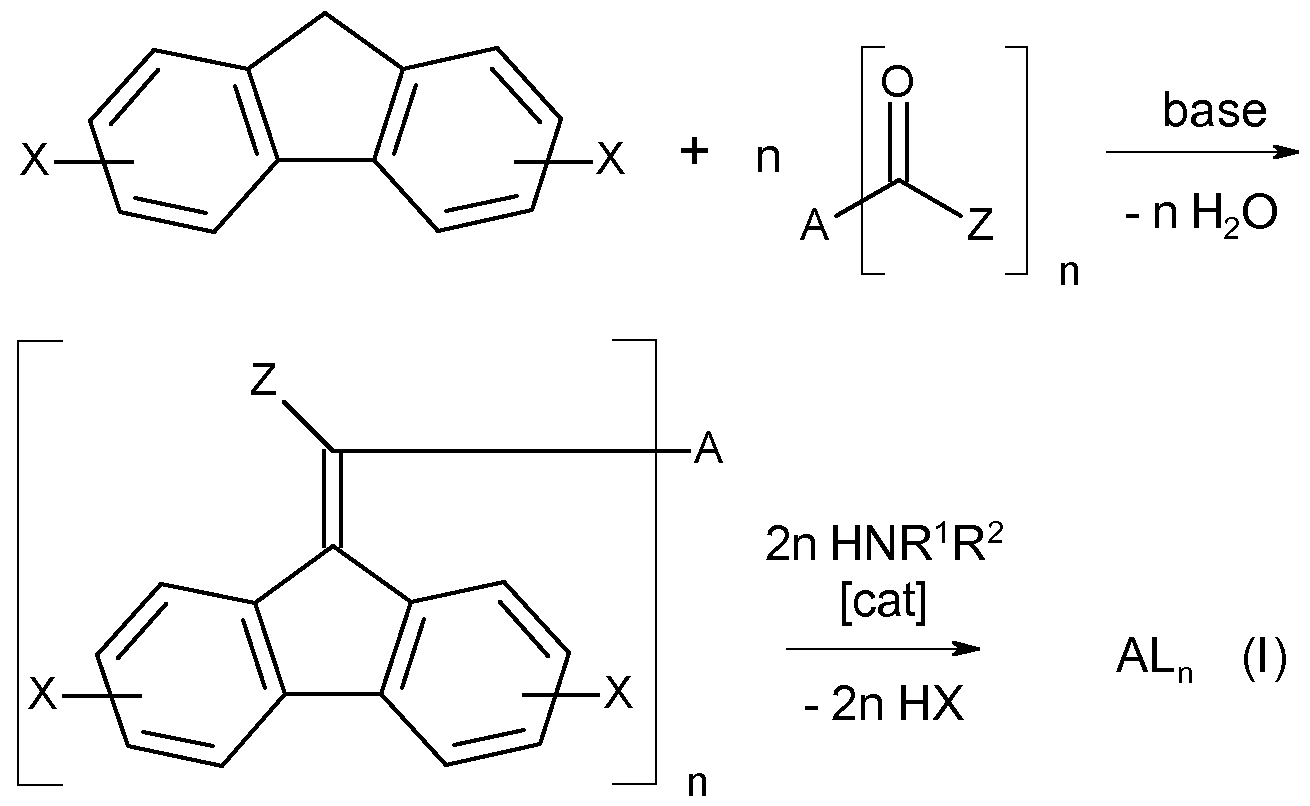
The Buchwald-Hartwig coupling is for example described in detail by John F. Hartwig (Angew. Chem. Int. Ed. 37 (1998) 2047-2067). The use of palladium catalyst is preferred, in particular a palladium catalyst containing tri-tert-butylphosphine ligands. The compound of general formula (I) is particularly suitable as hole-transport materials in organic solar cells or organic optical sensors. Therefore, the present invention relates to the use of the compound of general formula (I) in organic solar cells or organic optical sensors.
The present invention further relates to organic solar cells or organic optical sensors comprising the compound of general formula (I) according to the present invention. Organic solar cells and organic optical sensors are based on the same principle, namely the conversion of incident light to electrical energy. In the case of solar cells the electrical energy is used as power source whereas in the case of optical sensors the electrical energy is used to measure the intensity of the incident light. The following section describes solar cells but equally applies to organic opti- cal sensors which are basically built the same way.
An organic solar cell according to the present invention typically comprises
• a substrate,
• a transparent electrode,
· an electron-transport material,
• the compound of general formula (I) as hole-transport material, and
• a counter electrode.
The components of the solar cell are generally arranged in a stack of layers. Layer in the con- text of the present invention refers to a thin structure with an arbitrary surface. It may be flat, but in most cases it is very rough. A layer can even form an interpenetrating network with an adjacent layer to increase its contact area to the adjacent layers. The order of the layers can be
freely chosen with the provision that the two electrodes are not in direct contact with each other and that the substrate is not in between the two electrodes. An example for the order is
1 . the substrate,
2. the transparent electrode,
3. the electron-transport material,
4. the compound of general formula (I) as hole-transport material, and
5. the counter electrode.
According to the present invention the substrate can be made of glass such as low-cost soda glass of high strength or non-alkali glass from which no alkaline elution occurs. Alternatively, a transparent polymer film may be used such as tetraacetyl cellulose (TAC), polyethylene tereph- thalate (PET), polyethylene naphthalate (PEN), syndiotactic polystyrene (SPS), polyphe- nylenesulfide (PPS), polycarbonate (PC), polyarylate (PAr), polysulfone (PSF), polyestersulfone (PES), polyimide (PI), polyetherimide (PEI), polycycloolefin such as polynorbornene, or bromin- ated phenoxy resin. Polymer films are preferred, in particular PET, PEN and polynorbornene.
According to the present invention the transparent electrode can be made of a transparent conductive oxide (TCO), such as for example indium-tin composite oxides, tin oxides doped with fluorine, antimony or indium and zinc oxide doped with aluminum. Tin oxide doped with fluorine or indium is preferred. The transparent electrode is generally used in form of a thin film, so that it is sufficiently transparent. Transparent in the present context means that the transmittance of light with a wavelength of 550 nm is at least 50 %, preferably at least 70 %, in particular at least 80 %. Preferably the transparent electrode has a thickness of 0.02 to 10 μηη and more preferably from 0.1 to 1 μηη.
According to the present invention the electron-transport material can be organic or inorganic. Typical organic electron-transport materials are fullerenes C6o, C70, C76, Cso, Cs2, Cs4, Cs6, C90 and C94, preferably C60. It is also possible to use substituted fullerenes, in particular [6,6]- phenyl-C6i-butyric acid methyl ester (PCBM).
Suitable inorganic electron-transport materials are semi-conductive metal oxides including oxides of titanium, tin, zinc, iron, tungsten, zirconium, hafnium, strontium, indium, cerium, yttrium, lanthanum, vanadium, caesium, niobium or tantalum. Further, composite semiconductors such as M1xM2yOz may be used, wherein M1 and M2 are independent of each other a metal atom, O is an oxygen atom, and x, y and z are numbers including 0 which are chosen such that an non- charged molecule is formed. Examples are T1O2, Sn02, Fe203, WO3, ZnO, Nb20s, SrTi03, Ta2C"5, CS2O, zinc stannate, complex oxides such as barium titanate, and binary and ternary iron oxides. According to the present invention inorganic electron-transport materials are preferred, more preferred are semiconducting metal oxides. Even more preferred are T1O2, Sn02, Fe203, WO3, ZnO, Nb205, and SrTi03, in particular T1O2.
The inorganic electron-transport materials are preferably present in amorphous or nanocrystal- line form. More preferably, they are present as nanocrystalline porous layers. Such layers have a large surface area leading to effective charge separation of the exciton formed upon light absorption. The inorganic electron-transport materials may also be present in a structured form, such as nanorods.
Preferred methods for producing the semi-conductive metal oxides are sol-gel methods described for example in Materia, Vol. 35, No. 9, Page 1012 to 1018 (1996). The method developed by Degussa Company, which comprises preparing oxides by subjecting chlorides to a high temperature hydrolysis in an oxyhydrogen salt, is also preferred.
In the case of using titanium oxide as the semi-conductive metal oxides, the above-mentioned sol-gel methods, gel-sol methods, high temperature hydrolysis methods are preferably used. Other preferred sol-gel methods are those described in Barbe et al., Journal of American Ce- ramie Society, Vol. 80, No. 12, Page 3157 to 3171 (1997) and Burnside et al, Chemistry of Materials, Vol. 10, No. 9, Page 2419 to 2425 (1998).
Preferably, the electron-transport material is sensitized with a light-absorbing material to increase light absorption efficiency such as in a dye-sensitized solar cell (DSC). Generally 0.01 to 1 mmol of light-absorbing material is used per 1 g of electron-transport material. Furthermore, the electron or hole transport material may itself absorb light such as in a bulk heterojunction (BHJ) solar cell.
The light-absorbing material in the solar cell according to the present invention can be chosen from a wide variety of substances. Examples are metal complex dyes including Ru(l l)-dyes (as for example those in WO 98 / 50 393 - page 8 to 1 1 ); indoline dyes (as for example in Adv. Mater. 2005, 17, 813); oxazine dyes (as for example those in US 6 359 21 1 ); thiazine dyes (as for example those in US 6 359 21 1 ); acridine dyes (as for example those in US 6 359 21 1 ); porphyrin dyes; methine dyes such as cyanine dyes, merocyanine dyes (as for example those in WO 2009 / 007 340 page 4 to 7), squarylium dyes; rylene dyes including perylene dyes and naphtalenemonoimid dyes (as for example in those WO 2007 / 054 470 page 13 to 18); or a quinolinium dye (for example those in WO 2009 / 109 499 page 42 to 51 ). Ru(l l) dyes, perylene dyes, naphtalenemonoimid dyes, or quinolinium dyes are preferred. Other light-absorbing materials include quantum dots like CdSe quantum dots and perovskite absorbers. Perovskite absorbers are preferred. Perovskite absorbers are typically compounds of the general formula (II): EMX3. E stands for an alkali metal such as Li, Na, K, Rb, Cs; or an ammonium ion in which one or more hydrogen atoms may be exchanged by alkyl chains or acyl groups. Ammonium ions in which one or more hydrogen atoms are exchanged by alkyl chains include monoalkylammonium ions, dialkylammonium ions, trimethylammonium ions, tetrame- thylammonium ions. Preferably, the alkyl group or groups are independent of each other Ci to C6 alkyl groups, in particular methyl or ethyl. Ammonium ions in which one or more hydrogen
atoms are exchanged by alkyl chains include amidinium ions, N-alkylamidinium, and imidinium ions, preferably amidinium ions. Preferably, the amidinium or imidinium ion is derived from a Ci to C6 carboxamide, in particular from formamide or acetamide. Preferably E is Cs or an ion comprising a positively charged nitrogen atom.
In general formula (I I) M stands for a divalent metal atom, preferably for Pb or Sn. X stands for halogens, in particular CI, Br, I. X in compounds of general formula (I I) can contain all the same or different halogens. Specific examples for perovskite absorbers include methyl ammonium lead halogenides, such methyl ammonium lead iodide (CHsNHsPb ); methyl ammonium lead mixed halogenides such as CHsNHsPbCl ; formadinium lead halogenides like formadinium lead iodide (HC(NH2)Pbl3), formadinium lead bromide (HC(NH2)PbBr3) or formadinium lead chloride iodide (HC(NH2)PbCl2l); or cesium tin iodide (CsSn ). Solar cells comprising sensitizers of general formula (II) are sometimes referred to as perovskite-sensitized solar cells (PSC). The hole transport layer, the sensitizing dye and the electron transport layer can independent of each other be formed by wet chemical processes and by vapor processes. For wet chemical processes the material out of which the layer is formed is dissolved in a solvent, preferably an organic solvent. Any solvent which dissolves the dye is suitable, for example ethanol, acetone, iso-propanol, tetrahydrofurane, dimethylforamide, dimethylacetamide, acetonitrile, methoxyace- tonitrile, toluene, N-methylpyrrolidone. The preferred concentration of the sensitizing dye in the solvent is 0.1 to 100 g/l, more preferably it is 1 to 10 g/l. The sensitizing dye dissolved in the solvent is applied to the electron-transport layer by any layer-formation process. These include spin-coating, spray-coating, dip-coating, drop-casting, doctor-blading, slot-die coating, 2D ink jet printing, gravure printing, offset printing, flexo printing, screen printing, or microcontact (wave) printing.
Vapor processes include sublimation, physical vapor deposition, chemical vapor deposition, atomic layer deposition, or direct liquid injection. The material out of which the layer is formed is brought into the gaseous state and deposited onto the other layers. Preferably, the vapor pro- cesses are done under reduced pressure such as from 100 to 10-8 mbar, more preferably from 10 to 10"5 mbar, in particular 1 to 10"2 mbar.
After deposition the respective layer is preferably heated. Suitable temperatures are 100 to 600 °C, preferably 200 to 500 °C. Suitable time periods are 10 minutes to 2 hours, preferably 20 minutes to 1 hour.
In the solar cell according to the present invention the compound of general formula (I) acts as hole-transport material. Its layer usually forms an electrical contact with the optionally sensitized electron-transport layer. The compound of general formula (I) can be the only substance in the hole-transport layer or it can be mixed with other substances. An example are dopants which increase the hole conductivity such as N(PhBr)3SbCl6, silver-bis-(trifluoromethylsulfonyl)imide or V2O5. The layer comprising the hole-transport material containing a dopant is formed by layer-
formation process described above wherein the dopant is mixed in the solution for the wet- chemical process or brought into the gas phase together with the hole-transport material.
Furthermore, a solar cell according to the present invention may further comprise a blocking layer between the absorber and the electron-transport layer. Materials suitable for blocking layers include metal oxides, for example ΤΊΟ2, S1O2, AI2O3, Zr02, MgO, Sn02, ZnO, EU2O3, Nb20s or combinations thereof, TiCI4; or polymers, for example poly(phenylene oxide-co-2- allylphenylene oxide) or poly(methylsiloxane). Details of the preparation of such layers are described in, for example, Electrochimica Acta 40, 643, 1995; J. Am. Chem. Soc 125, 475, 2003; Chem. Lett. 35, 252, 2006; J. Phys. Chem. B, 1 10, 1991 , 2006. Preferably, TiCI4 is used. The blocking layer is usually dense and compact, and is usually thinner than the electron-transport layer.
One or both electrodes can independent of each other be coated with very thin layers to adjust the work function of the electrodes. These work function adjustment layers may be generated by self-assembled monolayers of organic molecules, preferably aromatic molecules. Examples are thiol-functionalized thiophenes, pentacene derivatives or cyanobenzene derivatives. The self-assembled monolayers are made by immersing the electrode in a solution containing the organic molecule which assembles on the surface. The electrode is removed from the solution and dried.
The solar cell according to the present invention further comprises a counter electrode formed by an electrically conductive material. Examples of the electrically conductive material used for the counter electrically conductive layer include metals such as platinum, gold, silver, copper, aluminum, magnesium, indium or mixtures or alloys thereof, preferably of aluminum and silver; carbon; electrically conductive metal oxides such as indium-tin composite oxides and fluorine- doped tin oxides; mixed inorganic/organic electrodes; polylayer electrodes such as LiF/AI electrodes. Preferred electrically conductive materials are platinum, gold, silver, copper, aluminum or magnesium, more preferred silver or gold.
The thickness of the counter electrode is not particularly limited, preferably it is 3 nm to 10 μηη. The counter electrode can be made by applying metal-plating or vapor-depositing such as physical vapor deposition or chemical vapor to deposit the electrically conductive material directly onto the layer it shall contact. It can also be deposited via a printing or coating process from a metal containing ink or paste or a conductive carbon-based formulation.
The solar cells according to the present invention show high light to electrical power conversion efficiency, are easily produced with high reproducibility and show high stability.
Examples
Synthesis
Example 1 : Bis{(1 ,1 '-[(2 ,7-dibromo-9H-fluoren-9-ylidene)methyl]cyclopentadienyl}iron (1 )
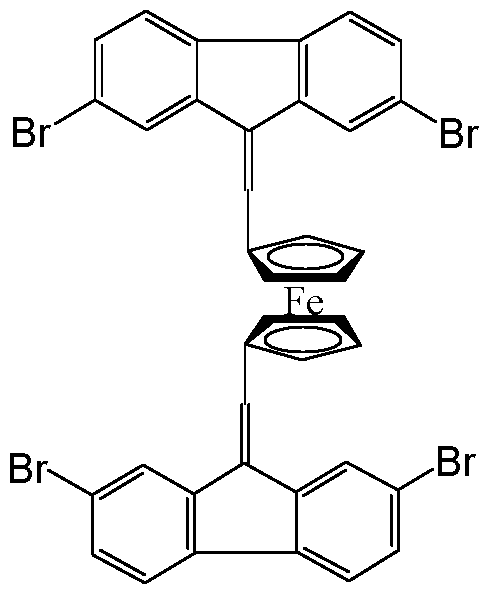
H-NMR (400 MHz, DMSO-de, few drops of CS2): δ = 8.43 - 8.20 (m, 2H), 8.05 - 7.08 (m, 12 H), 4.94 (s, 4H), 4.74 (s, 4H).
Anal, calcd for C38H22Br4Fe: C, 53.44; H, 2.60; found: C, 53.66; H, 2.89.
Example 2: Bis[1 ,1 '-({2,7-bis[bis(4-methoxyphenyl)amino]-9H-fluoren-9- ylidene}methyl)cyclopentadienyl]iron (HTM-1 )

A solution of 1 (1 .07 g, 1.25 mmol), 4,4'dimethoxydiphenylamine (1 .72 g, 7.5 mmol) in anhydrous toluene (14 ml.) was purged with argon for 20 minutes. Afterwards, palladium(ll) acetate (5.6 mg, 0.025 mmol), tri-tert-butylphosphonium tetrafluoroborate (10 mg, 0.03 mmol) and sodium tert-butoxide (0.72 g, 7.5 mmol) were added and the solution was refluxed under argon atmosphere for 7.5 hours. After cooling to room temperature, reaction mixture was filtered through
Celite, 50 mL of distilled water were added and extraction was done with ethyl acetate. The combined organic layer was washed with distilled water, dried over anhydrous Na2S04, filtered and solvent evaporated. The crude product was purified by column chromatography using 1 :1 v/v THF/n-hexane as an eluent. The obtained product was precipitated from 20% solution in THF into 10-fold excess of n-hexane. The precipitate was filtered off and washed with n-hexane to collect HTM-1 as a red solid (1 .23 g, 68 %).
H-NMR (400 MHz, CDCI3): δ = 8.10-7.75 (m, 2H), 7.65 (s, 2H), 7.38 (d, J = 7.9 Hz, 4H), 7.30 - 6.62 (m, 38H), 4.21 (s, 4H), 4.04 (s, 4H), 3.86 - 3.64 (m, 24H).
3C-NMR (100 MHz, CDC ): δ = 156.19, 155.55, 155.26, 148.96, 147.34, 147.09, 141 .75, 141 .55, 141.19, 140.51 , 137.76, 136.74, 135.69, 134.05, 133.81 , 132.68, 126.72, 126.20,
125.64, 125.42, 122.74, 121 .19, 120.05, 1 19.36, 1 19.29, 1 18.62, 1 16.75, 1 14.96, 1 14.72,
1 14.65, 1 14.32, 81.71 , 71.82, 71 .20, 55.61 , 55.57, 55.53.
Anal, calcd for C94H78FeN408: C, 78.00; H, 5.43; N, 3.87; found: C, 78.1 1 ; H, 5.36; N, 3.74. Example 3: Bis[1 ,1 '-({2,7-bis[(4-methoxy-3-methylphenyl)(4-methoxyphenyl)amino]-9H-fluoren- 9-ylidene}methyl)cyclopentadienyl]iron (HTM-2)
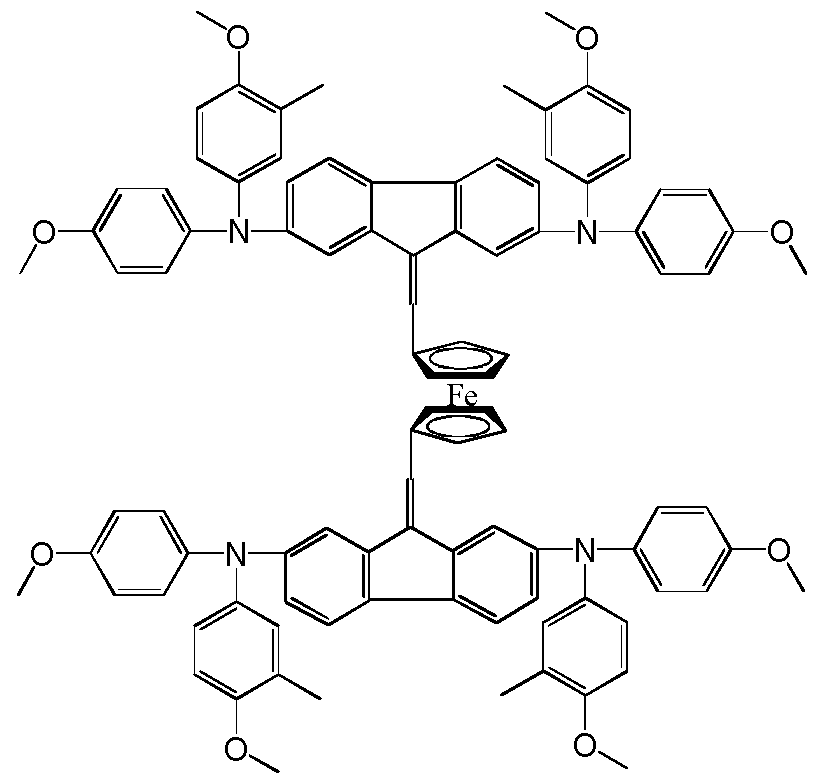
H-NMR (400 MHz, CDCb): δ = 7.63 (d, J = 2.0 Hz, 2H), 7.38 (d, J = 8.3 Hz, 4H), 7.24 (d, J = 2.0 Hz, 2H), 7.03 (d, J = 9.0 Hz, 4H), 6.99 (d, J = 9.0 Hz, 4H), 6.96 - 6.76 (m, 18H), 6.74 (d, J =
9.0 Hz, 4H), 6.70 (d, J = 8.6 Hz, 2H), 6.62 (d, J = 8.7 Hz, 2H), 4.21 (s, 4H), 4.02 (s, 4H), 3.74 (m, 24H), 2.12 (d, J = 12.3 Hz, 12H).
3C-NMR (100 MHz, CDCI3): δ = 155.43, 155.12, 153.92, 153.65, 147.49, 147.20, 141 .98, 141 .65, 141.30, 141 .17, 141 .09, 137.73, 133.96, 133.89, 132.64, 127.76, 127.60, 127.52, 127.25, 126.09, 125.51 , 125.33, 123.40, 122.84, 121 .23, 1 19.33, 1 19.25, 1 18.64, 1 14.68,
1 14.61 , 1 14.42, 1 10.75, 1 10.73, 81 .77, 71 .69, 71.23, 55.64, 55.60, 55.58, 55.54, 16.52, 16.42. Anal, calcd for C94H86FeN408: C, 78.28; H, 5.77; N, 3.73; found: C, 78.45; H, 5.89; N, 3.74.
Example 4: 9,9'-([2,5-bis(hexyloxy)benzene-1 ,4-diyl]bis{(E)ethene-2,1 -diyl[2,5- bis(hexyloxy)benzene-4,1 -diyl]methylylidene})bis(2,7-dibromo-9H-fluorene) (2)
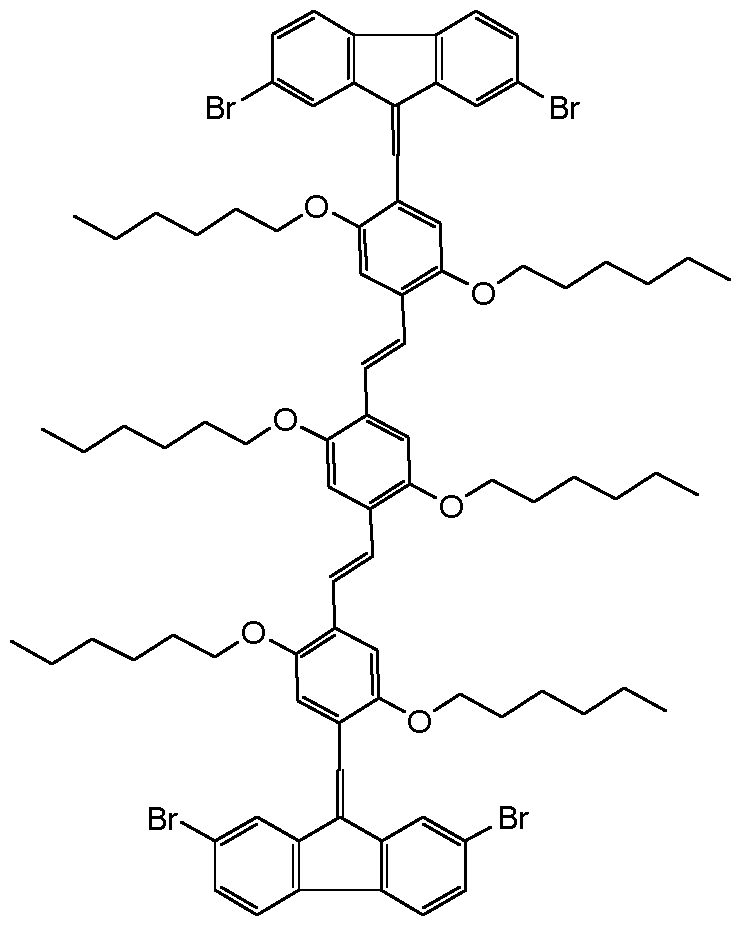
H-NMR (400 MHz, CDC ): δ = 8.16 (s, 2H), 7.91 (s, 2H), 7.78 (s, 2H), 7.68 - 7.51 (m, 8H), 7.46 (t, J = 9.6 Hz, 4H), 4.10 (t, J = 5.8 Hz, 8H), 4.00 (t, J = 6.4 Hz, 4H), 1.98-1 .76 (m, 12H), 1 .65-1 .23 (m, 36 H), 1 .00-0.81 (m, 18H).
3C-NMR (100 MHz, CDCb): δ = 152.19, 151 .34, 150.47, 141.77, 139.09, 138.35, 136.70, 133.23, 131.21 , 130.84, 129.88, 127.60, 126.70, 124.73, 124.27, 123.83, 123.34, 121.30, 121 .14, 120.98, 120.67, 1 15.40, 1 10.67, 1 10.02, 69.96, 69.58, 69.41 , 31.84, 31.75, 29.65, 29.48, 26.14, 26.07, 26.04, 22.82, 22.78, 14.25, 14.18.
Anal, calcd for CseH-^B^Oe: C; 66.58; H, 6.63; found: C, 66.75; H, 6.51.
Example 5: 9,9'-([2,5-bis(hexyloxy)benzene-1 ,4-diyl]bis{(E)ethene-2,1 -diyl[2,5- bis(hexyloxy)benzene-4,1 -diyl]methylylidene})bis[N,N,N\N'-tetrakis(4-methoxyphenyl)-9H fluorene-2,7-diamine] (HTM-3)
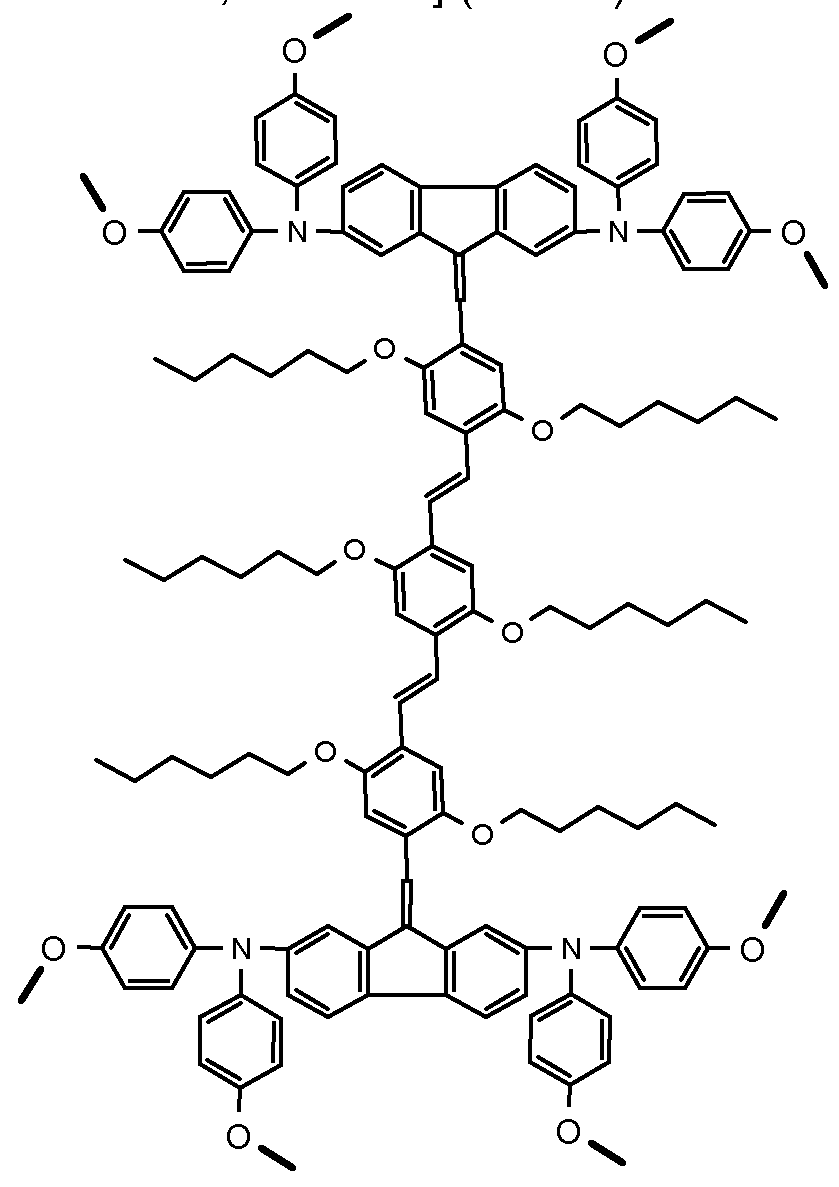
A solution of 2 (0.62 g, 0.4 mmol), 4,4'dimethoxydiphenylamine (0.55 g, 2.4 mmol) in anhydrous toluene (8 ml.) was purged with argon for 20 minutes. Afterwards, palladium(ll) acetate (4.9 mg, 0.02 mmol), tri-tert-butylphosphonium tetrafluoroborate (13.2 mg, 0.04 mmol) and sodium tert-butoxide (0.23 g, 2.4 mmol) were added and the solution was refluxed under argon atmos- phere for 6 hours. After cooling to room temperature, reaction mixture was filtered through Celite, 50 ml. of distilled water were added and extraction was done with ethyl acetate. The combined organic layer was washed with distilled water, dried over anhydrous Na2S04, filtered and solvent evaporated. The crude product was purified by column chromatography using 1 :1 :18 v/v acetone/THF/n-hexane as an eluent. The obtained product was precipitated from 20% solution in acetone into 10-fold excess of methanol. The precipitate was filtered off and washed with methanol to collect HTM-3 as a red brown solid (0.7 g, 82 %).
H-NMR (400 MHz, CDCI3): δ = 7.53-6.62 (m, 56H), 4.09 (t, J= 6.5 Hz, 4H), 3.91 (t, J = 6.5 Hz, 4H), 3.80 (s, 12H), 3.76-3.64 (m, 16H), 1 .96-1.82 (m, 4H), 1 .82-1.17 (m, 44H), 0.96-0.76 (m, 18H).
3C-NMR (100 MHz, CDC ): δ = 151.21 , 150.41 , 141 .05, 138.16, 136.12, 128.18, 127.58,
125.79, 123.62, 123.53, 1 18.16, 1 14.82, 1 14.66, 1 14.51 , 1 10.61 , 1 10.51 , 69.62, 69.54, 69.20, 68.63, 55.61 , 55.43, 31.84, 31 .81 , 31 .61 , 29.83, 29.67, 29.59, 29.32, 27.93, 26.10, 26.09, 25.81 , 22.81 , 22.70, 14.20, 14.17.
Anal, calcd for C142H158N4O14: C, 79.52; H, 7.43; N, 2.61 ; found: C, 79.30; H, 7.61 ; N, 2.79.
Example 6: 4-[(2 -dibromo-9H-fluoren-9-ylidene)methyl]-N-{4-[(2,7-dibromo-9H-fluoren-9- ylidene)methyl]phenyl}-N-phenylaniline (3)
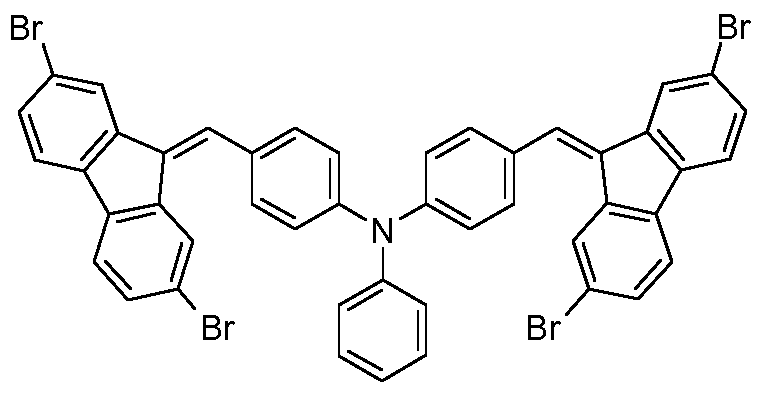
To 4,4'-diformyltriphenylamine (1 .50 g, 4.97 mmol), 2,7-dibromofluorene (4.03 g, 12.44 mmol) and tetrabutylammonium bromide (0.58 g, 1 .79 mmol) dissolved in toluene (28 mL), aqueous 40% NaOH solution (28 mL) was added and the obtained mixture was refluxed for 30 min. After cooling to room temperature, 50 mL of distilled water were added and extraction was done with ethyl acetate. The combined organic layer was washed with distilled water, dried over anhydrous Na2S04 and filtered. After evaporation of the solvent, the crude product was purified by column chromatography using 3:22 v/v acetone/n-hexane as an eluent to collect 3 as a light orange crystals (1 .90 g, 42%), m.p. 176-177 °C.
H-NMR (400 MHz, CDCI3): δ = 7.86 (dd, J=6.9 Hz, J=1 .4 Hz, 2H), 7.75 (d, J=1 .7 Hz, 2H), 7.67- 7.58 (m, 4H), 7.56-7.23 (m, 18H), 7.21 -7.09 (m, 1 H);
3C-NMR (100 MHz, CDC ): δ = 147.88, 146.68, 142.22, 141.17, 138.84, 138.05, 137.43, 136.71 , 135.22, 133.69, 131 .16, 130.85, 130.63, 129.89, 129.84, 129.68, 127.81 , 127.29, 125.58, 123.47, 123.28, 121 .81 , 121.12, 120.98, 120.90, 120.70.
Anal, calcd for C46H27Br4N: C, 60.49; H, 2.98, N, 1 .53; found: C, 60.69; H, 2.76; N, 1.64.
Example 7: 9,9'-[(phenylimino)bis(benzene-4,1 -diylmethylylidene)]bis[N,N,N',N'-tetrakis(4- (HTM-4)
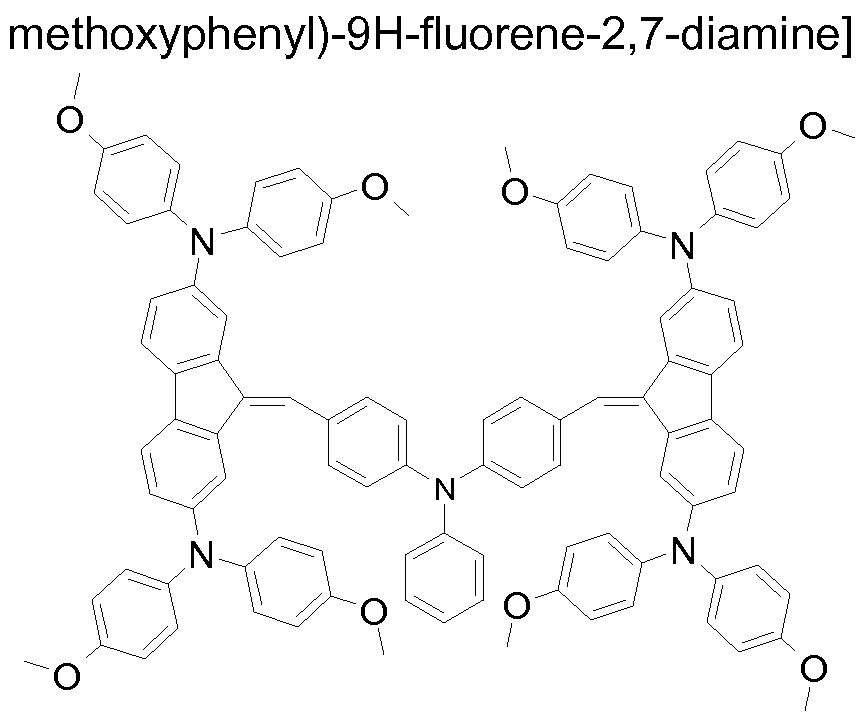
A mixture of 3 (1 .00 g, 1 .09 mmol), 4,4'dimethoxydiphenylamine (1.5 g, 6.57 mmol) and toluene (18 mL) was purged with argon for 30 minutes. Afterwards, palladium(ll) acetate (0.005 g, 0.02 mmol), tri-tert-butylphosphonium tetrafluoroborate (0.009 g, 0.029 mmol) and sodium tert- butoxide (0.63 g, 6.57 mmol) were added and the reaction mixture was refluxed under argon atmosphere for 5 hours. After cooling to room temperature, reaction mixture was filtered through Celite, 50 mL of distilled water were added and extraction was done with ethyl acetate. The or-
ganic layer was dried over anhydrous Na2S04, filtered, and solvent evaporated. The crude product was purified by column chromatography using 3:22 v/v acetone/n-hexane as an eluent to collect HTM-4 as a dark orange solid (1 .03 g, 63 %).
H-NMR (400 MHz, CDCI3): δ = 7.67-6.44 (m, 59H), 3.78 (s, 12H), 3.58 (s, 12H);
3C-NMR (100 MHz, CDC ): δ = 147.05, 146.89, 140.92, 130.39, 130.33, 129.29, 124.62, 123.58, 123.25, 1 19.51 , 1 14.44, 1 13.98, 55.45, 55.32.
Anal, calcd for C102H83N5O8: C, 81.31 ; H, 5.55, N, 4.65; found: C, 81 .15; H, 5.76; N, 4.54.
Example 8: 4-[(2,7-dibromo-9H-fluoren-9-ylidene)methyl]-N-{4-[(2,7-dibromo-9H-fluoren-9- ylidene)methyl]phenyl}-N-(4-methylphenyl)aniline (4)
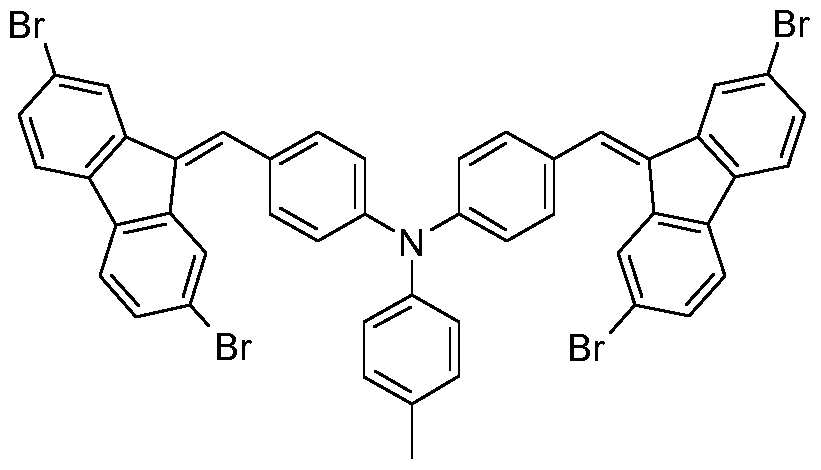
To 4,4'-[(4-methylphenyl)imino]dibenzaldehyde (1 .50 g, 4.76 mmol), 2,7-dibromofluorene (3.85 g, 1 1 .89 mmol) and tetrabutylammonium bromide (0.55 g, 1 .71 mmol) dissolved in toluene (27 ml_), aqueous 40% NaOH solution (27 ml.) was added and the obtained mixture was re- fluxed for 15 min. After cooling to room temperature, 50 ml. of distilled water were added and extraction was done with ethyl acetate. The combined organic layer was washed with distilled water, dried over anhydrous Na2S04 and filtered. After evaporation of the solvent, the crude product was purified by column chromatography using 3:22 v/v acetone/n-hexane as an eluent to collect compound 4 as orange crystals (3.68 g, 84%), m.p. 209-210 °C.
H-NMR (400 MHz, CDCI3): δ = 7.87 (dd, J=5.3 Hz, J=1 .5 Hz, 4H), 7.62 (s, 2H), 7.57-7.36 (m, 12H), 7.30-7.23 (m, 4H), 7.20 (s, 4H), 2.37 (s, 3H);
3C-NMR (100 MHz, CDCI3): δ = 147.98, 144.00, 141 .22, 138.22, 138.07, 136.68, 134.48, 133.50, 131.12, 130.78, 130.61 , 130.38, 129.94, 129.52, 127.26, 126.01 , 123.44, 123.01 , 121 .09, 120.97, 120.88, 120.69, 20.96.
Anal, calcd for C47H29Br4N: C, 60.87; H, 3.15, N, 1 .51 ; found: C, 60.71 ; H, 3.27; N, 1.62.
Example 9: 9,9'-{[(4-methylphenyl)imino]bis(benzene-4,1 -diylmethylylidene)}bis[N,N,N',N'- tetrakis(4-methoxyphenyl)-9H-fluorene-2,7-diamine] (HTM-5)
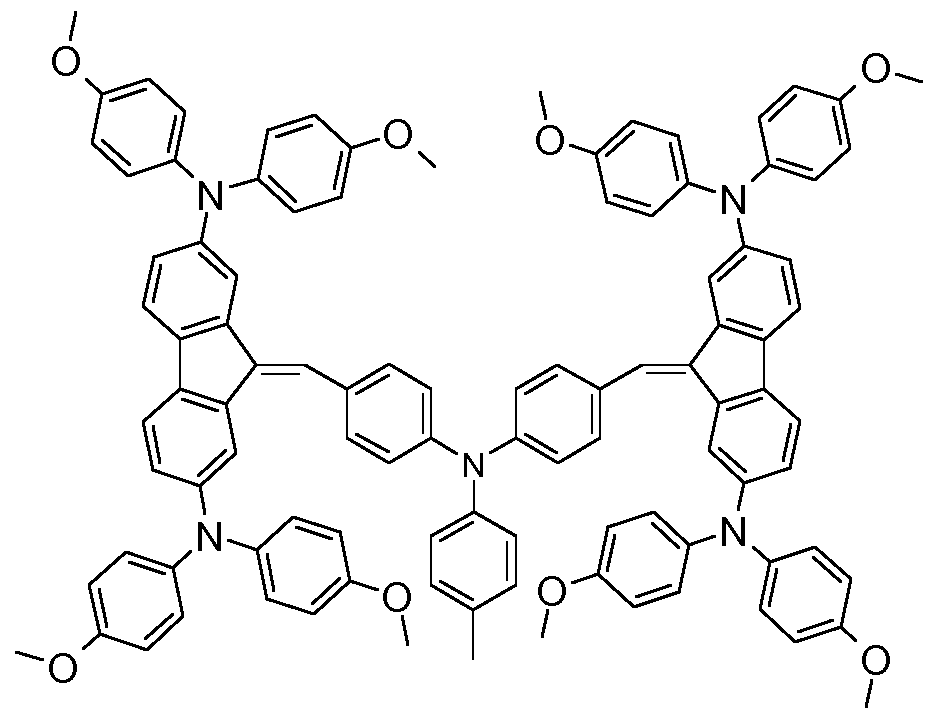
A solution of 4 (1 .00 g, 1.08 mmol), 4,4'dimethoxydiphenylamine (1 .48 g, 6.47 mmol) and toluene (12 mL) was purged with argon for 30 minutes. Afterwards, palladium(ll) acetate (0.005 g, 0.02 mmol), tri-tert-butylphosphonium tetrafluoroborate (0.009 g, 0.029 mmol) and sodium tert- butoxide (0.62 g, 6.47 mmol) were added and the solution was refluxed under argon atmosphere for 5 hours. After cooling to room temperature, reaction mixture was filtered through Celite, 50 mL of distilled water were added and extraction was done with ethyl acetate. The organic layer was dried over anhydrous Na2S04, filtered, and solvent evaporated. The crude product was purified by column chromatography using 3:22 v/v acetone/n-hexane as an eluent to collect HTM-5 as a dark orange solid (1 .52 g, 92 %).
H-NMR (400 MHz, CDCI3): δ = 7.66-7.30 (m, 10H), 7.27 (s, 2H), 7.22 (d, J=8.4 Hz, 4H), 7.15- 7.68 (m, 22H), 6.82 (d, J=8.4 Hz, 8H), 6.70 (d, J=8.4 Hz, 12H), 3.78 (s, 12H), 3.58 (s, 12H), 2.34 (s, 3H);
3C-NMR (100 MHz, CDC ): δ = 147.04, 144.38, 140.96, 137.42, 133.31 , 130.29, 130.00, 129.91 , 127.02, 125.31 , 122.98, 1 19.49, 1 14.51 , 1 13.98, 55.43, 55.29, 20.90.
Anal, calcd for CiosHesNsOe: C, 81.35; H, 5.63, N, 4.60; found: C, 81 .58; H, 5.51 ; N, 4.42.
Example 10: 9,9'-(benzene-1 ,4-diyldimethylylidene)bis(2,7-dibromo-9H-fluorene) (5)

To terephthaldicarboxaldehyde (0.5 g, 3.73 mmol), 2,7-dibromofluorene (3.02, g 9.33 mmol) and tetrabutylammonium bromide (0.43 g, 1 .34mmol) dissolved in toluene (18 mL), aqueous 40% NaOH solution (18 mL) was added and the obtained mixture was refluxed for 10 min. Yellow crystals of 5 (2.5 g, 90 %), formed upon standing, were filtered off and washed with hot di-
methylformamide and later with diethyl ether. The product was recrystallized from dimethylfor- mamide, m.p. 356-358°C.
H-NMR (400 MHz, THF-d8, few drops of CS2): δ = 8.01 (d, J = 1.6 Hz, 2H), 7.91 (s, 2H), 7.84 (d, J = 1 .7 Hz, 2H), 7.71 (s, 4H), 7.65 - 7.55 (m, 4H), 7.47 - 7.34 (m, 4H).
Anal, calcd for C34Hi8Br4: C 54.73; H 2.43; found: C 54.49; H 2.57.
Example 1 1 : 9,9'-(benzene-1 ,4-diyldimethylylidene)bis[N,N,N',N'-tetrakis(4-methoxyphenyl)-9H- fluorene-2,7-diamine] (HTM-6)
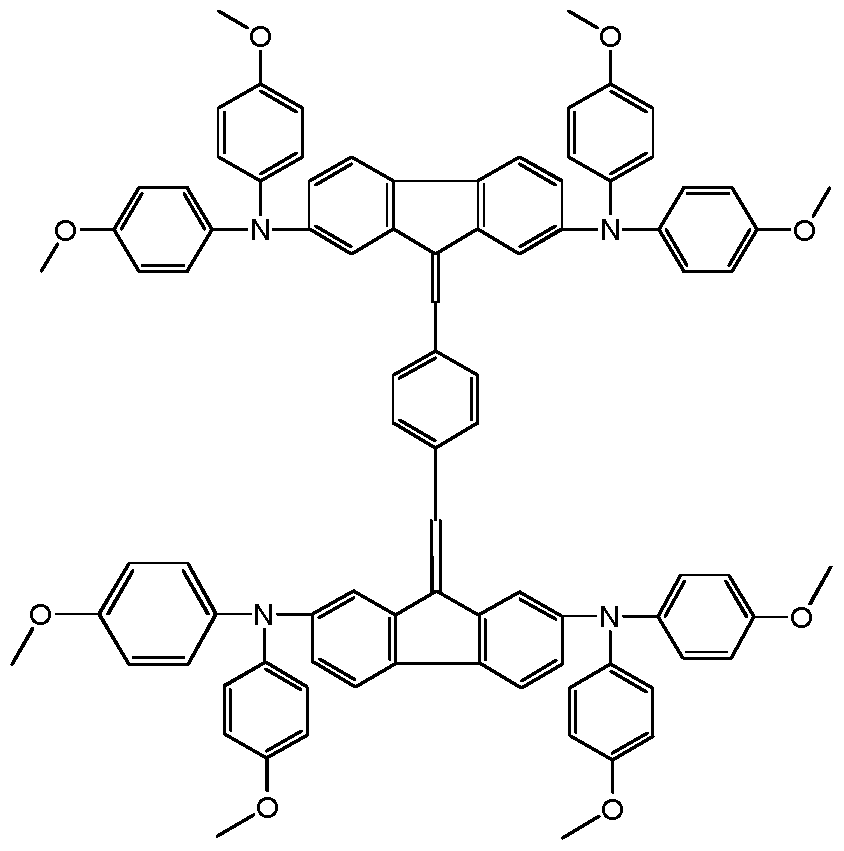
A solution of 5 (0.45 g, 0.6 mmol), 4,4'dimethoxydiphenylamine (0.83 g, 3.6 mmol) in anhydrous toluene (12 ml.) was purged with argon for 20 minutes. Afterwards, palladium(ll) acetate (7.41 mg, 0.03 mmol), tri-tert-butylphosphonium tetrafluoroborate (19.74 mg, 0.07 mmol) and sodium tert-butoxide (0.35 g, 3.6 mmol) were added and the solution was refluxed under argon atmosphere for 6 hours. After cooling to room temperature, reaction mixture was filtered through Celite, 50 ml. of distilled water were added and extraction was done with ethyl acetate. The combined organic layer was washed with distilled water, dried over anhydrous Na2S04, filtered and solvent evaporated. Obtained product was recrystallized from THF, filtered off and washed with tetrahydrofurane and diethyl ether to collect HTM-6 as a red brown solid (0.35 g, 43 %), m. p. = 289-290°C (THF).
H-NMR (400 MHz, CDCI3): δ = 7.44 - 7.32 (m, 6H), 7.24 (d, J = 3.0 Hz, 2H), 7.07 (d, J = 8.9 Hz, 8H), 7.00 - 6.77 (m, 26H), 6.58 (d, J = 8.9 Hz, 8H), 3.78 (s, 12H), 3.54 (s, 12H).
3C-NMR (100 MHz, CDC ): δ = 155.49, 155.46, 147.32, 147.23, 141.71 , 141 .07, 140.65, 137.58, 136.49, 135.63, 134.18, 133.44, 128.68, 127.05, 126.21 , 125.85, 123.01 , 121.29, 1 19.39, 1 19.19, 1 18.56, 1 14.77, 1 14.64, 1 14.45, 55.62, 55.21 .
Anal, calcd for C90H74N4O8: C, 80.69; H, 5.57; N, 4.18; found: C, 80.65; H, 5.73; N, 4.29. Example 12: 9,9'-(benzene-1 ,3-diyldimethylylidene)bis(2,7-dibromo-9H-fluorene) (6)
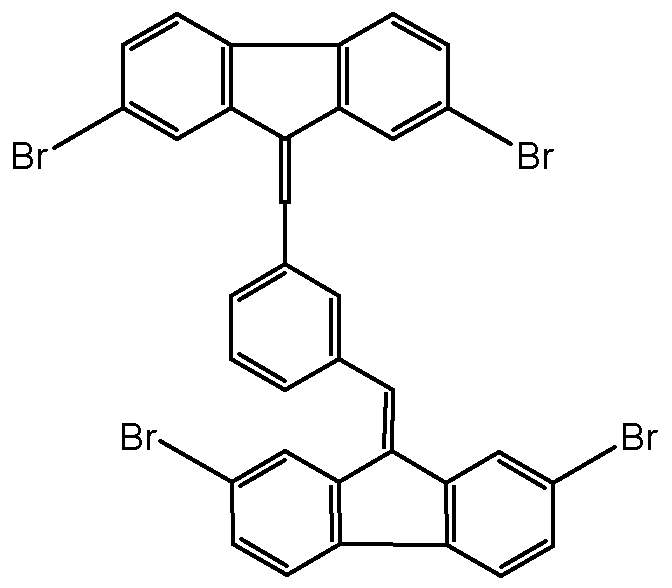
To isophthalaldehyde (0.5 g, 3.73 mmol), 2,7-dibromofluorene (3.02, g 9.33 mmol) and tetrabu- tylammonium bromide (0.43 g, 1 .34mmol) dissolved in toluene (18 mL), aqueous 40% NaOH solution (18 mL) was added and the obtained mixture was refluxed for 2.5 h. Yellow green crystals of 6 (0.8 g, 29 %), formed upon standing, were filtered off and washed with hot dimethyl- formamide and later with diethyl ether. The product was recrystallized from tetrahydrofurane, m.p. 278-280°C.
H-NMR (400 MHz, THF-d8, few drops of CS2): δ = 8.00 (d, J = 1.6 Hz, 2H), 7.90 (s, 2H), 7.67 (s, 1 H), 7.65 - 7.54 (m, 7H), 7.47 - 7.32 (m, 4H), 7.13 - 6.93 (m, 2H).
3C-NMR (100 MHz, THF-d8, few drops of CS2): δ = 138.06, 132.69, 132.34, 130.97, 130.38, 130.18, 129.83, 129.32, 128.37, 125.12, 122.50, 122.29, 121.83.
Anal, calcd for C34Hi8Br4: C, 54.73; H, 2.43; found: C, 54.51 ; H, 2.62. Example 13: 9,9'-(benzene-1 ,3-diyldimethylylidene)bis[N,N,N',N'-tetrakis(4-methoxyphenyl)-9H- fluorene-2,7-diamine] (HTM-7)
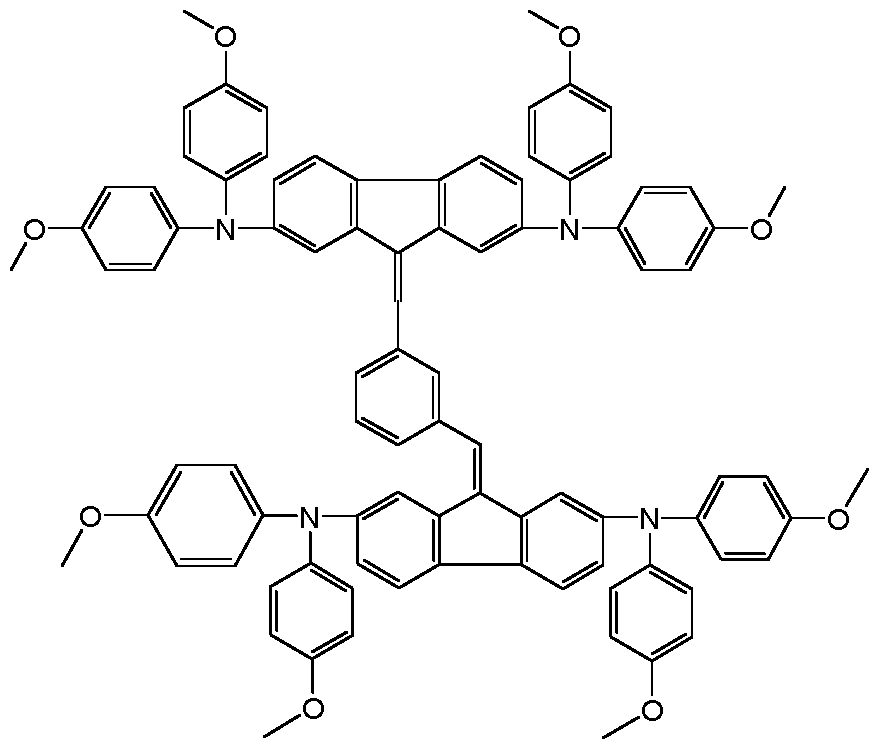
H-NMR (400 MHz, CDCIs): δ = 7.40 - 7.28 (m, 6H), 7.21 (s, 1 H), 7.13 - 7.02 (m, 10H), 7.01 - 6.92 (m, 6H), 6.90 - 6.76 (m, 18H), 6.74 (t, J = 7.7 Hz, 1 H), 6.65 (d, J = 8.9 Hz, 8H), 3.72 (s, 12H), 3.70 (s, 12H).
3C-NMR (100 MHz, CDCIs): δ = 155.66, 155.52, 147.33, 147.16, 141 .65, 141.00, 140.60, 137.56, 136.49, 136.33, 134.13, 133.29, 128.86, 128.22, 127.88, 127.01 , 126.52, 126.00, 122.64, 120.96, 1 19.28, 1 16.65, 1 14.76, 1 14.63, 1 14.20, 55.56, 55.49.
Anal, calcd for C94H74N4O8: . Found: C, 80.69; H, 5.57; N, 4.18; found: C, 80.47; H, 5.72; N, 4.01 .
Example 14: 9,9'-(benzene-1 ,2-diyldimethylylidene)bis(2,7-dibromo-9H-fluorene) (7)
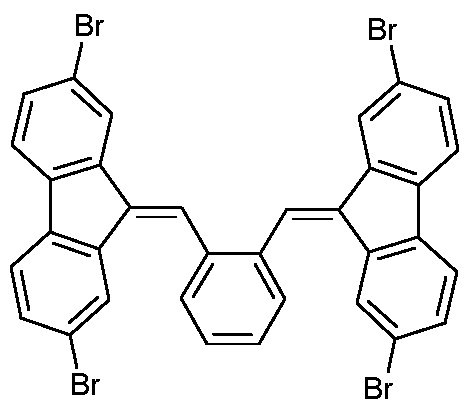
To o-phthalaldehyde (0.5 g, 3.73 mmol), 2,7-dibromofluorene (3.02, g 9.33 mmol) and tetrabu- tylammonium bromide (0.43 g, 1 .34mmol) dissolved in toluene (18 ml_), aqueous 40% NaOH solution (18 ml.) was added and the obtained mixture was refluxed for 2.5 h. To the reaction mixture ethanol was added and formed crystals were filtered off, washed with water, ethanol and finally with ethylacetate to isolate 7 as slightly yellow crystals (1.5 g, 54 %), m.p. 333-334 °C. H-NMR (700 MHz, DMSO-d6): δ = 8.26 - 8.01 (m, 4H), 7.70 (s, 2H), 7.25 (t, J = 7.6 Hz, 2H), 7.21 - 6.88 (m, 10H);
IR (KBr)v (cm-1): 3053, 3021 (CHar); 1598, 1571 , 1452, 141 1 , 1399 (C=C); 815, 804, 784
(CH=CH of 1 ,2-disubstituted benzene); 657 (C-Br).
Anal, calcd for C34Hi8Br4: C, 54.73; H, 2.43; found: C, 54.95; H, 2.33.
Example 15: 9,9'-(benzene-1 ,2-diyldimethylylidene)bis[N,N,N',N'-tetrakis(4-methoxyphenyl)-9H- fluorene-2,7-diamine] (HTM-8)
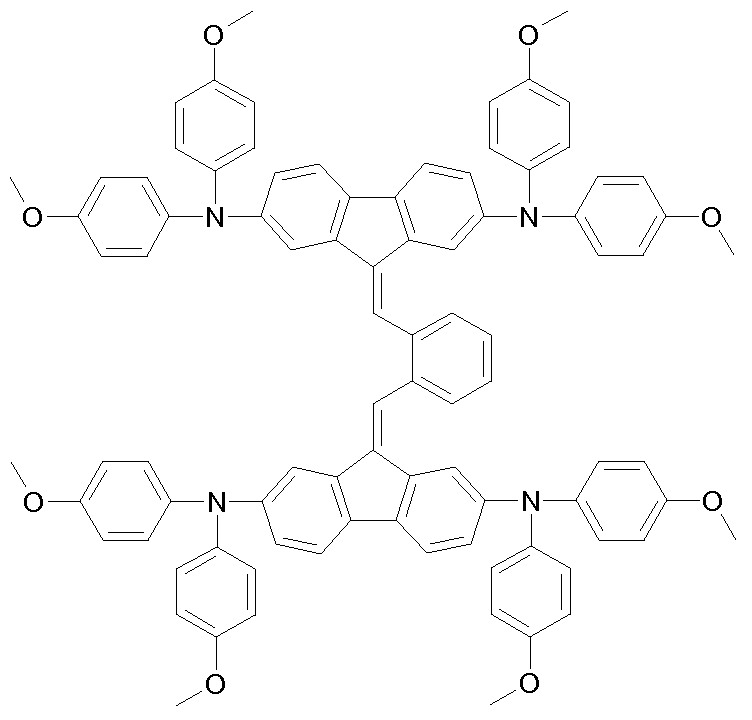
A solution of 7 (0.45 g, 0.60 mmol), 4,4'dimethoxydiphenylamine (0.83 g, 3.6 mmol) and toluene (12 mL) was purged with argon for 30 minutes. Afterwards, palladium(ll) acetate (0.003 g, 0.01 mmol), tri-tert-butylphosphonium tetrafluoroborate (0.005 g, 0.02 mmol) and sodium tert- butoxide (0.35 g, 3.60 mmol) were added and the solution was refluxed under argon atmosphere for 5 hours. After cooling to room temperature, reaction mixture was filtered through Celite, 40 mL of distilled water were added and extraction was done with ethyl acetate. The organic layer was dried over anhydrous Na2S04, filtered, and solvent evaporated. The crude product was purified by column chromatography using 0.5:10:14.5 v/v acetone/n- hexane/toluene as an eluent to collect HTM-8 as a light brown red solid (0.34 g, 42 %).
H-NMR (300 MHz, CDCI3): δ = 7.39 (s, 1 H), 7.37 (d, J=2.8 Hz, 2H), 7.34 (s, 1 H), 7.20 (d, J=2.0 Hz, 2H), 7.12 (s, 2H), 7.10-6.98 (m, 10H), 6.97-6.91 (m, 4H), 6.88 (d, J=9.0 Hz, 8H), 6.80 (d, J=9.0 Hz, 8H), 6.76-6.69 (m, 12H), 3.81 (s, 12H), 3.77 (s, 12H);
3C-NMR (75 MHz, CDC ): δ = 155.32, 147.12, 141 .35, 141.22, 140.20, 137.59, 136.25, 134.93, 134.38, 133.05, 129.18, 123.34, 125.97, 125.84, 125.78, 122.37, 121 .75, 1 19.16, 1 19.02, 1 18.45, 1 14.59, 1 14.47, 1 14.16, 55.41.
Anal, calcd for C9oH74N408: C, 80.70; H, 5.57, N, 4.18; found: C, 80.52; H, 5.41 ; N, 4.29.
Example 16: 9,9',9"-(benzene-1 ,3,5-triyltrimethylylidene)tris(2,7-dibromo-9H-fluorene) (8)

To a solution of benzene-1 ,3,5-tricarboxaldehyde (0.49 g, 3.0 mmol), 2,7-dibromofluorene (3.65 g, 1 1 .27 mmol) and tetrabutylammonium bromide (0.52 g, 1 .61 mmol) in toluene (21
aqueous 40% NaOH solution (21 mL) was added and the obtained mixture was stirred at room temperature for 2 hours. Green crystals, formed upon standing, were filtered off and washed with water and later twice with ethanol to give the corresponding compound 8 (2.23 g, 68%), which was used in the next reaction without further purification.
Anal, calcd for C48H24Br6: C, 53.38; H, 2.24; found: C, 53.58; H, 2.43.
Example 17: 9,9',9"-(benzene-1 ,3,5-triyltrimethylylidene)tris[N,N,N',N'-tetrakis(4- methoxyphenyl)-9H-fluorene-2,7-diamine] (HTM-9)

A solution of 8 (1 .08 g, 1.0 mmol), 4,4'dimethoxydiphenylamine (2.06 g, 9.0 mmol) and toluene (17 mL) was purged with argon for 30 minutes. Afterwards, palladium(ll) acetate (0.007 g, 0.03 mmol), tri-tert-butylphosphonium tetrafluoroborate (0.012 g, 0.04 mmol) and sodium tert- butoxide (0.86 g, 9.0 mmol) were added and the solution was refluxed under argon atmosphere for 5 hours. After cooling to room temperature, reaction mixture was filtered through Celite, 35 mL of distilled water were added and extraction was done with ethyl acetate. The organic layer was dried over anhydrous Na2S04, filtered, and solvent evaporated. The crude product was purified by column chromatography using 7:18 v/v tetrahydrofuran/n-hexane as an eluent to collect HTM-9 as a light brown red solid (0.59 g, 26.4 %).
H-NMR (400 MHz, CDCI3): δ = 7.40-6.87 (m, 32H), 6.79 (d, J=8.7 Hz, 16H), 6.66 (d, J=7.7 Hz, 12H), 6.47 (d, J=8.7 Hz, 12H), 3.68 (s, 18H), 3.55 (s, 18H);
3C-NMR (100 MHz, CDC ): δ = 155.48, 140.63, 137.63, 136.50, 136.20, 128.51 , 126.37, 126.10, 126.05, 1 16.69, 1 14.65, 1 14.37, 1 13.79, 55.40, 55.22.
Anal, calcd for C132H108N6O12: C, 80.47; H, 5.52, N, 4.27; found: C, 80.58; H, 5.66; N, 4.10.
Example 18: 3,7-bis[(2,7-dibromo-9H-fluoren-9-ylidene)methyl]-10-methyl-1 OH-phenothiazine (9)

To 10-methylphenothiazin-3,7-dicarbaldehyde (0.81 g, 3.0 mmol), 2,7-dibromofluorene (2.43 g, 7.5 mmol) and tetrabutylammonium bromide (0.35 g, 1.1 mmol) dissolved in toluene (16 ml_), aqueous 40% NaOH solution (16 ml.) was added and the obtained mixture was stirred at room temperature for 3 hours. Green crystals of compound 9 (1.6 g, 73%), formed upon standing, were filtered off and washed with water and later once with ethanol and once with acetone; m.p. 197-200 °C.
H-NMR (400 MHz, CDCI3): δ = 7.98 (d, J=1 .6 Hz, 1 H), 7.86 (d, J=1 .6 Hz, 1 H), 7.78 (d, J=1 .6 Hz, 1 H), 7.66-7.15 (m, 17H), 3.54 (s, 3H);
3C-NMR (100 MHz, CDC ): δ = 147.88, 146.68, 142.22, 141.17, 138.84, 138.05, 137.43, 136.71 , 135.22, 133.69, 131.16, 130.85, 130.63, 129.89, 129.84, 129.68, 127.81 , 127.29, 125.58, 123.47, 123.28, 121 .81 , 121.12, 120.98, 120.90, 120.70, 35.31.
Anal, calcd for C4iH23Br4NS: C, 55.88; H, 2.63, N, 1 .59; found: C, 55.71 ; H, 2.76; N, 1 .43.
Example 19: 9,9'-[(10-methyl-10H-phenothiazine-3,7-diyl)dimethylylidene]bis[N,N,N',N'- tetrakis(4-methoxyphenyl)-9H-fluorene-2,7-diamine] (HTM-10)
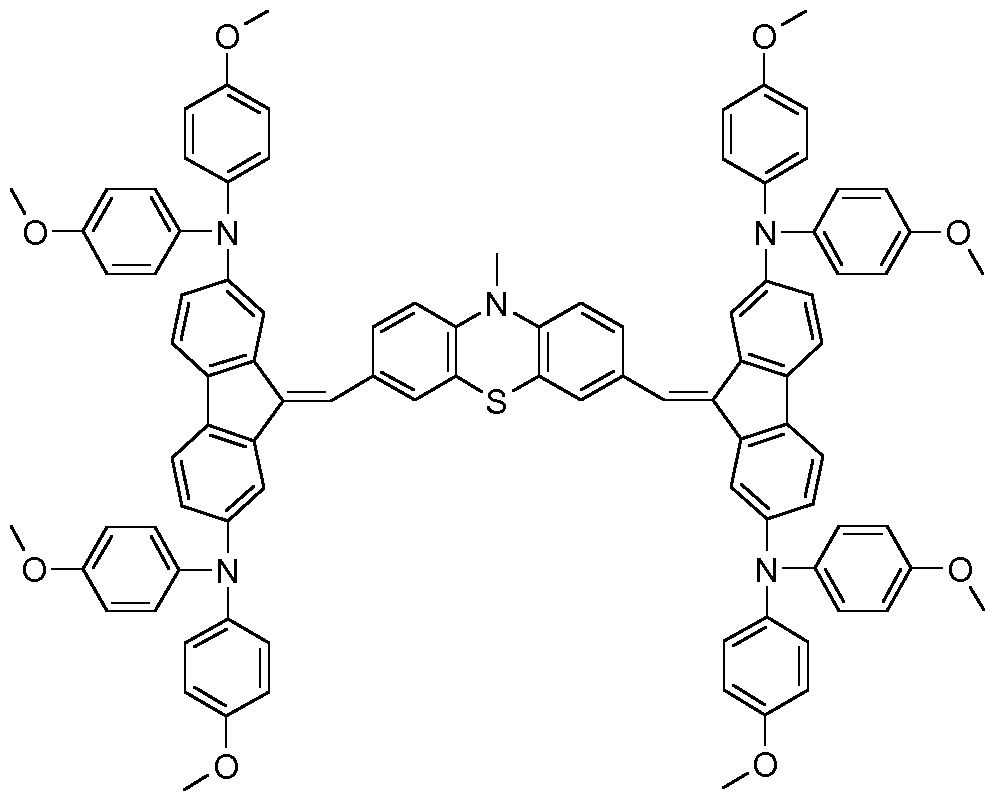
A solution of 9 (1 .47 g, 1.0 mmol), 4,4'dimethoxydiphenylamine (1 .38 g, 6.0 mmol) and toluene (14 ml.) was purged with argon for 30 minutes. Afterwards, palladium(ll) acetate (0.004 g, 0.02 mmol), tri-tert-butylphosphonium tetrafluoroborate (0.008 g, 0.027 mmol) and sodium tert- butoxide (0.58 g, 6.0 mmol) were added and the solution was refluxed under argon atmosphere for 5 hours. After cooling to room temperature, reaction mixture was filtered through Celite, 30 ml. of distilled water were added and extraction was done with ethyl acetate. The organic layer was dried over anhydrous Na2S04, filtered, and solvent evaporated. The crude product
was purified by column chromatography using 1 :4 v/v acetone/n-hexane as an eluent to collect HTM-10 as an orange solid (0.93 g, 38 %).
H-NMR (400 MHz, CDCI3): δ = 7.51 -7.45 (m, 2H), 7.38 (d, J=8.2Hz, 4H), 7.32-7.27 (m, 2H), 7.21 -7.13 (m, 4H), 7.05 (d, J=8.4 Hz, 8H), 7. 0-6.72 (m, 30H), 6.24 (d, J=8.6 Hz, 2H), 3.79 (s, 12H), 3.76 (s, 12H), 3.14 (s, 3H);
3C-NMR (100 MHz, CDC ): δ = 155.30, 155.16, 147.23, 146.88, 144.55, 141 .51 , 140.76, 137.31 , 134.99, 134.87, 132.81 , 130.26, 128.42, 127.93, 126.04, 125.73, 125.64, 122.63, 122.51 , 122.36, 1 19.30, 1 18.86, 1 14.58, 1 14.43, 1 13.24, 55.45, 55.39, 34.76.
Anal, calcd for C97H79N5O8S: C, 79.00; H, 5.40, N, 4.75; found: C, 79.24; H, 5.31 ; N, 4.87.
Example 20: 2,5-bis[(2,7-dibromo-9H-fluoren-9-ylidene)methyl]thiophene (10)
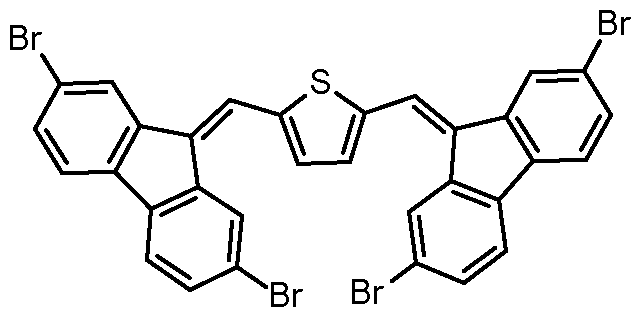
7.50 mmol) and tetrabutylammonium bromide (0.35 g, 1 .09 mmol) dissolved in toluene (15 mL), aqueous 40% NaOH solution (15 mL) was added and the obtained mixture was stirred at room temperature for 1 hour. Light green crystals of compound 10 (1.3 g, 58%), formed upon standing, were filtered off and washed with water and ethanol; m.p. 216-218 °C.
H-NMR (400 MHz, CDCb, DMSO-d6): δ = 7.90-7.12 (m, 16H);
3C-NMR (100 MHz, CDCb, DMSO-d6): δ = 142.27, 137.58, 135.14, 127.52, 123.14, 122.27. Anal, calcd for C32Hi6Br4S: C, 51.10; H, 2.14; found: C, 51.27; H, 2.30.
Example 21 : 9,9'-(thiene-2,5-diyldimethylylidene)bis[N,N,N',N'-tetrakis(4-methoxyphenyl)-9H- fluorene-2,7-diamine] (HTM-1 1 )
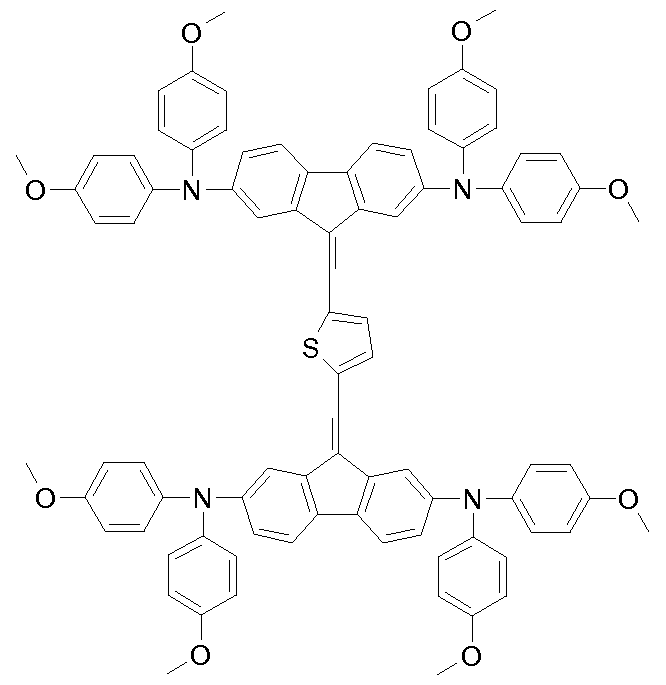
A solution of 10 (0.75 g, 1.0 mmol), 4,4'dimethoxydiphenylamine (1 .38 g, 6.0 mmol) and toluene (12 mL) was purged with argon for 30 minutes. Afterwards, palladium(ll) acetate (0.004 g,
0.02 mmol), tri-tert-butylphosphonium tetrafluoroborate (0.008 g, 0.027 mmol) and sodium tert- butoxide (0.58 g, 6.0 mmol) were added and the solution was refluxed under argon atmosphere for 5 hours. After cooling to room temperature, reaction mixture was filtered through Celite, 30 ml. of distilled water were added and extraction was done with ethyl acetate. The organic layer was dried over anhydrous Na2S04, filtered, and solvent evaporated. The crude product was purified by column chromatography using 3:22 v/v tetrahydrofuran/n-hexane as an eluent to collect HTM-1 1 as a dark brown solid (0.36 g, 27 %).
H-NMR (400 MHz, CDCI3): δ = 7.98 (d, J=1 .8 Hz, 1 H), 7.67 (d, J=2.0 Hz, 1 H), 7.37 (dd, J=8.4 Hz, J=1 .8 Hz, 4H), 7.28-7.21 (m, 2H), 7.13-7.03 (m, 7H), 7.02-6.89 (m, 9H), 6.88-6.77 (m, 12H), 6.74-6.66 (m, 12H), 3.77 (s, 9H), 3.76 (s, 6H), 3.60 (s, 9H),
3C-NMR (100 MHz, CDC ): δ = 155.60, 155.31 , 155.02, 147.53, 147.10, 146.84, 141 .55, 141 .38, 140.99, 140.83, 140.63, 139.17, 136.95, 135.82, 135.03, 133.97, 133.02, 130.69, 126.45, 125.67, 125.32, 121.34, 120.95, 1 19.21 , 1 18.52, 1 14.61 , 55.45, 55.40, 55.21.
Anal, calcd for C88H72N408S: C, 78.55; H, 5.39, N, 4.16; found: C, 78.39; H, 5.50; N, 4.00.
Example 22: 4-[(2,7-dibromo-9H-fluoren-9-ylidene)methyl]-N,N-bis{4-[(2,7-dibromo-9H-fluoren- 9-ylidene)methyl]phenyl}aniline (1 1 )
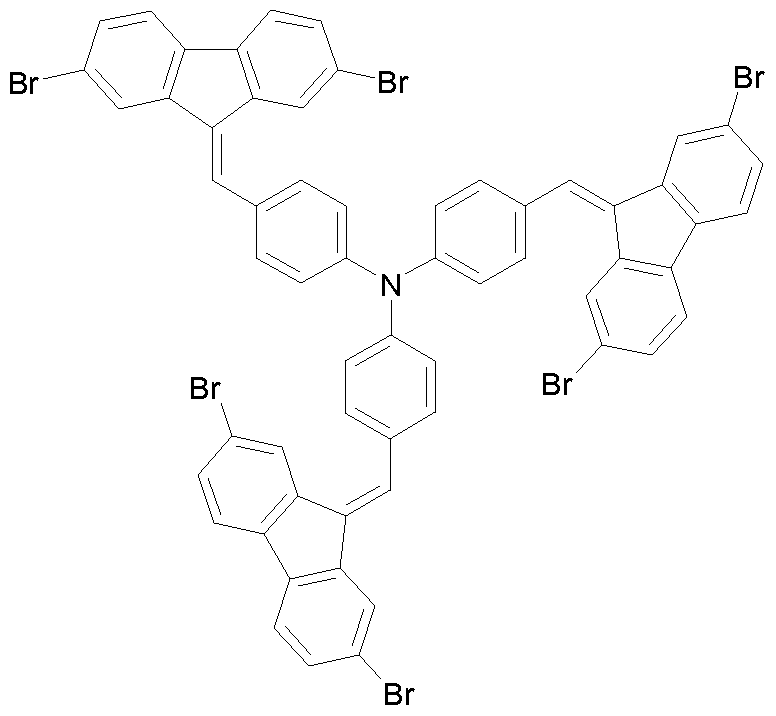
To tris(4-formylphenyl)amine (0.74 g, 2.24 mmol), 2,7-dibromofluorene (2.50 g, 7.85 mmol) and tetrabutylammonium bromide (0.39 g, 1.21 mmol) dissolved in toluene (16 ml_), aqueous 40% K2CO3 solution (16 ml.) was added and the obtained mixture was refluxed for 30 min. After cool- ing to room temperature, 50 ml. of distilled water were added. Orange crystals of compound 1 1 (2.10 g, 76%), formed upon standing, were filtered off and washed with methanol, m.p. 304-305 °C.
H-NMR (400 MHz, THF-d8): δ =8.14 (d, J=1.6 Hz, 3H), 8.0 (s, 3H), 7.94 (d, J=1.6 Hz, 3H), 7.80-7.72 (m, 6H), 7.68 (d, J=8.6 Hz, 6H), 7.57-7.50 (m, 6H), 7.48 (d, J=8.6 Hz, 6H);
Anal, calcd for CeoHssBreN: C, 57.78; H, 2.67, N, 1 .12; found: C, 57.96; H, 2.79; N, 1.01 .
Example 23: 9,9\9' nitrilotris(benzene-4,1 -diylmethylylidene)]tris[N,N,N',N'-tetrakis(4- methoxyphenyl)-9H-fluorene-2,7-diamine] (HTM-12)

A solution of 1 1 (1 .00 g, 0.80 mmol), 4,4'dimethoxydiphenylamine (1 .65 g, 7.21 mmol) and tolu- ene (15 mL) was purged with argon for 30 minutes. Afterwards, palladium(ll) acetate (0.005 g, 0.02 mmol), tri-tert-butylphosphonium tetrafluoroborate (0.01 g, 0.032 mmol) and sodium tert- butoxide (0.69 g, 7.21 mmol) were added and the solution was refluxed under argon atmosphere for 6 hours. After cooling to room temperature, reaction mixture was filtered through Celite, 50 mL of distilled water were added and extraction was done with ethyl acetate. The or- ganic layer was dried over anhydrous Na2S04, filtered, and solvent evaporated. The crude product was purified by column chromatography using 0.5:7:17.5 v/v acetone/n-hexane/toluene as an eluent to collect HTM-12 as a dark orange solid (1 .00 g, 59 %).
H-NMR (400 MHz, CDCI3): δ = 7.61 (s, 3H), 7.42 (dd, J=8.2 Hz, J=2.8 Hz, 6H), 7.38 (s, 3H), 7.32-7.22 (m, 9H), 7.06 (d, J=8.9 Hz, 12H), 6.99-6.89 (m, 18H), 6.82 (d, J=8.9 Hz, 12H), 6.68 (d, J=9.0 Hz, 18H), 3.79 (s, 18H), 3.54 (s, 18H);
3C-NMR (100 MHz, CDC ): δ = 155.31 , 155.09, 147.29, 146.92, 146.41 , 141 .52, 141.44, 140.97, 137.37, 135.17, 134.86, 132.76, 130.72, 130.50, 126.79, 125.72, 125.14, 123.72, 123.09, 122.72, 1 19.812, 1 19.38, 1 14.58, 1 14.49, 1 14.02, 55.46, 55.31.
Anal, calcd for C144H117N7O12: C, 80.91 ; H, 5.52, N, 4.59; found: C, 81 .08; H, 5.47; N, 4.71.
Example 24: N,N'-bis(4-methoxyphenyl)-N,N'-diphenylbiphenyl-4,4'-diamine (12)
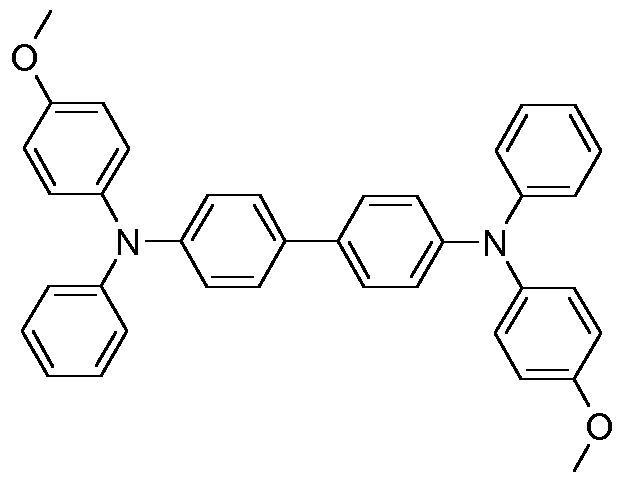
4,4'-{biphenyl-4,4'-diylbis[(4-methoxyphenyl)imino]}dibenzaldehyde (13)

12 and 13 were synthesized according to the known procedure (Yen-Ju Cheng, Ming-Hung Liao, Hung-Min Shih, Ping-I Shih, Chain-Shu Hsu; Exciplex Electroluminescence Induced by Cross-Linked Hole-Transporting Materials for White Light Polymer Light-Emitting Diodes; Mac- romolecules, 201 1 , 44 (15), pp 5968-5976).
Example 25: N,N'-bis{4-[(2,7-dibromo-9H-fluoren-9-ylidene)methyl]phenyl}-N,N'-bis(4- methoxyphenyl)biphenyl-4,4'-diamine (14)
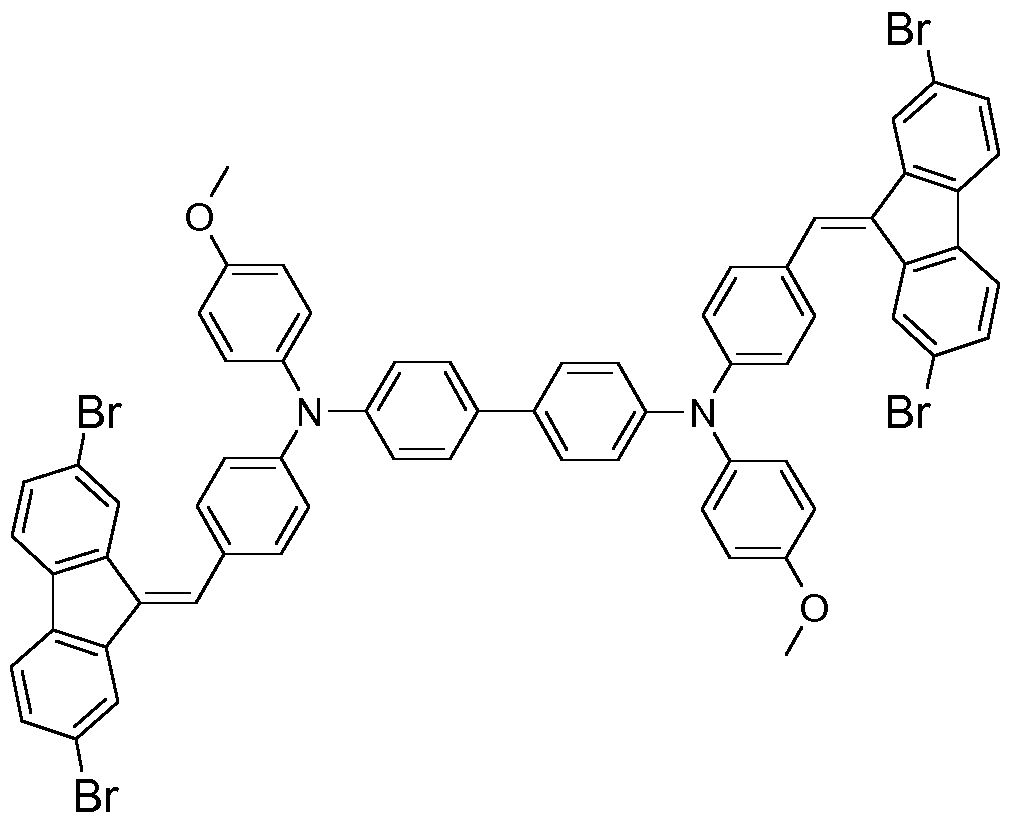
To dialdehyde 13 (1.5 g, 2.48 mmol), 2,7-dibromofluorene (2.0 g, 6.20 mmol) and tetrabu- tylammonium bromide (0.28 g, 0.89 mmol) dissolved in toluene (20 mL), aqueous 40% NaOH solution (18 mL) was added and the obtained mixture was refluxed for 45 min. After cooling to
room temperature, 50 ml. of distilled water were added and extraction was done with ethyl acetate. The combined organic layer was washed with distilled water, dried over anhydrous Na2S04 and filtered. After evaporation of the solvent, the crude product was purified by column chromatography using 1 :4 v/v acetone/n-hexane as an eluent to collect compound 14 as an orange crystals (2.57 g, 85%).
H-NMR (400 MHz, CDCI3): δ = 7.93 (d, J=1 .6 Hz, 2H), 7.79 (d, J=1 .4 Hz, 2H), 7.56-7.34 (m, 20H), 7.24-7.15 (m, 6H), 7.12 (d, J=8.6 Hz, 4H), 6.90 (d, J=9.0Hz, 4H), 3.80 (s, 6H);
3C-NMR (100 MHz, CDC ): δ = 156.69, 148.64, 146.12, 141.29, 139.70, 138.62, 138.00, 136.39, 134.99, 132.64, 130.86, 130.60, 130.48, 130.23, 127.90, 127.78, 127.41 , 127.01 , 124.10, 123.23, 120.97, 120.85, 120.74, 120.54, 1 14.93, 55.44.
Anal, calcd for C66H44Br4N202: C, 65.15; H, 3.65, N, 2.30; found: C, 65.39; H, 3.73; N, 2.53.
Example 26: 9,9'-(biphenyl-4,4'-diylbis{[(4-methoxyphenyl)imino]benzene-4,1 - diylmethylylidene})bis[N,N,N',N'-tetrakis(4-methoxyphenyl)-9H-fluorene-2,7-diamine] (HTM-13)

A solution of 14 (1.0 g, 0.82 mmol), 4,4'dimethoxydiphenylamine (1 .13 g, 4.91 mmol) and toluene (12 ml.) was purged with argon for 30 minutes. Afterwards, palladium(ll) acetate (0.004 g, 0.02 mmol), tri-tert-butylphosphonium tetrafluoroborate (0.004 g, 0.02 mmol) and sodium tert- butoxide (0.47 g, 4.93 mmol) were added and the solution was refluxed under argon atmosphere for 5 hours. After cooling to room temperature, reaction mixture was filtered through Celite, 30 ml. of distilled water were added and extraction was done with ethyl acetate. The organic layer was dried over anhydrous Na2S04, filtered, and solvent evaporated. The crude product was purified by column chromatography using 0.5:10:14.5 v/v acetone/n- hexane/toluene as an eluent to collect HTM-13 as a dark orange solid (0.66 g, 44 %).
H-NMR (400 MHz, CDCb): δ = 7.58 (d, J=2.0 Hz, 2H), 7.47-7.34 (m, 8H), 7.33 (d, J=2.0 Hz, 2H), 7.26 (s, 2H), 7.21 (d, J=8.6 Hz, 4H), 7.1 1 -6.90 (m, 28H), 6.86 (d, J=9.0 Hz, 4H), 6.82 (d,
J=9.0 Hz, 8H), 6.77 (d, J=8.6 Hz, 4H), 6.72 (d, J=9.0 Hz, 8 H), 3.81 (s, 6H), 3.79 (s, 12H), 3.61 (s, 12H);
3C-NMR (100 MHz, CDCI3): δ = 156.29, 155.26, 155.12, 147.44, 147.18, 146.89, 146.53, 141 .45, 140.95, 140.18, 137.48, 134.86, 134.56, 134.10, 132.76, 130.24, 129.52, 127.31 , 127.18, 127.02, 125.69, 125.35, 123.00, 122.52, 1 19.31 , 1 14.75, 1 14.56, 1 14.46, 1 13.99, 55.49, 55.31 .
Anal, calcd for Ci22HiooN6Oio: C, 80.95; H, 5.57, N, 4.64; found: C, 81 .1 1 ; H, 5.69; N, 4.52.
Example 27: 9,9'-(thiene-2,5-diyldimethylylidene)bis-9H-fluorene (HTM-comp) (comparative example)
This compound was synthesized as described by Lukas et al. (Synthetic Metals 157 (2007) 770- 778) who name this compound Bi. Example 28: Dye-sensitized Solar Cells
Dye sensitized solar cells were prepared according to the following procedure. A T1O2 blocking layer was prepared on a fluorine-doped tin oxide (FTO)-covered glass substrate using spray pyrolysis (cf. B. Peng, G. Jungmann, C. Jager, D. Haarer, H. W. Schmidt, M. Thelakkat, Coord. Chem. Rev. 2004, 248, 1479). Next, a T1O2 paste (Dyesol), diluted with terpineol, was applied by screen printing, resulting in a film thickness of approximately 1 .7 μηη. All films were then sintered for 45 min at 450 °C, followed by treatment in a 40 mM aqueous solution of TiCU at 60 °C for 30 min, followed by another sintering step. The prepared samples with T1O2 layers were pretreated with a 5 mM solution of the additive 2-(p-butoxyphenyl)acetohydroxamic acid sodium salt ("ADD1 ") in ethanol (this additive is described on page 52 of WO 2012/ 001 628 A1 as "Example No. 6"). The electrodes were then dyed in 0.5 mM dye solution in CH2CI2. The respective hole-transport material according to the present invention was applied by spin-coating from a solution in DCM (200 mg/mL) also containing 20 mM Li(CFsS02)2N. Fabrication of the device was completed by evaporation of 200 nm of silver as the counter electrode. The active area of the solar cell was defined by the size of these contacts (0.13 cm2), and the cells were masked by an aperture of the same area for measurements.
The Current-voltage characteristics for all cells were measured with a Keithley 2400 under 1000 W/m2, AM 1.5G conditions (LOT ORIEL 450 W). The results are given in table 1.
μο in μι in
Hole-transport material lp in eV η in %
cm2V- s-1 cm2V- s-1
HTM-1 (Example 2) 5.00 - - 1 .9
HTM-2 (Example 3) 4.98 - - 2.3
HTM-3 (Example 5) 5.04 7■ 10-6 2.4 ■ 10-4 0.9
Table 1 : Current-voltage characteristics of the dye-sensitzed solar cells with the hole-transport materials according to the present invention, lp stands for solid state ionization potential of the hole-transport material, μο for the charge-carrier mobility at 0 V/cm, μι for the charge-carrier mobility at 6.4· 105 V/cm (both mobilities measured as neat film) and η for the solar-to-electric power conversion efficiency, a "-" indicates that the respective value was not measured.
The solid state ionization potential (lp) of the hole-transport materials was measured by the electron photoemission in air method as described by Kirkus et al., Synthetic Metals 159 (2009) 729-734. The hole-transport materials were dissolved in CHC and coated on Al plates to form a layer of 0.5 to 1 μηη thickness. The Al plates were pre-coated with a methylmethacrylate and methacrylic acid copolymer adhesive layer of a thickness of about 0.5 μηη. The photoemission experiments were carried out in air. The samples were illuminated with monochromatic light from a deuterium lamp equipped with a quartz monochromator. The power of the incident light beam was 2 to 5 · 10"8 W. A negative voltage of -300 V was applied to the sample substrate. The counter-electrode with the 4.5x15 mm2 slit for illumination was placed at 8 mm distance from the sample surface. The counter-electrode was connected to the input of the BK2-16 type electrometer, working in the open input regime, for the photocurrent measurement. A photocur- rent of 10"15 to 10"12 A was measured in the circuit under illumination. The square root of the photocurrent value was plotted against the energy of the photon. The linear part of this dependency was extrapolated to zero photocurrent. The corresponding photon energy was used as value for lp.
To measure the charge carrier mobility (μ) the hole-transport materials were spin-coated from solution on polyester films with a conductive Al layer. The layer thickness was in the range of 5- 10 μπΊ. The hole mobility was measured by xerographic time of flight technique (XTOF) as described by Montrimas et al. Journal of Physics 6 (1966) 569. The electric field was created by positive corona charging. The charge carriers were generated at the layer surface by illumination with pulses of a nitrogen laser with a pulse duration of 2 ns and a wavelength of 337 nm. The layer surface potential decrease as a result of pulse illumination was 1 to 5 % of the potential before illumination. The capacitance probe that was connected to the wide frequency band electrometer measured the speed of the surface potential decrease (dU/dt). The transit time tt was determined by the kink on the curve of the dU/dt transient in double logarithmic scale. The drift mobility was calculated by the formula μ=d2/Uott, wherein d is the layer thickness and Uo is the surface potential at the moment of illumination.
Example 29: Perovskite Solar Cells
Perovskite Solar Cells were prepared according to the following procedure. A ΤΊΟ2 blocking layer was prepared in the same way as in Example 27. A ΤΊΟ2 scaffold was deposited by spin- coating a ΤΊΟ2 paste (Dyesol) diluted with ethanol. The two layers were sintered at 450 °C for 30 min. After cooling the substrates down to room temperature, a perovskite layer was prepared by spin-coating a 40 wt.-% solution of CH3NH3l:PbCl2 (molecular ration 3:1 ) in DMF (N,N- Dimethylformamide) and annealing the resulting layer for 30 min in an oven at 1 10°C. The hole- transport material according to the present invention was deposited by spin-coating a solution in chlorobenzene containing also lithium bis(trifluoromethylsulfonyl)imide (LiTFSi) and tert- butylpyridine (tBP). The counter electrodes consisted of 50 nm gold layers evaporated through a mask, defining the active area of the solar cell by the size of these contacts (0.13 cm2). For measurements, the cells were masked by an aperture of the same area. The hole-transport materials and the solar cells made thereof where characterized as described for example 27. The results are given in table 2.
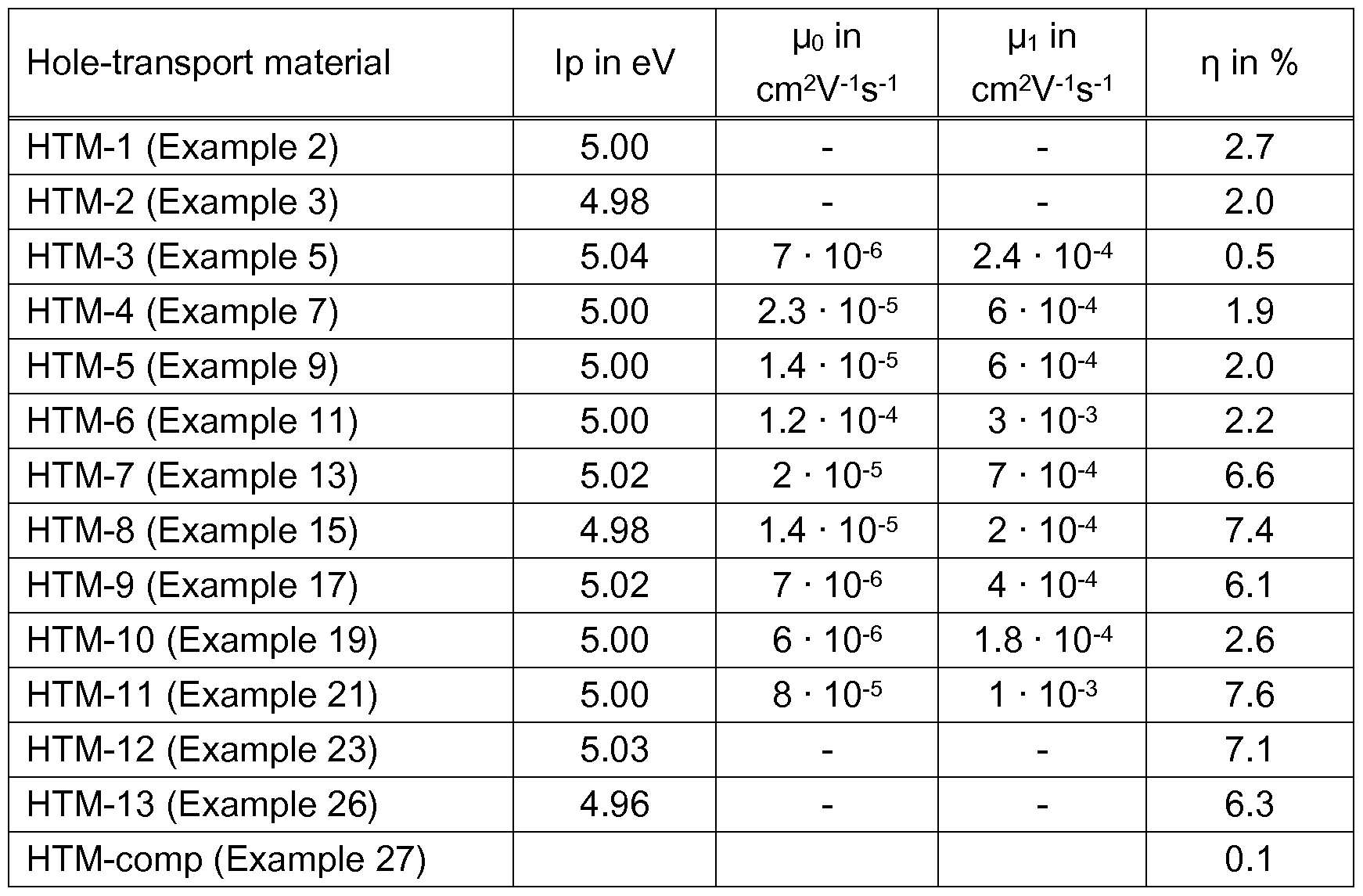
Table 2: Current-voltage characteristics of the perovskite solar cells with the hole-transport materials according to the present invention, the measures have the same meaning as in table 1 .
Claims
Claims
1 . A compound of general formula (I)
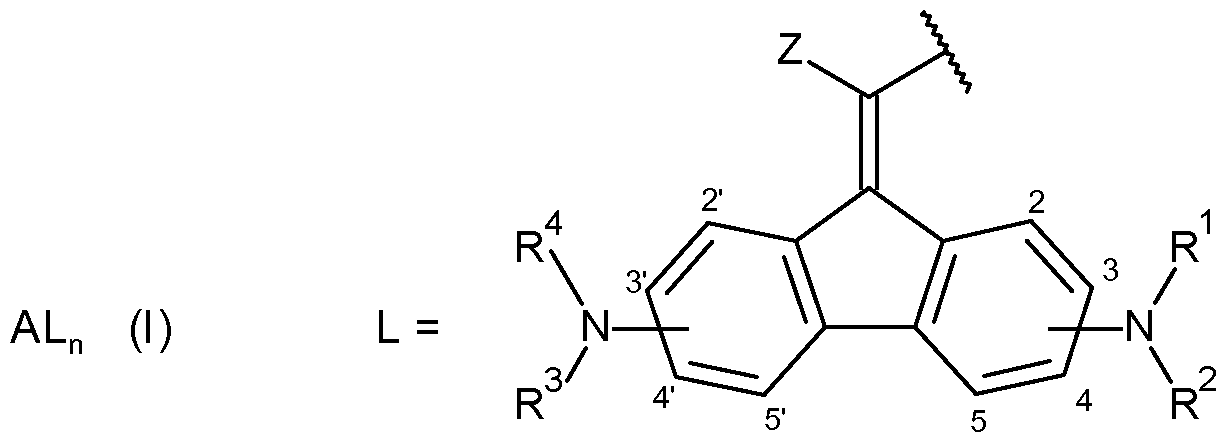
A is a group which connects all L moieties by a π-conjugated system which is formed by olefinic groups, aromatic groups, heteroaromatic groups, sandwich groups, atoms with unbound electron pairs, or combinations thereof,
Z is hydrogen, an alkyl group, an aryl group, or a heteroaryl group,
R1, R2, R3, R4 are independent of each other alkyl groups, aryl groups, or heteroaryl groups,
n is an integer of at least 2.
The compound according to claim 1 , wherein the π-conjugated system in A is formed by one or more aromatic and/or heteroaromatic groups.
The compound according to claim 2, wherein the π-conjugated system in A is formed by benzene.
The compound according to any of the claims 1 to 3, wherein n equals 2.
The compound according to any of the claims 1 to 4, wherein R1, R2, R3, R4 are independent of each other alkoxyphenyl groups.
The compound according to any of the claims 1 to 5, wherein Z is hydrogen.
Use of the compound of general formula (I) according to any of the claims 1 to 6 in organic solar cells or organic optical sensors.
An organic solar cell or organic optical sensor comprising a compound of general formula (I) according to any of the claims 1 to 6.
The organic solar cell or organic optical sensor according to claim 8, wherein the organic solar cell or organic optical sensor further comprises a semiconducting metal oxide as electron transport material which is sensitized with a light-absorbing material.
10. The organic solar cell or organic optical sensor according to claim 9, wherein the metal oxide is T1O2.
1 1 . The organic solar cell or organic optical sensor according to claim 9 or 10, wherein the light-absorbing material is a Ru(ll) dye, a perylene dye, a naphtalenemonoimid dye, or a quinolinium dye.
12. The organic solar cell or organic optical sensor according to claim 9 or 10, wherein the light-absorbing material is a perovskite absorber.
Applications Claiming Priority (2)
| Application Number | Priority Date | Filing Date | Title |
|---|---|---|---|
| EP14165385.7A EP2937399A1 (en) | 2014-04-22 | 2014-04-22 | Hole-transport materials for organic solar cells or organic optical sensors |
| EP14165385.7 | 2014-04-22 |
Publications (1)
| Publication Number | Publication Date |
|---|---|
| WO2015161989A1 true WO2015161989A1 (en) | 2015-10-29 |
Family
ID=50489011
Family Applications (1)
| Application Number | Title | Priority Date | Filing Date |
|---|---|---|---|
| PCT/EP2015/056960 Ceased WO2015161989A1 (en) | 2014-04-22 | 2015-03-31 | Hole-transport materials for organic solar cells or organic optical sensors |
Country Status (2)
| Country | Link |
|---|---|
| EP (1) | EP2937399A1 (en) |
| WO (1) | WO2015161989A1 (en) |
Cited By (26)
| Publication number | Priority date | Publication date | Assignee | Title |
|---|---|---|---|---|
| US9958535B2 (en) | 2013-08-19 | 2018-05-01 | Basf Se | Detector for determining a position of at least one object |
| US9989623B2 (en) | 2013-06-13 | 2018-06-05 | Basf Se | Detector for determining a longitudinal coordinate of an object via an intensity distribution of illuminated pixels |
| LT6540B (en) | 2016-09-19 | 2018-06-25 | Kauno technologijos universitetas | Hole transporting organic molecules containing enamine groups for optoelectronic and photoelectrochemical devices |
| US10012532B2 (en) | 2013-08-19 | 2018-07-03 | Basf Se | Optical detector |
| US10094927B2 (en) | 2014-09-29 | 2018-10-09 | Basf Se | Detector for optically determining a position of at least one object |
| CN108675941A (en) * | 2018-04-13 | 2018-10-19 | 华中科技大学 | A kind of undoped hole mobile material based on dicyano fluoranthene |
| US10120078B2 (en) | 2012-12-19 | 2018-11-06 | Basf Se | Detector having a transversal optical sensor and a longitudinal optical sensor |
| US10353049B2 (en) | 2013-06-13 | 2019-07-16 | Basf Se | Detector for optically detecting an orientation of at least one object |
| CN110156616A (en) * | 2019-05-22 | 2019-08-23 | 吉林师范大学 | Synthesis of dopant-free hole-transport materials based on fluorene-vinyl bridged aromatic ring cores and their applications in perovskite batteries |
| US10412283B2 (en) | 2015-09-14 | 2019-09-10 | Trinamix Gmbh | Dual aperture 3D camera and method using differing aperture areas |
| US10775505B2 (en) | 2015-01-30 | 2020-09-15 | Trinamix Gmbh | Detector for an optical detection of at least one object |
| US10890491B2 (en) | 2016-10-25 | 2021-01-12 | Trinamix Gmbh | Optical detector for an optical detection |
| US10948567B2 (en) | 2016-11-17 | 2021-03-16 | Trinamix Gmbh | Detector for optically detecting at least one object |
| US10955936B2 (en) | 2015-07-17 | 2021-03-23 | Trinamix Gmbh | Detector for optically detecting at least one object |
| US11041718B2 (en) | 2014-07-08 | 2021-06-22 | Basf Se | Detector for determining a position of at least one object |
| US11060922B2 (en) | 2017-04-20 | 2021-07-13 | Trinamix Gmbh | Optical detector |
| US11067692B2 (en) | 2017-06-26 | 2021-07-20 | Trinamix Gmbh | Detector for determining a position of at least one object |
| US11125880B2 (en) | 2014-12-09 | 2021-09-21 | Basf Se | Optical detector |
| CN113488595A (en) * | 2021-06-17 | 2021-10-08 | 江苏大学 | Preparation method of efficient all-inorganic perovskite solar cell based on low-cost hole transport material |
| US11211513B2 (en) | 2016-07-29 | 2021-12-28 | Trinamix Gmbh | Optical sensor and detector for an optical detection |
| EP4006021A1 (en) | 2020-11-30 | 2022-06-01 | Toyota Jidosha Kabushiki Kaisha | Triphenylamine functionalized oligothiophenes: stable and low cost hole-transporting materials for high performance perovskite solar cells |
| US11428787B2 (en) | 2016-10-25 | 2022-08-30 | Trinamix Gmbh | Detector for an optical detection of at least one object |
| US11448762B2 (en) | 2017-08-28 | 2022-09-20 | Trinamix Gmbh | Range finder for determining at least one geometric information |
| US11668828B2 (en) | 2017-08-28 | 2023-06-06 | Trinamix Gmbh | Detector for determining a position of at least one object |
| US11719818B2 (en) | 2017-03-16 | 2023-08-08 | Trinamix Gmbh | Detector for optically detecting at least one object |
| US11860292B2 (en) | 2016-11-17 | 2024-01-02 | Trinamix Gmbh | Detector and methods for authenticating at least one object |
Citations (7)
| Publication number | Priority date | Publication date | Assignee | Title |
|---|---|---|---|---|
| WO1998050393A1 (en) | 1997-05-07 | 1998-11-12 | Ecole Polytechnique Federale De Lausanne | Metal complex photosensitizer and photovoltaic cell |
| US6359211B1 (en) | 1999-06-17 | 2002-03-19 | Chemmotif, Inc. | Spectral sensitization of nanocrystalline solar cells |
| WO2007054470A1 (en) | 2005-11-10 | 2007-05-18 | Basf Se | Use of rylene derivatives as photosensitizers in solar cells |
| WO2009007340A1 (en) | 2007-07-10 | 2009-01-15 | Basf Se | Mixtures for producing photoactive layers for organic solar cells and organic photodetectors |
| WO2009109499A1 (en) | 2008-03-07 | 2009-09-11 | Basf Se | Dye sensitised solar cell |
| WO2010094636A1 (en) * | 2009-02-23 | 2010-08-26 | Basf Se | Use of triarylamine derivatives as hole-conducting materials in organic solar cells and organic solar cells containing said triarylamine derivatives |
| WO2012001628A1 (en) | 2010-06-29 | 2012-01-05 | Basf Se | Photoelectric conversion device comprising hydroxamic acid derivative or salt thereof as additive and process for producing same |
-
2014
- 2014-04-22 EP EP14165385.7A patent/EP2937399A1/en not_active Withdrawn
-
2015
- 2015-03-31 WO PCT/EP2015/056960 patent/WO2015161989A1/en not_active Ceased
Patent Citations (7)
| Publication number | Priority date | Publication date | Assignee | Title |
|---|---|---|---|---|
| WO1998050393A1 (en) | 1997-05-07 | 1998-11-12 | Ecole Polytechnique Federale De Lausanne | Metal complex photosensitizer and photovoltaic cell |
| US6359211B1 (en) | 1999-06-17 | 2002-03-19 | Chemmotif, Inc. | Spectral sensitization of nanocrystalline solar cells |
| WO2007054470A1 (en) | 2005-11-10 | 2007-05-18 | Basf Se | Use of rylene derivatives as photosensitizers in solar cells |
| WO2009007340A1 (en) | 2007-07-10 | 2009-01-15 | Basf Se | Mixtures for producing photoactive layers for organic solar cells and organic photodetectors |
| WO2009109499A1 (en) | 2008-03-07 | 2009-09-11 | Basf Se | Dye sensitised solar cell |
| WO2010094636A1 (en) * | 2009-02-23 | 2010-08-26 | Basf Se | Use of triarylamine derivatives as hole-conducting materials in organic solar cells and organic solar cells containing said triarylamine derivatives |
| WO2012001628A1 (en) | 2010-06-29 | 2012-01-05 | Basf Se | Photoelectric conversion device comprising hydroxamic acid derivative or salt thereof as additive and process for producing same |
Non-Patent Citations (22)
| Title |
|---|
| ADV. MATER., vol. 17, 2005, pages 813 |
| ALT H G ET AL: "C2-symmetric bis(fluorenyl) complexes: four complex models as potential catalysts for the isospecific polymerization of propylene", JOURNAL OF ORGANOMETALLIC CHEMISTRY, ELSEVIER-SEQUOIA S.A. LAUSANNE, CH, vol. 512, no. 1, 19 April 1996 (1996-04-19), pages 51 - 60, XP004036048, ISSN: 0022-328X, DOI: 10.1016/0022-328X(95)06008-K * |
| B. PENG; G. JUNGMANN; C. JAGER; D. HAARER; H. W. SCHMIDT; M. THELAKKAT, COORD. CHEM. REV., vol. 248, 2004, pages 1479 |
| BACH ET AL., NATURE, vol. 395, pages 583 - 585 |
| BARBE ET AL., JOURNAL OF AMERICAN CERAMIC SOCIETY, vol. 80, no. 12, 1997, pages 3157 - 3171 |
| BURNSIDE ET AL., CHEMISTRY OF MATERIALS, vol. 10, no. 9, 1998, pages 2419 - 2425 |
| CHEM. LETT., vol. 35, 2006, pages 252 |
| ELECTROCHIMICA ACTA, vol. 40, 1995, pages 643 |
| J. AM. CHEM. SOC, vol. 125, 2003, pages 475 |
| J. PHYS. CHEM. B, vol. 110, 2006, pages 1991 |
| JOHN F. HARTWIG, ANGEW. CHEM. INT. ED., vol. 37, 1998, pages 2047 - 2067 |
| KIRKUS ET AL., SYNTHETIC METALS, vol. 159, 2009, pages 729 - 734 |
| LUK ET AL., SYNTHETIC METALS, vol. 157, 2007, pages 770 - 778 |
| LUKES ET AL.: "oligothiophenes terminated by (9H-fluoren-9-ylidene)methyl chromophores. However, no solar cells are disclosed", SYNTHETIC METALS, vol. 157, 2007, pages 770 - 778 |
| LUKES ET AL: "Structure, electronic and optical characterization of oligothiophenes terminated with (9H-fluoren-9-ylidene)methyl chromophores", SYNTHETIC METALS, ELSEVIER SEQUOIA, LAUSANNE, CH, vol. 157, no. 18-20, 24 October 2007 (2007-10-24), pages 770 - 778, XP022337010, ISSN: 0379-6779, DOI: 10.1016/J.SYNTHMET.2007.08.011 * |
| MARTIN DANKO ET AL: "Spectral properties of chalcone containing triphenylamino structural unit in solution and in polymer matrices", DYES AND PIGMENTS, ELSEVIER APPLIED SCIENCE PUBLISHERS. BARKING, GB, vol. 92, no. 3, 22 July 2011 (2011-07-22), pages 1257 - 1265, XP028106510, ISSN: 0143-7208, [retrieved on 20110730], DOI: 10.1016/J.DYEPIG.2011.07.011 * |
| MATERIA, vol. 35, no. 9, 1996, pages 1012 - 1018 |
| MONTRIMAS ET AL., JOURNAL OF PHYSICS, vol. 6, 1966, pages 569 |
| SHAO ET AL: "Synthesis and fluorescence properties of carbazole and fluorene-based compounds", JOURNAL OF LUMINESCENCE, ELSEVIER BV NORTH-HOLLAND, NL, vol. 127, no. 2, 14 August 2007 (2007-08-14), pages 349 - 354, XP022200807, ISSN: 0022-2313, DOI: 10.1016/J.JLUMIN.2007.01.013 * |
| WANG LING ET AL: "Effects of the acceptors in triphenylamine-based D-A'-[pi]-A dyes on photophysical, electrochemical, and photovoltaic properties", JOURNAL OF POWER SOURCES, vol. 246, 22 August 2013 (2013-08-22), pages 831 - 839, XP028739944, ISSN: 0378-7753, DOI: 10.1016/J.JPOWSOUR.2013.08.034 * |
| YEN-JU CHENG; MING-HUNG LIAO; HUNG-MIN SHIH; PING-I SHIH; CHAIN-SHU HSU: "Exciplex Electroluminescence Induced by Cross-Linked Hole-Transporting Materials for White Light Polymer Light-Emitting Diodes", MACROMOLECULES, vol. 44, no. 15, 2011, pages 5968 - 5976 |
| ZHONG HU ET AL: "Theoretical study of two-photon absorption properties and up-conversion efficiency of new symmetric organic Ï -conjugated molecules for photovoltaic devices", JOURNAL OF MOLECULAR MODELING, SPRINGER, DE, vol. 18, no. 8, 23 February 2012 (2012-02-23), pages 3657 - 3667, XP035091276, ISSN: 0948-5023, DOI: 10.1007/S00894-012-1378-3 * |
Cited By (33)
| Publication number | Priority date | Publication date | Assignee | Title |
|---|---|---|---|---|
| US10120078B2 (en) | 2012-12-19 | 2018-11-06 | Basf Se | Detector having a transversal optical sensor and a longitudinal optical sensor |
| US9989623B2 (en) | 2013-06-13 | 2018-06-05 | Basf Se | Detector for determining a longitudinal coordinate of an object via an intensity distribution of illuminated pixels |
| US10845459B2 (en) | 2013-06-13 | 2020-11-24 | Basf Se | Detector for optically detecting at least one object |
| US10823818B2 (en) | 2013-06-13 | 2020-11-03 | Basf Se | Detector for optically detecting at least one object |
| US10353049B2 (en) | 2013-06-13 | 2019-07-16 | Basf Se | Detector for optically detecting an orientation of at least one object |
| US10012532B2 (en) | 2013-08-19 | 2018-07-03 | Basf Se | Optical detector |
| US9958535B2 (en) | 2013-08-19 | 2018-05-01 | Basf Se | Detector for determining a position of at least one object |
| US11041718B2 (en) | 2014-07-08 | 2021-06-22 | Basf Se | Detector for determining a position of at least one object |
| US10094927B2 (en) | 2014-09-29 | 2018-10-09 | Basf Se | Detector for optically determining a position of at least one object |
| US11125880B2 (en) | 2014-12-09 | 2021-09-21 | Basf Se | Optical detector |
| US10775505B2 (en) | 2015-01-30 | 2020-09-15 | Trinamix Gmbh | Detector for an optical detection of at least one object |
| US10955936B2 (en) | 2015-07-17 | 2021-03-23 | Trinamix Gmbh | Detector for optically detecting at least one object |
| US10412283B2 (en) | 2015-09-14 | 2019-09-10 | Trinamix Gmbh | Dual aperture 3D camera and method using differing aperture areas |
| US11211513B2 (en) | 2016-07-29 | 2021-12-28 | Trinamix Gmbh | Optical sensor and detector for an optical detection |
| LT6540B (en) | 2016-09-19 | 2018-06-25 | Kauno technologijos universitetas | Hole transporting organic molecules containing enamine groups for optoelectronic and photoelectrochemical devices |
| US11329229B2 (en) | 2016-09-19 | 2022-05-10 | Kauno Technologies Universitetas | Hole transporting organic molecules containing enamine groups for optoelectronic and photoelectrochemical devices |
| US10890491B2 (en) | 2016-10-25 | 2021-01-12 | Trinamix Gmbh | Optical detector for an optical detection |
| US11428787B2 (en) | 2016-10-25 | 2022-08-30 | Trinamix Gmbh | Detector for an optical detection of at least one object |
| US11860292B2 (en) | 2016-11-17 | 2024-01-02 | Trinamix Gmbh | Detector and methods for authenticating at least one object |
| US10948567B2 (en) | 2016-11-17 | 2021-03-16 | Trinamix Gmbh | Detector for optically detecting at least one object |
| US11698435B2 (en) | 2016-11-17 | 2023-07-11 | Trinamix Gmbh | Detector for optically detecting at least one object |
| US11415661B2 (en) | 2016-11-17 | 2022-08-16 | Trinamix Gmbh | Detector for optically detecting at least one object |
| US11635486B2 (en) | 2016-11-17 | 2023-04-25 | Trinamix Gmbh | Detector for optically detecting at least one object |
| US11719818B2 (en) | 2017-03-16 | 2023-08-08 | Trinamix Gmbh | Detector for optically detecting at least one object |
| US11060922B2 (en) | 2017-04-20 | 2021-07-13 | Trinamix Gmbh | Optical detector |
| US11067692B2 (en) | 2017-06-26 | 2021-07-20 | Trinamix Gmbh | Detector for determining a position of at least one object |
| US11668828B2 (en) | 2017-08-28 | 2023-06-06 | Trinamix Gmbh | Detector for determining a position of at least one object |
| US11448762B2 (en) | 2017-08-28 | 2022-09-20 | Trinamix Gmbh | Range finder for determining at least one geometric information |
| CN108675941A (en) * | 2018-04-13 | 2018-10-19 | 华中科技大学 | A kind of undoped hole mobile material based on dicyano fluoranthene |
| CN110156616A (en) * | 2019-05-22 | 2019-08-23 | 吉林师范大学 | Synthesis of dopant-free hole-transport materials based on fluorene-vinyl bridged aromatic ring cores and their applications in perovskite batteries |
| CN110156616B (en) * | 2019-05-22 | 2022-02-25 | 吉林师范大学 | Synthesis method of doping-free hole transport material based on fluorene ethylene bridged aromatic ring nucleus and application of doping-free hole transport material in perovskite battery |
| EP4006021A1 (en) | 2020-11-30 | 2022-06-01 | Toyota Jidosha Kabushiki Kaisha | Triphenylamine functionalized oligothiophenes: stable and low cost hole-transporting materials for high performance perovskite solar cells |
| CN113488595A (en) * | 2021-06-17 | 2021-10-08 | 江苏大学 | Preparation method of efficient all-inorganic perovskite solar cell based on low-cost hole transport material |
Also Published As
| Publication number | Publication date |
|---|---|
| EP2937399A1 (en) | 2015-10-28 |
Similar Documents
| Publication | Publication Date | Title |
|---|---|---|
| WO2015161989A1 (en) | Hole-transport materials for organic solar cells or organic optical sensors | |
| He et al. | Bithiazole-bridged dyes for dye-sensitized solar cells with high open circuit voltage performance | |
| Puckyte et al. | Carbazole-based molecular glasses for efficient solid-state dye-sensitized solar cells | |
| US10038150B2 (en) | Metal complexes for use as dopants and other uses | |
| WO2016066494A1 (en) | Hole-transport materials for organic solar cells or organic optical sensors | |
| US9087991B2 (en) | Photovoltaic element | |
| Yang et al. | Efficient and stable organic DSSC sensitizers bearing quinacridone and furan moieties as a planar π-spacer | |
| EP1777227B1 (en) | Novel hole transporting material and solid electrolyte to be applied in a photovoltaic device | |
| Tomkeviciene et al. | Diphenylamino-substituted derivatives of 9-phenylcarbazole as glass-forming hole-transporting materials for solid state dye sensitized solar cells | |
| Zhao et al. | Novel donor-acceptor-donor structured small molecular hole transporting materials for planar perovskite solar cells | |
| JP7768643B2 (en) | Photovoltaic devices containing cyclobutane-based hole transport materials | |
| EP3225624A1 (en) | Novel compound and use thereof as a hole-transport material | |
| CN107438597A (en) | For photoelectron device and the small molecule hole transport material of Photoelectrochemicaldevice device | |
| KR20130044340A (en) | Dye solar cell with improved stability | |
| Rakstys et al. | A structural study of 1-phenyl-1, 2, 3, 4-tetrahydroquinoline-based dyes for solid-state DSSC applications | |
| Urnikaite et al. | Organic dyes containing a hydrazone moiety as auxiliary donor for solid-state DSSC applications | |
| JP5794589B2 (en) | Dye-sensitized solar cell and sensitizing dye | |
| Lin et al. | Benzo [1, 2-b: 4, 5-b′] dithiophene and benzo [1, 2-b: 4, 5-b′] difuran based organic dipolar compounds for sensitized solar cells | |
| US11329229B2 (en) | Hole transporting organic molecules containing enamine groups for optoelectronic and photoelectrochemical devices | |
| Duan et al. | New organic dyes containing tert-butyl-capped N-arylcarbazole moiety for dye-sensitized solar cells | |
| US9831042B2 (en) | Organic dyes comprising a hydrazone moiety and their use in dye-sensitized solar cells | |
| Lygaitis et al. | Star-shaped triphenylamine-based molecular glass for solid state dye sensitized solar cell application | |
| Zhang et al. | Synthesis of Zinc Porphyrin Sensitizers for Dye‐Sensitized Solar Cells by Tuning Electron‐Donor Group | |
| Chang et al. | Yung-Chung Chen, Guan-Wei Huang | |
| WO2025182779A1 (en) | Compound, hole transport material, and solar cell |
Legal Events
| Date | Code | Title | Description |
|---|---|---|---|
| 121 | Ep: the epo has been informed by wipo that ep was designated in this application |
Ref document number: 15714456 Country of ref document: EP Kind code of ref document: A1 |
|
| NENP | Non-entry into the national phase |
Ref country code: DE |
|
| 122 | Ep: pct application non-entry in european phase |
Ref document number: 15714456 Country of ref document: EP Kind code of ref document: A1 |