WO2015125051A1 - Thermoplastic composition and article - Google Patents
Thermoplastic composition and article Download PDFInfo
- Publication number
- WO2015125051A1 WO2015125051A1 PCT/IB2015/051065 IB2015051065W WO2015125051A1 WO 2015125051 A1 WO2015125051 A1 WO 2015125051A1 IB 2015051065 W IB2015051065 W IB 2015051065W WO 2015125051 A1 WO2015125051 A1 WO 2015125051A1
- Authority
- WO
- WIPO (PCT)
- Prior art keywords
- weight percent
- composition
- block
- polycarbonate
- repeat units
- Prior art date
- Legal status (The legal status is an assumption and is not a legal conclusion. Google has not performed a legal analysis and makes no representation as to the accuracy of the status listed.)
- Ceased
Links
- MZIKVDACKLRRNI-UHFFFAOYSA-N NC(Cc(cc1)ccc1C(Oc1cc(ON)ccc1)=O)=O Chemical compound NC(Cc(cc1)ccc1C(Oc1cc(ON)ccc1)=O)=O MZIKVDACKLRRNI-UHFFFAOYSA-N 0.000 description 2
- 0 COc1cccc(OC(c(cc2)ccc2C(*)=O)=O)c1 Chemical compound COc1cccc(OC(c(cc2)ccc2C(*)=O)=O)c1 0.000 description 1
Classifications
-
- C—CHEMISTRY; METALLURGY
- C08—ORGANIC MACROMOLECULAR COMPOUNDS; THEIR PREPARATION OR CHEMICAL WORKING-UP; COMPOSITIONS BASED THEREON
- C08L—COMPOSITIONS OF MACROMOLECULAR COMPOUNDS
- C08L69/00—Compositions of polycarbonates; Compositions of derivatives of polycarbonates
-
- C—CHEMISTRY; METALLURGY
- C08—ORGANIC MACROMOLECULAR COMPOUNDS; THEIR PREPARATION OR CHEMICAL WORKING-UP; COMPOSITIONS BASED THEREON
- C08K—Use of inorganic or non-macromolecular organic substances as compounding ingredients
- C08K3/00—Use of inorganic substances as compounding ingredients
- C08K3/02—Elements
- C08K3/04—Carbon
-
- C—CHEMISTRY; METALLURGY
- C08—ORGANIC MACROMOLECULAR COMPOUNDS; THEIR PREPARATION OR CHEMICAL WORKING-UP; COMPOSITIONS BASED THEREON
- C08K—Use of inorganic or non-macromolecular organic substances as compounding ingredients
- C08K3/00—Use of inorganic substances as compounding ingredients
- C08K3/18—Oxygen-containing compounds, e.g. metal carbonyls
- C08K3/20—Oxides; Hydroxides
- C08K3/22—Oxides; Hydroxides of metals
-
- C—CHEMISTRY; METALLURGY
- C08—ORGANIC MACROMOLECULAR COMPOUNDS; THEIR PREPARATION OR CHEMICAL WORKING-UP; COMPOSITIONS BASED THEREON
- C08L—COMPOSITIONS OF MACROMOLECULAR COMPOUNDS
- C08L67/00—Compositions of polyesters obtained by reactions forming a carboxylic ester link in the main chain; Compositions of derivatives of such polymers
- C08L67/02—Polyesters derived from dicarboxylic acids and dihydroxy compounds
-
- C—CHEMISTRY; METALLURGY
- C08—ORGANIC MACROMOLECULAR COMPOUNDS; THEIR PREPARATION OR CHEMICAL WORKING-UP; COMPOSITIONS BASED THEREON
- C08L—COMPOSITIONS OF MACROMOLECULAR COMPOUNDS
- C08L69/00—Compositions of polycarbonates; Compositions of derivatives of polycarbonates
- C08L69/005—Polyester-carbonates
-
- C—CHEMISTRY; METALLURGY
- C08—ORGANIC MACROMOLECULAR COMPOUNDS; THEIR PREPARATION OR CHEMICAL WORKING-UP; COMPOSITIONS BASED THEREON
- C08L—COMPOSITIONS OF MACROMOLECULAR COMPOUNDS
- C08L2201/00—Properties
- C08L2201/02—Flame or fire retardant/resistant
-
- C—CHEMISTRY; METALLURGY
- C08—ORGANIC MACROMOLECULAR COMPOUNDS; THEIR PREPARATION OR CHEMICAL WORKING-UP; COMPOSITIONS BASED THEREON
- C08L—COMPOSITIONS OF MACROMOLECULAR COMPOUNDS
- C08L2203/00—Applications
- C08L2203/20—Applications use in electrical or conductive gadgets
-
- C—CHEMISTRY; METALLURGY
- C08—ORGANIC MACROMOLECULAR COMPOUNDS; THEIR PREPARATION OR CHEMICAL WORKING-UP; COMPOSITIONS BASED THEREON
- C08L—COMPOSITIONS OF MACROMOLECULAR COMPOUNDS
- C08L2205/00—Polymer mixtures characterised by other features
- C08L2205/02—Polymer mixtures characterised by other features containing two or more polymers of the same C08L -group
-
- C—CHEMISTRY; METALLURGY
- C08—ORGANIC MACROMOLECULAR COMPOUNDS; THEIR PREPARATION OR CHEMICAL WORKING-UP; COMPOSITIONS BASED THEREON
- C08L—COMPOSITIONS OF MACROMOLECULAR COMPOUNDS
- C08L2205/00—Polymer mixtures characterised by other features
- C08L2205/02—Polymer mixtures characterised by other features containing two or more polymers of the same C08L -group
- C08L2205/025—Polymer mixtures characterised by other features containing two or more polymers of the same C08L -group containing two or more polymers of the same hierarchy C08L, and differing only in parameters such as density, comonomer content, molecular weight, structure
-
- C—CHEMISTRY; METALLURGY
- C08—ORGANIC MACROMOLECULAR COMPOUNDS; THEIR PREPARATION OR CHEMICAL WORKING-UP; COMPOSITIONS BASED THEREON
- C08L—COMPOSITIONS OF MACROMOLECULAR COMPOUNDS
- C08L2205/00—Polymer mixtures characterised by other features
- C08L2205/03—Polymer mixtures characterised by other features containing three or more polymers in a blend
-
- C—CHEMISTRY; METALLURGY
- C08—ORGANIC MACROMOLECULAR COMPOUNDS; THEIR PREPARATION OR CHEMICAL WORKING-UP; COMPOSITIONS BASED THEREON
- C08L—COMPOSITIONS OF MACROMOLECULAR COMPOUNDS
- C08L2205/00—Polymer mixtures characterised by other features
- C08L2205/03—Polymer mixtures characterised by other features containing three or more polymers in a blend
- C08L2205/035—Polymer mixtures characterised by other features containing three or more polymers in a blend containing four or more polymers in a blend
-
- C—CHEMISTRY; METALLURGY
- C08—ORGANIC MACROMOLECULAR COMPOUNDS; THEIR PREPARATION OR CHEMICAL WORKING-UP; COMPOSITIONS BASED THEREON
- C08L—COMPOSITIONS OF MACROMOLECULAR COMPOUNDS
- C08L2207/00—Properties characterising the ingredient of the composition
- C08L2207/04—Thermoplastic elastomer
Definitions
- Black-colored plastics are commonly used for consumer electronics parts, including flat screen television bezels and mobile phone backs.
- Deep black polycarbonate compositions can be prepared, but with use they can exhibit environmental stress cracking due to inadequate chemical resistant.
- Blends of polycarbonate and poly(butylene) are commonly used for consumer electronics parts, including flat screen television bezels and mobile phone backs.
- terephthalate exhibit improved chemical resistance, but the addition to these blends of common additives, including impact modifiers, fillers, and flame retardants, can cause yellowing and reduce the optical clarity of the blends. There remains a need for black-colored plastics capable of exhibiting an improved balance of deep black color, flame retardancy, and impact strength.
- One embodiment is a composition comprising, based on the total weight of the composition: 20 to 50 weight percent of a brominated polycarbonate; 10 to 50 weight percent of poly(butylene terephthalate); 10 to 40 weight percent of a block polyestercarbonate comprising a polyester block comprising resorcinol ester repeat units having the structure
- R 1 groups wherein at least 60 percent of the total number of R 1 groups are aromatic; 2 to 10 weight percent of diantimony trioxide; and 0.2 to 5 weight percent of a black colorant.
- Another embodiment is an article comprising a composition comprising, based on the total weight of the composition: 20 to 50 weight percent of a brominated
- polycarbonate 10 to 50 weight percent of poly(butylene terephthalate); 10 to 40 weight percent of a block polyestercarbonate comprising a polyester block comprising resorcinol ester repeat units having the structure
- R groups wherein at least 60 percent of the total number of R groups are aromatic; 2 to 10 weight percent of diantimony trioxide; and 0.2 to 5 weight percent of a black colorant.
- Figure 1 is a photographic image of eight color chips, chips 1-8 corresponding, respectively, to Comparative Examples 1 and 2, Examples 1 and 2, Comparative Examples 3 and 4, and Examples 3 and 4.
- Figure 2 consists of eight scanning electron micrographs of surface portions of molded samples, with images (a) to (h) corresponding, respectively, to Comparative
- Figure 3 consists of three scanning electron micrographs of surface portions of molded samples, with images (a) to (c) corresponding, respectively, to Comparative Example 5, Example 10, and Example 7.
- one embodiment is a composition
- a composition comprising, based on the total weight of the composition: 20 to 50 weight percent of a brominated polycarbonate; 10 to 50 weight percent of poly(butylene terephthalate); 10 to 40 weight percent of a block polyestercarbonate comprising a polyester block comprising resorcinol ester repeat units having the structure
- R groups wherein at least 60 percent of the total number of R groups are aromatic; 2 to 10 weight percent of diantimony trioxide; and 0.2 to 5 weight percent of a black colorant.
- the composition comprises a brominated polycarbonate.
- the brominated polycarbonate can have a weight average molecular weight (Mw) of 8,000 to more than 200,000 atomic mass units, specifically of 20,000 to 80,000 atomic mass units, and an intrinsic viscosity of 0.30 to 1.0 deciliter/gram as measured in methylene chloride at 25°C.
- Mw weight average molecular weight
- the brominated polycarbonate can be branched or unbranched.
- the brominated polycarbonate is the polymerization product of a brominated dihydric phenol and a carbonate precursor.
- the brominated polycarbonate can be the polymerization product of a carbonate precursor and a mixture of brominated and non-brominated aromatic dihydric phenols. Flame retardant brominated polycarbonates are disclosed, for example, in U.S. Patent Numbers 3,929,908 to Orlando et al., 4,170,711 to Lavallee et al., and 4,923,933 to Curry.
- Exemplary brominated dihydric phenols include 2,2-bis(3,5-dibromo-4- hydroxyphenyl)propane and 2,2',6,6'-tetramethyl-3,3',5,5'-tetrabromo-4,4'-biphenol.
- Exemplary non-brominated dihydric phenols for mixing with brominated dihydric phenols to produce brominated polycarbonates can include, for example, 2,2-bis(4- hydroxyphenyl)propane, bis(4-hydroxyphenyl)methane, 2,2-bis(4-hydroxy-3- methylphenyl)propane, 4,4-bis(4-hydroxyphenyl)heptane, and (3,3'-dichloro-4,4'- dihydroxydiphenyl)methane. Mixtures of two or more different brominated and
- non-brominated dihydric phenols can be used.
- Branched brominated polycarbonates can also be used, as can blends of a linear brominated polycarbonate and a branched brominated polycarbonate.
- the carbonate precursor can be a carbonyl halide, such as phosgene, or a carbonate ester, such as dimethyl carbonate or diphenyl carbonate.
- the brominated polycarbonate comprises 15 to 50 weight percent bromine, based on the weight of the brominated polycarbonate. Within this range, the weight percent bromine can be 20 to 40 weight percent, specifically 25 to 35 weight percent.
- Synthesis of the brominated polycarbonate can utilize a monohydric phenol, which limits molecular weight and endcaps the polycarbonate.
- Suitable monohydric phenols include phenol, 4-(l,l,3,3-tetramethylbutyl)phenol, para-tertiary-butylphenol, 4-cumylphenol, and mixtures thereof.
- the brominated polycarbonate comprises repeat units having the structures
- the composition comprises the brominated polycarbonate in an amount of 20 to 50 weight percent, based on the total weight of the composition. Within this range, the brominated polycarbonate amount can be 25 to 45 weight percent, specifically 28 to 38 weight percent. In some embodiments, the composition comprises 7 to 17 weight percent total bromine.
- the composition comprises poly(butylene terephthalate), CAS Registry No. 26062-94-2.
- the poly(butylene terephthalate) has an intrinsic viscosity of 0.5 to 2 deciliter/gram, measured at 25 °C in chloroform. Within this range, the intrinsic viscosity can be 0.7 to 1.5
- deciliter/gram specifically 0.8 to 1.4 deciliter per gram.
- the composition comprises the poly(butylene terephthalate) in an amount of 10 to 50 weight percent, based on the total weight of the composition. Within this range, the poly(butylene terephthalate) amount can be 15 to 45 weight percent, specifically 15 to 35 weight percent, more specifically 15 to 25 weight percent. [0020] In addition to the brominated polycarbonate and the poly(butylene
- the composition comprises a block polyestercarbonate.
- polyestercarbonate comprises a polyester block comprising resorcinol ester repeat units having the structure
- block polyestercarbonate can include more than one polyester block and/or more than one polycarbonate block.
- the block polyestercarbonate can be a diblock, triblock, or multiblock copolymer.
- R 1 can be derived from a dihydroxy compound such as an aromatic dihydroxy compound having the structure
- n 0, 1, 2, 3, or 4
- each R is independently a halogen atom (for example bromine), a Ci_io alkyl, a halogen-substituted CM O alkyl, a C 6 -io aryl, or a halogen-substituted C6 10 aryl; or a bisphenol having the structure
- p and q are each independently 0, 1, 2, 3, or 4, such that when p or q is less than 4, the valence of each carbon of the ring is filled by hydrogen
- R a and R b are each independently a halogen, C 1 - 12 alkoxy, or C 1 - 12 alkyl
- X a is a bridging group connecting the two hydroxy-substituted aromatic groups, where the bridging group and the hydroxy substituent of each C 6 arylene group are disposed ortho, meta, or para (specifically para) to each other on the C 6 arylene group.
- the bridging group X a can be, for example, a single bond, -0-, -S-, -S(O)-, -S(0) 2 -, -C(O)-, or a divalent CM S organic group, which can be cyclic or acyclic, aromatic or non-aromatic, and can further comprise heteroatoms such as halogens, oxygen, nitrogen, sulfur, silicon, or phosphorus.
- Examples of specific dihydroxy compounds and bisphenol compounds such include 4,4'-dihydroxybiphenyl, 1,6-dihydroxynaphthalene, 2,6-dihydroxynaphthalene, bis(4-hydroxyphenyl)methane, bis(4-hydroxyphenyl)diphenylmethane, bis(4-hydroxyphenyl)- 1 -naphthylmethane, 1 ,2-bis(4-hydroxyphenyl)ethane, 1 , 1 -bis(4-hydroxyphenyl)- 1 - phenylethane, 2-(4-hydroxyphenyl)-2-(3-hydroxyphenyl)propane, bis(4- hydroxyphenyl)phenylmethane, 2,2-bis(4-hydroxy-3-bromophenyl)propane, 1,1 -bis
- resorcinol compounds such as resorcinol, 5-methylresorcinol, 5-ethylresorcinol,
- Specific dihydroxy compounds include resorcinol, 2,2-bis(4-hydroxyphenyl) propane (“bisphenol A”), 3,3-bis(4-hydroxyphenyl) phthalimidine, 2-phenyl-3,3'-bis(4- hydroxyphenyl) phthalimidine (also known as N-phenyl phenolphthalein bisphenol, "PPPBP” or 3,3-bis(4-hydroxyphenyl)-2-phenylisoindolin-l-one), l,l-bis(4-hydroxy-3- methylphenyl)cyclohexane (DMBPC), l,l-bis(4-hydroxy-3-methylphenyl)-3,3,5- trimethylcyclohexane, and mixtures thereof.
- bisphenol A 2,2-bis(4-hydroxyphenyl) propane
- PPPBP 3,3-bis(4-hydroxyphenyl) phthalimidine
- 2-phenyl-3,3'-bis(4- hydroxyphenyl) phthalimidine also known as N-pheny
- the polycarbonate block comprises carbonate repeat units having the structure
- the polyester block comprises resorcinol ester repeat units having the structures
- the block polyestercarbonate further comprises resorcinol carbonate repeat units having the structure
- Such a repeat unit constitutes a linkage between a polyester block and a polycarbonate block.
- Methods of forming block polyestercarbonates include, for example, U.S. Patent Nos. 6,306,507 to Brunelle et al., 6,559,270 to Siclovan et al., 6,812320 to Silva et al., 7,078,447 to Glasgow et al., 7,109,274 to Acar et al., and 7,686,997 to Agarwal et al.
- hydroxyl-terminated polyester blocks are formed by reaction of excess resorcinol with a mixture of isophthaloyl chloride and terephthaloyl chloride in methylene chloride in the presence of base.
- the block polyestercarbonate can comprise 5 to 95 weight percent of the polyester block, and 95 to 5 weight percent of the polycarbonate block. Within this range, the weight ratio of polyester block to polycarbonate block can be 10:90 to 90: 10, specifically 20:80 to 80:20. Particularly useful block polyestercarbonates comprise 10 to 40 weight percent of the polyester block and 60 to 90 weight percent of the polycarbonate block, specifically 10 to 30 weight percent of the polyester block and 90 to 70 weight percent of the polycarbonate block.
- the composition comprises the block polyestercarbonate in an amount of 10 to 40 weight percent, based on the total weight of the composition. Within this range, the block polyestercarbonate amount can be 15 to 40 weight percent, specifically 25 to 35 weight percent.
- the composition further comprises diantimony trioxide (Sb 2 0 3 ; CAS Registry No. 1309-64-4).
- the diantimony trioxide is provided in the form of a mixture containing 70 to 90 weight percent diantimony trioxide and 10 to 30 weight percent poly(ethylene-co-vinyl acetate), based on the weight of the mixture.
- the composition comprises diantimony trioxide in an amount of 2 to 10 weight percent, based on the total weight of the composition. Within this range, the diantimony trioxide amount can be 4 to 8 weight percent.
- the composition comprises a black colorant.
- Suitable black colorants include dyes, pigments, and mixtures thereof.
- the black colorant comprises carbon black.
- Suitable carbon blacks are commercially available and include, for example, MONARCHTM 800, MONARCHTM 900, MONARCHTM 1000, and MONARCHTM 1400 from Cabot; SATIN BLACKTM SBX452, SATIN BLACKTM SBX552, and SATIN
- the black colorant comprises at least two organic dyes.
- Suitable dye classes from which the at least two organic dyes can be selected include anthraquinones, anthrapyridones, perylenes, anthracenes, perinones, indanthrones, quinacridones, xanthenes, thioxanthenes, oxazines, oxazolines, indigoids, thioindigoids, quinophthalones, naphthalimides, cyanines, methines, pyrazolones, lactones, coumarins, bis-benzoxazolylthiophenes, naphthalenetetracarboxylic acids, phthalocyanines, triarylmethanes, aminoketones, bis(styryl)biphenyls, azines, rhodamine
- organic dyes suitable for use among the at least two organic dyes include Disperse Yellow 201, Solvent Green 3, Solvent Red 52, Solvent Red 135, Solvent Violet 13, Disperse Orange 47, Solvent Orange 60, and Solvent Blue 104.
- the colorant includes organic dyes and particularly when the colorant consists of organic dyes, at least two dyes of different colors can be employed to produce a black color.
- black color can be provided by a combination of a red and green dye, or a combination of a blue dye and an orange dye, or a combination of a purple dye and a yellow dye.
- the black colorant comprises carbon black, at least two dyes, or a combination thereof.
- the composition comprises the black colorant in an amount of 0.2 to 5 weight percent, based on the total weight of the composition. Within this range, the black colorant amount can be 0.4 to 2 weight percent, specifically 0.4 to 1.5 weight percent.
- the composition further comprises an impact modifier.
- Suitable impact modifiers include poly(butyl acrylate-co-methyl methacrylate),
- the impact modifier comprises poly(butyl acrylate-co-methyl methacrylate).
- the impact modifier can be used in an amount of 4 to 14 weight percent, based on the total weight of the composition. Within this range, the impact modifier amount can be 5 to 11 weight percent, specifically 6 to 9 weight percent.
- the composition further comprises an unbrominated polycarbonate.
- Unbrominated polycarbonates can comprise repeat units having the structure
- R 2 groups wherein at least 60 percent of the total number of R 2 groups are aromatic, and all of the R 2 groups are bromine-free.
- the group R can be derived from a dihydroxy compound or a bisphenol compound.
- examples of such compounds include 4,4'-dihydroxybiphenyl, 1,6- dihydroxynaphthalene, 2,6-dihydroxynaphthalene, bis(4-hydroxyphenyl)methane, bis(4- hydroxyphenyl)diphenylmethane, bis(4-hydroxyphenyl)- 1 -naphthylmethane, 1 ,2-bis(4- hydroxyphenyl)ethane, l,l-bis(4-hydroxyphenyl)-l-phenylethane, 2-(4-hydroxyphenyl)-2-(3- hydroxyphenyl)propane, bis(4-hydroxyphenyl)phenylmethane, 1 , 1 -bis
- resorcinol compounds such as resorcinol, 5-methylresorcinol, 5-ethylresorcinol,
- dihydroxy compounds useful for forming the unbrominated polycarbonate include resorcinol, 2,2-bis(4-hydroxyphenyl) propane (“bisphenol A”), 3,3- bis(4-hydroxyphenyl) phthalimidine, 2-phenyl-3,3'-bis(4-hydroxyphenyl) phthalimidine (also known as N-phenyl phenolphthalein bisphenol, "PPPBP” or 3,3-bis(4-hydroxyphenyl)-2- phenylisoindolin-l-one), l,l-bis(4-hydroxy-3-methylphenyl)cyclohexane (DMBPC), 1,1- bis(4-hydroxy-3-methylphenyl)-3,3,5-trimethylcyclohexane, and mixtures thereof.
- bisphenol A 2,2-bis(4-hydroxyphenyl) propane
- PPPBP 3,3- bis(4-hydroxyphenyl) phthalimidine
- 2-phenyl-3,3'-bis(4-hydroxyphenyl) phthalimidine
- the polycarbonate block comprises carbonate repeat units having the structure
- the unbrominated polycarbonate can be used in an amount of 5 to 20 weight percent, based on the total weight of the composition. Within this range, the unbrominated polycarbonate amount can be 7 to 16 weight percent.
- the composition can, optionally, further comprise one or more additives, including flow modifiers, fillers (including fibrous and scale-like fillers), antioxidants, heat stabilizers, light stabilizers, ultraviolet (UV) light stabilizers, UV absorbing additives, plasticizers, lubricants, mold release agents, antistatic agents, anti-fog agents, antimicrobial agents, surface effect additives, radiation stabilizers, flame retardants, anti-drip agents (e.g., a PTFE-encapsulated styrene-acrylonitrile copolymer (TSAN)), and combinations thereof.
- the additives when present, are used in a total amount of less than or equal to 5 weight percent, based on the total weight of the composition. Within this limit, the additives can be used in a total amount of less than or equal to 2 weight percent, specifically less than or equal to 1.5 weight percent.
- the polyester block comprises resorcinol ester repeat units having the structures
- the polycarbonate block com rises carbonate repeat units having the structure
- the block polyestercarbonate comprises 10 to 40 weight percent of the polyester block and 60 to 90 weight percent of the polycarbonate block;
- the brominated polycarbonate comprises repeat units having the structures
- the black colorant comprises carbon black;
- the composition comprises 28 to 38 weight percent of the brominated polycarbonate, 10 to 25 weight percent of the poly(butylene terephthalate), 25 to 35 weight percent of the block polyestercarbonate, 4 to 8 weight percent of the diantimony trioxide, and 0.4 to 2 weight percent of the black colorant; and the composition further comprises 5 to 11 weight percent of a poly(butyl acrylate-co-methyl methacrylate).
- Another embodiment is an article comprising a composition comprising, based on the total weight of the composition: 20 to 50 weight percent of a brominated
- polycarbonate 10 to 50 weight percent of poly(butylene terephthalate); 10 to 40 weight percent of a block polyestercarbonate comprising a polyester block comprising resorcinol ester repeat units having the structure
- composition is particularly suitable for molding flat screen television bezels, cell phone backs, and exterior parts of household appliances such as toasters and microwave ovens.
- the polyester block comprises resorcinol ester repeat units having the structures
- the polycarbonate block comprises carbonate repeat units having the structure
- the block polyestercarbonate comprises 10 to 40 weight percent of the polyester block and 60 to 90 weight percent of the polycarbonate block;
- the brominated polycarbonate comprises repeat units having the structures
- the black colorant comprises carbon black;
- the composition comprises 28 to 38 weight percent of the brominated polycarbonate, 10 to 25 weight percent of the poly(butylene terephthalate), 25 to 35 weight percent of the block polyestercarbonate, 4 to 8 weight percent of the diantimony trioxide, and 0.4 to 2 weight percent of the black colorant; and the composition further comprises 5 to 11 weight percent of a poly(butyl acrylate-co-methyl methacrylate).
- the invention includes at least the following embodiments.
- Embodiment 1 A composition comprising, based on the total weight of the composition: 20 to 50 weight percent of a brominated polycarbonate; 10 to 50 weight percent of poly(butylene terephthalate); 10 to 40 weight percent of a block polyestercarbonate comprising a polyester block comprising resorcinol ester repeat units having the structure
- R 1 groups wherein at least 60 percent of the total number of R 1 groups are aromatic; 2 to 10 weight percent of diantimony trioxide; and 0.2 to 5 weight percent of a black colorant.
- Embodiment 2 The composition of embodiment 1, wherein the polyester block comprises resorcinol ester repeat units having the structures
- Embodiment 3 The composition of embodiment 1 or 2, wherein the polycarbonate block comprises carbonate repeat units having the structure
- Embodiment 4 The composition of any of embodiments 1-3, wherein the block polyestercarbonate further comprises resorcinol carbonate repeat units having the structure
- Embodiment 5 The composition of any of embodiments 1-4, wherein the block polyestercarbonate comprises 10 to 40 weight percent of the polyester block and 60 to 90 weight percent of the polycarbonate block.
- Embodiment 6 The composition of any of embodiments 1-5, wherein the brominated polycarbonate comprises repeat units having the structures
- Embodiment 7 The composition of any of embodiments 1-6, comprising 7 to 17 weight percent total bromine.
- Embodiment 8 The composition of any of embodiments 1-7, wherein the black colorant comprises carbon black, at least two dyes, or a combination thereof.
- Embodiment 9 The composition of any of claims 1-8, wherein the black colorant comprises at least two organic dyes.
- Embodiment 10 The composition of any of embodiments 1-9, further comprising 4 to 14 weight percent of an impact modifier selected from the group consisting of poly(butyl acrylate-co-methyl methacrylate), poly(acrylonitrile-co-butadiene-co-styrene), poly(methyl methacrylate-co-butadiene-co-styrene), poly(acrylonitrile-co-styrene-co- acrylate), polyolefin elastomer, polycarbonate-polysiloxane block copolymer, and combinations thereof.
- Embodiment 11 The composition of any of embodiments 1-9, further comprising 4 to 14 weight percent of an impact modifier comprising poly(butyl acrylate-co- methyl methacrylate).
- Embodiment 12 The composition of any of embodiments 1-11, further comprising 5 to 20 weight percent of an unbrominated polycarbonate.
- Embodiment 13 The composition of embodiment 1, wherein the polyester block comprises resorcinol ester repeat units having the structures
- pol carbonate block comprises carbonate repeat units having the structure
- block polyestercarbonate comprises 10 to 40 weight percent of the polyester block and 60 to 90 weight percent of the polycarbonate block; wherein the brominated polycarbonate comprises repeat units having the structures
- the black colorant comprises carbon black; wherein the composition comprises 28 to 38 weight percent of the brominated polycarbonate, 10 to 25 weight percent of the poly(butylene terephthalate), 25 to 35 weight percent of the block polyestercarbonate, 4 to 8 weight percent of the diantimony trioxide, and 0.4 to 2 weight percent of the black colorant; and wherein the composition further comprises 5 to 11 weight percent of a poly(butyl acrylate-co-methyl methacrylate).
- Embodiment 14 An article comprising a composition comprising, based on the total weight of the composition: 20 to 50 weight percent of a brominated polycarbonate; 10 to 50 weight percent of poly(butylene terephthalate); 10 to 40 weight percent of a block polyestercarbonate comprising a polyester block comprising resorcinol ester repeat units having the structure
- polycarbonate block comprising carbonate repeat units having the structure
- R groups wherein at least 60 percent of the total number of R groups are aromatic; 2 to 10 weight percent of diantimony trioxide; and 0.2 to 5 weight percent of a black colorant.
- Embodiment 15 The article of embodiment 14, wherein the article is a flat screen television bezel, a cell phone back, or an exterior part of a household appliance.
- Embodiment 16 The article of embodiment 14 or 15, wherein the polyester block comprises resorcinol ester repeat units having the structures
- pol carbonate block comprises carbonate repeat units having the structure
- block polyestercarbonate comprises 10 to 40 weight percent of the polyester block and 60 to 90 weight percent of the polycarbonate block; wherein the brominated polycarbonate comprises repeat units having the structures
- composition comprises 28 to 38 weight percent of the brominated polycarbonate, 10 to 25 weight percent of the poly(butylene terephthalate), 25 to 35 weight percent of the block polyestercarbonate, 4 to 8 weight percent of the diantimony trioxide, and 0.4 to 2 weight percent of the black colorant; and wherein the composition further comprises 5 to 11 weight percent of a poly(butyl acrylate-co-methyl methacrylate).
- thermoplastic compositions [0064] Components used to prepare thermoplastic compositions are summarized in
- 4,4-(l-methylethylidiene)bisphenol endcapped with the ester of p-cumylphenol, polymer CAS Reg. No. 156042-31-8, having a bromine content of about 26 weight percent, a weight average molecular weight of about 24,000 atomic mass units, and a glass transition temperature of about 185 °C; obtained from Sabic Innovative Plastics.
- IRGANOXTM 1010 from BASF.
- UVA The ultraviolet light absorber 2-(2'-hydroxy-5-t-octylphenyl)-benzotriazole,
- composition was prepared by dry-blending all components, then adding the dry-blended mixture to the feed throat of a twin-screw extruder having a screw diameter of 37 millimeters, a screw length of 1.5 meters, a screw rotation rate of 300 rotations per minute, a throughput of 60 kilograms per hour, 45% torque, and zone temperatures of 50 °C / 100 °C / 200 °C / 260 °C / 2700 °C / 255 °C / 255 °C / 260 °C / 270 °C / 260 °C / 230 °C from feed throat to die.
- the extrudate was pelletized, and the pellets dried for four hours at 120 °C.
- Parts for property testing were molded in accordance with the respective ASTM standards in an injection molding machine operating at a hopper temperature of 70 °C, barrel temperatures of 240 °C / 250 °C / 250 °C / 250 °C, a mold temperature of 80 °C, a screw speed of 100 rotations per minute, and a back pressure of 30 kilogram-force per centimeter .
- Melt flow rate values expressed in grams per 10 minutes, were determined according to ASTM D1238-13 at 265 °C and 5 kilogram load.
- Unnotched Izod impact strength values expressed in joules/meter, were determined according to ASTM D4812-11 at 23 °C on samples having dimensions 63.5 millimeters x 12.7 millimeters x 3.2 millimeters.
- Notched Izod impact strength values expressed in joules/meter, were determined according to ASTM D256-10 at 23 °C on samples having dimensions 63.5 millimeters x 12.7 millimeters x 3.2 millimeters.
- Tensile stress values at break were determined according to ASTM D638-10 at 23 °C using a tensile bar having a thickness of 3.2 millimeters, and a test speed of 50 millimeters per minute.
- Heat deflection temperature values expressed in °C, were determined according to ASTM D648- 07 using bar cross-section dimensions of 3.2 millimeters x 12.5 millimeters, an edgewise test direction, a support span of 100 millimeters (Method B), a loading fiber stress of 1.82 megapascals, a heating rate of 2.0 °C per minute, and a deflection at reading of 0.25 millimeter.
- the flame was then reapplied and removed, and the time required for the bar to self-extinguish (second afterflame time, t2) and the post-flame glowing time (afterglow time, t3) were noted.
- the afterflame times tl and t2 for each individual specimen must have been less than or equal to 10 seconds; and the total afterflame time for all five specimens (tl plus t2 for all five specimens) must have been less than or equal to 50 seconds; and the second afterflame time plus the afterglow time for each individual specimen (t2 + t3) must have been less than or equal to 30 seconds; and no specimen can have flamed or glowed up to the holding clamp; and the cotton indicator cannot have been ignited by flaming particles or drops.
- the afterflame times tl and t2 for each individual specimen must have been less than or equal to 30 seconds; and the total afterflame time for all five specimens (tl plus t2 for all five specimens) must have been less than or equal to 250 seconds; and the second afterflame time plus the afterglow time for each individual specimen (t2 + t3) must have been less than or equal to 60 seconds; and no specimen can have flamed or glowed up to the holding clamp; and the cotton indicator cannot have been ignited by flaming particles or drops.
- the afterflame times tl and t2 for each individual specimen must have been less than or equal to 30 seconds; and the total afterflame time for all five specimens (tl plus t2 for all five specimens) must have been less than or equal to 250 seconds; and the second afterflame time plus the afterglow time for each individual specimen (t2 + t3) must have been less than or equal to 60 seconds; and no specimen can have flamed or glowed up to the holding clamp; but the cotton indicator can have been ignited by flaming particles or drops. Compositions not achieving a rating of V-2 were considered to have failed.
- CIE1976 LAB color data and reflection curves were acquired on an X-Rite ColorEye 7000A with D65 illumination, 10° observer, UV included, and reflection mode.
- SCI and SCE modes were used to include and exclude, respectively, specular reflected light and give results that were respectively dependent on and independent of surface gloss.
- Table 2 summarizes compositions and properties for examples varying in polycarbonate content, poly(butyl acrylate-co-methyl methacrylate) content, block
- polyestercarbonate type and amount and amount, and colorant type and amount.
- component amounts are expressed in weight percent based on the total weight of the composition.
- Comparative Examples 1 and 2 all contain carbon black as black colorant. Relative to Comparative Example 1 (with impact modifier but no block
- polyestercarbonate and Example 1 (without impact modifier and with block
- polyestercarbonate exhibited desirably lower values of L* in both SCI and SCE modes.
- the deeper black of Comparative Example 2 and Example 1 was also evident from visual inspection, as shown in Figure 1, where sample numbers 1-8 correspond, respectively, to Comparative Examples 1 and 2, Examples 1 and 2, Comparative Examples 3 and 4, and Examples 3 and 4.
- Example 2 is representative of a composition useful for applications requiring high ductility. It exhibits higher notched Izod impact strength and tensile stress than Comparative Example 1, while also exhibiting desirably lower L* values in both SCI and SCE modes. Similar trends are observed for Comparative Examples 3 and 4, and Examples 3 and 4, all containing a dye combination as the black colorant.
- polyestercarbonate acting as a compatibilizer for polycarbonate and poly(butylene
- polyestercarbonate in a polycarbonate/poly(butylene terephthalate) matrix, another set of examples was prepared with varying ratios of polycarbonate, poly(butylene terephthalate), and polyestercarbonate.
- Two different polyestercarbonates were employed, PEC1 with about 81 mole percent resorcinol ester linkages, about 8 mole % resorcinol carbonate linkages, and about 11 mole % bisphenol A carbonate linkages, and PEC2 with about 19 mole percent resorcinol ester linkages, about 6 mole % resorcinol carbonate linkages, and about 75 mole % bisphenol A carbonate linkages.
- Polyestercarbonate content was maintained at 30.64 weight percent in all examples.
- Comparative Example 5 was a control example lacking polyestercarbonate.
- Examples 5-9 represent variations in the ratio of poly(butylene terephthalate) to polyestercarbonate from 1:3 to 1: 1.
- Examples 11 and 12 provide a balance of desired color and improved ductility.
- Examples 10 and 16 utilize PEC1 rather than PEC2.
- Examples 5-12 containing polyester carbonate exhibited desirably lower L* values in SCI and SCE modes relative to Comparative Example 5 without polyestercarbonate. All the samples without impact modifier (Examples 5-10, 14, and 16) have lower L* values than the samples with impact modifier (Comparative Example 1, Examples 11-13 and 15). L* values for Examples 5-9 suggest that L* undesirably increases slightly as the ratio of polyibutylene terephthalate) to polyestercarbonate increases from 1:3 to 1: 1.
Landscapes
- Chemical & Material Sciences (AREA)
- Health & Medical Sciences (AREA)
- Chemical Kinetics & Catalysis (AREA)
- Medicinal Chemistry (AREA)
- Polymers & Plastics (AREA)
- Organic Chemistry (AREA)
- Compositions Of Macromolecular Compounds (AREA)
Abstract
A black-colored plastic composition includes specific amounts of a brominated polycarbonate, a poly(butylene terephthalate), a block polyestercarbonate containing resorcinol ester units, diantimony trioxide, and a black colorant. The composition exhibits a deeper black color than a corresponding composition without the block polyestercarbonate. The composition can be used to mold black parts of consumer electronic devices, such as flat screen television bezels, cell phone backs, and exterior parts of household appliances such as toasters and microwave ovens.
Description
THERMOPLASTIC COMPOSITION AND ARTICLE
BACKGROUND OF THE INVENTION
[0001] Black-colored plastics are commonly used for consumer electronics parts, including flat screen television bezels and mobile phone backs. Deep black polycarbonate compositions can be prepared, but with use they can exhibit environmental stress cracking due to inadequate chemical resistant. Blends of polycarbonate and poly(butylene
terephthalate) exhibit improved chemical resistance, but the addition to these blends of common additives, including impact modifiers, fillers, and flame retardants, can cause yellowing and reduce the optical clarity of the blends. There remains a need for black-colored plastics capable of exhibiting an improved balance of deep black color, flame retardancy, and impact strength.
BRIEF SUMMARY OF EMBODIMENTS OF THE INVENTION
[0002] One embodiment is a composition comprising, based on the total weight of the composition: 20 to 50 weight percent of a brominated polycarbonate; 10 to 50 weight percent of poly(butylene terephthalate); 10 to 40 weight percent of a block polyestercarbonate comprising a polyester block comprising resorcinol ester repeat units having the structure

and a polycarbonate block comprising carbonate repeat units having the structure

wherein at least 60 percent of the total number of R1 groups are aromatic; 2 to 10 weight percent of diantimony trioxide; and 0.2 to 5 weight percent of a black colorant.
[0003] Another embodiment is an article comprising a composition comprising, based on the total weight of the composition: 20 to 50 weight percent of a brominated
polycarbonate; 10 to 50 weight percent of poly(butylene terephthalate); 10 to 40 weight percent of a block polyestercarbonate comprising a polyester block comprising resorcinol ester repeat units having the structure

and a polycarbonate block comprising carbonate repeat units having the structure

wherein at least 60 percent of the total number of R groups are aromatic; 2 to 10 weight percent of diantimony trioxide; and 0.2 to 5 weight percent of a black colorant.
[0004] These and other embodiments are described in detail below.
BRIEF DESCRIPTION OF THE DRAWINGS
[0005] Figure 1 is a photographic image of eight color chips, chips 1-8 corresponding, respectively, to Comparative Examples 1 and 2, Examples 1 and 2, Comparative Examples 3 and 4, and Examples 3 and 4.
[0006] Figure 2 consists of eight scanning electron micrographs of surface portions of molded samples, with images (a) to (h) corresponding, respectively, to Comparative
Examples 1 and 2, Examples 1 and 2, Comparative Examples 3 and 4, and Examples 3 and 4.
[0007] Figure 3 consists of three scanning electron micrographs of surface portions of molded samples, with images (a) to (c) corresponding, respectively, to Comparative Example 5, Example 10, and Example 7.
DETAILED DESCRIPTION OF THE INVENTION
[0008] The present inventors have determined that certain black-colored blends of brominated polycarbonate, poly(butylene terephthalate), a particular polyestercarbonate, and diantimony trioxide provide an improved balance of deep black color, flame retardancy, and impact strength relative to corresponding blends without the polyestercarbonate.
[0009] Thus, one embodiment is a composition comprising, based on the total weight of the composition: 20 to 50 weight percent of a brominated polycarbonate; 10 to 50 weight percent of poly(butylene terephthalate); 10 to 40 weight percent of a block polyestercarbonate comprising a polyester block comprising resorcinol ester repeat units having the structure
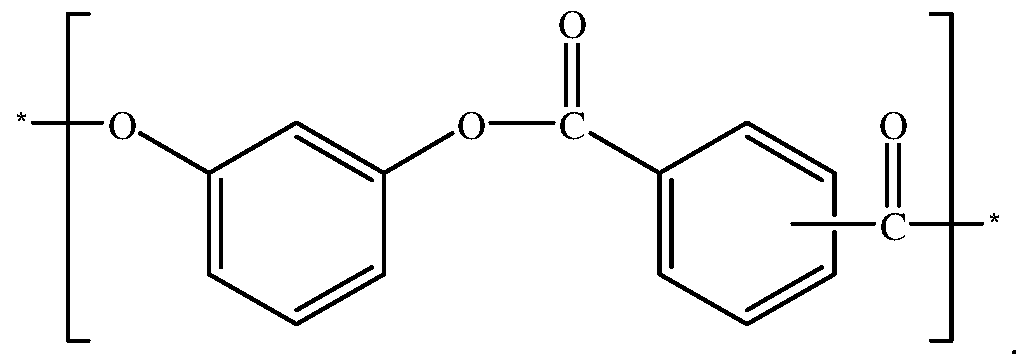
and a polycarbonate block comprising carbonate repeat units having the structure

wherein at least 60 percent of the total number of R groups are aromatic; 2 to 10 weight percent of diantimony trioxide; and 0.2 to 5 weight percent of a black colorant.
[0010] The composition comprises a brominated polycarbonate. The brominated polycarbonate can have a weight average molecular weight (Mw) of 8,000 to more than 200,000 atomic mass units, specifically of 20,000 to 80,000 atomic mass units, and an intrinsic viscosity of 0.30 to 1.0 deciliter/gram as measured in methylene chloride at 25°C. The brominated polycarbonate can be branched or unbranched.
[0011] In some embodiments, the brominated polycarbonate is the polymerization product of a brominated dihydric phenol and a carbonate precursor. Alternatively, the brominated polycarbonate can be the polymerization product of a carbonate precursor and a mixture of brominated and non-brominated aromatic dihydric phenols. Flame retardant brominated polycarbonates are disclosed, for example, in U.S. Patent Numbers 3,929,908 to Orlando et al., 4,170,711 to Lavallee et al., and 4,923,933 to Curry.
[0012] Exemplary brominated dihydric phenols include 2,2-bis(3,5-dibromo-4- hydroxyphenyl)propane and 2,2',6,6'-tetramethyl-3,3',5,5'-tetrabromo-4,4'-biphenol.
Exemplary non-brominated dihydric phenols for mixing with brominated dihydric phenols to produce brominated polycarbonates can include, for example, 2,2-bis(4- hydroxyphenyl)propane, bis(4-hydroxyphenyl)methane, 2,2-bis(4-hydroxy-3- methylphenyl)propane, 4,4-bis(4-hydroxyphenyl)heptane, and (3,3'-dichloro-4,4'- dihydroxydiphenyl)methane. Mixtures of two or more different brominated and
non-brominated dihydric phenols can be used. Branched brominated polycarbonates can also be used, as can blends of a linear brominated polycarbonate and a branched brominated polycarbonate.
[0013] The carbonate precursor can be a carbonyl halide, such as phosgene, or a carbonate ester, such as dimethyl carbonate or diphenyl carbonate.
[0014] In some embodiments, the brominated polycarbonate comprises 15 to 50 weight percent bromine, based on the weight of the brominated polycarbonate. Within this range, the weight percent bromine can be 20 to 40 weight percent, specifically 25 to 35 weight percent.
[0015] Synthesis of the brominated polycarbonate can utilize a monohydric phenol, which limits molecular weight and endcaps the polycarbonate. Suitable monohydric phenols include phenol, 4-(l,l,3,3-tetramethylbutyl)phenol, para-tertiary-butylphenol, 4-cumylphenol, and mixtures thereof.
[0016] In some embodiments, the brominated polycarbonate comprises repeat units having the structures

[0017] The composition comprises the brominated polycarbonate in an amount of 20 to 50 weight percent, based on the total weight of the composition. Within this range, the brominated polycarbonate amount can be 25 to 45 weight percent, specifically 28 to 38 weight percent. In some embodiments, the composition comprises 7 to 17 weight percent total bromine.
[0018] In addition to the brominated polycarbonate, the composition comprises poly(butylene terephthalate), CAS Registry No. 26062-94-2. In some embodiments, the poly(butylene terephthalate) has an intrinsic viscosity of 0.5 to 2 deciliter/gram, measured at 25 °C in chloroform. Within this range, the intrinsic viscosity can be 0.7 to 1.5
deciliter/gram, specifically 0.8 to 1.4 deciliter per gram.
[0019] The composition comprises the poly(butylene terephthalate) in an amount of 10 to 50 weight percent, based on the total weight of the composition. Within this range, the poly(butylene terephthalate) amount can be 15 to 45 weight percent, specifically 15 to 35 weight percent, more specifically 15 to 25 weight percent.
[0020] In addition to the brominated polycarbonate and the poly(butylene
terephthalate), the composition comprises a block polyestercarbonate. The block
polyestercarbonate comprises a polyester block comprising resorcinol ester repeat units having the structure

a polycarbonate block comprising carbonate repeat units having the structure

wherein at least 60 percent of the total number of R1 groups are aromatic. It will be understood that the block polyestercarbonate can include more than one polyester block and/or more than one polycarbonate block. In other words, the block polyestercarbonate can be a diblock, triblock, or multiblock copolymer.
[0021] In some embodiments, R1 can be derived from a dihydroxy compound such as an aromatic dihydroxy compound having the structure

wherein n is 0, 1, 2, 3, or 4, and each R is independently a halogen atom (for example bromine), a Ci_io alkyl, a halogen-substituted CMO alkyl, a C6-io aryl, or a halogen-substituted C6 10 aryl; or a bisphenol having the structure

wherein p and q are each independently 0, 1, 2, 3, or 4, such that when p or q is less than 4, the valence of each carbon of the ring is filled by hydrogen, and Ra and Rb are each independently a halogen, C1-12 alkoxy, or C1-12 alkyl, and Xa is a bridging group connecting the two hydroxy-substituted aromatic groups, where the bridging group and the hydroxy substituent of each C6 arylene group are disposed ortho, meta, or para (specifically para) to each other on the C6 arylene group. The bridging group Xa can be, for example, a single
bond, -0-, -S-, -S(O)-, -S(0)2-, -C(O)-, or a divalent CMS organic group, which can be cyclic or acyclic, aromatic or non-aromatic, and can further comprise heteroatoms such as halogens, oxygen, nitrogen, sulfur, silicon, or phosphorus. For example, Xa can be a substituted or unsubstituted C3_i8 cycloalkylidene; a Ci_25 alkylidene of the formula -C(Rc)(Rd)- wherein Rc and Rd are each independently hydrogen, Ci_i2 alkyl, CM2 cycloalkyl, C7_i2 arylalkyl, Ci_i2 heteroalkyl, or cyclic C7_i2 heteroarylalkyl; or a group of the formula -C(=Re)- wherein Re is a divalent Ci_i2 hydrocarbon group.
[0022] Examples of specific dihydroxy compounds and bisphenol compounds such include 4,4'-dihydroxybiphenyl, 1,6-dihydroxynaphthalene, 2,6-dihydroxynaphthalene, bis(4-hydroxyphenyl)methane, bis(4-hydroxyphenyl)diphenylmethane, bis(4-hydroxyphenyl)- 1 -naphthylmethane, 1 ,2-bis(4-hydroxyphenyl)ethane, 1 , 1 -bis(4-hydroxyphenyl)- 1 - phenylethane, 2-(4-hydroxyphenyl)-2-(3-hydroxyphenyl)propane, bis(4- hydroxyphenyl)phenylmethane, 2,2-bis(4-hydroxy-3-bromophenyl)propane, 1,1 -bis
(hydroxyphenyl)cyclopentane, 1 , 1 -bis(4-hydroxyphenyl)cyclohexane, 1 , 1 -bis(4- hydroxyphenyl)isobutene, l,l-bis(4-hydroxyphenyl)cyclododecane, trans-2,3-bis(4- hydroxyphenyl)-2-butene, 2,2-bis(4-hydroxyphenyl)adamantane, alpha,alpha'-bis(4- hydroxyphenyl)toluene, bis(4-hydroxyphenyl)acetonitrile, 2,2-bis(3-methyl-4- hydroxyphenyl)propane, 2,2-bis(3-ethyl-4-hydroxyphenyl)propane, 2,2-bis(3-n-propyl-4- hydroxyphenyl)propane, 2,2-bis(3-isopropyl-4-hydroxyphenyl)propane, 2,2-bis(3-sec-butyl-4- hydroxyphenyl)propane, 2,2-bis(3-t-butyl-4-hydroxyphenyl)propane, 2,2-bis(3-cyclohexyl-4- hydroxyphenyl)propane, 2,2-bis(3-allyl-4-hydroxyphenyl)propane, 2,2-bis(3-methoxy-4- hydroxyphenyl)propane, 2,2-bis(4-hydroxyphenyl)hexafluoropropane, l,l-dichloro-2,2-bis(4- hydroxyphenyl)ethylene, 1 , 1 -dibromo-2,2-bis(4-hydroxyphenyl)ethylene, 1 , 1 -dichloro-2,2- bis(5-phenoxy-4-hydroxyphenyl)ethylene, 4,4'-dihydroxybenzophenone, 3,3-bis(4- hydroxyphenyl)-2-butanone, l,6-bis(4-hydroxyphenyl)-l,6-hexanedione, ethylene glycol bis(4-hydroxyphenyl)ether, bis(4-hydroxyphenyl)ether, bis(4-hydroxyphenyl)sulfide, bis(4-hydroxyphenyl)sulfoxide, bis(4-hydroxyphenyl)sulfone, 9,9-bis(4- hydroxyphenyl)fluorine, 2,7-dihydroxypyrene, 6,6'-dihydroxy-3,3,3',3'- tetramethylspiro(bis)indane ("spirobiindane bisphenol"), 3,3-bis(4- hydroxyphenyl)phthalimide, 2,6-dihydroxydibenzo-p-dioxin, 2,6-dihydroxythianthrene, 2,7-dihydroxyphenoxathin, 2,7-dihydroxy-9,10-dimethylphenazine,
3,6-dihydroxydibenzofuran, 3,6-dihydroxydibenzothiophene, and 2,7-dihydroxycarbazole; resorcinol compounds such as resorcinol, 5-methylresorcinol, 5-ethylresorcinol,
5-propylresorcinol, 5-butylresorcinol, 5-t-butylresorcinol, 5-phenylresorcinol,
5-cumylresorcinol, 2,4,5, 6-tetrafluoro resorcinol, and 2,4,5, 6-tetrabromo resorcinol; catechol; hydroquinone, 2-methylhydroquinone, 2-ethylhydroquinone, 2-propylhydroquinone, 2- butylhydroquinone, 2-t-butylhydroquinone, 2-phenylhydroquinone, 2-cumylhydroquinone, 2,3,5,6-tetramethylhydroquinone, 2,3,5,6-tetra-t-butylhydroquinone, 2,3,5,6- tetrafluorohydroquinone, 2,3,5, 6-tetrabromohydroquinone; and combinations thereof.
[0023] Specific dihydroxy compounds include resorcinol, 2,2-bis(4-hydroxyphenyl) propane ("bisphenol A"), 3,3-bis(4-hydroxyphenyl) phthalimidine, 2-phenyl-3,3'-bis(4- hydroxyphenyl) phthalimidine (also known as N-phenyl phenolphthalein bisphenol, "PPPBP" or 3,3-bis(4-hydroxyphenyl)-2-phenylisoindolin-l-one), l,l-bis(4-hydroxy-3- methylphenyl)cyclohexane (DMBPC), l,l-bis(4-hydroxy-3-methylphenyl)-3,3,5- trimethylcyclohexane, and mixtures thereof.
[0024] In some embodiments of the block polyestercarbonate, the polycarbonate block comprises carbonate repeat units having the structure

[0025] In some embodiments of the block polyestercarbonate, the polyester block comprises resorcinol ester repeat units having the structures

These resorcinol isophthalate and resorcinol terephthalate units, respectively, can be present in a mole ratio of 10:90 to 90: 10, specifically 30:70 to 70:30, more specifically 45:55 to 55:45.
[0026] In some embodiments, the block polyestercarbonate further comprises resorcinol carbonate repeat units having the structure

Such a repeat unit constitutes a linkage between a polyester block and a polycarbonate block.
[0027] Methods of forming block polyestercarbonates are known and include, for example, U.S. Patent Nos. 6,306,507 to Brunelle et al., 6,559,270 to Siclovan et al., 6,812320 to Silva et al., 7,078,447 to Glasgow et al., 7,109,274 to Acar et al., and 7,686,997 to Agarwal et al. In a representative procedure, hydroxyl-terminated polyester blocks are formed by reaction of excess resorcinol with a mixture of isophthaloyl chloride and terephthaloyl chloride in methylene chloride in the presence of base. Without isolating the hydroxyl- terminated polyester blocks, bisphenol A and a small amount of phenol are added to the reaction mixture with water (to dissolve salts) and additional methylene chloride. Phosgene and sodium hydroxide are then gradually added to the reaction mixture, producing the phenol- capped block polyestercarbonate, which is isolated by precipitation in a mixture of hot water and methylene chloride.
[0028] The block polyestercarbonate can comprise 5 to 95 weight percent of the polyester block, and 95 to 5 weight percent of the polycarbonate block. Within this range, the weight ratio of polyester block to polycarbonate block can be 10:90 to 90: 10, specifically 20:80 to 80:20. Particularly useful block polyestercarbonates comprise 10 to 40 weight percent of the polyester block and 60 to 90 weight percent of the polycarbonate block, specifically 10 to 30 weight percent of the polyester block and 90 to 70 weight percent of the polycarbonate block.
[0029] The composition comprises the block polyestercarbonate in an amount of 10 to 40 weight percent, based on the total weight of the composition. Within this range, the block polyestercarbonate amount can be 15 to 40 weight percent, specifically 25 to 35 weight percent.
[0030] The composition further comprises diantimony trioxide (Sb203; CAS Registry No. 1309-64-4). In some embodiments, the diantimony trioxide is provided in the form of a
mixture containing 70 to 90 weight percent diantimony trioxide and 10 to 30 weight percent poly(ethylene-co-vinyl acetate), based on the weight of the mixture.
[0031] The composition comprises diantimony trioxide in an amount of 2 to 10 weight percent, based on the total weight of the composition. Within this range, the diantimony trioxide amount can be 4 to 8 weight percent.
[0032] The composition comprises a black colorant. Suitable black colorants include dyes, pigments, and mixtures thereof. In some embodiments, the black colorant comprises carbon black.Suitable carbon blacks are commercially available and include, for example, MONARCH™ 800, MONARCH™ 900, MONARCH™ 1000, and MONARCH™ 1400 from Cabot; SATIN BLACK™ SBX452, SATIN BLACK™ SBX552, and SATIN
BLACK™ SBX652 from Continental Carbon; RAVEN™ 2500 from Columbian Chemicals; and PRINTEX™ 85 from Degussa. In some embodiments, the black colorant comprises at least two organic dyes. Suitable dye classes from which the at least two organic dyes can be selected include anthraquinones, anthrapyridones, perylenes, anthracenes, perinones, indanthrones, quinacridones, xanthenes, thioxanthenes, oxazines, oxazolines, indigoids, thioindigoids, quinophthalones, naphthalimides, cyanines, methines, pyrazolones, lactones, coumarins, bis-benzoxazolylthiophenes, naphthalenetetracarboxylic acids, phthalocyanines, triarylmethanes, aminoketones, bis(styryl)biphenyls, azines, rhodamines, derivatives of the foregoing, and combinations thereof. Specific organic dyes suitable for use among the at least two organic dyes include Disperse Yellow 201, Solvent Green 3, Solvent Red 52, Solvent Red 135, Solvent Violet 13, Disperse Orange 47, Solvent Orange 60, and Solvent Blue 104. When the colorant includes organic dyes and particularly when the colorant consists of organic dyes, at least two dyes of different colors can be employed to produce a black color. For example, black color can be provided by a combination of a red and green dye, or a combination of a blue dye and an orange dye, or a combination of a purple dye and a yellow dye. In some embodiments, the black colorant comprises carbon black, at least two dyes, or a combination thereof.
[0033] The composition comprises the black colorant in an amount of 0.2 to 5 weight percent, based on the total weight of the composition. Within this range, the black colorant amount can be 0.4 to 2 weight percent, specifically 0.4 to 1.5 weight percent.
[0034] In some embodiments, the composition further comprises an impact modifier. Suitable impact modifiers include poly(butyl acrylate-co-methyl methacrylate),
poly(acrylonitrile-co-butadiene-co-styrene) (including high rubber graft poly(acrylonitrile-co- butadiene-co-styrene)), poly(methyl methacrylate-co-butadiene-co-styrene),
poly(acrylonitrile-co-styrene-co-acrylate), polyolefin elastomer, polycarbonate-polysiloxane block copolymer, and combinations thereof. In some embodiments, the impact modifier comprises poly(butyl acrylate-co-methyl methacrylate). When present, the impact modifier can be used in an amount of 4 to 14 weight percent, based on the total weight of the composition. Within this range, the impact modifier amount can be 5 to 11 weight percent, specifically 6 to 9 weight percent.
[0035] In some embodiments, the composition further comprises an unbrominated polycarbonate. Unbrominated polycarbonates can comprise repeat units having the structure

wherein at least 60 percent of the total number of R 2 groups are aromatic, and all of the R 2 groups are bromine-free.
[0036] The group R can be derived from a dihydroxy compound or a bisphenol compound. Examples of such compounds include 4,4'-dihydroxybiphenyl, 1,6- dihydroxynaphthalene, 2,6-dihydroxynaphthalene, bis(4-hydroxyphenyl)methane, bis(4- hydroxyphenyl)diphenylmethane, bis(4-hydroxyphenyl)- 1 -naphthylmethane, 1 ,2-bis(4- hydroxyphenyl)ethane, l,l-bis(4-hydroxyphenyl)-l-phenylethane, 2-(4-hydroxyphenyl)-2-(3- hydroxyphenyl)propane, bis(4-hydroxyphenyl)phenylmethane, 1 , 1 -bis
(hydroxyphenyl)cyclopentane, 1 , 1 -bis(4-hydroxyphenyl)cyclohexane, 1 , 1 -bis(4- hydroxyphenyl)isobutene, l,l-bis(4-hydroxyphenyl)cyclododecane, trans-2,3-bis(4- hydroxyphenyl)-2-butene, 2,2-bis(4-hydroxyphenyl)adamantane, alpha,alpha'-bis(4- hydroxyphenyl)toluene, bis(4-hydroxyphenyl)acetonitrile, 2,2-bis(3-methyl-4- hydroxyphenyl)propane, 2,2-bis(3-ethyl-4-hydroxyphenyl)propane, 2,2-bis(3-n-propyl-4- hydroxyphenyl)propane, 2,2-bis(3-isopropyl-4-hydroxyphenyl)propane, 2,2-bis(3-sec-butyl-4- hydroxyphenyl)propane, 2,2-bis(3-t-butyl-4-hydroxyphenyl)propane, 2,2-bis(3-cyclohexyl-4- hydroxyphenyl)propane, 2,2-bis(3-allyl-4-hydroxyphenyl)propane, 2,2-bis(3-methoxy-4- hydroxyphenyl)propane, 2,2-bis(4-hydroxyphenyl)hexafluoropropane, l,l-dichloro-2,2-bis(4- hydroxyphenyl)ethylene, l,l-dichloro-2,2-bis(5-phenoxy-4-hydroxyphenyl)ethylene, 4,4'- dihydroxybenzophenone, 3,3-bis(4-hydroxyphenyl)-2-butanone, l,6-bis(4-hydroxyphenyl)- 1,6-hexanedione, ethylene glycol bis(4-hydroxyphenyl)ether, bis(4-hydroxyphenyl)ether, bis(4-hydroxyphenyl)sulfide, bis(4-hydroxyphenyl)sulfoxide, bis(4-hydroxyphenyl)sulfone, 9,9-bis(4-hydroxyphenyl)fluorine, 2,7-dihydroxypyrene, 6,6'-dihydroxy-3,3,3',3'- tetramethylspiro(bis)indane ("spirobiindane bisphenol"), 3,3-bis(4-
hydroxyphenyl)phthalimide, 2,6-dihydroxydibenzo-p-dioxin, 2,6-dihydroxythianthrene, 2,7-dihydroxyphenoxathin, 2,7-dihydroxy-9,10-dimethylphenazine,
3,6-dihydroxydibenzofuran, 3,6-dihydroxydibenzothiophene, and 2,7-dihydroxycarbazole; resorcinol compounds such as resorcinol, 5-methylresorcinol, 5-ethylresorcinol,
5-propylresorcinol, 5-butylresorcinol, 5-t-butylresorcinol, 5-phenylresorcinol,
5-cumylresorcinol, and 2,4,5,6-tetrafluororesorcinol; catechol; hydroquinone, 2- methylhydroquinone, 2-ethylhydroquinone, 2-propylhydroquinone, 2-butylhydroquinone, 2-t- butylhydroquinone, 2-phenylhydroquinone, 2-cumylhydroquinone, 2,3,5,6- tetramethylhydroquinone, 2,3,5,6-tetra-t-butylhydroquinone, 2,3,5,6-tetrafluorohydroquinone; and combinations thereof.
[0037] Specific dihydroxy compounds useful for forming the unbrominated polycarbonate include resorcinol, 2,2-bis(4-hydroxyphenyl) propane ("bisphenol A"), 3,3- bis(4-hydroxyphenyl) phthalimidine, 2-phenyl-3,3'-bis(4-hydroxyphenyl) phthalimidine (also known as N-phenyl phenolphthalein bisphenol, "PPPBP" or 3,3-bis(4-hydroxyphenyl)-2- phenylisoindolin-l-one), l,l-bis(4-hydroxy-3-methylphenyl)cyclohexane (DMBPC), 1,1- bis(4-hydroxy-3-methylphenyl)-3,3,5-trimethylcyclohexane, and mixtures thereof.
[0038] In some embodiments of the block polyestercarbonate, the polycarbonate block comprises carbonate repeat units having the structure
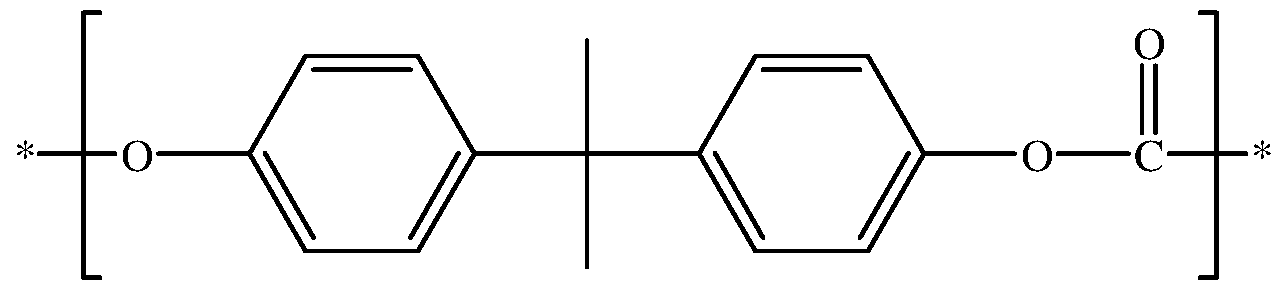
[0039] When present, the unbrominated polycarbonate can be used in an amount of 5 to 20 weight percent, based on the total weight of the composition. Within this range, the unbrominated polycarbonate amount can be 7 to 16 weight percent.
[0040] The composition can, optionally, further comprise one or more additives, including flow modifiers, fillers (including fibrous and scale-like fillers), antioxidants, heat stabilizers, light stabilizers, ultraviolet (UV) light stabilizers, UV absorbing additives, plasticizers, lubricants, mold release agents, antistatic agents, anti-fog agents, antimicrobial agents, surface effect additives, radiation stabilizers, flame retardants, anti-drip agents (e.g., a PTFE-encapsulated styrene-acrylonitrile copolymer (TSAN)), and combinations thereof. In general, the additives, when present, are used in a total amount of less than or equal to 5 weight percent, based on the total weight of the composition. Within this limit, the additives
can be used in a total amount of less than or equal to 2 weight percent, specifically less than or equal to 1.5 weight percent.
[0041] In a very specific embodiment of the composition, the polyester block comprises resorcinol ester repeat units having the structures

the polycarbonate block com rises carbonate repeat units having the structure

the block polyestercarbonate comprises 10 to 40 weight percent of the polyester block and 60 to 90 weight percent of the polycarbonate block; the brominated polycarbonate comprises repeat units having the structures

the black colorant comprises carbon black; the composition comprises 28 to 38 weight
percent of the brominated polycarbonate, 10 to 25 weight percent of the poly(butylene terephthalate), 25 to 35 weight percent of the block polyestercarbonate, 4 to 8 weight percent of the diantimony trioxide, and 0.4 to 2 weight percent of the black colorant; and the composition further comprises 5 to 11 weight percent of a poly(butyl acrylate-co-methyl methacrylate).
[0042] Another embodiment is an article comprising a composition comprising, based on the total weight of the composition: 20 to 50 weight percent of a brominated
polycarbonate; 10 to 50 weight percent of poly(butylene terephthalate); 10 to 40 weight percent of a block polyestercarbonate comprising a polyester block comprising resorcinol ester repeat units having the structure

and a polycarbonate block comprising carbonate repeat units having the structure
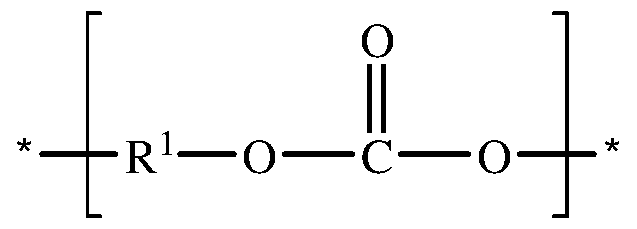
wherein at least 60 percent of the total number of R1 groups are aromatic; 2 to 10 weight percent of diantimony trioxide; and 0.2 to 5 weight percent of a black colorant. All of the above-described variations of the composition apply as well to the composition used to form the article.
[0043] The composition is particularly suitable for molding flat screen television bezels, cell phone backs, and exterior parts of household appliances such as toasters and microwave ovens.
[0044] In a very specific embodiment of the article, the polyester block comprises resorcinol ester repeat units having the structures


the polycarbonate block comprises carbonate repeat units having the structure
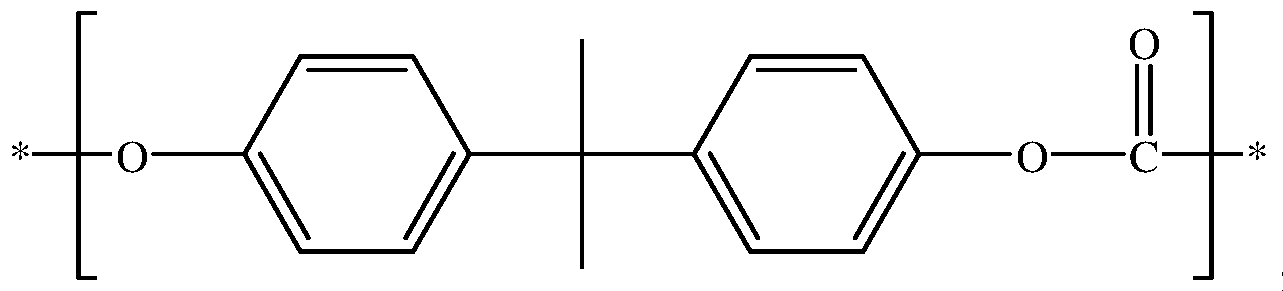
the block polyestercarbonate comprises 10 to 40 weight percent of the polyester block and 60 to 90 weight percent of the polycarbonate block; the brominated polycarbonate comprises repeat units having the structures

the black colorant comprises carbon black; the composition comprises 28 to 38 weight percent of the brominated polycarbonate, 10 to 25 weight percent of the poly(butylene terephthalate), 25 to 35 weight percent of the block polyestercarbonate, 4 to 8 weight percent of the diantimony trioxide, and 0.4 to 2 weight percent of the black colorant; and the composition further comprises 5 to 11 weight percent of a poly(butyl acrylate-co-methyl methacrylate).
[0045] The invention includes at least the following embodiments.
[0046] Embodiment 1: A composition comprising, based on the total weight of the composition: 20 to 50 weight percent of a brominated polycarbonate; 10 to 50 weight percent of poly(butylene terephthalate); 10 to 40 weight percent of a block polyestercarbonate
comprising a polyester block comprising resorcinol ester repeat units having the structure

a polycarbonate block comprising carbonate repeat units having the structure

wherein at least 60 percent of the total number of R1 groups are aromatic; 2 to 10 weight percent of diantimony trioxide; and 0.2 to 5 weight percent of a black colorant.
[0047] Embodiment 2: The composition of embodiment 1, wherein the polyester block comprises resorcinol ester repeat units having the structures

[0048] Embodiment 3: The composition of embodiment 1 or 2, wherein the polycarbonate block comprises carbonate repeat units having the structure

[0049] Embodiment 4: The composition of any of embodiments 1-3, wherein the block polyestercarbonate further comprises resorcinol carbonate repeat units having the
structure

[0050] Embodiment 5: The composition of any of embodiments 1-4, wherein the block polyestercarbonate comprises 10 to 40 weight percent of the polyester block and 60 to 90 weight percent of the polycarbonate block.
[0051] Embodiment 6: The composition of any of embodiments 1-5, wherein the brominated polycarbonate comprises repeat units having the structures

[0052] Embodiment 7: The composition of any of embodiments 1-6, comprising 7 to 17 weight percent total bromine.
[0053] Embodiment 8: The composition of any of embodiments 1-7, wherein the black colorant comprises carbon black, at least two dyes, or a combination thereof.
[0054] Embodiment 9: The composition of any of claims 1-8, wherein the black colorant comprises at least two organic dyes.
[0055] Embodiment 10: The composition of any of embodiments 1-9, further comprising 4 to 14 weight percent of an impact modifier selected from the group consisting of poly(butyl acrylate-co-methyl methacrylate), poly(acrylonitrile-co-butadiene-co-styrene), poly(methyl methacrylate-co-butadiene-co-styrene), poly(acrylonitrile-co-styrene-co- acrylate), polyolefin elastomer, polycarbonate-polysiloxane block copolymer, and combinations thereof.
[0056] Embodiment 11: The composition of any of embodiments 1-9, further comprising 4 to 14 weight percent of an impact modifier comprising poly(butyl acrylate-co- methyl methacrylate).
[0057] Embodiment 12: The composition of any of embodiments 1-11, further comprising 5 to 20 weight percent of an unbrominated polycarbonate.
[0058] Embodiment 13: The composition of embodiment 1, wherein the polyester block comprises resorcinol ester repeat units having the structures

wherein the pol carbonate block comprises carbonate repeat units having the structure

wherein the block polyestercarbonate comprises 10 to 40 weight percent of the polyester block and 60 to 90 weight percent of the polycarbonate block; wherein the brominated polycarbonate comprises repeat units having the structures
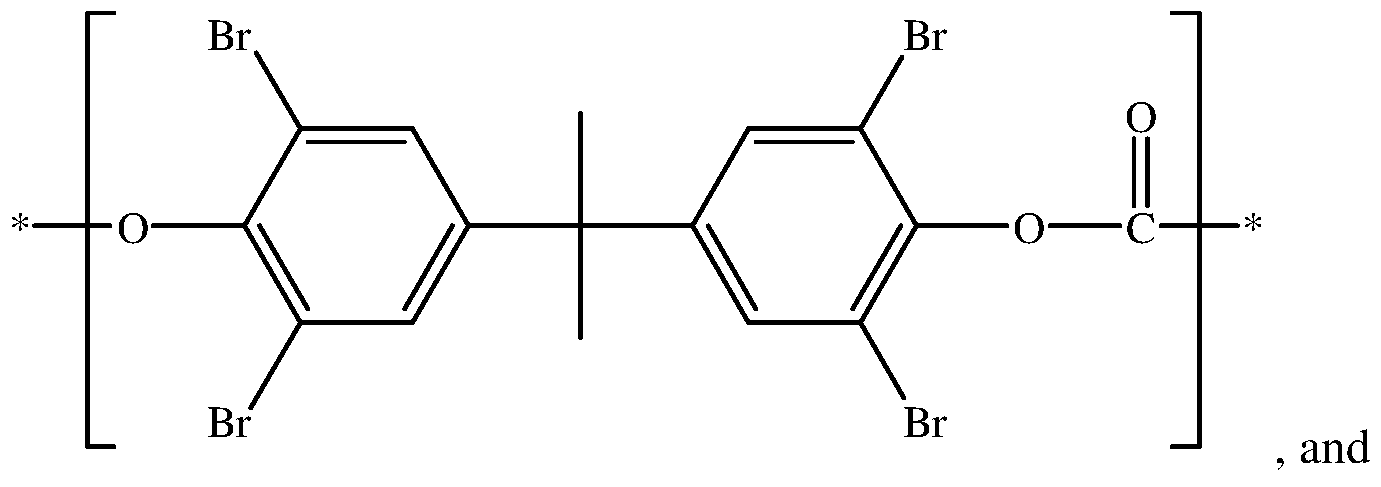

wherein the black colorant comprises carbon black; wherein the composition comprises 28 to 38 weight percent of the brominated polycarbonate, 10 to 25 weight percent of the poly(butylene terephthalate), 25 to 35 weight percent of the block polyestercarbonate, 4 to 8 weight percent of the diantimony trioxide, and 0.4 to 2 weight percent of the black colorant; and wherein the composition further comprises 5 to 11 weight percent of a poly(butyl acrylate-co-methyl methacrylate).
[0059] Embodiment 14: An article comprising a composition comprising, based on the total weight of the composition: 20 to 50 weight percent of a brominated polycarbonate; 10 to 50 weight percent of poly(butylene terephthalate); 10 to 40 weight percent of a block polyestercarbonate comprising a polyester block comprising resorcinol ester repeat units having the structure

polycarbonate block comprising carbonate repeat units having the structure

wherein at least 60 percent of the total number of R groups are aromatic; 2 to 10 weight percent of diantimony trioxide; and 0.2 to 5 weight percent of a black colorant.
[0060] Embodiment 15: The article of embodiment 14, wherein the article is a flat screen television bezel, a cell phone back, or an exterior part of a household appliance.
[0061] Embodiment 16: The article of embodiment 14 or 15, wherein the polyester block comprises resorcinol ester repeat units having the structures
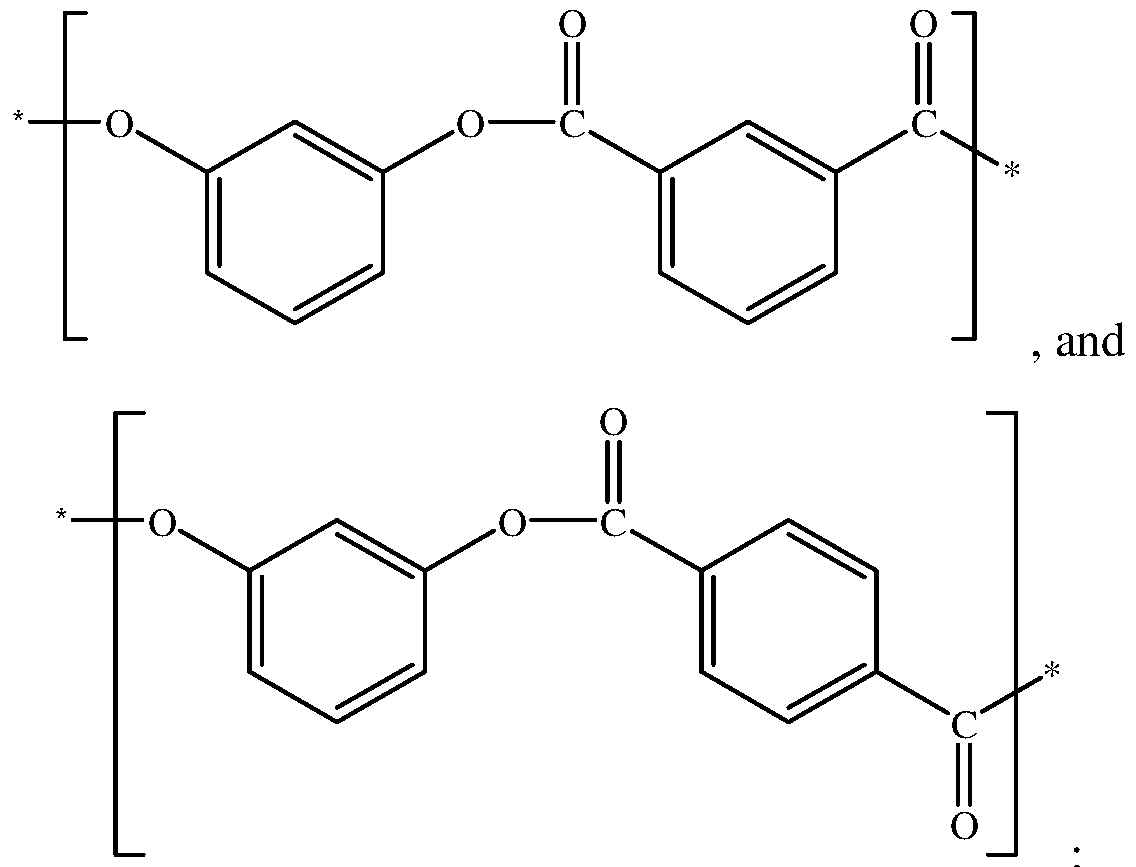
wherein the pol carbonate block comprises carbonate repeat units having the structure

wherein the block polyestercarbonate comprises 10 to 40 weight percent of the polyester block and 60 to 90 weight percent of the polycarbonate block; wherein the brominated polycarbonate comprises repeat units having the structures

wherein the composition comprises 28 to 38 weight percent of the brominated polycarbonate, 10 to 25 weight percent of the poly(butylene terephthalate), 25 to 35 weight percent of the block polyestercarbonate, 4 to 8 weight percent of the diantimony trioxide, and 0.4 to 2 weight percent of the black colorant; and wherein the composition further comprises 5 to 11 weight percent of a poly(butyl acrylate-co-methyl methacrylate).
[0062] All ranges disclosed herein are inclusive of the endpoints, and the endpoints are independently combinable with each other. Each range disclosed herein constitutes a disclosure of any point or sub-range lying within the disclosed range.
[0063] The invention is further illustrated by the following non-limiting examples. EXAMPLES 1-15, COMPARATIVE EXAMPLES 1-6
[0064] Components used to prepare thermoplastic compositions are summarized in
Table 1.
Table 1

Sb203/EVA A blend of 85 weight percent antimony trioxide, CAS Reg. No. 1309-64-4 and 15 poly(ethylene-co-vinyl acetate), CAS Reg. No. 24937-78-8; obtained from GuangXi Brightsun.
TSAN Polytetrafluoroethylene, CAS 9002-84-0, 50 weight percent, encapsulated in poly(styrene-co-acrylonitrile), CAS 9003-54-7, 50 weight percent; obtained as CYCOLAC™ Resin INP449 from SABIC Innovative Plastics.
p(E/EA) Poly(ethylene-co-ethyl acrylate), CAS Reg. No. 9010-86-0, having an ethyl acrylate content of about 12-21 weight percent weight percent; obtained from the Dow Chemical Company.
AO The antioxidant pentaerythritol tetrakis(3,5-di-ie/t-butyl-4- hydroxyhydrocinnamate), CAS Reg. No. 6683-19-8; obtained as
IRGANOX™ 1010 from BASF.
Quencher Monozinc phosphate (ZnH2P04), CAS Reg. No. 13598-37-3; obtained as
Z21-82 from Budenheim Iberica.
UVA The ultraviolet light absorber 2-(2'-hydroxy-5-t-octylphenyl)-benzotriazole,
CAS Reg. No. 3147-75-9; obtained as CYASORB™ UV 5411 from Cytec.
CB Carbon black, CAS Reg. No. 1333-86-4; obtained as MONARCH™ 800 from Cabot.
S. Green 3 Solvent Green 3, CAS Reg. No. 128-80-3; obtained as MACROLEX™
Green 5B from Lanxess.
S. Red. 135 Solvent Red 135, CAS Reg. No. 20749-68-2; obtained as MACROLEX™
Red EG from Lanxess.
[0065] Each composition was prepared by dry-blending all components, then adding the dry-blended mixture to the feed throat of a twin-screw extruder having a screw diameter of 37 millimeters, a screw length of 1.5 meters, a screw rotation rate of 300 rotations per minute, a throughput of 60 kilograms per hour, 45% torque, and zone temperatures of 50 °C /
100 °C / 200 °C / 260 °C / 2700 °C / 255 °C / 255 °C / 260 °C / 270 °C / 260 °C / 230 °C from feed throat to die.
[0066] The extrudate was pelletized, and the pellets dried for four hours at 120 °C. Parts for property testing were molded in accordance with the respective ASTM standards in an injection molding machine operating at a hopper temperature of 70 °C, barrel temperatures of 240 °C / 250 °C / 250 °C / 250 °C, a mold temperature of 80 °C, a screw speed of 100 rotations per minute, and a back pressure of 30 kilogram-force per centimeter .
[0067] Melt flow rate values, expressed in grams per 10 minutes, were determined according to ASTM D1238-13 at 265 °C and 5 kilogram load. Unnotched Izod impact strength values, expressed in joules/meter, were determined according to ASTM D4812-11 at 23 °C on samples having dimensions 63.5 millimeters x 12.7 millimeters x 3.2 millimeters. Notched Izod impact strength values, expressed in joules/meter, were determined according to ASTM D256-10 at 23 °C on samples having dimensions 63.5 millimeters x 12.7 millimeters x 3.2 millimeters. Tensile stress values at break, expressed in units of megapascals, were determined according to ASTM D638-10 at 23 °C using a tensile bar having a thickness of 3.2 millimeters, and a test speed of 50 millimeters per minute. Heat deflection temperature values, expressed in °C, were determined according to ASTM D648- 07 using bar cross-section dimensions of 3.2 millimeters x 12.5 millimeters, an edgewise test direction, a support span of 100 millimeters (Method B), a loading fiber stress of 1.82 megapascals, a heating rate of 2.0 °C per minute, and a deflection at reading of 0.25 millimeter.
[0068] Flame retardancy of injection molded flame bars was determined according to Underwriter's Laboratory Bulletin 94 "Tests for Flammability of Plastic Materials, UL 94", 20 mm Vertical Burning Flame Test. Before testing, flame bars with a thickness of 0.6 millimeters were conditioned at 23°C and 50% relative humidity for at least 48 hours. In the UL 94 20 mm Vertical Burning Flame Test, a set of five flame bars was tested. For each bar, a flame was applied to the bar then removed, and the time required for the bar to self- extinguish (first afterflame time, tl) was noted. The flame was then reapplied and removed, and the time required for the bar to self-extinguish (second afterflame time, t2) and the post-flame glowing time (afterglow time, t3) were noted. To achieve a rating of V-0, the afterflame times tl and t2 for each individual specimen must have been less than or equal to 10 seconds; and the total afterflame time for all five specimens (tl plus t2 for all five specimens) must have been less than or equal to 50 seconds; and the second afterflame time
plus the afterglow time for each individual specimen (t2 + t3) must have been less than or equal to 30 seconds; and no specimen can have flamed or glowed up to the holding clamp; and the cotton indicator cannot have been ignited by flaming particles or drops. To achieve a rating of V-1, the afterflame times tl and t2 for each individual specimen must have been less than or equal to 30 seconds; and the total afterflame time for all five specimens (tl plus t2 for all five specimens) must have been less than or equal to 250 seconds; and the second afterflame time plus the afterglow time for each individual specimen (t2 + t3) must have been less than or equal to 60 seconds; and no specimen can have flamed or glowed up to the holding clamp; and the cotton indicator cannot have been ignited by flaming particles or drops. To achieve a rating of V-2, the afterflame times tl and t2 for each individual specimen must have been less than or equal to 30 seconds; and the total afterflame time for all five specimens (tl plus t2 for all five specimens) must have been less than or equal to 250 seconds; and the second afterflame time plus the afterglow time for each individual specimen (t2 + t3) must have been less than or equal to 60 seconds; and no specimen can have flamed or glowed up to the holding clamp; but the cotton indicator can have been ignited by flaming particles or drops. Compositions not achieving a rating of V-2 were considered to have failed.
[0069] CIE1976 LAB color data and reflection curves were acquired on an X-Rite ColorEye 7000A with D65 illumination, 10° observer, UV included, and reflection mode. SCI and SCE modes were used to include and exclude, respectively, specular reflected light and give results that were respectively dependent on and independent of surface gloss.
[0070] Table 2 summarizes compositions and properties for examples varying in polycarbonate content, poly(butyl acrylate-co-methyl methacrylate) content, block
polyestercarbonate type and amount, and colorant type and amount. In Table 2, component amounts are expressed in weight percent based on the total weight of the composition.
Comparative Examples 1 and 2, and Examples 1 and 2 all contain carbon black as black colorant. Relative to Comparative Example 1 (with impact modifier but no block
polyestercarbonate), Comparative Example 2 (without impact modifier or block
polyestercarbonate) and Example 1 (without impact modifier and with block
polyestercarbonate) exhibited desirably lower values of L* in both SCI and SCE modes. The deeper black of Comparative Example 2 and Example 1 was also evident from visual inspection, as shown in Figure 1, where sample numbers 1-8 correspond, respectively, to Comparative Examples 1 and 2, Examples 1 and 2, Comparative Examples 3 and 4, and Examples 3 and 4. Example 2 is representative of a composition useful for applications
requiring high ductility. It exhibits higher notched Izod impact strength and tensile stress than Comparative Example 1, while also exhibiting desirably lower L* values in both SCI and SCE modes. Similar trends are observed for Comparative Examples 3 and 4, and Examples 3 and 4, all containing a dye combination as the black colorant.
[0071] Higher L* values in SCE mode can be explained by the contribution of surface reflection to SCE L*. Surface reflection is determined by the distribution of polymer blocks and internal scattering. While not wishing to be bound by any particular theory of operation, Applicants believe that the SEM images in Figure 2 are consistent with the block
polyestercarbonate acting as a compatibilizer for polycarbonate and poly(butylene
terephthalate), which minimizes the internal scattering of the base resin. As a result, the block polyestercarbonate-containing compositions exhibited surfaces with better color manifested as a lower SCE mode L* value for Example 1 versus Comparative Example 1. There is no evidence in either the SCE data or the SEM images for a large difference in internal scattering between Comparative Example 2 and Example 1. All samples exhibited that same unnotched Izod value of 2150 joules/meter because none of the samples broke. Although Comparative Example 2 exhibited a low L* value in SCE mode, it also exhibited a low notched Izod impact strength value.
Table 2

PHYSICAL PROPERTIES
Notched Izod (J/m) 582 102 90.6 617
Unnotched Izod (J/m) 2150 2150 2150 2150
Tensile stress (MPa) 2182.8 2494.2 2502.8 2216.8
HDT (°C) 119 124 109 112
Color, SCI Mode
L* 31.4 30.0 30.3 31.0 a* -0.2 -0.1 -0.2 -0.2 b* -1.5 -2.0 -2.1 -1.6
Color, SCE Mode
L* 22.1 10.8 12.3 17.9 a* -0.6 -0.3 -0.3 -0.6 b* -3.1 -3.1 -3.4 -2.7
Table 2 (cont.)
C. Ex. 3 C. Ex. 4 Ex. 3 Ex. 4
COMPOSITIONS
Antioxidant 0.06 0.06 0.06 0.06
Sb203/EVA 6.27 6.27 6.27 6.27
UVA 0.25 0.25 0.25 0.25 p(E/EA) 2.59 2.59 2.59 2.59
TSAN 0.20 0.20 0.20 0.20
Quencher 0.20 0.20 0.20 0.20
PC-Br 32.84 32.84 32.84 32.84
PCI 14.93 25.27 5.37 7.35 p(BA/MMA) 10.35 0.00 0.00 7.46
PBT 31.83 31.83 31.83 22.39
PEC2 0.00 0.00 19.90 19.90
CB 0.00 0.00 0.00 0.00
S. Green 3 0.25 0.25 0.25 0.25
S. Red 135 0.25 0.25 0.25 0.25
PHYSICAL PROPERTIES
Notched Izod (J/m) 592 114 85 669
Unnotched Izod (J/m) 2150 2150 2150 2150
Tensile stress (MPa) 2132.6 2473.4 2502.6 2205.2
HDT (°C) 115 124 107 105
Color, SCI Mode
L* 38.1 34.2 34.2 36.8 a* -1.4 -0.8 -0.9 -1.4 b* -6.4 -6 -5.9 -6.6
Color, SCE Mode
L* 31.8 20.8 21.0 26.9 a* -2.1 -1.6 -1.6 -1.9 b* -8.5 -9.2 -8.9 -9.1
[0072] In order to further study the compatibilizing effect of polyestercarbonate in a polycarbonate/poly(butylene terephthalate) matrix, another set of examples was prepared with varying ratios of polycarbonate, poly(butylene terephthalate), and polyestercarbonate. Two different polyestercarbonates were employed, PEC1 with about 81 mole percent resorcinol ester linkages, about 8 mole % resorcinol carbonate linkages, and about 11 mole % bisphenol A carbonate linkages, and PEC2 with about 19 mole percent resorcinol ester linkages, about 6 mole % resorcinol carbonate linkages, and about 75 mole % bisphenol A carbonate linkages. Polyestercarbonate content was maintained at 30.64 weight percent in all examples.
Comparative Example 5 was a control example lacking polyestercarbonate. Examples 5-9 represent variations in the ratio of poly(butylene terephthalate) to polyestercarbonate from 1:3 to 1: 1. Examples 11 and 12 provide a balance of desired color and improved ductility. Examples 10 and 16 utilize PEC1 rather than PEC2.
[0073] Among the carbon black-containing samples, Examples 5-12 containing polyester carbonate exhibited desirably lower L* values in SCI and SCE modes relative to Comparative Example 5 without polyestercarbonate. All the samples without impact modifier (Examples 5-10, 14, and 16) have lower L* values than the samples with impact modifier (Comparative Example 1, Examples 11-13 and 15). L* values for Examples 5-9 suggest that L* undesirably increases slightly as the ratio of polyibutylene terephthalate) to polyestercarbonate increases from 1:3 to 1: 1.
[0074] A comparison of Examples 7 and 10 indicates that the poiyestercarbonate PECl , with a relatively high content of polyester linkages, is not as effective a compatibilizer as PEC2 with a lower content of polyester linkages. This is also apparent in the SEM images of Figure 3, where "ITR2080" in Figure 3(b) refers to PEC2, and "11119010" in Figure 3(c) refers to PECl. Example 7, with PEC2, also exhibits better ductility than Example 10, with PECl.
[0075] All samples exhibited excellent flame retardancy, manifested as a UL 94 V-0 rating at a thickness of 0.6 millimeters.
Table 3

Color, SCE Mode
L* 18.9 10.2 10.6 10.7 11.4 a* 0.3 -0.3 -0.3 -0.3 -0.3 b* 1.7 -3.0 -3.0 -2.7 -2.7
Table 3 (cont.)
Ex. 9 Ex. 10 Ex. 11 Ex. 12 C. Ex. 6
COMPOSITIONS
PCI 0.00 7.55 5.11 0.00 15.24
PBT 30.64 20.43 15.32 20.43 32.51 p(BA/MMA) 0.00 0.00 7.55 7.55 10.57
PEC2 30.64 0.00 30.64 30.64 0.00
PEC1 0.00 30.64 0.00 0.00 0.00
PC-Br 31.04 33.71 33.71 33.71 33.54
Sb203/EVA 6.44 6.44 6.44 6.44 6.40
Quencher 0.20 0.20 0.20 0.20 0.20
UVA 0.26 0.26 0.26 0.26 0.25
TSAN 0.20 0.20 0.20 0.20 0.20
AO 0.06 0.06 0.06 0.06 0.06
0.51 0.51 0.51 0.51 0.00
CB
0.00 0.00 0.00 0.00 0.51
S. Green 3
0.00 0.00 0.00 0.00 0.51
S. Red 135
PHYS] [CAL PROPERTIES
MFR (g/lOmin) 10.9 9.02 6.53 7.10 7.59
Notched Izod (J/m) 81.6 62.2 643.0 652.0 542.0
Unnotched Izod (J/m) 1710.0 1390.0 1690.0 1670.0 1450.0
Tensile Stress (MPa) 2451.4 2399.6 2177.2 2154.0 2050.4
UL 94 Rating V-0 V-0 V-0 V-0 V-0
Color, SCI Mode
L* 29.7 29.8 32.7 32.6 35.8 a* -0.2 -0.2 -0.4 -0.3 -1.2 b* -1.4 -1.6 -0.5 -0.4 -2.4
Color, SCE Mode
L* 12.3 11.3 18.3 18.3 24.5 a* -0.3 -0.3 -0.5 -0.5 -1.8 b* -2.8 -3.0 -0.4 0.0 -3.5
Table 3 (cont.)
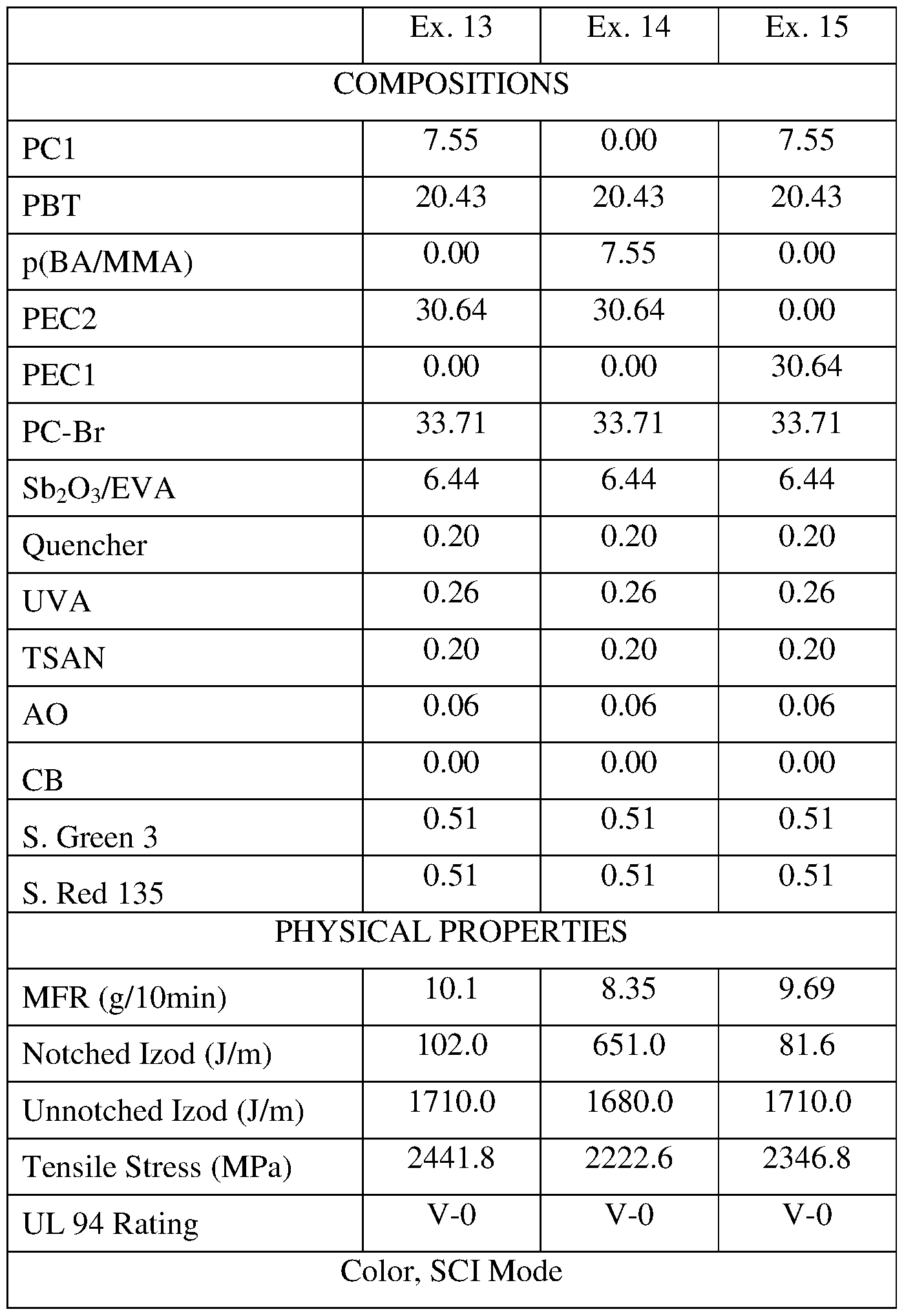
Color, SCE Mode
L* 13.7 22.8 15.2 a* -1.2 -2.0 -0.8 b* -7.2 -4.7 -7.2
Claims
1. A composition comprising, based on the total weight of the composition:
20 to 50 weight percent of a brominated polycarbonate;
10 to 50 weight percent of poly(butylene terephthalate);
10 to 40 weight percent of a block polyestercarbonate comprising
a polyester block comprising resorcinol ester repeat units having the structure
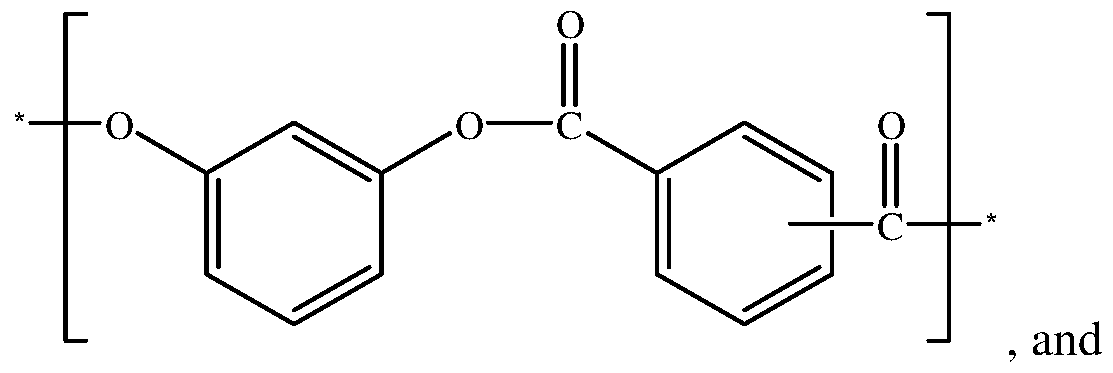
a polycarbonate block comprising carbonate repeat units having the structure

wherein at least 60 percent of the total number of R1 groups are aromatic;
2 to 10 weight percent of diantimony trioxide; and
0.2 to 5 weight percent of a black colorant.
2. The composition of claim 1, wherein the polyester block comprises resorcinol ester repeat units having the structures

3. The composition of claim 1, wherein the polycarbonate block comprises carbonate repeat units having the structure

4. The composition of claim 1, wherein the block polyestercarbonate further comprises resorcinol carbonate repeat units having the structure

5. The composition of claim 1, wherein the block polyestercarbonate comprises 10 to 40 weight percent of the polyester block and 60 to 90 weight percent of the polycarbonate block.
6. The composition of claim 1, wherein the brominated polycarbonate comprises repeat units having the structures

7. The composition of claim 1, comprising 7 to 17 weight percent total bromine.
8. The composition of any one of claims 1-7, wherein the black colorant comprises carbon black, at least two dyes, or a combination thereof.
9. The composition of any one of claims 1-7, wherein the black colorant comprises at least two organic dyes.
10. The composition of any one of claims 1-7, further comprising 4 to 14 weight percent of an impact modifier selected from the group consisting of poly(butyl acrylate-co-methyl methacrylate), poly(acrylonitrile-co-butadiene-co-styrene), poly(methyl methacrylate-co-
butadiene-co-styrene), poly(acrylonitrile-co-styrene-co-acrylate), polyolefin elastomer, polycarbonate-polysiloxane block copolymer, and combinations thereof.
11. The composition of any one of claims 1-7, further comprising 4 to 14 weight percent of an impact modifier comprising poly(butyl acrylate-co-methyl methacrylate).
12. The composition of any one of claims 1-7, further comprising 5 to 20 weight percent of an unbrominated polycarbonate.
13. The composition of claim 1,
wherein the polyester block comprises resorcinol ester repeat units having the structures

wherein the olycarbonate block comprises carbonate repeat units having the structure

wherein the block polyestercarbonate comprises 10 to 40 weight percent of the polyester block and 60 to 90 weight percent of the polycarbonate block;
wherein the brominated polycarbonate comprises repeat units having the structures


wherein the black colorant comprises carbon black;
wherein the composition comprises
28 to 38 weight percent of the brominated polycarbonate,
10 to 25 weight percent of the poly(butylene terephthalate), 25 to 35 weight percent of the block polyestercarbonate,
4 to 8 weight percent of the diantimony trioxide, and
0.4 to 2 weight percent of the black colorant; and
wherein the composition further comprises 5 to 11 weight percent of a poly(butyl acrylate-co-methyl methacrylate).
14. An article comprising a composition comprising, based on the total weight of the composition:
20 to 50 weight percent of a brominated polycarbonate;
10 to 50 weight percent of poly(butylene terephthalate);
10 to 40 weight percent of a block polyestercarbonate comprising
a polyester block comprising resorcinol ester repeat units having the structure

a polycarbonate block comprising carbonate repeat units having the structure
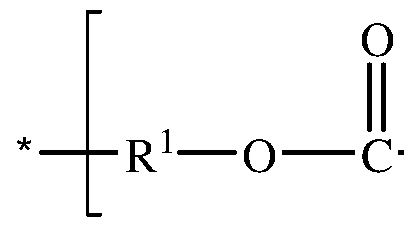
wherein at least 60 percent of the total number of R groups are aromatic; 2 to 10 weight percent of diantimony trioxide; and
0.2 to 5 weight percent of a black colorant.
The article of claim 14, wherein the article is a flat screen television bezel, a cell back, or an exterior part of a household appliance.
16. The article of claim 14 or 15,
wherein the polyester block comprises resorcinol ester repeat units having the structures

wherein the polycarbonate block comprises carbonate repeat units having the structure

wherein the block polyestercarbonate comprises 10 to 40 weight percent of the polyester block and 60 to 90 weight percent of the polycarbonate block;
wherein the brominated polycarbonate comprises repeat units having the structures

wherein the composition comprises
28 to 38 weight percent of the brominated polycarbonate,
10 to 25 weight percent of the poly(butylene terephthalate), 25 to 35 weight percent of the block polyestercarbonate, 4 to 8 weight percent of the diantimony trioxide, and
0.4 to 2 weight percent of the black colorant; and
wherein the composition further comprises 5 to 11 weight percent of a poly(butyl acrylate-co-methyl methacrylate).
Priority Applications (3)
| Application Number | Priority Date | Filing Date | Title |
|---|---|---|---|
| US15/117,262 US20160347951A1 (en) | 2014-02-20 | 2015-02-12 | Thermoplastic composition and article |
| CN201580009149.9A CN106029778A (en) | 2014-02-20 | 2015-02-12 | Thermoplastic composition and article |
| EP15710004.1A EP3107963B1 (en) | 2014-02-20 | 2015-02-12 | Thermoplastic composition and article |
Applications Claiming Priority (2)
| Application Number | Priority Date | Filing Date | Title |
|---|---|---|---|
| US14/185,073 | 2014-02-20 | ||
| US14/185,073 US20150232662A1 (en) | 2014-02-20 | 2014-02-20 | Thermoplastic composition and article |
Publications (1)
| Publication Number | Publication Date |
|---|---|
| WO2015125051A1 true WO2015125051A1 (en) | 2015-08-27 |
Family
ID=52682786
Family Applications (1)
| Application Number | Title | Priority Date | Filing Date |
|---|---|---|---|
| PCT/IB2015/051065 Ceased WO2015125051A1 (en) | 2014-02-20 | 2015-02-12 | Thermoplastic composition and article |
Country Status (4)
| Country | Link |
|---|---|
| US (2) | US20150232662A1 (en) |
| EP (1) | EP3107963B1 (en) |
| CN (1) | CN106029778A (en) |
| WO (1) | WO2015125051A1 (en) |
Families Citing this family (2)
| Publication number | Priority date | Publication date | Assignee | Title |
|---|---|---|---|---|
| EP3647368B1 (en) * | 2018-10-29 | 2021-12-01 | SHPP Global Technologies B.V. | Weatherable transparent high heat polycarbonate copolymer composition |
| WO2022003594A1 (en) * | 2020-06-30 | 2022-01-06 | Shpp Global Technologies B.V. | Chemically-resistant flame retardant compositions |
Citations (11)
| Publication number | Priority date | Publication date | Assignee | Title |
|---|---|---|---|---|
| US3929908A (en) | 1971-08-05 | 1975-12-30 | Gen Electric | Brominated biphenols |
| US4170711A (en) | 1974-03-12 | 1979-10-09 | General Electric Company | Brominated biphenol derivatives |
| US4923933A (en) | 1989-01-06 | 1990-05-08 | General Electric Company | Polycarbonate/polyphthalate carbonate blends exhibiting good flame resistance |
| JPH07133412A (en) * | 1993-11-09 | 1995-05-23 | Kuraray Co Ltd | Flame-retardant polybutylene terephthalate resin composition and method for producing the same |
| US6306507B1 (en) | 1999-05-18 | 2001-10-23 | General Electric Company | Thermally stable polymers, method of preparation, and articles made therefrom |
| US6559270B1 (en) | 1998-10-29 | 2003-05-06 | General Electric Company | Weatherable block copolyestercarbonates and blends containing them, and method |
| US6583256B2 (en) * | 1998-10-29 | 2003-06-24 | General Electric Company | Weatherable block copolyestercarbonate compositions |
| US6812320B2 (en) | 2002-03-25 | 2004-11-02 | General Electric Company | Method for copolyestercarbonate synthesis |
| US7078447B2 (en) | 2003-11-21 | 2006-07-18 | General Electric Company | Ionizing radiation stable polyarylestercarbonate compositions |
| US7109274B2 (en) | 2004-06-28 | 2006-09-19 | General Electric Company | Polyarylate compositions |
| US7686997B2 (en) | 2006-11-22 | 2010-03-30 | Sabic Innovative Plastics Ip B.V. | Thermoplastic composition, method of manufacture thereof, and articles derived therefrom |
Family Cites Families (6)
| Publication number | Priority date | Publication date | Assignee | Title |
|---|---|---|---|---|
| US156042A (en) * | 1874-10-20 | Improvement in sewing-machine cases | ||
| EP0615533A1 (en) * | 1992-10-07 | 1994-09-21 | General Electric Company | Flame resistant thermoplastic blends having reduced drippage |
| GB9518606D0 (en) * | 1995-09-12 | 1995-11-15 | Inst Of Psychiatry | Neural transplantation |
| US20020111409A1 (en) * | 1999-05-28 | 2002-08-15 | Talibuddin Sapna H. | Polyester compositions having improved color stability |
| US7691950B2 (en) * | 2007-04-30 | 2010-04-06 | Sabic Innovative Plastics Ip B.V. | Polyester polycarbonate compositions, methods of making, and articles formed therefrom |
| US8008843B2 (en) * | 2009-07-13 | 2011-08-30 | Loki Incorporated | Energy generator systems with a voltage-controlled switch |
-
2014
- 2014-02-20 US US14/185,073 patent/US20150232662A1/en not_active Abandoned
-
2015
- 2015-02-12 EP EP15710004.1A patent/EP3107963B1/en active Active
- 2015-02-12 US US15/117,262 patent/US20160347951A1/en not_active Abandoned
- 2015-02-12 WO PCT/IB2015/051065 patent/WO2015125051A1/en not_active Ceased
- 2015-02-12 CN CN201580009149.9A patent/CN106029778A/en active Pending
Patent Citations (11)
| Publication number | Priority date | Publication date | Assignee | Title |
|---|---|---|---|---|
| US3929908A (en) | 1971-08-05 | 1975-12-30 | Gen Electric | Brominated biphenols |
| US4170711A (en) | 1974-03-12 | 1979-10-09 | General Electric Company | Brominated biphenol derivatives |
| US4923933A (en) | 1989-01-06 | 1990-05-08 | General Electric Company | Polycarbonate/polyphthalate carbonate blends exhibiting good flame resistance |
| JPH07133412A (en) * | 1993-11-09 | 1995-05-23 | Kuraray Co Ltd | Flame-retardant polybutylene terephthalate resin composition and method for producing the same |
| US6559270B1 (en) | 1998-10-29 | 2003-05-06 | General Electric Company | Weatherable block copolyestercarbonates and blends containing them, and method |
| US6583256B2 (en) * | 1998-10-29 | 2003-06-24 | General Electric Company | Weatherable block copolyestercarbonate compositions |
| US6306507B1 (en) | 1999-05-18 | 2001-10-23 | General Electric Company | Thermally stable polymers, method of preparation, and articles made therefrom |
| US6812320B2 (en) | 2002-03-25 | 2004-11-02 | General Electric Company | Method for copolyestercarbonate synthesis |
| US7078447B2 (en) | 2003-11-21 | 2006-07-18 | General Electric Company | Ionizing radiation stable polyarylestercarbonate compositions |
| US7109274B2 (en) | 2004-06-28 | 2006-09-19 | General Electric Company | Polyarylate compositions |
| US7686997B2 (en) | 2006-11-22 | 2010-03-30 | Sabic Innovative Plastics Ip B.V. | Thermoplastic composition, method of manufacture thereof, and articles derived therefrom |
Non-Patent Citations (1)
| Title |
|---|
| DATABASE WPI Week 199529, Derwent World Patents Index; AN 1995-220864, XP002740508 * |
Also Published As
| Publication number | Publication date |
|---|---|
| US20150232662A1 (en) | 2015-08-20 |
| EP3107963A1 (en) | 2016-12-28 |
| US20160347951A1 (en) | 2016-12-01 |
| EP3107963B1 (en) | 2019-10-02 |
| CN106029778A (en) | 2016-10-12 |
Similar Documents
| Publication | Publication Date | Title |
|---|---|---|
| KR101931669B1 (en) | Flame retardant polycarbonate compositions, methods of manufacture thereof and articles comprising the same | |
| WO2016174592A1 (en) | Flame retardant composition, methods of manufacture thereof and articles comprising the same | |
| EP3107964B1 (en) | Thermoplastic composition and article | |
| TW200813156A (en) | Flame retardant and chemical resistant thermoplastic polycarbonate compositions | |
| CN103328553A (en) | Compositions and articles of manufacture containing branched polycarbonate | |
| CN105473665A (en) | Polycarbonate-siloxane copolymer compositions with improved appearance properties | |
| CN104583320A (en) | Improved low temperature impact properties in pc-siloxane copolymer blend with black and white color capability | |
| JP2012514076A (en) | Thermoplastic polycarbonate composition | |
| CN104334625A (en) | Compositions and articles of manufacture containing branched polycarbonate | |
| EP2162495B1 (en) | Black-colored thermoplastic poly (arylene ether) composition, article, preparation method | |
| EP3107963B1 (en) | Thermoplastic composition and article | |
| CN108026364A (en) | Flame retardant polycarbonate composition, method of making and using same | |
| WO2017015434A1 (en) | Polymer blend composition for electronic communication devices | |
| CN104684973A (en) | Flame-resistant polycarbonate film | |
| CN116323776A (en) | Polycarbonate compositions, methods for making same, and articles formed therefrom | |
| DE60105789T2 (en) | FLAME-REDUCING PLASTIC FORMAT | |
| EP4244272B1 (en) | Thermoplastic polycarbonate compositions and shaped articles thereof | |
| US20080306204A1 (en) | Black-colored thermoplastic compositions, articles, and methods | |
| CN114144472B (en) | Transparent ultra-low halogen flame retardant polycarbonate composition with V0 at 0.6MM | |
| CN108431128A (en) | Polymer blended compositions for electronic communication device | |
| EP4596635A1 (en) | Thermoplastic resin composition and molded article comprising same | |
| JP2024018016A (en) | Thermoplastic resin compositions and molded products made from them |
Legal Events
| Date | Code | Title | Description |
|---|---|---|---|
| 121 | Ep: the epo has been informed by wipo that ep was designated in this application |
Ref document number: 15710004 Country of ref document: EP Kind code of ref document: A1 |
|
| WWE | Wipo information: entry into national phase |
Ref document number: 15117262 Country of ref document: US |
|
| NENP | Non-entry into the national phase |
Ref country code: DE |
|
| REEP | Request for entry into the european phase |
Ref document number: 2015710004 Country of ref document: EP |
|
| WWE | Wipo information: entry into national phase |
Ref document number: 2015710004 Country of ref document: EP |