WO2015115507A1 - Heterocyclic sulfonamide derivative and medicine comprising same - Google Patents
Heterocyclic sulfonamide derivative and medicine comprising same Download PDFInfo
- Publication number
- WO2015115507A1 WO2015115507A1 PCT/JP2015/052415 JP2015052415W WO2015115507A1 WO 2015115507 A1 WO2015115507 A1 WO 2015115507A1 JP 2015052415 W JP2015052415 W JP 2015052415W WO 2015115507 A1 WO2015115507 A1 WO 2015115507A1
- Authority
- WO
- WIPO (PCT)
- Prior art keywords
- group
- mmol
- compound
- hydrogen
- pharmaceutically acceptable
- Prior art date
- Legal status (The legal status is an assumption and is not a legal conclusion. Google has not performed a legal analysis and makes no representation as to the accuracy of the status listed.)
- Ceased
Links
- 0 [*+]**C1NC1c(cc([o]1)S(=O)=O)c1I Chemical compound [*+]**C1NC1c(cc([o]1)S(=O)=O)c1I 0.000 description 4
- VANWNEFAHXKFGV-UHFFFAOYSA-N CC(C)(C)[O](CC(C(NCc1ncnc(-c2ccc(C(F)(F)F)cc2)c1)=O)N)=C Chemical compound CC(C)(C)[O](CC(C(NCc1ncnc(-c2ccc(C(F)(F)F)cc2)c1)=O)N)=C VANWNEFAHXKFGV-UHFFFAOYSA-N 0.000 description 1
- ZHHBAFBTJBGXRT-UHFFFAOYSA-N CC(CC1)=CC(C)=CN=C1C(F)(F)F Chemical compound CC(CC1)=CC(C)=CN=C1C(F)(F)F ZHHBAFBTJBGXRT-UHFFFAOYSA-N 0.000 description 1
- RPRUHFQOTAQESD-UHFFFAOYSA-N CC1(C)C=CC(C(F)(F)F)=CC1 Chemical compound CC1(C)C=CC(C(F)(F)F)=CC1 RPRUHFQOTAQESD-UHFFFAOYSA-N 0.000 description 1
- JUXFXYQUXNXVAA-UHFFFAOYSA-N Cc(cc1)ccc1OC(F)(F)F Chemical compound Cc(cc1)ccc1OC(F)(F)F JUXFXYQUXNXVAA-UHFFFAOYSA-N 0.000 description 1
- BMYHZQJSORJFPV-UHFFFAOYSA-N Cc1cc2cc(F)ccc2[o]1 Chemical compound Cc1cc2cc(F)ccc2[o]1 BMYHZQJSORJFPV-UHFFFAOYSA-N 0.000 description 1
- CBWYZBGMPOIRBC-UHFFFAOYSA-N Cc1ccc(C(F)(F)F)cc1O Chemical compound Cc1ccc(C(F)(F)F)cc1O CBWYZBGMPOIRBC-UHFFFAOYSA-N 0.000 description 1
- HALCBPJUGWBVBU-UHFFFAOYSA-N Cc1ccc(C(F)(F)F)nc1 Chemical compound Cc1ccc(C(F)(F)F)nc1 HALCBPJUGWBVBU-UHFFFAOYSA-N 0.000 description 1
Classifications
-
- C—CHEMISTRY; METALLURGY
- C07—ORGANIC CHEMISTRY
- C07D—HETEROCYCLIC COMPOUNDS
- C07D405/00—Heterocyclic compounds containing both one or more hetero rings having oxygen atoms as the only ring hetero atoms, and one or more rings having nitrogen as the only ring hetero atom
- C07D405/14—Heterocyclic compounds containing both one or more hetero rings having oxygen atoms as the only ring hetero atoms, and one or more rings having nitrogen as the only ring hetero atom containing three or more hetero rings
-
- A—HUMAN NECESSITIES
- A61—MEDICAL OR VETERINARY SCIENCE; HYGIENE
- A61K—PREPARATIONS FOR MEDICAL, DENTAL OR TOILETRY PURPOSES
- A61K31/00—Medicinal preparations containing organic active ingredients
- A61K31/33—Heterocyclic compounds
- A61K31/335—Heterocyclic compounds having oxygen as the only ring hetero atom, e.g. fungichromin
- A61K31/34—Heterocyclic compounds having oxygen as the only ring hetero atom, e.g. fungichromin having five-membered rings with one oxygen as the only ring hetero atom, e.g. isosorbide
- A61K31/343—Heterocyclic compounds having oxygen as the only ring hetero atom, e.g. fungichromin having five-membered rings with one oxygen as the only ring hetero atom, e.g. isosorbide condensed with a carbocyclic ring, e.g. coumaran, bufuralol, befunolol, clobenfurol, amiodarone
-
- A—HUMAN NECESSITIES
- A61—MEDICAL OR VETERINARY SCIENCE; HYGIENE
- A61K—PREPARATIONS FOR MEDICAL, DENTAL OR TOILETRY PURPOSES
- A61K31/00—Medicinal preparations containing organic active ingredients
- A61K31/33—Heterocyclic compounds
- A61K31/395—Heterocyclic compounds having nitrogen as a ring hetero atom, e.g. guanethidine or rifamycins
- A61K31/40—Heterocyclic compounds having nitrogen as a ring hetero atom, e.g. guanethidine or rifamycins having five-membered rings with one nitrogen as the only ring hetero atom, e.g. sulpiride, succinimide, tolmetin, buflomedil
- A61K31/4025—Heterocyclic compounds having nitrogen as a ring hetero atom, e.g. guanethidine or rifamycins having five-membered rings with one nitrogen as the only ring hetero atom, e.g. sulpiride, succinimide, tolmetin, buflomedil not condensed and containing further heterocyclic rings, e.g. cromakalim
-
- A—HUMAN NECESSITIES
- A61—MEDICAL OR VETERINARY SCIENCE; HYGIENE
- A61K—PREPARATIONS FOR MEDICAL, DENTAL OR TOILETRY PURPOSES
- A61K31/00—Medicinal preparations containing organic active ingredients
- A61K31/33—Heterocyclic compounds
- A61K31/395—Heterocyclic compounds having nitrogen as a ring hetero atom, e.g. guanethidine or rifamycins
- A61K31/41—Heterocyclic compounds having nitrogen as a ring hetero atom, e.g. guanethidine or rifamycins having five-membered rings with two or more ring hetero atoms, at least one of which being nitrogen, e.g. tetrazole
- A61K31/42—Oxazoles
- A61K31/422—Oxazoles not condensed and containing further heterocyclic rings
-
- A—HUMAN NECESSITIES
- A61—MEDICAL OR VETERINARY SCIENCE; HYGIENE
- A61K—PREPARATIONS FOR MEDICAL, DENTAL OR TOILETRY PURPOSES
- A61K31/00—Medicinal preparations containing organic active ingredients
- A61K31/33—Heterocyclic compounds
- A61K31/395—Heterocyclic compounds having nitrogen as a ring hetero atom, e.g. guanethidine or rifamycins
- A61K31/435—Heterocyclic compounds having nitrogen as a ring hetero atom, e.g. guanethidine or rifamycins having six-membered rings with one nitrogen as the only ring hetero atom
- A61K31/44—Non condensed pyridines; Hydrogenated derivatives thereof
- A61K31/4427—Non condensed pyridines; Hydrogenated derivatives thereof containing further heterocyclic ring systems
- A61K31/4439—Non condensed pyridines; Hydrogenated derivatives thereof containing further heterocyclic ring systems containing a five-membered ring with nitrogen as a ring hetero atom, e.g. omeprazole
-
- A—HUMAN NECESSITIES
- A61—MEDICAL OR VETERINARY SCIENCE; HYGIENE
- A61P—SPECIFIC THERAPEUTIC ACTIVITY OF CHEMICAL COMPOUNDS OR MEDICINAL PREPARATIONS
- A61P1/00—Drugs for disorders of the alimentary tract or the digestive system
-
- A—HUMAN NECESSITIES
- A61—MEDICAL OR VETERINARY SCIENCE; HYGIENE
- A61P—SPECIFIC THERAPEUTIC ACTIVITY OF CHEMICAL COMPOUNDS OR MEDICINAL PREPARATIONS
- A61P1/00—Drugs for disorders of the alimentary tract or the digestive system
- A61P1/04—Drugs for disorders of the alimentary tract or the digestive system for ulcers, gastritis or reflux esophagitis, e.g. antacids, inhibitors of acid secretion, mucosal protectants
-
- A—HUMAN NECESSITIES
- A61—MEDICAL OR VETERINARY SCIENCE; HYGIENE
- A61P—SPECIFIC THERAPEUTIC ACTIVITY OF CHEMICAL COMPOUNDS OR MEDICINAL PREPARATIONS
- A61P1/00—Drugs for disorders of the alimentary tract or the digestive system
- A61P1/18—Drugs for disorders of the alimentary tract or the digestive system for pancreatic disorders, e.g. pancreatic enzymes
-
- A—HUMAN NECESSITIES
- A61—MEDICAL OR VETERINARY SCIENCE; HYGIENE
- A61P—SPECIFIC THERAPEUTIC ACTIVITY OF CHEMICAL COMPOUNDS OR MEDICINAL PREPARATIONS
- A61P11/00—Drugs for disorders of the respiratory system
-
- A—HUMAN NECESSITIES
- A61—MEDICAL OR VETERINARY SCIENCE; HYGIENE
- A61P—SPECIFIC THERAPEUTIC ACTIVITY OF CHEMICAL COMPOUNDS OR MEDICINAL PREPARATIONS
- A61P11/00—Drugs for disorders of the respiratory system
- A61P11/06—Antiasthmatics
-
- A—HUMAN NECESSITIES
- A61—MEDICAL OR VETERINARY SCIENCE; HYGIENE
- A61P—SPECIFIC THERAPEUTIC ACTIVITY OF CHEMICAL COMPOUNDS OR MEDICINAL PREPARATIONS
- A61P11/00—Drugs for disorders of the respiratory system
- A61P11/14—Antitussive agents
-
- A—HUMAN NECESSITIES
- A61—MEDICAL OR VETERINARY SCIENCE; HYGIENE
- A61P—SPECIFIC THERAPEUTIC ACTIVITY OF CHEMICAL COMPOUNDS OR MEDICINAL PREPARATIONS
- A61P13/00—Drugs for disorders of the urinary system
- A61P13/10—Drugs for disorders of the urinary system of the bladder
-
- A—HUMAN NECESSITIES
- A61—MEDICAL OR VETERINARY SCIENCE; HYGIENE
- A61P—SPECIFIC THERAPEUTIC ACTIVITY OF CHEMICAL COMPOUNDS OR MEDICINAL PREPARATIONS
- A61P17/00—Drugs for dermatological disorders
- A61P17/04—Antipruritics
-
- A—HUMAN NECESSITIES
- A61—MEDICAL OR VETERINARY SCIENCE; HYGIENE
- A61P—SPECIFIC THERAPEUTIC ACTIVITY OF CHEMICAL COMPOUNDS OR MEDICINAL PREPARATIONS
- A61P19/00—Drugs for skeletal disorders
- A61P19/02—Drugs for skeletal disorders for joint disorders, e.g. arthritis, arthrosis
-
- A—HUMAN NECESSITIES
- A61—MEDICAL OR VETERINARY SCIENCE; HYGIENE
- A61P—SPECIFIC THERAPEUTIC ACTIVITY OF CHEMICAL COMPOUNDS OR MEDICINAL PREPARATIONS
- A61P25/00—Drugs for disorders of the nervous system
-
- A—HUMAN NECESSITIES
- A61—MEDICAL OR VETERINARY SCIENCE; HYGIENE
- A61P—SPECIFIC THERAPEUTIC ACTIVITY OF CHEMICAL COMPOUNDS OR MEDICINAL PREPARATIONS
- A61P25/00—Drugs for disorders of the nervous system
- A61P25/04—Centrally acting analgesics, e.g. opioids
-
- A—HUMAN NECESSITIES
- A61—MEDICAL OR VETERINARY SCIENCE; HYGIENE
- A61P—SPECIFIC THERAPEUTIC ACTIVITY OF CHEMICAL COMPOUNDS OR MEDICINAL PREPARATIONS
- A61P29/00—Non-central analgesic, antipyretic or antiinflammatory agents, e.g. antirheumatic agents; Non-steroidal antiinflammatory drugs [NSAID]
-
- A—HUMAN NECESSITIES
- A61—MEDICAL OR VETERINARY SCIENCE; HYGIENE
- A61P—SPECIFIC THERAPEUTIC ACTIVITY OF CHEMICAL COMPOUNDS OR MEDICINAL PREPARATIONS
- A61P3/00—Drugs for disorders of the metabolism
- A61P3/08—Drugs for disorders of the metabolism for glucose homeostasis
- A61P3/10—Drugs for disorders of the metabolism for glucose homeostasis for hyperglycaemia, e.g. antidiabetics
-
- A—HUMAN NECESSITIES
- A61—MEDICAL OR VETERINARY SCIENCE; HYGIENE
- A61P—SPECIFIC THERAPEUTIC ACTIVITY OF CHEMICAL COMPOUNDS OR MEDICINAL PREPARATIONS
- A61P37/00—Drugs for immunological or allergic disorders
- A61P37/08—Antiallergic agents
-
- A—HUMAN NECESSITIES
- A61—MEDICAL OR VETERINARY SCIENCE; HYGIENE
- A61P—SPECIFIC THERAPEUTIC ACTIVITY OF CHEMICAL COMPOUNDS OR MEDICINAL PREPARATIONS
- A61P43/00—Drugs for specific purposes, not provided for in groups A61P1/00-A61P41/00
-
- C—CHEMISTRY; METALLURGY
- C07—ORGANIC CHEMISTRY
- C07D—HETEROCYCLIC COMPOUNDS
- C07D307/00—Heterocyclic compounds containing five-membered rings having one oxygen atom as the only ring hetero atom
- C07D307/77—Heterocyclic compounds containing five-membered rings having one oxygen atom as the only ring hetero atom ortho- or peri-condensed with carbocyclic rings or ring systems
- C07D307/78—Benzo [b] furans; Hydrogenated benzo [b] furans
- C07D307/82—Benzo [b] furans; Hydrogenated benzo [b] furans with hetero atoms or with carbon atoms having three bonds to hetero atoms with at the most one bond to halogen, e.g. ester or nitrile radicals, directly attached to carbon atoms of the hetero ring
-
- C—CHEMISTRY; METALLURGY
- C07—ORGANIC CHEMISTRY
- C07D—HETEROCYCLIC COMPOUNDS
- C07D405/00—Heterocyclic compounds containing both one or more hetero rings having oxygen atoms as the only ring hetero atoms, and one or more rings having nitrogen as the only ring hetero atom
- C07D405/02—Heterocyclic compounds containing both one or more hetero rings having oxygen atoms as the only ring hetero atoms, and one or more rings having nitrogen as the only ring hetero atom containing two hetero rings
- C07D405/12—Heterocyclic compounds containing both one or more hetero rings having oxygen atoms as the only ring hetero atoms, and one or more rings having nitrogen as the only ring hetero atom containing two hetero rings linked by a chain containing hetero atoms as chain links
-
- C—CHEMISTRY; METALLURGY
- C07—ORGANIC CHEMISTRY
- C07D—HETEROCYCLIC COMPOUNDS
- C07D407/00—Heterocyclic compounds containing two or more hetero rings, at least one ring having oxygen atoms as the only ring hetero atoms, not provided for by group C07D405/00
- C07D407/02—Heterocyclic compounds containing two or more hetero rings, at least one ring having oxygen atoms as the only ring hetero atoms, not provided for by group C07D405/00 containing two hetero rings
- C07D407/12—Heterocyclic compounds containing two or more hetero rings, at least one ring having oxygen atoms as the only ring hetero atoms, not provided for by group C07D405/00 containing two hetero rings linked by a chain containing hetero atoms as chain links
-
- C—CHEMISTRY; METALLURGY
- C07—ORGANIC CHEMISTRY
- C07D—HETEROCYCLIC COMPOUNDS
- C07D409/00—Heterocyclic compounds containing two or more hetero rings, at least one ring having sulfur atoms as the only ring hetero atoms
- C07D409/14—Heterocyclic compounds containing two or more hetero rings, at least one ring having sulfur atoms as the only ring hetero atoms containing three or more hetero rings
-
- C—CHEMISTRY; METALLURGY
- C07—ORGANIC CHEMISTRY
- C07D—HETEROCYCLIC COMPOUNDS
- C07D413/00—Heterocyclic compounds containing two or more hetero rings, at least one ring having nitrogen and oxygen atoms as the only ring hetero atoms
- C07D413/14—Heterocyclic compounds containing two or more hetero rings, at least one ring having nitrogen and oxygen atoms as the only ring hetero atoms containing three or more hetero rings
-
- C—CHEMISTRY; METALLURGY
- C07—ORGANIC CHEMISTRY
- C07D—HETEROCYCLIC COMPOUNDS
- C07D453/00—Heterocyclic compounds containing quinuclidine or iso-quinuclidine ring systems, e.g. quinine alkaloids
- C07D453/06—Heterocyclic compounds containing quinuclidine or iso-quinuclidine ring systems, e.g. quinine alkaloids containing isoquinuclidine ring systems
-
- C—CHEMISTRY; METALLURGY
- C07—ORGANIC CHEMISTRY
- C07D—HETEROCYCLIC COMPOUNDS
- C07D491/00—Heterocyclic compounds containing in the condensed ring system both one or more rings having oxygen atoms as the only ring hetero atoms and one or more rings having nitrogen atoms as the only ring hetero atoms, not provided for by groups C07D451/00 - C07D459/00, C07D463/00, C07D477/00 or C07D489/00
- C07D491/02—Heterocyclic compounds containing in the condensed ring system both one or more rings having oxygen atoms as the only ring hetero atoms and one or more rings having nitrogen atoms as the only ring hetero atoms, not provided for by groups C07D451/00 - C07D459/00, C07D463/00, C07D477/00 or C07D489/00 in which the condensed system contains two hetero rings
- C07D491/04—Ortho-condensed systems
- C07D491/044—Ortho-condensed systems with only one oxygen atom as ring hetero atom in the oxygen-containing ring
- C07D491/048—Ortho-condensed systems with only one oxygen atom as ring hetero atom in the oxygen-containing ring the oxygen-containing ring being five-membered
-
- C—CHEMISTRY; METALLURGY
- C07—ORGANIC CHEMISTRY
- C07D—HETEROCYCLIC COMPOUNDS
- C07D498/00—Heterocyclic compounds containing in the condensed system at least one hetero ring having nitrogen and oxygen atoms as the only ring hetero atoms
- C07D498/02—Heterocyclic compounds containing in the condensed system at least one hetero ring having nitrogen and oxygen atoms as the only ring hetero atoms in which the condensed system contains two hetero rings
- C07D498/04—Ortho-condensed systems
Definitions
- the present invention relates to a novel heterocyclic sulfonamide compound having Transient-Receptor-Potential-Ankyrin-1 (TRPA1) antagonist activity, a pharmaceutical composition containing the compound, and a drug useful for the prevention or treatment of diseases involving TRPA1.
- TRPA1 Transient-Receptor-Potential-Ankyrin-1
- TRPA1 Transient Receptor Potential Ankyrin 1
- TRP Transient Receptor Potential
- TRPA1 is a non-selective cation channel belonging to the Transient Receptor Potential (TRP) channel superfamily. Like other TRP channel families, it has six transmembrane domains and forms a tetramer consisting of four subunits.
- TRPA1 is a ligand-gated ion channel and undergoes a structural change upon binding of a ligand. As a result, the channel is opened, and a cation such as calcium ion or sodium ion is allowed to flow into the cell to regulate the membrane potential of the cell.
- TRPA1 ligands include stimulating natural products (eg, allyl isothiocyanate (AITC), cinnamaldehyde, etc.), environmental stimulants (eg, formalin, acrolein, etc.), endogenous substances (eg, 4-hydroxynonenal, etc.) Are known (Non-Patent Documents 1 to 3). It is also known to be activated by cold stimulation, intracellular Ca 2+ and the like (Non-patent Document 1). Many ligands such as AITC and cinnamaldehyde form a covalent bond with a cysteine residue and a lysine residue at the N-terminus in the cytoplasm and activate the channel (Non-patent Document 2).
- AITC allyl isothiocyanate
- cinnamaldehyde etc.
- environmental stimulants eg, formalin, acrolein, etc.
- endogenous substances eg, 4-hydroxynonenal, etc.
- Non-patent Document 4 Intracellular Ca 2+ is considered to bind to the N-terminal EF hand domain and open the channel.
- TRPA1 is highly expressed in sensory nerves such as spinal nerve, vagus nerve, and trigeminal nerve.
- TRPA1 has been reported to be co-expressed with perception / pain-related markers such as TRPV1, calcitonin gene-related peptide (CGRP), and substance P (Non-patent Documents 5 to 7). Therefore, when TRPA1 present in sensory nerves is activated by various stimuli, channel opening and cell membrane depolarization occur, neuropeptides (CGRP and substance P) are released from nerve terminals, and perception such as pain sensation It is thought to communicate.
- CGRP and substance P neuropeptides
- Non-patent Document 8 it has been reported that TRPA1 gene knockdown by gene-specific antisense method improves hyperalgesia induced by inflammation and nerve damage. Further, it has been reported that pain behavior induced by formalin disappears in TRPA1 gene knockout mice (Non-patent Document 9). From the above, it is considered that TRPA1 plays an important role in pain transmission. There are reports (Non-Patent Documents 10 and 11) suggesting that TRPA1 is involved in migraine and diabetic neuropathy, and it is expected as a therapeutic target for pain-related diseases such as nociceptive pain and neuropathic pain.
- TRPA1 is known to show high expression in afferent sensory nerves projecting to the digestive tract such as the esophagus, stomach and large intestine.
- TRPA1 knockdown mice have a decrease in nociceptive response due to gastric stretch due to knockdown of TRPA1 (Non-patent Document 12) and colon hyperalgesia induced by AITC or 2,4,6-trinitrobenzenesulfonic acid (TNBS).
- TNBS 2,4,6-trinitrobenzenesulfonic acid
- TRPA1 plays an important role in perception and pain transmission in the digestive tract, including functional gastroenteropathy, irritable bowel syndrome, reflux esophagitis, inflammatory bowel disease (Crohn's disease, It is expected to be effective for treatment of digestive system diseases such as ulcerative colitis and pancreatitis (Non-patent Document 14).
- TRPA1 plays an important role in detecting noxious substances in the trachea.
- OVA model it has been reported that TRPA1 gene knockout suppresses inflammation of the trachea (Non-patent Document 15). Therefore, antagonism of TRPA1 is considered to be useful in pulmonary diseases such as asthma, chronic cough, and chronic obstructive pulmonary disease (COPD).
- COPD chronic obstructive pulmonary disease
- TRPA1 diseases related to TRPA1 include pruritus, allergic dermatitis including atopic dermatitis, skin diseases such as burns (Non-patent Documents 16, 17, 18, 19), inflammatory such as burns and osteoarthritis.
- Known diseases Non-Patent Document 20
- bladder diseases such as overactive bladder, dysuria and cystitis
- neurological diseases such as anticancer drug-induced neuropathy (Non-Patent Documents 22 to 24) It has been.
- compounds that modulate TRPA1 function have many industrial and therapeutic utilities.
- compounds that antagonize TRPA1 are greatly expected as new therapeutic agents for pain diseases, digestive system diseases, lung diseases, skin diseases, inflammatory diseases, bladder diseases and neurological diseases in humans.
- Patent Document 1 As a TRPA1 antagonist, a compound of the following formula has been reported (Patent Document 1).
- Patent Document 1 In the formula, the definition of each symbol is as described in Patent Document 1, these compounds are structurally different from the compounds of the present invention represented by the formula (I) described later. Further, Patent Document 3 has also been reported as a TRPA1 antagonist, but is structurally different from the compound of the present invention represented by the formula (I) described later. Moreover, the compound which has the following structures is known (patent document 2).
- Cattaruzza F et al., Am J Physiol Gastrointest Live Physiol. 2013 Jun 1; 304 (11): G1002-12.
- Caceres AI et al., Proc Natl Acad Sci U S A. 2009 106 (22): 9099-104.
- Xiao B and Patapoutian A., Nat Neurosci. 2011 May; 14 (5): 540-2.
- Wilson SR et al., Nat Neurosci. 2011 May; 14 (5): 595-602.
- Oh MH et al., J Immunol. 2013 Dec 1; 191 (11): 5371-82.
- Liu B et al., FASEB J. 2013 Sep; 27 (9): 3549-63.
- the object of the present invention is to provide a novel compound having a transient-receptor-potential-ankyrin-1 (TRPA1) antagonist activity.
- TRPA1 transient-receptor-potential-ankyrin-1
- the present invention also aims to provide a TRPA1 antagonist.
- the present invention is also intended to provide a medicament containing the novel compound.
- the present invention also aims to provide a drug useful for the prevention or treatment of diseases involving TRPA1.
- the present inventors have found that a specific heterocyclic sulfonamide compound has a strong TRPA1 antagonist activity.
- the present inventors first assumed a structure in which thiophene is bonded to a sulfonamide in the general formula (I) described below, and further, a benzothiophene in which an aromatic ring is condensed to the thiophene structure. The structure was examined. However, the structural conversion from the thiophene structure to the benzothiophene structure decreased the TRPA1 antagonist activity.
- the TRPA1 antagonist activity is remarkably increased.
- a compound group having an analogous structure of benzofuran structure also shows a strong TRPA1 antagonist activity.
- the present inventors have shown that the compounds of the present invention have TRPA1 antagonist activity, and diseases involving TRPA1 (eg, pain-related diseases, gastrointestinal diseases, lung diseases, bladder diseases, inflammatory diseases, skin diseases, and neurological diseases) And the present invention was completed.
- Ring A represents a 6-membered monocyclic aromatic ring or heteroaromatic ring, or a bicyclic aromatic ring or heteroaromatic ring;
- a 1 represents —C (Ra) ⁇ or —N ⁇ ;
- a 2 represents —C (Rb) ⁇ or —N ⁇ ;
- a 3 represents —C (Rc) ⁇ or —N ⁇ ;
- a 4 represents —C (Rd) ⁇ or —N ⁇ ;
- Ra, Rb, Rc and Rd are the same or different and are hydrogen, halogeno group, cyano group, hydroxy group, C 1-6 alkyl group, C 1-6 alkoxy group, halogeno C 1-6 alkyl group or halogeno C 1.
- Q O;
- R 1 is hydrogen or a C 1-6 alkyl group;
- R 4 is hydrogen or a C 1-6 alkyl group;
- R 5 is hydrogen or a C 1-6 alkyl group; Provided that R 4 and R 5 together do not form a cycloalkane;
- W represents a bond or —CR w1 R w2 —
- R y1 , R y2 , R y3 , R z1 , R z2 , R z3 , R w1 and R w2 are the same or different and each may have hydrogen, a halogeno group, a hydroxy group or a substituent, C 1-6 Represents an alkyl group;
- C 1-6 Represents an alkyl group
- the definitions of other symbols are as described in [1] above] Or a pharmaceutically acceptable salt thereof.
- Q O; R 4 is hydrogen or a C 1-6 alkyl group; R 5 is hydrogen or a C 1-6 alkyl group; Provided that R 4 and R 5 together do not form a cycloalkane;
- R 1 represents hydrogen or a C 1-6 alkyl group which may have a substituent
- R 4 and R 5 are hydrogen, or a pharmaceutically acceptable salt thereof.
- the partial structure (b) containing ring A is
- k is an integer of 0 to 2
- R 6 has a C 1-6 alkyl group, a cyclic C 3-6 alkyl group (which may include a hetero atom), a halogeno group, a hydroxy group, and a substituent.
- the partial structure (b) containing ring A is
- k is 0 or 1
- R 6 is a cyclic C 3-6 alkyl group (which may contain a hetero atom), a halogeno group, a C 1-6 alkoxycarbonyl group, an amino group, a C 1-6 alkyl group, or The compound of the above-mentioned [9], which is a disubstituted amino group or a hydroxy group, or a pharmaceutically acceptable salt thereof.
- the partial structure (b) containing ring A is
- R 6 is a cyclic C 3-6 alkyl group (which may contain a heteroatom), a C 1-6 alkoxy group which may have a substituent, an amino group, or a C 1-6 alkyl group, mono or disubstituted Or a pharmaceutically acceptable salt thereof, which is a selected amino group.
- the partial structure (c) is
- X is hydrogen, -Cy, -O-Cy, or -O-CH 2 -Cy
- X is hydrogen, -Cy, -O-Cy, or -O-CH 2 -Cy
- Cy represents benzene which may have a substituent, pyridine which may have a substituent, pyrimidine which may have a substituent, pyridazine which may have a substituent, or substituent.
- Cy is any group shown in the figure below
- X is -Cy; Cy has benzene which may have a substituent, pyridine which may have a substituent, pyrimidine which may have a substituent, pyridazine which may have a substituent, or a substituent.
- X is -Cy; Cy is any group shown in the figure below
- R 4 and R 5 are hydrogen;
- the partial structure (b) containing ring A is
- X is -Cy; Cy is any group shown in the figure below
- R 4 and R 5 are hydrogen;
- the partial structure (b) containing ring A is
- X is -Cy; Cy is any group shown in the figure below;
- R 4 and R 5 are hydrogen;
- the partial structure (b) containing ring A is
- R 6 is a cyclic C 3-6 alkyl group (which may contain a heteroatom), a C 1-6 alkoxy group which may have a substituent, an amino group, or a C 1-6 alkyl group, mono or disubstituted
- An amino group, X is -Cy; Cy is any group shown in the figure below;
- TRPA1 Diseases involving TRPA1 are chronic pain, acute pain, diabetic neuropathy, osteoarthritis, asthma, chronic cough, chronic obstructive pulmonary disease, functional gastrointestinal disorders, reflux esophagitis, irritable bowel syndrome, inflammation
- TRPA1 Diseases involving TRPA1 are chronic pain, acute pain, asthma, chronic obstructive pulmonary disease, functional gastrointestinal disorder, reflux esophagitis, inflammatory bowel disease, anticancer drug-induced neuropathy, and pruritus
- TRPA1 Diseases involving TRPA1 are chronic pain, acute pain, diabetic neuropathy, osteoarthritis, asthma, chronic cough, chronic obstructive pulmonary disease, functional gastrointestinal disorder, reflux esophagitis, irritable bowel syndrome, inflammation
- the method of the above-mentioned [37] which is selected from genital bowel disease, pancreatitis, anticancer drug-induced neuropathy, pruritus, and allergic dermatitis.
- TRPA1 Diseases involving TRPA1 are chronic pain, acute pain, asthma, chronic obstructive pulmonary disease, functional gastrointestinal disorder, reflux esophagitis, inflammatory bowel disease, anticancer drug-induced neuropathy, and pruritus
- TRPA1 Diseases involving TRPA1 are chronic pain, acute pain, diabetic neuropathy, osteoarthritis, asthma, chronic cough, chronic obstructive pulmonary disease, functional gastrointestinal disorder, reflux esophagitis, irritable bowel syndrome, inflammation
- TRPA1 Diseases involving TRPA1 are chronic pain, acute pain, asthma, chronic obstructive pulmonary disease, functional gastrointestinal dysfunction, reflux esophagitis, inflammatory bowel disease, anticancer drug-induced neuropathy, and pruritus
- Ring A represents a 6-membered monocyclic aromatic ring or heteroaromatic ring, or a bicyclic aromatic ring or heteroaromatic ring;
- a 1 represents —C (Ra) ⁇ or —N ⁇ ;
- a 2 represents —C (Rb) ⁇ or —N ⁇ ;
- a 3 represents —C (Rc) ⁇ or —N ⁇ ;
- a 4 represents —C (Rd) ⁇ or —N ⁇ ;
- Ra, Rb, Rc and Rd are the same or different and are hydrogen, halogeno group, cyano group, hydroxy group, C 1-6 alkyl group, C 1-6 alkoxy group, halogeno C 1-6 alkyl group or halogeno C 1.
- W represents a bond or —CR w1 R w2 —
- R y1 , R y2 , R y3 , R z1 , R z2 , R z3 , R w1 and R w2 are the same or different and each may have hydrogen, a halogeno group, a hydroxy group or a substituent, C 1-6 Represents an alkyl group;
- C 1-6 Represents an alkyl group
- the definitions of other symbols are as described in formula (I ′)] Or a pharmaceutically acceptable salt thereof.
- Still another preferred embodiment of compound (I) includes the compounds described in the examples below or pharmaceutically acceptable salts thereof. More preferably, Examples 1, 2, 4, 5, 6, 7, 8, 9, 10, 11, 12, 13, 14, 16, 17, 18, 19, 20, 25, 26, 27, 30, 31, 34, 35, 36, 37, 38, 41, 42, 43, 44, 47, 48, 49, 51, 53, 54, 56, 57, 65, 66, 67, 69, 70, 71, 77, 79, 80, 84, 86, 87, 88, 89, 90, 92, 93, 94, 95, 97, 98, 99, 100, 101, 102, 104, 106, 107, 108, 109, 110, 115, 116, 117, 119, 123, 124, 127, 128, 129, 130, 132, 133, 135, 136, 137, 138, 139, 140, 141, 142, 145, 148, 149, 150, 151, 153, 155, 56, 157,
- the compound of the present invention has an excellent TRPA1 antagonist activity, and therefore, for diseases involving TRPA1 (eg, pain-related diseases, gastrointestinal diseases, lung diseases, bladder diseases, inflammatory diseases, skin diseases, and neurological diseases). Useful for prevention and / or treatment.
- diseases involving TRPA1 eg, pain-related diseases, gastrointestinal diseases, lung diseases, bladder diseases, inflammatory diseases, skin diseases, and neurological diseases.
- TRPA1 antagonist activity refers to an activity that can inhibit the activation of TRPA1 or down-regulate the biological activity of TRPA1 (eg, influx of ions into cells). TRPA1 antagonist activity can be assessed by measuring the extent of intracellular calcium ion influx in cells expressing TRPA1.
- halogen atom is a fluorine atom, a chlorine atom, a bromine atom, or an iodine atom.
- halogeno group is fluoro, chloro, bromo or iodo.
- C 1-6 alkyl group means a linear or branched alkyl group having 1 to 6 carbon atoms, specifically, methyl, ethyl, n-propyl, isopropyl, n-butyl, isobutyl, Examples include sec-butyl, tert-butyl, n-pentyl, isopentyl, tert-pentyl, neopentyl, 2-pentyl, 3-pentyl, n-hexyl, 2-hexyl and the like.
- C 2-6 alkenyl group means a straight or branched alkenyl group having 2 to 6 carbon atoms, and specifically includes vinyl, allyl, propenyl, butenyl, pentenyl, hexenyl, heptenyl, butadienyl. , Hexatrienyl, and groups such as isomers thereof.
- Cyclic C 3-6 alkyl group means a cyclic alkyl group having 3 to 6 carbon atoms, and specific examples include groups such as cyclopropyl, cyclobutyl, cyclopentyl, cyclohexyl and the like.
- C 1-6 alkoxy group means a linear or branched alkoxy group having 1 to 6 carbon atoms, and specifically includes methoxy, ethoxy, n-propoxy, isopropoxy, n-butoxy, isobutoxy. , Sec-butoxy, tert-butoxy, n-pentyloxy, isopentyloxy, tert-pentyloxy, neopentyloxy, 2-pentyloxy, 3-pentyloxy, n-hexyloxy, 2-hexyloxy and the like Can be mentioned.
- the C 6-10 aryl group means an aryl group having 6 to 10 carbon atoms, and specifically includes groups such as phenyl and naphthyl groups.
- the “C 1-6 alkyl group”, “C 2-6 alkenyl group” and “C 1-6 alkoxy group” may have a substituent.
- substituent group A (1) a halogeno group, (2) a hydroxy group, (3) a cyano group, (4) Nitro group, (5) carboxyl group, (6) alkenyl group (C 2-10 alkenyl group; eg, vinyl, allyl, propenyl, butenyl, pentenyl, hexenyl, heptenyl, butadienyl, hexatrienyl, and isomers thereof), (7) alkynyl group (C 2-10 alkynyl group; eg, ethynyl, propynyl, butynyl, pentynyl, hexynyl, and their isomers) (8) a halogenoalkyl group (eg, monofluoride, a halogenoalkyl group (eg
- amino group mono- or di-substituted with an alkyl group examples include methylamino, ethylamino, n-propylamino, isopropylamino, n-butylamino, isobutylamino, tert-butylamino, and n-pentylamino.
- An amino group di-substituted with a 6 alkyl group is exemplified.
- Examples of the C 1-6 alkyl group, cyclic C 3-6 alkyl group, and C 6-10 aryl group include those described above.
- Specific examples of the acyl group include acetyl group, propionyl group, butyroyl group, isobutyroyl group, valeroyl group, isovaleroyl group, pivaloyl group, hexanoyl group, acryloyl group, methacryloyl group, crotonoyl group, isocrotonoyl group, benzoyl group, and naphthoyl group. Groups, etc.
- an alkoxycarbonylamino group eg, a carbonylamino group substituted with an alkoxy group (as defined in (12) above)
- an alkylsulfonyl group eg, a sulfonyl group substituted with an alkyl group (synonymous with the “alkyl group” in (26) above)
- an alkylsulfinyl group eg, a sulfinyl group substituted with an alkyl group (synonymous with the “alkyl group” in (26) above)
- alkoxycarbonyl group eg, methoxycarbonyl group, ethoxycarbonyl group
- Etc alkoxycarbonyl group
- Cyclic C 3-6 alkyl group (which may contain a heteroatom in the ring)” means the above cyclic C 3-6 alkyl group or a group having 3 to 3 carbon atoms containing at least one heteroatom. 5 specifically, in addition to those exemplified as the above “cyclic C 3-6 alkyl group”, tetrahydrofuranyl, tetrahydropyranyl, aziridinyl, azetidinyl, pyrrolidinyl, piperidinyl, piperazinyl, morpholinyl And the like.
- “Cycloalkane” is a carbocyclic ring having 3 to 10 carbon atoms, preferably 3 to 8 carbon atoms, more preferably 3 to 6 carbon atoms.
- cyclopropane, cyclobutane, cyclopentane, cyclohexane, cycloheptane, cyclo Examples include octane, cyclononane and cyclodecane.
- the “C 1-6 alkoxycarbonyl group” means a straight or branched alkoxycarbonyl group having 1 to 6 carbon atoms, and specifically includes methoxycarbonyl, ethoxycarbonyl, n-propoxycarbonyl, isopropoxycarbonyl. , N-butoxycarbonyl, isobutoxycarbonyl, sec-butoxycarbonyl, tert-butoxycarbonyl and the like.
- the “C 1-6 alkoxycarbonyl group” may have a substituent, and examples of such a substituent include those exemplified in the above [Substituent group A].
- Halogeno C 1-6 alkyl group and “halogeno C 1-6 alkoxy group” mean a C 1-6 alkyl group and a C 1-6 alkoxy group each substituted by one or more halogeno groups.
- Specific examples of the halogeno C 1-6 alkyl group include monofluoromethyl, difluoromethyl, trifluoromethyl, monofluoroethyl, difluoroethyl, trifluoroethyl, chloromethyl, chloroethyl, dichloroethyl, and isomers thereof. And the like.
- halogeno C 1-6 alkoxy group specifically means a C 1-6 alkoxy group substituted with one or more halogeno groups, specifically monofluoromethoxy, difluoromethoxy, Examples include trifluoromethoxy, monofluoroethoxy, difluoroethoxy, trifluoroethoxy, chloromethoxy, chloroethoxy, dichloroethoxy, and isomers thereof.
- C 1-6 alkylthio group examples include methylthio, ethylthio, n-propylthio, isopropylthio, n-butylthio, isobutylthio, sec-butylthio, tert-butylthio, n-pentylthio, isopentylthio, Examples include tert-pentylthio, neopentylthio, 2-pentylthio, 3-pentylthio, n-hexylthio, 2-hexylthio and the like.
- “mono- or di-substituted amino group with a C 1-6 alkyl group” include methylamino, ethylamino, n-propylamino, isopropylamino, n-butylamino, isobutylamino, tert-butyl.
- Amino groups mono-substituted by C 1-6 alkyl such as amino, n-pentylamino, isopentylamino, hexylamino; dimethylamino, diethylamino, di-n-propylamino, methylethylamino, methylpropylamino, ethylpropyl
- An amino group di-substituted with a C 1-6 alkyl group such as amino is exemplified.
- the “amino group mono- or di-substituted with a C 1-6 alkyl group” may have a substituent, and examples of such substituent include those exemplified in the above [Substituent Group A]. It is done.
- carbamoyl group mono- or di-substituted with a C 1-6 alkyl group include groups such as methylcarbamoyl, ethylcarbamoyl, dimethylcarbamoyl, diethylcarbamoyl, ethylmethylcarbamoyl and the like.
- the “carbamoyl group mono- or di-substituted with a C 1-6 alkyl group” may have a substituent, and examples of such substituent include those exemplified in the above [Substituent Group A]. It is done.
- amino group substituted with an acyl group examples include acetyl group, propionyl group, butyroyl group, isobutyroyl group, valeroyl group, isovaleroyl group, pivaloyl group, hexanoyl group, acryloyl group, methacryloyl group, crotonoyl group, isocrotonoyl group, benzoyl group And an amino group substituted with an acyl group such as a naphthoyl group.
- the “amino group substituted with an acyl group” may have a substituent, and examples of such a substituent include those exemplified in the above [Substituent Group A].
- “Saturated or unsaturated cyclic group (which may contain heteroatoms)” means a saturated or unsaturated carbocyclic ring (preferably having 5 to 15 carbon atoms) or a heterocyclic ring (preferably having 5 to 15 members). Denotes a derived group.
- Saturated or unsaturated carbocycle includes C 5-15 unsaturated monocyclic, bicyclic or tricyclic carbocycle, monocyclic, bicyclic or tricyclic carbocycle partially or fully saturated Or spiro-linked bicyclic carbocycles and bridged bicyclic carbocycles.
- Saturated or unsaturated heterocycles are 5 to 15 members containing 1 to 4 nitrogen atoms, 1 to 2 oxygen atoms and / or 1 to 2 sulfur atoms in addition to at least one carbon atom.
- the substituent that the “saturated or unsaturated cyclic group (which may contain a heteroatom)” may have an alkyl group (eg, methyl group) in addition to the groups exemplified in the above [Substituent group A].
- alkyl group eg, methyl group
- substituent group B When two or more substituents are present, they may be the same or different.
- the present invention is represented by the formula (I):
- Q represents ⁇ O or ⁇ S (preferably Q represents ⁇ O);
- R 1 represents hydrogen or a substituent (eg, a C 2-10 alkenyl group, a C 2-10 alkynyl group, a cyclic alkyl group) (it may contain a hetero atom in the ring), an aryl group, a heteroaryl group, a C 1-6 alkyl group which may have an alkoxy group) (preferably hydrogen or C 1-6 alkyl group)
- R 2 may have hydrogen, a C 1-6 alkyl group (eg, methyl, ethyl) which may have a substituent (eg, C 1-6 alkoxy group, halogen atom) or a substituent;
- C 2-6 represents an alkenyl group.
- R 1 and R 2 may be combined to form a nitrogen-containing ring which may have a substituent.
- R 1 and R 2 together form a nitrogen-containing ring which may have a substituent.
- examples of the nitrogen-containing ring which may have a substituent formed by R 1 and R 2 together include the following rings.
- the nitrogen-containing ring formed by R 1 and R 2 may have include those exemplified in the above [Substituent group A], but preferably have a substituent. Or amino groups mono- or di-substituted with alkyl groups (eg, dimethylamino), hydroxy groups and halogeno groups (eg, fluoro). More preferably, the nitrogen-containing ring has no substituent. Likewise preferred are derivatives in which R 1 is hydrogen and R 2 is a C 1-6 alkyl group.
- W represents a bond or —CR w1 R w2 —
- R y1 , R y2 , R y3 , R z1 , R z2 , R z3 , R w1 and R w2 are the same or different and each may have hydrogen, a halogeno group, a hydroxy group or a substituent,
- C 1-6 Represents an alkyl group; The definition of each other symbol is as defined in Formula (I)].
- Y is preferably —CR y1 R y2 —.
- Z is preferably a bond, —CR z1 R z2 —, and more preferably —CR z1 R z2 —.
- W is preferably a bond.
- R y1 is preferably hydrogen, a hydroxy group, or a halogeno group (eg, fluoro), more preferably hydrogen.
- R y2 is preferably hydrogen, a hydroxy group, or a halogeno group (eg, fluoro), more preferably hydrogen.
- R y3 is preferably hydrogen.
- R z1 is preferably hydrogen or a hydroxy group, more preferably hydrogen.
- R z2 is preferably hydrogen or a hydroxy group, and more preferably hydrogen.
- R z3 is preferably hydrogen.
- R w1 is preferably hydrogen.
- R w2 is preferably hydrogen.
- ring A represents a monocyclic aromatic ring or heteroaromatic ring, or a bicyclic aromatic ring or heteroaromatic ring.
- Examples of the monocyclic aromatic ring include aromatic monocyclic carbocycles among the rings exemplified as the above-mentioned “saturated or unsaturated cyclic group (which may contain heteroatoms)”. Includes benzene.
- Examples of the monocyclic heteroaromatic ring include aromatic monocyclic heterocycles among the rings exemplified as the above-mentioned “saturated or unsaturated cyclic group (which may include heteroatoms)”, and in particular, 6 members are listed. Specific examples include pyridine, pyridazine, pyrimidine, pyrazine, triazine and the like.
- bicyclic aromatic ring examples include aromatic bicyclic carbocycles among the rings exemplified as the above-mentioned “saturated or unsaturated cyclic group (which may contain heteroatoms)”. Examples include naphthalene.
- bicyclic heteroaromatic ring examples include aromatic bicyclic heterocycles among the rings exemplified as “saturated or unsaturated cyclic group (which may include heteroatoms)”, specifically Benzofuran, isobenzofuran, benzothiophene, indole, isoindole, indazoline, benzimidazole, benzoxazole, benzisoxazole, benzothiazole, benzoisothiazole, benzotriazole, quinoline, isoquinoline, cinnoline, quinazoline and the like.
- saturated or unsaturated cyclic group which may include heteroatoms
- Ring A is preferably a 6-membered monocyclic aromatic ring or heteroaromatic ring and a condensed ring thereof, and more preferably a 6-membered monocyclic aromatic ring or heteroaromatic ring.
- benzene, pyridine, pyrimidine, pyridazine and benzofuran are preferable, and benzene, pyridine and pyrimidine are particularly preferable.
- a 1 represents —C (Ra) ⁇ or —N ⁇ , preferably —C (Ra) ⁇ ;
- a 2 represents —C (Rb) ⁇ or —N ⁇ , preferably —C (Rb) ⁇ ;
- a 3 represents —C (Rc) ⁇ or —N ⁇ , preferably —C (Rc) ⁇ ;
- Ra, Rb, Rc and Rd are the same or different and are hydrogen, halogeno group (eg, fluoro), cyano group, hydroxy group, C 1-6 alkyl group, C 1-6 alkoxy group, halogeno C 1-6 alkyl. Or a halogeno C 1-6 alkoxy group, preferably hydrogen or a halogeno group, more preferably all are hydrogen, or any one is a halogeno group.
- halogeno group eg, fluoro
- cyano group eg, cyano group, hydroxy group, C 1-6 alkyl group, C 1-6 alkoxy group, halogeno C 1-6 alkyl.
- a halogeno C 1-6 alkoxy group preferably hydrogen or a halogeno group, more preferably all are hydrogen, or any one is a halogeno group.
- R 3 represents hydrogen or a C 1-6 alkyl group, preferably hydrogen.
- R 4 and R 5 are the same or different and each represents hydrogen or a C 1-6 alkyl group, or R 4 and R 5 together represent a cycloalkane (eg, Cyclopropane) may be formed.
- R 4 and R 5 are the same or different and each represents hydrogen or a C 1-6 alkyl group (wherein R 4 and R 5 together do not form a cycloalkane), more preferably R 4 And R 5 are both hydrogen.
- Cy represents a saturated or unsaturated cyclic group (which may include a heteroatom) which may have a substituent, and is a monocyclic or bicyclic saturated or unsaturated cyclic group (including a heteroatom). It is preferably a monocyclic saturated or unsaturated cyclic group (which may contain a hetero atom).
- examples of the substituent that the “saturated or unsaturated cyclic group (which may include a heteroatom)” may include those exemplified in the above [Substituent Group B], Is unsubstituted, alkyl, alkenyl, halogenoalkyl, cyclic alkyl (which may contain heteroatoms in the ring), halogeno, hydroxy, alkoxy, halogenoalkoxy, alkyl substituted with halogenoalkoxy Group, amino group, amino group mono- or di-substituted by alkyl group, cyano group, alkylthio group, carboxyl group, alkoxycarbonyl group, carbamoyl group, carbamoyl group mono- or di-substituted by alkyl group, acylamino group, etc. It is done. More preferred are unsubstituted, halogeno group, halogenoalkyl group, hydroxy group, halogenoal
- R x1 , R x2 , R x3 , R x4 , R x5 and R x6 are the same or different and are hydrogen, a C 1-6 alkyl group which may have a substituent or a C which may have a substituent 1-6 represents an alkoxycarbonyl group. Preferably it is hydrogen.
- Cy is preferably any group shown in the figure below.
- R 6 is an optionally substituted C 1-6 alkyl group, a C 2-6 alkenyl group, a cyclic C 3-6 alkyl group (which may contain a hetero atom), a halogeno group, a hydroxy group, a substituent A C 1-6 alkoxy group which may have a halogeno C 1-6 alkyl group, a halogeno C 1-6 alkoxy group, an amino group, a C 1-6 alkyl group which may have a substituent, mono or di A substituted amino group, a cyano group, a C 1-6 alkylthio group, a carboxyl group, an optionally substituted C 1-6 alkoxycarbonyl group, a carbamoyl group, an optionally substituted C 1-6 It represents an amino group substituted with a carbamoyl group mono- or di-substituted with an alkyl group or an acyl group which may have a substituent.
- R 6 When a plurality of R 6 are present, they may be the same or different.
- substituents that the “C 1-6 alkyl group”, “C 2-6 alkenyl group”, and “C 1-6 alkoxy group” may have include those exemplified in the above [Substituent group A].
- it is mono- or di-substituted with an alkyl group, an alkenyl group, an aryl group, a cyclic alkyl group (which may contain a hetero atom in the ring), a halogeno group, a hydroxy group, an alkoxy group, an amino group, or an alkyl group.
- an amino group a cyano group, an alkylthio group, a carboxyl group, an alkoxycarbonyl group, a carbamoyl group, a carbamoyl group mono- or disubstituted with an alkyl group, an acylamino group, and the like.
- R 6 is preferably a C 1-6 alkyl group, a cyclic C 3-6 alkyl group (which may contain a heteroatom), a halogeno group, a hydroxy group, an optionally substituted C 1-6 alkoxy group, A halogeno C 1-6 alkoxy group, an amino group, a C 1-6 alkoxycarbonyl group or an amino group mono- or disubstituted with a C 1-6 alkyl group, more preferably a cyclic C 3-6 alkyl group (heteroatom A mono- or di-substituted amino group with a halogeno group, a hydroxy group, an optionally substituted C 1-6 alkoxy group, a halogeno C 1-6 alkoxy group, or a C 1-6 alkyl group It is a group.
- k represents an integer of 0 to 3.
- it is an integer of 0 to 2, more preferably 0 or 1.
- each symbol is as defined in formula (I)).
- the compound represented by the formula (I) and the compound represented by the formula (II) which is one embodiment thereof are collectively referred to as a compound of the present invention.
- preferred compounds of the present invention include the following compounds.
- X is -Cy; Cy is any group shown in the figure below;
- Q O;
- R 1 is hydrogen or a C 1-6 alkyl group;
- R 4 is hydrogen or a C 1-6 alkyl group;
- R 5 is hydrogen or a C 1-6 alkyl group; Provided that R 4 and R 5 together do not form a cycloalkane;
- Compound [Compound A-6], R 4 and R 5 are hydrogen; the partial structure (b) containing ring A is
- X is -Cy; Cy is any group shown in the figure below;
- a preferred embodiment of compound A-2 is a compound [compound A-2 ′] wherein R 1 is hydrogen.
- compounds wherein R 4 and R 5 are hydrogen [Compound A-2-1, Compound A-2′-1 respectively]
- Compounds wherein ring A is a 6-membered monocyclic aromatic ring or heteroaromatic ring [compound A-2-2, compound A-2′-2, respectively]
- Compounds wherein ring A is benzene, pyridine or pyrimidine [compound A-2-3, compound A-2′-3, respectively]
- the partial structure (b) containing ring A is
- R 6 is a cyclic C 3-6 alkyl group (which may contain a heteroatom), a C 1-6 alkoxy group which may have a substituent, an amino group, or a C 1-6 alkyl group, mono or disubstituted
- k is an integer of 0 to 2
- R 6 is a C 1-6 alkyl group, A cyclic C 3-6 alkyl group (which may contain a heteroatom), a halogeno group, a hydroxy group, an optionally substituted C 1-6 alkoxy group, an amino group, a C 1-6 alkoxycarbonyl group, or Compounds that are amino groups mono- or di-substituted with a C 1-6 alkyl group [Compound A-2-5, Compound A-2′-5, respectively], Compounds in which k is 0 [Compound A-2-6, Compound A-2′-6, respectively]
- X is -Cy
- Cy is an optionally substituted benzene, an optionally substituted pyridine, an optionally substituted pyrimidine, an optionally substituted pyridazine
- a compound which is a pyrazine which may have a substituent [compound A-2-16, compound A-2′-16, respectively]
- X is -Cy and Cy is any group shown in the figure below
- R 4 and R 5 are hydrogen, and the partial structure (b) containing ring A is
- X is -Cy; Cy is any group shown in the figure below
- R 4 and R 5 are hydrogen, and the partial structure (b) containing ring A is
- X is -Cy; Cy is any group shown in the figure below;
- R 4 and R 5 are hydrogen, and the partial structure (b) containing ring A is
- R 6 is a cyclic C 3-6 alkyl group (which may contain a heteroatom), a C 1-6 alkoxy group which may have a substituent, an amino group, or a C 1-6 alkyl group, mono or disubstituted
- the amino group X is -Cy, Cy is any group shown in the figure below;
- R 6 is a cyclic C 3-6 alkyl group (which may contain a heteroatom), a C 1-6 alkoxy group which may have a substituent, an amino group, or a C 1-6 alkyl group, mono or disubstituted
- X is -Cy and Cy is any group shown in the figure below;
- Compound [Compound B-6], R 4 and R 5 are hydrogen, and the partial structure (b) containing ring A is
- R 6 is a cyclic C 3-6 alkyl group (which may contain a heteroatom), a C 1-6 alkoxy group which may have a substituent, an amino group, or a C 1-6 alkyl group, mono or disubstituted
- An amino group, X is -Cy, Cy is any group shown in the figure below;
- the compound of the present invention is preferably a compound described in the Examples below, and more preferably, Examples 1, 2, 4, 5, 6, 7, 8, 9, 10, 11, 12, 13, 14, 16 17, 18, 19, 20, 25, 26, 27, 30, 31, 34, 35, 36, 37, 38, 41, 42, 43, 44, 47, 48, 49, 51, 53, 54, 56 57, 65, 66, 67, 69, 70, 71, 77, 79, 80, 84, 86, 87, 88, 89, 90, 92, 93, 94, 95, 97, 98, 99, 100, 101 , 102, 104, 106, 107, 108, 109, 110, 115, 116, 117, 119, 123, 124, 127, 128, 129, 130, 132, 133, 135, 136, 137, 138, 139, 140 141, 42, 145, 148, 149, 150, 151, 153, 155, 156, 157, 158, 159, 160,
- the salt may be any one that is pharmaceutically acceptable.
- an acidic group where an acidic group such as a carboxyl group is present in the formula, Ammonium salts, salts with alkali metals such as sodium and potassium, salts with alkaline earth metals such as calcium and magnesium, organic amines such as aluminum salts, zinc salts, triethylamine, ethanolamine, morpholine, piperidine and dicyclohexylamine
- salts with basic amino acids such as arginine and lysine.
- salts with inorganic acids such as hydrochloric acid, sulfuric acid, phosphoric acid, nitric acid, hydrobromic acid, acetic acid, trifluoroacetic acid, citric acid, benzoic acid
- Organic carboxylic acids such as acid, maleic acid, fumaric acid, tartaric acid, succinic acid, tannic acid, butyric acid, hibenzic acid, pamoic acid, enanthic acid, decanoic acid, teocric acid, salicylic acid, lactic acid, oxalic acid, mandelic acid, malic acid
- salts with organic sulfonic acids such as methanesulfonic acid, benzenesulfonic acid, and p-toluenesulfonic acid.
- the compound of the present invention and a necessary acid or base are mixed in a solvent or a dispersant in an appropriate amount ratio
- the compounds of the present invention also include optical isomers, stereoisomers, tautomers, rotational isomers, or mixtures in any ratio thereof.
- optical isomers can be obtained as a single product by a known synthesis method and separation method.
- optical isomers can be obtained by using optically active synthetic intermediates or optically resolving synthetic intermediates or final racemates according to a conventional method.
- stable isotopes and radioactive isotopes are also included.
- the compound of the present invention includes solvates thereof, such as hydrates and alcohol adducts.
- the compound of the present invention can be converted into a prodrug.
- the prodrug in the present invention refers to a compound that is converted in the body to produce the compound of the present invention.
- the active main body contains a carboxyl group or a phosphate group
- their esters and amides can be mentioned.
- the active main body contains an amino group, its amide, carbamate and the like can be mentioned.
- the active main body contains a hydroxyl group, its ester, carbonate, carbamate and the like can be mentioned.
- the compound of the present invention is converted into a prodrug, it may be bound to an amino acid or a saccharide.
- the present invention includes metabolites of the compounds of the present invention.
- the metabolite of the compound of the present invention refers to a compound obtained by converting the compound of the present invention with a metabolic enzyme or the like in vivo.
- the compound of the present invention has excellent TRPA1 antagonist activity against mammals such as humans, cattle, horses, dogs, mice, rats and the like, it can be used as a pharmaceutical, and it can be used as it is or according to a method known per se.
- oral administration is usually preferred, but parenteral (for example, intravenous, subcutaneous, intramuscular, suppository, enema, ointment, patch, sublingual, eye drop, inhalation, etc. Route).
- parenteral for example, intravenous, subcutaneous, intramuscular, suppository, enema, ointment, patch, sublingual, eye drop, inhalation, etc. Route.
- the dose to be used for the above purpose is determined by the intended therapeutic effect, administration method, treatment period, age, body weight, etc.
- the content of the compound of the present invention in the pharmaceutical composition is about 0.01% to 100% by weight of the whole composition.
- Examples of the pharmaceutically acceptable carrier in the pharmaceutical composition of the present invention include various organic or inorganic carrier substances conventionally used as a pharmaceutical material.
- excipients for example, excipients, lubricants, binders, disintegrants in solid preparations.
- Water-soluble polymers for example, basic inorganic salts; solvents, solubilizers, suspending agents, isotonic agents, buffers, soothing agents, etc. in liquid preparations.
- additives such as ordinary preservatives, antioxidants, colorants, sweeteners, sour agents, foaming agents, and fragrances can be used.
- Examples of the dosage form of such a pharmaceutical composition include tablets, powders, pills, granules, capsules, suppositories, liquids, dragees, depots, syrups, suspensions, emulsions, lozenges, Sublingual, patch, orally disintegrating agent (tablet), inhalant, enema, ointment, patch, tape, ophthalmic preparation, manufactured according to conventional methods using ordinary formulation aids Can do.
- the pharmaceutical composition of the present invention can be produced by a method commonly used in the field of pharmaceutical technology, such as the method described in the Japanese Pharmacopoeia. Below, the specific manufacturing method of a formulation is explained in full detail.
- a binder a disintegrant, a lubricant, a coloring agent, a flavoring agent, etc. Tablets, powders, pills, granules, capsules, solutions, dragees, depots, syrups, etc.
- Excipients include, for example, lactose, corn starch, sucrose, butter sugar, sorbit, crystalline cellulose, etc.
- binders include, for example, polyvinyl alcohol, polyvinyl ether, ethyl cellulose, methyl cellulose, gum arabic, tragacanth, gelatin, shellac, hydroxypropyl Cellulose, hydroxypropyl starch, polyvinylpyrrolidone and the like are disintegrating agents such as starch, agar, gelatin powder, crystalline cellulose, calcium carbonate, sodium bicarbonate, calcium citrate, dextran, pectin and the like, and lubricants include, for example, Magnesium stearate, talc, polyethylene glycol, silica, hydrogenated vegetable oil, etc.
- pH adjusters When preparing injections, pH adjusters, buffers, stabilizers, preservatives, etc. are added as necessary, and subcutaneous, intramuscular and intravenous injections are prepared by conventional methods.
- the compound of the present invention is superior to mammals (eg, mouse, rat, hamster, rabbit, cat, dog, pig, cow, sheep, horse, monkey, human, etc., preferably human). Since it has a TRPA1 antagonist activity, it is useful as a TRPA1 antagonist. Furthermore, the compound of the present invention is useful for the prevention and / or treatment of a disease involving TRPA1, and the compound of the present invention can be provided as a medicament for the prevention and / or treatment of the disease. Examples of diseases involving TRPA1 include pain-related diseases, gastrointestinal diseases, lung diseases, bladder diseases, inflammatory diseases, skin diseases, and neurological diseases.
- diseases involving TRPA1 include pain-related diseases, gastrointestinal diseases, lung diseases, bladder diseases, inflammatory diseases, skin diseases, and neurological diseases.
- pain-related diseases include chronic pain, neuropathic pain, acute pain, inflammatory pain, postherpetic pain, neuropathy, neuralgia, diabetic neuropathy, HIV-related neuropathy, nerve injury, rheumatoid arthritis, Osteoarthritic pain, back pain, back pain, cancer pain, toothache, headache, migraine, carpal tunnel syndrome, fibromyalgia, neuritis, sciatica, pelvic hypersensitivity, pelvic pain, menstrual pain, visceral pain, surgery Examples include post-pain.
- Gastrointestinal disorders include functional gastrointestinal disorders ⁇ dysphagia, functional gastroenteropathy (FD), irritable bowel syndrome (IBS), functional abdominal pain syndrome ⁇ , reflux esophagitis (GERD), ulcer, inflammatory bowel disease (IBD), vomiting (cancer chemotherapy-induced vomiting), pancreatitis and the like.
- pulmonary diseases include asthma, chronic cough, chronic obstructive pulmonary disease (COPD), and bronchoconstriction.
- Bladder diseases include overactive bladder, dysuria, cystitis and the like.
- Inflammatory diseases include burns, osteoarthritis and the like.
- skin diseases include allergic dermatitis including atopic dermatitis, pruritus and the like.
- neurological diseases include anticancer drug-induced neuropathy.
- TRPA1 Diseases involving TRPA1 are preferably chronic pain, neuropathic pain, acute pain, asthma, chronic obstructive pulmonary disease, functional gastrointestinal disorder, reflux esophagitis, inflammatory bowel disease, pruritus, anti And drug-induced neuropathy.
- the target compound (IS) can be synthesized by reacting the compound (I—O) with a Lawson reagent or the like in a solvent that does not adversely affect the present reaction, such as tetrahydrofuran.
- Carboxylic acid derivative (1A) and amine derivative (1B) are combined in a solvent that does not adversely affect the reaction, such as dichloromethane, in the presence or absence of 1-hydroxybenzotriazole or the like.
- a target compound (IO) can be produced by reacting a condensing agent represented by 3′-dimethylaminopropyl) carbodiimide (WSC) in the presence or absence of a base such as triethylamine. I can do it.
- the carboxylic acid derivative (1A) can be synthesized as follows.
- Carboxylic acid derivatives by reacting a sulfonyl chloride derivative (1C) and an amine derivative (1D) in a solvent that does not adversely affect the reaction, such as a mixed solvent of tetrahydrofuran and water, in the presence of a base such as sodium hydroxide.
- (1A) can be synthesized. If necessary, the carboxylic acid of the amine derivative (1D) is protected with an appropriate protecting group such as methyl, ethyl, benzyl, tert-butyl, etc., and after the sulfonamidation, an appropriate method such as acid treatment is used.
- Carboxylic acid derivative (1A) can also be synthesized by removing the protecting group.
- the sulfonyl chloride derivative (1C) can be synthesized as follows.
- the furan derivative (1E) (wherein J represents a bromine atom, an iodine atom, a chlorine atom, a hydrogen atom, etc.), for example, n-butyllithium, sec.
- the sulfonyl chloride derivative (1C) can be synthesized by reacting, for example, -butyllithium or tert-butyllithium, and then reacting with, for example, sulfur dioxide and reacting with, for example, N-chlorosuccinimide.
- Alcohol derivative (1F) (wherein PG1 represents an appropriate protecting group such as tert-butoxycarbonyl group (Boc group) or benzyloxycarbonyl group (Cbz group). If necessary, the corresponding carboxylic acid derivative or ester derivative) Synthesize aldehyde derivatives, ketone derivatives, etc. by reduction or alkylation) and alcohol derivatives (1G) in a solvent that does not adversely affect the reaction, such as dichloromethane, tetrahydrofuran, etc., for example, triphenylphosphine, etc.
- PG1 represents an appropriate protecting group such as tert-butoxycarbonyl group (Boc group) or benzyloxycarbonyl group (Cbz group).
- the corresponding carboxylic acid derivative or ester derivative Synthesize aldehyde derivatives, ketone derivatives, etc. by reduction or alkylation
- alcohol derivatives (1G) in a solvent that does not adversely affect the reaction, such as dichlor
- the ether derivative (1H) can be synthesized by reacting in the presence using diisopropyl azodicarboxylate (DIAD), diethyl azodicarboxylate (DEAD), or the like. Thereafter, the target compound (1B-1) can be produced by deprotecting the protecting group PG1.
- the deprotection reaction is known.
- PG1 represents a tert-butoxycarbonyl group
- a method using a protonic acid such as hydrochloric acid or trifluoroacetic acid, or a Lewis acid such as boron trifluoride or tin tetrachloride is used. A method is mentioned.
- PG1 represents a benzyloxycarbonyl group
- a method using a hydrogenation reaction in a normal pressure or pressurized hydrogen atmosphere in the presence of a catalytic amount of palladium / carbon or the like, or a method using hydrobromic acid / acetic acid Etc is converted into a leaving group such as a chlorine atom, a bromine atom, an iodine atom, a methanesulfonyloxy group, a p-toluenesulfonyloxy group, for example, tetrahydrofuran or N, N-dimethylformamide.
- the ether derivative (1H) can also be produced by reacting with the alcohol derivative (1G) in the presence or absence of butylammonium.
- Alcohol derivative (1I) (wherein PG1 represents an appropriate protecting group such as tert-butoxycarbonyl group (Boc group) or benzyloxycarbonyl group (Cbz group)) and alcohol derivative (1J) (corresponding if necessary)
- PG1 represents an appropriate protecting group such as tert-butoxycarbonyl group (Boc group) or benzyloxycarbonyl group (Cbz group)
- alcohol derivative (1J) corresponding if necessary
- the ether derivative (1K) can be synthesized by reacting with diisopropyl azodicarboxylate (DIAD), diethyl azodicarboxylate (DEAD), or the like.
- the desired compound (1B-2) can be produced by deprotecting the protecting group PG1 by an appropriate method such as acid treatment or hydrogenolysis.
- the hydroxyl group of the alcohol derivative (1J) is converted into a leaving group such as a chlorine atom, bromine atom, iodine atom, methanesulfonyloxy group, p-toluenesulfonyloxy group, and the like, for example, tetrahydrofuran or N, N-dimethylformamide.
- the ether derivative (1K) can also be synthesized by reacting with the alcohol derivative (1I) in the presence or absence of butylammonium.
- Nitrile derivative (1L) (wherein LG represents a suitable leaving group such as chlorine atom, bromine atom, iodine atom, trifluoromethanesulfonyloxy group) and boronic acid derivative (1M) (wherein —B (OPG2) 2 Represents a suitable boronic acid derivative such as —B (OH) 2 or catecholborane, pinacolborane, boronic acid N-methyliminodiacetic acid ester), for example, for this reaction such as 1,4-dioxane or toluene, butanol, etc.
- LG represents a suitable leaving group such as chlorine atom, bromine atom, iodine atom, trifluoromethanesulfonyloxy group
- boronic acid derivative (1M) wherein —B (OPG2) 2 Represents a suitable boronic acid derivative such as —B (OH) 2 or catecholborane, pinacolborane, boronic acid N-
- Bases such as sodium hydroxide, sodium carbonate, potassium carbonate, sodium bicarbonate, potassium bicarbonate, tripotassium phosphate, copper acetate, etc. in the presence or absence of co-solvents such as water in solvents that do not adversely affect In the presence or absence of 2,4,6-triisopropyl-2 '-(dicyclohexylphosphino) biphenyl and the like Then, the reaction is carried out in the presence of a catalyst such as [1,1′-bis (diphenylphosphino) ferrocene] dichloropalladium, tris (dibenzylideneacetone) dipalladium, tetrakis (triphenylphosphine) palladium, etc.
- a catalyst such as [1,1′-bis (diphenylphosphino) ferrocene] dichloropalladium, tris (dibenzylideneacetone) dipalladium, tetrakis (tri
- nitrile derivative (1N) is used in a solvent that does not adversely affect the reaction such as water, methanol, ethanol or tetrahydrofuran, for example, in the presence of a catalyst such as palladium / carbon, palladium hydroxide, platinum / carbon, etc.
- the amine derivative (1B-3) can be synthesized by reduction in the presence or absence of an acid such as acetic acid or hydrochloric acid in a hydrogen atmosphere under normal pressure or pressure.
- the amine derivative (1B-3) can also be synthesized by reacting, for example, using lithium aluminum hydride, borane / tetrahydrofuran complex or the like in a solvent that does not adversely affect the reaction such as tetrahydrofuran.
- the reaction is carried out using sodium tetrahydroborate in a solvent that does not adversely affect the reaction such as tetrahydrofuran, for example, in the presence or absence of a co-solvent such as water, for example, in the presence of a catalyst such as cobalt chloride.
- the amine derivative (1B-3) can also be synthesized.
- the amine derivative (1B-3) can also be synthesized as follows.
- Nitrile derivative (1O) (wherein —B (OPG2) 2 represents —B (OH) 2 or an appropriate boronic acid derivative such as catecholborane, pinacolborane, boronic acid N-methyliminodiacetic acid ester) and the like
- Compound (1P) having a leaving group (wherein LG represents a suitable leaving group such as chlorine atom, bromine atom, iodine atom, trifluoromethanesulfonyloxy group), for example, 1,4-dioxane or toluene, butanol Bases such as sodium hydroxide, sodium carbonate, potassium carbonate, sodium bicarbonate, potassium bicarbonate, tripotassium phosphate in the presence or absence of a co-solvent such as water in a solvent that does not adversely affect this reaction And 2,4,6-triisopropyl-2 ′-(dicyclohexylphosphino) biphenyl etc.
- a co-solvent such as water
- nitrile derivative (1N) can be synthesized, and the amine derivative (1B-3) can be synthesized by reducing the nitrile group by the method described above.
- Amine derivative (1I) (wherein PG1 represents an appropriate protecting group such as tert-butoxycarbonyl group (Boc group) or benzyloxycarbonyl group (Cbz group)) and boronic acid derivative (1M) (wherein —B ( OPG2) 2 represents —B (OH) 2 or a suitable boronic acid derivative such as catecholborane, pinacolborane, boronic acid N-methyliminodiacetic acid ester, etc.) and has an adverse effect on this reaction such as dichloromethane, dichloroethane and the like.
- a non-existing solvent for example, in the presence or absence of a base such as triethylamine, N-ethyldiisopropylamine or pyridine, in the presence or absence of molecular sieves 4 ⁇ , etc., the reaction is carried out using copper (I) acetate or the like.
- a base such as triethylamine, N-ethyldiisopropylamine or pyridine
- molecular sieves 4 ⁇ molecular sieves 4 ⁇ , etc.
- the desired compound (1B-4) can be produced by deprotecting the protecting group PG1 by the method described above.
- the amine derivative (1B-4) can also be synthesized as follows.
- the ether derivative (1Q) can be synthesized by deprotecting the protecting group PG1 by the above-described method or the like It can be synthesized amine derivative (1B-4) by.
- the amine derivative (1S) and the acid chloride derivative (1T) are mixed with a base such as triethylamine, pyridine, N, N-diisopropylethylamine and N, N-dimethyl-4 in a solvent that does not adversely affect the reaction, such as dichloromethane.
- a base such as triethylamine, pyridine, N, N-diisopropylethylamine and N, N-dimethyl-4
- a solvent that does not adversely affect the reaction such as dichloromethane.
- the nitrile derivative (1U) can be synthesized.
- the obtained nitrile derivative (1U) is used in a solvent such as water, methanol, ethanol or tetrahydrofuran that does not adversely affect the reaction, for example, in the presence of a catalyst such as palladium / carbon, palladium hydroxide / carbon, platinum / carbon.
- a catalyst such as palladium / carbon, palladium hydroxide / carbon, platinum / carbon.
- the amine derivative (1B-5) can be synthesized by reduction in the presence or absence of an acid such as acetic acid or hydrochloric acid in a hydrogen atmosphere under normal pressure or pressure.
- a nitrile derivative (1V) (wherein LG represents a suitable leaving group such as a chlorine atom, a bromine atom, an iodine atom, a trifluoromethanesulfonyloxy group) and an amine derivative (1W), for example, acetonitrile, N, N-dimethyl
- a base such as triethylamine, N, N-diisopropylethylamine, sodium hydroxide, sodium carbonate and additives such as tetra-n-butylammonium iodide and lithium chloride
- nitrile derivative (1X) is reacted with, for example, lithium aluminum hydride or borane-tetrahydrofuran complex in a solvent that does not adversely influence the reaction, such as tetrahydrofuran, to give an amine derivative (1B-6).
- a solvent that does not adversely influence the reaction such as tetrahydrofuran
- the amine derivative (1B-6) can also be synthesized as follows.
- diisopropyl azodicarboxylate (DIAD) or azodicarboxylic acid in the presence of triphenylphosphine or the like in a solvent that does not adversely affect the reaction such as dichloromethane or tetrahydrofuran, for example, alcohol derivative (1Y) and amine derivative (1W).
- the nitrile derivative (1X) can also be synthesized by reacting with diethyl (DEAD) or the like.
- the amine derivative (1B-6) can also be obtained by reacting the obtained nitrile derivative (1X) with, for example, lithium aluminum hydride or a borane-tetrahydrofuran complex in a solvent that does not adversely influence the reaction such as tetrahydrofuran. Can be synthesized.
- An acid chloride derivative (1Z) and an amine derivative (1W) are mixed with a base such as triethylamine, N, N-diisopropylethylamine, pyridine and the like in a solvent that does not adversely affect the reaction, such as dichloromethane.
- a base such as triethylamine, N, N-diisopropylethylamine, pyridine and the like
- a solvent that does not adversely affect the reaction such as dichloromethane.
- the obtained amide derivative (1AA) is used in a solvent that does not adversely influence the reaction such as water, methanol, ethanol, or tetrahydrofuran, for example, in the presence of a catalyst such as palladium / carbon, palladium hydroxide / carbon, or platinum / carbon.
- the amine derivative (1B-7) can be synthesized by reduction in the presence or absence of an acid such as acetic acid or hydrochloric acid in a hydrogen atmosphere under
- diisopropyl azodicarboxylate (DIAD) or azodicarboxylic acid in the presence of triphenylphosphine or the like in a solvent that does not adversely affect the reaction such as dichloromethane or tetrahydrofuran, for example, alcohol derivative (1Y) and thiol derivative (1AB).
- DEAD diethyl
- the nitrile derivative (1AC) can be synthesized.
- the resulting nitrile derivative (1AC) is reacted with, for example, lithium aluminum hydride or borane-tetrahydrofuran complex in a solvent that does not adversely affect the reaction, such as tetrahydrofuran, to give an amine derivative (1B-8).
- a solvent that does not adversely affect the reaction such as tetrahydrofuran
- Nitrile derivative (1AD) (where LG ′ represents a chlorine atom, a bromine atom or an iodine atom) and a thiol derivative (1AE) do not adversely affect this reaction such as N, N-dimethylformamide, dimethyl sulfoxide, etc.
- the sulfide derivative (1AF) can be synthesized by reacting in a solvent using, for example, sodium hydride, potassium hydroxide and potassium tert-butoxide.
- the resulting sulfide derivative (1AF) is reacted with, for example, lithium aluminum hydride or borane-tetrahydrofuran complex in a solvent that does not adversely influence the reaction, such as tetrahydrofuran, to give an amine derivative (1B-9).
- a solvent that does not adversely influence the reaction such as tetrahydrofuran
- LG is a chlorine atom, a bromine atom, an iodine atom, a trifluoromethanesulfonyloxy group
- the target amide derivative (2C) can be produced by reacting a condensing agent represented by -dimethylaminopropyl) carbodiimide (WSC) in the presence or absence of a base such as triethylamine.
- a condensing agent represented by -dimethylaminopropyl) carbodiimide (WSC) in the presence or absence of a base such as triethylamine.
- a condensing agent represented by -dimethylaminopropyl) carbodiimide (WSC) in the presence or absence of a base such as triethylamine.
- a base such as triethylamine.
- boronic acid derivative (2D) wherein —B (OPG2) 2 is —B (OH) 2 or catecholborane, pinacolborane, boronic acid N-methyliminodiacetic acid ester, etc.
- a boronic acid derivative) in a solvent that does not adversely affect the reaction such as 1,4-dioxane or toluene, butanol, in the presence or absence of a co-solvent such as water, sodium hydroxide, 2,4,6-triisopropyl-2 '-(dicyclohexylphosphino) in the presence or absence of a base such as sodium, potassium carbonate, sodium bicarbonate, potassium bicarbonate, tripotassium phosphate and copper acetate
- a base such as sodium, potassium carbonate, sodium bicarbonate, potassium bicarbonate, tripotassium phosphate and copper acetate
- [1,1′-bis (diphenylphosphino) ferrocene] dichloropalladium, tris (dibenzylide) Nacetone) dipalladium, tetrakis (triphenylphosphine) palladium and the like are reacted in the presence of a catalyst to synthesize the
- compound (2E) can be synthesized as follows.
- Carboxylic acid derivative (2A) and amine derivative (2F) (wherein —B (OPG2) 2 is —B (OH) 2 or an appropriate boronic acid such as catecholborane, pinacolborane, boronic acid N-methyliminodiacetic acid ester, etc.
- —B (OPG2) 2 is —B (OH) 2
- the desired amide derivative (2G) can be produced by reacting a condensing agent represented by (WSC) in the presence or absence of a base such as triethylamine.
- Amide derivative (2C) obtained by the above-mentioned method etc. (where LG represents an appropriate leaving group such as chlorine atom, bromine atom, iodine atom, trifluoromethanesulfonyloxy group) and amine derivative (2I) Sodium tert-butoxide, sodium hydroxide, sodium carbonate, potassium carbonate in a solvent that does not adversely affect the reaction, such as toluene or 1,4-dioxane, butanol, in the presence or absence of a co-solvent such as water.
- LG represents an appropriate leaving group such as chlorine atom, bromine atom, iodine atom, trifluoromethanesulfonyloxy group
- amine derivative (2I) Sodium tert-butoxide, sodium hydroxide, sodium carbonate, potassium carbonate in a solvent that does not adversely affect the reaction, such as toluene or 1,4-dioxane, butanol, in the presence or absence of
- Amide derivative (2C) obtained by the above-mentioned method etc. (where LG represents an appropriate leaving group such as chlorine atom, bromine atom, iodine atom, trifluoromethanesulfonyloxy group) and alkene derivative (2K)
- a base such as triethylamine, potassium carbonate, silver carbonate (I), sodium acetate, or the like
- a solvent that does not adversely affect the reaction such as N, N-dimethylformamide or tetrahydrofuran, for example, triphenylphosphine, etc.
- the target compound (2L) is synthesized by reacting in the presence or absence of a catalyst such as palladium (II) acetate, tris (dibenzylideneacetone) dipalladium, tetrakis (triphenylphosphine) palladium, etc. I can do it.
- a catalyst such as palladium (II) acetate, tris (dibenzylideneacetone) dipalladium, tetrakis (triphenylphosphine) palladium, etc. I can do it.
- —B (OPG2) 2 represents —B (OH) 2 or a suitable boronic acid derivative such as catecholborane, pinacolborane, boronic acid N-methyliminodiacetic acid ester), for example, 1,4-dioxane or Sodium hydroxide, sodium carbonate, potassium carbonate, sodium bicarbonate, potassium bicarbonate, tripotassium phosphate in the presence or absence of co-solvents such as water in solvents that do not adversely affect this reaction such as toluene and butanol And 2,4,6-triisopropyl-2 ′-(dicyclohexylphosphino) biphenyl in the presence or absence of copper acetate or the like
- Carboxylic acid derivative (3A) and amine derivative (3B) that can be synthesized in the same manner as the carboxylic acid derivative (1A) obtained by the above-described method, etc.
- the desired amide derivative (3C) can be produced by reacting a condensing agent represented by (3′-dimethylaminopropyl) carbodiimide (WSC) in the presence or absence of a base such as triethylamine. I can do it.
- the obtained amide derivative (3C) and alcohol derivative (3D) are mixed with diisopropyl azodicarboxylate (DIAD) or the like in the presence of, for example, triphenylphosphine in a solvent that does not adversely affect the reaction such as dichloromethane and tetrahydrofuran.
- the target compound (3E) can be produced by reacting with diethyl azodicarboxylate (DEAD) or the like.
- a condensing agent such as 1-ethyl-3- (3′-dimethylaminopropyl) carbodiimide (WSC) is used in the presence or absence of a base such as triethylamine.
- WSC 1-ethyl-3- (3′-dimethylaminopropyl) carbodiimide
- the target amide derivative (4C) can be produced by the reaction.
- the obtained amide derivative (4C) and alcohol derivative (4D) (synthesized by reducing or alkylating the corresponding carboxylic acid derivative, ester derivative, aldehyde derivative, ketone derivative, etc. if necessary), for example, In a solvent that does not adversely affect this reaction, such as dichloromethane and tetrahydrofuran, for example, in the presence of triphenylphosphine, the reaction is carried out using diisopropyl azodicarboxylate (DIAD), diethyl azodicarboxylate (DEAD), etc.
- DIAD diisopropyl azodicarboxylate
- DEAD diethyl azodicarboxylate
- the compound (4E) to be produced can be produced.
- Q is ⁇ O
- —X is a group represented by —C (R x1 R x2 ) —C (R X3 R X4 ) —Cy
- R x2 and R x4 are both When hydrogen, ie
- LG is a chlorine atom, a bromine atom, an iodine atom, a trifluoromethanesulfonyloxy group
- the amide derivative (5C) can be synthesized by reacting a condensing agent represented by -dimethylaminopropyl) carbodiimide (WSC) in the presence or absence of a base such as triethylamine.
- a condensing agent represented by -dimethylaminopropyl) carbodiimide (WSC) in the presence or absence of a base such as triethylamine.
- the obtained amide derivative (5C) and alkene derivative (5D) are mixed with triethylamine, potassium carbonate, silver carbonate (I), acetic acid in a solvent that does not adversely affect the reaction such as N, N-dimethylformamide or tetrahydrofuran.
- the alkene derivative (5E) can be synthesized by reacting in the presence.
- the obtained alkene derivative (5E) is used in a solvent that does not adversely affect the reaction such as water, methanol, ethanol, or tetrahydrofuran, for example, in the presence of a catalyst such as palladium / carbon, palladium hydroxide / carbon, or platinum / carbon.
- the amide derivative (5F) can be synthesized by reduction in the presence or absence of an acid such as acetic acid or hydrochloric acid in a hydrogen atmosphere under normal pressure or pressure.
- LG is a chlorine atom, a bromine atom, an iodine atom, a trifluoromethanesulfonyloxy group
- the amide derivative (6C) can be synthesized by reacting a condensing agent represented by -dimethylaminopropyl) carbodiimide (WSC) in the presence or absence of a base such as triethylamine.
- a condensing agent represented by -dimethylaminopropyl) carbodiimide (WSC) in the presence or absence of a base such as triethylamine.
- the obtained amide derivative (6C) and thiol derivative (6D) are used in the presence or absence of a co-solvent such as water in a solvent that does not adversely affect the reaction such as toluene or 1,4-dioxane or butanol.
- a base such as N, N-diisopropylethylamine, sodium tert-butoxide, potassium carbonate and the like, for example, 4,5-bis (diphenylphosphino) -9,9-dimethylxanthene and 2,4,6-triisopropyl-2 Tris (dibenzylideneacetone) dipalladium, [1,1'-bis (diphenylphosphino) ferrocene] dichloropalladium, tetrakis (triphenylphosphine) palladium in the presence or absence of '-(dicyclohexylphosphino) biphenyl
- the target compound (6E) by reacting in the presence of a catalyst such as It can be synthesized.
- sulfide derivative (6E) obtained by the above-described method or the like with, for example, 3-chloroperbenzoic acid, hydrogen peroxide solution, or the like in a solvent that does not adversely affect the reaction, such as dichloromethane,
- a solvent that does not adversely affect the reaction such as dichloromethane
- a sulfoxide derivative (6F) and a sulfone derivative (6G) can be synthesized.
- Alcohol derivative (6H) and thiol derivative (6D) are mixed with isopropyl dicarboxylate (DIAD) or azodicarboxylic acid in the presence of, for example, triphenylphosphine in a solvent that does not adversely affect the reaction such as dichloromethane and tetrahydrofuran.
- a nitrile derivative (6I) can be synthesized by reacting with diethyl (DEAD) or the like.
- the amine derivative (6J) is synthesized by reacting the obtained nitrile derivative (6I) with, for example, lithium aluminum hydride or borane-tetrahydrofuran complex in a solvent that does not adversely affect the reaction such as tetrahydrofuran. I can do it.
- a condensing agent represented by 1-ethyl-3- (3′-dimethylaminopropyl) carbodiimide (WSC) in the presence or absence of 1-hydroxybenzotriazole or the like in the presence of a base such as triethylamine or the like By reacting in the absence, an amide derivative (6K) can be synthesized.
- the amide derivative (6K) thus obtained is reacted with, for example, 3-chloroperbenzoic acid, aqueous hydrogen peroxide, etc. in a solvent that does not adversely influence the reaction, such as dichloromethane, to give a sulfoxide derivative (6L).
- a sulfone derivative (6M) can be synthesized.
- Nitrile derivative (6N) (where LG ′ represents a chlorine atom, a bromine atom or an iodine atom) and thiol derivative (6O) do not adversely affect this reaction such as N, N-dimethylformamide, dimethyl sulfoxide, etc.
- the sulfide derivative (6P) can be synthesized by reacting in a solvent using, for example, sodium hydride, potassium hydroxide and potassium tert-butoxide.
- the resulting sulfide derivative (6P) is reacted with, for example, lithium aluminum hydride or borane / tetrahydrofuran complex in a solvent that does not adversely affect the reaction, such as tetrahydrofuran, to synthesize an amine derivative (6Q).
- a solvent that does not adversely affect the reaction such as tetrahydrofuran
- I can do it.
- the obtained amine derivative (6Q) and the carboxylic acid derivative (6A) that can be synthesized in the same manner as the carboxylic acid derivative (1A) obtained by the above-described method or the like in a solvent that does not adversely affect the reaction, such as dichloromethane.
- a condensing agent represented by 1-ethyl-3- (3′-dimethylaminopropyl) carbodiimide (WSC) in the presence or absence of 1-hydroxybenzotriazole or the like in the presence of a base such as triethylamine or the like By reacting in the absence, the amide derivative (6R) can be synthesized.
- the obtained amide derivative (6R) is reacted with, for example, 3-chloroperbenzoic acid, aqueous hydrogen peroxide, or the like in a solvent that does not adversely influence the reaction such as dichloromethane, for example, to obtain the desired sulfoxide derivative.
- (6S) and the sulfone derivative (6T) can be synthesized.
- Reference Example A-2 Synthesis of 6-fluorobenzofuran-2-ylsulfonyl chloride (A-2) (Step 1) Synthesis of 2- (2,2-dibromovinyl) -5-fluorophenol Carbon tetrabromide (22 .4 g, 68.4 mmol) in dichloromethane (80 mL) was cooled to 0 ° C., triphenylphosphine (27.7 g, 106 mmol) was added, and the mixture was stirred for 30 min.
- Triethylamine (23.8 mL, 171 mmol) was added to the reaction mixture, and then 4-fluoro-2-hydroxybenzaldehyde (4.00 g, 28.6 mmol) was slowly added so that the reaction temperature was 5 ° C. or lower.
- the reaction mixture was stirred at 30 ° C. for 2 hours and concentrated under reduced pressure.
- the resulting residue was purified by silica gel column chromatography (hexane / ethyl acetate) to give the title compound (2.66 g, 8.99 mmol, 31%).
- Step 2 Synthesis of 2-bromo-6-fluorobenzofuran Compound (2.40 g, 8.14 mmol) obtained in Step 1, copper (I) iodide (123 mg, 0.648 mmol) and potassium phosphate (3 Tetrahydrofuran (80 mL) was added to .26 g, 15.4 mmol), and the mixture was stirred at 80 ° C. for 2 hours.
- Step 3 Synthesis of 6-fluorobenzofuran-2-ylsulfonyl chloride (A-2) The same procedure as in Reference Example A-1 was carried out except that the compound obtained in Step 2 (1.0 g 4.7 mmol) to give the title compound (0.10 g, 0.43 mmol, 9%).
- A-3 to A-4 shown in Table 2 were synthesized in the same manner as in Reference Example A-2 using the corresponding commercially available reagents.
- B-2 to B-6, B-8, B-10 to B-11, B-13, B-32 to B-37 listed in Table 3 correspond to A-1, A-2, A-3 and the corresponding Was synthesized by the same procedure as in Reference Example B-1.
- Step 1 Synthesis of (4R) -N- (5-fluorobenzofuran-2-yl) sulfonyl-4-hydroxy-L-proline methyl ester (4R) -4-hydroxy-L-proline methyl ester hydrochloride (2 To 3 g, 13 mmol) was added dichloromethane (35 mL), triethylamine (5.4 mL, 39 mmol) and 4-dimethylaminopyridine (0.16 g, 1.3 mmol). The reaction mixture was cooled to 0 ° C. and A-3 (3.0 g, 13 mmol) was added, followed by stirring overnight at room temperature.
- Step 2 Synthesis of (4R) -N- (5-fluorobenzofuran-2-yl) sulfonyl-4-methylsulfonyloxy-L-proline methyl ester Compound obtained in Step 1 (7.0 g, 20 mmol), Dichloromethane (100 mL) was added to triethylamine (4.3 mL, 31 mmol) and 4-dimethylaminopyridine (0.50 g, 4.1 mmol). The reaction mixture was cooled to 0 ° C. and methanesulfonyl chloride (3.5 g, 31 mmol) was added dropwise, followed by stirring at 0 ° C. for 1 hour.
- 1,2-dichloroethane 35 mL was added to 8 g, 5.5 mmol) and trimethyltin hydroxide (5.0 g, 28 mmol), and the mixture was heated and stirred at 80 ° C. for 5 hours in a sealed tube.
- the reaction mixture was concentrated under reduced pressure, and the residue obtained was dissolved by adding ethyl acetate, and washed successively with 1 mol / L aqueous hydrochloric acid solution and saturated brine.
- the organic layer was dried over sodium sulfate, the desiccant was filtered off, and the solvent was evaporated to give the title compound (1.4 g, 4.5 mmol, 81%).
- Step 1 Synthesis of (3S) -3-hydroxy-L-proline methyl ester hydrochloride (3S) -3-hydroxy-L-proline (1.5 g, 12 mmol) in methanol (20 mL) in thionyl chloride (1 0.4 g, 0.12 mol) was added at 0 ° C., and the mixture was stirred overnight at room temperature. The resulting insoluble material was collected by filtration and washed with diethyl ether to obtain the title compound (1.9 g, 10 mmol, 91%).
- Step 2 Synthesis of (2S, 3S) -1- (5-fluorobenzofuran-2-ylsulfonyl) -3-hydroxypyrrolidine-2-carboxylic acid methyl ester
- dichloromethane 20 mL
- triethylamine 2. mL
- 4-dimethylaminopyridine 82 mg, 0.67 mmol.
- the reaction mixture was cooled to 0 ° C., A-3 (1.6 g, 6.7 mmol) was added, and the mixture was stirred for 1 hour, and then concentrated under reduced pressure.
- Step 3 Synthesis of (2S, 3S) -1- (5-fluorobenzofuran-2-ylsulfonyl) -3-hydroxypyrrolidine-2-carboxylic acid (B-9)
- Compound (1. 2 mol / L aqueous lithium hydroxide solution (10 mL) was added to a methanol (20 mL) solution of 2 g, 3.5 mmol), and the mixture was stirred at room temperature for 1 hour. Methanol was distilled off from the reaction solution, concentrated hydrochloric acid was added, and the resulting precipitate was collected by filtration and dried to give the title compound (0.78 g, 2.4 mmol, 68%).
- A-3 (1.2 g, 4.9 mmol) was added to a solution of 4,4-difluoro-L-proline methyl ester (0.81 g, 4.9 mmol) in pyridine (20 mL), and the mixture was stirred at room temperature for 2 hours.
- the reaction mixture was adjusted to pH 4 by adding a 6 mol / L aqueous hydrochloric acid solution, and extracted with dichloromethane. The organic layer was dried over sodium sulfate and the desiccant was filtered off. The residue obtained by distilling off the solvent was purified by silica gel column chromatography (hexane / ethyl acetate) to obtain the methyl ester of the title compound.
- reaction solution was extracted with dichloromethane, the aqueous layer was neutralized with 1 mol / L hydrochloric acid, and the organic layer obtained by extraction with dichloromethane was dried over sodium sulfate. The desiccant was filtered off and the solvent was evaporated to give the title compound (139 mg, 0.41 mmol, 99%).
- Step 1 Synthesis of (2S) -2-[(4-chlorofuro [3,2-c] pyridin-2-yl) sulfonylamino] propanoic acid L-alanine tert-butyl hydrochloride (0.12 g,. 67 mmol) and A-6 (0.20 g, 0.80 mmol) were added acetonitrile (10 mL) and triethylamine (0.21 mL, 1.5 mmol), and the mixture was stirred at room temperature for 2 hours.
- the reaction mixture was concentrated under reduced pressure, ethyl acetate (50 mL) was added to the resulting residue, and the mixture was washed successively with saturated aqueous sodium hydrogen carbonate and saturated brine.
- the organic layer was dried over sodium sulfate, the desiccant was filtered off, trifluoroacetic acid (20 mL) was added to the residue obtained by evaporating the solvent, and the mixture was stirred at room temperature for 1 hour.
- Water was added to the residue obtained by concentrating the reaction mixture under reduced pressure, the pH was adjusted to 10 with a 2 mol / L aqueous sodium hydroxide solution, and the mixture was washed with dichloromethane.
- the aqueous layer was acidified with 6 mol / L hydrochloric acid and extracted with dichloromethane.
- the organic layer was dried over sodium sulfate, the desiccant was filtered off, and the solvent was evaporated to give the title compound (0.11 g, 0.36 mmol, 54%).
- Step 2 Synthesis of (2S) -2- (furo [3,2-c] pyridin-2-ylsulfonylamino) propanoic acid hydrochloride (B-29)
- the compound obtained in Step 1 1.0 g, To a solution of 3.3 mmol) in acetic acid (80 mL), zinc (0.67 g, 10 mmol) was added and heated to reflux for 2 hours. The insoluble material was filtered off, and the filtrate was concentrated under reduced pressure. The resulting residue was purified by high performance liquid chromatography (water-acetonitrile-hydrochloric acid) to give the title compound (0.14 g, 0.46 mmol, 14%). It was.
- N, N-dimethylformamide 3 mL
- propargyl bromide 28 ⁇ L, 0.37 mmol
- the mixture was filtered through Celite using dichloromethane and the solvent was distilled off. Then, a 1 mol / L aqueous lithium hydroxide solution was added to the residue containing N, N-dimethylformamide, and the mixture was stirred at room temperature for 1 hour.
- Step 1 Synthesis of (2S, 4S) -4- (p-tolylsulfonyloxy) pyrrolidine-1,2-dicarboxylic acid O2-methyl O1-tert-butyl N-Boc-cis-4-hydroxy-L-proline
- dichloromethane 10 mL
- triethylamine 0.85 mL, 6.1 mmol
- 4-dimethylaminopyridine 25 mg, 0.20 mmol
- p-toluenesulfonic acid chloride 0.58 g, 3.1 mmol
- Step 2 Synthesis of methyl (2S, 4R) -4- (dimethylamino) pyrrolidine-2-carboxylate hydrochloride
- the compound obtained in Step 1 (110 mg, 0.28 mmol) was added to acetonitrile (1 mL), 2 mol / L Dimethylamine (tetrahydrofuran solution, 1.5 mL) was added, and the mixture was stirred at 160 ° C. for 1 hour using a microwave reactor. The same operation was carried out three times in total, and the three reaction liquids were collectively distilled off under reduced pressure. The resulting residue was purified by high performance liquid chromatography (water-acetonitrile-hydrochloric acid), and then dichloromethane (1.3 mL).
- Step 3 Synthesis of (2S, 4R) -1- (benzofuran-2-ylsulfonyl) -4- (dimethylamino) pyrrolidine-2-carboxylic acid (B-31)
- the compound obtained in Step 2 was dissolved in dichloromethane ( 7), N, N-diisopropylethylamine (0.54 mL, 3.1 mmol) and benzofuran-2-sulfonyl chloride (0.13 g, 0.62 mmol) were added, and the mixture was stirred at room temperature for 1 hour and 45 minutes.
- Step 1 Synthesis of (E) -3- (3-furyl) prop-2-enoic acid 3-Furaldehyde (10.0 g, 104 mmol) and malonic acid (15.0 g, 144 mmol) were added to pyridine (12 mL). After dissolving and stirring at 85 ° C. for 2 hours, the mixture was poured into ice water to make it weakly acidic by adding 1 mol / L hydrochloric acid. The precipitated crystals were collected by filtration, dissolved by adding ethyl acetate, washed with 1 mol / L hydrochloric acid, the organic layer was dried over magnesium sulfate, and the desiccant was filtered off.
- Step 2 Synthesis of 6H-furo [2,3-c] pyridin-7-one The compound obtained in Step 1 (5.00 g, 36.2 mmol) and triethylamine (4.30 g, 42.5 mmol) were added to acetone.
- Step 3 Synthesis of 7-chlorofuro [2,3-c] pyridine The compound obtained in Step 2 (750 mg, 5.55 mmol) and phosphorus oxychloride (1.30 g, 8.48 mmol) were heated and dried.
- the flask was placed in an eggplant flask and heated to reflux under a nitrogen atmosphere for about 3 to 4 hours.
- the reaction solution was cooled to room temperature, poured into 100 mL of ice water, basified with 10% aqueous sodium hydroxide solution, and extracted three times with diethyl ether (100 mL).
- the organic layer was dried over sodium sulfate, the desiccant was filtered off, the solvent was evaporated, and the resulting residue was purified by silica gel chromatography (pentane / ethyl acetate) to give the title compound (700 mg, 4.56 mmol). 82%).
- Step 5 Synthesis of (2S) -1- (7-chlorofuro [2,3-c] pyridin-2-yl) sulfonylpyrrolidine-2-carboxylic acid L-proline (275 mg, 2.39 mmol) and sodium hydroxide (240 mg, 6.00 mmol) was dissolved in water (3 mL) and stirred at 0 ° C. for 25 minutes, and then a solution of the compound (600 mg, 2.38 mmol) obtained in Step 4 in tetrahydrofuran (10 mL) was slowly added. Added and stirred for 40 minutes.
- reaction mixture was concentrated and extracted with dichloromethane. To the organic layer was slowly added 1 mol / L hydrochloric acid aqueous solution to adjust to pH 3 to 4, the insoluble material was collected by filtration, and the filtrate was concentrated under reduced pressure to give the title compound (196 mg , 0.593 mmol, 25%) of a white solid.
- Step 6 Synthesis of (2S) -1-furo [2,3-c] pyridin-2-ylsulfonylpyrrolidine-2-carboxylic acid (B-38) Compound obtained in Step 5 (196 mg, 0.593 mmol Acetic acid (10 mL) and tetrahydrofuran (10 mL) were added and dissolved, and 10% palladium / carbon (196 mg) was added. The reaction mixture was stirred at 70 ° C. for 10 hours under a hydrogen atmosphere, the catalyst was filtered off and the filtrate was concentrated under reduced pressure. The residue was purified by high performance liquid chromatography (water-acetonitrile) to give the title compound (0.30 g).
- Step 2 2-[(5-Fluorobenzofuran-2-yl) sulfonylisopropylamino] acetic acid (B-39)
- acetonitrile 5 mL
- Step 1 Synthesis of benzyl acetate 2- (benzylamino) acetate
- benzylamine 54 mg, 0.50 mmol
- acetonitrile 4 mL
- potassium carbonate 69 mg, 0.50 mmol
- benzyl bromoacetate 0.078 mL, 0.50 mmol
- acetonitrile 1 mL
- Step 2 Synthesis of 2- [benzyl- (5-fluorobenzofuran-2-yl) sulfonyl-amino] acetic acid (B-41)
- the compound obtained in Step 1 (0.13 g, 0.50 mmol) and A- Acetonitrile (3 mL) was added to 3 (0.14 g, 0.60 mmol) and triethylamine (0.10 mL, 0.75 mmol), and the mixture was stirred at room temperature for 3 hours.
- Step 1 Synthesis of ethyl 2- (isopropylamino) acetate
- ethyl bromoacetate 6.26 g, 37.5 mmol
- the insoluble material was filtered off, and the filtrate was concentrated under reduced pressure to give the title compound (4.89 g, 33.7 mmol, 90%).
- Step 2 Synthesis of ethyl 2-[(4-chlorofuro [3,2-c] pyridin-2-yl) sulfonyl-isopropyl-amino] acetate Compound obtained in Step 1 (1.74 g, 12.0 mmol) And a solution of A-6 (3.02 g, 24.0 mmol) and pyridine (9 mL) in dichloromethane (25 mL) at room temperature overnight, the solvent was distilled off and the residue was purified by silica gel chromatography (pentane / ethyl acetate). To give the title compound (800 mg, 2.21, 18%).
- Step 3 Synthesis of 2- [furo [3,2-c] pyridin-2-ylsulfonyl (isopropyl) amino] ethyl acetate
- acetic acid 25 mL
- Tetrahydrofuran 25 mL
- 10% palladium / carbon 120 mg
- Step 4 Synthesis of 2- [furo [3,2-c] pyridin-2-ylsulfonyl (isopropyl) amino] acetic acid hydrochloride (B-49) Compound obtained in Step 3 (210 mg, 0.643 mmol) Methanol (5 mL) and 2 mol / L lithium hydroxide aqueous solution (3 mL) were added to the mixture, and the mixture was stirred at room temperature for 2 hours.
- Step 1 Synthesis of 3- (aminomethyl) -5-fluorophenol 10% palladium / carbon (0.45 g) in a solution of 3-fluoro-5-hydroxybenzonitrile (4.5 g, 33 mmol) in ethanol (50 mL) ) And concentrated hydrochloric acid (12 mL) were added, and the mixture was stirred overnight at room temperature under a hydrogen atmosphere. The catalyst was filtered off and concentrated under reduced pressure to give the title compound (4.52 g, 25 mmol, 77%).
- Step 2 Synthesis of (2S) -1- (5-fluorobenzofuran-2-ylsulfonyl) -N-[(3-fluoro-5-hydroxyphenyl) methyl] pyrrolidine-2-carboxamide (C-3)
- the compound obtained in Step 1 (1.7 g, 9.6 mmol), B-4 (1.5 g, 4.8 mmol), WSC hydrochloride (0.97 g, 6.2 mmol) and 1-hydroxybenzotriazole (0
- Dichloromethane (50 mL) and triethylamine (1.5 g, 14 mmol) were added to .84 g, 6.2 mmol) and stirred overnight at room temperature.
- Step 2 Synthesis of 3- (benzyloxy) benzylamine 1 mol / L lithium aluminum hydride (tetrahydrofuran solution, 36 mL, 36 mmol) in tetrahydrofuran (50 mL) solution of the compound obtained in Step 1 (5.0 g, 24 mmol) Was added at 0 ° C. and stirred for 3 hours.
- the reaction mixture was added to ice water and extracted with ethyl acetate. The organic layer was washed with saturated brine and dried over sodium sulfate.
- Step 2 Synthesis of tert-butyl N-( ⁇ 4- [3- (trifluoromethyl) phenoxy] phenyl ⁇ methyl) carbamate
- Fluoromethylphenylboronic acid 420 mg, 2.2 mmol
- copper acetate 410 mg, 2.2 mmol
- triethylamine 1.5 mL, 11 mmol
- molecular sieves 4 ⁇ 1.5 g
- dichloromethane 15 mL
- Step 3 Synthesis of ⁇ 4- [3- (trifluoromethyl) phenoxy] phenyl ⁇ methanamine hydrochloride (D-3) To the compound (380 mg) obtained in Step 2 was added 4 mol / L hydrochloric acid / 1,4- A dioxane solution (5 mL) was added, and the mixture was stirred at room temperature for 3 hours. The solvent was distilled off to give the title compound.
- Step 1 Synthesis of tert-butyl N-[(3-bromophenyl) methyl] carbamate 3-Bromobenzylamine hydrochloride (1.0 g, 4.5 mmol) and di-tert-butyl dicarbonate (0.98 g) 4.5 mmol), dichloromethane (10 mL) and triethylamine (0.63 mL, 4.5 mmol) were added and stirred overnight at room temperature. Water was added to the reaction mixture, and the mixture was extracted with dichloromethane. The organic layer was dried over sodium sulfate, the desiccant was filtered off, and the solvent was evaporated to give the title compound (1.3 g, 4.5 mmol, 100%).
- Step 2 Synthesis of 3- (benzylthio) benzylamine hydrochloride (D-7) Compound (0.20 g, 0.70 mmol) obtained in Step 1, tris (dibenzylideneacetone) dipalladium (0) (16 mg 0.017 mmol) and Xantphos (20 mg, 0.035 mmol) in 1,4-dioxane (2 mL), benzyl mercaptan (0.090 mL, 0.77 mmol) and N-ethyldiisopropylamine (0.24 mL, 1.4 mmol) And stirred at 90 ° C. overnight.
- Step 1 Synthesis of tert-butyl N- ⁇ [4- (hydroxymethyl) phenyl] methyl ⁇ carbamate Reference Example D-3
- the same procedure as in Step 1 was carried out by replacing [4- ( Aminomethyl) phenyl] methanol (1.2 g, 9.7 mmol) was used to give the title compound (2.0 g, 8.4 mmol, 87%).
- Step 2 Synthesis of tert-butyl N- ⁇ [4- (phenoxymethyl) phenyl] methyl ⁇ carbamate
- phenol 900 ⁇ L, 10 mmol
- tri Phenylphosphine 2.2 g, 13 mmol
- dichloromethane 84 mL
- diisopropyl azodicarboxylate 2.7 mL, 13 mmol
- Step 2 Synthesis of 3- [6- (trifluoromethyl) -3-pyridyl] benzylamine trifluoroacetate (D-9)
- the compound obtained in Step 1 (446 mg, 1.8 mmol) was added to ethanol (10 mL).
- ethanol 10 mL
- a flow-type hydrogenation reactor H-cube, manufactured by Theles Nano Nanotechnology
- Step 1 Synthesis of 4-chloro-2-dimethylaminopyridine 2-amino-4-chloropyridine (5.0 g, 39 mmol) and sodium cyanoborohydride (7.6 g, 0.12 mol) in acetonitrile (100 mL) And water (20 mL) was added and dissolved, and formalin and acetic acid (32 mL) were added at 0 ° C. After warming to room temperature and stirring overnight, the reaction mixture was adjusted to pH> 4 by adding sodium hydroxide. Dichloromethane was added for extraction, and the organic layer was washed with saturated brine and dried over sodium sulfate.
- Step 2 Synthesis of 3- (2-dimethylamino-4-pyridyl) benzonitrile
- the compound obtained in Step 1 (2.7 g, 17 mmol), 3-cyanophenylboronic acid (2.3 g, 16 mmol), carbonic acid Potassium (4.3 g, 35 mmol) and 1,1′-bis (di-tert-butylphosphino) ferrocenedichloropalladium (Pd-118, 1.1 g, 1.7 mmol) to N, N-dimethylformamide (50 mL) And water (1 mL) were added and stirred at 90 ° C. overnight.
- Step 1 Synthesis of 4-methyl-6- [4- (trifluoromethyl) phenyl] pyrimidine 4-chloro-6-methylpyrimidine (4.78 g, 37.4 mmol), 4-trifluoromethylphenylboronic acid ( Acetonitrile (50 mL) was added to 8.47 g, 44.6 mmol) and tetrakis (triphenylphosphine) palladium (0) (1.40 g, 1.21 mmol). A solution of sodium carbonate (12.9 g, 121 mmol) in water (9 mL) was added to the reaction mixture, heated under reflux for 3 hours under an argon atmosphere, and then added to water.
- Step 2 Synthesis of 4-bromomethyl-6- [4- (trifluoromethyl) phenyl] pyrimidine
- the compound obtained in Step 1 (5.92 g, 24.7 mmol), N-bromosuccinimide (39.2 g) 223 mmol) and benzoyl peroxide (4.86 g, 20.1 mmol) were added carbon tetrachloride (100 mL) and stirred at 100 ° C. overnight. Saturated aqueous sodium hydrogen carbonate was added to the reaction mixture, and the mixture was extracted with ethyl acetate. The organic layer was washed with saturated brine and dried over sodium sulfate.
- Step 3 Synthesis of [6- [4- (trifluoromethyl) phenyl] pyrimidin-4-yl] methylamine (D-16)
- Ethanol of the compound obtained in Step 2 (0.73 g, 2.3 mmol)
- Concentrated aqueous ammonia (15 mL) was added dropwise to the (10 mL) solution over 10 minutes, and the mixture was stirred at room temperature for 1 hour.
- the residue obtained by concentrating the reaction mixture under reduced pressure was purified by silica gel column chromatography (petroleum ether / ethyl acetate) to obtain the title compound (0.17 g, 0.69 mmol, 30%).
- Step 1 Synthesis of [4- [6- (trifluoromethyl) -3-pyridyl] -2-pyridyl] methanol (4-chloro-2-pyridyl) methanol (1.51 g, 10.5 mmol), [6 -(Trifluoromethyl) -3-pyridyl] boronic acid (1.99 g, 10.5 mmol), sodium carbonate (3.40 g, 32.1 mmol) and 1,1′-bis (di-tert-butylphosphino) 1,4-Dioxane (50 mL) and water (5 mL) were added to ferrocenedichloropalladium (Pd-118, 0.70 g, 1.07 mmol), and the mixture was stirred at 100 ° C.
- Step 2 Synthesis of [4- [6- (trifluoromethyl) -3-pyridyl] -2-pyridyl] methylamine (D-18) Compound obtained in Step 1 (1.36 g, 5.38 mmol) After thionyl chloride (25 mL) was added to the mixture and heated under reflux for 2 hours, the residue obtained by concentration under reduced pressure was added to aqueous ammonia (25 mL) and stirred at 70 ° C. for 2 hours.
- Step 2 [5- [6- (Trifluoromethyl) -3-pyridyl] -3-pyridyl] methylamine Synthesis of ditrifluoroacetate (D-19) Compound obtained in Step 1 (235 mg, 0 .94 mmol) is dissolved in ethanol (5 mL), and 10% Pd / C (30 mm), 65 ° C., 50 bar, flow rate of 1 mL / min using a flow hydrogenation reactor (H-cube, manufactured by Thales Nano Nanotechnology). Reduced under conditions.
- H-cube a flow hydrogenation reactor
- Step 1 Synthesis of 3- [5- (trifluoromethyl) pyrimidin-2-yl] benzonitrile 2-Bromo-5-trifluoromethylpyrimidine (1.3 g, 5.5 mmol), 3-cyanophenylboronic acid (0.97 g, 6.6 mmol) and 1,1′-bis (diphenylphosphino) ferrocenedichloropalladium (II) (0.20 g, 0.27 mmol) to 1,4-dioxane (50 mL) and saturated bicarbonate Sodium aqueous solution (30 mL) was added, and the mixture was stirred at 105 ° C. for 1.5 hours.
- Step 2 Synthesis of [3- [5- (trifluoromethyl) pyrimidin-2-yl] phenyl] methylamine hydrochloride (D-21)
- acetic acid (30 mL) was added 10% palladium / carbon (0.30 g), and the mixture was stirred at 25 ° C. for 3 hours in a hydrogen atmosphere.
- the catalyst was filtered off, and dichloromethane (15 mL) was added to the filtrate to dissolve, and triethylamine (0.50 mL, 3.6 mmol) and di-tert-butyl dicarbonate (1.0 g, 4.6 mmol) were added, and at room temperature. Stir for 40 minutes.
- the reaction mixture was washed with water and dried over sodium sulfate, and the desiccant was filtered off.
- the residue obtained by distilling off the solvent was purified by silica gel column chromatography (petroleum ether / ethyl acetate). 4 mol / L hydrogen chloride (dichloromethane solution, 10 mL, 40 mmol) was added to the obtained compound, and the mixture was stirred at room temperature for 30 minutes and then concentrated under reduced pressure to obtain the title compound (0.13 g, 0.45 mmol, 11%).
- Step 1 Synthesis of 3- [2- (trifluoromethyl) pyrimidin-5-yl] benzonitrile 5-Bromo-2-trifluoromethylpyrimidine (3.0 g, 13 mmol), 3-cyanophenylboronic acid (2 .3 g, 16 mmol), sodium carbonate (2.8 g, 26 mmol) and 1,1′-bis (diphenylphosphino) ferrocenedichloropalladium (II) (0.47 g, 0.65 mmol) to N, N-dimethylformamide ( 80 mL) and water (20 mL) were added, and the mixture was stirred at 110 ° C. for 2 hours.
- Step 2 Synthesis of [3- [2- (trifluoromethyl) pyrimidin-5-yl] phenyl] methylamine (D-22)
- Sodium tetrahydroborate (0.61 g, 16 mmol) was added to the reaction mixture at 0 ° C., and the mixture was stirred at room temperature for 2 hours, and then adjusted to pH 1 by adding 3 mol / L hydrochloric acid.
- Step 1 Synthesis of 3- [5- (trifluoromethyl) pyrazin-2-yl] benzonitrile 2-Chloro-5-trifluoromethylpyrazine (1.0 g, 5.5 mmol), 3-cyanophenylboronic acid (0.81 g, 5.47 mmol), potassium carbonate (2.3 g, 16 mmol) and tetrakis (triphenylphosphine) palladium (0) (0.36 g, 0.31 mmol) in 1,4-dioxane (40 mL) and water (10 mL) was added and stirred at 85 ° C. for 5 hours.
- reaction mixture was added to an aqueous ammonium chloride solution and extracted with ethyl acetate.
- the organic layer was washed with saturated brine, dried over sodium sulfate, and the desiccant was filtered off.
- the residue obtained by distilling off the solvent was purified by silica gel column chromatography (petroleum ether / ethyl acetate) to obtain the title compound (0.92 g, 3.7 mmol, 67%).
- Step 2 Synthesis of [3- [5- (trifluoromethyl) pyrazin-2-yl] phenyl] methylamine (D-23) Acetic acid of the compound (0.72 g, 2.9 mmol) obtained in Step 1 (22 mL) To the solution was added 10% palladium / carbon (0.22 g), and the mixture was stirred at room temperature for 3 hours in a hydrogen atmosphere. The catalyst was filtered off, ethyl acetate was added to the filtrate, and the mixture was washed successively with water and saturated brine.
- Step 1 Synthesis of tert-butyl N-[(2-chloro-4-pyridyl) methyl] carbamate
- dichloromethane 120 mL
- (2-chloro-4-pyridyl) methylamine 14 g, 0.10 mol
- Triethylamine 28 mL, 0.20 mol
- di-tert-butyl dicarbonate 26 g, 0.12 mol
- Step 2 Synthesis of tert-butyl N-[[2- (4-chlorophenyl) -4-pyridyl] methyl] carbamate Compound obtained in Step 1 (1.4 g, 5.9 mmol), 4-chlorophenylboron N, N-dimethylformamide (20 mL) in acid (1.0 g, 6.4 mmol), sodium carbonate (1.6 g, 15 mmol) and tetrakis (triphenylphosphine) palladium (0) (0.21 g, 0.18 mmol) And water (5 mL) were added, and the mixture was stirred at 100 ° C. for 2 hours.
- Step 3 Synthesis of [2- (4-chlorophenyl) -4-pyridyl] methylamine hydrochloride (D-25) 4 mol / L hydrogen chloride was added to the compound (1.0 g, 3.1 mmol) obtained in Step 2 (Dichloromethane solution, 80 mL, 0.32 mol) was added, and the mixture was stirred at room temperature for 1 hour and concentrated under reduced pressure. Dichloromethane was added to the resulting residue, and the insoluble material was collected by filtration and dried to obtain the title compound (0.49 g, 1.9 mmol, 61%).
- Step 1 Synthesis of tert-butyl [[2- [6- (trifluoromethyl) -3-pyridyl] -4-pyridyl] methyl] carbamate Reference Example D-25
- Compound (12 g, 50 mmol) and [6- (trifluoromethyl) -3-pyridyl] boronic acid (11 g, 60 mmol), sodium carbonate (21 g, 0.10 mol) and 1,1′-bis (diphenylphosphino) ferrocenedichloropalladium (II ) (1.8 g, 2.5 mmol) was added 1,4-dioxane (100 mL) and water (20 mL), and the mixture was stirred at 110 ° C.
- Step 2 Synthesis of [2- [6- (trifluoromethyl) -3-pyridyl] -4-pyridyl] methylamine hydrochloride (D-26) 4 mol of the compound (11 g, 31 mmol) obtained in Step 1 / L Hydrogen chloride (dichloromethane solution, 120 mL, 0.48 mol) was added, and the mixture was stirred at room temperature for 1 hr, and concentrated under reduced pressure to give the title compound (8.0 g, 28 mmol, 90%).
- Step 1 Synthesis of [2- [5- (trifluoromethyl) -2-pyridyl] -4-pyridyl] methanol (2-chloro-4-pyridyl) methanol (3.00 g, 20.9 mmol), E- 4 (7.57 g, 25.1 mmol), 1,1′-bis (diphenylphosphino) ferrocene (1.15 g, 2.09 mmol), palladium acetate (0.23 g, 1.05 mmol), cesium carbonate (13.
- N, N-dimethylformamide (300 mL) was added to 6 g, 41.8 mmol) and copper (I) chloride (2.06 g, 20.9 mmol), and the mixture was stirred at 100 ° C. overnight. Insoluble matter was filtered off, ethyl acetate was added to the filtrate, and the mixture was washed successively with water and saturated brine. The organic layer was dried over sodium sulfate, the desiccant was filtered off, the solvent was distilled off, and the resulting residue was purified by silica gel column chromatography (petroleum ether / ethyl acetate) to give the title compound (4.12 g). 16.2 mmol, 77%).
- Step 2 Synthesis of [2- [5- (trifluoromethyl) -2-pyridyl] -4-pyridyl] methylamine (D-27) Compound obtained in Step 1 (2.2 g, 8.5 mmol) To a toluene (20 mL) solution was added thionyl chloride (5 mL) at 0 ° C., and the mixture was stirred at room temperature for 2 hours. Insoluble matter was collected by filtration, washed with petroleum ether and dried, and aqueous ammonia (50 mL) was added to the resulting solid. The reaction mixture was heated and stirred at 70 ° C. for 5 hours, and then concentrated under reduced pressure.
- Step 1 Synthesis of 5- (4,4,5,5-tetramethyl-1,3,2-dioxaborolan-2-yl) -2- (trifluoromethyl) pyrimidine 5-bromo-2-trifluoro Methylpyrimidine (6.8 g, 30 mmol), bis (pinacolato) diboron (11 g, 40 mmol), potassium acetate (8.8 g, 90 mmol) and 1,1′-bis (diphenylphosphino) ferrocenedichloropalladium (II) (0 (10 g, 0.14 mmol) was added 1,4-dioxane (100 mL), and the mixture was stirred at 110 ° C. for 4 hours.
- Step 2 Synthesis of tert-butyl N-[[2- [2- (trifluoromethyl) pyrimidin-5-yl] -4-pyridyl] methyl] carbamate
- the compound obtained in Step 1 (1.7 g, 6.0 mmol) and Reference Example D-25
- Compound (2.5 g, 10 mmol) obtained in Step 1 sodium carbonate (2.4 g, 17 mmol) and 1,1′-bis (diphenylphosphino) ferrocenedichloropalladium ( II) (30 mg, 0.041 mmol) was added 1,4-dioxane (25 mL) and water (5 mL), and the mixture was stirred at 110 ° C.
- Step 3 Synthesis of [2- [2- (trifluoromethyl) pyrimidin-5-yl] -4-pyridyl] methylamine hydrochloride (D-28)
- the compound obtained in Step 2 (1.1 g, 3 g 0.0 mmol) was added 4 mol / L hydrogen chloride (dichloromethane solution, 25 mL, 0.10 mol), stirred at room temperature for 1 hour, and concentrated under reduced pressure to give the title compound (0.68 g, 2.3 mmol, 79%). It was.
- Step 1 Synthesis of 2- [2-methoxy-4- (trifluoromethyl) phenyl] pyridine-4-carbonitrile 2-Chloropyridine-4-carbonitrile (26 g, 0.19 mol) and [2-methoxy- 4- (Trifluoromethyl) phenyl] boronic acid (44 g, 0.23 mol) and sodium carbonate (40 g, 0.38 mol) and 1,1′-bis (diphenylphosphino) ferrocenedichloropalladium (II) (7.0 g) , 9.5 mmol) were added N, N-dimethylformamide (400 mL) and water (100 mL), and the mixture was stirred at 100 ° C. for 4 hours.
- N, N-dimethylformamide 400 mL
- water 100 mL
- Step 2 Synthesis of 2- [2-hydroxy-4- (trifluoromethyl) phenyl] pyridine-4-carbonitrile
- a dichloromethane (4 L) solution of the compound obtained in Step 1 40 g, 0.14 mol) — 1 mol / L boron tribromide (dichloromethane solution, 0.25 L, 0.25 mol) was added at 70 ° C., and the mixture was stirred at ⁇ 20 ° C. for 3 hours.
- the reaction mixture was added to ice water and extracted with dichloromethane.
- the organic layer was washed successively with saturated aqueous sodium hydrogen carbonate and saturated brine, dried over sodium sulfate, and the desiccant was filtered off.
- Step 1 Synthesis of 4- [4- (trifluoromethoxy) phenyl] pyridine-2-carbonitrile 4-Chloro-2-cyanopyridine (0.50 g, 3.6 mmol), 4-trifluoromethoxyphenylboronic acid (0.74 g, 3.6 mmol) and 1,1′-bis (diphenylphosphino) ferrocenedichloropalladium (II) (0.13 g, 0.18 mmol) in 1,4-dioxane (20 mL) and 1 mol / L carbonic acid A sodium aqueous solution (20 mL) was added, and the mixture was heated and stirred at 100 ° C. for 20 minutes using a microwave reactor.
- Step 2 Synthesis of [4- [4- (trifluoromethoxy) phenyl] -2-pyridyl] methylamine (D-30) Acetic acid (0.67 g, 2.5 mmol) of the compound obtained in Step 1 (0.67 g, 2.5 mmol) 28%), 10% palladium / carbon (0.19 g) was added, and the mixture was stirred at room temperature for 30 minutes in a hydrogen atmosphere. The catalyst was filtered off, ethyl acetate was added to the filtrate, and the mixture was washed with saturated aqueous sodium hydrogen carbonate.
- Step 1 Synthesis of tert-butyl N-[(4-chloro-2-pyridyl) methyl] carbamate
- 4-chloro-2-pyridyl) methylamine 28 g, 0.20 mol
- dichloromethane 250 mL
- Triethylamine 56 mL, 0.40 mol
- di-tert-butyl dicarbonate 52 g, 0.24 mol
- Step 2 Synthesis of [4- [5- (trifluoromethyl) -2-pyridyl] -2-pyridyl] methylamine hydrochloride (D-31)
- the compound obtained in Step 1 (21 g, 88 mmol), E -4 (36 g, 0.12 mol), 1,1′-bis (diphenylphosphino) ferrocene (5.6 g, 10 mmol), palladium acetate (1.1 g, 4.9 mmol), cesium carbonate (66 g, 0.20 mol) )
- copper (I) chloride (10 g, 0.10 mol) were added N, N-dimethylformamide (450 mL), and the
- Reference Example D-32 Synthesis of [4- [2- (trifluoromethyl) pyrimidin-5-yl] -2-pyridyl] methylamine dihydrochloride (D-32) (Step 1) N-[[4- Synthesis of tert-butyl (4,4,5,5-tetramethyl-1,3,2-dioxaborolan-2-yl) -2-pyridyl] methyl] carbamate Reference Example D-31 Compound obtained in Step 1 (11 g, 47 mmol), bis (pinacolato) diboron (14 g, 56 mmol), potassium acetate (3.8 g, 14 mmol) and 1,1′-bis (diphenylphosphino) ferrocenedichloropalladium (II) (3.4 g, 4 .2 mmol) was added N, N-dimethylformamide (200 mL), and the mixture was stirred at 100 ° C.
- Step 2 Synthesis of [4- [2- (trifluoromethyl) pyrimidin-5-yl] -2-pyridyl] methylamine dihydrochloride (D-32) The crude product obtained in Step 1 (0.
- Step 1 Synthesis of 3-chloro-6- (trifluoromethyl) pyridazine 3- (trifluoromethyl) -1H-pyridazin-6-one (1.1 g, 6.7 mmol) was charged with phosphorus oxychloride (10 mL). The mixture was stirred at 100 ° C. for 2.5 hours, and concentrated under reduced pressure. Dichloromethane and water were added to the obtained residue, and the mixture was stirred at room temperature for 5 minutes. Then, potassium carbonate was added to make it alkaline, and the layers were separated.
- Step 2 Synthesis of [4- [6- (trifluoromethyl) pyridazin-3-yl] -2-pyridyl] methylamine hydrochloride (D-35) of 5-bromo-2- (trifluoromethyl) pyrimidine Instead, the title compound was obtained in the same manner as in Reference Example D-32, Step 2, using the compound obtained in Step 1 (yield 54%).
- Step 1 Synthesis of 5- [5- (trifluoromethyl) -2-pyridyl] pyridine-3-carbonitrile 2-Bromo-5- (trifluoromethyl) pyridine (4.0 g, 18 mmol) and 5-cyano -3-pyridylboronic acid (3.1 g, 21 mmol) to sodium carbonate (3.8 g, 35 mmol) and 1,1′-bis (diphenylphosphino) ferrocenedichloropalladium (II) (0.66 g, 0.90 mmol) N, N-dimethylformamide (160 mL) and water (40 mL) were added to and stirred at 110 ° C. for 2 hours.
- II 1,1′-bis (diphenylphosphino) ferrocenedichloropalladium
- Step 2 Synthesis of [5- [5- (trifluoromethyl) -2-pyridyl] -3-pyridyl] methylamine (D-37) Methanol of the compound (3.0 g, 12 mmol) obtained in Step 1 Nickel (50 mg) was added to the (30 mL) solution, and the mixture was stirred at room temperature for 2 hours under a hydrogen atmosphere. The catalyst was filtered off, the solvent was distilled off, and the resulting residue was purified by high performance liquid chromatography (water-acetonitrile) to give the title compound (0.42 g, 1.7 mmol, 14%).
- Step 1 Synthesis of 4-chloro-6- [4- (trifluoromethoxy) phenyl] pyrimidine 4,6-dichloropyrimidine (131 g, 879 mmol), 4- (trifluoromethoxy) phenylboronic acid (200 g, 970 mol) 1,4-dioxane (3.0 L) and water (200 mL) were added to potassium carbonate (244 g, 1.77 mol) and tetrakis (triphenylphosphine) palladium (0) (21.5 g, 18.6 mmol). Stir at 6 ° C. for 6 hours. The insoluble material was filtered off, and the filtrate was concentrated under reduced pressure.
- Step 2 Synthesis of 6- [4- (trifluoromethoxy) phenyl] pyrimidine-4-carbonitrile
- the compound obtained in Step 1 1.0 g, 3.6 mmol
- sodium cyanide (0.22 g, 4 0.4 mmol
- 1,4-diazabicyclo [2.2.2] octane 41 mg, 0.37 mmol
- water 2 mL
- dimethyl sulfoxide (6 mL)
- the reaction mixture was added to water and extracted with ethyl acetate.
- the organic layer was washed with saturated brine and dried over sodium sulfate.
- Step 3 Synthesis of [6- [4- (trifluoromethoxy) phenyl] pyrimidin-4-yl] methylamine hydrochloride (D-38)
- Acetic acid 150 mL of the compound obtained in Step 2 (10 g, 38 mmol) ) 10% palladium / carbon (0.15 g) was added to the solution, and the mixture was stirred at room temperature for 1.5 hours under a hydrogen atmosphere.
- the catalyst was filtered off, dichloromethane was added to the filtrate, and the mixture was washed with an aqueous sodium hydrogen carbonate solution.
- the organic layer was dried over sodium sulfate and the desiccant was filtered off.
- Step 1 Synthesis of 1-bromo-4- (2,2,2-trifluoroethoxy) benzene
- 4-bromophenol 10 g, 58 mmol
- acetone 230 mL
- potassium carbonate 24 g, 0.17 mol
- 2,2,2-Trifluoroethyl trifluoromethanesulfonate 17 g, 72 mmol
- Dichloromethane 200 mL was added to the resulting residue, followed by filtration.
- Step 2 Synthesis of 4,4,5,5-tetramethyl-2- [4- (2,2,2-trifluoroethoxy) phenyl] -1,3,2-dioxaborolane Compound obtained in Step 1 (5.0 g, 20 mmol), bis (pinacolato) diboron (7.4 g, 29 mmol), potassium acetate (5.7 g, 58 mmol) and 1,1′-bis (diphenylphosphino) ferrocenedichloropalladium (II) (1) (4 g, 1.9 mmol) was added N, N-dimethylformamide (100 mL), and the mixture was stirred at 100 ° C. for 2 hours.
- Step 3 Synthesis of tert-butyl N-[[2- [4- (2,2,2-trifluoroethoxy) phenyl] -4-pyridyl] methyl] carbamate
- the compound obtained in Step 1 (2. 0 g, 6.6 mmol), Reference Example D-25
- Compound obtained in Step 1 (1.5 g, 6.2 mmol), sodium carbonate (1.7 g, 16 mmol) and 1,1′-bis (diphenylphosphino) N, N-dimethylformamide (20 mL) and water (5 mL) were added to ferrocenedichloropalladium (II) (0.22 g, 0.30 mmol), and the mixture was stirred at 100 ° C. for 2 hours.
- Step 4 Synthesis of [2- [4- (2,2,2-trifluoroethoxy) phenyl] -4-pyridyl] methylamine hydrochloride (D-39)
- Compound (1.1 g) obtained in Step 3 2.9 mmol) was added 4 mol / L hydrogen chloride (dichloromethane solution, 100 mL, 0.40 mol), stirred at room temperature for 1 hour, and then concentrated under reduced pressure.
- Dichloromethane was added to the resulting residue, and the insoluble material was collected by filtration and dried to obtain the title compound (0.74 g, 2.3 mmol, 80%).
- Step 1 Synthesis of 4-chloro-6- [6- (trifluoromethyl) -3-pyridyl] pyrimidine 2,4-dichloropyrimidine (6.0 g, 40 mmol), [(6-trifluoromethyl) -3 -Pyridyl] boronic acid (8.5 g, 44 mmol), potassium carbonate (11 g, 81 mmol) and tetrakis (triphenylphosphine) palladium (0) (1.2 g, 1.0 mmol) with 1,4-dioxane (150 mL) Water (15 mL) was added, and the mixture was stirred with heating at 110 ° C. for 4 hr.
- the reaction mixture was filtered, and the filtrate was diluted with ethyl acetate and washed successively with water and saturated brine.
- the organic layer was dried over sodium sulfate, the desiccant was filtered off, the solvent was distilled off, and the resulting residue was purified by silica gel column chromatography (petroleum ether / ethyl acetate) to give the title compound (3.5 g 14 mmol, 34%).
- Step 2 Synthesis of 6- [6- (trifluoromethyl) -3-pyridyl] pyrimidine-4-carbonitrile
- the compound obtained in Step 1 (3.5 g, 14 mmol), sodium cyanide (0.79 g, 16 mmol) and 1,4-diazabicyclo [2.2.2] octane (0.15 g, 1.2 mmol) were added water (9 mL) and dimethyl sulfoxide (25 mL), and the mixture was stirred at room temperature for 4 hours.
- the reaction mixture was added to water and extracted with diethyl ether.
- the organic layer was washed with saturated brine and dried over sodium sulfate.
- Step 3 Synthesis of [6- [6- (trifluoromethyl) -3-pyridyl] pyrimidin-4-yl] methylamine hydrochloride (D-40)
- the compound obtained in Step 2 (2.2 g, 8 .8 mmol) in acetic acid (120 mL) was added 10% palladium / carbon (660 mg), and the mixture was stirred at room temperature for 1.5 hours in a hydrogen atmosphere.
- the catalyst was filtered off, dichloromethane was added to the filtrate, and the mixture was washed with an aqueous sodium carbonate solution.
- the organic layer was dried over sodium sulfate, the desiccant was filtered off, and the solvent was distilled off.
- Step 1 Synthesis of 4-chloro-6- [5- (trifluoromethyl) -2-pyridyl] pyrimidine 4-chloro-1H-pyrimidin-6-one (3.0 g, 23 mmol), E-4 (9 0.0 g, 30 mmol), 1,1′-bis (diphenylphosphino) ferrocene (1.3 g, 2.3 mmol), palladium acetate (0.26 g, 1.2 mmol), cesium carbonate (15 g, 46 mmol) and copper chloride N, N-dimethylformamide (100 mL) was added to (I) (2.3 g, 23 mmol), and the mixture was stirred at 100 ° C. overnight.
- Step 3 Synthesis of [6- [5- (trifluoromethyl) -2-pyridyl] pyrimidin-4-yl] methylamine hydrochloride (D-41)
- acetic acid 15 mL
- 10% palladium / carbon 90 mg
- the catalyst was removed by filtration, and the filtrate was adjusted to pH 8 by adding an aqueous sodium carbonate solution and extracted with dichloromethane.
- the organic layer was dried over sodium sulfate, the desiccant was filtered off, and the solvent was distilled off.
- Step 1 Synthesis of 4-chloro-6- [2- (trifluoromethyl) pyrimidin-5-yl] pyrimidine Reference Example D-28 Compound obtained in Step 1 (2.5 g, 9.1 mmol), 4 , 6-dichloropyrimidine (2.4 g, 16 mmol), potassium carbonate (3.3 g, 24 mmol) and tetrakis (triphenylphosphine) palladium (0) (0.68 g, 0.60 mmol) in 1,4-dioxane (150 mL). ) And water (15 mL) were added, and the mixture was stirred at 110 ° C. for 2 hours.
- Step 2 Synthesis of 6- [2- (trifluoromethyl) pyrimidin-5-yl] pyrimidine-4-carbonitrile Sodium cyanide (0.19 g, 4.0 mmol) and 1,4-diazabicyclo [2.2 .2]
- a solution of octane 41 mg, 0.37 mmol
- dimethylsulfoxide 6 mL
- the reaction mixture was added to water (30 mL) and extracted with ethyl acetate.
- Step 3 Synthesis of [6- [2- (trifluoromethyl) pyrimidin-5-yl] pyrimidin-4-yl] methylamine hydrochloride (D-42)
- the compound obtained in Step 2 (0.55 g, 2.2 mmol) in acetic acid (20 mL) was added 10% palladium / carbon (20 mg), and the mixture was stirred at room temperature for 1.5 hours in a hydrogen atmosphere.
- the catalyst was filtered off, dichloromethane was added to the filtrate, and the mixture was washed with saturated aqueous sodium hydrogen carbonate.
- the organic layer was dried over sodium sulfate and the desiccant was filtered off.
- the reaction mixture was heated to 70 ° C. and a solution of ammonium persulfate (14 g, 61 mmol) in water (20 mL) was added slowly over 20 minutes. After stirring for 30 minutes, isopropyl acetate (200 mL) was added to the reaction mixture. After cooling to 20 ° C., aqueous ammonia was added to adjust the pH to 9, and the layers were separated. The aqueous layer was extracted with isopropyl acetate (50 mL), and the combined organic layers were washed with 1 mol / L aqueous sodium hydrogen carbonate solution. The organic layer was dried over magnesium sulfate, the desiccant was filtered off, and hexane was added.
- Step 2 Synthesis of tert-butyl N-[[3-chloro-6- [6- (trifluoromethyl) phenyl] pyridazin-4-yl] methyl] carbamate
- the compound obtained in Step 1 (0.90 g 3.2 mmol), 4- (trifluoromethyl) phenylboronic acid (0.58 g, 3.0 mmol), sodium carbonate (2.1 g, 20 mmol) and 1,1′-bis (diphenylphosphino) ferrocenedichloropalladium.
- Step 3 Synthesis of [6- [4- (trifluoromethyl) phenyl] pyridazin-4-yl] methylamine hydrochloride (D-43) Compound obtained in Step 2 (0.60 g, 1.5 mmol) Of acetic acid (20 mL) was added 10% palladium / carbon (22 mg), and the mixture was stirred at room temperature for 3 hours in a hydrogen atmosphere. The catalyst was filtered off, ethyl acetate was added to the filtrate, and the mixture was washed with saturated brine. The organic layer was dried over sodium sulfate, the desiccant was filtered off, and the solvent was distilled off.
- Step 1 Synthesis of 4- [4- (trifluoromethyl) phenyl] -1H-pyridazin-6-one 4-Chloro-1H-pyridazin-6-one (2.0 g, 15 mmol), 4- (trifluoro Methyl) phenylboronic acid (3.5 g, 18 mmol) and 1,1′-bis (diphenylphosphino) ferrocenedichloropalladium (II) (0.58 g, 0.79 mmol) saturated with 1,4-dioxane (20 mL) Sodium bicarbonate water (16 mL) was added, and the mixture was stirred with heating at 105 ° C. for 3 hr.
- Step 2 Synthesis of 3-chloro-5- [4- (trifluoromethyl) phenyl] pyridazine To the compound (1.2 g, 5.0 mmol) obtained in Step 1 was added phosphorus oxychloride (15 mL) at 105 ° C. And stirred for 3 hours.
- Step 3 Synthesis of 5- [4- (trifluoromethyl) phenyl] pyridazine-3-carbonitrile
- N, N-dimethylformamide 25 mL
- zinc cyanide 0.37 g, 3.2 mmol
- tris (dibenzylideneacetone) dipalladium (0) 75 mg, 0.080 mmol
- 1,1′-bis (diphenyl) were added.
- Phosphino) ferrocene 45 mg, 0.080 mmol was added, and the mixture was heated with stirring at 110 ° C. for 3 hours.
- Step 4 Synthesis of [5- [4- (trifluoromethyl) phenyl] pyridazin-3-yl] methylamine (D-45) Methanol of the compound obtained in Step 3 (0.36 g, 1.5 mmol) (15 mL) To the solution was added 10% palladium / carbon (0.30 g), and the mixture was stirred at 25 ° C. for 30 minutes in a hydrogen atmosphere.
- Step 1 Synthesis of 3-chloro-5- [5- (trifluoromethyl) -2-pyridyl] pyridazine 4-chloro-1H-pyridazin-6-one (4.5 g, 35 mmol), E-4 (13 g , 41 mmol), 1,1′-bis (diphenylphosphino) ferrocene (1.9 g, 3.5 mmol), palladium acetate (0.39 g, 1.7 mmol), cesium carbonate (23 g, 69 mmol) and copper chloride (I ) (3.4 g, 35 mmol) was added N, N-dimethylformamide (100 mL), and the mixture was stirred at 105 ° C.
- Step 2 Synthesis of 5- [5- (trifluoromethyl) -2-pyridyl] pyridazine-3-carbonitrile The compound obtained in Step 1 (1.0 g, 3.9 mmol) was added to N, N-dimethylformamide.
- Step 3 Synthesis of [5- [5- (trifluoromethyl) -2-pyridyl] pyridazin-3-yl] methylamine hydrochloride (D-47)
- the compound obtained in Step 2 (0.60 g, 2 .4 mmol) in acetic acid (15 mL) was added 10% palladium / carbon (0.18 g), and the mixture was stirred at 25 ° C. for 1.5 hours in a hydrogen atmosphere.
- the catalyst was filtered off, and the filtrate was concentrated under reduced pressure.
- Step 1 Synthesis of (5-cyano-2-methoxy-phenyl) boronic acid Tetrahydrofuran (150 mL) to 3-bromo-4-methoxybenzonitrile (7.7 g, 36 mmol) and triisopropyl borate (14 g, 73 mmol) Then, 2.5 mol / L n-butyllithium (hexane solution, 22 mL, 55 mmol) was slowly added over 20 minutes at ⁇ 78 ° C. After stirring at ⁇ 78 ° C. for 2 hours, 7% phosphoric acid (100 mL) was added to the reaction mixture, and the temperature was raised to room temperature.
- n-butyllithium hexane solution, 22 mL, 55 mmol
- Step 2 Synthesis of 4-methoxy-3- [5- (trifluoromethyl) -2-pyridyl] benzonitrile
- the compound obtained in Step 1 (1.1 g, 6.0 mmol), 2-bromo-5- (Trifluoromethyl) pyridine (1.2 g, 5.5 mmol), sodium carbonate (1.2 g, 11 mmol) and 1,1′-bis (diphenylphosphino) ferrocenedichloropalladium (II) (0.20 g, 0.2 mmol).
- (27 mmol) was added N, N-dimethylformamide (16 mL) and water (4 mL), and the mixture was stirred at 100 ° C. for 2 hours.
- Dichloromethane (5 mL) was added to the residue obtained by evaporating the solvent to dissolve, and 1 mol / L boron tribromide (dichloromethane solution, 10 mL, 10 mmol) was added at ⁇ 70 ° C. After stirring at room temperature for 7 hours, the reaction mixture was adjusted to pH 8 by adding saturated aqueous sodium carbonate solution, and extracted with ethyl acetate. The organic layer was washed with saturated brine, dried over sodium sulfate, and the desiccant was filtered off.
- Step 1 Synthesis of 4-methoxy-3- [5- (trifluoromethyl) pyrazin-2-yl] benzonitrile 2-Chloro-5- (in place of 2-bromo-5- (trifluoromethyl) pyridine
- 2-Chloro-5- in place of 2-bromo-5- (trifluoromethyl) pyridine
- Step 2 using (trifluoromethyl) pyrazine (yield 92%).
- Step 2 Synthesis of [4-methoxy-3- [5- (trifluoromethyl) pyrazin-2-yl] phenyl] methylamine
- the compound obtained in Step 1 (1.2 g, 4.3 mmol) of acetic acid ( 120%), 10% palladium / carbon (0.50 g) was added, and the mixture was stirred at room temperature for 3 hours in a hydrogen atmosphere.
- the catalyst was filtered off, dichloromethane (100 mL) was added to the filtrate, and the mixture was washed with an aqueous sodium carbonate solution.
- the organic layer was dried over sodium sulfate and the desiccant was filtered off.
- Step 3 Synthesis of 4- (aminomethyl) -2- [5- (trifluoromethyl) pyrazin-2-yl] phenol hydrochloride (D-50)
- the compound obtained in Step 2 (0.20 g, 0 (71 mL) was dissolved in dichloromethane (25 mL), and 1 mol / L boron tribromide (dichloromethane solution, 3 mL, 3 mmol) was added at -78 ° C.
- Step 1 Synthesis of 2-chloro-5- (methoxymethoxy) pyridine N, N-dimethylformamide (25 mL) was added to sodium hydride (60% oily, 1.8 g, 45 mmol) and suspended. A solution of chloro-5-hydroxypyridine (5.0 g, 39 mmol) in N, N-dimethylformamide (10 mL) was slowly added dropwise over 45 minutes. The reaction mixture was stirred at room temperature for 1.5 hours, chloromethyl methyl ether (3.3 mL, 43 mmol) was added dropwise over 10 minutes, and the mixture was stirred at room temperature for 12 hours.
- Step 2 Synthesis of [2-chloro-5- (methoxymethoxy) -4-pyridyl] boronic acid To a solution of the compound obtained in Step 1 (4.5 g, 26 mmol) in tetrahydrofuran (500 mL) at ⁇ 78 ° C.
- Step 3 Synthesis of 2-chloro-5- (methoxymethoxy) -4- [5- (trifluoromethyl) -2-pyridyl] pyridine
- the compound obtained in Step 2 (5.0 g, 22 mmol), 2- Bromo-5- (trifluoromethyl) pyridine (6.2 g, 29 mmol), sodium carbonate (4.7 g, 44 mmol) and 1,1′-bis (diphenylphosphino) ferrocenedichloropalladium (II) (0.80 g, 1.1 mmol), N, N-dimethylformamide (80 mL) and water (20 mL) were added, and the mixture was stirred at 110 ° C. for 2 hours.
- Step 4 Synthesis of 5-hydroxy-4- [5- (trifluoromethyl) -2-pyridyl] pyridine-2-carbonitrile To the compound obtained in Step 3 (4.8 g, 15 mmol), N, N— Dimethylformamide (300 mL) is added and dissolved, and zinc cyanide (1.1 g, 9.1 mmol), tris (dibenzylideneacetone) dipalladium (0) (0.30 g, 0.32 mmol) and 1 under nitrogen atmosphere. 1,1′-bis (diphenylphosphino) ferrocene (0.60 g, 1.1 mmol) was added, and the mixture was stirred with heating at 110 ° C. for 12 hours.
Landscapes
- Chemical & Material Sciences (AREA)
- Organic Chemistry (AREA)
- Health & Medical Sciences (AREA)
- Life Sciences & Earth Sciences (AREA)
- Veterinary Medicine (AREA)
- Public Health (AREA)
- General Health & Medical Sciences (AREA)
- Medicinal Chemistry (AREA)
- Animal Behavior & Ethology (AREA)
- Pharmacology & Pharmacy (AREA)
- General Chemical & Material Sciences (AREA)
- Chemical Kinetics & Catalysis (AREA)
- Nuclear Medicine, Radiotherapy & Molecular Imaging (AREA)
- Engineering & Computer Science (AREA)
- Bioinformatics & Cheminformatics (AREA)
- Pulmonology (AREA)
- Epidemiology (AREA)
- Diabetes (AREA)
- Immunology (AREA)
- Rheumatology (AREA)
- Neurology (AREA)
- Neurosurgery (AREA)
- Pain & Pain Management (AREA)
- Biomedical Technology (AREA)
- Hematology (AREA)
- Obesity (AREA)
- Endocrinology (AREA)
- Orthopedic Medicine & Surgery (AREA)
- Physical Education & Sports Medicine (AREA)
- Urology & Nephrology (AREA)
- Dermatology (AREA)
- Emergency Medicine (AREA)
- Pharmaceuticals Containing Other Organic And Inorganic Compounds (AREA)
- Furan Compounds (AREA)
- Nitrogen Condensed Heterocyclic Rings (AREA)
- Plural Heterocyclic Compounds (AREA)
- Nitrogen And Oxygen Or Sulfur-Condensed Heterocyclic Ring Systems (AREA)
- Peptides Or Proteins (AREA)
- Acyclic And Carbocyclic Compounds In Medicinal Compositions (AREA)
- Medicines That Contain Protein Lipid Enzymes And Other Medicines (AREA)
Abstract
Description
本発明は、Transient Receptor Potential Ankyrin 1(TRPA1)アンタゴニスト活性を有する新規複素環スルホンアミド化合物及び該化合物を含有する医薬組成物、並びにTRPA1が関与する疾患の予防または治療に有用な薬剤に関する。 The present invention relates to a novel heterocyclic sulfonamide compound having Transient-Receptor-Potential-Ankyrin-1 (TRPA1) antagonist activity, a pharmaceutical composition containing the compound, and a drug useful for the prevention or treatment of diseases involving TRPA1.
Transient Receptor Potential Ankyrin 1 (TRPA1)は、Transient Receptor Potential(TRP)チャネルスーパーファミリーに属している非選択的陽イオンチャネルである。他のTRPチャネルファミリーと同様に、6つの膜貫通ドメインを有し、4個のサブユニットからなる四量体を形成する。TRPA1は、リガンド依存性イオンチャネルであり、リガンドが結合することにより構造変化が起こる。それにより、チャネルが開口し、カルシウムイオンやナトリウムイオンなどの陽イオンを細胞内に流し、細胞の膜電位を調節する。TRPA1のリガンドとしては、刺激性の天然物(例:アリルイソチオシアネート(AITC)、シンナムアルデヒドなど)、環境刺激物(例:ホルマリン、アクロレインなど)、内因性物質(例:4-ヒドロキシノネナールなど)などが知られている(非特許文献1~3)。また、冷刺激、細胞内Ca2+などによっても活性化することが知られている(非特許文献1)。AITCやシンナムアルデヒドなどの多くのリガンドは、細胞質内のN末端にあるシステイン残基及びリジン残基と共有結合を形成し、チャネルを活性化させる(非特許文献2)。また、細胞内Ca2+は、N末端のEFハンドドメインに結合し、チャネル開口させると考えられている(非特許文献4)。TRPA1は、脊髄神経、迷走神経、三叉神経などの知覚神経に高発現していることが報告されている。またTRPA1は、TRPV1、カルシトニン遺伝子関連ペプチド(CGRP)及びP物質などの知覚・疼痛関連マーカーと共発現することが報告されている(非特許文献5~7)。したがって、種々の刺激によって知覚神経に存在するTRPA1が活性化されると、チャネルの開口・細胞膜の脱分極が生じ、神経終末より神経ペプチド(CGRPやP物質)が遊離し、痛覚などの知覚を伝達すると考えられている。 Transient Receptor Potential Ankyrin 1 (TRPA1) is a non-selective cation channel belonging to the Transient Receptor Potential (TRP) channel superfamily. Like other TRP channel families, it has six transmembrane domains and forms a tetramer consisting of four subunits. TRPA1 is a ligand-gated ion channel and undergoes a structural change upon binding of a ligand. As a result, the channel is opened, and a cation such as calcium ion or sodium ion is allowed to flow into the cell to regulate the membrane potential of the cell. TRPA1 ligands include stimulating natural products (eg, allyl isothiocyanate (AITC), cinnamaldehyde, etc.), environmental stimulants (eg, formalin, acrolein, etc.), endogenous substances (eg, 4-hydroxynonenal, etc.) Are known (Non-Patent Documents 1 to 3). It is also known to be activated by cold stimulation, intracellular Ca 2+ and the like (Non-patent Document 1). Many ligands such as AITC and cinnamaldehyde form a covalent bond with a cysteine residue and a lysine residue at the N-terminus in the cytoplasm and activate the channel (Non-patent Document 2). In addition, intracellular Ca 2+ is considered to bind to the N-terminal EF hand domain and open the channel (Non-patent Document 4). It has been reported that TRPA1 is highly expressed in sensory nerves such as spinal nerve, vagus nerve, and trigeminal nerve. TRPA1 has been reported to be co-expressed with perception / pain-related markers such as TRPV1, calcitonin gene-related peptide (CGRP), and substance P (Non-patent Documents 5 to 7). Therefore, when TRPA1 present in sensory nerves is activated by various stimuli, channel opening and cell membrane depolarization occur, neuropeptides (CGRP and substance P) are released from nerve terminals, and perception such as pain sensation It is thought to communicate.
実際、疼痛モデルにおいて、遺伝子特異的アンチセンス法によるTRPA1の遺伝子ノックダウンにより、炎症及び神経損傷によって誘発される痛覚過敏が改善することが報告されている(非特許文献8)。また、TRPA1遺伝子ノックアウトマウスでは、ホルマリンによって誘発される疼痛行動が消失することが報告されている(非特許文献9)。以上のことからTRPA1は、痛覚伝達において重要な役割を果たしていることが考えられる。TRPA1が片頭痛や糖尿病性ニューロパチーに関与することを示唆する報告(非特許文献10、11)もあり、侵害受容性疼痛及び神経障害性疼痛などの疼痛関連疾患の治療標的として期待されている。 In fact, in pain models, it has been reported that TRPA1 gene knockdown by gene-specific antisense method improves hyperalgesia induced by inflammation and nerve damage (Non-patent Document 8). Further, it has been reported that pain behavior induced by formalin disappears in TRPA1 gene knockout mice (Non-patent Document 9). From the above, it is considered that TRPA1 plays an important role in pain transmission. There are reports (Non-Patent Documents 10 and 11) suggesting that TRPA1 is involved in migraine and diabetic neuropathy, and it is expected as a therapeutic target for pain-related diseases such as nociceptive pain and neuropathic pain.
また、TRPA1は、食道、胃、大腸などの消化管に投射している求心性感覚神経に高い発現を示すことが知られている。TRPA1のノックダウンにより胃の伸展による痛覚反応が低下すること(非特許文献12)、AITCや2,4,6-トリニトロベンゼンスルホン酸(TNBS)によって惹起された大腸痛覚過敏が、TRPA1遺伝子ノックアウトマウスでは正常化することが報告されている(非特許文献13)。以上のことから、TRPA1は、消化管における知覚・痛覚伝達において重要な役割を果たしていることが示唆され、機能性胃腸症、過敏性腸症候群、逆流性食道炎、炎症性腸疾患(クローン病、潰瘍性大腸炎)、膵炎(非特許文献14)などの消化器系疾患の治療にも有効であると期待される。 Also, TRPA1 is known to show high expression in afferent sensory nerves projecting to the digestive tract such as the esophagus, stomach and large intestine. TRPA1 knockdown mice have a decrease in nociceptive response due to gastric stretch due to knockdown of TRPA1 (Non-patent Document 12) and colon hyperalgesia induced by AITC or 2,4,6-trinitrobenzenesulfonic acid (TNBS). Has been reported to be normalized (Non-patent Document 13). From the above, it is suggested that TRPA1 plays an important role in perception and pain transmission in the digestive tract, including functional gastroenteropathy, irritable bowel syndrome, reflux esophagitis, inflammatory bowel disease (Crohn's disease, It is expected to be effective for treatment of digestive system diseases such as ulcerative colitis and pancreatitis (Non-patent Document 14).
さらに、TRPA1は、気管における侵害性物質の検知に重要な役割を果たしている。OVAモデルにおいて、TRPA1遺伝子ノックアウトにより、気管の炎症が抑制されることが報告されている(非特許文献15)。したがって、TRPA1の拮抗は、喘息、慢性咳嗽、慢性閉塞性肺疾患(COPD)などの肺疾患においても有用であると考えられる。 Furthermore, TRPA1 plays an important role in detecting noxious substances in the trachea. In the OVA model, it has been reported that TRPA1 gene knockout suppresses inflammation of the trachea (Non-patent Document 15). Therefore, antagonism of TRPA1 is considered to be useful in pulmonary diseases such as asthma, chronic cough, and chronic obstructive pulmonary disease (COPD).
他にもTRPA1の関連する疾患として、掻痒症、アトピー性皮膚炎を含むアレルギー性皮膚炎、火傷などの皮膚疾患(非特許文献16、17、18、19)、火傷、骨関節炎などの炎症性疾患(非特許文献20)、過活動膀胱・排尿異常・膀胱炎などの膀胱疾患(非特許文献21)、抗がん剤誘発神経障害などの神経疾患(非特許文献22~24)などが知られている。このように、TRPA1の機能調節をする化合物は、多くの産業上及び治療上の有用性を有する。特に、TRPA1を拮抗する化合物は、ヒトにおける疼痛疾患、消化器系疾患、肺疾患、皮膚疾患、炎症性疾患、膀胱疾患及び神経疾患に対する新しい治療薬として大いに期待される。 Other diseases related to TRPA1 include pruritus, allergic dermatitis including atopic dermatitis, skin diseases such as burns (Non-patent Documents 16, 17, 18, 19), inflammatory such as burns and osteoarthritis. Known diseases (Non-Patent Document 20), bladder diseases such as overactive bladder, dysuria and cystitis (Non-Patent Document 21), and neurological diseases such as anticancer drug-induced neuropathy (Non-Patent Documents 22 to 24) It has been. Thus, compounds that modulate TRPA1 function have many industrial and therapeutic utilities. In particular, compounds that antagonize TRPA1 are greatly expected as new therapeutic agents for pain diseases, digestive system diseases, lung diseases, skin diseases, inflammatory diseases, bladder diseases and neurological diseases in humans.
TRPA1アンタゴニストとしては、次式の化合物が報告されている(特許文献1)。 As a TRPA1 antagonist, a compound of the following formula has been reported (Patent Document 1).

(式中、各記号の定義は特許文献1に記載の通りである)
しかしながら、これらの化合物は、後記する式(I)で表される本発明の化合物とは構造上異なるものである。さらに特許文献3もTRPA1アンタゴニストとして報告されているが、後記する式(I)で表される本発明の化合物とは構造上異なるものである。
また、以下の構造を有する化合物が知られている(特許文献2)。
(In the formula, the definition of each symbol is as described in Patent Document 1)
However, these compounds are structurally different from the compounds of the present invention represented by the formula (I) described later. Further, Patent Document 3 has also been reported as a TRPA1 antagonist, but is structurally different from the compound of the present invention represented by the formula (I) described later.
Moreover, the compound which has the following structures is known (patent document 2).

(式中、各記号の定義は特許文献2に記載の通りである)
しかしながら、これらの化合物は、VLA-4及びα4β7アンタゴニストであり、本発明の化合物とは作用機序が異なる上、アミド結合に隣接する炭素原子上にカルボン酸もしくはカルボン酸で置換されたアルキル基を置換基として含み、本発明の化合物とは構造的に相違する。
(In the formula, the definition of each symbol is as described in Patent Document 2)
However, these compounds are VLA-4 and α4β7 antagonists, differ in their mechanism of action from the compounds of the present invention, and have a carboxylic acid or an alkyl group substituted with a carboxylic acid on the carbon atom adjacent to the amide bond. It is included as a substituent and is structurally different from the compound of the present invention.
本発明は、transient receptor potential ankyrin 1(TRPA1)アンタゴニスト活性を有する新規化合物の提供を目的とする。 The object of the present invention is to provide a novel compound having a transient-receptor-potential-ankyrin-1 (TRPA1) antagonist activity.
本発明は、又、TRPA1アンタゴニストの提供を目的とする。 The present invention also aims to provide a TRPA1 antagonist.
本発明は、又、上記新規化合物を含有する医薬の提供を目的とする。 The present invention is also intended to provide a medicament containing the novel compound.
本発明は、又、TRPA1が関与する疾患の予防または治療に有用な薬剤の提供を目的とする。 The present invention also aims to provide a drug useful for the prevention or treatment of diseases involving TRPA1.
本発明者らは前記実情を鑑み種々研究を行った結果、ある特定の複素環スルホンアミド化合物が強力なTRPA1アンタゴニスト活性を有することを見出した。
本発明者らは新規なTRPA1アンタゴニストを創製するにあたり、まず後述の一般式(I)において、スルホンアミドにチオフェンが結合した構造を想定し、さらに当該チオフェン構造に芳香環を縮環させたベンゾチオフェン構造を検討した。しかしながら、チオフェン構造からベンゾチオフェン構造への構造変換では、TRPA1アンタゴニスト活性は低下した。一方で、スルホンアミドにフランが結合した構造を想定し、さらに芳香環を縮環させたベンゾフラン構造を検討したところ、驚くべきことに、フラン構造からベンゾフラン構造への構造変換では、著しくTRPA1アンタゴニスト活性が向上した。本発明者らは、さらに、ベンゾフラン構造の類縁構造を有する化合物群においても強力なTRPA1アンタゴニスト活性を示すことも見出した。本発明者らは、本発明の化合物はTRPA1アンタゴニスト活性を有し、TRPA1が関与する疾患(例、疼痛関連疾患、消化器疾患、肺疾患、膀胱疾患、炎症性疾患、皮膚疾患、及び神経疾患)の予防および/または治療に有用であることを見出し、本発明を完成させるに到った。
As a result of various studies in view of the above circumstances, the present inventors have found that a specific heterocyclic sulfonamide compound has a strong TRPA1 antagonist activity.
In creating a novel TRPA1 antagonist, the present inventors first assumed a structure in which thiophene is bonded to a sulfonamide in the general formula (I) described below, and further, a benzothiophene in which an aromatic ring is condensed to the thiophene structure. The structure was examined. However, the structural conversion from the thiophene structure to the benzothiophene structure decreased the TRPA1 antagonist activity. On the other hand, assuming a structure in which furan is bonded to sulfonamide, and further studying a benzofuran structure in which an aromatic ring is condensed, surprisingly, in the structural conversion from a furan structure to a benzofuran structure, the TRPA1 antagonist activity is remarkably increased. Improved. Furthermore, the present inventors have found that a compound group having an analogous structure of benzofuran structure also shows a strong TRPA1 antagonist activity. The present inventors have shown that the compounds of the present invention have TRPA1 antagonist activity, and diseases involving TRPA1 (eg, pain-related diseases, gastrointestinal diseases, lung diseases, bladder diseases, inflammatory diseases, skin diseases, and neurological diseases) And the present invention was completed.
すなわち本発明は、以下に示す通りである。
[1]式(I):
That is, the present invention is as follows.
[1] Formula (I):
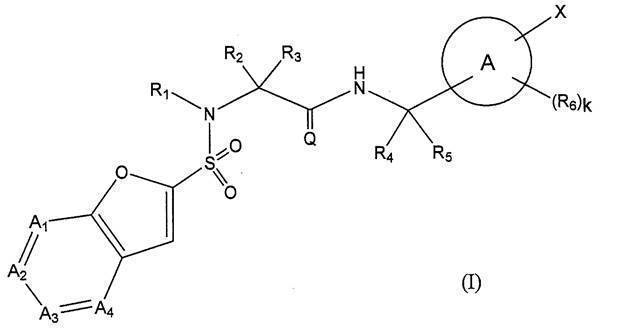
[式中、
Qは、=O又は=Sを表し;
環Aは、6員の単環の芳香環又は複素芳香環、あるいは二環性の芳香環又は複素芳香環を表し;
A1は、-C(Ra)=又は-N=を表し;
A2は、-C(Rb)=又は-N=を表し;
A3は、-C(Rc)=又は-N=を表し;
A4は、-C(Rd)=又は-N=を表し;
Ra、Rb、Rc及びRdは、同一又は異なって、水素、ハロゲノ基、シアノ基、ヒドロキシ基、C1-6アルキル基、C1-6アルコキシ基、ハロゲノC1-6アルキル基又はハロゲノC1-6アルコキシ基を表し;
ただし、A1~A4の少なくとも2つは-N=ではなく;
R1は、水素又は置換基を有してもよいC1-6アルキル基を表し;
R2は、水素、置換基を有してもよいC1-6アルキル基又は置換基を有してもよいC2-6アルケニル基を表し;
R3は、水素又はC1-6アルキル基を表し;
R4は、水素又はC1-6アルキル基を表し;
R5は、水素又はC1-6アルキル基を表し;
R1とR2は一緒になって置換基を有してもよい含窒素環を形成してもよく;
R4とR5は一緒になってシクロアルカンを形成してもよく;
Xは、水素、
-Cy、
-C(Rx1Rx2)-Cy、
-C(Rx1Rx2)-C(Rx3Rx4)-Cy、
-C(Rx1)=C(Rx2)-Cy、
-O-Cy、
-O-C(Rx1Rx2)-Cy、
-C(Rx1Rx2)-O-Cy、
-S(O)n-Cy、
-S(O)n-C(Rx1Rx2)-Cy、
-C(Rx1Rx2)-S(O)n-Cy、
-N(Rx5)-Cy、
-N(Rx5)-C(Rx1Rx2)-Cy、
-C(Rx1Rx2)-N(Rx5)-Cy、
-N(Rx5)-N(Rx6)-Cy、
-O-N(Rx5)-Cy、
-N(Rx5)-O-Cy、
-C(O)-N(Rx5)-Cy、
-N(Rx5)-C(O)-Cy、
-S(O)m-N(Rx5)-Cy、
-N(Rx5)-S(O)m-Cy、
-O-S(O)m-Cy、又は
-S(O)m-O-Cyを表し;
nは、0~2の整数を表し;
mは、1又は2を表し;
Cyは、置換基を有してもよい飽和又は不飽和の環状の基(ヘテロ原子を含んでもよい)を表し;
Rx1、Rx2、Rx3、Rx4、Rx5及びRx6は、同一又は異なって、水素、置換基を有してもよいC1-6アルキル基又は置換基を有してもよいC1-6アルコキシカルボニル基を表し;
R6は、置換基を有してもよいC1-6アルキル基、C2-6アルケニル基、環状C3-6アルキル基(ヘテロ原子を含んでもよい)、ハロゲノ基、ヒドロキシ基、置換基を有してもよいC1-6アルコキシ基、ハロゲノC1-6アルキル基、ハロゲノC1-6アルコキシ基、アミノ基、置換基を有してもよいC1-6アルキル基でモノ又はジ置換されたアミノ基、シアノ基、C1-6アルキルチオ基、カルボキシル基、置換基を有してもよいC1-6アルコキシカルボニル基、カルバモイル基、置換基を有してもよいC1-6アルキル基でモノ又はジ置換されたカルバモイル基又は置換基を有してもよいアシル基で置換されたアミノ基を表し;
R6が複数存在する場合は、同一でも異なってもよく;
kは、0~3の整数を表す]で表される化合物又はその医薬上許容される塩。ただし、下記化合物を除く。
[Where:
Q represents = O or = S;
Ring A represents a 6-membered monocyclic aromatic ring or heteroaromatic ring, or a bicyclic aromatic ring or heteroaromatic ring;
A 1 represents —C (Ra) ═ or —N═;
A 2 represents —C (Rb) ═ or —N═;
A 3 represents —C (Rc) ═ or —N═;
A 4 represents —C (Rd) ═ or —N═;
Ra, Rb, Rc and Rd are the same or different and are hydrogen, halogeno group, cyano group, hydroxy group, C 1-6 alkyl group, C 1-6 alkoxy group, halogeno C 1-6 alkyl group or halogeno C 1. Represents a -6 alkoxy group;
Provided that at least two of A 1 to A 4 are not -N =;
R 1 represents hydrogen or a C 1-6 alkyl group which may have a substituent;
R 2 represents hydrogen, an optionally substituted C 1-6 alkyl group, or an optionally substituted C 2-6 alkenyl group;
R 3 represents hydrogen or a C 1-6 alkyl group;
R 4 represents hydrogen or a C 1-6 alkyl group;
R 5 represents hydrogen or a C 1-6 alkyl group;
R 1 and R 2 together may form a nitrogen-containing ring which may have a substituent;
R 4 and R 5 together may form a cycloalkane;
X is hydrogen,
-Cy,
-C (R x1 R x2 ) -Cy,
-C (R x1 R x2 ) -C (R x3 R x4 ) -Cy,
-C (R x1 ) = C (R x2 ) -Cy,
-O-Cy,
-OC (R x1 R x2 ) -Cy,
-C (R x1 R x2 ) -O-Cy,
-S (O) n-Cy,
-S (O) n-C (R x1 R x2 ) -Cy,
-C (R x1 R x2 ) -S (O) n-Cy,
-N (R x5 ) -Cy,
-N (R x5 ) -C (R x1 R x2 ) -Cy,
-C (R x1 R x2 ) -N (R x5 ) -Cy,
-N (R x5 ) -N (R x6 ) -Cy,
-O-N (R x5 ) -Cy,
-N (R x5 ) -O-Cy,
-C (O) -N (R x5 ) -Cy,
-N (R x5 ) -C (O) -Cy,
-S (O) m-N (R x5 ) -Cy,
-N (R x5 ) -S (O) m-Cy,
Represents —O—S (O) m—Cy or —S (O) m—O—Cy;
n represents an integer of 0 to 2;
m represents 1 or 2;
Cy represents a saturated or unsaturated cyclic group (which may contain a hetero atom) which may have a substituent;
R x1 , R x2 , R x3 , R x4 , R x5 and R x6 are the same or different and are hydrogen, a C 1-6 alkyl group which may have a substituent or a C which may have a substituent Represents a 1-6 alkoxycarbonyl group;
R 6 is an optionally substituted C 1-6 alkyl group, a C 2-6 alkenyl group, a cyclic C 3-6 alkyl group (which may contain a hetero atom), a halogeno group, a hydroxy group, a substituent A C 1-6 alkoxy group which may have a halogeno C 1-6 alkyl group, a halogeno C 1-6 alkoxy group, an amino group, a C 1-6 alkyl group which may have a substituent, mono or di A substituted amino group, a cyano group, a C 1-6 alkylthio group, a carboxyl group, an optionally substituted C 1-6 alkoxycarbonyl group, a carbamoyl group, an optionally substituted C 1-6 A carbamoyl group mono- or di-substituted with an alkyl group or an amino group substituted with an optionally substituted acyl group;
When a plurality of R 6 are present, they may be the same or different;
k represents an integer of 0 to 3] or a pharmaceutically acceptable salt thereof. However, the following compounds are excluded.

[2]式(I)中、
Qが=Oであり;
R1が、水素又はC1-6アルキル基であり;
R4が、水素又はC1-6アルキル基であり;
R5が、水素又はC1-6アルキル基であり;
ただし、R4とR5は一緒になってシクロアルカンを形成せず;
Xが、水素、
-Cy、
-C(Rx1Rx2)-Cy、
-C(Rx1Rx2)-C(Rx3Rx4)-Cy、
-C(Rx1)=C(Rx2)-Cy、
-O-Cy、
-O-C(Rx1Rx2)-Cy、
-C(Rx1Rx2)-O-Cy、
-S(O)n-Cy、
-S(O)n-C(Rx1Rx2)-Cy、
-C(Rx1Rx2)-S(O)n-Cy、
-N(Rx5)-Cy、
-N(Rx5)-C(Rx1Rx2)-Cy、
-C(Rx1Rx2)-N(Rx5)-Cy、
-N(Rx5)-N(Rx6)-Cy、
-O-N(Rx5)-Cy、
-N(Rx5)-O-Cy、
-C(O)-N(Rx5)-Cy、
-N(Rx5)-C(O)-Cy、
-S(O)m-N(Rx5)-Cy、又は
-N(Rx5)-S(O)m-Cy
である、上記[1]記載の化合物又はその医薬上許容される塩。
[3]下記式(II):
[2] In formula (I),
Q is = O;
R 1 is hydrogen or a C 1-6 alkyl group;
R 4 is hydrogen or a C 1-6 alkyl group;
R 5 is hydrogen or a C 1-6 alkyl group;
Provided that R 4 and R 5 together do not form a cycloalkane;
X is hydrogen,
-Cy,
-C (R x1 R x2 ) -Cy,
-C (R x1 R x2 ) -C (R x3 R x4 ) -Cy,
-C (R x1 ) = C (R x2 ) -Cy,
-O-Cy,
-OC (R x1 R x2 ) -Cy,
-C (R x1 R x2 ) -O-Cy,
-S (O) n-Cy,
-S (O) n-C (R x1 R x2 ) -Cy,
-C (R x1 R x2 ) -S (O) n-Cy,
-N (R x5 ) -Cy,
-N (R x5) -C (R x1 R x2) -Cy,
-C (R x1 R x2 ) -N (R x5 ) -Cy,
-N (R x5 ) -N (R x6 ) -Cy,
-O-N (R x5 ) -Cy,
-N (R x5 ) -O-Cy,
-C (O) -N (R x5 ) -Cy,
-N (R x5 ) -C (O) -Cy,
-S (O) m-N (R x5 ) -Cy or -N (R x5 ) -S (O) m-Cy
The compound of the above-mentioned [1] or a pharmaceutically acceptable salt thereof.
[3] The following formula (II):
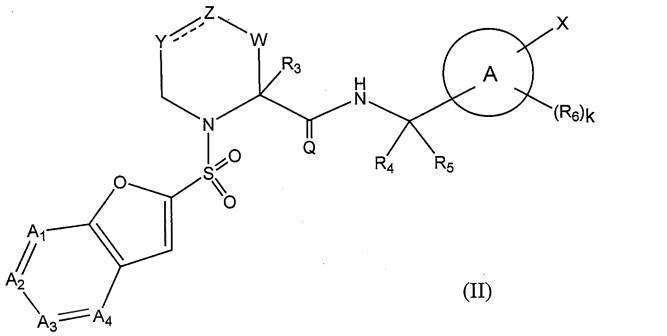
[式中、 [Where:

は単結合又は二重結合を表し;
Yは、-CRy1Ry2-又は-CRy3=を表し;
Zは、結合、-O-、-CRz1Rz2-又は-CRz3=を表し;
Wは、結合又は-CRw1Rw2-を表し;
Ry1、Ry2、Ry3、Rz1、Rz2、Rz3、Rw1及びRw2は、同一又は異なって、水素、ハロゲノ基、ヒドロキシ基又は置換基を有してもよいC1-6アルキル基を表し;
それ以外の記号の定義は上記[1]に記載の通りである]
で表される、上記[1]記載の化合物又はその医薬上許容される塩。
[4]式(II)中、
Qが=Oであり;
R4が、水素又はC1-6アルキル基であり;
R5が、水素又はC1-6アルキル基であり;
ただし、R4とR5は一緒になってシクロアルカンを形成せず;
Xが、水素、
-Cy、
-C(Rx1Rx2)-Cy、
-C(Rx1Rx2)-C(Rx3Rx4)-Cy、
-C(Rx1)=C(Rx2)-Cy、
-O-Cy、
-O-C(Rx1Rx2)-Cy、
-C(Rx1Rx2)-O-Cy、
-S(O)n-Cy、
-S(O)n-C(Rx1Rx2)-Cy、
-C(Rx1Rx2)-S(O)n-Cy、
-N(Rx5)-Cy、
-N(Rx5)-C(Rx1Rx2)-Cy、
-C(Rx1Rx2)-N(Rx5)-Cy、
-N(Rx5)-N(Rx6)-Cy、
-O-N(Rx5)-Cy、
-N(Rx5)-O-Cy、
-C(O)-N(Rx5)-Cy、
-N(Rx5)-C(O)-Cy、
-S(O)m-N(Rx5)-Cy、又は
-N(Rx5)-S(O)m-Cy
である、
上記[3]記載の化合物又はその医薬上許容される塩。
[5]R1が水素、R2がC1-6アルキル基、R3が水素である上記[2]記載の化合物又はその医薬上許容される塩。
[6]Yが-CH2-であり、Zが-CH2-であり、Wが結合であり、R3が水素である上記[4]記載の化合物又はその医薬上許容される塩。
[7]Yが-CH2-であり、Zが結合であり、Wが結合であり、R3が水素である上記[4]記載の化合物又はその医薬上許容される塩。
[8]部分構造(a)が
Represents a single bond or a double bond;
Y represents —CR y1 R y2 — or —CR y3 =;
Z represents a bond, —O—, —CR z1 R z2 — or —CR z3 =;
W represents a bond or —CR w1 R w2 —;
R y1 , R y2 , R y3 , R z1 , R z2 , R z3 , R w1 and R w2 are the same or different and each may have hydrogen, a halogeno group, a hydroxy group or a substituent, C 1-6 Represents an alkyl group;
The definitions of other symbols are as described in [1] above]
Or a pharmaceutically acceptable salt thereof.
[4] In formula (II),
Q is = O;
R 4 is hydrogen or a C 1-6 alkyl group;
R 5 is hydrogen or a C 1-6 alkyl group;
Provided that R 4 and R 5 together do not form a cycloalkane;
X is hydrogen,
-Cy,
-C (R x1 R x2 ) -Cy,
-C (R x1 R x2 ) -C (R x3 R x4 ) -Cy,
-C (R x1 ) = C (R x2 ) -Cy,
-O-Cy,
-OC (R x1 R x2 ) -Cy,
-C (R x1 R x2 ) -O-Cy,
-S (O) n-Cy,
-S (O) n-C (R x1 R x2 ) -Cy,
-C (R x1 R x2 ) -S (O) n-Cy,
-N (R x5 ) -Cy,
-N (R x5 ) -C (R x1 R x2 ) -Cy,
-C (R x1 R x2 ) -N (R x5 ) -Cy,
-N (R x5 ) -N (R x6 ) -Cy,
-O-N (R x5 ) -Cy,
-N (R x5 ) -O-Cy,
-C (O) -N (R x5 ) -Cy,
-N (R x5 ) -C (O) -Cy,
-S (O) m-N (R x5 ) -Cy or -N (R x5 ) -S (O) m-Cy
Is,
The compound of the above-mentioned [3] or a pharmaceutically acceptable salt thereof.
[5] The compound of the above-mentioned [2] or a pharmaceutically acceptable salt thereof, wherein R 1 is hydrogen, R 2 is a C 1-6 alkyl group, and R 3 is hydrogen.
[6] The compound of the above-mentioned [4] or a pharmaceutically acceptable salt thereof, wherein Y is —CH 2 —, Z is —CH 2 —, W is a bond, and R 3 is hydrogen.
[7] The compound of the above-mentioned [4], wherein Y is —CH 2 —, Z is a bond, W is a bond, and R 3 is hydrogen, or a pharmaceutically acceptable salt thereof.
[8] The partial structure (a) is
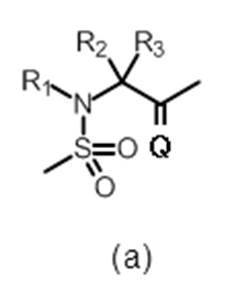
下図のいずれかの基である It is one of the following groups

[式中、R1は、水素又は置換基を有してもよいC1-6アルキル基を表す]
上記[2]記載の化合物又はその医薬上許容される塩。
[9]R1が水素である、上記[8]記載の化合物又はその医薬上許容される塩。
[10]R4およびR5が水素である上記[9]記載の化合物又はその医薬上許容される塩。
[11]環Aが6員の単環性の芳香環又は複素芳香環である、上記[9]記載の化合物又はその医薬上許容される塩。
[12]環Aがベンゼン、ピリジン、あるいは、ピリミジンである、上記[9]記載の化合物又はその医薬上許容される塩。
[13]環Aを含む部分構造(b)が
[Wherein R 1 represents hydrogen or a C 1-6 alkyl group which may have a substituent]
The compound of the above-mentioned [2] or a pharmaceutically acceptable salt thereof.
[9] The compound of the above-mentioned [8], wherein R 1 is hydrogen, or a pharmaceutically acceptable salt thereof.
[10] The compound of the above-mentioned [9], wherein R 4 and R 5 are hydrogen, or a pharmaceutically acceptable salt thereof.
[11] The compound of the above-mentioned [9] or a pharmaceutically acceptable salt thereof, wherein ring A is a 6-membered monocyclic aromatic ring or heteroaromatic ring.
[12] The compound of the above-mentioned [9] or a pharmaceutically acceptable salt thereof, wherein ring A is benzene, pyridine or pyrimidine.
[13] The partial structure (b) containing ring A is
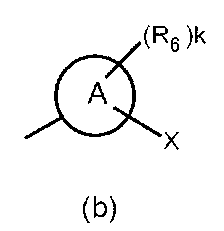
下図のいずれかの基である It is one of the following groups

上記[1]、[2]、[4]、[8]又は[9]記載の化合物又はその医薬上許容される塩。
[14]kが0から2の整数であり、R6がC1-6アルキル基、環状C3-6アルキル基(ヘテロ原子を含んでもよい)、ハロゲノ基、ヒドロキシ基、置換基を有してもよいC1-6アルコキシ基、アミノ基、C1-6アルコキシカルボニル基、あるいは、C1-6アルキル基でモノ又はジ置換されたアミノ基である上記[9]記載の化合物又はその医薬上許容される塩。
[15]kが0である上記[9]記載の化合物又はその医薬上許容される塩。
[16]環Aを含む部分構造(b)が
The compound according to [1], [2], [4], [8] or [9] or a pharmaceutically acceptable salt thereof.
[14] k is an integer of 0 to 2, and R 6 has a C 1-6 alkyl group, a cyclic C 3-6 alkyl group (which may include a hetero atom), a halogeno group, a hydroxy group, and a substituent. The compound according to [9] above, which is a C 1-6 alkoxy group, an amino group, a C 1-6 alkoxycarbonyl group, or an amino group mono- or di-substituted by a C 1-6 alkyl group, or a pharmaceutical thereof Top acceptable salt.
[15] The compound of the above-mentioned [9], wherein k is 0, or a pharmaceutically acceptable salt thereof.
[16] The partial structure (b) containing ring A is

下図のいずれかの基であり;

kが0又は1であり、R6が環状C3-6アルキル基(ヘテロ原子を含んでもよい)、ハロゲノ基、C1-6アルコキシカルボニル基、アミノ基、C1-6アルキル基でモノ又はジ置換されたアミノ基、あるいは、ヒドロキシ基である上記[9]記載の化合物又はその医薬上許容される塩。
[17]環Aを含む部分構造(b)が
k is 0 or 1, and R 6 is a cyclic C 3-6 alkyl group (which may contain a hetero atom), a halogeno group, a C 1-6 alkoxycarbonyl group, an amino group, a C 1-6 alkyl group, or The compound of the above-mentioned [9], which is a disubstituted amino group or a hydroxy group, or a pharmaceutically acceptable salt thereof.
[17] The partial structure (b) containing ring A is
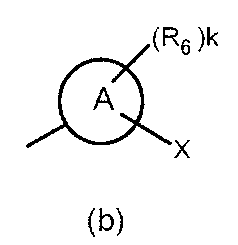
下図のいずれかの基である It is one of the following groups

上記[9]記載の化合物又はその医薬上許容される塩。
[18]環Aを含む部分構造(b)が
The compound of the above-mentioned [9] or a pharmaceutically acceptable salt thereof.
[18] The partial structure (b) containing ring A is

下図の基であり、 The basis of the figure below,
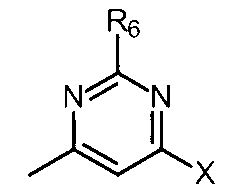
R6が環状C3-6アルキル基(ヘテロ原子を含んでもよい)、置換基を有してもよいC1-6アルコキシ基、アミノ基、あるいは、C1-6アルキル基でモノ又はジ置換されたアミノ基である上記[9]記載の化合物又はその医薬上許容される塩。
[19]A1が-C(Ra)=であり、A2が-C(Rb)=であり、A3が-C(Rc)=であり、A4が-C(Rd)=
である上記[9]記載の化合物又はその医薬上許容される塩。
[20]A1が-C(Ra)=であり、A2が-C(Rb)=であり、A3が-C(Rc)=であり、A4が-C(Rd)=であり;
Ra、Rb、Rc及びRdが全て水素であるか、いずれか一つがハロゲノ基である、上記[9]記載の化合物又はその医薬上許容される塩。
[21]部分構造(c)が
R 6 is a cyclic C 3-6 alkyl group (which may contain a heteroatom), a C 1-6 alkoxy group which may have a substituent, an amino group, or a C 1-6 alkyl group, mono or disubstituted Or a pharmaceutically acceptable salt thereof, which is a selected amino group.
[19] A 1 is -C (Ra) =, A 2 is -C (Rb) =, A 3 is -C (Rc) =, and A 4 is -C (Rd) =
Or a pharmaceutically acceptable salt thereof.
[20] A 1 is -C (Ra) =, A 2 is -C (Rb) =, A 3 is -C (Rc) =, and A 4 is -C (Rd) = ;
The compound of the above-mentioned [9] or a pharmaceutically acceptable salt thereof, wherein Ra, Rb, Rc and Rd are all hydrogen or any one is a halogeno group.
[21] The partial structure (c) is

下図のいずれかの基である It is one of the following groups

上記[1]、[2]、[4]、[8]又は[9]記載の化合物又はその医薬上許容される塩。
[22]
Xが、水素、-Cy、-O-Cy、又は、-O-CH2-Cy
である上記[1]、[2]、[4]、[8]又は[9]記載の化合物又はその医薬上許容される塩。
[23]Xが-Cyである上記[9]記載の化合物又はその医薬上許容される塩。
[24]Cyが、置換基を有してもよいベンゼン、置換基を有してもよいピリジン、置換基を有してもよいピリミジン、置換基を有してもよいピリダジン、あるいは置換基を有してもよいピラジンである上記[9]記載の化合物又はその医薬上許容される塩。
[25]Cyが下図で示されるいずれかの基である
The compound according to [1], [2], [4], [8] or [9] or a pharmaceutically acceptable salt thereof.
[22]
X is hydrogen, -Cy, -O-Cy, or -O-CH 2 -Cy
The compound of the above-mentioned [1], [2], [4], [8] or [9] or a pharmaceutically acceptable salt thereof.
[23] The compound of the above-mentioned [9], wherein X is —Cy, or a pharmaceutically acceptable salt thereof.
[24] Cy represents benzene which may have a substituent, pyridine which may have a substituent, pyrimidine which may have a substituent, pyridazine which may have a substituent, or substituent. The compound of the above-mentioned [9], which is a pyrazine which may have, or a pharmaceutically acceptable salt thereof.
[25] Cy is any group shown in the figure below

上記[9]記載の化合物又はその医薬上許容される塩。
[26]Xが-Cyであり;
Cyが、置換基を有してもよいベンゼン、置換基を有してもよいピリジン、置換基を有してもよいピリミジン、置換基を有してもよいピリダジン、あるいは置換基を有してもよいピラジンである上記[9]記載の化合物又はその医薬上許容される塩。
[27]Xが-Cyであり;
Cyが下図で示されるいずれかの基である
The compound of the above-mentioned [9] or a pharmaceutically acceptable salt thereof.
[26] X is -Cy;
Cy has benzene which may have a substituent, pyridine which may have a substituent, pyrimidine which may have a substituent, pyridazine which may have a substituent, or a substituent. The compound of the above-mentioned [9], which is a good pyrazine, or a pharmaceutically acceptable salt thereof.
[27] X is -Cy;
Cy is any group shown in the figure below
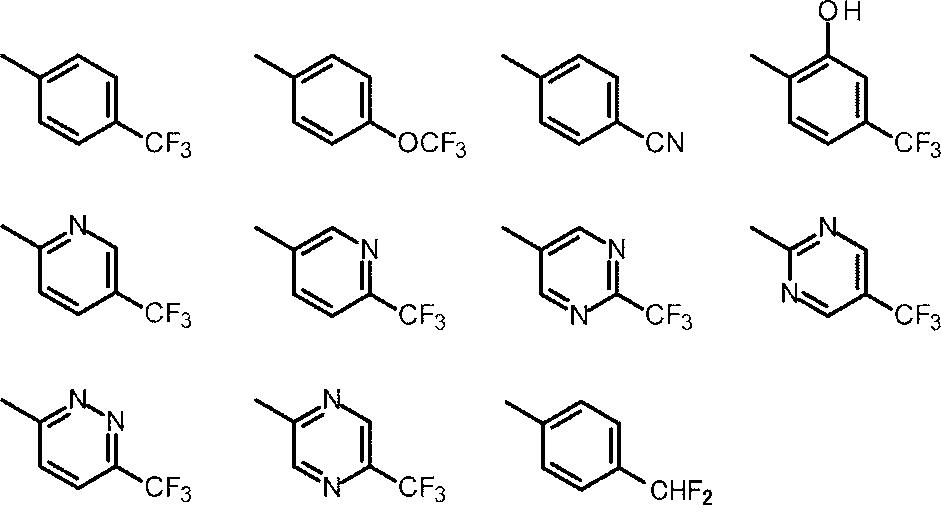
上記[1]、[2]、[4]、[8]又は[9]記載の化合物又はその医薬上許容される塩。
[28]R4およびR5が水素であり;
環Aを含む部分構造(b)が
The compound according to [1], [2], [4], [8] or [9] or a pharmaceutically acceptable salt thereof.
[28] R 4 and R 5 are hydrogen;
The partial structure (b) containing ring A is
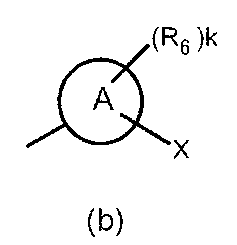
下図のいずれかの基であり; Any of the groups in the figure below;

Xが-Cyであり;
Cyが下図で示されるいずれかの基である
X is -Cy;
Cy is any group shown in the figure below
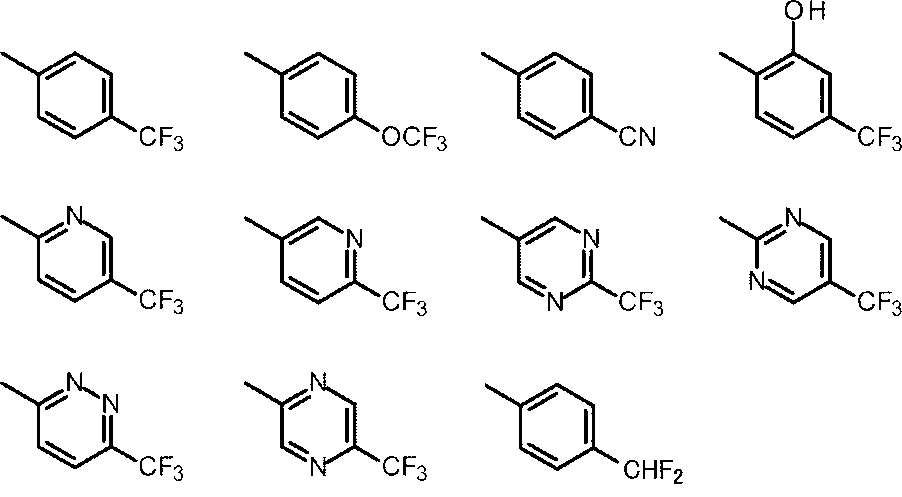
上記[9]記載の化合物又はその医薬上許容される塩。
[29]R4およびR5が水素であり;
環Aを含む部分構造(b)が
The compound of the above-mentioned [9] or a pharmaceutically acceptable salt thereof.
[29] R 4 and R 5 are hydrogen;
The partial structure (b) containing ring A is

下図のいずれかの基であり; Any of the groups in the figure below;

Xが-Cyであり;
Cyが下図で示されるいずれかの基であり;
X is -Cy;
Cy is any group shown in the figure below;

部分構造(c)が Partial structure (c) is

下図のいずれかの基である It is one of the following groups

上記[1]、[2]、[4]、[8]又は[9]記載の化合物又はその医薬上許容される塩。
[30]R4およびR5が水素であり;
環Aを含む部分構造(b)が
The compound according to [1], [2], [4], [8] or [9] or a pharmaceutically acceptable salt thereof.
[30] R 4 and R 5 are hydrogen;
The partial structure (b) containing ring A is

下図の基であり、 The basis of the figure below,
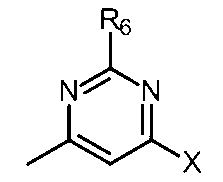
R6が環状C3-6アルキル基(ヘテロ原子を含んでもよい)、置換基を有してもよいC1-6アルコキシ基、アミノ基、あるいは、C1-6アルキル基でモノ又はジ置換されたアミノ基であり、
Xが-Cyであり;
Cyが下図で示されるいずれかの基であり;
R 6 is a cyclic C 3-6 alkyl group (which may contain a heteroatom), a C 1-6 alkoxy group which may have a substituent, an amino group, or a C 1-6 alkyl group, mono or disubstituted An amino group,
X is -Cy;
Cy is any group shown in the figure below;

部分構造(c)が Partial structure (c) is

下図のいずれかの基である It is one of the following groups

上記[1]、[2]、[4]、[8]又は[9]記載の化合物又はその医薬上許容される塩。
[31]下記構造式のいずれかで表される、上記[2]記載の化合物又はその医薬上許容される塩。
The compound according to [1], [2], [4], [8] or [9] or a pharmaceutically acceptable salt thereof.
[31] The compound of the above-mentioned [2] or a pharmaceutically acceptable salt thereof represented by any of the following structural formulas.


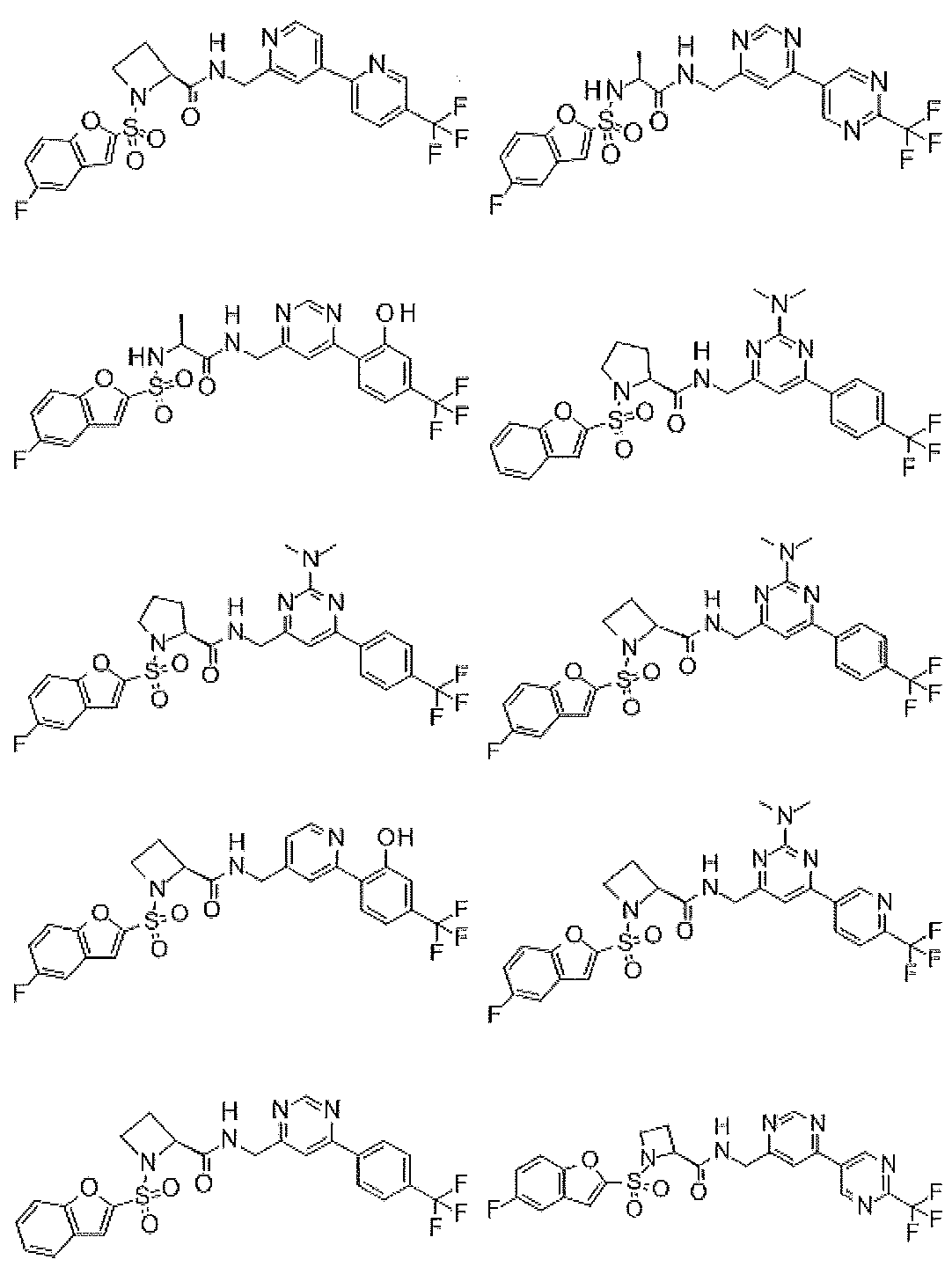

[32]TRPA1アンタゴニストである、上記[1]~[31]のいずれかに記載の化合物又はその医薬上許容される塩。
[33]上記[1]~[31]のいずれかに記載の化合物又はその医薬上許容される塩を有効成分として含む医薬。
[34]TRPA1が関与する疾患の予防および/または治療用である、上記[33]記載の医薬。
[35]TRPA1が関与する疾患が、慢性疼痛、急性疼痛、糖尿病性ニューロパチー、骨関節炎、喘息、慢性咳嗽、慢性閉塞性肺疾患、機能性胃腸障害、逆流性食道炎、過敏性腸症候群、炎症性腸疾患、膵炎、抗がん剤誘発神経障害、掻痒症、及びアレルギー性皮膚炎からなる群より選択されるものである、上記[34]記載の医薬。
[36]TRPA1が関与する疾患が、慢性疼痛、急性疼痛、喘息、慢性閉塞性肺疾患、機能性胃腸障害、逆流性食道炎、炎症性腸疾患、抗がん剤誘発神経障害、及び掻痒症からなる群より選択されるものである、上記[34]記載の医薬。
[37]上記[1]~[31]のいずれかに記載の化合物の有効量をそれを必要とする対象に投与することを含む、TRPA1が関与する疾患の予防および/または治療方法。
[38]TRPA1が関与する疾患が、慢性疼痛、急性疼痛、糖尿病性ニューロパチー、骨関節炎、喘息、慢性咳嗽、慢性閉塞性肺疾患、機能性胃腸障害、逆流性食道炎、過敏性腸症候群、炎症性腸疾患、膵炎、抗がん剤誘発神経障害、掻痒症、及びアレルギー性皮膚炎から選択されるものである、上記[37]記載の方法。
[39]TRPA1が関与する疾患が、慢性疼痛、急性疼痛、喘息、慢性閉塞性肺疾患、機能性胃腸障害、逆流性食道炎、炎症性腸疾患、抗がん剤誘発神経障害、及び掻痒症から選択されるものである、上記[37]記載の方法。
[40]TRPA1が関与する疾患の予防および/または治療に用いる、上記[1]~[31]のいずれかに記載の化合物又はその医薬上許容される塩。
[41]TRPA1が関与する疾患が、慢性疼痛、急性疼痛、糖尿病性ニューロパチー、骨関節炎、喘息、慢性咳嗽、慢性閉塞性肺疾患、機能性胃腸障害、逆流性食道炎、過敏性腸症候群、炎症性腸疾患、膵炎、抗がん剤誘発神経障害、掻痒症、及びアレルギー性皮膚炎から選択されるものである、上記[40]記載の化合物又はその医薬上許容される塩。
[42]TRPA1が関与する疾患が、慢性疼痛、急性疼痛、喘息、慢性閉塞性肺疾患、機能性胃腸障害、逆流性食道炎、炎症性腸疾患、抗がん剤誘発神経障害、及び掻痒症から選択されるものである、上記[40]記載の化合物又はその医薬上許容される塩。
[32] The compound or a pharmaceutically acceptable salt thereof according to any one of the above [1] to [31], which is a TRPA1 antagonist.
[33] A medicament comprising as an active ingredient the compound according to any one of [1] to [31] above or a pharmaceutically acceptable salt thereof.
[34] The medicament described in [33] above, which is used for prevention and / or treatment of a disease involving TRPA1.
[35] Diseases involving TRPA1 are chronic pain, acute pain, diabetic neuropathy, osteoarthritis, asthma, chronic cough, chronic obstructive pulmonary disease, functional gastrointestinal disorders, reflux esophagitis, irritable bowel syndrome, inflammation The medicament according to [34] above, which is selected from the group consisting of sexual bowel disease, pancreatitis, anticancer drug-induced neuropathy, pruritus, and allergic dermatitis.
[36] Diseases involving TRPA1 are chronic pain, acute pain, asthma, chronic obstructive pulmonary disease, functional gastrointestinal disorder, reflux esophagitis, inflammatory bowel disease, anticancer drug-induced neuropathy, and pruritus The medicament according to [34] above, which is selected from the group consisting of:
[37] A method for preventing and / or treating a disease involving TRPA1, comprising administering an effective amount of the compound according to any one of [1] to [31] to a subject in need thereof.
[38] Diseases involving TRPA1 are chronic pain, acute pain, diabetic neuropathy, osteoarthritis, asthma, chronic cough, chronic obstructive pulmonary disease, functional gastrointestinal disorder, reflux esophagitis, irritable bowel syndrome, inflammation The method of the above-mentioned [37], which is selected from genital bowel disease, pancreatitis, anticancer drug-induced neuropathy, pruritus, and allergic dermatitis.
[39] Diseases involving TRPA1 are chronic pain, acute pain, asthma, chronic obstructive pulmonary disease, functional gastrointestinal disorder, reflux esophagitis, inflammatory bowel disease, anticancer drug-induced neuropathy, and pruritus The method according to [37] above, wherein the method is selected from:
[40] The compound or a pharmaceutically acceptable salt thereof according to any one of [1] to [31], which is used for the prevention and / or treatment of a disease involving TRPA1.
[41] Diseases involving TRPA1 are chronic pain, acute pain, diabetic neuropathy, osteoarthritis, asthma, chronic cough, chronic obstructive pulmonary disease, functional gastrointestinal disorder, reflux esophagitis, irritable bowel syndrome, inflammation The compound of the above-mentioned [40] or a pharmaceutically acceptable salt thereof, which is selected from genital bowel disease, pancreatitis, anticancer drug-induced neuropathy, pruritus, and allergic dermatitis.
[42] Diseases involving TRPA1 are chronic pain, acute pain, asthma, chronic obstructive pulmonary disease, functional gastrointestinal dysfunction, reflux esophagitis, inflammatory bowel disease, anticancer drug-induced neuropathy, and pruritus The compound of the above-mentioned [40] or a pharmaceutically acceptable salt thereof, which is selected from
化合物(I)のさらに別の一態様として、下記(I’) As still another embodiment of the compound (I), the following (I ′)

[式中、
環Aは、6員の単環の芳香環又は複素芳香環、あるいは二環性の芳香環又は複素芳香環を表し;
A1は、-C(Ra)=又は-N=を表し;
A2は、-C(Rb)=又は-N=を表し;
A3は、-C(Rc)=又は-N=を表し;
A4は、-C(Rd)=又は-N=を表し;
Ra、Rb、Rc及びRdは、同一又は異なって、水素、ハロゲノ基、シアノ基、ヒドロキシ基、C1-6アルキル基、C1-6アルコキシ基、ハロゲノC1-6アルキル基又はハロゲノC1-6アルコキシ基を表し;
ただし、A1~A4の少なくとも2つは-N=ではなく;
R1は、水素又はC1-6アルキル基を表し;
R2は、水素、置換基を有してもよいC1-6アルキル基又は置換基を有してもよいC2-6アルケニル基を表し;
R3は、水素又はC1-6アルキル基を表し;
R4は、水素又はC1-6アルキル基を表し;
R5は、水素又はC1-6アルキル基を表し;
R1とR2は一緒になって置換基を有してもよい含窒素環を形成してもよく;
Xは、水素、
-Cy、
-C(Rx1Rx2)-Cy、
-C(Rx1Rx2)-C(RX3RX4)-Cy、
-C(RX1)=C(RX2)-Cy、
-O-Cy、
-O-C(Rx1Rx2)-Cy、
-C(Rx1Rx2)-O-Cy、
-S(O)n-Cy、
-S(O)n-C(Rx1Rx2)-Cy、
-C(Rx1Rx2)-S(O)n-Cy、
-N(Rx5)-Cy、
-N(Rx5)-C(Rx1Rx2)-Cy、
-C(Rx1Rx2)-N(Rx5)-Cy、
-N(Rx5)-N(Rx6)-Cy、
-O-N(Rx5)-Cy、
-N(Rx5)-O-Cy、
-C(O)-N(Rx5)-Cy、
-N(Rx5)-C(O)-Cy、
-S(O)m-N(Rx5)-Cy、又は
-N(Rx5)-S(O)m-Cyを表し;
nは、0~2の整数を表し;
mは、1又は2を表し;
Cyは、置換基を有してもよい飽和又は不飽和の環状の基(ヘテロ原子を含んでもよい)を表し;
Rx1、Rx2、Rx3、Rx4、Rx5及びRx6は、同一又は異なって、水素、置換基を有してもよいC1-6アルキル基又は置換基を有してもよいC1-6アルコキシカルボニル基を表し;
R6は、置換基を有してもよいC1-6アルキル基、C2-6アルケニル基、環状C3-6アルキル基(ヘテロ原子を含んでもよい)、ハロゲノ基、ヒドロキシ基、置換基を有してもよいC1-6アルコキシ基、ハロゲノC1-6アルキル基、ハロゲノC1-6アルコキシ基、アミノ基、置換基を有してもよいC1-6アルキル基でモノ又はジ置換されたアミノ基、シアノ基、C1-6アルキルチオ基、カルボキシル基、置換基を有してもよいC1-6アルコキシカルボニル基、カルバモイル基、置換基を有してもよいC1-6アルキル基でモノ又はジ置換されたカルバモイル基又は置換基を有してもよいアシル基で置換されたアミノ基を表し;
R6が複数存在する場合は、同一でも異なってもよく;
kは0~3の整数を表す]で表される化合物又はその医薬上許容される塩が挙げられる。ただし、下記化合物を除く。
[Where:
Ring A represents a 6-membered monocyclic aromatic ring or heteroaromatic ring, or a bicyclic aromatic ring or heteroaromatic ring;
A 1 represents —C (Ra) ═ or —N═;
A 2 represents —C (Rb) ═ or —N═;
A 3 represents —C (Rc) ═ or —N═;
A 4 represents —C (Rd) ═ or —N═;
Ra, Rb, Rc and Rd are the same or different and are hydrogen, halogeno group, cyano group, hydroxy group, C 1-6 alkyl group, C 1-6 alkoxy group, halogeno C 1-6 alkyl group or halogeno C 1. Represents a -6 alkoxy group;
Provided that at least two of A 1 to A 4 are not -N =;
R 1 represents hydrogen or a C 1-6 alkyl group;
R 2 represents hydrogen, an optionally substituted C 1-6 alkyl group, or an optionally substituted C 2-6 alkenyl group;
R 3 represents hydrogen or a C 1-6 alkyl group;
R 4 represents hydrogen or a C 1-6 alkyl group;
R 5 represents hydrogen or a C 1-6 alkyl group;
R 1 and R 2 together may form a nitrogen-containing ring which may have a substituent;
X is hydrogen,
-Cy,
-C (R x1 R x2 ) -Cy,
-C (R x1 R x2) -C (R X3 R X4) -Cy,
-C (R X1 ) = C (R X2 ) -Cy,
-O-Cy,
-OC (R x1 R x2 ) -Cy,
-C (R x1 R x2 ) -O-Cy,
-S (O) n-Cy,
-S (O) n-C (R x1 R x2 ) -Cy,
-C (R x1 R x2 ) -S (O) n-Cy,
-N (R x5 ) -Cy,
-N (R x5 ) -C (R x1 R x2 ) -Cy,
-C (R x1 R x2 ) -N (R x5 ) -Cy,
-N (R x5 ) -N (R x6 ) -Cy,
-O-N (R x5 ) -Cy,
-N (R x5 ) -O-Cy,
-C (O) -N (R x5 ) -Cy,
-N (R x5 ) -C (O) -Cy,
-S (O) m-N (R x5 ) -Cy or -N (R x5 ) -S (O) m-Cy;
n represents an integer of 0 to 2;
m represents 1 or 2;
Cy represents a saturated or unsaturated cyclic group (which may contain a hetero atom) which may have a substituent;
R x1 , R x2 , R x3 , R x4 , R x5 and R x6 are the same or different and are hydrogen, a C 1-6 alkyl group which may have a substituent or a C which may have a substituent Represents a 1-6 alkoxycarbonyl group;
R 6 is an optionally substituted C 1-6 alkyl group, a C 2-6 alkenyl group, a cyclic C 3-6 alkyl group (which may contain a hetero atom), a halogeno group, a hydroxy group, a substituent A C 1-6 alkoxy group which may have a halogeno C 1-6 alkyl group, a halogeno C 1-6 alkoxy group, an amino group, a C 1-6 alkyl group which may have a substituent, mono or di A substituted amino group, a cyano group, a C 1-6 alkylthio group, a carboxyl group, an optionally substituted C 1-6 alkoxycarbonyl group, a carbamoyl group, an optionally substituted C 1-6 A carbamoyl group mono- or di-substituted with an alkyl group or an amino group substituted with an optionally substituted acyl group;
When a plurality of R 6 are present, they may be the same or different;
k represents an integer of 0 to 3], or a pharmaceutically acceptable salt thereof. However, the following compounds are excluded.

化合物(II)のさらに別の一態様として、下記式(II’) As still another embodiment of the compound (II), the following formula (II ′)

[式中、 [Where:

は単結合又は二重結合を表し;
Yは、-CRy1Ry2-又は-CRy3=を表し;
Zは、結合、-O-、-CRz1Rz2-又は-CRz3=を表し;
Wは、結合又は-CRw1Rw2-を表し;
Ry1、Ry2、Ry3、Rz1、Rz2、Rz3、Rw1及びRw2は、同一又は異なって、水素、ハロゲノ基、ヒドロキシ基又は置換基を有してもよいC1-6アルキル基を表し;
それ以外の記号の定義は式(I’)に記載の通りである]
で表される、化合物又はその医薬上許容される塩
が挙げられる。
Represents a single bond or a double bond;
Y represents —CR y1 R y2 — or —CR y3 =;
Z represents a bond, —O—, —CR z1 R z2 — or —CR z3 =;
W represents a bond or —CR w1 R w2 —;
R y1 , R y2 , R y3 , R z1 , R z2 , R z3 , R w1 and R w2 are the same or different and each may have hydrogen, a halogeno group, a hydroxy group or a substituent, C 1-6 Represents an alkyl group;
The definitions of other symbols are as described in formula (I ′)]
Or a pharmaceutically acceptable salt thereof.
化合物(I)のさらに別の好ましい態様として、後述の実施例に記載の化合物またはその医薬上許容される塩が挙げられる。
より好ましくは、実施例1、2、4、5、6、7、8、9、10、11、12、13、14、16、17、18、19、20、25、26、27、30、31、34、35、36、37、38、41、42、43、44、47、48、49、51、53、54、56、57、65、66、67、69、70、71、77、79、80、84、86、87、88、89、90、92、93、94、95、97、98、99、100、101、102、104、106、107、108、109、110、115、116、117、119、123、124、127、128、129、130、132、133、135、136、137、138、139、140、141、142、145、148、149、150、151、153、155、156、157、158、159、160、161、164、172、173、174、175、179、181、190、191、192、193、194、195、196、197、198、199、200、201、202、203、205、206、207、210、212、214、215、216、221、222、223、224、225、226、229、230、231、233、235、239、240、248、252、255、258、259、262、263、264、265、267、268、269、270、271、272、273、274、275、278、279、281、285、287、288、289、290、291、293、296、297、298、299、309、310、311、312、315、318、326、327、328、329、330、332、333、336、337、338、339、341、344、348、349、357、359、360、362、364、368、369、371、372、374、375、376、378、379、380、381、382、383、384、385、386、387、388、389、390、391、392、393、394、395、396、397、398、399、400、401、402、403、404、405、406、407、408、409、410、411、412、413、414、416、417、418、419、420、421、422、423、424、426記載の下表(表1)中の化合物またはその医薬上許容される塩である。
Still another preferred embodiment of compound (I) includes the compounds described in the examples below or pharmaceutically acceptable salts thereof.
More preferably, Examples 1, 2, 4, 5, 6, 7, 8, 9, 10, 11, 12, 13, 14, 16, 17, 18, 19, 20, 25, 26, 27, 30, 31, 34, 35, 36, 37, 38, 41, 42, 43, 44, 47, 48, 49, 51, 53, 54, 56, 57, 65, 66, 67, 69, 70, 71, 77, 79, 80, 84, 86, 87, 88, 89, 90, 92, 93, 94, 95, 97, 98, 99, 100, 101, 102, 104, 106, 107, 108, 109, 110, 115, 116, 117, 119, 123, 124, 127, 128, 129, 130, 132, 133, 135, 136, 137, 138, 139, 140, 141, 142, 145, 148, 149, 150, 151, 153, 155, 56, 157, 158, 159, 160, 161, 164, 172, 173, 174, 175, 179, 181, 190, 191, 192, 193, 194, 195, 196, 197, 198, 199, 200, 201, 202, 203, 205, 206, 207, 210, 212, 214, 215, 216, 221, 222, 223, 224, 225, 226, 229, 230, 231, 233, 235, 239, 240, 248, 252, 255,258,259,262,263,264,265,267,268,269,270,271,272,273,274,275,278,279,281,285,287,288,289,290,291, 293, 296, 297, 298, 299, 309, 310, 311, 3 2,315,318,326,327,328,329,330,332,333,336,337,338,339,341,344,348,349,357,359,360,362,364,368,369, 371, 372, 374, 375, 376, 378, 379, 380, 381, 382, 383, 384, 385, 386, 387, 388, 389, 390, 391, 392, 393, 394, 395, 396, 397, 398, 399, 400, 401, 402, 403, 404, 405, 406, 407, 408, 409, 410, 411, 412, 413, 414, 416, 417, 418, 419, 420, 421, 422, 423, 424, 426 compounds in the following table (Table 1) or pharmaceutically acceptable salts thereof It is.


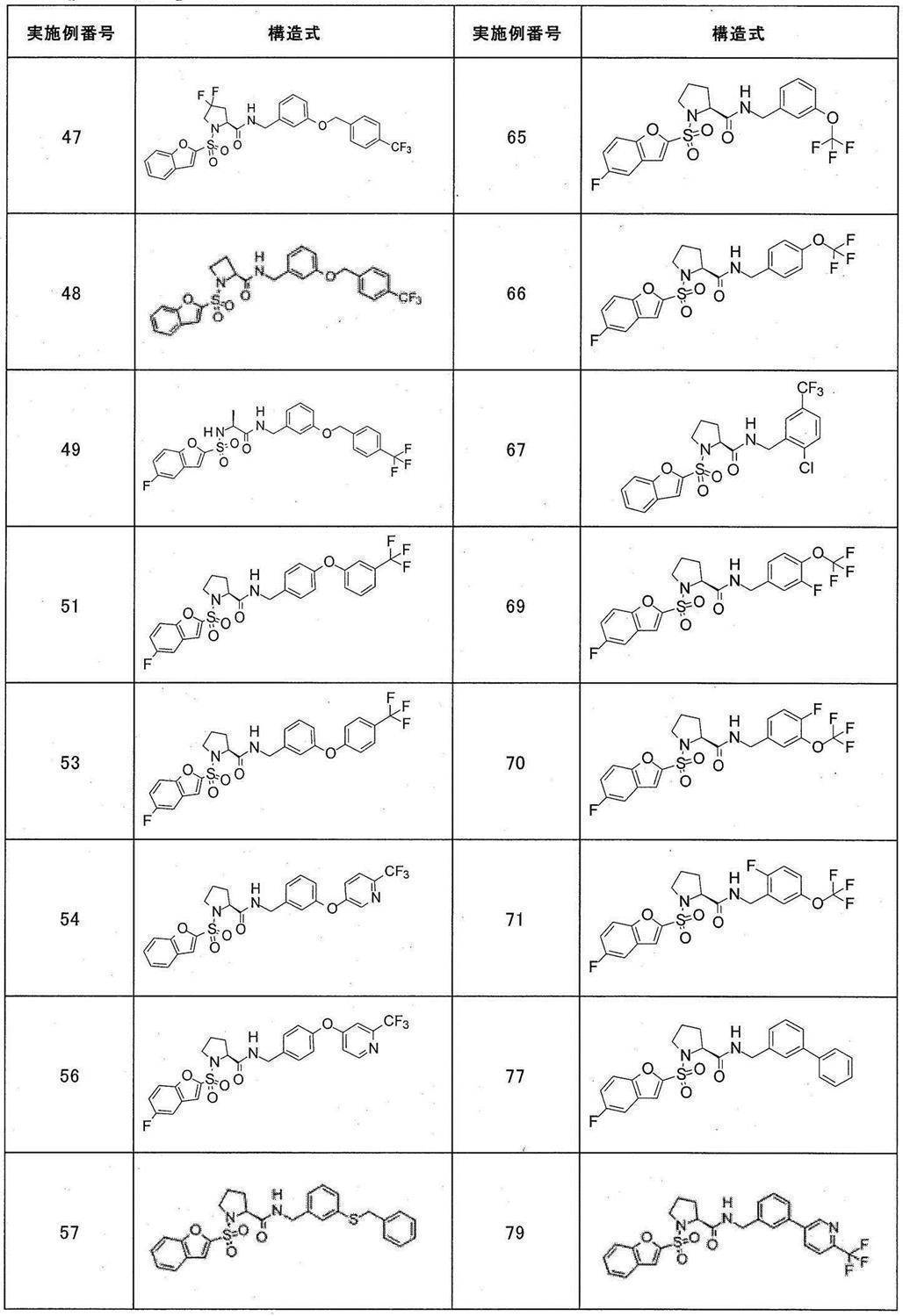

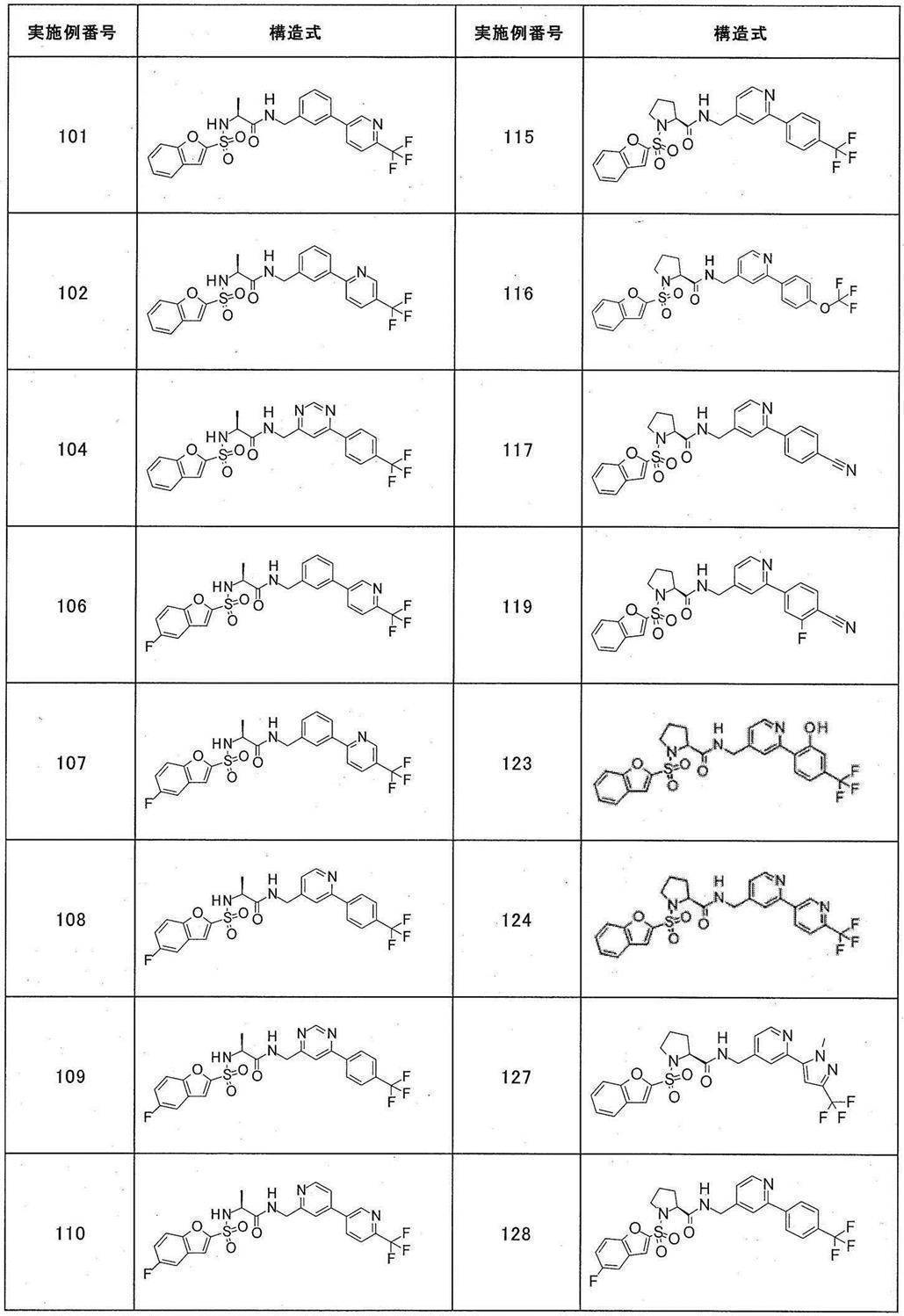

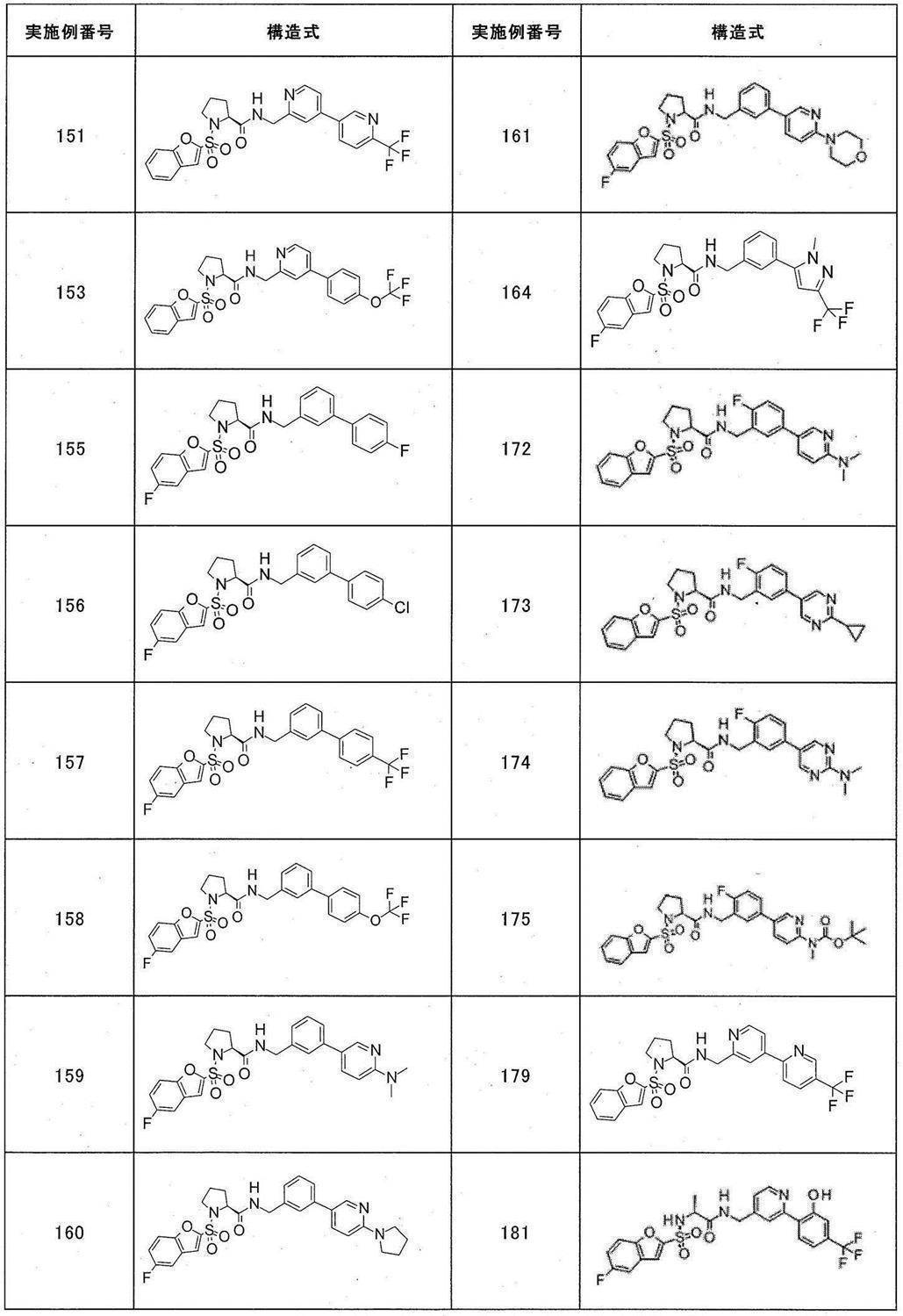
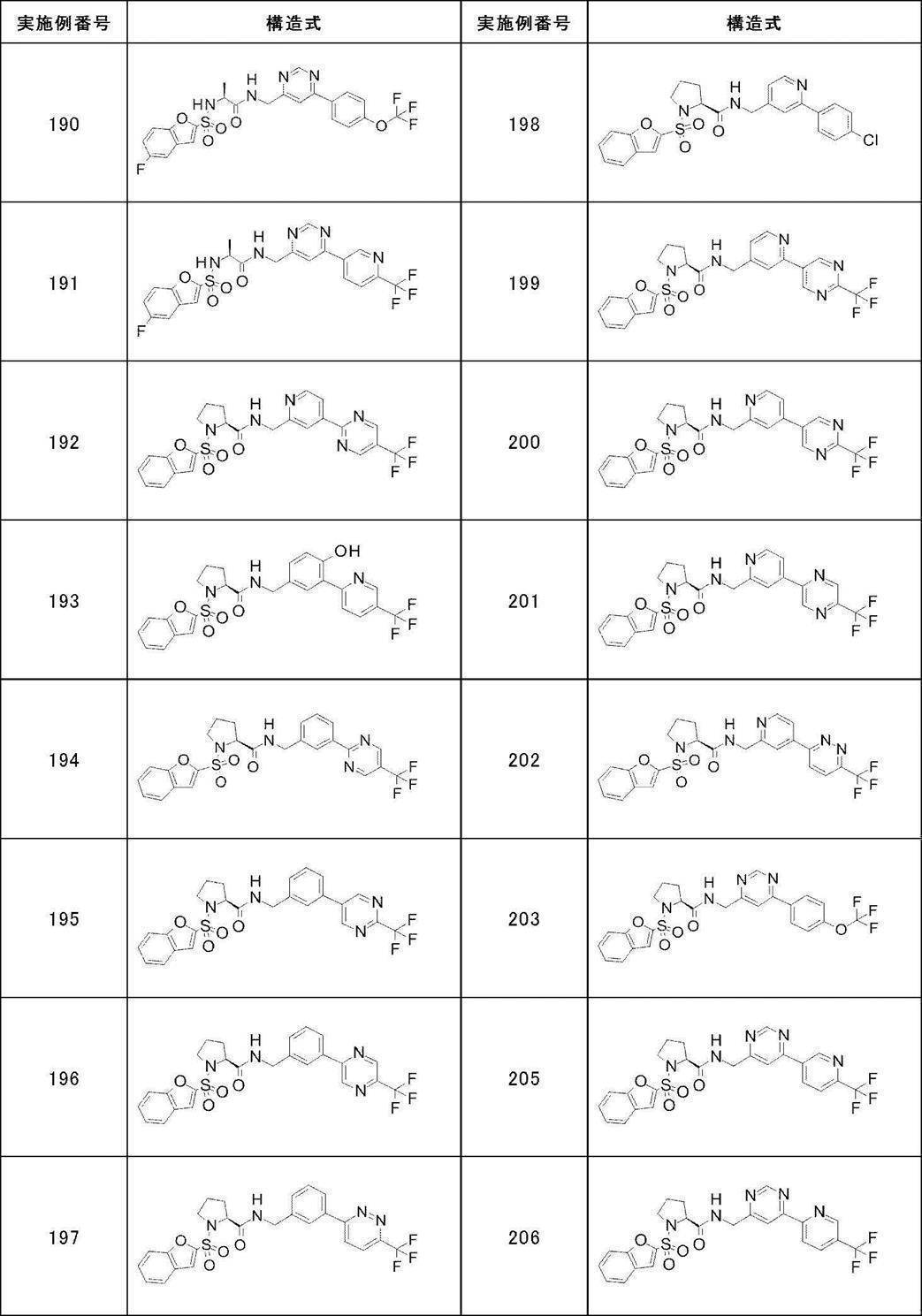


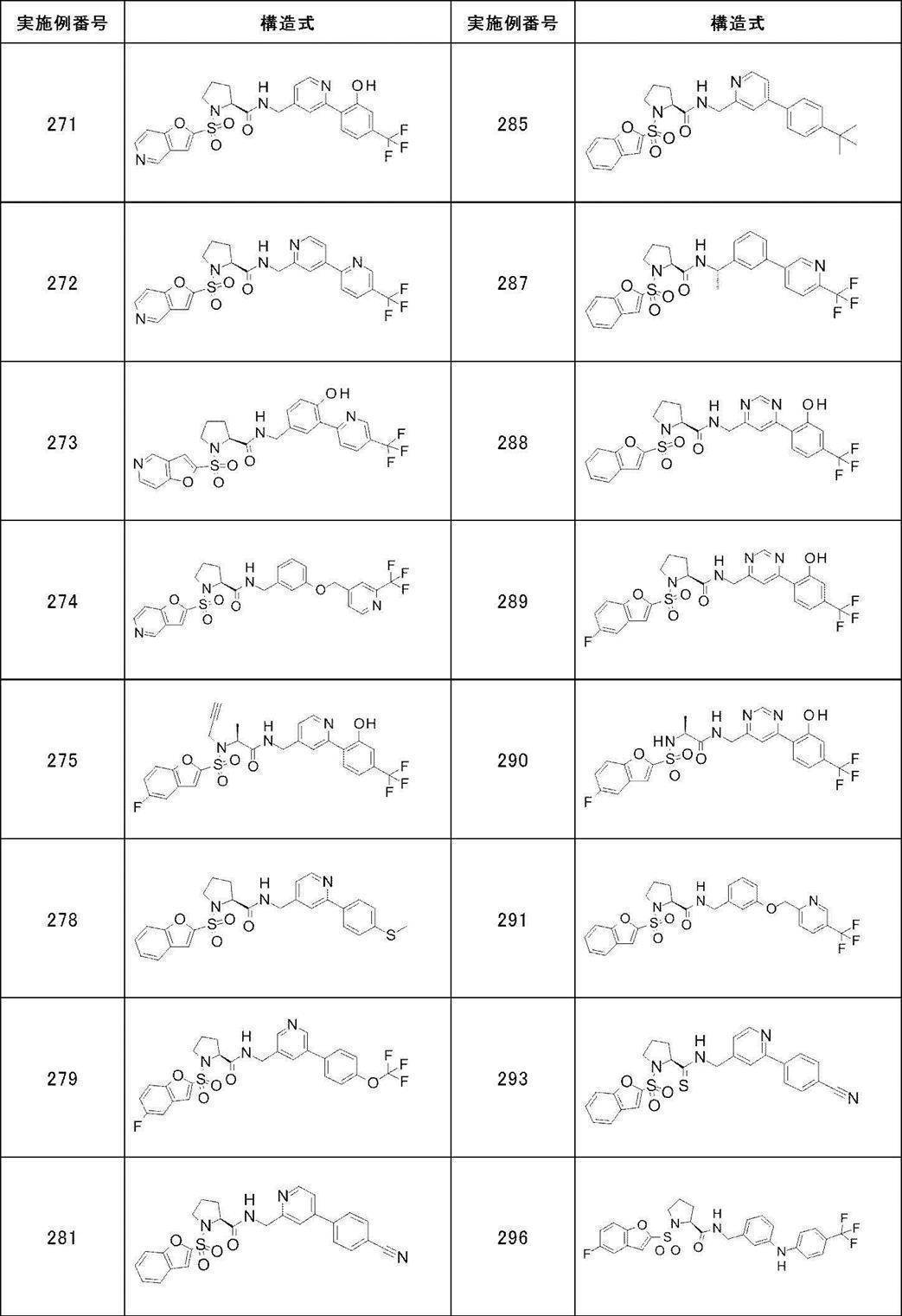


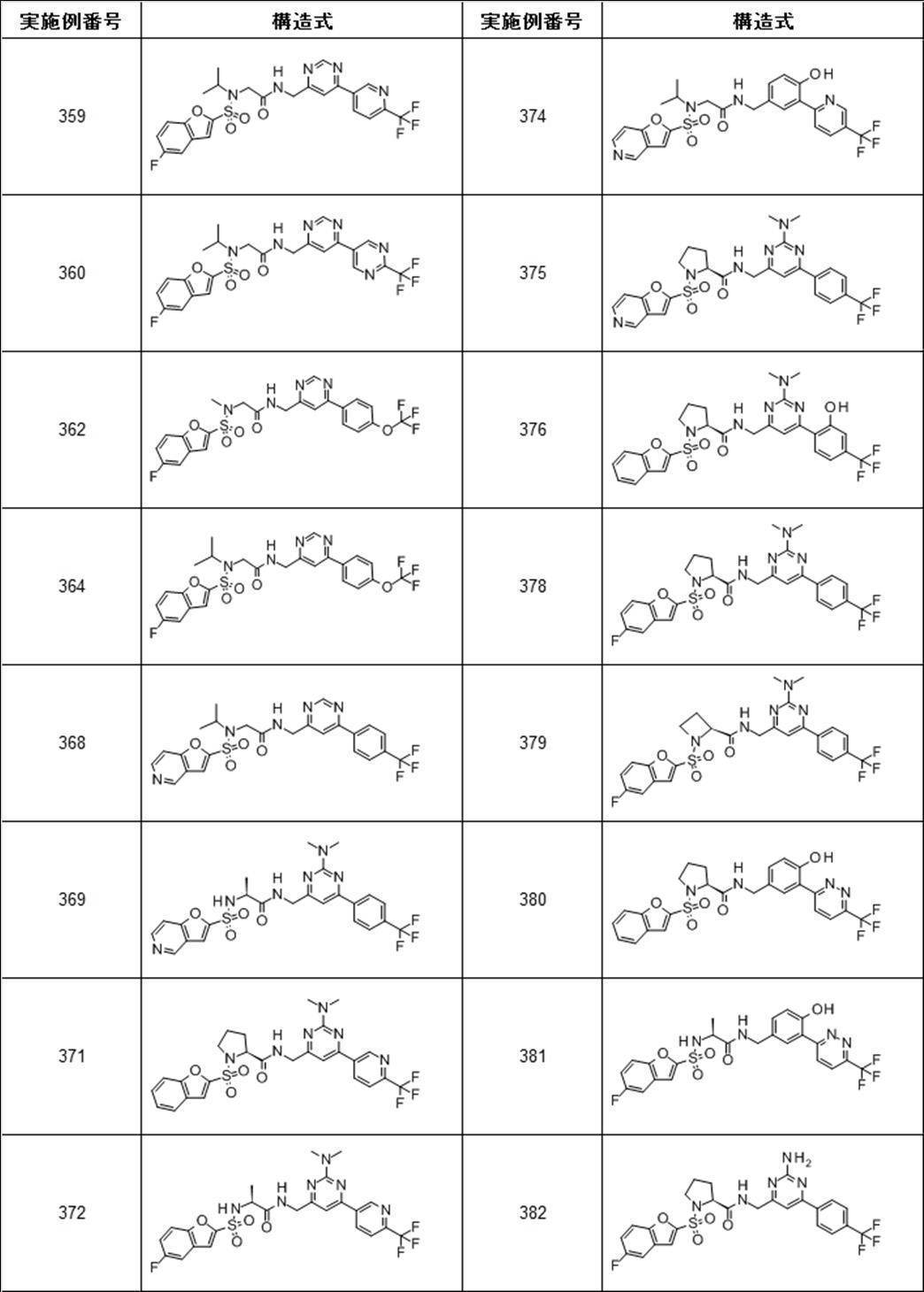


さらに好ましくは、実施例80、84、109、116、117、123、124、138、153、179、181、190、191、192、196、199、201、203、206、224、230、248、290、312、378、379、383、384、386、387、388、389、393、395、401、405,406、411、412記載の下記構造式の化合物またはその医薬上許容される塩である。 More preferably, the embodiments 80, 84, 109, 116, 117, 123, 124, 138, 153, 179, 181, 190, 191, 192, 196, 199, 201, 203, 206, 224, 230, 248, 290, 312, 378, 379, 383, 384, 386, 387, 388, 389, 393, 395, 401, 405, 406, 411, 412 or a pharmaceutically acceptable salt thereof. .


本発明化合物は、優れたTRPA1アンタゴニスト活性を有し、従って、TRPA1が関与する疾患(例、疼痛関連疾患、消化器疾患、肺疾患、膀胱疾患、炎症性疾患、皮膚疾患、及び神経疾患)の予防および/または治療に有用である。 The compound of the present invention has an excellent TRPA1 antagonist activity, and therefore, for diseases involving TRPA1 (eg, pain-related diseases, gastrointestinal diseases, lung diseases, bladder diseases, inflammatory diseases, skin diseases, and neurological diseases). Useful for prevention and / or treatment.
本明細書において使用する用語を以下に定義する。
「TRPA1アンタゴニスト活性」とは、TRPA1の活性化を阻害することができ、あるいはTRPA1の生物学的活性(例えば、細胞内へのイオンの流入)を下方制御することができる活性をいう。TRPA1アンタゴニスト活性はTRPA1を発現している細胞における細胞内カルシウムイオンの流入の程度を測定することによって評価することができる。
The terms used in this specification are defined below.
“TRPA1 antagonist activity” refers to an activity that can inhibit the activation of TRPA1 or down-regulate the biological activity of TRPA1 (eg, influx of ions into cells). TRPA1 antagonist activity can be assessed by measuring the extent of intracellular calcium ion influx in cells expressing TRPA1.
「ハロゲン原子」とは、フッ素原子、塩素原子、臭素原子、ヨウ素原子である。
「ハロゲノ基」とは、フルオロ、クロロ、ブロモ、ヨードである。
The “halogen atom” is a fluorine atom, a chlorine atom, a bromine atom, or an iodine atom.
The “halogeno group” is fluoro, chloro, bromo or iodo.
「C1-6アルキル基」とは、炭素数1~6の直鎖または分岐状のアルキル基を意味し、具体的には、メチル、エチル、n-プロピル、イソプロピル、n-ブチル、イソブチル、sec-ブチル、tert-ブチル、n-ペンチル、イソペンチル、tert-ペンチル、ネオペンチル、2-ペンチル、3-ペンチル、n-ヘキシル、2-ヘキシル等の基が挙げられる。 “C 1-6 alkyl group” means a linear or branched alkyl group having 1 to 6 carbon atoms, specifically, methyl, ethyl, n-propyl, isopropyl, n-butyl, isobutyl, Examples include sec-butyl, tert-butyl, n-pentyl, isopentyl, tert-pentyl, neopentyl, 2-pentyl, 3-pentyl, n-hexyl, 2-hexyl and the like.
「C2-6アルケニル基」とは、炭素数2~6の直鎖または分岐状のアルケニル基を意味し、具体的には、ビニル、アリル、プロペニル、ブテニル、ペンテニル、へキセニル、ヘプテニル、ブタジエニル、ヘキサトリエニル、およびその各異性体等の基が挙げられる。 “C 2-6 alkenyl group” means a straight or branched alkenyl group having 2 to 6 carbon atoms, and specifically includes vinyl, allyl, propenyl, butenyl, pentenyl, hexenyl, heptenyl, butadienyl. , Hexatrienyl, and groups such as isomers thereof.
「環状C3-6アルキル基」とは、炭素数3~6の環状のアルキル基を意味し、具体的には、シクロプロピル、シクロブチル、シクロペンチル、シクロヘキシル等の基が挙げられる。 “Cyclic C 3-6 alkyl group” means a cyclic alkyl group having 3 to 6 carbon atoms, and specific examples include groups such as cyclopropyl, cyclobutyl, cyclopentyl, cyclohexyl and the like.
「C1-6アルコキシ基」とは、炭素数1~6の直鎖または分岐状のアルコキシ基を意味し、具体的には、メトキシ、エトキシ、n-プロポキシ、イソプロポキシ、n-ブトキシ、イソブトキシ、sec-ブトキシ、tert-ブトキシ、n-ペンチルオキシ、イソペンチルオキシ、tert-ペンチルオキシ、ネオペンチルオキシ、2-ペンチルオキシ、3-ペンチルオキシ、n-ヘキシルオキシ、2-ヘキシルオキシ等の基が挙げられる。 “C 1-6 alkoxy group” means a linear or branched alkoxy group having 1 to 6 carbon atoms, and specifically includes methoxy, ethoxy, n-propoxy, isopropoxy, n-butoxy, isobutoxy. , Sec-butoxy, tert-butoxy, n-pentyloxy, isopentyloxy, tert-pentyloxy, neopentyloxy, 2-pentyloxy, 3-pentyloxy, n-hexyloxy, 2-hexyloxy and the like Can be mentioned.
C6-10アリール基とは、炭素数6~10のアリール基を意味し、具体的には、フェニル、ナフチル基等の基が挙げられる。 The C 6-10 aryl group means an aryl group having 6 to 10 carbon atoms, and specifically includes groups such as phenyl and naphthyl groups.
「C1-6アルキル基」、「C2-6アルケニル基」及び「C1-6アルコキシ基」は置換基を有していてもよく、そのような置換基としては、以下、[置換基群A]が挙げられる。
[置換基群A]
(1)ハロゲノ基、
(2)ヒドロキシ基、
(3)シアノ基、
(4)ニトロ基、
(5)カルボキシル基、
(6)アルケニル基(C2-10アルケニル基;例、ビニル、アリル、プロペニル、ブテニル、ペンテニル、へキセニル、ヘプテニル、ブタジエニル、ヘキサトリエニル、およびその各異性体)、
(7)アルキニル基(C2-10アルキニル基;例、エチニル、プロピニル、ブチニル、ペンチニル、ヘキシニル、および、その各異性体)、
(8)ハロゲノアルキル基(例、モノフルオロメチル、ジフルオロメチル、トリフルオロメチル、モノフルオロエチル、ジフルオロエチル、トリフルオロエチル、クロロメチル、クロロエチル、ジクロロエチル、およびその各異性体)、
(9)環状アルキル基(環中にヘテロ原子を含んでもよい)(例、シクロプロピル、シクロブチル、シクロペンチル、シクロヘキシル、テトラヒドロフラニル、テトラヒドロピラニル、アジリジニル、アゼチジニル、ピロリジニル、ピペリジニル、モルホリニル)、
(10)アリール基(例、フェニル、ナフチル)、
(11)ヘテロアリール基(例、ピリジル、ピリダジニル、ピリミジニル、ピラジニル、フリル、チオフェニル、ピロリル、ピラゾリル、イミダゾリル、トリアゾリル(例、1,2,3-トリアゾリル、1,2,4-トリアゾリル)、テトラゾリル、オキサゾリル、イソオキサゾリル、チアゾリル、イソチアゾリル、オキサジアゾリル(例、1,2,3-オキサジアゾリル、1,2,4-オキサジアゾリル、1,3,4-オキサジアゾリル)、チアジアゾリル(例、1,2,3-チアジアゾリル、1,2,4-チアジアゾリル、1,3,4-チアジアゾリル)、ベンゾフリル、ベンゾチオフェニル、インドリル、イソインドリル、ベンゾオキサゾリル、ベンゾチアゾリル、ベンズイミダゾリル、インダゾリル、ベンズイソオキサゾリル、ベンズイソチアゾリル、ベンゾオキサジアゾリル、ベンゾチアジアゾリル、プリニル、キノリニル、イソキノリニル、シンノリニル、フタラジニル、キナゾリニル、キノキサリニル、プテリジニル、イミダゾオキサゾリル、イミダゾチアゾリル、イミダゾイミダゾリル)、
(12)アルコキシ基(例、メトキシ、エトキシ、n-プロポキシ、イソプロポキシ、n-ブトキシ、イソブトキシ、sec-ブトキシ、tert-ブトキシ、n-ペンチルオキシ、イソペンチルオキシ、tert-ペンチルオキシ、ネオペンチルオキシ、2-ペンチルオキシ、3-ペンチルオキシ、n-ヘキシルオキシ、2-ヘキシルオキシ)、
(13)アルキルチオ基(例、メチルチオ、エチルチオ、n-プロピルチオ、イソプロピルチオ、n-ブチルチオ、イソブチルチオ、sec-ブチルチオ、tert-ブチルチオ、n-ペンチルチオ、イソペンチルチオ、tert-ペンチルチオ、ネオペンチルチオ、2-ペンチルチオ、3-ペンチルチオ、n-ヘキシルチオ、2-ヘキシルチオ)、
(14)アリール基(上記(10)と同義)で置換された、アルコキシ基(上記(12)と同義)、
(15)アリール基(上記(10)と同義)で置換された、アルキルチオ基(上記(13)と同義)、
(16)ヘテロアリール基(上記(11)と同義)で置換された、アルコキシ基(上記(12)と同義)、
(17)ヘテロアリール基(上記(11)と同義)で置換された、アルキルチオ基(上記(13)と同義)、
(18)環状アルキル(環中にヘテロ原子を含んでもよい)オキシ基(例、シクロプロピルオキシ、シクロブチルオキシ、シクロペンチルオキシ、シクロヘキシルオキシ、テトラヒドロフラニルオキシ、テトラヒドロピラニルオキシ、アジリジニルオキシ、アゼチジニルオキシ、ピロリジニルオキシ、ピペリジニルオキシ、モルホリニルオキシ)、
(19)アリールオキシ基(例、アリール基(上記(10)と同義)が酸素原子に結合した基)、
(20)ヘテロアリールオキシ基(例、ヘテロアリール基(上記(11)と同義)が酸素原子に結合した基)、
(21)ハロゲノアルコキシ基(例、ハロゲノアルキル基(上記(8)と同義)が酸素原子に結合した基)、
(22)ハロゲノアルキルチオ基(例、ハロゲノアルキル基(上記(8)と同義)が硫黄原子に結合した基)、
(23)ヒドロキシ基で置換された、アルコキシ基(上記(12)と同義)、
(24)アルコキシ基(上記(12)と同義)で置換された、アルコキシ基(上記(12)と同義)、
(25)アミノ基、
(26)アルキル基でモノまたはジ置換されたアミノ基、
ここで、「アルキル基」とは、C1-6アルキル基が挙げられ、具体的には、メチル、エチル、n-プロピル、イソプロピル、n-ブチル、イソブチル、sec-ブチル、tert-ブチル、n-ペンチル、イソペンチル、tert-ペンチル、ネオペンチル、2-ペンチル、3-ペンチル、n-ヘキシル、2-ヘキシル等が挙げられる。アルキル基でモノまたはジ置換されたアミノ基としては、具体的には、メチルアミノ、エチルアミノ、n-プロピルアミノ、イソプロピルアミノ、n-ブチルアミノ、イソブチルアミノ、tert-ブチルアミノ、n-ペンチルアミノ、イソペンチルアミノ、ヘキシルアミノ等のC1-6アルキルでモノ置換されたアミノ基;ジメチルアミノ、ジエチルアミノ、ジ-n-プロピルアミノ、メチルエチルアミノ、メチルプロピルアミノ、エチルプロピルアミノ等のC1-6アルキル基でジ置換されたアミノ基が挙げられる。
(27)カルバモイル基、
(28)アルキル基(上記(26)における「アルキル基」と同義)でモノまたはジ置換されたカルバモイル基(例、メチルカルバモイル、エチルカルバモイル、ジメチルカルバモイル、ジエチルカルバモイル、エチルメチルカルバモイル)
(29)スルファモイル基、
(30)アルキル基(上記(26)における「アルキル基」と同義)でモノまたはジ置換されたスルファモイル基(例、メチルスルファモイル、エチルスルファモイル、ジメチルスルファモイル、ジエチルスルファモイル、エチルメチルスルファモイル)、
(31)アルカノイル基(例、水素原子若しくはアルキル基(上記(26)における「アルキル基」と同義)が炭素原子に結合したカルボニル基)、
(32)アロイル基(例、アリール基(上記(10)と同義)が炭素原子に結合したカルボニル基)、
(33)アルキルスルホニルアミノ基(例、アルキル基(上記(26)における「アルキル基」と同義)で置換されたスルホニルアミノ基)
(34)アリールスルホニルアミノ基(例、アリール基(上記(10)と同義)で置換されたスルホニルアミノ基)、
(35)へテロアリールスルホニルアミノ基(例、ヘテロアリール基(上記(11)と同義)で置換されたスルホニルアミノ基)、
(36)アシルアミノ基(例、アシル基で置換されたアミノ基)、
ここで、「アシル基」とは、C1-6アルキル基、環状C3-6アルキル基、またはC6-10アリール基を有するアシル基である。当該C1-6アルキル基、環状C3-6アルキル基及びC6-10アリール基はそれぞれ上述のものが挙げられる。アシル基としては、具体的には、アセチル基、プロピオニル基、ブチロイル基、イソブチロイル基、バレロイル基、イソバレロイル基、ピバロイル基、ヘキサノイル基、アクリロイル基、メタクリロイル基、クロトノイル基、イソクロトノイル基、ベンゾイル基、ナフトイル基等が挙げられる、
(37)アルコキシカルボニルアミノ基(例、アルコキシ基(上記(12)と同義)で置換されたカルボニルアミノ基)、
(38)アルキルスルホニル基(例、アルキル基(上記(26)における「アルキル基」と同義)で置換されたスルホニル基)、
(39)アルキルスルフィニル基(例、アルキル基(上記(26)における「アルキル基」と同義)で置換されたスルフィニル基)、
(40)アルコキシカルボニル基(例、メトキシカルボニル基、エトキシカルボニル基)、
等が挙げられる。
置換基が2以上存在する場合は、それらは同一でも異なっていてもよい。
The “C 1-6 alkyl group”, “C 2-6 alkenyl group” and “C 1-6 alkoxy group” may have a substituent. Examples of such a substituent include the following: Group A].
[Substituent group A]
(1) a halogeno group,
(2) a hydroxy group,
(3) a cyano group,
(4) Nitro group,
(5) carboxyl group,
(6) alkenyl group (C 2-10 alkenyl group; eg, vinyl, allyl, propenyl, butenyl, pentenyl, hexenyl, heptenyl, butadienyl, hexatrienyl, and isomers thereof),
(7) alkynyl group (C 2-10 alkynyl group; eg, ethynyl, propynyl, butynyl, pentynyl, hexynyl, and their isomers)
(8) a halogenoalkyl group (eg, monofluoromethyl, difluoromethyl, trifluoromethyl, monofluoroethyl, difluoroethyl, trifluoroethyl, chloromethyl, chloroethyl, dichloroethyl, and isomers thereof),
(9) a cyclic alkyl group (which may contain a hetero atom in the ring) (eg, cyclopropyl, cyclobutyl, cyclopentyl, cyclohexyl, tetrahydrofuranyl, tetrahydropyranyl, aziridinyl, azetidinyl, pyrrolidinyl, piperidinyl, morpholinyl),
(10) aryl group (eg, phenyl, naphthyl),
(11) heteroaryl groups (eg, pyridyl, pyridazinyl, pyrimidinyl, pyrazinyl, furyl, thiophenyl, pyrrolyl, pyrazolyl, imidazolyl, triazolyl (eg, 1,2,3-triazolyl, 1,2,4-triazolyl), tetrazolyl, Oxazolyl, isoxazolyl, thiazolyl, isothiazolyl, oxadiazolyl (eg, 1,2,3-oxadiazolyl, 1,2,4-oxadiazolyl, 1,3,4-oxadiazolyl), thiadiazolyl (eg, 1,2,3-thiadiazolyl, 1 , 2,4-thiadiazolyl, 1,3,4-thiadiazolyl), benzofuryl, benzothiophenyl, indolyl, isoindolyl, benzoxazolyl, benzothiazolyl, benzimidazolyl, indazolyl, benzisoxazolyl, benziso Thiazolyl, benzooxadiazolyl, benzothiadiazolyl, purinyl, quinolinyl, isoquinolinyl, cinnolinyl, phthalazinyl, quinazolinyl, quinoxalinyl, pteridinyl, imidazoloxazolyl, imidazothiazolyl, imidazolimidazolyl)
(12) alkoxy group (eg, methoxy, ethoxy, n-propoxy, isopropoxy, n-butoxy, isobutoxy, sec-butoxy, tert-butoxy, n-pentyloxy, isopentyloxy, tert-pentyloxy, neopentyloxy 2-pentyloxy, 3-pentyloxy, n-hexyloxy, 2-hexyloxy),
(13) alkylthio groups (eg, methylthio, ethylthio, n-propylthio, isopropylthio, n-butylthio, isobutylthio, sec-butylthio, tert-butylthio, n-pentylthio, isopentylthio, tert-pentylthio, neopentylthio, 2-pentylthio, 3-pentylthio, n-hexylthio, 2-hexylthio),
(14) an alkoxy group (as defined in (12) above) substituted with an aryl group (as defined in (10) above),
(15) an alkylthio group (as defined in (13) above) substituted with an aryl group (as defined in (10) above),
(16) an alkoxy group (as defined in (12) above) substituted with a heteroaryl group (as defined in (11) above),
(17) an alkylthio group (as defined in (13) above) substituted with a heteroaryl group (as defined in (11) above),
(18) Cyclic alkyl (which may contain heteroatoms in the ring) oxy group (eg, cyclopropyloxy, cyclobutyloxy, cyclopentyloxy, cyclohexyloxy, tetrahydrofuranyloxy, tetrahydropyranyloxy, aziridinyloxy, azeti) Dinyloxy, pyrrolidinyloxy, piperidinyloxy, morpholinyloxy),
(19) an aryloxy group (eg, a group in which an aryl group (as defined in (10) above) is bonded to an oxygen atom),
(20) a heteroaryloxy group (eg, a group in which a heteroaryl group (as defined in (11) above) is bonded to an oxygen atom),
(21) a halogenoalkoxy group (eg, a group in which a halogenoalkyl group (as defined in (8) above) is bonded to an oxygen atom),
(22) a halogenoalkylthio group (eg, a group in which a halogenoalkyl group (as defined in (8) above) is bonded to a sulfur atom),
(23) an alkoxy group substituted with a hydroxy group (as defined in (12) above),
(24) an alkoxy group (as defined in (12) above) substituted with an alkoxy group (as defined in (12) above),
(25) amino group,
(26) an amino group mono- or di-substituted with an alkyl group,
Here, the “alkyl group” includes a C 1-6 alkyl group, and specifically includes methyl, ethyl, n-propyl, isopropyl, n-butyl, isobutyl, sec-butyl, tert-butyl, n -Pentyl, isopentyl, tert-pentyl, neopentyl, 2-pentyl, 3-pentyl, n-hexyl, 2-hexyl and the like. Specific examples of the amino group mono- or di-substituted with an alkyl group include methylamino, ethylamino, n-propylamino, isopropylamino, n-butylamino, isobutylamino, tert-butylamino, and n-pentylamino. , isopentyl, amino group which is mono-substituted by C 1-6 alkyl, such as hexyl amino; dimethylamino, diethylamino, di -n- propylamino, methylethylamino, and methyl propylamino, ethyl propyl amino C 1- An amino group di-substituted with a 6 alkyl group is exemplified.
(27) a carbamoyl group,
(28) A carbamoyl group mono- or di-substituted with an alkyl group (same as the “alkyl group” in (26) above) (eg, methylcarbamoyl, ethylcarbamoyl, dimethylcarbamoyl, diethylcarbamoyl, ethylmethylcarbamoyl)
(29) sulfamoyl group,
(30) A sulfamoyl group mono- or di-substituted with an alkyl group (same as “alkyl group” in (26) above) (eg, methylsulfamoyl, ethylsulfamoyl, dimethylsulfamoyl, diethylsulfamoyl, Ethylmethylsulfamoyl),
(31) an alkanoyl group (eg, a carbonyl group in which a hydrogen atom or an alkyl group (synonymous with “alkyl group” in (26) above) is bonded to a carbon atom),
(32) an aroyl group (eg, a carbonyl group in which an aryl group (as defined in (10) above) is bonded to a carbon atom),
(33) Alkylsulfonylamino group (eg, sulfonylamino group substituted with an alkyl group (same as “alkyl group” in (26) above))
(34) an arylsulfonylamino group (eg, a sulfonylamino group substituted with an aryl group (as defined in (10) above)),
(35) a heteroarylsulfonylamino group (eg, a sulfonylamino group substituted with a heteroaryl group (as defined in (11) above)),
(36) an acylamino group (eg, an amino group substituted with an acyl group),
Here, the “acyl group” is an acyl group having a C 1-6 alkyl group, a cyclic C 3-6 alkyl group, or a C 6-10 aryl group. Examples of the C 1-6 alkyl group, cyclic C 3-6 alkyl group, and C 6-10 aryl group include those described above. Specific examples of the acyl group include acetyl group, propionyl group, butyroyl group, isobutyroyl group, valeroyl group, isovaleroyl group, pivaloyl group, hexanoyl group, acryloyl group, methacryloyl group, crotonoyl group, isocrotonoyl group, benzoyl group, and naphthoyl group. Groups, etc.
(37) an alkoxycarbonylamino group (eg, a carbonylamino group substituted with an alkoxy group (as defined in (12) above)),
(38) an alkylsulfonyl group (eg, a sulfonyl group substituted with an alkyl group (synonymous with the “alkyl group” in (26) above)),
(39) an alkylsulfinyl group (eg, a sulfinyl group substituted with an alkyl group (synonymous with the “alkyl group” in (26) above)),
(40) alkoxycarbonyl group (eg, methoxycarbonyl group, ethoxycarbonyl group),
Etc.
When two or more substituents are present, they may be the same or different.
「環状C3-6アルキル基(環中にヘテロ原子を含んでもよい)」とは、上記環状C3-6アルキル基を意味するか、若しくは少なくとも1個のヘテロ原子を含有する炭素数3~5の環状のアルキル基を意味し、具体的には、上記「環状C3-6アルキル基」として例示したものに加え、テトラヒドロフラニル、テトラヒドロピラニル、アジリジニル、アゼチジニル、ピロリジニル、ピペリジニル、ピペラジニル、モルホリニル等の基が挙げられる。 “Cyclic C 3-6 alkyl group (which may contain a heteroatom in the ring)” means the above cyclic C 3-6 alkyl group or a group having 3 to 3 carbon atoms containing at least one heteroatom. 5 specifically, in addition to those exemplified as the above “cyclic C 3-6 alkyl group”, tetrahydrofuranyl, tetrahydropyranyl, aziridinyl, azetidinyl, pyrrolidinyl, piperidinyl, piperazinyl, morpholinyl And the like.
「シクロアルカン」とは、炭素数3~10、好ましくは炭素数3~8、より好ましくは炭素数3~6の炭素環であり、例えばシクロプロパン、シクロブタン、シクロペンタン、シクロヘキサン、シクロヘプタン、シクロオクタン、シクロノナンおよびシクロデカン等が挙げられる。 “Cycloalkane” is a carbocyclic ring having 3 to 10 carbon atoms, preferably 3 to 8 carbon atoms, more preferably 3 to 6 carbon atoms. For example, cyclopropane, cyclobutane, cyclopentane, cyclohexane, cycloheptane, cyclo Examples include octane, cyclononane and cyclodecane.
「C1-6アルコキシカルボニル基」とは、炭素数1~6の直鎖または分岐状のアルコキシカルボニル基を意味し、具体的には、メトキシカルボニル、エトキシカルボニル、n-プロポキシカルボニル、イソプロポキシカルボニル、n-ブトキシカルボニル、イソブトキシカルボニル、sec-ブトキシカルボニル、tert-ブトキシカルボニル等の基が挙げられる。「C1-6アルコキシカルボニル基」は置換基を有していてもよく、そのような置換基としては、上記[置換基群A]で例示されたものが挙げられる。 The “C 1-6 alkoxycarbonyl group” means a straight or branched alkoxycarbonyl group having 1 to 6 carbon atoms, and specifically includes methoxycarbonyl, ethoxycarbonyl, n-propoxycarbonyl, isopropoxycarbonyl. , N-butoxycarbonyl, isobutoxycarbonyl, sec-butoxycarbonyl, tert-butoxycarbonyl and the like. The “C 1-6 alkoxycarbonyl group” may have a substituent, and examples of such a substituent include those exemplified in the above [Substituent group A].
「ハロゲノC1-6アルキル基」及び「ハロゲノC1-6アルコキシ基」とは、それぞれ1または2以上のハロゲノ基で置換されたC1-6アルキル基及びC1-6アルコキシ基を意味する。ハロゲノC1-6アルキル基としては、具体的には、モノフルオロメチル、ジフルオロメチル、トリフルオロメチル、モノフルオロエチル、ジフルオロエチル、トリフルオロエチル、クロロメチル、クロロエチル、ジクロロエチル、およびその各異性体等の基が挙げられる。「ハロゲノC1-6アルコキシ基」としては、具体的には、1または2以上のハロゲノ基で置換されたC1-6アルコキシ基を意味し、具体的には、モノフルオロメトキシ、ジフルオロメトキシ、トリフルオロメトキシ、モノフルオロエトキシ、ジフルオロエトキシ、トリフルオロエトキシ、クロロメトキシ、クロロエトキシ、ジクロロエトキシ、およびその各異性体等の基が挙げられる。 “Halogeno C 1-6 alkyl group” and “halogeno C 1-6 alkoxy group” mean a C 1-6 alkyl group and a C 1-6 alkoxy group each substituted by one or more halogeno groups. . Specific examples of the halogeno C 1-6 alkyl group include monofluoromethyl, difluoromethyl, trifluoromethyl, monofluoroethyl, difluoroethyl, trifluoroethyl, chloromethyl, chloroethyl, dichloroethyl, and isomers thereof. And the like. The “halogeno C 1-6 alkoxy group” specifically means a C 1-6 alkoxy group substituted with one or more halogeno groups, specifically monofluoromethoxy, difluoromethoxy, Examples include trifluoromethoxy, monofluoroethoxy, difluoroethoxy, trifluoroethoxy, chloromethoxy, chloroethoxy, dichloroethoxy, and isomers thereof.
「C1-6アルキルチオ基」としては、具体的には、メチルチオ、エチルチオ、n-プロピルチオ、イソプロピルチオ、n-ブチルチオ、イソブチルチオ、sec-ブチルチオ、tert-ブチルチオ、n-ペンチルチオ、イソペンチルチオ、tert-ペンチルチオ、ネオペンチルチオ、2-ペンチルチオ、3-ペンチルチオ、n-ヘキシルチオ、2-ヘキシルチオ等の基が挙げられる。 Specific examples of the “C 1-6 alkylthio group” include methylthio, ethylthio, n-propylthio, isopropylthio, n-butylthio, isobutylthio, sec-butylthio, tert-butylthio, n-pentylthio, isopentylthio, Examples include tert-pentylthio, neopentylthio, 2-pentylthio, 3-pentylthio, n-hexylthio, 2-hexylthio and the like.
「C1-6アルキル基でモノまたはジ置換されたアミノ基」としては、具体的には、メチルアミノ、エチルアミノ、n-プロピルアミノ、イソプロピルアミノ、n-ブチルアミノ、イソブチルアミノ、tert-ブチルアミノ、n-ペンチルアミノ、イソペンチルアミノ、ヘキシルアミノ等のC1-6アルキルでモノ置換されたアミノ基;ジメチルアミノ、ジエチルアミノ、ジ-n-プロピルアミノ、メチルエチルアミノ、メチルプロピルアミノ、エチルプロピルアミノ等のC1-6アルキル基でジ置換されたアミノ基が挙げられる。「C1-6アルキル基でモノまたはジ置換されたアミノ基」は置換基を有していてもよく、そのような置換基としては、上記[置換基群A]で例示されたものが挙げられる。 Specific examples of the “mono- or di-substituted amino group with a C 1-6 alkyl group” include methylamino, ethylamino, n-propylamino, isopropylamino, n-butylamino, isobutylamino, tert-butyl. Amino groups mono-substituted by C 1-6 alkyl such as amino, n-pentylamino, isopentylamino, hexylamino; dimethylamino, diethylamino, di-n-propylamino, methylethylamino, methylpropylamino, ethylpropyl An amino group di-substituted with a C 1-6 alkyl group such as amino is exemplified. The “amino group mono- or di-substituted with a C 1-6 alkyl group” may have a substituent, and examples of such substituent include those exemplified in the above [Substituent Group A]. It is done.
「C1-6アルキル基でモノまたはジ置換されたカルバモイル基」としては、具体的には、メチルカルバモイル、エチルカルバモイル、ジメチルカルバモイル、ジエチルカルバモイル、エチルメチルカルバモイル等の基が挙げられる。「C1-6アルキル基でモノまたはジ置換されたカルバモイル基」は置換基を有していてもよく、そのような置換基としては、上記[置換基群A]で例示されたものが挙げられる。 Specific examples of the “carbamoyl group mono- or di-substituted with a C 1-6 alkyl group” include groups such as methylcarbamoyl, ethylcarbamoyl, dimethylcarbamoyl, diethylcarbamoyl, ethylmethylcarbamoyl and the like. The “carbamoyl group mono- or di-substituted with a C 1-6 alkyl group” may have a substituent, and examples of such substituent include those exemplified in the above [Substituent Group A]. It is done.
「アシル基で置換されたアミノ基」としては、アセチル基、プロピオニル基、ブチロイル基、イソブチロイル基、バレロイル基、イソバレロイル基、ピバロイル基、ヘキサノイル基、アクリロイル基、メタクリロイル基、クロトノイル基、イソクロトノイル基、ベンゾイル基、ナフトイル基等のアシル基で置換されたアミノ基が挙げられる。「アシル基で置換されたアミノ基」は置換基を有していてもよく、そのような置換基としては、上記[置換基群A]で例示されたものが挙げられる。 Examples of the “amino group substituted with an acyl group” include acetyl group, propionyl group, butyroyl group, isobutyroyl group, valeroyl group, isovaleroyl group, pivaloyl group, hexanoyl group, acryloyl group, methacryloyl group, crotonoyl group, isocrotonoyl group, benzoyl group And an amino group substituted with an acyl group such as a naphthoyl group. The “amino group substituted with an acyl group” may have a substituent, and examples of such a substituent include those exemplified in the above [Substituent Group A].
「飽和又は不飽和の環状の基(ヘテロ原子を含んでもよい)」とは、飽和又は不飽和の炭素環(好ましくは炭素数5~15)又は複素環(好ましくは5員~15員)に由来する基を意味する。
飽和又は不飽和の炭素環としては、C5-15の不飽和単環、二環もしくは三環式炭素環、その一部または全部が飽和されている単環、二環もしくは三環式炭素環、またはスピロ結合した二環式炭素環および架橋した二環式炭素環が挙げられる。例えば、シクロペンタン、シクロヘキサン、シクロヘプタン、シクロペンテン、シクロヘキセン、シクロヘプテン、シクロペンタジエン、シクロヘキサジエン、シクロヘプタジエン、ベンゼン、ペンタレン、パーヒドロペンタレン、アズレン、パーヒドロアズレン、インデン、パーヒドロインデン、インダン、ナフタレン、ジヒドロナフタレン、テトラヒドロナフタレン、パーヒドロナフタレン、ビフェニレン、as-インダセン、s-インダセン、フルオレン、フェナントレン、アントラセン、スピロ[4.4]ノナン、スピロ[4.5]デカン、スピロ[5.5]ウンデカン、ビシクロ[2.2.1]ヘプタン、ビシクロ[2.2.1]ヘプタ-2-エン、ビシクロ[3.1.1]ヘプタン、ビシクロ[3.1.1]ヘプタ-2-エン、ビシクロ[2.2.2]オクタン、ビシクロ[2.2.2]オクタ-2-エン、アダマンタン、ノルアダマンタン環が挙げられる。
飽和又は不飽和の複素環としては、少なくとも1個の炭素原子以外に1~4個の窒素原子、1~2個の酸素原子および/または1~2個の硫黄原子を含有する5~15員の不飽和単環、二環もしくは三環式複素環、またはその一部または全部が飽和されている単環、二環もしくは三環式複素環を表わす。例えば、ピロール、イミダゾール、トリアゾール、テトラゾール、ピラゾール、ピリジン、ピラジン、トリアジン、ピリミジン、ピリダジン、アゼピン、ジアゼピン、フラン、ピラン、オキセピン、チオフェン、チオピラン、チエピン、オキサゾール、イソオキサゾール、チアゾール、イソチアゾール、フラザン、オキサジアゾール、オキサジン、オキサジアジン、オキサゼピン、オキサジアゼピン、チアジアゾール、チアジン、チアジアジン、チアゼピン、チアジアゼピン、インドール、イソインドール、インドリジン、ベンゾフラン、イソベンゾフラン、ベンゾチオフェン、イソベンゾチオフェン、ジチアナフタレン、インダゾール、キノリン、イソキノリン、キノリジン、プリン、フタラジン、プテリジン、ナフチリジン、キノキサリン、キナゾリン、シンノリン、ベンゾオキサゾール、ベンゾチアゾール、ベンゾイミダゾール、クロメン、ベンゾオキセピン、ベンゾオキサゼピン、ベンゾオキサジアゼピン、ベンゾチエピン、ベンゾチアゼピン、ベンゾチアジアゼピン、ベンゾアゼピン、ベンゾジアゼピン、ベンゾフラザン、ベンゾチアジアゾール、ベンゾトリアゾール、カルバゾール、β-カルボリン、アクリジン、フェナジン、ジベンゾフラン、キサンテン、ジベンゾチオフェン、フェノチアジン、フェノキサジン、フェノキサチイン、チアンスレン、フェナントリジン、フェナントロリン、ピロリン、ピロリジン、イミダゾリン、イミダゾリジン、トリアゾリン、トリアゾリジン、テトラゾリン、テトラゾリジン、ピラゾリン、ピラゾリジン、ジヒドロピリジン、テトラヒドロピリジン、ピペリジン、ジヒドロピラジン、テトラヒドロピラジン、ピペラジン、ジヒドロピリミジン、テトラヒドロピリミジン、パーヒドロピリミジン、ジヒドロピリダジン、テトラヒドロピリダジン、パーヒドロピリダジン、ジヒドロアゼピン、テトラヒドロアゼピン、パーヒドロアゼピン、ジヒドロジアゼピン、テトラヒドロジアゼピン、パーヒドロジアゼピン、ジヒドロフラン、テトラヒドロフラン、ジヒドロピラン、テトラヒドロピラン、ジヒドロオキセピン、テトラヒドロオキセピン、パーヒドロオキセピン、ジヒドロチオフェン、テトラヒドロチオフェン、ジヒドロチオピラン、テトラヒドロチオピラン、ジヒドロチエピン、テトラヒドロチエピン、パーヒドロチエピン、ジヒドロオキサゾール、テトラヒドロオキサゾール(オキサゾリジン)、ジヒドロイソオキサゾール、テトラヒドロイソオキサゾール(イソオキサゾリジン)、ジヒドロチアゾール、テトラヒドロチアゾール(チアゾリジン)、ジヒドロイソチアゾール、テトラヒドロイソチアゾール(イソチアゾリジン)、ジヒドロフラザン、テトラヒドロフラザン、ジヒドロオキサジアゾール、テトラヒドロオキサジアゾール(オキサジアゾリジン)、ジヒドロオキサジン、テトラヒドロオキサジン、ジヒドロオキサジアジン、テトラヒドロオキサジアジン、ジヒドロオキサゼピン、テトラヒドロオキサゼピン、パーヒドロオキサゼピン、ジヒドロオキサジアゼピン、テトラヒドロオキサジアゼピン、パーヒドロオキサジアゼピン、ジヒドロチアジアゾール、テトラヒドロチアジアゾール(チアジアゾリジン)、ジヒドロチアジン、テトラヒドロチアジン、ジヒドロチアジアジン、テトラヒドロチアジアジン、ジヒドロチアゼピン、テトラヒドロチアゼピン、パーヒドロチアゼピン、ジヒドロチアジアゼピン、テトラヒドロチアジアゼピン、パーヒドロチアジアゼピン、モルホリン、チオモルホリン、オキサチアン、インドリン、イソインドリン、ジヒドロベンゾフラン、パーヒドロベンゾフラン、ジヒドロイソベンゾフラン、パーヒドロイソベンゾフラン、ジヒドロベンゾチオフェン、パーヒドロベンゾチオフェン、ジヒドロイソベンゾチオフェン、パーヒドロイソベンゾチオフェン、ジヒドロインダゾール、パーヒドロインダゾール、ジヒドロキノリン、テトラヒドロキノリン、パーヒドロキノリン、ジヒドロイソキノリン、テトラヒドロイソキノリン、パーヒドロイソキノリン、ジヒドロフタラジン、テトラヒドロフタラジン、パーヒドロフタラジン、ジヒドロナフチリジン、テトラヒドロナフチリジン、パーヒドロナフチリジン、ジヒドロキノキサリン、テトラヒドロキノキサリン、パーヒドロキノキサリン、ジヒドロキナゾリン、テトラヒドロキナゾリン、パーヒドロキナゾリン、ジヒドロシンノリン、テトラヒドロシンノリン、パーヒドロシンノリン、ベンゾオキサチアン、ジヒドロベンゾオキサジン、ジヒドロベンゾチアジン、ピラジノモルホリン、ジヒドロベンゾオキサゾール、パーヒドロベンゾオキサゾール、ジヒドロベンゾチアゾール、パーヒドロベンゾチアゾール、ジヒドロベンゾイミダゾール、パーヒドロベンゾイミダゾール、ジヒドロベンゾアゼピン、テトラヒドロベンゾアゼピン、ジヒドロベンゾジアゼピン、テトラヒドロベンゾジアゼピン、ベンゾジオキセパン、ジヒドロベンゾオキサゼピン、テトラヒドロベンゾオキサゼピン、ジヒドロカルバゾール、テトラヒドロカルバゾール、パーヒドロカルバゾール、ジヒドロアクリジン、テトラヒドロアクリジン、パーヒドロアクリジン、ジヒドロジベンゾフラン、ジヒドロジベンゾチオフェン、テトラヒドロジベンゾフラン、テトラヒドロジベンゾチオフェン、パーヒドロジベンゾフラン、パーヒドロジベンゾチオフェン、ジオキソラン、ジオキサン、ジチオラン、ジチアン、ジオキサインダン、ベンゾジオキサン、クロマン、ベンゾジチオラン、ベンゾジチアン等が挙げられる。
「飽和又は不飽和の環状の基(ヘテロ原子を含んでもよい)」が有していてもよい置換基としては、上記[置換基群A]で例示された基に加えアルキル基(例、メチル、エチル、n-プロピル、イソプロピル、n-ブチル、イソブチル、sec-ブチル、tert-ブチル、n-ペンチル、イソペンチル、tert-ペンチル、ネオペンチル、2-ペンチル、3-ペンチル、n-ヘキシル、2-ヘキシル)が挙げられる(以下、[置換基群B])。
置換基が2以上存在する場合は、それらは同一でも異なっていてもよい。
“Saturated or unsaturated cyclic group (which may contain heteroatoms)” means a saturated or unsaturated carbocyclic ring (preferably having 5 to 15 carbon atoms) or a heterocyclic ring (preferably having 5 to 15 members). Denotes a derived group.
Saturated or unsaturated carbocycle includes C 5-15 unsaturated monocyclic, bicyclic or tricyclic carbocycle, monocyclic, bicyclic or tricyclic carbocycle partially or fully saturated Or spiro-linked bicyclic carbocycles and bridged bicyclic carbocycles. For example, cyclopentane, cyclohexane, cycloheptane, cyclopentene, cyclohexene, cycloheptene, cyclopentadiene, cyclohexadiene, cycloheptadiene, benzene, pentalene, perhydropentalene, azulene, perhydroazulene, indene, perhydroindene, indane, naphthalene , Dihydronaphthalene, tetrahydronaphthalene, perhydronaphthalene, biphenylene, as-indacene, s-indacene, fluorene, phenanthrene, anthracene, spiro [4.4] nonane, spiro [4.5] decane, spiro [5.5] undecane Bicyclo [2.2.1] heptane, bicyclo [2.2.1] hept-2-ene, bicyclo [3.1.1] heptane, bicyclo [3.1.1] hept-2-ene, [2.2.2] octane, bicyclo [2.2.2] oct-2-ene, adamantane, noradamantane ring.
Saturated or unsaturated heterocycles are 5 to 15 members containing 1 to 4 nitrogen atoms, 1 to 2 oxygen atoms and / or 1 to 2 sulfur atoms in addition to at least one carbon atom. Represents an unsaturated monocyclic ring, bicyclic or tricyclic heterocyclic ring, or a monocyclic, bicyclic or tricyclic heterocyclic ring partially or fully saturated. For example, pyrrole, imidazole, triazole, tetrazole, pyrazole, pyridine, pyrazine, triazine, pyrimidine, pyridazine, azepine, diazepine, furan, pyran, oxepin, thiophene, thiopyran, thiepine, oxazole, isoxazole, thiazole, isothiazole, furazane, Oxadiazole, oxazine, oxadiazine, oxazepine, oxadiazepine, thiadiazole, thiazine, thiadiazine, thiazepine, thiadiazepine, indole, isoindole, indolizine, benzofuran, isobenzofuran, benzothiophene, isobenzothiophene, dithiaphthalene, indazole, quinoline, Isoquinoline, quinolidine, purine, phthalazine, pteridine, naphthyridine, quinoxaly , Quinazoline, cinnoline, benzoxazole, benzothiazole, benzimidazole, chromene, benzoxepin, benzoxazepine, benzooxadiazepine, benzothiepine, benzothiazepine, benzothiadiazepine, benzoazepine, benzodiazepine, benzofurazan, benzothiadiazole, benzo Triazole, carbazole, β-carboline, acridine, phenazine, dibenzofuran, xanthene, dibenzothiophene, phenothiazine, phenoxazine, phenoxathiin, thianthrene, phenanthridine, phenanthroline, pyrroline, pyrrolidine, imidazoline, imidazolidine, triazoline, triazoline, tetrazoline , Tetrazolidine, pyrazoline, pyrazolidine, dihydropyridine, teto Lahydropyridine, piperidine, dihydropyrazine, tetrahydropyrazine, piperazine, dihydropyrimidine, tetrahydropyrimidine, perhydropyrimidine, dihydropyridazine, tetrahydropyridazine, perhydropyridazine, dihydroazepine, tetrahydroazepine, perhydroazepine, dihydrodiazepine, tetrahydrodi Azepine, perhydrodiazepine, dihydrofuran, tetrahydrofuran, dihydropyran, tetrahydropyran, dihydrooxepin, tetrahydrooxepin, perhydrooxepin, dihydrothiophene, tetrahydrothiophene, dihydrothiopyran, tetrahydrothiopyran, dihydrothie Pin, tetrahydrothiepine, perhydrothiepine, dihydrooxazole, tetrahydrooxa (Oxazolidine), dihydroisoxazole, tetrahydroisoxazole (isoxazolidine), dihydrothiazole, tetrahydrothiazole (thiazolidine), dihydroisothiazole, tetrahydroisothiazole (isothiazolidine), dihydrofurazan, tetrahydrofurazan, dihydrooxadiazole , Tetrahydrooxadiazole (oxadiazolidine), dihydrooxazine, tetrahydrooxazine, dihydrooxadiazine, tetrahydrooxadiazine, dihydrooxazepine, tetrahydrooxazepine, perhydrooxazepine, dihydrooxadiazepine, tetrahydrooxa Diazepine, perhydrooxadiazepine, dihydrothiadiazole, tetrahydrothiadiazole (thiadia Lysine), dihydrothiazine, tetrahydrothiazine, dihydrothiadiazine, tetrahydrothiadiazine, dihydrothiazepine, tetrahydrothiazepine, perhydrothiazepine, dihydrothiadiazepine, tetrahydrothiadiazepine, perhydrothiadiazepine, Morpholine, thiomorpholine, oxathiane, indoline, isoindoline, dihydrobenzofuran, perhydrobenzofuran, dihydroisobenzofuran, perhydroisobenzofuran, dihydrobenzothiophene, perhydrobenzothiophene, dihydroisobenzothiophene, perhydroisobenzothiophene, dihydroindazole Perhydroindazole, dihydroquinoline, tetrahydroquinoline, perhydroquinoline, dihydroisoquinoline, tetrahydride Loisoquinoline, perhydroisoquinoline, dihydrophthalazine, tetrahydrophthalazine, perhydrophthalazine, dihydronaphthyridine, tetrahydronaphthyridine, perhydronaphthyridine, dihydroquinoxaline, tetrahydroquinoxaline, perhydroquinoxaline, dihydroquinazoline, tetrahydroquinazoline, perhydroquinazoline, Dihydrocinnoline, tetrahydrocinnoline, perhydrocinnoline, benzooxathiane, dihydrobenzoxazine, dihydrobenzothiazine, pyrazinomorpholine, dihydrobenzoxazole, perhydrobenzoxazole, dihydrobenzothiazole, perhydrobenzothiazole, dihydrobenzo Imidazole, perhydrobenzimidazole, dihydrobenzazepine, Torahydrobenzoazepine, dihydrobenzodiazepine, tetrahydrobenzodiazepine, benzodioxepane, dihydrobenzoxazepine, tetrahydrobenzoxazepine, dihydrocarbazole, tetrahydrocarbazole, perhydrocarbazole, dihydroacridine, tetrahydroacridine, perhydroacridine, dihydrodibenzofuran , Dihydrodibenzothiophene, tetrahydrodibenzofuran, tetrahydrodibenzothiophene, perhydrodibenzothiophene, perhydrodibenzothiophene, dioxolane, dioxane, dithiolane, dithiane, dioxaindane, benzodioxane, chroman, benzodithiolane, benzodithiane and the like.
The substituent that the “saturated or unsaturated cyclic group (which may contain a heteroatom)” may have an alkyl group (eg, methyl group) in addition to the groups exemplified in the above [Substituent group A]. , Ethyl, n-propyl, isopropyl, n-butyl, isobutyl, sec-butyl, tert-butyl, n-pentyl, isopentyl, tert-pentyl, neopentyl, 2-pentyl, 3-pentyl, n-hexyl, 2-hexyl (Hereinafter referred to as [Substituent group B]).
When two or more substituents are present, they may be the same or different.
本発明は、式(I): The present invention is represented by the formula (I):

[式中、各記号は上述と同義]
で表される化合物(以下、化合物(I)とも称する)、またはその医薬上許容される塩を提供する。
式(I)において、
Qは、=O又は=Sを表し(好ましくは、Qは=Oを表す);R1は、水素又は置換基(例、C2-10アルケニル基、C2-10アルキニル基、環状アルキル基(環中にヘテロ原子を含んでもよい)、アリール基、ヘテロアリール基、アルコキシ基)を有してもよいC1-6アルキル基を表し(好ましくは水素又はC1-6アルキル基を表す);R2は、水素、置換基(例、C1-6アルコキシ基、ハロゲン原子)を有してもよいC1-6アルキル基(例、メチル、エチル)又は置換基を有してもよいC2-6アルケニル基を表す。R1とR2は一緒になって置換基を有してもよい含窒素環を形成してもよい。好ましくはR1とR2は一緒になって置換基を有してもよい含窒素環を形成する。ここで、R1とR2が一緒になって形成する置換基を有してもよい含窒素環としては、以下の環が例示される。
[Wherein the symbols are as defined above]
(Hereinafter also referred to as Compound (I)), or a pharmaceutically acceptable salt thereof.
In formula (I):
Q represents ═O or ═S (preferably Q represents ═O); R 1 represents hydrogen or a substituent (eg, a C 2-10 alkenyl group, a C 2-10 alkynyl group, a cyclic alkyl group) (it may contain a hetero atom in the ring), an aryl group, a heteroaryl group, a C 1-6 alkyl group which may have an alkoxy group) (preferably hydrogen or C 1-6 alkyl group) R 2 may have hydrogen, a C 1-6 alkyl group (eg, methyl, ethyl) which may have a substituent (eg, C 1-6 alkoxy group, halogen atom) or a substituent; C 2-6 represents an alkenyl group. R 1 and R 2 may be combined to form a nitrogen-containing ring which may have a substituent. Preferably R 1 and R 2 together form a nitrogen-containing ring which may have a substituent. Here, examples of the nitrogen-containing ring which may have a substituent formed by R 1 and R 2 together include the following rings.

好ましくは Preferably

である。R1とR2が一緒になって形成する含窒素環が有していてもよい置換基としては、上記[置換基群A]で例示されたものが挙げられるが、好ましくは置換基を有さないか、あるいは、アルキル基でモノまたはジ置換されたアミノ基(例、ジメチルアミノ)、ヒドロキシ基及びハロゲノ基(例、フルオロ)が挙げられる。さらに好ましくは、当該含窒素環は置換基を有さない。
また、R1が水素で且つR2がC1-6アルキル基である誘導体も同様に好ましい。
It is. Examples of the substituent that the nitrogen-containing ring formed by R 1 and R 2 may have include those exemplified in the above [Substituent group A], but preferably have a substituent. Or amino groups mono- or di-substituted with alkyl groups (eg, dimethylamino), hydroxy groups and halogeno groups (eg, fluoro). More preferably, the nitrogen-containing ring has no substituent.
Likewise preferred are derivatives in which R 1 is hydrogen and R 2 is a C 1-6 alkyl group.
式(I)中、部分構造(a): In formula (I), partial structure (a):
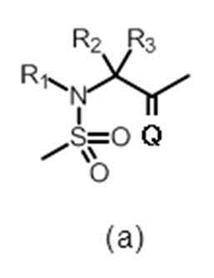
は、下記のいずれかの基であることが好ましく、 Is preferably any of the following groups:

さらに好ましくは下記のいずれかの基であり、 More preferably, it is one of the following groups:
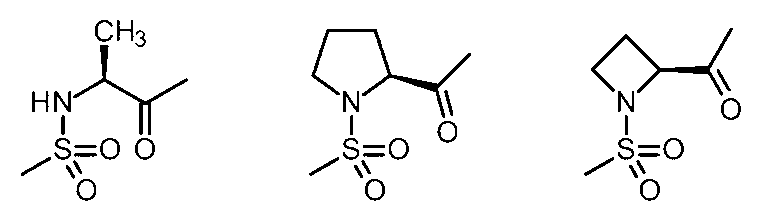
特に好ましくは下記のいずれかの基である。 Particularly preferred are any of the following groups.
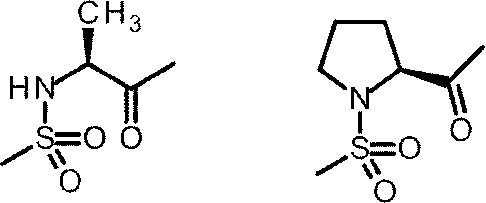
式(I)中、R1とR2が一緒になって含窒素環を形成する場合の本発明化合物の一態様は下記式(II): In the formula (I), one embodiment of the compound of the present invention when R 1 and R 2 together form a nitrogen-containing ring is represented by the following formula (II):

[式中、 [Where:

は単結合又は二重結合を表し;
Yは、-CRy1Ry2-又は-CRy3=を表し;
Zは、結合、-O-、-CRz1Rz2-又は-CRz3=を表し;
Wは、結合又は-CRw1Rw2-を表し;
Ry1、Ry2、Ry3、Rz1、Rz2、Rz3、Rw1及びRw2は、同一又は異なって、水素、ハロゲノ基、ヒドロキシ基又は置換基を有してもよいC1-6アルキル基を表し;
それ以外の各記号の定義は式(I)で定義される通りである]で表される。
Yは、好ましくは-CRy1Ry2-である。
Zは、好ましくは結合、-CRz1Rz2-であり、より好ましくは-CRz1Rz2-である。
Wは、好ましくは結合である。
Ry1は、好ましくは水素、ヒドロキシ基、ハロゲノ基(例、フルオロ)であり、より好ましくは水素である。
Ry2は、好ましくは水素、ヒドロキシ基、ハロゲノ基(例、フルオロ)であり、より好ましくは水素である。
Ry3は、好ましくは水素である。
Rz1は、好ましくは水素、ヒドロキシ基であり、より好ましくは水素である。
Rz2は、好ましくは水素、ヒドロキシ基であり、より好ましくは水素である。
Rz3は、好ましくは水素である。
Rw1は、好ましくは水素である。
Rw2は、好ましくは水素である。
Represents a single bond or a double bond;
Y represents —CR y1 R y2 — or —CR y3 =;
Z represents a bond, —O—, —CR z1 R z2 — or —CR z3 =;
W represents a bond or —CR w1 R w2 —;
R y1 , R y2 , R y3 , R z1 , R z2 , R z3 , R w1 and R w2 are the same or different and each may have hydrogen, a halogeno group, a hydroxy group or a substituent, C 1-6 Represents an alkyl group;
The definition of each other symbol is as defined in Formula (I)].
Y is preferably —CR y1 R y2 —.
Z is preferably a bond, —CR z1 R z2 —, and more preferably —CR z1 R z2 —.
W is preferably a bond.
R y1 is preferably hydrogen, a hydroxy group, or a halogeno group (eg, fluoro), more preferably hydrogen.
R y2 is preferably hydrogen, a hydroxy group, or a halogeno group (eg, fluoro), more preferably hydrogen.
R y3 is preferably hydrogen.
R z1 is preferably hydrogen or a hydroxy group, more preferably hydrogen.
R z2 is preferably hydrogen or a hydroxy group, and more preferably hydrogen.
R z3 is preferably hydrogen.
R w1 is preferably hydrogen.
R w2 is preferably hydrogen.
式(I)及び式(II)において、環Aは、単環性の芳香環又は複素芳香環、あるいは二環性の芳香環又は複素芳香環を表す。 In formula (I) and formula (II), ring A represents a monocyclic aromatic ring or heteroaromatic ring, or a bicyclic aromatic ring or heteroaromatic ring.
単環性の芳香環としては上記した「飽和又は不飽和の環状の基(ヘテロ原子を含んでもよい)」として例示された環のうち、芳香族の単環式炭素環が挙げられ、具体的にはベンゼンが挙げられる。
単環性の複素芳香環としては上記した「飽和又は不飽和の環状の基(ヘテロ原子を含んでもよい)」として例示された環のうち、芳香族の単環式複素環が挙げられ、特に6員のものが挙げられる。具体的には、ピリジン、ピリダジン、ピリミジン、ピラジン、トリアジン等が挙げられる。
二環性の芳香環としては上記した「飽和又は不飽和の環状の基(ヘテロ原子を含んでもよい)」として例示された環のうち、芳香族の二環式炭素環が挙げられ、具体的にはナフタレン等が挙げられる。
二環性の複素芳香環としては「飽和又は不飽和の環状の基(ヘテロ原子を含んでもよい)」として例示された環のうち、芳香族の二環式複素環が挙げられ、具体的には、ベンゾフラン、イソベンゾフラン、ベンゾチオフェン、インドール、イソインドール、インダゾリン、ベンゾイミダゾール、ベンゾオキサゾール、ベンゾイソオキサゾール、ベンゾチアゾール、ベンゾイソチアゾール、ベンゾトリアゾール、キノリン、イソキノリン、シンノリン、キナゾリン等が挙げられる。
環Aは、好ましくは6員の単環性の芳香環又は複素芳香環及びその縮合環であり、より好ましくは6員の単環性の芳香環又は複素芳香環である。具体的には、ベンゼン、ピリジン、ピリミジン、ピリダジン及びベンゾフランが好ましく、特に好ましくはベンゼン、ピリジン及びピリミジンである。
Examples of the monocyclic aromatic ring include aromatic monocyclic carbocycles among the rings exemplified as the above-mentioned “saturated or unsaturated cyclic group (which may contain heteroatoms)”. Includes benzene.
Examples of the monocyclic heteroaromatic ring include aromatic monocyclic heterocycles among the rings exemplified as the above-mentioned “saturated or unsaturated cyclic group (which may include heteroatoms)”, and in particular, 6 members are listed. Specific examples include pyridine, pyridazine, pyrimidine, pyrazine, triazine and the like.
Examples of the bicyclic aromatic ring include aromatic bicyclic carbocycles among the rings exemplified as the above-mentioned “saturated or unsaturated cyclic group (which may contain heteroatoms)”. Examples include naphthalene.
Examples of the bicyclic heteroaromatic ring include aromatic bicyclic heterocycles among the rings exemplified as “saturated or unsaturated cyclic group (which may include heteroatoms)”, specifically Benzofuran, isobenzofuran, benzothiophene, indole, isoindole, indazoline, benzimidazole, benzoxazole, benzisoxazole, benzothiazole, benzoisothiazole, benzotriazole, quinoline, isoquinoline, cinnoline, quinazoline and the like.
Ring A is preferably a 6-membered monocyclic aromatic ring or heteroaromatic ring and a condensed ring thereof, and more preferably a 6-membered monocyclic aromatic ring or heteroaromatic ring. Specifically, benzene, pyridine, pyrimidine, pyridazine and benzofuran are preferable, and benzene, pyridine and pyrimidine are particularly preferable.
式(I)及び式(II)において、
A1は、-C(Ra)=又は-N=を表し、好ましくは-C(Ra)=であり;
A2は、-C(Rb)=又は-N=を表し、好ましくは-C(Rb)=であり;
A3は、-C(Rc)=又は-N=を表し、好ましくは-C(Rc)=であり;
A4は、-C(Rd)=又は-N=を表し、好ましくは-C(Rd)=である。
なお、A1~A4の少なくとも2つは-N=ではない。
Ra、Rb、Rc及びRdは、同一又は異なって、水素、ハロゲノ基(例、フルオロ)、シアノ基、ヒドロキシ基、C1-6アルキル基、C1-6アルコキシ基、ハロゲノC1-6アルキル基又はハロゲノC1-6アルコキシ基を表し、好ましくは水素又はハロゲノ基であり、より好ましくは全てが水素であるか、いずれか一つがハロゲノ基である。
In formula (I) and formula (II),
A 1 represents —C (Ra) ═ or —N═, preferably —C (Ra) ═;
A 2 represents —C (Rb) ═ or —N═, preferably —C (Rb) ═;
A 3 represents —C (Rc) ═ or —N═, preferably —C (Rc) ═;
A 4 represents —C (Rd) ═ or —N═, and preferably —C (Rd) ═.
Note that at least two of A 1 to A 4 are not -N =.
Ra, Rb, Rc and Rd are the same or different and are hydrogen, halogeno group (eg, fluoro), cyano group, hydroxy group, C 1-6 alkyl group, C 1-6 alkoxy group, halogeno C 1-6 alkyl. Or a halogeno C 1-6 alkoxy group, preferably hydrogen or a halogeno group, more preferably all are hydrogen, or any one is a halogeno group.
式(I)及び式(II)において、部分構造(c): In formula (I) and formula (II), partial structure (c):

は下図のいずれかの基であることが好ましく、 Is preferably any of the groups shown below,

より好ましくは下図のいずれかの基である。 More preferably, it is any group shown in the following figure.

式(I)及び式(II)中、R3は、水素又はC1-6アルキル基を表し、好ましくは水素である。 In formula (I) and formula (II), R 3 represents hydrogen or a C 1-6 alkyl group, preferably hydrogen.
式(I)及び式(II)中、R4及びR5は、同一又は異なって水素又はC1-6アルキル基を表すか、あるいはR4とR5は一緒になってシクロアルカン(例、シクロプロパン)を形成してもよい。好ましくは、R4及びR5は、同一又は異なって水素又はC1-6アルキル基を表し(ここで、R4とR5は一緒になってシクロアルカンを形成しない)、より好ましくはR4及びR5はともに水素である。 In formula (I) and formula (II), R 4 and R 5 are the same or different and each represents hydrogen or a C 1-6 alkyl group, or R 4 and R 5 together represent a cycloalkane (eg, Cyclopropane) may be formed. Preferably, R 4 and R 5 are the same or different and each represents hydrogen or a C 1-6 alkyl group (wherein R 4 and R 5 together do not form a cycloalkane), more preferably R 4 And R 5 are both hydrogen.
式(I)及び式(II)中、Xは、
(a)水素、
(b)-Cy、
(c)-C(Rx1Rx2)-Cy、
(d)-C(Rx1Rx2)-C(Rx3Rx4)-Cy、
(e)-C(Rx1)=C(Rx2)-Cy、
(f)-O-Cy、
(g)-O-C(Rx1Rx2)-Cy、
(h)-C(Rx1Rx2)-O-Cy、
(i)-S(O)n-Cy、
(j)-S(O)n-C(Rx1Rx2)-Cy、
(k)-C(Rx1Rx2)-S(O)n-Cy、
(l)-N(Rx5)-Cy、
(m)-N(Rx5)-C(Rx1Rx2)-Cy、-
(n)-C(Rx1Rx2)-N(Rx5)-Cy、
(o)-N(Rx5)-N(Rx6)-Cy、
(p)-O-N(Rx5)-Cy、
(q)-N(Rx5)-O-Cy、
(r)-C(O)-N(Rx5)-Cy、
(s)-N(Rx5)-C(O)-Cy、
(t)-S(O)m-N(Rx5)-Cy、
(u)-N(Rx5)-S(O)m-Cy、
(v)-O-S(O)m-Cy、又は
(w)-S(O)m-O-Cyを表し、
好ましくは、
(a)水素、
(b)-Cy、
(c)-C(Rx1Rx2)-Cy、
(d)-C(Rx1Rx2)-C(RX3RX4)-Cy、
(e)-C(RX1)=C(RX2)-Cy、
(f)-O-Cy、
(g)-O-C(Rx1Rx2)-Cy、
(h)-C(Rx1Rx2)-O-Cy、
(i)-S(O)n-Cy、
(j)-S(O)n-C(Rx1Rx2)-Cy、
(k)-C(Rx1Rx2)-S(O)n-Cy、
(l)-N(Rx5)-Cy、
(m)-N(Rx5)-C(Rx1Rx2)-Cy、
(n)-C(Rx1Rx2)-N(Rx5)-Cy、
(o)-N(Rx5)-N(Rx6)-Cy、
(p)-O-N(Rx5)-Cy、
(q)-N(Rx5)-O-Cy、
(r)-C(O)-N(Rx5)-Cy、
(s)-N(Rx5)-C(O)-Cy、
(t)-S(O)m-N(Rx5)-Cy、又は
(u)-N(Rx5)-S(O)m-Cyを表し、
より好ましくは、
(a)水素、
(b)-Cy、
(f)-O-Cy、
(g)-O-C(Rx1Rx2)-Cy、
(h)-C(Rx1Rx2)-O-Cy、
(j)-S(O)n-C(Rx1Rx2)-Cy、又は
(m)-N(Rx5)-C(Rx1Rx2)-Cyである。
(各記号の定義は式(I)で定義される通りである)
より好ましくは、Xは、水素、-Cy、-O-Cy、又は-O-CH2-Cyであり、特に好ましくは-Cyである。
In formula (I) and formula (II), X is
(a) hydrogen,
(b) -Cy,
(c) -C (R x1 R x2 ) -Cy,
(d) -C (R x1 R x2 ) -C (R x3 R x4 ) -Cy,
(e) -C (R x1 ) = C (R x2 ) -Cy,
(f) -O-Cy,
(g) -OC (R x1 R x2 ) -Cy,
(h) -C (R x1 R x2 ) -O-Cy,
(i) -S (O) n-Cy,
(j) -S (O) n-C (R x1 R x2 ) -Cy,
(k) -C (R x1 R x2 ) -S (O) n-Cy,
(l) -N (R x5 ) -Cy,
(m) -N (R x5 ) -C (R x1 R x2 ) -Cy,-
(n) -C (R x1 R x2 ) -N (R x5 ) -Cy,
(o) -N (R x5 ) -N (R x6 ) -Cy,
(p) -O-N (R x5 ) -Cy,
(q) -N (R x5 ) -O-Cy,
(r) -C (O) -N (R x5 ) -Cy,
(s) -N (R x5 ) -C (O) -Cy,
(t) -S (O) m-N (R x5 ) -Cy,
(u) -N (R x5 ) -S (O) m-Cy,
(v) -O-S (O) m-Cy, or
(w) represents -S (O) m-O-Cy,
Preferably,
(a) hydrogen,
(b) -Cy,
(c) -C (R x1 R x2 ) -Cy,
(d) -C (R x1 R x2 ) -C (R X3 R X4 ) -Cy,
(e) -C (R X1 ) = C (R X2 ) -Cy,
(f) -O-Cy,
(g) -OC (R x1 R x2 ) -Cy,
(h) -C (R x1 R x2 ) -O-Cy,
(i) -S (O) n-Cy,
(j) -S (O) n-C (R x1 R x2 ) -Cy,
(k) -C (R x1 R x2 ) -S (O) n-Cy,
(l) -N (R x5 ) -Cy,
(m) -N (R x5 ) -C (R x1 R x2 ) -Cy,
(n) -C (R x1 R x2 ) -N (R x5 ) -Cy,
(o) -N (R x5 ) -N (R x6 ) -Cy,
(p) -O-N (R x5 ) -Cy,
(q) -N (R x5 ) -O-Cy,
(r) -C (O) -N (R x5 ) -Cy,
(s) -N (R x5 ) -C (O) -Cy,
(t) -S (O) m-N (R x5 ) -Cy, or
(u) -N (R x5 ) -S (O) m-Cy,
More preferably,
(a) hydrogen,
(b) -Cy,
(f) -O-Cy,
(g) -OC (R x1 R x2 ) -Cy,
(h) -C (R x1 R x2 ) -O-Cy,
(j) -S (O) n-C (R x1 R x2 ) -Cy, or
(m) -N (R x5 ) -C (R x1 R x2 ) -Cy.
(The definition of each symbol is as defined in Formula (I))
More preferably, X is hydrogen, —Cy, —O—Cy, or —O—CH 2 —Cy, and particularly preferably —Cy.
Cyは、置換基を有してもよい飽和又は不飽和の環状の基(ヘテロ原子を含んでもよい)を表し、単環あるいは二環式の飽和又は不飽和の環状の基(ヘテロ原子を含んでもよい)が好ましく、より好ましくは、単環の飽和又は不飽和の環状の基(ヘテロ原子を含んでもよい)である。具体的には、シクロペンタン、シクロヘキサン、シクロヘキセン、ベンゼン、ナフタレン、ピロール、イミダゾール、トリアゾール、テトラゾール、ピラゾール、ピリジン、ピラジン、トリアジン、ピリミジン、ピリダジン、フラン、チオフェン、オキサゾール、イソオキサゾール、チアゾール、イソチアゾール、オキサジアゾール、チアジアゾール、インドール、ベンゾフラン、ベンゾチオフェン、キノリン、イソキノリン、キナゾリン、ベンゾオキサゾール、ベンゾチアゾール、ベンゾイミダゾール、テトラヒドロフラン、ジヒドロピラン、テトラヒドロピランが好ましく、さらに好ましくは、シクロペンタン、シクロヘキサン、ベンゼン、ピラゾール、ピリジン、ピラジン、ピリミジン、ピリダジン、フラン、チオフェン、テトラヒドロフラン、テトラヒドロピランであり、特に好ましくはベンゼン、ピリジン、ピラジン、ピリミジン、ピリダジンである。 Cy represents a saturated or unsaturated cyclic group (which may include a heteroatom) which may have a substituent, and is a monocyclic or bicyclic saturated or unsaturated cyclic group (including a heteroatom). It is preferably a monocyclic saturated or unsaturated cyclic group (which may contain a hetero atom). Specifically, cyclopentane, cyclohexane, cyclohexene, benzene, naphthalene, pyrrole, imidazole, triazole, tetrazole, pyrazole, pyridine, pyrazine, triazine, pyrimidine, pyridazine, furan, thiophene, oxazole, isoxazole, thiazole, isothiazole, Oxadiazole, thiadiazole, indole, benzofuran, benzothiophene, quinoline, isoquinoline, quinazoline, benzoxazole, benzothiazole, benzimidazole, tetrahydrofuran, dihydropyran, tetrahydropyran are preferred, and cyclopentane, cyclohexane, benzene, pyrazole are more preferred. , Pyridine, pyrazine, pyrimidine, pyridazine, furan, thiophene, tetrahydride Furan, tetrahydropyran, particularly preferably benzene, pyridine, pyrazine, pyrimidine, pyridazine.
Cyに関して、「飽和又は不飽和の環状の基(ヘテロ原子を含んでもよい)」が有していてもよい置換基としては上記[置換基群B]で例示されたものが挙げられるが、好ましくは無置換、アルキル基、アルケニル基、ハロゲノアルキル基、環状アルキル基(環中にヘテロ原子を含んでもよい)、ハロゲノ基、ヒドロキシ基、アルコキシ基、ハロゲノアルコキシ基、ハロゲノアルコキシ基で置換されたアルキル基、アミノ基、アルキル基でモノまたはジ置換されたアミノ基、シアノ基、アルキルチオ基、カルボキシル基、アルコキシカルボニル基、カルバモイル基、アルキル基でモノまたはジ置換されたカルバモイル基、アシルアミノ基等が挙げられる。さらに好ましくは、無置換、ハロゲノ基、ハロゲノアルキル基、ヒドロキシ基、ハロゲノアルコキシ基、シアノ基である。 With respect to Cy, examples of the substituent that the “saturated or unsaturated cyclic group (which may include a heteroatom)” may include those exemplified in the above [Substituent Group B], Is unsubstituted, alkyl, alkenyl, halogenoalkyl, cyclic alkyl (which may contain heteroatoms in the ring), halogeno, hydroxy, alkoxy, halogenoalkoxy, alkyl substituted with halogenoalkoxy Group, amino group, amino group mono- or di-substituted by alkyl group, cyano group, alkylthio group, carboxyl group, alkoxycarbonyl group, carbamoyl group, carbamoyl group mono- or di-substituted by alkyl group, acylamino group, etc. It is done. More preferred are unsubstituted, halogeno group, halogenoalkyl group, hydroxy group, halogenoalkoxy group and cyano group.
Rx1、Rx2、Rx3、Rx4、Rx5及びRx6は、同一又は異なって、水素、置換基を有してもよいC1-6アルキル基又は置換基を有してもよいC1-6アルコキシカルボニル基を表す。好ましくは水素である。 R x1 , R x2 , R x3 , R x4 , R x5 and R x6 are the same or different and are hydrogen, a C 1-6 alkyl group which may have a substituent or a C which may have a substituent 1-6 represents an alkoxycarbonyl group. Preferably it is hydrogen.
Cyは、好ましくは下図で示されるいずれかの基である。 Cy is preferably any group shown in the figure below.

式(I)及び式(II)中、
R6は、置換基を有してもよいC1-6アルキル基、C2-6アルケニル基、環状C3-6アルキル基(ヘテロ原子を含んでもよい)、ハロゲノ基、ヒドロキシ基、置換基を有してもよいC1-6アルコキシ基、ハロゲノC1-6アルキル基、ハロゲノC1-6アルコキシ基、アミノ基、置換基を有してもよいC1-6アルキル基でモノ又はジ置換されたアミノ基、シアノ基、C1-6アルキルチオ基、カルボキシル基、置換基を有してもよいC1-6アルコキシカルボニル基、カルバモイル基、置換基を有してもよいC1-6アルキル基でモノ又はジ置換されたカルバモイル基又は置換基を有してもよいアシル基で置換されたアミノ基を表す。R6が複数存在する場合は、同一でも異なってもよい。「C1-6アルキル基」、「C2-6アルケニル基」、「C1-6アルコキシ基」が有していてもよい置換基としては上記[置換基群A]で例示されたものが挙げられるが、好ましくはアルキル基、アルケニル基、アリール基、環状アルキル基(環中にヘテロ原子を含んでもよい)、ハロゲノ基、ヒドロキシ基、アルコキシ基、アミノ基、アルキル基でモノまたはジ置換されたアミノ基、シアノ基、アルキルチオ基、カルボキシル基、アルコキシカルボニル基、カルバモイル基、アルキル基でモノまたはジ置換されたカルバモイル基、アシルアミノ基等が挙げられる。
In formula (I) and formula (II),
R 6 is an optionally substituted C 1-6 alkyl group, a C 2-6 alkenyl group, a cyclic C 3-6 alkyl group (which may contain a hetero atom), a halogeno group, a hydroxy group, a substituent A C 1-6 alkoxy group which may have a halogeno C 1-6 alkyl group, a halogeno C 1-6 alkoxy group, an amino group, a C 1-6 alkyl group which may have a substituent, mono or di A substituted amino group, a cyano group, a C 1-6 alkylthio group, a carboxyl group, an optionally substituted C 1-6 alkoxycarbonyl group, a carbamoyl group, an optionally substituted C 1-6 It represents an amino group substituted with a carbamoyl group mono- or di-substituted with an alkyl group or an acyl group which may have a substituent. When a plurality of R 6 are present, they may be the same or different. Examples of the substituent that the “C 1-6 alkyl group”, “C 2-6 alkenyl group”, and “C 1-6 alkoxy group” may have include those exemplified in the above [Substituent group A]. Preferably, it is mono- or di-substituted with an alkyl group, an alkenyl group, an aryl group, a cyclic alkyl group (which may contain a hetero atom in the ring), a halogeno group, a hydroxy group, an alkoxy group, an amino group, or an alkyl group. And an amino group, a cyano group, an alkylthio group, a carboxyl group, an alkoxycarbonyl group, a carbamoyl group, a carbamoyl group mono- or disubstituted with an alkyl group, an acylamino group, and the like.
R6として好ましくは、C1-6アルキル基、環状C3-6アルキル基(ヘテロ原子を含んでもよい)、ハロゲノ基、ヒドロキシ基、置換基を有してもよいC1-6アルコキシ基、ハロゲノC1-6アルコキシ基、アミノ基、C1-6アルコキシカルボニル基あるいはC1-6アルキル基でモノ又はジ置換されたアミノ基であり、より好ましくは環状C3-6アルキル基(ヘテロ原子を含んでもよい)、ハロゲノ基、ヒドロキシ基、置換基を有してもよいC1-6アルコキシ基、ハロゲノC1-6アルコキシ基、あるいはC1-6アルキル基でモノ又はジ置換されたアミノ基である。
kは、0~3の整数を表す。好ましくは、0から2の整数であり、より好ましくは0又は1である。
R 6 is preferably a C 1-6 alkyl group, a cyclic C 3-6 alkyl group (which may contain a heteroatom), a halogeno group, a hydroxy group, an optionally substituted C 1-6 alkoxy group, A halogeno C 1-6 alkoxy group, an amino group, a C 1-6 alkoxycarbonyl group or an amino group mono- or disubstituted with a C 1-6 alkyl group, more preferably a cyclic C 3-6 alkyl group (heteroatom A mono- or di-substituted amino group with a halogeno group, a hydroxy group, an optionally substituted C 1-6 alkoxy group, a halogeno C 1-6 alkoxy group, or a C 1-6 alkyl group It is a group.
k represents an integer of 0 to 3. Preferably, it is an integer of 0 to 2, more preferably 0 or 1.
式(I)及び式(II)中、
環Aを含む部分構造(b):
In formula (I) and formula (II),
Partial structure including ring A (b):

は下図のいずれかの基であることが好ましい。 Is preferably any of the groups shown below.

(式中、各記号の定義は式(I)で定義される通りである)
式(I)で表される化合物及びその一態様である式(II)で表される化合物を総称して本発明化合物とも称する。
(In the formula, each symbol is as defined in formula (I)).
The compound represented by the formula (I) and the compound represented by the formula (II) which is one embodiment thereof are collectively referred to as a compound of the present invention.
本発明において、好ましい本発明化合物としては以下の化合物が挙げられる。
(I)式(I)中、環Aを含む部分構造(b)が
In the present invention, preferred compounds of the present invention include the following compounds.
(I) In the formula (I), the partial structure (b) containing ring A is

下図のいずれかの基である It is one of the following groups

化合物[化合物I-1]、
式(I)中、部分構造(c)が
Compound [Compound I-1],
In the formula (I), the partial structure (c) is

下図のいずれかの基である It is one of the following groups

化合物[化合物I-2]、
式(I)中、Xが、水素、-Cy、-O-Cy、又は、-O-CH2-Cyである化合物[化合物I-3]、
式(I)中、Xが-Cyであり;Cyが下図で示されるいずれかの基である
Compound [Compound I-2],
In the formula (I), a compound [compound I-3] in which X is hydrogen, —Cy, —O—Cy, or —O—CH 2 —Cy,
In formula (I), X is —Cy; Cy is any group shown in the figure below
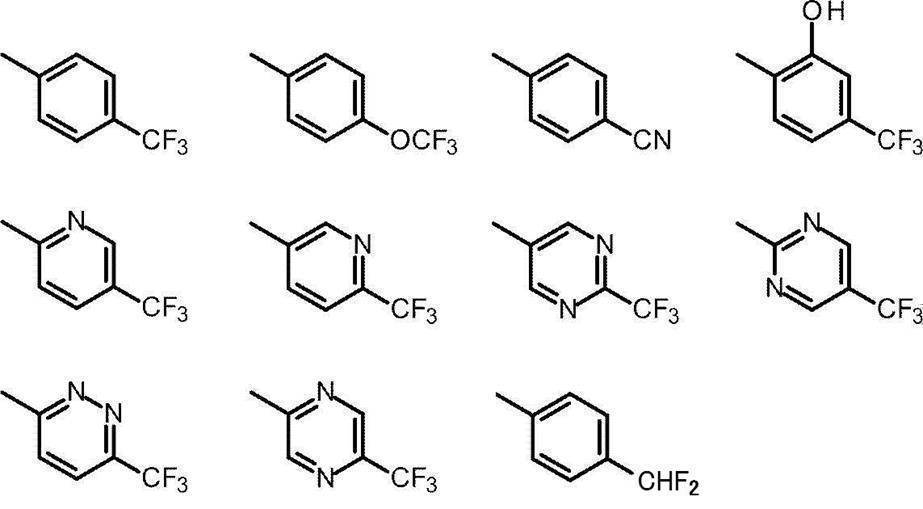
化合物[化合物I-4]、
式(I)中、R4およびR5が水素であり;環Aを含む部分構造(b)が
Compound [Compound I-4],
In formula (I), R 4 and R 5 are hydrogen; the partial structure (b) containing ring A is

下図のいずれかの基であり; Any of the groups in the figure below;

Xが-Cyであり;Cyが下図で示されるいずれかの基であり; X is -Cy; Cy is any group shown in the figure below;

部分構造(c)が Partial structure (c) is

下図のいずれかの基である It is one of the following groups

化合物[化合物I-5]。 Compound [Compound I-5].
(A)式(I)中、
Qが=Oであり;
R1が、水素又はC1-6アルキル基であり;
R4が、水素又はC1-6アルキル基であり;
R5が、水素又はC1-6アルキル基であり;
ただし、R4とR5は一緒になってシクロアルカンを形成せず;
Xが、水素、
-Cy、
-C(Rx1Rx2)-Cy、
-C(Rx1Rx2)-C(Rx3Rx4)-Cy、
-C(Rx1)=C(Rx2)-Cy、
-O-Cy、
-O-C(Rx1Rx2)-Cy、
-C(Rx1Rx2)-O-Cy、
-S(O)n-Cy、
-S(O)n-C(Rx1Rx2)-Cy、
-C(Rx1Rx2)-S(O)n-Cy、
-N(Rx5)-Cy、
-N(Rx5)-C(Rx1Rx2)-Cy、
-C(Rx1Rx2)-N(Rx5)-Cy、
-N(Rx5)-N(Rx6)-Cy、
-O-N(Rx5)-Cy、
-N(Rx5)-O-Cy、
-C(O)-N(Rx5)-Cy、
-N(Rx5)-C(O)-Cy、
-S(O)m-N(Rx5)-Cy、又は
-N(Rx5)-S(O)m-Cy
である化合物[化合物A]。
化合物Aの好ましい態様としては、
R1が水素、R2がC1-6アルキル基、R3が水素である化合物[化合物A-1]、
部分構造(a)が
(A) In formula (I),
Q is = O;
R 1 is hydrogen or a C 1-6 alkyl group;
R 4 is hydrogen or a C 1-6 alkyl group;
R 5 is hydrogen or a C 1-6 alkyl group;
Provided that R 4 and R 5 together do not form a cycloalkane;
X is hydrogen,
-Cy,
-C (R x1 R x2 ) -Cy,
-C (R x1 R x2 ) -C (R x3 R x4 ) -Cy,
-C (R x1 ) = C (R x2 ) -Cy,
-O-Cy,
-OC (R x1 R x2 ) -Cy,
-C (R x1 R x2 ) -O-Cy,
-S (O) n-Cy,
-S (O) n-C (R x1 R x2 ) -Cy,
-C (R x1 R x2 ) -S (O) n-Cy,
-N (R x5 ) -Cy,
-N (R x5 ) -C (R x1 R x2 ) -Cy,
-C (R x1 R x2 ) -N (R x5 ) -Cy,
-N (R x5 ) -N (R x6 ) -Cy,
-O-N (R x5 ) -Cy,
-N (R x5 ) -O-Cy,
-C (O) -N (R x5 ) -Cy,
-N (R x5 ) -C (O) -Cy,
-S (O) m-N (R x5 ) -Cy or -N (R x5 ) -S (O) m-Cy
Compound [Compound A].
As a preferred embodiment of Compound A,
A compound wherein R 1 is hydrogen, R 2 is a C 1-6 alkyl group, and R 3 is hydrogen [compound A-1],
Partial structure (a) is

下図のいずれかの基である It is one of the following groups

[式中、R1は、水素又は置換基を有していてもよいC1-6アルキル基を表す]化合物[化合物A-2];
部分構造(a)が
[Wherein R 1 represents hydrogen or an optionally substituted C 1-6 alkyl group] Compound [Compound A-2];
Partial structure (a) is
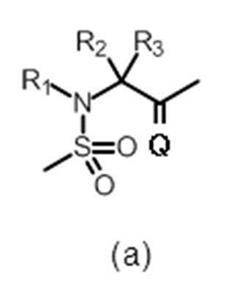
下図のいずれかの基である It is one of the following groups

化合物[化合物A-2’’];
環Aを含む部分構造(b)が
Compound [Compound A-2 ″];
The partial structure (b) containing ring A is

下図のいずれかの基である It is one of the following groups

化合物[化合物A-3]、
部分構造(c)が
Compound [Compound A-3],
Partial structure (c) is
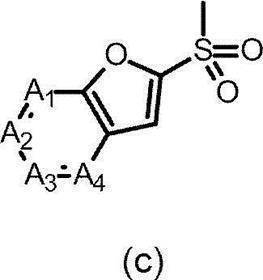
下図のいずれかの基である It is one of the following groups

化合物[化合物A-4]、
Xが、水素、-Cy、-O-Cy、又は、-O-CH2-Cyである化合物[化合物A-5]、
Xが-Cyであり;Cyが下図で示されるいずれかの基である
Compound [Compound A-4],
Compound [Compound A-5] wherein X is hydrogen, —Cy, —O—Cy, or —O—CH 2 —Cy;
X is -Cy; Cy is any group shown in the figure below
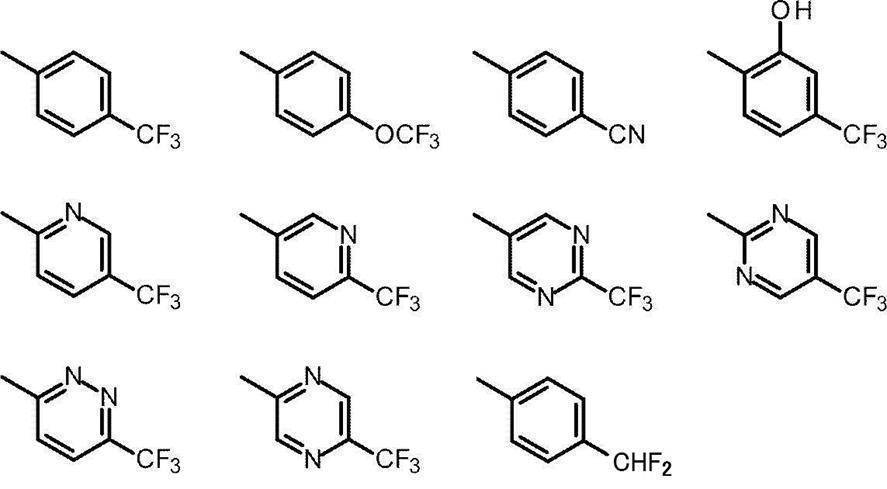
化合物[化合物A-6]、
R4およびR5が水素であり;環Aを含む部分構造(b)が
Compound [Compound A-6],
R 4 and R 5 are hydrogen; the partial structure (b) containing ring A is

下図のいずれかの基であり; Any of the groups in the figure below;

Xが-Cyであり;Cyが下図で示されるいずれかの基であり; X is -Cy; Cy is any group shown in the figure below;

部分構造(c)が Partial structure (c) is

下図のいずれかの基である It is one of the following groups

化合物[化合物A-7]が挙げられる。
化合物A-2の好ましい態様としては、R1が水素である化合物[化合物A-2’]が挙げられる。
化合物A-2および化合物A-2’の好ましい態様としては、R4およびR5が水素である化合物[それぞれ、化合物A-2-1、化合物A-2’-1]、
環Aが6員の単環性の芳香環又は複素芳香環である化合物[それぞれ、化合物A-2-2、化合物A-2’-2]、
環Aがベンゼン、ピリジン、あるいは、ピリミジンである化合物[それぞれ、化合物A-2-3、化合物A-2’-3]、
環Aを含む部分構造(b)が
And Compound [Compound A-7].
A preferred embodiment of compound A-2 is a compound [compound A-2 ′] wherein R 1 is hydrogen.
In a preferred embodiment of Compound A-2 and Compound A-2 ′, compounds wherein R 4 and R 5 are hydrogen [Compound A-2-1, Compound A-2′-1 respectively],
Compounds wherein ring A is a 6-membered monocyclic aromatic ring or heteroaromatic ring [compound A-2-2, compound A-2′-2, respectively],
Compounds wherein ring A is benzene, pyridine or pyrimidine [compound A-2-3, compound A-2′-3, respectively],
The partial structure (b) containing ring A is

下図のいずれかの基である It is one of the following groups

化合物[それぞれ、化合物A-2-4、化合物A-2’-4]、
環Aを含む部分構造(b)が
Compound [Compound A-2-4, Compound A-2′-4, respectively],
The partial structure (b) containing ring A is

下図の基であり The basis of the figure below
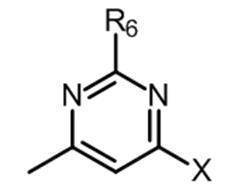
R6が環状C3-6アルキル基(ヘテロ原子を含んでもよい)、置換基を有してもよいC1-6アルコキシ基、アミノ基、あるいは、C1-6アルキル基でモノ又はジ置換されたアミノ基である
化合物[それぞれ、化合物A-2-4-1、化合物A-2’-4-1]、kが0から2の整数であり、R6がC1-6アルキル基、環状C3-6アルキル基(ヘテロ原子を含んでもよい)、ハロゲノ基、ヒドロキシ基、置換基を有してもよいC1-6アルコキシ基、アミノ基、C1-6アルコキシカルボニル基、あるいは、C1-6アルキル基でモノ又はジ置換されたアミノ基である化合物[それぞれ、化合物A-2-5、化合物A-2’-5]、
kが0である化合物[それぞれ、化合物A-2-6、化合物A-2’-6]、
環Aを含む部分構造(b)が
R 6 is a cyclic C 3-6 alkyl group (which may contain a heteroatom), a C 1-6 alkoxy group which may have a substituent, an amino group, or a C 1-6 alkyl group, mono or disubstituted A compound of the selected amino group [respectively, compound A-2-4-1, compound A-2′-4-1], k is an integer of 0 to 2, R 6 is a C 1-6 alkyl group, A cyclic C 3-6 alkyl group (which may contain a heteroatom), a halogeno group, a hydroxy group, an optionally substituted C 1-6 alkoxy group, an amino group, a C 1-6 alkoxycarbonyl group, or Compounds that are amino groups mono- or di-substituted with a C 1-6 alkyl group [Compound A-2-5, Compound A-2′-5, respectively],
Compounds in which k is 0 [Compound A-2-6, Compound A-2′-6, respectively]
The partial structure (b) containing ring A is

下図のいずれかの基であり; Any of the groups in the figure below;

kが0又は1であり、R6がハロゲノ基、C1-6アルコキシカルボニル基、C1-6アルキル基でモノ又はジ置換されたアミノ基、あるいは、ヒドロキシ基である化合物[それぞれ、化合物A-2-7、化合物A-2’-7]、
環Aを含む部分構造(b)が
Compounds wherein k is 0 or 1, and R 6 is a halogeno group, a C 1-6 alkoxycarbonyl group, an amino group mono- or disubstituted with a C 1-6 alkyl group, or a hydroxy group [respectively compound A -2-7, compound A-2′-7],
The partial structure (b) containing ring A is
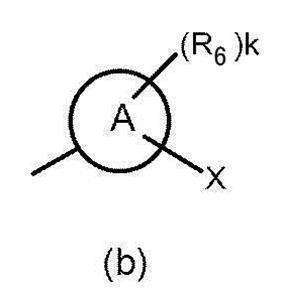
下図のいずれかの基である It is one of the following groups

化合物[それぞれ、化合物A-2-8、化合物A-2’-8]、
A1が-C(Ra)=であり、A2が-C(Rb)=であり、A3が-C(Rc)=であり、A4が-C(Rd)=である化合物[それぞれ、化合物A-2-9、化合物A-2’-9]、
A1が-C(Ra)=であり、A2が-C(Rb)=であり、A3が-C(Rc)=であり、A4が-C(Rd)=であり;Ra、Rb、Rc及びRdが全て水素であるか、いずれか一つがハロゲノ基である化合物[それぞれ、化合物A-2-10、化合物A-2’-10]、
部分構造(c)が
Compound [Compound A-2-8, Compound A-2′-8, respectively],
Compounds in which A 1 is —C (Ra) ═, A 2 is —C (Rb) ═, A 3 is —C (Rc) ═, and A 4 is —C (Rd) ═ [respectively Compound A-2-9, Compound A-2′-9],
A 1 is -C (Ra) =, A 2 is -C (Rb) =, A 3 is -C (Rc) =, and A 4 is -C (Rd) =; Ra, Compounds in which Rb, Rc and Rd are all hydrogen or any one is a halogeno group [Compound A-2-10, Compound A-2′-10, respectively],
Partial structure (c) is

下図のいずれかの基である It is one of the following groups

化合物[それぞれ、化合物A-2-11、化合物A-2’-11]、
Xが、水素、-Cy、-O-Cy、又は、-O-CH2-Cyである化合物[それぞれ、化合物A-2-12、化合物A-2’-12]、
Xが-Cyである化合物[それぞれ、化合物A-2-13、化合物A-2’-13]、
Cyが、置換基を有してもよいベンゼン、置換基を有してもよいピリジン、置換基を有してもよいピリミジン、置換基を有してもよいピリダジン、あるいは、置換基を有してもよいピラジンである化合物[それぞれ、化合物A-2-14、化合物A-2’-14]、
Cyが下図で示されるいずれかの基である
Compound [Compound A-2-11, Compound A-2′-11, respectively],
Compounds wherein X is hydrogen, —Cy, —O—Cy, or —O—CH 2 —Cy [Compound A-2-12, Compound A-2′-12, respectively],
Compounds in which X is —Cy [Compound A-2-13, Compound A-2′-13, respectively],
Cy has benzene which may have a substituent, pyridine which may have a substituent, pyrimidine which may have a substituent, pyridazine which may have a substituent, or a substituent Compounds that are pyrazines [compound A-2-14, compound A-2′-14], respectively,
Cy is any group shown in the figure below

化合物[それぞれ、化合物A-2-15、化合物A-2’-15]、
Xが-Cyであり、Cyが、置換基を有してもよいベンゼン、置換基を有してもよいピリジン、置換基を有してもよいピリミジン、置換基を有してもよいピリダジン、あるいは、置換基を有してもよいピラジンである化合物[それぞれ、化合物A-2-16、化合物A-2’-16]、
Xが-Cyであり、Cyが下図で示されるいずれかの基である
Compound [Compound A-2-15, Compound A-2′-15, respectively],
X is -Cy, and Cy is an optionally substituted benzene, an optionally substituted pyridine, an optionally substituted pyrimidine, an optionally substituted pyridazine, Alternatively, a compound which is a pyrazine which may have a substituent [compound A-2-16, compound A-2′-16, respectively],
X is -Cy and Cy is any group shown in the figure below

化合物[それぞれ、化合物A-2-17、化合物A-2’-17]、
R4およびR5が水素であり、環Aを含む部分構造(b)が
Compound [Compound A-2-17, Compound A-2′-17, respectively],
R 4 and R 5 are hydrogen, and the partial structure (b) containing ring A is

下図のいずれかの基であり; Any of the groups in the figure below;

Xが-Cyであり;
Cyが下図で示されるいずれかの基である
X is -Cy;
Cy is any group shown in the figure below
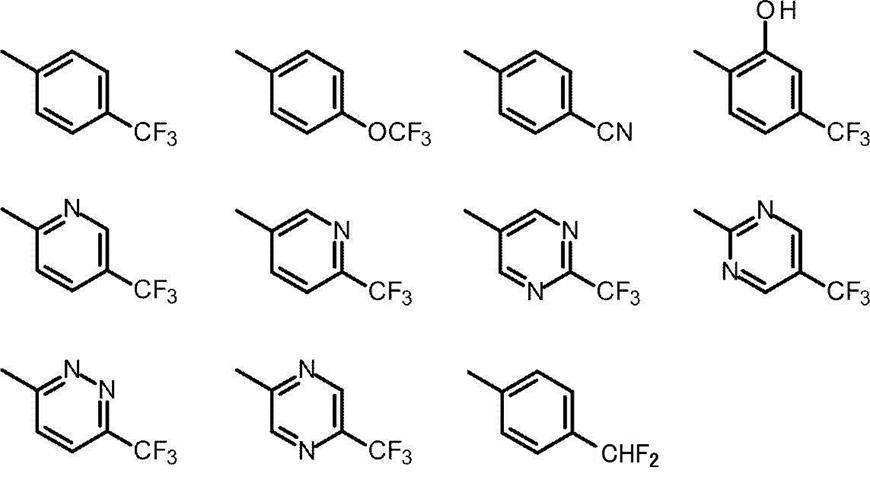
化合物[それぞれ、化合物A-2-18、化合物A-2’-18]、
R4およびR5が水素であり、環Aを含む部分構造(b)が
Compound [Compound A-2-18, Compound A-2′-18, respectively],
R 4 and R 5 are hydrogen, and the partial structure (b) containing ring A is

下図のいずれかの基であり; Any of the groups in the figure below;

Xが-Cyであり;
Cyが下図で示されるいずれかの基であり;
X is -Cy;
Cy is any group shown in the figure below;

部分構造(c)が Partial structure (c) is
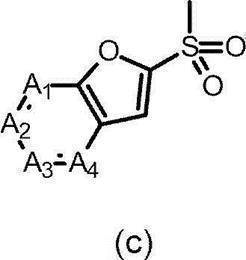
下図のいずれかの基である It is one of the following groups

化合物[それぞれ、化合物A-2-19、化合物A-2’-19]、
R4およびR5が水素であり、環Aを含む部分構造(b)が
Compound [Compound A-2-19, Compound A-2′-19, respectively],
R 4 and R 5 are hydrogen, and the partial structure (b) containing ring A is

下図の基であり、

R6が環状C3-6アルキル基(ヘテロ原子を含んでもよい)、置換基を有してもよいC1-6アルコキシ基、アミノ基、あるいは、C1-6アルキル基でモノ又はジ置換されたアミノ基であるXが-Cyであり、
Cyが下図で示されるいずれかの基であり;
R 6 is a cyclic C 3-6 alkyl group (which may contain a heteroatom), a C 1-6 alkoxy group which may have a substituent, an amino group, or a C 1-6 alkyl group, mono or disubstituted The amino group X is -Cy,
Cy is any group shown in the figure below;

部分構造(c)が Partial structure (c) is

下図のいずれかの基である It is one of the following groups

化合物[それぞれ、化合物A-2-19-1、化合物A-2’-19-1]が挙げられる。 And compounds [compound A-2-19-1, compound A-2'-19-1 respectively].
(B)式(II)中、
Qが=Oであり;
R4が、水素又はC1-6アルキル基であり;
R5が、水素又はC1-6アルキル基であり;
ただし、R4とR5は一緒になってシクロアルカンを形成せず;
Xが、水素、
-Cy、
-C(Rx1Rx2)-Cy、
-C(Rx1Rx2)-C(Rx3Rx4)-Cy、
-C(Rx1)=C(Rx2)-Cy、
-O-Cy、
-O-C(Rx1Rx2)-Cy、
-C(Rx1Rx2)-O-Cy、
-S(O)n-Cy、
-S(O)n-C(Rx1Rx2)-Cy、
-C(Rx1Rx2)-S(O)n-Cy、
-N(Rx5)-Cy、
-N(Rx5)-C(Rx1Rx2)-Cy、
-C(Rx1Rx2)-N(Rx5)-Cy、
-N(Rx5)-N(Rx6)-Cy、
-O-N(Rx5)-Cy、
-N(Rx5)-O-Cy、
-C(O)-N(Rx5)-Cy、
-N(Rx5)-C(O)-Cy、
-S(O)m-N(Rx5)-Cy、又は
-N(Rx5)-S(O)m-Cy
である化合物[化合物B]。
化合物Bの好ましい態様としては、
Yが-CH2-であり、Zが-CH2-であり、Wが結合であり、R3が水素である化合物[化合物B-1]、
環Aを含む部分構造(b)が
(B) In formula (II),
Q is = O;
R 4 is hydrogen or a C 1-6 alkyl group;
R 5 is hydrogen or a C 1-6 alkyl group;
Provided that R 4 and R 5 together do not form a cycloalkane;
X is hydrogen,
-Cy,
-C (R x1 R x2 ) -Cy,
-C (R x1 R x2 ) -C (R x3 R x4 ) -Cy,
-C (R x1 ) = C (R x2 ) -Cy,
-O-Cy,
-OC (R x1 R x2 ) -Cy,
-C (R x1 R x2 ) -O-Cy,
-S (O) n-Cy,
-S (O) n-C (R x1 R x2 ) -Cy,
-C (R x1 R x2 ) -S (O) n-Cy,
-N (R x5 ) -Cy,
-N (R x5 ) -C (R x1 R x2 ) -Cy,
-C (R x1 R x2 ) -N (R x5 ) -Cy,
-N (R x5 ) -N (R x6 ) -Cy,
-O-N (R x5 ) -Cy,
-N (R x5 ) -O-Cy,
-C (O) -N (R x5 ) -Cy,
-N (R x5 ) -C (O) -Cy,
-S (O) m-N (R x5 ) -Cy or -N (R x5 ) -S (O) m-Cy
Compound [Compound B].
As a preferred embodiment of Compound B,
Compound [Compound B-1] wherein Y is —CH 2 —, Z is —CH 2 —, W is a bond, and R 3 is hydrogen,
The partial structure (b) containing ring A is

下図のいずれかの基である It is one of the following groups

化合物[化合物B-2]、
環Aを含む部分構造(b)が
Compound [Compound B-2],
The partial structure (b) containing ring A is

下図の基であり The basis of the figure below
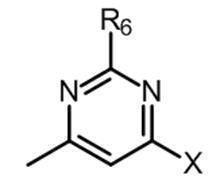
R6が環状C3-6アルキル基(ヘテロ原子を含んでもよい)、置換基を有してもよいC1-6アルコキシ基、アミノ基、あるいは、C1-6アルキル基でモノ又はジ置換されたアミノ基である
化合物[化合物B-2-1]、
部分構造(c)が
R 6 is a cyclic C 3-6 alkyl group (which may contain a heteroatom), a C 1-6 alkoxy group which may have a substituent, an amino group, or a C 1-6 alkyl group, mono or disubstituted A compound [compound B-2-1], which is a selected amino group,
Partial structure (c) is

下図のいずれかの基である It is one of the following groups

化合物[化合物B-3]、
Xが、水素、-Cy、-O-Cy、又は、-O-CH2-Cyである化合物[化合物B-4]、
Xが-Cyであり、Cyが下図で示されるいずれかの基である
Compound [Compound B-3],
Compound [Compound B-4], wherein X is hydrogen, —Cy, —O—Cy, or —O—CH 2 —Cy;
X is -Cy and Cy is any group shown in the figure below

化合物[化合物B-5]、
R4およびR5が水素であり、環Aを含む部分構造(b)が
Compound [Compound B-5],
R 4 and R 5 are hydrogen, and the partial structure (b) containing ring A is

下図のいずれかの基であり; Any of the groups in the figure below;

Xが-Cyであり、Cyが下図で示されるいずれかの基であり; X is -Cy and Cy is any group shown in the figure below;
部分構造(c)が Partial structure (c) is

下図のいずれかの基である It is one of the following groups

化合物[化合物B-6]、
R4およびR5が水素であり、環Aを含む部分構造(b)が
Compound [Compound B-6],
R 4 and R 5 are hydrogen, and the partial structure (b) containing ring A is

下図の基であり、
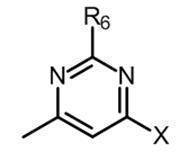
R6が環状C3-6アルキル基(ヘテロ原子を含んでもよい)、置換基を有してもよいC1-6アルコキシ基、アミノ基、あるいは、C1-6アルキル基でモノ又はジ置換されたアミノ基であり、Xが-Cyであり、
Cyが下図で示されるいずれかの基であり;
R 6 is a cyclic C 3-6 alkyl group (which may contain a heteroatom), a C 1-6 alkoxy group which may have a substituent, an amino group, or a C 1-6 alkyl group, mono or disubstituted An amino group, X is -Cy,
Cy is any group shown in the figure below;

部分構造(c)が Partial structure (c) is
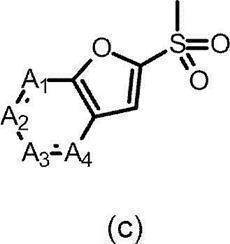
下図のいずれかの基である It is one of the following groups

化合物[それぞれ、化合物B-6-1]
が挙げられる。
Compound [Compound B-6-1, respectively]
Is mentioned.
本発明化合物として好ましくは、後述の実施例記載の化合物であり、より好ましくは、実施例1、2、4、5、6、7、8、9、10、11、12、13、14、16、17、18、19、20、25、26、27、30、31、34、35、36、37、38、41、42、43、44、47、48、49、51、53、54、56、57、65、66、67、69、70、71、77、79、80、84、86、87、88、89、90、92、93、94、95、97、98、99、100、101、102、104、106、107、108、109、110、115、116、117、119、123、124、127、128、129、130、132、133、135、136、137、138、139、140、141、142、145、148、149、150、151、153、155、156、157、158、159、160、161、164、172、173、174、175、179、181、190、191、192、193、194、195、196、197、198、199、200、201、202、203、205、206、207、210、212、214、215、216、221、222、223、224、225、226、229、230、231、233、235、239、240、248、252、255、258、259、262、263、264、265、267、268、269、270、271、272、273、274、275、278、279、281、285、287、288、289、290、291、293、296、297、298、299、309、310、311、312、315、318、326、327、328、329、330、332、333、336、337、338、339、341、344、348、349、357、359、360、362、364、368、369、371、372、374、375、376、378、379、380、381、382、383、384、385、386、387、388、389、390、391、392、393、394、395、396、397、398、399、400、401、402、403、404、405、406、407、408、409、410、411、412、413、414、416、417、418、419、420、421、422、423、424、426の化合物が挙げられる。 The compound of the present invention is preferably a compound described in the Examples below, and more preferably, Examples 1, 2, 4, 5, 6, 7, 8, 9, 10, 11, 12, 13, 14, 16 17, 18, 19, 20, 25, 26, 27, 30, 31, 34, 35, 36, 37, 38, 41, 42, 43, 44, 47, 48, 49, 51, 53, 54, 56 57, 65, 66, 67, 69, 70, 71, 77, 79, 80, 84, 86, 87, 88, 89, 90, 92, 93, 94, 95, 97, 98, 99, 100, 101 , 102, 104, 106, 107, 108, 109, 110, 115, 116, 117, 119, 123, 124, 127, 128, 129, 130, 132, 133, 135, 136, 137, 138, 139, 140 141, 42, 145, 148, 149, 150, 151, 153, 155, 156, 157, 158, 159, 160, 161, 164, 172, 173, 174, 175, 179, 181, 190, 191, 192, 193, 194, 195, 196, 197, 198, 199, 200, 201, 202, 203, 205, 206, 207, 210, 212, 214, 215, 216, 221, 222, 223, 224, 225, 226, 229, 230, 231, 233, 235, 239, 240, 248, 252, 255, 258, 259, 262, 263, 264, 265, 267, 268, 269, 270, 271, 272, 273, 274, 275, 278, 279, 281, 285, 287, 288, 289, 290, 291, 3, 296, 297, 298, 299, 309, 310, 311, 312, 315, 318, 326, 327, 328, 329, 330, 332, 333, 336, 337, 338, 339, 341, 344, 348, 349, 357, 359, 360, 362, 364, 368, 369, 371, 372, 374, 375, 376, 378, 379, 380, 381, 382, 383, 384, 385, 386, 387, 388, 389, 390, 391, 392, 393, 394, 395, 396, 397, 398, 399, 400, 401, 402, 403, 404, 405, 406, 407, 408, 409, 410, 411, 412, 413, 414, 416, 417, 418, 419, 420, 421, 422, 423, 424 426 compounds.
さらに好ましくは、実施例80、84、109、116、117、123、124、138、153、179、181、190、191、192、196、199、203、224、230、290、312、378、379、383、384、386、387、388、389、393、395、401、405,406、411、412記載の下記構造式の化合物またはその医薬上許容される塩である。 More preferably, Examples 80, 84, 109, 116, 117, 123, 124, 138, 153, 179, 181, 190, 191, 192, 196, 199, 203, 224, 230, 290, 312, 378, 379, 383, 384, 386, 387, 388, 389, 393, 395, 401, 405, 406, 411, 412 or a pharmaceutically acceptable salt thereof.


本発明化合物が塩の形態を成し得る場合、その塩は医薬上許容されるものであればよく、例えば、式中にカルボキシル基等の酸性基が存在する場合の酸性基に対しては、アンモニウム塩、ナトリウム、カリウム等のアルカリ金属との塩、カルシウム、マグネシウム等のアルカリ土類金属との塩、アルミニウム塩、亜鉛塩、トリエチルアミン、エタノールアミン、モルホリン、ピペリジン、ジシクロへキシルアミン等の有機アミンとの塩、アルギニン、リジン等の塩基性アミノ酸との塩が挙げられる。式中に塩基性基が存在する場合の塩基性基に対しては、塩酸、硫酸、リン酸、硝酸、臭化水素酸などの無機酸との塩、酢酸、トリフルオロ酢酸、クエン酸、安息香酸、マレイン酸、フマル酸、酒石酸、コハク酸、タンニン酸、酪酸、ヒベンズ酸、パモ酸、エナント酸、デカン酸、テオクル酸、サリチル酸、乳酸、シュウ酸、マンデル酸、リンゴ酸等の有機カルボン酸との塩、メタンスルホン酸、ベンゼンスルホン酸、p-トルエンスルホン酸等の有機スルホン酸との塩が挙げられる。塩を形成する方法としては、本発明化合物と必要な酸または塩基とを適当な量比で溶媒、分散剤中で混合することや、他の塩の形より陽イオン交換または陰イオン交換を行うことによっても得られる。 In the case where the compound of the present invention can form a salt form, the salt may be any one that is pharmaceutically acceptable. For example, for an acidic group where an acidic group such as a carboxyl group is present in the formula, Ammonium salts, salts with alkali metals such as sodium and potassium, salts with alkaline earth metals such as calcium and magnesium, organic amines such as aluminum salts, zinc salts, triethylamine, ethanolamine, morpholine, piperidine and dicyclohexylamine And salts with basic amino acids such as arginine and lysine. When a basic group is present in the formula, for a basic group, salts with inorganic acids such as hydrochloric acid, sulfuric acid, phosphoric acid, nitric acid, hydrobromic acid, acetic acid, trifluoroacetic acid, citric acid, benzoic acid Organic carboxylic acids such as acid, maleic acid, fumaric acid, tartaric acid, succinic acid, tannic acid, butyric acid, hibenzic acid, pamoic acid, enanthic acid, decanoic acid, teocric acid, salicylic acid, lactic acid, oxalic acid, mandelic acid, malic acid And salts with organic sulfonic acids such as methanesulfonic acid, benzenesulfonic acid, and p-toluenesulfonic acid. As a method for forming a salt, the compound of the present invention and a necessary acid or base are mixed in a solvent or a dispersant in an appropriate amount ratio, or cation exchange or anion exchange is performed from other salt forms. Can also be obtained.
本発明化合物には、光学異性体、立体異性体、互変異性体、回転異性体、あるいは、それらの任意比率による混合物も包含される。これらは自体公知の合成手法、分離手法によりそれぞれを単品として得ることができる。例えば、光学異性体は、光学活性な合成中間体を用いる、または、合成中間体もしくは最終物のラセミ体を常法に従って光学分割することにより得ることができる。
さらに、安定同位体や放射性同位体も含まれる。
The compounds of the present invention also include optical isomers, stereoisomers, tautomers, rotational isomers, or mixtures in any ratio thereof. Each of these can be obtained as a single product by a known synthesis method and separation method. For example, optical isomers can be obtained by using optically active synthetic intermediates or optically resolving synthetic intermediates or final racemates according to a conventional method.
Furthermore, stable isotopes and radioactive isotopes are also included.
本発明化合物には、その溶媒和物、例えば水和物、アルコール付加物等も含まれる。 The compound of the present invention includes solvates thereof, such as hydrates and alcohol adducts.
本発明化合物は、プロドラッグ化することもできる。本発明におけるプロドラッグとは、体内で変換されて本発明の化合物を生成する化合物を表す。例えば、活性本体がカルボキシル基やリン酸基を含む場合はそれらのエステル、アミド等が挙げられる。また、活性本体がアミノ基を含む場合にはそのアミド、カーバメート等が挙げられる。活性本体が水酸基を含む場合にはそのエステル、カーボネート、カーバメート等が挙げられる。本発明化合物をプロドラッグ化する際にはアミノ酸、糖類と結合していてもよい。 The compound of the present invention can be converted into a prodrug. The prodrug in the present invention refers to a compound that is converted in the body to produce the compound of the present invention. For example, when the active main body contains a carboxyl group or a phosphate group, their esters and amides can be mentioned. Further, when the active main body contains an amino group, its amide, carbamate and the like can be mentioned. When the active main body contains a hydroxyl group, its ester, carbonate, carbamate and the like can be mentioned. When the compound of the present invention is converted into a prodrug, it may be bound to an amino acid or a saccharide.
本発明には、本発明化合物の代謝物も含まれる。本発明化合物の代謝物とは、本発明化合物が生体内の代謝酵素等で変換された化合物を示す。例えば本発明化合物のベンゼン環上に代謝によって水酸基が導入された化合物、本発明化合物のカルボン酸部分、あるいは代謝によって付加された水酸基にグルクロン酸、グルコース、アミノ酸が結合した化合物等が挙げられる。 The present invention includes metabolites of the compounds of the present invention. The metabolite of the compound of the present invention refers to a compound obtained by converting the compound of the present invention with a metabolic enzyme or the like in vivo. For example, a compound in which a hydroxyl group is introduced by metabolism on the benzene ring of the compound of the present invention, a carboxylic acid moiety of the compound of the present invention, or a compound in which glucuronic acid, glucose, or an amino acid is bonded to the hydroxyl group added by metabolism.
本発明化合物は、ヒトをはじめウシ、ウマ、イヌ、マウス、ラット等の哺乳動物に対し優れたTRPA1アンタゴニスト活性を有するため、医薬として使用することができ、そのままあるいは自体公知の方法に従って、医薬的に許容し得る担体とともに混合した医薬組成物として、通常経口が好ましいが、非経口(例えば、静脈内、皮下、筋肉内、坐薬、注腸、軟膏、貼布、舌下、点眼、吸入等のルート)により投与することもできる。上記目的のために用いる投与量は、目的とする治療効果、投与方法、治療期間、年齢、体重等により決定されるが、経口もしくは非経口のルートにより、通常成人一日あたりの投与量として経口投与の場合で1μg~10g、非経口投与の場合で0.01μg~1gを用い、1日1回~数回あるいは数日に1回投与する。また、上記医薬組成物中の本発明の化合物の含有量は、組成物全体の約0.01重量%~100重量%である。 Since the compound of the present invention has excellent TRPA1 antagonist activity against mammals such as humans, cattle, horses, dogs, mice, rats and the like, it can be used as a pharmaceutical, and it can be used as it is or according to a method known per se. As a pharmaceutical composition mixed with a pharmaceutically acceptable carrier, oral administration is usually preferred, but parenteral (for example, intravenous, subcutaneous, intramuscular, suppository, enema, ointment, patch, sublingual, eye drop, inhalation, etc. Route). The dose to be used for the above purpose is determined by the intended therapeutic effect, administration method, treatment period, age, body weight, etc. In the case of administration, 1 μg to 10 g is used, and in the case of parenteral administration, 0.01 μg to 1 g is used. The content of the compound of the present invention in the pharmaceutical composition is about 0.01% to 100% by weight of the whole composition.
本発明の医薬組成物における医薬的に許容し得る担体としては、製剤素材として慣用の各種有機あるいは無機担体物質が挙げられ、例えば、固形製剤における賦形剤、滑沢剤、結合剤、崩壊剤、水溶性高分子、塩基性無機塩;液状製剤における溶剤、溶解補助剤、懸濁化剤、等張化剤、緩衝剤、無痛化剤等があげられる。また、必要に応じて、通常の防腐剤、抗酸化剤、着色剤、甘味剤、酸味剤、発泡剤、香料等の添加物を用いることもできる。 Examples of the pharmaceutically acceptable carrier in the pharmaceutical composition of the present invention include various organic or inorganic carrier substances conventionally used as a pharmaceutical material. For example, excipients, lubricants, binders, disintegrants in solid preparations. Water-soluble polymers, basic inorganic salts; solvents, solubilizers, suspending agents, isotonic agents, buffers, soothing agents, etc. in liquid preparations. Further, if necessary, additives such as ordinary preservatives, antioxidants, colorants, sweeteners, sour agents, foaming agents, and fragrances can be used.
このような医薬組成物の剤形としては、例えば、錠剤、散剤、丸剤、顆粒剤、カプセル剤、坐剤、液剤、糖衣剤、デポー剤、シロップ剤、懸濁剤、乳剤、トローチ剤、舌下剤、貼付剤、口腔内崩壊剤(錠)、吸入剤、注腸剤、軟膏剤、貼付剤、テープ剤、点眼剤にしてよく、普通の製剤助剤を用いて常法に従って製造することができる。 Examples of the dosage form of such a pharmaceutical composition include tablets, powders, pills, granules, capsules, suppositories, liquids, dragees, depots, syrups, suspensions, emulsions, lozenges, Sublingual, patch, orally disintegrating agent (tablet), inhalant, enema, ointment, patch, tape, ophthalmic preparation, manufactured according to conventional methods using ordinary formulation aids Can do.
本発明の医薬組成物は、製剤技術分野において慣用の方法、例えば日本薬局方に記載の方法等により製造することができる。以下に、製剤の具体的な製造法について詳述する。
例えば、本発明化合物を経口用製剤として調製する場合には賦形剤、さらに必要に応じて結合剤、崩壊剤、滑沢剤、着色剤、矯味矯臭剤等を加えた後、常法により例えば錠剤、散剤、丸剤、顆粒剤、カプセル剤、溶液剤、糖衣剤、デポー剤、またはシロップ剤等とする。賦形剤としては、例えば乳糖、コーンスターチ、白糖、ブトウ糖、ソルビット、結晶セルロース等が、結合剤としては例えば、ポリビニルアルコール、ポリビニルエーテル、エチルセルロース、メチルセルロース、アラビアゴム、トラガカント、ゼラチン、シェラック、ヒドロキシプロピルセルロース、ヒドロキシプロピルスターチ、ポリビニルピロリドン等が、崩壊剤としては例えばデンプン、寒天、ゼラチン末、結晶セルロース、炭酸カルシウム、炭酸水素ナトリウム、クエン酸カルシウム、デキストラン、ペクチン等が、滑沢剤としては例えば、ステアリン酸マグネシウム、タルク、ポリエチレングリコール、シリカ、硬化植物油等が、着色剤としては医薬品に添加することが許可されているものが、矯味矯臭剤としては、ココア末、ハッカ脳、芳香酸、ハッカ油、竜脳、桂皮末等が用いられる。これらの錠剤または顆粒剤には、糖衣、ゼラチン衣、その他必要により適宜コーティングすることはもちろん差しつかえない。
The pharmaceutical composition of the present invention can be produced by a method commonly used in the field of pharmaceutical technology, such as the method described in the Japanese Pharmacopoeia. Below, the specific manufacturing method of a formulation is explained in full detail.
For example, when preparing the compound of the present invention as an oral preparation, after adding an excipient, and if necessary, a binder, a disintegrant, a lubricant, a coloring agent, a flavoring agent, etc. Tablets, powders, pills, granules, capsules, solutions, dragees, depots, syrups, etc. Excipients include, for example, lactose, corn starch, sucrose, butter sugar, sorbit, crystalline cellulose, etc., and binders include, for example, polyvinyl alcohol, polyvinyl ether, ethyl cellulose, methyl cellulose, gum arabic, tragacanth, gelatin, shellac, hydroxypropyl Cellulose, hydroxypropyl starch, polyvinylpyrrolidone and the like are disintegrating agents such as starch, agar, gelatin powder, crystalline cellulose, calcium carbonate, sodium bicarbonate, calcium citrate, dextran, pectin and the like, and lubricants include, for example, Magnesium stearate, talc, polyethylene glycol, silica, hydrogenated vegetable oil, etc. are permitted to be added to pharmaceuticals as colorants, but as flavoring agents, cocoa powder, Tsu mosquito brain, aromatic acid, peppermint oil, borneol, cinnamon powder and the like are used. Of course, these tablets or granules may be appropriately coated with sugar coating, gelatin coating, etc. if necessary.
注射剤を調製する場合には必要によりpH調整剤、緩衝剤、安定化剤、保存剤等を添加し、常法により皮下、筋肉内、静脈内注射剤とする。 When preparing injections, pH adjusters, buffers, stabilizers, preservatives, etc. are added as necessary, and subcutaneous, intramuscular and intravenous injections are prepared by conventional methods.
また、本発明化合物は前述のとおり、哺乳動物(例えば、マウス、ラット、ハムスター、ウサギ、ネコ、イヌ、ブタ、ウシ、ヒツジ、ウマ、サル、ヒト等、好ましくはヒト)に対して、優れたTRPA1アンタゴニスト活性を有しているので、TRPA1アンタゴニストとして有用である。さらに、本発明化合物は、TRPA1が関与する疾患の予防及び/または治療に有用であり、本発明化合物は当該疾患の予防及び/または治療用の医薬として提供され得る。
TRPA1が関与する疾患としては、疼痛関連疾患、消化器疾患、肺疾患、膀胱疾患、炎症性疾患、皮膚疾患、及び神経疾患等が挙げられる。
疼痛関連疾患としては、具体的には、慢性疼痛、神経障害性疼痛、急性疼痛、炎症性疼痛、帯状疱疹後疼痛、ニューロパチー、神経痛、糖尿病性ニューロパチー、HIV関連ニューロパチー、神経損傷、関節リウマチ痛、骨関節炎痛、背痛、腰痛、癌性疼痛、歯痛、頭痛、片頭痛、手根管症候群、線維筋痛症、神経炎、坐骨神経痛、骨盤過敏症、骨盤痛、生理痛、内臓痛、術後疼痛等が挙げられる。
消化器疾患としては、機能性胃腸障害{嚥下障害、機能性胃腸症(FD)、過敏性腸症候群(IBS)、機能性腹痛症候群}、逆流性食道炎(GERD)、潰瘍、炎症性腸疾患(IBD)、嘔吐(癌化学療法誘発性嘔吐)、膵炎等が挙げられる。
肺疾患としては、喘息、慢性咳嗽、慢性閉塞性肺疾患(COPD)、気管支収縮等が挙げられる。
膀胱疾患としては、過活動膀胱、排尿異常、膀胱炎等が挙げられる。
炎症性疾患としては、火傷、骨関節炎等が挙げられる。
皮膚疾患としては、アトピー性皮膚炎を含むアレルギー性皮膚炎、掻痒症等が挙げられる。
神経疾患としては、抗がん剤誘発神経障害等が挙げられる。
TRPA1が関与する疾患としては、好ましくは、慢性疼痛、神経障害性疼痛、急性疼痛、喘息、慢性閉塞性肺疾患、機能性胃腸障害、逆流性食道炎、炎症性腸疾患、掻痒症、抗がん剤誘発神経障害等が挙げられる。
Further, as described above, the compound of the present invention is superior to mammals (eg, mouse, rat, hamster, rabbit, cat, dog, pig, cow, sheep, horse, monkey, human, etc., preferably human). Since it has a TRPA1 antagonist activity, it is useful as a TRPA1 antagonist. Furthermore, the compound of the present invention is useful for the prevention and / or treatment of a disease involving TRPA1, and the compound of the present invention can be provided as a medicament for the prevention and / or treatment of the disease.
Examples of diseases involving TRPA1 include pain-related diseases, gastrointestinal diseases, lung diseases, bladder diseases, inflammatory diseases, skin diseases, and neurological diseases.
Specific examples of pain-related diseases include chronic pain, neuropathic pain, acute pain, inflammatory pain, postherpetic pain, neuropathy, neuralgia, diabetic neuropathy, HIV-related neuropathy, nerve injury, rheumatoid arthritis, Osteoarthritic pain, back pain, back pain, cancer pain, toothache, headache, migraine, carpal tunnel syndrome, fibromyalgia, neuritis, sciatica, pelvic hypersensitivity, pelvic pain, menstrual pain, visceral pain, surgery Examples include post-pain.
Gastrointestinal disorders include functional gastrointestinal disorders {dysphagia, functional gastroenteropathy (FD), irritable bowel syndrome (IBS), functional abdominal pain syndrome}, reflux esophagitis (GERD), ulcer, inflammatory bowel disease (IBD), vomiting (cancer chemotherapy-induced vomiting), pancreatitis and the like.
Examples of pulmonary diseases include asthma, chronic cough, chronic obstructive pulmonary disease (COPD), and bronchoconstriction.
Bladder diseases include overactive bladder, dysuria, cystitis and the like.
Inflammatory diseases include burns, osteoarthritis and the like.
Examples of skin diseases include allergic dermatitis including atopic dermatitis, pruritus and the like.
Examples of neurological diseases include anticancer drug-induced neuropathy.
Diseases involving TRPA1 are preferably chronic pain, neuropathic pain, acute pain, asthma, chronic obstructive pulmonary disease, functional gastrointestinal disorder, reflux esophagitis, inflammatory bowel disease, pruritus, anti And drug-induced neuropathy.
以下に本発明化合物のうち代表的な化合物の製造方法を以下に示すが、本発明化合物の製造方法はこれらに限定されるものではない。なお、図中の各記号は上述と同義である。
化合物(I)の合成方法の一例を以下に示す。
例えば式(I)中、Qが=Sであるとき、すなわち
Although the manufacturing method of a typical compound is shown below among this invention compounds, the manufacturing method of this invention compound is not limited to these. In addition, each symbol in a figure is synonymous with the above-mentioned.
An example of the synthesis method of compound (I) is shown below.
For example, in the formula (I), when Q is = S, that is,

が But

で示される化合物(I-S)は、Qが=Oであるとき、すなわち In the compound (IS) represented by the formula (I), when Q is ═O, that is,
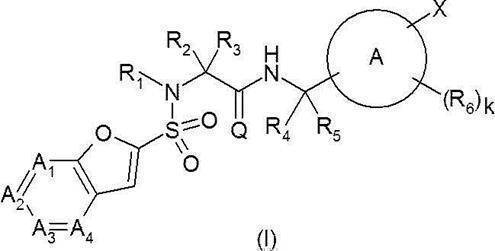
が But

で示される化合物(I-O)から合成することが出来、代表的な合成方法を以下に示す。 A typical synthesis method is shown below.

化合物(I-O)を、例えばテトラヒドロフラン等の本反応に悪影響を及ぼさない溶媒中でローソン試薬等と反応させることで目的とする化合物(I-S)を合成することができる。 The target compound (IS) can be synthesized by reacting the compound (I—O) with a Lawson reagent or the like in a solvent that does not adversely affect the present reaction, such as tetrahydrofuran.
式(I)中、特にQが=Oである場合を例にとって以下に代表的な合成方法を示す。化合物(I-O)は以下のように合成することが出来る。 In the formula (I), a typical synthesis method is shown below by taking as an example the case where Q is ═O in particular. Compound (IO) can be synthesized as follows.

カルボン酸誘導体(1A)とアミン誘導体(1B)とを例えばジクロロメタン等の本反応に悪影響を及ぼさない溶媒中、例えば1-ヒドロキシベンゾトリアゾール等の存在下または非存在下で1-エチル-3-(3’-ジメチルアミノプロピル)カルボジイミド(WSC)に代表されるような縮合剤をトリエチルアミン等の塩基存在下または非存在下で反応させることで、目的とする化合物(I-O)を製造する事が出来る。
上記カルボン酸誘導体(1A)は以下のようにして、合成することが可能である。
Carboxylic acid derivative (1A) and amine derivative (1B) are combined in a solvent that does not adversely affect the reaction, such as dichloromethane, in the presence or absence of 1-hydroxybenzotriazole or the like. A target compound (IO) can be produced by reacting a condensing agent represented by 3′-dimethylaminopropyl) carbodiimide (WSC) in the presence or absence of a base such as triethylamine. I can do it.
The carboxylic acid derivative (1A) can be synthesized as follows.
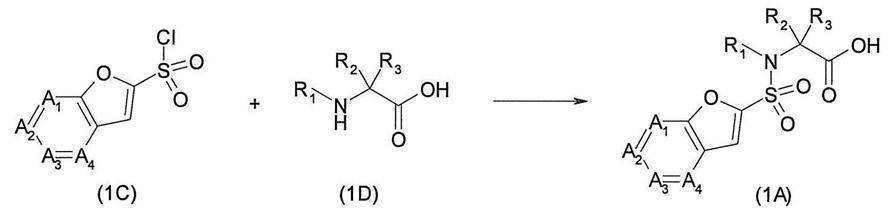
スルホニルクロリド誘導体(1C)とアミン誘導体(1D)とを例えばテトラヒドロフラン、水の混合溶媒等の本反応に悪影響を及ぼさない溶媒中、例えば水酸化ナトリウム等の塩基存在下で反応させることでカルボン酸誘導体(1A)を合成できる。なお、アミン誘導体(1D)のカルボン酸は必要があれば適切な保護基、例えばメチル、エチル、ベンジル、tert-ブチル等で保護し、上記のスルホンアミド化の後に酸処理等の適切な方法で保護基を除去することにより、カルボン酸誘導体(1A)を合成することもできる。
スルホニルクロリド誘導体(1C)は以下のようにして合成することが可能である。
Carboxylic acid derivatives by reacting a sulfonyl chloride derivative (1C) and an amine derivative (1D) in a solvent that does not adversely affect the reaction, such as a mixed solvent of tetrahydrofuran and water, in the presence of a base such as sodium hydroxide. (1A) can be synthesized. If necessary, the carboxylic acid of the amine derivative (1D) is protected with an appropriate protecting group such as methyl, ethyl, benzyl, tert-butyl, etc., and after the sulfonamidation, an appropriate method such as acid treatment is used. Carboxylic acid derivative (1A) can also be synthesized by removing the protecting group.
The sulfonyl chloride derivative (1C) can be synthesized as follows.
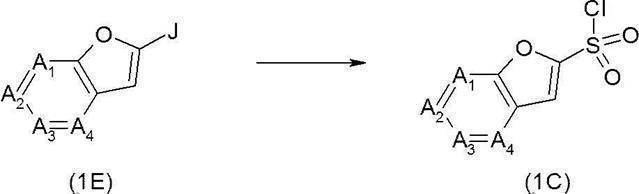
フラン誘導体(1E)(式中Jは臭素原子やヨウ素原子、塩素原子、水素原子等を示す)を例えばジエチルエーテル、テトラヒドロフラン等の本反応に悪影響を及ぼさない溶媒中、例えばn-ブチルリチウム、sec-ブチルリチウム又はtert-ブチルリチウム等を作用させた後、例えば二酸化硫黄を作用させ、例えばN-クロロこはく酸イミド等と反応させることにより、スルホニルクロリド誘導体(1C)を合成することができる。 The furan derivative (1E) (wherein J represents a bromine atom, an iodine atom, a chlorine atom, a hydrogen atom, etc.), for example, n-butyllithium, sec. The sulfonyl chloride derivative (1C) can be synthesized by reacting, for example, -butyllithium or tert-butyllithium, and then reacting with, for example, sulfur dioxide and reacting with, for example, N-chlorosuccinimide.
例えば式(1B)中、-Xが-C(Rx1Rx2)-O-Cyで表される基のとき、すなわち For example, in the formula (1B), when —X is a group represented by —C (R x1 R x2 ) —O—Cy,

が But

で示される化合物(1B-1)の合成方法を以下に示す。 A synthesis method of the compound (1B-1) represented by the formula is shown below.

アルコール誘導体(1F)(式中PG1はtert-ブトキシカルボニル基(Boc基)やベンジルオキシカルボニル基(Cbz基)等の適当な保護基を示す。また必要があれば対応するカルボン酸誘導体、エステル誘導体、アルデヒド誘導体、ケトン誘導体等を還元あるいはアルキル化等することにより合成する)とアルコール誘導体(1G)とを、例えばジクロロメタン、テトラヒドロフラン等の本反応に悪影響を及ぼさない溶媒中、例えばトリフェニルホスフィン等の存在下、アゾジカルボン酸ジイソプロピル(DIAD)やアゾジカルボン酸ジエチル(DEAD)等を用いて反応させることで、エーテル誘導体(1H)を合成できる。その後、保護基PG1を脱保護することで目的とする化合物(1B-1)を製造する事が出来る。脱保護の反応は公知であり、例えばPG1がtert-ブトキシカルボニル基を示す場合は塩酸やトリフルオロ酢酸のようなプロトン酸を用いる方法や三フッ化ホウ素や四塩化スズのようなルイス酸を用いる方法が挙げられる。また、例えばPG1がベンジルオキシカルボニル基を示す場合は、触媒量のパラジウム/炭素等の存在下、常圧あるいは加圧水素雰囲気中での水素添加反応を用いる方法や臭化水素酸/酢酸を用いる方法等が挙げられる。また、アルコール誘導体(1F)の水酸基を例えば塩素原子、臭素原子、ヨウ素原子、メタンスルホニルオキシ基、p-トルエンスルホニルオキシ基などの脱離基へと変換し、例えばテトラヒドロフラン又はN,N-ジメチルホルムアミド等の本反応に悪影響を及ぼさない溶媒中、例えば水素化ナトリウム、炭酸カリウム、炭酸セシウム、トリエチルアミン又はN-エチルジイソプロピルアミン等の塩基存在下、例えばヨウ化カリウム、ヨウ化ナトリウム、ヨウ化テトラ-n-ブチルアンモニウム等の存在下又は非存在下でアルコール誘導体(1G)と反応させることによっても、エーテル誘導体(1H)を製造する事が出来る。 Alcohol derivative (1F) (wherein PG1 represents an appropriate protecting group such as tert-butoxycarbonyl group (Boc group) or benzyloxycarbonyl group (Cbz group). If necessary, the corresponding carboxylic acid derivative or ester derivative) Synthesize aldehyde derivatives, ketone derivatives, etc. by reduction or alkylation) and alcohol derivatives (1G) in a solvent that does not adversely affect the reaction, such as dichloromethane, tetrahydrofuran, etc., for example, triphenylphosphine, etc. The ether derivative (1H) can be synthesized by reacting in the presence using diisopropyl azodicarboxylate (DIAD), diethyl azodicarboxylate (DEAD), or the like. Thereafter, the target compound (1B-1) can be produced by deprotecting the protecting group PG1. The deprotection reaction is known. For example, when PG1 represents a tert-butoxycarbonyl group, a method using a protonic acid such as hydrochloric acid or trifluoroacetic acid, or a Lewis acid such as boron trifluoride or tin tetrachloride is used. A method is mentioned. For example, when PG1 represents a benzyloxycarbonyl group, a method using a hydrogenation reaction in a normal pressure or pressurized hydrogen atmosphere in the presence of a catalytic amount of palladium / carbon or the like, or a method using hydrobromic acid / acetic acid Etc. Further, the hydroxyl group of the alcohol derivative (1F) is converted into a leaving group such as a chlorine atom, a bromine atom, an iodine atom, a methanesulfonyloxy group, a p-toluenesulfonyloxy group, for example, tetrahydrofuran or N, N-dimethylformamide. In the presence of a base such as sodium hydride, potassium carbonate, cesium carbonate, triethylamine or N-ethyldiisopropylamine, for example, potassium iodide, sodium iodide, tetra-n iodide The ether derivative (1H) can also be produced by reacting with the alcohol derivative (1G) in the presence or absence of butylammonium.
例えば式(1B)中、-Xが-O-C(Rx1Rx2)-Cyで表される基のとき、すなわち For example, in the formula (1B), when —X is a group represented by —O—C (R x1 R x2 ) —Cy, that is,

が But

で示される化合物(1B-2)の合成方法を以下に示す。 A synthesis method of the compound (1B-2) represented by the formula is shown below.

アルコール誘導体(1I)(式中PG1はtert-ブトキシカルボニル基(Boc基)やベンジルオキシカルボニル基(Cbz基)等の適当な保護基を示す)とアルコール誘導体(1J)(必要があれば対応するカルボン酸誘導体、エステル誘導体、アルデヒド誘導体、ケトン誘導体等を還元あるいはアルキル化等することにより合成する)とを、例えばジクロロメタン、テトラヒドロフラン等の本反応に悪影響を及ぼさない溶媒中、例えばトリフェニルホスフィン等の存在下、アゾジカルボン酸ジイソプロピル(DIAD)やアゾジカルボン酸ジエチル(DEAD)等を用いて反応させることで、エーテル誘導体(1K)を合成できる。保護基PG1を酸処理あるいは加水素分解等の適当な方法により脱保護することで目的とする化合物(1B-2)を製造する事が出来る。また、アルコール誘導体(1J)の水酸基を例えば塩素原子、臭素原子、ヨウ素原子、メタンスルホニルオキシ基、p-トルエンスルホニルオキシ基などの脱離基へと変換し、例えばテトラヒドロフラン又はN,N-ジメチルホルムアミド等の本反応に悪影響を及ぼさない溶媒中、例えば水素化ナトリウム、炭酸カリウム、炭酸セシウム、トリエチルアミン又はN-エチルジイソプロピルアミン等の塩基存在下、例えばヨウ化カリウム、ヨウ化ナトリウム、ヨウ化テトラ-n-ブチルアンモニウム等の存在下又は非存在下でアルコール誘導体(1I)と反応させることによっても、エーテル誘導体(1K)を合成する事が出来る。 Alcohol derivative (1I) (wherein PG1 represents an appropriate protecting group such as tert-butoxycarbonyl group (Boc group) or benzyloxycarbonyl group (Cbz group)) and alcohol derivative (1J) (corresponding if necessary) A carboxylic acid derivative, an ester derivative, an aldehyde derivative, a ketone derivative, etc. by synthesizing or reducing the alkyl group) in a solvent that does not adversely affect the reaction, such as dichloromethane or tetrahydrofuran, such as triphenylphosphine. In the presence, the ether derivative (1K) can be synthesized by reacting with diisopropyl azodicarboxylate (DIAD), diethyl azodicarboxylate (DEAD), or the like. The desired compound (1B-2) can be produced by deprotecting the protecting group PG1 by an appropriate method such as acid treatment or hydrogenolysis. Further, the hydroxyl group of the alcohol derivative (1J) is converted into a leaving group such as a chlorine atom, bromine atom, iodine atom, methanesulfonyloxy group, p-toluenesulfonyloxy group, and the like, for example, tetrahydrofuran or N, N-dimethylformamide. In the presence of a base such as sodium hydride, potassium carbonate, cesium carbonate, triethylamine or N-ethyldiisopropylamine, for example, potassium iodide, sodium iodide, tetra-n iodide The ether derivative (1K) can also be synthesized by reacting with the alcohol derivative (1I) in the presence or absence of butylammonium.
例えば式(1B)中、-Xが-Cyで表される基であり、R4及びR5がともに水素原子のとき、すなわち For example, in the formula (1B), when -X is a group represented by -Cy and both R 4 and R 5 are hydrogen atoms,

が But

で示される化合物(1B-3)の合成方法を以下に示す。 A synthesis method of the compound (1B-3) represented by the formula is shown below.

ニトリル誘導体(1L)(式中LGは塩素原子、臭素原子、ヨウ素原子、トリフルオロメタンスルホニルオキシ基等の適当な脱離基を示す)とボロン酸誘導体(1M)(式中-B(OPG2)2は、-B(OH)2またはカテコールボラン、ピナコールボラン、ボロン酸N-メチルイミノ二酢酸エステル等の適当なボロン酸誘導体を示す)を、例えば1,4-ジオキサン又はトルエン、ブタノール等の本反応に悪影響を及ぼさない溶媒中、水等の共溶媒の存在下又は非存在下、水酸化ナトリウム、炭酸ナトリウム、炭酸カリウム、炭酸水素ナトリウム、炭酸水素カリウム、リン酸三カリウム等の塩基と、酢酸銅等の存在下又は非存在下、2,4,6-トリイソプロピル-2’-(ジシクロヘキシルホスフィノ)ビフェニル等の存在下又は非存在下、[1,1’-ビス(ジフェニルホスフィノ)フェロセン]ジクロロパラジウム、トリス(ジベンジリデンアセトン)ジパラジウム、テトラキス(トリフェニルホスフィン)パラジウム等の触媒の存在下で反応させることでニトリル誘導体(1N)を合成することができる。得られたニトリル誘導体(1N)を、例えば水、メタノール、エタノール又はテトラヒドロフラン等の本反応に悪影響を与えない溶媒中、例えばパラジウム/炭素、水酸化パラジウム、白金/炭素等の触媒の存在下、例えば酢酸又は塩酸等の酸の存在下又は非存在下、常圧又は加圧の水素雰囲気下で還元することでアミン誘導体(1B-3)を合成することができる。また、例えばテトラヒドロフラン等の本反応に悪影響を及ぼさない溶媒中、例えば水素化アルミニウムリチウムやボラン・テトラヒドロフラン錯体等を用いて反応させることでも、アミン誘導体(1B-3)を合成することが出来る。また、例えばテトラヒドロフラン等の本反応に悪影響を及ぼさない溶媒中、例えば水等の共溶媒の存在下又は非存在下、例えば塩化コバルト等の触媒の存在下、テトラヒドロホウ酸ナトリウム等を用いて反応させることでも、アミン誘導体(1B-3)を合成することが出来る。 Nitrile derivative (1L) (wherein LG represents a suitable leaving group such as chlorine atom, bromine atom, iodine atom, trifluoromethanesulfonyloxy group) and boronic acid derivative (1M) (wherein —B (OPG2) 2 Represents a suitable boronic acid derivative such as —B (OH) 2 or catecholborane, pinacolborane, boronic acid N-methyliminodiacetic acid ester), for example, for this reaction such as 1,4-dioxane or toluene, butanol, etc. Bases such as sodium hydroxide, sodium carbonate, potassium carbonate, sodium bicarbonate, potassium bicarbonate, tripotassium phosphate, copper acetate, etc. in the presence or absence of co-solvents such as water in solvents that do not adversely affect In the presence or absence of 2,4,6-triisopropyl-2 '-(dicyclohexylphosphino) biphenyl and the like Then, the reaction is carried out in the presence of a catalyst such as [1,1′-bis (diphenylphosphino) ferrocene] dichloropalladium, tris (dibenzylideneacetone) dipalladium, tetrakis (triphenylphosphine) palladium, etc. ) Can be synthesized. The obtained nitrile derivative (1N) is used in a solvent that does not adversely affect the reaction such as water, methanol, ethanol or tetrahydrofuran, for example, in the presence of a catalyst such as palladium / carbon, palladium hydroxide, platinum / carbon, etc. The amine derivative (1B-3) can be synthesized by reduction in the presence or absence of an acid such as acetic acid or hydrochloric acid in a hydrogen atmosphere under normal pressure or pressure. Alternatively, the amine derivative (1B-3) can also be synthesized by reacting, for example, using lithium aluminum hydride, borane / tetrahydrofuran complex or the like in a solvent that does not adversely affect the reaction such as tetrahydrofuran. In addition, the reaction is carried out using sodium tetrahydroborate in a solvent that does not adversely affect the reaction such as tetrahydrofuran, for example, in the presence or absence of a co-solvent such as water, for example, in the presence of a catalyst such as cobalt chloride. In this way, the amine derivative (1B-3) can also be synthesized.
また、アミン誘導体(1B-3)は以下のようにも合成できる。 The amine derivative (1B-3) can also be synthesized as follows.

ニトリル誘導体(1O)(式中-B(OPG2)2は、-B(OH)2またはカテコールボラン、ピナコールボラン、ボロン酸N-メチルイミノ二酢酸エステル等の適当なボロン酸誘導体を示す)と適切な脱離基を有する化合物(1P)(式中LGは塩素原子、臭素原子、ヨウ素原子、トリフルオロメタンスルホニルオキシ基等の適当な脱離基を示す)を、例えば1,4-ジオキサン又はトルエン、ブタノール等の本反応に悪影響を及ぼさない溶媒中、水等の共溶媒の存在下又は非存在下、水酸化ナトリウム、炭酸ナトリウム、炭酸カリウム、炭酸水素ナトリウム、炭酸水素カリウム、リン酸三カリウム等の塩基と、酢酸銅等の存在下又は非存在下、2,4,6-トリイソプロピル-2’-(ジシクロヘキシルホスフィノ)ビフェニル等の存在下又は非存在下、[1,1’-ビス(ジフェニルホスフィノ)フェロセン]ジクロロパラジウム、トリス(ジベンジリデンアセトン)ジパラジウム、テトラキス(トリフェニルホスフィン)パラジウム等の触媒の存在下で反応させることでニトリル誘導体(1N)を合成することが出来、上述記載の方法等でニトリル基を還元することでアミン誘導体(1B-3)を合成することが出来る。 Nitrile derivative (1O) (wherein —B (OPG2) 2 represents —B (OH) 2 or an appropriate boronic acid derivative such as catecholborane, pinacolborane, boronic acid N-methyliminodiacetic acid ester) and the like Compound (1P) having a leaving group (wherein LG represents a suitable leaving group such as chlorine atom, bromine atom, iodine atom, trifluoromethanesulfonyloxy group), for example, 1,4-dioxane or toluene, butanol Bases such as sodium hydroxide, sodium carbonate, potassium carbonate, sodium bicarbonate, potassium bicarbonate, tripotassium phosphate in the presence or absence of a co-solvent such as water in a solvent that does not adversely affect this reaction And 2,4,6-triisopropyl-2 ′-(dicyclohexylphosphino) biphenyl etc. in the presence or absence of copper acetate etc. In the presence or absence of a catalyst such as [1,1′-bis (diphenylphosphino) ferrocene] dichloropalladium, tris (dibenzylideneacetone) dipalladium, tetrakis (triphenylphosphine) palladium. The nitrile derivative (1N) can be synthesized, and the amine derivative (1B-3) can be synthesized by reducing the nitrile group by the method described above.
例えば式(1B)中、-Xが-O-Cyで表される基のとき、すなわち For example, in the formula (1B), when -X is a group represented by -O-Cy, that is,

が But
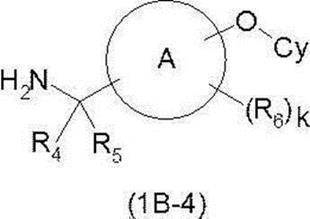
で示される化合物(1B-4)の合成方法を以下に示す。 A synthesis method of the compound (1B-4) represented by the formula is shown below.

アミン誘導体(1I)(式中PG1はtert-ブトキシカルボニル基(Boc基)やベンジルオキシカルボニル基(Cbz基)等の適当な保護基を示す)とボロン酸誘導体(1M)(式中-B(OPG2)2は、-B(OH)2またはカテコールボラン、ピナコールボラン、ボロン酸N-メチルイミノ二酢酸エステル等の適当なボロン酸誘導体を示す)とを、例えばジクロロメタン、ジクロロエタン等の本反応に悪影響を及ぼさない溶媒中、例えばトリエチルアミン、N-エチルジイソプロピルアミン又はピリジン等の塩基の存在下又は非存在下、モレキュラーシーブス4Å等の存在下又は非存在下で、酢酸銅(I)等を用いて反応させることでエーテル誘導体(1Q)が得られる。保護基PG1を上述した方法等により脱保護することで目的とする化合物(1B-4)を製造する事が出来る。 Amine derivative (1I) (wherein PG1 represents an appropriate protecting group such as tert-butoxycarbonyl group (Boc group) or benzyloxycarbonyl group (Cbz group)) and boronic acid derivative (1M) (wherein —B ( OPG2) 2 represents —B (OH) 2 or a suitable boronic acid derivative such as catecholborane, pinacolborane, boronic acid N-methyliminodiacetic acid ester, etc.) and has an adverse effect on this reaction such as dichloromethane, dichloroethane and the like. In a non-existing solvent, for example, in the presence or absence of a base such as triethylamine, N-ethyldiisopropylamine or pyridine, in the presence or absence of molecular sieves 4Å, etc., the reaction is carried out using copper (I) acetate or the like. Thus, an ether derivative (1Q) is obtained. The desired compound (1B-4) can be produced by deprotecting the protecting group PG1 by the method described above.
また、アミン誘導体(1B-4)は以下のようにも合成できる。 The amine derivative (1B-4) can also be synthesized as follows.

ボロン酸誘導体(1R)(式中PG1はtert-ブトキシカルボニル基(Boc基)やベンジルオキシカルボニル基(Cbz基)等の適当な保護基を示す、式中-B(OPG2)2は、-B(OH)2またはカテコールボラン、ピナコールボラン、ボロン酸N-メチルイミノ二酢酸エステル等の適当なボロン酸誘導体を示す)とアルコール誘導体(1G)とを、例えばジクロロメタン、ジクロロエタン等の本反応に悪影響を及ぼさない溶媒中、例えばトリエチルアミン、N-エチルジイソプロピルアミン又はピリジン等の塩基の存在下又は非存在下、モレキュラーシーブス4Å等の存在下又は非存在下で、酢酸銅(I)等を用いて反応させることでエーテル誘導体(1Q)を合成することが出来、保護基PG1を上述の方法等で脱保護することによりアミン誘導体(1B-4)を合成することが出来る。 Boronic acid derivative (1R) (wherein PG1 represents an appropriate protecting group such as a tert-butoxycarbonyl group (Boc group) or a benzyloxycarbonyl group (Cbz group)), wherein —B (OPG2) 2 is —B (OH) 2 or a suitable boronic acid derivative such as catecholborane, pinacolborane, boronic acid N-methyliminodiacetic acid ester and the like and alcohol derivative (1G) adversely affect this reaction such as dichloromethane, dichloroethane, etc. Reaction with copper (I) acetate in the absence of a solvent, for example, in the presence or absence of a base such as triethylamine, N-ethyldiisopropylamine or pyridine, or in the presence or absence of molecular sieves 4Å, etc. The ether derivative (1Q) can be synthesized by deprotecting the protecting group PG1 by the above-described method or the like It can be synthesized amine derivative (1B-4) by.
例えば式(1B)中、-Xが-N(Rx5)-C(O)-Cyで表される基であり、R4及びR5がともに水素原子のとき、すなわち For example, in the formula (1B), when —X is a group represented by —N (R x5 ) —C (O) —Cy, and R 4 and R 5 are both hydrogen atoms,

が But

で示される化合物(1B-5)の合成方法を以下に示す。 A synthesis method of the compound (1B-5) represented by the formula is shown below.

アミン誘導体(1S)と酸塩化物誘導体(1T)を、例えばジクロロメタン等の本反応に悪影響を及ぼさない溶媒中、トリエチルアミン、ピリジン、N,N-ジイソプロピルエチルアミン等の塩基及びN,N-ジメチル-4-アミノピリジン等の添加物の存在下または非存在下で反応させることで、ニトリル誘導体(1U)を合成することができる。得られたニトリル誘導体(1U)を、例えば水、メタノール、エタノール又はテトラヒドロフラン等の本反応に悪影響を与えない溶媒中、例えばパラジウム/炭素、水酸化パラジウム/炭素、白金/炭素等の触媒の存在下、例えば酢酸又は塩酸等の酸の存在下又は非存在下、常圧又は加圧の水素雰囲気下で還元することでアミン誘導体(1B-5)を合成することができる。 The amine derivative (1S) and the acid chloride derivative (1T) are mixed with a base such as triethylamine, pyridine, N, N-diisopropylethylamine and N, N-dimethyl-4 in a solvent that does not adversely affect the reaction, such as dichloromethane. -By reacting in the presence or absence of an additive such as aminopyridine, the nitrile derivative (1U) can be synthesized. The obtained nitrile derivative (1U) is used in a solvent such as water, methanol, ethanol or tetrahydrofuran that does not adversely affect the reaction, for example, in the presence of a catalyst such as palladium / carbon, palladium hydroxide / carbon, platinum / carbon. For example, the amine derivative (1B-5) can be synthesized by reduction in the presence or absence of an acid such as acetic acid or hydrochloric acid in a hydrogen atmosphere under normal pressure or pressure.
例えば式(1B)中、-Xが-C(Rx1Rx2)-N(Rx5)-Cyで表される基であり、R4及びR5がともに水素原子のとき、すなわち For example, in the formula (1B), when —X is a group represented by —C (R x1 R x2 ) —N (R x5 ) —Cy, and R 4 and R 5 are both hydrogen atoms,

が But

で示される化合物(1B-6)の合成方法を以下に示す。 A synthesis method of the compound (1B-6) represented by the formula is shown below.
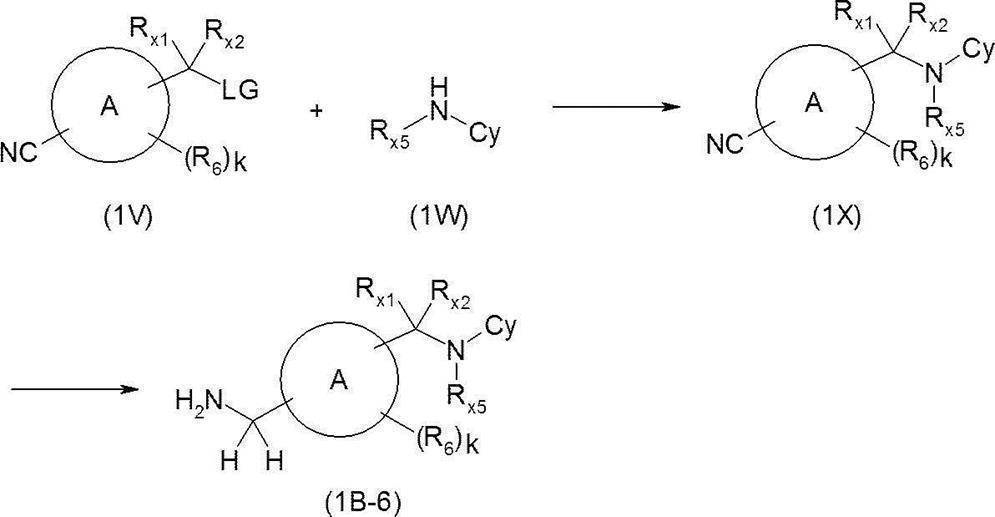
ニトリル誘導体(1V)(式中LGは塩素原子、臭素原子、ヨウ素原子、トリフルオロメタンスルホニルオキシ基等の適当な脱離基を示す)とアミン誘導体(1W)を、例えばアセトニトリル、N,N-ジメチルホルムアミド、アセトン等の本反応に悪影響を及ぼさない溶媒中、トリエチルアミン、N,N-ジイソプロピルエチルアミン、水酸化ナトリウム、炭酸ナトリウム等の塩基及びヨウ化テトラ-n-ブチルアンモニウム、塩化リチウム等の添加物の存在下または非存在下で反応させることで、ニトリル誘導体(1X)を合成することができる。得られたニトリル誘導体(1X)を、例えばテトラヒドロフラン等の本反応に悪影響を及ぼさない溶媒中、例えば水素化アルミニウムリチウムやボラン-テトラヒドロフラン錯体等を用いて反応させることで、アミン誘導体(1B-6)を合成することが出来る。 A nitrile derivative (1V) (wherein LG represents a suitable leaving group such as a chlorine atom, a bromine atom, an iodine atom, a trifluoromethanesulfonyloxy group) and an amine derivative (1W), for example, acetonitrile, N, N-dimethyl In a solvent that does not adversely affect the reaction such as formamide and acetone, a base such as triethylamine, N, N-diisopropylethylamine, sodium hydroxide, sodium carbonate and additives such as tetra-n-butylammonium iodide and lithium chloride By reacting in the presence or absence, the nitrile derivative (1X) can be synthesized. The resulting nitrile derivative (1X) is reacted with, for example, lithium aluminum hydride or borane-tetrahydrofuran complex in a solvent that does not adversely influence the reaction, such as tetrahydrofuran, to give an amine derivative (1B-6). Can be synthesized.
また、アミン誘導体(1B-6)は以下のようにも合成できる。 The amine derivative (1B-6) can also be synthesized as follows.

アルコール誘導体(1Y)とアミン誘導体(1W)とを、例えばジクロロメタン、テトラヒドロフラン等の本反応に悪影響を及ぼさない溶媒中、例えばトリフェニルホスフィン等の存在下、アゾジカルボン酸ジイソプロピル(DIAD)やアゾジカルボン酸ジエチル(DEAD)等を用いて反応させることでも、ニトリル誘導体(1X)を合成できる。得られたニトリル誘導体(1X)を、例えばテトラヒドロフラン等の本反応に悪影響を及ぼさない溶媒中、例えば水素化アルミニウムリチウムやボラン-テトラヒドロフラン錯体等を用いて反応させることでも、アミン誘導体(1B-6)を合成することが出来る。 For example, diisopropyl azodicarboxylate (DIAD) or azodicarboxylic acid in the presence of triphenylphosphine or the like in a solvent that does not adversely affect the reaction such as dichloromethane or tetrahydrofuran, for example, alcohol derivative (1Y) and amine derivative (1W). The nitrile derivative (1X) can also be synthesized by reacting with diethyl (DEAD) or the like. The amine derivative (1B-6) can also be obtained by reacting the obtained nitrile derivative (1X) with, for example, lithium aluminum hydride or a borane-tetrahydrofuran complex in a solvent that does not adversely influence the reaction such as tetrahydrofuran. Can be synthesized.
例えば式(1B)中、-Xが-C(O)-N(Rx5)-Cyで表される基であり、R4及びR5がともに水素原子のとき、すなわち For example, in the formula (1B), when —X is a group represented by —C (O) —N (R x5 ) —Cy, and R 4 and R 5 are both hydrogen atoms,
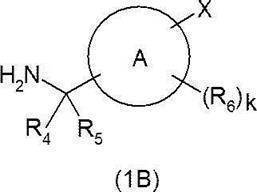
が But

で示される化合物(1B-7)の合成方法を以下に示す。 A method for synthesizing the compound (1B-7) shown below is shown below.

酸塩化物誘導体(1Z)とアミン誘導体(1W)を、例えばジクロロメタン等の本反応に悪影響を及ぼさない溶媒中、トリエチルアミン、N,N-ジイソプロピルエチルアミン、ピリジン等の塩基とN,N-ジメチル-4-アミノピリジン等の添加物の存在下または非存在下で反応させることで、アミド誘導体(1AA)を合成することができる。得られたアミド誘導体(1AA)を、例えば水、メタノール、エタノール又はテトラヒドロフラン等の本反応に悪影響を与えない溶媒中、例えばパラジウム/炭素、水酸化パラジウム/炭素、白金/炭素等の触媒の存在下、例えば酢酸又は塩酸等の酸の存在下又は非存在下、常圧又は加圧の水素雰囲気下で還元することでアミン誘導体(1B-7)を合成することができる。 An acid chloride derivative (1Z) and an amine derivative (1W) are mixed with a base such as triethylamine, N, N-diisopropylethylamine, pyridine and the like in a solvent that does not adversely affect the reaction, such as dichloromethane. -The amide derivative (1AA) can be synthesized by reacting in the presence or absence of an additive such as aminopyridine. The obtained amide derivative (1AA) is used in a solvent that does not adversely influence the reaction such as water, methanol, ethanol, or tetrahydrofuran, for example, in the presence of a catalyst such as palladium / carbon, palladium hydroxide / carbon, or platinum / carbon. For example, the amine derivative (1B-7) can be synthesized by reduction in the presence or absence of an acid such as acetic acid or hydrochloric acid in a hydrogen atmosphere under normal pressure or pressure.
例えば式(1B)中、-Xが-C(Rx1Rx2)-S(O)n-Cy、n=0で表される基であり、R4及びR5がともに水素原子のとき、すなわち For example, in the formula (1B), when -X is a group represented by -C (R x1 R x2 ) -S (O) n-Cy, n = 0, and R 4 and R 5 are both hydrogen atoms, Ie
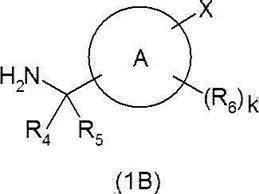
が But

で示される化合物(1B-8)の合成方法を以下に示す。 A synthesis method of the compound (1B-8) represented by the formula is shown below.
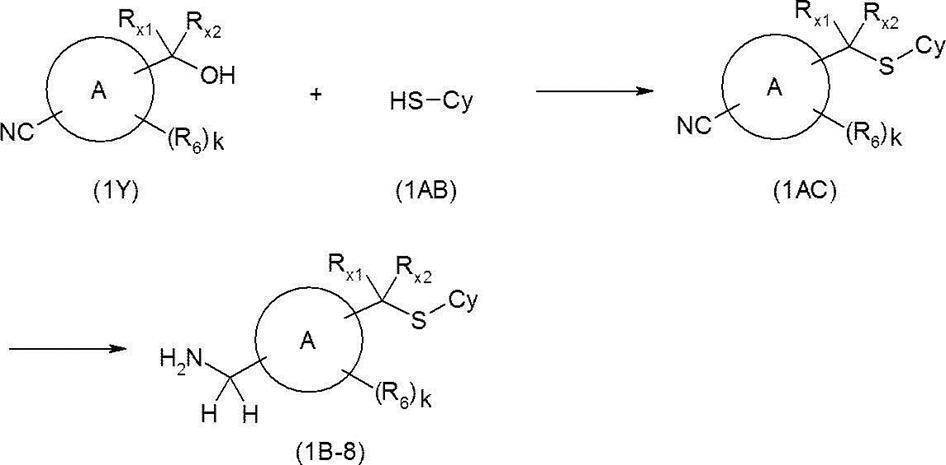
アルコール誘導体(1Y)とチオール誘導体(1AB)とを、例えばジクロロメタン、テトラヒドロフラン等の本反応に悪影響を及ぼさない溶媒中、例えばトリフェニルホスフィン等の存在下、アゾジカルボン酸ジイソプロピル(DIAD)やアゾジカルボン酸ジエチル(DEAD)等を用いて反応させることで、ニトリル誘導体(1AC)を合成できる。得られたニトリル誘導体(1AC)を、例えばテトラヒドロフラン等の本反応に悪影響を及ぼさない溶媒中、例えば水素化アルミニウムリチウムやボラン-テトラヒドロフラン錯体等を用いて反応させることで、アミン誘導体(1B-8)を合成することが出来る。 For example, diisopropyl azodicarboxylate (DIAD) or azodicarboxylic acid in the presence of triphenylphosphine or the like in a solvent that does not adversely affect the reaction such as dichloromethane or tetrahydrofuran, for example, alcohol derivative (1Y) and thiol derivative (1AB). By reacting with diethyl (DEAD) or the like, the nitrile derivative (1AC) can be synthesized. The resulting nitrile derivative (1AC) is reacted with, for example, lithium aluminum hydride or borane-tetrahydrofuran complex in a solvent that does not adversely affect the reaction, such as tetrahydrofuran, to give an amine derivative (1B-8). Can be synthesized.
例えば式(1B)中、-Xが-S(O)n-C(Rx1Rx2)-Cy、n=0で表される基であり、R4及びR5がともに水素原子のとき、すなわち For example, in the formula (1B), when —X is a group represented by —S (O) nC (R x1 R x2 ) -Cy, n = 0, and R 4 and R 5 are both hydrogen atoms, Ie

が But
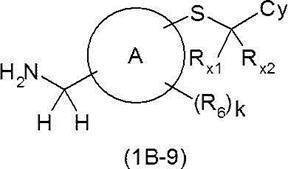
で示される化合物(1B-9)の合成方法を以下に示す。 A synthesis method of the compound (1B-9) represented by the formula is shown below.

ニトリル誘導体(1AD)(式中LG’は塩素原子、臭素原子、ヨウ素原子を示す)とチオール誘導体(1AE)とを、例えばN,N-ジメチルホルムアミド、ジメチルスルホキシド等の本反応に悪影響を及ぼさない溶媒中、例えば水素化ナトリウム、水酸化カリウム及びカリウム tert-ブトキシド等を用いて反応させることでスルフィド誘導体(1AF)を合成することが出来る。得られたスルフィド誘導体(1AF)を、例えばテトラヒドロフラン等の本反応に悪影響を及ぼさない溶媒中、例えば水素化アルミニウムリチウムやボラン-テトラヒドロフラン錯体等を用いて反応させることで、アミン誘導体(1B-9)を合成することが出来る。 Nitrile derivative (1AD) (where LG ′ represents a chlorine atom, a bromine atom or an iodine atom) and a thiol derivative (1AE) do not adversely affect this reaction such as N, N-dimethylformamide, dimethyl sulfoxide, etc. The sulfide derivative (1AF) can be synthesized by reacting in a solvent using, for example, sodium hydride, potassium hydroxide and potassium tert-butoxide. The resulting sulfide derivative (1AF) is reacted with, for example, lithium aluminum hydride or borane-tetrahydrofuran complex in a solvent that does not adversely influence the reaction, such as tetrahydrofuran, to give an amine derivative (1B-9). Can be synthesized.
例えば式(I)中、Qが=Oであり、-Xが-Cyで表される基のとき、すなわち For example, in the formula (I), when Q is = O and -X is a group represented by -Cy,

が But

で示される化合物(2E)の合成方法を以下に示す。 The synthesis method of the compound (2E) shown by is shown below.

上述の方法等で得られたカルボン酸誘導体(1A)と同様に合成できるカルボン酸誘導体(2A)とアミン誘導体(2B)(式中LGは塩素原子、臭素原子、ヨウ素原子、トリフルオロメタンスルホニルオキシ基等の適当な脱離基を示す)とを例えばジクロロメタン等の本反応に悪影響を及ぼさない溶媒中、例えば1-ヒドロキシベンゾトリアゾール等の存在下または非存在下で1-エチル-3-(3’-ジメチルアミノプロピル)カルボジイミド(WSC)に代表されるような縮合剤をトリエチルアミン等の塩基存在下または非存在下で反応させることで、目的とするアミド誘導体(2C)を製造する事が出来る。得られたアミド誘導体(2C)とボロン酸誘導体(2D)(式中-B(OPG2)2は、-B(OH)2またはカテコールボラン、ピナコールボラン、ボロン酸N-メチルイミノ二酢酸エステル等の適当なボロン酸誘導体を示す)とを、例えば1,4-ジオキサン又はトルエン、ブタノール等の本反応に悪影響を及ぼさない溶媒中、水等の共溶媒の存在下又は非存在下、水酸化ナトリウム、炭酸ナトリウム、炭酸カリウム、炭酸水素ナトリウム、炭酸水素カリウム、リン酸三カリウム等の塩基と、酢酸銅等の存在下又は非存在下、2,4,6-トリイソプロピル-2’-(ジシクロヘキシルホスフィノ)ビフェニル等の存在下又は非存在下、[1,1’-ビス(ジフェニルホスフィノ)フェロセン]ジクロロパラジウム、トリス(ジベンジリデンアセトン)ジパラジウム、テトラキス(トリフェニルホスフィン)パラジウム等の触媒の存在下で反応させることで目的とする化合物(2E)を合成することが出来る。 Carboxylic acid derivative (2A) and amine derivative (2B) that can be synthesized in the same manner as the carboxylic acid derivative (1A) obtained by the above-described method etc. (where LG is a chlorine atom, a bromine atom, an iodine atom, a trifluoromethanesulfonyloxy group) 1-ethyl-3- (3 ′) in a solvent that does not adversely affect the reaction, such as dichloromethane, in the presence or absence of 1-hydroxybenzotriazole or the like. The target amide derivative (2C) can be produced by reacting a condensing agent represented by -dimethylaminopropyl) carbodiimide (WSC) in the presence or absence of a base such as triethylamine. The obtained amide derivative (2C) and boronic acid derivative (2D) (wherein —B (OPG2) 2 is —B (OH) 2 or catecholborane, pinacolborane, boronic acid N-methyliminodiacetic acid ester, etc. A boronic acid derivative) in a solvent that does not adversely affect the reaction such as 1,4-dioxane or toluene, butanol, in the presence or absence of a co-solvent such as water, sodium hydroxide, 2,4,6-triisopropyl-2 '-(dicyclohexylphosphino) in the presence or absence of a base such as sodium, potassium carbonate, sodium bicarbonate, potassium bicarbonate, tripotassium phosphate and copper acetate In the presence or absence of biphenyl or the like, [1,1′-bis (diphenylphosphino) ferrocene] dichloropalladium, tris (dibenzylide) Nacetone) dipalladium, tetrakis (triphenylphosphine) palladium and the like are reacted in the presence of a catalyst to synthesize the target compound (2E).
また、化合物(2E)は以下のようにも合成できる。 Also, compound (2E) can be synthesized as follows.
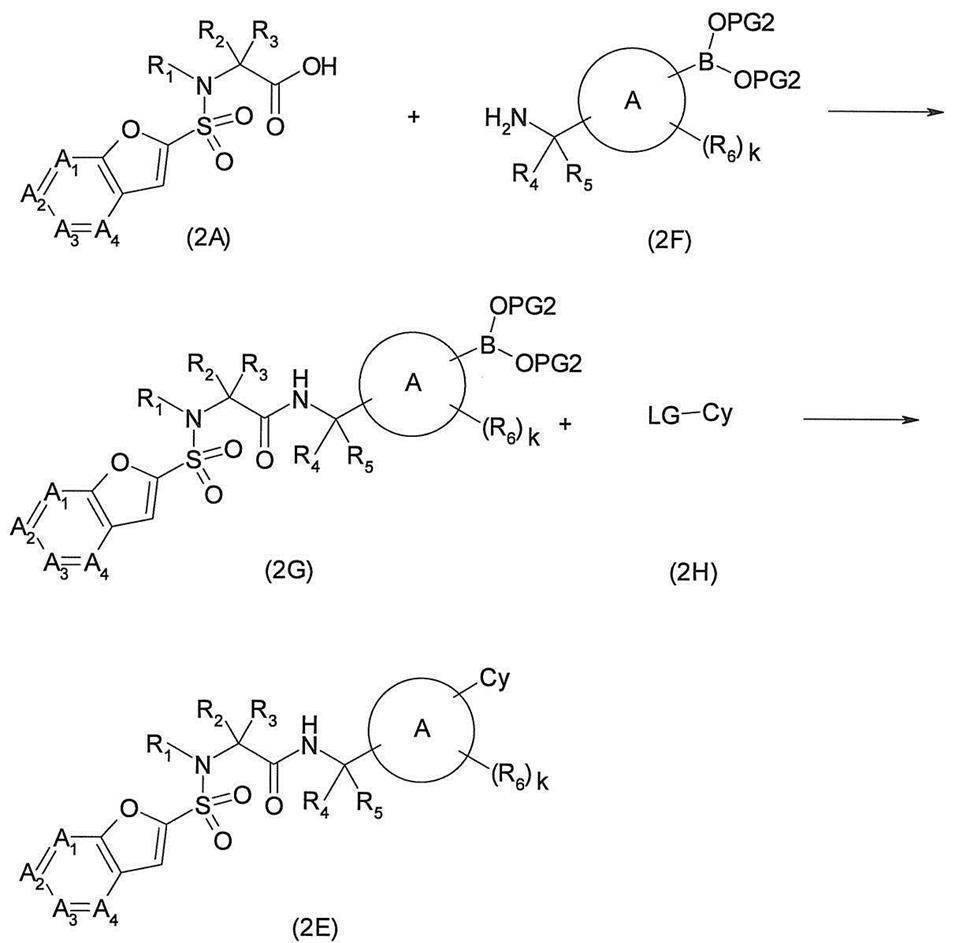
カルボン酸誘導体(2A)とアミン誘導体(2F)(式中-B(OPG2)2は、-B(OH)2またはカテコールボラン、ピナコールボラン、ボロン酸N-メチルイミノ二酢酸エステル等の適当なボロン酸誘導体を示す)とを例えばジクロロメタン等の本反応に悪影響を及ぼさない溶媒中、例えば1-ヒドロキシベンゾトリアゾール等の存在下または非存在下で1-エチル-3-(3’-ジメチルアミノプロピル)カルボジイミド(WSC)に代表されるような縮合剤をトリエチルアミン等の塩基存在下または非存在下で反応させることで、目的とするアミド誘導体(2G)を製造する事が出来る。得られたアミド誘導体(2G)と適切な脱離基を有する化合物(2H)(式中LGは塩素原子、臭素原子、ヨウ素原子、トリフルオロメタンスルホニルオキシ基等の適当な脱離基を示す)とを、例えば1,4-ジオキサン又はトルエン、ブタノール等の本反応に悪影響を及ぼさない溶媒中、水等の共溶媒の存在下又は非存在下、水酸化ナトリウム、炭酸ナトリウム、炭酸カリウム、炭酸水素ナトリウム、炭酸水素カリウム、リン酸三カリウム等の塩基と、酢酸銅等の存在下又は非存在下、2,4,6-トリイソプロピル-2’-(ジシクロヘキシルホスフィノ)ビフェニル等の存在下又は非存在下、[1,1’-ビス(ジフェニルホスフィノ)フェロセン]ジクロロパラジウム、トリス(ジベンジリデンアセトン)ジパラジウム、テトラキス(トリフェニルホスフィン)パラジウム等の触媒の存在下で反応させることで目的とする化合物(2E)を合成することが出来る。 Carboxylic acid derivative (2A) and amine derivative (2F) (wherein —B (OPG2) 2 is —B (OH) 2 or an appropriate boronic acid such as catecholborane, pinacolborane, boronic acid N-methyliminodiacetic acid ester, etc. 1-ethyl-3- (3′-dimethylaminopropyl) carbodiimide in a solvent such as dichloromethane that does not adversely affect the reaction, for example, in the presence or absence of 1-hydroxybenzotriazole or the like The desired amide derivative (2G) can be produced by reacting a condensing agent represented by (WSC) in the presence or absence of a base such as triethylamine. The obtained amide derivative (2G) and a compound (2H) having an appropriate leaving group (wherein LG represents an appropriate leaving group such as a chlorine atom, a bromine atom, an iodine atom, a trifluoromethanesulfonyloxy group) In a solvent that does not adversely affect the reaction, such as 1,4-dioxane or toluene, butanol, in the presence or absence of a co-solvent such as water, sodium hydroxide, sodium carbonate, potassium carbonate, sodium bicarbonate In the presence or absence of a base such as potassium hydrogen carbonate or tripotassium phosphate and copper acetate or the like, or in the presence or absence of 2,4,6-triisopropyl-2 ′-(dicyclohexylphosphino) biphenyl or the like [1,1′-bis (diphenylphosphino) ferrocene] dichloropalladium, tris (dibenzylideneacetone) dipalladium, tetrakis ( Li triphenylphosphine) compound of interest by reacting in the presence of a catalyst such as palladium (2E) can be synthesized.
例えば式(I)中、Qが=Oであり、-Xが-N(Rx5)-Cyで表される基のとき、すなわち For example, in the formula (I), when Q is ═O and —X is a group represented by —N (R x5 ) —Cy, that is,
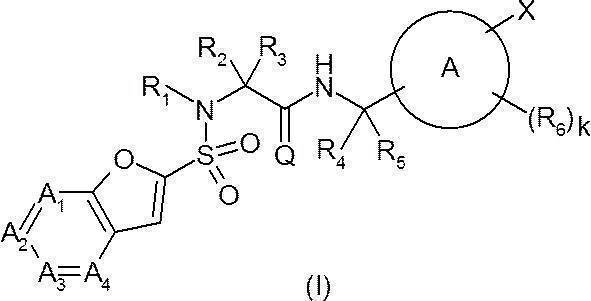
が But

で示される化合物(2J)の合成方法を以下に示す。 A synthesis method of the compound (2J) represented by the formula is shown below.

上述の方法等で得られたアミド誘導体(2C)(式中LGは塩素原子、臭素原子、ヨウ素原子、トリフルオロメタンスルホニルオキシ基等の適当な脱離基を示す)とアミン誘導体(2I)とを、例えばトルエン又は1,4-ジオキサン、ブタノール等の本反応に悪影響を及ぼさない溶媒中、水等の共溶媒の存在下又は非存在下、ナトリウムtert-ブトキシド、水酸化ナトリウム、炭酸ナトリウム、炭酸カリウム、炭酸水素ナトリウム、炭酸水素カリウム、リン酸三カリウム等の塩基と、酢酸銅等の存在下又は非存在下、2,4,6-トリイソプロピル-2’-(ジシクロヘキシルホスフィノ)ビフェニル等の存在下又は非存在下、[1,1’-ビス(ジフェニルホスフィノ)フェロセン]ジクロロパラジウム、トリス(ジベンジリデンアセトン)ジパラジウム、テトラキス(トリフェニルホスフィン)パラジウム等の触媒の存在下で反応させることで目的とする化合物(2J)を合成することが出来る。 Amide derivative (2C) obtained by the above-mentioned method etc. (where LG represents an appropriate leaving group such as chlorine atom, bromine atom, iodine atom, trifluoromethanesulfonyloxy group) and amine derivative (2I) Sodium tert-butoxide, sodium hydroxide, sodium carbonate, potassium carbonate in a solvent that does not adversely affect the reaction, such as toluene or 1,4-dioxane, butanol, in the presence or absence of a co-solvent such as water. In the presence or absence of bases such as sodium hydrogen carbonate, potassium hydrogen carbonate, tripotassium phosphate, and copper acetate, the presence of 2,4,6-triisopropyl-2 '-(dicyclohexylphosphino) biphenyl, etc. [1,1′-bis (diphenylphosphino) ferrocene] dichloropalladium, tris (dibenzylidene) Acetone) dipalladium, tetrakis (triphenylphosphine) compound of interest by reacting in the presence of a catalyst such as palladium (2J) can be synthesized.
例えば式(I)中、Qが=Oであり、-Xが-C(RX1)=C(RX2)-Cyで表される基のとき、すなわち For example, in formula (I), when Q is = O and -X is a group represented by -C (R X1 ) = C (R X2 ) -Cy, that is,
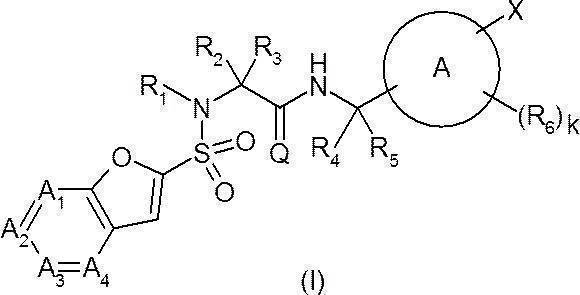
が But

で示される化合物(2L)の合成方法を以下に示す。 The synthesis method of the compound (2L) shown by is shown below.
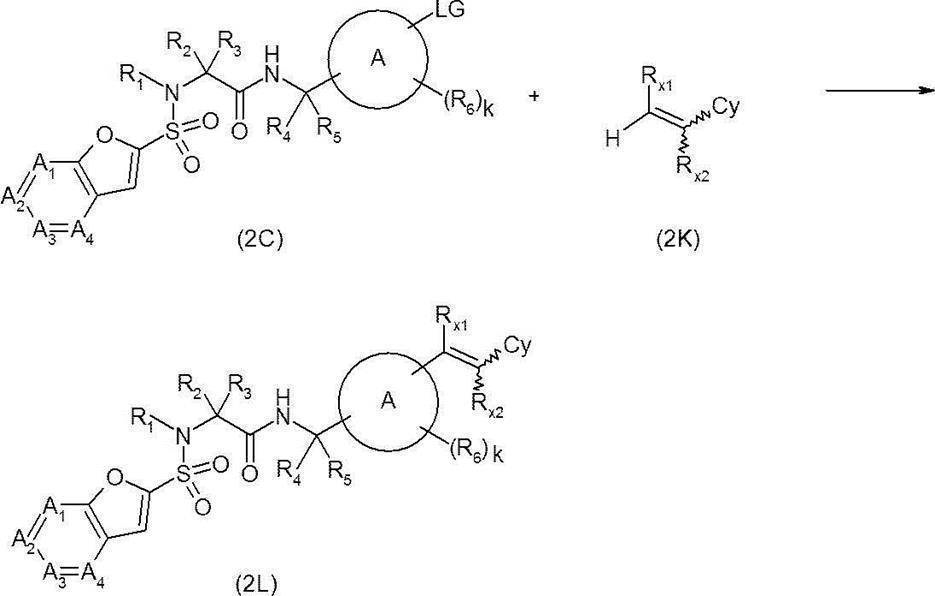
上述の方法等で得られたアミド誘導体(2C)(式中LGは塩素原子、臭素原子、ヨウ素原子、トリフルオロメタンスルホニルオキシ基等の適当な脱離基を示す)とアルケン誘導体(2K)とを、例えばN,N-ジメチルホルムアミド又はテトラヒドロフラン等の本反応に悪影響を及ぼさない溶媒中、トリエチルアミン、炭酸カリウム、炭酸銀(I)、酢酸ナトリウム等の塩基の存在下又は非存在下、トリフェニルホスフィン等の存在下又は非存在下、酢酸パラジウム(II)、トリス(ジベンジリデンアセトン)ジパラジウム、テトラキス(トリフェニルホスフィン)パラジウム等の触媒の存在下で反応させることで目的とする化合物(2L)を合成することが出来る。 Amide derivative (2C) obtained by the above-mentioned method etc. (where LG represents an appropriate leaving group such as chlorine atom, bromine atom, iodine atom, trifluoromethanesulfonyloxy group) and alkene derivative (2K) In the presence of a base such as triethylamine, potassium carbonate, silver carbonate (I), sodium acetate, or the like in a solvent that does not adversely affect the reaction such as N, N-dimethylformamide or tetrahydrofuran, for example, triphenylphosphine, etc. The target compound (2L) is synthesized by reacting in the presence or absence of a catalyst such as palladium (II) acetate, tris (dibenzylideneacetone) dipalladium, tetrakis (triphenylphosphine) palladium, etc. I can do it.
例えば式(I)中、Qが=Oであり、-Xが-C(Rx1Rx2)-Cyで表される基のとき、すなわち For example, in formula (I), when Q is ═O and —X is a group represented by —C (R x1 R x2 ) —Cy, that is,

が But

で示される化合物(2N)の合成方法を以下に示す。 A synthesis method of the compound (2N) represented by the formula is shown below.

上述の方法等で得られたアミド誘導体(2C)(式中LGは塩素原子、臭素原子、ヨウ素原子、トリフルオロメタンスルホニルオキシ基等の適当な脱離基を示す)とボロン酸誘導体(2M)(式中-B(OPG2)2は、-B(OH)2またはカテコールボラン、ピナコールボラン、ボロン酸N-メチルイミノ二酢酸エステル等の適当なボロン酸誘導体を示す)を、例えば1,4-ジオキサン又はトルエン、ブタノール等の本反応に悪影響を及ぼさない溶媒中、水等の共溶媒の存在下又は非存在下、水酸化ナトリウム、炭酸ナトリウム、炭酸カリウム、炭酸水素ナトリウム、炭酸水素カリウム、リン酸三カリウム等の塩基と、酢酸銅等の存在下又は非存在下、2,4,6-トリイソプロピル-2’-(ジシクロヘキシルホスフィノ)ビフェニル等の存在下又は非存在下、[1,1’-ビス(ジフェニルホスフィノ)フェロセン]ジクロロパラジウム、トリス(ジベンジリデンアセトン)ジパラジウム、テトラキス(トリフェニルホスフィン)パラジウム等の触媒の存在下で反応させることで目的とする化合物(2N)を合成することができる。 Amide derivative (2C) obtained by the above-described method etc. (where LG represents an appropriate leaving group such as chlorine atom, bromine atom, iodine atom, trifluoromethanesulfonyloxy group) and boronic acid derivative (2M) ( In the formula, —B (OPG2) 2 represents —B (OH) 2 or a suitable boronic acid derivative such as catecholborane, pinacolborane, boronic acid N-methyliminodiacetic acid ester), for example, 1,4-dioxane or Sodium hydroxide, sodium carbonate, potassium carbonate, sodium bicarbonate, potassium bicarbonate, tripotassium phosphate in the presence or absence of co-solvents such as water in solvents that do not adversely affect this reaction such as toluene and butanol And 2,4,6-triisopropyl-2 ′-(dicyclohexylphosphino) biphenyl in the presence or absence of copper acetate or the like Reaction in the presence or absence of a catalyst such as [1,1'-bis (diphenylphosphino) ferrocene] dichloropalladium, tris (dibenzylideneacetone) dipalladium, tetrakis (triphenylphosphine) palladium This makes it possible to synthesize the target compound (2N).
例えば式(I)中、Qが=Oであり、-Xが-C(Rx1Rx2)-O-Cyで表される基のとき、すなわち For example, in the formula (I), when Q is ═O and —X is a group represented by —C (R x1 R x2 ) —O—Cy, that is,

が But

で示される化合物(3E)の合成方法を以下に示す。 The synthesis method of the compound (3E) shown by is shown below.

上述の方法等で得られたカルボン酸誘導体(1A)と同様に合成できるカルボン酸誘導体(3A)とアミン誘導体(3B)(必要があれば対応するカルボン酸誘導体、エステル誘導体、アルデヒド誘導体、ケトン誘導体等を還元あるいはアルキル化等することにより合成する)とを例えばジクロロメタン等の本反応に悪影響を及ぼさない溶媒中、例えば1-ヒドロキシベンゾトリアゾール等の存在下または非存在下で1-エチル-3-(3’-ジメチルアミノプロピル)カルボジイミド(WSC)に代表されるような縮合剤をトリエチルアミン等の塩基存在下または非存在下で反応させることで、目的とするアミド誘導体(3C)を製造する事が出来る。得られたアミド誘導体(3C)とアルコール誘導体(3D)とを、例えばジクロロメタン、テトラヒドロフラン等の本反応に悪影響を及ぼさない溶媒中、例えばトリフェニルホスフィン等の存在下、アゾジカルボン酸ジイソプロピル(DIAD)やアゾジカルボン酸ジエチル(DEAD)等を用いて反応させることで、目的とする化合物(3E)を製造する事が出来る。 Carboxylic acid derivative (3A) and amine derivative (3B) that can be synthesized in the same manner as the carboxylic acid derivative (1A) obtained by the above-described method, etc. For example, in the presence or absence of 1-hydroxybenzotriazole or the like in a solvent that does not adversely affect the reaction, such as dichloromethane. The desired amide derivative (3C) can be produced by reacting a condensing agent represented by (3′-dimethylaminopropyl) carbodiimide (WSC) in the presence or absence of a base such as triethylamine. I can do it. The obtained amide derivative (3C) and alcohol derivative (3D) are mixed with diisopropyl azodicarboxylate (DIAD) or the like in the presence of, for example, triphenylphosphine in a solvent that does not adversely affect the reaction such as dichloromethane and tetrahydrofuran. The target compound (3E) can be produced by reacting with diethyl azodicarboxylate (DEAD) or the like.
例えば式(I)中、Qが=Oであり、-Xが-O-C(Rx1Rx2)-Cyで表される基のとき、すなわち For example, in the formula (I), when Q is ═O and —X is a group represented by —O—C (R x1 R x2 ) —Cy,

が But
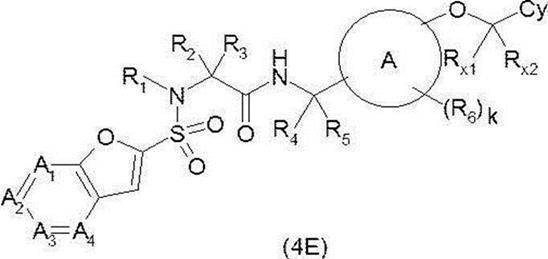
で示される化合物(4E)の合成方法を以下に示す。 A synthesis method of the compound (4E) represented by the formula is shown below.

上述の方法等で得られたカルボン酸誘導体(1A)と同様に合成できるカルボン酸誘導体(4A)とアミン誘導体(4B)とを例えばジクロロメタン等の本反応に悪影響を及ぼさない溶媒中、例えば1-ヒドロキシベンゾトリアゾール等の存在下または非存在下で1-エチル-3-(3’-ジメチルアミノプロピル)カルボジイミド(WSC)に代表されるような縮合剤をトリエチルアミン等の塩基存在下または非存在下で反応させることで、目的とするアミド誘導体(4C)を製造する事が出来る。得られたアミド誘導体(4C)とアルコール誘導体(4D)(必要があれば対応するカルボン酸誘導体、エステル誘導体、アルデヒド誘導体、ケトン誘導体等を還元あるいはアルキル化等することにより合成する)とを、例えばジクロロメタン、テトラヒドロフラン等の本反応に悪影響を及ぼさない溶媒中、例えばトリフェニルホスフィン等の存在下、アゾジカルボン酸ジイソプロピル(DIAD)やアゾジカルボン酸ジエチル(DEAD)等を用いて反応させることで、目的とする化合物(4E)を製造する事が出来る。 The carboxylic acid derivative (4A) and the amine derivative (4B), which can be synthesized in the same manner as the carboxylic acid derivative (1A) obtained by the above-described method, etc., for example, 1- In the presence or absence of hydroxybenzotriazole or the like, a condensing agent such as 1-ethyl-3- (3′-dimethylaminopropyl) carbodiimide (WSC) is used in the presence or absence of a base such as triethylamine. The target amide derivative (4C) can be produced by the reaction. The obtained amide derivative (4C) and alcohol derivative (4D) (synthesized by reducing or alkylating the corresponding carboxylic acid derivative, ester derivative, aldehyde derivative, ketone derivative, etc. if necessary), for example, In a solvent that does not adversely affect this reaction, such as dichloromethane and tetrahydrofuran, for example, in the presence of triphenylphosphine, the reaction is carried out using diisopropyl azodicarboxylate (DIAD), diethyl azodicarboxylate (DEAD), etc. The compound (4E) to be produced can be produced.
例えば式(I)中、Qが=Oであり、-Xが-C(Rx1Rx2)-C(RX3RX4)-Cyで表される基で、Rx2及びRx4がいずれも水素のとき、すなわち For example, in the formula (I), Q is ═O, —X is a group represented by —C (R x1 R x2 ) —C (R X3 R X4 ) —Cy, and R x2 and R x4 are both When hydrogen, ie

が But
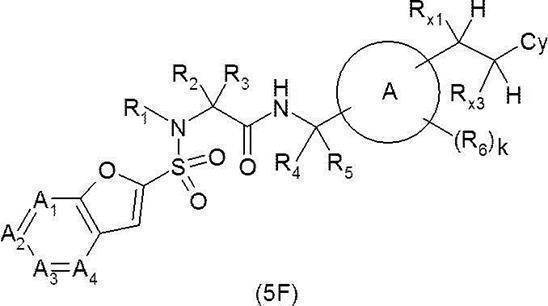
で示される化合物(5F)の合成方法を以下に示す。 The synthesis method of the compound (5F) shown by is shown below.

上述の方法等で得られたカルボン酸誘導体(1A)と同様に合成できるカルボン酸誘導体(5A)とアミン誘導体(5B)(式中LGは塩素原子、臭素原子、ヨウ素原子、トリフルオロメタンスルホニルオキシ基等の適当な脱離基を示す)とを例えばジクロロメタン等の本反応に悪影響を及ぼさない溶媒中、例えば1-ヒドロキシベンゾトリアゾール等の存在下または非存在下で1-エチル-3-(3’-ジメチルアミノプロピル)カルボジイミド(WSC)に代表されるような縮合剤をトリエチルアミン等の塩基存在下または非存在下で反応させることで、アミド誘導体(5C)を合成する事が出来る。得られたアミド誘導体(5C)とアルケン誘導体(5D)とを、例えばN,N-ジメチルホルムアミド又はテトラヒドロフラン等の本反応に悪影響を及ぼさない溶媒中、トリエチルアミン、炭酸カリウム、炭酸銀(I)、酢酸ナトリウム等の塩基の存在下又は非存在下、トリフェニルホスフィン等の存在下又は非存在下、酢酸パラジウム(II)、トリス(ジベンジリデンアセトン)ジパラジウム、テトラキス(トリフェニルホスフィン)パラジウム等の触媒の存在下で反応させることでアルケン誘導体(5E)を合成することが出来る。得られたアルケン誘導体(5E)を、例えば水、メタノール、エタノール又はテトラヒドロフラン等の本反応に悪影響を与えない溶媒中、例えばパラジウム/炭素、水酸化パラジウム/炭素、白金/炭素等の触媒の存在下、例えば酢酸又は塩酸等の酸の存在下又は非存在下、常圧又は加圧の水素雰囲気下で還元することでアミド誘導体(5F)を合成することができる。 Carboxylic acid derivative (5A) and amine derivative (5B) that can be synthesized in the same manner as the carboxylic acid derivative (1A) obtained by the above-described method etc. (where LG is a chlorine atom, a bromine atom, an iodine atom, a trifluoromethanesulfonyloxy group) 1-ethyl-3- (3 ′) in a solvent that does not adversely affect the reaction, such as dichloromethane, in the presence or absence of 1-hydroxybenzotriazole or the like. The amide derivative (5C) can be synthesized by reacting a condensing agent represented by -dimethylaminopropyl) carbodiimide (WSC) in the presence or absence of a base such as triethylamine. The obtained amide derivative (5C) and alkene derivative (5D) are mixed with triethylamine, potassium carbonate, silver carbonate (I), acetic acid in a solvent that does not adversely affect the reaction such as N, N-dimethylformamide or tetrahydrofuran. In the presence or absence of a base such as sodium, in the presence or absence of triphenylphosphine, etc., a catalyst such as palladium (II) acetate, tris (dibenzylideneacetone) dipalladium, tetrakis (triphenylphosphine) palladium, etc. The alkene derivative (5E) can be synthesized by reacting in the presence. The obtained alkene derivative (5E) is used in a solvent that does not adversely affect the reaction such as water, methanol, ethanol, or tetrahydrofuran, for example, in the presence of a catalyst such as palladium / carbon, palladium hydroxide / carbon, or platinum / carbon. For example, the amide derivative (5F) can be synthesized by reduction in the presence or absence of an acid such as acetic acid or hydrochloric acid in a hydrogen atmosphere under normal pressure or pressure.
例えば式(I)中、Qが=Oであり、-Xが-S(O)n-Cy、n=0、1、2で表される基のとき、すなわち For example, in the formula (I), when Q is = O and -X is a group represented by -S (O) n-Cy, n = 0, 1, 2;

が But


で示される化合物(6E)、(6F)、(6G)の合成方法を以下に示す。 A method for synthesizing the compounds (6E), (6F) and (6G) represented by the formula is shown below.

上述の方法等で得られたカルボン酸誘導体(1A)と同様に合成できるカルボン酸誘導体(6A)とアミン誘導体(6B)(式中LGは塩素原子、臭素原子、ヨウ素原子、トリフルオロメタンスルホニルオキシ基等の適当な脱離基を示す)とを例えばジクロロメタン等の本反応に悪影響を及ぼさない溶媒中、例えば1-ヒドロキシベンゾトリアゾール等の存在下または非存在下で1-エチル-3-(3’-ジメチルアミノプロピル)カルボジイミド(WSC)に代表されるような縮合剤をトリエチルアミン等の塩基存在下または非存在下で反応させることで、アミド誘導体(6C)を合成する事が出来る。得られたアミド誘導体(6C)とチオール誘導体(6D)とを、例えばトルエン又は1,4-ジオキサン、ブタノール等の本反応に悪影響を及ぼさない溶媒中、水等の共溶媒の存在下又は非存在下、N,N-ジイソプロピルエチルアミン、ナトリウムtert-ブトキシド、炭酸カリウム等の塩基と、例えば4,5-ビス(ジフェニルホスフィノ)-9,9-ジメチルキサンテン及び2,4,6-トリイソプロピル-2’-(ジシクロヘキシルホスフィノ)ビフェニル等の存在下又は非存在下、トリス(ジベンジリデンアセトン)ジパラジウム、[1,1’-ビス(ジフェニルホスフィノ)フェロセン]ジクロロパラジウム、テトラキス(トリフェニルホスフィン)パラジウム等の触媒の存在下で反応させることで目的とする化合物(6E)を合成することが出来る。上述記載の方法等で得られるスルフィド誘導体(6E)を、例えばジクロロメタン等の本反応に悪影響を及ぼさない溶媒中、例えば3-クロロ過安息香酸、過酸化水素水等を用いて反応させることで、スルホキシド誘導体(6F)及びスルホン誘導体(6G)を合成することができる。 Carboxylic acid derivative (6A) and amine derivative (6B) that can be synthesized in the same manner as the carboxylic acid derivative (1A) obtained by the above-described method etc. (where LG is a chlorine atom, a bromine atom, an iodine atom, a trifluoromethanesulfonyloxy group) 1-ethyl-3- (3 ′) in a solvent that does not adversely affect the reaction, such as dichloromethane, in the presence or absence of 1-hydroxybenzotriazole or the like. The amide derivative (6C) can be synthesized by reacting a condensing agent represented by -dimethylaminopropyl) carbodiimide (WSC) in the presence or absence of a base such as triethylamine. The obtained amide derivative (6C) and thiol derivative (6D) are used in the presence or absence of a co-solvent such as water in a solvent that does not adversely affect the reaction such as toluene or 1,4-dioxane or butanol. Below, a base such as N, N-diisopropylethylamine, sodium tert-butoxide, potassium carbonate and the like, for example, 4,5-bis (diphenylphosphino) -9,9-dimethylxanthene and 2,4,6-triisopropyl-2 Tris (dibenzylideneacetone) dipalladium, [1,1'-bis (diphenylphosphino) ferrocene] dichloropalladium, tetrakis (triphenylphosphine) palladium in the presence or absence of '-(dicyclohexylphosphino) biphenyl The target compound (6E) by reacting in the presence of a catalyst such as It can be synthesized. By reacting the sulfide derivative (6E) obtained by the above-described method or the like with, for example, 3-chloroperbenzoic acid, hydrogen peroxide solution, or the like in a solvent that does not adversely affect the reaction, such as dichloromethane, A sulfoxide derivative (6F) and a sulfone derivative (6G) can be synthesized.
例えば式(I)中、Qが=Oであり、-Xが-C(Rx1Rx2)-S(O)n-Cy、n=1、2で表される基のとき、すなわち For example, in formula (I), when Q is ═O and —X is a group represented by —C (R x1 R x2 ) —S (O) n—Cy, n = 1, 2,
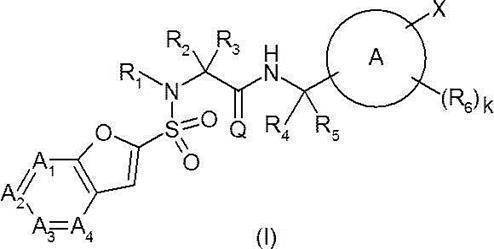
が But

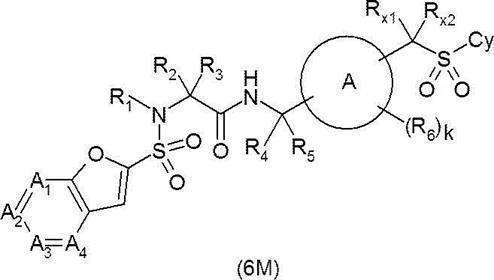
で示される化合物(6L)、(6M)の合成方法を以下に示す。 A method for synthesizing the compounds (6L) and (6M) shown below is shown below.
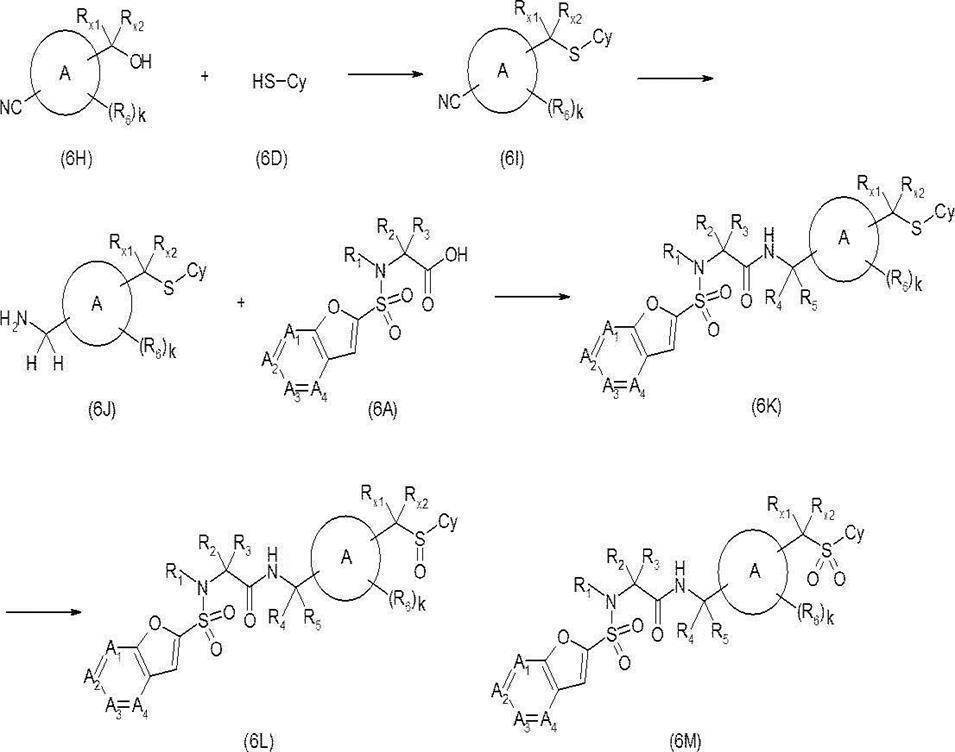
アルコール誘導体(6H)とチオール誘導体(6D)とを、例えばジクロロメタン、テトラヒドロフラン等の本反応に悪影響を及ぼさない溶媒中、例えばトリフェニルホスフィン等の存在下、アゾジカルボン酸ジイソプロピル(DIAD)やアゾジカルボン酸ジエチル(DEAD)等を用いて反応させることで、ニトリル誘導体(6I)を合成できる。得られたニトリル誘導体(6I)を、例えばテトラヒドロフラン等の本反応に悪影響を及ぼさない溶媒中、例えば水素化アルミニウムリチウムやボラン-テトラヒドロフラン錯体等を用いて反応させることで、アミン誘導体(6J)を合成することが出来る。得られたアミン誘導体(6J)と、上述の方法等で得られたカルボン酸誘導体(1A)と同様に合成できるカルボン酸誘導体(6A)とを例えばジクロロメタン等の本反応に悪影響を及ぼさない溶媒中、例えば1-ヒドロキシベンゾトリアゾール等の存在下または非存在下で1-エチル-3-(3’-ジメチルアミノプロピル)カルボジイミド(WSC)に代表されるような縮合剤をトリエチルアミン等の塩基存在下または非存在下で反応させることで、アミド誘導体(6K)を合成する事が出来る。得られたアミド誘導体(6K)を、例えばジクロロメタン等の本反応に悪影響を及ぼさない溶媒中、例えば3-クロロ過安息香酸、過酸化水素水等を用いて反応させることで、スルホキシド誘導体(6L)及びスルホン誘導体(6M)を合成することができる。 Alcohol derivative (6H) and thiol derivative (6D) are mixed with isopropyl dicarboxylate (DIAD) or azodicarboxylic acid in the presence of, for example, triphenylphosphine in a solvent that does not adversely affect the reaction such as dichloromethane and tetrahydrofuran. A nitrile derivative (6I) can be synthesized by reacting with diethyl (DEAD) or the like. The amine derivative (6J) is synthesized by reacting the obtained nitrile derivative (6I) with, for example, lithium aluminum hydride or borane-tetrahydrofuran complex in a solvent that does not adversely affect the reaction such as tetrahydrofuran. I can do it. The obtained amine derivative (6J) and the carboxylic acid derivative (6A) that can be synthesized in the same manner as the carboxylic acid derivative (1A) obtained by the above-described method or the like in a solvent that does not adversely affect the reaction, such as dichloromethane. For example, a condensing agent represented by 1-ethyl-3- (3′-dimethylaminopropyl) carbodiimide (WSC) in the presence or absence of 1-hydroxybenzotriazole or the like in the presence of a base such as triethylamine or the like By reacting in the absence, an amide derivative (6K) can be synthesized. The amide derivative (6K) thus obtained is reacted with, for example, 3-chloroperbenzoic acid, aqueous hydrogen peroxide, etc. in a solvent that does not adversely influence the reaction, such as dichloromethane, to give a sulfoxide derivative (6L). And a sulfone derivative (6M) can be synthesized.
例えば式(I)中、Qが=Oであり、-Xが-S(O)n-C(Rx1Rx2)-Cy、n=1、2で表される基のとき、すなわち For example, in the formula (I), when Q is ═O and —X is —S (O) nC (R x1 R x2 ) —Cy, n = 1, 2, ie,
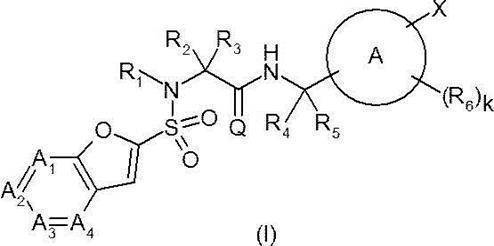
が But


で示される化合物(6S)、(6T)の合成方法を以下に示す。 A method for synthesizing the compounds (6S) and (6T) represented by the formula is shown below.
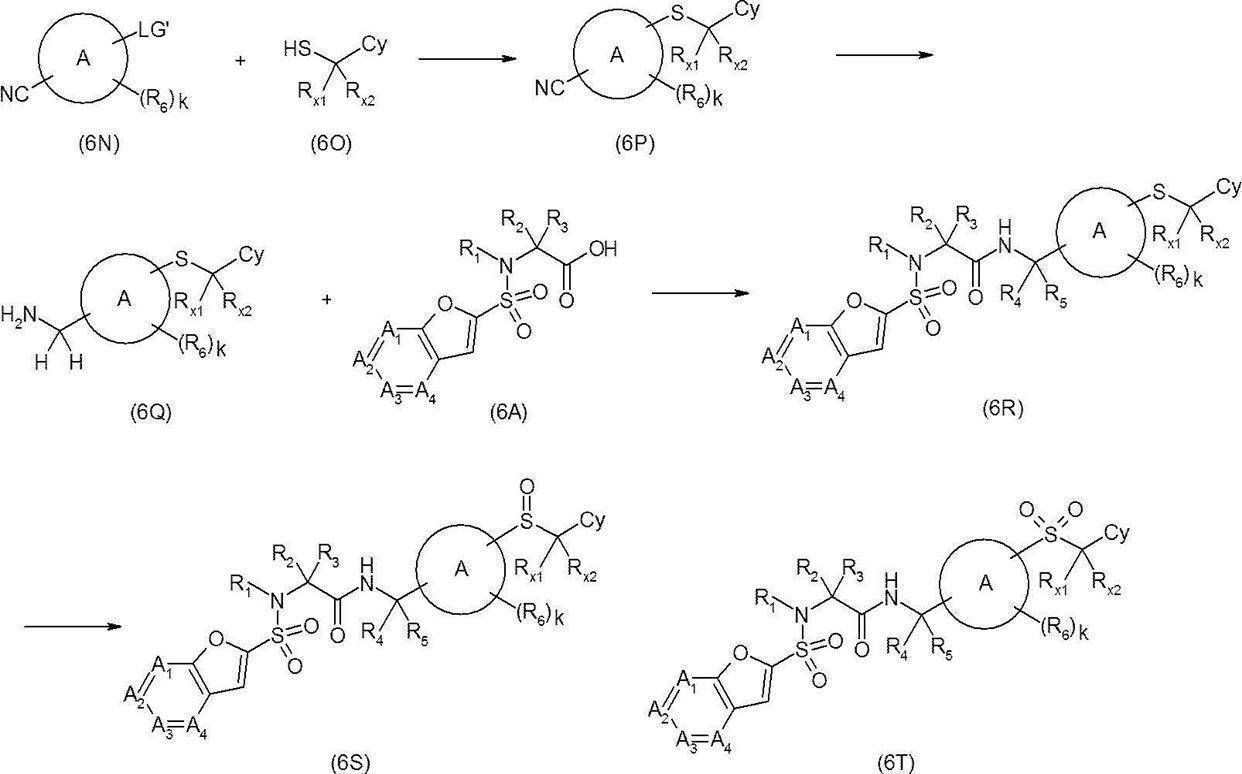
ニトリル誘導体(6N)(式中LG’は塩素原子、臭素原子、ヨウ素原子を示す)とチオール誘導体(6O)とを、例えばN,N-ジメチルホルムアミド、ジメチルスルホキシド等の本反応に悪影響を及ぼさない溶媒中、例えば水素化ナトリウム、水酸化カリウム及びカリウム tert-ブトキシド等を用いて反応させることでスルフィド誘導体(6P)を合成することが出来る。得られたスルフィド誘導体(6P)を、例えばテトラヒドロフラン等の本反応に悪影響を及ぼさない溶媒中、例えば水素化アルミニウムリチウムやボラン・テトラヒドロフラン錯体等を用いて反応させることで、アミン誘導体(6Q)を合成することが出来る。得られたアミン誘導体(6Q)と、上述の方法等で得られたカルボン酸誘導体(1A)と同様に合成できるカルボン酸誘導体(6A)とを例えばジクロロメタン等の本反応に悪影響を及ぼさない溶媒中、例えば1-ヒドロキシベンゾトリアゾール等の存在下または非存在下で1-エチル-3-(3’-ジメチルアミノプロピル)カルボジイミド(WSC)に代表されるような縮合剤をトリエチルアミン等の塩基存在下または非存在下で反応させることで、アミド誘導体(6R)を合成する事が出来る。得られたアミド誘導体(6R)を、例えばジクロロメタン等の本反応に悪影響を及ぼさない溶媒中、例えば3-クロロ過安息香酸、過酸化水素水等を用いて反応させることで、目的とするスルホキシド誘導体(6S)及びスルホン誘導体(6T)を合成することができる。 Nitrile derivative (6N) (where LG ′ represents a chlorine atom, a bromine atom or an iodine atom) and thiol derivative (6O) do not adversely affect this reaction such as N, N-dimethylformamide, dimethyl sulfoxide, etc. The sulfide derivative (6P) can be synthesized by reacting in a solvent using, for example, sodium hydride, potassium hydroxide and potassium tert-butoxide. The resulting sulfide derivative (6P) is reacted with, for example, lithium aluminum hydride or borane / tetrahydrofuran complex in a solvent that does not adversely affect the reaction, such as tetrahydrofuran, to synthesize an amine derivative (6Q). I can do it. The obtained amine derivative (6Q) and the carboxylic acid derivative (6A) that can be synthesized in the same manner as the carboxylic acid derivative (1A) obtained by the above-described method or the like in a solvent that does not adversely affect the reaction, such as dichloromethane. For example, a condensing agent represented by 1-ethyl-3- (3′-dimethylaminopropyl) carbodiimide (WSC) in the presence or absence of 1-hydroxybenzotriazole or the like in the presence of a base such as triethylamine or the like By reacting in the absence, the amide derivative (6R) can be synthesized. The obtained amide derivative (6R) is reacted with, for example, 3-chloroperbenzoic acid, aqueous hydrogen peroxide, or the like in a solvent that does not adversely influence the reaction such as dichloromethane, for example, to obtain the desired sulfoxide derivative. (6S) and the sulfone derivative (6T) can be synthesized.
以下、本発明を参考例、実施例及び試験例により詳細に説明するが、本発明はこれらに限定されるものではない。また、本実施例で用いる装置、試薬等について、特に記載がないものは、当分野で通常実施されている方法に従って容易に調製入手できるか、あるいは商業的に入手可能なものである。また、標題化合物における%は、収率を意味する。
参考例A-1:7-フルオロベンゾフラン-2-イルスルホニルクロリド(A-1)の合成
Hereinafter, although a reference example, an example, and a test example explain the present invention in detail, the present invention is not limited to these. In addition, the devices, reagents, and the like used in the present examples, which are not particularly described, can be easily prepared and obtained according to a method commonly practiced in this field, or are commercially available. Moreover,% in a title compound means a yield.
Reference Example A-1: Synthesis of 7-fluorobenzofuran-2-ylsulfonyl chloride (A-1)
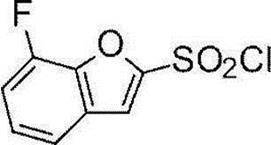
7-フルオロベンゾフラン(0.90g、6.6mmol)のジエチルエーテル(10mL)溶液を0℃に冷却し、1.3mol/L tert-ブチルリチウム(n-ペンタン溶液、6.1mL、7.9mmol)を20分間かけて滴下した。反応混合物に二酸化硫黄を20分間吹き込んだ後、N-クロロこはく酸イミド(1.1g、9.7mmol)を加えて1時間攪拌した。反応混合物を氷水に加え、酢酸エチルで抽出し、有機層を飽和食塩水で洗浄した後、硫酸ナトリウムにて乾燥した。乾燥剤を濾別し、溶媒を留去して得られた残渣をシリカゲルカラムクロマトグラフィー(石油エーテル)にて精製して標題化合物(0.40g、1.7mmol、26%)を得た。
MS (ESI) m/z 235 (M+H)+
A solution of 7-fluorobenzofuran (0.90 g, 6.6 mmol) in diethyl ether (10 mL) was cooled to 0 ° C., and 1.3 mol / L tert-butyllithium (n-pentane solution, 6.1 mL, 7.9 mmol) Was added dropwise over 20 minutes. After blowing sulfur dioxide into the reaction mixture for 20 minutes, N-chlorosuccinimide (1.1 g, 9.7 mmol) was added and stirred for 1 hour. The reaction mixture was added to ice water and extracted with ethyl acetate. The organic layer was washed with saturated brine and dried over sodium sulfate. The desiccant was filtered off, the solvent was distilled off, and the resulting residue was purified by silica gel column chromatography (petroleum ether) to obtain the title compound (0.40 g, 1.7 mmol, 26%).
MS (ESI) m / z 235 (M + H) +
参考例A-2:6-フルオロベンゾフラン-2-イルスルホニルクロリド(A-2)の合成
(工程1)2-(2,2-ジブロモビニル)-5-フルオロフェノールの合成
四臭化炭素(22.4g、68.4mmol)のジクロロメタン(80mL)溶液を0℃に冷却し、トリフェニルホスフィン(27.7g、106mmol)を加えて30分間攪拌した。反応混合物に、トリエチルアミン(23.8mL、171mmol)を加えた後、反応温度が5℃以下になるよう4-フルオロ-2-ヒドロキシベンズアルデヒド(4.00g、28.6mmol)をゆっくりと加えた。反応混合物を30℃で2時間攪拌した後、減圧濃縮して得られた残渣をシリカゲルカラムクロマトグラフィー(ヘキサン/酢酸エチル)にて精製して標題化合物(2.66g、8.99mmol、31%)を得た。
1H NMR (400 MHz, CDCl3) δ 7.51-7.44 (m, 2H), 6.69-6.64 (m, 1H), 6.58-6.55 (m, 1H), 5.56 (s, 1H).
(工程2)2-ブロモ-6-フルオロベンゾフランの合成
工程1で得られた化合物(2.40g、8.14mmol)、ヨウ化銅(I)(123mg、0.648mmol)及びリン酸カリウム(3.26g、15.4mmol)にテトラヒドロフラン(80mL)を加え80℃で2時間攪拌した。不溶物を濾別した後、減圧濃縮して得られた残渣をシリカゲルカラムクロマトグラフィー(ヘキサン)にて精製して標題化合物(1.15g、5.34mmol、66%)を得た。
1H NMR (400 MHz, CDCl3) δ7.42-7.38 (m, 1H), 7.18-7.15 (m, 1H), 7.02-6.96 (m, 1H), 6.68 (s, 1H).
(工程3)6-フルオロベンゾフラン-2-イルスルホニルクロリド(A-2)の合成
参考例A-1と同様の操作を、7-フルオロベンゾフランの代わりに工程2で得られた化合物(1.0g、4.7mmol)を用いて行い、標題化合物(0.10g、0.43mmol、9%)を得た。
MS (ESI) m/z 235 (M+H)+
Reference Example A-2: Synthesis of 6-fluorobenzofuran-2-ylsulfonyl chloride (A-2) (Step 1) Synthesis of 2- (2,2-dibromovinyl) -5-fluorophenol Carbon tetrabromide (22 .4 g, 68.4 mmol) in dichloromethane (80 mL) was cooled to 0 ° C., triphenylphosphine (27.7 g, 106 mmol) was added, and the mixture was stirred for 30 min. Triethylamine (23.8 mL, 171 mmol) was added to the reaction mixture, and then 4-fluoro-2-hydroxybenzaldehyde (4.00 g, 28.6 mmol) was slowly added so that the reaction temperature was 5 ° C. or lower. The reaction mixture was stirred at 30 ° C. for 2 hours and concentrated under reduced pressure. The resulting residue was purified by silica gel column chromatography (hexane / ethyl acetate) to give the title compound (2.66 g, 8.99 mmol, 31%). Got.
1 H NMR (400 MHz, CDCl 3 ) δ 7.51-7.44 (m, 2H), 6.69-6.64 (m, 1H), 6.58-6.55 (m, 1H), 5.56 (s, 1H).
(Step 2) Synthesis of 2-bromo-6-fluorobenzofuran Compound (2.40 g, 8.14 mmol) obtained in Step 1, copper (I) iodide (123 mg, 0.648 mmol) and potassium phosphate (3 Tetrahydrofuran (80 mL) was added to .26 g, 15.4 mmol), and the mixture was stirred at 80 ° C. for 2 hours. The insoluble material was filtered off, and the residue obtained after concentration under reduced pressure was purified by silica gel column chromatography (hexane) to give the title compound (1.15 g, 5.34 mmol, 66%).
1 H NMR (400 MHz, CDCl 3 ) δ7.42-7.38 (m, 1H), 7.18-7.15 (m, 1H), 7.02-6.96 (m, 1H), 6.68 (s, 1H).
(Step 3) Synthesis of 6-fluorobenzofuran-2-ylsulfonyl chloride (A-2) The same procedure as in Reference Example A-1 was carried out except that the compound obtained in Step 2 (1.0 g 4.7 mmol) to give the title compound (0.10 g, 0.43 mmol, 9%).
MS (ESI) m / z 235 (M + H) +
表2記載のA-3~A-4は、対応する市販の試薬を用い参考例A-2と同様の操作により合成した。 A-3 to A-4 shown in Table 2 were synthesized in the same manner as in Reference Example A-2 using the corresponding commercially available reagents.

参考例A-5:5-メチルベンゾフラン-2-イルスルホニルクロリド(A-2)の合成Reference Example A-5: Synthesis of 5-methylbenzofuran-2-ylsulfonyl chloride (A-2)

5-メチルベンゾフラン(5.2g、39mmol)のテトラヒドロフラン(75mL)溶液を-40℃に冷却し、2.5mol/L n-ブチルリチウム(ヘキサン溶液、19mL、48mmol)を加えて40分間攪拌した。温度を-40℃~-30℃に保ちながら、反応混合物に二酸化硫黄を20分間吹き込んだ後、室温にて90分間攪拌した。反応混合物にヘキサンを加え、不溶物を濾取、乾燥した。得られた固体にジクロロメタン(300mL)及びN-クロロこはく酸イミド(31g、0.23mol)を加え、室温にて一晩攪拌した後、不溶物を濾別した。濾液を減圧濃縮して標題化合物(3.0g、13mmol、33%)を得た。
MS (ESI) m/z 231 (M+H)+
A solution of 5-methylbenzofuran (5.2 g, 39 mmol) in tetrahydrofuran (75 mL) was cooled to −40 ° C., 2.5 mol / L n-butyllithium (hexane solution, 19 mL, 48 mmol) was added, and the mixture was stirred for 40 minutes. While maintaining the temperature at −40 ° C. to −30 ° C., sulfur dioxide was blown into the reaction mixture for 20 minutes, and then stirred at room temperature for 90 minutes. Hexane was added to the reaction mixture, and the insoluble material was collected by filtration and dried. Dichloromethane (300 mL) and N-chlorosuccinimide (31 g, 0.23 mol) were added to the obtained solid, and the mixture was stirred overnight at room temperature. The filtrate was concentrated under reduced pressure to give the title compound (3.0 g, 13 mmol, 33%).
MS (ESI) m / z 231 (M + H) +
参考例A-6:4-クロロフロ[3,2-c]ピリジン-2-スルホニルクロリド(A-6)の合成Reference Example A-6: Synthesis of 4-chlorofuro [3,2-c] pyridine-2-sulfonyl chloride (A-6)

4-クロロフロ[3,2-c]ピリジン(3.0g、20mmol)のテトラヒドロフラン(80mL)溶液を-40℃に冷却し、2.5mol/L n-ブチルリチウム(ヘキサン溶液、9.4mL、24mmol)を加えて1時間攪拌した。反応温度を-40℃~-30℃に保ちながら、反応混合物に二酸化硫黄を30分間吹き込んだ後、室温にて1.5時間攪拌した。反応混合物にヘキサン(100mL)を加え、不溶物を濾取、乾燥した。得られた固体にジクロロメタン(75mL)を加えた後、0℃でN-クロロコハク酸イミド(3.1g、23mmol)を加えた。室温にて1時間攪拌した後、反応混合物を水で5回洗浄した。有機層を硫酸ナトリウムにて乾燥し、乾燥剤を濾別した後、溶媒を留去して標題化合物(3.5g、14mmol、71%)を得た。
MS (ESI) m/z 252 (M+H)+
1H NMR (400 MHz, CDCl3) δ 8.55 (d, J = 6.0 Hz, 1H), 7.74 (d, J = 1.0 Hz, 1H), 7.59 (dd, J = 6.0, 1.0 Hz, 1H).
A solution of 4-chlorofuro [3,2-c] pyridine (3.0 g, 20 mmol) in tetrahydrofuran (80 mL) was cooled to −40 ° C. and 2.5 mol / L n-butyllithium (hexane solution, 9.4 mL, 24 mmol). ) Was added and stirred for 1 hour. While maintaining the reaction temperature at −40 ° C. to −30 ° C., sulfur dioxide was blown into the reaction mixture for 30 minutes, and then the mixture was stirred at room temperature for 1.5 hours. Hexane (100 mL) was added to the reaction mixture, and the insoluble material was collected by filtration and dried. Dichloromethane (75 mL) was added to the obtained solid, and N-chlorosuccinimide (3.1 g, 23 mmol) was added at 0 ° C. After stirring at room temperature for 1 hour, the reaction mixture was washed 5 times with water. The organic layer was dried over sodium sulfate, the desiccant was filtered off, and the solvent was evaporated to give the title compound (3.5 g, 14 mmol, 71%).
MS (ESI) m / z 252 (M + H) +
1 H NMR (400 MHz, CDCl 3 ) δ 8.55 (d, J = 6.0 Hz, 1H), 7.74 (d, J = 1.0 Hz, 1H), 7.59 (dd, J = 6.0, 1.0 Hz, 1H).
参考例B-1:(2S)-1-(ベンゾフラン-2-イルスルホニル)ピロリジン-2-カルボン酸(B-1)の合成
L-プロリン(53mg、0.46mmol)を2mol/L 水酸化ナトリウム水溶液(2mL)及びテトラヒドロフラン(2mL)に溶解させ、ベンゾフラン-2-スルホニルクロリド(120mg、0.56mmol)を加え、室温にて数時間攪拌した。反応液をジクロロメタンで抽出後、水層を2mol/L 塩酸にて中和し、ジクロロメタンで抽出し得られた有機層を硫酸ナトリウムにて乾燥した。乾燥剤を濾別し、溶媒を留去して標題化合物の薄黄白色結晶(110mg、0.37mmol、81%)を得た。
MS (ESI) m/z 296 (M+H)+
1H NMR (400 MHz, DMSO-d6) δ 12.91 (s, 1H), 7.82 (d, J = 8.0 Hz, 1H), 7.75 (d, J = 8.0 Hz, 1H), 7.67 (s, 1H), 7.56-7.52 (m, 1H), 7.42-7.37 (m, 1H), 4.29-4.26 (m, 1H), 3.54-3.47 (m, 1H), 3.41-3.35 (m, 1H), 2.10-1.82 (m, 3H), 1.73-1.64 (m, 1H).
Reference Example B-1: Synthesis of (2S) -1- (benzofuran-2- ylsulfonyl ) pyrrolidine-2-carboxylic acid (B-1) L-proline (53 mg, 0.46 mmol) in 2 mol / L sodium hydroxide It was dissolved in an aqueous solution (2 mL) and tetrahydrofuran (2 mL), benzofuran-2-sulfonyl chloride (120 mg, 0.56 mmol) was added, and the mixture was stirred at room temperature for several hours. After the reaction solution was extracted with dichloromethane, the aqueous layer was neutralized with 2 mol / L hydrochloric acid, and the organic layer obtained by extraction with dichloromethane was dried over sodium sulfate. The desiccant was filtered off and the solvent was distilled off to give the title compound as pale yellowish white crystals (110 mg, 0.37 mmol, 81%).
MS (ESI) m / z 296 (M + H) +
1 H NMR (400 MHz, DMSO-d 6 ) δ 12.91 (s, 1H), 7.82 (d, J = 8.0 Hz, 1H), 7.75 (d, J = 8.0 Hz, 1H), 7.67 (s, 1H) , 7.56-7.52 (m, 1H), 7.42-7.37 (m, 1H), 4.29-4.26 (m, 1H), 3.54-3.47 (m, 1H), 3.41-3.35 (m, 1H), 2.10-1.82 ( m, 3H), 1.73-1.64 (m, 1H).
表3記載のB-2~B-6、B-8、B-10~B-11、B-13、B-32~B-37は、A-1、A-2、A-3および対応する市販の試薬を用い参考例B-1と同様の操作により合成した。 B-2 to B-6, B-8, B-10 to B-11, B-13, B-32 to B-37 listed in Table 3 correspond to A-1, A-2, A-3 and the corresponding Was synthesized by the same procedure as in Reference Example B-1.


参考例B-7:(2S)-1-(5-フルオロベンゾフラン-2-イルスルホニル)-2,5-ジヒドロピロール-2-カルボン酸(B-7)の合成Reference Example B-7: Synthesis of (2S) -1- (5-fluorobenzofuran-2-ylsulfonyl) -2,5-dihydropyrrole-2-carboxylic acid (B-7)
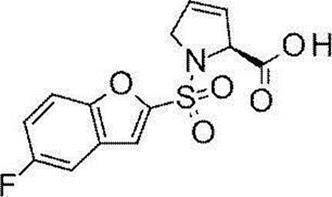
(工程1)(4R)-N-(5-フルオロベンゾフラン-2-イル)スルホニル-4-ヒドロキシ-L-プロリン メチルエステルの合成
(4R)-4-ヒドロキシ-L-プロリン メチルエステル 塩酸塩(2.3g、13mmol)にジクロロメタン(35mL)、トリエチルアミン(5.4mL、39mmol)及び4-ジメチルアミノピリジン(0.16g、1.3mmol)を加えた。反応混合物を0℃に冷却してA-3(3.0g、13mmol)を加えた後、室温にて一晩攪拌した。反応混合物を水及び飽和食塩水で順次洗浄し、有機層を硫酸ナトリウムにて乾燥した。乾燥剤を濾別した後、溶媒を留去して標題化合物(3.5g、10mmol、80%)を得た。
MS (ESI) m/z 344 (M+H)+
1H NMR (300 MHz, CDCl3): δ 7.50-7.43 (m, 1H), 7.37 (s, 1H), 7.33-7.30 (m, 1H), 7.18-7.10 (m, 1H), 4.59 (t, J = 9.0 Hz, 1H), 4.48-4.41 (m, 1H), 3.80-3.75 (m, 1H), 3.77 (s, 3H), 3.62-3.58 (m, 1H), 2.28-2.16 (m, 2H).
(工程2)(4R)-N-(5-フルオロベンゾフラン-2-イル)スルホニル-4-メチルスルホニルオキシ-L-プロリン メチルエステルの合成
工程1で得られた化合物(7.0g、20mmol)、トリエチルアミン(4.3mL、31mmol)及び4-ジメチルアミノピリジン(0.50g、4.1mmol)にジクロロメタン(100mL)を加えた。反応混合物を0℃に冷却してメタンスルホニルクロリド(3.5g、31mmol)を滴下した後、0℃で1時間攪拌した。反応混合物を水及び飽和食塩水で順次洗浄し、有機層を硫酸ナトリウムにて乾燥した。乾燥剤を濾別した後、溶媒を留去して標題化合物(8.5g、20mmol、99%)を得た。
MS (ESI) m/z 421 (M+H)+
(工程3)(2S)-1-(5-フルオロベンゾフラン-2-イルスルホニル)-2,5-ジヒドロピロール-2-カルボン酸 メチルエステルの合成
工程2で得られた化合物(8.5g、20mmol)とジフェニルジセレニド(3.8g、12mmol)にメタノール(100mL)を加えた。反応液にテトラヒドロホウ酸ナトリウム(1.0g、26mmol)を加えて一晩加熱還流した。反応混合物を減圧濃縮して得られた残渣をシリカゲルカラムクロマトグラフィー(石油エーテル/酢酸エチル)にて精製した。得られたオイルにジクロロメタン(50mL)を加えて溶解させ、ピリジン(6mL)/過酸化水素水(12mL)を加えて室温で2時間攪拌した。反応混合物を水、1mol/L クエン酸水溶液及び飽和亜硫酸ナトリウム水溶液にて順次洗浄し、有機層を硫酸ナトリウムにて乾燥した。乾燥剤を濾別した後、溶媒を留去してられた残渣をシリカゲルカラムクロマトグラフィー(ジクロロメタン/メタノール)にて精製して標題化合物(1.8g、5.5mmol、27%)を得た。
MS (ESI) m/z 326 (M+H)+
(工程4)(2S)-1-(5-フルオロベンゾフラン-2-イルスルホニル)-2,5-ジヒドロピロール-2-カルボン酸(B-7)の合成
工程3で得られた化合物(1.8g、5.5mmol)及び水酸化トリメチルすず(5.0g、28mmol)に1,2-ジクロロエタン(35mL)を加え、封管中80℃で5時間加熱攪拌した。反応混合物を減圧濃縮して得られた残渣に酢酸エチルを加えて溶解させ1mol/L塩酸水溶液及び飽和食塩水にて順次洗浄した。有機層を硫酸ナトリウムにて乾燥し、乾燥剤を濾別した後、溶媒を留去して標題化合物(1.4g、4.5mmol、81%)を得た。
MS (ESI) m/z 312 (M+H)+
1H NMR (300 MHz, CD3OD): δ 7.63 (dd, J = 9.3, 3.9 Hz, 1H), 7.54 (s, 1H), 7.49 (dd, J = 8.1, 2.7 Hz, 1H), 7.29 (ddd, J = 9.3, 9.0, 2.7 Hz, 1H), 5.98-5.96 (m, 1H), 5.82-5.78 (m, 1H), 5.20-5.18 (m, 1H), 4.37-4.35 (m, 2H).
(Step 1) Synthesis of (4R) -N- (5-fluorobenzofuran-2-yl) sulfonyl-4-hydroxy-L-proline methyl ester (4R) -4-hydroxy-L-proline methyl ester hydrochloride (2 To 3 g, 13 mmol) was added dichloromethane (35 mL), triethylamine (5.4 mL, 39 mmol) and 4-dimethylaminopyridine (0.16 g, 1.3 mmol). The reaction mixture was cooled to 0 ° C. and A-3 (3.0 g, 13 mmol) was added, followed by stirring overnight at room temperature. The reaction mixture was washed successively with water and saturated brine, and the organic layer was dried over sodium sulfate. After the desiccant was filtered off, the solvent was distilled off to give the title compound (3.5 g, 10 mmol, 80%).
MS (ESI) m / z 344 (M + H) +
1 H NMR (300 MHz, CDCl 3 ): δ 7.50-7.43 (m, 1H), 7.37 (s, 1H), 7.33-7.30 (m, 1H), 7.18-7.10 (m, 1H), 4.59 (t, J = 9.0 Hz, 1H), 4.48-4.41 (m, 1H), 3.80-3.75 (m, 1H), 3.77 (s, 3H), 3.62-3.58 (m, 1H), 2.28-2.16 (m, 2H) .
(Step 2) Synthesis of (4R) -N- (5-fluorobenzofuran-2-yl) sulfonyl-4-methylsulfonyloxy-L-proline methyl ester Compound obtained in Step 1 (7.0 g, 20 mmol), Dichloromethane (100 mL) was added to triethylamine (4.3 mL, 31 mmol) and 4-dimethylaminopyridine (0.50 g, 4.1 mmol). The reaction mixture was cooled to 0 ° C. and methanesulfonyl chloride (3.5 g, 31 mmol) was added dropwise, followed by stirring at 0 ° C. for 1 hour. The reaction mixture was washed successively with water and saturated brine, and the organic layer was dried over sodium sulfate. After the desiccant was filtered off, the solvent was distilled off to obtain the title compound (8.5 g, 20 mmol, 99%).
MS (ESI) m / z 421 (M + H) +
(Step 3) Synthesis of (2S) -1- (5-fluorobenzofuran-2-ylsulfonyl) -2,5-dihydropyrrole-2-carboxylic acid methyl ester Compound (8.5 g, 20 mmol) obtained in Step 2 ) And diphenyl diselenide (3.8 g, 12 mmol) were added methanol (100 mL). Sodium tetrahydroborate (1.0 g, 26 mmol) was added to the reaction solution, and the mixture was heated to reflux overnight. The residue obtained by concentrating the reaction mixture under reduced pressure was purified by silica gel column chromatography (petroleum ether / ethyl acetate). Dichloromethane (50 mL) was added and dissolved in the obtained oil, pyridine (6 mL) / hydrogen peroxide solution (12 mL) was added, and the mixture was stirred at room temperature for 2 hours. The reaction mixture was washed successively with water, 1 mol / L aqueous citric acid solution and saturated aqueous sodium sulfite solution, and the organic layer was dried over sodium sulfate. After the desiccant was filtered off, the solvent was distilled off and the residue was purified by silica gel column chromatography (dichloromethane / methanol) to obtain the title compound (1.8 g, 5.5 mmol, 27%).
MS (ESI) m / z 326 (M + H) +
(Step 4) Synthesis of (2S) -1- (5-fluorobenzofuran-2-ylsulfonyl) -2,5-dihydropyrrole-2-carboxylic acid (B-7) The compound (1. 1,2-dichloroethane (35 mL) was added to 8 g, 5.5 mmol) and trimethyltin hydroxide (5.0 g, 28 mmol), and the mixture was heated and stirred at 80 ° C. for 5 hours in a sealed tube. The reaction mixture was concentrated under reduced pressure, and the residue obtained was dissolved by adding ethyl acetate, and washed successively with 1 mol / L aqueous hydrochloric acid solution and saturated brine. The organic layer was dried over sodium sulfate, the desiccant was filtered off, and the solvent was evaporated to give the title compound (1.4 g, 4.5 mmol, 81%).
MS (ESI) m / z 312 (M + H) +
1 H NMR (300 MHz, CD 3 OD): δ 7.63 (dd, J = 9.3, 3.9 Hz, 1H), 7.54 (s, 1H), 7.49 (dd, J = 8.1, 2.7 Hz, 1H), 7.29 ( ddd, J = 9.3, 9.0, 2.7 Hz, 1H), 5.98-5.96 (m, 1H), 5.82-5.78 (m, 1H), 5.20-5.18 (m, 1H), 4.37-4.35 (m, 2H).
参考例B-9:(2S,3S)-1-(5-フルオロベンゾフラン-2-イルスルホニル)-3-ヒドロキシピロリジン-2-カルボン酸(B-9)の合成Reference Example B-9: Synthesis of (2S, 3S) -1- (5-fluorobenzofuran-2-ylsulfonyl) -3-hydroxypyrrolidine-2-carboxylic acid (B-9)
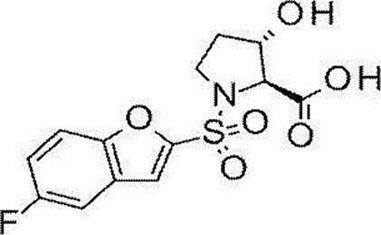
(工程1)(3S)-3-ヒドロキシ-L-プロリン メチルエステル 塩酸塩の合成
(3S)-3-ヒドロキシ-L-プロリン(1.5g、12mmol)のメタノール(20mL)溶液に塩化チオニル(1.4g、0.12mol)を0℃で加え、室温で一晩攪拌した。生じた不溶物を濾取し、ジエチルエーテルにて洗浄して標題化合物(1.9g、10mmol、91%)を得た。
MS (ESI) m/z 146 (M+H)+
1H NMR (CDCl3, 300 MHz): δ6.01-5.99 (m, 1H), 4.49-4.46 (m, 1H), 4.13 (d, J = 2.7 Hz, 1H), 3.76 (s, 3H), 3.38-3.28 (m, 2H), 2.01-1.84 (m, 2H).
(工程2)(2S,3S)-1-(5-フルオロベンゾフラン-2-イルスルホニル)-3-ヒドロキシピロリジン-2-カルボン酸 メチルエステルの合成
工程1で得られた化合物(1.2g、6.7mmol)にジクロロメタン(20mL)、トリエチルアミン(2.8mL、20mmol)及び4-ジメチルアミノピリジン(82mg、0.67mmol)を加えた。反応混合物を0℃に冷却してA-3(1.6g、6.7mmol)を加え1時間攪拌した後、減圧濃縮して得られた残渣をシリカゲルカラムクロマトグラフィー(石油エーテル/酢酸エチル)にて精製して標題化合物(1.4g、4.1mmol、61%)を得た。
MS (ESI) m/z 344 (M+H)+
1H NMR (300 MHz, DMSO-d6): δ7.81-7.67 (m, 1H), 7.65-7.61 (m, 2H), 7.44-7.37 (m, 1H), 5.43 (s, 1H), 4.27-4.25 (m, 1H), 4.16 (s, 1H), 3.67 (s, 3H), 3.63-3.44 (m, 2H), 1.97-1.94 (m, 1H), 1.80-1.74 (m, 1H).
(工程3)(2S,3S)-1-(5-フルオロベンゾフラン-2-イルスルホニル)-3-ヒドロキシピロリジン-2-カルボン酸(B-9)の合成
工程2で得られた化合物(1.2g、3.5mmol)のメタノール(20mL)溶液に2mol/L 水酸化リチウム水溶液(10mL)を加え、室温で1時間攪拌した。反応液からメタノールを留去した後、濃塩酸を加えて生じた析出物を濾取、乾燥して標題化合物(0.78g、2.4mmol、68%)を得た。
MS (ESI) m/z 330 (M+H)+
1H NMR (300 MHz, CD3OD): δ 7.63 (dd, J = 9.0, 3.9 Hz, 1H), 7.50-7.45 (m, 2H), 7.28 (ddd, J = 9.3, 9.0, 2.7 Hz, 1H), 4.38 (s, 1H), 4.28 (s, 1H), 3.75-3.58 (m, 2H), 2.15-2.05 (m, 1H), 1.90-1.84 (m, 1H).
(Step 1) Synthesis of (3S) -3-hydroxy-L-proline methyl ester hydrochloride (3S) -3-hydroxy-L-proline (1.5 g, 12 mmol) in methanol (20 mL) in thionyl chloride (1 0.4 g, 0.12 mol) was added at 0 ° C., and the mixture was stirred overnight at room temperature. The resulting insoluble material was collected by filtration and washed with diethyl ether to obtain the title compound (1.9 g, 10 mmol, 91%).
MS (ESI) m / z 146 (M + H) +
1 H NMR (CDCl 3 , 300 MHz): δ6.01-5.99 (m, 1H), 4.49-4.46 (m, 1H), 4.13 (d, J = 2.7 Hz, 1H), 3.76 (s, 3H), 3.38-3.28 (m, 2H), 2.01-1.84 (m, 2H).
(Step 2) Synthesis of (2S, 3S) -1- (5-fluorobenzofuran-2-ylsulfonyl) -3-hydroxypyrrolidine-2-carboxylic acid methyl ester The compound obtained in Step 1 (1.2 g, 6 0.7 mmol) was added dichloromethane (20 mL), triethylamine (2.8 mL, 20 mmol) and 4-dimethylaminopyridine (82 mg, 0.67 mmol). The reaction mixture was cooled to 0 ° C., A-3 (1.6 g, 6.7 mmol) was added, and the mixture was stirred for 1 hour, and then concentrated under reduced pressure. The resulting residue was subjected to silica gel column chromatography (petroleum ether / ethyl acetate). To give the title compound (1.4 g, 4.1 mmol, 61%).
MS (ESI) m / z 344 (M + H) +
1 H NMR (300 MHz, DMSO-d 6 ): δ7.81-7.67 (m, 1H), 7.65-7.61 (m, 2H), 7.44-7.37 (m, 1H), 5.43 (s, 1H), 4.27 -4.25 (m, 1H), 4.16 (s, 1H), 3.67 (s, 3H), 3.63-3.44 (m, 2H), 1.97-1.94 (m, 1H), 1.80-1.74 (m, 1H).
(Step 3) Synthesis of (2S, 3S) -1- (5-fluorobenzofuran-2-ylsulfonyl) -3-hydroxypyrrolidine-2-carboxylic acid (B-9) Compound (1. 2 mol / L aqueous lithium hydroxide solution (10 mL) was added to a methanol (20 mL) solution of 2 g, 3.5 mmol), and the mixture was stirred at room temperature for 1 hour. Methanol was distilled off from the reaction solution, concentrated hydrochloric acid was added, and the resulting precipitate was collected by filtration and dried to give the title compound (0.78 g, 2.4 mmol, 68%).
MS (ESI) m / z 330 (M + H) +
1 H NMR (300 MHz, CD 3 OD): δ 7.63 (dd, J = 9.0, 3.9 Hz, 1H), 7.50-7.45 (m, 2H), 7.28 (ddd, J = 9.3, 9.0, 2.7 Hz, 1H ), 4.38 (s, 1H), 4.28 (s, 1H), 3.75-3.58 (m, 2H), 2.15-2.05 (m, 1H), 1.90-1.84 (m, 1H).
参考例B-12:(2S)-1-(5-フルオロベンゾフラン-2-イルスルホニル)-4,4-ジフルオロピロリジン-2-カルボン酸(B-12)の合成Reference Example B-12: Synthesis of (2S) -1- (5-fluorobenzofuran-2-ylsulfonyl) -4,4-difluoropyrrolidine-2-carboxylic acid (B-12)

4,4-ジフルオロ-L-プロリン メチルエステル(0.81g、4.9mmol)のピリジン(20mL)溶液にA-3(1.2g、4.9mmol)を加え、室温で2時間攪拌した。反応混合物に6mol/L 塩酸水溶液を加えてpH4に調整し、ジクロロメタンで抽出した。有機層を硫酸ナトリウムにて乾燥し、乾燥剤を濾別した。溶媒を留去して得られた残渣をシリカゲルカラムクロマトグラフィー(ヘキサン/酢酸エチル)にて精製して標題化合物のメチルエステルを得た。得られたメチルエステルにメタノール(20mL)及び2mol/L 水酸化リチウム水溶液(20mL)を加え、室温で30分間攪拌した。反応液からメタノールを留去した後、濃塩酸を加えて生じた析出物を濾取、乾燥して標題化合物(0.72g、2.1mmol、42%)を得た。
MS (ESI) m/z 350 (M+H)+
1H NMR (300 MHz, CD3OD) δ 7.64 (dd, J = 9.0, 4.2 Hz, 1H), 7.55 (d, J = 1.2 Hz, 1H), 7.49 (dd, J = 8.4, 2.7 Hz, 1H), 7.30 (ddd, J = 9.3, 9.0, 2.7 Hz, 1H), 4.70-4.64 (m, 1H), 3.98-3.90 (m, 2H), 2.83-2.71 (m, 1H), 2.59-2.49 (m, 1H).
A-3 (1.2 g, 4.9 mmol) was added to a solution of 4,4-difluoro-L-proline methyl ester (0.81 g, 4.9 mmol) in pyridine (20 mL), and the mixture was stirred at room temperature for 2 hours. The reaction mixture was adjusted to pH 4 by adding a 6 mol / L aqueous hydrochloric acid solution, and extracted with dichloromethane. The organic layer was dried over sodium sulfate and the desiccant was filtered off. The residue obtained by distilling off the solvent was purified by silica gel column chromatography (hexane / ethyl acetate) to obtain the methyl ester of the title compound. Methanol (20 mL) and 2 mol / L aqueous lithium hydroxide solution (20 mL) were added to the obtained methyl ester, and the mixture was stirred at room temperature for 30 minutes. Methanol was distilled off from the reaction mixture, concentrated hydrochloric acid was added, and the resulting precipitate was collected by filtration and dried to give the title compound (0.72 g, 2.1 mmol, 42%).
MS (ESI) m / z 350 (M + H) +
1 H NMR (300 MHz, CD 3 OD) δ 7.64 (dd, J = 9.0, 4.2 Hz, 1H), 7.55 (d, J = 1.2 Hz, 1H), 7.49 (dd, J = 8.4, 2.7 Hz, 1H ), 7.30 (ddd, J = 9.3, 9.0, 2.7 Hz, 1H), 4.70-4.64 (m, 1H), 3.98-3.90 (m, 2H), 2.83-2.71 (m, 1H), 2.59-2.49 (m , 1H).
参考例B-14:(2S)-1-(5-フルオロベンゾフラン-2-イルスルホニル)アゼチジン-2-カルボン酸(B-14)の合成Reference Example B-14: Synthesis of (2S) -1- (5-fluorobenzofuran-2-ylsulfonyl) azetidine-2-carboxylic acid (B-14)
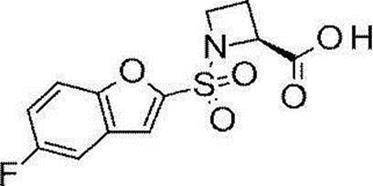
(S)-アゼチジン-2-カルボン酸(1.9g、19mmol)に飽和水酸化ナトリウム水溶液(15mL)及びA-3(4.5g、19mmol)のテトラヒドロフラン(15mL)溶液を加えて室温で30分間攪拌した。テトラヒドロフランを留去した後、1mol/L 塩酸水溶液にてpH3~4に調整し、析出物を濾取、乾燥して標題化合物(4.0g、13mmol、71%)を得た。
MS (ESI) m/z 300 (M+H)+
1H NMR (300 MHz, CD3OD) δ 7.71 (dd, J = 9.2, 4.1 Hz, 1H), 7.61 (s, 1H), 7.54 (dd, J = 8.4, 2.7 Hz, 1H), 7.34 (ddd, J = 9.3, 9.0, 2.7 Hz, 1H), 4.76 (t, J = 8.4 Hz, 1H), 4.03-3.96 (m, 2H), 2.45-2.36 (m, 2H).
To a solution of (S) -azetidine-2-carboxylic acid (1.9 g, 19 mmol) was added a saturated aqueous sodium hydroxide solution (15 mL) and a solution of A-3 (4.5 g, 19 mmol) in tetrahydrofuran (15 mL) at room temperature for 30 minutes. Stir. After tetrahydrofuran was distilled off, the pH was adjusted to 3 to 4 with a 1 mol / L hydrochloric acid aqueous solution, and the precipitate was collected by filtration and dried to obtain the title compound (4.0 g, 13 mmol, 71%).
MS (ESI) m / z 300 (M + H) +
1 H NMR (300 MHz, CD 3 OD) δ 7.71 (dd, J = 9.2, 4.1 Hz, 1H), 7.61 (s, 1H), 7.54 (dd, J = 8.4, 2.7 Hz, 1H), 7.34 (ddd , J = 9.3, 9.0, 2.7 Hz, 1H), 4.76 (t, J = 8.4 Hz, 1H), 4.03-3.96 (m, 2H), 2.45-2.36 (m, 2H).
参考例B-15:(2S)-2-{(ベンゾフラン-2-イルスルホニル)アミノ}プロピオン酸(B-15)の合成
アラニン tert-ブチルエステル 塩酸塩(0.36g、2.0mmol)にアセトニトリル(10mL)、ベンゾフラン-2-スルホニルクロリド(0.52g、2.4mmol)及びトリエチルアミン(0.60mL、4.4mmol)を加え室温で一晩攪拌した。反応混合物を減圧濃縮して得られた残渣にトリフルオロ酢酸(3mL)を加えて室温で2時間攪拌した後、減圧濃縮して得られた残渣を高速液体クロマトグラフィー(水-アセトニトリル、それぞれ0.1%トリフルオロ酢酸入り)にて精製して標題化合物(0.45g、1.7mmol、84%)を得た。
MS (ESI) m/z 270 (M+H)+
1H NMR (400 MHz, DMSO-d6) δ 12.76 (br-s, 1H), 8.84 (d, J = 8.7 Hz, 1H), 7.79 (d, J= 7.8 Hz, 1H), 7.70 (d, J = 8.4 Hz, 1H), 7.57 - 7.48 (m, 2H), 7.38 (dd, J= 7.8, 7.5 Hz, 1H), 4.02 - 3.90 (m, 1H), 1.26 (d, J = 7.2 Hz, 3H).
Reference Example B-15: Synthesis of (2S) -2-{(benzofuran-2-ylsulfonyl) amino} propionic acid (B-15) alanine tert-butyl ester hydrochloride (0.36 g, 2.0 mmol) in acetonitrile (10 mL), benzofuran-2-sulfonyl chloride (0.52 g, 2.4 mmol) and triethylamine (0.60 mL, 4.4 mmol) were added and stirred at room temperature overnight. Trifluoroacetic acid (3 mL) was added to the residue obtained by concentrating the reaction mixture under reduced pressure, and the mixture was stirred at room temperature for 2 hours, and then concentrated under reduced pressure. Purification with 1% trifluoroacetic acid gave the title compound (0.45 g, 1.7 mmol, 84%).
MS (ESI) m / z 270 (M + H) +
1 H NMR (400 MHz, DMSO-d 6 ) δ 12.76 (br-s, 1H), 8.84 (d, J = 8.7 Hz, 1H), 7.79 (d, J = 7.8 Hz, 1H), 7.70 (d, J = 8.4 Hz, 1H), 7.57-7.48 (m, 2H), 7.38 (dd, J = 7.8, 7.5 Hz, 1H), 4.02-3.90 (m, 1H), 1.26 (d, J = 7.2 Hz, 3H ).
表4記載のB-16は、A-3を用い参考例B-15と同様の操作により合成した。 B-16 shown in Table 4 was synthesized in the same manner as in Reference Example B-15 using A-3.

参考例B-17:(2S)-1-(5-メチルベンゾフラン-2-イルスルホニル)ピロリジン-2-カルボン酸(B-17)の合成Reference Example B-17: Synthesis of (2S) -1- (5-methylbenzofuran-2-ylsulfonyl) pyrrolidine-2-carboxylic acid (B-17)

L-プロリン(0.42g、3.6mmol)に飽和水酸化ナトリウム水溶液(10mL)を加えて溶解させ、0℃でA-5(0.91g、4.0mmol)のテトラヒドロフラン(5mL)溶液を滴下した。30分間攪拌した後、反応混合物にジクロロメタンを加えて分層させた。有機層を捨て、水層を減圧濃縮して残存したジクロロメタンを除き、10mol/L 塩酸水溶液をゆっくりと加えて酸性にした。析出物を濾取、乾燥して標題化合物(0.78g、2.5mmol、70%)を得た。
MS (ESI) m/z 310 (M+H)+
1H NMR (400 MHz, CD3OD):δ 7.56 (s, 1H), 7.52-7.49 (m, 1H), 7.44 (d, J = 0.8 Hz, 1H), 7.35 (dd, J = 11.2, 1.6 Hz, 1H), 4.43-4.39 (m, 1H), 3.64-3.60 (m, 1H), 3.58-3.31 (m, 1H), 2.46 (s, 3H), 2.18-1.82 (m, 3H), 1.72-1.71 (m, 1H).
Saturated aqueous sodium hydroxide solution (10 mL) is added to L-proline (0.42 g, 3.6 mmol) and dissolved, and a solution of A-5 (0.91 g, 4.0 mmol) in tetrahydrofuran (5 mL) is added dropwise at 0 ° C. did. After stirring for 30 minutes, dichloromethane was added to the reaction mixture to separate the layers. The organic layer was discarded, the aqueous layer was concentrated under reduced pressure to remove the remaining dichloromethane, and a 10 mol / L aqueous hydrochloric acid solution was slowly added to make it acidic. The precipitate was collected by filtration and dried to give the title compound (0.78 g, 2.5 mmol, 70%).
MS (ESI) m / z 310 (M + H) +
1 H NMR (400 MHz, CD 3 OD): δ 7.56 (s, 1H), 7.52-7.49 (m, 1H), 7.44 (d, J = 0.8 Hz, 1H), 7.35 (dd, J = 11.2, 1.6 Hz, 1H), 4.43-4.39 (m, 1H), 3.64-3.60 (m, 1H), 3.58-3.31 (m, 1H), 2.46 (s, 3H), 2.18-1.82 (m, 3H), 1.72- 1.71 (m, 1H).
表5記載のB-18~B-23は、A-3及び対応する市販の試薬を用い参考例B-1と同様の操作により合成した。 B-18 to B-23 shown in Table 5 were synthesized in the same manner as in Reference Example B-1 using A-3 and the corresponding commercially available reagents.

参考例B-24:(1S,2S,4R)-3-(5-フルオロベンゾフラン-2-イルスルホニル)-3-アザビシクロ[2.2.1]ヘプタン-2-カルボン酸(B-24)の合成Reference Example B-24: (1S, 2S, 4R) -3- (5-Fluorobenzofuran-2-ylsulfonyl) -3-azabicyclo [2.2.1] heptane-2-carboxylic acid (B-24) Composition
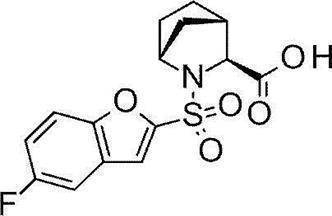
(1S,2S,4R)-3-tert-ブトキシカルボニル-3-アザビシクロ[2.2.1]ヘプタン-2-カルボン酸(100mg、0.41mmol)にトリフルオロ酢酸(0.50mL)、ジクロロメタン(1mL)を加えて室温にて数時間攪拌した。反応液を減圧濃縮して得られた残渣を2mol/L水酸化ナトリウム水溶液(2mL)及びテトラヒドロフラン(2mL)に溶解させ、A-3(96mg、0.41mmol)を加え、室温にて数時間攪拌した。反応液をジクロロメタンで抽出後、水層を1mol/L 塩酸にて中和し、ジクロロメタンで抽出し得られた有機層を硫酸ナトリウムにて乾燥した。乾燥剤を濾別し、溶媒を留去して標題化合物(139mg、0.41mmol、99%)を得た。
MS (ESI) m/z 340 (M+H)+
1H NMR (400 MHz, DMSO-d6) δ 12.85 (s, 1H), 7.84 (dd, J = 8.9, 3.8 Hz, 1H), 7.64 - 7.60 (m, 2H), 7.42 (ddd, J = 9.3, 8.9, 2.8 Hz, 1H), 4.26 (s, 1H), 3.95 (s, 1H), 2.72 (d, J = 4.4 Hz, 1H), 1.98 - 1.89 (m, 1H), 1.73 - 1.59 (m, 1H), 1.50 - 1.37 (m, 2H), 1.30 - 1.20 (m, 2H).
(1S, 2S, 4R) -3-tert-butoxycarbonyl-3-azabicyclo [2.2.1] heptane-2-carboxylic acid (100 mg, 0.41 mmol) to trifluoroacetic acid (0.50 mL), dichloromethane ( 1 mL) was added and stirred at room temperature for several hours. The residue obtained by concentrating the reaction solution under reduced pressure was dissolved in 2 mol / L aqueous sodium hydroxide solution (2 mL) and tetrahydrofuran (2 mL), A-3 (96 mg, 0.41 mmol) was added, and the mixture was stirred at room temperature for several hours. did. The reaction solution was extracted with dichloromethane, the aqueous layer was neutralized with 1 mol / L hydrochloric acid, and the organic layer obtained by extraction with dichloromethane was dried over sodium sulfate. The desiccant was filtered off and the solvent was evaporated to give the title compound (139 mg, 0.41 mmol, 99%).
MS (ESI) m / z 340 (M + H) +
1 H NMR (400 MHz, DMSO-d 6 ) δ 12.85 (s, 1H), 7.84 (dd, J = 8.9, 3.8 Hz, 1H), 7.64-7.60 (m, 2H), 7.42 (ddd, J = 9.3 , 8.9, 2.8 Hz, 1H), 4.26 (s, 1H), 3.95 (s, 1H), 2.72 (d, J = 4.4 Hz, 1H), 1.98-1.89 (m, 1H), 1.73-1.59 (m, 1H), 1.50-1.37 (m, 2H), 1.30-1.20 (m, 2H).
表6記載のB-25及びB-26は、対応する市販の試薬を用い参考例B-24と同様の操作により合成した。 B-25 and B-26 listed in Table 6 were synthesized in the same manner as in Reference Example B-24 using the corresponding commercially available reagents.

参考例B-27:(2S)-1-(4-クロロフロ[3,2-c]ピリジン-2-イル)スルホニルピロリジン-2-カルボン酸(B-27)の合成Reference Example B-27: Synthesis of (2S) -1- (4-chlorofuro [3,2-c] pyridin-2-yl) sulfonylpyrrolidine-2-carboxylic acid (B-27)
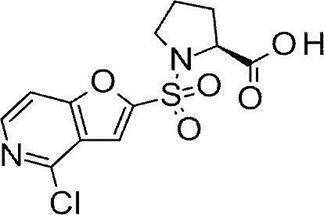
L-プロリン(1.0g、8.8mmol)及び水酸化ナトリウム(0.64g、16mmol)に水(12mL)を加えて溶解させ、0℃で25分間攪拌した後、A-6(2.0g、8.0mmol)のテトラヒドロフラン(18mL)溶液をゆっくりと加え、40分間攪拌した。反応混合物に6mol/L塩酸水溶液を加えてpH4に調整し、不溶物を濾取、乾燥させて標題化合物(1.1g、3.3mmol、42%)の白色固体を得た。
MS (ESI) m/z 331 (M+H)+
1H NMR (400 MHz, DMSO-d6) δ 8.49 (d, J = 6.0 Hz, 1H), 7.93 (dd, J = 6.0, 0.8 Hz, 1H), 7.80 (d, J = 0.8 Hz, 1H), 4.34 - 4.31 (m, 1H), 3.60-3.53 (m, 1H), 3.48 - 3.43 (m, 1H), 2.17 - 2.12 (m, 1H), 1.96 - 1.75 (m, 3H).
Water (12 mL) was added to L-proline (1.0 g, 8.8 mmol) and sodium hydroxide (0.64 g, 16 mmol) and dissolved, and the mixture was stirred at 0 ° C. for 25 minutes, and then A-6 (2.0 g 8.0 mmol) in tetrahydrofuran (18 mL) was slowly added and stirred for 40 minutes. A 6 mol / L aqueous hydrochloric acid solution was added to the reaction mixture to adjust the pH to 4, and the insoluble material was collected by filtration and dried to give the title compound (1.1 g, 3.3 mmol, 42%) as a white solid.
MS (ESI) m / z 331 (M + H) +
1 H NMR (400 MHz, DMSO-d 6 ) δ 8.49 (d, J = 6.0 Hz, 1H), 7.93 (dd, J = 6.0, 0.8 Hz, 1H), 7.80 (d, J = 0.8 Hz, 1H) , 4.34-4.31 (m, 1H), 3.60-3.53 (m, 1H), 3.48-3.43 (m, 1H), 2.17-2.12 (m, 1H), 1.96-1.75 (m, 3H).
参考例B-28:(2S)-1-フロ[3,2-c]ピリジン-2-イルスルホニルピロリジン-2-カルボン酸(B-28)の合成Reference Example B-28: Synthesis of (2S) -1-furo [3,2-c] pyridin-2-ylsulfonylpyrrolidine-2-carboxylic acid (B-28)

B-27(0.80g、2.4mmol)に酢酸(25mL)及びテトラヒドロフラン(25mL)を加えて溶解させ、10%パラジウム/炭素(150mg)加えた。反応混合物を水素雰囲気下、70℃で4時間攪拌した後、触媒を濾別し、濾液に酢酸エチルを加えて水で洗浄した。有機層を硫酸ナトリウムにて乾燥し、乾燥剤を濾別した後、溶媒を留去して得られた残渣にメタノール(8mL)を加え、不溶物を濾取、乾燥させて標題化合物(0.30g、1.0mmol、42%)の白色固体を得た。
MS (ESI) m/z 297 (M+H)+
1H NMR (400 MHz, DMSO-d6) δ 12.92 (s, 1H), 9.12 (s, 1H), 8.66 (d, J = 7.4 Hz, 1H), 7.87 (d, J = 7.4 Hz, 1H), 7.82 (s, 1H), 4.31 - 4.28 (m, 1H), 3.57 - 3.52 (m, 1H), 3.44 - 3.38 (m, 1H), 2.14 - 2.09 (m, 1H), 1.96 - 1.84 (m, 2H), 1.76 - 1.72 (m, 1H) .
Acetic acid (25 mL) and tetrahydrofuran (25 mL) were added to B-27 (0.80 g, 2.4 mmol) and dissolved, and 10% palladium / carbon (150 mg) was added. The reaction mixture was stirred at 70 ° C. for 4 hours under a hydrogen atmosphere, and then the catalyst was filtered off. Ethyl acetate was added to the filtrate and washed with water. The organic layer was dried over sodium sulfate, the desiccant was filtered off, the solvent was distilled off, methanol (8 mL) was added to the resulting residue, the insoluble material was filtered off and dried to give the title compound (0. 30 g, 1.0 mmol, 42%) of a white solid was obtained.
MS (ESI) m / z 297 (M + H) +
1 H NMR (400 MHz, DMSO-d 6 ) δ 12.92 (s, 1H), 9.12 (s, 1H), 8.66 (d, J = 7.4 Hz, 1H), 7.87 (d, J = 7.4 Hz, 1H) , 7.82 (s, 1H), 4.31-4.28 (m, 1H), 3.57-3.52 (m, 1H), 3.44-3.38 (m, 1H), 2.14-2.09 (m, 1H), 1.96-1.84 (m, 2H), 1.76-1.72 (m, 1H).
参考例B-29:(2S)-2-(フロ[3,2-c]ピリジン-2-イルスルホニルアミノ)プロパン酸 塩酸塩(B-29)の合成Reference Example B-29: Synthesis of (2S) -2- (furo [3,2-c] pyridin-2-ylsulfonylamino) propanoic acid hydrochloride (B-29)

(工程1)(2S)-2-[(4-クロロフロ[3,2-c]ピリジン-2-イル)スルホニルアミノ]プロパン酸の合成
L-アラニン tert-ブチル 塩酸塩(0.12g、0.67mmol)及びA-6(0.20g、0.80mmol)にアセトニトリル(10mL)とトリエチルアミン(0.21mL、1.5mmol)を加えて室温で2時間攪拌した。反応混合物を減圧濃縮して得られた残渣に酢酸エチル(50mL)を加え、飽和重曹水及び飽和食塩水にて順次洗浄した。有機層を硫酸ナトリウムにて乾燥し、乾燥剤を濾別した後、溶媒を留去して得られた残渣にトリフルオロ酢酸(20mL)を加え、室温で1時間攪拌した。反応混合物を減圧濃縮して得られた残渣に水を加え、2mol/L 水酸化ナトリウム水溶液にてpH10に調整してジクロロメタンで洗浄した。水層に6mol/L 塩酸を加えて酸性にし、ジクロロメタンにて抽出した。有機層を硫酸ナトリウムにて乾燥し、乾燥剤を濾別した後、溶媒を留去して標題化合物(0.11g、0.36mmol、54%)を得た。
MS (ESI) m/z 305 (M+H)+
1H NMR (400 MHz, DMSO-d6) δ 12.82 - 12.79 (m, 1H), 9.15 (d, J = 11.6 Hz, 1H), 8.47 (d, J = 7.6 Hz, 1H), 7.91 - 7.89 (m, 1H), 7.61 (d, J = 0.8 Hz, 1H), 3.99 - 4.04 (m, 1H), 1.32 - 1.21 (m, 3H).
(工程2)(2S)-2-(フロ[3,2-c]ピリジン-2-イルスルホニルアミノ)プロパン酸 塩酸塩(B-29)の合成
工程1で得られた化合物(1.0g、3.3mmol)の酢酸(80mL)溶液に亜鉛(0.67g、10mmol)を加え2時間加熱還流させた。不溶物を濾別し、濾液を減圧濃縮して得られた残渣を高速液体クロマトグラフィー(水-アセトニトリル-塩酸)にて精製して標題化合物(0.14g、0.46mmol、14%)を得た。
MS (ESI) m/z 271 (M+H)+
1H NMR (400 MHz, DMSO-d6) δ9.46 (s, 1H), 9.31 (d, J = 8.4 Hz, 1H), 8.92 (d, J = 6.4 Hz, 1H), 8.37 (d, J = 6.4 Hz, 1H), 7.86 (s, 1H), 4.03 (dq, J = 8.4, 7.2 Hz, 1H), 1.30 (d, J = 7.2 Hz, 3H).
(Step 1) Synthesis of (2S) -2-[(4-chlorofuro [3,2-c] pyridin-2-yl) sulfonylamino] propanoic acid L-alanine tert-butyl hydrochloride (0.12 g,. 67 mmol) and A-6 (0.20 g, 0.80 mmol) were added acetonitrile (10 mL) and triethylamine (0.21 mL, 1.5 mmol), and the mixture was stirred at room temperature for 2 hours. The reaction mixture was concentrated under reduced pressure, ethyl acetate (50 mL) was added to the resulting residue, and the mixture was washed successively with saturated aqueous sodium hydrogen carbonate and saturated brine. The organic layer was dried over sodium sulfate, the desiccant was filtered off, trifluoroacetic acid (20 mL) was added to the residue obtained by evaporating the solvent, and the mixture was stirred at room temperature for 1 hour. Water was added to the residue obtained by concentrating the reaction mixture under reduced pressure, the pH was adjusted to 10 with a 2 mol / L aqueous sodium hydroxide solution, and the mixture was washed with dichloromethane. The aqueous layer was acidified with 6 mol / L hydrochloric acid and extracted with dichloromethane. The organic layer was dried over sodium sulfate, the desiccant was filtered off, and the solvent was evaporated to give the title compound (0.11 g, 0.36 mmol, 54%).
MS (ESI) m / z 305 (M + H) +
1 H NMR (400 MHz, DMSO-d 6 ) δ 12.82-12.79 (m, 1H), 9.15 (d, J = 11.6 Hz, 1H), 8.47 (d, J = 7.6 Hz, 1H), 7.91-7.89 ( m, 1H), 7.61 (d, J = 0.8 Hz, 1H), 3.99-4.04 (m, 1H), 1.32-1.21 (m, 3H).
(Step 2) Synthesis of (2S) -2- (furo [3,2-c] pyridin-2-ylsulfonylamino) propanoic acid hydrochloride (B-29) The compound obtained in Step 1 (1.0 g, To a solution of 3.3 mmol) in acetic acid (80 mL), zinc (0.67 g, 10 mmol) was added and heated to reflux for 2 hours. The insoluble material was filtered off, and the filtrate was concentrated under reduced pressure. The resulting residue was purified by high performance liquid chromatography (water-acetonitrile-hydrochloric acid) to give the title compound (0.14 g, 0.46 mmol, 14%). It was.
MS (ESI) m / z 271 (M + H) +
1 H NMR (400 MHz, DMSO-d 6 ) δ9.46 (s, 1H), 9.31 (d, J = 8.4 Hz, 1H), 8.92 (d, J = 6.4 Hz, 1H), 8.37 (d, J = 6.4 Hz, 1H), 7.86 (s, 1H), 4.03 (dq, J = 8.4, 7.2 Hz, 1H), 1.30 (d, J = 7.2 Hz, 3H).
参考例B-30:(2S)-2-[(5-フルオロベンゾフラン-2-イル)スルホニル-プロプ-2-イニル-アミノ]プロパン酸(B-30)の合成Reference Example B-30: Synthesis of (2S) -2-[(5-fluorobenzofuran-2-yl) sulfonyl-prop-2-ynyl-amino] propanoic acid (B-30)

B-16(0.10g、0.35mmol)及び炭酸カリウム(0.14g、1.0mmol)にN,N-ジメチルホルムアミド(3mL)及びプロパルギルブロミド(28μL、0.37mmol)を加え室温で一晩撹拌した。ジクロロメタンを用いてセライト濾過し、溶媒を留去した後、N,N-ジメチルホルムアミドを含む残渣に1mol/L水酸化リチウム水溶液を加え室温で1時間撹拌した。反応液を1mol/L トリフルオロ酢酸水溶液で中和し、高速液体クロマトグラフィー(水-アセトニトリル、それぞれ0.1%トリフルオロ酢酸入り)にて精製して標題化合物(22mg、0.068mmol、20%)を得た。
MS (ESI) m/z 326 (M+H)+
To B-16 (0.10 g, 0.35 mmol) and potassium carbonate (0.14 g, 1.0 mmol), N, N-dimethylformamide (3 mL) and propargyl bromide (28 μL, 0.37 mmol) were added overnight at room temperature. Stir. The mixture was filtered through Celite using dichloromethane and the solvent was distilled off. Then, a 1 mol / L aqueous lithium hydroxide solution was added to the residue containing N, N-dimethylformamide, and the mixture was stirred at room temperature for 1 hour. The reaction mixture was neutralized with 1 mol / L trifluoroacetic acid aqueous solution and purified by high performance liquid chromatography (water-acetonitrile, each containing 0.1% trifluoroacetic acid) to give the title compound (22 mg, 0.068 mmol, 20% )
MS (ESI) m / z 326 (M + H) +
参考例B-31:(2S,4R)-1-(ベンゾフラン-2-イルスルホニル)-4-(ジメチルアミノ)ピロリジン-2-カルボン酸(B-31)の合成Reference Example B-31: Synthesis of (2S, 4R) -1- (benzofuran-2-ylsulfonyl) -4- (dimethylamino) pyrrolidine-2-carboxylic acid (B-31)

(工程1)(2S,4S)-4-(p-トリルスルホニルオキシ)ピロリジン-1,2-ジカルボン酸 O2-メチル O1-tert-ブチルの合成
N-Boc-cis-4-ヒドロキシ-L-プロリン メチルエステル(0.50g、2.0mmol)のジクロロメタン(10mL)溶液に、トリエチルアミン(0.85mL、6.1mmol)、4-ジメチルアミノピリジン(25mg、0.20mmol)、p-トルエンスルホン酸クロリド(0.58g、3.1mmol)を入れ室温で一晩撹拌した。4-ジメチルアミノピリジン(25mg、0.20mmol)を加えもう一晩撹拌し、ジクロロメタンおよび0.1mol/L 塩酸を加え抽出した後、飽和重層水、飽和食塩水で洗浄、無水硫酸マグネシウムで乾燥した。減圧濃縮後、得られた残渣をシリカゲルクロマトグラフィー(ヘキサン/酢酸エチル)で精製し、標題化合物(800mg、2.0mmol、98%)を得た。
(工程2)(2S,4R)-4-(ジメチルアミノ)ピロリジン-2-カルボン酸メチル 塩酸塩の合成
工程1で得られた化合物(110mg、0.28mmol)にアセトニトリル(1mL)、2mol/L ジメチルアミン(テトラヒドロフラン溶液、1.5mL)を加えマイクロウェーブ反応装置を用いて160℃、1時間撹拌した。同様の操作を合計3回行い、3回分の反応液をまとめて減圧下留去し、得られた残渣を高速液体クロマトグラフィー(水-アセトニトリル-塩酸)にて精製した後、ジクロロメタン(1.3mL)に溶解させ、4mol/L 塩酸/1,4-ジオキサン(2.3mL)を加え室温で6時間撹拌した。減圧濃縮後、アセトニトリル、水を加え凍結乾燥させ、標題化合物を得た。
MS (ESI) m/z 273 [M+H]+
(工程3)(2S,4R)-1-(ベンゾフラン-2-イルスルホニル)-4-(ジメチルアミノ)ピロリジン-2-カルボン酸(B-31)の合成
工程2で得られた化合物をジクロロメタン(7mL)で希釈し、N,N-ジイソプロピルエチルアミン(0.54mL、3.1mmol)およびベンゾフラン-2-スルホニルクロリド(0.13g、0.62mmol)を加え室温で1時間45分撹拌した。反応液に飽和重層水を加えジクロロメタンで抽出し、飽和食塩水で洗浄、無水硫酸マグネシウムで乾燥した。減圧濃縮し得られた化合物を1,4-ジオキサン(6mL)に溶解し、1mol/L 水酸化リチウム水溶液(0.62mL)を加え室温で1時間撹拌した。さらに1mol/L 水酸化リチウム水溶液(0.62mL)を加え1時間撹拌した後、1mol/L トリフルオロ酢酸水溶液で中和し、溶媒を減圧下留去した。得られた残渣を高速液体クロマトグラフィー(水-アセトニトリル、それぞれ0.1%トリフルオロ酢酸入り)にて精製し、標題化合物のトリフルオロ酢酸塩(164mg、0.36mmol、42%)を得た。
MS (ESI) m/z 339 [M+H]+
(Step 1) Synthesis of (2S, 4S) -4- (p-tolylsulfonyloxy) pyrrolidine-1,2-dicarboxylic acid O2-methyl O1-tert-butyl N-Boc-cis-4-hydroxy-L-proline To a solution of methyl ester (0.50 g, 2.0 mmol) in dichloromethane (10 mL), triethylamine (0.85 mL, 6.1 mmol), 4-dimethylaminopyridine (25 mg, 0.20 mmol), p-toluenesulfonic acid chloride ( 0.58 g, 3.1 mmol) was added and stirred at room temperature overnight. 4-Dimethylaminopyridine (25 mg, 0.20 mmol) was added, and the mixture was further stirred overnight, extracted by adding dichloromethane and 0.1 mol / L hydrochloric acid, washed with saturated multistory water and brine, and dried over anhydrous magnesium sulfate. . After concentration under reduced pressure, the resulting residue was purified by silica gel chromatography (hexane / ethyl acetate) to obtain the title compound (800 mg, 2.0 mmol, 98%).
(Step 2) Synthesis of methyl (2S, 4R) -4- (dimethylamino) pyrrolidine-2-carboxylate hydrochloride The compound obtained in Step 1 (110 mg, 0.28 mmol) was added to acetonitrile (1 mL), 2 mol / L Dimethylamine (tetrahydrofuran solution, 1.5 mL) was added, and the mixture was stirred at 160 ° C. for 1 hour using a microwave reactor. The same operation was carried out three times in total, and the three reaction liquids were collectively distilled off under reduced pressure. The resulting residue was purified by high performance liquid chromatography (water-acetonitrile-hydrochloric acid), and then dichloromethane (1.3 mL). 4 mol / L hydrochloric acid / 1,4-dioxane (2.3 mL) was added, and the mixture was stirred at room temperature for 6 hours. After concentration under reduced pressure, acetonitrile and water were added and lyophilized to give the title compound.
MS (ESI) m / z 273 [M + H] +
(Step 3) Synthesis of (2S, 4R) -1- (benzofuran-2-ylsulfonyl) -4- (dimethylamino) pyrrolidine-2-carboxylic acid (B-31) The compound obtained in Step 2 was dissolved in dichloromethane ( 7), N, N-diisopropylethylamine (0.54 mL, 3.1 mmol) and benzofuran-2-sulfonyl chloride (0.13 g, 0.62 mmol) were added, and the mixture was stirred at room temperature for 1 hour and 45 minutes. Saturated multistory water was added to the reaction liquid, extracted with dichloromethane, washed with saturated brine, and dried over anhydrous magnesium sulfate. The compound obtained by concentration under reduced pressure was dissolved in 1,4-dioxane (6 mL), 1 mol / L aqueous lithium hydroxide solution (0.62 mL) was added, and the mixture was stirred at room temperature for 1 hr. Furthermore, 1 mol / L lithium hydroxide aqueous solution (0.62 mL) was added and stirred for 1 hour, then neutralized with 1 mol / L trifluoroacetic acid aqueous solution, and the solvent was evaporated under reduced pressure. The obtained residue was purified by high performance liquid chromatography (water-acetonitrile, each containing 0.1% trifluoroacetic acid) to obtain the trifluoroacetate salt of the title compound (164 mg, 0.36 mmol, 42%).
MS (ESI) m / z 339 [M + H] +
参考例B-38:(2S)-1-フロ[2,3-c]ピリジン-2-イルスルホニルピロリジン-2-カルボン酸(B-38)の合成Reference Example B-38: Synthesis of (2S) -1-furo [2,3-c] pyridin-2-ylsulfonylpyrrolidine-2-carboxylic acid (B-38)

(工程1)(E)-3-(3-フリル)プロパ-2-エン酸の合成
3-フルアルデヒド(10.0g、104mmol)及びマロン酸(15.0g、144mmol)をピリジン(12mL)に溶解させ、85℃で2時間撹拌した後、氷水へと注ぎ、1mol/L 塩酸を加えて弱酸性にした。沈殿した結晶を濾取後、酢酸エチルを加えて溶解させ、1mol/L 塩酸にて洗浄し、有機層を硫酸マグネシウムにて乾燥し、乾燥剤を濾別した後、溶媒を留去して標題化合物(10.0g、72.4mmol、70%)の白色固体を得た。
1H NMR (400 MHz, DMSO-d6) δ 12.26 (s, 1H), 8.08 (s, 1H), 7.73 (s, 1H), 7.49 (d, J = 15.6 Hz, 1H), 6.94-6.93 (m, 1H), 6.25 (d, J = 15.6 Hz, 1H).
(工程2)6H-フロ[2,3-c]ピリジン-7-オンの合成
工程1で得られた化合物(5.00g、36.2mmol)及びトリエチルアミン(4.30g、42.5mmol)をアセトン(50mL)加えて溶解させ、クロロギ酸エチル(5.20g、47.9mmol)を加え、0℃にて1時間撹拌した後、アジ化ナトリウム(3.50g、53.8mmol)の水溶液(15mL)を滴下し0℃にて1時間撹拌した。150mLの氷水を加えトルエンにて抽出し、有機層を硫酸マグネシウムにて乾燥し、乾燥剤を濾別した後、液温が30℃以上に上がらないように留意しながら、溶媒を20mL程度まで留去した。得られた溶液をジフェニルメタン(40mL)およびトリブチルアミン(7mL)の混合溶液へと滴下しながら、220℃で1.5時間加熱した。加熱中は220℃に保つためにトルエンを除去しながら加熱した。その後、冷却しヘキサンを加え沈殿した結晶を濾取後、酢酸エチルにて洗浄、乾燥して標題化合物(750mg、5.55mmol、15%)の白色固体を得た。
(工程3)7-クロロフロ[2,3-c]ピリジンの合成
工程2で得られた化合物(750mg、5.55mmol)およびオキシ塩化リン(1.30g、8.48mmol)を加熱乾燥した2口ナスフラスコに入れ、窒素雰囲気下3~4時間ほど加熱還流した。反応液を室温まで冷却し、100mLの氷水へ注ぎ、10%の水酸化ナトリウム水溶液にて塩基性にし、ジエチルエーテル(100mL)にて3回抽出した。有機層を硫酸ナトリウムにて乾燥し、乾燥剤を濾別した後、溶媒を留去して得られた残渣をシリカゲルクロマトグラフィー(ペンタン/酢酸エチル)で精製し、標題化合物(700mg、4.56mmol、82%)を得た。
1H NMR (300 MHz, CDCl3) δ 8.22 (d, J = 5.1 Hz, 1H), 7.83 (d, J = 2.4 Hz, 1H), 7.52 (d, J = 5.1 Hz, 1H), 6.89 (d, J = 2.1 Hz, 1H).
(工程4)塩化 7-クロロフロ[2,3-c]ピリジン-2-スルホニルの合成
工程3で得られた化合物(760mg、4.95mmol)のテトラヒドロフラン(40mL)溶液を窒素雰囲気下、-40℃に冷却し、2.5mol/L n-ブチルリチウム(ヘキサン溶液、2.2mL、5.5mmol)を加えて一時間攪拌した。温度を-40℃~-70℃に保ちながら、反応混合物に二酸化硫黄を30分間吹き込んだ後、室温にて90分間攪拌した。反応混合物にヘキサンを加え、不溶物を濾取、乾燥した。得られた固体にジクロロメタン(50mL)及びN-クロロこはく酸イミド(748mg、5.4mmol)を0℃で加え、室温にて一時間攪拌した後、不溶物を濾別した。濾液を減圧濃縮して標題化合物(600mg、2.38mmol、48%)を得た。
(工程5)(2S)-1-(7-クロロフロ[2,3-c]ピリジン-2-イル)スルホニルピロリジン-2-カルボン酸の合成
L-プロリン(275mg、2.39mmol)及び水酸化ナトリウム(240mg、6.00mmol)に水(3mL)を加えて溶解させ、0℃で25分間攪拌した後、工程4で得られた化合物(600mg、2.38mmol)のテトラヒドロフラン(10mL)溶液をゆっくりと加え、40分間攪拌した。反応液を濃縮した後、ジクロロメタンにて抽出し、有機層に1mol/L 塩酸水溶液をゆっくりと加えてpH3~4に調整し、不溶物を濾取し、濾液を減圧濃縮して標題化合物(196mg、0.593mmol、25%)の白色固体を得た。
1H NMR (300 MHz, DMSO-d6) δ 12.9 (s, 1H), 8.36 (d, J = 5.2 Hz, 1H), 7.88 (d, J = 5.2 Hz, 1H), 7.84(s, 1H), 4.32-4.29 (m, 1H), 3.59-3.56 (m, 1H), 3.48-3.32 (m, 1H), 2.17-2.16 (m, 1H), 1.99-1.81 (m, 3H).
(工程6)(2S)-1-フロ[2,3-c]ピリジン-2-イルスルホニルピロリジン-2-カルボン酸(B-38)の合成
工程5で得られた化合物(196mg、0.593mmol)に酢酸(10mL)及びテトラヒドロフラン(10mL)を加えて溶解させ、10%パラジウム/炭素(196mg)を加えた。反応混合物を水素雰囲気下、70℃で10時間攪拌した後、触媒を濾別し濾液を減圧濃縮した後、残渣を高速液体クロマトグラフィー(水-アセトニトリル)にて精製して標題化合物(0.30g、1.0mmol、42%)の白色固体を得た。
MS (ESI) m/z 297 (M+H)+
1H NMR (400 MHz, DMSO-d6) δ 12.92-12.91 (m, 1H), 9.15 (s, 1H), 8.54 (d, J = 5.2 Hz, 1H), 7.89-7.86 (m, 1H), 7.75 (s, 1H), 4.32-4.30 (m, 1H), 3.59-3.54 (m, 1H), 3.52-3.41 (m, 1H), 2.18-2.09 (m, 1H), 1.98-1.78 (m, 2H), 1.77-1.71 (m, 1H).
(Step 1) Synthesis of (E) -3- (3-furyl) prop-2-enoic acid 3-Furaldehyde (10.0 g, 104 mmol) and malonic acid (15.0 g, 144 mmol) were added to pyridine (12 mL). After dissolving and stirring at 85 ° C. for 2 hours, the mixture was poured into ice water to make it weakly acidic by adding 1 mol / L hydrochloric acid. The precipitated crystals were collected by filtration, dissolved by adding ethyl acetate, washed with 1 mol / L hydrochloric acid, the organic layer was dried over magnesium sulfate, and the desiccant was filtered off. A white solid of compound (10.0 g, 72.4 mmol, 70%) was obtained.
1 H NMR (400 MHz, DMSO-d 6 ) δ 12.26 (s, 1H), 8.08 (s, 1H), 7.73 (s, 1H), 7.49 (d, J = 15.6 Hz, 1H), 6.94-6.93 ( m, 1H), 6.25 (d, J = 15.6 Hz, 1H).
(Step 2) Synthesis of 6H-furo [2,3-c] pyridin-7-one The compound obtained in Step 1 (5.00 g, 36.2 mmol) and triethylamine (4.30 g, 42.5 mmol) were added to acetone. (50 mL) was added and dissolved, ethyl chloroformate (5.20 g, 47.9 mmol) was added, and the mixture was stirred at 0 ° C. for 1 hr, and then an aqueous solution (15 mL) of sodium azide (3.50 g, 53.8 mmol). Was added dropwise and stirred at 0 ° C. for 1 hour. After adding 150 mL of ice water and extracting with toluene, the organic layer is dried over magnesium sulfate, the desiccant is filtered off, and the solvent is kept up to about 20 mL while taking care that the liquid temperature does not rise above 30 ° C. Left. The resulting solution was heated at 220 ° C. for 1.5 hours while dropping into a mixed solution of diphenylmethane (40 mL) and tributylamine (7 mL). During the heating, heating was performed while removing toluene in order to keep at 220 ° C. After cooling, hexane was added and the precipitated crystals were collected by filtration, washed with ethyl acetate and dried to give the title compound (750 mg, 5.55 mmol, 15%) as a white solid.
(Step 3) Synthesis of 7-chlorofuro [2,3-c] pyridine The compound obtained in Step 2 (750 mg, 5.55 mmol) and phosphorus oxychloride (1.30 g, 8.48 mmol) were heated and dried. The flask was placed in an eggplant flask and heated to reflux under a nitrogen atmosphere for about 3 to 4 hours. The reaction solution was cooled to room temperature, poured into 100 mL of ice water, basified with 10% aqueous sodium hydroxide solution, and extracted three times with diethyl ether (100 mL). The organic layer was dried over sodium sulfate, the desiccant was filtered off, the solvent was evaporated, and the resulting residue was purified by silica gel chromatography (pentane / ethyl acetate) to give the title compound (700 mg, 4.56 mmol). 82%).
1 H NMR (300 MHz, CDCl 3 ) δ 8.22 (d, J = 5.1 Hz, 1H), 7.83 (d, J = 2.4 Hz, 1H), 7.52 (d, J = 5.1 Hz, 1H), 6.89 (d , J = 2.1 Hz, 1H).
(Step 4) Synthesis of 7-chlorofuro [2,3-c] pyridine-2-sulfonyl chloride A solution of the compound (760 mg, 4.95 mmol) obtained in Step 3 in tetrahydrofuran (40 mL) was −40 ° C. under a nitrogen atmosphere. Then, 2.5 mol / L n-butyllithium (hexane solution, 2.2 mL, 5.5 mmol) was added and stirred for 1 hour. While maintaining the temperature at −40 ° C. to −70 ° C., sulfur dioxide was blown into the reaction mixture for 30 minutes, and then stirred at room temperature for 90 minutes. Hexane was added to the reaction mixture, and the insoluble material was collected by filtration and dried. Dichloromethane (50 mL) and N-chlorosuccinimide (748 mg, 5.4 mmol) were added to the obtained solid at 0 ° C., and the mixture was stirred at room temperature for 1 hour, and insoluble material was filtered off. The filtrate was concentrated under reduced pressure to give the title compound (600 mg, 2.38 mmol, 48%).
(Step 5) Synthesis of (2S) -1- (7-chlorofuro [2,3-c] pyridin-2-yl) sulfonylpyrrolidine-2-carboxylic acid L-proline (275 mg, 2.39 mmol) and sodium hydroxide (240 mg, 6.00 mmol) was dissolved in water (3 mL) and stirred at 0 ° C. for 25 minutes, and then a solution of the compound (600 mg, 2.38 mmol) obtained in Step 4 in tetrahydrofuran (10 mL) was slowly added. Added and stirred for 40 minutes. The reaction mixture was concentrated and extracted with dichloromethane. To the organic layer was slowly added 1 mol / L hydrochloric acid aqueous solution to adjust to pH 3 to 4, the insoluble material was collected by filtration, and the filtrate was concentrated under reduced pressure to give the title compound (196 mg , 0.593 mmol, 25%) of a white solid.
1 H NMR (300 MHz, DMSO-d 6 ) δ 12.9 (s, 1H), 8.36 (d, J = 5.2 Hz, 1H), 7.88 (d, J = 5.2 Hz, 1H), 7.84 (s, 1H) , 4.32-4.29 (m, 1H), 3.59-3.56 (m, 1H), 3.48-3.32 (m, 1H), 2.17-2.16 (m, 1H), 1.99-1.81 (m, 3H).
(Step 6) Synthesis of (2S) -1-furo [2,3-c] pyridin-2-ylsulfonylpyrrolidine-2-carboxylic acid (B-38) Compound obtained in Step 5 (196 mg, 0.593 mmol Acetic acid (10 mL) and tetrahydrofuran (10 mL) were added and dissolved, and 10% palladium / carbon (196 mg) was added. The reaction mixture was stirred at 70 ° C. for 10 hours under a hydrogen atmosphere, the catalyst was filtered off and the filtrate was concentrated under reduced pressure. The residue was purified by high performance liquid chromatography (water-acetonitrile) to give the title compound (0.30 g). 1.0 mmol, 42%) of a white solid.
MS (ESI) m / z 297 (M + H) +
1 H NMR (400 MHz, DMSO-d 6 ) δ 12.92-12.91 (m, 1H), 9.15 (s, 1H), 8.54 (d, J = 5.2 Hz, 1H), 7.89-7.86 (m, 1H), 7.75 (s, 1H), 4.32-4.30 (m, 1H), 3.59-3.54 (m, 1H), 3.52-3.41 (m, 1H), 2.18-2.09 (m, 1H), 1.98-1.78 (m, 2H ), 1.77-1.71 (m, 1H).
参考例B-39:2-[(5-フルオロベンゾフラン-2-イル)スルホニル-イソプロピルアミノ]酢酸(B-39)の合成
(工程1)5-フルオロ-N-イソプロピル-ベンゾフラン-2-スルホンアミドの合成
イソプロピルアミン(85.9mg、1.0mmol)及びA-3(234mg、1.0mmol)にアセトニトリル(10mL)、トリエチルアミン(0.21mL、1.5mmol)を加えて室温で30分間攪拌した。反応混合液に水を加え、ジクロロメタンで抽出し、有機層を硫酸ナトリウムにて乾燥した。乾燥剤を濾別した後、溶媒を留去して標題化合物(122mg、0.475mmol、48%)を得た。
MS (ESI) m/z 258 (M+H)+
(工程2)2-[(5-フルオロベンゾフラン-2-イル)スルホニルイソプロピルアミノ]酢酸(B-39)
工程1で得られた化合物(122mg、0.475mmol)、ブロモ酢酸メチル(43.8μL、0.475mmol)および炭酸カリウム(65.6mg、0.475mmol)をアセトニトリル(5mL)に溶解させ40℃で一晩撹拌し、室温にて2mol/L 水酸化ナトリウム水溶液(500μL)を加えて3時間撹拌した。ジクロロメタンにて洗浄し、1mol/L 塩酸を水層へと加えpH3程度の酸性にしたのち、ジクロロメタンにて抽出し、有機層を硫酸ナトリウムにて乾燥した。乾燥剤を濾別した後、溶媒を留去して標題化合物(117mg、0.372mmol、78%)を得た。
MS (ESI) m/z 316 (M+H)+
1H NMR (400 MHz, DMSO-d6) δ 12.76 (s, 1H), 7.80 (dd, J = 9.1, 4.1 Hz, 1H), 7.65 - 7.57 (m, 2H), 7.40 (td, J = 9.2, 2.8 Hz, 1H), 4.13 (h, J = 6.7 Hz, 1H), 3.99 (s, 2H), 1.03 (d, J = 6.7 Hz, 6H).
Reference Example B-39: Synthesis of 2-[(5-fluorobenzofuran-2-yl) sulfonyl-isopropylamino] acetic acid (B-39) (Step 1) 5-fluoro-N-isopropyl-benzofuran-2-sulfonamide Acetonitrile (10 mL) and triethylamine (0.21 mL, 1.5 mmol) were added to isopropylamine (85.9 mg, 1.0 mmol) and A-3 (234 mg, 1.0 mmol), and the mixture was stirred at room temperature for 30 minutes. Water was added to the reaction mixture, extracted with dichloromethane, and the organic layer was dried over sodium sulfate. After filtering off the desiccant, the solvent was distilled off to give the title compound (122 mg, 0.475 mmol, 48%).
MS (ESI) m / z 258 (M + H) +
(Step 2) 2-[(5-Fluorobenzofuran-2-yl) sulfonylisopropylamino] acetic acid (B-39)
The compound obtained in Step 1 (122 mg, 0.475 mmol), methyl bromoacetate (43.8 μL, 0.475 mmol) and potassium carbonate (65.6 mg, 0.475 mmol) were dissolved in acetonitrile (5 mL) at 40 ° C. The mixture was stirred overnight, 2 mol / L aqueous sodium hydroxide solution (500 μL) was added at room temperature, and the mixture was stirred for 3 hr. After washing with dichloromethane and adding 1 mol / L hydrochloric acid to the aqueous layer to make it acidic to about pH 3, extraction was performed with dichloromethane, and the organic layer was dried over sodium sulfate. The desiccant was filtered off and the solvent was evaporated to give the title compound (117 mg, 0.372 mmol, 78%).
MS (ESI) m / z 316 (M + H) +
1 H NMR (400 MHz, DMSO-d 6 ) δ 12.76 (s, 1H), 7.80 (dd, J = 9.1, 4.1 Hz, 1H), 7.65-7.57 (m, 2H), 7.40 (td, J = 9.2 , 2.8 Hz, 1H), 4.13 (h, J = 6.7 Hz, 1H), 3.99 (s, 2H), 1.03 (d, J = 6.7 Hz, 6H).
表7記載のB-40は、対応する市販の試薬およびA-3を用いて参考例B-39と同様の操作により合成した。 B-40 shown in Table 7 was synthesized in the same manner as in Reference Example B-39 using the corresponding commercially available reagent and A-3.

参考例B-41:2-[ベンジル-(5-フルオロベンゾフラン-2-イル)スルホニル-アミノ]酢酸(B-41)の合成Reference Example B-41: Synthesis of 2- [benzyl- (5-fluorobenzofuran-2-yl) sulfonyl-amino] acetic acid (B-41)
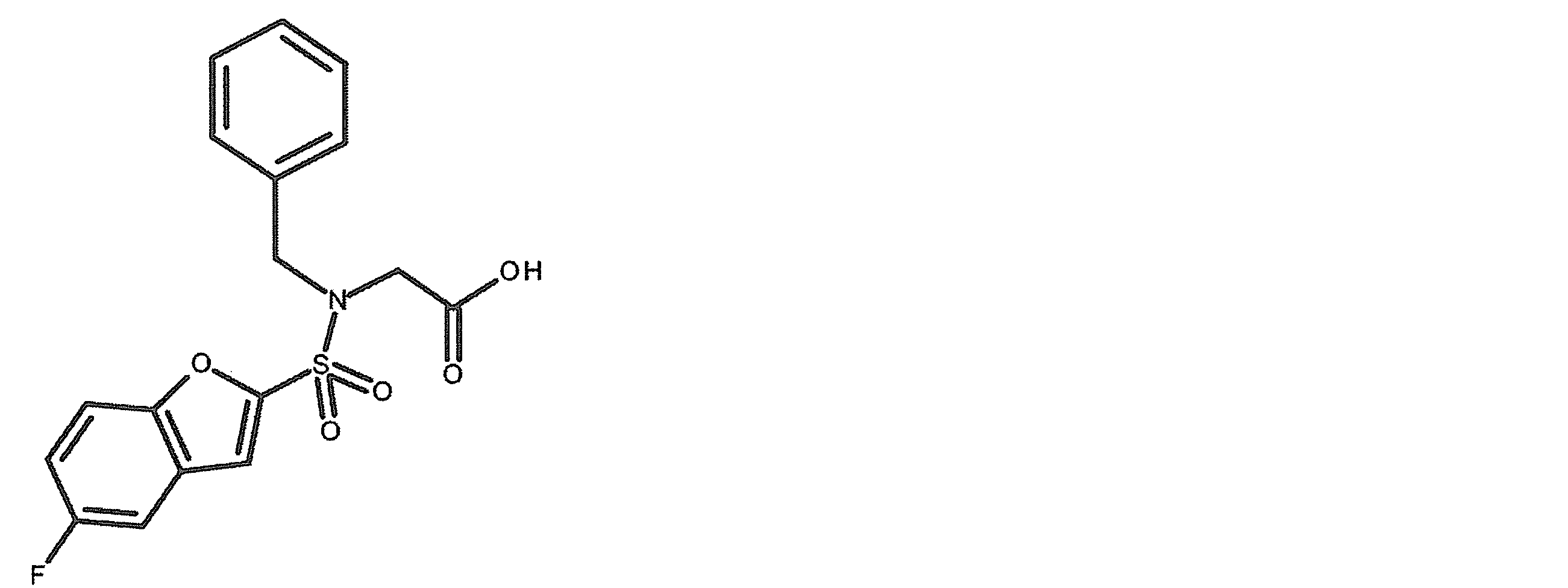
(工程1)2-(ベンジルアミノ)酢酸ベンジルの合成
ベンジルアミン(54mg、0.50mmol)のアセトニトリル(4mL)溶液に、炭酸カリウム(69mg、0.50mmol)を加えて-10℃~-15℃に冷却した後、アセトニトリル(1mL)で希釈したブロモ酢酸ベンジル(0.078mL、0.50mmol)を滴下し、徐々に室温に上げ一晩撹拌した。不溶物を濾別後、減圧下溶媒を留去して標題化合物を得た。
(工程2)2-[ベンジル-(5-フルオロベンゾフラン-2-イル)スルホニル-アミノ]酢酸(B-41)の合成
工程1で得られた化合物(0.13g、0.50mmol)及びA-3(0.14g、0.60mmol)、トリエチルアミン(0.10mL、0.75mmol)にアセトニトリル(3mL)を加え室温にて3時間撹拌した。その後飽和炭酸水素ナトリウム水溶液を加え、ジクロロメタンで抽出し有機層を硫酸ナトリウムで乾燥し、乾燥剤を濾別した後、溶媒を留去して得られた残渣をテトラヒドロフラン(1mL)および2mol/L 水酸化ナトリウム水溶液(1mL)、メタノールを数滴加え30分間撹拌した。1mol/L 塩酸を加え酸性にして水を加えジクロロメタンにて抽出し、有機層を硫酸ナトリウムで乾燥し、乾燥剤を濾別した後、溶媒を留去して標題化合物(0.14g、0.38mmol、76%)を得た。
MS (ESI) m/z 364 (M+H)+
(Step 1) Synthesis of benzyl acetate 2- (benzylamino) acetate To a solution of benzylamine (54 mg, 0.50 mmol) in acetonitrile (4 mL) was added potassium carbonate (69 mg, 0.50 mmol), and -10 ° C to -15 ° C. After cooling to 0, benzyl bromoacetate (0.078 mL, 0.50 mmol) diluted with acetonitrile (1 mL) was added dropwise, gradually warmed to room temperature and stirred overnight. The insoluble material was filtered off, and the solvent was evaporated under reduced pressure to give the title compound.
(Step 2) Synthesis of 2- [benzyl- (5-fluorobenzofuran-2-yl) sulfonyl-amino] acetic acid (B-41) The compound obtained in Step 1 (0.13 g, 0.50 mmol) and A- Acetonitrile (3 mL) was added to 3 (0.14 g, 0.60 mmol) and triethylamine (0.10 mL, 0.75 mmol), and the mixture was stirred at room temperature for 3 hours. Thereafter, a saturated aqueous sodium hydrogen carbonate solution was added, extracted with dichloromethane, the organic layer was dried over sodium sulfate, the desiccant was filtered off, the solvent was distilled off, and the resulting residue was tetrahydrofuran (1 mL) and 2 mol / L water. A few drops of aqueous sodium oxide solution (1 mL) and methanol were added and stirred for 30 minutes. 1 mol / L Hydrochloric acid was added to make it acidic, water was added, and the mixture was extracted with dichloromethane. The organic layer was dried over sodium sulfate, the desiccant was filtered off, and the solvent was evaporated to give the title compound (0.14 g, 0. 38 mmol, 76%).
MS (ESI) m / z 364 (M + H) +
表8記載のB-42~B48は、対応する市販の試薬を用い参考例B-41と同様の操作により合成した。 B-42 to B48 listed in Table 8 were synthesized in the same manner as in Reference Example B-41 using the corresponding commercially available reagents.

参考例B-49:2-[フロ[3,2-c]ピリジン-2-イルスルホニル(イソプロピル)アミノ]酢酸 塩酸塩(B-49)の合成Reference Example B-49: Synthesis of 2- [furo [3,2-c] pyridin-2-ylsulfonyl (isopropyl) amino] acetic acid hydrochloride (B-49)

(工程1)2-(イソプロピルアミノ)酢酸エチルの合成
イソプロピルアミン(4.4g、75mmol)のエーテル(100mL)溶液へ、ブロモ酢酸エチル(6.26g、37.5mmol)を加えて室温で12時間攪拌した。不溶物を濾過後、濾液を減圧濃縮して標題化合物(4.89g、33.7mmol、90%)を得た。
1H NMR (300 MHz, CDCl3) δ 4.16-4.11 (m, 2H), 3.47 (s, 2H), 2.79-2.71 (m, 1H), 1.25-1.19 (m, 3H), 1.03 (d, J = 3.9 Hz, 6H).
(工程2)2-[(4-クロロフロ[3,2-c]ピリジン-2-イル)スルホニル-イソプロピル-アミノ]酢酸エチルの合成
工程1で得られた化合物(1.74g、12.0mmol)とA-6(3.02g、24.0mmol)及びピリジン(9mL)のジクロロメタン(25mL)溶液を室温で一晩撹拌し、溶媒を留去した残渣をシリカゲルクロマトグラフィー(ペンタン/酢酸エチル)で精製し、標題化合物(800mg、2.21、18%)を得た。
MS (ESI) m/z 361 (M+H)+
(工程3)2-[フロ[3,2-c]ピリジン-2-イルスルホニル(イソプロピル)アミノ]酢酸エチルの合成
工程2で得られた化合物(600mg、1.67mmol)に酢酸(25mL)及びテトラヒドロフラン(25mL)を加えて溶解させ、10%パラジウム/炭素(120mg)を加えた。反応混合物を水素雰囲気下、70℃で1時間攪拌した後、触媒を濾別し酢酸エチルを加えて水で洗浄した。有機層を硫酸ナトリウムにて乾燥し、乾燥剤を濾別した後、溶媒を留去して得られた残渣にメタノール(8mL)を加え、不溶物を濾取、濾液を乾燥させて標題化合物(210mg、0.643mmol、38%)の白色固体を得た。
MS (ESI) m/z 327 (M+H)+
(工程4)2-[フロ[3,2-c]ピリジン-2-イルスルホニル(イソプロピル)アミノ]酢酸 塩酸塩(B-49)の合成
工程3で得られた化合物(210mg、0.643mmol)にメタノール(5mL)及び2mol/L 水酸化リチウム水溶液(3mL)を加え、室温で2時間攪拌した。4mol/L 塩酸を加えてpH4~5の酸性にし、生じた析出物を濾取、濾液を乾燥して標題化合物(120mg、0.402mmol、63%)の白色固体を得た。
MS (ESI) m/z 299 (M+H)+
1H NMR (300 MHz, DMSO-d6) δ 9.36 (s, 1H), 8.84 (d, J = 6.3 Hz, 1H), 8.23 (d, J = 4.5 Hz, 1H), 7.79 (s, 1H), 4.19-4.15 (m, 1H), 4.03 (s, 2H), 1.06 (d, J = 6.9 Hz, 6H).
(Step 1) Synthesis of ethyl 2- (isopropylamino) acetate To a solution of isopropylamine (4.4 g, 75 mmol) in ether (100 mL) was added ethyl bromoacetate (6.26 g, 37.5 mmol), and the mixture was stirred at room temperature for 12 hours. Stir. The insoluble material was filtered off, and the filtrate was concentrated under reduced pressure to give the title compound (4.89 g, 33.7 mmol, 90%).
1 H NMR (300 MHz, CDCl 3 ) δ 4.16-4.11 (m, 2H), 3.47 (s, 2H), 2.79-2.71 (m, 1H), 1.25-1.19 (m, 3H), 1.03 (d, J = 3.9 Hz, 6H).
(Step 2) Synthesis of ethyl 2-[(4-chlorofuro [3,2-c] pyridin-2-yl) sulfonyl-isopropyl-amino] acetate Compound obtained in Step 1 (1.74 g, 12.0 mmol) And a solution of A-6 (3.02 g, 24.0 mmol) and pyridine (9 mL) in dichloromethane (25 mL) at room temperature overnight, the solvent was distilled off and the residue was purified by silica gel chromatography (pentane / ethyl acetate). To give the title compound (800 mg, 2.21, 18%).
MS (ESI) m / z 361 (M + H) +
(Step 3) Synthesis of 2- [furo [3,2-c] pyridin-2-ylsulfonyl (isopropyl) amino] ethyl acetate To the compound obtained in Step 2 (600 mg, 1.67 mmol), acetic acid (25 mL) and Tetrahydrofuran (25 mL) was added and dissolved, and 10% palladium / carbon (120 mg) was added. The reaction mixture was stirred at 70 ° C. for 1 hour under a hydrogen atmosphere, the catalyst was filtered off, ethyl acetate was added, and the mixture was washed with water. The organic layer was dried over sodium sulfate, the desiccant was filtered off, the solvent was evaporated, methanol (8 mL) was added to the resulting residue, the insoluble material was filtered off, the filtrate was dried and the title compound ( 210 mg, 0.643 mmol, 38%) of a white solid was obtained.
MS (ESI) m / z 327 (M + H) +
(Step 4) Synthesis of 2- [furo [3,2-c] pyridin-2-ylsulfonyl (isopropyl) amino] acetic acid hydrochloride (B-49) Compound obtained in Step 3 (210 mg, 0.643 mmol) Methanol (5 mL) and 2 mol / L lithium hydroxide aqueous solution (3 mL) were added to the mixture, and the mixture was stirred at room temperature for 2 hours. 4 mol / L Hydrochloric acid was added to acidify the pH to 4-5, the resulting precipitate was collected by filtration, and the filtrate was dried to give the title compound (120 mg, 0.402 mmol, 63%) as a white solid.
MS (ESI) m / z 299 (M + H) +
1 H NMR (300 MHz, DMSO-d 6 ) δ 9.36 (s, 1H), 8.84 (d, J = 6.3 Hz, 1H), 8.23 (d, J = 4.5 Hz, 1H), 7.79 (s, 1H) , 4.19-4.15 (m, 1H), 4.03 (s, 2H), 1.06 (d, J = 6.9 Hz, 6H).
参考例C-1:(2S)-1-(ベンゾフラン-2-イルスルホニル)-N-[(3-ヒドロキシフェニル)メチル]ピロリジン-2-カルボキシアミド(C-1)の合成
B-1(15g、51mmol)、3-(アミノメチル)フェノール(9.7g、61mmol)、WSC塩酸塩(8.7g、56mmol)及び1-ヒドロキシベンゾトリアゾール(7.6g、56mmol)にジクロロメタン(300mL)とN-エチルジイソプロピルアミン(14.4g、172mmol)を加え室温で一晩攪拌した。反応液に水を加え、ジクロロメタンで抽出した。有機層を硫酸ナトリウムにて乾燥した後、乾燥剤を濾別し、溶媒を留去して得られた残渣をシリカゲルカラムクロマトグラフィー(ヘキサン/酢酸エチル)にて精製して標題化合物(4.63g、11.6mmol、23%)を得た。
MS (ESI) m/z 401 (M+H)+
1H NMR (400 MHz, CD3OD) δ 7.81 (d, J = 8.0 Hz, 1H), 7.64 (dd, J = 8.4, 0.8 Hz, 1H), 7.59 (d, J = 0.8 Hz, 1H), 7.55 (td, J = 8.4, 1.2 Hz, 1H), 7.44-7.40 (m, 1H), 7.15 (t, J = 8.0 Hz, 1H), 6.82 (d, J = 7.6 Hz, 1H), 6.78 (d, J = 2.0 Hz, 1H), 6.70 (dd, J = 8.0, 1.6 Hz, 1H), 4.43-4.39 (m, 3H), 3.71-3.68 (m, 1H), 3.57-3.52 (m, 1H), 2.07-1.94 (m, 3H), 1.76-1.72 (m, 1H).
Reference Example C-1: Synthesis of (2S) -1- (benzofuran-2-ylsulfonyl) -N-[(3-hydroxyphenyl) methyl] pyrrolidine-2-carboxamide (C-1) B-1 (15 g 51 mmol), 3- (aminomethyl) phenol (9.7 g, 61 mmol), WSC hydrochloride (8.7 g, 56 mmol) and 1-hydroxybenzotriazole (7.6 g, 56 mmol) with dichloromethane (300 mL) and N- Ethyldiisopropylamine (14.4 g, 172 mmol) was added and stirred overnight at room temperature. Water was added to the reaction mixture, and the mixture was extracted with dichloromethane. The organic layer was dried over sodium sulfate, the desiccant was filtered off, the solvent was distilled off, and the resulting residue was purified by silica gel column chromatography (hexane / ethyl acetate) to give the title compound (4.63 g). 11.6 mmol, 23%).
MS (ESI) m / z 401 (M + H) +
1 H NMR (400 MHz, CD 3 OD) δ 7.81 (d, J = 8.0 Hz, 1H), 7.64 (dd, J = 8.4, 0.8 Hz, 1H), 7.59 (d, J = 0.8 Hz, 1H), 7.55 (td, J = 8.4, 1.2 Hz, 1H), 7.44-7.40 (m, 1H), 7.15 (t, J = 8.0 Hz, 1H), 6.82 (d, J = 7.6 Hz, 1H), 6.78 (d , J = 2.0 Hz, 1H), 6.70 (dd, J = 8.0, 1.6 Hz, 1H), 4.43-4.39 (m, 3H), 3.71-3.68 (m, 1H), 3.57-3.52 (m, 1H), 2.07-1.94 (m, 3H), 1.76-1.72 (m, 1H).
表9記載のC-2は、B-4および対応する市販の試薬を用い参考例C-1と同様の操作により合成した。 C-2 shown in Table 9 was synthesized in the same manner as in Reference Example C-1 using B-4 and the corresponding commercially available reagents.

参考例C-3:(2S)-1-(5-フルオロベンゾフラン-2-イルスルホニル)-N-[(3-フルオロ-5-ヒドロキシフェニル)メチル]ピロリジン-2-カルボキシアミド(C-3)の合成Reference Example C-3: (2S) -1- (5-Fluorobenzofuran-2-ylsulfonyl) -N-[(3-fluoro-5-hydroxyphenyl) methyl] pyrrolidine-2-carboxamide (C-3) Synthesis of

(工程1)3-(アミノメチル)-5-フルオロフェノールの合成
3-フルオロ-5-ヒドロキシベンゾニトリル(4.5g、33mmol)のエタノール(50mL)溶液に10%-パラジウム/炭素(0.45g)及び濃塩酸(12mL)を加え、水素雰囲気下、室温で一晩攪拌した。触媒を濾別した後、減圧濃縮して標題化合物(4.52g、25mmol、77%)を得た。
MS (ESI) m/z 143 (M+H)+
(工程2)(2S)-1-(5-フルオロベンゾフラン-2-イルスルホニル)-N-[(3-フルオロ-5-ヒドロキシフェニル)メチル]ピロリジン-2-カルボキシアミド(C-3)の合成
工程1で得られた化合物(1.7g、9.6mmol)、B-4(1.5g、4.8mmol)、WSC塩酸塩(0.97g、6.2mmol)及び1-ヒドロキシベンゾトリアゾール(0.84g、6.2mmol)にジクロロメタン(50mL)とトリエチルアミン(1.5g、14mmol)を加え室温で一晩攪拌した。反応液に水を加え、ジクロロメタンで抽出した。有機層を硫酸ナトリウムにて乾燥した後、乾燥剤を濾別し、溶媒を留去して得られた残渣をシリカゲルカラムクロマトグラフィー(ヘキサン/酢酸エチル)にて精製して標題化合物(0.39g、0.89mmol、18%)を得た。
MS (ESI) m/z 437 (M+H)+
1H NMR (400 MHz, DMSO-d6) δ 9.93 (s, 1H), 8.67 (t, J = 6.1 Hz, 1H), 7.80 (dd, J = 9.2, 4.2 Hz, 1H), 7.69 (d, J = 0.9 Hz, 1H), 7.65 (dd, J = 8.5, 2.7 Hz, 1H), 7.43 (td, J = 9.2, 2.7 Hz, 1H), 6.56 - 6.48 (m, 2H), 6.43 (dt, J = 10.8, 2.3 Hz, 1H), 4.34 - 4.12 (m, 3H), 3.66 - 3.55 (m, 1H), 3.43 - 3.34 (m, 1H), 2.01 - 1.81 (m, 3H), 1.72 - 1.60 (m, 1H).
(Step 1) Synthesis of 3- (aminomethyl) -5-fluorophenol 10% palladium / carbon (0.45 g) in a solution of 3-fluoro-5-hydroxybenzonitrile (4.5 g, 33 mmol) in ethanol (50 mL) ) And concentrated hydrochloric acid (12 mL) were added, and the mixture was stirred overnight at room temperature under a hydrogen atmosphere. The catalyst was filtered off and concentrated under reduced pressure to give the title compound (4.52 g, 25 mmol, 77%).
MS (ESI) m / z 143 (M + H) +
(Step 2) Synthesis of (2S) -1- (5-fluorobenzofuran-2-ylsulfonyl) -N-[(3-fluoro-5-hydroxyphenyl) methyl] pyrrolidine-2-carboxamide (C-3) The compound obtained in Step 1 (1.7 g, 9.6 mmol), B-4 (1.5 g, 4.8 mmol), WSC hydrochloride (0.97 g, 6.2 mmol) and 1-hydroxybenzotriazole (0 Dichloromethane (50 mL) and triethylamine (1.5 g, 14 mmol) were added to .84 g, 6.2 mmol) and stirred overnight at room temperature. Water was added to the reaction mixture, and the mixture was extracted with dichloromethane. The organic layer was dried over sodium sulfate, the desiccant was filtered off, the solvent was distilled off, and the resulting residue was purified by silica gel column chromatography (hexane / ethyl acetate) to give the title compound (0.39 g 0.89 mmol, 18%).
MS (ESI) m / z 437 (M + H) +
1 H NMR (400 MHz, DMSO-d 6 ) δ 9.93 (s, 1H), 8.67 (t, J = 6.1 Hz, 1H), 7.80 (dd, J = 9.2, 4.2 Hz, 1H), 7.69 (d, J = 0.9 Hz, 1H), 7.65 (dd, J = 8.5, 2.7 Hz, 1H), 7.43 (td, J = 9.2, 2.7 Hz, 1H), 6.56-6.48 (m, 2H), 6.43 (dt, J = 10.8, 2.3 Hz, 1H), 4.34-4.12 (m, 3H), 3.66-3.55 (m, 1H), 3.43-3.34 (m, 1H), 2.01-1.81 (m, 3H), 1.72-1.60 (m , 1H).
参考例C-4:(2S)-1-(ベンゾフラン-2-イルスルホニル)-N-[(2-クロロ-4-ピリジル)メチル]ピロリジン-2-カルボキシアミド(C-4)の合成
B-1(4.11g、13.9mmol)、4-アミノメチル-2-クロロピリジン塩酸塩(3.00g、16.8mmol)、WSC塩酸塩(2.38g、15.3mmol)及び1-ヒドロキシベンゾトリアゾール(2.07g、15.3mmol)にジクロロメタン(100mL)とN-エチルジイソプロピルアミン(7.19g、55.7mmol)を加え室温で一晩攪拌した。反応液に水を加え、ジクロロメタンで抽出した。有機層を硫酸ナトリウムにて乾燥した後、乾燥剤を濾別し、溶媒を留去して得られた残渣をシリカゲルカラムクロマトグラフィー(ヘキサン/酢酸エチル)にて精製して標題化合物(3.50g、8.35mmol、60%)を得た。
MS (ESI) m/z 420 (M+H)+
1H NMR (400 MHz, CD3OD): δ 8.30 (d, J = 5.2 Hz, 1H), 7.81 (d, J = 7.6 Hz, 1H), 7.66-7.62 (m, 2H), 7.58-7.53 (m, 1H), 7.48 (s, 1H), 7.43-7.36 (m, 2H), 4.59-4.43 (m, 2H), 4.42-4.40 (m, 1H), 3.75-3.69 (m, 1H), 3.58-3.52 (m, 1H), 2.10-1.93 (m, 3H), 1.77-1.71 (m, 1H).
Reference Example C-4: Synthesis of (2S) -1- (benzofuran-2-ylsulfonyl) -N-[(2-chloro-4-pyridyl) methyl] pyrrolidine-2-carboxamide (C-4) B- 1 (4.11 g, 13.9 mmol), 4-aminomethyl-2-chloropyridine hydrochloride (3.00 g, 16.8 mmol), WSC hydrochloride (2.38 g, 15.3 mmol) and 1-hydroxybenzotriazole To (2.07 g, 15.3 mmol) were added dichloromethane (100 mL) and N-ethyldiisopropylamine (7.19 g, 55.7 mmol), and the mixture was stirred overnight at room temperature. Water was added to the reaction mixture, and the mixture was extracted with dichloromethane. The organic layer was dried over sodium sulfate, the desiccant was filtered off, the solvent was distilled off, and the resulting residue was purified by silica gel column chromatography (hexane / ethyl acetate) to give the title compound (3.50 g 8.35 mmol, 60%).
MS (ESI) m / z 420 (M + H) +
1 H NMR (400 MHz, CD 3 OD): δ 8.30 (d, J = 5.2 Hz, 1H), 7.81 (d, J = 7.6 Hz, 1H), 7.66-7.62 (m, 2H), 7.58-7.53 ( m, 1H), 7.48 (s, 1H), 7.43-7.36 (m, 2H), 4.59-4.43 (m, 2H), 4.42-4.40 (m, 1H), 3.75-3.69 (m, 1H), 3.58- 3.52 (m, 1H), 2.10-1.93 (m, 3H), 1.77-1.71 (m, 1H).
表10記載のC-5、C-10~C-12は、B-1、B-4、および対応する市販の試薬を用い参考例C-4と同様の操作により合成した。 C-5, C-10 to C-12 shown in Table 10 were synthesized by the same procedure as in Reference Example C-4 using B-1, B-4 and the corresponding commercially available reagents.

参考例C-6:(2S)-N-[(5-ブロモ-3-ピリジル)メチル]-1-(5-フルオロベンゾフラン-2-イルスルホニル)-ピロリジン-2-カルボキシアミド(C-6)の合成
(工程1)3-アミノメチル-5-ブロモピリジンの合成
5-ブロモ-3-シアノピリジン(15g、82mmol)及び塩化コバルト(II)6水和物(2.0g、8.2mmol)にテトラヒドロフラン(100mL)及び水(50mL)を加え、0℃に冷却してテトラヒドロホウ酸ナトリウム(6.3g、0.17mol)を加えた。室温にて1.5時間攪拌した後、3mol/L塩酸水溶液を加えて反応液を酸性にして1時間攪拌した。反応混合物からテトラヒドロフランを減圧留去した後、ジエチルエーテルにて洗浄、水層にアンモニア水を加えてアルカリ性にした後、ジクロロメタンで抽出した。有機層を飽和食塩水で洗浄した後、硫酸ナトリウムにて乾燥し、乾燥剤を濾別、溶媒を留去して標題化合物(5.0g、27mmol、33%)を得た。
MS (ESI) m/z 187 (M+H)+
(工程2)(2S)-N-[(5-ブロモ-3-ピリジル)メチル]-1-(5-フルオロベンゾフラン-2-イルスルホニル)-ピロリジン-2-カルボキシアミド(C-6)の合成
B-4(4.0g、13mmol)のジクロロメタン(20mL)溶液に塩化チオニル(5mL)を加え、50℃で2時間攪拌した。反応液を減圧濃縮して得られた残渣にジクロロメタン(40mL)、工程1で得られた化合物(4.7g、26mmol)及びピリジン(5mL)/ジクロロメタン(20mL)を加えた。室温で30分間攪拌した後、減圧濃縮して得られた残渣を高速液体クロマトグラフィー(水-アセトニトリル、それぞれ0.1%トリフルオロ酢酸入り)にて精製して標題化合物(1.4g、2.9mmol、23%)を得た。
MS (ESI) m/z 482 (M+H)+
1H NMR (300 MHz, CD3OD): δ 8.53 (dd, J = 10.8, 1.8 Hz, 2H), 8.03 (d, J = 1.8 Hz, 1H), 7.65 (dd, J = 9.3, 0.9 Hz, 1H), 7.58 (s, 1H), 7.52 (dd, J = 8.4, 2.7 Hz, 1H), 7.32 (td, J = 9.0, 2.7 Hz, 1H), 4.57-4.34 (m, 3H), 3.74-3.67 (m, 1H), 3.57-3.49 (m, 1H), 2.10-1.90 (m, 3H), 1.78-1.70 (m, 1H).
Reference Example C-6: (2S) -N-[(5-Bromo-3-pyridyl) methyl] -1- (5-fluorobenzofuran-2-ylsulfonyl) -pyrrolidine-2-carboxamide (C-6) (Step 1) Synthesis of 3-aminomethyl-5-bromopyridine To 5-bromo-3-cyanopyridine (15 g, 82 mmol) and cobalt (II) chloride hexahydrate (2.0 g, 8.2 mmol) Tetrahydrofuran (100 mL) and water (50 mL) were added, cooled to 0 ° C., and sodium tetrahydroborate (6.3 g, 0.17 mol) was added. After stirring at room temperature for 1.5 hours, 3 mol / L hydrochloric acid aqueous solution was added to make the reaction solution acidic, and the mixture was stirred for 1 hour. Tetrahydrofuran was distilled off from the reaction mixture under reduced pressure, washed with diethyl ether, the aqueous layer was made alkaline with aqueous ammonia, and extracted with dichloromethane. The organic layer was washed with saturated brine, dried over sodium sulfate, the desiccant was filtered off, and the solvent was evaporated to give the title compound (5.0 g, 27 mmol, 33%).
MS (ESI) m / z 187 (M + H) +
(Step 2) Synthesis of (2S) -N-[(5-bromo-3-pyridyl) methyl] -1- (5-fluorobenzofuran-2-ylsulfonyl) -pyrrolidine-2-carboxamide (C-6) To a solution of B-4 (4.0 g, 13 mmol) in dichloromethane (20 mL) was added thionyl chloride (5 mL), and the mixture was stirred at 50 ° C. for 2 hr. Dichloromethane (40 mL), the compound obtained in Step 1 (4.7 g, 26 mmol) and pyridine (5 mL) / dichloromethane (20 mL) were added to the residue obtained by concentrating the reaction solution under reduced pressure. After stirring at room temperature for 30 minutes, the residue obtained by concentration under reduced pressure was purified by high performance liquid chromatography (water-acetonitrile, each containing 0.1% trifluoroacetic acid) to give the title compound (1.4 g, 2. 9 mmol, 23%).
MS (ESI) m / z 482 (M + H) +
1 H NMR (300 MHz, CD 3 OD): δ 8.53 (dd, J = 10.8, 1.8 Hz, 2H), 8.03 (d, J = 1.8 Hz, 1H), 7.65 (dd, J = 9.3, 0.9 Hz, 1H), 7.58 (s, 1H), 7.52 (dd, J = 8.4, 2.7 Hz, 1H), 7.32 (td, J = 9.0, 2.7 Hz, 1H), 4.57-4.34 (m, 3H), 3.74-3.67 (m, 1H), 3.57-3.49 (m, 1H), 2.10-1.90 (m, 3H), 1.78-1.70 (m, 1H).
表11記載のC-7は、B-4、および対応する市販の試薬を用い参考例C-6と同様の操作により合成した。 C-7 described in Table 11 was synthesized in the same manner as in Reference Example C-6 using B-4 and the corresponding commercially available reagents.

参考例C-8:(2S)-N-[(4-クロロ-2-ピリジル)メチル]-1-(5-フルオロベンゾフラン-2-イルスルホニル)-ピロリジン-2-カルボキシアミド(C-8)の合成
3-アミノメチル-5-ブロモピリジンの代わりに2-アミノメチル-4-クロロピリジンを用い、参考例C-6工程2と同様の操作により標題化合物(収率19%)を得た。MS (ESI) m/z 438 (M+H)+
1H NMR (300 MHz, CD3OD): δ 8.31 (d, J = 5.4 Hz, 1H), 7.65 (dd, J = 9.0, 3.9 Hz, 1H), 7.60 (s, 1H), 7.56 (s, 1H), 7.51 (dd, J= 7.8, 2.4 Hz, 1H), 7.37-7.30 (m, 2H), 4.63-4.38 (m, 3H), 3.75-3.68 (m, 1H), 3.58-3.52 (m, 1H), 2.07-1.94 (m, 3H), 1.77-1.73 (m, 1H).
Reference Example C-8: (2S) -N-[(4-Chloro-2-pyridyl) methyl] -1- (5-fluorobenzofuran-2-ylsulfonyl) -pyrrolidine-2-carboxamide (C-8) The title compound (yield 19%) was obtained in the same manner as in Reference Example C-6, Step 2, using 2-aminomethyl-4-chloropyridine in place of 3-aminomethyl-5-bromopyridine. MS (ESI) m / z 438 (M + H) +
1 H NMR (300 MHz, CD 3 OD): δ 8.31 (d, J = 5.4 Hz, 1H), 7.65 (dd, J = 9.0, 3.9 Hz, 1H), 7.60 (s, 1H), 7.56 (s, 1H), 7.51 (dd, J = 7.8, 2.4 Hz, 1H), 7.37-7.30 (m, 2H), 4.63-4.38 (m, 3H), 3.75-3.68 (m, 1H), 3.58-3.52 (m, 1H), 2.07-1.94 (m, 3H), 1.77-1.73 (m, 1H).
表12記載のC-9は、B-1、および対応する市販の試薬を用い参考例C-8と同様の操作により合成した。 C-9 described in Table 12 was synthesized in the same manner as in Reference Example C-8 using B-1 and the corresponding commercially available reagents.

参考例D-1:3-(ベンジルオキシ)ベンジルアミン 塩酸塩(D-1)の合成
(工程1)3-ベンジルオキシベンゾニトリルの合成
3-ヒドロキシベンゾニトリル(10.0g、84.0mmol)、ベンジルブロミド(15.8g、92.8mmol)及び炭酸カリウム(40.6g、294mmol)にN,N-ジメチルホルムアミド(200mL)を加え、80℃で一晩攪拌した。反応混合物に水を加え、酢酸エチルで抽出した。有機層を飽和食塩水で洗浄した後、硫酸ナトリウムにて乾燥した。乾燥剤を濾別し、溶媒を留去して得られた残渣をシリカゲルカラムクロマトグラフィー(石油エーテル/酢酸エチル)にて精製して標題化合物(16.0g、76.6mmol、91%)を得た。
MS(ESI) m/z 210 (M+H)+
1H NMR (400 MHz, CDCl3): δ7.41-7.35 (m, 6H), 7.26-7.19 (m, 3H), 5.08 (s, 2H).
(工程2)3-(ベンジルオキシ)ベンジルアミンの合成
工程1で得られた化合物(5.0g、24mmol)のテトラヒドロフラン(50mL)溶液に1mol/L 水素化アルミニウムリチウム(テトラヒドロフラン溶液、36mL、36mmol)を0℃で加え、3時間攪拌した。反応混合物を氷水に加え、酢酸エチルで抽出した。有機層を飽和食塩水で洗浄した後、硫酸ナトリウムにて乾燥した。乾燥剤を濾別し、溶媒を留去して得られた残渣をシリカゲルカラムクロマトグラフィー(石油エーテル/酢酸エチル)にて精製して標題化合物(4.5g、21mmol、88%)を得た。
MS(ESI) m/z 214 (M+H)+
(工程3)3-(ベンジルオキシ)ベンジルアミン 塩酸塩(D-1)の合成
工程2で得られた化合物(1.6g、7.6mmol)に3mol/L塩化水素(ジクロロメタン溶液、5mL)を加え、室温で1時間攪拌した後、減圧濃縮して標題化合物(1.5g、6.0mmol、79%)を得た。
MS(ESI) m/z 214 (M+H)+
1H NMR (400 MHz, CD3OD): δ7.47-7.30 (m, 6H), 7.09 (s, 1H), 7.01-6.99 (m, 2H), 5.12 (s, 2H), 3.95 (s, 2H).
Reference Example D-1: Synthesis of 3- (benzyloxy) benzylamine hydrochloride (D-1) (Step 1) Synthesis of 3-benzyloxybenzonitrile 3-hydroxybenzonitrile (10.0 g, 84.0 mmol), N, N-dimethylformamide (200 mL) was added to benzyl bromide (15.8 g, 92.8 mmol) and potassium carbonate (40.6 g, 294 mmol), and the mixture was stirred at 80 ° C. overnight. Water was added to the reaction mixture, and the mixture was extracted with ethyl acetate. The organic layer was washed with saturated brine and dried over sodium sulfate. The desiccant was filtered off, the solvent was distilled off, and the resulting residue was purified by silica gel column chromatography (petroleum ether / ethyl acetate) to give the title compound (16.0 g, 76.6 mmol, 91%). It was.
MS (ESI) m / z 210 (M + H) +
1 H NMR (400 MHz, CDCl 3 ): δ7.41-7.35 (m, 6H), 7.26-7.19 (m, 3H), 5.08 (s, 2H).
(Step 2) Synthesis of 3- (benzyloxy) benzylamine 1 mol / L lithium aluminum hydride (tetrahydrofuran solution, 36 mL, 36 mmol) in tetrahydrofuran (50 mL) solution of the compound obtained in Step 1 (5.0 g, 24 mmol) Was added at 0 ° C. and stirred for 3 hours. The reaction mixture was added to ice water and extracted with ethyl acetate. The organic layer was washed with saturated brine and dried over sodium sulfate. The desiccant was filtered off, the solvent was distilled off, and the resulting residue was purified by silica gel column chromatography (petroleum ether / ethyl acetate) to obtain the title compound (4.5 g, 21 mmol, 88%).
MS (ESI) m / z 214 (M + H) +
(Step 3) Synthesis of 3- (benzyloxy) benzylamine hydrochloride (D-1) 3 mol / L hydrogen chloride (dichloromethane solution, 5 mL) was added to the compound obtained in Step 2 (1.6 g, 7.6 mmol). The mixture was stirred at room temperature for 1 hour and concentrated under reduced pressure to give the title compound (1.5 g, 6.0 mmol, 79%).
MS (ESI) m / z 214 (M + H) +
1 H NMR (400 MHz, CD 3 OD): δ7.47-7.30 (m, 6H), 7.09 (s, 1H), 7.01-6.99 (m, 2H), 5.12 (s, 2H), 3.95 (s, 2H).
表13記載のD-2は、対応する市販の試薬を用い参考例D-1と同様の操作により合成した。 D-2 shown in Table 13 was synthesized in the same manner as Reference Example D-1 using the corresponding commercially available reagent.

参考例D-3:{4-[3-(トリフルオロメチル)フェノキシ]フェニル}メタンアミン 塩酸塩(D-3)の合成
(工程1)N-[(4-ヒドロキシフェニル)メチル]カルバミン酸 tert-ブチルの
合成
4-ヒドロキシベンジルアミン(500mg、4.1mmol)に、二炭酸ジ-tert-ブチル(1.1g、4.9mmol)、トリエチルアミン(840μL)、水(2mL)、THF(10mL)を加え、室温にて4時間撹拌した。酢酸エチルで希釈し、0.1mol/L塩酸水溶液で洗浄した。有機層を硫酸ナトリウムにて乾燥後、乾燥剤を濾別し、溶媒を留去して得られた残渣をシリカゲルカラムクロマトグラフィー(ヘキサン/酢酸エチル)にて精製して標題化合物(980mg)を得た。
MS(ESI) m/z 224 (M+H)+
(工程2)N-({4-[3-(トリフルオロメチル)フェノキシ]フェニル}メチル)カルバミン酸 tert-ブチルの合成
工程1で得られた化合物(500mg、2.2mmol)に、3-トリフルオロメチルフェニルボロン酸(420mg、2.2mmol)、酢酸銅(410mg、2.2mmol)、トリエチルアミン(1.5mL、11mmol)、モレキュラーシーブス4Å(1.5g)、ジクロロメタン(15mL)を加え、室温にて一晩撹拌した。反応液をろ過して、不溶物を取り除いた後、溶媒を留去した。残渣に、酢酸エチルを加え、0.1mol/L塩酸水溶液で洗浄した。有機層を硫酸ナトリウムにて乾燥後、乾燥剤を濾別し、溶媒を留去して得られた残渣をシリカゲルカラムクロマトグラフィー(ヘキサン/酢酸エチル)にて精製して標題化合物(380mg)を得た。
MS(ESI) m/z 368 (M+H)+
(工程3){4-[3-(トリフルオロメチル)フェノキシ]フェニル}メタンアミン 塩酸塩(D-3)の合成
工程2で得られた化合物(380mg)に、4mol/L塩酸/1,4-ジオキサン溶液(5mL)を加え、室温にて3時間撹拌した。溶媒を留去して、標題化合物を得た。
MS(ESI) m/z 268 (M+H)+
1H NMR (400 MHz, DMSO-d6) δ 8.40 (brs, 3H), 7.65 (t, J = 8.0 Hz, 1H), 7.56 (d, J = 6.8 Hz, 2H), 7.52 (d, J = 7.6 Hz, 1H), 7.30 (dd, J = 8.0, 2.0 Hz, 1H), 7.27 (s, 1H), 7.15 (d, J = 9.6 Hz, 2H), 4.03 (s, 2H).
Reference Example D-3: Synthesis of {4- [3- (trifluoromethyl) phenoxy] phenyl} methanamine hydrochloride (D-3) (Step 1) N-[(4-hydroxyphenyl) methyl] carbamic acid tert- Synthesis of Butyl To 4-hydroxybenzylamine (500 mg, 4.1 mmol) was added di-tert-butyl dicarbonate (1.1 g, 4.9 mmol), triethylamine (840 μL), water (2 mL), THF (10 mL). And stirred at room temperature for 4 hours. Diluted with ethyl acetate and washed with 0.1 mol / L aqueous hydrochloric acid. The organic layer was dried over sodium sulfate, the desiccant was filtered off, the solvent was distilled off, and the resulting residue was purified by silica gel column chromatography (hexane / ethyl acetate) to give the title compound (980 mg). It was.
MS (ESI) m / z 224 (M + H) +
(Step 2) Synthesis of tert-butyl N-({4- [3- (trifluoromethyl) phenoxy] phenyl} methyl) carbamate To the compound obtained in Step 1 (500 mg, 2.2 mmol), Fluoromethylphenylboronic acid (420 mg, 2.2 mmol), copper acetate (410 mg, 2.2 mmol), triethylamine (1.5 mL, 11 mmol), molecular sieves 4Å (1.5 g), dichloromethane (15 mL) were added to room temperature. And stirred overnight. The reaction solution was filtered to remove insolubles, and then the solvent was distilled off. Ethyl acetate was added to the residue and washed with a 0.1 mol / L aqueous hydrochloric acid solution. The organic layer was dried over sodium sulfate, the desiccant was filtered off, the solvent was distilled off, and the resulting residue was purified by silica gel column chromatography (hexane / ethyl acetate) to give the title compound (380 mg). It was.
MS (ESI) m / z 368 (M + H) +
(Step 3) Synthesis of {4- [3- (trifluoromethyl) phenoxy] phenyl} methanamine hydrochloride (D-3) To the compound (380 mg) obtained in Step 2 was added 4 mol / L hydrochloric acid / 1,4- A dioxane solution (5 mL) was added, and the mixture was stirred at room temperature for 3 hours. The solvent was distilled off to give the title compound.
MS (ESI) m / z 268 (M + H) +
1 H NMR (400 MHz, DMSO-d 6 ) δ 8.40 (brs, 3H), 7.65 (t, J = 8.0 Hz, 1H), 7.56 (d, J = 6.8 Hz, 2H), 7.52 (d, J = 7.6 Hz, 1H), 7.30 (dd, J = 8.0, 2.0 Hz, 1H), 7.27 (s, 1H), 7.15 (d, J = 9.6 Hz, 2H), 4.03 (s, 2H).
表14記載のD-4~D-6は、対応する市販の試薬を用い参考例D-3と同様の操作により合成した。 D-4 to D-6 shown in Table 14 were synthesized by the same procedure as in Reference Example D-3 using the corresponding commercially available reagents.

参考例D-7:3-(ベンジルチオ)ベンジルアミン 塩酸塩(D-7)の合成Reference Example D-7: Synthesis of 3- (benzylthio) benzylamine hydrochloride (D-7)

(工程1)N-[(3-ブロモフェニル)メチル]カルバミン酸 tert-ブチルの合成
3-ブロモベンジルアミン 塩酸塩(1.0g、4.5mmol)及び二炭酸ジ-tert-ブチル(0.98g、4.5mmol)にジクロロメタン(10mL)及びトリエチルアミン(0.63mL、4.5mmol)を加えて室温で一晩攪拌した。反応混合物に水を加えジクロロメタンで抽出した。有機層を硫酸ナトリウムにて乾燥後、乾燥剤を濾別し、溶媒を留去して標題化合物(1.3g、4.5mmol、100%)を得た。
MS(ESI) m/z 286 (M+H)+
(工程2)3-(ベンジルチオ)ベンジルアミン 塩酸塩(D-7)の合成
工程1で得られた化合物(0.20g、0.70mmol)、トリス(ジベンジリデンアセトン)ジパラジウム(0)(16mg、0.017mmol)及びXantphos(20mg、0.035mmol)に1,4-ジオキサン(2mL)、ベンジルメルカプタン(0.090mL、0.77mmol)及びN-エチルジイソプロピルアミン(0.24mL、1.4mmol)を加え、90℃で一晩攪拌した。反応混合物に酢酸エチルを加え、0.5mol/L塩酸水溶液、飽和重曹水及び飽和食塩水にて順次洗浄した。有機層を硫酸ナトリウムにて乾燥後、乾燥剤を濾別し、溶媒を留去して得られた残渣にトリフルオロ酢酸(5mL)を加え、室温で5分間攪拌した。反応液にジクロロメタンを加え、2mol/L水酸化ナトリウム水溶液、飽和重曹水で順次洗浄した。有機層を硫酸ナトリウムにて乾燥後、乾燥剤を濾別し、溶媒を留去して得られた残渣に4mol/L塩酸(1,4-ジオキサン溶液、0.25mL、1.0mmol)を加えた。溶媒を留去して得られた残渣に酢酸エチル、少量のジクロロメタン及びメタノールを加えて懸濁させ、室温で10分間攪拌した。析出物を濾取することで標題化合物(0.14g、0.50mmol、73%)を得た。
MS(ESI) m/z 230 (M+H)+
1H NMR (400 MHz, DMSO-d6) δ 8.32 (br-s, 3H), 7.58 - 7.47 (m, 1H), 7.43 - 7.19 (m, 8H), 4.28 (s, 2H), 3.99 (s, 2H).
(Step 1) Synthesis of tert-butyl N-[(3-bromophenyl) methyl] carbamate 3-Bromobenzylamine hydrochloride (1.0 g, 4.5 mmol) and di-tert-butyl dicarbonate (0.98 g) 4.5 mmol), dichloromethane (10 mL) and triethylamine (0.63 mL, 4.5 mmol) were added and stirred overnight at room temperature. Water was added to the reaction mixture, and the mixture was extracted with dichloromethane. The organic layer was dried over sodium sulfate, the desiccant was filtered off, and the solvent was evaporated to give the title compound (1.3 g, 4.5 mmol, 100%).
MS (ESI) m / z 286 (M + H) +
(Step 2) Synthesis of 3- (benzylthio) benzylamine hydrochloride (D-7) Compound (0.20 g, 0.70 mmol) obtained in Step 1, tris (dibenzylideneacetone) dipalladium (0) (16 mg 0.017 mmol) and Xantphos (20 mg, 0.035 mmol) in 1,4-dioxane (2 mL), benzyl mercaptan (0.090 mL, 0.77 mmol) and N-ethyldiisopropylamine (0.24 mL, 1.4 mmol) And stirred at 90 ° C. overnight. Ethyl acetate was added to the reaction mixture, and the mixture was washed successively with 0.5 mol / L hydrochloric acid aqueous solution, saturated aqueous sodium hydrogen carbonate, and saturated brine. The organic layer was dried over sodium sulfate, the desiccant was filtered off, the solvent was evaporated, trifluoroacetic acid (5 mL) was added to the resulting residue, and the mixture was stirred at room temperature for 5 minutes. Dichloromethane was added to the reaction solution, and the mixture was washed successively with a 2 mol / L aqueous sodium hydroxide solution and saturated aqueous sodium bicarbonate. After drying the organic layer with sodium sulfate, the desiccant was filtered off and the solvent was distilled off. 4 mol / L hydrochloric acid (1,4-dioxane solution, 0.25 mL, 1.0 mmol) was added to the resulting residue. It was. The residue obtained by distilling off the solvent was suspended by adding ethyl acetate, a small amount of dichloromethane and methanol, and the mixture was stirred at room temperature for 10 minutes. The precipitate was collected by filtration to give the title compound (0.14 g, 0.50 mmol, 73%).
MS (ESI) m / z 230 (M + H) +
1 H NMR (400 MHz, DMSO-d 6 ) δ 8.32 (br-s, 3H), 7.58-7.47 (m, 1H), 7.43-7.19 (m, 8H), 4.28 (s, 2H), 3.99 (s , 2H).
参考例D-8:[4-(フェノキシメチル)フェニル]メタンアミン トリフルオロ酢酸塩(D-8)の合成Reference Example D-8: Synthesis of [4- (phenoxymethyl) phenyl] methanamine trifluoroacetate (D-8)

(工程1)N-{[4-(ヒドロキシメチル)フェニル]メチル}カルバミン酸 tert-ブチルの合成
参考例D-3工程1と同様の操作を、4-ヒドロキシベンジルアミンの代わりに[4-(アミノメチル)フェニル]メタノール(1.2g、9.7mmol)を用いて行い、標題化合物(2.0g、8.4mmol、87%)を得た。
MS(ESI) m/z 238 (M+H)+
(工程2)N-{[4-(フェノキシメチル)フェニル]メチル}カルバミン酸 tert-ブチルの合成
工程1で得られた化合物(2.0g、8.4mmol)、フェノール(900μL、10mmol)およびトリフェニルホスフィン(2.2g、13mmol)をジクロロメタン(84mL)に溶かし、アゾジカルボン酸ジイソプロピル(2.7mL、13mmol)を滴下し、数時間撹拌した。溶媒を留去して得られた残渣をシリカゲルカラムクロマトグラフィー(ヘキサン/酢酸エチル)にて精製して標題化合物(1.8g、5.9mmol、70%)を得た。
MS(ESI) m/z 314 (M+H)+
(工程3)[4-(フェノキシメチル)フェニル]メタンアミン トリフルオロ酢酸塩(D-8)の合成
工程2で得られた化合物(1.8g、5.9mmol)に4mol/L塩酸/1,4-ジオキサン溶液(20mL)を加え数時間撹拌した。溶媒を留去して得られた残渣を高速液体クロマトグラフィー(水-アセトニトリル、それぞれ0.1%トリフルオロ酢酸入り)にて精製して標題化合物(1.7g、5.1mmol、86%)を得た。
MS(ESI) m/z 214 (M+H)+
1H NMR (400 MHz, DMSO-d6) δ 7.97 (br-s, 3H), 7.53 - 7.42 (m, 4H), 7.35 - 7.25 (m, 2H), 7.02 - 6.97 (m, 2H), 6.95 (tt, J = 7.3, 1.0 Hz, 1H), 5.13 (s, 2H), 4.03 (s, 2H).
(Step 1) Synthesis of tert-butyl N-{[4- (hydroxymethyl) phenyl] methyl} carbamate Reference Example D-3 The same procedure as in Step 1 was carried out by replacing [4- ( Aminomethyl) phenyl] methanol (1.2 g, 9.7 mmol) was used to give the title compound (2.0 g, 8.4 mmol, 87%).
MS (ESI) m / z 238 (M + H) +
(Step 2) Synthesis of tert-butyl N-{[4- (phenoxymethyl) phenyl] methyl} carbamate The compound obtained in Step 1 (2.0 g, 8.4 mmol), phenol (900 μL, 10 mmol) and tri Phenylphosphine (2.2 g, 13 mmol) was dissolved in dichloromethane (84 mL), diisopropyl azodicarboxylate (2.7 mL, 13 mmol) was added dropwise, and the mixture was stirred for several hours. The residue obtained by distilling off the solvent was purified by silica gel column chromatography (hexane / ethyl acetate) to obtain the title compound (1.8 g, 5.9 mmol, 70%).
MS (ESI) m / z 314 (M + H) +
(Step 3) Synthesis of [4- (phenoxymethyl) phenyl] methanamine trifluoroacetate (D-8) 4 mol / L hydrochloric acid / 1,4 was added to the compound obtained in Step 2 (1.8 g, 5.9 mmol). -Dioxane solution (20 mL) was added and stirred for several hours. The residue obtained by distilling off the solvent was purified by high performance liquid chromatography (water-acetonitrile, each containing 0.1% trifluoroacetic acid) to give the title compound (1.7 g, 5.1 mmol, 86%). Obtained.
MS (ESI) m / z 214 (M + H) +
1 H NMR (400 MHz, DMSO-d 6 ) δ 7.97 (br-s, 3H), 7.53-7.42 (m, 4H), 7.35-7.25 (m, 2H), 7.02-6.97 (m, 2H), 6.95 (tt, J = 7.3, 1.0 Hz, 1H), 5.13 (s, 2H), 4.03 (s, 2H).
参考例D-9:3-[6-(トリフルオロメチル)-3-ピリジル]ベンジルアミン トリフルオロ酢酸塩(D-9)の合成
(工程1)3-[6-(トリフルオロメチル)-3-ピリジル]ベンゾニトリルの合成
3-シアノフェニルボロン酸(500mg、3.4mmol)、5-ブロモ-2-(トリフルオロメチル)ピリジン(850mg、3.7mmol)及び1,1’-ビス(ジフェニルホスフィノ)フェロセンジクロロパラジウム(II)(250mg、0.34mmol)に1,4-ジオキサン(5mL)及び1mol/L炭酸ナトリウム水溶液(5mL)を加え、マイクロウェーブ反応装置を用いて100℃で30分間加熱攪拌した。反応混合物に水を加え、酢酸エチルで抽出し、有機層を硫酸ナトリウムにて乾燥した。乾燥剤を濾別し、溶媒を留去して得られた残渣をシリカゲルカラムクロマトグラフィー(ヘキサン/酢酸エチル)にて精製して標題化合物(643mg、2.6mmol、76%)を得た。
MS (ESI) m/z 249 (M+H)+
(工程2)3-[6-(トリフルオロメチル)-3-ピリジル]ベンジルアミン トリフルオロ酢酸塩(D-9)の合成
工程1で得られた化合物(446mg、1.8mmol)をエタノール(10mL)に溶解させ、フロー式水素化反応装置(H-cube、ThalesNano Nanotechnology社製)を用い、10%Pd/C(30mm)、70℃、50bar、流速1mL/分の条件にて還元した。反応液を減圧濃縮して、得られた残渣を高速液体クロマトグラフィー(水-アセトニトリル、それぞれ0.1%トリフルオロ酢酸入り)にて精製して標題化合物(307g、1.2mmol、67%)を得た。
MS (ESI) m/z 253 (M+H)+
1H NMR (400 MHz, DMSO-d6) δ 9.12 (d, J = 2.2 Hz, 1H), 8.40 - 8.36 (m, 1H), 8.20 (br-s, 3H), 8.07 (dd, J = 8.3, 1.0 Hz, 1H), 7.94 (s, 1H), 7.90 - 7.84 (m, 1H), 7.67 - 7.55 (m, 2H), 4.15 (s, 2H).
Reference Example D-9: Synthesis of 3- [6- (trifluoromethyl) -3 -pyridyl] benzylamine trifluoroacetate (D-9) (Step 1) 3- [6- (trifluoromethyl) -3 Synthesis of -pyridyl] benzonitrile 3-Cyanophenylboronic acid (500 mg, 3.4 mmol), 5-bromo-2- (trifluoromethyl) pyridine (850 mg, 3.7 mmol) and 1,1′-bis (diphenylphosphine) Fino) ferrocenedichloropalladium (II) (250 mg, 0.34 mmol) was added 1,4-dioxane (5 mL) and 1 mol / L sodium carbonate aqueous solution (5 mL), and heated at 100 ° C. for 30 minutes using a microwave reactor. Stir. Water was added to the reaction mixture, extraction was performed with ethyl acetate, and the organic layer was dried over sodium sulfate. The desiccant was filtered off, the solvent was distilled off, and the resulting residue was purified by silica gel column chromatography (hexane / ethyl acetate) to give the title compound (643 mg, 2.6 mmol, 76%).
MS (ESI) m / z 249 (M + H) +
(Step 2) Synthesis of 3- [6- (trifluoromethyl) -3-pyridyl] benzylamine trifluoroacetate (D-9) The compound obtained in Step 1 (446 mg, 1.8 mmol) was added to ethanol (10 mL). ) And reduced using a flow-type hydrogenation reactor (H-cube, manufactured by Theles Nano Nanotechnology) under the conditions of 10% Pd / C (30 mm), 70 ° C., 50 bar, and a flow rate of 1 mL / min. The reaction mixture was concentrated under reduced pressure, and the resulting residue was purified by high performance liquid chromatography (water-acetonitrile, each containing 0.1% trifluoroacetic acid) to give the title compound (307 g, 1.2 mmol, 67%). Obtained.
MS (ESI) m / z 253 (M + H) +
1 H NMR (400 MHz, DMSO-d 6 ) δ 9.12 (d, J = 2.2 Hz, 1H), 8.40-8.36 (m, 1H), 8.20 (br-s, 3H), 8.07 (dd, J = 8.3 , 1.0 Hz, 1H), 7.94 (s, 1H), 7.90-7.84 (m, 1H), 7.67-7.55 (m, 2H), 4.15 (s, 2H).
表15記載のD-10~D-11は、対応する市販の試薬を用い参考例D-9と同様の操作により合成した。 D-10 to D-11 shown in Table 15 were synthesized in the same manner as in Reference Example D-9 using the corresponding commercially available reagents.
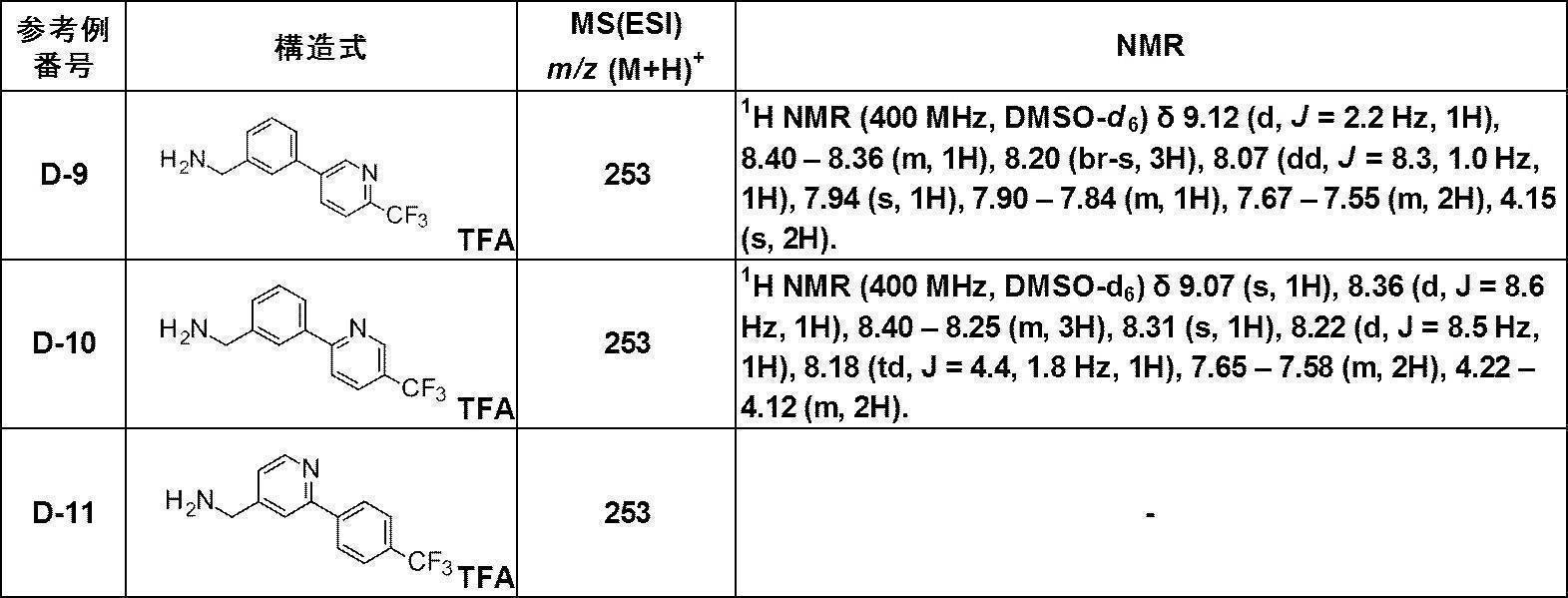
参考例D-12:3-[2-(ジメチルアミノ)-4-ピリジル]ベンジルアミン 塩酸塩(D-12)の合成Reference Example D-12: Synthesis of 3- [2- (dimethylamino) -4-pyridyl] benzylamine hydrochloride (D-12)

(工程1)4-クロロ-2-ジメチルアミノピリジンの合成
2-アミノ-4-クロロピリジン(5.0g、39mmol)及びシアノ水素化ホウ素ナトリウム(7.6g、0.12mol)にアセトニトリル(100mL)及び水(20mL)を加えて溶解させ、0℃でホルマリン及び酢酸(32mL)を加えた。室温に昇温して一晩攪拌した後、反応混合物に水酸化ナトリウムを加えてpH>4に調整した。ジクロロメタンを加えて抽出し、有機層を飽和食塩水で洗浄、硫酸ナトリウムで乾燥させた。乾燥剤を濾別し、溶媒を留去して標題化合物(3.9g、25mmol、64%)を得た。
MS (ESI) m/z 157 (M+H)+
1H NMR (300 MHz, CDCl3): δ 8.03 (d, J = 5.4 Hz, 1H), 6.54 (d, J = 5.4 Hz, 1H), 6.47 (s, 1H), 3.07 (s, 6H).
(工程2)3-(2-ジメチルアミノ-4-ピリジル)ベンゾニトリルの合成
工程1で得られた化合物(2.7g、17mmol)、3-シアノフェニルボロン酸(2.3g、16mmol)、炭酸カリウム(4.3g、35mmol)及び1,1’-ビス(ジ-tert-ブチルホスフィノ)フェロセンジクロロパラジウム(Pd-118、1.1g、1.7mmol)にN,N-ジメチルホルムアミド(50mL)と水(1mL)を加え90℃で一晩攪拌した。反応混合物を減圧濃縮して得られた残渣をシリカゲルカラムクロマトグラフィー(石油エーテル/酢酸エチル)にて精製して標題化合物(1.7g、7.6mmol、48%)を得た。
MS (ESI) m/z 224 (M+H)+
(工程3)3-[2-(ジメチルアミノ)-4-ピリジル]ベンジルアミン(D-12)の合成
工程2で得られた化合物(1.0g、4.5mmol)及びパラジウム/炭素(0.2g)にエタノール(50mL)と濃塩酸(5mL)を加え、常圧の水素雰囲気下、室温で一晩攪拌した。触媒を濾別した後、減圧濃縮して標題化合物(0.50g、2.2mmol、49%)を得た。
MS (ESI) m/z 228 (M+H)+
1H NMR (300 MHz, CD3OD): δ 8.06 (s, 1H), 7.98 (d, J = 6.9 Hz, 1H), 7.93-7.90 (m, 1H), 7.67-7.65 (m, 2H), 7.43 (d, J = 1.2 Hz, 1H), 7.30 (dd, J = 6.9, 1.2 Hz, 1H), 4.26 (s, 2H), 3.38 (s, 6H).
(Step 1) Synthesis of 4-chloro-2-dimethylaminopyridine 2-amino-4-chloropyridine (5.0 g, 39 mmol) and sodium cyanoborohydride (7.6 g, 0.12 mol) in acetonitrile (100 mL) And water (20 mL) was added and dissolved, and formalin and acetic acid (32 mL) were added at 0 ° C. After warming to room temperature and stirring overnight, the reaction mixture was adjusted to pH> 4 by adding sodium hydroxide. Dichloromethane was added for extraction, and the organic layer was washed with saturated brine and dried over sodium sulfate. The desiccant was filtered off and the solvent was evaporated to give the title compound (3.9 g, 25 mmol, 64%).
MS (ESI) m / z 157 (M + H) +
1 H NMR (300 MHz, CDCl 3 ): δ 8.03 (d, J = 5.4 Hz, 1H), 6.54 (d, J = 5.4 Hz, 1H), 6.47 (s, 1H), 3.07 (s, 6H).
(Step 2) Synthesis of 3- (2-dimethylamino-4-pyridyl) benzonitrile The compound obtained in Step 1 (2.7 g, 17 mmol), 3-cyanophenylboronic acid (2.3 g, 16 mmol), carbonic acid Potassium (4.3 g, 35 mmol) and 1,1′-bis (di-tert-butylphosphino) ferrocenedichloropalladium (Pd-118, 1.1 g, 1.7 mmol) to N, N-dimethylformamide (50 mL) And water (1 mL) were added and stirred at 90 ° C. overnight. The residue obtained by concentrating the reaction mixture under reduced pressure was purified by silica gel column chromatography (petroleum ether / ethyl acetate) to obtain the title compound (1.7 g, 7.6 mmol, 48%).
MS (ESI) m / z 224 (M + H) +
(Step 3) Synthesis of 3- [2- (dimethylamino) -4-pyridyl] benzylamine (D-12) The compound obtained in Step 2 (1.0 g, 4.5 mmol) and palladium / carbon (0. Ethanol (50 mL) and concentrated hydrochloric acid (5 mL) were added to 2 g), and the mixture was stirred overnight at room temperature under a hydrogen atmosphere under normal pressure. The catalyst was filtered off and concentrated under reduced pressure to give the title compound (0.50 g, 2.2 mmol, 49%).
MS (ESI) m / z 228 (M + H) +
1 H NMR (300 MHz, CD 3 OD): δ 8.06 (s, 1H), 7.98 (d, J = 6.9 Hz, 1H), 7.93-7.90 (m, 1H), 7.67-7.65 (m, 2H), 7.43 (d, J = 1.2 Hz, 1H), 7.30 (dd, J = 6.9, 1.2 Hz, 1H), 4.26 (s, 2H), 3.38 (s, 6H).
参考例D-16:[6-[4-(トリフルオロメチル)フェニル]ピリミジン-4-イル]メチルアミン(D-16)の合成Reference Example D-16: Synthesis of [6- [4- (trifluoromethyl) phenyl] pyrimidin-4-yl] methylamine (D-16)

(工程1)4-メチル-6-[4-(トリフルオロメチル)フェニル]ピリミジンの合成
4-クロロ-6-メチルピリミジン(4.78g、37.4mmol)、4-トリフルオロメチルフェニルボロン酸(8.47g、44.6mmol)及びテトラキス(トリフェニルホスフィン)パラジウム(0)(1.40g、1.21mmol)にアセトニトリル(50mL)を加えた。反応混合物に炭酸ナトリウム(12.9g、121mmol)の水(9mL)溶液を加え、アルゴン雰囲気下で3時間加熱還流させた後、水に加えた。さらに酢酸エチルを加えて抽出し、有機層を飽和食塩水で洗浄した後、硫酸ナトリウムで乾燥させた。乾燥剤を濾別し、溶媒を留去して得られた残渣をシリカゲルカラムクロマトグラフィー(石油エーテル/酢酸エチル)にて精製して標題化合物(6.13g、25.8mmol、69%)を得た。
MS (ESI) m/z 239 (M+H)+
1H NMR (300 MHz, CDCl3): δ 9.17 (s, 1H), 8.17 (d, J = 8.1 Hz, 2H), 7.74 (d, J = 8.1 Hz, 2H), 7.60 (s, 1H), 2.61 (s, 3H).
(工程2)4-ブロモメチル-6-[4-(トリフルオロメチル)フェニル]ピリミジンの合成
工程1で得られた化合物(5.92g、24.7mmol)、N-ブロモこはく酸イミド(39.2g、223mmol)及び過酸化ベンゾイル(4.86g、20.1mmol)に四塩化炭素(100mL)を加え、100℃で一晩攪拌した。反応混合物に飽和重曹水を加え、酢酸エチルにて抽出した後、有機層を飽和食塩水で洗浄、硫酸ナトリウムで乾燥させた。乾燥剤を濾別し、溶媒を留去して得られた残渣をシリカゲルカラムクロマトグラフィー(石油エーテル/酢酸エチル)にて精製して標題化合物(0.73g、2.3mmol、9%)を得た。
MS (ESI) m/z 317 (M+H)+
1H NMR (300 MHz, CDCl3): δ 9.23 (s, 1H), 8.22 (d, J = 8.1 Hz, 2H), 7.91 (s, 1H), 7.80 (d, J = 8.1 Hz, 2H), 4.47 (s, 2H).
(工程3)[6-[4-(トリフルオロメチル)フェニル]ピリミジン-4-イル]メチルアミン(D-16)の合成
工程2で得られた化合物(0.73g、2.3mmol)のエタノール(10mL)溶液に濃アンモニア水(15mL)を10分かけて滴下し、室温で1時間攪拌した。反応混合物を減圧濃縮して得られた残渣をシリカゲルカラムクロマトグラフィー(石油エーテル/酢酸エチル)にて精製して標題化合物(0.17g、0.69mmol、30%)を得た。
MS (ESI) m/z 254 (M+H)+
1H NMR (300 MHz, CD3OD): δ 9.26 (s, 1H), 8.40 (d, J = 8.1 Hz, 2H), 8.13 (s, 1H), 7.88 (d, J = 8.1 Hz, 2H), 4.26 (s, 2H).
(Step 1) Synthesis of 4-methyl-6- [4- (trifluoromethyl) phenyl] pyrimidine 4-chloro-6-methylpyrimidine (4.78 g, 37.4 mmol), 4-trifluoromethylphenylboronic acid ( Acetonitrile (50 mL) was added to 8.47 g, 44.6 mmol) and tetrakis (triphenylphosphine) palladium (0) (1.40 g, 1.21 mmol). A solution of sodium carbonate (12.9 g, 121 mmol) in water (9 mL) was added to the reaction mixture, heated under reflux for 3 hours under an argon atmosphere, and then added to water. Further, ethyl acetate was added for extraction, and the organic layer was washed with saturated brine and then dried over sodium sulfate. The desiccant was filtered off, the solvent was distilled off, and the resulting residue was purified by silica gel column chromatography (petroleum ether / ethyl acetate) to give the title compound (6.13 g, 25.8 mmol, 69%). It was.
MS (ESI) m / z 239 (M + H) +
1 H NMR (300 MHz, CDCl 3 ): δ 9.17 (s, 1H), 8.17 (d, J = 8.1 Hz, 2H), 7.74 (d, J = 8.1 Hz, 2H), 7.60 (s, 1H), 2.61 (s, 3H).
(Step 2) Synthesis of 4-bromomethyl-6- [4- (trifluoromethyl) phenyl] pyrimidine The compound obtained in Step 1 (5.92 g, 24.7 mmol), N-bromosuccinimide (39.2 g) 223 mmol) and benzoyl peroxide (4.86 g, 20.1 mmol) were added carbon tetrachloride (100 mL) and stirred at 100 ° C. overnight. Saturated aqueous sodium hydrogen carbonate was added to the reaction mixture, and the mixture was extracted with ethyl acetate. The organic layer was washed with saturated brine and dried over sodium sulfate. The desiccant was filtered off, the solvent was distilled off, and the resulting residue was purified by silica gel column chromatography (petroleum ether / ethyl acetate) to give the title compound (0.73 g, 2.3 mmol, 9%). It was.
MS (ESI) m / z 317 (M + H) +
1 H NMR (300 MHz, CDCl 3 ): δ 9.23 (s, 1H), 8.22 (d, J = 8.1 Hz, 2H), 7.91 (s, 1H), 7.80 (d, J = 8.1 Hz, 2H), 4.47 (s, 2H).
(Step 3) Synthesis of [6- [4- (trifluoromethyl) phenyl] pyrimidin-4-yl] methylamine (D-16) Ethanol of the compound obtained in Step 2 (0.73 g, 2.3 mmol) Concentrated aqueous ammonia (15 mL) was added dropwise to the (10 mL) solution over 10 minutes, and the mixture was stirred at room temperature for 1 hour. The residue obtained by concentrating the reaction mixture under reduced pressure was purified by silica gel column chromatography (petroleum ether / ethyl acetate) to obtain the title compound (0.17 g, 0.69 mmol, 30%).
MS (ESI) m / z 254 (M + H) +
1 H NMR (300 MHz, CD 3 OD): δ 9.26 (s, 1H), 8.40 (d, J = 8.1 Hz, 2H), 8.13 (s, 1H), 7.88 (d, J = 8.1 Hz, 2H) , 4.26 (s, 2H).
参考例D-18:[4-[6-(トリフルオロメチル)-3-ピリジル]-2-ピリジル]メチルアミン(D-18)の合成Reference Example D-18: Synthesis of [4- [6- (trifluoromethyl) -3-pyridyl] -2-pyridyl] methylamine (D-18)

(工程1)[4-[6-(トリフルオロメチル)-3-ピリジル]-2-ピリジル]メタノールの合成
(4-クロロ-2-ピリジル)メタノール(1.51g、10.5mmol)、[6-(トリフルオロメチル)-3-ピリジル]ボロン酸(1.99g、10.5mmol)、炭酸ナトリウム(3.40g、32.1mmol)及び1,1’-ビス(ジ-tert-ブチルホスフィノ)フェロセンジクロロパラジウム(Pd-118、0.70g、1.07mmol)に1,4-ジオキサン(50mL)と水(5mL)を加え100℃で3時間攪拌した。反応混合物を減圧濃縮して得られた残渣をシリカゲルカラムクロマトグラフィー(石油エーテル/酢酸エチル)にて精製して標題化合物(1.36g、5.35mmol、51%)を得た。
MS (ESI) m/z 255 (M+H)+
(工程2)[4-[6-(トリフルオロメチル)-3-ピリジル]-2-ピリジル]メチルアミン(D-18)の合成
工程1で得られた化合物(1.36g、5.38mmol)に塩化チオニル(25mL)を加え2時間加熱還流した後、減圧濃縮して得られた残渣をアンモニア水(25mL)に加え、70℃で2時間攪拌した。反応混合物を減圧濃縮して得られた残渣をシリカゲルカラムクロマトグラフィー(石油エーテル/酢酸エチル)にて精製して標題化合物(286mg、1.13mmol、21%)を得た。
MS (ESI) m/z 254 (M+H)+
1H NMR (300 MHz, CD3OD): δ 9.12 (d, J = 1.5 Hz, 1H), 8.66 (d, J = 5.1 Hz, 1H), 8.43 (dd, J = 8.1, 1.5 Hz, 1H), 7.98 (d, J = 8.1 Hz, 1H), 7.87 (s, 1H), 7.70 (dd, J = 5.1, 1.5 Hz, 1H), 4.03 (s, 2H).
(Step 1) Synthesis of [4- [6- (trifluoromethyl) -3-pyridyl] -2-pyridyl] methanol (4-chloro-2-pyridyl) methanol (1.51 g, 10.5 mmol), [6 -(Trifluoromethyl) -3-pyridyl] boronic acid (1.99 g, 10.5 mmol), sodium carbonate (3.40 g, 32.1 mmol) and 1,1′-bis (di-tert-butylphosphino) 1,4-Dioxane (50 mL) and water (5 mL) were added to ferrocenedichloropalladium (Pd-118, 0.70 g, 1.07 mmol), and the mixture was stirred at 100 ° C. for 3 hours. The residue obtained by concentrating the reaction mixture under reduced pressure was purified by silica gel column chromatography (petroleum ether / ethyl acetate) to obtain the title compound (1.36 g, 5.35 mmol, 51%).
MS (ESI) m / z 255 (M + H) +
(Step 2) Synthesis of [4- [6- (trifluoromethyl) -3-pyridyl] -2-pyridyl] methylamine (D-18) Compound obtained in Step 1 (1.36 g, 5.38 mmol) After thionyl chloride (25 mL) was added to the mixture and heated under reflux for 2 hours, the residue obtained by concentration under reduced pressure was added to aqueous ammonia (25 mL) and stirred at 70 ° C. for 2 hours. The residue obtained by concentrating the reaction mixture under reduced pressure was purified by silica gel column chromatography (petroleum ether / ethyl acetate) to obtain the title compound (286 mg, 1.13 mmol, 21%).
MS (ESI) m / z 254 (M + H) +
1 H NMR (300 MHz, CD 3 OD): δ 9.12 (d, J = 1.5 Hz, 1H), 8.66 (d, J = 5.1 Hz, 1H), 8.43 (dd, J = 8.1, 1.5 Hz, 1H) , 7.98 (d, J = 8.1 Hz, 1H), 7.87 (s, 1H), 7.70 (dd, J = 5.1, 1.5 Hz, 1H), 4.03 (s, 2H).
参考例D-19:[5-[6-(トリフルオロメチル)-3-ピリジル]-3-ピリジル]メチルアミン 二トリフルオロ酢酸塩(D-19)の合成
(工程1)[5-[6-(トリフルオロメチル)-3-ピリジル]-ピリジン-3-カルボニトリルの合成
5-ブロモピリジン-3-カルボニトリル(250mg、1.4mmol)、[6-(トリフルオロメチル)-3-ピリジル]ボロン酸(290mg、1.5mmol)及び1,1’-ビス(ジフェニルホスフィノ)フェロセンジクロロパラジウム(II)(50mg、0.068mmol)に1,4-ジオキサン(2.5mL)及び1mol/L炭酸ナトリウム水溶液(2.5mL)を加え、マイクロウェーブ反応装置を用いて110℃で15分間加熱攪拌した。反応混合物に水を加え、酢酸エチルで抽出し、有機層を硫酸ナトリウムにて乾燥した。乾燥剤を濾別し、溶媒を留去して得られた残渣をシリカゲルカラムクロマトグラフィー(ヘキサン/酢酸エチル)にて精製して標題化合物(235mg、0.94mmol、67%)を得た。
MS (ESI) m/z 249 (M+H)+
(工程2)[5-[6-(トリフルオロメチル)-3-ピリジル]-3-ピリジル]メチルアミン 二トリフルオロ酢酸塩(D-19)の合成
工程1で得られた化合物(235mg、0.94mmol)をエタノール(5mL)に溶解させ、フロー式水素化反応装置(H-cube、ThalesNano Nanotechnology社製)を用い、10%Pd/C(30mm)、65℃、50bar、流速1mL/分の条件にて還元した。反応液を減圧濃縮して、得られた残渣を高速液体クロマトグラフィー(水-アセトニトリル、それぞれ0.1%トリフルオロ酢酸入り)にて精製して標題化合物(37g、0.11mmol、12%)を得た。
MS (ESI) m/z 253 (M+H)+
Reference Example D-19: Synthesis of [5- [6- (trifluoromethyl) -3-pyridyl] -3-pyridyl] methylamine ditrifluoroacetate (D-19) (Step 1) [5- [6 Synthesis of-(trifluoromethyl) -3-pyridyl] -pyridine-3-carbonitrile 5-Bromopyridine-3-carbonitrile (250 mg, 1.4 mmol), [6- (trifluoromethyl) -3-pyridyl] Boronic acid (290 mg, 1.5 mmol) and 1,1′-bis (diphenylphosphino) ferrocenedichloropalladium (II) (50 mg, 0.068 mmol) in 1,4-dioxane (2.5 mL) and 1 mol / L carbonic acid A sodium aqueous solution (2.5 mL) was added, and the mixture was heated and stirred at 110 ° C. for 15 minutes using a microwave reactor. Water was added to the reaction mixture, extraction was performed with ethyl acetate, and the organic layer was dried over sodium sulfate. The desiccant was filtered off, the solvent was distilled off, and the resulting residue was purified by silica gel column chromatography (hexane / ethyl acetate) to give the title compound (235 mg, 0.94 mmol, 67%).
MS (ESI) m / z 249 (M + H) +
(Step 2) [5- [6- (Trifluoromethyl) -3-pyridyl] -3-pyridyl] methylamine Synthesis of ditrifluoroacetate (D-19) Compound obtained in Step 1 (235 mg, 0 .94 mmol) is dissolved in ethanol (5 mL), and 10% Pd / C (30 mm), 65 ° C., 50 bar, flow rate of 1 mL / min using a flow hydrogenation reactor (H-cube, manufactured by Thales Nano Nanotechnology). Reduced under conditions. The reaction mixture was concentrated under reduced pressure, and the resulting residue was purified by high performance liquid chromatography (water-acetonitrile, each containing 0.1% trifluoroacetic acid) to give the title compound (37 g, 0.11 mmol, 12%). Obtained.
MS (ESI) m / z 253 (M + H) +
表16記載のD-20は、対応する市販の試薬を用い参考例D-19と同様の操作により合成した。 D-20 described in Table 16 was synthesized in the same manner as in Reference Example D-19 using the corresponding commercially available reagent.

参考例D-21:[3-[5-(トリフルオロメチル)ピリミジン-2-イル]フェニル]メチルアミン 塩酸塩(D-21)の合成Reference Example D-21: Synthesis of [3- [5- (trifluoromethyl) pyrimidin-2-yl] phenyl] methylamine hydrochloride (D-21)

(工程1)3-[5-(トリフルオロメチル)ピリミジン-2-イル]ベンゾニトリルの合成
2-ブロモ-5-トリフルオロメチルピリミジン(1.3g、5.5mmol)、3-シアノフェニルボロン酸(0.97g、6.6mmol)、及び1,1’-ビス(ジフェニルホスフィノ)フェロセンジクロロパラジウム(II)(0.20g、0.27mmol)に1,4-ジオキサン(50mL)と飽和炭酸水素ナトリウム水溶液(30mL)を加え、105℃で1.5時間攪拌した。不溶物を濾別し、濾液に酢酸エチルを加えて水及び飽和食塩水で順次洗浄した後、硫酸ナトリウムにて乾燥し、乾燥剤を濾別した。溶媒を留去して得られた残渣をシリカゲルカラムクロマトグラフィー(石油エーテル/酢酸エチル)にて精製して標題化合物(1.0g、4.0mmol、73%)を得た。
MS (ESI) m/z 250 (M+H)+
1H NMR (400 MHz, CDCl3) δ 9.08 (s, 2H), 8.85 (s, 1H), 8.76 (d, J = 8.0 Hz, 1H), 7.83 (d, J = 7.6 Hz, 1H), 7.65 (dd, J = 8.0, 7.6 Hz, 1H).
(工程2)[3-[5-(トリフルオロメチル)ピリミジン-2-イル]フェニル]メチルアミン 塩酸塩(D-21)の合成
工程1で得られた化合物(1.0g、4.0mmol)の酢酸(30mL)溶液に10%パラジウム/炭素(0.30g)を加え、水素雰囲気下、25℃にて3時間攪拌した。触媒を濾別し、濾液にジクロロメタン(15mL)を加えて溶解させ、トリエチルアミン(0.50mL、3.6mmol)及び二炭酸ジ-tert-ブチル(1.0g、4.6mmol)を加え、室温で40分間攪拌した。反応混合物を水で洗浄した後、硫酸ナトリウムにて乾燥し、乾燥剤を濾別した。溶媒を留去して得られた残渣をシリカゲルカラムクロマトグラフィー(石油エーテル/酢酸エチル)にて精製した。得られた化合物に4mol/L 塩化水素(ジクロロメタン溶液、10mL、40mmol)を加え、室温で30分間攪拌した後、減圧濃縮して標題化合物(0.13g、0.45mmol、11%)を得た。
MS (ESI) m/z 254 (M+H)+
1H NMR (300 MHz, DMSO-d6) δ 9.39 (s, 2H), 8.59 (s, 1H), 8.48 - 8.38 (m, 4H), 7.76 - 7.73 (m, 1H), 7.65 (dd, J = 7.8, 7.8 Hz, 1H), 4.18 - 4.17 (m, 2H).
(Step 1) Synthesis of 3- [5- (trifluoromethyl) pyrimidin-2-yl] benzonitrile 2-Bromo-5-trifluoromethylpyrimidine (1.3 g, 5.5 mmol), 3-cyanophenylboronic acid (0.97 g, 6.6 mmol) and 1,1′-bis (diphenylphosphino) ferrocenedichloropalladium (II) (0.20 g, 0.27 mmol) to 1,4-dioxane (50 mL) and saturated bicarbonate Sodium aqueous solution (30 mL) was added, and the mixture was stirred at 105 ° C. for 1.5 hours. Insoluble matter was filtered off, ethyl acetate was added to the filtrate, and the mixture was washed successively with water and saturated brine, dried over sodium sulfate, and the desiccant was filtered off. The residue obtained by evaporating the solvent was purified by silica gel column chromatography (petroleum ether / ethyl acetate) to obtain the title compound (1.0 g, 4.0 mmol, 73%).
MS (ESI) m / z 250 (M + H) +
1 H NMR (400 MHz, CDCl 3 ) δ 9.08 (s, 2H), 8.85 (s, 1H), 8.76 (d, J = 8.0 Hz, 1H), 7.83 (d, J = 7.6 Hz, 1H), 7.65 (dd, J = 8.0, 7.6 Hz, 1H).
(Step 2) Synthesis of [3- [5- (trifluoromethyl) pyrimidin-2-yl] phenyl] methylamine hydrochloride (D-21) Compound obtained in Step 1 (1.0 g, 4.0 mmol) Of acetic acid (30 mL) was added 10% palladium / carbon (0.30 g), and the mixture was stirred at 25 ° C. for 3 hours in a hydrogen atmosphere. The catalyst was filtered off, and dichloromethane (15 mL) was added to the filtrate to dissolve, and triethylamine (0.50 mL, 3.6 mmol) and di-tert-butyl dicarbonate (1.0 g, 4.6 mmol) were added, and at room temperature. Stir for 40 minutes. The reaction mixture was washed with water and dried over sodium sulfate, and the desiccant was filtered off. The residue obtained by distilling off the solvent was purified by silica gel column chromatography (petroleum ether / ethyl acetate). 4 mol / L hydrogen chloride (dichloromethane solution, 10 mL, 40 mmol) was added to the obtained compound, and the mixture was stirred at room temperature for 30 minutes and then concentrated under reduced pressure to obtain the title compound (0.13 g, 0.45 mmol, 11%). .
MS (ESI) m / z 254 (M + H) +
1 H NMR (300 MHz, DMSO-d 6 ) δ 9.39 (s, 2H), 8.59 (s, 1H), 8.48-8.38 (m, 4H), 7.76-7.73 (m, 1H), 7.65 (dd, J = 7.8, 7.8 Hz, 1H), 4.18-4.17 (m, 2H).
参考例D-22:[3-[2-(トリフルオロメチル)ピリミジン-5-イル]フェニル]メチルアミン(D-22)の合成Reference Example D-22: Synthesis of [3- [2- (trifluoromethyl) pyrimidin-5-yl] phenyl] methylamine (D-22)

(工程1)3-[2-(トリフルオロメチル)ピリミジン-5-イル]ベンゾニトリルの合成
5-ブロモ-2-トリフルオロメチルピリミジン(3.0g、13mmol)、3-シアノフェニルボロン酸(2.3g、16mmol)、炭酸ナトリウム(2.8g、26mmol)及び1,1’-ビス(ジフェニルホスフィノ)フェロセンジクロロパラジウム(II)(0.47g、0.65mmol)にN,N-ジメチルホルムアミド(80mL)と水(20mL)を加え、110℃で2時間攪拌した。不溶物を濾別し、濾液に酢酸エチルを加えて水及び飽和食塩水で順次洗浄した後、硫酸ナトリウムにて乾燥し、乾燥剤を濾別した。溶媒を留去して得られた残渣をシリカゲルカラムクロマトグラフィー(石油エーテル/酢酸エチル)にて精製して標題化合物(2.4g、9.6mmol、73%)を得た。
MS (ESI) m/z 250 (M+H)+
1H NMR (300 MHz, CDCl3) δ 9.12 (s, 2H), 7.93 - 7.85 (m, 3H), 7.74 (dd, J = 7.8, 7.8 Hz, 1H).
(工程2)[3-[2-(トリフルオロメチル)ピリミジン-5-イル]フェニル]メチルアミン(D-22)の合成
工程1で得られた化合物(2.0g、8.0mmol)及び塩化コバルト(II)・6水和物(0.10g、0.80mmol)にテトラヒドロフラン(28mL)及び水(4mL)を加えた。0℃で反応混合物にテトラヒドロホウ酸ナトリウム(0.61g、16mmol)を加え、室温で2時間攪拌した後、3mol/L 塩酸を加えてpH1に調整した。室温で1時間攪拌した後、反応混合物からテトラヒドロフランを減圧留去し、アンモニア水を加えてpH8~9に調整した。反応混合物に酢酸エチルを加えて抽出し、有機層を飽和食塩水で洗浄した後、硫酸ナトリウムにて乾燥し、乾燥剤を濾別した。溶媒を留去して得られた残渣を高速液体クロマトグラフィー(水-アセトニトリル)にて精製して標題化合物(0.11g、0.41mmol、5%)を得た。
MS (ESI) m/z 254 (M+H)+
1H NMR (300 MHz, CD3OD) δ 9.28 (s, 2H), 7.83 (s, 1H), 7.76 - 7.32 (m, 1H), 7.59 - 7.56 (m, 2H), 3.99 (s, 2H).
(Step 1) Synthesis of 3- [2- (trifluoromethyl) pyrimidin-5-yl] benzonitrile 5-Bromo-2-trifluoromethylpyrimidine (3.0 g, 13 mmol), 3-cyanophenylboronic acid (2 .3 g, 16 mmol), sodium carbonate (2.8 g, 26 mmol) and 1,1′-bis (diphenylphosphino) ferrocenedichloropalladium (II) (0.47 g, 0.65 mmol) to N, N-dimethylformamide ( 80 mL) and water (20 mL) were added, and the mixture was stirred at 110 ° C. for 2 hours. Insoluble matter was filtered off, ethyl acetate was added to the filtrate, and the mixture was washed successively with water and saturated brine, dried over sodium sulfate, and the desiccant was filtered off. The residue obtained by distilling off the solvent was purified by silica gel column chromatography (petroleum ether / ethyl acetate) to obtain the title compound (2.4 g, 9.6 mmol, 73%).
MS (ESI) m / z 250 (M + H) +
1 H NMR (300 MHz, CDCl 3 ) δ 9.12 (s, 2H), 7.93-7.85 (m, 3H), 7.74 (dd, J = 7.8, 7.8 Hz, 1H).
(Step 2) Synthesis of [3- [2- (trifluoromethyl) pyrimidin-5-yl] phenyl] methylamine (D-22) Compound (2.0 g, 8.0 mmol) obtained in Step 1 and chloride Tetrahydrofuran (28 mL) and water (4 mL) were added to cobalt (II) hexahydrate (0.10 g, 0.80 mmol). Sodium tetrahydroborate (0.61 g, 16 mmol) was added to the reaction mixture at 0 ° C., and the mixture was stirred at room temperature for 2 hours, and then adjusted to pH 1 by adding 3 mol / L hydrochloric acid. After stirring at room temperature for 1 hour, tetrahydrofuran was distilled off from the reaction mixture under reduced pressure, and aqueous ammonia was added to adjust the pH to 8-9. Ethyl acetate was added to the reaction mixture for extraction, and the organic layer was washed with saturated brine, dried over sodium sulfate, and the desiccant was filtered off. The residue obtained by distilling off the solvent was purified by high performance liquid chromatography (water-acetonitrile) to obtain the title compound (0.11 g, 0.41 mmol, 5%).
MS (ESI) m / z 254 (M + H) +
1 H NMR (300 MHz, CD 3 OD) δ 9.28 (s, 2H), 7.83 (s, 1H), 7.76-7.32 (m, 1H), 7.59-7.56 (m, 2H), 3.99 (s, 2H) .
参考例D-23:[3-[5-(トリフルオロメチル)ピラジン-2-イル]フェニル]メチルアミン(D-23)の合成Reference Example D-23: Synthesis of [3- [5- (trifluoromethyl) pyrazin-2-yl] phenyl] methylamine (D-23)

(工程1)3-[5-(トリフルオロメチル)ピラジン-2-イル]ベンゾニトリルの合成
2-クロロ-5-トリフルオロメチルピラジン(1.0g、5.5mmol)、3-シアノフェニルボロン酸(0.81g、5.47mmol)、炭酸カリウム(2.3g、16mmol)及びテトラキス(トリフェニルホスフィン)パラジウム(0)(0.36g、0.31mmol)に1,4-ジオキサン(40mL)と水(10mL)を加え、85℃で5時間攪拌した。反応混合物を塩化アンモニウム水溶液に加え、酢酸エチルにて抽出した。有機層を飽和食塩水で洗浄した後、硫酸ナトリウムにて乾燥し、乾燥剤を濾別した。溶媒を留去して得られた残渣をシリカゲルカラムクロマトグラフィー(石油エーテル/酢酸エチル)にて精製して標題化合物(0.92g、3.7mmol、67%)を得た。MS (ESI) m/z 250 (M+H)+
1H NMR (400 MHz, CDCl3) δ 9.15 (s, 1H), 9.04 (s, 1H), 8.43 (s, 1H), 8.32 (d, J = 8.0 Hz, 1H), 7.84 (d, J = 8.0 Hz, 1H), 7.70 (dd, J = 8.0, 8.0 Hz, 1H).
(工程2)[3-[5-(トリフルオロメチル)ピラジン-2-イル]フェニル]メチルアミン(D-23)の合成
工程1で得られた化合物(0.72g、2.9mmol)の酢酸(22mL)溶液に10%パラジウム/炭素(0.22g)を加え、水素雰囲気下、室温にて3時間攪拌した。触媒を濾別し、濾液に酢酸エチルを加えて水及び飽和食塩水で順次洗浄した。有機層を硫酸ナトリウムにて乾燥し、乾燥剤を濾別した後、溶媒を留去して得られた残渣を高速液体クロマトグラフィー(水-アセトニトリル)にて精製して標題化合物(0.12g、0.47mmol、16%)を得た。
MS (ESI) m/z 254 (M+H)+
1H NMR (400 MHz, CD3OD) δ 9.37 (s, 1H), 9.13 (s, 1H), 8.36 (s, 1H), 8.32 - 8.30 (m, 1H), 7.73 - 7.69 (m, 2H), 4.28 (s, 2H).
(Step 1) Synthesis of 3- [5- (trifluoromethyl) pyrazin-2-yl] benzonitrile 2-Chloro-5-trifluoromethylpyrazine (1.0 g, 5.5 mmol), 3-cyanophenylboronic acid (0.81 g, 5.47 mmol), potassium carbonate (2.3 g, 16 mmol) and tetrakis (triphenylphosphine) palladium (0) (0.36 g, 0.31 mmol) in 1,4-dioxane (40 mL) and water (10 mL) was added and stirred at 85 ° C. for 5 hours. The reaction mixture was added to an aqueous ammonium chloride solution and extracted with ethyl acetate. The organic layer was washed with saturated brine, dried over sodium sulfate, and the desiccant was filtered off. The residue obtained by distilling off the solvent was purified by silica gel column chromatography (petroleum ether / ethyl acetate) to obtain the title compound (0.92 g, 3.7 mmol, 67%). MS (ESI) m / z 250 (M + H) +
1 H NMR (400 MHz, CDCl 3 ) δ 9.15 (s, 1H), 9.04 (s, 1H), 8.43 (s, 1H), 8.32 (d, J = 8.0 Hz, 1H), 7.84 (d, J = 8.0 Hz, 1H), 7.70 (dd, J = 8.0, 8.0 Hz, 1H).
(Step 2) Synthesis of [3- [5- (trifluoromethyl) pyrazin-2-yl] phenyl] methylamine (D-23) Acetic acid of the compound (0.72 g, 2.9 mmol) obtained in Step 1 (22 mL) To the solution was added 10% palladium / carbon (0.22 g), and the mixture was stirred at room temperature for 3 hours in a hydrogen atmosphere. The catalyst was filtered off, ethyl acetate was added to the filtrate, and the mixture was washed successively with water and saturated brine. The organic layer was dried over sodium sulfate, the desiccant was filtered off, the solvent was distilled off, and the resulting residue was purified by high performance liquid chromatography (water-acetonitrile) to give the title compound (0.12 g, 0.47 mmol, 16%).
MS (ESI) m / z 254 (M + H) +
1 H NMR (400 MHz, CD 3 OD) δ 9.37 (s, 1H), 9.13 (s, 1H), 8.36 (s, 1H), 8.32-8.30 (m, 1H), 7.73-7.69 (m, 2H) , 4.28 (s, 2H).
参考例D-24:[3-[6-(トリフルオロメチル)ピリダジン-3-イル]フェニル]メチルアミン(D-24)の合成Reference Example D-24: Synthesis of [3- [6- (trifluoromethyl) pyridazin-3-yl] phenyl] methylamine (D-24)
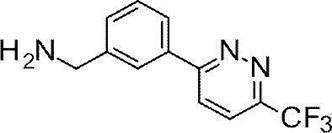
5-ブロモ-2-トリフルオロメチルピリミジンの代わりに参考例D-35工程1で得られた化合物を用い、参考例D-22と同様の操作を行い標題化合物(収率19%)を得た。
MS (ESI) m/z 254 (M+H)+
1H NMR (400 MHz, CD3OD) δ 8.43 (d, J = 8.8 Hz, 1H), 8.20 - 8.18 (m, 2H), 8.10 (d, J = 6.4 Hz, 1H), 7.60 - 7.57 (m, 2H), 3.98 (s, 2H).
Using the compound obtained in Step 1 of Reference Example D-35 instead of 5-bromo-2-trifluoromethylpyrimidine, the title compound (19% yield) was obtained in the same manner as in Reference Example D-22. .
MS (ESI) m / z 254 (M + H) +
1 H NMR (400 MHz, CD 3 OD) δ 8.43 (d, J = 8.8 Hz, 1H), 8.20-8.18 (m, 2H), 8.10 (d, J = 6.4 Hz, 1H), 7.60-7.57 (m , 2H), 3.98 (s, 2H).
参考例D-25:[2-(4-クロロフェニル)-4-ピリジル]メチルアミン 塩酸塩(D-25)の合成Reference Example D-25: Synthesis of [2- (4-chlorophenyl) -4-pyridyl] methylamine hydrochloride (D-25)

(工程1)N-[(2-クロロ-4-ピリジル)メチル]カルバミン酸 tert-ブチルの合成
(2-クロロ-4-ピリジル)メチルアミン(14g、0.10mol)にジクロロメタン(120mL)を加えて溶解させ、トリエチルアミン(28mL、0.20mol)及び二炭酸ジ-tert-ブチル(26g、0.12mol)を加え、室温で2時間攪拌した。反応混合物から溶媒を留去して得られた残渣をシリカゲルカラムクロマトグラフィー(石油エーテル/酢酸エチル)にて精製して標題化合物(22g、0.091mmol、91%)を得た。
MS (ESI) m/z 243 (M+H)+
(工程2)N-[[2-(4-クロロフェニル)-4-ピリジル]メチル]カルバミン酸 tert-ブチルの合成
工程1で得られた化合物(1.4g、5.9mmol)、4-クロロフェニルボロン酸(1.0g、6.4mmol)、炭酸ナトリウム(1.6g、15mmol)及びテトラキス(トリフェニルホスフィン)パラジウム(0)(0.21g、0.18mmol)にN,N-ジメチルホルムアミド(20mL)と水(5mL)を加え、100℃で2時間攪拌した。不溶物を濾別し、濾液に酢酸エチルを加えて水及び飽和食塩水で順次洗浄した後、硫酸ナトリウムにて乾燥し、乾燥剤を濾別した。溶媒を留去して得られた残渣をシリカゲルカラムクロマトグラフィー(石油エーテル/酢酸エチル)にて精製して標題化合物(1.0g、3.1mmol、54%)を得た。
MS (ESI) m/z 319 (M+H)+
1H NMR (400 MHz, CDCl3) δ 8.62 (d, J = 4.8 Hz, 1H), 7.92 (d, J = 8.4 Hz, 2H), 7.60 (s, 1H), 7.43 (d, J = 8.4 Hz, 2H), 7.15 (d, J = 4.8 Hz, 1H), 5.01 (s, 1H), 4.37 - 4.39 (m, 2H), 1.48 (s, 9H).
(工程3)[2-(4-クロロフェニル)-4-ピリジル]メチルアミン 塩酸塩(D-25)の合成
工程2で得られた化合物(1.0g、3.1mmol)に4mol/L 塩化水素(ジクロロメタン溶液、80mL、0.32mol)を加え、室温で1時間攪拌した後、減圧濃縮した。得られた残渣にジクロロメタンを加え、不溶物を濾取、乾燥させて標題化合物(0.49g、1.9mmol、61%)を得た。
MS (ESI) m/z 219 (M+H)+
1H NMR (400 MHz, DMSO-d6) δ 8.79 (brs, 3H), 8.74 (d, J = 4.8 Hz, 1H), 8.31 (s, 1H), 8.15 (d, J = 8.8 Hz, 2H), 7.63 (d, J = 8.8 Hz, 2H), 7.58 (d, J = 4.8 Hz, 1H), 4.17 - 4.22 (m, 2H).
(Step 1) Synthesis of tert-butyl N-[(2-chloro-4-pyridyl) methyl] carbamate Add dichloromethane (120 mL) to (2-chloro-4-pyridyl) methylamine (14 g, 0.10 mol). Triethylamine (28 mL, 0.20 mol) and di-tert-butyl dicarbonate (26 g, 0.12 mol) were added, and the mixture was stirred at room temperature for 2 hours. The residue obtained by evaporating the solvent from the reaction mixture was purified by silica gel column chromatography (petroleum ether / ethyl acetate) to obtain the title compound (22 g, 0.091 mmol, 91%).
MS (ESI) m / z 243 (M + H) +
(Step 2) Synthesis of tert-butyl N-[[2- (4-chlorophenyl) -4-pyridyl] methyl] carbamate Compound obtained in Step 1 (1.4 g, 5.9 mmol), 4-chlorophenylboron N, N-dimethylformamide (20 mL) in acid (1.0 g, 6.4 mmol), sodium carbonate (1.6 g, 15 mmol) and tetrakis (triphenylphosphine) palladium (0) (0.21 g, 0.18 mmol) And water (5 mL) were added, and the mixture was stirred at 100 ° C. for 2 hours. Insoluble matter was filtered off, ethyl acetate was added to the filtrate, and the mixture was washed successively with water and saturated brine, dried over sodium sulfate, and the desiccant was filtered off. The residue obtained by evaporating the solvent was purified by silica gel column chromatography (petroleum ether / ethyl acetate) to obtain the title compound (1.0 g, 3.1 mmol, 54%).
MS (ESI) m / z 319 (M + H) +
1 H NMR (400 MHz, CDCl 3 ) δ 8.62 (d, J = 4.8 Hz, 1H), 7.92 (d, J = 8.4 Hz, 2H), 7.60 (s, 1H), 7.43 (d, J = 8.4 Hz , 2H), 7.15 (d, J = 4.8 Hz, 1H), 5.01 (s, 1H), 4.37-4.39 (m, 2H), 1.48 (s, 9H).
(Step 3) Synthesis of [2- (4-chlorophenyl) -4-pyridyl] methylamine hydrochloride (D-25) 4 mol / L hydrogen chloride was added to the compound (1.0 g, 3.1 mmol) obtained in Step 2 (Dichloromethane solution, 80 mL, 0.32 mol) was added, and the mixture was stirred at room temperature for 1 hour and concentrated under reduced pressure. Dichloromethane was added to the resulting residue, and the insoluble material was collected by filtration and dried to obtain the title compound (0.49 g, 1.9 mmol, 61%).
MS (ESI) m / z 219 (M + H) +
1 H NMR (400 MHz, DMSO-d 6 ) δ 8.79 (brs, 3H), 8.74 (d, J = 4.8 Hz, 1H), 8.31 (s, 1H), 8.15 (d, J = 8.8 Hz, 2H) , 7.63 (d, J = 8.8 Hz, 2H), 7.58 (d, J = 4.8 Hz, 1H), 4.17-4.22 (m, 2H).
参考例D-26:[2-[6-(トリフルオロメチル)-3-ピリジル]-4-ピリジル]メチルアミン 塩酸塩(D-26)の合成Reference Example D-26: Synthesis of [2- [6- (trifluoromethyl) -3-pyridyl] -4-pyridyl] methylamine hydrochloride (D-26)

(工程1)[[2-[6-(トリフルオロメチル)-3-ピリジル]-4-ピリジル]メチル]カルバミン酸 tert-ブチルの合成
参考例D-25工程1で得られた化合物(12g、50mmol)及び[6-(トリフルオロメチル)-3-ピリジル]ボロン酸(11g、60mmol)、炭酸ナトリウム(21g、0.10mol)及び1,1’-ビス(ジフェニルホスフィノ)フェロセンジクロロパラジウム(II)(1.8g、2.5mmol)に1,4-ジオキサン(100mL)と水(20mL)を加え、110℃で2時間攪拌した。不溶物を濾別し、濾液に酢酸エチルを加えて水及び飽和食塩水で順次洗浄した後、硫酸ナトリウムにて乾燥し、乾燥剤を濾別した。溶媒を留去して得られた残渣をシリカゲルカラムクロマトグラフィー(石油エーテル/酢酸エチル)にて精製して標題化合物(11g、31mmol、62%)を得た。
MS (ESI) m/z 354 (M+H)+
(工程2)[2-[6-(トリフルオロメチル)-3-ピリジル]-4-ピリジル]メチルアミン 塩酸塩(D-26)の合成
工程1で得られた化合物(11g、31mmol)に4mol/L 塩化水素(ジクロロメタン溶液、120mL、0.48mol)を加え、室温で1時間攪拌した後、減圧濃縮して標題化合物(8.0g、28mmol、90%)を得た。
MS (ESI) m/z 254 (M+H)+
1H NMR (400 MHz, DMSO-d6) δ 10.91 (s, 1H), 9.48 (s, 1H), 8.90 (s, 2H), 8.84 - 8.80 (m, 1H), 8.76 - 8.74 (m, 1H), 8.52 (s, 1H), 8.11 (d, J = 8.4 Hz, 1H), 7.66 (d, J = 4.8 Hz, 1H), 4.23 - 4.19 (m, 2H).
(Step 1) Synthesis of tert-butyl [[2- [6- (trifluoromethyl) -3-pyridyl] -4-pyridyl] methyl] carbamate Reference Example D-25 Compound (12 g, 50 mmol) and [6- (trifluoromethyl) -3-pyridyl] boronic acid (11 g, 60 mmol), sodium carbonate (21 g, 0.10 mol) and 1,1′-bis (diphenylphosphino) ferrocenedichloropalladium (II ) (1.8 g, 2.5 mmol) was added 1,4-dioxane (100 mL) and water (20 mL), and the mixture was stirred at 110 ° C. for 2 hours. Insoluble matter was filtered off, ethyl acetate was added to the filtrate, and the mixture was washed successively with water and saturated brine, dried over sodium sulfate, and the desiccant was filtered off. The residue obtained by evaporating the solvent was purified by silica gel column chromatography (petroleum ether / ethyl acetate) to obtain the title compound (11 g, 31 mmol, 62%).
MS (ESI) m / z 354 (M + H) +
(Step 2) Synthesis of [2- [6- (trifluoromethyl) -3-pyridyl] -4-pyridyl] methylamine hydrochloride (D-26) 4 mol of the compound (11 g, 31 mmol) obtained in Step 1 / L Hydrogen chloride (dichloromethane solution, 120 mL, 0.48 mol) was added, and the mixture was stirred at room temperature for 1 hr, and concentrated under reduced pressure to give the title compound (8.0 g, 28 mmol, 90%).
MS (ESI) m / z 254 (M + H) +
1 H NMR (400 MHz, DMSO-d 6 ) δ 10.91 (s, 1H), 9.48 (s, 1H), 8.90 (s, 2H), 8.84-8.80 (m, 1H), 8.76-8.74 (m, 1H ), 8.52 (s, 1H), 8.11 (d, J = 8.4 Hz, 1H), 7.66 (d, J = 4.8 Hz, 1H), 4.23-4.19 (m, 2H).
参考例D-27:[2-[5-(トリフルオロメチル)-2-ピリジル]-4-ピリジル]メチルアミン(D-27)の合成Reference Example D-27: Synthesis of [2- [5- (trifluoromethyl) -2-pyridyl] -4-pyridyl] methylamine (D-27)

(工程1)[2-[5-(トリフルオロメチル)-2-ピリジル]-4-ピリジル]メタノールの合成
(2-クロロ-4-ピリジル)メタノール(3.00g、20.9mmol)、E-4(7.57g、25.1mmol)、1,1’-ビス(ジフェニルホスフィノ)フェロセン(1.15g、2.09mmol)、酢酸パラジウム(0.23g、1.05mmol)、炭酸セシウム(13.6g、41.8mmol)及び塩化銅(I)(2.06g、20.9mmol)にN,N-ジメチルホルムアミド(300mL)を加え、100℃で一晩攪拌した。不溶物を濾別し、濾液に酢酸エチルを加えて水及び飽和食塩水で順次洗浄した。有機層を硫酸ナトリウムにて乾燥し、乾燥剤を濾別した後、溶媒を留去して得られた残渣をシリカゲルカラムクロマトグラフィー(石油エーテル/酢酸エチル)にて精製し標題化合物(4.12g、16.2mmol、77%)を得た。
1H NMR (400 MHz, CDCl3) δ 8.91 (s, 1H), 8.65 (d, J = 5.0 Hz, 1H), 8.53 (d, J = 8.2 Hz, 1H), 8.42 (s, 1H), 8.04 (d, J = 8.2 Hz, 1H), 7.41 (d, J = 5.0 Hz, 1H), 4.83 (s, 2H).
(工程2)[2-[5-(トリフルオロメチル)-2-ピリジル]-4-ピリジル]メチルアミン(D-27)の合成
工程1で得られた化合物(2.2g、8.5mmol)のトルエン(20mL)溶液に塩化チオニル(5mL)を0℃で加え、室温で2時間攪拌した。不溶物を濾取、石油エーテルにて洗浄後乾燥させて得られた固体にアンモニア水(50mL)を加えた。反応混合物を70℃で5時間加熱攪拌した後、減圧濃縮して得られた残渣を高速液体クロマトグラフィー(水-アセトニトリル)にて精製し標題化合物(0.30g、1.2mmol、14%)を得た。
MS (ESI) m/z 254 (M+H)+
1H NMR (400 MHz, CD3OD) δ 9.22 (s, 1H), 9.02 (m, 2H), 8.70 (d, J = 8.6 Hz, 1H), 8.52 (d, J = 8.6 Hz, 1H), 8.13 (d, J = 5.6 Hz, 1H), 4.60 (s, 2H).
(Step 1) Synthesis of [2- [5- (trifluoromethyl) -2-pyridyl] -4-pyridyl] methanol (2-chloro-4-pyridyl) methanol (3.00 g, 20.9 mmol), E- 4 (7.57 g, 25.1 mmol), 1,1′-bis (diphenylphosphino) ferrocene (1.15 g, 2.09 mmol), palladium acetate (0.23 g, 1.05 mmol), cesium carbonate (13. N, N-dimethylformamide (300 mL) was added to 6 g, 41.8 mmol) and copper (I) chloride (2.06 g, 20.9 mmol), and the mixture was stirred at 100 ° C. overnight. Insoluble matter was filtered off, ethyl acetate was added to the filtrate, and the mixture was washed successively with water and saturated brine. The organic layer was dried over sodium sulfate, the desiccant was filtered off, the solvent was distilled off, and the resulting residue was purified by silica gel column chromatography (petroleum ether / ethyl acetate) to give the title compound (4.12 g). 16.2 mmol, 77%).
1 H NMR (400 MHz, CDCl 3 ) δ 8.91 (s, 1H), 8.65 (d, J = 5.0 Hz, 1H), 8.53 (d, J = 8.2 Hz, 1H), 8.42 (s, 1H), 8.04 (d, J = 8.2 Hz, 1H), 7.41 (d, J = 5.0 Hz, 1H), 4.83 (s, 2H).
(Step 2) Synthesis of [2- [5- (trifluoromethyl) -2-pyridyl] -4-pyridyl] methylamine (D-27) Compound obtained in Step 1 (2.2 g, 8.5 mmol) To a toluene (20 mL) solution was added thionyl chloride (5 mL) at 0 ° C., and the mixture was stirred at room temperature for 2 hours. Insoluble matter was collected by filtration, washed with petroleum ether and dried, and aqueous ammonia (50 mL) was added to the resulting solid. The reaction mixture was heated and stirred at 70 ° C. for 5 hours, and then concentrated under reduced pressure. The resulting residue was purified by high performance liquid chromatography (water-acetonitrile) to give the title compound (0.30 g, 1.2 mmol, 14%). Obtained.
MS (ESI) m / z 254 (M + H) +
1 H NMR (400 MHz, CD 3 OD) δ 9.22 (s, 1H), 9.02 (m, 2H), 8.70 (d, J = 8.6 Hz, 1H), 8.52 (d, J = 8.6 Hz, 1H), 8.13 (d, J = 5.6 Hz, 1H), 4.60 (s, 2H).
参考例D-28:[2-[2-(トリフルオロメチル)ピリミジン-5-イル]-4-ピリジル]メチルアミン 塩酸塩(D-28)の合成Reference Example D-28: Synthesis of [2- [2- (trifluoromethyl) pyrimidin-5-yl] -4-pyridyl] methylamine hydrochloride (D-28)

(工程1)5-(4,4,5,5-テトラメチル-1,3,2-ジオキサボロラン-2-イル)-2-(トリフロオロメチル)ピリミジンの合成
5-ブロモ-2-トリフルオロメチルピリミジン(6.8g、30mmol)、ビス(ピナコラト)ジボロン(11g、40mmol)、酢酸カリウム(8.8g、90mmol)及び1,1’-ビス(ジフェニルホスフィノ)フェロセンジクロロパラジウム(II)(0.10g、0.14mmol)に1,4-ジオキサン(100mL)を加え、110℃で4時間攪拌した。不溶物を濾別し、溶媒を留去して得られた残渣をシリカゲルカラムクロマトグラフィー(石油エーテル/酢酸エチル)にて精製して標題化合物(5.0g、18mmol、61%)を得た。
MS (ESI) m/z 275 (M+H)+
(工程2)N-[[2-[2-(トリフルオロメチル)ピリミジン-5-イル]-4-ピリジル]メチル]カルバミン酸 tert-ブチルの合成
工程1で得られた化合物(1.7g、6.0mmol)及び参考例D-25工程1で得られた化合物(2.5g、10mmol)、炭酸ナトリウム(2.4g、17mmol)及び1,1’-ビス(ジフェニルホスフィノ)フェロセンジクロロパラジウム(II)(30mg、0.041mmol)に1,4-ジオキサン(25mL)と水(5mL)を加え、110℃で2時間攪拌した。不溶物を濾別し、濾液に酢酸エチルを加えて水及び飽和食塩水で順次洗浄した後、硫酸ナトリウムにて乾燥し、乾燥剤を濾別した。溶媒を留去して得られた残渣をシリカゲルカラムクロマトグラフィー(石油エーテル/酢酸エチル)にて精製して標題化合物(1.1g、3.0mmol、50%)を得た。
MS (ESI) m/z 355 (M+H)+
(工程3)[2-[2-(トリフルオロメチル)ピリミジン-5-イル]-4-ピリジル]メチルアミン 塩酸塩(D-28)の合成
工程2で得られた化合物(1.1g、3.0mmol)に4mol/L 塩化水素(ジクロロメタン溶液、25mL、0.10mol)を加え、室温で1時間攪拌した後、減圧濃縮して標題化合物(0.68g、2.3mmol、79%)を得た。
MS (ESI) m/z 255 (M+H)+
1H NMR (400 MHz, CD3OD) δ 9.51 (s, 2H), 8.83 (d, J = 5.0 Hz, 1H), 8.24 (s, 1H), 7.68 (d, J = 5.0 Hz, 1H), 4.31 (s, 2H).
(Step 1) Synthesis of 5- (4,4,5,5-tetramethyl-1,3,2-dioxaborolan-2-yl) -2- (trifluoromethyl) pyrimidine 5-bromo-2-trifluoro Methylpyrimidine (6.8 g, 30 mmol), bis (pinacolato) diboron (11 g, 40 mmol), potassium acetate (8.8 g, 90 mmol) and 1,1′-bis (diphenylphosphino) ferrocenedichloropalladium (II) (0 (10 g, 0.14 mmol) was added 1,4-dioxane (100 mL), and the mixture was stirred at 110 ° C. for 4 hours. The insoluble material was filtered off, the solvent was evaporated, and the obtained residue was purified by silica gel column chromatography (petroleum ether / ethyl acetate) to obtain the title compound (5.0 g, 18 mmol, 61%).
MS (ESI) m / z 275 (M + H) +
(Step 2) Synthesis of tert-butyl N-[[2- [2- (trifluoromethyl) pyrimidin-5-yl] -4-pyridyl] methyl] carbamate The compound obtained in Step 1 (1.7 g, 6.0 mmol) and Reference Example D-25 Compound (2.5 g, 10 mmol) obtained in Step 1, sodium carbonate (2.4 g, 17 mmol) and 1,1′-bis (diphenylphosphino) ferrocenedichloropalladium ( II) (30 mg, 0.041 mmol) was added 1,4-dioxane (25 mL) and water (5 mL), and the mixture was stirred at 110 ° C. for 2 hours. Insoluble matter was filtered off, ethyl acetate was added to the filtrate, and the mixture was washed successively with water and saturated brine, dried over sodium sulfate, and the desiccant was filtered off. The residue obtained by evaporating the solvent was purified by silica gel column chromatography (petroleum ether / ethyl acetate) to obtain the title compound (1.1 g, 3.0 mmol, 50%).
MS (ESI) m / z 355 (M + H) +
(Step 3) Synthesis of [2- [2- (trifluoromethyl) pyrimidin-5-yl] -4-pyridyl] methylamine hydrochloride (D-28) The compound obtained in Step 2 (1.1 g, 3 g 0.0 mmol) was added 4 mol / L hydrogen chloride (dichloromethane solution, 25 mL, 0.10 mol), stirred at room temperature for 1 hour, and concentrated under reduced pressure to give the title compound (0.68 g, 2.3 mmol, 79%). It was.
MS (ESI) m / z 255 (M + H) +
1 H NMR (400 MHz, CD 3 OD) δ 9.51 (s, 2H), 8.83 (d, J = 5.0 Hz, 1H), 8.24 (s, 1H), 7.68 (d, J = 5.0 Hz, 1H), 4.31 (s, 2H).
参考例D-29:2-[4-(アミノメチル)-2-ピリジル]-5-(トリフルオロメチル)フェノール(D-29)の合成Reference Example D-29: Synthesis of 2- [4- (aminomethyl) -2-pyridyl] -5- (trifluoromethyl) phenol (D-29)

(工程1)2-[2-メトキシ-4-(トリフルオロメチル)フェニル]ピリジン-4-カルボニトリルの合成
2-クロロピリジン-4-カルボニトリル(26g、0.19mol)及び[2-メトキシ-4-(トリフルオロメチル)フェニル]ボロン酸(44g、0.23mol)に炭酸ナトリウム(40g、0.38mol)及び1,1’-ビス(ジフェニルホスフィノ)フェロセンジクロロパラジウム(II)(7.0g、9.5mmol)にN,N-ジメチルホルムアミド(400mL)と水(100mL)を加え、100℃で4時間攪拌した。不溶物を濾別し、濾液に酢酸エチルを加えて水及び飽和食塩水で順次洗浄した後、硫酸ナトリウムにて乾燥し、乾燥剤を濾別した。溶媒を留去して得られた残渣をシリカゲルカラムクロマトグラフィー(石油エーテル/酢酸エチル)にて精製して標題化合物(40g、0.14mol、76%)を得た。
MS (ESI) m/z 279 (M+H)+
1H NMR (400 MHz, DMSO-d6) δ 8.96 (d, J = 5.0 Hz, 1H), 8.30 (d, J = 1.2 Hz, 1H), 7.95 (d, J = 8.2 Hz, 1H), 7.86 (dd, J = 5.0, 1.2 Hz, 1H), 7.48 (s, 1H), 7.45 (d, J = 8.2 Hz, 1H), 3.97 (s, 3H).
(工程2)2-[2-ヒドロキシ-4-(トリフルオロメチル)フェニル]ピリジン-4-カルボニトリルの合成
工程1で得られた化合物(40g、0.14mol)のジクロロメタン(4L)溶液に-70℃で1mol/L 三臭化ホウ素(ジクロロメタン溶液、0.25L、0.25mol)を加え、-20℃で3時間攪拌した。反応混合物を氷水に加え、ジクロロメタンで抽出した。有機層を飽和重曹水及び飽和食塩水にて順次洗浄した後、硫酸ナトリウムにて乾燥し、乾燥剤を濾別した。溶媒を留去して得られた残渣をシリカゲルカラムクロマトグラフィー(石油エーテル/酢酸エチル)にて精製して標題化合物(24g、0.091mol、63%)を得た。
MS (ESI) m/z 265 (M+H)+
(工程3)2-[4-(アミノメチル)-2-ピリジル]-5-(トリフルオロメチル)フェノール(D-29)の合成
工程2で得られた化合物(24g、91mmol)のエタノール(1.0L)溶液に10%パラジウム/炭素(3.0g)を加え、50psiの加圧水素雰囲気下、70℃にて3時間攪拌した。触媒を濾別し、濾液を減圧濃縮して得られた残渣をシリカゲルカラムクロマトグラフィー(石油エーテル/酢酸エチル/ジクロロメタン)にて精製して標題化合物(15g、56mmol、62%)を得た。
MS (ESI) m/z 269 (M+H)+
1H NMR (400 MHz, DMSO-d6) δ 8.59 (d, J = 5.0 Hz, 1H), 8.30 (s, 1H), 8.27 (d, J = 8.2 Hz, 1H), 7.51 (d, J = 5.0 Hz, 1H), 7.25 (d, J = 8.2 Hz, 1H), 7.23 (s, 1H), 3.88 (s, 2H).
(Step 1) Synthesis of 2- [2-methoxy-4- (trifluoromethyl) phenyl] pyridine-4-carbonitrile 2-Chloropyridine-4-carbonitrile (26 g, 0.19 mol) and [2-methoxy- 4- (Trifluoromethyl) phenyl] boronic acid (44 g, 0.23 mol) and sodium carbonate (40 g, 0.38 mol) and 1,1′-bis (diphenylphosphino) ferrocenedichloropalladium (II) (7.0 g) , 9.5 mmol) were added N, N-dimethylformamide (400 mL) and water (100 mL), and the mixture was stirred at 100 ° C. for 4 hours. Insoluble matter was filtered off, ethyl acetate was added to the filtrate, and the mixture was washed successively with water and saturated brine, dried over sodium sulfate, and the desiccant was filtered off. The residue obtained by distilling off the solvent was purified by silica gel column chromatography (petroleum ether / ethyl acetate) to obtain the title compound (40 g, 0.14 mol, 76%).
MS (ESI) m / z 279 (M + H) +
1 H NMR (400 MHz, DMSO-d 6 ) δ 8.96 (d, J = 5.0 Hz, 1H), 8.30 (d, J = 1.2 Hz, 1H), 7.95 (d, J = 8.2 Hz, 1H), 7.86 (dd, J = 5.0, 1.2 Hz, 1H), 7.48 (s, 1H), 7.45 (d, J = 8.2 Hz, 1H), 3.97 (s, 3H).
(Step 2) Synthesis of 2- [2-hydroxy-4- (trifluoromethyl) phenyl] pyridine-4-carbonitrile Into a dichloromethane (4 L) solution of the compound obtained in Step 1 (40 g, 0.14 mol) — 1 mol / L boron tribromide (dichloromethane solution, 0.25 L, 0.25 mol) was added at 70 ° C., and the mixture was stirred at −20 ° C. for 3 hours. The reaction mixture was added to ice water and extracted with dichloromethane. The organic layer was washed successively with saturated aqueous sodium hydrogen carbonate and saturated brine, dried over sodium sulfate, and the desiccant was filtered off. The residue obtained by evaporating the solvent was purified by silica gel column chromatography (petroleum ether / ethyl acetate) to obtain the title compound (24 g, 0.091 mol, 63%).
MS (ESI) m / z 265 (M + H) +
(Step 3) Synthesis of 2- [4- (aminomethyl) -2-pyridyl] -5- (trifluoromethyl) phenol (D-29) Ethanol (1) of the compound (24 g, 91 mmol) obtained in Step 2 0.0 L) solution was added 10% palladium / carbon (3.0 g), and the mixture was stirred at 70 ° C. for 3 hours under a pressurized hydrogen atmosphere of 50 psi. The catalyst was filtered off, and the filtrate was concentrated under reduced pressure. The resulting residue was purified by silica gel column chromatography (petroleum ether / ethyl acetate / dichloromethane) to give the title compound (15 g, 56 mmol, 62%).
MS (ESI) m / z 269 (M + H) +
1 H NMR (400 MHz, DMSO-d 6 ) δ 8.59 (d, J = 5.0 Hz, 1H), 8.30 (s, 1H), 8.27 (d, J = 8.2 Hz, 1H), 7.51 (d, J = 5.0 Hz, 1H), 7.25 (d, J = 8.2 Hz, 1H), 7.23 (s, 1H), 3.88 (s, 2H).
参考例D-30:[4-[4-(トリフルオロメトキシ)フェニル]-2-ピリジル]メチルアミン(D-30)の合成Reference Example D-30: Synthesis of [4- [4- (trifluoromethoxy) phenyl] -2-pyridyl] methylamine (D-30)
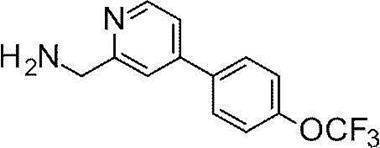
(工程1)4-[4-(トリフルオロメトキシ)フェニル]ピリジン-2-カルボニトリルの合成
4-クロロ-2-シアノピリジン(0.50g、3.6mmol)、4-トリフルオロメトキシフェニルボロン酸(0.74g、3.6mmol)及び1,1’-ビス(ジフェニルホスフィノ)フェロセンジクロロパラジウム(II)(0.13g、0.18mmol)に1,4-ジオキサン(20mL)及び1mol/L炭酸ナトリウム水溶液(20mL)を加え、マイクロウェーブ反応装置を用いて100℃で20分間加熱攪拌した。反応混合物に水を加え、酢酸エチルで抽出し、有機層を硫酸ナトリウムにて乾燥した。乾燥剤を濾別し、溶媒を留去して得られた残渣をシリカゲルカラムクロマトグラフィー(ヘキサン/酢酸エチル)にて精製して標題化合物(0.71g、2.7mmol、74%)を得た。
MS (ESI) m/z 265 (M+H)+
(工程2)[4-[4-(トリフルオロメトキシ)フェニル]-2-ピリジル]メチルアミン(D-30)の合成
工程1で得られた化合物(0.67g、2.5mmol)の酢酸(28mL)溶液に10%パラジウム/炭素(0.19g)を加え、水素雰囲気下、室温にて30分間攪拌した。触媒を濾別し、濾液に酢酸エチルを加えて飽和重曹水で洗浄した。有機層を硫酸ナトリウムにて乾燥し、乾燥剤を濾別した後、溶媒を留去して標題化合物(0.51g、1.9mmol、75%)を得た。
MS (ESI) m/z 269 (M+H)+
(Step 1) Synthesis of 4- [4- (trifluoromethoxy) phenyl] pyridine-2-carbonitrile 4-Chloro-2-cyanopyridine (0.50 g, 3.6 mmol), 4-trifluoromethoxyphenylboronic acid (0.74 g, 3.6 mmol) and 1,1′-bis (diphenylphosphino) ferrocenedichloropalladium (II) (0.13 g, 0.18 mmol) in 1,4-dioxane (20 mL) and 1 mol / L carbonic acid A sodium aqueous solution (20 mL) was added, and the mixture was heated and stirred at 100 ° C. for 20 minutes using a microwave reactor. Water was added to the reaction mixture, extraction was performed with ethyl acetate, and the organic layer was dried over sodium sulfate. The desiccant was filtered off, the solvent was distilled off, and the resulting residue was purified by silica gel column chromatography (hexane / ethyl acetate) to give the title compound (0.71 g, 2.7 mmol, 74%). .
MS (ESI) m / z 265 (M + H) +
(Step 2) Synthesis of [4- [4- (trifluoromethoxy) phenyl] -2-pyridyl] methylamine (D-30) Acetic acid (0.67 g, 2.5 mmol) of the compound obtained in Step 1 (0.67 g, 2.5 mmol) 28%), 10% palladium / carbon (0.19 g) was added, and the mixture was stirred at room temperature for 30 minutes in a hydrogen atmosphere. The catalyst was filtered off, ethyl acetate was added to the filtrate, and the mixture was washed with saturated aqueous sodium hydrogen carbonate. The organic layer was dried over sodium sulfate, the desiccant was filtered off, and the solvent was evaporated to give the title compound (0.51 g, 1.9 mmol, 75%).
MS (ESI) m / z 269 (M + H) +
参考例D-31:[4-[5-(トリフルオロメチル)-2-ピリジル]-2-ピリジル]メチルアミン 塩酸塩(D-31)の合成Reference Example D-31: Synthesis of [4- [5- (trifluoromethyl) -2-pyridyl] -2-pyridyl] methylamine hydrochloride (D-31)

(工程1)N-[(4-クロロ-2-ピリジル)メチル]カルバミン酸 tert-ブチルの合成
(4-クロロ-2-ピリジル)メチルアミン(28g、0.20mol)のジクロロメタン(250mL)溶液にトリエチルアミン(56mL、0.40mol)及び二炭酸ジ-tert-ブチル(52g、0.24mol)を加え、室温で2時間攪拌した。溶媒を留去して得られた残渣をシリカゲルカラムクロマトグラフィー(石油エーテル/酢酸エチル)にて精製し標題化合物(45g、0.18mol、92%)を得た。
MS (ESI) m/z 243 (M+H)+
(工程2)[4-[5-(トリフルオロメチル)-2-ピリジル]-2-ピリジル]メチルアミン 塩酸塩(D-31)の合成
工程1で得られた化合物(21g、88mmol)、E-4(36g、0.12mol)、1,1’-ビス(ジフェニルホスフィノ)フェロセン(5.6g、10mmol)、酢酸パラジウム(1.1g、4.9mmol)、炭酸セシウム(66g、0.20mol)及び塩化銅(I)(10g、0.10mol)にN,N-ジメチルホルムアミド(450mL)を加え、100℃で4時間攪拌した。不溶物を濾別し、濾液に酢酸エチルを加えて水及び飽和食塩水で順次洗浄した。有機層を硫酸ナトリウムにて乾燥し、乾燥剤を濾別した後、溶媒を留去して得られた残渣に4mol/L 塩化水素(ジクロロメタン溶液、10mL、40mmol)を加え、減圧濃縮した。得られた残渣にジクロロメタンを加え、不溶物を濾取、乾燥させて標題化合物(22g、74mmol、84%)を得た。
MS (ESI) m/z 254 (M+H)+
1H NMR (400 MHz, CD3OD) δ 9.14 (s, 1H), 8.95 (d, J = 5.4 Hz, 1H), 8.61 (s, 1H), 8.45 (d, J = 5.4 Hz, 1H), 8.44 - 8.40 (m, 2H), 4.56 (s, 2H).
(Step 1) Synthesis of tert-butyl N-[(4-chloro-2-pyridyl) methyl] carbamate To a solution of (4-chloro-2-pyridyl) methylamine (28 g, 0.20 mol) in dichloromethane (250 mL) Triethylamine (56 mL, 0.40 mol) and di-tert-butyl dicarbonate (52 g, 0.24 mol) were added, and the mixture was stirred at room temperature for 2 hours. The residue obtained by evaporating the solvent was purified by silica gel column chromatography (petroleum ether / ethyl acetate) to obtain the title compound (45 g, 0.18 mol, 92%).
MS (ESI) m / z 243 (M + H) +
(Step 2) Synthesis of [4- [5- (trifluoromethyl) -2-pyridyl] -2-pyridyl] methylamine hydrochloride (D-31) The compound obtained in Step 1 (21 g, 88 mmol), E -4 (36 g, 0.12 mol), 1,1′-bis (diphenylphosphino) ferrocene (5.6 g, 10 mmol), palladium acetate (1.1 g, 4.9 mmol), cesium carbonate (66 g, 0.20 mol) ) And copper (I) chloride (10 g, 0.10 mol) were added N, N-dimethylformamide (450 mL), and the mixture was stirred at 100 ° C. for 4 hours. Insoluble matter was filtered off, ethyl acetate was added to the filtrate, and the mixture was washed successively with water and saturated brine. The organic layer was dried over sodium sulfate, the desiccant was filtered off, the solvent was distilled off, 4 mol / L hydrogen chloride (dichloromethane solution, 10 mL, 40 mmol) was added to the residue, and the mixture was concentrated under reduced pressure. Dichloromethane was added to the resulting residue, and the insoluble material was collected by filtration and dried to obtain the title compound (22 g, 74 mmol, 84%).
MS (ESI) m / z 254 (M + H) +
1 H NMR (400 MHz, CD 3 OD) δ 9.14 (s, 1H), 8.95 (d, J = 5.4 Hz, 1H), 8.61 (s, 1H), 8.45 (d, J = 5.4 Hz, 1H), 8.44-8.40 (m, 2H), 4.56 (s, 2H).
参考例D-32:[4-[2-(トリフルオロメチル)ピリミジン-5-イル]-2-ピリジル]メチルアミン 2塩酸塩(D-32)の合成
(工程1)N-[[4-(4,4,5,5-テトラメチル-1,3,2-ジオキサボロラン-2-イル)-2-ピリジル]メチル]カルバミン酸 tert-ブチルの合成
参考例D-31工程1で得られた化合物(11g、47mmol)、ビス(ピナコラト)ジボロン(14g、56mmol)、酢酸カリウム(3.8g、14mmol)及び1,1’-ビス(ジフェニルホスフィノ)フェロセンジクロロパラジウム(II)(3.4g、4.2mmol)にN,N-ジメチルホルムアミド(200mL)を加え、100℃で2時間攪拌した。不溶物を濾別し、濾液に酢酸エチルを加えて水及び飽和食塩水で順次洗浄した。有機層を硫酸ナトリウムにて乾燥し、乾燥剤を濾別した後、溶媒を留去して標題化合物の粗精製物(13g)を得た。
(工程2)[4-[2-(トリフルオロメチル)ピリミジン-5-イル]-2-ピリジル]メチルアミン 2塩酸塩(D-32)の合成
工程1で得られた粗精製物(0.60g)、5-ブロモ-2-(トリフルオロメチル)ピリミジン(0.50g、2.2mmol)、炭酸ナトリウム(0.47g、4.4mmol)及び1,1’-ビス(ジフェニルホスフィノ)フェロセンジクロロパラジウム(II)(90mg、0.11mmol)にN,N-ジメチルホルムアミド(16mL)と水(4mL)を加え、100℃で2時間攪拌した。不溶物を濾別し、濾液に酢酸エチルを加えて水及び飽和食塩水で順次洗浄した後、硫酸ナトリウムにて乾燥し、乾燥剤を濾別した。溶媒を留去して得られた残渣をシリカゲルカラムクロマトグラフィー(石油エーテル/酢酸エチル)にて精製した。得られた化合物にジクロロメタン(20mL)と6mol/L 塩化水素(ジクロロメタン溶液、10mL、60mmol)を加え、室温で1時間攪拌した後、減圧濃縮して標題化合物(0.36g、1.2mmol、57%)を得た。
MS (ESI) m/z 255 (M+H)+
1H NMR (400 MHz, DMSO-d6) δ 12.84 (br s, 1H), 9.61 (s, 2H), 8.93 - 8.78 (m, 4H), 8.36 (s, 1H), 8.06 (d, J = 5.2 Hz, 1H), 4.40 - 4.28 (m, 2H).
Reference Example D-32: Synthesis of [4- [2- (trifluoromethyl) pyrimidin-5-yl] -2-pyridyl] methylamine dihydrochloride (D-32) (Step 1) N-[[4- Synthesis of tert-butyl (4,4,5,5-tetramethyl-1,3,2-dioxaborolan-2-yl) -2-pyridyl] methyl] carbamate Reference Example D-31 Compound obtained in Step 1 (11 g, 47 mmol), bis (pinacolato) diboron (14 g, 56 mmol), potassium acetate (3.8 g, 14 mmol) and 1,1′-bis (diphenylphosphino) ferrocenedichloropalladium (II) (3.4 g, 4 .2 mmol) was added N, N-dimethylformamide (200 mL), and the mixture was stirred at 100 ° C. for 2 hours. Insoluble matter was filtered off, ethyl acetate was added to the filtrate, and the mixture was washed successively with water and saturated brine. The organic layer was dried over sodium sulfate, the desiccant was filtered off, and the solvent was evaporated to obtain a crude product of the title compound (13 g).
(Step 2) Synthesis of [4- [2- (trifluoromethyl) pyrimidin-5-yl] -2-pyridyl] methylamine dihydrochloride (D-32) The crude product obtained in Step 1 (0. 60 g), 5-bromo-2- (trifluoromethyl) pyrimidine (0.50 g, 2.2 mmol), sodium carbonate (0.47 g, 4.4 mmol) and 1,1′-bis (diphenylphosphino) ferrocene dichloro N, N-dimethylformamide (16 mL) and water (4 mL) were added to palladium (II) (90 mg, 0.11 mmol), and the mixture was stirred at 100 ° C. for 2 hours. Insoluble matter was filtered off, ethyl acetate was added to the filtrate, and the mixture was washed successively with water and saturated brine, dried over sodium sulfate, and the desiccant was filtered off. The residue obtained by distilling off the solvent was purified by silica gel column chromatography (petroleum ether / ethyl acetate). To the obtained compound were added dichloromethane (20 mL) and 6 mol / L hydrogen chloride (dichloromethane solution, 10 mL, 60 mmol), stirred at room temperature for 1 hour, and concentrated under reduced pressure to give the title compound (0.36 g, 1.2 mmol, 57 mmol). %).
MS (ESI) m / z 255 (M + H) +
1 H NMR (400 MHz, DMSO-d 6 ) δ 12.84 (br s, 1H), 9.61 (s, 2H), 8.93-8.78 (m, 4H), 8.36 (s, 1H), 8.06 (d, J = 5.2 Hz, 1H), 4.40-4.28 (m, 2H).
表17記載のD-33~D-34は、対応する市販の試薬を用い参考例D-32と同様の操作により合成した。 D-33 to D-34 described in Table 17 were synthesized in the same manner as in Reference Example D-32 using the corresponding commercially available reagents.

参考例D-35:[4-[6-(トリフルオロメチル)ピリダジン-3-イル]-2-ピリジル]メチルアミン 塩酸塩(D-35)の合成Reference Example D-35: Synthesis of [4- [6- (trifluoromethyl) pyridazin-3-yl] -2-pyridyl] methylamine hydrochloride (D-35)

(工程1)3-クロロ-6-(トリフルオロメチル)ピリダジンの合成
3-(トリフルオロメチル)-1H-ピリダジン-6-オン(1.1g、6.7mmol)にオキシ塩化リン(10mL)を加え100℃で2.5時間攪拌した後、減圧濃縮した。得られた残渣にジクロロメタンと水を加え、室温で5分間攪拌した後、炭酸カリウムを加えてアルカリ性にして分層させた。有機層を飽和食塩水で洗浄した後、硫酸ナトリウムにて乾燥し、乾燥剤を濾別した後、溶媒を留去して得られた残渣をシリカゲルカラムクロマトグラフィー(石油エーテル/酢酸エチル)にて精製し標題化合物(0.77g、4.2mmol、63%)を得た。
MS (ESI) m/z 182 (M+H)+
1H NMR (400 MHz, CDCl3) δ 7.82 (d, J = 8.8 Hz, 1H), 7.74 (d, J = 8.8 Hz, 1H).
(工程2)[4-[6-(トリフルオロメチル)ピリダジン-3-イル]-2-ピリジル]メチルアミン 塩酸塩(D-35)の合成
5-ブロモ-2-(トリフルオロメチル)ピリミジンの代わりに工程1で得られた化合物を用い、参考例D-32工程2と同様の操作を行い標題化合物を得た(収率54%)。
MS (ESI) m/z 255 (M+H)+
1H NMR (400 MHz, CD3OD) δ 8.92 (d, J = 5.3 Hz, 1H), 8.59 (d, J = 9.0 Hz, 1H), 8.37 (br s, 1H), 8.33 (d, J = 9.0 Hz, 1H), 8.24 (dd, J = 5.3, 1.4 Hz, 1H), 4.49 (s, 2H).
(Step 1) Synthesis of 3-chloro-6- (trifluoromethyl) pyridazine 3- (trifluoromethyl) -1H-pyridazin-6-one (1.1 g, 6.7 mmol) was charged with phosphorus oxychloride (10 mL). The mixture was stirred at 100 ° C. for 2.5 hours, and concentrated under reduced pressure. Dichloromethane and water were added to the obtained residue, and the mixture was stirred at room temperature for 5 minutes. Then, potassium carbonate was added to make it alkaline, and the layers were separated. The organic layer was washed with saturated brine, dried over sodium sulfate, the desiccant was filtered off, the solvent was evaporated, and the resulting residue was purified by silica gel column chromatography (petroleum ether / ethyl acetate). Purification gave the title compound (0.77 g, 4.2 mmol, 63%).
MS (ESI) m / z 182 (M + H) +
1 H NMR (400 MHz, CDCl 3 ) δ 7.82 (d, J = 8.8 Hz, 1H), 7.74 (d, J = 8.8 Hz, 1H).
(Step 2) Synthesis of [4- [6- (trifluoromethyl) pyridazin-3-yl] -2-pyridyl] methylamine hydrochloride (D-35) of 5-bromo-2- (trifluoromethyl) pyrimidine Instead, the title compound was obtained in the same manner as in Reference Example D-32, Step 2, using the compound obtained in Step 1 (yield 54%).
MS (ESI) m / z 255 (M + H) +
1 H NMR (400 MHz, CD 3 OD) δ 8.92 (d, J = 5.3 Hz, 1H), 8.59 (d, J = 9.0 Hz, 1H), 8.37 (br s, 1H), 8.33 (d, J = 9.0 Hz, 1H), 8.24 (dd, J = 5.3, 1.4 Hz, 1H), 4.49 (s, 2H).
参考例D-36:[5-[6-(トリフルオロメチル)-3-ピリジル]-3-ピリジル]メチルアミン(D-36)の合成Reference Example D-36: Synthesis of [5- [6- (trifluoromethyl) -3-pyridyl] -3-pyridyl] methylamine (D-36)
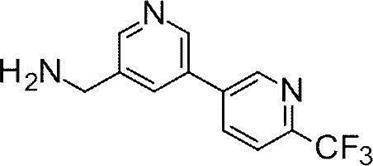
5-ブロモ-2-トリフルオロメチルピリミジン及び3-シアノフェニルボロン酸の代わりに5-ブロモ-2-トリフルオロメチルピリジン及び(5-シアノ-3-ピリジル)ボロン酸を用い、参考例D-22と同様の操作を行い標題化合物(収率9%)を得た。
MS (ESI) m/z 254 (M+H)+
1H NMR (400 MHz, CD3OD) δ 9.10 (s, 1H), 8.87 (d, J = 1.6 Hz, 1H), 8.68 (s, 1H), 8.41 (dd, J = 8.0, 1.6 Hz, 1H), 8.27 (s, 1H), 7.99 (d, J = 8.0 Hz, 1H), 4.02 (s, 2H).
Reference Example D-22 was carried out using 5-bromo-2-trifluoromethylpyridine and (5-cyano-3-pyridyl) boronic acid instead of 5-bromo-2-trifluoromethylpyrimidine and 3-cyanophenylboronic acid. The title compound (yield 9%) was obtained in the same manner as above.
MS (ESI) m / z 254 (M + H) +
1 H NMR (400 MHz, CD 3 OD) δ 9.10 (s, 1H), 8.87 (d, J = 1.6 Hz, 1H), 8.68 (s, 1H), 8.41 (dd, J = 8.0, 1.6 Hz, 1H ), 8.27 (s, 1H), 7.99 (d, J = 8.0 Hz, 1H), 4.02 (s, 2H).
参考例D-37:[5-[5-(トリフルオロメチル)-2-ピリジル]-3-ピリジル]メチルアミン(D-37)の合成Reference Example D-37: Synthesis of [5- [5- (trifluoromethyl) -2-pyridyl] -3-pyridyl] methylamine (D-37)

(工程1)5-[5-(トリフルオロメチル)-2-ピリジル]ピリジン-3-カルボニトリルの合成
2-ブロモ-5-(トリフルオロメチル)ピリジン(4.0g、18mmol)及び5-シアノ-3-ピリジルボロン酸(3.1g、21mmol)に炭酸ナトリウム(3.8g、35mmol)及び1,1’-ビス(ジフェニルホスフィノ)フェロセンジクロロパラジウム(II)(0.66g、0.90mmol)にN,N-ジメチルホルムアミド(160mL)と水(40mL)を加え、110℃で2時間攪拌した。不溶物を濾別し、濾液に酢酸エチルを加えて水及び飽和食塩水で順次洗浄した後、硫酸ナトリウムにて乾燥し、乾燥剤を濾別した。溶媒を留去して得られた残渣をシリカゲルカラムクロマトグラフィー(石油エーテル/酢酸エチル)にて精製して標題化合物(3.3g、13mmol、73%)を得た。
MS (ESI) m/z 250 (M+H)+
1H NMR (400 MHz, CDCl3) δ 9.44 (s, 1H), 9.03 (s, 1H), 8.98 (s, 1H), 8.71 (s, 1H), 8.12 (d, J = 8.4 Hz, 1H). 7.94 (d, J = 8.4 Hz, 1H).
(工程2)[5-[5-(トリフルオロメチル)-2-ピリジル]-3-ピリジル]メチルアミン(D-37)の合成
工程1で得られた化合物(3.0g、12mmol)のメタノール(30mL)溶液にニッケル(50mg)を加え、水素雰囲気下、室温にて2時間攪拌した。触媒を濾別し、溶媒を留去して得られた残渣を高速液体クロマトグラフィー(水-アセトニトリル)にて精製して標題化合物(0.42g、1.7mmol、14%)を得た。
MS (ESI) m/z 254 (M+H)+
1H NMR (400 MHz, CD3OD) δ 9.74 (s, 1H), 9.60 (s, 1H), 9.18 (s, 1H), 9.16 (s, 1H) 8.48 - 8.42 (m, 2H), 4.58 (s, 2H).
(Step 1) Synthesis of 5- [5- (trifluoromethyl) -2-pyridyl] pyridine-3-carbonitrile 2-Bromo-5- (trifluoromethyl) pyridine (4.0 g, 18 mmol) and 5-cyano -3-pyridylboronic acid (3.1 g, 21 mmol) to sodium carbonate (3.8 g, 35 mmol) and 1,1′-bis (diphenylphosphino) ferrocenedichloropalladium (II) (0.66 g, 0.90 mmol) N, N-dimethylformamide (160 mL) and water (40 mL) were added to and stirred at 110 ° C. for 2 hours. Insoluble matter was filtered off, ethyl acetate was added to the filtrate, and the mixture was washed successively with water and saturated brine, dried over sodium sulfate, and the desiccant was filtered off. The residue obtained by distilling off the solvent was purified by silica gel column chromatography (petroleum ether / ethyl acetate) to obtain the title compound (3.3 g, 13 mmol, 73%).
MS (ESI) m / z 250 (M + H) +
1 H NMR (400 MHz, CDCl 3 ) δ 9.44 (s, 1H), 9.03 (s, 1H), 8.98 (s, 1H), 8.71 (s, 1H), 8.12 (d, J = 8.4 Hz, 1H) 7.94 (d, J = 8.4 Hz, 1H).
(Step 2) Synthesis of [5- [5- (trifluoromethyl) -2-pyridyl] -3-pyridyl] methylamine (D-37) Methanol of the compound (3.0 g, 12 mmol) obtained in Step 1 Nickel (50 mg) was added to the (30 mL) solution, and the mixture was stirred at room temperature for 2 hours under a hydrogen atmosphere. The catalyst was filtered off, the solvent was distilled off, and the resulting residue was purified by high performance liquid chromatography (water-acetonitrile) to give the title compound (0.42 g, 1.7 mmol, 14%).
MS (ESI) m / z 254 (M + H) +
1 H NMR (400 MHz, CD 3 OD) δ 9.74 (s, 1H), 9.60 (s, 1H), 9.18 (s, 1H), 9.16 (s, 1H) 8.48-8.42 (m, 2H), 4.58 ( s, 2H).
参考例D-38:[6-[4-(トリフルオロメトキシ)フェニル]ピリミジン-4-イル]メチルアミン 塩酸塩(D-38)の合成Reference Example D-38: Synthesis of [6- [4- (trifluoromethoxy) phenyl] pyrimidin-4-yl] methylamine hydrochloride (D-38)

(工程1)4-クロロ-6-[4-(トリフルオロメトキシ)フェニル]ピリミジンの合成
4,6-ジクロロピリミジン(131g、879mmol)、4-(トリフルオロメトキシ)フェニルボロン酸(200g、970mol)、炭酸カリウム(244g、1.77mol)及びテトラキス(トリフェニルホスフィン)パラジウム(0)(21.5g、18.6mmol)に1,4-ジオキサン(3.0L)と水(200mL)を加えて105℃で6時間攪拌した。不溶物を濾別し、濾液を減圧濃縮して得られた残渣をシリカゲルカラムクロマトグラフィー(石油エーテル/酢酸エチル)にて精製して標題化合物(78.0g、284mmol、32%)を得た。
MS (ESI) m/z 275 (M+H)+
1H NMR (400 MHz, CDCl3) δ 9.04 (s, 1H), 8.13 (d, J = 8.6 Hz, 2H), 7.73 (s, 1H), 7.36 (d, J = 8.6 Hz, 2H).
(工程2)6-[4-(トリフルオロメトキシ)フェニル]ピリミジン-4-カルボニトリルの合成
工程1で得られた化合物(1.0g、3.6mmol)、シアン化ナトリウム(0.22g、4.4mmol)及び1,4-ジアザビシクロ[2.2.2]オクタン(41mg、0.37mmol)に水(2mL)及びジメチルスルホキシド(6mL)を加え、38℃で7時間攪拌した。反応混合物を水に加え、酢酸エチルにて抽出した。有機層を飽和食塩水にて洗浄、硫酸ナトリウムにて乾燥した。乾燥剤を濾別した後、溶媒を留去して得られた残渣に石油エーテルを加え、不溶物を濾取、乾燥させて標題化合物(0.80g、3.0mmol、83%)を得た。
MS (ESI) m/z 266 (M+H)+
1H NMR (300 MHz, CDCl3) δ 9.38 (s, 1H), 8.20 (d, J = 8.5 Hz, 2H), 8.04 (s, 1H), 7.42 (d, J = 8.5 Hz, 2H).
(工程3)[6-[4-(トリフルオロメトキシ)フェニル]ピリミジン-4-イル]メチルアミン 塩酸塩(D-38)の合成
工程2で得られた化合物(10g、38mmol)の酢酸(150mL)溶液に10%パラジウム/炭素(0.15g)を加え、水素雰囲気下、室温で1.5時間攪拌した。触媒を濾別し、濾液にジクロロメタンを加えて炭酸水素ナトリウム水溶液にて洗浄した。有機層を硫酸ナトリウムにて乾燥し、乾燥剤を濾別した。溶媒を留去して得られた残渣にジクロロメタン(120mL)を加えて溶解させ、二炭酸ジ-tert-ブチル(11g、49mmol)及びトリエチルアミン(10mL、72mmol)を加え、室温で30分間攪拌した。反応混合物から溶媒を留去して得られた残渣をシリカゲルカラムクロマトグラフィー(石油エーテル/酢酸エチル)にて精製した。得られた化合物に4mol/L 塩化水素(ジクロロメタン溶液、10mL、40mmol)を加え、室温で20分間攪拌した後、減圧濃縮して標題化合物(4.1g、13mmol、35%)を得た。
MS (ESI) m/z 270 (M+H)+
1H NMR (400 MHz, DMSO-d6) δ 9.31 (s, 1H), 8.73 (s, 3H), 8.37 - 8.34 (m, 3H), 7.61 (d, J = 8.4 Hz, 2H), 4.32 - 4.28 (m, 2H).
(Step 1) Synthesis of 4-chloro-6- [4- (trifluoromethoxy) phenyl] pyrimidine 4,6-dichloropyrimidine (131 g, 879 mmol), 4- (trifluoromethoxy) phenylboronic acid (200 g, 970 mol) 1,4-dioxane (3.0 L) and water (200 mL) were added to potassium carbonate (244 g, 1.77 mol) and tetrakis (triphenylphosphine) palladium (0) (21.5 g, 18.6 mmol). Stir at 6 ° C. for 6 hours. The insoluble material was filtered off, and the filtrate was concentrated under reduced pressure. The obtained residue was purified by silica gel column chromatography (petroleum ether / ethyl acetate) to obtain the title compound (78.0 g, 284 mmol, 32%).
MS (ESI) m / z 275 (M + H) +
1 H NMR (400 MHz, CDCl 3 ) δ 9.04 (s, 1H), 8.13 (d, J = 8.6 Hz, 2H), 7.73 (s, 1H), 7.36 (d, J = 8.6 Hz, 2H).
(Step 2) Synthesis of 6- [4- (trifluoromethoxy) phenyl] pyrimidine-4-carbonitrile The compound obtained in Step 1 (1.0 g, 3.6 mmol), sodium cyanide (0.22 g, 4 0.4 mmol) and 1,4-diazabicyclo [2.2.2] octane (41 mg, 0.37 mmol) were added water (2 mL) and dimethyl sulfoxide (6 mL), and the mixture was stirred at 38 ° C. for 7 hours. The reaction mixture was added to water and extracted with ethyl acetate. The organic layer was washed with saturated brine and dried over sodium sulfate. After the desiccant was filtered off, petroleum ether was added to the residue obtained by distilling off the solvent, and the insoluble matter was collected by filtration and dried to give the title compound (0.80 g, 3.0 mmol, 83%). .
MS (ESI) m / z 266 (M + H) +
1 H NMR (300 MHz, CDCl 3 ) δ 9.38 (s, 1H), 8.20 (d, J = 8.5 Hz, 2H), 8.04 (s, 1H), 7.42 (d, J = 8.5 Hz, 2H).
(Step 3) Synthesis of [6- [4- (trifluoromethoxy) phenyl] pyrimidin-4-yl] methylamine hydrochloride (D-38) Acetic acid (150 mL) of the compound obtained in Step 2 (10 g, 38 mmol) ) 10% palladium / carbon (0.15 g) was added to the solution, and the mixture was stirred at room temperature for 1.5 hours under a hydrogen atmosphere. The catalyst was filtered off, dichloromethane was added to the filtrate, and the mixture was washed with an aqueous sodium hydrogen carbonate solution. The organic layer was dried over sodium sulfate and the desiccant was filtered off. Dichloromethane (120 mL) was added to the residue obtained by evaporating the solvent and dissolved, di-tert-butyl dicarbonate (11 g, 49 mmol) and triethylamine (10 mL, 72 mmol) were added, and the mixture was stirred at room temperature for 30 min. The residue obtained by evaporating the solvent from the reaction mixture was purified by silica gel column chromatography (petroleum ether / ethyl acetate). To the obtained compound was added 4 mol / L hydrogen chloride (dichloromethane solution, 10 mL, 40 mmol), and the mixture was stirred at room temperature for 20 minutes and then concentrated under reduced pressure to obtain the title compound (4.1 g, 13 mmol, 35%).
MS (ESI) m / z 270 (M + H) +
1 H NMR (400 MHz, DMSO-d 6 ) δ 9.31 (s, 1H), 8.73 (s, 3H), 8.37-8.34 (m, 3H), 7.61 (d, J = 8.4 Hz, 2H), 4.32- 4.28 (m, 2H).
参考例D-39:[2-[4-(2,2,2-トリフルオロエトキシ)フェニル]-4-ピリジル]メチルアミン 塩酸塩(D-39)の合成Reference Example D-39: Synthesis of [2- [4- (2,2,2-trifluoroethoxy) phenyl] -4-pyridyl] methylamine hydrochloride (D-39)

(工程1)1-ブロモ-4-(2,2,2-トリフルオロエトキシ)ベンゼンの合成
4-ブロモフェノール(10g、58mmol)のアセトン(230mL)溶液に炭酸カリウム(24g、0.17mol)及びトリフルオロメタンスルホン酸 2,2,2-トリフルオロエチル(17g、72mmol)を加え、室温で一晩攪拌した。不溶物を濾別し、濾液からアセトンを減圧留去(300mbar、30℃)して得られた残渣にジクロロメタン(200mL)を加えて濾過した。濾液を減圧濃縮して標題化合物(13g、51mmol、88%)を得た。
1H NMR (400 MHz, CDCl3) δ 7.44 - 7.40 (m, 2H), 6.85 - 6.81 (m, 2H), 4.35 - 4.29 (m, 2H).
(工程2)4,4,5,5-テトラメチル-2-[4-(2,2,2-トリフルオロエトキシ)フェニル]-1,3,2-ジオキサボロランの合成
工程1で得られた化合物(5.0g、20mmol)、ビス(ピナコラト)ジボロン(7.4g、29mmol)、酢酸カリウム(5.7g、58mmol)及び1,1’-ビス(ジフェニルホスフィノ)フェロセンジクロロパラジウム(II)(1.4g、1.9mmol)にN,N-ジメチルホルムアミド(100mL)を加え、100℃で2時間攪拌した。不溶物を濾別し、濾液にジエチルエーテルを加えて水で洗浄した後、硫酸ナトリウムにて乾燥し、乾燥剤を濾別した。溶媒を留去して得られた残渣をシリカゲルカラムクロマトグラフィー(石油エーテル)にて精製して標題化合物(5.0g、17mmol、85%)を得た。
MS (ESI) m/z 303 (M+H)+
1H NMR (400 MHz, CDCl3) δ 7.82 - 7.79 (m, 2H), 6.97 - 6.93 (m, 2H), 4.43 - 4.35 (m, 2H), 1.36 (s, 12H).
(工程3)N-[[2-[4-(2,2,2-トリフルオロエトキシ)フェニル]-4-ピリジル]メチル]カルバミン酸 tert-ブチルの合成
工程1で得られた化合物(2.0g、6.6mmol)、参考例D-25工程1で得られた化合物(1.5g、6.2mmol)、炭酸ナトリウム(1.7g、16mmol)及び1,1’-ビス(ジフェニルホスフィノ)フェロセンジクロロパラジウム(II)(0.22g、0.30mmol)にN,N-ジメチルホルムアミド(20mL)と水(5mL)を加え、100℃で2時間攪拌した。不溶物を濾別し、濾液にジエチルエーテルを加えて水で洗浄した後、硫酸ナトリウムにて乾燥し、乾燥剤を濾別した。溶媒を留去して得られた残渣をシリカゲルカラムクロマトグラフィー(石油エーテル/酢酸エチル)にて精製して標題化合物(1.1g、2.9mmol、47%)を得た。
MS (ESI) m/z 383 (M+H)+
1H NMR (400 MHz, DMSO-d6) δ 8.55 (d, J = 4.8 Hz, 1H), 8.03 (d, J = 8.8 Hz, 2H), 7.77 (s, 1H), 7.55 - 7.52 (m, 1H), 7.18 (d, J = 8.8 Hz, 2H), 7.15 (d, J = 5.8 Hz, 1H), 4.88 - 4.81 (m, 2H), 4.21 (d, J = 5.8 Hz, 2H), 1.41 (s, 9H).
(工程4)[2-[4-(2,2,2-トリフルオロエトキシ)フェニル]-4-ピリジル]メチルアミン 塩酸塩(D-39)の合成
工程3で得られた化合物(1.1g、2.9mmol)に4mol/L 塩化水素(ジクロロメタン溶液、100mL、0.40mol)を加え、室温で1時間攪拌した後、減圧濃縮した。得られた残渣にジクロロメタンを加え、不溶物を濾取、乾燥させて標題化合物(0.74g、2.3mmol、80%)を得た。
MS (ESI) m/z 283 (M+H)+
1H NMR (400 MHz, DMSO-d6) δ 8.90 (br s, 3H), 8.75 (d, J = 5.4 Hz, 1H), 8.40 (s, 1H), 8.17 (d, J = 8.8 Hz, 2H), 7.67 (d, J = 5.4 Hz, 1H), 7.29 (d, J = 8.8 Hz, 2H), 4.90 (q, J = 8.8 Hz, 2H), 4.25 (q, J = 5.6 Hz, 2H).
(Step 1) Synthesis of 1-bromo-4- (2,2,2-trifluoroethoxy) benzene To a solution of 4-bromophenol (10 g, 58 mmol) in acetone (230 mL), potassium carbonate (24 g, 0.17 mol) and 2,2,2-Trifluoroethyl trifluoromethanesulfonate (17 g, 72 mmol) was added and stirred overnight at room temperature. Insoluble matters were filtered off, and acetone was distilled off from the filtrate under reduced pressure (300 mbar, 30 ° C.). Dichloromethane (200 mL) was added to the resulting residue, followed by filtration. The filtrate was concentrated under reduced pressure to give the title compound (13 g, 51 mmol, 88%).
1 H NMR (400 MHz, CDCl 3 ) δ 7.44-7.40 (m, 2H), 6.85-6.81 (m, 2H), 4.35-4.29 (m, 2H).
(Step 2) Synthesis of 4,4,5,5-tetramethyl-2- [4- (2,2,2-trifluoroethoxy) phenyl] -1,3,2-dioxaborolane Compound obtained in Step 1 (5.0 g, 20 mmol), bis (pinacolato) diboron (7.4 g, 29 mmol), potassium acetate (5.7 g, 58 mmol) and 1,1′-bis (diphenylphosphino) ferrocenedichloropalladium (II) (1) (4 g, 1.9 mmol) was added N, N-dimethylformamide (100 mL), and the mixture was stirred at 100 ° C. for 2 hours. Insoluble matters were filtered off, diethyl ether was added to the filtrate, washed with water, dried over sodium sulfate, and the desiccant was filtered off. The residue obtained by evaporating the solvent was purified by silica gel column chromatography (petroleum ether) to obtain the title compound (5.0 g, 17 mmol, 85%).
MS (ESI) m / z 303 (M + H) +
1 H NMR (400 MHz, CDCl 3 ) δ 7.82-7.79 (m, 2H), 6.97-6.93 (m, 2H), 4.43-4.35 (m, 2H), 1.36 (s, 12H).
(Step 3) Synthesis of tert-butyl N-[[2- [4- (2,2,2-trifluoroethoxy) phenyl] -4-pyridyl] methyl] carbamate The compound obtained in Step 1 (2. 0 g, 6.6 mmol), Reference Example D-25 Compound obtained in Step 1 (1.5 g, 6.2 mmol), sodium carbonate (1.7 g, 16 mmol) and 1,1′-bis (diphenylphosphino) N, N-dimethylformamide (20 mL) and water (5 mL) were added to ferrocenedichloropalladium (II) (0.22 g, 0.30 mmol), and the mixture was stirred at 100 ° C. for 2 hours. Insoluble matters were filtered off, diethyl ether was added to the filtrate, washed with water, dried over sodium sulfate, and the desiccant was filtered off. The residue obtained by evaporating the solvent was purified by silica gel column chromatography (petroleum ether / ethyl acetate) to obtain the title compound (1.1 g, 2.9 mmol, 47%).
MS (ESI) m / z 383 (M + H) +
1 H NMR (400 MHz, DMSO-d 6 ) δ 8.55 (d, J = 4.8 Hz, 1H), 8.03 (d, J = 8.8 Hz, 2H), 7.77 (s, 1H), 7.55-7.52 (m, 1H), 7.18 (d, J = 8.8 Hz, 2H), 7.15 (d, J = 5.8 Hz, 1H), 4.88-4.81 (m, 2H), 4.21 (d, J = 5.8 Hz, 2H), 1.41 ( s, 9H).
(Step 4) Synthesis of [2- [4- (2,2,2-trifluoroethoxy) phenyl] -4-pyridyl] methylamine hydrochloride (D-39) Compound (1.1 g) obtained in Step 3 2.9 mmol) was added 4 mol / L hydrogen chloride (dichloromethane solution, 100 mL, 0.40 mol), stirred at room temperature for 1 hour, and then concentrated under reduced pressure. Dichloromethane was added to the resulting residue, and the insoluble material was collected by filtration and dried to obtain the title compound (0.74 g, 2.3 mmol, 80%).
MS (ESI) m / z 283 (M + H) +
1 H NMR (400 MHz, DMSO-d 6 ) δ 8.90 (br s, 3H), 8.75 (d, J = 5.4 Hz, 1H), 8.40 (s, 1H), 8.17 (d, J = 8.8 Hz, 2H ), 7.67 (d, J = 5.4 Hz, 1H), 7.29 (d, J = 8.8 Hz, 2H), 4.90 (q, J = 8.8 Hz, 2H), 4.25 (q, J = 5.6 Hz, 2H).
参考例D-40:[6-[6-(トリフルオロメチル)-3-ピリジル]ピリミジン-4-イル]メチルアミン 塩酸塩(D-40)の合成 Reference Example D-40: Synthesis of [6- [6- (trifluoromethyl) -3-pyridyl] pyrimidin-4-yl] methylamine hydrochloride (D-40)

(工程1)4-クロロ-6-[6-(トリフルオロメチル)-3-ピリジル]ピリミジンの合成
2,4-ジクロロピリミジン(6.0g、40mmol)、[(6-トリフルオロメチル)-3-ピリジル]ボロン酸(8.5g、44mmol)、炭酸カリウム(11g、81mmol)及びテトラキス(トリフェニルホスフィン)パラジウム(0)(1.2g、1.0mmol)に1,4-ジオキサン(150mL)と水(15mL)を加え、110℃で4時間加熱攪拌した。反応混合物を濾過し、濾液を酢酸エチルで希釈して水及び飽和食塩水にて順次洗浄した。有機層を硫酸ナトリウムにて乾燥し、乾燥剤を濾別した後、溶媒を留去して得られた残渣をシリカゲルカラムクロマトグラフィー(石油エーテル/酢酸エチル)にて精製し標題化合物(3.5g、14mmol、34%)を得た。
1H NMR (400 MHz, DMSO-d6) δ 9.37 (s, 1H), 9.14 (s, 1H), 8.61 (dd, J =8.4, 1.6 Hz, 1H), 7.87 (d, J = 8.4 Hz, 1H), 7.85 (s, 1H).
(工程2)6-[6-(トリフルオロメチル)-3-ピリジル]ピリミジン-4-カルボニトリルの合成
工程1で得られた化合物(3.5g、14mmol)、シアン化ナトリウム(0.79g、16mmol)及び1,4-ジアザビシクロ[2.2.2]オクタン(0.15g、1.2mmol)に水(9mL)及びジメチルスルホキシド(25mL)を加え、室温で4時間攪拌した。反応混合物を水に加え、ジエチルエーテルにて抽出した。有機層を飽和食塩水にて洗浄、硫酸ナトリウムにて乾燥した。乾燥剤を濾別した後、溶媒を留去して得られた残渣をシリカゲルカラムクロマトグラフィー(石油エーテル/酢酸エチル)にて精製し標題化合物(2.2g、8.8mmol、65%)を得た。
1H NMR (400 MHz, CDCl3) δ 9.49 (s, 1H), 9.44 (s, 1H), 8.67 (d, J = 8.4 Hz, 1H), 8.15 (s, 1H), 7.92 (d, J = 8.4 Hz, 1H).
(工程3)[6-[6-(トリフルオロメチル)-3-ピリジル]ピリミジン-4-イル]メチルアミン 塩酸塩(D-40)の合成
工程2で得られた化合物(2.2g、8.8mmol)の酢酸(120mL)溶液に10%パラジウム/炭素(660mg)を加え、水素雰囲気下、室温にて1.5時間攪拌した。触媒を濾別し、濾液にジクロロメタンを加えて炭酸ナトリウム水溶液で洗浄した。有機層を硫酸ナトリウムにて乾燥し、乾燥剤を濾別した後、溶媒を留去した。得られた残渣に4mol/L 塩化水素(ジクロロメタン溶液、10mL、40mmol)を加え、減圧濃縮した。得られた残渣にジクロロメタンを加え、不溶物を濾取、乾燥させて標題化合物(1.0g、3.4mmol、40%)を得た。
MS (ESI) m/z 255 (M+H)+
1H NMR (400 MHz, CD3OD) δ 9.53 (s, 1H), 9.37 (s, 1H), 8.67 (d, J = 8.0 Hz, 1H), 8.30 (s, 1H), 8.04 (d, J = 8.0 Hz, 1H), 4.51 (s, 2H).
(Step 1) Synthesis of 4-chloro-6- [6- (trifluoromethyl) -3-pyridyl] pyrimidine 2,4-dichloropyrimidine (6.0 g, 40 mmol), [(6-trifluoromethyl) -3 -Pyridyl] boronic acid (8.5 g, 44 mmol), potassium carbonate (11 g, 81 mmol) and tetrakis (triphenylphosphine) palladium (0) (1.2 g, 1.0 mmol) with 1,4-dioxane (150 mL) Water (15 mL) was added, and the mixture was stirred with heating at 110 ° C. for 4 hr. The reaction mixture was filtered, and the filtrate was diluted with ethyl acetate and washed successively with water and saturated brine. The organic layer was dried over sodium sulfate, the desiccant was filtered off, the solvent was distilled off, and the resulting residue was purified by silica gel column chromatography (petroleum ether / ethyl acetate) to give the title compound (3.5 g 14 mmol, 34%).
1 H NMR (400 MHz, DMSO-d 6 ) δ 9.37 (s, 1H), 9.14 (s, 1H), 8.61 (dd, J = 8.4, 1.6 Hz, 1H), 7.87 (d, J = 8.4 Hz, 1H), 7.85 (s, 1H).
(Step 2) Synthesis of 6- [6- (trifluoromethyl) -3-pyridyl] pyrimidine-4-carbonitrile The compound obtained in Step 1 (3.5 g, 14 mmol), sodium cyanide (0.79 g, 16 mmol) and 1,4-diazabicyclo [2.2.2] octane (0.15 g, 1.2 mmol) were added water (9 mL) and dimethyl sulfoxide (25 mL), and the mixture was stirred at room temperature for 4 hours. The reaction mixture was added to water and extracted with diethyl ether. The organic layer was washed with saturated brine and dried over sodium sulfate. After the desiccant was filtered off, the solvent was distilled off and the resulting residue was purified by silica gel column chromatography (petroleum ether / ethyl acetate) to give the title compound (2.2 g, 8.8 mmol, 65%). It was.
1 H NMR (400 MHz, CDCl 3 ) δ 9.49 (s, 1H), 9.44 (s, 1H), 8.67 (d, J = 8.4 Hz, 1H), 8.15 (s, 1H), 7.92 (d, J = (8.4 Hz, 1H).
(Step 3) Synthesis of [6- [6- (trifluoromethyl) -3-pyridyl] pyrimidin-4-yl] methylamine hydrochloride (D-40) The compound obtained in Step 2 (2.2 g, 8 .8 mmol) in acetic acid (120 mL) was added 10% palladium / carbon (660 mg), and the mixture was stirred at room temperature for 1.5 hours in a hydrogen atmosphere. The catalyst was filtered off, dichloromethane was added to the filtrate, and the mixture was washed with an aqueous sodium carbonate solution. The organic layer was dried over sodium sulfate, the desiccant was filtered off, and the solvent was distilled off. 4 mol / L hydrogen chloride (dichloromethane solution, 10 mL, 40 mmol) was added to the obtained residue, and the mixture was concentrated under reduced pressure. Dichloromethane was added to the obtained residue, insoluble matter was collected by filtration and dried to obtain the title compound (1.0 g, 3.4 mmol, 40%).
MS (ESI) m / z 255 (M + H) +
1 H NMR (400 MHz, CD 3 OD) δ 9.53 (s, 1H), 9.37 (s, 1H), 8.67 (d, J = 8.0 Hz, 1H), 8.30 (s, 1H), 8.04 (d, J = 8.0 Hz, 1H), 4.51 (s, 2H).
参考例D-41:[6-[5-(トリフルオロメチル)-2-ピリジル]ピリミジン-4-イル]メチルアミン 塩酸塩(D-41)の合成Reference Example D-41: Synthesis of [6- [5- (trifluoromethyl) -2-pyridyl] pyrimidin-4-yl] methylamine hydrochloride (D-41)

(工程1)4-クロロ-6-[5-(トリフルオロメチル)-2-ピリジル]ピリミジンの合成
4-クロロ-1H-ピリミジン-6-オン(3.0g、23mmol)、E-4(9.0g、30mmol)、1,1’-ビス(ジフェニルホスフィノ)フェロセン(1.3g、2.3mmol)、酢酸パラジウム(0.26g、1.2mmol)、炭酸セシウム(15g、46mmol)及び塩化銅(I)(2.3g、23mmol)にN,N-ジメチルホルムアミド(100mL)を加え、100℃で一晩攪拌した。不溶物を濾別し、濾液を減圧濃縮して得られた残渣にオキシ塩化リン(40mL)を加え、105℃で3時間攪拌した。反応混合物を減圧濃縮して得られた残渣にジクロロメタンを加えて水及び飽和食塩水で順次洗浄した。有機層を硫酸ナトリウムにて乾燥し、乾燥剤を濾別した後、溶媒を留去して得られた残渣をシリカゲルカラムクロマトグラフィー(石油エーテル/酢酸エチル)にて精製し標題化合物(0.55g、2.1mmol、9%)を得た。
MS (ESI) m/z 260 (M+H)+
1H NMR (400 MHz, CDCl3) δ 9.09 (s, 1H), 8.98 (s, 1H), 8.63 (d, J = 8.0 Hz, 1H), 8.49 (s, 1H), 8.13 (dd, J = 8.0, 1.6 Hz, 1H).
(工程2)6-[5-(トリフルオロメチル)-2-ピリジル]ピリミジン-4-カルボニトリルの合成
シアン化ナトリウム(0.17g、3.4mmol)及び1,4-ジアザビシクロ[2.2.2]オクタン(24mg、0.21mmol)に水(15mL)を加えて溶解させ、工程1で得られた化合物(0.55g、2.1mmol)のジメチルスルホキシド(50mL)溶液を加えて室温で7時間攪拌した。反応混合物を水に加え、ジクロロメタンで抽出した。有機層を硫酸ナトリウムにて乾燥し、乾燥剤を濾別した後、溶媒を留去して得られた残渣をシリカゲルカラムクロマトグラフィー(石油エーテル/酢酸エチル)にて精製し標題化合物(0.35g、1.4mmol、66%)を得た。
MS (ESI) m/z 251 (M+H)+
1H NMR (400 MHz, CDCl3) δ 9.44 (s, 1H), 9.02 (s, 1H), 8.80 (s, 1H), 8.68 (d, J = 8.8 Hz, 1H), 8.17 (dd, J = 8.0, 2.0 Hz, 1H).
(工程3)[6-[5-(トリフルオロメチル)-2-ピリジル]ピリミジン-4-イル]メチルアミン 塩酸塩(D-41)の合成
工程2で得られた化合物(0.32g、1.3mmol)の酢酸(15mL)溶液に10%パラジウム/炭素(90mg)を加え、水素雰囲気下、室温にて30分間攪拌した。触媒を濾別し、濾液に炭酸ナトリウム水溶液を加えてpH8に調整し、ジクロロメタンで抽出した。有機層を硫酸ナトリウムにて乾燥し、乾燥剤を濾別した後、溶媒を留去した。得られた残渣にジクロロメタン(15mL)を加えて溶解させ、トリエチルアミン(0.60mL、4.3mmol)及び二炭酸ジ-tert-ブチル(0.34g、1.5mmol)を加え、室温で1時間攪拌した。反応混合物を水で洗浄した後、硫酸ナトリウムにて乾燥し、乾燥剤を濾別した。溶媒を留去して得られた残渣をシリカゲルカラムクロマトグラフィー(石油エーテル/酢酸エチル)にて精製した。得られた化合物にジクロロメタン(2mL)及び4mol/L 塩化水素(ジクロロメタン溶液、10mL、40mmol)を加え、室温で30分間攪拌した後、減圧濃縮して標題化合物(0.10g、0.34mmol、27%)を得た。
MS (ESI) m/z 255 (M+H)+
1H NMR (400 MHz, CD3OD) δ 9.37 (s, 1H), 9.08 (s, 1H), 8.76 (d, J = 8.2 Hz, 1H), 8.59 (s, 1H), 8.36 (dd, J = 8.2, 1.5 Hz, 1H), 4.49 (s, 2H).
(Step 1) Synthesis of 4-chloro-6- [5- (trifluoromethyl) -2-pyridyl] pyrimidine 4-chloro-1H-pyrimidin-6-one (3.0 g, 23 mmol), E-4 (9 0.0 g, 30 mmol), 1,1′-bis (diphenylphosphino) ferrocene (1.3 g, 2.3 mmol), palladium acetate (0.26 g, 1.2 mmol), cesium carbonate (15 g, 46 mmol) and copper chloride N, N-dimethylformamide (100 mL) was added to (I) (2.3 g, 23 mmol), and the mixture was stirred at 100 ° C. overnight. Insoluble matter was filtered off, and the filtrate was concentrated under reduced pressure. Phosphorus oxychloride (40 mL) was added to the resulting residue, and the mixture was stirred at 105 ° C. for 3 hr. Dichloromethane was added to the residue obtained by concentrating the reaction mixture under reduced pressure, and the mixture was washed successively with water and saturated brine. The organic layer was dried over sodium sulfate, the desiccant was filtered off, the solvent was distilled off, and the resulting residue was purified by silica gel column chromatography (petroleum ether / ethyl acetate) to give the title compound (0.55 g 2.1 mmol, 9%).
MS (ESI) m / z 260 (M + H) +
1 H NMR (400 MHz, CDCl 3 ) δ 9.09 (s, 1H), 8.98 (s, 1H), 8.63 (d, J = 8.0 Hz, 1H), 8.49 (s, 1H), 8.13 (dd, J = 8.0, 1.6 Hz, 1H).
(Step 2) Synthesis of 6- [5- (trifluoromethyl) -2-pyridyl] pyrimidine-4-carbonitrile Sodium cyanide (0.17 g, 3.4 mmol) and 1,4-diazabicyclo [2.2. 2] Water (15 mL) was added to octane (24 mg, 0.21 mmol) to dissolve, and a solution of the compound obtained in Step 1 (0.55 g, 2.1 mmol) in dimethyl sulfoxide (50 mL) was added at room temperature to 7 Stir for hours. The reaction mixture was added to water and extracted with dichloromethane. The organic layer was dried over sodium sulfate, the desiccant was filtered off, the solvent was distilled off, and the resulting residue was purified by silica gel column chromatography (petroleum ether / ethyl acetate) to give the title compound (0.35 g 1.4 mmol, 66%).
MS (ESI) m / z 251 (M + H) +
1 H NMR (400 MHz, CDCl 3 ) δ 9.44 (s, 1H), 9.02 (s, 1H), 8.80 (s, 1H), 8.68 (d, J = 8.8 Hz, 1H), 8.17 (dd, J = 8.0, 2.0 Hz, 1H).
(Step 3) Synthesis of [6- [5- (trifluoromethyl) -2-pyridyl] pyrimidin-4-yl] methylamine hydrochloride (D-41) Compound (0.32 g, 1 .3 mmol) in acetic acid (15 mL) was added 10% palladium / carbon (90 mg) and stirred at room temperature for 30 minutes in a hydrogen atmosphere. The catalyst was removed by filtration, and the filtrate was adjusted to pH 8 by adding an aqueous sodium carbonate solution and extracted with dichloromethane. The organic layer was dried over sodium sulfate, the desiccant was filtered off, and the solvent was distilled off. Dichloromethane (15 mL) was added to the resulting residue for dissolution, triethylamine (0.60 mL, 4.3 mmol) and di-tert-butyl dicarbonate (0.34 g, 1.5 mmol) were added, and the mixture was stirred at room temperature for 1 hour. did. The reaction mixture was washed with water and dried over sodium sulfate, and the desiccant was filtered off. The residue obtained by distilling off the solvent was purified by silica gel column chromatography (petroleum ether / ethyl acetate). Dichloromethane (2 mL) and 4 mol / L hydrogen chloride (dichloromethane solution, 10 mL, 40 mmol) were added to the obtained compound, and the mixture was stirred at room temperature for 30 minutes and then concentrated under reduced pressure to give the title compound (0.10 g, 0.34 mmol, 27 %).
MS (ESI) m / z 255 (M + H) +
1 H NMR (400 MHz, CD 3 OD) δ 9.37 (s, 1H), 9.08 (s, 1H), 8.76 (d, J = 8.2 Hz, 1H), 8.59 (s, 1H), 8.36 (dd, J = 8.2, 1.5 Hz, 1H), 4.49 (s, 2H).
参考例D-42:[6-[2-(トリフルオロメチル)ピリミジン-5-イル]ピリミジン-4-イル]メチルアミン 塩酸塩(D-42)の合成Reference Example D-42: Synthesis of [6- [2- (trifluoromethyl) pyrimidin-5-yl] pyrimidin-4-yl] methylamine hydrochloride (D-42)

(工程1)4-クロロ-6-[2-(トリフルオロメチル)ピリミジン-5-イル]ピリミジンの合成
参考例D-28工程1で得られた化合物(2.5g、9.1mmol)、4,6-ジクロロピリミジン(2.4g、16mmol)、炭酸カリウム(3.3g、24mmol)及びテトラキス(トリフェニルホスフィン)パラジウム(0)(0.68g、0.60mmol)に1,4-ジオキサン(150mL)と水(15mL)を加え、110℃で2時間攪拌した。不溶物を濾別し、濾液に酢酸エチルを加えて飽和食塩水で洗浄した後、硫酸ナトリウムにて乾燥し、乾燥剤を濾別した。溶媒を留去して得られた残渣をシリカゲルカラムクロマトグラフィー(石油エーテル/酢酸エチル)にて精製して標題化合物(0.87g、3.3mmol、37%)を得た。
MS (ESI) m/z 261 (M+H)+
1H NMR (400 MHz, CDCl3) δ 9.55 (s, 2H), 9.18 (s, 1H), 7.87 (s, 1H).
(工程2)6-[2-(トリフルオロメチル)ピリミジン-5-イル]ピリミジン-4-カルボニトリルの合成
シアン化ナトリウム(0.19g、4.0mmol)及び1,4-ジアザビシクロ[2.2.2]オクタン(41mg、0.37mmol)の水(2mL)溶液に、工程1で得られた化合物(0.85g、3.3mmol)のジメチルスルホキシド(6mL)溶液を加えて38℃で7時間攪拌した。反応混合物を水(30mL)に加えて酢酸エチルで抽出した。有機層を飽和食塩水で洗浄した後、硫酸ナトリウムにて乾燥し、乾燥剤を濾別した。溶媒を留去して得られた残渣に石油エーテルを加え、不溶物を濾取、乾燥させて標題化合物(0.55g、2.2mmol、67%)を得た。
MS (ESI) m/z 252 (M+H)+
(工程3)[6-[2-(トリフルオロメチル)ピリミジン-5-イル]ピリミジン-4-イル]メチルアミン 塩酸塩(D-42)の合成
工程2で得られた化合物(0.55g、2.2mmol)の酢酸(20mL)溶液に10%パラジウム/炭素(20mg)を加え、水素雰囲気下、室温で1.5時間攪拌した。触媒を濾別し、濾液にジクロロメタンを加えて飽和重曹水にて洗浄した。有機層を硫酸ナトリウムにて乾燥し、乾燥剤を濾別した。溶媒を留去して得られた残渣に4mol/L 塩化水素(ジクロロメタン溶液、20mL、80mmol)を加え、室温で30分間攪拌した後、減圧濃縮した。得られた残渣にジクロロメタンを加え、不溶物を濾取、乾燥させて標題化合物(0.18g、0.62mmol、28%)を得た。
MS (ESI) m/z 256 (M+H)+
1H NMR (400 MHz, DMSO-d6) δ 9.78 (s, 2H), 9.46 (d, J = 0.8 Hz, 1H), 8.73 (brs, 3H), 8.60 (d, J = 0.8 Hz, 1H), 4.37 (q, J = 5.6 Hz, 2H)
(Step 1) Synthesis of 4-chloro-6- [2- (trifluoromethyl) pyrimidin-5-yl] pyrimidine Reference Example D-28 Compound obtained in Step 1 (2.5 g, 9.1 mmol), 4 , 6-dichloropyrimidine (2.4 g, 16 mmol), potassium carbonate (3.3 g, 24 mmol) and tetrakis (triphenylphosphine) palladium (0) (0.68 g, 0.60 mmol) in 1,4-dioxane (150 mL). ) And water (15 mL) were added, and the mixture was stirred at 110 ° C. for 2 hours. Insoluble matter was filtered off, ethyl acetate was added to the filtrate, washed with saturated brine, and dried over sodium sulfate, and the desiccant was filtered off. The residue obtained by evaporating the solvent was purified by silica gel column chromatography (petroleum ether / ethyl acetate) to obtain the title compound (0.87 g, 3.3 mmol, 37%).
MS (ESI) m / z 261 (M + H) +
1 H NMR (400 MHz, CDCl 3 ) δ 9.55 (s, 2H), 9.18 (s, 1H), 7.87 (s, 1H).
(Step 2) Synthesis of 6- [2- (trifluoromethyl) pyrimidin-5-yl] pyrimidine-4-carbonitrile Sodium cyanide (0.19 g, 4.0 mmol) and 1,4-diazabicyclo [2.2 .2] To a solution of octane (41 mg, 0.37 mmol) in water (2 mL) was added a solution of the compound obtained in Step 1 (0.85 g, 3.3 mmol) in dimethylsulfoxide (6 mL) at 38 ° C. for 7 hours. Stir. The reaction mixture was added to water (30 mL) and extracted with ethyl acetate. The organic layer was washed with saturated brine, dried over sodium sulfate, and the desiccant was filtered off. Petroleum ether was added to the residue obtained by evaporating the solvent, and the insoluble material was collected by filtration and dried to obtain the title compound (0.55 g, 2.2 mmol, 67%).
MS (ESI) m / z 252 (M + H) +
(Step 3) Synthesis of [6- [2- (trifluoromethyl) pyrimidin-5-yl] pyrimidin-4-yl] methylamine hydrochloride (D-42) The compound obtained in Step 2 (0.55 g, 2.2 mmol) in acetic acid (20 mL) was added 10% palladium / carbon (20 mg), and the mixture was stirred at room temperature for 1.5 hours in a hydrogen atmosphere. The catalyst was filtered off, dichloromethane was added to the filtrate, and the mixture was washed with saturated aqueous sodium hydrogen carbonate. The organic layer was dried over sodium sulfate and the desiccant was filtered off. To the residue obtained by distilling off the solvent was added 4 mol / L hydrogen chloride (dichloromethane solution, 20 mL, 80 mmol), and the mixture was stirred at room temperature for 30 minutes and then concentrated under reduced pressure. Dichloromethane was added to the resulting residue, and the insoluble material was collected by filtration and dried to give the title compound (0.18 g, 0.62 mmol, 28%).
MS (ESI) m / z 256 (M + H) +
1 H NMR (400 MHz, DMSO-d 6 ) δ 9.78 (s, 2H), 9.46 (d, J = 0.8 Hz, 1H), 8.73 (brs, 3H), 8.60 (d, J = 0.8 Hz, 1H) , 4.37 (q, J = 5.6 Hz, 2H)
参考例D-43:[6-[4-(トリフルオロメチル)フェニル]ピリダジン-4-イル]メチルアミン 塩酸塩(D-43)の合成
(工程1)N-[(3,6-ジクロロピリダジン-4-イル)メチル]カルバミン酸 tert-ブチルの合成
N-Boc-グリシン(10g、57mmol)、3,6-ジクロロピリダジン(5.0g、34mmol)及び硝酸銀(I)(0.57g、3.4mmol)に水(60mL)とトリフルオロ酢酸(0.50mL、6.7mmol)を加えた。反応混合物を70℃に加熱し、過硫酸アンモニウム(14g、61mmol)の水(20mL)溶液を20分間かけてゆっくりと加えた。30分間攪拌した後、反応混合物に酢酸イソプロピル(200mL)を加えた。20℃に冷却した後、アンモニア水を加えてpH9に調整して分層させた。水層を酢酸イソプロピル(50mL)で抽出し、合わせた有機層を1mol/L 炭酸水素ナトリウム水溶液にて洗浄した。有機層を硫酸マグネシウムにて乾燥し、乾燥剤を濾別した後、ヘキサンを加えた。生じた不溶物を濾取、乾燥させて標題化合物(2.0g、7.2mmol、21%)を得た。
MS (ESI) m/z 278 (M+H)+
(工程2)N-[[3-クロロ-6-[6-(トリフルオロメチル)フェニル]ピリダジン-4-イル]メチル]カルバミン酸 tert-ブチルの合成
工程1で得られた化合物(0.90g、3.2mmol)、4-(トリフルオロメチル)フェニルボロン酸(0.58g、3.0mmol)、炭酸ナトリウム(2.1g、20mmol)及び1,1’-ビス(ジフェニルホスフィノ)フェロセンジクロロパラジウム(II)(0.20g,0.28mmol)に1,4-ジオキサン(20mL)と水(5mL)を加え、110℃で2時間加熱攪拌した。反応液に酢酸エチルを加え、水及び飽和食塩水で順次洗浄した。有機層を硫酸ナトリウムで乾燥させた後、乾燥剤を濾別し、溶媒を留去して得られた残渣をシリカゲルカラムクロマトグラフィー(石油エーテル/酢酸エチル)にて精製して標題化合物(0.60g、1.5mmol、51%)を得た。
MS (ESI) m/z 388 (M+H)+
(工程3)[6-[4-(トリフルオロメチル)フェニル]ピリダジン-4-イル]メチルアミン 塩酸塩(D-43)の合成
工程2で得られた化合物(0.60g、1.5mmol)の酢酸(20mL)溶液に10%パラジウム/炭素(22mg)を加え、水素雰囲気下、室温にて3時間攪拌した。触媒を濾別し、濾液に酢酸エチルを加えて飽和食塩水で洗浄した。有機層を硫酸ナトリウムにて乾燥し、乾燥剤を濾別した後、溶媒を留去した。得られた残渣に4mol/L 塩化水素(ジクロロメタン溶液、5mL、20mmol)を加え、減圧濃縮した。得られた残渣を高速液体クロマトグラフィー(水-アセトニトリル)にて精製し標題化合物(0.16g、0.49mmol、32%)を得た。
MS (ESI) m/z 254 (M+H)+
1H NMR (400 MHz, DMSO-d6) δ 9.44 (d, J = 1.8 Hz, 1H), 8.95 (s, 3H), 8.68 (d, J = 1.8 Hz, 1H), 8.40 (d, J = 8.4 Hz, 2H), 8.24 - 8.19 (m, 1H), 8.00 (d, J = 8.4 Hz, 2H), 4.27 - 4.23 (m, 2H).
Reference Example D-43: Synthesis of [6- [4- (trifluoromethyl) phenyl] pyridazin-4-yl] methylamine hydrochloride (D-43) (Step 1) N-[(3,6-dichloropyridazine Synthesis of tert-butyl -4-yl) methyl] carbamate N-Boc-glycine (10 g, 57 mmol), 3,6-dichloropyridazine (5.0 g, 34 mmol) and silver (I) nitrate (0.57 g, 3. 4 mmol) was added water (60 mL) and trifluoroacetic acid (0.50 mL, 6.7 mmol). The reaction mixture was heated to 70 ° C. and a solution of ammonium persulfate (14 g, 61 mmol) in water (20 mL) was added slowly over 20 minutes. After stirring for 30 minutes, isopropyl acetate (200 mL) was added to the reaction mixture. After cooling to 20 ° C., aqueous ammonia was added to adjust the pH to 9, and the layers were separated. The aqueous layer was extracted with isopropyl acetate (50 mL), and the combined organic layers were washed with 1 mol / L aqueous sodium hydrogen carbonate solution. The organic layer was dried over magnesium sulfate, the desiccant was filtered off, and hexane was added. The resulting insoluble material was collected by filtration and dried to give the title compound (2.0 g, 7.2 mmol, 21%).
MS (ESI) m / z 278 (M + H) +
(Step 2) Synthesis of tert-butyl N-[[3-chloro-6- [6- (trifluoromethyl) phenyl] pyridazin-4-yl] methyl] carbamate The compound obtained in Step 1 (0.90 g 3.2 mmol), 4- (trifluoromethyl) phenylboronic acid (0.58 g, 3.0 mmol), sodium carbonate (2.1 g, 20 mmol) and 1,1′-bis (diphenylphosphino) ferrocenedichloropalladium. 1,4-Dioxane (20 mL) and water (5 mL) were added to (II) (0.20 g, 0.28 mmol), and the mixture was heated and stirred at 110 ° C. for 2 hours. Ethyl acetate was added to the reaction mixture, and the mixture was washed successively with water and saturated brine. The organic layer was dried over sodium sulfate, the desiccant was filtered off, the solvent was distilled off, and the resulting residue was purified by silica gel column chromatography (petroleum ether / ethyl acetate) to give the title compound (0. 60 g, 1.5 mmol, 51%).
MS (ESI) m / z 388 (M + H) +
(Step 3) Synthesis of [6- [4- (trifluoromethyl) phenyl] pyridazin-4-yl] methylamine hydrochloride (D-43) Compound obtained in Step 2 (0.60 g, 1.5 mmol) Of acetic acid (20 mL) was added 10% palladium / carbon (22 mg), and the mixture was stirred at room temperature for 3 hours in a hydrogen atmosphere. The catalyst was filtered off, ethyl acetate was added to the filtrate, and the mixture was washed with saturated brine. The organic layer was dried over sodium sulfate, the desiccant was filtered off, and the solvent was distilled off. To the obtained residue was added 4 mol / L hydrogen chloride (dichloromethane solution, 5 mL, 20 mmol), and the mixture was concentrated under reduced pressure. The obtained residue was purified by high performance liquid chromatography (water-acetonitrile) to obtain the title compound (0.16 g, 0.49 mmol, 32%).
MS (ESI) m / z 254 (M + H) +
1 H NMR (400 MHz, DMSO-d 6 ) δ 9.44 (d, J = 1.8 Hz, 1H), 8.95 (s, 3H), 8.68 (d, J = 1.8 Hz, 1H), 8.40 (d, J = 8.4 Hz, 2H), 8.24-8.19 (m, 1H), 8.00 (d, J = 8.4 Hz, 2H), 4.27-4.23 (m, 2H).
表18記載のD-44は、対応する市販の試薬を用い参考例D-43と同様の操作により合成した。 D-44 described in Table 18 was synthesized by the same procedure as in Reference Example D-43 using the corresponding commercially available reagent.

参考例D-45:[5-[4-(トリフルオロメチル)フェニル]ピリダジン-3-イル]メチルアミン(D-45)の合成Reference Example D-45: Synthesis of [5- [4- (trifluoromethyl) phenyl] pyridazin-3-yl] methylamine (D-45)
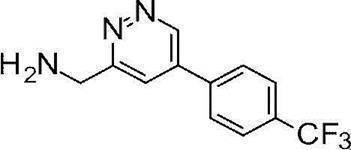
(工程1)4-[4-(トリフルオロメチル)フェニル]-1H-ピリダジン-6-オンの合成
4-クロロ-1H-ピリダジン-6-オン(2.0g、15mmol)、4-(トリフルオロメチル)フェニルボロン酸(3.5g、18mmol)及び1,1’-ビス(ジフェニルホスフィノ)フェロセンジクロロパラジウム(II)(0.58g,0.79mmol)に1,4-ジオキサン(20mL)と飽和重曹水(16mL)を加え、105℃で3時間加熱攪拌した。反応混合物に酢酸エチルを加え、水及び飽和食塩水で順次洗浄した。有機層を硫酸ナトリウムで乾燥させた後、乾燥剤を濾別し、溶媒を留去して得られた残渣にジエチルエーテルを加え、不溶物を濾取、乾燥させて標題化合物(1.2g、5.0mmol、33%)を得た。
MS (ESI) m/z 241 (M+H)+
1H NMR (400 MHz, DMSO-d6) δ 13.24 (s, 1H), 8.34 (s, 1H), 8.04 (d, J = 8.2 Hz, 2H), 7.88 (d, J = 8.2 Hz, 2H), 7.26 (s, 1H).
(工程2)3-クロロ-5-[4-(トリフルオロメチル)フェニル]ピリダジンの合成
工程1で得られた化合物(1.2g、5.0mmol)にオキシ塩化リン(15mL)を加え105℃で3時間加熱攪拌した。反応混合物を減圧濃縮して得られた残渣にジクロロメタンを加え、水及び飽和食塩水にて順次洗浄した。有機層を硫酸ナトリウムにて乾燥し、乾燥剤を濾別した後、溶媒を留去して得られた残渣をシリカゲルカラムクロマトグラフィー(石油エーテル/酢酸エチル)にて精製して標題化合物(0.50g、1.5mmol、51%)を得た。
MS (ESI) m/z 259 (M+H)+
1H NMR (400 MHz, CDCl3) δ 9.39 (s, 1H), 7.84 (d, J = 8.6 Hz, 2H), 7.79 (d, J = 8.6 Hz, 2H), 7.72 (s, 1H).
(工程3)5-[4-(トリフルオロメチル)フェニル]ピリダジン-3-カルボニトリルの合成
工程2で得られた化合物(0.42g、1.6mmol)にN,N-ジメチルホルムアミド(25mL)を加えて溶解させ、窒素雰囲気下でシアン化亜鉛(0.37g、3.2mmol)、トリス(ジベンジリデンアセトン)ジパラジウム(0)(75mg、0.080mmol)及び1,1’-ビス(ジフェニルホスフィノ)フェロセン(45mg、0.080mmol)を加えて110℃で3時間加熱攪拌した。反応混合物にジクロロメタンを加えて水及び飽和食塩水にて順次洗浄した。有機層を硫酸ナトリウムにて乾燥し、乾燥剤を濾別した後、溶媒を留去して得られた残渣をシリカゲルカラムクロマトグラフィー(石油エーテル/酢酸エチル)にて精製して標題化合物(0.32g、1.3mmol、80%)を得た。
MS (ESI) m/z 250 (M+H)+
1H NMR (400 MHz, CDCl3) δ 9.64 (s, 1H), 8.04 (s, 1H), 7.88 (d, J = 8.2 Hz, 2H), 7.82 (d, J = 8.2 Hz, 2H).
(工程4)[5-[4-(トリフルオロメチル)フェニル]ピリダジン-3-イル]メチルアミン(D-45)の合成
工程3で得られた化合物(0.36g、1.5mmol)のメタノール(15mL)溶液に10%パラジウム/炭素(0.30g)を加え、水素雰囲気下、25℃にて30分間攪拌した。触媒を濾別し、濾液を減圧濃縮して得られた残渣にジクロロメタンを加え、不溶物を濾取、乾燥させて標題化合物(0.23g、0.91mmol、63%)を得た。
MS (ESI) m/z 254 (M+H)+
1H NMR (400 MHz, CD3OD) δ 9.72 (s, 1H), 8.26 (s, 1H), 8.13 (d, J = 8.2 Hz, 2H), 7.94 (d, J = 8.2 Hz, 2H), 4.64 (s, 2H).
(Step 1) Synthesis of 4- [4- (trifluoromethyl) phenyl] -1H-pyridazin-6-one 4-Chloro-1H-pyridazin-6-one (2.0 g, 15 mmol), 4- (trifluoro Methyl) phenylboronic acid (3.5 g, 18 mmol) and 1,1′-bis (diphenylphosphino) ferrocenedichloropalladium (II) (0.58 g, 0.79 mmol) saturated with 1,4-dioxane (20 mL) Sodium bicarbonate water (16 mL) was added, and the mixture was stirred with heating at 105 ° C. for 3 hr. Ethyl acetate was added to the reaction mixture, and the mixture was washed successively with water and saturated brine. After drying the organic layer with sodium sulfate, the desiccant was filtered off, the solvent was distilled off, diethyl ether was added to the resulting residue, the insoluble material was collected by filtration and dried to give the title compound (1.2 g, 5.0 mmol, 33%).
MS (ESI) m / z 241 (M + H) +
1 H NMR (400 MHz, DMSO-d 6 ) δ 13.24 (s, 1H), 8.34 (s, 1H), 8.04 (d, J = 8.2 Hz, 2H), 7.88 (d, J = 8.2 Hz, 2H) , 7.26 (s, 1H).
(Step 2) Synthesis of 3-chloro-5- [4- (trifluoromethyl) phenyl] pyridazine To the compound (1.2 g, 5.0 mmol) obtained in Step 1 was added phosphorus oxychloride (15 mL) at 105 ° C. And stirred for 3 hours. Dichloromethane was added to the residue obtained by concentrating the reaction mixture under reduced pressure, and the mixture was washed successively with water and saturated brine. The organic layer was dried over sodium sulfate, the desiccant was filtered off, the solvent was distilled off, and the resulting residue was purified by silica gel column chromatography (petroleum ether / ethyl acetate) to give the title compound (0. 50 g, 1.5 mmol, 51%).
MS (ESI) m / z 259 (M + H) +
1 H NMR (400 MHz, CDCl 3 ) δ 9.39 (s, 1H), 7.84 (d, J = 8.6 Hz, 2H), 7.79 (d, J = 8.6 Hz, 2H), 7.72 (s, 1H).
(Step 3) Synthesis of 5- [4- (trifluoromethyl) phenyl] pyridazine-3-carbonitrile To the compound obtained in Step 2 (0.42 g, 1.6 mmol), N, N-dimethylformamide (25 mL) In a nitrogen atmosphere, zinc cyanide (0.37 g, 3.2 mmol), tris (dibenzylideneacetone) dipalladium (0) (75 mg, 0.080 mmol) and 1,1′-bis (diphenyl) were added. Phosphino) ferrocene (45 mg, 0.080 mmol) was added, and the mixture was heated with stirring at 110 ° C. for 3 hours. Dichloromethane was added to the reaction mixture, and the mixture was washed successively with water and saturated brine. The organic layer was dried over sodium sulfate, the desiccant was filtered off, the solvent was distilled off, and the resulting residue was purified by silica gel column chromatography (petroleum ether / ethyl acetate) to give the title compound (0. 32 g, 1.3 mmol, 80%).
MS (ESI) m / z 250 (M + H) +
1 H NMR (400 MHz, CDCl 3 ) δ 9.64 (s, 1H), 8.04 (s, 1H), 7.88 (d, J = 8.2 Hz, 2H), 7.82 (d, J = 8.2 Hz, 2H).
(Step 4) Synthesis of [5- [4- (trifluoromethyl) phenyl] pyridazin-3-yl] methylamine (D-45) Methanol of the compound obtained in Step 3 (0.36 g, 1.5 mmol) (15 mL) To the solution was added 10% palladium / carbon (0.30 g), and the mixture was stirred at 25 ° C. for 30 minutes in a hydrogen atmosphere. The catalyst was filtered off, and the filtrate was concentrated under reduced pressure. Dichloromethane was added to the resulting residue, and the insoluble material was collected by filtration and dried to give the title compound (0.23 g, 0.91 mmol, 63%).
MS (ESI) m / z 254 (M + H) +
1 H NMR (400 MHz, CD 3 OD) δ 9.72 (s, 1H), 8.26 (s, 1H), 8.13 (d, J = 8.2 Hz, 2H), 7.94 (d, J = 8.2 Hz, 2H), 4.64 (s, 2H).
参考例D-46:[5-[6-(トリフルオロメチル)-3-ピリジル]ピリダジン-3-イル]メチルアミン 塩酸塩(D-46)の合成Reference Example D-46: Synthesis of [5- [6- (trifluoromethyl) -3-pyridyl] pyridazin-3-yl] methylamine hydrochloride (D-46)

4-(トリフルオロメチル)フェニルボロン酸の代わりに[6-(トリフルオロメチル)-3-ピリジル]ボロン酸を用い、参考例D-45工程1~3と同様の操作を行い得られた化合物(1.0g、4.0mmol)のメタノール(40mL)溶液に濃塩酸(1mL)及び10%パラジウム/炭素(0.30g)を加え、水素雰囲気下、25℃にて1時間攪拌した。触媒を濾別し、濾液を減圧濃縮して得られた残渣にジクロロメタン(30mL)、トリエチルアミン(1.5mL、11mmol)及び二炭酸ジ-tert-ブチル(1.1g、5.2mmol)を加え、室温で1時間攪拌した。反応混合物を水及び飽和食塩水で順次洗浄し、有機層を硫酸ナトリウムで乾燥させた後、乾燥剤を濾別した。溶媒を留去して得られた残渣をシリカゲルカラムクロマトグラフィー(石油エーテル/酢酸エチル)にて精製した。得られた化合物に4mol/L 塩化水素(ジクロロメタン溶液、10mL、40mmol)を加え、室温で30分間攪拌した後、減圧濃縮して標題化合物(0.65g、2.2mmol、56%)を得た。
MS (ESI) m/z 255 (M+H)+
1H NMR (400 MHz, CD3OD) δ 9.96 - 9.95 (m, 1H), 9.30 (s, 1H), 8.66 - 8.58 (m, 2H), 8.10 (d, J = 8.4 Hz, 1H), 4.73 (s, 2H).
Compound obtained by performing the same operation as in steps 1 to 3 of Reference Example D-45 using [6- (trifluoromethyl) -3-pyridyl] boronic acid instead of 4- (trifluoromethyl) phenylboronic acid Concentrated hydrochloric acid (1 mL) and 10% palladium / carbon (0.30 g) were added to a methanol (40 mL) solution of (1.0 g, 4.0 mmol), and the mixture was stirred at 25 ° C. for 1 hour in a hydrogen atmosphere. The catalyst was removed by filtration, and the filtrate was concentrated under reduced pressure. Dichloromethane (30 mL), triethylamine (1.5 mL, 11 mmol) and di-tert-butyl dicarbonate (1.1 g, 5.2 mmol) were added to the residue, Stir at room temperature for 1 hour. The reaction mixture was washed successively with water and saturated brine, the organic layer was dried over sodium sulfate, and the desiccant was filtered off. The residue obtained by distilling off the solvent was purified by silica gel column chromatography (petroleum ether / ethyl acetate). To the obtained compound was added 4 mol / L hydrogen chloride (dichloromethane solution, 10 mL, 40 mmol), and the mixture was stirred at room temperature for 30 minutes and then concentrated under reduced pressure to obtain the title compound (0.65 g, 2.2 mmol, 56%). .
MS (ESI) m / z 255 (M + H) +
1 H NMR (400 MHz, CD 3 OD) δ 9.96-9.95 (m, 1H), 9.30 (s, 1H), 8.66-8.58 (m, 2H), 8.10 (d, J = 8.4 Hz, 1H), 4.73 (s, 2H).
参考例D-47:[5-[5-(トリフルオロメチル)-2-ピリジル]ピリダジン-3-イル]メチルアミン 塩酸塩(D-47)の合成Reference Example D-47: Synthesis of [5- [5- (trifluoromethyl) -2-pyridyl] pyridazin-3-yl] methylamine hydrochloride (D-47)

(工程1)3-クロロ-5-[5-(トリフルオロメチル)-2-ピリジル]ピリダジンの合成
4-クロロ-1H-ピリダジン-6-オン(4.5g、35mmol)、E-4(13g、41mmol)、1,1’-ビス(ジフェニルホスフィノ)フェロセン(1.9g、3.5mmol)、酢酸パラジウム(0.39g、1.7mmol)、炭酸セシウム(23g、69mmol)及び塩化銅(I)(3.4g、35mmol)にN,N-ジメチルホルムアミド(100mL)を加え、105℃で6時間攪拌した。不溶物を濾別し、濾液を減圧濃縮して得られた残渣にオキシ塩化リン(30mL)を加え、105℃で2時間攪拌した。反応混合物を減圧濃縮して得られた残渣にジクロロメタンを加えて水及び飽和食塩水で順次洗浄した。有機層を硫酸ナトリウムにて乾燥し、乾燥剤を濾別した後、溶媒を留去して得られた残渣をシリカゲルカラムクロマトグラフィー(石油エーテル/酢酸エチル)にて精製し標題化合物(2.1g、8.1mmol、23%)を得た。
MS (ESI) m/z 260 (M+H)+
1H NMR (400 MHz, DMSO-d6) δ 9.96 (d, J = 1.6 Hz, 1H), 9.20 (s, 1H), 8.62 - 8.51 (m, 3H).
(工程2)5-[5-(トリフルオロメチル)-2-ピリジル]ピリダジン-3-カルボニトリルの合成
工程1で得られた化合物(1.0g、3.9mmol)にN,N-ジメチルホルムアミド(20mL)を加えて溶解させ、窒素雰囲気下でシアン化亜鉛(0.27g、2.3mmol)、トリス(ジベンジリデンアセトン)ジパラジウム(0)(0.14g、0.15mmol)及び1,1’-ビス(ジフェニルホスフィノ)フェロセン(0.16g、0.29mmol)を加えて110℃で4.5時間加熱攪拌した。反応混合物にジクロロメタンを加えて水及び飽和食塩水にて順次洗浄した。有機層を硫酸ナトリウムにて乾燥し、乾燥剤を濾別した後、溶媒を留去して得られた残渣をシリカゲルカラムクロマトグラフィー(石油エーテル/酢酸エチル)にて精製して標題化合物(0.30g、1.2mmol、31%)を得た。
MS (ESI) m/z 251 (M+H)+
(工程3)[5-[5-(トリフルオロメチル)-2-ピリジル]ピリダジン-3-イル]メチルアミン 塩酸塩(D-47)の合成
工程2で得られた化合物(0.60g、2.4mmol)の酢酸(15mL)溶液に10%パラジウム/炭素(0.18g)を加え、水素雰囲気下、25℃にて1.5時間攪拌した。触媒を濾別し、濾液を減圧濃縮して得られた残渣にジクロロメタン(30mL)、トリエチルアミン(3.5mL、25mmol)及び二炭酸ジ-tert-ブチル(2.0g、9.2mmol)を加え、室温で1時間攪拌した。反応混合物にジクロロメタンを加えて水で洗浄し、有機層を硫酸ナトリウムで乾燥させた後、乾燥剤を濾別した。溶媒を留去して得られた残渣をシリカゲルカラムクロマトグラフィー(石油エーテル/酢酸エチル)にて精製した。得られた化合物に4mol/L 塩化水素(ジクロロメタン溶液、25mL、0.10mol)を加え、室温で1時間攪拌した後、減圧濃縮して標題化合物(0.50g、1.7mmol、71%)を得た。
MS (ESI) m/z 255 (M+H)+
1H NMR (400 MHz, DMSO-d6) δ 9.98 (d, J = 2.1 Hz, 1H), 9.22 (s, 1H), 8.75 (s, 3H), 8.59 - 8.52 (m, 3H), 4.54 - 4.50 (m, 2H).
(Step 1) Synthesis of 3-chloro-5- [5- (trifluoromethyl) -2-pyridyl] pyridazine 4-chloro-1H-pyridazin-6-one (4.5 g, 35 mmol), E-4 (13 g , 41 mmol), 1,1′-bis (diphenylphosphino) ferrocene (1.9 g, 3.5 mmol), palladium acetate (0.39 g, 1.7 mmol), cesium carbonate (23 g, 69 mmol) and copper chloride (I ) (3.4 g, 35 mmol) was added N, N-dimethylformamide (100 mL), and the mixture was stirred at 105 ° C. for 6 hours. Insoluble matter was filtered off, and the filtrate was concentrated under reduced pressure. Phosphorus oxychloride (30 mL) was added to the resulting residue, and the mixture was stirred at 105 ° C. for 2 hr. Dichloromethane was added to the residue obtained by concentrating the reaction mixture under reduced pressure, and the mixture was washed successively with water and saturated brine. The organic layer was dried over sodium sulfate, the desiccant was filtered off, the solvent was distilled off, and the resulting residue was purified by silica gel column chromatography (petroleum ether / ethyl acetate) to give the title compound (2.1 g 8.1 mmol, 23%).
MS (ESI) m / z 260 (M + H) +
1 H NMR (400 MHz, DMSO-d 6 ) δ 9.96 (d, J = 1.6 Hz, 1H), 9.20 (s, 1H), 8.62-8.51 (m, 3H).
(Step 2) Synthesis of 5- [5- (trifluoromethyl) -2-pyridyl] pyridazine-3-carbonitrile The compound obtained in Step 1 (1.0 g, 3.9 mmol) was added to N, N-dimethylformamide. (20 mL) was added and dissolved and zinc cyanide (0.27 g, 2.3 mmol), tris (dibenzylideneacetone) dipalladium (0) (0.14 g, 0.15 mmol) and 1,1 under nitrogen atmosphere '-Bis (diphenylphosphino) ferrocene (0.16 g, 0.29 mmol) was added, and the mixture was heated and stirred at 110 ° C. for 4.5 hours. Dichloromethane was added to the reaction mixture, and the mixture was washed successively with water and saturated brine. The organic layer was dried over sodium sulfate, the desiccant was filtered off, the solvent was distilled off, and the resulting residue was purified by silica gel column chromatography (petroleum ether / ethyl acetate) to give the title compound (0. 30 g, 1.2 mmol, 31%).
MS (ESI) m / z 251 (M + H) +
(Step 3) Synthesis of [5- [5- (trifluoromethyl) -2-pyridyl] pyridazin-3-yl] methylamine hydrochloride (D-47) The compound obtained in Step 2 (0.60 g, 2 .4 mmol) in acetic acid (15 mL) was added 10% palladium / carbon (0.18 g), and the mixture was stirred at 25 ° C. for 1.5 hours in a hydrogen atmosphere. The catalyst was filtered off, and the filtrate was concentrated under reduced pressure. Dichloromethane (30 mL), triethylamine (3.5 mL, 25 mmol) and di-tert-butyl dicarbonate (2.0 g, 9.2 mmol) were added to the residue, Stir at room temperature for 1 hour. Dichloromethane was added to the reaction mixture and washed with water. The organic layer was dried over sodium sulfate, and then the desiccant was filtered off. The residue obtained by distilling off the solvent was purified by silica gel column chromatography (petroleum ether / ethyl acetate). To the obtained compound was added 4 mol / L hydrogen chloride (dichloromethane solution, 25 mL, 0.10 mol), and the mixture was stirred at room temperature for 1 hour and then concentrated under reduced pressure to give the title compound (0.50 g, 1.7 mmol, 71%). Obtained.
MS (ESI) m / z 255 (M + H) +
1 H NMR (400 MHz, DMSO-d 6 ) δ 9.98 (d, J = 2.1 Hz, 1H), 9.22 (s, 1H), 8.75 (s, 3H), 8.59-8.52 (m, 3H), 4.54- 4.50 (m, 2H).
参考例D-48:4-(アミノメチル)-2-[5-(トリフルオロメチル)-2-ピリジル]フェノール 塩酸塩(D-48)の合成Reference Example D-48: Synthesis of 4- (aminomethyl) -2- [5- (trifluoromethyl) -2-pyridyl] phenol hydrochloride (D-48)

(工程1)(5-シアノ-2-メトキシ-フェニル)ボロン酸の合成
3-ブロモ-4-メトキシベンゾニトリル(7.7g、36mmol)及びホウ酸トリイソプロピル(14g、73mmol)にテトラヒドロフラン(150mL)を加えて溶解させ、-78℃で2.5mol/L n-ブチルリチウム(ヘキサン溶液、22mL、55mmol)を20分間かけてゆっくりと加えた。-78℃で2時間攪拌した後、反応混合物に7%リン酸(100mL)を加え、室温に昇温した。反応混合物を分層させた後、有機層にジクロロメタンを加え、5%水酸化ナトリウム水溶液(200mL)で抽出した。水層をジエチルエーテルで洗浄した後、85%リン酸を加えてpH2.5に調整して不溶物を濾取した。得られた固体を水で洗浄した後、乾燥させて標題化合物(5.1g、29mmol、79%)を得た。
MS (ESI) m/z 178 (M+H)+
1H NMR (300 MHz, DMSO-d6) δ 8.03 (s, 2H), 7.86 - 7.78 (m, 2H), 7.13 (d, J = 11.6 Hz, 1H), 3.85 (s, 3H).
(工程2)4-メトキシ-3-[5-(トリフルオロメチル)-2-ピリジル]ベンゾニトリルの合成
工程1で得られた化合物(1.1g、6.0mmol)、2-ブロモ-5-(トリフルオロメチル)ピリジン(1.2g、5.5mmol)、炭酸ナトリウム(1.2g、11mmol)及び1,1’-ビス(ジフェニルホスフィノ)フェロセンジクロロパラジウム(II)(0.20g、0.27mmol)にN,N-ジメチルホルムアミド(16mL)と水(4mL)を加え、100℃で2時間攪拌した。不溶物を濾別し、濾液に酢酸エチルを加えて水及び飽和食塩水で順次洗浄した後、硫酸ナトリウムにて乾燥し、乾燥剤を濾別した。溶媒を留去して得られた残渣をシリカゲルカラムクロマトグラフィー(石油エーテル/酢酸エチル)にて精製して標題化合物(1.4g、5.1mmol、92%)を得た。
MS (ESI) m/z 279 (M+H)+
(工程3)N-[[4-ヒドロキシ-3-[5-(トリフルオロメチル)-2-ピリジル]フェニル]メチル]カルバミン酸 tert-ブチルの合成
工程2で得られた化合物(1.5g、5.4mmol)及び塩化コバルト(II)・6水和物(0.70g、5.4mmol)にテトラヒドロフラン(60mL)及び水(40mL)を加えた。0℃で反応混合物にテトラヒドロホウ酸ナトリウム(0.51g、14mmol)を加え、室温で3時間攪拌した後、3mol/L 塩酸(150mL)を加えた。反応混合物からテトラヒドロフランを減圧留去し、アンモニア水を加えてpH8~9に調整した。反応混合物に酢酸エチルを加えて抽出し、有機層を飽和食塩水で洗浄した後、硫酸ナトリウムにて乾燥し、乾燥剤を濾別した。溶媒を留去して得られた残渣にジクロロメタン(5mL)を加えて溶解させ、-70℃で1mol/L 三臭化ホウ素(ジクロロメタン溶液、10mL、10mmol)を加えた。室温で7時間攪拌した後、反応混合物に飽和炭酸ナトリウム水溶液を加えてpH8に調整し、酢酸エチルで抽出した。有機層を飽和食塩水で洗浄した後、硫酸ナトリウムにて乾燥し、乾燥剤を濾別した。溶媒を留去して得られた残渣にジクロロメタン(5mL)を加えて溶解させ、二炭酸ジ-tert-ブチル(0.46g、2.1mmol)を加え、室温で30分間攪拌した。反応混合物から溶媒を留去して得られた残渣をシリカゲルカラムクロマトグラフィー(ジクロロメタン)にて精製して標題化合物(0.28g、0.76mmol、14%)を得た。
MS (ESI) m/z 369 (M+H)+
1H NMR (400 MHz, CDCl3) δ 13.59 (s, 1H), 8.80 (s, 1H), 8.08 - 8.02 (m, 2H), 7.75 (s, 1H), 7.29 (dd, J = 8.8, 0.8 Hz, 1H), 7.02 (d, J = 8.8 Hz, 1H), 4.86 (s, 1H), 4.45-4.15 (m, 2H), 1.47 (s, 9H).
(工程4)4-(アミノメチル)-2-[5-(トリフルオロメチル)-2-ピリジル]フェノール 塩酸塩(D-48)の合成
工程3で得られた化合物(0.28g、0.76mmol)にジクロロメタン(3mL)と4mol/L 塩化水素(ジクロロメタン溶液、10mL、40mmol)を加え、室温で30分間攪拌した後、減圧濃縮して標題化合物(0.21g、0.67mmol、88%)を得た。
MS (ESI) m/z 269 (M+H)+
1H NMR (400 MHz, DMSO-d6) δ 9.08 (s, 1H), 8.46 - 8.41 (m, 5H), 8.30 (d, J = 2.0 Hz, 1H), 7.50 (dd, J = 8.4, 2.0 Hz, 1H), 7.05 (d, J = 8.4 Hz, 1H), 4.03 - 3.99 (m, 2H).
(Step 1) Synthesis of (5-cyano-2-methoxy-phenyl) boronic acid Tetrahydrofuran (150 mL) to 3-bromo-4-methoxybenzonitrile (7.7 g, 36 mmol) and triisopropyl borate (14 g, 73 mmol) Then, 2.5 mol / L n-butyllithium (hexane solution, 22 mL, 55 mmol) was slowly added over 20 minutes at −78 ° C. After stirring at −78 ° C. for 2 hours, 7% phosphoric acid (100 mL) was added to the reaction mixture, and the temperature was raised to room temperature. The reaction mixture was separated, dichloromethane was added to the organic layer, and the mixture was extracted with 5% aqueous sodium hydroxide solution (200 mL). The aqueous layer was washed with diethyl ether, adjusted to pH 2.5 by adding 85% phosphoric acid, and insolubles were collected by filtration. The obtained solid was washed with water and dried to give the title compound (5.1 g, 29 mmol, 79%).
MS (ESI) m / z 178 (M + H) +
1 H NMR (300 MHz, DMSO-d 6 ) δ 8.03 (s, 2H), 7.86-7.78 (m, 2H), 7.13 (d, J = 11.6 Hz, 1H), 3.85 (s, 3H).
(Step 2) Synthesis of 4-methoxy-3- [5- (trifluoromethyl) -2-pyridyl] benzonitrile The compound obtained in Step 1 (1.1 g, 6.0 mmol), 2-bromo-5- (Trifluoromethyl) pyridine (1.2 g, 5.5 mmol), sodium carbonate (1.2 g, 11 mmol) and 1,1′-bis (diphenylphosphino) ferrocenedichloropalladium (II) (0.20 g, 0.2 mmol). (27 mmol) was added N, N-dimethylformamide (16 mL) and water (4 mL), and the mixture was stirred at 100 ° C. for 2 hours. Insoluble matter was filtered off, ethyl acetate was added to the filtrate, and the mixture was washed successively with water and saturated brine, dried over sodium sulfate, and the desiccant was filtered off. The residue obtained by evaporating the solvent was purified by silica gel column chromatography (petroleum ether / ethyl acetate) to obtain the title compound (1.4 g, 5.1 mmol, 92%).
MS (ESI) m / z 279 (M + H) +
(Step 3) Synthesis of tert-butyl N-[[4-hydroxy-3- [5- (trifluoromethyl) -2-pyridyl] phenyl] methyl] carbamate Compound (1.5 g, Tetrahydrofuran (60 mL) and water (40 mL) were added to 5.4 mmol) and cobalt (II) chloride hexahydrate (0.70 g, 5.4 mmol). Sodium tetrahydroborate (0.51 g, 14 mmol) was added to the reaction mixture at 0 ° C., and the mixture was stirred at room temperature for 3 hr, and 3 mol / L hydrochloric acid (150 mL) was added. Tetrahydrofuran was distilled off from the reaction mixture under reduced pressure, and aqueous ammonia was added to adjust the pH to 8-9. Ethyl acetate was added to the reaction mixture for extraction, and the organic layer was washed with saturated brine, dried over sodium sulfate, and the desiccant was filtered off. Dichloromethane (5 mL) was added to the residue obtained by evaporating the solvent to dissolve, and 1 mol / L boron tribromide (dichloromethane solution, 10 mL, 10 mmol) was added at −70 ° C. After stirring at room temperature for 7 hours, the reaction mixture was adjusted to pH 8 by adding saturated aqueous sodium carbonate solution, and extracted with ethyl acetate. The organic layer was washed with saturated brine, dried over sodium sulfate, and the desiccant was filtered off. Dichloromethane (5 mL) was added to the residue obtained by distilling off the solvent and dissolved, di-tert-butyl dicarbonate (0.46 g, 2.1 mmol) was added, and the mixture was stirred at room temperature for 30 min. The residue obtained by evaporating the solvent from the reaction mixture was purified by silica gel column chromatography (dichloromethane) to give the title compound (0.28 g, 0.76 mmol, 14%).
MS (ESI) m / z 369 (M + H) +
1 H NMR (400 MHz, CDCl 3 ) δ 13.59 (s, 1H), 8.80 (s, 1H), 8.08-8.02 (m, 2H), 7.75 (s, 1H), 7.29 (dd, J = 8.8, 0.8 Hz, 1H), 7.02 (d, J = 8.8 Hz, 1H), 4.86 (s, 1H), 4.45-4.15 (m, 2H), 1.47 (s, 9H).
(Step 4) Synthesis of 4- (aminomethyl) -2- [5- (trifluoromethyl) -2-pyridyl] phenol hydrochloride (D-48) The compound obtained in Step 3 (0.28 g,. 76 mmol) was added dichloromethane (3 mL) and 4 mol / L hydrogen chloride (dichloromethane solution, 10 mL, 40 mmol), stirred at room temperature for 30 minutes, and then concentrated under reduced pressure to give the title compound (0.21 g, 0.67 mmol, 88%) Got.
MS (ESI) m / z 269 (M + H) +
1 H NMR (400 MHz, DMSO-d 6 ) δ 9.08 (s, 1H), 8.46-8.41 (m, 5H), 8.30 (d, J = 2.0 Hz, 1H), 7.50 (dd, J = 8.4, 2.0 Hz, 1H), 7.05 (d, J = 8.4 Hz, 1H), 4.03-3.99 (m, 2H).
参考例D-49:4-(アミノメチル)-2-[5-(トリフルオロメチル)ピリミジン-2-イル]フェノール 塩酸塩(D-49)の合成Reference Example D-49: Synthesis of 4- (aminomethyl) -2- [5- (trifluoromethyl) pyrimidin-2-yl] phenol hydrochloride (D-49)

2-ブロモ-5-(トリフルオロメチル)ピリジンの代わりに2-クロロ-5-(トリフルオロメチル)ピリミジンを用い、参考例D-48と同様の操作を行い標題化合物(収率6%)を得た。
MS (ESI) m/z 270 (M+H)+
1H NMR (400 MHz, CD3OD) δ 9.29 (s, 2H), 8.72 (d, J = 2.4 Hz, 1H), 7.58 (dd, J = 8.4, 2.4 Hz, 1H), 7.12 (d, J = 8.0 Hz, 1H), 4.16 (s, 2H).
2-Chloro-5- (trifluoromethyl) pyrimidine was used instead of 2-bromo-5- (trifluoromethyl) pyridine and the same operation as in Reference Example D-48 was performed to give the title compound (yield 6%). Obtained.
MS (ESI) m / z 270 (M + H) +
1 H NMR (400 MHz, CD 3 OD) δ 9.29 (s, 2H), 8.72 (d, J = 2.4 Hz, 1H), 7.58 (dd, J = 8.4, 2.4 Hz, 1H), 7.12 (d, J = 8.0 Hz, 1H), 4.16 (s, 2H).
参考例D-50:4-(アミノメチル)-2-[5-(トリフルオロメチル)ピラジン-2-イル]フェノール 塩酸塩(D-50)の合成Reference Example D-50: Synthesis of 4- (aminomethyl) -2- [5- (trifluoromethyl) pyrazin-2-yl] phenol hydrochloride (D-50)

(工程1)4-メトキシ-3-[5-(トリフルオロメチル)ピラジン-2-イル]ベンゾニトリルの合成
2-ブロモ-5-(トリフルオロメチル)ピリジンの代わりに2-クロロ-5-(トリフルオロメチル)ピラジンを用い、参考例D-48工程2と同様の操作を行い標題化合物を得た(収率92%)。
MS (ESI) m/z 280 (M+H)+
1H NMR (400 MHz, CDCl3) δ 9.31 (d, J = 0.8 Hz, 1H), 9.03 (d, J = 0.8 Hz, 1H), 8.28 (d, J = 0.8 Hz, 1H), 7.78 (dd, J = 8.8, 0.8 Hz, 1H), 7.15 (d, J = 8.8 Hz, 1H), 4.02 (s, 3H).
(工程2)[4-メトキシ-3-[5-(トリフルオロメチル)ピラジン-2-イル]フェニル]メチルアミンの合成
工程1で得られた化合物(1.2g、4.3mmol)の酢酸(120mL)溶液に10%パラジウム/炭素(0.50g)を加え、水素雰囲気下、室温で3時間攪拌した。触媒を濾別し、濾液にジクロロメタン(100mL)を加えて炭酸ナトリウム水溶液にて洗浄した。有機層を硫酸ナトリウムにて乾燥し、乾燥剤を濾別した。溶媒を留去して得られた残渣を高速液体クロマトグラフィー(水-アセトニトリル)にて精製して標題化合物(0.20g、0.71mmol、16%)を得た。
MS (ESI) m/z 284 (M+H)+
(工程3)4-(アミノメチル)-2-[5-(トリフルオロメチル)ピラジン-2-イル]フェノール 塩酸塩(D-50)の合成
工程2で得られた化合物(0.20g、0.71mmol)にジクロロメタン(25mL)を加えて溶解させ、-78℃で1mol/L 三臭化ホウ素(ジクロロメタン溶液、3mL、3mmol)を加えた。室温で4時間攪拌した後、反応混合物に飽和炭酸ナトリウム水溶液を加えてpH8に調整し、ジクロロメタンで抽出した。有機層を硫酸ナトリウムにて乾燥し、乾燥剤を濾別した。溶媒を留去して得られた残渣に4mol/L 塩化水素(ジクロロメタン溶液、10mL、40mmol)を加え、室温で30分間攪拌した後、減圧濃縮した。得られた残渣にジクロロメタンを加え、不溶物を濾取、乾燥させて標題化合物(0.19g、0.61mmol、87%)を得た。
MS (ESI) m/z 270 (M+H)+
1H NMR (300 MHz, DMSO-d6) δ 11.30 (br s, 1H), 9.52 (s, 1H), 9.25 (s, 1H), 8.30 (br s, 3H), 8.13 (d, J = 2.1 Hz, 1H), 7.52 (dd, J = 8.4, 2.1 Hz, 1H), 7.13 (d, J = 8.4 Hz, 1H), 4.03 - 3.97 (m, 2H).
(Step 1) Synthesis of 4-methoxy-3- [5- (trifluoromethyl) pyrazin-2-yl] benzonitrile 2-Chloro-5- (in place of 2-bromo-5- (trifluoromethyl) pyridine The title compound was obtained in the same manner as in Reference Example D-48, Step 2 using (trifluoromethyl) pyrazine (yield 92%).
MS (ESI) m / z 280 (M + H) +
1 H NMR (400 MHz, CDCl 3 ) δ 9.31 (d, J = 0.8 Hz, 1H), 9.03 (d, J = 0.8 Hz, 1H), 8.28 (d, J = 0.8 Hz, 1H), 7.78 (dd , J = 8.8, 0.8 Hz, 1H), 7.15 (d, J = 8.8 Hz, 1H), 4.02 (s, 3H).
(Step 2) Synthesis of [4-methoxy-3- [5- (trifluoromethyl) pyrazin-2-yl] phenyl] methylamine The compound obtained in Step 1 (1.2 g, 4.3 mmol) of acetic acid ( 120%), 10% palladium / carbon (0.50 g) was added, and the mixture was stirred at room temperature for 3 hours in a hydrogen atmosphere. The catalyst was filtered off, dichloromethane (100 mL) was added to the filtrate, and the mixture was washed with an aqueous sodium carbonate solution. The organic layer was dried over sodium sulfate and the desiccant was filtered off. The residue obtained by distilling off the solvent was purified by high performance liquid chromatography (water-acetonitrile) to obtain the title compound (0.20 g, 0.71 mmol, 16%).
MS (ESI) m / z 284 (M + H) +
(Step 3) Synthesis of 4- (aminomethyl) -2- [5- (trifluoromethyl) pyrazin-2-yl] phenol hydrochloride (D-50) The compound obtained in Step 2 (0.20 g, 0 (71 mL) was dissolved in dichloromethane (25 mL), and 1 mol / L boron tribromide (dichloromethane solution, 3 mL, 3 mmol) was added at -78 ° C. After stirring at room temperature for 4 hours, the reaction mixture was adjusted to pH 8 by adding saturated aqueous sodium carbonate solution and extracted with dichloromethane. The organic layer was dried over sodium sulfate and the desiccant was filtered off. To the residue obtained by distilling off the solvent was added 4 mol / L hydrogen chloride (dichloromethane solution, 10 mL, 40 mmol), and the mixture was stirred at room temperature for 30 minutes and then concentrated under reduced pressure. Dichloromethane was added to the obtained residue, insoluble matter was collected by filtration and dried to obtain the title compound (0.19 g, 0.61 mmol, 87%).
MS (ESI) m / z 270 (M + H) +
1 H NMR (300 MHz, DMSO-d 6 ) δ 11.30 (br s, 1H), 9.52 (s, 1H), 9.25 (s, 1H), 8.30 (br s, 3H), 8.13 (d, J = 2.1 Hz, 1H), 7.52 (dd, J = 8.4, 2.1 Hz, 1H), 7.13 (d, J = 8.4 Hz, 1H), 4.03-3.97 (m, 2H).
参考例D-51:6-(アミノメチル)-4-[5-(トリフルオロメチル)-2-ピリジル]ピリジン-3-オール 塩酸塩(D-51)の合成Reference Example D-51: Synthesis of 6- (aminomethyl) -4- [5- (trifluoromethyl) -2-pyridyl] pyridin-3-ol hydrochloride (D-51)
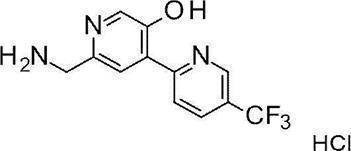
(工程1)2-クロロ-5-(メトキシメトキシ)ピリジンの合成
水素化ナトリウム(60%油性、1.8g、45mmol)にN,N-ジメチルホルムアミド(25mL)を加えて懸濁させ、2-クロロ-5-ヒドロキシピリジン(5.0g、39mmol)のN,N-ジメチルホルムアミド(10mL)溶液を45分間かけてゆっくりと滴下した。反応混合物を室温で1.5時間攪拌した後、クロロメチルメチルエーテル(3.3mL、43mmol)を10分間かけて滴下し、室温で12時間攪拌した。反応混合物に酢酸エチルを加え、水及び飽和食塩水にて順次洗浄した後、有機層を硫酸ナトリウムにて乾燥し、乾燥剤を濾別した。溶媒を留去して得られた残渣をシリカゲルカラムクロマトグラフィー(石油エーテル/酢酸エチル)にて精製して標題化合物(5.4g、31mmol、80%)を得た。
MS (ESI) m/z 174 (M+H)+
1H NMR (400 MHz, CDCl3) δ 8.17 (d, J = 2.8 Hz, 1H), 7.36 (dd, J = 2.8, 9.2 Hz, 1H), 7.24 (d, J = 9.2 Hz, 1H), 5.18 (s, 2H), 3.46 (s, 3H).
(工程2)[2-クロロ-5-(メトキシメトキシ)-4-ピリジル]ボロン酸の合成
工程1で得られた化合物(4.5g、26mmol)のテトラヒドロフラン(500mL)溶液に-78℃で1.3mol/L tert-ブチルリチウム(40mL、52mmol)を加えて30分間攪拌した後、ホウ酸トリイソプロピル(9.7g、52mmol)のテトラヒドロフラン(20mL)溶液を滴下し、-78℃で1時間攪拌した。反応混合物に酢酸エチル(100mL)と水(60mL)を加えて分層させ、水層をジエチルエーテルで洗浄した。水層に1mol/L 塩酸を加えてpH1に調整し、不溶物を濾取、乾燥させて標題化合物(3.0g、14mmol、54%)を得た。
MS (ESI) m/z 218 (M+H)+
1H NMR (300 MHz, CDCl3) δ 8.45 (s, 2H), 8.13 (s, 1H), 7.37 (s, 1H), 5.24 (s, 2H), 3.40 (s, 3H).
(工程3)2-クロロ-5-(メトキシメトキシ)-4-[5-(トリフルオロメチル)-2-ピリジル]ピリジンの合成
工程2で得られた化合物(5.0g、22mmol)、2-ブロモ-5-(トリフルオロメチル)ピリジン(6.2g、29mmol)、炭酸ナトリウム(4.7g、44mmol)及び1,1’-ビス(ジフェニルホスフィノ)フェロセンジクロロパラジウム(II)(0.80g、1.1mmol)にN,N-ジメチルホルムアミド(80mL)と水(20mL)を加え、110℃で2時間攪拌した。不溶物を濾別し、濾液に酢酸エチルを加えて水及び飽和食塩水で順次洗浄した後、硫酸ナトリウムにて乾燥し、乾燥剤を濾別した。溶媒を留去して得られた残渣をシリカゲルカラムクロマトグラフィー(石油エーテル/酢酸エチル)にて精製して標題化合物(2.0g、6.3mmol、28%)を得た。
MS (ESI) m/z 319 (M+H)+
1H NMR (400 MHz, DMSO-d6) δ 9.14 (s, 1H), 8.44 (s, 1H), 8.41 (dd, J = 2.0, 8.4 Hz, 1H), 8.22 (d, J = 8.4 Hz, 1H), 7.84 (s, 1H), 5.39 (s, 2H), 3.36 (s, 3H).
(工程4)5-ヒドロキシ-4-[5-(トリフルオロメチル)-2-ピリジル]ピリジン-2-カルボニトリルの合成
工程3で得られた化合物(4.8g、15mmol)にN,N-ジメチルホルムアミド(300mL)を加えて溶解させ、窒素雰囲気下でシアン化亜鉛(1.1g、9.1mmol)、トリス(ジベンジリデンアセトン)ジパラジウム(0)(0.30g、0.32mmol)及び1,1’-ビス(ジフェニルホスフィノ)フェロセン(0.60g、1.1mmol)を加えて110℃で12時間加熱攪拌した。反応混合物にジクロロメタンを加えて水及び飽和食塩水にて順次洗浄した。有機層を硫酸ナトリウムにて乾燥し、乾燥剤を濾別した後、溶媒を留去して得られた残渣をシリカゲルカラムクロマトグラフィー(石油エーテル/酢酸エチル)にて精製して標題化合物(1.3g、4.9mmol、33%)を得た。
MS (ESI) m/z 266 (M+H)+
1H NMR (400 MHz, CDCl3) δ 14.10 (s, 1H), 8.94 (s, 1H), 8.60 (s, 1H), 8.26 (d, J = 8.0 Hz, 1H), 8.16 (d, J = 8.0 Hz, 1H), 8.09 (s, 1H).
(工程5)6-(アミノメチル)-4-[5-(トリフルオロメチル)-2-ピリジル]ピリジン-3-オール 塩酸塩(D-51)の合成
工程4で得られた化合物(0.90g、3.4mmol)のメタノール(150mL)溶液に10%パラジウム/炭素(270mg)及び濃塩酸(2mL)を加え、水素雰囲気下、室温で1.5時間攪拌した。触媒を濾別し、濾液を減圧濃縮して得られた残渣を高速液体クロマトグラフィー(水-アセトニトリル)にて精製して標題化合物(0.36g、1.2mmol、35%)を得た。
MS (ESI) m/z 270 (M+H)+
1H NMR (400 MHz, DMSO-d6) δ 9.16 (s, 1H), 8.49 - 8.38 (m, 6H), 8.19 (s, 1H), 4.18 - 4.14 (m, 2H).
(Step 1) Synthesis of 2-chloro-5- (methoxymethoxy) pyridine N, N-dimethylformamide (25 mL) was added to sodium hydride (60% oily, 1.8 g, 45 mmol) and suspended. A solution of chloro-5-hydroxypyridine (5.0 g, 39 mmol) in N, N-dimethylformamide (10 mL) was slowly added dropwise over 45 minutes. The reaction mixture was stirred at room temperature for 1.5 hours, chloromethyl methyl ether (3.3 mL, 43 mmol) was added dropwise over 10 minutes, and the mixture was stirred at room temperature for 12 hours. Ethyl acetate was added to the reaction mixture, which was washed successively with water and saturated brine, the organic layer was dried over sodium sulfate, and the desiccant was filtered off. The residue obtained by distilling off the solvent was purified by silica gel column chromatography (petroleum ether / ethyl acetate) to obtain the title compound (5.4 g, 31 mmol, 80%).
MS (ESI) m / z 174 (M + H) +
1 H NMR (400 MHz, CDCl 3 ) δ 8.17 (d, J = 2.8 Hz, 1H), 7.36 (dd, J = 2.8, 9.2 Hz, 1H), 7.24 (d, J = 9.2 Hz, 1H), 5.18 (s, 2H), 3.46 (s, 3H).
(Step 2) Synthesis of [2-chloro-5- (methoxymethoxy) -4-pyridyl] boronic acid To a solution of the compound obtained in Step 1 (4.5 g, 26 mmol) in tetrahydrofuran (500 mL) at −78 ° C. .3 mol / L tert-butyllithium (40 mL, 52 mmol) was added and stirred for 30 minutes, and then a solution of triisopropyl borate (9.7 g, 52 mmol) in tetrahydrofuran (20 mL) was added dropwise and stirred at −78 ° C. for 1 hour. did. Ethyl acetate (100 mL) and water (60 mL) were added to the reaction mixture for phase separation, and the aqueous layer was washed with diethyl ether. The aqueous layer was adjusted to pH 1 by adding 1 mol / L hydrochloric acid, and insoluble matters were collected by filtration and dried to obtain the title compound (3.0 g, 14 mmol, 54%).
MS (ESI) m / z 218 (M + H) +
1 H NMR (300 MHz, CDCl 3 ) δ 8.45 (s, 2H), 8.13 (s, 1H), 7.37 (s, 1H), 5.24 (s, 2H), 3.40 (s, 3H).
(Step 3) Synthesis of 2-chloro-5- (methoxymethoxy) -4- [5- (trifluoromethyl) -2-pyridyl] pyridine The compound obtained in Step 2 (5.0 g, 22 mmol), 2- Bromo-5- (trifluoromethyl) pyridine (6.2 g, 29 mmol), sodium carbonate (4.7 g, 44 mmol) and 1,1′-bis (diphenylphosphino) ferrocenedichloropalladium (II) (0.80 g, 1.1 mmol), N, N-dimethylformamide (80 mL) and water (20 mL) were added, and the mixture was stirred at 110 ° C. for 2 hours. Insoluble matter was filtered off, ethyl acetate was added to the filtrate, and the mixture was washed successively with water and saturated brine, dried over sodium sulfate, and the desiccant was filtered off. The residue obtained by evaporating the solvent was purified by silica gel column chromatography (petroleum ether / ethyl acetate) to obtain the title compound (2.0 g, 6.3 mmol, 28%).
MS (ESI) m / z 319 (M + H) +
1 H NMR (400 MHz, DMSO-d 6 ) δ 9.14 (s, 1H), 8.44 (s, 1H), 8.41 (dd, J = 2.0, 8.4 Hz, 1H), 8.22 (d, J = 8.4 Hz, 1H), 7.84 (s, 1H), 5.39 (s, 2H), 3.36 (s, 3H).
(Step 4) Synthesis of 5-hydroxy-4- [5- (trifluoromethyl) -2-pyridyl] pyridine-2-carbonitrile To the compound obtained in Step 3 (4.8 g, 15 mmol), N, N— Dimethylformamide (300 mL) is added and dissolved, and zinc cyanide (1.1 g, 9.1 mmol), tris (dibenzylideneacetone) dipalladium (0) (0.30 g, 0.32 mmol) and 1 under nitrogen atmosphere. 1,1′-bis (diphenylphosphino) ferrocene (0.60 g, 1.1 mmol) was added, and the mixture was stirred with heating at 110 ° C. for 12 hours. Dichloromethane was added to the reaction mixture, and the mixture was washed successively with water and saturated brine. The organic layer was dried over sodium sulfate, the desiccant was filtered off, the solvent was distilled off, and the resulting residue was purified by silica gel column chromatography (petroleum ether / ethyl acetate) to give the title compound (1. 3 g, 4.9 mmol, 33%).
MS (ESI) m / z 266 (M + H) +
1 H NMR (400 MHz, CDCl 3 ) δ 14.10 (s, 1H), 8.94 (s, 1H), 8.60 (s, 1H), 8.26 (d, J = 8.0 Hz, 1H), 8.16 (d, J = 8.0 Hz, 1H), 8.09 (s, 1H).
(Step 5) Synthesis of 6- (aminomethyl) -4- [5- (trifluoromethyl) -2-pyridyl] pyridin-3-ol hydrochloride (D-51) The compound (0. To a solution of 90 g, 3.4 mmol) in methanol (150 mL) were added 10% palladium / carbon (270 mg) and concentrated hydrochloric acid (2 mL), and the mixture was stirred at room temperature for 1.5 hours in a hydrogen atmosphere. The catalyst was filtered off, the filtrate was concentrated under reduced pressure, and the resulting residue was purified by high performance liquid chromatography (water-acetonitrile) to give the title compound (0.36 g, 1.2 mmol, 35%).
MS (ESI) m / z 270 (M + H) +
1 H NMR (400 MHz, DMSO-d 6 ) δ 9.16 (s, 1H), 8.49-8.38 (m, 6H), 8.19 (s, 1H), 4.18-4.14 (m, 2H).
参考例D-52:1-[3-クロロ-5-[6-(トリフルオロメチル)-3-ピリジル]フェニル]シクロプロパンアミン塩酸塩(D-52)の合成Reference Example D-52: Synthesis of 1- [3-chloro-5- [6- (trifluoromethyl) -3-pyridyl] phenyl] cyclopropanamine hydrochloride (D-52)

(工程1)N-[1-(3-ブロモ-5-クロロフェニル)シクロプロピル]カルバミン酸 tert-ブチルの合成
3-ブロモ-5-クロロベンゾニトリル(0.22g、1.0 mmol)のジエチルエーテル(3mL)溶液にチタンテトライソプロポキシド(0.21mL、1.1mmol)を加えた。-70℃で3mol/L エチルマグネシウムブロミド(ジエチルエーテル溶液、0.73mL、2.2mmol)を滴下して10分間撹拌した後、室温に昇温して1時間撹拌した。反応混合物に三フッ化ホウ素・ジエチルエーテル錯体(0.25mL、2.0mmol)を滴下し、30分間撹拌した後、1mol/L 塩酸(3mL)を加え、室温で一晩撹拌した。反応液を減圧濃縮して得られた残渣を高速液体クロマトグラフィー(水-アセトニトリル、それぞれ0.1%トリフルオロ酢酸入り)にて精製し、中間体(60mg、0.17mmol)を得た。得られた中間体(60mg)にジクロロメタン(2mL)、トリエチルアミン(0.070mL、0.50mmol)及び二炭酸ジ-tert-ブチル(40mg、0.18mmol)を加え、室温で一晩撹拌した。反応混合物から溶媒を留去した後、シリカゲルカラムクロマトグラフィーにて精製し、標題化合物(30mg、0.095mmol、10%)を得た。
1H NMR (400 MHz, CDCl3) δ 7.33 (s, 1H), 7.21 (s, 1H), 7.11 (s, 1H), 5.14 (m, 1H), 1.45 (s, 9H), 1.36 - 1.12 (m, 4H)
(工程2)N-[1-[3-クロロ-5-[6-(トリフルオロメチル)-3-ピリジル]フェニル]シクロプロピル]カルバミン酸 tert-ブチルの合成
工程1で得られた化合物(30mg、0.095mmol)、[6-(トリフルオロメチル)-3-ピリジル]ボロン酸(23mg、0.11mmol)及び1,1’-ビス(ジフェニルホスフィノ)フェロセンジクロロパラジウム(II)(7.0mg、0.0096mmol)に1,4-ジオキサン(1mL)と1mol/L炭酸ナトリウム水溶液(0.3mL)を加え、マイクロウェーブ反応装置を用いて115℃で20分間加熱攪拌した。反応混合物を高速液体クロマトグラフィー(水-アセトニトリル、それぞれ0.1%トリフルオロ酢酸入り)にて精製し、標題化合物(22mg、0.053mmol、56%)を得た。
1H NMR (400 MHz, CDCl3) δ 8.88 (d, J = 2.2 Hz, 1H), 8.04 - 7.93 (m, 1H), 7.76 (d, J = 8.2 Hz, 1H), 7.39 (s, 1H), 7.36 - 7.30 (m, 1H), 7.25 (s, 1H), 5.30 (s, 1H), 1.53 - 1.21 (m, 13H).
(工程3)1-[3-クロロ-5-[6-(トリフルオロメチル)-3-ピリジル]フェニル]シクロプロパンアミン塩酸塩(D-52)の合成
工程2で得られた化合物(22mg、0.053mmol)にジクロロメタン(2mL)、4mol/L塩酸(1,4-ジオキサン溶液、2mL)を加え、室温で8時間撹拌した。反応混合物から溶媒を留去し、水-アセトニトリルに溶解して凍結乾燥することで標題化合物(16mg、0.045mmol、85%)を得た。
MS (ESI) m/z 313 (M+H)+
1H NMR (400 MHz, DMSO-d6) δ 9.19 (s, 1H), 9.02 (s, 3H), 8.49 (d, J = 8.2 Hz, 1H), 8.05 (d, J = 8.2 Hz, 1H), 7.94 (s, 1H), 7.84 (s, 1H), 7.62 (s, 1H), 1.49 - 1.36 (m, 4H).
(Step 1) Synthesis of tert-butyl N- [1- (3-bromo-5-chlorophenyl) cyclopropyl] carbamate diethyl ether of 3-bromo-5-chlorobenzonitrile (0.22 g, 1.0 mmol) To the (3 mL) solution was added titanium tetraisopropoxide (0.21 mL, 1.1 mmol). 3 mol / L ethylmagnesium bromide (diethyl ether solution, 0.73 mL, 2.2 mmol) was added dropwise at −70 ° C. and stirred for 10 minutes, and then the mixture was warmed to room temperature and stirred for 1 hour. Boron trifluoride / diethyl ether complex (0.25 mL, 2.0 mmol) was added dropwise to the reaction mixture, and the mixture was stirred for 30 minutes, 1 mol / L hydrochloric acid (3 mL) was added, and the mixture was stirred overnight at room temperature. The residue obtained by concentrating the reaction solution under reduced pressure was purified by high performance liquid chromatography (water-acetonitrile, each containing 0.1% trifluoroacetic acid) to obtain an intermediate (60 mg, 0.17 mmol). To the obtained intermediate (60 mg) were added dichloromethane (2 mL), triethylamine (0.070 mL, 0.50 mmol) and di-tert-butyl dicarbonate (40 mg, 0.18 mmol), and the mixture was stirred overnight at room temperature. After the solvent was distilled off from the reaction mixture, the residue was purified by silica gel column chromatography to obtain the title compound (30 mg, 0.095 mmol, 10%).
1 H NMR (400 MHz, CDCl 3 ) δ 7.33 (s, 1H), 7.21 (s, 1H), 7.11 (s, 1H), 5.14 (m, 1H), 1.45 (s, 9H), 1.36-1.12 ( m, 4H)
(Step 2) Synthesis of tert-butyl N- [1- [3-chloro-5- [6- (trifluoromethyl) -3-pyridyl] phenyl] cyclopropyl] carbamate Compound obtained in Step 1 (30 mg , 0.095 mmol), [6- (trifluoromethyl) -3-pyridyl] boronic acid (23 mg, 0.11 mmol) and 1,1′-bis (diphenylphosphino) ferrocenedichloropalladium (II) (7.0 mg , 0.0096 mmol) was added 1,4-dioxane (1 mL) and 1 mol / L aqueous sodium carbonate solution (0.3 mL), and the mixture was heated and stirred at 115 ° C. for 20 minutes using a microwave reactor. The reaction mixture was purified by high performance liquid chromatography (water-acetonitrile, each containing 0.1% trifluoroacetic acid) to give the title compound (22 mg, 0.053 mmol, 56%).
1 H NMR (400 MHz, CDCl 3 ) δ 8.88 (d, J = 2.2 Hz, 1H), 8.04-7.93 (m, 1H), 7.76 (d, J = 8.2 Hz, 1H), 7.39 (s, 1H) , 7.36-7.30 (m, 1H), 7.25 (s, 1H), 5.30 (s, 1H), 1.53-1.21 (m, 13H).
(Step 3) Synthesis of 1- [3-chloro-5- [6- (trifluoromethyl) -3-pyridyl] phenyl] cyclopropanamine hydrochloride (D-52) The compound obtained in Step 2 (22 mg, 0.053 mmol) was added dichloromethane (2 mL), 4 mol / L hydrochloric acid (1,4-dioxane solution, 2 mL), and the mixture was stirred at room temperature for 8 hours. The solvent was distilled off from the reaction mixture, dissolved in water-acetonitrile and lyophilized to obtain the title compound (16 mg, 0.045 mmol, 85%).
MS (ESI) m / z 313 (M + H) +
1 H NMR (400 MHz, DMSO-d 6 ) δ 9.19 (s, 1H), 9.02 (s, 3H), 8.49 (d, J = 8.2 Hz, 1H), 8.05 (d, J = 8.2 Hz, 1H) , 7.94 (s, 1H), 7.84 (s, 1H), 7.62 (s, 1H), 1.49-1.36 (m, 4H).
参考例D-53:1-[2-[4-(トリフルオロメチル)フェニル]-4-ピリジル]シクロプロパンアミン(D-53)の合成
(工程1)2-[4-(トリフルオロメチル)フェニル]ピリジン4-カルボニトリルの合成
2-クロロピリジン-4-カルボニトリル(0.15g、1.1mmol)、[4-(トリフルオロメチル)フェニル]ボロン酸(0.27g、1.4mmol)、1,1’-ビス(ジフェニルホスフィノ)フェロセンジクロロパラジウム(II)(40mg、0.054mmol)に1,4-ジオキサン(7.5mL)及び1mol/L炭酸ナトリウム水溶液(2.5mL)を加え、マイクロウェーブ反応装置を用いて120℃で20分間加熱攪拌した。溶媒を留去して得られた残渣をシリカゲルカラムクロマトグラフィー(ヘキサン/酢酸エチル)にて精製し標題化合物(0.27g、1.1mmol、99%)を得た。
MS (ESI) m/z 249 (M+H)+
(工程2)1-[2-[4-(トリフルオロメチル)フェニル]-4-ピリジル]シクロプロパンアミン(D-53)の合成
工程1で得られた化合物(0.27mg、1.1mmol)のテトラヒドロフラン(6.5mL)溶液にチタンテトライソプロポキシド(0.48mL、1.61mmol)を加え、アルゴン雰囲気下、-78℃に冷却した。反応液に0.95mol/L エチルマグネシウムブロミド(テトラヒドロフラン溶液、3.3mL、3.2mmol)を滴下して10分間撹拌した後、室温で1時間撹拌した。反応混合物に三フッ化ホウ素・ジエチルエーテル錯体(0.33mL、2.7mmol)を加えて室温で2時間撹拌し、1mol/L 塩酸(3.3mL)を加え5分間撹拌した後、2mol/L水酸化ナトリウム水溶液(21mL)を加えた。ジクロロメタンを用いて不溶物をセライト濾過し、得られた濾液をジクロロメタンで抽出、飽和食塩水で洗浄後、有機層を無水硫酸マグネシウムで乾燥させた。乾燥剤を濾別し、溶媒を留去して得られた残渣をシリカゲルカラムクロマトグラフィー(ヘキサン/酢酸エチル)にて精製し標題化合物(19mg、0.067mmol、6%)を得た。
MS (ESI) m/z 279 (M+H)+
Reference Example D-53: Synthesis of 1- [2- [4- (trifluoromethyl) phenyl] -4-pyridyl] cyclopropanamine (D-53) (Step 1) 2- [4- (trifluoromethyl) Synthesis of Phenyl] pyridine-4-carbonitrile 2-Chloropyridine-4-carbonitrile (0.15 g, 1.1 mmol), [4- (Trifluoromethyl) phenyl] boronic acid (0.27 g, 1.4 mmol), To 1,1′-bis (diphenylphosphino) ferrocenedichloropalladium (II) (40 mg, 0.054 mmol) was added 1,4-dioxane (7.5 mL) and 1 mol / L aqueous sodium carbonate solution (2.5 mL). The mixture was heated and stirred at 120 ° C. for 20 minutes using a microwave reactor. The residue obtained by distilling off the solvent was purified by silica gel column chromatography (hexane / ethyl acetate) to obtain the title compound (0.27 g, 1.1 mmol, 99%).
MS (ESI) m / z 249 (M + H) +
(Step 2) Synthesis of 1- [2- [4- (trifluoromethyl) phenyl] -4-pyridyl] cyclopropanamine (D-53) Compound obtained in Step 1 (0.27 mg, 1.1 mmol) Titanium tetraisopropoxide (0.48 mL, 1.61 mmol) was added to a tetrahydrofuran solution (6.5 mL) and cooled to −78 ° C. under an argon atmosphere. To the reaction solution, 0.95 mol / L ethylmagnesium bromide (tetrahydrofuran solution, 3.3 mL, 3.2 mmol) was added dropwise and stirred for 10 minutes, and then stirred at room temperature for 1 hour. Boron trifluoride / diethyl ether complex (0.33 mL, 2.7 mmol) was added to the reaction mixture and stirred at room temperature for 2 hours. 1 mol / L Hydrochloric acid (3.3 mL) was added and stirred for 5 minutes, and then 2 mol / L. Aqueous sodium hydroxide (21 mL) was added. The insoluble material was filtered through Celite using dichloromethane, and the obtained filtrate was extracted with dichloromethane, washed with saturated brine, and the organic layer was dried over anhydrous magnesium sulfate. The desiccant was filtered off, the solvent was distilled off, and the resulting residue was purified by silica gel column chromatography (hexane / ethyl acetate) to obtain the title compound (19 mg, 0.067 mmol, 6%).
MS (ESI) m / z 279 (M + H) +
表19記載のD-54は、対応する市販の試薬を用い参考例D-53と同様の操作により合成した。 D-54 described in Table 19 was synthesized in the same manner as Reference Example D-53 using the corresponding commercially available reagent.

参考例D-55:[3-[[2-(トリフルオロメチル)-4-ピリジル]メトキシ]フェニル]メチルアミン 塩酸塩(D-55)の合成Reference Example D-55: Synthesis of [3-[[2- (trifluoromethyl) -4-pyridyl] methoxy] phenyl] methylamine hydrochloride (D-55)

N-[(3-ヒドロキシフェニル)メチル]カルバミン酸 tert-ブチル(0.18g、1.0mmol)、E-1(0.22g、1.0mmol)及びトリフェニルホスフィン(0.39g、1.5mmol)をジクロロメタン(3mL)に溶解させ、アゾジカルボン酸ジイソプロピル(0.32mL、1.5mmol)を加え、室温で1時間攪拌した。反応混合物を減圧濃縮して得られた残渣をシリカゲルカラムクロマトグラフィー(ヘキサン/酢酸エチル)にて精製した。得られた化合物に4mol/L塩酸(1,4-ジオキサン溶液、3mL)を加え、室温で1時間攪拌した後、減圧濃縮して標題化合物(0.13g、0.40mmol、40%)を得た。
MS (ESI) m/z 283 (M+H)+
N-[(3-hydroxyphenyl) methyl] carbamate tert-butyl (0.18 g, 1.0 mmol), E-1 (0.22 g, 1.0 mmol) and triphenylphosphine (0.39 g, 1.5 mmol) ) Was dissolved in dichloromethane (3 mL), diisopropyl azodicarboxylate (0.32 mL, 1.5 mmol) was added, and the mixture was stirred at room temperature for 1 hr. The residue obtained by concentrating the reaction mixture under reduced pressure was purified by silica gel column chromatography (hexane / ethyl acetate). To the obtained compound was added 4 mol / L hydrochloric acid (1,4-dioxane solution, 3 mL), and the mixture was stirred at room temperature for 1 hour and concentrated under reduced pressure to give the title compound (0.13 g, 0.40 mmol, 40%). It was.
MS (ESI) m / z 283 (M + H) +
参考例D-56:4-(アミノメチル)-2-[4-(トリフルオロメチル)フェニル]安息香酸 tert-ブチル(D-56)の合成Reference Example D-56: Synthesis of tert-butyl (D-56) 4- (aminomethyl) -2- [4- (trifluoromethyl) phenyl] benzoate

(工程1)4-ブロモ-2-[4-(トリフルオロメチル)フェニル]安息香酸の合成
2,4-ジブロモ安息香酸(10.0g、36.0mmol)と4-トリフルオロメチルフェニルボロン酸(7.50g、39.6mmol)と水酸化リチウム(3.30g、79.2mmol)とトリス(ジベンジリデンアセトン)ジパラジウム(0)(1.0g、1.09mmol)を水(108mL)およびN-メチル-2-ピロリドン(108mL)に溶解させ、65℃で24時間加熱攪拌した。濾過後、水(200mL)を加え、濾液に4mol/L 水酸化カリウム水溶液をpH11になるまで加え、ジクロロメタンにて洗浄し、水層に1mol/L 塩酸を0℃で加えpH4~5にし、析出した固体を水で洗浄し乾燥させて標題化合物(6.2g、18.0mmol、50%)を得た。
1H NMR (300 MHz, CDCl3) δ 7.90 (d, J = 8.8 Hz, 1H), 7.64 (d, J = 8.4 Hz, 2H), 7.63-7.61 (m, 1H), 7.50 (d, J = 2.0 Hz, 1H), 7.40 (d, J = 8.4 Hz, 2H).
(工程2)4-ブロモ-2-[4-(トリフルオロメチル)フェニル]安息香酸 tert-ブチルの合成
工程1で得られた化合物(3.00g、8.69mmol)にtert-ブチルアルコール(42mL)およびジクロロメタン(30mL)を加え、4-ジメチルアミノピリジン(0.54g、4.3mmol)とピリジン(9mL)及び二炭酸ジ-tert-ブチル(2.2g、4.7mmol)を室温で加え一晩撹拌した。反応混合物から溶媒を留去した後、残渣に0.5mol/L 塩酸を加えてpH5とし酢酸エチルで抽出し、有機層を飽和炭酸水素ナトリウム水溶液及び飽和食塩水にて順次洗浄した。有機層を硫酸ナトリウムにて乾燥し、乾燥剤を濾別した後、溶媒を留去して得られた残渣をシリカゲルカラムクロマトグラフィー(ペンタン)にて精製し、標題化合物(1.55g、3.86mmol、44%)を得た。
1H NMR (300 MHz, CDCl3) δ 7.73 (d, J = 8.0 Hz, 1H), 7.66 (d, J = 8.0 Hz, 2H), 7.58 (dd, J = 8.4, 2.0 Hz, 1H), 7.45 (d, J = 2.0 Hz, 1H), 7.40 (d, J = 8.4 Hz, 2H), 1.23 (s, 9H).
(工程3)4-シアノ-2-[4-(トリフルオロメチル)フェニル]安息香酸 tert-ブチルの合成
工程2で得られた化合物(1.40g、3.5mmol)、シアン化亜鉛(410mg、3.5mmol)及びテトラキス(トリフェニルホスフィン)パラジウム(0)(438mg、0.379mmol)を加えて100℃で2時間加熱攪拌した。溶媒を留去して得られた残渣をシリカゲルカラムクロマトグラフィー(ペンタン)にて精製し、標題化合物(1.0g、2.88mmol、83%)を得た。
1H NMR (300 MHz, CDCl3) δ 7.92 (d, J = 8.0 Hz, 1H), 7.74 (dd, J = 8.0, 1.6 Hz, 1H), 7.70 (d, J = 8.0 Hz, 2H), 7.61 (d, J = 1.6 Hz, 1H), 7.42 (d, J = 8.0 Hz, 2H), 1.26 (s, 9H).
(工程4)4-(アミノメチル)-2-[4-(トリフルオロメチル)フェニル]安息香酸 tert-ブチル(D-56)の合成
工程3で得られた化合物(1.0g、2.88mmol)のメタノール(200mL)溶液に、10%パラジウム/炭素(1.0g)を加え、水素雰囲気下、室温で二時間攪拌した。溶媒を留去して得られた残渣にメタノール(8mL)を加え、不溶物を濾取、濾液を減圧濃縮して得られた残渣をシリカゲルカラムクロマトグラフィー(ジクロロメタン/メタノール)にて精製し、標題化合物(307mg、0.874mmol、30%)を茶色固体として得た。
MS (ESI) m/z 352 (M+H)+
1H NMR (400 MHz, DMSO-d6) δ 7.80 (d, J = 8.0 Hz, 2H), 7.74 (d, J = 8.0 Hz, 1H), 7.51-7.49 (m, 3H), 7.42 (s, 1H), 3.87 (s, 2H), 1.19 (s, 9H).
(Step 1) Synthesis of 4-bromo-2- [4- (trifluoromethyl) phenyl] benzoic acid 2,4-dibromobenzoic acid (10.0 g, 36.0 mmol) and 4-trifluoromethylphenylboronic acid ( 7.50 g, 39.6 mmol), lithium hydroxide (3.30 g, 79.2 mmol), tris (dibenzylideneacetone) dipalladium (0) (1.0 g, 1.09 mmol) in water (108 mL) and N- It was dissolved in methyl-2-pyrrolidone (108 mL), and the mixture was stirred with heating at 65 ° C. for 24 hours. After filtration, water (200 mL) was added, 4 mol / L potassium hydroxide aqueous solution was added to the filtrate until pH 11 was obtained, washed with dichloromethane, and 1 mol / L hydrochloric acid was added to the aqueous layer at 0 ° C. to adjust the pH to 4-5. The resulting solid was washed with water and dried to give the title compound (6.2 g, 18.0 mmol, 50%).
1 H NMR (300 MHz, CDCl 3 ) δ 7.90 (d, J = 8.8 Hz, 1H), 7.64 (d, J = 8.4 Hz, 2H), 7.63-7.61 (m, 1H), 7.50 (d, J = 2.0 Hz, 1H), 7.40 (d, J = 8.4 Hz, 2H).
(Step 2) Synthesis of tert-butyl 4-bromo-2- [4- (trifluoromethyl) phenyl] benzoate The compound obtained in Step 1 (3.00 g, 8.69 mmol) was added to tert-butyl alcohol (42 mL). ) And dichloromethane (30 mL), 4-dimethylaminopyridine (0.54 g, 4.3 mmol), pyridine (9 mL) and di-tert-butyl dicarbonate (2.2 g, 4.7 mmol) were added at room temperature. Stir overnight. After distilling off the solvent from the reaction mixture, 0.5 mol / L hydrochloric acid was added to the residue to adjust the pH to 5, followed by extraction with ethyl acetate. The organic layer was dried over sodium sulfate, the desiccant was filtered off, the solvent was distilled off, and the resulting residue was purified by silica gel column chromatography (pentane) to give the title compound (1.55 g, 3. 86 mmol, 44%).
1 H NMR (300 MHz, CDCl 3 ) δ 7.73 (d, J = 8.0 Hz, 1H), 7.66 (d, J = 8.0 Hz, 2H), 7.58 (dd, J = 8.4, 2.0 Hz, 1H), 7.45 (d, J = 2.0 Hz, 1H), 7.40 (d, J = 8.4 Hz, 2H), 1.23 (s, 9H).
(Step 3) Synthesis of tert-butyl 4-cyano-2- [4- (trifluoromethyl) phenyl] benzoate The compound obtained in Step 2 (1.40 g, 3.5 mmol), zinc cyanide (410 mg, 3.5 mmol) and tetrakis (triphenylphosphine) palladium (0) (438 mg, 0.379 mmol) were added, and the mixture was heated and stirred at 100 ° C. for 2 hours. The residue obtained by evaporating the solvent was purified by silica gel column chromatography (pentane) to obtain the title compound (1.0 g, 2.88 mmol, 83%).
1 H NMR (300 MHz, CDCl 3 ) δ 7.92 (d, J = 8.0 Hz, 1H), 7.74 (dd, J = 8.0, 1.6 Hz, 1H), 7.70 (d, J = 8.0 Hz, 2H), 7.61 (d, J = 1.6 Hz, 1H), 7.42 (d, J = 8.0 Hz, 2H), 1.26 (s, 9H).
(Step 4) Synthesis of 4- (aminomethyl) -2- [4- (trifluoromethyl) phenyl] benzoic acid tert-butyl (D-56) Compound (1.0 g, 2.88 mmol obtained in Step 3) ) In methanol (200 mL) was added 10% palladium / carbon (1.0 g), and the mixture was stirred at room temperature for 2 hours in a hydrogen atmosphere. Methanol (8 mL) was added to the residue obtained by evaporating the solvent, the insoluble material was collected by filtration, the filtrate was concentrated under reduced pressure, and the resulting residue was purified by silica gel column chromatography (dichloromethane / methanol). The compound (307 mg, 0.874 mmol, 30%) was obtained as a brown solid.
MS (ESI) m / z 352 (M + H) +
1 H NMR (400 MHz, DMSO-d 6 ) δ 7.80 (d, J = 8.0 Hz, 2H), 7.74 (d, J = 8.0 Hz, 1H), 7.51-7.49 (m, 3H), 7.42 (s, 1H), 3.87 (s, 2H), 1.19 (s, 9H).
参考例D-57:4-(アミノメチル)-N,N-ジメチル-2-[4-(トリフルオロメチル)フェニル]ベンズアミド(D-57)の合成Reference Example D-57: Synthesis of 4- (aminomethyl) -N, N-dimethyl-2- [4- (trifluoromethyl) phenyl] benzamide (D-57)

(工程1)4-ブロモ-N,N-ジメチル-2-[4-(トリフルオロメチル)フェニル]ベンズアミドの合成
参考例D-56の工程1で得られた化合物(3.30g、9.56mmol)のジクロロメタン(60mL)溶液に塩化オキサリル(2.5g、19.2mmol)を加え、室温で4時間撹拌した。溶媒を留去しTHF(50mL)に溶解させ、2mol/L ジメチルアミン(テトラヒドロフラン溶液、1.45mL、2.90mmol)を0℃で加え、室温にて3時間撹拌した。減圧濃縮して得られた残渣をシリカゲルカラムクロマトグラフィー(ペンタン/酢酸エチル)にて精製し、標題化合物(2.20g、0.591mmol、62%)を得た。
1H NMR (400 MHz, CDCl3) δ 7.67 (d, J = 8.0 Hz, 2H), 7.60-7.56 (m, 4H), 7.30 (d, J = 8.0 Hz, 1H), 2.86 (s, 3H), 2.46 (s, 3H).
(工程2)4-シアノ-N,N-ジメチル-2-[4-(トリフルオロメチル)フェニル]ベンズアミドの合成
4-ブロモ-2-[4-(トリフルオロメチル)フェニル]安息香酸 tert-ブチルの代わりに4-ブロモ-N,N-ジメチル-2-[4-(トリフルオロメチル)フェニル]ベンズアミドを用い、参考例D-56工程3と同様の操作により標題化合物(収率90%)を得た。
1H NMR (300 MHz, CDCl3) δ 7.78-7.71 (m, 4H), 7.60-7.54 (m, 3H), 2.89 (s, 3H), 2.47 (s, 3H).
(工程3)4-(アミノメチル)-N,N-ジメチル-2-[4-(トリフルオロメチル)フェニル]ベンズアミド(D-57)の合成
4-シアノ-2-[4-(トリフルオロメチル)フェニル]安息香酸 tert-ブチルの代わりに4-シアノ-N,N-ジメチル-2-[4-(トリフルオロメチル)フェニル]ベンズアミドを用い、参考例D-56工程4と同様の操作により標題化合物(収率44%)を得た。
MS (ESI) m/z 323 (M+H)+
1H NMR (400 MHz, DMSO-d6) δ 7.80 (d, J = 8.4 Hz, 2H), 7.59 (d, J = 8.4 Hz, 2H), 7.48 (s, 1H), 7.45 (d, J = 8.0 Hz, 1H), 7.30 (d, J = 8.0 Hz, 1H), 3.82 (s, 2H), 2.78 (s, 3H), 2.50 (s, 3H).
(Step 1) Synthesis of 4-bromo-N, N-dimethyl-2- [4- (trifluoromethyl) phenyl] benzamide The compound obtained in Step 1 of Reference Example D-56 (3.30 g, 9.56 mmol) ) In dichloromethane (60 mL) was added oxalyl chloride (2.5 g, 19.2 mmol) and stirred at room temperature for 4 hours. The solvent was distilled off, dissolved in THF (50 mL), 2 mol / L dimethylamine (tetrahydrofuran solution, 1.45 mL, 2.90 mmol) was added at 0 ° C., and the mixture was stirred at room temperature for 3 hr. The residue obtained by concentration under reduced pressure was purified by silica gel column chromatography (pentane / ethyl acetate) to obtain the title compound (2.20 g, 0.591 mmol, 62%).
1 H NMR (400 MHz, CDCl 3 ) δ 7.67 (d, J = 8.0 Hz, 2H), 7.60-7.56 (m, 4H), 7.30 (d, J = 8.0 Hz, 1H), 2.86 (s, 3H) , 2.46 (s, 3H).
(Step 2) Synthesis of 4-cyano-N, N-dimethyl-2- [4- (trifluoromethyl) phenyl] benzamide 4-bromo-2- [4- (trifluoromethyl) phenyl] benzoic acid tert-butyl Instead of 4-bromo-N, N-dimethyl-2- [4- (trifluoromethyl) phenyl] benzamide, the title compound (yield 90%) was obtained in the same manner as in Reference Example D-56, Step 3. Obtained.
1 H NMR (300 MHz, CDCl 3 ) δ 7.78-7.71 (m, 4H), 7.60-7.54 (m, 3H), 2.89 (s, 3H), 2.47 (s, 3H).
(Step 3) Synthesis of 4- (aminomethyl) -N, N-dimethyl-2- [4- (trifluoromethyl) phenyl] benzamide (D-57) 4-cyano-2- [4- (trifluoromethyl) ) Phenyl] benzoic acid 4-cyano-N, N-dimethyl-2- [4- (trifluoromethyl) phenyl] benzamide was used in place of tert-butyl, and the title was prepared in the same manner as in Reference Example D-56, Step 4. A compound (44% yield) was obtained.
MS (ESI) m / z 323 (M + H) +
1 H NMR (400 MHz, DMSO-d 6 ) δ 7.80 (d, J = 8.4 Hz, 2H), 7.59 (d, J = 8.4 Hz, 2H), 7.48 (s, 1H), 7.45 (d, J = 8.0 Hz, 1H), 7.30 (d, J = 8.0 Hz, 1H), 3.82 (s, 2H), 2.78 (s, 3H), 2.50 (s, 3H).
参考例D-58:3-(アミノメチル)-5-[4-(トリフルオロメチル)フェニル]安息香酸 tert-ブチル(D-58)の合成Reference Example D-58: Synthesis of tert-butyl (D-58) 3- (aminomethyl) -5- [4- (trifluoromethyl) phenyl] benzoate

(工程1)3-ブロモ-5-ヨード安息香酸 tert-ブチルの合成
3-ブロモ-5-ヨード安息香酸(1.0g、3.1mmol)をtert-ブチルアルコール(14mL)とジクロロメタン(10mL)に溶解させ、二炭酸ジ-tertブチル(0.80g、5.2mmol)、4-ジメチルアミノピリジン(0.19g、2.3mmol)及びピリジン(3mL)を加え室温で一晩攪拌した。反応混合物を減圧濃縮して得られた残渣に酢酸エチルと0.5mol/L 塩酸水溶液を加えて分層させ、有機層を飽和炭酸水素ナトリウム水溶液と飽和食塩水にて順次洗浄した。有機層を乾燥した後減圧濃縮して得られた残渣をシリカゲルカラムクロマトグラフィー(石油エーテル)にて精製し標題化合物(0.50g、1.3mmol、43%)を得た。
1H NMR (400 MHz, CDCl3) δ 8.22 (s, 1H), 8.06 (s, 1H), 7.99 (s, 1H), 1.59 (s, 9H).
(工程2)3-ブロモ-5-シアノ安息香酸 tert-ブチルの合成
工程1で得られた化合物(0.98g、2.6mmol)、シアン化亜鉛(0.15g、1.3mmol)、テトラキストリフェニルホスフィンパラジウム(0)(0.18g、0.16mmol)にN,N-ジメチルホルムアミド(75mL)を加え80℃で2時間攪拌した。反応混合物を減圧濃縮して得られた残渣をシリカゲルカラムクロマトグラフィー(石油エーテル)にて精製して標題化合物(0.58g、2.1mmol、81%)を得た。
1H NMR (400 MHz, CDCl3) δ 8.32 (s, 1H), 8.17 (s, 1H), 7.92 (s, 1H), 1.60 (s, 9H).
(工程3)3-シアノ-5-[4-(トリフルオロメチル)フェニル]安息香酸 tert-ブチルの合成
工程2で得られた化合物(0.58g、2.1mmol)、4-トリフルオロメチルフェニルボロン酸(0.47g、2.5mmol)、炭酸カリウム(0.71g、5.2mmol)及びテトラキストリフェニルホスフィンパラジウム(0)(0.15g、0.13mmol)に1,4-ジオキサン(20mL)と水(2mL)を加え、窒素雰囲気下85℃で2時間攪拌した。反応混合物を濾過し、濾液に水を加えてジエチルエーテルにて抽出した。有機層を水で洗浄した後、硫酸ナトリウムにて乾燥した。乾燥剤を濾別した後、減圧濃縮して得られた残渣をシリカゲルカラムクロマトグラフィー(石油エーテル/酢酸エチル)にて精製して標題化合物(0.62g、1.8mmol、86%)を得た。
1H NMR (400 MHz, CDCl3) δ 8.42 (dd, J = 2.8, 2.8 Hz, 1H), 8.28 (dd, J = 2.8, 2.8 Hz, 1H), 8.00 (dd, J = 2.8, 2.8 Hz, 1H), 7.76 (d, J = 8.2 Hz, 2H), 7.71 (d, J = 8.2 Hz, 2H), 1.63 (s, 9H).
(工程4)3-(アミノメチル)-5-[4-(トリフルオロメチル)フェニル]安息香酸 tert-ブチル(D-58)の合成
工程3で得られた化合物(0.45g、1.3mmol)のメタノール(200mL)溶液に10%パラジウム/炭素(0.50g)を加え、水素雰囲気下、室温で二時間攪拌した。反応混合物を濾過し、濾液を減圧濃縮して得られた残渣をシリカゲルカラムクロマトグラフィー(ジクロロメタン/メタノール)にて精製して標題化合物(0.24g、0.69mmol、53%)を得た。
MS (ESI) m/z 352 (M+H)+
1H NMR (400 MHz, DMSO-d6) δ 8.03 (s, 1H), 7.96-7.92 (m, 4H), 7.86-7.84 (m, 2H), 3.86 (s, 2H), 1.58 (s, 9H).
(Step 1) Synthesis of tert-butyl 3-bromo-5-iodobenzoate 3-bromo-5-iodobenzoic acid (1.0 g, 3.1 mmol) was added to tert-butyl alcohol (14 mL) and dichloromethane (10 mL). After dissolution, di-tertbutyl dicarbonate (0.80 g, 5.2 mmol), 4-dimethylaminopyridine (0.19 g, 2.3 mmol) and pyridine (3 mL) were added, and the mixture was stirred at room temperature overnight. The reaction mixture was concentrated under reduced pressure, ethyl acetate and a 0.5 mol / L aqueous hydrochloric acid solution were added to the residue, and the layers were separated. The organic layer was washed successively with a saturated aqueous sodium bicarbonate solution and saturated brine. The organic layer was dried and concentrated under reduced pressure, and the resulting residue was purified by silica gel column chromatography (petroleum ether) to obtain the title compound (0.50 g, 1.3 mmol, 43%).
1 H NMR (400 MHz, CDCl 3 ) δ 8.22 (s, 1H), 8.06 (s, 1H), 7.99 (s, 1H), 1.59 (s, 9H).
(Step 2) Synthesis of tert-butyl 3-bromo-5-cyanobenzoate Compound (0.98 g, 2.6 mmol) obtained in Step 1, zinc cyanide (0.15 g, 1.3 mmol), tetrakistri N, N-dimethylformamide (75 mL) was added to phenylphosphine palladium (0) (0.18 g, 0.16 mmol), and the mixture was stirred at 80 ° C. for 2 hours. The residue obtained by concentrating the reaction mixture under reduced pressure was purified by silica gel column chromatography (petroleum ether) to obtain the title compound (0.58 g, 2.1 mmol, 81%).
1 H NMR (400 MHz, CDCl 3 ) δ 8.32 (s, 1H), 8.17 (s, 1H), 7.92 (s, 1H), 1.60 (s, 9H).
(Step 3) Synthesis of tert-butyl 3-cyano-5- [4- (trifluoromethyl) phenyl] benzoate The compound obtained in Step 2 (0.58 g, 2.1 mmol), 4-trifluoromethylphenyl Boronic acid (0.47 g, 2.5 mmol), potassium carbonate (0.71 g, 5.2 mmol) and tetrakistriphenylphosphine palladium (0) (0.15 g, 0.13 mmol) in 1,4-dioxane (20 mL) And water (2 mL) were added, and the mixture was stirred at 85 ° C. for 2 hours under a nitrogen atmosphere. The reaction mixture was filtered, water was added to the filtrate, and the mixture was extracted with diethyl ether. The organic layer was washed with water and then dried over sodium sulfate. The desiccant was filtered off, and the residue obtained after concentration under reduced pressure was purified by silica gel column chromatography (petroleum ether / ethyl acetate) to give the title compound (0.62 g, 1.8 mmol, 86%). .
1 H NMR (400 MHz, CDCl 3 ) δ 8.42 (dd, J = 2.8, 2.8 Hz, 1H), 8.28 (dd, J = 2.8, 2.8 Hz, 1H), 8.00 (dd, J = 2.8, 2.8 Hz, 1H), 7.76 (d, J = 8.2 Hz, 2H), 7.71 (d, J = 8.2 Hz, 2H), 1.63 (s, 9H).
(Step 4) Synthesis of tert-butyl 3- (aminomethyl) -5- [4- (trifluoromethyl) phenyl] benzoate (D-58) Compound (0.45 g, 1.3 mmol) obtained in Step 3 ) In methanol (200 mL) was added 10% palladium / carbon (0.50 g), and the mixture was stirred at room temperature for 2 hours in a hydrogen atmosphere. The reaction mixture was filtered, the filtrate was concentrated under reduced pressure, and the resulting residue was purified by silica gel column chromatography (dichloromethane / methanol) to give the title compound (0.24 g, 0.69 mmol, 53%).
MS (ESI) m / z 352 (M + H) +
1 H NMR (400 MHz, DMSO-d 6 ) δ 8.03 (s, 1H), 7.96-7.92 (m, 4H), 7.86-7.84 (m, 2H), 3.86 (s, 2H), 1.58 (s, 9H ).
参考例D-59:4-(アミノメチル)-N,N-ジメチル-6-[4-(トリフルオロメチル)フェニル]ピリミジン-2-アミン 塩酸塩(D-59)の合成Reference Example D-59: Synthesis of 4- (aminomethyl) -N, N-dimethyl-6- [4- (trifluoromethyl) phenyl] pyrimidin-2-amine hydrochloride (D-59)

(工程1)N-[[2-ベンジルスルホニル-6-[4-(トリフルオロメチル)フェニル]ピリミジン-4-イル]メチル]カルバミン酸 tert-ブチルの合成
実施例311の工程1で得られた化合物(1.08g、2.27mmol)のジクロロメタン(20mL)溶液に0℃で3-クロロ過安息香酸(1.56g、9.08mmol)を加え、室温で6時間攪拌した。反応混合物に飽和重曹水を加え、ジクロロメタンで抽出した。有機層を硫酸ナトリウムにて乾燥した。乾燥剤を濾別し、溶媒を留去して標題化合物(1.01g、1.99mmol、88%)を得た。
MS (ESI) m/z 508 (M+H)+
(工程2)4-(アミノメチル)-N,N-ジメチル-6-[4-(トリフルオロメチル)フェニル]ピリミジン-2-アミン 塩酸塩(D-59)の合成
工程1で得られた化合物(152mg、0.30mmol)のN,N-ジメチルホルムアミド(2mL)溶液に、2mol/L ジメチルアミン(テトラヒドロフラン溶液、0.30mL、0.60mmol)を加え、マイクロウェーブ反応装置を用いて100℃で10分間加熱攪拌した。反応混合物を減圧濃縮し、水を加えジクロロメタンで抽出し、有機層を硫酸ナトリウムにて乾燥し、乾燥剤を濾別した後、溶媒を留去して得られた残渣に4mol/L 塩酸(1,4-ジオキサン溶液、2mL)を加え、室温で1.5時間攪拌した。反応混合物を減圧濃縮して標題化合物(96mg、0.29mmol、96%)を得た。
MS (ESI) m/z 297 (M+H)+
(Step 1) Synthesis of tert-butyl N-[[2-benzylsulfonyl-6- [4- (trifluoromethyl) phenyl] pyrimidin-4-yl] methyl] carbamate obtained in Step 3 of Example 311 To a solution of the compound (1.08 g, 2.27 mmol) in dichloromethane (20 mL) was added 3-chloroperbenzoic acid (1.56 g, 9.08 mmol) at 0 ° C., and the mixture was stirred at room temperature for 6 hours. Saturated aqueous sodium hydrogen carbonate was added to the reaction mixture, and the mixture was extracted with dichloromethane. The organic layer was dried with sodium sulfate. The desiccant was filtered off and the solvent was evaporated to give the title compound (1.01 g, 1.99 mmol, 88%).
MS (ESI) m / z 508 (M + H) +
(Step 2) Synthesis of 4- (aminomethyl) -N, N-dimethyl-6- [4- (trifluoromethyl) phenyl] pyrimidin-2-amine hydrochloride (D-59) Compound obtained in Step 1 2 mol / L dimethylamine (tetrahydrofuran solution, 0.30 mL, 0.60 mmol) was added to a solution of (152 mg, 0.30 mmol) in N, N-dimethylformamide (2 mL), and 100 ° C. using a microwave reactor. The mixture was heated and stirred for 10 minutes. The reaction mixture was concentrated under reduced pressure, water was added, and the mixture was extracted with dichloromethane. The organic layer was dried over sodium sulfate, the desiccant was filtered off, the solvent was distilled off, and 4 mol / L hydrochloric acid (1 , 4-dioxane solution, 2 mL) was added, and the mixture was stirred at room temperature for 1.5 hours. The reaction mixture was concentrated under reduced pressure to give the title compound (96 mg, 0.29 mmol, 96%).
MS (ESI) m / z 297 (M + H) +
参考例D-60:4-(アミノメチル)-N,N-ジメチル-6-[6-(トリフルオロメチル)-3-ピリジル]ピリミジン-2-アミン(D-60)の合成Reference Example D-60: Synthesis of 4- (aminomethyl) -N, N-dimethyl-6- [6- (trifluoromethyl) -3-pyridyl] pyrimidin-2-amine (D-60)

(工程1)4,6-ジクロロ-N,N-ジメチル-ピリミジン-2-アミンの合成
2,4,6-トリクロロピリミジン(16g、87mmol)のアセトニトリル(280mL)溶液を-15℃に冷却し、2mol/L ジメチルアミン(テトラヒドロフラン溶液、92mL、0.18mol)をゆっくりと加え、2時間攪拌した。反応混合物を減圧濃縮して得られた残渣をシリカゲルカラムクロマトグラフィー(石油エーテル)にて精製して標題化合物(4.2g、22mmol、25%)を得た。
1H NMR (300 MHz, CDCl3) δ 6.50 (s, 1H), 3.18 (s, 6H).
(工程2)4-クロロ-N,N-ジメチル-6-[6-(トリフルオロメチル)-3-ピリジル]ピリミジン-2-アミンの合成
工程1で得られた化合物(2.0g、10mmol)及び6-トリフルオロメチル-3-ピリジンボロン酸(2.0g、10mmol)に飽和炭酸水素ナトリウム水溶液(20mL)とテトラヒドロフラン(20mL)を加えた。反応混合物にテトラキストリフェニルホスフィンパラジウム(0)(0.60g、0.52mmol)を加え、窒素雰囲気下100℃で6時間攪拌した。反応混合物を濾過し、濾液に酢酸エチルを加えて抽出した。有機層を飽和食塩水にて洗浄した後、硫酸ナトリウムで乾燥した。乾燥剤を濾別した後、減圧濃縮して得られた残渣をシリカゲルカラムクロマトグラフィー(石油エーテル)にて精製して標題化合物(1.2g、4.0mmol、38%)を得た。
1H NMR (300 MHz, CDCl3) δ 9.31 (d, J = 1.2 Hz, 1H), 8.44-8.48 (m, 1H), 7.78 (d, J = 8.1 Hz, 1H), 6.93 (s, 1H), 3.27 (s, 6H)
(工程3)2-(ジメチルアミノ)-6-[6-(トリフルオロメチル)-3-ピリジル]ピリミジン-4-カルボニトリルの合成
工程2で得られた化合物(1.2g、4.0mmol)のジメチルスルホキシド(26mL)溶液に、シアン化ナトリウム(0.24g、4.8mmol)と1,4-ジアザビシクロ[2.2.2]オクタン(44mg、0.40mmol)の水(8mL)溶液を加えた。60℃で9時間攪拌した後、反応混合物を水に加え、ジエチルエーテルにて抽出した。有機層を飽和食塩水にて洗浄した後、硫酸ナトリウムで乾燥した。乾燥剤を濾別した後、減圧濃縮して得られた残渣をシリカゲルカラムクロマトグラフィー(石油エーテル/酢酸エチル)にて精製して標題化合物(1.0g、3.4mmol、86%)を得た。
1H NMR (300 MHz, CDCl3) δ 9.34 (br s, 1H), 8.46-8.49 (m, 1H), 7.81 (d, J = 8.4 Hz, 1H), 7.19 (s, 1H), 3.21 (s, 6H).
(工程4)4-(アミノメチル)-N,N-ジメチル-6-[6-(トリフルオロメチル)-3-ピリジル]ピリミジン-2-アミン(D-60)の合成
工程3で得られた化合物(0.64g、2.2mmol)の酢酸(100mL)溶液に10%パラジウム/炭素(0.30g)を加え、水素雰囲気下、室温で30分間攪拌した。反応混合物を濾過し、濾液にジクロロメタンを加え炭酸ナトリウム水溶液にて洗浄した。有機層を硫酸ナトリウムで乾燥した後、乾燥剤を濾別し、減圧濃縮して得られた残渣をジクロロメタン(30mL)に溶解させ、二炭酸ジ-tertブチル(0.65g、3.0mmol)及びトリエチルアミン(1.0mL、7.2mmol)を加え30分間攪拌した。反応混合物を減圧濃縮して得られた残渣をシリカゲルカラムクロマトグラフィー(石油エーテル/酢酸エチル)にて精製して標題化合物の保護体を得た。得られた保護体に4mol/L 塩酸(ジクロロメタン溶液、150mL)を加えて20分間攪拌した後、減圧濃縮して標題化合物の2塩酸塩(0.42g、1.1mmol、53%)を得た。
MS (ESI) m/z 298 (M+H)+
1H NMR (400 MHz, DMSO-d6) δ 9.46 (s, 1H), 8.75 (d, J = 7.6 Hz, 1H), 8.63 (br, 2H), 8.10 (d, J = 8.4 Hz, 1H), 7.52 (s, 1H), 5.79 (br s, 2H), 4.11-4.15 (m, 2H), 3.26 (s, 6H).
(Step 1) Synthesis of 4,6-dichloro-N, N-dimethyl-pyrimidin-2-amine A solution of 2,4,6-trichloropyrimidine (16 g, 87 mmol) in acetonitrile (280 mL) was cooled to −15 ° C. 2 mol / L dimethylamine (tetrahydrofuran solution, 92 mL, 0.18 mol) was slowly added and stirred for 2 hours. The residue obtained by concentrating the reaction mixture under reduced pressure was purified by silica gel column chromatography (petroleum ether) to obtain the title compound (4.2 g, 22 mmol, 25%).
1 H NMR (300 MHz, CDCl 3 ) δ 6.50 (s, 1H), 3.18 (s, 6H).
(Step 2) Synthesis of 4-chloro-N, N-dimethyl-6- [6- (trifluoromethyl) -3-pyridyl] pyrimidin-2-amine Compound obtained in Step 1 (2.0 g, 10 mmol) To 6-trifluoromethyl-3-pyridineboronic acid (2.0 g, 10 mmol), a saturated aqueous sodium hydrogen carbonate solution (20 mL) and tetrahydrofuran (20 mL) were added. Tetrakistriphenylphosphine palladium (0) (0.60 g, 0.52 mmol) was added to the reaction mixture, and the mixture was stirred at 100 ° C. for 6 hours under a nitrogen atmosphere. The reaction mixture was filtered, and the filtrate was extracted with ethyl acetate. The organic layer was washed with saturated brine and then dried over sodium sulfate. The desiccant was filtered off, and the residue obtained after concentration under reduced pressure was purified by silica gel column chromatography (petroleum ether) to obtain the title compound (1.2 g, 4.0 mmol, 38%).
1 H NMR (300 MHz, CDCl 3 ) δ 9.31 (d, J = 1.2 Hz, 1H), 8.44-8.48 (m, 1H), 7.78 (d, J = 8.1 Hz, 1H), 6.93 (s, 1H) , 3.27 (s, 6H)
(Step 3) Synthesis of 2- (dimethylamino) -6- [6- (trifluoromethyl) -3-pyridyl] pyrimidine-4-carbonitrile Compound obtained in Step 2 (1.2 g, 4.0 mmol) A solution of sodium cyanide (0.24 g, 4.8 mmol) and 1,4-diazabicyclo [2.2.2] octane (44 mg, 0.40 mmol) in water (8 mL) was added to a solution of dimethyl sulfoxide (26 mL). It was. After stirring at 60 ° C. for 9 hours, the reaction mixture was added to water and extracted with diethyl ether. The organic layer was washed with saturated brine and then dried over sodium sulfate. The desiccant was filtered off, and the residue obtained after concentration under reduced pressure was purified by silica gel column chromatography (petroleum ether / ethyl acetate) to give the title compound (1.0 g, 3.4 mmol, 86%). .
1 H NMR (300 MHz, CDCl 3 ) δ 9.34 (br s, 1H), 8.46-8.49 (m, 1H), 7.81 (d, J = 8.4 Hz, 1H), 7.19 (s, 1H), 3.21 (s , 6H).
(Step 4) Synthesis of 4- (aminomethyl) -N, N-dimethyl-6- [6- (trifluoromethyl) -3-pyridyl] pyrimidin-2-amine (D-60) To a solution of the compound (0.64 g, 2.2 mmol) in acetic acid (100 mL) was added 10% palladium / carbon (0.30 g), and the mixture was stirred at room temperature for 30 minutes in a hydrogen atmosphere. The reaction mixture was filtered, dichloromethane was added to the filtrate, and the mixture was washed with an aqueous sodium carbonate solution. After drying the organic layer with sodium sulfate, the desiccant was filtered off and concentrated under reduced pressure, and the resulting residue was dissolved in dichloromethane (30 mL), and di-tertbutyl dicarbonate (0.65 g, 3.0 mmol) and Triethylamine (1.0 mL, 7.2 mmol) was added and stirred for 30 minutes. The residue obtained by concentrating the reaction mixture under reduced pressure was purified by silica gel column chromatography (petroleum ether / ethyl acetate) to obtain a protected product of the title compound. 4 mol / L Hydrochloric acid (dichloromethane solution, 150 mL) was added to the obtained protected form, and the mixture was stirred for 20 minutes and concentrated under reduced pressure to obtain the dihydrochloride salt of the title compound (0.42 g, 1.1 mmol, 53%). .
MS (ESI) m / z 298 (M + H) +
1 H NMR (400 MHz, DMSO-d 6 ) δ 9.46 (s, 1H), 8.75 (d, J = 7.6 Hz, 1H), 8.63 (br, 2H), 8.10 (d, J = 8.4 Hz, 1H) , 7.52 (s, 1H), 5.79 (br s, 2H), 4.11-4.15 (m, 2H), 3.26 (s, 6H).
参考例D-61:2-[6-(アミノメチル)-2-(ジメチルアミノ)ピリミジン-4-イル]-5-(トリフルオロメチル)フェノール(D-61)の合成Reference Example D-61: Synthesis of 2- [6- (aminomethyl) -2- (dimethylamino) pyrimidin-4-yl] -5- (trifluoromethyl) phenol (D-61)

(工程1)4-クロロ-6-[2-メトキシ-4-(トリフルオロメチル)フェニル]-N,N-ジメチル-ピリミジン-2-アミンの合成
参考例D-60工程1で得られた4,6-ジクロロ-N,N-ジメチル-ピリミジン-2-アミン(2.0g、10mmol)、[2-メトキシ-4-(トリフルオロメチル)フェニル]ボロン酸(2.3g、10mmol)に飽和炭酸水素ナトリウム水溶液(20mL)とテトラヒドロフラン(20mL)を加えた。反応混合物にテトラキストリフェニルホスフィンパラジウム(0)(0.60g、0.52mmol)を加え、窒素雰囲気下100℃で6時間攪拌した。反応混合物を濾過し、濾液に酢酸エチルを加えて抽出した。有機層を飽和食塩水にて洗浄した後、硫酸ナトリウムで乾燥した。乾燥剤を濾別した後、減圧濃縮して得られた残渣をシリカゲルカラムクロマトグラフィー(石油エーテル)にて精製して標題化合物(2.6g、7.8mmol、76%)を得た。
1H NMR (300 MHz, CDCl3) δ 8.08 (d, J = 8.3 Hz, 1H), 7.30 (dd, J = 8.3, 1.2 Hz, 1H), 7.19 (br s, 1H), 7.14 (s, 1H), 3.95 (s, 3H), 3.23(s, 6H).
(工程2)4-クロロ-6-[2-ヒドロキシ-4-(トリフルオロメチル)フェニル]-N,N-ジメチル-ピリミジン-2-アミンの合成
工程1で得られた化合物(0.30g、0.91mmol)のジクロロメタン(20mL)溶液を-78℃に冷却し、1mol/L 三臭化ホウ素(ジクロロメタン溶液、9.1mL、9.1mmol)を加えた。室温に昇温して16時間攪拌した後、反応混合物に飽和炭酸ナトリウム水溶液を加えてpH8に調整した。ジクロロメタンにて抽出した後、有機層を硫酸ナトリウムで乾燥した。乾燥剤を濾別した後、減圧濃縮して得られた残渣をシリカゲルカラムクロマトグラフィー(石油エーテル/酢酸エチル)にて精製して標題化合物(0.25g、0.78mmol、86%)を得た。
1H NMR (300 MHz, CDCl3) δ 7.78 (d, J = 8.7 Hz, 1H), 7.24 (br s, 1H), 7.12-7.15 (m, 1H), 7.01 (s, 1H), 3.26 (br s, 6H).
(工程3)2-(ジメチルアミノ)-6-[2-ヒドロキシ-4-(トリフルオロメチル)フェニル]ピリミジン-4-カルボニトリルの合成
工程2で得られた化合物(0.80g、2.5mmol)のジメチルスルホキシド(40mL)溶液に、シアン化ナトリウム(0.74g、15mmol)と1,4-ジアザビシクロ[2.2.2]オクタン(0.28g、2.5mmol)の水(8mL)溶液を加えた。27℃で16時間攪拌した後、反応混合物を水に加え、ジエチルエーテルにて抽出した。有機層を飽和食塩水にて洗浄した後、硫酸ナトリウムで乾燥した。乾燥剤を濾別した後、減圧濃縮して得られた残渣をシリカゲルカラムクロマトグラフィー(石油エーテル/酢酸エチル)にて精製して標題化合物(0.35g、1.1mmol、45%)を得た。
1H NMR (300 MHz, CDCl3) δ 13.72 (s, 1H), 7.82-7.85 (m, 1H), 7.29 (br s, 1H), 7.27 (s, 1H), 7.18-7.21 (m, 1H), 3.27-3.31 (m, 6H).
(工程4)2-[6-(アミノメチル)-2-(ジメチルアミノ)ピリミジン-4-イル]-5-(トリフルオロメチル)フェノール(D-61)の合成
工程3で得られた化合物(0.47g、1.5mmol)の酢酸(100mL)溶液に10%パラジウム/炭素(0.25g)を加え、水素雰囲気下、室温で30分間攪拌した。反応混合物を濾過し、濾液にジクロロメタンを加え炭酸ナトリウム水溶液にて洗浄した。有機層を硫酸ナトリウムで乾燥した後、乾燥剤を濾別し、減圧濃縮して得られた残渣をジクロロメタン(30mL)に溶解させ、二炭酸ジ-tertブチル(0.52g、2.4mmol)及びトリエチルアミン(0.70mL、5.0mmol)を加え30分間攪拌した。反応混合物を減圧濃縮して得られた残渣をシリカゲルカラムクロマトグラフィー(石油エーテル/酢酸エチル)にて精製して標題化合物の保護体を得た。得られた保護体に4mol/L 塩酸(ジクロロメタン溶液、150mL)を加えて2.5時間攪拌した後、減圧濃縮して標題化合物の2塩酸塩(0.32g、0.84mmol、55%)を得た。
MS (ESI) m/z 313 (M+H)+
1H NMR (300 MHz, CDCl3) δ 8.48 (br s, 3H), 8.14-8.17 (m, 1H), 7.50 (s, 1H), 7.27-7.29 (m, 1H), 4.10-4.16 (m, 2H), 3.21 (s, 6H).
(Step 1) Synthesis of 4-chloro-6- [2-methoxy-4- (trifluoromethyl) phenyl] -N, N-dimethyl-pyrimidin-2-amine Reference Example D-60 4 obtained in Step 1 , 6-dichloro-N, N-dimethyl-pyrimidin-2-amine (2.0 g, 10 mmol), [2-methoxy-4- (trifluoromethyl) phenyl] boronic acid (2.3 g, 10 mmol) with saturated carbonic acid. Aqueous sodium hydride (20 mL) and tetrahydrofuran (20 mL) were added. Tetrakistriphenylphosphine palladium (0) (0.60 g, 0.52 mmol) was added to the reaction mixture, and the mixture was stirred at 100 ° C. for 6 hours under a nitrogen atmosphere. The reaction mixture was filtered, and the filtrate was extracted with ethyl acetate. The organic layer was washed with saturated brine and then dried over sodium sulfate. After filtering off the desiccant, the residue obtained by concentration under reduced pressure was purified by silica gel column chromatography (petroleum ether) to obtain the title compound (2.6 g, 7.8 mmol, 76%).
1 H NMR (300 MHz, CDCl 3 ) δ 8.08 (d, J = 8.3 Hz, 1H), 7.30 (dd, J = 8.3, 1.2 Hz, 1H), 7.19 (br s, 1H), 7.14 (s, 1H ), 3.95 (s, 3H), 3.23 (s, 6H).
(Step 2) Synthesis of 4-chloro-6- [2-hydroxy-4- (trifluoromethyl) phenyl] -N, N-dimethyl-pyrimidin-2-amine The compound obtained in Step 1 (0.30 g, 0.91 mmol) in dichloromethane (20 mL) was cooled to −78 ° C. and 1 mol / L boron tribromide (dichloromethane solution, 9.1 mL, 9.1 mmol) was added. After warming to room temperature and stirring for 16 hours, the reaction mixture was adjusted to pH 8 by adding a saturated aqueous sodium carbonate solution. After extraction with dichloromethane, the organic layer was dried over sodium sulfate. The desiccant was filtered off, and the residue obtained after concentration under reduced pressure was purified by silica gel column chromatography (petroleum ether / ethyl acetate) to give the title compound (0.25 g, 0.78 mmol, 86%). .
1 H NMR (300 MHz, CDCl 3 ) δ 7.78 (d, J = 8.7 Hz, 1H), 7.24 (br s, 1H), 7.12-7.15 (m, 1H), 7.01 (s, 1H), 3.26 (br s, 6H).
(Step 3) Synthesis of 2- (dimethylamino) -6- [2-hydroxy-4- (trifluoromethyl) phenyl] pyrimidine-4-carbonitrile Compound (0.80 g, 2.5 mmol) obtained in Step 2 ) In a dimethyl sulfoxide (40 mL) solution of sodium cyanide (0.74 g, 15 mmol) and 1,4-diazabicyclo [2.2.2] octane (0.28 g, 2.5 mmol) in water (8 mL). added. After stirring at 27 ° C. for 16 hours, the reaction mixture was added to water and extracted with diethyl ether. The organic layer was washed with saturated brine and then dried over sodium sulfate. The desiccant was filtered off and the residue obtained after concentration under reduced pressure was purified by silica gel column chromatography (petroleum ether / ethyl acetate) to give the title compound (0.35 g, 1.1 mmol, 45%). .
1 H NMR (300 MHz, CDCl 3 ) δ 13.72 (s, 1H), 7.82-7.85 (m, 1H), 7.29 (br s, 1H), 7.27 (s, 1H), 7.18-7.21 (m, 1H) , 3.27-3.31 (m, 6H).
(Step 4) Synthesis of 2- [6- (aminomethyl) -2- (dimethylamino) pyrimidin-4-yl] -5- (trifluoromethyl) phenol (D-61) Compound obtained in Step 3 ( To a solution of 0.47 g, 1.5 mmol) in acetic acid (100 mL) was added 10% palladium / carbon (0.25 g), and the mixture was stirred at room temperature for 30 minutes in a hydrogen atmosphere. The reaction mixture was filtered, dichloromethane was added to the filtrate, and the mixture was washed with an aqueous sodium carbonate solution. After drying the organic layer with sodium sulfate, the desiccant was filtered off and the residue obtained by concentration under reduced pressure was dissolved in dichloromethane (30 mL), and di-tertbutyl dicarbonate (0.52 g, 2.4 mmol) and Triethylamine (0.70 mL, 5.0 mmol) was added and stirred for 30 minutes. The residue obtained by concentrating the reaction mixture under reduced pressure was purified by silica gel column chromatography (petroleum ether / ethyl acetate) to obtain a protected product of the title compound. 4 mol / L Hydrochloric acid (dichloromethane solution, 150 mL) was added to the obtained protected form, and the mixture was stirred for 2.5 hours and then concentrated under reduced pressure to give the dihydrochloride of the title compound (0.32 g, 0.84 mmol, 55%) Obtained.
MS (ESI) m / z 313 (M + H) +
1 H NMR (300 MHz, CDCl 3 ) δ 8.48 (br s, 3H), 8.14-8.17 (m, 1H), 7.50 (s, 1H), 7.27-7.29 (m, 1H), 4.10-4.16 (m, 2H), 3.21 (s, 6H).
参考例D-62:4-(アミノメチル)-2-[6-(トリフルオロメチル)ピリダジン-3-イル]フェノール(D-62)の合成Reference Example D-62: Synthesis of 4- (aminomethyl) -2- [6- (trifluoromethyl) pyridazin-3-yl] phenol (D-62)

(工程1)5-シアノ-2-メトキシフェニルボロン酸の合成
3-ブロモ-4-メトキシベンゾニトリル(15g、71mmol)及びホウ酸トリイソプロピル(27g、0.14mol)のテトラヒドロフラン(250mL)溶液に、-78℃で2.5mol/L n-ブチルリチウム溶液(43mL、0.11mol)を加え2時間攪拌した。反応混合物に7%リン酸水溶液(150mL)を加えた後、室温に昇温した。分層した後、有機層をジクロロメタンで希釈し、5%水酸化ナトリウム水溶液(300mL)で抽出した。水層をジエチルエーテルにて洗浄した後、85%リン酸水溶液でpH2.5に調整した。不溶物を濾取し、水で洗浄後乾燥して標題化合物(9.5g、54mmol、76%)を得た。
1H NMR (300 MHz, CDCl3) δ 8.15 (d, J = 2.1 Hz, 1H), 7.73 (dd, J = 8.9, 2.1 Hz, 1H), 6.98 (d, J = 8.9 Hz, 1H), 5.70 (s, 2H), 3.99 (s, 3H).
(工程2)3-クロロ-6-(トリフルオロメチル)ピリダジンの合成
6-(トリフルオロメチル)ピリダジン-3-オール(3.0g、18mmol)にオキシ塩化リン(18mL)を加えて90℃で一晩攪拌した後、減圧濃縮した。得られた残渣にジクロロメタンと氷を加えて30分間攪拌した後、飽和炭酸カリウム水溶液を加えた。反応混合物をジクロロメタンで抽出し、有機層を硫酸ナトリウムにて乾燥した後、乾燥剤を濾別した。濾液を減圧濃縮して標題化合物(2.8g、15mmol、85%)を得た。
1H NMR (300 MHz, CDCl3) δ 7.82 (d, J = 9.0 Hz, 1H), 7.74 (d, J = 9.0 Hz, 1H).
(工程3)4-メトキシ-3-[6-(トリフルオロメチル)ピリダジン-3-イル]ベンゾニトリルの合成
工程1で得られた化合物(2.0g、11mmol)、工程2で得られた化合物(1.9g、10mmol)及び炭酸ナトリウム(2.2g、20mmol)にN,N-ジメチルホルムアミド(40mL)と水(10mL)を加えた。反応混合物に1,1’-ビス(ジフェニルホスフィノ)フェロセンジクロロパラジウム(II)(0.37g、0.50mmol)を加え、窒素雰囲気下、100℃で2.5時間攪拌した。不溶物を濾別し、濾液に酢酸エチルを加えて抽出した。有機層を飽和食塩水で洗浄した後、硫酸ナトリウムで乾燥した。乾燥剤を濾別した後、濾液を減圧濃縮して得られた残渣をシリカゲルカラムクロマトグラフィー(石油エーテル/酢酸エチル)にて精製して標題化合物(1.4g、5.0mmol、50%)を得た。
1H NMR (300 MHz, CDCl3) δ 8.39 (d, J = 2.1 Hz, 1H), 8.23 (d, J = 8.7 Hz, 1H), 7.84 (d, J = 9.0 Hz, 1H), 7.80 (dd, J = 8.7, 2.1 Hz, 1H), 7.14 (d, J = 8.7 Hz, 1H), 3.98 (s, 3H).
(工程3)N-[[4-メトキシ-3-[6-(トリフルオロメチル)ピリダジン-3-イル]フェニル]メチル]カルバミン酸 tert-ブチルの合成
工程2で得られた化合物(1.6g、5.7mmol)に2mol/L アンモニア(メタノール溶液、100mL)を加えて溶解させ、ラネーニッケル(0.80g)を加えて水素雰囲気下、室温で1.5時間攪拌した。反応混合物を濾過し、濾液を減圧濃縮して得られた残渣にジクロロメタン(20mL)を加えて溶解させた。反応溶液に二炭酸ジ-tertブチル(1.9g、8.7mmol)及びトリエチルアミン(2.4mL、17mmol)を加え30分間攪拌した。反応混合物を減圧濃縮して得られた残渣をシリカゲルカラムクロマトグラフィー(石油エーテル/酢酸エチル)にて精製して標題化合物(1.3g、3.3mmol、58%)を得た。
1H NMR (300 MHz, CDCl3) δ 8.25 (d, J = 8.7 Hz, 1H), 7.98-7.97 (m, 1H), 7.79 (d, J = 9.3 Hz, 1H), 7.47-7.44 (m, 1H), 7.02 (d, J = 8.4 Hz, 1H),4.89 (br s, 1H), 4.36-4.34 (m, 2H), 3.89 (s, 3H), 1.46 (s, 9H).
(工程4)4-(アミノメチル)-2-[6-(トリフルオロメチル)ピリダジン-3-イル]フェノール(D-62)の合成
工程3で得られた化合物(1.1g、2.9mmol)のジクロロメタン(15mL)溶液に、-78℃で1mol/L 三臭化ホウ素(ジクロロメタン溶液、57mL、57mmol)を加えた後、室温に昇温して2日間攪拌した。反応混合物にメタノール(30mL)を加えた後、飽和炭酸ナトリウム水溶液を加えてpH7-8に調整し、ジクロロメタンで抽出した。有機層を硫酸ナトリウムにて乾燥した後、乾燥剤を濾別した。濾液を減圧濃縮して得られた残渣にジクロロメタン(20mL)を加えて溶解させ、二炭酸ジ-tertブチル(0.68g、3.1mmol)及びトリエチルアミン(1.1mL、8.1mmol)を加え30分間攪拌した。反応混合物を減圧濃縮して得られた残渣をシリカゲルカラムクロマトグラフィー(石油エーテル/酢酸エチル)にて精製して標題化合物の保護体(0.60g)を得た。得られた保護体(0.60g)のジクロロメタン(50mL)溶液に2mol/L 塩酸(ジクロロメタン溶液、200mL)を加えて2時間攪拌した後、減圧濃縮して標題化合物の塩酸塩(0.50g、1.6mmol、57%)を得た。
MS (ESI) m/z 270 (M+H)+
1H NMR (400 MHz, DMSO-d6) δ 8.58 (d, J = 9.0 Hz, 1H), 8.36-8.28 (m, 4H), 8.16 (d, J = 1.8 Hz, 1H), 7.51 (dd, J = 8.1, 1.8 Hz, 1H), 7.12 (d, J = 8.4 Hz, 1H), 4.03-3.99 (m, 2H).
(Step 1) Synthesis of 5-cyano-2-methoxyphenylboronic acid To a solution of 3-bromo-4-methoxybenzonitrile (15 g, 71 mmol) and triisopropyl borate (27 g, 0.14 mol) in tetrahydrofuran (250 mL), At −78 ° C., a 2.5 mol / L n-butyllithium solution (43 mL, 0.11 mol) was added and stirred for 2 hours. A 7% aqueous phosphoric acid solution (150 mL) was added to the reaction mixture, and the temperature was raised to room temperature. After layer separation, the organic layer was diluted with dichloromethane and extracted with 5% aqueous sodium hydroxide solution (300 mL). The aqueous layer was washed with diethyl ether, and then adjusted to pH 2.5 with 85% phosphoric acid aqueous solution. The insoluble material was collected by filtration, washed with water and dried to give the title compound (9.5 g, 54 mmol, 76%).
1 H NMR (300 MHz, CDCl 3 ) δ 8.15 (d, J = 2.1 Hz, 1H), 7.73 (dd, J = 8.9, 2.1 Hz, 1H), 6.98 (d, J = 8.9 Hz, 1H), 5.70 (s, 2H), 3.99 (s, 3H).
(Step 2) Synthesis of 3-chloro-6- (trifluoromethyl) pyridazine 6- (trifluoromethyl) pyridazin-3-ol (3.0 g, 18 mmol) was added with phosphorus oxychloride (18 mL) at 90 ° C. After stirring overnight, the mixture was concentrated under reduced pressure. Dichloromethane and ice were added to the resulting residue and stirred for 30 minutes, and then a saturated aqueous potassium carbonate solution was added. The reaction mixture was extracted with dichloromethane, the organic layer was dried over sodium sulfate, and the desiccant was filtered off. The filtrate was concentrated under reduced pressure to give the title compound (2.8 g, 15 mmol, 85%).
1 H NMR (300 MHz, CDCl 3 ) δ 7.82 (d, J = 9.0 Hz, 1H), 7.74 (d, J = 9.0 Hz, 1H).
(Step 3) Synthesis of 4-methoxy-3- [6- (trifluoromethyl) pyridazin-3-yl] benzonitrile Compound obtained in Step 1 (2.0 g, 11 mmol), Compound obtained in Step 2 N, N-dimethylformamide (40 mL) and water (10 mL) were added to (1.9 g, 10 mmol) and sodium carbonate (2.2 g, 20 mmol). 1,1′-bis (diphenylphosphino) ferrocenedichloropalladium (II) (0.37 g, 0.50 mmol) was added to the reaction mixture, and the mixture was stirred at 100 ° C. for 2.5 hours under a nitrogen atmosphere. Insoluble matters were filtered off, and the filtrate was extracted with ethyl acetate. The organic layer was washed with saturated brine and dried over sodium sulfate. After the desiccant was filtered off, the filtrate was concentrated under reduced pressure, and the resulting residue was purified by silica gel column chromatography (petroleum ether / ethyl acetate) to give the title compound (1.4 g, 5.0 mmol, 50%). Obtained.
1 H NMR (300 MHz, CDCl 3 ) δ 8.39 (d, J = 2.1 Hz, 1H), 8.23 (d, J = 8.7 Hz, 1H), 7.84 (d, J = 9.0 Hz, 1H), 7.80 (dd , J = 8.7, 2.1 Hz, 1H), 7.14 (d, J = 8.7 Hz, 1H), 3.98 (s, 3H).
(Step 3) Synthesis of tert-butyl N-[[4-methoxy-3- [6- (trifluoromethyl) pyridazin-3-yl] phenyl] methyl] carbamate The compound obtained in Step 2 (1.6 g 5.7 mmol) was dissolved by adding 2 mol / L ammonia (methanol solution, 100 mL), Raney nickel (0.80 g) was added, and the mixture was stirred at room temperature for 1.5 hours in a hydrogen atmosphere. The reaction mixture was filtered, and the filtrate was concentrated under reduced pressure. Dichloromethane (20 mL) was added to the resulting residue to dissolve it. To the reaction solution, di-tertbutyl dicarbonate (1.9 g, 8.7 mmol) and triethylamine (2.4 mL, 17 mmol) were added and stirred for 30 minutes. The residue obtained by concentrating the reaction mixture under reduced pressure was purified by silica gel column chromatography (petroleum ether / ethyl acetate) to obtain the title compound (1.3 g, 3.3 mmol, 58%).
1 H NMR (300 MHz, CDCl 3 ) δ 8.25 (d, J = 8.7 Hz, 1H), 7.98-7.97 (m, 1H), 7.79 (d, J = 9.3 Hz, 1H), 7.47-7.44 (m, 1H), 7.02 (d, J = 8.4 Hz, 1H), 4.89 (br s, 1H), 4.36-4.34 (m, 2H), 3.89 (s, 3H), 1.46 (s, 9H).
(Step 4) Synthesis of 4- (aminomethyl) -2- [6- (trifluoromethyl) pyridazin-3-yl] phenol (D-62) Compound (1.1 g, 2.9 mmol) obtained in Step 3 1 mol / L boron tribromide (dichloromethane solution, 57 mL, 57 mmol) was added at −78 ° C. to a dichloromethane (15 mL) solution, and the mixture was warmed to room temperature and stirred for 2 days. Methanol (30 mL) was added to the reaction mixture, saturated aqueous sodium carbonate solution was added to adjust to pH 7-8, and the mixture was extracted with dichloromethane. After drying the organic layer with sodium sulfate, the desiccant was filtered off. The filtrate was concentrated under reduced pressure to dissolve the residue obtained by adding dichloromethane (20 mL), and di-tertbutyl dicarbonate (0.68 g, 3.1 mmol) and triethylamine (1.1 mL, 8.1 mmol) were added to the residue. Stir for minutes. The residue obtained by concentrating the reaction mixture under reduced pressure was purified by silica gel column chromatography (petroleum ether / ethyl acetate) to obtain a protected product of the title compound (0.60 g). To a solution of the obtained protected form (0.60 g) in dichloromethane (50 mL) was added 2 mol / L hydrochloric acid (dichloromethane solution, 200 mL), stirred for 2 hours, and then concentrated under reduced pressure to give the hydrochloride of the title compound (0.50 g, 1.6 mmol, 57%).
MS (ESI) m / z 270 (M + H) +
1 H NMR (400 MHz, DMSO-d 6 ) δ 8.58 (d, J = 9.0 Hz, 1H), 8.36-8.28 (m, 4H), 8.16 (d, J = 1.8 Hz, 1H), 7.51 (dd, J = 8.1, 1.8 Hz, 1H), 7.12 (d, J = 8.4 Hz, 1H), 4.03-3.99 (m, 2H).
参考例D-63:4-(アミノメチル)-6-[4-(トリフルオロメチル)フェニル]ピリミジン-2-アミン 二トリフルオロ酢酸塩(D-63)の合成Reference Example D-63: Synthesis of 4- (aminomethyl) -6- [4- (trifluoromethyl) phenyl] pyrimidin-2-amine ditrifluoroacetate (D-63)

参考例D-59の工程1で得られた化合物(253mg、0.50mmol)のN,N-ジメチルホルムアミド(4mL)溶液に、4-メトキシベンジルアミン(0.50mL、3.6mmol)を加え、マイクロウェーブ反応装置を用いて100℃で10分間加熱攪拌した。反応混合物を減圧濃縮し、水を加えジクロロメタンで抽出し、有機層を硫酸ナトリウムにて乾燥した。乾燥剤を濾別した後、溶媒を留去して得られた残渣にトリフルオロ酢酸(7mL)を加え、80℃で3時間攪拌した。反応混合物を減圧濃縮して得られた残渣を高速液体クロマトグラフィー(水-アセトニトリル、それぞれ0.1%トリフルオロ酢酸入り)にて精製して標題化合物(54mg、0.11mmol、22%)を得た。
MS (ESI) m/z 269 (M+H)+
To a solution of the compound obtained in Step 1 of Reference Example D-59 (253 mg, 0.50 mmol) in N, N-dimethylformamide (4 mL), 4-methoxybenzylamine (0.50 mL, 3.6 mmol) was added, The mixture was heated and stirred at 100 ° C. for 10 minutes using a microwave reactor. The reaction mixture was concentrated under reduced pressure, water was added and the mixture was extracted with dichloromethane, and the organic layer was dried over sodium sulfate. After filtering off the desiccant, trifluoroacetic acid (7 mL) was added to the residue obtained by evaporating the solvent, and the mixture was stirred at 80 ° C. for 3 hours. The residue obtained by concentrating the reaction mixture under reduced pressure was purified by high performance liquid chromatography (water-acetonitrile, each containing 0.1% trifluoroacetic acid) to give the title compound (54 mg, 0.11 mmol, 22%). It was.
MS (ESI) m / z 269 (M + H) +
参考例E-1:[2-(トリフルオロメチル)-4-ピリジル]メタノール(E-1)の合成Reference Example E-1: Synthesis of [2- (trifluoromethyl) -4-pyridyl] methanol (E-1)

2-(トリフルオロメチル)イソニコチン酸(10.0g、52.4mmol)のテトラヒドロフラン(150mL)溶液を0℃に冷却し、窒素雰囲気下で1mol/Lボラン-テトラヒドロフラン溶液(105mL、105mmol)を加え、75℃で2時間攪拌した。反応混合物を氷水に加え、酢酸エチルにて抽出した。有機層を飽和食塩水で洗浄した後、硫酸ナトリウムで乾燥した。乾燥剤を濾別し、濾液を減圧濃縮して得られた残渣をシリカゲルカラムクロマトグラフィー(ヘキサン/酢酸エチル)にて精製し標題化合物(5.60g、31.6mmol、60%)を得た。
MS (ESI) m/z 178 (M+H)+
1H NMR (300 MHz, CDCl3): δ 8.68 (d, J = 4.8 Hz, 1H), 7.79 (s, 1H), 7.64 (d, J = 4.8 Hz, 1H). 5.62 (br-s, 1H), 4.66 (s, 2H),
A solution of 2- (trifluoromethyl) isonicotinic acid (10.0 g, 52.4 mmol) in tetrahydrofuran (150 mL) is cooled to 0 ° C., and a 1 mol / L borane-tetrahydrofuran solution (105 mL, 105 mmol) is added under a nitrogen atmosphere. And stirred at 75 ° C. for 2 hours. The reaction mixture was added to ice water and extracted with ethyl acetate. The organic layer was washed with saturated brine and dried over sodium sulfate. The desiccant was filtered off and the filtrate was concentrated under reduced pressure. The resulting residue was purified by silica gel column chromatography (hexane / ethyl acetate) to obtain the title compound (5.60 g, 31.6 mmol, 60%).
MS (ESI) m / z 178 (M + H) +
1 H NMR (300 MHz, CDCl 3 ): δ 8.68 (d, J = 4.8 Hz, 1H), 7.79 (s, 1H), 7.64 (d, J = 4.8 Hz, 1H). 5.62 (br-s, 1H ), 4.66 (s, 2H),
参考例E-2:[2-(ジメチルアミノ)-4-ピリジル]メタノール(E-2)の合成Reference Example E-2: Synthesis of [2- (dimethylamino) -4-pyridyl] methanol (E-2)

(2-クロロ-4-ピリジル)メタノール(1.0g、7.0mmol)のテトラヒドロフラン(5mL)溶液に2mol/Lジメチルアミン-テトラヒドロフラン溶液(20mL、40mmol)を加え、オートクレーブを用いて窒素雰囲気下、200℃で2日間加熱攪拌した。反応混合物を減圧濃縮して得られた残渣を高速液体クロマトグラフィー(水-アセトニトリル)にて精製して標題化合物(0.27g、1.7mmol、25%)を得た。
MS (ESI) m/z 153 (M+H)+
1H NMR (400 MHz, CD3OD): δ 7.98 (d, J = 5.2 Hz, 1H), 6.69 (s, 1H), 6.59 (d, J = 5.2 Hz, 1H), 4.58 (s, 2H), 3.09 (s, 6H).
A 2 mol / L dimethylamine-tetrahydrofuran solution (20 mL, 40 mmol) was added to a solution of (2-chloro-4-pyridyl) methanol (1.0 g, 7.0 mmol) in tetrahydrofuran (5 mL), and the mixture was added with an autoclave under a nitrogen atmosphere. The mixture was heated and stirred at 200 ° C. for 2 days. The residue obtained by concentrating the reaction mixture under reduced pressure was purified by high performance liquid chromatography (water-acetonitrile) to obtain the title compound (0.27 g, 1.7 mmol, 25%).
MS (ESI) m / z 153 (M + H) +
1 H NMR (400 MHz, CD 3 OD): δ 7.98 (d, J = 5.2 Hz, 1H), 6.69 (s, 1H), 6.59 (d, J = 5.2 Hz, 1H), 4.58 (s, 2H), 3.09 (s, 6H).
参考例E-3:[5-(ジメチルアミノ)-3-ピリジル]メタノール(E-3)の合成Reference Example E-3: Synthesis of [5- (dimethylamino) -3-pyridyl] methanol (E-3)
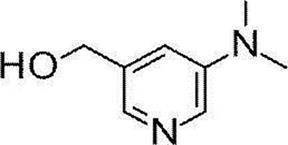
5-(ジメチルアミノ)ピリジン-3-カルボン酸 メチルエステル(0.10g、0.56mmol)にテトラヒドロフラン(5.6mL)を加えて溶解させ、0℃で2mol/L水素化ホウ素リチウム(テトラヒドロフラン溶液、2mL、4mmol)を加えた。2時間攪拌した後、23℃に昇温してさらに一晩攪拌した。ゆっくりと1mol/L塩酸を加え、硫酸ナトリウムにて乾燥、乾燥剤を濾別し、減圧濃縮して標題化合物の粗生成物を得た。
MS (ESI) m/z 153 (M+H)+
Tetrahydrofuran (5.6 mL) was added to 5- (dimethylamino) pyridine-3-carboxylic acid methyl ester (0.10 g, 0.56 mmol) and dissolved, and 2 mol / L lithium borohydride (tetrahydrofuran solution, 2 mL, 4 mmol) was added. After stirring for 2 hours, the temperature was raised to 23 ° C., and the mixture was further stirred overnight. Slowly, 1 mol / L hydrochloric acid was added, dried over sodium sulfate, the desiccant was filtered off, and concentrated under reduced pressure to obtain a crude product of the title compound.
MS (ESI) m / z 153 (M + H) +
参考例E-4:6-メチル-2-[5-トリフルオロメチル]-2-ピリジル-1,3,6,2-ジオキサアザボロカン-4,8-ジオン(E-4)の合成Reference Example E-4: Synthesis of 6-methyl-2- [5-trifluoromethyl] -2-pyridyl-1,3,6,2-dioxaazaborocan-4,8-dione (E-4)

2-ブロモ-5-トリフルオロメチルピリジン(7.79g、34.4mmol)及びボロン酸トリイソプロピル(9.6mL、40mmol)にテトラヒドロフラン(100mL)を加え、-78℃に冷却し、2.5mol/L n-ブチルリチウム(ヘキサン溶液、13.8mL、34.4mmol)を滴下した。-78℃で1時間攪拌した後、23℃に昇温してさらに3時間攪拌した。N-メチルイミノジ酢酸(8.61g、58.5mmol)のジメチルスルホキシド(68mL)溶液を別途調製し、滴下漏斗及び蒸留装置を接続した三口フラスコに入れ、内温が115℃になるように加熱した。先の反応混合物を滴下漏斗に移し、内温が110~120℃になるよう添加速度を調節しながら、約一時間かけて滴下した。その際、テトラヒドロフランは速やかに留去された。滴下が終了した後、温度を50℃に下げ、ジメチルスルホキシドを減圧留去した(250mTorr)。残渣をジエチルエーテルで洗浄して得られた固体を減圧乾燥して標題化合物(3.43g、11.4mmol、33%)を得た。
MS (ESI) m/z 303 (M+H)+
1H NMR (400 MHz, CD3OD): δ 8.92 (s, 1H), 8.17 (dd, J = 8.0, 1.6 Hz, 1H), 7.65 (d, J = 8.0 Hz, 1H), 4.13 (s, 2H), 4.12 (s, 2H), 3.00 (s, 3H).
Tetrahydrofuran (100 mL) was added to 2-bromo-5-trifluoromethylpyridine (7.79 g, 34.4 mmol) and triisopropyl boronate (9.6 mL, 40 mmol), cooled to −78 ° C., and 2.5 mol / L n-butyllithium (hexane solution, 13.8 mL, 34.4 mmol) was added dropwise. After stirring at −78 ° C. for 1 hour, the temperature was raised to 23 ° C. and stirring was continued for 3 hours. A dimethyl sulfoxide (68 mL) solution of N-methyliminodiacetic acid (8.61 g, 58.5 mmol) was separately prepared, put into a three-necked flask connected with a dropping funnel and a distillation apparatus, and heated so that the internal temperature became 115 ° C. The previous reaction mixture was transferred to a dropping funnel and dropped over about 1 hour while adjusting the addition rate so that the internal temperature became 110 to 120 ° C. At that time, tetrahydrofuran was rapidly distilled off. After completion of the dropping, the temperature was lowered to 50 ° C., and dimethyl sulfoxide was distilled off under reduced pressure (250 mTorr). The residue was washed with diethyl ether and the resulting solid was dried under reduced pressure to give the title compound (3.43 g, 11.4 mmol, 33%).
MS (ESI) m / z 303 (M + H) +
1 H NMR (400 MHz, CD 3 OD): δ 8.92 (s, 1H), 8.17 (dd, J = 8.0, 1.6 Hz, 1H), 7.65 (d, J = 8.0 Hz, 1H), 4.13 (s, 2H), 4.12 (s, 2H), 3.00 ( s, 3H).
実施例1:(2S)-1-(ベンゾフラン-2-イルスルホニル)-N-[[3-[(4-シアノフェニル)メトキシ]フェニル]メチル]ピロリジン-2-カルボキサミド(1)の合成
C-1(40mg、0.10mmol)、4-ヒドロキシベンゾニトリル(20mg、0.15mmol)のジクロロメタン(1.5mL)溶液にトリフェニルホスフィン(52mg、0.20mmol)及びアゾジカルボン酸ジイソプロピル(0.039mL、0.20mmol)を加え、室温で一晩攪拌した。反応混合物を減圧濃縮して得られた残渣を高速液体クロマトグラフィー(水-アセトニトリル、それぞれ0.1%トリフルオロ酢酸入り)にて精製して標題化合物(40mg、0.077mmol、77%)を得た。
MS (ESI) m/z 516 (M+H)+
1H NMR (400 MHz, DMSO-d6) δ 8.65 (t, J= 6.0 Hz, 1H), 7.89 - 7.80 (m, 3H), 7.75 (dt, J = 8.5, 0.8, 0.8 Hz, 1H), 7.72 (d, J = 0.9 Hz, 1H), 7.62 (dt, J = 8.2, 1.4, 1.3 Hz, 2H), 7.56 (ddd, J = 8.5, 7.3, 1.3 Hz, 1H), 7.42 (ddd, J = 8.0, 7.2, 0.9 Hz, 1H), 7.24 (dd, J = 7.9, 7.9 Hz, 1H), 6.96 (dd, J = 2.0, 2.0 Hz, 1H), 6.91 - 6.85 (m, 2H), 5.21 (s, 2H), 4.37 - 4.20 (m, 3H), 3.64 - 3.55 (m, 2H), 1.96 - 1.79 (m, 3H), 1.68 - 1.58 (m, 1H).
Example 1: Synthesis of (2S) -1- (benzofuran-2-ylsulfonyl) -N-[[3-[(4-cyanophenyl) methoxy] phenyl] methyl] pyrrolidine-2-carboxamide (1) C- 1 (40 mg, 0.10 mmol), 4-hydroxybenzonitrile (20 mg, 0.15 mmol) in dichloromethane (1.5 mL) in triphenylphosphine (52 mg, 0.20 mmol) and diisopropyl azodicarboxylate (0.039 mL, 0.20 mmol) was added and stirred at room temperature overnight. The residue obtained by concentrating the reaction mixture under reduced pressure was purified by high performance liquid chromatography (water-acetonitrile, each containing 0.1% trifluoroacetic acid) to give the title compound (40 mg, 0.077 mmol, 77%). It was.
MS (ESI) m / z 516 (M + H) +
1 H NMR (400 MHz, DMSO-d 6 ) δ 8.65 (t, J = 6.0 Hz, 1H), 7.89-7.80 (m, 3H), 7.75 (dt, J = 8.5, 0.8, 0.8 Hz, 1H), 7.72 (d, J = 0.9 Hz, 1H), 7.62 (dt, J = 8.2, 1.4, 1.3 Hz, 2H), 7.56 (ddd, J = 8.5, 7.3, 1.3 Hz, 1H), 7.42 (ddd, J = 8.0, 7.2, 0.9 Hz, 1H), 7.24 (dd, J = 7.9, 7.9 Hz, 1H), 6.96 (dd, J = 2.0, 2.0 Hz, 1H), 6.91-6.85 (m, 2H), 5.21 (s , 2H), 4.37-4.20 (m, 3H), 3.64-3.55 (m, 2H), 1.96-1.79 (m, 3H), 1.68-1.58 (m, 1H).
表20記載の実施例2~実施例36は、参考例記載の化合物および対応する市販の試薬を用い実施例1と同様の操作により合成した。 Examples 2 to 36 described in Table 20 were synthesized by the same operations as in Example 1 using the compounds described in Reference Examples and the corresponding commercially available reagents.

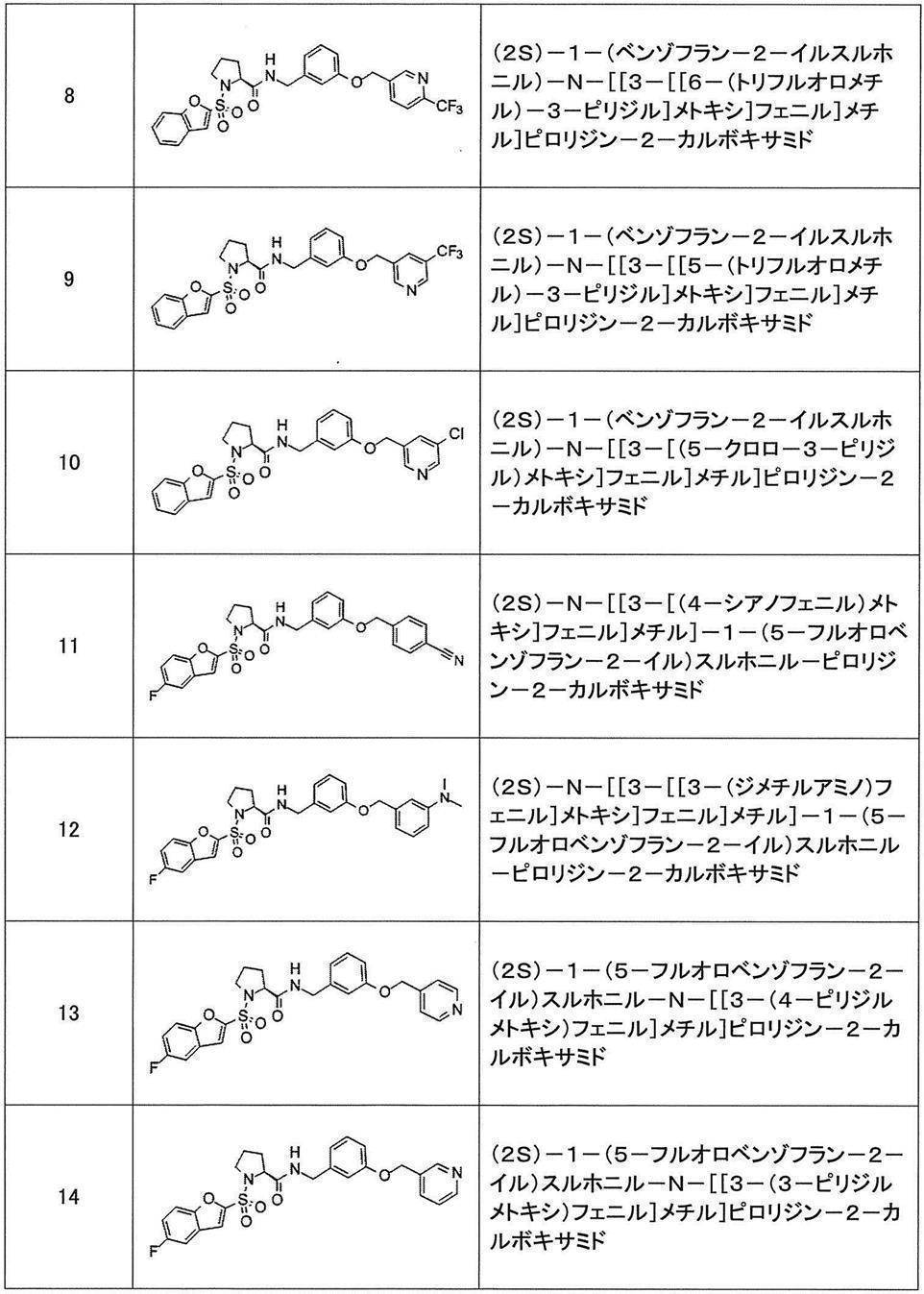

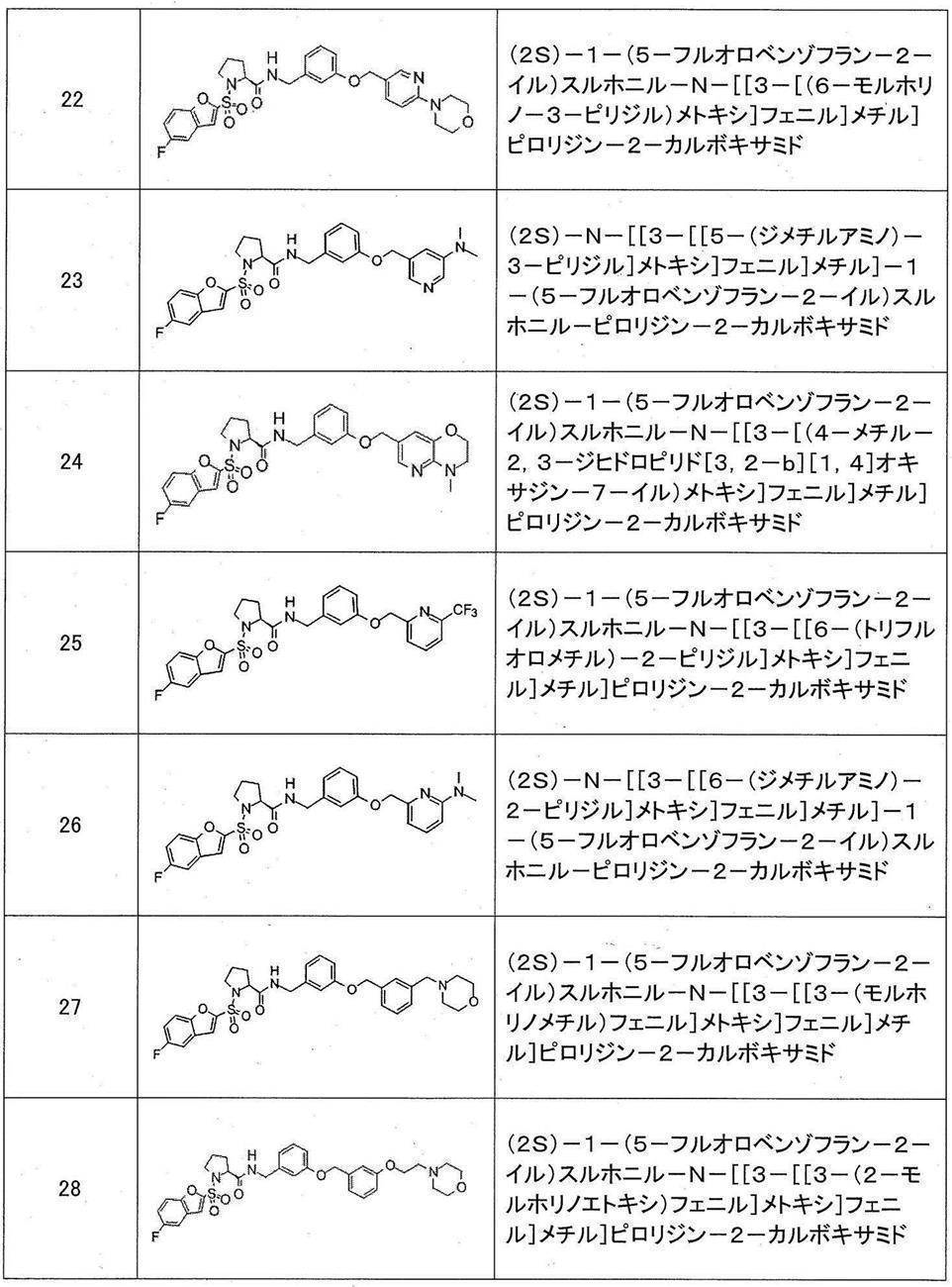
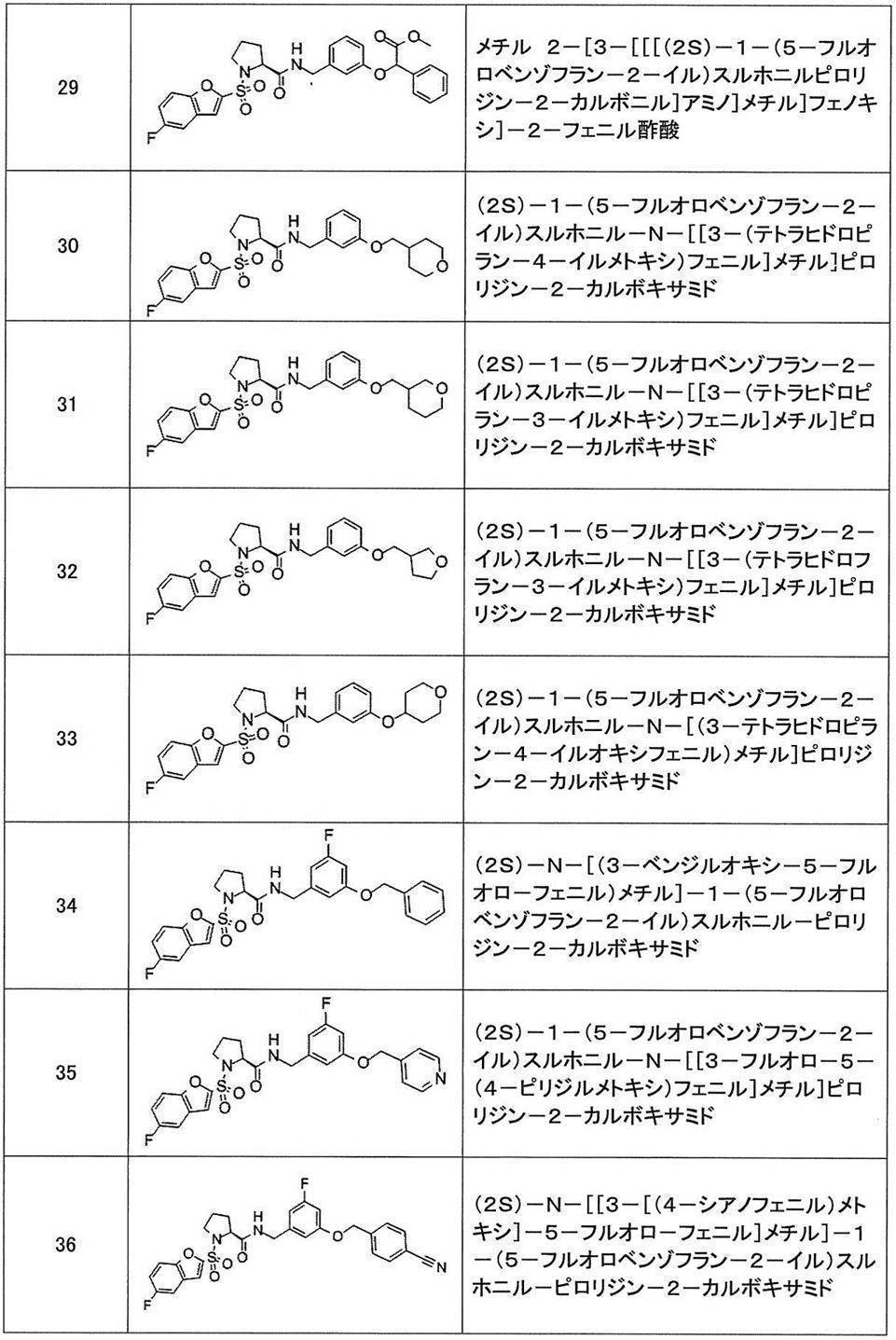
実施例37:(2S)-1-(ベンゾフラン-2-イルスルホニル)-N-[(3-ベンジルオキシフェニル)メチル]ピロリジン-2-カルボキサミド(37)の合成
B-1(2.00g、6.76mmol)、D-1(1.69g、6.76mmol)、WSC塩酸塩(1.43g、7.44mmol)及び1-ヒドロキシ-7-アザベンゾトリアゾール(0.92g、6.76mmol)にジクロロメタン(35mL)とトリエチルアミン(1.23mL、9.80mmol)を加え室温で一晩攪拌した。反応液に水を加え、ジクロロメタンで抽出した。有機層を硫酸ナトリウムにて乾燥した後、乾燥剤を濾別し、溶媒を留去して得られた残渣を高速液体クロマトグラフィー(水-アセトニトリル、それぞれ0.1%トリフルオロ酢酸入り)にて精製して標題化合物(2.25g、4.597mmol、69%)を得た。
MS (ESI) m/z 491 (M+H)+
1H NMR (400 MHz, DMSO-d6) δ 8.65 (t, J = 6.1 Hz, 1H), 7.83 (ddd, J = 7.9, 1.4, 0.8 Hz, 1H), 7.75 (dd, J = 8.4, 0.9 Hz, 1H), 7.71 (d, J = 0.9 Hz, 1H), 7.55 (ddd, J = 8.5, 7.2, 1.3 Hz, 1H), 7.47 - 7.28 (m, 6H), 7.23 (dd, J = 8.2, 7.5 Hz, 1H), 6.99 - 6.94 (m, 1H), 6.91 - 6.83 (m, 2H), 5.09 (s, 2H), 4.38 - 4.20 (m, 3H), 3.64 - 3.55 (m, 1H), 3.44 - 3.35 (m, 1H), 1.97 - 1.80 (m, 3H), 1.70 - 1.57 (m, 1H).
Example 37: Synthesis of (2S) -1- (benzofuran-2-ylsulfonyl) -N-[(3-benzyloxyphenyl) methyl] pyrrolidine-2-carboxamide (37) B-1 (2.00 g, 6 .76 mmol), D-1 (1.69 g, 6.76 mmol), WSC hydrochloride (1.43 g, 7.44 mmol) and 1-hydroxy-7-azabenzotriazole (0.92 g, 6.76 mmol) in dichloromethane. (35 mL) and triethylamine (1.23 mL, 9.80 mmol) were added and stirred at room temperature overnight. Water was added to the reaction mixture, and the mixture was extracted with dichloromethane. After drying the organic layer with sodium sulfate, the desiccant was filtered off and the solvent was distilled off. The resulting residue was subjected to high performance liquid chromatography (water-acetonitrile, each containing 0.1% trifluoroacetic acid). Purification gave the title compound (2.25 g, 4.597 mmol, 69%).
MS (ESI) m / z 491 (M + H) +
1 H NMR (400 MHz, DMSO-d 6 ) δ 8.65 (t, J = 6.1 Hz, 1H), 7.83 (ddd, J = 7.9, 1.4, 0.8 Hz, 1H), 7.75 (dd, J = 8.4, 0.9 Hz, 1H), 7.71 (d, J = 0.9 Hz, 1H), 7.55 (ddd, J = 8.5, 7.2, 1.3 Hz, 1H), 7.47-7.28 (m, 6H), 7.23 (dd, J = 8.2, 7.5 Hz, 1H), 6.99-6.94 (m, 1H), 6.91-6.83 (m, 2H), 5.09 (s, 2H), 4.38-4.20 (m, 3H), 3.64-3.55 (m, 1H), 3.44 -3.35 (m, 1H), 1.97-1.80 (m, 3H), 1.70-1.57 (m, 1H).
実施例84:(2S)-1-(ベンゾフラン-2-イルスルホニル)-N-[[6-[4-(トリフルオロメチル)フェニル]ピリミジン-4-イル]メチル]ピロリジン-2-カルボキサミド(84)の合成
B-1(30mg、0.10mmol)、D-16(25mg、0.10mmol)、WSC塩酸塩(38mg、0.20mmol)及び1-ヒドロキシ-7-アザベンゾトリアゾール(27mg、0.20mmol)にジクロロメタン(1mL)とトリエチルアミン(42μL、0.30mmol)を加え室温で一晩攪拌した。溶媒を留去して得られた残渣を高速液体クロマトグラフィー(水-アセトニトリル、それぞれ0.1%トリフルオロ酢酸入り)にて精製して標題化合物のトリフルオロ酢酸塩(34mg、0.064mmol、64%)を得た。
MS (ESI) m/z 531 (M+H)+
1H NMR (400 MHz, DMSO-d6) δ 9.25 (d, J = 1.3 Hz, 1H), 8.99 (dd, J = 6.2, 5.7 Hz, 1H), 8.40 (d, J = 8.2 Hz, 2H), 8.06 (d, J = 1.3 Hz, 1H), 7.92 (d, J = 8.2 Hz, 2H), 7.85 (ddd, J = 7.8, 1.3, 1.0 Hz, 1H), 7.80 (d, J = 1.0 Hz, 1H), 7.76 (dd, J = 8.4, 1.0 Hz, 1H), 7.57 (ddd, J = 8.4, 7.4, 1.3 Hz, 1H), 7.43 (ddd, J = 7.8, 7.4, 1.0 Hz, 1H), 4.56 (dd, J = 17.3, 6.2 Hz, 1H), 4.45 (dd, J = 17.3, 5.7 Hz, 1H), 4.38 (dd, J = 8.2, 3.8 Hz, 1H), 3.69 - 3.60 (m, 1H), 3.49 - 3.39 (m, 1H), 2.10 - 1.87 (m, 3H), 1.74 - 1.62 (m, 1H).
Example 84: (2S) -1- (benzofuran-2-ylsulfonyl) -N-[[6- [4- (trifluoromethyl) phenyl] pyrimidin-4-yl] methyl] pyrrolidine-2-carboxamide (84 ) Synthesis B-1 (30 mg, 0.10 mmol), D-16 (25 mg, 0.10 mmol), WSC hydrochloride (38 mg, 0.20 mmol) and 1-hydroxy-7-azabenzotriazole (27 mg, 0.2 mg). 20 mmol) was added dichloromethane (1 mL) and triethylamine (42 μL, 0.30 mmol), and the mixture was stirred overnight at room temperature. The residue obtained by distilling off the solvent was purified by high performance liquid chromatography (water-acetonitrile, each containing 0.1% trifluoroacetic acid) to give the trifluoroacetate salt of the title compound (34 mg, 0.064 mmol, 64 %).
MS (ESI) m / z 531 (M + H) +
1 H NMR (400 MHz, DMSO-d 6 ) δ 9.25 (d, J = 1.3 Hz, 1H), 8.99 (dd, J = 6.2, 5.7 Hz, 1H), 8.40 (d, J = 8.2 Hz, 2H) , 8.06 (d, J = 1.3 Hz, 1H), 7.92 (d, J = 8.2 Hz, 2H), 7.85 (ddd, J = 7.8, 1.3, 1.0 Hz, 1H), 7.80 (d, J = 1.0 Hz, 1H), 7.76 (dd, J = 8.4, 1.0 Hz, 1H), 7.57 (ddd, J = 8.4, 7.4, 1.3 Hz, 1H), 7.43 (ddd, J = 7.8, 7.4, 1.0 Hz, 1H), 4.56 (dd, J = 17.3, 6.2 Hz, 1H), 4.45 (dd, J = 17.3, 5.7 Hz, 1H), 4.38 (dd, J = 8.2, 3.8 Hz, 1H), 3.69-3.60 (m, 1H), 3.49-3.39 (m, 1H), 2.10-1.87 (m, 3H), 1.74-1.62 (m, 1H).
実施例104:(2S)-2-(ベンゾフラン-2-イルスルホニルアミノ)-N-[[6-[4-(トリフルオロメチル)フェニル]ピリミジン-4-イル]メチル]プロパンアミド(104)の合成
B-15(16mg、0.059mmol)、D-16(15mg、0.059mmol)、WSC塩酸塩(14mg、0.071mmol)及び1-ヒドロキシ-7-アザベンゾトリアゾール(8mg、0.06mmol)にジクロロメタン(2mL)とトリエチルアミン(0.012mL、0.089mmol)を加え室温で一晩攪拌した。反応液を減圧濃縮して得られた残渣を高速液体クロマトグラフィー(水-アセトニトリル、それぞれ0.1%トリフルオロ酢酸入り)にて精製して標題化合物のトリフルオロ酢酸塩(19mg、0.030mmol、51%)を得た。
MS (ESI) m/z 505 (M+H)+
1H NMR (400 MHz, DMSO-d6) δ 9.21 (d, J = 1.3 Hz, 1H), 8.89 (d, J = 7.8 Hz, 1H), 8.75 (dd, J = 6.0, 5.9 Hz, 1H), 8.36 (d, J = 8.1 Hz, 2H), 7.95 (d, J = 1.3 Hz, 1H), 7.93 (d, J = 8.1 Hz, 2H), 7.73 (ddd, J = 7.9, 1.3, 1.0 Hz, 1H), 7.65 (dd, J = 8.5, 0.9 Hz, 1H), 7.55 (d, J = 1.0 Hz, 1H), 7.49 (ddd, J = 8.5, 7.2, 1.3 Hz, 1H), 7.35 (ddd, J = 7.9, 7.2, 0.9 Hz, 1H), 4.39 (dd, J = 17.2, 5.9 Hz, 1H), 4.33 (dd, J = 17.2, 6.0 Hz, 1H), 4.10 (dq, J = 7.8, 7.1 Hz, 1H), 1.25 (d, J = 7.1 Hz, 3H).
Example 104: (2S) -2- (Benzofuran-2-ylsulfonylamino) -N-[[6- [4- (trifluoromethyl) phenyl] pyrimidin-4-yl] methyl] propanamide (104) Synthesis B-15 (16 mg, 0.059 mmol), D-16 (15 mg, 0.059 mmol), WSC hydrochloride (14 mg, 0.071 mmol) and 1-hydroxy-7-azabenzotriazole (8 mg, 0.06 mmol) Were added dichloromethane (2 mL) and triethylamine (0.012 mL, 0.089 mmol), and the mixture was stirred overnight at room temperature. The residue obtained by concentrating the reaction solution under reduced pressure was purified by high performance liquid chromatography (water-acetonitrile, each containing 0.1% trifluoroacetic acid) to give the trifluoroacetate salt of the title compound (19 mg, 0.030 mmol, 51%).
MS (ESI) m / z 505 (M + H) +
1 H NMR (400 MHz, DMSO-d 6 ) δ 9.21 (d, J = 1.3 Hz, 1H), 8.89 (d, J = 7.8 Hz, 1H), 8.75 (dd, J = 6.0, 5.9 Hz, 1H) , 8.36 (d, J = 8.1 Hz, 2H), 7.95 (d, J = 1.3 Hz, 1H), 7.93 (d, J = 8.1 Hz, 2H), 7.73 (ddd, J = 7.9, 1.3, 1.0 Hz, 1H), 7.65 (dd, J = 8.5, 0.9 Hz, 1H), 7.55 (d, J = 1.0 Hz, 1H), 7.49 (ddd, J = 8.5, 7.2, 1.3 Hz, 1H), 7.35 (ddd, J = 7.9, 7.2, 0.9 Hz, 1H), 4.39 (dd, J = 17.2, 5.9 Hz, 1H), 4.33 (dd, J = 17.2, 6.0 Hz, 1H), 4.10 (dq, J = 7.8, 7.1 Hz, 1H), 1.25 (d, J = 7.1 Hz, 3H).
実施例109:(2S)-2-[(5-フルオロベンゾフラン-2-イル)スルホニルアミノ]-N-[[6-[4-(トリフルオロメチル)フェニル]ピリミジン-4-イル]メチル]プロパンアミド(109)の合成
B-16(20mg、0.070mmol)、D-16(18mg、0.070mmol)、WSC塩酸塩(16mg、0.084mmol)及び1-ヒドロキシ-7-アザベンゾトリアゾール(9mg、0.07mmol)にジクロロメタン(2mL)とトリエチルアミン(0.015mL、0.11mmol)を加え室温で一晩攪拌した。反応液を減圧濃縮して得られた残渣を高速液体クロマトグラフィー(水-アセトニトリル、それぞれ0.1%トリフルオロ酢酸入り)にて精製して標題化合物のトリフルオロ酢酸塩(28mg、0.043mmol、62%)を得た。
MS (ESI) m/z 523 (M+H)+
1H NMR (400 MHz, DMSO-d6) δ 9.21 (d, J = 1.3 Hz, 1H), 8.95 (d, J = 7.8 Hz, 1H), 8.76 (t, J = 5.9 Hz, 1H), 8.35 (d, J = 8.2 Hz, 2H), 7.99 - 7.89 (m, 3H), 7.70 (dd, J = 9.1, 4.0 Hz, 1H), 7.57 - 7.48 (m, 2H), 7.34 (ddd, J = 9.3, 9.1, 2.8 Hz, 1H), 4.44 - 4.28 (m, 2H), 4.11 (dq, J = 7.8, 7.1 Hz, 1H), 1.26 (d, J = 7.1 Hz, 3H).
Example 109: (2S) -2-[(5-Fluorobenzofuran-2-yl) sulfonylamino] -N-[[6- [4- (trifluoromethyl) phenyl] pyrimidin-4-yl] methyl] propane Synthesis of Amide (109) B-16 (20 mg, 0.070 mmol), D-16 (18 mg, 0.070 mmol), WSC hydrochloride (16 mg, 0.084 mmol) and 1-hydroxy-7-azabenzotriazole (9 mg 0.07 mmol) was added dichloromethane (2 mL) and triethylamine (0.015 mL, 0.11 mmol) and stirred at room temperature overnight. The reaction solution was concentrated under reduced pressure, and the resulting residue was purified by high performance liquid chromatography (water-acetonitrile, each containing 0.1% trifluoroacetic acid) to give the title compound trifluoroacetate (28 mg, 0.043 mmol, 62%).
MS (ESI) m / z 523 (M + H) +
1 H NMR (400 MHz, DMSO-d 6 ) δ 9.21 (d, J = 1.3 Hz, 1H), 8.95 (d, J = 7.8 Hz, 1H), 8.76 (t, J = 5.9 Hz, 1H), 8.35 (d, J = 8.2 Hz, 2H), 7.99-7.89 (m, 3H), 7.70 (dd, J = 9.1, 4.0 Hz, 1H), 7.57-7.48 (m, 2H), 7.34 (ddd, J = 9.3 , 9.1, 2.8 Hz, 1H), 4.44-4.28 (m, 2H), 4.11 (dq, J = 7.8, 7.1 Hz, 1H), 1.26 (d, J = 7.1 Hz, 3H).
表21記載の実施例38~実施例74、実施例76~実施例80、実施例84、実施例86~実施例103、実施例105~実施例108及び実施例110~実施例111は、参考例記載の化合物および対応する市販の試薬を用い実施例37と同様の操作により合成した。 Example 38 to Example 74, Example 76 to Example 80, Example 84, Example 86 to Example 103, Example 105 to Example 108 and Example 110 to Example 111 listed in Table 21 are for reference. Synthesis was performed in the same manner as in Example 37 using the compounds described in the examples and the corresponding commercially available reagents.
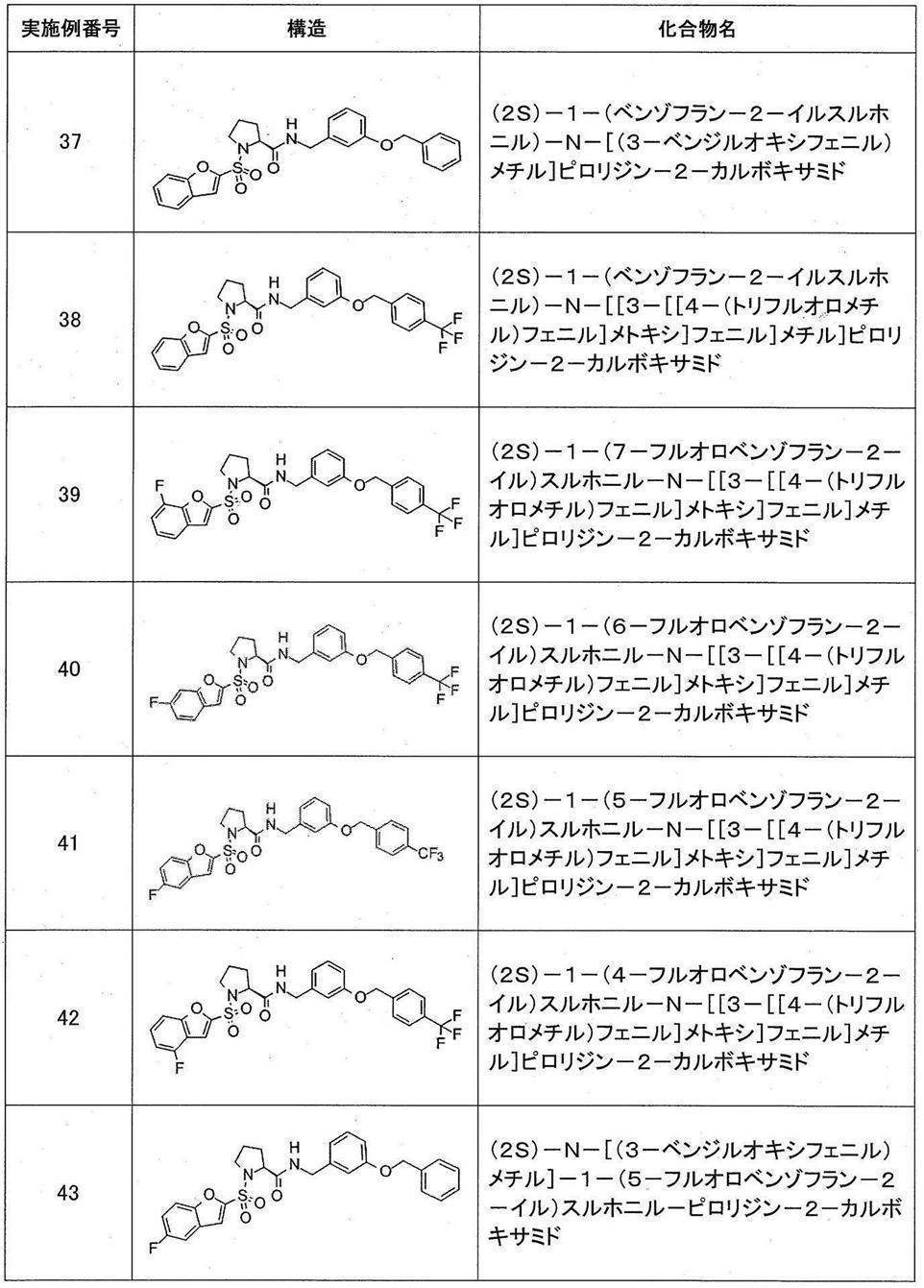


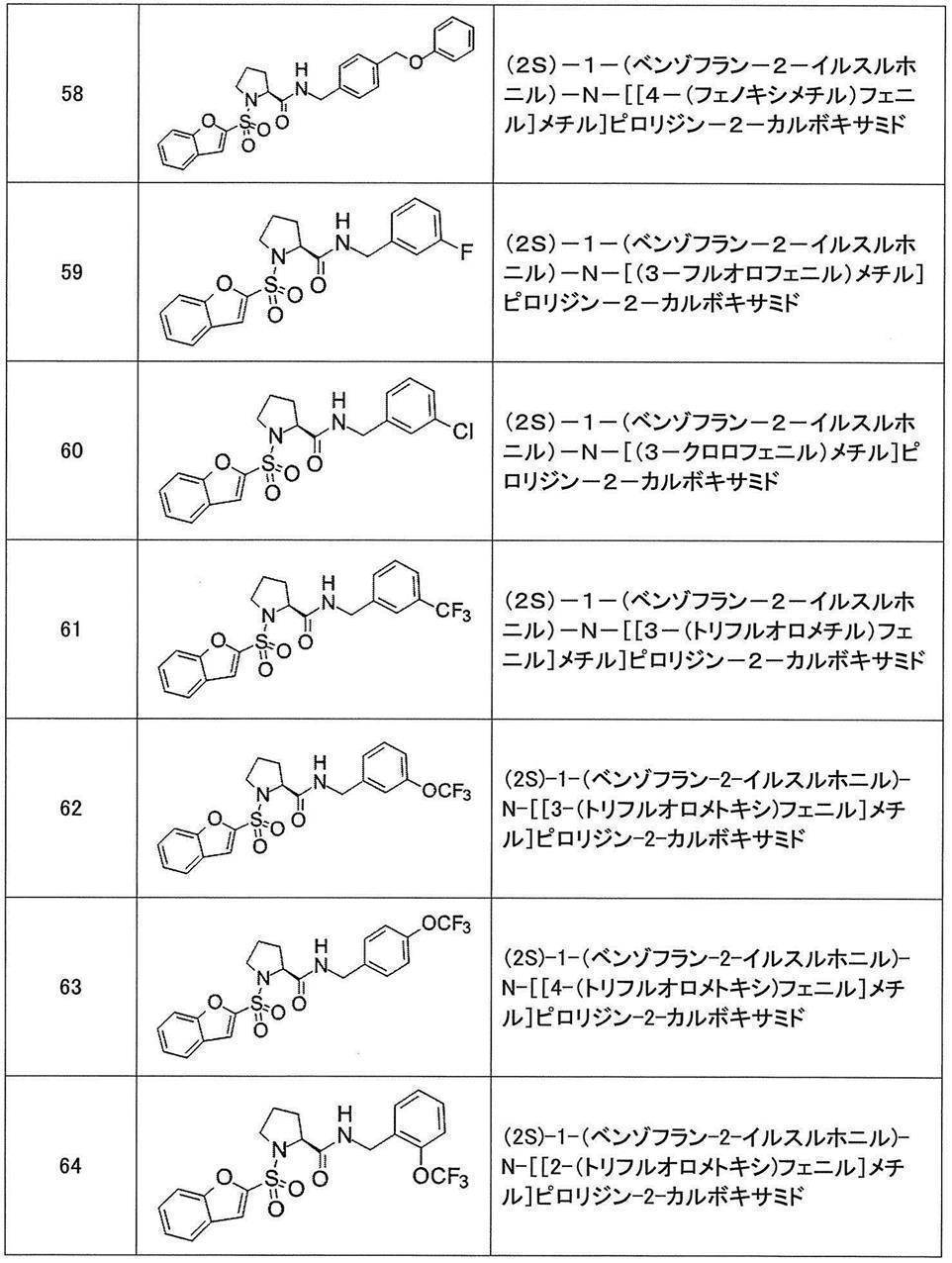
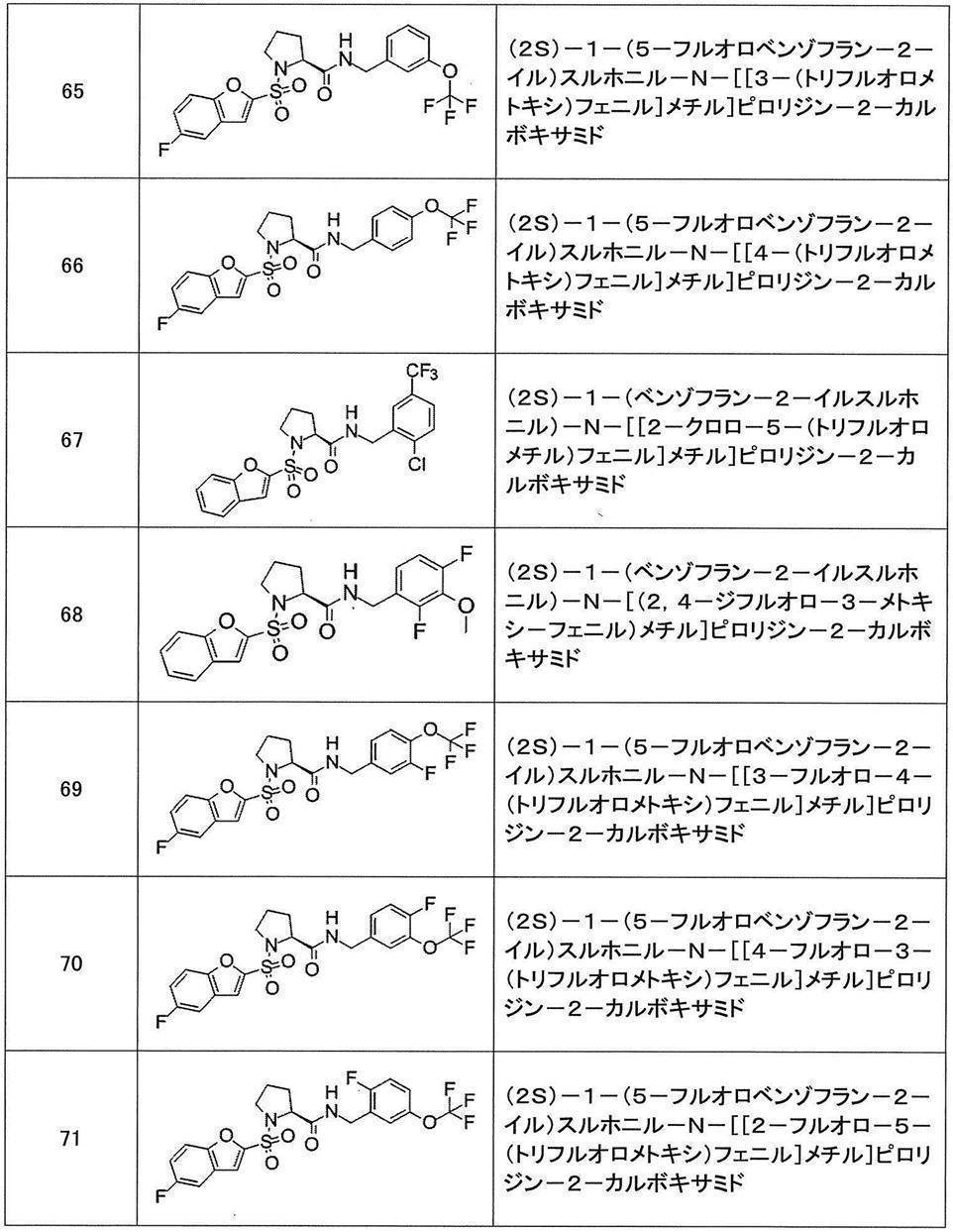


実施例112:(2S)-1-(ベンゾフラン-2-イルスルホニル)-N-[(2-フェニル-4-ピリジル)メチル]ピロリジン-2-カルボキサミド(112)の合成
C-4(30mg、0.072mmol)、フェニルボロン酸(17mg、0.14mmol)及び1,1’-ビス(ジフェニルホスフィノ)フェロセンジクロロパラジウム(II)(5mg,0.007mmol)に1,4-ジオキサン(1mL)及び1mol/L炭酸ナトリウム水溶液(1mL)を加え、マイクロウェーブ反応装置を用いて100℃で10分間加熱攪拌した。反応液にアセトニトリル(2mL)を加え、有機層を取り出して減圧濃縮して得られた残渣を高速液体クロマトグラフィー(水-アセトニトリル、それぞれ0.1%トリフルオロ酢酸入り)にて精製して標題化合物のトリフルオロ酢酸塩(40mg、0.069mmol、96%)を得た。
MS (ESI) m/z 462 (M+H)+
1H NMR (400 MHz, DMSO-d6) δ 8.90 (dd, J= 5.9, 5.8 Hz, 1H), 8.66 (d, J= 5.2 Hz, 1H), 8.07 (ddd, J = 8.0, 1.4, 1.4 Hz, 2H), 7.98 - 7.91 (m, 1H), 7.88 - 7.81 (m, 1H), 7.79 - 7.73 (m, 2H), 7.60 - 7.33 (m, 6H), 4.52 (dd, J= 16.7, 5.9 Hz, 1H), 4.43 (dd, J= 16.7, 5.8 Hz, 1H), 4.34 (dd, J= 8.3, 3.7 Hz, 1H), 3.67 - 3.59 (m, 1H), 3.47 - 3.37 (m, 1H), 2.06 - 1.83 (m, 3H), 1.71 - 1.60 (m, 1H).
Example 112: Synthesis of (2S) -1- (benzofuran-2-ylsulfonyl) -N-[(2-phenyl-4-pyridyl) methyl] pyrrolidine-2-carboxamide (112) C-4 (30 mg, 0 .072 mmol), phenylboronic acid (17 mg, 0.14 mmol) and 1,1′-bis (diphenylphosphino) ferrocenedichloropalladium (II) (5 mg, 0.007 mmol) in 1,4-dioxane (1 mL) and 1 mol / L Sodium carbonate aqueous solution (1 mL) was added, and the mixture was heated and stirred at 100 ° C. for 10 minutes using a microwave reactor. Acetonitrile (2 mL) was added to the reaction mixture, the organic layer was taken out and concentrated under reduced pressure. The resulting residue was purified by high performance liquid chromatography (water-acetonitrile, each containing 0.1% trifluoroacetic acid) to give the title compound. Of trifluoroacetate (40 mg, 0.069 mmol, 96%).
MS (ESI) m / z 462 (M + H) +
1 H NMR (400 MHz, DMSO-d 6 ) δ 8.90 (dd, J = 5.9, 5.8 Hz, 1H), 8.66 (d, J = 5.2 Hz, 1H), 8.07 (ddd, J = 8.0, 1.4, 1.4 Hz, 2H), 7.98-7.91 (m, 1H), 7.88-7.81 (m, 1H), 7.79-7.73 (m, 2H), 7.60-7.33 (m, 6H), 4.52 (dd, J = 16.7, 5.9 Hz, 1H), 4.43 (dd, J = 16.7, 5.8 Hz, 1H), 4.34 (dd, J = 8.3, 3.7 Hz, 1H), 3.67-3.59 (m, 1H), 3.47-3.37 (m, 1H) , 2.06-1.83 (m, 3H), 1.71-1.60 (m, 1H).
実施例117:(2S)-1-(ベンゾフラン-2-イルスルホニル)-N-[[2-(4-シアノフェニル)-4-ピリジル]メチル]ピロリジン-2-カルボキサミド(117)の合成
C-4(42mg、0.10mmol)、4-シアノフェニルボロン酸(29mg、0.20mmol)及び1,1’-ビス(ジフェニルホスフィノ)フェロセンジクロロパラジウム(II)(7.3mg、0.010mmol)に1,4-ジオキサン(1mL)及び1mol/L炭酸ナトリウム水溶液(1mL)を加え、マイクロウェーブ反応装置を用いて100℃で10分間加熱攪拌した。反応液を減圧濃縮して得られた残渣を高速液体クロマトグラフィー(水-アセトニトリル、それぞれ0.1%トリフルオロ酢酸入り)にて精製して標題化合物のトリフルオロ酢酸塩(38mg、0.069mmol、96%)を得た。
MS (ESI) m/z 487 (M+H)+
1H NMR (400 MHz, DMSO-d6) δ 8.89 (dd, J = 6.2, 5.8 Hz, 1H), 8.67 (d, J = 5.2 Hz, 1H), 8.31 - 8.24 (m, 2H), 8.03 - 7.93 (m, 3H), 7.88 - 7.82 (m, 1H), 7.79 - 7.72 (m, 2H), 7.57 (ddd, J = 8.3, 7.4, 1.4 Hz, 1H), 7.47 - 7.40 (m, 1H), 7.39 - 7.33 (m, 1H), 4.50 (dd, J = 16.5, 6.2 Hz, 1H), 4.41 (dd, J = 16.5, 5.8 Hz, 1H), 4.33 (dd, J = 8.3, 3.7 Hz, 1H), 3.67 - 3.58 (m, 1H), 3.51 - 3.45 (m, 1H), 2.05 - 1.84 (m, 3H), 1.73 - 1.61 (m, 1H).
Example 117: Synthesis of (2S) -1- (benzofuran-2-ylsulfonyl) -N-[[2- (4-cyanophenyl) -4-pyridyl] methyl] pyrrolidine-2-carboxamide (117) 4 (42 mg, 0.10 mmol), 4-cyanophenylboronic acid (29 mg, 0.20 mmol) and 1,1′-bis (diphenylphosphino) ferrocenedichloropalladium (II) (7.3 mg, 0.010 mmol). 1,4-Dioxane (1 mL) and 1 mol / L sodium carbonate aqueous solution (1 mL) were added, and the mixture was heated and stirred at 100 ° C. for 10 minutes using a microwave reactor. The residue obtained by concentrating the reaction solution under reduced pressure was purified by high performance liquid chromatography (water-acetonitrile, each containing 0.1% trifluoroacetic acid) to give the trifluoroacetate salt of the title compound (38 mg, 0.069 mmol, 96%).
MS (ESI) m / z 487 (M + H) +
1 H NMR (400 MHz, DMSO-d 6 ) δ 8.89 (dd, J = 6.2, 5.8 Hz, 1H), 8.67 (d, J = 5.2 Hz, 1H), 8.31-8.24 (m, 2H), 8.03- 7.93 (m, 3H), 7.88-7.82 (m, 1H), 7.79-7.72 (m, 2H), 7.57 (ddd, J = 8.3, 7.4, 1.4 Hz, 1H), 7.47-7.40 (m, 1H), 7.39-7.33 (m, 1H), 4.50 (dd, J = 16.5, 6.2 Hz, 1H), 4.41 (dd, J = 16.5, 5.8 Hz, 1H), 4.33 (dd, J = 8.3, 3.7 Hz, 1H) , 3.67-3.58 (m, 1H), 3.51-3.45 (m, 1H), 2.05-1.84 (m, 3H), 1.73-1.61 (m, 1H).
実施例123:(2S)-1-(ベンゾフラン-2-イルスルホニル)-N-[[2-[2-ヒドロキシ-4-(トリフルオロメチル)フェニル]-4-ピリジル]メチル]ピロリジン-2-カルボキサミド(123)の合成
C-4(21mg、0.050mmol)、2-ヒドロキシ-4-トリフルオロメチルフェニルボロン酸(21mg、0.10mmol)及び1,1’-ビス(ジフェニルホスフィノ)フェロセンジクロロパラジウム(II)(4mg,0.005mmol)に1,4-ジオキサン(0.7mL)及び1mol/L炭酸ナトリウム水溶液(0.7mL)を加え、マイクロウェーブ反応装置を用いて120℃で20分間加熱攪拌した。反応液にトリフルオロ酢酸を加えて中和した後、高速液体クロマトグラフィー(水-アセトニトリル、それぞれ0.1%トリフルオロ酢酸入り)にて精製して標題化合物のトリフルオロ酢酸塩(24mg、0.036mmol、72%)を得た。
MS (ESI) m/z 546 (M+H)+
1H NMR (400 MHz, DMSO-d6) δ 14.67 (brs, 1H), 8.93 (dd, J = 6.3, 5.9 Hz, 1H), 8.64 (d, J = 5.3 Hz, 1H), 8.24 (d, J = 8.2 Hz, 1H), 8.20 (s, 1H), 7.84 (d, J = 7.9 Hz, 1H), 7.78 (d, J = 0.9 Hz, 1H), 7.76 (dd, J = 8.5, 0.9 Hz, 1H), 7.57 (ddd, J = 8.5, 7.2, 1.3 Hz, 1H), 7.46 - 7.40 (m, 2H), 7.26 - 7.21 (m, 2H), 4.54 (dd, J = 16.7, 6.3 Hz, 1H), 4.45 (dd, J = 16.7, 5.9 Hz, 1H), 4.34 (dd, J = 8.3, 3.8 Hz, 1H), 3.67 - 3.59 (m, 1H), 3.45 - 3.41 (m, 1H), 2.07 - 1.85 (m, 3H), 1.72 - 1.61 (m, 1H).
Example 123: (2S) -1- (benzofuran-2-ylsulfonyl) -N-[[2- [2-hydroxy-4- (trifluoromethyl) phenyl] -4-pyridyl] methyl] pyrrolidine-2- Synthesis of carboxamide (123) C-4 (21 mg, 0.050 mmol), 2-hydroxy-4-trifluoromethylphenylboronic acid (21 mg, 0.10 mmol) and 1,1′-bis (diphenylphosphino) ferrocene dichloro 1,4-Dioxane (0.7 mL) and 1 mol / L aqueous sodium carbonate solution (0.7 mL) were added to palladium (II) (4 mg, 0.005 mmol) and heated at 120 ° C. for 20 minutes using a microwave reactor. Stir. The reaction solution was neutralized by adding trifluoroacetic acid, and then purified by high performance liquid chromatography (water-acetonitrile, each containing 0.1% trifluoroacetic acid) to give the trifluoroacetate salt of the title compound (24 mg, 0. 036 mmol, 72%).
MS (ESI) m / z 546 (M + H) +
1 H NMR (400 MHz, DMSO-d 6 ) δ 14.67 (brs, 1H), 8.93 (dd, J = 6.3, 5.9 Hz, 1H), 8.64 (d, J = 5.3 Hz, 1H), 8.24 (d, J = 8.2 Hz, 1H), 8.20 (s, 1H), 7.84 (d, J = 7.9 Hz, 1H), 7.78 (d, J = 0.9 Hz, 1H), 7.76 (dd, J = 8.5, 0.9 Hz, 1H), 7.57 (ddd, J = 8.5, 7.2, 1.3 Hz, 1H), 7.46-7.40 (m, 2H), 7.26-7.21 (m, 2H), 4.54 (dd, J = 16.7, 6.3 Hz, 1H) , 4.45 (dd, J = 16.7, 5.9 Hz, 1H), 4.34 (dd, J = 8.3, 3.8 Hz, 1H), 3.67-3.59 (m, 1H), 3.45-3.41 (m, 1H), 2.07-1.85 (m, 3H), 1.72-1.61 (m, 1H).
実施例124:(2S)-1-(ベンゾフラン-2-イルスルホニル)-N-[[2-[6-(トリフルオロメチル)-3-ピリジル]-4-ピリジル]メチル]ピロリジン-2-カルボキサミド(124)の合成
C-4(42mg、0.10mmol)、[6-(トリフルオロメチル)-3-ピリジル]ボロン酸(38mg、0.20mmol)及び1,1’-ビス(ジフェニルホスフィノ)フェロセンジクロロパラジウム(II)(7mg,0.01mmol)に1,4-ジオキサン(1mL)及び1mol/L炭酸ナトリウム水溶液(1mL)を加え、マイクロウェーブ反応装置を用いて100℃で10分間加熱攪拌した。反応液に酢酸エチルを加え、飽和食塩水で洗浄した。有機層を硫酸ナトリウムで乾燥させた後、乾燥剤を濾別し、溶媒を留去して得られた残渣を高速液体クロマトグラフィー(水-アセトニトリル、それぞれ0.1%トリフルオロ酢酸入り)にて精製して標題化合物のトリフルオロ酢酸塩(44mg、0.068mmol、68%)を得た。
MS (ESI) m/z 531 (M+H)+
1H NMR (400 MHz, DMSO-d6) δ 9.42 (d, J = 2.1 Hz, 1H), 8.90 (dd, J = 6.2, 5.9 Hz, 1H), 8.74 - 8.66 (m, 2H), 8.07 (s, 1H), 8.05 (dd, J = 8.4, 0.8 Hz, 1H), 7.84 (ddd, J = 7.9, 1.3, 0.9 Hz, 1H), 7.77 (d, J = 0.9 Hz, 1H), 7.75 (dd, J = 8.5, 1.0 Hz, 1H), 7.56 (ddd, J = 8.5, 7.3, 1.3 Hz, 1H), 7.45 - 7.39 (m, 2H), 4.52 (dd, J = 16.6, 6.2 Hz, 1H), 4.42 (dd, J = 16.6, 5.9 Hz, 1H), 4.34 (dd, J = 8.3, 3.8 Hz, 1H), 3.66 - 3.59 (m, 1H), 3.47 - 3.40 (m, 1H), 2.04 - 1.85 (m, 3H), 1.71 - 1.61 (m, 1H).
表22記載の実施例113~実施例116、実施例118~実施例122及び実施例125~実施例175は、参考例記載の化合物および対応する市販の試薬を用い実施例112と同様の操作により合成した。
Example 124: (2S) -1- (benzofuran-2-ylsulfonyl) -N-[[2- [6- (trifluoromethyl) -3-pyridyl] -4-pyridyl] methyl] pyrrolidine-2-carboxamide Synthesis of (124) C-4 (42 mg, 0.10 mmol), [6- (trifluoromethyl) -3-pyridyl] boronic acid (38 mg, 0.20 mmol) and 1,1′-bis (diphenylphosphino) 1,4-Dioxane (1 mL) and 1 mol / L aqueous sodium carbonate solution (1 mL) were added to ferrocenedichloropalladium (II) (7 mg, 0.01 mmol), and the mixture was heated and stirred at 100 ° C. for 10 minutes using a microwave reactor. . Ethyl acetate was added to the reaction mixture, and the mixture was washed with saturated brine. After drying the organic layer with sodium sulfate, the desiccant was filtered off, the solvent was distilled off, and the resulting residue was subjected to high performance liquid chromatography (water-acetonitrile, each containing 0.1% trifluoroacetic acid). Purification gave the trifluoroacetate salt of the title compound (44 mg, 0.068 mmol, 68%).
MS (ESI) m / z 531 (M + H) +
1 H NMR (400 MHz, DMSO-d 6 ) δ 9.42 (d, J = 2.1 Hz, 1H), 8.90 (dd, J = 6.2, 5.9 Hz, 1H), 8.74-8.66 (m, 2H), 8.07 ( s, 1H), 8.05 (dd, J = 8.4, 0.8 Hz, 1H), 7.84 (ddd, J = 7.9, 1.3, 0.9 Hz, 1H), 7.77 (d, J = 0.9 Hz, 1H), 7.75 (dd , J = 8.5, 1.0 Hz, 1H), 7.56 (ddd, J = 8.5, 7.3, 1.3 Hz, 1H), 7.45-7.39 (m, 2H), 4.52 (dd, J = 16.6, 6.2 Hz, 1H), 4.42 (dd, J = 16.6, 5.9 Hz, 1H), 4.34 (dd, J = 8.3, 3.8 Hz, 1H), 3.66-3.59 (m, 1H), 3.47-3.40 (m, 1H), 2.04-1.85 ( m, 3H), 1.71-1.61 (m, 1H).
Example 113 to Example 116, Example 118 to Example 122, and Example 125 to Example 175 described in Table 22 were carried out in the same manner as in Example 112 using the compounds described in Reference Examples and the corresponding commercially available reagents. Synthesized.
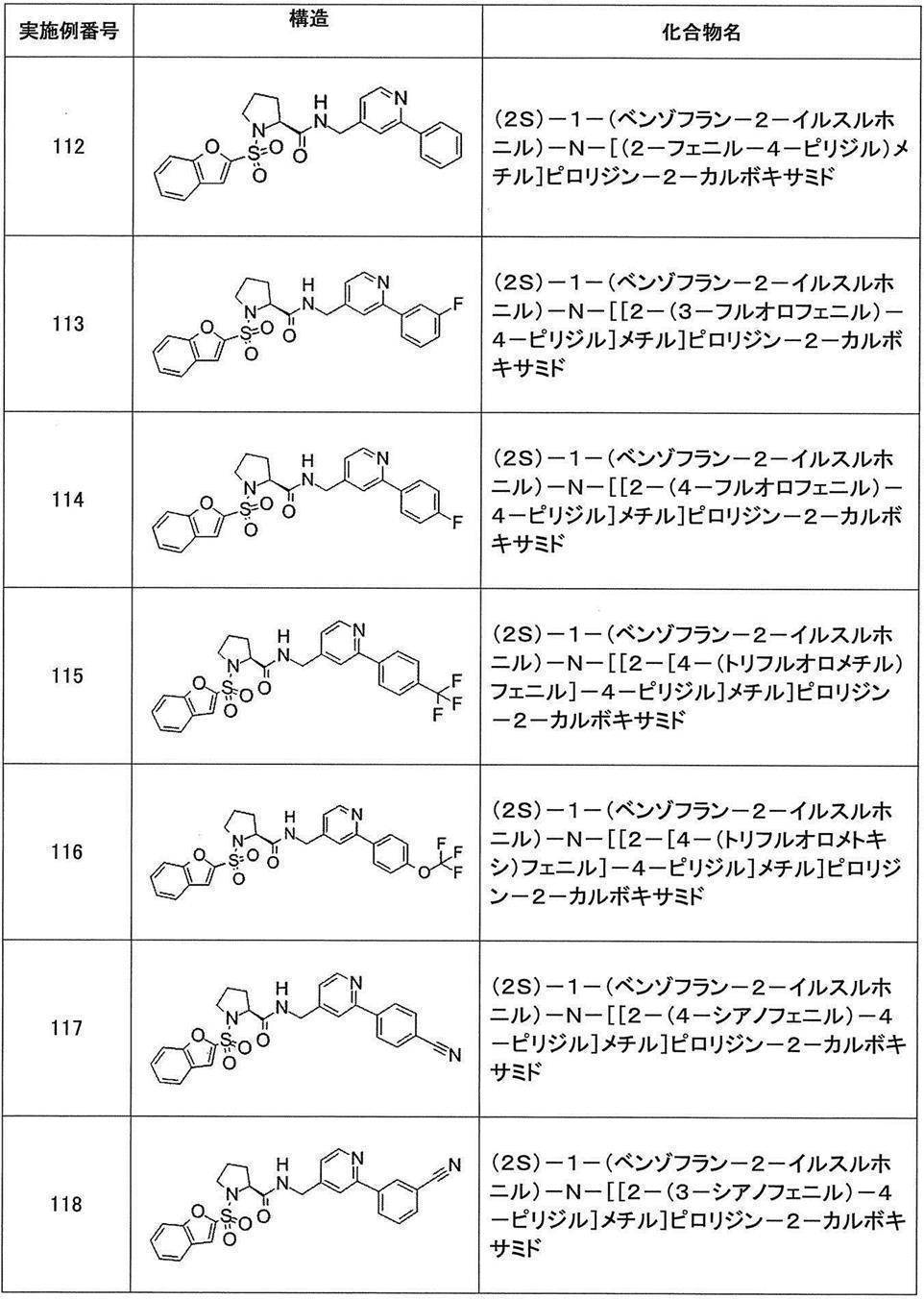

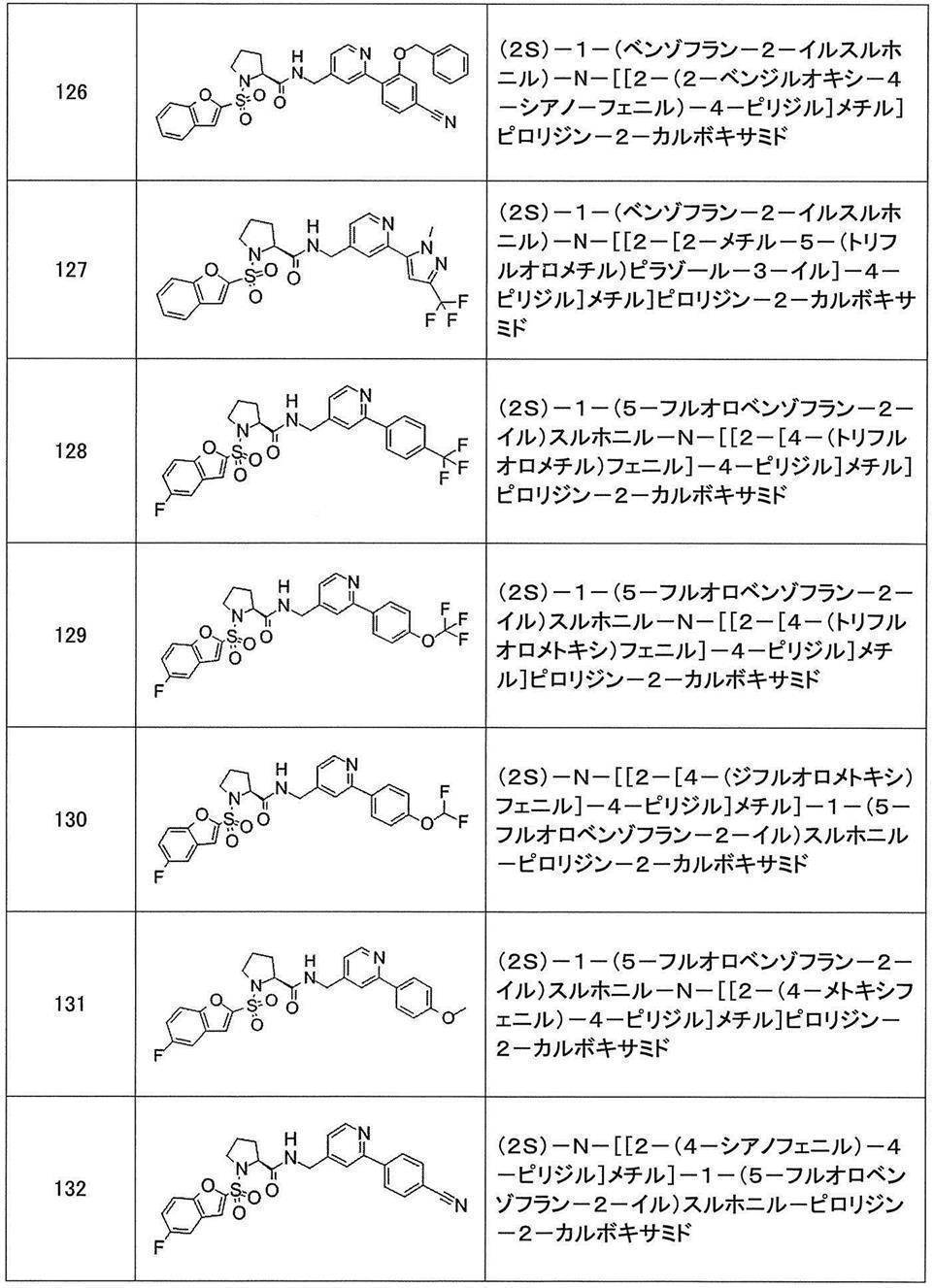


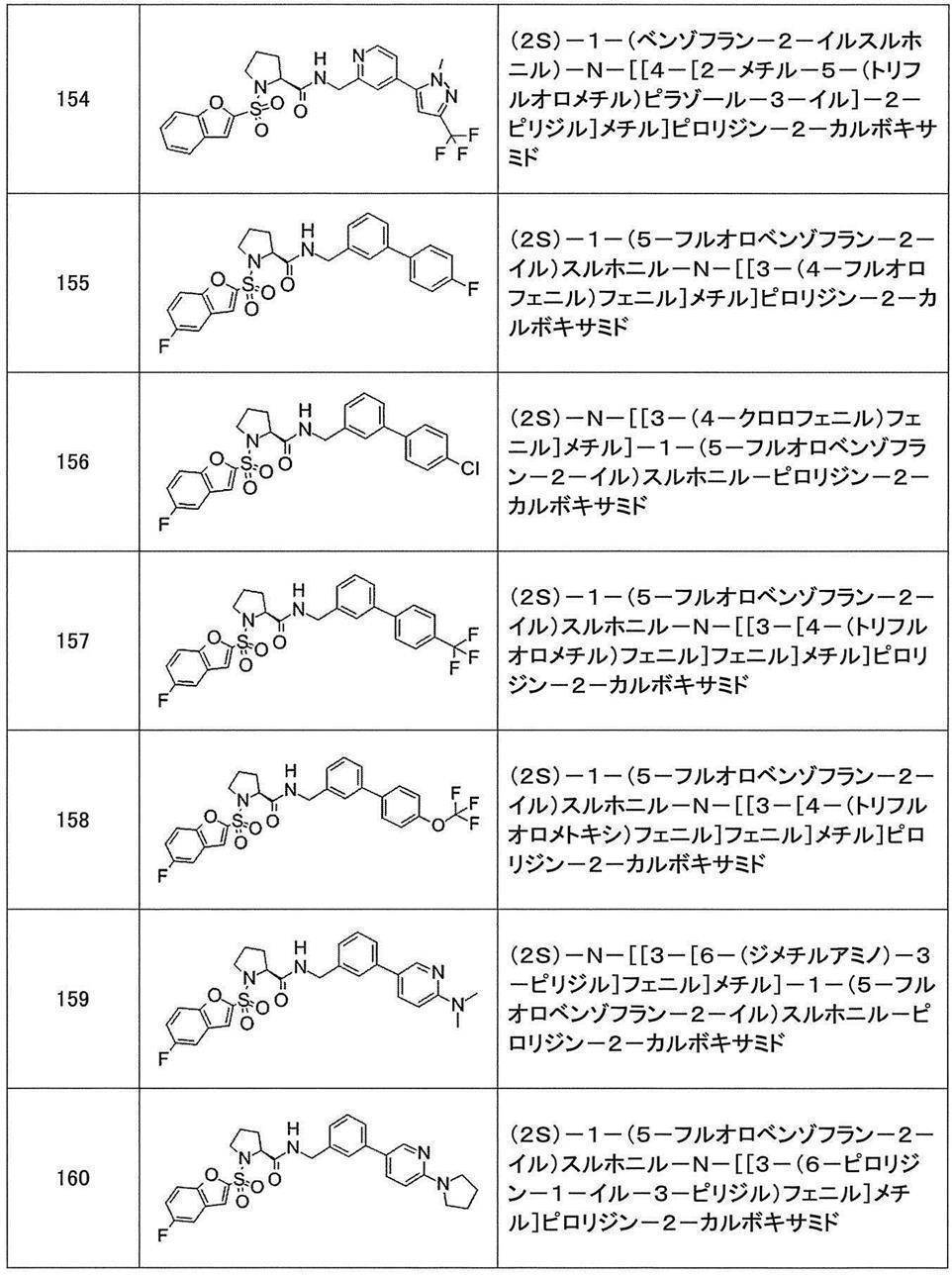
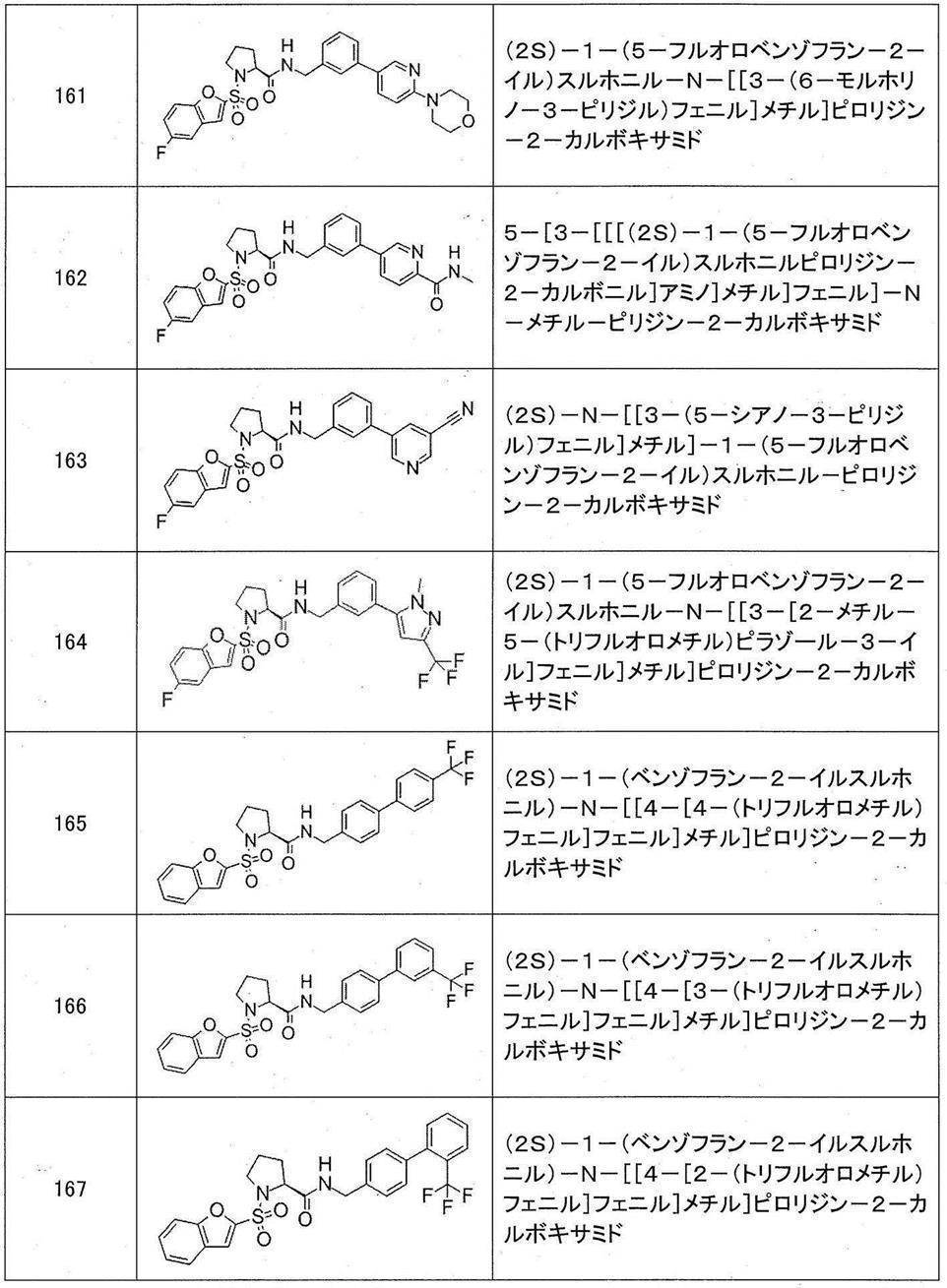

実施例176:(2S)-1-(ベンゾフラン-2-イルスルホニル)-N-[[2-(1H-インドール-2-イル)-4-ピリジル]メチル]ピロリジン-2-カルボキサミド(176)の合成
C-4(21mg、0.050mmol)、N-Boc-インドール-2-ボロン酸(26mg、0.10mmol)及び1,1’-ビス(ジフェニルホスフィノ)フェロセンジクロロパラジウム(II)(4mg,0.005mmol)に1,4-ジオキサン(0.8mL)及び1mol/L炭酸ナトリウム水溶液(0.8mL)を加え、マイクロウェーブ反応装置を用いて100℃で10分間加熱攪拌した。反応液にトリフルオロ酢酸(3mL)を加え、室温で一晩攪拌した後、減圧濃縮して得られた残渣を高速液体クロマトグラフィー(水-アセトニトリル、それぞれ0.1%トリフルオロ酢酸入り)にて精製して標題化合物のトリフルオロ酢酸塩(19mg、0.031mmol、61%)を得た。
MS (ESI) m/z 501 (M+H)+
1H NMR (400 MHz, DMSO-d6) δ 11.67 (s, 1H), 8.87 (t, J = 6.0 Hz, 1H), 8.57 (dd, J = 5.1, 0.8 Hz, 1H), 7.91 (s, 1H), 7.87 - 7.82 (m, 1H), 7.80 - 7.74 (m, 2H), 7.60 - 7.53 (m, 2H), 7.48 - 7.40 (m, 2H), 7.26 - 7.20 (m, 1H), 7.16 - 7.08 (m, 2H), 6.99 (ddd, J = 8.0, 7.0, 1.0 Hz, 1H), 4.52 - 4.33 (m, 3H), 3.68 - 3.60 (m, 1H), 3.47 - 3.38 (m, 1H), 2.04 - 1.86 (m, 3H), 1.73 - 1.62 (m, 1H).
Example 176: (2S) -1- (Benzofuran-2-ylsulfonyl) -N-[[2- (1H-indol-2-yl) -4-pyridyl] methyl] pyrrolidine-2-carboxamide (176) Synthesis C-4 (21 mg, 0.050 mmol), N-Boc-indole-2-boronic acid (26 mg, 0.10 mmol) and 1,1′-bis (diphenylphosphino) ferrocenedichloropalladium (II) (4 mg, 1,4-dioxane (0.8 mL) and 1 mol / L aqueous sodium carbonate solution (0.8 mL) were added to 0.005 mmol), and the mixture was heated and stirred at 100 ° C. for 10 minutes using a microwave reactor. Trifluoroacetic acid (3 mL) was added to the reaction mixture, and the mixture was stirred overnight at room temperature. The residue obtained by concentration under reduced pressure was subjected to high performance liquid chromatography (water-acetonitrile, each containing 0.1% trifluoroacetic acid). Purification gave the trifluoroacetate salt of the title compound (19 mg, 0.031 mmol, 61%).
MS (ESI) m / z 501 (M + H) +
1 H NMR (400 MHz, DMSO-d 6 ) δ 11.67 (s, 1H), 8.87 (t, J = 6.0 Hz, 1H), 8.57 (dd, J = 5.1, 0.8 Hz, 1H), 7.91 (s, 1H), 7.87-7.82 (m, 1H), 7.80-7.74 (m, 2H), 7.60-7.53 (m, 2H), 7.48-7.40 (m, 2H), 7.26-7.20 (m, 1H), 7.16- 7.08 (m, 2H), 6.99 (ddd, J = 8.0, 7.0, 1.0 Hz, 1H), 4.52-4.33 (m, 3H), 3.68-3.60 (m, 1H), 3.47-3.38 (m, 1H), 2.04-1.86 (m, 3H), 1.73-1.62 (m, 1H).
表23記載の実施例177は、参考例記載の化合物および対応する市販の試薬を用い実施例176と同様の操作により合成した。 Example 177 described in Table 23 was synthesized in the same manner as in Example 176 using the compound described in the reference example and the corresponding commercially available reagent.

実施例178:(2S)-1-(ベンゾフラン-2-イルスルホニル)-N-[[2-[5-(トリフルオロメチル)-2-ピリジル]-4-ピリジル]メチル]ピロリジン-2-カルボキサミド(178)の合成
C-5(42mg、0.10mmol)、E-4(30mg、0.10mmol)及びトリス(ジベンジリデンアセトン)ジパラジウム(0)(1.4mg、0.0015mol)及び2-ジシクロヘキシルホスフィノ-2’,4’,6’-トリイソプロピルビフェニル(2.9mg、0.006mmol)、酢酸銅(9.1mg、0.05mmol)、炭酸カリウム(69mg、0.5mmol)にN,N-ジメチルホルムアミド(0.8mL)及び2-プロパノール(0.2mL)を加え、マイクロウェーブ反応装置を用いて130℃で20分間加熱攪拌した。反応液を減圧濃縮して得られた残渣を高速液体クロマトグラフィー(水-アセトニトリル、それぞれ0.1%トリフルオロ酢酸入り)にて精製して標題化合物のトリフルオロ酢酸塩(15mg、0.028mmol、28%)を得た。MS (ESI) m/z 531 (M+H)+
Example 178: (2S) -1- (benzofuran-2-ylsulfonyl) -N-[[2- [5- (trifluoromethyl) -2-pyridyl] -4-pyridyl] methyl] pyrrolidine-2-carboxamide Synthesis of (178) C-5 (42 mg, 0.10 mmol), E-4 (30 mg, 0.10 mmol) and tris (dibenzylideneacetone) dipalladium (0) (1.4 mg, 0.0015 mol) and 2- Dicyclohexylphosphino-2 ′, 4 ′, 6′-triisopropylbiphenyl (2.9 mg, 0.006 mmol), copper acetate (9.1 mg, 0.05 mmol), potassium carbonate (69 mg, 0.5 mmol), N, N-dimethylformamide (0.8 mL) and 2-propanol (0.2 mL) are added and 1 using a microwave reactor. 0 was heated and stirred 20 min at ° C.. The residue obtained by concentrating the reaction solution under reduced pressure was purified by high performance liquid chromatography (water-acetonitrile, each containing 0.1% trifluoroacetic acid) to give the trifluoroacetate salt of the title compound (15 mg, 0.028 mmol, 28%). MS (ESI) m / z 531 (M + H) +
実施例179:(2S)-1-(ベンゾフラン-2-イルスルホニル)-N-[[4-[5-(トリフルオロメチル)-2-ピリジル]-2-ピリジル]メチル]ピロリジン-2-カルボキサミド(179)の合成
C-9(42mg、0.10mmol)、E-4(30mg、0.10mmol)及びトリス(ジベンジリデンアセトン)ジパラジウム(0)(1.4mg、0.0015mmol)及び2-ジシクロヘキシルホスフィノ-2’,4’,6’-トリイソプロピルビフェニル(2.9mg、0.006mmol)、酢酸銅(9.1mg、0.05mmol)、炭酸カリウム(69mg、0.5mmol)にN,N-ジメチルホルムアミド(0.8mL)及び2-プロパノール(0.2mL)を加え、マイクロウェーブ反応装置を用いて130℃で20分間加熱攪拌した。反応液を減圧濃縮して得られた残渣を高速液体クロマトグラフィー(水-アセトニトリル、それぞれ0.1%トリフルオロ酢酸入り)にて精製して標題化合物のトリフルオロ酢酸塩(10mg、0.019mmol、19%)を得た。
MS (ESI) m/z 531 (M+H)+
1H NMR (400 MHz, DMSO-d6) δ 9.12 (d, J = 2.4 Hz, 1H), 8.89 (dd, J = 6.1, 5.9 Hz, 1H), 8.73 (d, J = 5.1 Hz, 1H), 8.41 (dd, J = 8.5, 2.4 Hz, 1H), 8.32 (d, J = 8.5 Hz, 1H), 8.11 - 8.02 (m, 2H), 7.83 (dd, J = 7.7, 1.1 Hz, 1H), 7.79 - 7.71 (m, 2H), 7.56 (ddd, J = 8.6, 7.4, 1.4 Hz, 1H), 7.42 (ddd, J = 7.7, 7.4, 0.8 Hz, 1H), 4.57 (dd, J = 16.3, 6.1 Hz, 1H), 4.50 (dd, J = 16.3, 5.9 Hz, 1H), 4.38 (dd, J = 7.4, 4.1 Hz, 1H), 3.68 - 3.58 (m, 1H), 3.43 - 3.38 (m, 1H), 2.03 - 1.88 (m, 3H), 1.75 - 1.62 (m, 1H).
Example 179: (2S) -1- (benzofuran-2-ylsulfonyl) -N-[[4- [5- (trifluoromethyl) -2-pyridyl] -2-pyridyl] methyl] pyrrolidine-2-carboxamide Synthesis of (179) C-9 (42 mg, 0.10 mmol), E-4 (30 mg, 0.10 mmol) and tris (dibenzylideneacetone) dipalladium (0) (1.4 mg, 0.0015 mmol) and 2- Dicyclohexylphosphino-2 ′, 4 ′, 6′-triisopropylbiphenyl (2.9 mg, 0.006 mmol), copper acetate (9.1 mg, 0.05 mmol), potassium carbonate (69 mg, 0.5 mmol), N, Add N-dimethylformamide (0.8 mL) and 2-propanol (0.2 mL) and use a microwave reactor. Heated and stirred at 30 ° C. 20 min. The residue obtained by concentrating the reaction solution under reduced pressure was purified by high performance liquid chromatography (water-acetonitrile, each containing 0.1% trifluoroacetic acid) to give the trifluoroacetate salt of the title compound (10 mg, 0.019 mmol, 19%).
MS (ESI) m / z 531 (M + H) +
1 H NMR (400 MHz, DMSO-d 6 ) δ 9.12 (d, J = 2.4 Hz, 1H), 8.89 (dd, J = 6.1, 5.9 Hz, 1H), 8.73 (d, J = 5.1 Hz, 1H) , 8.41 (dd, J = 8.5, 2.4 Hz, 1H), 8.32 (d, J = 8.5 Hz, 1H), 8.11-8.02 (m, 2H), 7.83 (dd, J = 7.7, 1.1 Hz, 1H), 7.79-7.71 (m, 2H), 7.56 (ddd, J = 8.6, 7.4, 1.4 Hz, 1H), 7.42 (ddd, J = 7.7, 7.4, 0.8 Hz, 1H), 4.57 (dd, J = 16.3, 6.1 Hz, 1H), 4.50 (dd, J = 16.3, 5.9 Hz, 1H), 4.38 (dd, J = 7.4, 4.1 Hz, 1H), 3.68-3.58 (m, 1H), 3.43-3.38 (m, 1H) , 2.03-1.88 (m, 3H), 1.75-1.62 (m, 1H).

実施例180:(2S)-2-(ベンゾフラン-2-イルスルホニルアミノ)-N-[[2-[2-ヒドロキシ-4-(トリフルオロメチル)フェニル]-4-ピリジル]メチル]プロパンアミド(180)の合成
(工程1)2-[2-ヒドロキシ-4-(トリフルオロメチル)フェニル]ピリジン-4-カルボニトリルの合成
2-クロロ-4-シアノピリジン(69mg、0.50mmol)、2-ヒドロキシ-4-トリフルオロメチルフェニルボロン酸(0.10g、0.50mmol)及び1,1’-ビス(ジフェニルホスフィノ)フェロセンジクロロパラジウム(II)(37mg,0.050mmol)に1,4-ジオキサン(1mL)及び1mol/L炭酸ナトリウム水溶液(1mL)を加え、マイクロウェーブ反応装置を用いて120℃で20分間加熱攪拌した。反応液にトリフルオロ酢酸(0.2mL)を加えて中和した後、高速液体クロマトグラフィー(水-アセトニトリル、それぞれ0.1%トリフルオロ酢酸入り)にて精製して標題化合物(66mg、0.25mmol、50%)を得た。
MS (ESI) m/z 265 (M+H)+
(工程2)2-[4-(アミノメチル)-2-ピリジル]-5-(トリフルオロメチル)フェノールの合成
工程1で得られた化合物(66mg、0.25mmol)をエタノール(10mL)に溶解させ、フロー式水素化反応装置(H-cube、ThalesNano Nanotechnology社製)を用い、10%Pd/C(30mm)、65℃、50bar、流速1mL/分の条件にて還元した。反応液を減圧濃縮して標題化合物(45mg、0.17mmol、67%)を得た。
MS (ESI) m/z 269 (M+H)+
(工程3)(2S)-2-(ベンゾフラン-2-イルスルホニルアミノ)-N-[[2-[2-ヒドロキシ-4-(トリフルオロメチル)フェニル]-4-ピリジル]メチル]プロパンアミド(180)の合成
D-1の代わりに工程2で得られた化合物を用い、実施例37と同様の操作により標題化合物のトリフルオロ酢酸塩(収率60%)を得た。
MS (ESI) m/z 520 (M+H)+
1H NMR (400 MHz, DMSO-d6) δ 14.47 (s, 1H), 8.87 (d, J = 7.9 Hz, 1H), 8.73 (dd, J = 6.0, 5.9 Hz, 1H), 8.57 (dd, J = 5.3, 0.7 Hz, 1H), 8.21 - 8.15 (m, 1H), 8.11 (s, 1H), 7.76 (ddd, J = 7.9, 1.3, 0.9 Hz, 1H), 7.66 (dd, J = 8.5, 0.9 Hz, 1H), 7.54 (d, J = 0.9 Hz, 1H), 7.50 (ddd, J = 8.5, 7.3, 1.3 Hz, 1H), 7.37 (ddd, J = 7.9, 7.3, 0.9 Hz, 1H), 7.30 (dd, J = 5.3, 1.4 Hz, 1H), 7.27 - 7.21 (m, 2H), 4.39 (dd, J = 16.6, 6.0 Hz, 1H), 4.33 (dd, J = 16.6, 5.9 Hz, 1H), 4.07 (dq, J = 7.9, 7.1 Hz, 1H), 1.24 (d, J = 7.1 Hz, 3H).
Example 180: (2S) -2- (benzofuran-2-ylsulfonylamino) -N-[[2- [2-hydroxy-4- (trifluoromethyl) phenyl] -4-pyridyl] methyl] propanamide ( 180) (Step 1) Synthesis of 2- [2-hydroxy-4- (trifluoromethyl) phenyl] pyridine-4-carbonitrile 2-Chloro-4-cyanopyridine (69 mg, 0.50 mmol), 2- Hydroxy-4-trifluoromethylphenylboronic acid (0.10 g, 0.50 mmol) and 1,1′-bis (diphenylphosphino) ferrocenedichloropalladium (II) (37 mg, 0.050 mmol) in 1,4-dioxane (1 mL) and 1 mol / L sodium carbonate aqueous solution (1 mL) are added, and a microwave reactor is used. Heated and stirred at 120 ° C. 20 min. The reaction mixture was neutralized with trifluoroacetic acid (0.2 mL), and then purified by high performance liquid chromatography (water-acetonitrile, each containing 0.1% trifluoroacetic acid) to give the title compound (66 mg, 0. 25 mmol, 50%).
MS (ESI) m / z 265 (M + H) +
(Step 2) Synthesis of 2- [4- (aminomethyl) -2-pyridyl] -5- (trifluoromethyl) phenol The compound obtained in Step 1 (66 mg, 0.25 mmol) was dissolved in ethanol (10 mL). Then, using a flow-type hydrogenation reactor (H-cube, manufactured by Thales Nano Nanotechnology), reduction was performed under conditions of 10% Pd / C (30 mm), 65 ° C., 50 bar, and a flow rate of 1 mL / min. The reaction mixture was concentrated under reduced pressure to give the title compound (45 mg, 0.17 mmol, 67%).
MS (ESI) m / z 269 (M + H) +
(Step 3) (2S) -2- (Benzofuran-2-ylsulfonylamino) -N-[[2- [2-hydroxy-4- (trifluoromethyl) phenyl] -4-pyridyl] methyl] propanamide ( 180) The title compound trifluoroacetate (yield 60%) was obtained in the same manner as in Example 37, except that the compound obtained in Step 2 was used instead of D-1.
MS (ESI) m / z 520 (M + H) +
1 H NMR (400 MHz, DMSO-d 6 ) δ 14.47 (s, 1H), 8.87 (d, J = 7.9 Hz, 1H), 8.73 (dd, J = 6.0, 5.9 Hz, 1H), 8.57 (dd, J = 5.3, 0.7 Hz, 1H), 8.21-8.15 (m, 1H), 8.11 (s, 1H), 7.76 (ddd, J = 7.9, 1.3, 0.9 Hz, 1H), 7.66 (dd, J = 8.5, 0.9 Hz, 1H), 7.54 (d, J = 0.9 Hz, 1H), 7.50 (ddd, J = 8.5, 7.3, 1.3 Hz, 1H), 7.37 (ddd, J = 7.9, 7.3, 0.9 Hz, 1H), 7.30 (dd, J = 5.3, 1.4 Hz, 1H), 7.27-7.21 (m, 2H), 4.39 (dd, J = 16.6, 6.0 Hz, 1H), 4.33 (dd, J = 16.6, 5.9 Hz, 1H) , 4.07 (dq, J = 7.9, 7.1 Hz, 1H), 1.24 (d, J = 7.1 Hz, 3H).
表25記載の実施例181は、参考例記載の化合物および対応する市販の試薬を用い実施例180と同様の操作により合成した。 Example 181 described in Table 25 was synthesized in the same manner as in Example 180 using the compound described in Reference Example and the corresponding commercially available reagent.

実施例182:(2S)-2-(ベンゾフラン-2-イルスルホニルアミノ)-N-[[3-[(4-シアノフェニル)メトキシ]フェニル]メチル]プロパンアミド(182)の合成
N-[(3-ヒドロキシフェニル)メチル]カルバミン酸 tert-ブチル(50mg、0.22mmol)、4-ヒドロキシベンゾニトリル(45mg、0.34mmol)のジクロロメタン(2mL)溶液にトリフェニルホスフィン(117mg、0.44mmol)及びアゾジカルボン酸ジイソプロピル(0.088mL、0.44mmol)を加え、室温で一晩攪拌した。反応混合物にトリフルオロ酢酸(2mL)を加えて室温で一晩攪拌した後、2mol/L水酸化ナトリウム水溶液で中和した。反応混合物にジクロロメタンを加えて抽出し、有機層を硫酸ナトリウムにて乾燥した。乾燥剤を濾別し、溶媒を留去して4-[[3-(アミノメチル)フェノキシ]メチル]ベンゾニトリルの粗生成物(0.22g)を得た。
得られた4-[[3-(アミノメチル)フェノキシ]メチル]ベンゾニトリルの粗生成物(0.11g)、B-15(27mg、0.10mmol)、WSC塩酸塩(23mg、0.12mmol)及び1-ヒドロキシ-7-アザベンゾトリアゾール(14mg、0.10mmol)にジクロロメタン(2mL)とトリエチルアミン(0.021mL、0.15mmol)を加え室温で一晩攪拌した。反応液を減圧濃縮して得られた残渣を高速液体クロマトグラフィー(水-アセトニトリル、それぞれ0.1%トリフルオロ酢酸入り)にて精製して標題化合物(49mg、0.10mmol、100%)を得た。
MS (ESI) m/z 490 (M+H)+
1H NMR (400 MHz, DMSO-d6) δ 8.74 (d, J= 8.3 Hz, 1H), 8.44 (t, J = 5.9 Hz, 1H), 7.86 (d, J = 8.2 Hz, 2H), 7.77 (ddd, J = 7.9, 1.3, 0.9 Hz, 1H), 7.66 (dd, J = 8.4, 0.9 Hz, 1H), 7.62 (d, J = 8.2 Hz, 2H), 7.51 (ddd, J = 8.4, 7.3, 1.3 Hz, 1H), 7.49 (d, J = 0.9 Hz, 1H), 7.38 (ddd, J = 7.9, 7.3, 0.9 Hz, 1H), 7.19 (ddd, J= 7.4, 7.3, 1.3 Hz, 1H), 6.90 - 6.83 (m, 2H), 6.77 - 6.71 (m, 1H), 5.19 (s, 2H), 4.11 (d, J = 5.9 Hz, 2H), 4.02 (dq, J = 8.3, 7.0 Hz 1H), 1.18 (d, J= 7.0 Hz, 3H).
Example 182: Synthesis of (2S) -2- (benzofuran-2-ylsulfonylamino) -N-[[3-[(4-cyanophenyl) methoxy] phenyl] methyl] propanamide (182) N-[( 3-hydroxyphenyl) methyl] carbamate tert-butyl (50 mg, 0.22 mmol), 4-hydroxybenzonitrile (45 mg, 0.34 mmol) in dichloromethane (2 mL) in triphenylphosphine (117 mg, 0.44 mmol) and Diisopropyl azodicarboxylate (0.088 mL, 0.44 mmol) was added and stirred overnight at room temperature. Trifluoroacetic acid (2 mL) was added to the reaction mixture, and the mixture was stirred overnight at room temperature, and then neutralized with a 2 mol / L aqueous sodium hydroxide solution. Dichloromethane was added to the reaction mixture for extraction, and the organic layer was dried over sodium sulfate. The desiccant was filtered off, and the solvent was distilled off to obtain a crude product of 4-[[3- (aminomethyl) phenoxy] methyl] benzonitrile (0.22 g).
Obtained crude product of 4-[[3- (aminomethyl) phenoxy] methyl] benzonitrile (0.11 g), B-15 (27 mg, 0.10 mmol), WSC hydrochloride (23 mg, 0.12 mmol) To 1-hydroxy-7-azabenzotriazole (14 mg, 0.10 mmol) were added dichloromethane (2 mL) and triethylamine (0.021 mL, 0.15 mmol), and the mixture was stirred at room temperature overnight. The residue obtained by concentrating the reaction solution under reduced pressure was purified by high performance liquid chromatography (water-acetonitrile, each containing 0.1% trifluoroacetic acid) to give the title compound (49 mg, 0.10 mmol, 100%). It was.
MS (ESI) m / z 490 (M + H) +
1 H NMR (400 MHz, DMSO-d 6 ) δ 8.74 (d, J = 8.3 Hz, 1H), 8.44 (t, J = 5.9 Hz, 1H), 7.86 (d, J = 8.2 Hz, 2H), 7.77 (ddd, J = 7.9, 1.3, 0.9 Hz, 1H), 7.66 (dd, J = 8.4, 0.9 Hz, 1H), 7.62 (d, J = 8.2 Hz, 2H), 7.51 (ddd, J = 8.4, 7.3 , 1.3 Hz, 1H), 7.49 (d, J = 0.9 Hz, 1H), 7.38 (ddd, J = 7.9, 7.3, 0.9 Hz, 1H), 7.19 (ddd, J = 7.4, 7.3, 1.3 Hz, 1H) , 6.90-6.83 (m, 2H), 6.77-6.71 (m, 1H), 5.19 (s, 2H), 4.11 (d, J = 5.9 Hz, 2H), 4.02 (dq, J = 8.3, 7.0 Hz 1H) , 1.18 (d, J = 7.0 Hz, 3H).
表26記載の実施例183~実施例185は、参考例記載の化合物および対応する市販の試薬を用い実施例182と同様の操作により合成した。 Examples 183 to 185 described in Table 26 were synthesized in the same manner as in Example 182 using the compounds described in Reference Examples and the corresponding commercially available reagents.
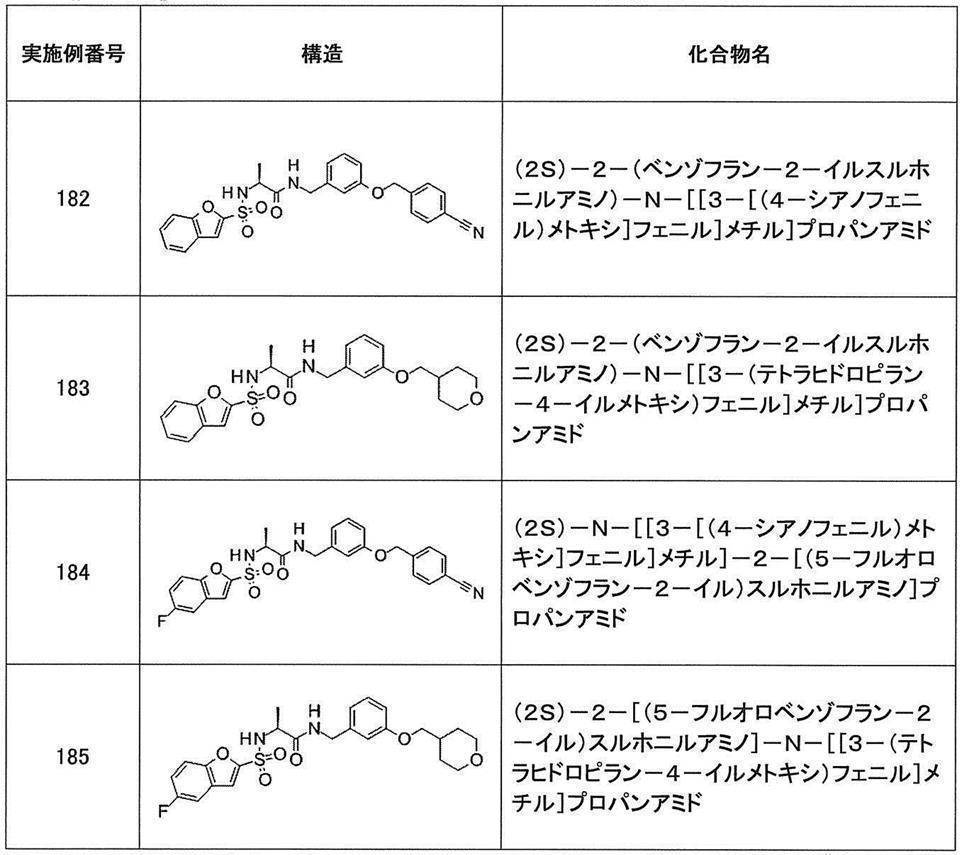
実施例186:(2S)-1-(ベンゾフラン-2-イルスルホニル)-N-[[2-[[4-(トリフルオロメチル)フェニル]メチルアミノ]-4-ピリジル]メチル]ピロリジン-2-カルボキサミド(186)の合成Example 186: (2S) -1- (benzofuran-2-ylsulfonyl) -N-[[2-[[4- (trifluoromethyl) phenyl] methylamino] -4-pyridyl] methyl] pyrrolidine-2- Synthesis of carboxamide (186)
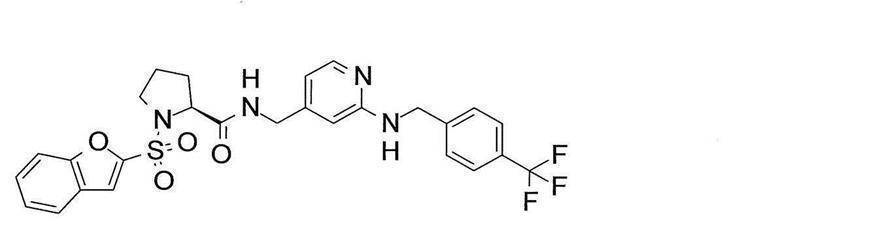
トリス(ジベンジリデンアセトン)ジパラジウム(0)(5.5mg、0.0060mmol)及び(±)-2,2’-ビス(ジフェニルホスフィノ)-1,1’-ビナフチル(7.4mg、0.012mmol)にトルエン(2mL)を加え、アルゴンガスを20分間吹き込んだ。C-4(50mg、0.12mmol)、4-(トリフルオロメチル)ベンジルアミン(0.034mL、0.24mmol)及びナトリウムtert-ブトキシド(22mg、0.23mmol)を加えて封管し、90℃で一晩攪拌した。反応混合物に酢酸エチルを加えた後、水で洗浄し、有機層を硫酸ナトリウムにて乾燥した。乾燥剤を濾別した後、溶媒を留去して得られた残渣を高速液体クロマトグラフィー(水-アセトニトリル、それぞれ0.1%トリフルオロ酢酸入り)にて精製して標題化合物のトリフルオロ酢酸塩(2.6mg、0.0039mmol、3%)を得た。
MS (ESI) m/z 559 (M+H)+
Tris (dibenzylideneacetone) dipalladium (0) (5.5 mg, 0.0060 mmol) and (±) -2,2′-bis (diphenylphosphino) -1,1′-binaphthyl (7.4 mg, 0.4 mg). 012 mmol) was added toluene (2 mL), and argon gas was blown in for 20 minutes. C-4 (50 mg, 0.12 mmol), 4- (trifluoromethyl) benzylamine (0.034 mL, 0.24 mmol) and sodium tert-butoxide (22 mg, 0.23 mmol) were added and sealed. Stir overnight. Ethyl acetate was added to the reaction mixture, washed with water, and the organic layer was dried over sodium sulfate. After removing the desiccant by filtration, the residue obtained by distilling off the solvent was purified by high performance liquid chromatography (water-acetonitrile, each containing 0.1% trifluoroacetic acid) to give the trifluoroacetate salt of the title compound (2.6 mg, 0.0039 mmol, 3%) was obtained.
MS (ESI) m / z 559 (M + H) +
実施例187:(2S)-1-(ベンゾフラン-2-イルスルホニル)-N-[[3-[[4-(トリフルオロメチル)フェニル]メトキシ]フェニル]メチル]-3,6-ジヒドロ-2H-ピリジン-2-カルボキサミド(187)の合成Example 187: (2S) -1- (benzofuran-2-ylsulfonyl) -N-[[3-[[4- (trifluoromethyl) phenyl] methoxy] phenyl] methyl] -3,6-dihydro-2H -Synthesis of pyridine-2-carboxamide (187)
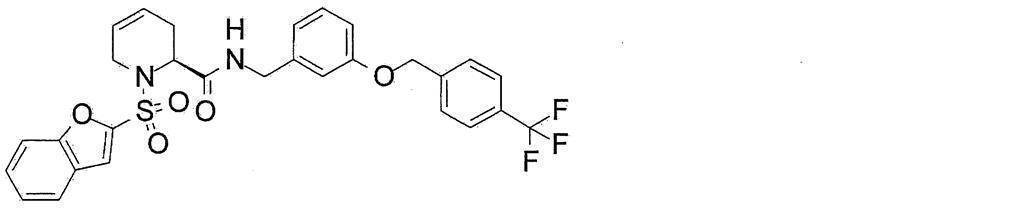
(工程1)(2S)-N-[(3-{[4-(トリフルオロメチル)フェニル]メトキシ}フェニル)メチル]-1,2,3,6-テトラヒドロピリジン-2-カルボキサミド 塩酸塩の合成
(S)-N-Boc-1,2,3,6-テトラヒドロ-2-ピリジンカルボン酸(0.10g、0.44mmol)、D-2(0.15g、0.46mmol)、WSC 塩酸塩(0.10g、0.53mmol)及び1-ヒドロキシ-7-アザベンゾトリアゾール(60mg、0.44mmol)にジクロロメタン(2mL)を加えて懸濁させ、トリエチルアミン(0.092mL、0.66mmol)を加えて室温にて一晩攪拌した。反応混合物に酢酸エチルを加え、0.5mol/L塩酸水溶液、飽和重曹水及び飽和食塩水にて順次洗浄した後、有機層を硫酸ナトリウムにて乾燥した。乾燥剤を濾別し、溶媒を留去して得られた残渣に4mol/L塩酸/1,4-ジオキサン溶液(3mL)を加えて室温で5時間攪拌した。溶媒を留去して標題化合物(0.19g、0.44mmol、99%)を得た。
MS (ESI) m/z 391 (M+H)+
(工程2)(2S)-1-(ベンゾフラン-2-イルスルホニル)-N-[[3-[[4-(トリフルオロメチル)フェニル]メトキシ]フェニル]メチル]-3,6-ジヒドロ-2H-ピリジン-2-カルボキサミド(187)の合成
工程1で得られた化合物(40mg、0.094mmol)及びベンゾフラン-2-イルスルホニルクロリド(22mg、0.11mmol)にアセトニトリル(1mL)及びトリエチルアミン(0.033mL、0.23mmol)を加えて室温で一晩攪拌した。反応混合物を減圧濃縮して得られた残渣を高速液体クロマトグラフィー(水-アセトニトリル、それぞれ0.1%トリフルオロ酢酸入り)にて精製して標題化合物(27mg、0.047mmol、50%)を得た。
MS (ESI) m/z 571 (M+H)+
1H NMR (400 MHz, DMSO-d6) δ 8.52 (t, J = 6.0 Hz, 1H), 7.82 - 7.72 (m, 3H), 7.70 - 7.57 (m, 4H), 7.50 (ddd, J = 8.5, 7.2, 1.4 Hz, 1H), 7.42 - 7.33 (m, 1H), 7.24 (dd, J = 7.9, 7.9 Hz, 1H), 6.94 - 6.82 (m, 2H), 6.77 (d, J = 7.6 Hz, 1H), 5.74 - 5.61 (m, 2H), 5.20 (s, 2H), 4.75 (dd, J = 6.8, 1.6 Hz, 1H), 4.23 - 3.98 (m, 4H), 2.47 - 2.29 (m, 2H).
(Step 1) Synthesis of (2S) -N-[(3-{[4- (trifluoromethyl) phenyl] methoxy} phenyl) methyl] -1,2,3,6-tetrahydropyridine-2-carboxamide hydrochloride (S) -N-Boc-1,2,3,6-tetrahydro-2-pyridinecarboxylic acid (0.10 g, 0.44 mmol), D-2 (0.15 g, 0.46 mmol), WSC hydrochloride ( 0.10 g, 0.53 mmol) and 1-hydroxy-7-azabenzotriazole (60 mg, 0.44 mmol) were suspended in dichloromethane (2 mL), and triethylamine (0.092 mL, 0.66 mmol) was added. Stir overnight at room temperature. Ethyl acetate was added to the reaction mixture, and the mixture was washed successively with 0.5 mol / L hydrochloric acid aqueous solution, saturated aqueous sodium hydrogen carbonate and saturated brine, and the organic layer was dried over sodium sulfate. The desiccant was filtered off, the solvent was distilled off, 4 mol / L hydrochloric acid / 1,4-dioxane solution (3 mL) was added to the resulting residue, and the mixture was stirred at room temperature for 5 hours. The solvent was distilled off to give the title compound (0.19 g, 0.44 mmol, 99%).
MS (ESI) m / z 391 (M + H) +
(Step 2) (2S) -1- (benzofuran-2-ylsulfonyl) -N-[[3-[[4- (trifluoromethyl) phenyl] methoxy] phenyl] methyl] -3,6-dihydro-2H -Synthesis of Pyridine-2-carboxamide (187) To the compound obtained in Step 1 (40 mg, 0.094 mmol) and benzofuran-2-ylsulfonyl chloride (22 mg, 0.11 mmol), acetonitrile (1 mL) and triethylamine (0. 033 mL, 0.23 mmol) was added and stirred at room temperature overnight. The residue obtained by concentrating the reaction mixture under reduced pressure was purified by high performance liquid chromatography (water-acetonitrile, each containing 0.1% trifluoroacetic acid) to give the title compound (27 mg, 0.047 mmol, 50%). It was.
MS (ESI) m / z 571 (M + H) +
1 H NMR (400 MHz, DMSO-d 6 ) δ 8.52 (t, J = 6.0 Hz, 1H), 7.82-7.72 (m, 3H), 7.70-7.57 (m, 4H), 7.50 (ddd, J = 8.5 , 7.2, 1.4 Hz, 1H), 7.42-7.33 (m, 1H), 7.24 (dd, J = 7.9, 7.9 Hz, 1H), 6.94-6.82 (m, 2H), 6.77 (d, J = 7.6 Hz, 1H), 5.74-5.61 (m, 2H), 5.20 (s, 2H), 4.75 (dd, J = 6.8, 1.6 Hz, 1H), 4.23-3.98 (m, 4H), 2.47-2.29 (m, 2H) .
実施例188:(2S)-1-(ベンゾフラン-2-イルスルホニル)-N-[(3-ベンジルスルフィニルフェニル)メチル]ピロリジン-2-カルボキサミド(188)の合成Example 188: Synthesis of (2S) -1- (benzofuran-2-ylsulfonyl) -N-[(3-benzylsulfinylphenyl) methyl] pyrrolidine-2-carboxamide (188)

(2S)-1-(ベンゾフラン-2-イルスルホニル)-N-[(3-ベンジルスルファニルフェニル)メチル]ピロリジン-2-カルボキサミド(57)(16mg、0.032mmol)のジクロロメタン(1mL)溶液に3-クロロ過安息香酸(7.6mg、0.044mmol)を加え室温で一晩攪拌した。反応混合物を減圧濃縮して得られた残渣を高速液体クロマトグラフィー(水-アセトニトリル、それぞれ0.1%トリフルオロ酢酸入り)にて精製して標題化合物(9.6mg、0.018mmol、57%)を得た。
MS (ESI) m/z 523 (M+H)+
1H NMR (400 MHz, DMSO-d6) δ 8.77 (ddd, J= 6.2, 6.0, 1.8 Hz, 1H), 7.84 (d, J= 7.9 Hz, 1H), 7.79 - 7.71 (m, 2H), 7.61 - 7.33 (m, 6H), 7.33 - 7.23 (m, 3H), 7.16 - 7.08 (m, 2H), 4.41 - 4.34 (m, 2H), 4.31 (ddd, J = 8.2, 3.8, 2.2 Hz, 1H), 4.23 (dd, J = 12.7, 1.6 Hz, 1H), 4.02 (dd, J = 12.7, 5.0 Hz, 1H), 3.61 (ddd, J = 10.1, 7.0, 5.3 Hz, 1H), 3.45 - 3.39 (m, 1H), 2.01 - 1.82 (m, 3H), 1.71 - 1.58 (m, 1H).
To a solution of (2S) -1- (benzofuran-2-ylsulfonyl) -N-[(3-benzylsulfanylphenyl) methyl] pyrrolidine-2-carboxamide (57) (16 mg, 0.032 mmol) in dichloromethane (1 mL) -Chloroperoxybenzoic acid (7.6 mg, 0.044 mmol) was added and stirred at room temperature overnight. The reaction mixture was concentrated under reduced pressure, and the resulting residue was purified by high performance liquid chromatography (water-acetonitrile, each containing 0.1% trifluoroacetic acid) to give the title compound (9.6 mg, 0.018 mmol, 57%) Got.
MS (ESI) m / z 523 (M + H) +
1 H NMR (400 MHz, DMSO-d 6 ) δ 8.77 (ddd, J = 6.2, 6.0, 1.8 Hz, 1H), 7.84 (d, J = 7.9 Hz, 1H), 7.79-7.71 (m, 2H), 7.61-7.33 (m, 6H), 7.33-7.23 (m, 3H), 7.16-7.08 (m, 2H), 4.41-4.34 (m, 2H), 4.31 (ddd, J = 8.2, 3.8, 2.2 Hz, 1H ), 4.23 (dd, J = 12.7, 1.6 Hz, 1H), 4.02 (dd, J = 12.7, 5.0 Hz, 1H), 3.61 (ddd, J = 10.1, 7.0, 5.3 Hz, 1H), 3.45-3.39 ( m, 1H), 2.01-1.82 (m, 3H), 1.71-1.58 (m, 1H).
実施例189:(2S)-3-tert-ブトキシ-2-[(5-フロオロベンゾフラン-2-イル)スルホニルアミノ]-N-[[3-[6-トリフルオロメチル-3-ピリジル]フェニル]メチル]プロパンアミド(189)の合成Example 189: (2S) -3-tert-butoxy-2-[(5-fluorobenzofuran-2-yl) sulfonylamino] -N-[[3- [6-trifluoromethyl-3-pyridyl] phenyl Synthesis of methyl] propanamide (189)

(工程1)(2S)-3-tert-ブトキシ-2-[(5-フルオロベンゾフラン-2-イル)スルホニルアミノ]プロパン酸の合成
A-3(0.23g、1.0mmol)及びO-tert-ブチル-L-セリン メチルエステル 塩酸塩(0.21g、1.0mmol)にアセトニトリル(5mL)とトリエチルアミン(0.30mL、2.2mmol)を加えて室温で一晩攪拌した。反応混合物を減圧濃縮して得られた残渣に酢酸エチルを加え、水で洗浄した。有機層を硫酸ナトリウムにて乾燥し、乾燥剤を濾別した。溶媒を留去して得られた残渣にテトラヒドロフラン(5mL)、メタノール(0.5mL)及び1mol/L水酸化ナトリウム水溶液(1.2mL、1.2mmol)を加えて室温で2時間攪拌した。反応混合物に2mol/L水酸化ナトリウム水溶液(0.5mL)を加えてさらに室温で一晩攪拌した後、反応混合物に1mol/L塩酸水溶液(4mL)を加え、ジクロロメタンで抽出した。有機層を硫酸ナトリウムにて乾燥し、乾燥剤を濾別した後、溶媒を留去して標題化合物(0.30g、0.84mmol、84%)を得た。
MS (ESI) m/z 360 (M+H)+
(工程2)(2S)-3-tert-ブトキシ-2-[(5-フロオロベンゾフラン-2-イル)スルホニルアミノ]-N-[[3-[6-トリフルオロメチル-3-ピリジル]フェニル]メチル]プロパンアミド(189)の合成
B-1とD-1の代わりに工程1で得られた化合物とD-9を用い、実施例37と同様の操作により標題化合物(収率31%)を得た。
MS (ESI) m/z 594 (M+H)+
(Step 1) Synthesis of (2S) -3-tert-butoxy-2-[(5-fluorobenzofuran-2-yl) sulfonylamino] propanoic acid A-3 (0.23 g, 1.0 mmol) and O-tert Acetonitrile (5 mL) and triethylamine (0.30 mL, 2.2 mmol) were added to -butyl-L-serine methyl ester hydrochloride (0.21 g, 1.0 mmol), and the mixture was stirred overnight at room temperature. The reaction mixture was concentrated under reduced pressure, ethyl acetate was added to the resulting residue, and the mixture was washed with water. The organic layer was dried over sodium sulfate and the desiccant was filtered off. Tetrahydrofuran (5 mL), methanol (0.5 mL) and 1 mol / L aqueous sodium hydroxide solution (1.2 mL, 1.2 mmol) were added to the residue obtained by evaporating the solvent, and the mixture was stirred at room temperature for 2 hr. A 2 mol / L aqueous sodium hydroxide solution (0.5 mL) was added to the reaction mixture, and the mixture was further stirred overnight at room temperature. Then, a 1 mol / L aqueous hydrochloric acid solution (4 mL) was added to the reaction mixture, and the mixture was extracted with dichloromethane. The organic layer was dried over sodium sulfate, the desiccant was filtered off, and the solvent was evaporated to give the title compound (0.30 g, 0.84 mmol, 84%).
MS (ESI) m / z 360 (M + H) +
(Step 2) (2S) -3-tert-butoxy-2-[(5-fluorobenzofuran-2-yl) sulfonylamino] -N-[[3- [6-trifluoromethyl-3-pyridyl] phenyl ] Synthesis of methyl] propanamide (189) The title compound (yield 31%) was prepared in the same manner as in Example 37, except that the compound obtained in Step 1 and D-9 were used instead of B-1 and D-1. Got.
MS (ESI) m / z 594 (M + H) +
実施例190:(2S)-2-[(5-フルオロベンゾフラン-2-イル)スルホニルアミノ]-N-[[6-[4-(トリフルオロメトキシ)フェニル]ピリミジン-4-イル]メチル]プロパンアミド(190)の合成Example 190: (2S) -2-[(5-Fluorobenzofuran-2-yl) sulfonylamino] -N-[[6- [4- (trifluoromethoxy) phenyl] pyrimidin-4-yl] methyl] propane Synthesis of amide (190)

B-16(29mg、0.10mmol)、D-38(31mg、0.10mmol)、WSC塩酸塩(38mg、0.20mmol)及び1-ヒドロキシ-7-アザベンゾトリアゾール(27mg、0.20mmol)にトリエチルアミン(42μL、0.30mmol)、ジクロロメタン(1mL)を加え室温で1時間攪拌した。反応液を減圧濃縮して得られた残渣を高速液体クロマトグラフィー(水-アセトニトリル、それぞれ0.1%トリフルオロ酢酸入り)にて精製して標題化合物(45mg、0.084mmol、84%)を得た。
MS (ESI) m/z 539 (M+H)+
1H NMR (400 MHz, DMSO-d6) δ 9.16 (d, J = 1.3 Hz, 1H), 8.94 (brs, 1H), 8.73 (t, J = 5.9 Hz, 1H), 8.31 - 8.24 (m, 2H), 7.87 (d, J = 1.3 Hz, 1H), 7.70 (dd, J = 9.0, 4.2 Hz, 1H), 7.58 - 7.48 (m, 4H), 7.34 (td, J = 9.2, 2.8 Hz, 1H), 4.42 - 4.26 (m, 2H), 4.16 - 4.05 (m, 1H), 1.26 (d, J = 7.1 Hz, 3H).
To B-16 (29 mg, 0.10 mmol), D-38 (31 mg, 0.10 mmol), WSC hydrochloride (38 mg, 0.20 mmol) and 1-hydroxy-7-azabenzotriazole (27 mg, 0.20 mmol) Triethylamine (42 μL, 0.30 mmol) and dichloromethane (1 mL) were added, and the mixture was stirred at room temperature for 1 hour. The residue obtained by concentrating the reaction solution under reduced pressure was purified by high performance liquid chromatography (water-acetonitrile, each containing 0.1% trifluoroacetic acid) to give the title compound (45 mg, 0.084 mmol, 84%). It was.
MS (ESI) m / z 539 (M + H) +
1 H NMR (400 MHz, DMSO-d 6 ) δ 9.16 (d, J = 1.3 Hz, 1H), 8.94 (brs, 1H), 8.73 (t, J = 5.9 Hz, 1H), 8.31-8.24 (m, 2H), 7.87 (d, J = 1.3 Hz, 1H), 7.70 (dd, J = 9.0, 4.2 Hz, 1H), 7.58-7.48 (m, 4H), 7.34 (td, J = 9.2, 2.8 Hz, 1H ), 4.42-4.26 (m, 2H), 4.16-4.05 (m, 1H), 1.26 (d, J = 7.1 Hz, 3H).
実施例191:(2S)-2-[(5-フルオロベンゾフラン-2-イル)スルホニルアミノ]-N-[[6-[6-(トリフルオロメチル)-3-ピリジル]ピリミジン-4-イル]メチル]プロパンアミド(191)の合成Example 191: (2S) -2-[(5-fluorobenzofuran-2-yl) sulfonylamino] -N-[[6- [6- (trifluoromethyl) -3-pyridyl] pyrimidin-4-yl] Synthesis of methyl] propanamide (191)
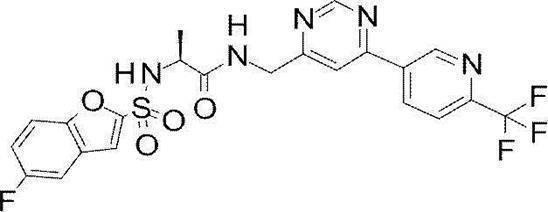
B-16(29mg、0.10mmol)、D-40(29mg、0.10mmol)、WSC塩酸塩(38mg、0.20mmol)及び1-ヒドロキシ-7-アザベンゾトリアゾール(27mg、0.20mmol)にトリエチルアミン(42μL、0.30mmol)、ジクロロメタン(1mL)を加え室温で2時間攪拌した。反応液を減圧濃縮して得られた残渣を高速液体クロマトグラフィー(水-アセトニトリル、それぞれ0.1%トリフルオロ酢酸入り)にて精製して標題化合物(22mg、0.042mmol、42%)を得た。
MS (ESI) m/z 524 (M+H)+
1H NMR (400 MHz, DMSO-d6) δ 9.45 (d, J = 2.1 Hz, 1H), 9.26 (d, J = 1.3 Hz, 1H), 8.97 (d, J = 7.8 Hz, 1H), 8.83 - 8.73 (m, 2H), 8.12 (d, J = 8.2 Hz, 1H), 8.04 (s, 1H), 7.70 (dd, J = 9.1, 4.0 Hz, 1H), 7.56 - 7.48 (m, 2H), 7.34 (td, J = 9.2, 2.8 Hz, 1H), 4.46 - 4.30 (m, 2H), 4.17 - 4.06 (m, 1H), 1.27 (d, J = 7.1 Hz, 3H).
To B-16 (29 mg, 0.10 mmol), D-40 (29 mg, 0.10 mmol), WSC hydrochloride (38 mg, 0.20 mmol) and 1-hydroxy-7-azabenzotriazole (27 mg, 0.20 mmol) Triethylamine (42 μL, 0.30 mmol) and dichloromethane (1 mL) were added, and the mixture was stirred at room temperature for 2 hours. The residue obtained by concentrating the reaction solution under reduced pressure was purified by high performance liquid chromatography (water-acetonitrile, each containing 0.1% trifluoroacetic acid) to give the title compound (22 mg, 0.042 mmol, 42%). It was.
MS (ESI) m / z 524 (M + H) +
1 H NMR (400 MHz, DMSO-d 6 ) δ 9.45 (d, J = 2.1 Hz, 1H), 9.26 (d, J = 1.3 Hz, 1H), 8.97 (d, J = 7.8 Hz, 1H), 8.83 -8.73 (m, 2H), 8.12 (d, J = 8.2 Hz, 1H), 8.04 (s, 1H), 7.70 (dd, J = 9.1, 4.0 Hz, 1H), 7.56-7.48 (m, 2H), 7.34 (td, J = 9.2, 2.8 Hz, 1H), 4.46-4.30 (m, 2H), 4.17-4.06 (m, 1H), 1.27 (d, J = 7.1 Hz, 3H).
実施例192:(2S)-1-(ベンゾフラン-2-イルスルホニル)-N-[[4-[5-(トリフルオロメチル)ピリミジン-2-イル]-2-ピリジル]メチル]ピロリジン-2-カルボキサミド(192)の合成Example 192: (2S) -1- (benzofuran-2-ylsulfonyl) -N-[[4- [5- (trifluoromethyl) pyrimidin-2-yl] -2-pyridyl] methyl] pyrrolidine-2- Synthesis of carboxamide (192)

B-1(30mg、0.10mmol)、D-33(29mg、0.10mmol)、WSC塩酸塩(27mg、0.12mmol)及び1-ヒドロキシ-7-アザベンゾトリアゾール(14mg、0.10mmol)にトリエチルアミン(21μL、0.15mmol)、ジクロロメタン(1mL)を加え室温で2時間攪拌した。反応液を減圧濃縮して得られた残渣を高速液体クロマトグラフィー(水-アセトニトリル、それぞれ0.1%トリフルオロ酢酸入り)にて精製して標題化合物のトリフルオロ酢酸塩(36mg、0.056mmol、56%)を得た。
MS (ESI) m/z 532 (M+H)+
1H NMR (400 MHz, DMSO-d6) δ 9.44 (d, J = 0.9 Hz, 2H), 8.89 (t, J = 6.0 Hz, 1H), 8.77 (dd, J = 5.1, 0.8 Hz, 1H), 8.27 (brs, 1H), 8.20 (dd, J = 5.2, 1.6 Hz, 1H), 7.82 (ddd, J = 7.8, 1.3, 0.7 Hz, 1H), 7.76 (ddd, J = 8.5, 1.3, 0.9 Hz, 1H), 7.73 (d, J = 0.9 Hz, 1H), 7.56 (ddd, J = 8.5, 7.3, 1.3 Hz, 1H), 7.44 - 7.39 (m, 1H), 4.53 (d, J = 6.0 Hz, 2H), 4.42 - 4.36 (m, 1H), 3.63 - 3.58 (m, 1H), 3.46 - 3.37 (m, 1H), 2.00 - 1.91 (m, 3H), 1.76 - 1.63 (m, 1H).
To B-1 (30 mg, 0.10 mmol), D-33 (29 mg, 0.10 mmol), WSC hydrochloride (27 mg, 0.12 mmol) and 1-hydroxy-7-azabenzotriazole (14 mg, 0.10 mmol) Triethylamine (21 μL, 0.15 mmol) and dichloromethane (1 mL) were added, and the mixture was stirred at room temperature for 2 hours. The residue obtained by concentrating the reaction solution under reduced pressure was purified by high performance liquid chromatography (water-acetonitrile, each containing 0.1% trifluoroacetic acid) to give the trifluoroacetate salt of the title compound (36 mg, 0.056 mmol, 56%).
MS (ESI) m / z 532 (M + H) +
1 H NMR (400 MHz, DMSO-d 6 ) δ 9.44 (d, J = 0.9 Hz, 2H), 8.89 (t, J = 6.0 Hz, 1H), 8.77 (dd, J = 5.1, 0.8 Hz, 1H) , 8.27 (brs, 1H), 8.20 (dd, J = 5.2, 1.6 Hz, 1H), 7.82 (ddd, J = 7.8, 1.3, 0.7 Hz, 1H), 7.76 (ddd, J = 8.5, 1.3, 0.9 Hz , 1H), 7.73 (d, J = 0.9 Hz, 1H), 7.56 (ddd, J = 8.5, 7.3, 1.3 Hz, 1H), 7.44-7.39 (m, 1H), 4.53 (d, J = 6.0 Hz, 2H), 4.42-4.36 (m, 1H), 3.63-3.58 (m, 1H), 3.46-3.37 (m, 1H), 2.00-1.91 (m, 3H), 1.76-1.63 (m, 1H).
実施例193:(2S)-1-(ベンゾフラン-2-イルスルホニル)-N-[[4-ヒドロキシ-3-[5-(トリフルオロメチル)-2-ピリジル]フェニル]メチル]ピロリジン-2-カルボキサミド(193)の合成Example 193: (2S) -1- (benzofuran-2-ylsulfonyl) -N-[[4-hydroxy-3- [5- (trifluoromethyl) -2-pyridyl] phenyl] methyl] pyrrolidine-2- Synthesis of carboxamide (193)

B-1(30mg、0.10mmol)、D-48(31mg、0.10mmol)、WSC塩酸塩(27mg、0.12mmol)及び1-ヒドロキシ-7-アザベンゾトリアゾール(14mg、0.10mmol)にトリエチルアミン(21μL、0.15mmol)、ジクロロメタン(1mL)を加え室温で2時間攪拌した。反応液を減圧濃縮して得られた残渣を高速液体クロマトグラフィー(水-アセトニトリル、それぞれ0.1%トリフルオロ酢酸入り)にて精製して標題化合物(37mg、0.068mmol、68%)を得た。
MS (ESI) m/z 546 (M+H)+
1H NMR (400 MHz, DMSO-d6) δ 9.06 (s, 1H), 8.66 (t, J = 6.0 Hz, 1H), 8.38 - 8.35 (m, 2H), 7.96 (d, J = 2.1 Hz, 1H), 7.86 - 7.80 (m, 1H), 7.77 - 7.71 (m, 2H), 7.55 (ddd, J = 8.5, 7.2, 1.3 Hz, 1H), 7.44 - 7.39 (m, 1H), 7.30 (dd, J = 8.4, 2.1 Hz, 1H), 6.96 (d, J = 8.4 Hz, 1H), 4.41 - 4.24 (m, 3H), 3.64 - 3.56 (m, 1H), 3.47 - 3.41 (m, 1H), 1.97 - 1.83 (m, 3H), 1.69 - 1.59 (m, 1H).
To B-1 (30 mg, 0.10 mmol), D-48 (31 mg, 0.10 mmol), WSC hydrochloride (27 mg, 0.12 mmol) and 1-hydroxy-7-azabenzotriazole (14 mg, 0.10 mmol) Triethylamine (21 μL, 0.15 mmol) and dichloromethane (1 mL) were added, and the mixture was stirred at room temperature for 2 hours. The residue obtained by concentrating the reaction solution under reduced pressure was purified by high performance liquid chromatography (water-acetonitrile, each containing 0.1% trifluoroacetic acid) to give the title compound (37 mg, 0.068 mmol, 68%). It was.
MS (ESI) m / z 546 (M + H) +
1 H NMR (400 MHz, DMSO-d 6 ) δ 9.06 (s, 1H), 8.66 (t, J = 6.0 Hz, 1H), 8.38-8.35 (m, 2H), 7.96 (d, J = 2.1 Hz, 1H), 7.86-7.80 (m, 1H), 7.77-7.71 (m, 2H), 7.55 (ddd, J = 8.5, 7.2, 1.3 Hz, 1H), 7.44-7.39 (m, 1H), 7.30 (dd, J = 8.4, 2.1 Hz, 1H), 6.96 (d, J = 8.4 Hz, 1H), 4.41-4.24 (m, 3H), 3.64-3.56 (m, 1H), 3.47-3.41 (m, 1H), 1.97 -1.83 (m, 3H), 1.69-1.59 (m, 1H).
表27記載の実施例194~実施例276は、参考例記載の化合物及び対応する市販の試薬を用い実施例37と同様の操作により合成した。 Examples 194 to 276 described in Table 27 were synthesized in the same manner as in Example 37 using the compounds described in Reference Examples and the corresponding commercially available reagents.


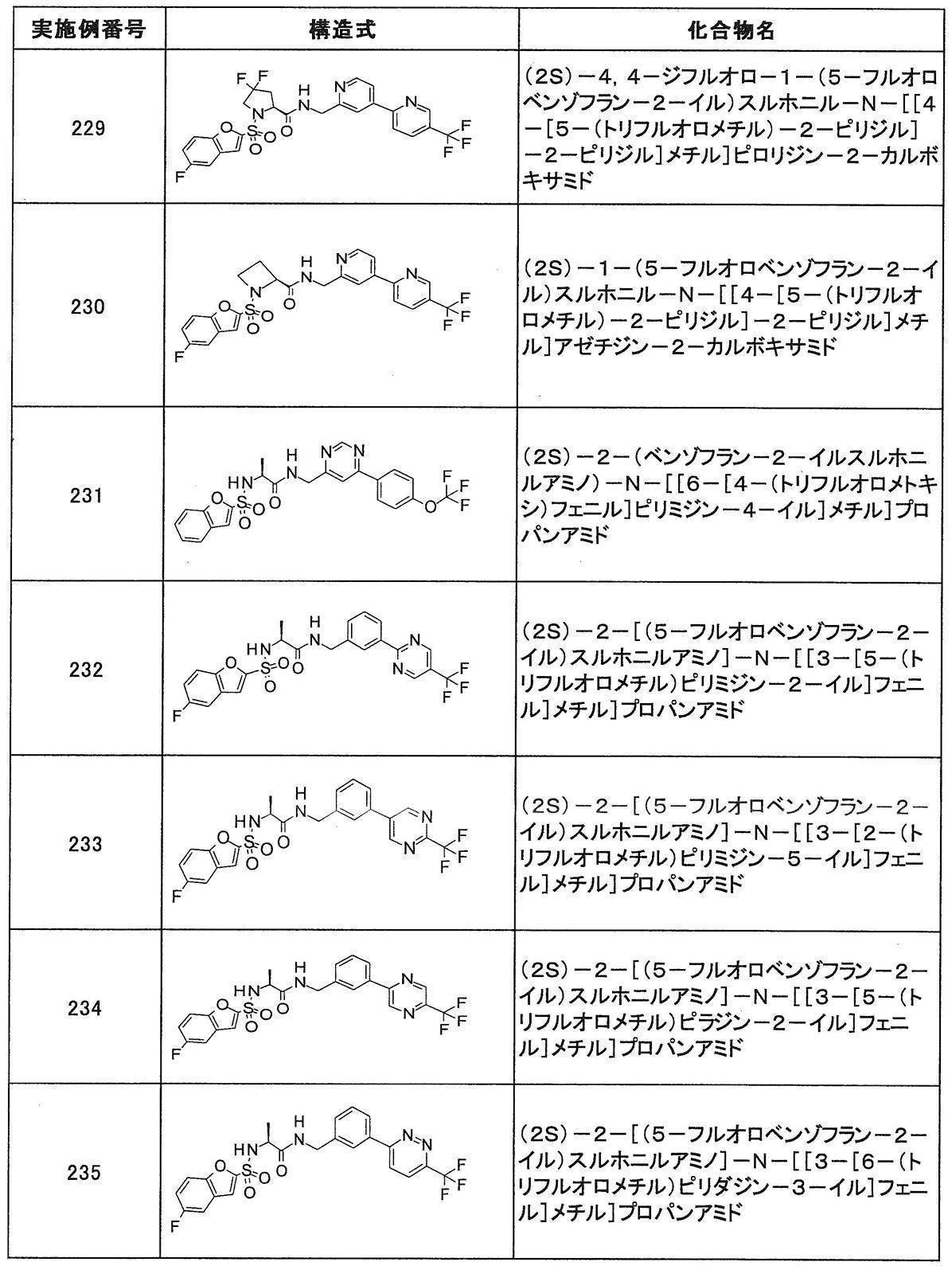


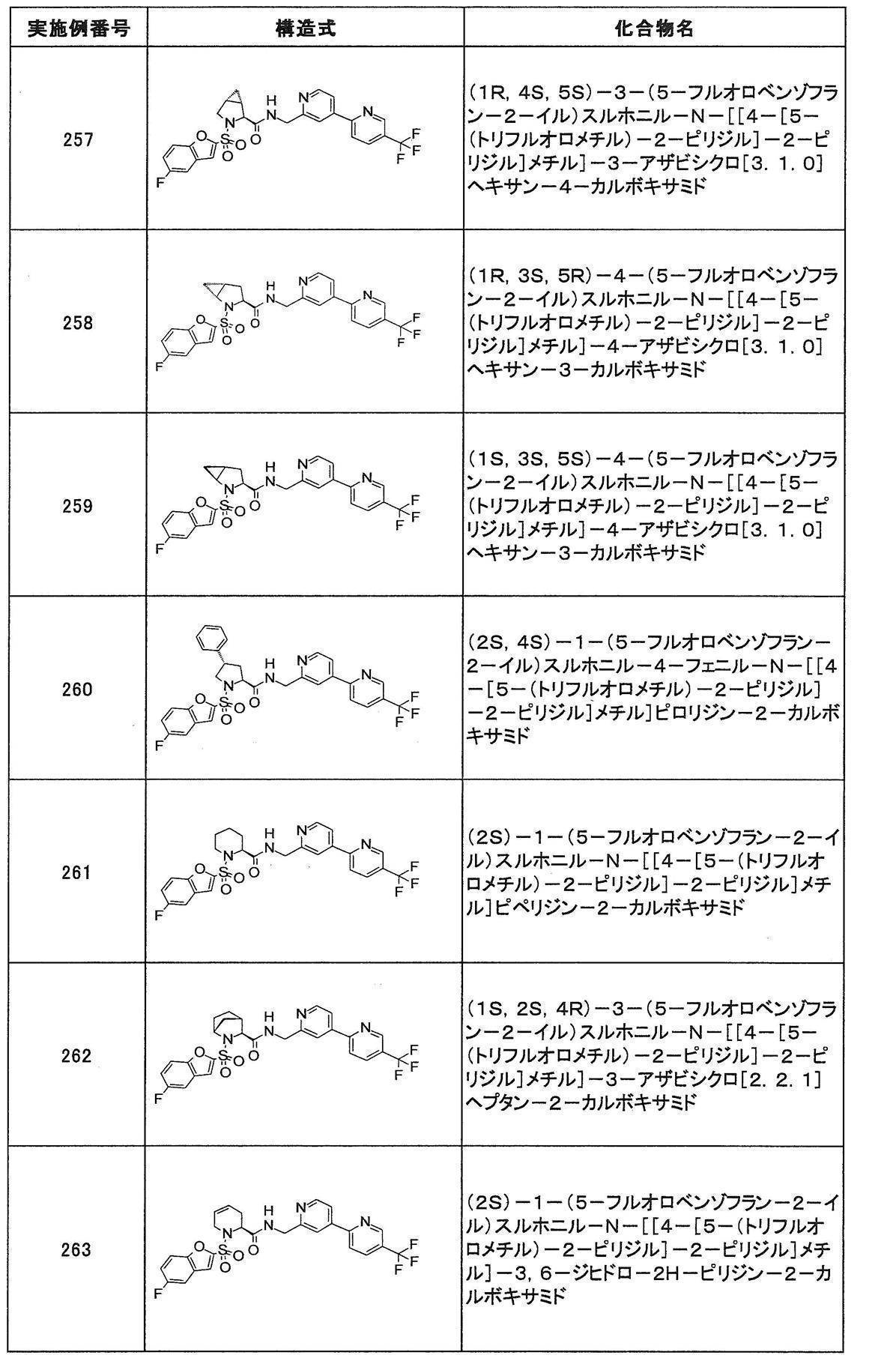

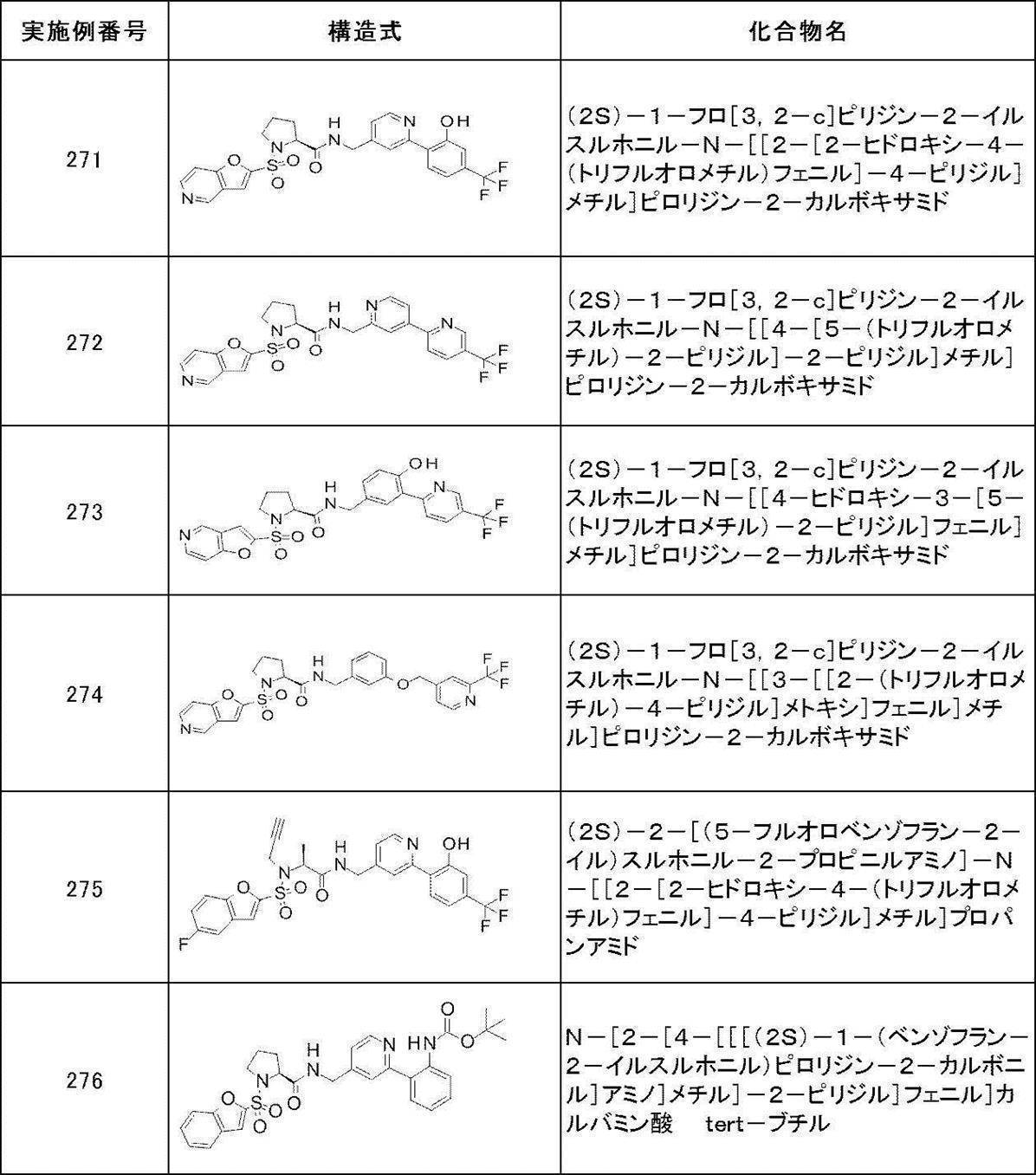
表28記載の実施例277~実施例286は、参考例記載の化合物及び対応する市販の試薬を用い実施例112と同様の操作により合成した。 Examples 277 to 286 described in Table 28 were synthesized in the same manner as in Example 112 using the compounds described in Reference Examples and the corresponding commercially available reagents.


実施例287:(2S)-1-(ベンゾフラン-2-イルスルホニル)-N-[(1S)-1-[3-[6-(トリフルオロメチル)-3-ピリジル]フェニル]エチル]ピロリジン-2-カルボキサミド(287)の合成Example 287: (2S) -1- (benzofuran-2-ylsulfonyl) -N-[(1S) -1- [3- [6- (trifluoromethyl) -3-pyridyl] phenyl] ethyl] pyrrolidine- Synthesis of 2-carboxamide (287)

(工程1)(2S)-1-(ベンゾフラン-2-イルスルホニル)-N-[(1S)-1-(3-ブロモフェニル)エチル]ピロリジン-2-カルボキサミドの合成
B-1(30mg、0.10mmol)、(1S)-1-(3-ブロモフェニル)エチルアミン(0.015mL、0.10mmol)、WSC塩酸塩(27mg、0.12mmol)及び1-ヒドロキシ-7-アザベンゾトリアゾール(14mg、0.15mmol)にジクロロメタン(1mL)を加え室温で30分間攪拌した。反応混合物に飽和重曹水を加えて分層させ、有機層を硫酸ナトリウムにて乾燥した。乾燥剤を濾別し、溶媒を留去して標題化合物(42mg、0.088mmol、88%)を得た。
MS (ESI) m/z 477 (M+H)+
(工程2)(2S)-1-(ベンゾフラン-2-イルスルホニル)-N-[(1S)-1-[3-[6-(トリフルオロメチル)-3-ピリジル]フェニル]エチル]ピロリジン-2-カルボキサミド(287)の合成
C-4及びフェニルボロン酸の代わりに工程1で得られた化合物及び[6-(トリフルオロメチル)-3-ピリジル]ボロン酸を用い、実施例112と同様の操作により標題化合物を得た(収率57%)。
MS (ESI) m/z 544 (M+H)+
1H NMR (400 MHz, DMSO-d6) δ 9.10 (d, J = 2.2 Hz, 1H), 8.57 (d, J = 8.2 Hz, 1H), 8.37 (dd, J = 8.2, 2.2 Hz, 1H), 7.99 (d, J = 8.2 Hz, 1H), 7.84 (ddd, J = 7.8, 1.4, 0.9 Hz, 1H), 7.78 (dd, J = 1.8, 1.8 Hz, 1H), 7.75 (dd, J = 8.5, 0.9 Hz, 1H), 7.73 (d, J = 0.9 Hz, 1H), 7.69 (ddd, J = 7.6, 1.8, 1.8 Hz, 1H), 7.56 (ddd, J = 8.5, 7.2, 1.4 Hz, 1H), 7.51 (dd, J = 7.6, 7.6 Hz, 1H), 7.47 - 7.40 (m, 2H), 5.04 (dq, J= 8.2, 7.0 Hz, 1H), 4.32 (dd, J= 8.3, 3.8 Hz, 1H), 3.65 - 3.56 (m, 1H), 3.41 - 3.35 (m, 1H), 1.98 - 1.76 (m, 3H), 1.67 - 1.58 (m, 1H), 1.46 (d, J= 7.0 Hz, 3H).
(Step 1) Synthesis of (2S) -1- (benzofuran-2-ylsulfonyl) -N-[(1S) -1- (3-bromophenyl) ethyl] pyrrolidine-2-carboxamide B-1 (30 mg, 0 .10 mmol), (1S) -1- (3-bromophenyl) ethylamine (0.015 mL, 0.10 mmol), WSC hydrochloride (27 mg, 0.12 mmol) and 1-hydroxy-7-azabenzotriazole (14 mg, 0.15 mmol) was added with dichloromethane (1 mL) and stirred at room temperature for 30 minutes. Saturated aqueous sodium hydrogen carbonate was added to the reaction mixture to separate the layers, and the organic layer was dried over sodium sulfate. The desiccant was filtered off and the solvent was evaporated to give the title compound (42 mg, 0.088 mmol, 88%).
MS (ESI) m / z 477 (M + H) +
(Step 2) (2S) -1- (benzofuran-2-ylsulfonyl) -N-[(1S) -1- [3- [6- (trifluoromethyl) -3-pyridyl] phenyl] ethyl] pyrrolidine- Synthesis of 2-carboxamide (287) In the same manner as in Example 112, the compound obtained in Step 1 and [6- (trifluoromethyl) -3-pyridyl] boronic acid were used instead of C-4 and phenylboronic acid. Operation gave the title compound (57% yield).
MS (ESI) m / z 544 (M + H) +
1 H NMR (400 MHz, DMSO-d 6 ) δ 9.10 (d, J = 2.2 Hz, 1H), 8.57 (d, J = 8.2 Hz, 1H), 8.37 (dd, J = 8.2, 2.2 Hz, 1H) , 7.99 (d, J = 8.2 Hz, 1H), 7.84 (ddd, J = 7.8, 1.4, 0.9 Hz, 1H), 7.78 (dd, J = 1.8, 1.8 Hz, 1H), 7.75 (dd, J = 8.5 , 0.9 Hz, 1H), 7.73 (d, J = 0.9 Hz, 1H), 7.69 (ddd, J = 7.6, 1.8, 1.8 Hz, 1H), 7.56 (ddd, J = 8.5, 7.2, 1.4 Hz, 1H) , 7.51 (dd, J = 7.6, 7.6 Hz, 1H), 7.47-7.40 (m, 2H), 5.04 (dq, J = 8.2, 7.0 Hz, 1H), 4.32 (dd, J = 8.3, 3.8 Hz, 1H ), 3.65-3.56 (m, 1H), 3.41-3.35 (m, 1H), 1.98-1.76 (m, 3H), 1.67-1.58 (m, 1H), 1.46 (d, J = 7.0 Hz, 3H).
実施例288:(2S)-1-(ベンゾフラン-2-イルスルホニル)-N-[[6-[2-ヒドロキシ-4-(トリフルオロメチル)フェニル]ピリミジン-4-イル]メチル]ピロリジン-2-カルボキサミド(288)の合成
(工程1)4-[2-ベンジルオキシ-4-(トリフルオロメチル)フェニル]-6-シアノピリミジンの合成
2-ベンジルオキシ-4-トリフルオロメチルフェニルボロン酸(0.25g、0.84mmol)、4,6-ジクロロピリミジン(0.13g、0.84mmol)及び1,1’-ビス(ジフェニルホスフィノ)フェロセンジクロロパラジウム(II)(62mg、0.084mmol)に1,4-ジオキサン(5mL)及び1mol/L炭酸ナトリウム水溶液(5mL)を加え、マイクロウェーブ反応装置を用いて100℃で20分間加熱攪拌した。反応混合物に水を加え、酢酸エチルで抽出し、有機層を硫酸ナトリウムにて乾燥した。乾燥剤を濾別し、溶媒を留去して得られた残渣にジメチルスルホキシド(2mL)、水(0.6mL)、シアン化ナトリウム(0.12g、2.5mmol)及び1,8-ジアザビシクロ[2.2.2]オクタン(19mg、0.17mmol)を加えて60℃で1時間攪拌した。反応混合物に水を加え、酢酸エチルで抽出し、有機層を硫酸ナトリウムにて乾燥した。乾燥剤を濾別し、溶媒を留去して得られた残渣をシリカゲルカラムクロマトグラフィー(ヘキサン/酢酸エチル)にて精製して標題化合物(0.18g、0.52mmol、61%)を得た。
MS (ESI) m/z 356 (M+H)+
(工程2)(2S)-1-(ベンゾフラン-2-イルスルホニル)-N-[{6-[2-ヒドロキシ-4-(トリフルオロメチル)フェニル]ピリミジン-4-イル}メチル]ピロリジン-2-カルボキサミド(288)の合成
工程1で得られた化合物(50mg、0.14mmol)にエタノール(2mL)及びテトラヒドロフラン(1mL)を加えて溶解させ、10%パラジウム/炭素(15mg)を加え、常圧の水素雰囲気下、室温で3時間攪拌した。触媒を濾別した後、減圧濃縮して得られた残渣にB-1(47mg、0.16mmol)、WSC塩酸塩(37mg、0.19mmol)、1-ヒドロキシ-7-アザベンゾトリアゾール(22mg、0.16mmol)及びジクロロメタン(2mL)を加え室温で10分間攪拌した。反応液を減圧濃縮して得られた残渣を高速液体クロマトグラフィー(水-アセトニトリル、それぞれ0.1%トリフルオロ酢酸入り)にて精製して標題化合物(41mg、0.075mmol、53%)を得た。
MS (ESI) m/z 547 (M+H)+
1H NMR (400 MHz, DMSO-d6) δ 12.90 (s, 1H), 9.24 (d, J = 1.3 Hz, 1H), 8.96 (dd, J = 6.1, 5.8 Hz, 1H), 8.25 (d, J = 8.3 Hz, 1H), 8.14 (d, J= 1.3 Hz, 1H), 7.84 (ddd, J = 7.9, 1.3, 0.9 Hz, 1H), 7.80 - 7.72 (m, 2H), 7.57 (ddd, J = 8.5, 7.2, 1.3 Hz, 1H), 7.43 (ddd, J = 7.9, 7.2, 0.9 Hz, 1H), 7.32 (d, J = 1.9 Hz, 1H), 7.28 (dd, J = 8.3, 1.9 Hz, 1H), 4.53 (dd, J = 17.3, 6.1 Hz, 1H), 4.46 (dd, J = 17.3, 5.8 Hz, 1H), 4.37 (dd, J = 8.0, 3.9 Hz, 1H), 3.67 - 3.59 (m, 1H), 3.45 - 3.41 (m, 1H), 2.05 - 1.90 (m, 3H), 1.73 - 1.63 (m, 1H).
Example 288: (2S) -1- (benzofuran-2-ylsulfonyl) -N-[[6- [2-hydroxy-4- (trifluoromethyl) phenyl] pyrimidin-4-yl] methyl] pyrrolidine-2 Synthesis of carboxamide (288) (Step 1) Synthesis of 4- [2-benzyloxy-4- (trifluoromethyl) phenyl] -6-cyanopyrimidine 2-Benzyloxy-4-trifluoromethylphenylboronic acid (0 .25 g, 0.84 mmol), 4,6-dichloropyrimidine (0.13 g, 0.84 mmol) and 1,1′-bis (diphenylphosphino) ferrocenedichloropalladium (II) (62 mg, 0.084 mmol) , 4-dioxane (5 mL) and 1 mol / L aqueous sodium carbonate solution (5 mL) were added to the microwave. It was heated with stirring for 20 minutes at 100 ° C. using a reactor. Water was added to the reaction mixture, extraction was performed with ethyl acetate, and the organic layer was dried over sodium sulfate. The desiccant was removed by filtration, and the solvent was distilled off. 2.2.2] Octane (19 mg, 0.17 mmol) was added and stirred at 60 ° C. for 1 hour. Water was added to the reaction mixture, extraction was performed with ethyl acetate, and the organic layer was dried over sodium sulfate. The desiccant was filtered off, the solvent was distilled off, and the resulting residue was purified by silica gel column chromatography (hexane / ethyl acetate) to give the title compound (0.18 g, 0.52 mmol, 61%). .
MS (ESI) m / z 356 (M + H) +
(Step 2) (2S) -1- (benzofuran-2-ylsulfonyl) -N-[{6- [2-hydroxy-4- (trifluoromethyl) phenyl] pyrimidin-4-yl} methyl] pyrrolidine-2 Synthesis of carboxamide (288) Ethanol (2 mL) and tetrahydrofuran (1 mL) were added to the compound obtained in Step 1 (50 mg, 0.14 mmol) and dissolved, 10% palladium / carbon (15 mg) was added, and atmospheric pressure In a hydrogen atmosphere at room temperature for 3 hours. After the catalyst was filtered off, the residue obtained by concentration under reduced pressure was added to B-1 (47 mg, 0.16 mmol), WSC hydrochloride (37 mg, 0.19 mmol), 1-hydroxy-7-azabenzotriazole (22 mg, 0.16 mmol) and dichloromethane (2 mL) were added, and the mixture was stirred at room temperature for 10 minutes. The residue obtained by concentrating the reaction solution under reduced pressure was purified by high performance liquid chromatography (water-acetonitrile, each containing 0.1% trifluoroacetic acid) to give the title compound (41 mg, 0.075 mmol, 53%). It was.
MS (ESI) m / z 547 (M + H) +
1 H NMR (400 MHz, DMSO-d 6 ) δ 12.90 (s, 1H), 9.24 (d, J = 1.3 Hz, 1H), 8.96 (dd, J = 6.1, 5.8 Hz, 1H), 8.25 (d, J = 8.3 Hz, 1H), 8.14 (d, J = 1.3 Hz, 1H), 7.84 (ddd, J = 7.9, 1.3, 0.9 Hz, 1H), 7.80-7.72 (m, 2H), 7.57 (ddd, J = 8.5, 7.2, 1.3 Hz, 1H), 7.43 (ddd, J = 7.9, 7.2, 0.9 Hz, 1H), 7.32 (d, J = 1.9 Hz, 1H), 7.28 (dd, J = 8.3, 1.9 Hz, 1H), 4.53 (dd, J = 17.3, 6.1 Hz, 1H), 4.46 (dd, J = 17.3, 5.8 Hz, 1H), 4.37 (dd, J = 8.0, 3.9 Hz, 1H), 3.67-3.59 (m , 1H), 3.45-3.41 (m, 1H), 2.05-1.90 (m, 3H), 1.73-1.63 (m, 1H).
表29記載の実施例289~実施例290は、参考例記載の化合物を用い実施例288と同様の操作により合成した。 Examples 289 to 290 described in Table 29 were synthesized in the same manner as in Example 288 using the compounds described in Reference Examples.

実施例291:(2S)-1-(ベンゾフラン-2-イルスルホニル)-N-[[3-[[5-(トリフルオロメチル)-2-ピリジル]メトキシ]フェニル]メチル]ピロリジン-2-カルボキサミド(291)の合成Example 291: (2S) -1- (benzofuran-2-ylsulfonyl) -N-[[3-[[5- (trifluoromethyl) -2-pyridyl] methoxy] phenyl] methyl] pyrrolidine-2-carboxamide Synthesis of (291)
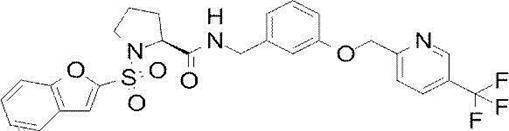
(工程1)[5-(トリフルオロメチル)-2-ピリジル]メタノールの合成
5-(トリフルオロメチル)ピリジン-2-カルボン酸(0.19g、1.0mmol)のテトラヒドロフラン(10mL)溶液を0℃に冷却し、トリエチルアミン(0.18mL、1.3mmol)及びクロロギ酸エチル(0.11mL、1.1mmol)を加え10分間攪拌した。反応混合物を濾過し、濾液にテトラヒドロホウ酸ナトリウム(49mg、1.3mmol)及び1かけらの氷を加えて0℃で1時間攪拌した。反応混合物に水酸化ナトリウム水溶液を加えて30分間攪拌した後、ジクロロメタンを加えて抽出した。有機層を水で洗浄した後、硫酸ナトリウムにて乾燥し、乾燥剤を濾別した。溶媒を留去して標題化合物の粗精製物(0.12g)を得た。
MS (ESI) m/z 178 (M+H)+
(工程2)(2S)-1-(ベンゾフラン-2-イルスルホニル)-N-[[3-[[5-(トリフルオロメチル)-2-ピリジル]メトキシ]フェニル]メチル]ピロリジン-2-カルボキサミド(291)の合成
工程1で得られた粗精製物(20mg)及びC-1(40mg、0.10mmol)にジクロロメタン(2mL)を加えて溶解させ、トリフェニルホスフィン(39mg、0.15mmol)及びアゾジカルボン酸ジイソプロピル(0.032mL、0.15mmol)を加えて室温で1時間攪拌した。反応混合物を減圧濃縮して得られた残渣を高速液体クロマトグラフィー(水-アセトニトリル、それぞれ0.1%トリフルオロ酢酸入り)にて精製して標題化合物(11mg、0.019mmol、19%)を得た。
MS (ESI) m/z 560 (M+H)+
1H NMR (400 MHz, DMSO-d6) δ 8.97 (brs, 1H), 8.65 (t, J = 6.1 Hz, 1H), 8.25 (dd, J = 8.4, 2.4 Hz, 1H), 7.83 (d, J = 7.8 Hz, 1H), 7.77 - 7.70 (m, 3H), 7.56 (ddd, J= 8.5, 7.2, 1.4 Hz, 1H), 7.45 - 7.39 (m, 1H), 7.26 (t, J = 7.9 Hz, 1H), 6.99 (brs, 1H), 6.93 - 6.88 (m, 2H), 5.30 (s, 2H), 4.37 - 4.22 (m, 3H), 3.62 - 3.55 (m, 1H), 3.42 - 3.35 (m, 1H), 1.94 - 1.80 (m, 3H), 1.68 - 1.59 (m, 1H).
(Step 1) Synthesis of [5- (trifluoromethyl) -2-pyridyl] methanol A solution of 5- (trifluoromethyl) pyridine-2-carboxylic acid (0.19 g, 1.0 mmol) in tetrahydrofuran (10 mL) was added to 0. Cooled to 0 ° C., triethylamine (0.18 mL, 1.3 mmol) and ethyl chloroformate (0.11 mL, 1.1 mmol) were added and stirred for 10 minutes. The reaction mixture was filtered, sodium tetrahydroborate (49 mg, 1.3 mmol) and a piece of ice were added to the filtrate, and the mixture was stirred at 0 ° C. for 1 hr. An aqueous sodium hydroxide solution was added to the reaction mixture and stirred for 30 minutes, and then dichloromethane was added for extraction. The organic layer was washed with water and then dried over sodium sulfate, and the desiccant was filtered off. The solvent was distilled off to obtain a crude product of the title compound (0.12 g).
MS (ESI) m / z 178 (M + H) +
(Step 2) (2S) -1- (benzofuran-2-ylsulfonyl) -N-[[3-[[5- (trifluoromethyl) -2-pyridyl] methoxy] phenyl] methyl] pyrrolidine-2-carboxamide Synthesis of (291) Dichloromethane (2 mL) was added to and dissolved in the crude product (20 mg) and C-1 (40 mg, 0.10 mmol) obtained in Step 1, triphenylphosphine (39 mg, 0.15 mmol) and Diisopropyl azodicarboxylate (0.032 mL, 0.15 mmol) was added and stirred at room temperature for 1 hour. The residue obtained by concentrating the reaction mixture under reduced pressure was purified by high performance liquid chromatography (water-acetonitrile, each containing 0.1% trifluoroacetic acid) to give the title compound (11 mg, 0.019 mmol, 19%). It was.
MS (ESI) m / z 560 (M + H) +
1 H NMR (400 MHz, DMSO-d 6 ) δ 8.97 (brs, 1H), 8.65 (t, J = 6.1 Hz, 1H), 8.25 (dd, J = 8.4, 2.4 Hz, 1H), 7.83 (d, J = 7.8 Hz, 1H), 7.77-7.70 (m, 3H), 7.56 (ddd, J = 8.5, 7.2, 1.4 Hz, 1H), 7.45-7.39 (m, 1H), 7.26 (t, J = 7.9 Hz , 1H), 6.99 (brs, 1H), 6.93-6.88 (m, 2H), 5.30 (s, 2H), 4.37-4.22 (m, 3H), 3.62-3.55 (m, 1H), 3.42-3.35 (m , 1H), 1.94-1.80 (m, 3H), 1.68-1.59 (m, 1H).
実施例292:(2S)-1-(ベンゾフラン-2-イルスルホニル)-N-[[2-[2-(メチルアミノ)フェニル]-4-ピリジル]メチル]ピロリジン-2-カルボキサミド(292)の合成Example 292: (2S) -1- (Benzofuran-2-ylsulfonyl) -N-[[2- [2- (methylamino) phenyl] -4-pyridyl] methyl] pyrrolidine-2-carboxamide (292) Composition

(工程1)(2S)-N-[[2-(2-アミノフェニル)-4-ピリジル]メチル]-1-(ベンゾフラン-2-イルスルホニル)ピロリジン-2-カルボキサミドの合成
C-4(84mg、0.20mmol)、[2-(tert-ブトキシカルボニルアミノ)フェニル]ボロン酸(47mg、0.20mmol)、及び1,1’-ビス(ジフェニルホスフィノ)フェロセンジクロロパラジウム(II)(15mg、0.020mmol)に1,4-ジオキサン(1.4mL)及び1mol/L炭酸ナトリウム水溶液(1.4mL)を加え、マイクロウェーブ反応装置を用いて100℃で10分間加熱攪拌した。反応混合物にトリフルオロ酢酸を加えて中和した後、高速液体クロマトグラフィー(水-アセトニトリル、それぞれ0.1%トリフルオロ酢酸入り)にて精製した。得られた化合物にジクロロメタン(1mL)を加えて溶解させ、トリフルオロ酢酸(1mL)を加えて室温で30分間攪拌した後、減圧濃縮して標題化合物の2トリフルオロ酢酸塩(42mg、0.088mmol、44%)を得た。
MS (ESI) m/z 477 (M+H)+
(工程2)(2S)-1-(ベンゾフラン-2-イルスルホニル)-N-[[2-[2-(メチルアミノ)フェニル]-4-ピリジル]メチル]ピロリジン-2-カルボキサミド(292)の合成
工程1で得られた化合物(15mg、0.031mmol)のアセトニトリル(1mL)溶液に炭酸カリウム(4.3mg、0.031mmol)及びヨウ化メチル(0.014mL、0.031mmol)を加えて室温で一晩攪拌した。不溶物を濾別し、減圧濃縮して得られた残渣を高速液体クロマトグラフィー(水-アセトニトリル、それぞれ0.1%トリフルオロ酢酸入り)にて精製して標題化合物の2トリフルオロ酢酸塩(2.5mg、0.0041mmol、13%)を得た。
MS (ESI) m/z 491 (M+H)+
(Step 1) Synthesis of (2S) -N-[[2- (2-aminophenyl) -4-pyridyl] methyl] -1- (benzofuran-2-ylsulfonyl) pyrrolidine-2-carboxamide C-4 (84 mg , 0.20 mmol), [2- (tert-butoxycarbonylamino) phenyl] boronic acid (47 mg, 0.20 mmol), and 1,1′-bis (diphenylphosphino) ferrocenedichloropalladium (II) (15 mg, 0 (.020 mmol) was added 1,4-dioxane (1.4 mL) and a 1 mol / L aqueous sodium carbonate solution (1.4 mL), and the mixture was heated and stirred at 100 ° C. for 10 minutes using a microwave reactor. The reaction mixture was neutralized with trifluoroacetic acid and then purified by high performance liquid chromatography (water-acetonitrile, each containing 0.1% trifluoroacetic acid). Dichloromethane (1 mL) was added to the resulting compound to dissolve it, trifluoroacetic acid (1 mL) was added, and the mixture was stirred at room temperature for 30 min, and concentrated under reduced pressure to give the title compound 2 trifluoroacetate (42 mg, 0.088 mmol). 44%).
MS (ESI) m / z 477 (M + H) +
(Step 2) of (2S) -1- (benzofuran-2-ylsulfonyl) -N-[[2- [2- (methylamino) phenyl] -4-pyridyl] methyl] pyrrolidine-2-carboxamide (292) Synthesis To a solution of the compound obtained in Step 1 (15 mg, 0.031 mmol) in acetonitrile (1 mL) was added potassium carbonate (4.3 mg, 0.031 mmol) and methyl iodide (0.014 mL, 0.031 mmol) at room temperature. Stir overnight. The insoluble material was filtered off, and the residue obtained after concentration under reduced pressure was purified by high performance liquid chromatography (water-acetonitrile, each containing 0.1% trifluoroacetic acid) to give the title compound 2 trifluoroacetate (2 0.5 mg, 0.0041 mmol, 13%).
MS (ESI) m / z 491 (M + H) +
実施例293:(2S)-1-(ベンゾフラン-2-イルスルホニル)-N-[[2-(4-シアノフェニル)-4-ピリジル]メチル]ピロリジン-2-カルボチオアミド(293)の合成Example 293: Synthesis of (2S) -1- (benzofuran-2-ylsulfonyl) -N-[[2- (4-cyanophenyl) -4-pyridyl] methyl] pyrrolidine-2-carbothioamide (293)

(2S)-1-(ベンゾフラン-2-イルスルホニル)-N-[[2-(4-シアノフェニル)-4-ピリジル]メチル]ピロリジン-2-カルボキサミド(117)(50mg、0.10mmol)及びローソン試薬(50mg、0.12mmol)にテトラヒドロフラン(2mL)を加え50℃で一晩攪拌した。反応液を減圧濃縮して得られた残渣を高速液体クロマトグラフィー(水-アセトニトリル、それぞれ0.1%トリフルオロ酢酸入り)にて精製して標題化合物のトリフルオロ酢酸塩(4.3mg、0.0070mmol、7.0%)を得た。
MS (ESI) m/z 503 (M+H)+
1H NMR (400 MHz, DMSO-d6) δ 10.75 (dd, J = 6.5, 5.9 Hz, 1H), 8.68 (d, J = 5.1 Hz, 1H), 8.31 - 8.24 (m, 2H), 8.03 - 7.94 (m, 3H), 7.86 (d, J = 7.8 Hz, 1H), 7.82 (s, 1H), 7.80 (d, J = 8.5 Hz, 1H), 7.61 - 7.55 (m, 1H), 7.44 (t, J = 7.5 Hz, 1H), 7.37 (dd, J = 5.1, 1.5 Hz, 1H), 5.15 (dd, J = 16.0, 6.5 Hz, 1H), 4.89 - 4.78 (m, 2H), 3.95 - 3.83 (m, 1H), 3.76 - 3.69 (m, 1H), 1.93 - 1.51 (m, 4H).
(2S) -1- (benzofuran-2-ylsulfonyl) -N-[[2- (4-cyanophenyl) -4-pyridyl] methyl] pyrrolidine-2-carboxamide (117) (50 mg, 0.10 mmol) and Tetrahydrofuran (2 mL) was added to Lawesson's reagent (50 mg, 0.12 mmol), and the mixture was stirred at 50 ° C. overnight. The reaction mixture was concentrated under reduced pressure, and the resulting residue was purified by high performance liquid chromatography (water-acetonitrile, each containing 0.1% trifluoroacetic acid) to give the trifluoroacetate salt of the title compound (4.3 mg, 0.3 mg). 0070 mmol, 7.0%).
MS (ESI) m / z 503 (M + H) +
1 H NMR (400 MHz, DMSO-d 6 ) δ 10.75 (dd, J = 6.5, 5.9 Hz, 1H), 8.68 (d, J = 5.1 Hz, 1H), 8.31-8.24 (m, 2H), 8.03- 7.94 (m, 3H), 7.86 (d, J = 7.8 Hz, 1H), 7.82 (s, 1H), 7.80 (d, J = 8.5 Hz, 1H), 7.61-7.55 (m, 1H), 7.44 (t , J = 7.5 Hz, 1H), 7.37 (dd, J = 5.1, 1.5 Hz, 1H), 5.15 (dd, J = 16.0, 6.5 Hz, 1H), 4.89-4.78 (m, 2H), 3.95-3.83 ( m, 1H), 3.76-3.69 (m, 1H), 1.93-1.51 (m, 4H).
実施例294:(2S)-1-(ベンゾフラン-2-イルスルホニル)-N-[[2-[3-(トリフルオロメチル)-1H-ピラゾール-5-イル]-4-ピリジル]メチル]ピロリジン-2-カルボキサミド(294)の合成Example 294: (2S) -1- (benzofuran-2-ylsulfonyl) -N-[[2- [3- (trifluoromethyl) -1H-pyrazol-5-yl] -4-pyridyl] methyl] pyrrolidine Synthesis of -2-carboxamide (294)

C-4(42mg、0.10mmol)、[2-テトラヒドロピラン-2-イル-5-(トリフルオロメチル)ピラゾール-3-イル]ボロン酸(53mg、0.20mmol)、リン酸カリウム(64mg、0.30mmol)及びテトラキス(トリフェニルホスフィン)パラジウム(0)(5.7mg、0.005mmol)にトルエン(3mL)を加えた。マイクロウェーブ反応装置を用いて100℃で20分間、130℃で10分間、130℃で30分間、順次加熱攪拌した後、反応混合物をシリカゲルカラムクロマトグラフィー(酢酸エチル/ジクロロメタン)にて精製した。得られた化合物にジクロロメタン(2mL)及びトリフルオロ酢酸(0.10mL)を加えて室温で30分間攪拌した後、水とアセトニトリルを加えて凍結乾燥して標題化合物のトリフルオロ酢酸塩(5.0mg、0.0078mmol、8%)を得た。
MS (ESI) m/z 520 (M+H)+
C-4 (42 mg, 0.10 mmol), [2-tetrahydropyran-2-yl-5- (trifluoromethyl) pyrazol-3-yl] boronic acid (53 mg, 0.20 mmol), potassium phosphate (64 mg, Toluene (3 mL) was added to 0.30 mmol) and tetrakis (triphenylphosphine) palladium (0) (5.7 mg, 0.005 mmol). The mixture was heated and stirred successively at 100 ° C. for 20 minutes, 130 ° C. for 10 minutes, and 130 ° C. for 30 minutes using a microwave reactor, and then the reaction mixture was purified by silica gel column chromatography (ethyl acetate / dichloromethane). Dichloromethane (2 mL) and trifluoroacetic acid (0.10 mL) were added to the obtained compound, and the mixture was stirred at room temperature for 30 minutes, and then water and acetonitrile were added and lyophilized to dry the title compound trifluoroacetate (5.0 mg). , 0.0078 mmol, 8%).
MS (ESI) m / z 520 (M + H) +
実施例295:5-フルオロベンゾフラン-2-スルホン酸 [3-[[[(2S)-1-(5-フルオロベンゾフラン-2-イル)スルホニルピロリジン-2-カルボニル]アミノ]メチル]フェニル]エステル(295)の合成Example 295: 5-fluorobenzofuran-2-sulfonic acid [3-[[[(2S) -1- (5-fluorobenzofuran-2-yl) sulfonylpyrrolidin-2-carbonyl] amino] methyl] phenyl] ester ( 295)

C-2(21mg、0.050mmol)のアセトニトリル(1mL)溶液にA-3(14mg、0.060mmol)及びトリエチルアミン(0.010mL、0.075mmol)を加え、室温で一晩攪拌した。反応混合物を減圧濃縮して得られた残渣を高速液体クロマトグラフィー(水-アセトニトリル、それぞれ0.1%トリフルオロ酢酸入り)にて精製して標題化合物(28mg、0.045mmol、90%)を得た。
MS (ESI) m/z 617 (M+H)+
1H NMR (400 MHz, DMSO-d6) δ 8.71 (dd, J = 6.2, 5.9 Hz, 1H), 7.92 (dd, J = 9.2, 4.1 Hz, 1H), 7.89 (d, J = 0.9 Hz, 1H), 7.81 (dd, J = 9.1, 4.2 Hz, 1H), 7.67 (d, J = 0.9 Hz, 1H), 7.66 - 7.60 (m, 2H), 7.52 (ddd, J = 9.2, 9.2, 2.7 Hz, 1H), 7.43 (ddd, J = 9.3, 9.1, 2.8 Hz, 1H), 7.36 (dd, J = 8.2, 7.8 Hz, 1H), 7.27 (ddd, J = 7.8, 1.4, 1.2 Hz, 1H), 7.14 (dd, J = 2.6, 1.4 Hz, 1H), 6.95 (ddd, J = 8.2, 2.6, 1.2 Hz, 1H), 4.31 (dd, J = 15.7, 6.2 Hz, 1H), 4.28 - 4.20 (m, 2H), 3.57 (ddd, J = 9.5, 6.8, 4.8 Hz, 1H), 3.41 - 3.35 (m, 1H), 1.95 - 1.75 (m, 3H), 1.69 - 1.57 (m, 1H).
A-3 (14 mg, 0.060 mmol) and triethylamine (0.010 mL, 0.075 mmol) were added to a solution of C-2 (21 mg, 0.050 mmol) in acetonitrile (1 mL), and the mixture was stirred overnight at room temperature. The residue obtained by concentrating the reaction mixture under reduced pressure was purified by high performance liquid chromatography (water-acetonitrile, each containing 0.1% trifluoroacetic acid) to give the title compound (28 mg, 0.045 mmol, 90%). It was.
MS (ESI) m / z 617 (M + H) +
1 H NMR (400 MHz, DMSO-d 6 ) δ 8.71 (dd, J = 6.2, 5.9 Hz, 1H), 7.92 (dd, J = 9.2, 4.1 Hz, 1H), 7.89 (d, J = 0.9 Hz, 1H), 7.81 (dd, J = 9.1, 4.2 Hz, 1H), 7.67 (d, J = 0.9 Hz, 1H), 7.66-7.60 (m, 2H), 7.52 (ddd, J = 9.2, 9.2, 2.7 Hz , 1H), 7.43 (ddd, J = 9.3, 9.1, 2.8 Hz, 1H), 7.36 (dd, J = 8.2, 7.8 Hz, 1H), 7.27 (ddd, J = 7.8, 1.4, 1.2 Hz, 1H), 7.14 (dd, J = 2.6, 1.4 Hz, 1H), 6.95 (ddd, J = 8.2, 2.6, 1.2 Hz, 1H), 4.31 (dd, J = 15.7, 6.2 Hz, 1H), 4.28-4.20 (m, 2H), 3.57 (ddd, J = 9.5, 6.8, 4.8 Hz, 1H), 3.41-3.35 (m, 1H), 1.95-1.75 (m, 3H), 1.69-1.57 (m, 1H).
実施例296:(2S)-1-(5-フルオロベンゾフラン-2-イル)スルホニル-N-[[3-[4-(トリフルオロメチル)アニリノ]フェニル]メチル]ピロリジン-2-カルボキサミド(296)の合成Example 296: (2S) -1- (5-fluorobenzofuran-2-yl) sulfonyl-N-[[3- [4- (trifluoromethyl) anilino] phenyl] methyl] pyrrolidine-2-carboxamide (296) Synthesis of

C-10(47mg、0.089mmol)に4-アミノベンゾトリフルオリド(0.017mL、0.13mmol)、トリス(ジベンジリデンアセトン)ジパラジウム(0)(2.0mg、0.0022mmol)、ジシクロヘキシルホスフィノ-2’,4’,6’-トリイソプロピルビフェニル(4.2mg、0.0089mmol)及びナトリウムtert-ブトキシド(0.17g、0.18mmol)にトルエン(1.0mL)を加え、100℃で24時間攪拌した。反応混合物に水を加え、酢酸エチルで抽出し、有機層を硫酸ナトリウムにて乾燥した。乾燥剤を濾別し、溶媒を留去して得られた残渣をシリカゲルカラムクロマトグラフィー(ヘキサン/酢酸エチル)にて精製して標題化合物(26mg、0.047mmol、53%)を得た。
MS (ESI) m/z 562 (M+H)+
1H NMR (400 MHz, DMSO-d6) δ 8.68 (s, 1H), 8.65 (dd, J = 6.1, 6.1 Hz, 1H), 7.79 (dd, J = 9.0, 4.0 Hz, 1H), 7.66 (d, J = 0.9 Hz, 1H), 7.63 (dd, J = 8.5, 2.8 Hz, 1H), 7.50 (d, J = 8.5 Hz, 2H), 7.49 - 7.36 (m, 1H), 7.26 (t, J = 7.8 Hz, 1H), 7.14 (d, J = 8.5 Hz, 2H), 7.11 (s, 1H), 7.04 - 6.99 (m, 1H), 6.88 (d, J = 7.6 Hz, 1H), 4.36 - 4.19 (m, 3H), 3.67 - 3.54 (m, 1H), 3.45 - 3.35 (m, 1H), 2.00 - 1.78 (m, 3H), 1.71 - 1.58 (m, 1H).
C-10 (47 mg, 0.089 mmol) to 4-aminobenzotrifluoride (0.017 mL, 0.13 mmol), tris (dibenzylideneacetone) dipalladium (0) (2.0 mg, 0.0022 mmol), dicyclohexylphos Toluene (1.0 mL) was added to fino-2 ′, 4 ′, 6′-triisopropylbiphenyl (4.2 mg, 0.0089 mmol) and sodium tert-butoxide (0.17 g, 0.18 mmol) at 100 ° C. Stir for 24 hours. Water was added to the reaction mixture, extraction was performed with ethyl acetate, and the organic layer was dried over sodium sulfate. The desiccant was filtered off, the solvent was distilled off, and the resulting residue was purified by silica gel column chromatography (hexane / ethyl acetate) to give the title compound (26 mg, 0.047 mmol, 53%).
MS (ESI) m / z 562 (M + H) +
1 H NMR (400 MHz, DMSO-d 6 ) δ 8.68 (s, 1H), 8.65 (dd, J = 6.1, 6.1 Hz, 1H), 7.79 (dd, J = 9.0, 4.0 Hz, 1H), 7.66 ( d, J = 0.9 Hz, 1H), 7.63 (dd, J = 8.5, 2.8 Hz, 1H), 7.50 (d, J = 8.5 Hz, 2H), 7.49-7.36 (m, 1H), 7.26 (t, J = 7.8 Hz, 1H), 7.14 (d, J = 8.5 Hz, 2H), 7.11 (s, 1H), 7.04-6.99 (m, 1H), 6.88 (d, J = 7.6 Hz, 1H), 4.36-4.19 (m, 3H), 3.67-3.54 (m, 1H), 3.45-3.35 (m, 1H), 2.00-1.78 (m, 3H), 1.71-1.58 (m, 1H).
実施例297:(2S)-1-(5-フルオロベンゾフラン-2-イル)スルホニル-N-[[3-[(E)-2-[4-(トリフルオロメチル)フェニル]ビニル]フェニル]メチル]ピロリジン-2-カルボキサミド(297)の合成Example 297: (2S) -1- (5-fluorobenzofuran-2-yl) sulfonyl-N-[[3-[(E) -2- [4- (trifluoromethyl) phenyl] vinyl] phenyl] methyl Synthesis of pyrrolidine-2-carboxamide (297)

C-10(86mg、0.16mmol)と4-(トリフルオロメチル)スチレン(56mg、0.33mmol)、酢酸パラジウム(II)(3.7mg、0.016mmol)、トリフェニルホスフィン(8.6mg、0.033mmol)及びトリエチルアミン(0.11mL、0.82mmol)にN,N-ジメチルホルムアミド(1.6mL)を加え100℃で24時間攪拌した。反応混合物に水を加え、酢酸エチルで抽出し、有機層を硫酸ナトリウムにて乾燥した。乾燥剤を濾別し、溶媒を留去して得られた残渣をシリカゲルカラムクロマトグラフィー(ヘキサン/酢酸エチル)にて精製して標題化合物(18mg、0.031mmol、19%)を得た。
MS (ESI) m/z 573 (M+H)+
1H NMR (400 MHz, DMSO-d6) δ 8.72 (dd, J = 6.2, 6.1 Hz, 1H), 7.84 - 7.77 (m, 3H), 7.74 - 7.70 (m, 3H), 7.64 (dd, J = 8.5, 2.7 Hz, 1H), 7.60 (s, 1H), 7.50 (d, J = 7.7 Hz, 1H), 7.44 (dd, J = 9.3, 2.6 Hz, 1H), 7.41 - 7.33 (m, 3H), 7.23 (d, J = 7.7 Hz, 1H), 4.40 (dd, J = 15.5, 6.2 Hz, 1H), 4.36 - 4.29 (m, 2H), 3.66 - 3.58 (m, 1H), 3.46 - 3.37 (m, 1H), 2.05 - 1.83 (m, 3H), 1.74 - 1.60 (m, 1H).
C-10 (86 mg, 0.16 mmol) and 4- (trifluoromethyl) styrene (56 mg, 0.33 mmol), palladium (II) acetate (3.7 mg, 0.016 mmol), triphenylphosphine (8.6 mg, 0.033 mmol) and triethylamine (0.11 mL, 0.82 mmol) were added N, N-dimethylformamide (1.6 mL), and the mixture was stirred at 100 ° C. for 24 hours. Water was added to the reaction mixture, extraction was performed with ethyl acetate, and the organic layer was dried over sodium sulfate. The desiccant was filtered off, the solvent was distilled off, and the resulting residue was purified by silica gel column chromatography (hexane / ethyl acetate) to give the title compound (18 mg, 0.031 mmol, 19%).
MS (ESI) m / z 573 (M + H) +
1 H NMR (400 MHz, DMSO-d 6 ) δ 8.72 (dd, J = 6.2, 6.1 Hz, 1H), 7.84-7.77 (m, 3H), 7.74-7.70 (m, 3H), 7.64 (dd, J = 8.5, 2.7 Hz, 1H), 7.60 (s, 1H), 7.50 (d, J = 7.7 Hz, 1H), 7.44 (dd, J = 9.3, 2.6 Hz, 1H), 7.41-7.33 (m, 3H) , 7.23 (d, J = 7.7 Hz, 1H), 4.40 (dd, J = 15.5, 6.2 Hz, 1H), 4.36-4.29 (m, 2H), 3.66-3.58 (m, 1H), 3.46-3.37 (m , 1H), 2.05-1.83 (m, 3H), 1.74-1.60 (m, 1H).
実施例298:(2S)-1-(ベンゾフラン-2-イルスルホニル)-N-[[3-[[4-(トリフルオロメチル)フェノキシ]メチル]フェニル]メチル]ピロリジン-2-カルボキサミド(298)の合成
(工程1)3-[[4-(トリフルオロメチル)フェノキシ]メチル]ベンゾニトリルの合成
3-シアノベンジルアルコール(0.050mL、0.45mmol)、アゾジカルボン酸ジイソプロピル(0.13mL、0.68mmol)、トリフェニルホスフィン(0.18g、0.68mmol)、4-ヒドロキシベンゾトリフロリド(0.088g、0.54mmol)にテトラヒドロフラン(4.5mL)を加え、室温下24時間撹拌した。反応液を減圧濃縮して得られた残渣を高速液体クロマトグラフィー(水-アセトニトリル、それぞれ0.1%トリフルオロ酢酸入り)にて精製して標題化合物(53mg、0.19mmol、42%)を得た。
MS (ESI) m/z 278 (M+H)+
(工程2)(2S)-1-(ベンゾフラン-2-イルスルホニル)-N-[[3-[[4-(トリフルオロメチル)フェノキシ]メチル]フェニル]メチル]ピロリジン-2-カルボキサミド(298)の合成
工程1で得られた化合物(53mg、0.19mmol)にテトラヒドロフラン(1.9mL)を加えて溶解させ、0.95mol/L ボラン(テトラヒドロフラン溶液、0.30mL、0.29mmol)を加え、室温で4時間攪拌した。反応混合物にpH1になるまで1mol/L 塩酸を加え10分間撹拌した後、1mol/L 水酸化ナトリウム水溶液を加えた。反応混合物を酢酸エチルで抽出し、有機層を硫酸ナトリウムにて乾燥した後、乾燥剤を濾別し、溶媒を留去した。得られた残渣とB-1(56mg、0.19mmol)、トリエチルアミン(0.040mL、0.29mmol)、WSC塩酸塩(55mg、0.29mmol)及び1-ヒドロキシ-7-アザベンゾトリアゾール(13mg、0.095mmol)にジクロロメタン(1.9mL)を加え室温で1時間攪拌した。反応液を減圧濃縮して得られた残渣を高速液体クロマトグラフィー(水-アセトニトリル、それぞれ0.1%トリフルオロ酢酸入り)にて精製して標題化合物(34mg、0.060mmol、32%)を得た。
MS (ESI) m/z 559 (M+H)+
1H NMR (400 MHz, DMSO-d6) δ 8.69 (dd, J = 6.1, 6.1 Hz, 1H), 7.83 (ddd, J = 7.7, 1.3, 0.9 Hz, 1H), 7.74 (dd, J = 8.4, 0.9 Hz, 1H), 7.71 (d, J = 0.9 Hz, 1H), 7.65 (d, J= 8.6 Hz, 2H), 7.55 (ddd, J = 8.4, 7.3, 1.3 Hz, 1H), 7.44 - 7.39 (m, 1H), 7.38 (s, 1H), 7.37 - 7.31 (m, 2H), 7.29 - 7.23 (m, 1H), 7.19 (d, J = 8.6 Hz, 2H), 5.18 (s, 2H), 4.37 (dd, J = 15.4, 6.1 Hz, 1H), 4.33 - 4.25 (m, 2H), 3.68 - 3.50 (m, 1H), 3.43 - 3.34 (m, 1H), 1.94 - 1.80 (m, 3H), 1.69 - 1.55 (m, 1H).
Example 298: (2S) -1- (benzofuran-2-ylsulfonyl) -N-[[3-[[4- (trifluoromethyl) phenoxy] methyl] phenyl] methyl] pyrrolidine-2-carboxamide (298) (Step 1) Synthesis of 3-[[4- (trifluoromethyl) phenoxy] methyl] benzonitrile 3-Cyanobenzyl alcohol (0.050 mL, 0.45 mmol), Diisopropyl azodicarboxylate (0.13 mL, 0 .68 mmol), triphenylphosphine (0.18 g, 0.68 mmol) and 4-hydroxybenzotrifluoride (0.088 g, 0.54 mmol) were added with tetrahydrofuran (4.5 mL), and the mixture was stirred at room temperature for 24 hours. The residue obtained by concentrating the reaction solution under reduced pressure was purified by high performance liquid chromatography (water-acetonitrile, each containing 0.1% trifluoroacetic acid) to give the title compound (53 mg, 0.19 mmol, 42%). It was.
MS (ESI) m / z 278 (M + H) +
(Step 2) (2S) -1- (benzofuran-2-ylsulfonyl) -N-[[3-[[4- (trifluoromethyl) phenoxy] methyl] phenyl] methyl] pyrrolidine-2-carboxamide (298) To the compound (53 mg, 0.19 mmol) obtained in Step 1 was added tetrahydrofuran (1.9 mL) and dissolved, 0.95 mol / L borane (tetrahydrofuran solution, 0.30 mL, 0.29 mmol) was added, Stir at room temperature for 4 hours. 1 mol / L hydrochloric acid was added to the reaction mixture until pH 1, and the mixture was stirred for 10 minutes, and then a 1 mol / L aqueous sodium hydroxide solution was added. The reaction mixture was extracted with ethyl acetate, the organic layer was dried over sodium sulfate, the desiccant was filtered off, and the solvent was distilled off. The resulting residue and B-1 (56 mg, 0.19 mmol), triethylamine (0.040 mL, 0.29 mmol), WSC hydrochloride (55 mg, 0.29 mmol) and 1-hydroxy-7-azabenzotriazole (13 mg, 0.095 mmol) was added dichloromethane (1.9 mL) and stirred at room temperature for 1 hour. The residue obtained by concentrating the reaction solution under reduced pressure was purified by high performance liquid chromatography (water-acetonitrile, each containing 0.1% trifluoroacetic acid) to give the title compound (34 mg, 0.060 mmol, 32%). It was.
MS (ESI) m / z 559 (M + H) +
1 H NMR (400 MHz, DMSO-d 6 ) δ 8.69 (dd, J = 6.1, 6.1 Hz, 1H), 7.83 (ddd, J = 7.7, 1.3, 0.9 Hz, 1H), 7.74 (dd, J = 8.4 , 0.9 Hz, 1H), 7.71 (d, J = 0.9 Hz, 1H), 7.65 (d, J = 8.6 Hz, 2H), 7.55 (ddd, J = 8.4, 7.3, 1.3 Hz, 1H), 7.44-7.39 (m, 1H), 7.38 (s, 1H), 7.37-7.31 (m, 2H), 7.29-7.23 (m, 1H), 7.19 (d, J = 8.6 Hz, 2H), 5.18 (s, 2H), 4.37 (dd, J = 15.4, 6.1 Hz, 1H), 4.33-4.25 (m, 2H), 3.68-3.50 (m, 1H), 3.43-3.34 (m, 1H), 1.94-1.80 (m, 3H), 1.69-1.55 (m, 1H).
表30記載の実施例299は、参考例記載の化合物及び対応する市販の試薬を用い実施例298と同様の操作により合成した。 Example 299 described in Table 30 was synthesized in the same manner as in Example 298 using the compound described in the reference example and the corresponding commercially available reagent.
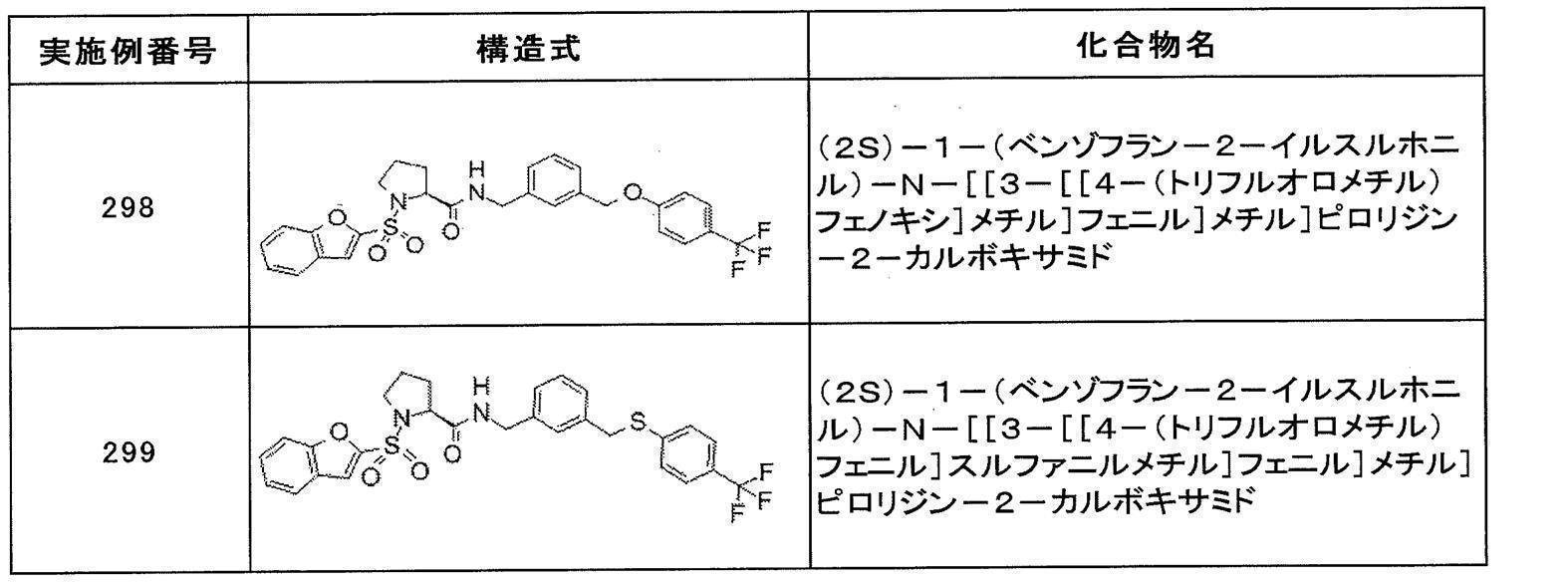
実施例300:(2S)-1-(ベンゾフラン-2-イルスルホニル)-N-[[3-[[4-(トリフルオロメチル)ベンゾイル]アミノ]フェニル]メチル]ピロリジン-2-カルボキサミド(300)の合成Example 300: (2S) -1- (benzofuran-2-ylsulfonyl) -N-[[3-[[4- (trifluoromethyl) benzoyl] amino] phenyl] methyl] pyrrolidine-2-carboxamide (300) Synthesis of
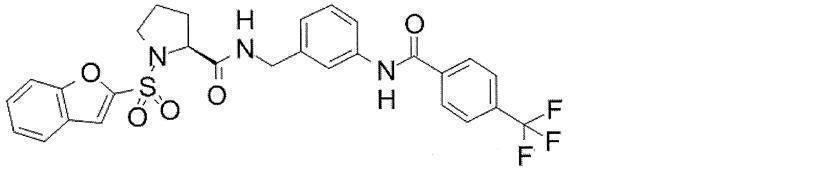
3-アミノベンゾニトリル(0.050g、0.42mmol)と4-トリフルオロメチルベンゾイルクロリド(0.075g、0.51mmol)及びトリエチルアミン(0.088mL、0.64mmol)にジクロロメタン(4.2mL)を加え室温で5時間攪拌した。反応混合物に水を加え、ジクロロメタンで抽出し、有機層を硫酸ナトリウムにて乾燥した。乾燥剤を濾別し、溶媒を留去した。得られた残渣に酢酸(2.1mL)及びメタノール(2.1mL)を加えて溶解させ、10%パラジウム/炭素(25mg)を加え、常圧の水素雰囲気下、室温で5時間攪拌した。触媒を濾別した後、減圧濃縮して得られた残渣(0.34g)とB-1(76mg、0.26mmol)、トリエチルアミン(0.054mL、0.39mmol)、WSC塩酸塩(74mg、0.39mmol)及び1-ヒドロキシ-7-アザベンゾトリアゾール(18mg、0.13mmol)にN,N-ジメチルホルムアミド(2.6mL)を加え室温で3時間攪拌した。反応混合物に水を加え、酢酸エチルで抽出し、有機層を硫酸ナトリウムにて乾燥した。乾燥剤を濾別し、溶媒を留去した。得られた残渣を高速液体クロマトグラフィー(水-アセトニトリル、それぞれ0.1%トリフルオロ酢酸入り)にて精製して標題化合物(0.13g、0.23mmol、55%)を得た。
MS (ESI) m/z 572 (M+H)+
1H NMR (400 MHz, DMSO-d6) δ 10.47 (s, 1H), 8.68 (dd, J = 6.0, 6.0 Hz, 1H), 8.14 (d, J = 8.1 Hz, 2H), 7.92 (d, J = 8.1 Hz, 2H), 7.83 (ddd, J = 8.0, 1.3, 0.9 Hz, 1H), 7.75 (dd, J = 8.4, 0.9 Hz, 1H), 7.73 - 7.72 (m, 1H), 7.71 (d, J = 0.9 Hz, 1H), 7.64 - 7.60 (m, 1H), 7.56 (ddd, J= 8.4, 7.2, 1.3 Hz, 1H), 7.42 (ddd, J= 8.0, 7.2, 0.9 Hz, 1H), 7.33 (t, J= 7.9 Hz, 1H), 7.06 (d, J = 7.8 Hz, 1H), 4.39 - 4.24 (m, 3H), 3.65 - 3.57 (m, 1H), 3.45 - 3.35 (m, 1H), 1.99 - 1.84 (m, 3H), 1.72 - 1.60 (m, 1H).
3-Aminobenzonitrile (0.050 g, 0.42 mmol), 4-trifluoromethylbenzoyl chloride (0.075 g, 0.51 mmol) and triethylamine (0.088 mL, 0.64 mmol) in dichloromethane (4.2 mL). The mixture was further stirred at room temperature for 5 hours. Water was added to the reaction mixture, extracted with dichloromethane, and the organic layer was dried over sodium sulfate. The desiccant was filtered off and the solvent was distilled off. Acetic acid (2.1 mL) and methanol (2.1 mL) were added and dissolved in the resulting residue, 10% palladium / carbon (25 mg) was added, and the mixture was stirred at room temperature for 5 hours under a hydrogen atmosphere under normal pressure. After the catalyst was filtered off, the residue obtained by concentration under reduced pressure (0.34 g), B-1 (76 mg, 0.26 mmol), triethylamine (0.054 mL, 0.39 mmol), WSC hydrochloride (74 mg, 0 .39 mmol) and 1-hydroxy-7-azabenzotriazole (18 mg, 0.13 mmol) were added N, N-dimethylformamide (2.6 mL), and the mixture was stirred at room temperature for 3 hours. Water was added to the reaction mixture, extraction was performed with ethyl acetate, and the organic layer was dried over sodium sulfate. The desiccant was filtered off and the solvent was distilled off. The obtained residue was purified by high performance liquid chromatography (water-acetonitrile, each containing 0.1% trifluoroacetic acid) to give the title compound (0.13 g, 0.23 mmol, 55%).
MS (ESI) m / z 572 (M + H) +
1 H NMR (400 MHz, DMSO -d 6) δ 10.47 (s, 1H), 8.68 (dd, J = 6.0, 6.0 Hz, 1H), 8.14 (d, J = 8.1 Hz, 2H), 7.92 (d, J = 8.1 Hz, 2H), 7.83 (ddd, J = 8.0, 1.3, 0.9 Hz, 1H), 7.75 (dd, J = 8.4, 0.9 Hz, 1H), 7.73-7.72 (m, 1H), 7.71 (d , J = 0.9 Hz, 1H), 7.64-7.60 (m, 1H), 7.56 (ddd, J = 8.4, 7.2, 1.3 Hz, 1H), 7.42 (ddd, J = 8.0, 7.2, 0.9 Hz, 1H), 7.33 (t, J = 7.9 Hz, 1H), 7.06 (d, J = 7.8 Hz, 1H), 4.39-4.24 (m, 3H), 3.65-3.57 (m, 1H), 3.45-3.35 (m, 1H) , 1.99-1.84 (m, 3H), 1.72-1.60 (m, 1H).
表31記載の実施例301~実施例306は、参考例記載の化合物及び対応する市販の試薬を用い実施例37と同様の操作により合成した。 Examples 301 to 306 described in Table 31 were synthesized in the same manner as in Example 37 using the compounds described in Reference Examples and the corresponding commercially available reagents.

実施例307:(2S)-1-(ベンゾフラン-2-イルスルホニル)-N-[[4-フルオロ-3-[4-(トリフルオロメチル)フェニル]フェニル]メチル]ピロリジン-2-カルボキサミド(307)の合成
(工程1)(2S)-1-(ベンゾフラン-2-イルスルホニル)-N-[(3-ブロモ-4-フルオロ-フェニル)メチル]ピロリジン-2-カルボキサミドの合成
B-1(0.30g、1.0mmol)、3-ブロモ-4-フルオロベンジルアミン(0.24g、1.0mmol)、WSC塩酸塩(0.38g、2.0mmol)及び1-ヒドロキシ-7-アザベンゾトリアゾール(0.27g、2.0mmol)にジクロロメタン(10mL)とトリエチルアミン(0.54mL、3.0mmol)を加え室温で30分間攪拌した。反応混合物にジクロロメタン及び飽和重曹水を加えて分層させ、有機層を硫酸ナトリウムにて乾燥した。乾燥剤を濾別し、溶媒を留去して標題化合物の粗精製物(0.54g)を得た。
MS (ESI) m/z 481 (M+H)+
(工程2)(2S)-1-(ベンゾフラン-2-イルスルホニル)-N-[[4-フルオロ-3-[4-(トリフルオロメチル)フェニル]フェニル]メチル]ピロリジン-2-カルボキサミド(307)の合成
工程1で得られた粗精製物(48mg)、4-(トリフルオロメチル)フェニルボロン酸(19mg、0.10mmol)、及び1,1’-ビス(ジフェニルホスフィノ)フェロセンジクロロパラジウム(II)(7.3mg、0.010mmol)に1,4-ジオキサン(0.7mL)及び1mol/L炭酸ナトリウム水溶液(0.7mL)を加え、マイクロウェーブ反応装置を用いて100℃で10分間加熱攪拌した。反応混合物にトリフルオロ酢酸を加えて中和した後、高速液体クロマトグラフィー(水-アセトニトリル、それぞれ0.1%トリフルオロ酢酸入り)にて精製して標題化合物(21mg、0.039mmol、39%)を得た。
MS (ESI) m/z 547 (M+H)+
1H NMR (400 MHz, DMSO-d6) δ 8.75 (t, J = 6.1 Hz, 1H), 7.87 - 7.81 (m, 3H), 7.78 (d, J= 8.1 Hz, 2H), 7.74 (dd, J = 8.5, 1.0 Hz, 1H), 7.72 (d, J = 0.9 Hz, 1H), 7.56 (ddd, J = 8.5, 7.2, 1.3 Hz, 1H), 7.52 (dd, J = 7.7, 2.2 Hz, 1H), 7.44 - 7.40 (m, 1H), 7.40 - 7.29 (m, 2H), 4.41 (dd, J = 15.4, 6.2 Hz, 1H), 4.35 (dd, J = 15.4, 6.0 Hz, 1H), 4.30 (dd, J = 8.2, 3.7 Hz, 1H), 3.64 - 3.56 (m, 1H), 3.42 - 3.35 (m, 1H), 1.98 - 1.82 (m, 3H), 1.68 - 1.59 (m, 1H).
Example 307: (2S) -1- (benzofuran-2-ylsulfonyl) -N-[[4-fluoro-3- [4- (trifluoromethyl) phenyl] phenyl] methyl] pyrrolidine-2-carboxamide (307 ) (Step 1) Synthesis of (2S) -1- (benzofuran-2-ylsulfonyl) -N-[(3-bromo-4-fluoro-phenyl) methyl] pyrrolidine-2-carboxamide B-1 (0 .30 g, 1.0 mmol), 3-bromo-4-fluorobenzylamine (0.24 g, 1.0 mmol), WSC hydrochloride (0.38 g, 2.0 mmol) and 1-hydroxy-7-azabenzotriazole ( 0.27 g, 2.0 mmol) was added dichloromethane (10 mL) and triethylamine (0.54 mL, 3.0 mmol) for 30 minutes at room temperature. Stir for a while. Dichloromethane and saturated aqueous sodium hydrogen carbonate were added to the reaction mixture to separate the layers, and the organic layer was dried over sodium sulfate. The desiccant was filtered off and the solvent was distilled off to give a crude product of the title compound (0.54 g).
MS (ESI) m / z 481 (M + H) +
(Step 2) (2S) -1- (benzofuran-2-ylsulfonyl) -N-[[4-fluoro-3- [4- (trifluoromethyl) phenyl] phenyl] methyl] pyrrolidine-2-carboxamide (307 The crude product obtained in Step 1 (48 mg), 4- (trifluoromethyl) phenylboronic acid (19 mg, 0.10 mmol), and 1,1′-bis (diphenylphosphino) ferrocenedichloropalladium ( II) Add 1,4-dioxane (0.7 mL) and 1 mol / L sodium carbonate aqueous solution (0.7 mL) to (7.3 mg, 0.010 mmol) and heat at 100 ° C. for 10 minutes using a microwave reactor. Stir. The reaction mixture was neutralized by adding trifluoroacetic acid and purified by high performance liquid chromatography (water-acetonitrile, each containing 0.1% trifluoroacetic acid) to give the title compound (21 mg, 0.039 mmol, 39%) Got.
MS (ESI) m / z 547 (M + H) +
1 H NMR (400 MHz, DMSO-d 6 ) δ 8.75 (t, J = 6.1 Hz, 1H), 7.87-7.81 (m, 3H), 7.78 (d, J = 8.1 Hz, 2H), 7.74 (dd, J = 8.5, 1.0 Hz, 1H), 7.72 (d, J = 0.9 Hz, 1H), 7.56 (ddd, J = 8.5, 7.2, 1.3 Hz, 1H), 7.52 (dd, J = 7.7, 2.2 Hz, 1H ), 7.44-7.40 (m, 1H), 7.40-7.29 (m, 2H), 4.41 (dd, J = 15.4, 6.2 Hz, 1H), 4.35 (dd, J = 15.4, 6.0 Hz, 1H), 4.30 ( dd, J = 8.2, 3.7 Hz, 1H), 3.64-3.56 (m, 1H), 3.42-3.35 (m, 1H), 1.98-1.82 (m, 3H), 1.68-1.59 (m, 1H).
表32記載の実施例308は、参考例記載の化合物及び対応する市販の試薬を用い実施例307と同様の操作により合成した。 Example 308 described in Table 32 was synthesized in the same manner as in Example 307 using the compounds described in Reference Examples and the corresponding commercially available reagents.

実施例309:(2S)-1-(ベンゾフラン-2-イルスルホニル)-N-[[4-フルオロ-3-[5-(トリフルオロメチル)-2-ピリジル]フェニル]メチル]ピロリジン-2-カルボキサミド(309)の合成Example 309: (2S) -1- (benzofuran-2-ylsulfonyl) -N-[[4-fluoro-3- [5- (trifluoromethyl) -2-pyridyl] phenyl] methyl] pyrrolidine-2- Synthesis of carboxamide (309)
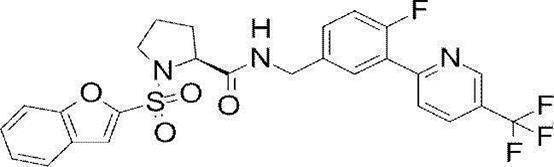
C-5の代わりに実施例307工程1で得られた化合物を用い、実施例178と同様の操作により標題化合物を得た(収率3%)。
MS (ESI) m/z 548 (M+H)+
The title compound was obtained in the same manner as in Example 178, using the compound obtained in Step 1 of Example 307 instead of C-5 (yield 3%).
MS (ESI) m / z 548 (M + H) +
実施例310:(2S)-1-(ベンゾフラン-2-イルスルホニル)-N-[[3-メトキシ-5-[6-(トリフルオロメチル)-3-ピリジル]フェニル]メチル]ピロリジン-2-カルボキサミド(310)の合成Example 310: (2S) -1- (benzofuran-2-ylsulfonyl) -N-[[3-methoxy-5- [6- (trifluoromethyl) -3-pyridyl] phenyl] methyl] pyrrolidine-2- Synthesis of carboxamide (310)

(工程1)3-メトキシ-5-[6-(トリフルオロメチル)-3-ピリジル]ベンゾニトリルの合成
3-ブロモ-5-メトキシベンゾニトリル(0.11g、0.50mmol)、[6-(トリフルオロメチル)-3-ピリジル]ボロン酸(95mg、0.50mmol)、及び1,1’-ビス(ジフェニルホスフィノ)フェロセンジクロロパラジウム(II)(37mg、0.050mmol)に1,4-ジオキサン(5mL)及び1mol/L炭酸ナトリウム水溶液(5mL)を加え、マイクロウェーブ反応装置を用いて100℃で20分間加熱攪拌した。反応混合物に水を加えて酢酸エチルで抽出し、有機層を硫酸ナトリウムにて乾燥した。乾燥剤を濾別し、溶媒を留去して得られた残渣を高速液体クロマトグラフィー(水-アセトニトリル、それぞれ0.1%トリフルオロ酢酸入り)にて精製して標題化合物(84mg、0.030mmol、61%)を得た。
MS (ESI) m/z 279 (M+H)+
(工程2)[3-メトキシ-5-[6-(トリフルオロメチル)-3-ピリジル]フェニル]メチルアミンの合成
工程1で得られた化合物(0.28g、1.0mmol)の酢酸(5mL)溶液に10%パラジウム/炭素(240mg)を加え、水素雰囲気下、室温にて3時間攪拌した。触媒を濾別し、濾液を減圧濃縮して得られた残渣を高速液体クロマトグラフィー(水-アセトニトリル、それぞれ0.1%トリフルオロ酢酸入り)にて精製して標題化合物のトリフルオロ酢酸塩(0.10g、0.26mmol、26%)を得た。
MS (ESI) m/z 283 (M+H)+
(工程3)(2S)-1-(ベンゾフラン-2-イルスルホニル)-N-[[3-メトキシ-5-[6-(トリフルオロメチル)-3-ピリジル]フェニル]メチル]ピロリジン-2-カルボキサミド(310)の合成
D-1の代わりに工程2で得られた化合物を用い、実施例37と同様の操作を行い標題化合物を得た(収率16%)。
MS (ESI) m/z 560 (M+H)+
1H NMR (400 MHz, DMSO-d6) δ 9.09 (d, J= 2.0 Hz, 1H), 8.77 (dd, J = 6.3, 5.8 Hz, 1H), 8.36 (dd, J = 8.2, 2.0 Hz, 1H), 7.98 (d, J = 8.2 Hz, 1H), 7.83 (dd, J = 8.3, 0.8 Hz, 1H), 7.79 - 7.71 (m, 2H), 7.56 (ddd, J = 8.3, 7.2, 1.3 Hz, 1H), 7.42 (ddd, J = 7.5, 7.2, 0.8 Hz, 1H), 7.31 (dd, J = 1.7, 1.4 Hz, 1H), 7.26 (dd, J = 2.2, 1.7 Hz, 1H), 7.00 (dd, J = 2.2, 1.4 Hz, 1H), 4.45 (dd, J = 15.7, 6.3 Hz, 1H), 4.41 - 4.28 (m, 2H), 3.85 (s, 3H), 3.67 - 3.56 (m, 1H), 3.42 - 3.36 (m, 1H), 2.01 - 1.83 (m, 3H), 1.70 - 1.58 (m, 1H).
(Step 1) Synthesis of 3-methoxy-5- [6- (trifluoromethyl) -3-pyridyl] benzonitrile 3-Bromo-5-methoxybenzonitrile (0.11 g, 0.50 mmol), [6- ( Trifluoromethyl) -3-pyridyl] boronic acid (95 mg, 0.50 mmol) and 1,1′-bis (diphenylphosphino) ferrocenedichloropalladium (II) (37 mg, 0.050 mmol) in 1,4-dioxane (5 mL) and 1 mol / L sodium carbonate aqueous solution (5 mL) were added, and the mixture was heated and stirred at 100 ° C. for 20 minutes using a microwave reactor. Water was added to the reaction mixture, extraction was performed with ethyl acetate, and the organic layer was dried over sodium sulfate. The desiccant was filtered off and the residue obtained by distilling off the solvent was purified by high performance liquid chromatography (water-acetonitrile, each containing 0.1% trifluoroacetic acid) to give the title compound (84 mg, 0.030 mmol). 61%).
MS (ESI) m / z 279 (M + H) +
(Step 2) Synthesis of [3-methoxy-5- [6- (trifluoromethyl) -3-pyridyl] phenyl] methylamine The compound obtained in Step 1 (0.28 g, 1.0 mmol) in acetic acid (5 mL) ) 10% palladium / carbon (240 mg) was added to the solution, and the mixture was stirred at room temperature for 3 hours under a hydrogen atmosphere. The catalyst was filtered off and the residue obtained by concentrating the filtrate under reduced pressure was purified by high performance liquid chromatography (water-acetonitrile, each containing 0.1% trifluoroacetic acid) to give the trifluoroacetate salt of the title compound (0 .10 g, 0.26 mmol, 26%).
MS (ESI) m / z 283 (M + H) +
(Step 3) (2S) -1- (benzofuran-2-ylsulfonyl) -N-[[3-methoxy-5- [6- (trifluoromethyl) -3-pyridyl] phenyl] methyl] pyrrolidine-2- Synthesis of carboxamide (310) The title compound was obtained in the same manner as in Example 37 using the compound obtained in Step 2 instead of D-1 (yield 16%).
MS (ESI) m / z 560 (M + H) +
1 H NMR (400 MHz, DMSO-d 6 ) δ 9.09 (d, J = 2.0 Hz, 1H), 8.77 (dd, J = 6.3, 5.8 Hz, 1H), 8.36 (dd, J = 8.2, 2.0 Hz, 1H), 7.98 (d, J = 8.2 Hz, 1H), 7.83 (dd, J = 8.3, 0.8 Hz, 1H), 7.79-7.71 (m, 2H), 7.56 (ddd, J = 8.3, 7.2, 1.3 Hz , 1H), 7.42 (ddd, J = 7.5, 7.2, 0.8 Hz, 1H), 7.31 (dd, J = 1.7, 1.4 Hz, 1H), 7.26 (dd, J = 2.2, 1.7 Hz, 1H), 7.00 ( dd, J = 2.2, 1.4 Hz, 1H), 4.45 (dd, J = 15.7, 6.3 Hz, 1H), 4.41-4.28 (m, 2H), 3.85 (s, 3H), 3.67-3.56 (m, 1H) , 3.42-3.36 (m, 1H), 2.01-1.83 (m, 3H), 1.70-1.58 (m, 1H).
実施例311:(2S)-1-(ベンゾフラン-2-イルスルホニル)-N-[[2-イソブトキシ-6-[4-(トリフルオロメチル)フェニル]ピリミジン-4-イル]メチル]ピロリジン-2-カルボキサミド(311)の合成Example 311: (2S) -1- (benzofuran-2-ylsulfonyl) -N-[[2-isobutoxy-6- [4- (trifluoromethyl) phenyl] pyrimidin-4-yl] methyl] pyrrolidine-2 Synthesis of carboxamide (311)

(工程1)N-[[2-ベンジルスルファニル-6-[4-(トリフルオロメチル)フェニル]ピリミジン-4-イル]メチル]カルバミン酸 tert-ブチルの合成
N-プロパ-2-イニルカルバミン酸 tert-ブチル(5.0g、32mmol)のテトラヒドロフラン(100mL)溶液に4-トリフルオロメチルベンゾイルクロリド(4.3mL、29mmol)、ジクロロビス(トリフェニルホスフィン)パラジウム(II)(0.25g、0.36mmol)及びヨウ化銅(I)(0.25g、1.3mmol)を加えて室温で5分間攪拌した後、トリエチルアミン(5.5mL、39mmol)を加えて30分間攪拌した。少量のシリカゲルを用いて不溶物を濾別し、濾液を減圧濃縮して得られた残渣にアセトニトリル(300mL)を加えて溶解させ、S-ベンジルイソチオ尿素 塩酸塩(7.5g、37mmol)及び炭酸カリウム(6.0g、43mmol)を加えた。反応混合物を70℃で一晩攪拌した後、ジクロロメタンを加えて水で洗浄した。有機層を硫酸ナトリウムにて乾燥し、乾燥剤を濾別した後、溶媒を留去して得られた残渣をシリカゲルカラムクロマトグラフィー(ヘキサン/酢酸エチル)にて精製し標題化合物(4.0g、8.4mmol、26%)を得た。
MS (ESI) m/z 476 (M+H)+
(工程2)(2S)-1-(ベンゾフラン-2-イルスルホニル)-N-[[2-ベンジルスルファニル-6-[4-(トリフルオロメチル)フェニル]ピリミジン-4-イル]メチル]ピロリジン-2-カルボキサミドの合成
工程1で得られた化合物(0.48g、1.0mmol)に4mol/L 塩酸(1,4-ジオキサン溶液、5mL、20mmol)を加え、室温で1.5時間攪拌した。反応混合物を減圧濃縮して得られた残渣にB-1(0.30g、1.0mmol)、WSC塩酸塩(0.29g、1.5mmol)及び1-ヒドロキシ-7-アザベンゾトリアゾール(0.14g、1.0mmol)にジクロロメタン(5mL)及びトリエチルアミン(0.20mL、1.4mmol)を加え室温で1.5時間攪拌した。反応液を減圧濃縮して得られた残渣を高速液体クロマトグラフィー(水-アセトニトリル、それぞれ0.1%トリフルオロ酢酸入り)にて精製して標題化合物(0.13g、0.20mmol、20%)を得た。
MS (ESI) m/z 653 (M+H)+
(工程3)(2S)-1-(ベンゾフラン-2-イルスルホニル)-N-[[2-ベンジルスルホニル-6-[4-(トリフルオロメチル)フェニル]ピリミジン-4-イル]メチル]ピロリジン-2-カルボキサミド
工程2で得られた化合物(0.16g、0.25mmol)のジクロロメタン(2mL)溶液に0℃で3-クロロ過安息香酸(0.42g、2.5mmol)を加え、室温で3時間攪拌した。反応混合物に1mol/L 水酸化ナトリウム水溶液を加え、ジクロロメタンで抽出した。有機層を硫酸ナトリウムにて乾燥した。乾燥剤を濾別し、溶媒を留去して標題化合物(0.15g、0.23mmol、92%)を得た。
MS (ESI) m/z 685 (M+H)+
(工程4)(2S)-1-(ベンゾフラン-2-イルスルホニル)-N-[[2-イソブトキシ-6-[4-(トリフルオロメチル)フェニル]ピリミジン-4-イル]メチル]ピロリジン-2-カルボキサミド(311)の合成
2-メチル-1-プロパノール(0.20mL)に水素化ナトリウム(60%油性、4.8mg、0.12mmol)を加えて5分間攪拌した後、工程3で得られた化合物(50mg、0.073mmol)のN,N-ジメチルホルムアミド(1mL)溶液を加え、マイクロウェーブ反応装置を用いて100℃で10分間加熱攪拌した。反応混合物を減圧濃縮して得られた残渣を高速液体クロマトグラフィー(水-アセトニトリル、それぞれ0.1%トリフルオロ酢酸入り)にて精製して標題化合物(4.8mg、0.0080mmol、11%)を得た。
MS (ESI) m/z 603 (M+H)+
1H NMR (400 MHz, DMSO-d6) δ 8.92 (dd, J = 6.2, 5.7 Hz, 1H), 8.36 (d, J = 8.1 Hz, 2H), 7.91 (d, J= 8.1 Hz, 2H), 7.84 (ddd, J = 7.7, 1.3, 0.9 Hz, 1H), 7.79 (d, J= 0.9 Hz, 1H), 7.76 (dd, J = 8.4, 0.9 Hz, 1H), 7.69 (s, 1H), 7.57 (ddd, J = 8.4, 7.3, 1.3 Hz, 1H), 7.43 (ddd, J = 7.7, 7.3, 0.9 Hz, 1H), 4.46 (dd, J = 17.3, 6.2 Hz, 1H), 4.40 - 4.31 (m, 2H), 4.21 (d, J = 6.6 Hz, 2H), 3.67 - 3.59 (m, 1H), 3.49 - 3.40 (m, 1H), 2.18 - 2.03 (m, 1H), 2.05 - 1.88 (m, 3H), 1.73 - 1.62 (m, 1H), 1.02 (d, J = 6.7 Hz, 6H).
(Step 1) Synthesis of tert-butyl N-[[2-benzylsulfanyl-6- [4- (trifluoromethyl) phenyl] pyrimidin-4-yl] methyl] carbamate N-prop-2-ynylcarbamate To a solution of tert-butyl (5.0 g, 32 mmol) in tetrahydrofuran (100 mL) was added 4-trifluoromethylbenzoyl chloride (4.3 mL, 29 mmol), dichlorobis (triphenylphosphine) palladium (II) (0.25 g, 0.36 mmol). ) And copper (I) iodide (0.25 g, 1.3 mmol) were added and stirred at room temperature for 5 minutes, then triethylamine (5.5 mL, 39 mmol) was added and stirred for 30 minutes. Insoluble matters were filtered off using a small amount of silica gel, and the filtrate was concentrated under reduced pressure. Acetonitrile (300 mL) was added to the residue and dissolved, and S-benzylisothiourea hydrochloride (7.5 g, 37 mmol) and Potassium carbonate (6.0 g, 43 mmol) was added. The reaction mixture was stirred at 70 ° C. overnight, dichloromethane was added, and the mixture was washed with water. The organic layer was dried over sodium sulfate, the desiccant was filtered off, the solvent was distilled off, and the resulting residue was purified by silica gel column chromatography (hexane / ethyl acetate) to give the title compound (4.0 g, 8.4 mmol, 26%).
MS (ESI) m / z 476 (M + H) +
(Step 2) (2S) -1- (benzofuran-2-ylsulfonyl) -N-[[2-benzylsulfanyl-6- [4- (trifluoromethyl) phenyl] pyrimidin-4-yl] methyl] pyrrolidine- Synthesis of 2-carboxamide To the compound obtained in Step 1 (0.48 g, 1.0 mmol) was added 4 mol / L hydrochloric acid (1,4-dioxane solution, 5 mL, 20 mmol), and the mixture was stirred at room temperature for 1.5 hours. The reaction mixture was concentrated under reduced pressure to give a residue B-1 (0.30 g, 1.0 mmol), WSC hydrochloride (0.29 g, 1.5 mmol) and 1-hydroxy-7-azabenzotriazole (0. 14 g, 1.0 mmol) was added dichloromethane (5 mL) and triethylamine (0.20 mL, 1.4 mmol) and stirred at room temperature for 1.5 hours. The residue obtained by concentrating the reaction solution under reduced pressure was purified by high performance liquid chromatography (water-acetonitrile, each containing 0.1% trifluoroacetic acid) to give the title compound (0.13 g, 0.20 mmol, 20%) Got.
MS (ESI) m / z 653 (M + H) +
(Step 3) (2S) -1- (benzofuran-2-ylsulfonyl) -N-[[2-benzylsulfonyl-6- [4- (trifluoromethyl) phenyl] pyrimidin-4-yl] methyl] pyrrolidine- 2-Carboxamide To a solution of the compound obtained in Step 2 (0.16 g, 0.25 mmol) in dichloromethane (2 mL) was added 3-chloroperbenzoic acid (0.42 g, 2.5 mmol) at 0 ° C. Stir for hours. A 1 mol / L aqueous sodium hydroxide solution was added to the reaction mixture, and the mixture was extracted with dichloromethane. The organic layer was dried with sodium sulfate. The desiccant was filtered off and the solvent was evaporated to give the title compound (0.15 g, 0.23 mmol, 92%).
MS (ESI) m / z 685 (M + H) +
(Step 4) (2S) -1- (Benzofuran-2-ylsulfonyl) -N-[[2-isobutoxy-6- [4- (trifluoromethyl) phenyl] pyrimidin-4-yl] methyl] pyrrolidine-2 -Synthesis of carboxamide (311) Sodium hydride (60% oiliness, 4.8 mg, 0.12 mmol) was added to 2-methyl-1-propanol (0.20 mL) and stirred for 5 minutes. A solution of the compound (50 mg, 0.073 mmol) in N, N-dimethylformamide (1 mL) was added, and the mixture was heated and stirred at 100 ° C. for 10 minutes using a microwave reactor. The reaction mixture was concentrated under reduced pressure, and the resulting residue was purified by high performance liquid chromatography (water-acetonitrile, each containing 0.1% trifluoroacetic acid) to give the title compound (4.8 mg, 0.0080 mmol, 11%) Got.
MS (ESI) m / z 603 (M + H) +
1 H NMR (400 MHz, DMSO-d 6 ) δ 8.92 (dd, J = 6.2, 5.7 Hz, 1H), 8.36 (d, J = 8.1 Hz, 2H), 7.91 (d, J = 8.1 Hz, 2H) , 7.84 (ddd, J = 7.7, 1.3, 0.9 Hz, 1H), 7.79 (d, J = 0.9 Hz, 1H), 7.76 (dd, J = 8.4, 0.9 Hz, 1H), 7.69 (s, 1H), 7.57 (ddd, J = 8.4, 7.3, 1.3 Hz, 1H), 7.43 (ddd, J = 7.7, 7.3, 0.9 Hz, 1H), 4.46 (dd, J = 17.3, 6.2 Hz, 1H), 4.40-4.31 ( m, 2H), 4.21 (d, J = 6.6 Hz, 2H), 3.67-3.59 (m, 1H), 3.49-3.40 (m, 1H), 2.18-2.03 (m, 1H), 2.05-1.88 (m, 3H), 1.73-1.62 (m, 1H), 1.02 (d, J = 6.7 Hz, 6H).
実施例312:(2S)-1-(ベンゾフラン-2-イルスルホニル)-N-[[2-(ジメチルアミノ)-6-[4-(トリフルオロメチル)フェニル]ピリミジン-4-イル]メチル]ピロリジン-2-カルボキサミド(312)の合成Example 312: (2S) -1- (benzofuran-2-ylsulfonyl) -N-[[2- (dimethylamino) -6- [4- (trifluoromethyl) phenyl] pyrimidin-4-yl] methyl] Synthesis of pyrrolidine-2-carboxamide (312)

実施例311工程3で得られた化合物(68mg、0.10mmol)のN,N-ジメチルホルムアミド(1mL)溶液に、2mol/L ジメチルアミン(テトラヒドロフラン溶液、0.30mL、0.60mmol)を加え、マイクロウェーブ反応装置を用いて100℃で10分間加熱攪拌した。反応混合物を減圧濃縮して得られた残渣を高速液体クロマトグラフィー(水-アセトニトリル、それぞれ0.1%トリフルオロ酢酸入り)にて精製して標題化合物のトリフルオロ酢酸塩(10mg、0.015mmol、15%)を得た。
MS (ESI) m/z 574 (M+H)+
1H NMR (400 MHz, DMSO-d6) δ 8.80 (dd, J = 6.1, 5.7 Hz, 1H), 8.32 (d, J = 8.1 Hz, 2H), 7.90 - 7.81 (m, 3H), 7.78 (d, J = 0.9 Hz, 1H), 7.76 (dd, J = 8.4, 0.8 Hz, H), 7.57 (ddd, J = 8.4, 7.3, 1.3 Hz, 1H), 7.47 - 7.38 (m, 1H), 7.20 (s, 1H), 4.42 - 4.31 (m, 2H), 4.25 (dd, J = 17.1, 5.7 Hz, 1H), 3.68 - 3.57 (m, 1H), 3.42 - 3.36 (m, 1H), 3.23 (s, 6H), 2.03 - 1.85 (m, 3H), 1.72 - 1.60 (m, 1H).
Example 311 To a solution of the compound obtained in Step 3 (68 mg, 0.10 mmol) in N, N-dimethylformamide (1 mL) was added 2 mol / L dimethylamine (tetrahydrofuran solution, 0.30 mL, 0.60 mmol), The mixture was heated and stirred at 100 ° C. for 10 minutes using a microwave reactor. The residue obtained by concentrating the reaction mixture under reduced pressure was purified by high performance liquid chromatography (water-acetonitrile, each containing 0.1% trifluoroacetic acid) to give the trifluoroacetate salt of the title compound (10 mg, 0.015 mmol, 15%).
MS (ESI) m / z 574 (M + H) +
1 H NMR (400 MHz, DMSO-d 6 ) δ 8.80 (dd, J = 6.1, 5.7 Hz, 1H), 8.32 (d, J = 8.1 Hz, 2H), 7.90-7.81 (m, 3H), 7.78 ( d, J = 0.9 Hz, 1H), 7.76 (dd, J = 8.4, 0.8 Hz, H), 7.57 (ddd, J = 8.4, 7.3, 1.3 Hz, 1H), 7.47-7.38 (m, 1H), 7.20 (s, 1H), 4.42-4.31 (m, 2H), 4.25 (dd, J = 17.1, 5.7 Hz, 1H), 3.68-3.57 (m, 1H), 3.42-3.36 (m, 1H), 3.23 (s , 6H), 2.03-1.85 (m, 3H), 1.72-1.60 (m, 1H).
実施例313:(2S)-2-[ブタ-2-イニル-(5-フルオロベンゾフラン-2-イル)スルホニル-アミノ]-N-[[2-[6-(トリフルオロメチル)-3-ピリジル]-4-ピリジル]メチル]プロパンアミド(313)の合成Example 313: (2S) -2- [but-2-ynyl- (5-fluorobenzofuran-2-yl) sulfonyl-amino] -N-[[2- [6- (trifluoromethyl) -3-pyridyl ] -4-Pyridyl] methyl] propanamide (313)

(2S)-2-[(5-フルオロベンゾフラン-2-イル)スルホニルアミノ]-N-[[2-[6-(トリフルオロメチル)-3-ピリジル]-4-ピリジル]メチル]プロパンアミド(236)(30mg、0.058mmol)、炭酸カリウム(24mg、0.17mmol)のN,N-ジメチルホルムアミド(0.6mL)溶液に、1-ブロモ-2-ブチン(7.6μL、0.086mmol)を加え室温で3時間撹拌した。アセトニトリルを用いて不溶物を濾過し、高速液体クロマトグラフィー(水-アセトニトリル、それぞれ0.1%トリフルオロ酢酸入り)にて精製して標題化合物のトリフルオロ酢酸塩(33mg、0.048mmol、83%)を得た。
MS (ESI) m/z 575 (M+H)+
1H NMR (400 MHz, DMSO-d6) δ 9.41 (s, 1H), 8.76 (t, J = 5.9 Hz, 1H), 8.71 - 8.65 (m, 2H), 8.05 (d, J = 8.3 Hz, 1H), 8.01 (s, 1H), 7.74 (dd, J = 9.1, 4.1 Hz, 1H), 7.66 (s, 1H), 7.61 (dd, J = 8.5, 2.7 Hz, 1H), 7.44 - 7.34 (m, 1H), 7.31 (dd, J= 5.1, 1.5 Hz, 1H), 4.74 (q, J= 7.2 Hz, 1H), 4.43 - 4.33 (m, 2H), 4.33 - 4.24 (m, 2H), 1.51 (d, J = 7.2 Hz, 3H), 1.48 - 1.40 (m, 3H).
(2S) -2-[(5-Fluorobenzofuran-2-yl) sulfonylamino] -N-[[2- [6- (trifluoromethyl) -3-pyridyl] -4-pyridyl] methyl] propanamide ( 236) (30 mg, 0.058 mmol), potassium carbonate (24 mg, 0.17 mmol) in N, N-dimethylformamide (0.6 mL), 1-bromo-2-butyne (7.6 μL, 0.086 mmol) And stirred at room temperature for 3 hours. The insoluble material was filtered off using acetonitrile and purified by high performance liquid chromatography (water-acetonitrile, each containing 0.1% trifluoroacetic acid) to give the trifluoroacetate salt of the title compound (33 mg, 0.048 mmol, 83% )
MS (ESI) m / z 575 (M + H) +
1 H NMR (400 MHz, DMSO-d 6 ) δ 9.41 (s, 1H), 8.76 (t, J = 5.9 Hz, 1H), 8.71-8.65 (m, 2H), 8.05 (d, J = 8.3 Hz, 1H), 8.01 (s, 1H), 7.74 (dd, J = 9.1, 4.1 Hz, 1H), 7.66 (s, 1H), 7.61 (dd, J = 8.5, 2.7 Hz, 1H), 7.44-7.34 (m , 1H), 7.31 (dd, J = 5.1, 1.5 Hz, 1H), 4.74 (q, J = 7.2 Hz, 1H), 4.43-4.33 (m, 2H), 4.33-4.24 (m, 2H), 1.51 ( d, J = 7.2 Hz, 3H), 1.48-1.40 (m, 3H).
実施例314:(2S)-2-[(5-フルオロベンゾフラン-2-イル)スルホニル-プロパ-2-イニル-アミノ]-N-[[2-[6-(トリフルオロメチル)-3-ピリジル]-4-ピリジル]メチル]プロパンアミド(314)の合成Example 314: (2S) -2-[(5-Fluorobenzofuran-2-yl) sulfonyl-prop-2-ynyl-amino] -N-[[2- [6- (trifluoromethyl) -3-pyridyl ] -4-Pyridyl] methyl] propanamide (314)

1-ブロモ-2-ブチンの代わりにプロパルギルブロミドを用い、実施例313と同様の操作を行い標題化合物のトリフルオロ酢酸塩(収率50%)を得た。
MS (ESI) m/z 561 (M+H)+
1H NMR (400 MHz, DMSO-d6) δ 9.40 (s, 1H), 8.78 (t, J= 5.9 Hz, 1H), 8.71 - 8.64 (m, 2H), 8.05 (d, J = 8.2 Hz, 1H), 7.99 (s, 1H), 7.70 (dd, J = 9.1, 4.1 Hz, 1H), 7.65 (s, 1H), 7.58 (dd, J = 8.5, 2.7 Hz, 1H), 7.38 (td, J = 9.2, 2.8 Hz, 1H), 7.29 (dd, J = 5.1, 1.5 Hz, 1H), 4.75 (q, J = 7.2 Hz, 1H), 4.44 - 4.29 (m, 4H), 3.18 - 3.12 (m, 1H), 1.53 (d, J= 7.2 Hz, 3H).
The same operation as in Example 313 was carried out using propargyl bromide instead of 1-bromo-2-butyne to obtain the trifluoroacetate salt of the title compound (yield 50%).
MS (ESI) m / z 561 (M + H) +
1 H NMR (400 MHz, DMSO-d 6 ) δ 9.40 (s, 1H), 8.78 (t, J = 5.9 Hz, 1H), 8.71-8.64 (m, 2H), 8.05 (d, J = 8.2 Hz, 1H), 7.99 (s, 1H), 7.70 (dd, J = 9.1, 4.1 Hz, 1H), 7.65 (s, 1H), 7.58 (dd, J = 8.5, 2.7 Hz, 1H), 7.38 (td, J = 9.2, 2.8 Hz, 1H), 7.29 (dd, J = 5.1, 1.5 Hz, 1H), 4.75 (q, J = 7.2 Hz, 1H), 4.44-4.29 (m, 4H), 3.18-3.12 (m, 1H), 1.53 (d, J = 7.2 Hz, 3H).
実施例315:(2S)-1-(ベンゾフラン-2-イルスルホニル)-N-[[3-[[4-(トリフルオロメチル)フェニル]メチルスルファニル]フェニル]メチル]ピロリジン-2-カルボキサミド(315)の合成Example 315: (2S) -1- (benzofuran-2-ylsulfonyl) -N-[[3-[[4- (trifluoromethyl) phenyl] methylsulfanyl] phenyl] methyl] pyrrolidine-2-carboxamide (315 ) Synthesis

3-フルオロベンゾニトリル(73mg、0.19mmol)と[4-(トリフルオロメチル)フェニル]メタンチオール(0.15g、0.79mmol)及びカリウム tert-ブトキシド(0.21g、1.8mmol)にN,N-ジメチルホルムアミド(1.6mL)を加え、マイクロウェーブ反応装置を用いて100℃で10分間加熱攪拌した。反応混合物に水を加え、酢酸エチルで抽出し、有機層を硫酸ナトリウムにて乾燥した後、乾燥剤を濾別し、溶媒を留去した。得られた残渣にテトラヒドロフラン(3.0mL)を加えて溶解させ、0.95mol/Lボラン-テトラヒドロフラン溶液(3.2mL、3.0mmol)を加え、室温で5.5時間攪拌した。反応混合物にpH1になるまで1mol/L塩酸を加え10分間撹拌した後、1mol/L水酸化ナトリウム水溶液を加えた。反応混合物を酢酸エチルで抽出し、有機層を硫酸ナトリウムにて乾燥した後、乾燥剤を濾別し、溶媒を留去した。得られた残渣とB-1(59mg、0.20mmol)、トリエチルアミン(0.17mL、1.2mmol)、WSC塩酸塩(58mg、0.30mmol)及び1-ヒドロキシ-7-アザベンゾトリアゾール(14mg、0.10mmol)にアセトニトリル(2.0mL)を加え室温で1時間攪拌した。反応液を減圧濃縮して得られた残渣を高速液体クロマトグラフィー(水-アセトニトリル、それぞれ0.1%トリフルオロ酢酸入り)にて精製して標題化合物(48mg、0.083mmol、14%)を得た。
MS (ESI) m/z 575 (M+H)+
1H NMR (400 MHz, DMSO-d6) δ 8.66 (dd, J = 6.0, 5.9 Hz, 1H), 7.83 (d, J = 7.8 Hz, 1H), 7.74 (d, J= 8.9 Hz, 1H), 7.71 (d, J = 1.0 Hz, 1H), 7.64 (d, J = 8.1 Hz, 2H), 7.57 (d, J = 8.1 Hz, 2H), 7.57 - 7.53 (m, 1H), 7.46 - 7.39 (m, 1H), 7.30 (dd, J = 1.6, 1.6 Hz, 1H), 7.28 - 7.17 (m, 2H), 7.09 (d, J = 7.4 Hz, 1H), 4.34 (s, 2H), 4.32 - 4.28 (m, 2H), 4.24 (dd, J = 15.5, 5.9 Hz, 1H), 3.63 - 3.55 (m, 1H), 3.48 - 3.37 (m, 1H), 1.96 - 1.80 (m, 3H), 1.68 - 1.59 (m, 1H).
3-fluorobenzonitrile (73 mg, 0.19 mmol) and [4- (trifluoromethyl) phenyl] methanethiol (0.15 g, 0.79 mmol) and potassium tert-butoxide (0.21 g, 1.8 mmol) in N , N-dimethylformamide (1.6 mL) was added, and the mixture was heated and stirred at 100 ° C. for 10 minutes using a microwave reactor. Water was added to the reaction mixture, and the mixture was extracted with ethyl acetate. The organic layer was dried over sodium sulfate, the desiccant was filtered off, and the solvent was evaporated. Tetrahydrofuran (3.0 mL) was added and dissolved in the resulting residue, 0.95 mol / L borane-tetrahydrofuran solution (3.2 mL, 3.0 mmol) was added, and the mixture was stirred at room temperature for 5.5 hours. 1 mol / L hydrochloric acid was added to the reaction mixture until pH 1, and the mixture was stirred for 10 minutes, and then a 1 mol / L sodium hydroxide aqueous solution was added. The reaction mixture was extracted with ethyl acetate, the organic layer was dried over sodium sulfate, the desiccant was filtered off, and the solvent was distilled off. The resulting residue and B-1 (59 mg, 0.20 mmol), triethylamine (0.17 mL, 1.2 mmol), WSC hydrochloride (58 mg, 0.30 mmol) and 1-hydroxy-7-azabenzotriazole (14 mg, Acetonitrile (2.0 mL) was added to (0.10 mmol), and the mixture was stirred at room temperature for 1 hour. The residue obtained by concentrating the reaction solution under reduced pressure was purified by high performance liquid chromatography (water-acetonitrile, each containing 0.1% trifluoroacetic acid) to give the title compound (48 mg, 0.083 mmol, 14%). It was.
MS (ESI) m / z 575 (M + H) +
1 H NMR (400 MHz, DMSO-d 6 ) δ 8.66 (dd, J = 6.0, 5.9 Hz, 1H), 7.83 (d, J = 7.8 Hz, 1H), 7.74 (d, J = 8.9 Hz, 1H) , 7.71 (d, J = 1.0 Hz, 1H), 7.64 (d, J = 8.1 Hz, 2H), 7.57 (d, J = 8.1 Hz, 2H), 7.57-7.53 (m, 1H), 7.46-7.39 ( m, 1H), 7.30 (dd, J = 1.6, 1.6 Hz, 1H), 7.28-7.17 (m, 2H), 7.09 (d, J = 7.4 Hz, 1H), 4.34 (s, 2H), 4.32-4.28 (m, 2H), 4.24 (dd, J = 15.5, 5.9 Hz, 1H), 3.63-3.55 (m, 1H), 3.48-3.37 (m, 1H), 1.96-1.80 (m, 3H), 1.68-1.59 (m, 1H).
実施例316:(2S)-1-(ベンゾフラン-2-イルスルホニル)-N-[[3-[[4-(トリフルオロメチル)フェニル]メチルスルフィニル]フェニル]メチル]ピロリジン-2-カルボキサミド(316)の合成Example 316: (2S) -1- (benzofuran-2-ylsulfonyl) -N-[[3-[[4- (trifluoromethyl) phenyl] methylsulfinyl] phenyl] methyl] pyrrolidine-2-carboxamide (316 ) Synthesis

(2S)-1-(ベンゾフラン-2-イルスルホニル)-N-[[3-[[4-(トリフルオロメチル)フェニル]メチルスルファニル]フェニル]メチル]ピロリジン-2-カルボキサミド(315)(43mg、0.075mmol)と3-クロロ過安息香酸(30mg、0.11mmol)にジクロロメタン(1.5mL)を加え0℃で5時間攪拌した。反応混合物に飽和重曹水及び飽和チオ硫酸ナトリウム水溶液を加え、ジクロロメタンで抽出し、有機層を硫酸ナトリウムにて乾燥した。乾燥剤を濾別し、溶媒を留去した。得られた残渣を高速液体クロマトグラフィー(水-アセトニトリル、それぞれ0.1%トリフルオロ酢酸入り)にて精製して標題化合物(2.3mg、0.0040mmol、5%)を得た。
MS (ESI) m/z 591 (M+H)+
1H NMR (400 MHz, DMSO-d6) δ 8.77 (dd, J = 6.0, 6.0 Hz, 1H), 7.85 - 7.82 (m, 1H), 7.77 - 7.73 (m, 2H), 7.63 (d, J = 7.8 Hz, 2H), 7.56 (ddd, J = 8.2, 7.2, 1.1 Hz, 1H), 7.53 - 7.48 (m, 1H), 7.48 - 7.40 (m, 3H), 7.35 (dt, J = 7.4, 1.7 Hz, 1H), 7.30 (d, J = 7.4 Hz, 2H), 4.44 - 4.33 (m, 3H), 4.33 - 4.28 (m, 1H), 4.13 (dd, J= 12.7, 3.8 Hz, 1H), 3.66 - 3.55 (m, 1H), 3.49 - 3.36 (m, 1H), 1.99 - 1.81 (m, 3H), 1.71 - 1.57 (m, 1H).
(2S) -1- (Benzofuran-2-ylsulfonyl) -N-[[3-[[4- (trifluoromethyl) phenyl] methylsulfanyl] phenyl] methyl] pyrrolidine-2-carboxamide (315) (43 mg, 0.075 mmol) and 3-chloroperbenzoic acid (30 mg, 0.11 mmol) were added dichloromethane (1.5 mL) and stirred at 0 ° C. for 5 hours. To the reaction mixture were added saturated aqueous sodium bicarbonate and saturated aqueous sodium thiosulfate solution, extracted with dichloromethane, and the organic layer was dried over sodium sulfate. The desiccant was filtered off and the solvent was distilled off. The obtained residue was purified by high performance liquid chromatography (water-acetonitrile, each containing 0.1% trifluoroacetic acid) to give the title compound (2.3 mg, 0.0040 mmol, 5%).
MS (ESI) m / z 591 (M + H) +
1 H NMR (400 MHz, DMSO-d 6 ) δ 8.77 (dd, J = 6.0, 6.0 Hz, 1H), 7.85-7.82 (m, 1H), 7.77-7.73 (m, 2H), 7.63 (d, J = 7.8 Hz, 2H), 7.56 (ddd, J = 8.2, 7.2, 1.1 Hz, 1H), 7.53-7.48 (m, 1H), 7.48-7.40 (m, 3H), 7.35 (dt, J = 7.4, 1.7 Hz, 1H), 7.30 (d, J = 7.4 Hz, 2H), 4.44-4.33 (m, 3H), 4.33-4.28 (m, 1H), 4.13 (dd, J = 12.7, 3.8 Hz, 1H), 3.66 -3.55 (m, 1H), 3.49-3.36 (m, 1H), 1.99-1.81 (m, 3H), 1.71-1.57 (m, 1H).
実施例317:(2S)-1-(ベンゾフラン-2-イルスルホニル)-N-[[3-[(E)-2-[4-(トリフルオロメチル)フェニル]ビニル]フェニル]メチル]ピロリジン-2-カルボキサミド(317)の合成Example 317: (2S) -1- (benzofuran-2-ylsulfonyl) -N-[[3-[(E) -2- [4- (trifluoromethyl) phenyl] vinyl] phenyl] methyl] pyrrolidine- Synthesis of 2-carboxamide (317)
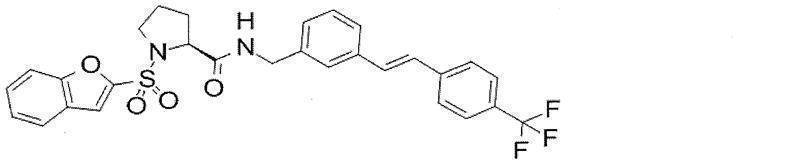
(工程1)(2S)-1-(ベンゾフラン-2-イルスルホニル)-N-[(3-ヨードフェニル)メチル]ピロリジン-2-カルボキサミドの合成
B-1(0.30g、1.0mmol)に3-ヨードベンジルアミン 塩酸塩(0.33mg、1.2mmol)、トリエチルアミン(0.43mL、3.1mmol)、WSC塩酸塩(0.29g、1.5mmol)及び1-ヒドロキシ-7-アザベンゾトリアゾール(69mg、0.51mmol)にジクロロメタン(10mL)を加え室温で24時間攪拌した。反応混合物に水を加え、ジクロロメタンで抽出し、有機層を硫酸ナトリウムにて乾燥した。乾燥剤を濾別し、溶媒を留去した。得られた残渣を高速液体クロマトグラフィー(水-アセトニトリル、それぞれ0.1%トリフルオロ酢酸入り)にて精製して標題化合物(0.29g、0.56mmol、55%)を得た。
MS (ESI) m/z 511 (M+H)+
(工程2)(2S)-1-(ベンゾフラン-2-イルスルホニル)-N-[[3-[(E)-2-[4-(トリフルオロメチル)フェニル]ビニル]フェニル]メチル]ピロリジン-2-カルボキサミド(317)の合成
工程1で得られた化合物(96mg、0.19mmol)と4-(トリフルオロメチル)スチレン(65mg、0.38mmol)、酢酸パラジウム(II)(4.2mg、0.019mmol)、トリフェニルホスフィン(9.9mg、0.038mmol)及びトリエチルアミン(0.13mL、0.94mmol)にN,N-ジメチルホルムアミド(1.9mL)を加え100℃で22時間攪拌した。反応混合物に水を加え、酢酸エチルで抽出し、有機層を硫酸ナトリウムにて乾燥した。乾燥剤を濾別し、溶媒を留去して得られた残渣をシリカゲルカラムクロマトグラフィー(ヘキサン/酢酸エチル)にて精製して標題化合物(30mg、0.055mmol、29%)を得た。
MS (ESI) m/z 555 (M+H)+
1H NMR (400 MHz, DMSO-d6) δ 8.72 (dd, J = 6.1, 6.0 Hz, 1H), 7.86 - 7.82 (m, 1H), 7.80 (d, J = 8.2 Hz, 2H), 7.77 - 7.70 (m,4H), 7.61 (t, J = 1.7 Hz, 1H), 7.56 (ddd, J = 8.6, 7.3, 1.3 Hz, 1H), 7.50 (d, J = 7.7 Hz, 1H), 7.46 - 7.33 (m, 4H), 7.23 (d, J = 7.7 Hz, 1H), 4.41 (dd, J = 15.5, 6.1 Hz, 1H), 4.36 - 4.29 (m, 2H), 3.68 - 3.57 (m, 1H), 3.47 - 3.35 (m, 1H), 1.99 - 1.85 (m, 3H), 1.71 - 1.60 (m, 1H).
(Step 1) Synthesis of (2S) -1- (benzofuran-2-ylsulfonyl) -N-[(3-iodophenyl) methyl] pyrrolidine-2-carboxamide To B-1 (0.30 g, 1.0 mmol) 3-Iodobenzylamine hydrochloride (0.33 mg, 1.2 mmol), triethylamine (0.43 mL, 3.1 mmol), WSC hydrochloride (0.29 g, 1.5 mmol) and 1-hydroxy-7-azabenzotriazole (69 mg, 0.51 mmol) was added dichloromethane (10 mL) and stirred at room temperature for 24 hours. Water was added to the reaction mixture, extracted with dichloromethane, and the organic layer was dried over sodium sulfate. The desiccant was filtered off and the solvent was distilled off. The obtained residue was purified by high performance liquid chromatography (water-acetonitrile, each containing 0.1% trifluoroacetic acid) to give the title compound (0.29 g, 0.56 mmol, 55%).
MS (ESI) m / z 511 (M + H) +
(Step 2) (2S) -1- (benzofuran-2-ylsulfonyl) -N-[[3-[(E) -2- [4- (trifluoromethyl) phenyl] vinyl] phenyl] methyl] pyrrolidine- Synthesis of 2-carboxamide (317) Compound obtained in Step 1 (96 mg, 0.19 mmol), 4- (trifluoromethyl) styrene (65 mg, 0.38 mmol), palladium (II) acetate (4.2 mg, 0 0.19 mmol), triphenylphosphine (9.9 mg, 0.038 mmol) and triethylamine (0.13 mL, 0.94 mmol) were added N, N-dimethylformamide (1.9 mL) and the mixture was stirred at 100 ° C. for 22 hours. Water was added to the reaction mixture, extraction was performed with ethyl acetate, and the organic layer was dried over sodium sulfate. The desiccant was filtered off, the solvent was distilled off, and the resulting residue was purified by silica gel column chromatography (hexane / ethyl acetate) to give the title compound (30 mg, 0.055 mmol, 29%).
MS (ESI) m / z 555 (M + H) +
1 H NMR (400 MHz, DMSO-d 6 ) δ 8.72 (dd, J = 6.1, 6.0 Hz, 1H), 7.86-7.82 (m, 1H), 7.80 (d, J = 8.2 Hz, 2H), 7.77- 7.70 (m, 4H), 7.61 (t, J = 1.7 Hz, 1H), 7.56 (ddd, J = 8.6, 7.3, 1.3 Hz, 1H), 7.50 (d, J = 7.7 Hz, 1H), 7.46-7.33 (m, 4H), 7.23 (d, J = 7.7 Hz, 1H), 4.41 (dd, J = 15.5, 6.1 Hz, 1H), 4.36-4.29 (m, 2H), 3.68-3.57 (m, 1H), 3.47-3.35 (m, 1H), 1.99-1.85 (m, 3H), 1.71-1.60 (m, 1H).
実施例318:(2S)-1-(ベンゾフラン-2-イルスルホニル)-N-[[3-[2-[4-(トリフルオロメチル)フェニル]エチル]フェニル]メチル]ピロリジン-2-カルボキサミド(318)の合成Example 318: (2S) -1- (benzofuran-2-ylsulfonyl) -N-[[3- [2- [4- (trifluoromethyl) phenyl] ethyl] phenyl] methyl] pyrrolidine-2-carboxamide ( 318)

(2S)-1-(ベンゾフラン-2-イルスルホニル)-N-[[3-[(E)-2-[4-(トリフルオロメチル)フェニル]ビニル]フェニル]メチル]ピロリジン-2-カルボキサミド(317)(28mg、0.050mmol)にメタノール(1.0mL)を加えて溶解させ、10%パラジウム/炭素(15mg)を加え、常圧の水素雰囲気下、室温で5時間攪拌した。触媒を濾別した後、減圧濃縮して得られた残渣を高速液体クロマトグラフィー(水-アセトニトリル、それぞれ0.1%トリフルオロ酢酸入り)にて精製して標題化合物(20mg、0.036mmol、72%)を得た。
MS (ESI) m/z 557 (M+H)+
1H NMR (400 MHz, DMSO-d6) δ 8.64 (dd, J = 6.0, 5.9 Hz, 1H), 7.83 (ddd, J = 8.0, 1.0, 1.2 Hz, 1H), 7.74 (ddd, J = 8.4, 1.0, 0.9 Hz, 1H), 7.72 (d, J = 1.0 Hz, 1H), 7.62 (d, J= 8.0 Hz, 2H), 7.56 (ddd, J = 8.4, 7.3, 1.2 Hz, 1H), 7.46 (d, J= 8.0 Hz, 2H), 7.42 (ddd, J = 8.0, 7.3, 1.0 Hz, 1H), 7.27 - 7.20 (m, 2H), 7.10 (dd, J = 7.7, 1.7 Hz, 2H), 4.38 - 4.29 (m, 2H), 4.25 (dd, J = 15.4, 5.9 Hz, 1H), 3.64 - 3.54 (m, 1H), 3.43 - 3.34 (m, 1H), 3.01 - 2.93 (m, 2H), 2.93 - 2.85 (m, 2H), 1.93 - 1.76 (m, 3H), 1.69 - 1.54 (m, 1H).
(2S) -1- (benzofuran-2-ylsulfonyl) -N-[[3-[(E) -2- [4- (trifluoromethyl) phenyl] vinyl] phenyl] methyl] pyrrolidine-2-carboxamide ( 317) (28 mg, 0.050 mmol) was dissolved in methanol (1.0 mL), 10% palladium / carbon (15 mg) was added, and the mixture was stirred at room temperature for 5 hours in a hydrogen atmosphere under normal pressure. After the catalyst was filtered off, the residue obtained by concentration under reduced pressure was purified by high performance liquid chromatography (water-acetonitrile, each containing 0.1% trifluoroacetic acid) to give the title compound (20 mg, 0.036 mmol, 72 %).
MS (ESI) m / z 557 (M + H) +
1 H NMR (400 MHz, DMSO-d 6 ) δ 8.64 (dd, J = 6.0, 5.9 Hz, 1H), 7.83 (ddd, J = 8.0, 1.0, 1.2 Hz, 1H), 7.74 (ddd, J = 8.4 , 1.0, 0.9 Hz, 1H), 7.72 (d, J = 1.0 Hz, 1H), 7.62 (d, J = 8.0 Hz, 2H), 7.56 (ddd, J = 8.4, 7.3, 1.2 Hz, 1H), 7.46 (d, J = 8.0 Hz, 2H), 7.42 (ddd, J = 8.0, 7.3, 1.0 Hz, 1H), 7.27-7.20 (m, 2H), 7.10 (dd, J = 7.7, 1.7 Hz, 2H), 4.38-4.29 (m, 2H), 4.25 (dd, J = 15.4, 5.9 Hz, 1H), 3.64-3.54 (m, 1H), 3.43-3.34 (m, 1H), 3.01-2.93 (m, 2H), 2.93-2.85 (m, 2H), 1.93-1.76 (m, 3H), 1.69-1.54 (m, 1H).
実施例319:(2S)-N-[(3-ベンジルフェニル)メチル]-1-(5-フルオロベンゾフラン-2-イル)スルホニル-ピロリジン-2-カルボキサミド(319)の合成Example 319: Synthesis of (2S) -N-[(3-benzylphenyl) methyl] -1- (5-fluorobenzofuran-2-yl) sulfonyl-pyrrolidine-2-carboxamide (319)

C-10(37mg、0.071mmol)と2-ベンジル-4,4,5,5-テトラメチル-1,3,2-ジオキサボロラン(0.22mL、0.099mmol)、テトラキス(トリフェニルホスフィン)パラジウム(0)(8.2mg、0.0071mmol)、トリフェニルホスフィン(8.0mg、0.0304mmol)、酸化銀(I)(26mg、0.11mmol)及び炭酸カリウム(15mg、0.11mmol)に1,2-ジメトキシエタン(1.0mL)を加え80℃で20時間攪拌した。触媒を濾別した後、減圧濃縮し、得られた残渣をシリカゲルカラムクロマトグラフィー(ヘキサン/酢酸エチル)にて精製して標題化合物(8.8mg、0.018mmol、25%)を得た。
MS (ESI) m/z 493 (M+H)+
C-10 (37 mg, 0.071 mmol), 2-benzyl-4,4,5,5-tetramethyl-1,3,2-dioxaborolane (0.22 mL, 0.099 mmol), tetrakis (triphenylphosphine) palladium 1 in (0) (8.2 mg, 0.0071 mmol), triphenylphosphine (8.0 mg, 0.0304 mmol), silver (I) oxide (26 mg, 0.11 mmol) and potassium carbonate (15 mg, 0.11 mmol). , 2-dimethoxyethane (1.0 mL) was added and the mixture was stirred at 80 ° C. for 20 hours. The catalyst was filtered off and concentrated under reduced pressure. The resulting residue was purified by silica gel column chromatography (hexane / ethyl acetate) to give the title compound (8.8 mg, 0.018 mmol, 25%).
MS (ESI) m / z 493 (M + H) +
実施例320:(2S)-1-(ベンゾフラン-2-イルスルホニル)-N-[[3-[[[5-(トリフルオロメチル)-2-ピリジル]アミノ]メチル]フェニル]メチル]ピロリジン-2-カルボキサミド(320)の合成Example 320: (2S) -1- (benzofuran-2-ylsulfonyl) -N-[[3-[[[5- (trifluoromethyl) -2-pyridyl] amino] methyl] phenyl] methyl] pyrrolidine- Synthesis of 2-carboxamide (320)

(工程1)3-[[[5-(トリフルオロメチル)-2-ピリジル]アミノ]メチル]ベンゾニトリルの合成
3-シアノベンジルアルコール(0.13g、0.95mmol)とメタンスルホニルクロリド(0.088mL、1.1mmol)、ピリジン(0.12mL、1.4mmol)にジクロロメタン(4.5mL)を加え室温下6時間攪拌した。反応混合物に水を加え、ジクロロメタンで抽出し、有機層を硫酸ナトリウムにて乾燥した。乾燥剤を濾別し、溶媒を留去した。得られた残渣と2-アミノ-5-(トリフルオロメチル)ピリジン(0.18g、1.1mmol)、ヨウ化テトラ-n-ブチルアンモニウム(0.21g、0.56mmol)及び炭酸カリウム(0.23g、1.7mmol)にアセトニトリル(5.5mL)を加え80℃で21時間攪拌した。不溶物を濾別した後、減圧濃縮し、得られた残渣をシリカゲルカラムクロマトグラフィー(ヘキサン/酢酸エチル)にて精製して標題化合物(38mg、0.014mmol、15%)を得た。
MS (ESI) m/z 278 (M+H)+
(工程2)(2S)-1-(ベンゾフラン-2-イルスルホニル)-N-[[3-[[[5-(トリフルオロメチル)-2-ピリジル]アミノ]メチル]フェニル]メチル]ピロリジン-2-カルボキサミド(320)の合成
水素化アルミニウムリチウム(12mg、0.28mmol)にテトラヒドロフラン(1.4mL)及び工程1で得られた化合物(38mg、0.14mmol)を加え室温下1.5時間攪拌した。反応混合物に1.0mol/L 水酸化ナトリウム水溶液を加え、不溶物を濾別した後、減圧濃縮した。得られた残渣とB-1(41mg、0.14mmol)、トリエチルアミン(0.058mL、0.41mmol)、WSC塩酸塩(40mg、0.21mmol)及び1-ヒドロキシ-7-アザベンゾトリアゾール(9.4mg、0.069mmol)にジクロロメタン(1.4mL)を加え室温で1時間攪拌した。反応液を減圧濃縮して得られた残渣を高速液体クロマトグラフィー(水-アセトニトリル、それぞれ0.1%トリフルオロ酢酸入り)にて精製して標題化合物(12mg、0.021mmol、15%)を得た。
MS (ESI) m/z 559 (M+H)+
1H NMR (400 MHz, DMSO-d6) δ 8.63 (dd, J = 6.1, 6.1 Hz, 1H), 8.28 - 8.26 (m, 1H), 7.87 - 7.80 (m, 2H), 7.74 (dd, J = 8.4, 0.9 Hz, 1H), 7.70 (d, J = 0.9 Hz, 1H), 7.63 (dd, J = 8.9, 2.6 Hz, 1H), 7.55 (ddd, J = 8.4, 7.3, 1.3 Hz, 1H), 7.42 (ddd, J = 8.0, 7.3, 0.9 Hz, 1H), 7.27 (t, J = 7.5 Hz, 1H), 7.22 (s, 1H), 7.20 - 7.13 (m, 2H), 6.62 (d, J = 8.9 Hz, 1H), 4.52 (d, J = 5.9 Hz, 2H), 4.37 - 4.20 (m, 3H), 3.60 - 3.53 (m, 1H), 3.41 - 3.34 (m, 1H), 1.91 - 1.75 (m, 3H), 1.65 - 1.56 (m, 1H).
(Step 1) Synthesis of 3-[[[5- (trifluoromethyl) -2-pyridyl] amino] methyl] benzonitrile 3-Cyanobenzyl alcohol (0.13 g, 0.95 mmol) and methanesulfonyl chloride (0. Dichloromethane (4.5 mL) was added to 088 mL, 1.1 mmol) and pyridine (0.12 mL, 1.4 mmol), and the mixture was stirred at room temperature for 6 hours. Water was added to the reaction mixture, extracted with dichloromethane, and the organic layer was dried over sodium sulfate. The desiccant was filtered off and the solvent was distilled off. The obtained residue and 2-amino-5- (trifluoromethyl) pyridine (0.18 g, 1.1 mmol), tetra-n-butylammonium iodide (0.21 g, 0.56 mmol) and potassium carbonate (0. Acetonitrile (5.5 mL) was added to 23 g, 1.7 mmol), and the mixture was stirred at 80 ° C. for 21 hours. The insoluble material was filtered off, and the filtrate was concentrated under reduced pressure. The obtained residue was purified by silica gel column chromatography (hexane / ethyl acetate) to give the title compound (38 mg, 0.014 mmol, 15%).
MS (ESI) m / z 278 (M + H) +
(Step 2) (2S) -1- (benzofuran-2-ylsulfonyl) -N-[[3-[[[5- (trifluoromethyl) -2-pyridyl] amino] methyl] phenyl] methyl] pyrrolidine- Synthesis of 2-carboxamide (320) Tetrahydrofuran (1.4 mL) and the compound obtained in Step 1 (38 mg, 0.14 mmol) were added to lithium aluminum hydride (12 mg, 0.28 mmol) and stirred at room temperature for 1.5 hours. did. To the reaction mixture was added 1.0 mol / L aqueous sodium hydroxide solution, the insoluble material was filtered off, and concentrated under reduced pressure. The obtained residue and B-1 (41 mg, 0.14 mmol), triethylamine (0.058 mL, 0.41 mmol), WSC hydrochloride (40 mg, 0.21 mmol) and 1-hydroxy-7-azabenzotriazole (9. 4 mg, 0.069 mmol) was added dichloromethane (1.4 mL), and the mixture was stirred at room temperature for 1 hour. The residue obtained by concentrating the reaction solution under reduced pressure was purified by high performance liquid chromatography (water-acetonitrile, each containing 0.1% trifluoroacetic acid) to give the title compound (12 mg, 0.021 mmol, 15%). It was.
MS (ESI) m / z 559 (M + H) +
1 H NMR (400 MHz, DMSO-d 6 ) δ 8.63 (dd, J = 6.1, 6.1 Hz, 1H), 8.28-8.26 (m, 1H), 7.87-7.80 (m, 2H), 7.74 (dd, J = 8.4, 0.9 Hz, 1H), 7.70 (d, J = 0.9 Hz, 1H), 7.63 (dd, J = 8.9, 2.6 Hz, 1H), 7.55 (ddd, J = 8.4, 7.3, 1.3 Hz, 1H) , 7.42 (ddd, J = 8.0, 7.3, 0.9 Hz, 1H), 7.27 (t, J = 7.5 Hz, 1H), 7.22 (s, 1H), 7.20-7.13 (m, 2H), 6.62 (d, J = 8.9 Hz, 1H), 4.52 (d, J = 5.9 Hz, 2H), 4.37-4.20 (m, 3H), 3.60-3.53 (m, 1H), 3.41-3.34 (m, 1H), 1.91-1.75 ( m, 3H), 1.65-1.56 (m, 1H).
実施例321:(2S)-1-(ベンゾフラン-2-イルスルホニル)-N-[[3-[4-(トリフルオロメチル)フェニル]スルファニルフェニル]メチル]ピロリジン-2-カルボキサミド(321)の合成Example 321: Synthesis of (2S) -1- (benzofuran-2-ylsulfonyl) -N-[[3- [4- (trifluoromethyl) phenyl] sulfanylphenyl] methyl] pyrrolidine-2-carboxamide (321)

実施例317工程1で得られた化合物(0.19g、0.37mmol)と4-(トリフルオロメチル)チオフェノール(0.054mL、0.41mmol)、トリス(ジベンジリデンアセトン)ジパラジウム(0)(8.5mg、0.0093mmol)、4,5-ビス(ジフェニルホスフィノ)-9,9-ジメチルキサンテン(11mg、0.019mmol)及びN,N-ジイソプロピルエチルアミン(0.13mL、0.74mmol)に1,4-ジオキサン(3.7mL)を加え、80℃で12時間加熱攪拌した。反応混合物に水を加え、酢酸エチルで抽出し、有機層を硫酸ナトリウムにて乾燥した後、乾燥剤を濾別し、溶媒を留去した。得られた残渣を高速液体クロマトグラフィー(水-アセトニトリル、それぞれ0.1%トリフルオロ酢酸入り)にて精製して標題化合物(0.13g、0.24mmol、64%)を得た。
MS (ESI) m/z 561 (M+H)+
1H NMR (400 MHz, DMSO-d6) δ 8.71 (dd, J = 6.2, 6.1 Hz, 1H), 7.82 (ddd, J = 7.8, 1.3, 0.9 Hz, 1H), 7.74 (dd, J = 8.5, 0.9 Hz, 1H), 7.70 (d, J = 0.9 Hz, 1H), 7.65 (d, J= 8.3 Hz, 2H), 7.56 (ddd, J = 8.5, 7.2, 1.3 Hz, 1H), 7.47 - 7.41 (m, 3H), 7.41 - 7.39 (m, 1H), 7.39 - 7.33 (m, 3H), 4.37 (dd, J = 15.6, 6.2 Hz, 1H), 4.31 (dd, J = 15.6, 6.1 Hz, 1H), 4.27 (dd, J = 8.3, 3.4 Hz, 1H), 3.61 - 3.51 (m, 1H), 3.41 - 3.35 (m, 1H), 1.95 - 1.72 (m, 3H), 1.66 - 1.53 (m, 1H).
Example 317 Compound (0.19 g, 0.37 mmol) obtained in Step 1 and 4- (trifluoromethyl) thiophenol (0.054 mL, 0.41 mmol), tris (dibenzylideneacetone) dipalladium (0) (8.5 mg, 0.0093 mmol), 4,5-bis (diphenylphosphino) -9,9-dimethylxanthene (11 mg, 0.019 mmol) and N, N-diisopropylethylamine (0.13 mL, 0.74 mmol) 1,4-dioxane (3.7 mL) was added thereto, and the mixture was heated with stirring at 80 ° C. for 12 hours. Water was added to the reaction mixture, and the mixture was extracted with ethyl acetate. The organic layer was dried over sodium sulfate, the desiccant was filtered off, and the solvent was evaporated. The obtained residue was purified by high performance liquid chromatography (water-acetonitrile, each containing 0.1% trifluoroacetic acid) to give the title compound (0.13 g, 0.24 mmol, 64%).
MS (ESI) m / z 561 (M + H) +
1 H NMR (400 MHz, DMSO-d 6 ) δ 8.71 (dd, J = 6.2, 6.1 Hz, 1H), 7.82 (ddd, J = 7.8, 1.3, 0.9 Hz, 1H), 7.74 (dd, J = 8.5 , 0.9 Hz, 1H), 7.70 (d, J = 0.9 Hz, 1H), 7.65 (d, J = 8.3 Hz, 2H), 7.56 (ddd, J = 8.5, 7.2, 1.3 Hz, 1H), 7.47-7.41 (m, 3H), 7.41-7.39 (m, 1H), 7.39-7.33 (m, 3H), 4.37 (dd, J = 15.6, 6.2 Hz, 1H), 4.31 (dd, J = 15.6, 6.1 Hz, 1H ), 4.27 (dd, J = 8.3, 3.4 Hz, 1H), 3.61-3.51 (m, 1H), 3.41-3.35 (m, 1H), 1.95-1.72 (m, 3H), 1.66-1.53 (m, 1H ).
実施例322:(2S)-1-(ベンゾフラン-2-イルスルホニル)-N-[[3-[4-(トリフルオロメチル)フェニル]スルホニルフェニル]メチル]ピロリジン-2-カルボキサミド(322)の合成Example 322: Synthesis of (2S) -1- (benzofuran-2-ylsulfonyl) -N-[[3- [4- (trifluoromethyl) phenyl] sulfonylphenyl] methyl] pyrrolidine-2-carboxamide (322)
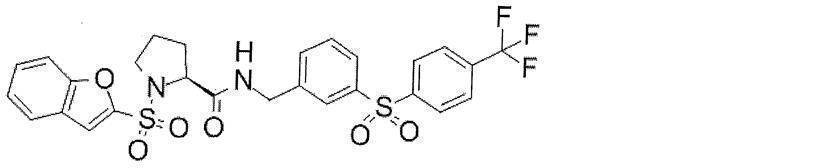
(2S)-1-(ベンゾフラン-2-イルスルホニル)-N-[[3-[4-(トリフルオロメチル)フェニル]スルファニルフェニル]メチル]ピロリジン-2-カルボキサミド(321)(0.13g、0.24mmol)と3-クロロ過安息香酸(94mg、0.35mmol)にジクロロメタン(2.4mL)を加え0℃で5時間攪拌した。反応混合物に飽和重曹水及び飽和チオ硫酸ナトリウム水溶液を加え、ジクロロメタンで抽出し、有機層を硫酸ナトリウムにて乾燥した。乾燥剤を濾別し、溶媒を留去した。得られた残渣を高速液体クロマトグラフィー(水-アセトニトリル、それぞれ0.1%トリフルオロ酢酸入り)にて精製して標題化合物(70mg、0.12mmol、50%)を得た。
MS (ESI) m/z 593 (M+H)+
1H NMR (400 MHz, DMSO-d6) δ 8.80 (dd, J = 6.1, 6.1 Hz, 1H), 8.17 (d, J = 8.3 Hz, 2H), 7.98 (d, J= 8.3 Hz, 2H), 7.93 - 7.89 (m, 2H), 7.83 (ddd, J = 8.0, 1.3, 0.7 Hz, 1H), 7.76 - 7.71 (m, 2H), 7.64 - 7.60 (m, 2H), 7.56 (ddd, J = 8.6, 7.3, 1.3 Hz, 1H), 7.42 (ddd, J = 8.0, 7.3, 0.9 Hz, 1H), 4.46 - 4.33 (m, 2H), 4.27 (dd, J = 8.4, 3.5 Hz, 1H), 3.62 - 3.53 (m, 1H), 3.44 - 3.34 (m, 1H), 1.96 - 1.74 (m, 3H), 1.70 - 1.56 (m, 1H).
(2S) -1- (Benzofuran-2-ylsulfonyl) -N-[[3- [4- (trifluoromethyl) phenyl] sulfanylphenyl] methyl] pyrrolidine-2-carboxamide (321) (0.13 g, 0 .24 mmol) and 3-chloroperbenzoic acid (94 mg, 0.35 mmol) were added dichloromethane (2.4 mL) and stirred at 0 ° C. for 5 hours. To the reaction mixture were added saturated aqueous sodium bicarbonate and saturated aqueous sodium thiosulfate solution, extracted with dichloromethane, and the organic layer was dried over sodium sulfate. The desiccant was filtered off and the solvent was distilled off. The obtained residue was purified by high performance liquid chromatography (water-acetonitrile, each containing 0.1% trifluoroacetic acid) to give the title compound (70 mg, 0.12 mmol, 50%).
MS (ESI) m / z 593 (M + H) +
1 H NMR (400 MHz, DMSO-d 6 ) δ 8.80 (dd, J = 6.1, 6.1 Hz, 1H), 8.17 (d, J = 8.3 Hz, 2H), 7.98 (d, J = 8.3 Hz, 2H) , 7.93-7.89 (m, 2H), 7.83 (ddd, J = 8.0, 1.3, 0.7 Hz, 1H), 7.76-7.71 (m, 2H), 7.64-7.60 (m, 2H), 7.56 (ddd, J = 8.6, 7.3, 1.3 Hz, 1H), 7.42 (ddd, J = 8.0, 7.3, 0.9 Hz, 1H), 4.46-4.33 (m, 2H), 4.27 (dd, J = 8.4, 3.5 Hz, 1H), 3.62 -3.53 (m, 1H), 3.44-3.34 (m, 1H), 1.96-1.74 (m, 3H), 1.70-1.56 (m, 1H).
実施例323:(2S)-1-(ベンゾフラン-2-イルスルホニル)-N-[[3-[4-(トリフルオロメチル)フェニル]スルフィニルフェニル]メチル]ピロリジン-2-カルボキサミド(323)の合成Example 323: Synthesis of (2S) -1- (benzofuran-2-ylsulfonyl) -N-[[3- [4- (trifluoromethyl) phenyl] sulfinylphenyl] methyl] pyrrolidine-2-carboxamide (323)
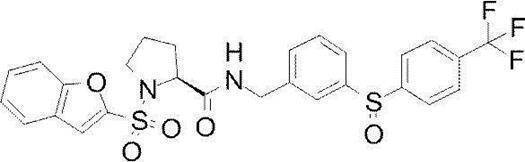
(2S)-1-(ベンゾフラン-2-イルスルホニル)-N-[[3-[4-(トリフルオロメチル)フェニル]スルファニルフェニル]メチル]ピロリジン-2-カルボキサミド(321)(0.13g、0.24mmol)と3-クロロ過安息香酸(94mg、0.35mmol)にジクロロメタン(2.4mL)を加え0℃で5時間攪拌した。反応混合物に飽和重曹水及び飽和チオ硫酸ナトリウム水溶液を加え、ジクロロメタンで抽出し、有機層を硫酸ナトリウムにて乾燥した。乾燥剤を濾別し、溶媒を留去した。得られた残渣を高速液体クロマトグラフィー(水-アセトニトリル、それぞれ0.1%トリフルオロ酢酸入り)にて精製して標題化合物(1.7mg、0.0030mmol、1%)を得た。
MS (ESI) m/z 577 (M+H)+
(2S) -1- (Benzofuran-2-ylsulfonyl) -N-[[3- [4- (trifluoromethyl) phenyl] sulfanylphenyl] methyl] pyrrolidine-2-carboxamide (321) (0.13 g, 0 .24 mmol) and 3-chloroperbenzoic acid (94 mg, 0.35 mmol) were added dichloromethane (2.4 mL) and stirred at 0 ° C. for 5 hours. To the reaction mixture were added saturated aqueous sodium bicarbonate and saturated aqueous sodium thiosulfate solution, extracted with dichloromethane, and the organic layer was dried over sodium sulfate. The desiccant was filtered off and the solvent was distilled off. The obtained residue was purified by high performance liquid chromatography (water-acetonitrile, each containing 0.1% trifluoroacetic acid) to give the title compound (1.7 mg, 0.0030 mmol, 1%).
MS (ESI) m / z 577 (M + H) +
実施例324:(2S)-1-(ベンゾフラン-2-イルスルホニル)-N-[[3-[[4-(トリフルオロメチル)フェニル]メチルスルホニル]フェニル]メチル]ピロリジン-2-カルボキサミド(324)の合成Example 324: (2S) -1- (benzofuran-2-ylsulfonyl) -N-[[3-[[4- (trifluoromethyl) phenyl] methylsulfonyl] phenyl] methyl] pyrrolidine-2-carboxamide (324 ) Synthesis

((2S)-1-(ベンゾフラン-2-イルスルホニル)-N-[[3-[[4-(トリフルオロメチル)フェニル]メチルスルファニル]フェニル]メチル]ピロリジン-2-カルボキサミド(315)(43mg、0.075mmol)と3-クロロ過安息香酸(30mg、0.11mmol)にジクロロメタン(1.5mL)を加え0℃で5時間攪拌した。反応混合物に飽和重曹水及び飽和チオ硫酸ナトリウム水溶液を加え、ジクロロメタンで抽出し、有機層を硫酸ナトリウムにて乾燥した。乾燥剤を濾別し、溶媒を留去した。得られた残渣を高速液体クロマトグラフィー(水-アセトニトリル、それぞれ0.1%トリフルオロ酢酸入り)にて精製して標題化合物(24mg、0.040mmol、53%)を得た。
MS (ESI) m/z 607 (M+H)+
((2S) -1- (Benzofuran-2-ylsulfonyl) -N-[[3-[[4- (trifluoromethyl) phenyl] methylsulfanyl] phenyl] methyl] pyrrolidine-2-carboxamide (315) (43 mg , 0.075 mmol) and 3-chloroperbenzoic acid (30 mg, 0.11 mmol) were added dichloromethane (1.5 mL) and stirred for 5 hours at 0 ° C. To the reaction mixture were added saturated aqueous sodium bicarbonate and saturated aqueous sodium thiosulfate. The organic layer was dried over sodium sulfate, the desiccant was filtered off, the solvent was distilled off, and the resulting residue was subjected to high performance liquid chromatography (water-acetonitrile, 0.1% trifluoro each. Purification with acetic acid) afforded the title compound (24 mg, 0.040 mmol, 53%).
MS (ESI) m / z 607 (M + H) +
実施例325:(2S)-1-(ベンゾフラン-2-イルスルホニル)-N-[[3-[[4-(トリフルオロメチル)フェニル]スルフィニルメチル]フェニル]メチル]ピロリジン-2-カルボキサミド(325)の合成Example 325: (2S) -1- (benzofuran-2-ylsulfonyl) -N-[[3-[[4- (trifluoromethyl) phenyl] sulfinylmethyl] phenyl] methyl] pyrrolidine-2-carboxamide (325 ) Synthesis
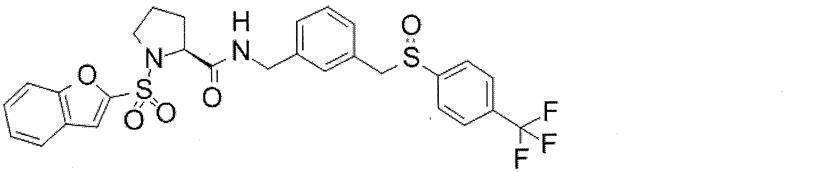
(2S)-1-(ベンゾフラン-2-イルスルホニル)-N-[[3-[[4-(トリフルオロメチル)フェニル]スルファニルメチル]フェニル]メチル]ピロリジン-2-カルボキサミド(299)(0.10g、0.18mmol)と3-クロロ過安息香酸(46mg、0.27mmol)にジクロロメタン(1.8mL)を加え室温下5時間攪拌した。反応混合物に飽和重曹水及び飽和チオ硫酸ナトリウム水溶液を加え、ジクロロメタンで抽出し、有機層を硫酸ナトリウムにて乾燥した。乾燥剤を濾別し、溶媒を留去した。得られた残渣を高速液体クロマトグラフィー(水-アセトニトリル、それぞれ0.1%トリフルオロ酢酸入り)にて精製して標題化合物(17mg、0.028mmol、16%)を得た。
MS (ESI) m/z 591 (M+H)+
1H NMR (400 MHz, DMSO-d6) δ 8.65 (dd, J = 6.1, 6.1 Hz, 1H), 7.91 (d, J = 8.1 Hz, 2H), 7.83 (d, J= 7.9 Hz, 1H), 7.79 - 7.70 (m, 4H), 7.59 - 7.53 (m, 1H), 7.42 (t, J = 7.5 Hz, 1H), 7.28 - 7.19 (m, 2H), 7.08 (s, 1H), 6.97 (ddt, J = 6.1, 4.1, 2.1 Hz, 1H), 4.38 - 4.17 (m, 4H), 4.09 (dd, J = 12.8, 2.9 Hz, 1H), 3.66 - 3.55 (m, 1H), 3.46 - 3.37 (m, 1H), 1.95 - 1.82 (m, 3H), 1.70 - 1.58 (m, 1H).
(2S) -1- (Benzofuran-2-ylsulfonyl) -N-[[3-[[4- (trifluoromethyl) phenyl] sulfanylmethyl] phenyl] methyl] pyrrolidine-2-carboxamide (299) (0. 10 g, 0.18 mmol) and 3-chloroperbenzoic acid (46 mg, 0.27 mmol) were added dichloromethane (1.8 mL) and stirred at room temperature for 5 hours. To the reaction mixture were added saturated aqueous sodium bicarbonate and saturated aqueous sodium thiosulfate solution, extracted with dichloromethane, and the organic layer was dried over sodium sulfate. The desiccant was filtered off and the solvent was distilled off. The obtained residue was purified by high performance liquid chromatography (water-acetonitrile, each containing 0.1% trifluoroacetic acid) to give the title compound (17 mg, 0.028 mmol, 16%).
MS (ESI) m / z 591 (M + H) +
1 H NMR (400 MHz, DMSO-d 6 ) δ 8.65 (dd, J = 6.1, 6.1 Hz, 1H), 7.91 (d, J = 8.1 Hz, 2H), 7.83 (d, J = 7.9 Hz, 1H) , 7.79-7.70 (m, 4H), 7.59-7.53 (m, 1H), 7.42 (t, J = 7.5 Hz, 1H), 7.28-7.19 (m, 2H), 7.08 (s, 1H), 6.97 (ddt , J = 6.1, 4.1, 2.1 Hz, 1H), 4.38-4.17 (m, 4H), 4.09 (dd, J = 12.8, 2.9 Hz, 1H), 3.66-3.55 (m, 1H), 3.46-3.37 (m , 1H), 1.95-1.82 (m, 3H), 1.70-1.58 (m, 1H).
表33記載の実施例326、実施例328~実施例330は、実施例311工程3で得られた化合物及び対応する市販の試薬を用い実施例312と同様の操作により合成した。 Example 326 and Examples 328 to 330 described in Table 33 were synthesized in the same manner as in Example 312 using the compound obtained in Step 3 of Example 311 and the corresponding commercially available reagent.

実施例327:(2S)-1-(ベンゾフラン-2-イルスルホニル)-N-[[2-ベンジルオキシ-6-[4-(トリフルオロメチル)フェニル]ピリミジン-4-イル]メチル]ピロリジン-2-カルボキサミド(327)の合成Example 327: (2S) -1- (benzofuran-2-ylsulfonyl) -N-[[2-benzyloxy-6- [4- (trifluoromethyl) phenyl] pyrimidin-4-yl] methyl] pyrrolidine- Synthesis of 2-carboxamide (327)

2-メチル-1-プロパノールの代わりにベンジルアルコールを用い、実施例311の工程4と同様の操作により標題化合物(9.9mg、0.016mmol、収率16%)を得た。
MS (ESI) m/z 637 (M+H)+
The title compound (9.9 mg, 0.016 mmol, yield 16%) was obtained in the same manner as in Step 4 of Example 311 using benzyl alcohol in place of 2-methyl-1-propanol.
MS (ESI) m / z 637 (M + H) +
実施例331:(2S)-1-(ベンゾフラン-2-イルスルホニル)-N-[[2-[6-(2,2,2-トリフルオロエトキシメチル)-3-ピリジル]-4-ピリジル]メチル]ピロリジン-2-カルボキサミド(331)の合成Example 331: (2S) -1- (benzofuran-2-ylsulfonyl) -N-[[2- [6- (2,2,2-trifluoroethoxymethyl) -3-pyridyl] -4-pyridyl] Synthesis of methyl] pyrrolidine-2-carboxamide (331)
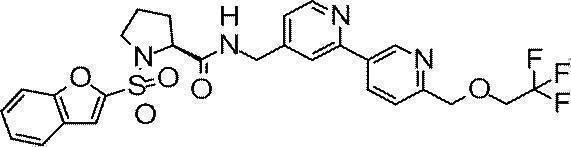
(工程1)(2S)-1-(ベンゾフラン-2-イルスルホニル)-N-[[2-[6-(ヒドロキシメチル)-3-ピリジル]-4-ピリジル]メチル]ピロリジン-2-カルボキサミドの合成
C-4(82mg、0.20mmol)、[6-(ヒドロキシメチル)-3-ピリジル]ボロン酸(30.6mg、0.20mmol)及び1,1’-ビス(ジフェニルホスフィノ)フェロセンジクロロパラジウム(II)(14mg、0.019mmol)に1,4-ジオキサン(0.7mL)及び1mol/L 炭酸ナトリウム水溶液(0.7mL)を加え、マイクロウェーブ反応装置を用いて100℃で10分間加熱攪拌した。反応液にトリフルオロ酢酸を加えて中和した後、高速液体クロマトグラフィー(水-アセトニトリル、それぞれ0.1%トリフルオロ酢酸入り)にて精製した。飽和重曹水を加えジクロロメタンで抽出後、有機層を硫酸ナトリウムにて乾燥した。乾燥剤を濾別し、溶媒を留去して標題化合物(42mg、0.085mmol、43%)を得た。
MS (ESI) m/z 493 (M+H)+
(工程2)(2S)-1-(ベンゾフラン-2-イルスルホニル)-N-[[2-[6-(2,2,2-トリフルオロエトキシメチル)-3-ピリジル]-4-ピリジル]メチル]ピロリジン-2-カルボキサミド(331)の合成
工程1で得られた化合物(38mg、0.077mmol)のテトラヒドロフラン溶液(13.3mL)に、0℃で水素化ナトリウム(55%油性、4.0mg、0.092mmol)およびトリフルオロメタンスルホン酸 2,2,2-トリフルオロエチル(13μL、0.092mmol)を加え室温で数時間撹拌した後、反応液に水とトリフルオロ酢酸を加えて中和した後、高速液体クロマトグラフィー(水-アセトニトリル、それぞれ0.1%トリフルオロ酢酸入り)にて精製して標題化合物のトリフルオロ酢酸塩(2.4mg、0.0034mmol、4.5%)を得た。
MS (ESI) m/z 575 (M+H)+
1H NMR (400 MHz, DMSO-d6) δ 9.23 (d, J = 2.2 Hz, 1H), 8.89 (dd, J = 6.1, 6.1 Hz, 1H), 8.66 (d, J = 5.1 Hz, 1H), 8.50 (dd, J = 8.2, 2.2 Hz, 1H), 7.97 (s, 1H), 7.84 (dd, J = 7.9, 1.3 Hz, 1H), 7.78 - 7.74 (m, 2H), 7.60 - 7.53 (m, 2H), 7.43 (ddd, J = 7.9, 7.5, 0.8 Hz, 1H), 7.35 (dd, J = 5.1, 1.5 Hz, 1H), 4.82 (s, 2H), 4.50 (dd, J = 16.6, 6.1 Hz, 1H), 4.41 (dd, J = 16.6, 6.1 Hz, 1H), 4.34 (dd, J = 8.3, 3.8 Hz, 1H), 4.25 (q, J = 9.3 Hz, 2H), 3.66 - 3.61 (m, 1H), 3.45 - 3.38 (m, 1H), 2.06 - 1.85 (m, 3H), 1.72 - 1.59 (m, 1H).
(Step 1) of (2S) -1- (benzofuran-2-ylsulfonyl) -N-[[2- [6- (hydroxymethyl) -3-pyridyl] -4-pyridyl] methyl] pyrrolidine-2-carboxamide Synthesis C-4 (82 mg, 0.20 mmol), [6- (hydroxymethyl) -3-pyridyl] boronic acid (30.6 mg, 0.20 mmol) and 1,1′-bis (diphenylphosphino) ferrocenedichloropalladium To (II) (14 mg, 0.019 mmol), 1,4-dioxane (0.7 mL) and 1 mol / L aqueous sodium carbonate solution (0.7 mL) were added, and the mixture was heated and stirred at 100 ° C. for 10 minutes using a microwave reactor. did. The reaction solution was neutralized by adding trifluoroacetic acid and then purified by high performance liquid chromatography (water-acetonitrile, each containing 0.1% trifluoroacetic acid). Saturated aqueous sodium hydrogen carbonate was added, extracted with dichloromethane, and the organic layer was dried over sodium sulfate. The desiccant was filtered off and the solvent was removed to give the title compound (42 mg, 0.085 mmol, 43%).
MS (ESI) m / z 493 (M + H) +
(Step 2) (2S) -1- (benzofuran-2-ylsulfonyl) -N-[[2- [6- (2,2,2-trifluoroethoxymethyl) -3-pyridyl] -4-pyridyl] Synthesis of methyl] pyrrolidine-2-carboxamide (331) To a solution of the compound obtained in Step 1 (38 mg, 0.077 mmol) in tetrahydrofuran (13.3 mL) at 0 ° C., sodium hydride (55% oily, 4.0 mg). 0.092 mmol) and 2,2,2-trifluoroethyl trifluoromethanesulfonate (13 μL, 0.092 mmol) were added and stirred at room temperature for several hours, and then the reaction solution was neutralized by adding water and trifluoroacetic acid. After purification by high performance liquid chromatography (water-acetonitrile, each containing 0.1% trifluoroacetic acid) Oroacetate (2.4 mg, 0.0034 mmol, 4.5%) was obtained.
MS (ESI) m / z 575 (M + H) +
1 H NMR (400 MHz, DMSO-d 6 ) δ 9.23 (d, J = 2.2 Hz, 1H), 8.89 (dd, J = 6.1, 6.1 Hz, 1H), 8.66 (d, J = 5.1 Hz, 1H) , 8.50 (dd, J = 8.2, 2.2 Hz, 1H), 7.97 (s, 1H), 7.84 (dd, J = 7.9, 1.3 Hz, 1H), 7.78-7.74 (m, 2H), 7.60-7.53 (m , 2H), 7.43 (ddd, J = 7.9, 7.5, 0.8 Hz, 1H), 7.35 (dd, J = 5.1, 1.5 Hz, 1H), 4.82 (s, 2H), 4.50 (dd, J = 16.6, 6.1 Hz, 1H), 4.41 (dd, J = 16.6, 6.1 Hz, 1H), 4.34 (dd, J = 8.3, 3.8 Hz, 1H), 4.25 (q, J = 9.3 Hz, 2H), 3.66-3.61 (m , 1H), 3.45-3.38 (m, 1H), 2.06-1.85 (m, 3H), 1.72-1.59 (m, 1H).
表34記載の実施例332~実施例333は、参考例記載の化合物および対応する市販の試薬を用い実施例112と同様の操作により合成した。 Examples 332 to 333 described in Table 34 were synthesized in the same manner as in Example 112 using the compounds described in Reference Examples and the corresponding commercially available reagents.

表35記載の実施例334~実施例411は、参考例記載の化合物及び対応する市販の試薬を用い実施例37と同様の操作により合成した。

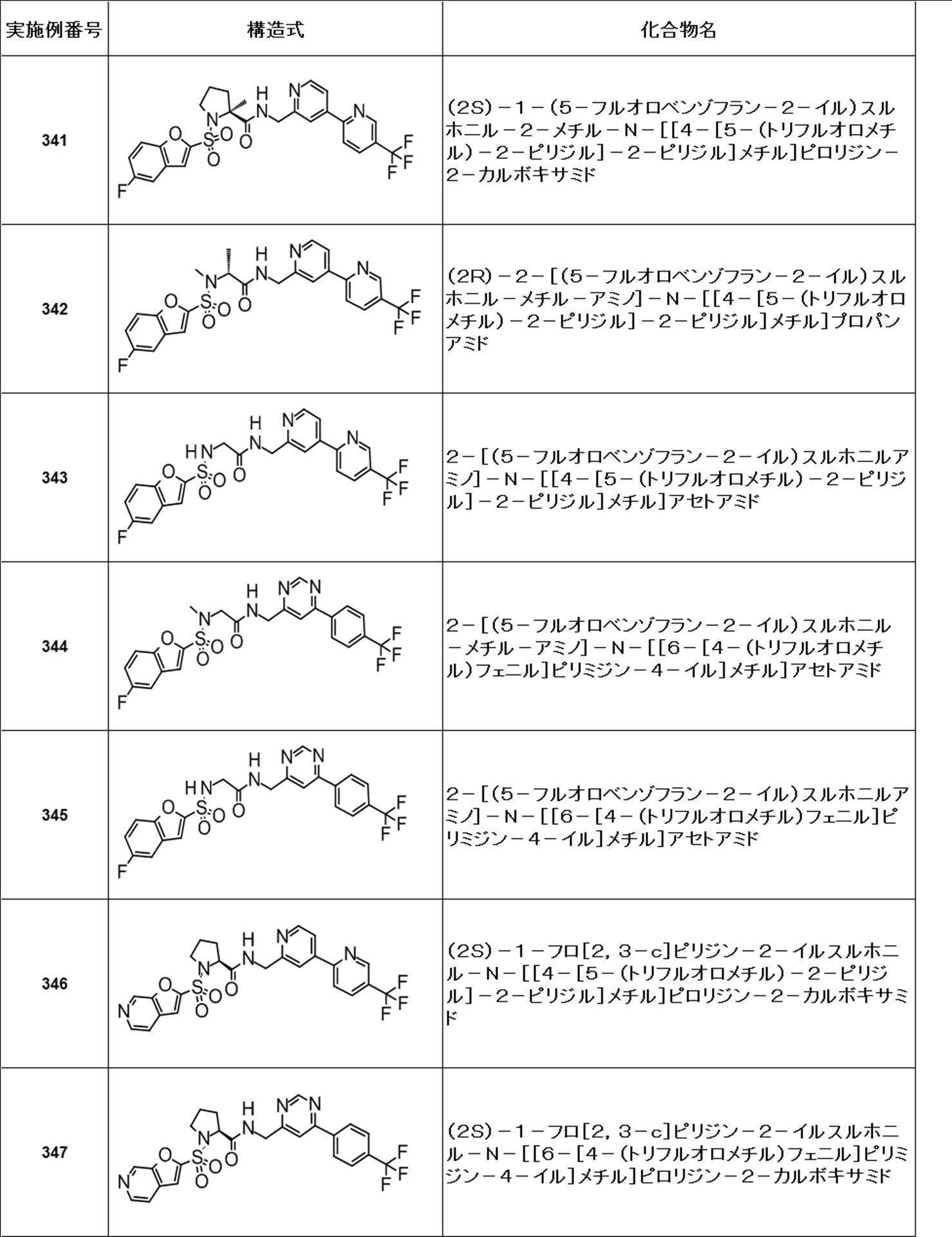


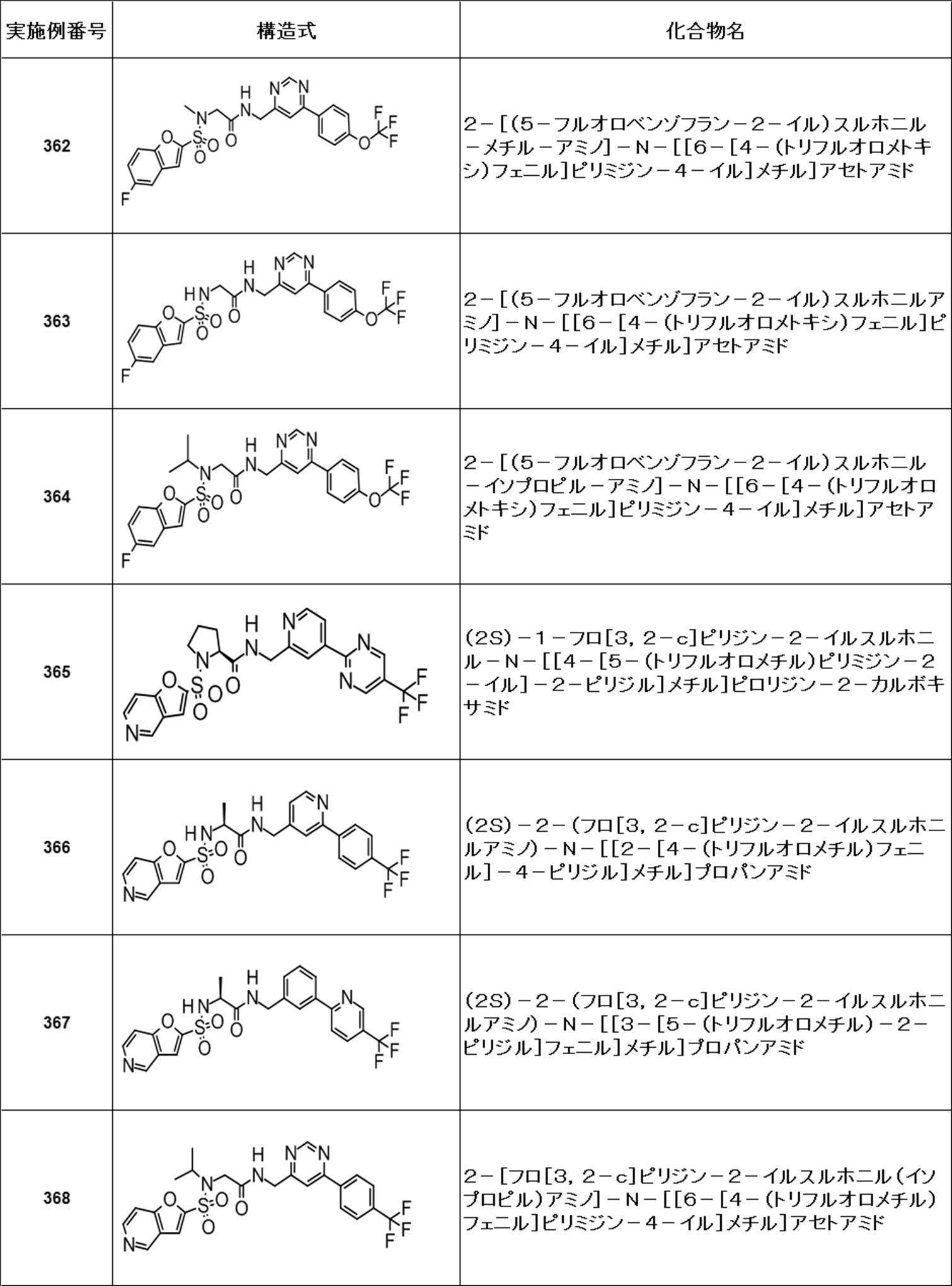


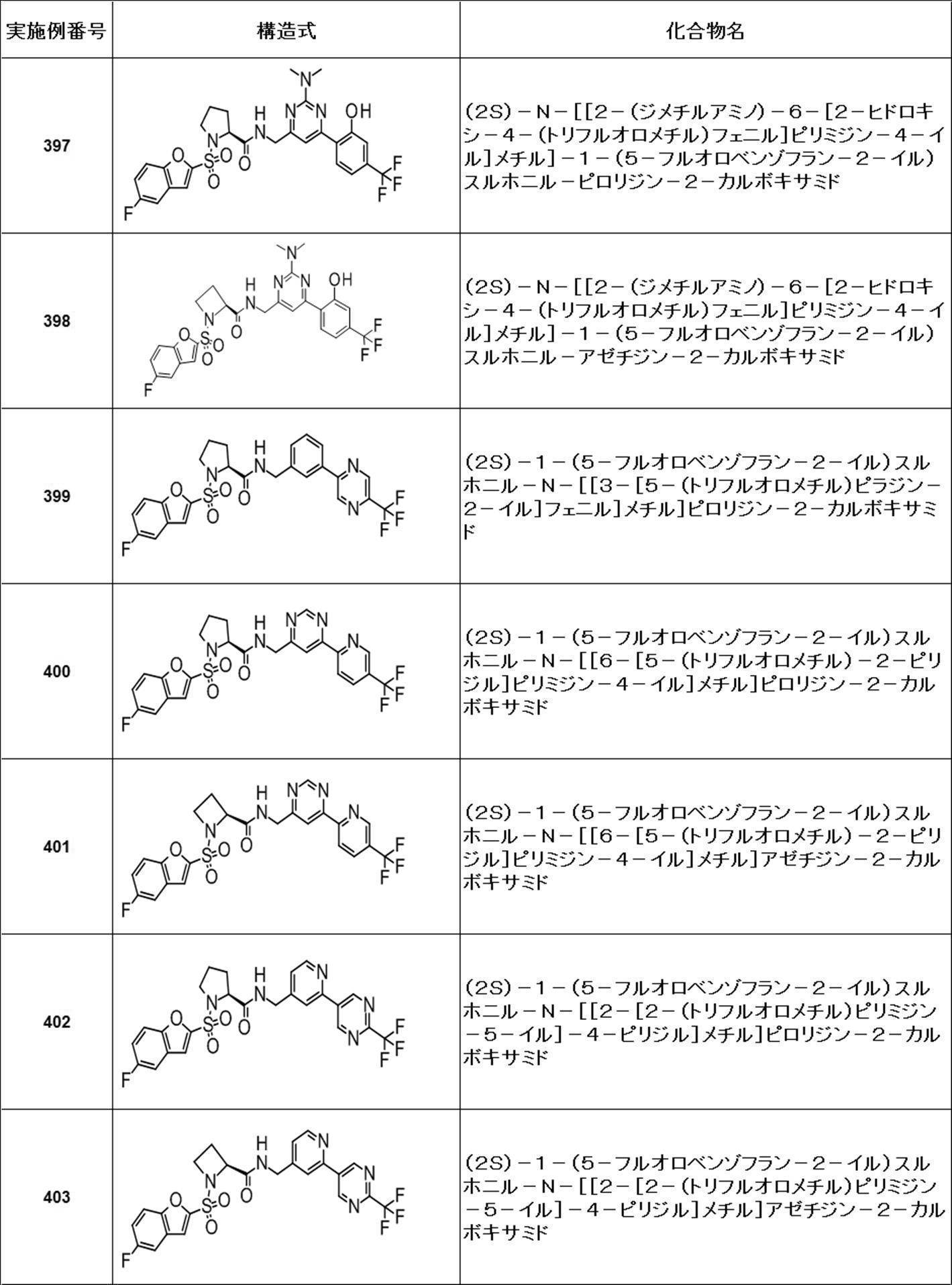

表36記載の実施例412~実施例414は、参考例記載の化合物と対応する市販の試薬を用い実施例288と同様の操作により合成した。 Examples 412 to 414 described in Table 36 were synthesized in the same manner as in Example 288 using commercially available reagents corresponding to the compounds described in Reference Examples.

実施例415:(2S)-3-tert-ブトキシ-2-[(5-フルオロベンゾフラン-2-イル)スルホニルアミノ]-N-[[6-[4-(トリフルオロメチル)フェニル]ピリミジン-4-イル]メチル]プロパンアミド(415)の合成 Example 415: (2S) -3-tert-butoxy-2-[(5-fluorobenzofuran-2-yl) sulfonylamino] -N-[[6- [4- (trifluoromethyl) phenyl] pyrimidine-4 Synthesis of -yl] methyl] propanamide (415 )

B-1とD-1の代わりに実施例189の工程1で得られた化合物とD-16を用い、実施例37と同様の操作により標題化合物(収率31%)を得た。
MS (ESI) m/z 595 (M+H)+
Using the compound obtained in Step 1 of Example 189 and D-16 in place of B-1 and D-1, the title compound (yield 31%) was obtained in the same manner as in Example 37.
MS (ESI) m / z 595 (M + H) +
実施例416:(2S)-2-[エチル-(5-フルオロベンゾフラン-2-イル)スルホニル-アミノ]-N-[[4-[5-(トリフルオロメチル)-2-ピリジル]-2-ピリジル]メチル]プロパンアミド(416)の合成Example 416: (2S) -2- [ethyl- (5-fluorobenzofuran-2-yl) sulfonyl-amino] -N-[[4- [5- (trifluoromethyl) -2-pyridyl] -2- Synthesis of pyridyl] methyl] propanamide (416)

(2S)-2-[(5-フルオロベンゾフラン-2-イル)スルホニルアミノ]-N-[[4-[5-(トリフルオロメチル)-2-ピリジル]-2-ピリジル]メチル]プロパンアミド(240)(52mg、0.10mmol)、炭酸カリウム(28mg、0.20mmol)のN,N-ジメチルホルムアミド(1.0mL)溶液に、ヨウ化エチル(16μL、0.20mmol)を加え60℃で3時間撹拌した。アセトニトリルを用いて不溶物を濾過し、高速液体クロマトグラフィー(水-アセトニトリル、それぞれ0.1%トリフルオロ酢酸入り)にて精製して標題化合物のトリフルオロ酢酸塩(4.5mg、0.0068mmol、6.8%)を得た。
MS (ESI) m/z 551 (M+H)+
1H NMR (400 MHz, DMSO-d6) δ 9.13 - 9.10 (m, 1H), 8.73 - 8.68 (m, 2H), 8.41 (dd, J = 8.4, 2.4 Hz, 1H), 8.30 (d, J = 8.4 Hz, 1H), 8.04 (dd, J = 5.3, 1.7 Hz, 1H), 8.00 (d, J = 1.7 Hz, 1H), 7.66 (dd, J = 9.1, 4.0 Hz, 1H), 7.55 (d, J = 0.9 Hz, 1H), 7.48 (dd, J = 8.5, 2.7 Hz, 1H), 7.32 (ddd, J = 9.2, 9.1, 2.8 Hz, 1H), 4.67 (q, J = 7.2 Hz, 1H), 4.44 - 4.33 (m, 2H), 3.55 - 3.40 (m, 2H), 1.38 (d, J = 7.2 Hz, 3H), 1.20 (t, J = 7.0 Hz, 3H).
(2S) -2-[(5-Fluorobenzofuran-2-yl) sulfonylamino] -N-[[4- [5- (trifluoromethyl) -2-pyridyl] -2-pyridyl] methyl] propanamide ( 240) (52 mg, 0.10 mmol), potassium carbonate (28 mg, 0.20 mmol) in N, N-dimethylformamide (1.0 mL), ethyl iodide (16 μL, 0.20 mmol) was added, Stir for hours. Insoluble matter was filtered using acetonitrile, and purified by high performance liquid chromatography (water-acetonitrile, each containing 0.1% trifluoroacetic acid) to give the trifluoroacetate of the title compound (4.5 mg, 0.0068 mmol, 6.8%).
MS (ESI) m / z 551 (M + H) +
1 H NMR (400 MHz, DMSO-d 6 ) δ 9.13-9.10 (m, 1H), 8.73-8.68 (m, 2H), 8.41 (dd, J = 8.4, 2.4 Hz, 1H), 8.30 (d, J = 8.4 Hz, 1H), 8.04 (dd, J = 5.3, 1.7 Hz, 1H), 8.00 (d, J = 1.7 Hz, 1H), 7.66 (dd, J = 9.1, 4.0 Hz, 1H), 7.55 (d , J = 0.9 Hz, 1H), 7.48 (dd, J = 8.5, 2.7 Hz, 1H), 7.32 (ddd, J = 9.2, 9.1, 2.8 Hz, 1H), 4.67 (q, J = 7.2 Hz, 1H) , 4.44-4.33 (m, 2H), 3.55-3.40 (m, 2H), 1.38 (d, J = 7.2 Hz, 3H), 1.20 (t, J = 7.0 Hz, 3H).
表37記載の実施例417~実施例422は、対応する実施例240、実施例345、実施例109の化合物と対応する市販の試薬を用い実施例416と同様の操作により合成した。 Examples 417 to 422 described in Table 37 were synthesized by the same operations as in Example 416 using the corresponding compounds of Example 240, Example 345 and Example 109 and the corresponding commercially available reagents.

実施例423:2-[(5-フルオロベンゾフラン-2-イル)スルホニル-(4-ピペリジルメチル)アミノ]-N-[[4-[5-(トリフルオロメチル)-2-ピリジル]-2-ピリジル]メチル]アセトアミド(423)の合成Example 423: 2-[(5-fluorobenzofuran-2-yl) sulfonyl- (4-piperidylmethyl) amino] -N-[[4- [5- (trifluoromethyl) -2-pyridyl] -2- Synthesis of pyridyl] methyl] acetamide (423)

(工程1)4-[[(5-フルオロベンゾフラン-2-イル)スルホニル-[2-オキソ-2-[[4-[5-(トリフルオロメチル)-2-ピリジル]-2-ピリジル]メチルアミノ]エチル]アミノ]メチル]ピペリジン-1-カルボン酸 tert-ブチルの合成
B-1の代わりにB-47、D-1の代わりにD-31を用い、実施例37と同様の操作により標題化合物を得た(0.043mmol、収率20%)。
MS (ESI) m/z 706 (M+H)+
(工程2)2-[(5-フルオロベンゾフラン-2-イル)スルホニル-(4-ピペリジルメチル)アミノ]-N-[[4-[5-(トリフルオロメチル)-2-ピリジル]-2-ピリジル]メチル]アセトアミド(423)の合成
工程1で得られた化合物のジクロロメタン溶液(1mL)にトリフルオロ酢酸(200μL)を加え室温で30分撹拌し、溶媒を留去して標題化合物の二トリフルオロ酢酸塩(34.3mg、0.041mmol、95%)を得た。
MS (ESI) m/z 606 (M+H)+
1H NMR (400 MHz, DMSO-d6) δ 9.13 (d, J = 2.3 Hz, 1H), 8.75 (t, J = 5.8 Hz, 1H), 8.71 (d, J = 5.1 Hz, 1H), 8.55 - 8.45 (m, 1H), 8.42 (dd, J = 8.4, 2.3 Hz, 1H), 8.32 (d, J = 8.4 Hz, 1H), 8.24 - 8.12 (m, 1H), 8.05 - 7.99 (m, 2H), 7.70 (dd, J = 9.1, 4.0 Hz, 1H), 7.58 (d, J = 0.8 Hz, 1H), 7.52 (dd, J = 8.5, 2.7 Hz, 1H), 7.36 (ddd, J = 9.2, 9.1, 2.8 Hz, 1H), 4.42 (d, J = 5.8 Hz, 2H), 4.09 (s, 2H), 3.33 - 3.21 (m, 4H), 2.86 - 2.71 (m, 2H), 2.02 - 1.82 (m, 3H), 1.36 - 1.20 (m, 2H).
(Step 1) 4-[[(5-Fluorobenzofuran-2-yl) sulfonyl- [2-oxo-2-[[4- [5- (trifluoromethyl) -2-pyridyl] -2-pyridyl] methyl Synthesis of tert-butyl amino] ethyl] amino] methyl] piperidine-1-carboxylate The title compound was prepared in the same manner as in Example 37 except that B-47 was used instead of B-1 and D-31 was used instead of D-1. The compound was obtained (0.043 mmol, yield 20%).
MS (ESI) m / z 706 (M + H) +
(Step 2) 2-[(5-Fluorobenzofuran-2-yl) sulfonyl- (4-piperidylmethyl) amino] -N-[[4- [5- (trifluoromethyl) -2-pyridyl] -2- Synthesis of Pyridyl] methyl] acetamide (423) To a dichloromethane solution (1 mL) of the compound obtained in Step 1, trifluoroacetic acid (200 μL) was added and stirred at room temperature for 30 minutes. Fluoroacetate (34.3 mg, 0.041 mmol, 95%) was obtained.
MS (ESI) m / z 606 (M + H) +
1 H NMR (400 MHz, DMSO-d 6 ) δ 9.13 (d, J = 2.3 Hz, 1H), 8.75 (t, J = 5.8 Hz, 1H), 8.71 (d, J = 5.1 Hz, 1H), 8.55 -8.45 (m, 1H), 8.42 (dd, J = 8.4, 2.3 Hz, 1H), 8.32 (d, J = 8.4 Hz, 1H), 8.24-8.12 (m, 1H), 8.05-7.99 (m, 2H ), 7.70 (dd, J = 9.1, 4.0 Hz, 1H), 7.58 (d, J = 0.8 Hz, 1H), 7.52 (dd, J = 8.5, 2.7 Hz, 1H), 7.36 (ddd, J = 9.2, 9.1, 2.8 Hz, 1H), 4.42 (d, J = 5.8 Hz, 2H), 4.09 (s, 2H), 3.33-3.21 (m, 4H), 2.86-2.71 (m, 2H), 2.02-1.82 (m , 3H), 1.36-1.20 (m, 2H).
表38記載の実施例424~実施例425は、参考例記載の化合物を用い実施例423と同様の操作により合成した。 Examples 424 to 425 described in Table 38 were synthesized in the same manner as in Example 423 using the compounds described in Reference Examples.

実施例426:(2S)-2-[(5-フルオロベンゾフラン-2-イル)スルホニル-メチル-アミノ]-N-[[4-[5-(トリフルオロメチル)-2-ピリジル]-2-ピリジル]メチル]プロパンアミド(426)の合成Example 426: (2S) -2-[(5-Fluorobenzofuran-2-yl) sulfonyl-methyl-amino] -N-[[4- [5- (trifluoromethyl) -2-pyridyl] -2- Synthesis of pyridyl] methyl] propanamide (426)

N-(tert-ブトキシカルボニル)-N-メチル-L-アラニン(20.3mg、0.10mmol)、D-31(28.9mg、0.10mmol)、WSC塩酸塩(38mg、0.20mmol)及び1-ヒドロキシ-7-アザベンゾトリアゾール(27mg、0.20mmol)にジクロロメタン(1mL)とトリエチルアミン(54μL、0.40mmol)を加え室温で30分間攪拌した。反応液に水を加え、ジクロロメタンで抽出した。有機層を硫酸ナトリウムにて乾燥した後、乾燥剤を濾別し、溶媒を留去して得られた残渣に、4mol/L 塩酸/1,4-ジオキサン溶液(3mL)を加え、室温にて30分間撹拌した。溶媒を留去して、テトラヒドロフラン(2mL)に溶解させ、2mol/L 水酸ナトリウム水溶液(20mL)、A-3(23.4mg、0.10mmol)を加え、室温で2時間攪拌した。反応混合物に水を加えてジクロロメタンで抽出した。有機層を硫酸ナトリウムにて乾燥し、乾燥剤を濾別した。溶媒を留去して得られた残渣を高速液体クロマトグラフィー(水-アセトニトリル、それぞれ0.1%トリフルオロ酢酸入り)にて精製して標題化合物のトリフルオロ酢酸塩(3.61mg、0.0055mmol、5.5%)を得た。
MS (ESI) m/z 537 (M+H)+
1H NMR (400 MHz, DMSO-d6) δ 9.12 (d, J = 2.3 Hz, 1H), 8.77 (dd, J = 5.9, 5.8 Hz, 1H), 8.70 (d, J = 5.2 Hz, 1H), 8.41 (dd, J = 8.5, 2.3 Hz, 1H), 8.30 (d, J = 8.5 Hz, 1H), 8.04 (dd, J = 5.2, 1.7 Hz, 1H), 8.01 (d, J = 1.7 Hz, 1H), 7.69 (dd, J = 9.2, 4.1 Hz, 1H), 7.59 (d, J = 0.9 Hz, 1H), 7.52 (dd, J = 8.5, 2.7 Hz, 1H), 7.35 (ddd, J = 9.2, 9.2, 2.7 Hz, 1H), 4.70 (q, J = 7.1 Hz, 1H), 4.44 (dd, J = 16.3, 5.8 Hz, 1H), 4.39 (dd, J = 16.3, 5.9 Hz, 1H), 2.99 (s, 3H), 1.28 (d, J = 7.1 Hz, 3H).
N- (tert-butoxycarbonyl) -N-methyl-L-alanine (20.3 mg, 0.10 mmol), D-31 (28.9 mg, 0.10 mmol), WSC hydrochloride (38 mg, 0.20 mmol) and Dichloromethane (1 mL) and triethylamine (54 μL, 0.40 mmol) were added to 1-hydroxy-7-azabenzotriazole (27 mg, 0.20 mmol), and the mixture was stirred at room temperature for 30 minutes. Water was added to the reaction mixture, and the mixture was extracted with dichloromethane. After drying the organic layer with sodium sulfate, the desiccant was filtered off, the solvent was distilled off, and 4 mol / L hydrochloric acid / 1,4-dioxane solution (3 mL) was added to the resulting residue at room temperature. Stir for 30 minutes. The solvent was distilled off, dissolved in tetrahydrofuran (2 mL), 2 mol / L aqueous sodium hydroxide solution (20 mL) and A-3 (23.4 mg, 0.10 mmol) were added, and the mixture was stirred at room temperature for 2 hr. Water was added to the reaction mixture, and the mixture was extracted with dichloromethane. The organic layer was dried over sodium sulfate and the desiccant was filtered off. The residue obtained by distilling off the solvent was purified by high performance liquid chromatography (water-acetonitrile, each containing 0.1% trifluoroacetic acid) to give the trifluoroacetate salt of the title compound (3.61 mg, 0.0055 mmol). 5.5%).
MS (ESI) m / z 537 (M + H) +
1 H NMR (400 MHz, DMSO-d 6 ) δ 9.12 (d, J = 2.3 Hz, 1H), 8.77 (dd, J = 5.9, 5.8 Hz, 1H), 8.70 (d, J = 5.2 Hz, 1H) , 8.41 (dd, J = 8.5, 2.3 Hz, 1H), 8.30 (d, J = 8.5 Hz, 1H), 8.04 (dd, J = 5.2, 1.7 Hz, 1H), 8.01 (d, J = 1.7 Hz, 1H), 7.69 (dd, J = 9.2, 4.1 Hz, 1H), 7.59 (d, J = 0.9 Hz, 1H), 7.52 (dd, J = 8.5, 2.7 Hz, 1H), 7.35 (ddd, J = 9.2 , 9.2, 2.7 Hz, 1H), 4.70 (q, J = 7.1 Hz, 1H), 4.44 (dd, J = 16.3, 5.8 Hz, 1H), 4.39 (dd, J = 16.3, 5.9 Hz, 1H), 2.99 (s, 3H), 1.28 (d, J = 7.1 Hz, 3H).
実施例427:3-フルオロ-2-[(5-フルオロベンゾフラン-2-イル)スルホニルアミノ]-N-[[4-[5-(トリフルオロメチル)-2-ピリジル]-2-ピリジル]メチル]プロパンアミド(427)の合成Example 427: 3-fluoro-2-[(5-fluorobenzofuran-2-yl) sulfonylamino] -N-[[4- [5- (trifluoromethyl) -2-pyridyl] -2-pyridyl] methyl Synthesis of propanamide (427)

3-アミノ-2-フルオロプロパン酸(21mg、0.20mmol)に二炭酸ジ-tert-ブチル(42mg、0.20mmol)、トリエチルアミン(40μL)、アセトニトリル(2mL)を加え、室温にて2時間撹拌した。溶媒を留去して得られた残渣にD-31(56mg、0.20mmol)、WSC塩酸塩(76mg、0.40mmol)及び1-ヒドロキシ-7-アザベンゾトリアゾール(54mg、0.40mmol)にジクロロメタン(2mL)とトリエチルアミン(110μL、0.80mmol)を加え室温で30分間攪拌した。反応液に水を加え、ジクロロメタンで抽出した。有機層を硫酸ナトリウムにて乾燥した後、乾燥剤を濾別し、溶媒を留去して得られた残渣に、4mol/L塩酸/1,4-ジオキサン溶液(2mL)と1,4-ジオキサン(2mL)を加え、室温にて1時間撹拌した。溶媒を留去して得られた化合物(37mg、0.10mmol)をジクロロメタン(1mL)に溶解させ、トリエチルアミン(20μL、0.15mmol)、A-3(23mg、0.10mmol)を加え、室温で2時間攪拌した。反応液に水とトリフルオロ酢酸を加えて中和した後、高速液体クロマトグラフィー(水-アセトニトリル、それぞれ0.1%トリフルオロ酢酸入り)にて精製して標題化合物のトリフルオロ酢酸塩(3.96mg、0.0061mmol、6.1%)を得た。
MS (ESI) m/z 541 (M+H)+
1H NMR (400 MHz, DMSO-d6) δ 9.27 (d, J = 8.6 Hz, 1H), 9.11 (d, J = 2.4 Hz, 1H), 8.92 (dd, J = 5.8, 5.8 Hz, 1H), 8.68 (d, J = 5.2 Hz, 1H), 8.41 (dd, J = 8.4, 2.4 Hz, 1H), 8.27 (d, J = 8.4 Hz, 1H), 8.03 (dd, J = 5.2, 1.7 Hz, 1H), 7.95 (d, J = 1.7 Hz, 1H), 7.65 (dd, J = 9.1, 4.1 Hz, 1H), 7.51 - 7.44 (m, 2H), 7.31 (ddd, J = 9.2, 9.1, 2.8 Hz, 1H), 4.66 - 4.58 (m, 1H), 4.53 - 4.34 (m, 4H).
To 3-amino-2-fluoropropanoic acid (21 mg, 0.20 mmol) was added di-tert-butyl dicarbonate (42 mg, 0.20 mmol), triethylamine (40 μL), and acetonitrile (2 mL), and the mixture was stirred at room temperature for 2 hours. did. The residue obtained by distilling off the solvent was added to D-31 (56 mg, 0.20 mmol), WSC hydrochloride (76 mg, 0.40 mmol) and 1-hydroxy-7-azabenzotriazole (54 mg, 0.40 mmol). Dichloromethane (2 mL) and triethylamine (110 μL, 0.80 mmol) were added and stirred at room temperature for 30 minutes. Water was added to the reaction mixture, and the mixture was extracted with dichloromethane. After drying the organic layer with sodium sulfate, the desiccant was filtered off and the solvent was distilled off to give a residue, 4 mol / L hydrochloric acid / 1,4-dioxane solution (2 mL) and 1,4-dioxane. (2 mL) was added and stirred at room temperature for 1 hour. The compound obtained by distilling off the solvent (37 mg, 0.10 mmol) was dissolved in dichloromethane (1 mL), triethylamine (20 μL, 0.15 mmol) and A-3 (23 mg, 0.10 mmol) were added, and at room temperature. Stir for 2 hours. The reaction solution was neutralized by adding water and trifluoroacetic acid, and then purified by high performance liquid chromatography (water-acetonitrile, each containing 0.1% trifluoroacetic acid) to give the trifluoroacetate salt of the title compound (3. 96 mg, 0.0061 mmol, 6.1%).
MS (ESI) m / z 541 (M + H) +
1 H NMR (400 MHz, DMSO-d 6 ) δ 9.27 (d, J = 8.6 Hz, 1H), 9.11 (d, J = 2.4 Hz, 1H), 8.92 (dd, J = 5.8, 5.8 Hz, 1H) , 8.68 (d, J = 5.2 Hz, 1H), 8.41 (dd, J = 8.4, 2.4 Hz, 1H), 8.27 (d, J = 8.4 Hz, 1H), 8.03 (dd, J = 5.2, 1.7 Hz, 1H), 7.95 (d, J = 1.7 Hz, 1H), 7.65 (dd, J = 9.1, 4.1 Hz, 1H), 7.51-7.44 (m, 2H), 7.31 (ddd, J = 9.2, 9.1, 2.8 Hz , 1H), 4.66-4.58 (m, 1H), 4.53-4.34 (m, 4H).
表39に各実施例化合物の物性データ(MS、NMR)を記載する。 Table 39 shows physical property data (MS, NMR) of each Example compound.
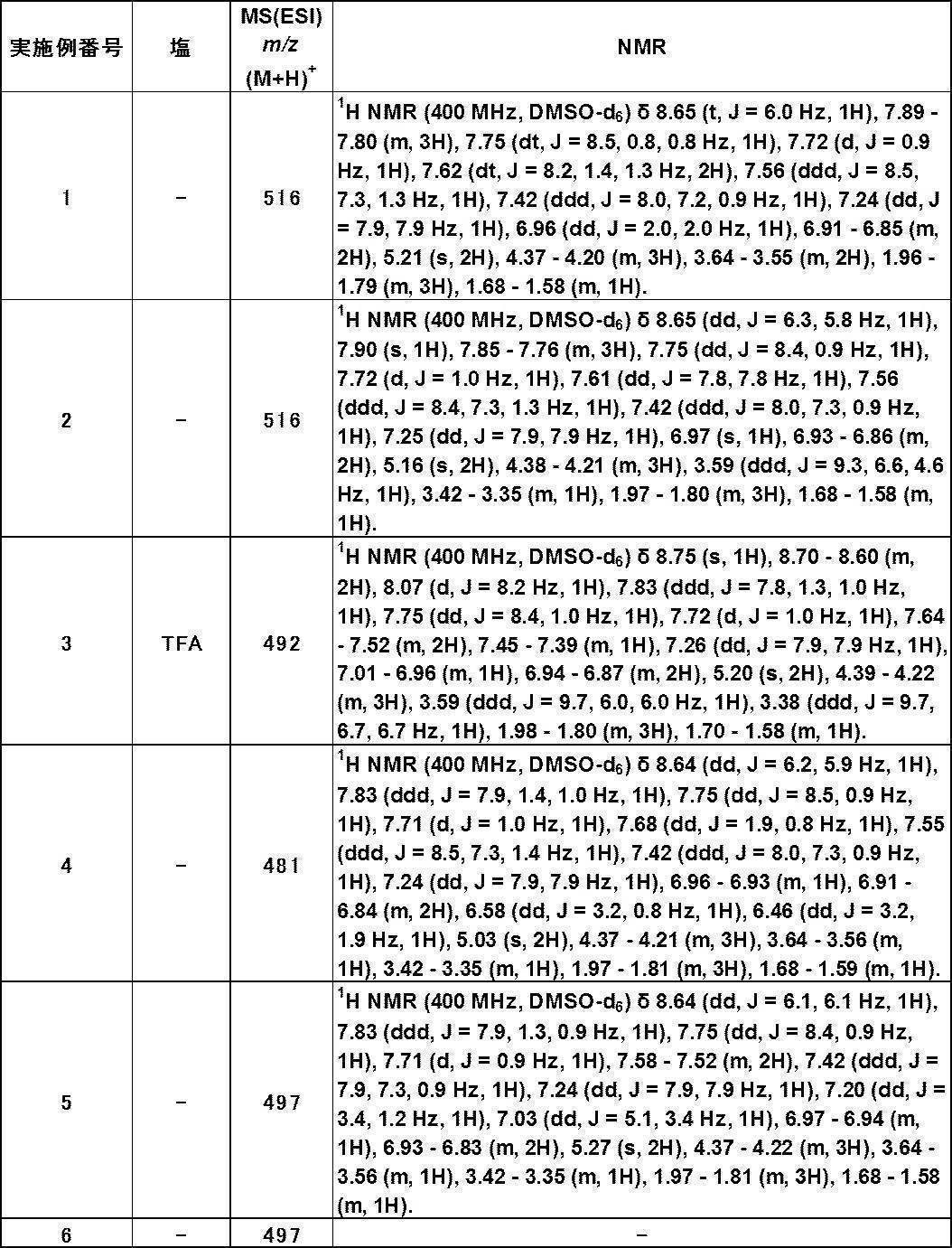

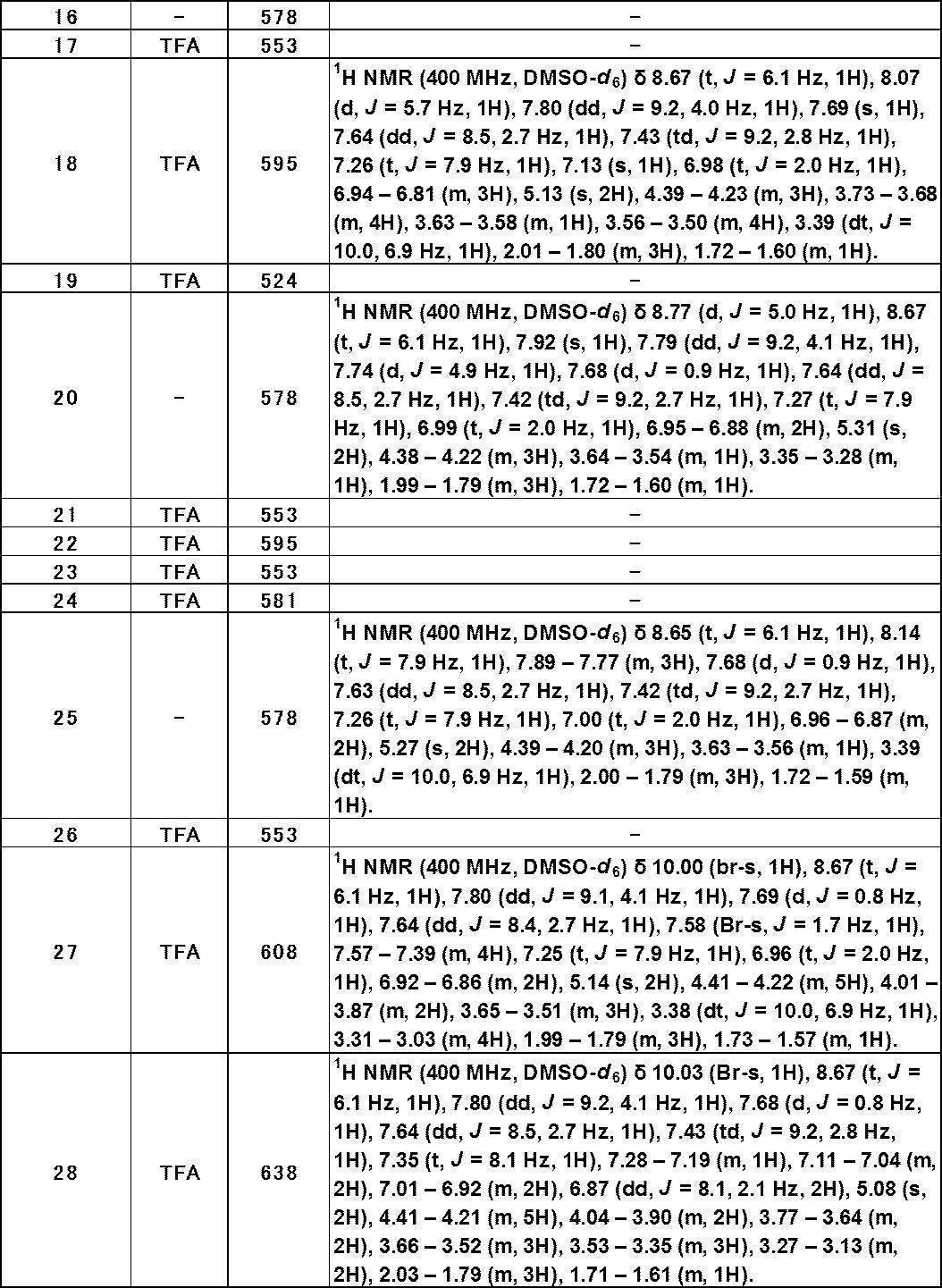
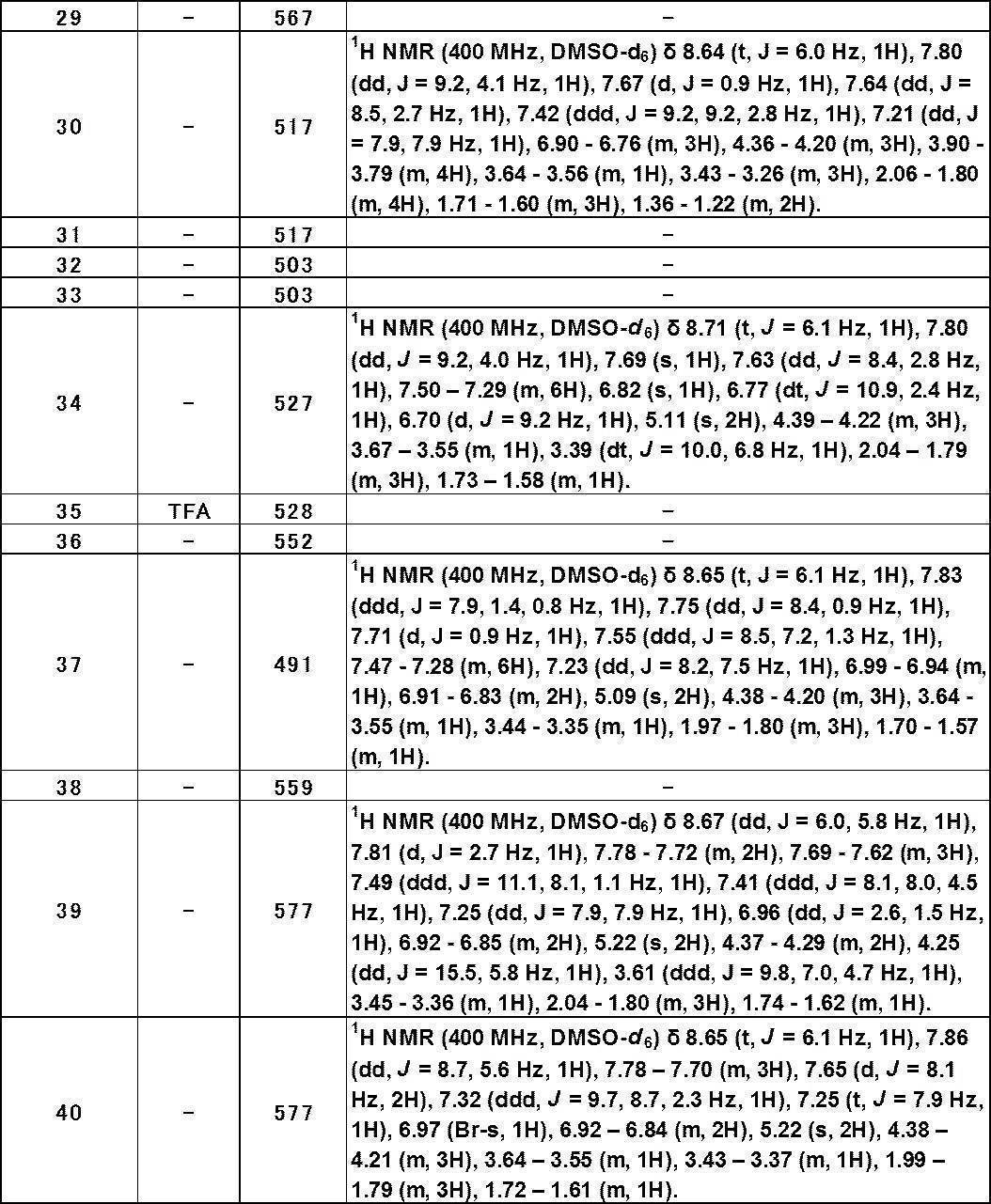


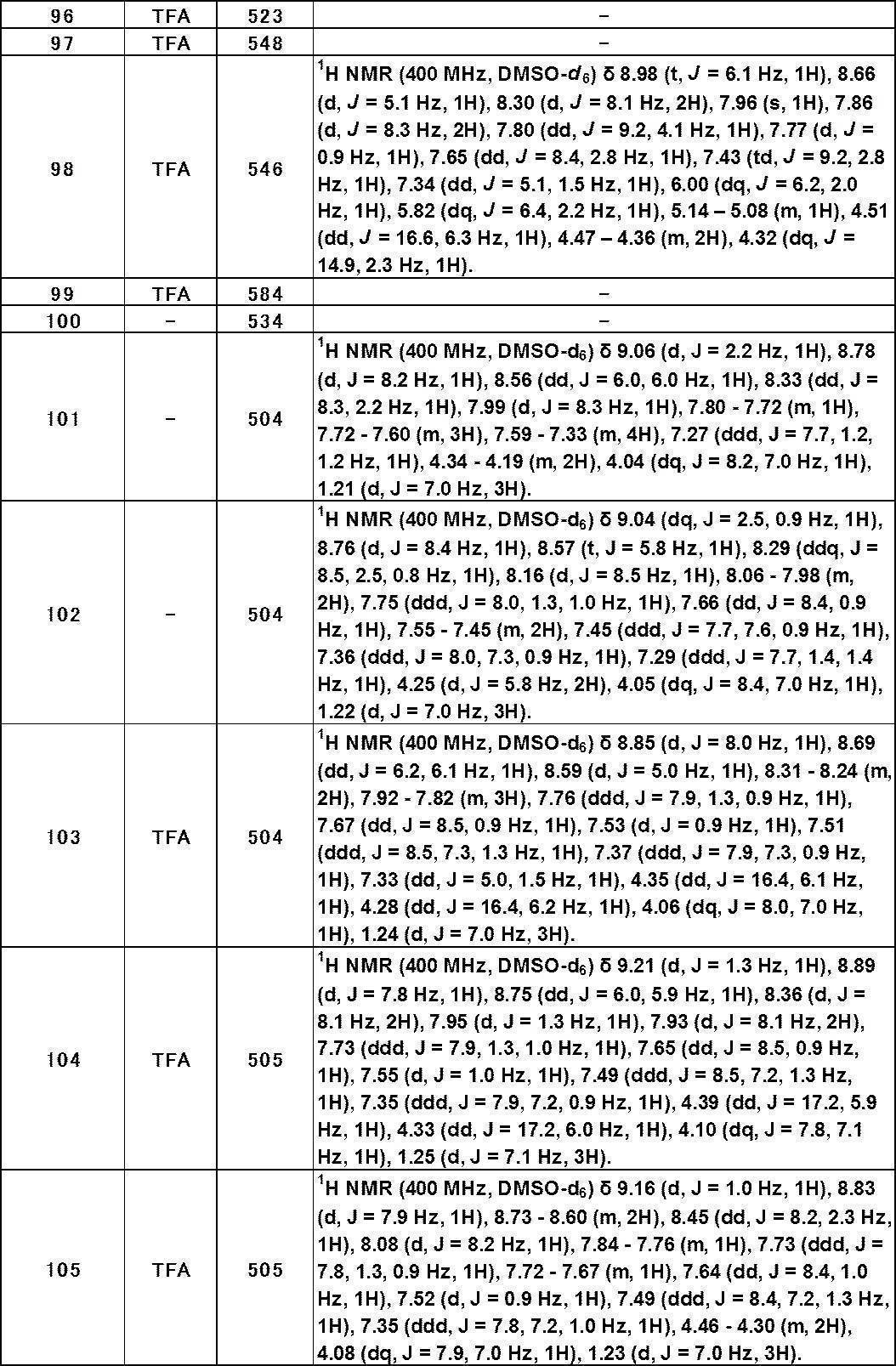


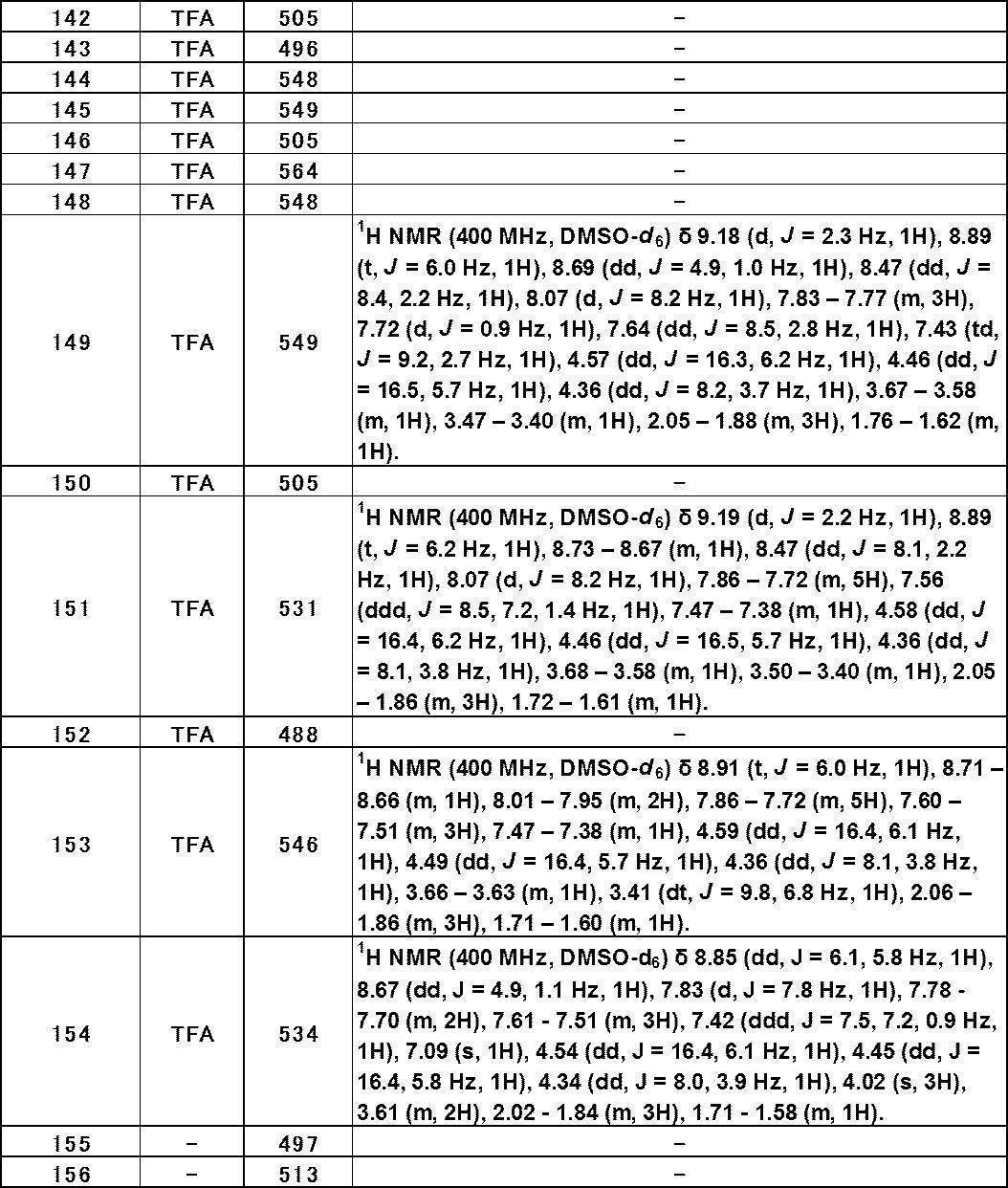


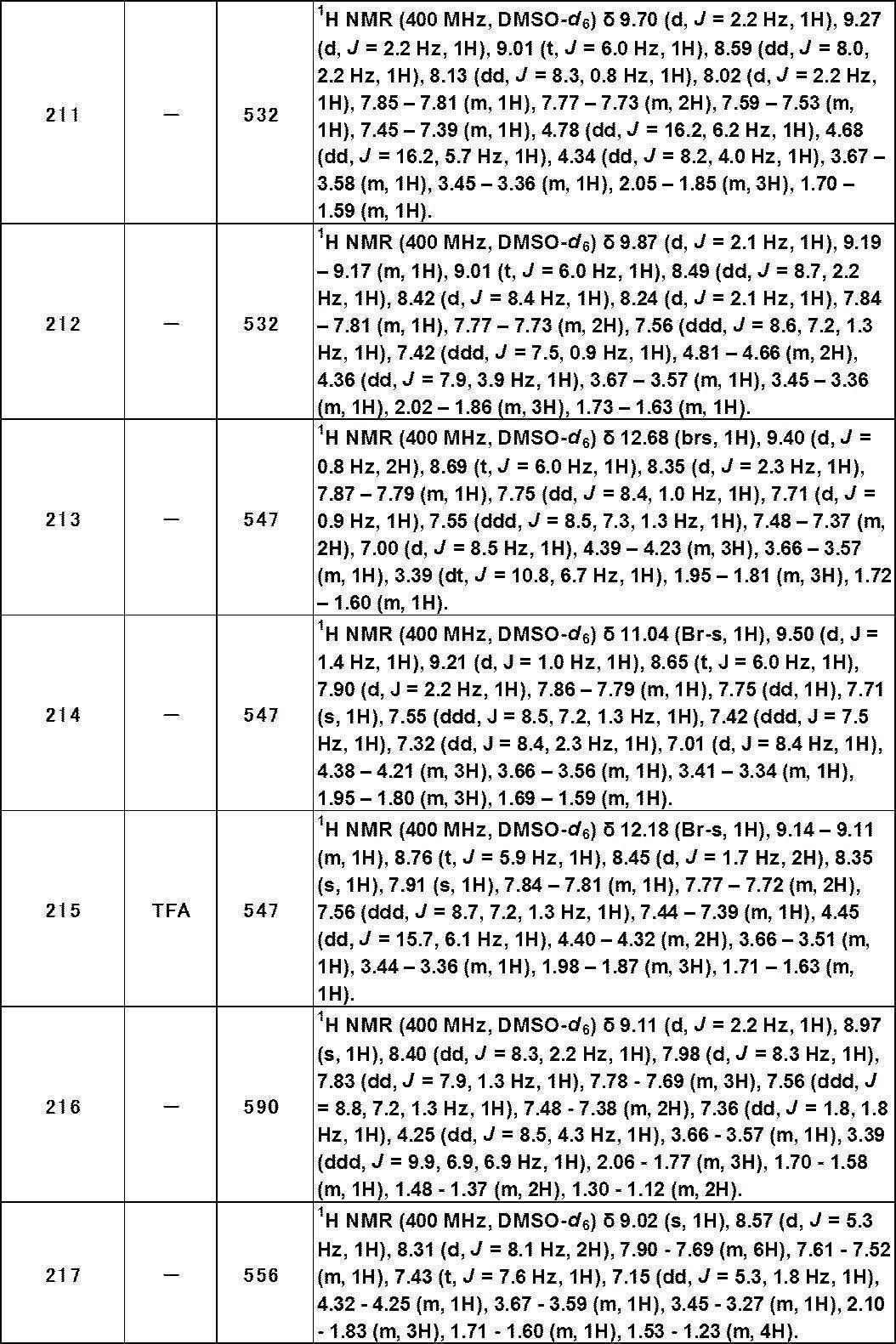
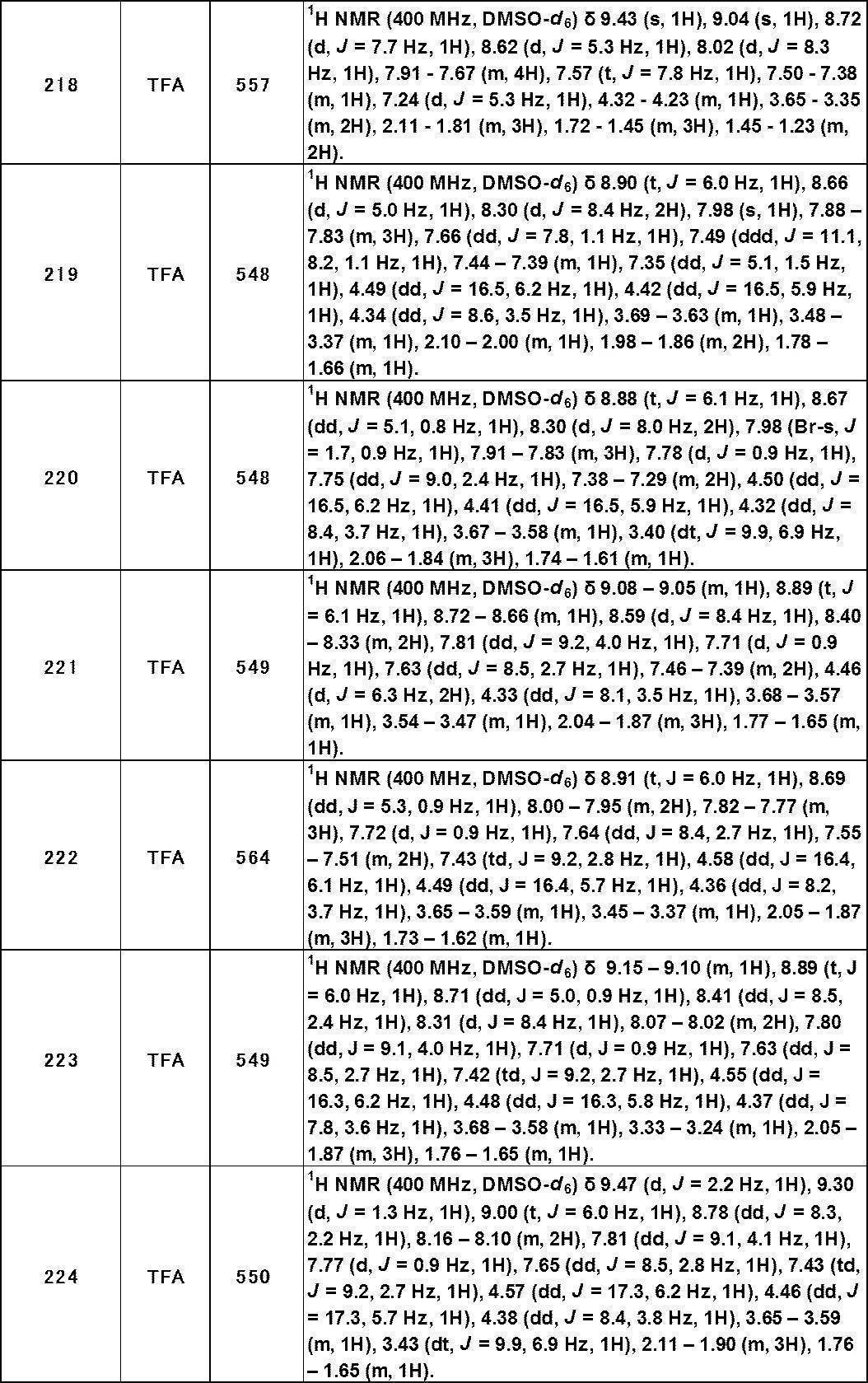
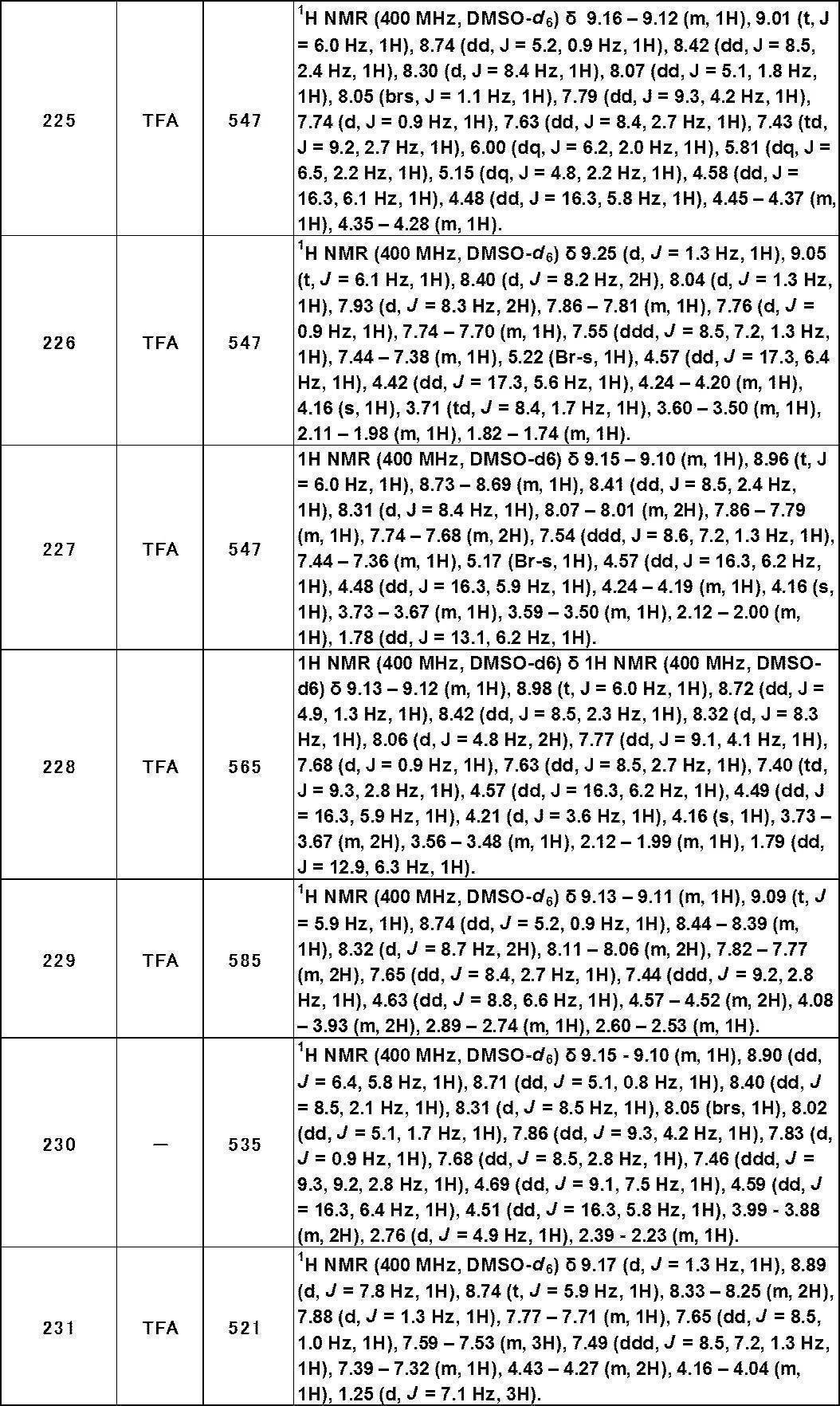
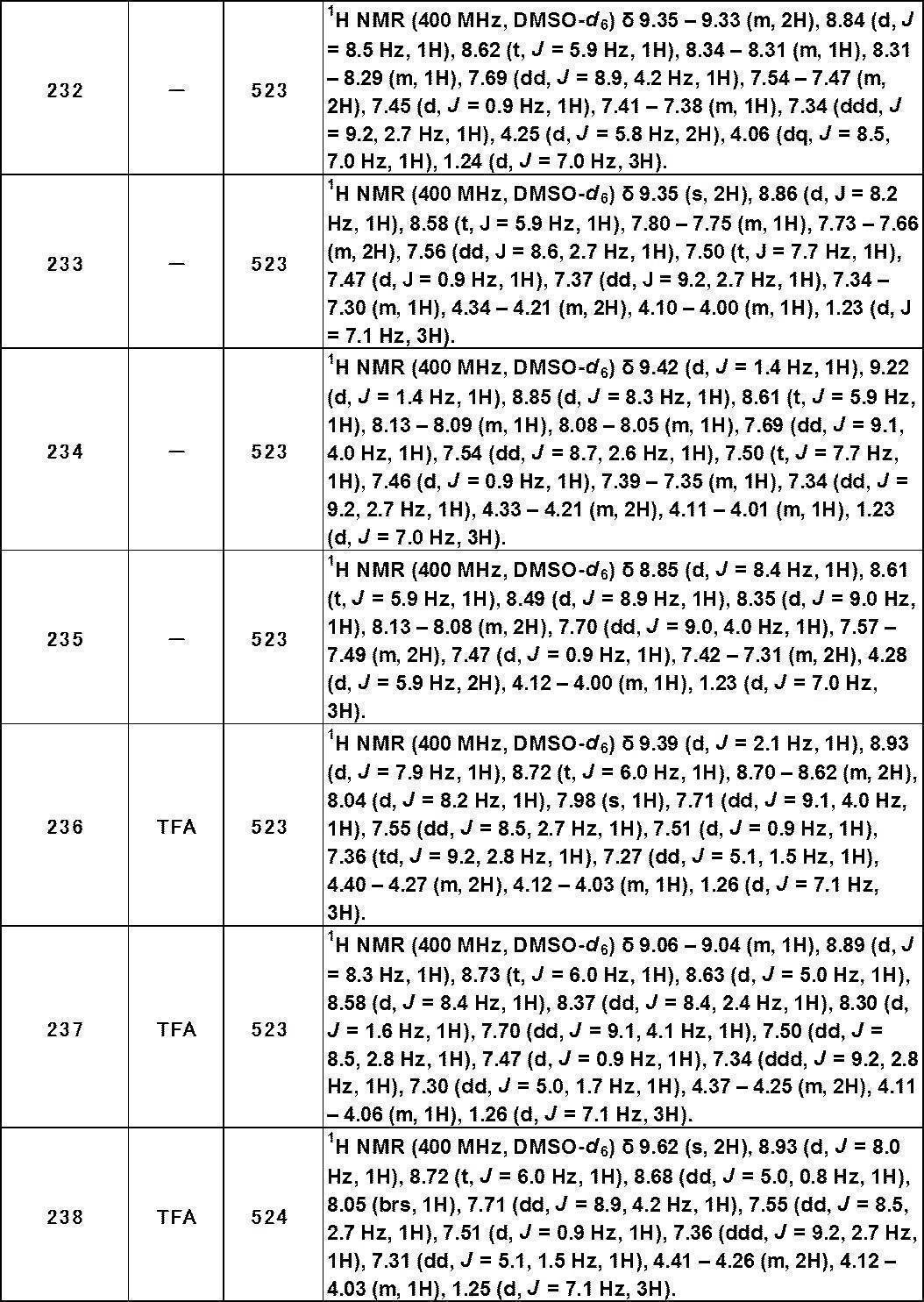
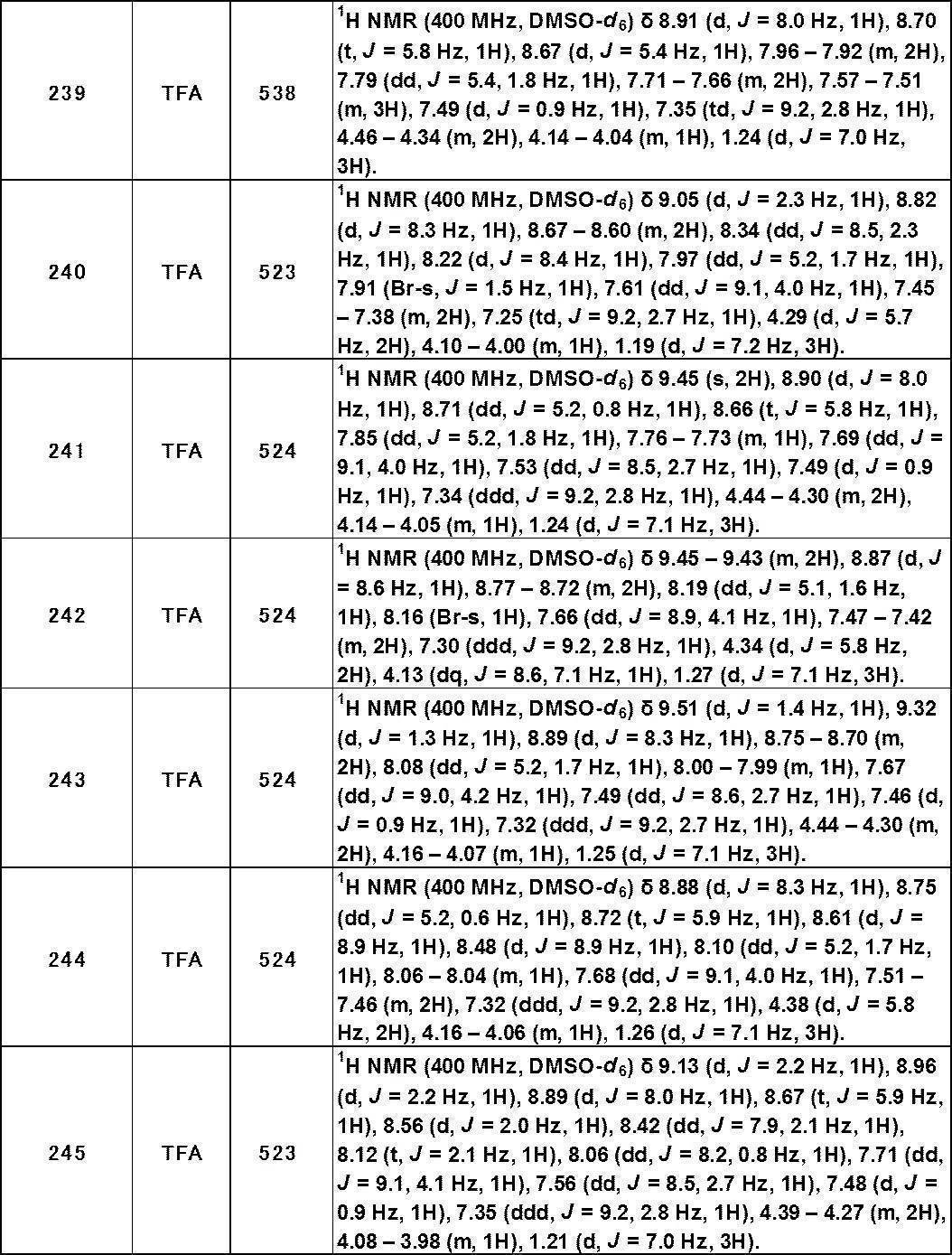

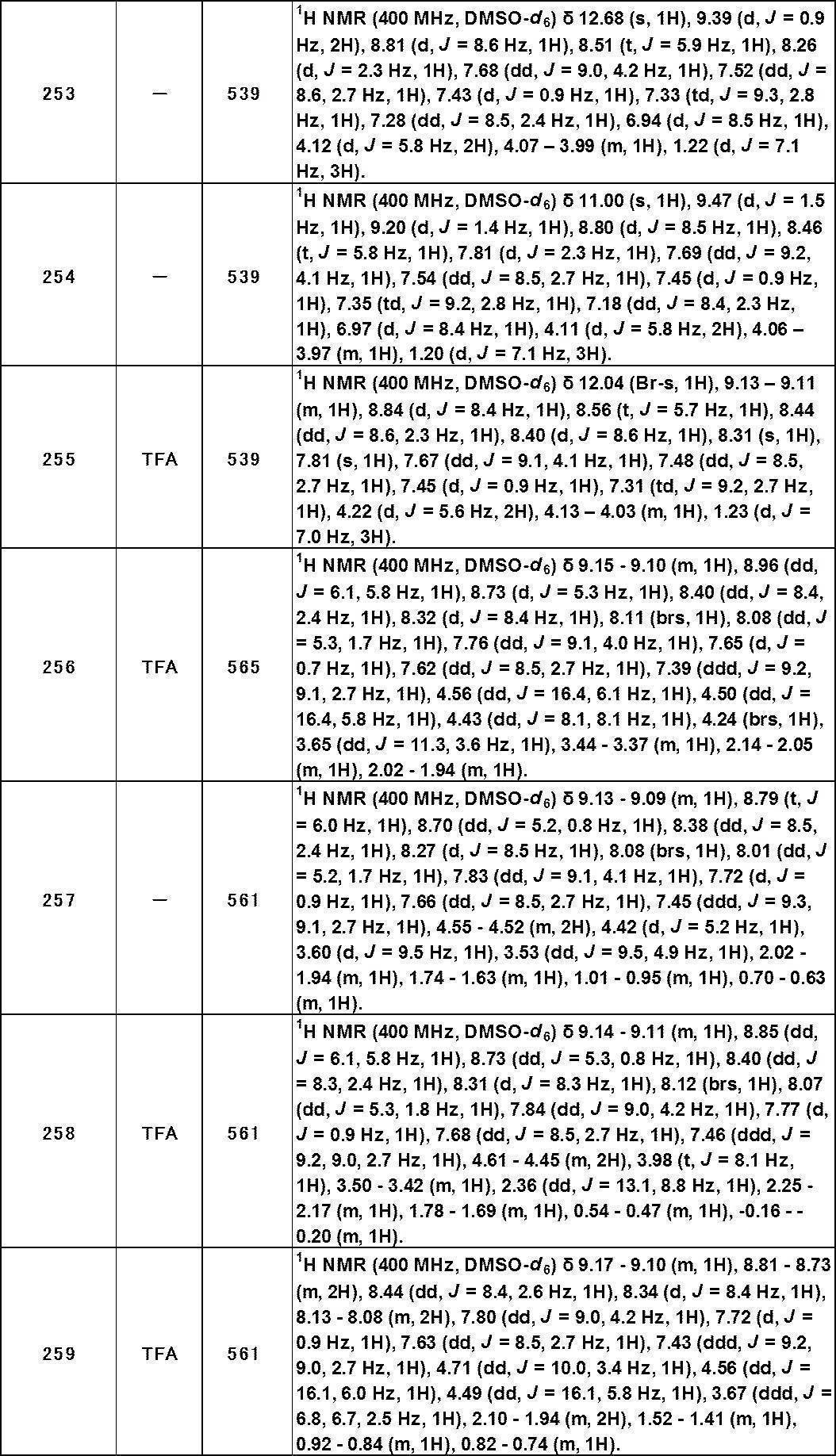
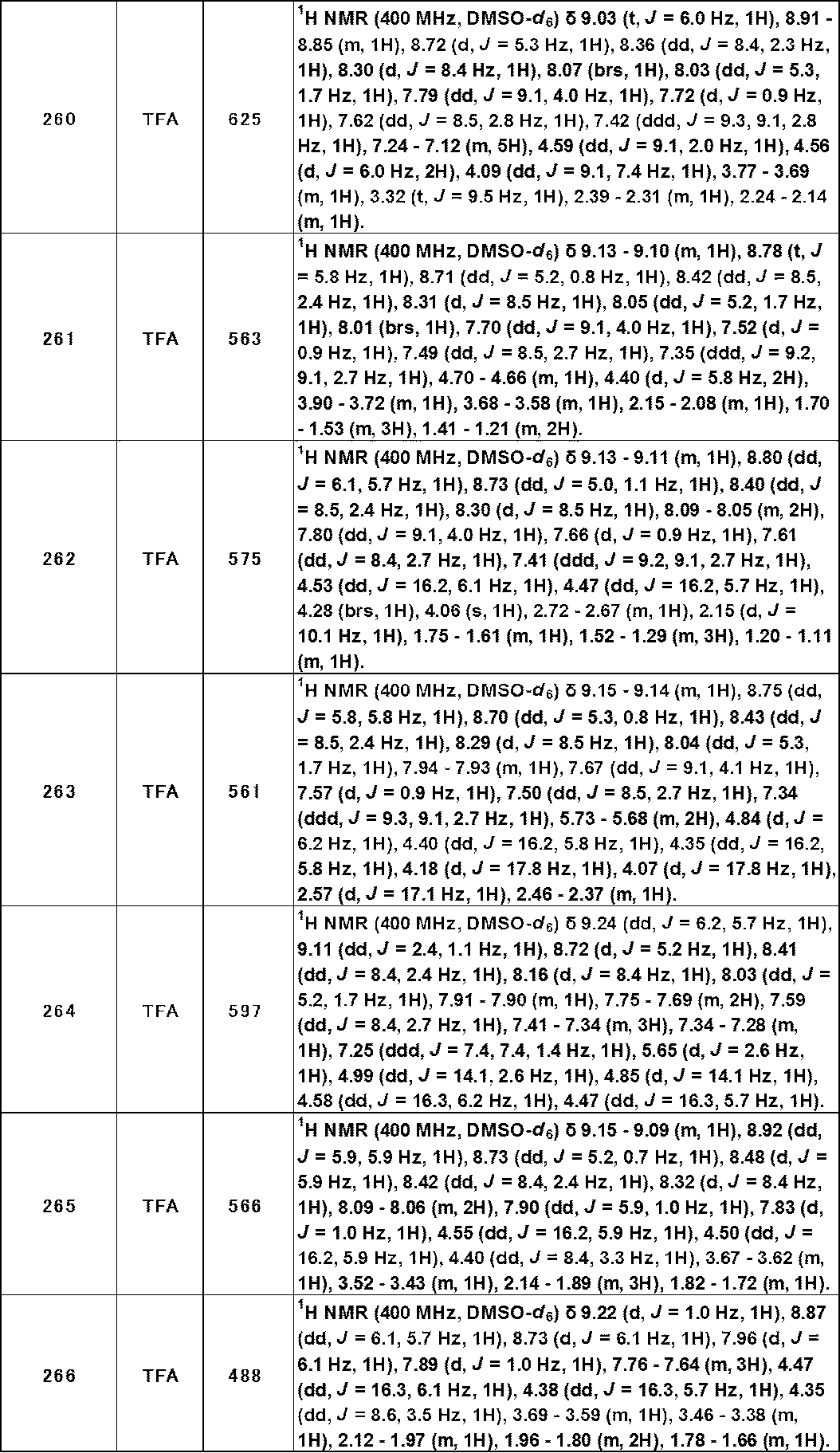


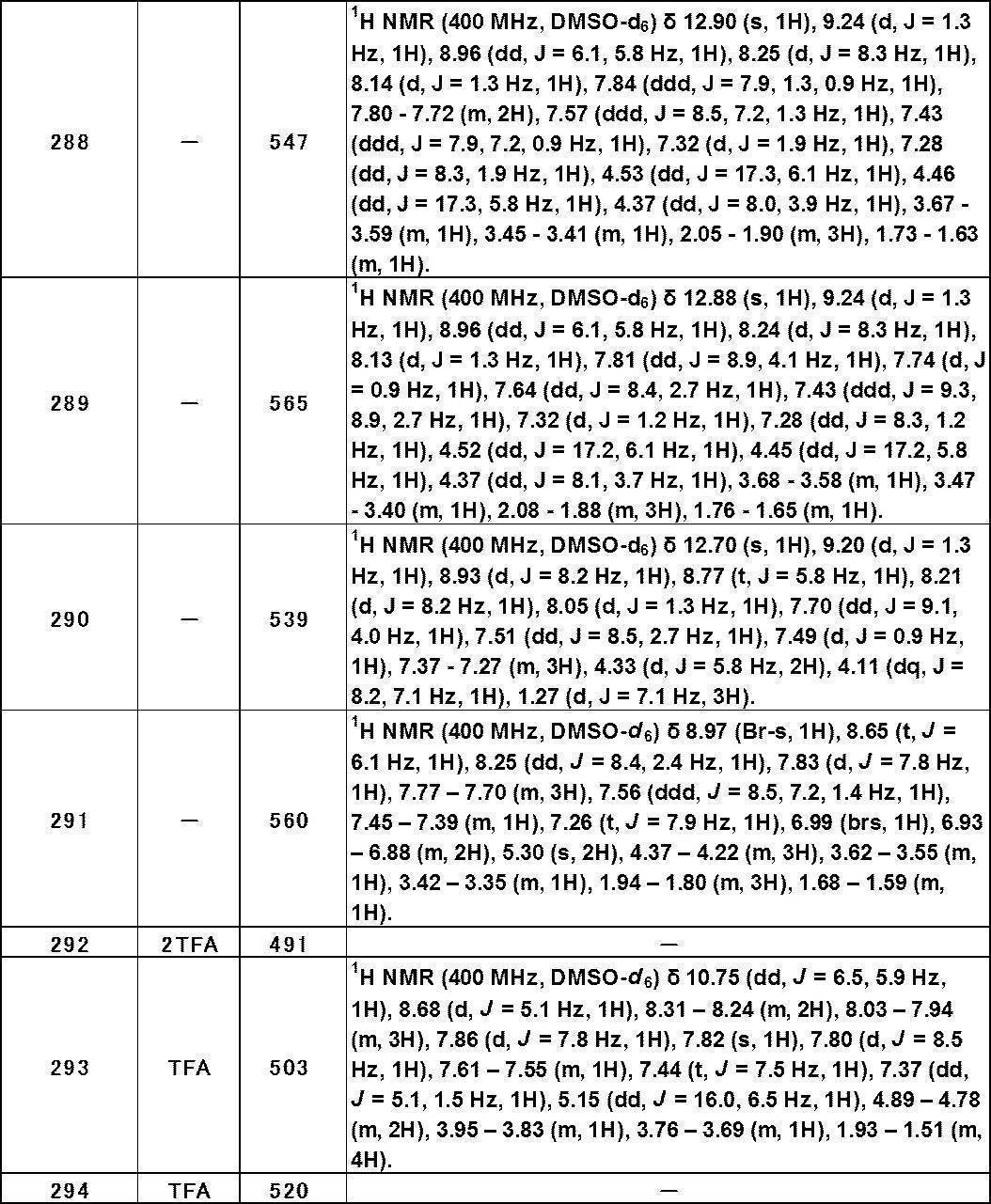


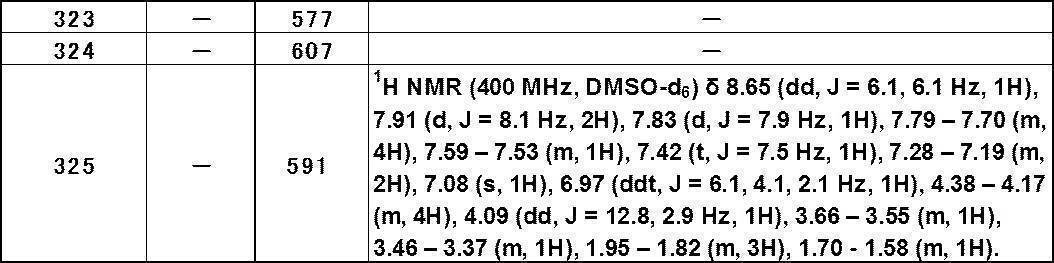


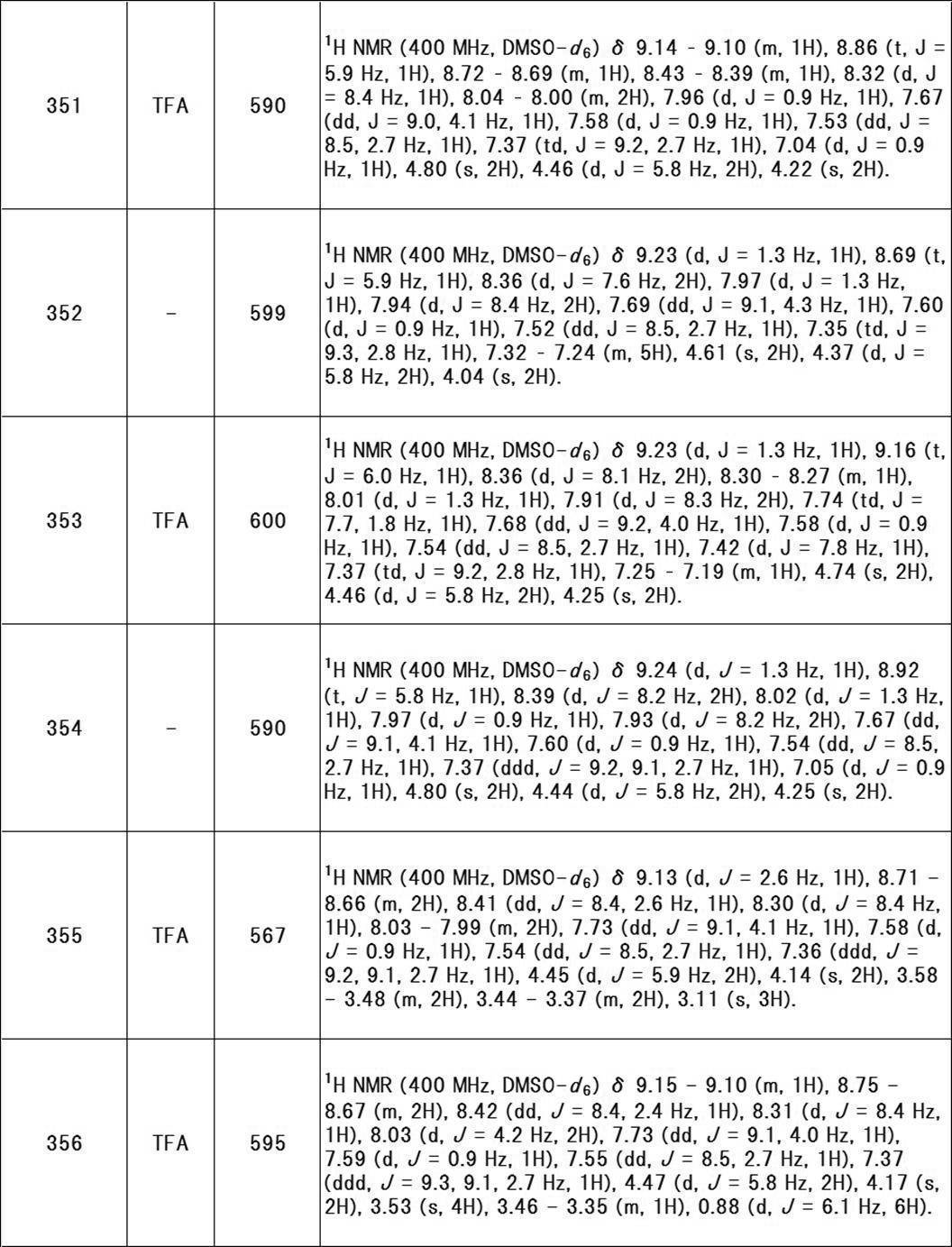


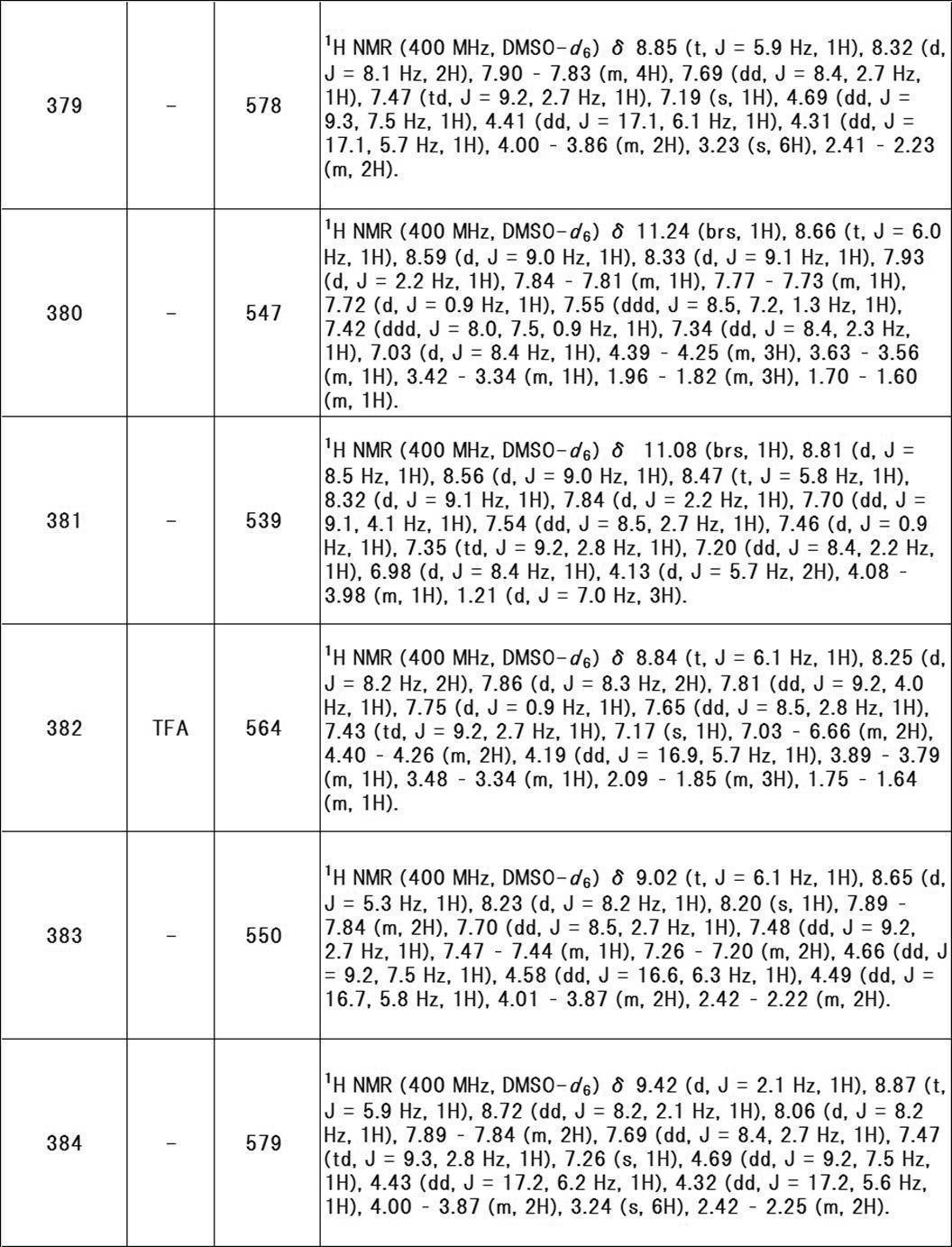
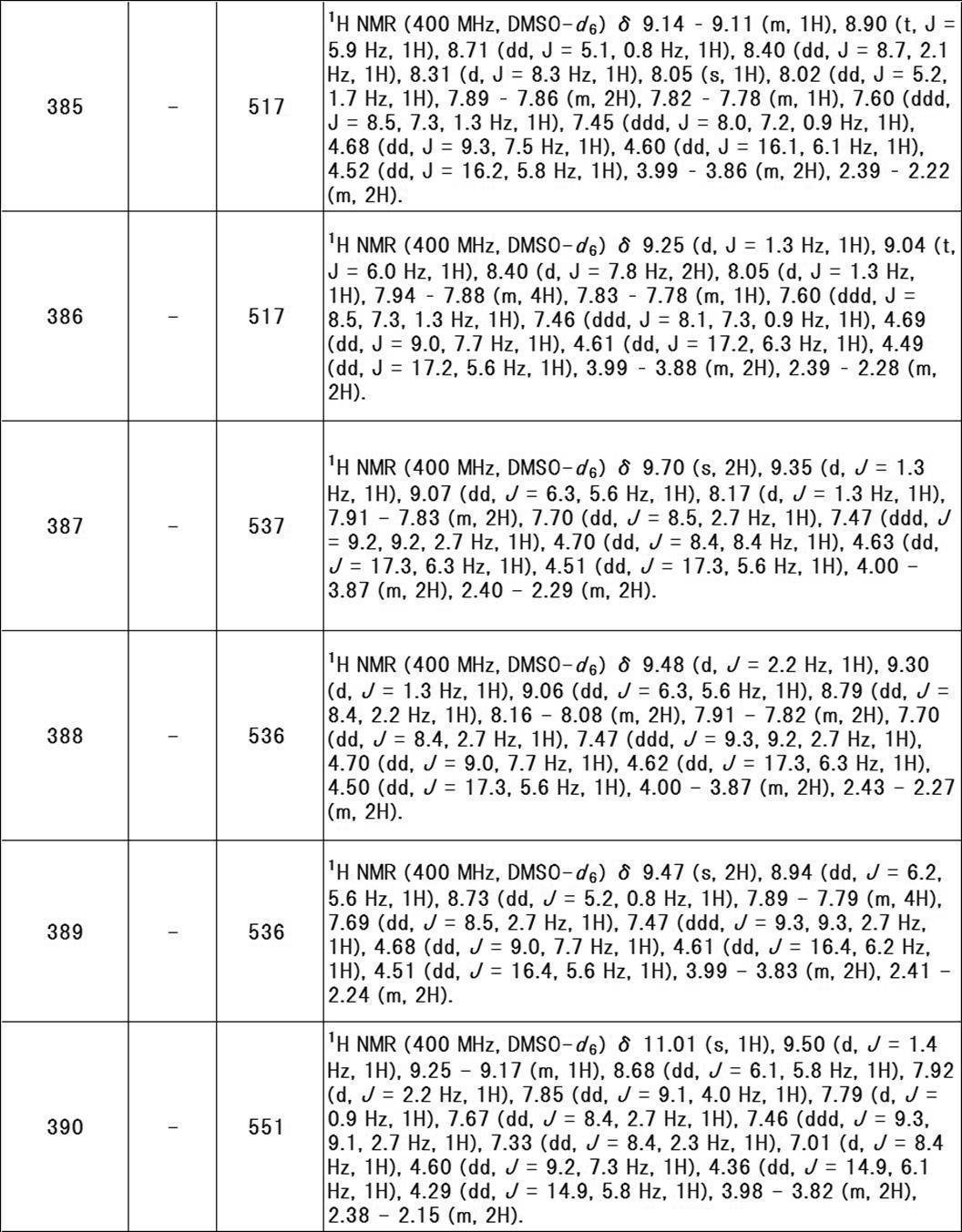
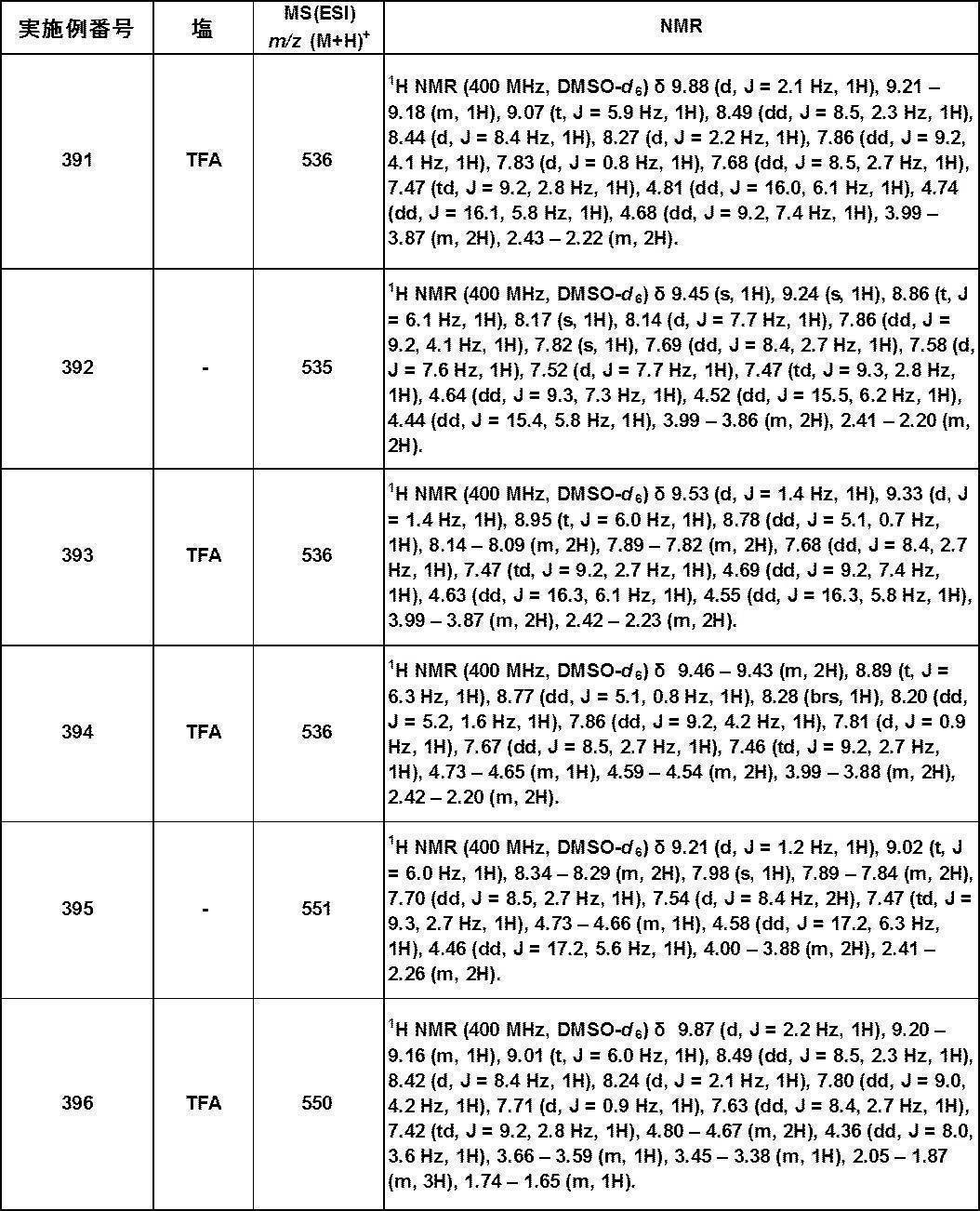


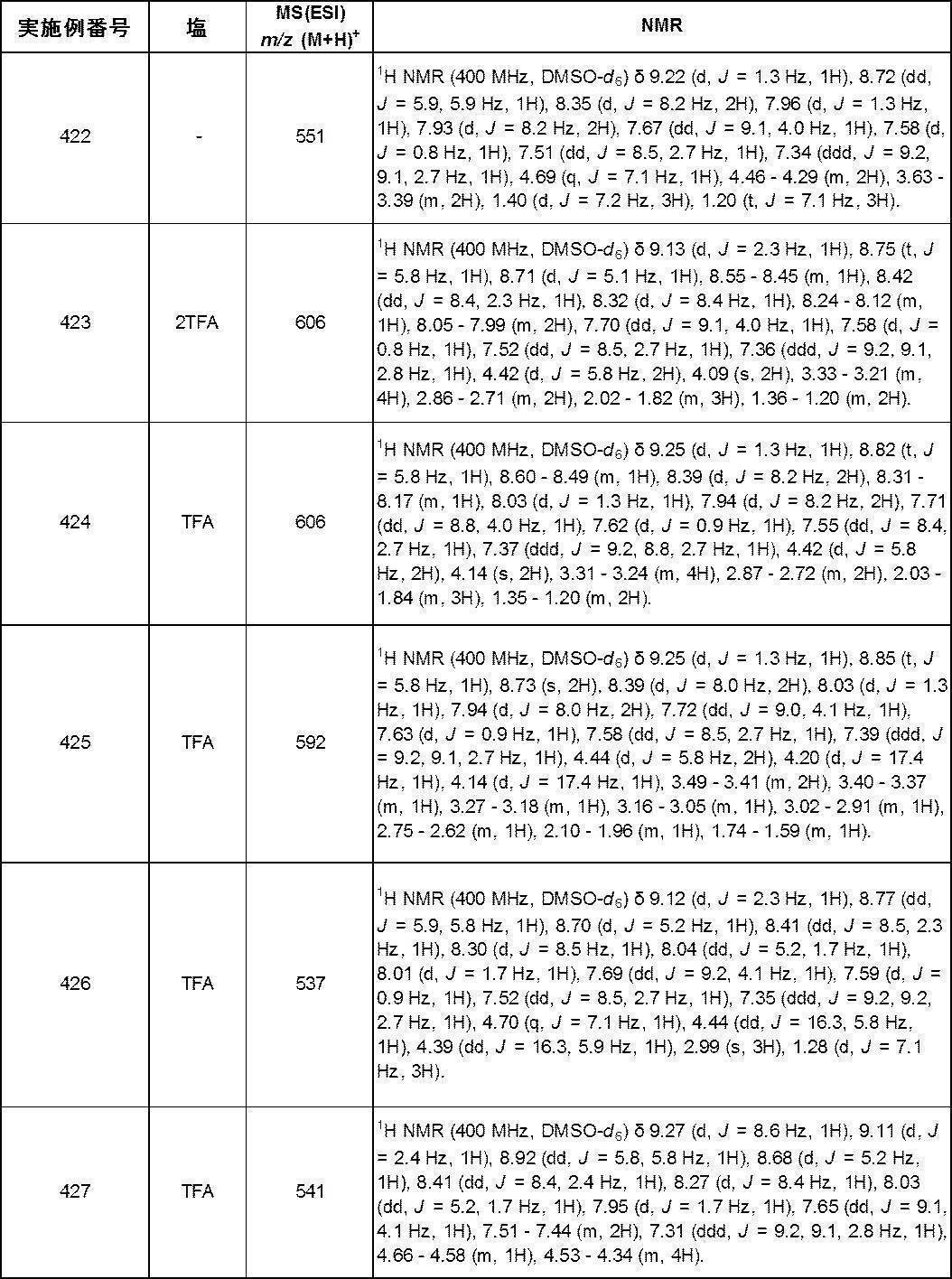
試験例1-1: TRPA1アンタゴニスト活性の測定(1)
ヒトTRPA1発現プラスミド
ヒトTRPA1(GenBankアクセッション番号NM_0078332)をコードするcDNAは市販品を購入した(かずさDNA研究所製、クローン番号:pFN21AB7348、商品番号:FHC07217)。これを鋳型としたDNAポリメラーゼ(ストラタジーン社製、商品名:PfuUltra High-Fidelity DNA Polymerase)を用いた反応で、以下に示すプライマー配列にてヒトTRPA1遺伝子全長を増幅した。
Test Example 1-1: Measurement of TRPA1 antagonist activity (1)
Human TRPA1 expression plasmid A cDNA encoding human TRPA1 (GenBank accession number NM_0078332) was purchased commercially (Kazusa DNA Laboratory, clone number: pFN21AB7348, product number: FHC07217). By using a DNA polymerase (trade name: PfuUltra High-Fidelity DNA Polymerase, manufactured by Stratagene, Inc.) using this as a template, the full length human TRPA1 gene was amplified with the primer sequences shown below.

5’側には制限酵素HindIIIの認識サイト(下線)を、3’側にXbaIサイト(下線)を付加し、かつ、鋳型配列のGTTを終始コドンTAG(太字)に変更した。得られた二本鎖DNAをHindIII、XbaIで酵素消化し、発現プラスミドpcDNA3.1/zeo(+)(インビトロジェン製)のマルチクローニングサイトに導入し、ヒトTRPA1発現プラスミドを得た。 The recognition site (underlined) for the restriction enzyme HindIII was added to the 5 'side, the XbaI site (underlined) was added to the 3' side, and the GTT of the template sequence was changed to the termination codon TAG (bold). The resulting double-stranded DNA was enzymatically digested with HindIII and XbaI and introduced into the multiple cloning site of the expression plasmid pcDNA3.1 / zeo (+) (manufactured by Invitrogen) to obtain a human TRPA1 expression plasmid.
細胞調製
ヒト胎児腎由来293T細胞は10%のウシ胎児血清、10ユニットのペニシリン、10μgのストレプトマイシンを含有するダルベッコ変法イーグル培地で培養した。アッセイ前日に直径10cmシャーレ1枚あたり3×10⁶個を播種し、CO2インキュベーターで24時間培養した。血清使用量低減培地(インビトロジェン社製、商品名:OPTI-MEM)600μLと遺伝子挿入試薬(マイラスバイオ製、商品名:Mirus TransIT-293)18μL、ヒトTRPA1発現プラスミド6μgを混合し、全量をシャーレ上細胞に添加し、遺伝子導入した。約8時間後に細胞を回収し、12,000個/ウェルで黒色透明底ポリDリジンコート384ウェルプレートに播種し、一晩培養した。
Cell Preparation Human fetal kidney-derived 293T cells were cultured in Dulbecco's modified Eagle's medium containing 10% fetal bovine serum, 10 units of penicillin, and 10 μg of streptomycin. The day before the assay, 3 × 10 6 cells were inoculated per 10 cm diameter petri dish and cultured in a CO 2 incubator for 24 hours. A serum-reducing medium (Invitrogen, trade name: OPTI-MEM) 600 μL, gene insertion reagent (Myrus Bio, trade name: Mirus TransIT-293) 18 μL, and human TRPA1 expression plasmid 6 μg were mixed, and the whole volume was petri dished. It was added to the upper cell and the gene was introduced. About 8 hours later, the cells were collected, seeded at 12,000 cells / well in a black transparent bottom poly-D lysine-coated 384-well plate, and cultured overnight.
細胞内カルシウム上昇測定
384ウェルプレートを回収、培地を除去し、アッセイバッファー(1×HBSS、20mM HEPES、pH7.2)に溶解したカルシウム結合型蛍光指示薬(モレキュラーデバイス製、商品名:Calcium4 Assay Kit)を38μL添加し、CO2インキュベーターで1時間染色した。室温に取り出し15分以上静置した後、384ch分注機付きプレートリーダーFDSS7000(浜松ホトニクス)にて被験物質を10μL添加し、10分後、さらに終濃度20μMのアリルイソチオシアネート12μLを添加し、被験物質添加前からアリルイソチオシアネート添加後の5分間、相対蛍光強度変化を5分間測定した。
Intracellular calcium elevation measurement 384-well plate was collected, the medium was removed, and the calcium-binding fluorescent indicator dissolved in assay buffer (1 × HBSS, 20 mM HEPES, pH 7.2) (Molecular Device, trade name: Calcium4 Assay Kit) 38 μL was added and stained with a CO 2 incubator for 1 hour. Remove at room temperature and let stand for at least 15 minutes, then add 10 μL of the test substance with a plate reader FDSS7000 (Hamamatsu Photonics) with a 384ch dispenser, and after 10 minutes, add 12 μL of allyl isothiocyanate with a final concentration of 20 μM, and test The change in relative fluorescence intensity was measured for 5 minutes before addition of the substance to 5 minutes after addition of allyl isothiocyanate.
被験物質調製
被験物質はジメチルスルホキシドに溶解し、0.1%のウシ血清アルブミンを含有するアッセイバッファー(1×HBSS、20mM HEPES、pH7.2)にて、評価濃度の4.8倍濃度となるよう段階希釈した。TRPA1既知活性化剤であるアリルイソチオシアネートはジメチルスルホキシドにて100mMに溶解し、更に被験物質同様終濃度の5倍(100μM)になるよう希釈した。
Test substance preparation The test substance was dissolved in dimethyl sulfoxide and diluted serially to an assay concentration of 4.8 times the evaluation concentration in an assay buffer containing 0.1% bovine serum albumin (1 × HBSS, 20 mM HEPES, pH 7.2). . Allyl isothiocyanate, a known activator of TRPA1, was dissolved in dimethyl sulfoxide at 100 mM, and further diluted to 5 times the final concentration (100 μM) like the test substance.
アンタゴニスト活性の算出
被験物質非添加条件で、アリルイソチオシアネート刺激前後の最大蛍光強度変化幅を活性率100%、バッファー刺激前後の変化幅を同0%と定義した。被験物質添加時の活性率を求め、100から活性率を引いた数値を阻害率と定義した。被験物質の阻害率50%に到達する濃度であるIC50は、表計算ソフトウェアエクセルフィットにてシグモイド近似曲線より算出した。
結果を表40に示す。このように、本発明の化合物は優れたTRPA1アンタゴニスト活性を示した。
Calculation of antagonist activity Under the test substance non-addition condition, the maximum fluorescence intensity change width before and after allyl isothiocyanate stimulation was defined as 100% activity rate, and the change width before and after buffer stimulation was defined as 0%. The activity rate when the test substance was added was determined, and the value obtained by subtracting the activity rate from 100 was defined as the inhibition rate. IC50, which is the concentration that reaches a test substance inhibition rate of 50%, was calculated from a sigmoid approximation curve using spreadsheet software Excel Fit.
The results are shown in Table 40. Thus, the compounds of the present invention showed excellent TRPA1 antagonist activity.


試験例1-2: TRPA1アンタゴニスト活性の測定(2)
ヒトTRAP1発現プラスミドのロットが異なる以外は、試験例1-1と同様の方法にて被験物質のTRPA1アンタゴニスト活性を測定した。
結果を表41に示す。このように、本発明の化合物は優れたTRPA1アンタゴニスト活性を示した。
Test Example 1-2: Measurement of TRPA1 antagonist activity (2)
The TRPA1 antagonist activity of the test substance was measured in the same manner as in Test Example 1-1, except that the lot of human TRAP1 expression plasmid was different.
The results are shown in Table 41. Thus, the compounds of the present invention showed excellent TRPA1 antagonist activity.


試験例2: AITC誘発疼痛行動評価試験
被験物質のin vivoにおける有効性を評価する目的で、マウスを用いたアリルイソチオシアネート(AITC)誘発疼痛行動評価試験を実施した。
AITCはTRPA1チャネルの選択的作動薬であり、動物に投与するとTRPA1活性化により疼痛行動を引き起こす。したがって、AITC投与後の疼痛行動の測定により、被験物質の生体内におけるTRPA1アンタゴニスト作用の強度を評価することができる。
1.動物への被験物質の投与
動物は、雄性ICRマウス6-8週齢を用いる。試験前日にマウスは絶食を行う。被験物質は、腹腔内投与あるいは経口投与により評価を行う。腹腔内投与の場合、AITC投与の30分前に投与を行う。経口投与の場合、AITC投与の60分前に投与を行う。
2.AITC誘発疼痛行動評価
AITC(0.1%)をマウスの左足の足底に皮下投与を行い、AITCの投与直後から5分間の足底をなめる行動をした時間(Licking time)を計測する。
3.阻害率の算出
各試験の溶媒投与群のLicking timeを100%とし、各被験物質投与時の活性率(被験物質投与時のLicking time/溶媒投与群のLicking time×100)を求め、100から活性率を引いた数値を阻害率として算出する。
上記方法によって、本発明の化合物が優れたTRPA1アンタゴニスト活性を有し、体内動態に優れ、動物モデルにおいて優れた薬効を示すことを確認することができる。
上記評価試験により、本発明化合物の有効性が確認された。
Test Example 2: AITC-induced pain behavior evaluation test An allyl isothiocyanate (AITC) -induced pain behavior evaluation test using mice was performed for the purpose of evaluating the in vivo effectiveness of the test substance.
AITC is a selective agonist of the TRPA1 channel, and when administered to animals causes TRPA1 activation to cause pain behavior. Therefore, the strength of the TRPA1 antagonistic action of the test substance in vivo can be evaluated by measuring the pain behavior after AITC administration.
1. Administration of test substance to animals The animals are 6-8 weeks old male ICR mice. Mice are fasted the day before the test. The test substance is evaluated by intraperitoneal or oral administration. In the case of intraperitoneal administration, the administration is performed 30 minutes before AITC administration. In the case of oral administration, the administration is performed 60 minutes before AITC administration.
2. AITC-induced pain behavior evaluation AITC (0.1%) is subcutaneously administered to the sole of the left foot of the mouse, and the time (licking time) of licking the sole for 5 minutes immediately after the administration of AITC is measured.
3. Inhibition rate calculation The licking time of the solvent administration group of each test was taken as 100%, and the activity rate at the time of each test substance administration (Licking time at the time of test substance administration / Licking time x 100 of the solvent administration group) was determined. The value obtained by subtracting the rate is calculated as the inhibition rate.
By the above method, it can be confirmed that the compound of the present invention has excellent TRPA1 antagonist activity, excellent pharmacokinetics, and excellent drug efficacy in animal models.
The effectiveness of the compound of the present invention was confirmed by the evaluation test.
配列番号1:プライマー
配列番号2:プライマー
Sequence number 1: Primer Sequence number 2: Primer
本発明化合物は、優れたTRPA1アンタゴニスト活性を有し、従って、TRPA1が関与する疾患(例、疼痛関連疾患、消化器疾患、肺疾患、膀胱疾患、炎症性疾患、皮膚疾患、及び神経疾患)の予防/または治療に有用である。
この目的において、本発明化合物は経口投与時の血中濃度あるいはバイオアベイラビリティーが高く、また、血中濃度の持続性に優れ、経口剤として有用である。
また、本発明化合物は、酸性あるいはアルカリ性溶液中での安定性に優れ有用であり、例えば種々の剤型への適用が可能である。
さらに、本発明化合物は特異的にTPRA1を阻害する。すなわち本発明化合物は分子標的に対する選択性が高く、薬物間相互作用を懸念することなく安全性に優れ有用である。
The compound of the present invention has an excellent TRPA1 antagonist activity, and therefore, for diseases involving TRPA1 (eg, pain-related diseases, gastrointestinal diseases, lung diseases, bladder diseases, inflammatory diseases, skin diseases, and neurological diseases). Useful for prevention / treatment.
For this purpose, the compound of the present invention has high blood concentration or bioavailability at the time of oral administration, and is excellent in sustainability of blood concentration, and is useful as an oral preparation.
The compound of the present invention is excellent in stability in an acidic or alkaline solution and is useful, and can be applied to various dosage forms, for example.
Furthermore, the compound of the present invention specifically inhibits TPRA1. That is, the compound of the present invention has high selectivity for a molecular target and is excellent in safety and useful without worrying about drug-drug interactions.
本出願は、日本で出願された特願2014-013729(出願日2014年1月28日)及び特願2014-160250(出願日2014年8月6日)を基礎としておりそれらの内容は本明細書に全て包含されるものである。 This application is based on Japanese Patent Application No. 2014-013729 (filing date: January 28, 2014) and Japanese Patent Application No. 2014-160250 (filing date: August 6, 2014) filed in Japan. It is all included in the book.
Claims (42)

[式中、
Qは、=O又は=Sを表し
環Aは、6員の単環の芳香環又は複素芳香環、あるいは二環性の芳香環又は複素芳香環を表し;
A1は、-C(Ra)=又は-N=を表し;
A2は、-C(Rb)=又は-N=を表し;
A3は、-C(Rc)=又は-N=を表し;
A4は、-C(Rd)=又は-N=を表し;
Ra、Rb、Rc及びRdは、同一又は異なって、水素、ハロゲノ基、シアノ基、ヒドロキシ基、C1-6アルキル基、C1-6アルコキシ基、ハロゲノC1-6アルキル基又はハロゲノC1-6アルコキシ基を表し;
ただし、A1~A4の少なくとも2つは-N=ではなく;
R1は、水素又は置換基を有してもよいC1-6アルキル基を表し;
R2は、水素、置換基を有してもよいC1-6アルキル基又は置換基を有してもよいC2-6アルケニル基を表し;
R3は、水素又はC1-6アルキル基を表し;
R4は、水素又はC1-6アルキル基を表し;
R5は、水素又はC1-6アルキル基を表し;
R1とR2は一緒になって置換基を有してもよい含窒素環を形成してもよく;
R4とR5は一緒になってシクロアルカンを形成してもよく;
Xは、水素、
-Cy、
-C(Rx1Rx2)-Cy、
-C(Rx1Rx2)-C(Rx3Rx4)-Cy、
-C(Rx1)=C(Rx2)-Cy、
-O-Cy、
-O-C(Rx1Rx2)-Cy、
-C(Rx1Rx2)-O-Cy、
-S(O)n-Cy、
-S(O)n-C(Rx1Rx2)-Cy、
-C(Rx1Rx2)-S(O)n-Cy、
-N(Rx5)-Cy、
-N(Rx5)-C(Rx1Rx2)-Cy、
-C(Rx1Rx2)-N(Rx5)-Cy、
-N(Rx5)-N(Rx6)-Cy、
-O-N(Rx5)-Cy、
-N(Rx5)-O-Cy、
-C(O)-N(Rx5)-Cy、
-N(Rx5)-C(O)-Cy、
-S(O)m-N(Rx5)-Cy、
-N(Rx5)-S(O)m-Cy、
-O-S(O)m-Cy、又は
-S(O)m-O-Cyを表し;
nは、0~2の整数を表し;
mは、1又は2を表し;
Cyは、置換基を有してもよい飽和又は不飽和の環状の基(ヘテロ原子を含んでもよい)を表し;
Rx1、Rx2、Rx3、Rx4、Rx5及びRx6は、同一又は異なって、水素、置換基を有してもよいC1-6アルキル基又は置換基を有してもよいC1-6アルコキシカルボニル基を表し;
R6は、置換基を有してもよいC1-6アルキル基、C2-6アルケニル基、環状C3-6アルキル基(ヘテロ原子を含んでもよい)、ハロゲノ基、ヒドロキシ基、置換基を有してもよいC1-6アルコキシ基、ハロゲノC1-6アルキル基、ハロゲノC1-6アルコキシ基、アミノ基、置換基を有してもよいC1-6アルキル基でモノ又はジ置換されたアミノ基、シアノ基、C1-6アルキルチオ基、カルボキシル基、置換基を有してもよいC1-6アルコキシカルボニル基、カルバモイル基、置換基を有してもよいC1-6アルキル基でモノ又はジ置換されたカルバモイル基又は置換基を有してもよいアシル基で置換されたアミノ基を表し;
R6が複数存在する場合は、同一でも異なってもよく;
kは、0~3の整数を表す]で表される化合物又はその医薬上許容される塩。ただし、下記化合物を除く。

[Where:
Q represents ═O or ═S, and ring A represents a 6-membered monocyclic aromatic ring or heteroaromatic ring, or a bicyclic aromatic ring or heteroaromatic ring;
A 1 represents —C (Ra) ═ or —N═;
A 2 represents —C (Rb) ═ or —N═;
A 3 represents —C (Rc) ═ or —N═;
A 4 represents —C (Rd) ═ or —N═;
Ra, Rb, Rc and Rd are the same or different and are hydrogen, halogeno group, cyano group, hydroxy group, C 1-6 alkyl group, C 1-6 alkoxy group, halogeno C 1-6 alkyl group or halogeno C 1. Represents a -6 alkoxy group;
Provided that at least two of A 1 to A 4 are not -N =;
R 1 represents hydrogen or a C 1-6 alkyl group which may have a substituent;
R 2 represents hydrogen, an optionally substituted C 1-6 alkyl group, or an optionally substituted C 2-6 alkenyl group;
R 3 represents hydrogen or a C 1-6 alkyl group;
R 4 represents hydrogen or a C 1-6 alkyl group;
R 5 represents hydrogen or a C 1-6 alkyl group;
R 1 and R 2 together may form a nitrogen-containing ring which may have a substituent;
R 4 and R 5 together may form a cycloalkane;
X is hydrogen,
-Cy,
-C (R x1 R x2 ) -Cy,
-C (R x1 R x2 ) -C (R x3 R x4 ) -Cy,
-C (R x1 ) = C (R x2 ) -Cy,
-O-Cy,
-OC (R x1 R x2 ) -Cy,
-C (R x1 R x2 ) -O-Cy,
-S (O) n-Cy,
-S (O) n-C (R x1 R x2 ) -Cy,
-C (R x1 R x2 ) -S (O) n-Cy,
-N (R x5 ) -Cy,
-N (R x5 ) -C (R x1 R x2 ) -Cy,
-C (R x1 R x2 ) -N (R x5 ) -Cy,
-N (R x5 ) -N (R x6 ) -Cy,
-O-N (R x5 ) -Cy,
-N (R x5 ) -O-Cy,
-C (O) -N (R x5 ) -Cy,
-N (R x5 ) -C (O) -Cy,
-S (O) m-N (R x5 ) -Cy,
-N (R x5 ) -S (O) m-Cy,
Represents —O—S (O) m—Cy or —S (O) m—O—Cy;
n represents an integer of 0 to 2;
m represents 1 or 2;
Cy represents a saturated or unsaturated cyclic group (which may contain a hetero atom) which may have a substituent;
R x1 , R x2 , R x3 , R x4 , R x5 and R x6 are the same or different and are hydrogen, a C 1-6 alkyl group which may have a substituent or a C which may have a substituent Represents a 1-6 alkoxycarbonyl group;
R 6 is an optionally substituted C 1-6 alkyl group, a C 2-6 alkenyl group, a cyclic C 3-6 alkyl group (which may contain a hetero atom), a halogeno group, a hydroxy group, a substituent A C 1-6 alkoxy group which may have a halogeno C 1-6 alkyl group, a halogeno C 1-6 alkoxy group, an amino group, a C 1-6 alkyl group which may have a substituent, mono or di A substituted amino group, a cyano group, a C 1-6 alkylthio group, a carboxyl group, an optionally substituted C 1-6 alkoxycarbonyl group, a carbamoyl group, an optionally substituted C 1-6 A carbamoyl group mono- or di-substituted with an alkyl group or an amino group substituted with an optionally substituted acyl group;
When a plurality of R 6 are present, they may be the same or different;
k represents an integer of 0 to 3] or a pharmaceutically acceptable salt thereof. However, the following compounds are excluded.
Qが=Oであり;
R1が、水素又はC1-6アルキル基であり;
R4が、水素又はC1-6アルキル基であり;
R5が、水素又はC1-6アルキル基であり;
ただし、R4とR5は一緒になってシクロアルカンを形成せず;
Xが、水素、
-Cy、
-C(Rx1Rx2)-Cy、
-C(Rx1Rx2)-C(Rx3Rx4)-Cy、
-C(Rx1)=C(Rx2)-Cy、
-O-Cy、
-O-C(Rx1Rx2)-Cy、
-C(Rx1Rx2)-O-Cy、
-S(O)n-Cy、
-S(O)n-C(Rx1Rx2)-Cy、
-C(Rx1Rx2)-S(O)n-Cy、
-N(Rx5)-Cy、
-N(Rx5)-C(Rx1Rx2)-Cy、
-C(Rx1Rx2)-N(Rx5)-Cy、
-N(Rx5)-N(Rx6)-Cy、
-O-N(Rx5)-Cy、
-N(Rx5)-O-Cy、
-C(O)-N(Rx5)-Cy、
-N(Rx5)-C(O)-Cy、
-S(O)m-N(Rx5)-Cy、又は
-N(Rx5)-S(O)m-Cy
である、請求項1記載の化合物又はその医薬上許容される塩。 In formula (I),
Q is = O;
R 1 is hydrogen or a C 1-6 alkyl group;
R 4 is hydrogen or a C 1-6 alkyl group;
R 5 is hydrogen or a C 1-6 alkyl group;
Provided that R 4 and R 5 together do not form a cycloalkane;
X is hydrogen,
-Cy,
-C (R x1 R x2 ) -Cy,
-C (R x1 R x2 ) -C (R x3 R x4 ) -Cy,
-C (R x1 ) = C (R x2 ) -Cy,
-O-Cy,
-OC (R x1 R x2 ) -Cy,
-C (R x1 R x2 ) -O-Cy,
-S (O) n-Cy,
-S (O) n-C (R x1 R x2 ) -Cy,
-C (R x1 R x2 ) -S (O) n-Cy,
-N (R x5 ) -Cy,
-N (R x5 ) -C (R x1 R x2 ) -Cy,
-C (R x1 R x2 ) -N (R x5 ) -Cy,
-N (R x5 ) -N (R x6 ) -Cy,
-O-N (R x5 ) -Cy,
-N (R x5 ) -O-Cy,
-C (O) -N (R x5 ) -Cy,
-N (R x5 ) -C (O) -Cy,
-S (O) m-N (R x5 ) -Cy or -N (R x5 ) -S (O) m-Cy
The compound according to claim 1 or a pharmaceutically acceptable salt thereof.

[式中、

は単結合又は二重結合を表し;
Yは、-CRy1Ry2-又は-CRy3=を表し;
Zは、結合、-O-、-CRz1Rz2-又は-CRz3=を表し;
Wは、結合又は-CRw1Rw2-を表し;
Ry1、Ry2、Ry3、Rz1、Rz2、Rz3、Rw1及びRw2は、同一又は異なって、水素、ハロゲノ基、ヒドロキシ基又は置換基を有してもよいC1-6アルキル基を表し;
それ以外の記号の定義は請求項1に記載の通りである]
で表される、請求項1記載の化合物又はその医薬上許容される塩。 Formula (II) below:
[Where:
Represents a single bond or a double bond;
Y represents —CR y1 R y2 — or —CR y3 =;
Z represents a bond, —O—, —CR z1 R z2 — or —CR z3 =;
W represents a bond or —CR w1 R w2 —;
R y1 , R y2 , R y3 , R z1 , R z2 , R z3 , R w1 and R w2 are the same or different and each may have hydrogen, a halogeno group, a hydroxy group or a substituent, C 1-6 Represents an alkyl group;
The definitions of the other symbols are as described in claim 1]
The compound of Claim 1 represented by these, or its pharmaceutically acceptable salt.
Qが=Oであり;
R4が、水素又はC1-6アルキル基であり;
R5が、水素又はC1-6アルキル基であり;
ただし、R4とR5は一緒になってシクロアルカンを形成せず;
Xが、水素、
-Cy、
-C(Rx1Rx2)-Cy、
-C(Rx1Rx2)-C(Rx3Rx4)-Cy、
-C(Rx1)=C(Rx2)-Cy、
-O-Cy、
-O-C(Rx1Rx2)-Cy、
-C(Rx1Rx2)-O-Cy、
-S(O)n-Cy、
-S(O)n-C(Rx1Rx2)-Cy、
-C(Rx1Rx2)-S(O)n-Cy、
-N(Rx5)-Cy、
-N(Rx5)-C(Rx1Rx2)-Cy、
-C(Rx1Rx2)-N(Rx5)-Cy、
-N(Rx5)-N(Rx6)-Cy、
-O-N(Rx5)-Cy、
-N(Rx5)-O-Cy、
-C(O)-N(Rx5)-Cy、
-N(Rx5)-C(O)-Cy、
-S(O)m-N(Rx5)-Cy、又は
-N(Rx5)-S(O)m-Cy
である、
請求項3記載の化合物又はその医薬上許容される塩。 In formula (II),
Q is = O;
R 4 is hydrogen or a C 1-6 alkyl group;
R 5 is hydrogen or a C 1-6 alkyl group;
Provided that R 4 and R 5 together do not form a cycloalkane;
X is hydrogen,
-Cy,
-C (R x1 R x2 ) -Cy,
-C (R x1 R x2 ) -C (R x3 R x4 ) -Cy,
-C (R x1 ) = C (R x2 ) -Cy,
-O-Cy,
-OC (R x1 R x2 ) -Cy,
-C (R x1 R x2 ) -O-Cy,
-S (O) n-Cy,
-S (O) n-C (R x1 R x2 ) -Cy,
-C (R x1 R x2 ) -S (O) n-Cy,
-N (R x5 ) -Cy,
-N (R x5 ) -C (R x1 R x2 ) -Cy,
-C (R x1 R x2 ) -N (R x5 ) -Cy,
-N (R x5 ) -N (R x6 ) -Cy,
-O-N (R x5 ) -Cy,
-N (R x5 ) -O-Cy,
-C (O) -N (R x5 ) -Cy,
-N (R x5 ) -C (O) -Cy,
-S (O) m-N (R x5 ) -Cy or -N (R x5 ) -S (O) m-Cy
Is,
The compound according to claim 3 or a pharmaceutically acceptable salt thereof.


請求項2記載の化合物又はその医薬上許容される塩。 Partial structure (a) is
The compound according to claim 2 or a pharmaceutically acceptable salt thereof.


請求項9記載の化合物又はその医薬上許容される塩。 The partial structure (b) containing ring A is
The compound according to claim 9 or a pharmaceutically acceptable salt thereof.
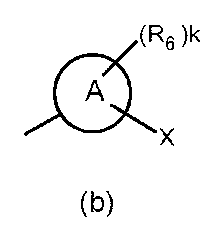

である請求項9記載の化合物又はその医薬上許容される塩。 A 1 is -C (Ra) =, A 2 is -C (Rb) =, A 3 is -C (Rc) =, and A 4 is -C (Rd) =.
The compound according to claim 9 or a pharmaceutically acceptable salt thereof.
Ra、Rb、Rc及びRdが全て水素であるか、いずれか一つがハロゲノ基である、請求項9記載の化合物又はその医薬上許容される塩。 A 1 is -C (Ra) =, A 2 is -C (Rb) =, A 3 is -C (Rc) =, and A 4 is -C (Rd) =;
10. The compound according to claim 9 or a pharmaceutically acceptable salt thereof, wherein Ra, Rb, Rc and Rd are all hydrogen or any one is a halogeno group.


である請求項1、2、4、8又は9記載の化合物又はその医薬上許容される塩。 X is hydrogen, -Cy, -O-Cy, or -O-CH 2 -Cy
The compound according to claim 1, 2, 4, 8 or 9, or a pharmaceutically acceptable salt thereof.

Cyが、置換基を有してもよいベンゼン、置換基を有してもよいピリジン、置換基を有してもよいピリミジン、置換基を有してもよいピリダジン、あるいは、置換基を有してもよいピラジンである請求項9記載の化合物又はその医薬上許容される塩。 X is -Cy;
Cy has benzene which may have a substituent, pyridine which may have a substituent, pyrimidine which may have a substituent, pyridazine which may have a substituent, or a substituent The compound according to claim 9 or a pharmaceutically acceptable salt thereof, which is an optionally pyrazine.
Cyが下図で示されるいずれかの基である

Cy is any group shown in the figure below
環Aを含む部分構造(b)が


Cyが下図で示されるいずれかの基である

The partial structure (b) containing ring A is
Cy is any group shown in the figure below
環Aを含む部分構造(b)が
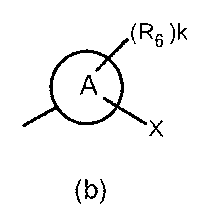

Cyが下図で示されるいずれかの基であり;


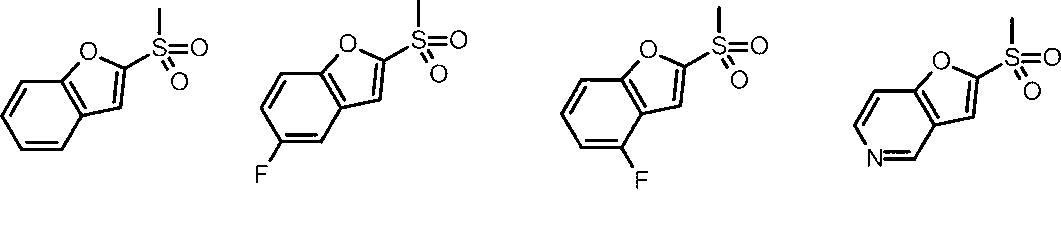
The partial structure (b) containing ring A is
Cy is any group shown in the figure below;
環Aを含む部分構造(b)が


Xが-Cyであり;
Cyが下図で示されるいずれかの基であり;


The partial structure (b) containing ring A is
X is -Cy;
Cy is any group shown in the figure below;


Priority Applications (11)
| Application Number | Priority Date | Filing Date | Title |
|---|---|---|---|
| MX2016009794A MX2016009794A (en) | 2014-01-28 | 2015-01-28 | Heterocyclic sulfonamide derivative and medicine comprising same. |
| CN201580006396.3A CN106458952B (en) | 2014-01-28 | 2015-01-28 | Heterocyclic sulfonamide derivatives and medicines containing said heterocyclic sulfonamide derivatives |
| JP2015559992A JP6473420B2 (en) | 2014-01-28 | 2015-01-28 | Heterocyclic sulfonamide derivative and medicament containing the same |
| BR112016017317-1A BR112016017317B1 (en) | 2014-01-28 | 2015-01-28 | COMPOUND, AND, USE OF A COMPOUND |
| KR1020167023562A KR20160135183A (en) | 2014-01-28 | 2015-01-28 | Heterocyclic sulfonamide derivative and medicine comprising same |
| RU2016134749A RU2016134749A (en) | 2014-01-28 | 2015-01-28 | HETEROCYCLIC SULPHONAMIDE DERIVATIVE AND MEDICINE CONTAINING SUCH DERIVATIVE |
| ES15742861T ES2759310T3 (en) | 2014-01-28 | 2015-01-28 | Derivative of heterocyclic sulfonamide and medicine comprising it |
| CA2938198A CA2938198A1 (en) | 2014-01-28 | 2015-01-28 | Heterocyclic sulfonamide derivative and medicine comprising same |
| EP15742861.6A EP3101015B1 (en) | 2014-01-28 | 2015-01-28 | Heterocyclic sulfonamide derivative and medicine comprising same |
| AU2015211852A AU2015211852A1 (en) | 2014-01-28 | 2015-01-28 | Heterocyclic sulfonamide derivative and medicine comprising same |
| US15/222,178 US10626112B2 (en) | 2014-01-28 | 2016-07-28 | Heterocyclic sulfonamide derivative and medicine comprising same |
Applications Claiming Priority (4)
| Application Number | Priority Date | Filing Date | Title |
|---|---|---|---|
| JP2014-013729 | 2014-01-28 | ||
| JP2014013729 | 2014-01-28 | ||
| JP2014160250 | 2014-08-06 | ||
| JP2014-160250 | 2014-08-06 |
Related Child Applications (1)
| Application Number | Title | Priority Date | Filing Date |
|---|---|---|---|
| US15/222,178 Continuation US10626112B2 (en) | 2014-01-28 | 2016-07-28 | Heterocyclic sulfonamide derivative and medicine comprising same |
Publications (1)
| Publication Number | Publication Date |
|---|---|
| WO2015115507A1 true WO2015115507A1 (en) | 2015-08-06 |
Family
ID=53757079
Family Applications (1)
| Application Number | Title | Priority Date | Filing Date |
|---|---|---|---|
| PCT/JP2015/052415 Ceased WO2015115507A1 (en) | 2014-01-28 | 2015-01-28 | Heterocyclic sulfonamide derivative and medicine comprising same |
Country Status (12)
| Country | Link |
|---|---|
| US (1) | US10626112B2 (en) |
| EP (1) | EP3101015B1 (en) |
| JP (1) | JP6473420B2 (en) |
| KR (1) | KR20160135183A (en) |
| CN (1) | CN106458952B (en) |
| AU (1) | AU2015211852A1 (en) |
| BR (1) | BR112016017317B1 (en) |
| CA (1) | CA2938198A1 (en) |
| ES (1) | ES2759310T3 (en) |
| MX (1) | MX2016009794A (en) |
| RU (1) | RU2016134749A (en) |
| WO (1) | WO2015115507A1 (en) |
Cited By (10)
| Publication number | Priority date | Publication date | Assignee | Title |
|---|---|---|---|---|
| WO2016128529A1 (en) * | 2015-02-15 | 2016-08-18 | F. Hoffmann-La Roche Ag | 1-(het)arylsulfonyl-(pyrrolidine or piperidine)-2-carboxamide derivatives and their use as trpa1 antagonists |
| WO2017018495A1 (en) * | 2015-07-29 | 2017-02-02 | Eaファーマ株式会社 | Cyclopropane derivative and drug containing same |
| WO2017135462A1 (en) * | 2016-02-05 | 2017-08-10 | Eaファーマ株式会社 | Heterocyclic sulfonamide derivative and medicine containing same |
| JP2019521163A (en) * | 2016-07-20 | 2019-07-25 | エフ.ホフマン−ラ ロシュ アーゲーF. Hoffmann−La Roche Aktiengesellschaft | Bicyclic proline compounds |
| US10392413B2 (en) | 2015-12-18 | 2019-08-27 | Ardelyx, Inc. | Substituted 4-phenyl pyridine compounds as non-systemic TGR5 agonists |
| JP2019524818A (en) * | 2016-08-12 | 2019-09-05 | エフ.ホフマン−ラ ロシュ アーゲーF. Hoffmann−La Roche Aktiengesellschaft | Sulfonylpyridyl TRP inhibitor |
| CN110869346A (en) * | 2017-07-27 | 2020-03-06 | 密歇根大学董事会 | Plasminogen activator inhibitor-1 (PAI-1) inhibitors and methods of use |
| WO2022058946A1 (en) | 2020-09-18 | 2022-03-24 | Université Grenoble Alpes | Astrocytic trpa1 channel inhibition as a novel neuroprotective therapeutic target in the prodromal phases of alzheimer's disease |
| IT202100015098A1 (en) | 2021-06-09 | 2022-12-09 | Flonext S R L | TRPA1 CHANNEL ANTAGONIST COMPOUND FOR USE IN DEGENERATIVE DISEASES OF THE RETINA |
| US12084472B2 (en) | 2015-12-18 | 2024-09-10 | Ardelyx, Inc. | Substituted 4-phenyl pyridine compounds as non-systemic TGR5 agonists |
Families Citing this family (3)
| Publication number | Priority date | Publication date | Assignee | Title |
|---|---|---|---|---|
| CN109734564B (en) * | 2019-01-31 | 2022-09-16 | 南京理工大学 | Method for synthesizing trifluoroethyl aromatic compound |
| CN112794860B (en) * | 2021-03-24 | 2021-06-29 | 上海肇钰医药科技有限公司 | Oxazole pyrimidone amide compound or medicinal salt thereof, preparation method and application |
| WO2024099403A1 (en) * | 2022-11-10 | 2024-05-16 | 北京普祺医药科技股份有限公司 | Thioether compound having soft drug property and use thereof, and pharmaceutical composition and use thereof |
Citations (5)
| Publication number | Priority date | Publication date | Assignee | Title |
|---|---|---|---|---|
| US6645939B1 (en) | 1997-11-24 | 2003-11-11 | Merck & Co., Inc. | Substituted β-alanine derivatives as cell adhesion inhibitors |
| WO2010141805A1 (en) | 2009-06-05 | 2010-12-09 | Janssen Pharmaceutica Nv | Heterocyclic amides as modulators of trpa1 |
| JP2011516563A (en) * | 2008-04-09 | 2011-05-26 | ベーリンガー インゲルハイム インターナショナル ゲゼルシャフト ミット ベシュレンクテル ハフツング | 2-sulfonylamino-4-heteroarylbutyroamide, a CCR10 antagonist |
| WO2013108857A1 (en) | 2012-01-17 | 2013-07-25 | 味の素株式会社 | Heterocyclic amide derivative and pharmaceutical product containing same |
| WO2014098098A1 (en) * | 2012-12-18 | 2014-06-26 | 味の素株式会社 | Heterocyclic amide derivative, and medicine containing same |
Family Cites Families (3)
| Publication number | Priority date | Publication date | Assignee | Title |
|---|---|---|---|---|
| MX351225B (en) * | 2012-04-24 | 2017-10-05 | Ea Pharma Co Ltd | Sulfonamide derivative and medicinal use thereof. |
| WO2014194287A2 (en) * | 2013-05-30 | 2014-12-04 | Cnh Industrial America Llc | Bale eject linkage and methods of use |
| US20160128529A1 (en) * | 2014-11-07 | 2016-05-12 | Biran Ndiaye | Surface Cleaning Appliance with Motorized Wand |
-
2015
- 2015-01-28 WO PCT/JP2015/052415 patent/WO2015115507A1/en not_active Ceased
- 2015-01-28 MX MX2016009794A patent/MX2016009794A/en unknown
- 2015-01-28 AU AU2015211852A patent/AU2015211852A1/en not_active Abandoned
- 2015-01-28 ES ES15742861T patent/ES2759310T3/en active Active
- 2015-01-28 JP JP2015559992A patent/JP6473420B2/en active Active
- 2015-01-28 BR BR112016017317-1A patent/BR112016017317B1/en active IP Right Grant
- 2015-01-28 KR KR1020167023562A patent/KR20160135183A/en not_active Withdrawn
- 2015-01-28 RU RU2016134749A patent/RU2016134749A/en unknown
- 2015-01-28 EP EP15742861.6A patent/EP3101015B1/en active Active
- 2015-01-28 CN CN201580006396.3A patent/CN106458952B/en active Active
- 2015-01-28 CA CA2938198A patent/CA2938198A1/en not_active Abandoned
-
2016
- 2016-07-28 US US15/222,178 patent/US10626112B2/en active Active
Patent Citations (5)
| Publication number | Priority date | Publication date | Assignee | Title |
|---|---|---|---|---|
| US6645939B1 (en) | 1997-11-24 | 2003-11-11 | Merck & Co., Inc. | Substituted β-alanine derivatives as cell adhesion inhibitors |
| JP2011516563A (en) * | 2008-04-09 | 2011-05-26 | ベーリンガー インゲルハイム インターナショナル ゲゼルシャフト ミット ベシュレンクテル ハフツング | 2-sulfonylamino-4-heteroarylbutyroamide, a CCR10 antagonist |
| WO2010141805A1 (en) | 2009-06-05 | 2010-12-09 | Janssen Pharmaceutica Nv | Heterocyclic amides as modulators of trpa1 |
| WO2013108857A1 (en) | 2012-01-17 | 2013-07-25 | 味の素株式会社 | Heterocyclic amide derivative and pharmaceutical product containing same |
| WO2014098098A1 (en) * | 2012-12-18 | 2014-06-26 | 味の素株式会社 | Heterocyclic amide derivative, and medicine containing same |
Non-Patent Citations (25)
| Title |
|---|
| ANDERSSON KE ET AL., BJU INT., vol. 106, no. 8, October 2010 (2010-10-01), pages 1114 - 27 |
| BANDELL M ET AL., NEURON, vol. 41, no. 6, 25 March 2004 (2004-03-25), pages 849 - 57 |
| BAUTISTA DM ET AL., PROC NATL ACAD SCI U S A., vol. 102, no. 34, 2005, pages 12248 - 52 |
| BENEMEI S ET AL., BR J PHARMACOL., vol. 171, no. 10, 2014, pages 2552 - 67 |
| CACERES AI ET AL., PROC NATL ACAD SCI U S A., vol. 106, no. 22, 2009, pages 9099 - 104 |
| CATTARUZZA F ET AL., AM J PHYSIOL GASTROINTEST LIVE PHYSIOL., vol. 304, no. 11, 1 June 2013 (2013-06-01), pages G1002 - 12 |
| CATTARUZZA F ET AL., AM J PHYSIOL GASTROINTEST LIVER PHYSIOL., vol. 298, no. 1, 2010, pages G81 - 91 |
| KONDO T ET AL., DIGESTION, vol. 82, no. 3, 2010, pages 150 - 5 |
| LIU B ET AL., FASEB J., vol. 27, no. 9, September 2013 (2013-09-01), pages 3549 - 63 |
| MACPHERSON LJ ET AL., NATURE, vol. 445, no. 7127, 2007, pages 541 - 5 |
| MATERAZZI S ET AL., PFLUGERS ARCH., vol. 463, no. 4, April 2012 (2012-04-01), pages 561 - 9 |
| MCGARAUGHTY S ET AL., MOL PAIN., vol. 6, 5 March 2010 (2010-03-05), pages 14 |
| MCNAMARA CR ET AL., PROC NATL ACAD SCI U S A., vol. 104, no. 33, 2007, pages 13525 - 30 |
| NAGATA K ET AL., J NEUROSCI., vol. 25, no. 16, 2005, pages 4052 - 61 |
| NASSINI R ET AL., PAIN, vol. 152, no. 7, July 2011 (2011-07-01), pages 1621 - 31 |
| OBATA K ET AL., J CLIN INVEST., vol. 115, no. 9, 2005, pages 2393 - 401 |
| OH MH ET AL., J IMMUNOL., vol. 191, no. 11, 1 December 2013 (2013-12-01), pages 5371 - 82 |
| See also references of EP3101015A4 |
| STORY GM ET AL., CELL, vol. 112, no. 6, 2003, pages 819 - 29 |
| TREVISAN G ET AL., CANCER RES., vol. 73, no. 10, 15 May 2013 (2013-05-15), pages 3120 - 31 |
| TREVISANI M ET AL., PROC NATL ACAD SCI U S A., vol. 104, no. 33, 2007, pages 13519 - 24 |
| WEI H ET AL., ANESTHESIOLOGY, vol. 111, no. 1, 2009, pages 147 - 54 |
| WILSON SR ET AL., NAT NEUROSCI., vol. 14, no. 5, May 2011 (2011-05-01), pages 595 - 602 |
| XIAO B; PATAPOUTIAN A., NAT NEUROSCI., vol. 14, no. 5, May 2011 (2011-05-01), pages 540 - 2 |
| ZURBORG S ET AL., NAT NEUROSCI., vol. 10, no. 3, 2007, pages 277 - 9 |
Cited By (32)
| Publication number | Priority date | Publication date | Assignee | Title |
|---|---|---|---|---|
| US10179782B2 (en) | 2015-02-15 | 2019-01-15 | Genentech, Inc. | Substituted sulfonamide compounds |
| WO2016128529A1 (en) * | 2015-02-15 | 2016-08-18 | F. Hoffmann-La Roche Ag | 1-(het)arylsulfonyl-(pyrrolidine or piperidine)-2-carboxamide derivatives and their use as trpa1 antagonists |
| CN107922392A (en) * | 2015-02-15 | 2018-04-17 | 豪夫迈·罗氏有限公司 | 1-(hetero)arylsulfonyl-(pyrrolidine or piperidine)-2-carboxamide derivatives and their use as TRPA1 antagonists |
| JP2018513107A (en) * | 2015-02-15 | 2018-05-24 | エフ.ホフマン−ラ ロシュ アーゲーF. Hoffmann−La Roche Aktiengesellschaft | 1- (HET) arylsulfonyl- (pyrrolidine or piperidine) -2-carboxamide derivatives and their use as TRPA1 antagonists |
| CN107922392B (en) * | 2015-02-15 | 2020-07-21 | 豪夫迈·罗氏有限公司 | 1-(Hetero)arylsulfonyl-(pyrrolidine or piperidine)-2-carboxamide derivatives and uses thereof |
| EA033497B1 (en) * | 2015-02-15 | 2019-10-31 | Hoffmann La Roche | 1-(thiophenyl or phenyl)sulfonyl(pyrrolidine)-2-carboxamide derivatives and use thereofas trpa1 antagonists |
| WO2017018495A1 (en) * | 2015-07-29 | 2017-02-02 | Eaファーマ株式会社 | Cyclopropane derivative and drug containing same |
| US10392413B2 (en) | 2015-12-18 | 2019-08-27 | Ardelyx, Inc. | Substituted 4-phenyl pyridine compounds as non-systemic TGR5 agonists |
| US12084472B2 (en) | 2015-12-18 | 2024-09-10 | Ardelyx, Inc. | Substituted 4-phenyl pyridine compounds as non-systemic TGR5 agonists |
| US10968246B2 (en) | 2015-12-18 | 2021-04-06 | Ardelyx, Inc. | Substituted 4-phenyl pyridine compounds as non-systemic TGR5 agonists |
| US10584116B2 (en) | 2016-02-05 | 2020-03-10 | Ea Pharma Co., Ltd. | Heterocyclic sulfonamide derivative and medicine containing same |
| KR102766396B1 (en) * | 2016-02-05 | 2025-02-13 | 이에이 파마 가부시키가이샤 | Heterocyclic sulfonamide derivatives and medicaments containing them |
| CN108602807A (en) * | 2016-02-05 | 2018-09-28 | Ea制药株式会社 | Heterocycle sulfamide derivatives and drug containing it |
| JPWO2017135462A1 (en) * | 2016-02-05 | 2018-12-13 | Eaファーマ株式会社 | Heterocyclic sulfonamide derivative and pharmaceutical containing the same |
| KR20180104150A (en) | 2016-02-05 | 2018-09-19 | 이에이 파마 가부시키가이샤 | Heterocyclic sulfonamide derivatives and medicines containing them |
| WO2017135462A1 (en) * | 2016-02-05 | 2017-08-10 | Eaファーマ株式会社 | Heterocyclic sulfonamide derivative and medicine containing same |
| EA037264B1 (en) * | 2016-02-05 | 2021-03-01 | Эа Фарма Ко., Лтд. | Heterocyclic sulfonamide derivative and medicament containing same |
| AU2017213993B2 (en) * | 2016-02-05 | 2021-03-25 | Ea Pharma Co., Ltd. | Heterocyclic sulfonamide derivative and medicine containing same |
| CN108602807B (en) * | 2016-02-05 | 2022-05-13 | Ea制药株式会社 | Heterocyclic sulfonamide derivatives and drugs containing the same |
| JP7043483B2 (en) | 2016-07-20 | 2022-03-29 | エフ.ホフマン-ラ ロシュ アーゲー | Bicyclic proline compound |
| JP2019521163A (en) * | 2016-07-20 | 2019-07-25 | エフ.ホフマン−ラ ロシュ アーゲーF. Hoffmann−La Roche Aktiengesellschaft | Bicyclic proline compounds |
| JP7071959B2 (en) | 2016-08-12 | 2022-05-19 | エフ.ホフマン-ラ ロシュ アーゲー | Sulfonylpyridyl TRP inhibitor |
| JP2019524818A (en) * | 2016-08-12 | 2019-09-05 | エフ.ホフマン−ラ ロシュ アーゲーF. Hoffmann−La Roche Aktiengesellschaft | Sulfonylpyridyl TRP inhibitor |
| JP2020528906A (en) * | 2017-07-27 | 2020-10-01 | ザ リージェンツ オブ ザ ユニヴァシティ オブ ミシガン | Plasminogen Activator Inhibitor-1 (PAI-1) Inhibitor and Usage |
| US11426368B2 (en) | 2017-07-27 | 2022-08-30 | The Regents Of The University Of Michigan | Plasminogen activator inhibitor-1 (PAI-1) inhibitor and method of use |
| JP7291119B2 (en) | 2017-07-27 | 2023-06-14 | ザ リージェンツ オブ ザ ユニヴァシティ オブ ミシガン | Plasminogen activator inhibitor-1 (PAI-1) inhibitors and methods of use |
| CN110869346B (en) * | 2017-07-27 | 2024-03-29 | 密歇根大学董事会 | Inhibitors of plasminogen activator inhibitor-1 (PAI-1) and methods of use |
| CN110869346A (en) * | 2017-07-27 | 2020-03-06 | 密歇根大学董事会 | Plasminogen activator inhibitor-1 (PAI-1) inhibitors and methods of use |
| US12390427B2 (en) | 2017-07-27 | 2025-08-19 | Eastern Michigan University | Plasminogen activator inhibitor-1 (PAI-1) inhibitor and method of use |
| FR3114235A1 (en) | 2020-09-18 | 2022-03-25 | Université Grenoble Alpes | INHIBITION OF ASTROCYTIC TRPA1 CHANNEL AS A NEW NEUROPROTECTIVE THERAPEUTIC TARGET IN THE PRODROMAL PHASES OF ALZHEIMER'S DISEASE |
| WO2022058946A1 (en) | 2020-09-18 | 2022-03-24 | Université Grenoble Alpes | Astrocytic trpa1 channel inhibition as a novel neuroprotective therapeutic target in the prodromal phases of alzheimer's disease |
| IT202100015098A1 (en) | 2021-06-09 | 2022-12-09 | Flonext S R L | TRPA1 CHANNEL ANTAGONIST COMPOUND FOR USE IN DEGENERATIVE DISEASES OF THE RETINA |
Also Published As
| Publication number | Publication date |
|---|---|
| EP3101015B1 (en) | 2019-09-18 |
| JPWO2015115507A1 (en) | 2017-03-23 |
| MX2016009794A (en) | 2017-01-13 |
| AU2015211852A1 (en) | 2016-09-15 |
| BR112016017317A2 (en) | 2017-10-17 |
| KR20160135183A (en) | 2016-11-25 |
| BR112016017317B1 (en) | 2023-04-11 |
| US10626112B2 (en) | 2020-04-21 |
| CN106458952B (en) | 2019-09-27 |
| RU2016134749A (en) | 2018-03-02 |
| EP3101015A1 (en) | 2016-12-07 |
| CN106458952A (en) | 2017-02-22 |
| CA2938198A1 (en) | 2015-08-06 |
| EP3101015A4 (en) | 2017-10-11 |
| BR112016017317A8 (en) | 2018-04-17 |
| US20160332999A1 (en) | 2016-11-17 |
| JP6473420B2 (en) | 2019-02-20 |
| ES2759310T3 (en) | 2020-05-08 |
Similar Documents
| Publication | Publication Date | Title |
|---|---|---|
| JP6473420B2 (en) | Heterocyclic sulfonamide derivative and medicament containing the same | |
| US8809538B2 (en) | Piperidine-containing compounds and use thereof | |
| JP6078640B2 (en) | Benzamide derivatives for inhibiting the activity of ABL1, ABL2 and BCR-ABL1 | |
| CN102271682B (en) | Be used for the treatment of the P2X of pain 3receptor antagonist | |
| CN102958917B (en) | Compositions and methods for modulating the wnt signaling pathway | |
| TW202039435A (en) | Substituted 3-((3-aminophenyl)amino)piperidine-2,6-dione compounds, compositions thereof, and methods of treatment therewith | |
| TW201121966A (en) | Fused heterocyclic compounds as orexin receptor modulators | |
| US10584116B2 (en) | Heterocyclic sulfonamide derivative and medicine containing same | |
| RS63471B1 (en) | HALO-SUBSTITUTED PIPERIDINES AS OREXIN RECEPTOR MODULATORS | |
| WO2019189555A1 (en) | Heterocyclic compound | |
| US20180162844A1 (en) | Cyclopropane derivative and drug containing same | |
| BR112018015851B1 (en) | COMPOUND, AND, MEDICATION |
Legal Events
| Date | Code | Title | Description |
|---|---|---|---|
| 121 | Ep: the epo has been informed by wipo that ep was designated in this application |
Ref document number: 15742861 Country of ref document: EP Kind code of ref document: A1 |
|
| ENP | Entry into the national phase |
Ref document number: 2015559992 Country of ref document: JP Kind code of ref document: A |
|
| WWE | Wipo information: entry into national phase |
Ref document number: MX/A/2016/009794 Country of ref document: MX |
|
| ENP | Entry into the national phase |
Ref document number: 2938198 Country of ref document: CA |
|
| NENP | Non-entry into the national phase |
Ref country code: DE |
|
| REG | Reference to national code |
Ref country code: BR Ref legal event code: B01A Ref document number: 112016017317 Country of ref document: BR |
|
| ENP | Entry into the national phase |
Ref document number: 20167023562 Country of ref document: KR Kind code of ref document: A |
|
| REEP | Request for entry into the european phase |
Ref document number: 2015742861 Country of ref document: EP |
|
| WWE | Wipo information: entry into national phase |
Ref document number: 2015742861 Country of ref document: EP |
|
| ENP | Entry into the national phase |
Ref document number: 2016134749 Country of ref document: RU Kind code of ref document: A |
|
| ENP | Entry into the national phase |
Ref document number: 2015211852 Country of ref document: AU Date of ref document: 20150128 Kind code of ref document: A |
|
| ENP | Entry into the national phase |
Ref document number: 112016017317 Country of ref document: BR Kind code of ref document: A2 Effective date: 20160726 |