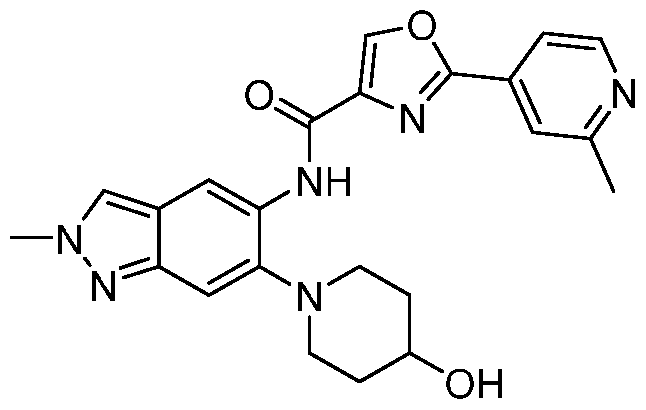
INDAZOLE COMPOUNDS AS IRAK4 INHIBITORS
This application claims the benefit of Indian provisional applications 146/CHE/2014, filed on January 10, 2014 and 3018/CHE/2014 filed on June 20, 2014 which hereby incorporated by reference.
FIELD OF THE INVENTION
This invention relates to compounds useful for treatment of cancer and inflammatory diseases associated with Interleukin- 1 Receptor Associated Kinase (IRAK) and more particularly compounds that modulate the function of IRAK-4. The invention also provides pharmaceutically acceptable compositions comprising compounds of the present invention and methods of using said compositions in the treatment of diseases associated with IRAK-4.
BACKGROUND OF THE INVENTION
Interleukin- 1 (IL-1) Receptor- Associated Kinase-4 (IRAK-4) is a serine/threonine kinase enzyme that plays an essential role in signal transduction by Toll/IL-1 receptors (TIRs). Diverse IRAK enzymes are key components in the signal transduction pathways mediated by interleukin- 1 receptor (IL-1R) and Toll-like receptors (TLRs) (Janssens, S, et al. Mol. Cell. 11(2), 2003, 293-302). There are four members in the mammalian IRAK family: IRAK-1, IRAK-2, IRAK-M and IRAK-4. These proteins are characterized by a typical N-terminal death domain that mediates interaction with MyD88-family adaptor proteins and a centrally located kinase domain. The IRAK proteins, as well as MyD88, have been shown to play a role in transducing signals other than those originating from IL-1R receptors, including signals triggered by activation of IL-18 receptors (Kanakaraj, et al. J. Exp. Med. 189(7), 1999, 1129-38) and LPS receptors (Yang, et al., J. Immunol. 163(2), 1999, 639-643). Out of four members in the mammalian IRAK family, IRAK-4 is considered to be the "master IRAK". Under overexpression conditions, all IRAKs can mediate the activation of nuclear factor-κΒ (NF-κΒ) and stress-induced mitogen activated protein kinase (MAPK)-signaling cascades. However, only IRAK-1 and IRAK-4 have been shown to have active kinase activity. While IRAK-1 kinase activity could be dispensable for its function in IL-1 -induced NF-κΒ activation (Kanakaraj et al, J. Exp. Med. 187(12), 1998, 2073-2079) and (Li, et al. Mol. Cell. Biol. 19(7), 1999, 4643-4652), IRAK-4 requires its kinase activity for signal transduction [(Li S, et al. Proc. Natl. Acad. Sci. USA 99(8), 2002, 5567-5572) and (Lye, E et al, J. Biol. Chem. 279(39); 2004, 40653-8)]. Given the central role of IRAK4 in Toll-like/IL-lR signalling and immunological protection, IRAK4 inhibitors have been implicated
as valuable therapeutics in inflammatory diseases, sepsis and autoimmune disorders (Wietek C, et al, Mol. Interv. 2: 2002, 212-215).
Mice lacking IRAK-4 are viable and show complete abrogation of inflammatory cytokine production in response to IL-1, IL-18 or LPS (Suzuki et al. Nature, 416(6882), 2002, 750-756). Similarly, human patients lacking IRAK-4 are severely immunocompromised and are not responsive to these cytokines (Medvedev et al. J. Exp. Med., 198(4), 2003, 521-531 and Picard et al. Science 299(5615), 2003, 2076-2079). Knock-in mice containing inactive IRAK4 were completely resistant to lipopolysaccharide- and CpG-induced shock (Kim TW, et al. J. Exp. Med 204(5), 2007, 1025 -36) and (Kawagoe T, et al. J. Exp. Med. 204(5): 2007, 1013-1024) and illustrated that IRAK4 kinase activity is essential for cytokine production, activation of MAPKs and induction of NF- κΒ regulated genes in response to TLR ligands (Koziczak-Holbro M, et al. J. Biol. Chem. 282(18): 2007;13552-13560). Inactivation of IRAK4 kinase (IRAK4 KI) in mice leads to resistance to EAE due to reduction in infiltrating inflammatory cells into CNS and reduced antigen specific CD4+ T-cell mediated IL-17 production (Staschke et al. The Journal of Immunology, 183(1), 2009, 568-577).
The crystal structures revealed that IRAK-4 contains characteristic structural features of both serine/threonine and tyrosine kinases, as well as additional novel attributes, including the unique tyrosine gatekeeper residue. Structural analysis of IRAK-4 revealed the underlying similarity with kinase family; ATP-binding cleft sandwiched between a bilobal arrangements. The N-terminal lobe consists of mainly of a twisted five-stranded antiparallel beta-sheet and one alpha-helix, and the larger C-terminal lobe is predominantly alpha-helical. Yet, the structure reveals a few unique features for IRAK-4 kinase, including an additional alpha-helix from the N- terminal extension in the N-terminal lobe, a longer loop between helices alpha-D and alpha-E, and a significantly moved helix alpha G as well as its adjoining loops. The ATP-binding site in IRAK-4 has no deep pocket in the back but has a featured front pocket. This uniquely shaped binding pocket provides an excellent opportunity for designing IRAK-4 inhibitors.
The development of IRAK-4 kinase inhibitors has generated several novel classes of protein binders which includes thiazole and pyridine amides (George M Buckley, et al.Bioorg. Med. Chem. Lett., 18(11), 2008, 3211-3214), aminobenzimidazoles (Powers JP, et al.Bioorg. Med. Chem. Lett., 16(11), 2006, 2842-2845), Imidazo[l,2-a] pyridines (Buckley G M, et al. Bioorg. Med. Chem. Lett. 18(12), 2008, 3656-3660) and (Buckley GM, et al.Bioorg. Med.
Chem. Lett. 18(11), 2008, 3291-3295), imidazo[l,2-b]pyridazines and benzimidazole-indazoles (WO2008030579; WO2008030584). Apparently, all of them are still in the early preclinical stage.
Despite various disclosures on different kinase inhibitors, however, with the rise in number of patients affected by kinase enzyme mediated diseases, there appears to be unmet need for newer drugs that can treat such diseases more effectively. There is still need for newer kinase inhibitors including multikinase inhibitors, which may be further useful in treatment of disorders owing to variations in various kinases activity and possessing broader role. They may also be useful as part of other therapeutic regimens for the treatment of disorders, alone or in combination with protein kinase compounds well known by the one skilled in the art.
OBJECTIVES OF THE INVENTION
One objective herein is to provide indazole compounds of formula (I) as kinase inhibitors, particularly IRAK4 inhibitors.
Another objective is to provide a pharmaceutical composition comprising the compound of formula (I) or pharmaceutically acceptable salt or stereoisomer thereof, and atleast one pharmaceutically acceptable excipient such as a pharmaceutically acceptable carrier or diluent.
Yet another objective is to provide a use of Indazole compound of formula (I) or pharmaceutically acceptable salt or stereoisomer thereof for the treatment and/or prevention of diseases or disorders, in particular their use in diseases or disorder mediated by kinase enzyme, more particularly IRAK4 enzyme.
SUMMARY OF THE INVENTION
Provided herein is a compound of formula (I),
or a pharmaceutically acceptable salt or a stereoisomer thereof;
wherein,
Ring Zi is an optionally substituted heteroaryl;
Ring Z2 is a optionally substituted heterocycloalkyl, optionally substituted heteroaryl or a direct bond;
Ri is alkyl, cyano, -NRaRb, or optionally substituted groups selected from cycloalkyl, aryl or heterocyclyl; wherein the substituent, at each occurrence, independently is alkyl, alkoxy, halogen, hydroxyl, hydroxyalkyl, amino, aminoalkyl, nitro, cyano, haloalkyl, haloalkoxy, -OCO- CH2-0-alkyl, -OP(0)(0-alkyl)2 or -CH2-OP(0)(0-alkyl)2;
R2, at each occurrence, independently is an optionally substituted group selected from alkyl or cycloalkyl; wherein the substituent, at each occurrence, is independently halogen, alkoxy, hydroxyl, hydroxyalkyl, haloalkyl or haloalkoxy;
R3, at each occurrence, independently is hydrogen, halogen, alkyl, haloalkyl, haloalkoxy, alkoxy, -NRaRt>, hydroxyl or hydroxyalkyl;
Ra is hydrogen or alkyl;
Rb is hydrogen, alkyl, acyl, hydroxyalkyl, -S02-alkyl or optionally substituted cycloalkyl;
'm' and 'n' are independently 1 or 2.
In yet another aspect, the present invention provides a pharmaceutical composition comprising the compound of formula (I) or a pharmaceutically acceptable salt or a stereoisomer thereof, and atleast one pharmaceutically acceptable excipient (such as a pharmaceutically acceptable carrier or diluent).
In yet further aspect of the present application, it provides use of compound of formula (I) or a pharmaceutically acceptable salt or a stereoisomer thereof for the treatment and prevention in diseases or disorder mediated by IRAK4 enzyme.
More particularly, the invention relates to the use of indazole compound of formula (I) or a pharmaceutically acceptable salt or a stereoisomer thereof, including mixtures thereof in all ratios as a medicament, by inhibiting IRAK or IRAK4 other related kinases.
The compound of formula (I) of the present invention possess therapeutic role of inhibiting IRAK or IRAK4 related kinases useful in the area of diseases and/or disorders include,
but are not limited to cancers, allergic diseases and/or disorders, autoimmune diseases and/or disorders, inflammatory diseases and/or disorder and/or conditions associated with inflammation and pain, proliferative diseases, hematopoietic disorders, hematological malignancies, bone disorders, fibrosis diseases and/or disorders, metabolic disorders and/or diseases, muscle diseases and/or disorders respiratory diseases and/or disorders, pulmonary disorders, genetic developmental diseases and/or disorders, neurological and neurodegenerative diseases and/or disorders, chronic inflammatory demyelinating neuropathies, cardiovascular, vascular or heart diseases and/or disorders, ophthalmic/ocular diseases and/or disorders, wound repair, infection and viral diseases. Therefore, inhibition of one or more of kinases would have multiple therapeutic indications.
DETAILED DESCRIPTION OF THE INVENTION
Unless defined otherwise, all technical and scientific terms used herein have the same meaning as is commonly understood by one of skill in art to which the subject matter herein belongs. As used in the specification and the appended claims, unless specified to the contrary, the following terms have the meaning indicated in order to facilitate the understanding of the present invention.
The singular forms "a", "an" and "the" encompass plural references unless the context clearly indicates otherwise.
As used herein, the terms "optional" or "optionally" mean that the subsequently described event or circumstance may occur or may not occur, and that the description includes instances where the event or circumstance occurs as well as instances in which it does not. For example, "optionally substituted alkyl" refers to the alkyl may be substituted as well as where the alkyl is not substituted.
It is understood that substituents and substitution patterns on the compounds of the present invention can be selected by one of ordinary skilled person in the art to result chemically stable compounds which can be readily synthesized by techniques known in the art, as well as those methods set forth below, from readily available starting materials. If a substituent is itself substituted with more than one group, it is understood that these multiple groups may be on the same carbon or on different carbons, so long as a stable structure results.
As used herein, the term "optionally substituted" refers to the replacement of one to six hydrogen radicals in a given structure with the radical of a specified substituent including, but not limited to: hydroxyl, hydroxyalkyl, alkoxy, halogen, alkyl, aryl, cycloalkyl, heterocyclyl, amino, aminoalkyl, cyano, haloalkyl, haloalkoxy, -OCO-CH2-0-alkyl, -OP(0)(0-alkyl)2 or - CH2-OP(0)(0-alkyl)2. Preferably, "optionally substituted" refers to the replacement of one to four hydrogen radicals in a given structure with the substituents mentioned above. More preferably, one to three hydrogen radicals are replaced by the substituents as mentioned above. It is understood that the substituent can be further substituted.
As used herein, the term "alkyl" refers to saturated aliphatic groups, including but not limited to Ci-Cio straight-chain alkyl groups or Ci-Cio branched-chain alkyl groups. Preferably, the "alkyl" group refers to Ci-C6 straight-chain alkyl groups or Ci-C6 branched-chain alkyl groups. Most preferably, the "alkyl" group refers to C1-C4 straight-chain alkyl groups or C1-C4 branched-chain alkyl groups. Examples of "alkyl" include, but are not limited to, methyl, ethyl, 1-propyl, 2-propyl, n-butyl, sec -butyl, tert-butyl, 1-pentyl, 2-pentyl, 3-pentyl, neo-pentyl, 1- hexyl, 2-hexyl, 3-hexyl, 1-heptyl, 2-heptyl, 3-heptyl, 4-heptyl, 1-octyl, 2-octyl, 3-octyl or 4-octyl and the like. The "alkyl" group may be optionally substituted.
The term "acyl" refers to a group R-CO- wherein R is an alkyl group defined above. Examples of 'acyl' groups are, but not limited to, CH3CO-, CH3CH2CO-, CH3CH2CH2CO- or (CH3)2CHCO-.
As used herein, the term "alkoxy" refers to a straight or branched, saturated aliphatic Ci-
C10 hydrocarbon radical bonded to an oxygen atom that is attached to a core structure. Preferably, alkoxy groups have one to six carbon atoms. Examples of alkoxy groups include but are not limited to methoxy, ethoxy, propoxy, isopropoxy, butoxy, isobutoxy, tert-butoxy, pentoxy, 3- methyl butoxy and the like.
As used herein, the term "haloalkyl" refers to alkyl group (as defined above) is substituted with one or more halogens. A monohaloalkyl radical, for example, may have a chlorine, bromine, iodine or fluorine atom. Dihalo and polyhaloalkyl radicals may have two or more of the same or different halogen atoms. Examples of haloalkyl include, but are not limited to, chloromethyl, dichloromethyl, trichloromethyl, dichloroethyl, dichloropropyl, fluoromethyl,
difluoromethyl, trifluoromethyl, pentafluoroethyl, heptafluoropropyl, difluorochloromethyl, dichlorofluoromethyl, difluoroethyl, difluoropropyl and the like.
As used herein, the term "haloalkoxy" refers to radicals wherein one or more of the hydrogen atoms of the alkoxy group are substituted with one or more halogens. Representative examples of "haloalkoxy" groups include, but not limited to, difluoromethoxy (-OCHF2), trifluoromethoxy (-OCF3) or trifluoroethoxy (-OCH2CF3).
As used herein, the term "aryl" alone or in combination with other term(s) means a 6- to 10-membered carbocyclic aromatic system containing one or two rings wherein such rings may be fused. The term "fused" means that the second ring is attached or formed by having two adjacent atoms in common with the first ring. The term "fused" is equivalent to the term "condensed". Examples of aryl groups include but are not limited to phenyl, naphthyl or indanyl and the like. Unless otherwise specified, all aryl groups described herein may be optionally substituted.
As used herein, "amino" refers to an -NH2 group.
As used herein, "aminoalkyl" refers to an amino group, as defined above, in which one or two hydrogen atoms are substituted with alkyl group.
As used herein, "nitro" refers to an -N02 group.
As used herein, "alkylamino" and "cycloalkylamino", refer to an -N-group, wherein nitrogen atom of said group being attached to alkyl or cycloalkyl respectively. Representative examples of an "Alkylamino" and "Cycloalkylamino" groups include, but are not limited to - NHCH3 and -NH-cyclopropyl. An amino group can be optionally substituted with one or more of the suitable groups.
As used herein the term "cycloalkyl" alone or in combination with other term(s) means C3-C10 saturated cyclic hydrocarbon ring. A cycloalkyl may be a single ring, which typically contains from 3 to 7 carbon ring atoms. Examples of single-ring cycloalkyls include cyclopropyl, cyclobutyl, cyclopentyl, cyclohexyl, cycloheptyl and the like. A cycloalkyl may alternatively be polycyclic or contain more than one ring. Examples of polycyclic cycloalkyls include bridged, fused, and spirocyclic carbocyclyls.
As used herein, the term "cyano" refers to-CN group.
As used herein, the term "hydroxy" or "hydroxyl" refers to -OH group.
As used herein the term "hydroxyalkyl" or "hydroxylalkyl" means alkyl substituted with one or more hydroxyl groups, wherein the alkyl groups are as defined above. Examples of "hydroxyalkyl" include but are not limited to hydroxymethyl, hydroxyethyl, hydroxypropyl, propan-2-ol and the like.
As used herein, the term "halo" or "halogen" alone or in combination with other term(s) means fluorine, chlorine, bromine or iodine.
As used herein, the term "heterocyclyl" includes definitions of "heterocycloalkyl" and "heteroaryl".
As used herein, the term "heterocycloalkyl" refers to a non-aromatic, saturated or partially saturated, monocyclic or polycyclic ring system of 3 to 15 member having at least one heteroatom or heterogroup selected from O, N, S, S(O), S(0)2, NH or C(O) with the remaining ring atoms being independently selected from the group consisting of carbon, oxygen, nitrogen, and sulfur. Examples of "heterocycloalkyl" include, but are not limited to azetidinyl, oxetanyl, imidazolidinyl, pyrrolidinyl, oxazolidinyl, thiazolidinyl, pyrazolidinyl, tetrahydrofuranyl, piperidinyl, piperazinyl, tetrahydropyranyl, morpholinyl, thiomorpholinyl, 1,4-dioxanyl, dioxidothiomorpholinyl, oxapiperazinyl, oxapiperidinyl, tetrahydrofuryl, tetrahydropyranyl, tetrahydrothiophenyl, dihydropyranyl, indolinyl, indolinylmethyl, 2-aza-bicyclo[2.2.2]octanyl, azocinyl, chromanyl, xanthenyl and N-oxides thereof. Attachment of a heterocycloalkyl substituent can occur via either a carbon atom or a heteroatom. A heterocycloalkyl group can be optionally substituted with one or more suitable groups by one or more aforesaid groups. Preferably "heterocycloalkyl" refers to 5- to 6-membered ring selected from the group consisting of azetidinyl, oxetanyl, imidazolidinyl, pyrrolidinyl, oxazolidinyl, thiazolidinyl, pyrazolidinyl, tetrahydrofuranyl, piperidinyl, piperazinyl, tetrahydropyranyl, morpholinyl, thiomorpholinyl, 1 ,4-dioxanyland N-oxides thereof. More preferably, "heterocycloalkyl" includes azetidinyl, pyrrolidinyl, morpholinyl and piperidinyl. All heterocycloalkyl are optionally substituted by one or more aforesaid groups.
As used herein, the term "heteroaryl" refers to an aromatic heterocyclic ring system containing 5 to 20 ring atoms, suitably 5 to 10 ring atoms, which may be a single ring (monocyclic) or multiple rings (bicyclic, tricyclic or polycyclic) fused together or linked
covalently. Preferably, "heteroaryl" is a 5- to 6-membered ring. The rings may contain from 1 to 4 heteroatoms selected from N, O and S, wherein the N or S atom is optionally oxidized or the N atom is optionally quarternized. Any suitable ring position of the heteroaryl moiety may be covalently linked to the defined chemical structure.
Examples of heteroaryl include, but are not limited to: furanyl, thienyl, pyrrolyl, pyrazolyl, imidazolyl, oxazolyl, cinnolinyl, isoxazolyl, thiazolyl, isothiazolyl, lH-tetrazolyl, oxadiazolyl, triazolyl, pyridyl, pyrimidinyl, pyrazinyl, pyridazinyl, benzoxazolyl, benzisoxazolyl, benzothiazolyl, benzofuranyl, benzothienyl, benzotriazinyl, phthalazinyl, thianthrene, dibenzofuranyl, dibenzothienyl, benzimidazolyl, indolyl, isoindolyl, indazolyl, quinolinyl, isoquinolinyl, quinazolinyl, quinoxalinyl, purinyl, pteridinyl, 9H-carbazolyl, a- carboline, indolizinyl, benzoisothiazolyl, benzoxazolyl, pyrrolopyridyl, furopyridinyl, purinyl, benzothiadiazolyl, benzooxadiazolyl, benzotriazolyl, benzotriadiazolyl, carbazolyl, dibenzothienyl, acridinyl and the like. Preferably "heteroaryl" refers to 5- to 6-membered ring selected from the group consisting of furanyl, thienyl, pyrrolyl, pyrazolyl, imidazolyl, oxazolyl, cinnolinyl, isoxazolyl, thiazolyl, isothiazolyl, lH-tetrazolyl, oxadiazolyl, triazolyl, pyridyl, pyrimidinyl, pyrazinyl and pyridazinyl. More preferably, pyrazolyl, pyridyl, oxazolyl and furanyl. All heteroaryls are optionally substituted by one or more aforesaid groups.
As used herein, the term 'compound(s)' comprises the compounds disclosed in the present invention.
As used herein, the term "comprise" or "comprising" is generally used in the sense of include, that is to say permitting the presence of one or more features or components.
As used herein, the term "or" means "and/or" unless stated otherwise.
As used herein, the term "including" as well as other forms, such as "include", "includes" and "included" is not limiting.
The phrase "pharmaceutically acceptable" refers to compounds or compositions that are physiologically tolerable and do not typically produce allergic or similar untoward reaction, including but not limited to gastric upset or dizziness when administered to mammal.
The term "pharmaceutically acceptable salt" refers to a product obtained by reaction of the compound of the present invention with a suitable acid or a base. Pharmaceutically
acceptable salts of the compounds of this invention include those derived from suitable inorganic bases such as Li, Na, K, Ca, Mg, Fe, Cu, Al, Zn and Mn salts; Examples of pharmaceutically acceptable, nontoxic acid addition salts are salts of an amino group formed with inorganic acids such as hydrochloride, hydrobromide, hydroiodide, nitrate, sulfate, bisulfate, phosphate, isonicotinate, acetate, lactate, salicylate, citrate, tartrate, pantothenate, bitartrate, ascorbate, succinate, maleate, gentisinate, fumarate, gluconate, glucaronate, saccharate, formate, benzoate, glutamate, methanesulfonate, ethanesulfonate, benzenesulfonate, 4-methylbenzenesulfonate or p- toluenesulfonate salts, and the like. Certain compounds of the invention (compound of formula (I)) can form pharmaceutically acceptable salts with various organic bases such as lysine, arginine, guanidine, diethanolamine or metformin. Suitable base salts include, but are not limited to, aluminum, calcium, lithium, magnesium, potassium, sodium, or zinc, salts.
As used herein, the term "stereoisomer" is a term used for all isomers of individual compounds of compound of formula (I) that differ only in the orientation of their atoms in space. The term stereoisomer includes mirror image isomers (enantiomers) of compound of formula (I), mixtures of mirror image isomers (racemates, racemic mixtures) of compound of formula (I), geometric (cis/trans or E/Z, R/S) isomers of compound of formula (I) and isomers of compound of formula (I) with more than one chiral center that are not mirror images of one another (diastereoisomers).
As used herein, the term "composition" is intended to encompass a product comprising the specified ingredients in the specified amounts, as well as any product which results, directly or indirectly, from combination of the specified ingredients in the specified amounts.
As used herein, the term "pharmaceutical composition" refers to a composition(s) containing a therapeutically effective amount of at least one compound of formula (I) or its pharmaceutically acceptable salt; and a conventional pharmaceutically acceptable carrier.
The pharmaceutical composition(s) of the present invention can be administered orally, for example in the form of tablets, coated tablets, pills, capsules, granules or elixirs. Administration, however, can also be carried out rectally, for example in the form of suppositories, or parenterally, for example intravenously, intramuscularly or subcutaneously, in the form of injectable sterile solutions or suspensions, or topically, for example in the form of
ointments or creams or transdermals, in the form of patches, or in other ways, for example in the form of aerosols or nasal sprays.
The pharmaceutical composition(s) usually contain(s) about 1% to 99%, for example, about 5% to 75%, or from about 10% to about 30% by weight of the compound of formula (I) or pharmaceutically acceptable salts thereof. The amount of the compound of formula (I) or pharmaceutically acceptable salts thereof in the pharmaceutical composition(s) can range from about 1 mg to about 1000 mg or from about 2.5 mg to about 500 mg or from about 5 mg to about 250 mg or in any range falling within the broader range of 1 mg to 1000 mg or higher or lower than the afore mentioned range.
As used herein, the term "pharmaceutically acceptable carrier" refers to any of the standard pharmaceutical carriers, such as a phosphate buffered saline solution, water, emulsions (e.g., such as an oil/water or water/oil emulsions), and various types of wetting agents. The compositions also can include stabilizers and preservatives. The examples of carriers, stabilizers and adjuvant are mentioned in literature like, Martin, Remington's Pharmaceutical Sciences, 15th Ed., Mack Publ. Co., Easton, PA [1975].
The term "treatment'V'treating" means any treatment of a disease in a mammal, including: (a) Inhibiting the disease, i.e., slowing or arresting the development of clinical symptoms; and/or (b) Relieving the disease, i.e., causing the regression of clinical symptoms and/or (c) alleviating or abrogating a disease and/or its attendant symptoms.
As used herein, the term "prevent", "preventing" and "prevention" refer to a method of preventing the onset of a disease and/or its attendant symptoms or barring a subject from acquiring a disease. As used herein, "prevent", "preventing" and "prevention" also include delaying the onset of a disease and/or its attendant symptoms and reducing a subject's risk of acquiring a disease.
As used herein, the term "subject" refers to an animal, preferably a mammal, and most preferably a human.
As used herein, the term, "therapeutically effective amount" refers to an amount of a compound of formula (I) or a pharmaceutically acceptable salt or a stereoisomer thereof; or a composition comprising the compound of formula (I) or a pharmaceutically acceptable salt or a stereoisomer thereof, effective in producing the desired therapeutic response in a particular
patient suffering from a disease or disorder mediated by kinase enzymes, particularly IRAK or IRAK4 enzyme. Particularly, the term "therapeutically effective amount" includes the amount of the compound of formula (I) or a pharmaceutically acceptable salt or a stereoisomer thereof, when administered, that induces a positive modification in the disease or disorder to be treated or is sufficient to prevent development of, or alleviate to some extent, one or more of the symptoms of the disease or disorder being treated in a subject. In respect of the therapeutic amount of the compound, the amount of the compound used for the treatment of a subject is low enough to avoid undue or severe side effects, within the scope of sound medical judgment can also be considered. The therapeutically effective amount of the compound or composition will be varied with the particular condition being treated, the severity of the condition being treated or prevented, the duration of the treatment, the nature of concurrent therapy, the age and physical condition of the end user, the specific compound or composition employed the particular pharmaceutically acceptable carrier utilized.
In one embodiment, the present invention provides the compound of formula (I)
or a pharmaceutically acceptable salt or a stereoisomer thereof;
wherein,
Ring Zi is an optionally substituted heteroaryl;
Ring Z2 is an optionally substituted heterocycloalkyl, optionally substituted heteroaryl or a direct bond;
Ri is alkyl, cyano, -NRaRb, or optionally substituted groups selected from cycloalkyl, aryl or heterocyclyl; wherein the substituent, at each occurrence, independently is alkyl, alkoxy, halogen, hydroxyl, hydroxyalkyl, amino, aminoalkyl, nitro, cyano, haloalkyl, haloalkoxy, -OCO- CH2-0-alkyl, -OP(0)(0-alkyl)2 or -CH2-OP(0)(0-alkyl)2;
R2, at each occurrence, independently is an optionally substituted group selected from alkyl or cycloalkyl; wherein the substituent, at each occurrence, is independently halogen, alkoxy, hydroxyl, hydroxyalkyl, haloalkyl or haloalkoxy;
R3, at each occurrence, independently is hydrogen, halogen, alkyl, haloalkyl, haloalkoxy, alkoxy, -NRaRt>, hydroxyl or hydroxyalkyl;
Ra is hydrogen or alkyl;
R is hydrogen, alkyl, acyl, hydroxyalkyl, -S02-alkyl or optionally substituted cycloalkyl;
'm' and 'n' are independently 1 or 2.
In another embodiment, the present invention provides the compound of formula (I) or a pharmaceutically acceptable salt or a stereoisomer thereof; wherein, Ring Zi is a 5- or 6- membered optionally substituted heteroaryl.
In another embodiment, the present invention provides the compound of formula (I) or a pharmaceutically acceptable salt or a stereoisomer thereof; wherein Ring Zi is an optionally substituted heteroaryl; wherein the optional substituent is alkyl;
In another embodiment, the compound of formula (I) or a pharmaceutically acceptable salt thereof, wherein Ring Zi is selected from the group consisting of tetrazolyl, thienyl, triazolyl, pyrrolyl, pyridyl, pyranyl, pyrazinyl, pyridazinyl, pyrimidyl, imidazolyl, oxadiazolyl, thiadiazolyl, thiazolyl, isothiazolyl, oxazolyl, furanyl and pyrazolyl.
In another embodiment, the compound of formula (I) or a pharmaceutically acceptable salt thereof, wherein Ring Zi is selected from the group consisting of pyridyl, oxazolyl and furanyl; wherein the pyridyl group is optionally substituted with alkyl; in particular alkyl is methyl.
In another embodiment, the compound of formula (I) or a pharmaceutically acceptable salt thereof, wherein Ring Z2 is a 5- or 6-membered heteroaryl selected from tetrazolyl, thienyl, triazolyl, pyrrolyl, pyridyl, pyranyl, pyrazinyl, pyridazinyl, pyrimidyl, imidazolyl, oxadiazolyl, thiadiazolyl, thiazolyl, isothiazolyl, oxazolyl, furanyl or pyrazolyl.
In another embodiment, the compound of formula (I) or a pharmaceutically acceptable salt thereof, wherein Ring Z2 is a 5- or 6-membered heterocycloalkyl selected from azetidinyl,
oxetanyl, imidazolidinyl, pyrrolidinyl, oxazolidinyl, thiazolidinyl, pyrazolidinyl, tetrahydrofuranyl, piperidinyl, piperazinyl, tetrahydropyranyl, morpholinyl, thiomorpholinyl or 1,4-dioxanyl.
In yet another embodiment, the compound of formula (I) or a pharmaceutically acceptable salt thereof, wherein Ring Z2 is pyridyl, pyrazolyl or pyrrolidinyl.
In another embodiment, the compound of formula (I) or a pharmaceutically acceptable salt thereof, wherein Ring Z2 is a direct bond.
In another embodiment, the compound of formula (I) is compound of formula (IA)
or a pharmaceutically acceptable salt thereof;
wherein, Z2, R1; R2, R3 'm' and 'n' are same as defined in compound of formula (I).
In yet another embodiment, the compound of formula (I) is compound of formula (IB)
or a pharmaceutically acceptable salt thereof;
wherein, Z2, R1; R2, R3i 'm' and 'n' are same as defined in compound of formula (I).
In yet another embodiment, the compound of formula (I) is compound of formula (IC)
or a pharmaceutically acceptable salt thereof;
wherein, Z2, R1; R2, R3, 'm' and 'n' are same as defined in compound of formula (I).
The embodiments below are illustrative of the present invention and are not intended to limit the claims to the specific embodiments exemplified.
According to one embodiment, specifically provided are compound of formula (I)
wherein R1; R2 and 'm' are same as defined in compound of formula (I).
According to one embodiment, specifically provided is compound of formula (I) or a pharmaceutically acceptable salt thereof, wherein Ring Z2 is pyridyl.
According to one embodiment, specifically provided is compound of formula (I) or a pharmaceutically acceptable salt thereof, wherein Ring Z2 is pyrazolyl.
According to one embodiment, specifically provided is compound of formula (I) or a pharmaceutically acceptable salt thereof, wherein Ring Z2 is pyrrolidinyl.
According to one embodiment, specifically provided is compound of formula (I) or a pharmaceutically acceptable salt thereof, wherein Ri is optionally substituted heterocyclyl; wherein the substituent is halogen, hydroxyl, hydroxyalkyl, amino, aminoalkyl, -OCO-CH2-0- alkyl, -OP(0)(0-alkyl)2 or -CH2-OP(0)(0-alkyl)2.
According to one embodiment, specifically provided is compound of formula (I) or a pharmaceutically acceptable salt thereof, wherein Ri is optionally substituted azetidinyl, piperidinyl, morpholinyl, pyrrolidinyl or azepanyl; wherein the substituent is amino, halogen, hydroxyl, hydroxyalkyl, aminoalkyl, -OCO-CH2-0-alkyl, -OP(0)(0-alkyl)2 or -CH2-OP(0)(0- alkyl)2.
According to one embodiment, specifically provided is compound of formula (I) or a pharmaceutically acceptable salt thereof, wherein Ri is optionally substituted piperidinyl; wherein the substituent is hydroxyl.
According to one embodiment, specifically provided is compound of formula (I) or a pharmaceutically acceptable salt thereof, wherein Ri is optionally substituted phenyl; wherein the substituent is halogen.
According to one embodiment, specifically provided is compound of formula (I) or a pharmaceutically acceptable salt thereof, wherein Ri is cycloalkyl.
According to one embodiment, specifically provided is compound of formula (I) or a pharmaceutically acceptable salt thereof, wherein Ri is cyclopropyl or cyclohexyl.
According to one embodiment, specifically provided is compound of formula (I) or a pharmaceutically acceptable salt thereof, wherein Ri is -NRaRt>; Ra is hydrogen; R is optionally substituted cycloalkyl; wherein the substituent is hydroxyl.
According to one embodiment, specifically provided are compounds of formula (I) or a pharmaceutically acceptable salt thereof, wherein Ri is cyano.
According to one embodiment, specifically provided is compound of formula (I) or a pharmaceutically acceptable salt thereof, wherein R2 is optionally substituted alkyl; wherein substituent is alkoxy.
According to one embodiment, specifically provided is compound of formula (I) or a pharmaceutically acceptable salt thereof, wherein R2 is cycloalkyl.
According to one embodiment, specifically provided is compound of formula (I) or a pharmaceutically acceptable salt thereof, wherein R3 is hydrogen, halogen, alkyl, alkoxy, - NRaRb, hydroxyl or hydroxyalkyl; Ra is hydrogen or alkyl; and Rb is hydrogen, alkyl, acyl, hydroxyalkyl or -S02-alkyl.
According to one embodiment, specifically provided is compound of formula (I) or a pharmaceutically acceptable salt thereof, wherein Ring Zi is optionally substituted pyridyl; Ring
Z2 is pyridyl, pyrazolyl, pyrrolidinyl or direct bond; Ri is an optionally substituted group selected from cyclopropyl, piperidinyl, morpholinyl or pyrrolidinyl; R2 is optionally substituted alkyl or cycloalkyl; R3 is hydrogen, halogen, alkyl, alkoxy, -NRaRb, hydroxyl or hydroxyalkyl; Ra is hydrogen or alkyl; and R is hydrogen or hydroxyalkyl.
According to one embodiment, specifically provided is compound of formula (I) or a pharmaceutically acceptable salt thereof, wherein Ring Zi is oxazolyl; Ring Z2 is pyridyl, pyrazolyl or pyrrolidinyl; Ri is cyano, -NRaRb, or an optionally substituted group selected from cyclopropyl, cyclohexyl, phenyl, azetidinyl, piperidinyl, morpholinyl or pyrrolidinyl; R2 is optionally substituted alkyl or cycloalkyl; R3 is hydrogen, halogen, alkyl, alkoxy, -NRaRb, hydroxyl or hydroxyalkyl; Ra is hydrogen or alkyl; and Rb is hydrogen, alkyl, acyl, hydroxyalkyl, -S02-alkyl or optionally substituted cycloalkyl.
According to one embodiment, specifically provided is compound of formula (I) or a pharmaceutically acceptable salt thereof, wherein R3 is -NRaRb; Ra is hydrogen or alkyl; and Rb is hydrogen, alkyl, acyl, hydroxyalkyl, -S02-alkyl or optionally substituted cycloalkyl; wherein the optional substituent is hydroxyl;
According to one embodiment, specifically provided is compound of formula (I), wherein 'n' is 1.
According to one embodiment, specifically provided is compound of formula (I), wherein 'n' is 2.
According to one embodiment, specifically provided is compound of formula (I), wherein
'm' is 1.
According to one embodiment, specifically provided is compound of formula (I), wherein 'm' is 2.
In a further embodiment, the present invention relates to a process for preparing indazole compound of formula (I).
In a further embodiment, the present invention relates to a pharmaceutical composition, comprising at least one compound of formula (I), or a pharmaceutically acceptable salt or a stereoisomer thereof, and a pharmaceutically acceptable carrier or excipient.
In a further embodiment, the present invention relates to a compound or a pharmaceutically acceptable salt or a stereoisomer thereof, for use as a medicament.
In a further embodiment, the present invention relates to a method of treating IRAK4 mediated disorders or diseases or condition in a subject comprising administering a therapeutically effective amount of a compound of formula (I) or (IA) or (IB) or (IC).
In a further embodiment, the IRAK-mediated disorder or disease or condition is selected from the group consisting of a cancer, a neurodegenerative disorder, a viral disease, an autoimmune disease, an inflammatory disorder, a hereditary disorder, a hormone-related disease, a metabolic disorder, conditions associated with organ transplantation, immunodeficiency disorders, a destructive bone disorder, a proliferative disorder, an infectious disease, a condition associated with cell death, thrombin-induced platelet aggregation, liver disease, pathologic immune conditions involving T cell activation, a cardiovascular disorder and a CNS disorder.
In a further embodiment, the IRAK-mediated disorder or disease or condition is selected from the group consisting of a cancer, an inflammatory disorder, a an autoimmune disease, metabolic disorder, a hereditary disorder, a hormone-related disease, immunodeficiency disorders, a condition associated with cell death, a destructive bone disorder, thrombin-induced platelet aggregation, liver disease, pathologic immune conditions involving T cell activation and a cardiovascular disorder.
In a further embodiment, wherein the cancer or proliferative disorder is selected the group consisting of a solid tumor, benign or malignant tumor, carcinoma of the brain, kidney, liver, stomach, vagina, ovaries, gastric tumors, breast, bladder colon, prostate, pancreas, lung, cervix, testis, skin, bone or thyroid; sarcoma, glioblastomas, neuroblastomas, multiple myeloma, gastrointestinal cancer, a tumor of the neck and head, an epidermal hyperproliferation, psoriasis, prostate hyperplasia, a neoplasia, adenoma, adenocarcinoma, keratoacanthoma, epidermoid carcinoma, large cell carcinoma, non-small-cell lung carcinoma, lymphomas, Hodgkins and Non-Hodgkins, a mammary carcinoma, follicular carcinoma, papillary carcinoma, seminoma, melanoma; hematological malignancies selected from leukemia, diffuse large B-cell lymphoma (DLBCL), activated B-cell-like DLBCL, chronic lymphocytic leukemia (CLL), chronic lymphocytic lymphoma, primary effusion lymphoma, Burkitt lymphoma/leukemia, acute lymphocytic leukemia, B-cell pro lymphocytic leukemia, lymphoplasmacytic lymphoma,
Waldenstrom's macroglobulnemia (WM), splenic marginal zone lymphoma, intravascular large B-cell lymphoma, plasmacytoma and multiple myeloma.
In a further embodiment, the neurodegenerative disease is selected from the group consisting of Alzheimer's disease, Parkinson's disease, amyotrophic lateral sclerosis, Huntington's disease, cerebral ischemia, and neurodegenerative disease caused by traumatic injury, glutamate neurotoxicity, hypoxia, epilepsy and graft versus host disease.
In a further embodiment, the inflammatory disorder is selected from the group consisting of ocular allergy, conjunctivitis, keratoconjunctivitis sicca, vernal conjunctivitis, allergic rhinitis, autoimmune hematological disorders (e.g. hemolytic anemia, aplastic anemia, pure red cell anemia and idiopathic thrombocytopenia), systemic lupus erythematosus, rheumatoid arthritis, polychondritis, scleroderma, Wegener granulamatosis, dermatomyositis, chronic active hepatitis, myasthenia gravis, Steven- Johnson syndrome, idiopathic sprue, autoimmune inflammatory bowel disease (e.g. ulcerative colitis and Crohn's disease), irritable bowel syndrome, celiac disease, periodontitis, hyaline membrane disease, kidney disease, glomerular disease, alcoholic liver disease, multiple sclerosis, endocrine opthalmopathy, Grave's disease, sarcoidosis, alveolitis, chronic hypersensitivity pneumonitis, primary biliary cirrhosis, uveitis (anterior and posterior), Sjogren's syndrome, interstitial lung fibrosis, psoriatic arthritis, systemic juvenile idiopathic arthritis, nephritis, vasculitis, diverticulitis, interstitial cystitis, glomerulonephritis (e.g. including idiopathic nephrotic syndrome or minimal change nephropathy), chronic granulomatous disease, endometriosis, leptospirosis renal disease, glaucoma, retinal disease, headache, pain, complex regional pain syndrome, cardiac hypertrophy, muscle wasting, catabolic disorders, obesity, fetal growth retardation, hypercholesterolemia, heart disease, chronic heart failure, mesothelioma, anhidrotic ecodermal dysplasia, Behcet's disease, incontinentia pigmenti, Paget's disease, pancreatitis, hereditary periodic fever syndrome, asthma, acute lung injury, acute respiratory distress syndrome, eosinophilia, hypersensitivities, anaphylaxis, fibrositis, gastritis, gastroenteritis, nasal sinusitis, ocular allergy, silica induced diseases, chronic obstructive pulmonary disease (COPD), cystic fibrosis, acid-induced lung injury, pulmonary hypertension, polyneuropathy, cataracts, muscle inflammation in conjunction with systemic sclerosis, inclusion body myositis, myasthenia gravis, thyroiditis, Addison's disease, lichen planus, appendicitis, atopic dermatitis, asthma, allergy, blepharitis, bronchiolitis, bronchitis, bursitis, cervicitis, cholangitis, cholecystitis, chronic graft rejection, colitis, conjunctivitis, cystitis, dacryoadenitis,
dermatitis, juvenile rheumatoid arthritis, dermatomyositis, encephalitis, endocarditis, endometritis, enteritis, enterocolitis, epicondylitis, epididymitis, fasciitis, Henoch-Schonlein purpura, hepatitis, hidradenitis suppurativa, immunoglobulin A nephropathy, interstitial lung disease, laryngitis, mastitis, meningitis, myelitis myocarditis, myositis, nephritis, oophoritis, orchitis, osteitis, otitis, pancreatitis, parotitis, pericarditis, peritonitis, pharyngitis, pleuritis, phlebitis, pneumonitis, pneumonia, polymyositis, proctitis, prostatitis, pyelonephritis, rhinitis, salpingitis, sinusitis, stomatitis, synovitis, tendonitis, tonsillitis, ulcerative colitis, vasculitis, vulvitis, alopecia areata, erythema multiforma, dermatitis herpetiformis, scleroderma, vitiligo, hypersensitivity angiitis, urticaria, bullous pemphigoid, pemphigus vulgaris, pemphigus foliaceus, paraneoplastic pemphigus, epidermolysis bullosa acquisita, acute and chronic gout, chronic gouty arthritis, psoriasis, psoriatic arthritis, rheumatoid arthritis, Cryopyrin Associated Periodic Syndrome (CAPS) and osteoarthritis.
In a further embodiment, a compound of formula (I) or (IA) or (IB) or (IC) or a pharmaceutically acceptable salt or a stereoisomer thereof, for use for the treatment of a cancer, an inflammatory disorder, a an autoimmune disease, metabolic disorder, a hereditary disorder, a hormone-related disease, immunodeficiency disorders, a condition associated with cell death, a destructive bone disorder, thrombin-induced platelet aggregation, liver disease, pathologic immune conditions involving T cell activation and a cardiovascular disorder.
In a further embodiment, use of the compound of formula (I) or (IA) or (IB) or (IC) or a pharmaceutically acceptable salt or a stereoisomer thereof, in the manufacture of a medicament for the treatment of cancer, an inflammatory disorder, a an autoimmune disease, metabolic disorder, a hereditary disorder, a hormone-related disease, immunodeficiency disorders, a condition associated with cell death, a destructive bone disorder, thrombin-induced platelet aggregation, liver disease and a cardiovascular disorder.
An embodiment of the present invention provides the IRAK4 inhibitor compounds according to of formula (I) may be prepared from readily available starting materials using the following general methods and procedures. It will be appreciated that where typical or preferred experimental conditions (i.e. reaction temperatures, time, moles of reagents, solvents etc.) are given, other experimental conditions can also be used unless otherwise stated. Optimum reaction conditions may vary with the particular reactants or solvents used, but such conditions can be determined by the person skilled in the art, using routine optimization procedures. Moreover, by
utilizing the procedures described in detail, one of ordinary skill in the art can prepare additional compounds of the present invention claimed herein. All temperatures are in degrees Celsius (°C) unless otherwise noted.
In a further embodiment, the compounds of the present invention can also contain unnatural proportions of atomic isotopes at one or more of the atoms that constitute such compounds. For example, the present invention also embraces isotopically-labeled variants of the present invention which are identical to those recited herein, but for the fact that one or more atoms of the compound are replaced by an atom having the atomic mass or mass number different from the predominant atomic mass or mass number usually found in nature for the atom. All isotopes of any particular atom or element as specified are contemplated within the scope of the compounds of the invention, and their uses. Exemplary isotopes that can be incorporated in to compounds of the invention include isotopes of hydrogen, carbon, nitrogen, oxygen, phosphorous, sulfur, fluorine, chlorine and iodine, such as 2H ("D"), 3H, nC, 13C, 14C, 13N, 15N, 150, 170, 180, 32P, 33P, 35S, 18F, 36C1, 123I and 125I. Isotopically labeled compounds of the present inventions can generally be prepared by following procedures analogous to those disclosed in the Schemes and/or in the Examples herein below, by substituting an isotopically labeled reagent for a non-isotopically labeled reagent.
It is understood that substitution patterns and substituents on the compounds of the present invention can be selected by an ordinary skilled person in the art to provide compounds that are chemically stable and that can be readily synthesized by techniques known in the art, as well as those methods set forth below, from readily available starting materials. If a substituent itself is substituted with more than one group, it is understood that these multiple groups may be on the same carbon or on different carbons, as long as a stable structure is resulted.
The MS (Mass Spectral) data provided in the examples were obtained using the equipments- API 2000 LC/MS/MS/Triplequad,
Agilent (1100) Technologies/LC/MS/DVL/Singlequad and
Shimadzu LCMS-2020/Singlequad.
The NMR data provided in the examples were obtained using the equipment - 1H-NMR: Varian -300,400 and 600 MHz.
The abbreviations used in the entire specification may be summarized herein below with their particular meaning.
°C (degree Celsius); δ (delta); % (percentage); Ac20 (Acetic anhydride); (BOC)20
(Bocanhydride); bs (Broad singlet); CDC13 (Deuteriated chloroform); CH2C12/DCM (Dichlorome thane); DAST (Diethylaminosulfur trifluoride); DMF (Dimethyl formamide); DMSO (Dimethyl sulphoxide); DIPEA/DIEA (N, N- Diisopropyl ethylamine); DMAP (Dimethyl amino pyridine); (DMSO-d6 (Deuteriated DMSO); d (Doublet); dd (Doublet of doublet); EDCI.HCl (1 -(3 -Dimethyl aminopropyl)-3-carbodiimide hydrochloride); EtOAc (Ethyl acetate); EtOH (Ethanol); Fe (Iron powder); g or gm (gram); HATU (1- [bis(dimethylamino)methylene]-lH-l,2,3-triazolo[4,5-b]pyridinium 3-oxid hexafluorophosphate); H or H2 (Hydrogen); H20 (Water); HOBt (1 -Hydroxy benzotriazole); H2S04 (Sulphuric acid); HC1 (Hydrochloric acid); h or hr (Hours); Hz (Hertz); HPLC (High- performance liquid chromatography); J (Coupling constant); K2C03 (Potassium carbonate); KOAc (Potassium Acetate); KN03 (Potassium nitrate); LiOH (Lithium hydroxide); NaHMDS (Sodiumbis(trimethylsilyl)amide); MeOH/CH3OH (Methanol); mmol (Millimol); M (Molar); ml (Millilitre); mg (Milli gram); m (Multiplet); mm (Millimeter); MHz (Megahertz); MS (ES) (Mass spectroscopy-electro spray); min (Minutes); NaH (Sodium hydride); NaHC03 (Sodium bicarbonate); Na2S04 (Sodium sulphate); N2 (Nitrogen); NMR (Nuclear magnetic resonance spectroscopy); NMP (N-Methyl-2-pyrrolidone); Pd/C (palladium carbon); Pd(PPh3)2Cl2 (Bis(triphenylphosphine)palladium(II) dichloride); Pd(OAc)2 (Palladium diacetate); Pd(dppf)Cl2 (l,l'-Bis(diphenylphosphino)ferrocene) palladium(II) dichloride; Pd2(dba)3
(Tris(dibenzylideneacetone)dipalladium(O)); RT (Room Temperature); RM (Reaction mixture); S (Singlet); TBAF (Tetra-n-butylammonium fluoride); TBDMS (Tertiary butyl dimethyl silyl chloride); TEA (Tri ethyl amine); TFA (Trifluoroaceticacid); TLC (Thin Layer Chromatography); THF (Tetrahydrofuran); TFA (Trifluoro acetic acid); t (Triplet); Zn(CN)2 (Zinc Cyanide).
General modes of preparation:
Compounds of this invention may be made by synthetic chemical processes, examples of which are shown herein. It is meant to be understood that the order of the steps in the processes may be varied, that reagents, solvents and reaction conditions may be substituted for those specifically mentioned, and that vulnerable moieties may be protected and deprotected, as necessary.
A general approach for the synthesis of compounds of general formula (I) is depicted in below schemes. The terms '¾", "Z2", "Ri", "R2", "R3", "m" and "n" independently represents all the possible substitutions as disclosed in compound of formula (I).
Scheme -1:
The first general approach for the synthesis of compounds of general formula (I) is depicted in scheme- 1. Compound of formula (ii) can be obtained from compound of formula (i) or (xiii) by coupling with compounds including appropriate boronic acids and amines. Compound of formula (iii) can be obtained by the alkylation of compound of formula (ii) by using appropriate bases like potassium carbonate, or sodium hydride and suitable alkyl halides. Compound of formula (iii) can be reduced with suitable reducing reagents like Fe powder and HC1 to give compound of formula (iv) which on amide coupling with a suitable acid of compound of formula (v) by using standard amide coupling reagent known in the literature can give compound of formula (I).
Scheme -2:
Synthesis of compound of formula (i) was achieved in two ways. A compound of formula (vi) can be reduced by using Fe powder and HC1 to give compound of formula (vii) which on further reaction with Ac20, KOAc, Isoamylnitrate, at certain temperature can give compound of formula (viii). Compound of formula (viii) on nitration can give compound of formula (i). On the other hand compound of formula (ix) on nitration can give compound of formula (x) which can be reacted with hydrazine in suitable solvent like DMF, at 150 °C to give compound of formula (i).
Scheme -3:
Compound of formula (xiii) can be prepared as per the procedure given in Scheme -3.
X= F
A compound of formula (xi) can be nitrated by potassium nitrate and sulphuric acid to give compound of formula (xii) which on further reaction with hydrazine at certain temperature can give compound of formula (xiii).
Intermediates
Intermediate 1:
Synthesis of 6-(l-(tetrahydro-2H-pyran-2-yl)-lH-pyrazol-4-yl)picolinic acid
Stepl: Preparation of methyl 6-(l-(tetrahydro-2H-pyran-2-yl)-lH-pyrazol-4-yl)picolinate
In a sealed tube methyl 6-bromopicolinate (900mg, 4.166mmol) was coupled with 1- (tetrahydro-2H-pyran-2-yl)-4-(4,4,5,5-tetramethyl-l,3,2-dioxaborolan-2-yl)-lH-pyrazole (1.39g, 5mmol) using sodium carbonate (1.324g, 12.49mmol) and Pd(PPli3)2Cl2 (339mg, 0.416mmol) in 1 ,2-dimethoxyethane (lOmL) and water (2mL) and purged argon for 10 min, and heated at 95 °C overnight to get the crude product. The obtained crude was purified by 60-120 silica gel column chromatography using 30% ethyl acetate in hexane as eluent to obtain the title compound (450mg, 38%). LCMS: m/z: 288.1 (M+l)+.
Step 2:Preparation of 6-(l-(tetrahydro-2H-pyran-2-yl)-lH-pyrazol-4-yl)picolinic acid
A solution of methyl 6-(l-(tetrahydro-2H-pyran-2-yl)-lH-pyrazol-4-yl)picolinate (450mg, 1.567mmol)and lithium hydroxide (500mg, 7.839mmol)in THF (lOmL) water(4ml) was stirred at RT for 2 hrs. The reaction mixture was acidified with citric acid and extracted with DCM (2 X lOOmL), dried over sodium sulphate and distilled out the solvent to get the desired compound (300mg, 70%). LCMS: m/z: 274.3 (M+l) +.
Intermediate 2
Synthesis of 6-(l-methyl-lH-pyrazo -4-yl)picolinic acid
Step l:Preparation of methyl 6-(l-methyl-lH-pyrazol-4-yl)picolinate
Using the same reaction conditions as described in step 1 of example 6, methyl 6- bromopicolinate (3.5g, 16.28mmol) was coupled with l-methyl-4-(4,4,5,5-tetramethyl- 1,3,2- dioxaborolan-2-yl)-lH-pyrazole (4.06g, 19.53mmol) using sodium carbonate (5.177g, 48.846mmol) and Pd(dppf)Cl2 (1.328g, 1.628mmol) in 1 ,2-dimethoxyethane (20mL) to get the crude product. The obtained crude was purified by 60-120 silica gel column chromatography using 30%ethyl acetate in hexane as eluent to obtain the title compound (1.2g, 33.9%). LCMS: m/z: 218.2 (M+l) +.
Step 2:Preparation of 6-(l-methyl-lH-pyrazol-4-yl)picolinic acid
The solution of methyl 6-(l -methyl- lH-pyrazol-4-yl)picolinate(1.2g, 5.529mmol), lithium hydroxide (696mg, 16.58mmol), methanol (2mL), THF (8mL) and water (lmL) was stirred at RT for 2h, acidified with 2N HC1, distilled the solvent and filtered the solid to get the title compound (900mg, 80.3%).
Intermediate 3
Synthesis of 2-(6-methoxypyridin-3-yl)oxazole-4-carboxylic acid
Step 1: Preparation of ethyl 2-(6-fluoropyridin-3-yl)oxazole-4-carboxylate
Using the same reaction conditions as described in step 1 of example 6, 2-fluoro-5- (4,4,5,5-tetramethyl-l,3,2-dioxaborolan-2-yl)pyridine (200mg, 1.41mmol) was coupled with ethyl 2-chlorooxazole-4-carboxylate (298mg, 1.70mmol) using sodium carbonate (451mg, 4.25mmol) and Pd(PPh3)4 (289mg, 0.332mmol) in 1 ,2-dimethoxyethane/water (15/3mL) to get the crude product. The obtained crude was purified by 60-120 silica gel column chromatography using 20% ethyl acetate in hexane as eluent to obtain the title compound (200mg, 59.8%).
Step 2:Preparation of 2-(6-methoxypyridin-3-yl)oxazole-4-carboxylic acid
Using the same reaction conditions as described in step 2 of intermediate 2, ethyl 2-(6- fluoropyridin-3-yl)oxazole-4-carboxylate (300mg, 0.127mmol) was hydrolyzed using lithium hydroxide (160mg, 3.91mmol) in THF/methanol/water (5/l/2mL) at RT for 2h to obtain the title compound (160mg, 57.3%).
1HNMR (DMSO-de, 300MHz): δ 13.5-12.5 (bs, 1H), 8.85 (s, 1H), 8.80-8.79 (d, 1H), 8.26-8.23 (dd, 1H), 7.02-6.99 (dd, 1H), 3.95 (s, 3H). LCMS: m/z = 221.1 (M+l) +.
Intermediate 4
Synthesis of 2-(2-methylpyridin-3-yl xazole-4-carboxylic acid
Step 1: Preparation of ethyl 2-(2-methylpyridin-3-yl)oxazole-4-carboxylate
Using the same reaction conditions as described in step 1 of example 6, 2-methyl-3- (4,4,5,5-tetramethyl-l,3,2-dioxaborolan-2-yl)pyridine (lg, 7.09mmol) was coupled with ethyl 2- chlorooxazole-4-carboxylate (1.86g, 0.851mmol) using sodium carbonate (2.25g, 21.2mmol) and Pd(dppf)Cl2 (289mg, 0.332mmol) in 1,2-dimethoxyethane/water (30/6mL) to get the crude product. The obtained crude was purified by 60-120 silica gel column chromatography using 20% ethyl acetate in hexane as eluent to obtain the title compound (lg, 59.8%).
Step 2:Preparation of 2-(2-methylpyridin-3-yl)oxazole-4-carboxylic acid
Using the same reaction conditions as described in step 2 of intermediate 2, ethyl 2-(2- methylpyridin-3-yl)oxazole-4-carboxylate (lg, 4.3mmol) was hydrolyzed using lithium hydroxide (542mg, 12.9mmol) in THF/water (25/4mL) at RT for 2h to obtain the title compound (550mg, 62.5%).
1HNMR (400MHz, DMSO-d6,): δ 13.3 (s, 1H), 8.96 (s, 1H), 8.64-8.62 (dd, 1H), 8.32- 8.03 (dd, 1H), 7.47-7.44 (q, 1H), 2.86 (s, 3H).LCMS: m/z = 205.0 (M+l) +.
Intermediate 5
Synthesis of 2-(2-hydroxypyridin-3-yl)oxazole-4-carboxylic acid
Step 1: Preparation of ethyl 2-(2-fluoropyridin-3-yl)oxazole-4-carboxylate
Using the same reaction conditions as described in step 1 of example 6, (2-fluoropyridin- 3-yl)boronic acid (400mg, 2.83mmol) was coupled with ethyl 2-chlorooxazole-4-carboxylate (596mg, 3.40mmol) using sodium carbonate (902mg, 8.51mmol) and Pd(dppf)Cl2 (115mg, 0.141mmol) in 1,2-dimethoxyethane/water (25/4mL) to get the crude product. The obtained crude was purified by 60-120 silica gel column chromatography using 30% ethyl acetate in hexane as eluent to obtain the title compound (400mg, 60.6%).
1HNMR (400MHz, DMSO-d6): δ 9.11 (s, 1H), 8.64-8.59 (m, 1H), 8.48-8.47 (d, 1H), 7.62-7.59 (m, 1H), 4.38-4.33 (q, 2H), 1.35-1.32 (t, 3H).
Step 2:Preparation of 2-(2-hydroxypyridin-3-yl)oxazole-4-carboxylic acid
Using the same reaction conditions as described in step 2 of intermediate 2, ethyl 2-(2- fluoropyridin-3-yl)oxazole-4-carboxylate (400mg, 1.69mmol) was hydrolyzed using lithium
hydroxide (213mg, 5.07mmol) in THF/water (10/2mL) at RT for 2h to obtain the title compound (250mg, 71.6%).
1HNMR (400MHz , DMSO-d6): δ 13.3-12.9 (bs, 1H), 12.4-12.2 (s, 1H), 8.81 (s, 1H), 8.20-8.17 (dd, 1H), 7.68-7.66 (dd, 1H), 6.41-6.37 (t, 1H). LCMS: m/z = 207.1 (M+l) +.
Intermediate 6
Synthesis of (R)-l-(4-(4,4,5,5-tetramethyl-l,3,2-dioxaborolan-2-yl)-lH-pyrazol-l-yl)propan- 2-ol
Step 1: Preparation of (R)-l-(4-iodo-lH-pyrazol-l-yl)propan-2-ol
Using the same reagents and conditions as described in example 34, 4-iodo-lH-pyrazole
(500mg, 2.577mmol) was coupled with (R)-2-methyloxirane (275mg, 5.154mmol) using potassium hydroxide (433mg, 7.731mmol) in ethanol (5mL) at 90°C for 12h to get the title compound (660mg, 64.94%). LCMS: m/z = 253.0 (M+l)+.
Step 2: Preparation of (R)-l-(4-(4,4,5,5-tetramethyl-l,3,2-dioxaborolan-2-yl)-lH-pyrazol-l- yl)propan-2-ol
Using the same reaction conditions as described in step 2 of example 9, (R)-l-(4-iodo- lH-pyrazol-l-yl)propan-2-ol (664mg, 2.6349mmol), was coupled with 4,4,4',4',5,5,5',5'- octamethyl-2,2'-bi(l,3,2-dioxaborolane) (1.338gm, 5.269 mmol) using potassium acetate (646mg, 6.587 mmol), and Pd(dppf)Cl2 (96mg, 0.1317 mmol) in DMSO (10 mL) at 80°C for 45min. The obtained crude was purified by60-120 silica gel column chromatography using 1% methanol in DCM as eluent to obtain the title compound (HOmg, 16.56%). LCMS: m/z = 253.2 (M+l) +.
Intermediate 7
Synthesis of (S)-2-(3-((tert-butoxycarbonyl)amino)pyrrolidin-l-yl)oxazole-4-carboxylic acid
Step l:Preparation of ethyl (S)-2-(3-((tert-butoxycarbonyl)amino)pyrrolidin-l-yl)oxazole- 4-carboxylate
The mixture of ethyl 2-chlorooxazole-4-carboxylate (lOOmg, 0.5698mmol), tert-butyl (S)-pyrrolidin-3-ylcarbamate (127mg, 0.6837mmol), DIPEA (0.284mL, 1.4245mmol) and DMF (5mL) were heated at 120°C for 2h. The reaction mass was quenched with ice water and extracted with DCM. The solvent was distilled out to get the title compound (170mg, 91.89%). LCMS: m/z = 270.1 (M-t-butyl+1) +.
Step 2: Preparation of (S)-2-(3-((tert-butoxycarbonyl)amino)pyrrolidin-l-yl)oxazole-4- carboxylic acid
Using the same reaction conditions as described in step 2 of intermediate 2, ethyl (S)-2-
(3-((tert-butoxycarbonyl)amino)pyrrolidin-l-yl)oxazole-4-carboxylate (170mg, 0.5224mmol) was hydrolyzed using lithium hydroxide (33mg, 0.7837mmol) in THF/methanol/water (10/l/2mL) at RT for 12h to obtain the title compound (150mg, 96.77%). LCMS: m/z = 242.0 (M-t-butyl+1 )+.
Intermediate 8
Synthesis of (S)-l-(4-(4,4,5,5-tetramethyl-l,3,2-dioxaborolan-2-yl)-lH-pyrazol-l-yl)propan- 2-ol
Step 1: Preparation of (S)-l-(4-iodo-lH-pyrazol-l-yl)propan-2-ol
Using the same reagents and conditions as described in example 34, 4-iodo-lH-pyrazole (500mg, 2.577mmol) was coupled with (S)-2-methyloxirane (273mg, 5.15mmol) using potassium hydroxide (433mg, 7.731mmol) in ethanol (6mL) at 90°C for 12h to get the title compound (650mg, 94.2%).
Step 2: Preparation of (S)-l-(4-(4,4,5,5-tetramethyl-l,3,2-dioxaborolan-2-yl)-lH-pyrazol-l- yl)propan-2-ol
Using the same reaction conditions as described in step 2 of example 9, (S)-l-(4-iodo- lH-pyrazol-l-yl)propan-2-ol (650mg, 2.57mmol), was coupled with 4,4,4',4',5,5,5',5'- octamethyl-2,2'-bi(l,3,2-dioxaborolane) (1.3 lg, 5.15 mmol) using potassium acetate (1.27g, 6.43 mmol), and Pd(dppf)Cl2 (95mg, 0.128 mmol) in DMSO (4mL) at 70°C for 40min to obtain the title compound (350mg, 53.8%). LCMS: m/z = 253.1 (M+l) +.
Intermediate 9
Synthesis of (S)-2-(3-((tert-butyldimethylsilyl)oxy)pyrrolidin-l-yl)oxazole-4-carboxylic acid
Step l:Preparation of ethyl (S)-2-(3-hydroxypyrrolidin-l-yl)oxazole-4-carboxylate
Using the same reaction conditions as described in step 1 of intermediate 7, ethyl 2- chlorooxazole-4-carboxylate (500mg, 2.8490mmol), was reacted with (S)-pyrrolidin-3-ol (298mg, 3.4188mmol), sodium carbonate (453mg, 4.2735mmol) in DMF (lOmL) to get the desired product (535mg, 83.07%). LCMS: m/z = 227.1 (M+l) +.
Step 2:Preparation of ethyl (S)-2-(3-((tert-butyldimethylsilyl)oxy)pyrrolidin-l-yl)oxazole-4- carboxylate
To the solution of ethyl (S)-2-(3-hydroxypyrrolidin-l-yl)oxazole-4-carboxylate (535mg, 2.3672mmol) in DMF (lOmL) was added DMAP (29mg, 0.2367mmol), TBDMS chloride (429mg, 2.8407mmol) and imidazole (396mg, 5.8072mmol) and stirred at RT for 2h to get the crude product. The obtained crude was purified by 60-120 silica gel column chromatography using 20% ethyl acetate in hexane as eluent to obtain the title compound (520mg, 64.5%). LCMS: m/z = 341.2 (M+l) +.
Step 3:Preparation of(S)-2-(3-((tert-butyldimethylsilyl)oxy)pyrrolidin-l-yl)oxazole-4- carboxylic acid
Using the same reaction conditions as described in step 2 of intermediate 2, ethyl (S)-2- (3-((tert-butyldimethylsilyl)oxy)pyrrolidin-l-yl)oxazole-4-carboxylate (520mg, 1.5294mmol) was hydrolyzed using lithium hydroxide (97mg, 2.294 lmmol) in THF/methanol/water ( 10/5/5mL) at RT for 2h to obtain the title compound (350mg, 73.37%).
1HNMR (400MHz,CDCl3): δ 7.88 (s, 1H), 4.55-4.50(s, 1H), 3.75-3.60 (m, 3H), 3.5-3.4 (d, 1H), 2.05-1.90 (m, 2H), 0.9 (s, 9H). LCMS: m/z = 313.1 (M+l) +.
Intermediate 10
Synthesis of 2-(l-(tetrahydro-2H-pyran-2-yl)-lH-pyrazol-4-yl)oxazole-4-carboxylic acid
Step 1: Preparation of ethyl 2-(l-(tetrahydro-2H-pyran-2-yl)-lH-pyrazol-4- yl)oxazole-4-carboxylate
Using the same reaction conditions as described in step 1 of example 6, l-(tetrahydro-2H- pyran-2-yl)-4-(4,4,5,5-tetramethyl-l,3,2-dioxaborolan-2-yl)-lH-pyrazole (273mg, 0.982mmol) was coupled with ethyl 2-chlorooxazole-4-carboxylate (125mg, 0.892mmol) using sodium carbonate (283mg, 2.676mmol) and Pd(dppf)Cl2 (65mg, 0.089mmol) in 1,2- dimethoxyethane/water (5/lmL) to get the crude product. The obtained crude was purified by 60- 120 silica gel column chromatography using 20% ethyl acetate in hexane as eluent to obtain the title compound (200mg, 77.2%). LCMS: 95.44%, m/z = 292.3 (M+l) +.
Step 2: Preparation of 2-(l-(tetrahydro-2H-pyran-2-yl)-lH-pyrazol-4-yl)oxazole-4- carboxylic acid
Using the same reaction conditions as described in step 2 of intermediate 2, ethyl 2-(l-
(tetrahydro-2H-pyran-2-yl)-lH-pyrazol-4-yl)oxazole-4-carboxylate (200mg, 0.784mmol) was hydrolyzed using lithium hydroxide (50mg, 1.176mmol) in THF/methanol/water (5/2/ ImL) at RT for lh to obtain the title compound (206mg, 100%).
Intermediate 11
Synthesis of 2'-fluoro-[2,3'-bipyridi -6-carboxylic acid
Step-1: Preparation of 2-fluoro-3-(4, 4, 5, 5-tetramethyl-l, 3, 2-dioxaborolan-2-yl) pyridine
3-Bromo-2-fluoropyridine (1.5 g, 8.52 mmol), potassium acetate (2.0 g, 21.30 mmol), bispinacolatodiboron (3.18 g, 13.21 mmol) and Pd(dppf)Cl2 (340 mg, 0.42 mmol) were taken in 1, 4-dioxane (15 mL) and heated for 2 h at 90°C. The mixture was evaporated and used for next step without further purification (3.72 g).
1HNMR (400MHz,DMSO-d6i): δ 8.36-8.35 (m, 1H), 8.20-8.15 (m, 1H), 7.37-7.35 (m, 1H), 1.35 (s, 12H). LCMS: 67%, m/z = 224 (M+l) +.
Step-2: Synthesis of methyl 2'-fluoro-[2, 3'-bipyridine]-6-carboxylate
2-Fluoro-3-(4, 4, 5, 5-tetramethyl-l, 3, 2-dioxaborolan-2-yl) pyridine (1.9 g, 8.52 mmol),
2M K2C03 (2.3 g, 17.0 mmol in 10 mL H20), methyl-6-bromopicolinate (2.2 g, 10.22 mmol) and Pd(dppf)Cl2 (417 mg, 0.511 mmol) were taken in 1,4-Dioxan (10 mL) and heated for 2 h at 90°C. The mixture was evaporated and the residue was purified by silica gel column chromatography to give the title compound (1.38 g, 58%).
1HNMR (400MHz, DMSO-d6,): δ 8.51 (t, 1H), 8.37 (d, 1H), 8.19-8.10 (m, 3H), 7.58 (t, 1H),
3.93 (s, 3H). LCMS: 100%, m/z = 233 (M+l) +.
Step-3: Synthesis of 2'-fluoro-[2, 3'-bipyridine]-6-carboxylic acid
Using the same reaction conditions as described in step 2 of intermediate 2, methyl 2'- fluoro-[2, 3'-bipyridine]-6-carboxylate (1.38 g, 5.97 mmol) was hydrolysed using lithium hydroxide (502mg, 11.95mmol) in THF/methanol/water (10/10/lOmL) at RT for 12h to obtain the title compound (643 mg, 49%).
1HNMR (400MHz,DMSO-d6,): δ 13.29 (bs, 1H), 8.61 (t, 1H), 8.37-8.29 (m, 1H), 8.22-8.79 (m, 2H), 7.57 (t, 1H), 7.21-7.18 (m, 1H). LCMS: 100%, m/z = 219 (M+l) +.
Intermediate 12
Synthesis of 5-(2-methylpyridin-4- l)furan-2-carboxylic acid
Step 1: Preparation of methyl 5-(2-methylpyridin-4-yl)furan-2-carboxylate
Using the similar reaction conditions as described in step 1 of example 6, methyl 5- bromofuran-2-carboxylate (214mg, 1.0406mmol) was coupled with 2-methyl-4-(4,4,5,5- tetramethyl-l,3,2-dioxaborolan-2-yl)pyridine (340mg, 1.561 mmol) using potassium carbonate (288mg, 2.08mmol) TBAB (50mg, 0.156mmol) and Pd(dppf)Cl2 (54mg, 0.078mmol) in dioxane/water (10/3mL) to get the crude product. The obtained crude was purified by 60-120 silica gel column chromatography using 50%ethyl acetate in hexane as eluent to obtain the title compound (301mg, 89%). LCMS: m/z = 217.8 (M+l)+.
Step 2: Preparation of 5-(2-methylpyridin-4-yl)furan-2-carboxylic acid
Using the same reaction conditions as described in step 2 of intermediate 2, methyl 5-(2- methylpyridin-4-yl)furan-2-carboxylate (300mg, 1.38mmol)was hydrolyzed using lithium hydroxide (116mg, 2.76mmol) in THF/methanol/water (10/5/5 mL) at 50°C for 0.25h to obtain the desired compound (260mg, 92.8%). LCMS: m/z = 204.1 (M+1)+.HPLC: 95.85%.
Intermediate 13
Synthesis of 2-(2-acetamidopyridin-4-yl)oxazole-4-carboxylic acid
Step 1: Preparation of ethyl 2-(2-acetamidopyridin-4-yl)oxazole-4-carboxylate
Using the same reaction conditions as described in step 1 of example 6, N-(5-(4,4,5,5- tetramethyl-l,3,2-dioxaborolan-2-yl)pyridin-2-yl)acetamide (2.78g, 10.04mmol) was coupled with ethyl 2-chlorooxazole-4-carboxylate (lg, 7.09mmol) using sodium carbonate (106mg, 21.2mmol) and Pd(dppf)Cl2 (259mg, 0.354mmol) in 1 ,2-dimethoxyethane/water (30/5mL) to get the crude product. The obtained crude was purified by 60-120 silica gel column chromatography using 50% ethyl acetate in hexane as eluent to obtain the title compound (680mg, 36%). LCMS: 276.3 (M+l)+.
Step 2: Preparation of 2-(2-acetamidopyridin-4-yl)oxazole-4-carboxylic acid
Using the same reaction conditions as described in step 2 of intermediate 2, ethyl 2-(2- acetamidopyridin-4-yl)oxazole-4-carboxylate (500mg, 1.81mmol) was hydrolyzed using lithium hydroxide (84mg, 2mmol) in THF/methanol/water (10/l/5mL) at RT for 4h to obtain the title compound (360mg, 81.08%). LCMS: 248.1 (M+l)+.
Intermediate 14
Synthesis of 2-(2-aminopyridin-4- l)oxazole-4-carboxylic acid
Using the same reaction conditions as described in step 2 of intermediate 2, ethyl 2-(2- acetamidopyridin-4-yl)oxazole-4-carboxylate (product of step 1 of intermediate 13) (900mg, 3.27mmol) was hydrolyzed using lithium hydroxide (329mg, 7.85mmol) in THF/methanol/water (30/l/5mL) at RT for 4h to obtain the title compound (750mg, 96%). LCMS: 206.2 (M+l)+. Intermediate 15
Synthesis of 2-(2-hydroxypyridin-4-yl)oxazole-4-carboxylic acid
Step 1: Preparation of ethyl 2-(2-fluoropyridin-4-yl)oxazole-4-carboxylate
Using the same reaction conditions as described in step 1 of example 6, (2-fluoropyridin- 4-yl)boronic acid (500mg, 3.571mmol) was coupled with ethyl 2-chlorooxazole-4-carboxylate (812mg, 4.642mmol) using sodium carbonate (1.18g, 10.713mmol) and Pd(dppf)Cl2 (260mg, 0.357mmol) in 1,2-dimethoxyethane/water (8/2mL) to get the crude product. The obtained crude was purified by flash chromatography using 20% ethyl acetate in hexane as eluent to obtain the title compound (550mg, 65.4%).
Step 2:Preparation of 2-(2-hydroxypyridin-4-yl)oxazole-4-carboxylic acid
Using the same reaction conditions as described in step 2 of intermediate 2, ethyl 2-(2- fluoropyridin-4-yl)oxazole-4-carboxylate (lOOmg, 0.349mmol) was hydrolyzed using lithium hydroxide (80mg, 1.398mmol) in water (2mL) at 70°C for 14h to obtain the crude title compound (80mg). LCMS: 207.0 (M+l)+.
Intermediate 16
Synthesis of 2-(2,6-dimethylpyridin-4- l)oxazole-4-carboxylic acid
Step 1: Preparation of ethyl 2-(2,6-dimethylpyridin-4-yl)oxazole-4-carboxylate
Using the same reaction conditions as described in step 1 of example 6, 2,-(2,6- dimethylpyridin-4-yl)boronic acid (753mg, 4.385mmol) was coupled with ethyl 2- chlorooxazole-4-carboxylate (500mg, 3.321mmol) using sodium carbonate (1.07g, 9.965mmol) and Pd(dppf)Cl2 (246mg, 0.329mmol) in 1,2-dimethoxyethane/water (8/2mL) to get the crude product. The obtained crude was purified by 60-120 silica gel column chromatography using 20% ethyl acetate in hexane as eluent to obtain the title compound (650mg, 79.85%). LCMS: 247.3 (M+l)+.
Step 2: Preparation of 2-(2,6-dimethylpyridin-4-yl)oxazole-4-carboxylic acid
Using the same reaction conditions as described in step 2 of intermediate 2, ethyl 2-(2,6- dimethylpyridin-4-yl)oxazole-4-carboxylate (650mg, 2.642mmol) was hydrolyzed using lithium hydroxide (216mg, 5.28mmol) in THF/water (4/2mL) at RT for 2h to obtain the title compound (400mg, 69.8%). LCMS: 219.2 (M+l)+.
Intermediate 17
Synthesis of 2-(2-(methyl amino) pyridi -4-yl) oxazole-4-carboxylic acid
Step-1: Preparation of methyl 2-(2-(N-methylacetamido) pyridin-4-yl)oxazole-4- carboxylate
solution of 2-(2-acetamidopyridin-4-yl) oxazole-4-carboxylate (step intermediate 13) (500mg 1.8mmol) in DMF (5ml) at 0 C slowly added sodium hydride 60% (174mg 3.60mmol) and methyl iodide (510mg 3.60mmol) and allowed to come to RT stirred at RT for one hour, quenched the reaction mixture by aqueous NH4C1 and extracted the compound to ethyl acetate dried and concentrated it, purified by column chromatography in 50% ethyl acetate in hexane to obtain the title compound (400mg). LCMS: 276.3 (M+l)+.
Step-2: Preparation of 2-(2-(methyl amino) pyridin-4-yl) oxazole-4-carboxylic acid
To a solution of methyl 2-(2-(N-methylacetamido) pyridin-4-yl) oxazole-4-carboxylate (400mg 1.4mmol) in methanol (4ml) and THF (4ml) added aqueous LiOH (4ml) (20% in H20), stirred at RT for 12hours. slowly neutralized with 2M HC1, to get the light yellow solid, filtered and dried it, to obtain the title compound. (170mg). LCMS: 220.2 (M+l)+.
Intermediate 18:
Synthesis of 2-(2-(dimethylamino) pyridin-4-yl) oxazole-4-carboxylic acid.
A solution of 2-(2-aminopyridin-4-yl)oxazole-4-carboxylic acid (intermediate 14) (300mg 1.4mmol) in aqueous formaldehyde, acetic acid (0.4ml) and acetonitrile (3ml) heated to 60°C for two hours, cooled to 0° C and NaCNBH3 (1.65g 2.6mmol) was added slowly, stirred at RT for four hours, slowly quenched the reaction mixture by saturated NaHC03 solution,
extracted the compound to 5% methanol in CHCI3, dried and concentrated it, to obtain the title compound. (250mg crude). LCMS: 234.2(M+1)
Intermediate 19:
Synthesis of 2-(2-(methylsulfonamido) ridin-4-yl) oxazole-4-carboxylic acid
Step-1: Preparation of methyl 2-(2-aminopyridin-4-yl)oxazole-4-carboxylate.
A solution of 2-(2-acetamidopyridin-4-yl) oxazole-4-carboxylate (step - 1 of intermediate 13) (1.2g 4.3mmol) in methanol (10ml) at 0°C added Cone. HC1 (5ml) stirred at 65°C for 2 hours. The reaction mixture was concentrated, basified with NaHC03 solution, extracted to ethyl acetate and concentrated under reduced pressure, to obtain the title compound (950mg).
Step-2: Preparation of methyl 2-(2-(methylsulfonamido) pyridin-4-yl) oxazole-4- carboxylate
Methyl 2-(2-aminopyridin-4-yl)oxazole-4-carboxylate (144mg 0.65mmol) was taken in pyridine (5ml) to this added methanesulfonylchlonde (150mg 1.31mmol) at 0° C stirred at RT for 12hours. The reaction mixture was concentrated, completely dissolved in ethyl acetate, washed with water dried and concentrated under reduced pressure to get the title compound (183mg).
Step-3: Preparation of 2-(2-(methylsulfonamido) pyridin-4-yl) oxazole-4-carboxylic acid
Methyl 2-(2-(methylsulfonamido) pyridin-4-yl)oxazole-4-carboxylate (181mg 0.609 mmol) was dissolved in methanol (5ml) and THF (10ml) and LiOH in water (25mg/2ml) was added and reaction mixture was stirred at RT for 12 hours, concentrated, completely dissolved in water (2ml) acidified with Cone. HC1. The precipitate formed was filtered and dried it to get the title compound (83mg).
1HNMR (DMSO-de, 300MHz): 8.97 (s, 1H), 8.50 (d, 1H), 7.50 (d, 2H), 3.343 (s, 6H) LCMS: 284.0 (M+l)+.
Examples
Example 1
iV-(2-methyl-6-(piperidin-l-yl)- -indazol-5-yl)-6-(lH-pyrazol-4-yl) picolinamide
Step-1: Synthesis of 5-fluoro-2-methylaniline
4-Fluoro- 1 -methyl-2-nitrobenzene (2.50 g, 16 mmol) was dissolved in ethanol (50 mL). To this solution, iron powder (4.50 g, 81 mmol) and 0.25 ml of HQ were added at 0 °C and the reaction mixture was refluxed for 12h. After completion of reaction, reaction mixture was cooled to room temperature, diluted with ethyl acetate, filtered through Celite® and washed with ethyl acetate. Filtrate was basified with sodium bicarbonate solution; organic layer was washed with water followed by brine solution. Organic layer was dried over anhydrous Na2SC>4 and concentrated under reduced pressure to obtain crude compound. The residue was purified by column chromatography (n-hexane/ EtOAc 1 : 1) to give the title compound (1.4 g, 70 %) as a light brown solid.
1H NMR (400 MHz, DMSO-d6): δ 6.87 (t, = 7.6 Hz, 1H), 6.38-6.34 (m, 1H), 6.22-6.18 (m, 1H), 5.11 (bs, 2H), 1.99 (s, 3H). MS (ES) m/e: 126 (M+l) +.
Step -2: Synthesis of 6-fluoro-lH-indazole
A mixture of 5-fluoro-2-methylaniline (3g, 0.024mol), potassium acetate (2.8 g, 0.028 mol) and acetic anhydride (6.8 mL, 0.072mol) in chloroform (30 mL) was heated at 40 °C for 0.5 h. At this temperature isoamylnitrate (3.8 mL, 0.028mol) was added and stirred at 80 °C for 12 h. After completion of reaction, solvent was removed under reduced pressure, the residue was basified with sodium carbonate solution and was extracted with ethyl acetate. The organic layer was washed with water followed by brine solution and concentrated under reduced pressure to obtain crude compound. The residue was purified by column chromatography over silica gel (30 % EtOAc:Hexane) to give the pure compound which was stirred with methanolic HC1 (60 mL) for 30 min. The reaction mixture was concentrated under reduced pressure, basified with aqueous sodium carbonate solution and extracted with ethyl acetate. The organic layer was washed with water, brine and was dried over anhydrous Na2S04 and concentrated under reduced pressure to obtain crude compound. The crude compound was purified by column
chromatography (n-hexane/ EtOAc 7:3) to give the title compound (2.0 g, 62 %) as a pale yellow solid.
1H NMR (400 MHz, DMSO-d6): δ 13.1 (bs, 1H), 8.10 (s, 1H), 7.82-7.84 (m, 1H), 7.33-7.30 (m, 1H), 7.02-6.97 (m, 1H). MS (ES) m/e: 135(M-1) +.
Step-3: Synthesis of 6-fluoro-5-nitro-lH-indazole
To a stirred mixture of 6-fluoro-lH-indazole (1 g, 0.007 mol) and Cone. H2SO4 (22 mL), KNO3 (0.74 g, 0.007mol) was added portion wise at 0 °C, and stirring was continued at RT for 10 min. After completion of reaction, reaction mixture was cooled to 0°C, basified with saturated NaHC03 solution, extracted with EtOAc, washed with brine and the organic layer was dried over anhydrous Na2S04. After concentration under reduced pressure, the crude residue was purified by flash chromatography (DCM/MeOH 9.8:0.2) to give the title compound (0.4 g, 30 %) as a yellow solid.
1H NMR (400 MHz, DMSO-d6): δ 13.7 (bs, 1H), 8.78 (d, = 7.4 Hz, 1H), 8.34 (s, 1H), 7.68 (d,7= 11.8 Hz, 1H). MS (ES) m/e: 180 (M-l) +.
Step-4: Synthesis of 5-nitro-6-(piperidin-l-yl)-lH-indazole
A solution of 6-fluoro-5-nitro-lH-indazole (0.4 g, 2.20 mmol) and piperidine (2 mL) in a sealed tube was stirred at 80°C for 14 h. After completion of reaction, reaction mixture was concentrated under reduced pressure. The crude compound was purified by column chromatography, eluting with a gradient (CH2Cl2:MeOH; 98:2) to give the title compound (0.37 g, 68 %).
1H NMR (400 MHz, CDC13): δ 10.4 (bs, 1H), 8.22 (s, 1H), 8.09 (s, 1H), 7.05 (s, 1H), 3.98-3.01
(m, 4H), 1.78-1.72 (m, 4H), 1.63-1.50 (m, 2H). MS (ES) m/e: 247 (M+l) +.
Step-5: Synthesis of 2-methyl-5-nitro-6-(piperidin-l-yl)-2H-indazole and l-methyl-5-nitro-
6-(piperidin-l-yl)-lH-indazole
To a solution of 5-nitro-6-(piperidin-l-yl)-lH-indazole (334 mg, 1.35 mmol) in DMF (10 mL) was added potassium carbonate (562 mg, 4.07 mmol) and the contents were stirred for 0.5 h at RT. The reaction mixture was again cooled to 0 °C and methyl iodide (0.169 mL, 2.71 mmol) was added drop wise and stirring, at room temperature, was continued for 2 h. The reaction mixture was diluted with EtOAc, washed with brine and dried over anhydrous Na2S04. After concentration, the residue was purified by flash chromatography (n-hexane:EtOAc; 3: 1) to give l-methyl-5-nitro-6-(piperidin-l-yl)-2H-indazole (Isomer B) (215 mg, 61%) as a brown solid.
1H NMR (400 MHz, CDC13): δ 8.20 (s, 1H), 7.98 (s, 1H), 6.87 (s, 1H), 4.04 (s, 3H), 3.03-3.00 (m, 4H), 1.79-1.73 (m, 4H), 1.64-1.58 (m, 2H). MS (ES) m/e 261 (M++l , 95 %).
Further elution of column with (n-hexane:EtOAc 3: 1) afforded the 2-methyl-5-nitro-6-(piperidin- l-yl)-2H-indazole (Isomer A, 87 mg, 24%) as a brown solid.
1H NMR (400 MHz, CDC13): δ 8.08 (s, 1H), 7.97 (s, 1H), 7.22 (s, 1H), 4.20 (s, 3H), 2.96-2.88 (m, 4H), 1.75-1.69 (m, 4H), 1.60-1.54 (m, 2H). MS (ES) m/e: 261(M+1) +.
Step-6: Synthesis of 2-methyl-6-(piperidin-l-yl)-2H-indazol-5-amine
2-methyl-5-nitro-6-(piperidin-l-yl)-2H-indazole (0.39 g, 1.5 mmol) was dissolved in ethanol (15 mL). To this solution, Fe powder (0.42 g, 7.5 mmol) and 0.4 mL of HC1 were added at 0°C and the reaction mixture was refluxed for 1 h. After completion of reaction, reaction mixture was cooled to room temperature and diluted with ethyl acetate and filtered through Celite®. The filtrate was basified with sodium bicarbonate solution, extracted with ethyl acetate and the organic layer washed with water followed by brine solution. The organic layer was dried over anhydrous Na2SC>4 and concentrated under reduced pressure to obtain crude compound. The crude residue was purified by column chromatography (n-hexane:EtOAc; 1 :4) to give the title compound (0.2 g, 58 %) as a light brown liquid.
1H NMR (400 MHz, DMSO-d6): δ 7.79 (s, 1H), 6.96 (s, 1H), 6.67 (s, 1H), 4.55 (bs, 2H), 4.00 (s, 3H), 2.90-2.70 (m, 4H), 1.71-1.66 (m, 4H), 1.65- 1.54 (m, 2H). MS (ES) m/e: 231(M+1) +.
Step-7: Synthesis of /V-(2-methyl-6-(piperidin-l-yl)-2H-indazol-5-yl)-6-(l-(tetrahydro-2H- pyran-2-yl)-lH-pyrazol-4-yl)picolinamide
To a solution of 2-methyl-6-(piperidin-l-yl)-2H-indazol-5-amine (0.100 g, 0.434 mmol) in DMF (10 mL) was added 6-(l-(tetrahydro-2H-pyran-2-yl)-lH-pyrazol-4-yl) picolinic acid (intermediate 1) (0.119 g, 0.434 mmol), EDCI.HC1 (0.167 g, 0.869 mmol), HOBT (0.117 g, 0.869 mmol), and triethyl amine (0.132 g, 1.30 mmol). The reaction mixture was stirred for 12 h at room temperature. After completion of reaction, reaction mixture was diluted with EtOAc, washed with brine and dried over anhydrous Na2S04. After concentration under reduced pressure, the residue was purified by flash chromatography (CH2Cl2:MeOH; 98.5: 1.5) to give the title compound (0.090 g, 47 %) as a brown solid.
1H NMR (400 MHz, CDC13):5 10.93 (bs, 1H), 8.73 (s, 1H), 8.62 (s, 1H), 8.28 (d, = 12.3 Hz, 2H), 8.09-7.95 (m, 3H), 7.34 (s, 1H), 5.76 (s, 1H), 5.49 (dd, = 2.7 and 9.5 Hz, 1H), 4.12 (s,
3H), 2.90-2.80 (m, 4H), 2.19- 1.96 (m, 4H), 1.79-1.72 (m, 4H), 1.66-1.47 (m, 2H), 1.36-1.29 (m, 2H). MS (ES) m/e: 486.5 (M+l) +.
Step-8: Synthesis of iV-(2-methyl-6-(piperidin-l-yl)-2H-indazol-5-yl)-6-(lH-pyrazol-4-yl) picolinamide
N-(2-methyl-6-(piperidin-l-yl)-2H-indazol-5-yl)-6-(l-(tetrahydro-2H-pyran-2-yl)-lH- pyrazol-4-yl) picolinamide (90 mg, 0.185 mmol) was dissolved in DCM (10 mL). To this solution ether-HCl (10 mL) was added and stirred at room temperature for 3 h. After completion of reaction, excess of solvent was removed under reduced pressure, basified with saturated sodium carbonate solution and diluted with ethyl acetate. The organic layer was washed with brine and dried over anhydrous Na2S04. After concentration, the residue was purified by column chromatography (CH2C12: MeOH; 98:2) to give the title compound (25 mg, 34 %) as off-white solid.
1H NMR (400 MHz, DMSO-d6): δ 13.27 (bs, 1H), 11.00 (s, 1H), 8.74 (s, 1H), 8.50 (s, 1H), 8.28- 8.26 (m, 2H), 8.07-7.96 (m, 3H), 7.35 (s, 1H), 4.12 (s, 3H), 2.79-2.88 (m, 4H), 1.81-1.78 (m, 4H), 1.60-1.55 (m, 2H). MS (ES) m/e: 402 (M+l) +.
Example 2
N-(2-methyl-6-(piperidin-l-yl)-2H-indazol-5-yl)-2-(2-methylpyridin-4-yl) oxazole-4- carboxamide
To a solution of 2-methyl-6-(piperidin-l-yl)-2H-indazol-5-amine (0.100 g, 0.434 mmol)
(product of step 6 of example l)in DMF (10 mL) were added 2-(2-methylpyridin-4-yl)oxazole- 4-carboxylic acid [Source: PCT International Application. WO2011/043371 , 14 April 2011] (0.085 g, 0.434 mmol), EDCI.HCl (0.167 g, 0.869 mmol), HOBT (0.117 g, 0.869mol), and triethylamine (0.132 g, 1.30 mmol). The reaction mixture was stirred for 12 h at room temperature and was diluted with EtOAc, washed with brine, and dried over Na2S04. After concentration, the residue was purified by flash chromatography (CH2Cl2:MeOH; 98.5: 1.5) to give the title compound (0.050 g, 28 %) as a brown solid.
1H NMR (400 MHz, DMSO-d6) δ 10.42 (bs, 1H), 9.05 (s, 1H), 8.73 (d, = 4.9 Ηζ, ΙΗ), 8.63 (s, 1H), 8.26 (s, 1H), 7.85 (s, 1H), 7.75 (d, = 4.9 Hz, 1H), 7.40 (s, 1H), 4.11 (s, 3H), 2.90-2.80 (m, 4H), 2.59 (s, 3H), 1.93-190 (m, 4H), 1.80-1.60 (m, 2H). MS (ES) m/e: 417 (M+l) +.
Example 3
/V-(l-methyl-6-(piperidin-l-yl)-lH-indazol-5-yl)-2-(2-methylpyridin-4-yl) oxazole-4- carboxamide
Step-1: Synthesis of l-methyl-6-(piperidin-l-yl)-lH-indazol-5-amine
l-methyl-5-nitro-6-(piperidin-l-yl)-lH-indazole (0.215 g, 1.5 mmol) (product of step 5 in example 1 (Isomer B))was dissolved in ethanol (15 mL). To this solution iron powder (0.463 g, 8.26 mmol) and 0.2 ml of HC1 were added at 0°C and the reaction mixture was refluxed for lh. After completion of reaction, reaction mixture was cooled to room temperature and diluted with ethyl acetate and filtered through Celite . The filtrate was basified with sodium bicarbonate solution, organic layer washed with water followed by brine solution. The organic layer was dried over anhydrous Na2S04 and concentrated under reduced pressure to obtain crude compound. The crude residue was purified by column chromatography (n-hexane: EtOAc; 3:7) to give the title compound (0.113 g, 59%) as a light brown liquid.
1H NMR (400 MHz, DMSO-d6): δ 7.62 (s, 1H), 7.05 (s, 1H), 6.85 (s, 1H), 4.52 (bs, 2H), 3.32 (s, 3H), 2.90-2.80 (m, 4H), 1.71-1.67 (m, 4H), 1.62- 1.50 (m, 2H). MS (ES) m/e: 231(M+1) +.
Step-2: Synthesis of iV-(l-methyl-6-(piperidin-l-yl)-lH-indazol-5-yl)-2-(2-methylpyridin-4- yl) oxazole-4-carboxamide
To a solution of l-methyl-6-(piperidin-l-yl)-lH-indazol-5-amine (0.100 g, 0.434 mmol) in DMF (10 mL) was added 2-(2-methylpyridin-4-yl)oxazole-4-carboxylic acid (0.088 g, 0.434 mmol) (WO201 1/043371), EDCI.HCl (0.167 g, 0.869 mmol), HOBT (0.117 g, 0.869 mmol), and triethyl amine (0.131 g, 1.30 mmol). The reaction mixture was stirred for 12 h at room temperature and was diluted with EtOAc and washed with brine. The organic layer was dried over anhydrous Na2S04 and the residue was purified by flash chromatography (CH2Cl2:MeOH; 98:2) to give the title compound (90 mg, 50 %) as an off white solid.
1H NMR (400 MHz, DMSO-d6): δ 10.32 (s, 1H), 9.05 (s, 1H), 8.73-8.70 (m, 2H), 8.00 (s, 1H), 7.85 (s, 1H), 7.75 (d, 7 = 4.9 Hz, 1H), 7.54 (s, 1H), 4.02 (s, 3H), 2.96-2.93 (m, 4H), 2.59 (s, 3H), 2.00-1.85 (m, 4H), 1.70-1.80 (m, 2H). MS (ES) m/e: 417 (M+l) +.
Example 4
N-(2-cyclopentyl-6-(piperidin-l-yl)-2H-indazol-5-yl)-2-(2-methylpyridin-4-yl) oxazole-4- carboxamide
Step-1: Synthesis of 2-cyclopentyl-5-nitro-6-(piperidin-l-yl)-2H-indazole and 1-cyclopentyl- 5-nitro-6-(piperidin-l-yl)-lH-indazole
A suspension of sodium hydride (0.099 g, 4.14 mmol) in (5 mL) of DMF was cooled to 0
°C and 5-nitro-6-(piperidin-l-yl)-lH-indazole (0.850 g, 3.45 mmol) (product of step 4 in example 1) in DMF (5 mL) was added at the same temperature and stirred for 30 min. Cyclopentyl bromide (0.616 g, 4.14 mmol) was added drop wise to the above mixture and continued stirring at 50°C for lh. After completion of reaction, reaction mixture was cooled to 0°C and crushed ice was added to the reaction mixture, diluted with EtOAc, washed with brine and dried over anhydrous Na2S04. After concentration, the residue was purified by flash chromatography (n-hexane:EtOAc; 3: 1) to give 2-cyclopentyl-5-nitro-6-(piperidin-l-yl)-2H- indazole (Isomer A, 0.279 g, 26 %).
1H NMR (400 MHz, DMSO-d6):5 8.58 (s, 1H), 8.26 (s, 1H), 7.29 (s, 1H), 5.08-5.01 (m, 1H), 2.88-2.86 (m, 4H), 2.23-2.15 (m, 2H), 2.09-1.91 (m, 2H), 1.89-1.71 (m, 2H), 1.63- 1.70 (m, 2H), 1.51-1.60 (m, 4H), 1.42-1.50 (m, 2H). MS (ES) m/e: 315 (M++l, 100 %).
Further elution of column with (n-hexane:EtOAc; 3: 1) gave l-cyclopentyl-5-nitro-6-(piperidin-l- yl)-lH-indazole (Isomer B, 0.058 g, 5.3 %) as a brown solid.
1H NMR (400 MHz, DMSO-d6):5 8.30 (s, 1H), 8.15 (s, 1H), 7.40 (s, 1H), 5.23-5.19 (m, 1H), 2.49-2.08 (m, 2H), 1.99- 1.85 (m, 4H), 1.72-1.61 (m, 6H), 1.56-1.53 (m, 2H); MS (ES) m/e 315 (M++l, 100 %).
Step-2: Synthesis of 2-cyclopentyl-6-(piperidin-l-yl)-2H-indazol-5-amine
2-Cyclopentyl-5-nitro-6-(piperidin-l-yl)-2H-indazole (0.279 g, 0.88 mmol) was dissolved in ethanol (10 mL). To this solution iron powder (0.497 g, 8.88 mmol) and 1 ml of HQ were added at 0°C and refluxed for lh. After completion of reaction, reaction mixture was cooled to room temperature, diluted with ethyl acetate and filtered through Celite . The filtrate was basified with sodium bicarbonate solution and organic layer was washed with water and brine solution. The organic layer was dried over Na2S04 and concentrated under reduced pressure to obtain crude compound. The residue was purified by column chromatography (n- hexane:EtOAc; 3: 1) to give the title compound (0.045 g, 18 %) as a light brown liquid.
1H NMR (400 MHz, DMSO-d6): δ 7.63 (s, 1H), 7.26 (s, 1H), 6.78 (s, 1H), 4.87-4.73 (m, 1H), 4.10-3.90 (bs, 2H), 2.80-3.00 (m, 4H), 2.28-2.21 (m, 2H), 2.19-2.09 (m, 2H), 1.98-1.80 (m, 2H), 1.79-1.62 (m, 6H), 1.60-1.50 (m, 2H). MS (ES) m/e: 285 (M+l) +.
Step-3: Synthesis of /V-(2-cyclopentyl-6-(piperidin-l-yl)-2H-indazol-5-yl)-2-(2- methylpyridin-4-yl) oxazole-4-carboxamide
To a solution of 2-cyclopentyl-6-(piperidin-l-yl)-2H-indazol-5-amine (0.045 g, 0.16mol) in DMF (10 mL) was added 2-(2-methylpyridin-4-yl)oxazole-4-carboxylic acid (0.032 g, 0.16 mol), EDCI.HC1 (0.030 g, 0.16mol), HOBT (0.021 g, 0.16mol), and DIPEA (0.041 g, 0.32mol). The contents were stirred for 12 h at room temperature, diluted with EtOAc, washed with brine, and dried over Na2S04. After concentration, the residue was purified by preparative HPLC to give the title compound (0.004 g, 6 %) as a pale brown solid.
1H NMR (400 MHz, DMSO-d6): δ 10.43 (bs, 1H), 9.04 (s, 1H), 8.72 (d, = 4.9 Hz, 1H), 8.62 (s, 1H), 8.35 (s, 1H), 7.86 (s, 1H), 7.75 (d, = 4.9 Hz, 1H), 7.43 (s, 1H), 4.98-4.95 (m, 1H), 2.99- 2.82 (m, 4H), 2.60 (s, 3H), 2.33-2.16 (m, 2H), 2.14-2.03 (m, 2H), 1.95-1.82 (m, 6H), 1.80-1.69 (m, 4H). MS (ES) m/e: 471 (M+l) +.
Example 5
/V-(6-cyano-2-cyclopentyl-2 -indazol-5-yl)-2-(2-methylpyridin-4-yl) oxazole-4-carboxamide
Step-1: Synthesis of 4-bromo-2-fluoro-5-nitrobenzaldehyde
4-bromo-2-fluorobenzaldehyde (20 g, 98.57 mmol) was added to a mixture of KN03 (10.8 g, 107.7 mmol) and sulphuric acid (84 mL) at 0 °C. After completion of reaction, reaction mixture was poured on crushed ice and stirred for 30 min at room temperature. The separated solid was filtered and washed with saturated NaHC03 solution followed by water. The solid was dried under vacuum to give the title compound (23g, 94 %) as a white solid.
1H NMR (400 MHz, DMSO-d6): δ 10.13 (s, 1H), 8.49 (d, = 6.8 Hz, 1H), 8.21 (d, = 9.8 Hz,
1H). LCMS: m/z: 246(M-1) +.
Step-2: Synthesis of 6-bromo-5-nitro-lH-indazole
To a solution of 4-bromo-2-fluoro-5-nitrobenzaldehyde (23 g, 93.11 mmol) in DMF (350 mL) was added hydrazine (6 mL, 102 mmol) and the contents were heated at 150 °C for 2 h. After completion of reaction, reaction mixture was cooled to room temperature, diluted with ethyl acetate. The organic layer was washed with water, brine solution and dried over anhydrous Na2S04, concentrated under reduced pressure to obtain the title compound (20.0 g, 93%) as a yellow solid.
1H NMR (400 MHz, DMSO-d6): δ 13.70 (bs, 1H), 8.63 (s, 1H), 8.36 (s, 1H), 8.06 (s, 1H). LCMS: m/z: 240 (M-l) +.
Step-3: Synthesis of 6-bromo-2-cyclopentyl-5-nitro-2H-indazole (Isomer A) and 6-bromo-l- cyclopentyl-5-nitro-lH-indazole (Isomer B)
A suspension of sodium hydride (0.160 g, 3.96 mmol) in dry DMF (5 mL) was cooled to 0 °C and 6-bromo-5-nitro-lH-indazole (0.8 g, 3.3 mmol) in dry DMF (5 mL) was added at the same temperature and stirred for 30 min. Cyclopentyl bromide (0.59 g, 3.96 mmol) was added drop wise to the above mixture and continued stirring at room temperature for 12 h. After completion of reaction, reaction mixture was poured on crushed ice, extracted with EtOAc. Ethyl acetate layer was washed with water followed by brine and dried over anhydrous Na2S04. Organic layer was concentrated under reduced pressure to obtain crude compound, the crude residue was purified by flash chromatography (n-hexane:EtOAc; 9: 1) to give 6-bromo-l- cyclopentyl-5-nitro-lH-indazole (Isomer B, 0.4 g, 40 %) as a brown solid.
1H NMR (400 MHz, DMSO-d6): δ 8.60 (s, 1H), 8.38 (s, 1H), 8.35 (s, 1H), 5.31-5.28 (m, 1H), 2.18-2.1 1 (m, 2H), 2.01-1.86 (m, 4H), 1.73-1.67 (m, 2H). LCMS: m/z: 312 (M++l, 100 %). Further elution of the column under the same conditions gave 6-bromo-2-cyclopentyl-5-nitro- 2H-indazole (Isomer A, 0.3 g, 30 %) as a brown solid.
1H NMR (400 MHz, DMSO-d6): δ 8.80 (s, 1H), 8.59 (s, 1H), 8.18 (s, 1H), 5.15-5.11 (m, 1H), 2.26-2.21 (m, 2H), 2.19-2.04 (m, 2H), 1.90-1.86 (m, 2H), 1.73-1.68 (m, 2H). LCMS: m/z: 312 (M+l) +.
Step-4: Synthesis of 2-cyclopentyl-5-nitro-2H-indazole-6-carbonitrile
A solution of 6-bromo-2-cyclopentyl-5-nitro-2H-indazole (0.35 g, 1.12 mmol) in NMP
(10 mL) was added Zn (CN)2 (0.158 g, 1.35 mmol) and Pd(PPh3)4 (12 mg, 0.01 12 mmol) and degassed with nitrogen for 30 min. The reaction mixture was heated at 90 °C for 1 h, was cooled to room temperature and diluted with ethyl acetate. The organic layer was washed with water followed by brine and dried over anhydrous Na2S04. The organic layer was concentrated under reduced pressure to obtain crude compound, which was purified by column chromatography, eluting with a gradient (n-hexane:EtOAc; 1 : 1) to give the title compound (0.2 g, 69%).
1H NMR (400 MHz, DMSO-d6): δ 9.01 (s, 1H), 8.99 (s, 1H), 8.60 (s, 1H), 5.24-5.21 (m, 1H), 2.30-2.25 (m, 2H), 2.24-2.06 (m, 2H), 1.92-1.88 (m, 2H), 1.75-1.71 (m, 2H). LCMS: m/z: 257 (M+l) +.
Step-5: Synthesis of 5-amino-2-cyclopentyl-2H-indazole-6-carbonitrile
l-Cyclopentyl-5-nitro-lH-indazole-6-carbonitrile (0.2 g, 0.78 mmol) was dissolved in ethanol (20 mL). To this solution iron powder (214 mg, 0.39 mmol) and 0.2 mL of HC1 were added at 0 °C and the reaction mixture was refluxed for 2 h. After completion of reaction, the reaction mixture was cooled to room temperature, diluted with ethyl acetate, filtered through Celite® and the filtrate was basified with NaHC03 solution. The organic layer was washed with water followed by brine solution, dried over anhydrous Na2S04 and concentrated under reduced pressure to obtain crude compound. The crude compound was purified by column chromatography (n-hexane:EtOAc; 1 : 1) to give the title compound (0.054 g, 30 %) as a light brown solid.
1H NMR (400 MHz, DMSO-d6): δ 8.17 (s, 1H), 8.05 (s, 1H), 6.88 (s, 1H), 5.17 (bs, 2H), 4.99- 4.93 (m, 1H), 2.19-216 (m, 2H), 2.14-2.00 (m, 2H), 1.99-1.80 (m, 2H), 1.73-1.64 (m, 2H). MS LCMS: m/z: 227 (M+1) +.
Step-6: Synthesis of N-(6-cyano-2-cyclopentyl-2H-indazol-5-yl)-2-(2-methylpyridin-4-yl) oxazole-4-carboxamide
To a solution of 2-(2-methylpyridin-4-yl) oxazole-4-carboxylic acid (0.060 g, 0.265 mmol) in DMF (5 mL) was added HATU (0.120 g, 0.318 mmol) and DIPEA (0.068 g, 0.53
mmol). The mixture was stirred at room temperature for 30 min and 5-amino-2-cyclopentyl-2H- indazole-6-carbonitrile (0.054 g, 0.265 mmol) was added and stirred for 2 h at room temperature. After completion of reaction, reaction mixture was diluted with ethyl acetate, washed with water followed by brine and the organic layer was dried over anhydrous Na2S04 and concentrated under reduced pressure to obtain crude compound. The crude material was purified by preparative HPLC to give the title compound (0.006 g, 5.5 %) as a brown solid.
1H NMR (400 MHz, DMSO-d6): δ 10.4 (bs, 1H), 9.00 (s, 1H), 8.69 (d, = 4.9 Hz, 1H), 8.61 (s, 1H), 8.37 (s, 1H), 7.94 (s, 1H), 7.88 (s, 1H), 7.79 (d, = 4.9 Hz, 1H), 5.20-5.12 (m, 1H), 2.60 (s, 3H), 2.33-2.22 (m, 2H), 2.12-2.09 (m, 2H), 1.91-1.88 (m, 2H), 1.74-1.71 (m, 2H). MS (ES) m/e: 413 (M+1) +.
Example 6
iV-(2-cyclopentyl-6-cyclopropyl-2H-indazol-5-yl)-2-(2-methylpyridin-4-yl) oxazole-4- carboxamide
Step-1: Synthesis of 2-cyclopentyl-6-cyclopropyl-5-nitro-2H-indazole
A solution of 6-bromo-2-cyclopentyl-5-nitro-2H-indazole (0.300 g, 0.967 mmol) (product of step 3 in example 5) in toluene:H20 (12 mL, 3: 1), cyclopropyl boronic acid (0.124 g, 1.45 mmol), Pd2(dba)3 (10 mg, 0.009 mmol), potassium carbonate (0.300 g, 2.901 mmol) and tricyclohexyl phosphine (16 mg, 0.058 mmol) were taken in a sealed tube under nitrogen atmosphere. The contents were heated at 90 °C for 12 h, cooled to room temperature and filtered through Celite®. The filtrate was diluted with ethyl acetate and the organic layer was washed with water, brine, dried over anhydrous Na2S04 and concentrated under reduced pressure to obtain crude compound. The residue was purified by column chromatography (n-hexane:EtOAc; 7:3) to give the title compound (0.160 g, 61 %) as a light brown solid.
1H NMR (400 MHz, DMSO-d6):58.69 (s, 1H), 8.43 (s, 1H), 7.50 (s, 1H), 5.12-5.05 (m, 1H), 2.33-2.20 (m, 3H), 2.19-2.01 (m, 2H), 1.93-1.83 (m, 2H), 1.75-1.65 (m, 2H), 0.94-0.79 (m, 2H), 0.73-0.69 (m, 2H). LCMS: m/z: 272 (M+l) +.
Step-2: Synthesis of 2-cyclopentyl-6-cyclopropyl-2H-indazol-5-amine
2-Cyclopentyl-6-cyclopropyl-5-nitro-2H-indazole (0.300 g, 1.1 mmol) was dissolved in ethanol (15 mL). To this solution iron powder (0.302 mg, 5.5 mmol) and 0.3 mL of HQ were added at 0 °C and the contents were refluxed for 2 h. The reaction mixture was cooled to room temperature, diluted with ethyl acetate, filtered through Celite and the filtrate was basified with NaHC03 solution. The organic layer was washed with water and brine solution, dried over anhydrous Na2S04 and concentrated under reduced pressure to obtain crude compound which was purified by column chromatography (n-hexane:EtOAc; 1 : 1) to give the title compound (0.2 g, 75 %) as a light brown solid.
1H NMR (400 MHz, DMSO-d6): δ 7.89 (s, 1H), 7.09 (s, 1H), 6.65 (s, 1H), 4.86-4.83 (m, 1H), 4.69 (bs, 2H), 2.14-2.09 (m, 3H), 2.08-1.95 (m, 2H), 1.85-1.77 (m, 2H), 1.76-1.63 (m, 2H), 0.91- 0.86 (m, 2H), 0.57-0.54 (m, 2H). LCMS: m/z: 242 (M+l) +.
Step-3: Synthesis of iV-(2-cyclopentyl-6-cyclopropyl-2H-indazol-5-yl)-2-(2-methylpyridin-4- yl) oxazole-4-carboxamide
To a solution of 2-(2-methylpyridin-4-yl) oxazole-4-carboxylic acid (0.1 g, 0.49 mmol) in
DMF (10 mL) was added HATU (0.224 g, 0.588 mmol) and DIPEA (0.18 g, 0.98 mmol) and the mixture was stirred at room temperature for 30 min. To the above reaction mixture 2- cyclopentyl-6-cyclopropyl-2H-indazol-5-amine (0.118 g, 0.49 mmol) was added and stirred for 2 h at room temperature. After completion of reaction, reaction mixture was diluted with ethyl acetate, washed with water followed by brine and the organic layer was dried over anhydrous Na2S04 and concentrated under reduced pressure to obtain crude compound. The crude material was purified by flash chromatography (CH2Cl2:MeOH; 99: 1) to give the title compound (25 mg, 11%) as a brown solid.
1H NMR (400 MHz, DMSO-d6): δ 9.87 (bs, 1H), 9.03 (s, 1H), 8.69 (d, = 4.9 Hz, 1H), 8.37 (s, 1H), 8.30 (s, 1H), 7.81 (s, 1H), 7.79 (s, 1H), 7.43 (s, 1H), 5.00-4.97 (m, 1H), 2.60 (s, 3H), 2.19- 2.10 (m, 3H), 2.09-2.06 (m, 2H), 1.87-1.80 (m, 2H), 1.78-1.60 (m, 2H), 1.10-1.08 (m, 2H), 0.76- 0.75 (m, 2H). MS (ES) m/e: 428 (M+l) +.
Example 7
iV-(2-cyclopentyl-6-cyclopropyl-2H-indazol-5-yl)-6-(lH-pyrazol-4-yl) picolinamide
Step-1: Synthesis of iV-(2-cyclopentyl-6-cyclopropyl-2H-indazol-5-yl)-6-(l-(tetrahydro-2H- pyran-2-yl)-lH-pyrazol-4-yl)picolinamide
To a solution of 6-( l-(tetrahydro-2H-pyran-2-yl)-lH-pyrazol-4-yl) picolinic acid (intermediate 1) (0.1 g, 0.366 mmol) in DMF (6 mL) was added HATU (0.16 g, 0.43 mmol) and DIPEA (0.135 mL, 0.73 mmol) and the mixture was stirred room temperature for 30 min. To this reaction mixture 2-cyclopentyl-6-cyclopropyl-2H-indazol-5-amine (0.088 g, 0.366 mmol) (product of step 2 in example 6) was added and stirred for 2 h at room temperature. After completion of reaction, reaction mixture was diluted with ethyl acetate, washed with water followed by brine, the organic layer was dried over anhydrous Na2S04 and concentrated under reduced pressure to obtain crude compound. The crude material was purified by flash chromatography (CH2Cl2:MeOH; 99: 1) to give the title compound (0.100 g, 53 %) as a off-white solid.
1H NMR (400 MHz, DMSO-d6): δ 10.84 (s, 1H), 8.66 (s, 1H), 8.49 (s, 1H), 8.38 (s, 1H), 8.21 (s, 1H), 8.09-7.95 (m, 3H), 7.45 (s, 1H), 5.49-5.47 (m, 1H), 5.01-4.97 (m, 1H), 4.00-3.95 (m, 1H), 3.71-3.37 (m, 1H), 2.22-2.1 1 (m, 2H), 2.09-1.95 (m, 3H), 1.89-1.86 (m, 2H), 1.76- 1.72 (m, 2H), 1.70-1.69 (m, 2H), 1.59-1.47 (m, 2H), 1.45-1.42 (m, 2H), 1.05-1.00 (m, 2H), 0.90-0.78 (m, 2H). LCMS: m/z: 497 (M+l) +.
Step-2: Synthesis of iV-(2-cyclopentyl-6-cyclopropyl-2H-indazol-5-yl)-6-(lH-pyrazol-4-yl) picolinamide
N-(2-cyclopentyl-6-cyclopropyl-2H-indazol-5-yl)-6-( 1 -(tetrahydro-2H-pyran-2-yl)- 1H- pyrazol-4-yl) picolinamide (0.100 g, 0.195 mmol) was dissolved in DCM (10 mL). To this solution ether-HCl (1 mL) was added and stirring was continued at room temperature for 12 h. The reaction mixture was cooled to 0 °C and basified with saturated sodium carbonate solution followed by extraction with ethyl acetate. The organic layer was washed with water followed by brine and dried over anhydrous Na2S04. The residue was purified by column chromatography (CH2Cl2:MeOH; 98:2) to give the title compound (6 mg, 7.5%) as an off-white solid.
1H NMR (400 MHz, DMSO-d6):5 13.19 (bs, 1H), 10.79 (bs, 1H), 8.55 (s, 1H), 8.50 (s, 1H), 8.37 (s, 1H), 8.19 (s, 1H), 8.07-7.95 (m, 3H), 7.46 (s, 1H), 5.01-4.97 (m, 1H), 2.21-2.17 (m, 3H), 2.15-2.04 (m, 2H), 1.89-1.86 (m, 2H), 1.73-1.68 (m, 2H), 1.1 1-1.03 (m, 2H), 0.82-0.78 (m, 2H). MS (ES) m/e: 413 (M+l) +.
Example 8
/V-(2-cyclopentyl-6-morpholino-2H-indazol-5-yl)-2-(2-methylpyridin-4-yl) oxazole-4- carboxamide
Step-1: Synthesis of 2-cyclopentyl-6-fluoro-5-nitro-2H-indazole and l-cyclopentyl-6-fluoro- 5-nitro-lH-indazole
A suspension of sodium hydride (1 g, 44.16 mmol) in dry DMF (20 mL) was cooled at 0 ° C and 6-fluoro-5-nitro- lH-indazole (4 g, 22.08 mmol) (product of step 3 in example 1) in dry DMF (20 mL) was added at the same temperature and stirred for 30 min. Cyclopentyl bromide (3.94 g, 26.49 mmol) was added drop wise to the above mixture and continued stirring at room temperature for 12 h. After completion of reaction, reaction mixture was poured on crushed ice and was extracted with ethyl acetate. The organic layer was washed with water followed by brine and dried over anhydrous Na2S04. Organic layer was concentrated under reduced pressure to obtain crude compound, the crude residue was purified by flash chromatography (n- hexane:EtOAc; 7:3) to give l-cyclopentyl-6-fluoro-5-nitro-lH-indazole (Isomer B, 1.2 g, 21 %) as a brown solid.
1H NMR (400 MHz, DMSO-d6): δ 8.49 (d, = 8 Hz, 1H), 8.09 (s, 1H), 7.19 (d, = 12 Hz, 1H), 4.86-4.79 (m, 1H), 2.14-2.11 (m, 4H), 2.09-1.87 (m, 2H), 1.75-1.60 (m, 2H). LCMS: m/z: 250 (M++l, 100 %).
Further elution of the column afforded the required product 2-cyclopentyl-6-fluoro-5-nitro-2H- indazole (Isomer A, 0.9 g, 16 %) as a brown solid.
1H NMR (400 MHz, DMSO-d6): δ 8.85 (s, 1H), 8.78 (d, / = 8 Hz, 1H), 8.70 (d, / = 12 Hz, 1H), 5.14-5.10 (m, 1H), 2.25-2.20 (m, 2H), 2.18-2.04 (m, 2H), 1.90-1.86 (m, 2H), 1.73- 1.68 (m, 2H). LCMS: m/z: 250 (M+l) +.
Step-2: Synthesis of 4-(2-cyclopentyl-5-nitro-2H-indazol-6-yl) morpholine
6-fluoro -2-cyclopentyl-5-nitro-2H-indazole (2 g, 1.61 mmol) was dissolved in morpholine (20 mL) and heated at 120 °C for 12 h. After completion of reaction, reaction mixture was cooled to room temperature, diluted with ethyl acetate and washed with water and brine. The organic layer was dried over anhydrous Na2S04 and concentrated under reduced pressure to obtain crude compound. The residue was purified by column chromatography (CH2Cl2:MeOH; 95:5) to give the title compound (0.4 g, 19 %) as a brown semi solid.
1H NMR (400 MHz, DMSO-d6): 8.62 (s, 1H), 8.32 (s, 1H), 7.39 (s, 1H), 5.08-5.04 (m, 1H), 3.78-3.68 (m, 4H), 2.93-2.91 (m, 4H), 2.33-2.21 (m, 2H), 2.19-2.01 (m, 2H), 1.99- 1.83 (m, 2H), 1.74-1.66 (m, 2H). MS (ES) m/e: 317 (M+l) +.
Step-3: Synthesis of 2-cyclopentyl-6-morpholino-2H-indazol-5-amine
4-(2-cyclopentyl-5-nitro-2H-indazol-6-yl) morpholine (0.400 g, 1.26 mmol) was dissolved in ethanol (20 mL). To this solution iron powder (0.040 g, 0.71 mmol) and 0.4 mL of HC1 were added at 0 °C. The reaction mixture was refluxed for 2 h, cooled to room temperature, diluted with ethyl acetate and filtered through Celite®. The filtrate was basified with NaHC03 solution and was washed with water followed by brine solution. The organic layer was dried over anhydrous Na2S04 and concentrated under reduced pressure to obtain crude compound which was purified by column chromatography (n-hexane: EtOAc; 1 : 1) to give the title compound (0.150 g, 41%) as a light brown liquid.
1H NMR (400 MHz, DMSO-d6):5 7.89 (s, 1H), 7.03 (s, 1H), 6.69 (s, 1H), 4.86-4.83 (m, 1H),
4.61 (bs, 2H), 3.78-3.76 (m, 4H), 2.90-2.80 (m, 4H), 2.14-2.05 (m, 2H), 2.04-1.98 (m, 2H), 1.85- 1.80 (m, 2H), 1.68-1.64 (m, 2H). LCMS: m/z: 287 (M+l) +.
Step-4: Synthesis of iV-(2-cyclopentyl-6-morpholino-2H-indazol-5-yl)-2-(2-methylpyridin-4- yl) oxazole-4-carboxamide
To a solution of 2-(2-methylpyridin-4-yl) oxazole-4-carboxylic acid (0.060 g, 0.294 mmol) in DMF (6 mL) was added HATU (0.134 g, 0.353 mmol) and DIPEA (0.075 g, 0.588 mmol) and the reaction mixture was stirred at room temperature for 30 min. To the above reaction mixture 2-cyclopentyl-6-morpholino-2H-indazol-5-amine (0.084 g, 0.294 mmol) was
added and stirred for 2 h at room temperature. After completion of reaction, reaction mixture was diluted with ethyl acetate, washed with water followed by brine, dried over anhydrous Na2S04 and concentrated under reduced pressure to obtain crude compound. The crude material was purified by preparative HPLC to give the title compound (30 mg, 21 %) as a brown solid.
1H NMR (400 MHz, DMSO-d6): δ 10.32 (bs, 1H), 9.06 (s, 1H), 8.74 (d, = 5.4 Hz, 1H), 8.63 (s, 1H), 8.38 (s, 1H), 7.88 (s, 1H), 7.78 (d, = 4.9 Ηζ,ΙΗ), 7.51 (s, 1H), 5.01-4.94 (m, 1H), 3.98- 3.96 (m, 4H), 2.97-2.95 (m, 4H), 2.61 (s, 3H), 2.23-2.10 (m, 2H), 2.08-2.02 (m, 2H), 1.91-1.83 (m, 2H), 1.75-1.68 (m, 2H). LCMS: m/z: 473 (M+l) +.
Example 9
Synthesis of 6'-amino-iV-(2-cyclopentyl-6-morpholino-2H-indazol-5-yl)-[2,3'-bipyridine]-6- carboxamide 2,2,2-trifluoroacetate
Step-1: Synthesis of tert-butyl (5-bromopyridin-2-yl) carbamate
To a solution of 2-amino-5-bromopyridine (10 g, 57.8 mmol) in THF (200 mL) at 0 °C was added sodium bis(trimethylsilyl)amide (1M solution in THF, 120 mL, 655 mmol). After addition, the reaction was stirred at 0 °C for 5 min, and then di-tert-butyl dicarbonate (13.8 g, 63.3 mmol) was added in several portions. After addition, the reaction was stirred at RT for 30 min, and then diluted with water (100 mL) and neutralized by adding ice-cold IN HC1 to pH: 7- 8. The resultant mixture was extracted with EtOAc (3 x 200 mL) and the combined organic layers were washed with brine solution. The organic layer was dried (Na2S04), filtered and concentrated. The resulting residue was purified by silica gel column chromatography and elution with a gradient of EtOAc (0-50 %) in hexane gave the title compound as an off-white solid (5.10 g, 32 %).
1H NMR (400 MHz, DMSO-d6): δ 10.00 (s, 1H), 8.35 (s, 1H), 7.95-7.92 (m, 1H), 7.80-7.78 (m, 1H), 1.47 (s, 9H). MS (ES) m/e: 274 (M+l) +.
Step-2: Synthesis of tert-butyl (5-(4,4,5,5-tetramethyl-l,3,2-dioxaborolan-2-yl) pyridin-2-yl) carbamate
5-Bromo-2-[(tert-butoxycarbonyl) amino] pyridine (1.5 g, 5.51 mmol), potassium acetate (1.33 g, 13.62 mmol), Bispinacolatodiborane (2.06 g, 8.49 mmol) and Pd(dppf)Cl2 (220 mg, 0.27 mmol) are dissolved in 1 ,4-dioxane (15 mL) and heated at 80 °C for lh. The solvent was evaporated and the residue was purified by silica gel flash chromatography to afford the boronate ester as a solid (1.24 g, 70 %). MS (ES) m/e: 321(M+1) +.
Step-3: Synthesis of methyl 6'-((tert-butoxycarbonyl) amino)-[2,3'-bipyridine]-6- carboxylate
tert-butyl (5-(4,4,5,5-tetramethyl-l,3,2-dioxaborolan-2-yl)pyridin-2-yl) carbamate (0.940 g, 2.93 mmol), 2M Na2C03 (0.757 g, 7.14 mmol) in 4 mL H20 and the corresponding methyl 6- bromopicolinate (0.633 g, 2.93 mmol) and Pd(dppf)Cl2 (0.143 g, 0.175 mmol) are dissolved in DME (10 mL) and heated at 90 °C for lh. The mixture was evaporated and the residue was purified by silica gel flash chromatography.
1H NMR (400 MHz, DMSO-d6): δ 10.04 (s, 1H), 8.99 (s, 1H), 8.46-8.44 (m, 1H), 8.25-8.23 (m, 1H), 8.10-7.94 (m, 3H), 3.92 (s, 3H), 1.49 (s, 9H). MS (ES) m/e: 330(M+1) +.
Step-4: Synthesis of 6'-((tert-butoxycarbonyl) amino)-[2,3'-bipyridine]-6-carboxylic acid
To a stirred solution of methyl 6'-((tert-butoxycarbonyl)amino)-[2,3'-bipyridine]-6- carboxylate (0.25 g, 0.759 mmol) in THF (10 mL), MeOH (10 mL) and water (10 mL) was added LiOH.H20 (0.038 g, 0.911 mmol). The resulting reaction mixture was stirred at room temperature for 12h and was concentrated under reduced pressure to remove volatiles. The residue was acidified with 2 N HCl and extracted with ethyl acetate. The organic layer was washed with brine, dried over anhydrous Na2S04, concentrated under reduced pressure to give the title compound (0.120 g, 50 %) as a white solid which was used in next step without further purification.
1H NMR (400 MHz, DMSO-d6): δ 13.20 (bs, 1H), 10.02 (s, 1H), 9.04 (s, 1H), 8.52-8.49 (m, 1H), 8.20-8.18 (m, 1H), 8.06-7.93 (m, 3H), 1.49 (s, 9H). MS (ES) m/e: 316(M+1) +.
Step-5: Synthesis of6'-amino-/V-(2-cyclopentyl-6-morpholino-2H-indazol-5-yl)-[2,3'-bi pyridine]-6-carboxamide 2,2,2-trifluoroacetate
To a solution of 6'-((tert-butoxycarbonyl) amino)-[2,3'-bipyridine]-6-carboxylic acid(0.1 g, 0.317 mmol) (product of step 4 of example 9) in DMF (6 mL) was added HATU (0.145 g, 0.380 mmol) and DIPEA (0.081 g, 0.634 mmol) and the mixture was stirred at room temperature for 30 min. To the above reaction mixture 2-cyclopentyl-6-morpholino-2H-indazol-5-amine
(0.090 g, 0.317 mmol) (product of step 3 of example 8) was added and stirred for 2 h at room temperature. After completion of reaction, reaction mixture was diluted with EtOAc, washed with water followed by brine and the organic layer was dried over anhydrous Na2S04 and concentrated under reduced pressure to obtain crude compound. The crude product is treated with TFA to deprotect Boc group at RT in DCM. The crude material was purified by preparative HPLC using mobile phase-A: 0.1%TFA (aq), mobile phase-B: acetonitrile to give the title compound (0.034 g, 22 %) as a brown solid.
1H NMR (400 MHz, DMSO-d6): δ 11.02 (bs, 1H), 8.80-8.70 (m, 3H), 8.38 (s, 1H), 8.19-8.17 (m, 3H), 7.87 (bs, 2H), 7.48 (s, 1H), 7.21-7.04 (m, 1H), 5.02 (m, 1H), 3.75-3.80 (m, 4H), 2.91- 2.85 (m, 4H), 2.32-2.18 (m, 2H), 2.17-2.02 (m, 2H), 1.91-1.83 (m, 2H), 1.75-1.68 (m, 2H). MS (ES) m/e: 483 (M+l) +.
Example 10
N-(6-(3-fluorophenyl)-2-methyl-2H-indazol-5-yl)-2-(2-methylpyridin-4-yl)oxazole-4- carboxamide
Step-1: Synthesis of 6-chloro-5-nitro-2H-indazole
In around bottomed flask taken 6-chloro-indazole (500mg, 3.289mmol)cooled to 0°C. Added 2 mL of Cone, sulphuric acid and stirred for lOmin. then added nitrating mixture (sulphuric acid: nitric acid: 1: 1) drop wise at -10°C and stirred at same temperature for 30min. Then added ice water and filtered to get the crude product. This was purified by silica gel column chromatography and elution with DCM gave the title compound (310mg, 65%).
1HNMR (CDCI3, 300MHz): δ 10.5 (s, 1H), 8.43 (s, 1H), 8.24 (s, 1H), 7.69 (s, 1H). LCMS: 195.5 (M+l) +.
Step-2: Synthesis of 6-chloro-2-methyl-5-nitro-2H-indazole
Using the same reagents and conditions as described in step 5 of example 1, 6-chloro-5- nitro-2H-indazole (500mg, 2.55mmol) was methylated using sodium hydride (220mg, 5.35mmol and methyl iodide (1.44g, 10.70mmol) in THF to get the crude product. This was purified by
silica gel column chromatography and elution with DCM gave the title compound (236mg, 44%).LCMS: 212.2 (M+l) +.
Step-3: Synthesis of 6-(3-fluorophenyl)-2-methyl-5-nitro-2H-indazole
Using the same reagents and conditions as described in step 1 of example 6, 6-chloro-2- methyl-5-nitro-2H-indazole (35mg, 0.142mmol)was coupled with (3-fluorophenyl)boronic acid (30mg, 0.213mmol) using Pd2(OAc)2 (3 mg, 0.0106 mmol), potassium carbonate (59mg, 0.426 mmol) and tricyclohexyl phosphine (6 mg, 0.0213 mmol) in toluene:H20 (17 mL, 10:7) at 100 °C for lOh to obtain desired compound (21mg, 52%). LCMS: 272.0 (M+l) +.
Step-4: Synthesis of 6-(3-fluorophenyl)-2-methyl-2H-indazol-5-amine
The solution of 6-(3-fluorophenyl)-2-methyl-5-nitro-2H-indazole (200mg, 0.738mmol) and 10%Pd/C (40mg) in methanol (20mL) was stirred under hydrogen bladder for 2h. Filtered through Celite® and concentrated to get the desired product (152mg, 85%). LCMS: 242.3 (M+l) Step-5: Synthesis of N-(6-(3-fluorophenyl)-2-methyl-2H-indazol-5-yl)-2-(2-methylpyridin-4- yl)oxazole-4-carboxamide
Using the same reagents and conditions as described in step 7 of example 1, 6-(3- fluorophenyl)-2-methyl-2H-indazol-5-amine (127mg, 0.622mmol) was coupled with 2-(2- methylpyridin-4-yl)oxazole-4-carboxylic acid (150mg, 0.622mmol) using EDCI.HC1 (178mg, 0.931mmol), HOBt (84mg, 0.622mmol), DIPEA (321mg, 2.48mmol) in DMF (5mL) to get the crude compound. The crude material was purified by preparative HPLC to afford the desired compound (74mg, 26%).
1HNMR (CD3OD, 300MHz): δ 8.95-8.93 (m, 1H), 8.80 (s, 1H), 8.40-8.28 (m, 4H), 7.63 (s, 1H), 7.60-7.48 (m, 1H), 7.37-7.24 (m, 3H), 4.27 (s, 3H), 2.89 (s, 3H). LCMS: 96.61%, m/z = 428.4 (M+1) +.HPLC: 99.07%.
Example 11
N-(6-cyclohexyl-2-methyl-2H-indazol-5-yl)-2-(2-methylpyridin-4-yl)oxazole-4-carboxamide hydrochloride
Step-1: Synthesis of 6-bromo-2-methyl-5-nitro-2H-indazole and 6-bromo-l-methyl-5-nitro- lH-indazole
Using the same reagents and conditions as described in step 5 of example 1 , 6-bromo-5- nitro-lH-indazole (product of step 2 of example 5) (2.5g, 10.3 mmol) was methylated using sodium hydride (520mg, 21.6 mmol) and methyl iodide (6.08g, 42.3 mmol) in THF (25mL) to get the crude product. This was purified by silica gel column chromatography and elution with 20% ethyl acetate in hexane gave the isomer A; 6-bromo-l-methyl-5-nitro-lH-indazole (1.4g, 52.95%).
1HNMR (CDCI3, 300MHz): δ 8.36 (s, 1H), 8.12 (s, 1H), 7.76 (s, 1H), 4.10 (s, 3H).
Further elution with 50% ethyl acetate in hexane gave the isomer B; 6-bromo-2-methyl-5-nitro- 2H-indazole(l. lg, 42.3%).
1HNMR (DMSO-d6, 300MHz): δ 8.70 (s, 1H), 8.62 (s, 1H), 8.14 (s, 1H), 4.21 (s, 3H).
Step-2: Synthesis of 6-(cyclohex-l-en-l-yl)-2-methyl-5-nitro-2H-indazole
Using the same reagents and conditions as described in step 1 of example 6, 6-bromo-2- methyl-5-nitro-2H-indazole (lOOmg, 0.390 mmol) was coupled with 2-(cyclohex-l-en-l-yl)- 4,4,5,5-tetramethyl-l,3,2-dioxaborolane (97mg, 0.465 mmol) using Pd(dppf)Cl2.DCM (16 mg, 0.0195 mmol) and potassium carbonate (107mg, 0.781 mmol) in 1 ,4-dioxane/H20 (6/2 mL) at 90°C for 5h to obtain desired compound (21mg, 52%). This was purified by silica gel column chromatography and elution with 50% ethyl acetate in hexane gave the title compound (lOOmg, 83.3%). LCMS: 99.11%, m/z = 258.1 (M+l) +.
Step-3: Synthesis of 6-cyclohexyl-2-methyl-2H-indazol-5-amine
Using the same reagents and conditions as described in step 4 of example 10, 6- (cyclohex-l-en-l-yl)-2-methyl-5-nitro-2H-indazole (500mg, 1.9455 mmol) was reduced using 10%Pd/C (lOOmg) in methanol /ethyl acetate (10/lOmL) for 5h to get the desired product (350mg, 87.5%). LCMS: 85.11%, m/z = 230.1 (M+l) +.
Step-4: Synthesis of N-(6-cyclohexyl-2-methyl-2H-indazol-5-yl)-2-(2-methylpyridin-4- yl)oxazole-4-carboxamide hydrochloride
Using the same reagents and conditions as described in step 7 of example l , 6- cyclohexyl-2-methyl-2H-indazol-5-amine (200mg, 0.873mmol) was coupled with 2-(2- methylpyridin-4-yl)oxazole-4-carboxylic acid (178mg, 0.873mmol) using EDCI.HC1 (250mg, 0.131mmol), HOBt (123mg, 0.917mmol), DIPEA (337mg, 2.62mmol) in DMF (8mL) and further treated with ether HC1 in DCM to afford the desired compound (280mg, 91 %).
1HNMR (DMSO-de, 400MHz): δ 9.88 (s, 1H), 9.11 (s, 1H), 8.86-8.85 (d, 1H), 8.29 (s, 1H), 8.20 (s, 1H), 8.09-8.08 (d, 1H), 7.74 (s, 1H), 7.46 (s, 1H), 4.15 (s, 3H), 2.73 (s, 3H), 1.90-1.65 (m, 5H), 1.50-1.20 (m, 6H). LCMS: 90.82%, m/z = 416.2 (M+1) +.HPLC:98.39%.
Example 12
6'-fluoro-N-(2-methyl-6-(piperidin-l-yl)-2H-indazol-5-yl)-[2,3'-bipyridine]-6-carboxamide hydrochloride
Step-1: Synthesis of 6-bromo-N-(2-methyl-6-(piperidin-l-yl)-2H-indazol-5-yl)picolinamide
Using the same reaction conditions as described in step 7 of example 1 , 2-methyl-6- (piperidin-l-yl)-2H-indazol-5-amine (product of step 6 of example 1) (450mg, 1.953 mmol), was coupled with 6-bromopicolinic acid (474mg, 2.3446mmol) using EDCI.HC1 (562mg, 2.9308mmol), HOBt (396mg, 2.9308mmol), DIPEA (1.361mL, 7.8155mmol) in DMF(20mL) to afford the title compound (700mg, 86.52%).
LCMS: 99.40%, m/z = 416.2 (M+1) +.HPLC:95.18%.
Step-2: Synthesis of 6'-fluoro-N-(2-methyl-6-(piperidin-l-yl)-2H-indazol-5-yl)-[2,3'- bipyridine]-6-carboxamide hydrochloride
Using the same reagents and conditions as described in step 1 of example 6, 6-bromo-N- (2-methyl-6-(piperidin-l-yl)-2H-indazol-5-yl)picolinamide (lOOmg, 0.2413 mmol) was coupled with (6-fluoropyridin-3-yl)boronic acid (51mg, 0.362 mmol) using Pd(dppf)Cl2(9 mg, 0.0120 mmol) and sodium carbonate (77mg, 0.7241 mmol) in DME/H20 (5/2 mL) at 90°C for 12h to
obtain crude product. This was purified by prep HPLC and treated with ether HCl to get the title compound (70mg, 62.50%).
1HNMR (DMSO-de , 400MHz): δ 1 1.17 (s, IH), 9.14 (s, IH), 8.80-8.78 (m, 2H), 8.33-8.24 (m, 4H), 7.43-7.40 (dd, IH), 7.33 (s, IH), 4.12 (s, 3H), 2.85 (s, 4H), 1.70-1.60 (m, 4H), 1.43 (s, 2H). LCMS: 98.08%, m/z = 431.0 (M+l) +. HPLC: 96.37%.
Example 13
N-(6-cyclohexyl-2-methyl-2H-indazol-5-yl)-6-(lH-pyrazol-4-yl)picolinamide hydrochloride
Step-1: Synthesis of N-(6-cyclohexyl-2-methyl-2H-indazol-5-yl)-6-(l-(tetrahydro-2H-pyran- 2-yl)-lH-pyrazol-4-yl)picolinamide
Using the same reaction conditions as described in step 7 of example 1 , 6-cyclohexyl-2- methyl-2H-indazol-5-amine (product of step 3 of example 11) (150mg, 0.655 mmol), was coupled with 6-(l-(tetrahydro-2H-pyran-2-yl)-lH-pyrazol-4-yl) picolinic acid (intermediate 1) (214mg, 0.786mmol) using EDCI.HC1 (187mg, 0.982mmol), HOBt (93mg, 0.687mmol), DIPEA (253mg, 1.96mmol) in DMF(6mL) to afford the title compound (120mg, 37.8%). LCMS: 96.95%, m/z = 485.2 (M+l) +. HPLC:96.42%.
Step-2: Synthesis of N-(6-cyclohexyl-2-methyl-2H-indazol-5-yl)-6-(lH-pyrazol-4- yl)picolinamide hydrochloride
Using the same reaction conditions as described in step 8 of example 1, N-(6- cyclohexyl-2-methyl-2H-indazol-5-yl)-6-(l-(tetrahydro-2H-pyran-2-yl)-lH-pyrazol-4- yl)picolinamide (120mg, 0.2476mmol) was deprotected using ether HCl (0.5mL) in DCM (lOmL) to get the title compound (80mg, 81%).
1HNMR (DMSO-d6, 400MHz): δ 10.4 (s, IH), 8.49 (s, 2H), 8.31 (s, IH), 8.08 (s, IH), 8.04-7.91 (m, 3H), 7.48 (s, IH), 4.15 (s, 3H), 2.90-2.84 (t, IH), 1.94-1.91 (d, 2H), 1.79-1.76 (d, 2H), 1.67- 1.64 (d, IH), 1.50-1.20 (m, 5H). LCMS: 94.20%, m/z = 401.2 (M+l) +.HPLC:97.15%.
Example 14
2'-fluoro-N-(2-methyl-6-(piperidin-l-yl)-2H-indazol-5-yl)-[2,3'-bipyridine]-6-carboxamide
Using the same reaction conditions as described in step 7 of example 1 , 2-methyl-6- (piperidin-l-yl)-2H-indazol-5-amine (product of step 6 of example 1) (80mg, 0.347 mmol), was coupled with 2'-fluoro-[2, 3'-bipyridine]-6-carboxylic acid (intermediate 1 1) (89mg, 0.694mmol) using EDCI.HC1 (67mg, 0.347mmol), HOBt (47mg, 0.347mmol), DIPEA (89mg, 0.694mmol) in DMF(lOmL) to afford the crude product. This was purified by prep. HPLC to get the title compound (25 mg, 17%).
1HNMR (DMSO-de, 400MHz): δ 11.19 (bs, 1H), 8.78 (s, 1H), 8.61 (t, 1H), 8.43 (d, 1H), 8.27- 8.24 (m, 3H), 8.20-8.11 (m, 1H), 7.60 (t, 1H), 7.34 (s, 1H), 4.12 (s, 3H), 2.81-2.75 (m, 4H), 1.56- 1.50 (m, 4H), 1.40-1.30 (m, 2H). LCMS: 100%, m/z = 431 (M+l).
Example 15
2-(2-chloropyridin-4-yl)-N-(2-methyl-6-(piperidin-l-yl)-2H-indazol-5-yl)oxazole-4- carboxamide hydrochloride
Using the same reaction conditions as described in step 7 of example 1 , 2-methyl-6-
(piperidin-l-yl)-2H-indazol-5-amine (product of step 6 of example 1) (98mg, 0.435 mmol), was coupled with 2-(2-chloropyridin-4-yl)oxazole-4-carboxylic acid (WO2011043371) (lOOmg, 0.435mmol) using EDCI.HC1 (125mg, 0.65mmol), HOBt (59mg, 0.435mmol), DIPEA (170mg, 1.305mmol) in DMF(5mL) to afford the crude compound which on treatment with methanolic HC1 afforded the title compound (142mg, 93.4%).
1HNMR (DMSO-de, 300MHz): δ 10.43 (s, 1H), 9.10 (s, 1H), 8.70-8.69 (d, 1H), 8.60 (s, 1H), 8.26 (s, 1H), 8.00 (s, 1H), 7.95-7.93 (d, 1H), 7.39 (s, 1H), 4.09 (s, 3H), 2.88 (s, 4H), 1.88 (s, 4H), 1.69 (s, 2H). LCMS: 97.79%, m/z = 437.1 (M+l) +.HPLC:96.69%.
Example 16
N-(6-cyclopropyl-2-methyl-2H-indazol-5-yl)-2-(2-methylpyridin-4-yl)oxazole-4- carboxamide hydrochloride
Step-1: Synthesis of 6-cyclopropyl-2-methyl-5-nitro-2H-indazole
Using the same reagents and conditions as described in step 1 of example 6, 6-bromo-2- methyl-5-nitro-2H-indazole (product of step 1 of example 11) (lgm, 3.9062 mmol) was coupled with cyclopropyl boronic acid (671mg, 7.8125 mmol) using Pd(OAc)2 (263 mg, 1.1718 mmol) tricyclohexyl phosphine (329mg, 1.1718mmol) and potassium phosphate (2.07 gm, 9.7656 mmol) in toluene/H20 (50/10 mL) at 110°C for 14h to obtain crude product. This was purified by silica gel column chromatography and elution with 1% methanol in DCM to give the title compound (680mg, 84.85%). LCMS: m/z = 218.0 (M+l) +.
Step-2: Synthesis of 6-cyclopropyl-2-methyl-2H-indazol-5-amine
To a solution of 6-cyclopropyl-2-methyl-5-nitro-2H-indazole (680mg, 3.1336mmol) in THF (20mL) was added ammonium chloride (2.68 lgm, 50.1382mmol) in water (5mL) and zinc dust (1.639gm, 25.069 lmmol) and stirred at RT for 30min. Filtered the catalyst through Celite®, extracted with DCM (2 X lOOmL) and distilled out the solvent to get the crude product. This was purified by silica gel column chromatography and elution with 1 % methanol in DCM to give the title compound (285mg, 48.63%).
1HNMR (CDCI3, 300MHz): δ 7.58 (s, 1H), 7.38 (s, 1H), 6.76 (s, 1H), 4.12 (s, 3H), 2.19-2.18 (m, 1H), 0.99-0.92 (m, 2H), 0.71-0.66 (m, 2H). LCMS: 100%, m/z = 188.2 (M+l) +.
Step-3: Synthesis of N-(6-cyclopropyl-2-methyl-2H-indazol-5-yl)-2-(2-methylpyridin-4- yl)oxazole-4-carboxamide hydrochloride
Using the same reagents and conditions as described in step 7 of example 1, 6- cyclopropyl-2-methyl-2H-indazol-5-amine (285mg, 1.5240mmol) was coupled with 2-(2- methylpyridin-4-yl)oxazole-4-carboxylic acid (373mg, 1.8288mmol) using EDCI.HC1 (438mg, 2.2860mmol), HOBt (309mg, 2.2860mmol), DIPEA (1.061mL, 6.0962mmol) in DMF (12mL) to
afford the crude compound which on treatment with methanolic HCl afforded the title compound (396mg, 63.46%).
1HNMR (DMSO-de, 300MHz): δ 9.88 (s, 1H), 9.13 (s, 1H), 8.80-8.78 (d, 1H), 8.28 (s, 2H), 8.10 (s, 1H), 8.03-8.02 (d, 1H), 7.39 (s, 1H), 4.12 (s, 3H), 2.69 (s, 3H), 2.10-2.00 (m, 1H), 1.09-1.04 (m, 2H), 0.74-0.73 (m, 2H). LCMS: 95.50%, m/z = 374.1 (M+l) +. HPLC:97.02%.
Example 17
N-(l-cyclopentyl-6-cycloprop -lH-indazol-5-yl)-6-(l-methyl-lH-pyrazol-4-yl)picolinamide
Step-1: Synthesis of 6-chloro-l-cyclopentyl-5-nitro-lH-indazole and 6-chloro-2-cyclopentyl- 5-nitro-2H-indazole
Using the same reagents and conditions as described in step 5 of example 1, 6-chloro-5- nitro-2H-indazole (lgm, 5.063mmol) was alkylatedwith cyclopentylbromide (836mg, 5.569mmol) and potassium carbonate (2.1gm, 15.189mmol) in DMF (lOmL) to get the crude product. This was purified by silica gel column chromatography and elution with 10% ethyl acetate in hexane gave isomer A;6-chloro-2-cyclopentyl-5-nitro-2H-indazole (500mg,
73.4%). LCMS: 96.87%, m/z = 265.9 (M+l) and further elution with 30% ethyl acetate in hexane gave the isomer B;6-chloro-l-cyclopentyl-5-nitro-lH-indazole (500mg, 73.4%). LCMS: 93.06%, m/z = 266.0 (M+l) +.
Step-2: Synthesis of l-cyclopentyl-6-cyclopropyl-5-nitro-lH-indazole
Using the same reagents and conditions as described in step 1 of example 6, 6-chloro-l- cyclopentyl-5-nitro-lH-indazole (500mg, 1.858 mmol) was coupled with cyclopropyl boronic acid (400mg, 4.646 mmol) using Pd(OAc)2 (127mg, 0.557 mmol) tricyclohexyl phosphine (156mg, 0.557mmol) and potassium carbonate (770mg, 5.57 mmol) in toluene/H20 (15/2 mL) at 110°C for 4h to obtain crude product. This was purified by silica gel column chromatography and elution with 30% ethyl acetate in hexane gave the title compound (400mg, 80%).
1HNMR (CDCls, 300MHz): δ 8.40 (s, 1H), 8.08 (s, 1H), 7.25 (s, 1H), 5.05-4.90 (m, 1H), 2.60- 2.50 (m, lH),2.20-2.12m(,4 H), 2.02-1.95 (m, 2H), 1.79-1.73 (m, 2H), 1.09-1.03 (m, 2H), 0.74- 0.69 (m, 2H). LCMS: 92.37%, m/z = 272.1 (M+l) +.
Step-3: Synthesis of l-cyclopentyl-6-cyclopropyl-lH-indazol-5-amine
Using the same reaction conditions as described in step 2 of example 16, 1 -cyclopentyl-6- cyclopropyl-5-nitro-lH-indazole (400mg, 1.481mmol) was reduced with zinc dust (770mg, 11.84mmol) and ammonium chloride (1.26gm, 23.696mmol) in THF/water (5/lmL) to get the desired product (320mg, 89.6%). LCMS: 95.13%, m/z = 242.5 (M+l) +.
Step-4: Synthesis of N-(l-cyclopentyl-6-cyclopropyl-lH-indazol-5-yl)-6-(l-methyl-lH- pyrazol-4-yl)picolinamide
Using the same reagents and conditions as described in step 7 of example 1 , 1- cyclopentyl-6-cyclopropyl-lH-indazol-5-amine (lOOmg, 0.413mmol) was coupled with 6-(l- methyl- lH-pyrazol-4-yl)picolinic acid (intermediate 2) (92mg, 0.454mmol) using EDCI.HCl (117mg, 0.619mmol), HOBt (84mg, 0.619mmol), DIPEA (160mg, 1.239mmol) in DMF (5mL) to get the crude product. This was then purified by prep. HPLC to obtain the desired compound (85mg, 54%).
1HNMR (DMSO-de, 300MHz): δ 10.70 (s, 1H), 8.46-8.44 (d, 2H), 8.14 (s, 1H), 8.03-7.88 (m, 4H), 7.52 (s, 1H), 5.20-5.10 (m, 1H), 3.90 (s, 3H), 2.30-1.80 (m, 7H), 1.70-1.60 (m, 2H), 1.10- 1.00 (m, 2H), 0.84-0.83 (m, 2H). LCMS: 90.87%, m/z = 427.1 (M+l) +. HPLC: 98.67%.
Example 18
N-(2-cyclopentyl-6-cyclopropyl-2H-indazol-5-yl)-6-(l-methyl-lH-pyrazol-4-yl)picolinamide
Using the same reagents and conditions as described in step 7 of example 1 , 2- cyclopentyl-6-cyclopropyl-2H-indazol-5 -amine (product of step 2 of example 6) (lOOmg, 0.413mmol) was coupled with 6-(l -methyl- lH-pyrazol-4-yl)picolinic acid (intermediate 2) (92mg, 0.454mmol) using EDCI.HCl (117mg, 0.619mmol), HOBt (84mg, 0.619mmol), DIPEA (160mg, 1.239mmol) in DMF (5mL) to get the crude product. This was then purified by prep. HPLC to obtain the desired compound (80mg, 51 %).
1HNMR (DMSO-de, 400MHz): δ 10.78 (s, 1H), 8.52 (s, 1H), 8.44 (s, 1H), 8.39 (s, 1H), 8.14 (s, 1H), 8.07-8.03 (t, 1H), 8.00-7.98 (d, 1H), 7.92-7.90 (d, 1H), 7.46 (s, 1H), 5.05-4.95 (m, 1H),
3.92 (s, 3H), 2.25-2.15 (m, 3H), 2.10-2.00 (m, 2H), 1.90-1.80 (m, 2H), 1.75-1.65 (m, 2H), 1.10- 1.00 (m, 2H), 0.82-0.76 (m, 2H). LCMS: 92.47%, m/z = 427.0 (M+l) +. HPLC: 97.70%.
Example 19
6-(l-methyl-lH-pyrazol-4-yl)- -(2-methyl-6-(piperidin-l-yl)-2H-indazol-5-yl)picolinamide
Using the same reaction conditions as described in step 7 of example 1 , 2-methyl-6- (piperidin-l-yl)-2H-indazol-5-amine (product of step 6 of example 1) (80mg, 0.347 mmol), was coupled with 6-(l -methyl- lH-pyrazol-4-yl)picolinic acid (intermediate 2) (64mg, 0.313mmol) using EDCI.HC1 (99mg, 0.521mmol), HOBt (70mg, 0.521mmol), DIPEA (1 12mg, 0.869mmol) in DMF(2mL) to afford the crude compound which after purification by prep HPLC afforded the title compound (50mg, 34.7%).
1HNMR (DMSO-d6, 400MHz): δ 1 1.00 (s, 1H), 8.72 (s, 1H), 8.47 (s, 1H), 8.30 (s, 1H), 8.23 (s, 1H), 8.07-7.99 (m, 2H), 7.93-7.91 (d, 1H), 7.40-7.30 (m, 1H), 4.13 (s, 3H), 3.93 (s, 3H), 2.89 (s, 4H), 1.80 (s, 4H), 1.55 (s, 2H). LCMS: 91.14%, m/z = 416.2 (M+l) +. HPLC: 95.37%.
Example 20
N-(2-cyclopentyl-6-cyclopropyl-2H-indazol-5-yl)-2-(6-methoxypyridin-3-yl)oxazole-4- carboxamide
Using the same reagents and conditions as described in step 7 of example 1 , 2- cyclopentyl-6-cyclopropyl-2H-indazol-5-amine (product of step 2 of example 6) (80mg, 0.330mmol) was coupled with 2-(6-methoxypyridin-3-yl)oxazole-4-carboxylic acid (intermediate 3) (73mg, 0.330mmol) using EDCI.HC1 (95mg, 0.4958mmol), HOBt (47mg, 0.3471mmol), DIPEA (150mg, 1.160mmol) in DMF (5mL) to obtain the desired compound (41mg, 28%).
1HNMR (DMSO-d6, 300MHz): δ 9.85 (s, IH), 8.90-8.80 (d, 2H), 8.40-8.25 (m, 3H), 7.40 (s, IH), 7.10-7.00 (d, IH), 5.00-4.90 (m, IH), 3.94 (s, IH), 2.20-1.95 (m, 5H), 1.90-1.80 (m, 2H), 1.75-1.60 (m, 2H), 1.15-1.05 (m, 2H), 0.80-0.70 (m, 2H). LCMS: 98.34%, m/z = 444.2 (M+l) +. HPLC:98.71 %.
Example 21
2-(6-methoxypyridin-3-yl)-N-(2-methyl-6-(piperidin-l-yl)-2H-indazol-5-yl)oxazole-4- carboxamide
Using the same reaction conditions as described in step 7 of example 1 , 2-methyl-6- (piperidin-l-yl)-2H-indazol-5-amine (product of step 6 of example 1) (90mg, 0.390 mmol), was coupled with 2-(6-methoxypyridin-3-yl)oxazole-4-carboxylic acid (intermediate 3) (87mg, 0.390mmol) using EDCI.HC1 (114mg, 0.5892mmol), HOBt (57mg, 0.41 1mmol), DIPEA (180mg, 1.3779mmol) in DMF(15mL) to afford the title compound (141mg, 84%).
1HNMR (DMSO-de, 300MHz): δ 10.30 (s, IH), 8.94 (s, IH), 8.86-8.85 (d, IH), 8.30-8.20 (m, 2H), 7.35 (s, IH), 7.14-7.06 (d, IH), 4.09 (s, 3H), 3.94 (s, 3H), 2.40-2.30 (m, 4H), 1.90-1.80 (t, 4H), 1.65 (s, 2H). LCMS: 96.54%, m/z = 433.3 (M+l) +. HPLC:98.67%.
Example 22
N-(2-methyl-6-(piperidin-l-yl)-2H-indazol-5-yl)-2-(3-methylpyridin-4-yl)oxazole-4- carboxamide
Using the same reagents and conditions as described in step 7 of example 1 , 2-methyl-6- (piperidin-l-yl)-2H-indazol-5-amine (product of step 6 of example 1) (80mg, 0.3478mmol) was coupled with 2-(3-methylpyridin-4-yl)oxazole-4-carboxylic acid (PCT publication: WO201 1043371 dated April 14, 201 1) (96mg, 0.4695mmol) using EDCI.HC1 (135mg, 0.7047mmol), HOBt (64mg, 0.4695mmol), DIPEA (212mg, 1.64mmol) in DMF (5mL) to obtain the desired compound (130mg, 90.2%).
1HNMR (DMSO-d6, 300MHz): δ 10.20 (s, 1H), 9.05 (s, 1H), 8.70 (s, 1H), 8.65 (s, 1H), 8.64- 8.60 (d, 1H), 8.35 (s, 1H), 7.92-6.98 (d, 1H), 7.38 (s, 1H), 4.09 (s, 3H), 2.85 (s, 4H), 2.77 (s, 3H), 1.84-1.75 (t, 4H), 1.60 (s, 2H). LCMS: 95.66%, m/z = 417.1 (M+l) +. HPLC: 98.59%.
Example 23
6-bromo-N-(2-methyl-6-(piperidi -l-yl)-2H-indazol-5-yl)picolinamide
Using the same reagents and conditions as described in step 7 of example 1 , 2-methyl-6- (piperidin-l-yl)-2H-indazol-5-amine (product of step 6 of example 1) (450mg, 1.9538mmol) was coupled with 6-bromopicolinic acid (474mg, 2.344mmol) using EDCI.HC1 (562mg, 2.9308mmol), HOBt (396mg, 2.9308mmol), DIPEA ( 1.361mL, 7.8155mmol) in DMF (20mL) to obtain the desired compound (700mg, 86.52%).
1HNMR (CDC13, 300MHz): δ 11.30 (s, 1H), 8.81 (s, 1H), 8.28-8.25 (d, 1H), 7.81-7.74 (m, 2H), 7.66-7.63 (d, 1H), 7.40 (s, 1H), 4.17 (s, 1H), 3.20-2.80 (m, 5H), 2.10- 1.80 (bs, 5H). LCMS: 99.40%, m/z = 416.2 (M+2) +. HPLC: 95.18%.
Example 24
6-chloro-5-methyl-N-(2-methyl-6-(piperidin-l-yl)-2H-indazol-5-yl)picolinamide
Using the same reagents and conditions as described in step 7 of example 1 , 2-methyl-6- (piperidin-l-yl)-2H-indazol-5-amine (product of step 6 of example 1) (300mg, 1.3025mmol) was coupled with 6-chloro-5-methylpicolinic acid (269mg, 1.5631mmol) using EDCI.HCl (375mg, 1.9538mmol), HOBt (264mg, 1.9538mmol), DIPEA (0.907mL, 5.2103mmol) in DMF (15mL) to obtain the desired compound (375mg, 75.0%).
1HNMR (CDC13, 300MHz): δ 1 1.20 (s, 1H), 8.80 (s, 1H), 8.15-8.12 (d, 1H), 7.81 (s, 1H), 7.76- 7.74 (d, 1H), 7.39 (s, 1H), 4.17 (s, 3H), 3.10-3.70 (m, 4H), 2.47 (s, 3H), 2.10-1.80 (bs, 4H). LCMS: 100%, m/z = 383.9 (M+l) +. HPLC: 96.01%.
Example 25
N-(2-methyl-6-(piperidin-l-yl)-2H-indazol-5-yl)-2-(6-methylpyridin-3-yl)oxazole-4- carboxamide
Using the same reagents and conditions as described in step 7 of example 1 , 2-methyl-6- (piperidin-l-yl)-2H-indazol-5-amine (product of step 6 of example 1) (80mg, 0.3478mmol) was coupled with 2-(2-methylpyridin-5-yl)oxazole-4-carboxylic acid (96mg, 0.4695mmol) using EDCI.HCl (135mg, 0.7047mmol), HOBt (64mg, 0.4695mmol), DIPEA (212mg, 1.64mmol) in DMF (5mL) to obtain the title compound (112mg, 77%).
1HNMR (DMSO-d6, 400MHz): δ 10.36 (s, 1H), 8.14 (s, 1H), 9.00 (s, 1H), 8.64 (s, 1H), 8.70- 8.65 (m, 2H), 7.56-7.52 (d, 1H), 6.90 (s, 1H), 4.10 (s, 3H), 2.95-2.85 (m, 4H), 2.60 (s, 3H), 1.95- 1.85 (m, 4H), 1.75-1.60 (m, 2H). LCMS: 98.42%, m/z = 417.5 (M+l) +. HPLC: 96.15%.
Example 26
N-(2-cyclopentyl-6-cyclopropyl-2H-indazol-5-yl)-2-(2-methylpyridin-3-yl)oxazole-4- carboxamide
Using the same reagents and conditions as described in step 7 of example 1 , 2- cyclopentyl-6-cyclopropyl-2H-indazol-5-amine (product of step 2 of example 6) (75mg, 0.309mmol) was coupled with 2-(2-methylpyridin-3-yl)oxazole-4-carboxylic acid (intermediate 4) (75mg, 0.371mmol) using EDCI.HCl (88mg, 0.464mmol), HOBt (42mg, 0.309mmol), DIPEA (0.3mL, 1.236mmol) in DMF (5mL) to afford the crude compound which after purification by prep HPLC afforded the title compound (50mg, 38%).
1HNMR (DMSO-d6 , 300MHz): δ 9.78 (s, 1H), 9.05 (s, 1H), 8.74-8.73 (d, 1H), 9.62-8.59 (d, 1H), 8.37-8.35 (d, 2H), 7.75-7.65 (m, 1H), 7.41 (s, 1H), 5.02-4.90 (m, 1H), 3.00 (s, 3H), 2.20- 1.95 (m, 5H), 1.90-1.80 (m, 2H), 1.75-1.62 (m, 2H), 1.05-1.10 (m, 2H), 0.75-0.70 (m, 2H). LCMS: 99.64%, m/z = 428.2 (M+l) +. HPLC: 97.04%.
Example 27
N-(2-cyclopentyl-6-cyclopropyl-2H-indazol-5-yl)-2-(3-methylpyridin-4-yl)oxazole-4- carboxamide
Using the same reagents and conditions as described in step 7 of example 1 , 2- cyclopentyl-6-cyclopropyl-2H-indazol-5-amine (product of step 2 of example 6) (75mg, 0.309mmol) was coupled with 2-(3-methylpyridin-4-yl)oxazole-4-carboxylic acid (75mg, 0.371mmol) using EDCI.HCl (88mg, 0.464mmol), HOBt (42mg, 0.309mmol), DIPEA (0.3mL, 1.236mmol) in DMF (4mL) to afford the crude compound which after purification by prep HPLC afforded the title compound (50mg, 38%).
1HNMR (DMSO-de, 300MHz): δ 9.79 (s, 1H), 9.15 (s, 1H), 8.88 (s, 1H), 8.79-8.78 (d, 1H), 8.37 (s, 1H), 8.32 (s, 1H), 8.24-8.22 (d, 1H), 7.41 (s, 1H), 5.04-4.90 (m, 1H), 2.79 (s, 3H), 2.25-2.20 (m, 5H), 1.90-1.80 (m, 2H), 1.72-1.60 (m, 2H), 1.05-1.10 (m, 2H), 0.78-0.70 (m, 2H). LCMS: 99.40%, m/z = 428.2 (M+l) +. HPLC: 97.23%.
Example 28
N-(2-cyclopentyl-6-cyclopropyl-2H-indazol-5-yl)-2-(6-methylpyridin-3-yl)oxazole-4- carboxamide
Using the same reagents and conditions as described in step 7 of example 1 , 2- cyclopentyl-6-cyclopropyl-2H-indazol-5 -amine (product of step 2 of example 6) (lOOmg, 0.4132mmol) was coupled with 2-(2-methylpyridin-5-yl)oxazole-4-carboxylic acid (WO201 1043371) (102mg, 0.4958mmol) using EDCI.HC1 (1 19mg, 0.6198mmol), HOBt (84mg, 0.6198mmol), DIPEA (0.288L, 1.6528mmol) in DMF (2mL) to afford the crude compound which after purification by prep HPLC afforded the title compound (70mg, 36.64%).
1HNMR (DMSO-d6, 400MHz): δ 9.80 (s, IH), 9.11 (s, IH), 8.95 (s, IH), 8.34-8.30 (m, 3H), 7.53-7.51 (d, IH), 7.39 (s, IH), 5.00-4.90 (m, IH), 2.56 (s, 3H), 2.16-2.12 (m, 5H), 1.90-1.80 (m, 2H), 1.70-1.60 (m, 2H), 1.10-1.00 (m, 2H), 0.75-0.70 (m, 2H). LCMS: 99.98%, m/z = 428.2 (M+l) +. HPLC: 98.41 %.
Example 29
6'-amino-3-methyl-N-(2-methyl-6-(piperidin-l-yl)-2H-indazol-5-yl)-[2,3'-bipyridine]-6- carboxamide hydrochloride
Step-1: Synthesis of tert-butyl (3-methyl-6-((2-methyl-6-(piperidin-l-yl)-2H-indazol-5- yl)carbamoyl)- [2,3 ' -bipyridin] -6 ' -y l)carbamate
Using the same reagents and conditions as described in step 1 of example 6, 6-chloro-5- methyl-N-(2-methyl-6-(piperidin-l-yl)-2H-indazol-5-yl)picolinamide (example 24) (lOOmg, 0.2605mmol) was coupled with tert-butyl (5-(4,4,5,5-tetramethyl-l,3,2-dioxaborolan-2-yl) pyridin-2-yl)carbamate (product of step 2 of example 9) (167mg, 0.5210mmol) using Pd(dppf)Cl2 (10 mg, 0.0130 mmol) and sodium carbonate (69mg, 0.6512 mmol) in DME/H20 (5/2 mL) at 90°C for 48h to obtain crude product. This was purified by silica gel column
chromatography and elution with 2% methanol in DCM gave the title compound (lOOmg, 70.92%). LCMS: m/z = 542.3 (M+l) +.
Step-2: Synthesis of 6'-amino-3-methyl-N-(2-methyl-6-(piperidin-l-yl)-2H-indazol-5-yl)- [2,3'-bipyridine]-6-carboxamide hydrochloride
Using the same reaction conditions as described in step 8 of example 1, tert-butyl (3- methyl-6-((2-methyl-6-(piperidin-l-yl)-2H-indazol-5-yl)carbamoyl)-[2,3'-bipyridin]-6'- yl)carbamate (lOOmg, 0.1846mmol) was deprotected using methanolic HC1 (5mL) and purified by prep HPLC to get the title compound (70mg, 79.54%).
1HNMR (DMSO-de, 400MHz): δ 11.15 (s, IH), 8.71 (s, IH), 8.85-8.64 (m, 4H), 8.12-8.10 (d, IH), 8.03-8.01 (d, IH), 7.29 (s, IH), 7.15-7.12 (d, IH), 4.07 (s, 3H), 2.75 (s, 4H), 2.43 (s, 3H), 1.48 (s, 4H), 1.29 (s, 2H). LCMS: 98.73%, m/z = 442.2 (M+l) +. HPLC: 97.65%.
Example 30
5-methyl-6-(l-methyl-lH-pyrazol-4-yl)-N-(2-methyl-6-(piperidin-l-yl)-2H-indazol-5- yl)picolinamide
Using the same reagents and conditions as described in step 1 of example 6, 6-chloro-5- methyl-N-(2-methyl-6-(piperidin-l-yl)-2H-indazol-5-yl)picolinamide (example 24) (lOOmg, 0.2605mmol) was coupled with l-methyl-4-(4,4,5,5-tetramethyl-l,3,2-dioxaborolan-2-yl)-lH- pyrazole (109mg, 0.5210mmol) using Pd(dppf)Cl2 (10 mg, 0.0130 mmol) and sodium carbonate (69mg, 0.6512 mmol) in DME/H20 (5/2 mL) at 90°C for 12h to obtain crude product. This was purified by silica gel column chromatography and elution with 2% methanol in DCM gave the title compound (30mg, 24.79%).
1HNMR (DMSO-d6, 400MHz): δ 11.00 (s, IH), 8.70 (s, IH), 8.31 (s, IH), 8.25 (s, IH), 8.15 (s, IH), 7.93-7.89 (q, 2H), 7.30 (s, IH), 4.08 (s, 3H), 3.91 (s, 3H), 2.81 (s, 4H), 2.50 (s, 3H), 1.67 (s, 4H), 1.42 (s, 2H). LCMS: 98.79%, m/z = 430.0 (M+l) +. HPLC: 97.80%.
Example 31
N-(l-cyclopropyl-6-(piperidin-l-yl)-lH-indazol-5-yl)-2-(2-methylpyridin-4-yl)oxazole-4- carboxamide hydrochloride
Step-1: Synthesis of l-cyclopropyl-5-nitro-6-(piperidin-l-yl)-lH-indazole
Using the same reagents and conditions as described in step 1 of example 6, 5-nitro-6-
(piperidin-l-yl)-lH-indazole (product of step 4 of example 1) (800mg, 3.4060 mmol) was coupled with cyclopropyl boronic acid (837mg, 9.7446 mmol) using Cu(OAc)2 (708 mg, 3.8978 mmol), 2,2'-bipyridine (609mg, 3.8978mmol) and sodium carbonate (1.032gm, 9.7446 mmol) in dichloroethane (50 mL) at 70°C for 2h to get the crude compound. This was purified by silica gel column chromatography and elution with 1% methanol in DCM gave the title compound (850mg, 90.81%). LCMS: 98.64%, m/z = 286.8 (M+l) +. HPLC: 97.06%.
Step-2: Synthesis of l-cyclopropyl-6-(piperidin-l-yl)-lH-indazol-5-amine
Using the same reaction conditions as described in step 2 of example 16, 1-cyclopropyl- 5-nitro-6-(piperidin-l-yl)-lH-indazole (600mg, 2.0979mmol) was reduced with zinc dust (1.097gm, 16.7832mmol) and ammonium chloride (1.795gm, 33.5664mmol) in THF/water (50/10mL) to get the desired product (500mg, 93.10%). LCMS: 95.25%, m/z = 257.1 (M+l) +. HPLC: 86.70%.
Step-3: Synthesis of N-(l-cyclopropyl-6-(piperidin-l-yl)-lH-indazol-5-yl)-2-(2- methylpyridin-4-yl)oxazole-4-carboxamide hydrochloride
Using the same reagents and conditions as described in step 7 of example 1 , 1- cyclopropyl-6-(piperidin-l-yl)-lH-indazol-5-amine (lOOmg, 0.3906mmol) was coupled with 2- (2-methylpyridin-4-yl)oxazole-4-carboxylic acid (96mg, 0.4687mmol) using EDCI.HC1 (113mg, 0.5859mmol), HOBt (80mg, 1.5625mmol), DIPEA (0.272mL, 1.5625mmol) in DMF (2mL) to get the crude product. This was then purified by prep HPLC and treated with methanolic HCl to obtain the desired compound (70mg, 37.43%).
1HNMR (DMSO-d6, 400MHz): δ 10.29 (s, IH), 9.19 (s, IH), 8.90-8.88 (d, IH), 8.70 (s, IH), 8.13 (s, IH), 8.05-7.98 (m, 2H), 7.54 (s, IH), 3.77-3.73 (m, IH), 2.97 (s, 4H), 2.72 (s, 3H), 1.92 (s, 4H), 1.71 (s, 2H), 1.13-1.10 (m, 4H). LCMS: 98.00%, m/z = 443.2 (M+l) +. HPLC: 98.74%. Example 32
2-(2-hydroxypyridin-3-yl)-N-(2-methyl-6-(piperidin-l-yl)-2H-indazol-5-yl)oxazole-4- carboxamide
Using the same reagents and conditions as described in step 7 of example 1 , 2-methyl-6- (piperidin-l-yl)-2H-indazol-5-amine (product of step 6 of example 1) (70mg, 0.304mmol) was coupled with 2-(2-hydroxypyridin-3-yl)oxazole-4-carboxylic acid (intermediate 5) (56mg, 0.273mmol) using EDCI.HC1 (87mg, 0.456mmol), HOBt (62mg, 0.456mmol), DIPEA (98mg, 0.76mmol) in DMF (3mL) to obtain the crude product. The obtained crude was purified by using prep HPLC to obtain the desired compound (9mg, 7%).
1HNMR (DMSO-de, 400MHz): δ 12.30 (s, IH), 8.82 (s, IH), 8.59 (s, IH), 8.28-8.18 (m, 2H), 7.66-7.65 (d, IH), 7.32 (s, IH), 6.40 (s, IH), 4.07 (s, 3H), 2.82 (s, 4H), 1.82 (s, 4H), 1.60 (s, 2H). LCMS: 99.98%, m/z = 419.1 (M+l) +. HPLC: 98.29%.
Example 33
(S)-6-(3-aminopyrrolidin-l-yl)-N-(2-methyl-6-(piperidin-l-yl)-2H-indazol-5-yl)picolinamide 2,2,2-trifluoroacetate
Step-1: Synthesis of tert-butyl (S)-(l-(6-((2-methyl-6-(piperidin-l-yl)-2H-indazol-5- yl)carbamoyl)pyridin-2-yl)pyrrolidin-3-yl)carbamate
Using the same reagents and conditions as described in step 1 of example 6, 6-bromo-N- (2-methyl-6-(piperidin-l-yl)-2H-indazol-5-yl)picolinamide (example 23) (lOOmg, 0.2413mmol) was coupled with tert-butyl (S)-pyrrolidin-3-ylcarbamate (90mg, 0.4827mmol) using Pd(OAc)2 (6mg, 0.0241 mmol), xantphos (14mg, 0.024 lmmol)and caesium carbonate (157mg, 0.6034 mmol) in 1,4-dioxane (5mL) at 110°C for 12h to obtain crude product.(60mg, 48.0%). LCMS: m/z = 520.3 (M+l) +.
Step-2: Synthesis of (S)-6-(3-aminopyrrolidin-l-yl)-N-(2-methyl-6-(piperidin-l-yl)-2H- indazol-5-yl)picolinamide 2,2,2-trifluoroacetate
Using the same reaction conditions as described in step 8 of example 1, tert-butyl (S)-(l- (6-((2-methyl-6-(piperidin- 1 -yl)-2H-indazol-5-yl)carbamoyl)pyridin-2-yl)pyrrolidin-3- yl)carbamate (60mg, 0.1 154mmol) was deprotected using methanolic HC1 (2mL), purified by prep HPLC and treated with TFA to get the title compound (12mg, 19.67%).
1HNMR (CD3OD, 400MHz): δ 8.58 (s, 1H), 8.24 (s, 1H), 7.81-7.78 (t, 1H), 7.60-7.59 (d, 1H), 7.46 (s, 1H), 6.84-6.82 (d, 1H), 4.22 (s, 3H), 4.14 (s, 1H), 4.00-3.96 (m, 1H), 3.91-3.82(m, 3H), 3.05 (s, 4H), 2.62-2.52 (m, 1H), 2.80-2.70 (m, 1H), 1.95-1.80 (m, 4H), 1.75-1.65 (m, 2H). LCMS: 96.45%, m/z = 420.2 (M+l) +. HPLC: 98.30%.
Example 34
(S)-6-(l-(2-hydroxypropyl)-lH-pyrazol-4-yl)-N-(2-methyl-6-(piperidin-l-yl)-2H-indazol-5- yl)picolinamide
In a sealed tube, N-(2-methyl-6-(piperidin-l-yl)-2H-indazol-5-yl)-6-(lH-pyrazol-4-yl) picolinamide (example 1) (500mg, 1.14mmol), (S)-2-methyloxirane (133mg, 2.29mmol), sodium carbonate (607mg, 5.73mmol) and DMF (lOmL) were taken and heated at 140°C for 4h. The reaction was quenched with ice water and extracted with ethyl acetate. The obtained crude was purified by using prep. HPLC to get the title compound (295mg, 56.08%).
1HNMR (400MHz,DMSO-d6): δ 10.96 (s, 1H), 8.73 (s, 1H), 8.43 (s, 1H), 8.27-8.25 (d, 1H), 8.07-8.00 (m, 2H), 7.96-7.94 (d, 1H), 7.35 (s, 1H), 5.03-5.02 (d, 1H), 4.12 (s, 1H), 4.08-4.04 (m,
3H), 2.87 (s, 4H), 1.79 (s, 4H), 1.60-1.50 (m, 2H), 1.08-1.07 (d, 3H). LCMS: m/z = 460.2 (M+l) +. HPLC: 98.51 %.
Example 35
N-(l,6-dicyclopropyl-lH-indazol-5- l)-2-(6-methoxypyridin-3-yl)oxazole-4-carboxamide
Step-1: Synthesis of 6-bromo-l-cyclopropyl-5-nitro-lH-indazole
Using the same reagents and conditions as described in step 1 of example 6, 6-bromo-5- nitro-lH-indazole (product of step 2 of example 5) (lgm, 4.1322mmol) was coupled with cyclopropyl boronic acid (710mg, 8.2644mmol) using Cu(OAc)2 (901mg, 4.9586 mmol), 2,2'- bipyridine (775mg, 4.9586mmol) and sodium carbonate (1.314gm, 12.3966 mmol) in dichloroethane (20 mL) at 80°C for 2h to get the crude compound. This was purified by silica gel column chromatography and elution with 1% methanol in DCM gave the title compound (500mg, 42.91%).
1HNMR (CDC13, 300MHz): δ 8.34 (s, 1H), 8.07 (s, 1H), 7.95 (s, 1H), 3.64-3.57 (m, 1H), 1.25- 1.24 (m, 4H). LCMS: 89.33%, m/z = 281.9 (M+l) +.
Step-2: Synthesis of l,6-dicyclopropyl-5-nitro-lH-indazole
Using the same reagents and conditions as described in step 1 of example 6, 6-bromo-l- cyclopropyl-5-nitro-lH-indazole (400mg, 1.4179 mmol) was coupled with cyclopropyl boronic acid (244mg, 2.8359 mmol) using Pd(OAc)2 (96mg, 0.4253mmol) tricyclohexyl phosphine (120mg, 0.4253mmol) and potassium phosphate (751mg, 3.5449 mmol) in toluene/H20 (10/2 mL) at 110°C for 12h to obtain crude product. This was purified by silica gel column chromatography and elution with 1% methanol in DCM gave the title compound (300mg, 86.95%). LCMS: m/z = 243.95 (M+l) +.
Step-3: Synthesis of l,6-dicyclopropyl-lH-indazol-5-amine
Using the same reaction conditions as described in step 2 of example 16, 1,6- dicyclopropyl-5-nitro-lH-indazole (300mg, 1.2396mmol) was reduced with zinc dust (630mg,
9.9173mmol) and ammonium chloride (1.06gm, 19.8347mmol) in THF/water (20/10mL) to get the desired product (260mg, 98.48%). LCMS: m/z = 214.1 (M+l) +.
Step-4: Synthesis of N-(l,6-dicyclopropyl-lH-indazol-5-yl)-2-(6-methoxypyridin-3- yl)oxazole-4-carboxamide
Using the same reagents and conditions as described in step 7 of example 1, 1,6- dicyclopropyl-lH-indazol-5-amine (130mg, 0.6095mmol) was coupled with 2-(6- methoxypyridin-3-yl)oxazole-4-carboxylic acid (intermediate 3) (161mg, 0.7314mmol) using EDCI.HC1 (175mg, 0.9142mmol), HOBt (124mg, 0.9142mmol), DIPEA (0.432mL, 2.4381mmol) in DMF (5mL) to get the crude product. This was then purified by prep HPLC to obtain the desired compound (34mg, 13.43%).
1HNMR (400MHz,DMSO-d6): δ 9.90 (s, 1H), 8.93 (s, 1H), 8.896-8.891 (d, 1H), 8.34-8.31 (m, 2H), 7.98 (s, 1H), 7.47 (s, 1H), 7.07-7.05 (d, 1H), 3.96 (s, 3H), 3.80-3.70 (m, 1H), 2.20-2.10 (m, 1H), 1.20-1.10 (m, 6H), 0.84-0.78 (m, 2H). LCMS: 100%, m/z = 416.1 (M+l) +. HPLC: 99.41%.
Example 36
N-(l,6-dicyclopropyl-lH-indazol-5-yl)-2-(2-methylpyridin-4-yl)oxazole-4-carboxamide hydrochloride
Using the same reagents and conditions as described in step 7 of example 1, 1,6- dicyclopropyl-lH-indazol-5-amine (product of step 3 of example 35) (130mg, 0.6132mmol) was coupled with 2-(2-methylpyridin-4-yl)oxazole-4-carboxylic acid (150mg, 0.7358mmol) using EDCI.HC1 (177mg, 0.9198mmol), HOBt (125mg, 0.9198mmol), DIPEA (0.428mL, 2.4528mmol) in DMF (2mL) to get the crude product. This was then purified by prep HPLC and treated with methanolic HC1 to obtain the desired compound (75mg, 30.61%).
1HNMR (400MHz,DMSO-d6): δ 9.97 (s, 1H), 9.16 (s, 1H), 8.84-8.83 (d, 1H), 8.22 (s, 1H), 8.18 (s, 1H), 8.10-8.08 (d, 1H), 7.99 (s, 1H), 7.45 (s, 1H), 3.80-3.70 (m, 1H), 2.73 (s, 3H), 2.20-2.10
(m, 1H), 1.12-1.09 (m, 6H), 0.81-0.80 (d, 2H). LCMS: 99.59%, m/z = 400.2(M+1) +. HPLC:
98.24%.
Example 37
(S)-N-(6-cyclopropyl-l-meth -lH-indazol-5-yl)-6-(3-hydroxypyrrolidin-l-yl)picolinamide
Step-1: Synthesis of 6-cyclopropyl-l-methyl-5-nitro-lH-indazole
Using the same reagents and conditions as described in step 1 of example 6, 6-bromo-l- methyl-5-nitro-lH-indazole (product of step 1 of examplel l) (500mg, 1.95 mmol) was coupled with cyclopropyl boronic acid (335mg, 3.90 mmol) using Pd(OAc)2 (44 mg, 1.95 mmol) tricyclohexyl phosphine (55mg, 1.95mmol) and potassium phosphate (1.03gm, 4.88 mmol) in toluene/H20 (8/2 mL) at 110°C for 4h to obtain crude product. This was purified by silica gel column chromatography and elution with 20% ethyl acetate in hexane to give the title compound (300mg, 70.9%).
1HNMR (400MHz,CDCl3): δ 8.35 (s, 1H), 8.08 (s, 1H), 7.19 (s, 1H), 4.09 (s, 3H), 2.60-2.50 (m, 1H), 1.10-1.05 (m, 2H), 0.75-0.71 (m, 2H). LCMS: 97.97%, m/z = 218.0(M+1) +. HPLC: 97.57%.
Step-2: Synthesis of 6-cyclopropyl-l-methyl-lH-indazol-5-amine
Using the same reagents and conditions as described in step 4 of example 10, 6- cyclopropyl-l-methyl-5-nitro-lH-indazole (300mg, 1.3810 mmol) was reduced using 10%Pd/C (30mg) in methanol (lOmL) for 4h to get the desired product (240mg, 85.7%). LCMS: 98.17%, m/z = 188.1 (M+l) +.
Step-3: Synthesis of 6-bromo-N-(6-cyclopropyl-l-methyl-lH-indazol-5-yl)picolinamide
Using the same reagents and conditions as described in step 7 of example 1, 6- cyclopropyl- 1 -methyl- lH-indazol-5 -amine (240mg, 1.28mmol) was coupled with 6- bromopicolinic acid (311mg, 1.54mmol) using EDCI.HC1 (368mg, 1.94mmol), HOBt (181mg, 1.34mmol), DIPEA (496mg, 3.85mmol) in DMF (5mL) to obtain the desired compound (300mg, 56.05%).
1HNMR (400MHz,CDCl3): δ 10.77 (s, 1H), 8.83 (s, 1H), 8.30-8.28 (d, 1H), 7.95 (s, 1H), 7.82- 7.78 (t, 1H), 7.68-7.66 (d, 1H), 7.27-7.26 (m, 1H), 4.06 (s, 3H), 2.09-2.05 (m, 1H), 1.32-1.27 (m, 2H), 0.87-0.83 (m, 2H). LCMS: 95.54%, m/z = 373.0 (M+l) +.
Step-4: Synthesis of (S)-N-(6-cyclopropyl-l-methyl-lH-indazol-5-yl)-6-(3- hydroxypyrrolidin-l-yl)picolinamide
Using the same reagents and conditions as described in example 34, 6-bromo-N-(6- cyclopropyl-l-methyl-lH-indazol-5-yl)picolinamide(70mg, 1.88mmol) was substituted with(S)- pyrrolidin-3-ol (25mg, 2.83mmol) using sodium carbonate (80mg, 0.754mmol) in DMF (3mL) at 140°C for 4h to get the title compound (55mg, 71.4%).
1HNMR (400MHz,DMSO-d6): δ 10.58 (s, 1H), 8.69 (s, 1H), 8.00 (s, 1H), 7.75-7.71 (t, 1H), 7.49 (s, 1H), 7.41-7.39 (d, 1H), 6.75-6.73 (d, 1H), 5.04-5.03 (d, 1H), 4.43 (s, 1H), 4.02 (s, 3H), 3.60- 3.56 (m, 3H), 3.45-3.35 (m, 1H), 2.20-1.90 (m, 3H), 1.11-1.09 (d, 2H), 0.86-0.85 (d, 2H). LCMS: 94.25%, m/z = 378.2 (M+l) +. HPLC: 95.06%.
Example 38
(R)-6-(3-hydroxypyrrolidin-l-yl)-N-(2-methyl-6-(piperidin-l-yl)-2H-indazol-5- yl)picolinamide
Using the same reagents and conditions as described in example 34, 6-bromo-N-(2- methyl-6-(piperidin-l-yl)-2H-indazol-5-yl)picolinamide (example 23) (45mg, 0.1086mmol) was substituted with (R)-pyrrolidin-3-ol (20mg, 0.163mmol) using sodium carbonate (34mg, 0.326mmol) in DMF (2mL) at 140°C for 14h to get the crude product. This was purified by silica gel column chromatography and elution with 5% methanol in DCM gave the title compound (20mg, 45%).
1HNMR (300MHz,DMSO-d6): δ 10.74 (s, 1H), 8.67 (s, 1H), 8.22 (s, 1H), 7.72-7.67 (t, 1H), 7.39-7.37 (d, 1H), 7.31 (s, 1H), 6.71-6.68 (d, 1H), 5.02-5.00 (d, 1H), 4.42 (s, 1H), 4.08 (s, 3H), 3.65-3.48 (m, 5H), 2.81 (s, 4H), 2.00-1.90 (m, 1H), 1.74 (s, 4H), 1.56 (s, 2H). LCMS: 100%, m/z = 421.2 (M+l) +. HPLC: 95.42%.
Example 39
(S)-6-(3-hydroxypyrrolidin-l-yl)-N-(2-methyl-6-(piperidin-l-yl)-2H-indazol-5- yl)picolinamide
Using the same reagents and conditions as described in example 34, 6-bromo-N-(2- methyl-6-(piperidin-l-yl)-2H-indazol-5-yl)picolinamide (example 23) (150mg, 0.362mmol) was substituted with (S)-pyrrolidin-3-ol (66mg, 0.543mmol) using sodium carbonate (153mg, 1.449mmol) in DMF (5mL) at 140°C for 14h to get the crude product. This was purified by silica gel column chromatography and elution with 5% methanol in DCM gave the title compound (75mg, 50%).
1HNMR (300MHz,DMSO-d6): δ 10.74 (s, 1H), 8.67 (s, 1H), 8.22 (s, 1H), 7.72-7.67 (t, 1H), 7.39-7.37 (d, 1H), 7.31 (s, 1H), 6.71-6.68 (d, 1H), 5.02-5.01 (d, 1H), 4.42 (s, 1H), 4.08 (s, 3H), 3.65-3.52 (m, 4H), 2.81 (s, 4H), 2.18-1.85 (m, 2H), 1.74 (s, 4H), 1.56 (s, 2H). LCMS: 97.7%, m/z = 421.2 (M+l) +. HPLC: 95.06%.
Example 40
6-(3-hydroxypyrrolidin-l-yl -N-(2-methyl-6-(piperidin-l-yl)-2H-indazol-5-yl)picolinamide
Using the same reagents and conditions as described in example 34, 6-bromo-N-(2- methyl-6-(piperidin-l-yl)-2H-indazol-5-yl)picolinamide (example 23) (20mg, 0.483mmol) was substituted with pyrrolidin-3-ol (9mg, 0.0724mmol) using sodium carbonate (15mg, 0.1449mmol) in DMF (2mL) at 140°C for 14h to get the title compound (16mg, 80%).
1HNMR (300MHz,DMSO-d6): δ 10.74 (s, 1H), 8.67 (s, 1H), 8.22 (s, 1H), 7.72-7.67 (t, 1H), 7.39-7.37 (d, 1H), 7.31 (s, 1H), 6.71-6.69 (d, 1H), 5.02-5.01 (d, 1H), 4.42 (s, 1H), 4.08 (s, 3H),
3.70-3.45 (m, 4H), 2.81 (s, 4H), 2.10-2.00 (m, 1H), 2.00-1.90 (m, 1H), 1.74 (s, 4H),1.56(s,2H). LCMS: 96.2%, m/z = 421.3 (M+l) +. HPLC: 92.89%.
Example 41
(S)-6-(3-aminopyrrolidin-l- -N-(6-cyclopropyl-l-methyl-lH-indazol-5-yl)picolinamide
Using the same reagents and conditions as described in example 34, 6-bromo-N-(6- cyclopropyl-l-methyl-lH-indazol-5-yl)picolinamide (product of step 3 of example 37) (130mg, 0.350mmol) was substituted with tert-butyl (S)-pyrrolidin-3-ylcarbamate (98mg, 0.525mmol) using sodium carbonate (148mg, 1.40mmol) in DMF (3mL) at 140°C for 4h to get the crude product. This was purified by silica gel column chromatography and elution with 1% methanol in DCM gave the required product. Using the same reaction conditions as described in step 8 of example 1 above product was deprotected using TFA/DCM (2/8mL) to get the title compound (45mg, 48%).
1HNMR (400MHz,CDCl3,): δ 10.55 (s, 1H), 8.34 (s, 1H), 7.93 (s, 1H), 7.67-7.61 (m, 2H), 7.19 (s, 1H), 6.57-6.55 (dd, 1H), 4.04 (s, 3H), 3.80-3.69 (m, 3H), 3.62-3.58 (m, 1H), 3.29-3.26 (m, 1H), 2.28-2.23 (m, 1H), 2.10-2.05 (m, 1H), 1.90-1.85 (m, 1H), 1.16-1.12 (m, 2H), 0.86-0.82 (q, 2H). LCMS: 100%, m/z = 377.1 (M+l) +. HPLC: 95.39%.
Example 42
(R)-6-(3-aminopyrrolidin-l-yl)-N-(2-methyl-6-(piperidin-l-yl)-2H-indazol-5- yl)picolinamide
Using the same reagents and conditions as described in example 41, 6-bromo-N-(2- methyl-6-(piperidin-l-yl)-2H-indazol-5-yl)picolinamide (example 23) (75mg, 0.181 lmmol) was substituted with tert-butyl (R)-pyrrolidin-3-ylcarbamate (68mg, 0.362mmol) using sodium
carbonate (58mg, 0.5434mmol) in DMF (5mL) at 140°C for 14h to get the crude product which was deprotected using TFA/DCM (l/3mL) to get the title compound (35mg, 61.87%).
1HNMR (400MHz,DMSO-d6,): δ 10.75 (s, IH), 8.68 (s, IH), 8.23 (s, IH), 7.72-7.68 (t, IH), 7.39-7.37 (d, IH), 7.32 (s, IH), 6.70-6.68 (d, IH), 4.10 (s, 3H), 3.75-3.45 (m, 3H), 2.82 (s, 4H), 2.15-1.90 (m, 2H), 1.85-1.70 (m, 6H), 1.65-1.54 (m, 2H). LCMS: 86.50%, m/z = 420.2 (M+l) +. HPLC: 95.92%.
Example 43
(R)-6-(l-(2-hydroxypropyl)-lH-pyrazol-4-yl)-N-(2-methyl-6-(piperidin-l-yl)-2H-indazol-5- yl)picolinamide
Using the same reaction conditions as described in step 6 of example 1, 6-bromo-N-(2- methyl-6-(piperidin-l-yl)-2H-indazol-5-yl)picolinamide (example 23) (75mg, 0.18108mmol) was coupled with (R)-l-(4-(4,4,5,5-tetramethyl-l,3,2-dioxaborolan-2-yl)-lH-pyrazol-l- yl)propan-2-ol (intermediate 6) (92mg, 0.362mmol) using sodium carbonate (48mg, 0.452mmol) and Pd(dppf)Cl2 (7mg, 0.009mmol) in 1 ,2-dimethoxyethane/water (5/1 mL) to get the crude product. The obtained crude was purified by 60-120 silica gel column chromatography using 30%ethyl acetate in hexane as eluent to obtain the title compound (64mg, 77.1%).
1HNMR (400MHz,DMSO-d6,): δ 10.95 (s, IH), 8.72 (s, IH), 8.42 (s, IH), 8.26-8.24 (d, IH), 8.04-7.93 (m, 3H), 7.34 (s, IH), 4.11 (s, 3H), 4.10-4.03 (m, 2H), 3.10-3.00 (m, IH), 2.87 (s, 4H), 1.78 (s, 4H), 1.55 (s, 2H), 1.07-1.06 (d, 3H). LCMS: 96.34%, m/z = 460.2 (M+l) +. HPLC: 96.89%.
Example 44
(S)-2-(3-aminopyrrolidin-l-yl)-N-(2-methyl-6-(piperidin-l-yl)-2H-indazol-5-yl)oxazole-4- carboxamide
Using the same reagents and conditions as described in step 7 of example 1 , 2-methyl-6- (piperidin-l-yl)-2H-indazol-5-amine (product of step 6 of example 1) (90mg, 0.3913mmol) was coupled with (S)-2-(3-((tert-butoxycarbonyl)amino)pyrrolidin- 1 -yl)oxazole-4-carboxylic acid(intermediate 7) (139mg, 0.469mmol) using EDCI.HC1 (112mg, 0.586mmol), HOBt (79mg, 0.5869mmol), DIPEA (201mg, 1.565mmol) in DMF (2mL) to obtain the crude product. Using the same reaction conditions as described in step 8 of example 1 above product was deprotected using TFA/DCM (2/2mL) to get the title compound (60mg, 86.95%).
1HNMR (CDCI3, 400MHz): δ 10.2 (s, IH), 8.73 (s, IH), 7.83 (s, IH), 7.79 (s, IH), 7.35 (s, IH), 4.16 (s, 3H), 3.80-3.70 (m, 3H), 3.65-3.58 (m, IH), 3.30-3.25 (m, IH), 3.10-2.60 (bs, 4H), 2.30- 2.18 (m, IH), 2.00-1.80 (m, 5H). LCMS: 100%, m/z = 410.2 (M+l) +. HPLC: 98.69%.
Example 45
N-(6-cyclopropyl-l-methyl-lH-indazol-5-yl)-2-(2-methylpyridin-4-yl)oxazole-4- carboxamide
Using the same reagents and conditions as described in step 7 of example 1 , 6- cyclopropyl- 1 -methyl- lH-indazol-5 -amine (product of step 2 of example 37) (130mg, 0.83mmol) was coupled with 2-(2-methylpyridin-4-yl)oxazole-4-carboxylic acid (170mg, 1.54mmol) using EDCI.HC1 (199mg, 1.0427mmol), HOBt (94mg, 0.069mmol), DIPEA (358mg, 2.78mmol) in DMF (3mL) to obtain the title compound (48mg, 18.53%).
1HNMR (CDCI3, 300MHz): δ 9.62 (s, IH), 8.91 (s, IH), 8.72 (s, IH), 8.54 (s, IH), 8.18-8.06 (m, 2H), 7.98 (s, IH), 4.07 (s, 3H), 2.87 (s, 3H), 2.15-2.05 (m, IH), 1.30-1.20 (m, 2H), 0.95-0.85 (m, 2H). LCMS: 99.48%, m/z = 374.1 (M+l) +. HPLC: 97.42%.
Example 46
(S)-N-(6-cyclopropyl-l-methyl-lH-indazol-5-yl)-6-(l-(2-hydroxypropyl)-lH-pyrazol-4- yl)picolinamide
Using the same reaction conditions as described in step 6 of example 1, 6-bromo-N-(6- cyclopropyl-l-methyl-lH-indazol-5-yl)picolinamide (product of step 3 of example 37) (lOOmg, 0.269mmol) was coupled with (S)-l-(4-(4,4,5,5-tetramethyl-l,3,2-dioxaborolan-2-yl)-lH- pyrazol-l-yl)propan-2-ol (intermediate 8) (135mg, 0.539mmol) using sodium carbonate (72mg, 0.673mmol) and Pd(dppf)Cl2 (lOmg, 0.134mmol) in 1 ,2-dimethoxyethane/water (6/0.5mL) at 90°C for 4h to get the crude product. The obtained crude was purified by 60-120 silica gel column chromatography using 2% methanol in DCM as eluent to obtain the title compound (22mg, 19.6%).
1HNMR (CDCI3, 400MHz): δ 10.75 (s, 1H), 8.85 (s, 1H), 8.20-8.18 (d, 1H), 8.08 (s, 1H), 7.99 (s, 1H), 7.96 (s, 1H), 7.93-7.89 (t, 1H), 7.64-7.62 (d, 1H), 4.28-4.25 (d, 2H), 4.12-4.08 (m, 1H), 4.06 (s, 3H), 2.20-2.10 (m, 1H), 1.30-1.28 (d, 3H), 1.22-1.20 (d, 2H), 1.90-0.89 (d, 2H). LCMS: 95.5%, m/z = 417.2 (M+l) +. HPLC: 98.83%.
Example 47
(S)-N-(6-cyclopropyl-2-methyl-2H-indazol-5-yl)-6-(l-(2-hydroxypropyl)-lH-pyrazol-4- yl)picolinamide
Step-1: Synthesis of 6-bromo-N-(6-cyclopropyl-2-methyl-2H-indazol-5-yl)picolinamide
Using the same reagents and conditions as described in step 7 of example 1, 6- cyclopropyl-2-methyl-2H-indazol-5 -amine (product of step 2 of example 16) (270mg, 1.44mmol) was coupled with 6-bromopicolinic acid (290mg, 1.44mmol) using EDCI.HC1 (414mg, 2.16mmol), HOBt (204mg, 1.51mmol), DIPEA (750mg, 5.76mmol) in DMF (5mL) to
obtain the desired compound (434mg, 81%). LCMS: 100%, m/z = 373.0 (M+2) +. HPLC: 90.39%.
Step-2: Synthesis of N-(6-cyclopropyl-2-methyl-2H-indazol-5-yl)-6-(l-(tetrahydro-2H- pyran-2-yl)-lH-pyrazol-4-yl)picolinamide
Using the same reagents and conditions as described in step 1 of example 6, 6-bromo-N-
(6-cyclopropyl-2-methyl-2H-indazol-5-yl)picolinamide (150mg, 0.4043 mmol) was coupled with l-(tetrahydro-2H-pyran-2-yl)-4-(4,4,5,5-tetramethyl-l,3,2-dioxaborolan-2-yl)-lH-pyrazole (135mg, 0.4851 mmol) using Pd(dppf)Cl2 (15 mg, 0.0202 mmol) and sodium carbonate (128mg, 1.212 mmol) in DME/H20 (5/1 mL) at 85°C for 6h to obtain title product (148mg, 83%). LCMS: 100%, m/z = 443.1 (M+l) +.
Step-3: Synthesis of N-(6-cyclopropyl-2-methyl-2H-indazol-5-yl)-6-(lH-pyrazol-4- yl)picolinamide hydrochloride
Using the same reaction conditions as described in step 8 of example 1, N-(6- cyclopropyl-2-methyl-2H-indazol-5-yl)-6-(l-(tetrahydro-2H-pyran-2-yl)-lH-pyrazol-4- yl)picolinamide(148mg, 0.334mmol) was deprotected using ether HC1 (5mL) in methanol (5mL) to get the title compound (104mg, 79%). LCMS: 96.69%, m/z = 359.1 (M+l) +.
Step-4: Synthesis of (S)-N-(6-cyclopropyl-2-methyl-2H-indazol-5-yl)-6-(l-(2- hydroxypropyl)-lH-pyrazol-4-yl)picolinamide
Using the same reagents and conditions as described in example 34, N-(6-cyclopropyl-2- methyl-2H-indazol-5-yl)-6-(lH-pyrazol-4-yl)picolinamide hydrochloride (lOOmg, 2.5mmol) was substituted with (S)-2-methyloxirane (30mg, 5mmol) using sodium carbonate (133mg, 12.5mmol) in DMF (5mL) at 100°C for 14h to get the title compound (19mg, 18%).
1HNMR (CDCls, 300MHz): δ 10.84 (s, IH), 8.08 (s, IH), 8.18-8.16 (d, IH), 8.07 (s, IH), 7.98 (s, IH), 7.92-7.87 (m, 2H), 7.85-7.63 (d, IH), 7.55 (s, IH), 4.28-4.23 (m, 2H), 4.19 (s, 3H), 4.12- 4.04 (m, IH), 3.06-3.04 (d, IH), 2.15-2.05 (m, IH), 1.29-1.27 (d, 3H),1.18-1.14 (m, 2H) 0.89- 0.84 (m,2H). LCMS: 100%, m/z = 417.2 (M+l) +. HPLC: 95.66%.
Example 48
(S)-6-(3-aminopyrrolidin-l- -N-(6-cyclopropyl-2-methyl-2H-indazol-5-yl)picolinamide
Step-1: Synthesis of tert-butyl (S)-(l-(6-((6-cyclopropyl-2-methyl-2H-indazol-5- yl)carbamoyl)pyridin-2-yl)pyrrolidin-3-yl)carbamate
Using the same reagents and conditions as described in example 34, 6-bromo-N-(6- cyclopropyl-2-methyl-2H-indazol-5-yl)picolinamide (product of step 1 of example 47) (lOOmg, 0.269mmol) was substituted with tert-butyl (S)-pyrrolidin-3-ylcarbamate (75mg, 0.404mmol) using sodium carbonate (86mg, 0.808mmol) in DMF (5mL) at 120°C for 6h to get the crude product.
Step-2: Synthesis of(S)-6-(3-aminopyrrolidin-l-yl)-N-(6-cyclopropyl-2-methyl-2H-indazol- 5-yl)picolinamide
Using the same reaction conditions as described in step 8 of example 1, it was deprotected using ether HCl/methanol (5/5mL) to get the title compound (38mg, 50.1%).
1HNMR (CDC13, 300MHz): δ 10.62 (s, 1H), 8.79 (s, 1H), 7.83 (s, 1H), 7.64-7.60 (m, 2H), 7.49 (s, 1H), 6.57-6.54 (dd, 1H), 4.18 (s, 3H), 3.80-3.59 (m, 4H), 3.27-3.25 (dd, 1H), 2.30-2.20 (m, 1H), 2.09-2.00 (m, 1H), 1.92-1.82 (m, 1H), 1.11-1.07 (m, 2H), 0.85-0.81 (m, 2H). LCMS: 377.8 (M+l) +. HPLC: 96.40%.
Example 49
(S)-N-(6-cyclopropyl-2-methyl-2H-indazol-5-yl)-6-(3-hydroxypyrrolidin-l-yl)picolinamide
Using the same reagents and conditions as described in example 34, 6-bromo-N-(6- cyclopropyl-2-methyl-2H-indazol-5-yl)picolinamide (product of step 1 of example 47) (lOOmg, 0.269mmol) was substituted with (S)-pyrrolidin-3-ol (50mg, 0.403mmol) using sodium carbonate (114mg, 1.076mmol) in DMF (5mL) at 120°C for 6h to get the title compound (34mg, 34%).
1HNMR (CDCI3, 300MHz): δ 10.61 (s, 1H), 8.80 (s, 1H), 7.83 (s, 1H), 7.65-7.60 (m, 2H), 7.50 (s, 1H), 6.59-6.56 (dd, 1H), 4.72-4.64 (m, 1H), 4.18 (s, 3H), 3.73-3.57 (m, 4H), 2.25-2.02 (m, 3H), 1.72-1.71 (d, 1H), 1.11-1.08 (m, 2H), 0.87-0.82 (m, 2H). LCMS: 368.2 (M+l) +. HPLC: 96.09%.
Example 50
(S)-N-(6-cyclopropyl-l-methyl-lH-indazol-5-yl)-2-(3-hydroxypyrrolidin-l-yl)oxazole-4- carboxamide
Step-1: Synthesis of (S)-2-(3-((tert-butyldimethylsilyl)oxy)pyrrolidin-l-yl)-N-(6- cyclopropyl-l-methyl-lH-indazol-5-yl)oxazole-4-carboxamide
Using the same reagents and conditions as described in step 7 of example 1, 6- cyclopropyl- 1 -methyl- lH-indazol-5 -amine (product of step 2 of example 37) (80mg, 0.4278mmol) was coupled with (S)-2-(3-((tert-butyldimethylsilyl)oxy)pyrrolidin-l-yl)oxazole-4- carboxylic acid (intermediate 9) (152mg, 0.513mmol) using EDCI.HC1 (122mg, 0.6417mmol), HOBt (86mg, 0.6417mmol), DIPEA (220mg, 1.7112mmol) in DMF (2mL) to obtain the crude product.
Step-2: Synthesis of (S)-N-(6-cyclopropyl-l-methyl-lH-indazol-5-yl)-2-(3- hydroxypyrrolidin-l-yl)oxazole-4-carboxamide
Using the same reaction conditions as described in step 8 of example 1, (S)-2-(3-((tert- butyldimethylsilyl)oxy)pyrrolidin-l-yl)-N-(6-cyclopropyl-l-methyl-lH-indazol-5-yl)oxazole-4- carboxamide was deprotected using methanolic HC1 (5mL) to get the title compound (25mg, 40.98%).
1HNMR (CDC13, 400MHz): δ 9.63 (s, IH), 8.71 (s, IH), 7.93 (s, IH), 7.85 (s, IH), 7.21 (s, IH), 4.65 (s, IH), 4.04 (s, 3H), 3.75-3.65 (m, 3H), 3.60-3.55 (m, IH), 2.20-1.95 (m, 3H), 1.80 (s, IH), 1.20-1.10 (m, 2H), 0.84-0.78 (m, 2H). LCMS: 100%, m/z = 368.2 (M+l) +. HPLC: 97.06%
Example 51
(S)-2-(3-aminopyrrolidin-l-yl)-N-(6-cyclopropyl-l-methyl-lH-indazol-5-yl)oxazole-4- carboxamide
Using the same reagents and conditions as described in step 7 of example 1 , 6- cyclopropyl- 1 -methyl- lH-indazol-5 -amine (product of step 2 of example 37) (80mg, 0.4278mmol) was coupled with (S)-2-(3-((tert-butoxycarbonyl)amino)pyrrolidin-l-yl)oxazole-4- carboxylic acid (intermediate 7) (160mg, 0.513mmol) using EDCI.HC1 (122mg, 0.6417mmol), HOBt (86mg, 0.6417mmol), DIPEA (220mg, 1.711mmol) in DMF (3mL) to obtain the crude product. Using the same reaction conditions as described in step 8 of example 1, above crude product was deprotected using TFA/DCM (1/lmL) to get the title compound (70mg, 69.3%). 1HNMR (CDCI
3, 400MHz): δ 9.65 (s, 1H), 8.72 (s, 1H), 7.93 (s, 1H), 7.84 (s, 1H), 7.21 (s, 1H), 4.04 (s, 3H), 3.80-3.70 (m, 3H), 3.65-3.55 (m, 1H), 3.30-3.25 (d, 1H), 2.25-2.18 (m, 1H), 2.05- 1.95 (m, 1H), 1.88-1.78 (m, 1H), 1.16-1.14 (d, 2H), 0.81-0.80 (d, 1H). LCMS: 366.81 (M+l)+. HPLC: 98.14%.
Example 52
(S)-2-(3-hydroxypyrrolidin-l-yl)-N-(2-methyl-6-(piperidin-l-yl)-2H-indazol-5-yl)oxazole-4- carboxamide
Using the same reagents and conditions as described in step 7 of example 1 , 2-methyl-6- (piperidin-l-yl)-2H-indazol-5-amine (product of step 6 of example 1) (lOOmg, 0.434mmol) was coupled with (S)-2-(3-((tert-butyldimethylsilyl)oxy)pyrrolidin-l-yl)oxazole-4-carboxylic acid (intermediate 9) (162mg, 0.5217mmol) using EDCI.HC1 (124mg, 0.6521mmol), HOBt (88mg, 0.6521mmol), DIPEA (224mg, 1.739mmol) in DMF (4mL) to obtain the crude product. Using the same reaction conditions as described in step 8 of example 1 above crude product was deprotected using methanolic HCl/methanol (l/3mL) to get the title compound (lOmg, 14.28%). 1HNMR (CDCI3, 400MHz): δ 10.21 (s, 1H), 8.73 (s, 1H), 7.83 (s, 1H), 7.79 (s, 1H), 7.35 (s, 1H), 4.64 (s, 1H), 4.16 (s, 3H), 3.74-3.57 (m, 4H), 3.20-2.70 (bs, 4H), 2.20-2.00 (m, 3H), 2.0- 1.80 (m, 6H).LCMS: 100%, m/z = 41 1.2 (M+l) +. HPLC: 99.43%.
Example 53
(S)-N-(6-cyclopropyl-l-methyl-lH-indazol-5-yl)-2-(l-(2-hydroxypropyl)-lH-pyrazol-4- yl)oxazole-4-carboxamide
Step-1: Synthesis of N-(6-cyclopropyl-l-methyl-lH-indazol-5-yl)-2-(l-(tetrahydro-2H- pyran-2-yl)-lH-pyrazol-4-yl)oxazole-4-carboxamide
Using the same reagents and conditions as described in step 7 of example 1, 6- cyclopropyl- 1 -methyl- lH-indazol-5 -amine (product of step 2 of example 37) (lOOmg, 0.534mmol) was coupled with 2-(l-(tetrahydro-2H-pyran-2-yl)-lH-pyrazol-4-yl)oxazole-4- carboxylic acid (intermediate 10) (120mg, 0.534mmol) using EDCI.HC1 (152mg, 0.801mmol), HOBt (108mg, 0.801mmol), DIPEA (275mg, 2.136mmol) in DMF (5mL) to obtain the title compound (212mg, 91.7%). LCMS: m/z = 433.2 (M+l).
Step-2: Synthesis of N-(6-cyclopropyl-l-methyl-lH-indazol-5-yl)-2-(lH-pyrazol-4- yl)oxazole-4-carboxamide hydrochloride
Using the same reaction conditions as described in step 8 of example 1, N-(6- cyclopropyl-l-methyl-lH-indazol-5-yl)-2-(l-(tetrahydro-2H-pyran-2-yl)-lH-pyrazol-4- yl)oxazole-4-carboxamide (212mg, 0.490mmol) was deprotected using methanolic HC1 (5mL) in methanol (lmL) to get the title compound (180mg, 95.7%).
Step-3: Synthesis of (S)-N-(6-cyclopropyl-l-methyl-lH-indazol-5-yl)-2-(l-(2- hydroxypropyl)-lH-pyrazol-4-yl)oxazole-4-carboxamide
Using the same reagents and conditions as described in example 34, N-(6-cyclopropyl-l- methyl- 1 H-indazol-5-yl)-2-( lH-pyrazol-4-yl)oxazole-4-carboxamide hydrochloride ( 180mg, 0.517mmol) was substituted with (S)-2-methyloxirane (60mg, 1.034mmol) using sodium carbonate (274mg, 2.585mmol) in DMF (5mL) at 100°C for 14h to get the crude product. This was purified by prep HPLC to get the title compound (40mg, 20%).
1HNMR (CDCI3, 400MHz): δ 9.64 (s, 1H), 8.71 (s, 1H), 8.25 (s, 1H), 8.04 (s, 1H), 8.00 (s, 1H), 7.94 (s, 1H), 7.23 (s, 1H), 4.29-4.25 (d, 2H), 4.15-4.07 (m, 1H), 4.05 (s, 3H), 3.01-3.00 (d, 1H), 2.10-2.04 (m, 1H), 1.29-1.27 (d, 3H), 1.22-1.20 (d, 2H), 0.85-0.84 (d, 2H). LCMS: 99.33%, m/z = 407.2 (M+l)+. HPLC: 97.39%.
Example 54
(S)-2-(3-aminopyrrolidin-l-yl)-N-(6-cyclopropyl-2-methyl-2H-indazol-5-yl)oxazole-4- carboxamide
Step-1: Synthesis of tert-butyl (S)-(l-(4-((6-cyclopropyl-2-methyl-2H-indazol-5- yl)carbamoyl)oxazol-2-yl)pyrrolidin-3-yl)carbamate
Using the same reagents and conditions as described in step 7 of example 1, 6- cyclopropyl-2-methyl-2H-indazol-5 -amine (product of step 2 of example 16) (85mg, 0.4545mmol) was coupled with (S)-2-(3-((tert-butoxycarbonyl)amino)pyrrolidin-l-yl)oxazole-4- carboxylic acid(intermediate 7) (162mg, 0.5454mmol) using EDCI.HC1 (157mg, 0.818 lmmol), HOBt (77mg, 0.5726mmol), DIPEA (282mg, 2.185mmol) in DMF (5mL) to obtain the desired compound (142mg, 67%). LCMS: m/z = 467.3 (M+l)+.
Step-2: Synthesis of (S)-2-(3-aminopyrrolidin-l-yl)-N-(6-cyclopropyl-2-methyl-2H-indazol- 5-yl)oxazole-4-carboxamide
Using the same reaction conditions as described in step 8 of example 1, tert-butyl (S)-(l-
(4-((6-cyclopropyl-2-methyl-2H-indazol-5-yl)carbamoyl)oxazol-2-yl)pyrrolidin-3-yl)carbamate (141mg, 0.3025mmol) was deprotected using ether HCl/methanol (5/5mL) to get the title compound (32mg, 29%).
1HNMR (CDCls , 300MHz): δ 9.73 (s, IH), 8.66 (s, IH), 7.83 (s, IH), 7.82 (s, IH), 7.50 (s, IH), 4.17 (s, 3H), 3.75-3.59 (m, 4H), 3.28-3.26 (m, IH), 2.30-2.20 (m, IH), 2.20-1.75 (m, 2H), 1.16- 1.06 (m, 2H), 0.81-0.77 (m, 2H). LCMS: 99.73%, m/z = 367.3 (M+l)+.
Example 55
(S)-N-(6-cyclopropyl-2-methyl-2H-indazol-5-yl)-2-(3-hydroxypyrrolidin-l-yl)oxazole-4- carboxamide
Step-1: Synthesis of (S)-2-(3-((tert-butyldimethylsilyl)oxy)pyrrolidin-l-yl)-N-(6- cyclopropyl-2-methyl-2H-indazol-5-yl)oxazole-4-carboxamide
Using the same reagents and conditions as described in step 7 of example 1, 6- cyclopropyl-2-methyl-2H-indazol-5 -amine (product of step 2 of example 16) (80mg, 0.427mmol) was coupled with (S)-2-(3-((tert-butyldimethylsilyl)oxy)pyrrolidin-l-yl)oxazole-4- carboxylic acid (intermediate 9) (133mg, 0.427mmol) using EDCI.HC1 (123mg, 0.64mmol), HOBt (61mg, 0.449mmol), DIPEA (221mg, 1.71mmol) in DMF (5mL) to obtain the desired compound (172mg, 83%). LCMS: m/z = 482.6 (M+l)+.
Step-2: Synthesis of (S)-N-(6-cyclopropyl-2-methyl-2H-indazol-5-yl)-2-(3- hydroxypyrrolidin-l-yl)oxazole-4-carboxamide
Using the same reaction conditions as described in step 8 of example 1, (S)-2-(3-((tert- butyldimethylsilyl)oxy)pyrrolidin-l-yl)-N-(6-cyclopropyl-2-methyl-2H-indazol-5-yl)oxazole-4- carboxamide (170mg, 0.353mmol) was deprotected using 1M TBAF in THF (0.5/5mL) to get the title compound (105mg, 81%).
1HNMR (CDC13 , 300MHz): δ 9.73 (s, IH), 8.66 (s, IH), 7.83 (s, IH), 7.82 (s, IH), 7.50 (s, IH), 4.62 (s, IH), 4.20 (s, 3H), 3.73-3.59 (m, 4H), 2.25-2.04 (m, 2H), 2.00-1.90 (m, 2H), 1.12-1.09 (m, 2H), 0.79-0.77 (m, 2H). LCMS: 100%, m/z = 368.2 (M+l)+. HPLC: 96.00%. Example 56
(S)-6-(l-(2-hydroxypropyl)-lH-pyrazol-4-yl)-N-(2-methyl-6-(piperidin-l-yl)-2H-indazol-5- yl)picolinamide
Step-1: Synthesis of N-(2-methyl-6-(piperidin-l-yl)-2H-indazol-5-yl)-6-(l-(tetrahydro-2H- pyran-2-yl)-lH-pyrazol-4-yl)picolinamide
Using the same reagents and conditions as described in step 1 of example 6, 6-bromo-N- (2-methyl-6-(piperidin-l-yl)-2H-indazol-5-yl)picolinamide (product of step 1 of example 12) (180mg, 0.4337 mmol) was coupled with l-(tetrahydro-2H-pyran-2-yl)-4-(4,4,5,5-tetramethyl- l,3,2-dioxaborolan-2-yl)-lH-pyrazole (144mg, 0.5204 mmol) (intermediate 1) using Pd(dppf)Cl2 (31 mg, 0.0433 mmol) and sodium carbonate (137mg, 1.3012mmol) in DME/H20 (5/1 mL) at 100°C for 4h to obtain crude product. The obtained crude was purified by 60-120 silica gel column chromatography using methanol in DCM as eluent to obtain the title compound (120mg, 58%). LCMS: m/z = 487.2 (M+l)+.
Step-2: Synthesis of N-(2-methyl-6-(piperidin-l-yl)-2H-indazol-5-yl)-6-(lH-pyrazol-4- yl)picolinamide hydrochloride
Using the same reaction conditions as described in step 8 of example 1, N-(2-methyl-6- (piperidin- 1 -yl)-2H-indazol-5-yl)-6-( l-(tetrahydro-2H-pyran-2-yl)- lH-pyrazol-4-yl)picolinamide (120mg) was deprotected using methanolic HC1 (5mL) in methanol (lOmL) to get the title compound (lOOmg, 98%). LCMS: m/z = 403.2 (M+l)+.
Step-3: Synthesis of (S)-6-(l-(2-hydroxypropyl)-lH-pyrazol-4-yl)-N-(2-methyl-6-(piperidin- l-yl)-2H-indazol-5-yl)picolinamide
Using the same reagents and conditions as described in example 34, N-(2-methyl-6- (piperidin-l-yl)-2H-indazol-5-yl)-6-(lH-pyrazol-4-yl)picolinamide hydrochloride (lOOmg, 0.2487mmol)was reacted with (S)-2-methyloxirane (28mg, 0.497mmol) using sodium carbonate (131mg, 1.243mmol) in DMF (3mL) at 100°C for 14h to get the crude product. The obtained crude was purified by 60-120 silica gel column chromatography using methanol in DCM as eluent to obtain the crude product. This was purified by prep HPLC to get the title compound (60mg, 53%).
1HNMR (DMSO-d6, 400MHz): δ 10.62 (s, 1H), 8.45 (s, 1H), 8.28-8.24 (d, 2H), 8.08-7.96 (m, 3H), 5.04-5.03 (d, 1H), 4.11-4.05 (m, 6H), 3.06 (s, 4H), 1.78 (s, 4H), 1.56 (s, 2H), 1.09-1.07 (d, 3H). LCMS: 99.12%, m/z = 460.8 (M+l)+. HPLC: 98.91%.
Example 57
6-((2-hydroxypropyl)amino)-N-(2-methyl-6-(piperidin-l-yl)-2H-indazol-5-yl)picolinamide
The mixture of 6-bromo-N-(2-methyl-6-(piperidin-l-yl)-2H-indazol-5-yl)picolinamide (product of step 1 of examplel2) (lOOmg, 0.241 mmol), l-aminopropan-2-ol (28mg, 0.362 mmol), potassium carbonate (lOOmg, 0.724mmol) in DMSO (3mL) was heated in sealed tube at 140°C for 14h. The reaction mass was quenched with ice water and extracted with ethyl acetate. The solvent was distilled out to get the crude product. This was purified by prep HPLC to get the title compound (35mg, 35.7%).
1HNMR (DMSO-de , 400MHz): δ 10.6 (s, 1H), 8.64 (s, 1H), 8.23 (s, 1H), 7.59-7.56 (t, 1H), 7.33-7.30 (m, 2H), 6.85-6.83 (d, 1H), 6.69 (s, 1H), 4.83-4.82 (d, 1H), 4.10 (s, 3H), 3.90-3.80 (m, 1H), 2.82- (s, 4H), 1.78 (s, 4H), 1.58 (s, 2H), 1.15-1.14 (d, 3H). LCMS: 94.83%, m/z = 408.9(M+1)+. HPLC: 98.44%.
Example 58
N-(6-(4-hydroxypiperidin-l-yl)-2-methyl-2H-indazol-5-yl)-2-(2-methylpyridin-4-yl)oxazole- 4-carboxamide
Step-1: Synthesis of 2-fluoro-4-(4-hydroxypiperidin-l-yl)-5-nitrobenzaldehyde
To the solution of 2,4-difluoro-5-nitrobenzaldehyde (2gm, 10.6mmol) in DMF (mL) was added potassium carbonate (1.771gm, 12.8mmol) and 4-hydroxypiperidine (1.08gm, 10.6mmol) and the contents were stirred for 2h at RT. The reaction mixture was quenched with ice water, extracted with EtOAc, washed with brine, dried over anhydrous Na2S04 and distilled out the solvent. The obtained crude was purified by 60-120 silica gel column chromatography and compound eluted using ethyl acetate in hexane to give title compound (1.5gm, 54%). LCMS: m/z = 269.1 (M+l)+.
Step-2: Synthesis of 4-(4-((tert-butyldimethylsilyl)oxy)piperidin-l-yl)-2-fluoro-5- nitrobenzaldehyde
To the solution of 2-fluoro-4-(4-hydroxypiperidin-l-yl)-5-nitrobenzaldehyde (1.5gm, 5.5mmol) in DMF (lOmL) was added TBDMS chloride (1.007gm, 6.7mmol) and imidazole (951mg, 13.9mmol) and stirred at RT for 2h. The reaction mass was quenched with water and extracted with ethyl acetate to get the crude product. The obtained crude was purified by 60-120 silica gel column chromatography using ethyl acetate in hexane as eluent to obtain the title compound (lgm, 48%). LCMS: m/z = 383.2 (M+l)+.
Step-3: Synthesis of6-(4-((tert-butyldimethylsilyl)oxy)piperidin-l-yl)-5-nitro-lH-indazole Using the similar reagents and conditions as described in step 2 of example 5, 4-(4-((tert- butyldimethylsilyl)oxy)piperidin-l-yl)-2-fluoro-5-nitrobenzaldehyde (lgm, 2.61mmol) was cyclized using hydrazine hydrate (261mg, 5.2mmol) in THF (15mL) at 75°C for 4h to obtain the crude title compound (lgm). LCMS: m/z = 377.2 (M+l)+.
Step-4: Synthesis of 6-(4-((tert-butyldimethylsilyl)oxy)piperidin-l-yl)-l-methyl-5-nitro-lH- indazole and 6-(4-((tert-butyldimethylsilyl)oxy)piperidin-l-yl)-2-methyl-5-nitro-2H- indazole
Using the same reagents and conditions as described in step 5 of example 1, 6-(4-((tert- butyldimethylsilyl)oxy)piperidin-l-yl)-5-nitro-lH-indazole (lgm, 2.65mmol) was methylated using sodium hydride (255mg, 5.31mmol) and methyl iodide (755mg, 5.31mmol) in THF at RT for 0.5h to get the crude product. This was purified by silica gel column chromatography and elution with ethyl acetate in hexane resulted the title compound (isomer A 320mg and isomerB600mg, 90%). LCMS: m/z = 391.2 (M+l)+.
Step-5: Synthesis of 6-(4-((tert-butyldimethylsilyl)oxy)piperidin-l-yl)-2-methyl-2H-indazol- 5-amine
Using the same reaction conditions as described in step 2 of example 16, 6-(4-((tert- butyldimethylsilyl)oxy)piperidin-l-yl)-2-methyl-5-nitro-2H-indazole (320mg, 0.820mmol) was reduced with zinc dust (426mg, 6.5641mmol) and ammonium chloride (354gm, 6.564mmol) in THF/water (10/2mL) to get the desired crude product (240mg). LCMS: m/z = 361.2 (M+l)+. Step-6: Synthesis of N-(6-(4-((tert-butyldimethylsilyl)oxy)piperidin-l-yl)-2-methyl-2H- indazol-5-yl)-2-(2-methylpyridin-4-yl)oxazole-4-carboxamide
Using the same reagents and conditions as described in step 7 of example 1, 6-(4-((tert- butyldimethylsilyl)oxy)piperidin-l-yl)-2-methyl-2H-indazol-5-amine (120mg, 0.333mmol) was coupled with 2-(2-methylpyridin-4-yl)oxazole-4-carboxylic acid (81mg, 0.399mmol) using EDCI.HC1 (95mg, 0.499mmol), HOBt (44mg, 0.333mmol), DIPEA (0.3mL, 1.03mmol) in DMF (5mL) to get the desired compound (160mg, 84%). LCMS: m/z = 547.3 (M+l)+.
Step-7: Synthesis of N-(6-(4-hydroxypiperidin-l-yl)-2-methyl-2H-indazol-5-yl)-2-(2- methylpyridin-4-yl)oxazole-4-carboxamide
TBAF (lmL) was added to the stirred solution of N-(6-(4-((tert- butyldimethylsilyl)oxy)piperidin-l-yl)-2-methyl-2H-indazol-5-yl)-2-(2-methylpyridin-4- yl)oxazole-4-carboxamide (160mg, 0.2930mmol) in THF (5mL) and stirred at RT for 4h. The reaction mass was diluted with saturated ammonium chloride solution and the solid was filtered and dried to get the title compound (50mg, 40%).
1HNMR (DMSO-d6, 400MHz): δ 10.4 (s, 1H), 9.03 (s, 1H), 8.68-8.67 (d, 1H), 8.62 (s, 1H), 7.91 (s, 1H), 7.80-7.97 (d, 1H), 7.40 (s, 1H), 4.96 (s, 1H), 4.11 (s, 3H), 3.78 (s, 1H), 3.06-3.03 (d, 2H), 2.85-2.82 (t, 2H), 2.61 (s, 3H), 2.06-2.03 (m, 2H), 1.95-1.88 (m, 2H). LCMS: 99.27%, m/z = 433.2 (M+l)+. HPLC: 95.43%.
Example 59
N-(6-(azetidin-l-yl)-l-methyl-lH-indazol-5-yl)-2-(2-methylpyridin-4-yl)oxazole-4- carboxamide
Step-1: Synthesis of 4-(azetidin-l-yl)-2-fluoro-5-nitrobenzaldehyde
Using the similar reagents and conditions as described in step 1 of example 58, 2,4- difluoro-5-nitrobenzaldehyde (2.3gm, 12.2mmol) was reacted with azetidine (772mg, 13.5mmol) using potassium carbonate (2.54gm, 18.4mmol) in DMF (lOmL) at RT for 2hto get the crude compound. The obtained crude was purified by 60-120 silica gel column chromatography and compound eluted using 10%ethyl acetate in hexane to give title compound (2.2gm, 81%). LCMS: m/z = 225.2 (M+l)+.
Step-2: Synthesis of 6-(azetidin-l-yl)-5-nitro-lH-indazole
Using the similar reagents and conditions as described in step 2 of example 5, 4- (azetidin-l-yl)-2-fluoro-5-nitrobenzaldehyde (2.2gm, 9.82mmol) was cyclized using hydrazine hydrate (50mg, 1.96mmol) in THF (lOmL) at 60°C for lh to obtain the crude title compound. The obtained crude was purified by 60-120 silica gel column chromatography and compound eluted using 20%ethyl acetate in hexane to give title compound (1.2gm, 61%). LCMS: m/z = 219.1 (M+l)+.
Step-3: Synthesis of 6-(azetidin-l-yl)-l-methyl-5-nitro-lH-indazole (Isomer A) and 6- (azetidin-l-yl)-2-methyl-5-nitro-2H-indazole (Isomer B)
Using the same reagents and conditions as described in step 5 of example 1, 6-(azetidin- l-yl)-5-nitro-lH-indazole (1.2gm, 5.17mmol) was methylated using sodium hydride (260mg, 10.8mmol) and methyl iodide (3.01gm, 29.2mmol) in THF (15mL) at RT for 0.5h to get the crude product. This was purified by silica gel column chromatography and elution with 50% ethyl acetate in hexane gave the title compound (isomer A 600mg and isomer B 300mg, 70%). LCMS: m/z = 233.0(M+1)+.
Step-4: Synthesis of 6-(azetidin-l-yl)-l-methyl-lH-indazol-5-amine
Using the same reaction conditions as described in step 2 of example 16, 6-(azetidin-l- yl)-l-methyl-5-nitro-lH-indazole (600mg, 3.48mmol) was reduced with zinc dust (2.26gm, 34.8mmol) and ammonium chloride (1.888gm, 34.8mmol) in THF/water (10/2.5mL) to get the desired crude product (500mg). LCMS: m/z = 203.2 (M+l)+.
Step-5: Synthesis of N-(6-(azetidin-l-yl)-l-methyl-lH-indazol-5-yl)-2-(2-methylpyridin-4- yl)oxazole-4-carboxamide
Using the similar reagents and conditions as described in step 7 of example 1, 6- (azetidin-l-yl)-l-methyl-lH-indazol-5-amine (250mg, 0.23mmol) was coupled with 2-(2- methylpyridin-4-yl)oxazole-4-carboxylic acid (302mg, 0.248mmol) using HATU(705mg, 1.85mmol), DIPEA (638mg, 4.955mmol) in DMF (8mL) to get the desired compound (lOOmg, 32%).
1HNMR (DMSO-de, 400MHz): δ 9.54 (s, IH), 8.99 (s, IH), 8.70-8.69 (d, IH), 7.87-7.86 (d, 2H), 7.79-7.85 (d, IH), 7.73 (s, IH), 6.65 (s, IH), 3.96-3.93 (m, 7H), 2.60 (s, 3H), 2.26-2.24 (m, 2H).99.70%, LCMS: 99.70%, m/z = 389.2 (M+1)+.HPLC: 98.73%.
Example 60
N-(6-(azetidin-l-yl)-2-methyl-2H-indazol-5-yl)-2-(2-methylpyridin-4-yl)oxazole-4- carboxamide
Step-1: Synthesis of 6-(azetidin-l-yl)-2-methyl-2H-indazol-5-amine
Using the same reaction conditions as described in step 2 of example 16, 6-(azetidin-l- yl)-2-methyl-5-nitro-2H-indazole (300mg, 1.74mmol) (product of step 3 of example 59) was reduced with zinc dust (1.13gm, 17.4mmol) and ammonium chloride (941mg, 17.4mmol) in THF/water (10/2mL) to get the desired crude product (250mg). LCMS: m/z = 203.2 (M+l)+. Step-2: Synthesis of N-(6-(azetidin-l-yl)-2-methyl-2H-indazol-5-yl)-2-(2-methylpyridin-4- yl)oxazole-4-carboxamide
Using the similar reagents and conditions as described in step 7 of example 1, 6- (azetidin-l-yl)-2-methyl-2H-indazol-5-amine (250mg, 1.23mmol) was coupled with 2-(2- methylpyridin-4-yl)oxazole-4-carboxylic acid (302mg, 1.48mmol) using HATU(705mg, 1.85mmol), DIPEA (638mg, 4.95mmol) in DMF (lOmL) to get the desired compound (27mg, 9%).
1HNMR (DMSO-de, 400MHz): δ 9.46 (s, IH), 9.01 (s, IH), 8.71-8.69 (d, IH), 8.18 (s, IH), 7.91-7.87 (m, 2H), 7.80-7.78 (d, IH), 6.69 (s, IH), 4.08 (s, 3H), 3.90-3.86 (t, 4H), 2.61 (s, 3H), 2.33-2.24 (m, 2H). LCMS: 100%, m/z = 389.1 (M+l)+. HPLC: 96.16%.
Example 61
N-(6-(3-hydroxyazetidin-l-yl)-2-methyl-2H-indazol-5-yl)-2-(2-methylpyridin-4-yl)oxazole- 4-carboxamide
Step-1: Synthesis of 2-fluoro-4-(3-hydroxyazetidin-l-yl)-5-nitrobenzaldehyde
Using the similar reagents and conditions as described in step 1 of example 58, 2,4- difluoro-5-nitrobenzaldehyde (2gm, 10.695 lmmol) was substituted with azetidin-3-ol hydrochloride (1.277mg, 11.7647mmol) using potassium carbonate (4.434gm, 32.0855mmol) in DMF (20mL) at 0°C for 0.5h to get the crude compound. The obtained crude was purified by 60- 120 silica gel column chromatography and compound eluted using l%methanol in DCM to give title compound (2.5gm, 97.35%). LCMS: m/z = 241.3 (M+l)+.
Step-2: Synthesis of 4-(3-((tert-butyldimethylsilyl)oxy)azetidin-l-yl)-2-fluoro-5- nitrobenzaldehyde
Using the similar reagents and conditions as described in step 2 of example 58, 2-fluoro- 4-(3-hydroxyazetidin-l-yl)-5-nitrobenzaldehyde (2.5gm, 10.4084mmol) was protected using TBDMS chloride (2.365gm, 15.6903mmol), imidazole (1.78mg, 20.1506mmol) and DMAP (1.533gm, 12.5523mmol) in DMF (lOmL) at RT for 0.5h to obtain the title compound (2.7gm, 73.19%). LCMS: m/z = 355.1 (M+l)+.
Step-3: Synthesis of l-(5-nitro-lH-indazol-6-yl)azetidin-3-ol
Using the similar reagents and conditions as described in step 2 of example 5, 4-(3-((tert- butyldimethylsilyl)oxy)azetidin-l-yl)-2-fluoro-5-nitrobenzaldehyde (2.7gm, 7.6174mmol) was cyclized using hydrazine hydrate (762mg, 15.2348mmol) in THF (20mL) at 80°C for 14h to obtain the title compound (1.4gm, 79.54%). LCMS: m/z = 236.0 (M+l)+.
Step-4: Synthesis of 6-(3-((tert-butyldimethylsilyl)oxy)azetidin-l-yl)-5-nitro-lH-indazole Using the similar reagents and conditions as described in step 2 of example 58, l-(5- nitro-lH-indazol-6-yl)azetidin-3-ol (1.4gm, 6.0344mmol) was protected using TBDMS chloride (1.364gm, 9.0517mmol), imidazole (1.027mg, 15.0862mmol) and DMAP (884mg, 7.2413mmol) in DMF (lOmL) at RT for lh to obtain the title compound (1.8gm, 85.71%). LCMS: m/z = 349.1 (M+l)+.
Step-5: Synthesis of 6-(3-((tert-butyldimethylsilyl)oxy)azetidin-l-yl)-l-methyl-5-nitro-lH- indazole compound and 6-(3-((tert-butyldimethylsilyl)oxy)azetidin-l-yl)-2-methyl-5-nitro- 2H-indazole
Using the same reagents and conditions as described in step 5 of example 1, 6-(3-((tert- butyldimethylsilyl)oxy)azetidin-l-yl)-5-nitro-lH-indazole (1.8gm, 5.1652mmol) was methylated using sodium hydride (416mg, 10.4046mmol) and methyl iodide (0.65mL), 10.4046mmol) in THF (20mL) at 0°C for lh to get the crude product. This was purified by silica gel column
chromatography and elution with 30%ethyl acetate in hexane gave 6-(3-((tert- butyldimethylsilyl)oxy)azetidin-l-yl)-l-methyl-5-nitro-lH-indazole (1.2gm, 64.10%) and further elution with 80%ethyl acetate in hexane gave 6-(3-((tert-butyldimethylsilyl)oxy)azetidin-l-yl)-2- methyl-5-nitro-lH-indazole (500mg, 26.70%). LCMS: m/z = 363.2 (M+l)+.
Step-6: Synthesis of 6-(3-((tert-butyldimethylsilyl)oxy)azetidin-l-yl)-2-methyl-2H-indazol- 5-amine
Using the same reaction conditions as described in step 2 of example 16, 6-(3-((tert- butyldimethylsilyl)oxy)azetidin-l-yl)-2-methyl-5-nitro-2H-indazole (500mg, 1.3888mmol) was reduced with zinc dust (726mg, l l.l lmmol) and ammonium chloride (1.189gm, 22.22mmol) in THF/water (10/2mL) to get the title product (320mg, 69.86%). LCMS: m/z = 333.2 (M+l)+.
Step-7: Synthesis of N-(6-(3-((tert-butyldimethylsilyl)oxy)azetidin-l-yl)-2-methyl-2H- indazol-5-yl)-2-(2-methylpyridin-4-yl)oxazole-4-carboxamide
Using the similar reagents and conditions as described in step 7 of example 1, 6-(3-((tert- butyldimethylsilyl)oxy)azetidin-l-yl)-2-methyl-2H-indazol-5-amine (200mg, 0.6014mmol) was coupled with 2-(2-methylpyridin-4-yl)oxazole-4-carboxylic acid (186mg, 0.9090mmol) using
HATU (461mg, 1.2121mmol) and DIPEA (0.423mL, 2.4242mmol) in DMF (5mL) to get the desired compound (200mg, 64.10%). LCMS: m/z = 519.2 (M+l)+.
Step-8: Synthesis of N-(6-(3-hydroxyazetidin-l-yl)-2-methyl-2H-indazol-5-yl)-2-(2- methylpyridin-4-yl)oxazole-4-carboxamide
Using the same reagents and conditions as described in step 7 of example 58, N-(6-(3-
((tert-butyldimethylsilyl)oxy)azetidin-l-yl)-2-methyl-2H-indazol-5-yl)-2-(2-methylpyridin-4- yl)oxazole-4-carboxamide (lOOmg, 0.1927mmol) was deprotected using 0.1M TBAF in THF(0.5/10mL) at RT for 0.5h to get the title compound (37mg, 47.43%).
1HNMR (300MHz,DMSO-d6 ): δ 9.5 (s, 1H), 9.00 (s, 1H), 8.60-8.70 (d, 1H), 7.94 (s, 1H), 7.89 (s, 1H), 7.81-7.79 (d, 1H), 6.73 (s, 1H), 5.62-5.60 (d, 1H), 4.57-4.53 (m, 1H), 4.16-4.08 (m, 6H), 3.60-3.56 (t, 2H), 2.61 (s, 3H).100%, LCMS: 100%, m/z = 405.1 (M+l)+. HPLC: 97.35%. Example 62
N-(l-methyl-6-(pyrrolidin-l-yl)-lH-indazol-5-yl)-2-(2-methylpyridin-4-yl)oxazole-4- carboxamide
Step-1: Synthesis of 2-fluoro-5-nitro-4-(pyrrolidin-l-yl)benzaldehyde
Using the similar reagents and conditions as described in step 1 of example 58, 2,4- difluoro-5-nitrobenzaldehyde (2.85gm, 15.2mmol) was substituted with pyrrolidine (1.192gm, 16.7mmol) using potassium carbonate (3.159gm, 22.8mmol) in DMF (20mL) at 0°C for lOmin to get the crude compound. The obtained crude was purified by 60-120 silica gel column chromatography and compound eluted using 30%ethyl acetate in hexane to give title compound (2.7gm, 74.38%). LCMS: m/z = 239.0 (M+l)+.
Step-2: Synthesis of 5-nitro-6-(pyrrolidin-l-yl)-lH-indazole
Using the similar reagents and conditions as described in step 2 of example 5, 2-fluoro-5- nitro-4-(pyrrolidin- 1 -yl)benzaldehyde (2.7gm, 11.3mmol) was cyclized using hydrazine hydrate (1.135gm, 2.26mmol) in THF (20mL) at 80°C for 14h to obtain the crude title compound. The obtained crude was purified by 60-120 silica gel column chromatography and compound eluted using 50%ethyl acetate in hexane to give title compound (2.15gm, 81.74%). LCMS: m/z = 233.0 (M+l)+.
Step-3: Synthesis of l-methyl-5-nitro-6-(pyrrolidin-l-yl)-lH-indazole and 2-methyl-5-nitro- 6-(pyrrolidin-l-yl)-2H-indazole
Using the same reagents and conditions as described in step 5 of example 1, 5-nitro-6- (pyrrolidin-l-yl)-lH-indazole (2.15gm, 9.4298mmol) was methylated using sodium hydride (754mg, 18.8596mmol) and methyl iodide (1.179mL, 18.8596mmol) in THF (80mL) at RT for 3h to get the crude product. This was purified by silica gel column chromatography and with 40%ethyl acetate in hexane gave l-methyl-5-nitro-6-(pyrrolidin-l-yl)-lH-indazole (1.5gm, 64.59%) and further elution with 80%ethyl acetate in hexane gave 2-methyl-5-nitro-6- (pyrrolidin-l-yl)-2H-indazole (800mg, 34.45%). LCMS: m/z = 247.1 (M+l)+.
Step-4: Synthesis of l-methyl-6-(pyrrolidin-l-yl)-lH-indazol-5-amine
Using the same reagents and conditions as described in step 4 of example 10, l-methyl-5- nitro-6-(pyrrolidin-l-yl)-lH-indazole (1.5gm, 6.0908mmol) was reduced using 10% Pd/C
(500mg) in methanol (30mL) for 14h to get the title product (1.2gm, 91.11%). LCMS: m/z = 217.3 (M+l)+.
Step-5: Synthesis of N-(l-methyl-6-(pyrrolidin-l-yl)-lH-indazol-5-yl)-2-(2-methylpyridin-4- yl)oxazole-4-carboxamide
Using the similar reagents and conditions as described in step 7 of example 1 , 1 -methyl-
6-(pyrrolidin-l-yl)-lH-indazol-5-amine (150mg, 0.6935mmol) was coupled with 2-(2- methylpyridin-4-yl)oxazole-4-carboxylic acid (170mg, 0.8322mmol) using HATU (343mg, 0.9015mmol), DIPEA (0.483mL, 2.7740mmol) in DMF (3mL) to get the title compound (70mg, 25.17%).
1HNMR (DMSO-de , 300MHz): δ 9.91 (s, 1H), 9.04 (s, 1H), 8.72-8.70 (d, 1H), 8.33 (s, 1H), 7.95 (s, 1H), 7.83 (s, 1H), 7.76-7.74 (d, 1H), 4.00 (s, 3H), 3.28-3.21 (t, 4H), 2.60 (s, 3H), 2.02 (s, 4H). LCMS: 98.42%, m/z = 403.2 (M+l)+. HPLC: 94.55%.
Example 63
N-(2-methyl-6-(pyrrolidin-l-yl)-2H-indazol-5-yl)-2-(2-methylpyridin-4-yl)oxazole-4- carboxamide
Step-1: Synthesis of 2-methyl-6-(pyrrolidin-l-yl)-lH-indazol-5-amine
Using the same reagents and conditions as described in step 4 of example 10, 2-methyl-5- nitro-6-(pyrrolidin-l-yl)-lH-indazole (product of step 3 of example 62) (800mg, 3.2484mmol) was reduced using 10% Pd/C (300mg) in methanol (30mL) for 14h to get the desired product (250mg, 35.61%). LCMS: m/z = 217.3 (M+l)+.
Step-2: Synthesis of N-(2-methyl-6-(pyrrolidin-l-yl)-lH-indazol-5-yl)-2-(2-methylpyridin-4- yl)oxazole-4-carboxamide
Using the similar reagents and conditions as described in step 7 of example 1 , 2-methyl- 6-(pyrrolidin-l-yl)-lH-indazol-5-amine (170mg, 0.7859mmol) was coupled with 2-(2- methylpyridin-4-yl)oxazole-4-carboxylic acid (193mg, 0.943 lmmol) using HATU(388mg,
1.0217mmol), DIPEA (0.548mL, 3.1439mmol) in DMF (3mL) to get the desired compound (70mg, 22.22%).
1HNMR (DMSO-de, 300MHz): δ 10.04 (s, 1H), 9.04 (s, 1H), 8.72-8.70 (d, 1H), 8.47 (s, 1H), 8.25 (s, 1H), 7.82 (s, 1H), 7.74-7.73 (d, 1H), 7.35 (s, 1H), 4.10 (s, 3H), 3.11 (s, 4H), 2.59 (s, 3H), 2.50 (s, 4H).100%. LCMS: m/z = 403.2 (M+l)+.
Example 64
(S)-N-(6-(3-hydroxypyrrolidin-l-yl)-2-methyl-2H-indazol-5-yl)-2-(2-methylpyridin-4- yl)oxazole-4-carboxamide
Step-1: Synthesis of 6-fluoro-l-methyl-5-nitro-lH-indazole (Isomer A) and 6-fluoro-2- methyl-5-nitro-2H-indazole (Isomer B)
Using the same reagents and conditions as described in step 5 of example 1, 6-fluoro-5- nitro-lH-indazole (product of step 3 of example 1) (2.5gm, 13.6mmol) was methylated using sodium hydride (696mg, 29.0mmol and methyl iodide (8.04gm, 56.6mmol) in THF (20mL) at RT for 0.5h to get the crude product. This was purified by silica gel column chromatography and elution with 50% ethyl acetate in hexane gave the title compound (isomer B 800mg and isomer A l. lgm, 90%).
Step-2: Synthesis of (S)-l-(2-methyl-5-nitro-2H-indazol-6-yl)pyrrolidin-3-ol
Using the similar reagents and conditions as described in step 1 of example 58, 6-fluoro- 2-methyl-5-nitro-2H-indazole (250mg, 1.28mmol) was substituted with (S)-pyrrolidin-3- olhydrochloride (189mg, 1.53mmol) using potassium carbonate (530mg, 0.384mmol) in DMF (lOmL) at 0°C for 0.5h to get the crude compound. The obtained crude was purified by 60-120 silica gel column chromatography and compound eluted using 50% ethyl acetate in hexane to give title compound (200mg, 60.6%).
Step-3: Synthesis of (S)-6-(3-((tert-butyldimethylsilyl)oxy)pyrrolidin-l-yl)-2-methyl-5- nitro-2H-indazole
Using the similar reagents and conditions as described in step 2 of example 58, (S)-l-(2- methyl-5-nitro-2H-indazol-6-yl)pyrrolidin-3-ol (200mg, 0.763mmol) was protected using TBDMS chloride (137mg, 0.916mmol), imidazole (129mg, 1.90mmol) and DMAP (102mg, 0.839mmol) in DMF (7mL) at RT for lh to obtain the title compound (150mg, 53.1%). LCMS: m/z = 377.2 (M+l)+.
Step-4: Synthesis of (S)-6-(3-((tert-butyldimethylsilyl)oxy)pyrrolidin-l-yl)-2-methyl-2H- indazol-5-amine
Using the same reaction conditions as described in step 2 of example 16, (S)-6-(3-((tert- butyldimethylsilyl)oxy)pyrrolidin-l-yl)-2-methyl-5-nitro-2H-indazole (150mg, 0.474mmol) was reduced with zinc dust (308mg, 4.74mmol) and ammonium chloride (256gm, 4.74mmol) in THF/water (8/lmL) to get the desired product (135mg, 97.8%).
Step-5: Synthesis of (S)-N-(6-(3-((tert-butyldimethylsilyl)oxy)pyrrolidin-l-yl)-2-methyl-2H- indazol-5-yl)-2-(2-methylpyridin-4-yl)oxazole-4-carboxamide
Using the same reagents and conditions as described in step 7 of example 1, (S)-6-(3- ((tert-butyldimethylsilyl)oxy)pyrrolidin- 1 -yl)-2-methyl-2H-indazol-5 -amine ( 1 OOmg,
0.289mmol) was coupled with 2-(2-methylpyridin-4-yl)oxazole-4-carboxylic acid (71mg, 0.346mmol) using EDCI.HCl (82mg, 0.433mmol), HOBt (41mg, 0.303mmol), DIPEA (l l lmg, 0.867mmol) in DMF (5mL) to get the title compound (60mg, 50%).
Step-6: Synthesis of (S)-N-(6-(3-hydroxypyrrolidin-l-yl)-2-methyl-2H-indazol-5-yl)-2-(2- methylpyridin-4-yl)oxazole-4-carboxamide
Using the same reaction conditions as described in step 8 of example 1, (S)-N-(6-(3- ((tert-butyldimethylsilyl)oxy)pyrrolidin-l-yl)-2-methyl-2H-indazol-5-yl)-2-(2-methylpyridin-4- yl)oxazole-4-carboxamide (60mg, 0.112mmol) was deprotected using methanolic HCl/methanol (3/3mL) and purified by prep HPLC to get the title compound (15mg, 31.9%).
1HNMR (DMSO-d6, 400MHz): δ 9.04 (s, 1H), 8.69-8.68 (d, 1H), 8.44 (s, 1H), 8.24 (s, 1H), 7.93 (s, 1H), 7.82-7.80 (d, 1H), 7.30 (s, 1H), 5.09 (s, 1H), 4.51 (s, 1H), 4.10 (s, 3H), 3.03-2.99 (m, 2H), 2.60 (s, 3H), 2.30-2.26 (m, 2H), 2.00-1.90 (m, 1H).100%, LCMS: 100%, m/z = 419.1 (M+l)+. HPLC: 99.14%.
Example 65
(R)-N-(6-(3-hydroxypyrrolidin-l-yl)-2-methyl-2H-indazol-5-yl)-2-(2-methylpyridin-4- yl)oxazole-4-carboxamide
Step-1: Synthesis of (R)-l-(2-methyl-5-nitro-2H-indazol-6-yl)pyrrolidin-3-ol
Using the similar reagents and conditions as described in step 1 of example 58, 6-fluoro- 2-methyl-5-nitro-2H-indazole (product of step 1 of example 64) (250mg, 1.28mmol) was substituted with (R)-pyrrolidin-3-ol (133mg, 1.52mmol) using potassium carbonate (530mg, 0.384mmol) in DMF (lOmL) atl00°C for 12h to get the crude compound. The obtained crude was purified by 60-120 silica gel column chromatography and compound eluted using 50% ethyl acetate in hexane to give title compound (200mg, 60.6%). LCMS: m/z = 263.1 (M+l)+.
Step-2: Synthesis of (R)-6-(3-((tert-butyldimethylsilyl)oxy)pyrrolidin-l-yl)-2-methyl-5- nitro-2H-indazole
Using the similar reagents and conditions as described in step 2 of example 58, (R)-l-(2- methyl-5-nitro-2H-indazol-6-yl)pyrrolidin-3-ol (200mg, 0.763mmol) was protected using TBDMS chloride (137mg, 0.916mmol), imidazole (129mg, 1.90mmol) and DMAP (102mg, 0.839mmol) in DMF (7mL) at RT for lh to obtain the title compound (200mg, 43%). LCMS: m/z = 377.1 (M+l)+.
Step-3: Synthesis of (R)-6-(3-((tert-butyldimethylsilyl)oxy)pyrrolidin-l-yl)-2-methyl-2H- indazol-5-amine
Using the same reaction conditions as described in step 2 of example 16, (R)-6-(3-((tert- butyldimethylsilyl)oxy)pyrrolidin-l-yl)-2-methyl-5-nitro-2H-indazole (200mg, 0.570mmol) was reduced with zinc dust (375mg, 5.70mmol) and ammonium chloride (312gm, 5.70mmol) in THF/water (10/lmL) to get the desired product (150mg, 84.5%). LCMS: m/z = 347.2 (M+l)+. Step-4: Synthesis of (R)-N-(6-(3-((tert-butyldimethylsilyl)oxy)pyrrolidin-l-yl)-2-methyl-2H- indazol-5-yl)-2-(2-methylpyridin-4-yl)oxazole-4-carboxamide
Using the same reagents and conditions as described in step 7 of example 1, (R)-6-(3- ((tert-butyldimethylsilyl)oxy)pyrrolidin- 1 -yl)-2-methyl-2H-indazol-5 -amine ( 150mg,
0.433mmol) was coupled with 2-(2-methylpyridin-4-yl)oxazole-4-carboxylic acid (106mg,
0.520mmol) using HATU (247mg, 0.850mmol) and DIPEA (223mg, 1.73mmol) in DMF (8mL) to get the desired compound (120mg, 45%). LCMS: m/z = 533.2 (M+l)+.
Step-5: Synthesis of (R)-N-(6-(3-hydroxypyrrolidin-l-yl)-2-methyl-2H-indazol-5-yl)-2-(2- methylpyridin-4-yl)oxazole-4-carboxamide
Using the same reaction conditions as described in step 8 of example 1, (R)-N-(6-(3-
((tert-butyldimethylsilyl)oxy)pyrrolidin-l-yl)-2-methyl-2H-indazol-5-yl)-2-(2-methylpyridin-4- yl)oxazole-4-carboxamide (120mg, 0.287mmol) was deprotected using methanolic HCl/methanol (5/5mL) to get the title compound (95mg, 92%).
1HNMR (DMSO-de, 400MHz): δ 9.04 (s, IH), 8.69-8.68 (d, IH), 8.44 (s, IH), 8.24 (s, IH), 7.92 (s, IH), 7.81-7.80 (d, IH), 7.30 (s, IH), 5.10 (s, IH), 4.51 (s, IH), 4.01 (s, 3H), 3.05-2.95 (m, 2H), 2.60 (s, 3H), 2.50-2.27 (m, 2H), 2.00- 1.90 (s, IH). LCMS: 96.05%, m/z = 419.2 (M+l)+. HPLC: 95.17%.
Example 66
N-(2-methyl-6-(piperidin-l-yl)-2H-indazol-5-yl)-5-(2-methylpyridin-4-yl)furan-2- carboxamide
Using the same reaction conditions as described in step 7 of example 1 , 2-methyl-6- (piperidin-l-yl)-2H-indazol-5-amine (product of step 6 of example 1) (lOOmg, 0.434mmol), was coupled with 5-(2-methylpyridin-4-yl)furan-2-carboxylic acid (intermediate 12) (105mg, 1.02mmol) using HATU (247mg, 0.652mmol) and DIPEA (224mg, 1.73mmol) in DMF(8mL) to afford the title compound (55mg, 30.5%).
1HNMR (DMSO-de , 400MHz): δ 8.57-8.56 (m, 2H), 8.27 (s, IH), 7.73 (s, IH), 7.67-7.66 (d, IH), 7.509-7.500 (d, IH), 7.43 (s, 2H), 4.12 (s, 3H), 2.89 (s, 4H), 2.55 (s, 3H), 1.84-1.82 (t, 4H), 1.64 (s, 2H). LCMS: 97.29%, m/z = 416.2 (M+l)+. HPLC: 95.83%.
Example 67
N-(6-(4-hydroxypiperidin-l-yl)-2-methyl-2H-indazol-5-yl)-5-(2-methylpyridin-4-yl)furan-2- carboxamide
Step-1: Synthesis of N-(6-(4-((tert-butyldimethylsilyl)oxy)piperidin-l-yl)-2-methyl-2H- indazol-5-yl)-5-(2-methylpyridin-4-yl)furan-2-carboxamide
Using the same reagents and conditions as described in step 7 of example 1, 6-(4-((tert- butyldimethylsilyl)oxy)piperidin-l-yl)-2-methyl-2H-indazol-5-amine (product of step 5 of example 58) (HOmg, 0.3055mmol) was coupled with 5-(2-methylpyridin-4-yl)furan-2- carboxylic acid (intermediate 12) (74mg, 0.366mmol) using HATU (174mg, 0.458mmol) and DIPEA (0.2mL, 1.222mmol) in DMF(5mL) to afford the title compound (150mg, 94%). LCMS: m/z = 546.2 (M+l)+.
Step-2: Synthesis of N-(6-(4-hydroxypiperidin-l-yl)-2-methyl-2H-indazol-5-yl)-5-(2- methylpyridin-4-yl)furan-2-carboxamide
Using the same reagents and conditions as described in step 7 of example 58, N-(6-(4- ((tert-butyldimethylsilyl)oxy)piperidin-l-yl)-2-methyl-2H-indazol-5-yl)-5-(2-methylpyridin-4- yl)furan-2-carboxamide (lOOmg, 0.1927mmol) was deprotected using 0.1M TBAF in THF/THF ( l/2mL) at RT for 2h to get the title compound ( 130mg, 90%).
1HNMR (DMSO-de, 400MHz): δ 9.90 (s, IH), 8.55 (s, 2H), 8.27 (s, IH), 7.71-7.68 (m, 2H), 7.49 (s, IH), 7.42 (s, 2H), 4.89 (s, IH), 4.11 (s, 3H), 3.80-3.70 (s, IH), 3.10-3.00 (m, 2H), 2.82- 2.80 (t, 2H), 2.57 (s, 3H), 2.05-1.95 (m, 2H), 1.77-1.75 (m, 2H). LCMS: 100%, m/z = 432.1 (M+1)+.HPLC: 95.10%.
Example 68
N-(6-(3-hydroxypiperidin-l-yl)-2-methyl-2H-indazol-5-yl)-2-(2-methylpyridin-4-yl)oxazole- 4-carboxamide
Step-1: Synthesis of 2-fluoro-4-(3-hydroxypiperidin-l-yl)-5-nitrobenzaldehyde
Using the similar reagents and conditions as described in step 1 of example 58, 2,4- difluoro-5-nitrobenzaldehyde (2.5gm, 13.3mmol) was substituted with piperidin-3-ol hydrochloride (2.02gm, 14.7mmol) using potassium carbonate (2.76gm, 20.0mmol) in DMF (lOmL) at 0°C for 0.5h to get the crude compound. The obtained crude was purified by 60-120 silica gel column chromatography and compound eluted using 10% ethyl acetate in hexane to give title compound (2.5gm, 69.8%). LCMS: m/z = 269.2 (M+l)+.
Step-2: Synthesis of 4-(3-((tert-butyldimethylsilyl)oxy)piperidin-l-yl)-2-fluoro-5- nitrobenzaldehyde
Using the similar reagents and conditions as described in step 2 of example 58, 2-fluoro-
4-(3-hydroxypiperidin-l-yl)-5-nitrobenzaldehyde (2.5gm, 9.32mmol) was protected using TBDMS chloride (1.67gm, 11.9mmol), imidazole (1.58mg, 23.3mmol) and DMAP (1.258gm, 10.2mmol) in DMF (lOmL) at RT for 0.5h to obtain the title compound (2.5gm, 70.2%). LCMS: m/z = 383.1 (M+l)+
Step-3: Synthesis of l-(5-nitro-lH-indazol-6-yl)azetidin-3-ol
Using the similar reagents and conditions as described in step 2 of example 5, 6-(3-((tert- butyldimethylsilyl)oxy)piperidin-l-yl)-5-nitro-lH-indazole (2.5gm, 6.54mmol) was cyclized using hydrazine hydrate (654mg, 13.0mmol) in THF (lOmL) at 60°C for lh to obtain the title compound (1.5gm, 60%). LCMS: m/z = 377.2 (M+l)+
Step-4: Synthesis of 6-(3-((tert-butyldimethylsilyl)oxy)piperidin-l-yl)-l-methyl-5-nitro-lH- indazole and 6-(3-((tert-butyldimethylsilyl)oxy)piperidin-l-yl)-2-methyl-5-nitro-2H- indazole
Using the same reagents and conditions as described in step 5 of example 1, 6-(3-((tert- butyldimethylsilyl)oxy)azetidin-l-yl)-5-nitro-lH-indazole (1.5gm, 5.84mmol) was methylated using sodium hydride (193mg, 8.07mmol) and methyl iodide (2.23 mL), 15.7mmol) in THF (20mL) at RT for 0.5h to get the crude product. This was purified by silica gel column chromatography and elution with 50%ethyl acetate in hexane gave 6-(3-((tert- butyldimethylsilyl)oxy)piperidin-l-yl)-l-methyl-5-nitro-lH-indazole (600mg) and further elution gave 6-(3-((tert-butyldimethylsilyl)oxy)piperidin-l-yl)-2-methyl-5-nitro-2H-indazole (800mg, 93.3%). LCMS: m/z = 391.5 (M+l)+
Step-5: Synthesis of 6-(3-((tert-butyldimethylsilyl)oxy)piperidin-l-yl)-2-methyl-2H-indazol- 5-amine
Using the same reaction conditions as described in step 2 of example 16, 6-(3-((tert- butyldimethylsilyl)oxy)piperidin-l-yl)-2-methyl-5-nitro-2H-indazole (300mg, 0.742mmol) was reduced with zinc dust (386mg, 5.94mmol) and ammonium chloride (320mg, 5.94mmol) in THF/water (10/2mL) to get the title compound(250mg, 96.1%). LCMS: m/z = 361.1 (M+l)+ Step-6: Synthesis of N-(6-(3-((tert-butyldimethylsilyl)oxy)piperidin-l-yl)-2-methyl-2H- indazol-5-yl)-2-(2-methylpyridin-4-yl)oxazole-4-carboxamide
Using the same reaction conditions as described in step 7 of example 1, 6-(3-((tert- butyldimethylsilyl)oxy)piperidin-l-yl)-2-methyl-2H-indazol-5-amine (150mg, 0.416mmol) was coupled with 2-(2-methylpyridin-4-yl)oxazole-4-carboxylic acid (lOlmg, 0.499mmol) using HATU (237mg, 0.624mmol) and DIPEA (214mg, 1.66mmol) in DMF (8mL) to get the desired compound (130mg, 57.2%).
Step-7: Synthesis of N-(6-(3-hydroxypiperidin-l-yl)-2-methyl-2H-indazol-5-yl)-2-(2- methylpyridin-4-yl)oxazole-4-carboxamide
Using the same reagents and conditions as described in step 7 of example 58, N-(6-(3- ((tert-butyldimethylsilyl)oxy)piperidin-l-yl)-2-methyl-2H-indazol-5-yl)-2-(2-methylpyridin-4- yl)oxazole-4-carboxamide (130mg, mmol) was deprotected using 0.1M TBAF in THF (l/8mL) at RT for 0.5h to get the title compound (70mg, 58%).
1HNMR (400MHz,DMSO-d6): δ 10.35 (s, IH), 9.06 (s, IH), 8.73-8.72 (d, IH), 8.62 (s, IH), 8.28 (s, IH), 7.88 (s, IH), 7.77-7.76 (d, IH), 7.40 (s, IH), 4.93-4.92 (d, IH), 4.12 (s, 3H), 4.03- 4.12 (m, IH), 3.13-3.11 (m, IH), 2.89 (s, IH), 2.70-2.61 (m, 4H), 2.08 (s, IH), 2.00-1.90 (m, 2H), 1.4 (s, IH). LCMS: 95.82%, m/z = 433.2 (M+l)+. HPLC: 96.80%.
Example 69
(R)-N-(6-(3-hydroxypiperidin-l-yl)-2-methyl-2H-indazol-5-yl)-5-(2-methylpyridin-4- yl)furan-2-carboxamide
Step-1: Synthesis of (R)-2-fluoro-4-(3-hydroxypiperidin-l-yl)-5-nitrobenzaldehyde
Using the similar reagents and conditions as described in step 1 of example 58, 2,4- difluoro-5-nitrobenzaldehyde (4gm, 21.3mmol) was substituted with (R)-piperidin-3-ol hydrochloride (3.23gm, 23.5mmol) using potassium carbonate (4.42gm, 32.0mmol) in DMF (lOmL) at 0°C for 0.5h to get the crude compound. The obtained crude was purified by 60-120 silica gel column chromatography and compound eluted using 10% ethyl acetate in hexane to give title compound (4gm, 70%). LCMS: m/z = 269.2 (M+l)+.
Step-2: Synthesis of (R)-4-(3-((tert-butyldimethylsilyl)oxy)piperidin-l-yl)-2-fluoro-5- nitrobenzaldehyde
Using the similar reagents and conditions as described in step 2 of example 58, (R)-2- fluoro-4-(3-hydroxypiperidin-l-yl)-5-nitrobenzaldehyde (2.5gm, 9.32mmol) was protected using TBDMS chloride (1.67gm, 11.9mmol), imidazole (1.58mg, 23.3mmol) and DMAP (1.258gm, 10.2mmol) in DMF (lOmL) at RT for 0.5h to obtain the title compound (2.5gm, 70.2%). LCMS: m/z = 383.1 (M+l)+.
Step-3: Synthesis of (R)-6-(3-((tert-butyldimethylsilyl)oxy)piperidin-l-yl)-5-nitro-lH- indazole
Using the similar reagents and conditions as described in step 2 of example 5, (R)-6-(3- ((tert-butyldimethylsilyl)oxy)piperidin-l-yl)-5-nitro-lH-indazole (2.5gm, 6.54mmol) was cyclized using hydrazine hydrate (654mg, 13.0mmol) in THF (lOmL) at 60°C for lh to obtain the title compound (1.5gm, 60%). LCMS: m/z = 377.1 (M+l)+.
Step-4: Synthesis of (R)-6-(3-((tert-butyldimethylsilyl)oxy)piperidin-l-yl)-l-methyl-5-nitro- lH-indazole and (R)-6-(3-((tert-butyldimethylsilyl)oxy)piperidin-l-yl)-2-methyl-5-nitro-2H- indazole
Using the same reagents and conditions as described in step 5 of example 1, (R)-6-(3- ((tert-butyldimethylsilyl)oxy)piperidin-l-yl)-5-nitro-lH-indazole (1.5gm, 3.84mmol) was methylated using sodium hydride (193mg, 8.07mmol) and methyl iodide (2.23gm, 15.7mmol) in THF (20mL) at RT for 0.5h to get the crude product. This was purified by silica gel column chromatography and elution with 50%ethyl acetate in hexane gave (R)-6-(3-((tert- butyldimethylsilyl)oxy)piperidin-l-yl)-l-methyl-5-nitro-lH-indazole (600mg) and further elution gave (R)-6-(3-((tert-butyldimethylsilyl)oxy)piperidin-l-yl)-2-methyl-5-nitro-2H-indazole (800mg, 93.3%). LCMS: m/z = 391.4 (M+l)+.
Step-5: Synthesis of (R)-6-(3-((tert-butyldimethylsilyl)oxy)piperidin-l-yl)-2-methyl-2H- indazol-5-amine
Using the same reaction conditions as described in step 2 of example 16, (R)-6-(3-((tert- butyldimethylsilyl)oxy)piperidin-l-yl)-2-methyl-5-nitro-2H-indazole (300mg, 0.742mmol) was reduced with zinc dust (386mg, 5.94mmol) and ammonium chloride (320mg, 5.94mmol) in THF/water (10/2mL) to get the desired product (250mg, 96.1%). LCMS: m/z = 361.1 (M+l)+. Step-6: Synthesis of (R)-N-(6-(3-((tert-butyldimethylsilyl)oxy)piperidin-l-yl)-2-methyl-2H- indazol-5-yl)-5-(2-methylpyridin-4-yl)furan-2-carboxamide
Using the same reaction conditions as described in step 7 of example 1, (R)-6-(3-((tert- butyldimethylsilyl)oxy)piperidin-l-yl)-2-methyl-2H-indazol-5-amine (150mg, 0.416mmol) was coupled with 5-(2-methylpyridin-4-yl)furan-2-carboxylic acid (intermediate 12) (93mg, 0.457mmol) using HATU (237mg, 0.624mmol) and DIPEA (214mg, 1.66mmol) in DMF (8mL) to get the desired compound (120mg, 54.5%). LCMS: m/z = 546.3 (M+l)+.
Step-7: Synthesis of (R)-N-(6-(3-hydroxypiperidin-l-yl)-2-methyl-2H-indazol-5-yl)-5-(2- methylpyridin-4-yl)furan-2-carboxamide
Using the same reagents and conditions as described in step 7 of example 58, (R)-N-(6- (3-((tert-butyldimethylsilyl)oxy)piperidin-l-yl)-2-methyl-2H-indazol-5-yl)-2-(2-methylpyridin- 4-yl)oxazole-4-carboxamide (120mg, 0.278mmol) was deprotected using 0.1M TBAF in THF(l/8mL) at RT for 2h to get the title compound (50mg, 58.5%).
1HNMR (400MHz, DMSO-d6): δ 9.93 (s, IH), 8.57-8.55 (m, 2H), 8.32-8.28 (d, IH), 7.79 (s, IH), 7.70-7.69 (d, IH), 7.49-7.41 (m, 3H), 4.99 (s, IH), 4.12 (s, 3H), 3.92 (s, IH), 3.08-3.05 (d, IH), 2.87 (s, IH), 2.76 (s, IH), 2.67 (s, IH), 2.56 (s, 3H), 1.89 (s, IH), 1.73 (s, IH), 1.49 (s, IH). LCMS: 95.77%, m/z = 432.2 (M+l)+. HPLC: 94.28%.
Example 70
N-(6-(3-hydroxypiperidin-l-yl)-2-methyl-2H-indazol-5-yl)-5-(2-methylpyridin-4-yl)furan-2- carboxamide
Step-1: Synthesis of N-(6-(3-((tert-butyldimethylsilyl)oxy)piperidin-l-yl)-2-methyl-2H- indazol-5-yl)-5-(2-methylpyridin-4-yl)furan-2-carboxamide
Using the same reaction conditions as described in step 7 of example 1, 6-(3-((tert- butyldimethylsilyl)oxy)piperidin-l-yl)-2-methyl-2H-indazol-5-amine (product of step 5 of example 68) (150mg, 0.416mmol) was coupled with 5-(2-methylpyridin-4-yl)furan-2-carboxylic acid (intermediate 12) (93mg, 0.437mmol) using HATU (237mg, 0.624mmol) and DIPEA (214mg, 1.66mmol) in DMF (8mL) to get the desired compound (125mg, 56.8%). LCMS: m/z = 546.2 (M+l)+.
Step-2: Synthesis of N-(6-(3-hydroxypiperidin-l-yl)-2-methyl-2H-indazol-5-yl)-5-(2- methylpyridin-4-yl)furan-2-carboxamide
Using the same reagents and conditions as described in step 7 of example 58, N-(6-(3- ((tert-butyldimethylsilyl)oxy)piperidin-l-yl)-2-methyl-2H-indazol-5-yl)-5-(2-methylpyridin-4- yl)furan-2-carboxamide (130mg, 0.296mmol) was deprotected using 0.1M TBAF in THF (l/8mL) at RT for 0.5h to get the title compound (40mg, 40%).
1HNMR (DMSO-de, 400MHz): δ 9.93 (s, IH), 8.57-8.55 (m, 2H), 8.28 (s, IH), 7.79 (s, IH), 7.70-7.69 (d, IH), 7.49-7.41 (m, 3H), 5.00-4.99 (d, IH), 4.12 (s, 3H), 3.92 (s, IH), 3.07-3.05 (d, IH), 2.88 (s, IH), 2.76-2.67 (m, 2H), 2.56 (s, 3H), 1.99-1.90 (d, 2H), 1.74-1.72 (d, IH), 1.47(,s HI). LCMS: 97.31%, m/z = 432.2 (M+l)+. HPLC: 95.57%.
Example 71
N-(6-(azepan-l-yl)-2-methyl-2H-indazol-5-yl)-2-(2-methylpyridin-4-yl)oxazole-4- carboxamide
Step-1: Synthesis of 4-(azepan-l-yl)-2-fluoro-5-nitrobenzaldehyde
Using the similar reagents and conditions as described in step 1 of example 58, 2,4- difluoro-5-nitrobenzaldehyde (2gm, 10.6mmol) was substituted with azepane (1.27gm, 12mmol) using potassium carbonate (3.68gm, 26.7mmol) in DMF (20mL) at RT for 4h to get the title compound (1.5gm, 60%). LCMS: m/z = 267.1 (M+l)+.
Step-2: Synthesis of 6-(azepan-l-yl)-5-nitro-lH-indazole
Using the similar reagents and conditions as described in step 2 of example 5, 4-(azepan-
1- yl)-2-fluoro-5-nitrobenzaldehyde (1.5gm, 5.7mmol) was cyclized using hydrazine hydrate (0.57gm, 11.4mmol) in THF (20mL) at 75 °C for 2h to obtain the crude title compound. The obtained crude was purified by 60-120 silica gel column chromatography and compound eluted using ethyl acetate in hexane to give title compound (lgm, 60%). LCMS: m/z = 261.3 (M+l)+. Step-3: Synthesis of 6-(azepan-l-yl)-l-methyl-5-nitro-lH-indazole 6-(azepan-l-yl)-2- methyl-5-nitro-2H-indazole
Using the same reagents and conditions as described in step 5 of example 1, 6-(azepan-l- yl)-5-nitro-lH-indazole (lgm, 3.89mmol) was methylated using sodium hydride (372mg, 7.78mmol) and methyl iodide (0.5mL, 7.7mmol) in THF (20mL) at RT for 0.5h to get the crude product. This was purified by silica gel column chromatography and eluted with ethyl acetate in hexane gave 6-(azepan-l-yl)-l-methyl-5-nitro-lH-indazole (500mg, 50%) and further elution gave 6-(azepan-l-yl)-2-methyl-5-nitro-2H-indazole (300mg, 30%). LCMS: m/z = 275.1 (M+l)+.
Step-4: Synthesis of 6-(azepan-l-yl)-2-methyl-2H-indazol-5-amine
Using the same reaction conditions as described in step 2 of example 16, 6-(azepan-l-yl)-
2- methyl-5-nitro-2H-indazole (300mg, 1.107mmol) was reduced with zinc dust (575mg, 8.856mmol) and ammonium chloride (478mg, 8.856mmol) in THF/water (10/2mL) to get the desired product (200mg, 60%). LCMS: m/z = 245.1 (M+l)+.
Step-5: Synthesis of N-(6-(azepan-l-yl)-2-methyl-2H-indazol-5-yl)-2-(2-methylpyridin-4- yl)oxazole-4-carboxamide
Using the similar reagents and conditions as described in step 7 of example 1 , 6-(azepan- l-yl)-2-methyl-2H-indazol-5-amine (120mg, 0.4918mmol) was coupled with 2-(2- methylpyridin-4-yl)oxazole-4-carboxylic acid (120mg, 0.590mmol) using HATU(280mg, 0.737mmol), DIPEA (0.4mL, 1.9672mmol) in DMF (5mL) to get the desired compound (150mg, 71%).
1HNMR (CDCls , 400MHz): δ 8.80 (s, 1H), 8.68-8.67 (d, 1H), 8.40 (s, 1H), 7.85-7.83 (d, 2H), 7.73-7.72 (d, 1H), 7.47 (s, 1H), 4.18 (s, 3H), 3.15 (s, 4H), 2.67 (s, 3H), 1.97 (s, 8H). LCMS: 100%, m/z = 431.2 (M+l)+. HPLC: 98.46%.
Example 72
N-(6-(azepan-l-yl)-l-methyl-lH-indazol-5-yl)-2-(2-methylpyridin-4-yl)oxazole-4- carboxamide
Step-1: Synthesis of 6-(azepan-l-yl)-l-methyl-lH-indazol-5-amine
Using the same reaction conditions as described in step 2 of example 16, 6-(azepan-l-yl)- l-methyl-5-nitro-2H-indazole (product of step 3 of example 71) (500mg, 2.214mmol) was reduced with zinc dust (1.151gm, 1.771mmol) and ammonium chloride (956mg, 1.771mmol) in THF/water (10/2mL) to get the desired product (300mg, 60%). LCMS: m/z = 245.1 (M+l)+. Step-2: Synthesis of N-(6-(azepan-l-yl)-l-methyl-lH-indazol-5-yl)-2-(2-methylpyridin-4- yl)oxazole-4-carboxamide
Using the similar reagents and conditions as described in step 7 of example 1 , 6-(azepan- l-yl)-l-methyl-2H-indazol-5-amine (120mg, 0.4918mmol) was coupled with 2-(2- methylpyridin-4-yl)oxazole-4-carboxylic acid (120mg, 0.590mmol) using HATU (280mg, 0.737mmol), DIPEA (0.4mL, 1.9672mmol) in DMF (5mL) to get the desired compound (150mg, 72%).
1HNMR (CDCI3, 400MHz): δ 8.90 (s, IH), 8.69-8.67 (d, IH), 8.42 (s, IH), 7.93 (s, IH), 7.84 (s, IH), 7.74-7.72 (d, IH), 7.19 (s, IH), 4.04 (s, 3H), 3.17 (s, 4H), 2.67 (s, 3H), 1.98 (s, 8H).
LCMS: 100%, m/z = 431.1 (M+l)+. HPLC: 97.88%.
Example 73
N-(2,3-dimethyl-6-(piperidin-l-yl)-2H-indazol-5-yl)-2-(2-methylpyridin-4-yl)oxazole-4- carboxamide
Step-1: Synthesis of 6-fluoro-3-methyl-lH-indazole
Using the similar reagents and conditions as described in step 2 of example 5, l-(2,4- difluorophenyl)ethan-l-one (2gm, 12.8098mmol) was cyclized using hydrazine hydrate (1.28gm, 25.6196mmol) in DMF (lOmL) at 120°C for 14h to obtain the crude product. This was purified by silica gel column chromatography and with 30%ethyl acetate in hexane to get the titled product (1.6gm, 83.20%). LCMS: m/z = 151.2 (M+l)+.
Step-2: Synthesis of 6-fluoro-3-methyl-5-nitro-lH-indazole
Using the similar reagents and conditions as described in step 1 of example 5, 6-fluoro-3- methyl-lH-indazole (1.6gm, 10.6mmol) was nitrated using KNO3 (1.292gm, 12.7mmol) and sulphuric acid (20mL) at RT for 2h to get the title impure compound (650mg) which was used as such for next step.
Step-3: Synthesis of 3-methyl-5-nitro-6-(piperidin-l-yl)-lH-indazole
Using the similar reagents and conditions as described in step 3 of example 1, 6-fluoro-3- methyl-5-nitro-lH-indazole(lgm, 5.1242mmol) was substituted using piperidine (10 mL) at 100°C for 2h to get the crude compound. This compound was purified by column chromatography, eluting with a gradient (80% ethyl acetate in hexane) to give the title compound (650mg,48.87%). LCMS: m/z = 261.2 (M+l)+.
Step-4: Synthesis of l,3-dimethyl-5-nitro-6-(piperidin-l-yl)-lH-indazole and 2,3-dimethyl- 5-nitro-6-(piperidin-l-yl)-2H-indazole
Using the same reagents and conditions as described in step 5 of example 1, 3-methyl-5- nitro-6-(piperidin-l-yl)-lH-indazole (650mg, 2.5mmol) was methylated using sodium hydride (200mg, 5mmol) and methyl iodide (0.313mL, 5mmol) in THF (20mL) at RT for 2h to get the crude product. This was purified by silica gel column chromatography and elution with 25%ethyl acetate in hexane gave l,3-dimethyl-5-nitro-6-(piperidin-l-yl)-lH-indazole (330mg, 48.17%) and further elution with 80% ethyl acetate in hexane gave 2,3-dimethyl-5-nitro-6-(piperidin-l- yl)-2H-indazole (190mg, 27.73%). LCMS: m/z = 275.3 (M+l)+.
Step-5: Synthesis of 2,3-dimethyl-6-(piperidin-l-yl)-2H-indazol-5-amine
Using the same reaction conditions as described in step 2 of example 16, 2,3-dimethyl-5- nitro-6-(piperidin- 1 -yl)-2H-indazole (190mg, 0.6934mmol) was reduced with zinc dust (363mg, 5.5474mmol) and ammonium chloride (594mg, 11.0948mmol) in THF/water (20/5mL) to get the desired product (168mg, 99.40%). LCMS: m/z = 245.3 (M+l)+.
Step-6: Synthesis of N-(2,3-dimethyl-6-(piperidin-l-yl)-2H-indazol-5-yl)-2-(2- methylpyridin-4-yl)oxazole-4-carboxamide
Using the similar reagents and conditions as described in step 7 of example 1, 2,3- dimethyl-6-(piperidin-l-yl)-2H-indazol-5 -amine (90mg, 0.3688mmol) was coupled with 2-(2- methylpyridin-4-yl)oxazole-4-carboxylic acid (90mg, 0.4426mmol) using HATU (182mg, 0.4795mmol) and DIPEA (0.257mL, 1.4754mmol) in DMF (5mL) to get the title compound (70mg, 43.3%).
1HNMR (300MHz,CDCl3): δ 8.70-8.68 (d, 1H), 8.65 (s, 1H), 8.38 (s, 1H), 7.84 (s, 1H), 7.74- 7.72 (s, 1H), 7.34 (s, 1H), 4.06 (s, 3H), 2.98 (s, 4H), 2.67 (s, 3H), 2.59 (s, 3H), 1.95 (s, 6H). LCMS: 100%, m/z = 431.4 (M+l)+. HPLC: 97.95%.
Example 74
N-(l,3-dimethyl-6-(piperidin-l-yl)-lH-indazol-5-yl)-2-(2-methylpyridin-4-yl)oxazole-4- carboxamide
Step-1: Synthesis of l,3-dimethyl-6-(piperidin-l-yl)-lH-indazol-5-amine
Using the same reaction conditions as described in step 2 of example 16, 2,3-dimethyl-5- nitro-6-(piperidin- 1 -yl)-2H-indazole (product of step 4 of example 73) (330mg, 1.2043mmol) was reduced with zinc dust (630mg, 9.635mmol) and ammonium chloride (1.03gm, 19.27mmol) in THF/water (20/5mL) to get the desired product (260mg, 88.43%). LCMS: m/z = 245.3 (M+l)+.
Step-2: Synthesis of N-(l,3-dimethyl-6-(piperidin-l-yl)-lH-indazol-5-yl)-2-(2- methylpyridin-4-yl)oxazole-4-carboxamide
Using the similar reagents and conditions as described in step 7 of example 1, 1,3- dimethyl-6-(piperidin-l-yl)-lH-indazol-5 -amine (130mg, 0.5327mmol) was coupled with 2-(2- methylpyridin-4-yl)oxazole-4-carboxylic acid (130mg, 0.6393mmol) using HATU (263mg, 0.6926mmol) and DIPEA (0.37 ImL, 2.1311mmol) in DMF (2mL) to get title compound (95mg, 41.40%).
Ill
1HNMR (CDCI3, 300MHz): δ 10.35 (s, 1H), 8.77 (s, 1H), 8.70-8.69 (d, 1H), 8.39 (s, 1H), 7.84 (s, 1H), 7.74-7.73 (d, 1H), 7.06 (s, 1H), 3.97 (s, 3H), 2.98 (s, 4H), 2.68 (s, 3H), 2.56 (s, 3H), 1.98-1.96 (t, 4H), 1.74 (s, 2H). LCMS: 95.42%, m/z = 431.4 (M+l)+. HPLC: 95.97%.
Example 75
N-(6-(4-hydroxypiperidin-l-yl)-l-(2-methoxyethyl)-lH-indazol-5-yl)-2-(2-methylpyridin-4- yl)oxazole-4-carboxamide
Step-1: Synthesis of 6-(4-((tert-butyldimethylsilyl)oxy)piperidin-l-yl)-l-(2-methoxyethyl)-5- nitro-lH-indazole and 6-(4-((tert-butyldimethylsilyl)oxy)piperidin-l-yl)-2-(2- methoxyethyl)-5-nitro-2H-indazole
Using the same reagents and conditions as described in step 5 of example 1, 6-(4-((tert- butyldimethylsilyl)oxy)piperidin-l-yl)-5-nitro-lH-indazole ( product of step 3 of example 58) (600mg, 1.594mmol) was alkylated using sodium hydride (58mg, 2.393mmol) and l-bromo-2- methoxyethane (554mg, 3.989mmol) in THF (20mL) at RT for 14h to get the crude product. This was purified by silica gel column chromatography and elution with ethyl acetate in hexane gave the title compound 6-(4-((tert-butyldimethylsilyl)oxy)piperidin-l-yl)-l-(2-methoxyethyl)-5- nitro-lH-indazole and further elution with ethyl acetate in hexane gave the 6-(4-((tert- butyldimethylsilyl)oxy)piperidin-l-yl)-2-(2-methoxyethyl)-5-nitro-2H-indazole (450mg, 69.23%). LCMS: m/z = 435.4 (M+l)+.
Step-2: Synthesis of 6-(4-((tert-butyldimethylsilyl)oxy)piperidin-l-yl)-l-(2-methoxyethyl)- lH-indazol-5-amine
Using the same reaction conditions as described in step 2 of example 16, 6-(4-((tert- butyldimethylsilyl)oxy)piperidin- 1-yl)- 1 -(2-methoxyethyl)-5-nitro- lH-indazole (270mg, 0.622mmol) was reduced with zinc dust (325mg, 0.497mmol) and ammonium chloride (532mg, 9.953mmol) in THF/water (10/2mL) to get the desired crude product (230mg). LCMS: m/z = 405.2 (M+l)+.
Step-3: Synthesis of N-(6-(4-((tert-butyldimethylsilyl)oxy)piperidin-l-yl)-l-(2- methoxyethyl)-lH-indazol-5-yl)-2-(2-methylpyridin-4-yl)oxazole-4-carboxamide
Using the similar reagents and conditions as described in step 6 of example 5, 6-(4-((tert- butyldimethylsilyl)oxy)piperidin- 1 -yl)- 1 -(2-methoxyethyl)- 1 H-indazol-5 -amine (230mg, 0.569mmol) was coupled with 2-(2-methylpyridin-4-yl)oxazole-4-carboxylic acid (174mg, 0.8539mmol) using HATU (281mg, 0.74mmol) and DIPEA (294mg, 2.277mmol) in DMF (5mL) to get the desired compound (210mg, 63.36%).
Step-4: Synthesis of N-(6-(4-hydroxypiperidin-l-yl)-l-(2-methoxyethyl)-lH-indazol-5-yl)-2- (2-methylpyridin-4-yl)oxazole-4-carboxamide
Using the same reagents and conditions as described in step 7 of example 58, N-(6-(4-
((tert-butyldimethylsilyl)oxy)piperidin-l-yl)-l-(2-methoxyethyl)-lH-indazol-5-yl)-2-(2- methylpyridin-4-yl)oxazole-4-carboxamide (210mg, 0.3559mmol) was deprotected using TBAF (140mg, 0.533mmol) in THF (5mL) at RT for 0.5h to get the title compound (90mg, 53.25%). 1HNMR (400MHz,DMSO-d6): δ 10.35 (s, 1H), 9.06 (s, 1H), 8.7 (s, 1H), 8.68 (s, 1H), 8.03 (s, 1H), 7.91 (s, 1H), 7.81-7.80 (d, 1H), 7.60 (s, 1H), 4.98 (s, lH), 4.5(s,2H), 3.78-3.75 (m, 3H), 3.20 (s, 3H), 3.07-3.05 (m, 2H), 2.88-2.83 (t, 2H), 2.67 (s, 3H), 2.05 (s, 2H), 1.93-1.90 (d, 2H). LCMS: 98.72%, m/z = 477.4 (M+l)+. HPLC: 98.31%.
Example 76
N-(6-(4-hydroxypiperidin-l-yl)-2-(2-methoxyethyl)-2H-indazol-5-yl)-2-(2-methylpyridin-4- yl)oxazole-4-carboxamide
Step-1: Synthesis of 6-(4-((tert-butyldimethylsilyl)oxy)piperidin-l-yl)-2-(2-methoxyethyl)- 2H-indazol-5-amine
Using the same reaction conditions as described in step 2 of example 16, 6-(4-((tert- butyldimethylsilyl)oxy)piperidin-l-yl)-2-(2-methoxyethyl)-5-nitro-2H-indazole (product of step 1 of example 75) (180mg, 0.4147mmol) was reduced with zinc dust (217mg, 3.317mmol) and
ammonium chloride (354mg, 6.635mmol) in THF/water (10/2mL) to get the desired crude product (150mg).
Step-2: Synthesis of N-(6-(4-((tert-butyldimethylsilyl)oxy)piperidin-l-yl)-2-(2- methoxyethyl)-2H-indazol-5-yl)-2-(2-methylpyridin-4-yl)oxazole-4-carboxamide
Using the similar reagents and conditions as described in step 6 of example 5, 6-(4-((tert- butyldimethylsilyl)oxy)piperidin-l-yl)-2-(2-methoxyethyl)-2H-indazol-5 -amine (150mg, 0.3712mmol) was coupled with 2-(2-methylpyridin-4-yl)oxazole-4-carboxylic acid (113mg, 0.5569mmol) using HATU (183mg, 0.4826mmol) and DIPEA (191mg, 1.485mmol) in DMF (5mL) to get the desired compound (115mg, 52.38%).
Step-3: Synthesis of N-(6-(4-hydroxypiperidin-l-yl)-2-(2-methoxyethyl)-2H-indazol-5-yl)-2- (2-methylpyridin-4-yl)oxazole-4-carboxamide
Using the same reagents and conditions as described in step 7 of example 58, N-(6-(4- ((tert-butyldimethylsilyl)oxy)piperidin-l-yl)-2-(2-methoxyethyl)-2H-indazol-5-yl)-2-(2- methylpyridin-4-yl)oxazole-4-carboxamide (115mg, 0.1949mmol) was deprotected using TBAF (76mg, 0.2923mmol) in THF (5mL) at RT for 0.5h to get the title compound (40mg, 43.47%). 1HNMR (DMSO-de , 400MHz): δ 10.44 (s, 1H), 9.05 (s, 1H), 8.69-8.67(d,lH), 8.63 (s, 1H), 8.30 (s, 1H), 7.92 (s, 1H), 7.81-7.80 (d, 1H), 7.42 (s, 1H), 5.0 (s, 1H), 4.52-4.51 (t, 2H), 3.81- 3.79 (t, 2H), 3.22 (s, 3H), 3.01-3.00 (m, 2H), 2.85-2.83 (t, 2H), 2.61 (s, 3H), 2.03-1.93 (m, 5H). LCMS: 97.46%, m/z = 477.4 (M+l)+. HPLC: 95.26%.
Example 77
N-(6-(4-hydroxypiperidin-l-yl)-l-methyl-lH-indazol-5-yl)-2-(2-methylpyridin-4-yl)oxazole- 4-carboxamide
Step-1: Synthesis of 6-(4-((tert-butyldimethylsilyl)oxy)piperidin-l-yl)-l-methyl-lH-indazol- 5-amine
Using the same reaction conditions as described in step 2 of example 16, 6-(4-((tert- butyldimethylsilyl)oxy)piperidin-l-yl)-l-methyl-5-nitro-lH-indazole (product of step 4 of
example 58) (450mg, 1.25mmol) was reduced with zinc dust (650mg, lOmmol) and ammonium chloride (1.06gm, 20mmol) in THF/water (10/2mL) to get the desired product (357mg, 73.60mmol). LCMS: m/z = 361.4 (M+l)+.
Step-2: Synthesis of N-(6-(4-((tert-butyldimethylsilyl)oxy)piperidin-l-yl)-l-methyl-lH- indazol-5-yl)-2-(2-methylpyridin-4-yl)oxazole-4-carboxamide
Using the similar reagents and conditions as described in step 6 of example 5, 6-(4-((tert- butyldimethylsilyl)oxy)piperidin-l-yl)-l -methyl- lH-indazol-5-amine (400mg, l. l l lmmol) was coupled with 2-(2-methylpyridin-4-yl)oxazole-4-carboxylic acid (339mg, 1.66mmol) using HATU (548mg, 1.44mmol) and DIPEA (574mg, 4.44mmol) in DMF (lOmL) to get the desired compound (500mg, 83.33%). LCMS: m/z = 547.4 (M+l)+.
Step-3: Synthesis of N-(6-(4-hydroxypiperidin-l-yl)-l-methyl-lH-indazol-5-yl)-2-(2- methylpyridin-4-yl)oxazole-4-carboxamide
Using the same reaction conditions as described in step 7 of example 58, N-(6-(4-((tert- butyldimethylsilyl)oxy)piperidin- 1 -yl)- 1 -methyl- 1 H-indazol-5-yl)-2-(2-methylpyridin-4- yl)oxazole-4-carboxamide (500mg, 0.9mmol) was deprotected using TBAF / THF (359mg/5mL) to get the title compound (210mg, 53.16%).
1HNMR (400MHz,DMSO-d6,): δ 10.34 (s, IH), 9.06 (s, IH), 8.69 (s, 2H), 8.00-7.79 (m, 3H), 7.56 (s, IH), 4.98 (s, IH), 4.01 (s, 3H), 3.80 (s, IH), 3.08 (s, 2H), 2.86 (s, 2H), 2.60 (s, 3H),2.05- 1.92 (d, 4H). LCMS: 92.81%, m/z = 433.3 (M+1)+.HPLC: 95.70%.
Example 78
N-(6-(4-fluoropiperidin-l-yl)-l-methyl-lH-indazol-5-yl)-2-(2-methylpyridin-4-yl)oxazole-4- carboxamide
DAST (97mg, 0.6076mmol) was added to the cooled (-78°C) solution of N-(6-(4- hydroxypiperidin-l-yl)-l -methyl- lH-indazol-5-yl)-2-(2-methylpyridin-4-yl)oxazole-4- carboxamide (example 77) (150mg, 0.3472mmol) in DCM (0.08mL). The reaction was
quenched with ice water after stirring at -78°C for 30min. The compound was extracted with DCM to obtain the title compound (45mg, 30%).
1HNMR (400MHz,DMSO-d6,): δ 10.30 (s, IH), 9.08 (s, IH), 8.70 (s, 2H), 8.02 (s, IH), 7.84 (s, IH), 7.75 (s, IH), 7.61 (s, IH), 5.05 (s, IH), 4.95 (s, IH), 4.02 (s, 2H), 3.12 (s, 4H), 2.95 (s, 2H), 2.66 (s, 3H), 2.16-2.10 (m, 2H). LCMS: 99.42%, m/z = 435.2 (M+l)+. HPLC: 98.84%.
Example 79
N-(6-(3-fluoropiperidin-l-yl)-2-methyl-2H-indazol-5-yl)-2-(2-methylpyridin-4-yl)oxazole-4- carboxamide
Step-1: Synthesis of l-(2-methyl-5-nitro-2H-indazol-6-yl)piperidin-3-ol
Using the same reagents and conditions as described in step 7 of example 58, 6-(3-((tert- butyldimethylsilyl)oxy)piperidin-l-yl)-2-methyl-5-nitro-2H-indazole (product of step 4 of example 68) (900mg, 2.30mmol) was deprotected using 0.1M TBAF in THF (4/18mL) at RT for 0.5h to get the title compound (600mg, 95.6%). LCMS: m/z = 277.3 (M+l)+.
Step 2:Preparation of 6-(3-fluoropiperidin-l-yl)-2-methyl-5-nitro-2H-indazole
Using the same reaction conditions as described in example 78, l-(2-methyl-5-nitro-2H- indazol-6-yl)piperidin-3-ol (300mg, 1.08mmol) was fluorinated using DAST (297mg, 1.84mmol) in DCM (8mL) to obtain the crude product. The obtained crude was purified by 60- 120 silica gel column chromatography using 30% ethyl acetate in hexane as eluent to obtain the crude title compound (200mg). LCMS: m/z = 279.3 (M+l)+.
Step-3: Synthesis of 6-(3-fluoropiperidin-l-yl)-2-methyl-2H-indazol-5-amine
Using the same reaction conditions as described in step 2 of example 16, 6-(3- fluoropiperidin-l-yl)-2-methyl-5-nitro-2H-indazole (200mg, 0.722mmol) was reduced with zinc dust (375mg, 5.77mmol) and ammonium chloride (311mg, 5.77mmol) in THF/water (10/4mL) to get the titlecrude product (170mg). LCMS: m/z = 249.3 (M+l)+.
Step-4: Synthesis of N-(6-(3-fluoropiperidin-l-yl)-2-methyl-2H-indazol-5-yl)-2-(2- methylpyridin-4-yl)oxazole-4-carboxamide
Using the same reagents and conditions as described in step 6 of example 5, 6-(3- fluoropiperidin-l-yl)-2-methyl-2H-indazol-5 -amine (170mg, 0.685mmol) was coupled with 2-(2- methylpyridin-4-yl)oxazole-4-carboxylic acid (153mg, 0.754mmol) using HATU (390mg, 1.02mmol) and DIPEA (353mg, 2.74mmol) in DMF (8mL) to obtain crude product. This was purified by prep HPLC to get the title compound (40mg, 21.45%).
1HNMR (400MHz,DMSO-d6,): δ 10.40 (s, IH), 8.72-8.70 (d, IH), 8.64 (s, IH), 8.29 (s, IH), 7.90 (s, IH), 7.78-7.77 (d, IH), 7.47 (s, IH), 5.10-5.00 (d, IH), 4.12 (s, 3H), 3.10 (s, 2H), 2.90 (s, IH), 2.90-2.80 (m, IH), 2.59 (s, 3H), 2.20 (s, IH), 2.10-2.00 (bs, 2H), 1.80 (s, IH). 99.04. LCMS: 99.04 %, m /z = 435.3 (M+l)+. HPLC: 97.96%.
Example 80
N-(6-(4-(hydroxymethyl)piperidin-l-yl)-2-methyl-2H-indazol-5-yl)-2-(2-methylpyridin-4- yl)oxazole-4-carboxamide
Step-1: Synthesis of 6-fluoro-l-methyl-5-nitro-lH-indazole and 6-fluoro-2-methyl-5-nitro- 2H-indazole
Using the same reagents and conditions as described in step 5 of example 1, 6-fluoro-5- nitro-lH-indazole (product of step 3 of example 1) (5.9gm, 32.5mmol) was methylated using sodium hydride (2.607gm, 65.1mmol) and methyl iodide (9.257gm, 65.1mmol) in THF (lOOmL) at RT for 2h to get the crude product. This was purified by silica gel column chromatography and elution with 20%ethyl acetate in hexane gave6-fluoro-l-methyl-5-nitro-lH-indazole (3.5gm, 55.02%) and further elution with 80%ethyl acetate in hexane gave 6-fluoro-2-methyl-5-nitro-2H- indazole (2.2gm, 34.58%). LCMS: m/z = 196.2 (M+l)+.
Step-2: Synthesis of (l-(2-methyl-5-nitro-2H-indazol-6-yl)piperidin-4-yl)methanol
Using the similar reagents and conditions as described in step 1 of example 58, 6-fluoro- 2-methyl-5-nitro-2H-indazole (200mg, 1.0248mmol) was substituted with piperidin-4-methanol (177mg, 1.5372mmol) using potassium carbonate (425mg, 3.0745mmol) in DMF (2mL) at 120°C for 24h to get the title compound (200mg, 67.34%). LCMS: m/z = 291.1 (M+l)+.
Step-3: Synthesis of 6-(4-(((tert-butyldimethylsilyl)oxy)methyl)piperidin-l-yl)-2-methyl-5- nitro-2H-indazole
Using the similar reagents and conditions as described in step 2 of example 58, (l-(2- methyl-5-nitro-2H-indazol-6-yl)piperidin-4-yl)methanol (200mg, 0.68mmol) was protected using TBDMS chloride (156mg, 1.0332mmol), imidazole (18mg, 1.722mmol) and DMAP (169mg, 1.3776mmol) in DMF (5mL) at RT for lh to obtain the crude product. This was purified by silica gel column chromatography and elution with 40% ethyl acetate in hexane gave the title compound (202mg, 72.66%). LCMS: m/z = 405.2 (M+l)+.
Step-4: Synthesis of 6-(4-(((tert-butyldimethylsilyl)oxy)methyl)piperidin-l-yl)-2-methyl-2H- indazol-5-amine
Using the same reaction conditions as described in step 2 of example 16, 6-(4-(((tert- butyldimethylsilyl)oxy)methyl)piperidin-l-yl)-2-methyl-5-nitro-2H-indazole (202mg, 0.5mmol) was reduced with zinc dust (262mg, 4mmol) and ammonium chloride (428mg, 8mmol) in THF/water (10/2mL) to get the desired product (170mg, 90.90%). LCMS: m/z = 375.4 (M+l)+. Step-5: Synthesis of N-(6-(4-(((tert-butyldimethylsilyl)oxy)methyl)piperidin-l-yl)-2-methyl- 2H-indazol-5-yl)-2-(2-methylpyridin-4-yl)oxazole-4-carboxamide
Using the similar reagents and conditions as described in step 6 of example 5, 6-(4-(((tert- butyldimethylsilyl)oxy)methyl)piperidin-l-yl)-2-methyl-2H-indazol-5 -amine (170mg,
0.4545mmol) was coupled with 2-(2-methylpyridin-4-yl)oxazole-4-carboxylic acid (112mg, 0.5454mmol) using HATU (225mg, 0.5909mmol) and DIPEA (0.317mL, 1.8181mmol) in DMF
(2mL) to get the desired compound (150mg, 59.05%). LCMS: m/z = 561.3 (M+l)+.
Step-6: Synthesis of N-(6-(4-(hydroxymethyl)piperidin-l-yl)-2-methyl-2H-indazol-5-yl)-2-
(2-methylpyridin-4-yl)oxazole-4-carboxamide
Using the same reaction conditions as described in step 8 of example 1, N-(6-(4-(((tert- butyldimethylsilyl)oxy)methyl)piperidin-l-yl)-2-methyl-2H-indazol-5-yl)-2-(2-methylpyridin-4- yl)oxazole-4-carboxamide (150mg, 0.2743mmol) was deprotected using methanolic HC1 (5mL) to get the title compound (90mg, 76.27%).
1HNMR (400MHz,CDCl3,): δ 10.40 (s, 1H), 8.77 (s, 1H), 8.68-8.67 (d, 1H), 8.40 (s, 1H), 7.84- 7.77 (m, 3H), 7.43 (s, 1H), 4.19 (s, 3H), 3.70 (m, 2H), 3.25-3.22 (m, 2H), 2.83-2.81 (m, 2H), 2.69 (s, 3H), 1.97 (m, 2H), 1.80 (s, 3H), 1.53-1.51 (t, 1H). LCMS: 97.74%, m/z = 447.4 (M+1)+.HPLC: 98.57%.
Example 81
N-(6-(4-hydroxypiperidin-l-yl)-l,3-dimethyl-lH-indazol-5-yl)-2-(2-methylpyridin-4- yl)oxazole-4-carboxamide
Step-1: Synthesis of 6-fluoro-l,3-dimethyl-5-nitro-lH-indazole and 6-fluoro-2,3-dimethyl-5- nitro-2H-indazole
Using the same reagents and conditions as described in step 5 of example 1, 6-fluoro-3- methyl-5-nitro-lH-indazole (product of step 2 of example 73) (lg, 5.12mmol) was methylated using sodium hydride (492mg, 10.25mmol) and methyl iodide (1.456g, 10.25mmol) in THF (20mL) at RT for 0.5h to get the crude product. This was purified by silica gel column chromatography and elution with 25%ethyl acetate in hexane gave 6-fluoro-l,3-dimethyl-5- nitro-lH-indazole (450mg) and further elution with 80% ethyl acetate in hexane gave 6-fluoro- 2,3-dimethyl-5-nitro-2H-indazole (380mg, 60%). LCMS: m/z = 210.1 (M+l)+.
Step-2: Synthesis of l-(l,3-dimethyl-5-nitro-lH-indazol-6-yl)piperidin-4-ol
Using the similar reagents and conditions as described in step 1 of example 58, 6-fluoro- l,3-dimethyl-5-nitro-lH-indazole (450mg, 2.1531mmol) was substituted with piperidin-4-ol (260mg, 2.583mmol) using potassium carbonate (891mg, 6.45mmol) in DMF (5mL) at 120°C for 14h to get the crude compound. The obtained crude was purified by 60-120 silica gel column chromatography and compound eluted using ethyl acetate in hexane to give title compound (300mg, 50%). LCMS: m/z = 291.3 (M+l)+.
Step-3: Synthesis of 6-(4-((tert-butyldimethylsilyl)oxy)piperidin-l-yl)-l,3-dimethyl-5-nitro- lH-indazole
Using the similar reagents and conditions as described in step 2 of example 58, 1-(1,3- dimethyl-5-nitro-lH-indazol-6-yl)piperidin-4-ol (300mg, 1.0714mmol) was protected using TBDMS chloride (241mg, 1.6071mmol), imidazole (182mg, 2.678mmol) and DMAP (156mg, 1.285mmol) in DMF (5mL) at RT for 4h to obtain the crude compound. The obtained crude was
purified by 60-120 silica gel column chromatography and compound eluted using 20% ethyl acetate in hexane to give title compound (300mg, 70%). LCMS: m/z = 405.4 (M+l)+.
Step-4: Synthesis of 6-(4-((tert-butyldimethylsilyl)oxy)piperidin-l-yl)-l,3-dimethyl-lH- indazol-5-amine
Using the same reaction conditions as described in step 2 of example 16, 6-(4-((tert- butyldimethylsilyl)oxy)piperidin-l-yl)-l,3-dimethyl-5-nitro-lH-indazole (300mg, 0.7428mmol) was reduced with zinc dust (386mg, 5.94mmol) and ammonium chloride (320mg, 5.94mmol) in THF (lOmL) to get the desired crude product (250mg). LCMS: m/z = 375.3 (M+l)+.
Step-5: Synthesis of N-(6-(4-((tert-butyldimethylsilyl)oxy)piperidin-l-yl)-l,3-dimethyl-lH- indazol-5-yl)-2-(2-methylpyridin-4-yl)oxazole-4-carboxamide
Using the similar reagents and conditions as described in step 6 of example 5, 6-(4-((tert- butyldimethylsilyl)oxy)piperidin-l-yl)-l,3-dimethyl-lH-indazol-5-amine (250mg, 0.6684mmol) was coupled with 2-(2-methylpyridin-4-yl)oxazole-4-carboxylic acid (163mg, 0.8021mmol) using HATU (381mg, 1.0026mmol) and DIPEA (0.5mL, 2.673mmol) in DMF (5mL) to get the desired compound (250mg, 80%). LCMS: m/z = 561.5 (M+l)+.
Step-6: Synthesis of N-(6-(4-hydroxypiperidin-l-yl)-l,3-dimethyl-lH-indazol-5-yl)-2-(2- methylpyridin-4-yl)oxazole-4-carboxamide
Using the same reaction conditions as described in step 8 of example 1, N-(6-(4-((tert- butyldimethylsilyl)oxy)piperidin-l-yl)-l,3-dimethyl-lH-indazol-5-yl)-2-(2-methylpyridin-4- yl)oxazole-4-carboxamide (250mg, 0.4464mmol) was deprotected using methanolic HC1 (5mL) in methanol (5mL) to get the title compound (160mg, 60%).
1HNMR (300MHz,DMSO-d6,): δ 10.40 (s, IH), 8.67-8.65 (d, IH), 8.58 (s, IH), 7.88 (s, IH), 7.78-7.76 (d, IH), 7.46 (s, IH), 5.00 (s, IH), 3.91 (s, 3H), 3.85-3.75 (m, IH), 3.08-3.04 (m, 2H), 2.87-2.80 (m, 2H), 2.59 (s, 3H), 2.41 (s, 3H), 2.06-2.02 (m, 2H), 1.90-1.87 (m, 2H). LCMS: 93.53%, LCMS: m/z = 447.4 (M+1)+.HPLC: 97.74%.
Example 82
N-(6-(3-(hydroxymethyl)piperidin-l-yl)-2-methyl-2H-indazol-5-yl)-2-(2-methylpyridin-4- yl)oxazole-4-carboxamide
Step-1: Synthesis of (l-(2-methyl-5-nitro-2H-indazol-6-yl)piperidin-3-yl)methanol
Using the similar reagents and conditions as described in step 1 of example 58, 6-fluoro- 2-methyl-5-nitro-2H-indazole (product of step 1 of example 80) (200mg, 1.0248mmol) was substituted with piperidin-3 -methanol (177mg, 1.5372mmol) using potassium carbonate (425mg, 3.0745mmol) in DMF (2mL) at 120°C for 24h to get the title compound (200mg, 67.34%). LCMS: m/z = 291.2 (M+l)+.
Step-2: Synthesis of 6-(3-(((tert-butyldimethylsilyl)oxy)methyl)piperidin-l-yl)-2-methyl-5- nitro-2H-indazole
Using the similar reagents and conditions as described in step 2 of example 58, (l-(2- methyl-5-nitro-2H-indazol-6-yl)piperidin-3-yl)methanol (200mg, 0.6888mmol) was protected using TBDMS chloride (156mg, 1.0332mmol), imidazole (18mg, 1.722mmol) and DMAP (169mg, 1.3776mmol) in DMF (5mL) at RT for lh to obtain the crude product. This was purified by silica gel column chromatography and elution with 40% ethyl acetate in hexane gave the title compound (202mg, 72.66%). LCMS: m/z = 405.2 (M+l)+.
Step-3: Synthesis of 6-(3-(((tert-butyldimethylsilyl)oxy)methyl)piperidin-l-yl)-2-methyl-2H- indazol-5-amine
Using the same reaction conditions as described in step 2 of example 16, 6-(3-(((tert- butyldimethylsilyl)oxy)methyl)piperidin-l-yl)-2-methyl-5-nitro-2H-indazole (202mg, 0.5mmol) was reduced with zinc dust (262mg, 4mmol) and ammonium chloride (428mg, 8mmol) in THF/water (10/2mL) to get the desired product (170mg, 90.90%). LCMS: m/z = 375.4 (M+l)+. Step-4: Synthesis of N-(6-(3-(((tert-butyldimethylsilyl)oxy)methyl)piperidin-l-yl)-2-methyl- 2H-indazol-5-yl)-2-(2-methylpyridin-4-yl)oxazole-4-carboxamide
Using the similar reagents and conditions as described in step 6 of example 5, 6-(3- (((tert-butyldimethylsilyl)oxy)methyl)piperidin- 1 -yl)-2-methyl-2H-indazol-5-amine ( 170mg, 0.4545mmol) was coupled with 2-(2-methylpyridin-4-yl)oxazole-4-carboxylic acid (112mg,
0.5454mmol) using HATU (225mg, 0.5909mmol) and DIPEA (0.317mL, 1.8181mmol) in DMF
(2mL) to get the desired compound (150mg, 59.05%). LCMS: m/z = 561.3 (M+l)+.
Step-5: Synthesis of N-(6-(3-(hydroxymethyl)piperidin-l-yl)-2-methyl-2H-indazol-5-yl)-2-
(2-methylpyridin-4-yl)oxazole-4-carboxamide
Using the same reaction conditions as described in step 8 of example 1, N-(6-(3-(((tert- butyldimethylsilyl)oxy)methyl)piperidin-l-yl)-2-methyl-2H-indazol-5-yl)-2-(2-methylpyridin-4- yl)oxazole-4-carboxamide (150mg, 0.2743mmol) was deprotected using methanolic HC1 (5mL) to get the title compound (50mg, 42.37%).
1HNMR (CDCI3, 400MHz): δ 10.4 (s, 1H), 8.75 (s, 1H), 8.69-8.67 (d, 1H), 8.39 (s, 1H), 7.82- 7.81 (d, 1H), 7.71-7.70 (d, 1H), 7.42 (s, 1H), 4.17 (s, 3H), 3.80-3.60 (m, 2H), 3.40-3.30 (m, 2H), 2.68 (s, 3H), 2.40-2.30 (m, 2H), 2.10-2.00 (m, 4H). LCMS: 99.62%, m/z = 447.6 (M+l)+. HPLC: 99.69%.
Example 83
N-(6-(4-hydroxypiperidin-l-yl)-2,3-dimethyl-2H-indazol-5-yl)-2-(2-methylpyridin-4- yl)oxazole-4-carboxamide
Step-1: Synthesis of l-(2,3-dimethyl-5-nitro-2H-indazol-6-yl)piperidin-4-ol
Using the similar reagents and conditions as described in step 1 of example 58, 6-fluoro- 2,3-dimethyl-5-nitro-2H-indazole (product of step 1 of example 81) (380mg, 1.818mmol) was substituted with piperidin-4-ol (220mg, 2.181mmol) using potassium carbonate (752mg, 5.45mmol) in DMF (5mL) at 120°C for 14h to get the crude compound. The obtained crude was purified by 60-120 silica gel column chromatography and compound eluted using ethyl acetate in hexane to give title compound (300mg, 40%). LCMS: m/z = 291.4 (M+l)+.
Step-2: Synthesis of 6-(4-((tert-butyldimethylsilyl)oxy)piperidin-l-yl)-2,3-dimethyl-5-nitro- 2H-indazole
Using the similar reagents and conditions as described in step 2 of example 58, l-(2,3- dimethyl-5-nitro-2H-indazol-6-yl)piperidin-4-ol (300mg, 1.0714mmol) was protected using
TBDMS chloride (241mg, 1.6071mmol), imidazole (182mg, 2.678mmol) and DMAP (156mg, 1.285mmol) in DMF (5mL) at RT for 4h to obtain the crude compound. The obtained crude was purified by 60-120 silica gel column chromatography and compound eluted using ethyl acetate in hexane to give title compound (300mg, 70%).
Step-3: Synthesis of 6-(4-((tert-butyldimethylsilyl)oxy)piperidin-l-yl)-2,3-dimethyl-2H- indazol-5-amine
Using the same reaction conditions as described in step 2 of example 16, 6-(4-((tert- butyldimethylsilyl)oxy)piperidin-l-yl)-2,3-dimethyl-5-nitro-2H-indazole (300mg, 0.7428mmol) was reduced with zinc dust (386mg, 5.94mmol) and ammonium chloride (320mg, 5.94mmol) in THF (lOmL) to get the desired crude product (200mg). LCMS: m/z = 375.5 (M+l)+.
Step-4: Synthesis of N-(6-(4-((tert-butyldimethylsilyl)oxy)piperidin-l-yl)-2,3-dimethyl-2H- indazol-5-yl)-2-(2-methylpyridin-4-yl)oxazole-4-carboxamide
Using the similar reagents and conditions as described in step 6 of example 5, 6-(4-((tert- butyldimethylsilyl)oxy)piperidin-l-yl)-2,3-dimethyl-2H-indazol-5-amine (200mg, 0.534mmol) was coupled with 2-(2-methylpyridin-4-yl)oxazole-4-carboxylic acid (130mg, 0.6417mmol) using HATU (304mg, 0.8021mmol) and DIPEA (0.4mL, 2.139mmol) in DMF (5mL) to get the desired compound (200mg, 80%). LCMS: m/z = 561.4 (M+l)+.
Step-5: Synthesis of N-(6-(4-hydroxypiperidin-l-yl)-2,3-dimethyl-2H-indazol-5-yl)-2-(2- methylpyridin-4-yl)oxazole-4-carboxamide
Using the same reaction conditions as described in step 8 of example 1, N-(6-(4-((tert- butyldimethylsilyl)oxy)piperidin-l-yl)-2,3-dimethyl-2H-indazol-5-yl)-2-(2-methylpyridin-4- yl)oxazole-4-carboxamide (220mg, 0.3571) was deprotected using methanolic HC1 (5mL) in methanol (5mL) to get the title compound (40mg, 20%).
1HNMR (400MHz,DMSO-d6): δ 10.4(s, IH), 8.68-8.67 (d, IH), 8.53 (s, IH), 7.91 (s, IH), 7.81- 7.79 (d, IH), 7.32 (s, IH), 4.97 (s, IH), 4.00 (s, 3H), 3.04-3.01 (m, 3H), 2.83-2.78 (m, 2H), 2.61 (s, 3H), 2.56 (s, 3H), 2.02-2.01 (m, 2H), 1.92-1.89 (m, 2H). LCMS: 98.25%, m/z = 447.3 (M+l)+. HPLC: 97.10%.
Example 84
2-(2-acetamidopyridin-4-yl)-N-(2-methyl-6-(piperidin-l-yl)-2H-indazol-5-yl)oxazole-4- carboxamide
Using the similar reaction conditions as described in step 7 of example 1, 2-methyl-6- (piperidin-l-yl)-2H-indazol-5-amine (product of step 6 of example 1) (120mg, 0.521mmol), was coupled with 2-(2-acetamidopyridin-4-yl)oxazole-4-carboxylic acid (intermediate 13) (128mg, 0.521mmol) using HATU (209mg, 0.782mmol), DIPEA (209mg, 2.08mmol) in DMF(lOmL) to afford the title compound (55mg, 24%).
1HNMR (DMSO-d6, 400MHz): δ 10.90 (s, 1H), 10.20 (s, 1H), 8.79 (s, 1H),8.64 (s, 1H), 8.56- 8.55 (d, 1H), 8.26 (s, 1H), 7.64-7.63 (d, 1H), 7.38 (s, 1H), 4.20 (s, 3H), 2.88 (s, 4H), 2.14 (s, 3H), 1.88 (s, 4H), 1.66 (s, 2H). LCMS: 98.67%, m/z = 460.3 (M+l)+. HPLC: 95.54%.
Example 85
2-(2-acetamidopyridin-4-yl)-N-(6-(3-fluoropiperidin-l-yl)-2-methyl-2H-indazol-5- yl)oxazole-4-carboxamide
Using the similar reagents and conditions as described in step 6 of example 5, 6-(3- fluoropiperidin-l-yl)-2-methyl-2H-indazol-5 -amine (product of step 3 of example 79) (200mg, 0.806mmol) was coupled with 2-(2-acetamidopyridin-4-yl)oxazole-4-carboxylic acid (intermediate 13) (199mg, 0.806mmol) using HATU (459mg, 1.20mmol) and DIPEA (416mg, 3.22mmol) in DMF (lOmL) to obtain crude product. This was purified by prep HPLC to get the title compound (125mg, 32.55%).
1HNMR (DMSO-d6, 400MHz): δ 10.80 (s, 1H), 10.18 (s, 1H), 9.04 (s, 1H), 8.71 (s, 1H), 8.67 (s, 1H), 8.57-8.55 (d, 1H), 8.29 (s, 1H), 7.69-7.67 (m, 1H), 7.46 (s, 1H), 5.20-4.90 (m, 1H), 4.12 (s,
3H), 3.03-3.00 (m, 2H), 2.89-2.86 (m, 2H), 2.15-2.10 (m, 5H), 1.90-1.70 (m, 2H).).
96.52%, m/z = 478.2 (M+l)+. HPLC: 95.00%.
Example 86
2-(2-aminopyridin-4-yl)-N-(2-methyl-6-(piperidin-l-yl)-2H-indazol-5-yl)oxazole-4- carboxamide hydrochloride
Using the similar reaction conditions as described in step 6 of example 5, 2-methyl-6- (piperidin-l-yl)-2H-indazol-5-amine (product of step 6 of example 1) (lOOmg, 0.434mmol), was coupled with 2-(2-aminopyridin-4-yl)oxazole-4-carboxylic acid (intermediate 14) (90mg, 0.434mmol) using HATU (247mg, 0.6652mmol), DIPEA (224mg, 1.73mmol) in DMF(8mL) to afford the desired compound on treatment with methanolic HCl/ methanol (5/5mL) (30mg, 62.5%).
1HNMR (DMSO-d6, 400MHz): δ 10.25 (s, 1H), 9.17 (s, 1H), 8.61 (s, 1H), 8.50 (s, 2H), 8.29 (s, 1H), 8.23-8.22 (d, 1H), 7.54 (s, 1H), 7.41 (s, 1H), 7.27-7.25 (d, 1H), 4.12 (s, 3H), 2.90 (s, 4H), 1.85 (s, 4H), 1.67 (s, 2H). LCMS: 97.93%, m/z = 418.4 (M+l)+. HPLC: 97.62%.
Example 87
N-(6-(4-fluoropiperidin-l-yl)-l,3-dimethyl-lH-indazol-5-yl)-2-(2-methylpyridin-4- yl)oxazole-4-carboxamide
Using the same reaction conditions as described in example 78, N-(6-(4- hydroxypiperidin-l-yl)-l ,3-dimethyl-lH-indazol-5-yl)-2-(2-methylpyridin-4-yl)oxazole-4- carboxamide (example 81) (120mg, 0.2690mmol) was fluorinated using DAST (O. lmL,
0.4843mmol) in DCM (5mL) at -20°C for 0.5h to obtain the crude product. The obtained crude was purified by prep HPLC to obtain the title compound (25mg, 20%).
1HNMR (DMSO-de, 400MHz): δ 10.23 (s, 1H), 9.18 (s, 1H), 8.87-8.86 (d, 1H), 8.59 (s, 1H), 8.13 (s, 1H), 8.03-8.01 (d, 1H), 7.54 (s, 1H), 5.07-4.90 (m, 1H), 3.94 (s, 3H), 3.16-3.12 (m, 2H), 2.96-2.92 (m, 2H), 2.71 (s, 3H), 2.44 (s, 3H), 2.32-2.14 (m, 4H). LCMS: 91.55%, m/z = 449.3 (M+l)+. HPLC: 98.77%.
Example 88
N-(6-(((lR,4R)-4-hydroxycyclohexyl)amino)-2-methyl-2H-indazol-5-yl)-2-(2-methylpyridin- 4-yl)oxazole-4-carboxamide
Step-1: Synthesis of 2-fluoro-4-(((lR,4R)-4-hydroxycyclohexyl)amino)-5-nitrobenzaldehyde
Using the similar reagents and conditions as described in step 1 of example 58, 2,4- difluoro-5-nitrobenzaldehyde (4gm, 21.3mmol) was substituted with trans-4-aminocyclohexan- l-ol (4.293g, 25.6mmol) using potassium carbonate (8.869g, 64.1mmol) in DMF (lOmL) at RT for 10 min to get the crude compound. The obtained crude was purified by 60-120 silica gel column chromatography and compound eluted using 1-2% methanol in DCM to give title compound (3.9g, 64.06%). LCMS: m/z = 283.3 (M+l)+.
Step-2: Synthesis of (lR,4R)-4-((5-nitro-lH-indazol-6-yl)amino)cyclohexan-l-ol
Using the similar reagents and conditions as described in step 2 of example 5, 4-(((lr,4r)- 4-((tert-butyldimethylsilyl)oxy)cyclohexyl)amino)-2-fluoro-5-nitrobenzaldehyde (3.9g, 13.3mmol) was cyclized using hydrazine hydrate (1.334g, 26.6mmol) in THF (lOmL) at 80°C for 4h to get the crude compound. The obtained crude was purified by 60-120 silica gel column chromatography and compound eluted using 60% ethyl acetate in hexane to obtain the title compound (2.9g, 76.05%).
Step-3: Synthesis of N-((lR,4R)-4-((tert-butyldimethylsilyl)oxy)cyclohexyl)-5-nitro-lH- indazol-6-amine
Using the similar reagents and conditions as described in step 2 of example 58, (1R,4R)- 4-((5-nitro-lH-indazol-6-yl)amino)cyclohexan-l-ol (2.9gm, 10.5mmol) was protected using
TBDMS chloride (3.167g, 21mmol), imidazole (1.788g, 26.2mmol) and DMAP (2.567g, 21mmol) in DMF (lOmL) at RT for lh to obtain the crude product. This was purified by silica gel column chromatography and elution with 20%ethyl acetate in hexane gave title compound (3.35g, 81.90%). LCMS: m/z = 391.4 (M+l)+.
Step-4: Synthesis of N-((lR,4R)-4-((tert-butyldimethylsilyl)oxy)cyclohexyl)-l-methyl-5- nitro-lH-indazol-6-amine and N-((lR,4R)-4-((tert-butyldimethylsilyl)oxy)cyclohexyl)-2- methyl-5-nitro-2H-indazol-6-amine
Using the same reagents and conditions as described in step 5 of example 1, N-((1R,4R)- 4-((tert-butyldimethylsilyl)oxy)cyclohexyl)-5-nitro-lH-indazol-6-amine (3.35gm, 8.5mmol) was methylated using sodium hydride (687mg, 17.1mmol) and methyl iodide (1.074mL, 17.1mmol) in THF (50mL) at RT for 0.5h to get the crude product. This was purified by silica gel column chromatography and elution with 20%ethyl acetate in hexane gave N-((lR,4R)-4-((tert- butyldimethylsilyl)oxy)cyclohexyl)-l-methyl-5-nitro-lH-indazol-6-amine (2g) and further elution with 80%ethyl acetate in hexane gave N-((lR,4R)-4-((tert- butyldimethylsilyl)oxy)cyclohexyl)-2-methyl-5-nitro-2H-indazol-6-amine( 1.2g, 92.21 %).
LCMS: m/z = 405.2 (M+l)+.
Step-5: Synthesis of N-6-((lR,4R)-4-((tert-butyldimethylsilyl)oxy)cyclohexyl)-2-methyl-2H- indazole-5,6-diamine
Using the same reaction conditions as described in step 2 of example 16, N-((lR,4R)-4- ((tert-butyldimethylsilyl)oxy)cyclohexyl)-2-methyl-5-nitro-2H-indazol-6-amine ( 1.2g,
2.9702mmol) was reduced with zinc dust (1.553g, 23.7623mmol) and ammonium chloride (2.547g, 47.5247mmol) in THF/water (20/10mL) to get the desired product (lg, 90.09%). LCMS: m/z = 375.4 (M+l)+.
Step-6: Synthesis of N-(6-(((lR,4R)-4-((tert-butyldimethylsilyl)oxy)cyclohexyl)amino)-2- methyl-2H-indazol-5-yl)-2-(2-methylpyridin-4-yl)oxazole-4-carboxamide
Using the similar reagents and conditions as described in step 6 of example 5, N6- ((lr,4r)-4-((tert-butyldimethylsilyl)oxy)cyclohexyl)-2-methyl-2H-indazole-5,6-diamine (200mg, 0.534mmol) was coupled with 2-(2-methylpyridin-4-yl)oxazole-4-carboxylic acid (141mg, 0.695mmol) using HATU (304mg, 0.801mmol) and DIPEA (275mg, 2.136mmol) in DMF (5mL) to get the desired compound (120mg, 40.1%). LCMS: m/z = 561.5 (M+l)+.
Step-7: Synthesis of N-(6-(((lr,4r)-4-hydroxycyclohexyl)amino)-2-methyl-2H-indazol-5-yl)- 2-(2-methylpyridin-4-yl)oxazole-4-carboxamide
Using the same reagents and conditions as described in step 7 of example 58, N-(6- (((lr,4r)-4-((tert-butyldimethylsilyl)oxy)cyclohexyl)amino)-2-methyl-2H-indazol-5-yl)-2-(2- methylpyridin-4-yl)oxazole-4-carboxamide (120mg, 0.214mmol) was deprotected using 0.1M TBAF in THF (2/lmL) at RT for 12h to get the title compound (20mg, 21%).
1HNMR (CDC13, 300MHz): δ 9.10 (s, 1H), 8.70-8.68 (d, 1H), 8.41 (s, 1H), 8.17 (s, 1H), 7.80- 7.78 (d, 2H), 7.73-7.72 (d, 1H), 7.22 (s, 1H), 7.01 (s, 1H), 4.15 (s, 3H), 3.72 (s, 1H), 3.50 (s, 1H), 3.34 (s, 1H), 2.68 (s, 3H), 2.30-2.26 (m, 2H), 2.10-2.00 (m, 2H), 1.57-1.32 (m, 5H). LCMS: 98.46%, m/z = 447.3 (M+l)+. HPLC: 95.23%.
Example 89
N-(6-(4-(hydroxymethyl)piperidin-l-yl)-l-methyl-lH-indazol-5-yl)-2-(2-methylpyridin-4- yl)oxazole-4-carboxamide
Step-1: Synthesis of (l-(l-methyl-5-nitro-lH-indazol-6-yl)piperidin-4-yl)methanol
Using the similar reagents and conditions as described in step 1 of example 58, 6-fluoro- l-methyl-5-nitro-lH-indazole (product of step 1 of example 80) (500mg, 2.562mmol) was substituted with piperidin-4-methanol (354mg, 3.0745mmol) using potassium carbonate (1.061g, 7.69mmol) in DMF (lOmL) at 100°C for 14h to get the title compound (500mg, 68%). LCMS: m/z = 291.3 (M+l)+.
Step-2: Synthesis of 6-(4-(((tert-butyldimethylsilyl)oxy)methyl)piperidin-l-yl)-l-methyl-5- nitro- 1 H-indazole
Using the similar reagents and conditions as described in step 2 of example 58, (1-(1- methyl-5-nitro-lH-indazol-6-yl)piperidin-4-yl)methanol (500mg, 1.7241mmol) was protected using TBDMS chloride (387mg, 2.586mmol), imidazole (293mg, 4.31mmol) and DMAP (252mg, 2.068mmol) in DMF (lOmL) at RT for 0.5h to obtain the crude product. This was
purified by silica gel column chromatography and elution with 20% ethyl acetate in hexane gave the title compound (500mg, 72%). LCMS: m/z = 405.4 (M+l)+.
Step-3: Synthesis of 6-(4-(((tert-butyldimethylsilyl)oxy)methyl)piperidin-l-yl)-l-methyl-lH- indazol-5-amine
Using the same reaction conditions as described in step 2 of example 16, 6-(4-(((tert- butyldimethylsilyl)oxy)methyl)piperidin- 1 -yl)- 1 -methyl-5-nitro- lH-indazole (500mg, 1.237mmol) was reduced with zinc dust (643mg, 9.9mmol) and ammonium chloride (534mg, 9.99mmol) in THF/water (5/2mL) to get the desired product (450mg, 98%). LCMS: m/z = 375.4 (M+l)+.
Step-4: Synthesis of N-(6-(4-(((tert-butyldimethylsilyl)oxy)methyl)piperidin-l-yl)-l-methyl- lH-indazol-5-yl)-2-(2-methylpyridin-4-yl)oxazole-4-carboxamide
Using the similar reagents and conditions as described in step 7 of example 1, 6-(4-
(((tert-butyldimethylsilyl)oxy)methyl)piperidin- 1 -yl)- 1 -methyl- lH-indazol-5-amine ( lOOmg,
0.2673mmol) was coupled with 2-(2-methylpyridin-4-yl)oxazole-4-carboxylic acid (66mg, 0.3208mmol) using HATU (152mg, 0.4010mmol) and DIPEA (0.2mL, 1.095mmol) in DMF
(5mL) to get the desired compound (lOOmg, 68%). LCMS: m/z = 561.5 (M+l)+.
Step-5: Synthesis of N-(6-(4-(hydroxymethyl)piperidin-l-yl)-l-methyl-lH-indazol-5-yl)-2-
(2-methylpyridin-4-yl)oxazole-4-carboxamide
Using the same reaction conditions as described in step 8 of example 1, N-(6-(4-(((tert- butyldimethylsilyl)oxy)methyl)piperidin- 1-yl)- 1 -methyl- lH-indazol-5 -yl)-2-(2-methylpyridin-4- yl)oxazole-4-carboxamide (lOOmg, 0.1785mmol) was deprotected using methanolic
HCl/methanol (l/5mL) to get the title compound (50mg, 69%).
1HNMR (DMSO-de, 400MHz): δ 10.22 (s, 1H), 9.07 (s, 1H), 8.73-8.69 (m, 2H), 8.01 (s, 1H), 7.83-7.82 (d, 2H), 7.56 (s, 1H), 4.68 (s, 1H), 4.03 (s, 3H), 3.47 (s, 2H), 3.14-3.11 (m, 2H), 2.85- 2.80 (t, 2H), 2.61 (s, 3H), 1.92-1.90 (m, 2H), 1.70-1.65 (m, 3H). LCMS: 98.55%, m/z = 447.3 (M+l)+. HPLC: 97.24%.
Example 90
2-(2-aminopyridin-4-yl)-N-(6-(4-fluoropiperidin-l-yl)-2-methyl-2H-indazol-5-yl)oxazole-4- carboxamide hydrochloride
Step-1: Synthesis of l-(2-methyl-5-nitro-2H-indazol-6-yl)piperidin-4-ol
Using the similar reaction conditions as described in step 8 of example 1, 6-(4-((tert- butyldimethylsilyl)oxy)piperidin-l-yl)-2-methyl-5-nitro-2H-indazole (product of step 4 of example 58) (450mg, l.lOmmol) was deprotected using methanolic HCl/ methanol (4/8mL) to get the title compound (300mg, 94.40%). LCMS: m/z = 277.3 (M+l)+.
Step 2:Preparation of 6-(4-fluoropiperidin-l-yl)-2-methyl-5-nitro-2H-indazole
Using the same reaction conditions as described in example 78, l-(2-methyl-5-nitro-2H- indazol-6-yl)piperidin-4-ol (300mg, 1.08mmol) was fluorinated using DAST (262mg, 1.63mmol) in DCM (lOmL) to obtain the crude product. The obtained crude was purified by 60- 120 silica gel column chromatography using 50% ethyl acetate in hexane as eluent to obtain the title compound (200mg, 76.04%). LCMS: m/z = 279.3 (M+l)+.
Step-3: Synthesis of 6-(4-fluoropiperidin-l-yl)-2-methyl-2H-indazol-5-amine
Using the same reaction conditions as described in step 2 of example 16, 6-(4- fluoropiperidin-l-yl)-2-methyl-5-nitro-2H-indazole (200mg, 71.9mmol) was reduced with zinc dust (470mg, 7.19mmol) and ammonium chloride (384mg, 71.9mmol) in THF/water (15/4mL) to get the desired crude product (160mg, 94.11%).
Step-4: Synthesis of 2-(2-aminopyridin-4-yl)-N-(6-(4-fluoropiperidin-l-yl)-2-methyl-2H- indazol-5-yl)oxazole-4-carboxamide hydrochloride
Using the similar reagents and conditions as described in step 6 of example 5, 6-(4-fluoro piperidin-l-yl)-2-methyl-2H-indazol-5 -amine (80mg, 0.322mmol) was coupled with 2-(2- aminopyridin-4-yl)oxazole-4-carboxylic acid (intermediate 14) (73mg, 0.354mmol) using HATU (183mg, 0.483mmol) and DIPEA (166mg, 1.90mmol) in DMF (8mL) to obtain crude product. This was purified by prep HPLC and treated with methanolic HCl to get the title compound (30mg, 90.25%).
1HNMR (DMSO-d6, 400MHz): δ 10.19 (s, 1H), 9.18 (s, 1H), 8.61 (s, 1H), 8.50 (s, 2H), 8.30 (s, 1H), 8.18-8.16 (d, 1H), 7.54 (s, 1H), 7.44 (s, 1H), 7.25-7.23 (d, 1H), 5.10-5.00 (m, 1H), 4.12 (s,
3H), 3.08-3.04 (m, 2H), 2.95-2.90 (m, 2H), 2.23-2.08 (m, 4H). LCMS: 97.87%, m/z = 436.2 (M+l)+. HPLC: 95.86%.
Example 91
N-(6-(4-fluoropiperidin-l-yl)-2-methyl-2H-indazol-5-yl)-2-(2-methylpyridin-4-yl)oxazole-4- carboxamide hydrochloride
Using the same reagents and conditions as described in step 6 of example 5, 6-(4- fluoropiperidin-l-yl)-2-methyl-2H-indazol-5 -amine (product of step 3 of example 90) (80mg, 0.322mmol) was coupled with 2-(2-methylpyridin-4-yl)oxazole-4-carboxylic acid (73mg, 0.354mmol) using HATU (183mg, 0.483mmol) and DIPEA (166mg, 1.90mmol) in DMF (8mL) to obtain crude product. This was purified by prep HPLC and treated with methanolic HCl to get the title compound (30mg, 21.42%).
1HNMR (DMSO-d6, 400MHz): δ 10.33 (s, 1H), 9.20 (s, 1H), 8.87-8.86 (d, 1H), 8.62 (s, 1H), 8.30 (s, 1H), 8.13 (s, 1H), 8.03-8.02 (d, 1H), 7.45 (s, 1H), 5.10-5.00 (m, 1H), 4.12 (s, 3H), 3.08- 3.06 (m, 2H), 2.95-2.90 (m, 2H), 2.72 (s, 3H), 2.33-2.14 (m, 4H). LCMS: 90.42%, m/z = 435.4 (M+l)+. HPLC: 98.76%.
Example 92
(S)-N-(6-(4-(hydroxymethyl)piperidin-l-yl)-2-methyl-2H-indazol-5-yl)-6-(l-(2- hydroxypropyl)-lH-pyraz -4-yl)picolinamide
Step-1: Synthesis of 6-bromo-N-(6-(4-(((tert-butyldimethylsilyl)oxy)methyl)piperidin-l-yl)- 2-methyl-2H-indazol-5-yl)picolinamide
Using the same reagents and conditions as described in step 6 of example 5, 6-(4-(((tert- butyldimethylsilyl)oxy)methyl)piperidin-l-yl)-2-methyl-2H-indazol-5 -amine (product of step 4 of example 80) (555mg, 1.485mmol) was coupled with 6-bromopicolinic acid (300mg, 1.485mmol) using HATU (846mg, 2.227mmol) and DIPEA (383mg, 2.97mmol) in DMF (5mL) to obtain the desired compound (500mg, 60.38%). LCMS: m/z = 557.9 (M+l) +.
Step-2: Synthesis of N-(6-(4-(((tert-butyldimethylsilyl)oxy)methyl)piperidin-l-yl)-2-methyl- 2H-indazol-5-yl)-6-(l-(tetrahydro-2H-pyran-2-yl)-lH-pyrazol-4-yl)picolinamide
Using the same reagents and conditions as described in step 1 of example 6, 6-bromo-N- (6-(4-(((tert-butyldimethylsilyl)oxy)methyl)piperidin-l-yl)-2-methyl-2H-indazol-5- yl)picolinamide (450mg, 0.820mmol) was coupled with l-(tetrahydro-2H-pyran-2-yl)-4-(4,4,5,5- tetramethyl-l,3,2-dioxaborolan-2-yl)-lH-pyrazole (330mg, 1.187mmol) using Pd(dppf)Cl2 (60mg, 0.082mmol) and sodium carbonate (249mg, 2.349mmol) in DME/H20 (5/1 mL) at 90°C for 2h to obtain title product (200mg, 39.44%). LCMS: m/z = 630.5 (M+l) +.
Step-3: Synthesis of N-(6-(4-(hydroxymethyl)piperidin-l-yl)-2-methyl-2H-indazol-5-yl)-6- (lH-pyrazol-4-yl)picolinamide hydrochloride
Using the same reaction conditions as described in step 8 of example 1, N-(6-(4-(((tert- butyldimethylsilyl)oxy)methyl)piperidin-l-yl)-2-methyl-2H-indazol-5-yl)-6-(l-(tetrahydro-2H- pyran-2-yl)-lH-pyrazol-4-yl)picolinamide (180mg, 1.06mmol) was deprotected using methanolic HC1 (2mL) in methanol (lmL) to get the title compound (125mg, 89.99%). LCMS: m/z = 432.4 (M+l ) +.
Step-4: Synthesis of (S)-N-(6-(4-(hydroxymethyl)piperidin-l-yl)-2-methyl-2H-indazol-5-yl)- 6-(l-(2-hydroxypropyl)-lH-pyrazol-4-yl)picolinamide
Using the same reagents and conditions as described in example 34, N-(6-(4- (hydroxymethyl)piperidin-l-yl)-2-methyl-2H-indazol-5-yl)-6-(lH-pyrazol-4-yl)picolinamide hydrochloride (125mg, 0.29mmol) was substituted with (S)-2-methyloxirane (33mg, 0.58mmol) using sodium carbonate (184mg, 1.74mmol) in DMF (lmL) at 90°C for 16h to get the title compound (80mg, 56.73%).
1HNMR (DMSO-de, 400MHz): δ 10.90 (s, 1H), 8.70 (s, 1H), 8.43 (s, 1H), 8.27-8.23 (d, 2H), 8.07-8.01 (m, 2H), 7.94-7.93 (d, 1H), 5.03-5.02 (d, 1H), 4.46-4.43 (t, 1H), 4.12-4.03 (m, 6H), 3.21-3.11 (m, 4H), 2.70-2.64 (t, 2H), 1.84-1.81 (d, 2H), 1.50-1.41 (m, 3H), 1.09-1.08 (d, 3H).LCMS: 96.73%, m/z = 490.4 (M+l)+. HPLC: 96.58%.
Example 93
2-(2-aminopyridin-4-yl)-N-(6-(4-hydroxypiperidin-l-yl)-2-methyl-2H-indazol-5-yl)oxazole- 4-carboxamide hydrochloride
Step-1: Synthesis of 2-(2-aminopyridin-4-yl)-N-(6-(4-((tert-butyldimethylsilyl)oxy)piperidin- l-yl)-2-methyl-2H-indazol-5-yl)oxazole-4-carboxamide
Using the same reagents and conditions as described in step 6 of example 5, 6-(4-((tert- butyldimethylsilyl)oxy)piperidin-l-yl)-2-methyl-2H-indazol-5-amine (product of step 5 of example 58) (98mg, 0.2718mmol) was coupled with 2-(2-aminopyridin-4-yl)oxazole-4- carboxylic acid (intermediate 14) (56mg, 0.2718mmol) using HATU (155mg, 0.4077mmol) and DIPEA (140mg, 1.087mmol) in DMF(5mL) to afford the title compound (102mg, 69%). LCMS: m/z = 548.5 (M+l)+.
Step-2: Synthesis of 2-(2-aminopyridin-4-yl)-N-(6-(4-hydroxypiperidin-l-yl)-2-methyl-2H- indazol-5-yl)oxazole-4-carboxamide hydrochloride
Using the same reaction conditions as described in step 8 of example 1, 2-(2- aminopyridin-4-yl)-N-(6-(4-((tert-butyldimethylsilyl)oxy)piperidin-l-yl)-2-methyl-2H-indazol- 5-yl)oxazole-4-carboxamide (91mg, 0.1603mmol) was deprotected using methanolic HCl/methanol (2/5mL) to get the title compound (51mg, 65%).
1HNMR (CD3OD, 300MHz): δ 8.86 (s, IH), 8.80 (s, IH), 8.55 (s, IH), 8.05-8.03 (d, IH), 7.718- 7.712 (m, IH), 7.55-7.52 (m, 2H), 4.31 (s, 3H), 4.00-3.90 (m, IH), 3.10-3.00 (m, 2H), 2.17-2.03 (m, 4H). LCMS: 99.03%, m/z = 434.15 (M+l)+. HPLC: 97.38%.
Example 94
N-(6-(4-(hydroxymethyl)piperidin-l-yl)-l-(2-methoxyethyl)-lH-indazol-5-yl)-2-(2- methylpyridin-4-yl)oxazole-4-carboxamide
Step-1: Synthesis of 2-fluoro-4-(4-(hydroxymethyl)piperidin-l-yl)-5-nitrobenzaldehyde
Using the similar reagents and conditions as described in step 1 of example 58, 2,4- difluoro-5-nitrobenzaldehyde (lOgm, 53.48mmol) was substituted with piperidine-4-methanol (6.76g, 58.82mmol) using potassium carbonate (1 lg, 79.71mmol) in DMF (lOOmL) at RT for 2h to get the title compound (14g, 93.33%). LCMS: m/z = 283.1 (M+l)+.
Step-2: Synthesis of (l-(5-nitro-lH-indazol-6-yl)piperidin-4-yl)methanol
Using the similar reagents and conditions as described in step 2 of example 5, 2-fluoro-4- (4-(hydroxymethyl)piperidin-l-yl)-5-nitrobenzaldehyde (14g, 49.64mmol) was cyclized using 50% hydrazine hydrate (5.3g, 99.29mmol) in DMF (140mL) at 60°C for lh to get the title compound (12.5g, 83.94%). LCMS: m/z = 277.4 (M+l)+.
Step-3: Synthesis of 6-(4-(((tert-butyldimethylsilyl)oxy)methyl)piperidin-l-yl)-5-nitro-lH- indazole
Using the similar reagents and conditions as described in step 2 of example 58, (l-(5- nitro-lH-indazol-6-yl)piperidin-4-yl)methanol (11.5gm, 41.67mmol) was protected using
TBDMS chloride (7.4g, 50mmol), imidazole (5.6g, 83.34mmol) and DMAP (6g, 50mmol) in
DMF (lOOmL) at RT for 2h to obtain the crude product. This was purified by silica gel column chromatography and elution with 30%ethyl acetate in hexane gave title compound (14g, 86.4%).
LCMS: m/z = 391.4 (M+l)+.
Step-4: Synthesis of 6-(4-(((tert-butyldimethylsilyl)oxy)methyl)piperidin-l-yl)-l-(2- methoxyethyl)-5-nitro-lH-indazole and 6-(4-(((tert-butyldimethylsilyl)oxy)methyl) piperidin-l-yl)-2-(2-methoxyethyl)-5-nitro-2H-indazole
Using the same reagents and conditions as described in step 5 of example 1, 6-(4-(((tert- butyldimethylsilyl)oxy)methyl)piperidin-l-yl)-5-nitro-lH-indazole (600mg, 1.538mmol) was alkylated using sodium hydride (120mg, 3.076mmol) and l-bromo-2-methoxyethane (427mg,
3.076mmol) in THF (6mL) at 70°C for 5h to get the crude product. This was purified by silica
gel column chromatography and elution with 20%ethyl acetate in hexane gave 6-(4-(((tert- butyldimethylsilyl)oxy)methyl)piperidin- 1 -yl)- 1 -(2-methoxyethyl)-5-nitro- IH-indazole (300mg) and further elution with ethyl acetate in hexane gave 6-(4-(((tert-butyldimethylsilyl)oxy)methyl) piperidin-l-yl)-2-(2-methoxyethyl)-5-nitro-2H-indazole (220mg, 75.47%). LCMS: m/z = 449.4 (M+l)+.
Step-5: Synthesis of 6-(4-(((tert-butyldimethylsilyl)oxy)methyl)piperidin-l-yl)-l-(2- methoxyethyl)-lH-indazol-5-amine
Using the same reaction conditions as described in step 2 of example 16, 6-(4-(((tert- butyldimethylsilyl)oxy)methyl)piperidin- 1 -yl)- 1 -(2-methoxyethyl)-5-nitro- IH-indazole (300mg, 0.669mmol) was reduced with zinc dust (342mg, 5.357mmol) and ammonium chloride (578mg, 10.704mmol) in THF/water (3/lmL) to get the title compound (250mg, 89.28%). LCMS: m/z = 419.2 (M+l)+.
Step-6: Synthesis of N-(6-(4-(((tert-butyldimethylsilyl)oxy)methyl)piperidin-l-yl)-l-(2- methoxyethyl)-lH-indazol-5-yl)-2-(2-methylpyridin-4-yl)oxazole-4-carboxamide
Using the similar reagents and conditions as described in step 6 of example 5, 6-(4-
(((tert-butyldimethylsilyl)oxy)methyl)piperidin- 1 -yl)- 1 -(2-methoxyethyl)- 1 H-indazol-5 -amine (208mg, 0.490mmol) was coupled with 2-(2-methylpyridin-4-yl)oxazole-4-carboxylic acid (lOOmg, 0.490mmol) using HATU (279mg, 0.735mmol) and DIPEA (0.16mL, 0.98mmol) in DMF (2mL) to get the desired compound (250mg, 86.2%). LCMS: m/z = 605.5 (M+l)+.
Step-7: Synthesis of N-(6-(4-(hydroxymethyl)piperidin-l-yl)-l-(2-methoxyethyl)-lH- indazol-5-yl)-2-(2-methylpyridin-4-yl)oxazole-4-carboxamide
Using the same reagents and conditions as described in step 8 of example 1, N-(6-(4- (((tert-butyldimethylsilyl)oxy)methyl)piperidin- 1 -yl)- 1 -(2-methoxyethyl)- 1 H-indazol-5-yl)-2-(2- methylpyridin-4-yl)oxazole-4-carboxamide (250mg, 0.413mmol) was deprotected using methanolic HCl/methanol (5/5mL). This was purified by combiflash and elution with 6% methanol in DCM gave title compound (60mg, 29.7%).
1HNMR (DMSO-de, 400MHz): δ 10.20 (s, 1H), 9.06 (s, 1H), 8.71 (s, 1H), 8.69-8.68 (d, 1H), 8.03 (s, 1H), 7.83-7.81 (d, 2H), 7.58 (s, 1H), 4.68-4.65 (t, 1H), 4.55-4.52 (t, 2H), 3.76-3.73 (t, 2H), 3.48-3.46 (t, 2H), 3.20 (s, 3H), 3.12-3.09 (d, 2H), 2.83-2.78 (t, 2H), 2.60 (s, 3H), 1.91-1.89 (d, 2H), 1.17-1.64 (m, 3H). LCMS: 99.32%, m/z = 491.4 (M+l)+. HPLC: 96.86%.
Example 95
(S)-N-(6-(4-(hydroxymethyl)piperidin-l-yl)-l-methyl-lH-indazol-5-yl)-6-(l-(2- hydroxypropyl)-lH-pyrazol- -yl)picolinamide
Step-1: Synthesis of 6-bromo-N-(6-(4-(((tert-butyldimethylsilyl)oxy)methyl)piperidin-l-yl)- l-methyl-lH-indazol-5-yl)picolinamide
Using the similar reagents and conditions as described in step 6 of example 5, 6-(4- (((tert-butyldimethylsilyl)oxy)methyl)piperidin- 1 -yl)- 1 -methyl- lH-indazol-5-amine (product of step 3 of example 89) (180mg, 0.495mmol) was coupled with 6-bromopicolinic acid (lOOmg, 0.495mmol) using HATU (282mg, 0.742mmol) and DIPEA (O.lmL, 0.99mmol) in DMF (ImL) to obtain the desired compound (150mg, 54.34%).
Step-2: Synthesis of N-(6-(4-(((tert-butyldimethylsilyl)oxy)methyl)piperidin-l-yl)-l-methyl- lH-indazol-5-yl)-6-(l-(tetrahydro-2H-pyran-2-yl)-lH-pyrazol-4-yl)picolinamide
Using the same reagents and conditions as described in step 1 of example 6, 6-bromo-N- (6-(4-(((tert-butyldimethylsilyl)oxy)methyl)piperidin- 1-yl)- 1 -methyl- lH-indazol-5- yl)picolinamide (150mg, 0.259mmol) was coupled with l-(tetrahydro-2H-pyran-2-yl)-4-(4,4,5,5- tetramethyl-l,3,2-dioxaborolan-2-yl)-lH-pyrazole (HOmg, 0.395mmol) using
Pd(dppf)Cl2(19mg, 0.025mmol) and sodium carbonate (83mg, 0.783mmol) in DME/H20 (5/1 mL) at 90°C for 2h to obtain title product (80mg, 47.33%). LCMS: m/z = 630.5 (M+l)+.
Step-3: Synthesis of N-(6-(4-(hydroxymethyl)piperidin-l-yl)-l-methyl-lH-indazol-5-yl)-6- (lH-pyrazol-4-yl)picolinamide hydrochloride
Using the same reaction conditions as described in step 8 of example 1, N-(6-(4-(((tert- butyldimethylsilyl)oxy)methyl)piperidin- 1-yl)- 1 -methyl- lH-indazol-5-yl)-6-( l-(tetrahydro-2H- pyran-2-yl)-lH-pyrazol-4-yl)picolinamide (80mg, 0.127mmol) was deprotected using methanolic HCl (ImL) in methanol (ImL) to get the crude title compound (60mg). LCMS: m/z = 432.4 (M+l) +.
Step-4: Synthesis of (S)-N-(6-(4-(hydroxymethyl)piperidin-l-yl)-l-methyl-lH-indazol-5-yl)- 6-(l-(2-hydroxypropyl)-lH-pyrazol-4-yl)picolinamide
Using the same reagents and conditions as described in example 34, N-(6-(4- (hydroxymethyl)piperidin-l-yl)-l-methyl-lH-indazol-5-yl)-6-(lH-pyrazol-4-yl)picolinamide hydrochloride (60mg, 0.139mmol) was substituted with (S)-2-methyloxirane (16mg, 0.278mmol) using sodium carbonate (73mg, 0.6960mmol) in DMF (lmL) at 90°C for 16h to get the title compound (25mg, 36.76%).
1HNMR (CDC13, 400MHz): δ 10.97 (s, 1H), 8.48 (s, 1H), 8.22 (s, 1H), 8.19-8.17 (d, 1H), 8.04 (s, 1H), 7.94-7.90 (m, 2H), 7.61-7.59 (d, 1H), 7.08 (s, 1H), 4.40-4.20 (m, 3H), 4.06-4.00 (m, 4H), 3.50-3.40 (m, 3H), 3.35-3.20 (m, 3H), 1.85-1.75 (m, 3H), 1.40-1.20 (m, 3H).LCMS: 97.88%, m/z = 490.3 (M+l)+. HPLC: 96.54%.
Example 96
N-(6-(4-(hydroxymethyl)piperidin-l-yl)-2-(2-methoxyethyl)-2H-indazol-5-yl)-2-(2- methylpyridin-4-yl)oxazole-4- rboxamide
Step-1: Synthesis of 6-(4-(((tert-butyldimethylsilyl)oxy)methyl)piperidin-l-yl)-2-(2- methoxyethyl)-2H-indazol-5-amine
Using the same reaction conditions as described in step 2 of example 16, 6-(4-(((tert- butyldimethylsilyl)oxy)methyl)piperidin-l-yl)-2-(2-methoxyethyl)-5-nitro-2H-indazole (product of step 4 of example 94) (220mg, 0.4910mmol) was reduced with zinc dust (251mg, 3.928mmol) and ammonium chloride (424mg, 7.984mmol) in THF/water (3/lmL) to get the title compound (210mg, 99.1%). LCMS: m/z = 419.2 (M+l)+.
Step-2: Synthesis of N-(6-(4-(((tert-butyldimethylsilyl)oxy)methyl)piperidin-l-yl)-2-(2- methoxyethyl)-2H-indazol-5-yl)-2-(2-methylpyridin-4-yl)oxazole-4-carboxamide
Using the same reagents and conditions as described in step 6 of example 5, 6-(4-(((tert- butyldimethylsilyl)oxy)methyl)piperidin-l-yl)-2-(2-methoxyethyl)-2H-indazol-5 -amine (208mg, 0.490mmol) was coupled with 2-(2-methylpyridin-4-yl)oxazole-4-carboxylic acid (lOOmg, 0.490mmol) using HATU (279mg, 0.735mmol) and DIPEA (0.16mL, 0.98mmol) in DMF (3mL) to get the title compound (200mg, 68.96%). LCMS: m/z = 605.5 (M+l)+.
Step-3: Synthesis of N-(6-(4-(hydroxymethyl)piperidin-l-yl)-2-(2-methoxyethyl)-2H- indazol-5-yl)-2-(2-methylpyridin-4-yl)oxazole-4-carboxamide
Using the same reagents and conditions as described in step 8 of example 1, N-(6-(4- (((tert-butyldimethylsilyl)oxy)methyl)piperidin-l-yl)-2-(2-methoxyethyl)-2H-indazol-5-yl)-2-(2- methylpyridin-4-yl)oxazole-4-carboxamide (200mg, 0.331mmol) was deprotected using methanolic HCl/methanol (l/0.5mL). This was purified by combiflash and elution with 6% methanol in DCM gave title compound (60mg, 37.03%).
1HNMR (CDCI3, 400MHz): δ 10.30 (s, 1H), 8.78 (, 1H), 8.68-8.67 (d, 1H), 8.40 (s, 1H), 7.95 (s, 1H), 7.81 (s, 1H), 7.78-7.77 (s, 1H), 7.44 (s, 1H), 4.55-4.53 (t, 2H), 3.88-3.85 (t, 2H), 3.70 (s, 2H), 2.90 (s, 3H), 3.25-3.22 (d, 2H), 3.40-3.30 (t, 2H), 2.69 (s, 3H), 2.05-1.97 (m, 2H), 1.90-1.70 (m, 3H), 1.60-1.50 (m, 1H). LCMS: 95.86%, m/z = 491.4 (M+1)+.HPLC: 95.33%.
Example 97
N-(6-(4-(hydroxymethyl)piperidin-l-yl)-2-methyl-2H-indazol-5-yl)-2-(2-methoxypyridin-4- yl)oxazole-4-carboxamide
Step-1: Synthesis of N-(6-(4-(((tert-butyldimethylsilyl)oxy)methyl)piperidin-l-yl)-2-methyl- 2H-indazol-5-yl)-2-(2-methoxypyridin-4-yl)oxazole-4-carboxamide
Using the same reagents and conditions as described in step 7 of example 1, 6-(4-(((tert- butyldimethylsilyl)oxy)methyl)piperidin-l-yl)-2-methyl-2H-indazol-5 -amine (product of step 4 of example 80) (135mg, 0.363mmol) was coupled with 2-(2-methoxypyridin-4-yl)oxazole-4- carboxylic acid (80mg, 0.363mmol) using HATU (207mg, 0.545mmol) and DIPEA (93mg, 0.726mmol) in DMF (lmL) to get the title compound (150mg, 71%).
Step-2: Synthesis of N-(6-(4-(hydroxymethyl)piperidin-l-yl)-2-methyl-2H-indazol-5-yl)-2- (2-methoxypyridin-4-yl)oxazole-4-carboxamide
Using the same reaction conditions as described in step 7 of example 58, N-(6-(4-(((tert- butyldimethylsilyl)oxy)methyl)piperidin-l-yl)-2-methyl-2H-indazol-5-yl)-2-(2-methoxypyridin-
4- yl)oxazole-4-carboxamide (150mg, 0.26mmol) was deprotected using TBAF/THF (1/lmL) at RT for 2h to get the title compound (80mg, 66.63%).
1HNMR (DMSO-de, 400MHz): δ 10.33 (s, 1H), 9.04 (s, 1H), 8.65 (s, 1H), 8.42-8.40 (d, 1H), 8.27 (s, 1H), 7.63-7.62 (d, 1H), 7.42 (s, 1H), 7.35 (s, 1H), 4.63-4.60 (t, 1H), 4.12 (s, 3H), 3.95 (s, 3H), 3.47 (s, 2H), 3.09-3.07 (d, 2H), 2.79-2.74 (t, 2H), 1.893 (s, 2H), 1.63 (s, 3H). LCMS: 97.03%, m/z = 463.2 (M+l)+. HPLC: 97.28%.
Example 98
2-(2-acetamidopyridin-4-yl)-N-(6-(4-(hydroxymethyl)piperidin-l-yl)-2-methyl-2H-indazol-
5- yl)oxazole-4-carboxamide
Step-1: Synthesis of 2-(2-acetamidopyridin-4-yl)-N-(6-(4-(((tert- butyldimethylsilyl)oxy)methyl)piperidin-l-yl)-2-methyl-2H-indazol-5-yl)oxazole-4- carboxamide
Using the same reagents and conditions as described in step 6 of example 5, 6-(4-(((tert- butyldimethylsilyl)oxy)methyl)piperidin-l-yl)-2-methyl-2H-indazol-5 -amine (product of step 4 of example 80) (lOOmg, 0.2673mmol) was coupled with 2-(2-acetamidopyridin-4-yl)oxazole-4- carboxylic acid (intermediate 13) (79mg, 0.320mmol) using HATU (152mg, 0.401mmol) and DIPEA (0.2mL, 1.0695mmol) in DMF (5mL) to get the desired compound (lOOmg, 62%). LCMS: m/z = 604.4 (M+l)+.
Step-2: Synthesis of 2-(2-acetamidopyridin-4-yl)-N-(6-(4-(hydroxymethyl)piperidin-l-yl)-2- methyl-2H-indazol-5-yl)oxazole-4-carboxamide
Using the same reaction conditions as described in step 7 of example 58, 2-(2- acetamidopyridin-4-yl)-N-(6-(4-(((tert-butyldimethylsilyl)oxy)methyl)piperidin-l-yl)-2-methyl- 2H-indazol-5-yl)oxazole-4-carboxamide (lOOmg, 0.1658mmol) was deprotected using TBAF in THF (l/4mL) at RT for 2h to get the title compound (20mg, 25%).
1HNMR (DMSO-d6, 400MHz): δ 10.84 (s, 1H), 10.28 (s, 1H), 9.05 (s, 1H), 8.75 (s, 1H), 8.65 (s, 1H), 8.54-8.53 (d, 1H), 8.28 (s, 1H), 7.76-7.74 (d, 1H), 7.41 (s, 1H), 4.60-4.57 (t, 1H), 4.12 (s,
3H), 3.5-3.424 (t, 2H), 3.10-3.07 (d, 2H), 2.78-2.72 (t, 2H), 2.15 (s, 3H), 2.03-2.01 (m, 1H), 1.88-1.85 (d, 2H), 1.68-1.63 (m, 2H). LCMS: 93.87%, m/z = 490.4 (M+1)+.HPLC: 92.72%. Example 99
2-(2-aminopyridin-4-yl)-N-(6-(4-(hydroxymethyl)piperidin-l-yl)-l-methyl-lH-indazol-5- yl)oxazole-4-carboxamide hydrochloride
Step-1: Synthesis of 2-(2-aminopyridin-4-yl)-N-(6-(4-(((tert- butyldimethylsilyl)oxy)methyl)piperidin-l-yl)-l-methyl-lH-indazol-5-yl)oxazole-4- carboxamide
Using the same reagents and conditions as described in step 7 of example 1, 6-(4-(((tert- butyldimethylsilyl)oxy)methyl)piperidin-l-yl)-l -methyl- lH-indazol-5 -amine (product of step 3 of example 89) (lOOmg, 0.3208mmol) was coupled with 2-(2-aminopyridin-4-yl)oxazole-4- carboxylic acid (intermediate 14) (66mg, 0.3208mmol) using HATU (152mg, 0.401mmol) and DIPEA (0.2mL, 1.0695mmol) in DMF (5mL) to obtain the desired compound (lOOmg, 68%). LCMS: m/z = 562.4 (M+l) +.
Step-2: Synthesis of 2-(2-aminopyridin-4-yl)-N-(6-(4-(hydroxymethyl)piperidin-l-yl)-l- methyl-lH-indazol-5-yl)oxazole-4-carboxamide hydrochloride
Using the same reagents and conditions as described in step 8 of example 1, 2-(2- aminopyridin-4-yl)-N-(6-(4-(((tert-butyldimethylsilyl)oxy)methyl)piperidin- 1 -yl)- 1 -methyl- 1 H- indazol-5-yl)oxazole-4-carboxamide (lOOmg, 0.1782mmol) was deprotected using methanolic HCl/methanol (0.5/2mL) to get the title compound (50mg, 64%).
1HNMR (DMSO-de, 400MHz): δ 10.15 (s, 1H), 9.17 (s, 1H), 8.73 (s, 1H), 8.40-8.20 (bs, 2H), 8.14-8.13 (d, 1H), 8.10 (s, 1H), 7.56 (s, 1H), 7.53 (s, 1H), 7.39-7.37 (dd, 1H), 4.03 (s, 3H), 3.49- 3.44 (m, 3H), 3.13-3.10 (d, 2H), 2.85-2.80 (t, 2H), 1.85-1.62 (m, 5H). LCMS: 97.35%, m/z = 448.4 (M+l)+. HPLC: 98.10%.
Example 100
2-(2-aminopyridin-4-yl)-N-(6-(4-(hydroxymethyl)piperidin-l-yl)-2-methyl-2H-indazol-5- yl)oxazole-4-carboxamide hydrochloride
Step-1: Synthesis of 2-(2-aminopyridin-4-yl)-N-(6-(4-(((tert- butyldimethylsilyl)oxy)methyl)piperidin-l-yl)-2-methyl-2H-indazol-5-yl)oxazole-4- carboxamide
Using the same reagents and conditions as described in step 6 of example 5, 6-(4-(((tert- butyldimethylsilyl)oxy)methyl)piperidin-l-yl)-2-methyl-2H-indazol-5 -amine (product of step 4 of example 80) (lOOmg, 0.2673mmol) was coupled with 2-(2-aminopyridin-4-yl)oxazole-4- carboxylic acid (intermediate 14) (66mg, 0.3208mmol) using HATU (152mg, 0.401mmol) and DIPEA (0.2mL, 1.0695mmol) in DMF (4mL) to obtain the desired compound (lOOmg, 68%). m/z = 562.4 (M+l) +.
Step-2: Synthesis of 2-(2-aminopyridin-4-yl)-N-(6-(4-(hydroxymethyl)piperidin-l-yl)-2- methyl-2H-indazol-5-yl)oxazole-4-carboxamide hydrochloride
Using the same reagents and conditions as described in step 7 of example 58, 2-(2- aminopyridin-4-yl)-N-(6-(4-(((tert-butyldimethylsilyl)oxy)methyl)piperidin-l-yl)-2-methyl-2H- indazol-5-yl)oxazole-4-carboxamide (lOOmg, 0.1782mmol) was deprotected using TBAF in THF (l/4mL) to get the title compound (20mg, 26%).
1HNMR (CD3OD, 400MHz): δ 8.88 (s, 1H), 8.55 (s, 1H), 8.06-8.04 (d, 1H), 7.79 (s, 1H), 7.56- 7.55 (d, 2H), 4.32 (s, 3H), 3.66 (s, 2H), 3.20-2.70 (m, 4H), 2.10-1.70 (m, 5H). LCMS: 99.21%, m/z = 448.4 (M+1)+.HPLC: 95.06%.
Example 101
N-(6-(4-hydroxypiperidin-l-yl)-l-methyl-lH-indazol-5-yl)-2-(2-methoxypyridin-4- yl)oxazole-4-carboxamide
Step-1: Synthesis of N-(6-(4-((tert-butyldimethylsilyl)oxy)piperidin-l-yl)-l-methyl-lH- indazol-5-yl)-2-(2-methoxypyridin-4-yl)oxazole-4-carboxamide
Using the same reagents and conditions as described in step 6 of example 5, 6-(4-((tert- butyldimethylsilyl)oxy)piperidin-l-yl)-l -methyl- lH-indazol-5-amine (product of step 1 of example 77) (lOOmg, 0.2777mmol) was coupled with 2-(2-methoxypyridin-4-yl)oxazole-4- carboxylic acid (74mg, 0.333mmol) using HATU (158mg, 0.416mmol) and DIPEA (0.2mL, l.l l l lmmol) in DMF (5mL) to get the crude product. This was purified by silica gel column chromatography and elution with 50%ethyl acetate in hexane gave title compound (120mg, 77%). LCMS: m/z = 563.4 (M+l)+.
Step-2: Synthesis of N-(6-(4-hydroxypiperidin-l-yl)-l-methyl-lH-indazol-5-yl)-2-(2- methoxypyridin-4-yl)oxazole-4-carboxamide
Using the same reaction conditions as described in step 7 of example 58, N-(6-(4-((tert- butyldimethylsilyl)oxy)piperidin- 1 -yl)- 1 -methyl- 1 H-indazol-5-yl)-2-(2-methoxypyridin-4- yl)oxazole-4-carboxamide (120mg, 0.2135mmol) was deprotected using TBAF in THF (l/4mL) to get the title compound (80mg, 85%).
1HNMR (DMSO-de, 400MHz): δ 10.25 (s, IH), 9.06 (s, IH), 8.70 (s, IH), 8.41-8.40 (d, IH), 8.01 (s, IH), 7.63-7.62 (d, IH), 7.57 (s, IH), 7.35 (s, IH), 4.89 (s, IH), 4.03 (s, 3H), 3.95 (s, 3H), 3.13-3.11 (m, 2H), 2.87-2.825 (t, 2H), 2.10-2.00 (m, 2H), 1.90-1.80 (m, 2H). LCMS: 97.79%, m/z = 449.4 (M+l)+. HPLC: 96.81%.
Example 102
2-(2-aminopyridin-4-yl)-N-(6-(3-hydroxypiperidin-l-yl)-2-methyl-2H-indazol-5-yl)oxazole- 4-carboxamide hydrochloride
Step-1: Synthesis of 2-(2-aminopyridin-4-yl)-N-(6-(3-((tert- butyldimethylsilyl)oxy)piperidin-l-yl)-2-methyl-2H-indazol-5-yl)oxazole-4-carboxamide
Using the same reagents and conditions as described in step 6 of example 5, 6-(3-((tert- butyldimethylsilyl)oxy)piperidin-l-yl)-2-methyl-2H-indazol-5-amine (product of step 5 of example 68) (200mg, 0.554mmol) was coupled with 2-(2-aminopyridin-4-yl)oxazole-4- carboxylic acid (intermediate 14) (137mg, 0.665mmol) using HATU (316mg, 0.832mmol) and DIPEA (286mg, 2.21mmol) in DMF (lOmL) to obtain the desired compound (lOOmg, 33%). LCMS: m/z = 547.8 (M+l) +.
Step-2: Synthesis of 2-(2-aminopyridin-4-yl)-N-(6-(3-hydroxypiperidin-l-yl)-2-methyl-2H- indazol-5-yl)oxazole-4-carboxamide hydrochloride
Using the same reagents and conditions as described in step 8 of example 1, 2-(2- aminopyridin-4-yl)-N-(6-(3-((tert-butyldimethylsilyl)oxy)piperidin-l-yl)-2-methyl-2H-indazol- 5-yl)oxazole-4-carboxamide (lOOmg, 0.08) was deprotected using methanolic HCl/methanol (5/5mL to get the title compound (41mg, 51.9%).
1HNMR (DMSO-de, 400MHz): δ 10.17 (s, IH), 9.16 (s, IH), 8.60 (s, IH), 8.55-8.20 (m, 4H), 7.52 (s, IH), 7.39 (s, IH), 7.31-730 (d, IH), 4.11 (s, 3H), 4.00-3.99 (m, IH), 3.10-3.09 (m, IH), 2.95-2.85 (m, IH), 2.75-2.55 (m, 2H), 2.03-1.79 (m, 3H), 1.45-1.35 (m, IH). LCMS: 98.17%, m/z = 434.3 (M+1)+.HPLC: 97.10%.
Example 103
2-(2-methoxypyridin-4-yl)-N-(2-methyl-6-(piperidin-l-yl)-2H-indazol-5-yl)oxazole-4- carboxamide
Using the same reagents and conditions as described in step 7 of example 1 , 2-methyl-6- (piperidin-l-yl)-2H-indazol-5-amine (product of step 6 of example 1) (90mg, 0.391mmol) was coupled with 2-(2-methoxypyridin-4-yl)oxazole-4-carboxylic acid (86mg, 0.391mmol) using HATU (223mg, 0.586mmol) and DIPEA (201mg, 1.56mmol) in DMF (8mL) to get the title compound (60mg, 37.5%).
1HNMR (DMSO-d6, 400MHz): δ 10.40 (s, 1H), 9.06 (s, 1H), 8.63 (s, 1H), 8.46-8.45 (d, 1H), 8.28 (s, 1H), 7.57-7.55 (dd, 1H), 7.41 (s, 1H), 7.36 (s, 1H), 4.12 (s, 3H), 3.95 (s, 3H), 2.89 (s, 4H), 1.90-1.88 (t, 4H), 1.68 (s, 2H). LCMS: 99.88%, m/z = 433.1 (M+1)+.HPLC: 99.71%. Example 104
2-(2-aminopyridin-4-yl)-N-(6-(3-fluoropiperidin-l-yl)-2-methyl-2H-indazol-5-yl)oxazole-4- carboxamide hydrochloride
Using the same reagents and conditions as described in step 6 of example 5, 6-(3- fluoropiperidin-l-yl)-2-methyl-2H-indazol-5 -amine (product of step 3 of example 79) (150mg, 0.604mmol) was coupled with 2-(2-aminopyridin-4-yl)oxazole-4-carboxylic acid (intermediate 14) (137mg, 0.665mmol) using HATU (344mg, 0.905mmol) and DIPEA (312mg, 2.41mmol) in DMF (lOmL) and further treated with methanolic HCl/methanol (5/5 mL) to obtain the desired compound (120mg, 46.1%).
1HNMR (DMSO-d6, 400MHz): δ 10.23 (s, 1H), 9.16 (s, 1H), 8.65 (s, 1H), 8.60-80.40 (bs, 2H), 8.31 (s, 1H), 8.23-8.21 (d, 1H), 7.52-7.48 (m, 2H), 7.35-7.33 (d, 1H), 7.04-4.93 (m, 1H), 4.13 (s,
3H), 3.30-3.11 (m, 2H), 2.85 (s, 2H), 2.12-1.78 (m, 5H). LCMS: 96.30%, m/z = 436.4 (M+l)+. HPLC: 94.39%.
Example 105
(R)-2-(2-aminopyridin-4-yl)-N-(6-(3-hydroxypyrrolidin-l-yl)-2-methyl-2H-indazol-5- yl)oxazole-4-carboxamide hydrochloride
Step-1: Synthesis of (R)-2-(2-aminopyridin-4-yl)-N-(6-(3-((tert- butyldimethylsilyl)oxy)pyrrolidin-l-yl)-2-methyl-2H-indazol-5-yl)oxazole-4-carboxamide
Using the same reagents and conditions as described in step 6 of example 5, (R)-6-(3- ((tert-butyldimethylsilyl)oxy)pyrrolidin-l-yl)-2-methyl-2H-indazol-5 -amine (product of step 3 of example 65) (lOOmg, 0.2885mmol) was coupled with 2-(2-aminopyridin-4-yl)oxazole-4- carboxylic acid (intermediate 14) (71mg, 0.3462mmol) using HATU (143mg, 0.3751mmol) and DIPEA (150mg, 1.1542mmol) in DMF (2mL) to get the desired compound (lOOmg crude).
LCMS: m/z = 534.3 (M+l)+.
Step-2: Synthesis of (R)-2-(2-aminopyridin-4-yl)-N-(6-(3-hydroxypyrrolidin-l-yl)-2-methyl- 2H-indazol-5-yl)oxazole-4-carboxamide hydrochloride
Using the same reaction conditions as described in step 8 of example 1, (R)-2-(2- aminopyridin-4-yl)-N-(6-(3-((tert-butyldimethylsilyl)oxy)pyrrolidin-l-yl)-2-methyl-2H-indazol- 5-yl)oxazole-4-carboxamide (150mg, 0.083) was deprotected using methanolic HCl/methanol (4/3mL), purified with prep HPLC and treated with methanolic HCl to get the title compound (20mg, 55%).
1HNMR (DMSO-de, 400MHz): δ 9.97 (s, 1H), 9.14 (s, 1H), 8.37 (s, 1H), 8.25 (s, 1H), 8.14-8.13 (d, 1H), 7.52 (s, 1H), 7.41-7.40 (d, 1H), 7.28 (s, 1H), 4.50-4.40 (m, 1H), 4.10 (s, 3H), 3.10-2.95 (m, 3H), 2.25-2.15 (m, 2H), 2.00-1.80 (m, 2H). LCMS: 97.70%, m/z = 420.3 (M+l)+. HPLC: 98.60%.
Example 106
l-(l,3-dimethyl-5-(2-(2-methylpyridin-4-yl)oxazole-4-carboxamido)-lH-indazol-6- yl)piperidin-4-yl 2-methoxyace
To the solution of N-(6-(4-hydroxypiperidin-l-yl)-l,3-dimethyl-lH-indazol-5-yl)-2-(2- methylpyridin-4-yl)oxazole-4-carboxamide (example 81) (39mg, 0.087mmol) in DCM (5mL) was added TEA (18mg, 0.1747mmol) and DMAP (lmg, 0.008mmol) and 2-methoxyacetyl chloride (14mg, 0.1310mmol) and stirred at RT for 16h. Reaction mass was quenched with water and extracted with DCM to get the crude product. The obtained crude was purified by prep TLC using 6% methanol in chloroform as eluent to obtain the title compound (33mg, 73.33%).
1HNMR (CDCI3, 300MHz): δ 10.20 (s, 1H), 8.77 (s, 1H), 8.71-8.69 (d, 1H), 8.41 (s, 1H), 7.81 (s, 1H), 7.76-7.74 (d, 1H), 7.07 (s, 1H), 5.20 (s, 1H), 4.10 (s, 2H), 3.98 (s, 3H), 3.48 (s, 3H), 3.22-3.18 (m, 2H), 3.00-2.97 (m, 2H), 2.69 (s, 3H), 2.56 (s, 3H), 2.26-2.15 (m, 4H). LCMS: 93.14%, m/z = 519.4 (M+1)+.HPLC: 95.55%.
Example 107
N-(6-(4-hydroxypiperidin-l-yl)-2-methyl-2H-indazol-5-yl)-2-(2-methoxypyridin-4- yl)oxazole-4-carboxamide hy rochloride
Step-1: Synthesis of N-(6-(4-((tert-butyldimethylsilyl)oxy)piperidin-l-yl)-2-methyl-2H- indazol-5-yl)-2-(2-methoxypyridin-4-yl)oxazole-4-carboxamide
Using the same reagents and conditions as described in step 6 of example 5, 6-(4-((tert- butyldimethylsilyl)oxy)piperidin-l-yl)-2-methyl-2H-indazol-5-amine (product of step 5 of example 58) (lOOmg, 0.277mmol) was coupled with 2-(2-methoxypyridin-4-yl)oxazole-4- carboxylic acid (73mg, 0.333mmol) using HATU (137mg, 0.361mmol) and DIPEA (144mg,
l.l lmmol) in DMF(5mL) to afford the title compound (lOOmg, 64.10%). LCMS: m/z = 563.4 (M+l)+.
Step-2: Synthesis of N-(6-(4-hydroxypiperidin-l-yl)-2-methyl-2H-indazol-5-yl)-2-(2- methoxypyridin-4-yl)oxazole-4-carboxamide hydrochloride
Using the same reaction conditions as described in step 7 of example 58, N-(6-(4-((tert- butyldimethylsilyl)oxy)piperidin-l-yl)-2-methyl-2H-indazol-5-yl)-2-(2-methoxypyridin-4- yl)oxazole-4-carboxamide (lOOmg, 0.1779mmol) was deprotected using TBAF (69mg) in THF (5mL) to get the title compound (15mg, 18.98%).
1HNMR (DMSO-de, 400MHz): δ 10.34 (s, IH), 9.05 (s, IH), 8.63 (s, IH), 8.41-8.39 (d, IH), 8.28 (s, IH), 7.65-7.63 (d, IH), 7.41-7.36 (d, 2H), 4.88 (s, IH), 4.12 (s, 3H), 3.95 (s, 3H), 3.07- 3.04 (m, 2H), 2.83-2.79 (t, 2H), 2.05-1.95 (m, 2H), 1.87-1.84 (m, 2H). LCMS: 100%, m/z = 449.3 (M+1)+.HPLC: 95.11%.
Example 108
N-(6-(4-aminopiperidin-l-yl)-l-(2-methoxyethyl)-lH-indazol-5-yl)-2-(2-methylpyridin-4- yl)oxazole-4-carboxamide hy rochloride
Step-1: Synthesis of tert-butyl (l-(5-fluoro-4-formyl-2-nitrophenyl)piperidin-4- yl)carbamate
Using the similar reagents and conditions as described in step 1 of example 58, 2,4- difluoro-5-nitrobenzaldehyde (6gm, 32.0mmol) was substituted with tert-butyl piperidin-4- ylcarbamate (7.05g, 35.2mmol) using potassium carbonate (6.65g, 48.1mmol) in DMF (60mL) at RT for 2h to get the title compound (14g, crude).
Step-2: Synthesis of tert-butyl (l-(5-nitro-lH-indazol-6-yl)piperidin-4-yl)carbamate
Using the similar reagents and conditions as described in step 2 of example 5, tert-butyl (l-(5-fluoro-4-formyl-2-nitrophenyl)piperidin-4-yl)carbamate (14g, 38.1mmol) was cyclized
using 50% hydrazine hydrate (3.81g, 76.2mmol) in THF (140mL) at 60°C for lh to get the title compound (15g, crude). LCMS: m/z = 362.3 (M+l)+.
Step-3: Synthesis of tert-butyl (l-(l-(2-methoxyethyl)-5-nitro-lH-indazol-6-yl)piperidin-4- yl)carbamate and tert-butyl (l-(2-(2-methoxyethyl)-5-nitro-2H-indazol-6-yl)piperidin-4- yl)carbamate
Using the same reagents and conditions as described in step 5 of example 1, tert-butyl (1- (5-nitro-lH-indazol-6-yl)piperidin-4-yl)carbamate (1.5g, 4.15mmol) was alkylated using sodium hydride (209mg, 8.72mmol) and 1 -bromo-2-methoxyethane (1.44g, 10.3mmol) in THF (20mL) at 60°C for 5h to get the crude product. This was purified by silica gel column chromatography and elution with 30%ethyl acetate in hexane gave tert-butyl (l-(l-(2-methoxyethyl)-5-nitro-lH- indazol-6-yl)piperidin-4-yl)carbamate (400mg) and further elution with ethyl acetate in hexane gave tert-butyl ( 1 -(2-(2-methoxyethyl)-5-nitro-2H-indazol-6-yl)piperidin-4-yl)carbamate (310mg, %). LCMS: m/z = 420.3 (M+l)+.
Step-4: Synthesis of tert-butyl (l-(5-amino-l-(2-methoxyethyl)-lH-indazol-6-yl)piperidin-4- yl)carbamate
Using the same reaction conditions as described in step 2 of example 16, tert-butyl (1-(1- (2-methoxyethyl)-5-nitro-lH-indazol-6-yl)piperidin-4-yl)carbamate (400mg, 0.9546mmol) was reduced with zinc dust (416mg, 7.6372mmol) and ammonium chloride (820mg, 15.2736mmol) in THF/water (12/4mL) to get the desired product (340mg, 91.6%). LCMS: m/z = 390.4 (M+l)+. Step-5: Synthesis of tert-butyl (l-(l-(2-methoxyethyl)-5-(2-(2-methylpyridin-4-yl)oxazole-4- carboxamido)-lH-indazol-6-yl)piperidin-4-yl)carbamate
Using the similar reagents and conditions as described in step 6 of example 5, tert-butyl ( l-(5-amino- 1 -(2-methoxyethyl)- lH-indazol-6-yl)piperidin-4-yl)carbamate (350mg, 0.8997mmol) was coupled with 2-(2-methylpyridin-4-yl)oxazole-4-carboxylic acid (180mg, 0.8997mmol) using HATU (512mg, 1.3495mmol) and DIPEA (0.29mL, 1.7994mmol) in DMF (6mL) to get the desired compound (260mg, 50.1%). LCMS: m/z = 576.5 (M+l)+.
Step-6: Synthesis of N-(6-(4-aminopiperidin-l-yl)-l-(2-methoxyethyl)-lH-indazol-5-yl)-2- (2-methylpyridin-4-yl)oxazole-4-carboxamide hydrochloride
Using the same reagents and conditions as described in step 8 of example 1, tert-butyl (1- (l-(2-methoxyethyl)-5-(2-(2-methylpyridin-4-yl)oxazole-4-carboxamido)-lH-indazol-6- yl)piperidin-4-yl)carbamate (150mg, mmol) was deprotected using methanolic HCl/methanol
(0.5/3mL). This was purified by prep HPLC and treated with methanolic HC1 to give title compound (22mg, 40%).
1HNMR (DMSO-de, 400MHz): δ 9.70 (s, 1H), 9.17 (s, 1H), 8.84-8.83 (d, 1H), 8.73 (s, 1H), 8.30 (s, 3H), 8.06 (s, 3H), 7.57 (s, 1H), 4.56-4.53 (t, 2H), 3.78-3.75 (t, 2H), 3.25-3.21 (m, 5H), 2.93- 2.87 (t, 2H), 2.71-2.68 (m, 4H), 2.19-2.17 (m, 2H), 2.04-2.01 (m, 2H). LCMS: 96.94%, m/z = 476.4 (M+l)+. HPLC: 97.83%.
Example 109
N-(6-(4-aminopiperidin-l-yl)-2-methyl-2H-indazol-5-yl)-2-(2-methylpyridin-4-yl)oxazole-4- carboxamide hydrochloride
Step-1: Synthesis of tert-butyl (l-(l-methyl-5-nitro-lH-indazol-6-yl)piperidin-4- yl)carbamate and tert-butyl (l-(2-methyl-5-nitro-2H-indazol-6-yl)piperidin-4-yl)carbamate
Using the same reagents and conditions as described in step 5 of example 1, tert-butyl (1- (5-nitro-lH-indazol-6-yl)piperidin-4-yl)carbamate (product of step 2 of example 108) (800mg, 0.221mmol) was alkylated using sodium hydride (l l lmg, 4.65mmol) and methyl iodide (1.29g, 9.08mmol) in THF (60mL) at RT for lOmin to get the crude product. This was purified by silica gel column chromatography and elution with 20%ethyl acetate in hexane gave tert-butyl (1-(1- methyl-5-nitro-lH-indazol-6-yl)piperidin-4-yl)carbamate (450mg, 54.2%) and further elution with ethyl acetate in hexane gave tert-butyl (l-(2-methyl-5-nitro-2H-indazol-6-yl)piperidin-4- yl)carbamate (200mg, 24%).
Step-2: Synthesis of tert-butyl (l-(5-amino-2-methyl-2H-indazol-6-yl)piperidin-4- yl)carbamate
Using the same reaction conditions as described in step 2 of example 16, tert-butyl (l-(2- methyl-5-nitro-2H-indazol-6-yl)piperidin-4-yl)carbamate (180mg, 0.48mmol) was reduced with zinc dust (313mg, 4.8mmol) and ammonium chloride (256mg, 4.8mmol) in THF/water (10/2mL) to get the title product (150mg, 95%).
Step-3: Synthesis of tert-butyl (l-(2-methyl-5-(2-(2-methylpyridin-4-yl)oxazole-4- carboxamido)-2H-indazol-6-yl)piperidin-4-yl)carbamate
Using the similar reagents and conditions as described in step 7 of example 1 , tert-butyl (l-(5-amino-2-methyl-2H-indazol-6-yl)piperidin-4-yl)carbamate (150mg, 0.433mmol) was coupled with 2-(2-methylpyridin-4-yl)oxazole-4-carboxylic acid (97mg, 0.476mmol) using HATU (247mg, 0.65mmol) and DIPEA (223mg, 1.73mmol) in DMF (lOmL) to get the title compound (140mg, 52.7%).
Step-4: Synthesis of N-(6-(4-aminopiperidin-l-yl)-2-methyl-2H-indazol-5-yl)-2-(2- methylpyridin-4-yl)oxazole-4-carboxamide hydrochloride
Using the same reagents and conditions as described in step 8 of example 1, tert-butyl (1-
(2-methyl-5-(2-(2-methylpyridin-4-yl)oxazole-4-carboxamido)-2H-indazol-6-yl)piperidin-4- yl)carbamate (140mg, 0.26mmol) was deprotected using methanolic HCl/methanol (0.5/3mL) to obtain title compound (lOOmg, 88.4%).
1HNMR (DMSO-de, 400MHz): δ 9.79 (s, IH), 9.22 (s, IH), 8.93-8.92 (d, IH), 8.70 (s, IH), 8.39 (s, 3H), 8.31 (s, IH), 8.22 (s, 2H), 7.45 (s, IH), 4.13 (s, 3H), 3.31 (s, IH), 3.21-3.18 (d, 2H), 2.90-2.85 (t, 2H), 2.78 (s, 3H), 2.18-2.16 (m, 2H), 2.09-2.03 (m, 2H). LCMS: 99.29%, m/z = 432.4 (M+l)+. HPLC: 94.08%.
Example 110
N-(6-(4-(hydroxymethyl)piperidin-l-yl)-l-(2-methoxyethyl)-3-methyl-lH-indazol-5-yl)-2-(2- methylpyridin-4-yl)oxazole-4-carboxamide
Step-1: Synthesis of 6-fluoro-l-(2-methoxyethyl)-3-methyl-5-nitro-lH-indazole and 6- fluoro-2-(2-methoxyethyl)-3-methyl-5-nitro-2H-indazole
Using the same reagents and conditions as described in step 5 of example 1, 6-fluoro-3- methyl-5-nitro-lH-indazole (product of step 2 of example 73) (lg, 5.12mmol) was methylated using sodium hydride (492mg, 10.25mmol) and l-bromo-2-methoxyethane (lmL, 10.25mmol)
in THF (15mL) at RT for 12h to get the crude product. This was purified by silica gel column chromatography and elution with 50%ethyl acetate in hexane gave 6-fluoro-l-(2-methoxyethyl)- 3-methyl-5-nitro-lH-indazole (500mg, 39%) and further elution with 95% ethyl acetate in hexane gave 6-fluoro-2-(2-methoxyethyl)-3-methyl-5-nitro-2H-indazole (50mg, 4%).
Step-2: Synthesis of (l-(l-(2-methoxyethyl)-3-methyl-5-nitro-lH-indazol-6-yl)piperidin-4- yl)methanol
Using the similar reagents and conditions as described in step 1 of example 58, 6-fluoro- l-(2-methoxyethyl)-3-methyl-5-nitro-lH-indazole (500mg, 1.96mmol) was substituted with piperidin-4-methanol (270mg, 2.35mmol) using potassium carbonate (811mg, 5.88mmol) in DMF (5mL) at 100°C for 12h to get the crude compound. The obtained crude was purified by 60-120 silica gel column chromatography and compound eluted using 50% ethyl acetate in hexane to give title compound (500mg, 73%). LCMS: m/z = 349.3 (M+l)+.
Step-3: Synthesis of 6-(4-(((tert-butyldimethylsilyl)oxy)methyl)piperidin-l-yl)-l-(2- methoxyethyl)-3-methyl-5-nitro-lH-indazole
Using the similar reagents and conditions as described in step 2 of example 58, (l-(l-(2- methoxyethyl)-3-methyl-5-nitro-lH-indazol-6-yl)piperidin-4-yl)methanol (500mg, 1.47mmol) was protected using TBDMS chloride (330mg, 2.2mmol), imidazole (249mg, 3.67mmol) and DMAP (250mg, 1.76mmol) in DMF (lOmL) at 0°C for 0.5h to obtain the title compound (500mg, 75%). LCMS: m/z = 463.4 (M+l)+.
Step-4: Synthesis of 6-(4-(((tert-butyldimethylsilyl)oxy)methyl)piperidin-l-yl)-l-(2- methoxyethyl)-3-methyl-lH-indazol-5-amine
Using the same reaction conditions as described in step 2 of example 16, 6-(4-(((tert- butyldimethylsilyl)oxy)methyl)piperidin-l-yl)-l-(2-methoxyethyl)-3-methyl-5-nitro-lH-indazole (500mg, 1.0822mmol) was reduced with zinc dust (562mg, 8.658mmol) and ammonium chloride (467mg, 8.658mmol) in THF (lOmL) to get the desired crude product (450mg). LCMS: m/z = 433.5 (M+l)+.
Step-5: Synthesis of N-(6-(4-(((tert-butyldimethylsilyl)oxy)methyl)piperidin-l-yl)-l-(2- methoxyethyl)-3-methyl-lH-indazol-5-yl)-2-(2-methylpyridin-4-yl)oxazole-4-carboxamide
Using the same reagents and conditions as described in step 7 of example 1, 6-(4-(((tert- butyldimethylsilyl)oxy)methyl)piperidin- 1 -yl)- 1 -(2-methoxyethyl)-3-methyl- lH-indazol-5- amine (l lOmg, 0.25mmol) was coupled with 2-(2-methylpyridin-4-yl)oxazole-4-carboxylic acid
(62mg, 0.305mmol) using HATU (145mg, 0.381mmol) and DIPEA (0.2mL, l.Olmmol) in DMF
(4mL) to get the desired compound (l lOmg, 70%). LCMS: m/z = 619.5 (M+l)+.
Step-6: Synthesis of N-(6-(4-(hydroxymethyl)piperidin-l-yl)-l-(2-methoxyethyl)-3-methyl- lH-indazol-5-yl)-2-(2-methylpyridin-4-yl)oxazole-4-carboxamide
Using the similar reaction conditions as described in step 7 of example 58, N-(6-(4-
(((tert-butyldimethylsilyl)oxy)methyl)piperidin- 1 -yl)- 1 -(2-methoxyethyl)-3 -methyl- 1 H-indazol- 5-yl)-2-(2-methylpyridin-4-yl)oxazole-4-carboxamide (l lOmg, 0.1779mmol) was deprotected using TBAF/ THF (l/5mL) to get crude product. This was purified by prep HPLC to get the title compound (62mg, 68%).
1HNMR (DMSO-de, 400MHz): δ 10.21 (s, IH), 9.05 (s, IH), 8.70-8.69 (d, IH), 8.63 (s, IH), 7.84-7.82 (m, 2H), 7.51 (s, IH), 4.69-4.66 (t, IH), 4.47-4.44 (t, 2H), 3.74-3.72 (t, 2H), 3.49-3.47 (t, 2H), 3.22 (s, 3H), 3.11-3.09 (d, 2H), 2.83-2.78 (t, 2H), 2.62 (s, 3H), 2.45 (s, 3H), 1.92-1.90 (m, 2H), 1.70-1.65 (m, 3H). LCMS: 97.09%, m/z = 505.4 (M+l)+. HPLC: 98.87%.
Example 111
N-(6-(4-(hydroxymethyl)piperidin-l-yl)-l,3-dimethyl-lH-indazol-5-yl)-2-(2-methylpyridin- 4-yl)oxazole-4-carboxamide
Step-1: Synthesis of (l-(l,3-dimethyl-5-nitro-lH-indazol-6-yl)piperidin-4-yl)methanol
Using the similar reagents and conditions as described in step 1 of example 58, 6-fluoro- l,3-dimethyl-5-nitro-lH-indazole (product of step 1 of example 81) (600mg, 2.87mmol) was substituted with piperidin-4-methanol (396mg, 3.444mmol) using potassium carbonate (188mg, 8.612mmol) in DMF (lOmL) at 100°C for 14h to get the title compound (600mg, 72%). LCMS: m/z = 305.3 (M+l)+.
Step-2: Synthesis of 6-(4-(((tert-butyldimethylsilyl)oxy)methyl)piperidin-l-yl)-l,3-dimethyl- 5-nitro-lH-indazole
Using the similar reagents and conditions as described in step 2 of example 58, (1-(1,3- dimethyl-5-nitro-lH-indazol-6-yl)piperidin-4-yl)methanol (600mg, 2.04mmol) was protected
using TBDMS chloride (459mg, 3.0612mmol), imidazole (346mg, 5.102mmol) and DMAP (298mg, 2.44mmol) in DMF (lOmL) at 0°C for 15min to obtain the crude compound. The obtained crude was purified by 60-120 silica gel column chromatography and compound eluted using ethyl acetate in hexane to give title compound (600mg, 71%). LCMS: m/z = 419.4 (M+l)+.
Step-3: Synthesis of 6-(4-(((tert-butyldimethylsilyl)oxy)methyl)piperidin-l-yl)-l,3-dimethyl- lH-indazol-5-amine
Using the same reaction conditions as described in step 2 of example 16, 6-(4-(((tert- butyldimethylsilyl)oxy)methyl)piperidin-l-yl)-l,3-dimethyl-5-nitro-lH-indazole (600mg, 1.435mmol) was reduced with zinc dust (746mg, 11.483mmol) and ammonium chloride (620mg, 11.483mmol) in THF (lOmL) to get the desired crude product (450mg). LCMS: m/z = 389.3 (M+l)+.
Step-4: Synthesis of N-(6-(4-(((tert-butyldimethylsilyl)oxy)methyl)piperidin-l-yl)-l,3- dimethyl-lH-indazol-5-yl)-2-(2-methylpyridin-4-yl)oxazole-4-carboxamide
Using the same reagents and conditions as described in step 7 of example 1, 6-(4-(((tert- butyldimethylsilyl)oxy)methyl)piperidin-l-yl)-l,3-dimethyl-lH-indazol-5-amine (HOmg, 0.283mmol) was coupled with 2-(2-methylpyridin-4-yl)oxazole-4-carboxylic acid (69mg, 0.3402mmol) using HATU (161mg, 0.4252mmol) and DIPEA (0.2mL, 1.1340mmol) in DMF (5mL) to get the desired compound (HOmg, 68%). LCMS: m/z = 575.5 (M+l)+.
Step-5: Synthesis of N-(6-(4-(hydroxymethyl)piperidin-l-yl)-l,3-dimethyl-lH-indazol-5-yl)- 2-(2-methylpyridin-4-yl)oxazole-4-carboxamide
Using the same reaction conditions as described in step 7 of example 58, N-(6-(4-(((tert- butyldimethylsilyl)oxy)methyl)piperidin-l-yl)-l,3-dimethyl-lH-indazol-5-yl)-2-(2- methylpyridin-4-yl)oxazole-4-carboxamide (120mg, 0.209mmol) was deprotected using TBAF/ THF (l/5mL) to get crude product. This was purified by prep HPLC to get the title compound (30mg, 32%).
1HNMR (CD3OD, 400MHz): δ 8.71 (s, 1H), 8.68 (s, 1H), 8.65-8.64 (d, 1H), 7.95-7.92 (m, 2H), 7.37 (s, 1H), 3.97 (s, 3H), 3.64-3.62 (d, 2H), 3.24-3.21 (d, 2H), 2.93-2.87 (t, 2H), 2.69 (s, 3H), 2.53 (s, 3H), 2.03-1.99 (m, 2H), 1.86-1.78 (m, 3H). LCMS: 98.01%, m/z = 461.4 (M+l)+. HPLC: 99.09%.
Example 112
2-(2-aminopyridin-4-yl)-N-(6-(4-(hydroxymethyl)piperidin-l-yl)-l,3-dimethyl-lH-indazol- 5-yl)oxazole-4-carboxamide
Step-1: Synthesis of 2-(2-aminopyridin-4-yl)-N-(6-(4-(((tert- butyldimethylsilyl)oxy)methyl)piperidin-l-yl)-l,3-dimethyl-lH-indazol-5-yl)oxazole-4- carboxamide
Using the same reagents and conditions as described in step 7 of example 1, 6-(4-(((tert- butyldimethylsilyl)oxy)methyl)piperidin-l-yl)-l,3-dimethyl-lH-indazol-5-amine (product of step 3 of example 111) (l lOmg, 0.283mmol) was coupled with 2-(2-aminopyridin-4-yl)oxazole-4- carboxylic acid (intermediate 14) (70mg, 0.3402mmol) using HATU (161mg, 0.4252mmol) and DIPEA (0.2mL, 1.1340mmol) in DMF (5mL) to get the desired compound (l lOmg, 68%). LCMS: m/z = 576.5 (M+l)+.
Step-2: Synthesis of 2-(2-aminopyridin-4-yl)-N-(6-(4-(hydroxymethyl)piperidin-l-yl)-l,3- dimethyl-lH-indazol-5-yl)oxazole-4-carboxamide
Using the same reaction conditions as described in step 7 of example 58, 2-(2- aminopyridin-4-yl)-N-(6-(4-(((tert-butyldimethylsilyl)oxy)methyl)piperidin-l-yl)-l,3-dimethyl- lH-indazol-5-yl)oxazole-4-carboxamide (l lOmg, 0.173mmol) was deprotected using TBAF/ THF (l/5mL) to get crude product. This was purified by prep HPLC to get the title compound (18mg, 25%).
1HNMR (DMSO-de, 400MHz): δ 10.18 (s, 1H), 8.97 (s, 1H), 8.64 (s, 1H), 8.12-8.11 (d, 1H), 7.47 (s, 1H), 7.13-7.12 (d, 1H), 7.08 (s, 1H), 6.38 (s, 1H), 4.78-4.75 (t, 1H), 3.94 (s, 3H), 3.49- 3.47 (t, 2H), 3.12-3.09 (d, 2H), 2.84-2.78 (t, 2H), 2.44 (s, 3H), 1.89-1.86 (m, 2H), 1.73-1.67 (m, 3H). LCMS: 100%, m/z = 462.2 (M+l)+. HPLC: 98.48%.
Example 113
N-(6-(4-hydroxypiperidin-l-yl)-l-methyl-lH-indazol-5-yl)-2-(2-hydroxypyridin-4- yl)oxazole-4-carboxamide
Step-1: Synthesis of N-(6-(4-((tert-butyldimethylsilyl)oxy)piperidin-l-yl)-l-methyl-lH- indazol-5-yl)-2-(2-hydroxypyridin-4-yl)oxazole-4-carboxamide
Using the same reagents and conditions as described in step 7 of example 1, 6-(4-((tert- butyldimethylsilyl)oxy)piperidin-l-yl)-l -methyl- lH-indazol-5-amine (product of step 1 of example 77) (70mg, 0.339mmol) was coupled with 2-(2-hydroxypyridin-4-yl)oxazole-4- carboxylic acid (intermediate 15) (140mg, 0.407mmol) using HATU (193mg, 0.508mmol) and DIPEA (87mg, 0.678mmol) in DMF (ImL) to get the title compound (80mg, 43%). LCMS: m/z = 549.4 (M+l)+.
Step-2: Synthesis of N-(6-(4-hydroxypiperidin-l-yl)-l-methyl-lH-indazol-5-yl)-2-(2- hydroxypyridin-4-yl)oxazole-4-carboxamide
Using the same reaction conditions as described in step 8 of example 1, N-(6-(4-((tert- butyldimethylsilyl)oxy)piperidin- 1 -yl)- 1 -methyl- 1 H-indazol-5-yl)-2-(2-hydroxypyridin-4- yl)oxazole-4-carboxamide (80mg, 0.145mmol) was deprotected using methanolic HCl/methanol (10.5mL) and purified by prep HPLC to get the title compound (4mg, 6.3%).
1HNMR (CDCI3, 400MHz): δ 10.40 (s, IH), 8.85 (s, IH), 8.43 (s, IH), 7.95 (s, IH), 7.47-7.45 (d, IH), 7.36 (s, IH), 7.16 (s, IH), 7.00-6.98 (m, IH), 4.05-4.02 (m, 4H), 3.23-3.19 (m, 2H), 2.93-2.88 (t, 3H), 2.22-2.20 (m, 2H), 2.07-2.02 (m, 3H).LCMS: 100%, m/z = 435.3 (M+l)+. HPLC: 98.71%.
Example 114
2-(2,6-dimethylpyridin-4-yl)-N-(6-(4-hydroxypiperidin-l-yl)-l-methyl-lH-indazol-5- yl)oxazole-4-carboxamide
Step-1: Synthesis of N-(6-(4-((tert-butyldimethylsilyl)oxy)piperidin-l-yl)-l-methyl-lH- indazol-5-yl)-2-(2,6-dimethylpyridin-4-yl)oxazole-4-carboxamide
Using the same reagents and conditions as described in step 6 of example 5, 6-(4-((tert- butyldimethylsilyl)oxy)piperidin-l-yl)-l -methyl- lH-indazol-5-amine (product of step 1 of example 77) (120mg, 0.3666mmol) was coupled with 2-(2,6-dimethylpyridin-4-yl)oxazole-4- carboxylic acid (intermediate 16) (70mg, 0.333mmol) using HATU (155mg, 0.499mmol) and DIPEA (76mg, 0.666mmol) in DMF (lmL) to get the title compound (120mg, 66.6%). LCMS: m/z = 561.5 (M+l)+.
Step-2: Synthesis of 2-(2,6-dimethylpyridin-4-yl)-N-(6-(4-hydroxypiperidin-l-yl)-l-methyl- lH-indazol-5-yl)oxazole-4-carboxamide
Using the same reaction conditions as described in step 8 of example 1, N-(6-(4-((tert- butyldimethylsilyl)oxy)piperidin-l-yl)-l -methyl- lH-indazol-5-yl)-2-(2,6-dimethylpyridin-4- yl)oxazole-4-carboxamide (120mg, 0.214mmol) was deprotected using methanolic HCl/methanol (1/lmL) to get the title compound (46mg, 47.36%).
1HNMR (DMSO-de , 400MHz): δ 10.37 (s, IH), 9.04 (s, IH), 8.70 (s, IH), 8.00 (s, IH), 7.68 (s, 2H), 7.56 (s, IH), 5.00 (s, IH), 4.02 (s, 3H), 3.79 (s, IH), 3.10-3.047 (d, 2H), 2.89-2.84 (t, 2H), 2.55 (s, 6H), 2.07-2.05 (d, 2H), 1.96-1.89 (m, 2H). LCMS: 80.72%, m/z = 447.4 (M+l)+. HPLC: 97.70%.
Example 115
(S)-N-(6-(3-hydroxypyrrolidin-l-yl)-l-methyl-lH-indazol-5-yl)-2-(2-methylpyridin-4- yl)oxazole-4-carboxamide
Step-1: Synthesis of (S)-l-(l-methyl-5-nitro-lH-indazol-6-yl)pyrrolidin-3-ol
Using the similar reagents and conditions as described in step 1 of example 58, 6-fluoro- l-methyl-5-nitro-lH-indazole (product of step 1 of example 64) (400mg, 2.0512mmol) was substituted with (S)-pyrrolidin-3-ol hydrochloride (304mg, 2.4615mmol) using potassium
carbonate (849mg, 6.153mmol) in DMF (lOmL) at 100°C for 12h to get the title compound (400mg, 75%). m/z = 263.2 (M+l)+.
Step-2: Synthesis of (S)-6-(3-((tert-butyldimethylsilyl)oxy)pyrrolidin-l-yl)-l-methyl-5- nitro- 1 H-indazole
Using the similar reagents and conditions as described in step 2 of example 58, (S)-l-(l- methyl-5-nitro-lH-indazol-6-yl)pyrrolidin-3-ol (400mg, 1.481mmol) was protected using TBDMS chloride (333mg, 2.222mmol), imidazole (251mg, 3.703mmol) and DMAP (216mg, 1.37mmol) in DMF (lOmL) at RT for 0.5h to obtain the title compound (400mg, 72%). LCMS: m/z = 377.3 (M+l)+.
Step-3: Synthesis of (S)-6-(3-((tert-butyldimethylsilyl)oxy)pyrrolidin-l-yl)-l-methyl-lH- indazol-5-amine
Using the same reaction conditions as described in step 2 of example 16, (S)-6-(3-((tert- butyldimethylsilyl)oxy)pyrrolidin-l-yl)-l-methyl-5-nitro-l H-indazole (400mg, 1.063mmol) was reduced with zinc dust (553mg, 8.510mmol) and ammonium chloride (459mg, 8.510mmol) in THF/water (10/5mL) to get the desired product (300mg, 81%). LCMS: m/z = 347.4 (M+l)+.
Step-4: Synthesis of (S)-N-(6-(3-((tert-butyldimethylsilyl)oxy)pyrrolidin-l-yl)-l-methyl-lH- indazol-5-yl)-2-(2-methylpyridin-4-yl)oxazole-4-carboxamide
Using the same reagents and conditions as described in step 6 of example 5, (S)-6-(3- ((tert-butyldimethylsilyl)oxy)pyrrolidin- 1 -yl)- 1 -methyl- 1 H-indazol-5 -amine ( 150mg, 0.433mmol) was coupled with 2-(2-methylpyridin-4-yl)oxazole-4-carboxylic acid (106mg, 0.520mmol) using HATU (247mg, 0.650mmol) and DIPEA (0.3mL, 1.734mmol) in DMF (5mL) to get the desired compound (90mg, 39%). LCMS: m/z = 533.0 (M+l)+.
Step-5: Synthesis of (S)-N-(6-(3-hydroxypyrrolidin-l-yl)-l-methyl-lH-indazol-5-yl)-2-(2- methylpyridin-4-yl)oxazole-4-carboxamide
Using the same reaction conditions as described in step 8 of example 1, (S)-N-(6-(3-
((tert-butyldimethylsilyl)oxy)pyrrolidin- 1-yl)- 1 -methyl- 1 H-indazol-5 -yl)-2-(2-methylpyridin-4- yl)oxazole-4-carboxamide (90mg, 1.691mmol) was deprotected using methanolic HCl/methanol (l/5mL) to get the title compound (28mg, 40%).
1HNMR (CD3OD, 400MHz): δ 8.70 (s, IH), 8.64-8.63 (d, IH), 8.39 (s, IH), 8.03 (s, IH), 7.94- 7.92 (m, 2H), 7.25 (s, IH), 4.62 (s, IH), 4.03 (s, 3H), 3.60-3.50 (m, 2H), 3.32-3.15 (m, 3H), 2.67
(s, 3H), 2.41-2.35 (m, 1H), 2.09-2.07 (m, 1H). LCMS: 97.83%, m/z = 419.3 (M+l)+. HPLC:
96.11%.
Example 116
N-(6-(4-hydroxypiperidin-l-yl)-l-(2-methoxyethyl)-3-methyl-lH-indazol-5-yl)-2-(2- methylpyridin-4-yl)oxazole-4- rboxamide
Step-1: Synthesis of l-(l-(2-methoxyethyl)-3-methyl-5-nitro-lH-indazol-6-yl)piperidin-4-ol
Using the similar reagents and conditions as described in step 1 of example 58, 6-fluoro- l-(2-methoxyethyl)-3-methyl-5-nitro-lH-indazole (product of step 1 of example 110) (350mg, 1.372mmol) was substituted with piperidin-4-ol (166mg, 1.647mmol) using potassium carbonate (568mg, 4.117mmol) in DMF (5mL) at 100°C for 12h to get the title compound (350mg, 76%). LCMS: m/z = 335.2 (M+l)+.
Step-2: Synthesis of 6-(4-((tert-butyldimethylsilyl)oxy)piperidin-l-yl)-l-(2-methoxyethyl)-3- methyl-5-nitro-lH-indazole
Using the similar reagents and conditions as described in step 2 of example 58, l-(l-(2- methoxyethyl)-3-methyl-5-nitro-lH-indazol-6-yl)piperidin-4-ol (350mg, 1.067mmol) was protected using TBDMS chloride (240mg, 1.6mmol), imidazole (181mg, 2.667mmol) and DMAP (156mg, 1.280mmol) in DMF (5mL) at RT for 0.5h to obtain the title compound (350mg, 75%). LCMS: m/z = 449.0 (M+l)+.
Step-3: Synthesis of 6-(4-((tert-butyldimethylsilyl)oxy)piperidin-l-yl)-l-(2-methoxyethyl)-3- methyl-lH-indazol-5-amine
Using the same reaction conditions as described in step 2 of example 16, 6-(4-((tert- butyldimethylsilyl)oxy)piperidin- 1-yl)- 1 -(2-methoxyethyl)-3-methyl-5-nitro- lH-indazole (350mg, 0.781mmol) was reduced with zinc dust (406mg, 6.25mmol) and ammonium chloride (337mg, 6.25mmol) in THF/water (5/2mL) to get the desired product (250mg, 76%). LCMS: m/z = 419.4 (M+l)+.
Step-4: Synthesis of N-(6-(4-((tert-butyldimethylsilyl)oxy)piperidin-l-yl)-l-(2- methoxyethyl)-3-methyl-lH-indazol-5-yl)-2-(2-methylpyridin-4-yl)oxazole-4-carboxamide
Using the same reagents and conditions as described in step 6 of example 5, 6-(4-((tert- butyldimethylsilyl)oxy)piperidin- 1-yl)- 1 -(2-methoxyethyl)-3 -methyl- lH-indazol-5 -amine (HOmg, 0.263mmol) was coupled with 2-(2-methylpyridin-4-yl)oxazole-4-carboxylic acid (64mg, 0.315mmol) using HATU (149mg, 0.394mmol) and DIPEA (0.2mL, l.OOmmol) in DMF (5mL) to get the desired compound (1 lOmg, 69%).
Step-5: Synthesis of N-(6-(4-hydroxypiperidin-l-yl)-l-(2-methoxyethyl)-3-methyl-lH- indazol-5-yl)-2-(2-methylpyridin-4-yl)oxazole-4-carboxamide
Using the same reaction conditions as described in step 7 of example 58, N-(6-(4-((tert- butyldimethylsilyl)oxy)piperidin- 1-yl)- 1 -(2-methoxyethyl)-3 -methyl- lH-indazol-5 -yl)-2-(2- methylpyridin-4-yl)oxazole-4-carboxamide (HOmg, 0.198mmol) was deprotected using TBAF/ THF (l/4mL) to get title compound (90mg, 90%).
1HNMR (CD3OD, 400MHz): δ 8.70 (s, IH), 8.65-8.63 (m, 2H), 8.02 (s, IH), 7.93-7.91 (d, IH), 7.42 (s, IH), 4.48-4.45 (t, 2H), 3.96-3.94 (m, IH), 3.79-3.50 (t, 2H), 3.29 (s, 3H), 3.21-3.18 (m, 2H), 2.97-2.91 (t, 2H), 2.68 (s, 3H), 2.53 (s, 3H), 2.20-2.17 (m, 2H), 2.13-2.05 (m, 2H).LCMS: 85.24%, m/z = 491.4 (M+l)+. HPLC: 95.00%.
Example 117
N-(l-(2-hydroxyethyl)-6-(4-hydroxypiperidin-l-yl)-lH-indazol-5-yl)-2-(2-methylpyridin-4- yl)oxazole-4-carboxamide
Step-1: Synthesis of l-(2-((tert-butyldimethylsilyl)oxy)ethyl)-6-(4-((tert- butyldimethylsilyl)oxy)piperidin-l-yl)-5-nitro-lH-indazole and 2-(2-((tert- butyldimethylsilyl)oxy)ethyl)-6-(4-((tert-butyldimethylsilyl)oxy)piperidin-l-yl)-5-nitro-2H- indazole
Using the same reagents and conditions as described in step 5 of example 1, 6-(4-((tert- butyldimethylsilyl)oxy)piperidin-l-yl)-5-nitro-lH-indazole (lg, 2.65mmol) was alkylated using
potassium carbonate (730mg, 5.31mmol) and (2-bromoethoxy)(tert-butyl)dimethylsilane (1.27g, 5.31mmol) in DMF (lOmL) at 100°C for 3h to get the crude product. This was purified by silica gel column chromatography and elution with 5% ethyl acetate in hexane gave the l-(2-((tert- butyldimethylsilyl)oxy)ethyl)-6-(4-((tert-butyldimethylsilyl)oxy)piperidin-l-yl)-5-nitro-lH- indazoleand further elution gave 2-(2-((tert-butyldimethylsilyl)oxy)ethyl)-6-(4-((tert- butyldimethylsilyl)oxy)piperidin-l-yl)-5-nitro-2H-indazole (800mg, 57%). LCMS: m/z= 535.5(M+1)+.
Step-2: Synthesis of l-(2-((tert-butyldimethylsilyl)oxy)ethyl)-6-(4-((tert- butyldimethylsilyl)oxy)piperidin-l-yl)-lH-indazol-5-amine
Using the same reaction conditions as described in step 2 of example 16, l-(2-((tert- butyldimethylsilyl)oxy)ethyl)-6-(4-((tert-butyldimethylsilyl)oxy)piperidin-l-yl)-5-nitro-lH- indazole (250mg, 0.468mmol) was reduced with zinc dust (240mg, 3.7453mmol) and ammonium chloride (400mg, 7.4896mmol) in THF/water (10/3mL) to get the desired crude product (234mg, 99%). LCMS: m/z = 505.5 (M+l)+.
Step-3: Synthesis of N-(l-(2-((tert-butyldimethylsilyl)oxy)ethyl)-6-(4-((tert- butyldimethylsilyl)oxy)piperidin-l-yl)-lH-indazol-5-yl)-2-(2-methylpyridin-4-yl)oxazole-4- carboxamide
Using the same reagents and conditions as described in step 6 of example 5, l-(2-((tert- butyldimethylsilyl)oxy)ethyl)-6-(4-((tert-butyldimethylsilyl)oxy)piperidin-l-yl)-lH-indazol-5- amine (240mg, 0.496mmol) was coupled with 2-(2-methylpyridin-4-yl)oxazole-4-carboxylic acid (lOlmg, 0.496mmol) using HATU (280mg, 0.744mmol) and DIPEA (0.15mL, 0.992mmol) in DMF (5mL) to get the desired compound (150mg, 47%). LCMS: m/z = 691.4 (M+l)+.
Step-4: Synthesis of N-(l-(2-hydroxyethyl)-6-(4-hydroxypiperidin-l-yl)-lH-indazol-5-yl)-2- (2-methylpyridin-4-yl)oxazole-4-carboxamide
Using the same reaction conditions as described in step 8 of example 1, of N-(l-(2-((tert- butyldimethylsilyl)oxy)ethyl)-6-(4-((tert-butyldimethylsilyl)oxy)piperidin-l-yl)-lH-indazol-5- yl)-2-(2-methylpyridin-4-yl)oxazole-4-carboxamide (150mg) was deprotected using methanolic HCl/methanol (0.5/5mL) to get the title compound (80mg, 80%).
1HNMR (DMSO-de, 400MHz): δ 10.35 (s, 1H), 9.06 (s, 1H), 8.69-8.68 (m, 2H), 8.32 (s, 1H), 8.02 (s, 1H), 7.91 (s, 1H), 7.81-7.80 (d, 1H), 7.58 (s, 1H), 5.00-4.80 (bs, 1H), 4.42-4.40 (t, 2H),
3.81-3.78 (t,3H), 3.10-2.87 (m, 2H), 2.85-2.83 (t, 2H), 2.87-2.83 (t, 2H), 2.61 (s, 3H), 2.08-2.04 (m, 2H), 1.95-1.90 (m, 2H). LCMS: 98.73%, m/z = 463.4 (M+l)+. HPLC: 95.16%.
Example 118
N-(6-(4-aminopiperidin-l-yl)-2-(2-methoxyethyl)-2H-indazol-5-yl)-2-(2-methylpyridin-4- yl)oxazole-4-carboxamide h rochloride
Step-1: Synthesis of tert-butyl (l-(5-amino-2-(2-methoxyethyl)-2H-indazol-6-yl)piperidin-4- yl)carbamate
Using the same reaction conditions as described in step 2 of example 16, tert-butyl (l-(2- (2-methoxyethyl)-5-nitro-2H-indazol-6-yl)piperidin-4-yl)carbamate (product of step 3 of example 108) (320mg, 0.7637mmol) was reduced with zinc dust (397mg, 6.1097mmol) and ammonium chloride (660mg, 12.2192mmol) in THF/water (10/3mL) to get the desired product (300mg). LCMS: m/z = 390.4 (M+l)+.
Step-2: Synthesis of tert-butyl (l-(2-(2-methoxyethyl)-5-(2-(2-methylpyridin-4-yl)oxazole-4- carboxamido)-2H-indazol-6-yl)piperidin-4-yl)carbamate
Using the same reagents and conditions as described in step 6 of example 5, tert-butyl (1- (5-amino-2-(2-methoxyethyl)-2H-indazol-6-yl)piperidin-4-yl)carbamate (300mg, 0.7712mmol) was coupled with 2-(2-methylpyridin-4-yl)oxazole-4-carboxylic acid (157mg, 0.7712mmol) using HATU (437mg, 1.1568mmol) and DIPEA (0.24mL, 1.5424mmol) in DMF (6mL) to get the desired compound (169mg, 39%). LCMS: m/z = 576.4 (M+l)+.
Step-3: Synthesis of N-(6-(4-aminopiperidin-l-yl)-2-(2-methoxyethyl)-2H-indazol-5-yl)-2- (2-methylpyridin-4-yl)oxazole-4-carboxamide hydrochloride
Using the same reagents and conditions as described in step 8 of example 1, tert-butyl (1- (2-(2-methoxyethyl)-5-(2-(2-methylpyridin-4-yl)oxazole-4-carboxamido)-2H-indazol-6- yl)piperidin-4-yl)carbamate (160mg) was deprotected using methanolic HCl/methanol (0.5/3 mL) to give title compound (28mg, 57%).
1HNMR (DMSO-d6, 400MHz): δ 9.78 (s, IH), 9.13 (s, IH), 8.80-8.79 (d, IH), 8.69 (s, IH), 8.32 (s, IH), 8.21 (s, 2H), 7.98 (s, 2H), 7.45 (s, IH), 4.54-4.52 (t, 2H), 3.81-3.79 (t, 2H), 3.22-3.16 (m,6H), 2.90-2.84(,t2H), 2.67 (s,3H), 2.18-2.15 (m, 2H), 2.01-1.96 (m, 2H). LCMS: 100%, m/z = 476.2 (M+l)+. HPLC: 99.23%.
Example 119
2-(2,6-dimethylpyridin-4-yl)-N-(2-methyl-6-(piperidin-l-yl)-2H-indazol-5-yl)oxazole-4- carboxamide hydrochloride
Using the same reagents and conditions as described in step 6 of example 5, 2-methyl-6- (piperidin-l-yl)-2H-indazol-5-amine (product of step 6 of example 1) (91mg, 0.399mol) was coupled with 2-(2,6-dimethylpyridin-4-yl)oxazole-4-carboxylic acid (intermediate 16) (70mg, 0.333mmol) using HATU (185mg, 0.499mmol) and DIPEA (86mg, 0.666mmol) in DMF (ImL) and treated with methanolic HC1 to get the title compound (63mg, 58.3%).
1HNMR (DMSO-d6, 400MHz): δ 10.40 (s, IH), 9.24 (s, IH), 8.58 (s, IH), 8.29 (s, IH), 8.09 (s, 2H), 7.42 (s, IH), 4.12 (s, 3H), 2.91 (s, 4H), 2.78 (s, 6H), 1.89 (s, 4H), 1.67 (s, 2H).
LCMS: 100%, m/z = 430.9 (M+l)+. HPLC: 96.56%.
Example 120
2-(2-(dimethylamino)pyridin-4-yl)-N-(2-methyl-6-(piperidin-l-yl)-2H-indazol-5-yl)oxazole- 4-carboxamide hydrochlorid
Using the similar reagents and conditions as described in step 6 of example 5, 2-methyl- 6-(piperidin-l-yl)-2H-indazol-5-amine (product of step 6 of example 1) (lOOmg, 0.434mmol) was coupled with 2-(2-(dimethylamino) pyridin-4-yl) oxazole-4-carboxylic acid (intermediate
18) (122mg 0.521mmol) using HATU (247mg, 0.652mmol) and DIPEA (224 mg, l,73mmol) in DMF (5mL) and further treated with methanolic HCl/methanol (5/5mL) to obtain the desired compound (35mg, 18.4%).
1HNMR (DMSO-de, 400MHz): δ 10.31 (s, 1H), 9.15 (s, 1H), 8.66 (s, 1H), 8.29-8.28 (d, 2H), 7.48-7.42 (d, 2H), 7.28-7.27 (d, 1H), 4.12 (s, 3H), 3.27 (s, 6H), 2.91 (bs, 4H), 1.87 (bs, 4H), 1.66 (bs, 2H). LCMS: m/z = 446.4 (M+l) +. HPLC: 97.65%.
Example 121
N-(6-(4-hydroxypiperidin-l-yl)-l-methyl-lH-indazol-5-yl)-2-(2-(methylamino)pyridin-4- yl)oxazole-4-carboxamide hydrochloride
Using the similar reagents and conditions as described in step 6 of example 5, N 6-(4- ((tert-butyldimethylsilyl)oxy)piperidin-l-yl)-l-methyl-2H-indazol-5-amine (product of step 1 of example 77) (150mg, 0.416mmol) was coupled with 2-(2-(methyl amino) pyridin-4-yl) oxazole- 4-carboxylic acid (intermediate 17) (91.5mg, 0.416mmol) using HATU (237mg, 0.624mmol) and DIPEA (214mg, 1.66mmol) in DMF (5mL) to obtain the desired compound (75mg, 32.1%). LCMS: (M+1) and further treated with methanolic HCl/methanol (5/5mL), for deprotection of TBDMS to get the title compound (53mg, 82.8%).
1HNMR (DMSO-de, 400MHz): 510.25 (s, 1H), 9.17 (s, 1H), 8.69 (s, 1H), 8.09-8.08 (d, 1H) 8.01 (s, 1H), 7.57 (s, 2H), 7.35-7.33 (d, 1H) 4.02 (s, 3H), 3.11-3.08 (m, 2H), 3.80 (m,lbs, lH) 3.04 (s, 3H), 2.88-2.83 (t, 2H), 2.05-2.02 (m, 2H), 1.88-1.84 (m, 2H). LCMS: m/z = 448.4 (M+l)+. HPLC: 94.77%
Example 122
N-(2-methyl-6-(piperidin-l-yl)-2H-indazol-5-yl)-2-(2-(methylamino)pyridin-4-yl)oxazole-4- carboxamide hydrochloride
Using the similar reagents and conditions as described in step 6 of example 5, 2-methyl- 6-(piperidin-l-yl)-2H-indazol-5-amine (product of step 6 of example 1) (85 mg, 0.37mmol) was coupled with 2-(2-(methyl amino) pyridin-4-yl) oxazole-4-carboxylic acid (intermediate 17) (81 mg 0.37mmol) using HATU (210 mg, 0.55mmol) and DIPEA (190 mg, l ,47mmol) in DMF (5mL) and further treated with methanolic HCl/methanol (5/5mL) to obtain the desired compound (l lOmg, 69.18%).
1HNMR (DMSO-de, 400MHz): δ 10.26 (s, IH), 9.16 (s, IH), 8.62 (s, IH), 8.29 (s, IH), 8.21- 8.20 (d, IH), 7.54 (s, IH), 7.41 (s, IH), 7.25-7.23 (d, IH), 4.12 (s, 3H), 3.03 (s, 3H), 2.89 (bs, 4H), 1.85 (bs, 4H), 1.67 (bs, 2H). LCMS: m/z = 432.4 (M+l) +. HPLC: 97.58%.
Example 123
N-(6-(4-hydroxypiperidin-l-yl)-2-methyl-2H-indazol-5-yl)-2-(2-(methylsulfonamido) pyridin-4-yl) oxazole-4-carb xamide
Using the same reagents and conditions as described in step 6 of example 5, 6-(4-((tert- butyldimethylsilyl)oxy)piperidin-l-yl)-2-methyl-2H-indazol-5-amine (product of step 5 of example 58) (40 mg, 0.141mmol) was coupled with 2-(2-(methylsulfonamido) pyridin-4-yl) oxazole-4-carboxylic acid (intermediate 19) (61 mg 0.1697mmol) using HATU (81 mg, 0.21 lmmol) and DIPEA (51mg, 0.424mmol) in DMF (5mL) and further treated with methanolic HCl/methanol (5/5mL) for deprotection of TBDMS to obtain the desired compound (10 mg, 15.3%).
1HNMR (DMSO-de, 400MHz): δ 10.9 (bs, IH) 10.33 (s, IH), 9.05 (s, IH), 8.61 (s, IH), 8.54 (bs, IH), 8.26 (s, IH), 7.64 (s, IH), 7.57 (s, IH), 7.39 (s, IH), 4.98 (bs, IH), 4.10 (s, 3H), 3.80
(bs, 1H), 3.05-3.02 (t, 2H), 2.82-2.78 (t, 2H), 2.01 (bs, 2H), 1.87 (bs, 2H). LCMS: m/z = 512.2 (M+l) +. HPLC: 90.90%.
Example 124
2-(2-(dimethylamino) pyridin-4-yl)-N-(6-(4-hydroxypiperidin-l-yl)-l-methyl-lH-indazol-5- yl) oxazole-4-carboxamide
Using the similar reagents and conditions as described in step 6 of example 5, N 6-(4- ((tert-butyldimethylsilyl)oxy)piperidin-l-yl)-l-methyl-2H-indazol-5-amine (product of step 1 of example 77) (150mg, 0.416mmol) was coupled with 2-(2-(dimethylamino) pyridin-4-yl) oxazole-4-carboxylic acid (Intermediate 18) (116mg, 0.499mmol) using HATU (237mg, 0.624mmol) and DIPEA (214mg, 1.66mmol) in DMF (5mL) to obtain the desired compound (lOOmg, 41%) and further treated with methanolic HCl/methanol (5/5mL) for deprotection of TBDMS to get the title compound (25 mg, 31.25%).
1HNMR (DMSO-d6, 400MHz): 510.17 (s, 1H), 9.00 (s, 1H), 8.72 (s, 1H), 8.29-8.28 (d, 1H), 8.00 ( s, 1H), 7.55 (s, 1H), 7.16 (s, 2H), 4.87 (s, 1H), 4.01 (s, 3H), 3.8 (bs, 1H), 3.12 (s, 6H), 3.09 (bs, 2H), 2.86-2.80 (m, 2H), 2.01 (bs, 2H), 1,86-1.82 (m, 2H). LCMS: m/z = 462.20 (M+l)+. HPLC: 99.01%
Example 125
N-(6-(4-(aminomethyl)piperidin-l-yl)-l-(2-methoxyethyl)-lH-indazol-5-yl)-2-(2- methylpyridin-4-yl)oxazole-4-carboxamide hydrochloride
Step-1: Synthesis of (l-(l-(2-methoxyethyl)-5-(2-(2-methylpyridin-4-yl) oxazole-4- carboxamido)-lH-indazol-6-yl) piperidin-4-yl) methyl methanesulfonate.
To a solution of N-(6-(4-(hydroxymethyl) piperidin-l-yl)-l-(2-methoxyethyl)-lH- indazol-5-yl)-2-(2-methylpyridin-4-yl) oxazole-4-carboxamide (product of step- 7 of example 94) (500mg 1.02mmol) in DCM (10ml) cooled to 0°C added TEA (312mg 3.06mmol) fallowed by mesylchloride (174mg 1.53mmol) added, allowed to come to RT stirred for 3hours. RM diluted with DCM washed with water dried over Na2S04 and concentrated it. The crude product was purified by column chromatography using 3% methanol, in DCM to get the title compound (280 mg). LCMS: m/z = 569.4 (M+l) +.
Step-2: Synthesis of N-(6-(4-(azidomethyl) piperidin-l-yl)-l-(2-methoxyethyl)-lH-indazol- 5-yl)-2-(2-methylpyridin-4-yl) oxazole-4-carboxamide.
To a solution of (l-(l-(2-methoxyethyl)-5-(2-(2-methylpyridin-4-yl) oxazole-4- carboxamido)-lH-indazol-6-yl) piperidin-4-yl) methyl methanesulfonate (280mg, 0.49mmol) in DMF added sodium azide (128mg 1.97mmol) and heated to 60° C for 5 hours. The reaction mixture was diluted with EtOAc washed with water dried over Na2S04 and concentrated it to get the title compound, (crude: 220 mg). LCMS: m/z = 516.4 (M+l) +.
Step-3: Synthesis of N-(6-(4-(aminomethyl) piperidin-l-yl)-l-(2-methoxyethyl)-lH-indazol- 5-yl)-2-(2-methylpyridin-4-yl) oxazole-4-carboxamide hydrochloride
To a solution of N-(6-(4-(azidomethyl)piperidin-l-yl)-l-(2-methoxyethyl)-lH-indazol-5- yl)-2-(2-methylpyridin-4-yl)oxazole-4-carboxamide (220mg 0.27mmol) in ethanol (5ml) added
Pd/C (50mg) stirred at balloon pressure of hydrogen for 2hours, filtered through Celite® bed taken filtrate concentrated it. The crude product was purified by prep HPLC, and further treated with Dioxane HCl/methanol (5/5mL) to obtain the desired compound (30 mg, 63.81%).
1HNMR (CDC13, 300MHz): 510.20 (bs, 1H), 8.85 (s, 1H), 8.71-8.70 (d, 1H), 8.41 (s, 1H), 7.97 (s, 1H), 7.79-7.75 (m, 2H), 7.24 (s, 1H), 4.52-4.49 (t, 2H), 3.86-3.83 (t, 2H), 3.31 (s, 3H), 3.24-
3.21 (d, 2H), 2.84-2.78 (m, 4H), 2.68 (s, 3H), 2.04-2.01 (d, 3H), 1.73-1.65 (m, 4H), (d, 1H). m/z
= 490.25 (M+l) +. HPLC: 96.59%
Example 126
2-(2,6-dimethylpyridin-4-yl)-N-(6-(4-hydroxypiperidin-l-yl)-2-methyl-2H-indazol-5-yl) oxazole-4-carboxamide
To a solution of 6-(4-((tert-butyldimethylsilyl) oxy) piperidin-l-yl)-2-methyl-2H-indazol- 5-amine (product of step 5 of example 58) (250 mg 0.685mmol) was coupled with 2-(2,6- dimethylpyridin-4-yl)oxazole-4-carboxylic acid (Intermediate 16) (120 mg, 0.571mmol) using HATU (325mg, 0.624mmol) and DIPEA (178mg, 1.14mmol) in DMF (5 mL) to get the desired compound (200mg, 62.69%) for deprecation of TBDMS further treated with methanolic HCl/methanol (5/5mL), purified by Prep HPLC to get the title compound (105mg, 66.49%). 1HNMR (DMSO-d6, 400MHz): 510.41 (s, IH), 8.99 (s, IH), 8.59 (s, IH), 8.23 (s, IH), 7.65 (bs, 2H), 7.36 (s, IH), 4.96 (bs, IH), 4.07 (s, 3H), 3.74 (bs, IH), 3.02-2.99 (m, 2H), 2.81-2.76 (t, 2H), 2.51 (s, 6H) 2.01-1.99 (m, 2H) ,1.91-1.71 (m, 2H). LCMS: m/z = 447.2 (M+l)+. HPLC: 97.70%
Example 127
2-(2,6-dimethylpyridin-4-yl)-N-(6-(4-fluoropiperidin-l-yl)-2-methyl-2H-indazol-5-yl) oxazole-4-carboxamide
To a solution of 2-(2, 6-dimethylpyridin-4-yl)-N-(6-(4-hydroxypiperidin-l-yl)-2-methyl- 2H-indazol-5-yl) oxazole-4-carboxamide (example 126) (105mg 0.235mmol) was fluorinated using DAST (40mg, 0.25mmol) in DCM (20mL) to obtain the crude product was purified by Prep. HPLC to get the title compound (8mg, 8.88%).
1HNMR (CDC13, 300MHz): 510.45 (S, IH), 8.76 (s, IH), 8.39 (s, IH), 7.84 (s, IH), 7.62 (bs, 2H), 7.43 (s, IH), 4.19 (s, 3H), 3.20 (bs, 2H), 2.93 (bs, 2H), 2.63 (s, 6H), 2.33-2.22 (m, 5H). LCMS: m/z = 449.4 (M+l) +. HPLC: 90.20%.
Example 128
Diethyl (l-(l-methyl-5-(2-(2-methylpyridin-4-yl)oxazole-4-carboxamido)-lH-indazol-6- yl)piperidin-4-yl) phosphate
To a solution of 6-(4-((tert-butyldimethylsilyl)oxy)piperidin-l-yl)-l -methyl- lH-indazol- 5-amine (product of step-3 of example 77) (250mg 0.578mmol) in pyridine (5ml) was added diethyl chlorophosphate (0.2ml 1.157mmol) stirred at RT for 12hours. Concentrated under reduced pressure completely and purified by column chromatography using 2% MeOH in DCM to get the title compound (150mg 46%).
1HNMR (DMSO-d6, 400MHz): 510.30 (s,lH), 9.10 (s, IH), 8.70-8.69 (d, 2H), 8.02 (s, IH), 7.85 (s, IH), 7.80-7.93 (d, IH), 7.59 (s, IH), 4.60 (bs, IH), 4.08-4.00 (m, 7H), 3.15-3.12 (m, 2H) 2.99-2.97 (t, 2H), 2.61 (s, 3H), 2.33-2.24 (m, 2H), 2.14-2.11 (m, 2H), 1.26-1.22 (t, 6H). LCMS: m/z = 569.2 (M+l)+. HPLC: 95.12%.
Example 129
Diethyl ((l-(2-methyl-5-(2-(2-methylpyridin-4-yl) oxazole-4-carboxamido)-2H-indazol-6-yl) piperidin-4-yl) methyl) phosphate
To a solution of N-(6-(4-(hydroxymethyl)piperidin-l-yl)-2-methyl-2H-indazol-5-yl)-2- (2-methylpyridin-4-yl)oxazole-4-carboxamide (product of step-6 of example 80) (50mg 0.012mmol) in pyridine (2ml) DCM (2ml) was added diethyl chlorophosphate (38.6mg .024mmol) stirred at RT for 4hours. Concentrated under reduced pressure completely and
purified by column chromatography using 2% MeOH in DCM to get the title compound (40mg 76.9%).
1HNMR (DMSO-de, 400MHz): 510.23 (s, 1H), 9.01 (s, 1H), 8.74-8.73 (d, 1H), 8.27 (s, 1H) 8.64 (s, 1H), 7.82 (s, 1H), 7.77-7.76 (d, 1H), 7.42 (s, 1H), 4.11 (s, 1H), 4.03-3.96 (m, 6H), 3.86 (s, 1H), 3.12-3.09 (d, 2H), 2.83-2.77 (t, 2H), 2.61 (s, 3H), 1.97-1.94 (d, 2H), 1.65-1.62 (d, 2H), 1.22-1.53 (t, 6H). LCMS: m/z = 583.3 (M+l) +. HPLC: 91.10%.
IRAK-4 Biochemical assay
Compounds were tested for their potential to inhibit IRAK-4 enzyme in a TR-FRET assay using recombinant IRAK-4 kinase from Millipore, USA. The assay buffer was 50mM Tris- HC1 pH 7.5, 20mM MgCl2, lmM EGTA, 2mM DTT, 3mM MnCl2 and 0.01% Tween 20.5 ng of IRAK-4 kinase was used for the assay. After pre-incubation of enzyme with test compound for 30 minutes at room temperature, a substrate mixture containing ΙΟΟηΜ Biotin Histone H3 (Millipore, USA) and 20μΜ ATP (Sigma, USA) was added and the reaction was incubated for 30 min. Post incubation, the reaction was stopped by the addition of stop mix containing 40mM EDTA, InM of Europium- Anti-Phospho-Histone H3 (SerlO) antibody (Perkin Elmer, USA) and 20 nM SureLight Allophycocyanin-Streptavidin (Perkin Elmer, USA). The fluorescence emission at 615 nm and 665 nm were measured at an excitation of 340nm and the percent inhibition was estimated from the ratio of the fluorescence intensities [(F665/F615) X 10000]. The compounds were initially screened at ΙμΜ and 10μΜ concentrations and potent compounds (>50% inhibition at ΙμΜ) were taken for dose response studies. The IC50 values were estimated by fitting the dose-response data to sigmoidal dose response (variable slope), curve fitting program using Graphpad Prism software Version 6.01.
The compounds of the present invention were screened in the above mentioned assay and the results (IC50) are summarized in the table 1. The IC50 values of the compounds of examples are set forth below wherein "A" refers to an IC50 value of less than 50nM, "B" refers to IC50 value ranges from 50 nM to 100 nM and "C" refers to an IC50 value of greater than 100 nM.
Table 1: IC50 values for IRAK4 activity of the selected compounds