WO2015057151A1 - A nutritionally balanced composite meal for infants and small children and a method of producing said meal - Google Patents
A nutritionally balanced composite meal for infants and small children and a method of producing said meal Download PDFInfo
- Publication number
- WO2015057151A1 WO2015057151A1 PCT/SE2014/051222 SE2014051222W WO2015057151A1 WO 2015057151 A1 WO2015057151 A1 WO 2015057151A1 SE 2014051222 W SE2014051222 W SE 2014051222W WO 2015057151 A1 WO2015057151 A1 WO 2015057151A1
- Authority
- WO
- WIPO (PCT)
- Prior art keywords
- meal
- protein
- composite
- component
- carbohydrate
- Prior art date
- Legal status (The legal status is an assumption and is not a legal conclusion. Google has not performed a legal analysis and makes no representation as to the accuracy of the status listed.)
- Ceased
Links
Classifications
-
- A—HUMAN NECESSITIES
- A23—FOODS OR FOODSTUFFS; TREATMENT THEREOF, NOT COVERED BY OTHER CLASSES
- A23L—FOODS, FOODSTUFFS OR NON-ALCOHOLIC BEVERAGES, NOT OTHERWISE PROVIDED FOR; PREPARATION OR TREATMENT THEREOF
- A23L33/00—Modifying nutritive qualities of foods; Dietetic products; Preparation or treatment thereof
- A23L33/10—Modifying nutritive qualities of foods; Dietetic products; Preparation or treatment thereof using additives
- A23L33/135—Bacteria or derivatives thereof, e.g. probiotics
-
- A—HUMAN NECESSITIES
- A23—FOODS OR FOODSTUFFS; TREATMENT THEREOF, NOT COVERED BY OTHER CLASSES
- A23L—FOODS, FOODSTUFFS OR NON-ALCOHOLIC BEVERAGES, NOT OTHERWISE PROVIDED FOR; PREPARATION OR TREATMENT THEREOF
- A23L33/00—Modifying nutritive qualities of foods; Dietetic products; Preparation or treatment thereof
- A23L33/40—Complete food formulations for specific consumer groups or specific purposes, e.g. infant formula
-
- A—HUMAN NECESSITIES
- A23—FOODS OR FOODSTUFFS; TREATMENT THEREOF, NOT COVERED BY OTHER CLASSES
- A23L—FOODS, FOODSTUFFS OR NON-ALCOHOLIC BEVERAGES, NOT OTHERWISE PROVIDED FOR; PREPARATION OR TREATMENT THEREOF
- A23L35/00—Foods or foodstuffs not provided for in groups A23L5/00 - A23L33/00; Preparation or treatment thereof
Definitions
- the present invention relates to a nutritionally balanced composite meal for infants/small children, comprising at least one carbohydrate containing meal component and at least one protein containing meal component, and a method of producing said meal.
- MetS metabolic syndrome
- GI Glycaemic Index
- Foods intended for infants must be microbiologically safe and heat-treated in order to gelatinize starch and denaturate proteins and thereby secure a sufficient availability of these components for enzymatic digestion.
- Certain foods may also contain amylase and/or protein inhibitors that may interfere with the digestive process and these must also be inactivated during heat-treatment.
- current commercial composite meal products intended for infants and small children most often consist of autoclaved or high-temperature treated blends of finely minced meal components.
- the severe heat-treatment is performed in order to secure a sterile product that can be stored at ambient temperature during longer time periods, up to several months. Such sterilization renders the carbohydrates rapidly available for digestion and absorption, causing high glycaemic and insulinaemic responses.
- the present invention describes a novel concept for precooking, storage and reheating based on minimally and separately processed meal components, yielding low levels of AGE, and improved glycaemic and insulinaemic properties, where in particular the insulin response is consistent with the magnitude of glycaemia.
- the meal components are kept separate also throughout storage and distribution as well as during home preparation prior to feeding the infant. This will preserve nutritional quality and counteract the pro-inflammatory characteristics related to current infant food produced according to state of the art, while at the same time offering flexible and nutritionally balanced composite meals where the child can experience the specific taste and colour of each meal component.
- the invention relates to a nutritionally balanced composite meal for infants/small children, comprising at least one carbohydrate containing meal component and at least one protein containing meal component, characterized in that said at least one carbohydrate containing meal component and said at least one protein containing meal component have been separately heat-treated under optimized conditions such that; a) starch in said carbohydrate containing meal component is fully gelatinized and
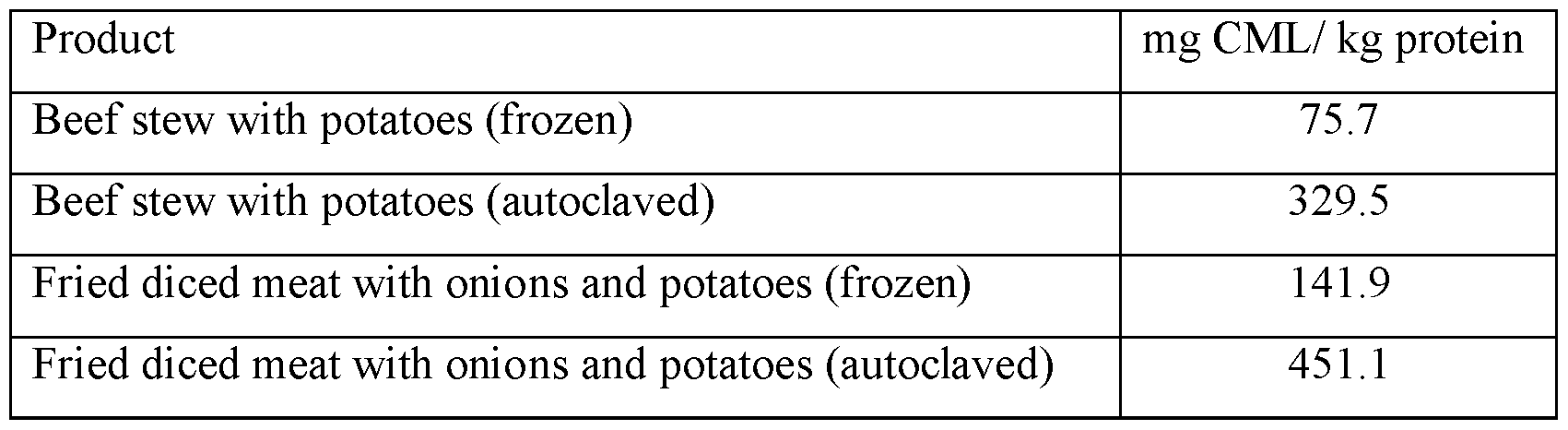
- CML levels are kept lower than 72 mg/kg protein, such as from 10 to 65, 15 to 65, 25 to 65, 25-45 or 20, 25, 30, 35-40, 45, 50 ,55, 60, 65, 70, 71 or 72 mg/kg protein as measured using ELISA methodology.
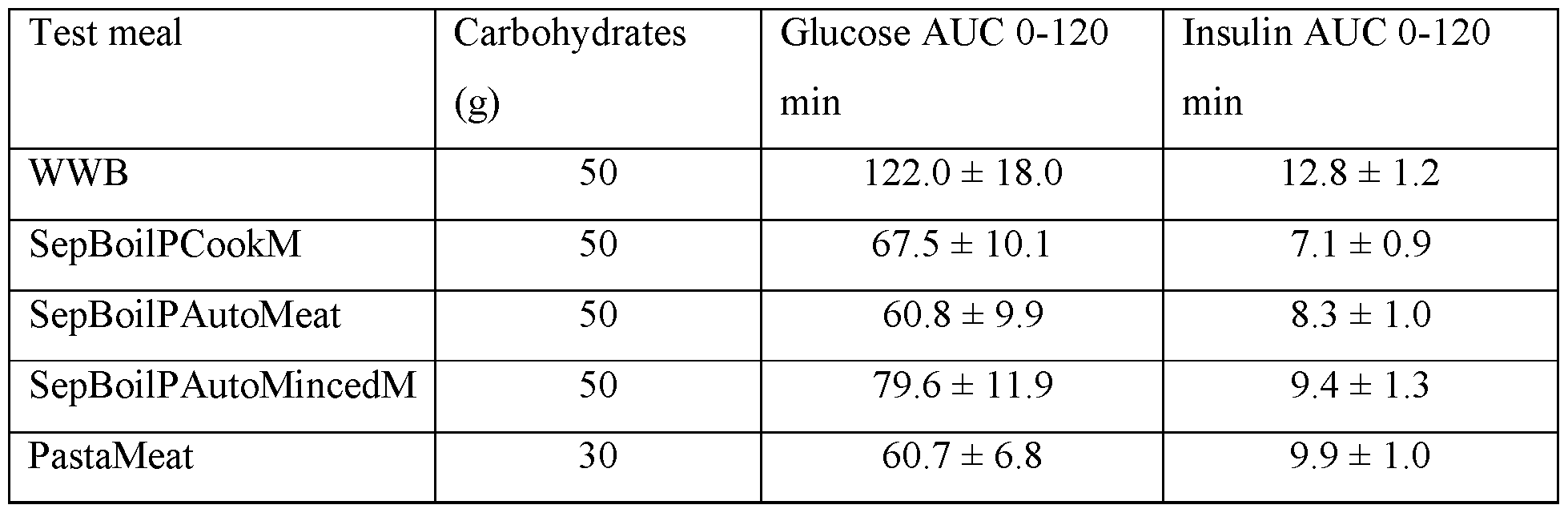
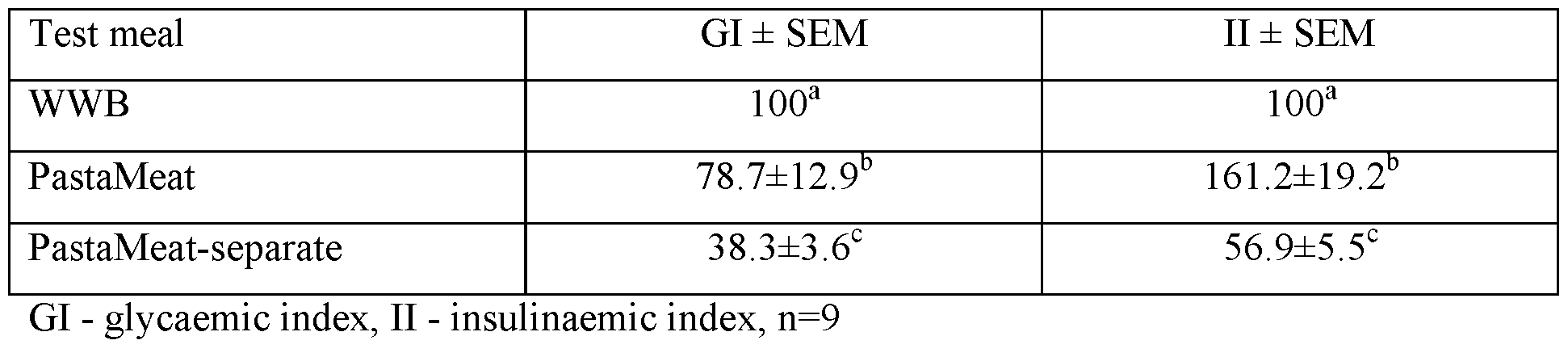
- the product of GI and II does not exceed 10000, preferably remain below 8000, most desirable below 4000.
- II is not more than 100% above the GI, preferably below 60%, most desirable below 50%.
- the carbohydrate containing meal component present within the product defined above is selected from the group consisting of cereals, pseudo-cereals, tubers, legumes in the form of pasta, potatoes, rice or combinations thereof.
- the protein containing meal component present within the product defined above is selected from the group consisting of meat, fish, poultry, egg, milk, protein rich vegetable sources from the group consisting of soy, quinoa, cereals, my co-protein or combinations thereof.
- the product may further comprise at least one probiotic bacteria, such as Lactobacillus, Bifidobacterium, Roseburia, Akkermancia, Prevotella or a combination thereof.
- the product may further contain at least one prebiotic carbohydrate, such as a prebiotic carbohydrate is extracted from or present in cereals, beans, milk or roots from the group consisting of inulins, fructans, arabinoxylans, arabinogalactans, galacto- oligosaccharides, beta-glucans, resistant starch, lactulose, raffinose, melibiose or combinations thereof.
- a prebiotic carbohydrate is extracted from or present in cereals, beans, milk or roots from the group consisting of inulins, fructans, arabinoxylans, arabinogalactans, galacto- oligosaccharides, beta-glucans, resistant starch, lactulose, raffinose, melibiose or combinations thereof.
- the invention in another aspect relates to a method of producing a nutritionally balanced composite meal for infants/small children, comprising at least one carbohydrate containing meal component and at least one protein containing meal component as defined above, comprising; a) a heat-treatment step in which said carbohydrate containing meal component and said protein containing meal component are separately heat-treated, and b) a packaging step in which said components are separately packed.
- the method as defined above includes cooking of the individual meal components at ambient pressure and with time/temperature conditions that guarantee gelatinization of starch and inactivation of enzyme inhibitors.
- the method as defined above comprising a step wherein said meal components are subjected to heat-treatment by boiling, oven-baking (conventional or convection oven), steam injection (such as UHT), infra-red- or microwave treatment, or combinations thereof.
- the method as defined above comprises a step wherein said heat treated meal components are dried and stored at ambient temperature or below +8°C in airtight and light protected packages; or immediately frozen and stored in a freezer also in air-tight and light protected packages.
- the method as defined above comprises a step wherein said meal components are
- the method as defined above comprising a step wherein said meal components are separately divided and frozen into suitable portions adjusted for the age of the infant.
- the metabolic syndrome (MetS) referring to the cluster of metabolic dysfunctions that identify individuals with risk of developing type 2 diabetes and cardio-vascular disease.
- Unduly high insulin response refers to a food property that causes higher acute insulinaemia to a test product than estimated from its acute glycaemic response as compared with insulin and glucose responses to a reference product.
- Nutritionally balanced refers to the presence of energy and essential nutrients in the appropriate amounts for the child in the meal 'as consumed'.
- GIxII stands for the product of glycaemic and insulinaemic indices, respectively and is used as a measure of overall impact of a composite meal on postprandial glucose and insulin levels.
- CML carboxymethyl-lysine
- a nutritionally balanced composite meal for infants/small children may include potatoes, rice, cereals e.g. in the form of pasta, pseudo-cereals, tubers, legumes, meat, fish, poultry, egg, milk, protein rich vegetable sources e.g. soy, quinoa, cereals, my co-protein, fats, oils, spices, herbs, vegetables, fruits, berries, vitamins, minerals, probiotic bacteria (e.g. Lactobacillus, Bifidobacterium, Roseburia, Akkermancia, Prevotella) , texturing agents, stabilisers, vinegar, prebiotics e.g.
- probiotic bacteria e.g. Lactobacillus, Bifidobacterium, Roseburia, Akkermancia, Prevotella
- AGE levels e.g. of CML should not exceed 72 mg/kg protein as analyzed using ELISA methodology (MicroCoat Biotechnologie GmbH, Bernried, Germany). AGE levels may also be determined using other methodologies, e.g. GC/MS or LC/MS, but the results obtained by different methods cannot be directly compared as discussed in [1]. Processing conditions should further not lead to high blood glucose or unduly high insulin responses in the post-prandial phase as estimated using established GI methodology [2]. A combined measure of glucose and insulin responses, defined as the product of the GI and II (GIxII) is used to determine the overall impact of a composite meal. The upper limit of GIxII is 10000, preferably below 8000, most desirable below 4000.
- Heat treatment of the separate meal components can be performed using e.g. boiling, oven- baking (conventional or convection oven), steam injection (such as UHT), infra-red- or microwave treatment.
- the choice of heat treatment is adjusted according to the characteristics of each meal component.
- Composite meals intended for infants and small children must be served with small particle size, and the particle size is adjusted to the age and/or preferences of each child.
- Small particle size can be obtained by disintegration, homogenization or mincing.
- the choice of method for reducing particle size is adjusted according to the characteristics of each meal component. The reduction in particle size can be performed before or after heat-treatment and/or freeze drying.
- the separate meal components may be packed into strands consisting of separable "units" made of e.g. plastic, paper, aluminium and coloured to identify the nutritional characteristic and facilitate the choice of a balanced composite meal.
- Units, or any combination of units may be stored in freezer (-20°C), fridge (below +5°C) or at ambient temperature (+20°C), depending on the preceding heat treatment.
- the meal components Prior to ingestion, the meal components are heated separately by use of e.g. microwave oven, warm water bath, household stove etc. Excessive cooking should be avoided which could be monitored using eg. a heat sensor on the microwave safe plate, or a plastic film cover with a valve that makes a sound when the food is warm enough to release a certain amount of steam.
- a colour key may be used, which would instruct what combination of meal components that is optimal.
- Protein containing components have one colour
- carbohydrate containing components have another and sauces
- vegetables have other specific colours.
- a table set including plates in e.g. plastic- composite or ceramic material, with colour segments according to the colour key, will facilitate the composition of a nutritionally balanced meal.
- Source of e.g. protein or carbohydrates, as well as type of sauce and vegetables can be adjusted to individual preferences as long as the colour key is complete.
- Composite meal including pasta and meat sauce intended for children at 12 months of age. Produced with severe heat-treatment (autoclaving) of all meal components together for ambient storage. Heated to eating temperature in warm water bath before CML-analysis and meal intervention.
- Tomato Tomato, water, carrot, onion, beef 8 %, pasta (durum wheat, egg), root celery, rice starch, rape seed oil 2 %, salt, basil, white pepper, oregano.
- Composite meal including pasta and meat sauce intended for children at 12 months of age. Produced with minimal heat treatment of meat sauce and pasta separately using microwaves. Heat treatment intended for cold storage. Heated to eating temperature in microwave oven before CML-analysis and meal intervention.
- Ingredients Water, tomato, carrot, onion, minced beef, pasta, tomato puree, root celery, maize starch, rape seed oil, salt, oregano, basil, white pepper
- Composite meal including white beans and salmon intended for children at 12 months of age. Produced with minimal heat treatment of precooked beans and salmon in milk based sauce (containing vegetables and spices) separately using microwaves. Heat treatment intended for cold storage. Heated to eating temperature in microwave oven before CML-analysis.
- Composite meal including chicken, potatoes and probiotic bacteria intended for children at 8 months of age. Produced with separate heat treatment of chicken in milk based sauce
- Composite meal including beef with potatoes, broccoli and tomato sauce, intended for children at 8 months of age. Minced beef was heat treated with water, tomato and spices, using microwave oven. The meat sauce was portioned in aluminium pouches marked with red colour and immediately frozen. Potatoes were boiled with parsnip, carrots and salt. After being mashed together with rape seed oil, the potato blend was portioned in aluminium pouches marked with white colour. Broccoli and onion was steamed and mashed together with rape seed oil, before being portioned in aluminium units marked with green colour. The different aluminum pouches were kept frozen in the supermarket and the family made a choice of different units at the time of purchase.
- Composite meal including pasta, salmon and peas intended for children at 12 months of age.
- Pasta was boiled in water and minced with rape seed oil before being frozen in units.
- Salmon was gently warmed together with root celery, milk, cream, lemon juice and spices.
- the resulting sauce was frozen in units.
- Green peas, sweet corn and onions were steamed before being minced and frozen in units.
- An appropriate combination of units was placed in a plastic, microwave safe plate and covered with plastic film including a valve.
- the plate was sold as a ready -to-eat meal for families eating outside home.
- the plate, still covered by the plastic film with valve was put in the microwave oven for heating to eating temperature. The heating was stopped immediately at the sound coming from the valve when the food was warm enough to release steam that opened the valve.
Landscapes
- Life Sciences & Earth Sciences (AREA)
- Health & Medical Sciences (AREA)
- Nutrition Science (AREA)
- Chemical & Material Sciences (AREA)
- Engineering & Computer Science (AREA)
- Food Science & Technology (AREA)
- Polymers & Plastics (AREA)
- Mycology (AREA)
- Pediatric Medicine (AREA)
- Coloring Foods And Improving Nutritive Qualities (AREA)
Abstract
Description

Claims
Priority Applications (9)
| Application Number | Priority Date | Filing Date | Title |
|---|---|---|---|
| CA2962736A CA2962736C (en) | 2013-10-18 | 2014-10-16 | A nutritionally balanced composite meal for infants and small children and a method of producing said meal |
| US15/030,117 US10292413B2 (en) | 2013-10-18 | 2014-10-16 | Nutritionally balanced composite meal for infants and small children and a method of producing said meal |
| DK14854588.2T DK3071052T3 (en) | 2013-10-18 | 2014-10-16 | NUTRITIONALLY BALANCED COMPOSITIVE MEAL FOR INFANT AND YOUNG CHILDREN AND PROCEDURE FOR PREPARING THE MEAL |
| ES14854588T ES2785330T3 (en) | 2013-10-18 | 2014-10-16 | Nutritionally balanced composite food for infants and young children and method of production of such food |
| CN201480057325.1A CN105705038B (en) | 2013-10-18 | 2014-10-16 | Nutritionally balanced complex diet for infants and young children and method for producing the same |
| EP14854588.2A EP3071052B1 (en) | 2013-10-18 | 2014-10-16 | A nutritionally balanced composite meal for infants and small children and a method of producing said meal |
| PL14854588T PL3071052T3 (en) | 2013-10-18 | 2014-10-16 | A nutritionally balanced composite meal for infants and small children and a method of producing said meal |
| RU2016116954A RU2016116954A (en) | 2013-10-18 | 2014-10-16 | Balanced nutritional value combined food product for young children and young children and a method of manufacturing the specified product |
| US16/398,469 US20190254329A1 (en) | 2013-10-18 | 2019-04-30 | Nutritionally balanced composite meal for infants and small children and a method of producing said meal |
Applications Claiming Priority (2)
| Application Number | Priority Date | Filing Date | Title |
|---|---|---|---|
| SE1330129-6 | 2013-10-18 | ||
| SE1330129 | 2013-10-18 |
Related Child Applications (2)
| Application Number | Title | Priority Date | Filing Date |
|---|---|---|---|
| US15/030,117 A-371-Of-International US10292413B2 (en) | 2013-10-18 | 2014-10-16 | Nutritionally balanced composite meal for infants and small children and a method of producing said meal |
| US16/398,469 Division US20190254329A1 (en) | 2013-10-18 | 2019-04-30 | Nutritionally balanced composite meal for infants and small children and a method of producing said meal |
Publications (1)
| Publication Number | Publication Date |
|---|---|
| WO2015057151A1 true WO2015057151A1 (en) | 2015-04-23 |
Family
ID=52828462
Family Applications (1)
| Application Number | Title | Priority Date | Filing Date |
|---|---|---|---|
| PCT/SE2014/051222 Ceased WO2015057151A1 (en) | 2013-10-18 | 2014-10-16 | A nutritionally balanced composite meal for infants and small children and a method of producing said meal |
Country Status (9)
| Country | Link |
|---|---|
| US (2) | US10292413B2 (en) |
| EP (1) | EP3071052B1 (en) |
| CN (1) | CN105705038B (en) |
| CA (1) | CA2962736C (en) |
| DK (1) | DK3071052T3 (en) |
| ES (1) | ES2785330T3 (en) |
| PL (1) | PL3071052T3 (en) |
| RU (1) | RU2016116954A (en) |
| WO (1) | WO2015057151A1 (en) |
Cited By (24)
| Publication number | Priority date | Publication date | Assignee | Title |
|---|---|---|---|---|
| US10322151B2 (en) | 2015-06-15 | 2019-06-18 | 4D Pharma Research Limited | Compositions comprising bacterial strains |
| US10391128B2 (en) | 2015-11-23 | 2019-08-27 | 4D Pharma Research Limited | Compositions comprising bacterial strains |
| US10391130B2 (en) | 2015-06-15 | 2019-08-27 | 4D Pharma Research Limited | Compositions comprising bacterial strains |
| KR20190111839A (en) * | 2018-03-22 | 2019-10-02 | 한국식품연구원 | Composition for inhibiting non-fluorescent advanced glycation end products and use of the same |
| US10456444B2 (en) | 2014-12-23 | 2019-10-29 | 4D Pharma Research Limited | Pirin polypeptide and immune modulation |
| US10471108B2 (en) | 2015-11-20 | 2019-11-12 | 4D Pharma Research Limited | Compositions comprising bacterial strains |
| US10485830B2 (en) | 2016-12-12 | 2019-11-26 | 4D Pharma Plc | Compositions comprising bacterial strains |
| US10493112B2 (en) | 2015-06-15 | 2019-12-03 | 4D Pharma Research Limited | Compositions comprising bacterial strains |
| US10500237B2 (en) | 2015-06-15 | 2019-12-10 | 4D Pharma Research Limited | Compositions comprising bacterial strains |
| US10583158B2 (en) | 2016-03-04 | 2020-03-10 | 4D Pharma Plc | Compositions comprising bacterial strains |
| US10610549B2 (en) | 2016-07-13 | 2020-04-07 | 4D Pharma Plc | Composition comprising bacterial strains |
| US10610550B2 (en) | 2015-11-20 | 2020-04-07 | 4D Pharma Research Limited | Compositions comprising bacterial strains |
| US10736926B2 (en) | 2015-06-15 | 2020-08-11 | 4D Pharma Research Limited | Compositions comprising bacterial strains |
| US10744166B2 (en) | 2015-11-23 | 2020-08-18 | 4D Pharma Research Limited | Compositions comprising bacterial strains |
| US10851137B2 (en) | 2013-04-10 | 2020-12-01 | 4D Pharma Research Limited | Polypeptide and immune modulation |
| US10987387B2 (en) | 2017-05-24 | 2021-04-27 | 4D Pharma Research Limited | Compositions comprising bacterial strain |
| US11007233B2 (en) | 2017-06-14 | 2021-05-18 | 4D Pharma Research Limited | Compositions comprising a bacterial strain of the genus Megasphera and uses thereof |
| US11013773B2 (en) | 2011-07-14 | 2021-05-25 | 4D Pharma Research Limited | Lactic acid bacterial strains |
| US11123379B2 (en) | 2017-06-14 | 2021-09-21 | 4D Pharma Research Limited | Compositions comprising bacterial strains |
| US11123378B2 (en) | 2017-05-22 | 2021-09-21 | 4D Pharma Research Limited | Compositions comprising bacterial strains |
| US11224620B2 (en) | 2016-07-13 | 2022-01-18 | 4D Pharma Plc | Compositions comprising bacterial strains |
| US11266698B2 (en) | 2011-10-07 | 2022-03-08 | 4D Pharma Research Limited | Bacterium for use as a probiotic for nutritional and medical applications |
| US11723933B2 (en) | 2014-12-23 | 2023-08-15 | Cj Bioscience, Inc. | Composition of bacteroides thetaiotaomicron for immune modulation |
| US12048720B2 (en) | 2017-06-14 | 2024-07-30 | Cj Bioscience, Inc. | Compositions comprising bacterial strains |
Citations (3)
| Publication number | Priority date | Publication date | Assignee | Title |
|---|---|---|---|---|
| WO2006029298A1 (en) | 2004-09-09 | 2006-03-16 | Nestec S.A. | Nutritional products having improved quality and methods and systems regarding same |
| EP2036447A1 (en) | 2007-09-07 | 2009-03-18 | Nestec S.A. | Process for producing infant food products |
| WO2010029825A1 (en) | 2008-09-12 | 2010-03-18 | Kumada Shuma | Nursing care food for people with difficulty in mastication, method for serving the same and food material set |
Family Cites Families (11)
| Publication number | Priority date | Publication date | Assignee | Title |
|---|---|---|---|---|
| US4194341A (en) * | 1977-12-05 | 1980-03-25 | Jsj Corporation | Hand operated filling and sealing device |
| DE2829036A1 (en) | 1978-07-01 | 1980-01-10 | Fresenius Chem Pharm Ind | Liq. feed mixt. contg. protein and carbohydrate components - sterilised separately to avoid formation of colour and off flavour |
| DE3562174D1 (en) | 1984-05-08 | 1988-05-26 | Unilever Nv | Food processing method |
| US20020090418A1 (en) * | 1999-01-13 | 2002-07-11 | Prevost John E. | Soy protein products and methods for producing soy protein products |
| NL1014380C2 (en) * | 2000-02-14 | 2001-08-15 | Friesland Brands Bv | Intestinal wall-strengthening food. |
| US9968120B2 (en) * | 2006-05-17 | 2018-05-15 | Dsm Nutritional Products Ag | Homogenized formulations containing microcapsules and methods of making and using thereof |
| US7987774B2 (en) * | 2007-03-16 | 2011-08-02 | Wenger Manufacturing, Inc. | Cooking extruder with enhanced steam injection properties |
| US9402412B2 (en) * | 2007-05-30 | 2016-08-02 | Nestec S.A. | Metabolic imprinting |
| EP2474239A1 (en) * | 2007-05-30 | 2012-07-11 | Nestec S.A. | Kit of nutritional compositions for infants with fat and carbohydrate content adapted to the particular stage of development |
| US20100072099A1 (en) | 2008-09-23 | 2010-03-25 | Judy Klein | Color coded identification system for a pack of containers |
| US20120031805A1 (en) | 2010-08-09 | 2012-02-09 | Stolarczyk Kathleen K | Daily Meal Planning System |
-
2014
- 2014-10-16 WO PCT/SE2014/051222 patent/WO2015057151A1/en not_active Ceased
- 2014-10-16 EP EP14854588.2A patent/EP3071052B1/en active Active
- 2014-10-16 DK DK14854588.2T patent/DK3071052T3/en active
- 2014-10-16 CA CA2962736A patent/CA2962736C/en active Active
- 2014-10-16 RU RU2016116954A patent/RU2016116954A/en not_active Application Discontinuation
- 2014-10-16 PL PL14854588T patent/PL3071052T3/en unknown
- 2014-10-16 US US15/030,117 patent/US10292413B2/en active Active
- 2014-10-16 ES ES14854588T patent/ES2785330T3/en active Active
- 2014-10-16 CN CN201480057325.1A patent/CN105705038B/en active Active
-
2019
- 2019-04-30 US US16/398,469 patent/US20190254329A1/en not_active Abandoned
Patent Citations (3)
| Publication number | Priority date | Publication date | Assignee | Title |
|---|---|---|---|---|
| WO2006029298A1 (en) | 2004-09-09 | 2006-03-16 | Nestec S.A. | Nutritional products having improved quality and methods and systems regarding same |
| EP2036447A1 (en) | 2007-09-07 | 2009-03-18 | Nestec S.A. | Process for producing infant food products |
| WO2010029825A1 (en) | 2008-09-12 | 2010-03-18 | Kumada Shuma | Nursing care food for people with difficulty in mastication, method for serving the same and food material set |
Cited By (45)
| Publication number | Priority date | Publication date | Assignee | Title |
|---|---|---|---|---|
| US11013773B2 (en) | 2011-07-14 | 2021-05-25 | 4D Pharma Research Limited | Lactic acid bacterial strains |
| US11266698B2 (en) | 2011-10-07 | 2022-03-08 | 4D Pharma Research Limited | Bacterium for use as a probiotic for nutritional and medical applications |
| US11414463B2 (en) | 2013-04-10 | 2022-08-16 | 4D Pharma Research Limited | Polypeptide and immune modulation |
| US10851137B2 (en) | 2013-04-10 | 2020-12-01 | 4D Pharma Research Limited | Polypeptide and immune modulation |
| US10973872B2 (en) | 2014-12-23 | 2021-04-13 | 4D Pharma Research Limited | Pirin polypeptide and immune modulation |
| US11723933B2 (en) | 2014-12-23 | 2023-08-15 | Cj Bioscience, Inc. | Composition of bacteroides thetaiotaomicron for immune modulation |
| US10456444B2 (en) | 2014-12-23 | 2019-10-29 | 4D Pharma Research Limited | Pirin polypeptide and immune modulation |
| US11433106B2 (en) | 2015-06-15 | 2022-09-06 | 4D Pharma Research Limited | Compositions comprising bacterial strains |
| US10744167B2 (en) | 2015-06-15 | 2020-08-18 | 4D Pharma Research Limited | Compositions comprising bacterial strains |
| US10493112B2 (en) | 2015-06-15 | 2019-12-03 | 4D Pharma Research Limited | Compositions comprising bacterial strains |
| US11040075B2 (en) | 2015-06-15 | 2021-06-22 | 4D Pharma Research Limited | Compositions comprising bacterial strains |
| US10322151B2 (en) | 2015-06-15 | 2019-06-18 | 4D Pharma Research Limited | Compositions comprising bacterial strains |
| US11389493B2 (en) | 2015-06-15 | 2022-07-19 | 4D Pharma Research Limited | Compositions comprising bacterial strains |
| US10391130B2 (en) | 2015-06-15 | 2019-08-27 | 4D Pharma Research Limited | Compositions comprising bacterial strains |
| US10736926B2 (en) | 2015-06-15 | 2020-08-11 | 4D Pharma Research Limited | Compositions comprising bacterial strains |
| US11273185B2 (en) | 2015-06-15 | 2022-03-15 | 4D Pharma Research Limited | Compositions comprising bacterial strains |
| US10500237B2 (en) | 2015-06-15 | 2019-12-10 | 4D Pharma Research Limited | Compositions comprising bacterial strains |
| US10780134B2 (en) | 2015-06-15 | 2020-09-22 | 4D Pharma Research Limited | Compositions comprising bacterial strains |
| US11331352B2 (en) | 2015-06-15 | 2022-05-17 | 4D Pharma Research Limited | Compositions comprising bacterial strains |
| US10864236B2 (en) | 2015-06-15 | 2020-12-15 | 4D Pharma Research Limited | Compositions comprising bacterial strains |
| US10471108B2 (en) | 2015-11-20 | 2019-11-12 | 4D Pharma Research Limited | Compositions comprising bacterial strains |
| US10610550B2 (en) | 2015-11-20 | 2020-04-07 | 4D Pharma Research Limited | Compositions comprising bacterial strains |
| US11058732B2 (en) | 2015-11-20 | 2021-07-13 | 4D Pharma Research Limited | Compositions comprising bacterial strains |
| US10744166B2 (en) | 2015-11-23 | 2020-08-18 | 4D Pharma Research Limited | Compositions comprising bacterial strains |
| US10391128B2 (en) | 2015-11-23 | 2019-08-27 | 4D Pharma Research Limited | Compositions comprising bacterial strains |
| US10583158B2 (en) | 2016-03-04 | 2020-03-10 | 4D Pharma Plc | Compositions comprising bacterial strains |
| US10610549B2 (en) | 2016-07-13 | 2020-04-07 | 4D Pharma Plc | Composition comprising bacterial strains |
| US11224620B2 (en) | 2016-07-13 | 2022-01-18 | 4D Pharma Plc | Compositions comprising bacterial strains |
| US10610548B2 (en) | 2016-07-13 | 2020-04-07 | 4D Pharma Plc | Compositions comprising bacterial strains |
| US10967010B2 (en) | 2016-07-13 | 2021-04-06 | 4D Pharma Plc | Compositions comprising bacterial strains |
| US10960031B2 (en) | 2016-07-13 | 2021-03-30 | 4D Pharma Plc | Compositions comprising bacterial strains |
| US10543238B2 (en) | 2016-12-12 | 2020-01-28 | 4D Pharma Plc | Compositions comprising bacterial strains |
| US10485830B2 (en) | 2016-12-12 | 2019-11-26 | 4D Pharma Plc | Compositions comprising bacterial strains |
| US10898526B2 (en) | 2016-12-12 | 2021-01-26 | 4D Pharma Plc | Compositions comprising bacterial strains |
| US11382936B2 (en) | 2017-05-22 | 2022-07-12 | 4D Pharma Research Limited | Compositions comprising bacterial strains |
| US11123378B2 (en) | 2017-05-22 | 2021-09-21 | 4D Pharma Research Limited | Compositions comprising bacterial strains |
| US11376284B2 (en) | 2017-05-22 | 2022-07-05 | 4D Pharma Research Limited | Compositions comprising bacterial strains |
| US10987387B2 (en) | 2017-05-24 | 2021-04-27 | 4D Pharma Research Limited | Compositions comprising bacterial strain |
| US11007233B2 (en) | 2017-06-14 | 2021-05-18 | 4D Pharma Research Limited | Compositions comprising a bacterial strain of the genus Megasphera and uses thereof |
| US11123379B2 (en) | 2017-06-14 | 2021-09-21 | 4D Pharma Research Limited | Compositions comprising bacterial strains |
| US11660319B2 (en) | 2017-06-14 | 2023-05-30 | 4D Pharma Research Limited | Compositions comprising bacterial strains |
| US11779613B2 (en) | 2017-06-14 | 2023-10-10 | Cj Bioscience, Inc. | Compositions comprising a bacterial strain of the genus Megasphera and uses thereof |
| US12048720B2 (en) | 2017-06-14 | 2024-07-30 | Cj Bioscience, Inc. | Compositions comprising bacterial strains |
| KR102230571B1 (en) * | 2018-03-22 | 2021-03-22 | 한국식품연구원 | Composition for inhibiting non-fluorescent advanced glycation end products and use of the same |
| KR20190111839A (en) * | 2018-03-22 | 2019-10-02 | 한국식품연구원 | Composition for inhibiting non-fluorescent advanced glycation end products and use of the same |
Also Published As
| Publication number | Publication date |
|---|---|
| CN105705038B (en) | 2020-07-28 |
| PL3071052T3 (en) | 2020-07-27 |
| RU2016116954A (en) | 2017-11-23 |
| ES2785330T3 (en) | 2020-10-06 |
| CN105705038A (en) | 2016-06-22 |
| EP3071052B1 (en) | 2020-02-26 |
| EP3071052A4 (en) | 2017-05-31 |
| DK3071052T3 (en) | 2020-04-27 |
| CA2962736C (en) | 2021-08-31 |
| EP3071052A1 (en) | 2016-09-28 |
| US10292413B2 (en) | 2019-05-21 |
| CA2962736A1 (en) | 2015-04-23 |
| US20160278423A1 (en) | 2016-09-29 |
| US20190254329A1 (en) | 2019-08-22 |
Similar Documents
| Publication | Publication Date | Title |
|---|---|---|
| CA2962736C (en) | A nutritionally balanced composite meal for infants and small children and a method of producing said meal | |
| Hosseini et al. | Gluten-free products in celiac disease: Nutritional and technological challenges and solutions | |
| Munir et al. | Green banana resistant starch: A promising potential as functional ingredient against certain maladies | |
| Amagloh et al. | A household‐level sweet potato‐based infant food to complement vitamin A supplementation initiatives | |
| Silva et al. | Stability of cassava flour-based food bars | |
| Mańkiewicz-Żurawska et al. | Nutrition of children and adolescents with type 1 diabetes in the recommendations of the Mediterranean diet | |
| Krishnan et al. | Health based pasta: redefining the concept of the next generation convenience food | |
| Tang et al. | Whole flaxseed-based products and their health benefits | |
| Jeelani et al. | Baby foods based on cereals | |
| AU2009276085A1 (en) | Pasta composition for dehydrated food matrices | |
| WO2017005987A1 (en) | Natural oat drink comprising drinkable porridge | |
| Flaczyk et al. | The influence of inulin addition as fat substitute on reducing energy value and consumer acceptance of model pork meatballs | |
| Olawoye et al. | Celiac disease management through gluten-free diets | |
| Pandey et al. | Exploring the significance of resistant starch in ready-to-eat meals for enhanced functioning of gut microbiota: a comprehensive review: VK Pandey et al. | |
| Roy et al. | Gluten‐Free Products: A Strategy for a Nutritionally Appropriate, Balanced Diet for Celiac Patients and Children | |
| HK1229168A1 (en) | A nutritionally balanced composite meal for infants and small children and a method of producing said meal | |
| HK1229168B (en) | A nutritionally balanced composite meal for infants and small children and a method of producing said meal | |
| TW200917972A (en) | Range of shelf stable infant foods which include only naturally contained sugars and methods for making the same | |
| Vaidya et al. | Glycemic index of Indian cereal staple foods and their relationship to diabetes and metabolic syndrome | |
| Karadaş | Advanced glycation end products in foods | |
| Saroh et al. | Satiation and Satiety in High-fiber Meatball Consumption. | |
| Muldoon | The glycaemic index of fresh and processed potatoes | |
| Anyimadu et al. | Effects of Food Components, Processing Technologies, Additives, and Processed Food on Gut Health | |
| Sandhu et al. | Ready-to-Eat Foods and Therapeutics: A Healthy Perception | |
| Kohutiar et al. | A real-life manual for the identification of ultra-processed food and its use in lifestyle disease prevention |
Legal Events
| Date | Code | Title | Description |
|---|---|---|---|
| 121 | Ep: the epo has been informed by wipo that ep was designated in this application |
Ref document number: 14854588 Country of ref document: EP Kind code of ref document: A1 |
|
| NENP | Non-entry into the national phase |
Ref country code: DE |
|
| WWE | Wipo information: entry into national phase |
Ref document number: 15030117 Country of ref document: US |
|
| REEP | Request for entry into the european phase |
Ref document number: 2014854588 Country of ref document: EP |
|
| WWE | Wipo information: entry into national phase |
Ref document number: 2014854588 Country of ref document: EP |
|
| ENP | Entry into the national phase |
Ref document number: 2016116954 Country of ref document: RU Kind code of ref document: A |
|
| ENP | Entry into the national phase |
Ref document number: 2962736 Country of ref document: CA |