WO2014207671A2 - Personal safety system and a method thereof - Google Patents
Personal safety system and a method thereof Download PDFInfo
- Publication number
- WO2014207671A2 WO2014207671A2 PCT/IB2014/062586 IB2014062586W WO2014207671A2 WO 2014207671 A2 WO2014207671 A2 WO 2014207671A2 IB 2014062586 W IB2014062586 W IB 2014062586W WO 2014207671 A2 WO2014207671 A2 WO 2014207671A2
- Authority
- WO
- WIPO (PCT)
- Prior art keywords
- heart rate
- data
- personal safety
- response system
- sensory
- Prior art date
- Legal status (The legal status is an assumption and is not a legal conclusion. Google has not performed a legal analysis and makes no representation as to the accuracy of the status listed.)
- Ceased
Links
Classifications
-
- A—HUMAN NECESSITIES
- A61—MEDICAL OR VETERINARY SCIENCE; HYGIENE
- A61B—DIAGNOSIS; SURGERY; IDENTIFICATION
- A61B5/00—Measuring for diagnostic purposes; Identification of persons
- A61B5/0002—Remote monitoring of patients using telemetry, e.g. transmission of vital signals via a communication network
- A61B5/0015—Remote monitoring of patients using telemetry, e.g. transmission of vital signals via a communication network characterised by features of the telemetry system
- A61B5/0022—Monitoring a patient using a global network, e.g. telephone networks, internet
-
- A—HUMAN NECESSITIES
- A61—MEDICAL OR VETERINARY SCIENCE; HYGIENE
- A61B—DIAGNOSIS; SURGERY; IDENTIFICATION
- A61B5/00—Measuring for diagnostic purposes; Identification of persons
- A61B5/02—Detecting, measuring or recording for evaluating the cardiovascular system, e.g. pulse, heart rate, blood pressure or blood flow
- A61B5/0205—Simultaneously evaluating both cardiovascular conditions and different types of body conditions, e.g. heart and respiratory condition
-
- A—HUMAN NECESSITIES
- A61—MEDICAL OR VETERINARY SCIENCE; HYGIENE
- A61B—DIAGNOSIS; SURGERY; IDENTIFICATION
- A61B5/00—Measuring for diagnostic purposes; Identification of persons
- A61B5/02—Detecting, measuring or recording for evaluating the cardiovascular system, e.g. pulse, heart rate, blood pressure or blood flow
- A61B5/024—Measuring pulse rate or heart rate
-
- A—HUMAN NECESSITIES
- A61—MEDICAL OR VETERINARY SCIENCE; HYGIENE
- A61B—DIAGNOSIS; SURGERY; IDENTIFICATION
- A61B5/00—Measuring for diagnostic purposes; Identification of persons
- A61B5/103—Measuring devices for testing the shape, pattern, colour, size or movement of the body or parts thereof, for diagnostic purposes
- A61B5/11—Measuring movement of the entire body or parts thereof, e.g. head or hand tremor or mobility of a limb
- A61B5/1112—Global tracking of patients, e.g. by using GPS
-
- A—HUMAN NECESSITIES
- A61—MEDICAL OR VETERINARY SCIENCE; HYGIENE
- A61B—DIAGNOSIS; SURGERY; IDENTIFICATION
- A61B5/00—Measuring for diagnostic purposes; Identification of persons
- A61B5/16—Devices for psychotechnics; Testing reaction times ; Devices for evaluating the psychological state
- A61B5/165—Evaluating the state of mind, e.g. depression, anxiety
-
- G—PHYSICS
- G08—SIGNALLING
- G08B—SIGNALLING OR CALLING SYSTEMS; ORDER TELEGRAPHS; ALARM SYSTEMS
- G08B21/00—Alarms responsive to a single specified undesired or abnormal condition and not otherwise provided for
- G08B21/02—Alarms for ensuring the safety of persons
-
- G—PHYSICS
- G16—INFORMATION AND COMMUNICATION TECHNOLOGY [ICT] SPECIALLY ADAPTED FOR SPECIFIC APPLICATION FIELDS
- G16H—HEALTHCARE INFORMATICS, i.e. INFORMATION AND COMMUNICATION TECHNOLOGY [ICT] SPECIALLY ADAPTED FOR THE HANDLING OR PROCESSING OF MEDICAL OR HEALTHCARE DATA
- G16H40/00—ICT specially adapted for the management or administration of healthcare resources or facilities; ICT specially adapted for the management or operation of medical equipment or devices
- G16H40/60—ICT specially adapted for the management or administration of healthcare resources or facilities; ICT specially adapted for the management or operation of medical equipment or devices for the operation of medical equipment or devices
- G16H40/67—ICT specially adapted for the management or administration of healthcare resources or facilities; ICT specially adapted for the management or operation of medical equipment or devices for the operation of medical equipment or devices for remote operation
-
- A—HUMAN NECESSITIES
- A61—MEDICAL OR VETERINARY SCIENCE; HYGIENE
- A61B—DIAGNOSIS; SURGERY; IDENTIFICATION
- A61B5/00—Measuring for diagnostic purposes; Identification of persons
- A61B5/02—Detecting, measuring or recording for evaluating the cardiovascular system, e.g. pulse, heart rate, blood pressure or blood flow
- A61B5/024—Measuring pulse rate or heart rate
- A61B5/02416—Measuring pulse rate or heart rate using photoplethysmograph signals, e.g. generated by infrared radiation
-
- A—HUMAN NECESSITIES
- A61—MEDICAL OR VETERINARY SCIENCE; HYGIENE
- A61B—DIAGNOSIS; SURGERY; IDENTIFICATION
- A61B5/00—Measuring for diagnostic purposes; Identification of persons
- A61B5/145—Measuring characteristics of blood in vivo, e.g. gas concentration or pH-value ; Measuring characteristics of body fluids or tissues, e.g. interstitial fluid or cerebral tissue
- A61B5/14539—Measuring characteristics of blood in vivo, e.g. gas concentration or pH-value ; Measuring characteristics of body fluids or tissues, e.g. interstitial fluid or cerebral tissue for measuring pH
-
- Y—GENERAL TAGGING OF NEW TECHNOLOGICAL DEVELOPMENTS; GENERAL TAGGING OF CROSS-SECTIONAL TECHNOLOGIES SPANNING OVER SEVERAL SECTIONS OF THE IPC; TECHNICAL SUBJECTS COVERED BY FORMER USPC CROSS-REFERENCE ART COLLECTIONS [XRACs] AND DIGESTS
- Y02—TECHNOLOGIES OR APPLICATIONS FOR MITIGATION OR ADAPTATION AGAINST CLIMATE CHANGE
- Y02A—TECHNOLOGIES FOR ADAPTATION TO CLIMATE CHANGE
- Y02A90/00—Technologies having an indirect contribution to adaptation to climate change
- Y02A90/10—Information and communication technologies [ICT] supporting adaptation to climate change, e.g. for weather forecasting or climate simulation
Definitions
- the present invention relates generally to safety systems. More particularly, the invention relates to a personal safety response system and a method for detecting heart rate of an individual and finding a plurality of physiological parameters. It may be used for sensing different physiological parameters and providing an alert for predefined parameters.
- the application area may include but is not limited to detecting and alerting for changes in physiological conditions when confronted with a frightful situation, increase/decrease in blood sugar level etc.
- the science of fear is the reason of innovation of such a device which works on its own, operates automatically and provides help as soon as possible when confronted with a situation.
- Amydgala the emotional part of the Brain called Amydgala which is always looking for threats to our body starts working in overdrive. It sends the signal thru our autonomous nervous system to the adrenal glands to prepare our body for an attack. This is all done automatically by our brain to create reflex action.
- the Adrenal Glands rush Cortisol and Adrenaline in the Blood and the blood is rushed to the muscles to prepare for a Fight or Flight syndrome. All other internal process of Digestion in stomach and all are stopped and the focus gets shifted to the muscle, thus wanting more Oxygen in the blood.
- US 831 1770 describe an activity monitoring system that includes a device that monitors and displays the physical activity of the user that includes a motion sensor and an altitude sensor.
- US2012/0172684 describes a heart rate monitor that is in the form of a wristwatch and continuously monitors the heart rate and sends signals to another device that runs an application that decodes the processing data, processes the signal and transmits it back to the wristwatch device
- US 8033959 describes a portable fitness monitoring system that combines a monitoring device with a sensor and provides performance data logging and entertainment to the user.
- US 8398546 describes a nutrition and activity management system that includes a device such as an armband that transmits the physiological parameters of the wearer to a remote location for later manipulation and presentation to the recipient over an electronic network such as the Internet.
- KR20100077942 describes a lifesaving system in the form of a wrist watch that often checks the heart rate of the wearer and sends a distress signal to a pre-determined location on the heart beat being suddenly stopped.
- US6338719 describes a system for detecting various vascular conditions using an occlusive arm cuff plethysmograph.
- the processing means diagnoses and predicts various vascular conditions pertaining to the patient by comparing or correlating the analyzed arterial and endothelial function data with the computer models stored within the database and presents the findings on a display. All these inventions suffer from the drawback that they do not register a sudden change in the physiological condition of the user that feeds and triggers a mobile application that sends messages and/or alarms to preset destinations. Detection of different physiological conditions using fitness bands is also debatable as provided in the following news article by Nick Bilton:
- None of the of the above-mentioned prior arts describe a device that can be safely ensconced in the inner wear of the wearer, especially a female, and transmit the sudden change in the physiological condition on facing a certain situation, for instance that of danger, to a second device and automatically trigger the mobile application in the second device to send signals to pre-determined destinations.
- the present invention provides a personal safety system.
- the personal safety system comprises a device for sensing the physiological changes in the body in different situations like at the time of confronting a frightful situation, transmits the change to a second device and activates a mobile application in the second device that sends the signals to pre-determined locations.
- a basic object of the present invention is to overcome the disadvantages/drawbacks of the known art.
- Another object of the present invention is to provide a personal safety system for detecting heart rate and finding the physiological parameters.
- Another object of the invention is to provide a device that can be securely ensconced in the inner wear of the user, away from prying eyes and has a skin like feel to it.
- Another object of the invention is to provide a device that can be planted in a place that is not easy for an attacker to dispossess the wearer of.
- Another object of the present invention is to provide a method for detecting heart rate and finding the physiological parameters using a personal safety system.
- Another object of the present invention is to provide a processing means preprogrammed for sampling the plurality of heart beats and configured for providing a plurality of signals each corresponding to different physiological parameters and generating an output instruction to be transmitted to a plurality of receiving stations.
- Another object of the present invention is to provide a processing means calibrated for sensing the physiological changes in the body at the time of confronting a frightful situation.
- Another object of the present invention is to provide a data server integrated to a web portal for instant location tracking of the individual.
- Another object of the present invention is to detect changes in physiological conditions on confronting a frightful situation like change in heart rate, blood sugar, etc.
- Another object of the present invention is to detect physiological conditions like heart rate, blood sugar etc. Another object of the present invention is to provide a processing means adapted for providing a route map and contact of the nearest police station on a display means.
- Yet another object of the present invention is to provide a compact, self contained and flexible personal safety system.
- a personal safety response system for detecting heart rate of an individual and finding a plurality of physiological parameters, the system comprising: a sensory means housed in a housing means ensconced in the inner wear of an individual for continuously detecting a plurality of heart rate data and integrated to a data acquisition unit to record the heart rate data; a transmission means integrated to said data acquisition unit for transmitting the heart rate data detected by the sensory means; a processing means coupled to the transmission means and said sensory means; a computing means having said processing means integrated therein, wherein said processing means preprogrammed for sampling the plurality of heart rate data readings for detecting a jump in the heart rate compared to preceding heart rate readings and generating an output instruction automatically to be transmitted to a plurality of receiving stations thus providing a self-triggering system.
- Another aspect of the present invention provides a method for detecting a heart rate of an individual and finding a plurality of physiological parameters using a personal safety response system, the method comprising: detecting a plurality of heart rate data using a sensory means housed in a housing means ensconced in the inner wear of an individual and said sensory means integrated to a data acquisition unit to record the heart rate data; transmitting the heart rate data detected by the sensory means through a transmission means integrated to said data acquisition unit and a processing means coupled to the transmission means and said sensory means integrated to a computing means; wherein said processing means preprogrammed for sampling the plurality of heart rate data readings for detecting a jump in the heart rate compared to preceding heart rate readings and generating an output instruction automatically to be transmitted to a plurality of receiving stations thus providing a self-triggering system.
- a device forming part of the personal safety response system for detecting a heart rate comprising: a sensory means substantially a photoplethysmogram (PPG) integrated to a microcontroller housed in a housing means ensconced in the inner wear of an individual for detecting heart rate data; a data acquisition unit integrated to said sensory means to record the heart rate data; a transmission means substantially a BluetoothTM or the likes integrated to said data acquisition unit for transmitting the heart rate data detected by the sensory means, said sensory means and transmission means are integrated to a switching means for providing an ON or OFF control during operation of the sensory means and the transmission means; a resetting means to reactivate the sensory means; a powering means attached thereto for powering the sensory means, said powering means comprising a charging slot for recharging the powering means; a holding means attached to said housing means for clamping on the innerwear of the individual.
- PPG photoplethysmogram
- Another aspect of the present invention provides a processing means generating the output instruction based on a predefined calibration to be transmitted to a plurality of receiving stations and sending a continuous tracking data to a data server, said data server integrated to a web portal for an instant location tracking of the individual.
- Another aspect of the present invention provides a processing means preprogrammed for sensing the physiological changes and generating an output instruction based on a predefined calibration to detect the plurality of physiological conditions like rise/drop in blood sugar and the likes based on the heart rate data.
- Fig 1 shows the personal safety response system for detecting a heart rate and finding a plurality of physiological parameters.
- Fig 2 shows the sensory means housed in a housing means ensconced in the inner wear of an individual for detecting heart rate data.
- Fig 3 shows the computing means.
- Fig 4 shows the message flow from the computing means to data server and plurality of receiving stations.
- Fig 5 shows an instant location tracking of the individual on a web portal.
- Fig 6A shows the top view of the PCB of the sensor means.
- Fig 6B shows the bottom view of the PCB of the sensor means.
- Fig 7A shows the top view of the outer shell.
- Fig 7B shows the bottom view of the sensory means.
- Fig 7C shows the side view of the sensory means.
- Fig 8 shows the flow diagram of the method steps of the working of the system.
- TRANSMISSION MEANS LIKEA BLUETOOTHB PROCESSING MEANSC DATABASED MEMORY MEANS
- one aspect the present invention is directed to a personal safety response system (100) and a method for detecting heart rate of an individual and finding a plurality of physiological parameters based on the heart rate data readings.
- the safety response system (100) includes a sensory means (101 ) which continuously detects a plurality of heart rate data.
- the sensory means (101 ) is ensconced in the inner wear of an individual.
- the housing means (101 A, 101 H) which includes a physical size & shape including the material of the housing means (101 A, 101 H) is such that it facilitates a proper coupling to the user.
- the housing means (101 A. 101 H) may preferably be made of soft silica and the like which can be comfortably carried in all the weather conditions. It may preferably be water resistant so as to protect the inner electronic components.
- Housing means top (101A) and housing means bottom (101 H) are joint at housing joint (600) to define the housing means (101 A, 101 H).
- the sensory means (101 ) is placed on the bridge of the bra and the triangular form of the sensory means (101 ) makes it fit well in between the bust area.
- the placement is ideal as the wearer does not feel discomfort wearing it for long intervals.
- the bottom strap of the bra keeps the sensor tightly fastened to the skin minimizing the data loss. The strap also doesn't let the sensor move from its place which again could result in the data loss.
- the holding means (101 1) for clamping may be a transparent plastic so as to take the color of the innerwear and keep the setup in its exact place.
- the holding means (101 1) is attached to the sensor with a spring action to keep it hanging with the innerwear.
- the sensory means interface (101 D) remains in contact with the skin of the body.
- the sensory means (101 ) is substantially a photoplethysmogram (PPG) sensor integrated to a microcontroller (101 F) for determining the heart rate data.
- the sensory means (101 ) is integrated to a data acquisition unit which forms part of the microcontroller (101 F) to record the heart rate data.
- the change in volume caused by the pressure pulse is detected by illuminating the skin with the light from the LED and then measuring the amount of light either transmitted or reflected to a photodiode.
- the sensory means (101 ) is a noninvasive transducer that measures relative changes in blood volume or the oxygen saturation under the skin in the chest area.
- the blood volume pulse (BVP) sensor reads the relative changes in blood volume.
- BVP blood volume pulse
- the photodiode output level is affected by variation in the level of light absorption.
- the LED Emitter and the Photo detector are placed side by side to reduce the space and size of the measuring site, making it place over the skin and not in-between 2 LEDS.
- the device acquires the PPG data, processes it and then sends it to a processing means/telementary manager, say a phone (Smart Phone) which has a decoding application installed in it.
- a processing means/telementary manager say a phone (Smart Phone) which has a decoding application installed in it.
- the transmission means is substantially a BluetoothTM or the likes.
- the transmission means is further coupled to a processing means which in turn is integrated within the computing means (102).
- the transmission means (102A) makes use of a BluetoothTM transmitter (101 E) on the sensory means (101 ) and a BluetoothTM receiver on the computing means (102). Data transmission is established after pairing between the transmitter and receiver.
- the transmission means may comprise a wireless mode like BluetoothTM (BLE) at a very non harmful frequency of 2.4 Ghz of Radio frequency thus giving a real time heart rate of the user.
- the computing means (102) is substantially a smart phone or the like computing device.
- the processing means is integrated within the computing means (102) and is having a software program, a mobile application or the like installed therein to process the heart rate readings.
- the software/application program can be activated only after the user validation by entering the username and password. If the validation is correct, only then the whole sequence of the application is processed.
- the web call object sends the encrypted data to the data server (103) for authentication, the response is received in the callback, and in case of affirmative response, user details are stored in the application memory and the user is taken to the main screen. Appropriate error messages are given in case otherwise.
- the sign up process is almost similar to the login process instead the values concerned here are full name, username, password and email.
- the processing means is preprogrammed for sampling the plurality of heart rate data readings.
- the processing means is configured to sample last five readings.
- the processing means further compares the next sampled heart rate readings to the preceding heart rate reading and detects a jump in the heart rate compared to preceding heart rate readings if any.
- the processing means is calibrated to detect a jump of around 20 percent preferably for detection of fearful situation.
- the processing means includes a database of heart rates pertaining to different physiological conditions including but not limited to fearful situation wherein heart rate range of around 1 10 to 150 has been defined. More precisely, a range of heart rate between 115 to 140 along with a jump of 20 percent in heart rate would be calibrated preferably to detect the fearful situation.
- the database comprises a plurality of heart rate ranges qualifying for different physiological conditions. After finding a matching physiological parameter, an output instruction is generated automatically to be transmitted to a plurality of receiving stations thus providing a self-triggering system.
- a processing means that enable the computing means (102) to auto answer incoming signal thereby providing firsthand information of the individual.
- the processing means generates the output instruction based on a predefined calibration and transmits the same to a plurality of receiving stations and a continuous tracking data to a data server (103).
- the receiving station among others may include the smart phone and the likes of relatives, friends, police etc. the receiving station may comprise: receiving station friend (104), receiving station relative (105), receiving station police (106).
- the communication between the computing means (102) and the receiving stations including the data server (103) is facilitated through a data network like Wi-Fi, or mobile network like GSM, CDMA or the like.
- the data server is programmed for triggering a nearest user of said safety response system.
- the data server collects the tracking details of the user continuously and triggers the nearest user who can assist at the time of distress.
- the personal safety response system users can therefore develop a community and help each other at the time of distress.
- the data server (103) is integrated to a web portal for an instant location tracking of the individual on display means (107). Additionally, the processing means is programmed for providing a route map and contact of the nearest police station on a display means (107).
- Another aspect of the invention provides a processing means enabling the computing means (102) to provide a continuous voice recording live feeds from the individual's vicinity to the data server (103).
- a function with the name 'startSession' is responsible for notifying the data server (103) of a threat and creating a separate session for it so that the location tracking and sensor data can be logged with respect to the current session.
- a police siren After receiving response from the data server (103) confirming a fearful situation, a police siren starts playing and the web call for sending mails/messages is made. 'sendMail' function is made to reoccur approximately after 3 minutes with the help of a timer function.
- an audio recording in short bursts of approximately 5 seconds are facilitated, recorded and stored in the phone's application memory. This code starts the audio recording and restarts the process after saving a 5 second record.
- the system among others may make use of GoogleTM places API. It also facilitates route map of the nearest police station to the victim and shows driving directions for it.
- the web service gets the result and uses GoogleTM Maps API to show driving directions on the phone.
- This particular function gets the nearest station coordinates and then uses driving directions API to get the route.
- the powering means (101 G) comprises a charging slot for recharging the powering means (101 G). It can be a micro USB charging point and the like.
- the powering means (101 G) may comprise 300MH lithium Ion Battery.
- One exemplary embodiment provides a battery life indicator (101 B)
- Soft TPU rubber material may be used to cover the micro USB port for preventing the moisture or sweat from entering into the Circuit.
- the outer layer of the hard shell may be covered with soft silica also known as silicone to give a skin like feel to the device and to make it comfortable and easy to wear for a long time.
- the system in accordance to the present invention detects a plurality of physiological conditions like rise/drop in blood sugar and the likes based on the heart rate data.
- the device provides a device forming part of the personal safety response system (100) for detecting a heart rate.
- the device among others comprises a sensory means (101 ) substantially a photoplethysmogram (PPG) integrated to a microcontroller (101 F) housed in a housing means (101 A, 101 H) ensconced in the inner wear of an individual for detecting heart rate data.
- a data acquisition unit integrated to the sensory means (101 ) to record the heart rate data.
- the transmission means is substantially a BluetoothTM or the likes integrated to the data acquisition unit for transmitting the heart rate data detected by the sensory means (101 ).
- the sensory means (101 ) and transmission means are integrated to a switching means for providing an ON or OFF control during operation of the sensory means (101 ) and the transmission means.
- a resetting means (101 C) to reactivate the sensory means (101 ) and a powering means (101 G) attached thereto for powering the sensory means (101 ).
- the powering means (101 G) comprises a charging slot for recharging the powering means (101 G) (101 G).
- a holding means (101 1) is attached to the housing means (101 A, 101 H) for clamping on the innerwear of the individual.
- Example 1 The system was tested on people of ages ranging between 20 to 36 years. Each person was made to wear the device. The mobile application was uploaded on the wearer's phone. A frightful situation was created, without the knowledge of the wearer, in which the wearer reacted spontaneously. On facing a frightful situation, the wearer's heart rate showed a sudden jump that triggered the mobile application to send the data to the data center. Table 1 shows the jump in the heart rate that showed at least 20% increase each time the wearer faced a frightful situation:
Landscapes
- Health & Medical Sciences (AREA)
- Life Sciences & Earth Sciences (AREA)
- Engineering & Computer Science (AREA)
- Biomedical Technology (AREA)
- Public Health (AREA)
- Physics & Mathematics (AREA)
- General Health & Medical Sciences (AREA)
- Medical Informatics (AREA)
- Biophysics (AREA)
- Pathology (AREA)
- Veterinary Medicine (AREA)
- Animal Behavior & Ethology (AREA)
- Surgery (AREA)
- Molecular Biology (AREA)
- Heart & Thoracic Surgery (AREA)
- Cardiology (AREA)
- Physiology (AREA)
- Psychiatry (AREA)
- Business, Economics & Management (AREA)
- Oral & Maxillofacial Surgery (AREA)
- Child & Adolescent Psychology (AREA)
- Primary Health Care (AREA)
- Dentistry (AREA)
- Radar, Positioning & Navigation (AREA)
- General Physics & Mathematics (AREA)
- Epidemiology (AREA)
- Computer Networks & Wireless Communication (AREA)
- Emergency Management (AREA)
- General Business, Economics & Management (AREA)
- Developmental Disabilities (AREA)
- Educational Technology (AREA)
- Hospice & Palliative Care (AREA)
- Psychology (AREA)
- Social Psychology (AREA)
- Pulmonology (AREA)
- Measuring Pulse, Heart Rate, Blood Pressure Or Blood Flow (AREA)
- Measuring And Recording Apparatus For Diagnosis (AREA)
- Measurement Of The Respiration, Hearing Ability, Form, And Blood Characteristics Of Living Organisms (AREA)
Abstract
A personal safety response system for detecting heart rate of an individual and finding a plurality of physiological parameters, the system comprising a sensory means housed in a housing means ensconced in the inner wear of an individual for continuously detecting a plurality of heart rate data and integrated to a data acquisition unit to record the heart rate data; a transmission means integrated to said data acquisition unit for transmitting the heart rate data detected by the sensory means; a processing means coupled to the transmission means and said sensory means; a computing means having said processing means integrated therein; wherein said processing means preprogrammed for sampling the plurality of heart rate data readings for detecting a jump in the heart rate compared to preceding heart rate readings and generating an output instruction automatically to be transmitted to a plurality of receiving stations thus providing a self-triggering system.
Description
PERSONAL SAFETY SYSTEM AND A METHOD THEREOF
TECHNICAL FIELD OF THE INVENTION The present invention relates generally to safety systems. More particularly, the invention relates to a personal safety response system and a method for detecting heart rate of an individual and finding a plurality of physiological parameters. It may be used for sensing different physiological parameters and providing an alert for predefined parameters. The application area may include but is not limited to detecting and alerting for changes in physiological conditions when confronted with a frightful situation, increase/decrease in blood sugar level etc.
BACKGROUND AND THE PRIOR ART In the present age, women are the prime targets of social violence. Crimes like molestation, rapes, kidnapping, domestic violence etc. are on a rise. Confronting such crimes has not been easy for women. There have been attempts in the past to provide self-defense devices to potential victims in the form of pepper sprays, personal alarms etc. However all of them suffer from the drawback that the victim has to initiate their use. They do not automatically trigger on their own. For e.g. during an attack, the victim may require to access the pepper spray from a bag or some other carrier and at that particular moment either she may forget or she may have already been dispossessed of her belongings. Thus there is a need for a system that works automatically when an individual is confronted by an attacker.
According to the study of Fight or Flight by the Harvard Physiologist, Mr. Walter Cannon (http://en.wikipedia.org/wiki/Fight-or-flight_response) there are major changes which happen in our body as soon as we sense fear, and danger. In the case of women the study has shown that they have another kind of reaction added to the fight or flight (either fight the danger or run away from it), they tend to freeze.
The study (http://www.ncbi.nlm.nih.gov/pmc/articles/PMC2489204/) says that: "Despite evidence suggesting that tonic immobility may be a key facet of alarm reactions, freezing has received relatively little scientific attention in humans. One exception is the PTSD/rape literature wherein several studies have described a rape- induced paralysis that appears to share many of the features of tonic immobility. This literature suggests that a relatively high percentage of rape victims feel paralyzed and unable to act despite no loss of consciousness during the assault. Since fear, predation, contact, and restraint are common to both rape and the induction of tonic immobility in animals, it has been concluded that these phenomena are essentially isomorphic."
So with women the term Fight, Flight or Freeze can be referred to as the response in a situation of facing danger or sensing fear. In such a situation the "weapons" already in possession of the victim are not of much use to her.
The science of fear is the reason of innovation of such a device which works on its own, operates automatically and provides help as soon as possible when confronted with a situation. As one confronts an attacker, the emotional part of the Brain called Amydgala which is always looking for threats to our body starts working in overdrive. It sends the signal thru our autonomous nervous system to the adrenal glands to prepare our body for an attack. This is all done automatically by our brain to create reflex action. The Adrenal Glands rush Cortisol and Adrenaline in the Blood and the blood is rushed to the muscles to prepare for a Fight or Flight syndrome. All other internal process of Digestion in stomach and all are stopped and the focus gets shifted to the muscle, thus wanting more Oxygen in the blood.
Our intake of Oxygen increases while we start breathing faster. This is all done without any of our conscious efforts. Thus our heart rate increases and pumps more blood to the muscles. While all this is happening, the other part of the brain called the Hippocamus which acts as an emotional part of the brain, starts giving logical
thoughts such as, a) is my attacker stronger than me? b) will I be able to fight him back? c) whom should I Call for help? d) should I scream? Such logical questions crowd one's mind when facing an attack and thus makes decision making ability slow and at that time of no use, as by then the individual is overpowered by the attacker.
 published on 8 October 201 1 , clearly provides that the heart rate shoots up dramatically in response to adrenaline, preparing us for a 'fight or flight' reaction. Further, it provides that the normal heart rate undergoes healthy variation, going up in response to some conditions, including exercise, body temperature, body position (such as for a short while after standing up quickly), and emotion (such as anxiety, fear and arousal).
Thus a need was felt to develop a system which could record the rush of the adrenaline, and its reactions and send out distress signals and the location of the victim at that very moment, automatically, without any manual stimulation.
There have been monitors and sensors in various forms that have been developed in the past to monitor physiological parameters.
US 831 1770 describe an activity monitoring system that includes a device that monitors and displays the physical activity of the user that includes a motion sensor and an altitude sensor.
US2012/0172684 describes a heart rate monitor that is in the form of a wristwatch and continuously monitors the heart rate and sends signals to another device that runs an application that decodes the processing data, processes the signal and transmits it back to the wristwatch device
US 8033959 describes a portable fitness monitoring system that combines a monitoring device with a sensor and provides performance data logging and entertainment to the user. US 8398546 describes a nutrition and activity management system that includes a device such as an armband that transmits the physiological parameters of the wearer to a remote location for later manipulation and presentation to the recipient over an electronic network such as the Internet. KR20100077942 describes a lifesaving system in the form of a wrist watch that often checks the heart rate of the wearer and sends a distress signal to a pre-determined location on the heart beat being suddenly stopped.
US6338719 describes a system for detecting various vascular conditions using an occlusive arm cuff plethysmograph. The processing means diagnoses and predicts various vascular conditions pertaining to the patient by comparing or correlating the analyzed arterial and endothelial function data with the computer models stored within the database and presents the findings on a display. All these inventions suffer from the drawback that they do not register a sudden change in the physiological condition of the user that feeds and triggers a mobile application that sends messages and/or alarms to preset destinations. Detection of different physiological conditions using fitness bands is also debatable as provided in the following news article by Nick Bilton:
(http://epaperbeta.timesofindia.com/Artide.aspx7eid~31808&articlexml"Suspect- results-plague-fitness-bands-29042014017037)
None of the of the above-mentioned prior arts describe a device that can be safely ensconced in the inner wear of the wearer, especially a female, and transmit the sudden change in the physiological condition on facing a certain situation, for
instance that of danger, to a second device and automatically trigger the mobile application in the second device to send signals to pre-determined destinations.
The present invention provides a personal safety system. The personal safety system comprises a device for sensing the physiological changes in the body in different situations like at the time of confronting a frightful situation, transmits the change to a second device and activates a mobile application in the second device that sends the signals to pre-determined locations. OBJECTS OF THE INVENTION
A basic object of the present invention is to overcome the disadvantages/drawbacks of the known art. Another object of the present invention is to provide a personal safety system for detecting heart rate and finding the physiological parameters.
Another object of the invention is to provide a device that can be securely ensconced in the inner wear of the user, away from prying eyes and has a skin like feel to it.
Another object of the invention is to provide a device that can be planted in a place that is not easy for an attacker to dispossess the wearer of.
Another object of the present invention is to provide a method for detecting heart rate and finding the physiological parameters using a personal safety system.
Another object of the present invention is to provide a processing means preprogrammed for sampling the plurality of heart beats and configured for providing a plurality of signals each corresponding to different physiological parameters and generating an output instruction to be transmitted to a plurality of receiving stations.
Another object of the present invention is to provide a processing means calibrated for sensing the physiological changes in the body at the time of confronting a frightful situation.
Another object of the present invention is to provide a data server integrated to a web portal for instant location tracking of the individual.
Another object of the present invention is to detect changes in physiological conditions on confronting a frightful situation like change in heart rate, blood sugar, etc.
Another object of the present invention is to detect physiological conditions like heart rate, blood sugar etc. Another object of the present invention is to provide a processing means adapted for providing a route map and contact of the nearest police station on a display means.
Yet another object of the present invention is to provide a compact, self contained and flexible personal safety system.
These and other advantages of the present invention will become readily apparent from the following detailed description read in conjunction with the accompanying drawings. SUMMARY OF THE INVENTION
There is provided a personal safety system for detecting heart rate and finding the physiological parameters.
The following presents a simplified summary of the invention in order to provide a basic understanding of some aspects of the invention. This summary is not an
extensive overview of the present invention. It is not intended to identify the key/critical elements of the invention or to delineate the scope of the invention. Its sole purpose is to present some concept of the invention in a simplified form as a prelude to a more detailed description of the invention presented later.
According to one aspect of the present invention, there is provided a personal safety response system for detecting heart rate of an individual and finding a plurality of physiological parameters, the system comprising: a sensory means housed in a housing means ensconced in the inner wear of an individual for continuously detecting a plurality of heart rate data and integrated to a data acquisition unit to record the heart rate data; a transmission means integrated to said data acquisition unit for transmitting the heart rate data detected by the sensory means; a processing means coupled to the transmission means and said sensory means; a computing means having said processing means integrated therein, wherein said processing means preprogrammed for sampling the plurality of heart rate data readings for detecting a jump in the heart rate compared to preceding heart rate readings and generating an output instruction automatically to be transmitted to a plurality of receiving stations thus providing a self-triggering system. Another aspect of the present invention provides a method for detecting a heart rate of an individual and finding a plurality of physiological parameters using a personal safety response system, the method comprising: detecting a plurality of heart rate data using a sensory means housed in a housing means ensconced in the inner wear of an individual and said sensory means integrated to a data acquisition unit to record the heart rate data; transmitting the heart rate data detected by the sensory means through a transmission means integrated to said data acquisition unit and a processing means coupled to the transmission means and said sensory means integrated to a computing means; wherein said processing means preprogrammed for sampling the plurality of heart rate data readings for detecting a jump in the heart rate compared to preceding heart rate readings and generating an output instruction
automatically to be transmitted to a plurality of receiving stations thus providing a self-triggering system.
Another aspect of the present invention provides a device forming part of the personal safety response system for detecting a heart rate, said device comprising: a sensory means substantially a photoplethysmogram (PPG) integrated to a microcontroller housed in a housing means ensconced in the inner wear of an individual for detecting heart rate data; a data acquisition unit integrated to said sensory means to record the heart rate data; a transmission means substantially a Bluetooth™ or the likes integrated to said data acquisition unit for transmitting the heart rate data detected by the sensory means, said sensory means and transmission means are integrated to a switching means for providing an ON or OFF control during operation of the sensory means and the transmission means; a resetting means to reactivate the sensory means; a powering means attached thereto for powering the sensory means, said powering means comprising a charging slot for recharging the powering means; a holding means attached to said housing means for clamping on the innerwear of the individual.
Another aspect of the present invention provides a processing means generating the output instruction based on a predefined calibration to be transmitted to a plurality of receiving stations and sending a continuous tracking data to a data server, said data server integrated to a web portal for an instant location tracking of the individual.
Another aspect of the present invention provides a processing means preprogrammed for sensing the physiological changes and generating an output instruction based on a predefined calibration to detect the plurality of physiological conditions like rise/drop in blood sugar and the likes based on the heart rate data.
Other aspects, advantages, and salient features of the invention will become apparent to those skilled in the art from the following detailed description, which,
taken in conjunction with the annexed drawings, discloses exemplary embodiments of the invention.
BRIEF DESCRIPTION OF THE ACCOMPANYING DRAWINGS
The following drawings are illustrative of particular examples for enabling methods of the present invention, are descriptive of some of the methods, and are not intended to limit the scope of the invention. The drawings are not to scale (unless so stated) and are intended for use in conjunction with the explanations in the following detailed description.
Fig 1 shows the personal safety response system for detecting a heart rate and finding a plurality of physiological parameters. Fig 2 shows the sensory means housed in a housing means ensconced in the inner wear of an individual for detecting heart rate data.
Fig 3 shows the computing means. Fig 4 shows the message flow from the computing means to data server and plurality of receiving stations.
Fig 5 shows an instant location tracking of the individual on a web portal. Fig 6A shows the top view of the PCB of the sensor means. Fig 6B shows the bottom view of the PCB of the sensor means.
Fig 7A shows the top view of the outer shell.
Fig 7B shows the bottom view of the sensory means. Fig 7C shows the side view of the sensory means. Fig 8 shows the flow diagram of the method steps of the working of the system.
Persons skilled in the art will appreciate that elements in the figures are illustrated for simplicity and clarity and may have not been drawn to scale. For example, the dimensions of some of the elements in the figure may be exaggerated relative to other elements to help to improve understanding of various exemplary embodiments of the present disclosure.
Throughout the drawings, it should be noted that like reference numbers are used to depict the same or similar elements, features, and structures. DETAILED DESCRIPTION
The following description with reference to the accompanying drawings is provided to assist in a comprehensive understanding of exemplary embodiments of the invention as defined by the claims and their equivalents. It includes various specific details to assist in that understanding but these are to be regarded as merely exemplary. Accordingly, those of ordinary skill in the art will recognize that various changes and modifications of the embodiments described herein can be made without departing from the scope and spirit of the invention. In addition, descriptions of well-known functions and constructions are omitted for clarity and conciseness. The terms and words used in the following description and claims are not limited to the bibliographical meanings, but, are merely used by the inventor to enable a clear and consistent understanding of the invention. Accordingly, it should be apparent to those skilled in the art that the following description of exemplary embodiments of the present invention are provided for illustration purpose only and not for the purpose of limiting the invention as defined by the appended claims and their equivalents.
It is to be understood that the singular forms "a," "an," and "the" include plural referents unless the context clearly dictates otherwise.
By the term "substantially" it is meant that the recited characteristic, parameter, or value need not be achieved exactly, but that deviations or variations, including for example, tolerances, measurement error, measurement accuracy limitations and other factors known to those of skill in the art, may occur in amounts that do not preclude the effect the characteristic that was intended to provide.
Moreover, there are many inventions described and illustrated herein. The present inventions are neither limited to any single aspect nor embodiment thereof, nor to any combinations and/or permutations of such aspects and/or embodiments.
Moreover, each of the aspects of the present inventions, and/or embodiments thereof, may be employed alone or in combination with one or more of the other aspects of the present inventions and/or embodiments thereof. For the sake of brevity, certain permutations and combinations are not discussed and/or illustrated separately herein.
Reference drawings comprise following reference numerals:
REF. NUMBER PARTICULARS
A PERSONAL SAFETY
100
RESPONSE SYSTEM
101 A SENSORY MEANS
(101 A, 101 H) HOUSING MEANS
102 COMPUTING MEANS
103 DATA SERVER
104 RECEIVING STATION- FRIEND
RECEIVING STATION-
105
RELATIVES
106 RECEIVING STATION- POLICE
DISPLAY MEANS SHOWING
107
TRACKING DATA
A HOUSING MEANS TOP
LED BATTERY LIFE B INDICATORC RESETTING MEANSD LED SENSOR INTERFACE E TRANSMITERF MICROCONTROLLERG POWERING MEANSH HOUSING MEANS BOTTOM
1 HOLDING MEANS
TRANSMISSION MEANS LIKEA BLUETOOTHB PROCESSING MEANSC DATABASED MEMORY MEANS
DATA NETWORK/MOBILEE NETWORK TRANSMISSION MEANS
A WEB PORTAL FOR AN INSTANT LOCATION TRACKING
START POINT OF SUBJECT WHERE TRIGGER GENERATED
LAST LOCATION OF SUBJECT KNOWN
PATH OF THE SUBJECT IS SHOWN
MICRO USB CHARGING PORT
ON/OFF PUSH BUTTON
SOFT SILICA USED FOR ON/OFF BUTTON
SOFT SILICA USED FOR COVERING THE MICRO USB PORT
600 HOUSING JOINT
Accordingly, one aspect the present invention is directed to a personal safety response system (100) and a method for detecting heart rate of an individual and finding a plurality of physiological parameters based on the heart rate data readings. The safety response system (100) includes a sensory means (101 ) which continuously detects a plurality of heart rate data.
In one embodiment there is provided a sensory means (101 ) housed within a housing means (101 A, 101 H). The sensory means (101 ) is ensconced in the inner wear of an individual. The housing means (101 A, 101 H) which includes a physical size & shape including the material of the housing means (101 A, 101 H) is such that it facilitates a proper coupling to the user. The housing means (101 A. 101 H) may preferably be made of soft silica and the like which can be comfortably carried in all the weather conditions. It may preferably be water resistant so as to protect the inner electronic components. Housing means top (101A) and housing means bottom (101 H) are joint at housing joint (600) to define the housing means (101 A, 101 H). In an exemplary embodiment the sensory means (101 ) is placed on the bridge of the bra and the triangular form of the sensory means (101 ) makes it fit well in between the bust area. The placement is ideal as the wearer does not feel discomfort wearing it for long intervals. The bottom strap of the bra keeps the sensor tightly fastened to the skin minimizing the data loss. The strap also doesn't let the sensor move from its place which again could result in the data loss. The holding means (101 1) for clamping may be a transparent plastic so as to take the color of the innerwear and keep the setup in its exact place. The holding means (101 1) is attached to the sensor with a spring action to keep it hanging with the innerwear. The sensory means interface (101 D) remains in contact with the skin of the body. The sensory means (101 ) is substantially a photoplethysmogram (PPG) sensor integrated to a microcontroller (101 F) for determining the heart rate data. The sensory means (101 ) is integrated to a data acquisition unit which forms part of the
microcontroller (101 F) to record the heart rate data. The change in volume caused by the pressure pulse is detected by illuminating the skin with the light from the LED and then measuring the amount of light either transmitted or reflected to a photodiode.
In one of the exemplary embodiment the sensory means (101 ) is a noninvasive transducer that measures relative changes in blood volume or the oxygen saturation under the skin in the chest area. The blood volume pulse (BVP) sensor reads the relative changes in blood volume. With each heartbeat, the change in arterial blood volume momentarily increases or decreases the amount of Hb and Hb02. This results in the absorption of more light during the systolic phase and less light during the diastolic (resting) phase of the heart during any given beat. The photodiode output level is affected by variation in the level of light absorption. Hence, we obtain a waveform output level and determine the peaks between heartbeats. We can estimate the heart rate (number of beats per minute) from the measured peaks. The LED Emitter and the Photo detector are placed side by side to reduce the space and size of the measuring site, making it place over the skin and not in-between 2 LEDS. The device acquires the PPG data, processes it and then sends it to a processing means/telementary manager, say a phone (Smart Phone) which has a decoding application installed in it.
There is provided a transmission means integrated to the data acquisition unit for transmitting the heart rate data detected by the sensory means (101 ). The transmission means is substantially a Bluetooth™ or the likes. The transmission means is further coupled to a processing means which in turn is integrated within the computing means (102). The transmission means (102A) makes use of a Bluetooth™ transmitter (101 E) on the sensory means (101 ) and a Bluetooth™ receiver on the computing means (102). Data transmission is established after pairing between the transmitter and receiver. In an exemplary embodiment the transmission means may comprise a wireless mode like Bluetooth™ (BLE) at a very non harmful frequency of 2.4 Ghz of Radio frequency thus giving a real time heart rate of the user.
The computing means (102) is substantially a smart phone or the like computing device. The processing means is integrated within the computing means (102) and is having a software program, a mobile application or the like installed therein to process the heart rate readings. The software/application program can be activated only after the user validation by entering the username and password. If the validation is correct, only then the whole sequence of the application is processed. The web call object sends the encrypted data to the data server (103) for authentication, the response is received in the callback, and in case of affirmative response, user details are stored in the application memory and the user is taken to the main screen. Appropriate error messages are given in case otherwise. The sign up process is almost similar to the login process instead the values concerned here are full name, username, password and email.
The processing means is preprogrammed for sampling the plurality of heart rate data readings. In one of the exemplary embodiment, the processing means is configured to sample last five readings. The processing means further compares the next sampled heart rate readings to the preceding heart rate reading and detects a jump in the heart rate compared to preceding heart rate readings if any. The processing means is calibrated to detect a jump of around 20 percent preferably for detection of fearful situation. The processing means includes a database of heart rates pertaining to different physiological conditions including but not limited to fearful situation wherein heart rate range of around 1 10 to 150 has been defined. More precisely, a range of heart rate between 115 to 140 along with a jump of 20 percent in heart rate would be calibrated preferably to detect the fearful situation. The database comprises a plurality of heart rate ranges qualifying for different physiological conditions. After finding a matching physiological parameter, an output instruction is generated automatically to be transmitted to a plurality of receiving stations thus providing a self-triggering system.
In another embodiment of the invention there is provided a processing means that enable the computing means (102) to auto answer incoming signal thereby providing firsthand information of the individual.
In another embodiment of the invention, the processing means generates the output instruction based on a predefined calibration and transmits the same to a plurality of receiving stations and a continuous tracking data to a data server (103). The receiving station among others may include the smart phone and the likes of relatives, friends, police etc. the receiving station may comprise: receiving station friend (104), receiving station relative (105), receiving station police (106). The communication between the computing means (102) and the receiving stations including the data server (103) is facilitated through a data network like Wi-Fi, or mobile network like GSM, CDMA or the like.
In addition to the aforesaid receiving stations, the data server is programmed for triggering a nearest user of said safety response system. The data server collects the tracking details of the user continuously and triggers the nearest user who can assist at the time of distress. The personal safety response system users can therefore develop a community and help each other at the time of distress.
The data server (103) is integrated to a web portal for an instant location tracking of the individual on display means (107). Additionally, the processing means is programmed for providing a route map and contact of the nearest police station on a display means (107).
Another aspect of the invention provides a processing means enabling the computing means (102) to provide a continuous voice recording live feeds from the individual's vicinity to the data server (103).
The above method steps are facilitated through a combination of hardware and software installed in the processing means. A function with the name 'startSession' is responsible for notifying the data server (103) of a threat and creating a separate
session for it so that the location tracking and sensor data can be logged with respect to the current session.
In one exemplary embodiment after receiving response from the data server (103) confirming a fearful situation, a police siren starts playing and the web call for sending mails/messages is made. 'sendMail' function is made to reoccur approximately after 3 minutes with the help of a timer function.
In another exemplary embodiment, after the police siren stops, an audio recording in short bursts of approximately 5 seconds are facilitated, recorded and stored in the phone's application memory. This code starts the audio recording and restarts the process after saving a 5 second record.
For location tracking, the system among others may make use of Google™ places API. It also facilitates route map of the nearest police station to the victim and shows driving directions for it. The web service gets the result and uses Google™ Maps API to show driving directions on the phone. This particular function gets the nearest station coordinates and then uses driving directions API to get the route. The route is then animated onto a map control. Stop session is the terminator function, which will end the session on the data server (103), update the values in the application so they stop sending sensor values and location data to the data server (103). This function brings the application to a rest state.
Another aspect of the invention provides a powering means (101 G) and a switching means attached thereto for powering the sensory means (101 ). The powering means (101 G) comprises a charging slot for recharging the powering means (101 G). It can be a micro USB charging point and the like. The powering means (101 G) may comprise 300MH lithium Ion Battery. One exemplary embodiment provides a battery life indicator (101 B)
Another aspect of the invention provides Soft TPU rubber material may be used to cover the micro USB port for preventing the moisture or sweat from entering into the Circuit. The outer layer of the hard shell may be covered with soft silica also known as silicone to give a skin like feel to the device and to make it comfortable and easy to wear for a long time.
The system in accordance to the present invention detects a plurality of physiological conditions like rise/drop in blood sugar and the likes based on the heart rate data.
Another embodiment of the present invention provides a device forming part of the personal safety response system (100) for detecting a heart rate. The device among others comprises a sensory means (101 ) substantially a photoplethysmogram (PPG) integrated to a microcontroller (101 F) housed in a housing means (101 A, 101 H) ensconced in the inner wear of an individual for detecting heart rate data. There is provided a data acquisition unit integrated to the sensory means (101 ) to record the heart rate data. The transmission means is substantially a Bluetooth™ or the likes integrated to the data acquisition unit for transmitting the heart rate data detected by the sensory means (101 ). The sensory means (101 ) and transmission means are integrated to a switching means for providing an ON or OFF control during operation of the sensory means (101 ) and the transmission means. There is provided a resetting means (101 C) to reactivate the sensory means (101 ) and a powering means (101 G) attached thereto for powering the sensory means (101 ). The powering means (101 G) comprises a charging slot for recharging the powering means (101 G) (101 G). A holding means (101 1) is attached to the housing means (101 A, 101 H) for clamping on the innerwear of the individual.
The invention will now be illustrated with a working example which is intended to illustrate the working of the invention and not intended to take restrictively to imply any limitation on the scope of the present invention.
Example
The system was tested on people of ages ranging between 20 to 36 years. Each person was made to wear the device. The mobile application was uploaded on the wearer's phone. A frightful situation was created, without the knowledge of the wearer, in which the wearer reacted spontaneously. On facing a frightful situation, the wearer's heart rate showed a sudden jump that triggered the mobile application to send the data to the data center. Table 1 shows the jump in the heart rate that showed at least 20% increase each time the wearer faced a frightful situation:
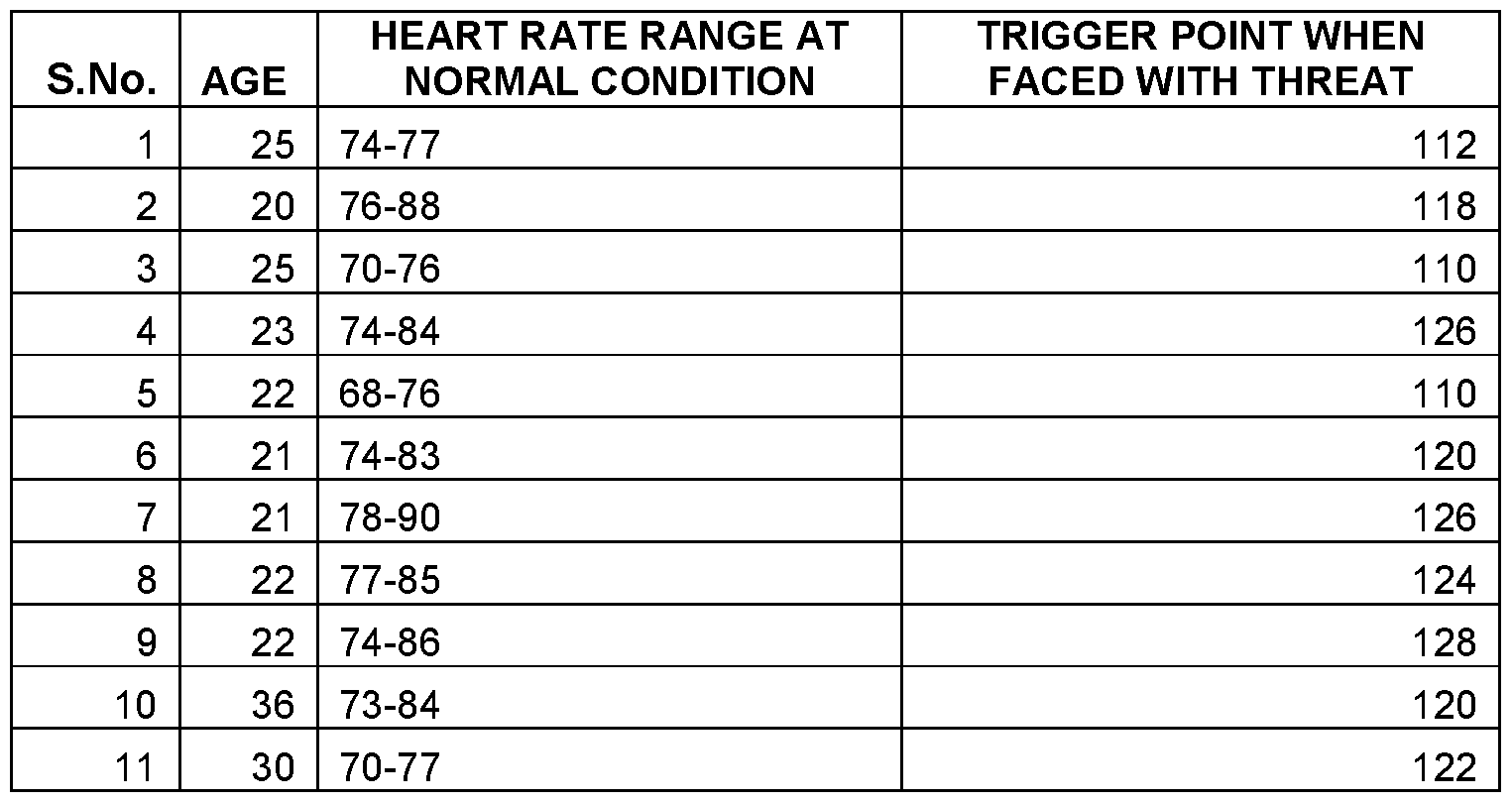
Table 1
ADVANTAGES:
1. It is a self triggering system and does not require external intervention for its operation.
2. It provides live tracking information of the user.
3. It provides for sending a distress message to the tagged users along with the current location viewable on Google maps and the tagged community can help each other and make this world a safer place.
4. It is a very compact system and the sensory means (101 ) can easily be concealed along with innerwear.
5. It can be of help during a fearful situation and in emergencies such as low/high Blood Sugar, tachycardia, etc.
It provides health benefits by constantly monitoring the heart rate.
It may be used for child safety by monitoring physiological condition as well as tracking the location of the child.
Claims
1. A personal safety response system for detecting heart rate of an individual and finding a plurality of physiological parameters, the system comprising: a sensory means housed in a housing means ensconced in the inner wear of an individual for continuously detecting a plurality of heart rate data and integrated to a data acquisition unit to record the heart rate data;
a transmission means integrated to said data acquisition unit for transmitting the heart rate data detected by the sensory means;
a processing means coupled to the transmission means and said sensory means;
a computing means having said processing means integrated therein; wherein said processing means preprogrammed for sampling the plurality of heart rate data readings for detecting a jump in the heart rate compared to preceding heart rate readings and generating an output instruction automatically to be transmitted to a plurality of receiving stations thus providing a self-triggering system.
2. The personal safety response system as claimed in claim 1 wherein said sensory means is substantially a photoplethysmogram (PPG) integrated to a microcontroller for determining the heart rate data.
3. The personal safety response system as claimed in claim 1 wherein said transmission means is substantially a Bluetooth™ or the likes.
4. The personal safety response system as claimed in claim 1 wherein said processing means having a software program like a mobile application or the like installed therein.
5. The personal safety response system as claimed in claim 1 wherein said computing means is substantially a smart phone or the likes.
6. The personal safety response system as claimed in claim 1 wherein said processing means enabling the computing means to auto answer an incoming signal thereby providing firsthand information of the individual.
7. The personal safety response system as claimed in claim 1 wherein said processing means preprogrammed for sensing the physiological changes like change in heart rate and the likes in a body whereby a substantial jump in the heart rate compared to preceding heart rate readings and a heart rate reading ranging between 1 10 to 150 relates to confronting a frightful situation.
8. The personal safety response system as claimed in claim 1 and 7 wherein said processing means generating the output instruction based on a predefined calibration to be transmitted to a plurality of receiving stations and sending a continuous tracking data to a data server, said data server integrated to a web portal for an instant location tracking of the individual.
9. The personal safety response system as claimed in claim 1 wherein said processing means enabling the computing means for providing a continuous voice recording live feeds from the individual's vicinity to the data server.
10. The personal safety response system as claimed in claim 1 wherein said processing means preprogrammed for sensing the physiological changes and generating an output instruction detecting the plurality of physiological conditions like rise/drop in blood sugar and the likes based on the heart rate data.
1 1. The personal safety response system as claimed in claim 1 wherein said computing means connected to the data server through a data network like Wi-Fi, or mobile network like GSM, CDMA or the like.
12. The personal safety response system as claimed in claim 1 wherein said processing means programmed for providing a route map and contact of the nearest police station on a display means.
13. The personal safety response system as claimed in claim 1 wherein said processing means programmed for triggering a nearest user of said safety response system.
14. A device forming part of the personal safety response system for detecting a heart rate, said device comprising:
a sensory means substantially a photoplethysmogram (PPG) integrated to a microcontroller housed in a housing means ensconced in the inner wear of an individual for detecting heart rate data;
a data acquisition unit integrated to said sensory means to record the heart rate data;
a transmission means substantially a Bluetooth™ or the likes integrated to said data acquisition unit for transmitting the heart rate data detected by the sensory means, said sensory means and transmission means are integrated to a switching means for providing an ON or OFF control during operation of the sensory means and the transmission mean;
a resetting means to reactivate the sensory means;
a powering means attached thereto for powering the sensory means, said powering means comprising a charging slot for recharging the powering means; and
a holding means attached to said housing means for clamping on the innerwear of the individual.
15. A method for detecting a heart rate of an individual and finding a plurality of physiological parameters using a personal safety response system, the method comprising: detecting a plurality of heart rate data using a sensory means housed in a housing means ensconced in the inner wear of an individual and said sensory means integrated to a data acquisition unit to record the heart rate data;
transmitting the heart rate data detected by the sensory means through a transmission means integrated to said data acquisition unit and a processing means coupled to the transmission means and said sensory means integrated to a computing means; wherein said processing means preprogrammed for sampling the plurality of heart rate data readings for detecting a jump in the heart rate compared to preceding heart rate readings and generating an output instruction automatically to be transmitted to a plurality of receiving stations thus providing a self-triggering system.
16. The method as claimed in claim 15 wherein said processing means enabling the computing means to auto answer an incoming signal thereby providing firsthand information of the individual.
17. The method as claimed in claim 15 wherein said processing means preprogrammed for sensing the physiological changes like change in heart rate and the likes in a body whereby a substantial jump in the heart rate compared to preceding heart rate readings and a heart rate reading ranging between 110 to 150 relates to confronting a frightful situation.
18. The method as claimed in claim 15 wherein said processing means generating the output instruction based on a predefined calibration to be transmitted to a plurality of receiving stations and sending a continuous tracking data to a data server, said data server integrated to a web portal for an instant location tracking of the individual.
19. The method as claimed in claim 15 wherein said processing means enabling the computing means for providing a continuous voice recording live feeds from the individual's vicinity to the data server.
20. The method as claimed in claim 15 wherein said processing means preprogrammed for sensing the physiological changes and generating an output instruction detecting the plurality of physiological conditions like rise/drop in blood sugar and the likes based on the heart rate data.
21. The method as claimed in claim 15 wherein said computing means connected to the data server through a data net work like Wi-Fi, or mobile network like GSM, CDMA or the like.
22. The method as claimed in claim 15 wherein said processing means programmed for providing a route map and contact of the nearest police station on a display means.
23. The method as claimed in claim 15 wherein said processing means programmed for triggering a nearest user of said safety response system.
24. A personal safety response system for detecting heart rate of an individual and finding a plurality of physiological parameters as herein described and illustrated with reference to the accompanying drawings.
25. A method for detecting a heart rate of an individual and finding a plurality of physiological parameters using a personal safety response system as herein described and illustrated with reference to the accompanying drawings.
Applications Claiming Priority (2)
| Application Number | Priority Date | Filing Date | Title |
|---|---|---|---|
| IN1934/DEL/2013 | 2013-06-28 | ||
| IN1934DE2013 IN2013DE01934A (en) | 2013-06-28 | 2014-06-25 |
Publications (2)
| Publication Number | Publication Date |
|---|---|
| WO2014207671A2 true WO2014207671A2 (en) | 2014-12-31 |
| WO2014207671A3 WO2014207671A3 (en) | 2015-04-02 |
Family
ID=52142776
Family Applications (1)
| Application Number | Title | Priority Date | Filing Date |
|---|---|---|---|
| PCT/IB2014/062586 Ceased WO2014207671A2 (en) | 2013-06-28 | 2014-06-25 | Personal safety system and a method thereof |
Country Status (2)
| Country | Link |
|---|---|
| IN (1) | IN2013DE01934A (en) |
| WO (1) | WO2014207671A2 (en) |
Cited By (2)
| Publication number | Priority date | Publication date | Assignee | Title |
|---|---|---|---|---|
| US10004408B2 (en) | 2014-12-03 | 2018-06-26 | Rethink Medical, Inc. | Methods and systems for detecting physiology for monitoring cardiac health |
| US12484800B2 (en) | 2018-12-14 | 2025-12-02 | Terumo Kabushiki Kaisha | Systems and methods for calibrating dry electrode bioelectrical impedance sensing |
Family Cites Families (3)
| Publication number | Priority date | Publication date | Assignee | Title |
|---|---|---|---|---|
| US6847892B2 (en) * | 2001-10-29 | 2005-01-25 | Digital Angel Corporation | System for localizing and sensing objects and providing alerts |
| US20080266118A1 (en) * | 2007-03-09 | 2008-10-30 | Pierson Nicholas J | Personal emergency condition detection and safety systems and methods |
| US20120203076A1 (en) * | 2011-02-08 | 2012-08-09 | Jean Pierre Fatta | Portable Physiological Data Monitoring Device |
-
2014
- 2014-06-25 IN IN1934DE2013 patent/IN2013DE01934A/en unknown
- 2014-06-25 WO PCT/IB2014/062586 patent/WO2014207671A2/en not_active Ceased
Cited By (4)
| Publication number | Priority date | Publication date | Assignee | Title |
|---|---|---|---|---|
| US10004408B2 (en) | 2014-12-03 | 2018-06-26 | Rethink Medical, Inc. | Methods and systems for detecting physiology for monitoring cardiac health |
| US11445922B2 (en) | 2014-12-03 | 2022-09-20 | Terumo Kabushiki Kaisha | Methods and systems for detecting physiology for monitoring cardiac health |
| US12502085B2 (en) | 2014-12-03 | 2025-12-23 | Terumo Kabushiki Kaisha | Methods and systems for detecting physiology for monitoring cardiac health |
| US12484800B2 (en) | 2018-12-14 | 2025-12-02 | Terumo Kabushiki Kaisha | Systems and methods for calibrating dry electrode bioelectrical impedance sensing |
Also Published As
| Publication number | Publication date |
|---|---|
| WO2014207671A3 (en) | 2015-04-02 |
| IN2013DE01934A (en) | 2015-07-10 |
Similar Documents
| Publication | Publication Date | Title |
|---|---|---|
| US12239424B2 (en) | Calibration of pulse-transit-time to blood pressure model using multiple physiological sensors and various methods for blood pressure variation | |
| US12465214B2 (en) | Enhanced computer-implemented systems and methods of automated physiological monitoring, prognosis, and triage | |
| US10830904B2 (en) | GPS power conservation using environmental data | |
| US20210052221A1 (en) | System, method, and smartwatch for protecting a user | |
| US20190261888A1 (en) | Re-wearable wireless device | |
| US20200367816A1 (en) | Smartwatch and Hydration Monitor | |
| US10153537B2 (en) | Hybrid radio frequency / inductive loop antenna | |
| CN104207756B (en) | Wearable heart rate monitor | |
| KR102318887B1 (en) | Wearable electronic device and method for controlling thereof | |
| US20210321953A1 (en) | System, method, and smartwatch for fall detection, prediction, and risk assessment | |
| US20190099114A1 (en) | Fall sensing and medical alert systems | |
| US9460262B2 (en) | Detecting and responding to sentinel events | |
| US20170095216A1 (en) | Biowatch | |
| US20150112208A1 (en) | Medication management | |
| US9950236B1 (en) | Activity metric calculation for wearable devices | |
| JP2005501576A (en) | Patient monitoring configuration | |
| WO2008098346A1 (en) | Wearable mini-size intelligent healthcare system | |
| WO2010120945A1 (en) | Washable wearable biosensor | |
| US20200359937A1 (en) | System and device for non-invasive drink detection | |
| JP2016032631A (en) | Biological information reader | |
| EP3556289A1 (en) | Wearable device | |
| KR101821858B1 (en) | A mehthod of measuring a resting heart rate | |
| US20220398914A1 (en) | Wearable Device and System for Tracking and Sharing Vital Signs and Location of User | |
| WO2016063190A1 (en) | Miniature wearable electronic device for continously monitoring health through ear | |
| WO2014207671A2 (en) | Personal safety system and a method thereof |
Legal Events
| Date | Code | Title | Description |
|---|---|---|---|
| 122 | Ep: pct application non-entry in european phase |
Ref document number: 14816697 Country of ref document: EP Kind code of ref document: A2 |