WO2014181784A1 - Positive-electrode active-material powder and manufacturing method therefor - Google Patents
Positive-electrode active-material powder and manufacturing method therefor Download PDFInfo
- Publication number
- WO2014181784A1 WO2014181784A1 PCT/JP2014/062208 JP2014062208W WO2014181784A1 WO 2014181784 A1 WO2014181784 A1 WO 2014181784A1 JP 2014062208 W JP2014062208 W JP 2014062208W WO 2014181784 A1 WO2014181784 A1 WO 2014181784A1
- Authority
- WO
- WIPO (PCT)
- Prior art keywords
- electrode active
- active material
- positive electrode
- solid
- material powder
- Prior art date
- Legal status (The legal status is an assumption and is not a legal conclusion. Google has not performed a legal analysis and makes no representation as to the accuracy of the status listed.)
- Ceased
Links
Classifications
-
- H—ELECTRICITY
- H01—ELECTRIC ELEMENTS
- H01M—PROCESSES OR MEANS, e.g. BATTERIES, FOR THE DIRECT CONVERSION OF CHEMICAL ENERGY INTO ELECTRICAL ENERGY
- H01M10/00—Secondary cells; Manufacture thereof
- H01M10/05—Accumulators with non-aqueous electrolyte
- H01M10/056—Accumulators with non-aqueous electrolyte characterised by the materials used as electrolytes, e.g. mixed inorganic/organic electrolytes
- H01M10/0561—Accumulators with non-aqueous electrolyte characterised by the materials used as electrolytes, e.g. mixed inorganic/organic electrolytes the electrolyte being constituted of inorganic materials only
- H01M10/0562—Solid materials
-
- C—CHEMISTRY; METALLURGY
- C01—INORGANIC CHEMISTRY
- C01B—NON-METALLIC ELEMENTS; COMPOUNDS THEREOF; METALLOIDS OR COMPOUNDS THEREOF NOT COVERED BY SUBCLASS C01C
- C01B25/00—Phosphorus; Compounds thereof
- C01B25/16—Oxyacids of phosphorus; Salts thereof
- C01B25/26—Phosphates
- C01B25/45—Phosphates containing plural metal, or metal and ammonium
-
- H—ELECTRICITY
- H01—ELECTRIC ELEMENTS
- H01M—PROCESSES OR MEANS, e.g. BATTERIES, FOR THE DIRECT CONVERSION OF CHEMICAL ENERGY INTO ELECTRICAL ENERGY
- H01M4/00—Electrodes
- H01M4/02—Electrodes composed of, or comprising, active material
- H01M4/04—Processes of manufacture in general
- H01M4/0471—Processes of manufacture in general involving thermal treatment, e.g. firing, sintering, backing particulate active material, thermal decomposition, pyrolysis
-
- H—ELECTRICITY
- H01—ELECTRIC ELEMENTS
- H01M—PROCESSES OR MEANS, e.g. BATTERIES, FOR THE DIRECT CONVERSION OF CHEMICAL ENERGY INTO ELECTRICAL ENERGY
- H01M4/00—Electrodes
- H01M4/02—Electrodes composed of, or comprising, active material
- H01M4/13—Electrodes for accumulators with non-aqueous electrolyte, e.g. for lithium-accumulators; Processes of manufacture thereof
- H01M4/139—Processes of manufacture
- H01M4/1391—Processes of manufacture of electrodes based on mixed oxides or hydroxides, or on mixtures of oxides or hydroxides, e.g. LiCoOx
-
- H—ELECTRICITY
- H01—ELECTRIC ELEMENTS
- H01M—PROCESSES OR MEANS, e.g. BATTERIES, FOR THE DIRECT CONVERSION OF CHEMICAL ENERGY INTO ELECTRICAL ENERGY
- H01M4/00—Electrodes
- H01M4/02—Electrodes composed of, or comprising, active material
- H01M4/36—Selection of substances as active materials, active masses, active liquids
- H01M4/48—Selection of substances as active materials, active masses, active liquids of inorganic oxides or hydroxides
- H01M4/485—Selection of substances as active materials, active masses, active liquids of inorganic oxides or hydroxides of mixed oxides or hydroxides for inserting or intercalating light metals, e.g. LiTi2O4 or LiTi2OxFy
-
- H—ELECTRICITY
- H01—ELECTRIC ELEMENTS
- H01M—PROCESSES OR MEANS, e.g. BATTERIES, FOR THE DIRECT CONVERSION OF CHEMICAL ENERGY INTO ELECTRICAL ENERGY
- H01M4/00—Electrodes
- H01M4/02—Electrodes composed of, or comprising, active material
- H01M4/36—Selection of substances as active materials, active masses, active liquids
- H01M4/48—Selection of substances as active materials, active masses, active liquids of inorganic oxides or hydroxides
- H01M4/50—Selection of substances as active materials, active masses, active liquids of inorganic oxides or hydroxides of manganese
- H01M4/505—Selection of substances as active materials, active masses, active liquids of inorganic oxides or hydroxides of manganese of mixed oxides or hydroxides containing manganese for inserting or intercalating light metals, e.g. LiMn2O4 or LiMn2OxFy
-
- H—ELECTRICITY
- H01—ELECTRIC ELEMENTS
- H01M—PROCESSES OR MEANS, e.g. BATTERIES, FOR THE DIRECT CONVERSION OF CHEMICAL ENERGY INTO ELECTRICAL ENERGY
- H01M4/00—Electrodes
- H01M4/02—Electrodes composed of, or comprising, active material
- H01M4/36—Selection of substances as active materials, active masses, active liquids
- H01M4/48—Selection of substances as active materials, active masses, active liquids of inorganic oxides or hydroxides
- H01M4/52—Selection of substances as active materials, active masses, active liquids of inorganic oxides or hydroxides of nickel, cobalt or iron
- H01M4/525—Selection of substances as active materials, active masses, active liquids of inorganic oxides or hydroxides of nickel, cobalt or iron of mixed oxides or hydroxides containing iron, cobalt or nickel for inserting or intercalating light metals, e.g. LiNiO2, LiCoO2 or LiCoOxFy
-
- H—ELECTRICITY
- H01—ELECTRIC ELEMENTS
- H01M—PROCESSES OR MEANS, e.g. BATTERIES, FOR THE DIRECT CONVERSION OF CHEMICAL ENERGY INTO ELECTRICAL ENERGY
- H01M4/00—Electrodes
- H01M4/02—Electrodes composed of, or comprising, active material
- H01M4/62—Selection of inactive substances as ingredients for active masses, e.g. binders, fillers
-
- H—ELECTRICITY
- H01—ELECTRIC ELEMENTS
- H01M—PROCESSES OR MEANS, e.g. BATTERIES, FOR THE DIRECT CONVERSION OF CHEMICAL ENERGY INTO ELECTRICAL ENERGY
- H01M10/00—Secondary cells; Manufacture thereof
- H01M10/05—Accumulators with non-aqueous electrolyte
- H01M10/052—Li-accumulators
- H01M10/0525—Rocking-chair batteries, i.e. batteries with lithium insertion or intercalation in both electrodes; Lithium-ion batteries
-
- H—ELECTRICITY
- H01—ELECTRIC ELEMENTS
- H01M—PROCESSES OR MEANS, e.g. BATTERIES, FOR THE DIRECT CONVERSION OF CHEMICAL ENERGY INTO ELECTRICAL ENERGY
- H01M4/00—Electrodes
- H01M4/02—Electrodes composed of, or comprising, active material
- H01M2004/026—Electrodes composed of, or comprising, active material characterised by the polarity
- H01M2004/028—Positive electrodes
-
- H—ELECTRICITY
- H01—ELECTRIC ELEMENTS
- H01M—PROCESSES OR MEANS, e.g. BATTERIES, FOR THE DIRECT CONVERSION OF CHEMICAL ENERGY INTO ELECTRICAL ENERGY
- H01M2300/00—Electrolytes
- H01M2300/0017—Non-aqueous electrolytes
- H01M2300/0065—Solid electrolytes
- H01M2300/0068—Solid electrolytes inorganic
-
- H—ELECTRICITY
- H01—ELECTRIC ELEMENTS
- H01M—PROCESSES OR MEANS, e.g. BATTERIES, FOR THE DIRECT CONVERSION OF CHEMICAL ENERGY INTO ELECTRICAL ENERGY
- H01M2300/00—Electrolytes
- H01M2300/0017—Non-aqueous electrolytes
- H01M2300/0065—Solid electrolytes
- H01M2300/0068—Solid electrolytes inorganic
- H01M2300/0071—Oxides
-
- H—ELECTRICITY
- H01—ELECTRIC ELEMENTS
- H01M—PROCESSES OR MEANS, e.g. BATTERIES, FOR THE DIRECT CONVERSION OF CHEMICAL ENERGY INTO ELECTRICAL ENERGY
- H01M4/00—Electrodes
- H01M4/02—Electrodes composed of, or comprising, active material
- H01M4/36—Selection of substances as active materials, active masses, active liquids
- H01M4/362—Composites
- H01M4/366—Composites as layered products
-
- H—ELECTRICITY
- H01—ELECTRIC ELEMENTS
- H01M—PROCESSES OR MEANS, e.g. BATTERIES, FOR THE DIRECT CONVERSION OF CHEMICAL ENERGY INTO ELECTRICAL ENERGY
- H01M4/00—Electrodes
- H01M4/02—Electrodes composed of, or comprising, active material
- H01M4/36—Selection of substances as active materials, active masses, active liquids
- H01M4/58—Selection of substances as active materials, active masses, active liquids of inorganic compounds other than oxides or hydroxides, e.g. sulfides, selenides, tellurides, halogenides or LiCoFy; of polyanionic structures, e.g. phosphates, silicates or borates
- H01M4/5825—Oxygenated metallic salts or polyanionic structures, e.g. borates, phosphates, silicates, olivines
-
- Y—GENERAL TAGGING OF NEW TECHNOLOGICAL DEVELOPMENTS; GENERAL TAGGING OF CROSS-SECTIONAL TECHNOLOGIES SPANNING OVER SEVERAL SECTIONS OF THE IPC; TECHNICAL SUBJECTS COVERED BY FORMER USPC CROSS-REFERENCE ART COLLECTIONS [XRACs] AND DIGESTS
- Y02—TECHNOLOGIES OR APPLICATIONS FOR MITIGATION OR ADAPTATION AGAINST CLIMATE CHANGE
- Y02E—REDUCTION OF GREENHOUSE GAS [GHG] EMISSIONS, RELATED TO ENERGY GENERATION, TRANSMISSION OR DISTRIBUTION
- Y02E60/00—Enabling technologies; Technologies with a potential or indirect contribution to GHG emissions mitigation
- Y02E60/10—Energy storage using batteries
Definitions
- the present invention relates to a positive electrode active material powder composed of particles obtained by coating the surface of positive electrode active material particles of a lithium ion secondary battery with a solid electrolyte, and a method for producing the same.
- the positive electrode active material of a lithium ion secondary battery is generally composed of a composite oxide of Li and a transition metal.
- lithium cobaltate (LiCoO 2 ) which is a complex oxide having Co as a component, is frequently used.
- lithium nickelate (LiNiO 2 ), lithium manganate (LiMn 2 O 4 ), ternary system (LiNi 1/3 Mn 1/3 Co 1/3 O 2, etc.) and their composite types Usage is also increasing.
- lithium salts such as electrolytes LiPF 6 and LiBF 4 , cyclic carbonates such as PC (propylene carbonate) and EC (ethylene carbonate), DMC (dimethyl carbonate), and EMC (ethyl) are used.
- cyclic carbonates such as PC (propylene carbonate) and EC (ethylene carbonate), DMC (dimethyl carbonate), and EMC (ethyl) are used.
- Those dissolved in a mixed solvent of chain esters such as methyl carbonate and DEC (diethyl carbonate) are mainly used.
- Such an organic solvent is weak in an oxidizing atmosphere, and particularly when exposed to a transition metal such as Co, Ni, Mn or the like on the surface of the positive electrode, it tends to cause an oxidative decomposition reaction.
- the positive electrode surface is at a high potential and that a highly oxidized transition metal acts catalytically. Therefore, preventing the contact between the electrolytic solution and the transition metal (for example, one or more of Co, Ni, and Mn) constituting the positive electrode active material is effective in maintaining the performance of the electrolytic solution.
- the transition metal for example, one or more of Co, Ni, and Mn
- Patent Document 1 describes a technique for coating a positive electrode active material with a solid electrolyte. It is taught that mechanical milling is preferred as the coating method (paragraph 0017). In this case, a coating form in which solid electrolyte particles adhere to the surface of the active material is exhibited (see reference numerals 2 and 3 in FIG. 1 of Patent Document 1). That is, there are many voids in the solid electrolyte layer present on the active material surface. There remains room for improvement in order to prevent contact between the electrolyte and the transition metal on the active material surface.
- An object of the present invention is to provide a positive electrode active material for a lithium ion secondary battery in which the amount of transition metal existing in the vicinity of the outermost surface is greatly reduced.
- the object is to place Li 1 + X Al X Ti 2-X (PO 4 ) 3 on the particle surface of the positive electrode active material for a lithium ion secondary battery composed of a composite oxide of Li and transition metal M, where 0 ⁇ X ⁇ 0.5, and occupies the total number of atoms of Al, Ti, and M from the outermost surface of the coating layer to the etching depth of 1 nm in the depth direction analysis by XPS.
- This is achieved by the solid electrolyte-coated positive electrode active material powder having an average ratio of the total number of atoms of Al and Ti (hereinafter referred to as “average Al + Ti atomic ratio”) of 35% or more.
- the total number of atoms of Al, Ti, M, and P from the outermost surface of the coating layer to the etching depth of 1 nm is analyzed in the depth direction analysis by XPS as described above.
- a solid electrolyte-covered positive electrode active material powder having an average ratio of the total number of atoms of Al, Ti, and P occupied (hereinafter referred to as “average Al + Ti + P atomic ratio”) of 50% or more is a suitable target.
- the etching depth is a depth converted using the sputter etching rate of the SiO 2 standard sample.
- the transition metal M means one or more transition metal elements constituting the positive electrode active material, and examples thereof include one or more of Co, Ni, and Mn.
- the coating layer of the solid electrolyte includes, for example, the above-described elements by using contact with each element of Li, Al, Ti, P or a solution containing each element of Li, Ti, P on the particle surface of the active material. After coating the solid layer, the particles can be formed by heat treatment in an oxygen-containing atmosphere.
- a positive electrode for a lithium ion secondary battery comprising an aqueous solution in which each element of Li, Al, Ti, P or each element of Li, Ti, P is dissolved, and a composite oxide having Li and transition metal M as components.
- Liquid coating method Lithium ions composed of Li, Al, Ti, P elements or an aqueous solution (Liquid A) in which Li, Ti, P elements are dissolved, and a complex oxide containing Li and transition metal M as components.
- a liquid in which powder particles of the positive electrode active material for secondary battery are dispersed in a water-soluble organic solvent or a mixed medium of a water-soluble organic solvent and water is prepared, and liquid A is transferred into liquid B.
- the slurry containing the deposited powder particles can be separated into solid and liquid to recover the solid content.
- the addition method of A liquid may be continuous and may be intermittent.
- the solid content obtained by the evaporation-drying method or the submerged coating method is baked in an oxygen-containing atmosphere, whereby the solid electrolyte-coated positive electrode active material powder is obtained.
- the powder of the positive electrode active material for a lithium ion secondary battery according to the present invention is composed of particles having a highly uniform solid electrolyte coating layer. This is because the amount of transition metal existing in the vicinity of the outermost surface of the particle is greatly reduced, and thus the ability to prevent oxidation of the electrolytic solution is high. Therefore, this invention can contribute to the performance improvement of a lithium ion secondary battery.
- the positive electrode active material to be applied in the present invention is composed of a composite oxide of Li and transition metal M, and includes materials conventionally used in lithium ion secondary batteries. Examples thereof include cobalt lithium acid (Li 1 + X CoO 2 , ⁇ 0.1 ⁇ X ⁇ 0.3).
- the raw material powder made of this positive electrode active material to a solid electrolyte coating treatment described later, the solid electrolyte-coated positive electrode active material powder of the present invention can be obtained.
- the average particle size of the raw material powder (volume-based cumulative 50% particle size D 50 by a laser diffraction particle size distribution measuring device) may be in the range of 1 to 20 ⁇ m, for example.
- the positive electrode active material for example, Li 1 + X NiO 2 , Li 1 + X Mn 2 O 4 , Li 1 + X Ni 1/2 Mn 1/2 O 2 , Li 1 + X Ni 1/3 Co 1/3 in addition to the above lithium cobaltate.
- the solid electrolyte constituting the coating layer is Li 1 + X Al X Ti 2-X (PO 4 ) 3 , where 0 ⁇ X ⁇ 0.5.
- X exceeds 0.5, Li ion conductivity is lowered, which is not preferable.
- X may be 0.
- Li ion conductivity in this case is inferior to that containing Al, but better than LiNbO 3 .
- the solid electrolyte-coated positive electrode active material powder according to the present invention is characterized by having a highly uniform coating layer. That is, there is very little exposure of the raw material powder surface of a positive electrode active material. According to the study by the inventors, the atomic ratio from the outermost surface to the depth of 1 nm in the elemental analysis profile in the depth direction by XPS (photoelectron spectroscopic analysis) is considered in consideration of the antioxidant effect of the electrolyte in the lithium ion secondary battery. The exposure degree of the raw material powder surface can be evaluated. 1 nm is an etching rate conversion of the SiO 2 standard sample.
- the average ratio of the total number of atoms of Al and Ti in the total number of atoms of Al, Ti and M from the outermost layer to the depth of 1 nm in the depth direction analysis by XPS (in this specification, “average Al + Ti atom The ratio is called 35% or more. It is more preferably 40% or more, and further preferably 60% or more. According to experiments, it is possible to obtain about 98%.
- M is a transition metal other than Ti. For example, it can be one or more elements selected from Co, Ni and Mn.
- the Al + Ti atomic ratio at a certain depth position is expressed by the following formula (1).
- Al + Ti atomic ratio (%) (Al + Ti) / (Al + Ti + M) ⁇ 100 (1)
- the value of the analysis value (atomic%) of each element is assigned to the element symbol and M.
- M is Co
- Al + Ti atomic ratio (%) (Al + Ti) / (Al + Ti + Co) ⁇ 100 (2)
- Al + Ti + P atomic ratio of surface layer an “average Al + Ti + P atomic ratio” in which P is added to the element to be analyzed may be applied.
- the average ratio of the total number of atoms of Al and Ti in the total number of atoms of Al, Ti, P, and M from the outermost layer to the depth of 1 nm in the depth direction analysis by XPS is referred to as “average” in this specification. It is called “Al + Ti + P atomic ratio”.
- the average Al + Ti + P atomic ratio is desirably 50% or more. It is more preferably 70% or more, and further preferably 80% or more. According to experiments, it is possible to obtain about 98%.
- Al + Ti + P atomic ratio (%) (Al + Ti + P) / (Al + Ti + M + P) ⁇ 100 (3)
- the value of the analysis value (atomic%) of each element is assigned to the element symbol and M.
- M is Co, the following formula (4) is applied.
- Al + Ti + P atomic ratio (%) (Al + Ti + P) / (Al + Ti + Co + P) ⁇ 100 (4)
- the average thickness of the coating layer may be in the range of 1 to 80 nm. If it is too thin, an exposed portion of the raw material powder surface tends to occur. If it is too thick, the conductivity is lowered and it becomes uneconomical.
- the above highly uniform coating layer can be realized by coating with a solution containing each element of Li, Al, Ti, P or each element of Li, Ti, P. That is, a liquid containing each element of Li, Al, Ti, P or each element of Li, Ti, P is brought into contact with the surface of the raw material powder particles of the positive electrode active material for a lithium ion secondary battery, After coating the solid layer, the particles are heat-treated in an oxygen-containing atmosphere to crystallize the solid layer, thereby forming the above-described solid electrolyte layer.
- a method for coating the solid layer for example, (i) After the raw material powder particles are directly put in a liquid containing each element of Li, Al, Ti, P or each element of Li, Ti, P, and stirred. (Ii) Stirring the raw material powder in the liquid and adding a small amount of Li, Al, Ti, P elements or a liquid containing each of the Li, Ti, P elements as a dispersion state Then, it is possible to employ a submerged coating method in which the powder particles are deposited on the surface and then filtered. The latter method is advantageous for forming a thin and uniform coating layer.
- Examples of the solvent used in the liquid (liquid B) in which the raw material powder is dispersed in the submerged coating method include proton donating solvents such as methanol, ethanol, propanol, butanol, pentanol, hexanol, and ethers (eg, diethyl ether, tetrahydrofuran, etc.) ), Dimethyl sulfoxide (CH 3 ) 2 SO (abbreviation DMSO), dimethylformamide (CH 3 ) 2 NCHO (abbreviation DMF), hexamethylphosphoric triamide [(CH 3 ) 2 N] 3 P ⁇ O (abbreviation HMPA)
- a polar non-proton donating solvent such as can be used.
- titanium is [Ti (OH) 3 O 2 ] ⁇
- lithium is Li +
- aluminum is AlO 2 ⁇
- phosphorus PO 4 3-, HPO 4 2- or H 2 PO 4 - include a liquid which is dissolved in the form of.
- the particles are heat-treated in an oxygen-containing atmosphere.
- the heat treatment atmosphere should be air without carbonic acid or oxygen.
- carbonic acid is contained, a lithium carbonate layer is formed, which increases the internal resistance of the battery.
- Li 1 + X Al X Ti 2-X (PO 4 ) 3 where 0 ⁇ X ⁇ 0.5 starts crystallization at about 300 ° C. or higher, so the heat treatment temperature should be 300 ° C. or higher. Is preferable, and it is more preferable to set it to 500 degreeC or more.
- the crystallization speed is remarkably improved at 500 ° C. or higher.
- the temperature exceeds 950 ° C., the diffusion of the solid electrolyte into the active material increases, and therefore, it is desirable to set the temperature to 950 ° C. or lower.
- a liquid for coating each element of Li, Al, Ti, and P is “LATP coating liquid”, and a liquid for coating each element of Li, Ti, and P (without Al) is “LTP coating liquid”.
- Example 1 As a raw material powder of a positive electrode active material for a lithium ion secondary battery, an average particle size (volume-based cumulative 50% particle size D 50 by a laser diffraction particle size distribution measuring device, the same applies hereinafter) 5.14 ⁇ m, BET value 0.234 m 2 / G lithium cobalt oxide (LiCoO 2 ) powder was prepared.
- a hydrogen peroxide aqueous solution was prepared by adding 29 g of hydrogen peroxide water having a concentration of 30% by mass to 17 g of pure water. After adding 0.335 g of titanium powder (manufactured by Wako Pure Chemical Industries, Ltd.) to this aqueous hydrogen peroxide solution, 5 g of ammonia water having a concentration of 28% by mass was further added and sufficiently stirred to obtain a yellow transparent solution. . To this solution, 0.225 g of lithium hydroxide monohydrate (LiOH.H 2 O) and 1.63 g of diammonium hydrogen phosphate ((NH 3 ) 2 HPO 4 ) were added. Further, 0.0335 g of Al foil, 8 g of ammonia water having a concentration of 28% by mass, and 200 g of pure water were added to the solution, and stirring was continued for 3 hours until it became completely transparent to obtain a LATP coating solution.
- titanium powder manufactured by Wako Pure Chemical Industries, Ltd.
- LiATP coating 30 g of lithium cobaltate powder was added to the LATP coating solution and stirred using a stirrer. The mixture was further heated to 90 ° C., and the temperature was maintained at 90 ° C. until it was judged that the moisture had disappeared. Thereafter, the powder was dried in the atmosphere at 140 ° C. for 1 hour to obtain a dry powder. The obtained dry powder was fired in air at 600 ° C. for 1 hour to obtain a lithium cobaltate powder (test powder) whose surface was coated with LATP. The average thickness of the LATP coating layer of the test powder calculated from the BET value (specific surface area) of the raw material powder and the LATP raw material used was 77 nm.
- test powder [Chemical analysis of test powder] The test powder was dissolved with nitric acid or the like and subjected to chemical analysis by ICP. The ratio of Al, Ti, and P of the raw material charged was detected from the powder at an almost unchanged ratio. These results are shown in Table 2 (same in the following examples).
- Test batteries were made using the following materials.
- ⁇ Positive electrode The above test powder (positive electrode active material), graphite and PTFE (polytetrafluoroethylene) were mixed in a mortar at a mass ratio of 87: 8: 8, then kneaded in a roll mill and formed into a sheet. . -Negative electrode; Metal Li. -Separator; polypropylene film.
- Electrolytic solution LiPF 6 dissolved at 1 mol / L as an electrolyte in a solvent in which ethylene carbonate and diethylene carbonate are mixed at a volume ratio of 1: 1.
- Discharge capacity A After constant current charge to 4.2V at a current density of 0.16 mA / cm 2, current density was constant voltage charging until the 0.016mA / cm 2. Thereafter, constant current discharge was performed at 0.16 mA / cm 2 up to 2.7 V, and the discharge capacity per unit mass of the positive electrode active material (excluding the mass of the coating material) was determined. This is referred to as “discharge capacity A”.
- Discharge capacity B Thereafter, constant current charging to 4.2 V at a current density of 0.16 mA / cm 2 , holding for one month in a state of 4.2 V, then performing constant current discharging to 2.7 V at 0.16 mA / cm 2 .
- discharge capacity B The discharge capacity per unit mass (excluding the mass of the coating material) of the positive electrode active material was determined. This is referred to as “discharge capacity B”.
- Capacity maintenance ratio The capacity maintenance ratio (%) was calculated by the following equation (5).
- Capacity maintenance rate (%) discharge capacity B / discharge capacity A ⁇ 100 (5) It is evaluated that the higher the capacity retention rate, the better the battery performance is maintained. The results are shown in Table 3 (same in the following examples).
- Example 2 The sample powder was prepared and measured under the same conditions as in Example 1 except that the LATP coating solution was prepared by the following method.
- the average thickness of the LATP coating layer of the test powder was 10 nm.
- the ratio of Al, Ti, and P of the raw material charged was detected from the powder at almost the same ratio.
- Example 3 The same lithium cobaltate (LiCoO 2 ) powder as that used in Example 1 was prepared as the raw material powder.
- the obtained slurry was put into a pressure filter to perform solid-liquid separation.
- the powder obtained as a solid content was dried in decarboxylated air for 1 hour to obtain a dry powder.
- the dried powder was fired in air at 400 ° C. for 3 hours to obtain a lithium cobaltate powder (test powder) whose surface was coated with LATP.
- the average thickness of the LATP coating layer of the test powder was 10 nm.
- the ratio of Al, Ti, and P of the raw material charged was detected from the powder at almost the same ratio. The same measurement as in Example 1 was performed using this sample powder.
- Example 4 A sample powder was prepared and measured under the same conditions as in Example 3 except that the LATP coating solution was prepared by the following method.
- the average thickness of the LATP coating layer of the test powder was 5 nm.
- the ratio of Al, Ti, and P of the raw material charged was detected from the powder at almost the same ratio.
- Example 5 Using the same LATP coating solution as in Example 4, LATP was coated by the following method. Using the obtained sample powder, the same measurement as in Example 1 was performed.
- the obtained slurry was put into a pressure filter to perform solid-liquid separation.
- the powder obtained as a solid content was dried in decarboxylated air for 1 hour to obtain a dry powder.
- the dried powder was fired in air at 600 ° C. for 3 hours to obtain a lithium cobaltate powder (test powder) whose surface was coated with LATP.
- the average thickness of the LATP coating layer of the test powder was 2 nm.
- the ratio of Al, Ti, and P of the raw material charged was detected from the powder at almost the same ratio.
- Example 6 The sample powder was prepared and measured under the same conditions as in Example 3 except that the LATP coating solution in Example 3 was replaced with the LTP coating solution prepared by the following method.
- the LTP coating layer average thickness of the test powder was 10 nm.
- the ratio of Ti and P of the charged raw material was detected from the powder at an almost unchanged ratio.
- Example 7 The sample powder was prepared and measured in the same manner as in Example 3 except that the solvent of the solution B at the time of LATP coating was changed from isopropyl alcohol to methanol.
- Example 8 A sample powder was prepared and measured in the same manner as in Example 3 except that the solvent of the solution B at the time of LATP coating was changed from isopropyl alcohol to butanol.
- Example 9 The sample powder was prepared and measured in the same manner as in Example 3 except that the solvent of solution B at the time of LATP coating was changed from isopropyl alcohol to pentanol.
- Comparative Example 1 Li 2 CO 3 , Al 2 O 3 , TiO 2 , (NH 4 ) 2 HPO 4 and Li 2 O: Al 2 O 3 : TiO 2 : P 2 O 5 have a molar ratio of 14: 9: 38: 39. It mixed so that it might become, and calcined at 700 degreeC in the air for 2 hours.
- mechanical milling (MM) treatment was performed at room temperature in an argon gas atmosphere at a rotational speed of 350 rpm for 40 hours to make it amorphous. The obtained powder was then crystallized by heating in air at 850 ° C. for 4 hours.
- this test powder had a surface of LATP in an amount substantially equal to that of the test powder prepared in Example 1.
- the average Al + Ti atomic ratio was 25%, which was a lower value than those in the above-mentioned Examples.
- Table 1 illustrates the coating liquid used in Example 6 (Al-free addition; LTP coating liquid) and the coating liquid used in Example 3 (Al-added; LATP coating liquid).
- Tables 2 and 3 show the measurement results of each example.
Landscapes
- Chemical & Material Sciences (AREA)
- Chemical Kinetics & Catalysis (AREA)
- Electrochemistry (AREA)
- General Chemical & Material Sciences (AREA)
- Inorganic Chemistry (AREA)
- Engineering & Computer Science (AREA)
- Manufacturing & Machinery (AREA)
- Organic Chemistry (AREA)
- Materials Engineering (AREA)
- General Physics & Mathematics (AREA)
- Condensed Matter Physics & Semiconductors (AREA)
- Physics & Mathematics (AREA)
- Battery Electrode And Active Subsutance (AREA)
- Composite Materials (AREA)
Abstract
Description
本発明は、リチウムイオン二次電池の正極活物質粒子の表面を固体電解質で被覆した粒子からなる正極活物質粉末およびその製造方法に関する。 The present invention relates to a positive electrode active material powder composed of particles obtained by coating the surface of positive electrode active material particles of a lithium ion secondary battery with a solid electrolyte, and a method for producing the same.
リチウムイオン二次電池の正極活物質は、従来一般的にLiと遷移金属の複合酸化物で構成される。なかでも、Coを成分に持つ複合酸化物であるコバルト酸リチウム(LiCoO2)が多用されている。また、最近ではニッケル酸リチウム(LiNiO2)、マンガン酸リチウム(LiMn2O4)、あるいは三元系(LiNi1/3Mn1/3Co1/3O2など)や、それらの複合タイプの利用も増加している。 Conventionally, the positive electrode active material of a lithium ion secondary battery is generally composed of a composite oxide of Li and a transition metal. Among them, lithium cobaltate (LiCoO 2 ), which is a complex oxide having Co as a component, is frequently used. Recently, lithium nickelate (LiNiO 2 ), lithium manganate (LiMn 2 O 4 ), ternary system (LiNi 1/3 Mn 1/3 Co 1/3 O 2, etc.) and their composite types Usage is also increasing.
リチウムイオン二次電池の電解液としては、電解質LiPF6、LiBF4等のリチウム塩を、PC(プロピレンカーボネート)、EC(エチレンカーボネート)等の環状炭酸エステルと、DMC(ジメチルカーボネート)、EMC(エチルメチルカーボネート)、DEC(ジエチルカーボネート)等の鎖状エステルの混合溶媒に溶解したものが主として用いられている。このような有機溶媒は酸化雰囲気に弱く、特に正極表面でCo、Ni、Mn等の遷移金属に触れると酸化分解反応を起こしやすい。その要因として、正極表面が高い電位であること、高酸化状態の遷移金属が触媒的に作用することなどが考えられる。したがって、電解液と正極活物質を構成する遷移金属(例えばCo、Ni、Mnの1種以上)との接触をできるだけ防止することが、電解液の性能を維持するうえで有効となる。 As an electrolyte for a lithium ion secondary battery, lithium salts such as electrolytes LiPF 6 and LiBF 4 , cyclic carbonates such as PC (propylene carbonate) and EC (ethylene carbonate), DMC (dimethyl carbonate), and EMC (ethyl) are used. Those dissolved in a mixed solvent of chain esters such as methyl carbonate and DEC (diethyl carbonate) are mainly used. Such an organic solvent is weak in an oxidizing atmosphere, and particularly when exposed to a transition metal such as Co, Ni, Mn or the like on the surface of the positive electrode, it tends to cause an oxidative decomposition reaction. As the factors, it is conceivable that the positive electrode surface is at a high potential and that a highly oxidized transition metal acts catalytically. Therefore, preventing the contact between the electrolytic solution and the transition metal (for example, one or more of Co, Ni, and Mn) constituting the positive electrode active material is effective in maintaining the performance of the electrolytic solution.
特許文献1には、正極活物質を固体電解質で被覆する技術が記載されている。その被覆方法としてメカニカルミリングが好ましいと教示されている(段落0017)。この場合、活物質の表面に固体電解質の粒子が付着した被覆形態を呈することとなる(特許文献1の図1の符号2、3参照)。すなわち、活物質表面に存在する固体電解質の層には空隙が多い。電解液と活物質表面の遷移金属との接触を防止するためには改善の余地が残っている。 Patent Document 1 describes a technique for coating a positive electrode active material with a solid electrolyte. It is taught that mechanical milling is preferred as the coating method (paragraph 0017). In this case, a coating form in which solid electrolyte particles adhere to the surface of the active material is exhibited (see reference numerals 2 and 3 in FIG. 1 of Patent Document 1). That is, there are many voids in the solid electrolyte layer present on the active material surface. There remains room for improvement in order to prevent contact between the electrolyte and the transition metal on the active material surface.
本発明は、リチウムイオン二次電池用正極活物質において、その最表面近傍に存在する遷移金属の量を非常に低減したものを提供することを目的とする。 An object of the present invention is to provide a positive electrode active material for a lithium ion secondary battery in which the amount of transition metal existing in the vicinity of the outermost surface is greatly reduced.
上記目的は、Liと遷移金属Mの複合酸化物で構成されるリチウムイオン二次電池用正極活物質の粒子表面に、Li1+XAlXTi2-X(PO4)3、ただし0≦X≦0.5、で表される固体電解質の被覆層を有する粒子からなり、XPSによる深さ方向分析で当該被覆層の最表面からエッチング深さ1nmまでのAl、Ti、Mの合計原子数に占めるAl、Tiの合計原子数の平均割合(以下「平均Al+Ti原子比」という)が35%以上である固体電解質被覆正極活物質粉末によって達成される。また、分析対象元素にPを含めた場合には、上記と同様のXPSによる深さ方向分析で当該被覆層の最表面からエッチング深さ1nmまでのAl、Ti、M、Pの合計原子数に占めるAl、Ti、Pの合計原子数の平均割合(以下「平均Al+Ti+P原子比」という)が50%以上である固体電解質被覆正極活物質粉末が好適な対象となる。前記エッチング深さはSiO2標準試料のスパッタエッチングレートを用いて換算した深さである。 The object is to place Li 1 + X Al X Ti 2-X (PO 4 ) 3 on the particle surface of the positive electrode active material for a lithium ion secondary battery composed of a composite oxide of Li and transition metal M, where 0 ≦ X ≦ 0.5, and occupies the total number of atoms of Al, Ti, and M from the outermost surface of the coating layer to the etching depth of 1 nm in the depth direction analysis by XPS. This is achieved by the solid electrolyte-coated positive electrode active material powder having an average ratio of the total number of atoms of Al and Ti (hereinafter referred to as “average Al + Ti atomic ratio”) of 35% or more. In addition, when P is included in the analysis target element, the total number of atoms of Al, Ti, M, and P from the outermost surface of the coating layer to the etching depth of 1 nm is analyzed in the depth direction analysis by XPS as described above. A solid electrolyte-covered positive electrode active material powder having an average ratio of the total number of atoms of Al, Ti, and P occupied (hereinafter referred to as “average Al + Ti + P atomic ratio”) of 50% or more is a suitable target. The etching depth is a depth converted using the sputter etching rate of the SiO 2 standard sample.
上記遷移金属Mは当該正極活物質を構成する1種または2種以上の遷移金属元素を意味し、例えばCo、Ni、Mnの1種以上が挙げられる。上記固体電解質の被覆層は、例えば、活物質の粒子表面にLi、Al、Ti、Pの各元素またはLi、Ti、Pの各元素を含む溶液との接触を利用して前記各元素を含む固形物層をコーティングしたのち、その粒子を酸素含有雰囲気で熱処理することによって形成することができる。 The transition metal M means one or more transition metal elements constituting the positive electrode active material, and examples thereof include one or more of Co, Ni, and Mn. The coating layer of the solid electrolyte includes, for example, the above-described elements by using contact with each element of Li, Al, Ti, P or a solution containing each element of Li, Ti, P on the particle surface of the active material. After coating the solid layer, the particles can be formed by heat treatment in an oxygen-containing atmosphere.
具体的には以下のコーティング工程を開示することができる。
〔蒸発乾固法〕
Li、Al、Ti、Pの各元素またはLi、Ti、Pの各元素が溶解している水溶液と、Liおよび遷移金属Mを成分に持つ複合酸化物で構成されるリチウムイオン二次電池用正極活物質の粉末粒子を混合したのち、液体成分を蒸発させ、固形分を得る工程。
〔液中コート法〕
Li、Al、Ti、Pの各元素またはLi、Ti、Pの各元素が溶解している水溶液(A液という)と、Liおよび遷移金属Mを成分に持つ複合酸化物で構成されるリチウムイオン二次電池用正極活物質の粉末粒子が水溶性有機溶媒中または水溶性有機溶媒と水との混合媒体中に分散している液(B液という)を用意し、A液をB液中へ添加することにより、B液中の前記粉末粒子表面にLi、Al、Ti、PまたはLi、Ti、Pを被着させる工程。
液中コート法の場合は、上記被着後の粉末粒子が含まれるスラリーを固液分離して固形分を回収することができる。A液の添加方法は連続的であってもよいし断続的であってもよい。
蒸発乾固法または液中コート法で得られた固形分を酸素含有雰囲気中で焼成することによって、上記の固体電解質被覆正極活物質粉末が得られる。
Specifically, the following coating process can be disclosed.
[Evaporation to dryness method]
A positive electrode for a lithium ion secondary battery comprising an aqueous solution in which each element of Li, Al, Ti, P or each element of Li, Ti, P is dissolved, and a composite oxide having Li and transition metal M as components. The step of mixing the active material powder particles and then evaporating the liquid component to obtain a solid content.
[Liquid coating method]
Lithium ions composed of Li, Al, Ti, P elements or an aqueous solution (Liquid A) in which Li, Ti, P elements are dissolved, and a complex oxide containing Li and transition metal M as components. A liquid in which powder particles of the positive electrode active material for secondary battery are dispersed in a water-soluble organic solvent or a mixed medium of a water-soluble organic solvent and water is prepared, and liquid A is transferred into liquid B. A step of depositing Li, Al, Ti, P or Li, Ti, P on the surface of the powder particles in the liquid B by adding.
In the case of the submerged coating method, the slurry containing the deposited powder particles can be separated into solid and liquid to recover the solid content. The addition method of A liquid may be continuous and may be intermittent.
The solid content obtained by the evaporation-drying method or the submerged coating method is baked in an oxygen-containing atmosphere, whereby the solid electrolyte-coated positive electrode active material powder is obtained.
本発明に従うリチウムイオン二次電池用正極活物質の粉末は、均一性の高い固体電解質の被覆層を有する粒子で構成されている。これは、粒子最表面近傍に存在する遷移金属の量を非常に低減されているので、電解液の酸化を防止する能力が高い。したがって、本発明はリチウムイオン二次電池の性能向上に寄与しうる。 The powder of the positive electrode active material for a lithium ion secondary battery according to the present invention is composed of particles having a highly uniform solid electrolyte coating layer. This is because the amount of transition metal existing in the vicinity of the outermost surface of the particle is greatly reduced, and thus the ability to prevent oxidation of the electrolytic solution is high. Therefore, this invention can contribute to the performance improvement of a lithium ion secondary battery.
〔正極活物質〕
本発明で適用対象となる正極活物質は、Liと遷移金属Mの複合酸化物でからなるものであり、従来からリチウムイオン二次電池に使用されている物質が含まれる。例えばリチウム酸コバルト(Li1+XCoO2、-0.1≦X≦0.3)が挙げられる。この正極活物質からなる原料粉末を後述の固体電解質の被覆処理に供することによって、本発明の固体電解質被覆正極活物質粉末が得られる。原料粉末の平均粒子径(レーザー回折式粒度分布測定装置による体積基準の累積50%粒子径D50)は例えば1~20μmの範囲とすればよい。
[Positive electrode active material]
The positive electrode active material to be applied in the present invention is composed of a composite oxide of Li and transition metal M, and includes materials conventionally used in lithium ion secondary batteries. Examples thereof include cobalt lithium acid (Li 1 + X CoO 2 , −0.1 ≦ X ≦ 0.3). By subjecting the raw material powder made of this positive electrode active material to a solid electrolyte coating treatment described later, the solid electrolyte-coated positive electrode active material powder of the present invention can be obtained. The average particle size of the raw material powder (volume-based cumulative 50% particle size D 50 by a laser diffraction particle size distribution measuring device) may be in the range of 1 to 20 μm, for example.
正極活物質としては、上記のコバルト酸リチウムの他、例えばLi1+XNiO2、Li1+XMn2O4、Li1+XNi1/2Mn1/2O2、Li1+XNi1/3Co1/3Mn1/3O2(いずれも-0.1≦X≦0.3)、Li1-X[NiYLi1/3-2Y/3Mn2/3-Y/3]O2(0≦X≦1、0<Y<1/2)や、これらのLiあるいは遷移金属元素の一部をAlその他の元素で置換したリチウム遷移金属酸化物や、Li1+XFePO4、Li1+XMnPO4(いずれも-0.1≦X≦0.3)などのオリビン構造を持つリン酸塩などが適用対象となる。 As the positive electrode active material, for example, Li 1 + X NiO 2 , Li 1 + X Mn 2 O 4 , Li 1 + X Ni 1/2 Mn 1/2 O 2 , Li 1 + X Ni 1/3 Co 1/3 in addition to the above lithium cobaltate. Mn 1/3 O 2 (both −0.1 ≦ X ≦ 0.3), Li 1-X [Ni Y Li 1 / 3-2Y / 3 Mn 2 / 3-Y / 3 ] O 2 (0 ≦ X ≦ 1, 0 <Y <1/2), lithium transition metal oxide obtained by substituting a part of these Li or transition metal elements with Al or other elements, Li 1 + X FePO 4 , Li 1 + X MnPO 4 (whichever In addition, phosphates having an olivine structure such as −0.1 ≦ X ≦ 0.3) are applicable.
〔固体電解質〕
被覆層を構成する固体電解質は、Li1+XAlXTi2-X(PO4)3、ただし0≦X≦0.5、で表されるものが対象となる。Xが0.5を超えるとLiイオン伝導性が低下するので好ましくない。Xは0でもよい。この場合のLiイオン伝導性はAlを含有するものより劣るが、LiNbO3よりも良好である。
[Solid electrolyte]
The solid electrolyte constituting the coating layer is Li 1 + X Al X Ti 2-X (PO 4 ) 3 , where 0 ≦ X ≦ 0.5. When X exceeds 0.5, Li ion conductivity is lowered, which is not preferable. X may be 0. Li ion conductivity in this case is inferior to that containing Al, but better than LiNbO 3 .
〔表層の平均Al+Ti原子比〕
本発明に従う固体電解質被覆正極活物質粉末は、均一性の高い被覆層を有していることに特徴がある。すなわち、正極活物質の原料粉末表面の露出が極めて少ない。発明者らの検討によれば、リチウムイオン二次電池における電解液の酸化防止効果を考慮すると、XPS(光電子分光分析)による深さ方向の元素分析プロフィールにおいて、最表面から1nm深さまでの原子比率によって原料粉末表面の露出度を評価することができる。1nmはSiO2標準試料のエッチングレート換算である。
[Average Al + Ti atomic ratio of surface layer]
The solid electrolyte-coated positive electrode active material powder according to the present invention is characterized by having a highly uniform coating layer. That is, there is very little exposure of the raw material powder surface of a positive electrode active material. According to the study by the inventors, the atomic ratio from the outermost surface to the depth of 1 nm in the elemental analysis profile in the depth direction by XPS (photoelectron spectroscopic analysis) is considered in consideration of the antioxidant effect of the electrolyte in the lithium ion secondary battery. The exposure degree of the raw material powder surface can be evaluated. 1 nm is an etching rate conversion of the SiO 2 standard sample.
具体的には、上記XPSによる深さ方向分析で最表層から1nm深さまでのAl、Ti、Mの合計原子数に占めるAl、Tiの合計原子数の平均割合(本明細書では「平均Al+Ti原子比」と呼んでいる)が35%以上であることが望ましい。40%以上であることがより好ましく、60%以上であることがさらに好ましい。実験によれば、98%程度のものを得ることが可能である。上記MはTi以外の遷移金属である。例えば、Co、NiおよびMnから選ばれる1種または2種以上の元素とすることができる。
ある深さ位置におけるAl+Ti原子比は下記(1)式で表される。
Al+Ti原子比(%)=(Al+Ti)/(Al+Ti+M)×100 …(1)
ここで、元素記号およびMの箇所にはそれぞれの元素の分析値(原子%)の値が代入される。
MがCoの場合は特に下記(2)式が適用される。
Al+Ti原子比(%)=(Al+Ti)/(Al+Ti+Co)×100 …(2)
Specifically, the average ratio of the total number of atoms of Al and Ti in the total number of atoms of Al, Ti and M from the outermost layer to the depth of 1 nm in the depth direction analysis by XPS (in this specification, “average Al + Ti atom The ratio is called 35% or more. It is more preferably 40% or more, and further preferably 60% or more. According to experiments, it is possible to obtain about 98%. M is a transition metal other than Ti. For example, it can be one or more elements selected from Co, Ni and Mn.
The Al + Ti atomic ratio at a certain depth position is expressed by the following formula (1).
Al + Ti atomic ratio (%) = (Al + Ti) / (Al + Ti + M) × 100 (1)
Here, the value of the analysis value (atomic%) of each element is assigned to the element symbol and M.
When M is Co, the following formula (2) is applied.
Al + Ti atomic ratio (%) = (Al + Ti) / (Al + Ti + Co) × 100 (2)
〔表層の平均Al+Ti+P原子比〕
また、上記「平均Al+Ti原子比」に代えて、Pを分析対象元素に加えた「平均Al+Ti+P原子比」を適用してもよい。
具体的には、上記XPSによる深さ方向分析で最表層から1nm深さまでのAl、Ti、P、Mの合計原子数に占めるAl、Tiの合計原子数の平均割合を本明細書では「平均Al+Ti+P原子比」と呼んでいる。平均Al+Ti+P原子比は50%以上であることが望ましい。70%以上であることがより好ましく、80%以上であることがさらに好ましい。実験によれば、98%程度のものを得ることが可能である。上記MはTi以外の遷移金属である。
ある深さ位置におけるAl+Ti+P原子比は下記(3)式で表される。
Al+Ti+P原子比(%)=(Al+Ti+P)/(Al+Ti+M+P)×100 …(3)
ここで、元素記号およびMの箇所にはそれぞれの元素の分析値(原子%)の値が代入される。
MがCoの場合は特に下記(4)式が適用される。
Al+Ti+P原子比(%)=(Al+Ti+P)/(Al+Ti+Co+P)×100 …(4)
[Average Al + Ti + P atomic ratio of surface layer]
Further, instead of the “average Al + Ti atomic ratio”, an “average Al + Ti + P atomic ratio” in which P is added to the element to be analyzed may be applied.
Specifically, the average ratio of the total number of atoms of Al and Ti in the total number of atoms of Al, Ti, P, and M from the outermost layer to the depth of 1 nm in the depth direction analysis by XPS is referred to as “average” in this specification. It is called “Al + Ti + P atomic ratio”. The average Al + Ti + P atomic ratio is desirably 50% or more. It is more preferably 70% or more, and further preferably 80% or more. According to experiments, it is possible to obtain about 98%. M is a transition metal other than Ti.
The Al + Ti + P atomic ratio at a certain depth position is expressed by the following equation (3).
Al + Ti + P atomic ratio (%) = (Al + Ti + P) / (Al + Ti + M + P) × 100 (3)
Here, the value of the analysis value (atomic%) of each element is assigned to the element symbol and M.
When M is Co, the following formula (4) is applied.
Al + Ti + P atomic ratio (%) = (Al + Ti + P) / (Al + Ti + Co + P) × 100 (4)
〔被覆層の平均厚さ〕
被覆層の平均厚さは1~80nmの範囲とすればよい。薄すぎると、原料粉末表面の露出部分が生じやすい。厚すぎると導電性が低下し、また不経済となる。
[Average thickness of coating layer]
The average thickness of the coating layer may be in the range of 1 to 80 nm. If it is too thin, an exposed portion of the raw material powder surface tends to occur. If it is too thick, the conductivity is lowered and it becomes uneconomical.
〔固体電解質の被覆処理〕
上記の均一性の高い被覆層は、Li、Al、Ti、Pの各元素またはLi、Ti、Pの各元素を含む溶液を用いてコーティング処理することにより実現できる。すなわち、リチウムイオン二次電池用正極活物質の原料粉末粒子の表面に、Li、Al、Ti、Pの各元素またはLi、Ti、Pの各元素を含む液を接触させて、前記各元素を含む固形物層をコーティングした後、その粒子を酸素含有雰囲気で熱処理して前記固形物層を結晶化させ、上述の固体電解質の層を形成する。上記の固形物層をコーティングする手法としては、例えば、(i)原料粉末粒子を直接Li、Al、Ti、Pの各元素またはLi、Ti、Pの各元素を含む液に入れて撹拌したのち乾固させる蒸発乾固法、(ii)原料粉末を液中で撹拌し、分散状態としてLi、Al、Ti、Pの各元素またはLi、Ti、Pの各元素を含む調整液を少しずつ添加して粉末粒子表面に被着させたのち濾過する液中コート法、などが採用できる。薄く均一な被覆層を形成するためには後者の方法が有利である。
[Solid electrolyte coating treatment]
The above highly uniform coating layer can be realized by coating with a solution containing each element of Li, Al, Ti, P or each element of Li, Ti, P. That is, a liquid containing each element of Li, Al, Ti, P or each element of Li, Ti, P is brought into contact with the surface of the raw material powder particles of the positive electrode active material for a lithium ion secondary battery, After coating the solid layer, the particles are heat-treated in an oxygen-containing atmosphere to crystallize the solid layer, thereby forming the above-described solid electrolyte layer. As a method for coating the solid layer, for example, (i) After the raw material powder particles are directly put in a liquid containing each element of Li, Al, Ti, P or each element of Li, Ti, P, and stirred. (Ii) Stirring the raw material powder in the liquid and adding a small amount of Li, Al, Ti, P elements or a liquid containing each of the Li, Ti, P elements as a dispersion state Then, it is possible to employ a submerged coating method in which the powder particles are deposited on the surface and then filtered. The latter method is advantageous for forming a thin and uniform coating layer.
液中コート法において原料粉末を分散させる液(B液)に用いる溶媒としては、メタノール、エタノール、プロパノール、ブタノール、ペンタノール、ヘキサノール等のプロトン供与性溶媒や、エーテル類(例えばジエチルエーテル、テトラヒドロフランなど)、ジメチルスルホキシド(CH3)2SO(略称DMSO)、ジメチルホルムアミド(CH3)2NCHO(略称DMF)、ヘキサメチルホスホリックトリアミド[(CH3)2N]3P=O(略称HMPA)などの極性非プロトン供与性溶媒を用いることができる。 Examples of the solvent used in the liquid (liquid B) in which the raw material powder is dispersed in the submerged coating method include proton donating solvents such as methanol, ethanol, propanol, butanol, pentanol, hexanol, and ethers (eg, diethyl ether, tetrahydrofuran, etc.) ), Dimethyl sulfoxide (CH 3 ) 2 SO (abbreviation DMSO), dimethylformamide (CH 3 ) 2 NCHO (abbreviation DMF), hexamethylphosphoric triamide [(CH 3 ) 2 N] 3 P═O (abbreviation HMPA) A polar non-proton donating solvent such as can be used.
上記コーティング処理に用いる溶液(液中コート法の場合はA液)としては、チタンが[Ti(OH)3O2]-、リチウムがLi+、アルミニウムがAlO2 -、[Al(OH)4]-または[Al(OH)4(H2O)2]-、リンがPO4 3-、HPO4 2-またはH2PO4 -の形で溶解している液が挙げられる。 As the solution used for the coating process (A liquid in the case of the submerged coating method), titanium is [Ti (OH) 3 O 2 ] − , lithium is Li + , aluminum is AlO 2 − , and [Al (OH) 4 ] - or [Al (OH) 4 (H 2 O) 2] -, phosphorus PO 4 3-, HPO 4 2- or H 2 PO 4 - include a liquid which is dissolved in the form of.
上記のようにして原料粉末粒子表面にLi、Al、Ti、Pの各元素またはLi、Ti、Pの各元素を含有する固形物層を形成したのち、その粒子を酸素含有雰囲気で熱処理することによって、上述の被覆層を形成することができる。熱処理雰囲気は炭酸を含まない空気か、酸素が良い。炭酸を含むと炭酸リチウムの層が生成し、電池の内部抵抗を増大させる要因となる。Li1+XAlXTi2-X(PO4)3、ただし0≦X≦0.5、で表される物質の結晶化は概ね300℃以上で開始するため、熱処理温度は300℃以上とすることが望ましく、500℃以上とすることがより好ましい。500℃以上で結晶化スピードが顕著に向上する。ただし、950℃を超えると、活物質内部への固体電解質の拡散が大きくなるので、950℃以下の温度とすることが望ましい。 After forming a solid layer containing each element of Li, Al, Ti, P or each element of Li, Ti, P on the surface of the raw material powder particles as described above, the particles are heat-treated in an oxygen-containing atmosphere. By the above, the above-mentioned coating layer can be formed. The heat treatment atmosphere should be air without carbonic acid or oxygen. When carbonic acid is contained, a lithium carbonate layer is formed, which increases the internal resistance of the battery. Li 1 + X Al X Ti 2-X (PO 4 ) 3 , where 0 ≦ X ≦ 0.5 starts crystallization at about 300 ° C. or higher, so the heat treatment temperature should be 300 ° C. or higher. Is preferable, and it is more preferable to set it to 500 degreeC or more. The crystallization speed is remarkably improved at 500 ° C. or higher. However, when the temperature exceeds 950 ° C., the diffusion of the solid electrolyte into the active material increases, and therefore, it is desirable to set the temperature to 950 ° C. or lower.
以下、Li1+XAlXTi2-X(PO4)3、ただし0≦X≦0.5、で表される物質のうち、X>0のもの(Alあり)を「LATP」、X=0のもの(Alなし)を「LTP」と称する。また、Li、Al、Ti、Pの各元素をコーティングするための液を「LATPコート液」、Li、Ti、Pの各元素(Alは無し)をコーティングするための液を「LTPコート液」と称する。 Hereinafter, Li 1 + X Al X Ti 2-X (PO 4 ) 3 , where 0 ≦ X ≦ 0.5, X> 0 (with Al) is “LATP”, X = 0 (No Al) is referred to as “LTP”. In addition, a liquid for coating each element of Li, Al, Ti, and P is “LATP coating liquid”, and a liquid for coating each element of Li, Ti, and P (without Al) is “LTP coating liquid”. Called.
《実施例1》
リチウムイオン二次電池用正極活物質の原料粉末として、平均粒子径(レーザー回折式粒度分布測定装置による体積基準の累積50%粒子径D50、以下同様)5.14μm、BET値0.234m2/gのコバルト酸リチウム(LiCoO2)粉体を準備した。
Example 1
As a raw material powder of a positive electrode active material for a lithium ion secondary battery, an average particle size (volume-based cumulative 50% particle size D 50 by a laser diffraction particle size distribution measuring device, the same applies hereinafter) 5.14 μm, BET value 0.234 m 2 / G lithium cobalt oxide (LiCoO 2 ) powder was prepared.
〔LATPコート液の作成〕
純水17gに、濃度30質量%の過酸化水素水29gを添加した過酸化水素水溶液を準備した。この過酸化水素水溶液へ、チタン粉末(和光純薬工業製)0.335gを添加したのち、更に、濃度28質量%のアンモニア水5gを添加し、十分に撹拌して黄色の透明溶液を得た。この溶液に水酸化リチウム・1水和物(LiOH・H2O)0.225gと、リン酸水素二アンモニウム((NH3)2HPO4)1.63gを添加した。更にその溶液に、Al箔0.0335g、濃度28質量%のアンモニア水8g、純水200gをそれぞれ添加し、完全に透明になるまで3時間撹拌を続け、LATPコート液を得た。
[Preparation of LATP coating solution]
A hydrogen peroxide aqueous solution was prepared by adding 29 g of hydrogen peroxide water having a concentration of 30% by mass to 17 g of pure water. After adding 0.335 g of titanium powder (manufactured by Wako Pure Chemical Industries, Ltd.) to this aqueous hydrogen peroxide solution, 5 g of ammonia water having a concentration of 28% by mass was further added and sufficiently stirred to obtain a yellow transparent solution. . To this solution, 0.225 g of lithium hydroxide monohydrate (LiOH.H 2 O) and 1.63 g of diammonium hydrogen phosphate ((NH 3 ) 2 HPO 4 ) were added. Further, 0.0335 g of Al foil, 8 g of ammonia water having a concentration of 28% by mass, and 200 g of pure water were added to the solution, and stirring was continued for 3 hours until it became completely transparent to obtain a LATP coating solution.
〔LATPの被覆〕
前記LATPコート液にコバルト酸リチウム粉体30gを添加し、スターラーを用いて撹拌した。さらに90℃に加熱し、目視にて水分がなくなったと判断されるまで温度を90℃で保持して水分を蒸発させ、粉体を得た。その後、当該粉体を大気中140℃で1時間加熱して乾燥し、乾燥粉体を得た。得られた乾燥粉体を空気中600℃で1時間焼成し、LATPで表面が被覆されたコバルト酸リチウム粉体(供試粉末)を得た。
前記原料粉末のBET値(比表面積)と使用したLATP原料から計算した供試粉末のLATP被覆層平均厚さは77nmであった。
[LATP coating]
30 g of lithium cobaltate powder was added to the LATP coating solution and stirred using a stirrer. The mixture was further heated to 90 ° C., and the temperature was maintained at 90 ° C. until it was judged that the moisture had disappeared. Thereafter, the powder was dried in the atmosphere at 140 ° C. for 1 hour to obtain a dry powder. The obtained dry powder was fired in air at 600 ° C. for 1 hour to obtain a lithium cobaltate powder (test powder) whose surface was coated with LATP.
The average thickness of the LATP coating layer of the test powder calculated from the BET value (specific surface area) of the raw material powder and the LATP raw material used was 77 nm.
〔供試粉末の平均Al+Ti原子比、平均Al+Ti+P原子比測定〕
粒子表面にLATP層が形成された供試粉末の平均Al+Ti原子比および平均Al+Ti+P原子比のXPSによる測定は、アルバック・ファイ社製PHI5800 ESCA SYSTEMを用いて行った。分析エリアはφ800μmとし、X線源:Al管球、X線源の出力:150W、分析角度:45°、スペクトル種:Coは2p軌道、Tiは2p軌道、Alは2p軌道、Pは2p軌道とした。なお、Mn、Niを分析する場合もスペクトル種は2p軌道とする。バックグラウンド処理はshirley法を用いた。最表面からSiO2換算エッチング深さ1nmまでを0.1nm刻みの深さ位置で11点の測定を行い、それぞれの深さ位置において前記(2)式によりAl+Ti原子比を、前記(4)式によりAl+Ti+P原子比を求め、それら11点の平均値を当該供試粉末の平均Al+Ti原子比および平均Al+Ti+P原子比とした。
[Measurement of average Al + Ti atomic ratio and average Al + Ti + P atomic ratio of test powder]
The average Al + Ti atomic ratio and the average Al + Ti + P atomic ratio of the test powder with the LATP layer formed on the particle surface were measured by XPS using PHI5800 ESCA SYSTEM manufactured by ULVAC-PHI. The analysis area is 800 μm, X-ray source: Al tube, X-ray source output: 150 W, analysis angle: 45 °, spectrum type: Co 2p orbital, Ti 2p orbital, Al 2p orbital, P 2p orbital It was. In the case of analyzing Mn and Ni, the spectrum species is 2p orbital. For the background treatment, the shirley method was used. From the outermost surface to the SiO 2 equivalent etching depth of 1 nm, 11 points are measured at 0.1 nm increments, and at each depth position, the Al + Ti atomic ratio is calculated by the above equation (2), and the above equation (4). Thus, the Al + Ti + P atomic ratio was obtained, and the average value of these 11 points was taken as the average Al + Ti atomic ratio and the average Al + Ti + P atomic ratio of the sample powder.
〔供試粉末の化学分析〕
供試粉末を硝酸等で溶解し、ICPにて化学分析を行った。投入した原料のAl、Ti、Pの比率が、ほぼそのままの比率で粉体から検出された。
これらの結果を表2中に示す(以下の各例において同じ)。
[Chemical analysis of test powder]
The test powder was dissolved with nitric acid or the like and subjected to chemical analysis by ICP. The ratio of Al, Ti, and P of the raw material charged was detected from the powder at an almost unchanged ratio.
These results are shown in Table 2 (same in the following examples).
〔電池評価〕
以下の材料を用いて試験電池を作製した。
・正極;上記供試粉末(正極活物質)と黒鉛とPTFE(ポリテトラフルオロエチレン)を87:8:8の質量割合で乳鉢にて混合したのちロール圧延機で混練しシート状に成形したもの。
・負極;金属Li。
・セパレータ;ポリプロピレンフィルム。
・電解液;炭酸エチレンと炭酸ジエチレンを1:1の体積割合で混合した溶媒に、電解質としてLiPF6を1モル/Lで溶解したもの。
[Battery evaluation]
Test batteries were made using the following materials.
・ Positive electrode: The above test powder (positive electrode active material), graphite and PTFE (polytetrafluoroethylene) were mixed in a mortar at a mass ratio of 87: 8: 8, then kneaded in a roll mill and formed into a sheet. .
-Negative electrode; Metal Li.
-Separator; polypropylene film.
Electrolytic solution: LiPF 6 dissolved at 1 mol / L as an electrolyte in a solvent in which ethylene carbonate and diethylene carbonate are mixed at a volume ratio of 1: 1.
作製した電池について、以下の放電容量A、Bを調べ、容量維持率を求めた。
[1]放電容量A
電流密度0.16mA/cm2で4.2Vまで定電流充電した後、電流密度が0.016mA/cm2となるまで定電圧充電を行った。その後、0.16mA/cm2で2.7Vまで定電流放電を行い、正極活物質の単位質量(コート物質の質量は除く)当たりの放電容量を求めた。これを「放電容量A」とする。
[2]放電容量B
その後、電流密度0.16mA/cm2で4.2Vまで定電流充電し、4.2Vの状態で1ヶ月間保持した後、0.16mA/cm2で2.7Vまで定電流放電を行い、正極活物質の単位質量(コート物質の質量は除く)当たりの放電容量を求めた。これを「放電容量B」とする。
[3]容量維持率
下記(5)式により、容量維持率(%)を求めた。
容量維持率(%)=放電容量B/放電容量A×100 …(5)
容量維持率が高い程、電池性能を良好に維持していると評価される。結果を表3に示す(以下の各例において同じ)。
About the produced battery, the following discharge capacity A and B was investigated and the capacity | capacitance maintenance factor was calculated | required.
[1] Discharge capacity A
After constant current charge to 4.2V at a current density of 0.16 mA / cm 2, current density was constant voltage charging until the 0.016mA / cm 2. Thereafter, constant current discharge was performed at 0.16 mA / cm 2 up to 2.7 V, and the discharge capacity per unit mass of the positive electrode active material (excluding the mass of the coating material) was determined. This is referred to as “discharge capacity A”.
[2] Discharge capacity B
Thereafter, constant current charging to 4.2 V at a current density of 0.16 mA / cm 2 , holding for one month in a state of 4.2 V, then performing constant current discharging to 2.7 V at 0.16 mA / cm 2 , The discharge capacity per unit mass (excluding the mass of the coating material) of the positive electrode active material was determined. This is referred to as “discharge capacity B”.
[3] Capacity maintenance ratio The capacity maintenance ratio (%) was calculated by the following equation (5).
Capacity maintenance rate (%) = discharge capacity B / discharge capacity A × 100 (5)
It is evaluated that the higher the capacity retention rate, the better the battery performance is maintained. The results are shown in Table 3 (same in the following examples).
《実施例2》
LATPコート液の作成を以下の手法で行ったことを除き、実施例1と同条件で供試粉末の作製および各測定を行った。
Example 2
The sample powder was prepared and measured under the same conditions as in Example 1 except that the LATP coating solution was prepared by the following method.
〔LATPコート液の作成〕
純水17gに、濃度30質量%の過酸化水素水4gを添加した過酸化水素水溶液を準備した。この過酸化水素水溶液へ、チタン粉末(和光純薬工業製)0.043gを添加したのち、更に、濃度28質量%のアンモニア水1gを添加し、十分に撹拌して黄色の透明溶液を得た。この溶液に水酸化リチウム・1水和物(LiOH・H2O)0.029gと、リン酸水素二アンモニウム((NH3)2HPO4)0.21gを添加した。更にその溶液に、Al箔0.00435g、濃度28質量%のアンモニア水1g、純水200gをそれぞれ添加し、完全に透明になるまで3時間撹拌を続け、LATPコート液を得た。
[Preparation of LATP coating solution]
A hydrogen peroxide aqueous solution in which 4 g of hydrogen peroxide having a concentration of 30% by mass was added to 17 g of pure water was prepared. After adding 0.043 g of titanium powder (manufactured by Wako Pure Chemical Industries, Ltd.) to this aqueous hydrogen peroxide solution, 1 g of ammonia water having a concentration of 28% by mass was further added and stirred sufficiently to obtain a yellow transparent solution. . To this solution, 0.029 g of lithium hydroxide monohydrate (LiOH.H 2 O) and 0.21 g of diammonium hydrogen phosphate ((NH 3 ) 2 HPO 4 ) were added. Furthermore, 0.0035 g of Al foil, 1 g of ammonia water having a concentration of 28% by mass, and 200 g of pure water were added to the solution, respectively, and stirring was continued for 3 hours until it became completely transparent to obtain a LATP coating solution.
供試粉末のLATP被覆層平均厚さは10nmであった。ICP分析の結果、投入した原料のAl、Ti、Pの比率が、ほぼそのままの比率で粉体から検出された。 The average thickness of the LATP coating layer of the test powder was 10 nm. As a result of ICP analysis, the ratio of Al, Ti, and P of the raw material charged was detected from the powder at almost the same ratio.
《実施例3》
原料粉末として、実施例1で用いたものと同じコバルト酸リチウム(LiCoO2)粉体を準備した。
Example 3
The same lithium cobaltate (LiCoO 2 ) powder as that used in Example 1 was prepared as the raw material powder.
〔LATPコート液の作成〕
純水2gに、濃度30質量%の過酸化水素水4gを添加した過酸化水素水溶液を準備した。この過酸化水素水溶液へ、チタン粉末(和光純薬工業製)0.043gを添加したのち、更に、濃度28質量%のアンモニア水1gを添加し、十分に撹拌して黄色の透明溶液を得た。この溶液に水酸化リチウム・1水和物(LiOH・H2O)0.029gと、リン酸水素二アンモニウム((NH3)2HPO4)0.21gを添加した。更にその溶液に、Al箔0.0044g、濃度28質量%のアンモニア水1g、純水30gをそれぞれ添加し、完全に透明になるまで3時間撹拌を続け、LATPコート液(A液)を得た。
[Preparation of LATP coating solution]
A hydrogen peroxide aqueous solution in which 4 g of hydrogen peroxide having a concentration of 30% by mass was added to 2 g of pure water was prepared. After adding 0.043 g of titanium powder (manufactured by Wako Pure Chemical Industries, Ltd.) to this aqueous hydrogen peroxide solution, 1 g of ammonia water having a concentration of 28% by mass was further added and stirred sufficiently to obtain a yellow transparent solution. . To this solution, 0.029 g of lithium hydroxide monohydrate (LiOH.H 2 O) and 0.21 g of diammonium hydrogen phosphate ((NH 3 ) 2 HPO 4 ) were added. Further, 0.0045 g of Al foil, 1 g of ammonia water having a concentration of 28% by mass, and 30 g of pure water were added to the solution, and stirring was continued for 3 hours until it became completely transparent to obtain a LATP coating solution (solution A). .
〔LATPの被覆〕
1.0リットルのガラス製ビーカーに、イソプロピルアルコール100gとコバルト酸リチウム粉体(原料粉末)30gを投入し、撹拌機を用いて撹拌した。温度は40℃に設定し、原料粉末が沈殿しないように600rpmの回転数で撹拌を維持した。また、雰囲気中の炭酸ガスの吸収を防ぐ目的で、撹拌は窒素雰囲気中をおこなった。この溶液(B液)に、前記LATPのコート液(A液)を、120分間かけて連続的に添加した。添加終了後、更に40℃、600rpm、窒素中の条件で撹拌を続け、反応を進行させた。反応終了後、得られたスラリーを加圧濾過器に投入し、固液分離を行った。固形分として得られた粉体を、脱炭酸空気中で1時間かけて乾燥し、乾燥粉体とした。その乾燥粉体を空気中400℃で3時間焼成し、LATPで表面が被覆されたコバルト酸リチウム粉体(供試粉末)を得た。
[LATP coating]
In a 1.0 liter glass beaker, 100 g of isopropyl alcohol and 30 g of lithium cobaltate powder (raw material powder) were added and stirred using a stirrer. The temperature was set to 40 ° C., and stirring was maintained at a rotation speed of 600 rpm so that the raw material powder did not precipitate. Further, stirring was performed in a nitrogen atmosphere for the purpose of preventing absorption of carbon dioxide in the atmosphere. The LATP coating solution (solution A) was continuously added to this solution (solution B) over 120 minutes. After completion of the addition, stirring was further continued under the conditions of 40 ° C., 600 rpm, and nitrogen to proceed the reaction. After completion of the reaction, the obtained slurry was put into a pressure filter to perform solid-liquid separation. The powder obtained as a solid content was dried in decarboxylated air for 1 hour to obtain a dry powder. The dried powder was fired in air at 400 ° C. for 3 hours to obtain a lithium cobaltate powder (test powder) whose surface was coated with LATP.
供試粉末のLATP被覆層平均厚さは10nmであった。ICP分析の結果、投入した原料のAl、Ti、Pの比率が、ほぼそのままの比率で粉体から検出された。
この供試粉末を用いて実施例1と同様の測定を行った。
The average thickness of the LATP coating layer of the test powder was 10 nm. As a result of ICP analysis, the ratio of Al, Ti, and P of the raw material charged was detected from the powder at almost the same ratio.
The same measurement as in Example 1 was performed using this sample powder.
《実施例4》
LATPコート液の作成を以下の手法で行ったことを除き、実施例3と同条件で供試粉末の作製および各測定を行った。
Example 4
A sample powder was prepared and measured under the same conditions as in Example 3 except that the LATP coating solution was prepared by the following method.
〔LATPコート液の作成〕
純水2gに、濃度30質量%の過酸化水素水4gを添加した過酸化水素水溶液を準備した。この過酸化水素水溶液へ、チタン粉末(和光純薬工業製)0.022gを添加したのち、更に、濃度28質量%のアンモニア水1gを添加し、十分に撹拌して黄色の透明溶液を得た。この溶液に水酸化リチウム・1水和物(LiOH・H2O)0.015gと、リン酸水素二アンモニウム((NH3)2HPO4)0.11gを添加した。更にその溶液に、Al箔0.0022g、濃度28質量%のアンモニア水1g、純水30gをそれぞれ添加し、完全に透明になるまで3時間撹拌を続け、LATPコート液(A液)を得た。
[Preparation of LATP coating solution]
A hydrogen peroxide aqueous solution in which 4 g of hydrogen peroxide having a concentration of 30% by mass was added to 2 g of pure water was prepared. After adding 0.022 g of titanium powder (manufactured by Wako Pure Chemical Industries, Ltd.) to this aqueous hydrogen peroxide solution, 1 g of ammonia water having a concentration of 28% by mass was further added and sufficiently stirred to obtain a yellow transparent solution. . To this solution, 0.015 g of lithium hydroxide monohydrate (LiOH.H 2 O) and 0.11 g of diammonium hydrogen phosphate ((NH 3 ) 2 HPO 4 ) were added. Furthermore, 0.0022 g of Al foil, 1 g of ammonia water having a concentration of 28% by mass, and 30 g of pure water were added to the solution, and stirring was continued for 3 hours until the solution became completely transparent to obtain a LATP coating solution (solution A). .
供試粉末のLATP被覆層平均厚さは5nmであった。ICP分析の結果、投入した原料のAl、Ti、Pの比率が、ほぼそのままの比率で粉体から検出された。 The average thickness of the LATP coating layer of the test powder was 5 nm. As a result of ICP analysis, the ratio of Al, Ti, and P of the raw material charged was detected from the powder at almost the same ratio.
《実施例5》
実施例4と同じLATPコート液を用いて、以下の手法でLATPの被覆を行った。得られた供試粉末を用いて、実施例1と同様の測定を行った。
Example 5
Using the same LATP coating solution as in Example 4, LATP was coated by the following method. Using the obtained sample powder, the same measurement as in Example 1 was performed.
〔LATPの被覆〕
1.0リットルのガラス製ビーカーに、イソプロピルアルコール250gとコバルト酸リチウム粉体(原料粉末)75gを投入し、撹拌機を用いて撹拌した。温度は40℃に設定し、原料粉末が沈殿しないように600rpmの回転数で撹拌を維持した。また、雰囲気中の炭酸ガスの吸収を防ぐ目的で、撹拌は窒素雰囲気中をおこなった。この溶液(B液)に、前記LATPのコート液(A液)を、120分間かけて連続的に添加した。添加終了後、更に40℃、600rpm、窒素中の条件で撹拌を続け、反応を進行させた。反応終了後、得られたスラリーを加圧濾過器に投入し、固液分離を行った。固形分として得られた粉体を、脱炭酸空気中で1時間かけて乾燥し、乾燥粉体とした。その乾燥粉体を空気中600℃で3時間焼成し、LATPで表面が被覆されたコバルト酸リチウム粉体(供試粉末)を得た。
[LATP coating]
In a 1.0 liter glass beaker, 250 g of isopropyl alcohol and 75 g of lithium cobaltate powder (raw material powder) were added and stirred using a stirrer. The temperature was set to 40 ° C., and stirring was maintained at a rotation speed of 600 rpm so that the raw material powder did not precipitate. Further, stirring was performed in a nitrogen atmosphere for the purpose of preventing absorption of carbon dioxide in the atmosphere. The LATP coating solution (solution A) was continuously added to this solution (solution B) over 120 minutes. After completion of the addition, stirring was further continued under the conditions of 40 ° C., 600 rpm, and nitrogen to proceed the reaction. After completion of the reaction, the obtained slurry was put into a pressure filter to perform solid-liquid separation. The powder obtained as a solid content was dried in decarboxylated air for 1 hour to obtain a dry powder. The dried powder was fired in air at 600 ° C. for 3 hours to obtain a lithium cobaltate powder (test powder) whose surface was coated with LATP.
供試粉末のLATP被覆層平均厚さは2nmであった。ICP分析の結果、投入した原料のAl、Ti、Pの比率が、ほぼそのままの比率で粉体から検出された。 The average thickness of the LATP coating layer of the test powder was 2 nm. As a result of ICP analysis, the ratio of Al, Ti, and P of the raw material charged was detected from the powder at almost the same ratio.
《実施例6》
実施例3におけるLATPコート液を、以下の手法で作製したLTPコート液に替えたことを除き、実施例3と同条件で供試粉末の作製および各測定を行った。
Example 6
The sample powder was prepared and measured under the same conditions as in Example 3 except that the LATP coating solution in Example 3 was replaced with the LTP coating solution prepared by the following method.
〔LTPコート液の作成〕
純水2gに、濃度30質量%の過酸化水素水4gを添加した過酸化水素水溶液を準備した。この過酸化水素水溶液へ、チタン粉末(和光純薬工業製)0.051gを添加したのち、更に、濃度28質量%のアンモニア水1gを添加し、十分に撹拌して黄色の透明溶液を得た。この溶液に水酸化リチウム・1水和物(LiOH・H2O)0.022gと、リン酸水素二アンモニウム((NH3)2HPO4)0.21gを添加した。更にその溶液に純水30gを添加し、LTPコート液(A液)を得た。
[Preparation of LTP coating solution]
A hydrogen peroxide aqueous solution in which 4 g of hydrogen peroxide having a concentration of 30% by mass was added to 2 g of pure water was prepared. To this aqueous hydrogen peroxide solution, 0.051 g of titanium powder (manufactured by Wako Pure Chemical Industries, Ltd.) was added, and then 1 g of ammonia water having a concentration of 28% by mass was added and stirred sufficiently to obtain a yellow transparent solution. . To this solution, 0.022 g of lithium hydroxide monohydrate (LiOH.H 2 O) and 0.21 g of diammonium hydrogen phosphate ((NH 3 ) 2 HPO 4 ) were added. Further, 30 g of pure water was added to the solution to obtain an LTP coating solution (solution A).
供試粉末のLTP被覆層平均厚さは10nmであった。ICP分析の結果、投入した原料のTi、Pの比率が、ほぼそのままの比率で粉体から検出された。 The LTP coating layer average thickness of the test powder was 10 nm. As a result of the ICP analysis, the ratio of Ti and P of the charged raw material was detected from the powder at an almost unchanged ratio.
《実施例7》
LATP被覆時におけるB液の溶媒をイソプロピルアルコールからメタノールに変更したことを除き、実施例3と同様の方法で供試粉末の作製および各測定を行った。
Example 7
The sample powder was prepared and measured in the same manner as in Example 3 except that the solvent of the solution B at the time of LATP coating was changed from isopropyl alcohol to methanol.
《実施例8》
LATP被覆時におけるB液の溶媒をイソプロピルアルコールからブタノールに変更したことを除き、実施例3と同様の方法で供試粉末の作製および各測定を行った。
Example 8
A sample powder was prepared and measured in the same manner as in Example 3 except that the solvent of the solution B at the time of LATP coating was changed from isopropyl alcohol to butanol.
《実施例9》
LATP被覆時におけるB液の溶媒をイソプロピルアルコールからペンタノールに変更したことを除き、実施例3と同様の方法で供試粉末の作製および各測定を行った。
Example 9
The sample powder was prepared and measured in the same manner as in Example 3 except that the solvent of solution B at the time of LATP coating was changed from isopropyl alcohol to pentanol.
《比較例1》
Li2CO3、Al2O3、TiO2、(NH4)2HPO4を、Li2O:Al2O3:TiO2:P2O5のモル比が14:9:38:39となるように混合し、空気中700℃で2時間仮焼した。次いで、直径10mmの酸化ジルコニウムの粉砕ボールを用いた遊星型ボールミルにて、室温、アルゴンガス雰囲気下、回転数350rpm、40時間のメカニカルミリング(MM)処理を施し、非晶質化させた。次いで、得られた粉末を空気中850℃で4時間加熱して結晶化させた。
<< Comparative Example 1 >>
Li 2 CO 3 , Al 2 O 3 , TiO 2 , (NH 4 ) 2 HPO 4 and Li 2 O: Al 2 O 3 : TiO 2 : P 2 O 5 have a molar ratio of 14: 9: 38: 39. It mixed so that it might become, and calcined at 700 degreeC in the air for 2 hours. Next, in a planetary ball mill using a pulverized ball of zirconium oxide having a diameter of 10 mm, mechanical milling (MM) treatment was performed at room temperature in an argon gas atmosphere at a rotational speed of 350 rpm for 40 hours to make it amorphous. The obtained powder was then crystallized by heating in air at 850 ° C. for 4 hours.
LiCoO2原料粉末9.5gと上記の結晶化後の粉末5gを、V型混合機(筒井化学製)を用いて60rpmで30分間回転させることにより混合し、供試粉末とした。 9.5 g of LiCoO 2 raw material powder and 5 g of the above crystallized powder were mixed by rotating at 60 rpm for 30 minutes using a V-type mixer (manufactured by Tsutsui Chemical Co., Ltd.) to obtain a test powder.
化学分析の結果、この供試粉末は、実施例1で作製した供試粉末とほぼ同等の量のLATPを表面に有していることが確認された。実施例1と同様の手法でXPSによる測定を行ったところ、平均Al+Ti原子比は25%であり、上述の各実施例のものより低い値であった。 As a result of chemical analysis, it was confirmed that this test powder had a surface of LATP in an amount substantially equal to that of the test powder prepared in Example 1. When the measurement by XPS was performed in the same manner as in Example 1, the average Al + Ti atomic ratio was 25%, which was a lower value than those in the above-mentioned Examples.
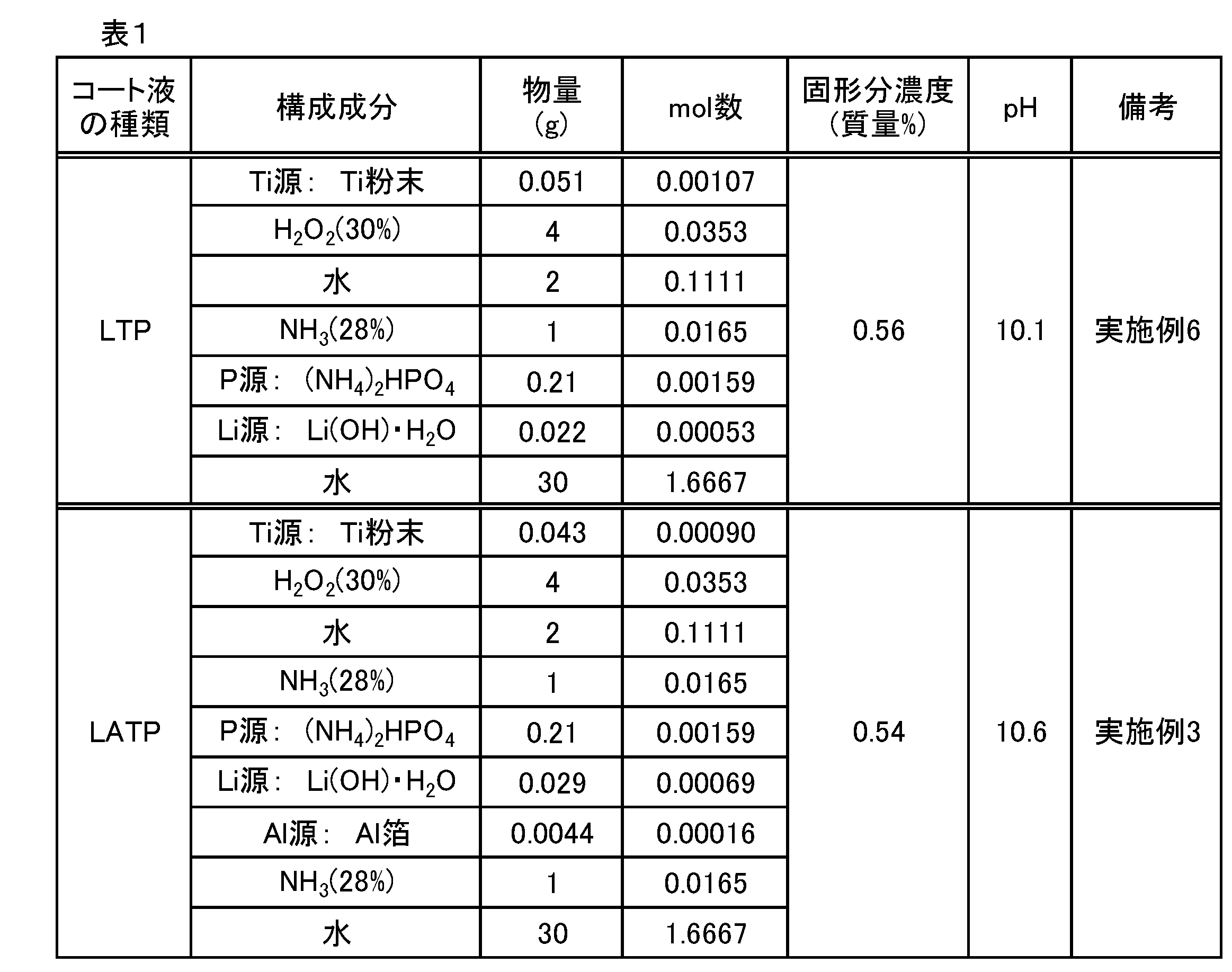
表1に、実施例6に用いたコート液(Al無添加;LTPコート液)および実施例3に用いたコート液(Al添加;LATPコート液)を例示する。表2、表3には、各例の測定結果を示す。 Table 1 illustrates the coating liquid used in Example 6 (Al-free addition; LTP coating liquid) and the coating liquid used in Example 3 (Al-added; LATP coating liquid). Tables 2 and 3 show the measurement results of each example.


Claims (9)
前記固形分を酸素含有雰囲気中で焼成する工程、
を有する請求項1または2に記載の固体電解質被覆正極活物質粉末の製造方法。 A positive electrode for a lithium ion secondary battery comprising an aqueous solution in which each element of Li, Al, Ti, P or each element of Li, Ti, P is dissolved, and a composite oxide having Li and transition metal M as components. A step of mixing the active material powder particles and then evaporating the liquid component to obtain a solid content;
Baking the solid content in an oxygen-containing atmosphere;
The manufacturing method of the solid electrolyte covering positive electrode active material powder of Claim 1 or 2 which has these.
前記被着後の粉末粒子が含まれるスラリーを固液分離して固形分を回収する工程、
前記固形分を酸素含有雰囲気中で焼成する工程、
を有する請求項1または2に記載の固体電解質被覆正極活物質粉末の製造方法。 Lithium ions composed of Li, Al, Ti, P elements or an aqueous solution (Liquid A) in which Li, Ti, P elements are dissolved, and a complex oxide containing Li and transition metal M as components. A liquid in which powder particles of the positive electrode active material for secondary battery are dispersed in a water-soluble organic solvent or a mixed medium of a water-soluble organic solvent and water is prepared, and liquid A is transferred into liquid B. Adding Li, Al, Ti, P or Li, Ti, P to the surface of the powder particles in the liquid B by adding,
A step of solid-liquid separation of the slurry containing the powder particles after the deposition to recover the solid content,
Baking the solid content in an oxygen-containing atmosphere;
The manufacturing method of the solid electrolyte covering positive electrode active material powder of Claim 1 or 2 which has these.
Priority Applications (4)
| Application Number | Priority Date | Filing Date | Title |
|---|---|---|---|
| CN201480022383.0A CN105144438B (en) | 2013-05-07 | 2014-05-06 | Positive electrode active material powder and its manufacturing method |
| KR1020157024215A KR102180758B1 (en) | 2013-05-07 | 2014-05-06 | Positive-electrode active-material powder and manufacturing method therefor |
| US14/787,004 US9761907B2 (en) | 2013-05-07 | 2014-05-06 | Positive-electrode active-material powder and manufacturing method therefor |
| HK16104432.0A HK1216459A1 (en) | 2013-05-07 | 2014-05-06 | Positive-electrode active-material powder and manufacturing method therefor |
Applications Claiming Priority (2)
| Application Number | Priority Date | Filing Date | Title |
|---|---|---|---|
| JP2013-098012 | 2013-05-07 | ||
| JP2013098012 | 2013-05-07 |
Publications (1)
| Publication Number | Publication Date |
|---|---|
| WO2014181784A1 true WO2014181784A1 (en) | 2014-11-13 |
Family
ID=51867264
Family Applications (1)
| Application Number | Title | Priority Date | Filing Date |
|---|---|---|---|
| PCT/JP2014/062208 Ceased WO2014181784A1 (en) | 2013-05-07 | 2014-05-06 | Positive-electrode active-material powder and manufacturing method therefor |
Country Status (6)
| Country | Link |
|---|---|
| US (1) | US9761907B2 (en) |
| JP (1) | JP6470914B2 (en) |
| KR (1) | KR102180758B1 (en) |
| CN (1) | CN105144438B (en) |
| HK (1) | HK1216459A1 (en) |
| WO (1) | WO2014181784A1 (en) |
Cited By (1)
| Publication number | Priority date | Publication date | Assignee | Title |
|---|---|---|---|---|
| CN109792078A (en) * | 2016-09-29 | 2019-05-21 | Tdk株式会社 | All solid state lithium ion secondary cell |
Families Citing this family (25)
| Publication number | Priority date | Publication date | Assignee | Title |
|---|---|---|---|---|
| KR101840541B1 (en) | 2015-04-30 | 2018-03-20 | 주식회사 엘지화학 | Positive electrode material for lithium secondary battery, method for preparing the same and secondary battery comprising the same |
| JP7016210B2 (en) * | 2016-05-27 | 2022-02-04 | Dowaエレクトロニクス株式会社 | Manufacturing method of positive electrode active material powder |
| KR102006726B1 (en) | 2016-10-05 | 2019-08-02 | 주식회사 엘지화학 | Positive electrode active material for secondary battery and secondary battery comprising the same |
| JP6897228B2 (en) * | 2017-03-29 | 2021-06-30 | Tdk株式会社 | Active material, electrodes and lithium-ion secondary battery |
| US20200152961A1 (en) * | 2017-05-03 | 2020-05-14 | Semiconductor Energy Laboratory Co., Ltd. | Method for Manufacturing Positive Electrode Active Material Particles and Secondary Battery |
| CN107768631A (en) * | 2017-10-16 | 2018-03-06 | 桑顿新能源科技有限公司 | A kind of lithium-rich manganese base material for coating titanium phosphate aluminium lithium and preparation method thereof |
| CN107768632A (en) * | 2017-10-16 | 2018-03-06 | 桑顿新能源科技有限公司 | A kind of LATP monocrystalline high-voltage anode material and preparation method thereof |
| CN107799746A (en) * | 2017-10-20 | 2018-03-13 | 西藏容汇锂业科技有限公司 | A kind of preparation method of modification of lithium ion battery anode material |
| CN108075122A (en) * | 2017-12-14 | 2018-05-25 | 电子科技大学 | A kind of preparation method of lithium ion battery composite cathode material |
| CN108232108B (en) * | 2017-12-19 | 2023-06-30 | 成都大超科技有限公司 | A lithium battery positive electrode structure and preparation method thereof, lithium battery structure |
| CN109461894B (en) * | 2017-12-29 | 2020-04-07 | 北京当升材料科技股份有限公司 | Positive electrode composite material for solid-state lithium ion battery and preparation method thereof |
| JP7017108B2 (en) * | 2018-03-28 | 2022-02-08 | Tdk株式会社 | Active materials, electrodes and lithium-ion secondary batteries |
| CN110767896A (en) * | 2018-07-27 | 2020-02-07 | 中国科学院物理研究所 | Lithium ion battery positive electrode material, preparation method thereof and lithium battery |
| CN110858643B (en) * | 2018-08-24 | 2021-09-14 | 湖南杉杉新能源有限公司 | Fast ion conductor modified lithium ion battery cathode material and preparation method thereof |
| WO2020049843A1 (en) * | 2018-09-07 | 2020-03-12 | 株式会社カネカ | Coated positive electrode active material, method of manufacturing lithium ion secondary battery, and lithium ion secondary battery |
| JP7271235B2 (en) * | 2019-03-08 | 2023-05-11 | Dowaエレクトロニクス株式会社 | Method for producing titanium pyrophosphate and method for producing solid electrolyte |
| ES3009908T3 (en) * | 2019-07-03 | 2025-03-31 | Umicore Nv | Lithium nickel manganese cobalt composite oxide as a positive electrode active material for rechargeable lithium ion batteries |
| CN111600014B (en) * | 2020-05-26 | 2022-11-22 | 宁波容百新能源科技股份有限公司 | Modified high-specific-capacity high-nickel ternary cathode material and preparation method thereof |
| CN111755698A (en) * | 2020-07-06 | 2020-10-09 | 上海汽车集团股份有限公司 | A kind of positive electrode material coated with oxide solid electrolyte and preparation method thereof |
| JP7669650B2 (en) * | 2020-09-02 | 2025-04-30 | 株式会社プロテリアル | Method for producing positive electrode active material for lithium ion secondary battery |
| CN116419907A (en) * | 2020-11-05 | 2023-07-11 | 株式会社钟化 | Positive electrode composite active material, lithium ion secondary battery, composite active material, method for manufacturing positive electrode composite active material, and method for manufacturing lithium ion secondary battery |
| JP7766431B2 (en) * | 2020-11-05 | 2025-11-10 | 株式会社カネカ | Positive electrode composite active material, lithium ion secondary battery, composite active material, method for manufacturing positive electrode composite active material, and method for manufacturing lithium ion secondary battery |
| KR20230032641A (en) * | 2021-08-31 | 2023-03-07 | 주식회사 엘지에너지솔루션 | Electrode for all solid battery |
| CN115172728B (en) * | 2022-08-12 | 2025-07-29 | 合肥国轩科宏新能源科技有限公司 | Modified ternary material with double-layer cladding structure and preparation method thereof |
| CN116544418B (en) * | 2023-07-07 | 2023-09-19 | 英德市科恒新能源科技有限公司 | Lithium cobalt oxide positive electrode material, preparation method thereof and battery |
Citations (5)
| Publication number | Priority date | Publication date | Assignee | Title |
|---|---|---|---|---|
| JP2011086610A (en) * | 2009-09-17 | 2011-04-28 | Ohara Inc | All-solid battery and method of manufacturing the same |
| JP2012048890A (en) * | 2010-08-25 | 2012-03-08 | Ohara Inc | All-solid type lithium ion battery |
| JP2012089472A (en) * | 2010-10-15 | 2012-05-10 | Qinghua Univ | Composite material for electrode and method for producing the same, and lithium ion battery employing the composite material for electrode |
| JP2012099482A (en) * | 2010-11-02 | 2012-05-24 | Samsung Sdi Co Ltd | Positive electrode active material for lithium secondary battery, method of manufacturing positive electrode active material for lithium secondary battery, positive electrode for lithium secondary battery, and lithium secondary battery |
| JP2013026003A (en) * | 2011-07-20 | 2013-02-04 | Toyota Motor Corp | All-solid battery, and method of manufacturing the same |
Family Cites Families (5)
| Publication number | Priority date | Publication date | Assignee | Title |
|---|---|---|---|---|
| JP2003059492A (en) * | 2001-08-17 | 2003-02-28 | Matsushita Electric Ind Co Ltd | Lithium secondary battery and method of manufacturing the same |
| KR20080045855A (en) * | 2006-11-21 | 2008-05-26 | 동우 화인켐 주식회사 | Cathode active material for lithium secondary battery, manufacturing method thereof, and lithium secondary battery comprising same |
| JP5110565B2 (en) | 2007-03-08 | 2012-12-26 | トヨタ自動車株式会社 | Lithium secondary battery, method for producing positive electrode active material coating particles, and method for producing lithium secondary battery |
| CN102347470B (en) * | 2010-08-02 | 2016-08-10 | 清华大学 | Cobalt acid lithium composite material granule and preparation method thereof, and lithium ion battery |
| JP5681427B2 (en) | 2010-09-28 | 2015-03-11 | Dowaホールディングス株式会社 | Lithium-transition metal oxide powder and production method thereof, positive electrode active material for lithium ion battery, and lithium ion secondary battery |
-
2014
- 2014-05-06 WO PCT/JP2014/062208 patent/WO2014181784A1/en not_active Ceased
- 2014-05-06 CN CN201480022383.0A patent/CN105144438B/en active Active
- 2014-05-06 HK HK16104432.0A patent/HK1216459A1/en unknown
- 2014-05-06 US US14/787,004 patent/US9761907B2/en active Active
- 2014-05-06 KR KR1020157024215A patent/KR102180758B1/en active Active
- 2014-05-06 JP JP2014095611A patent/JP6470914B2/en active Active
Patent Citations (5)
| Publication number | Priority date | Publication date | Assignee | Title |
|---|---|---|---|---|
| JP2011086610A (en) * | 2009-09-17 | 2011-04-28 | Ohara Inc | All-solid battery and method of manufacturing the same |
| JP2012048890A (en) * | 2010-08-25 | 2012-03-08 | Ohara Inc | All-solid type lithium ion battery |
| JP2012089472A (en) * | 2010-10-15 | 2012-05-10 | Qinghua Univ | Composite material for electrode and method for producing the same, and lithium ion battery employing the composite material for electrode |
| JP2012099482A (en) * | 2010-11-02 | 2012-05-24 | Samsung Sdi Co Ltd | Positive electrode active material for lithium secondary battery, method of manufacturing positive electrode active material for lithium secondary battery, positive electrode for lithium secondary battery, and lithium secondary battery |
| JP2013026003A (en) * | 2011-07-20 | 2013-02-04 | Toyota Motor Corp | All-solid battery, and method of manufacturing the same |
Cited By (2)
| Publication number | Priority date | Publication date | Assignee | Title |
|---|---|---|---|---|
| CN109792078A (en) * | 2016-09-29 | 2019-05-21 | Tdk株式会社 | All solid state lithium ion secondary cell |
| CN109792078B (en) * | 2016-09-29 | 2023-04-25 | Tdk株式会社 | All solid lithium ion secondary battery |
Also Published As
| Publication number | Publication date |
|---|---|
| CN105144438A (en) | 2015-12-09 |
| JP6470914B2 (en) | 2019-02-13 |
| JP2014239030A (en) | 2014-12-18 |
| KR20160006665A (en) | 2016-01-19 |
| US9761907B2 (en) | 2017-09-12 |
| KR102180758B1 (en) | 2020-11-19 |
| CN105144438B (en) | 2018-05-15 |
| US20160093914A1 (en) | 2016-03-31 |
| HK1216459A1 (en) | 2016-11-11 |
Similar Documents
| Publication | Publication Date | Title |
|---|---|---|
| JP6470914B2 (en) | Positive electrode active material powder and manufacturing method thereof | |
| JP6543726B2 (en) | Positive electrode active material for lithium secondary battery, method of manufacturing the same, and lithium secondary battery including the same | |
| US9431649B2 (en) | Coated electroactive materials | |
| JP6869113B2 (en) | Positive electrode active material powder and its manufacturing method and all-solid-state lithium secondary battery | |
| TWI623135B (en) | Non-aqueous secondary battery having a blended cathode active material | |
| CN101894945B (en) | Method of producing nitrided lithium-transition metal compound oxide, nitrided lithium-transition metal compound oxide, and lithium-ion battery | |
| JP2013191540A (en) | Positive active material, method of preparing the same, and secondary battery using the same | |
| EP2471133A2 (en) | Metal oxide coated positive electrode materials for lithium-based batteries | |
| JP7131056B2 (en) | Positive electrode active material for non-aqueous electrolyte secondary battery, non-aqueous electrolyte secondary battery | |
| WO2013119571A1 (en) | Mixed phase lithium metal oxide compositions with desirable battery performance | |
| CN107408686A (en) | Cathode active material, its manufacture method for lithium rechargeable battery and include its lithium rechargeable battery | |
| Zhang et al. | VOPO 4 nanosheets as anode materials for lithium-ion batteries | |
| JP7369170B2 (en) | Cathode active material powder | |
| EP3846260A1 (en) | Positive electrode active material and battery provided with same | |
| Feng et al. | Enhanced cycling stability of Co3 (PO4) 2-coated LiMn2O4 cathode materials for lithium ion batteries | |
| CN113454032B (en) | Positive electrode active material for lithium ion secondary battery, method for producing positive electrode active material for lithium ion secondary battery, lithium ion secondary battery | |
| JP6621131B2 (en) | Positive electrode active material for lithium secondary battery, method for producing the same, and lithium secondary battery including the same | |
| CN113571705A (en) | Cathode material, preparation method thereof and lithium ion battery | |
| KR101045416B1 (en) | Lithium titanium oxide powder, a method of manufacturing the same, an electrode comprising the same, and a secondary battery | |
| JP7329696B2 (en) | Positive electrode active material, manufacturing method thereof, and lithium secondary battery including the same | |
| Logan et al. | A scalable aluminum niobate anode for high energy, high power practical lithium-ion batteries | |
| WO2022044720A1 (en) | Positive electrode active material for lithium secondary batteries, positive electrode for lithium secondary batteries, and lithium secondary battery | |
| KR101576274B1 (en) | Positive active material for rechargeable lithium battery, method for manufacturing the same, and rechargeable lithium battery including the same | |
| CA3086960A1 (en) | Manganese phosphate coated lithium nickel oxide materials | |
| JP6669345B2 (en) | Positive active material for lithium secondary battery, method for producing the same, and lithium secondary battery including the same |
Legal Events
| Date | Code | Title | Description |
|---|---|---|---|
| WWE | Wipo information: entry into national phase |
Ref document number: 201480022383.0 Country of ref document: CN |
|
| 121 | Ep: the epo has been informed by wipo that ep was designated in this application |
Ref document number: 14794052 Country of ref document: EP Kind code of ref document: A1 |
|
| ENP | Entry into the national phase |
Ref document number: 20157024215 Country of ref document: KR Kind code of ref document: A |
|
| WWE | Wipo information: entry into national phase |
Ref document number: 14787004 Country of ref document: US |
|
| NENP | Non-entry into the national phase |
Ref country code: DE |
|
| 122 | Ep: pct application non-entry in european phase |
Ref document number: 14794052 Country of ref document: EP Kind code of ref document: A1 |