WO2014181683A1 - Ink composition for writing utensil and coloring material - Google Patents
Ink composition for writing utensil and coloring material Download PDFInfo
- Publication number
- WO2014181683A1 WO2014181683A1 PCT/JP2014/061386 JP2014061386W WO2014181683A1 WO 2014181683 A1 WO2014181683 A1 WO 2014181683A1 JP 2014061386 W JP2014061386 W JP 2014061386W WO 2014181683 A1 WO2014181683 A1 WO 2014181683A1
- Authority
- WO
- WIPO (PCT)
- Prior art keywords
- salt
- dye
- ink composition
- compound
- coloring material
- Prior art date
- Legal status (The legal status is an assumption and is not a legal conclusion. Google has not performed a legal analysis and makes no representation as to the accuracy of the status listed.)
- Ceased
Links
Classifications
-
- C—CHEMISTRY; METALLURGY
- C09—DYES; PAINTS; POLISHES; NATURAL RESINS; ADHESIVES; COMPOSITIONS NOT OTHERWISE PROVIDED FOR; APPLICATIONS OF MATERIALS NOT OTHERWISE PROVIDED FOR
- C09D—COATING COMPOSITIONS, e.g. PAINTS, VARNISHES OR LACQUERS; FILLING PASTES; CHEMICAL PAINT OR INK REMOVERS; INKS; CORRECTING FLUIDS; WOODSTAINS; PASTES OR SOLIDS FOR COLOURING OR PRINTING; USE OF MATERIALS THEREFOR
- C09D11/00—Inks
- C09D11/16—Writing inks
- C09D11/18—Writing inks specially adapted for ball-point writing instruments
-
- C—CHEMISTRY; METALLURGY
- C08—ORGANIC MACROMOLECULAR COMPOUNDS; THEIR PREPARATION OR CHEMICAL WORKING-UP; COMPOSITIONS BASED THEREON
- C08K—Use of inorganic or non-macromolecular organic substances as compounding ingredients
- C08K5/00—Use of organic ingredients
- C08K5/16—Nitrogen-containing compounds
- C08K5/17—Amines; Quaternary ammonium compounds
- C08K5/19—Quaternary ammonium compounds
-
- C—CHEMISTRY; METALLURGY
- C09—DYES; PAINTS; POLISHES; NATURAL RESINS; ADHESIVES; COMPOSITIONS NOT OTHERWISE PROVIDED FOR; APPLICATIONS OF MATERIALS NOT OTHERWISE PROVIDED FOR
- C09D—COATING COMPOSITIONS, e.g. PAINTS, VARNISHES OR LACQUERS; FILLING PASTES; CHEMICAL PAINT OR INK REMOVERS; INKS; CORRECTING FLUIDS; WOODSTAINS; PASTES OR SOLIDS FOR COLOURING OR PRINTING; USE OF MATERIALS THEREFOR
- C09D11/00—Inks
- C09D11/16—Writing inks
- C09D11/17—Writing inks characterised by colouring agents
-
- C—CHEMISTRY; METALLURGY
- C09—DYES; PAINTS; POLISHES; NATURAL RESINS; ADHESIVES; COMPOSITIONS NOT OTHERWISE PROVIDED FOR; APPLICATIONS OF MATERIALS NOT OTHERWISE PROVIDED FOR
- C09D—COATING COMPOSITIONS, e.g. PAINTS, VARNISHES OR LACQUERS; FILLING PASTES; CHEMICAL PAINT OR INK REMOVERS; INKS; CORRECTING FLUIDS; WOODSTAINS; PASTES OR SOLIDS FOR COLOURING OR PRINTING; USE OF MATERIALS THEREFOR
- C09D11/00—Inks
- C09D11/50—Sympathetic, colour changing or similar inks
-
- C—CHEMISTRY; METALLURGY
- C09—DYES; PAINTS; POLISHES; NATURAL RESINS; ADHESIVES; COMPOSITIONS NOT OTHERWISE PROVIDED FOR; APPLICATIONS OF MATERIALS NOT OTHERWISE PROVIDED FOR
- C09D—COATING COMPOSITIONS, e.g. PAINTS, VARNISHES OR LACQUERS; FILLING PASTES; CHEMICAL PAINT OR INK REMOVERS; INKS; CORRECTING FLUIDS; WOODSTAINS; PASTES OR SOLIDS FOR COLOURING OR PRINTING; USE OF MATERIALS THEREFOR
- C09D181/00—Coating compositions based on macromolecular compounds obtained by reactions forming in the main chain of the macromolecule a linkage containing sulfur, with or without nitrogen, oxygen, or carbon only; Coating compositions based on polysulfones; Coating compositions based on derivatives of such polymers
- C09D181/10—Polysulfonamides; Polysulfonimides
Definitions
- the present invention relates to an ink composition for a writing instrument and a coloring material. More specifically, the ink composition for a writing instrument has good solubility in the ink solvent, hardly causes bleeding and bleeding of the drawn lines, and has improved water resistance. It relates to things and coloring materials.
- JP-A-8-134393 (Claims, Examples, etc.) JP 2009-292935 A (Claims, Examples, etc.) JP-T-2004-530037 (Claims, Examples, etc.)
- the present invention has been made in view of the above-described problems of the prior art, and is intended to solve this problem.
- the solubility of the coloring material in the ink solvent is good, the drawn lines are less likely to bleed and blur, and the water resistance is improved.
- An object is to provide an ink composition for a writing instrument, a coloring material, and the like.
- the present inventor has obtained a coloring material obtained by adding at least one selected from a leuco dye, a salt-forming dye and a photochromic compound to a specific compound.
- a coloring material obtained by adding at least one selected from a leuco dye, a salt-forming dye and a photochromic compound to a specific compound.
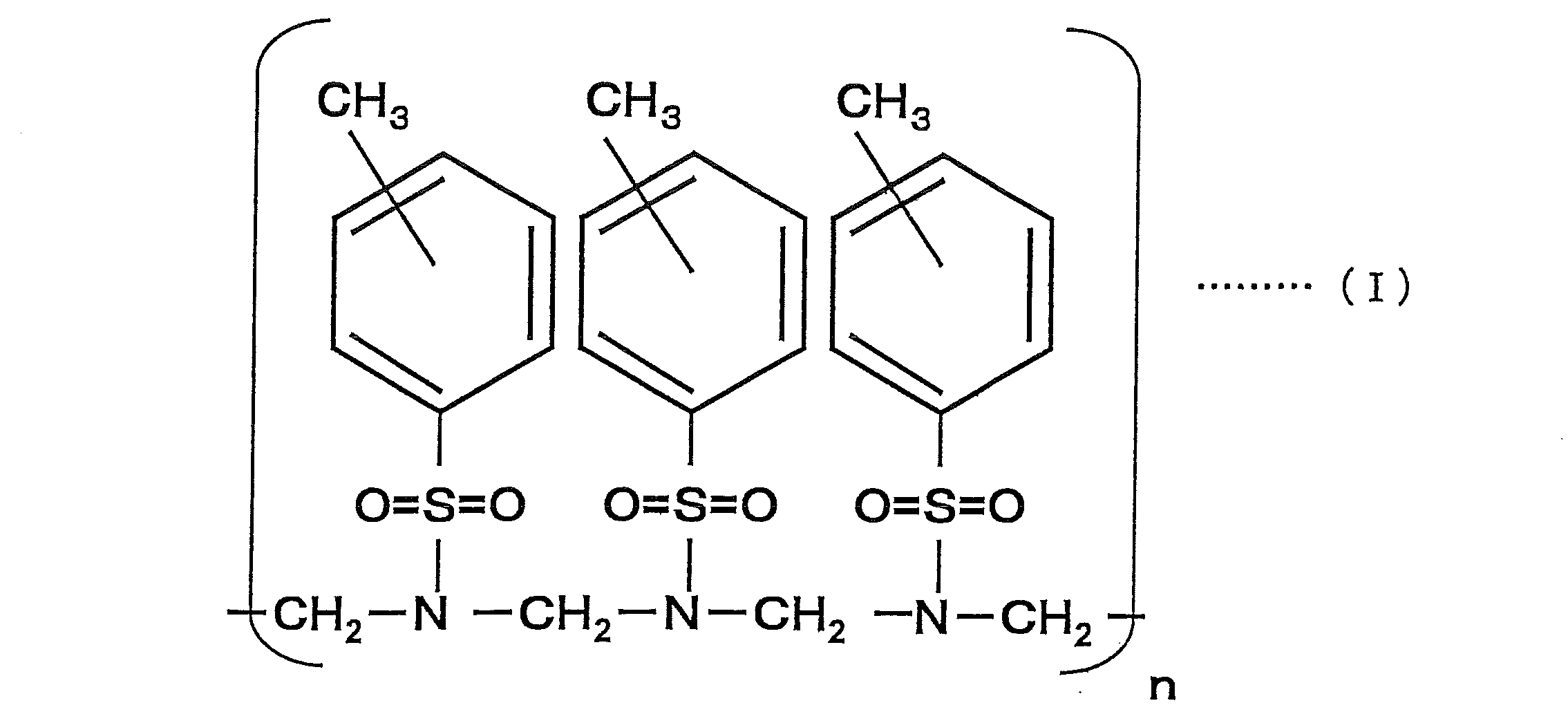
- an ink composition for a writing instrument comprising a coloring material obtained by adding at least one selected from a leuco dye, a salt-forming dye and a photochromic compound to a compound represented by the following formula (I): object.
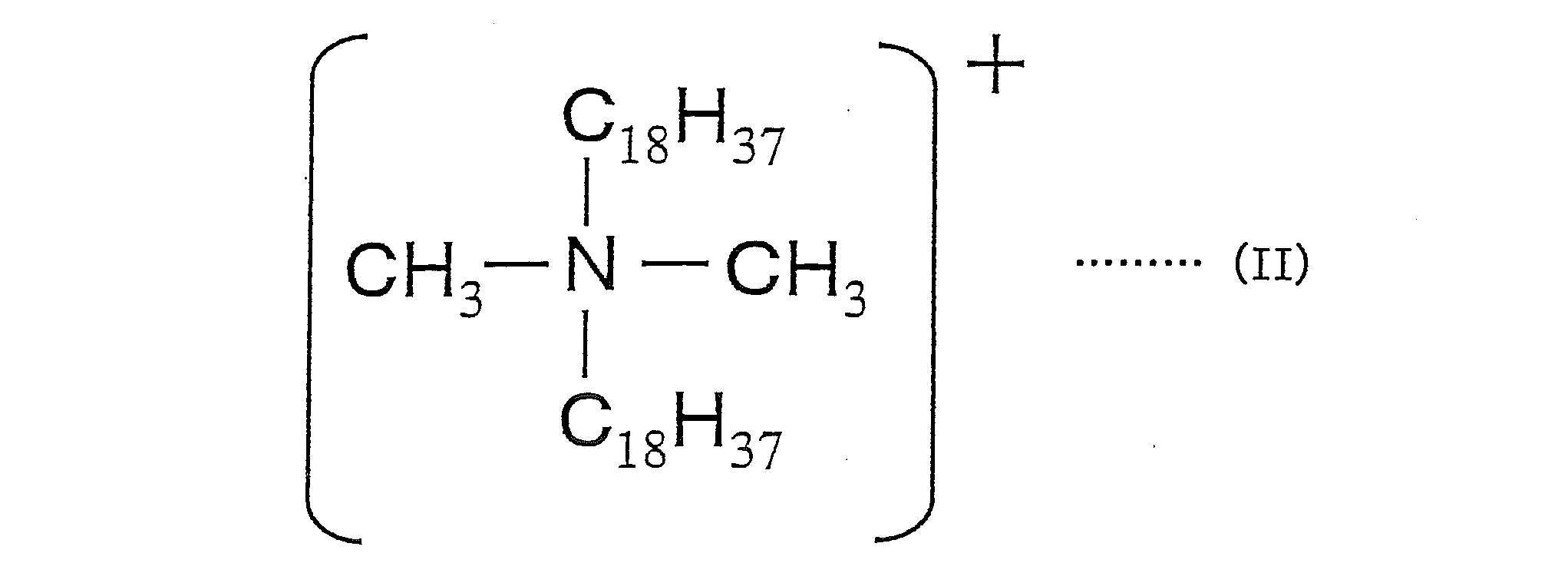
- the salt-forming dye comprises a cation of a dimethyl distearyl ammonium salt represented by the following formula (II) and an acidic dye.
- the mass ratio of the compound of formula (I) and the leuco dye contained in the colorant is in the range of 1: 0.01 to 1. object.
- an ink composition for a writing instrument and a coloring material which have good solubility of a coloring material in an ink solvent, hardly cause bleeding and bleeding of a drawn line, and have improved water resistance.
- the dye and resin are integrated in the obtained color material, the degree of freedom of blending can be ensured when preparing ink for writing instruments on the condition that the solid content is high.
- the ink composition for a writing instrument of the present invention contains a color material obtained by adding at least one selected from a leuco dye, a salt-forming dye and a photochromic compound to a compound represented by the following formula (I). It is a feature.
- the leuco dye used in the present invention is not particularly limited as long as it is an electron donating dye and functions as a color former.
- conventionally known ones such as triphenylmethane, spiropyran, fluoran, diphenylmethane, rhodamine lactam, indolylphthalide, leucooramine, It can be used alone (one kind) or in a mixture of two or more kinds (hereinafter simply referred to as “at least one kind”).
- pyridine compounds, quinazoline compounds, bisquinazoline compounds and the like that develop yellow to red color development can also be used.
- These leuco dyes have a lactone skeleton, a pyridine skeleton, a quinazoline skeleton, a bisquinazoline skeleton, etc., and develop color when these skeletons (rings) are opened.
- salt-forming dye for example, a salt-forming dye composed of a basic dye and an acidic dye, a salt-forming dye composed of a basic dye and an acidic compound, a salt-forming dye composed of an acidic dye and a basic compound, the following formula There may be mentioned at least one salt-forming dye composed of a cation of dimethyl distearyl ammonium salt represented by (II) and an acid dye.
- a structure produced from a basic dye containing a basic group such as an amino group in the molecular structure and an acid dye containing an acidic group such as a sulfonic acid group or a carboxylic acid group in the molecular structure is a structure produced from a basic dye containing a basic group such as an amino group in the molecular structure and an acid dye containing an acidic group such as a sulfonic acid group or a carboxylic acid group in the molecular structure.
- Salt dye 2) a salt-forming dye capable of forming a salt by combining a basic dye containing the basic group in the molecular structure with an acidic compound, and a conjugate base of the acidic compound is combined with the basic group of the basic dye; ) An acidic dye that contains an acidic group such as a sulfonic acid group or a carboxylic acid group in its molecular structure, and a basic compound, the conjugate acid of the basic compound can combine with the acidic group of the acidic dye to form a salt.
- Salt dyes 4) Salt-forming dyes produced from a cation of a dimethyl distearyl ammonium salt represented by the above formula (II) and an acid dye can be used.
- VALIFAST COLORS As salt-forming dyes that can be used in the above 1) to 3), various colors commercially available under the trade name “VALIFAST COLORS”, for example, VALIFAST BLUE 1631, VALIFASTIFBLUE 1603, VALIFAST BLUE 1621, VALIFAST RED 1308 , VALIFAST 20 RED 20 1320, VALIFAST V RED 55 1355, VALIFAST RED 1362, VALIFAST VOILET 1701, VALIFAST VIOLET 1704, VALIFAST VIOLET 1731, VALIFAST YELLOW1 101, VALIFAST YELLOW 1091, Y
- each color commercially available under the trade name “Aizen Spiro”, for example, Aizen Spiro Violet C-RH, Aizen Spiro Yellow Red C-BH, Aizen SpiroYellow C-GHN, SBN N Yellow 53 A S C-GH, Aizen Spillon Red C-BH, Aizen Sp
- Examples of the acid dye that can be used as the salt-forming dye of 4) above include C.I. I. Acid Black 1, 2, 24, 26, 31, 31, 52, 107, 109, 110, 119, 154, C.I. I. Acid Yellow 7, 17, 19, 23, 25, 29, 38, 42, 49, 61, 72, 78, 110, 127, 135, 141, the same 142, C.I. I. Acid Red 8, 9, 9, 14, 26, 27, 35, 37, 51, 52, 57, 82, 87, 92, 94, 115, 129, 131, 186, 249, 254, 265, 276, C.I. I. Acid Violet 17, 18 and C.I. I. Acid Blue 1, 7, 9, 22, 23, 25, 40, 41, 43, 62, 78, 83, 90, 93, 103, 112, the same 113, 158, C.I. I. Acid Green 3, 9, 16, 25, 27 and the like.
- the salt-forming dye used in the above 4) can be obtained as follows.
- a solution 1 is prepared by adding dimethyl distearyl ammonium salt to water (purified water, distilled water, pure water, etc.) and stirring and dissolving at room temperature.
- the solution 2 the above acid dye is added to water, and if necessary, an aqueous NaOH solution is dropped to adjust the pH to the alkali side, and then the solution 2 is prepared by stirring and dissolving at room temperature.
- an acid aqueous solution such as a hydrochloric acid aqueous solution dropwise, adjusting the pH to the acidic side, performing filtration, and further drying through water washing and / or solvent washing.
- a salt-forming dye can be obtained.
- the addition amount of the dimethyl distearyl ammonium salt to be used and the acidic dye is determined according to the equivalent based on the ionic value. That is, when the acidic dye is a monovalent anion, 1 equivalent of the dimethyl distearyl ammonium salt cation, and when the acidic dye is a divalent anion, Cations are added. However, in consideration of reactivity, one compound may be added more than the theoretical value. Of the salt-forming dyes 1) to 4), the use of the salt-forming dye 4) is particularly desirable.
- the photochromic compound used in the present invention is a dye having a photochromic property that develops color by light and fades by light or heat, and conventionally used ones can be used.
- 2,3-bis (2,4,5- Trimethyl-3-thienyl) maleic anhydride 2,3-bis (2,4,5-trimethyl-3-thienyl) maleimide, cis-1,2-dicyano-1,2-bis (2,4,5 -Trimethyl-3-thienyl) ethene, 1,2-bis [2-methylbenzo [b] thiophen-3-yl] -3,3,4,4,5,5-hexafluoro-1-cyclopentene, 1,2 -Bis (2,4-dimethyl-5-phenyl-3-thienyl) -3,3,4,4,5,5-hexafluoro-1-cyclopentene, 1- (2-hydroxyethyl) -3,3- Dimethyl Ndorino-6'-nitrobenzopyrospirane, 1,3,
- the color material of the present invention is obtained by adding at least one selected from the above leuco dyes, salt-forming dyes and photochromic compounds to the compound represented by the following formula (I).
- the compound represented by the above formula (I) is a sulfonic acid resin obtained by adding p-toluenesulfonic acid amide and formaldehyde and heating to perform a condensation reaction, and the para-position (p-position) is the main component ( The p-position is greater than 50% by mass), and the compound at the ortho-position (o-position) may be mixed in the compound. Further, it may be a compound obtained by adding an appropriate amount of a crosslinking agent such as benzoguanamine, and the addition of this crosslinking agent can further suppress deterioration over time.
- n in Formula (I) is a positive number, and is adjusted within the range of the preferable weight average molecular weight of the coloring material described later.
- the weight average molecular weight of the coloring material of the present invention is preferably in the range of 300 to 3,000. If the color material has a weight average molecular weight of less than 300, the fastness such as water resistance tends to decrease. On the other hand, if it exceeds 3000, the viscosity increases, which is not preferable. More preferably, it is 500 to 2000, and more preferably in the range of 500 to 1000. In the present invention (including examples described later), the weight average molecular weight is measured by GPC (Gel Permeation Chromatography), and the value is a polystyrene equivalent value.
- GPC Gel Permeation Chromatography
- the production of the coloring material include, for example, 1) in the condensation process of the sulfonic acid resin of the above formula (I) obtained by a condensation reaction by mixing p-toluenesulfonic acid amide and formaldehyde and heating. It can be obtained by adding at least one selected from the above leuco dyes, salt-forming dyes and photochromic compounds, cooling and solidifying after completion of condensation dehydration, and 2) the compound of the above formula (I) produced ( And at least one selected from the above-mentioned leuco dyes, salt-forming dyes and photochromic compounds and kneading, or kneading while heating, if necessary, then cooling and solidifying, etc. it can.
- the mass ratio of the compound of formula (I) and the leuco dye contained in the color material is preferably in the range of 1: 0.01 to 1, further Preferably, it is in the range of 1: 0.01 to 0.5.
- the mass ratio of the compound of formula (I) contained in the colorant to the salt-forming dye is preferably in the range of 1: 0.1 to 2, more preferably It is desirable to be in the range of 1: 0.2 to 1.2.
- the mass ratio of the compound of formula (I) and the photochromic compound contained in the colorant is preferably in the range of 1: 0.001 to 0.1, more preferably The range of 1: 0.01 to 0.1 is desirable.
- each mass ratio of the leuco dye, salt-forming dye and photochromic compound is less than the respective lower limit (0.01, 0.1, 0.001), sufficient color density cannot be obtained, Exceeding the upper limit (1, 2, 0.1) is not preferable because the solubility in a solvent is lowered and precipitation tends to occur.
- the coloring material of the present invention is obtained by adding at least one selected from the above leuco dyes, salt-forming dyes and photochromic compounds to the compound represented by the above formula (I) (sulfonic acid resin),
- the leuco dye, salt-forming dye, and photochromic compound are combined with the sulfonic acid amide and integrated with the resin.
- the leuco dye, salt-forming dye, and photochromic compound have the functions that the leuco dye, salt-forming dye, and photochromic compound originally have.
- the obtained color material is an integral of the dye and the resin, the degree of freedom of blending can be ensured when preparing ink for writing instruments on condition that the solid content is high.
- the degree of freedom in setting the reduction in manufacturing load and the diversification of each color by leuco dyes, salt-forming dyes and photochromic compounds can be achieved.
- the ink composition for a writing instrument of the present invention includes a color material obtained by adding at least one selected from the leuco dyes, salt-forming dyes and photochromic compounds having the above-described configuration to the compound represented by (I) above.
- it can be used as an ink composition for writing instruments such as oil-based ballpoint pens and marking pens.
- the content of these coloring materials varies depending on the application of the writing instrument (ball pen, marking pen, sign pen, etc.), but is preferably 0.1 to 30% by mass (hereinafter referred to as “the ink composition”). Simply referred to as “%”), more preferably 0.5 to 25%. If the content of these coloring materials is less than 0.1%, the coloring power and color developability become insufficient. On the other hand, if the content exceeds 30%, blurring tends to occur, which is not preferable.
- various organic solvents that have been conventionally used can be used in addition to the above-described colorant.
- a solvent selected from an alcohol solvent, a polyhydric alcohol solvent, and a glycol ether solvent can be used as a preferable solvent.
- the alcohol solvent is an aliphatic alcohol having 2 or more carbon atoms, specifically, ethanol, n-propanol, isopropanol, n-butanol, isobutanol, tert-butyl alcohol, 1-pentanol, isoamyl alcohol, sec-amyl alcohol, 3-pentanol, tert-amyl alcohol, n-hexanol, methyl amyl alcohol, 2-ethylbutanol, n-heptanol, 2-heptanol, 3-heptanol, n-octanol, 2-octanol, 2- Ethylhexanol, 3,5,5-trimethylhexanol, nonanol, n-decanol, undecanol, n-decanol, trimethylnonyl alcohol, tetradecanol, heptadecanol, cyclohexanol, 2-methylcyclo
- polyhydric alcohol solvent examples include ethylene glycol, diethylene glycol, 3-methyl-1,3-butanediol, triethylene glycol, dipropylene glycol, 1,3-propanediol, 1,3-butanediol, 1,5- Examples thereof include polyhydric alcohols having 2 or more carbons and 2 or more hydroxyl groups in the molecule such as pentanediol, hexylene glycol, and octylene glycol.
- a particularly preferred solvent is a glycol ether having 2 to 7 carbon atoms.
- an organic solvent other than ethylene glycol derivatives examples thereof include polyhydric alcohol derivatives such as sorbitan fatty acid type, polyglycerin higher fatty acid type, sucrose fatty acid type, and propylene glycol fatty acid type derivatives.
- glycol ether solvents include methyl isopropyl ether, ethyl ether, ethyl propyl ether, ethyl butyl ether, isopropyl ether, butyl ether, hexyl ether, 2-ethylhexyl ether, ethylene glycol monohexyl ether, ethylene glycol monophenyl ether, ethylene glycol mono- 2-ethylbutyl ether, ethylene glycol monomethyl ether, ethylene glycol monoethyl ether, ethylene glycol monobutyl ether, diethylene glycol monomethyl ether, diethylene glycol monoethyl ether, diethylene glycol monobutyl ether, triethylene glycol monobutyl ether, tetraethylene glycol monobutyl ether, 3-methyl 3-Methoxy-1-butanol, 3-methoxy-1-butanol, propylene glycol monomethyl ether, propylene glycol monoethyl
- ester solvents can also be used.
- the ester solvent include propylene glycol methyl ether acetate, propylene glycol diacetate, 3-methyl-3-methoxybutyl acetate, propylene glycol ethyl ether acetate, ethylene glycol ethyl ether acetate, butyl formate, isobutyl formate, isoamyl formate, Propyl acetate, butyl acetate, isopropyl acetate, isobutyl acetate, isoamyl acetate, methyl propionate, ethyl propionate, propyl propionate, isobutyl propionate, isoamyl propionate, methyl butyrate, ethyl butyrate, propyl butyrate, methyl isobutyrate, isobutyric acid Ethyl, propyl isobutyrate, methyl valerate, ethyl
- the diether or diester having no hydroxyl group in the molecule include ethylene glycol diethyl ether, ethylene glycol dibutyl ether, diethylene glycol diethyl ether, diethylene glycol dibutyl ether, diethylene glycol dimethyl ether, and dipropylene glycol dimethyl ether.
- the content of these solvents varies depending on the use of the writing instrument, the type of dye contained, etc., but is preferably 20 to 97%, more preferably 30 to 95%, based on the total amount of the ink composition. It is desirable to do.
- various resins may be used. These resins are contained for the purpose of improving the fixing property of ink, preventing the show-through of handwriting, adjusting the viscosity of the coloring material, adjusting the viscosity, and promoting dissolution of the coloring material.
- the resin any resin conventionally used for oil-based ballpoint pen inks can be used.
- Examples of the resin that can be used in the ink composition for a writing instrument of the present invention include, for example, a ketone resin, a styrene resin, a styrene-acrylic resin, a terpene phenol resin, and a rosin-modified maleic resin that can also be used as a colorant dispersant.
- Resins typified by rosin phenol resin, alkylphenol resin, phenol resin, styrene maleic resin, rosin resin, acrylic resin, urea aldehyde resin, maleic acid resin, cyclohexanone resin, polyvinyl butyral, polyvinyl pyrrolidone, etc. Is mentioned.
- the content of these resins is preferably 0.5 to 35%, more preferably 1.0 to 20% from the viewpoints of viscosity adjustment and writing quality.
- various additives that can be compatible with the ink without adversely affecting the ink, such as rust preventives, antifungal agents, surfactants, and lubricants, as needed, in the present invention. And an appropriate amount of a wetting agent and the like. Further, when a leuco dye is used as the coloring material, an appropriate amount of a developer or the like that is a component having the ability to develop a leuco dye can be used.
- the ink composition for a writing instrument a conventionally known method can be employed. For example, a predetermined amount of each component such as the organic solvent and resin is blended in addition to the color material, and a homomixer is used. Alternatively, it can be obtained by stirring and mixing with a stirrer such as a disper. Furthermore, if necessary, coarse particles in the ink composition may be removed by filtration or centrifugation.
- the ink composition for a writing instrument of the present invention configured as described above is mounted on a marking pen body having a fiber tip, a felt tip, or a plastic tip at the writing tip portion, or a ballpoint pen body having a ball pen tip at the writing tip portion.
- the ink composition for writing instruments and the writing instrument of the present invention contain a coloring material obtained by adding at least one selected from leuco dyes, salt-forming dyes and photochromic compounds to the compound represented by the above formula (I). Even if an oil-based ink is formulated and written on a paper surface or the like with a writing instrument such as a ballpoint pen body or a marking pen body equipped with this ink, the water resistance and bleed resistance are excellent.
- toluenesulfonic acid amide formaldehyde was calculated at 3: 2 mol (hereinafter the same). Further, the mass ratio of the resin (resin of p-toluenesulfonic acid amide + formaldehyde, hereinafter the same) and the leuco dye was 1: 0.05.
- Colorant A-9 was produced in the same manner as in Production Example 8 except that 24 g of salt-forming dye 2 was used instead of salt-forming dye 1 in Production Example 8.
- the mass ratio of the resin to the salt-forming dye was 1: 0.3.
- Colorant A-10 was produced in the same manner as in Production Example 8 using 56 g of the salt-forming dye 3 instead of the salt-forming dye 1 in Production Example 8.
- the mass ratio of the resin to the salt-forming dye was 1: 0.7.
- Examples 1 to 9 and Comparative Examples 1 to 9 (Ink formula) Each oil-based ballpoint pen ink composition was prepared by a conventional method with the formulation shown in Table 1 and Table 2 below.
- Table 1 (Examples 1 to 6 and Comparative Examples 1 to 6) shows the composition of the ink composition for ballpoint pens using the coloring materials of Production Examples 1 to 7, and Table 2 shows (Examples 7 to 9 and Comparative Examples 7 to 9) are blended compositions of ink compositions for ballpoint pens using the color materials and the like of Production Examples 8 to 10.
- Ballpoint pens were produced using the ink compositions obtained above. Specifically, using an axis of a ballpoint pen [Mitsubishi Pencil Co., Ltd., trade name: SG-100], an inner diameter of 1.75 mm, a length of 135 mm, a polypropylene ink containing tube, and a stainless tip (a cemented carbide ball, a ball Each oil-based ink was filled in a refill composed of a joint that connects the receiving tube and the tip, and an ink follower mainly composed of mineral oil was loaded at the rear end of the ink to produce an oil-based ballpoint pen. .
- a ballpoint pen Mitsubishi Pencil Co., Ltd., trade name: SG-100
- an inner diameter of 1.75 mm an inner diameter of 1.75 mm
- a length of 135 mm a polypropylene ink containing tube
- a stainless tip a cemented carbide ball, a ball
- Each oil-based ink was filled in a refill composed of
- the ink compositions for writing instruments of Examples 1 to 9 according to the present invention are the ink compositions for writing instruments of Comparative Examples 1 to 9 that are outside the scope of the present invention. In comparison, it was found that the ink composition for writing instruments was excellent in water resistance and bleed resistance.
- Comparative Examples 1 to 6 in Table 1 are leuco dyes before treatment (Comparative Examples 1 and 2), photochromic compounds (Comparative Examples 3 and 4) used in Production Examples 1 to 6, and salt formation. Each ink composition containing a dye (Comparative Examples 5 and 6).
- Comparative Examples 7 to 9 in Table 2 are inks containing salt-forming dyes 1 to 3 before treatment used in Production Examples 8 to 10. In these cases, satisfactory water resistance and bleed resistance could not be obtained.
- the ink composition for writing instruments suitable for writing instruments such as ballpoint pens and marking pens, and the coloring material used therefor.
Landscapes
- Chemical & Material Sciences (AREA)
- Organic Chemistry (AREA)
- Life Sciences & Earth Sciences (AREA)
- Engineering & Computer Science (AREA)
- Materials Engineering (AREA)
- Wood Science & Technology (AREA)
- Chemical Kinetics & Catalysis (AREA)
- Health & Medical Sciences (AREA)
- Medicinal Chemistry (AREA)
- Polymers & Plastics (AREA)
- Inks, Pencil-Leads, Or Crayons (AREA)
Abstract
Description
本発明は、筆記具用インク組成物および色材に関し、更に詳しくは、インク溶媒に対する色材の溶解性が良好で、筆記した描線のブリード・滲みが生じにくく、耐水性が向上した筆記具用インク組成物および色材に関する。 The present invention relates to an ink composition for a writing instrument and a coloring material. More specifically, the ink composition for a writing instrument has good solubility in the ink solvent, hardly causes bleeding and bleeding of the drawn lines, and has improved water resistance. It relates to things and coloring materials.
従来より、筆記具用インク組成物には、いろいろな種類の色材が用いられている。
例えば、1)着色剤として塩基性染料を母体とした造塩染料を使用することを特徴とする油性ボールペン用黒インク組成物(例えば、特許文献1参照)、2)ロイコ染料である電子供与性呈色性有機化合物と、電子受容性化合物と、これらの呈色反応をコントロールする反応媒体からなる可逆熱変色性組成物を用いたボールペン用油性インク組成物(例えば、特許文献2参照)、3)顔料としてフォトクロミック化合物を用いた筆記用具用非消去性インク組成物(例えば、特許文献3照)が知られている。
Conventionally, various types of color materials have been used for ink compositions for writing instruments.
For example, 1) a black ink composition for oil-based ballpoint pens using a salt-forming dye based on a basic dye as a colorant (for example, see Patent Document 1), 2) an electron donating property which is a leuco dye An oil-based ink composition for ballpoint pens using a reversible thermochromic composition comprising a color-forming organic compound, an electron-accepting compound, and a reaction medium that controls these color reactions (see, for example, Patent Document 2), 3 ) A non-erasable ink composition for a writing instrument using a photochromic compound as a pigment (for example, see Patent Document 3).
しかしながら、これらの造塩染料、ロイコ色素、フォトクロミック化合物を筆記具用インク組成物の色材として使用する場合には、未だインクの溶媒に対する溶解性が不足したり、描線の滲みやブリード(描線の移行)が生じたり、耐水性が充分ではない場合があるなどの課題がある。 However, when these salt-forming dyes, leuco dyes, and photochromic compounds are used as coloring materials for ink compositions for writing instruments, the solubility of the ink in the solvent is still insufficient, or blurring or bleeding of drawn lines (transfer of drawn lines) ) May occur or water resistance may not be sufficient.
本発明は、上記従来技術の課題に鑑み、これを解消しようとするものであり、インク溶媒に対する色材の溶解性が良好で、筆記した描線のブリード・滲みが生じにくく、耐水性が向上した筆記具用インク組成物および色材などを提供することを目的とする。 The present invention has been made in view of the above-described problems of the prior art, and is intended to solve this problem. The solubility of the coloring material in the ink solvent is good, the drawn lines are less likely to bleed and blur, and the water resistance is improved. An object is to provide an ink composition for a writing instrument, a coloring material, and the like.
本発明者は、上記従来の課題等に鑑み、鋭意研究を行った結果、ロイコ染料、造塩染料及びフォトクロミック化合物から選ばれる少なくも一種を、特定の化合物に添加することにより得られた色材を用いることにより、上記目的の筆記具用インク組成物、色材などが得られることを見出し、本発明を完成するに至ったのである。 As a result of intensive studies in view of the above-described conventional problems, the present inventor has obtained a coloring material obtained by adding at least one selected from a leuco dye, a salt-forming dye and a photochromic compound to a specific compound. As a result, it was found that the above-described ink composition for writing instruments, a coloring material, and the like can be obtained, and the present invention has been completed.
すなわち、本発明は、次の(1)~(11)に存する。
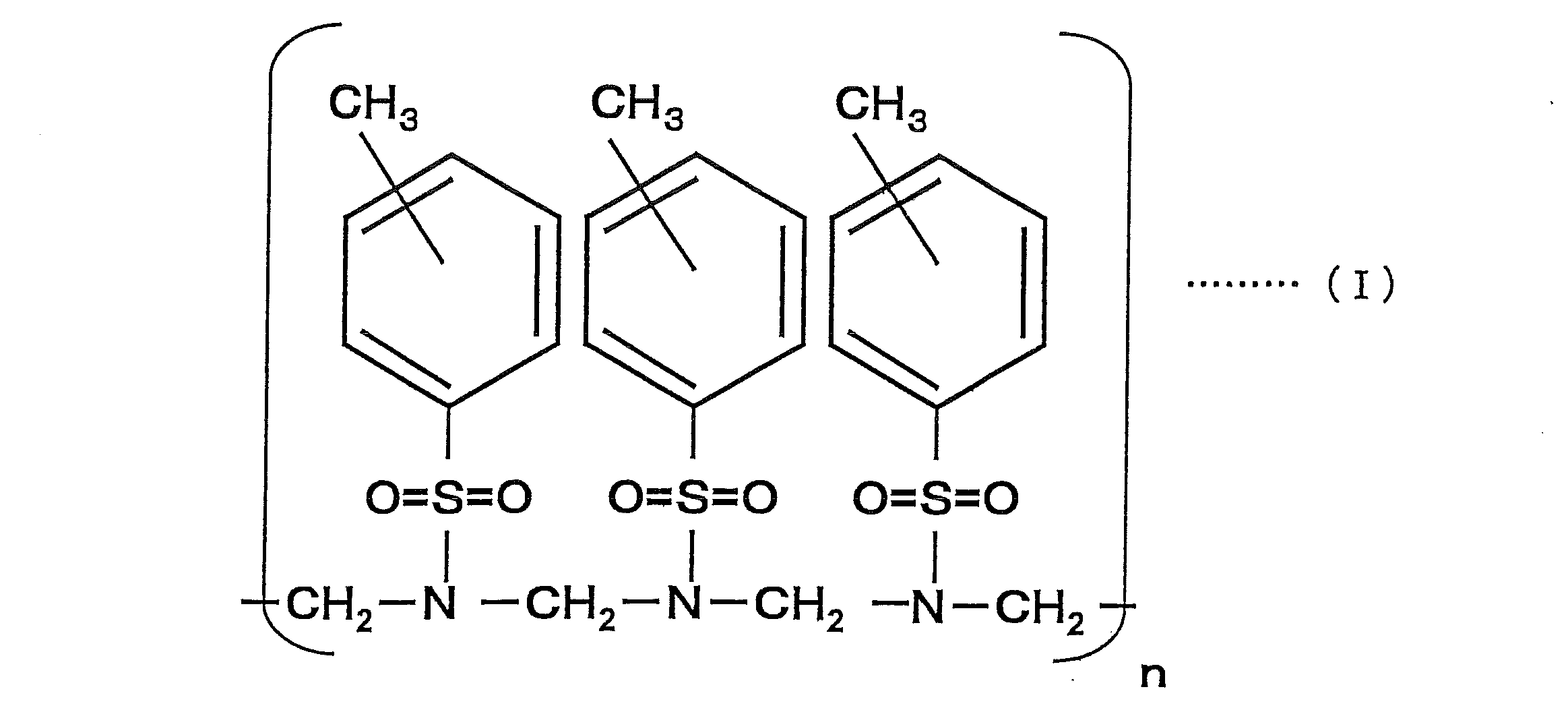
(1) ロイコ染料、造塩染料及びフォトクロミック化合物から選ばれる少なくも一種を、下記式(I)で示される化合物に添加することにより得られた色材を含むことを特徴とする筆記具用インク組成物。
(4) 前記色材に含まれる式(I)の化合物と前記造塩染料の質量比が、1:0.1~2の範囲にあることを特徴とする上記(1)又は(2)記載の筆記具用インク組成物。
(5) 前記色材に含まれる式(I)の化合物と前記フォトクロミック化合物の質量比が、1:0.001~0.1の範囲にあることを特徴とする上記(1)記載の筆記具用インク組成物。
(6) 上記(1)~(5)のいずれか1項に記載のインク組成物を搭載したことを特徴とする筆記具。
(7) ロイコ染料、造塩染料、フォトクロミック化合物から選ばれる少なくも一種を、下記式(I)で示される化合物に添加することにより得られたことを特徴とする色材。

(10) 前記色材に含まれる式(I)の化合物と前記造塩染料の質量比が、1:0.1~2の範囲にあることを特徴とする上記(7)又は(8)記載の色材。
(11) 前記色材に含まれる式(I)の化合物と前記フォトクロミック化合物の質量比が、1:0.001~0.1の範囲にあることを特徴とする上記(7)記載の色材。
That is, the present invention resides in the following (1) to (11).
(1) An ink composition for a writing instrument comprising a coloring material obtained by adding at least one selected from a leuco dye, a salt-forming dye and a photochromic compound to a compound represented by the following formula (I): object.
(4) The above (1) or (2), wherein the mass ratio of the compound of formula (I) and the salt-forming dye contained in the colorant is in the range of 1: 0.1-2. Ink composition for writing instruments.
(5) The writing instrument as described in (1) above, wherein the mass ratio of the compound of formula (I) and the photochromic compound contained in the colorant is in the range of 1: 0.001 to 0.1. Ink composition.
(6) A writing instrument comprising the ink composition according to any one of (1) to (5) above.
(7) A colorant obtained by adding at least one selected from a leuco dye, a salt-forming dye, and a photochromic compound to a compound represented by the following formula (I).
(10) The above (7) or (8), wherein the mass ratio of the compound of formula (I) and the salt-forming dye contained in the colorant is in the range of 1: 0.1-2. Color material.
(11) The color material as described in (7) above, wherein the mass ratio of the compound of formula (I) and the photochromic compound contained in the color material is in the range of 1: 0.001 to 0.1. .
本発明によれば、インク溶媒に対する色材の溶解性が良好で、筆記した描線のブリード・滲みが生じにくく、耐水性が向上した筆記具用インク組成物および色材が提供される。また、得られる色材は、染料と樹脂が一体となっているので、固形分が多いことを条件とする筆記具用インクを調製する場合において、配合の自由度を確保することができる。 According to the present invention, there are provided an ink composition for a writing instrument and a coloring material which have good solubility of a coloring material in an ink solvent, hardly cause bleeding and bleeding of a drawn line, and have improved water resistance. In addition, since the dye and resin are integrated in the obtained color material, the degree of freedom of blending can be ensured when preparing ink for writing instruments on the condition that the solid content is high.
以下に、本発明の実施形態を詳しく説明する。
本発明の筆記具用インク組成物は、ロイコ染料、造塩染料及びフォトクロミック化合物から選ばれる少なくも一種を、下記式(I)で示される化合物に添加することにより得られた色材を含むことを特徴とするものである。

The ink composition for a writing instrument of the present invention contains a color material obtained by adding at least one selected from a leuco dye, a salt-forming dye and a photochromic compound to a compound represented by the following formula (I). It is a feature.
〔ロイコ染料〕
本発明に用いるロイコ染料としては、電子供与性染料で、発色剤としての機能するものであれば、特に限定されものではない。具体的には、発色特性に優れるインクを得る点から、トリフェニルメタン系、スピロピラン系、フルオラン系、ジフェニルメタン系、ローダミンラクタム系、インドリルフタリド系、ロイコオーラミン系等従来公知のものが、単独(1種)で又は2種以上を混合して(以下、単に「少なくとも1種」という)用いることができる。
[Leuco dye]
The leuco dye used in the present invention is not particularly limited as long as it is an electron donating dye and functions as a color former. Specifically, from the viewpoint of obtaining an ink having excellent color development characteristics, conventionally known ones such as triphenylmethane, spiropyran, fluoran, diphenylmethane, rhodamine lactam, indolylphthalide, leucooramine, It can be used alone (one kind) or in a mixture of two or more kinds (hereinafter simply referred to as “at least one kind”).
具体的には、6-(ジメチルアミノ)-3,3-ビス[4-(ジメチルアミノ)フェニル]-1(3H)-イソベンゾフラノン、3,3-ビス(p-ジメチルアミノフェニル)-6-ジメチルアミノフタリド、3-(4-ジエチルアミノフェニル)-3-(1-エチル-2-メチルインドール-3-イル)フタリド、3-(4-ジエチルアミノ-2-エトキシフェニル)-3-(1-エチル-2-メチルインドール-3-イル)-4-アザフタリド、1,3-ジメチル-6-ジエチルアミノフルオラン、2-クロロ-3-メチル-6-ジメチルアミノフルオラン、3-ジブチルアミノ-6-メチル-7-アニリノフルオラン、3-ジエチルアミノ-6-メチル-7-アニリノフルオラン、3-ジエチルアミノ-6-メチル-7-キシリジノフルオラン、2-(2-クロロアニリノ)-6-ジブチルアミノフルオラン、3,6-ジメトキシフルオラン、3,6-ジ-n-ブトキシフルオラン、1,2-ベンツ-6-ジエチルアミノフルオラン、1,2-ベンツ-6-ジブチルアミノフルオラン、1,2-ベンツ-6-エチルイソアミルアミノフルオラン、2-メチル-6-(N-p-トリル-N-エチルアミノ)フルオラン、2-(N-フェニル-N--メチルアミノ)-6-(N-p-トリル-N-エチルアミノ)フルオラン、2-(3’-トリフルオロメチルアニリノ)-6-ジエチルアミノフルオラン、3-クロロ-6-シクロヘキシルアミノフルオラン、2-メチル-6-シクロヘキシルアミノフルオラン、3-ジ(n-ブチル)アミノ-6-メトキシ-7-アニリノフルオラン、3,6-ビス(ジフェニルアミノ)フルオラン、3-メトキシ-4-ドデコキシスチリノキノリンなどが挙げられ、これらは、少なくとも1種用いることができる。 Specifically, 6- (dimethylamino) -3,3-bis [4- (dimethylamino) phenyl] -1 (3H) -isobenzofuranone, 3,3-bis (p-dimethylaminophenyl) -6 -Dimethylaminophthalide, 3- (4-diethylaminophenyl) -3- (1-ethyl-2-methylindol-3-yl) phthalide, 3- (4-diethylamino-2-ethoxyphenyl) -3- (1 -Ethyl-2-methylindol-3-yl) -4-azaphthalide, 1,3-dimethyl-6-diethylaminofluorane, 2-chloro-3-methyl-6-dimethylaminofluorane, 3-dibutylamino-6 -Methyl-7-anilinofluorane, 3-diethylamino-6-methyl-7-anilinofluorane, 3-diethylamino-6-methyl-7-xylidinov Oran, 2- (2-chloroanilino) -6-dibutylaminofluorane, 3,6-dimethoxyfluorane, 3,6-di-n-butoxyfluorane, 1,2-benz-6-diethylaminofluorane, 1 , 2-Benz-6-dibutylaminofluorane, 1,2-benz-6-ethylisoamylaminofluorane, 2-methyl-6- (Np-tolyl-N-ethylamino) fluorane, 2- (N -Phenyl-N-methylamino) -6- (Np-tolyl-N-ethylamino) fluorane, 2- (3'-trifluoromethylanilino) -6-diethylaminofluorane, 3-chloro-6 -Cyclohexylaminofluorane, 2-methyl-6-cyclohexylaminofluorane, 3-di (n-butyl) amino-6-methoxy-7-anilinofluora , 3,6-bis (diphenylamino) fluoran, and 3-methoxy-4-de deco carboxymethyl steel Reno quinoline and the like, which may be used at least one kind.
更に、黄色~赤色の発色を発現させるピリジン系化合物、キナゾリン系化合物、ビスキナゾリン系化合物等も用いることができる。
これらのロイコ染料は、ラクトン骨格、ピリジン骨格、キナゾリン骨格、ビスキナゾリン骨格等を有するものであり、これらの骨格(環)が開環することで発色を発現するものである。
Furthermore, pyridine compounds, quinazoline compounds, bisquinazoline compounds and the like that develop yellow to red color development can also be used.
These leuco dyes have a lactone skeleton, a pyridine skeleton, a quinazoline skeleton, a bisquinazoline skeleton, etc., and develop color when these skeletons (rings) are opened.
〔造塩染料〕
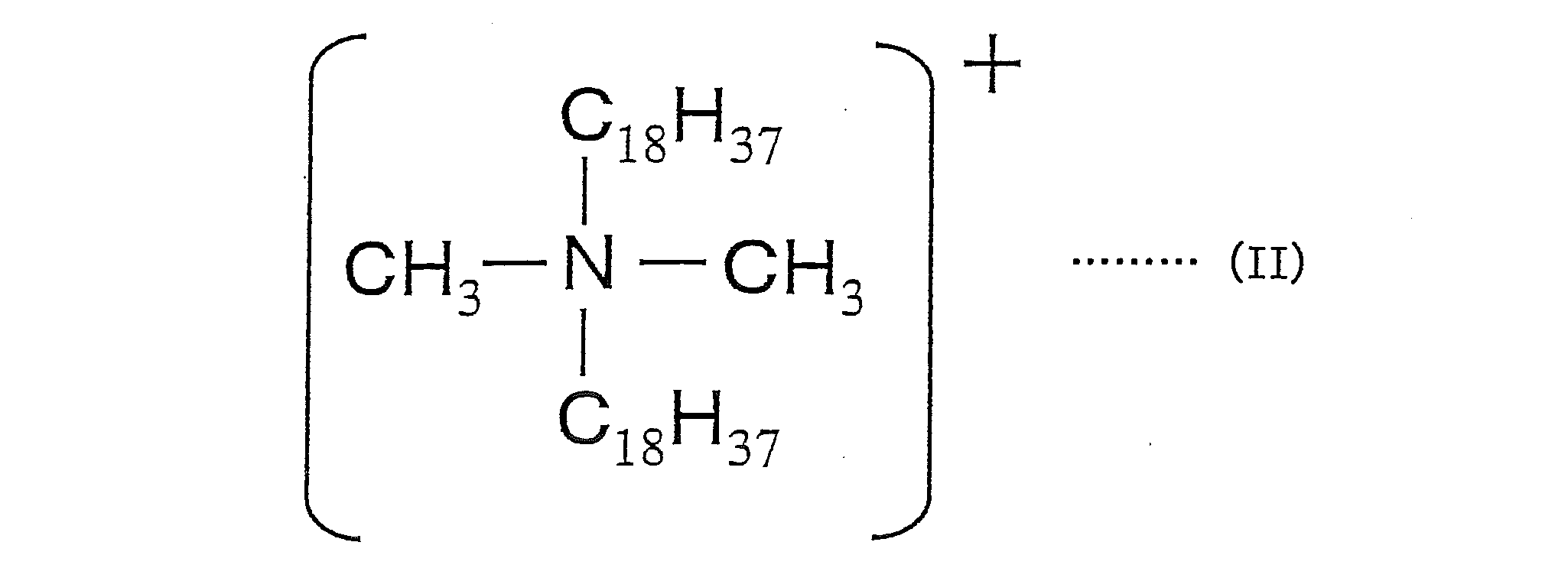
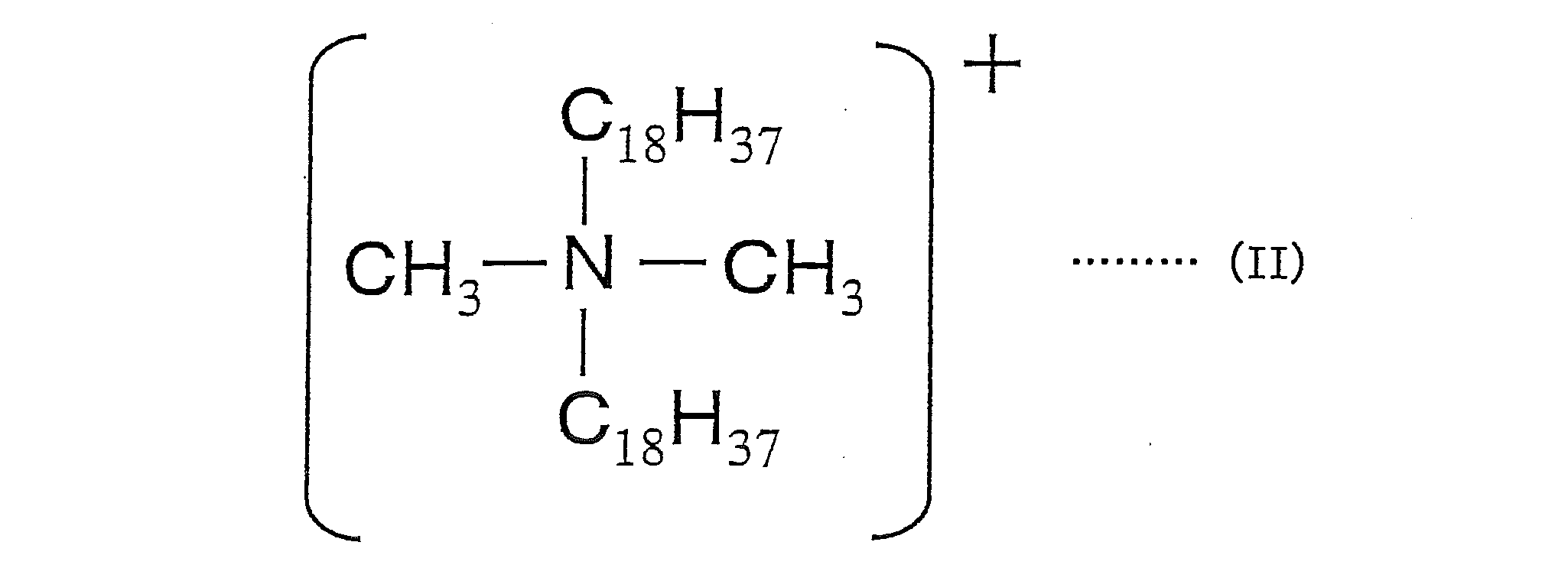
本発明に用いる造塩染料としては、例えば、塩基性染料と酸性染料との造塩染料、塩基性染料と酸性化合物との造塩染料、酸性染料と塩基性化合物との造塩染料、下記式(II)で示されるジメチルジステアリルアンモニウム塩のカチオンと酸性染料とで構成される造塩染料の少なくとも1種が挙げられる。
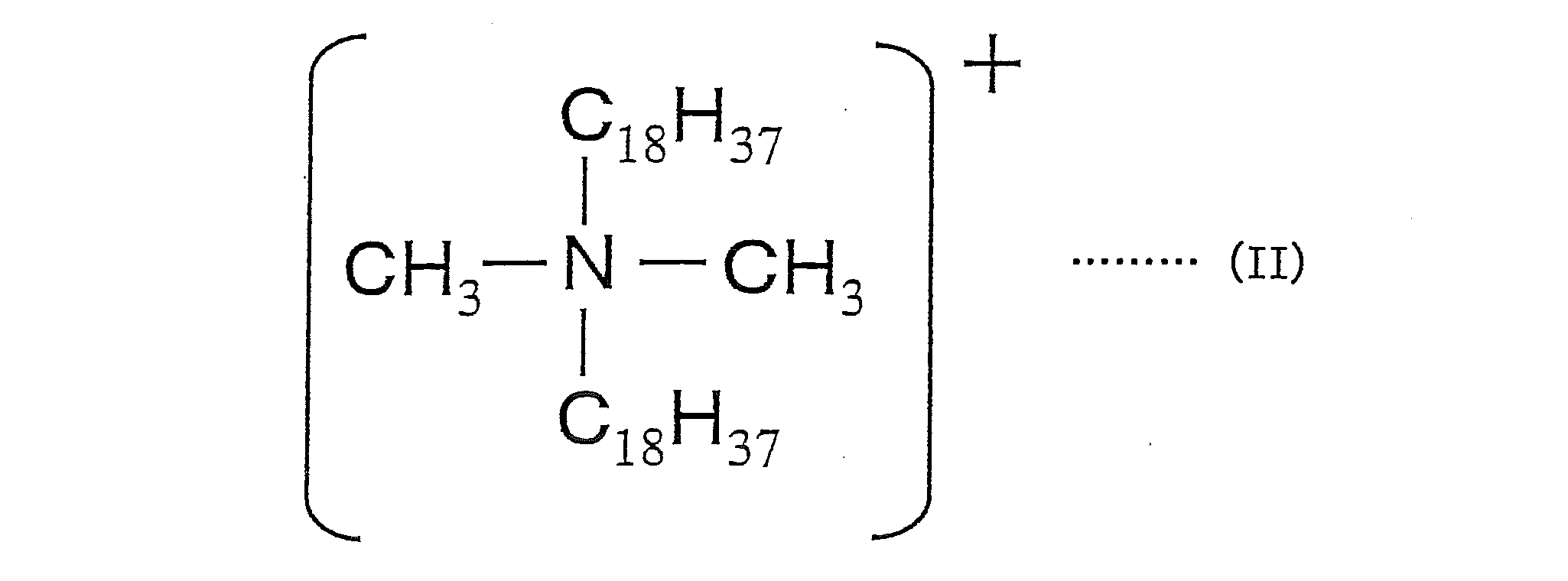
As the salt-forming dye used in the present invention, for example, a salt-forming dye composed of a basic dye and an acidic dye, a salt-forming dye composed of a basic dye and an acidic compound, a salt-forming dye composed of an acidic dye and a basic compound, the following formula There may be mentioned at least one salt-forming dye composed of a cation of dimethyl distearyl ammonium salt represented by (II) and an acid dye.
具体的には、1)アミノ基のような塩基性基を分子構造に含む塩基性染料と、スルホン酸基やカルボン酸基のような酸性基を分子構造に含む酸性染料とから生成される造塩染料、2)上記塩基性基を分子構造に含む塩基性染料と酸性化合物とが、酸性化合物の共役塩基が塩基性染料の塩基性基と結合して塩を生成し得る造塩染料、3)スルホン酸基やカルボン酸基のような酸性基を分子構造に含む酸性染料と、塩基性化合物とが、塩基性化合物の共役酸が酸性染料の酸性基と結合して塩を生成し得る造塩染料、4)上記式(II)で示されるジメチルジステアリルアンモニウム塩のカチオンと酸性染料とから生成される造塩染料を用いることができる。 Specifically, 1) a structure produced from a basic dye containing a basic group such as an amino group in the molecular structure and an acid dye containing an acidic group such as a sulfonic acid group or a carboxylic acid group in the molecular structure. Salt dye, 2) a salt-forming dye capable of forming a salt by combining a basic dye containing the basic group in the molecular structure with an acidic compound, and a conjugate base of the acidic compound is combined with the basic group of the basic dye; ) An acidic dye that contains an acidic group such as a sulfonic acid group or a carboxylic acid group in its molecular structure, and a basic compound, the conjugate acid of the basic compound can combine with the acidic group of the acidic dye to form a salt. Salt dyes 4) Salt-forming dyes produced from a cation of a dimethyl distearyl ammonium salt represented by the above formula (II) and an acid dye can be used.
上記1)~3)で用いることができる造塩染料としては、商品名「バリファーストカラー」(VALIFAST COLORS)として市販の各色、例えば、VALIFAST BLUE 1631、VALIFAST BLUE 1603、VALIFAST BLUE 1621、VALIFAST RED 1308、VALIFAST RED 1320、VALIFAST RED 1355、VALIFAST RED 1362、VALIFAST VIOLET 1701、VALIFAST VIOLET 1704、VALIFAST VIOLET 1731、VALIFAST YELLOW1101、VALIFAST YELLOW1109、VALIFAST YELLOW1151(以上、オリエント化学工業社製)、また、商品名「アイゼン スピロン(Aizen Spilon)」として市販の各色、例えば、Aizen Spilon Violet C-RH、Aizen Spilon Red C-BH、Aizen SpilonYellow C-GHN、SBN Yellow 543、SBN Yellow 530、Aizen Spilon Red C-GH、Aizen Spilon Red C-BH、Aizen Spilon Yellow CGNH(以上、保土谷化学工業社製)等の少なくとも1種が挙げられる。 As salt-forming dyes that can be used in the above 1) to 3), various colors commercially available under the trade name “VALIFAST COLORS”, for example, VALIFAST BLUE 1631, VALIFASTIFBLUE 1603, VALIFAST BLUE 1621, VALIFAST RED 1308 , VALIFAST 20 RED 20 1320, VALIFAST V RED 55 1355, VALIFAST RED 1362, VALIFAST VOILET 1701, VALIFAST VIOLET 1704, VALIFAST VIOLET 1731, VALIFAST YELLOW1 101, VALIFAST YELLOW 1091, Y In addition, each color commercially available under the trade name “Aizen Spiro”, for example, Aizen Spiro Violet C-RH, Aizen Spiro Yellow Red C-BH, Aizen SpiroYellow C-GHN, SBN N Yellow 53 A S C-GH, Aizen Spillon Red C-BH, Aizen Spiron Yellow, and CGNH (above, manufactured by Hodogaya Chemical Co., Ltd.).
上記4)の造塩染料で用いることができる酸性染料としては、例えば、C.I.アシッドブラック1、同2、同24、同26、同31、同52、同107、同109、同110、同119、同154、C.I.アシッドエロー7、同17、同19、同23、同25、同29、同38、同42、同49、同61、同72、同78、同110、同127、同135、同141、同142、C.I.アシッドレッド8、同9、同14、同18、同26、同27、同35、同37、同51、同52、同57、同82、同87、同92、同94、同115、同129、同131、同186、同249、同254、同265、同276、C.I.アシッドバイオレット17、同18、C.I.アシッドブルー1、同7、同9、同22、同23、同25、同40、同41、同43、同62、同78、同83、同90、同93、同103、同112、同113、同158、C.I.アシッドグリーン3、同9、同16、同25、同27などが挙げられる。 Examples of the acid dye that can be used as the salt-forming dye of 4) above include C.I. I. Acid Black 1, 2, 24, 26, 31, 31, 52, 107, 109, 110, 119, 154, C.I. I. Acid Yellow 7, 17, 19, 23, 25, 29, 38, 42, 49, 61, 72, 78, 110, 127, 135, 141, the same 142, C.I. I. Acid Red 8, 9, 9, 14, 26, 27, 35, 37, 51, 52, 57, 82, 87, 92, 94, 115, 129, 131, 186, 249, 254, 265, 276, C.I. I. Acid Violet 17, 18 and C.I. I. Acid Blue 1, 7, 9, 22, 23, 25, 40, 41, 43, 62, 78, 83, 90, 93, 103, 112, the same 113, 158, C.I. I. Acid Green 3, 9, 16, 25, 27 and the like.
上記4)で用いる造塩染料は、以下のようにして得ることができる。
例えば、水(精製水、蒸留水、純水等、以下同様)に、ジメチルジステアリルアンモニウム塩を加え、室温条件下において攪拌して溶解させた溶液1を調製する。一方、溶液2として、水に上記酸性染料を加え、必要に応じて、NaOH水溶液を滴下してアルカリ側にpH調整後、室温条件下において攪拌して溶解させた溶液2を調製する。この溶液2に攪拌しながら、溶液1を添加後、塩酸水溶液などの酸水溶液を滴下し、酸性サイドにpH調整をした後、濾過を行い、更に水洗及び/又は溶剤洗浄を経て乾燥させることによって、造塩染料を得ることができる。
なお、用いるジメチルジステアリルアンモニウム塩および上記酸性染料の添加量は、イオン価に基づいた当量にしたがって決められる。すなわち、酸性染料が1価の陰イオンである場合には、1当量のジメチルジステアリルアンモニウム塩のカチオンが、酸性染料が2価の陰イオンである場合には、2当量のジメチルステアリルアンモニウム塩のカチオンが添加される。ただし、反応性を考慮して一方の化合物を前記理論値よりも多く添加する場合もある。
上記1)~4)の造塩染料の中で、上記4)の造塩染料の使用が特に望ましい。
The salt-forming dye used in the above 4) can be obtained as follows.
For example, a solution 1 is prepared by adding dimethyl distearyl ammonium salt to water (purified water, distilled water, pure water, etc.) and stirring and dissolving at room temperature. On the other hand, as the solution 2, the above acid dye is added to water, and if necessary, an aqueous NaOH solution is dropped to adjust the pH to the alkali side, and then the solution 2 is prepared by stirring and dissolving at room temperature. By adding Solution 1 with stirring to Solution 2 and then adding an acid aqueous solution such as a hydrochloric acid aqueous solution dropwise, adjusting the pH to the acidic side, performing filtration, and further drying through water washing and / or solvent washing. A salt-forming dye can be obtained.
In addition, the addition amount of the dimethyl distearyl ammonium salt to be used and the acidic dye is determined according to the equivalent based on the ionic value. That is, when the acidic dye is a monovalent anion, 1 equivalent of the dimethyl distearyl ammonium salt cation, and when the acidic dye is a divalent anion, Cations are added. However, in consideration of reactivity, one compound may be added more than the theoretical value.
Of the salt-forming dyes 1) to 4), the use of the salt-forming dye 4) is particularly desirable.
〔フォトクロミック化合物〕
本発明に用いるフォトクロミック化合物は、光により発色し、光あるいは熱により退色するフォトクロミック性を有する色素であり、従来より汎用のものが使用でき、例えば、2,3-ビス(2,4,5-トリメチル-3-チエニル)マレイン酸無水物、2,3-ビス(2,4,5-トリメチル-3-チエニル)マレイミド、cis-1,2-ジシアノ-1,2-ビス(2,4,5-トリメチル-3-チエニル)エテン、1,2-ビス[2-メチルベンゾ[b]チオフェン-3-イル]-3,3,4,4,5,5-ヘキサフルオロ-1-シクロペンテン、1,2-ビス(2,4-ジメチル-5-フェニル-3-チエニル)-3,3,4,4,5,5-ヘキサフルオロ-1-シクロペンテン、1-(2-ヒドロキシエチル)-3,3-ジメチルインドリノ-6´-ニトロベンゾピリロスピラン、1,3,3-トリメチルインドリノベンゾピリロスピラン、1,3,3-トリメチルインドリノ-6´-ニトロベンゾピリロスピラン、1,3,3-トリメチルインドリノ-6´-ブロモベンゾピリロスピラン、1,3,3-トリメチルインドリノ-8´-メトキシベンゾピリロスピラン、1,3,3-トリメチルインドリノ-β-ナフトピリロスピラン、1,3,3-トリメチルインドリノナフトスピロオキサジン、2,3-ジヒドロ-2-スピロ-4´-[8´-アミノナフタレン-1´(4´H)-オン]ペリミジン(o-体含む)、2,3-ジヒドロ-2-スピロ-7´-[8´-イミノ-7´,8´-ジヒドロナフタレン-1´-アミン]ペリミジン、アゾベンゼン、3,3-ジフェニル-3H-ナフト[2,1-b]ピラン、2,5-ノルボルナジエン、チオインジゴなどの少なくとも1種が挙げられる。
[Photochromic compound]
The photochromic compound used in the present invention is a dye having a photochromic property that develops color by light and fades by light or heat, and conventionally used ones can be used. For example, 2,3-bis (2,4,5- Trimethyl-3-thienyl) maleic anhydride, 2,3-bis (2,4,5-trimethyl-3-thienyl) maleimide, cis-1,2-dicyano-1,2-bis (2,4,5 -Trimethyl-3-thienyl) ethene, 1,2-bis [2-methylbenzo [b] thiophen-3-yl] -3,3,4,4,5,5-hexafluoro-1-cyclopentene, 1,2 -Bis (2,4-dimethyl-5-phenyl-3-thienyl) -3,3,4,4,5,5-hexafluoro-1-cyclopentene, 1- (2-hydroxyethyl) -3,3- Dimethyl Ndorino-6'-nitrobenzopyrospirane, 1,3,3-trimethylindolinobenzopyrospirane, 1,3,3-trimethylindolino-6'-nitrobenzopyrospirane, 1,3,3- Trimethylindolino-6'-bromobenzopyrospirane, 1,3,3-trimethylindolino-8'-methoxybenzopyrrirospirane, 1,3,3-trimethylindolino-β-naphthopyrilospirane, 1 , 3,3-trimethylindolinonaphthospirooxazine, 2,3-dihydro-2-spiro-4 ′-[8′-aminonaphthalen-1 ′ (4′H) -one] perimidine (including o-form), 2,3-dihydro-2-spiro-7 '-[8'-imino-7', 8'-dihydronaphthalen-1'-amine] perimidine, azobenzene, 3,3-diphenyl- H- naphtho [2,1-b] pyran, 2,5-norbornadiene, include at least one such thioindigo.
〔色材〕
本発明の色材は、上記ロイコ染料、造塩染料及びフォトクロミック化合物から選ばれる少なくも一種を、下記式(I)で示される化合物に添加することにより得られるものである。
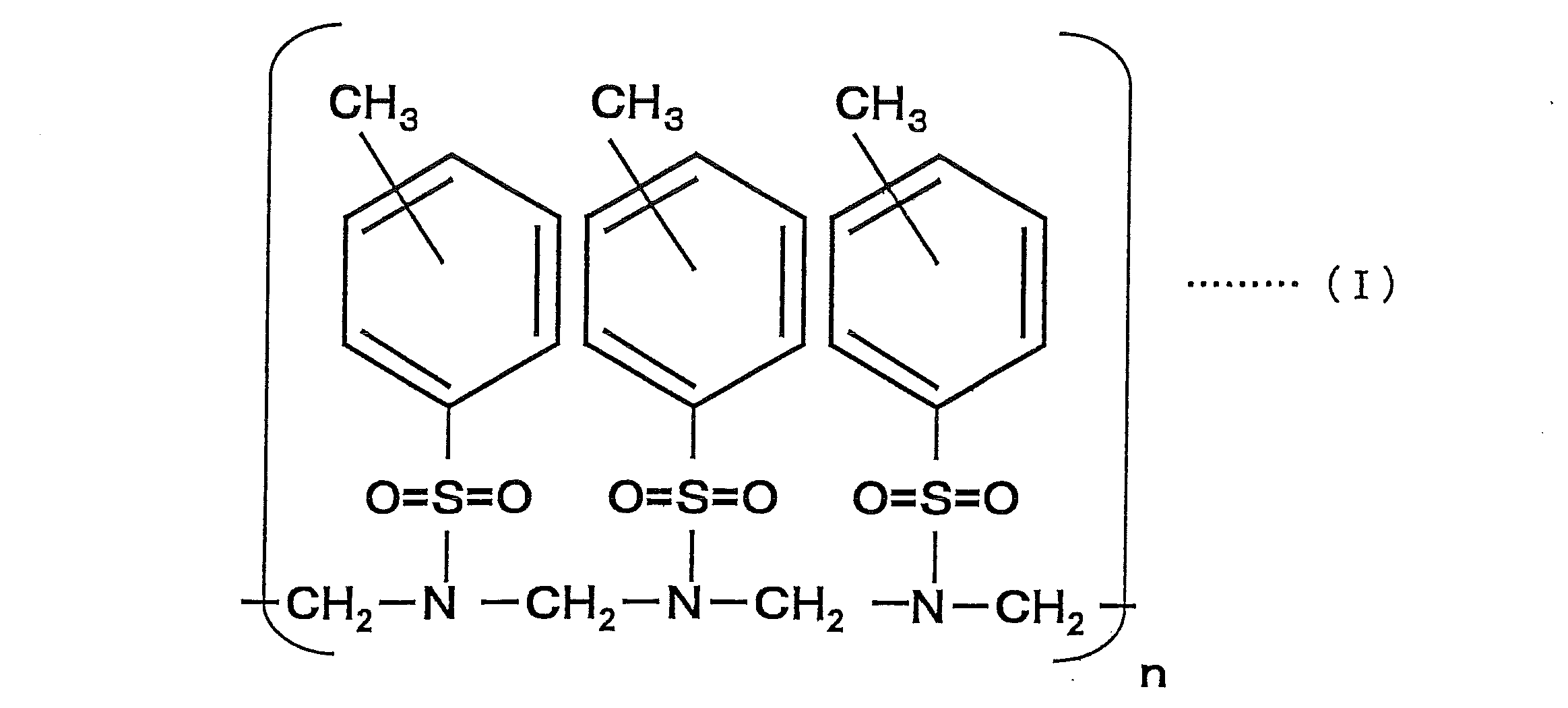
The color material of the present invention is obtained by adding at least one selected from the above leuco dyes, salt-forming dyes and photochromic compounds to the compound represented by the following formula (I).
上記式(I)で示される化合物は、p-トルエンスルホン酸アミドとホルアルデヒドとを加え、加熱して縮合反応により得られるスルホン酸樹脂であり、パラ位(p位)が主成分となる(p位が50質量%を超えて多くなる)ものであり、化合物中には、オルト位(o位)の化合物が混在していても良いものである。さらに、ベンゾグアナミンなどの架橋剤を適宜量加えて得た化合物であっても良く、この架橋剤の添加により、更に経時的な劣化の抑制を発揮せしめることができる。なお、式(I)中のnは、正の数であり、後述する色材の好ましい重量平均分子量の範囲内で調整される。 The compound represented by the above formula (I) is a sulfonic acid resin obtained by adding p-toluenesulfonic acid amide and formaldehyde and heating to perform a condensation reaction, and the para-position (p-position) is the main component ( The p-position is greater than 50% by mass), and the compound at the ortho-position (o-position) may be mixed in the compound. Further, it may be a compound obtained by adding an appropriate amount of a crosslinking agent such as benzoguanamine, and the addition of this crosslinking agent can further suppress deterioration over time. In addition, n in Formula (I) is a positive number, and is adjusted within the range of the preferable weight average molecular weight of the coloring material described later.
本発明の色材の重量平均分子量は、300~3000の範囲であることが好ましい。この色材の重量平均分子量が300未満であると、耐水性などの堅牢性が低下する傾向となり、一方、3000を超えるものであると、粘度が高くなってしまい、好ましくない。更に好ましくは、500~2000であり、より好ましくは500~1000の範囲である。なお、本発明(後述する実施例を含む)において重量平均分子量の測定は、GPC(Gel Permeation Chromatography)にて行い、その値はポリスチレン換算値である。
具体的な色材の製造としては、例えば、1)p-トルエンスルホン酸アミドとホルアルデヒド等とを混合し加熱して縮合反応によって得られる上記式(I)のスルホン酸樹脂の縮合過程において、上記ロイコ染料、造塩染料及びフォトクロミック化合物から選ばれる少なくも一種を加えて、縮合脱水終了後、冷却し固化することにより得ることでき、また、2)製造された上記式(I)の化合物(スルホン酸樹脂)に上記ロイコ染料、造塩染料及びフォトクロミック化合物から選ばれる少なくも一種を添加して混練し、または必要に応じて加熱しながら混練し、次いで、冷却し固化することなどにより得ることできる。
The weight average molecular weight of the coloring material of the present invention is preferably in the range of 300 to 3,000. If the color material has a weight average molecular weight of less than 300, the fastness such as water resistance tends to decrease. On the other hand, if it exceeds 3000, the viscosity increases, which is not preferable. More preferably, it is 500 to 2000, and more preferably in the range of 500 to 1000. In the present invention (including examples described later), the weight average molecular weight is measured by GPC (Gel Permeation Chromatography), and the value is a polystyrene equivalent value.
Specific examples of the production of the coloring material include, for example, 1) in the condensation process of the sulfonic acid resin of the above formula (I) obtained by a condensation reaction by mixing p-toluenesulfonic acid amide and formaldehyde and heating. It can be obtained by adding at least one selected from the above leuco dyes, salt-forming dyes and photochromic compounds, cooling and solidifying after completion of condensation dehydration, and 2) the compound of the above formula (I) produced ( And at least one selected from the above-mentioned leuco dyes, salt-forming dyes and photochromic compounds and kneading, or kneading while heating, if necessary, then cooling and solidifying, etc. it can.
本発明の色材において、ロイコ染料を用いる場合は、色材に含まれる上記式(I)の化合物と前記ロイコ染料との質量比は、好ましくは、1:0.01~1の範囲、更に好ましくは、1:0.01~0.5の範囲にあることが望ましい。
また、造塩染料を用いる場合は、色材に含まれる上記式(I)の化合物と前記造塩染料との質量比は、好ましくは、1:0.1~2の範囲、更に好ましくは、1:0.2~1.2の範囲にあることが望ましい。
更に、フォトクロミック化合物を用いる場合は、前記色材に含まれる上記式(I)の化合物と前記フォトクロミック化合物の質量比は、好ましくは、1:0.001~0.1の範囲、更に好ましくは、1:0.01~0.1の範囲にあることが望ましい。
上記ロイコ染料、造塩染料及びフォトクロミック化合物の各質量比がそれぞれの下限値(0.01、0.1、0.001)未満であると、十分な色濃度が得られず、一方、それぞれの上限値(1、2、0.1)を超えると、溶媒への溶解度が低下して析出を生じやすくなり、好ましくない。
In the color material of the present invention, when a leuco dye is used, the mass ratio of the compound of formula (I) and the leuco dye contained in the color material is preferably in the range of 1: 0.01 to 1, further Preferably, it is in the range of 1: 0.01 to 0.5.
When a salt-forming dye is used, the mass ratio of the compound of formula (I) contained in the colorant to the salt-forming dye is preferably in the range of 1: 0.1 to 2, more preferably It is desirable to be in the range of 1: 0.2 to 1.2.
Furthermore, when using a photochromic compound, the mass ratio of the compound of formula (I) and the photochromic compound contained in the colorant is preferably in the range of 1: 0.001 to 0.1, more preferably The range of 1: 0.01 to 0.1 is desirable.
When each mass ratio of the leuco dye, salt-forming dye and photochromic compound is less than the respective lower limit (0.01, 0.1, 0.001), sufficient color density cannot be obtained, Exceeding the upper limit (1, 2, 0.1) is not preferable because the solubility in a solvent is lowered and precipitation tends to occur.
本発明の色材は、上記ロイコ染料、造塩染料及びフォトクロミック化合物から選ばれる少なくも一種を、上記式(I)で示される化合物(スルホン酸樹脂)に添加することにより得られるものであり、ロイコ染料、造塩染料及びフォトクロミック化合物はスルホン酸アミドと結合して樹脂と一体となったものであり、その色素を溶出することがなく、ロイコ染料、造塩染料及びフォトクロミック化合物が本来有する機能を損なうことなく、インク溶媒となる有機溶剤に対して良好な溶解性を有し、外部環境の影響を受けにくくなり、筆記具用インクに用いた場合に、筆記した描線のブリード・滲みが生じにくい色材となるものである。また、得られる色材は、染料と樹脂が一体となっているので、固形分が多いことを条件とする筆記具用インクを調製する場合において、配合の自由度を確保することができ、その量を設定する際の設定の自由度を広げると共に、製造の負荷の低減と、ロイコ染料、造塩染料及びフォトクロミック化合物による各色の多様化の向上を図ることができる。 The coloring material of the present invention is obtained by adding at least one selected from the above leuco dyes, salt-forming dyes and photochromic compounds to the compound represented by the above formula (I) (sulfonic acid resin), The leuco dye, salt-forming dye, and photochromic compound are combined with the sulfonic acid amide and integrated with the resin. The leuco dye, salt-forming dye, and photochromic compound have the functions that the leuco dye, salt-forming dye, and photochromic compound originally have. A color that has good solubility in organic solvents that are ink solvents and is not easily affected by the external environment, and does not cause bleeding or bleeding of written lines when used in ink for writing instruments. It will be a material. In addition, since the obtained color material is an integral of the dye and the resin, the degree of freedom of blending can be ensured when preparing ink for writing instruments on condition that the solid content is high. In addition to expanding the degree of freedom in setting, the reduction in manufacturing load and the diversification of each color by leuco dyes, salt-forming dyes and photochromic compounds can be achieved.
<筆記具用インク組成物>
本発明の筆記具用インク組成物は、上記構成のロイコ染料、造塩染料及びフォトクロミック化合物から選ばれる少なくも一種を、上記(I)で示される化合物に添加することにより得られた色材を含むことを特徴とするものであり、好ましくは、油性のボールペン用、マーキングペン用等の筆記具用インク組成物として用いることをできる。
これらの色材の含有量は、筆記具の用途(ボールペン、マーキングペン、サインペン、等)により変動するものであるが、インク組成物全量に対して、好ましくは、0.1~30質量%(以下、単に「%」という)、更に好ましくは、0.5~25%とすることが望ましい。
これらの色材の含有量が0.1%未満であると、着色力、発色性が不十分となり、一方、30%を超えると、カスレが生じやすくなり、好ましくない。
<Ink composition for writing instruments>
The ink composition for a writing instrument of the present invention includes a color material obtained by adding at least one selected from the leuco dyes, salt-forming dyes and photochromic compounds having the above-described configuration to the compound represented by (I) above. Preferably, it can be used as an ink composition for writing instruments such as oil-based ballpoint pens and marking pens.
The content of these coloring materials varies depending on the application of the writing instrument (ball pen, marking pen, sign pen, etc.), but is preferably 0.1 to 30% by mass (hereinafter referred to as “the ink composition”). Simply referred to as “%”), more preferably 0.5 to 25%.
If the content of these coloring materials is less than 0.1%, the coloring power and color developability become insufficient. On the other hand, if the content exceeds 30%, blurring tends to occur, which is not preferable.
本発明の筆記具用インク組成物において、上記色材の他、従来用いられている種々の有機溶剤を用いることができる。好ましい溶剤としては、アルコール系溶剤、多価アルコール系溶剤、グリコールエーテル系溶剤から選ばれる溶剤を挙げることができる。
アルコール系溶剤は、炭素数が2以上の脂肪族アルコールであり、具体的には、エタノール、n-プロパノール、イソプロパノール、n-ブタノール、イソブタノール、tert-ブチルアルコール、1-ペンタノール、イソアミルアルコール、sec-アミルアルコール、3-ペンタノール、tert-アミルアルコール、n-ヘキサノール、メチルアミルアルコール、2-エチルブタノール、n-ヘプタノール、2-ヘプタノール、3-ヘプタノール、n-オクタノール、2-オクタノール、2-エチルヘキサノール、3,5,5-トリメチルヘキサノール、ノナノール、n-デカノール、ウンデカノール、n-デカノール、トリメチルノニルアルコール、テトラデカノール、ヘプタデカノール、シクロヘキサノール、2-メチルシクロヘキサノール、ベンジルアルコール、2-フェノキシエタノールやその他多くの高級アルコール等が挙げられる。
In the ink composition for writing instruments of the present invention, various organic solvents that have been conventionally used can be used in addition to the above-described colorant. As a preferable solvent, a solvent selected from an alcohol solvent, a polyhydric alcohol solvent, and a glycol ether solvent can be used.
The alcohol solvent is an aliphatic alcohol having 2 or more carbon atoms, specifically, ethanol, n-propanol, isopropanol, n-butanol, isobutanol, tert-butyl alcohol, 1-pentanol, isoamyl alcohol, sec-amyl alcohol, 3-pentanol, tert-amyl alcohol, n-hexanol, methyl amyl alcohol, 2-ethylbutanol, n-heptanol, 2-heptanol, 3-heptanol, n-octanol, 2-octanol, 2- Ethylhexanol, 3,5,5-trimethylhexanol, nonanol, n-decanol, undecanol, n-decanol, trimethylnonyl alcohol, tetradecanol, heptadecanol, cyclohexanol, 2-methylcyclohexanol, benzi Alcohol, 2-phenoxyethanol and many other higher alcohols and the like.
多価アルコール系溶剤としては、エチレングリコール、ジエチレングリコール、3-メチル-1,3-ブタンジオール、トリエチレングリコール、ジプロピレングリコール、1,3-プロパンジオール、1,3-ブタンジオール、1,5-ペンタンジオール、ヘキシレングリコール、オクチレングリコール等の分子内に2個以上の炭素、2個以上の水酸基を有する多価アルコールが挙げられる。 Examples of the polyhydric alcohol solvent include ethylene glycol, diethylene glycol, 3-methyl-1,3-butanediol, triethylene glycol, dipropylene glycol, 1,3-propanediol, 1,3-butanediol, 1,5- Examples thereof include polyhydric alcohols having 2 or more carbons and 2 or more hydroxyl groups in the molecule such as pentanediol, hexylene glycol, and octylene glycol.
以上挙げた溶剤の中で特に好ましい溶剤は、炭素数2~7のグリコールエーテルである。また、安全性および経口毒性等の点から、エチレングリコール誘導体等以外の有機溶剤を使用した方が好ましい。それらの例として、多価アルコール類誘導体があり、ソルビタン脂肪酸系、ポリグリセリン高級脂肪酸系、ショ糖脂肪酸系、プロピレングリコール脂肪酸系等の誘導体も挙げられる。 Among the solvents mentioned above, a particularly preferred solvent is a glycol ether having 2 to 7 carbon atoms. From the viewpoint of safety and oral toxicity, it is preferable to use an organic solvent other than ethylene glycol derivatives. Examples thereof include polyhydric alcohol derivatives such as sorbitan fatty acid type, polyglycerin higher fatty acid type, sucrose fatty acid type, and propylene glycol fatty acid type derivatives.
グリコールエーテル系溶剤としては、メチルイソプロピルエーテル、エチルエーテル、エチルプロピルエーテル、エチルブチルエーテル、イソプロピルエーテル、ブチルエーテル、ヘキシルエーテル、2-エチルヘキシルエーテル、エチレングリコールモノヘキシルエーテル、エチレングリコールモノフェニルエーテル、エチレングリコールモノ-2-エチルブチルエーテル、エチレングリコールモノメチルエーテル、エチレングリコールモノエチルエーテル、エチレングリコールモノブチルエーテル、ジエチレングリコールモノメチルエーテル、ジエチレングリコールモノエチルエーテル、ジエチレングリコールモノブチルエーテル、トリエチレングリコールモノブチルエーテル、テトラエチレングリコールモノブチルエーテル、3-メチル-3-メトキシ-1-ブタノール、3-メトキシ-1-ブタノール、プロピレングリコールモノメチルエーテル、プロピレングリコールモノエチルエーテル、プロピレングリコールモノプロピルエーテル、プロピレングリコールモノブチルエーテル、プロピレングリコールフェニルエーテル、プロピレングリコールターシャリーブチルエーテル、ジプロピレングリコールモノメチルエーテル、ジプロピレングリコールモノエチルエーテル、ジプロピレングリコールモノプロピルエーテル、ジプロピレングリコールモノブチルエーテル、トリプロピレングリコールモノメチルエーテル、トリプロピレングリコールモノブチルエーテル、テトラプロピレングリコールモノブチルエーテル等が挙げられる。 Examples of glycol ether solvents include methyl isopropyl ether, ethyl ether, ethyl propyl ether, ethyl butyl ether, isopropyl ether, butyl ether, hexyl ether, 2-ethylhexyl ether, ethylene glycol monohexyl ether, ethylene glycol monophenyl ether, ethylene glycol mono- 2-ethylbutyl ether, ethylene glycol monomethyl ether, ethylene glycol monoethyl ether, ethylene glycol monobutyl ether, diethylene glycol monomethyl ether, diethylene glycol monoethyl ether, diethylene glycol monobutyl ether, triethylene glycol monobutyl ether, tetraethylene glycol monobutyl ether, 3-methyl 3-Methoxy-1-butanol, 3-methoxy-1-butanol, propylene glycol monomethyl ether, propylene glycol monoethyl ether, propylene glycol monopropyl ether, propylene glycol monobutyl ether, propylene glycol phenyl ether, propylene glycol tertiary butyl ether , Dipropylene glycol monomethyl ether, dipropylene glycol monoethyl ether, dipropylene glycol monopropyl ether, dipropylene glycol monobutyl ether, tripropylene glycol monomethyl ether, tripropylene glycol monobutyl ether, tetrapropylene glycol monobutyl ether, and the like.
上記の溶剤の他にエステル系溶剤も用いることができる。エステル系溶剤としては、例えば、プロピレングリコールメチルエーテルアセテート、プロピレングリコールジアセテート、3-メチル-3-メトキシブチルアセテート、プロピレングリコールエチルエーテルアセテート、エチレングリコールエチルエーテルアセテート、ギ酸ブチル、ギ酸イソブチル、ギ酸イソアミル、酢酸プロピル、酢酸ブチル、酢酸イソプロピル、酢酸イソブチル、酢酸イソアミル、プロピオン酸メチル、プロピオン酸エチル、プロピオン酸プロピル、プロピオン酸イソブチル、プロピオン酸イソアミル、酪酸メチル、酪酸エチル、酪酸プロピル、イソ酪酸メチル、イソ酪酸エチル、イソ酪酸プロピル、吉草酸メチル、吉草酸エチル、吉草酸プロピル、イソ吉草酸メチル、イソ吉草酸エチル、イソ吉草酸プロピル、トリメチル酢酸メチル、トリメチル酢酸エチル、トリメチル酢酸プロピル、カプロン酸メチル、カプロン酸エチル、カプロン酸プロピル、カプリル酸メチル、カプリル酸エチル、カプリル酸プロピル、ラウリン酸メチル、ラウリン酸エチル、オレイン酸メチル、オレイン酸エチル、カプリル酸トリグリセライド、クエン酸トリブチルアセテート、オキシステアリン酸オクチル、プロピレングリコールモノリシノレート、2-ヒドロキシイソ酪酸メチル、3-メトキシブチルアセテート等様々なエステルが挙げられる。 In addition to the above solvents, ester solvents can also be used. Examples of the ester solvent include propylene glycol methyl ether acetate, propylene glycol diacetate, 3-methyl-3-methoxybutyl acetate, propylene glycol ethyl ether acetate, ethylene glycol ethyl ether acetate, butyl formate, isobutyl formate, isoamyl formate, Propyl acetate, butyl acetate, isopropyl acetate, isobutyl acetate, isoamyl acetate, methyl propionate, ethyl propionate, propyl propionate, isobutyl propionate, isoamyl propionate, methyl butyrate, ethyl butyrate, propyl butyrate, methyl isobutyrate, isobutyric acid Ethyl, propyl isobutyrate, methyl valerate, ethyl valerate, propyl valerate, methyl isovalerate, ethyl isovalerate, propyl isovalerate, tri Methyl tylacetate, ethyl trimethylacetate, propyl trimethylacetate, methyl caproate, ethyl caproate, propyl caproate, methyl caprylate, ethyl caprylate, propyl caprylate, methyl laurate, ethyl laurate, methyl oleate, oleic acid Examples include various esters such as ethyl, triglyceride caprylate, tributyl acetate citrate, octyl oxystearate, propylene glycol monoricinoleate, methyl 2-hydroxyisobutyrate, and 3-methoxybutyl acetate.
また、分子内に水酸基を持たないジエーテルやジエステルとしては、具体的には、エチレングリコールジエチルエーテル、エチレングリコールジブチルエーテル、ジエチレングリコールジエチルエーテル、ジエチレングリコールジブチルエーテル、ジエチレングリコールジメチルエーテル、ジプロピレングリコールジメチルエーテル等が挙げられる。
これらの溶剤の含有量は、筆記具の用途、含有する染料種等により変動するものであるが、インク組成物全量に対して、好ましくは、20~97%、更に好ましくは、30~95%とすることが望ましい。
Specific examples of the diether or diester having no hydroxyl group in the molecule include ethylene glycol diethyl ether, ethylene glycol dibutyl ether, diethylene glycol diethyl ether, diethylene glycol dibutyl ether, diethylene glycol dimethyl ether, and dipropylene glycol dimethyl ether.
The content of these solvents varies depending on the use of the writing instrument, the type of dye contained, etc., but is preferably 20 to 97%, more preferably 30 to 95%, based on the total amount of the ink composition. It is desirable to do.
本発明の筆記具用インク組成物では各種樹脂を使用してもよい。これらの樹脂は、インクの定着性向上、筆跡の裏写り防止の他、色材の分散剤としての機能や粘度調整、色材の溶解促進のために含有するものである。樹脂としては、従来、油性ボールペン用インクに用いられているいずれの樹脂も用いることができる。 In the ink composition for a writing instrument of the present invention, various resins may be used. These resins are contained for the purpose of improving the fixing property of ink, preventing the show-through of handwriting, adjusting the viscosity of the coloring material, adjusting the viscosity, and promoting dissolution of the coloring material. As the resin, any resin conventionally used for oil-based ballpoint pen inks can be used.
本発明の筆記具用インク組成物に使用することができる樹脂としては、例えば、色材の分散剤としても使用可能なケトン樹脂、スチレン樹脂、スチレン-アクリル樹脂、テルペンフェノール樹脂、ロジン変性マレイン酸樹脂、ロジンフェノール樹脂、アルキルフェノール樹脂、フェノール系樹脂、スチレンマレイン酸樹脂、ロジン系樹脂、アクリル系樹脂、尿素アルデヒド系樹脂、マレイン酸系樹脂、シクロヘキサノン系樹脂、ポリビニルブチラール、ポリビニルピロリドン等に代表される樹脂が挙げられる。
これらの樹脂の含有量としては、粘度調整、書き味などの点から、好ましくは、0.5~35%、更に好ましくは、1.0~20%とすることが望ましい。
Examples of the resin that can be used in the ink composition for a writing instrument of the present invention include, for example, a ketone resin, a styrene resin, a styrene-acrylic resin, a terpene phenol resin, and a rosin-modified maleic resin that can also be used as a colorant dispersant. Resins typified by rosin phenol resin, alkylphenol resin, phenol resin, styrene maleic resin, rosin resin, acrylic resin, urea aldehyde resin, maleic acid resin, cyclohexanone resin, polyvinyl butyral, polyvinyl pyrrolidone, etc. Is mentioned.
The content of these resins is preferably 0.5 to 35%, more preferably 1.0 to 20% from the viewpoints of viscosity adjustment and writing quality.
上述した成分に加えて、更に、本発明では必要に応じて、インクに悪影響を及ぼさず相溶することができる種々の添加剤、例えば、防錆剤、防黴剤、界面活性剤、潤滑剤および湿潤剤等を適宜量含有することができる。また、色材がロイコ染料を用いた場合には、ロイコ染料を発色させる能力を有する成分となる顕色剤などを適宜量用いることができる。 In addition to the components described above, various additives that can be compatible with the ink without adversely affecting the ink, such as rust preventives, antifungal agents, surfactants, and lubricants, as needed, in the present invention. And an appropriate amount of a wetting agent and the like. Further, when a leuco dye is used as the coloring material, an appropriate amount of a developer or the like that is a component having the ability to develop a leuco dye can be used.
この筆記具用インク組成物を製造するには、従来から知られている方法が採用可能であり、例えば、上記色材の他、上記有機溶剤、樹脂などの各成分を所定量配合し、ホモミキサー、もしくはディスパー等の攪拌機により攪拌混合することによって得られる。更に必要に応じて、ろ過や遠心分離によってインク組成物中の粗大粒子を除去してもよい。 In order to produce the ink composition for a writing instrument, a conventionally known method can be employed. For example, a predetermined amount of each component such as the organic solvent and resin is blended in addition to the color material, and a homomixer is used. Alternatively, it can be obtained by stirring and mixing with a stirrer such as a disper. Furthermore, if necessary, coarse particles in the ink composition may be removed by filtration or centrifugation.
このように構成される本発明の筆記具用インク組成物では、繊維チップ、フェルトチップ、プラスチックチップを筆記先端部に備えたマーキングペン体や、ボールペンチップを筆記先端部に備えたボールペン体に搭載して使用に供される。
本発明の筆記具用インク組成物及び筆記具では、ロイコ染料、造塩染料及びフォトクロミック化合物から選ばれる少なくも一種を、上記式(I)で示される化合物に添加することにより得られた色材を含有する油性のインクを処方し、このインクを搭載したボールペン体、マーキングペン体などの筆記具にて紙面等に筆記しても、耐水性及び耐ブリード性に優れたものとなる。
The ink composition for a writing instrument of the present invention configured as described above is mounted on a marking pen body having a fiber tip, a felt tip, or a plastic tip at the writing tip portion, or a ballpoint pen body having a ball pen tip at the writing tip portion. To be used.
The ink composition for writing instruments and the writing instrument of the present invention contain a coloring material obtained by adding at least one selected from leuco dyes, salt-forming dyes and photochromic compounds to the compound represented by the above formula (I). Even if an oil-based ink is formulated and written on a paper surface or the like with a writing instrument such as a ballpoint pen body or a marking pen body equipped with this ink, the water resistance and bleed resistance are excellent.
次に、実施例及び比較例により本発明を更に詳細に説明するが、本発明は下記実施例等に限定されるものではない。 Next, the present invention will be described in more detail with reference to examples and comparative examples, but the present invention is not limited to the following examples.
〔色材の製造:製造例1~10〕
下記製造例1~10によりロイコ染料、造塩染料及びフォトクロミック化合物を用いた色材を製造した。なお、ロイコ染料、造塩染料及びフォトクロミック化合物は全て粉末を用いた。
(製造例1:色材A-1の製造)
トルエンスルホン酸アミド72g、ホルムアルデヒド水溶液(38%)24gを97℃で2時間混合攪拌し、これにロイコ染料である発色が黒色の3-ジブチルアミノ-6-メチル-7-アニリノフルオラン4gを加え、さらに150~160℃で1時間加熱して共縮合させた。これを真空乾燥させることにより水分を除去した後、粉砕して粉末化させて色材A-1を製造した。なお、トルエンスルホン酸アミド:ホルムアルデヒドは、3:2molで計算した(以下、同様)。また、樹脂(p-トルエンスルホン酸アミド+ホルムアルデヒドとの樹脂、以下同様)とロイコ染料との質量比は、1:0.05であった。
[Production of coloring materials: Production Examples 1 to 10]
Color materials using leuco dyes, salt-forming dyes and photochromic compounds were produced according to the following Production Examples 1 to 10. The leuco dye, salt-forming dye and photochromic compound were all powders.
(Production Example 1: Production of Coloring Material A-1)
72 g of toluenesulfonic acid amide and 24 g of aqueous formaldehyde solution (38%) were mixed and stirred at 97 ° C. for 2 hours, and 4 g of 3-dibutylamino-6-methyl-7-anilinofluorane having a black color as a leuco dye was added thereto. In addition, the mixture was further co-condensed by heating at 150 to 160 ° C. for 1 hour. This was vacuum dried to remove moisture and then pulverized into powder to produce Coloring Material A-1. Note that toluenesulfonic acid amide: formaldehyde was calculated at 3: 2 mol (hereinafter the same). Further, the mass ratio of the resin (resin of p-toluenesulfonic acid amide + formaldehyde, hereinafter the same) and the leuco dye was 1: 0.05.
(製造例2:色材A-2の製造)
上記製造例1において、ロイコ染料である3-ジブチルアミノ-6-メチル-7-アニリノフルオランに代え、発色が青色のロイコ染料であるクロロ-3’,6’-ビスジフェニルアミノフルオラン4gを用いて製造例1と同様にして色材A-2を製造した。樹脂とロイコ染料との質量比は、1:0.05であった。
(Production Example 2: Production of Coloring Material A-2)
In Production Example 1, instead of 3-dibutylamino-6-methyl-7-anilinofluorane, which is a leuco dye, 4 g of chloro-3 ′, 6′-bisdiphenylaminofluorane, which is a blue leuco dye, is developed. A colorant A-2 was produced in the same manner as in Production Example 1. The mass ratio of resin to leuco dye was 1: 0.05.
(製造例3:色材A-3の製造)
上記製造例1において、ロイコ染料である3-ジブチルアミノ-6-メチル-7-アニリノフルオランに代え、フォトクロミック化合物である1,3,3-トリメチルインドリノベンゾピリロスピラン0.4gを用いて製造例1と同様にして色材A-3(色相:青色)を製造した。樹脂とフォトクロミック化合物との質量比は、1:0.005であった。
(Production Example 3: Production of Coloring Material A-3)
In Production Example 1, 0.4 g of 1,3,3-trimethylindolinobenzopyrospirane, a photochromic compound, was used instead of 3-dibutylamino-6-methyl-7-anilinofluorane, which is a leuco dye. In the same manner as in Production Example 1, colorant A-3 (hue: blue) was produced. The mass ratio of the resin to the photochromic compound was 1: 0.005.
(製造例4:色材A-4の製造)
上記製造例3において、フォトクロミック化合物である1,3,3-トリメチルインドリノベンゾピリロスピランに代え、他のフォトクロミック化合物である1,2-ビス(2,4-ジメチル-5-フェニル-3-チエニル)-3,3,4,4,5,5-ヘキサフルオロ-1-シクロペンテン0.4gを用いて製造例3と同様にして色材A-4(色相:青色)を製造した。樹脂とフォトクロミック化合物との質量比は、1:0.05であった。
(Production Example 4: Production of Coloring Material A-4)
In Production Example 3, 1,2-bis (2,4-dimethyl-5-phenyl-3-phenyl), which is another photochromic compound, is used instead of the photochromic compound 1,3,3-trimethylindolinobenzopyrospirane. Colorant A-4 (hue: blue) was produced in the same manner as in Production Example 3 using 0.4 g of thienyl) -3,3,4,4,5,5-hexafluoro-1-cyclopentene. The mass ratio of the resin to the photochromic compound was 1: 0.05.
(製造例5:色材A-5の製造)
上記製造例1において、ロイコ染料である3-ジブチルアミノ-6-メチル-7-アニリノフルオランに代え、造塩染料であるスピロンイエローC-GNH(保土ヶ谷化学工業社製)97gを用いて製造例1と同様にしてA-5(色相:黄色)を製造した。樹脂と造塩染料との質量比は、1:1.2であった。
(Production Example 5: Production of coloring material A-5)
In the above Production Example 1, instead of 3-leubutylamino-6-methyl-7-anilinofluorane, which is a leuco dye, 97 g of spirone yellow C-GNH (made by Hodogaya Chemical Co., Ltd.), which is a salt-forming dye, was used. A-5 (hue: yellow) was produced in the same manner as in Production Example 1. The mass ratio of the resin to the salt-forming dye was 1: 1.2.
(製造例6:色材A-6の製造)
上記製造例5において、造塩染料であるスピロンイエローC-GNHに代え、造塩染料である紫色のスピロンバイオレットC-RH(保土谷化学工業社製)49gを用いて製造例5と同様にして色材A-6を製造した。樹脂と造塩染料との質量比は、1:0.6であった。
(Production Example 6: Production of coloring material A-6)
In the above Production Example 5, instead of Spiron Yellow C-GNH, which is a salt-forming dye, 49 g of purple Spiro Violet C-RH (made by Hodogaya Chemical Co., Ltd.), which is a salt-forming dye, is used. Thus, a coloring material A-6 was produced. The mass ratio of the resin to the salt-forming dye was 1: 0.6.
(製造例7:色材A-7の製造)
上記製造例5において、造塩染料であるスピロンバイオレットC-RHに代え、造塩染料である紫色のVARIFAST VIOLET 1701(オリヱント化学工業社製)16gを用いて製造例5と同様にして色材A-7を製造した。樹脂と造塩染料との質量比は、1:0.2であった。
(Production Example 7: Production of coloring material A-7)
In the above Production Example 5, instead of the salt-forming dye Spiron Violet C-RH, 16 g of a purple VARIFAST VIOLET 1701 (made by Orient Chemical Co., Ltd.), which is a salt-forming dye, was used in the same manner as in Production Example 5 to provide a color material. A-7 was produced. The mass ratio of the resin to the salt-forming dye was 1: 0.2.
(製造例8~10:色材A-8~A-10の製造)
下記製造例8~10により、上記式(II)で示されるジメチルジステアリルアンモニウム塩のカチオンと酸性染料とから構成される造塩染料を用いた色材を製造した。
(造塩染料1の製造)
用いる造塩染料は、いずれも次の製造工程により製造した。
溶液1:蒸留水100gに本発明のジメチルジステアリルアンモニウム塩20gを加え、室温条件下において攪拌して溶解させた。
溶液2:蒸留水100gにC.I.アシッドレッド52を10g加え、必要に応じて、NaOH水溶液を滴下してアルカリ側にpH調整後、室温条件下において攪拌して溶解させた。
攪拌しながら、溶液2に溶液1を添加後、18%塩酸水溶液を滴下し、酸性サイドにpH調整をした後、濾過を行い、更に水洗および溶剤洗浄を経て乾燥させることによって造塩染料1を得た。
(Production Examples 8 to 10: Production of coloring materials A-8 to A-10)
According to the following Production Examples 8 to 10, color materials using a salt-forming dye composed of a cation of a dimethyl distearyl ammonium salt represented by the above formula (II) and an acid dye were produced.
(Manufacture of salt-forming dye 1)
All the salt-forming dyes used were produced by the following production process.
Solution 1: 20 g of dimethyl distearyl ammonium salt of the present invention was added to 100 g of distilled water and dissolved by stirring under room temperature conditions.
Solution 2: C.I. I. 10 g of Acid Red 52 was added, and if necessary, an aqueous NaOH solution was added dropwise to adjust the pH to the alkali side, followed by stirring and dissolving at room temperature.
After adding Solution 1 to Solution 2 with stirring, 18% hydrochloric acid aqueous solution was added dropwise, pH was adjusted to the acidic side, filtration was performed, and further, water washing and solvent washing were performed to dry the salt-forming dye 1 Obtained.
(造塩染料2の製造)
上記造塩染料1の製造において、酸性染料であるC.I.アシッドレッド52に代え、C.I.アシッドバイオレット17を13g用いて造塩染料1の製造と同様にして造塩染料2を製造した。
(Production of salt-forming dye 2)
In the production of the salt-forming dye 1, C.I. I. Instead of Acid Red 52, C.I. I. A salt-forming dye 2 was produced using 13 g of Acid Violet 17 in the same manner as in the production of the salt-forming dye 1.
(造塩染料3の製造)
上記造塩染料1の製造において、酸性染料であるC.I.アシッドレッド52に代え、C.I.アシッドブルー9を9.1g用いて造塩染料1の製造と同様にして造塩染料3を製造した。
(Production of salt-forming dye 3)
In the production of the salt-forming dye 1, C.I. I. Instead of Acid Red 52, C.I. I. A salt-forming dye 3 was produced in the same manner as in the production of the salt-forming dye 1 using 9.1 g of Acid Blue 9.
(製造例8:色材A-8の製造)
トルエンスルホン酸アミド72g、ホルムアルデヒド水溶液(38%)24gを97℃で2時間混合攪拌し、これに上記ジメチルジステアリルアンモニウム塩のカチオン及び酸性染料であるC.I.アシッドレッド52とで構成される造塩染料1を41g加え、さらに150~160℃で1時間加熱して共縮合させた。これを真空乾燥させることにより水分を除去した後、粉砕して粉末化させて色材A-8を製造した。なお、トルエンスルホン酸アミド:ホルムアルデヒドは、3:2molで計算した(以下、同様)。また、樹脂(p-トルエンスルホン酸アミド+ホルムアルデヒドとの樹脂、以下同様)と造塩染料との質量比は、1:0.5であった。
(Production Example 8: Production of coloring material A-8)
Toluenesulfonic acid amide 72 g and formaldehyde aqueous solution (38%) 24 g were mixed and stirred at 97 ° C. for 2 hours, and the dimethyl distearyl ammonium salt cation and acidic dye C.I. I. 41 g of salt-forming dye 1 composed of Acid Red 52 was added, and the mixture was further co-condensed by heating at 150 to 160 ° C. for 1 hour. This was vacuum dried to remove moisture and then pulverized into powder to produce Coloring Material A-8. Note that toluenesulfonic acid amide: formaldehyde was calculated at 3: 2 mol (hereinafter the same). The mass ratio of the resin (resin of p-toluenesulfonic acid amide + formaldehyde, the same applies hereinafter) and the salt-forming dye was 1: 0.5.
(製造例9:色材A-9の製造)
上記製造例8において、造塩染料1に代え、造塩染料2を24g用いて製造例8と同様にして色材A-9を製造した。樹脂と造塩染料との質量比は、1:0.3であった。
(Production Example 9: Production of coloring material A-9)
Colorant A-9 was produced in the same manner as in Production Example 8 except that 24 g of salt-forming dye 2 was used instead of salt-forming dye 1 in Production Example 8. The mass ratio of the resin to the salt-forming dye was 1: 0.3.
(製造例10:色材A-10の製造)
上記製造例8において、造塩染料1に代え、造塩染料3を56g用いて製造例8と同様にして色材A-10を製造した。樹脂と造塩染料との質量比は、1:0.7であった。
(Production Example 10: Production of coloring material A-10)
Colorant A-10 was produced in the same manner as in Production Example 8 using 56 g of the salt-forming dye 3 instead of the salt-forming dye 1 in Production Example 8. The mass ratio of the resin to the salt-forming dye was 1: 0.7.
〔実施例1~9及び比較例1~9〕
(インクの処方)
下記表1及び表2に示す配合処方で、常法により各油性のボールペン用インク組成物を調製した。表1(実施例1~6及び比較例1~6)は、製造例1~7の色材等を用いたボールペン用インク組成物の配合組成であり、表2は(実施例7~9及び比較例7~9)は、製造例8~10の色材等を用いたボールペン用インク組成物の配合組成である。
[Examples 1 to 9 and Comparative Examples 1 to 9]
(Ink formula)
Each oil-based ballpoint pen ink composition was prepared by a conventional method with the formulation shown in Table 1 and Table 2 below. Table 1 (Examples 1 to 6 and Comparative Examples 1 to 6) shows the composition of the ink composition for ballpoint pens using the coloring materials of Production Examples 1 to 7, and Table 2 shows (Examples 7 to 9 and Comparative Examples 7 to 9) are blended compositions of ink compositions for ballpoint pens using the color materials and the like of Production Examples 8 to 10.
(ボールペンの作製)
上記で得られた各インク組成物を用いてボールペンを作製した。具体的には、ボールペン〔三菱鉛筆株式会社製、商品名:SG-100〕の軸を使用し、内径1.75mm、長さ135mmポリプロピレン製インク収容管とステンレス製チップ(超硬合金ボール、ボール径0.5mm)及び該収容管と該チップを連結する継手からなるリフィールに上記各油性インクを充填し、インク後端に鉱油を主成分とするインク追従体を装填し、油性ボールペンを作製した。
(Production of ballpoint pen)
Ballpoint pens were produced using the ink compositions obtained above. Specifically, using an axis of a ballpoint pen [Mitsubishi Pencil Co., Ltd., trade name: SG-100], an inner diameter of 1.75 mm, a length of 135 mm, a polypropylene ink containing tube, and a stainless tip (a cemented carbide ball, a ball Each oil-based ink was filled in a refill composed of a joint that connects the receiving tube and the tip, and an ink follower mainly composed of mineral oil was loaded at the rear end of the ink to produce an oil-based ballpoint pen. .
得られた実施例1~9及び比較例1~9の各ボールペンを用いて、下記評価方法で耐水性、耐ブリード性の評価を行った。
これらの結果を下記表1及び2に示す。
Using the obtained ballpoint pens of Examples 1 to 9 and Comparative Examples 1 to 9, water resistance and bleed resistance were evaluated by the following evaluation methods.
These results are shown in Tables 1 and 2 below.
(耐水性の評価方法)
得られた各筆記具用インク組成物を充填した筆記具を用いて、描線を筆記した筆記用紙を蒸留水に浸漬し、24時間後の状態を目視で観察し、下記評価基準で評価した。
評価基準:
○:描線に変化はない。
△:やや描線のにじみが観察される。
×:描線濃度・状態に大きな変化が見られる。
(Water resistance evaluation method)
Using the writing instrument filled with the obtained ink composition for writing instruments, the writing paper on which the drawn lines were written was immersed in distilled water, the state after 24 hours was visually observed, and evaluated according to the following evaluation criteria.
Evaluation criteria:
○: There is no change in the drawn lines.
Δ: Slight blurring of drawn lines is observed.
X: A big change is seen in a drawn line density and a state.
(ブリードの評価方法)
描線を筆記した筆記用紙を紙に挟み込み、クリアファイルに入れて50℃、60%RHの条件下で2週間保管後、筆記要旨の裏面を目視で観察し、下記評価基準で評価した。
評価基準:
○:変化なし。
△:描線がやや移行している。
×:多量の描線が移行している。
(Bleed evaluation method)
The writing paper on which the drawn lines were written was sandwiched between papers, placed in a clear file, stored for 2 weeks under conditions of 50 ° C. and 60% RH, the back side of the writing summary was visually observed, and evaluated according to the following evaluation criteria.
Evaluation criteria:
○: No change.
(Triangle | delta): The drawn line has moved a little.
X: A lot of drawn lines have shifted.
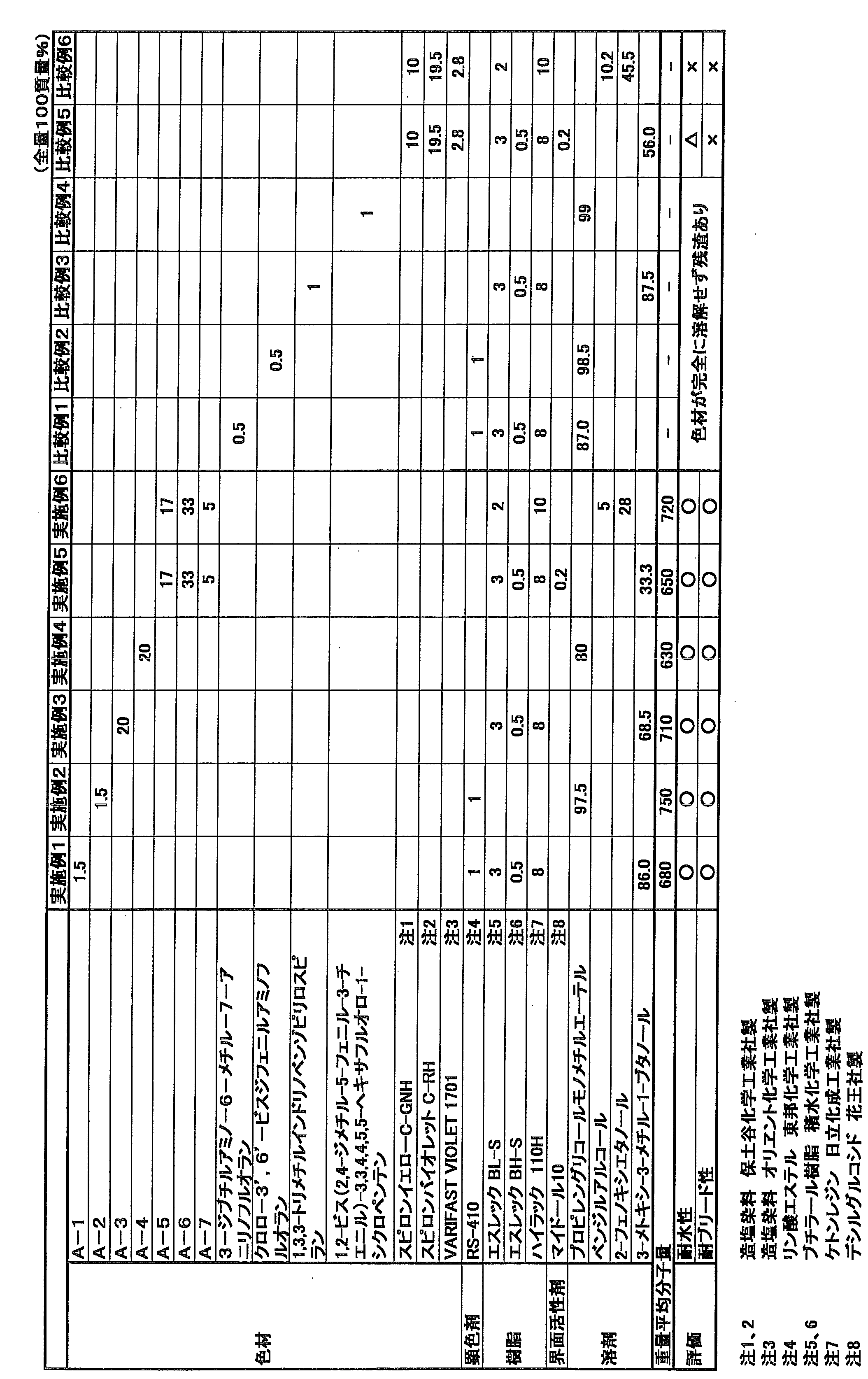

上記表1及び表2の結果から明らかなように、本発明となる実施例1~9の筆記具用インク組成物は、本発明の範囲外となる比較例1~9の筆記具用インク組成物に較べて、耐水性及び耐ブリード性に優れた筆記具用インク組成物となることが判明した。
これに対して、表1の比較例1~6は、製造例1~6で用いた処理前のロイコ色素(比較例1,2)、フォトクロミック化合物(比較例3,4)、並びに、造塩染料(比較例5,6)を含有する各インク組成物であり、表2の比較例7~9は、製造例8~10で用いた処理前の造塩染料1~3を含有する各インク組成物であり、これらの場合は、満足のいく十分な耐水性、耐ブリード性が得られないものであった。
As is apparent from the results of Tables 1 and 2, the ink compositions for writing instruments of Examples 1 to 9 according to the present invention are the ink compositions for writing instruments of Comparative Examples 1 to 9 that are outside the scope of the present invention. In comparison, it was found that the ink composition for writing instruments was excellent in water resistance and bleed resistance.
On the other hand, Comparative Examples 1 to 6 in Table 1 are leuco dyes before treatment (Comparative Examples 1 and 2), photochromic compounds (Comparative Examples 3 and 4) used in Production Examples 1 to 6, and salt formation. Each ink composition containing a dye (Comparative Examples 5 and 6). Comparative Examples 7 to 9 in Table 2 are inks containing salt-forming dyes 1 to 3 before treatment used in Production Examples 8 to 10. In these cases, satisfactory water resistance and bleed resistance could not be obtained.
ボールペン、マーキングペンなどの筆記具に好適な筆記具用インク組成物、及びそれに用いる色材として好適なものとなる。 The ink composition for writing instruments suitable for writing instruments such as ballpoint pens and marking pens, and the coloring material used therefor.
Claims (11)


Priority Applications (4)
| Application Number | Priority Date | Filing Date | Title |
|---|---|---|---|
| US14/785,664 US9790384B2 (en) | 2013-05-07 | 2014-04-23 | Ink composition for writing instrument and coloring material |
| KR1020157034666A KR102190410B1 (en) | 2013-05-07 | 2014-04-23 | Ink composition for writing instrument and coloring material |
| EP14794728.7A EP2995659B1 (en) | 2013-05-07 | 2014-04-23 | Ink composition for writing instrument and coloring material |
| CN201480025866.6A CN105189668B (en) | 2013-05-07 | 2014-04-23 | Ink compositions and coloring materials for writing instruments |
Applications Claiming Priority (4)
| Application Number | Priority Date | Filing Date | Title |
|---|---|---|---|
| JP2013-097403 | 2013-05-07 | ||
| JP2013097403A JP6274745B2 (en) | 2013-05-07 | 2013-05-07 | Ink composition for writing instrument and coloring material |
| JP2013122167A JP6118651B2 (en) | 2013-06-10 | 2013-06-10 | Ink composition for writing instrument and coloring material |
| JP2013-122167 | 2013-06-10 |
Publications (1)
| Publication Number | Publication Date |
|---|---|
| WO2014181683A1 true WO2014181683A1 (en) | 2014-11-13 |
Family
ID=51867165
Family Applications (1)
| Application Number | Title | Priority Date | Filing Date |
|---|---|---|---|
| PCT/JP2014/061386 Ceased WO2014181683A1 (en) | 2013-05-07 | 2014-04-23 | Ink composition for writing utensil and coloring material |
Country Status (5)
| Country | Link |
|---|---|
| US (1) | US9790384B2 (en) |
| EP (1) | EP2995659B1 (en) |
| KR (1) | KR102190410B1 (en) |
| CN (1) | CN105189668B (en) |
| WO (1) | WO2014181683A1 (en) |
Families Citing this family (1)
| Publication number | Priority date | Publication date | Assignee | Title |
|---|---|---|---|---|
| JP2022167040A (en) * | 2021-04-22 | 2022-11-04 | 京セラドキュメントソリューションズ株式会社 | Ink for inkjet textile printing |
Citations (11)
| Publication number | Priority date | Publication date | Assignee | Title |
|---|---|---|---|---|
| JPH08134393A (en) | 1994-11-10 | 1996-05-28 | Pilot Corp:The | Black ink composition for oil-based ballpoint pens |
| JP2003231855A (en) * | 2002-02-12 | 2003-08-19 | Pilot Ink Co Ltd | Erasable aqueous ink composition for ball point pen and ball point pen filled with the same |
| JP2004530037A (en) | 2001-06-08 | 2004-09-30 | ビック コーポレイション | Polyurethane ink for writing utensils |
| JP2004300165A (en) * | 2003-03-28 | 2004-10-28 | Pilot Ink Co Ltd | Colored hollow resin particulate for ink and ink composition for writing tool obtained using the same |
| JP2005132884A (en) * | 2003-10-28 | 2005-05-26 | Pilot Ink Co Ltd | Colored resin particles for ink and writing tool ink composition using the same |
| JP2009292935A (en) | 2008-06-05 | 2009-12-17 | Pilot Ink Co Ltd | Oil-base ink composition for ballpoint pen, ballpoint pen and ballpoint pen set housing the composition |
| JP2010202705A (en) * | 2009-02-27 | 2010-09-16 | Pentel Corp | Oily ink composition for ballpoint pen |
| JP2010235853A (en) * | 2009-03-31 | 2010-10-21 | Pentel Corp | Oil-based ink for ballpoint pens |
| JP2011111578A (en) * | 2009-11-30 | 2011-06-09 | Pentel Corp | Oily ink for ballpoint pen |
| JP2012162692A (en) * | 2011-02-09 | 2012-08-30 | Mitsubishi Pencil Co Ltd | Aqueous ink composition for writing utensil |
| JP2013028788A (en) * | 2011-06-23 | 2013-02-07 | Pilot Corporation | Ink composition for oil-based ballpoint pen, and oil-based ballpoint pen refill using the same |
Family Cites Families (7)
| Publication number | Priority date | Publication date | Assignee | Title |
|---|---|---|---|---|
| JP2896691B2 (en) * | 1990-03-06 | 1999-05-31 | パイロットインキ株式会社 | Ink for writing implements |
| US5948152A (en) * | 1998-04-24 | 1999-09-07 | Milliken & Company | Homogeneous liquid complexes of anionic organic dyes and quaternary ammonium compounds and methods of coloring utilizing such complexes |
| JP4838915B2 (en) | 2005-10-21 | 2011-12-14 | パイロットインキ株式会社 | Photochromic material and liquid composition using the same |
| JP5560062B2 (en) * | 2010-02-26 | 2014-07-23 | ゼブラ株式会社 | W / O type emulsion ink composition for writing instrument and writing instrument |
| EP2670334A1 (en) | 2011-02-03 | 2013-12-11 | Tria Beauty, Inc. | Radiation-based dermatological devices and methods |
| RU2606985C2 (en) * | 2011-05-25 | 2017-01-10 | Тетра Лаваль Холдингз Энд Файнэнс С.А. | Improved near infrared absorbers |
| JP5713800B2 (en) | 2011-05-30 | 2015-05-07 | 三菱鉛筆株式会社 | Oil-based ink composition for writing instruments |
-
2014
- 2014-04-23 WO PCT/JP2014/061386 patent/WO2014181683A1/en not_active Ceased
- 2014-04-23 EP EP14794728.7A patent/EP2995659B1/en active Active
- 2014-04-23 CN CN201480025866.6A patent/CN105189668B/en active Active
- 2014-04-23 KR KR1020157034666A patent/KR102190410B1/en active Active
- 2014-04-23 US US14/785,664 patent/US9790384B2/en not_active Expired - Fee Related
Patent Citations (11)
| Publication number | Priority date | Publication date | Assignee | Title |
|---|---|---|---|---|
| JPH08134393A (en) | 1994-11-10 | 1996-05-28 | Pilot Corp:The | Black ink composition for oil-based ballpoint pens |
| JP2004530037A (en) | 2001-06-08 | 2004-09-30 | ビック コーポレイション | Polyurethane ink for writing utensils |
| JP2003231855A (en) * | 2002-02-12 | 2003-08-19 | Pilot Ink Co Ltd | Erasable aqueous ink composition for ball point pen and ball point pen filled with the same |
| JP2004300165A (en) * | 2003-03-28 | 2004-10-28 | Pilot Ink Co Ltd | Colored hollow resin particulate for ink and ink composition for writing tool obtained using the same |
| JP2005132884A (en) * | 2003-10-28 | 2005-05-26 | Pilot Ink Co Ltd | Colored resin particles for ink and writing tool ink composition using the same |
| JP2009292935A (en) | 2008-06-05 | 2009-12-17 | Pilot Ink Co Ltd | Oil-base ink composition for ballpoint pen, ballpoint pen and ballpoint pen set housing the composition |
| JP2010202705A (en) * | 2009-02-27 | 2010-09-16 | Pentel Corp | Oily ink composition for ballpoint pen |
| JP2010235853A (en) * | 2009-03-31 | 2010-10-21 | Pentel Corp | Oil-based ink for ballpoint pens |
| JP2011111578A (en) * | 2009-11-30 | 2011-06-09 | Pentel Corp | Oily ink for ballpoint pen |
| JP2012162692A (en) * | 2011-02-09 | 2012-08-30 | Mitsubishi Pencil Co Ltd | Aqueous ink composition for writing utensil |
| JP2013028788A (en) * | 2011-06-23 | 2013-02-07 | Pilot Corporation | Ink composition for oil-based ballpoint pen, and oil-based ballpoint pen refill using the same |
Also Published As
| Publication number | Publication date |
|---|---|
| KR20160007568A (en) | 2016-01-20 |
| EP2995659A4 (en) | 2016-12-07 |
| CN105189668A (en) | 2015-12-23 |
| CN105189668B (en) | 2019-07-30 |
| US20160068694A1 (en) | 2016-03-10 |
| KR102190410B1 (en) | 2020-12-11 |
| EP2995659A1 (en) | 2016-03-16 |
| EP2995659B1 (en) | 2020-02-05 |
| US9790384B2 (en) | 2017-10-17 |
Similar Documents
| Publication | Publication Date | Title |
|---|---|---|
| CN105518102B (en) | Microcapsules coloured material and writing implement ink composition | |
| CN103890101B (en) | Coloring agent, use its microcapsule pigment prepared and writing implement ink composition | |
| JP6000686B2 (en) | Dye, microcapsule pigment using the same, and ink composition for writing instrument | |
| JP5473412B2 (en) | Oil-based ink composition for writing instruments and writing instrument using the same | |
| JP5713800B2 (en) | Oil-based ink composition for writing instruments | |
| WO2018168488A1 (en) | Dye, pigment-containing microcapsules, and ink composition for writing instrument | |
| JP6274745B2 (en) | Ink composition for writing instrument and coloring material | |
| JP2003041170A (en) | Oil-based ink composition and use thereof | |
| WO2014181683A1 (en) | Ink composition for writing utensil and coloring material | |
| JP6239933B2 (en) | Microcapsule coloring material and ink composition for writing instrument | |
| JP6245511B2 (en) | Microcapsule coloring material and ink composition for writing instrument | |
| JP6118651B2 (en) | Ink composition for writing instrument and coloring material | |
| JP2005213413A (en) | Oil-based ink composition for ballpoint pen and method for producing the same | |
| JP7674088B2 (en) | Microcapsule pigment and ink composition for writing instruments | |
| JP2012219160A (en) | Writing utensil aqueous ink composition | |
| JP2003113339A (en) | Oil-based ink composition and use thereof | |
| JP2025135352A (en) | Water-based ink composition for writing instruments | |
| JP2024077200A (en) | Oil-in-water type ink composition for writing instruments | |
| JP2024077197A (en) | Oil-in-water type ink composition for writing instruments | |
| JP2022175433A (en) | Microcapsule pigment and writing instrument ink composition containing the same | |
| JP2004331691A (en) | Oil-based ink composition for ballpoint pens |
Legal Events
| Date | Code | Title | Description |
|---|---|---|---|
| WWE | Wipo information: entry into national phase |
Ref document number: 201480025866.6 Country of ref document: CN |
|
| 121 | Ep: the epo has been informed by wipo that ep was designated in this application |
Ref document number: 14794728 Country of ref document: EP Kind code of ref document: A1 |
|
| WWE | Wipo information: entry into national phase |
Ref document number: 14785664 Country of ref document: US |
|
| NENP | Non-entry into the national phase |
Ref country code: DE |
|
| WWE | Wipo information: entry into national phase |
Ref document number: 2014794728 Country of ref document: EP |
|
| ENP | Entry into the national phase |
Ref document number: 20157034666 Country of ref document: KR Kind code of ref document: A |