WO2014159245A1 - Opioid receptor modulator dosage formulations - Google Patents
Opioid receptor modulator dosage formulations Download PDFInfo
- Publication number
- WO2014159245A1 WO2014159245A1 PCT/US2014/022666 US2014022666W WO2014159245A1 WO 2014159245 A1 WO2014159245 A1 WO 2014159245A1 US 2014022666 W US2014022666 W US 2014022666W WO 2014159245 A1 WO2014159245 A1 WO 2014159245A1
- Authority
- WO
- WIPO (PCT)
- Prior art keywords
- amino
- phenyl
- imidazol
- methoxy
- carbamoyl
- Prior art date
- Legal status (The legal status is an assumption and is not a legal conclusion. Google has not performed a legal analysis and makes no representation as to the accuracy of the status listed.)
- Ceased
Links
Classifications
-
- A—HUMAN NECESSITIES
- A61—MEDICAL OR VETERINARY SCIENCE; HYGIENE
- A61K—PREPARATIONS FOR MEDICAL, DENTAL OR TOILETRY PURPOSES
- A61K31/00—Medicinal preparations containing organic active ingredients
- A61K31/33—Heterocyclic compounds
- A61K31/395—Heterocyclic compounds having nitrogen as a ring hetero atom, e.g. guanethidine or rifamycins
- A61K31/41—Heterocyclic compounds having nitrogen as a ring hetero atom, e.g. guanethidine or rifamycins having five-membered rings with two or more ring hetero atoms, at least one of which being nitrogen, e.g. tetrazole
- A61K31/4164—1,3-Diazoles
- A61K31/4174—Arylalkylimidazoles, e.g. oxymetazolin, naphazoline, miconazole
-
- A—HUMAN NECESSITIES
- A61—MEDICAL OR VETERINARY SCIENCE; HYGIENE
- A61K—PREPARATIONS FOR MEDICAL, DENTAL OR TOILETRY PURPOSES
- A61K47/00—Medicinal preparations characterised by the non-active ingredients used, e.g. carriers or inert additives; Targeting or modifying agents chemically bound to the active ingredient
- A61K47/06—Organic compounds, e.g. natural or synthetic hydrocarbons, polyolefins, mineral oil, petrolatum or ozokerite
- A61K47/26—Carbohydrates, e.g. sugar alcohols, amino sugars, nucleic acids, mono-, di- or oligo-saccharides; Derivatives thereof, e.g. polysorbates, sorbitan fatty acid esters or glycyrrhizin
-
- A—HUMAN NECESSITIES
- A61—MEDICAL OR VETERINARY SCIENCE; HYGIENE
- A61K—PREPARATIONS FOR MEDICAL, DENTAL OR TOILETRY PURPOSES
- A61K9/00—Medicinal preparations characterised by special physical form
- A61K9/20—Pills, tablets, discs, rods
-
- A—HUMAN NECESSITIES
- A61—MEDICAL OR VETERINARY SCIENCE; HYGIENE
- A61K—PREPARATIONS FOR MEDICAL, DENTAL OR TOILETRY PURPOSES
- A61K9/00—Medicinal preparations characterised by special physical form
- A61K9/20—Pills, tablets, discs, rods
- A61K9/2004—Excipients; Inactive ingredients
-
- A—HUMAN NECESSITIES
- A61—MEDICAL OR VETERINARY SCIENCE; HYGIENE
- A61K—PREPARATIONS FOR MEDICAL, DENTAL OR TOILETRY PURPOSES
- A61K9/00—Medicinal preparations characterised by special physical form
- A61K9/20—Pills, tablets, discs, rods
- A61K9/2004—Excipients; Inactive ingredients
- A61K9/2013—Organic compounds, e.g. phospholipids, fats
- A61K9/2018—Sugars, or sugar alcohols, e.g. lactose, mannitol; Derivatives thereof, e.g. polysorbates
-
- A—HUMAN NECESSITIES
- A61—MEDICAL OR VETERINARY SCIENCE; HYGIENE
- A61K—PREPARATIONS FOR MEDICAL, DENTAL OR TOILETRY PURPOSES
- A61K9/00—Medicinal preparations characterised by special physical form
- A61K9/20—Pills, tablets, discs, rods
- A61K9/2004—Excipients; Inactive ingredients
- A61K9/2022—Organic macromolecular compounds
- A61K9/2027—Organic macromolecular compounds obtained by reactions only involving carbon-to-carbon unsaturated bonds, e.g. polyvinyl pyrrolidone, poly(meth)acrylates
-
- A—HUMAN NECESSITIES
- A61—MEDICAL OR VETERINARY SCIENCE; HYGIENE
- A61K—PREPARATIONS FOR MEDICAL, DENTAL OR TOILETRY PURPOSES
- A61K9/00—Medicinal preparations characterised by special physical form
- A61K9/20—Pills, tablets, discs, rods
- A61K9/2004—Excipients; Inactive ingredients
- A61K9/2022—Organic macromolecular compounds
- A61K9/205—Polysaccharides, e.g. alginate, gums; Cyclodextrin
- A61K9/2054—Cellulose; Cellulose derivatives, e.g. hydroxypropyl methylcellulose
-
- A—HUMAN NECESSITIES
- A61—MEDICAL OR VETERINARY SCIENCE; HYGIENE
- A61K—PREPARATIONS FOR MEDICAL, DENTAL OR TOILETRY PURPOSES
- A61K9/00—Medicinal preparations characterised by special physical form
- A61K9/20—Pills, tablets, discs, rods
- A61K9/28—Dragees; Coated pills or tablets, e.g. with film or compression coating
- A61K9/2806—Coating materials
- A61K9/2833—Organic macromolecular compounds
- A61K9/286—Polysaccharides, e.g. gums; Cyclodextrin
- A61K9/2866—Cellulose; Cellulose derivatives, e.g. hydroxypropyl methylcellulose
-
- A—HUMAN NECESSITIES
- A61—MEDICAL OR VETERINARY SCIENCE; HYGIENE
- A61K—PREPARATIONS FOR MEDICAL, DENTAL OR TOILETRY PURPOSES
- A61K9/00—Medicinal preparations characterised by special physical form
- A61K9/48—Preparations in capsules, e.g. of gelatin, of chocolate
- A61K9/50—Microcapsules having a gas, liquid or semi-solid filling; Solid microparticles or pellets surrounded by a distinct coating layer, e.g. coated microspheres, coated drug crystals
- A61K9/5005—Wall or coating material
- A61K9/501—Inorganic compounds
-
- A—HUMAN NECESSITIES
- A61—MEDICAL OR VETERINARY SCIENCE; HYGIENE
- A61P—SPECIFIC THERAPEUTIC ACTIVITY OF CHEMICAL COMPOUNDS OR MEDICINAL PREPARATIONS
- A61P25/00—Drugs for disorders of the nervous system
- A61P25/04—Centrally acting analgesics, e.g. opioids
Definitions
- the present disclosure relates to oral dosage formulations containing 5-( ⁇ [2- Amino-3-(4-carbamoyl-2,6-dimethyl-phenyl)-propionyl]-[l-(4-phenyl-lH-imidazol-2-yl)- ethyl] -amino ⁇ -methyl)-2-methoxy -benzoic acid, and processes for the preparation and administration of these formulations.
- An 5-( ⁇ [2-Amino-3-(4-carbamoyl-2,6-dimethyl-phenyl)-propionyl]-[l-(4-phenyl- lH-imidazol-2-yl)-ethyl]-amino ⁇ -methyl)-2-methoxy-benzoic acid must be formulated for delivery to a patient and this formulation (in addition to the 5-( ⁇ [2-Amino-3-(4- carbamoyl-2,6-dimethyl-phenyl)-propionyl]-[l -(4-phenyl- lH-imidazol-2-yl)-ethyl]- amino ⁇ -methyl)-2-methoxy-benzoic acid activity) is evaluated by regulatory agencies such as the US Food and Drug Administration (FDA) and the European Medicines Agency (EMA).
- FDA US Food and Drug Administration
- EMA European Medicines Agency
- the FDA evaluates the formulation for, among other properties, delivery properties, stability, consistency, and manufacturing controls.
- An important factor in determining these properties of a particular formulation is the composition and form of the dosage formulation of the 5-( ⁇ [2-Amino-3-(4-carbamoyl-2,6-dimethyl-phenyl)- propionyl]-[ 1 -(4-phenyl- lH-imidazol-2-yl)-ethyl]-amino ⁇ -methyl)-2-methoxy-benzoic acid.
- the formulations for every 5-( ⁇ [2-Amino-3-(4-carbamoyl-2,6-dimethyl-phenyl)- propionyl]-[ 1 -(4-phenyl- lH-imidazol-2-yl)-ethyl]-amino ⁇ -methyl)-2-methoxy-benzoic acid are different and different formulations containing the same 5-( ⁇ [2-Amino-3-(4- carbamoyl-2,6-dimethyl-phenyl)-propionyl]-[l -(4-phenyl- lH-imidazol-2-yl)-ethyl]- amino ⁇ -methyl)-2-methoxy-benzoic acid may have very different stability and drug delivery (e.g., pharmacokinetic) properties.
- 5-( ⁇ [2-Amino-3-(4-carbamoyl-2,6-dimethyl-phenyl)-propionyl]-[l-(4-phenyl-lH- imidazol-2-yl)-ethyl]-amino ⁇ -methyl)-2-methoxy-benzoic acid is an opioid receptor modulator that effects simultaneous agonism of the ⁇ opioid receptor (MOR) and antagonism of the ⁇ opioid receptor (DOR) and may be useful in the treatment and prevention of various mammalian disease states, for example pain and gastrointestinal disorders such as diarrheic syndromes, motility disorders including post-operative ileus and constipation, and visceral pain including post-operative pain, irritable bowel syndrome and inflammatory bowel disorders (for example, see U.S.
- MOR ⁇ opioid receptor
- DOR antagonism of the ⁇ opioid receptor
- Irritable bowel syndrome is a common functional gastrointestinal disorder that affects approximately 10-15% of the population in western countries (Lovell et al., Clin Gastroenterol Hepatol 2012;10(7):712-21). Irritable bowel syndrome is characterized by recurrent abdominal discomfort and pain associated with altered bowel habits (Drossman DA, Gastroenterol 2006;130(5): 1377-1390).
- IBS-D diarrhea
- IBS- C constipation
- IBS-M mixed constipation and diarrhea
- Irritable bowel syndrome can negatively impact individual's quality of life and results in significant direct and indirect costs (Drossman DA. Rome III The Functional GI Disorders. 3 rd Edition. Lawrence: Allen Press, Inc, 2006).
- Current safe and effective pharmacologic treatments for IBS-D are limited and include antispasmodics, antidepressants, antidiarrheal agents, and alosetron (Brandt et al, Am J Gastroenterol 2009;104(Suppl l):Sl-35).
- Opioid receptors including mu, delta, and kappa are expressed along the gastrointestinal tract and play a key role in regulating gastrointestinal motility, secretion and visceral sensation (Bagnol et al, Neuroscience 1997;81(2):579-591; Dokray GJ,
- DOR have differential gastrointestinal effects and may possess increased analgesic potency compared to pure MOR agonists (Ananthan S. Opioid ligands with mixed ⁇ / ⁇ opioid receptor interactions: an emerging approach to novel analgesics. AAPS Journal
- Such a mixed MOR agonist/DOR antagonist profile may offer an advantage in treating both the diarrhea and abdominal pain associated with IBS-D.
- 5-( ⁇ [2-Amino-3-(4-carbamoyl-2,6-dimethyl-phenyl)-propionyl]-[l-(4-phenyl-lH- imidazol-2-yl)-ethyl]-amino ⁇ -methyl)-2-methoxy-benzoic acid may be particularly useful for reducing pain and diarrhea in patients with irritable bowel syndrome with diarrhea (IBS-D) without constipating side effects.
- loperamide had a narrow dose range in the same stressed and non-stressed models and completely prevented fecal output in a dose- dependent manner ⁇ ibid .
- 7,741,356 makes the hydrochloride salt of 5-( ⁇ [2-amino-3-(4-carbamoyl-2,6-dimethyl- phenyl)-propionyl]-[ 1 -(4-phenyl- lH-imidazol-2-yl)-ethyl] -amino ⁇ -methyl)-2-methoxy- benzoic acid.
- Oral administration of 5-( ⁇ [2-amino-3-(4-carbamoyl-2,6-dimethyl-phenyl)- propionyl]-[l-(4-phenyl-lH-imidazol-2-yl)-ethyl]-amino ⁇ -methyl)-2-methoxy-benzoic acid is efficacious in normalizing gastrointestinal (GI) motility in stressed subjects and providing anti-visceral hyperalgesic effects in rats by acting at peripheral opioid receptors in the gastrointestinal tract.
- GI gastrointestinal
- Food and Drug Administration 2010 for the assessment of abuse potential of drugs provides general instructions for in vitro laboratory assessment procedures. This draft guidance states that "[information should be obtained on how much drug substance might be released and any changes that could take place in the rate of release of the drug from the drug product if it is misused either intentionally or unintentionally.” The guidance further states that the "effects of pH, temperature, and solvent polarity on disruption of the drug product matrix should be evaluated.
- Additional experimental variables may include exposure times to the solvent, agitation, varying the surface area (such as from intact to being ground, crushed, or cut into pieces), and ease of crushing tablets or destroying the dosage from matrix.” These guidelines pertain to compounds perceived to have any potential for abuse, misuse and/or diversion, which include, but are not limited to, opioid receptor agonists.
- the goal is to determine the effects that certain formulations may have in limiting or preventing abuse of the active ingredient, in this instance, 5-( ⁇ [2-Amino-3-(4-carbamoyl-2,6-dimethyl-phenyl)- propionyl]-[ 1 -(4-phenyl- lH-imidazol-2-yl)-ethyl]-amino ⁇ -methyl)-2-methoxy-benzoic acid, in order to decrease abuse or diversion of the marketed dosage formulations and prevent harm and addiction in the public to the extent possible.
- the present inventors have discovered solid oral pharmaceutical formulations of 5- ( ⁇ [2-Amino-3-(4-carbamoyl-2,6-dimethyl-phenyl)-propionyl]-[l-(4-phenyl-lH-imidazol- 2-yl)-ethyl] -amino ⁇ -methyl)-2-methoxy-benzoic acid with improved stability and shelf life and unique physico-chemical features that may deter or limit abuse of the active ingredient or diversion of the oral formulations.
- embodiments provided by this disclosure include an abuse deterrent pharmaceutical formulation of 5-( ⁇ [2-Amino-3-(4- carbamoyl-2,6-dimethyl-phenyl)-propionyl]-[l -(4-phenyl- lH-imidazol-2-yl)-ethyl]- amino ⁇ -methyl)-2-methoxy-benzoic acid.
- One embodiment of the disclosure provides a solid pharmaceutical formulation comprising 5-( ⁇ [2-Amino-3-(4-carbamoyl-2,6-dimethyl-phenyl)-propionyl]-[l-(4-phenyl- lH-imidazol-2-yl)-ethyl]-amino ⁇ -methyl)-2-methoxy-benzoic acid and an inert ingredient selected from silicified microcrystalline cellulose, colloidal silicon dioxide, crospovidone
- this pharmaceutical formulation may be substantially or completely free of a separate opioid antagonist, such as naloxone.
- a related embodiment provides a pharmaceutical formulation consisting of 5-( ⁇ [2-Amino-3- (4-carbamoyl-2,6-dimethyl-phenyl)-propionyl]-[l-(4-phenyl-lH-imidazol-2-yl)-ethyl]- amino ⁇ -methyl)-2-methoxy-benzoic acid and an inert ingredient selected from silicified microcrystalline cellulose, colloidal silicon dioxide, crospovidone, mannitol, and magnesium stearate.
- One embodiment of the disclosure provides a solid pharmaceutical formulation comprising 5-( ⁇ [2-Amino-3-(4-carbamoyl-2,6-dimethyl-phenyl)-propionyl]-[l-(4-phenyl- lH-imidazol-2-yl)-ethyl]-amino ⁇ -methyl)-2-methoxy-benzoic acid and inert ingredients including silicified microcrystalline cellulose, colloidal silicon dioxide, crospovidone (polyvmylpolypyrrolidone; highly cross-linked polyvinylpyrrolidone (PVP)), mannitol, and magnesium stearate.
- silicified microcrystalline cellulose colloidal silicon dioxide
- crospovidone polyvmylpolypyrrolidone; highly cross-linked polyvinylpyrrolidone (PVP)
- mannitol and magnesium stearate.
- this pharmaceutical formulation may be substantially or completely free of a separate opioid antagonist, such as naloxone.
- a related embodiment provides a pharmaceutical formulation consisting of 5-( ⁇ [2-Amino-3- (4-carbamoyl-2,6-dimethyl-phenyl)-propionyl]-[l-(4-phenyl-lH-imidazol-2-yl)-ethyl]- amino ⁇ -methyl)-2-methoxy-benzoic acid, and the inert ingredients silicified
- microcrystalline cellulose colloidal silicon dioxide, crospovidone, mannitol, and magnesium stearate.
- One embodiment of the disclosure provides a solid oral dosage formulation comprising 5-( ⁇ [2-Amino-3-(4-carbamoyl-2,6-dimethyl-phenyl)-propionyl]-[l-(4-phenyl- lH-imidazol-2-yl)-ethyl]-amino ⁇ -methyl)-2-methoxy-benzoic acid and an inert ingredient selected from silicified microcrystalline cellulose, colloidal silicon dioxide, crospovidone (polyvmylpolypyrrolidone; highly cross-linked polyvinylpyrrolidone (PVP)), mannitol, and magnesium stearate.
- silicified microcrystalline cellulose colloidal silicon dioxide
- crospovidone polyvmylpolypyrrolidone; highly cross-linked polyvinylpyrrolidone (PVP)
- mannitol and magnesium stearate.
- this solid oral dosage formulation may be substantially or completely free of a separate opioid antagonist, such as naloxone.
- a related embodiment provides a solid oral dosage formulation consisting of 5-( ⁇ [2-Amino- 3-(4-carbamoyl-2,6-dimethyl-phenyl)-propionyl]-[l-(4-phenyl-lH-imidazol-2-yl)-ethyl]- amino ⁇ -methyl)-2-methoxy-benzoic acid and an inert ingredient selected from silicified microcrystalline cellulose, colloidal silicon dioxide, crospovidone, mannitol, and magnesium stearate.
- the oral dosage formulations may be coated, including sugar coated, gelatin coated, film coated or enteric coated, by standard techniques.
- an oral tablet formulation comprising 5-( ⁇ [2-Amino-3-(4-carbamoyl-2,6-dimethyl-phenyl)-propionyl]-[l-(4-phenyl- lH-imidazol-2-yl)-ethyl]-amino ⁇ -methyl)-2-methoxy-benzoic acid and an inert ingredient selected from silicified microcrystalline cellulose, colloidal silicon dioxide, crospovidone (polyvinylpolypyrrolidone; highly cross-linked polyvinylpyrrolidone (PVP)), mannitol, and magnesium stearate.
- silicified microcrystalline cellulose colloidal silicon dioxide
- crospovidone polyvinylpolypyrrolidone; highly cross-linked polyvinylpyrrolidone (PVP)
- mannitol and magnesium stearate.
- this oral tablet formulation may be substantially or completely free of a separate opioid antagonist, such as naloxone.
- a related embodiment provides an oral tablet formulation consisting of 5-( ⁇ [2-Amino-3-(4- carbamoyl-2,6-dimethyl-phenyl)-propionyl]-[l-(4-phenyl-lH-imidazol-2-yl)-ethyl]- amino ⁇ -methyl)-2-methoxy-benzoic acid and an inert ingredient selected from silicified microcrystalline cellulose, colloidal silicon dioxide, crospovidone, mannitol, and magnesium stearate.
- the oral tablet formulations may be coated, including sugar coated, gelatin coated, film coated or enteric coated, by standard techniques.
- Another embodiment of the disclosure provides a film-coated, oral tablet formulation comprising 5 -( ⁇ [2- Amino-3 -(4-carbamoyl-2,6-dimethyl-phenyl)-propionyl] - [l-(4-phenyl-lH-imidazol-2-yl)-ethyl]-amino ⁇ -methyl)-2-methoxy-benzoic acid and an inert ingredient selected from silicified microcrystalline cellulose, colloidal silicon dioxide, crospovidone (polyvinylpolypyrrolidone; highly cross-linked
- this film-coated, oral tablet formulation may be substantially or completely free of a separate opioid antagonist, such as naloxone.
- a related embodiment provides a film-coated, oral tablet formulation consisting of 5-( ⁇ [2-Amino-3-(4- carbamoyl-2,6-dimethyl-phenyl)-propionyl]-[l-(4-phenyl-lH-imidazol-2-yl)-ethyl]- amino ⁇ -methyl)-2-methoxy-benzoic acid and an inert ingredient selected from silicified microcrystalline cellulose, colloidal silicon dioxide, crospovidone, mannitol, and magnesium stearate, and a film coating.
- the film coating may be an aqueous film coating.
- a specific embodiment is an abuse deterrent, mono-phasic pharmaceutical composition suitable for single dose administration for treating or ameliorating a condition mediated by an opioid receptor consisting essentially of about 20 mg/dose to about 200 mg/dose of 5-( ⁇ [2-Amino-3-(4-carbamoyl-2,6-dimethyl-phenyl)-propionyl]-[l-(4-phenyl- lH-imidazol-2-yl)-ethyl]-amino ⁇ -methyl)-2-methoxy-benzoic acid, from about 60-80% by weight of silicified microcrystalline cellulose, from about 2-8 % by weight of colloidal silica, from about 50-90% by weight of mannitol, from about 20-50% by weight of crospovidone, and from about 2-8 % by weight of magnesium stearate.
- Another embodiment provided by this disclosure is a method of treating or ameliorating a condition mediated by an opioid receptor by administering 5-( ⁇ [2-Amino- 3-(4-carbamoyl-2,6-dimethyl-phenyl)-propionyl]-[l-(4-phenyl-lH-imidazol-2-yl)-ethyl]- amino ⁇ -methyl)-2-methoxy-benzoic acid in a solid oral formulation of this disclosure to a subject in need of such treatment.
- this administration may be made in the absence of the separate or concurrent administration of an opioid antagonist, such as naloxone.
- these methods may include the administration of 5-( ⁇ [2-Amino-3-(4-carbamoyl-2,6-dimethyl-phenyl)-propionyl]-[l-(4-phenyl-lH- imidazol-2-yl)-ethyl]-amino ⁇ -methyl)-2-methoxy-benzoic acid to the subject in an amount between 20mg and 200mg.
- these methods may include the administration of 5-( ⁇ [2- Amino-3-(4-carbamoyl-2,6-dimethyl-phenyl)-propionyl]-[l-(4-phenyl-lH-imidazol-2-yl)- ethyl] -amino ⁇ -methyl)-2-methoxy-benzoic acid to the subject in an amount between about lOmg and about 125mg.
- these methods may include the administration of 5-( ⁇ [2-Amino-3-(4-carbamoyl-2,6-dimethyl-phenyl)-propionyl]-[l-(4- phenyl-lH-imidazol-2-yl)-ethyl] -amino ⁇ -methyl)-2-methoxy-benzoic acid to the subject in an amount between about 50mg and about lOOmg.
- these methods may include the administration of 5-( ⁇ [2-Amino-3-(4-carbamoyl-2,6-dimethyl- phenyl)-propionyl] - [ 1 -(4-pheny 1- 1 H-imidazol-2-yl)-ethyl] -amino ⁇ -methyl)-2-methoxy- benzoic acid to the subject in an amount of about 75mg.
- these methods may include the administration of 5-( ⁇ [2-Amino-3-(4-carbamoyl-2,6-dimethyl- phenyl)-propionyl] - [ 1 -(4-pheny 1- 1 H-imidazol-2-yl)-ethyl] -amino ⁇ -methyl)-2-methoxy- benzoic acid to the subject in an amount of about lOOmg.
- these methods may include the administration of 5-( ⁇ [2-
- these methods may include the administration of 5-( ⁇ [2-Amino-3-(4- carbamoyl-2,6-dimethyl-phenyl)-propionyl]-[l-(4-phenyl-lH-imidazol-2-yl)-ethyl]- amino ⁇ -methyl)-2-methoxy-benzoic acid in a formulation of this disclosure to the subject between two administrations per day and six administrations per day.
- these methods may include the administration of 5-( ⁇ [2-Amino-3-(4- carbamoyl-2,6-dimethyl-phenyl)-propionyl]-[l-(4-phenyl-lH-imidazol-2-yl)-ethyl]- amino ⁇ -methyl)-2-methoxy-benzoic acid in a formulation of this disclosure to the subject between two administrations per day and four administrations per day.
- these methods may include the administration of 5-( ⁇ [2-Amino-3-(4- carbamoyl-2,6-dimethyl-phenyl)-propionyl]-[l-(4-phenyl-lH-imidazol-2-yl)-ethyl]- amino ⁇ -methyl)-2-methoxy-benzoic acid in a formulation of this disclosure to the subject on a twice-daily dosing regimen.
- these methods may include the administration of 5-( ⁇ [2-Amino-3-(4-carbamoyl-2,6-dimethyl-phenyl)-propionyl]-[l-(4- phenyl-lH-imidazol-2-yl)-ethyl]-amino ⁇ -methyl)-2-methoxy-benzoic acid in a formulation of this disclosure to the subject on a once-daily dosing regimen.
- Figure 1 depicts the manufacturing process for 75 -mg and 100-mg oral tablets of the present disclosure.
- Figure 2 shows representative time course plots of cumulative percent recovery of active ingredient under different extraction conditions: A, ground vs. whole tablet; B, 25°C vs. 95°C;
- the present disclosure is drawn to solid dosage formulations containing 5-( ⁇ [2- Amino-3-(4-carbamoyl-2,6-dimethyl-phenyl)-propionyl]-[l-(4-phenyl-lH-imidazol-2-yl)- ethyl] -amino ⁇ -methyl)-2-methoxy -benzoic acid that deter or minimize the abuse or diversion of these formulations, as well as processes for the preparation and administration of these formulations.
- 2,6-dimethyl-phenyl)-propionyl] - [ 1 -(4-phenyl- 1 H-imidazol-2-yl)-ethyl] -amino ⁇ -methyl)- 2-methoxy-benzoic acid also means "5-[[[-2-amino-3-[4-(aminocarbonyl)-2,6- dimethylphenyl]- 1 -oxopropyl] [- 1 -(4-phenyl- 1 H-imidazol-2-yl)ethyl]amino]methyl]-2- methoxybenzoic acid", and it is intended that the two chemical names can be used interchangeably.
- Reference to the "active ingredient” includes 5-( ⁇ [2-Amino-3-(4- carbamoyl-2,6-dimethyl-phenyl)-propionyl]-[l -(4-phenyl- lH-imidazol-2-yl)-ethyl]- amino ⁇ -methyl)-2-methoxy-benzoic acid, and pharmaceutically acceptable enantiomers, diastereomers, racemates, zwitterions, and salts thereof.
- 5-( ⁇ [2-Amino-3-(4-carbamoyl-2,6-dimethyl-phenyl)-propionyl]-[l-(4- phenyl-lH-imidazol-2-yl)-ethyl] -amino ⁇ -methyl)-2-methoxy-benzoic acid includes at least two chiral centers, it may exist as diastereomers. These isomers may be separated by conventional techniques such as preparative chromatography and may be prepared in racemic form or as individual diasteromers by either stereospecific synthesis or by resolution.
- the compounds may, for example, be resolved into their component diasteromers by standard techniques, such as the formation of stereoisomeric pairs by salt formation with an optically active acid, such as (-)-di-p-toluoyl-D-tartaric acid and/or (+)- di-p-toluoyl-L-tartaric acid followed by fractional crystallization and regeneration of the free base.
- an optically active acid such as (-)-di-p-toluoyl-D-tartaric acid and/or (+)- di-p-toluoyl-L-tartaric acid followed by fractional crystallization and regeneration of the free base.
- the compounds may also be resolved by formation of stereoisomeric esters or amides, followed by chromatographic separation and removal of the chiral auxiliary. Alternatively, the compounds may be resolved using a chiral HPLC column.
- the terms "subject,” “patient,” “individual,” etc. are not intended to be limiting and can be generally interchanged. That is, an individual described as a “patient” does not necessarily have a given disease, but may be merely seeking medical advice.
- Treatment can refer to any delay in onset, reduction in the frequency or severity of symptoms, amelioration of symptoms, improvement in patient comfort and/or
- the effect of treatment can be compared to an individual or pool of individuals not receiving a given treatment, or to the same patient prior to, or after cessation of, treatment.
- prevent refers to a decrease in the occurrence of opioid receptor disease or disorder symptoms in a patient.
- the prevention or amelioration may be complete (no detectable symptoms) or partial, such that fewer symptoms are observed than would likely occur absent treatment.
- opioid receptor related disorders refers to various mammalian disease states including, for example, pain and gastrointestinal disorders such as diarrheic syndromes, motility disorders including post-operative ileus and constipation, and visceral pain including post-operative pain, irritable bowel syndrome and inflammatory bowel disorders, as described in greater detail in U.S. Patent No. 7,741,356 to Breslin, et al, which is incorporated herein in its entirety.
- abusive or “abusive manner” refers to uses of the formulations of this disclosure beyond oral administration, such as by injecting or snorting.
- buse deterrent refers to a formulation of the present invention which possesses physico-chemical characteristics that allow the therapeutic use of the opioid receptor modulator active ingredient by oral administration to a subject in need of such treatment with very limited potential for abuse or misuse of the formulation, i.e., by extracting and ingesting the active ingredient by snorting or injection.
- a therapeutically effective amount refers to that amount of the therapeutic agent sufficient to treat or ameliorate the disease or disorder, as described above.
- a therapeutically effective amount will show an increase or decrease of at least about 5%, 10%, 15%, 20%>, 25%, 30%>, 40%>, 50%, 60%, 70%, 80%, 90%, or 100%.
- Therapeutic efficacy can also be expressed as "- fold" increase or decrease.
- a therapeutically effective amount can have at least a 1.2-fold, 1.5-fold, 2-fold, 5-fold, or more effect over a control value.
- Therapeutic efficacy related to irritable bowel syndrome preferably diarrhea-predominant irritable bowel syndrome, can be expressed in measurements of worst abdominal pain (WAP) or stool consistency score (Bristol Stool Scale or BSS).
- solid dosage formulation as used herein includes tablets, capsules, pills and like and may be present as conventional or extended-release compositions.
- the dose of 5-( ⁇ [2-Amino-3-(4-carbamoyl-2,6-dimethyl-phenyl)-propionyl]-[l-(4-phenyl- lH-imidazol-2-yl)-ethyl]-amino ⁇ -methyl)-2-methoxy-benzoic acid that can be
- the dose of the active ingredient can range from about lOmg to about 125 mg. In some embodiments, the dose of the active ingredient in the formulations of this disclosure is between about lOmg and about 200mg, e.g.
- the dose is about 75 mg of 5-( ⁇ [2-Amino-3-(4-carbamoyl-2,6-dimethyl-phenyl)- propionyl]-[ 1 -(4-phenyl- lH-imidazol-2-yl)-ethyl]-amino ⁇ -methyl)-2-methoxy-benzoic acid.
- the dose is about 100 mg of 5-( ⁇ [2-Amino-3-(4-carbamoyl- 2,6-dimethyl-phenyl)-propionyl] - [ 1 -(4-phenyl- 1 H-imidazol-2-yl)-ethyl] -amino ⁇ -methyl)- 2-methoxy-benzoic acid.
- the dose is about 50 mg of 5-( ⁇ [2- Amino-3-(4-carbamoyl-2,6-dimethyl-phenyl)-propionyl]-[l -(4-phenyl- lH-imidazol-2-yl)- ethyl] -amino ⁇ -methyl)-2-methoxy -benzoic acid.
- the dose is about 150 mg of 5-( ⁇ [2-Amino-3-(4-carbamoyl-2,6-dimethyl-phenyl)-propionyl]-[l-(4- phenyl-lH-imidazol-2-yl)-ethyl] -amino ⁇ -methyl)-2-methoxy-benzoic acid.
- the dose is about 37.5 mg of 5-( ⁇ [2-Amino-3-(4-carbamoyl-2,6-dimethyl- phenyl)-propionyl] - [ 1 -(4-phenyl- 1 H-imidazol-2-yl)-ethyl] -amino ⁇ -methyl)-2-methoxy- benzoic acid.
- Dose proportionality occurs when increases in the administered dose are accompanied by proportional increases in a pharmacokinetic parameter.
- the dosage formulations of the present disclosure are preferably designed as a dose proportional formulation in the range of 25mg to lOOmg of the active ingredient 5-( ⁇ [2-Amino-3-(4- carbamoyl-2,6-dimethyl-phenyl)-propionyl]-[l-(4-phenyl-lH-imidazol-2-yl)-ethyl]- amino ⁇ -methyl)-2-methoxy-benzoic acid.
- Abuse deterrent formulations of the present invention include solid pharmaceutical dosage formulations containing:
- crospovidone in another preferred embodiment, about 5% by weight of crospovidone; and, from about 0.45-1 % by weight of magnesium stearate (Magnesium Stearate USP), preferably from about 0.55-0.95% by weight of magnesium stearate, in one preferred embodiment, about 0.65%-0.85% by weight of magnesium stearate, in another preferred embodiment, about 0.75% by weight of magnesium stearate.
- magnesium Stearate USP Magnetic Stearate USP
- the abuse deterrent solid pharmaceutical dosage preferably from about 0.55-0.95% by weight of magnesium stearate, in one preferred embodiment, about 0.65%-0.85% by weight of magnesium stearate, in another preferred embodiment, about 0.75% by weight of magnesium stearate.
- the abuse deterrent solid pharmaceutical dosage formulations are coated with a film coating.
- the coating is a water- soluble, pH-independent film coating.
- Such coating allows for immediate disintegration for fast, active release of the contents of the solid dosage formulation.
- One such commercially available coating useful in the solid dosage formulations of the present disclosure is Opadry(RTM), and preferably Opadry II(RTM).
- the abuse deterrent solid pharmaceutical dosage formulations include a film coating present in an amount of from about 0.5-5.5 % by weight film coating, preferably from about 1-5% by weight film coating, in one preferred embodiment, about 2-4% by weight film coating, in another preferred embodiment, about 3% by weight film coating.
- opioid receptor agonist drugs have been formulated and marketed with an opioid antagonist (such as the opioid antagonist naloxone), to render the formulation abuse resistant.
- an opioid antagonist such as the opioid antagonist naloxone
- the present invention is also based, at least in part, on the surprising discovery, that the formulations of the present disclosure have abuse deterrent characteristics.
- such formulation is non-tamperable thereby limiting ease of isolation and purification of 5-( ⁇ [2-Amino-3-(4-carbamoyl-2,6-dimethyl-phenyl)- propionyl]-[ 1 -(4-phenyl- lH-imidazol-2-yl)-ethyl]-amino ⁇ -methyl)-2-methoxy-benzoic acid from the formulation.
- the formulations are substantially free of naloxone. In related embodiments of the present disclosure, the formulations are completely free of naloxone. Such formulations are advantageous because they can provide effective abuse deterrence in the absence of naloxone.
- the formulations can also optionally include an inert pharmaceutically acceptable dissolution-rate-modifying agent, a pharmaceutically acceptable plasticizer, a pharmaceutically acceptable coloring agent (e.g., FD&C Blue #1), a pharmaceutically acceptable opacifier (e.g., titanium dioxide), pharmaceutically acceptable anti-oxidant (e.g., tocopherol acetate), a pharmaceutically acceptable preservative, flavorants (e.g., saccharin and peppermint), neutralizing agents (e.g., sodium hydroxide), buffering agents (e.g., monobasic, or tribasic sodium phosphate), or combinations thereof.
- these components are individually present at no more than about 1% of the final weight of the formulation, but the amount may vary depending on the other components of the formulation.
- a solid preformulation composition containing, in preferred embodiments, a homogeneous mixture of the excipient(s) with the active ingredient.
- homogeneous it is meant that the active ingredient are dispersed evenly throughout the composition so that the composition may be readily subdivided into equally effective unit dosage forms such as tablets or capsules.
- This solid preformulation is then subdivided into unit dosage forms of the type described above containing from, for example, about 10 to about 200 milligrams of the active ingredient.
- a solid dosage formulation of the present disclosure is prepared by:
- a solid dosage formulation is prepared using direct compression, by:
- capsules may be formulated by:
- capsules may also be formulated by:
- capsules may also be formulated by:
- the tablets or capsules may be film coated and/or packaged in bulk or unit-dosage packaging (i.e. blister packaging).
- the active ingredient in the formulations of the present disclosure are useful opioid receptor modulators.
- certain compounds are opioid receptor agonists useful in the treatment or amelioration of conditions such as pain and gastrointestinal disorders.
- pain intended to be within the scope of the present invention include, but are not limited to, centrally mediated pain, peripherally mediated pain, structural or soft tissue injury related pain, pain related to inflammation, progressive disease related pain, neuropathic pain and acute pain such as caused by acute injury, trauma or surgery, and chronic pain such as caused by neuropathic pain conditions, diabetic peripheral neuropathy, post-herpetic neuralgia, trigeminal neuralgia, post-stroke pain syndromes or cluster or migraine headaches.
- the active ingredient in the formulations of the present disclosure are preferably useful for treating or ameliorating abdominal pain.
- gastrointestinal disorders intended to be within the scope of this invention include, but are not limited to, diarrheic syndromes, motility disorders such as irritable bowel syndrome including diarrhea-predominant, constipation-predominant or alternating irritable bowel syndrome, and visceral pain and diarrhea associated with inflammatory bowel disease including ulcerative colitis and Crohn's disease.
- Examples of gastrointestinal disorders where -( ⁇ [2-Amino-3-(4-carbamoyl-2,6- dimethyl-phenyl)-propionyl]-[l-(4-phenyl-lH-imidazol-2-yl)-ethyl]-amino ⁇ -methyl)-2- methoxy-benzoic acid may be useful include constipation-predominant irritable bowel syndrome, post-operative ileus and constipation, including but not limited to the constipation associated with treatment of chronic pain with opiates.
- Modulation of more than one opioid receptor subtype is also useful as follows: a compound that is a mixed mu OR agonist and delta OR antagonist could have antidiarrheal properties without being profoundly constipating.
- a compound that is a mixed mu OR agonist and delta OR agonist are useful in cases of severe diarrhea that are refractory to treatment with pure mu OR agonists, or has additional utility in treating visceral pain associated with inflammation and diarrhea.
- the daily dose of a solid dosage formulation of the present disclosure may be a dose that is therapeutically effective for the treatment of irritable bowel syndrome, preferably diarrhea-predominant irritable bowel syndrome, wherein a patient has an average decrease of daily WAP scores from the patient's baseline WAP (for example a baseline WAP score of >3.0 (on a 0-10 numerical rating scale, where 0 indicates no pain and 10 worst pain imaginable) of about >10%, preferably a decrease in WAP score of about >20%, more preferably a decrease in WAP score of about >30%.
- a baseline WAP score for example a baseline WAP score of >3.0 (on a 0-10 numerical rating scale, where 0 indicates no pain and 10 worst pain imaginable) of about >10%, preferably a decrease in WAP score of about >20%, more preferably a decrease in WAP score of about >30%.
- the daily dose of a dosage formulation of the present disclosure may be a dose that is therapeutically effective for the treatment of irritable bowel syndrome, preferably diarrhea-predominant irritable bowel syndrome, wherein a patient achieves an average BSS score (wherein 1 equals hard, lumpy stools and 7 equals watery, liquid stools) of between 2 and 5, preferably 3 or 4.
- the daily dose of a solid dosage formulation of the present disclosure may be varied over a wide range from about 20 mg to about 7000 mg of the active ingredient per adult human per day; preferably the dose will be in the range of from about 50 mg to about 2100 mg of the active ingredient per adult human per day.
- the formulations are preferably provided in the form of film-coated tablets containing about 75, about 100 or about 200 milligrams, more preferably about 75 or about 100 milligrams, of the active ingredient for the symptomatic adjustment of the dosage to the subject to be treated.
- dosage formulations of the present disclosure may be
- each dose may be administered at about 6 hours to about 12 hours apart per day, preferably about 8 hours to about 12 hours apart per day, preferably about 10 hours to about 12 hours apart per day, preferably about 10 hours apart per day, or preferably about 12 hours apart per day.
- the total daily dose is administered twice daily.
- these methods may include the administration of 5-( ⁇ [2- Amino-3-(4-carbamoyl-2,6-dimethyl-phenyl)-propionyl]-[l-(4-phenyl-lH-imidazol-2-yl)- ethyl] -amino ⁇ -methyl)-2-methoxy-benzoic acid in a formulation of this disclosure to the subject on an every-other-day (qod) dosing regimen, or on a thrice-weekly dosing regimen, or on a twice-weekly dosing regimen, or on a once-weekly dosing regimen.
- qod every-other-day
- these methods may include the administration of 5-( ⁇ [2- Amino-3-(4-carbamoyl-2,6-dimethyl-phenyl)-propionyl]-[l-(4-phenyl-lH-imidazol-2-yl)- ethyl] -amino ⁇ -methyl)-2-methoxy-benzoic acid in a formulation of this disclosure to the subject on a twice-monthly dosing regimen, or on a once-monthly dosing regimen.
- these methods may include the administration of 5-( ⁇ [2- Amino-3-(4-carbamoyl-2,6-dimethyl-phenyl)-propionyl]-[l-(4-phenyl-lH-imidazol-2-yl)- ethyl] -amino ⁇ -methyl)-2-methoxy-benzoic acid in a formulation of this disclosure to the subject on an as-needed (prn) dosing regimen.
- an embodiment provided by this disclosure is a method of treating or ameliorating an opioid receptor related disorder by administering a formulation of this disclosure to a subject in need of such treatment.
- this administration may be made in the absence of the separate or concurrent administration of the opioid antagonist naloxone.
- these methods may include the
- this administration may be made in the absence of, prior to or concurrent with, the administration of food.
- 5-( ⁇ [2-Amino-3-(4- carbamoyl-2,6-dimethyl-phenyl)-propionyl]-[l-(4-phenyl-lH-imidazol-2-yl)-ethyl]- amino ⁇ -methyl)-2-methoxy-benzoic acid is administered to the subject with one or more daily meals, more preferably with breakfast and dinner.
- Another embodiment of the disclosure relates to any of the formulations of this disclosure for use in the treatment or amelioration of a condition mediated by an opioid receptor, for example, any pain and gastrointestinal disorders disclosed herein, preferably such as diarrheic syndromes, motility disorders including post-operative ileus and constipation, and visceral pain including post-operative pain, irritable bowel syndrome and inflammatory bowel disorders.
- opioid receptor for example, any pain and gastrointestinal disorders disclosed herein, preferably such as diarrheic syndromes, motility disorders including post-operative ileus and constipation, and visceral pain including post-operative pain, irritable bowel syndrome and inflammatory bowel disorders.
- Another embodiment of the disclosure relates to the use of any of the formulations of this disclosure in the preparation of a medicament for the treatment or amelioration of a condition mediated by an opioid receptor, for example pain and gastrointestinal disorders disclosed herein, such as diarrheic syndromes, motility disorders including post-operative ileus and constipation, and visceral pain including post-operative pain, irritable bowel syndrome and inflammatory bowel disorders.
- opioid receptor for example pain and gastrointestinal disorders disclosed herein, such as diarrheic syndromes, motility disorders including post-operative ileus and constipation, and visceral pain including post-operative pain, irritable bowel syndrome and inflammatory bowel disorders.
- the active ingredient, 5-( ⁇ [2-Amino-3-(4-carbamoyl-2,6-dimethyl-phenyl)- propionyl]-[l-(4-phenyl-lH-imidazol-2-yl)-ethyl]-amino ⁇ -methyl)-2-methoxy- benzoic acid was formulated as 75-mg and 100-mg film-coated tablets.
- the formulation was composed of 5-( ⁇ [2-Amino-3-(4-carbamoyl-2,6-dimethyl- phenyl)-propionyl]-[l-(4-phenyl-lH-imidazol-2-yl)-ethyl]-amino ⁇ -methyl)-2- methoxy-benzoic acid and the inactive components listed in Table 1.
- Table 1 Composition of Tablets, 75-mg and 100-mg
- Crospovidone (PolyP XL10) (NF, Ph. Eur.) Disintegrant 30 5.0 40 5.0
- Spray Apparatus Schlick (Module 9347-1535 with pattern and atomization adjustments)
- Air Volume (Inlet) a 1500 ⁇ 500 cfm
- HDPE high density polyethylene
- An abuse liability assessment was undertaken in rhesus monkeys to determine the doses and systemic exposure levels following acute intravenous administration of 5-( ⁇ [2- Amino-3-(4-carbamoyl-2,6-dimethyl-phenyl)-propionyl]-[l-(4-phenyl-lH-imidazol-2-yl)- ethyl] -amino ⁇ -methyl)-2-methoxy -benzoic acid that would provide a discriminative stimulus in morphine-conditioned monkeys and positive reinforcing effects (self- administration) in heroin-conditioned monkeys.
- the drug discrimination studies revealed that morphine-trained monkeys discriminated between saline at an IV dose of > 10 mg/kg of 5-( ⁇ [2-Amino-3-(4-carbamoyl-2,6-dimethyl-phenyl)-propionyl]-[l-(4-phenyl-lH- imidazol-2-yl)-ethyl]-amino ⁇ -methyl)-2-methoxy-benzoic acid.
- oral administration of 5-( ⁇ [2-Amino-3-(4-carbamoyl-2,6- dimethyl-phenyl)-propionyl]-[l-(4-phenyl-lH-imidazol-2-yl)-ethyl]-amino ⁇ -methyl)-2- methoxy-benzoic acid does not produce CNS effects that are prototypic of abused drugs.
- parenteral administration does appear to produce these effects.
- this pattern of effects is observed in animals, it is recommended to conduct a human laboratory abuse potential study using both the therapeutic route (i.e., oral), as well as the IV route, which would represent a "worst case scenario.”
- the first phase of the study consisted of assessing the formulation for ease of physical manipulation (e.g., crushing, film coating removal, and pretreatments), extractability with selected aqueous and organic solvents, effects of filtration on assay results, simulated smoking experiments, and syringeability.
- Experiments designed to simulate preparation of the tablets for injection were conducted by extracting a single powdered or intact tablet at 25°C with 10 mL of solvent for 15, 30 and 60 minutes with aqueous- and organic-based solvents (water, 0.1M HC1, ethanol, hexane, pH 2.0 buffer, pH 4.0 buffer, pH 7.0 buffer, pH 10.0 buffer, saline, 10% ethanol, acetone, and isopropyl alcohol). The water and ethanol extractions were repeated at 95°C.
- aqueous- and organic-based solvents water, 0.1M HC1, ethanol, hexane, pH 2.0 buffer, pH 4.0 buffer, pH 7.0 buffer, pH 10.0 buffer, saline, 10% ethanol, acetone, and isopropyl alcohol.
- Percent recoveries of 5-( ⁇ [2-Amino-3-(4-carbamoyl-2,6-dimethyl-phenyl)- propionyl]-[l-(4-phenyl-lH-imidazol-2-yl)-ethyl]-amino ⁇ -methyl)-2-methoxy-benzoic acid for solvent extractions at 25°C were variable with solvent type.
- Aqueous-based solvents were more efficient than non-polar organic solvents (e.g., hexane).
- Acidic and basic solvents were more efficient than water or ethanol.
- Simulated smoking of the active ingredient was assessed by heating ground or intact tablets in a test tube fitted with an apparatus that collected vaporized 5-( ⁇ [2-Amino- 3-(4-carbamoyl-2,6-dimethyl-phenyl)-propionyl]-[l-(4-phenyl-lH-imidazol-2-yl)-ethyl]- amino ⁇ -methyl)-2-methoxy-benzoic acid.
- heat from a heating block was applied to the sealed test tube, air was drawn through the tube and over the surface of the heated product. The air exited through a collector cartridge (CI 8 Sep-Pak cartridge) situated over the heated product.
- Product was heated to 225°C until the material was charred (usually approximately 5 minutes).
- the capacity for the apparatus to collect vaporized 5-( ⁇ [2-Amino-3-(4- carbamoyl-2,6-dimethyl-phenyl)-propionyl]-[l-(4-phenyl-lH-imidazol-2-yl)-ethyl]- amino ⁇ -methyl)-2-methoxy-benzoic acid was verified with a series of tests involving passing a standard solution of 5-( ⁇ [2-Amino-3-(4-carbamoyl-2,6-dimethyl-phenyl)- propionyl]-[ 1 -(4-phenyl- lH-imidazol-2-yl)-ethyl]-amino ⁇ -methyl)-2-methoxy-benzoic acid through the cartridge, and testing for "breakthrough" with serially connected cartridges.
- concentrations of 5-( ⁇ [2-Amino-3-(4-carbamoyl-2,6-dimethyl-phenyl)-propionyl]-[l-(4- phenyl-lH-imidazol-2-yl)-ethyl] -amino ⁇ -methyl)-2-methoxy-benzoic acid from ground and intact tablets across all conditions ranged from 0.8 mg/mL to 9.2 mg/rnL.
- Extracted solutions remaining from the aqueous extractions were assessed for syringeability.
- a 10 mL syringe fitted with a 25 gauge needed was utilized to withdraw as much of the remaining 7 mL volume of extracted solution as possible into the syringe.
- a cotton ball was used to filter the solution by inserting the needle in the cotton ball during aspiration of the solution.
- the volume of solution successfully aspirated into the syringe was estimated and an aliquot was tested to determine the milligram amount of 5-( ⁇ [2-Amino-3-(4-carbamoyl-2,6-dimethyl-phenyl)- propionyl]-[ 1 -(4-phenyl- lH-imidazol-2-yl)-ethyl]-amino ⁇ -methyl)-2-methoxy-benzoic acid loaded into the syringe.
- This initial series of extractions was designed to assess the extraction efficiency of selected aqueous-based solvents for preparation of tablets for injection.
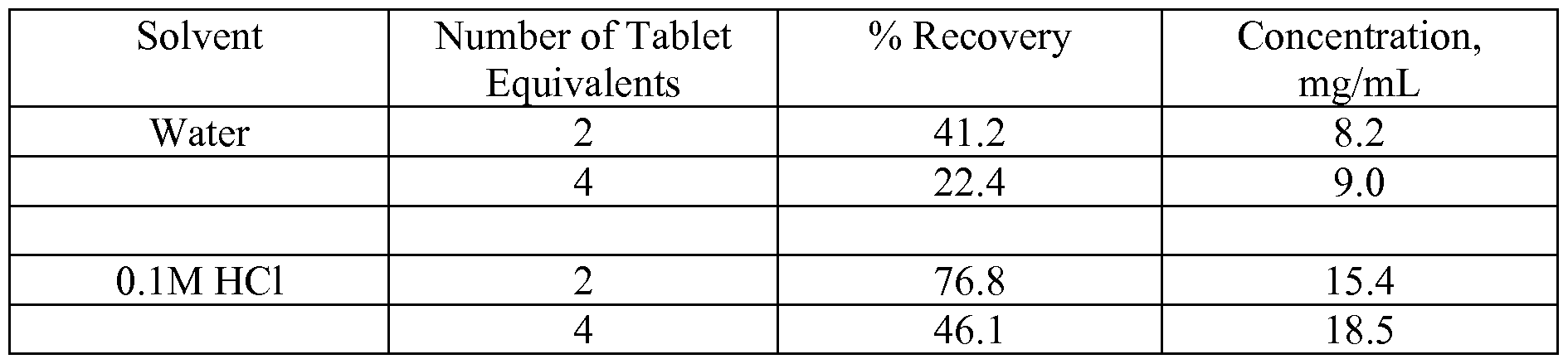
- the extractions were performed with water and 0.1M HC1 on ground tablets with equivalent weight of 2 and 4 tablets.
- the extraction was conducted with 10 mL of solvent for 10 minutes on an orbital shaker at 100 rpm at 95°C. Following extraction, aliquots were removed and filtered with 0.45 ⁇ PTFE filters for HPLC analysis.
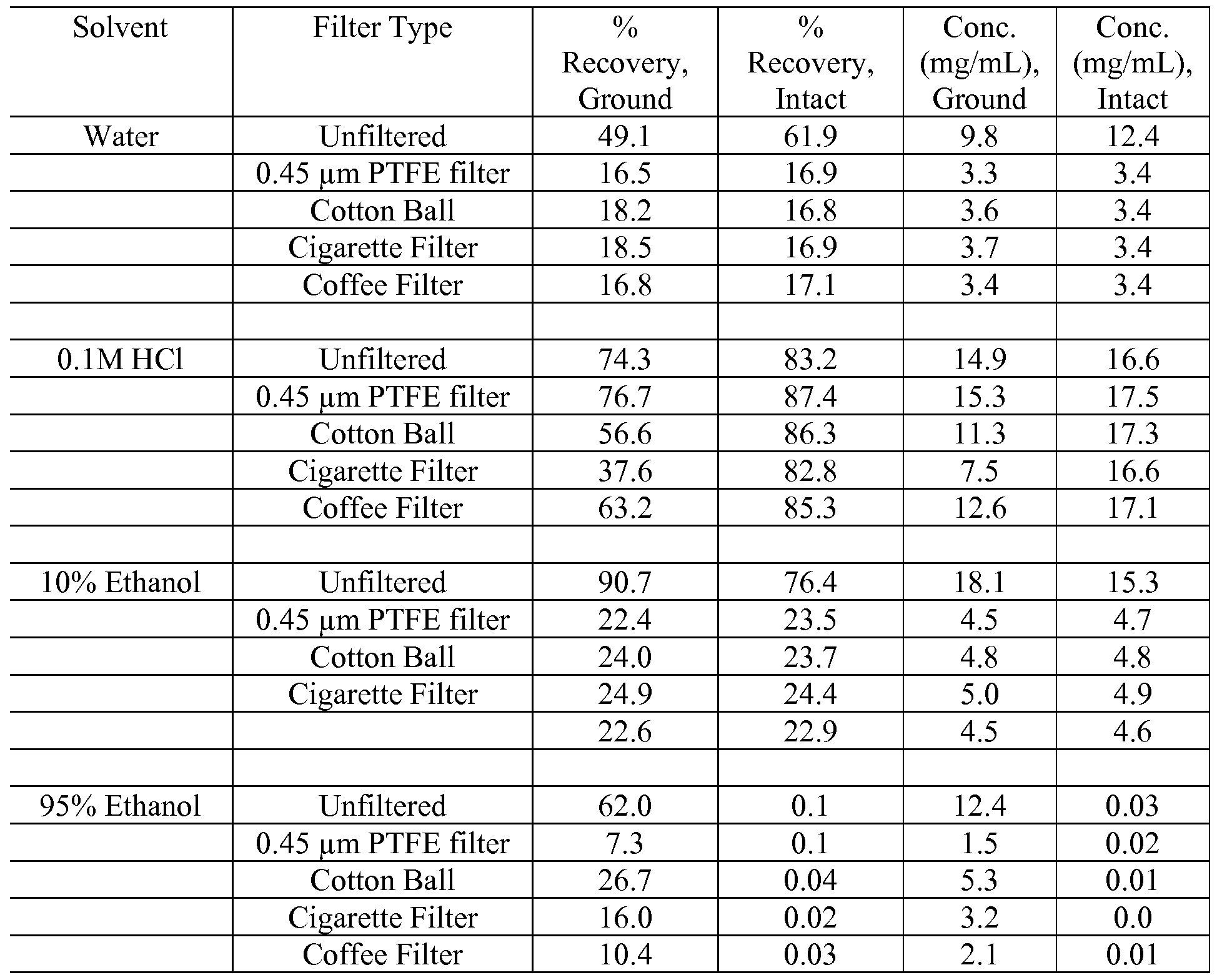
- Extractions were conducted with 30 mL volume of solvents (water, 0.1M HCl, 10% ethanol, and 95% ethanol) at 25°C for 10 minutes and 24 hours on an orbital shaker at 100 rpm, then filtered with a 0.45 ⁇ PTFE filter for HPLC analysis.
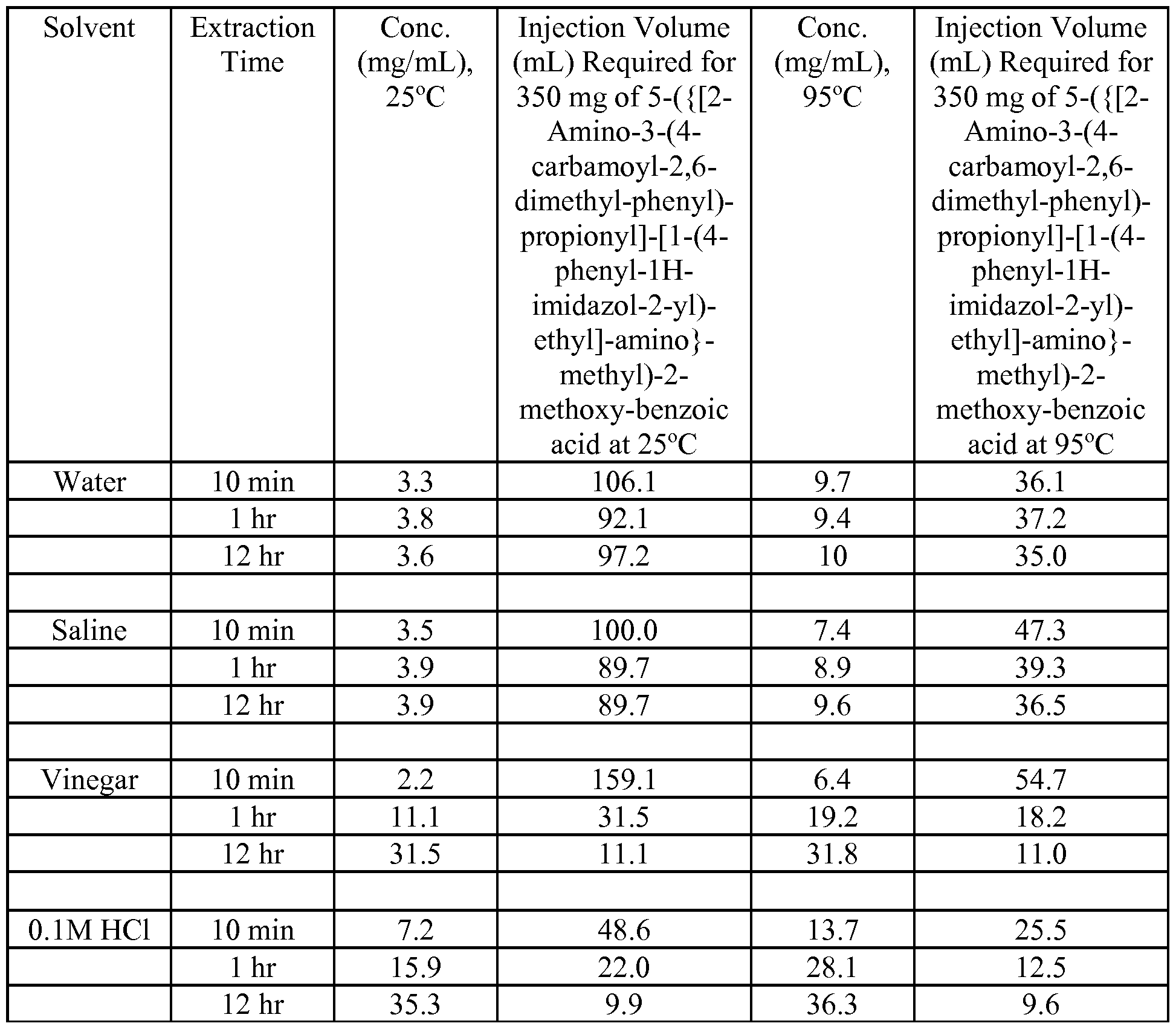
- Extractions were conducted with 5 mL volume of solvents (water, saline, and 0.1M HCl) at 25°C and 95°C for 10 minutes and 24 hours on an orbital shaker at 100 rpm, then filtered with a 0.45 ⁇ PTFE filter for HPLC analysis.
- solvents water, saline, and 0.1M HCl
- Extractions were performed on ground and intact tablets. Extractions were conducted with 5 mL volume of solvent (water, 0.1M HC1, 10% ethanol and 95% ethanol) at 25°C for 10 minutes on an orbital shaker at 100 rpm. Following extraction, extracts were filtered as follows: unfiltered (control); 0.45 ⁇ PTFE filter; cotton ball filter; cigarette filter; and coffee paper filter.
- Amino-3-(4-carbamoyl-2,6-dimethyl-phenyl)-propionyl]-[l-(4-phenyl-lH-imidazol-2-yl)- ethyl] -amino ⁇ -methyl)-2-methoxy -benzoic acid exhibits considerably greater solubility in
- the sustained amount of time that an extraction solvent is in contact with a formulation can substantially influence how much active is released (and dissolved in the extraction solvent). This is particularly true for actives that exhibit limited solubility in the chosen solvent.
- Review of data generated in the study involving extraction with 30 mL of solvent for 10 minutes and 24 hours generally indicated greater variability (%RSD) for the shorter extraction time compared to the 24 hour extraction.
- Extractions were performed on single ground and intact tablets (75 mg strength). Extractions were conducted with 22.5 mL volume of solvent (water, 0.1M HC1, vinegar, and pH 7 buffer) at 25°C and 95°C on an orbital shaker at 100 rpm. A 2 mL aliquot was withdrawn at each time point. The time points were as follows: 10, 20, 30, 45 and 60 minutes, 4, 12, and 24 hours. Extracts were filtered with a 0.45 ⁇ PTFE filter for HPLC analyses.
- Gr ground tablet
- Wh whole, intact tablet
- Acidic solvents are more efficient in extracting 5-( ⁇ [2-Amino-3-(4-carbamoyl-2,6- dimethyl-phenyl)-propionyl] - [ 1 -(4-phenyl- 1 H-imidazol-2-yl)-ethyl] -amino ⁇ - methyl)-2-methoxy-benzoic acid than water or pH neutral solvents L. Investigations of Multiple Tablet Extractions
- Typical opioid injection volumes are generally in the 1-3 mL range but plausibly could be as high as 10 mL.
- a 350 mg injected dose of 5-( ⁇ [2-Amino-3-(4- carbamoyl-2,6-dimethyl-phenyl)-propionyl]-[l-(4-phenyl-lH-imidazol-2-yl)-ethyl]- amino ⁇ -methyl)-2-methoxy-benzoic acid would be required to produce a euphoric effect, it does not appear feasible that tablets could be prepared for injection with sufficient content of 5-( ⁇ [2-Amino-3-(4-carbamoyl-2,6-dimethyl-phenyl)-propionyl]-[l-(4-phenyl- lH-imidazol-2-yl)-ethyl]-amino ⁇ -methyl)-2-methoxy-benzoic acid when using typical injection solvents (water, saline).
Landscapes
- Health & Medical Sciences (AREA)
- Chemical & Material Sciences (AREA)
- Life Sciences & Earth Sciences (AREA)
- Medicinal Chemistry (AREA)
- Pharmacology & Pharmacy (AREA)
- Animal Behavior & Ethology (AREA)
- General Health & Medical Sciences (AREA)
- Public Health (AREA)
- Veterinary Medicine (AREA)
- Epidemiology (AREA)
- Engineering & Computer Science (AREA)
- Bioinformatics & Cheminformatics (AREA)
- Chemical Kinetics & Catalysis (AREA)
- General Chemical & Material Sciences (AREA)
- Molecular Biology (AREA)
- Biophysics (AREA)
- Neurosurgery (AREA)
- Pain & Pain Management (AREA)
- Nuclear Medicine, Radiotherapy & Molecular Imaging (AREA)
- Organic Chemistry (AREA)
- Neurology (AREA)
- Biomedical Technology (AREA)
- Inorganic Chemistry (AREA)
- Oil, Petroleum & Natural Gas (AREA)
- Biochemistry (AREA)
- Pharmaceuticals Containing Other Organic And Inorganic Compounds (AREA)
- Medicinal Preparation (AREA)
Abstract
Description






Claims
Priority Applications (18)
| Application Number | Priority Date | Filing Date | Title |
|---|---|---|---|
| CA2906472A CA2906472A1 (en) | 2013-03-14 | 2014-03-10 | Opioid receptor modulator dosage formulations |
| ES14774006.2T ES2693374T3 (en) | 2013-03-14 | 2014-03-10 | Pharmaceutical formulations of opioid receptor modulator |
| BR112015022753A BR112015022753A8 (en) | 2013-03-14 | 2014-03-10 | solid pharmaceutical dosage formulations, their use, method for their preparation, film-coated oral tablet formulation and abuse dissuasive single-phase pharmaceutical compositions |
| JP2016501031A JP6449225B2 (en) | 2013-03-14 | 2014-03-10 | Opioid receptor modulator dosage formulation |
| CN201480026522.7A CN105228629A (en) | 2013-03-14 | 2014-03-10 | Opioid Receptor Modulator Dosage Forms |
| EP20215626.1A EP3865131A1 (en) | 2013-03-14 | 2014-03-10 | Opioid receptor modulator dosage formulations |
| EP18187598.0A EP3456321A1 (en) | 2013-03-14 | 2014-03-10 | Opioid receptor modulator dosage formulations |
| HK16106556.5A HK1218514B (en) | 2013-03-14 | 2014-03-10 | Opioid receptor modulator dosage formulations |
| PL14774006T PL2968351T3 (en) | 2013-03-14 | 2014-03-10 | Dosage opioid receptor modulator preparations |
| AU2014241076A AU2014241076B2 (en) | 2013-03-14 | 2014-03-10 | Opioid receptor modulator dosage formulations |
| DK14774006.2T DK2968351T3 (en) | 2013-03-14 | 2014-03-10 | OPIOID RECEPTOR MODULATOR DOSAGE FORMULATIONS |
| EP14774006.2A EP2968351B1 (en) | 2013-03-14 | 2014-03-10 | Opioid receptor modulator dosage formulations |
| EA201591768A EA031559B1 (en) | 2013-03-14 | 2014-03-10 | Opioid receptor modulator dosage formulations |
| SI201430934T SI2968351T1 (en) | 2013-03-14 | 2014-03-10 | Opioid receptor modulator dosage formulations |
| KR1020157028735A KR102435440B1 (en) | 2013-03-14 | 2014-03-10 | Opioid receptor modulator dosage formulations |
| IL241561A IL241561B (en) | 2013-03-14 | 2015-09-10 | Opioid receptor modulator dosage formulation |
| CY181101243T CY1120892T1 (en) | 2013-03-14 | 2018-11-23 | DOSAGE PREPARATIONS OF MODIFIED OPIID RECEPTORS |
| IL268718A IL268718B (en) | 2013-03-14 | 2019-08-15 | Opioid receptor modulator dosage formulation |
Applications Claiming Priority (2)
| Application Number | Priority Date | Filing Date | Title |
|---|---|---|---|
| US13/829,984 | 2013-03-14 | ||
| US13/829,984 US9675587B2 (en) | 2013-03-14 | 2013-03-14 | Opioid receptor modulator dosage formulations |
Publications (1)
| Publication Number | Publication Date |
|---|---|
| WO2014159245A1 true WO2014159245A1 (en) | 2014-10-02 |
Family
ID=51528071
Family Applications (1)
| Application Number | Title | Priority Date | Filing Date |
|---|---|---|---|
| PCT/US2014/022666 Ceased WO2014159245A1 (en) | 2013-03-14 | 2014-03-10 | Opioid receptor modulator dosage formulations |
Country Status (20)
| Country | Link |
|---|---|
| US (9) | US9675587B2 (en) |
| EP (3) | EP2968351B1 (en) |
| JP (2) | JP6449225B2 (en) |
| KR (1) | KR102435440B1 (en) |
| CN (2) | CN105228629A (en) |
| AU (1) | AU2014241076B2 (en) |
| BR (1) | BR112015022753A8 (en) |
| CA (2) | CA2906472A1 (en) |
| CY (1) | CY1120892T1 (en) |
| DK (1) | DK2968351T3 (en) |
| EA (1) | EA031559B1 (en) |
| ES (1) | ES2693374T3 (en) |
| HU (1) | HUE042748T2 (en) |
| IL (2) | IL241561B (en) |
| PL (1) | PL2968351T3 (en) |
| PT (1) | PT2968351T (en) |
| SI (1) | SI2968351T1 (en) |
| TR (1) | TR201815953T4 (en) |
| TW (1) | TWI648071B (en) |
| WO (1) | WO2014159245A1 (en) |
Cited By (3)
| Publication number | Priority date | Publication date | Assignee | Title |
|---|---|---|---|---|
| WO2018069770A1 (en) * | 2016-10-14 | 2018-04-19 | Allergan Holdings Unlimited Company | Methods of treatment using eluxadoline |
| JP2018515566A (en) * | 2015-05-22 | 2018-06-14 | ノバルティス アーゲー | Pharmaceutical composition |
| US11311516B2 (en) | 2013-03-14 | 2022-04-26 | Allergan Holdings Unlimited Company | Opioid receptor modulator dosage formulations |
Families Citing this family (4)
| Publication number | Priority date | Publication date | Assignee | Title |
|---|---|---|---|---|
| CN105250232B (en) * | 2015-09-29 | 2018-08-14 | 江苏汇智知识产权服务有限公司 | A kind of Yi Luduo quinolines enteric coatel tablets and preparation method thereof |
| WO2018055528A2 (en) * | 2016-09-20 | 2018-03-29 | Sun Pharmaceutical Industries Limited | Processes for the preparation of eluxadoline |
| US12285411B2 (en) * | 2019-09-10 | 2025-04-29 | Aurobindo Pharma Ltd | Pharmaceutical composition comprising eluxadoline, process of preparation and use thereof |
| WO2021158957A1 (en) | 2020-02-05 | 2021-08-12 | Summit Biosciences Inc. | Drug products for intranasal administration and uses thereof |
Citations (4)
| Publication number | Priority date | Publication date | Assignee | Title |
|---|---|---|---|---|
| US20050203143A1 (en) * | 2004-03-15 | 2005-09-15 | Breslin Henry J. | Novel compounds as opioid receptor modulators |
| US20100249045A1 (en) * | 2005-11-02 | 2010-09-30 | Theraquest Biosciences, Inc. | Multimodal Abuse Resistant and Extended Release Opioid Formulations |
| US20110263868A1 (en) | 2007-07-09 | 2011-10-27 | Luigi Anzalone | Novel crystals and process of making 5-(-methyl)-2-methoxy-benzoic acid |
| US20120282336A1 (en) * | 2009-11-13 | 2012-11-08 | Astrazeneca Uk Limited | Bilayer tablet formulations |
Family Cites Families (33)
| Publication number | Priority date | Publication date | Assignee | Title |
|---|---|---|---|---|
| US553266A (en) | 1896-01-21 | Car-fender | ||
| US3980766A (en) | 1973-08-13 | 1976-09-14 | West Laboratories, Inc. | Orally administered drug composition for therapy in the treatment of narcotic drug addiction |
| JP2711759B2 (en) | 1990-10-24 | 1998-02-10 | エスエス製薬 株式会社 | Antidiarrheal composition |
| US5574159A (en) | 1992-02-03 | 1996-11-12 | Delta Pharmaceuticals, Inc. | Opioid compounds and methods for making therefor |
| US5240929A (en) | 1992-08-03 | 1993-08-31 | Warner-Lambert Company | 2-heterocyclic-5-hydroxy-1,3-pyrimidines useful as antiinflammatory agents |
| FR2713639B1 (en) | 1993-12-09 | 1996-08-30 | Irj | New derivatives of 2-arylalkenyl-azacycloalkanes ligands to sigma receptors, their preparation process and their use in therapy. |
| US5585115A (en) | 1995-01-09 | 1996-12-17 | Edward H. Mendell Co., Inc. | Pharmaceutical excipient having improved compressability |
| WO1996022997A1 (en) | 1995-01-27 | 1996-08-01 | Novo Nordisk A/S | Compounds with growth hormone releasing properties |
| DE19531464A1 (en) | 1995-08-26 | 1997-02-27 | Merck Patent Gmbh | N-methyl-N - [(1S -) - 1-phenyl-2 - ((3S) -3-hydroxypyrrolidin 1-yl -) - ethyl] -2,2-diphenyl-acetamide |
| US6518292B1 (en) | 1999-03-12 | 2003-02-11 | Bristol-Myers Squibb Co. | Heterocyclic aromatic compounds usefuls as growth hormone secretagogues |
| DE19924020A1 (en) | 1999-05-26 | 2000-11-30 | Basf Ag | Process for the preparation of alkynediols |
| US6448323B1 (en) | 1999-07-09 | 2002-09-10 | Bpsi Holdings, Inc. | Film coatings and film coating compositions based on polyvinyl alcohol |
| US6528522B2 (en) | 2000-09-20 | 2003-03-04 | Schering Corporation | Substituted imidazoles as dual histamine H1 and H3 agonists or antagonists |
| NZ525928A (en) | 2000-10-30 | 2005-06-24 | Janssen Pharmaceutica Nv | Tripeptidyl peptidase inhibitors |
| CA2446550C (en) * | 2001-05-11 | 2012-03-06 | Endo Pharmaceuticals, Inc. | Abuse-resistant controlled-release opioid dosage form |
| ATE347549T1 (en) | 2001-10-15 | 2006-12-15 | Janssen Pharmaceutica Nv | NEW SUBSTITUTED 4-PHENYL-4-(1H-IMIDAZO-2-YL)-PIPERIDINE DERIVATIVES AND THEIR USE AS SELECTIVE DELTA-OPIOID AGONISTS |
| US7041681B2 (en) | 2002-04-29 | 2006-05-09 | Janssen Pharmaceutica N.V. | Compounds as opioid receptor modulators |
| JP2005531557A (en) | 2002-05-17 | 2005-10-20 | メルク パテント ゲゼルシャフト ミット ベシュレンクテル ハフトング | Use of effective compounds as selective opiate receptor modulators |
| US7201920B2 (en) | 2003-11-26 | 2007-04-10 | Acura Pharmaceuticals, Inc. | Methods and compositions for deterring abuse of opioid containing dosage forms |
| WO2007043061A1 (en) * | 2005-10-11 | 2007-04-19 | Ipca Laboratories Ltd. | Anti-malarial combination and methods of formulation |
| ES2439581T3 (en) * | 2006-12-04 | 2014-01-23 | Orexo Ab | New non-abuse pharmaceutical composition comprising opioids |
| EP2187873B1 (en) | 2007-08-13 | 2018-07-25 | Abuse Deterrent Pharmaceutical Llc | Abuse resistant drugs, method of use and method of making |
| MX2010008861A (en) | 2008-02-15 | 2011-02-22 | Sun Pharma Advanced Res Co Ltd | Oral controlled release tablet with reduced burst effect. |
| US20090263476A1 (en) * | 2008-04-16 | 2009-10-22 | Jobdevairakkam Christopher N | Composition of Rapid Disintegrating Direct Compression Buccal Tablet |
| DK3045043T3 (en) * | 2009-02-26 | 2020-08-03 | Relmada Therapeutics Inc | ORAL PHARMACEUTICAL COMPOSITIONS OF 3-HYDROXY-N-METHYLMORPHINANE WITH EXTENDED RELEASE AND METHOD OF USE |
| US20100285164A1 (en) | 2009-05-11 | 2010-11-11 | Jrs Pharma | Orally Disintegrating Excipient |
| EP2477609A1 (en) | 2009-09-15 | 2012-07-25 | Ratiopharm GmbH | Orally disintegrating pharmaceutical dosage form containing aripiprazole |
| US9675587B2 (en) | 2013-03-14 | 2017-06-13 | Allergan Holdings Unlimited Company | Opioid receptor modulator dosage formulations |
| WO2018098273A1 (en) | 2016-11-22 | 2018-05-31 | Alkalidx, Inc. | Therapies for the treatment of lidocaine-ineffective and hypokalemic conditions |
| WO2018136554A1 (en) | 2017-01-17 | 2018-07-26 | Menlo Therapeutics Inc. | Use of neurokinin-1 antagonists as antitussives |
| WO2018229704A1 (en) | 2017-06-15 | 2018-12-20 | Laurus Labs Limited | Novel polymorphs of eluxadoline and its solvates, process for its preparation and pharmaceutical composition thereof |
| US12285411B2 (en) | 2019-09-10 | 2025-04-29 | Aurobindo Pharma Ltd | Pharmaceutical composition comprising eluxadoline, process of preparation and use thereof |
| US20220016034A1 (en) | 2020-07-17 | 2022-01-20 | Allergan Holdings Unlimited Company | Opioid receptor modulator dosage formulations |
-
2013
- 2013-03-14 US US13/829,984 patent/US9675587B2/en active Active
-
2014
- 2014-02-26 TW TW103106575A patent/TWI648071B/en not_active IP Right Cessation
- 2014-03-10 CN CN201480026522.7A patent/CN105228629A/en active Pending
- 2014-03-10 KR KR1020157028735A patent/KR102435440B1/en active Active
- 2014-03-10 CN CN201911036853.XA patent/CN110917159A/en active Pending
- 2014-03-10 EP EP14774006.2A patent/EP2968351B1/en active Active
- 2014-03-10 CA CA2906472A patent/CA2906472A1/en active Pending
- 2014-03-10 PL PL14774006T patent/PL2968351T3/en unknown
- 2014-03-10 EA EA201591768A patent/EA031559B1/en not_active IP Right Cessation
- 2014-03-10 DK DK14774006.2T patent/DK2968351T3/en active
- 2014-03-10 JP JP2016501031A patent/JP6449225B2/en not_active Expired - Fee Related
- 2014-03-10 AU AU2014241076A patent/AU2014241076B2/en not_active Ceased
- 2014-03-10 TR TR2018/15953T patent/TR201815953T4/en unknown
- 2014-03-10 HU HUE14774006A patent/HUE042748T2/en unknown
- 2014-03-10 CA CA3254178A patent/CA3254178A1/en active Pending
- 2014-03-10 BR BR112015022753A patent/BR112015022753A8/en not_active Application Discontinuation
- 2014-03-10 ES ES14774006.2T patent/ES2693374T3/en active Active
- 2014-03-10 PT PT14774006T patent/PT2968351T/en unknown
- 2014-03-10 WO PCT/US2014/022666 patent/WO2014159245A1/en not_active Ceased
- 2014-03-10 SI SI201430934T patent/SI2968351T1/en unknown
- 2014-03-10 EP EP18187598.0A patent/EP3456321A1/en not_active Withdrawn
- 2014-03-10 EP EP20215626.1A patent/EP3865131A1/en not_active Withdrawn
-
2015
- 2015-09-10 IL IL241561A patent/IL241561B/en active IP Right Grant
-
2017
- 2017-05-05 US US15/588,304 patent/US10188632B2/en active Active
-
2018
- 2018-10-05 JP JP2018189781A patent/JP6666975B2/en not_active Expired - Fee Related
- 2018-11-23 CY CY181101243T patent/CY1120892T1/en unknown
-
2019
- 2019-08-15 IL IL268718A patent/IL268718B/en active IP Right Grant
-
2020
- 2020-10-08 US US17/066,072 patent/US11007179B2/en active Active
-
2021
- 2021-02-12 US US17/175,082 patent/US11090291B2/en active Active
- 2021-03-24 US US17/211,274 patent/US11160792B2/en active Active
- 2021-09-22 US US17/481,874 patent/US11311516B2/en active Active
- 2021-10-21 US US17/507,091 patent/US11229627B1/en active Active
- 2021-12-08 US US17/545,584 patent/US11484527B2/en active Active
-
2023
- 2023-05-26 US US18/324,449 patent/US12097187B2/en active Active
Patent Citations (5)
| Publication number | Priority date | Publication date | Assignee | Title |
|---|---|---|---|---|
| US20050203143A1 (en) * | 2004-03-15 | 2005-09-15 | Breslin Henry J. | Novel compounds as opioid receptor modulators |
| US7741356B2 (en) | 2004-03-15 | 2010-06-22 | Janssen Pharmaceutica N.V. | Compounds as opioid receptor modulators |
| US20100249045A1 (en) * | 2005-11-02 | 2010-09-30 | Theraquest Biosciences, Inc. | Multimodal Abuse Resistant and Extended Release Opioid Formulations |
| US20110263868A1 (en) | 2007-07-09 | 2011-10-27 | Luigi Anzalone | Novel crystals and process of making 5-(-methyl)-2-methoxy-benzoic acid |
| US20120282336A1 (en) * | 2009-11-13 | 2012-11-08 | Astrazeneca Uk Limited | Bilayer tablet formulations |
Non-Patent Citations (11)
| Title |
|---|
| ANANTHAN S.: "Opioid ligands with mixed |i/6 opioid receptor interactions: an emerging approach to novel analgesics", AAPS JOURNAL, vol. 8, no. 1, 2006, pages E118 - E125, XP036197960, DOI: doi:10.1208/aapsj080114 |
| BAGNOL ET AL., NEUROSCIENCE, vol. 81, no. 2, 1997, pages 579 - 591 |
| BITAR ET AL., NATURE, vol. 297, no. 5861, 1982, pages 72 - 74 |
| BRANDT ET AL., AM J GASTROENTEROL, vol. 104, no. 1, 2009, pages S1 - 35 |
| DIETIS ET AL., BRITISH JOURNAL OF ANAESTHESIA, vol. 103, no. 1, 2009, pages 38 - 49 |
| DOKRAY GJ: "Physiology of the Gastrointestinal Tract", 1994, RAVEN, article "Physiology of Enteric Neuropeptides", pages: 169 - 209 |
| DROSSMAN DA, GASTROENTEROL, vol. 130, no. 5, 2006, pages 1377 - 1390 |
| DROSSMAN DA: "Rome III The Functional GI Disorders", 2006, LAWRENCE: ALLEN PRESS, INC |
| HOLZER P., REGULATORY PEPTIDES, vol. 155, 2009, pages 11 - 17 |
| LOVELL ET AL., CLIN GASTROENTEROL HEPATOL, vol. 10, no. 7, 2012, pages 712 - 21 |
| WADE ET AL., BR J PHARMACOL, vol. 167, no. 5, 2012, pages 1111 - 1125 |
Cited By (5)
| Publication number | Priority date | Publication date | Assignee | Title |
|---|---|---|---|---|
| US11311516B2 (en) | 2013-03-14 | 2022-04-26 | Allergan Holdings Unlimited Company | Opioid receptor modulator dosage formulations |
| US11484527B2 (en) | 2013-03-14 | 2022-11-01 | Allergan Holdings Unlimited Company | Opioid receptor modulator dosage formulations |
| US12097187B2 (en) | 2013-03-14 | 2024-09-24 | Allergan Holdings Unlimited Company | Opioid receptor modulator dosage formulations |
| JP2018515566A (en) * | 2015-05-22 | 2018-06-14 | ノバルティス アーゲー | Pharmaceutical composition |
| WO2018069770A1 (en) * | 2016-10-14 | 2018-04-19 | Allergan Holdings Unlimited Company | Methods of treatment using eluxadoline |
Also Published As
Similar Documents
| Publication | Publication Date | Title |
|---|---|---|
| US12097187B2 (en) | Opioid receptor modulator dosage formulations | |
| CN102499923B (en) | Drug combination, as well as preparation method and application of same | |
| KR20220071297A (en) | Compositions and methods for treatment for neuropsychiatric disorders | |
| US20220016034A1 (en) | Opioid receptor modulator dosage formulations | |
| HK1218514B (en) | Opioid receptor modulator dosage formulations | |
| Das et al. | Design and development of a dual-drug loaded pulsatile capsule for treatment of hypertension–in vitro and ex vivo studies | |
| KR101701013B1 (en) | Tamper resistant immediate release formulations | |
| BR102014003686A2 (en) | stable oral pharmaceutical composition |
Legal Events
| Date | Code | Title | Description |
|---|---|---|---|
| WWE | Wipo information: entry into national phase |
Ref document number: 201480026522.7 Country of ref document: CN |
|
| 121 | Ep: the epo has been informed by wipo that ep was designated in this application |
Ref document number: 14774006 Country of ref document: EP Kind code of ref document: A1 |
|
| ENP | Entry into the national phase |
Ref document number: 2906472 Country of ref document: CA Ref document number: 2016501031 Country of ref document: JP Kind code of ref document: A |
|
| NENP | Non-entry into the national phase |
Ref country code: DE |
|
| ENP | Entry into the national phase |
Ref document number: 2014241076 Country of ref document: AU Date of ref document: 20140310 Kind code of ref document: A |
|
| WWE | Wipo information: entry into national phase |
Ref document number: 2014774006 Country of ref document: EP |
|
| ENP | Entry into the national phase |
Ref document number: 20157028735 Country of ref document: KR Kind code of ref document: A |
|
| WWE | Wipo information: entry into national phase |
Ref document number: 201591768 Country of ref document: EA |
|
| REG | Reference to national code |
Ref country code: BR Ref legal event code: B01A Ref document number: 112015022753 Country of ref document: BR |
|
| ENP | Entry into the national phase |
Ref document number: 112015022753 Country of ref document: BR Kind code of ref document: A2 Effective date: 20150911 |