WO2014154586A1 - Pyrazolonaphthyridinone derivatives as metap2 inhibitors (methionine aminopeptidase type-2) - Google Patents
Pyrazolonaphthyridinone derivatives as metap2 inhibitors (methionine aminopeptidase type-2) Download PDFInfo
- Publication number
- WO2014154586A1 WO2014154586A1 PCT/EP2014/055719 EP2014055719W WO2014154586A1 WO 2014154586 A1 WO2014154586 A1 WO 2014154586A1 EP 2014055719 W EP2014055719 W EP 2014055719W WO 2014154586 A1 WO2014154586 A1 WO 2014154586A1
- Authority
- WO
- WIPO (PCT)
- Prior art keywords
- pyrazolo
- dihydro
- naphthyridin
- ethyl
- trifluoro
- Prior art date
- Legal status (The legal status is an assumption and is not a legal conclusion. Google has not performed a legal analysis and makes no representation as to the accuracy of the status listed.)
- Ceased
Links
- 0 *C(*=C1)NC(C(**C(I=*)=C2)=C2N2*)=C1C2=O Chemical compound *C(*=C1)NC(C(**C(I=*)=C2)=C2N2*)=C1C2=O 0.000 description 2
Classifications
-
- C—CHEMISTRY; METALLURGY
- C07—ORGANIC CHEMISTRY
- C07D—HETEROCYCLIC COMPOUNDS
- C07D471/00—Heterocyclic compounds containing nitrogen atoms as the only ring hetero atoms in the condensed system, at least one ring being a six-membered ring with one nitrogen atom, not provided for by groups C07D451/00 - C07D463/00
- C07D471/12—Heterocyclic compounds containing nitrogen atoms as the only ring hetero atoms in the condensed system, at least one ring being a six-membered ring with one nitrogen atom, not provided for by groups C07D451/00 - C07D463/00 in which the condensed system contains three hetero rings
- C07D471/14—Ortho-condensed systems
-
- A—HUMAN NECESSITIES
- A61—MEDICAL OR VETERINARY SCIENCE; HYGIENE
- A61P—SPECIFIC THERAPEUTIC ACTIVITY OF CHEMICAL COMPOUNDS OR MEDICINAL PREPARATIONS
- A61P1/00—Drugs for disorders of the alimentary tract or the digestive system
- A61P1/16—Drugs for disorders of the alimentary tract or the digestive system for liver or gallbladder disorders, e.g. hepatoprotective agents, cholagogues, litholytics
-
- A—HUMAN NECESSITIES
- A61—MEDICAL OR VETERINARY SCIENCE; HYGIENE
- A61P—SPECIFIC THERAPEUTIC ACTIVITY OF CHEMICAL COMPOUNDS OR MEDICINAL PREPARATIONS
- A61P11/00—Drugs for disorders of the respiratory system
-
- A—HUMAN NECESSITIES
- A61—MEDICAL OR VETERINARY SCIENCE; HYGIENE
- A61P—SPECIFIC THERAPEUTIC ACTIVITY OF CHEMICAL COMPOUNDS OR MEDICINAL PREPARATIONS
- A61P15/00—Drugs for genital or sexual disorders; Contraceptives
-
- A—HUMAN NECESSITIES
- A61—MEDICAL OR VETERINARY SCIENCE; HYGIENE
- A61P—SPECIFIC THERAPEUTIC ACTIVITY OF CHEMICAL COMPOUNDS OR MEDICINAL PREPARATIONS
- A61P17/00—Drugs for dermatological disorders
- A61P17/06—Antipsoriatics
-
- A—HUMAN NECESSITIES
- A61—MEDICAL OR VETERINARY SCIENCE; HYGIENE
- A61P—SPECIFIC THERAPEUTIC ACTIVITY OF CHEMICAL COMPOUNDS OR MEDICINAL PREPARATIONS
- A61P19/00—Drugs for skeletal disorders
-
- A—HUMAN NECESSITIES
- A61—MEDICAL OR VETERINARY SCIENCE; HYGIENE
- A61P—SPECIFIC THERAPEUTIC ACTIVITY OF CHEMICAL COMPOUNDS OR MEDICINAL PREPARATIONS
- A61P19/00—Drugs for skeletal disorders
- A61P19/02—Drugs for skeletal disorders for joint disorders, e.g. arthritis, arthrosis
-
- A—HUMAN NECESSITIES
- A61—MEDICAL OR VETERINARY SCIENCE; HYGIENE
- A61P—SPECIFIC THERAPEUTIC ACTIVITY OF CHEMICAL COMPOUNDS OR MEDICINAL PREPARATIONS
- A61P27/00—Drugs for disorders of the senses
- A61P27/02—Ophthalmic agents
-
- A—HUMAN NECESSITIES
- A61—MEDICAL OR VETERINARY SCIENCE; HYGIENE
- A61P—SPECIFIC THERAPEUTIC ACTIVITY OF CHEMICAL COMPOUNDS OR MEDICINAL PREPARATIONS
- A61P29/00—Non-central analgesic, antipyretic or antiinflammatory agents, e.g. antirheumatic agents; Non-steroidal antiinflammatory drugs [NSAID]
-
- A—HUMAN NECESSITIES
- A61—MEDICAL OR VETERINARY SCIENCE; HYGIENE
- A61P—SPECIFIC THERAPEUTIC ACTIVITY OF CHEMICAL COMPOUNDS OR MEDICINAL PREPARATIONS
- A61P3/00—Drugs for disorders of the metabolism
- A61P3/04—Anorexiants; Antiobesity agents
-
- A—HUMAN NECESSITIES
- A61—MEDICAL OR VETERINARY SCIENCE; HYGIENE
- A61P—SPECIFIC THERAPEUTIC ACTIVITY OF CHEMICAL COMPOUNDS OR MEDICINAL PREPARATIONS
- A61P33/00—Antiparasitic agents
- A61P33/02—Antiprotozoals, e.g. for leishmaniasis, trichomoniasis, toxoplasmosis
-
- A—HUMAN NECESSITIES
- A61—MEDICAL OR VETERINARY SCIENCE; HYGIENE
- A61P—SPECIFIC THERAPEUTIC ACTIVITY OF CHEMICAL COMPOUNDS OR MEDICINAL PREPARATIONS
- A61P35/00—Antineoplastic agents
-
- A—HUMAN NECESSITIES
- A61—MEDICAL OR VETERINARY SCIENCE; HYGIENE
- A61P—SPECIFIC THERAPEUTIC ACTIVITY OF CHEMICAL COMPOUNDS OR MEDICINAL PREPARATIONS
- A61P37/00—Drugs for immunological or allergic disorders
- A61P37/02—Immunomodulators
-
- A—HUMAN NECESSITIES
- A61—MEDICAL OR VETERINARY SCIENCE; HYGIENE
- A61P—SPECIFIC THERAPEUTIC ACTIVITY OF CHEMICAL COMPOUNDS OR MEDICINAL PREPARATIONS
- A61P43/00—Drugs for specific purposes, not provided for in groups A61P1/00-A61P41/00
-
- C—CHEMISTRY; METALLURGY
- C07—ORGANIC CHEMISTRY
- C07D—HETEROCYCLIC COMPOUNDS
- C07D401/00—Heterocyclic compounds containing two or more hetero rings, having nitrogen atoms as the only ring hetero atoms, at least one ring being a six-membered ring with only one nitrogen atom
- C07D401/02—Heterocyclic compounds containing two or more hetero rings, having nitrogen atoms as the only ring hetero atoms, at least one ring being a six-membered ring with only one nitrogen atom containing two hetero rings
- C07D401/12—Heterocyclic compounds containing two or more hetero rings, having nitrogen atoms as the only ring hetero atoms, at least one ring being a six-membered ring with only one nitrogen atom containing two hetero rings linked by a chain containing hetero atoms as chain links
-
- C—CHEMISTRY; METALLURGY
- C07—ORGANIC CHEMISTRY
- C07D—HETEROCYCLIC COMPOUNDS
- C07D405/00—Heterocyclic compounds containing both one or more hetero rings having oxygen atoms as the only ring hetero atoms, and one or more rings having nitrogen as the only ring hetero atom
- C07D405/14—Heterocyclic compounds containing both one or more hetero rings having oxygen atoms as the only ring hetero atoms, and one or more rings having nitrogen as the only ring hetero atom containing three or more hetero rings
-
- C—CHEMISTRY; METALLURGY
- C07—ORGANIC CHEMISTRY
- C07F—ACYCLIC, CARBOCYCLIC OR HETEROCYCLIC COMPOUNDS CONTAINING ELEMENTS OTHER THAN CARBON, HYDROGEN, HALOGEN, OXYGEN, NITROGEN, SULFUR, SELENIUM OR TELLURIUM
- C07F5/00—Compounds containing elements of Groups 3 or 13 of the Periodic Table
- C07F5/02—Boron compounds
- C07F5/04—Esters of boric acids
Definitions
- the present invention relates to pyrazolonaphthyridinone derivatives, to their preparation and to their therapeutic use.
- the compounds according to the present invention are reversible and selective inhibitors of type-2 methionine aminopeptidase (MetAP2).
- MetAP2 is an ubiquitous cytosol-based metalloprotease involved in polypeptide catabolism.
- MetAP2 catalyses the cleavage of methionine residues located at the AMerminal end of proteins newly synthesized by the cell (Bradshaw R.A. et a/., TIBS, 1998, 23, 263-267). Cleavage of the AMerminal methionine residues is an important step in the maturation of many proteins and polypeptides. It enables the cell to continue the usual post- translational modifications (myristoylation, palmitoylation, etc.), and then to degrade these same proteins. However, MetAP2 can only cleave this residue on condition that the second residue is of smaller size and uncharged.
- MetAP2 is active when the active site contains two divalent metal atoms such as Co(ll) or Mn(ll) (Li X., Chang Y.H., Biochem. Biophys. Res. Commun. 227, 1996, 152-159). Studies have moreover made it possible to establish that human MetAP2 quite probably uses manganese as physiological metal ion (Wang J. et a/., Biochemistry 2003, 42, 5035- 5042).
- MetAP2 Another function of MetAP2 is to prevent the protein translation factor elF2 (eukaryotic initiation factor 2) from phosphorylation(Datta et a/., 1988; Li and Chang, 1996) . It has been shown that the phosphorylation of elF2 results in inhibition of overall protein synthesis in eukaryotic cells.
- elF2 protein translation factor
- MetAP2 protects the alpha subunit from inhibitory phosphorylation (Datta, 2000; Kimball, 1999; Pestova et a/., 2001 ).
- inhibitors of MetAP2 activity do not affect the capacity of MetAP2 to block the phosphorylation of elF2 (Griffith, 1997), which suggests that the two functions are independent.
- MetAP2 isoform exists: MetAPI . These two isoforms are distinguished by the presence of an additional helical domain of about 60 residues within the C-terminal domain of MetAP2. Eukaryotes possess the two forms. A mutation of the two forms is lethal to the eukaryotic cell. This result underlines the interest in identifying inhibitors that are selective towards MetAP2. On the other hand, when only one isoform is mutated, growth reduction is observed (Li X. and Chang Y.H., Proc. Natl. Acad. Sci. 1995, 92, 12357-12361 ). These results confirm that methionine aminopeptidase (MAP) function is essential for cell growth and this activity cannot be relayed by a route independent of MetAPs.
- MAP methionine aminopeptidase
- MetAP2 inhibitor Two types of MetAP2 inhibitor also exist: reversible inhibitors and irreversible inhibitors. Certain known irreversible inhibitors are fumagillin, TNP-470 and ovalicin. At the molecular level, TNP-470, just like fumagillin and ovalicin, binds covalently and irreversibly to MetAP2 (Griffith E.C. et al., Chem. Biol. 1997, 4, 461-471 ).
- MetAP2 has been identified as being the target of a family of anti-angiogenic agents derived from fumagillin, described as powerful irreversible MetAP2 inhibitors. The causal link between the inhibition of MetAP2 and the resulting inhibition of endothelial cell proliferation and of neovascularization is clearly established (Griffith E.C. et al, Chem. Biol. 1998, 95, 15183-15188).
- the target proteins of MetAP2 are still at the present time very scarcely known.
- One of them is glyceraldehyde-3-phosphate dehydrogenase.
- a defect in the synthesis of this enzyme has been observed during treatment of endothelial cells with TNP ⁇ 70.
- Recent studies support the hypothesis that the anti-MetAP2 activity of TNP-470 is the source of its anti-angiogenic activity.
- Fibrosis is the abnormal formation of scar tissues following a tissue lesion and leads to chronic and progressive impairment of the affected organs, which may result in serious dysfunction of the affected organ.
- Many causes of fibrosis may exist, but in the majority of cases the cause of the affliction remains unknown and the lesions are difficult to detect. Aggregates of activated fibroblasts and myofibroblasts develop, which constitute the start of numerous fibrotic foci. When the lesions are formed, they are irreversible and cannot be eliminated. Treatments are thus directed towards slowing down the evolution of the complaint and of improving the symptoms.
- the present invention provides compounds of the formula (I)
- X represents CH or a nitrogen atom
- Y represents CH or a nitrogen atom, where X or Y is a nitrogen atom,
- Ri represents a (C1 -C4)alkyl non substituted or substituted with one or more halogen atoms
- R 2 represents an aryl or a heteroaryl group, non substituted or substituted with one or more substituents independently selected from:
- alkyl group is non substituted or substituted with one or more substituents independently selected from a halogen atom, a heterocyclyl, (C1-C4)alkoxy or hydroxy group or NHR 3
- R 3 represents a (C1-C4)alkyl or a cycloalkyl group
- R 4 represents a hydrogen atom or a (C1-C4)alkyl group, where the alkyl group is non substituted or substituted with one or more halogen atom or heterocyclyl group,
- R 5 and R 5 - represent independently a hydrogen atom, a (C1-C4)alkyl or aryl group
- R 6 and R 6 ' represent independently a hydrogen atom or a (C1-C4)alkyl group
- R 7 represents a (C1-C4)alkyl group
- R 8 represents a (C1-C4)alkyl, (C1-C4)alkoxy, cycloalkyl or hydroxy group.
- the compounds of formula (I) may comprise one or more asymmetric carbon atoms. They may thus exist in the form of enantiomers or diastereoisomers. These enantiomers and diastereoisomers, and also mixtures thereof, including racemic mixtures, form part of the invention.
- the compounds of formula (I) may be present as well under tautomer forms and are part of the invention.
- the compounds of formula (I) may exist in the form of bases or addition salts with acids or bases, in particular pharmaceutically acceptable salts. Such addition salts form part of the invention.
- halogen atom a fluorine, a chlorine, a bromine or an iodine atom
- alkyl group a linear or branched saturated aliphatic group. Examples include the groups methyl, ethyl, propyl, isopropyl, etc; - a cycloalkyl group: a cyclic (C3-C6)alkyl group. Examples include the groups cyclopropyl, cyclobutyl, cyclopentyl, cyclohexyl, etc.;
- alkoxy group a radical -O-alkyl in which the alkyl group is as defined above.
- alkoxy group include methoxy, ethoxy, isopropoxy, etc. ;
- an aryl group a cyclic aromatic group comprising between 5 and 10 carbon atoms.
- Examples of an aryl group include phenyl group;
- heteroaryl group a mono or bicyclic aromatic group comprising between 5 and 10 carbon atoms and comprising between 1 and 5 heteroatoms, such as nitrogen or oxygen.
- heteroaryl groups include pyridine, 2-pyridyl, 4-pyridyl, 3-pyridyl, pyrazole, pyrimidine and quinoline groups;
- heterocyclyl a non substituted or bridged cyclic alkyl group comprising from 4 to 9 atoms forming this ring, 1 or 2 of which are heteroatoms, such as oxygen or nitrogen.
- heterocyclyl groups include pyrrolidine, piperazine, piperidine, morpholine and diazepane groups.
- a first group of compounds is composed of the compounds for which X represents a nitrogen atom and Y represents CH.
- a second group of compounds is composed of the compounds for which X represents CH and Y represents a nitrogen atom.
- a third group of compounds is composed of the compounds of formula (I) in which R1 represents a (C1-C4)alkyl group non substituted or substituted with one or more fluorine atoms, more particularly a trifluoroethyl group.
- a fourth group of compounds is composed of the compounds for which R2 represents an aryl group non substituted or substituted with one or more substituents independently selected from:
- halogen atom - a (Ci-C4)alkyl group where the alkyl group is non substituted or substituted with one or more substituents independently selected from a halogen atom, a heterocyclyl, (Ci-C4)alkoxy or hydroxy group or NHR3
- a fifth group of compounds is composed of the compounds for which R2 represents a heteroaryl group non substituted or substituted with one or more substiutents independently selected from:
- (Ci-C4)alkyl group where the alkyl group is non substituted or substituted with one or more substituents independently selected from a halogen atom, a heterocyclyl, (Ci-C4)alkoxy or hydroxy group or NHR3,
- R2 represents a pyridine, a pyrimidine or a quinoline group.
- compound no 13 7-(6-Amino-pyridin-3-yl)-5-(2,2,2-trifluoro-ethyl)-1 ,5-dihydro- pyrazolo[4,3-c][1 ,6]naphthyridin-4-one
- compound no 14 7-(2-Fluoro-4-methoxy-phenyl)-5-(2,2,2-trifluoro-ethyl)-1 ,5- dihydro-pyrazolo[4,3-c][1 ,6]naphthyridin-4-one
- compound no 30 A/-Ethyl-4-[4-oxo-5-(2,2,2-trifluoro-ethyl)-4,5-dihydro-1 H- pyrazolo[4,3-c][1 ,6]naphthyridin-7-yl]-benzenesulfonamide compound no 31 : 7-[6-(4-Methyl-piperazin-1-yl)-pyridin-3-yl]-5-(2,2,2-trifluoro- ethyl)-1 ,5-dihydro-pyrazolo[4,3-c][1 ,6]naphthyridin-4-one
- compound no 47 7-(2-Cyclopropylaminomethyl-phenyl)-5-(2,2,2-trifluoro- ethyl)-1 ,5-dihydro-pyrazolo[4,3-c][1 ,5]naphthyridin-4-one
- compound no 48 7-(4-Cyclopentyl-pyrimidin-5-yl)-5-(2,2,2-trifluoro-ethyl)-1 ,5- dihydro-pyrazolo[4,3-c][1 ,5]naphthyridin-4-one
- compound no 64 A/- ⁇ 2-[4-Oxo-5-(2,2,2-trifluoro-ethyl)-4,5-dihydro-1 H- pyrazolo[4,3-c][1 ,5]naphthyridin-7-yl]-phenyl ⁇ -isobutyramide compound no 65: 7-(2-Acetyl-phenyl)-5-(2,2,2-trifluoro-ethyl)-1 ,5-dihydro- pyrazolo[4,3-c][1 ,5]naphthyridin-4-one
- a protective group PG is a group which makes it possible on one hand to protect a reactive function such as a hydroxyl or an amine during a synthesis and on the other hand allows the reactive function to be restored intact at the end of synthesis.
- Examples of protective groups and also methods of protection and deprotection are given in "Protective Groups in Organic Synthesis", Greene et al., 4 th Edition (John Wiley & Sons, Inc., New York).
- a leaving group in the text below is a group that can be readily cleaved from a molecule by breaking a heterolytic bond, with departure of an electron pair. This group may thus be replaced easily by another group during a substitution reaction, for example.
- Such leaving groups are, for example, halogens or an activated hydroxyl group such as methanesulphonate, benzenesulphonate, p-toluenesulfonate, triflate, acetate, etc.
- the compounds of general formula (I) may be prepared according to the processes that follow.
- Scheme 1 illustrates a chemical route for the synthesis of the compound of formula (VI) from the amino-pyridines of formula (Ma) with Ra being chlorine or bromine and Rb being iodine or from amino-pyridines of formula (Mb) with Ra being chlorine or bromine and Rb being chlorine or bromine or iodine.
- the amino-pyridines (II) react with an acid fluoride of formula (III) comprising a protecting group on the pyrazole that is stable in basic medium such as SEM or THP in the presence of a base such as fBuOK or NaH in a solvent such as THF or DMF, at room temperature, to give the amide of formula (IV).
- the amide of formula (IV) may be alkylated with an electrophilic group R1-LG in which LG is a good leaving group such as a halogen or a triflate, in the presence of a base such as NaH, fBuOK, in an inert solvent such as DMF or MeTHF, at room temperature or by heating up to 80°C.
- LG is a good leaving group such as a halogen or a triflate
- the A/-alkyl compounds of formulae (Va) and (Vb) are predominantly obtained versus their O-alkyl isomers, and are then engaged in an intramolecular Heck reaction catalysed with palladium, for example with Pd(PPh 3 ) 4 , in the presence of a weak base such as triethylamine or sodium or potassium acetate, in a solvent such as DMF or NMP, while heating to between 60 and 120°C to give the protected 1 ,5-dihydro-4H- pyrazolo[4,3-c][1 ,6]naphthyridin-4-one of formula (Via) and the protected 1 ,5-dihydro-4H- pyrazolo[4,3-c][1 ,5]naphthyridin-4-one of formula (Vlb) respectively.
- a weak base such as triethylamine or sodium or potassium acetate
- a solvent such as DMF or NMP
- the halogenated derivative of formula (VI) may be engaged in an organometallic coupling reaction catalysed with palladium, for example PdCI 2 (dppf), Pd(PPh 3 ) 4 , Pd(f-Bu 3 P)2 either with boronic acids or esters or with tin derivatives, in the presence or absence of a phosphine ligand and/or of a weak base such as caesium carbonate or potassium carbonate, in a solvent such as DMF or dioxane or in the presence of water, by heating to between 80 and 150°C, to give the compounds of formula (VII) with R2 being as described previously.
- palladium for example PdCI 2 (dppf), Pd(PPh 3 ) 4 , Pd(f-Bu 3 P)2 either with boronic acids or esters or with tin derivatives, in the presence or absence of a phosphine ligand and/or of a weak base such as caesium carbonate or
- the compounds of formula (I) are obtained after deprotection of the pyrazole of the compounds of formula (VII) under suitable conditions according to the protecting group PG.
- PG represents SEM or THP in the compounds of formula (VII)
- a treatment in acidic medium for example with TFA or anhydrous dilute HCI, makes it possible to obtain the compounds of formula (I).
- each Rc represents a hydrogen atom or the two groups Rc are each a carbon atom and are bonded together, and are non substituted or substituted with one or more (C1-C4) alkyl group.
- the halogenated derivative of formula (VI) obtained according to the processes described in Scheme 1 may be converted into the boronic acid or ester of formula (VIII), via a palladium-catalysed coupling reaction with for example Pd(dba) 2 with a diborane derivative, for example bis(pinacolato)diborane, in the presence of a base such as potassium acetate and in the presence or not of a phosphine ligand.
- the boronic acid or ester of formula (VIII) may be engaged in a palladium-catalysed Suzuki coupling reaction with aromatic or heteroaromatic substituents R2 bearing a leaving group E such as a halogen atom, for instance chlorine, bromine or iodine or a triflate group, to give the compounds of formula (VII) that allows preparation of the compounds of formula (I) as described previously.
- a leaving group E such as a halogen atom, for instance chlorine, bromine or iodine or a triflate group
- R2 is an aryl or an heteroaryl group substituted with one halogen atom
- that halogen atom may be substituted by a primary or secondary amine in the presence or absence of a palladium(O) or copper(l) catalyst, in the presence or absence of a base, to give the compounds in which R2 is an aryl or a heteroaryl substituted by NR 6 R6' or an heterocyclyl group.
- the starting compounds and the reagents when their preparation method is not described, are commercially available or described in the literature, or else may be prepared according to methods that are described therein or that are known to those skilled in the art.
- a subject of the invention is also compounds of formulae (IV). These compounds are useful as intermediates for synthesizing compounds of formula (I).
- a subject of the invention is also compounds of formulae (V). These compounds are useful as intermediates for synthesizing compounds of formula (I).
- a subject of the invention is also compounds of formulae (VI). These compounds are useful as intermediates for synthesizing compounds of formula (I).
- a subject of the invention is also compounds of formulae (VII). These compounds are useful as intermediates for synthesizing compounds of formula (I).
- a subject of the invention is also compounds of formulae (VIII). These compounds are useful as intermediates for synthesizing compounds of formula (I).
- Solvent A H 2 0 + 0.005% TFA
- Solvent B CH 3 CN + 0.005% TFA
- Solvent A H 2 0 +0.02% HCOOH
- Solvent B CH 3 CN +0.02% HCOOH
- Solvent A H 2 0 + 0.05% HC0 2 H
- Solvent B CH 3 CN + 0.035% HC0 2 H
- Solvent A H 2 0 + 0.1 % HC0 2 H
- Solvent B CH 3 CN + 0.08% HC0 2 H
- Example 1 7-(2-chloropyridin-3-yl)-5-(2,2,2-trifluoroethyl)-1 ,5-dihydro-4W- pyrazolo[4,3-c][1 ,6]naphthyridin-4-one chloride (compound no.1 )
- Step 1.1 W-(2-chloro-5-iodopyridin-4-yl)-1 -(tetrahydro-2W-pyran-2-yl)-1 H- pyrazole-4-carboxamide
- Step 1.2 A -(2-chloro-5-iodopyridin-4-yl)-A -(2,2,2-trifluoroethyl)-1 -(tetrahydro- 2W-pyran-2-yl)-1 W-pyrazole-4-carboxamide
- Step 1.3 7-chloro-5-(2,2,2-trifluoroethyl)-1 -(tetrahydro-2W-pyran-2-yl)-1 ,5- dihydro-4W-pyrazolo[4,3-c][1 ,6]naphthyridin-4-one
- Pd(PPh 3 ) 4 (2.83 g, 2 mmol) was added portionwise to a solution of A/-(2-chloro-5- iodopyridin-4-yl)-A/-(2,2,2-trifluoroethyl)-1-(tetrahydro-2 - -pyran-2-yl)-1 - -pyrazole-4- carboxamide (6.30 g, 12 mmol) and of potassium acetate (3.0 g, 31 mmol) in 150 ml of anhydrous DMF under nitrogen and which had been heated to 100°C. The reaction mixture was stirred at 100°C for 2 h, cooled, concentrated to dryness.
- Step 1.4 7-(2-chloropyridin-3-yl)-1 -(tetrahydro-2W-pyran-2-yl)-5-(2,2,2- trifluoroethyl)-1 ,5-dihydro-4W-pyrazolo[4,3-c][1 ,6]naphthyridin-4-one
- the reactor was sealed and the reaction mixture was heated at 120°C for 25 min in a microwave.
- the reaction medium was cooled, concentrated to dryness, taken up in EtOAc and poured into a saturated aqueous solution of NaHC0 3 .
- the organic phase was washed with water and then with a saturated aqueous solution of NaCI, dried over Na 2 S0 4 , filtered and concentrated to dryness.
- silica flash chromatography cyclohexane/DCM, gradient: 80/20 to 60/40
- Step 1.5 7-(2-chloropyridin-3-yl)-5-(2,2,2-trifluoroethyl)-1 ,5-dihydro- W- pyrazolo[4,3-c][1 ,6]naphthyridir -one hydrochloride
- Step 2.1 A -(2,5-dichloropyridin-3-yl)-1 -(tetrahydro-2W-pyran-2-yl)-1 H- pyrazole-4-carboxamide
- 2,2,2-Trifluoroethyltrifluoromethanesulfonate (1.47 ml, 10 mmol) was added to a solution of A/-(2,5-dichloropyridin-3-yl)-1 -(tetrahydro-2 - -pyran-2-yl)-1 H-pyrazole-4- carboxamide (2.90 g, 8.5 mmol) and of f-BuOK (1 .14 g, 10 mmol) in 42 ml of anhydrous MeTHF stirred for 20 min at 60°C and under nitrogen. The reaction mixture was heated at 60°C for 2 h, cooled to ambient temperature, poured into water and extracted with EtOAc.
- Step 2.3 7-chloro-5-(2,2,2-trifluoroethyl)-1 -(tetrahydro-2W-pyran-2-yl)-1 ,5- dihydro-4W-pyrazolo[4,3-c][1 ,5]naphthyridin-4-one
- Pd(PPh 3 )4 (2.73 g, 2 mmol) was added to a solution of A/-(2,5-dichloropyridin-3-yl)- A/-(2,2,2-trifluoroethyl)-1-(tetrahydro-2 - -pyran-2-yl)-1 - -pyrazole-4-carboxamide (5 g, 12 mmol) and of potassium acetate (2.90 g, 30 mmol) in 150 ml of anhydrous DMF under a nitrogen stream and which had been heated to100°C, and then the reaction mixture was stirred under nitrogen at 100°C for 4 h.
- Step 2.4 7-(2-chloropyridin-3-yl)-1 -(tetrahydro-2W-pyran-2-yl)-5-(2,2,2- trifluoroethyl)-1 ,5-dihydro-4W-pyrazolo[4,3-c][1 ,5]naphthyridin-4-one
- the reactor was sealed and the reaction mixture was heated at 120°C for 15 min in a microwave.
- the reaction medium was cooled, concentrated to dryness, taken up in EtOAc and poured into a saturated aqueous solution of NaHC0 3 .
- the organic phase was washed with water and then with a saturated aqueous solution of NaCI, dried over Na 2 S0 4 , filtered and concentrated to dryness.
- Step 2.5 7-(2-chloropyridin-3-yl)-5-(2,2,2-trifluoroethyl)-1 ,5-dihydro-4H- pyrazolo[4,3-c][1 ,5]naphthyridir -one hydrochloride
- Bis(pinacolato)diborane (13.8 g, 54 mmol) and potassium acetate (7.95 g, 34 mmol) were added to a solution of 7-chloro-5-(2,2,2-trifluoroethyl)-1 -(tetrahydro-2H-pyran- 2-yl)-1 ,5-dihydro-4H-pyrazolo[4,3-c][1 ,5]naphthyridin-4-one (5.25 g, 14 mmol) in 90 ml of anhydrous dioxane
- Step 4.2 methyl 3-[4-oxo-1 -(tetrahydro-2W-pyran-2-yl)-5-(2,2,2-trifluoroethyl)- 4,5-dihydro-1W-pyrazolo[4,3-c][1 ,5]naphthyridin-7-yl]pyridine-2-carboxylate
- the organic phase was washed with water and then with a saturated aqueous solution of NaCI, dried over Na 2 S0 4 , filtered and concentrated to dryness to give 0.16 g of 3-[4-oxo-1 -(tetrahydro-2H-pyran-2-yl)-5-(2,2,2-trifluoroethyl)-4,5- dihydro-1 - -pyrazolo[4,3-c][1 ,5]naphthyridin-7-yl]pyridine-2-carboxylic acid in the form of a beige powder (yield: 36%).
- Example 5 7-[2-(pyrrolidin-1 -yl)pyridin-3-yl]-5-(2,2,2-trifluoroethyl)-1 ,5- dihydro-4H-pyrazolo[4,3-c][1 ,6]naphthyridin-4-one hydrochloride (compound no. 33) Step 5.1. 7-(2-fluoropyridin-3-yl)-1 -(tetrahydro-2H-pyran-2-yl)-5-(2,2,2- trifluoroethyl)-1 ,5-dihydro-4H-pyrazolo[4,3-c][1 ,6]naphthyridin-4-one
- the reactor was sealed and the reaction mixture was heated at 120°C for 10 min in a microwave.
- the reaction medium was concentrated to dryness, taken up in EtOAc and poured into a saturated aqueous solution of NaHC0 3 .
- the organic phase was washed with water and then with a saturated aqueous solution of NaCI, dried over Na 2 S0 4 , filtered and concentrated to dryness.
- the compounds according to the invention underwent biochemical studies in order to determine their capacity to inhibit the enzyme methionine-aminopeptidase2 (enzymatic test on isolated enzyme).
- human MetAP2 protein was obtained from a culture supernatant of insect cells (sf9) infected with MetAP2 recombinant baculovirus.
- the dialysis supernatant was recovered and manganese, used as cofactor, was added to a final concentration of 300 ⁇ .
- the enzymatic test is a two steps procedure.
- a first step it consists in placing in contact the compound according to the invention, the dialysed MetAP2 protein and the substrate (Met-Pro-Arg-pNa peptide synthesized by Neosystem), the A/-terminal methionine of which can be cleaved with MetAP2, and which bears at the C-terminal end a para-nitroaniline (pNa) chromophore, which can itself be released by another peptidase only when the A/-terminal methionine has been cleaved beforehand.
- pNa para-nitroaniline
- the second step consists in reacting the peptides cleaved in the preceding step with a second peptidase in order to release the chromophore.
- the peptidase used in this second step is cathepsin, which comes from the TagZyme "DAPase” kit (Quiagen, 34366).
- the MetAP2 activity is proportional to the amount of para-nitroaniline released, which is measured by absorbance at 405 nm.
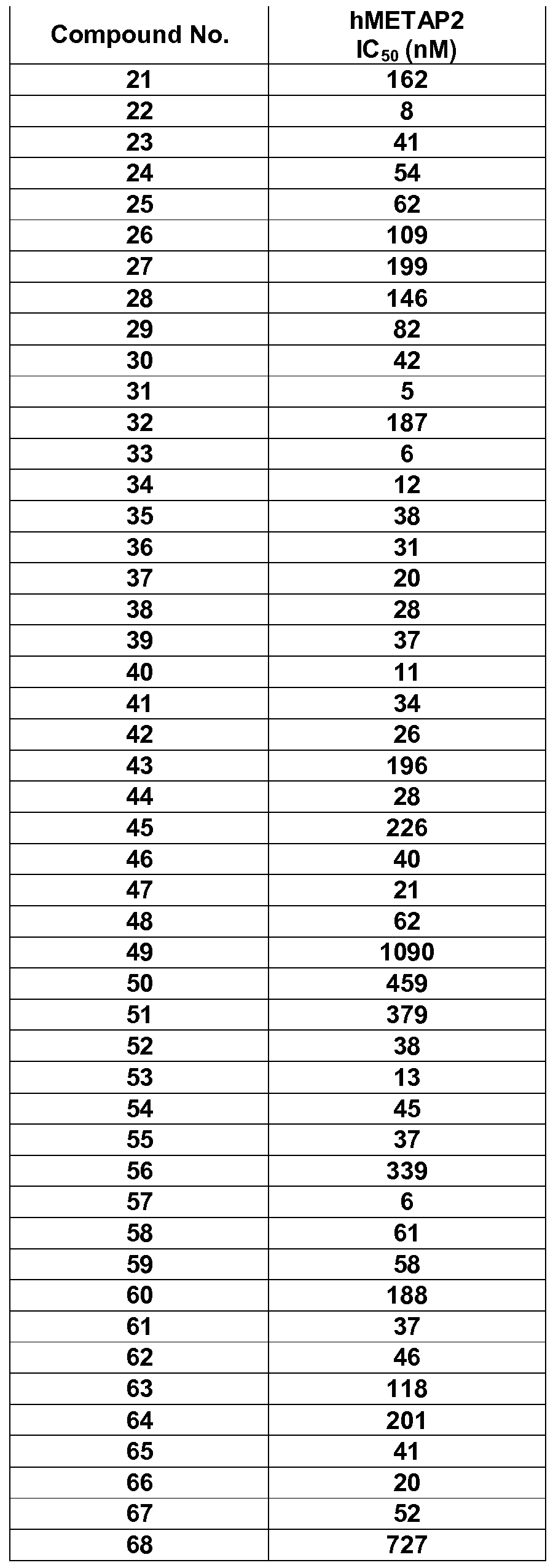
- the inhibitory activity with respect to MetAP2 is given by the concentration which inhibits 50 % of activity of MetAP2.
- IC50 values for the compounds of the invention were generally less than 1.1 ⁇ , more particularly between 1 and 550 nM and even more particularly between 1 and 100 nM, as indicated in the table below:
- the MetAPI enzymatic test is based on the same principle as the MetAP2 test.
- the MetAPI activity is proportional to the amount of para-nitroaniline released, which is measured by absorbance at 405 nm.
- the compounds of the invention showed no activity at 10 ⁇ . It thus appears that the compounds according to the invention have selective inhibitory activity on MetAP2.
- the compounds according to the invention may thus be used as inhibitors of MetAP2.
- the compounds according to the invention may thus be used for the preparation of medicaments, especially medicaments which are inhibitors of MetAP2.
- a subject of the invention is medicaments that comprise a compound of formula (I), or an addition salt thereof with a pharmaceutically acceptable acid.
- the compounds according to the invention may be thus used in the treatment or prevention of pathologies involving MetAP2 inhibitors.
- the compounds according to the invention may be used in the treatment or prevention of pulmonary and hepatic fibrosis.
- the compounds according to the invention may also be used in the treatment or prevention of pathologies involving a reactivation of angiogenesis, such as diabetic retinopathy, age-related macular degeneration (ARMD) and psoriasis.
- pathologies involving a reactivation of angiogenesis such as diabetic retinopathy, age-related macular degeneration (ARMD) and psoriasis.
- the compounds according to the invention may also be used in the treatment or prevention of any carcinoma having a substantial degree of vascularization, such as lung, breast, prostate, oesophageal, pancreatic, liver, colon or kidney carcinomas or carcinomas that induce metastases, such as colon, breast, liver and stomach carcinomas, and melanomas.
- carcinoma having a substantial degree of vascularization such as lung, breast, prostate, oesophageal, pancreatic, liver, colon or kidney carcinomas or carcinomas that induce metastases, such as colon, breast, liver and stomach carcinomas, and melanomas.
- These compounds may be used in monotherapy or combination with radiotherapy or chemotherapy.
- the compounds according to the invention may also be used in antitumour treatment, alone or in combination with chemotherapy or solid tumours, such as pancreatic, breast, prostate, colon or kidney tumours, neuroblastomas and Kaposi's sarcoma.
- the compounds according to the invention may also be used in the treatment or prevention of hepatocarcinomas, cholangiocarcinoma and also malignant mesothelioma, pancreatic cancer, haemoangioma, endometriosis, arthritis and in particular rheumatoid arthritis, autoimmune diseases, obesity and microsporidiosis.
- the present invention relates to pharmaceutical compositions comprising, as active principle, a compound according to the invention.
- These pharmaceutical compositions contain an effective dose of at least one compound according to the invention, or a pharmaceutically acceptable salt of the said compound, and also at least one pharmaceutically acceptable excipient.
- the said excipients are chosen, according to the pharmaceutical form and the desired mode of administration, from the usual excipients known to those skilled in the art.
- compositions of the present invention for oral, sublingual, subcutaneous, intramuscular, intravenous, topical, local, intratracheal, intranasal, transdermal or rectal administration may be administered in unit administration form, as a mixture with standard pharmaceutical excipients, for the prevention or treatment of the above disorders or diseases.
- the appropriate unit administration forms include oral-route forms such as tablets, soft or hard gel capsules, powders, granules and oral solutions or suspensions, sublingual, buccal, intratracheal, intraocular, intranasal or inhalation administration forms, topical, parenteral such as transdermal, subcutaneous, intramuscular or intravenous administration forms, rectal administration forms and implants.
- the compounds according to the invention may be used in creams, gels, ointments or lotions.
- a unit administration form of a compound according to the invention in tablet form may comprise the following components:
- the dose of active principle administered per day may range from 0.01 to 100 mg/kg and preferentially 0.02 to 50 mg/kg, in one or more dosage intakes.
- the daily dose of the compound of the invention will be the lowest effective dose of the compound that is capable of producing a therapeutic effect.
- the dosage that is appropriate for each patient is determined by the doctor according to the mode of administration and the weight and response of the said patient.
- the present invention also relates to a method for treating the pathologies indicated above, which comprises the administration, to a patient, of an effective dose of a compound according to the invention, or a pharmaceutically acceptable salt thereof.
Landscapes
- Health & Medical Sciences (AREA)
- Chemical & Material Sciences (AREA)
- Organic Chemistry (AREA)
- Veterinary Medicine (AREA)
- Animal Behavior & Ethology (AREA)
- Public Health (AREA)
- General Health & Medical Sciences (AREA)
- Medicinal Chemistry (AREA)
- Life Sciences & Earth Sciences (AREA)
- Pharmacology & Pharmacy (AREA)
- Nuclear Medicine, Radiotherapy & Molecular Imaging (AREA)
- General Chemical & Material Sciences (AREA)
- Chemical Kinetics & Catalysis (AREA)
- Bioinformatics & Cheminformatics (AREA)
- Engineering & Computer Science (AREA)
- Immunology (AREA)
- Rheumatology (AREA)
- Physical Education & Sports Medicine (AREA)
- Tropical Medicine & Parasitology (AREA)
- Hematology (AREA)
- Obesity (AREA)
- Pain & Pain Management (AREA)
- Diabetes (AREA)
- Ophthalmology & Optometry (AREA)
- Dermatology (AREA)
- Pulmonology (AREA)
- Child & Adolescent Psychology (AREA)
- Orthopedic Medicine & Surgery (AREA)
- Gastroenterology & Hepatology (AREA)
- Endocrinology (AREA)
- Reproductive Health (AREA)
- Pharmaceuticals Containing Other Organic And Inorganic Compounds (AREA)
- Nitrogen Condensed Heterocyclic Rings (AREA)
- Epidemiology (AREA)
Abstract
Description


Claims


Priority Applications (14)
| Application Number | Priority Date | Filing Date | Title |
|---|---|---|---|
| ES14711524.0T ES2633440T3 (en) | 2013-03-25 | 2014-03-21 | Pyrazolonaphthyridinone derivatives as inhibitors of metAP2 (methionine aminopeptidase 2). |
| JP2016503675A JP2016515541A (en) | 2013-03-25 | 2014-03-21 | Pyrazolonaphthyridinone derivatives as METAP2 inhibitors (type 2 methionine aminopeptidase) |
| EP14711524.0A EP2978764B1 (en) | 2013-03-25 | 2014-03-21 | Pyrazolonaphthyridinone derivatives as metap2 inhibitors (methionine aminopeptidase type-2) |
| US14/778,948 US9856257B2 (en) | 2013-03-25 | 2014-03-21 | Pyrazolonaphthyridinone derivatives as MetAP2 inhibitors (methionine aminopeptidase type-2) |
| CN201480029260.XA CN105246893B (en) | 2013-03-25 | 2014-03-21 | It is used as the pyrazolo benzodiazine derovatives of METAP2 (2 type methionine aminopeptidase) inhibitor |
| CA2907532A CA2907532A1 (en) | 2013-03-25 | 2014-03-21 | Pyrazolonaphthyridinone derivatives as metap2 inhibitors (methionine aminopeptidase type-2) |
| MX2015013740A MX2015013740A (en) | 2013-03-25 | 2014-03-21 | Pyrazolonaphthyridinone derivatives as metap2 inhibitors (methionine aminopeptidase type-2). |
| BR112015024189A BR112015024189A2 (en) | 2013-03-25 | 2014-03-21 | pyrazolonephyridinone derivatives as metap2 inhibitors (methionine aminopeptidase type-2) |
| KR1020157030319A KR20150135406A (en) | 2013-03-25 | 2014-03-21 | Pyrazolonaphthyridinone derivatives as metap2 inhibitors (methionine aminopeptidase type-2) |
| SG11201507519RA SG11201507519RA (en) | 2013-03-25 | 2014-03-21 | Pyrazolonaphthyridinone derivatives as metap2 inhibitors (methionine aminopeptidase type-2) |
| DK14711524.0T DK2978764T3 (en) | 2013-03-25 | 2014-03-21 | PYRAZOLONAPHTHYRIDINON DERIVATIVES AS METAP2 INHIBITORS (METHIONIN AMINOPEPTIDASE TYPE 2) |
| AU2014243257A AU2014243257A1 (en) | 2013-03-25 | 2014-03-21 | Pyrazolonaphthyridinone derivatives as METAP2 inhibitors (methionine aminopeptidase type-2) |
| RU2015145479A RU2015145479A (en) | 2013-03-25 | 2014-03-21 | PYRAZOLONAFTHYRIDINONE DERIVATIVES AS METAR2 INHIBITORS (METIONINAMINOPEPTIDASE 2 TYPE) |
| IL241447A IL241447A0 (en) | 2013-03-25 | 2015-09-10 | Pyrazolonaphthyridinone derivatives as metap2 inhibitors (methionine aminopeptidase type-2) |
Applications Claiming Priority (2)
| Application Number | Priority Date | Filing Date | Title |
|---|---|---|---|
| EP13305365.2 | 2013-03-25 | ||
| EP13305365 | 2013-03-25 |
Publications (1)
| Publication Number | Publication Date |
|---|---|
| WO2014154586A1 true WO2014154586A1 (en) | 2014-10-02 |
Family
ID=48040135
Family Applications (1)
| Application Number | Title | Priority Date | Filing Date |
|---|---|---|---|
| PCT/EP2014/055719 Ceased WO2014154586A1 (en) | 2013-03-25 | 2014-03-21 | Pyrazolonaphthyridinone derivatives as metap2 inhibitors (methionine aminopeptidase type-2) |
Country Status (17)
| Country | Link |
|---|---|
| US (1) | US9856257B2 (en) |
| EP (1) | EP2978764B1 (en) |
| JP (1) | JP2016515541A (en) |
| KR (1) | KR20150135406A (en) |
| CN (1) | CN105246893B (en) |
| AU (1) | AU2014243257A1 (en) |
| BR (1) | BR112015024189A2 (en) |
| CA (1) | CA2907532A1 (en) |
| DK (1) | DK2978764T3 (en) |
| ES (1) | ES2633440T3 (en) |
| IL (1) | IL241447A0 (en) |
| MX (1) | MX2015013740A (en) |
| PL (1) | PL2978764T3 (en) |
| PT (1) | PT2978764T (en) |
| RU (1) | RU2015145479A (en) |
| SG (1) | SG11201507519RA (en) |
| WO (1) | WO2014154586A1 (en) |
Cited By (6)
| Publication number | Priority date | Publication date | Assignee | Title |
|---|---|---|---|---|
| WO2016090382A1 (en) * | 2014-12-06 | 2016-06-09 | Intra-Cellular Therapies, Inc. | Organic compounds |
| WO2017046606A1 (en) * | 2015-09-18 | 2017-03-23 | Redx Pharma Plc | Antibacterial compounds |
| JP2017510658A (en) * | 2014-04-10 | 2017-04-13 | レデックス ファーマ ピーエルシーRedx Pharma Plc | Antibacterial compounds |
| WO2019013311A1 (en) * | 2017-07-14 | 2019-01-17 | 塩野義製薬株式会社 | Fused ring derivative having mgat-2 inhibitory activity |
| US10300064B2 (en) | 2014-12-06 | 2019-05-28 | Intra-Cellular Therapies, Inc. | Organic compounds |
| US12227509B2 (en) | 2019-01-11 | 2025-02-18 | Shionogi & Co., Ltd. | Dihydropyrazolopyrazinone derivative having MGAT2 inhibitory activity |
Citations (4)
| Publication number | Priority date | Publication date | Assignee | Title |
|---|---|---|---|---|
| EP1925617A1 (en) * | 2005-09-15 | 2008-05-28 | ASKA Pharmaceutical Co., Ltd. | Heterocyclic compound, and production process and use thereof |
| WO2009027393A2 (en) * | 2007-08-27 | 2009-03-05 | Basf Se | Pyrazole compounds for controlling invertebrate pests |
| WO2012154678A1 (en) * | 2011-05-06 | 2012-11-15 | Zafgen Corporation | Tricyclic sulfonamide compounds and methods of making and using same |
| EP2573073A1 (en) * | 2011-09-26 | 2013-03-27 | Sanofi | Pyrazoloquinolinone derivatives, preparation thereof and therapeutic use thereof |
Family Cites Families (2)
| Publication number | Priority date | Publication date | Assignee | Title |
|---|---|---|---|---|
| US20140235616A1 (en) | 2011-09-26 | 2014-08-21 | Sanofi | Pyrazoloquinolinone derivatives, preparation thereof and therapeutic use thereof |
| US9169246B2 (en) | 2011-09-26 | 2015-10-27 | Sanofi | Pyrazoloquinolinone derivatives, preparation thereof and therapeutic use thereof |
-
2014
- 2014-03-21 JP JP2016503675A patent/JP2016515541A/en active Pending
- 2014-03-21 KR KR1020157030319A patent/KR20150135406A/en not_active Withdrawn
- 2014-03-21 SG SG11201507519RA patent/SG11201507519RA/en unknown
- 2014-03-21 EP EP14711524.0A patent/EP2978764B1/en not_active Not-in-force
- 2014-03-21 AU AU2014243257A patent/AU2014243257A1/en not_active Abandoned
- 2014-03-21 BR BR112015024189A patent/BR112015024189A2/en not_active Application Discontinuation
- 2014-03-21 PT PT147115240T patent/PT2978764T/en unknown
- 2014-03-21 CN CN201480029260.XA patent/CN105246893B/en not_active Expired - Fee Related
- 2014-03-21 CA CA2907532A patent/CA2907532A1/en not_active Abandoned
- 2014-03-21 US US14/778,948 patent/US9856257B2/en not_active Expired - Fee Related
- 2014-03-21 MX MX2015013740A patent/MX2015013740A/en unknown
- 2014-03-21 DK DK14711524.0T patent/DK2978764T3/en active
- 2014-03-21 RU RU2015145479A patent/RU2015145479A/en not_active Application Discontinuation
- 2014-03-21 ES ES14711524.0T patent/ES2633440T3/en active Active
- 2014-03-21 WO PCT/EP2014/055719 patent/WO2014154586A1/en not_active Ceased
- 2014-03-21 PL PL14711524T patent/PL2978764T3/en unknown
-
2015
- 2015-09-10 IL IL241447A patent/IL241447A0/en unknown
Patent Citations (4)
| Publication number | Priority date | Publication date | Assignee | Title |
|---|---|---|---|---|
| EP1925617A1 (en) * | 2005-09-15 | 2008-05-28 | ASKA Pharmaceutical Co., Ltd. | Heterocyclic compound, and production process and use thereof |
| WO2009027393A2 (en) * | 2007-08-27 | 2009-03-05 | Basf Se | Pyrazole compounds for controlling invertebrate pests |
| WO2012154678A1 (en) * | 2011-05-06 | 2012-11-15 | Zafgen Corporation | Tricyclic sulfonamide compounds and methods of making and using same |
| EP2573073A1 (en) * | 2011-09-26 | 2013-03-27 | Sanofi | Pyrazoloquinolinone derivatives, preparation thereof and therapeutic use thereof |
Non-Patent Citations (11)
| Title |
|---|
| BRADSHAW R.A. ET AL., TIBS, vol. 23, 1998, pages 263 - 267 |
| GREENE ET AL.: "Protective Groups in Organic Synthesis", JOHN WILEY & SONS, INC. |
| GRIFFITH E.C. ET AL., CHEM. BIOL., vol. 4, 1997, pages 461 - 471 |
| GRIFFITH E.C. ET AL., CHEM. BIOL., vol. 95, 1998, pages 15183 - 15188 |
| J. MARCH: "Advanced Organic Chemistry", WILEY INTERSCIENCE, pages: 310 - 316 |
| KRUGER E.A., EXP. OPINION INVEST. DRUGS, 2000 |
| LI X.; CHANG Y.H., BIOCHEM. BIOPHYS. RES. COMMUN., vol. 227, 1996, pages 152 - 159 |
| LI X.; CHANG Y.H., PROC. NATL. ACAD. SCI., vol. 92, 1995, pages 12357 - 12361 |
| SATCHI-FAINARO R. ET AL., NATURE MEDICINE, 2004 |
| WANG J. ET AL., BIOCHEMISTRY, vol. 42, 2003, pages 5035 - 5042 |
| ZHIBING WU ET AL.: "Synthesis and Antifungal Activity of N-(Substituted pyridinyl)-1-methyl(phenyl)-3-(trifluoromethyl)-1H-pyrazole-4-carboxamide derivatives", MOLECULES, vol. 17, no. 12, 30 November 2012 (2012-11-30), pages 14205 - 14218, XP002696937, ISSN: 1420-3049, DOI: 10.3390/molecules 171214205 * |
Cited By (24)
| Publication number | Priority date | Publication date | Assignee | Title |
|---|---|---|---|---|
| JP2017510658A (en) * | 2014-04-10 | 2017-04-13 | レデックス ファーマ ピーエルシーRedx Pharma Plc | Antibacterial compounds |
| WO2016090382A1 (en) * | 2014-12-06 | 2016-06-09 | Intra-Cellular Therapies, Inc. | Organic compounds |
| KR20170089001A (en) * | 2014-12-06 | 2017-08-02 | 인트라-셀룰라 써래피스, 인코퍼레이티드. | Organic compounds |
| CN107205993A (en) * | 2014-12-06 | 2017-09-26 | 细胞内治疗公司 | Organic compound |
| JP2017536409A (en) * | 2014-12-06 | 2017-12-07 | イントラ−セルラー・セラピーズ・インコーポレイテッドIntra−Cellular Therapies, Inc. | Organic compounds |
| US10105349B2 (en) | 2014-12-06 | 2018-10-23 | Intra-Cellular Therapies, Inc. | Organic compounds |
| KR102562576B1 (en) | 2014-12-06 | 2023-08-01 | 인트라-셀룰라 써래피스, 인코퍼레이티드. | Organic compounds |
| CN107205993B (en) * | 2014-12-06 | 2021-03-09 | 细胞内治疗公司 | Organic compounds |
| US10300064B2 (en) | 2014-12-06 | 2019-05-28 | Intra-Cellular Therapies, Inc. | Organic compounds |
| RU2702732C1 (en) * | 2014-12-06 | 2019-10-10 | Интра-Селлулар Терапиз, Инк. | Organic compounds |
| US10543194B2 (en) | 2014-12-06 | 2020-01-28 | Intra-Cellular Therapies, Inc. | Organic compounds |
| WO2017046606A1 (en) * | 2015-09-18 | 2017-03-23 | Redx Pharma Plc | Antibacterial compounds |
| JPWO2019013311A1 (en) * | 2017-07-14 | 2020-05-07 | 塩野義製薬株式会社 | Fused ring derivative having MGAT2 inhibitory activity |
| WO2019013312A1 (en) * | 2017-07-14 | 2019-01-17 | 塩野義製薬株式会社 | Fused-ring derivative having mgat2 inhibitory activity |
| US11198695B2 (en) | 2017-07-14 | 2021-12-14 | Shionogi & Co., Ltd. | Fused ring derivative having MGAT-2 inhibitory activity |
| JP7060298B1 (en) | 2017-07-14 | 2022-04-26 | 塩野義製薬株式会社 | Condensation ring derivative with MGAT2 inhibitory activity |
| JP2022068347A (en) * | 2017-07-14 | 2022-05-09 | 塩野義製薬株式会社 | Condensation ring derivative with MGAT2 inhibitory activity |
| JP7224086B2 (en) | 2017-07-14 | 2023-02-17 | 塩野義製薬株式会社 | Fused ring derivative having MGAT2 inhibitory activity |
| JP2023055851A (en) * | 2017-07-14 | 2023-04-18 | 塩野義製薬株式会社 | Fused ring derivative having MGAT2 inhibitory activity |
| WO2019013311A1 (en) * | 2017-07-14 | 2019-01-17 | 塩野義製薬株式会社 | Fused ring derivative having mgat-2 inhibitory activity |
| JP7493635B2 (en) | 2017-07-14 | 2024-05-31 | 塩野義製薬株式会社 | Fused ring derivatives having MGAT2 inhibitory activity |
| US12024519B2 (en) | 2017-07-14 | 2024-07-02 | Shionogi & Co., Ltd. | Fused ring derivative having MGAT-2 inhibitory activity |
| US12454533B2 (en) | 2017-07-14 | 2025-10-28 | Shionogi & Co., Ltd. | Fused ring derivative having MGAT-2 inhibitory activity |
| US12227509B2 (en) | 2019-01-11 | 2025-02-18 | Shionogi & Co., Ltd. | Dihydropyrazolopyrazinone derivative having MGAT2 inhibitory activity |
Also Published As
| Publication number | Publication date |
|---|---|
| AU2014243257A1 (en) | 2015-10-15 |
| US9856257B2 (en) | 2018-01-02 |
| DK2978764T3 (en) | 2017-07-31 |
| MX2015013740A (en) | 2016-02-29 |
| ES2633440T3 (en) | 2017-09-21 |
| US20160060265A1 (en) | 2016-03-03 |
| SG11201507519RA (en) | 2015-10-29 |
| KR20150135406A (en) | 2015-12-02 |
| CN105246893A (en) | 2016-01-13 |
| RU2015145479A (en) | 2017-05-02 |
| PL2978764T3 (en) | 2017-09-29 |
| EP2978764B1 (en) | 2017-04-19 |
| JP2016515541A (en) | 2016-05-30 |
| IL241447A0 (en) | 2015-11-30 |
| PT2978764T (en) | 2017-07-17 |
| EP2978764A1 (en) | 2016-02-03 |
| CA2907532A1 (en) | 2014-10-02 |
| BR112015024189A2 (en) | 2017-07-18 |
| CN105246893B (en) | 2017-10-27 |
Similar Documents
| Publication | Publication Date | Title |
|---|---|---|
| EP2760841B1 (en) | Pyrazoloquinolinone derivatives, preparation thereof and therapeutic use thereof | |
| JP5350277B2 (en) | Pyrrolopyrimidine derivatives as PI3K inhibitors and uses thereof | |
| JP6042060B2 (en) | Pyrazoloquinolinone derivatives, their preparation and therapeutic use | |
| US9169246B2 (en) | Pyrazoloquinolinone derivatives, preparation thereof and therapeutic use thereof | |
| AU2009267827B2 (en) | Pyridino-pyridinone derivatives, preparation thereof, and therapeutic use thereof | |
| EP2978764B1 (en) | Pyrazolonaphthyridinone derivatives as metap2 inhibitors (methionine aminopeptidase type-2) | |
| AU2014284013B2 (en) | Five-membered heterocyclic pyridine compounds and preparation method and use thereof | |
| TW202523321A (en) | Piperidinylpyridinylcarbonitrile derivatives as inhibitors of glutaminyl-peptide cyclotransferase and glutaminyl-peptide cyclotransferase like protein | |
| US20140235616A1 (en) | Pyrazoloquinolinone derivatives, preparation thereof and therapeutic use thereof | |
| WO2025137483A1 (en) | Rho-associated protein kinase inhibitors | |
| HK1195303B (en) | Pyrazoloquinolinone derivatives, preparation thereof and therapeutic use thereof | |
| HK1181763B (en) | Pyrazoloquinolinone derivatives, preparation thereof and therapeutic use thereof |
Legal Events
| Date | Code | Title | Description |
|---|---|---|---|
| 121 | Ep: the epo has been informed by wipo that ep was designated in this application |
Ref document number: 14711524 Country of ref document: EP Kind code of ref document: A1 |
|
| WWE | Wipo information: entry into national phase |
Ref document number: 241447 Country of ref document: IL |
|
| ENP | Entry into the national phase |
Ref document number: 2907532 Country of ref document: CA |
|
| ENP | Entry into the national phase |
Ref document number: 2016503675 Country of ref document: JP Kind code of ref document: A |
|
| WWE | Wipo information: entry into national phase |
Ref document number: 14778948 Country of ref document: US |
|
| NENP | Non-entry into the national phase |
Ref country code: DE |
|
| WWE | Wipo information: entry into national phase |
Ref document number: MX/A/2015/013740 Country of ref document: MX |
|
| ENP | Entry into the national phase |
Ref document number: 2014243257 Country of ref document: AU Date of ref document: 20140321 Kind code of ref document: A |
|
| REEP | Request for entry into the european phase |
Ref document number: 2014711524 Country of ref document: EP |
|
| WWE | Wipo information: entry into national phase |
Ref document number: 2014711524 Country of ref document: EP |
|
| ENP | Entry into the national phase |
Ref document number: 20157030319 Country of ref document: KR Kind code of ref document: A |
|
| ENP | Entry into the national phase |
Ref document number: 2015145479 Country of ref document: RU Kind code of ref document: A |
|
| REG | Reference to national code |
Ref country code: BR Ref legal event code: B01A Ref document number: 112015024189 Country of ref document: BR |
|
| ENP | Entry into the national phase |
Ref document number: 112015024189 Country of ref document: BR Kind code of ref document: A2 Effective date: 20150921 |