[go: up one dir, main page]

WO2014108806A2 - A novel process for the preparation of n-(4-nitro-2-sulfamoly-phenyl)-malonamic acid methyl ester and n-(4-amino-2-sulfamoyl-phenyl)-malonamic acid methyl ester - Google Patents

A novel process for the preparation of n-(4-nitro-2-sulfamoly-phenyl)-malonamic acid methyl ester and n-(4-amino-2-sulfamoyl-phenyl)-malonamic acid methyl ester Download PDF

Info

Publication number
WO2014108806A2
WO2014108806A2 PCT/IB2014/000538 IB2014000538W WO2014108806A2 WO 2014108806 A2 WO2014108806 A2 WO 2014108806A2 IB 2014000538 W IB2014000538 W IB 2014000538W WO 2014108806 A2 WO2014108806 A2 WO 2014108806A2
Authority
WO
WIPO (PCT)
Prior art keywords
phenyl
methyl ester
acid methyl
sulfamoyl
malonamic acid
Prior art date
Legal status (The legal status is an assumption and is not a legal conclusion. Google has not performed a legal analysis and makes no representation as to the accuracy of the status listed.)
Ceased
Application number
PCT/IB2014/000538
Other languages
French (fr)
Other versions
WO2014108806A3 (en
WO2014108806A8 (en
Inventor
Jiang Zhu
Current Assignee (The listed assignees may be inaccurate. Google has not performed a legal analysis and makes no representation or warranty as to the accuracy of the list.)
F Hoffmann La Roche AG
Original Assignee
F Hoffmann La Roche AG
Priority date (The priority date is an assumption and is not a legal conclusion. Google has not performed a legal analysis and makes no representation as to the accuracy of the date listed.)
Filing date
Publication date
Application filed by F Hoffmann La Roche AG filed Critical F Hoffmann La Roche AG
Priority to BR112015016686A priority Critical patent/BR112015016686A2/en
Priority to EP14722717.7A priority patent/EP2943468B1/en
Priority to JP2015552162A priority patent/JP6235043B2/en
Priority to MX2015008827A priority patent/MX2015008827A/en
Priority to CA2897347A priority patent/CA2897347A1/en
Priority to EA201591333A priority patent/EA201591333A1/en
Priority to HK16101121.2A priority patent/HK1213239B/en
Priority to CN201480004818.9A priority patent/CN105051010B/en
Priority to KR1020157021640A priority patent/KR20150106919A/en
Publication of WO2014108806A2 publication Critical patent/WO2014108806A2/en
Publication of WO2014108806A3 publication Critical patent/WO2014108806A3/en
Publication of WO2014108806A8 publication Critical patent/WO2014108806A8/en
Anticipated expiration legal-status Critical
Ceased legal-status Critical Current

Links

Classifications

    • CCHEMISTRY; METALLURGY
    • C07ORGANIC CHEMISTRY
    • C07CACYCLIC OR CARBOCYCLIC COMPOUNDS
    • C07C303/00Preparation of esters or amides of sulfuric acids; Preparation of sulfonic acids or of their esters, halides, anhydrides or amides
    • C07C303/36Preparation of esters or amides of sulfuric acids; Preparation of sulfonic acids or of their esters, halides, anhydrides or amides of amides of sulfonic acids
    • C07C303/40Preparation of esters or amides of sulfuric acids; Preparation of sulfonic acids or of their esters, halides, anhydrides or amides of amides of sulfonic acids by reactions not involving the formation of sulfonamide groups
    • CCHEMISTRY; METALLURGY
    • C07ORGANIC CHEMISTRY
    • C07CACYCLIC OR CARBOCYCLIC COMPOUNDS
    • C07C303/00Preparation of esters or amides of sulfuric acids; Preparation of sulfonic acids or of their esters, halides, anhydrides or amides
    • C07C303/36Preparation of esters or amides of sulfuric acids; Preparation of sulfonic acids or of their esters, halides, anhydrides or amides of amides of sulfonic acids
    • C07C303/38Preparation of esters or amides of sulfuric acids; Preparation of sulfonic acids or of their esters, halides, anhydrides or amides of amides of sulfonic acids by reaction of ammonia or amines with sulfonic acids, or with esters, anhydrides, or halides thereof
    • CCHEMISTRY; METALLURGY
    • C07ORGANIC CHEMISTRY
    • C07CACYCLIC OR CARBOCYCLIC COMPOUNDS
    • C07C311/00Amides of sulfonic acids, i.e. compounds having singly-bound oxygen atoms of sulfo groups replaced by nitrogen atoms, not being part of nitro or nitroso groups
    • C07C311/30Sulfonamides, the carbon skeleton of the acid part being further substituted by singly-bound nitrogen atoms, not being part of nitro or nitroso groups
    • C07C311/45Sulfonamides, the carbon skeleton of the acid part being further substituted by singly-bound nitrogen atoms, not being part of nitro or nitroso groups at least one of the singly-bound nitrogen atoms being part of any of the groups, X being a hetero atom, Y being any atom, e.g. N-acylaminosulfonamides
    • C07C311/46Y being a hydrogen or a carbon atom

Definitions

  • the present invention provides a novel method for preparing compounds N-(4-nitro-2- sulfamoyl-phenyl)-malonamic acid methyl ester and N-(4-amino-2-sulfamoyl-phenyl)- malonamic acid methyl ester, which are novel intermediates for preparing a key intermediate N- (4-methanesulfonylamino-2-sulfamoyl-phenyl)-malonamic acid methyl ester, for the preparation of N-(3 - ⁇ ( 1 R,2S,7R,8S)-3 -[(4-fluorophenyl)methyl] -6-hydroxy-4-oxo-3 -azatricyclo
  • the present invention also relates to novel intermediate compounds useful for the preparation of Setrobuvir, specifically N-(4-nitro-2-sulfamoyl-phenyl)-malonamic acid methyl ester and N-(4-amino-2-sulfamoyl-phenyl)-malonamic acid methyl ester.
  • Hepatitis C is a major health problem world-wide.
  • the World Health Organization estimates that 170 million people are chronic carriers of the hepatitis C virus (HCV), with 4 million carriers in the United States alone.
  • HCV infection accounts for 40% of chronic liver disease and HCV disease is the most common cause for liver transplantation.
  • HCV infection leads to a chronic infection and about 70% of persons infected will develop chronic histological changes in the liver (chronic hepatitis) with a 10-40% risk of cirrhosis and an estimated 4% lifetime risk of hepatocellular carcinoma.
  • the CDC estimates that each year in the United States there are 35,000 new cases of HCV infection and approximately ten thousand deaths attributed to HCV disease.
  • a key intermediate in the preparation of Setrobuvir is N-(4-methanesulfonylamino-2- sulfamoyl-phenyl)-malonamic acid methyl ester.
  • a number of methods of making this intermediate in the preparation of Setrobuvir have been noted in US Patent 7,939,524, and WO 2010/42834, but these routes have some drawbacks.
  • Fox example, in WO2010/42834 the production of the electron-rich diaminobenzene intermediate 2,5-diamino-benzenesulfonamide is prone to color-generation issues that need to be reduced in the next intermediate, or it can result in color issues in the final product (Setrobuvir).
  • the WO2010/42834 route can also result in a chloro impurity (identified via LC/MS in the key intermediate N-(4- methanesulfonylamino-2-sulfamoyl-phenyl)-malonamic acid methyl ester.
  • the present invention describes a method for making the intermediate compound N-(4- methanesulfonylamino-2-sulfamoyl-phenyl)-malonamic acid methyl ester, which is used in the preparation of Setrobuvir, as well as novel intermediate compounds useful for the production of the key intermediate N-(4-methanesulfonylamino-2-sulfamoyl-phenyl)-malonamic acid methyl ester.
  • the present invention thus provides a method for the preparation of the intermediate compound N-(4-methanesulfonylamino-2-sulfamoyl-phenyl)-malonamic acid methyl ester, wherein
  • the present invention also provides novel intermediate compounds for the preparation of the intermediate compound N-(4-methanesulfonylamino-2-sulfamoyl-phenyl)- malonamic acid methyl ester (V), wherein the two novel intermediate compounds are N-(4-nitro- 2-sulfamoyl-phenyl)-malonamic acid methyl ester (III) and N-(4-amino-2-sulfamoyl-phenyl)- malonamic acid methyl ester (IV).
  • the present invention further provides a method for the preparation of the intermediate compound N-(4-methanesulfonylamino-2-sulfamoyl-phenyl)-malonamic acid methyl ester (V) which comprises
  • the present invention further additionally provides a method of preparing the intermediate compound N-(4-methanesulfonylamino-2-sulfamoyl-phenyl)-malonamic acid methyl ester (V) comprising
  • the present invention relates to a novel preparation method for the intermediate compound N-(4-methanesulfonylamino-2-sulfamoyl-phenyl)-malonamic acid methyl ester (V), which is used in the preparation of N-(3- ⁇ (li?,25',7i?,85)-3-[(4-fiuorophenyl)methyl]-6-hydroxy- 4-0X0-3 -azatricyclo [6.2.1.0 2 ' 7 ]undec-5-en-5-yl ⁇ -1,1 -dioxo-1 ,4-dihydro- l 6 ,2,4-benzothiadiazin- 7-yl)methanesulfonamide, also known commercially as Setrobuvir, a compound useful in treating hepatitis C.
  • the present invention also relates to novel intermediate compounds useful for the preparation of the intermediate compound N-(4-methanesulfonylamino-2-sulfamoyl- phenyl)-malonamic acid methyl ester (V), specifically N-(4-nitro-2-sulfamoyl-phenyl)- malonamic acid methyl ester (III) and N-(4-amino-2-sulfamoyl-phenyl)-malonamic acid methyl ester (IV).
  • the new route avoids the diaminobenzene intermediate (WO 2010/42834 Original Synthetic Route, compound VII). This electron rich intermediate is prone to color generation which has to be reduced at the next intermediate or it can cause color issues in Setrobuvir.
  • the second advantage is that the new route eliminates a chloro impurity that has been detected by LC/MS in the intermediate compound N-(4-methanesulfonylamino-2-sulfamoyl-phenyl)-malonamic acid methyl ester as prepared by the routes described in WO 2010/42834.
  • catalytic amount refers to that amount of catalyst necessary to promote a chemical reaction. Although a catalyst undergoes no chemical change, it is often physically changed by the chemical reactants. The exact amount of catalyst necessary to promote a chemical reaction varies by the type of catalyst as well as the reactants employed and is readily determined by one skilled in the art.
  • polar aprotic solvent refers to a solvent that preferably has a large dielectric constant (>20) and a large dipole moment, but does not participate in hydrogen bonding.
  • polar aprotic solvent examples include dimethylformamide (DMF), dimethylacetamide (DMA), tetrahydrofuran (THF), N-methylpyrolidone (NMP) or solvent mixtures thereof (polar aprotic solvent mixture).
  • DMF dimethylformamide
  • DMA dimethylacetamide
  • THF tetrahydrofuran
  • NMP N-methylpyrolidone
  • the present invention relates to a novel alternative preparation method for the key intermediate N-(4-methanesulfonylamino-2-sulfamoyl-phenyl)-malonamic acid methyl ester (V), which is useful in methods for the production of N-(3- ⁇ (lR,2S,7R,8S)-3-[(4-
  • the present invention also relates to novel intermediate compounds useful for the preparation of the key intermediate N-(4- methanesulfonylamino-2-sulfamoyl-phenyl)-malonamic acid methyl ester (V), specifically N-(4- nitro-2-sulfamoyl-phenyl)-malonamic acid methyl ester (III) and N-(4-amino-2-sulfamoyl- phenyl)-malonamic acid methyl ester (IV).
  • the new route avoids the diaminobenzene intermediate (VII). This electron rich intermediate is prone to color generation which has to be reduced at the next intermediate 2-amino-5- methanesulfonylamino-benzenesulfonamide or it can cause color issues in Setrobuvir.
  • the second advantage, and novel difference is that the new route eliminates a chloro impurity that has been detected by LC/MS in (V) prepared by the original route.
  • the method for preparing the compound N- (4-methanesulfonylamino-2-sulfamoyl-phenyl)-malonamic acid methyl ester (V) comprises: Step 1 : Sulfonamide Formation
  • a basic solution preferably NH4OH (aqueous ammonia) solution, at less than 30 °C, preferably at ambient room temperature
  • Step 3 Catalytic Hydrogenation-Nitro-Reduction
  • a polar aprotic solvent such as, for example, DMF is required to keep the product N-(4-nitro-2-sulfamoyl-phenyl)-malonamic acid methyl ester in solution.
  • the aqueous layer is extracted with acetonitrile or THF.
  • Preferred method of aqueous layer extraction is with acetonitrile.
  • the new synthetic route provides a novel method that can be used to prepare the key intermediate N-(4-methanesulfonylamino-2-sulfamoyl-phenyl)-malonamic acid methyl ester (V), as well as the novel intermediate compounds of the present invention.
  • a polar aprotic solvent such as, for example, DMF (at least 2 volumes with respect to N-(4-nitro-2-sulfamoyl-phenyl)- malonamic acid methyl ester) is required to keep the product N-(4-nitro-2-sulfamoyl-phenyl)- malonamic acid methyl ester in solution.
  • reaction vessel was inerted by pressurizing (3 x) with nitrogen gas to ca. 100 psi. Hydrogen atmosphere in the vessel was established by pressurizing (3 x) with hydrogen gas to ca. 200 psi, and finally the reaction mixture was pressurized to ca. 200 psi with hydrogen gas and heated to ca. 40 °C for 4-16 h with a stir rate of ca. 400 rpm.

Landscapes

  • Chemical & Material Sciences (AREA)
  • Organic Chemistry (AREA)
  • Chemical Kinetics & Catalysis (AREA)
  • Organic Low-Molecular-Weight Compounds And Preparation Thereof (AREA)
  • Low-Molecular Organic Synthesis Reactions Using Catalysts (AREA)
  • Heterocyclic Carbon Compounds Containing A Hetero Ring Having Nitrogen And Oxygen As The Only Ring Hetero Atoms (AREA)
  • Catalysts (AREA)
  • Pharmaceuticals Containing Other Organic And Inorganic Compounds (AREA)

Abstract

The present invention provides a novel method for preparing compounds N-(4-nitro-2- sulfamoyl-phenyl)-malonamic acid methyl ester and N-(4-amino-2-sulfamoyl-phenyl)- malonamic acid methyl ester, which are novel intermediates for preparing a key intermediate N- (4-methanesulfonylamino-2-sulfamoyl-phenyl)-malonamic acid methyl ester, for the preparation of N-(3 - {( 1 R,2S,7R,8S)-3 -[(4-fluorophenyl)methyl] -6-hydroxy-4-oxo-3 -azatricyclo [6.2.1.02'7]undec-5-en-5-yl}-l,l-dioxo-l,4-dihydro-lX6,2,4-benzothiadiazin-7- yl)methanesulfonamide, also known commercially as Setrobuvir, a compound useful in treating hepatitis C.

Description

A NOVEL PROCESS FOR THE PREPARATION OF V-(4-NITRO-2-SULFAMOYL- PHENYL)-MALONAMIC ACID METHYL ESTER AND V-(4-AMINO-2-SULFAMOYL- PHENYL)-MALONAMIC ACID METHYL ESTER
CROSS-REFERENCE TO RELATED APPLICATIONS
[0001] This application claims priority benefit of U.S. Provisional Patent Application Serial No. 61/751,999, filed January 14, 2013, which is hereby incorporated by reference in its entirety.
FIELD OF THE INVENTION
[0002] The present invention provides a novel method for preparing compounds N-(4-nitro-2- sulfamoyl-phenyl)-malonamic acid methyl ester and N-(4-amino-2-sulfamoyl-phenyl)- malonamic acid methyl ester, which are novel intermediates for preparing a key intermediate N- (4-methanesulfonylamino-2-sulfamoyl-phenyl)-malonamic acid methyl ester, for the preparation of N-(3 - {( 1 R,2S,7R,8S)-3 -[(4-fluorophenyl)methyl] -6-hydroxy-4-oxo-3 -azatricyclo
[6.2.1.02'7]undec-5-en-5-yl}-l,l-dioxo-l,4-dihydro-l 6,2,4-benzothiadiazin-7- yl)methanesulfonamide, also known commercially as Setrobuvir, a compound useful in treating hepatitis C.
[0003] The present invention also relates to novel intermediate compounds useful for the preparation of Setrobuvir, specifically N-(4-nitro-2-sulfamoyl-phenyl)-malonamic acid methyl ester and N-(4-amino-2-sulfamoyl-phenyl)-malonamic acid methyl ester.
BACKGROUND OF THE INVENTION
[0004] Hepatitis C is a major health problem world-wide. The World Health Organization estimates that 170 million people are chronic carriers of the hepatitis C virus (HCV), with 4 million carriers in the United States alone. In the United States, HCV infection accounts for 40% of chronic liver disease and HCV disease is the most common cause for liver transplantation. HCV infection leads to a chronic infection and about 70% of persons infected will develop chronic histological changes in the liver (chronic hepatitis) with a 10-40% risk of cirrhosis and an estimated 4% lifetime risk of hepatocellular carcinoma. The CDC estimates that each year in the United States there are 35,000 new cases of HCV infection and approximately ten thousand deaths attributed to HCV disease.
[0005] Setrobuvir, a 5,6-dihydro-lH-pyridin-2-one compound, specifically N-(3-{(lR,2S,7R, 85)-
2 7
3-[(4-fluorophenyl)methyl]-6-hydroxy-4-oxo-3-azatricyclo [6.2.1.0 ' ]undec-5-en-5-yl}-l,l- dioxo-l,4-dihydro-l 6,2,4-benzothiadiazin-7-yl)methanesulfonamide (US Patent 7,939,524 , herein expressly incorporated by reference) is one of the compounds useful in treating HCV. US Patent 7,939,524 and WO 2010/42834 both disclose Setrobuvir as well as method(s) of making same.
[0006] A key intermediate in the preparation of Setrobuvir is N-(4-methanesulfonylamino-2- sulfamoyl-phenyl)-malonamic acid methyl ester. A number of methods of making this intermediate in the preparation of Setrobuvir have been noted in US Patent 7,939,524, and WO 2010/42834, but these routes have some drawbacks. Fox example, in WO2010/42834, the production of the electron-rich diaminobenzene intermediate 2,5-diamino-benzenesulfonamide is prone to color-generation issues that need to be reduced in the next intermediate, or it can result in color issues in the final product (Setrobuvir). Additionally, the WO2010/42834 route can also result in a chloro impurity (identified via LC/MS in the key intermediate N-(4- methanesulfonylamino-2-sulfamoyl-phenyl)-malonamic acid methyl ester.
[0007] Accordingly, a novel method for preparing Setrobuvir via the key intermediate N-(4- methanesulfonylamino-2-sulfamoyl-phenyl)-malonamic acid methyl ester is required to avoid the production of the electron rich diaminobenzene intermediate, and possible color issues in Setrobuvir, as well as to eliminate the chloro impurity in the key intermediate N-(4- methanesulfonylamino-2-sulfamoyl-phenyl)-malonamic acid methyl ester.
SUMMARY OF THE INVENTION
[0008] The present invention describes a method for making the intermediate compound N-(4- methanesulfonylamino-2-sulfamoyl-phenyl)-malonamic acid methyl ester, which is used in the preparation of Setrobuvir, as well as novel intermediate compounds useful for the production of the key intermediate N-(4-methanesulfonylamino-2-sulfamoyl-phenyl)-malonamic acid methyl ester.
[0009] The present invention thus provides a method for the preparation of the intermediate compound N-(4-methanesulfonylamino-2-sulfamoyl-phenyl)-malonamic acid methyl ester, wherein
Figure imgf000004_0001
H2, Pd/C
Step 3 DMF, THF
Figure imgf000004_0002
V IV
[00010] The present invention also provides novel intermediate compounds for the preparation of the intermediate compound N-(4-methanesulfonylamino-2-sulfamoyl-phenyl)- malonamic acid methyl ester (V), wherein the two novel intermediate compounds are N-(4-nitro- 2-sulfamoyl-phenyl)-malonamic acid methyl ester (III) and N-(4-amino-2-sulfamoyl-phenyl)- malonamic acid methyl ester (IV).
[0010] The present invention further provides a method for the preparation of the intermediate compound N-(4-methanesulfonylamino-2-sulfamoyl-phenyl)-malonamic acid methyl ester (V) which comprises
a. reacting 2-amino-5-nitrobenzenesulfonic acid (I) with phosphorus oxychloride and then aqueous ammonia to form 2-amino-5-nitrobenzenesulfonamide (II)
b. adding methyl 3-choloro-3-oxypropanoate to 2-amino-5-nitrobenzenesulfonamide (II), in the absence of any base, to form N-(4-nitro-2-sulfamoyl-phenyl)-malonamic acid methyl ester (III), c. reducing the N-(4-nitro-2-sulfamoyl-phenyl)-malonamic acid methyl ester (III), via a catalyst in the presence of an polar aprotic solvent or a polar aprotic solvent mixture, to form N-(4- amino-2-sulfamoyl-phenyl)-malonamic acid methyl ester (IV), and
d. mesylating the N-(4-amino-2-sulfamoyl-phenyl)-malonamic acid methyl ester (IV), via addition of methanesulfonyl chloride to a suspension of N-(4-amino-2-sulfamoyl-phenyl)- malonamic acid methyl ester (IV) and pyridine to form the intermediate compound N-(4- methanesulfonylamino-2-sulfamoyl-phenyl)-malonamic acid methyl ester (V).
[0011] The present invention further additionally provides a method of preparing the intermediate compound N-(4-methanesulfonylamino-2-sulfamoyl-phenyl)-malonamic acid methyl ester (V) comprising
a. reacting 2-amino-5-nitrobenzenesulfonic acid (I) with phosphorus oxychloride and then aqueous ammonia to form 2-amino-5-nitrobenzenesulfonamide (II)
b. adding methyl 3-choloro-3-oxypropanoate to 2-amino-5-nitrobenzenesulfonamide (II), in the absence of any base, to form N-(4-nitro-2-sulfamoyl-phenyl)-malonamic acid methyl ester (III), c. reducing the N-(4-nitro-2-sulfamoyl-phenyl)-malonamic acid methyl ester (III), via a catalyst in the presence of an polar aprotic solvent or polar aprotic solvent mixture, to form N-(4-amino- 2-sulfamoyl-phenyl)-malonamic acid methyl ester (IV), wherein the aprotic solvent is selected from the group consisting of DMF, DMA, THF, NMP or solvent mixtures thereof, and is more preferably a solvent mixture, and
d. mesylating the N-(4-amino-2-sulfamoyl-phenyl)-malonamic acid methyl ester (IV), via addition of methanesulfonyl chloride to a suspension of N-(4-amino-2-sulfamoyl-phenyl)- malonamic acid methyl ester (IV) and pyridine to form the intermediate compound N-(4- methanesulfonylamino-2-sulfamoyl-phenyl)-malonamic acid methyl ester (V).
DETAILED DESCRIPTION OF THE INVENTION
[0012] The present invention relates to a novel preparation method for the intermediate compound N-(4-methanesulfonylamino-2-sulfamoyl-phenyl)-malonamic acid methyl ester (V), which is used in the preparation of N-(3-{(li?,25',7i?,85)-3-[(4-fiuorophenyl)methyl]-6-hydroxy- 4-0X0-3 -azatricyclo [6.2.1.02'7]undec-5-en-5-yl} -1,1 -dioxo-1 ,4-dihydro- l 6,2,4-benzothiadiazin- 7-yl)methanesulfonamide, also known commercially as Setrobuvir, a compound useful in treating hepatitis C. The present invention also relates to novel intermediate compounds useful for the preparation of the intermediate compound N-(4-methanesulfonylamino-2-sulfamoyl- phenyl)-malonamic acid methyl ester (V), specifically N-(4-nitro-2-sulfamoyl-phenyl)- malonamic acid methyl ester (III) and N-(4-amino-2-sulfamoyl-phenyl)-malonamic acid methyl ester (IV).
[0013] There are two major advantages for the novel method of the present invention over the routes described in US 7,939,524 and WO 2010/42834. The first advantage is that the new route avoids the diaminobenzene intermediate (WO 2010/42834 Original Synthetic Route, compound VII). This electron rich intermediate is prone to color generation which has to be reduced at the next intermediate or it can cause color issues in Setrobuvir. The second advantage is that the new route eliminates a chloro impurity that has been detected by LC/MS in the intermediate compound N-(4-methanesulfonylamino-2-sulfamoyl-phenyl)-malonamic acid methyl ester as prepared by the routes described in WO 2010/42834.
DEFINITIONS
[0014] As used herein, the following terms have the given meanings:
The term "catalytic amount", as used herein, refers to that amount of catalyst necessary to promote a chemical reaction. Although a catalyst undergoes no chemical change, it is often physically changed by the chemical reactants. The exact amount of catalyst necessary to promote a chemical reaction varies by the type of catalyst as well as the reactants employed and is readily determined by one skilled in the art.
[0015] The phrase "in the absence of an additional base" means absence of any additional organic or inorganic compound, capable of accepting a proton.
[0016] The term "polar aprotic solvent" refers to a solvent that preferably has a large dielectric constant (>20) and a large dipole moment, but does not participate in hydrogen bonding.
Representative and preferred examples of polar aprotic solvent include dimethylformamide (DMF), dimethylacetamide (DMA), tetrahydrofuran (THF), N-methylpyrolidone (NMP) or solvent mixtures thereof (polar aprotic solvent mixture). [0017] The present invention relates to a novel alternative preparation method for the key intermediate N-(4-methanesulfonylamino-2-sulfamoyl-phenyl)-malonamic acid methyl ester (V), which is useful in methods for the production of N-(3-{(lR,2S,7R,8S)-3-[(4-
2 7
fluorophenyl)methyl]-6-hydroxy-4-oxo-3-azatricyclo [6.2.1.0 ' ]undec-5-en-5-yl}-l,l-dioxo-l,4- dihydro-l 6,2,4-benzothiadiazin-7-yl)methanesulfonamide, also known commercially as
Setrobuvir, a compound useful in treating hepatitis C. The present invention also relates to novel intermediate compounds useful for the preparation of the key intermediate N-(4- methanesulfonylamino-2-sulfamoyl-phenyl)-malonamic acid methyl ester (V), specifically N-(4- nitro-2-sulfamoyl-phenyl)-malonamic acid methyl ester (III) and N-(4-amino-2-sulfamoyl- phenyl)-malonamic acid methyl ester (IV).
[0018] In US 7,939,524 and WO 2010/42834, the compound N-(3-{(lR,25,7R,8S)-3-[(4-
2 7
fluorophenyl)methyl]-6-hydroxy-4-oxo-3-azatricyclo [6.2.1.0 ' ]undec-5-en-5-yl}-l,l-dioxo-l,4- dihydro-l 6,2,4-benzothiadiazin-7-yl)methanesulfonamide, also known commercially as
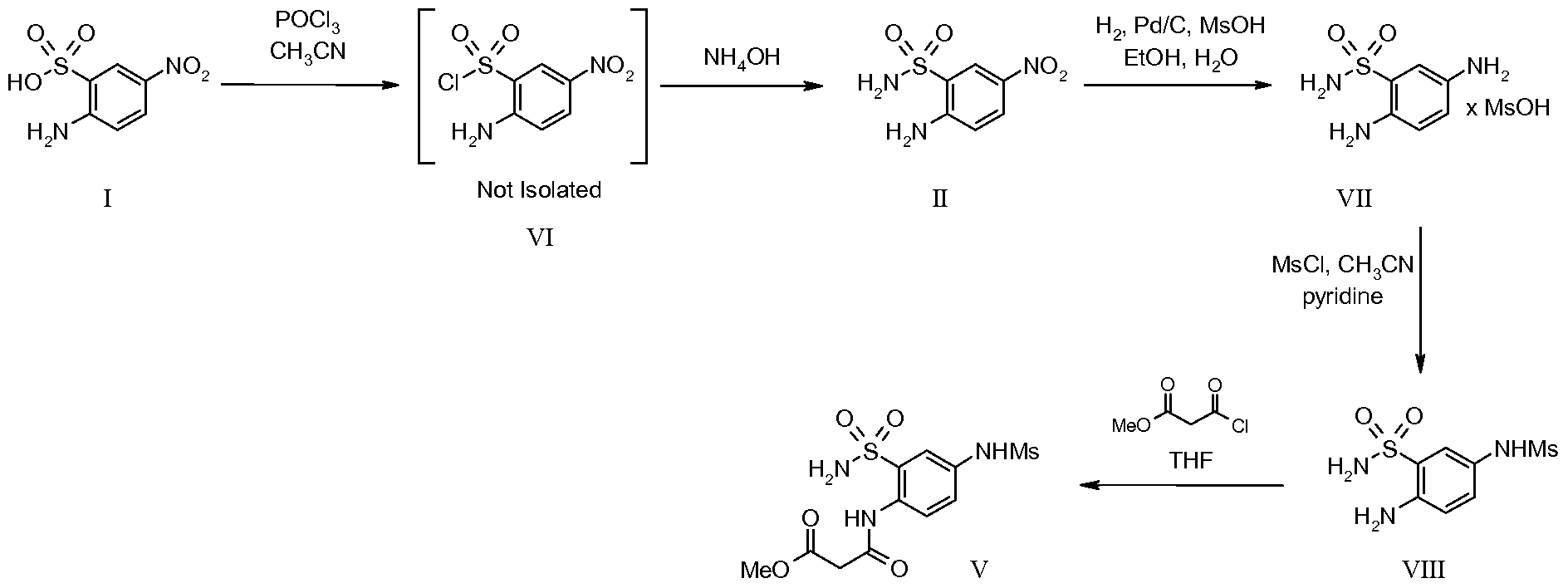
Setrobuvir, is disclosed, as well as methods of making same via the key intermediate N-(4- methanesulfonylamino-2-sulfamoyl-phenyl)-malonamic acid methyl ester (V). A disclosed method of synthesizing the key intermediate N-(4-methanesulfonylamino-2-sulfamoyl-phenyl)- malonamic acid methyl ester, as disclosed by WO 2010/42834, is the following:
Synthesis of N-(4-Methanesulfonylamino-2-sulfamoyl-phenyl)-malonamic acid methyl ester (V) Original Synthetic Route
Figure imgf000007_0001
[0019] In this previously described route to the key intermediate N-(4-methanesulfonylamino-2- sulfamoyl-phenyl)-malonamic acid methyl ester (V) for the production of Setrobuvir, the starting material, 2-amino-5-nitrobenzenesulfonic acid is first converted to the sulfonyl chloride with phosphorus oxychloride, and then quenched with aqueous ammonia, resulting in product (II) . Hydrogenation of the nitrosulfonamide product in aqueous ethanol in the presence of methane sulfonic acid using palladium on carbon catalyst provides the mesylate salt of the 2,5-diamino- benzenesulfonamide. This salt is converted to the methanesulfonamide (VIII) with
methanesulfonyl chloride and pyridine in acetonitrile. Finally reaction with methyl 3-chloro-3- oxopropanoate in THF provides the key intermediate N-(4-methanesulfonylamino-2-sulfamoyl- phenyl)-malonamic acid methyl ester (V).
New Synthetic Route
Figure imgf000008_0001
H2, Pd/C
Step 3 DMF, THF
Figure imgf000008_0002
IV
[0020] In the new route the order of the function group incorporation for the last 3 steps is changed. The first intermediate, 2-amino-5-nitrobenzenesulfonamide (II) is common to both routes. This intermediate is treated with methyl 3 -chloro-3 -oxopropanoate in acetonitrile. The nitro group is then reduced using hydrogen and palladium on carbon catalyst in a mixture of THF/DMF. Finally mesylation in acetonitrile using methanesulfonyl chloride and pyridine as the base provides the key intermediate N-(4-methanesulfonylamino-2-sulfamoyl-phenyl)-malonamic acid methyl ester (V). [0021] There are two major and novel advantages for the new route over the method of making the key intermediate N-(4-methanesulfonylamino-2-sulfamoyl-phenyl)-malonamic acid methyl ester as disclosed in WO 2010/42834. The first advantage, and novel difference, is that the new route avoids the diaminobenzene intermediate (VII). This electron rich intermediate is prone to color generation which has to be reduced at the next intermediate 2-amino-5- methanesulfonylamino-benzenesulfonamide or it can cause color issues in Setrobuvir. The second advantage, and novel difference, is that the new route eliminates a chloro impurity that has been detected by LC/MS in (V) prepared by the original route.
[0022] In a preferred embodiment of the invention, the method for preparing the compound N- (4-methanesulfonylamino-2-sulfamoyl-phenyl)-malonamic acid methyl ester (V) comprises: Step 1 : Sulfonamide Formation
A) Adding phosphorus oxychloride to a suspension of 2-amino-5-nitrobenzenesulfonic acid (I) in acetonitrile or a mixture of acetonitrile and sulfolane
B) Stirring the mixture under heat, preferably at 75-80 °C for 3-5 h, and then the
supernatant was slowly transferred to a basic solution, preferably NH4OH (aqueous ammonia) solution, at less than 30 °C, preferably at ambient room temperature
C) Concentrating and cooling the mixture to obtain 2-amino-5-nitro-benzenesulfonamide (II)
[0023] Step 2: Acylation
A) Suspending the 2-amino-5-nitrobenzenesulfonamide (II) in acetonitrile, and adding to this suspension methyl 3-chloro-3-oxopropanoate at ambient temperature until complete conversion is obtained (ca. 24 h). It is critical that this step is conducted in the absence of any added base to avoid decomposition of methyl 3-chloro-3-oxopropanoate as well as formation of the bis-acylation product.
B) Water is added, followed by a basic compound such as saturated aqueous sodium
carbonate or sodium bicarbonate, to adjust the pH to about 7. More strongly basic compounds which can lead to more basic conditions, e.g. pH greater than 9, can lead to formation of side products such as the bis-acylation product as well as other cyclized (and decarboxylated) compounds. C) Filtering and concentrating the filtrate to obtain N-(4-nitro-2-sulfamoyl-phenyl)- malonamic acid methyl ester (III).
[0024] Step 3 - Catalytic Hydrogenation-Nitro-Reduction
A) Charging a reactor with a catalyst, preferably charging with palladium on carbon catalyst followed by a solution of N-(4-nitro-2-sulfamoyl-phenyl)-malonamic acid methyl ester (also known as methyl 3-(4-nitro-2-sulfamoylphenylamino)-3-oxopropanoate) (III) in a polar aprotic solvent, preferably a polar aprotic solvent mixture such as THF/DMF. It is important that a polar aprotic solvent such as, for example, DMF is required to keep the product N-(4-nitro-2-sulfamoyl-phenyl)-malonamic acid methyl ester in solution. Use of other polar (protic) solvents, such as IPA (isopropyl alcohol) and EtOH (ethanol), results in precipitation of the methyl 3-(4-amnio-2-sulfamoylphenylamino)-3-oxopropanoate.
B) Hydrogenation of the N-(4-nitro-2-sulfamoyl-phenyl)-malonamic acid methyl ester in solution via pressuring the vessel with hydrogen gas, after nitrogen gas inertion, to complete conversion.
C) After complete conversion, filtering and concentrating the filtrate to obtain the product N- (4-amino-2-sulfamoyl-phenyl)-malonamic acid methyl ester (IV).
[0025] Step 4 - Mesylation
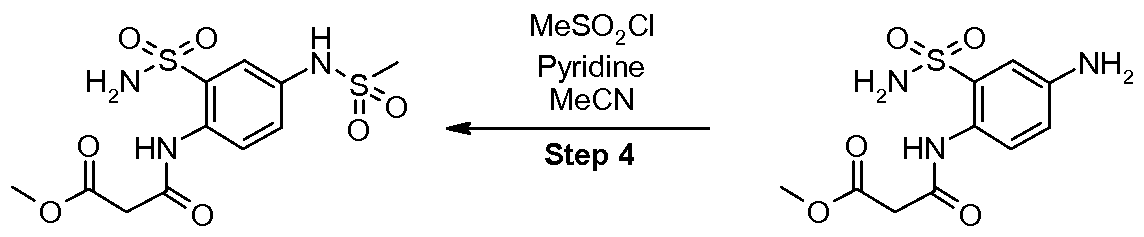
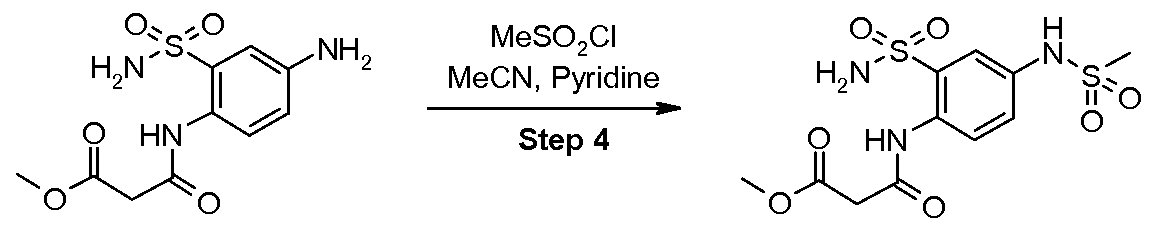
A) Adding methanesulfonyl chloride to a suspension of N-(4-amino-2-sulfamoyl-phenyl)- malonamic acid methyl ester (also known as methyl 3-(4-amino-2- sulfamoylphenylamino)-3-oxopropanoate) (IV) and pyridine in acetonitrile at about 22-30 °C, to obtain a mixture and stirring the mixture at ambient temperature until complete mesylation conversion occurs.
B) Upon complete conversion, water and brine are subsequently added. Following
separation of the phases, the aqueous layer is extracted with acetonitrile or THF.
Preferred method of aqueous layer extraction is with acetonitrile.
C) The combined organic layer are washed with brine, then concentrated to a slurry.
D) The solids from the slurry are filtered and washed with water to obtain the key
intermediate N-(4-methanesulfonylamino-2-sulfamoyl-phenyl)-malonamic acid methyl ester (V). [0026] The described synthetic pathways and experimental procedures utilize many common chemical abbreviations, known to those skilled in the art.
[0027] The new synthetic route provides a novel method that can be used to prepare the key intermediate N-(4-methanesulfonylamino-2-sulfamoyl-phenyl)-malonamic acid methyl ester (V), as well as the novel intermediate compounds of the present invention.
Experimental Section
[0028] The present compounds and method of the present invention will be further illustrated in the following example. The example is presented for purposes of demonstrating, but not limiting, the preparation of the key intermediate N-(4-methanesulfonylamino-2-sulfamoyl-phenyl)- malonamic acid methyl ester (V), used in the preparation of Setrobuvir, of the invention and the novel intermediate compounds of the invention.
[0029] Unless otherwise stated, the "%" used in the examples refers to weight percentage.
[0030] In accordance with the present invention, the following example is provided to illustrate a method for preparing compounds N-(4-nitro-2-sulfamoyl-phenyl)-malonamic acid methyl ester (also known as methyl 3-(4-nitro-2-sulfamoylphenylamino)-3-oxopropanoate) (III) and N-(4- amino-2-sulfamoyl-phenyl)-malonamic acid methyl ester (also known as methyl 3-(4-amino-2- sulfamoylphenylamino)-3-oxopropanoate) (IV), which are novel intermediates for the preparation of the key intermediate N-(4-methanesulfonylamino-2-sulfamoyl-phenyl)-malonamic acid methyl ester (V), which can be used for the preparation of the compound N-(3- {(li?,2lS,7i?,85)-3-[(4-fiuorophenyl)methyl]-6-hydroxy-4-oxo-3-azatricyclo [6.2.1.02'7]undec-5- en-5-yl} -1,1 -dioxo- 1 ,4-dihydro- l 6,2,4-benzothiadiazin-7-yl)methanesulfonamide (Setrobuvir).
Step 1: Sulfonamide Formation
Figure imgf000011_0001
n [0031] 1. Phosphorus oxychloride (316 g, 192 mL, 2.06 mol, 1.8 equivalents) was slowly added to a suspension of 2-amino-5-nitrobenzenesulfonic acid (250 g, 1.15 mol, 1.00 equivalent) in a mixture of acetonitrile (2.54 kg, 2.0 L, 8 vol) and sulfolane (254 g, 200 mL, 0.8 vol) at ambient temperature.
[0032] 2. This mixture was stirred at 75-80 °C for 3-5 h, and then the supernatant was slowly transferred to NH4OH solution (28-30 %, 1.5 L, 6 vol) such that the temperature was maintained below 30 °C.
[0033] 3. The reaction mixture was stirred at ambient temperature ca. 2 h, and was then concentrated under reduced pressure at ca. 50 °C to a minimum volume to obtain a slurry.
[0034] 4. This slurry was aged at ca. 50 °C for ca. 2 h and then slowly cooled to ca. 10 °C and aged at ca. 10 °C for ca. 2 h. The solid was filtered and washed with water (3 x 250 mL, 3 x 1 vol) to give a yellow product which was dried at ca. 50 °C under vacuum for 2 days to yield 203.8 g of II (2-amino-5-nitro-benzenesulfonamide, See also compound described in Dragovich, P.S.; Thompson, P.A; Reubsam, F. WO 2010/042834, herein incorporated by reference in its entirety) in 81.9 % yield with 99.0% purity by AN HPLC (area normalized high performance liquid chromatography).
Step 2: Acylation
Figure imgf000012_0001
11 III
[0035] 1. Methyl 3-chloro-3-oxopropanoate (163 g, 128 mL, 1.16 mol, 97% pure, 1.2 equivalents) was added to a suspension of 2-amino-5-nitrobenzenesulfonamide (210 g, 967 mmol, 1.00 equivalents) in acetonitrile (2.1 L, 10 vol) at ambient temperature and the mixture so obtained was stirred at ambient temperature until complete conversion was obtained {ca. 24 h). It is critical that this transformation is conducted in the absence of any base to avoid decomposition of methyl 3-chloro-3-oxopropanoate as well as formation of the bis-acylation product.
[0036] 2. Water (210 mL, 1 vol) was added, followed by saturated aqueous sodium carbonate (336 mL, ca. 1.6 vol) to adjust the pH to ca. 7. The layers were separated and filtered through a pad of Celite. Note that the choice of base, i.e. aqueous Na2C03, for pH adjustment was found to be important as stronger bases led to formation of side products such as the bis-acylation product as well as the cyclized (and decarboxylated) compounds shown below.
Figure imgf000013_0001
Molecular Weight =299.26 Molecular Weight =285.24 Molecular Weight -241.23
[0037] 3. The filtrate was concentrated under vacuum at ca. 40 °C to approximately half the volume to precipitate the product. Additional water (940 mL, 4.5 vol) was added and the distillation was continued under vacuum until no distillate was observed. The resulting slurry so obtained was stirred at ca. 40 °C for at least 1 h and then allowed to cool to ambient temperature.
[0038] 4. The solids were filtered and washed with water (4 x 210 mL, 4 x 1 vol). The wet cake was dried in a vacuum oven at ca. 50 °C for ca. 18 h to obtain 286.8 g of product III (N-(4-nitro- 2-sulfamoyl-phenyl)-malonamic acid methyl ester), 93.5 % yield, 95.8% AN HPLC purity).
1H NMR (300MHz, DMSO-^) δ ppm 9.90 (br. s., 1H), 8.64 (dd, J = 0.8, 2.2 Hz, 1H),
8.54 - 8.38 (m, 2H), 8.00 (br. s., 2H), 3.74 (s, 2H), 3.70 (s, 3H).
LC/MS m/z: (M+H)+ 318.
Step 3: Catalytic Hydrogenation-Nitro-Reduction
Figure imgf000013_0002
III rv [0039] 1. A 4-L Parr reactor was charged with palladium on carbon catalyst (5% Pd/C, 50% wet, 25 g) followed by a solution of N-(4-nitro-2-sulfamoyl-phenyl)-malonamic acid methyl ester (250 g) in 13:3 THF/DMF mixture (2.0 L, 8 vol). It is important that a polar aprotic solvent such as, for example, DMF (at least 2 volumes with respect to N-(4-nitro-2-sulfamoyl-phenyl)- malonamic acid methyl ester) is required to keep the product N-(4-nitro-2-sulfamoyl-phenyl)- malonamic acid methyl ester in solution.
[0040] 2. The reaction vessel was inerted by pressurizing (3 x) with nitrogen gas to ca. 100 psi. Hydrogen atmosphere in the vessel was established by pressurizing (3 x) with hydrogen gas to ca. 200 psi, and finally the reaction mixture was pressurized to ca. 200 psi with hydrogen gas and heated to ca. 40 °C for 4-16 h with a stir rate of ca. 400 rpm.
[0041] 3. Upon complete conversion (additional catalyst may be added), the reaction mixture was filtered through a pad of Celite to obtain a light yellow filtrate. The filtrate was concentrated under vacuum at ca. 40 °C to a minimum volume, to which was added IPA (1.25 L, 5 vol) to precipitate the product. The slurry so obtained was aged at ca. 40 °C for at least 30 min followed by addition of heptane (750 mL, 3 vol) and further aged at ca. 40 °C for an additional 2 h and then cooled slowly to ambient temperature.
[0042] 4. The solids were filtered, washed with IP A/heptane mixture (4 x 250 mL, 4 x 1 vol) and dried under vacuum at ca. 60 °C for ca. 18 h to obtain 203.4 g of product IV (N-(4-amino-2- sulfamoyl-phenyl)-malonamic acid methyl ester), 89.9% yield and 98.7% AN HPLC purity).
1H NMR (300MHz, DMSO-^) δ ppm 9.17 (br. s., 1H), 7.35 (d, J= 8.7 Hz, 1H), 7.18 (br. s., 2H), 7.10 (d, J= 2.6 Hz, 1H), 6.71 (dd, J= 2.6, 8.5 Hz, 1H), 5.48 (s, 2H), 3.67 (s, 3H),
3.52 (s, 2H).
LC/MS m/z: (M+H)+ 288. Step 4: Mesylation
Figure imgf000015_0001
IV V
[0043] 1. Methanesulfonyl chloride (95.7 g, 651 mL, 1.2 equivalents) was added to a suspension of N-(4-amino-2-sulfamoyl-phenyl)-malonamic acid methyl ester (200 g, 696 mmol, 1.0 equivalents) and pyridine (110 g, 113 ml, 1.39 mol, 2 equivalents) in acetonitrile (2.0 L, 10 vol) at 22-30 °C and the mixture so obtained was stirred at ambient temperature (30-60 min).
[0044] 2. Upon complete conversion, water (400 mL, 2 vol) was added followed by 400 mL (2 vol) of brine. This mixture was stirred for ca. 15 min and then the phases were allowed to separate. The aqueous layer was then extracted with acetonitrile (400 mL, 2 vol).
[0045] 3. The combined organic layers were washed with brine (600 mL, 3 vol) and then concentrated under vacuum (100 mbar) at ca. 40 °C until precipitation was observed. The slurry was aged for at least 30 min, and then water (1.0 L, 5 vol) was slowly added to the slurry. The distillation was recommenced at 50 mbar until no distillate was observed.
[0046] 4. The slurry so obtained was aged at ca. 40 °C for ca. 2 h and then allowed to cool to ambient temperature.
[0047] 5. The solids were filtered and washed with water (3 x 200 mL, 3 x 1 vol) to obtain off- white to light yellow material, which was dried at 50-60 °C under vacuum for ca. 18 h to obtain 230.3 g of (V) the key intermediate N-(4-methanesulfonylamino-2-sulfamoyl-phenyl)- malonamic acid methyl ester in 90.5 % yield and 98.3 % AN HPLC purity.

Claims

1. A method for preparing compound N-(4-methanesulfonylamino-2-sulfamoyl-phenyl)- malonamic acid methyl ester, comprising;
a. reacting 2-amino-5-nitrobenzenesulfonic acid with phosphorus oxychloride to form 2-amino-5-nitrobenzenesulfonamide
b. adding methyl 3-choloro-3-oxypropanoate to 2-amino-5- nitrobenzenesulfonamide, in the absence of any additional base, to form N-(4- nitro-2-sulfamoyl-phenyl)-malonamic acid methyl ester,
c. reducing the N-(4-nitro-2-sulfamoyl-phenyl)-malonamic acid methyl ester, via a catalyst in the presence of an polar aprotic solvent, to form N-(4-amino-2- sulfamoyl-phenyl)-malonamic acid methyl ester, and
d. mesylating the N-(4-amino-2-sulfamoyl-phenyl)-malonamic acid methyl ester, via addition of methanesulfonyl chloride to a suspension of N-(4-amino-2-sulfamoyl- phenyl)-malonamic acid methyl ester and pyridine to form the compound N-(4- methanesulfonylamino-2-sulfamoyl-phenyl)-malonamic acid methyl ester.
2. The method of claim 1, wherein step b) additionally comprises addition of water after mixture of the methyl 3-choloro-3-oxypropanoate with the 2-amino-5-nitrobenzenesulfonamide to adjust the pH to about 7.
3. The method of claim 1, wherein the polar aprotic solvent of step c) is selected from the group consisting of DMF, DMA, THF, NMP or polar aprotic solvent mixtures thereof.
4. A compound, which is N-(4-nitro-2-sulfamoyl-phenyl)-malonamic acid methyl ester.
5. A compound, which is N-(4-amino-2-sulfamoyl-phenyl)-malonamic acid methyl ester.
6. The compound of claim 4 for use as an intermediate in the preparation of compound N- (4-methanesulfonylamino-2-sulfamoyl-phenyl)-malonamic acid methyl ester.
7. The compound of claim 5 for use as an intermediate in the preparation of compound N- (4-methanesulfonylamino-2-sulfamoyl-phenyl)-malonamic acid methyl ester.
PCT/IB2014/000538 2013-01-14 2014-01-13 A novel process for the preparation of n-(4-nitro-2-sulfamoly-phenyl)-malonamic acid methyl ester and n-(4-amino-2-sulfamoyl-phenyl)-malonamic acid methyl ester Ceased WO2014108806A2 (en)

Priority Applications (9)

Application Number Priority Date Filing Date Title
BR112015016686A BR112015016686A2 (en) 2013-01-14 2014-01-13 compounds and their method for preparing them
EP14722717.7A EP2943468B1 (en) 2013-01-14 2014-01-13 A novel process for the preparation of n-(4-nitro-2-sulfamoyl-phenyl)-malonamic acid methyl ester and n-(4-amino-2-sulfamoyl-phenyl)-malonamic acid methyl ester
JP2015552162A JP6235043B2 (en) 2013-01-14 2014-01-13 Novel process for the preparation of N- (4-nitro-2-sulfamoyl-phenyl) -malonamic acid methyl ester and N- (4-amino-2-sulfamoyl-phenyl) -malonamic acid methyl ester
MX2015008827A MX2015008827A (en) 2013-01-14 2014-01-13 A novel process for the preparation of n-(4-nitro-2-sulfamoyl-phe nyl)-malonamic acid methyl ester and n-(4-amino-2-sulfamoyl-pheny l)-malonamic acid methyl ester.
CA2897347A CA2897347A1 (en) 2013-01-14 2014-01-13 A novel process for the preparation of n-(4-nitro-2-sulfamoyl-phenyl)-malonamic acid methyl ester and n-(4-amino-2-sulfamoyl-phenyl)-malonamic acid methyl ester
EA201591333A EA201591333A1 (en) 2013-01-14 2014-01-13 A NEW METHOD FOR PRODUCING N- (4-NITRO-2-SULFAMOILPHENYL) METHYL ETHER MALONAMINIC ACID AND N- (4-AMINO-2-SULFAMOILPHENYL) METHYL ETHER
HK16101121.2A HK1213239B (en) 2013-01-14 2014-01-13 A novel process for the preparation of n-(4-nitro-2-sulfamoyl-phenyl)-malonamic acid methyl ester and n-(4-amino-2-sulfamoyl-phenyl)-malonamic acid methyl ester
CN201480004818.9A CN105051010B (en) 2013-01-14 2014-01-13 Prepare the new method of N (aminosulfonylphenyl of 4 nitro 2) malonamic acid methyl esters and N (aminosulfonylphenyl of 4 amino 2) malonamic acid methyl esters
KR1020157021640A KR20150106919A (en) 2013-01-14 2014-01-13 A novel process for the preparation of n-(4-nitro-2-sulfamoyl-phenyl)-malonamic acid methyl ester and n-(4-amino-2-sulfamoyl-phenyl)-malonamic acid methyl ester

Applications Claiming Priority (2)

Application Number Priority Date Filing Date Title
US201361751999P 2013-01-14 2013-01-14
US61/751,999 2013-01-14

Publications (3)

Publication Number Publication Date
WO2014108806A2 true WO2014108806A2 (en) 2014-07-17
WO2014108806A3 WO2014108806A3 (en) 2014-10-23
WO2014108806A8 WO2014108806A8 (en) 2015-04-30

Family

ID=50685964

Family Applications (1)

Application Number Title Priority Date Filing Date
PCT/IB2014/000538 Ceased WO2014108806A2 (en) 2013-01-14 2014-01-13 A novel process for the preparation of n-(4-nitro-2-sulfamoly-phenyl)-malonamic acid methyl ester and n-(4-amino-2-sulfamoyl-phenyl)-malonamic acid methyl ester

Country Status (10)

Country Link
US (1) US8816120B2 (en)
EP (1) EP2943468B1 (en)
JP (1) JP6235043B2 (en)
KR (1) KR20150106919A (en)
CN (1) CN105051010B (en)
BR (1) BR112015016686A2 (en)
CA (1) CA2897347A1 (en)
EA (1) EA201591333A1 (en)
MX (1) MX2015008827A (en)
WO (1) WO2014108806A2 (en)

Citations (2)

* Cited by examiner, † Cited by third party
Publication number Priority date Publication date Assignee Title
WO2010042834A1 (en) 2008-10-09 2010-04-15 Anadys Pharmaceuticals, Inc. A method of inhibiting hepatitis c virus by combination of a 5,6-dihydro-1h-pyridin-2-one and one or more additional antiviral compounds
US7939524B2 (en) 2007-04-03 2011-05-10 Anadys Pharmaceuticals, Inc. 5,6-dihydro-1H-pyridin-2-one compounds

Family Cites Families (7)

* Cited by examiner, † Cited by third party
Publication number Priority date Publication date Assignee Title
US7160902B2 (en) * 2003-11-14 2007-01-09 Adolor Corporation Amide derivatives and methods of their use
CN102584649A (en) * 2006-06-22 2012-07-18 安那迪斯药品股份有限公司 Pyrro[1,2-b]pyridazinone compounds
TW200840572A (en) * 2006-12-12 2008-10-16 Anadys Pharmaceuticals Inc 5,6-dihydro-1H-pyridin-2-one compounds
US20080214529A1 (en) * 2006-12-12 2008-09-04 Frank Ruebsam SATURATED FUSED [1,2-b]PYRIDAZINONE COMPOUNDS
US20080275032A1 (en) * 2006-12-29 2008-11-06 Yuefen Zhou Pyridazinone compounds
US7834009B2 (en) * 2007-08-27 2010-11-16 Anadys Pharmaceuticals, Inc. 4-hydroxy-5,6-dihydro-1H-pyridin-2-one compounds
BR112012009796A2 (en) * 2009-10-28 2020-08-18 Anadys Pharmaceuticals, Inc. compound, methods for treating or preventing hepatitis c virus infections in a mammal in need of these uses of compound and pharmaceutical composition.

Patent Citations (2)

* Cited by examiner, † Cited by third party
Publication number Priority date Publication date Assignee Title
US7939524B2 (en) 2007-04-03 2011-05-10 Anadys Pharmaceuticals, Inc. 5,6-dihydro-1H-pyridin-2-one compounds
WO2010042834A1 (en) 2008-10-09 2010-04-15 Anadys Pharmaceuticals, Inc. A method of inhibiting hepatitis c virus by combination of a 5,6-dihydro-1h-pyridin-2-one and one or more additional antiviral compounds

Also Published As

Publication number Publication date
US8816120B2 (en) 2014-08-26
WO2014108806A3 (en) 2014-10-23
CN105051010A (en) 2015-11-11
CN105051010B (en) 2017-07-28
EA201591333A1 (en) 2015-11-30
CA2897347A1 (en) 2014-07-17
JP2016508990A (en) 2016-03-24
US20140200362A1 (en) 2014-07-17
HK1213239A1 (en) 2016-06-30
EP2943468A2 (en) 2015-11-18
WO2014108806A8 (en) 2015-04-30
KR20150106919A (en) 2015-09-22
MX2015008827A (en) 2015-10-14
JP6235043B2 (en) 2017-11-22
BR112015016686A2 (en) 2017-07-11
EP2943468B1 (en) 2017-03-01

Similar Documents

Publication Publication Date Title
CN106061972B (en) 5-Fluoro-4-imino-3-(alkyl/substituted alkyl)-1-(arylsulfonyl)-3,4-dihydropyrimidin-2(1H)-one and preparation method thereof
CN102356063B (en) Method for preparing 6-(7-((1-aminocyclopropyl)methoxy)-6-methoxyquinolin-4-yloxy)-N-methyl-1-naphthylcarboxamide and its synthesis intermediate
CN107162988B (en) Process for the manufacture of pyrimidine sulfonamide derivatives
JP2013522327A (en) Preparation process and intermediate of lapatinib
TW201609694A (en) Process for the preparation of 3-(3-chloro-1H-pyrazol-1-yl)pyridine
JP6592085B2 (en) Preparation method of revaprazan hydrochloride
KR101127814B1 (en) Novel intermediate and process for preparing sildenafil or its salt using the same
CN105566215A (en) Preparation method of Stivarga
EP3422855B1 (en) Process for the preparation of 4-alkoxy-3-hydroxypicolinic acids
CN110092786B (en) Method for preparing evodiamine
CN112142680B (en) A kind of method of visible light catalytic synthesis 3-trifluoroalkylquinoxalinone
EP2943468B1 (en) A novel process for the preparation of n-(4-nitro-2-sulfamoyl-phenyl)-malonamic acid methyl ester and n-(4-amino-2-sulfamoyl-phenyl)-malonamic acid methyl ester
JP2019535742A (en) Chemical methods for preparing imidazopyrrolidinone derivatives and intermediates thereof
CN115677576B (en) 3-Chloro-substituted quinolinone derivative and preparation method thereof
TWI643848B (en) Process for preparing a pyrimidine intermediate
DK2841434T3 (en) PROCEDURE FOR THE PREPARATION OF NAPHTHYRIDINE DERIVATIVES
CN118255768A (en) Preparation method of JAK inhibitor and intermediate thereof
HK1213239B (en) A novel process for the preparation of n-(4-nitro-2-sulfamoyl-phenyl)-malonamic acid methyl ester and n-(4-amino-2-sulfamoyl-phenyl)-malonamic acid methyl ester
WO2018163818A1 (en) Method for producing triazole compound
CN110590641B (en) A kind of green preparation method of 3-hydroxyisoindol-1-one series compounds
CN120665002A (en) Preparation method and application of 3-aminopyrrolidine-1-carboxylic acid tert-butyl ester
WO2016078108A1 (en) Method for synthesizing 3-methyl-3,7-diazabicyclo[3.3.0]octane pharmaceutical intermediate
WO2005026119A1 (en) Method for producing sulfone amide-containing indole compound
EP2890694A1 (en) 4-tert-butyl-n-[6-(2-hydroxyethoxy)-5-(2-methoxyphenoxy)-2(2-pyrimidinyl)-pyrimidine-4-yl)-benzen esulfonamide sodium
CN105793240A (en) Process for making reverse transcriptase inhibitors

Legal Events

Date Code Title Description
WWE Wipo information: entry into national phase

Ref document number: 201480004818.9

Country of ref document: CN

121 Ep: the epo has been informed by wipo that ep was designated in this application

Ref document number: 14722717

Country of ref document: EP

Kind code of ref document: A2

ENP Entry into the national phase

Ref document number: 2897347

Country of ref document: CA

WWE Wipo information: entry into national phase

Ref document number: MX/A/2015/008827

Country of ref document: MX

ENP Entry into the national phase

Ref document number: 2015552162

Country of ref document: JP

Kind code of ref document: A

NENP Non-entry into the national phase

Ref country code: DE

REG Reference to national code

Ref country code: BR

Ref legal event code: B01A

Ref document number: 112015016686

Country of ref document: BR

ENP Entry into the national phase

Ref document number: 20157021640

Country of ref document: KR

Kind code of ref document: A

REEP Request for entry into the european phase

Ref document number: 2014722717

Country of ref document: EP

WWE Wipo information: entry into national phase

Ref document number: 2014722717

Country of ref document: EP

WWE Wipo information: entry into national phase

Ref document number: 201591333

Country of ref document: EA

ENP Entry into the national phase

Ref document number: 112015016686

Country of ref document: BR

Kind code of ref document: A2

Effective date: 20150710