WO2014057358A2 - Low binder, wear resistant hard metal - Google Patents
Low binder, wear resistant hard metal Download PDFInfo
- Publication number
- WO2014057358A2 WO2014057358A2 PCT/IB2013/002907 IB2013002907W WO2014057358A2 WO 2014057358 A2 WO2014057358 A2 WO 2014057358A2 IB 2013002907 W IB2013002907 W IB 2013002907W WO 2014057358 A2 WO2014057358 A2 WO 2014057358A2
- Authority
- WO
- WIPO (PCT)
- Prior art keywords
- carbide
- wear resistant
- resistant material
- low binder
- providing
- Prior art date
- Legal status (The legal status is an assumption and is not a legal conclusion. Google has not performed a legal analysis and makes no representation as to the accuracy of the status listed.)
- Ceased
Links
Classifications
-
- C—CHEMISTRY; METALLURGY
- C09—DYES; PAINTS; POLISHES; NATURAL RESINS; ADHESIVES; COMPOSITIONS NOT OTHERWISE PROVIDED FOR; APPLICATIONS OF MATERIALS NOT OTHERWISE PROVIDED FOR
- C09K—MATERIALS FOR MISCELLANEOUS APPLICATIONS, NOT PROVIDED FOR ELSEWHERE
- C09K5/00—Heat-transfer, heat-exchange or heat-storage materials, e.g. refrigerants; Materials for the production of heat or cold by chemical reactions other than by combustion
- C09K5/08—Materials not undergoing a change of physical state when used
- C09K5/14—Solid materials, e.g. powdery or granular
-
- B—PERFORMING OPERATIONS; TRANSPORTING
- B22—CASTING; POWDER METALLURGY
- B22F—WORKING METALLIC POWDER; MANUFACTURE OF ARTICLES FROM METALLIC POWDER; MAKING METALLIC POWDER; APPARATUS OR DEVICES SPECIALLY ADAPTED FOR METALLIC POWDER
- B22F3/00—Manufacture of workpieces or articles from metallic powder characterised by the manner of compacting or sintering; Apparatus specially adapted therefor ; Presses and furnaces
- B22F3/12—Both compacting and sintering
- B22F3/14—Both compacting and sintering simultaneously
- B22F3/15—Hot isostatic pressing
-
- C—CHEMISTRY; METALLURGY
- C04—CEMENTS; CONCRETE; ARTIFICIAL STONE; CERAMICS; REFRACTORIES
- C04B—LIME, MAGNESIA; SLAG; CEMENTS; COMPOSITIONS THEREOF, e.g. MORTARS, CONCRETE OR LIKE BUILDING MATERIALS; ARTIFICIAL STONE; CERAMICS; REFRACTORIES; TREATMENT OF NATURAL STONE
- C04B35/00—Shaped ceramic products characterised by their composition; Ceramics compositions; Processing powders of inorganic compounds preparatory to the manufacturing of ceramic products
- C04B35/515—Shaped ceramic products characterised by their composition; Ceramics compositions; Processing powders of inorganic compounds preparatory to the manufacturing of ceramic products based on non-oxide ceramics
- C04B35/56—Shaped ceramic products characterised by their composition; Ceramics compositions; Processing powders of inorganic compounds preparatory to the manufacturing of ceramic products based on non-oxide ceramics based on carbides or oxycarbides
- C04B35/5607—Shaped ceramic products characterised by their composition; Ceramics compositions; Processing powders of inorganic compounds preparatory to the manufacturing of ceramic products based on non-oxide ceramics based on carbides or oxycarbides based on refractory metal carbides
- C04B35/5626—Shaped ceramic products characterised by their composition; Ceramics compositions; Processing powders of inorganic compounds preparatory to the manufacturing of ceramic products based on non-oxide ceramics based on carbides or oxycarbides based on refractory metal carbides based on tungsten carbides
-
- C—CHEMISTRY; METALLURGY
- C04—CEMENTS; CONCRETE; ARTIFICIAL STONE; CERAMICS; REFRACTORIES
- C04B—LIME, MAGNESIA; SLAG; CEMENTS; COMPOSITIONS THEREOF, e.g. MORTARS, CONCRETE OR LIKE BUILDING MATERIALS; ARTIFICIAL STONE; CERAMICS; REFRACTORIES; TREATMENT OF NATURAL STONE
- C04B35/00—Shaped ceramic products characterised by their composition; Ceramics compositions; Processing powders of inorganic compounds preparatory to the manufacturing of ceramic products
- C04B35/622—Forming processes; Processing powders of inorganic compounds preparatory to the manufacturing of ceramic products
- C04B35/64—Burning or sintering processes
- C04B35/645—Pressure sintering
-
- C—CHEMISTRY; METALLURGY
- C04—CEMENTS; CONCRETE; ARTIFICIAL STONE; CERAMICS; REFRACTORIES
- C04B—LIME, MAGNESIA; SLAG; CEMENTS; COMPOSITIONS THEREOF, e.g. MORTARS, CONCRETE OR LIKE BUILDING MATERIALS; ARTIFICIAL STONE; CERAMICS; REFRACTORIES; TREATMENT OF NATURAL STONE
- C04B35/00—Shaped ceramic products characterised by their composition; Ceramics compositions; Processing powders of inorganic compounds preparatory to the manufacturing of ceramic products
- C04B35/622—Forming processes; Processing powders of inorganic compounds preparatory to the manufacturing of ceramic products
- C04B35/64—Burning or sintering processes
- C04B35/645—Pressure sintering
- C04B35/6455—Hot isostatic pressing
-
- C—CHEMISTRY; METALLURGY
- C22—METALLURGY; FERROUS OR NON-FERROUS ALLOYS; TREATMENT OF ALLOYS OR NON-FERROUS METALS
- C22C—ALLOYS
- C22C1/00—Making non-ferrous alloys
- C22C1/04—Making non-ferrous alloys by powder metallurgy
- C22C1/05—Mixtures of metal powder with non-metallic powder
- C22C1/051—Making hard metals based on borides, carbides, nitrides, oxides or silicides; Preparation of the powder mixture used as the starting material therefor
-
- C—CHEMISTRY; METALLURGY
- C22—METALLURGY; FERROUS OR NON-FERROUS ALLOYS; TREATMENT OF ALLOYS OR NON-FERROUS METALS
- C22C—ALLOYS
- C22C29/00—Alloys based on carbides, oxides, nitrides, borides, or silicides, e.g. cermets, or other metal compounds, e.g. oxynitrides, sulfides
- C22C29/02—Alloys based on carbides, oxides, nitrides, borides, or silicides, e.g. cermets, or other metal compounds, e.g. oxynitrides, sulfides based on carbides or carbonitrides
- C22C29/06—Alloys based on carbides, oxides, nitrides, borides, or silicides, e.g. cermets, or other metal compounds, e.g. oxynitrides, sulfides based on carbides or carbonitrides based on carbides, but not containing other metal compounds
- C22C29/08—Alloys based on carbides, oxides, nitrides, borides, or silicides, e.g. cermets, or other metal compounds, e.g. oxynitrides, sulfides based on carbides or carbonitrides based on carbides, but not containing other metal compounds based on tungsten carbide
-
- B—PERFORMING OPERATIONS; TRANSPORTING
- B22—CASTING; POWDER METALLURGY
- B22F—WORKING METALLIC POWDER; MANUFACTURE OF ARTICLES FROM METALLIC POWDER; MAKING METALLIC POWDER; APPARATUS OR DEVICES SPECIALLY ADAPTED FOR METALLIC POWDER
- B22F2998/00—Supplementary information concerning processes or compositions relating to powder metallurgy
- B22F2998/10—Processes characterised by the sequence of their steps
-
- C—CHEMISTRY; METALLURGY
- C04—CEMENTS; CONCRETE; ARTIFICIAL STONE; CERAMICS; REFRACTORIES
- C04B—LIME, MAGNESIA; SLAG; CEMENTS; COMPOSITIONS THEREOF, e.g. MORTARS, CONCRETE OR LIKE BUILDING MATERIALS; ARTIFICIAL STONE; CERAMICS; REFRACTORIES; TREATMENT OF NATURAL STONE
- C04B2235/00—Aspects relating to ceramic starting mixtures or sintered ceramic products
- C04B2235/02—Composition of constituents of the starting material or of secondary phases of the final product
- C04B2235/30—Constituents and secondary phases not being of a fibrous nature
- C04B2235/38—Non-oxide ceramic constituents or additives
- C04B2235/3817—Carbides
- C04B2235/3839—Refractory metal carbides
-
- C—CHEMISTRY; METALLURGY
- C04—CEMENTS; CONCRETE; ARTIFICIAL STONE; CERAMICS; REFRACTORIES
- C04B—LIME, MAGNESIA; SLAG; CEMENTS; COMPOSITIONS THEREOF, e.g. MORTARS, CONCRETE OR LIKE BUILDING MATERIALS; ARTIFICIAL STONE; CERAMICS; REFRACTORIES; TREATMENT OF NATURAL STONE
- C04B2235/00—Aspects relating to ceramic starting mixtures or sintered ceramic products
- C04B2235/02—Composition of constituents of the starting material or of secondary phases of the final product
- C04B2235/30—Constituents and secondary phases not being of a fibrous nature
- C04B2235/38—Non-oxide ceramic constituents or additives
- C04B2235/3817—Carbides
- C04B2235/3839—Refractory metal carbides
- C04B2235/3843—Titanium carbides
-
- C—CHEMISTRY; METALLURGY
- C04—CEMENTS; CONCRETE; ARTIFICIAL STONE; CERAMICS; REFRACTORIES
- C04B—LIME, MAGNESIA; SLAG; CEMENTS; COMPOSITIONS THEREOF, e.g. MORTARS, CONCRETE OR LIKE BUILDING MATERIALS; ARTIFICIAL STONE; CERAMICS; REFRACTORIES; TREATMENT OF NATURAL STONE
- C04B2235/00—Aspects relating to ceramic starting mixtures or sintered ceramic products
- C04B2235/02—Composition of constituents of the starting material or of secondary phases of the final product
- C04B2235/30—Constituents and secondary phases not being of a fibrous nature
- C04B2235/40—Metallic constituents or additives not added as binding phase
- C04B2235/404—Refractory metals
-
- C—CHEMISTRY; METALLURGY
- C04—CEMENTS; CONCRETE; ARTIFICIAL STONE; CERAMICS; REFRACTORIES
- C04B—LIME, MAGNESIA; SLAG; CEMENTS; COMPOSITIONS THEREOF, e.g. MORTARS, CONCRETE OR LIKE BUILDING MATERIALS; ARTIFICIAL STONE; CERAMICS; REFRACTORIES; TREATMENT OF NATURAL STONE
- C04B2235/00—Aspects relating to ceramic starting mixtures or sintered ceramic products
- C04B2235/02—Composition of constituents of the starting material or of secondary phases of the final product
- C04B2235/30—Constituents and secondary phases not being of a fibrous nature
- C04B2235/40—Metallic constituents or additives not added as binding phase
- C04B2235/405—Iron group metals
-
- C—CHEMISTRY; METALLURGY
- C04—CEMENTS; CONCRETE; ARTIFICIAL STONE; CERAMICS; REFRACTORIES
- C04B—LIME, MAGNESIA; SLAG; CEMENTS; COMPOSITIONS THEREOF, e.g. MORTARS, CONCRETE OR LIKE BUILDING MATERIALS; ARTIFICIAL STONE; CERAMICS; REFRACTORIES; TREATMENT OF NATURAL STONE
- C04B2235/00—Aspects relating to ceramic starting mixtures or sintered ceramic products
- C04B2235/02—Composition of constituents of the starting material or of secondary phases of the final product
- C04B2235/30—Constituents and secondary phases not being of a fibrous nature
- C04B2235/42—Non metallic elements added as constituents or additives, e.g. sulfur, phosphor, selenium or tellurium
- C04B2235/422—Carbon
-
- C—CHEMISTRY; METALLURGY
- C04—CEMENTS; CONCRETE; ARTIFICIAL STONE; CERAMICS; REFRACTORIES
- C04B—LIME, MAGNESIA; SLAG; CEMENTS; COMPOSITIONS THEREOF, e.g. MORTARS, CONCRETE OR LIKE BUILDING MATERIALS; ARTIFICIAL STONE; CERAMICS; REFRACTORIES; TREATMENT OF NATURAL STONE
- C04B2235/00—Aspects relating to ceramic starting mixtures or sintered ceramic products
- C04B2235/02—Composition of constituents of the starting material or of secondary phases of the final product
- C04B2235/50—Constituents or additives of the starting mixture chosen for their shape or used because of their shape or their physical appearance
- C04B2235/54—Particle size related information
- C04B2235/5418—Particle size related information expressed by the size of the particles or aggregates thereof
- C04B2235/5436—Particle size related information expressed by the size of the particles or aggregates thereof micrometer sized, i.e. from 1 to 100 micron
-
- C—CHEMISTRY; METALLURGY
- C04—CEMENTS; CONCRETE; ARTIFICIAL STONE; CERAMICS; REFRACTORIES
- C04B—LIME, MAGNESIA; SLAG; CEMENTS; COMPOSITIONS THEREOF, e.g. MORTARS, CONCRETE OR LIKE BUILDING MATERIALS; ARTIFICIAL STONE; CERAMICS; REFRACTORIES; TREATMENT OF NATURAL STONE
- C04B2235/00—Aspects relating to ceramic starting mixtures or sintered ceramic products
- C04B2235/02—Composition of constituents of the starting material or of secondary phases of the final product
- C04B2235/50—Constituents or additives of the starting mixture chosen for their shape or used because of their shape or their physical appearance
- C04B2235/54—Particle size related information
- C04B2235/5418—Particle size related information expressed by the size of the particles or aggregates thereof
- C04B2235/5445—Particle size related information expressed by the size of the particles or aggregates thereof submicron sized, i.e. from 0,1 to 1 micron
-
- C—CHEMISTRY; METALLURGY
- C04—CEMENTS; CONCRETE; ARTIFICIAL STONE; CERAMICS; REFRACTORIES
- C04B—LIME, MAGNESIA; SLAG; CEMENTS; COMPOSITIONS THEREOF, e.g. MORTARS, CONCRETE OR LIKE BUILDING MATERIALS; ARTIFICIAL STONE; CERAMICS; REFRACTORIES; TREATMENT OF NATURAL STONE
- C04B2235/00—Aspects relating to ceramic starting mixtures or sintered ceramic products
- C04B2235/65—Aspects relating to heat treatments of ceramic bodies such as green ceramics or pre-sintered ceramics, e.g. burning, sintering or melting processes
- C04B2235/658—Atmosphere during thermal treatment
- C04B2235/6581—Total pressure below 1 atmosphere, e.g. vacuum
-
- C—CHEMISTRY; METALLURGY
- C04—CEMENTS; CONCRETE; ARTIFICIAL STONE; CERAMICS; REFRACTORIES
- C04B—LIME, MAGNESIA; SLAG; CEMENTS; COMPOSITIONS THEREOF, e.g. MORTARS, CONCRETE OR LIKE BUILDING MATERIALS; ARTIFICIAL STONE; CERAMICS; REFRACTORIES; TREATMENT OF NATURAL STONE
- C04B2235/00—Aspects relating to ceramic starting mixtures or sintered ceramic products
- C04B2235/70—Aspects relating to sintered or melt-casted ceramic products
- C04B2235/74—Physical characteristics
- C04B2235/78—Grain sizes and shapes, product microstructures, e.g. acicular grains, equiaxed grains, platelet-structures
- C04B2235/785—Submicron sized grains, i.e. from 0,1 to 1 micron
-
- C—CHEMISTRY; METALLURGY
- C04—CEMENTS; CONCRETE; ARTIFICIAL STONE; CERAMICS; REFRACTORIES
- C04B—LIME, MAGNESIA; SLAG; CEMENTS; COMPOSITIONS THEREOF, e.g. MORTARS, CONCRETE OR LIKE BUILDING MATERIALS; ARTIFICIAL STONE; CERAMICS; REFRACTORIES; TREATMENT OF NATURAL STONE
- C04B2235/00—Aspects relating to ceramic starting mixtures or sintered ceramic products
- C04B2235/70—Aspects relating to sintered or melt-casted ceramic products
- C04B2235/96—Properties of ceramic products, e.g. mechanical properties such as strength, toughness, wear resistance
Definitions
- the present disclosure relates to a WC -based material with low amount of binder but with a high amount of Mo 2 C, which presents a high hardness, and low friction coefficient.
- a low binder, wear resistant material includes, in weight percent, from about 15 to of about 20% of molybdenum carbide, an alloy of about 0.9 to of about 3% of cobalt, nickel or a combination of cobalt and nickel, about 0 to of about 0.1% of chromium carbide; and the balance of tungsten carbide.
- This new material has a high wear and corrosion resistance.
- a low binder, wear resistant material includes 20% molybdenum carbide and 1.8 % cobalt.
- a low binder, wear resistant material includes 0.1% of chromium carbide.
- Fig. 1 is a graph of the wear resistance of two binderless variants tested.
- Fig. 2A illustrates the porosity of sample 15/0.9 of Table 2.
- Fig. 2B illustrates the porosity of sample 15/1.8 of Table 2.
- Fig. 2C illustrates the porosity of sample 20/0.9 of Table 2.
- Fig. 2D illustrates the porosity of sample 20/1.8 of Table 2.
- Figs. 3A - 3E are electron microscope images and an EDX map of the microstructures present in sample 15/0.9 of Table 2.
- Figs. 4A - 4E are electron microscope images and an EDX map of the microstructures present in sample 20/1.8 of Table 2.
- Fig. 5 is a graph of the wear resistance of two binderless variants and samples 15/0.9, 20/0.9. 15/1.8 and 20/1.8.
- Fig. 6 illustrates the porosity of the 15/0.9 variant
- Figs. 7A - 7E are electron microscope images and EDX map of the microstructures present in sample 15/0.9 without
- Fig. 8 is a graph of the wear resistance of two variants tested.
- Fig. 9 is a graph of the HV30 between three variants and grade 20/1.8 2.
- Fig. 10 is a graph of the Kic between three variants and grade 20/1.8 2.
- Fig 11A illustrates the porosity of sample 19.87/2.4.
- Fig 11B illustrates the porosity of sample 19.75/3.
- Fig llC illustrates the porosity of sample 20/1.8 WC020.
- Fig. 12 is a graph of the wear resistance of the variants of Table 8.
- Binderless tungsten carbide is defined herein as a tungsten carbide without any metallic phase, such as cobalt, iron or nickel. Due to the absence of any metallic phase, it shows excellent high resistance to oxidation and corrosion, as well as high hardness and high thermal conductivity. It also can withstand much higher temperature than conventional cemented carbide. However, due to the absence of any low melting phase, the sintering of dense binderless tungsten carbide is difficult. Tungsten carbide with low metallic phase can be used to make pump equipment, tools for drilling for composite material, wire drawing dies, wear pads, seal rings and numerous other applications that utilize hard materials.
- an object of the present invention is to provide a composition that offers a good compromise between hardness (linked to porosity), fracture toughness, wear resistance and pressing pressure.
- An embodiment of the invention is a low binder, wear resistant material including, in weight percent of raw materials, from about 15% to about 20% of molybdenum carbide added in either elemental or compound form, an alloy of about 0.9% to about 3% cobalt, nickel or a combination of cobalt and nickel, of about 0 to about 0.1% of chromium carbide and the balance of tungsten carbide.
- the low binder, wear resistant material may include materials such as titanium carbide and/or titanium tungsten carbide.
- Another embodiment of the invention is a low binder, wear resistant material including, in weight percent of raw materials, about 20% of molybdenum added in either elemental or compound form, an alloy of about 1.8% cobalt, about 0 to about 0.1% of chromium carbide and the balance of tungsten carbide.
- the low binder, wear resistant material may include materials such as titanium carbide and/or titanium tungsten carbide,
- Another embodiment of the invention is a low binder, wear resistant material including, in weight percent of raw materials, about 20% of molybdenum added in either elemental or compound form, an alloy of about 1.8% nickel, about 0 to about 0.1% of chromium carbide and the balance of tungsten carbide.
- the low binder, wear resistant material may include materials such as titanium carbide and/or titanium tungsten carbide.
- Another embodiment of the invention is a low binder, wear resistant material including, in weight percent of raw materials, about 20% of molybdenum added in either elemental or compound form, an alloy of about 1.8% nickel, about 0.1% of chromium carbide and the balance of tungsten carbide.
- the low binder, wear resistant material may include materials such as titanium carbide, and/or titanium tungsten carbide.
- Another embodiment includes a method of making a low binder, wear resistant material including the steps of providing from about 15 to of about 20% of molybdenum carbide added in either elemental or compound form, providing an alloy of about 0.9 to of about 3% of cobalt, nickel or a combination of cobalt and nickel, providing about 0 to of about 0.1% of chromium carbide, providing the balance of tungsten carbide to form a powder blend, milling the powder blend, drying the powder blend, sieving the powder blend; pressing the powder blend and sintering the powder blend at a temperature of from about 1450°C under a pressure of about 50 bar under in an argon atmosphere.
- Another embodiment of the method described above includes the additional step of providing titanium carbide.
- Another embodiment of the method described above includes the additional step of providing titanium tungsten carbide.
- Another embodiment of the method described above includes the additional step of providing about 20% molybdenum and about 1.8 % cobalt.
- Another embodiment of the method described above includes the additional step of providing about 20% molybdenum and about 1.8 % nickel.
- Another embodiment of the method described above includes the additional step of providing about 0.1% chromium carbide.
- a composition for the Mo 2 C variant is shown in Table 1.
- Figs 2A- 2D are photographs illustrating the porosity of each of the four sample variants.
- SEM images were taken at 20k magnification with a backscatter electron detector with an electron high tension (EHT) of lOkV and a working distance (WD) of 6 mm and EDX maps were taken with an EHT of 21 kV and a WD of 13 mm to study the microstructures and the phases present in the compositions made.
- EHT electron high tension
- WD working distance
- Figs. 3A - 3D are electron microscope images and Fig 3E is an EDX map for sample 15/0.9 and Figs 4A-4D are electron microscope images and Fig. 4E is an EDX map for sample 20/1.8.
- the WC grains are round and less than 1 ⁇ in grain size, so the grain size is close to the starting WC material size. Thus, it appears that there is no grain growth during the sintering. In all, the roundness of the grains suggests that there is not much grain growth happening through dissolution-reprecipitation, but rather through grain coalescence.
- B611 wear tests were performed on the samples showing the best porosity. B611 wear tests were all performed according to ASTM, 85 (2005). Results can be seen in the graph of Fig. 5.
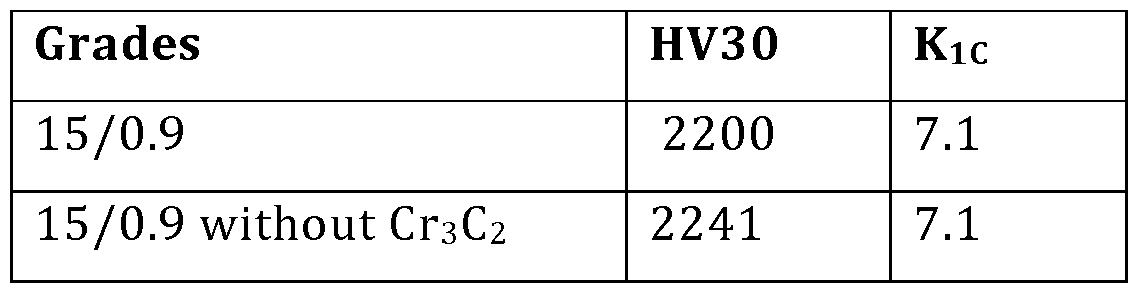
- Kic and HV30 were measured for the 15/0.9 variant with chromium carbide and the 15/0.9 variant without chromium carbide. Results are shown in Table 5.
- Figs. 7A - 7D are electron microscope images and Fig 7E is an EDX map for sample 15/0.9 without Cr3C 2 .
- the observations are the same as for the previous variant of 15/0.9; specifically the grains are round and about 1 ⁇ in size.
- the three phases can also be observed in Fig. 7E.
- Cr3C 2 is known to improve corrosion resistance but otherwise it would appear to have has no influence on the microstructure and composition, and hence no influence on the hardness and fracture toughness.
- Table 6 shows there was no significant change in hardness or fracture toughness.
- the 20/1.8 seemed to be the best variant relating to wear resistance, about 600 cm 3 , reliability in terms of no porosity on the wear path and
- the powder was dried in a Gallenkamp oven (model 135/30027) at 75°C, sieved through a 500 ⁇ mesh sieve and pressed into fargo pieces, 40 x 25 x 5 mm, using the Tox press (model STE 510-008-102). These samples were sintered at 1450°C under 50 bar high isostatic argon pressure in an FCT Anlagenbau GmbH Sinter-HIP furnace. Referring to Figs. 9 and 10, the HV30 and Kic between the three new variant and the grade 20/1.8 2 were compared. The results were as expected in terms of a reduction in hardness as the cobalt content was increased; however no improvement in fracture toughness was seen.
- the wear resistance results are consistent with the hardness results, i.e., the wear resistance decreases with the hardness.
- Mo + C molybdenum carbide in its elemental components
- a variant of the 15/0.9 composition comprising of 84.1% WC, 0.9% Co, 14.12% Mo, 0.88% C, 2.0% PEG was milled, pressed and then sintered at 1450°C under 50 bar high isostatic argon pressure.
- HV30 was measured to be 2185 and Kic was measured to be 7.2, which is comparable to the sample produced from the same composition using the addition of 15% Mo 2 C in the compound form.
Landscapes
- Chemical & Material Sciences (AREA)
- Engineering & Computer Science (AREA)
- Materials Engineering (AREA)
- Organic Chemistry (AREA)
- Ceramic Engineering (AREA)
- Manufacturing & Machinery (AREA)
- Structural Engineering (AREA)
- Mechanical Engineering (AREA)
- Metallurgy (AREA)
- Inorganic Chemistry (AREA)
- Physics & Mathematics (AREA)
- Thermal Sciences (AREA)
- Combustion & Propulsion (AREA)
- Chemical Kinetics & Catalysis (AREA)
- Powder Metallurgy (AREA)
- Ceramic Products (AREA)
- Drilling Tools (AREA)
Abstract
Description




Claims
Priority Applications (6)
| Application Number | Priority Date | Filing Date | Title |
|---|---|---|---|
| EP13834360.3A EP2906515B1 (en) | 2012-10-09 | 2013-10-09 | Low binder, wear resistant hard material |
| US14/434,156 US9624417B2 (en) | 2012-10-09 | 2013-10-09 | Low binder, wear resistant hard metal |
| JP2015536238A JP6271567B2 (en) | 2012-10-09 | 2013-10-09 | Wear resistant hard metal with low binder |
| KR1020157009679A KR102109227B1 (en) | 2012-10-09 | 2013-10-09 | Low binder, wear resistant hard metal |
| CN201380052263.0A CN104755446B (en) | 2012-10-09 | 2013-10-09 | Wear-resistant hard metal with low binder |
| ES13834360T ES2715824T3 (en) | 2012-10-09 | 2013-10-09 | Hard material with low binder content, wear resistant |
Applications Claiming Priority (2)
| Application Number | Priority Date | Filing Date | Title |
|---|---|---|---|
| US201261711705P | 2012-10-09 | 2012-10-09 | |
| US61/711,705 | 2012-10-09 |
Publications (3)
| Publication Number | Publication Date |
|---|---|
| WO2014057358A2 true WO2014057358A2 (en) | 2014-04-17 |
| WO2014057358A3 WO2014057358A3 (en) | 2014-06-05 |
| WO2014057358A8 WO2014057358A8 (en) | 2015-04-30 |
Family
ID=50193545
Family Applications (1)
| Application Number | Title | Priority Date | Filing Date |
|---|---|---|---|
| PCT/IB2013/002907 Ceased WO2014057358A2 (en) | 2012-10-09 | 2013-10-09 | Low binder, wear resistant hard metal |
Country Status (8)
| Country | Link |
|---|---|
| US (1) | US9624417B2 (en) |
| EP (1) | EP2906515B1 (en) |
| JP (1) | JP6271567B2 (en) |
| KR (1) | KR102109227B1 (en) |
| CN (1) | CN104755446B (en) |
| ES (1) | ES2715824T3 (en) |
| PT (1) | PT2906515T (en) |
| WO (1) | WO2014057358A2 (en) |
Cited By (2)
| Publication number | Priority date | Publication date | Assignee | Title |
|---|---|---|---|---|
| JP2015025178A (en) * | 2013-07-26 | 2015-02-05 | 株式会社日進製作所 | Porous sintered body |
| EP3418421A4 (en) * | 2016-02-19 | 2018-12-26 | JFE Steel Corporation | Cermet powder, protective film-coated member and method for producing same, and electroplating-bath roll and method for producing same |
Families Citing this family (2)
| Publication number | Priority date | Publication date | Assignee | Title |
|---|---|---|---|---|
| CN111809093A (en) * | 2020-07-21 | 2020-10-23 | 广东正信硬质材料技术研发有限公司 | Wear-resistant hard alloy and preparation method thereof |
| CN114790521A (en) * | 2022-04-28 | 2022-07-26 | 温州理工学院 | High-temperature-resistant wear-resistant metal part and preparation method thereof |
Family Cites Families (23)
| Publication number | Priority date | Publication date | Assignee | Title |
|---|---|---|---|---|
| US2091017A (en) * | 1929-05-16 | 1937-08-24 | American Cutting Alloys Inc | Tool alloy |
| DE764510C (en) * | 1933-03-01 | 1953-07-27 | Boehler & Co A G Geb | Hard metal alloys produced by sintering or sintering and immersing the auxiliary metals |
| FR2097258A5 (en) * | 1970-06-18 | 1972-03-03 | Ugine Carbone | |
| JPS5195907A (en) * | 1975-02-21 | 1976-08-23 | KOROSHUTSUSENKOKAIKOYOTAIMAMOSEICHOKOBITSUTO | |
| US4049380A (en) | 1975-05-29 | 1977-09-20 | Teledyne Industries, Inc. | Cemented carbides containing hexagonal molybdenum |
| CH653204GA3 (en) | 1983-03-15 | 1985-12-31 | ||
| EP0190346A4 (en) | 1984-08-08 | 1987-01-22 | Dow Chemical Co | NEW COMPOSITE CERAMIC WITH INCREASED HARDNESS. |
| AT385775B (en) * | 1985-08-08 | 1988-05-10 | Plansee Metallwerk | CORROSION-RESISTANT CARBIDE ALLOY |
| US4945073A (en) | 1988-09-20 | 1990-07-31 | The Dow Chemical Company | High hardness, wear resistant materials |
| US5215945A (en) * | 1988-09-20 | 1993-06-01 | The Dow Chemical Company | High hardness, wear resistant materials |
| JP3341776B2 (en) * | 1991-07-29 | 2002-11-05 | 三菱マテリアル株式会社 | Super hard alloy |
| ATE173030T1 (en) | 1991-09-02 | 1998-11-15 | Sumitomo Electric Industries | HARD ALLOY AND THEIR PRODUCTION |
| JPH05230588A (en) * | 1992-02-24 | 1993-09-07 | Sumitomo Electric Ind Ltd | Hard alloy |
| JP3231873B2 (en) * | 1993-01-29 | 2001-11-26 | 京セラ株式会社 | Silver sintered alloy and method for producing the same |
| US5778301A (en) * | 1994-05-20 | 1998-07-07 | Hong; Joonpyo | Cemented carbide |
| US5482670A (en) * | 1994-05-20 | 1996-01-09 | Hong; Joonpyo | Cemented carbide |
| CN1172168A (en) | 1996-07-30 | 1998-02-04 | 大韩重石株式会社 | Ultra-hard alloy for wrist watch and decoration |
| US6521353B1 (en) * | 1999-08-23 | 2003-02-18 | Kennametal Pc Inc. | Low thermal conductivity hard metal |
| US6777074B2 (en) | 2001-11-22 | 2004-08-17 | Kyocera Corporation | Composite construction |
| CN100510137C (en) | 2003-01-28 | 2009-07-08 | 慕容东林 | High hardness and wearable material |
| WO2007022514A2 (en) * | 2005-08-19 | 2007-02-22 | Genius Metal, Inc. | Hardmetal materials for high-temperature applications |
| CN100491568C (en) | 2007-05-14 | 2009-05-27 | 横店集团东磁股份有限公司 | Non-magnetic hard alloy with high hardness, high strength and low cost |
| US20110195834A1 (en) | 2010-02-05 | 2011-08-11 | Kennametal, Inc. | Wear Resistant Two-Phase Binderless Tungsten Carbide and Method of Making Same |
-
2013
- 2013-10-09 WO PCT/IB2013/002907 patent/WO2014057358A2/en not_active Ceased
- 2013-10-09 CN CN201380052263.0A patent/CN104755446B/en active Active
- 2013-10-09 EP EP13834360.3A patent/EP2906515B1/en active Active
- 2013-10-09 JP JP2015536238A patent/JP6271567B2/en active Active
- 2013-10-09 KR KR1020157009679A patent/KR102109227B1/en active Active
- 2013-10-09 US US14/434,156 patent/US9624417B2/en active Active
- 2013-10-09 ES ES13834360T patent/ES2715824T3/en active Active
- 2013-10-09 PT PT13834360T patent/PT2906515T/en unknown
Non-Patent Citations (1)
| Title |
|---|
| None |
Cited By (2)
| Publication number | Priority date | Publication date | Assignee | Title |
|---|---|---|---|---|
| JP2015025178A (en) * | 2013-07-26 | 2015-02-05 | 株式会社日進製作所 | Porous sintered body |
| EP3418421A4 (en) * | 2016-02-19 | 2018-12-26 | JFE Steel Corporation | Cermet powder, protective film-coated member and method for producing same, and electroplating-bath roll and method for producing same |
Also Published As
| Publication number | Publication date |
|---|---|
| US20150259590A1 (en) | 2015-09-17 |
| EP2906515A2 (en) | 2015-08-19 |
| EP2906515B1 (en) | 2018-12-19 |
| PT2906515T (en) | 2019-03-27 |
| WO2014057358A3 (en) | 2014-06-05 |
| JP6271567B2 (en) | 2018-01-31 |
| KR20150065732A (en) | 2015-06-15 |
| CN104755446B (en) | 2016-11-16 |
| ES2715824T3 (en) | 2019-06-06 |
| KR102109227B1 (en) | 2020-05-28 |
| JP2016500755A (en) | 2016-01-14 |
| US9624417B2 (en) | 2017-04-18 |
| WO2014057358A8 (en) | 2015-04-30 |
| CN104755446A (en) | 2015-07-01 |
Similar Documents
| Publication | Publication Date | Title |
|---|---|---|
| Furushima et al. | Control of WC grain sizes and mechanical properties in WC–FeAl composite fabricated from vacuum sintering technique | |
| US9522850B2 (en) | Method for manufacturing cubic boron nitride sintered body, and cubic boron nitride sintered body | |
| JP5876490B2 (en) | Method for producing a sintered composite | |
| JP6883276B2 (en) | Polycrystalline diamond sintered body tool with excellent interfacial bonding strength and its manufacturing method | |
| JPWO2014208447A1 (en) | Cermet, manufacturing method thereof and cutting tool | |
| US9624417B2 (en) | Low binder, wear resistant hard metal | |
| WO2012045761A2 (en) | Cemented carbide punch | |
| CN106480350A (en) | There is the hard carbide of cobalt molybdenum alloy binding agent | |
| JP6198142B2 (en) | Cutting tool made of cubic boron nitride super high pressure sintered material | |
| JP6390151B2 (en) | Composite sintered body | |
| JP6259978B2 (en) | Ni-based intermetallic compound sintered body and method for producing the same | |
| JP5988430B2 (en) | Cubic boron nitride sintered body and method for producing the same | |
| Ipek | Tribological properties of boron carbide reinforced copper based composites | |
| JP2020028929A (en) | Cutting tool made of cubic boron nitride based sintered body | |
| US10781141B2 (en) | Composition for a novel grade for cutting tools | |
| CN114761157A (en) | Microstructure of NbC-based hard alloy | |
| Huang et al. | Pulsed electric current sintered Fe3Al bonded WC composites | |
| De Oliveira et al. | Processing and characterization of a cobalt based alloy for use in diamond cutting tools | |
| JP4680684B2 (en) | Cemented carbide | |
| Mahaidin et al. | The effect of cobalt, vanadium carbide and PKS activated carbon addition on WC-Co Composite: A study using taguchi method | |
| Şimşir et al. | Investigation of the wear behavior of B4C reinforced Fe/Co matrix composites produced by hot press | |
| JP2003160831A (en) | Braking material made of cobalt sintered compact superior in abrasion resistance | |
| Iparraguirre et al. | Cermets and Ceramics: Microstructure and Abrasive Wear Resistance of Tic-WC-Co-Ni-Cr Cermets Obtained by Liquid Phase Sintering | |
| Öksüz et al. | Characterization and Mechanical Properties of PM Fe-Cu/SiCp Alloys |
Legal Events
| Date | Code | Title | Description |
|---|---|---|---|
| 121 | Ep: the epo has been informed by wipo that ep was designated in this application |
Ref document number: 13834360 Country of ref document: EP Kind code of ref document: A2 |
|
| WWE | Wipo information: entry into national phase |
Ref document number: 14434156 Country of ref document: US |
|
| ENP | Entry into the national phase |
Ref document number: 2015536238 Country of ref document: JP Kind code of ref document: A |
|
| NENP | Non-entry into the national phase |
Ref country code: DE |
|
| ENP | Entry into the national phase |
Ref document number: 20157009679 Country of ref document: KR Kind code of ref document: A |
|
| WWE | Wipo information: entry into national phase |
Ref document number: 2013834360 Country of ref document: EP |