WO2014015934A1 - Hydroxystatin derivatives for treatment of arthrosis - Google Patents
Hydroxystatin derivatives for treatment of arthrosis Download PDFInfo
- Publication number
- WO2014015934A1 WO2014015934A1 PCT/EP2013/001879 EP2013001879W WO2014015934A1 WO 2014015934 A1 WO2014015934 A1 WO 2014015934A1 EP 2013001879 W EP2013001879 W EP 2013001879W WO 2014015934 A1 WO2014015934 A1 WO 2014015934A1
- Authority
- WO
- WIPO (PCT)
- Prior art keywords
- methyl
- hydroxy
- pentanoylamino
- phenyl
- methylpentanoylamino
- Prior art date
- Legal status (The legal status is an assumption and is not a legal conclusion. Google has not performed a legal analysis and makes no representation as to the accuracy of the status listed.)
- Ceased
Links
- YFTXLFZIQJUVJQ-QJLOPRKMSA-N CC[C@H](C)[C@@H](C(N[C@@H](C(C)C)C(OCc1ccccc1)=O)=O)NC(C[C@@H]([C@H](Cc1ccccc1)N)O)=O Chemical compound CC[C@H](C)[C@@H](C(N[C@@H](C(C)C)C(OCc1ccccc1)=O)=O)NC(C[C@@H]([C@H](Cc1ccccc1)N)O)=O YFTXLFZIQJUVJQ-QJLOPRKMSA-N 0.000 description 1
- BGRLOVSVIURMCZ-GKORLBRISA-N CC[C@H](C)[C@@H](C(N[C@@H](C(C)C)C(OCc1ccccc1)=O)=O)NC(C[C@@H]([C@H](Cc1ccccc1)NC(OC(C)(C)C)=O)O)=O Chemical compound CC[C@H](C)[C@@H](C(N[C@@H](C(C)C)C(OCc1ccccc1)=O)=O)NC(C[C@@H]([C@H](Cc1ccccc1)NC(OC(C)(C)C)=O)O)=O BGRLOVSVIURMCZ-GKORLBRISA-N 0.000 description 1
Classifications
-
- C—CHEMISTRY; METALLURGY
- C07—ORGANIC CHEMISTRY
- C07K—PEPTIDES
- C07K5/00—Peptides containing up to four amino acids in a fully defined sequence; Derivatives thereof
- C07K5/04—Peptides containing up to four amino acids in a fully defined sequence; Derivatives thereof containing only normal peptide links
- C07K5/08—Tripeptides
-
- A—HUMAN NECESSITIES
- A61—MEDICAL OR VETERINARY SCIENCE; HYGIENE
- A61K—PREPARATIONS FOR MEDICAL, DENTAL OR TOILETRY PURPOSES
- A61K38/00—Medicinal preparations containing peptides
- A61K38/04—Peptides having up to 20 amino acids in a fully defined sequence; Derivatives thereof
- A61K38/05—Dipeptides
-
- A—HUMAN NECESSITIES
- A61—MEDICAL OR VETERINARY SCIENCE; HYGIENE
- A61K—PREPARATIONS FOR MEDICAL, DENTAL OR TOILETRY PURPOSES
- A61K38/00—Medicinal preparations containing peptides
- A61K38/04—Peptides having up to 20 amino acids in a fully defined sequence; Derivatives thereof
- A61K38/06—Tripeptides
-
- A—HUMAN NECESSITIES
- A61—MEDICAL OR VETERINARY SCIENCE; HYGIENE
- A61P—SPECIFIC THERAPEUTIC ACTIVITY OF CHEMICAL COMPOUNDS OR MEDICINAL PREPARATIONS
- A61P13/00—Drugs for disorders of the urinary system
- A61P13/08—Drugs for disorders of the urinary system of the prostate
-
- A—HUMAN NECESSITIES
- A61—MEDICAL OR VETERINARY SCIENCE; HYGIENE
- A61P—SPECIFIC THERAPEUTIC ACTIVITY OF CHEMICAL COMPOUNDS OR MEDICINAL PREPARATIONS
- A61P15/00—Drugs for genital or sexual disorders; Contraceptives
-
- A—HUMAN NECESSITIES
- A61—MEDICAL OR VETERINARY SCIENCE; HYGIENE
- A61P—SPECIFIC THERAPEUTIC ACTIVITY OF CHEMICAL COMPOUNDS OR MEDICINAL PREPARATIONS
- A61P17/00—Drugs for dermatological disorders
-
- A—HUMAN NECESSITIES
- A61—MEDICAL OR VETERINARY SCIENCE; HYGIENE
- A61P—SPECIFIC THERAPEUTIC ACTIVITY OF CHEMICAL COMPOUNDS OR MEDICINAL PREPARATIONS
- A61P17/00—Drugs for dermatological disorders
- A61P17/02—Drugs for dermatological disorders for treating wounds, ulcers, burns, scars, keloids, or the like
-
- A—HUMAN NECESSITIES
- A61—MEDICAL OR VETERINARY SCIENCE; HYGIENE
- A61P—SPECIFIC THERAPEUTIC ACTIVITY OF CHEMICAL COMPOUNDS OR MEDICINAL PREPARATIONS
- A61P17/00—Drugs for dermatological disorders
- A61P17/06—Antipsoriatics
-
- A—HUMAN NECESSITIES
- A61—MEDICAL OR VETERINARY SCIENCE; HYGIENE
- A61P—SPECIFIC THERAPEUTIC ACTIVITY OF CHEMICAL COMPOUNDS OR MEDICINAL PREPARATIONS
- A61P19/00—Drugs for skeletal disorders
- A61P19/02—Drugs for skeletal disorders for joint disorders, e.g. arthritis, arthrosis
-
- A—HUMAN NECESSITIES
- A61—MEDICAL OR VETERINARY SCIENCE; HYGIENE
- A61P—SPECIFIC THERAPEUTIC ACTIVITY OF CHEMICAL COMPOUNDS OR MEDICINAL PREPARATIONS
- A61P19/00—Drugs for skeletal disorders
- A61P19/08—Drugs for skeletal disorders for bone diseases, e.g. rachitism, Paget's disease
-
- A—HUMAN NECESSITIES
- A61—MEDICAL OR VETERINARY SCIENCE; HYGIENE
- A61P—SPECIFIC THERAPEUTIC ACTIVITY OF CHEMICAL COMPOUNDS OR MEDICINAL PREPARATIONS
- A61P25/00—Drugs for disorders of the nervous system
- A61P25/04—Centrally acting analgesics, e.g. opioids
-
- A—HUMAN NECESSITIES
- A61—MEDICAL OR VETERINARY SCIENCE; HYGIENE
- A61P—SPECIFIC THERAPEUTIC ACTIVITY OF CHEMICAL COMPOUNDS OR MEDICINAL PREPARATIONS
- A61P25/00—Drugs for disorders of the nervous system
- A61P25/14—Drugs for disorders of the nervous system for treating abnormal movements, e.g. chorea, dyskinesia
-
- A—HUMAN NECESSITIES
- A61—MEDICAL OR VETERINARY SCIENCE; HYGIENE
- A61P—SPECIFIC THERAPEUTIC ACTIVITY OF CHEMICAL COMPOUNDS OR MEDICINAL PREPARATIONS
- A61P25/00—Drugs for disorders of the nervous system
- A61P25/28—Drugs for disorders of the nervous system for treating neurodegenerative disorders of the central nervous system, e.g. nootropic agents, cognition enhancers, drugs for treating Alzheimer's disease or other forms of dementia
-
- A—HUMAN NECESSITIES
- A61—MEDICAL OR VETERINARY SCIENCE; HYGIENE
- A61P—SPECIFIC THERAPEUTIC ACTIVITY OF CHEMICAL COMPOUNDS OR MEDICINAL PREPARATIONS
- A61P29/00—Non-central analgesic, antipyretic or antiinflammatory agents, e.g. antirheumatic agents; Non-steroidal antiinflammatory drugs [NSAID]
-
- A—HUMAN NECESSITIES
- A61—MEDICAL OR VETERINARY SCIENCE; HYGIENE
- A61P—SPECIFIC THERAPEUTIC ACTIVITY OF CHEMICAL COMPOUNDS OR MEDICINAL PREPARATIONS
- A61P35/00—Antineoplastic agents
-
- A—HUMAN NECESSITIES
- A61—MEDICAL OR VETERINARY SCIENCE; HYGIENE
- A61P—SPECIFIC THERAPEUTIC ACTIVITY OF CHEMICAL COMPOUNDS OR MEDICINAL PREPARATIONS
- A61P37/00—Drugs for immunological or allergic disorders
- A61P37/02—Immunomodulators
-
- A—HUMAN NECESSITIES
- A61—MEDICAL OR VETERINARY SCIENCE; HYGIENE
- A61P—SPECIFIC THERAPEUTIC ACTIVITY OF CHEMICAL COMPOUNDS OR MEDICINAL PREPARATIONS
- A61P37/00—Drugs for immunological or allergic disorders
- A61P37/02—Immunomodulators
- A61P37/04—Immunostimulants
-
- A—HUMAN NECESSITIES
- A61—MEDICAL OR VETERINARY SCIENCE; HYGIENE
- A61P—SPECIFIC THERAPEUTIC ACTIVITY OF CHEMICAL COMPOUNDS OR MEDICINAL PREPARATIONS
- A61P37/00—Drugs for immunological or allergic disorders
- A61P37/02—Immunomodulators
- A61P37/06—Immunosuppressants, e.g. drugs for graft rejection
-
- A—HUMAN NECESSITIES
- A61—MEDICAL OR VETERINARY SCIENCE; HYGIENE
- A61P—SPECIFIC THERAPEUTIC ACTIVITY OF CHEMICAL COMPOUNDS OR MEDICINAL PREPARATIONS
- A61P37/00—Drugs for immunological or allergic disorders
- A61P37/08—Antiallergic agents
-
- A—HUMAN NECESSITIES
- A61—MEDICAL OR VETERINARY SCIENCE; HYGIENE
- A61P—SPECIFIC THERAPEUTIC ACTIVITY OF CHEMICAL COMPOUNDS OR MEDICINAL PREPARATIONS
- A61P43/00—Drugs for specific purposes, not provided for in groups A61P1/00-A61P41/00
-
- C—CHEMISTRY; METALLURGY
- C07—ORGANIC CHEMISTRY
- C07K—PEPTIDES
- C07K5/00—Peptides containing up to four amino acids in a fully defined sequence; Derivatives thereof
- C07K5/02—Peptides containing up to four amino acids in a fully defined sequence; Derivatives thereof containing at least one abnormal peptide link
- C07K5/0205—Peptides containing up to four amino acids in a fully defined sequence; Derivatives thereof containing at least one abnormal peptide link containing the structure -NH-(X)3-C(=0)-, e.g. statine or derivatives thereof
-
- C—CHEMISTRY; METALLURGY
- C07—ORGANIC CHEMISTRY
- C07K—PEPTIDES
- C07K5/00—Peptides containing up to four amino acids in a fully defined sequence; Derivatives thereof
- C07K5/04—Peptides containing up to four amino acids in a fully defined sequence; Derivatives thereof containing only normal peptide links
- C07K5/06—Dipeptides
-
- A—HUMAN NECESSITIES
- A61—MEDICAL OR VETERINARY SCIENCE; HYGIENE
- A61K—PREPARATIONS FOR MEDICAL, DENTAL OR TOILETRY PURPOSES
- A61K38/00—Medicinal preparations containing peptides
Definitions
- the present invention relates to compounds of the formula I and
- medicaments comprising at least one compound of the formula I for use in the treatment and / or prophylaxis of physiological and / or pathophysiological conditions in which
- Cathepsin D induction is involved, in particular for use in the treatment and / or prophylaxis of osteoarthritis, traumatic
- Cartilage injuries arthritis, pain, allodynia or hyperalgesia
- Osteoarthritis is the most prevalent joint disease in the world, and radiological evidence of osteoarthritis is found in the majority of over-65s. Despite this vital importance to the health system, the causes of osteoarthritis remain unclear and effective
- arthrosis refers to a "joint wear and tear" that exceeds the age-usual level
- Bone diseases such as osteoporosis seen. Osteoarthritis may also be the result of another disease, such as a
- Ostearthritis secondary arthritis or associated with congestion caused by overburdening (secondary inflammatory reaction) (activated arthritis).
- the Anglo-American literature distinguishes between osteoarthrosis (O. osteoarthritis [OA]), in which the destruction of the articular surfaces are likely to be mainly due to stress effects, and the arthritis (arthritis, Rheumatoid Arthritis [RA]), in which the joint degeneration by an inflammatory component in the foreground.
- osteoarthrosis O. osteoarthritis [OA]
- RA Rheumatoid Arthritis
- the Arthrosis alcaptonurica is an increased deposition of
- osteoarthritis which expresses an apparent absence of a causative disorder (HI Roach and S. Tilley, Bone and Osteoarthritis F. Bronner and MC Farach-Carson (Editors), Springer, Germany , Volume 4, 2007).
- Antibiotics of the type of gyrase inhibitors fluoroquinolones, such as ciprofloxacin, levofloxacin. These drugs cause complexation of magnesium ions in poorly vascularized tissues (hyaline articular cartilage, tendon tissue), resulting in irreversible damage to the connective tissue. These damages are more pronounced in children and adolescents usually in the growth phase.
- Nitric oxide temporarily increased. The same could be done by high
- the treatment of osteoarthritis has two goals. On the one hand the freedom from pain under normal stress and on the other hand, the prevention of mechanical restrictions or changes in a joint. In the long term, these goals can not be achieved by pain treatment as a purely symptomatic therapeutic approach, as this can not stop the progression of the disease. If the latter is to be achieved, cartilage destruction must be stopped. Since the articular cartilage can not regenerate in the adult patient, the elimination of pathogenetic factors such as joint dysplasias or malpositions that lead to increased punctual pressure of the
- the extracellular matrix which consists primarily of collagens, proteoglycans and water.
- the enzymes involved in extracellular matrix degradation are the metalloproteases, aggrecanases, and cathepsin enzymes. But other enzymes can in principle
- Neutrophil elastase, tryptase and chymase Neutrophil elastase, tryptase and chymase.
- Cathepsins belong to the papain superfamily of lysosomal proteases. Cathepsins are involved in the normal proteolysis and turnover of target proteins and tissues as well as in the initiation of
- cathepsins are synthesized as inactive zymogens on ribosomes and transferred into the lysosomal system. After proteolytic cleavage of the N-terminal propeptide, the cathepsin concentration in the acid medium of the lysosomes increases up to 1 mM and the cathepsins are released from the lysosomes into the extracellular medium.
- cathepsins one distinguishes the cysteine cathepsins B, C, H, F, K, L, O, S, V and W, the aspartyl cathepsins D and E and the serine cathepsin G. Examples of cathepsin inhibitors in clinical development
- Cathepsin K inhibitors for the treatment of arthritis and cathepsin S inhibitors for the treatment of arthritis, neuropathic pain and psoriasis.
- the aspartyl proteases also include HIV
- Cathepsin D is usually involved in the degradation of intracellular or phagocytosed proteins and thus plays an important role in protein metabolism (Heiseth, et al., Proc. Natl. Acad., USA 81, 3302-3306, 1984), in protein catabolism (Kay, et al., Intracellular Protein Catabolism (Mol. Katunuma, et al., 155-162, 1989) and in antigen processing (Guagliardi, et al., Nature, 343, 133-139, 1990; Van Noort, et al., J. Biol. Chem., 264 , 14159-14164, 1989).
- Elevated Cathepsin D levels are associated with a number of diseases. Increased cathepsin D levels correlate with poor prognosis in breast cancer and with increased cell invasion and increased risk of metastasis, as well as shorter recurrence-free
- Breast cancer is mediated by overexpression of the gene and altered protein processing.
- Increased levels of cathepsin D and other proteases, such as collagenase, produced in close proximity to a growing tumor could thereby degrade the extracellular matrix in the tumor environment, thereby mediating the detachment of tumor cells and invasion of new tissues via the lymphatic and circulatory systems (Liotta LA, Scientific American Feb: 54, 1992; Liotta LA and Stetler-Stevenson WG, Cancer Biol. 1: 99, 1990; Liaudet E., Cell Growth Differ. 6: 1045-1052, 1995; Ross JS, Am. J. Clin., Pathol 104: 36-41, 1995, Dickinson AJ, J. Urol., 154: 237-241, 1995).
- Cathepsin D is also associated with degenerative changes in the brain, such as Alzheimer's disease.
- catepsin D is associated with the cleavage of the amyloid ⁇ -protein precursor or a mutant precursor, which increases expression of the amyloid protein in transfected cells (Cataldo, AM et al., Proc. Natl. Acad. 87: 3861, 1990; Ladror, US et al., J. Biol. Chem. 269: 18422, 1994, Evin G., Biochemistry 34: 14185-14192, 1995).
- amyloid ⁇ -protein which results from the proteolysis of the amyloid ⁇ -protein precursor, leads to the formation of plaques in the brain and appears to be responsible for the development of Alzheimer's disease.
- Increased cathepsin D levels have also been found in the cerebrospinal fluid of Alzheimer's patients and high proteolytic activity of cathepsin D over the mutant amyloid ⁇ -protein precursor has been shown (Schwager, A. L, et al.
- Cathepsin D probably plays an essential role in the development of arthrosis at various levels.
- elevated mRNA levels of cathepsin D are measured (Clements DN et al., Arthritis Res. Ther. 2006; 8 (6): R158; Ritchlin C. et al , Scand J. Immunol., 40: 292-298, 1994).
- cathepsin D The lysosomal endopeptidase cathepsin D is the most abundant proteinase in the chondrocytes (Ruiz-Romero C. et al., Proteomics, 2005, 5 (12): 3048-59). The proteolytic activity of cathepsin D has also been demonstrated in cultured synovium from osteoarthritis patients (Bo G.P. et al., Clin. Rheumatol., 2009, 28 (2): 191-9) and also in
- Arthrosis also has a direct correlation between low pH in the joint tissue and the severity and progression of the disease
- Bovine or human are almost completely inhibited by pepstatin or ritonavir. This plays a vital role, if not one
- Aspartyl proteases or cathepsin D are often described as target proteins for drugs for the treatment of neurodegenerative diseases, cognitive disorders, dementia, Alzheimer's, cancer, malaria, HIV infection and diseases of the cardiovascular and vascular systems and inhibitors of aspartyl proteases or cathepsin D are used to treat them Diseases disclosed, for example, in WO 2009013293, EP 1987834, EP 1872780, EP 1867329, EP 1745778, EP 1745777, EP 1745776, WO 1999002153, WO 1999055687, US 6150416, WO
- Peptidic aspartyl protease inhibitors in particular renin inhibitors or modulators of the renin-angiotensin system are known, for example, from EP 77028, EP 161588, EP 337334 and EP 198271.
- Plasmepsin inhibitors for the treatment of malaria and Alzheimer's and prevention of invasion and metastasis of cancer cells are known for example from US 5849691. Although the known cathepsin D inhibitors and the two model compounds pepstatin and ritonavir effectively inhibit cathepsin D activity, they have a rather low selectivity over others
- renin-angiotensin system Aspartyl proteases on.
- RAS renin-angiotensin system
- the role of the renin-angiotensin system (RAS) in the regulation of blood pressure and fluid and electrolyte balance (Oparil, S. et al., N. Engl. J. Med. 1974; 291: 381-401 / 446-57) and the efficacy of renin and pepsin inhibitors in diseases of the cardiovascular and vascular systems is well known and so in particular for oral or systemic application of these low-selective cathepsin D inhibitors with numerous side effects and even in local application is due to the diffusion of
- the invention had the object of finding new compounds with valuable properties, in particular those that can be used for the production of medicaments.
- the object of the present invention was in particular to find new active ingredients and particularly preferably new cathepsin D inhibitors which can be used for the prevention and treatment of osteoarthritis and in particular have a high selectivity for cathepsin D in relation to renin and pepsin.
- new cathepsin D inhibitors should be found which are sufficiently stable at least in local or intra-articular administration.
- the hydroxystatin derivatives according to the invention inhibit cathepsin D in a highly effective manner, with a have high selectivity for cathepsin D to renin and pepsin and thus is to be expected in their use for the treatment of osteoarthritis with minor side effects.
- the compounds of the invention have a sufficiently good stability in synovial fluid, so that they are suitable for intra-articular application and thus for the treatment of osteoarthritis.
- the hydroxystatin derivatives according to the invention can reduce an inflammation-induced thermal hyperalgesia in a dose-dependent manner.
- the invention relates to hydroxystatin derivatives of general formula I,
- T is an unsubstituted or one, two, three or four times
- R 1 is ethyl, n-propyl, isopropyl, cyclopropyl, butyl, isobutyl, sec-butyl, cyclobutyl, tert-butyl, phenyl, benzyl, 2-oxetanyl, 3-oxetanyl, tetrahydrofuran-3-yl, tetrahydrofuran 2-yl, cyclopentyl, pentyl, methylsulfanylmethyl,
- Alkyl having 3-7 C atoms, wherein one, two or three CH 2 groups independently of each other by O, S, SO, SO 2 , NH, NCH 3 , -OCO, -NHCONH-, -NHCO-, - NRSO 2 A, - COO, -CONH, -NCH 3 CO-, -CONCH 3 - and / or replaced by - CH CH groups and / or 1-11 H-atoms by F and / or Cl can,
- R 1 is isopropyl, 2-butyl or iso-butyl
- R 2 is n-propyl, iso-propyl, 2-butyl or iso-butyl
- a particularly preferred subject of the invention are all
- R 1 is iso-propyl, 2-butyl or iso-butyl and
- R 2 is n-propyl, iso-propyl, 2-butyl or iso-butyl
- R 1 is iso-propyl
- R 2 is n-propyl, iso-propyl or 2-butyl
- R 1 is isopropyl with an S configuration of the chiral center to which the iso-propyl group is attached
- R 2 is n-propyl, iso-propyl or 2-butyl having an S-configuration of the chiral center to which the n-propyl, iso-propyl or 2-butyl group is attached,
- a preferred subject of the invention are all of the aforementioned
- Ai is a single bond or a peptide-linked one
- Amino acid residue selected from the group consisting of alanine,
- Glycine cyclopropylglycine, cyclobutylglycine, cyclopentylglycine, cyclohexylglycine, 3-oxetanylglycine, 3-oxetanylglycine,
- Ethylsulfanylmethylglycine 2-methylsulfanylethylglycine, 1-methylsulfanylethylglycine, valine, norvaline, aminobutyric acid, leucine,
- a 2 is a single bond or 1 to 2 peptide-like linked amino acid residues selected from the group consisting of alanine, glycine, cyclopropylglycine, cyclobutylglycine, cyclopentylglycine, Cyclohexylglycine, 3-oxetanylglycine, 3-oxetanylglycine,
- Ethylsulfanylmethylglycine 2-methylsulfanylethylglycine, 1-methylsulfanylethylglycine, valine, norvaline, aminobutyric acid, leucine, isoleucine, proline, tert-leucine, norleucine, methionine, phenylalanine, naphthylalanine, O-methyl-serine and O-ethyl-serine
- a particularly preferred subject of the invention are all
- R 1 is isopropyl, 2-butyl or iso-butyl
- Ai is a single bond or a peptide-linked amino acid residue selected from the group consisting of alanine, glycine,
- a 2 is a single bond or 1 to 2 peptide-like linked amino acid residues selected from the group consisting of alanine, glycine, cyclopropylglycine, cyclobutylglycine, cyclopentylglycine,
- R 1 is isopropyl
- Ai is a single bond or a peptide-linked amino acid residue selected from the group consisting of alanine, glycine,
- R 2 is n-propyl, iso-propyl, 2-butyl or iso-butyl,
- Ai is a single bond or a peptide-linked amino acid residue selected from the group consisting of alanine, glycine,
- a 2 is a single bond or 1 to 2 peptide-like linked amino acid residues selected from the group consisting of alanine, glycine, cyclopropylglycine, cyclobutylglycine, cyclopentylglycine,
- R 2 is n-propyl, iso-propyl or 2-butyl
- Ai is a single bond or a peptide-linked amino acid residue selected from the group consisting of alanine, glycine,
- a 2 is a single bond or 1 to 2 peptide-like linked amino acid residues selected from the group consisting of alanine, glycine, cyclopropylglycine, cyclobutylglycine, cyclopentylglycine,
- R 1 is isopropyl
- R 2 is n-propyl, iso-propyl or 2-butyl
- Ai is a single bond or a peptide-linked amino acid residue selected from the group consisting of alanine, glycine,
- a 2 is a single bond or 1 to 2 peptide-like linked amino acid residues selected from the group consisting of alanine, glycine, cyclopropylglycine, cyclobutylglycine, cyclopentylglycine,
- R 1 is isopropyl with an S configuration of the chiral center to which the iso-propyl group is bonded
- R 2 is n-propyl, iso-propyl or 2-butyl having an S-configuration of the chiral center to which the n-propyl, iso-propyl or 2-butyl group is attached
- Ai is a single bond or a peptide-linked amino acid residue selected from the group consisting of alanine, glycine,
- a 2 is a single bond or 1 to 2 peptide-like linked amino acid residues selected from the group consisting of alanine, glycine, cyclopropylglycine, cyclobutylglycine, cyclopentylglycine,
- Another very particularly preferred subject of the invention are all the aforementioned compounds of formula I, living
- R is isopropyl, 2-butyl or iso-butyl
- Ai leucine especially S-leucine or a single bond
- a 2 valine especially S-valine and their physiologically acceptable salts, derivatives, solvates, prodrugs and stereoisomers, including mixtures thereof in all ratios.
- Another very particularly preferred subject matter of the invention are all the abovementioned compounds of the formula I in which
- R 2 is n-propyl, iso-propyl, 2-butyl or iso-butyl,
- Ai leucine especially S-leucine or a single bond
- a 2 valine especially S-valine, as well as its physiological
- R 2 is n-propyl, iso-propyl or 2-butyl
- Ai leucine especially S-leucine or a single bond
- R 1 is isopropyl with an S configuration of the chiral center to which the iso-propyl group is bonded
- R 2 is n-propyl, iso-propyl or 2-butyl having an S-configuration of the chiral center to which the n-propyl, iso-propyl or 2-butyl group is attached,
- R iso-propyl with an S configuration of the chiral center to which the iso-propyl group is attached
- R 2 is n-propyl, iso-propyl or 2-butyl with an S configuration of the chiral
- Y is OH, O-benzyl, an unsubstituted or mono-, di- or trisubstituted by OR, NRR ', SOR, SO 2 R, SO 2 NRR ⁇ CN, COOR, CONRR', NRCOR ', NRCONR'R ", NRSO 2 R 'and / or NRCOR' substituted linear or branched alkyl having 1-10 C-atoms or cyclic alkyl having 3-10 C atoms, wherein one, two or three CH 2 groups independently of each other by O, S, SO, SO 2 , NR, -OCO, -NRCONR'-, -
- Y is OH, O-benzyl, an unsubstituted or monosubstituted by COOH, COOR or OH linear or branched alkyl having 1-10 C atoms or cyclic alkyl having 3-10 C atoms,
- X is an unsubstituted or mono- or disubstituted by T linear or branched alkyl having 1-10 C atoms or cyclic alkyl having 3-10 C atoms, wherein one, two or three CH 2 groups may be replaced independently by O. .
- R 1 is isopropyl with an S configuration of the chiral center to which the iso-propyl group is bonded
- R 2 is n-propyl, iso-propyl or 2-butyl with an S configuration of the chiral
- Y is OH, O-benzyl, an unsubstituted or monosubstituted by COOH, COOR or OH linear or branched alkyl having 1-10 C atoms or cyclic alkyl having 3-10 C atoms,
- X is an unsubstituted or mono- or disubstituted by T linear or branched alkyl having 1-10 C atoms or cyclic alkyl having 3-10 C atoms, wherein one, two or three CH 2 groups may be replaced independently of O,
- R 3 represents the radicals of the following amino acids:
- Natural amino acids alanine, arginine, asparagine, aspartic acid, cysteine, glutamine, glutamic acid, glycine, histidine, isoleucine, leucine, lysine, methionine, ornithine, phenylalanine, proline, serine, threonine, tryptophan, tyrosine and valine
- Non-natural amino acids such as cyclopropylglycine, cyclobutylglycine, cyclopentylglycine, cyclohexylglycine, 3-oxetanylglycine, 3-oxetanylglycine, tetrahydrofuran-3-ylglycine, tetrahydrofuran-2-ylglycine, ethylsulfanylmethylglycine, 2-methylsulfanylethylglycine, 1-methylsulfanylethylglycine, norvaline , Aminobutyric acid, tert-leucine, norleucine, naphthylalanine, O-methyl-serine, O-ethyl-serine and
- Hal means fluorine, chlorine, bromine or iodine, in particular fluorine or chlorine.
- Alkyl or A is unbranched (linear) or branched
- Hydrocarbon chain and has 1, 2, 3, 4, 5, 6, 7, 8, 9 or 10 C-atoms.
- A is preferably methyl, furthermore ethyl, propyl, isopropyl, butyl, isobutyl, sec-butyl or tert-butyl, furthermore also pentyl, 1-, 2- or 3-methylbutyl, 1, 1, 1, 2 or 2,2-dimethylpropyl, 1-ethylpropyl, hexyl, 1-, 2-, or 4-methylpentyl, 1, 1-, 1, 2-, 1, 3-, 2,2-, 2,3- or 3 , 3-dimethylbutyl, 1- or 2-ethylbutyl, 1-ethyl-1-methylpropyl, 1-ethyl-2-methylpropyl, 1,1,2 or 1,2,2-trimethylpropyl, linear or branched heptyl, octyl, Nonyl or decyl, more preferably, for example trifluoromethyl
- Cyclic alkyl or cycloalkyl is a cyclic hydrocarbon chain and has 3-10, preferably 3-7 C atoms and is preferably cyclopropyl, cyclobutyl, cyclopentyl, cyclohexyl or cycloheptyl.
- Heterocycle preferably denotes unsubstituted or mono-, di- or trisubstituted 2- or 3-furyl, 2- or 3-thienyl, 1-, 2- or 3-pyrrolyl, 1-, 2-, 4- or 5-imidazolyl, 1 -, 3-, 4- or 5-pyrazolyl, 2-, 4- or 5-oxazolyl, 3-, 4- or 5-isoxazolyl, 2-, 4- or 5-thiazolyl, 3-, 4- or 5- Isothiazolyl, 2-, 3- or 4-pyridyl, 2-, 4-, 5- or 6-pyrimidinyl, more preferably 1, 2,3-triazole-1, -4- or -5-yl, 1, 2 , 4-triazoM, -3 or 5-yl, 1 or 5-tetrazolyl, 1, 2,3-oxadiazol-4 or 5-yl, 1, 2,4-oxadiazol-3 or -5-yl, 1, 3,4-thiadiazol-2 or -5 -yl, 1, 2,4-thiadiazol-3 or
- heterocyclic radicals may also be partially or fully hydrogenated, e.g. also 2,3-dihydro-2-, -3-, -4- or -5-furyl, 2.5-
- 1,2,3,4-tetrahydro-1, -2, 3, 4, 5, 6, 7 or 8 isoquinolyl, 2, 3, 5 , 6-, 7- or 8-3,4-dihydro-2H-benzo [1,4] oxazinyl, more preferably 2,3-methylenedioxyphenyl, 3,4-methylenedioxyphenyl, 2,3-ethylenedioxyphenyl, 3,4-ethylenedioxyphenyl , 3,4- (difluoromethylenedioxy) phenyl, 2,3-dihydrobenzofuran-5- or 6-yl, 2,3- (2-oxomethylendioxy) -phenyl or also 3,4-dihydro-2H-1, 5-benzodioxepin-6 or -7-yl, further preferably 2,3-dihydrobenzofuranyl or 2,3-dihydro-2-oxofuranyl.
- the invention also relates to the optically active forms
- prodrug compounds By pharmaceutically or physiologically harmless derivatives is meant e.g. Salts of the compounds of the invention, as well as so-called prodrug compounds.
- prodrug compounds By prodrug compounds is meant by e.g. Alkyl or acyl groups (see also below amino and
- Suitable acid addition salts are inorganic or organic salts of all physiologically or pharmacologically acceptable acids, for example halides, in particular hydrochlorides or hydrobromides, lactates, sulfates, citrates, tartrates, maleates, fumarates, oxalates, acetates, phosphates, methyl sulfonates or p-toluenesulfonates.
- halides in particular hydrochlorides or hydrobromides, lactates, sulfates, citrates, tartrates, maleates, fumarates, oxalates, acetates, phosphates, methyl sulfonates or p-toluenesulfonates.
- Solvates of the compounds of the formula I are additions of inert solvent molecules to the compounds of the formula I.
- Solvates are, for example, hydrates, such as monohydrates or dihydrates or alkoxides, i. Addition compounds with alcohols such as methanol or ethanol.
- isotopes which are readily available commercially and can be incorporated by well known methods I to a compound of formula, include isotopes of water-cloth, carbon, nitrogen, oxygen, phosphorous, fluorine and chlorine such as 2 H, 3 H, 13 C, 4 C, 5 N, 18 O, 7 O, 31 P, 32 P, 35 S, 18 F and 36 CI, respectively.
- a compound of formula I, one of its prodrugs, or each a pharmaceutically acceptable salt thereof, containing one or more of the above isotopes and / or other isotopes of other atoms is provided as part of the present invention.
- An isotope-labeled compound of the formula I can be used in many useful ways.
- an isotopically labeled compound of Formula I in which, for example, a radioisotope such as 3 H or 14 C has been incorporated is suitable for assays for distribution of the drug and / or substrate tissue.
- radioisotopes ie tritium ( 3 H) and carbon-1 ( 14 C) are particularly preferred because of their ease of preparation and excellent detectability.
- Incorporation of heavier isotopes such as deuterium (2 H), into a compound of formula I has therapeutic advantages because of the higher stability of these isotopically-labeled compound in the metabolism. Higher stability in metabolism immediately means increased in vivo half-life or lower dosages, which under most circumstances would constitute a preferred embodiment of the present invention.
- An isotope-labeled compound of the formula I can usually be prepared by carrying out the procedures disclosed in the Synthetic Schemes and the related description, in the Examples and Preparation Section herein, substituting a readily available isotope-labeled reactant for a non-isotopically-labeled reactant.
- deuterium (2 H) For manipulating the oxidative metabolism of the compound across the primary kinetic isotope effect deuterium (2 H) can be incorporated into a compound of formula I.
- the primary kinetic isotope effect is a change in the rate of a chemical reaction due to the exchange of isotopic nuclei, which in turn is necessitated by the change in the covalent bond formation required following this isotopic exchange
- Ground state energies is caused.
- the replacement of a heavier isotope usually leads to a lowering of the ground state energy for a chemical bond and thus causes a reduction of the
- Hydrogen atoms attached to a nitrogen atom are prepared as a series of analogues in which various combinations of hydrogen atoms are replaced by deuterium atoms, so that some, Most or all of these hydrogen atoms are replaced by deuterium atoms.
- Half-life determinations provide a convenient and accurate measure of how much the improvement in resistance to oxidative metabolism has improved. In this way it is determined that due to such an exchange of hydrogen for deuterium the half life of the
- Output connection can be extended by up to 100%.
- Deuterium can be found e.g. Hanzlik et al., J. Org. Chem. 55, 3992-3997, 1990, Reider et al., J. Org. Chem. 52, 3326-3334, 1987, Foster, Adv. Drug Res. 40, 1985, Gillette et al., Biochemistry 33 (10), 2927-2937, 1994, and Jarman et al., Carcinogenesis 16 (4), 683-688, 1993.
- the invention also provides mixtures of the compounds of the formula I according to the invention, e.g. Mixtures of two diastereomers e.g. in the ratio 1: 1, 1: 2, 1: 3, 1: 4, 1: 5, 1: 10, 1: 100 or 1: 1000. Particularly preferred are mixtures of two stereoisomeric compounds of the formula I according to the invention.
- the invention furthermore relates to a process for the preparation of the compounds of the formula I, which comprises a) a compound of the formula II in which I 1 f I 2 , 13, U and the above
- an acid of a compound of formula I is converted by treatment with a base in one of its salts.
- the starting materials or starting compounds are generally known. If they are new, they can be prepared by methods known per se.
- the starting materials can, if desired, also be formed in situ, so that they are not isolated from the reaction mixture, but immediately further reacted to the compounds of formula I.
- the compounds of formula I are obtained by liberating them from their functional derivatives by solvolysis, in particular by hydrolysis or by hydrogenolysis.
- Preferred starting materials for the solvolysis or hydrogenolysis are those which take place at the site of one or more free amino, carboxyl and / or hydroxyl groups
- Hydroxy group carry a hydroxy protecting group. Besides, they are
- starting materials which carry a protected carboxy group at the site of a free carboxyl group.
- amino protecting group is well known and refers to groups that are capable of protecting an amino group from chemical
- Aralkyl groups e.g., benzyl, 4-nitrobenzyl, triphenylmethyl. Because the
- Amino protecting groups are removed after the desired reaction or reaction sequence, their nature and size is otherwise not critical, but are preferably those having 1-20, especially 1-8 C-atoms.
- acyl group is to be understood in the broadest sense in the context of the present process, which encompasses aliphatic,
- acyl groups derived from araliphatic, aromatic or heterocyclic carboxylic acids or sulfonic acids, and in particular alkoxycarbonyl-, Aryloxycarbonyl and especially aralkoxycarbonyl groups.
- alkoxycarbonyl-, Aryloxycarbonyl and especially aralkoxycarbonyl groups are alkanoyl such as acetyl, propionyl, butyluryl,
- Aralkanoyl such as phenylacetyl, aroyl such as benzoyl or toluyl, aryoxyaklkanoyl such as phenoxyacetyl, alkyoxycarbonyl such as methoxycarbonyl, ethoxycarbonyl, 2,2,2-trichloroethoxycarbonyl, BOC, 2-iodoethoxycaronyl, aralkyloxycarbonyl such as CBZ, 4-methoxybenzyloxycarbonyl or FMOC.
- aryoxyaklkanoyl such as phenoxyacetyl
- alkyoxycarbonyl such as methoxycarbonyl, ethoxycarbonyl, 2,2,2-trichloroethoxycarbonyl, BOC, 2-iodoethoxycaronyl
- aralkyloxycarbonyl such as CBZ, 4-methoxybenzyloxycarbonyl or FMOC.
- Acyl groups are CBZ, FMOC, benzyl and acetyl.
- acid protecting group or "carboxyl protecting group” is also well known and refers to groups which are capable of protecting a -COOH group from chemical reactions, but which are readily removable after the desired chemical reaction at other sites of the molecule have been carried out. Typical is the use of esters in place of the free acids e.g. Substituted and unsubstituted alkyl esters (such as methyl, ethyl, tert-butyl and their substituted derivatives), substituted and unsubstituted benzyl esters or silyl esters.
- the type and size of the acid protecting groups is not critical, but those with 1-20, in particular 1-10 C atoms are preferred.
- hydroxy protecting group is also well known and refers to groups which are suitable for protecting a hydroxy group from chemical reactions, but which are readily removable after the desired chemical reaction has been carried out elsewhere in the molecule
- Groups are the abovementioned unsubstituted or substituted aryl, aralkyl or acyl groups, and also alkyl groups
- Hydroxy protecting groups are not critical, but preferred are those having 1-20, in particular 1-10 C atoms.
- Examples of hyrdoxy protecting groups include benzyl, p-nitrobenzoyl, p-toluenesulfonyl and acetyl, with benzyl and acetyl being preferred.
- Other typical examples of amino, acid, and hydroxy protecting groups can be found, for example, in Greene's Protective Groups in Organic
- Derivatives succeed, depending on the protecting group used, e.g. with strong acids, useful with trifluoroacetic acid or perchloric acid, but also with other strong inorganic acids such as hydrochloric or sulfuric acid, strong organic acids such as trichloroacetic acid or sulfonic acids such as benzoyl or p-toluene sulfonic acid.
- strong acids useful with trifluoroacetic acid or perchloric acid
- other strong inorganic acids such as hydrochloric or sulfuric acid
- strong organic acids such as trichloroacetic acid or sulfonic acids such as benzoyl or p-toluene sulfonic acid.
- trichloroacetic acid or sulfonic acids such as benzoyl or p-toluene sulfonic acid.
- the presence of an additional inert solvent and / or a catalyst is possible, but not always necessary.
- the starting materials can be reacted, if appropriate in the presence of an inert solvent.
- Suitable inert solvents are e.g. Heptane, hexane, petroleum ether, DMSO, benzene, toluene, xylene, trichlorethylene, 1, 2-dichloroethanetetra-chlorocarbon, chloroform or dichloromethane; Alcohols such as methanol, ethanol, isopropanol, n-propanol, n-butanol or tert-butanol; Ethers, such as diethyl ether, diisopropyl ether (preferred for substitution on
- Ethyl glycol ethylene glycol dimethyl ether (diglyme); Ketones such as acetone or butanone; Amides such as acetamide, dimethylacetamide, N-methylpyrrolidone (NMP) or dimethylformamide (DMF); Nitriles such as acetonitrile; Esters such as ethyl acetate, Carboxylic acids or acid anhydrides, such as. B. such as acetic acid or
- Acetic anhydride nitro compounds such as nitromethane or nitrobenzene, if appropriate, mixtures of said solvents with each other or mixtures with water.
- the amount of solvent is not critical, preferably 10 g to 500 g of solvent per g of the compound of formula I to be reacted are added.
- an acid-binding agent e.g. an alkali metal or alkaline earth metal hydroxide, carbonate or bicarbonate or other alkali metal or alkaline earth metal salts of weak acids,
- a potassium, sodium or calcium salt preferably a potassium, sodium or calcium salt, or the addition of an organic base such as triethylamine, dimethylamine, pyridine or quinoline, or an excess of the amine component.
- Suitable reaction temperatures are at temperatures of 0 to 40 ° C, preferably at 5 to 25 ° C.
- the duration of the reaction depends on the selected reaction conditions. In general, the reaction time is 0.5 hours to 10 days, preferably 1 to 24 hours. When using a microwave, the reaction time can be reduced to values of 1 to 60 minutes.
- preparation are also prepared by known methods as described in the literature (for example in standard works such as Houben-Weyl, Methoden der organischen Chemie, Georg-Thieme-Verlag, Stuttgart), e.g. under reaction conditions which are known and suitable for the said reactions. In this case, one can make use of known per se, not described here variants.
- An acid of the formula I can with a base in the associated
- Suitable bases for this reaction are, in particular, bases which yield physiologically acceptable salts.
- the acid of formula I can be treated with a base (e.g., sodium or potassium hydroxide or carbonate) in the corresponding metal, especially alkali or alkaline earth metal or in the
- ammonium salt to be converted.
- organic bases which yield physiologically acceptable salts, e.g. Ethanolamine.
- a base of the formula I can be converted with an acid into the associated acid addition salt, for example by reacting equivalent amounts of the base and the acid in an inert
- Solvents such as ethanol and subsequent evaporation.
- Particularly suitable acids for this reaction are those which yield physiologically acceptable salts.
- inorganic acids can be used sulfuric acid, nitric acid, hydrohalic acids such as hydrochloric acid or hydrobromic acid, phosphoric acids such as orthophosphoric acid, sulfamic acid, and also organic acids,
- Sulfuric acids e.g. Formic acid, acetic acid, propionic acid,
- Citric acid gluconic acid, ascorbic acid, nicotinic acid, isonicotinic acid, methane or ethanesulfonic acid, ethanedisulfonic acid, 2-hydroxysulfonic acid, benzenesulfonic acid, p-toluenesulfonic acid, naphthalene mom- and
- disulfonic acids or laurylsulfuric acid can be used for isolation and / or purification of the compounds of formula I.
- Salts with physiologically unacceptable acids e.g. Picrates, can be used for isolation and / or purification of the compounds of formula I.
- Another object of the invention is therefore the use of compounds of the invention for the manufacture of a medicament for the treatment and / or prophylaxis of diseases caused by cathepsin D and / or by cathepsin D-mediated signal transduction mediated and / or propagated.
- the invention thus also relates in particular to a medicament comprising at least one compound according to the invention and / or one of its physiologically acceptable salts, derivatives, solvates, prodrugs and stereoisomers, including mixtures thereof in all ratios for use in the treatment and / or prophylaxis of physiological and / or or pathophysiological conditions.
- physiological and / or pathophysiological conditions associated with cathepsin D.
- Physiological and / or pathophysiological conditions are physiological and / or pathophysiological conditions that are medically relevant, such as illnesses and / or pathophysiological conditions.
- Another object of the invention is a medicament containing at least one compound of the invention and / or one of its physiologically acceptable salts, derivatives, solvates, prodrugs and stereoisomers, including mixtures thereof in all proportions for use in the treatment and / or prophylaxis of physiological and / or pathophysiological conditions selected from the group consisting of osteoarthritis, traumatic cartilage injuries and arthritis, especially rheumatoid arthritis.
- Another object of the invention is a medicament containing at least one compound of the invention and / or one of its physiologically acceptable salts, derivatives, solvates, podrugs and stereoisomers, including mixtures thereof in all proportions for use in the treatment and / or prophylaxis of physiological and / or pathophysiological conditions selected from the group consisting of Alzheimer's disease, Huntington's disease, mucolipidosis, cancer, especially breast cancer, contact dermatitis, late-type of
- Hypersensitivity reaction inflammation, endometriosis, scarring, benign prostatic hyperplasia, osteosarcoma, rickets, skin diseases such as psoriasis, immunological diseases, autoimmune diseases and immunodeficiency diseases.
- diseases such as psoriasis, immunological diseases, autoimmune diseases and immunodeficiency diseases.
- brain cancer lung cancer, squamous cell cancer, bladder cancer, stomach cancer, pancreatic cancer, liver cancer, kidney cancer, colorectal cancer, breast cancer, head cancer, cervical cancer, esophageal cancer, gynecological cancer, thyroid cancer, lymphoma, chronic
- Leukemia and acute leukemia are considered to be cancerous diseases, all of which are usually counted among the group of hyperproliferative disorders.
- Pain is a complex sensory perception that, as an acute event, has the character of a warning and guidance signal, as a chronic one
- Stimuli that can trigger pain include pressure, heat, cold or inflammation.
- Hyperalgesia is a form of hyperesthesia, the generic term for excessive sensitivity to a stimulus. Allodynia in medicine is a sensation of pain that is triggered by stimuli that usually do not cause pain.
- Another object of the invention is thus a medicament containing at least one compound of the invention and / or one of its physiologically acceptable salts, derivatives, solvates, prodrugs and
- Stereoisomers including mixtures thereof, in all proportions for use in the treatment and / or prophylaxis of physiological and / or pathophysiological conditions selected from the group consisting of pain, allodynia and hyperalgesia.
- a particularly preferred object of the invention is a
- Medicaments containing at least one compound according to the invention and / or one of its physiologically acceptable salts, derivatives, solvates, Prodrugs and stereoisomers, including mixtures thereof in all proportions for use in the treatment and / or prophylaxis of physiological and / or pathophysiological conditions selected from the group consisting of osteoarthritis, traumatic cartilage injuries, arthritis, pain, allodynia and hyperalgesia.
- the above disclosed medicaments include a corresponding use of the compounds of the invention for the manufacture of a medicament for the treatment and / or prophylaxis of physiological and / or pathophysiological conditions.
- Medicaments a corresponding method for the treatment and / or prophylaxis of physiological and / or above
- the compounds of the invention preferably exhibit a beneficial biological activity which is readily detectable in enzyme assays and animal studies as described in the Examples. In such enzyme-based assays, the inventive compounds show and effect
- Antibody prefers an inhibitory effect, usually documented by IC 50 values in a suitable range, preferably in the micromolar range, and more preferably in the nanomolar range.
- the compounds according to the invention can be administered to humans or animals, in particular mammals, such as monkeys, dogs, cats, rats or mice and in the therapeutic treatment of the
- compounds of the invention can be used to isolate and study the activity or expression of cathepsin D.
- they are particularly suitable for use in diagnostic procedures for diseases related to impaired cathepsin D activity.
- Another object of the invention is therefore the use of the compounds of the invention for the isolation and study of the activity or expression of cathepsin D or as binders and inhibitors of cathepsin D.
- the compounds according to the invention can be radiolabeled, for example.
- radioactive examples of radioactive
- Markings are 3 H, 14 C, 231 1 and 125 l.
- a preferred labeling method is the iodogen method (Fraker et al., 1978).
- the compounds of the invention can be labeled by enzymes, fluorophores and chemophores.
- enzymes are alkaline phosphatase, ⁇ -galactosidase and glucose oxidase, an example of a fluorophore is fluorescein, an example of a chemophore is luminol and automated detection systems for example for fluorescent
- Dyes are described, for example, in US 4,125,828 and US 4,207,554.
- the compounds of the formula I can be used for the preparation of pharmaceutical preparations, in particular by non-chemical means. In this case, they are brought into a suitable dosage form together with at least one solid, liquid and / or semi-liquid carrier or excipient and optionally in combination with one or more further active ingredient (s).
- Another object of the invention are therefore pharmaceutical preparations containing at least one compound of formula I and / or their physiologically acceptable salts, derivatives, solvates, prodrugs and stereoisomers, including mixtures thereof in all proportions.
- the invention also relates, in particular, to those pharmaceutical preparations which contain further excipients and / or adjuvants, as well as those pharmaceutical preparations which contain at least one further active pharmaceutical ingredient.
- the invention also relates in particular to a method for
- a pharmaceutical preparation characterized in that a compound of formula I and / or one of its physiologically acceptable salts, derivatives, solvates, and stereoisomers, including mixtures thereof in all proportions together with a solid, liquid or semi-liquid carrier or excipient and optionally with another drug active in a suitable dosage form brings.
- the pharmaceutical preparations according to the invention can be used as medicaments in human or veterinary medicine.
- the patient or host may belong to any mammalian species, e.g. A primate species, especially humans; Rodents, including mice, rats and hamsters; Rabbits; Horses, cattle, dogs, cats, etc. Animal models are of interest for experimental studies, providing a model for the treatment of human disease.
- Suitable carrier substances are organic or inorganic substances which are suitable for enteral (for example oral), parenteral or topical administration and which do not react with the new compounds, for example water, vegetable oils (such as sunflower oil or
- Cod-liver oil benzyl alcohols, polyethylene glycols, gelatin, carbohydrates such as Lactose or starch, magnesium stearate, talc, lanolin or Vaseline.
- excipients are suitable for the desired drug formulation is familiar to the person skilled in the art on the basis of his specialist knowledge.
- solvents e.g. Water, physiological saline or alcohols, e.g. Ethanol, propanol or glycerol, sugar solutions such as glucose or mannitol solutions or a mixture of said solvents,
- Gel formers, tablet excipients and other active substance carriers may, for example, be lubricants, stabilizers and / or wetting agents, emulsifiers, salts for influencing the osmotic pressure, antioxidants,
- Dispersants Dispersants, defoamers, buffer substances, flavoring and / or flavoring agents, preservatives,
- compositions or medicaments according to the invention may contain one or more further active ingredients, for example one or more vitamins.
- Medicaments contain one or more further active ingredients and / or one or more potentiators (adjuvants).
- pharmaceutically acceptable refers to drugs, precipitation reagents, carriers, excipients, stabilizers, solvents, and other agents which inhibit the administration of the pharmaceutical compositions obtained therefrom without undesirable effects
- the compounds according to the invention preferably have the advantage that direct use is possible and before use of the
- a particularly preferred subject of the invention are also pharmaceutical preparations comprising at least one compound of the invention in precipitated non-crystalline, precipitated crystalline or in dissolved or suspended form, and optionally excipients and / or adjuvants and / or other pharmaceutical active ingredients.
- the compounds according to the invention make it possible to prepare highly concentrated formulations without it
- the compounds and / or their physiologically acceptable salts and solvates can also be lyophilized and the obtained lyophilisates
- Aqueous preparations can be prepared by
- Dissolved or suspended solutions containing adjuvants Dissolved or suspended solutions containing adjuvants.
- the solutions or suspensions according to the invention having a pH of 4 to 10, preferably having a pH of 5 to 9, and an osmolality of 250 to 350 mOsmol / kg can be prepared.
- the pharmaceutical preparation can thus be administered largely painlessly intravenously, intraarterially, intraarticularly, subcutaneously or percutaneously directly.
- the preparation may also contain infusion solutions, e.g. Glucose solution, isotonic saline or Ringer's solution, which may also contain other active ingredients, are added, so that even larger amounts of active ingredient can be applied.
- compositions according to the invention can also be selected from
- the preparations of the invention are physiologically well tolerated, easy to prepare, precisely metered and preferably over the duration of storage and transport and multiple freezing and
- Thawing processes in terms of content, decomposition products and aggregates stable can be used at refrigerator temperature (2-8 ° C) and at
- Room temperature (23-27 ° C) and 60% relative humidity (RH) preferably stable over a period of at least three months to two years.
- an effective amount means the amount of a drug or pharmaceutical agent which elicits a biological or medical response in a tissue, system, animal or human, e.g. sought or desired by a researcher or physician.
- therapeutically effective amount means an amount which, compared to a corresponding subject who has not received this amount, results in: improved curative treatment, cure, prevention or elimination of a disease, a
- a medical condition a condition, a disorder or a prevention of side effects, or even the reduction of the progression of a disease, a disease or a disorder.
- terapéuticaally effective amount also includes the amounts effective to increase normal physiological function.
- Drugs are the compounds of the invention and / or its physiologically acceptable salts and solvates usually used analogously to known, commercially available preparations or preparations, preferably in dosages between 0.1 and 500 mg, in particular 5 and 300 mg per application unit.
- the daily dosage is preferably between 0.001 and 250 mg / kg, in particular 0.01 and 100 mg / kg of body weight.
- the preparation may be administered once or several times a day, for example two, three or four times a day. However, the individual dosage for a patient depends on a large number
- One measure of the uptake of a drug into an organism is its bioavailability.
- the drug When the drug is administered intravenously to the organism in the form of a solution for injection, its absolute bioavailability, i. the proportion of the drug remaining unchanged in systemic blood, i. into the big circuit, at 100%.
- the active ingredient is generally present as a solid in the formulation and must therefore first dissolve so that it blocks the entry barriers, for example the
- Gastrointestinal tract the oral mucosa, nasal membranes or the skin, especially the stratum corneum, can overcome or be absorbed by the body.
- Pharmacokinetic data i. to
- Bioavailability can be obtained analogously to the method of J. Shaffer et al., J. Pharm. Sciences, 88 (1999), 313-318.
- such drugs can be with one of the im
- Drugs may be administered for administration by any suitable route, for example oral (including buccal or oral). sublingual), rectal, pulmonary, nasal, topical (including buccal, sublingual or transdermal), vaginal or parenteral (including subcutaneous, intramuscular, intravenous, intradermal and especially intraarticular) routes.
- Such drugs can be prepared by any method known in the pharmaceutical art, such as by bringing the drug into association with the carrier (s) or excipient (s).
- parenteral administration is preferably suitable.
- parenteral administration is preferably suitable.
- the intra-articular application is particularly preferred.
- a preferred subject matter of the invention is thus also the use of a pharmaceutical preparation according to the invention for intraarticular administration in the treatment and / or prophylaxis of physiological and / or pathophysiological conditions selected from the group consisting of osteoarthritis, traumatic cartilage injuries, arthritis, pain, allodynia or hyperalgesia ,
- the intra-articular application has the advantage that the compound according to the invention can be applied directly into the vicinity of the articular cartilage in the synovial fluid and from there into the cartilaginous tissue
- compositions according to the invention can diffuse into it.
- Pharmaceutical compositions according to the invention can thus also be injected directly into the joint space and thus exert their effect directly at the intended site of action.
- Compounds according to the invention are also suitable for the preparation of medicaments to be administered parenterally with controlled, uniform and / or delayed release of active ingredient (slow-release, sustained-release, controlled release). Thus, they are also suitable for the production of depot formulations, which are advantageous for the patient, since an application is necessary only at longer time intervals.
- Medicaments adapted for parenteral administration include aqueous and non-aqueous sterile injection solutions which
- Formulation is made isotonic with the blood or synovial fluid of the recipient to be treated included; and aqueous and non-aqueous sterile suspensions which may contain suspending agents and thickeners.
- the formulations may be in single dose or
- Multi-dose containers e.g. sealed ampoules and vials, and stored in the freeze-dried (lyophilized) state, such that only the addition of the sterile carrier liquid, e.g. Water for injections, needed immediately before use.
- the sterile carrier liquid e.g. Water for injections
- Injection solutions and suspensions prepared by formulation can be prepared from sterile powders, granules and tablets.
- the compounds of the invention can also be in the form of
- Liposome delivery systems such as e.g. small unilamellar vesicles, large unilamellar vesicles and multilamellar vesicles.
- Liposomes can be prepared from various phospholipids, such as e.g. Cholesterol, stearylamine or phosphatidylcholines.
- the compounds of the invention may also be coupled with soluble polymers as targeted drug carriers.
- soluble polymers may include polyvinylpyrrolidone, pyran copolymer, polyhydroxypropylmethacrylamidephenol, polyhydroxyethylaspartamidephenol or polyethyleneoxide polylysine substituted with palmitoyl radicals.
- the compounds of the invention to a class of biological
- degradable polymers which are suitable for obtaining a controlled release of a drug, for example polylactic acid, polyepsilone-caprolactone, polyhydroxybutyric acid, polyorthoesters, polyacetals, polydihydroxypyrans, polycyanoacrylates, polylactic acid, polymers such as conjugates between dextran and methacrylates, polyphosphoesters, various polysaccharides and polyamines, and poly-s-caprolactone, Albumin, chitosan, collagen or modified gelatin, and cross-linked or amphipathic block copolymers of hydrogels.
- a drug for example polylactic acid, polyepsilone-caprolactone, polyhydroxybutyric acid, polyorthoesters, polyacetals, polydihydroxypyrans, polycyanoacrylates, polylactic acid, polymers such as conjugates between dextran and methacrylates, polyphosphoesters, various polysaccharides and polyamines, and poly-s-caprolactone, Albumin,
- enteral administration serve in particular tablets, dragees, capsules, syrups, juices, drops or suppositories, for topical use ointments, creams, pastes, lotions, gels, sprays, foams, aerosols, solutions (eg solutions in alcohols such as ethanol or isopropanol, acetonitrile, DMF, dimethylacetamide, 1, 2-propanediol or mixtures thereof with each other and / or with water) or powder.
- solutions eg solutions in alcohols such as ethanol or isopropanol, acetonitrile, DMF, dimethylacetamide, 1, 2-propanediol or mixtures thereof with each other and / or with water
- liposomal Especially for topical applications are also liposomal
- the active ingredient When formulated into an ointment, the active ingredient can be used with either a paraffinic or water miscible cream base. Alternatively, the active ingredient may be formulated into a cream with an oil-in-water cream base or a water-in-oil base.
- Drugs adapted for transdermal administration may be administered as discrete plasters for prolonged, intimate contact with the epidermis of the recipient.
- the drug may be delivered from the patch by iontophoresis as generally described in Pharmaceutical Research, 3 (6), 318 (1986).
- compositions according to the invention in addition to the above-mentioned particularly mentioned constituents, may contain other agents customary in the art with respect to the respective type of pharmaceutical formulation.
- the invention is also a set (kit) consisting of separate packages of
- kits contains suitable containers, such as boxes or boxes, individual bottles, bags or ampoules.
- suitable containers such as boxes or boxes, individual bottles, bags or ampoules.
- the set may e.g. separate ampoules containing, in each case, an effective amount of a
- compositions of the invention may be used to provide additive or synergistic effects in certain known therapies, and / or may be used to treat them
- the pharmaceutical preparations according to the invention may contain, in addition to the compounds according to the invention, further active pharmaceutical ingredients, e.g. for use in the treatment of osteoarthritis other cathepsin D inhibitors, NSAIDS, cox-2 inhibitors, glucocorticoids, hyaluronic acid, azathioprine, methotrexate, anti-CAM antibodies such as anti-ICAM-1 antibody, FGF-18.
- the pharmaceutical preparations according to the invention may contain, in addition to the compounds according to the invention, other active pharmaceutical ingredients which are known to the person skilled in their treatment.
- the cancer treatment disclosed here can be used as a therapy with a
- Chemotherapy may include the use of one or more agents of the following categories of anti-tumor agents:
- antiproliferative / antineoplastic / DNA damaging agents and combinations thereof as used in medical oncology such as alkylating agents (e.g., cisplatin, parboplatin,
- Anti-metabolites e.g., antifolates such as fluoropyrimidines such as 5-fluorouracil and tegafur, raltitrexed, methotrexate, cytosine arabinoside, hydroxyurea and gemcitabine
- Anti-tumor antibiotics e.g., anthracyclines such as adriamycin, bleomycin, doxorubicin, daunomycin, epirubicin, idarubicin, mitomycin-C, dactinomycin and mithramycin
- antimitotic agents e.g., vinca alkaloids such as vincristine, vinblastine, vindesine and vinorelbine, and
- Taxoids such as Taxol and Taxotere
- Topoisomerase inhibitors e.g.
- Epipodophyllotoxins such as etoposide and teniposide, amsacrine, topotecan, irinotecan and camptothecin) and cell differentiating agents (e.g., all-trans retinoic acid, 13-cis retinoic acid and fenretinide);
- cytostatic agents such as anti-estrogens (eg tamoxifen, toremifene, raloxifene, droloxifene and iodoxyfen), estrogen receptor regulators (eg fulvestrant), antiandrogens (eg bicalutamide, flutamide, nilutamide and cyproterone acetate), LHRH antagonists or LHRH agonists (eg goserelin, Leuprorelin and buserelin), progesterone (eg
- Megestrol acetate Megestrol acetate
- aromatase inhibitors e.g., anastrozole, letrozole, vorazole and exemestane
- inhibitors of 5oc-reductase such as finasteride
- agents that inhibit cancer invasion e.g., metalloproteinase inhibitors such as marimastat, and inhibitors of urokinase plasminogen.
- Growth factor antibodies e.g. the anti-erbb2 antibody trastuzumab [Herceptin TM] and the anti-erbbl
- Tyrosine kinase inhibitors and serine / threonine kinase inhibitors e.g.
- Inhibitors of the epidermal growth factor family eg EGFR family Tyrosine kinase inhibitors such as N- (3-chloro-4-fluorophenyl) -7-methoxy-6- (3-morpholinopropoxy) quinazolin-4-amine (gefitinib, AZD1839), N- (3-ethynyl-phenyl) -6, 7-bis (2-methoxyethoxy) quinazolin-4-amine (erlotinib, OSI-774) and 6-acrylamido-N- (3-chloro-4-fluorophenyl) -7- (3-morpholinopropoxy) quinazolin-4-amine ( Cl 1033), eg inhibitors of the platelet-derived growth factor family and, for example, inhibitors of the hepatocyte growth factor family;
- Tyrosine kinase inhibitors such as N- (3-chloro-4-fluorophenyl) -7-methoxy-6- (3-morpholino
- Growth factors of the vascular endothelium inhibit (e.g., the anti-vascular endothelial cell growth factor antibody bevacizumab
- vascular damaging agents such as combretastatin A4 and
- antisense therapies e.g. those aimed at the above mentioned purposes, such as ISIS 2503, an anti-Ras antisense;
- gene therapy approaches including e.g. Approaches to replace abnormal altered genes such as abnormal p53 or abnormal BRCA1 or BRCA2, gene-directed enzyme pro-drug (GDEPT) approaches such as those using cytosine deaminase, thymidine kinase or a bacterial nitroreductase enzyme, and approaches that increase a patient's tolerance for chemotherapy or radiation therapy, such as multi-drug resistance therapy and
- GDEPT gene-directed enzyme pro-drug
- immunotherapy approaches including e.g. Ex vivo and in vivo approaches to increase the immunogenicity of a patient's tumor cells such as transfection with cytokines, such as interleukin 2, interleukin 4 or
- Granulocyte macrophage colony stimulating factor approaches to reducing T cell anergy, approaches to using transferred immune cells such as cytokine transfected dendritic cells, approaches to Use of cytokine-transfected tumor cells and approaches to
- the tabulated medicines may preferably but not
- Oxaliplatin ZD-0473 (AnorMED) Spiroplatin Lobaplatin (Aetema)
- Topotecan Elsamitrucin (Spectrum) Dexrazoxanet (TopoTarget) J-07088 (Merck & Co) Pixantron (Novuspharrna) BNP-1350 (BioNumerik) Rebeccamycin Analog CKD-602 (Chong Kun Dang) (Exelixis) KW-2170 (Kyowa Hakko) BBR-3576 (Novuspharrna)
- Vinblastine PG-TXL Cell Therapeutics
- Vincristine IDN 5109 (Bayer)
- Rhizoxin (Fujisawa) D 24851 (ASTA Medica) Mivobulin (Warner-Lambert) ER-86526 (Eisai)
- Epothilone B Novartis
- ZD 6126 AstraZeneca
- PEG-paclitaxel Enzon
- T 138067 Tularik
- AZ10992 Asahi
- Auristatin PE (Teikoku NeuroPharma)
- BMS Azaepothilone B
- BMS 247550 BMS
- BNP-7787 BioNumerik
- BMS 184476 BMS
- CA-4 prodrug OXiGENE
- BMS 188797 BMS
- Dolastatin-10 NrH
- Taxoprexin (Protarga) CA-4 (OXiGENE)
- Histone acetyl-tinedinalin Pfizer
- pivaloyloxymethyl butyrate transferase SAHA Adon Pharma
- CTL CLL-Thera (Vasogen) melanoma vaccine
- Tyrosinekinase Imatinib Novartis
- Kahalid F PharmaMar
- Leflunomide Ser / Phar CEP-701 (Cephalon)
- GCS-IOO gal3 antagonist, inhibitor, allocate
- Efaproxiral oxygenator, receptor agonist, Leo
- PI-88 Heparanase Inhibitor, Antagonist, TransMolecular
- Histamine (histamine H2 (osteoclast inhibitor, receptor agonist, Maxim) Yamanouchi)
- SR-31747 (IL-1 antagonist, rituximab (CD20 antibody, Sanofi-Synthelabo) Genentech)
- WX-UK1 Plasmidogen SN-4071 (sarcoma agent, activator inhibitor, Wilex) Signature BioScience)
- PBI-1402 PMN stimulant, TransMID-107 TM
- SRL-172 T-cell stimulant, Doranidazole (apoptosisproSR Pharma) moter, Pola)
- TLK-286 glutthione-S-CHS-828 (cytotoxic transferase inhibitor, Telik) agent, Leo)
- PT-00 growth factor trans-retinoic acid (agonist, point therapeutics) differentiator, NIH
- Bryostatin-1 (PKC stimulant, apomine (apoptosis
- CDA-II apoptosis promoter
- urocidin apoptosis promoter
- SDX-101 apoptosis promoter, Ro-31-7453 (apoptosisproSalmedix) moter, La Roche)
- the mass signals were determined on an Agilent plant 1200:
- Example 2 Preparation of the compounds of the invention
- the compounds of the invention are for. B. representable by methods known in the art by the following synthesis sequences. The examples given describe the synthesis, but do not limit it to the examples.
- X 'or Y' are a group X or Y which may be protected by a protective group
- the BOC protecting group is subjected to appropriate
- Steps may be followed by the removal of further protecting groups, e.g. the hydrogenolysis of Z-protecting groups or of benzyl esters to the free acid in the presence of Pd / C.
- further protecting groups e.g. the hydrogenolysis of Z-protecting groups or of benzyl esters to the free acid in the presence of Pd / C.
- reaction mixture was diluted with water and THF and suction filtered to remove the catalyst.
- the filtrate was concentrated in vacuo and lyophilized to completely remove the water.
- the residue was treated with heptane in an ultrasonic bath, filtered off with suction and dried. Analogous treatments were done with dioxane and then with MTBE.
- the reference substance was pepstatin A (Sigma-Aldrich).
- the substrate used was MCA-GKPILFFRLK (Dnp) dR-NH 2 (Enzo Life Sciences, Lörrach).
- Cathepsin D (Sigma-Aldrich) isolated from the human liver was used as enzyme in a final concentration of 1.4 nM.
- the assay was performed in 100 mM sodium acetate buffer, 1.25% (v / v) DMSO, 0.25% (w / v) chaps, pH 5.5.
- Example 5 Cartilage Explant Assay To investigate the effect of potential cathepsin D inhibitors on cartilage degradation, a pH-induced model based on bovine
- GAGs glycosaminoglycans
- Dimethylmethylene blue hydrochloride makes use of the decrease in absorption at 633 nm. Since it is also possible to work at very low GAG concentrations, no dye / GAG complex precipitates even after a long incubation of DMMB with GAG, as happens with other measuring methods sometimes after only a short time. To determine the concentration, a calibration line with chondroitin sulfate is carried. Based on the GAG values, an IC 50 value can be calculated, i. a
- DMEM DMEM without FBS
- the pH is adjusted by addition of MES and monitored at the pH meter, adding 1% Pen / Strep and 30 pg / ml
- the substances are used in the desired concentration and cultured for 3 days.
- the compounds to be tested are tested in a first experiment in a concentration of 1 ⁇ and 1% DMSO. Substances one
- the cell culture supernatants (200 ⁇ ) are either measured directly or stored at -20 ° C. To ensure accurate determination of concentration (pg / ml GAG in supernatant) of GAG, the readings must be in the linear range of the standard curve. To ensure this, various dilutions are routinely presented (1/5, 1/10, 1/20, 1/40). The dilutions are made with medium and submitted to automated (Hamilton) in a 384 multiwell plate (15 ⁇ ). Also automated (or with multichannel pipette) add 60 ⁇ DMMB solution. A fast color reaction is performed which is then measured at 633 nm with a plate reader (e.g., Envision).
- a plate reader e.g., Envision
- the data are provided by the MTP reader as csv or xls files and stored as raw data based on this format (xls) or used to calculate the percentage effect of the respective connection.
- Pepstatin control (pH 5.5 + 0.01 ⁇ pepstatin A). This substance Non-specifically blocks the activity of most proteases and thus determines the maximum possible effect of a compound.
- a carrageenan solution (CAR, 1%, 50 ⁇ ) was injected on one side intra-articularly into a rat knee joint.
- the non-injected side was used for control purposes.
- Six animals per group were used.
- the swelling was determined by means of a micrometer screw (medial-lateral on the knee joint) and the thermal hyperalgesia was determined by means of a directed infrared light source according to the Hargreaves method (Hargreaves et al., 1988) on the underside of the foot. Since the place of inflammation (knee joint) from the place of
- Measurement (lower paw) is called secondary thermal hyperalgesia, the mechanisms of which are important for finding effective analgesics.
- Test animal (as an expression of reaching the pain threshold) or when reaching a given maximum temperature by automatic
- Hyperalgesia is expressed as the difference in withdrawal times between the inflamed and non-inflamed paws.
- the specific cathepsin D inhibitor could reduce the extent of
- Example 7 Stability of the compounds according to the invention in bovine synovial fluid
- bovine explants for the diffusion chamber or other assays
- cattle hooves metalacarpal joints
- bovine knee are used.
- the synovial fluid can be made from both
Landscapes
- Health & Medical Sciences (AREA)
- Chemical & Material Sciences (AREA)
- Life Sciences & Earth Sciences (AREA)
- Organic Chemistry (AREA)
- Medicinal Chemistry (AREA)
- General Health & Medical Sciences (AREA)
- Veterinary Medicine (AREA)
- Bioinformatics & Cheminformatics (AREA)
- Pharmacology & Pharmacy (AREA)
- Engineering & Computer Science (AREA)
- Animal Behavior & Ethology (AREA)
- Public Health (AREA)
- Chemical Kinetics & Catalysis (AREA)
- General Chemical & Material Sciences (AREA)
- Nuclear Medicine, Radiotherapy & Molecular Imaging (AREA)
- Immunology (AREA)
- Proteomics, Peptides & Aminoacids (AREA)
- Biophysics (AREA)
- Molecular Biology (AREA)
- Genetics & Genomics (AREA)
- Biochemistry (AREA)
- Epidemiology (AREA)
- Gastroenterology & Hepatology (AREA)
- Biomedical Technology (AREA)
- Neurology (AREA)
- Neurosurgery (AREA)
- Rheumatology (AREA)
- Physical Education & Sports Medicine (AREA)
- Dermatology (AREA)
- Crystallography & Structural Chemistry (AREA)
- Orthopedic Medicine & Surgery (AREA)
- Pain & Pain Management (AREA)
- Psychology (AREA)
- Pulmonology (AREA)
- Urology & Nephrology (AREA)
- Reproductive Health (AREA)
- Endocrinology (AREA)
- Psychiatry (AREA)
- Hospice & Palliative Care (AREA)
- Transplantation (AREA)
Description
Hydroxystatin-Derivate zur Behandlung von Arthrose Hydroxystatin derivatives for the treatment of osteoarthritis
Die vorliegende Erfindung betrifft Verbindungen der Formel I und The present invention relates to compounds of the formula I and
insbesondere Arzneimittel enthaltend wenigstens eine Verbindung der Formel I zur Verwendung bei der Behandlung und/oder Prophylaxe von physiologischen und/oder pathophysiologischen Zuständen, an deren in particular medicaments comprising at least one compound of the formula I for use in the treatment and / or prophylaxis of physiological and / or pathophysiological conditions in which
Auslösung Cathepsin D beteiligt ist, insbesondere zur Verwendung bei der Behandlung und/oder Prophylaxe von Arthrose, traumatischen Cathepsin D induction is involved, in particular for use in the treatment and / or prophylaxis of osteoarthritis, traumatic
Knorpelverletzungen Arthritis, Schmerz, Allodynie oder Hyperalgesie. Cartilage injuries arthritis, pain, allodynia or hyperalgesia.
Hintergrund der Erfindung Background of the invention
Arthrose ist die weltweit am weitesten verbreitete Gelenkserkrankung und radiologische Hinweise auf Arthrose findet man in der Mehrheit der über 65- Jährigen. Trotz dieser wesentlichen Bedeutung für das Gesundheitssystem bleiben die Ursachen der Arthrose bislang unklar und wirksame Osteoarthritis is the most prevalent joint disease in the world, and radiological evidence of osteoarthritis is found in the majority of over-65s. Despite this vital importance to the health system, the causes of osteoarthritis remain unclear and effective
vorbeugende Maßnahmen weiterhin ein entferntes Ziel. Die Verringerung des Gelenkspaltes (bedingt durch die Zerstörung des Gelenkknorpels), verbunden mit Veränderungen im subchondralen Knochen und preventive action continues to be a distant goal. The reduction of the joint space (due to the destruction of the articular cartilage), associated with changes in the subchondral bone and
Osteophytenbildung sind die radiologischen Charakteristiken der Osteophyte formation are the radiological characteristics of
Erkrankung. Für den Patienten stehen jedoch Schmerzen Illness. However, there is pain for the patient
(belastungsabhängige und nächtliche Ruheschmerzen) mit nachfolgenden Funktionseinschränkungen im Vordergrund. Diese sind es auch, die den Patienten in die soziale Isolierung mit entsprechenden Folgeerkrankungen treiben. (stress-related and nocturnal rest pain) with subsequent functional limitations in the foreground. These are also the ones that drive the patient into social isolation with corresponding complications.
Der Begriff Arthrose bezeichnet nach einer nicht-amtlichen Definition in Deutschland einen„Gelenkverschleiß", der das altersübliche Maß übersteigt. Ursächlich werden ein Übermaß an Belastung (etwa erhöhtes According to a non-official definition in Germany, the term arthrosis refers to a "joint wear and tear" that exceeds the age-usual level
Körpergewicht), angeborene oder traumatisch bedingte Ursachen, wie Fehlstellungen der Gelenke oder auch knöcherne Deformierungen durch Knochenerkrankungen wie Osteoporose gesehen. Die Arthrose kann ebenfalls als Folge einer anderen Erkrankung, beispielsweise einer Body weight), congenital or traumatic causes, such as deformities of the joints or even bony deformities Bone diseases such as osteoporosis seen. Osteoarthritis may also be the result of another disease, such as a
Gelenkentzündung (Arthritis) entstehen (sekundäre Arthrose) oder mit überlastungsbedingter Ergussbildung (sekundäre Entzündungsreaktion) einhergehen (aktivierte Arthrose). Die anglo-amerikanische Fachliteratur unterscheidet zwischen der Osteoarthrose (engl. Osteoarthritis [OA]), bei welcher die Zerstörung der Gelenkflächen wahrscheinlich hauptsächlich auf Belastungseinwirkungen zurückzuführen sind, und der Arthritis (engl, arthritis, rheumatoid arthritis [RA]), bei welcher die Gelenkdegeneration durch eine Entzündungskomponente im Vordergrund steht. Arthritis (secondary arthritis) or associated with congestion caused by overburdening (secondary inflammatory reaction) (activated arthritis). The Anglo-American literature distinguishes between osteoarthrosis (O. osteoarthritis [OA]), in which the destruction of the articular surfaces are likely to be mainly due to stress effects, and the arthritis (arthritis, Rheumatoid Arthritis [RA]), in which the joint degeneration by an inflammatory component in the foreground.
Grundsätzlich unterscheidet man die Arthrose auch nach ihrer Ursache. Der Arthrosis alcaptonurica liegt eine vermehrte Ablagerung von Basically, one distinguishes the arthritis according to their cause. The Arthrosis alcaptonurica is an increased deposition of
Homogenitinsäure in Gelenken bei vorbestehender Alkaptonurie zugrunde. Bei der hämophilen Arthrose liegen regelmäßige intraartikuläre Blutungen bei Hämophilie (Blutergelenk) vor. Die Arthrosis urica wird durch den mechanischen Einfluss von Uratkristallen (Harnsäure) auf den gesunden Knorpel hervorgerufen (W. Pschyrembel et al.: Klinisches Wörterbuch mit klinischen Syndromen und einem Anhang Nomina Anatomica. Verlag Walter de Gruyter & Co, 253. Auflage, 1977). Homogenitic acid in joints in pre-existing Alkaptonurie basis. In haemophilic arthrosis there are regular intra-articular haemophilia hemorrhages. Arthrosis urica is caused by the mechanical influence of urate crystals (uric acid) on healthy cartilage (W. Pschyrembel et al .: Clinical Dictionary with Clinical Syndromes and an appendix Nomina Anatomica, published by Walter de Gruyter & Co, 253rd Edition, 1977). ,
Klassische Ursache einer Arthrose stellt die Dysplasie von Gelenken dar. Am Beispiel der Hüfte wird deutlich, dass die mechanisch am meisten belastete Zone bei einer physiologischen Hüftstellung eine deutlich größere Fläche darstellt, als bei einer dysplastischen Hüfte. Die Belastungen durch die auf das Gelenk einwirkenden Kräfte sind von der Gelenkform jedoch weitgehend unabhängig. Sie verteilen sich im Wesentlichen auf die The classic cause of osteoarthritis is the dysplasia of joints. Using the hip as an example, it becomes clear that the zone with the greatest mechanical stress is significantly larger in a physiological hip position than in a dysplastic hip. However, the loads due to the forces acting on the joint are largely independent of the joint shape. They are essentially distributed over the
Hauptbelastungszone(n). Dadurch wird bei einer kleineren Zone eine höhere Druckbelastung als bei einer größeren auftreten. Die biomechanische Druckbelastung des Gelenkknorpels ist somit bei einer dysplastischen Hüfte größer als bei physiologischer Hüftstellung. Diese Gesetzmäßigkeit wird allgemein ursächlich für das gehäufte Auftreten arthrotischer Veränderungen an von der anatomischen Idealform abweichenden, tragenden Gelenken gesehen. Primary-load zone (s). As a result, a higher pressure load will occur at a smaller zone than at a larger one. The biomechanical pressure load of the articular cartilage is thus greater for a dysplastic hip than for a physiological hip position. This law is generally the cause of the increased occurrence of arthrotic changes seen on the anatomical ideal form deviating, supporting joints.
Sind die Folgen einer Verletzung für einen vorzeitigen Verschleiß Are the consequences of an injury for premature wear
verantwortlich, so spricht man von einer posttraumatischen Arthrose. Als weitere Ursachen einer sekundären Arthrose werden mechanische, entzündliche, metabolische, chemische (Chinolone), trophische, hormonelle, neurologische und genetische Gründe diskutiert. In den meisten Fällen wird als Diagnose jedoch eine idiopatische Arthrose angegeben, womit der Arzt ein scheinbares Fehlen einer ursächlichen Erkrankung zum Ausdruck bringt (H. I. Roach und S. Tilley, Bone and Osteoarthritis F. Bronner und M. C. Farach-Carson (Editors), Verlag Springer, Band 4, 2007). responsible, it is called a post-traumatic arthritis. Other causes of secondary arthrosis include mechanical, inflammatory, metabolic, chemical (quinolone), trophic, hormonal, neurological and genetic reasons. However, in most cases the diagnosis is idiopathic osteoarthritis, which expresses an apparent absence of a causative disorder (HI Roach and S. Tilley, Bone and Osteoarthritis F. Bronner and MC Farach-Carson (Editors), Springer, Germany , Volume 4, 2007).
Medikamentöse Ursachen für eine Arthrose können beispielsweise For example, medicinal causes of osteoarthritis
Antibiotika vom Typ der Gyrasehemmer (Fluorchinolone, wie Ciprofloxacin, Levofloxacin) sein. Diese Arzneimittel führen in schlecht vaskularisierten Geweben (hyaliner Gelenkknorpel, Sehnengewebe) zu einer Komplexierung von Magnesium-Ionen, was zur Folge hat, dass irreversible Schäden am Bindegewebe entstehen. Diese Schäden sind bei Kindern und Jugendlichen in der Regel in der Wachstumsphase ausgeprägter. Tendopathien undAntibiotics of the type of gyrase inhibitors (fluoroquinolones, such as ciprofloxacin, levofloxacin). These drugs cause complexation of magnesium ions in poorly vascularized tissues (hyaline articular cartilage, tendon tissue), resulting in irreversible damage to the connective tissue. These damages are more pronounced in children and adolescents usually in the growth phase. Tendopathies and
Arthropathien sind bekannte Nebenwirkungen dieser Medikamentenklasse. Beim Erwachsenen führen diese Antibiotika nach Informationen von unabhängigen Pharmakologen und Rheumatologen zu einem Arthropathies are known side effects of this class of drugs. In adults, these antibiotics lead to information from independent pharmacologists and rheumatologists
beschleunigten physiologischen Abbau des hyalinen Gelenkknorpels (M. Menschik et al., Antimicrob. Agents Chemother. 41 , 1997, S. 2562-2565; M. Egerbacher et al., Arch. Toxicol. 73, 2000, S. 557-563; H. Chang et al., Scand. J. Infect. Dis. 28, 1996, S. 641-643; A. Chaslerie et al..Therapie 47, 1992, S. 80). Auch eine langjährige Behandlung mit Phenprocoumon kann durch Abnahme der Knochendichte bei Belastungen der accelerated physiological degradation of hyaline articular cartilage (Menschik, M., et al., Antimicrob. Agents Chemother., 41, 1997, pp. 2562-2565, Egerbacher et al., Arch. Toxicol., 73, 2000, pp. 557-563; Chang, Chang et al., Scand., J. Infect., Dis., 28, 1996, pp. 641-643; A. Chaslerie et al., Therapy 47, 1992, p.80). Even a long-term treatment with phenprocoumon can be achieved by reducing the bone density during stress
Gelenkbinnenstruktur eine Arthrose begünstigen. Neben dem Alter sind mechanische Überbelastungen, (Mikro-) Traumata, durch Verlust der Sicherungsmechanismen verursachte Destabilisierungen der Gelenke, sowie genetische Faktoren als Risikofaktoren für Joint internal structure favor osteoarthritis. In addition to age, mechanical overloads, (micro) traumas, joint destabilization caused by loss of safety mechanisms, as well as genetic factors are risk factors for
Osteoarthrose bekannt. Jedoch sind weder die Entstehung noch Osteoarthritis known. However, neither the genesis nor
Interventionsmöglichkeiten vollständig geklärt (H. I. Roach und S. Tilley, Bone and Osteoarthritis F. Bronner und M. C. Farach-Carson (Editors), Verlag Springer, Band 4, 2007). Intervention possibilities completely clarified (H. I. Roach and S. Tilley, Bone and Osteoarthritis F. Bronner and M.C. Farach Carson (editors), publishing house Springer, volume 4, 2007).
In einem von Arthrose betroffenen Gelenk ist der Gehalt von In a joint affected by osteoarthritis, the content of
Stickstoffmonoxid zeitweise erhöht. Ähnliches konnte durch hohe Nitric oxide temporarily increased. The same could be done by high
mechanische Reizung von Knorpelgewebe beobachtet werden (P. Das et al., Journal of Orthopaedic Research 15, 1997, S. 87-93. A. J. Farrell et al. Annais of the Rheumatic Diseases 51 , 1992, S. 1219-1222; B. Fermor et al., Journal of Orthopaedic Research 19, 2001 , S. 729-737), wohingegen eine mäßige mechanische Stimulation sich eher positiv auswirkt. Damit sind mechanische Krafteinwirkungen ursächlich an dem Voranschreiten der Osteoarthrose beteiligt (X. Liu et al., Biorheology 43, 2006, S. 183-190). mechanical irritation of cartilage tissue are observed (P. Das et al., Journal of Orthopedic Research 15, 1997, pp. 87-93, AJ Farrell et al., Annais of the Rheumatic Diseases 51, 1992, pp. 1219-1222; Fermor et al., Journal of Orthopedic Research 19, 2001, pp. 729-737), whereas moderate mechanical stimulation tends to have a positive effect. Thus mechanical forces are causally involved in the progression of osteoarthrosis (X. Liu et al., Biorheology 43, 2006, pp. 183-190).
Grundsätzlich verfolgt die Therapie der Arthrose zwei Ziele. Zum einen die Schmerzfreiheit unter üblicher Belastung und zum anderen die Verhinderung mechanischer Einschränkungen oder Veränderungen eines Gelenkes. Diese Ziele können langfristig nicht durch eine Schmerzbehandlung als rein symptomatischer Therapieansatz erreicht werden, da durch diese das Voranschreiten der Erkrankung nicht aufgehalten werden kann. Soll letzteres erreicht werden, muss die Knorpelzerstörung gestoppt werden. Da sich der Gelenksknorpel beim erwachsenen Patienten nicht regenerieren kann, ist die Beseitigung pathogenetischer Faktoren wie Gelenkdysplasien oder Fehlstellungen, die zu vermehrter punktueller Druckbelastung des Basically, the treatment of osteoarthritis has two goals. On the one hand the freedom from pain under normal stress and on the other hand, the prevention of mechanical restrictions or changes in a joint. In the long term, these goals can not be achieved by pain treatment as a purely symptomatic therapeutic approach, as this can not stop the progression of the disease. If the latter is to be achieved, cartilage destruction must be stopped. Since the articular cartilage can not regenerate in the adult patient, the elimination of pathogenetic factors such as joint dysplasias or malpositions that lead to increased punctual pressure of the
Gelenkknorpels führen, zusätzlich enorm wichtig. Articular cartilage lead, in addition enormously important.
Schließlich versucht man mit medikamentöser Hilfe die Finally one tries with medical help the
Degenerationsprozesse im Knorpelgewebe zu verhindern oder zu stoppen. Wesentlich für den Funktionszustand des Gelenkknorpels und damit für dessen Widerstandsfähigkeit gegenüber Belastungen ist die extrazelluäre Matrix, die in erster Line aus Kollagenen, Proteoglykanen und Wasser besteht. Zu den Enzymen, die an der Degradation der extrazellulären Matrix beteiligt sind, zählen vor allem die Metalloproteasen, Aggrecanasen und die Cathepsin-Enzyme. Aber auch weitere Enzyme können prinzipiell To prevent or stop degeneration processes in cartilage tissue. Essential for the functional state of the articular cartilage and thus for its resistance to stress is the extracellular matrix, which consists primarily of collagens, proteoglycans and water. Among the enzymes involved in extracellular matrix degradation are the metalloproteases, aggrecanases, and cathepsin enzymes. But other enzymes can in principle
Knorpelmatrix abbauen, beispielhaft werden Plasmin, Kallikrein, Reduce cartilage matrix, exemplified plasmin, kallikrein,
Neutrophilelastase, Tryptase und Chymase genannt. Neutrophil elastase, tryptase and chymase.
Cathepsine gehören der Papain-Superfamilie der lysosomalen Proteasen an. Cathepsine sind an der normalem Proteolyse und dem Umsatz von Zielproteinen und Geweben beteiligt, sowie an der Initiierung von Cathepsins belong to the papain superfamily of lysosomal proteases. Cathepsins are involved in the normal proteolysis and turnover of target proteins and tissues as well as in the initiation of
proteolytischen Kaskaden und Proenmzyaktivierungen. Darüber hinaus sind sie an der MHC Klasse II Expression beteiligt (Baldwin (1993) Proc. Natl. Acad. Sei., 90: 6796-6800; Mixuochi (1994) Immunol. Lett, 43:189-193). Eine abnorme Cathepsin-Expression kann allerdings zu schwerwiegenden Erkrankungen führen. So konnte eine erhöhte Cathepsin-Expression in Krebszellen, beispielsweise bei Brust-, Lungen-, Prostata-, Glioblastom-, und Kopf- und Halskrebs nachgewiesen werden und es konnte gezeigt werden, dass Cathepsine mit einem ungenügenden Therapieerfolg bei Brust-, Lungen-, Kopf- und Halskrebs, sowie Gehirntumoren assoziiert sind (Kos et al. (1998) Oncol. Rep., 5:1349-1361 ; Yan et al. (1998) Biol. Chem., 379:113- 123; Mort et al. ; (1997) Int. J. Biochem. Cell Biol., 29: 715-720; Friedrick et al. (1999) Eur. J Cancer, 35:138-144). Außerdem ist augenscheinlich eine abnorme Cathepsin-Expression an der Ausbildung von entzündlichen und nicht-entzündlichen Erkrankungen beteiligt, wie beispielsweise rheumatoider Arthritis und Osteoarthrose (Keyszer (1995) Arthritis Rheum., 38:976-984). Der molekulare Mechanismus der Cathepsinaktivität ist nicht vollständig aufgeklärt. Auf der einen Seite wurde gefunden, dass beispielweise eine induzierte Cathepsin-Expression B-Zellen, denen Serum entzogen wird, vor der Apoptose bewahrt und dass eine Behandlung der Zellen mit Antisense- Oligonukleotiden von Cathepsin B eine Apoptose induziert (Shibata et al. (1998) Biochem. Biophys. Res. Commun., 251 : 199-20; Isahara et at. (1999) Neuroscience, 91 :233-249). Diese Berichte legen eine anti-apoptotische Rolle der Cathepsine nahe. Diese stehen jedoch im genauen Gegensatz zu früheren Berichten, die Cathepsine als Apoptosemediatoren beschreiben (Roberts et al (1997) Gastroenterology, 113: 1714-1726; Jones et al. (1998) Am. J. Physiol., 275: G723-730). Cathepsine werden als inaktive Zymogene an Ribosomen synthetisiert und ins lysosomale System überführt. Nach proteolytischer Abspaltung des N- terminalen Propeptids steigt die Cathepsinkonzentration im sauren Milieu der Lysosomen auf bis zu 1 mM an und die Cathepsine werden von den Lysosomen ins extrazelluläre Medium freigesetzt. proteolytic cascades and Proenmzyaktivierungen. In addition, they are involved in MHC class II expression (Baldwin (1993) Proc Natl Acad Sci., 90: 6796-6800; Mixuochi (1994) Immunol. Lett., 43: 189-193). However, abnormal cathepsin expression can lead to serious illnesses. Thus, an increased cathepsin expression in cancer cells, for example in breast, lung, prostate, glioblastoma, and head and neck cancer were detected and it was shown that cathepsins with insufficient therapeutic success in breast, lung, Head and neck cancers, as well as brain tumors (Kos et al., (1998) Oncol Rep., 5: 1349-1361; Yan et al. (1998) Biol. Chem., 379: 113-123; Mort et al. (1997) Int., J. Biochem. Cell Biol., 29: 715-720; Friedrick et al. (1999) Eur. J Cancer, 35: 138-144). In addition, aberrant cathepsin expression is apparently involved in the development of inflammatory and non-inflammatory diseases such as rheumatoid arthritis and osteoarthritis (Keyszer (1995) Arthritis Rheum., 38: 976-984). The molecular mechanism of cathepsin activity is not fully understood. On the one hand, it has been found, for example, that induced cathepsin expression precludes B cells deprived of serum inhibiting apoptosis, and that treatment of the cells with antisense oligonucleotides of cathepsin B induces apoptosis (Shibata et al., (1998) Biochem. Biophys. Res. Commun., 251: 199-20; Isahara et al. (1999) Neuroscience , 91: 233-249). These reports suggest an anti-apoptotic role of cathepsins. However, these are in sharp contrast to previous reports describing cathepsins as apoptosis mediators (Roberts et al (1997) Gastroenterology, 113: 1714-1726; Jones et al. (1998) Am. J. Physiol., 275: G723-730). , Cathepsins are synthesized as inactive zymogens on ribosomes and transferred into the lysosomal system. After proteolytic cleavage of the N-terminal propeptide, the cathepsin concentration in the acid medium of the lysosomes increases up to 1 mM and the cathepsins are released from the lysosomes into the extracellular medium.
Bei den Cathepsinen unterscheidet man die Cysteincathepsine B, C, H, F, K, L, O, S, V und W, die Aspartylcathepsine D und E und das Serincathepsin G. Beispiele für Cathepsin-Inhibitoren in der klinischen Entwicklung sind In the cathepsins one distinguishes the cysteine cathepsins B, C, H, F, K, L, O, S, V and W, the aspartyl cathepsins D and E and the serine cathepsin G. Examples of cathepsin inhibitors in clinical development
Cathepsin K Inhibitoren zur Behandlung von Arthrose und Cathepsin S Inhibitoren zur Behandlung von Arthritis, neuropathischem Schmerz und Psoriasis. Zu den Aspartylproteasen zählt man neben Cathepsin D auch die HIV Cathepsin K inhibitors for the treatment of arthritis and cathepsin S inhibitors for the treatment of arthritis, neuropathic pain and psoriasis. Apart from cathepsin D, the aspartyl proteases also include HIV
Aspartylprotease (HIV-1 Protease), Renin, Pepsin A and C, BACE (Asp2, Memapsin), Plasmepsine und die Aspartylhämoglobinasen (Takahashi, T. et al., Ed. Aspartic Proteinases Structure, Function, Biology and Biomedical Implications (Plenum Press, New York, 1995), Adams, J. et al., Ann. Rep. Med. Chem. 31 , 279-288, 1996; Edmunds J. et al., Ann. Rep. Med. Chem. 31 , 51-60, 1996; Miller, D. K. et al., Ann. Rep. Med. Chem 31 , 249-268, 1996). Cathepsin D ist normalerweise an der Degradation von intrazellulären oder phagozytierten Proteinen beteiligt und spielt somit eine wichtige Rolle im Proteinmetabolismus (Heiseth, et al., Proc. Natl. Acad. Sei. USA 81 , 3302-3306, 1984), beim Proteinkatabolismus (Kay, et al., Intracellular Protein Catabolism (eds. Katunuma, et al., 155-162, 1989) und bei der Antigenprozessierung (Guagliardi, et al., Nature, 343, 133-139, 1990; Van Noort, et al., J. Biol. Chem., 264, 14159-14164, 1989). Aspartyl protease (HIV-1 protease), renin, pepsin A and C, BACE (Asp2, memapsin), plasma pepsins and aspartyl hemoglobinases (Takahashi, T. et al., Ed. Aspartic Proteinases Structure, Function, Biology and Biomedical Implications (Plenum Press , New York, 1995), Adams, J. et al., Ann. Rep. Med. Chem. 31, 279-288, 1996; Edmunds J. et al., Ann. Rep. Med. Chem. 31, 51- 60, 1996; Miller, DK et al., Ann. Rep. Med. Chem 31, 249-268, 1996). Cathepsin D is usually involved in the degradation of intracellular or phagocytosed proteins and thus plays an important role in protein metabolism (Heiseth, et al., Proc. Natl. Acad., USA 81, 3302-3306, 1984), in protein catabolism (Kay, et al., Intracellular Protein Catabolism (Mol. Katunuma, et al., 155-162, 1989) and in antigen processing (Guagliardi, et al., Nature, 343, 133-139, 1990; Van Noort, et al., J. Biol. Chem., 264 , 14159-14164, 1989).
Erhöhte Cathepsin D-Spiegel werden mit einer Reihe von Krankheiten in Zusammenhang gebracht. So korrelieren erhöhte Cathepsin D-Spiegel mit schlechter Prognose bei Brustkrebs und mit erhöhter Zellinvasion und erhöhtem Risiko von Metastasen, sowie kürzerer rezidivfreien Elevated Cathepsin D levels are associated with a number of diseases. Increased cathepsin D levels correlate with poor prognosis in breast cancer and with increased cell invasion and increased risk of metastasis, as well as shorter recurrence-free
Überlebenszeit nach Therapie und einer insgesamt niedrigeren Survival after therapy and a lower overall
Überlebensrate (Westley B. R. et al., Eur. J. Cancer 32, 15-24, 1996; Survival Rate (Westley B.R. et al., Eur. J. Cancer 32, 15-24, 1996;
Rochefort, H., Semin. Cancer Biol. 1 :153, 1990; Tandon, A. K. et al., N. Engl. J. Med. 322, 297, 1990). Die Cathepsin D-Sekretionsrate bei Rochefort, H., Semin. Cancer Biol. 1: 153, 1990; Tandon, A.K. et al., N. Engl. J. Med. 322, 297, 1990). The cathepsin D secretion rate at
Brustkrebs wird durch eine Überexpression des Gens und durch ein verändertes Processing des Proteins vermittelt. Erhöhte Spiegel von Cathepsin D und anderer Proteasen, wie beispielsweise Kollagenase, hergestellt in unmittelbarer Nähe zu einem wachsenden Tumor, könnten dabei die extrazelluläre Matrix in der Tumorumgebung degradieren und hierdurch die Ablösung von Tumorzellen und die Invasion in neue Gewebe über das Lymph- und Kreislaufsystem vermitteln (Liotta L. A., Scientific American Feb:54, 1992; Liotta L. A. and Stetler-Stevenson W. G., Cancer Biol. 1 :99, 1990; Liaudet E., Cell Growth Differ. 6:1045-1052, 1995; Ross J. S., Am. J. Clin. Pathol. 104:36-41 , 1995; Dickinson A. J., J. Urol. 154:237- 241 , 1995). Breast cancer is mediated by overexpression of the gene and altered protein processing. Increased levels of cathepsin D and other proteases, such as collagenase, produced in close proximity to a growing tumor, could thereby degrade the extracellular matrix in the tumor environment, thereby mediating the detachment of tumor cells and invasion of new tissues via the lymphatic and circulatory systems (Liotta LA, Scientific American Feb: 54, 1992; Liotta LA and Stetler-Stevenson WG, Cancer Biol. 1: 99, 1990; Liaudet E., Cell Growth Differ. 6: 1045-1052, 1995; Ross JS, Am. J. Clin., Pathol 104: 36-41, 1995, Dickinson AJ, J. Urol., 154: 237-241, 1995).
Cathepsin D wird außerdem mit degenerativen Veränderungen im Gehirn in Verbindung gebracht, wie beispielsweise Alzheimer Krankheit. So ist Catepsin D mit der Spaltung des Amyloid-ß-Protein-Vorläufers bzw. eines mutanten Vorläufers assoziiert, der die Expression des Amyloid-Proteins in transfizierten Zellen erhöht (Cataldo, A. M. et al., Proc. Natl. Acad. Sei. 87:3861, 1990; Ladror, U. S. et al., J. Biol. Chem. 269:18422, 1994, Evin G., Biochemistry 34:14185-14192, 1995). Das Amyloid-ß-Protein, das durch die Proteolyse des Amyloid-ß-Protein-Vorläufers entsteht, führt zur Bildung von Plaques im Gehirn und scheint für die Ausbildung der Alzheimer-Krankheit verantwortlich zu sein. Erhöhte Cathepsin D-Spiegel wurden auch in der Zerebrospinalflüssigkeit von Alzheimer-Patienten gefunden und es konnte eine hohe proteolytische Aktivität von Cathepsin D gegenüber dem mutanten Amyloid-ß-Protein-Vorläufer gezeigt werden (Schwager, A. L, et al. J. Cathepsin D is also associated with degenerative changes in the brain, such as Alzheimer's disease. Thus, catepsin D is associated with the cleavage of the amyloid β-protein precursor or a mutant precursor, which increases expression of the amyloid protein in transfected cells (Cataldo, AM et al., Proc. Natl. Acad. 87: 3861, 1990; Ladror, US et al., J. Biol. Chem. 269: 18422, 1994, Evin G., Biochemistry 34: 14185-14192, 1995). The amyloid β-protein, which results from the proteolysis of the amyloid β-protein precursor, leads to the formation of plaques in the brain and appears to be responsible for the development of Alzheimer's disease. Increased cathepsin D levels have also been found in the cerebrospinal fluid of Alzheimer's patients and high proteolytic activity of cathepsin D over the mutant amyloid β-protein precursor has been shown (Schwager, A. L, et al.
Neurochem. 64:443, 1995). Darüber hinaus wird eine signifikante Zunahme der Cathepsin D-Aktivität in Biopsien von Chorea Huntington-Patienten gemessen (Mantle D., J. Neural. Sei. 131 :65-70, 1995). Neurochem. 64: 443, 1995). In addition, a significant increase in cathepsin D activity is measured in biopsies from Huntington's disease patients (Mantle D., J. Neural., 131: 65-70, 1995).
Bei der Ausprägung einer Arthrose spielt Cathepsin D vermutlich auf verschiedenen Ebenen eine wesentliche Rolle. So werden in Hunden mit spontaner Arthrose im Vergleich gesunden Hunden im Gelenkknorpel des Hüftgelenkkopfes erhöhte mRNA-Spiegel von Cathepsin D gemessen (Clements D. N. et al., Arthritis Res. Ther.. 2006; 8(6):R158; Ritchlin C. et al., Scand. J. Immunnol. 40:292-298, 1994). Auch Devauchelle V. et al. Cathepsin D probably plays an essential role in the development of arthrosis at various levels. Thus, in dogs with spontaneous arthrosis compared to healthy dogs in the articular cartilage of the femoral head, elevated mRNA levels of cathepsin D are measured (Clements DN et al., Arthritis Res. Ther. 2006; 8 (6): R158; Ritchlin C. et al , Scand J. Immunol., 40: 292-298, 1994). Also Devauchelle V. et al.
(Genes Immun. 2004, 5(8):597-608) zeigen bei menschlichen Patienten unterschiedliche Expressionsraten von Cathepsin D bei Arthrose im (Genes Immun. 2004, 5 (8): 597-608) show different levels of expression of cathepsin D in osteoarthritis in human patients
Vergleich zu rheumatoider Arthritis (siehe auch Keyszer G. M., Arthritis Rheum. 38:976-984, 1995). Auch bei Mucolipidose scheint Cathepsin D eine Rolle zu spielen (Kopitz J., Biochem. J. 295, 2:577-580, 1993). Comparison to rheumatoid arthritis (see also Keyszer G.M., Arthritis Rheum. 38: 976-984, 1995). Cathepsin D also appears to play a role in mucolipidosis (Kopitz J., Biochem J. 295, 2: 577-580, 1993).
Die lysosomale Endopeptidase Cathepsin D ist die am weitesten verbreitete Proteinase in den Chondrozyten (Ruiz-Romero C. et al., Proteomics. 2005, 5(12):3048-59). Die proteolytische Aktivität von Cathepsin D ist zudem in kultiviertem Synovium aus Osteoarthrose-Patienten nachgewiesen worden (Bo G. P. et al., Clin. Rheumatol. 2009, 28(2):191-9) und auch in The lysosomal endopeptidase cathepsin D is the most abundant proteinase in the chondrocytes (Ruiz-Romero C. et al., Proteomics, 2005, 5 (12): 3048-59). The proteolytic activity of cathepsin D has also been demonstrated in cultured synovium from osteoarthritis patients (Bo G.P. et al., Clin. Rheumatol., 2009, 28 (2): 191-9) and also in
Synovectomiegewebe von Patienten mit rheumatoider Arthritis findet man eine erhöhte proteolytische Aktivität (Taubert H. et al., Autoimmunity. 2002, 35(3):221-4). Lorenz et al. (Proteomics. 2003, 3(6):991-1002) schreiben so auch, dass zwar die lysosomale und sekretierte Aspartylprotease Cathepsin D im Gegensatz zu den Cathepsinen B und L noch nicht bezüglich Arthritis und Arthrose im Detail studiert wurde, jedoch fanden Lorenz et al. höhere Proteinspiegel von Cathepsin D im Synovialgewebe von Patienten mit Arthrose im Vergleich zu Patienten mit rheumatoider Arthritis. Synovectomy tissues from patients with rheumatoid arthritis find increased proteolytic activity (Taubert H. et al., Autoimmunity, 2002, 35 (3): 221-4). Lorenz et al. (Proteomics 2003, 3 (6): 991-1002) so write Also, although the lysosomal and secreted aspartyl protease cathepsin D, unlike cathepsins B and L, has not yet been studied in detail for arthritis and arthrosis, Lorenz et al. higher protein levels of cathepsin D in the synovial tissue of patients with osteoarthritis compared to patients with rheumatoid arthritis.
Gedikoglu et al. (Ann. Rheum. Dis. 1986, 45(4):289-92) konnten ebenfalls eine erhöhte proteolytische Aktivität von Cathepsin D in Synovialgewebe und Byliss und Ali (Biochem. J. 1978, 171(1): 149-54) im Knorpel von Patienten mit Arthrose nachweisen. Gedikoglu et al. (Ann. Rheum. Dis. 1986, 45 (4): 289-92) also found increased proteolytic activity of cathepsin D in synovial tissue and Byliss and Ali (Biochem J. 1978, 171 (1): 149-54) To detect cartilage of patients with osteoarthritis.
Bei Arthrose kommt es zu einem lokalen Absinken des pH-Werts in In arthrosis there is a local decrease in the pH in
Bereichen des Knorpels. Dieses Absinken des pH-Werts ist für das Areas of cartilage. This decrease in pH is for the
Verständnis der katabolen Prozesse im Knorpel von entscheidender Understanding the catabolic processes in cartilage is more crucial
Bedeutung. Importance.
Bei Arthrose findet man so auch eine direkte Korrelation von niedrigem pH- Wert im Gelenkgewebe und der Schwere und dem Fortschreiten der Arthrosis also has a direct correlation between low pH in the joint tissue and the severity and progression of the disease
Erkrankung. Bei einen pH-Wert von 5,5 kommt es zu einem Selbstverdau des Knorpels. Dieser kann in Explantkulturen (beispielsweise von Maus,Illness. At a pH of 5.5, self-digestion of the cartilage occurs. This can be found in explant cultures (for example from mouse,
Rind oder Mensch) fast vollständig durch Pepstatin oder Ritonavir gehemmt werden. Dies legt eine wesentliche Rolle, wenn nicht sogar eine Bovine or human) are almost completely inhibited by pepstatin or ritonavir. This plays a vital role, if not one
Schlüsselrolle von Cathepsin D bei der Arthrose nahe, da Pepstatin Key role of cathepsin D in osteoarthritis close as Pepstatin
Aspartylproteasen mit einer Ausnahme - BACE1 - hemmt und nur diese beiden Aspartylproteasen im Knorpelgewebe bisher identifiziert wurden. So beschreiben auch Bo G. P. et al. (Clin. Rheumatol. 2009, 28(2): 191 -9) die wichtige Rolle von Cathepsin D bei pathologischen Veränderungen in Gelenken. Der bekannteste Aspartylproteaseinhibitor ist Pepstatin, ein Peptid das ursprünglich aus einer Streptomyces-Kultur isoliert wurde. Pepstatin ist wirksam gegenüber Pepsin, Cathepsin und Renin. Viele Aspartylproteaseinhibitoren wurden deshalb dem Vorbild der Struktur des Pepstatins nachempfunden (U.S. Pat. No. 4,746,648; Umezawa, H, et al., J Antibiot (Tokyo) 23:259-62, 1970; Morishima, H., et al., J. Antibiot. (Tokyo) 23:263-5, 1970; Lin, Ty and Williams, H R., J. Biol. Chem. 254: 11875-83, 1979; Jupp, R A, et al., Biochem. J. 265:871-8, 1990; Agarwal, N S andAspartyl proteases with one exception - BACE1 - inhibited and only these two aspartyl proteases have been identified in cartilage tissue so far. Thus, Bo GP et al. (Clin. Rheumatol., 2009, 28 (2): 191 -9) the important role of cathepsin D in pathological changes in joints. The best known aspartyl protease inhibitor is pepstatin, a peptide originally isolated from a Streptomyces culture. Pepstatin is effective against pepsin, cathepsin and renin. Lots Aspartyl protease inhibitors have therefore been modeled on the model of the structure of pepstatin (U.S.P. No. 4,746,648; Umezawa, H, et al., J Antibiot (Tokyo) 23: 259-62, 1970; Morishima, H., et al., J. Antibiot. (Tokyo) 23: 263-5, 1970; Lin, Ty and Williams, H R., J. Biol. Chem. 254: 11875-83, 1979; Jupp, RA, et al., Biochem. J. 265 : 871-8, 1990; Agarwal, NS and
Rieh, D H, J. Med. Chem. 29:2519-24, 1986; Baldwin, E T, et al., Proc. Natl. Acad. Sei., USA 90: 6796-800, 1993; Francis, S E et al., EMBO J 13: 306- 17, 1994). Aspartylproteasen bzw. Cathepsin D werden häufig als Zielproteine für Wirkstoffe zur Behandlung von neurodegenerativen Erkrankungen, kognitiven Störungen, Demenz, Alzheimer, Krebs, Malaria, HlV-lnfektion und Erkrankungen des Herzkreislauf- und Gefäßsystems beschrieben und Inhibitoren von Aspartylproteasen oder Cathepsin D werden zur Behandlung dieser Erkrankungen offenbart, wie beispielsweise in der WO 2009013293, EP 1987834, EP 1872780, EP 1867329, EP 1745778, EP 1745777, EP 1745776, WO 1999002153, WO 1999055687, US 6150416, WO Rieh, D H, J. Med. Chem. 29: 2519-24, 1986; Baldwin, E.T., et al., Proc. Natl. Acad. Sci., USA 90: 6796-800, 1993; Francis, S E et al., EMBO J 13: 306-17, 1994). Aspartyl proteases or cathepsin D are often described as target proteins for drugs for the treatment of neurodegenerative diseases, cognitive disorders, dementia, Alzheimer's, cancer, malaria, HIV infection and diseases of the cardiovascular and vascular systems and inhibitors of aspartyl proteases or cathepsin D are used to treat them Diseases disclosed, for example, in WO 2009013293, EP 1987834, EP 1872780, EP 1867329, EP 1745778, EP 1745777, EP 1745776, WO 1999002153, WO 1999055687, US 6150416, WO
2003106405, WO 2005087751 , WO 2005087215, WO 2005016876, US 2006281729, WO 2008119772, WO 2006074950, WO 2007077004, WO 2005049585, US 6251928 und US 6150416. 2003106405, WO 2005087751, WO 2005087215, WO 2005016876, US 2006281729, WO 2008119772, WO 2006074950, WO 2007077004, WO 2005049585, US 6251928 and US 6150416.
Peptidische Aspartylprotease-Inhibitoren, insbesondere Renin-Inhibitoren bzw. Modulatoren des Renin-Angiotensin-Systems sind beispielsweise aus der EP 77028, EP 161588, EP 337334 und EP 198271 bekannt. Peptidic aspartyl protease inhibitors, in particular renin inhibitors or modulators of the renin-angiotensin system are known, for example, from EP 77028, EP 161588, EP 337334 and EP 198271.
Peptidische Cathepsin D Inhibitoren zur Behandlung von Peptidic cathepsin D inhibitors for the treatment of
Entzündungserkrankungen, Arthritis, insbesondere rheumatoider Arthritis sind aus der US 3971736 bekannt. Peptidische Cathepsin D und Inflammatory diseases, arthritis, especially rheumatoid arthritis are known from US 3971736. Peptidic cathepsin D and
Plasmepsin-Inhibtoren zur Behandlung von Malaria und Alzheimer und Verhinderung der Invasion und Metastasierung von Krebszellen sind beispielsweise aus der US 5849691 bekannt. Die bekannten Cathepsin D Inhibitoren und die beiden Modellverbindungen Pepstatin und Ritonavir hemmen zwar wirksam die Cathepsin D Aktivität, jedoch weisen sie eine recht geringe Selektivität gegenüber anderen Plasmepsin inhibitors for the treatment of malaria and Alzheimer's and prevention of invasion and metastasis of cancer cells are known for example from US 5849691. Although the known cathepsin D inhibitors and the two model compounds pepstatin and ritonavir effectively inhibit cathepsin D activity, they have a rather low selectivity over others
Aspartylproteasen auf. Die Rolle des Renin-Angiotensin Systems (RAS) bei der Regulation des Blutdrucks und des Flüssigkeits- und Elektrolythaushalts (Oparil, S. et al., N. Engl. J. Med. 1974; 291 :381-401/446-57) und die Wirksamkeit von Renin- und Pepsininhibitoren bei Erkrankungen des Herzkreislauf- und Gefäßsystems ist hinreichend bekannt und so ist insbesondere bei oraler bzw. systemischer Applikation dieser wenig selektiven Cathepsin D Inhibitoren mit zahlreichen Nebenwirkungen zu rechnen und auch bei lokaler Applikation ist durch die Diffusion der Aspartyl proteases on. The role of the renin-angiotensin system (RAS) in the regulation of blood pressure and fluid and electrolyte balance (Oparil, S. et al., N. Engl. J. Med. 1974; 291: 381-401 / 446-57) and the efficacy of renin and pepsin inhibitors in diseases of the cardiovascular and vascular systems is well known and so in particular for oral or systemic application of these low-selective cathepsin D inhibitors with numerous side effects and even in local application is due to the diffusion of
Verbindungen mit systemischen Komplikationen zu rechnen. Daneben weisen gerade die peptidischen Verbindungen eine geringe Stabilität auf und sie kommen deshalb nicht für eine orale oder systemische Gabe in Frage. Compounds with systemic complications expected. In addition, especially the peptidic compounds have a low stability and therefore they are not suitable for oral or systemic administration.
Der Erfindung lag die Aufgabe zugrunde, neue Verbindungen mit wertvollen Eigenschaften aufzufinden, insbesondere solche, die zur Herstellung von Arzneimitteln verwendet werden können. Aufgabe der vorliegende Erfindung war es insbesondere, neue Wirkstoffe und besonders bevorzugt neue Cathepsin D Inhibitoren zu finden, die zur Vorbeugung und Behandlung von Arthrose eingesetzt werden können und insbesondere eine hohe Selektivität für Cathepsin D gegenüber Renin und Pepsin aufweisen. Daneben sollten neue Cathepsin D Inhibitoren gefunden werden, die wenigstens bei lokaler bzw. intraartikulärer Applikation ausreichend stabil sind. The invention had the object of finding new compounds with valuable properties, in particular those that can be used for the production of medicaments. The object of the present invention was in particular to find new active ingredients and particularly preferably new cathepsin D inhibitors which can be used for the prevention and treatment of osteoarthritis and in particular have a high selectivity for cathepsin D in relation to renin and pepsin. In addition, new cathepsin D inhibitors should be found which are sufficiently stable at least in local or intra-articular administration.
Zusammenfassung der Erfindung Summary of the invention
Überraschenderweise wurde gefunden, dass die erfindungsgemäßen Hydroxystatin-Derivate hochwirksam Cathepsin D hemmen und dabei eine hohe Selektivität für Cathepsin D gegenüber Renin und Pepsin aufweisen und damit bei deren Anwendung zur Behandlung von Arthrose mit geringen Nebenwirkungen zu rechnen ist. Daneben weisen die erfindungsgemäßen Verbindungen eine ausreichend gute Stabilität in Synovialflüssigkeit auf, so dass sie sich zur intraartikulären Applikation und damit zur Behandlung von Arthrose eignen. Ebenfalls überraschenderweise hatte sich gezeigt, dass die erfindungsgemäßen Hydroxystatin-Derivate eine entzündungsbedingte thermische Hyperalgesie dosisabhängig reduzieren können. Die Erfindung betrifft Hydroxystatin-Derivate der allgemeinen Formel I, Surprisingly, it has been found that the hydroxystatin derivatives according to the invention inhibit cathepsin D in a highly effective manner, with a have high selectivity for cathepsin D to renin and pepsin and thus is to be expected in their use for the treatment of osteoarthritis with minor side effects. In addition, the compounds of the invention have a sufficiently good stability in synovial fluid, so that they are suitable for intra-articular application and thus for the treatment of osteoarthritis. It has also surprisingly been found that the hydroxystatin derivatives according to the invention can reduce an inflammation-induced thermal hyperalgesia in a dose-dependent manner. The invention relates to hydroxystatin derivatives of general formula I,
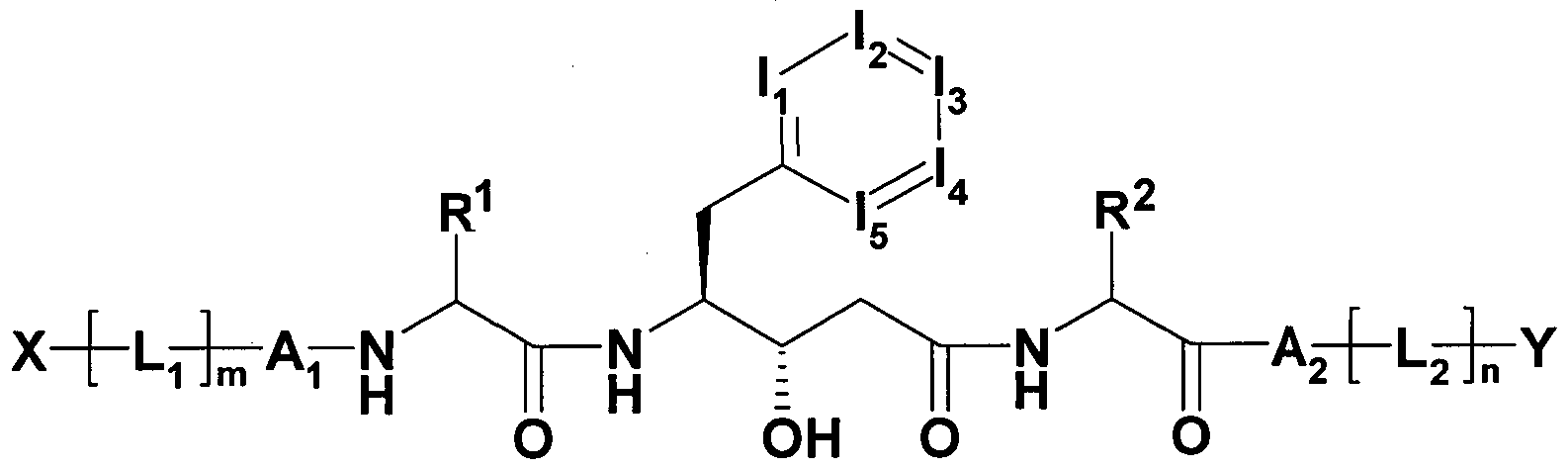
h, i , U. U unabhängig voneinander N oder CR', h, i, U.U independently of one another N or CR ',
T ein unsubstituiertes oder ein-, zwei- drei- oder vierfach durch T is an unsubstituted or one, two, three or four times
R substituiertes Phenyl, Biphenyl oder Naphthyl, oder ein ein- oder zweikernigen gesättigten, ungesättigten oder aromatischen Heterozyklus mit 1 bis 4 N-, O- und/oder S- Atomen, der ein-, zwei- oder dreifach durch R, =S, =NR' und/oder =0 substituiert sein kann, R is substituted phenyl, biphenyl or naphthyl, or a mono- or binuclear saturated, unsaturated or aromatic heterocycle having 1 to 4 N, O and / or S atoms, which is mono-, di- or trisubstituted by R, = S, = NR 'and / or = 0 can be substituted,
R1 Ethyl, n-Propyl, iso-Propyl, Cyclopropyl, Butyl, iso-Butyl, sec-Butyl, Cyclobutyl, tert-Butyl, Phenyl, Benzyl, 2-Oxetanyl, 3-Oxetanyl, Tetrahydrofuran-3-yl, Tetrahydrofuran-2-yl, Cyclopentyl, Pentyl, Methylsulfanylmethyl, R 1 is ethyl, n-propyl, isopropyl, cyclopropyl, butyl, isobutyl, sec-butyl, cyclobutyl, tert-butyl, phenyl, benzyl, 2-oxetanyl, 3-oxetanyl, tetrahydrofuran-3-yl, tetrahydrofuran 2-yl, cyclopentyl, pentyl, methylsulfanylmethyl,
Ethylsulfanylmethyl, 2-Methylsulfanylethyl, oder 1-Methylsulfanylethyl, Ethyl, n-Propyl, iso-Propyl, Cyclopropyl, Butyl, iso-Butyl, sec-Butyl, Cyclobutyl, tert-Butyl, Phenyl, Benzyl, 2-Oxetanyl, 3-Oxetanyl, Tetrahydro-furan-3-yl, Tetrahydrofuran-2-yl, Cyclopentyl, Pentyl, Methylsulfanylmethyl, Ethylsulfanylmethyl, 2-methylsulfanylethyl, or 1-methylsulfanylethyl, Ethyl, n-propyl, iso-propyl, cyclopropyl, butyl, iso-butyl, sec-butyl, cyclobutyl, tert-butyl, phenyl, benzyl, 2-oxetanyl, 3-oxetanyl, tetrahydrofuran-3-yl, tetrahydrofuran 2-yl, cyclopentyl, pentyl, methylsulfanylmethyl,
Ethylsulfanylmethyl, 2-Methylsulfanylethyl, Ethylsulfanylmethyl, 2-methylsulfanylethyl,
oder -Methylsulfanylethyl, or methylsulfanylethyl,
eine Einfachbindung oder 1 bis 3 peptidartig miteinander verbundene Aminosäurereste, -CO-, -OCO-, -NRCO-, - SO2- oder -NRSO2-, a single bond or 1 to 3 peptide-like linked amino acid residues, -CO-, -OCO-, -NRCO-, -SO 2 - or -NRSO 2 -,
eine Einfachbindung oder 1 bis 3 peptidartig miteinander verbundene Aminosäurereste, a single bond or 1 to 3 peptide-like linked amino acid residues,
eine Einfachbindung, ein linearer oder verzweigter a single bond, a linear or a branched one
Alkyllinker mit 1-10 C-Atomen, worin 1-5 CH2-Gruppen unabhängig voneinander durch O, S, SO, SO2, NR, -(C=O)- , -CRR'- , -OCO-, -NRCONR'-, -NRCO-, - NRSO2R'-, - COO-, -CONR-, -CsC-Gruppen und/oder durch -CH=CH- Gruppen und/oder auch 1-20 H-Atome durch F und/oder Cl ersetzt sein können oder -CRR'-, Alkyl linkers having 1-10 C atoms, wherein 1-5 CH 2 groups are independently represented by O, S, SO, SO 2, NR, - (C = O) -, -CRR'-, -OCO-, -NRCONR ' -, -NRCO-, - NRSO 2 R ', - COO, -CONR, -CsC groups and / or by -CH = CH groups and / or also 1-20 H atoms by F and / or Cl can be replaced or -CRR'-,
eine Einfachbindung, -CRR'-, -NR-, -NRCR'R- oder - NRCRR'CRR', a single bond, -CRR'-, -NR-, -NRCR'R- or -NRCRR'CRR ',
H, T, unsubstituiertes oder ein-, zwei- oder dreifach durch =S, =NR, =O, R, T, OR, NRR', SOR, SO2R, SO2NRR', CN, COOR, CONRR', NRCOR', NRCONR'R", NRSO2R' und/oder NRCOR' substituiertes lineares oder verzweigtes Alkyl mit 1-10 C-Atomen, worin eine, zwei oder drei CH2- Gruppen unabhängig voneinander durch O, S, SO, SO2, NR, -OCO-, -NRCONR'-, -NRCO-, - NRSO2R'-, -COO-, - CONR-, -CsC-Gruppen und/oder durch -CH=CH-Gruppen und/oder auch 1-20 H-Atome durch F und/oder Cl ersetzt sein können, oder unsubstituiertes oder ein-, zwei- oder dreifach durch =S, =NR, =O, R, T, OR, NRR', SOR, SO2R, SO2NRR', CN, COOR, CONRR', NRCOR', NRCONR'R", NRSO2R' und/oder NRCOR' zyklisches Alkyl mit 3-7 C- Atomen, worin eine, zwei oder drei CH2-Gruppen H, T, unsubstituted or mono-, di- or trisubstituted by = S, = NR, = O, R, T, OR, NRR ', SOR, SO 2 R, SO 2 NRR', CN, COOR, CONRR ', NRCOR ', NRCONR'R ", NRSO 2 R' and / or NRCOR 'substituted linear or branched alkyl having 1-10 C atoms, wherein one, two or three CH 2 - groups independently of each other by O, S, SO, SO 2 , NR, -OCO, -NRCONR'-, -NRCO-, - NRSO 2 R'-, -COO-, -CONR-, -CsC- groups and / or by -CH = CH groups and / or also 1-20 H atoms may be replaced by F and / or Cl, or unsubstituted or mono-, di- or trisubstituted by = S, = NR, = O, R, T, OR, NRR ', SOR, SO 2 R , SO 2 NRR ', CN, COOR, CONRR', NRCOR ', NRCONR'R ", NRSO 2 R 'and / or NRCOR' are cyclic alkyl of 3-7 C atoms, wherein one, two or three CH 2 groups
unabhängig voneinander durch O, S, SO, SO2, NR, -OCO- , -NRCONR'-, -NRCO-, - NRSO2R'-, -COO-, -CONR-, - CsC— Gruppen und/oder durch -CH=CH-Gruppen und/oder auch 1-11 H-Atome durch F und/oder Cl ersetzt sein können, independently of each other by O, S, SO, SO 2 , NR, -OCO, -NRCONR'-, -NRCO-, - NRSO 2 R'-, -COO-, -CONR-, -CsC- groups and / or by -CH = CH groups and / or also 1-11 H atoms can be replaced by F and / or Cl,
R,R' unabhängig voneinander H, unsubstituiertes oder ein-, zwei- oder dreifach durch =S, =NR, =O, Hai, OH, NH2, SO2CH3, SO2NH2, CN, CONH2, NHCOCH3, und/oder NHCONH2 substituiertes lineares oder verzweigtes Alkyl mit 1-10 C- Atomen, worin eine, zwei oder drei CH2-Gruppen R, R 'are independently H, unsubstituted or mono-, di- or trisubstituted by = S, = NR, = O, Hal, OH, NH 2 , SO 2 CH 3 , SO 2 NH 2 , CN, CONH 2 , NHCOCH 3 , and / or NHCONH 2 substituted linear or branched alkyl having 1-10 C atoms, wherein one, two or three CH 2 groups
unabhängig voneinander durch O, S, SO, SO2, NH, NCH3, - OCO-, -NHCONH-, -NHCO-, - NRSO2A-, -COO-, - CONH-, -NCH3CO-, -CONCH3-, -C^C-Gruppen und/oder durch -CH=CH-Gruppen und/oder auch 1-20 H-Atome durch F und/oder Cl ersetzt sein können, oder unsubstituiertes oder ein-, zwei- oder dreifach durch =S, =NR, =O, OH, NH2, SO2CH3, SO2NH2, CN, CONH2, independently of each other by O, S, SO, SO 2 , NH, NCH 3 , - OCO-, -NHCONH-, -NHCO-, - NRSO 2 A-, -COO-, - CONH-, -NCH 3 CO-, - CONCH 3 -, -C ^ C groups and / or by -CH = CH groups and / or 1-20 H atoms may be replaced by F and / or Cl, or unsubstituted or mono-, di- or tri-fold by = S, = NR, = O, OH, NH 2 , SO 2 CH 3 , SO 2 NH 2 , CN, CONH 2 ,
NHCOCH3, und/oder NHCONH2 substituiertes zyklischesNHCOCH 3 , and / or NHCONH 2 substituted cyclic
Alkyl mit 3-7 C-Atomen, worin eine, zwei oder drei CH2- Gruppen unabhängig voneinander durch O, S, SO, SO2, NH, NCH3, -OCO-, -NHCONH-, -NHCO-, - NRSO2A-, - COO-, -CONH-, -NCH3CO-, -CONCH3- und/oder durch - CH=CH-Gruppen und/oder auch 1-11 H-Atome durch F und/oder Cl ersetzt sein können, Alkyl having 3-7 C atoms, wherein one, two or three CH 2 groups independently of each other by O, S, SO, SO 2 , NH, NCH 3 , -OCO, -NHCONH-, -NHCO-, - NRSO 2 A, - COO, -CONH, -NCH 3 CO-, -CONCH 3 - and / or replaced by - CH = CH groups and / or 1-11 H-atoms by F and / or Cl can,
m 0 - 4, m 0 - 4,
n 0 - 2, und n 0-2, and
Hai F, Cl, Br oder l, Hai F, Cl, Br or l,
ist, sowie deren physiologisch unbedenklichen Salze, Derivate, Solvate,and their physiologically acceptable salts, derivatives, solvates,
Prodrugs und Stereoisomere, einschließlich deren Mischungen in allenProdrugs and stereoisomers, including mixtures thereof in all
Verhältnissen. Ein bevorzugter Gegenstand der Erfindung sind alle vorgenannten Conditions. A preferred subject of the invention are all of the aforementioned
Verbindungen der Formel I, worin Compounds of formula I, wherein
R1 iso-Propyl, 2-Butyl oder iso-Butyl R 1 is isopropyl, 2-butyl or iso-butyl
ist, sowie deren physiologisch unbedenklichen Salze, Derivate, Solvate, Prodrugs und Stereoisomere, einschließlich deren Mischungen in allen Verhältnissen. and their physiologically acceptable salts, derivatives, solvates, prodrugs and stereoisomers, including mixtures thereof in all ratios.
Ein weiterer bevorzugter Gegenstand der Erfindung sind alle vorgenannten Verbindungen der Formel I, worin Another preferred subject of the invention are all of the aforementioned compounds of formula I wherein
R2 n-Propyl, iso-Propyl, 2-Butyl oder iso-Butyl R 2 is n-propyl, iso-propyl, 2-butyl or iso-butyl
ist, sowie deren physiologisch unbedenklichen Salze, Derivate, Solvate,and their physiologically acceptable salts, derivatives, solvates,
Prodrugs und Stereoisomere, einschließlich deren Mischungen in allenProdrugs and stereoisomers, including mixtures thereof in all
Verhältnissen. Conditions.
Ein besonders bevorzugter Gegenstand der Erfindung sind alle A particularly preferred subject of the invention are all
vorgenannten Verbindungen der Formel I, worin aforementioned compounds of formula I, wherein
R1 iso-Propyl, 2-Butyl oder iso-Butyl und R 1 is iso-propyl, 2-butyl or iso-butyl and
R2 n-Propyl, iso-Propyl, 2-Butyl oder iso-Butyl R 2 is n-propyl, iso-propyl, 2-butyl or iso-butyl
ist, sowie deren physiologisch unbedenklichen Salze, Derivate, Solvate, Prodrugs und Stereoisomere, einschließlich deren Mischungen in allen Verhältnissen. and their physiologically acceptable salts, derivatives, solvates, prodrugs and stereoisomers, including mixtures thereof in all ratios.
Ein weiterer besonders bevorzugter Gegenstand der Erfindung sind alle vorgenannten Verbindungen der Formel I, worin Another particularly preferred subject matter of the invention are all the abovementioned compounds of the formula I in which
R1 iso-Propyl und R 1 is iso-propyl and
R2 n-Propyl, iso-Propyl oder 2-Butyl R 2 is n-propyl, iso-propyl or 2-butyl
ist, sowie deren physiologisch unbedenklichen Salze, Derivate, Solvate, Prodrugs und Stereoisomere, einschließlich deren Mischungen in allen Verhältnissen. Ein ganz besonders bevorzugter Gegenstand der Erfindung sind alle vorgenannten Verbindungen der Formel I, worin and their physiologically acceptable salts, derivatives, solvates, prodrugs and stereoisomers, including mixtures thereof in all ratios. A very particularly preferred subject matter of the invention are all the abovementioned compounds of the formula I in which
R1 iso-Propyl mit einer S-Konfiguration des chiralen Zentrums, an das die iso-Propylgruppe gebunden ist, und R 1 is isopropyl with an S configuration of the chiral center to which the iso-propyl group is attached, and
R2 n-Propyl, iso-Propyl oder 2-Butyl mit einer S-Konfiguration des chiralen Zentrums, an das die n-Propyl-, iso-Propyl- oder 2-Butylgruppe gebunden ist, R 2 is n-propyl, iso-propyl or 2-butyl having an S-configuration of the chiral center to which the n-propyl, iso-propyl or 2-butyl group is attached,
ist, sowie deren physiologisch unbedenklichen Salze, Derivate, Solvate, Prodrugs und Stereoisomere, einschließlich deren Mischungen in allen Verhältnissen. and their physiologically acceptable salts, derivatives, solvates, prodrugs and stereoisomers, including mixtures thereof in all ratios.
Ein bevorzugter Gegenstand der Erfindung sind alle vorgenannten A preferred subject of the invention are all of the aforementioned
Verbindungen der Formel I, worin Compounds of formula I, wherein
Ai eine Einfachbindung oder ein peptidartig verbundener Ai is a single bond or a peptide-linked one
Aminosäurerest, ausgewählt aus der Gruppe bestehend aus Alanin, Amino acid residue selected from the group consisting of alanine,
Glycin, Cyclopropylglycin, Cyclobutylglycin, Cyclopentylglycin, Cyclohexylglycin, 3-Oxetanylglycin, 3-Oxetanylglycin, Glycine, cyclopropylglycine, cyclobutylglycine, cyclopentylglycine, cyclohexylglycine, 3-oxetanylglycine, 3-oxetanylglycine,
Tetrahydrofuran-3-ylglycin, Tetrahydrofuran-2-ylglycin, Tetrahydrofuran-3-ylglycine, tetrahydrofuran-2-ylglycine,
Ethylsulfanylmethylglycin, 2-Methylsulfanylethylglycin, 1- Methylsulfanylethylglycin, Valin, Norvalin, Aminobuttersäure, Leucin, Ethylsulfanylmethylglycine, 2-methylsulfanylethylglycine, 1-methylsulfanylethylglycine, valine, norvaline, aminobutyric acid, leucine,
Isoleucin, Prolin, tert-Leucin, Norleucin, Methionin, Phenylalanin, Naphthylalanin, O-Methyl-Serin, O-Ethyl-Serin, -CO-, -OCO-, -NRCO-

ist, sowie deren physiologisch unbedenklichen Salze, Derivate, Solvate, Prodrugs und Stereoisomere, einschließlich deren Mischungen in allen Verhältnissen. and their physiologically acceptable salts, derivatives, solvates, prodrugs and stereoisomers, including mixtures thereof in all ratios.
Ein weiterer bevorzugter Gegenstand der Erfindung sind alle vorgenannten Verbindungen der Formel I, worin Another preferred subject of the invention are all of the aforementioned compounds of formula I wherein
A2 eine Einfachbindung oder 1 bis 2 peptidartig miteinander verbundene Aminosäurereste, ausgewählt aus der Gruppe bestehend aus Alanin, Glycin, Cyclopropylglycin, Cyclobutylglycin, Cyclopentylglycin, Cyclohexylglycin, 3-Oxetanylglycin, 3-Oxetanylglycin, A 2 is a single bond or 1 to 2 peptide-like linked amino acid residues selected from the group consisting of alanine, glycine, cyclopropylglycine, cyclobutylglycine, cyclopentylglycine, Cyclohexylglycine, 3-oxetanylglycine, 3-oxetanylglycine,
Tetrahydrofuran-3-ylglycin, Tetrahydrofuran-2-ylglycin, Tetrahydrofuran-3-ylglycine, tetrahydrofuran-2-ylglycine,
Ethylsulfanylmethylglycin, 2-Methylsulfanylethylglycin, 1- Methylsulfanylethylglycin, Valin, Norvalin, Aminobuttersäure, Leucin, Isoleucin, Prolin, tert-Leucin, Norleucin, Methionin, Phenylalanin, Naphthylalanin, O-Methyl-Serin und O-Ethyl-Serin Ethylsulfanylmethylglycine, 2-methylsulfanylethylglycine, 1-methylsulfanylethylglycine, valine, norvaline, aminobutyric acid, leucine, isoleucine, proline, tert-leucine, norleucine, methionine, phenylalanine, naphthylalanine, O-methyl-serine and O-ethyl-serine
ist, sowie deren physiologisch unbedenklichen Salze, Derivate, Solvate, Prodrugs und Stereoisomere, einschließlich deren Mischungen in allen Verhältnissen. and their physiologically acceptable salts, derivatives, solvates, prodrugs and stereoisomers, including mixtures thereof in all ratios.
Ein besonders bevorzugter Gegenstand der Erfindung sind alle A particularly preferred subject of the invention are all
vorgenannten Verbindungen der Formel I, worin aforementioned compounds of formula I, wherein
Ai Leucin oder eine Einfachbindung und Ai leucine or a single bond and
A2 Valin A 2 valine
ist, sowie deren physiologisch unbedenklichen Salze, Derivate, Solvate, Prodrugs und Stereoisomere, einschließlich deren Mischungen in allen Verhältnissen. and their physiologically acceptable salts, derivatives, solvates, prodrugs and stereoisomers, including mixtures thereof in all ratios.
Ein ganz besonders bevorzugter Gegenstand der Erfindung sind alle vorgenannten Verbindungen der Formel I, worin A very particularly preferred subject matter of the invention are all the abovementioned compounds of the formula I in which
Ai S-Leucin oder eine Einfachbindung und Ai S-leucine or a single bond and
A2 S-Valin A 2 S-Valine
ist, sowie deren physiologisch unbedenklichen Salze, Derivate, Solvate, Prodrugs und Stereoisomere, einschließlich deren Mischungen in allen Verhältnissen. and their physiologically acceptable salts, derivatives, solvates, prodrugs and stereoisomers, including mixtures thereof in all ratios.
Ein weiterer ganz besonders bevorzugter Gegenstand der Erfindung sind alle vorgenannten Verbindungen der Formel I, worin Another very particularly preferred subject matter of the invention are all the abovementioned compounds of the formula I in which
R1 iso-Propyl, 2-Butyl oder iso-Butyl, R 1 is isopropyl, 2-butyl or iso-butyl,
Ai eine Einfachbindung oder ein peptidartig verbundener Aminosäurerest, ausgewählt aus der Gruppe bestehend aus Alanin, Glycin, Ai is a single bond or a peptide-linked amino acid residue selected from the group consisting of alanine, glycine,
Cyclopropylglycin, Cyclobutylglycin, Cyclopentylglycin, Cyclohexylglycin, 3-Oxetanylglycin, 3-Oxetanylglycin, Tetrahydrofuran- 3-ylglycin, Tetrahydrofuran-2-ylglycin, Ethylsulfanylmethylglycin, 2- Methylsulfanylethylglycin, 1 -Methylsulfanylethylglycin, Valin, Norvalin, Aminobuttersäure, Leucin, Isoleucin, Prolin, tert-Leucin, Norleucin, Methionin, Phenylalanin, Naphthylalanin, O-Methyl-Serin, O-Ethyl- Serin, -CO-, -OCO-, -NRCO-, -SO2- und -NRSO2- und Cyclopropylglycine, cyclobutylglycine, cyclopentylglycine, Cyclohexylglycine, 3-oxetanylglycine, 3-oxetanylglycine, tetrahydrofuran-3-ylglycine, tetrahydrofuran-2-ylglycine, ethylsulfanylmethylglycine, 2-methylsulfanylethylglycine, 1-methylsulfanylethylglycine, valine, norvaline, aminobutyric acid, leucine, isoleucine, proline, tert-leucine, norleucine, Methionine, phenylalanine, naphthylalanine, O-methyl-serine, O-ethyl-serine, -CO-, -OCO-, -NRCO-, -SO 2 - and -NRSO 2 - and
A2 eine Einfachbindung oder 1 bis 2 peptidartig miteinander verbundene Aminosäurereste, ausgewählt aus der Gruppe bestehend aus Alanin, Glycin, Cyclopropylglycin, Cyclobutylglycin, Cyclopentylglycin, A 2 is a single bond or 1 to 2 peptide-like linked amino acid residues selected from the group consisting of alanine, glycine, cyclopropylglycine, cyclobutylglycine, cyclopentylglycine,
Cyclohexylglycin, 3-Oxetanylglycin, 3-Oxetanylglycin, Tetrahydrofuran- 3-ylglycin, Tetrahydrofuran-2-ylglycin, Ethylsulfanylmethylglycin, 2- Methylsulfanylethylglycin, 1 -Methylsulfanylethylglycin, Valin, Norvalin, Aminobuttersäure, Leucin, Isoleucin, Prolin, tert-Leucin, Norleucin, Methionin, Phenylalanin, Naphthylalanin, O-Methyl-Serin und O-Ethyl- Serin Cyclohexylglycine, 3-oxetanylglycine, 3-oxetanylglycine, tetrahydrofuran-3-ylglycine, tetrahydrofuran-2-ylglycine, ethylsulfanylmethylglycine, 2-methylsulfanylethylglycine, 1-methylsulfanylethylglycine, valine, norvaline, aminobutyric acid, leucine, isoleucine, proline, tert-leucine, norleucine, Methionine, phenylalanine, naphthylalanine, O-methyl-serine and O-ethyl-serine
ist, sowie deren physiologisch unbedenklichen Salze, Derivate, Solvate, Prodrugs und Stereoisomere, einschließlich deren Mischungen in allen Verhältnissen. and their physiologically acceptable salts, derivatives, solvates, prodrugs and stereoisomers, including mixtures thereof in all ratios.
Ein weiterer ganz besonders bevorzugter Gegenstand der Erfindung sind alle vorgenannten Verbindungen der Formel I, worin Another very particularly preferred subject matter of the invention are all the abovementioned compounds of the formula I in which
R1 iso-Propyl, R 1 is isopropyl,
Ai eine Einfachbindung oder ein peptidartig verbundener Aminosäurerest, ausgewählt aus der Gruppe bestehend aus Alanin, Glycin, Ai is a single bond or a peptide-linked amino acid residue selected from the group consisting of alanine, glycine,
Cyclopropylglycin, Cyclobutylglycin, Cyclopentylglycin, Cyclopropylglycine, cyclobutylglycine, cyclopentylglycine,
Cyclohexylglycin, 3-Oxetanylglycin, 3-Oxetanylglycin, Tetrahydrofuran- 3-ylglycin, Tetrahydrofuran-2-ylglycin, Ethylsulfanylmethylglycin, 2- Methylsulfanylethylglycin, 1-Methylsulfanylethylglycin, Valin, Norvalin, Aminobuttersäure, Leucin, Isoleucin, Prolin, tert-Leucin, Norleucin, Methionin, Phenylalanin, Naphthylalanin, O-Methyl-Serin, O-Ethyl- Serin, -CO-, -OCO-, -NRCO-, -SO2- und -NRSO2- und A2 eine Einfachbindung oder 1 bis 2 peptidartig miteinander verbundene Aminosäurereste, ausgewählt aus der Gruppe bestehend aus Alanin, Glycin, Cyclopropylglycin, Cyclobutylglycin, Cyclopentylglycin, Cyclohexylglycine, 3-oxetanylglycine, 3-oxetanylglycine, tetrahydrofuran-3-ylglycine, tetrahydrofuran-2-ylglycine, ethylsulfanylmethylglycine, 2-methylsulfanylethylglycine, 1-methylsulfanylethylglycine, valine, norvaline, aminobutyric acid, leucine, isoleucine, proline, tert-leucine, norleucine, Methionine, phenylalanine, naphthylalanine, O-methyl-serine, O-ethyl-serine, -CO-, -OCO-, -NRCO-, -SO 2 - and -NRSO 2 - and A 2 is a single bond or 1 to 2 peptide-like linked amino acid residues selected from the group consisting of alanine, glycine, cyclopropylglycine, cyclobutylglycine, cyclopentylglycine,
Cyclohexylglycin, 3-Oxetanylglycin, 3-Oxetanylglycin, Tetrahydrofuran- 3-ylglycin, Tetrahydrofuran-2-ylglycin, Ethylsulfanylmethylglycin, 2- Methylsulfanylethylglycin, 1-Methylsulfanylethylglycin, Valin, Norvalin, Aminobuttersäure, Leucin, Isoleucin, Prolin, tert-Leucin, Norleucin, Methionin, Phenylalanin, Naphthylalanin, O-Methyl-Serin und O-Ethyl- Serin Cyclohexylglycine, 3-oxetanylglycine, 3-oxetanylglycine, tetrahydrofuran-3-ylglycine, tetrahydrofuran-2-ylglycine, ethylsulfanylmethylglycine, 2-methylsulfanylethylglycine, 1-methylsulfanylethylglycine, valine, norvaline, aminobutyric acid, leucine, isoleucine, proline, tert-leucine, norleucine, Methionine, phenylalanine, naphthylalanine, O-methyl-serine and O-ethyl-serine
ist, sowie deren physiologisch unbedenklichen Salze, Derivate, Solvate, Prodrugs und Stereoisomere, einschließlich deren Mischungen in allen Verhältnissen. and their physiologically acceptable salts, derivatives, solvates, prodrugs and stereoisomers, including mixtures thereof in all ratios.
Ein weiterer ganz besonders bevorzugter Gegenstand der Erfindung sind alle vorgenannten Verbindungen der Formel I, worin Another very particularly preferred subject matter of the invention are all the abovementioned compounds of the formula I in which
R2 n-Propyl, iso-Propyl, 2-Butyl oder iso-Butyl, R 2 is n-propyl, iso-propyl, 2-butyl or iso-butyl,
Ai eine Einfachbindung oder ein peptidartig verbundener Aminosäurerest, ausgewählt aus der Gruppe bestehend aus Alanin, Glycin, Ai is a single bond or a peptide-linked amino acid residue selected from the group consisting of alanine, glycine,
Cyclopropylglycin, Cyclobutylglycin, Cyclopentylglycin, Cyclopropylglycine, cyclobutylglycine, cyclopentylglycine,
Cyclohexylglycin, 3-Oxetanylglycin, 3-Oxetanylglycin, Tetrahydrofuran- 3-ylglycin, Tetrahydrofuran-2-ylglycin, Ethylsulfanylmethylglycin, 2- Methylsulfanylethylglycin, 1-Methylsulfanylethylglycin, Valin, Norvalin, Aminobuttersäure, Leucin, Isoleucin, Prolin, tert-Leucin, Norleucin, Methionin, Phenylalanin, Naphthylalanin, O-Methyl-Serin, O-Ethyl- Serin, -CO-, -OCO-, -NRCO-, -SO2- und -NRSO2- und Cyclohexylglycine, 3-oxetanylglycine, 3-oxetanylglycine, tetrahydrofuran-3-ylglycine, tetrahydrofuran-2-ylglycine, ethylsulfanylmethylglycine, 2-methylsulfanylethylglycine, 1-methylsulfanylethylglycine, valine, norvaline, aminobutyric acid, leucine, isoleucine, proline, tert-leucine, norleucine, Methionine, phenylalanine, naphthylalanine, O-methyl-serine, O-ethyl-serine, -CO-, -OCO-, -NRCO-, -SO 2 - and -NRSO 2 - and
A2 eine Einfachbindung oder 1 bis 2 peptidartig miteinander verbundene Aminosäurereste, ausgewählt aus der Gruppe bestehend aus Alanin, Glycin, Cyclopropylglycin, Cyclobutylglycin, Cyclopentylglycin, A 2 is a single bond or 1 to 2 peptide-like linked amino acid residues selected from the group consisting of alanine, glycine, cyclopropylglycine, cyclobutylglycine, cyclopentylglycine,
Cyclohexylglycin, 3-Oxetanylglycin, 3-Oxetanylglycin, Tetrahydrofuran- 3-ylglycin, Tetrahydrofuran-2-ylglycin, Ethylsulfanylmethylglycin, 2- Methylsulfanylethylglycin, 1-Methylsulfanylethylglycin, Valin, Norvalin, Aminobuttersäure, Leucin, Isoleucin, Prolin, tert-Leucin, Norleucin, Methionin, Phenylalanin, Naphthylalanin, O-Methyl-Serin und O-Ethyl- Serin Cyclohexylglycine, 3-oxetanylglycine, 3-oxetanylglycine, tetrahydrofuran-3-ylglycine, tetrahydrofuran-2-ylglycine, ethylsulfanylmethylglycine, 2-methylsulfanylethylglycine, 1-methylsulfanylethylglycine, valine, norvaline, aminobutyric acid, leucine, isoleucine, proline, tert-leucine, norleucine, Methionine, phenylalanine, naphthylalanine, O-methyl-serine and O-ethyl-serine
ist, sowie deren physiologisch unbedenklichen Salze, Derivate, Soivate, Prodrugs und Stereoisomere, einschließlich deren Mischungen in allen Verhältnissen. and their physiologically acceptable salts, derivatives, derivatives, prodrugs and stereoisomers, including mixtures thereof in all ratios.
Ein weiterer ganz besonders bevorzugter Gegenstand der Erfindung sind alle vorgenannten Verbindungen der Formel I, worin Another very particularly preferred subject matter of the invention are all the abovementioned compounds of the formula I in which
R2 n-Propyl, iso-Propyl oder 2-Butyl, R 2 is n-propyl, iso-propyl or 2-butyl,
Ai eine Einfachbindung oder ein peptidartig verbundener Aminosäurerest, ausgewählt aus der Gruppe bestehend aus Alanin, Glycin, Ai is a single bond or a peptide-linked amino acid residue selected from the group consisting of alanine, glycine,
Cyclopropylglycin, Cyclobutylglycin, Cyclopentylglycin, Cyclopropylglycine, cyclobutylglycine, cyclopentylglycine,
Cyclohexylglycin, 3-Oxetanylglycin, 3-Oxetanylglycin, Tetrahydrofuran- 3-ylglycin, Tetrahydrofuran-2-ylglycin, Ethylsulfanylmethylglycin, 2- Methylsulfanylethylglycin, 1 -Methylsulfanylethylglycin, Valin, Norvalin, Aminobuttersäure, Leucin, Isoleucin, Prolin, tert-Leucin, Norleucin, Methionin, Phenylalanin, Naphthylalanin, O-Methyl-Serin, O-Ethyl- Serin, -CO-, -OCO-, -NRCO-, -SO2- und -NRSO2- und Cyclohexylglycine, 3-oxetanylglycine, 3-oxetanylglycine, tetrahydrofuran-3-ylglycine, tetrahydrofuran-2-ylglycine, ethylsulfanylmethylglycine, 2-methylsulfanylethylglycine, 1-methylsulfanylethylglycine, valine, norvaline, aminobutyric acid, leucine, isoleucine, proline, tert-leucine, norleucine, Methionine, phenylalanine, naphthylalanine, O-methyl-serine, O-ethyl-serine, -CO-, -OCO-, -NRCO-, -SO 2 - and -NRSO 2 - and
A2 eine Einfachbindung oder 1 bis 2 peptidartig miteinander verbundene Aminosäurereste, ausgewählt aus der Gruppe bestehend aus Alanin, Glycin, Cyclopropylglycin, Cyclobutylglycin, Cyclopentylglycin, A 2 is a single bond or 1 to 2 peptide-like linked amino acid residues selected from the group consisting of alanine, glycine, cyclopropylglycine, cyclobutylglycine, cyclopentylglycine,
Cyclohexylglycin, 3-Oxetanylglycin, 3-Oxetanylglycin, Tetrahydrofuran- 3-ylglycin, Tetrahydrofuran-2-ylglycin, Ethylsulfanylmethylglycin, 2- Methylsulfanylethylglycin, 1 -Methylsulfanylethylglycin, Valin, Norvalin, Aminobuttersäure, Leucin, Isoleucin, Prolin, tert-Leucin, Norleucin, Methionin, Phenylalanin, Naphthylalanin, O-Methyl-Serin und O-Ethyl- Serin Cyclohexylglycine, 3-oxetanylglycine, 3-oxetanylglycine, tetrahydrofuran-3-ylglycine, tetrahydrofuran-2-ylglycine, ethylsulfanylmethylglycine, 2-methylsulfanylethylglycine, 1-methylsulfanylethylglycine, valine, norvaline, aminobutyric acid, leucine, isoleucine, proline, tert-leucine, norleucine, Methionine, phenylalanine, naphthylalanine, O-methyl-serine and O-ethyl-serine
ist, sowie deren physiologisch unbedenklichen Salze, Derivate, Soivate, Prodrugs und Stereoisomere, einschließlich deren Mischungen in allen Verhältnissen. Ein weiterer ganz besonders bevorzugter Gegenstand der Erfindung sind alle vorgenannten Verbindungen der Formel I, worin . and their physiologically acceptable salts, derivatives, derivatives, prodrugs and stereoisomers, including mixtures thereof in all ratios. Another very particularly preferred subject matter of the invention are all the abovementioned compounds of the formula I in which
R1 iso-Propyl, R 1 is isopropyl,
R2 n-Propyl, iso-Propyl oder 2-Butyl, R 2 is n-propyl, iso-propyl or 2-butyl,
Ai eine Einfachbindung oder ein peptidartig verbundener Aminosäurerest, ausgewählt aus der Gruppe bestehend aus Alanin, Glycin, Ai is a single bond or a peptide-linked amino acid residue selected from the group consisting of alanine, glycine,
Cyclopropylglycin, Cyclobutylglycin, Cyclopentylglycin, Cyclopropylglycine, cyclobutylglycine, cyclopentylglycine,
Cyclohexylglycin, 3-Oxetanylglycin, 3-Oxetanylglycin, Tetrahydrofuran- 3-ylglycin, Tetrahydro-furan-2-ylglycin, Ethylsulfanylmethylglycin, 2- Methylsulfanylethylglycin, 1-Methylsulfanylethylglycin, Valin, Norvalin, Aminobuttersäure, Leucin, Isoleucin, Prolin, tert-Leucin, Norleucin, Methionin, Phenylalanin, Naphthylalanin, O-Methyl-Serin, O-Ethyl- Serin, -CO-, -OCO-, -NRCO-, -SO2- und -NRSO2- und Cyclohexylglycine, 3-oxetanylglycine, 3-oxetanylglycine, tetrahydrofuran-3-ylglycine, tetrahydrofuran-2-ylglycine, ethylsulfanylmethylglycine, 2-methylsulfanylethylglycine, 1-methylsulfanylethylglycine, valine, norvaline, aminobutyric acid, leucine, isoleucine, proline, tert-leucine, Norleucine, methionine, phenylalanine, naphthylalanine, O-methyl-serine, O-ethyl-serine, -CO-, -OCO-, -NRCO-, -SO 2 - and -NRSO 2 - and
A2 eine Einfachbindung oder 1 bis 2 peptidartig miteinander verbundene Aminosäurereste, ausgewählt aus der Gruppe bestehend aus Alanin, Glycin, Cyclopropylglycin, Cyclobutylglycin, Cyclopentylglycin, A 2 is a single bond or 1 to 2 peptide-like linked amino acid residues selected from the group consisting of alanine, glycine, cyclopropylglycine, cyclobutylglycine, cyclopentylglycine,
Cyclohexylglycin, 3-Oxetanylglycin, 3-Oxetanylglycin, Tetra hydrofura n- 3-ylglycin, Tetrahydro-furan-2-ylglycin, Ethylsulfanylmethylglycin, 2- Methylsulfanylethylglycin, 1-Methylsulfanylethylglycin, Valin, Norvalin, Aminobuttersäure, Leucin, Isoleucin, Prolin, tert-Leucin, Norleucin, Methionin, Phenylalanin, Naphthylalanin, O-Methyl-Serin und O-Ethyl- Serin Cyclohexylglycine, 3-oxetanylglycine, 3-oxetanylglycine, tetrahydrofuran n-3-ylglycine, tetrahydrofuran-2-ylglycine, ethylsulfanylmethylglycine, 2-methylsulfanylethylglycine, 1-methylsulfanylethylglycine, valine, norvaline, aminobutyric acid, leucine, isoleucine, proline, tert-butyl Leucine, norleucine, methionine, phenylalanine, naphthylalanine, O-methyl-serine and O-ethyl-serine
ist, sowie deren physiologisch unbedenklichen Salze, Derivate, Solvate, Prodrugs und Stereoisomere, einschließlich deren Mischungen in allen Verhältnissen. and their physiologically acceptable salts, derivatives, solvates, prodrugs and stereoisomers, including mixtures thereof in all ratios.
Ein weiterer ganz besonders bevorzugter Gegenstand der Erfindung sind alle vorgenannten Verbindungen der Formel I, worin Another very particularly preferred subject matter of the invention are all the abovementioned compounds of the formula I in which
R1 iso-Propyl mit einer S-Konfiguration des chiralen Zentrums, an das die iso-Propylgruppe gebunden ist, R2 n-Propyl, iso-Propyl oder 2-Butyl mit einer S-Konfiguration des chiralen Zentrums, an das die n-Propyl-, iso-Propyl- oder 2-Butylgruppe gebunden ist, R 1 is isopropyl with an S configuration of the chiral center to which the iso-propyl group is bonded, R 2 is n-propyl, iso-propyl or 2-butyl having an S-configuration of the chiral center to which the n-propyl, iso-propyl or 2-butyl group is attached,
Ai eine Einfachbindung oder ein peptidartig verbundener Aminosäurerest, ausgewählt aus der Gruppe bestehend aus Alanin, Glycin, Ai is a single bond or a peptide-linked amino acid residue selected from the group consisting of alanine, glycine,
Cyclopropylglycin, Cyclobutylglycin, Cyclopentylglycin, Cyclopropylglycine, cyclobutylglycine, cyclopentylglycine,
Cyclohexylglycin, 3-Oxetanylglycin, 3-Oxetanylglycin, Tetrahydrofuran- 3-ylglycin, Tetrahydrofuran-2-ylglycin, Ethylsulfanylmethylglycin, 2- Methylsulfanylethylglycin, 1 -Methylsulfanylethylglycin, Valin, Norvalin, Aminobuttersäure, Leucin, Isoleucin, Prolin, tert-Leucin, Norleucin, Cyclohexylglycine, 3-oxetanylglycine, 3-oxetanylglycine, tetrahydrofuran-3-ylglycine, tetrahydrofuran-2-ylglycine, ethylsulfanylmethylglycine, 2-methylsulfanylethylglycine, 1-methylsulfanylethylglycine, valine, norvaline, aminobutyric acid, leucine, isoleucine, proline, tert-leucine, norleucine,
Methionin, Phenylalanin, Naphthylalanin, O-Methyl-Serin, O-Ethyl- Serin, -CO-, -OCO-, -NRCO-, -SO2- und -NRSO2- und Methionine, phenylalanine, naphthylalanine, O-methyl-serine, O-ethyl-serine, -CO-, -OCO-, -NRCO-, -SO 2 - and -NRSO 2 - and
A2 eine Einfachbindung oder 1 bis 2 peptidartig miteinander verbundene Aminosäurereste, ausgewählt aus der Gruppe bestehend aus Alanin, Glycin, Cyclopropylglycin, Cyclobutylglycin, Cyclopentylglycin, A 2 is a single bond or 1 to 2 peptide-like linked amino acid residues selected from the group consisting of alanine, glycine, cyclopropylglycine, cyclobutylglycine, cyclopentylglycine,
Cyclohexylglycin, 3-Oxetanylglycin, 3-Oxetanylglycin, Tetrahydrofuran- 3-ylglycin, Tetrahydrofuran-2-ylglycin, Ethylsulfanylmethylglycin, 2- Methylsulfanylethylglycin, 1 -Methylsulfanylethylglycin, Valin, Norvalin, Aminobuttersäure, Leucin, Isoleucin, Prolin, tert-Leucin, Norleucin, Methionin, Phenylalanin, Naphthylalanin, O-Methyl-Serin und O-Ethyl- Cyclohexylglycine, 3-oxetanylglycine, 3-oxetanylglycine, tetrahydrofuran-3-ylglycine, tetrahydrofuran-2-ylglycine, ethylsulfanylmethylglycine, 2-methylsulfanylethylglycine, 1-methylsulfanylethylglycine, valine, norvaline, aminobutyric acid, leucine, isoleucine, proline, tert-leucine, norleucine, Methionine, phenylalanine, naphthylalanine, O-methyl-serine and O-ethyl
Serin serine
ist, sowie deren physiologisch unbedenklichen Salze, Derivate, Solvate, Prodrugs und Stereoisomere, einschließlich deren Mischungen in allen Verhältnissen. and their physiologically acceptable salts, derivatives, solvates, prodrugs and stereoisomers, including mixtures thereof in all ratios.
Ein weiterer ganz besonders bevorzugter Gegenstand der Erfindung sind alle vorgenannten Verbindungen der Formel I, wohn Another very particularly preferred subject of the invention are all the aforementioned compounds of formula I, living
R iso-Propyl, 2-Butyl oder iso-Butyl, R is isopropyl, 2-butyl or iso-butyl,
Ai Leucin, insbesondere S-Leucin oder eine Einfachbindung und Ai leucine, especially S-leucine or a single bond and
A2 Valin, insbesondere S-Valin ist, sowie deren physiologisch unbedenklichen Salze, Derivate, Solvate, Prodrugs und Stereoisomere, einschließlich deren Mischungen in allen Verhältnissen. Ein weiterer ganz besonders bevorzugter Gegenstand der Erfindung sind alle vorgenannten Verbindungen der Formel I, worin A 2 valine, especially S-valine and their physiologically acceptable salts, derivatives, solvates, prodrugs and stereoisomers, including mixtures thereof in all ratios. Another very particularly preferred subject matter of the invention are all the abovementioned compounds of the formula I in which
R2 n-Propyl, iso-Propyl, 2-Butyl oder iso-Butyl, R 2 is n-propyl, iso-propyl, 2-butyl or iso-butyl,
Ai Leucin, insbesondere S-Leucin oder eine Einfachbindung und Ai leucine, especially S-leucine or a single bond and
A2 Valin, insbesondere S-Valin ist, sowie deren physiologisch A 2 valine, especially S-valine, as well as its physiological
unbedenklichen Salze, Derivate, Solvate, Prodrugs und Stereoisomere, einschließlich deren Mischungen in allen Verhältnissen. harmless salts, derivatives, solvates, prodrugs and stereoisomers, including mixtures thereof in all ratios.
Ein weiterer ganz besonders bevorzugter Gegenstand der Erfindung sind alle vorgenannten Verbindungen der Formel I, worin Another very particularly preferred subject matter of the invention are all the abovementioned compounds of the formula I in which
R iso-Propyl, R iso-propyl,
R2 n-Propyl, iso-Propyl oder 2-Butyl, R 2 is n-propyl, iso-propyl or 2-butyl,
Ai Leucin, insbesondere S-Leucin oder eine Einfachbindung und Ai leucine, especially S-leucine or a single bond and
A2 Valin, insbesondere S-Valin A 2 valine, especially S-valine
ist, sowie deren physiologisch unbedenklichen Salze, Derivate, Solvate, Prodrugs und Stereoisomere, einschließlich deren Mischungen in allen Verhältnissen. and their physiologically acceptable salts, derivatives, solvates, prodrugs and stereoisomers, including mixtures thereof in all ratios.
Ein weiterer ganz besonders bevorzugter Gegenstand der Erfindung sind alle vorgenannten Verbindungen der Formel I, worin Another very particularly preferred subject matter of the invention are all the abovementioned compounds of the formula I in which
R1 iso-Propyl mit einer S-Konfiguration des chiralen Zentrums, an das die iso-Propylgruppe gebunden ist, R 1 is isopropyl with an S configuration of the chiral center to which the iso-propyl group is bonded,
R2 n-Propyl, iso-Propyl oder 2-Butyl mit einer S-Konfiguration des chiralen Zentrums, an das die n-Propyl-, iso-Propyl- oder 2-Butylgruppe gebunden ist, R 2 is n-propyl, iso-propyl or 2-butyl having an S-configuration of the chiral center to which the n-propyl, iso-propyl or 2-butyl group is attached,
Ai Leucin oder eine Einfachbindung und Ai leucine or a single bond and
A2 Valin ist, sowie deren physiologisch unbedenklichen Salze, Derivate, Solvate, Prodrugs und Stereoisomere, einschließlich deren Mischungen in allen Verhältnissen. A 2 valine and their physiologically acceptable salts, derivatives, solvates, prodrugs and stereoisomers, including mixtures thereof in all ratios.
Ein weiterer ganz besonders bevorzugter Gegenstand der Erfindung sind alle vorgenannten Verbindungen der Formel I, worin Another very particularly preferred subject matter of the invention are all the abovementioned compounds of the formula I in which
R iso-Propyl mit einer S-Konfiguration des chiralen Zentrums, an das die iso-Propylgruppe gebunden ist, R iso-propyl with an S configuration of the chiral center to which the iso-propyl group is attached,
R2 n-Propyl, iso-Propyl oder 2-Butyl mit einer S-Konfiguration des chiralenR 2 is n-propyl, iso-propyl or 2-butyl with an S configuration of the chiral
Zentrums, an das die n-Propyl-, iso-Propyl- oder 2-Butylgruppe gebunden ist, Center to which the n-propyl, iso-propyl or 2-butyl group is bonded,
Ai S-Leucin oder eine Einfachbindung und Ai S-leucine or a single bond and
A2 S-Valin A 2 S-Valine
ist, sowie deren physiologisch unbedenklichen Salze, Derivate, Solvate, Prodrugs und Stereoisomere, einschließlich deren Mischungen in allen Verhältnissen. and their physiologically acceptable salts, derivatives, solvates, prodrugs and stereoisomers, including mixtures thereof in all ratios.
Ganz besonders bevorzugt sind auch Verbindungen der Formel I, worin n 0, Very particular preference is also given to compounds of the formula I in which n is 0,
Y OH, O-Benzyl, ein unsubstituiertes oder ein-, zwei- oder dreifach durch OR, NRR', SOR, SO2R, SO2NRR\ CN, COOR, CONRR', NRCOR', NRCONR'R", NRSO2R' und/oder NRCOR' substituiertes lineares oder verzweigtes Alkyl mit 1-10 C-Atomen oder zyklisches Alkyl mit 3-10 C- Atomen, worin eine, zwei oder drei CH2-Gruppen unabhängig voneinander durch O, S, SO, SO2, NR, -OCO-, -NRCONR'-, -Y is OH, O-benzyl, an unsubstituted or mono-, di- or trisubstituted by OR, NRR ', SOR, SO 2 R, SO 2 NRR \ CN, COOR, CONRR', NRCOR ', NRCONR'R ", NRSO 2 R 'and / or NRCOR' substituted linear or branched alkyl having 1-10 C-atoms or cyclic alkyl having 3-10 C atoms, wherein one, two or three CH 2 groups independently of each other by O, S, SO, SO 2 , NR, -OCO, -NRCONR'-, -
NRCO-, - NRSO2R'-, -COO-, -CONR-, -CsC-Gruppen und/oder durch -CH=CH-Gruppen und/oder auch 1-20 H-Atome durch F und/oder Cl ersetzt sein können, NRCO, - NRSO 2 R ', -COO, -CONR, -CsC groups and / or by -CH = CH groups and / or 1-20 H atoms have to be replaced by F and / or Cl can,
m 1 , m 1,
Li -(C=O)-, Li - (C = O) -,
X ein unsubstituiertes oder ein-, zwei- oder dreifach durch T, OR, NRR', SOR, SO2R, SO2NRR', CN, COOR, CONRR', NRCOR', NRCONR'R", NRSO2R' und/oder substituiertes lineares oder verzweigtes Alkyl mit 1- 10 C-Atomen oder zyklisches Alkyl mit 3-10 C-Atomen, worin eine, zwei oder drei CH2-Gruppen unabhängig voneinander durch O, S, SO, SO2, NR, -OCO-, -NRCONR'-, -NRCO- - NRSO2R -, -COO-, - CONR-, -C^C-Gruppen und/oder durch -CH=CH-Gruppen und/oder auch 1-20 H-Atome durch F und/oder Cl ersetzt sein können, ist, sowie deren physiologisch unbedenklichen Salze, Derivate, Solvate, Prodrugs und Stereoisomere, einschließlich deren Mischungen in allen Verhältnissen. X is an unsubstituted or mono-, di- or trisubstituted by T, OR, NRR ', SOR, SO 2 R, SO 2 NRR', CN, COOR, CONRR ', NRCOR', NRCONR'R ", NRSO 2 R 'and / or substituted linear or branched alkyl having 1-10 C atoms or cyclic alkyl having 3-10 C atoms, wherein one, two or three CH 2 groups independently of one another by O, S, SO, SO 2 , NR, -OCO, -NRCONR'-, -NRCO- - NRSO 2 R -, -COO-, - CONR-, -C ^ C- groups and / or by -CH = CH groups and / or also 1-20 H atoms can be replaced by F and / or Cl, as well as their physiologically acceptable salts, derivatives, solvates, prodrugs and stereoisomers, including mixtures thereof in all ratios.
Ein weiterer ganz besonders bevorzugter Gegenstand der Erfindung sind auch Verbindungen der Formel I, worin Another very particularly preferred subject matter of the invention are also compounds of the formula I in which
n 0, n 0,
Y OH, O-benzyl, ein unsubstituiertes oder einfach durch COOH, COOR oder OH substituiertes lineares oder verzweigtes Alkyl mit 1-10 C- Atomen oder zyklisches Alkyl mit 3-10 C-Atomen, Y is OH, O-benzyl, an unsubstituted or monosubstituted by COOH, COOR or OH linear or branched alkyl having 1-10 C atoms or cyclic alkyl having 3-10 C atoms,
m 1 ,m 1,

X ein unsubstituiertes oder ein- oder zweifach durch T substituiertes lineares oder verzweigtes Alkyl mit 1-10 C-Atomen oder zyklisches Alkyl mit 3-10 C-Atomen, worin eine, zwei oder drei CH2-Gruppen unabhängig voneinander durch O ersetzt sein können, X is an unsubstituted or mono- or disubstituted by T linear or branched alkyl having 1-10 C atoms or cyclic alkyl having 3-10 C atoms, wherein one, two or three CH 2 groups may be replaced independently by O. .
ist, sowie deren physiologisch unbedenklichen Salze, Derivate, Solvate,and their physiologically acceptable salts, derivatives, solvates,
Prodrugs und Stereoisomere, einschließlich deren Mischungen in allenProdrugs and stereoisomers, including mixtures thereof in all
Verhältnissen. Conditions.
Ganz besonders bevorzugt sind auch alle vorgenannten Verbindungen der Formel I, worin L2 und Y zusammen 3-Methylbuttersäure oder 3- Methylbuttersäurebenzylester sind. Very particular preference is also given to all the abovementioned compounds of the formula I in which L 2 and Y together are 3-methylbutyric acid or 3-methylbutyric acid benzyl ester.
Alle vorgenannten bevorzugten, besonders bevorzugten und ganz All of the aforementioned preferred, particularly preferred and complete
besonders bevorzugten Bedeutungen der vorstehenden Reste der Verbindungen der Formel I sind so zu verstehen, dass diese bevorzugten besonders bevorzugten und ganz besonders bevorzugten Bedeutungen oder Ausfühungsformen in jeder möglichen Kombination zu Verbindungen der Formel I miteinander kombiniert werden können und solche bevorzugten Verbindungen der Formel I hierdurch ebenfalls explizit offenbart sind. particularly preferred meanings of the above radicals Compounds of the formula I are to be understood as meaning that these preferred particularly preferred and very particularly preferred meanings or embodiments can be combined with one another in any possible combination to give compounds of the formula I, and such preferred compounds of the formula I are hereby also explicitly disclosed.
Ganz besonders bevorzugt sind so beispielsweise auch Verbindungen der Formel 1 , worin Very particularly preferred are, for example, compounds of the formula 1 in which
R1 iso-Propyl mit einer S-Konfiguration des chiralen Zentrums, an das die iso-Propylgruppe gebunden ist, R 1 is isopropyl with an S configuration of the chiral center to which the iso-propyl group is bonded,
R2 n-Propyl, iso-Propyl oder 2-Butyl mit einer S-Konfiguration des chiralenR 2 is n-propyl, iso-propyl or 2-butyl with an S configuration of the chiral
Zentrums, an das die n-Propyl-, iso-Propyl- oder 2-Butylgruppe gebunden ist, Center to which the n-propyl, iso-propyl or 2-butyl group is bonded,
Ai S-Leucin oder eine Einfachbindung Ai S-leucine or a single bond
A2 S-Valin, A 2 S-Valine,
n 0, n 0,
Y OH, O-benzyl, ein unsubstituiertes oder einfach durch COOH, COOR oder OH substituiertes lineares oder verzweigtes Alkyl mit 1-10 C- Atomen oder zyklisches Alkyl mit 3-10 C-Atomen, Y is OH, O-benzyl, an unsubstituted or monosubstituted by COOH, COOR or OH linear or branched alkyl having 1-10 C atoms or cyclic alkyl having 3-10 C atoms,
m 1 , m 1,
Li -(C=O)-, Li - (C = O) -,
X ein unsubstituiertes oder ein- oder zweifach durch T substituiertes lineares oder verzweigtes Alkyl mit 1-10 C-Atomen oder zyklisches Alkyl mit 3-10 C-Atomen, worin eine, zwei oder drei CH2-Gruppen unabhängig voneinander durch O ersetzt sein können, X is an unsubstituted or mono- or disubstituted by T linear or branched alkyl having 1-10 C atoms or cyclic alkyl having 3-10 C atoms, wherein one, two or three CH 2 groups may be replaced independently of O,
ist, sowie deren physiologisch unbedenklichen Salze, Derivate, Solvate,and their physiologically acceptable salts, derivatives, solvates,
Prodrugs und Stereoisomere, einschließlich deren Mischungen in allenProdrugs and stereoisomers, including mixtures thereof in all
Verhältnissen. Conditions.
Ganz besonders bevorzugt sind die nachfolgenden Verbindungen der Formel I: a) (S)-2-((2S,3S)-2-{(3S,4S)-3-Hydroxy-4-[(S)-3-methyl-2-(3-phenyl- propionylamino)-butyi lamino]-5-phenyl-pentanoylamino}-3-methyl- pentanoylamino)-3-methyl-buttersäure-benzlyester Very particular preference is given to the following compounds of the formula I: a) (S) -2 - ((2S, 3S) -2 - {(3S, 4S) -3-Hydroxy-4 - [(S) -3-methyl-2- (3-phenylpropionylamino) -butyl lamino] -5-phenyl-pentanoylamino} -3-methylpentanoylamino) -3-methyl-butyric acid benzyl ester
b) (S)-2-((2S,3S)-2-{(3S,4S)-3-Hydroxy-4-[(S)-3-methyl-2-(4-phenyl- butyi7lamino)-butyiylamino]-5-phenyl-pentanoylamino}-3-methyl- pentanoylamino)-3-methyl-buttersäure-benzlyester b) (S) -2 - ((2S, 3S) -2 - {(3S, 4S) -3-hydroxy-4 - [(S) -3-methyl-2- (4-phenylbutylamino) -butylamino] ] -5-phenyl-pentanoylamino} -3-methylpentanoylamino) -3-methyl-butyric acid benzyl ester
c) (S)-2-[(2S,3S)-2-((3S,4S)-3-Hydroxy-4-{(S)-3-methyl-2-[2-methyl-2- (naphthalen-2-yloxy)-propionylamino]-butyrylamino}-5-phenyl- pentanoylamino)-3-methyl-pentanoylamino]-3-methyl-buttersäure- benzlyester c) (S) -2 - [(2S, 3S) -2 - ((3S, 4S) -3-hydroxy-4 - {(S) -3-methyl-2- [2-methyl-2- (naphthalene -2-yloxy) -propionylamino] -butyrylamino} -5-phenyl-pentanoylamino) -3-methyl-pentanoylamino] -3-methyl-butyric acid benzyl ester
d) (S)-2-((2S,3S)-2-{(3S,4S)-3-Hydroxy-4-[(S)-3-methyl-2-(3-phenyl- propionylamino)-butyrylamino]-5-phenyl-pentanoylamino}-3-methyl- pentanoylamino)-3-methyl-buttersäure d) (S) -2 - ((2S, 3S) -2 - {(3S, 4S) -3-hydroxy-4 - [(S) -3-methyl-2- (3-phenylpropionylamino) butyrylamino ] -5-phenyl-pentanoylamino} -3-methylpentanoylamino) -3-methyl-butyric acid
e) (S)-2-((2S,3S)-2-{(3S,4S)-3-Hydroxy-4-[(S)-3-methyl-2-(4-phenyl- butyi7lamino)-butyi7lamino]-5-phenyl-pentanoylamino}-3-methyl- pentanoylamino)-3-methyl-buttersäure e) (S) -2 - ((2S, 3S) -2 - {(3S, 4S) -3-hydroxy-4 - [(S) -3-methyl-2- (4-phenylbutylamino) -butylamino] ] -5-phenyl-pentanoylamino} -3-methylpentanoylamino) -3-methyl-butyric acid
f) (S)-2-[(2S,3S)-2-((3S,4S)-3-Hydroxy-4-{(S)-3-methyl-2-[2-methyl-2- (naphthalen-2-yloxy)-propionylamino]-butyrylamino}-5-phenyl- pentanoylamino)-3-methyl-pentanoylamino]-3-methyl-buttersäure g) (S)-2-[(2S,3S)-2-((3S,4S)-3-Hydroxy-4-{(S)-3-methyl-2-[2-(naphthalen- 2-yloxy)-acetylamino]-butyrylamino}-5-phenyl-pentanoylamino)-3- methyl-pentanoylamino]-3-methyl-buttersäure f) (S) -2 - [(2S, 3S) -2 - ((3S, 4S) -3-hydroxy-4 - {(S) -3-methyl-2- [2-methyl-2- (naphthalene -2-yloxy) -propionylamino] -butyrylamino} -5-phenyl-pentanoylamino) -3-methyl-pentanoylamino] -3-methyl-butyric acid g) (S) -2 - [(2S, 3S) -2 - (( 3S, 4S) -3-hydroxy-4 - {(S) -3-methyl-2- [2- (naphthalen-2-yloxy) -acetylamino] -butyrylamino} -5-phenyl-pentanoylamino) -3-methyl- pentanoylamino] -3-methyl-butyric acid
h) (S)-2-[(2S,3S)-2-((3S,4S)-3-Hydroxy-4-{(S)-3-methyl-2-[(S)-4-methyl- 2-(3-methyl-butyrylamino)-pentanoylamino]-butyrylamino}-5-phenyl- pentanoylamino)-3-methyl-pentanoylamino]-3-methyl-buttersäure i) (S)-2-[(2S,3S)-2-((3S,4S)-3-Hydroxy-4-{(R)-3-methyl-2-[(S)-4-methyl- 2-(3-methyl-butyrylamino)-pentanoylamino]-butyrylamino}-5-phenyl- pentanoylamino)-3-methyl-pentanoylamino]-3-methyl-buttersäure j) (S)-2-[(2S,3S)-2-((3S,4S)-4-{(S)-2-[2-(3,4-Dimethoxy-phenyl)- acetylamino]-3-methyl-butyrylamino}-3-hydroxy-5-phenyl- pentanoylamino)-3-methyl-pentanoylamino]-3-methyl-buttersäure- benzlyester k) (S)-2-[(2S,3S)-2-((3S,4S)-3-Hydroxy-4-{(S)-2-[2-(4-methoxy-phenyl)- acetylamino]-3-methyl-butyrylamino}-5-phenyl-pentanoylamino)-3- methyl-pentanoylamino]-3-methyl-buttersäure-benzlyester h) (S) -2 - [(2S, 3S) -2 - ((3S, 4S) -3-hydroxy-4 - {(S) -3-methyl-2 - [(S) -4-methyl] 2- (3-methylbutyrylamino) pentanoylamino] -butyrylamino} -5-phenylpentanoylamino) -3-methylpentanoylamino] -3-methylbutyric acid i) (S) -2 - [(2S, 3S) - 2 - ((3S, 4S) -3-hydroxy-4 - {(R) -3-methyl-2 - [(S) -4-methyl-2- (3-methylbutyrylamino) -pentanoylamino] -butyrylamino} 5-phenylpentanoylamino) -3-methylpentanoylamino] -3-methylbutyric acid j) (S) -2 - [(2S, 3S) -2 - ((3S, 4S) -4 - {(S) -2- [2- (3,4-dimethoxyphenyl) acetylamino] -3-methylbutyrylamino} -3-hydroxy-5-phenylpentanoylamino) -3-methylpentanoylamino] -3-methylbutyric acid benzlyester k) (S) -2 - [(2S, 3S) -2 - ((3S, 4S) -3-hydroxy-4 - {(S) -2- [2- (4-methoxyphenyl) -acetylamino] 3-methylbutyrylamino} -5-phenyl-pentanoylamino) -3-methyl-pentanoylamino] -3-methyl-butyric acid benzyl ester
I) (S)-2-[(2S,3S)-2-((3S,4S)-4-{(S)-2-[2-(3-Ethoxy-phenyl)-acetylamino]- 3-methyl-butyrylamino}-3-hydroxy-5-phenyl-pentanoylamino)-3-methyl- pentanoylamino]-3-methyl-buttersäure-benzlyester I) (S) -2 - [(2S, 3S) -2 - ((3S, 4S) -4 - {(S) -2- [2- (3-ethoxyphenyl) -acetylamino] -3-methyl -butyrylamino} -3-hydroxy-5-phenyl-pentanoylamino) -3-methylpentanoylamino] -3-methyl-butyric acid benzyl ester
m) (S)-2-[(2S,3S)-2-((3S,4S)-3-Hydroxy-4-{(S)-2-[2-(3-methoxy-phenyl)- acetylamino]-3-methyl-butyrylamino}-5-phenyl-pentanoylamino)-3- methyl-pentanoylamino]-3-methyl-buttersäure-benzlyester m) (S) -2 - [(2S, 3S) -2 - ((3S, 4S) -3-hydroxy-4 - {(S) -2- [2- (3-methoxyphenyl) -acetylamino] 3-methylbutyrylamino} -5-phenyl-pentanoylamino) -3-methyl-pentanoylamino] -3-methyl-butyric acid benzyl ester
n) (S)-2-[(2S,3S)-2-((3S,4S)-4-{(S)-2-[2-(3,4-Dimethoxy-phenyl)- acetylamino]-3-methyl-butyrylamino}-3-hydroxy-5-phenyl- pentanoylamino)-3-methyl-pentanoylamino]-3-methyl-buttersäure o) (S)-2-[(2S,3S)-2-((3S,4S)-3-Hydroxy-4-{(S)-2-[2-(4-methoxy-phenyl)- acetylamino]-3-methyl-butyrylamino}-5-phenyl-pentanoylamino)-3- methyl-pentanoylamino]-3-methyl-buttersäure n) (S) -2 - [(2S, 3S) -2 - ((3S, 4S) -4 - {(S) -2- [2- (3,4-Dimethoxyphenyl) -acetylamino] -3 -methylbutyrylamino} -3-hydroxy-5-phenylpentanoylamino) -3-methylpentanoylamino] -3-methylbutyric acid o) (S) -2 - [(2S, 3S) -2 - ((3S, 4S) -3-hydroxy-4 - {(S) -2- [2- (4-methoxyphenyl) acetylamino] -3-methylbutyrylamino} -5-phenylpentanoylamino) -3-methylpentanoylamino] -3-methyl-butyric acid
p) (S)-2-((2S,3S)-2-{(3S,4S)-3-Hydroxy-4-[(S)-3-methyl-2-(2-naphthalen- 2-yl-acetylamino)-butyrylamino]-5-phenyl-pentanoylamino}-3-methyl- pentanoylamino)-3-methyl-buttersäure-benzlyester p) (S) -2 - ((2S, 3S) -2 - {(3S, 4S) -3-hydroxy-4 - [(S) -3-methyl-2- (2-naphthalen-2-yl] acetylamino) -butyrylamino] -5-phenyl-pentanoylamino} -3-methylpentanoylamino) -3-methyl-butyric acid benzyl ester
q) (S)-2-[(2S,3S)-2-((3S,4S)-4-{(S)-2-[2-(3-Ethoxy-phenyl)-acetylamino]- 3-methyl-butyi lamino}-3-hydroxy-5-phenyl-pentanoylamino)-3-methyl- pentanoylamino]-3-methyl-buttersäure q) (S) -2 - [(2S, 3S) -2 - ((3S, 4S) -4 - {(S) -2- [2- (3-ethoxy-phenyl) -acetylamino] -3-methyl -butylamino} -3-hydroxy-5-phenyl-pentanoylamino) -3-methylpentanoylamino] -3-methylbutyric acid
r) (S)-2-[(2S,3S)-2-((3S,4S)-3-Hydroxy-4-{(S)-2-[2-(2-methoxy-5- trifluoromethoxy-phenyl)-acetylamino]-3-methyl-butyrylamino}-5- phenyl-pentanoylamino)-3-methyl-pentanoylamino]-3-methyl- buttersäure-benzlyester r) (S) -2 - [(2S, 3S) -2 - ((3S, 4S) -3-hydroxy-4 - {(S) -2- [2- (2-methoxy-5-trifluoromethoxy-phenyl ) -acetylamino] -3-methylbutyrylamino} -5-phenylpentanoylamino) -3-methylpentanoylamino] -3-methylbutyric acid benzyl ester
s) (S)-2-[(2S,3S)-2-((3S,4S)-3-Hydroxy-4-{(S)-3-methyl-2-[2-(3-phenoxy- phenyl)-acetylamino]-butyrylamino}-5-phenyl-pentanoylamino)-3- methyl-pentanoylamino]-3-methyl-buttersäure-benzlyester s) (S) -2 - [(2S, 3S) -2 - ((3S, 4S) -3-hydroxy-4 - {(S) -3-methyl-2- [2- (3-phenoxyphenyl ) -acetylamino] -butyrylamino} -5-phenyl-pentanoylamino) -3-methyl-pentanoylamino] -3-methyl-butyric acid benzyl ester
t) (S)-2-[(2S,3S)-2-((3S,4S)-3-Hydroxy-4-{(S)-2-[2-(3-methoxy-phenyl)- acetylamino]-3-methyl-butyrylamino}-5-phenyl-pentanoylamino)-3- methyl-pentanoylamino]-3-methyl-buttersäure u) (S)-2-((2S,3S)-2-{(3S,4S)-3-Hydroxy-4-[(S)-3-methyl-2-(2-naphthalen- 1-yl-acetylamino)-butyi7lamino]-5-phenyl-pentanoylamino}-3-methyl- pentanoylamino)-3-methyl-buttersäure-benzlyester t) (S) -2 - [(2S, 3S) -2 - ((3S, 4S) -3-hydroxy-4 - {(S) -2- [2- (3-methoxyphenyl) -acetylamino] 3-methylbutyrylamino} -5-phenyl-pentanoylamino) -3-methylpentanoylamino] -3-methylbutyric acid u) (S) -2 - ((2S, 3S) -2 - {(3S, 4S) -3-hydroxy-4 - [(S) -3-methyl-2- (2-naphthalen-1-yl] acetylamino) -butylamino] -5-phenyl-pentanoylamino} -3-methylpentanoylamino) -3-methyl-butyric acid benzyl ester
v) (S)-2-[(2S,3S)-2-((3S,4S)-3-Hydroxy-4-{(S)-2-[2-(2-methoxy-phenyl)- acetylamino]-3-methyl-butyrylamino}-5-phenyl-pentanoylamino)-3- methyl-pentanoylamino]-3-methyl-buttersäure-benzlyester v) (S) -2 - [(2S, 3S) -2 - ((3S, 4S) -3-Hydroxy-4 - {(S) -2- [2- (2-methoxyphenyl) -acetylamino] 3-methylbutyrylamino} -5-phenyl-pentanoylamino) -3-methyl-pentanoylamino] -3-methyl-butyric acid benzyl ester
w) (S)-2-[(2S,3S)-2-((3S,4S)-4-{(S)-2-[(Biphenyl-3-carbonyl)-amino]-3- methyl-butyrylamino}-3-hydroxy-5-phenyl-pentanoylamino)-3-methyl- pentanoylamino]-3-methyl-buttersäure-benzlyester w) (S) -2 - [(2S, 3S) -2 - ((3S, 4S) -4 - {(S) -2 - [(Biphenyl-3-carbonyl) amino] -3-methyl-butyrylamino 3-hydroxy-5-phenyl-pentanoylamino) -3-methylpentanoylamino] -3-methyl-butyric acid benzyl ester
x) (S)-2-[(2S,3S)-2-((3S,4S)-3-Hydroxy-4-{(S)-2-[2-(2-methoxy-5- trifluoromethoxy-phenyl)-acetylamino]-3-methyl-butyrylamino}-5- phenyl-pentanoylamino)-3-methyl-pentanoylamino]-3-methyl- buttersäure x) (S) -2 - [(2S, 3S) -2 - ((3S, 4S) -3-hydroxy-4 - {(S) -2- [2- (2-methoxy-5-trifluoromethoxy-phenyl ) -acetylamino] -3-methylbutyrylamino} -5-phenylpentanoylamino) -3-methylpentanoylamino] -3-methylbutyric acid
y) (S)-2-((2S,3S)-2-{(3S,4S)-3-Hydroxy-4-[(S)-3-methyl-2-(2-naphthalen- 2-yl-acetylamino)-butyiylamino]-5-phenyl-pentanoylamino}-3-rnethyl- pentanoylamino)-3-methyl-buttersäure y) (S) -2 - ((2S, 3S) -2 - {(3S, 4S) -3-hydroxy-4 - [(S) -3-methyl-2- (2-naphthalen-2-yl] acetylamino) -butylamino] -5-phenyl-pentanoylamino} -3-methylpentanoylamino) -3-methylbutyric acid
z) (S)-2-((2S,3S)-2-{(3S,4S)-4-[(S)-2-(3-tert-Butoxy-benzoylamino)-3- methyl-butyi7lamino]-3-hydroxy-5-phenyl-pentanoylamino}-3-methyl- pentanoylamino)-3-methyl-buttersäure z) (S) -2 - ((2S, 3S) -2 - {(3S, 4S) -4 - [(S) -2- (3-tert-Butoxy-benzoylamino) -3-methyl-butylamino] - 3-hydroxy-5-phenyl-pentanoylamino} -3-methylpentanoylamino) -3-methylbutyric acid
aa) (S)-2-[(2S,3S)-2-((3S,4S)-3-Hydroxy-4-{(S)-3-methyl-2-[2-(3-phenoxy- phenyl)-acetylamino]-butyrylamino}-5-phenyl-pentanoylamino)-3- methyl-pentanoylamino]-3-methyl-buttersäure aa) (S) -2 - [(2S, 3S) -2 - ((3S, 4S) -3-hydroxy-4 - {(S) -3-methyl-2- [2- (3-phenoxyphenyl ) -acetylamino] -butyrylamino} -5-phenyl-pentanoylamino) -3-methyl-pentanoylamino] -3-methyl-butyric acid
bb) (S)-2-[(2S,3S)-2-((3S,4S)-3-Hydroxy-4-{(S)-2-[2-(2-methoxy-phenyl)- acetylamino]-3-methyl-butyrylamino}-5-phenyl-pentanoylamino)-3- methyl-pentanoylamino]-3-methyl-buttersäure bb) (S) -2 - [(2S, 3S) -2 - ((3S, 4S) -3-hydroxy-4 - {(S) -2- [2- (2-methoxyphenyl) -acetylamino] 3-methylbutyrylamino} -5-phenyl-pentanoylamino) -3-methylpentanoylamino] -3-methylbutyric acid
cc) (S)-2-[(2S,3S)-2-((3S,4S)-4-{(S)-2-[2-(3,4-Dimethyl-phenoxy)- acetylamino]-3-methyl-butyrylamino}-3-hydroxy-5-phenyl- pentanoylamino)-3-methyl-pentanoylamino]-3-methyl-buttersäure dd) (S)-2-((2S,3S)-2-{(3S,4S)-3-Hydroxy-4-[(S)-3-methyl-2-(2-naphthalen- 1-yl-acetylamino)-butyrylamino]-5-phenyl-pentanoylamino}-3-methyl- pentanoylamino)-3-methyl-buttersäure ee) (S)-2-[(2S,3S)-2-((3S,4S)-4-{(S)-2-[(Biphenyl-3-carbonyl)-amino]-3- methyl-butyi7lamino}-3-hydroxy-5-phenyl-pentanoylamino)-3-methyl- pentanoylamino]-3-methyl-buttersäure cc) (S) -2 - [(2S, 3S) -2 - ((3S, 4S) -4 - {(S) -2- [2- (3,4-dimethyl-phenoxy) -acetylamino] -3 -methyl-butyrylamino} -3-hydroxy-5-phenylpentanoylamino) -3-methylpentanoylamino] -3-methylbutyric acid dd) (S) -2 - ((2S, 3S) -2 - {(3S, 4S) -3-hydroxy-4 - [(S) -3-methyl-2- (2-naphthalen-1-yl-acetylamino) -butyrylamino] -5-phenyl-pentanoylamino} -3-methylpentanoylamino) -3 methyl-butyric acid ee) (S) -2 - [(2S, 3S) -2 - ((3S, 4S) -4 - {(S) -2 - [(Biphenyl-3-carbonyl) -amino] -3-methylbutylamine 3-hydroxy-5-phenylpentanoylamino) -3-methylpentanoylamino] -3-methylbutyric acid
ff) (S)-2-{(2S,3S)-2-[(3S,4S)-4-((S)-2-Diphenylacetylamino-3-methyl- butyrylamino)-3-hydroxy-5-phenyl-pentanoylamino]-3-methyl- pentanoylamino}-3-methyl-buttersäure-benzyIester ff) (S) -2 - {(2S, 3S) -2 - [(3S, 4S) -4 - ((S) -2-diphenylacetylamino-3-methylbutyrylamino) -3-hydroxy-5-phenyl- pentanoylamino] -3-methylpentanoylamino} -3-methylbutyric acid benzyl ester
gg) (S)-2-{(2S,3S)-2-[(3S,4S)-4-((S)-2-DiphenylacetyIamino-3-methyl- butyrylamino)-3-hydroxy-5-phenyl-pentanoylamino]-3-methyl- pentanoylamino}-3-methyl-buttersäure gg) (S) -2 - {(2S, 3S) -2 - [(3S, 4S) -4 - ((S) -2-diphenylacetylamino-3-methylbutyrylamino) -3-hydroxy-5-phenyl- pentanoylamino] -3-methylpentanoylamino} -3-methylbutyric acid
hh) (S)-2-[(2S,3S)-2-((3S,4S)-4-{(S)-2-[2-(3-Ethoxy-phenyl)-acetylamino]-hh) (S) -2 - [(2S, 3S) -2 - ((3S, 4S) -4 - {(S) -2- [2- (3-ethoxy-phenyl) -acetylamino] -
3-methyl-1 -(S)-oxo-pentylamino}-3-hydroxy-5-phenyl- pentanoylamino)-3-methyl-pentanoylamino]-3-methyl-buttersäure- benzlyester 3-methyl-1 - (S) -oxo-pentylamino} -3-hydroxy-5-phenylpentanoylamino) -3-methylpentanoylamino] -3-methyl-butyric acid benzyl ester
ii) (S)-2-((2S,3S)-2-{(3S,4S)-3-Hydroxy-4-[(S)-2-((S)-2-hydroxy-2-phenyl- acetylamino)-3-methyl-butyrylamino]-5-phenyl-pentanoylamino}-3- methyl-pentanoylamino)-3-methyl-buttersäure-benzlyester ii) (S) -2 - ((2S, 3S) -2 - {(3S, 4S) -3-hydroxy-4 - [(S) -2 - ((S) -2-hydroxy-2-phenyl] acetylamino) -3-methyl-butyrylamino] -5-phenyl-pentanoylamino} -3-methyl-pentanoylamino) -3-methyl-butyric acid benzyl ester
jj) (S)-2-[(2S,3S)-2-((3S,4S)-3-Hydroxy-4-{(S)-methyl-1-(S)-2-[2-(3- ethoxy-phenyl)-acetylamino]-3-oxo-pentylamino}-5-phenyl- pentanoylamino)-3-methyl-pentanoylamino]-3-methyl-buttersäure kk) (S)-2-((2S,3S)-2-{(3S,4S)-3-Hydroxy-4-[(S)-2-((S)-2-hydroxy-2-phenyl- acetylamino)-3-methyl-butyrylamino]-5-phenyl-pentanoylamino}-3- methyl-pentanoylamino)-3-methyl-buttersäure jj) (S) -2 - [(2S, 3S) -2 - ((3S, 4S) -3-hydroxy-4 - {(S) -methyl-1- (S) -2- [2- (3 - ethoxy-phenyl) -acetylamino] -3-oxopentylamino} -5-phenyl-pentanoylamino) -3-methyl-pentanoylamino] -3-methyl-butyric acid kk) (S) -2 - ((2S, 3S) - 2 - {(3S, 4S) -3-hydroxy-4 - [(S) -2 - ((S) -2-hydroxy-2-phenylacetylamino) -3-methylbutyrylamino] -5-phenylpentanoylamino } -3-methyl-pentanoylamino) -3-methyl-butyric acid
II) (S)-2-((2S,3S)-2-{(3S,4S)-4-[(S)-2-(2,2-Diethyl-butyrylamino)-3-methyl- butyrylamino]-3-hydroxy-5-phenyl-pentanoylamino}-3-methyl- pentanoylamino)-3-methyl-buttersäure II) (S) -2 - ((2S, 3S) -2 - {(3S, 4S) -4 - [(S) -2- (2,2-diethylbutyrylamino) -3-methylbutyrylamino] - 3-hydroxy-5-phenyl-pentanoylamino} -3-methylpentanoylamino) -3-methylbutyric acid
mm) (S)-2-{(2S,3S)-2-[(3S,4S)-4-((S)-2-{2-[3-(2-tert-Butoxycarbonylamino- ethoxy)-phenyl]-acetylamino}-3-methyl-1-(S)-oxo-pentylamino)-3- hydroxy-5-phenyl-pentanoylamino]-3-methyl-pentanoylamino}-3- methyl-buttersäure mm) (S) -2 - {(2S, 3S) -2 - [(3S, 4S) -4 - ((S) -2- {2- [3- (2-tert-butoxycarbonylaminoethoxy) -phenyl ] -acetylamino} -3-methyl-1- (S) -oxo -pentylamino) -3-hydroxy-5-phenyl-pentanoylamino] -3-methylpentanoylamino} -3-methyl-butyric acid
nn) (S)-2-[(2S,3S)-2-((3S,4S)-3-Hydroxy-4-{(2S,3S)-3-methyl-2-[2-(3- propoxy-phenyl)-acetylamino]-pentanoylamino}-5-phenyl- pentanoylamino)-3-methyl-pentanoylamino]-3-methyl-buttersäure oo) (S)-2-{(2S,3S)-2-[(3S,4S)-4-((S)-2-{2-[3-(2-Amino-ethoxy)-phenyl]- acetylamino}-3-methyl-1-(S)-oxo-pentylamino)-3-hydroxy-5-phenyl- pentanoylamino]-3-methyl-pentanoylamino}-3-methyl-buttersäure pp) (2S,5S)-3-Hydroxy-4-{(S)-3-methyl-2-[(S)-4-methyl-2-(3-methyl- butyrylamino)-pentanoylamino]-butyrylamino}-5-phenyl-pentansäure- [(1 S,2S)-1 -(1 -ethyl-propylcarbamoyl)-2-methyl-butyl]-amid nn) (S) -2 - [(2S, 3S) -2 - ((3S, 4S) -3-hydroxy-4 - {(2S, 3S) -3-methyl-2- [2- (3-propoxy -phenyl) -acetylamino] -pentanoylamino} -5-phenyl-pentanoylamino) -3-methyl-pentanoylamino] -3-methyl-butyric acid oo) (S) -2 - {(2S, 3S) -2 - [(3S, 4S) -4 - ((S) -2- {2- [3- (2-amino-ethoxy) -phenyl] - acetylamino} -3-methyl-1- (S) -oxo -pentylamino) -3-hydroxy-5-phenylpentanoylamino] -3-methylpentanoylamino} -3-methylbutyric acid pp) (2S, 5S) -3 -Hydroxy-4 - {(S) -3-methyl-2 - [(S) -4-methyl-2- (3-methylbutyrylamino) -pentanoylamino] -butyrylamino} -5-phenylpentanoic acid [(1 S, 2S) -1- (1-ethyl-propylcarbamoyl) -2-methyl-butyl] -amide
qq) (2S,5S)-3-Hydroxy-4-[(S)-3-methyl-2-((S)-4-methyl-2- phenylacetylamino-pentanoylamino)-1-oxo-butylamino]-5-phenyl- pentansäure-[( S,2S)-1-(1-ethyl-propylcarbamoyl)-2-methyl-butyl]- amid qq) (2S, 5S) -3-hydroxy-4 - [(S) -3-methyl-2 - ((S) -4-methyl-2-phenylacetylamino-pentanoylamino) -1-oxo-butylamino] -5- phenylpentanoic acid - [(S, 2S) -1- (1-ethyl-propylcarbamoyl) -2-methyl-butyl] -amide
rr) (S)-2-((2S,3S)-2-{(3S,4S)-3-Hydroxy-4-[(S)-3-methyl-2-((S)-4-methyl- 2-phenylacetylamino-pentanoylamino)-butyrylamino]-5-phenyl- pentanoylamino}-3-methyl-pentanoylamino)-3-methyl- buttersäurebenzylester rr) (S) -2 - ((2S, 3S) -2 - {(3S, 4S) -3-hydroxy-4 - [(S) -3-methyl-2 - ((S) -4-methyl] 2-phenylacetylamino-pentanoylamino) -butyrylamino] -5-phenyl-pentanoylamino} -3-methyl-pentanoylamino) -3-methylbutyric acid benzyl ester
ss) (S)-2-((2S,3S)-2-{(3S,4S)-3-Hydroxy-4-[(S)-3-methyl-2-((S)-4-methyl- 2-phenylacetylamino-pentanoylamino)-butyrylamino]-5-phenyl- pentanoylamino}-3-methyl-pentanoylamino)-3-methyl-buttersäure tt) (2S,5S)-3-Hydroxy-4-{(S)-3-methyl-2-[(S)-4-methyl-2-(3-methyl- butyrylamino)-pentanoylamino]-butyrylamino}-5-phenyl-pentansäure- ((1 S,2S)-1 -cyclopentylcarbamoyl-2-methyl-butyl)-amid ss) (S) -2 - ((2S, 3S) -2 - {(3S, 4S) -3-hydroxy-4 - [(S) -3-methyl-2 - ((S) -4-methyl] 2-phenylacetylamino-pentanoylamino) -butyrylamino] -5-phenyl-pentanoylamino} -3-methyl-pentanoylamino) -3-methyl-butyric acid tt) (2S, 5S) -3-hydroxy-4 - {(S) -3- Methyl 2 - [(S) -4-methyl-2- (3-methyl-butyrylamino) -pentanoylamino] -butyrylamino} -5-phenyl-pentanoic acid ((1S, 2S) -1 -cyclopentylcarbamoyl-2-methyl butyl) amide
uu) (3S,4S)-3-Hydroxy-4-{(S)-3-methyl-2-[(S)-4-methyl-2-(3-methyl- butyiylamino)-pentanoylamino]-butyrylamino}-5-phenyl-pentansäure- [(S)-1 -(1 -ethyl-propylcarbamoyl)-2-methyl-propyl]-amid uu) (3S, 4S) -3-hydroxy-4 - {(S) -3-methyl-2 - [(S) -4-methyl-2- (3-methylbutylamino) -pentanoylamino] -butyrylamino} - 5-phenyl-pentanoic acid [(S) -1- (1-ethyl-propylcarbamoyl) -2-methyl-propyl] -amide
vv) (3S,4S)-3-Hydroxy-4-{(S)-3-methyl-2-[(S)-4-methyl-2-(3-methyl- butyrylamino)-pentanoylamino]-butyrylamino}-5-phenyl-pentansäure- [(S)-1 -(1 -ethyl-propylcarbamoyl)-butyl]-amid vv) (3S, 4S) -3-hydroxy-4 - {(S) -3-methyl-2 - [(S) -4-methyl-2- (3-methylbutyrylamino) -pentanoylamino] -butyrylamino} - 5-phenyl-pentanoic acid [(S) -1- (1-ethyl-propylcarbamoyl) -butyl] -amide
ww) (3S,4S)-3-Hydroxy-4-{(S)-3-methyl-2-[(S)-4-methyl-2-(3-methyl- butyrylamino)-pentanoylamino]-butyrylamino}-5-phenyl-pentansäure- [(1S,2S)-1-(3-hydroxy-1 ,1-dimethyl-propylcarbamoyl)-2-methyl-butyl]- amid sowie deren physiologisch unbedenklichen Salze, Derivate, Solvate, Prodrugs und Stereoisomere, einschließlich deren Mischungen in allen Verhältnissen. ww) (3S, 4S) -3-Hydroxy-4 - {(S) -3-methyl-2 - [(S) -4-methyl-2- (3-methylbutyrylamino) -pentanoylamino] -butyrylamino} - 5-Phenyl-pentanoic acid [(1S, 2S) -1- (3-hydroxy-1, 1-dimethyl-propylcarbamoyl) -2-methyl-butyl] -amide and their physiologically acceptable salts, derivatives, solvates, prodrugs and stereoisomers, including mixtures thereof in all ratios.
Die vor- und nachstehend aufgeführten Aminosäurereste haben folgende gemeinsame Grundstruktur und unterscheiden sich lediglich im Rest R3.
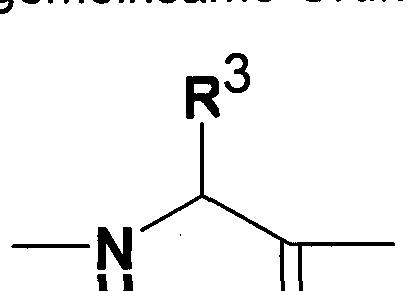
Bei den vor- und nachstehend aufgeführten Aminosäureresten steht R3für die Reste folgender Aminosäuren: In the amino acid residues listed above and below, R 3 represents the radicals of the following amino acids:
- Natürliche Aminosäuren: Alanin, Arginin, Asparagin, Asparaginsäure, Cystein, Glutamin, Glutaminsäure, Glycin, Histidin, Isoleucin, Leucin, Lysin, Methionin, Ornithin, Phenylalanin, Prolin, Serin, Threonin, Tryptophan, Tyrosin und Valin Natural amino acids: alanine, arginine, asparagine, aspartic acid, cysteine, glutamine, glutamic acid, glycine, histidine, isoleucine, leucine, lysine, methionine, ornithine, phenylalanine, proline, serine, threonine, tryptophan, tyrosine and valine
- Nicht-natürliche Aminosäuren wie beispielsweise Cyclopropylglycin, Cyclobutylglycin, Cyclopentylglycin, Cyclohexylglycin, 3-Oxetanylglycin, 3-Oxetanylglycin, Tetrahydro-furan-3-ylglycin, Tetrahydro-furan-2- ylglycin, Ethylsulfanylmethylglycin, 2-Methylsulfanylethylglycin, 1- Methylsulfanylethylglycin, Norvalin, Aminobuttersäure, tert-Leucin, Norleucin, Naphthylalanin, O-Methyl-Serin, O-Ethyl-Serin und Non-natural amino acids such as cyclopropylglycine, cyclobutylglycine, cyclopentylglycine, cyclohexylglycine, 3-oxetanylglycine, 3-oxetanylglycine, tetrahydrofuran-3-ylglycine, tetrahydrofuran-2-ylglycine, ethylsulfanylmethylglycine, 2-methylsulfanylethylglycine, 1-methylsulfanylethylglycine, norvaline , Aminobutyric acid, tert-leucine, norleucine, naphthylalanine, O-methyl-serine, O-ethyl-serine and
dergleichen like
Sofern die vorstehend genannten Aminosäuren in mehreren enantiomeren Formen auftreten können, so sind vor- und nachstehend alle diese Formen und auch ihre Gemische (z.B. DL-Formen) eingeschlossen. Inasmuch as the aforementioned amino acids can occur in several enantiomeric forms, above and below include all of these forms and also their mixtures (e.g., DL forms).
Ferner bedeutet nachstehend: Furthermore, below:
Boc ter.-Butoxycarbonyl Boc ter. Butoxycarbonyl
CBZ Benzyloxycarbonyl CBZ benzyloxycarbonyl
DNP 2,4-Dinitrophenyl FMOC 9-Fluorenylmethoxycarbonyl DNP 2,4-dinitrophenyl FMOC 9-fluorenylmethoxycarbonyl
imi-DNP 2,4-Dinitrophenyl in 1-Stellung des Imidazolrings imi-DNP 2,4-dinitrophenyl in the 1-position of the imidazole ring
OMe Methylester OMe methyl ester
POA Phenoxyacetyl POA phenoxyacetyl
DCCI Dicyclohexylcarbodiimid DCCI dicyclohexylcarbodiimide
HOBt 1-Hydroxybenzotriazol HOBt 1-hydroxybenzotriazole
Hai bedeutet Fluor, Chlor, Brom oder lod, insbesondere Fluor oder Chlor. Hal means fluorine, chlorine, bromine or iodine, in particular fluorine or chlorine.
-(C=0)- bedeutet Carbonylsauerstoff bzw. steht für
Alkyl oder A ist eine unverzweigte (lineare) oder verzweigte Alkyl or A is unbranched (linear) or branched
Kohlenwasserstoffkette und hat 1 , 2, 3, 4, 5, 6, 7, 8, 9 oder 10 C-Atome. A bedeutet vorzugsweise Methyl, weiterhin Ethyl, Propyl, Isopropyl, Butyl, Isobutyl, sek.-Butyl oder tert.-Butyl, ferner auch Pentyl, 1-, 2- oder 3- Methylbutyl, 1 ,1- , 1 ,2- oder 2,2-Dimethylpropyl, 1-Ethylpropyl, Hexyl, 1- , 2- 3- oder 4-Methylpentyl, 1 ,1- , 1 ,2- , 1 ,3- , 2,2- , 2,3- oder 3,3-Dimethylbutyl, 1- oder 2-Ethylbutyl, 1-Ethyl-1-methylpropyl, 1-Ethyl-2-methylpropyl, 1 ,1 ,2- oder 1 ,2,2-Trimethylpropyl, lineares oder verzweigtes Heptyl, Octyl, Nonyl oder Decyl bedeutet, weiter bevorzugt z.B. Trifluormethyl Hydrocarbon chain and has 1, 2, 3, 4, 5, 6, 7, 8, 9 or 10 C-atoms. A is preferably methyl, furthermore ethyl, propyl, isopropyl, butyl, isobutyl, sec-butyl or tert-butyl, furthermore also pentyl, 1-, 2- or 3-methylbutyl, 1, 1, 1, 2 or 2,2-dimethylpropyl, 1-ethylpropyl, hexyl, 1-, 2-, or 4-methylpentyl, 1, 1-, 1, 2-, 1, 3-, 2,2-, 2,3- or 3 , 3-dimethylbutyl, 1- or 2-ethylbutyl, 1-ethyl-1-methylpropyl, 1-ethyl-2-methylpropyl, 1,1,2 or 1,2,2-trimethylpropyl, linear or branched heptyl, octyl, Nonyl or decyl, more preferably, for example trifluoromethyl
Zyklisches Alkyl oder Zykloalkyl ist eine zyklische Kohlenwasserstoffkette und hat 3- 10, vorzugsweise 3-7 C-Atome und bedeutet vorzugsweise Zyklopropyl, Zyklobutyl, Zyklopentyl, Zyklohexyl oder Zykloheptyl. Cyclic alkyl or cycloalkyl is a cyclic hydrocarbon chain and has 3-10, preferably 3-7 C atoms and is preferably cyclopropyl, cyclobutyl, cyclopentyl, cyclohexyl or cycloheptyl.
Ein- oder zweikerniger gesättigter, ungesättigter oder aromatischer Mono- or binuclear saturated, unsaturated or aromatic
Heterozyklus bedeutet vorzugsweise unsubstituiertes oder ein-, zwei- oder dreifach substituiertes 2- oder 3-Furyl, 2- oder 3-Thienyl, 1-, 2- oder 3- Pyrrolyl, 1-, 2, 4- oder 5-lmidazolyl, 1-, 3-, 4- oder 5-Pyrazolyl, 2-, 4- oder 5- Oxazolyl, 3-, 4- oder 5-lsoxazolyl, 2-, 4- oder 5-Thiazolyl, 3-, 4- oder 5- Isothiazolyl, 2-, 3- oder 4-Pyridyl, 2-, 4-, 5- oder 6-Pyrimidinyl, weiterhin bevorzugt 1 ,2,3-Triazol-1-, -4- oder -5-yl, 1 ,2,4-TriazoM-, -3- oder 5-yl, 1- oder 5-Tetrazolyl, 1 ,2,3-Oxadiazol-4- oder -5-yl, 1 ,2,4-Oxadiazol-3- oder -5- yl, 1 ,3,4-Thiadiazol-2- oder -5-yl, 1 ,2,4-Thiadiazol-3- oder -5-yl, 1 ,2,3- Thiadiazol-4- oder -5-yl, 3- oder 4-Pyridazinyl, Pyrazinyl, 1-, 2-, 3-, 4-, 5-, 6- oder 7-lndolyl, 4- oder 5-lsoindolyl, 1-, 2-, 4- oder 5-Benzimidazolyl, 1-, 3-, 4- , 5-, 6- oder 7-Benzopyrazolyl, 2-, 4-, 5-, 6- oder 7-Benzoxazolyl, 3-, 4-, 5-, 6- oder 7- Benzisoxazolyl, 2-, 4-, 5-, 6- oder 7-Benzothiazolyl, 2-, 4-, 5-, 6- oder 7-Benzisothiazolyl, 4-, 5-, 6- oder 7-Benz-2,1,3-oxadiazolyl, 2-, 3-, 4-, 5-, 6-, 7- oder 8-Chinolyl, 1-, 3-, 4-, 5-, 6-, 7- oder 8-lsochinolyl, 3-, 4-, 5-, 6-, 7- oder 8-Cinnolinyl, 2-, 4-, 5-, 6-, 7- oder 8-Chinazolinyl, 5- oder 6-Chinoxalin- y|, 2-, 3-, 5-, 6-, 7- oder 8-2H-Benzo[1 ,4]oxazinyl, weiter bevorzugt 1 ,3-Heterocycle preferably denotes unsubstituted or mono-, di- or trisubstituted 2- or 3-furyl, 2- or 3-thienyl, 1-, 2- or 3-pyrrolyl, 1-, 2-, 4- or 5-imidazolyl, 1 -, 3-, 4- or 5-pyrazolyl, 2-, 4- or 5-oxazolyl, 3-, 4- or 5-isoxazolyl, 2-, 4- or 5-thiazolyl, 3-, 4- or 5- Isothiazolyl, 2-, 3- or 4-pyridyl, 2-, 4-, 5- or 6-pyrimidinyl, more preferably 1, 2,3-triazole-1, -4- or -5-yl, 1, 2 , 4-triazoM, -3 or 5-yl, 1 or 5-tetrazolyl, 1, 2,3-oxadiazol-4 or 5-yl, 1, 2,4-oxadiazol-3 or -5-yl, 1, 3,4-thiadiazol-2 or -5 -yl, 1, 2,4-thiadiazol-3 or -5-yl, 1, 2,3-thiadiazol-4 or 5-yl, 3- or 4-pyridazinyl, pyrazinyl, 1, 2, 3-, 4-, 5-, 6- or 7-indolyl, 4- or 5-isoindolyl, 1-, 2-, 4- or 5-benzimidazolyl, 1-, 3-, 4-, 5-, 6- or 7-benzopyrazolyl, 2-, 4-, 5-, 6- or 7-benzoxazolyl, 3-, 4-, 5-, 6- or 7- benzisoxazolyl, 2-, 4-, 5-, 6- or 7 Benzothiazolyl, 2-, 4-, 5-, 6- or 7-benzisothiazolyl, 4-, 5-, 6- or 7-benz-2,1,3-oxadiazolyl, 2-, 3-, 4-, 5 ' -, 6-, 7- or 8-quinolyl, 1-, 3-, 4-, 5-, 6-, 7- or 8-isoquinolyl, 3-, 4-, 5-, 6-, 7- or 8 -Cinnolinyl, 2-, 4-, 5-, 6-, 7- or 8-quinazolinyl, 5- or 6-Chinoxalin- y |, 2-, 3-, 5-, 6-, 7- or 8-2H Benzo [1, 4] oxazinyl, more preferably 1, 3
Benzodioxol-5-yl, 1 ,4-Benzodioxan-6-yl, 2,1 ,3-Benzothiadiazol-4- oder -5-yl oder 2,1 ,3-Benzoxadiazol-5-yl. Benzodioxol-5-yl, 1,4-benzodioxan-6-yl, 2,1,3-benzothiadiazol-4 or 5-yl or 2,1,3-benzoxadiazol-5-yl.
Die heterozyklischen Reste können auch teilweise oder vollständig hydriert sein und bedeuten z.B. auch 2,3-Dihydro-2-, -3-, -4- oder -5-furyl, 2,5-The heterocyclic radicals may also be partially or fully hydrogenated, e.g. also 2,3-dihydro-2-, -3-, -4- or -5-furyl, 2.5-
Dihydro-2-, -3-, -4- oder 5-furyl, Tetrahydro-2- oder -3-furyl, 1 ,3-Dioxolan-4- yl, Tetrahydro-2- oder -3-thienyl, 2,3-Dihydro-1-, -2-, -3-, -4- oder -5-pyrrolyl, 2,5-Dihydro-1-, -2-, -3-, -4- oder -5-pyrrolyl, 1-, 2- oder 3-Pyrrolidinyl, Dihydro-2-, -3-, -4- or 5-furyl, tetrahydro-2- or -3-furyl, 1,3-dioxolan-4-yl, tetrahydro-2- or -3-thienyl, 2,3 Dihydro-1-, 2-, -3-, -4- or -5-pyrrolyl, 2,5-dihydro-1-, 2-, -3-, -4- or -5-pyrrolyl, 1 , 2- or 3-pyrrolidinyl,
Tetrahydro-1-, -2- oder -4-imidazolyl, 2,3-Dihydro-1-, -2-, -3-, -4- oder -5- pyrazolyl, Tetrahydro-1-, -3- oder -4-pyrazolyl, 1 ,4-Dihydro-1-, -2-, -3- oder - 4-pyridyl, 1 ,2,3,4-Tetrahydro-1-, -2-, -3-, -4-, -5- oder -6-pyridyl, 1-, 2-, 3- oder 4-Piperidinyl, 2-, 3- oder 4-Morpholinyl, Tetrahydro-2-, -3- oder -4- pyranyl, 1 ,4-Dioxanyl, 1 ,3-Dioxan-2-, -4- oder -5-yl, Hexahydro-1-, -3- oder - 4-pyridazinyl, Hexahydro-1-, -2-, -4- oder -5-pyrimidinyl, 1-, 2- oder 3- Piperazinyl, 1 ,2,3,4-Tetrahydro-1-, -2-, -3-, -4-, -5-, -6-, -7- oder -8-chinolyl,Tetrahydro-1-, 2- or -4-imidazolyl, 2,3-dihydro-1-, 2-, -3-, -4- or -5-pyrazolyl, tetrahydro-1-, -3- or - 4-pyrazolyl, 1,4-dihydro-1, -2, -3 or 4-pyridyl, 1, 2,3,4-tetrahydro-1, -2, -3, -4 , -5- or -6-pyridyl, 1-, 2-, 3- or 4-piperidinyl, 2-, 3- or 4-morpholinyl, tetrahydro-2-, -3- or -4-pyranyl, 1, 4 Dioxanyl, 1,3-dioxane-2-, -4- or -5-yl, hexahydro-1, -3- or -4-pyridazinyl, hexahydro-1, -2, -4 or -5 pyrimidinyl, 1-, 2- or 3-piperazinyl, 1, 2,3,4-tetrahydro-1-, 2-, -3-, -4-, -5-, -6-, -7- or -8-quinolyl,
1 ,2,3,4-Tetrahydro-1-,-2-,-3-, -4-, -5-, -6-, -7- oder -8-isochinolyl, 2-, 3-, 5-, 6-, 7- oder 8- 3,4-Dihydro-2H-benzo[1 ,4]oxazinyl, weiter bevorzugt 2,3- Methylendioxyphenyl, 3,4-Methylendioxyphenyl, 2,3-Ethylendioxyphenyl, 3,4-Ethylendioxyphenyl, 3,4-(Difluormethylendioxy)phenyl, 2,3-Dihydro- benzofuran-5- oder 6-yl, 2,3-(2-Oxo-methylendioxy)-phenyl oder auch 3,4- Dihydro-2H-1 ,5-benzodioxepin-6- oder -7-yl, ferner bevorzugt 2,3-Dihydro- benzofuranyl oder 2,3-Dihydro-2-oxo-furanyl. Heterozyklus bedeutet ferner z.B. 2-Oxo-piperidin-1-yl, 2-Oxo-pyrrolidin-1-yl, 2-Oxo-l H-pyridin-1-yl, 3-Oxo-morpholin-4-yl, 4-Oxo-1H-pyridin-1-yl, 2,6- Dioxo-piperidin1-yl, 2-Oxo-piperazin-1-yl, 2,6-Dioxo-piperazin-1-yl, 2,5- Dioxo-pyrrolidin-1-yl, 2-Oxo-1 ,3-oxazolidin-3-yl, 3-Oxo-2H-pyridazin-2-yl, 2- Caprolactam-1-yl (= 2-Oxo-azepan-1-yl), 2-Hydroxy-6-oxo-piperazin-1-yl, 2- Methoxy-6-oxo-piperazin-1-yl oder 2-Aza-bicyclo[2.2.2]-octan-3-on-2-yl. 1,2,3,4-tetrahydro-1, -2, 3, 4, 5, 6, 7 or 8 isoquinolyl, 2, 3, 5 , 6-, 7- or 8-3,4-dihydro-2H-benzo [1,4] oxazinyl, more preferably 2,3-methylenedioxyphenyl, 3,4-methylenedioxyphenyl, 2,3-ethylenedioxyphenyl, 3,4-ethylenedioxyphenyl , 3,4- (difluoromethylenedioxy) phenyl, 2,3-dihydrobenzofuran-5- or 6-yl, 2,3- (2-oxomethylendioxy) -phenyl or also 3,4-dihydro-2H-1, 5-benzodioxepin-6 or -7-yl, further preferably 2,3-dihydrobenzofuranyl or 2,3-dihydro-2-oxofuranyl. Heterocycle also means, for example, 2-oxopiperidin-1-yl, 2-oxopyrrolidin-1-yl, 2-oxo-1H-pyridin-1-yl, 3-oxomorpholin-4-yl, 4-oxo -1H-pyridin-1-yl, 2,6-dioxo-piperidin-1-yl, 2-oxo-piperazin-1-yl, 2,6-dioxo-piperazin-1-yl, 2,5-dioxo-pyrrolidine-1 -yl, 2-oxo-1,3-oxazolidin-3-yl, 3-oxo-2H-pyridazin-2-yl, 2-caprolactam-1-yl (= 2-oxo-azepan-1-yl), 2 Hydroxy-6-oxopiperazin-1-yl, 2-methoxy-6-oxopiperazin-1-yl or 2-azabicyclo [2.2.2] octan-3-one-2-yl.
Erfindungsgemäß sind auch alle physiologisch unbedenklichen Salze, Derivate, Solvate und Stereoisomere dieser Verbindungen, einschließlich deren Mischungen in allen Verhältnissen. Also included according to the invention are all physiologically acceptable salts, derivatives, solvates and stereoisomers of these compounds, including mixtures thereof in all ratios.
Gegenstand der Erfindung sind auch die optisch aktiven Formen The invention also relates to the optically active forms
(Stereoisomeren), die Enantiomeren, die Racemate, die Diastereomeren sowie Hydrate und Solvate dieser Verbindungen. (Stereoisomers), the enantiomers, the racemates, the diastereomers and hydrates and solvates of these compounds.
Erfindungsgemäße Verbindungen der Formel I können aufgrund ihrer Molekülstruktur chiral sein und können dementsprechend in verschiedenen enantiomeren Formen auftreten. Sie können daher in racemischer oder in optisch aktiver Form vorliegen. Da sich die pharmazeutische Wirksamkeit der Racemate bzw. der Stereoisomere der erfindungsgemäßen Compounds of the formula I according to the invention may be chiral due to their molecular structure and may accordingly occur in different enantiomeric forms. They may therefore be in racemic or optically active form. Since the pharmaceutical activity of the racemates or stereoisomers of the invention
Verbindungen unterscheiden kann, kann es wünschenswert sein, die Compounds may differ, it may be desirable to
Enantiomere zu verwenden. In diesem Fällen kann das Endprodukt oder aber bereits die Zwischenprodukte in enantiomere Verbindungen, durch dem Fachmann bekannte chemische oder physikalische Maßnahmen, To use enantiomers. In these cases, the end product or even the intermediates in enantiomeric compounds, by chemical or physical measures known in the art,
aufgetrennt oder bereits als solche bei der Synthese eingesetzt werden. be separated or already used as such in the synthesis.
Unter pharmazeutisch oder physiologisch unbedenklichen Derivaten versteht man z.B. Salze der erfindungsgemäßen Verbindungen, als auch sogenannte Prodrug-Verbindungen. Unter Prodrug-Verbindungen versteht man mit z.B. Alkyl- oder Acylgruppen (siehe auch nachstehende Amino- und By pharmaceutically or physiologically harmless derivatives is meant e.g. Salts of the compounds of the invention, as well as so-called prodrug compounds. By prodrug compounds is meant by e.g. Alkyl or acyl groups (see also below amino and
Hydroxyschutzgruppen), Zuckern oder Oligopeptiden abgewandelte Hydroxy protecting groups), sugars or oligopeptides
Verbindungen der Formel I, die im Organismus rasch zu den wirksamen erfindungsgemäßen Verbindungen gespalten oder freigesetzt werden. Compounds of the formula I which are rapidly becoming active in the organism cleaved or released compounds of the invention.
Hierzu gehören auch bioabbaubare Polymerderivate der These include biodegradable polymer derivatives of
erfindungsgemäßen Verbindungen, wie dies z.B. in Int. J. Pharm. 115 (1995), 61-67 beschrieben ist. Compounds of the invention, e.g. in Int. J. Pharm. 115 (1995), 61-67.
Als Säureadditionssalze kommen anorganische oder organische Salze aller physiologisch oder pharmakologisch unbedenklichen Säuren in Frage, beispielsweise Halogenide, insbesondere Hydrochloride oder Hydrobromide, Lactate, Sulfate, Citrate, Tartrate, Maleate, Fumarate, Oxalate, Acetate, Phosphate, Methylsulfonate oder p-Toluolsulfonate. Suitable acid addition salts are inorganic or organic salts of all physiologically or pharmacologically acceptable acids, for example halides, in particular hydrochlorides or hydrobromides, lactates, sulfates, citrates, tartrates, maleates, fumarates, oxalates, acetates, phosphates, methyl sulfonates or p-toluenesulfonates.
Unter Solvaten der Verbindungen der Formel I werden Anlagerungen von inerten Lösungsmittelmolekülen an die Verbindungen der Formel I Solvates of the compounds of the formula I are additions of inert solvent molecules to the compounds of the formula I.
verstanden, die sich aufgrund ihrer gegenseitigen Anziehungskraft understood, due to their mutual attraction
ausbilden. Solvate sind beispielsweise Hydrate, wie Monohydrate oder Dihydrate oder Alkoholate, d.h. Additionsverbindungen mit Alkoholen wie beispielsweise mit Methanol oder Ethanol. form. Solvates are, for example, hydrates, such as monohydrates or dihydrates or alkoxides, i. Addition compounds with alcohols such as methanol or ethanol.
Es ist weiterhin vorgesehen, dass eine Verbindung der Formel I It is further contemplated that a compound of formula I
isotopen-markierte Formen davon umfasst. Eine isotopenmarkierte Form einer Verbindung der Formel I ist mit dieser Verbindung bis auf die includes isotope-labeled forms thereof. An isotope-labeled form of a compound of formula I is with this compound except for
Tatsache, dass eines oder mehrere Atome der Verbindung durch ein Atom bzw. Atome mit einer Atommasse oder Massenzahl ersetzt wurden, die sich von der Atommasse oder Massenzahl des Atoms, das üblicherweise natürlich vorkommt, unterscheidet, identisch. Zu den Isotopen, die leicht im Handel erhältlich sind und in eine Verbindung der Formel I nach gut bekannten Verfahren eingebaut werden können, zählen zum Beispiel Isotope von Wasser-stoff, Kohlenstoff, Stickstoff, Sauerstoff, Phosphor, Fluor und Chlor, z.B. 2H, 3H, 13C, 4C, 5N, 18O, 7O, 31P, 32P, 35S, 18F bzw. 36CI. Eine Ver-bindung der Formel I, eines ihrer Prodrugs oder jeweils ein pharmazeutisch unbedenkliches Salz davon, die eines oder mehrere der oben genannten Isotope und/oder andere Isotope von anderen Atomen enthält, ist als Bestandteil der vorliegenden Erfindung vorgesehen. Eine isotopenmarkierte Verbindung der Formel I lässt sich auf vielerlei nützliche Art verwenden. Zum Beispiel eignet sich eine isotopenmarkierte Verbindung der Formel I, in die z.B. ein Radioisotop wie 3H oder 14C eingebaut worden ist, für Assays zur Verteilung des Arzneistoffs und/oder Substratgewebes.Fact that one or more atoms of the compound have been replaced by an atom or atoms having an atomic mass or mass number that is different from the atomic mass or mass number of the atom, which is usually natural, identically. Examples of isotopes which are readily available commercially and can be incorporated by well known methods I to a compound of formula, include isotopes of water-cloth, carbon, nitrogen, oxygen, phosphorous, fluorine and chlorine such as 2 H, 3 H, 13 C, 4 C, 5 N, 18 O, 7 O, 31 P, 32 P, 35 S, 18 F and 36 CI, respectively. A compound of formula I, one of its prodrugs, or each a pharmaceutically acceptable salt thereof, containing one or more of the above isotopes and / or other isotopes of other atoms is provided as part of the present invention. An isotope-labeled compound of the formula I can be used in many useful ways. For example, an isotopically labeled compound of Formula I in which, for example, a radioisotope such as 3 H or 14 C has been incorporated is suitable for assays for distribution of the drug and / or substrate tissue.
Diese Radioisotope, d.h. Tritium (3H) und Kohlenstoff-1 (14C), sind aufgrund ihrer einfachen Herstellung und ausgezeichneten Nachweisbarkeit besonders bevorzugt. Der Einbau schwererer Isotope, z.B. Deuterium (2H), in eine Verbindung der Formel I weist therapeutische Vorteile aufgrund der höheren Stabilität dieser isotopenmarkierten Verbindung im Metabolismus auf. Höhere Stabilität in Metabolismus bedeutet unmittelbar eine erhöhte Halbwertszeit in vivo oder niedrigere Dosierungen, was unter den meisten Umständen eine bevorzugte Ausführungsform der vorliegenden Erfindung darstellen würde. Eine isotopenmarkierte Verbindung der Formel I lässt sich üblicherweise durch Durchführung der in den Syntheseschemata und der damit in Zusammenhang stehenden Beschreibung, im Beispielteil und im Herstellungsteil im vorliegenden Text offenbarten Vorgehensweisen herstellen, wobei ein nicht isotopenmarkierter Reaktionspartner durch einen leicht verfügbaren isotopenmarkierten Reaktionspartner ersetzt wird. These radioisotopes, ie tritium ( 3 H) and carbon-1 ( 14 C), are particularly preferred because of their ease of preparation and excellent detectability. Incorporation of heavier isotopes such as deuterium (2 H), into a compound of formula I has therapeutic advantages because of the higher stability of these isotopically-labeled compound in the metabolism. Higher stability in metabolism immediately means increased in vivo half-life or lower dosages, which under most circumstances would constitute a preferred embodiment of the present invention. An isotope-labeled compound of the formula I can usually be prepared by carrying out the procedures disclosed in the Synthetic Schemes and the related description, in the Examples and Preparation Section herein, substituting a readily available isotope-labeled reactant for a non-isotopically-labeled reactant.
Zur Manipulation des oxidativen Metabolismus der Verbindung über den primären kinetischen Isotopeneffekt kann auch Deuterium (2H) in eine Verbindung der Formel I eingebaut werden. Beim primären kinetischen Isotopeneffekt handelt es sich um eine Veränderung der Geschwindigkeit einer chemischen Reaktion aufgrund des Austausches isotopischer Kerne, was wiederum durch die Änderung der für die Bildung kovalenter Bindungen im Anschluß an diesen isotopischen Austausch erforderlichen For manipulating the oxidative metabolism of the compound across the primary kinetic isotope effect deuterium (2 H) can be incorporated into a compound of formula I. The primary kinetic isotope effect is a change in the rate of a chemical reaction due to the exchange of isotopic nuclei, which in turn is necessitated by the change in the covalent bond formation required following this isotopic exchange
Grundzustandsenergien verursacht wird. Der Austausch eines schwereren Isotops führt üblicherweise zu einer Erniedrigung der Grundzustandsenergie für eine chemische Bindung und verursacht so eine Verringerung derGround state energies is caused. The replacement of a heavier isotope usually leads to a lowering of the ground state energy for a chemical bond and thus causes a reduction of the
Geschwindigkeit bei einem geschwindigkeits-limitierenden Bindungsbruch. Findet der Bindungsbruch an bzw. in der Nähe einer Sattelpunktregion entlang der Koordinate einer Reaktion mit mehreren Produkten statt, so können sich die Produktverteilungs-verhältnisse stark ändern. Zur Speed at a speed-limiting bond break. Finds the bond break at or near a saddle point region along the coordinate of a reaction with multiple products, the product distribution ratios can change dramatically. to
Erläuterung: Wird Deuterium an ein Kohlenstoffatom in einer Explanation: Does deuterium bind to a carbon atom in a
nichtaustauschbaren Position gebunden, so sind are bound to non-exchangeable position, so are
Geschwindigkeitsunterschiede von kM/ko = 2-7 typisch. Wird dieser Speed differences of k M / ko = 2-7 typical. Will this
Geschwindigkeitsunterschied erfolgreich auf eine oxidationsanfällige Speed difference successful on an oxidation-prone
Verbindung der Formel I angewandt, so kann sich dadurch das Profil dieser Verbindung in vivo drastisch ändern und zu verbesserten Compound of the formula I applied, then the profile of this compound in vivo can change drastically and improved
pharmakokinetischen Eigenschaften führen. pharmacokinetic properties.
Bei der Entdeckung und Entwicklung von Therapeutika versucht der Fachmann, pharmakokinetische Parameter zu optimieren und gleichzeitig wünschenswerte In-vitro-Eigenschaften beizubehalten. Man kann vernünftig annehmen, daß viele Verbindungen mit schlechten pharmakokinetischen Profilen gegenüber dem oxidativen Metabolismus anfällig sind. Aus derzeitig verfügbaren In-vitro-Assays mit Lebermikrosomen erhält man wertvolle Informationen über den Verlauf dieses oxidativen Metabolismus, aufgrund dessen wiederum deuterierte Verbindungen der Formel I mit einer verbesserten Stabilität durch Resistenz gegenüber einem derartigen oxidativen Metabolismus rational gestaltet werden können. So gelangt man zu wesentlichen Verbesser-ungen der pharmakokinetischen Profile der Verbindungen der Formel I, die sich quantitativ als erhöhte ln-vivo- Halbwertszeit (T/2), Konzen-tration bei maximaler therapeutischer Wirkung (Cmax)> Fläche unter der Dosis-Wirkungskurve (AUC) sowie F und als verringerte Clearance, Dosis und Materialkosten ausdrücken lassen. In the discovery and development of therapeutics, one skilled in the art will seek to optimize pharmacokinetic parameters while maintaining desirable in vitro properties. It is reasonable to assume that many compounds with poor pharmacokinetic profiles are susceptible to oxidative metabolism. Available in vitro assays with liver microsomes provide valuable information on the course of this oxidative metabolism, which in turn allows rationalization of deuterated compounds of formula I with improved stability by resistance to such oxidative metabolism. One arrives at substantially Improvement-Ungen the pharmacokinetic profiles of compounds of Formula I which quantitatively increased in-vivo half-life (T / 2), concen-tration at maximum therapeutic effect (Cmax)> area under the dose-response curve (AUC) and F and expressed as reduced clearance, dose and material costs.
Zur Veranschaulichung des Obigen soll folgendes dienen: eine Verbindung der Formel I mit mehrfachen potentiellen Angriffsstellen für den oxidativen Metabolismus, z.B. Wasserstoffatome an einem Benzylrest und To illustrate the above, the following is intended to serve: a compound of formula I having multiple potential sites of attack for oxidative metabolism, e.g. Hydrogen atoms on a benzyl radical and
Wasserstoffatome, die an ein Stickstoffatom gebunden sind, wird als Reihe von Analogen hergestellt, in denen verschiedene Kombinationen von Wasserstoffatomen durch Deuteriumatome ersetzt werden, so daß einige, die meisten oder alle dieser Wasserstoffatome durch Deuteriumatome ersetzt sind. Durch Bestimmungen der Halb-werts-zeit gelangt man zu einer günstigen und genauen Bestimmung, wie sehr sich die Verbesserung der Widerstandsfähigkeit gegenüber oxidativen Metabolismen verbessert hat. Auf diese Weise wird bestimmt, dass aufgrund eines derartigen Austausches von Wasserstoff gegen Deuterium die Halbwertszeit der Hydrogen atoms attached to a nitrogen atom are prepared as a series of analogues in which various combinations of hydrogen atoms are replaced by deuterium atoms, so that some, Most or all of these hydrogen atoms are replaced by deuterium atoms. Half-life determinations provide a convenient and accurate measure of how much the improvement in resistance to oxidative metabolism has improved. In this way it is determined that due to such an exchange of hydrogen for deuterium the half life of the
Ausgangsverbindung um bis zu 100% verlängert werden kann. Output connection can be extended by up to 100%.
Der Austausch von Wasserstoff gegen Deuterium in einer Verbindung der Formel I lässt sich auch dazu verwenden, um zu einer günstigen Änderung des Stoffwechselproduktspektrums der Ausgangsverbindung zwecks The substitution of hydrogen for deuterium in a compound of formula I can also be used to effect a favorable change in the metabolic product spectrum of the starting compound
Verringerung oder Ausschluss von unerwünschten toxischen Reduction or exclusion of undesirable toxic
Stoffwechselprodukten zu gelangen. Entsteht zum Beispiel ein toxisches Stoffwechselprodukt aufgrund der Spaltung einer oxidativen Kohlenstoff- Wasserstoff (C-H)-Bindung kann vernünftigerweise ange-nommen werden, dass das deuterierte Analog die Produktion des unerwünschten To get metabolic products. For example, if a toxic metabolite arises due to the cleavage of an oxidative carbon-hydrogen (C-H) bond, it can reasonably be presumed that the deuterated analogue produces the undesirable
Stoffwechselprodukts wesentlich verringert oder ausschließt, sogar dann, wenn es sich bei der jeweiligen Oxidation nicht um einen Significantly reduces or eliminates the metabolic product, even if the respective oxidation is not one
geschwindigkeitsbestimmenden Schritt handelt. Weitere Informationen zum Stand der Technik in bezug auf den Austausch von Wasserstoff gegenrate-limiting step. Further information on the state of the art regarding the exchange of hydrogen against
Deuterium finden sich z.B. bei Hanzlik et al., J. Org. Chem. 55, 3992-3997, 1990, Reider et al., J. Org. Chem. 52, 3326-3334, 1987, Foster, Adv. Drug Res. 14, 1-40, 1985, Gillette et al., Biochemistry 33(10), 2927-2937, 1994, und Jarman et al., Carcinogenesis 16(4), 683-688, 1993. Deuterium can be found e.g. Hanzlik et al., J. Org. Chem. 55, 3992-3997, 1990, Reider et al., J. Org. Chem. 52, 3326-3334, 1987, Foster, Adv. Drug Res. 40, 1985, Gillette et al., Biochemistry 33 (10), 2927-2937, 1994, and Jarman et al., Carcinogenesis 16 (4), 683-688, 1993.
Gegenstand der Erfindung sind auch Mischungen der erfindungsgemäßen Verbindungen der Formel I, z.B. Gemische zweier Diastereomere z.B. im Verhältnis 1 :1 , 1 :2, 1 :3, 1 :4, 1 :5, 1 :10, 1 :100 oder 1 :1000. Besonders bevorzugt handelt es sich um Mischungen zweier stereoisomerer The invention also provides mixtures of the compounds of the formula I according to the invention, e.g. Mixtures of two diastereomers e.g. in the ratio 1: 1, 1: 2, 1: 3, 1: 4, 1: 5, 1: 10, 1: 100 or 1: 1000. Particularly preferred are mixtures of two stereoisomeric
Verbindungen. Bevorzugt sind jedoch auch Mischungen zweier oder mehrerer Verbindungen der Formel I. Gegenstand der Erfindung ist außerdem ein Verfahren zur Herstellung der Verbindungen der Formel I, dadurch gekennzeichnet, dass man a) eine Verbindung der Formel II, worin l1 f l2, 13, U und die oben Links. However, mixtures of two or more compounds of the formula I are also preferred. The invention furthermore relates to a process for the preparation of the compounds of the formula I, which comprises a) a compound of the formula II in which I 1 f I 2 , 13, U and the above
angegebenen Bedeutungen haben und Q eine Aminoschutzgruppe bedeutet, mit einer Verbindung der Formel III, worin Y, L2, n, A2 und und R2 die oben angegebenen Bedeutungen haben, unter Ausbildung einer Peptidbindung zwischen der Carboxylgruppe der Verbindung der Formel II und der Aminogruppe der Verbindung der Formel III zu einer Verbindung der Formel IV umsetzt und in einem zweiten Schritt die Verbindung der Formel IV durch Abspaltung der Schutzgruppe Q zu einer Verbindun der Formel V umsetz and Q is an amino-protecting group, with a compound of formula III, wherein Y, L 2 , n, A 2 and R 2 have the meanings given above, to form a peptide bond between the carboxyl group of the compound of formula II and Reacting amino group of the compound of formula III to give a compound of formula IV and in a second step, the compound of formula IV by cleavage of the protective group Q to a Verbindun the formula V implement

IV

IV V b) und eine Verbindung der Formel VI, worin X, Li, m, A-i und R1 die oben angegebenen Bedeutungen haben und der Rest X IV V b) and a compound of formula VI, wherein X, Li, m, Ai and R 1 have the meanings given above and the radical X.
gegebenenfalls durch eine Schutzgruppe geschützt ist, mit einer Verbindung der Formel V, worin der Rest Y gegebenenfalls durch eine Schutzgruppe geschützt ist, unter Ausbildung einer optionally protected by a protecting group, with a compound of formula V, wherein the radical Y is optionally protected by a protecting group to form a
Peptidbindung zwischen der Carboxylgruppe der Verbindung der Formel VI und der Aminogruppe der Verbindung der Formel V und durch Abspaltung der gegebenenfalls an den Resten X und Y vorhandenen Schutzgruppen zu einer Verbindung der Formel I umsetzt, worin , l2, b, l4, I5, X, Y, U , L2, R1 , R2, Αι, A2, m und n die in oben angegebenen Bedeutungen haben, oder Peptide bond between the carboxyl group of the compound of formula VI and the amino group of the compound of formula V and by cleavage of the optionally present at the radicals X and Y protecting groups to a compound of formula I. in which, l 2 , b, l 4 , I5, X, Y, U, L2, R 1 , R 2 , Αι, A2, m and n have the meanings given above, or
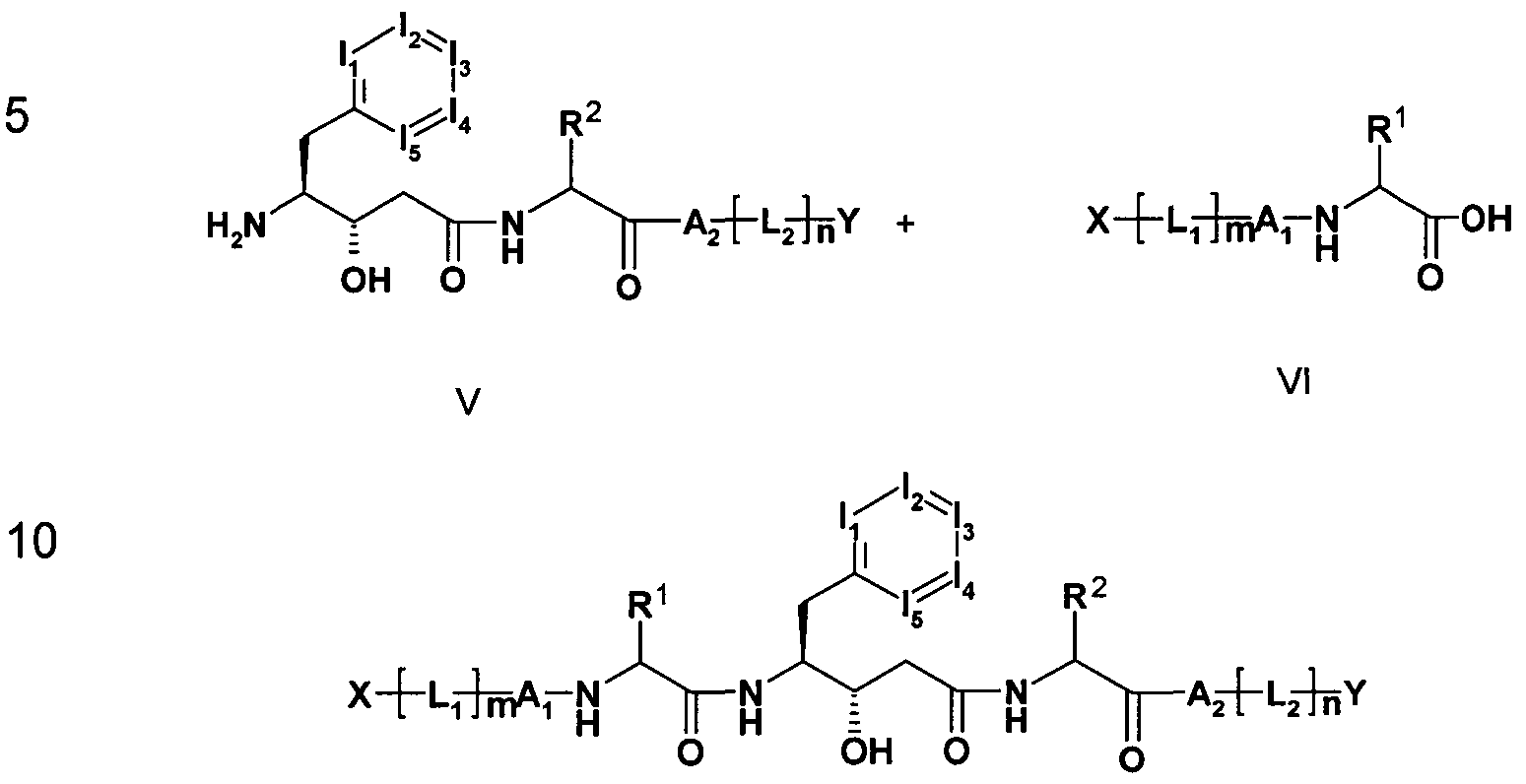
die Base einer Verbindung der Formel I durch Behandlung mit einer Säure in eines ihrer Salze überführt, oder the base of a compound of formula I is converted by treatment with an acid into one of its salts, or
eine Säure einer Verbindung der Formel I durch Behandlung mit einer Base in eines ihrer Salze überführt. an acid of a compound of formula I is converted by treatment with a base in one of its salts.
Es ist auch möglich die Reaktionen jeweils stufenweise durchzuführen und die Reihenfolge der Bausteinverknüpfungen unter Anpassung des It is also possible to carry out the reactions in stages and to determine the order of the building block links by adapting the
Schutzgruppenkonzepts zu verändern. To change the protection group concept.
Die Ausgangsstoffe oder Ausgangsverbindungen sind in der Regel bekannt. Sind sie neu, so können sie nach an sich bekannten Methoden hergestellt werden. The starting materials or starting compounds are generally known. If they are new, they can be prepared by methods known per se.
Die Ausgangsstoffe können, falls erwünscht, auch in situ gebildet werden, so dass man sie aus dem Reaktionsgemisch nicht isoliert, sondern sofort weiter zu den Verbindungen der Formel I umsetzt. Vorzugsweise werden die Verbindungen der Formel I erhalten, indem man sie aus ihren funktionellen Derivaten durch Solvolyse, insbesondere durch Hydrolyse oder durch Hydrogenolyse freisetzt. Bevorzugte Ausgangsstoffe für die Solvolyse bzw. Hydrogenolyse sind solche, die an der Stelle einer oder mehrerer freier Amino-, Carboxyl- und/oder Hydroxygruppen The starting materials can, if desired, also be formed in situ, so that they are not isolated from the reaction mixture, but immediately further reacted to the compounds of formula I. Preferably, the compounds of formula I are obtained by liberating them from their functional derivatives by solvolysis, in particular by hydrolysis or by hydrogenolysis. Preferred starting materials for the solvolysis or hydrogenolysis are those which take place at the site of one or more free amino, carboxyl and / or hydroxyl groups
entsprechend geschützte Amino-, Carboxyl- und/oder Hydroxygruppen enthalten, vorzugsweise solche, die an der Stelle eines H-Atoms, das mit einem N-Atom verbunden ist, eine Aminoschutzgruppe tragen. Ferner sind Ausgangsstoffe bevorzugt, die an der Stelle des H-Atoms einer correspondingly protected amino, carboxyl and / or hydroxy groups, preferably those which carry at the site of an H atom, which is connected to an N-atom, an amino protecting group. In addition, starting materials are preferred which at the site of the H atom of a
Hydroxygruppe eine Hydroxyschutzgruppe tragen. Außerdem sind Hydroxy group carry a hydroxy protecting group. Besides, they are
Ausgangsstoffe bevorzugt, die an der Stelle einer freien Carboxylgruppe eine geschützte Carboxygruppe tragen. Es können auch mehrere, gleiche oder verschiedene geschützte Amino-, Carboxyl- und/oder Hydroxygruppen im Molekül des Ausgangsstoffs vorhanden sein. Falls die vorhandenen Schutzgruppen voneinander verschieden sind, können sie in vielen Fällen selektiv abgespalten werden. Preference is given to starting materials which carry a protected carboxy group at the site of a free carboxyl group. There may also be several, identical or different protected amino, carboxyl and / or hydroxyl groups in the molecule of the starting material. If the protecting groups present are different from each other, they can be selectively cleaved in many cases.
Der Ausdruck„Aminoschutzgruppe" ist allgemein bekannt und bezieht sich auf Gruppen, die geeignet sind, eine Aminogruppe vor chemischen The term "amino protecting group" is well known and refers to groups that are capable of protecting an amino group from chemical
Umsetzungen zu schützen (zu blockieren), die aber leicht entfernbar sind, nachdem die gewünschte chemische Reaktion an anderen Stellen de Moleküls durchgeführt worden ist. Typisch für solche Gruppen sind insbesondere unsubstituierte oder substituierte Acylgruppen, ferner unsubstituierte oder substituierte Aryl- (z.B. 2,4-Dinitophenyl) oder Protect (block) reactions, but are easily removable after the desired chemical reaction has been carried out elsewhere in the molecule. Typical of such groups are in particular unsubstituted or substituted acyl groups, furthermore unsubstituted or substituted aryl (for example 2,4-dinitophenyl) or
Aralkylgruppen (z.B. Benzyl, 4-Nitrobenzyl, Triphenylmethyl). Da die Aralkyl groups (e.g., benzyl, 4-nitrobenzyl, triphenylmethyl). Because the
Aminoschutzgruppen nach der gewünschten Reaktion oder Reaktionsfolge entfernt werden, ist ihre Art und Größe im Übrigen nicht kritisch, bevorzugt sind jedoch solche mit 1-20, insbesondere 1-8 C-Atomen. Der Ausdruck „Acylgruppe" ist im Zusammenhang mit dem vorliegenden Verfahren in weitestem Sinne aufzufassen. Er umschließt von aliphatischen, Amino protecting groups are removed after the desired reaction or reaction sequence, their nature and size is otherwise not critical, but are preferably those having 1-20, especially 1-8 C-atoms. The term "acyl group" is to be understood in the broadest sense in the context of the present process, which encompasses aliphatic,
araliphatischen, aromatischen oder heterozyklischen Carbonsäuren oder Sulfonsäuren abgeleitete Acylgruppen sowie insbesondere Alkoxycarbonyl-, Aryloxycarbonyl- und vor allem Aralkoxycarbonylgruppen. Beispiele für derartige Acylgruppen sind Alkanoyl wie Acteyl, Propionyl, Buturyl, acyl groups derived from araliphatic, aromatic or heterocyclic carboxylic acids or sulfonic acids, and in particular alkoxycarbonyl-, Aryloxycarbonyl and especially aralkoxycarbonyl groups. Examples of such acyl groups are alkanoyl such as acetyl, propionyl, butyluryl,
Aralkanoyl wie Phenylacetyl, Aroyl wie Benzoyl oder Toluyl, Aryoxyaklkanoyl wie Phenoxyacetyl, Alkyoxycarbonyyl wie Methoxycarbonyl, Ethoxycarbonyl, 2,2,2-Trichlorethoxycarbonyl, BOC, 2-Jodethoxycaronyl, Aralkyloxycarbonyl wie CBZ, 4-Methoxybenzyloxycarbonyl oder FMOC. Bevorzugte Aralkanoyl such as phenylacetyl, aroyl such as benzoyl or toluyl, aryoxyaklkanoyl such as phenoxyacetyl, alkyoxycarbonyl such as methoxycarbonyl, ethoxycarbonyl, 2,2,2-trichloroethoxycarbonyl, BOC, 2-iodoethoxycaronyl, aralkyloxycarbonyl such as CBZ, 4-methoxybenzyloxycarbonyl or FMOC. preferred
Acylgruppen sind CBZ, FMOC, Benzyl und Acetyl. Acyl groups are CBZ, FMOC, benzyl and acetyl.
Der Ausdruck„Säureschutzgruppe" oder„Carboxylschutzgruppe" ist ebenfalls allgemein bekannt und bezieht sich auf Gruppen, die geeignet sind, eine -COOH-gruppe vor chemischen Umsetzungen zu schützen, die aber leicht entfernbar sind, nachdem die gewünschte chemische Reaktion an anderen Stellen des Moleküls durchgeführt worden sind. Typisch ist die Verwendung von Estern anstelle der freien Säuren z.B. von substutierten und unsubstituierten Alkylestern (wie Methyl, Ethyl, tert-Butyl und deren substituierte Derivate), von substutierten und unsubstituierten Benzylestern oder Silylestern. Die Art und Größe der Säureschutzgruppen ist nicht kritisch, bevorzugt sind jedoch solche mit 1-20, insbesondere 1-10 C- Atomen. The term "acid protecting group" or "carboxyl protecting group" is also well known and refers to groups which are capable of protecting a -COOH group from chemical reactions, but which are readily removable after the desired chemical reaction at other sites of the molecule have been carried out. Typical is the use of esters in place of the free acids e.g. Substituted and unsubstituted alkyl esters (such as methyl, ethyl, tert-butyl and their substituted derivatives), substituted and unsubstituted benzyl esters or silyl esters. The type and size of the acid protecting groups is not critical, but those with 1-20, in particular 1-10 C atoms are preferred.
Der Ausdruck„Hydroxyschutzgruppe" ist ebenfalls allgemein bekannt und bezieht sich auf Gruppen, die geeignet sind, eine Hydroxygruppe vor chemischen Umsetzungen zu schützen, die aber leicht entfernbar sind, nachdem die gewünschte chemische Reaktion an anderen Stellen des Moleküls durchgeführt worden sind. Typisch für solche Gruppen sind die oben genannten unsubstituierten oder substituierten Aryl-, Aralkyl- odder Acylgruppen, ferner auch Alkylgruppen. Die ihre Art und Größe der The term "hydroxy protecting group" is also well known and refers to groups which are suitable for protecting a hydroxy group from chemical reactions, but which are readily removable after the desired chemical reaction has been carried out elsewhere in the molecule Groups are the abovementioned unsubstituted or substituted aryl, aralkyl or acyl groups, and also alkyl groups
Hydroxyschutzgruppen ist nicht kritisch, bevorzugt sind jedoch solche mit 1- 20, insbesondere 1-10 C-Atomen. Beispiele für Hyrdoxyschutzgruppen sind u.a. Benzyl, p-Nitrobenzoyl, p-Toluolsulfonyl und Acetyl, wobei Benzyl und Acetyl bevorzugt sind. Weitere typische Beispiele für Amino-, Säure-, und Hydroxyschutzgruppen finden sich beispielsweise in„Greene's Protective Groups in Organic Hydroxy protecting groups are not critical, but preferred are those having 1-20, in particular 1-10 C atoms. Examples of hyrdoxy protecting groups include benzyl, p-nitrobenzoyl, p-toluenesulfonyl and acetyl, with benzyl and acetyl being preferred. Other typical examples of amino, acid, and hydroxy protecting groups can be found, for example, in Greene's Protective Groups in Organic
Synthesis", vierte Auflage, Wiley-Interscience, 2007 Die als Ausgangstoffe zu verwendenden funktionellen Derivate der Synthesis ", Fourth Edition, Wiley-Interscience, 2007 The functional derivatives to be used as starting materials
Verbindungen der Formel I können nach bekannten Methoden der Compounds of the formula I can be prepared by known methods of
Aminosäure- und Peptidsynthese hergestellt werden, wie sie z.B. in den genannten Standardwerken und Patentanmeldungen beschrieben sind. Die Freisetzung der Verbindungen der Formel I aus ihren funktionellenAmino acid and peptide synthesis, as e.g. in the said standard works and patent applications are described. The release of the compounds of formula I from their functional
Derivaten gelingt, je nach verwendeter Schutzgruppe, z.B. mithilfe starker Säuren, zweckmäßig mit Trifluoressigsäure oder Perchlorsäure, jedoch auch mit anderen starken anorganischen Säuren wie Salz- oder Schwefelsäure, starken organischen Säuren wie Trichloressigsäure oder Sulfonsäuren wie Benzoyl- oder p-Toluol-Sulfonsäure. Die Anwesenheit eines zusätzlichen inerten Lösungsmittels und/oder eines Katalysators ist möglich, jedoch nicht immer erforderlich. Derivatives succeed, depending on the protecting group used, e.g. with strong acids, useful with trifluoroacetic acid or perchloric acid, but also with other strong inorganic acids such as hydrochloric or sulfuric acid, strong organic acids such as trichloroacetic acid or sulfonic acids such as benzoyl or p-toluene sulfonic acid. The presence of an additional inert solvent and / or a catalyst is possible, but not always necessary.
In Abhängigkeit des jeweiligen Synthesewegs kann man die Ausgangsstoffe, gegebenenfalls in Anwesenheit eines inerten Lösungsmittels reagieren lassen. Depending on the respective synthesis route, the starting materials can be reacted, if appropriate in the presence of an inert solvent.
Als inerte Lösungsmittel eignen sich z.B. Heptan, Hexan, Petrolether, DMSO, Benzol, Toluol, Xylol, Trichlorethylen-, 1 ,2- Dichlorethantetra- Chlorkohlenstoff, Chloroform oder Dichlormethan; Alkohole wie Methanol, Ethanol, Isopropanol, n-Propanol, n-Butanol oder tert.-Butanol; Ether wie Diethylether, Diisopropylether (bevorzugt für die Substitution am Suitable inert solvents are e.g. Heptane, hexane, petroleum ether, DMSO, benzene, toluene, xylene, trichlorethylene, 1, 2-dichloroethanetetra-chlorocarbon, chloroform or dichloromethane; Alcohols such as methanol, ethanol, isopropanol, n-propanol, n-butanol or tert-butanol; Ethers, such as diethyl ether, diisopropyl ether (preferred for substitution on
Indolstickstoff), Tetrahydrofuran (THF) oder Dioxan; Glykolether wie Indole nitrogen), tetrahydrofuran (THF) or dioxane; Glycol ethers like
Ethylenglykolmonomethyl- oder monoethylether (Methylglykol oder Ethylene glycol monomethyl or monoethyl ether (methyl glycol or
Ethylglykol), Ethylenglykoldimethy-Iether (Diglyme); Ketone wie Aceton oder Butanon; Amide wie Acetamid, Dimethylacetamid, N-Methylpyrrolidon (NMP) oder Dimethylformamid (DMF); Nitrile wie Acetonitril; Ester wie Ethylacetat, Carbonsäuren oder Säureanhydride, wie z. B. wie Essigsäure oder Ethyl glycol), ethylene glycol dimethyl ether (diglyme); Ketones such as acetone or butanone; Amides such as acetamide, dimethylacetamide, N-methylpyrrolidone (NMP) or dimethylformamide (DMF); Nitriles such as acetonitrile; Esters such as ethyl acetate, Carboxylic acids or acid anhydrides, such as. B. such as acetic acid or
Acetanhydrid, Nitroverbindungen wie Nitromethan oder Nitrobenzol, gegebenenfalls auch Gemische der genannten Lösungsmittel untereinander oder Gemische mit Wasser. Acetic anhydride, nitro compounds such as nitromethane or nitrobenzene, if appropriate, mixtures of said solvents with each other or mixtures with water.
Die Menge des Lösungsmittels ist nicht kritisch, vorzugsweise können 10 g bis 500 g Lösungsmittel je g der umzusetzenden Verbindung der Formel I zugesetzt werden. Vorteilhaft kann die Zugabe eines säurebindenden Mittels sein, z.B. ein Alkalimetall oder Erdalkalimetallhydroxid, -carbonat oder -bicarbonat oder andere Alkalimetall- oder Erdalkalimetallsalze schwacher Säuren, The amount of solvent is not critical, preferably 10 g to 500 g of solvent per g of the compound of formula I to be reacted are added. Advantageous may be the addition of an acid-binding agent, e.g. an alkali metal or alkaline earth metal hydroxide, carbonate or bicarbonate or other alkali metal or alkaline earth metal salts of weak acids,
vorzugsweise ein Kalium-, Natrium- oder Calciumsalz, oder die Zugabe einer organischen Base, wie beispielsweise an Triethylamin, Dimethylamin, Pyridin oder Chinolin, oder ein Überschuss der Aminkomponente. preferably a potassium, sodium or calcium salt, or the addition of an organic base such as triethylamine, dimethylamine, pyridine or quinoline, or an excess of the amine component.
Die erhaltenen erfindungsgemäßen Verbindungen können von der The resulting compounds according to the invention can be obtained from the
entsprechenden Lösung, in der sie hergestellt werden, getrennt werden (z.B. durch Zentrifugation und Waschen) und können nach der Trennung in einer anderen Zusammensetzung gelagert werden, oder sie können direkt in der Herstellungslösung verbleiben. Die erhaltenen erfindungsgemäßen corresponding solution in which they are prepared (e.g., by centrifugation and washing) and may be stored after separation in another composition, or they may remain directly in the preparation solution. The obtained invention
Verbindungen können auch zur jeweiligen Verwendung in gewünschte Lösungsmittel aufgenommen werden. Geeignete Reaktionstemperaturen liegen bei Temperaturen von 0 bis 40°C, vorzugsweise bei 5 bis 25°C. Compounds may also be included for use in desired solvents. Suitable reaction temperatures are at temperatures of 0 to 40 ° C, preferably at 5 to 25 ° C.
Die Dauer der Umsetzung hängt von den gewählten Reaktionsbedingungen ab. In der Regel beträgt die Reaktionsdauer 0.5 Stunden bis 10 Tage, vorzugsweise 1 bis 24 Stunden. Bei Verwendung einer Mikrowelle kann die Reaktionszeit auf werte von 1 bis 60 Minuten reduziert werden. Die Verbindungen der Formel I und auch die Ausgangsstoffe zu ihrer The duration of the reaction depends on the selected reaction conditions. In general, the reaction time is 0.5 hours to 10 days, preferably 1 to 24 hours. When using a microwave, the reaction time can be reduced to values of 1 to 60 minutes. The compounds of the formula I and also the starting materials for their
Herstellung werden im übrigen nach bekannten Methoden hergestellt, wie sie in der Literatur beschrieben sind (z. B. in Standardwerken wie Houben- Weyl, Methoden der organischen Chemie, Georg-Thieme-Verlag, Stuttgart) so z.B. unter Reaktionsbedingungen, die für die genannten Umsetzungen bekannt und geeignet sind. Dabei kann man auch von an sich bekannten, hier nicht näher beschriebenen Varianten Gebrauch machen. Incidentally, preparation are also prepared by known methods as described in the literature (for example in standard works such as Houben-Weyl, Methoden der organischen Chemie, Georg-Thieme-Verlag, Stuttgart), e.g. under reaction conditions which are known and suitable for the said reactions. In this case, one can make use of known per se, not described here variants.
Durch übliche Aufarbeitungsschritte wie z. B. Wasserzugabe zum By usual workup steps such. B. water addition to
Reaktionsgemisch und Extraktion können die Verbindungen nach Reaction mixture and extraction, the compounds according to
Entfernung des Lösungsmittels erhalten werden. Es kann vorteilhaft sein, zur weiteren Reinigung des Produktes eine Destillation oder Kristallisation anzuschließen oder eine chromatographische Reinigung durchzuführen. Eine Säure der Formel I kann mit einer Base in das dazugehörige Removal of the solvent can be obtained. It may be advantageous to add a distillation or crystallization for further purification of the product or to perform a chromatographic purification. An acid of the formula I can with a base in the associated
Additionssalz überführt werden, beispielsweise durch Umsetzung Addition salt are converted, for example by reaction
äquivalenter Mengen der Säure und der Base in einem inerten equivalent amounts of the acid and the base in an inert
Lösungsmittel wie Ethanol und einschließendes Eindampfen. Für diese Umsetzung kommen insbesondere Basen in Frage, die physiologisch unbedenkliche Salze liefern. So kann die Säure der Formel I mit einer Base (z.B. Natrium- oder Kaliumhydroxid oder -carbonat) in das entsprechende Metall-, insbesondere Alkali- oder Erdalkalimetall- oder in das Solvents such as ethanol and including evaporation. Suitable bases for this reaction are, in particular, bases which yield physiologically acceptable salts. Thus, the acid of formula I can be treated with a base (e.g., sodium or potassium hydroxide or carbonate) in the corresponding metal, especially alkali or alkaline earth metal or in the
entsprechende Ammoniumsalz umgewandelt werden. Für diese Umsetzung kommen auch organische Basen in Frage, die physiologisch unbedenkliche Salze liefern, wie z.B. Ethanolamin. corresponding ammonium salt to be converted. Also suitable for this reaction are organic bases which yield physiologically acceptable salts, e.g. Ethanolamine.
Andererseits kann eine Base der Formel I mit einer Säure in das zugehörige Säureadditionssalz überführt werden, beispielsweise durch Umsetzung äquivalenter Mengen der Base und der Säure in einem inerten On the other hand, a base of the formula I can be converted with an acid into the associated acid addition salt, for example by reacting equivalent amounts of the base and the acid in an inert
Lösungsmittel wie Ethanol und anschließendes Eindampfen. Für diese Umsetzung kommen insbesondere Säuren in Frage, die physiologisch unbedenkliche Salze liefern. So können anorganische Säuren verwendet werden, z.B. Schwefelsäure, Salpetersäure, Halogenwasserstoffsäuren wie Chlorwasserstoffsäure oder Bromwasserstoffsäure, Phosphorsäuren wir Orthophosphorsäure, Sulfaminsäure, ferner organische Säuren, Solvents such as ethanol and subsequent evaporation. Particularly suitable acids for this reaction are those which yield physiologically acceptable salts. Thus, inorganic acids can be used sulfuric acid, nitric acid, hydrohalic acids such as hydrochloric acid or hydrobromic acid, phosphoric acids such as orthophosphoric acid, sulfamic acid, and also organic acids,
insbesondere aliphatische, alicyclische, araliphatische, aromatische oder heterocyclische, ein- oder mehrbasige Carbon-, Sulfon- oder in particular aliphatic, alicyclic, araliphatic, aromatic or heterocyclic, mono- or polybasic carboxylic, sulfonic or
Schwefelsäuren, Z.B. Ameisensäure, Essigsäure, Propionsäure, Sulfuric acids, e.g. Formic acid, acetic acid, propionic acid,
Pivalinsäure, Diethylessigsäure, Malonsäure, Bernsteinsäure, Pimelinsäure, Fumarsäure, Maleinsäure, Milchsäure, Weinsäure, Äpfelsäure, Pivalic acid, diethylacetic acid, malonic acid, succinic acid, pimelic acid, fumaric acid, maleic acid, lactic acid, tartaric acid, malic acid,
Citronensäure, Gluconsäure, Ascorbinsäure, Nicotinsäure, Isonicotinsäure, Methan- oder Ethansulfonsäure, Ethandisulfonsäure, 2-Hydroxysulfonsäure, Benzolsulfonsäure, p-Toluolsulfonsäure, Naphthalin-mom- und Citric acid, gluconic acid, ascorbic acid, nicotinic acid, isonicotinic acid, methane or ethanesulfonic acid, ethanedisulfonic acid, 2-hydroxysulfonic acid, benzenesulfonic acid, p-toluenesulfonic acid, naphthalene mom- and
disulfonsäuren oder Laurylschwefelsäure. Salze mit physiologisch nicht unbedenklichen Säuren, z.B. Pikrate, können zur Isolierung und/oder Aufreinigung der Verbindungen der Formel I verwendet werden. disulfonic acids or laurylsulfuric acid. Salts with physiologically unacceptable acids, e.g. Picrates, can be used for isolation and / or purification of the compounds of formula I.
Es wurde gefunden, dass die Verbindungen der Formel I gut verträglich sind und wertvolle pharmakologische Eigenschaften besitzen, da sie It has been found that the compounds of the formula I are well tolerated and have valuable pharmacological properties since they
Aspartylproteasen und insbesondere Cathepsin D selektiv inhibieren. Ein weiterer Gegenstand der Erfindung ist deshalb die Verwendung von erfindungsgemäßen Verbindungen zur Herstellung eines Medikaments zur Behandlung und/oder Prophylaxe von Krankheiten, die durch Cathepsin D und/oder durch Cathepsin D-vermittelte Signaltransduktion verursacht, vermittelt und/oder propagiert werden. Aspartyl proteases and in particular cathepsin D selectively inhibit. Another object of the invention is therefore the use of compounds of the invention for the manufacture of a medicament for the treatment and / or prophylaxis of diseases caused by cathepsin D and / or by cathepsin D-mediated signal transduction mediated and / or propagated.
Gegenstand der Erfindung ist somit insbesondere auch ein Arzneimittel enthaltend wenigstens eine erfindungsgemäße Verbindung und/oder eines ihrer physiologisch unbedenklichen Salze, Derivate, Solvate, Prodrugs und Stereoisomere, einschließlich deren Mischungen in allen Verhältnissen zur Verwendung bei der Behandlung und/oder Prophylaxe von physiologischen und/oder pathophysiologischen Zuständen. Besonders bevorzugt sind insbesondere physiologische und/oder pathophysiologische Zustände, die mit Cathepsin D in Zusammenhang stehen. Unter physiologischen und/oder pathophysiologischen Zuständen werden physiologische und/oder pathophysiologische Zustände verstanden, die medizinisch relevant sind, wie beispielsweise Krankheiten bzw. The invention thus also relates in particular to a medicament comprising at least one compound according to the invention and / or one of its physiologically acceptable salts, derivatives, solvates, prodrugs and stereoisomers, including mixtures thereof in all ratios for use in the treatment and / or prophylaxis of physiological and / or or pathophysiological conditions. Especially preferred are physiological and / or pathophysiological conditions associated with cathepsin D. Physiological and / or pathophysiological conditions are physiological and / or pathophysiological conditions that are medically relevant, such as illnesses and / or pathophysiological conditions.
Erkrankungen und medizinische Störungen, Beschwerden, Symptome oder Komplikationen und dergleichen, insbesondere Krankheiten. Diseases and medical disorders, ailments, symptoms or complications and the like, in particular diseases.
Ein weiterer Gegenstand der Erfindung ist ein Arzneimittel enthaltend wenigstens eine erfindungsgemäße Verbindung und/oder eines ihrer physiologisch unbedenklichen Salze, Derivate, Solvate, Prodrugs und Stereoisomere, einschließlich deren Mischungen in allen Verhältnissen zur Verwendung bei der Behandlung und/oder Prophylaxe von physiologischen und/oder pathophysiologischen Zuständen, ausgewählt aus der Gruppe bestehend Arthrose, traumatische Knorpelverletzungen und Arthritis, insbesondere rheumatoide Arthritis. Ein weiterer Gegenstand der Erfindung ist ein Arzneimittel enthaltend wenigstens eine erfindungsgemäße Verbindung und/oder eines ihrer physiologisch unbedenklichen Salze, Derivate, Solvate, Podrugs und Stereoisomere, einschließlich deren Mischungen in allen Verhältnissen zur Verwendung bei der Behandlung und/oder Prophylaxe von physiologischen und/oder pathophysiologischen Zuständen, ausgewählt aus der Gruppe bestehend aus Alzheimer Krankheit, Chorea Huntington, Mucolipidose, Krebs, insbesondere Brustkrebs, Kontaktdermatitis, Spät-Typ der Another object of the invention is a medicament containing at least one compound of the invention and / or one of its physiologically acceptable salts, derivatives, solvates, prodrugs and stereoisomers, including mixtures thereof in all proportions for use in the treatment and / or prophylaxis of physiological and / or pathophysiological conditions selected from the group consisting of osteoarthritis, traumatic cartilage injuries and arthritis, especially rheumatoid arthritis. Another object of the invention is a medicament containing at least one compound of the invention and / or one of its physiologically acceptable salts, derivatives, solvates, podrugs and stereoisomers, including mixtures thereof in all proportions for use in the treatment and / or prophylaxis of physiological and / or pathophysiological conditions selected from the group consisting of Alzheimer's disease, Huntington's disease, mucolipidosis, cancer, especially breast cancer, contact dermatitis, late-type of
Überempfindlichkeitsreaktion, Entzündungen, Endometriose, Vernarbung, gutartige Prostatahyperplasie, Osteosarkom, Rachitis, Hauterkrankungen wie beispielsweise Psoriasis, immunologische Krankheiten, Autoimmunkrankheiten und Immunschwächekrankheiten. In diesem Zusammenhang sind Hirnkrebs, Lungenkrebs, Plattenepithelkrebs, Blasenkrebs, Magenkrebs, Pankreaskrebs, Leberkrebs, Nierenkrebs, Kolorektalkrebs, Brustkrebs, Kopfkrebs, Halskrebs, Ösophaguskrebs, gynäkologischer Krebs, Schilddrüsenkrebs, Lymphome, chronische Hypersensitivity reaction, inflammation, endometriosis, scarring, benign prostatic hyperplasia, osteosarcoma, rickets, skin diseases such as psoriasis, immunological diseases, autoimmune diseases and immunodeficiency diseases. In this context are brain cancer, lung cancer, squamous cell cancer, bladder cancer, stomach cancer, pancreatic cancer, liver cancer, kidney cancer, colorectal cancer, breast cancer, head cancer, cervical cancer, esophageal cancer, gynecological cancer, thyroid cancer, lymphoma, chronic
Leukämie und akute Leukämie als krebsartige Erkrankungen anzusehen, die alle gewöhnlich zur Gruppe der hyperproliferativen Erkrankungen gezählt werden. Leukemia and acute leukemia are considered to be cancerous diseases, all of which are usually counted among the group of hyperproliferative disorders.
Schmerz ist eine komplexe Sinneswahrnehmung, die als akutes Geschehen den Charakter eines Warn- und Leitsignals aufweist, als chronischer Pain is a complex sensory perception that, as an acute event, has the character of a warning and guidance signal, as a chronic one
Schmerz diesen aber verloren hat und in diesem Fall (als Chronisches Schmerzsyndrom) heute als eigenständiges Krankheitsbild gesehen und behandelt werden soll. Als Hyperalgesie wird in der Medizin eine But pain has lost this and in this case (as a chronic pain syndrome) today should be seen as an independent disease and treated. As hyperalgesia in medicine one
übermäßige Schmerzempfindlichkeit und Reaktion auf einen üblicherweise schmerzhaften Reiz hin bezeichnet. Reize, die Schmerzen auslösen können, sind beispielsweise Druck, Wärme, Kälte oder Entzündungen. Die excessive sensitivity to pain and response to a commonly painful stimulus. Stimuli that can trigger pain include pressure, heat, cold or inflammation. The
Hyperalgesie ist eine Form der Hyperästhesie, dem Oberbegriff für eine übermäßige Empfindlichkeit auf einen Reiz hin. Als Allodynie wird in der Medizin eine Schmerzempfindung bezeichnet, die durch Reize ausgelöst wird, welche üblicherweise keinen Schmerz verursachen. Hyperalgesia is a form of hyperesthesia, the generic term for excessive sensitivity to a stimulus. Allodynia in medicine is a sensation of pain that is triggered by stimuli that usually do not cause pain.
Ein weiterer Gegenstand der Erfindung ist somit ein Arzneimittel enthaltend wenigstens eine erfindungsgemäße Verbindung und/oder eines ihrer physiologisch unbedenklichen Salze, Derivate, Solvate, Prodrugs und Another object of the invention is thus a medicament containing at least one compound of the invention and / or one of its physiologically acceptable salts, derivatives, solvates, prodrugs and
Stereoisomere, einschließlich deren Mischungen in allen Verhältnissen zur Verwendung bei der Behandlung und/oder Prophylaxe von physiologischen und/oder pathophysiologischen Zuständen, ausgewählt aus der Gruppe bestehend aus Schmerz, Allodynie und Hyperalgesie. Somit ist ein besonders bevorzugter Gegenstand der Erfindung ein Stereoisomers, including mixtures thereof, in all proportions for use in the treatment and / or prophylaxis of physiological and / or pathophysiological conditions selected from the group consisting of pain, allodynia and hyperalgesia. Thus, a particularly preferred object of the invention is a
Arzneimittel enthaltend wenigstens eine erfindungsgemäße Verbindung und/oder eines ihrer physiologisch unbedenklichen Salze, Derivate, Solvate, Prodrugs und Stereoisomere, einschließlich deren Mischungen in allen Verhältnissen zur Verwendung bei der Behandlung und/oder Prophylaxe von physiologischen und/oder pathophysiologischen Zuständen, ausgewählt aus der Gruppe bestehend aus Arthrose, traumatische Knorpelverletzungen, Arthritis, Schmerz, Allodynie und Hyperalgesie. Medicaments containing at least one compound according to the invention and / or one of its physiologically acceptable salts, derivatives, solvates, Prodrugs and stereoisomers, including mixtures thereof in all proportions for use in the treatment and / or prophylaxis of physiological and / or pathophysiological conditions selected from the group consisting of osteoarthritis, traumatic cartilage injuries, arthritis, pain, allodynia and hyperalgesia.
Es ist beabsichtigt, dass mit obenstehend offenbarten Arzneimitteln eine entsprechende Verwendung der erfindungsgemäßen Verbindungen zur Herstellung eines Medikaments zur Behandlung und/oder Prophylaxe von vorstehenden physiologischen und/oder pathophysiologischen Zuständen umfasst ist. It is contemplated that the above disclosed medicaments include a corresponding use of the compounds of the invention for the manufacture of a medicament for the treatment and / or prophylaxis of physiological and / or pathophysiological conditions.
Es ist außerdem beabsichtigt, dass mit obenstehend offenbarten It is also intended that with the above disclosed
Arzneimitteln ein entsprechendes Verfahren zur Behandlung und/oder Prophylaxe von vorstehenden physiologischen und/oder Medicaments a corresponding method for the treatment and / or prophylaxis of physiological and / or above
pathophysiologischen Zuständen, bei dem man wenigstens eine pathophysiological conditions in which at least one
erfindungsgemäße Verbindung an einen Patienten verabreicht, der eine solche Behandlung benötigt, umfasst ist. Die erfindungsgemäßen Verbindungen zeigen bevorzugt eine vorteilhafte biologische Aktivität, die in Enzym-Assays und Tierversuchen, wie in den Beispielen beschrieben, leicht nachweisbar ist. In derartigen auf Enzymen basierenden Assays zeigen und bewirken die erfindungsgemäßen Compound of the invention administered to a patient in need of such treatment is included. The compounds of the invention preferably exhibit a beneficial biological activity which is readily detectable in enzyme assays and animal studies as described in the Examples. In such enzyme-based assays, the inventive compounds show and effect
Antikörper bevorzugt einen inhibierenden Effekt, der gewöhnlich durch ICso-Werte in einem geeigneten Bereich, bevorzugt im mikromolaren Bereich und bevorzugter im nanomolaren Bereich dokumentiert wird. Antibody prefers an inhibitory effect, usually documented by IC 50 values in a suitable range, preferably in the micromolar range, and more preferably in the nanomolar range.
Die erfindungsgemäßen Verbindungen können an Menschen oder Tiere, insbesondere Säugetiere, wie Affen, Hunde, Katzen, Ratten oder Mäuse verabreicht werden und bei der therapeutischen Behandlung des The compounds according to the invention can be administered to humans or animals, in particular mammals, such as monkeys, dogs, cats, rats or mice and in the therapeutic treatment of the
menschlichen oder des tierischen Körpers sowie bei der Bekämpfung der oben aufgeführten Krankheiten verwendet werden. Sie können weiterhin als Diagnostika oder als Reagenzien Verwendung finden. human or animal body as well as in combating the diseases listed above are used. They can still be used as diagnostic agents or as reagents.
Weiterhin können erfindungsgemäße Verbindungen zur Isolierung und zur Untersuchung der Aktivität oder Expression von Cathepsin D verwendet werden. Außerdem eignen sie sich insbesondere zur Verwendung in diagnostischen Verfahren zu Erkrankungen im Zusammenhang mit gestörter Cathepsin D-Aktivität. Ein weiterer Gegenstand der Erfindung ist deshalb die Verwendung der erfindungsgemäßen Verbindungen zur Isolierung und zur Untersuchung der Aktivität oder Expression von Cathepsin D bzw. als Binder und Inhibitoren von Cathepsin D. Furthermore, compounds of the invention can be used to isolate and study the activity or expression of cathepsin D. In addition, they are particularly suitable for use in diagnostic procedures for diseases related to impaired cathepsin D activity. Another object of the invention is therefore the use of the compounds of the invention for the isolation and study of the activity or expression of cathepsin D or as binders and inhibitors of cathepsin D.
Für diagnostische Zwecke können die erfindungsgemäßen Verbindungen beispielsweise radioaktiv markiert werden. Beispiele für radioaktive For diagnostic purposes, the compounds according to the invention can be radiolabeled, for example. Examples of radioactive
Markierungen sind 3H, 14C, 2311 und 125l. Ein bevorzugtes Markierungsverfahren ist die lodogen-Methode (Fraker et al., 1978). Darüber hinaus können die erfindungsgemäßen Verbindungen durch Enzyme, Fluorophore und Chemophore markiert werden. Beispiele für Enzyme sind alkalische Phosphatase, ß-Galaktosidase und Glucoseoxidase, ein Beispiel für eine Fluorophor ist Fluorescin, ein Beispiel für ein Chemophor ist Luminol und Automatisierte Detektionssysteme beispielsweise für fluoreszente Markings are 3 H, 14 C, 231 1 and 125 l. A preferred labeling method is the iodogen method (Fraker et al., 1978). In addition, the compounds of the invention can be labeled by enzymes, fluorophores and chemophores. Examples of enzymes are alkaline phosphatase, β-galactosidase and glucose oxidase, an example of a fluorophore is fluorescein, an example of a chemophore is luminol and automated detection systems for example for fluorescent
Färbungen werden beispielweise in US 4,125,828 und US 4,207,554 beschrieben. Dyes are described, for example, in US 4,125,828 and US 4,207,554.
Die Verbindungen der Formel I können zur Herstellung pharmazeutischer Zubereitungen verwendet werden, insbesondere auf nicht-chemischem Wege. Hierbei werden sie zusammen mit mindestens einem festen, flüssigen und/oder halbflüssigen Träger- oder Hilfsstoff und gegebenenfalls in Kombination mit einem oder mehreren weiteren Wirkstoff(en) in eine geeignete Dosierungsform gebracht. Ein weiterer Gegenstand der Erfindung sind deshalb pharmazeutische Zubereitungen, enthaltend wenigstens eine Verbindung der Formel I und/oder ihre physiologisch unbedenklichen Salze, Derivate, Solvate, Prodrugs und Stereoisomere, einschließlich deren Mischungen in allen Verhältnissen. Gegenstand der Erfindung sind insbesondere auch solche pharmazeutische Zubereitungen, die weitere Träger- und/oder Hilfsstoffe enthalten, sowie auch solche pharmazeutische Zubereitungen, die wenigstens einen weiteren Arzneimittelwirkstoff enthalten. Gegenstand der Erfindung ist insbesondere auch ein Verfahren zur The compounds of the formula I can be used for the preparation of pharmaceutical preparations, in particular by non-chemical means. In this case, they are brought into a suitable dosage form together with at least one solid, liquid and / or semi-liquid carrier or excipient and optionally in combination with one or more further active ingredient (s). Another object of the invention are therefore pharmaceutical preparations containing at least one compound of formula I and / or their physiologically acceptable salts, derivatives, solvates, prodrugs and stereoisomers, including mixtures thereof in all proportions. The invention also relates, in particular, to those pharmaceutical preparations which contain further excipients and / or adjuvants, as well as those pharmaceutical preparations which contain at least one further active pharmaceutical ingredient. The invention also relates in particular to a method for
Herstellung einer pharmazeutischen Zubereitung, dadurch gekennzeichnet, dass man eine Verbindung der Formel I und/oder eines ihrer physiologisch unbedenklichen Salze, Derivate, Solvate, und Stereoisomere, einschließlich deren Mischungen in allen Verhältnissen zusammen mit einem festen, flüssigen oder halbflüssigen Träger- oder Hilfsstoff und gegebenenfalls mit einem weiteren Arzneimittelwirkstoff in eine geeignete Dosierungsform bringt. Preparation of a pharmaceutical preparation, characterized in that a compound of formula I and / or one of its physiologically acceptable salts, derivatives, solvates, and stereoisomers, including mixtures thereof in all proportions together with a solid, liquid or semi-liquid carrier or excipient and optionally with another drug active in a suitable dosage form brings.
Die erfindungsgemäßen pharmazeutischen Zubereitungen können als Arzneimittel in der Human- oder Veterinärmedizin verwendet werden. Der Patient oder Wirt kann jeglicher Säugerspezies angehören, z. B. einer Primatenspezies, besonders Menschen; Nagetieren, einschließlich Mäusen, Ratten und Hamstern; Kaninchen; Pferden, Rindern, Hunden, Katzen usw. Tiermodelle sind für experimentelle Untersuchungen von Interesse, wobei sie ein Modell zur Behandlung einer Krankheit des Menschen zur Verfügung stellen. The pharmaceutical preparations according to the invention can be used as medicaments in human or veterinary medicine. The patient or host may belong to any mammalian species, e.g. A primate species, especially humans; Rodents, including mice, rats and hamsters; Rabbits; Horses, cattle, dogs, cats, etc. Animal models are of interest for experimental studies, providing a model for the treatment of human disease.
Als Trägersubstanzen kommen organische oder anorganische Stoffe in Frage, die sich für die enterale (z.B. orale), parenterale oder topische Applikation eignen und mit den neuen Verbindungen nicht reagieren, beispielsweise Wasser, pflanzliche öle (wie Sonnenblumenöl oder Suitable carrier substances are organic or inorganic substances which are suitable for enteral (for example oral), parenteral or topical administration and which do not react with the new compounds, for example water, vegetable oils (such as sunflower oil or
Lebertran), Benzylalkohole, Polyethylenglykole, Gelatine, Kohlehydrate wie Laktose oder Stärke, Magnesiumstearat, Talk, Lanolin oder Vaseline. Cod-liver oil), benzyl alcohols, polyethylene glycols, gelatin, carbohydrates such as Lactose or starch, magnesium stearate, talc, lanolin or Vaseline.
Welche Hilfsstoffe für die gewünschte Arzneimittelformulierung geeignet sind, ist dem Fachmann auf Grund seines Fachwissens geläufig. Neben Lösungsmitteln z.B. Wasser, physiologische Kochsalzlösung oder Alkohole wie z.B. Ethanol, Propanol oder Glycerin, Zuckerlösungen wie Glucose oder Mannitlösungen oder eine Mischung der genannten Lösungsmittel, Which excipients are suitable for the desired drug formulation is familiar to the person skilled in the art on the basis of his specialist knowledge. In addition to solvents e.g. Water, physiological saline or alcohols, e.g. Ethanol, propanol or glycerol, sugar solutions such as glucose or mannitol solutions or a mixture of said solvents,
Gelbildnern, Tablettenhilfsstoffen und anderen Wirkstoffträgern können beispielsweise Gleitmittel, Stabilisatoren und/oder Netzmittel, Emulgatoren, Salze zur Beeinflussung des osmotischen Druckes, Antioxidantien, Gel formers, tablet excipients and other active substance carriers may, for example, be lubricants, stabilizers and / or wetting agents, emulsifiers, salts for influencing the osmotic pressure, antioxidants,
Dispergiermittel, Entschäumer, Puffersubstanzen, Geschmacks- und/oder Aromastoffe bzw. Geschmackskorrigentien, Konservierungsmittel, Dispersants, defoamers, buffer substances, flavoring and / or flavoring agents, preservatives,
Lösungsvermittler oder Farbstoffe verwendet werden. Falls erwünscht, können erfindungsgemäße Zubereitungen oder Medikamente einen oder mehrere weitere Wirkstoffe enthalten, beispielsweise ein oder mehrere Vitamine. Solubilizers or dyes are used. If desired, preparations or medicaments according to the invention may contain one or more further active ingredients, for example one or more vitamins.
Falls erwünscht, können erfindungsgemäße Zubereitungen oder If desired, preparations according to the invention or
Medikamente einen oder mehrere weitere Wirkstoffe und/oder einen oder mehrere Wirkverstärker (Adjuvantien) enthalten. Medicaments contain one or more further active ingredients and / or one or more potentiators (adjuvants).
Die Begriffe„pharmazeutische Formulierung" und„pharmazeutische The terms "pharmaceutical formulation" and "pharmaceutical
Zubereitung" werden im Rahmen der vorliegenden Erfindung als Synonyme verwendet. Wie hier verwendet bezieht sich„pharmazeutisch verträglich" auf Arzneimittel, Präzipitationsreagezien, Trägerstoffe, Hilfsstoffe, Stabilisatoren, Lösungsmittel und sonstige Agenzien, die die Verabreichung der daraus erhaltenen pharmazeutischen Zubereitungen ohne unerwünschte As used herein, "pharmaceutically acceptable" refers to drugs, precipitation reagents, carriers, excipients, stabilizers, solvents, and other agents which inhibit the administration of the pharmaceutical compositions obtained therefrom without undesirable effects
physiologische Nebenwirkungen, wie beispielsweise Übelkeit, Schwindel, Verdauungsprobleme o.ä. an ein Säugetier ermöglichen . Bei pharmazeutischen Zubereitungen zur parenteralen Verabreichung besteht die Forderung nach Isotonie, Euhydrie sowie nach Verträglichkeit und Sicherheit der Formulierung (geringe Toxizität), der eingesetzten Hilfsstoffe und des Primärpackmittels. Überraschenderweise haben die erfindungsgemäßen Verbindungen vorzugsweise den Vorteil, dass eine direkte Verwendung möglich ist und vor Verwendung der physiological side effects, such as nausea, dizziness, digestive problems or similar to a mammal. In the case of pharmaceutical preparations for parenteral administration, there is a requirement for isotonicity, euhydri as well as for the compatibility and safety of the formulation (low toxicity), the auxiliaries used and the primary packaging material. Surprisingly, the compounds according to the invention preferably have the advantage that direct use is possible and before use of the
erfindungsgemäßen Verbindungen in pharmazeutischen Formulierungen keine weiteren Reinigungsschritte zum Entfernen toxikologisch bedenklicher Agenzien, wie beispielsweise hohe Konzentrationen organischer Compounds of the invention in pharmaceutical formulations no further purification steps to remove toxicologically harmful agents, such as high concentrations of organic
Lösungsmittel oder anderer toxikologisch bedenklicher Hilfsstoffe, erforderlich sind. Solvent or other toxicologically harmful excipients are required.
Ein besonders bevorzugter Gegenstand der Erfindung sind auch pharmazeutische Zubereitungen enthaltend wenigstens eine erfindungsgemäße Verbindung in präzipitierter nicht-kristalliner, präzipitierter kristalliner oder in gelöster oder suspendierter Form, sowie gegebenenfalls Träger- und/oder Hilfsstoffe und/oder weitere pharmazeutische Wirkstoffe. A particularly preferred subject of the invention are also pharmaceutical preparations comprising at least one compound of the invention in precipitated non-crystalline, precipitated crystalline or in dissolved or suspended form, and optionally excipients and / or adjuvants and / or other pharmaceutical active ingredients.
Vorzugsweise ermöglichen es die erfindungsgemäßen Verbindungen, hochkonzentrierte Formulierungen herzustellen, ohne dass es zu Preferably, the compounds according to the invention make it possible to prepare highly concentrated formulations without it
ungünstigen unerwünschten Aggregationen der erfindungsgemäßen unfavorable undesirable aggregations of the invention
Verbindungen kommt. So lassen sich mithilfe erfindungsgemäßer Connections is coming. Thus, by means of inventive
Verbindungen mit wässrigen Lösungsmitteln oder in wässrigen Medien applikationsfertige Lösungen mit hohem Wirkstoffanteil herstellen. Produce compounds with aqueous solvents or in aqueous media ready to use solutions with a high proportion of active ingredient.
Die Verbindungen und/oder deren physiologisch unbedenklichen Salze und Solvate können auch lyophilisiert und die erhaltenden Lyophilisate The compounds and / or their physiologically acceptable salts and solvates can also be lyophilized and the obtained lyophilisates
beispielsweise zur Herstellung von Injektionspräparaten verwendet werden. Wässrige Zubereitungen können hergestellt werden, indem man For example, be used for the preparation of injection preparations. Aqueous preparations can be prepared by
erfindungsgemäße Verbindungen in einer wässrigen Lösung löst oder suspendiert und gegebenenfalls Hilfsstoffe zufügt. Zweckmäßigerweise wird hierzu einer Lösung oder Suspension mit einer definierten Konzentration an erfindungsgemäßen Verbindungen mit definierten Volumina an Compounds according to the invention dissolved or suspended in an aqueous solution and optionally adding adjuvants. Appropriately, will For this purpose, a solution or suspension with a defined concentration of compounds of the invention with defined volumes of
Stammlösungen, die die genannten weiteren Hilfsstoffe in definierter Stock solutions which defined the further auxiliaries in defined
Konzentration enthalten, versetzt und ggf. mit Wasser auf die vorberechnete Konzentration verdünnt. Alternativ können die Hilfsstoffe in fester Form zugesetzt werden. Die erhaltene wässrige Lösung oder Suspension kann anschließend mit den jeweils erforderlichen Mengen an Stammlösungen und/oder Wasser versetzt werden. Zweckmäßigerweise können Contained concentration, mixed and diluted if necessary with water to the pre-calculated concentration. Alternatively, the adjuvants may be added in solid form. The resulting aqueous solution or suspension can then be mixed with the respectively required amounts of stock solutions and / or water. Appropriately, can
erfindungsgemäße Verbindungen auch direkt in einer alle weiteren Compounds according to the invention also directly in one all further
Hilfsstoffe enthaltenden Lösung gelöst oder suspendiert werden. Dissolved or suspended solutions containing adjuvants.
Vorteilhaft können die erfindungsgemäße Verbindungen enthaltenden Lösungen oder Suspensionen mit einem pH-Wert von 4 bis 10, bevorzugt mit einem pH-Wert von 5 bis 9, und einer Osmolalität von 250 bis 350 mOsmol/kg hergestellt werden. Die pharmazeutische Zubereitung kann somit weitgehend schmerzfrei intravenös, intraarteriell, intraartikulär, subkutan oder perkutan direkt verabreicht werden. Daneben können der Zubereitung auch Infusionslösungen, wie z.B. Glukoselösung, isotonische Kochsalzlösung oder Ringerlösung, die auch weitere Wirkstoffe enthalten können, zugesetzt werden, so dass auch größere Wirkstoffmengen appliziert werden können. Advantageously, the solutions or suspensions according to the invention having a pH of 4 to 10, preferably having a pH of 5 to 9, and an osmolality of 250 to 350 mOsmol / kg can be prepared. The pharmaceutical preparation can thus be administered largely painlessly intravenously, intraarterially, intraarticularly, subcutaneously or percutaneously directly. In addition, the preparation may also contain infusion solutions, e.g. Glucose solution, isotonic saline or Ringer's solution, which may also contain other active ingredients, are added, so that even larger amounts of active ingredient can be applied.
Erfindungsgemäße pharmazeutische Zubereitungen können auch Pharmaceutical compositions according to the invention can also
Mischungen mehrerer erfindungsgemäßer Verbindungen enthalten. Contain mixtures of several compounds of the invention.
Die erfindungsgemäßen Zubereitungen sind physiologisch gut verträglich, leicht herstellbar, exakt dosierbar und vorzugsweise über die Dauer der Lagerung sowie des Transports und bei mehrfachen Einfrier- und The preparations of the invention are physiologically well tolerated, easy to prepare, precisely metered and preferably over the duration of storage and transport and multiple freezing and
Auftauvorgängen hinsichtlich Gehalt, Zersetzungsprodukten und Aggregaten stabil. Sie können bei Kühlschranktemperatur (2-8°C) und bei Thawing processes in terms of content, decomposition products and aggregates stable. They can be used at refrigerator temperature (2-8 ° C) and at
Raumtemperatur (23-27°C) und 60 % relativer Luftfeuchtigkeit (r.F.) vorzugsweise über einen Zeitraum von mindestens drei Monaten bis zu zwei Jahren stabil gelagert werden. Room temperature (23-27 ° C) and 60% relative humidity (RH) preferably stable over a period of at least three months to two years.
Beispielsweise können die erfindungsgemäßen Verbindungen durch For example, the compounds of the invention by
Trocknung stabil gelagert und bei Bedarf durch Lösung oder Suspension in eine gebrauchsfertige pharmazeutische Zubereitung überführt werden. Stored stable drying and transferred as needed by solution or suspension in a ready-to-use pharmaceutical preparation.
Mögliche Methoden zur Trocknung sind zum Beispiel, ohne auf diese Possible methods for drying are, for example, without this
Beispiele beschränkt zu sein, Stickstoffgastrocknung, Vakuumofen- Trocknung, Lyophilization, Waschen mit organischem Lösungsmittel und anschließende Lufttrocknung, Flüssigbett-Trocknung, Examples to be limited, nitrogen gas drying, vacuum oven drying, lyophilization, organic solvent washing and subsequent air drying, fluid bed drying,
Wirbelschichttrocknung, Sprühtrocknung, Walzentrocknung, Fluidized bed drying, spray drying, drum drying,
Lagentrocknung; Lufttrocknung bei Raumtemperatur und weitere Methoden. Location drying; Air drying at room temperature and other methods.
Der Ausdruck "wirksame Menge" bedeutet die Menge eines Arzneimittels oder eines pharmazeutischen Wirkstoffes, die eine biologische oder medizinische Antwort in einem Gewebe, System, Tier oder Menschen hervorruft, die z.B. von einem Forscher oder Mediziner gesucht oder angestrebt wird. Darüber hinaus bedeutet der Ausdruck "therapeutisch wirksame Menge" eine Menge, die, verglichen zu einem entsprechenden Subjekt, das diese Menge nicht erhalten hat, folgendes zur Folge hat: verbesserte Heilbehandlung, Heilung, Prävention oder Beseitigung einer Krankheit, eines The term "effective amount" means the amount of a drug or pharmaceutical agent which elicits a biological or medical response in a tissue, system, animal or human, e.g. sought or desired by a researcher or physician. Moreover, the term "therapeutically effective amount" means an amount which, compared to a corresponding subject who has not received this amount, results in: improved curative treatment, cure, prevention or elimination of a disease, a
Krankheitsbildes, eines Krankheitszustandes, eines Leidens, einer Störung oder Verhinderung von Nebenwirkungen oder auch die Verminderung des Fortschreitens einer Krankheit, eines Leidens oder einer Störung. Die Disease, a medical condition, a condition, a disorder or a prevention of side effects, or even the reduction of the progression of a disease, a disease or a disorder. The
Bezeichnung "therapeutisch wirksame Menge" umfasst auch die Mengen, die wirkungsvoll sind, die normale physiologische Funktion zu erhöhen. Bei Verwendung von erfindungsgemäßen Zubereitungen oder The term "therapeutically effective amount" also includes the amounts effective to increase normal physiological function. When using preparations according to the invention or
Medikamenten werden die erfindungsgemäßen Verbindungen und/oder dessen physiologisch unbedenklichen Salze und Solvate in der Regel analog zu bekannten, käuflich erhältlichen Zubereitungen oder Präparaten verwendet, vorzugsweise in Dosierungen zwischen 0,1 und 500 mg, insbesondere 5 und 300 mg pro Anwendungseinheit. Die tägliche Dosierung liegt vorzugsweise zwischen 0,001 und 250 mg/kg, insbesondere 0,01 und 100 mg/kg Köpergewicht. Die Zubereitung kann ein- oder mehrmals pro Tag verabreicht werden, z.B. zwei-, drei- oder viermal am Tag. Jedoch hängt die individuelle Dosierung für einen Patienten von einer großen Zahl Drugs are the compounds of the invention and / or its physiologically acceptable salts and solvates usually used analogously to known, commercially available preparations or preparations, preferably in dosages between 0.1 and 500 mg, in particular 5 and 300 mg per application unit. The daily dosage is preferably between 0.001 and 250 mg / kg, in particular 0.01 and 100 mg / kg of body weight. The preparation may be administered once or several times a day, for example two, three or four times a day. However, the individual dosage for a patient depends on a large number
individueller Faktoren ab, wie beispielsweise von der Wirksamkeit der jeweils verwendeten Verbindung, vom Alter, Körpergewicht, allgemeinen individual factors such as the potency of the particular compound used, age, body weight, general
Gesundheitszustand, Geschlecht, Ernährung, vom Verabreichungszeitpunkt und -weg, von der Ausscheidungsrate, von der Kombination mit anderen Arzneimitteln und von der Schwere und Dauer der jeweiligen Erkrankung. State of health, sex, diet, time and route of administration, rate of excretion, combination with other medicinal products and the severity and duration of the disease.
Ein Maß für die Aufnahme eines Arzneimittelwirkstoffs in einen Organismus ist seine Bioverfügbarkeit. Wird der Arzneimittelwirkstoff in Form einer Injektionslösung dem Organismus intravenös zugeführt, so liegt seine absolute Bioverfügbarkeit, d.h. der Anteil des Pharmakons, der unverändert im systemischen Blut, d.h. in den großen Kreislauf gelangt, bei 100%. One measure of the uptake of a drug into an organism is its bioavailability. When the drug is administered intravenously to the organism in the form of a solution for injection, its absolute bioavailability, i. the proportion of the drug remaining unchanged in systemic blood, i. into the big circuit, at 100%.
Bei oraler Gabe eines therapeutischen Wirkstoffs liegt der Wirkstoff in der Regel als Feststoff in der Formulierung vor und muss sich daher zuerst auflösen, damit er die Eintrittsbarrieren, beispielsweise den In the case of oral administration of a therapeutic active substance, the active ingredient is generally present as a solid in the formulation and must therefore first dissolve so that it blocks the entry barriers, for example the
Gastrointestinaltrakt, die Mundschleimhaut, nasale Membranen oder die Haut, insbesondere das Stratum corneum, überwinden kann bzw. vom Körper resorbiert werden kann. Daten zur Pharmakokinetik, d.h. zur Gastrointestinal tract, the oral mucosa, nasal membranes or the skin, especially the stratum corneum, can overcome or be absorbed by the body. Pharmacokinetic data, i. to
Bioverfügbarkeit können analog zu der Methode von J. Shaffer et al., J. Pharm. Sciences, 88 (1999), 313-318 erhalten werden. Bioavailability can be obtained analogously to the method of J. Shaffer et al., J. Pharm. Sciences, 88 (1999), 313-318.
Weiterhin lassen sich solche Arzneimittel mit einem der im Furthermore, such drugs can be with one of the im
pharmazeutischen Fachgebiet allgemein bekannten Verfahren herstellen. pharmaceutical process well known in the art.
Arzneimittel lassen sich zur Verabreichung über einen beliebigen geeigneten Weg, beispielsweise auf oralem (einschließlich buccalem bzw. sublingualem), rektalem, pulmonalen, nasalem, topischem (einschließlich buccalem, sublingualem oder transdermalem), vaginalem oder parenteralem (einschließlich subkutanem, intramuskulärem, intravenösem, intradermalem und insbesondere intraartikulärem) Wege, anpassen. Solche Arzneimittel können mit allen im pharmazeutischen Fachgebiet bekannten Verfahren hergestellt werden, indem beispielsweise der Wirkstoff mit dem bzw. den Trägerstoff(en) oder Hilfsstoff(en) zusammengebracht wird. Drugs may be administered for administration by any suitable route, for example oral (including buccal or oral). sublingual), rectal, pulmonary, nasal, topical (including buccal, sublingual or transdermal), vaginal or parenteral (including subcutaneous, intramuscular, intravenous, intradermal and especially intraarticular) routes. Such drugs can be prepared by any method known in the pharmaceutical art, such as by bringing the drug into association with the carrier (s) or excipient (s).
Zur Verabreichung der erfindungsgemäßen Arzneimittel eignet sich vorzugsweise die parenterale Applikation. Im Falle der parenteralen For administration of the medicaments according to the invention, parenteral administration is preferably suitable. In the case of parenteral
Applikation ist die intraartikuläre Applikation besonders bevorzugt. Application, the intra-articular application is particularly preferred.
Ein bevorzugter Gegenstand der Erfindung ist so auch die Verwendung einer erfindungsgemäßen pharmazeutischen Zubereitung zur intraartikulären Applikation bei der Behandlung und/oder Prophylaxe von physiologischen und/oder pathophysiologischen Zuständen, ausgewählt aus der Gruppe bestehend aus Arthrose, traumatischen Knorpelverletzungen, Arthritis, Schmerz, Allodynie oder Hyperalgesie. Die intraartikuläre Applikation hat den Vorteil, dass die erfindungsgemäße Verbindung direkt in die Nähe des Gelenkknorpels in die Synovialflüssigkeit appliziert werden und von dort auch in das Knorpelgewebe A preferred subject matter of the invention is thus also the use of a pharmaceutical preparation according to the invention for intraarticular administration in the treatment and / or prophylaxis of physiological and / or pathophysiological conditions selected from the group consisting of osteoarthritis, traumatic cartilage injuries, arthritis, pain, allodynia or hyperalgesia , The intra-articular application has the advantage that the compound according to the invention can be applied directly into the vicinity of the articular cartilage in the synovial fluid and from there into the cartilaginous tissue
hineindiffundieren kann. Erfindungsgemäße pharmazeutische Zubereitungen können somit auch direkt in den Gelenkspalt injiziert werden und so direkt am bestimmungsgemäßen Wirkort ihre Wirkung entfalten. Die can diffuse into it. Pharmaceutical compositions according to the invention can thus also be injected directly into the joint space and thus exert their effect directly at the intended site of action. The
erfindungsgemäßen Verbindungen eignen sich auch zur Herstellung von parenteral zu applizierenden Arzneimitteln mit kontrollierter, gleichmäßiger und/oder verzögerter Wirkstofffreisetzung (slow-release, sustained-release, controlled release). Somit eignen sie sich auch zur Herstellung von Depot- Formulierungen, die für den Patienten vorteilhaft sind, da eine Applikation nur in größeren Zeitintervallen notwendig ist. Zu den an die parenterale Verabreichung angepassten Arzneimitteln gehören wässrige und nichtwässrige sterile Injektionslösungen, die Compounds according to the invention are also suitable for the preparation of medicaments to be administered parenterally with controlled, uniform and / or delayed release of active ingredient (slow-release, sustained-release, controlled release). Thus, they are also suitable for the production of depot formulations, which are advantageous for the patient, since an application is necessary only at longer time intervals. Medicaments adapted for parenteral administration include aqueous and non-aqueous sterile injection solutions which
Antioxidantien, Puffer, Bakteriostatika und Solute, durch die die Antioxidants, buffers, bacteriostats and solutes by which the
Formulierung isotonisch mit dem Blut oder der Synovialflüssigkeit des zu behandelnden Empfängers gemacht wird, enthalten; sowie wässrige und nichtwässrige sterile Suspensionen, die Suspensionsmittel und Verdicker enthalten können. Die Formulierungen können in Einzeldosis- oder Formulation is made isotonic with the blood or synovial fluid of the recipient to be treated included; and aqueous and non-aqueous sterile suspensions which may contain suspending agents and thickeners. The formulations may be in single dose or
Mehrfachdosisbehältern, z.B. versiegelten Ampullen und Fläschchen, dargereicht und in gefriergetrocknetem (lyophilisiertem) Zustand gelagert werden, so dass nur die Zugabe der sterilen Trägerflüssigkeit, z.B. Wasser für Injektionszwecke, unmittelbar vor Gebrauch erforderlich ist. Multi-dose containers, e.g. sealed ampoules and vials, and stored in the freeze-dried (lyophilized) state, such that only the addition of the sterile carrier liquid, e.g. Water for injections, needed immediately before use.
Rezepturmäßig hergestellte Injektionslösungen und Suspensionen können aus sterilen Pulvern, Granulaten und Tabletten hergestellt werden. Die erfindungsgemäßen Verbindungen lassen sich auch in Form von Injection solutions and suspensions prepared by formulation can be prepared from sterile powders, granules and tablets. The compounds of the invention can also be in the form of
Liposomenzuführsystemen, wie z.B. kleinen unilamellaren Vesikeln, großen unilamellaren Vesikeln und multilamellaren Vesikeln, verabreichen. Liposome delivery systems, such as e.g. small unilamellar vesicles, large unilamellar vesicles and multilamellar vesicles.
Liposomen können aus verschiedenen Phospholipiden, wie z.B. Cholesterin, Stearylamin oder Phosphatidylcholinen, gebildet werden. Liposomes can be prepared from various phospholipids, such as e.g. Cholesterol, stearylamine or phosphatidylcholines.
Die erfindungsgemäßen Verbindungen können auch mit löslichen Polymeren als zielgerichtete Arzneistoffträger gekoppelt werden. Solche Polymere können Polyvinylpyrrolidon, Pyran-Copolymer, Polyhydroxypropylmethacryl- amidphenol, Polyhydroxyethylaspartamidphenol oder Polyethylenoxid- polylysin, substituiert mit Palmitoylresten, umfassen. Weiterhin können die erfindungsgemäßen Verbindungen an eine Klasse von biologisch The compounds of the invention may also be coupled with soluble polymers as targeted drug carriers. Such polymers may include polyvinylpyrrolidone, pyran copolymer, polyhydroxypropylmethacrylamidephenol, polyhydroxyethylaspartamidephenol or polyethyleneoxide polylysine substituted with palmitoyl radicals. Furthermore, the compounds of the invention to a class of biological
abbaubaren Polymeren, die zur Erzielung einer kontrollierten Freisetzung eines Arzneistoffs geeignet sind, z.B. Polymilchsäure, Polyepsilon- Caprolacton, Polyhydroxybuttersäure, Polyorthoester, Polyacetale, Polydihy- droxypyrane, Polycyanoacrylate, Polymilchcoglykolsäure, Polymere wie Konjugate zwischen Dextran und Methacrylate, Polyphosphoester, verschiedene Polysaccharide und Polyamine sowie Poly-s-caprolacton, Albumin, Chitosan, Collagen oder modifizierte Gelatine und quervernetzte oder amphipatische Blockcopolymere von Hydrogelen, gekoppelt sein. degradable polymers which are suitable for obtaining a controlled release of a drug, for example polylactic acid, polyepsilone-caprolactone, polyhydroxybutyric acid, polyorthoesters, polyacetals, polydihydroxypyrans, polycyanoacrylates, polylactic acid, polymers such as conjugates between dextran and methacrylates, polyphosphoesters, various polysaccharides and polyamines, and poly-s-caprolactone, Albumin, chitosan, collagen or modified gelatin, and cross-linked or amphipathic block copolymers of hydrogels.
Zur enteralen Applikation (oral oder rektal) dienen insbesondere Tabletten, Dragees, Kapseln, Sirupe, Säfte, Tropfen oder Suppositorien, für die topische Anwendung Salben, Creme, Pasten, Lotionen, Gele, Sprays, Schäume, Aerosole, Lösungen (z.B. Lösungen in Alkoholen wie Ethanol oder Isopropanol, Acetonitril, DMF, Dimethylacetamid, 1 ,2-Propandiol oder deren Gemischen untereinander und/oder mit Wasser) oder Puder. For enteral administration (orally or rectally) serve in particular tablets, dragees, capsules, syrups, juices, drops or suppositories, for topical use ointments, creams, pastes, lotions, gels, sprays, foams, aerosols, solutions (eg solutions in alcohols such as ethanol or isopropanol, acetonitrile, DMF, dimethylacetamide, 1, 2-propanediol or mixtures thereof with each other and / or with water) or powder.
Insbesondere für topische Anwendungen kommen auch liposomale Especially for topical applications are also liposomal
Zubereitungen in Betracht. Preparations into consideration.
Bei Formulierung zu einer Salbe kann der Wirkstoff entweder mit einer paraffinischen oder einer mit Wasser mischbaren Cremebasis eingesetzt werden. Alternativ kann der Wirkstoff zu einer Creme mit einer Öl-in-Wasser- Cremebasis oder einer Wasser-in-ÖI-Basis formuliert werden. When formulated into an ointment, the active ingredient can be used with either a paraffinic or water miscible cream base. Alternatively, the active ingredient may be formulated into a cream with an oil-in-water cream base or a water-in-oil base.
An die transdermale Verabreichung angepasste Arzneimittel können als eigenständige Pflaster für längeren, engen Kontakt mit der Epidermis des Empfängers dargereicht werden. So kann beispielsweise der Wirkstoff aus dem Pflaster mittels lontophorese zugeführt werden, wie in Pharmaceutical Research, 3(6), 318 (1986) allgemein beschrieben. Drugs adapted for transdermal administration may be administered as discrete plasters for prolonged, intimate contact with the epidermis of the recipient. For example, the drug may be delivered from the patch by iontophoresis as generally described in Pharmaceutical Research, 3 (6), 318 (1986).
Es versteht sich, dass die erfindungsgemäßen Arzneimittel neben den obigen besonders erwähnten Bestandteilen andere im Fachgebiet übliche Mittel mit Bezug auf die jeweilige Art der pharmazeutischen Formulierung enthalten können. It is understood that the pharmaceutical compositions according to the invention, in addition to the above-mentioned particularly mentioned constituents, may contain other agents customary in the art with respect to the respective type of pharmaceutical formulation.
Gegenstand der Erfindung ist auch ein Set (Kit) bestehend aus getrennten Packungen von The invention is also a set (kit) consisting of separate packages of
a) einer wirksamen Menge einer Verbindung der Formel I und/oder ihrer physiologisch unbedenklichen Salze, Derivate, Solvate, Prodrugs und Stereoisomere, einschließlich deren Mischungen in allen Verhältnissen und a) an effective amount of a compound of formula I and / or its physiologically acceptable salts, derivatives, solvates, prodrugs and Stereoisomers, including mixtures thereof in all proportions and
b) einer wirksamen Menge eines weiteren Arzneimittelwirkstoffs. Das Set enthält geeignete Behälter, wie Schachteln oder Kartons, individuelle Flaschen, Beutel oder Ampullen. Das Set kann z.B. separate Ampullen enthalten, in denen jeweils eine wirksame Menge einer b) an effective amount of another active pharmaceutical ingredient. The kit contains suitable containers, such as boxes or boxes, individual bottles, bags or ampoules. The set may e.g. separate ampoules containing, in each case, an effective amount of a
Verbindung der Formel I und/oder ihrer pharmazeutische unbedenklichen Salze, Derivate, Solvate, Prodrugs und Stereoisomere, einschließlich deren Mischungen in allen Verhältnissen, und eine wirksame Menge eines weiteren Arzneimittelwirkstoffs gelöst oder in lyophilisierter Form vorliegt. A compound of the formula I and / or its pharmaceutically acceptable salts, derivatives, solvates, prodrugs and stereoisomers, including mixtures thereof in all ratios, and an effective amount of another active pharmaceutical ingredient dissolved or in lyophilized form.
Weiterhin können die erfindungsgemäße Arzneimittel verwendet werden, um bei gewissen bekannten Therapien additive oder synergistische Effekte bereitzustellen, und/oder können dazu verwendet werden, um die Furthermore, the pharmaceutical compositions of the invention may be used to provide additive or synergistic effects in certain known therapies, and / or may be used to treat them
Wirksamkeit gewisser existierender Therapien wiederherzustellen. Restore the efficacy of certain existing therapies.
Die erfindungsgemäßen pharmazeutischen Zubereitungen können neben den erfindungsgemäßen Verbindungen noch weitere Arzneimittelwirkstoffe enthalten, z.B. zur Verwendung bei der Behandlung von Arthrose andere Cathepsin D-Inhibtioren, NSAIDS, Cox-2-lnhibitoren, Glucocorticoide, Hyaluronsäure, Azathioprin, Methotrexat, anti-CAM Antikörper, wie beispielweise anti-ICAM-1 Antikörper, FGF-18. Zur Behandlung der anderen genannten Erkrankungen können die erfindungsgemäßen pharmazeutischen Zubereitungen können neben den erfindungsgemäßen Verbindungen noch weitere Arzneimittelwirkstoffe, die dem Fachmann bei deren Behandlung bekannt sind, enthalten. The pharmaceutical preparations according to the invention may contain, in addition to the compounds according to the invention, further active pharmaceutical ingredients, e.g. for use in the treatment of osteoarthritis other cathepsin D inhibitors, NSAIDS, cox-2 inhibitors, glucocorticoids, hyaluronic acid, azathioprine, methotrexate, anti-CAM antibodies such as anti-ICAM-1 antibody, FGF-18. For the treatment of the other diseases mentioned, the pharmaceutical preparations according to the invention may contain, in addition to the compounds according to the invention, other active pharmaceutical ingredients which are known to the person skilled in their treatment.
Die hier offenbarte Krebsbehandlung kann als Therapie mit einer The cancer treatment disclosed here can be used as a therapy with a
Verbindung der vorliegenden Erfindung erfolgen oder in Kombination mit einer Operation, Bestrahlung oder Chemoherapie. Eine solche Chemotherapie kann die Verwendung von einem oder mehreren Wirkstoffen der nachfolgenden Kategorien von Anti-Tumorwirkstoffen einschließen:Compound of the present invention carried out or in combination with surgery, radiation or chemotherapy. Such Chemotherapy may include the use of one or more agents of the following categories of anti-tumor agents:
(i) antiproliferative/antineoplastische/DNA-schädigende Wirkstoffe und Kobinationen davon wie sie in der medizinishen Onkologie verwendet werden, wie alkylierendene Wirkstoffe (z.B. Cis-Platin, Parboplatin, (i) antiproliferative / antineoplastic / DNA damaging agents and combinations thereof as used in medical oncology, such as alkylating agents (e.g., cisplatin, parboplatin,
Zyklophosphamid, Stickstoffsenf, Melphalan, Chlorambucil, Busulphan and Nitrosoureas); AntiMetaboliten (z.B. Antifolate wie Fluorpyrimidine wie 5-Fluoruracil und Tegafur, Raltitrexed, Methotrexate, Cytosinarabinosid, Hydroxyurea und Gemcitabine); Antitumor-Antibiotika (z.B. Anthracycline, wie Adriamycin, Bleomycin, Doxorubicin, Daunomycin, Epirubicin, Idarubicin, Mitomycin-C, Dactinomycin und Mithramycin); antimitotische Wirkstoffe (z.B. Vincaalkaloide wie Vincristin, Vinblastin, Vindesin und Vinorelbin, und Cyclophosphamide, nitrogen mustard, melphalan, chlorambucil, busulphan and nitrosoureas); Anti-metabolites (e.g., antifolates such as fluoropyrimidines such as 5-fluorouracil and tegafur, raltitrexed, methotrexate, cytosine arabinoside, hydroxyurea and gemcitabine); Anti-tumor antibiotics (e.g., anthracyclines such as adriamycin, bleomycin, doxorubicin, daunomycin, epirubicin, idarubicin, mitomycin-C, dactinomycin and mithramycin); antimitotic agents (e.g., vinca alkaloids such as vincristine, vinblastine, vindesine and vinorelbine, and
Taxoide wie Taxol und Taxotere); Topoisomerase-Inhibitoren (z.B. Taxoids such as Taxol and Taxotere); Topoisomerase inhibitors (e.g.
Epipodophyllotoxine, wie Etoposid und Teniposid, Amsacrin, Topotecan, Irinotecan und Camptothecin) und zelldifferenzierende Wirkstoffe (z.B. all- trans-Retinolsäure, 13-cis- Retinolsäure und Fenretinid); Epipodophyllotoxins such as etoposide and teniposide, amsacrine, topotecan, irinotecan and camptothecin) and cell differentiating agents (e.g., all-trans retinoic acid, 13-cis retinoic acid and fenretinide);
(ii) zytostatische Wirkstoffe, wie Antioöstrogene (z.B. Tamoxifen, Toremifen, Raloxifen, Droloxifen und lodoxyfen), Östrogenrezeptor- Regulatoren (z.B. Fulvestrant), Antiandrogene (z.B. Bicalutamid, Flutamid, Nilutamid und Cyproteronacetat), LHRH Antagonisten oder LHRH Agoniste (z.B. Goserelin, Leuprorelin und Buserelin), Progesterone (z.B. (ii) cytostatic agents such as anti-estrogens (eg tamoxifen, toremifene, raloxifene, droloxifene and iodoxyfen), estrogen receptor regulators (eg fulvestrant), antiandrogens (eg bicalutamide, flutamide, nilutamide and cyproterone acetate), LHRH antagonists or LHRH agonists (eg goserelin, Leuprorelin and buserelin), progesterone (eg
Megestrolacetat), Aromatase-Inhibitoren (z.B. Anastrozol, Letrozol, Vorazol and Exemestan) und Inhibitoren von 5oc-Reductase, wie Finasteride; Megestrol acetate), aromatase inhibitors (e.g., anastrozole, letrozole, vorazole and exemestane) and inhibitors of 5oc-reductase such as finasteride;
(iii) Wirkstoffe, die die Krebsinvasion hemmen (z.B. Metalloproteinase- Inhibitoren, wie Marimastat, und Inhibitoren der Urokinase-Plasminogen- (iii) agents that inhibit cancer invasion (e.g., metalloproteinase inhibitors such as marimastat, and inhibitors of urokinase plasminogen).
Aktivator-Rezeptor-Funktion); Activator receptor function);
(iv) Inhibitoren der Wachstumsfaktorfunktion, z.B. (iv) inhibitors of growth factor function, e.g.
Wachstumsfaktorantikörper, Wachstumsfaktorrezeptorantikörper, z.B. der anti-erbb2 Antikörper Trastuzumab [Herceptin™] und der Anti-erbbl Growth factor antibodies, growth factor receptor antibodies, e.g. the anti-erbb2 antibody trastuzumab [Herceptin ™] and the anti-erbbl
Antikörper Cetuximab [C225]), Farnesyltransferase-Inhibitoren, Antibody cetuximab [C225]), farnesyltransferase inhibitors,
Tyrosinekinase-Inhibitoren und Serin-/Threonin-Kinase-lnhibitoren, z.B. Tyrosine kinase inhibitors and serine / threonine kinase inhibitors, e.g.
Inhibitoren der epidermalen Wachstumsfaktor-Familie (z.B. EGFR Familie Tyrosine Kinase Inhibitoren wie N-(3-Chloro-4-fluorphenyl)-7-methoxy-6- (3- morpholinopropoxy) quinazolin-4-amin (gefitinib, AZD1839), N-(3-Ethynyl- phenyl)-6,7-bis (2-methoxyethoxy)quinazolin-4-amin (erlotinib, OSI-774) and 6-acrylamido-N-(3-chloro-4-fluorophenyl)-7-(3-morpholinopropoxy)quinazolin- 4-amine (Cl 1033), z.B. Inhibitoren der Platelet-derived Wachstumsfaktor Familie und z.B. Inhibitoren der Hepatozyten-Wachstumsfaktor-Familie; Inhibitors of the epidermal growth factor family (eg EGFR family Tyrosine kinase inhibitors such as N- (3-chloro-4-fluorophenyl) -7-methoxy-6- (3-morpholinopropoxy) quinazolin-4-amine (gefitinib, AZD1839), N- (3-ethynyl-phenyl) -6, 7-bis (2-methoxyethoxy) quinazolin-4-amine (erlotinib, OSI-774) and 6-acrylamido-N- (3-chloro-4-fluorophenyl) -7- (3-morpholinopropoxy) quinazolin-4-amine ( Cl 1033), eg inhibitors of the platelet-derived growth factor family and, for example, inhibitors of the hepatocyte growth factor family;
(v) Antiangiogene Wirkstoffe, wie solche, die die Wirkungen der (v) antiangiogenic agents, such as those which inhibit the effects of
Wachstumsfaktoren des Vaskularendothels hemmen (z.B. der Anti- Vascularendothel-Zell-Wachstumsfaktor-Antikörper Bevacizumab Growth factors of the vascular endothelium inhibit (e.g., the anti-vascular endothelial cell growth factor antibody bevacizumab
[Avastin™], Verbindungen, die in den internationalen Patentanmeldungen[Avastin ™], compounds used in international patent applications
WO 97/22596, WO 97/30035, WO 97/32856 und WO 98/13354 veröffentlich wurden) und erbindunen, die über einen anderen Mechanismus wirksam sind (z.B. Linomid, Inhibitoren der Integrin avß3 Funktion und Angiostatin); WO 97/22596, WO 97/30035, WO 97/32856 and WO 98/13354) and compounds which are active via another mechanism (e.g., linomide, inhibitors of integrin αβ3 function and angiostatin);
(vi) Gefäß-zerstörende Agenzien wie Combretastatin A4 und (vi) vascular damaging agents such as combretastatin A4 and
Verbindungen, die in den internationalen Patentanmeldungen WO 99/02166, WO 00/40529, WO 00/41669, WO 01/92224, WO 02/04434 und Compounds disclosed in international patent applications WO 99/02166, WO 00/40529, WO 00/41669, WO 01/92224, WO 02/04434 and WO 99/38029
WO 02/08213 veröffentlicht wurden; WO 02/08213 have been published;
(vii) Antisense-Therapien, z.B. solche die auf die obengenannten Ziele gerichtet sind, wie ISIS 2503, ein Anti-Ras Antisense; (vii) antisense therapies, e.g. those aimed at the above mentioned purposes, such as ISIS 2503, an anti-Ras antisense;
(viii) Genetherapie-Ansätze, einschließlich z.B. Ansätze zum Ersatz abnormer, veränderter Gene wie abnormem p53 oder abnormem BRCA1 oder BRCA2, GDEPT-Ansätze (gene-directed enzyme pro-drug therapy) wie solche, die Cytosin-Deaminase, Thymidin-Kinase oder ein bakterielles Nitroreductase-Enzym verwenden, und Ansätze, die die Toleranz eines Patienten für Chemo- oder Bestrahlungstherapie erhöhen, wie Multi-Drug- Resistance-Therapie und (viii) gene therapy approaches, including e.g. Approaches to replace abnormal altered genes such as abnormal p53 or abnormal BRCA1 or BRCA2, gene-directed enzyme pro-drug (GDEPT) approaches such as those using cytosine deaminase, thymidine kinase or a bacterial nitroreductase enzyme, and approaches that increase a patient's tolerance for chemotherapy or radiation therapy, such as multi-drug resistance therapy and
(ix) Immuntherapie-Ansätze, einschließlich z.B. ex-vivo and in-vivo Ansätze zur Erhöhung der Immunogenität von Tumorzellen eines Patienten wie Transfektion mit Cytokinen, wie Interleukin 2, Interleukin 4 oder (ix) immunotherapy approaches, including e.g. Ex vivo and in vivo approaches to increase the immunogenicity of a patient's tumor cells such as transfection with cytokines, such as interleukin 2, interleukin 4 or
Granulozyten-Macrophagen-Kolonie-stimulierender-Faktor, Ansätze zur Verminderung der T-Zell-Anergie, Ansätze zur Verwendung transferierter Immunzellen wie Cytokin-transfektierte dendritische Zellen, Ansätze zur Verwendung Cytokin-transfektierte Tumorzellen und Ansätze zur Granulocyte macrophage colony stimulating factor, approaches to reducing T cell anergy, approaches to using transferred immune cells such as cytokine transfected dendritic cells, approaches to Use of cytokine-transfected tumor cells and approaches to
Verwendung anti-idiotypischer Antikröper. Use of anti-idiotypic antibodies.
Die Arzneimittel aus Tabellel können vorzugsweise, jedoch nicht The tabulated medicines may preferably but not
ausschließlich mit den Verbindungen der Formel 1 kombiniert werden. be combined exclusively with the compounds of formula 1.
Tabelle 1 Table 1
Alkylierende Cyclophosphamid Lomustin Alkylating Cyclophosphamide Lomustine
Wirkstoffe Busulfan Procarbazin Active ingredients busulfan procarbazine
Ifosfamid Altretamin Ifosfamide altretamine
Melphalan Estramustinphosphat Hexamethylmelamin Mechloroethamin Melphalan estramustin phosphate hexamethylmelamine mechloroethamine
Thiotepa Streptozocin Thiotepa streptozocin
chloroambucil Temozolomid chloroambucil temozolomide
Dacarbazin Semustin Carmustin Dacarbazine Semustin carmustine
Platin-Wirkstoffe Cisplatin Carboplatin Platinum agents cisplatin carboplatin
Oxaliplatin ZD-0473 (AnorMED) Spiroplatin Lobaplatin (Aetema) Oxaliplatin ZD-0473 (AnorMED) Spiroplatin Lobaplatin (Aetema)
Carboxyphthalatoplatinum Satraplatin (Johnson Carboxyphthalatoplatinum Satraplatin (Johnson
Tetraplatin Matthey) Tetraplatinum Matthey)
Ormiplatin BBR-3464 Ormiplatin BBR-3464
Iproplatin (Hoffrnann-La Roche) Iproplatin (Hoffrnann-La Roche)
SM-1 1355 (Sumitomo) AP-5280 (Access) SM-1 1355 (Sumitomo) AP-5280 (Access)
Antimetaboliten Azacytidin Tomudex Antimetabolites Azacytidine Tomudex
Gemcitabin Trimetrexat Gemcitabine trimetrexate
Capecitabin Deoxycoformycin Capecitabine deoxycoformycin
5- Fluoruracil Fludarabine 5- fluorouracil fludarabine
Floxuridin Pentostatin Floxuridine pentostatin
2-Chlordesoxyadenosin Raltitrexed 2-chlorodeoxyadenosine Raltitrexed
6- Mercaptopurin Hydroxyurea 6-mercaptopurine hydroxyurea
6-Thioguanin Decitabin (SuperGen) Cytarabin Clofarabin (Bioenvision) 2-Fluordesoxycytidin Irofulven (MGI Pharma) Methotrexat DMDC (Hoffmann-La Roche) Idatrexat Ethynylcytidin (Taiho ) 6-Thioguanine Decitabine (SuperGen) Cytarabine Clofarabine (Bioenvision) 2-Fluorodeoxycytidine Irofulvene (MGI Pharma) Methotrexate DMDC (Hoffmann-La Roche) Idatrexate Ethynylcytidine (Taiho)
Topoisomerase- Amsacrin Rubitecan (SuperGen) Inhibitoren Epirubicin Exatecan mesylate (Daiichi) Topoisomerase Amsacrine Rubitecan (SuperGen) Inhibitors Epirubicin Exatecan mesylate (Daiichi)
Etoposid Quinamed (ChemGenex) Teniposid oder Mitoxantron Gimatecan (Sigma- Tau) Irinotecan (CPT-11) Diflomotecan (Beaufour- 7-ethyl-10- Ipsen) hydroxycamptothecin TAS-103 (Taiho) Etoposide Quinamed (ChemGenex) Teniposide or Mitoxantrone Gimatecan (Sigma-Tau) Irinotecan (CPT-11) Diflomotecan (Beaufour-7-ethyl-10-Ipsen) Hydroxycamptothecin TAS-103 (Taiho)
Topotecan Elsamitrucin (Spectrum) Dexrazoxanet (TopoTarget) J- 07088 (Merck & Co) Pixantron (Novuspharrna) BNP-1350 (BioNumerik) Rebeccamycin Analog CKD-602 (Chong Kun Dang) (Exelixis) KW-2170 (Kyowa Hakko) BBR-3576 (Novuspharrna) Topotecan Elsamitrucin (Spectrum) Dexrazoxanet (TopoTarget) J-07088 (Merck & Co) Pixantron (Novuspharrna) BNP-1350 (BioNumerik) Rebeccamycin Analog CKD-602 (Chong Kun Dang) (Exelixis) KW-2170 (Kyowa Hakko) BBR-3576 (Novuspharrna)
Antitumor- Dactinomycin (Actinomycin Amonafid Antitumor Dactinomycin (Actinomycin Amonafide
Antibiotika D) Azonafid Antibiotics D) Azonafide
Doxorubicin (Adriamycin) Anthrapyrazol Doxorubicin (adriamycin) anthrapyrazole
Deoxyrubicin Oxantrazol Deoxyrubicin Oxantrazole
Valrubicin Losoxantron Valrubicin losoxantrone
Daunorubicin (Daunomycin) Bleomycinsulfat (Blenoxan) Epirubicin Bleomycinsäure Daunorubicin (Daunomycin) Bleomycin sulfate (Blenoxan) Epirubicin Bleomycinic acid
Therarubicin Bleomycin A Therarubicin Bleomycin A
Idarubicin Bleomycin B Idarubicin bleomycin B
Rubidazon Mitomycin C Rubidazone mitomycin C
Plicamycinp MEN-10755 (Menarini) Porfiromycin GPX-100 (Gern Plicamycin p MEN-10755 (Menarini) Porfiromycin GPX-100 (Gl
Cyanomorpholinodoxorubicin Pharmaceuticals) Cyanomorpholinodoxorubicin Pharmaceuticals)
Mitoxantron (Novantron) Mitoxantrone (Novantrone)
Antimitotische Paclitaxel SB 408075 Antimitotic Paclitaxel SB 408075
Wirkstoffe Docetaxel (GlaxoSmithKline) Active ingredients docetaxel (GlaxoSmithKline)
Colchicin E7010 (Abbott) Colchicine E7010 (Abbott)
Vinblastin PG-TXL (Cell Therapeutics) Vincristin IDN 5109 (Bayer) Vinblastine PG-TXL (Cell Therapeutics) Vincristine IDN 5109 (Bayer)
Vinorelbin A 105972 (Abbott) Vinorelbine A 105972 (Abbott)
Vindesin A 204197 (Abbott) Vindesin A 204197 (Abbott)
Dolastatin 10 (NCI) LU 223651 (BASF) Dolastatin 10 (NCI) LU 223651 (BASF)
Rhizoxin (Fujisawa) D 24851 (ASTA Medica) Mivobulin (Warner-Lambert) ER-86526 (Eisai) Rhizoxin (Fujisawa) D 24851 (ASTA Medica) Mivobulin (Warner-Lambert) ER-86526 (Eisai)
Cemadotin (BASF) Combretastatin A4 (BMS) RPR 109881 A (Aventis) Isohomohalichondrin-B TXD 258 (Aventis) (PharmaMar) Cemadotin (BASF) Combretastatin A4 (BMS) RPR 109881 A (Aventis) Isohomohalichondrin B TXD 258 (Aventis) (PharmaMar)
Epothilone B (Novartis) ZD 6126 (AstraZeneca) T 900607 (Tularik) PEG-Paclitaxel (Enzon) T 138067 (Tularik) AZ10992 (Asahi) Epothilone B (Novartis) ZD 6126 (AstraZeneca) T 900607 (Tularik) PEG-paclitaxel (Enzon) T 138067 (Tularik) AZ10992 (Asahi)
Cryptophycin 52 (Eli Lilly) !DN-5109 (Indena) Cryptophycin 52 (Eli Lilly)! DN-5109 (Indena)
Vinflunine (Fabre) AVLB (Prescient Vinflunine (Fabre) AVLB (Prescient
Auristatin PE (Teikoku NeuroPharma) Auristatin PE (Teikoku NeuroPharma)
Hormone) Azaepothilon B (BMS) BMS 247550 (BMS) BNP- 7787 (BioNumerik) BMS 184476 (BMS) CA-4-prodrug (OXiGENE) BMS 188797 (BMS) Dolastatin-10 (NrH) Hormones) Azaepothilone B (BMS) BMS 247550 (BMS) BNP-7787 (BioNumerik) BMS 184476 (BMS) CA-4 prodrug (OXiGENE) BMS 188797 (BMS) Dolastatin-10 (NrH)
Taxoprexin (Protarga) CA-4 (OXiGENE) Taxoprexin (Protarga) CA-4 (OXiGENE)
Aromatase- Aminoglutethimid Exemestan Aromatase-aminoglutethimide exemestane
Inhibitoren Letrozol Atamestan (BioMedicines) Inhibitors Letrozole Atamestane (BioMedicines)
Anastrazol YM-511 (Yamanouchi) Anastrazole YM-511 (Yamanouchi)
Formestan formestane
Thymidylate- Pemetrexed (Eli Lilly) Nolatrexed (Eximias)Thymidylate pemetrexed (Eli Lilly) Nolatrexed (Eximias)
Synthase- ZD-9331 (BTG) CoFactor™ (BioKeys)Synthase ZD-9331 (BTG) CoFactor ™ (BioKeys)
Inhibitoren DNA-Antagonisten Trabectedin (PharmaMar) Mafosfamid (Baxter inhibitors DNA antagonists Trabectedin (PharmaMar) Mafosfamide (Baxter
Glufosfamid (Baxter International) Glufosfamide (Baxter International)
International) Apaziquon (Spectrum Albumin + 32P (Isotop Pharmaceuticals) International) Apaziquon (Spectrum Albumin + 32P (Isotope Pharmaceuticals)
Lösungen) 06-Benzylguanin (Paligent) Thymectacin (NewBiotics) Solutions) 06-Benzylguanine (Paligent) Thymectacin (NewBiotics)
Edotreotid (Novartis) Edotreotide (Novartis)
Farnesyl- Arglabin (NuOncology Labs) Tipifarnib (Johnson & Farnesyl Arglabin (NuOncology Labs) Tipifarnib (Johnson & Johnson)
Transferase- Lonafarnib (Schering-Plough) Johnson) Transferase-lonafarnib (Schering-Plow) Johnson)
Inhibitoren BAY-43-9006 (Bayer) Perillylalkohol (DOR Inhibitors BAY-43-9006 (Bayer) Perillyl Alcohol (DOR
BioPharma) BioPharma)
Pumpen-Inhibitoren CBT-1 (CBA Pharma) Zosuquidar Trihydrochlorid Pump inhibitors CBT-1 (CBA Pharma) Zosuquidar trihydrochloride
Tariquidar (Xenova) (Eli Lilly) Tariquidar (Xenova) (Eli Lilly)
MS-209 (Schering AG) Biricodar dicitrate (Vertex) MS-209 (Schering AG) Biricodar dicitrate (Vertex)
Histonacetyl- Tacedinalin (Pfizer) Pivaloyloxymethylbutyrat Transferase- SAHA (Aton Pharma) (Titan) Histone acetyl-tinedinalin (Pfizer) pivaloyloxymethyl butyrate transferase SAHA (Aton Pharma) (titanium)
Inhibitoren MS-275 (Schering AG) Depsipeptid (Fujisawa) Inhibitors MS-275 (Schering AG) Depsipeptide (Fujisawa)
Metalloproteinase- Neovastat (Aeterna Labo- CMT -3 (CollaGenex)Metalloproteinase neovastate (Aeterna Labo-CMT -3 (CollaGenex)
Inhibitoren, ratories) BMS-275291 (Celltech)Inhibitors, ratories) BMS-275291 (Celltech)
Ribonucleosid- Marimastat (British Biotech) Tezacitabin (Aventis)Ribonucleoside Marimastat (British Biotech) Tezacitabine (Aventis)
Reductase-Inhibi- Galliummaltolat (Titan) Didox (Molecules for Health) toren Triapin (Vion) Reductase inhibi gallium maltolate (titanium) Didox (Molecules for Health) Triapin (Vion)
TNF-alpha Virulizin (Lorus Therapeutics) Revimid (Celgene) TNF-alpha virulizine (Lorus Therapeutics) Revimid (Celgene)
Agonisten/ CDC-394 (Celgene) Agonists / CDC-394 (Celgene)
Antagonisten antagonists
Endothelin-A-Re- Atrasentan (Abbot) YM-598 (Yamanouchi) zeptor-Antagonisten ZD-4054 (AstraZeneca) Endothelin A re-atrasentan (Abbot) YM-598 (Yamanouchi) zeptor antagonist ZD-4054 (AstraZeneca)
Retinolsäure-Re- Fenretinid (Johnson & Alitretinoin (Ligand) zeptor-Agonisten Johnson) Retinoic acid re-fenretinide (Johnson & alitretinoin (ligand) zeptor agonist Johnson)
LGD-1550 (Ligand) LGD-1550 (ligand)
ImmunomodulaInterferon Dexosom-Therapie (Anosys) toren Oncophage (Antigenics) Pentrix (Australien Cancer Immunomodula Interferon Dexosome Therapy (Anosys) Oncophage (Antigenics) Pentrix (Australia Cancer
GMK (Progenics) Technology) GMK (Progenics) Technology)
Adenocarcinoma Vakzin JSF-154 (Tragen) Adenocarcinoma vaccine JSF-154 (carrying)
(Biomira) Cancer Vakzin (Intercell) CTP-37 (AVI BioPharma) Norelin (Biostar) (Biomira) Cancer Vaccine (Intercell) CTP-37 (AVI BioPharma) Norelin (Biostar)
JRX-2 (Immuno-Rx) BLP-25 (Biomira) JRX-2 (Immuno-Rx) BLP-25 (Biomira)
PEP-005 (Peplin Biotech) MGV (Progenics) PEP-005 (Peplin Biotech) MGV (Progenics)
Synchrovax Vakzine (CTL !3-Alethin (Dovetail) Synchrovax vaccine (CTL! 3-alethine (Dovetail)
Immuno) CLL-Thera (Vasogen) Melanoma Vakzine (CTL Immuno) CLL-Thera (Vasogen) melanoma vaccine (CTL
Immuno) P21-RAS Vakzin (GemVax) hormonale und Östrogene Prednison Immuno) P21-RAS vaccine (GemVax) hormonal and estrogenic prednisone
antihormonale Conjugierte Östrogene Methylprednisolon Antihormonal Conjugated Estrogens Methylprednisolone
Wirkstoffe Ethynylöstradiol Prednisolon Active Ingredients Ethynyl Estradiol Prednisolone
Chlortrianisen Aminoglutethimid Chlorotrienes Aminoglutethimide
Idenestrol Leuprolid Idenestrol Leuprolide
Hydroxyprogesteron Goserelin Caproat Leuporelin Hydroxyprogesterone Goserelin Caproat Leuporelin
Medroxyprogesteron Bicalutamid Medroxyprogesterone Bicalutamide
Testosteron Flutamid Testosterone Flutamide
Testosteronpropionat Octreotid Testosterone Propionate Octreotide
Fluoxymesteron Nilutamid Fluoxymesterone nilutamide
Methyltestosteron Mitotan Methyltestosterone mitotane
Diethylstilbestrol P-04 (Novogen) Diethylstilbestrol P-04 (Novogen)
Megestrol 2-Methoxyoestradiol (En- Megestrol 2-methoxyoestradiol (En-
Tamoxifen treMed) Tamoxifen treMed)
Toremofin Arzoxifen (Eli Lilly) Toremofin Arzoxifen (Eli Lilly)
Dexamethason dexamethasone
Photodynamische Talaporfin (Light Sciences) Pd-Bacteriopheophorbid Wirkstoffe Theralux (Theratechnologies) (Yeda) Photodynamic Talaporfin (Light Sciences) Pd-Bacteriopheophorbid Drugs Theralux (Theratechnologies) (Yeda)
Motexafin-Gadolinium Lutetium-Texaphyrin Motexafine gadolinium Lutetium Texaphyrin
(Pharmacyclics) (Pharmacyclics) (Pharmacyclics) (Pharmacyclics)
Hypericin hypericin
Tyrosinekinase- Imatinib (Novartis) Kahalid F (PharmaMar) Inhibitoren Leflunomid (Sugen/Phar- CEP- 701 (Cephalon) Tyrosinekinase Imatinib (Novartis) Kahalid F (PharmaMar) Inhibitors Leflunomide (Sugen / Phar CEP-701 (Cephalon)
macia) CEP-75 (Cephalon) macia) CEP-75 (Cephalon)
ZDI839 (AstraZeneca) MLN518 (Millenium) ZDI839 (AstraZeneca) MLN518 (Millenium)
Erlotinib (Oncogene Science) PKC412 (Novartis) Erlotinib (Oncogene Science) PKC412 (Novartis)
Canertjnib (Pfizer) Phenoxodiol O Canertjnib (Pfizer) phenoxodiol O
Squalamin (Genaera) Trastuzumab (Genentech) SU5416 (Pharmacia) C225 (ImClone) Squalamine (Genaera) Trastuzumab (Genentech) SU5416 (Pharmacia) C225 (ImClone)
SU6668 (Pharmacia) rhu-Mab (Genentech) ZD4190 (AstraZeneca) MDX-H210 (Medarex) ZD6474 (AstraZeneca) 2C4 (Genentech) SU6668 (Pharmacia) rhu-Mab (Genentech) ZD4190 (AstraZeneca) MDX-H210 (Medarex) ZD6474 (AstraZeneca) 2C4 (Genentech)
Vatalanib (Novartis) MDX-447 (Medarex) PKI166 (Novartis) ABX-EGF (Abgenix) Vatalanib (Novartis) MDX-447 (Medarex) PKI166 (Novartis) ABX-EGF (Abgenix)
GW2016 (GlaxoSmithKline) IMC-1C11 (ImClone) EKB-509 (Wyeth) GW2016 (GlaxoSmithKline) IMC-1C11 (ImClone) EKB-509 (Wyeth)
EKB-569 (Wyeth) EKB-569 (Wyeth)
Verschiedene SR-27897 (CCK-A Inhibitor, BCX-1777 (PNP Inhibitor, andere Wirkstoffe Sanofi-Synthelabo) BioCryst) Various SR-27897 (CCK-A inhibitor, BCX-1777 (PNP inhibitor, other active ingredients Sanofi-Synthelabo) BioCryst)
Tocladesine (zyklisches AMP Ranpimase (Ribonuclease Agonist, Ribapharm) Stimulanz, Alfacell) Tocladesine (Cyclic AMP Ranpimase (Ribonuclease Agonist, Ribapharm) Stimulant, Alfacell)
Alvocidib (CDK Inhibitor, Galarubicin (RNA Synthese Aventis) Inhibitor, Dong-A) Alvocidib (CDK inhibitor, galarubicin (RNA synthesis Aventis) inhibitor, Dong-A)
CV-247 (COX-2 Inhibitor, Ivy Tirapazamine (reduzierendes Medical) Agenz, SRI International) CV-247 (COX-2 Inhibitor, Ivy Tirapazamine (Reducing Medical) Agent, SRI International)
P54 (COX-2 Inhibitor, N-Acetylcysteine P54 (COX-2 inhibitor, N-acetylcysteine
Phytopharm) (reduzierendes Agenz, CapCell™ (CYP450 Zambon) Phytopharm) (reducing agent, CapCell ™ (CYP450 Zambon)
Stimulanz, Bavarian Nordic) R-Flurbiprofen (NF-kappaB Stimulanz, Bavarian Nordic) R-Flurbiprofen (NF-kappaB
GCS-IOO (gal3 Antagonist, Inhibitor, Encore) GCS-IOO (gal3 antagonist, inhibitor, encore)
GlycoGenesys) 3CPA (NF-kappaB Inhibitor, GlycoGenesys) 3CPA (NF-kappaB inhibitor,
G17DT immunogen (Gastrin Active Biotech) G17DT immunogenic (Gastrin Active Biotech)
Inhibitor, Aphton) Seocalcitol (Aitamin D Inhibitor, Aphton) seocalcitol (Aitamin D
Efaproxiral (Oxygenator, Rezeptor Agonist, Leo)Efaproxiral (oxygenator, receptor agonist, Leo)
Allos Therapeutics) 131-I-TM-601 (DNA Allos Therapeutics) 131-I-TM-601 (DNA
PI-88 (Heparanase Inhibitor, Antagonist, TransMolecular) PI-88 (Heparanase Inhibitor, Antagonist, TransMolecular)
Progen) Eflornithin (ODC Inhibitor,Progens) eflornithine (ODC inhibitor,
Tesmilifen (Histamine AnILEX Oncology) Tesmilifen (Histamine AnILEX Oncology)
tagonist, YM BioSciences) Minodronic acid tagonist, YM BioSciences) Minodronic acid
Histamine (Histamine H2 (Osteoclasten-Inhibitor, Rezeptor Agonist, Maxim) Yamanouchi) Histamine (histamine H2 (osteoclast inhibitor, receptor agonist, Maxim) Yamanouchi)
Tiazofurin (IMPDH Inhibitor, Indisulam (p53 Stimulanz, Ribapharm) Eisai) Tiazofurin (IMPDH inhibitor, indisulam (p53 stimulant, Ribapharm) Eisai)
Cilengitide (Integrin AnAplidin (PPT Inhibitor, tagonist, Merck KGaA) PharmaMar) Cilengitide (integrin anapidine (PPT inhibitor, tagonist, Merck KGaA) PharmaMar)
SR-31747 (IL-1 Antagonist, Rituximab (CD20 Antikörper, Sanofi-Synthelabo) Genentech) SR-31747 (IL-1 antagonist, rituximab (CD20 antibody, Sanofi-Synthelabo) Genentech)
CCI-779 (mTG-R Kinase Gemtuzumab (CD33 CCI-779 (mTG-R kinase gemtuzumab (CD33
Inhibitor, Wyeth) Antikörper, Wyeth Ayerst) Exisulind (PDE-V Inhibitor, PG2 (Hämatopoese- Cell Pathways) Promoter, Pharmagenesis) CP-461 (PDE-V Inhibitor, Cell Immunol™ (Triclosan Pathways) Mundspülung, Endo)Inhibitor, Wyeth) Antibody, Wyeth Ayerst) Exisulind (PDE-V Inhibitor, PG2 (Hematopoietic Cell Pathways) Promoter, Pharmagenesis) CP-461 (PDE-V Inhibitor, Cell Immunol ™ (Triclosan Pathways) Mouthwash, Endo)
AG-2037 (GART Inhibitor, Triacetyluridine (Uridine Pfizer) Prodrug, Wellstat) AG-2037 (GART inhibitor, triacetyluridine (uridine Pfizer) prodrug, Wellstat)
WX-UK1 (Plasminogen SN-4071 (Sarcoma Agenz, Aktivator Inhibitor, Wilex) Signature BioScience) PBI-1402 (PMN Stimulanz, TransMID-107™ WX-UK1 (plasminogen SN-4071 (sarcoma agent, activator inhibitor, Wilex) Signature BioScience) PBI-1402 (PMN stimulant, TransMID-107 ™
ProMetic LifeSciences) (Immunotoxin, KS Biomedix) Bortezomib (Proteasome- PCK-3145 (ApoptoseproInhibitor, Millennium) moter, Procyon) ProMetic LifeSciences) (Immunotoxin, KS Biomedix) Bortezomib (Proteasome PCK-3145 (Apoptosis ProInhibitor, Millennium) moter, Procyon)
SRL-172 (T-Zell Stimulanz, Doranidazole (ApoptoseproSR Pharma) moter, Pola) SRL-172 (T-cell stimulant, Doranidazole (apoptosisproSR Pharma) moter, Pola)
TLK-286 (Glutathione-S- CHS-828 (zytotoxisches Transferase Inhibitor, Telik) Agenz, Leo) TLK-286 (glutathione-S-CHS-828 (cytotoxic transferase inhibitor, Telik) agent, Leo)
PT- 00 (Wachstumsfaktor- Trans-retininsäure ( agonist, Point Therapeutics) Differenziator, NIH) PT-00 (growth factor trans-retinoic acid (agonist, point therapeutics) differentiator, NIH)
Midostaurin (PKC Inhibitor, MX6 (Apoptosepromoter, Novartis) MAXIA) Midostaurin (PKC inhibitor, MX6 (apoptosis promoter, Novartis) MAXIA)
Bryostatin-1 (PKC-Stimulanz, Apomine (apoptosis Bryostatin-1 (PKC stimulant, apomine (apoptosis
GPC Biotech) Promoter, ILEX Oncology) GPC Biotech) promoter, ILEX Oncology)
CDA-II (Apoptosepromoter, Urocidin (Apoptosepromoter,CDA-II (apoptosis promoter, urocidin (apoptosis promoter,
Everlife) Bioniche) Everlife) Bioniche)
SDX-101 (Apoptosepromoter, Ro-31-7453 (ApoptoseproSalmedix) moter, La Roche) SDX-101 (apoptosis promoter, Ro-31-7453 (apoptosisproSalmedix) moter, La Roche)
Ceflatonin (Apoptosepro- Brostallicin (Apoptosepromoter, ChemGenex) moter, Pharmacia) Auch ohne weitere Ausführungsformen wird davon ausgegangen, dass ein Fachmann die obige Beschreibung im weitesten Umfang nutzen kann. Die bevorzugten Ausführungsformen sind deshalb lediglich als beschreibende, keineswegs aber als in irgendeiner Weise limitierende Offenbarung Ceflatonin (apoptosis pro-brostallicin (apoptosis promoter, ChemGenex) moter, Pharmacia) Even without further embodiments, it is assumed that a person skilled in the art can make the most of the above description. The preferred embodiments are therefore intended to be merely descriptive, but not limiting in any way
aufzufassen. specific.
Die folgenden Beispiele sollen somit die Erfindung erläutern, ohne sie zu begrenzen. Sofern nichts anderes angegeben ist, bedeuten Prozentangaben Gewichtsprozent. Alle Temperaturen sind in Grad Celsius angegeben. The following examples are thus intended to illustrate the invention without limiting it. Unless otherwise indicated, percentages are by weight. All temperatures are in degrees Celsius.
"Übliche Aufarbeitung": Man gibt, falls erforderlich, Wasser hinzu, stellt, falls erforderlich, je nach Konstitution des Endprodukts auf pH-Werte zwischen 2 und 10 ein, extrahiert mit Ethylacetat oder Dichlormethan, trennt ab, trocknet die organische Phase über Natriumsulfat, filtriert, dampft ein und reinigt durch Chromatographie an Kieselgel und /oder durch Kristallisation. "Usual work-up": water is added, if necessary, adjusted to pH values between 2 and 10, if necessary, depending on the constitution of the end product, extracted with ethyl acetate or dichloromethane, separated, the organic phase is dried over sodium sulphate, filtered, evaporated and purified by chromatography on silica gel and / or by crystallization.
Rf-Werte an Kieselgel; Massenspektrometrie: El (Elektronenstoßionisation): Rf values on silica gel; Mass spectrometry: El (electron impact ionization):
M\ FAB (Fast Atom Bombardment): (M+H)+, THF (Tetrahydrofuran), NMP (N-Methlpyrrolidon), DMSO (Dimethlysulfoxid), EE (Ethylacetat), MeOH M \ FAB (Fast Atom Bombardment): (M + H) + , THF (tetrahydrofuran), NMP (N-methylpyrrolidone), DMSO (dimethlysulfoxide), EE (ethyl acetate), MeOH
(Methanol), DC (Dünnschichtchromatographie) Die folgenden Substanzen wurden synthetisiert und charakterisiert. Die (Methanol), TLC (thin layer chromatography) The following substances were synthesized and characterized. The
Herstellung und Charakterisierung der Substanzen ist jedoch auch auf However, production and characterization of the substances is also on
anderen Wegen für den Fachmann durchführbar. other ways for the skilled person feasible.
Beispiel 1 : Beispielhafte Verbindungen der Formel I Example 1 Exemplary compounds of the formula I
Tabelle 2 Table 2
Nr. Verbindung MoleM+H Ret Renin- StabilCatD- GAG- kular[min] selek- ität in Assay Assay gewicht tivität Syno- IC5o- IC50-No. Compound MoleM + H Ret Renin- StableCatD- GAG- kular [min] selec- tivity Assay Assay Weight Syno- IC 5 o- IC50-
IC50 vialflüs- (M) (M) s. Beisigkeit s. Beis. Beispiel 6 s. Beispiel 3 spiel 4 spiel 5 (mol/l) IC 50 vialflüs- (M) (M) s. Action s. Example 6 s. Example 3 game 4 game 5 (mol / l)

2.30E-2.30E-
732,9 733,9 2,61 07 732.9 733.9 2.61 07
(S)-2-[(2S,3S)-2-((3S,4S)-3-Hydroxy-4-{(S)- (S) -2 - [(2S, 3S) -2 - ((3S, 4S) -3-hydroxy-4 - {(S) -
3-methyl-2-[2-methyl-2-(naphthalen-2- yloxy)-propionylamino]-butyrylamino}-5- phenyl-pentanoylamino)-3-methyl- pentanoylamino]-3-methyl-buttersäure 3-methyl-2- [2-methyl-2- (naphthalen-2-yloxy) -propionylamino] -butyrylamino} -5-phenyl-pentanoylamino) -3-methylpentanoylamino] -3-methyl-butyric acid
7 7
3.50E-3.50E-
795,0 796,0 2,83 795.0 796.0 2.83
(S)-2-[(2S,3S)-2-((3S,4S)-3-Hydroxy-4-{(S)- 07 (S) -2 - [(2S, 3S) -2 - ((3S, 4S) -3-hydroxy-4 - {(S) -07
3-methyl-2-[2-(naphthalen-2-yloxy)- acetylamino]-butyrylamino}-5-phenyl- pentanoylamino)-3-methyl- pentanoylaminoj-3-methyl-buttersäure 3-methyl-2- [2- (naphthalen-2-yloxy) -acetylamino] -butyrylamino} -5-phenyl-pentanoylamino) -3-methyl-pentanoylamino-3-methylbutyric acid
8 8th
3.00E- 2.76E-3.00E- 2.76E-
(S)-2-[(2S,3S)-2-((3S,4S)-3-Hydroxy-4-{(S)- 717,9 718,9 2,27 (S) -2 - [(2S, 3S) -2 - ((3S, 4S) -3-hydroxy-4 - {(S) - 717.9 718.9 2.27
09 09 09 09
3-methyl-2-[(S)-4-methyl-2-(3-methyl- butyrylamino)-pentanoylamino]- butyrylamino}-5-phenyl-pentanoylamino)-3- methyl-pentanoylamino]-3-methyl- buttersäure 3-methyl-2 - [(S) -4-methyl-2- (3-methylbutyrylamino) -pentanoylamino] -butyrylamino} -5-phenyl-pentanoylamino) -3-methylpentanoylamino] -3-methylbutyric acid
9 9
7,51 E- 3.12E-7.51 E- 3.12E-
(S)-2-[(2S,3S)-2-((3S,4S)-3-Hydroxy-4-{(R)- 717,9 718,9 2,3 (S) -2 - [(2S, 3S) -2 - ((3S, 4S) -3-hydroxy-4 - {(R) - 717.9 718.9 2.3
08 08 08 08
3-methyl-2-[(S)-4-methyl-2-(3-methyl- butyrylamino)-pentanoylamino]- butyrylamino}-5-phenyl-pentanoylamino)-3- methyl-pentanoylamino]-3-methyl- buttersäure 3-methyl-2 - [(S) -4-methyl-2- (3-methylbutyrylamino) -pentanoylamino] -butyrylamino} -5-phenyl-pentanoylamino) -3-methylpentanoylamino] -3-methylbutyric acid
10 10
2.90E-2.90E-
(S)-2-[(2S,3S)-2-((3S,4S)-4-{(S)-2-[2-(3,4- 789,0 790,0 2,54 (S) -2 - [(2S, 3S) -2 - ((3S, 4S) -4 - {(S) -2- [2- (3.4- 789.0 790.0 2.54
08 08
Dimethoxy-phenyl)-acetylamino]-3-methyl- butyrylamino}-3-hydroxy-5-phenyl- pentanoylamino)-3-methyl- pentanoylaminoj-3-methyl-buttersäure- benzlyester Dimethoxyphenyl) acetylamino] -3-methylbutyrylamino} -3-hydroxy-5-phenylpentanoylamino) -3-methylpentanoylaminoj-3-methylbutyric acid benzyl ester


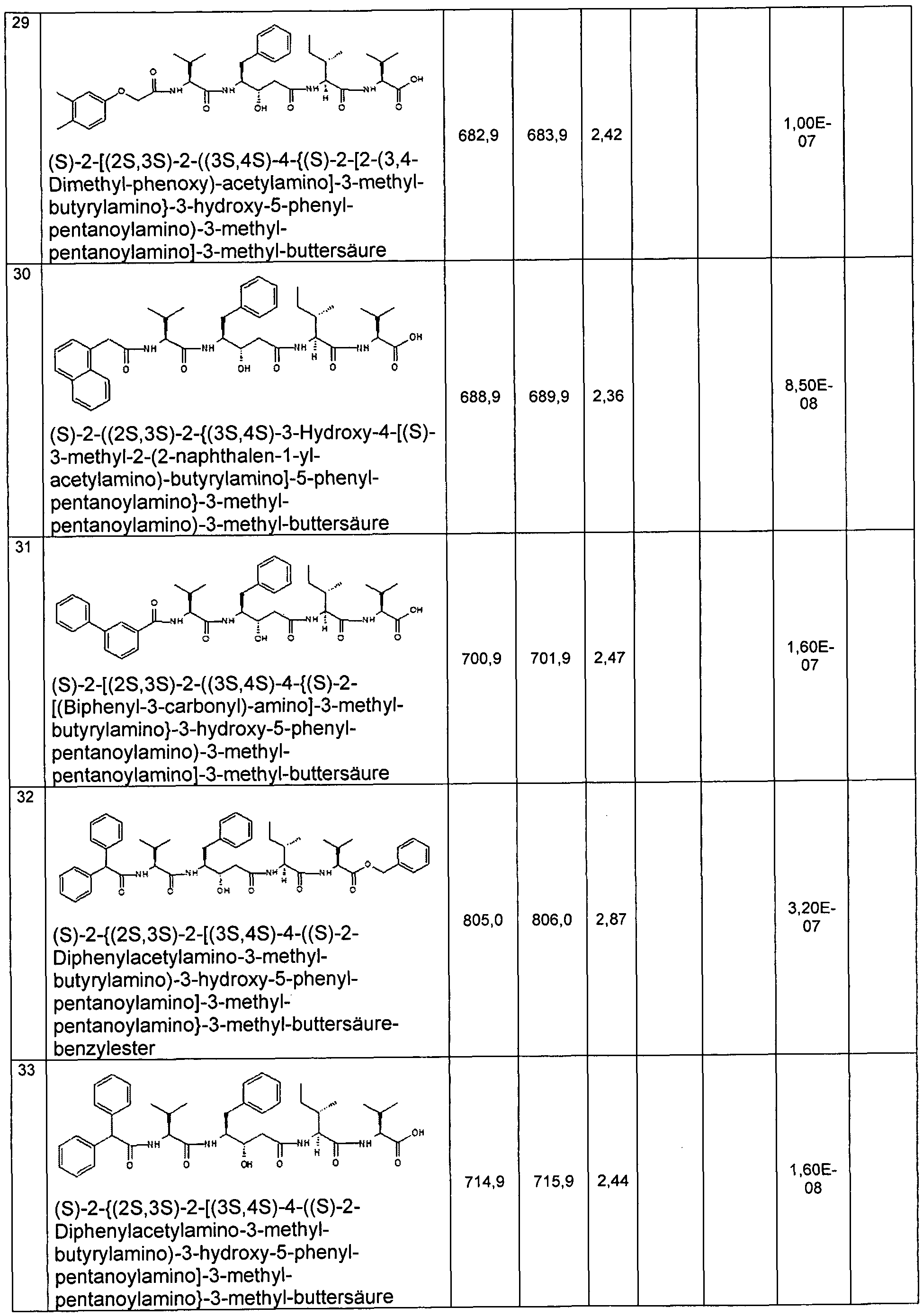
787,0 788,0 2,8 787.0 788.0 2.8
(S)-2-[(2S,3S)-2-((3S,4S)-4-{(S)-2-[2-(3- 07 (S) -2 - [(2S, 3S) -2 - ((3S, 4S) -4 - {(S) -2- [2- (3-7
Ethoxy-phenyl)-acetylamino]-3-methyl-1-Ethoxy-phenyl) -acetylamino] -3-methyl-1-
(S)-oxo-pentylamino}-3-hydroxy-5-phenyl- pentanoylamino)-3-methyl- pentanoylamino]-3-methyl-buttersäure- benzlyester

5.80E- 5.80E-
(S)-2-((2S,3S)-2-{(3S,4S)-3-Hydroxy-4-[(S)- 744,9 745,9 2,56 (S) -2 - ((2S, 3S) -2 - {(3S, 4S) -3-hydroxy-4 - [(S) - 744.9 745.9 2.56
07 07
2-((S)-2-hydroxy-2-phenyl-acetylamino)-3- methyl-butyrylamino]-5-phenyl- pentanoylamino}-3-methyl- pentanoylamino)-3-methyl-buttersäure- benzlyester 2 - ((S) -2-hydroxy-2-phenylacetylamino) -3-methylbutyrylamino] -5-phenylpentanoylamino} -3-methylpentanoylamino) -3-methylbutyric acid benzyl ester
0 0 0 0
4.30E- 4.30E-
696,9 697,9 2,35 696.9 697.9 2.35
(S)-2-[(2S,3S)-2-((3S,4S)-3-Hydroxy-4-{(S)- 08 methyl-1-(S)-2-[2-(3-ethoxy-phenyl)- acetylamino]-3-oxo-pentylamino}-5-phenyl- pentanoylamino)-3-methyl- pentanoylamino]-3-methyl-buttersäure (S) -2 - [(2S, 3S) -2 - ((3S, 4S) -3-hydroxy-4 - {(S) -O-methyl-1- (S) -2- [2- (3 ethoxy-phenyl) -acetylamino] -3-oxo-pentylamino} -5-phenyl-pentanoylamino) -3-methylpentanoylamino] -3-methylbutyric acid
f .Y. . /:V. ."' . , j ΎfiΥ-"t" τ" - i f .Y. , /: V. . "', j ΎfiΥ-" t "τ" - i
<L 0 0 0 0 o <L 0 0 0 0 o
3.10E- 3.10E-
654,8 655,8 2,13 654.8 655.8 2.13
07 07
(S)-2-((2S,3S)-2-{(3S,4S)-3-Hydroxy-4-[(S)-(S) -2 - ((2S, 3S) -2 - {(3S, 4S) -3-hydroxy-4 - [(S) -
2-((S)-2-hydroxy-2-phenyl-acetylamino)-3- methyl-butyrylamino]-5-phenyl- pentanoylamino}-3-methyl- pentanoylamino)-3-methy!-buttersäure 2 - ((S) -2-hydroxy-2-phenylacetylamino) -3-methylbutyrylamino] -5-phenylpentanoylamino} -3-methylpentanoylamino) -3-methylbutyric acid
0 0 OH 0 0 0 0 0 OH 0 0 0
7.00E- 7.00E-
646,9 647,9 2,45 646.9 647.9 2.45
06 06
(S)-2-((2S,3S)-2-{(3S,4S)-4-[(S)-2-(2,2-(S) -2 - ((2S, 3S) -2 - {(3S, 4S) -4 - ([(S) -2- 2,2-
Diethyl-butyrylamino)-3-methyl- butyrylamino]-3-hydroxy-5-phenyl- pentanoylamino}-3-methyl- pentanoylamino)-3-methyl-buttersäure Diethyl-butyrylamino) -3-methylbutyrylamino] -3-hydroxy-5-phenylpentanoylamino} -3-methylpentanoylamino) -3-methylbutyric acid
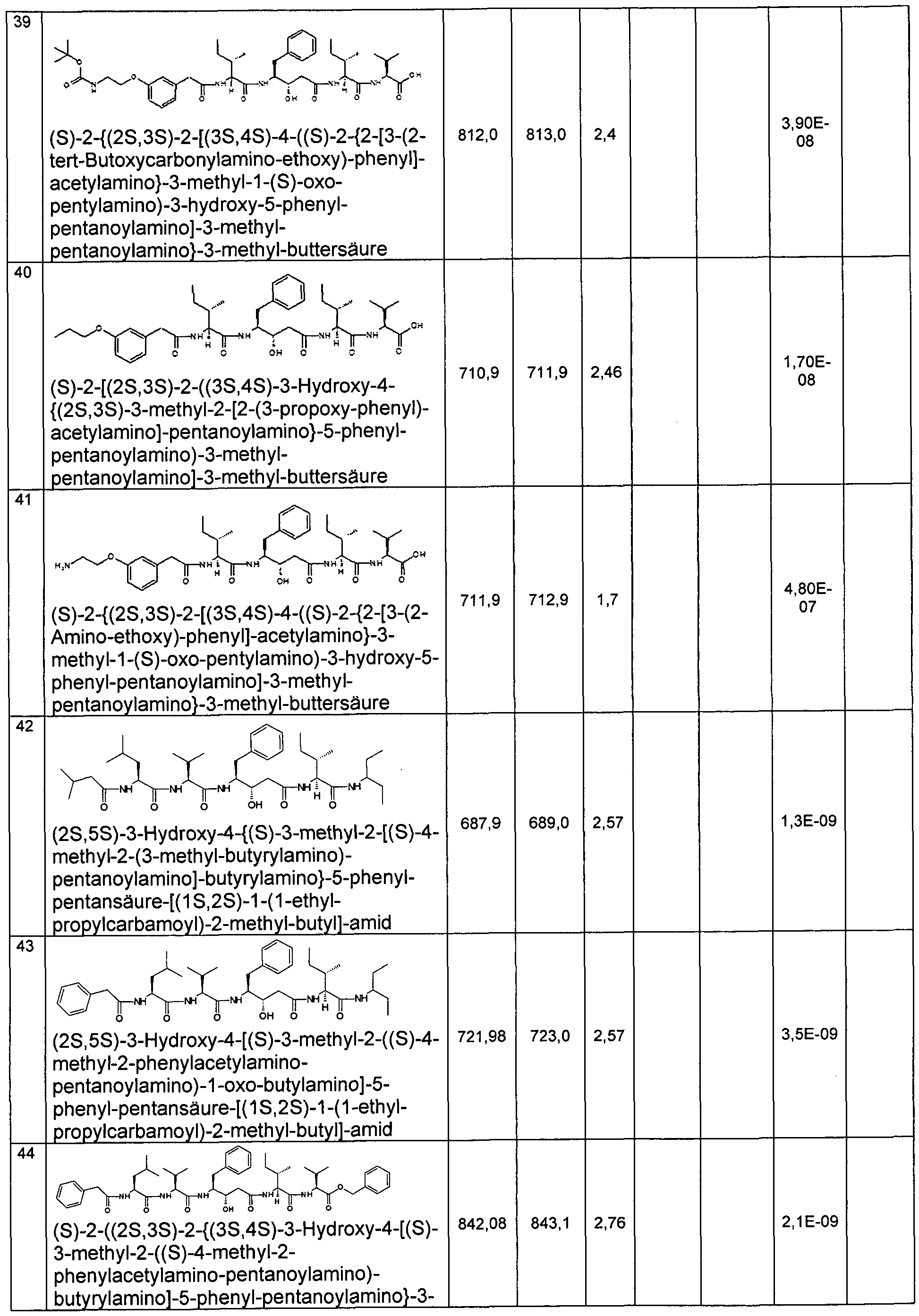
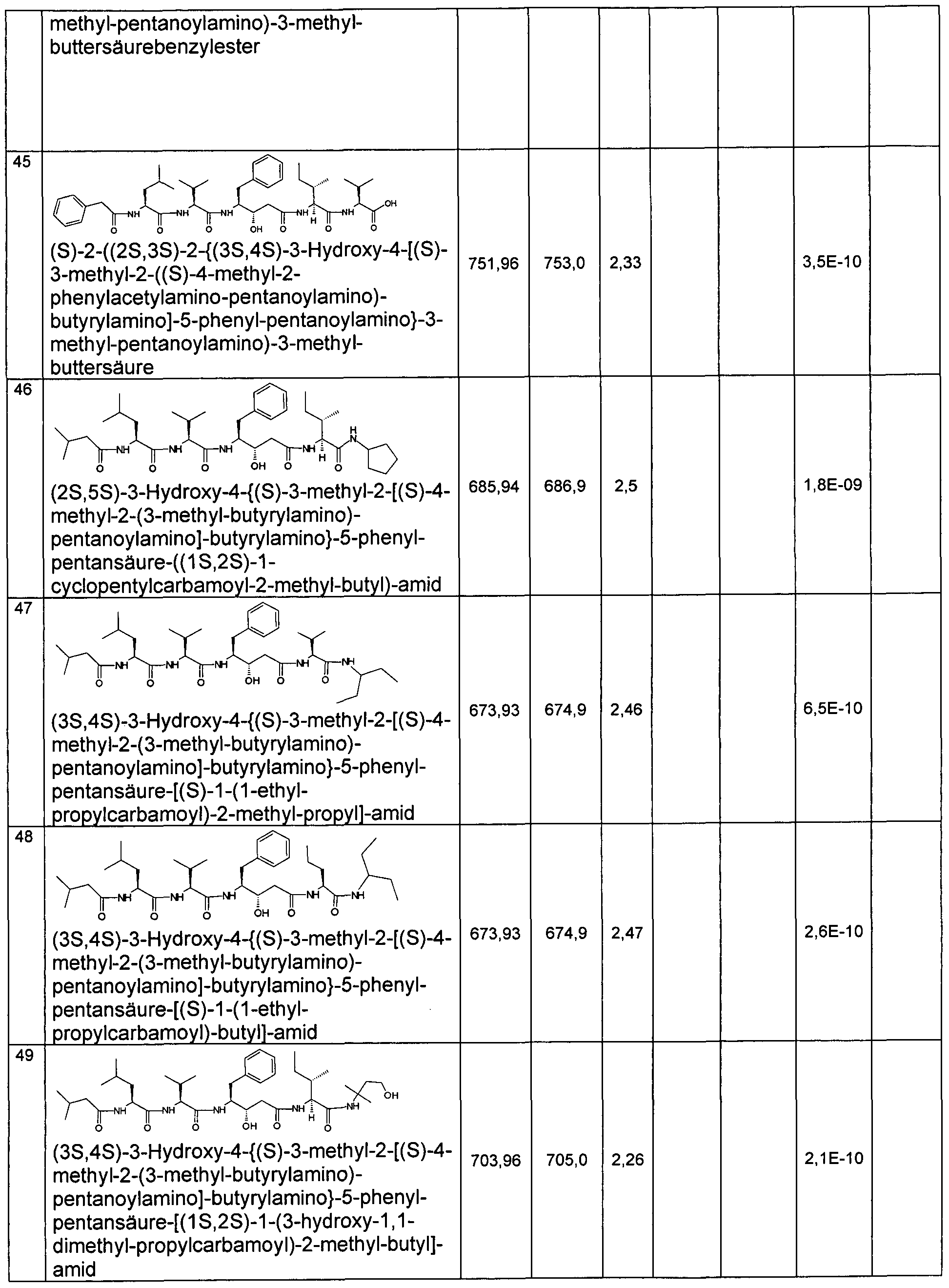
erfindungsgemäßen Verbindung die chemische Bezeichnung der compound of the invention, the chemical name of the
Verbindung und die Abbildung der chemischen Struktur der Verbindung fälschlicherweise nicht übereinstimmen, die erfindungsgemäße Verbindung eindeutig durch die Abbildung der chemischen Struktur definiert. Compound and the mapping of the chemical structure of the compound erroneously disagree, the compound of the invention clearly defined by the mapping of the chemical structure.
Die Massensignale wurden bestimmt auf einer Agilent-Anlage 1200: The mass signals were determined on an Agilent plant 1200:
Chromolith Speed Rod RP 18e 50-4,6 mm LCMS;Polar.m, 2,4ml/min, 220nm, Puffer A 0,05% HCOOH/H20, Puffer B 0,04% HCOOH/ACN, 0,0- 2,8min 4%-100% Puffer B; 2,8-3,3min 100% Puffer B 3,3-3,4min 100%-4% Puffer B Chromolith Speed Rod RP 18e 50-4.6 mm LCMS, Polar.m, 2.4ml / min, 220nm, Buffer A 0.05% HCOOH / H 2 O, Buffer B 0.04% HCOOH / ACN, 0.0-2 , 8min 4% -100% Buffer B; 2.8-3.3min 100% Buffer B 3.3-3.4min 100% -4% Buffer B
Die Retentionszeiten wurden bestimmt auf einer Merck-Hitachi LaChrom- Anlage: The retention times were determined on a Merck Hitachi LaChrom system:
Chromolith Speed Rod RP18e-100-4.6 HPLC;5min 4ml 215nm; 4ml/min, 215nm, Puffer A 0.05% TFA/H20, Puffer B 0.04% TFA/ACN, 0.0-0.2 min 5% Puffer B; 0.2-5.0 min 5%-100% Puffer B; 5.0-5.5 min 99%-5% Puffer B Chromolith Speed Rod RP18e-100-4.6 HPLC; 5min 4ml 215nm; 4ml / min, 215nm, Buffer A 0.05% TFA / H 2 O, Buffer B 0.04% TFA / ACN, 0.0-0.2 min 5% Buffer B; 0.2-5.0 min 5% -100% Buffer B; 5.0-5.5 min 99% -5% buffer B
NMR-Daten NMR data
Tabelle 3 Table 3
Nr. Verbindung NMR-Daten No connection NMR data
1 (S)-2-((2S,3S)-2-{(3S,4S)- 1H NMR (500 MHz, DMSO) ppm = 8.16 (d, J=7.7, 1H), 1 (S) -2 - ((2S, 3S) -2 - {(3S, 4S) -1H NMR (500 MHz, DMSO) ppm = 8.16 (d, J = 7.7, 1H),
3-Hydroxy-4-[(S)-3- 7.77 (d, J=8.7, 1H), 7.70 (d, J=8.8, 1H), 7.60 (d, J=8.8, methyl-2-(3-phenyl- 1H), 7.40 - 7.28 (m, 5H), 7.28 - 7.10 (m, 10H), 5.10 (s, propionylamino)- 2H), 5.06 (d, J=5.3, 1H), 4.32 - 4.25 (m, 1H), 4.21 - butyrylamino]-5-phenyl- 4.14 (m, 1H), 4.12 -4.04 (m, 1H), 3.98 - 3.89 (m, 1H), pentanoylamino}-3- 3.89-3.81 (m, 1H), 2.89 - 2.73 (m, 3H), 2.64- 2.56 (m, methyl-pentanoylamino)- 1H), 2.49 - 2.35 (m,2H), 2.30-2.21 (m, 1H), 2.17-3-hydroxy-4 - [(S) -3-7.77 (d, J = 8.7, 1H), 7.70 (d, J = 8.8, 1H), 7.60 (d, J = 8.8, methyl-2- (3) phenyl-1H), 7.40-2.28 (m, 5H), 7.28-7.10 (m, 10H), 5.10 (s, propionylamino) -2H), 5.06 (d, J = 5.3, 1H), 4.32-4.25 (m, 1H), 4.21 - butyrylamino] -5-phenyl- 4.14 (m, 1H), 4.12 -4.04 (m, 1H), 3.98 - 3.89 (m, 1H), pentanoylamino} -3- 3.89-3.81 (m, 1H) , 2.89-2.73 (m, 3H), 2.64-2.56 (m, methylpentanoylamino) -1H), 2.49-2.35 (m, 2H), 2.30-2.21 (m, 1H), 2.17-
3-methyl-buttersäure- 1.99 (m, 2H), 1.92 - 1.81 (m, 1H), 1.72 - 1.62 (m, 1H), benzlyester 1.47- 1.38 (m, 1H), 1.11 - 0.98 (m, 1H), 0.90 - 0.82 (m, 3-methylbutyric acid 1.99 (m, 2H), 1.92-1.81 (m, 1H), 1.72-1.62 (m, 1H), benzyl ester 1.47-1.38 (m, 1H), 1.11-0.98 (m, 1H), 0.90 - 0.82 (m,
6H), 0.81 -0.70(m, 12H). 6H), 0.81-0.70 (m, 12H).
2 (S)-2-((2S,3S)-2-{(3S,4S)- 1H NMR (400 MHz, DMSO) ppm = 8.17 (d, J=7.8, 1H), 2 (S) -2 - ((2S, 3S) -2 - {(3S, 4S) -1H NMR (400 MHz, DMSO) ppm = 8.17 (d, J = 7.8, 1H),
3-Hydroxy-4-[(S)-3- 7.75 (d, J=8.8, 1H), 7.71 (d, J=8.8, 1H), 7.60 (d, J=8.8, methyl-2-(4-phenyl- 1H), 7.41 -7.23 (m, 7H), 7.23 - 7.05 (m, 8H), 5.10 (s, butyrylamino)- 2H), 5.06 (d, J=5.4, 1H), 4.33 - 4.24 (m, 1H), 4.21 - butyrylamino]-5-phenyl- 4.13 (m,1H), 4.08 (dd,J=8.8, 7.2,1 H), 3.99 - 3.80 (m, pentanoylamino}-3- 2H), 2.89 - 2.78 (m, 1H), 2.65 - 2.49 (m, 3H), 2.30- methyl-pentanoylamino)- 1.98 (m,5H), 1.96-1.61 (m, 4H), 1.48 - 1.35 (m, 1H), 3-methyl-buttersäure- 1.12- 0.96 (m, 1H), 0.89-0.71 (m, 18H). 3-hydroxy-4 - [(S) -3-7.75 (d, J = 8.8, 1H), 7.71 (d, J = 8.8, 1H), 7.60 (d, J = 8.8, methyl-2- (4-) phenyl-1H), 7.41-7.23 (m, 7H), 7.23-7.05 (m, 8H), 5.10 (s, butyrylamino) -2H), 5.06 (d, J = 5.4, 1H), 4.33-4.24 (m, 1H), 4.21 - butyrylamino] -5-phenyl-4.13 (m, 1H), 4.08 (dd, J = 8.8, 7.2.1H), 3.99-3.80 (m, pentanoylamino) -3-2H), 2.89-2.78 (m, 1H), 2.65-2.49 (m, 3H), 2.30-methylpentanoylamino) -1.98 (m, 5H), 1.96-1.61 (m, 4H), 1.48-1.35 (m, 1H), 3-methyl-butyric acid 1.12-0.96 (m, 1H), 0.89-0.71 (m, 18H).
benzlyester benzlyester
(S)-2-[(2S,3S)-2-((3S,4S)- 1H NMR (500 MHz, DMSO)ppm= 8.15 (d, J=7.8, 1H), (S) -2 - [(2S, 3S) -2 - ((3S, 4S) -1H NMR (500 MHz, DMSO) ppm = 8.15 (d, J = 7.8, 1H),
3-Hydroxy-4-{(S)-3- 7.85 - 7.67 (m, 6H), 7.47 - 7.28 (m, 7H), 7.26 (d, J=2.4, methyl-2-[2-methyl-2- 1H), 7.24 - 7.08 (m, 6H), 5.13 (d, J=4.7, 1H), 5.10 (s,3-hydroxy-4 - {(S) -3- 7.85-7.67 (m, 6H), 7.47 - 7.28 (m, 7H), 7.26 (d, J = 2.4, methyl-2- [2-methyl-2-) 1H), 7.24 - 7.08 (m, 6H), 5.13 (d, J = 4.7, 1H), 5.10 (s,
(naphthalen-2-yloxy)- 2H), 4.32-4.25(m, 1H), 4.21 -4.08 (m, 2H), 4.03- propionylamino]- 3.94 (m, 1H), 3.91 - 3.83 (m, 1H), 2.88 - 2.80 (m, 1H), butyrylamino}-5-phenyl- 2.65-2.56 (m, 1H), 2.27 - 2.18 (m, 1H), 2.17- 2.09 (m, pentanoylamino)-3- 1H), 2.09- 1.99 (m, 1H), 1.96 - 1.86 (m, 1H), 1.73- methyl-pentanoylamino]- 1.61 (m,1H), 1.51 (s,3H), 1.47 (s,4H), 1.10-0.97(naphthalen-2-yloxy) -2H), 4.32-4.25 (m, 1H), 4.21-4.08 (m, 2H), 4.03-propionylamino] - 3.94 (m, 1H), 3.91- 3.83 (m, 1H), 2.88-2.80 (m, 1H), butyrylamino} -5-phenyl-2.65-2.56 (m, 1H), 2.27-2.11 (m, 1H), 2.17-20.09 (m, pentanoylamino) -3- 1H), 2.09- 1.99 (m, 1H), 1.96-1.86 (m, 1H), 1.73-methyl-pentanoylamino] -1.61 (m, 1H), 1.51 (s, 3H), 1.47 (s, 4H), 1.10-0.97
3-methyl-buttersäure- (m, 1H), 0.88 - 0.72 (m, 12H), 0.65 (d, J=6.7, 6H). benzlyester 3-methyl-butyric acid (m, 1H), 0.88-0.72 (m, 12H), 0.65 (d, J = 6.7, 6H). benzlyester
(S)-2-((2S,3S)-2-{(3S,4S)- 1H NMR (400 MHz, DMSO) ppm = 12.49 (s, 1H), 7.92 (S) -2 - ((2S, 3S) -2 - {(3S, 4S) -1H NMR (400 MHz, DMSO) ppm = 12.49 (s, 1H), 7.92
3-Hydroxy-4-[(S)-3- (d, J=8.1, 1H), 7.79 (d, J=8.8, 1H), 7.71 (d, J=8.8, 1H), methyl-2-(3-phenyl- 7.64 (d, J=8.8, 1H), 7.29 - 7.10 (m, 10H), 5.09 (d, propionylamino)- J=5.4, 1H), 4.32 -4.23 (m, 1H), 4.13 - 4.04 (m, 2H), butyrylamino]-5-phenyl- 3.99 - 3.82 (m, 2H), 2.91 - 2.72 (m, 3H), 2.66- 2.55 (m, pentanoylamino}-3- 1H), 2.50-2.34(m, 2H), 2.31 - 2.20 (m, 1 H), 2.18- methyl-pentanoylamino)- 1.96(m, 2H), 1.93- 1.80(171, 1H), 1.76 - 1.65 (m, 1H),3-hydroxy-4 - [(S) -3- (d, J = 8.1, 1H), 7.79 (d, J = 8.8, 1H), 7.71 (d, J = 8.8, 1H), methyl-2 ( 3-phenyl-7.64 (d, J = 8.8, 1H), 7.29-7.10 (m, 10H), 5.09 (d, propionylamino) - J = 5.4, 1H), 4.32-4.23 (m, 1H), 4.13 - 4.04 (m, 2H), butyrylamino] -5-phenyl-3.99-3.82 (m, 2H), 2.91-2.72 (m, 3H), 2.66-2.55 (m, pentanoylamino) -3-1H), 2.50-2.34 (m , 2H), 2.31-2.20 (m, 1H), 2.18-methylpentanoylamino) -1.96 (m, 2H), 1.93-1.80 (171, 1H), 1.76-1.65 (m, 1H),
3-methyl-buttersäure 1.50- 1.33 (m, 1H), 1.09 - 1.00 (m, 1H), 0.92 - 0.70 (m, 3-methyl-butyric acid 1.50- 1.33 (m, 1H), 1.09 - 1.00 (m, 1H), 0.92 - 0.70 (m,
18H). 18H).
(S)-2-((2S,3S)-2-{(3S,4S)- 1H NMR (400 MHz, DMSO) ppm = 12.48 (s, 1H), 7.91 (S) -2 - ((2S, 3S) -2 - {(3S, 4S) -1H NMR (400 MHz, DMSO) ppm = 12.48 (s, 1H), 7.91
3-Hydroxy-4-[(S)-3- (d, J=8.2, 1H), 7.79 - 7.67 (m, 2H), 7.62 (d, J=8.7, 1H), met yl-2-(4-p enyl- 7.31 - 7.05 (m, 10H), 5.07 (s, 1H), 4.31 -4.22 (m, 1H), butyrylamino)- 4.13-4.03 (m, 2H), 3.99 - 3.82 (m, 2H), 2.93-2.81 (m, butyrylamino]-5-phenyl- 1H), 2.66 - 2.50 (m, 3H), 2.30 - 2.09 (m, 4H), 2.09- pentanoylamino}-3- 1.97 (m, 1H), 1.97- 1.64(171, 4H), 1.51 - 1.37 (m, 1H), methyl-pentanoylamino)- 1.09 - 1.01 (I71, 1H), 0.91 - 0.74 (m, 18H). 3-hydroxy-4 - [(S) -3- (d, J = 8.2, 1H), 7.79-7.67 (m, 2H), 7.62 (d, J = 8.7, 1H), met yl-2- (4 -phenyl-7.31-7.05 (m, 10H), 5.07 (s, 1H), 4.31-4.22 (m, 1H), butyrylamino) - 4.13-4.03 (m, 2H), 3.99-3.82 (m, 2H), 2.93-2.81 (m, butyrylamino] -5-phenyl-1H), 2.66-2.50 (m, 3H), 2.30-2.09 (m, 4H), 2.09-pentanoylamino} -3- 1.97 (m, 1H), 1.97- 1.64 (171, 4H), 1.51-1.37 (m, 1H), methyl-pentanoylamino) - 1.09 - 1.01 (I71, 1H), 0.91 - 0.74 (m, 18H).
3-methyl-buttersäure 3-methyl-butyric acid
(S)-2-[(2S,3S)-2-((3S,4S)- 1H NMR (500 MHz, DMSO) ppm = 12.49 (s,1H), 7.91 (S) -2 - [(2S, 3S) -2 - ((3S, 4S) -1H NMR (500 MHz, DMSO) ppm = 12.49 (s, 1H), 7.91
3-Hydroxy-4-{(S)-3- -7.67(m, 6H), 7.47 - 7.34 (m, 2H), 7.26 (d, J=2.4, 1H), methyl-2-[2-methyl-2- 7.24 - 7.09 (m, 7H), 5.17 (s, 1H), 4.30 - 4.23 (m, 1H),3-hydroxy-4 - {(S) -3-7.67 (m, 6H), 7.47-7.34 (m, 2H), 7.26 (d, J = 2.4, 1H), methyl-2- [2-methyl] 2-7.24 - 7.09 (m, 7H), 5.17 (s, 1H), 4.30 - 4.23 (m, 1H),
(naphthalen-2-yloxy)- 4.15-4.04 (m, 2H), 4.02 - 3.94 (m, 1H), 3.89 (d, J=8.3, propionylamino]- 1H), 2.90-2.82 (m, 1H), 2.65 - 2.57 (m, 1H), 2.27- butyrylamino}-5-phenyl- 2.18 (m, 1H), 2.18-2.11 (m, 1H), 2.08- 1.97 (m, 1H), pentanoylamino)-3- 1.97 - 1.86 (m, 1H), 1.75 - 1.65 (m, 1H), 1.51 (s,3H), methyl-pentanoylamino]- 1.49- 1.32 (m, 4H), 1.09 - 1.00 (m, 1H), 0.89 - 0.75 (m,(naphthalen-2-yloxy) - 4.15-4.04 (m, 2H), 4.02 - 3.94 (m, 1H), 3.89 (d, J = 8.3, propionylamino] - 1H), 2.90-2.82 (m, 1H), 2.65 - 2.57 (m, 1H), 2.27-butyrylamino} -5-phenyl- 2.18 (m, 1H), 2.18-2.11 (m, 1H), 2.08- 1.97 (m, 1H), pentanoylamino) -3- 1.97 - 1.86 (m, 1H), 1.75-1.65 (m, 1H), 1.51 (s, 3H), methylpentanoylamino] - 1.49-1.32 (m, 4H), 1.09 - 1.00 (m, 1H), 0.89 - 0.75 (m .
3-methyl-buttersaure 12H), 0.65 (d, J=6.7, 6H). 3-methyl-butyric acid 12H), 0.65 (d, J = 6.7, 6H).
(S)-2-[(2S,3S)-2- 1H NMR (500 MHz, DMSO) ppm = 8.15 (d, J=7.7, 1H), ((3S,4S)-3-Hydroxy-4- 7.88-7.81 (m, 4H), 7.77 - 7.70 (m, 2H), 7.48-7.41 (m, {(S)-3-methyl-2-[2- 1H), 7.40-7.15 (m, 12H), 7.15 - 7.07 (m, 1H), 5.10 (s, (naphthalen-2-yloxy)- 2H), 5.05 (d, J=5.3, 1H), 4.73-4.61 (m, 2H), 4.33- acetylamino]- 4.21 (m, 2H), 4.21 -4.14 (m, 1H), 4.02-3.93 (m, 1H), butyrylamino}-5-phenyl- 3.87 (t, J=6.6, 1H), 2.85 (dd, J=13.7, 5.4, 1 H), 2.64- pentanoylamino)-3- 2.56 (m, 1H), 2.31 -2.22(m, 1H), 2.18-2.11 (m, 1H), methyl-pentanoylamino]- 2.10- 1.92 (m, 2H), 1.71 - 1.62 (m, 1H), 1.46- 1.38 (m, 3-methyl-buttersäure 1H), 1.09 - 0.97 (m, 1H), 0.88-0.81 (m, 6H), 0.81 - 0.72 (m, 12H). (S) -2 - [(2S, 3S) -2- 1H NMR (500 MHz, DMSO) ppm = 8.15 (d, J = 7.7, 1H), ((3S, 4S) -3-hydroxy-4-7.88 -7.81 (m, 4H), 7.77-7.70 (m, 2H), 7.48-7.41 (m, {(S) -3-methyl-2- [2-1H], 7.40-7.15 (m, 12H), 7.15 - 7.07 (m, 1H), 5.10 (s, (naphthalen-2-yloxy) -2H), 5.05 (d, J = 5.3, 1H), 4.73-4.61 (m, 2H), 4.33-acetylamino] - 4.21 ( m, 2H), 4.21-4.14 (m, 1H), 4.02-3.93 (m, 1H), butyrylamino} -5-phenyl-3.87 (t, J = 6.6, 1H), 2.85 (dd, J = 13.7, 5.4 , 1H), 2.64- pentanoylamino) -3- 2.56 (m, 1H), 2.31-2.22 (m, 1H), 2.18-2.11 (m, 1H), methylpentanoylamino] - 2.10-1.92 (m, 2H) , 1.71-1.62 (m, 1H), 1.46-1.38 (m, 3-methyl-butyric acid 1H), 1.09-0.97 (m, 1H), 0.88-0.81 (m, 6H), 0.81-0.72 (m, 12H) ,
(S)-2-[(2S,3S)-2-((3S,4S)- 1H NMR (500 MHz, DMSO) ppm = 12.51 (s, 1H), 8.01 (S) -2 - [(2S, 3S) -2 - ((3S, 4S) -1H NMR (500 MHz, DMSO) ppm = 12.51 (s, 1H), 8.01
3-Hydroxy-4-{(S)-3- - 7.92 (m, 2H), 7.73 (d, J=8.8, 1H), 7.69 - 7.61 (m, 2H), methyl-2-[(S)-4-methyl-2- 7.28-7.11 (m, 5H), 5.08 (d, J=5.1, 1H), 4.36- 4.25 (m,3-hydroxy-4 - {(S) -3- - 7.92 (m, 2H), 7.73 (d, J = 8.8, 1H), 7.69 - 7.61 (m, 2H), methyl-2 - [(S) - 4-methyl-2-7.28-7.11 (m, 5H), 5.08 (d, J = 5.1, 1H), 4.36-4.25 (m,
(3-methyl-butyrylamino)- 2H), 4.11 -4.02 (m,2H), 3.99 - 3.88 (m, 1H), 3.88- pentanoylamino]- 3.81 (m, 1H), 2.90 - 2.83 (m, 1H), 2.60 (dd, J=13.8, butyrylamino}-5-phenyl- 8.8, 1H), 2.28-2.19 (m, 1H), 2.16 - 2.09 (m, 1H), 2.09 pentanoylamino)-3- -1.81 (m,5H), 1.75 - 1.63 (m, 1H), 1.63 - 1.50 (m, 1H), methyl-pentanoylamino]- 1.50 - 1.34 (m,3H), 1.12 - 0.96 (m, 1H), 0.90- 0.70 (m,(3-methyl-butyrylamino) -2H), 4.11 -4.02 (m, 2H), 3.99- 3.88 (m, 1H), 3.88-pentanoylamino] - 3.81 (m, 1H), 2.90 - 2.83 (m, 1H), 2.60 (dd, J = 13.8, butyrylamino) -5-phenyl-8.8, 1H), 2.28-2.19 (m, 1H), 2.16 - 2.09 (m, 1H), 2.09 pentanoylamino) -3- -1.81 (m, 5H ), 1.75-1.63 (m, 1H), 1.63-1.50 (m, 1H), methyl-pentanoylamino] - 1.50 - 1.34 (m, 3H), 1.12-0.96 (m, 1H), 0.90-0.70 (m,
3-methyl-buttersäure 30H). (S)-2-[(2S,3S)-2-((3S,4S)- 1H NMR (500 MHz, DMSO) ppm = 12.51 (s, 1H), 7.973-methylbutyric acid 30H). (S) -2 - [(2S, 3S) -2 - ((3S, 4S) -1H NMR (500 MHz, DMSO) ppm = 12.51 (s, 1H), 7.97
3-Hydroxy-4-{(S)-2-[2-(4- -7.89(m, 2H), 7.78 - 7.69 (m, 2H), 7.24 - 7.10 (m, 7H), methoxy-phenyl)- 6.86-6.79 (m, 2H), 5.08 (d, J=5.6, 1H), 4.33 - 4.24 (m, acetylamino]-3-methyl- 1H), 4.15-4.04 (m, 2H), 3.98 - 3.82 (m, 2H), 3.71 (s, butyrylamino}-5-phenyl- 3H), 3.49-3.41 (m, 1H), 3.35 (s, 1H), 2.91 -2.81 (m, pentanoylamino)-3- 1H), 2.62 - 2.52 (m, 1H), 2.29 -2.18 (m, 1H), 2.13 (dd, methyl-pentanoylamino]- J=14.3, 3.4, 1H), 2.08 - 1.96 (m, 1H), 1.95- 1.83 (m,3-hydroxy-4 - {(S) -2- [2- (4-7.89 (m, 2H), 7.78-7.69 (m, 2H), 7.24-7.10 (m, 7H), methoxy-phenyl) - 6.86-6.79 (m, 2H), 5.08 (d, J = 5.6, 1H), 4.33-4.24 (m, acetylamino] -3-methyl-1H), 4.15-4.04 (m, 2H), 3.98-3.82 (m , 2H), 3.71 (s, butyrylamino) -5-phenyl-3H), 3.49-3.41 (m, 1H), 3.35 (s, 1H), 2.91-2.81 (m, pentanoylamino) -3- 1H), 2.62 - 2.52 (m, 1H), 2.29-2.18 (m, 1H), 2.13 (dd, methylpentanoylamino] - J = 14.3, 3.4, 1H), 2.08 - 1.96 (m, 1H), 1.95- 1.83 (m,
3-methyl-buttersäure 1H), 1.75- 1.64 (m, 1H), 1.50 - 1.38 (m, 1H), 1.12- 0.99 (m, 1H), 0.90-0.72 (m, 18H). 3-methyl butyric acid 1H), 1.75-1.64 (m, 1H), 1.50-1.38 (m, 1H), 1.12-0.99 (m, 1H), 0.90-0.72 (m, 18H).
(S)-2-((2S,3S)-2-{(3S,4S)- 1H NMR (500 MHz, DMSO) ppm = 8.19 (d, J=7.7, 1H), (S) -2 - ((2S, 3S) -2 - {(3S, 4S) -1H NMR (500 MHz, DMSO) ppm = 8.19 (d, J = 7.7, 1H),
3-Hydroxy-4-[(S)-3- 8.09 (d, J=9.0, 1H), 7.90 - 7.79 (m, 3H), 7.77-7.71 (m, methyl-2-(2-napht alen-2- 3H), 7.52 - 7.40 (m, 3H), 7.40 - 7.27 (m, 5H), 7.23- yl-acetylamino)- 7.01 (m, 5H), 5.10 (s,3H), 4.33 - 4.25 (m, 1H), 4.20- butyrylamino]-5-phenyl- 4.08 (m, 2H), 3.99-3.81 (m, 2H), 3.75 - 3.68 (m, 1H), pentanoylamino}-3- 3.64-3.57 (m, 1H), 2.89 - 2.79 (m, 1H), 2.63 - 2.52 (m, methyl-pentanoylamino)- 1H), 2.31 -2.17 (m, 1H), 2.17 - 1.98 (m, 2H), 1.97-3-hydroxy-4 - [(S) -3-8.09 (d, J = 9.0, 1H), 7.90-7.79 (m, 3H), 7.77-7.71 (m, methyl-2- (2-naphthalen-2 - 3H), 7.52 - 7.40 (m, 3H), 7.40 - 7.27 (m, 5H), 7.23-yl-acetylamino) - 7.01 (m, 5H), 5.10 (s, 3H), 4.33 - 4.25 (m, 1H ), 4.20-butyrylamino] -5-phenyl-4.08 (m, 2H), 3.99-3.81 (m, 2H), 3.75-3.68 (m, 1H), pentanoylamino} -3- 3.64-3.57 (m, 1H), 2.89-2.79 (m, 1H), 2.63-2.52 (m, methylpentanoylamino) -1H), 2.31-2.17 (m, 1H), 2.17-1.98 (m, 2H), 1.97-
3-methyl-buttersäure- 1.86 (m, 1 H), 1.73 - 1.60 (m, 1 H), 1.47 - 1.34 (m, 1 H), benzlyester 1.09 - 0.95 (m, 1H), 0.88 - 0.70 (m, 18H). 3-methyl-butyric acid 1.86 (m, 1H), 1.73-1.60 (m, 1H), 1.47-1.34 (m, 1H), benzyl ester 1.09-0.95 (m, 1H), 0.88-0.70 (m, 18H).
(S)-2-[(2S,3S)-2-((3S,4S)- 1H NMR (500 MHz, DMSO) ppm = 12.54 (s, 1H), 8.03 (S) -2 - [(2S, 3S) -2 - ((3S, 4S) -1H NMR (500 MHz, DMSO) ppm = 12.54 (s, 1H), 8.03
4-{(S)-2-[2-(3-Ethoxy- (d, J=8.8, 1H), 7.84 (s,2H), 7.75 (d, J=8.5, 1H), 7.24- phenyl)-acetylamino]-3- 7.10 (m, 6H), 6.86 - 6.70 (m,3H), 5.16 (s, 1H), 4.28- methyl-butyrylamino}-3- 4.21 (m, 1H), 4.15 - 4.08 (m, 1H), 4.03 (s, 1H), 3.99- hydroxy-5-phenyl- 3.92 (m,2H), 3.92 - 3.83 (m, 2H), 3.54 - 3.46 (m, 1H), pentanoylamino)-3- 3.42 - 3.35 (m, 1 H), 2.91 - 2.81 (m, 1 H), 2.63 - 2.54 (m, met yl-pentanoylamino]- 1H), 2.29 - 2.19 (m, 1H), 2.13 (d, J=13.9, 1H), 2.09-4 - {(S) -2- [2- (3-ethoxy- (d, J = 8.8, 1H), 7.84 (s, 2H), 7.75 (d, J = 8.5, 1H), 7.24-phenyl) - acetylamino] -3- 7.10 (m, 6H), 6.86-6.70 (m, 3H), 5.16 (s, 1H), 4.28-methyl-butyrylamino} -3- 4.21 (m, 1H), 4.15-4.0 (m, 1H), 4.03 (s, 1H), 3.99-hydroxy-5-phenyl-3.92 (m, 2H), 3.92-3.83 (m, 2H), 3.54-3.46 (m, 1H), pentanoylamino) -3- 3.42 - 3.35 (m, 1H), 2.91 - 2.81 (m, 1H), 2.63 - 2.54 (m, metyl-pentanoylamino] - 1H), 2.29 - 2.19 (m, 1H), 2.13 (d, J = 13.9, 1H), 2.09-
3-methyl-buttersaure 1.96 (m, 1 H), 1.96 - 1.84 (m, 1 H), 1.76 - 1.64 (m, 1 H), 3-methylbutanoic acid 1.96 (m, 1H), 1.96-1.84 (m, 1H), 1.76-1.64 (m, 1H),
1.47- 1.37 (m, 1H), 1.34 - 1.22 (m, 3H), 1.12 - 0.99 (m, 1H), 0.90-0.74 (m, 18H). 1.47-1.37 (m, 1H), 1.34-1.22 (m, 3H), 1.12-0.99 (m, 1H), 0.90-0.74 (m, 18H).
(S)-2-[(2S,3S)-2-((3S,4S)- 1H NMR (500 MHz, DMSO) ppm = 8.19 (d, J=7.7, 1H), (S) -2 - [(2S, 3S) -2 - ((3S, 4S) -1H NMR (500 MHz, DMSO) ppm = 8.19 (d, J = 7.7, 1H),
3-Hydroxy-4-{(S)-3- 8.01 (d, J=8.9, 1H), 7.77 - 7.71 (m, 2H), 7.41 - 7.22 (m, methyl-2-[2-(3-phenoxy- 8H), 7.22 - 7.08 (m, 6H), 7.06 - 7.00 (m, 1H), 7.00- phenyl)-acetylamino]- 6.91 (m,3H), 6.89 - 6.79 (m, 1H), 5.10 (s,2H), 5.06 butyrylamino}-5-phenyl- (d, J=5.4, 1H), 4.33-4.25 (m, 1H), 4.21 - 4.07 (m, 2H), pentanoylamino)-3- 3.97-3.81 (m, 2H), 3.54 (d, J=13.8, 1H), 3.39 (d, methyl-pentanoylamino]- J=13.7, 1H), 2.91 - 2.79 (m, 1H), 2.61 - 2.53 (m, 1H),3-hydroxy-4 - {(S) -3-8.01 (d, J = 8.9, 1H), 7.77-7.71 (m, 2H), 7.41 - 7.22 (m, methyl-2- [2- (3-phenoxy - 8H), 7.22 - 7.08 (m, 6H), 7.06 - 7.00 (m, 1H), 7.00-phenyl) -acetylamino] - 6.91 (m, 3H), 6.89-6.79 (m, 1H), 5.10 (s, 2H), 5.06 butyrylamino} -5-phenyl- (d, J = 5.4, 1H), 4.33-4.25 (m, 1H), 4.21 - 4.07 (m, 2H), pentanoylamino) -3- 3.97-3.81 (m, 2H), 3.54 (d, J = 13.8, 1H), 3.39 (d, methylpentanoylamino] - J = 13.7, 1H), 2.91 - 2.79 (m, 1H), 2.61 - 2.53 (m, 1H),
3-methyl-buttersäure- 2.31 -2.16 (m, 1H), 2.15 - 1.98 (m, 2H), 1.95- 1.82 (m, benzlyester 1H), 1.72 - 1.60 (m, 1H), 1.48 - 1.30 (m, 1H), 1.10- 0.95 (m, 1H), 0.90 - 0.80 (m, 6H), 0.80 - 0.70 (m, 12H).3-methyl-butyric acid 2.31-2.16 (m, 1H), 2.15-1.98 (m, 2H), 1.95-1.82 (m, benzyl ester 1H), 1.72-1.60 (m, 1H), 1.48-1.30 (m, 1H ), 1.10-0.95 (m, 1H), 0.90-0.80 (m, 6H), 0.80-0.70 (m, 12H).
(S)-2-[(2S,3S)-2-((3S,4S)- 1H NMR (500 MHz, DMSO) ppm = 12.50 (s, 1H), 8.02(S) -2 - [(2S, 3S) -2 - ((3S, 4S) -1H NMR (500 MHz, DMSO) ppm = 12.50 (s, 1H), 8.02
3-Hydroxy-4-{(S)-2-[2-(3- -7.93(m, 2H), 7.76 - 7.70 (m, 2H), 7.25 - 7.09 (m, 6H), met oxy-phenylj- 6.87 - 6.72 (m, 3H), 5.06 (d, J=5.4, 1H), 4.33- 4.25 (m, acetylamino]-3-methyl- 1H), 4.17-4.05 (m, 2H), 3.98 - 3.82 (m, 2H), 3.70 (s, butyrylamino}-5-phenyl- 3H), 3.54-3.47 (m, 1H), 3.39 (d, J=13.7, 1H), 2.91 - pentanoylamino)-3- 2.80 (m,1H), 2.64 - 2.52 (m, 1H), 2.30-2.21 (m, 1H), methyl-pentanoylamino]- 2.16 - 2.09 (m, 1H), 2.09 - 1.96 (m, 1H), 1.96- 1.84 (m,3-hydroxy-4 - {(S) -2- [2- (3-7.93 (m, 2H), 7.76-7.70 (m, 2H), 7.25-7.09 (m, 6H), metoxy-phenyl] 6.87-6.72 (m, 3H), 5.06 (d, J = 5.4, 1H), 4.33-4.25 (m, acetylamino] -3-methyl-1H), 4.17-4.05 (m, 2H), 3.98-3.82 (m , 2H), 3.70 (s, butyrylamino) -5-phenyl-3H), 3.54-3.47 (m, 1H), 3.39 (d, J = 13.7, 1H), 2.91 - pentanoylamino) -3- 2.80 (m, 1H ), 2.64-2.52 (m, 1H), 2.30-2.21 (m, 1H), methyl-pentanoylamino] - 2.16 - 2.09 (m, 1H), 2.09 - 1.96 (m, 1H), 1.96- 1.84 (m,
3-methyl-buttersäure 1H), 1.75 - 1.64 (m, 1H), 1.50 - 1.38 (m, 1H), 1.12- 0.99 (m, 1H), 0.90 - 0.73 (m, 18H). 3-methyl-butyric acid 1H), 1.75-1.64 (m, 1H), 1.50-1.38 (m, 1H), 1.12-0.99 (m, 1H), 0.90-0.73 (m, 18H).
(S)-2-[(2S,3S)-2-((3S,4S)- 1H NMR (500 MHz, DMSO) ppm = 8.19 (d, J=7.7, 1H), (S) -2 - [(2S, 3S) -2 - ((3S, 4S) -1H NMR (500 MHz, DMSO) ppm = 8.19 (d, J = 7.7, 1H),
3-Hydroxy-4-{(S)-2-[2-(2- 7.78 - 7.67 (m, 2H), 7.62 (d, J=8.9, 1H), 7.40 - 7.28 (m, methoxy-phenyl)- 5H), 7.27 - 7.10 (m, 7H), 6.96-6.91 (m, 1H), 6.89- acetylamino]-3-methyl- 6.82 (m, 1H), 5.12 - 5.04 (m, 3H), 4.32 - 4.25 (m, 1H), butyrylamino}-5-phenyl- 4.20-4.08 (m, 2H), 3.99 - 3.82 (m, 2H), 3.71 (s, 3H), pentanoylamino)-3- 3.53 - 3.46 (m, 1H), 3.42 - 3.34 (m, 1H), 2.89 - 2.80 (m, methyl-pentanoylamino]- 1H), 2.63 - 2.55 (m, 1H), 2.29 - 2.20 (m, 1H), 2.15-3-hydroxy-4 - {(S) -2- [2- (2-7.78 - 7.67 (m, 2H), 7.62 (d, J = 8.9, 1H), 7.40 - 7.28 (m, methoxy-phenyl) - 5H), 7.27-7.10 (m, 7H), 6.96-6.91 (m, 1H), 6.89-acetylamino] -3-methyl-6.82 (m, 1H), 5.12-5.04 (m, 3H), 4.32-4.25 ( m, 1H), butyrylamino} -5-phenyl-4.20-4.08 (m, 2H), 3.99-3.82 (m, 2H), 3.71 (s, 3H), pentanoylamino) -3- 3.53-3.46 (m, 1H) , 3.42 - 3.34 (m, 1H), 2.89 - 2.80 (m, methylpentanoylamino] - 1H), 2.63 - 2.55 (m, 1H), 2.29 - 2.20 (m, 1H), 2.15-
3-methyl-buttersäure- 1.98 (m,2H), 1.97 - 1.84 (m, 1H), 1.72 - 1.60 (m, 1H), benzlyester 1.47- 1.32 (m, 1H), 1.09 - 0.96 (m, 1H), 0.88 - 0.81 (m, 3-methyl-butyric acid 1.98 (m, 2H), 1.97-1.84 (m, 1H), 1.72-1.60 (m, 1H), benzyl ester 1.47-1.32 (m, 1H), 1.09-0.96 (m, 1H), 0.88 - 0.81 (m,
6H), 0.81 -0.72 (m, 12H). (S)-2-[(2S,3S)-2-((3S,4S)- 1H NMR (500 MHz, DMSO) ppm = 13.09 - 12.05 (m,6H), 0.81-0.72 (m, 12H). (S) -2 - [(2S, 3S) -2 - ((3S, 4S) -1H NMR (500 MHz, DMSO) ppm = 13.09-12.05 (m,
3-Hydroxy-4-{(S)-2-[2-(2- 1H), 7.94 - 7.85 (m, 2H), 7.82 - 7.72 (m, 2H), 7.27- methoxy-5- 7.10 (m, 7H), 7.01 (d, J=8.6, 1H), 5.12 (s, 1H), 4.29 - trifluoromethoxy-phenyl)- 4.22 (m, 1H), 4.19 - 4.10 (m, 1H), 4.09 -4.03 (m, 1H), acetylamino]-3-methyl- 3.96 - 3.90 (m, 1H), 3.90 - 3.82 (m, 1H), 3.73 (s, 3H), butyrylamino}-5-phenyl- 3.57 - 3.50 (m, 1H), 3.48 - 3.39 (m, 1H), 2.92 - 2.82 (m, pentanoylamino)-3- 1H), 2.64 - 2.56 (m, 1H), 2.29-2.21 (m, 1H), 2.17- methyl-pentanoylamino]- 2.09 (m, 1H), 2.08 - 1.97 (m, 1H), 1.97 - 1.85 (m, 1H),3-hydroxy-4 - {(S) -2- [2- (2-1H), 7.94-7.85 (m, 2H), 7.82-7.72 (m, 2H), 7.27-methoxy-5-7.10 (m, 7H), 7.01 (d, J = 8.6, 1H), 5.12 (s, 1H), 4.29 - trifluoromethoxyphenyl) - 4.22 (m, 1H), 4.19 - 4.10 (m, 1H), 4.09 -4.03 (m, 1H), acetylamino] -3-methyl- 3.96 - 3.90 (m, 1H), 3.90 - 3.82 (m, 1H), 3.73 (s, 3H), butyrylamino} -5-phenyl- 3.57 - 3.50 (m, 1H) , 3.48 - 3.39 (m, 1H), 2.92 - 2.82 (m, pentanoylamino) -3- 1H), 2.64 - 2.56 (m, 1H), 2.29-2.21 (m, 1H), 2.17- methylpentanoylamino] - 2.09 (m, 1H), 2.08 - 1.97 (m, 1H), 1.97 - 1.85 (m, 1H),
3-methyl-buttersäure 1.75- 1.63 (m, 1H), 1.48 - 1.37 (m, 1H), 1.11 - 0.97 (m, 3-methyl-butyric acid 1.75-1.63 (m, 1H), 1.48-1.37 (m, 1H), 1.11-0.97 (m,
1H), 0.89- 0.75 (m, 18H). 1H), 0.89-0.75 (m, 18H).
(S)-2-((2S,3S)-2-{(3S,4S)- 1H NMR (500 MHz, DMSO) ppm= 12.51 (s, 1H), 8.10 (S) -2 - ((2S, 3S) -2 - {(3S, 4S) -1H NMR (500 MHz, DMSO) ppm = 12.51 (s, 1H), 8.10
3-Hydroxy-4-[(S)-3- (d, J=8.9, 1H), 7.94 (d, J=8.1, 1H), 7.90-7.71 (m, 6H), methyl-2-(2-naphthalen-2- 7.52 - 7.40 (m, 3H), 7.24 - 7.01 (m, 5H), 5.09 (d, J=5.5, yl-acetylamino)- 1H), 4.32 -4.24 (m, 1H), 4.18 - 4.04 (m, 2H), 3.99- butyrylamino]-5-phenyl- 3.83 (m,2H), 3.75 - 3.68 (m, 1H), 3.64 - 3.55 (m, 1H), pentanoylamino}-3- 2.91 -2.82 (m, 1H), 2.63 - 2.54 (m, 1H), 2.30-2.21 (m, methyl-pentanoylamino)- 1H), 2.18-2.10(m, 1H), 2.09 - 1.85 (m, 2H), 1.75-3-hydroxy-4 - [(S) -3- (d, J = 8.9, 1H), 7.94 (d, J = 8.1, 1H), 7.90-7.71 (m, 6H), methyl-2- (2- naphthalene-2-7.52 - 7.40 (m, 3H), 7.24 - 7.01 (m, 5H), 5.09 (d, J = 5.5, yl-acetylamino) - 1H), 4.32-4.24 (m, 1H), 4.18 - 4.04 (m, 2H), 3.99-butyrylamino] -5-phenyl- 3.83 (m, 2H), 3.75- 3.68 (m, 1H), 3.64- 3.55 (m, 1H), pentanoylamino} -3- 2.91-2.82 (m , 1H), 2.63-2.54 (m, 1H), 2.30-2.21 (m, methylpentanoylamino) -1H), 2.18-2.10 (m, 1H), 2.09-1.85 (m, 2H), 1.75-
3-methyl-buttersäure 1.63 (m, 1H), 1.49 - 1.37 (m, 1H), 1.11 - 0.97 (m, 1H), 3-methyl-butyric acid 1.63 (m, 1H), 1.49 - 1.37 (m, 1H), 1.11-0.97 (m, 1H),
0.90-0.74 (m, 18H). 0.90-0.74 (m, 18H).
(S)-2-((2S,3S)-2-{(3S,4S)- 1H NMR (500 MHz, DMSO) ppm = 12.48 (s, 1H), 8.24 (S) -2 - ((2S, 3S) -2 - {(3S, 4S) -1H NMR (500 MHz, DMSO) ppm = 12.48 (s, 1H), 8.24
4- [(S)-2-(3-tert-Butoxy- (d, J=8.7, 1H), 7.95 (d, J=8.0, 1H), 7.76 - 7.65 (m, 2H), benzoylamino)-3-methyl- 7.60-7.55 (m, 1H), 7.44 - 7.34 (m, 2H), 7.23- 7.18 (m, butyrylamino]-3-hydroxy- 2H), 7.17 - 7.10 (m, 3H), 7.10 - 7.03 (m, 1H), 5.11 (d,4- [(S) -2- (3-tert-butoxy- (d, J = 8.7, 1H), 7.95 (d, J = 8.0, 1H), 7.76-7.65 (m, 2H), benzoylamino) -3 -methyl- 7.60-7.55 (m, 1H), 7.44-7.34 (m, 2H), 7.23-7.18 (m, butyrylamino] -3-hydroxy-2H), 7.17-7.10 (m, 3H), 7.10-7.03 ( m, 1H), 5.11 (d,
5- phenyl- J=5.8, 1H), 4.30-4.24 (m, 1H), 4.18 (t, J=8.6, 1H), pentanoylamino}-3- 4.08 (dd, J=8.2, 5.9, 1H), 4.00 - 3.92 (m, 1H), 3.91 - methyl-pentanoylamino)- 3.85 (m, 1H), 2.88-2.81 (m, 1H), 2.65 - 2.59 (m, 1H),5-phenyl-J = 5.8, 1H), 4.30-4.24 (m, 1H), 4.18 (t, J = 8.6, 1H), pentanoylamino} -3- 4.08 (dd, J = 8.2, 5.9, 1H), 4.00 3.92 (m, 1H), 3.91 -methylpentanoylamino) - 3.85 (m, 1H), 2.88-2.81 (m, 1H), 2.65 - 2.59 (m, 1H),
3-met yl-buttersäure 2.29-2.21 (m, 1H), 2.19 - 2.12 (m, 1H), 2.08- 1.99 (m, 3-metyl-butyric acid 2.29-2.21 (m, 1H), 2.19 - 2.12 (m, 1H), 2.08- 1.99 (m,
2H), 1.75 - 1.66 (m, 1H), 1.48 - 1.40 (m, 1H), 1.32 (s, 9H), 1.11 -1.03 (m, 1H), 0.90 - 0.75 (m, 18H). 2H), 1.75-1.66 (m, 1H), 1.48-1.40 (m, 1H), 1.32 (s, 9H), 1.11-1.03 (m, 1H), 0.90-0.75 (m, 18H).
(S)-2-[(2S,3S)-2-((3S,4S)- 1H NMR (500 MHz, DMSO) ppm = 12.46 (s, 1H), 7.98 (S) -2 - [(2S, 3S) -2 - ((3S, 4S) -1H NMR (500 MHz, DMSO) ppm = 12.46 (s, 1H), 7.98
3-Hydroxy-4-{(S)-3- (d, J=8.9, 1H), 7.89 (d, J=8.3, 1H), 7.71 (d, J=8.7, 2H), methyl-2-[2-(3-phenoxy- 7.41 - 7.32 (m, 2H), 7.32 - 7.24 (m, 1H), 7.23 - 7.08 (m, phenyl)-acetylamino]- 6H), 7.03 (d, J=7.6, 1H), 7.00 - 6.92 (m, 3H), 6.88- butyrylamino}-5-phenyl- 6.80 (m, 1H), 5.06 (s, 1H), 4.31 -4.24 (m, 1H), 4.15- pentanoylamino)-3- 4.04 (m,2H), 3.97 - 3.89 (m, 1 H), 3.89-3.81 (m, 1H), methyl-pentanoylamino]- 3.54 (d, J=13.8, 1H), 3.44 - 3.35 (m, 1H), 2.91 -2.803-hydroxy-4 - {(S) -3- (d, J = 8.9, 1H), 7.89 (d, J = 8.3, 1H), 7.71 (d, J = 8.7, 2H), methyl-2- [ 2- (3-phenoxy-7.41-7.32 (m, 2H), 7.32-2.24 (m, 1H), 7.23-7.08 (m, phenyl) -acetylamino] -6H), 7.03 (d, J = 7.6, 1H) , 7.00-6.92 (m, 3H), 6.88-butyrylamino} -5-phenyl- 6.80 (m, 1H), 5.06 (s, 1H), 4.31-4.24 (m, 1H), 4.15- pentanoylamino) -3- 4.04 (m, 2H), 3.97-3.89 (m, 1H), 3.89-3.81 (m, 1H), methylpentanoylamino] -3.54 (d, J = 13.8, 1H), 3.44-3.35 (m, 1H), 2.91 -2.80
3-methyl-buttersäure (m, 1H), 2.63 -2.54 (m, 1H), 2.29 - 2.18 (m, 1H), 2.18 3-methyl-butyric acid (m, 1H), 2.63-2.54 (m, 1H), 2.29 - 2.18 (m, 1H), 2.18
-2.07 (m,1H), 2.07 - 1.96 (m, 1H), 1.96 - 1.82 (m, 1H), 1.76- 1.64 (m, 1H), 1.50 - 1.38 (m, 1H), 1.12- 0.99 (m, 1H), 0.91 -0.68(m, 18H). -2.07 (m, 1H), 2.07 - 1.96 (m, 1H), 1.96 - 1.82 (m, 1H), 1.76- 1.64 (m, 1H), 1.50 - 1.38 (m, 1H), 1.12-0.99 (m, 1H), 0.91-0.68 (m, 18H).
(S)-2-[(2S,3S)-2-((3S,4S)- 1H NMR (500 MHz, DMSO) ppm = 12.70 - 12.22 (m, (S) -2 - [(2S, 3S) -2 - ((3S, 4S) -1H NMR (500 MHz, DMSO) ppm = 12.70-12.22 (m,
3-Hydroxy-4-{(S)-2-[2-(2- 1H), 7.88 (d, J=8.2, 1H), 7.77 - 7.66 (m, 2H), 7.59 (d, methoxy-phenyl)- J=8.8, 1H), 7.26-7.11 (m, 7H), 6.96-6.91 (m, 1H), acetylamino]-3-methyl- 6.89-6.82 (m, 1H), 5.10 (s, 1H), 4.31 -4.22 (m, 1H), butyrylamino}-5-phenyl- 4.18-4.10 (m, 1H), 4.10 - 4.03 (m, 1H), 3.99 - 3.90 (m, pentanoylamino)-3- 1H), 3.89-3.82 (m, 1H), 3.71 (s, 3H), 3.53 - 3.46 (m, methyl-pentanoylamino]- 1H), 3.43 - 3.36 (m, 1H), 2.91 - 2.83 (m, 1H), 2.65-3-hydroxy-4 - {(S) -2- [2- (2-1H), 7.88 (d, J = 8.2, 1H), 7.77-7.66 (m, 2H), 7.59 (d, methoxy-phenyl) - J = 8.8, 1H), 7.26-7.11 (m, 7H), 6.96-6.91 (m, 1H), acetylamino] -3-methyl- 6.89-6.82 (m, 1H), 5.10 (s, 1H), 4.31 -4.22 (m, 1H), butyrylamino} -5-phenyl- 4.18-4.10 (m, 1H), 4.10 - 4.03 (m, 1H), 3.99 - 3.90 (m, pentanoylamino) -3- 1H), 3.89-3.82 (m, 1H), 3.71 (s, 3H), 3.53-3.46 (m, methylpentanoylamino] -1H), 3.43-3.36 (m, 1H), 2.91-2.83 (m, 1H), 2.65-
3-methyl-buttersäure 2.57 (m, 1H), 2.29 - 2.20 (m, 1H), 2.17- 2.09 (m, 1H), 3-methyl-butyric acid 2.57 (m, 1H), 2.29 - 2.20 (m, 1H), 2.17- 2.09 (m, 1H),
2.08- 1.98 (m, 1H), 1.91 (h, J=6.8, 1H), 1.75- 1.65 (m, 1H), 1.48 - 1.38 (m, 1H), 1.10 - 0.99 (m, 1H), 0.90- 0.71 (m, 18H). 2.08-1.98 (m, 1H), 1.91 (h, J = 6.8, 1H), 1.75-1.65 (m, 1H), 1.48-1.38 (m, 1H), 1.10-0.99 (m, 1H), 0.90-0.71 (m, 18H).
(S)-2-[(2S,3S)-2-((3S,4S)- 1H NMR (500 MHz, DMSO) ppm = 12.47 (s, 1H), 7.94 (S) -2 - [(2S, 3S) -2 - ((3S, 4S) -1H NMR (500 MHz, DMSO) ppm = 12.47 (s, 1H), 7.94
4-{(S)-2-[2-(3,4-Dimethyl- - 7.81 (m, 2H), 7.72 (d, J=8.8, 1H), 7.65 (d, J=9.0, 1H), phenoxy)-acetylamino]-3- 7.21 (d, J=4.4, 4H), 7.16 - 7.10 (m, 1H), 7.01 (d, J=8.3, methyl-butyrylamino}-3- 1H), 6.74 (d, J=2.7, 1H), 6.64 (dd, J=8.2, 2.7, 1H), hydroxy-5-phenyl- 5.07 (s, 1H), 4.52 - 4.40 (m,2H), 4.31 - 4.18 (m, 2H), pentanoylamino)-3- 4.11 -4.05 (m, 1H), 4.01 - 3.92 (m, 1H), 3.90- 3.83 (m, methyl-pentanoylamino]- 1H), 2.91 -2.81 (m, 1H), 2.65 -2.57 (m, 1H), 2.29- 3-methyl-buttersäure 2.21 (m, 1H), 2.14 (d, J=19.8, 6H), 2.06 - 1.90 (m, 2H), 4 - {(S) -2- [2- (3,4-dimethyl-7.81 (m, 2H), 7.72 (d, J = 8.8, 1H), 7.65 (d, J = 9.0, 1H), phenoxy ) -acetylamino] -3- 7.21 (d, J = 4.4, 4H), 7.16 - 7.10 (m, 1H), 7.01 (d, J = 8.3, methyl-butyrylamino} -3- 1H), 6.74 (d, J = 2.7, 1H), 6.64 (dd, J = 8.2, 2.7, 1H), hydroxy-5-phenyl-5.07 (s, 1H), 4.52-4.40 (m, 2H), 4.31-4.18 (m, 2H), pentanoylamino) -3- 4.11 -4.05 (m, 1H), 4.01 - 3.92 (m, 1H), 3.90- 3.83 (m, methyl-pentanoylamino] - 1H), 2.91-2.81 (m, 1H), 2.65 - 2.57 (m, 1H), 2.29- 3-methyl-butyric acid 2.21 (m, 1H), 2.14 (d, J = 19.8, 6H) , 2.06 - 1.90 (m, 2H),
1.76 - 1.66 (m, 1H), 1.49 - 1.39 (m, 1H), 1.31 - 1.20 (m, 1H), 1.11 -1.01 (m, 1H), 0.90 - 0.70 (m, 18H). 1.76-1.66 (m, 1H), 1.49-1.39 (m, 1H), 1.31-1.20 (m, 1H), 1.11-1.01 (m, 1H), 0.90-0.70 (m, 18H).
(S)-2-((2S,3S)-2-{(3S,4S)- 1H NMR (500 MHz, DMSO) ppm= 12.47 (s, 1H), 8.14 (S) -2 - ((2S, 3S) -2 - {(3S, 4S) -1H NMR (500 MHz, DMSO) ppm = 12.47 (s, 1H), 8.14
3-Hydroxy-4-[(S)-3- - 8.04 (m, 2H), 7.94 - 7.84 (m, 2H), 7.82 - 7.77 (m, 1H), methyl-2-(2-naphthalen-1 - 7.77-7.67 (m, 2H), 7.51 - 7.46 (m, 2H), 7.45 - 7.39 (m, yl-acetylamino)- 2H), 7.21 (d, J=4.4, 4H), 7.18 - 7.12 (m, 1H), 5.08 (s, butyrylamino]-5-phenyl- 1H), 4.32-4.24 (m, 1H), 4.17 -4.12 (m, 1H), 4.11 - pentanoylamino}-3- 4.01 (m, 2H), 3.99 - 3.83 (m, 3H), 2.90 - 2.83 (m, 1H), methyl-pentanoylamino)- 2.63-2.56 (m, 1H), 2.28 - 2.20 (m, 1H), 2.17- 2.08 (m,3-hydroxy-4 - [(S) -3- - 8.04 (m, 2H), 7.94 - 7.84 (m, 2H), 7.82 - 7.77 (m, 1H), methyl-2- (2-naphthalene-1 - 7.77-7.67 (m, 2H), 7.51-7.46 (m, 2H), 7.45-7.39 (m, yl-acetylamino) -2H), 7.21 (d, J = 4.4, 4H), 7.18-7.12 (m, 1H ), 5.08 (s, butyrylamino] -5-phenyl-1H), 4.32-4.24 (m, 1H), 4.17 -4.12 (m, 1H), 4.11 - pentanoylamino} -3- 4.01 (m, 2H), 3.99 - 3.83 (m, 3H), 2.90-2.83 (m, 1H), methylpentanoylamino) - 2.63-2.56 (m, 1H), 2.28-2.20 (m, 1H), 2.17- 2.08 (m,
3-methyl-buttersäure 1H), 2.07 - 1.89 (m,2H), 1.74 - 1.65 (m, 1H), 1.47- 1.37 (m, 1H), 1.09 - 0.98 (m, 1H), 0.89 - 0.73 (m, 18H).3-methyl-butyric acid 1H), 2.07-1.89 (m, 2H), 1.74-1.65 (m, 1H), 1.47-1.37 (m, 1H), 1.09-0.98 (m, 1H), 0.89-0.73 (m, 18H).
(S)-2-{(2S,3S)-2-[(3S,4S)- 1 H NMR (500 MHz, DMSO) ppm= 12.45 (s, 1H), 8.20 4-((S)-2- (d, J=8.9, 1H), 7.91 - 7.77 (m, 2H), 7.72 (d, J=8.9, 1H),(S) -2 - {(2S, 3S) -2 - [(3S, 4S) -1H NMR (500 MHz, DMSO) ppm = 12.45 (s, 1H), 8.20 4 - ((S) -2- (d, J = 8.9, 1H), 7.91-7.77 (m, 2H), 7.72 (d, J = 8.9, 1H),
Diphenylacetylamino-3- 7.31 -7.07 (m, 15H), 5.17 (s, 1H), 5.11 (s, 1H), 4.30- methyl-butyrylamino)-3- 4.23 (m,1H), 4.21 - 4.14 (m, 1H), 4.10 - 4.03 (m, 1H), hydroxy-5-phenyl- 3.94 - 3.82 (m, 2H), 2.89 - 2.82 (m, 1H), 2.61 - 2.54 (m, pentanoylamino]-3- 1H), 2.28 - 2.10 (m,2H), 2.07 - 1.98 (m, 1H), 1.95- methyl-pentanoylamino}- 1.85 (m,1H), 1.75 - 1.66 (m, 1H), 1.48 - 1.38 (m, 1H),Diphenylacetylamino-3-7.31-7.07 (m, 15H), 5.17 (s, 1H), 5.11 (s, 1H), 4.30-methyl-butyrylamino) -3- 4.23 (m, 1H), 4.21-4.14 (m, 1H ), 4.10 - 4.03 (m, 1H), hydroxy-5-phenyl-3.94-3.82 (m, 2H), 2.89-2.82 (m, 1H), 2.61-2.54 (m, pentanoylamino] -3-1H), 2.28 - 2.10 (m, 2H), 2.07 - 1.98 (m, 1H), 1.95-methyl-pentanoylamino} - 1.85 (m, 1H), 1.75 - 1.66 (m, 1H), 1.48 - 1.38 (m, 1H),
3-methyl-buttersäure 1.10- 1.00 (m, 1H), 0.89 - 0.70 (m, 18H). 3-methyl-butyric acid 1.10-1.00 (m, 1H), 0.89-0.70 (m, 18H).
(S)-2-((2S,3S)-2-{(3S,4S)- 1H NMR (500 MHz, DMSO) ppm = 8.16 (d, J=7.8, 1H), (S) -2 - ((2S, 3S) -2 - {(3S, 4S) -1H NMR (500 MHz, DMSO) ppm = 8.16 (d, J = 7.8, 1H),
3-Hydroxy-4-[(S)-2-((S)-2- 7.91 (d, J=8.7, 1H), 7.75 (d, J=8.8, 1H), 7.67 (d, J=9.2, hydroxy-2-phenyl- 1H), 7.41 - 7.29 (m, 9H), 7.28 - 7.12 (m, 6H), 6.36 (d, acetylamino)-3-methyl- J=4.7, 1H), 5.11 (s,2H), 5.07 (d, J=5.1, 1H), 4.90 (d, butyrylamino]-5-phenyl- J=4.7, 1H), 4.33 - 4.26 (m, 1H), 4.23 - 4.14 (m, 2H), pentanoylamino}-3- 4.02 - 3.92 (m, 1 H), 3.92 - 3.84 (m, 1 H), 2.91 - 2.83 (m, methyl-pentanoylamino)- 1H), 2.63-2.56 (m, 1H), 2.30 - 2.22 (m, 1H), 2.19-3-hydroxy-4 - [(S) -2 - ((S) -2- 7.91 (d, J = 8.7, 1H), 7.75 (d, J = 8.8, 1H), 7.67 (d, J = 9.2, hydroxy-2-phenyl-1H), 7.41-2.29 (m, 9H), 7.28-7.12 (m, 6H), 6.36 (d, acetylamino) -3-methyl-J = 4.7, 1H), 5.11 (s, 2H ), 5.07 (d, J = 5.1, 1H), 4.90 (d, butyrylamino] -5-phenyl-J = 4.7, 1H), 4.33-4.26 (m, 1H), 4.23-4.14 (m, 2H), pentanoylamino } -3- 4.02 - 3.92 (m, 1H), 3.92 - 3.84 (m, 1H), 2.91 - 2.83 (m, methylpentanoylamino) - 1H), 2.63-2.56 (m, 1H), 2.30 - 2.22 (m, 1H), 2.19-
3-methyl-buttersäure- 2.11 (m, 1H), 2.09 - 2.00 (m, 1H), 1.99 - 1.88 (m, 1H), benzlyester 1.72- 1.61 (m, 1H), 1.47 - 1.37 (m, 1H), 1.09 - 0.99 (m, 3-methyl-butyric acid 2.11 (m, 1H), 2.09-2.00 (m, 1H), 1.99-1.88 (m, 1H), benzyl ester 1.72-1.61 (m, 1H), 1.47-1.37 (m, 1H), 1.09 - 0.99 (m,
1H), 0.90 - 0.82 (m,6H), 0.82 - 0.74 (m, 6H), 0.69 (dd, J=11.0, 6.7, 6H). 1H), 0.90-0.82 (m, 6H), 0.82-0.74 (m, 6H), 0.69 (dd, J = 11.0, 6.7, 6H).
(S)-2-[(2S,3S)-2-((3S,4S)- 1H NMR (500 MHz, DMSO) ppm = 12.49 (s, 1H), 7.99 (S) -2 - [(2S, 3S) -2 - ((3S, 4S) -1H NMR (500 MHz, DMSO) ppm = 12.49 (s, 1H), 7.99
3-Hydroxy-4-{(S)-methyl- (d, J=8.9, 1H), 7.88 (d, J=8.2, 1H), 7.76 - 7.64 (m, 2H),3-hydroxy-4 - {(S) -methyl- (d, J = 8.9, 1H), 7.88 (d, J = 8.2, 1H), 7.76-7.64 (m, 2H),
1-(S)-2-[2-(3-ethoxy- 7.23 - 7.10 (m, 6H), 6.85 - 6.81 (m, 1H), 6.79 (d, J=7.5, phenyl)-acetylamino]-3- 1H), 6.77-6.71 (m, 1H), 5.08 (s,1H), 4.33- 4.23 (m, oxo-pentylamino}-5- 1H), 4.17 - 4.10 (m, 1H), 4.10 - 4.03 (m, 1H), 4.01 - phenyl-pentanoylamino)- 3.88 (m, 3H), 3.88 - 3.81 (m, 1H), 3.50 - 3.36 (m, 2H),1- (S) -2- [2- (3-ethoxy-7.23-7.10 (m, 6H), 6.85-6.81 (m, 1H), 6.79 (d, J = 7.5, phenyl) -acetylamino] -3- 1H), 6.77-6.71 (m, 1H), 5.08 (s, 1H), 4.33-4.23 (m, oxo-pentylamino} -5-1H), 4.17-4.10 (m, 1H), 4.10-4.03 (m, 1H), 4.01 - phenyl-pentanoylamino) - 3.88 (m, 3H), 3.88 - 3.81 (m, 1H), 3.50 - 3.36 (m, 2H),
3-methyl- 2.91 -2.80 (m, 1H), 2.65 - 2.55 (m, 1H), 2.30- 2.18 (m, pentanoylamino]-3- 1H), 2.18 - 2.10 (m, 1H), 2.10 - 1.96 (m, 1H), 1.77- methyl-buttersäure 1.62 (m,2H), 1.50 - 1.39 (m, 1H), 1.39 - 1.24 (m, 4H), 3-methyl-2.91 -2.80 (m, 1H), 2.65-2.55 (m, 1H), 2.30-2.18 (m, pentanoylamino] -3-1H), 2.18-2.10 (m, 1H), 2.10-1.96 (m , 1H), 1.77-methylbutyric acid 1.62 (m, 2H), 1.50-1.39 (m, 1H), 1.39-1.24 (m, 4H),
1.14 - 0.94 (m, 2H), 0.92 - 0.66 (m, 18H). 1.14 - 0.94 (m, 2H), 0.92 - 0.66 (m, 18H).
(S)-2-((2S,3S)-2-{(3S,4S)- 1H NMR (500 MHz, DMSO) ppm = 12.48 (s, 1H), 7.92 (S) -2 - ((2S, 3S) -2 - {(3S, 4S) -1H NMR (500 MHz, DMSO) ppm = 12.48 (s, 1H), 7.92
3-Hydroxy-4-[(S)-2-((S)-2- (d, J=8.4, 2H), 7.80 - 7.63 (m,2H), 7.39 (d, J=7.5, 2H), hydroxy-2-phenyl- 7.36 - 7.10 (m, 8H), 6.37 (s, 1H), 5.08 (d, J=5.3, 1H), acetylamino)-3-methyl- 4.91 (s, 1H), 4.34 -4.25 (m, 1H), 4.24 -4.16 (m, 1H), butyrylamino]-5-phenyl- 4.15-4.05 (m, 1H), 4.02 - 3.93 (m, 1H), 3.93 - 3.83 (m, pentanoylamino}-3- 1H), 2.92-2.83 (m, 1H), 2.64 - 2.56 (m, 1 H), 2.31 - methyl-pentanoylamino)- 2.21 (m, 1H), 2.21 - 2.10 (m, 1H), 2.10 - 1.88 (m, 2H),3-hydroxy-4 - [(S) -2 - ((S) -2- (d, J = 8.4, 2H), 7.80-7.63 (m, 2H), 7.39 (d, J = 7.5, 2H), hydroxy-2-phenyl-7.36 - 7.10 (m, 8H), 6.37 (s, 1H), 5.08 (d, J = 5.3, 1H), acetylamino) -3-methyl-4.91 (s, 1H), 4.34-4.25 (m, 1H), 4.24 -4.16 (m, 1H), butyrylamino] -5-phenyl- 4.15-4.05 (m, 1H), 4.02 - 3.93 (m, 1H), 3.93 - 3.83 (m, pentanoylamino) -3 - 1H), 2.92-2.83 (m, 1H), 2.64 - 2.56 (m, 1H), 2.31 - methylpentanoylamino) - 2.21 (m, 1H), 2.21 - 2.10 (m, 1H), 2.10 - 1.88 ( m, 2H),
3-methyl-buttersäure 1.78 - 1.63 (m, 1H), 1.52 - 1.38 (m, 1H), 1.13- 0.99 (m, 3-methyl-butyric acid 1.78 - 1.63 (m, 1H), 1.52 - 1.38 (m, 1H), 1.13- 0.99 (m,
1H), 0.92 - 0.77 (m, 12H), 0.73 - 0.64 (m, 6H). 1H), 0.92-0.77 (m, 12H), 0.73-0.64 (m, 6H).
(S)-2-((2S,3S)-2-{(3S,4S)- 1H NMR (500 MHz, DMSO) ppm = 12.45 (s, 1H), 7.86 (S) -2 - ((2S, 3S) -2 - {(3S, 4S) -1H NMR (500 MHz, DMSO) ppm = 12.45 (s, 1H), 7.86
4- [(S)-2-(2,2-Diet yl- (s, 1H), 7.73 (d, J=8.8, 2H), 7.21 (d, J=4.4, 4H), 7.17- butyrylamino)-3-methyl- 7.08 (m, 1H), 7.03 (s, 1H), 5.14 (s, 1H), 4.31-4.19 butyrylamino]-3-hydroxy- (m, 1H), 4.07 (t, J=8.1, 2H), 3.98 - 3.88 (m, 1H), 3.86-4- [(S) -2- (2,2-diethyl- (s, 1H), 7.73 (d, J = 8.8, 2H), 7.21 (d, J = 4.4, 4H), 7.17-butyrylamino) - 3-methyl-7.08 (m, 1H), 7.03 (s, 1H), 5.14 (s, 1H), 4.31-4.19 butyrylamino] -3-hydroxy- (m, 1H), 4.07 (t, J = 8.1, 2H ), 3.98 - 3.88 (m, 1H), 3.86-
5- phenyl- 3.80 (m, 1H), 2.94- 2.82 (m, 1H), 2.67- 2.59 (m, 1H), pentanoylamino}-3- 2.28 - 2.18 (m, 1H), 2.18 - 2.10 (m, 1H), 2.08- 1.98 (m, methyl-pentanoylamino)- 1H), 1.98 - 1.88 (m, 1H), 1.77 - 1.66 (m, 1H), 1.52- 3-methyl-buttersäure 1.39 (m,7H), 1.13 - 1.00 (m, 1H), 0.92 - 0.70 (m, 18H), 5-phenyl-3.80 (m, 1H), 2.94-2.82 (m, 1H), 2.67-2.59 (m, 1H), pentanoylamino} -3-2.28-2.11 (m, 1H), 2.18-2.10 (m, 1H ), 2.08- 1.98 (m, methyl-pentanoylamino) - 1H), 1.98 - 1.88 (m, 1H), 1.77 - 1.66 (m, 1H), 1.52- 3-methyl-butyric acid 1.39 (m, 7H), 1.13 - 1.00 (m, 1H), 0.92 - 0.70 (m, 18H),
0.70-0.59 (m, 9H). 0.70-0.59 (m, 9H).
39 (S)-2-{(2S,3S)-2-[(3S,4S)- 1H NMR (500 MHz, DMSO) ppm = 12.51 (s, 1H), 7.98 39 (S) -2 - {(2S, 3S) -2 - [(3S, 4S) -1H NMR (500 MHz, DMSO) ppm = 12.51 (s, 1H), 7.98
4-((S)-2-{2-[3-(2-tert- (d, J=9.0, 1H), 7.90 (d, J=8.3, 1H), 7.76 - 7.64 (m, 2H),4 - ((S) -2- {2- [3- (2-tert- (d, J = 9.0, 1H), 7.90 (d, J = 8.3, 1H), 7.76-7.64 (m, 2H),
Butoxycarbonylamino- 7.27 - 7.09 (m, 6H), 7.00 - 6.90 (m, 1H), 6.86- 6.70 (m, ethoxy)-phenyl]- 3H), 5.08 (s,1H), 4.28 (t, J=8.0, 1H), 4.17 -4.03 (m, acetylamino}-3-methyl-1 - 2H), 3.98 - 3.79 (m,4H), 3.55 - 3.43 (m, 2H), 3.20-Butoxycarbonylamino-7.27-7.09 (m, 6H), 7.00-6.90 (m, 1H), 6.86-6.70 (m, ethoxy) -phenyl] -3H), 5.08 (s, 1H), 4.28 (t, J = 8.0, 1H), 4.17 -4.03 (m, acetylamino) -3-methyl-1 - 2H), 3.98 - 3.79 (m, 4H), 3.55 - 3.43 (m, 2H), 3.20-
(S)-oxo-pentylamino)-3- 3.13 (m,2H), 2.90 - 2.82 (m, 1H), 2.63 - 2.55 (m, 1H), hydroxy-5-phenyl- 2.30-2.20 (m, 1H), 2.20 - 2.11 (m, 1H), 2.08- 1.98 (m, pentanoylamino]-3- 1H), 1.76 - 1.58 (m,2H), 1.47 - 1.41 (m, 1H), 1.38 (s, methyl-pentanoylamino}- 9H), 1.33- 1.25 (m, 1H), 1.11 - 0.95 (m, 2H), 0.90-(S) -oxo-pentylamino) -3- 3.13 (m, 2H), 2.90-2.82 (m, 1H), 2.63-2.55 (m, 1H), hydroxy-5-phenyl-2.30-2.20 (m, 1H) , 2.20 - 2.11 (m, 1H), 2.08-1.98 (m, pentanoylamino] -3- 1H), 1.76 - 1.58 (m, 2H), 1.47 - 1.41 (m, 1H), 1.38 (s, methyl-pentanoylamino) - 9H), 1.33- 1.25 (m, 1H), 1.11 - 0.95 (m, 2H), 0.90-
3-methyl-buttersäure 0.67 (m, 18H). 3-methyl-butyric acid 0.67 (m, 18H).
40 (S)-2-[(2S,3S)-2-((3S,4S)- 1H NMR (500 MHz, DMSO) ppm = 12.47 (s, 1H), 8.03 40 (S) -2 - [(2S, 3S) -2 - ((3S, 4S) -1H NMR (500 MHz, DMSO) ppm = 12.47 (s, 1H), 8.03
3-Hydroxy-4-{(2S,3S)-3- - 7.86 (m, 2H), 7.68 (d, J=8.8, 2H), 7.23 - 7.09 (m, 6H), methyl-2-[2-(3-propoxy- 6.86-6.72 (m, 3H), 5.04 (d, J=5.5, 1H), 3.41 - 3.34 (m, phenyl)-acetylamino]- 1H), 4.32-4.25 (m, 1H), 4.17 - 4.06 (m, 2H), 3.98- pentanoylamino}-5- 3.90 (m, 1H), 3.90-3.81 (m, 3H), 3.52 - 3.44 (m, 1H), phenyl-pentanoylamino)- 2.91 -2.79 (m, 1H), 2.63 - 2.55 (m, 1H), 2.29- 2.20 (m,3-hydroxy-4 - {(2S, 3S) -3- - 7.86 (m, 2H), 7.68 (d, J = 8.8, 2H), 7.23 - 7.09 (m, 6H), methyl-2- [2- (3-propoxy-6.86-6.72 (m, 3H), 5.04 (d, J = 5.5, 1H), 3.41-3.34 (m, phenyl) -acetylamino] -1H), 4.32-4.25 (m, 1H), 4.17 - 4.06 (m, 2H), 3.98-pentanoylamino} -5- 3.90 (m, 1H), 3.90-3.81 (m, 3H), 3.52-3.44 (m, 1H), phenyl-pentanoylamino) - 2.91-2.79 (m , 1H), 2.63-2.55 (m, 1H), 2.29-2.20 (m,
3-methyl- 1H), 2.19 - 2.10 (m, 1H), 2.08 - 1.97 (m, 1H), 1.76- pentanoylamino]-3- 1.62 (m,4H), 1.49 - 1.39 (m, 1H), 1.38 - 1.28 (m, 1H), methyl-buttersäure 1.11 -0.98 (m,2H), 0.98 - 0.92 (m, 3H), 0.90-0.71 (m, 3-methyl-1H), 2.19 - 2.10 (m, 1H), 2.08 - 1.97 (m, 1H), 1.76-pentanoylamino] -3- 1.62 (m, 4H), 1.49 - 1.39 (m, 1H), 1.38 - 1.28 (m, 1H), methyl butyric acid 1.11-0.98 (m, 2H), 0.98-0.92 (m, 3H), 0.90-0.71 (m,
18H). 18H).
41 (S)-2-{(2S,3S)-2-[(3S,4S)- 1H NMR (500 MHz, DMSO) ppm = 12.48 (s, 1H), 8.14 41 (S) -2 - {(2S, 3S) -2 - [(3S, 4S) -1H NMR (500 MHz, DMSO) ppm = 12.48 (s, 1H), 8.14
4-((S)-2-{2-[3-(2-Amino- - 8.00 (m, 4H), 7.93 (d, J=8.2, 1H), 7.78 - 7.66 (m, 2H), ethoxy)-phenyl]- 7.27 - 7.18 (m,4H), 7.18 - 7.09 (m, 1H), 6.92- 6.85 (m, acetylamino}-3-methyl-1 - 2H), 6.85 - 6.78 (m, 1H), 5.07 (s,1H), 4.32- 4.26 (m,4 - ((S) -2- {2- [3- (2-amino- - 8.00 (m, 4H), 7.93 (d, J = 8.2, 1H), 7.78-7.66 (m, 2H), ethoxy) -phenyl] - 7.27 - 7.18 (m, 4H), 7.18 - 7.09 (m, 1H), 6.92-6.85 (m, acetylamino) -3-methyl-1 - 2H), 6.85 - 6.78 (m, 1H), 5.07 (s, 1H), 4.32-4.26 (m,
(S)-oxo-pentylamino)-3- 1H), 4.16 - 4.06 (m,4H), 3.98-3.91 (m, 1H), 3.88- hydroxy-5-phenyl- 3.81 (m, 1H), 3.54 - 3.48 (m, 1H), 3.43 - 3.38 (m, 1H), pentanoylamino]-3- 3.23-3.15 (m, 2H), 2.90 - 2.82 (m, 1H), 2.65- 2.56 (m, methyl-pentanoylamino}- 1H), 2.30-2.21 (m, 1H), 2.19-2.11 (m, 1H), 2.08-(S) -oxo-pentylamino) -3- 1H), 4.16 - 4.06 (m, 4H), 3.98-3.91 (m, 1H), 3.88-hydroxy-5-phenyl-3.81 (m, 1H), 3.54- 3.48 (m, 1H), 3.43-3.338 (m, 1H), pentanoylamino] -3- 3.23-3.15 (m, 2H), 2.90-2.82 (m, 1H), 2.65- 2.56 (m, methylpentanoylamino) -1H 2.30-2.21 (m, 1H), 2.19-2.11 (m, 1H), 2.08-
3-methyl-buttersäure 1.98 (m,1H), 1.76- 1.62 (m, 2H), 1.49 - 1.39 (m, 1H), 3-methyl-butyric acid 1.98 (m, 1H), 1.76-1.62 (m, 2H), 1.49-1.39 (m, 1H),
1.35- 1.28 (m, 1H), 1.10 - 0.95 (m, 2H), 0.91 - 0.66 (m, 18H). 1.35-1.28 (m, 1H), 1.10-0.95 (m, 2H), 0.91-0.66 (m, 18H).
42 (2S,5S)-3-Hydroxy-4-{(S)- 1H NMR (500 MHz, DMSO) ppm = 8.70 - 8.68 (m, 1H), 42 (2S, 5S) -3-hydroxy-4 - {(S) -1H NMR (500 MHz, DMSO) ppm = 8.70-8.68 (m, 1H),
3-methyl-2-[(S)-4-methyl- 7.97 (d, J=8.2, 1H), 7.66 - 7.55 (m, 3H), 7.27- 7.09 (m,3-methyl-2 - [(S) -4-methyl-7.97 (d, J = 8.2, 1H), 7.66-7.55 (m, 3H), 7.27-7.09 (m,
2-(3-methyl-butyrylamino)- 5H), 4.37-4.28 (m, 1H), 4.16 - 4.09 (m, 1H), 4.09- pentanoylamino]- 4.01 (m, 1H), 3.98 - 3.89 (m, 1H), 3.89 - 3.82 (m, 1H), butyrylamino}-5-phenyl- 3.56 - 3.46 (m, 1H), 2.91 - 2.82 (m, 1H), 2.66 - 2.58 (m, pentansäure-[(1S,2S)-1- 1H), 2.29-2.19 (m, 1H), 2.18 - 2.10 (m, 1H), 2.03-2- (3-methyl-butyrylamino) -5H), 4.37-4.28 (m, 1H), 4.16-4.09 (m, 1H), 4.09-pentanoylamino] - 4.01 (m, 1H), 3.98 - 3.89 (m, 1H ), 3.89 - 3.82 (m, 1H), butyrylamino} -5-phenyl- 3.56 - 3.46 (m, 1H), 2.91 - 2.82 (m, 1H), 2.66 - 2.58 (m, pentanoic acid - [(1S, 2S) -1- 1H), 2.29-2.19 (m, 1H), 2.18 - 2.10 (m, 1H), 2.03-
(1 -ethyl-propylcarbamoyl)- 1.84 (m,4H), 1.74 - 1.64 (m, 1H), 1.64 - 1.52 (m, 1H),(1-ethyl-propylcarbamoyl) - 1.84 (m, 4H), 1.74 - 1.64 (m, 1H), 1.64 - 1.52 (m, 1H),
2-methyl-butyl]-amid 1.49 - 1.36 (m,5H), 1.36 - 1.23 (m, 2H), 1.13- 1.00 (m, 2-methyl-butyl] -amide 1.49 - 1.36 (m, 5H), 1.36 - 1.23 (m, 2H), 1.13- 1.00 (m,
1H), 0.94 - 0.65 (m, 30H). 1H), 0.94-0.65 (m, 30H).
43 (2S,5S)-3-Hydroxy-4-[(S)- 1H NMR (500 MHz, DMSO) ppm = 8.26 (d, J=8.2, 1H), 3-methyl-2-((S)-4-methyl- 7.73 (d, J=8.8, 1H), 7.67 - 7.54 (m, 3H), 7.29 - 7.09 (m, 2-phenylacetylamino- 10H), 5.30 - 4.83 (m, 1H), 4.37 - 4.29 (m, 1H), 4.18- pentanoylamino)-1 -oxo- 4.09 (m, 1H), 4.08-4.01 (m, 1H), 4.01 -3.90(m, 1H), butylamino]-5-phenyl- 3.90 - 3.82 (m, 1H), 3.57 - 3.36 (m, 3H), 2.90- 2.82 (m, pentansäure-[(1S,2S)-1- 1H), 2.66 - 2.57 (m, 1H), 2.31 - 2.19 (m, 1H), 2.18 - (1 -ethyl-propylcarbamoyl)- 2.11 (m, 1H), 1.94- 1.80 (m, J=6.8, 1H), 1.75-1.63 2-methyl-butyl]-amid (m, 1H), 1.62 - 1.49 (m, 1H), 1.49 - 1.23 (m, 7H), 1.13 43 (2S, 5S) -3-hydroxy-4 - [(S) -1H NMR (500 MHz, DMSO) ppm = 8.26 (d, J = 8.2, 1H), 3-methyl-2 - ((S) - 4-methyl-7.73 (d, J = 8.8, 1H), 7.67-7.54 (m, 3H), 7.29-7.09 (m, 2-phenylacetylamino-10H), 5.30-4.83 (m, 1H), 4.37-4.29 ( m, 1H), 4.18-pentanoylamino) -1-oxo-4.09 (m, 1H), 4.08-4.01 (m, 1H), 4.01 -3.90 (m, 1H), butylamino] -5-phenyl-3.90 - 3.82 ( m, 1H), 3.57 - 3.36 (m, 3H), 2.90-2.82 (m, pentanoic acid - [(1S, 2S) -1-1H), 2.66 - 2.57 (m, 1H), 2.31 - 2.19 (m, 1H ), 2.18 - (1-ethyl-propylcarbamoyl) -2.11 (m, 1H), 1.94-1.80 (m, J = 6.8, 1H), 1.75-1.63 2-methyl-butyl] -amide (m, 1H), 1.62 - 1.49 (m, 1H), 1.49 - 1.23 (m, 7H), 1.13
- 1.00 (m, 1H), 0.88 - 0.65 (m, 24H). - 1.00 (m, 1H), 0.88 - 0.65 (m, 24H).
44 (S)-2-((2S,3S)-2-{(3S,4S)- 1H NMR (500 MHz, DMSO) ppm = 8.24 (d, J=8.2, 1H), 44 (S) -2 - ((2S, 3S) -2 - {(3S, 4S) -1H NMR (500 MHz, DMSO) ppm = 8.24 (d, J = 8.2, 1H),
3-Hydroxy-4-[(S)-3- 8.15 (d, J=7.7, 1H), 7.74 - 7.68 (m, 2H), 7.59 (d, J=8.8, methyl-2-((S)-4-methyl-2- 1H), 7.40 - 7.09 (m, 15H), 5.10 (s,3H), 4.37- 4.26 (m, phenylacetylamino- 2H), 4.20-4.14 (m, 1H), 4.11 - 4.02 (m, 1H), 4.00- pentanoylamino)- 3.91 (m, 1H), 3.88 - 3.81 (m, 1H), 3.51 - 3.39 (m, 2H), butyrylamino]-5-phenyl- 2.89-2.81 (m, 1H), 2.60 (dd, J=13.8, 8.8, 1H), 2.28- pentanoylamino}-3- 2.19 (m, 1H), 2.16- 1.98 (m, 2H), 1.86 (h, J=6.8, 1H), met yl-pentanoylamino)- 1.73- .61 (m, 1H), 1.61 - 1.48 (m, 1H), 1.48- 1.36 (m, 3-methyl- 3H), 1.10 - 0.94 (m, 1H), 0.91 -0.67 (m, 24H). 3-hydroxy-4 - [(S) -3- 8.15 (d, J = 7.7, 1H), 7.74-7.68 (m, 2H), 7.59 (d, J = 8.8, methyl-2 - ((S) - 4-methyl-2-1H), 7.40-7.09 (m, 15H), 5.10 (s, 3H), 4.37-4.26 (m, phenylacetylamino-2H), 4.20-4.14 (m, 1H), 4.11-4.02 (m , 1H), 4.00-pentanoylamino) - 3.91 (m, 1H), 3.88-3.81 (m, 1H), 3.51-3.39 (m, 2H), butyrylamino] -5-phenyl-2.89-2.81 (m, 1H), 2.60 (dd, J = 13.8, 8.8, 1H), 2.28-pentanoylamino} -3- 2.19 (m, 1H), 2.16-1.98 (m, 2H ), 1.86 (h, J = 6.8, 1H), met yl -pentanoylamino) - 1.73- .61 (m, 1H), 1.61 - 1.48 (m, 1H), 1.48- 1.36 (m, 3-methyl-3H) , 1.10 - 0.94 (m, 1H), 0.91-0.67 (m, 24H).
buttersäurebenzylester butyrate
45 (S)-2-((2S,3S)-2-{(3S,4S)- 1H NMR (500 MHz, DMSO) ppm = 12.49 (s, 1H), 8.42 45 (S) -2 - ((2S, 3S) -2 - {(3S, 4S) -1H NMR (500 MHz, DMSO) ppm = 12.49 (s, 1H), 8.42
3-Hydroxy-4-[(S)-3- (s, 1H), 7.78 - 7.74 (m, 4H), 7.29 - 7.09 (m, 10H), 5.19 methyl-2-((S)-4-methyl-2- (s, 1H), 4.34 - 4.19 (m, 2H), 4.12 - 4.00 (m, 2H), 3.93- phenylacetylamino- 3.82 (m, 2H), 3.51 - 3.36 (m, 2H), 2.95 - 2.87 (m, 1H), pentanoylamino)- 2.66 - 2.58 (m, 1H), 2.30 - 2.21 (m, 1H), 2.21 - 2.13 (m, butyrylamino]-5-phenyl- 1H), 2.09- 1.98 (m, 1H), 1.94 - 1.83 (m, 1H), 1.77- pentanoylamino}-3- 1.67 (m, 1H), 1.62 - 1.49 (m, 1H), 1.49 - 1.39 (m, 3H), methyl-pentanoylamino)- 1.10-1.03(m, 1H), 0.91 -0.75 (m, 18H), 0.73 (d,3-hydroxy-4 - [(S) -3- (s, 1H), 7.78-7.74 (m, 4H), 7.29-7.09 (m, 10H), 5.19methyl-2 - ((S) -4-methyl -2- (s, 1H), 4.34 - 4.19 (m, 2H), 4.12 - 4.00 (m, 2H), 3.93-phenylacetylamino-3.82 (m, 2H), 3.51 - 3.36 (m, 2H), 2.95 - 2.87 (m, 1H), pentanoylamino) - 2.66 - 2.58 (m, 1H), 2.30 - 2.21 (m, 1H), 2.21 - 2.13 (m, butyrylamino] -5-phenyl-1H), 2.09-1.98 (m, 1H ), 1.94-1.83 (m, 1H), 1.77-pentanoylamino} -3- 1.67 (m, 1H), 1.62-1.49 (m, 1H), 1.49-1.39 (m, 3H), methylpentanoylamino) - 1.10- 1.03 (m, 1H), 0.91-0.75 (m, 18H), 0.73 (d,
3-met yl-buttersaure J=6.8, 6H). 3-metyl-butyric acid J = 6.8, 6H).
46 (2S,5S)-3-Hydroxy-4-{(S)- 1 H NMR (500 MHz, DMSO) ppm = 7.96 (d, J=8.2, 1 H), 46 (2S, 5S) -3-hydroxy-4 - {(S) -1H NMR (500 MHz, DMSO) ppm = 7.96 (d, J = 8.2, 1H),
3-methyl-2-[(S)-4-methyl- 7.85 (d, J=7.3, 1H), 7.68 - 7.55 (m, 3H), 7.28-7.11 (m,3-methyl-2 - [(S) -4-methyl-7.85 (d, J = 7.3, 1H), 7.68-7.55 (m, 3H), 7.28-7.11 (m,
2-(3-methyl-butyrylamino)- 5H), 5.20-4.90(m, 1H), 4.37 -4.29 (m, 1H), 4.13- pentanoylamino]- 4.02 (m, 2H), 4.01 - 3.90 (m, 2H), 3.88 - 3.81 (m, 1H), butyrylamino}-5-phenyl- 2.91 -2.82 (m, 1H), 2.66 - 2.58 (m, 1H), 2.28 - 2.19 (m, pentansäure-((1S,2S)-1- 1H), 2.17-2.09 (m, 1H), 2.05 - 1.84 (m, 4H), 1.80- cyclopentylcarbamoyl-2- 1.53 (m,6H), 1.53 - 1.28 (m, 7H), 1.11 - 0.95 (m, 1H), methyl-butyl)-amid 0.92 - 0.65 (m, 24H). 2- (3-methyl-butyrylamino) -5H), 5.20-4.90 (m, 1H), 4.37-4.29 (m, 1H), 4.13-pentanoylamino] - 4.02 (m, 2H), 4.01 - 3.90 (m, 2H ), 3.88 - 3.81 (m, 1H), butyrylamino} -5-phenyl- 2.91-2.82 (m, 1H), 2.66 - 2.58 (m, 1H), 2.28 - 2.19 (m, pentanoic acid - ((1S, 2S) -1- 1H), 2.17-2.09 (m, 1H), 2.05-1.84 (m, 4H), 1.80-cyclopentylcarbamoyl-2-1.53 (m, 6H), 1.53-1.28 (m, 7H), 1.11-0.95 ( m, 1H), methyl-butyl) -amide 0.92-0.65 (m, 24H).
47 (3S,4S)-3-Hydroxy-4-{(S)- 1H NMR (500 MHz, DMSO) ppm = 7.96 (d, J=8.1, 1H), 47 (3S, 4S) -3-hydroxy-4 - {(S) -1H NMR (500 MHz, DMSO) ppm = 7.96 (d, J = 8.1, 1H),
3-methyl-2-[(S)-4-methyl- 7.65 (d, J=8.7, 1H), 7.62 - 7.53 (m, 3H), 7.28 - 7.09 (m,3-methyl-2 - [(S) -4-methyl-7.65 (d, J = 8.7, 1H), 7.62-7.53 (m, 3H), 7.28-7.09 (m,
2-(3-met yl-butyrylamino)- 5H), 5.05 (d, J=4.6, 1H), 4.38 - 4.29 (m, 1H), 4.13- pentanoylamino]- 4.01 (m, 2H), 4.01 - 3.83 (m, 2H), 3.58 - 3.46 (m, 1H), butyrylamino}-5-phenyl- 2.91 -2.82 (m, 1H), 2.62 (dd, J=13.9, 8.8, 1H), 2.33- pentansäure-[(S)-1-(1- 2.20 (m, 1H), 2.19-2.10 (m, 1H), 2.05 - 1.83 (m, 5H), ethyl-propylcarbamoyl)-2- 1.64- 1.50 (m, 1H), 1.50 - 1.23 (m, 6H), 0.95 - 0.63 (m, methyl-propyl]-amid 30H). 2- (3-metyl-butyrylamino) -5H), 5.05 (d, J = 4.6, 1H), 4.38-4.29 (m, 1H), 4.13-pentanoylamino] - 4.01 (m, 2H), 4.01 - 3.83 ( m, 2H), 3.58 - 3.46 (m, 1H), butyrylamino} -5-phenyl- 2.91-2.82 (m, 1H), 2.62 (dd, J = 13.9, 8.8, 1H), 2.33- pentanoic acid - [(S. ) -1- (1- 2.20 (m, 1H), 2.19-2.10 (m, 1H), 2.05-1.83 (m, 5H), ethyl-propylcarbamoyl) -2- 1.64-1.50 (m, 1H), 1.50 - 1.23 (m, 6H), 0.95-0.63 (m, methyl-propyl] -amide 30H).
48 (3S,4S)-3-Hydroxy-4-{(S)- 1H NMR (500 MHz, DMSO) ppm = 7.97 (d, J=8.2, 1H), 48 (3S, 4S) -3-hydroxy-4 - {(S) -1H NMR (500 MHz, DMSO) ppm = 7.97 (d, J = 8.2, 1H),
3-methyl-2-[(S)-4-methyl- 7.74-7.63 (m, 2H), 7.56 - 7.48 (m, 2H), 7.28-7.11 (m,3-methyl-2 - [(S) -4-methyl-7.74-7.63 (m, 2H), 7.56-7.48 (m, 2H), 7.28-7.11 (m,
2-(3-methyl-butyrylamino)- 5H), 5.25 - 4.84 (m, 1H), 4.38 - 4.30 (m, 1H), 4.23- pentanoylamino]- 4.14 (m, 1H), 4.09-4.02 (m, 1H), 3.99 - 3.84 (m, 2H), butyrylamino}-5-phenyl- 3.56 - 3.45 (m, 1H), 2.89-2.81 (m, 1H), 2.68- 2.57 (m, pentansäure-[(S)-1 -( 1 - 1H), 2.27 - 2.17 (m, 1H), 2.16 - 2.08 (m, 1H), 2.05- ethyl-propylcarbamoyl)- 1.84 (m,4H), 1.65 - 1.53 (m, 2H), 1.53 - 1.19 (m, 9H), butyl]-amid 0.92 - 0.68 (m, 27H). 2- (3-methyl-butyrylamino) -5H), 5.25-4.84 (m, 1H), 4.38-4.30 (m, 1H), 4.23-pentanoylamino] - 4.14 (m, 1H), 4.09-4.02 (m, 1H ), 3.99 - 3.84 (m, 2H), butyrylamino} -5-phenyl- 3.56 - 3.45 (m, 1H), 2.89-2.81 (m, 1H), 2.68- 2.57 (m, pentanoic acid - [(S) -1 - (1 - 1H), 2.27 - 2.17 (m, 1H), 2.16 - 2.08 (m, 1H), 2.05-ethyl-propylcarbamoyl) - 1.84 (m, 4H), 1.65 - 1.53 (m, 2H), 1.53 - 1.19 (m, 9H), butyl] -amide 0.92-0.68 (m, 27H).
49 (3S,4S)-3-Hydroxy-4-{(S)- 1H NMR (500 MHz, DMSO) ppm = 7.95 (d, J=8.2, 1H), 49 (3S, 4S) -3-hydroxy-4 - {(S) -1H NMR (500 MHz, DMSO) ppm = 7.95 (d, J = 8.2, 1H),
3-methyl-2-[(S)-4-methyl- 7.66 - 7.55 (m, 3H), 7.43 (s, 1H), 7.28 - 7.11 (m, 5H),3-methyl-2 - [(S) -4-methyl-7.66-7.55 (m, 3H), 7.43 (s, 1H), 7.28-7.11 (m, 5H),
2-(3-methyl-butyrylamino)- 5.06 (d, J=5.1, 1H), 4.37 - 4.27 (m,2H), 4.14-4.01 (m, pentanoylamino]- 2H), 3.98 - 3.88 (m, 1H), 3.88-3.81 (m, 1H), 3.47- butyrylamino}-5-phenyl- 3.40 (m, 2H), 2.91 - 2.81 (m, 1H), 2.65 - 2.57 (m, 1H), pentansäure-[(1S,2S)-1- 2.28 - 2.19 (m, 1H), 2.16 - 2.09 (m, 1H), 2.03- 1.70 (m,2- (3-methyl-butyrylamino) -5.06 (d, J = 5.1, 1H), 4.37-4.27 (m, 2H), 4.14-4.01 (m, pentanoylamino] -2H), 3.98- 3.88 (m, 1H) , 3.88-3.81 (m, 1H), 3.47-butyrylamino} -5-phenyl- 3.40 (m, 2H), 2.91-2.81 (m, 1H), 2.65- 2.57 (m, 1H), pentanoic acid - [(1S, 2S) -1- 2.28 - 2.19 (m, 1H), 2.16 - 2.09 (m, 1H), 2.03- 1.70 (m,
(3-hydroxy-1 , 1 -dimethyl- 6H), 1.70-1.51 (m, 2H), 1.50 - 1.36 (m, 3H), 1.22 (s, propylcarbamoyl)-2- 6H), 1.10-0.95 (m, 1H), 0.91 - 0.71 (m, 24H). (3-hydroxy-1, 1-dimethyl-6H), 1.70-1.51 (m, 2H), 1.50-1.36 (m, 3H), 1.22 (s, propylcarbamoyl) -2- 6H), 1.10-0.95 (m, 1H), 0.91 - 0.71 (m, 24H).
methyl-butyl]-amid methyl-butyl] -amide
Beispiel 2: Herstellung der erfindungsgemäßen Verbindungen Die erfindungsgemäßen Verbindungen sind z. B. nach dem Fachmann bekannten Methoden durch folgende Synthesesequenzen darstellbar. Die angegebenen Beispiele beschreiben die Synthese, schränken diese aber nicht auf die Beispiele ein. Example 2: Preparation of the compounds of the invention The compounds of the invention are for. B. representable by methods known in the art by the following synthesis sequences. The examples given describe the synthesis, but do not limit it to the examples.
Synthesesequenz: Synthesis sequence:
C|. Dioxan

A A

X' bzw. Y' bedeuten eine ggf. durch eine Schutzgruppe geschützte Gruppe X bzw. Y X 'or Y' are a group X or Y which may be protected by a protective group
SchutzgruppenabspaltungDeprotection
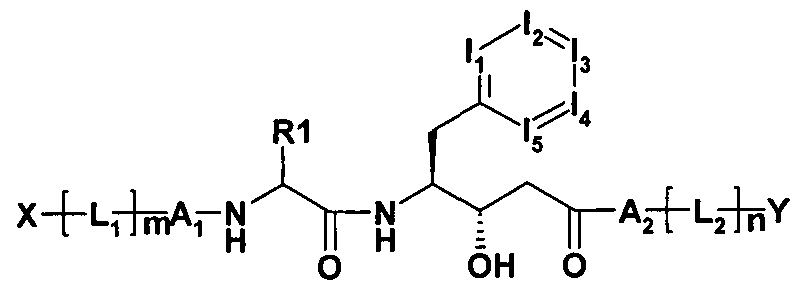
Ausgehend von dem geschützten Hydroxystatinbaustein A erfolgt der Aufbau der neuen Peptidbindung mit entsprechenden Aminen, Starting from the protected hydroxystatin building block A, the construction of the new peptide bond with corresponding amines,
Aminosäurederivaten, Dipeptiden, Tripeptiden oder Tetrapeptiden Amino acid derivatives, dipeptides, tripeptides or tetrapeptides
(typischerweise am C-Terminus geschützt) mit Hilfe einer dem Fachmann bekannten Amid-Kupplungsmethode, wie zum Beispiel einer DAPECI- Kupplung. (typically protected at the C-terminus) by means of an amide coupling method known to those skilled in the art, such as a DAPECI coupling.
Im zweiten Schritt wird die BOC-Schutzgruppe unter geeigneten In the second step, the BOC protecting group is subjected to appropriate
Bedingungen abgespalten (z.B. durch HCI/Dioxan oder TFA/DCM) und der erhaltene Baustein mit einer entsprechenden Säure, Aminosäurederivaten, Dipeptiden, Tripeptiden oder Tetrapeptiden (typischerweise jeweils am N- Terminus geschützt) gekuppelt. Besonders bevorzugt sind bei diesem Schritt Kupplungsreagenzien, die geeignet sind eine Racemisierung zu Cleaved conditions (eg by HCI / dioxane or TFA / DCM) and the obtained building block with a corresponding acid, amino acid derivatives, dipeptides, tripeptides or tetrapeptides (typically protected respectively at the N-terminus) coupled. Particularly preferred in this step are coupling reagents which are suitable for racemization
unterdrücken wie z.B. HATU oder ähnliche Reagenzien. In weiteren suppress such as e.g. HATU or similar reagents. In further
Schritten kann sich die Abspaltung weiterer Schutzgruppen anschließen, z.B. die Hydrogenolyse von Z-Schutzgruppen oder von Benzylestern zur freien Säure in Gegenwart von Pd/C. Analog zum oben beschriebenen Herstellungsverfahren können z.B. die folgenden Verbindungen hergestellt werden ohne die Anwendbarkeit auf diese Bausteine zu beschränken. Steps may be followed by the removal of further protecting groups, e.g. the hydrogenolysis of Z-protecting groups or of benzyl esters to the free acid in the presence of Pd / C. By analogy with the manufacturing method described above, e.g. the following compounds are made without limiting the applicability to these building blocks.
Beispiel 3: Herstellung von (A8): (S)-2-[(2S,3S)-2-((3S,4S)-3-Hydroxy-4- {(S)-3-methyl-2-[(S)-4-methyl-2-(3-methyl-butyrylamino)- pentanoylamino]-butyrylamino}-5-phenyl-pentanoylamino)-3-methyl- pentanoylamino]-3-methyl-buttersäure Example 3: Preparation of (A8): (S) -2 - [(2S, 3S) -2 - ((3S, 4S) -3-hydroxy-4- {(S) -3-methyl-2 - [( S) -4-methyl-2- (3-methylbutyrylamino) -pentanoylamino] -butyrylamino} -5-phenyl-pentanoylamino) -3-methylpentanoylamino] -3-methylbutyric acid

Butoxycarbonylamino-3-hydroxy-5-phenyl-pentansäure, 6,364g (S)-2- ((2S,3S)-2-Amino-3-methyl-pentanoyl-amino)-3-methyl- buttersäurebenzylester (als Hydrochlorid), 1 ,092g 1-Hydroxybenzo- triazolhydrat, 3,664 ml 4-Methylmorpholin und 3,099g N-(3- Dimethylaminopropyl)-N'-ethylcarbodiimidhydrochlorid (DAPECI) in ca 50 ml DMF gelöst und über Nacht gerührt. Die Reaktionsmischung wurde auf gesättigte Natriumhydrogencarbonatlösung gegossen und 15 Min gerührt. Der entstandene Niederschlag wurde abgesaugt, in DCM gelöst und mehrfach zuerst mit Hydrogencarbonatlösung, danach mit verdünnter Ameisensäurelösung und Wasser gewaschen. Das Lösungsmittel wurde entfernt, der Rückstand in DMF aufgenommen, die Lösung in einen Butoxycarbonylamino-3-hydroxy-5-phenylpentanoic acid, benzyl 6,364g (S) -2- ((2S, 3S) -2-amino-3-methylpentanoylamino) -3-methylbutyrate (as the hydrochloride), 1, 092g 1-hydroxybenzotriazolhydrat, 3.664 ml of 4-methylmorpholine and 3.099 g of N- (3-dimethylaminopropyl) -N'-ethylcarbodiimidhydrochlorid (DAPECI) dissolved in about 50 ml of DMF and stirred overnight. The reaction mixture was poured onto saturated sodium bicarbonate solution and stirred for 15 min. The resulting precipitate was filtered off with suction, dissolved in DCM and washed several times first with bicarbonate solution, then with dilute formic acid solution and water. The solvent was removed, the residue taken up in DMF, the solution in a
Zitronensäurepuffer gegossen und der entstandene Niederschlag Citric acid buffer poured and the resulting precipitate
abgesaugt. Nach zweifachem Umfällen und Trocknen erhielt man 7,380g (S)-2-[(2S,3S)-2-((3S,4S)-4-tert-Butoxycarbonylamino-3-hydroxy-5-phenyl- pentanoylamino)-3-methyl-pentanoylamino]-3-methyl-buttersäurebenzylester als weißen Feststoff. (Ausbeute 74,6%, Gehalt >99%). MS-FAB (M + H+ - BOC) = 512,7 Rf (Methode polar): 2,66 Min. aspirated. After double reprecipitation and drying, 7.380 g of (S) -2 - [(2S, 3S) -2 - ((3S, 4S) -4-tert-butoxycarbonylamino-3-hydroxy-5-phenylpentanoylamino) -3- Methyl-pentanoylamino] -3-methyl-butyric acid benzyl ester as a white solid. (Yield 74.6%, content> 99%). MS-FAB (M + H + - BOC) = 512.7 R f (polar method): 2.66 min.

In einem Kolben wurden 7,380g (S)-2-[(2S,3S)-2-((3S,4S)-4-tert- Butoxycarbonylamino-3-hydroxy-5-phenyl-pentanoylamino)-3-methyl- pentanoylamino]-3-methyl-buttersäure-benzylester in 15 ml HCI-Lösung in Dioxan (4 M) unter Eiskühlung gelöst und 5h bei RT gerührt. Überschüssige HCl wurde am Hausvakuum entfernt, das Lösungsmittel im Vakuum entfernt und der Rückstand über Nacht lyophilisiert. In a flask, 7.380 g of (S) -2 - [(2S, 3S) -2 - ((3S, 4S) -4-tert-butoxycarbonylamino-3-hydroxy-5-phenylpentanoylamino) -3-methylpentanoylamino ] -3-methyl-butyric acid benzyl ester dissolved in 15 ml of HCl solution in dioxane (4 M) under ice cooling and stirred for 5 h at RT. Excess HCl was removed at room vacuum, the solvent removed in vacuo, and the residue lyophilized overnight.
Um Dioxanreste zu entfernen, wurde der Rückstand mehrfach mit Heptan verrieben, abgesaugt und getrocknet. Man erhielt 6,420g g (S)-2-[(2S,3S)-2- ((3S,4S)-4-Amino-3-hydroxy-5-phenyl-pentanoylamino)-3-methyl- pentanoylamino]-3-methyl-buttersäure-benzylester als weißen Feststoff. (Ausbeute 97%, Gehalt >99%). MS-FAB (M+H+) = 512,3 Rf (Methode polar): 1 ,76 Min. Schritt 3:

In einem Kolben wurden unter Eiskühlung 3,500g (S)-2-[(2S,3S)-2-((3S,4S)- 4-Amino-3-hydroxy-5-phenyl-pentanoylamino)-3-methyl-pentanoylamino]-3- methyl-buttersäure-benzylester (als Hydrochlorid), 2,199g (S)-3-Methyl-2- [(S)-4-methyl-2-(3-methyl-butyrylamino)-pentanoylamino]-buttersäure und 2,162ml Ethyldiisopropylamin in ca. 30 ml DMF gelöst, mit 2,659g HATU (C10H15N6O*PF6) versetzt und über Nacht bei RT gerührt. Die gelbe Reaktionsmischung wurde auf gesättigte Natriumhydrogencarbonatlösung gegossen und 15 Min gerührt. Der entstandene Niederschlag wurde abgesaugt, mit Wasser und mit verdünnter Ameisensäure verrieben, erneut abgesaugt, mit Wasser gewaschen und getrocknet. Der Rückstand wurde mit Methanol im Ultraschallbad behandelt und abgesaugt. Dieser Vorgang wurde noch zweimal wiederholt. Man erhielt 3,400g (S)-2-[(2S,3S)-2- ((3S,4S)-3-Hydroxy-4-{(S)-3-methyl-2-[(S)-4-methyl-2-(3-methyl- butyrylamino)-pentanoylamino]-butyrylamino}-5-phenyl-pentanoylamino)-3- methyl-pentanoylamino]-3-methyl-buttersäurebenzylester als weißen In a flask under ice-cooling, 3.500 g of (S) -2 - [(2S, 3S) -2 - ((3S, 4S) -4-amino-3-hydroxy-5-phenylpentanoylamino) -3-methylpentanoylamino ] -3-methyl-butyric acid benzyl ester (as hydrochloride), 2.19 g of (S) -3-methyl-2- [(S) -4-methyl-2- (3-methyl-butyrylamino) -pentanoyl-amino] -butyric acid and Dissolve 2.162 ml of ethyldiisopropylamine in about 30 ml of DMF, add 2.659 g of HATU (C10H15N6O * PF6) and stir at RT overnight. The yellow reaction mixture was poured onto saturated sodium bicarbonate solution and stirred for 15 min. The resulting precipitate was filtered off with suction, triturated with water and with dilute formic acid, again filtered off with suction, washed with water and dried. The residue was treated with methanol in an ultrasound bath and filtered with suction. This process was repeated twice more. 3,400 g of (S) -2 - [(2S, 3S) -2- ((3S, 4S) -3-hydroxy-4 - {(S) -3-methyl-2 - [(S) -4-] methyl-2- (3-methyl-butyrylamino) -pentanoylamino] -butyrylamino} -5-phenyl-pentanoylamino) -3-methyl-pentanoylamino] -3-methyl-butyric acid benzyl ester as white
Feststoff. (Ausbeute 65%). MS-FAB (M + H+)= 809,0 Rf (Methode polar): 2,71 Min. Solid. (Yield 65%). MS-FAB (M + H + ) = 809.0 R f (polar method): 2.71 min.
Analog zu diesem Schritt können z.B. die Verbindungen Nr. 1-3, 7, 10-13, 16, 18, 19, 21-23, 32, 34, 35 aus Tablle 2 hergestellt werden (ohne die Methode auf diese Verbindungen einzuschränken). Analogously to this step, e.g. Compounds Nos. 1-3, 7, 10-13, 16, 18, 19, 21-23, 32, 34, 35 are prepared from Table 2 (without limiting the method to these compounds).

In einem geeigneten Gefäß wurden 3,400g (S)-2-[(2S,3S)-2-((3S,4S)-3-In a suitable vessel, 3,400 g of (S) -2 - [(2S, 3S) -2 - ((3S, 4S) -3-
Hydroxy-4-{(S)-3-methyl-2-[(S)-4-methyl-2-(3-methyl-butyrylamino)- pentanoylamino]-butyrylamino}-5-phenyl-pentanoylamino)-3-methyl- pentanoylamino]-3-methyl-buttersäurebenzylester in Gegenwart von 1 ,300g Pd/C (5%Pd, feucht) in 70 ml THF bei RT solange bei Normaldruck hydriert, bis das Edukt vollständig umgesetzt war (über Nacht). Das Hydroxy-4 - {(S) -3-methyl-2 - [(S) -4-methyl-2- (3-methylbutyrylamino) -pentanoylamino] -butyrylamino} -5-phenyl-pentanoylamino) -3-methyl - pentanoylamino] -3-methyl-butyric acid benzyl ester in the presence of 1.300 g Pd / C (5% Pd, moist) in 70 ml of THF at RT while being hydrogenated at normal pressure until the starting material has completely reacted (overnight). The
Reaktionsgemisch wurde mit Wasser und THF verdünnt und abgesaugt, um den Katalysator zu entfernen. Das Filtrat wurde im Vakuum eingeengt und zur vollständigen Entfernung des Wassers lyophilisiert. Der Rückstand wurde mit Heptan im Ultraschallbad behandelt, abgesaugt und getrocknet. Analoge Behandlungen erfolgten mit Dioxan und danach mit MTBE. Man erhielt 2,45g (S)-2-[(2S,3S)-2-((3S,4S)-3-Hydroxy-4-{(S)-3-methyl-2-[(S)-4- methyl-2-(3-methyl-butyrylamino)-pentanoylamino]-butyrylamino}-5-phenyl- pentanoylamino)-3-methyl-pentanoylamino]-3-methyl-buttersäure als weißes Pulver (Ausbeute 82%). MS-FAB (M + H+)= 718,9 Rf (Methode polar): 2,27 Min. Analog zu diesem Schritt können die Verbindungen Nr. 4-6, 8, 9, 14, 15, 17, 20, 24-31 , 33, 36-40 aus Tabelle 2 hergestellt werden. The reaction mixture was diluted with water and THF and suction filtered to remove the catalyst. The filtrate was concentrated in vacuo and lyophilized to completely remove the water. The residue was treated with heptane in an ultrasonic bath, filtered off with suction and dried. Analogous treatments were done with dioxane and then with MTBE. This gave 2.45 g of (S) -2 - [(2S, 3S) -2 - ((3S, 4S) -3-hydroxy-4 - {(S) -3-methyl-2 - [(S) -4 - methyl 2- (3-methyl-butyrylamino) -pentanoylamino] -butyrylamino} -5-phenyl-pentanoylamino) -3-methyl-pentanoylamino] -3-methyl-butyric acid as a white powder (yield 82%). MS-FAB (M + H + ) = 718.9 R f (polar method): 2.27 min. Analogously to this step, the compounds Nos. 4-6, 8, 9, 14, 15, 17, 20, 24-31, 33, 36-40 are made from Table 2.
Beispiel 4: Herstellung von (A41): (S)-2-[(2S,3S)-2-((3S,4S)-3-Hydroxy-4- {(S)-3-methyl-2-[(S)-4-methyl-2-(3-methyl-butyrylamino)- pentanoylamino]-butyrylamino}-5-phenyl-pentanoylamino)-3-methyl- pentanoylamino]-3-methyl- Example 4: Preparation of (A41): (S) -2 - [(2S, 3S) -2 - ((3S, 4S) -3-hydroxy-4- {(S) -3-methyl-2 - [( S) -4-methyl-2- (3-methylbutyrylamino) -pentanoylamino] -butyrylamino} -5-phenyl-pentanoylamino) -3-methylpentanoylamino] -3-methyl-

MS-FAB (M+H+) = 712,9 Rf (Methode polar): 1 ,70 Min. MS-FAB (M + H + ) = 712.9 R f (polar method): 1.70 min.
Sind mehrere orthogonale Schutzgruppen vorhanden lässt sich die If several orthogonal protecting groups are present, the
Reihenfolge der Schutzgruppenabspaltungen auch umkehren. Methode (HPLC-MS): Reverse the order of the deprotections also. Method (HPLC-MS):
Chromolith Speed Rod RP 18e 50-4,6 mm LCMS;Polar.m, 2,4ml/min, 220nm, Puffer A 0,05% HCOOH/H20, Puffer B 0,04% HCOOH/ACN, 0,0- 2,8min 4%-100% Puffer B; 2,8-3,3min 100% Puffer B 3,3-3,4min 100%-4% Puffer B Chromolith Speed Rod RP 18e 50-4.6 mm LCMS, Polar.m, 2.4ml / min, 220nm, Buffer A 0.05% HCOOH / H 2 O, Buffer B 0.04% HCOOH / ACN, 0.0-2 , 8min 4% -100% Buffer B; 2.8-3.3min 100% Buffer B 3.3-3.4min 100% -4% Buffer B
Abkürzungen: Abbreviations:
DCM = Dichlormethan DCM = dichloromethane
DMA = Dimethylacetamid DMA = dimethylacetamide
DMF = Dimethylformamid DMF = dimethylformamide
EE = Essigsäureethylester EE = ethyl acetate
MTBE = Methyl-ferf-butylether MTBE = methyl-fer-butyl ether
PE = Petrolether RT = Raumtemperatur PE = petroleum ether RT = room temperature
TFA = Trifluoressigsäure TFA = trifluoroacetic acid
Beispiel 4: ln-vitro Fluoreszenz-Assay zur Identifizierung von Example 4: In vitro fluorescence assay for identification of
Cathepsin D Inhibitoren Cathepsin D inhibitors
Zur Identifizierung von Modulatoren der Cathepsin D Aktivität wurde ein kontinuierlicher enzymatischer Test mit einem synthetischen Peptid, das eine fluoreszierende Gruppe (MCA=(7-methoxycoumarin-4-yl)acetyl) trägt, die durch Energietransfer von einer Dpn (2,4 dinitrophenyl)-Gruppe am selben Molekül gequencht ist, in 384-well-nb-Mikrotiterplatten von Greiner durchgeführt. Die Spaltung des peptidischen Substrats durch Cathepsin D bewirkt einen Anstieg in der Fluoreszenzintensität. Zur Bestimmung der Wirksamkeit von Substanzen wurde der zeitabhängige Anstieg in derTo identify modulators of cathepsin D activity, a continuous enzymatic assay was carried out with a synthetic peptide carrying a fluorescent group (MCA = (7-methoxycoumarin-4-yl) acetyl) obtained by energy transfer from a Dpn (2,4 dinitrophenyl). Group is quenched on the same molecule, carried out in 384-well nb microtiter plates from Greiner. Cleavage of the peptide substrate by cathepsin D causes an increase in fluorescence intensity. To determine the efficacy of substances, the time - dependent increase in
Fluoreszenzintensität in Gegenwart der Substanz mit der zeitabhängigen Fluoreszenzzunahme in Abwesenheit von Substanzen verglichen. Als Referenzsubstanz diente Pepstatin A (Sigma-Aldrich). Als Substrat wurde MCA-GKPILFFRLK(Dnp)d-R-NH2 (Enzo Life Sciences, Lörrach) verwendet. Als Enzym wurde aus der humanen Leber isoliertes Cathepsin D (Sigma- Aldrich) in einer finalen Konzentration von 1.4 nM eingesetzt. Der Test wurde in 100 mM Natrium-Acetat-Puffer, 1.25 % (v/v) DMSO, 0.25 % (w/v) Chaps, pH 5.5 durchgeführt. Zu je 4 μΙ Cathepsin D-Lösung wurden je 2 μΙ Substanzlösung mit seriell verdünnter Substanzkonzentration zugegeben und 10 min bei Raumtemperatur inkubiert. Die Reaktion wurde gestartet durch Zugabe von 2 μΙ Substrat-Lösung (finale Konzentration 5 μΜ). Nach Durchführung einer Startpunkt-Fluoreszenzmessung (Anregungswellenlänge 340 nm/Emissionswellenlänge 450 nm) mit einem Envision Multilabel reader (Perkin Elmer) wurde die Reaktion 60 min bei Raumtemperatur inkubiert. Anschließend wurde die Menge des während der Reaktionszeit Fluorescence intensity in the presence of the substance compared with the time-dependent increase in fluorescence in the absence of substances. The reference substance was pepstatin A (Sigma-Aldrich). The substrate used was MCA-GKPILFFRLK (Dnp) dR-NH 2 (Enzo Life Sciences, Lörrach). Cathepsin D (Sigma-Aldrich) isolated from the human liver was used as enzyme in a final concentration of 1.4 nM. The assay was performed in 100 mM sodium acetate buffer, 1.25% (v / v) DMSO, 0.25% (w / v) chaps, pH 5.5. 2 μΙ of substance solution with serially diluted substance concentration were added to each 4 μΙ cathepsin D solution and incubated for 10 min at room temperature. The reaction was started by adding 2 μΙ substrate solution (final concentration 5 μΜ). After carrying out a starting point fluorescence measurement (excitation wavelength 340 nm / emission wavelength 450 nm) with an Envision Multilabel reader (Perkin Elmer), the reaction was incubated for 60 min at room temperature. Subsequently, the amount of during the reaction time
abgespaltenen Peptidfragments durch Bestimmung der Zunahme der Fluoreszenzintensität bei 450 nm (Anregungswellenlänge 340 nm) gemessen. Cleaved peptide fragment by determining the increase in Fluorescence intensity measured at 450 nm (excitation wavelength 340 nm).
Alle Verbindungen der Tabelle 2 aus Beispiel 1 wiesen einen IC5o-Wert kleiner als 100nM auf (siehe Tabelle 2, Beispiel 1 , vorletzte Spalte). All the compounds of Table 2 of Example 1 had an IC 5 o value of less than 100 nM (see Table 2, Example 1, next to last column).
Beispiel 5: Knorpel-Explant-Assay Um den Effekt von potentiellen Cathepsin D Inhibitoren auf Knorpelabbau zu untersuchen wird ein pH-induziertes Modell basierend auf bovinen Example 5: Cartilage Explant Assay To investigate the effect of potential cathepsin D inhibitors on cartilage degradation, a pH-induced model based on bovine
Explantaten verwendet. Dabei wird der pH-Wert des Mediums, in dem die Explantate kultiviert werden, dem pathophysiologischen pH-Wert eines arthrotischen Knies angepasst. Dieser pH-Wert liegt bei pH 5,5. In diesem ex vivo Modell werden anschließend potentielle Cathepsin D Inhibitoren auf ihre Wirkung hinsichtlich einer Arretierung des Knorpelabbauprozesses untersucht. Wird der Knorpel zerstört, werden Glycosaminoglycane (GAGs) in den Zellkulturüberstand abgegeben. Die Menge der freigesetzten GAGs lässt sich quantitativ mit Hilfe des DMMB (Dimethylmethylenblau- Hydrochlorid) bestimmen. Beim Nachweis sulfatierter GAGs mit Explants used. Here, the pH of the medium in which the explants are cultured is adjusted to the pathophysiological pH of an arthritic knee. This pH is at pH 5.5. In this ex vivo model, potential cathepsin D inhibitors are then tested for their effect in arresting the cartilage degradation process. When the cartilage is destroyed, glycosaminoglycans (GAGs) are released into the cell culture supernatant. The amount of released GAGs can be determined quantitatively with the aid of DMMB (dimethylmethylene blue hydrochloride). In the detection of sulfated GAGs with
Dimethylmethylenblau-Hydrochlorid macht man sich die Abnahme der Absorption bei 633 nm zu Nutze. Da auch bei sehr niedrigen GAG- Konzentrationen gearbeitet werden kann, fällt auch nach langer Inkubation von DMMB mit GAG kein Farbstoff/GAG-Komplex aus, wie das bei anderen Messmethoden mitunter schon nach kurzer Zeit passiert. Zur Bestimmung der Konzentration wird eine Eichgerade mit Chondroitinsulfat mitgeführt. Anhand der GAG-Werte lässt sich ein ICso-Wert errechnen, d.h. eine Dimethylmethylene blue hydrochloride makes use of the decrease in absorption at 633 nm. Since it is also possible to work at very low GAG concentrations, no dye / GAG complex precipitates even after a long incubation of DMMB with GAG, as happens with other measuring methods sometimes after only a short time. To determine the concentration, a calibration line with chondroitin sulfate is carried. Based on the GAG values, an IC 50 value can be calculated, i. a
Konzentration bei der eine Substanz 50% ihrer Wirkung zeigt. Concentration at which a substance shows 50% of its effect.
Lösungen: Inkubationsmedium, pH 7,4: Solutions: Incubation medium, pH 7.4:
DMEM ohne FBS, Zugabe von 1% Pen/Strep und 30 pg/ml Ascorbinsäure, das Medium wird nicht gelagert. Inkubationsmedium, pH 5,5: DMEM without FBS, addition of 1% Pen / Strep and 30 pg / ml ascorbic acid, the medium is not stored. Incubation medium, pH 5.5:
DMEM ohne FBS, der pH-Wert wird durch Zugabe von MES eingestellt und am pH-Meter kontrolliert, Zugabe von 1 % Pen/Strep und 30 pg/ml DMEM without FBS, the pH is adjusted by addition of MES and monitored at the pH meter, adding 1% Pen / Strep and 30 pg / ml
Ascorbinsäure. Lösungen für die GAG-Messung: Ascorbic acid. Solutions for GAG measurement:
DMMB-Färbelösung (V = 500 ml): DMMB staining solution (V = 500 ml):
8 mg DMMB (Dimethylmethylenblau) in 2,5 ml Ethanol lösen + 1 g Dissolve 8 mg of DMMB (dimethylmethylene blue) in 2.5 ml of ethanol + 1 g
Natriumformiat + 1 ml Ameisensäure, mit bidest. Wasser ad 500 ml auffüllen Sodium formate + 1 ml of formic acid, with redist. Add water to 500 ml
Inkubationsmedium: FBS (Medium ohne FBS) Chondroitinsulfat-Lösungen (Standardkurve) Incubation medium: FBS (medium without FBS) Chondroitin sulfate solutions (standard curve)
Ansatz von Standardlösungen mit folgenden Konzentrationen: 50pg/ml; 25pg/ml; 12,5pg/ml; 6,25pg/ml; 3,125pg/ml; 1 ,56pg/ml; 0,78pg/ml sowie eine Leerkontrolle des Mediums. Der Ansatz der Standardlösung erfolgt in dem Medium, mit welchem auch der Versuch durchgeführt wurde. Preparation of standard solutions with the following concentrations: 50pg / ml; 25pg / ml; 12,5pg / ml; 6,25pg / ml; 3,125pg / ml; 1, 56pg / ml; 0.78pg / ml and a blank control of the medium. The approach of the standard solution is carried out in the medium with which the experiment was carried out.
1.) Durchführung: pH induzierter Knorpelabbau von bovinen Explantaten Die bovinen Explantate werden zunächst präpariert. Die Induktion des Knorpelabbaus wird in 96 -Multiwellplatten durchgeführt. Dabei wird ein Explantat pro well kultiviert. Es erfolgt die Zugabe von je 200 μΙ DMEM (Inkubationsmedium pH 5,5) ohne FBS + 30 pg/ml Ascorbinsäure. Also Negativkontrolle werden Explantate (n= 4) bei pH 7,4 (ohne FBS) inkubiert. Diese Kontrolle geht nicht in die Berechnung der Daten mit ein, sondern stellt sicher dass die pH-Wert Änderung den gewünschten Effekt auf die Freisetzung von GAG hat. An dieser Stelle erfolgt die Zugabe der zu testenden Substanzen. Es findet keine Vorinkubation der Explantate statt. Die Explantate werden mit den entsprechenden Substanzen 3 Tage im1.) Procedure: pH-induced cartilage degradation of bovine explants The bovine explants are initially prepared. The induction of cartilage degradation is performed in 96 multiwell plates. One explant is cultivated per well. The addition of 200 μM DMEM (incubation medium pH 5.5) without FBS + 30 pg / ml ascorbic acid. So negative control explants (n = 4) are incubated at pH 7.4 (without FBS). This control is not included in the calculation of the data, but ensures that the pH change has the desired effect on the release of GAG. At this point, the addition of the added testing substances. There is no preincubation of the explants. The explants are taken in 3 days with the appropriate substances
Brutschrank bei 37°C und 7,5% C02 kultiviert. 2.) Inkubationsablauf Incubator cultivated at 37 ° C and 7.5% C0 2 . 2.) Incubation procedure
Um den Effekt von Cathepsin D Inhibitoren auf die Freisetzung von GAG (Glycosaminoglycan) zu untersuchen, werden die Substanzen in der gewünschten Konzentration eingesetzt und für 3 Tage kultiviert. Dabei werden die zu testenden Verbindungen in einem ersten Experiment in einer Konzentration von 1 μΜ und 1% DMSO getestet. Substanzen die einen In order to investigate the effect of cathepsin D inhibitors on the release of GAG (glycosaminoglycan), the substances are used in the desired concentration and cultured for 3 days. The compounds to be tested are tested in a first experiment in a concentration of 1 μΜ and 1% DMSO. Substances one
Effekt von >50% auf die Freisetzung von GAG haben (das entspricht <50% der Kontrolle im Assay Explorer), werden in einem nächsten Experiment bei 100 nM und 1 % DMSO gestestet. Substanzen, die unter diesen Effect of> 50% on the release of GAG (this corresponds to <50% of the control in the assay explorer) are tested in a next experiment at 100 nM and 1% DMSO. Substances that are among these
Bedingungen einen Effekt von >50% auf die Freisetzung von GAG haben (das entspricht <50% der Kontrolle im Assay Explorer), werden in einer Konzentrations-Wirkungs-Beziehung getestet. Dabei werden die Conditions have an effect of> 50% on the release of GAG (which corresponds to <50% of control in the assay explorer) are tested in a concentration-response relationship. Here are the
Verbindungen in den folgenden Konzentrationen untersucht: 30 μΜ, 10 μΜ, 3 μΜ, 1 μΜ, 0.3 μΜ, 0.1 μΜ, 0.03 μΜ, 0.01 μΜ. Als Positivkontrolle wird Pepstatin A mit einer Konzentration von 0,01 μΜ verwendet. Das Wirkungsfenster (assay window) ist definiert durch die Kontrolle (pH 5,5), definiert als 0% Effekt und die Kontrolle pH 5,5 + 0,01 μΜ Pepstatin A, definiert als 100% Effekt. Nach 3 Tagen Inkubation werden die Zellkulturüberstände gesammelt und bei -20°C gelagert oder direkt vermessen. Dabei wird photometrisch die Menge an freigesetztem GAG gemessen. Compounds tested at the following concentrations: 30 μΜ, 10 μΜ, 3 μΜ, 1 μΜ, 0.3 μΜ, 0.1 μΜ, 0.03 μΜ, 0.01 μΜ. As a positive control Pepstatin A is used with a concentration of 0.01 μΜ. The assay window is defined by the control (pH 5.5), defined as 0% effect, and the control pH 5.5 + 0.01 μΜ pepstatin A, defined as 100% effect. After 3 days of incubation, the cell culture supernatants are collected and stored at -20 ° C or measured directly. The amount of released GAG is measured photometrically.
Berichtet werden für Konzentrationen von 1 μΜ und 100 nM der Effekt ( 1 Wert) der jeweiligen Substanz in % bezogen auf die Positivkontrolle (pH 5,5 + 0,01 μΜ Pepstatin A) und die Negativkontrolle (pH 5,5). Der Wert stellt den Mittelwert aus 4 Replikaten da. Bei der Ermittlung einer Konzentrations- Wirkungs-Beziehung wird ein IC5o-Wert an die Datenbank berichtet (Assay Explorer). For concentrations of 1 μΜ and 100 nM the effect (1 value) of the respective substance in% based on the positive control (pH 5.5 + 0.01 μΜ pepstatin A) and the negative control (pH 5.5) are reported. The value represents the mean of 4 replicas. When determining a concentration Effect relationship, an IC 5 o value is reported to the database (Assay Explorer).
4. ) Messung 4.) Measurement
Die Zellkulturüberstände (200 μΙ) werden entweder direkt vermessen oder werden bei -20°C gelagert. Eine genaue Bestimmung der Konzentration (pg/ml GAG im Überstand) von GAG zu gewährleisten müssen sich die Messwerte im linearen Bereich der Standardkurve befinden. Um dies zu gewährleisten werden routinemäßig verschiedene Verdünnungen vorgelegt (1/5, 1/10, 1/20, 1/40). Die Verdünnungen werden mit Medium hergestellt und automatisiert (Hamilton) in einer 384-Multiwellplatte vorgelegt (15 μΙ). Ebenfalls automatisiert (oder mit Mehrkanalpipette) werden 60 μΙ DMMB- Lösung zugegeben. Es erfolgt eine schnelle Farbreaktion die anschließend bei 633 nm mit einem Platten-Reader (z.B. Envision) gemessen wird. The cell culture supernatants (200 μΙ) are either measured directly or stored at -20 ° C. To ensure accurate determination of concentration (pg / ml GAG in supernatant) of GAG, the readings must be in the linear range of the standard curve. To ensure this, various dilutions are routinely presented (1/5, 1/10, 1/20, 1/40). The dilutions are made with medium and submitted to automated (Hamilton) in a 384 multiwell plate (15 μΙ). Also automated (or with multichannel pipette) add 60 μΙ DMMB solution. A fast color reaction is performed which is then measured at 633 nm with a plate reader (e.g., Envision).
Je nach vorhandener Probenmenge wird mindestens eine Depending on the amount of sample present, at least one
Doppelbestimmung durchgeführt. Double determination performed.
Die Daten werden vom MTP-Reader als csv oder xls-Files zur Verfügung gestellt und basierend auf diesem Format (xls) als Rohdaten gespeichert bzw. zur Berechnung des prozentualen Effekts der jeweiligen Verbindung herangezogen. The data are provided by the MTP reader as csv or xls files and stored as raw data based on this format (xls) or used to calculate the percentage effect of the respective connection.
5. ) Qualitätskontrollen 5.) Quality controls
Als Kontrolle für die Induktion des pH-induzierten Knorpelabbaus werden 4 Explantate bei pH 7,4 inkubiert. Dies entspricht dem physiologischen pH- Wert des Knorpels und somit ist hier kein Effekt auf die Freisetzung von GAG zu erwarten. Diese GAG Werte (pg/ml Überstand) sind somit immer signifikant niedriger als die GAG-Werte einer Inkukation mit pH 5,5. As a control for the induction of pH-induced cartilage degradation, 4 explants are incubated at pH 7.4. This corresponds to the physiological pH of the cartilage and thus no effect on the release of GAG is to be expected here. These GAG values (pg / ml supernatant) are thus always significantly lower than the GAG values of a pH 5.5 incubation.
Eine weitere Kontrolle, die sowohl der Überprüfung des Experimentes dient aber auch wichtig für die Definition des Wirkungsfensters ist, ist die Another control, which serves both the verification of the experiment but is also important for the definition of the effect window, is the
Pepstatin-Kontrolle (pH 5,5 + 0,01 μΜ Pepstatin A). Diese Substanz blockiert unspezifisch die Aktivität der meisten Proteasen und legt somit den maximal möglichen Effekt einer Verbindung fest. Pepstatin control (pH 5.5 + 0.01 μΜ pepstatin A). This substance Non-specifically blocks the activity of most proteases and thus determines the maximum possible effect of a compound.
(1) Klompmakers, A. & Hendriks, T. (1986) Anal. Biochem. 153, 80-84, Spektrophotometrischer Nachweis für sulfatierte Glycosaminoglycane. (1) Klompmakers, A. & Hendriks, T. (1986) Anal. Biochem. 153, 80-84, spectrophotometric detection for sulfated glycosaminoglycans.
(2) Graves, P.J. et al. (1997) Anal. Biochem. 245, 247-248 (2) Graves, P.J. et al. (1997) Anal. Biochem. 245, 247-248
Polyvinylalkohol-stabilisierte Bindung von sulfatierten GAGs an Polyvinyl alcohol-stabilized binding of sulfated GAGs
Dimethylmethylenblau. Dimethylmethylene.
6.) Ergebnisse 6.) Results
Zu einigen Verbindungen aus der Tabelle 2 in Beispiel 1 wurden mit diesem Assay IC5o-Werte ermittelt, diese sind in der Tabelle 2 in Beispiel 1 in der letzten Spalte aufgeführt. For some compounds from Table 2 in Example 1, IC 5 o values were determined with this assay, these are listed in Table 2 in Example 1 in the last column.
Beispiel 6: Untersuchung anti-hyperalgetischer Wirkung im Tier Example 6 Investigation of anti-hyperalgesic action in the animal
Zur Induktion einer Entzündungsreaktion wurde eine Carrageenan-Lösung (CAR, 1%, 50 μΙ) einseitig intraartikulär in ein Rattenkniegelenk injiziert. Die nichtinjizierte Seite wurde zu Kontrollzwecken herangezogen. Es wurden sechs Tiere pro Gruppe verwendet. Die Schwellung wurde mittels einer Mikrometerschraube bestimmt (medial-lateral am Kniegelenk) und die thermische Hyperalgesie mittels einer gerichteten Infrarotlichtquelle nach der Hargreaves-Methode (Hargreaves et al. 1988) an der Fußunterseite bestimmt. Da der Ort der Entzündung (Kniegelenk) von dem Ort der To induce an inflammatory reaction, a carrageenan solution (CAR, 1%, 50 μΙ) was injected on one side intra-articularly into a rat knee joint. The non-injected side was used for control purposes. Six animals per group were used. The swelling was determined by means of a micrometer screw (medial-lateral on the knee joint) and the thermal hyperalgesia was determined by means of a directed infrared light source according to the Hargreaves method (Hargreaves et al., 1988) on the underside of the foot. Since the place of inflammation (knee joint) from the place of
Messung (Pfotenunterseite) abweicht, spricht man hier von sekundärer thermischer Hyperalgesie, deren Mechanismen für die Auffindung wirksamer Analgetika von Bedeutung ist. Measurement (lower paw) is called secondary thermal hyperalgesia, the mechanisms of which are important for finding effective analgesics.
Versuchsbeschreibung Thermische Hyperalgesie (Hargreaves Test): Das Versuchstier wird in einer Plastikkammer auf eine Quarzglasscheibe gesetzt. Vor der Testung wird dem Versuchstier zunächst etwa 5 - 15 Minuten Zeit gegeben, sich an die Umgebung zu gewöhnen. Sobald sich das Versuchstier nach der Erkundungsphase nicht mehr so oft bewegt (Ende der Explorationsphase), wird die Infrarotlichtquelle, deren Fokus in der Ebene des Glasbodens liegt, direkt unterhalb der zu stimulierenden Hinterpfote positioniert. Ein Versuchsdurchlauf wird nun durch Knopfdruck gestartet: Infrarotlicht führt zur Erhöhung der Hauttemperatur der Hinterpfote. Der Versuchablauf wird entweder bei Anheben der Hinterpfote durch das Experiment description Thermal hyperalgesia (Hargreaves test): The test animal is placed on a quartz glass disc in a plastic chamber. Before the test, the test animal first about 5 - 15 minutes time given to get used to the environment. As soon as the animal no longer moves as often as possible after the exploration phase (end of the exploration phase), the infrared light source, whose focus lies in the plane of the glass bottom, is positioned directly below the hind paw to be stimulated. A test run is now started by pressing a button: Infrared light increases the skin temperature of the hind paw. The experiment is either by lifting the hind paw by the
Versuchstier (als Ausdruck des Erreichens der Schmerzschwelle) oder bei Erreichen einer vorgegeben Höchsttemperatur durch automatisches Test animal (as an expression of reaching the pain threshold) or when reaching a given maximum temperature by automatic
0 Ausschalten der Infrarotlichtquelle beendet. Solange das Versuchstier still sitzt, wird Licht, das von der Pfote reflektiert wird, registriert. Ein Wegziehen der Pfote unterbricht diese Reflektion, woraufhin die Infrarotlichtquelle abgeschaltet und die Zeit von An- bis Abschalten registriert wird. Das Gerät ist so geeicht, dass die Infrarotlichtquelle in 10s die Hauttemperatur auf ca. 5 45 Grad Celsius erhöht (Hargreaves et al. 1988). Zur Testung wird ein von der Firma Ugo Basile zu diesem Zweck produziertes Gerät benutzt. 0 Turn off the infrared light source. As long as the animal is sitting still, light reflected from the paw is registered. Pulling the paw off this reflection, whereupon the infrared light source is switched off and the time from switching on and off is registered. The device is calibrated so that the infrared light source raises the skin temperature to about 5 45 degrees Celsius in 10 seconds (Hargreaves et al., 1988). For testing, a device manufactured by Ugo Basile for this purpose is used.
CAR wurde von Sigma-Aldrich bezogen. Die Applikation des spezifischen Cathepsin D-Inhibitors, der Verbindung Nr. 23 (aus Beispiel 1 , Tabelle 2, (S)-CAR was purchased from Sigma-Aldrich. Application of the Specific Cathepsin D Inhibitor, Compound No. 23 (from Example 1, Table 2, (S) -
Q 2-[(2S,3S)-2-((3S,4S)-3-Amino-4-{(S)-3-methyl-2-[(S)-4-methyl-2-(3-methyl- butyrylamino)-pentanoylamino]-butyrylamino}-5-phenyl-pentanoylamino)-3- methyl-pentanoylamino]-3-methyl-buttersäure) wurde 30 Minuten vor der CAR intraartikulär vorgenommen. Als Positivkontrolle wurde Triamcinolone (TAC) 10 g/Gelenk und als Negativkontrolle wurde das LösungsmittelQ 2 - [(2S, 3S) -2 - ((3S, 4S) -3-amino-4 - {(S) -3-methyl-2 - [(S) -4-methyl-2- (3 methyl-butyrylamino) -pentanoylamino] -butyrylamino} -5-phenyl-pentanoylamino) -3-methyl-pentanoylamino] -3-methyl-butyric acid) was made intra-articularly 30 minutes before CAR. As a positive control, triamcinolone (TAC) became 10 g / hinge and the negative control became the solvent
5 (Vehikel) verwendet. Die Hyperalgesie wird als Differenz der Wegziehzeiten zwischen der entzündeten und der nicht-entzündeten Pfote angegeben. 5 (vehicle) used. Hyperalgesia is expressed as the difference in withdrawal times between the inflamed and non-inflamed paws.
Ergebnis: TAC war in der Lage, die CAR-induzierte Schwellung zu Result: TAC was able to increase the CAR-induced swelling
reduzieren, nicht aber der spezifische Cathepsin D-Inhibitor. Im Gegensatz Q dazu konnte der spezifische Cathepsin D-Inhibitor das Ausmaß der but not the specific cathepsin D inhibitor. In contrast to Q, the specific cathepsin D inhibitor could reduce the extent of
thermischen Hyperalgesie dosisabhängig reduzieren (siehe Abbildung 2) Beurteilung: Es konnte gezeigt werden, dass die Verbindung Nr. 23 eine anti-hyperalgetische Wirkung ausübt. Dies kann postuliert werden, da die Verbindung Nr. 23 keinen Einfluss auf die entzündliche Schwellung und damit auf den Auslöser der Hyperalgesie zeigte. Es kann damit reduce thermal hyperalgesia dose-dependently (see Figure 2) Assessment: It has been shown that Compound No. 23 exerts an anti-hyperalgesic effect. This can be postulated because Compound No. 23 showed no effect on the inflammatory swelling and thus on the trigger of hyperalgesia. It can do that
angenommen werden, dass die Verbindung Nr. 23 beim Menschen eine Schmerz reduzierende Wirkung entfaltet. It can be assumed that Compound No. 23 has a pain-reducing effect in humans.
Beispiel 7: Stabilität der erfindungsgemäßen Verbindungen in boviner Synovialflüssigkeit Example 7: Stability of the compounds according to the invention in bovine synovial fluid
1. ) Gewinnung von boviner Synovialflüssigkeit 1.) Obtaining bovine synovial fluid
Bei der Präparation von bovinen Explantaten (für die Diffusionskammer oder andere Assays) werden entweder Rinderhufe (metacarpale Gelenke) oder Rinderknie verwendet. Die Synovialflüssigkeit lässt sich aus beiden In the preparation of bovine explants (for the diffusion chamber or other assays), either cattle hooves (metacarpal joints) or bovine knee are used. The synovial fluid can be made from both
Gelenken gewinnen. Dazu wird bei der Öffnung des Gelenkes die Win joints. For this purpose, at the opening of the joint the
Synovialflüssigkeit mit einer 10 ml Spritze und einer Kanüle vorsichtig aus dem Gelenk entfernt und in bereit gestellte 2 ml Eppendorfgefäße gefüllt. Die Eppendorfgefäße sind je nach Tier beschriftet (Rinderpass liegt vor). Dabei ist darauf zu achten, dass bei der Präparation der Gelenke kein Blut in den Gelenkspalt eindringt. Ist dies der Fall, verfärbt sich die Synovialflüssigkeit rötlich und muss somit verworfen werden. Die Synovialflüssigkeit ist grundsätzlich hochviskos und klar bis gelblich gefärbt. Die Entnahme zusammen mit einer makroskopischen Analyse der Synovialflüssigkeit wird dokumentiert. Carefully remove synovial fluid from the joint with a 10 ml syringe and cannula and place in prepared 2 ml Eppendorf tubes. The Eppendorf vessels are labeled depending on the animal (cattle pass is available). It is important to ensure that no blood enters the joint space during the preparation of the joints. If this is the case, the synovial fluid turns reddish and must therefore be discarded. The synovial fluid is generally highly viscous and clear to yellowish in color. The collection along with a macroscopic analysis of the synovial fluid is documented.
2. ) Ansatz der Stabilitätsprüfung von Substanzen in SF 2.) Stability testing of substances in SF
Um die Stabilität einzelner Verbindungen zu überprüfen wird ein Pool aus 4 verschiedenen bovinen Synovialflüssigkeiten gemischt. Dazu werden ca. 1 ml je SF verwendet. Das Gemisch wird direkt in einem 5 ml Glasgefäß angesetzt. Die SFs werden gründlich aber vorsichtig gemischt. Dabei sollten keine Luftblasen oder Schaum entstehen. Dazu wird ein Vortex-Gerät auf niedrigster Stufe verwendet. Die zu testenden Verbindungen werden in einer Anfangskonzentration (sofern nicht anders angefordert) von 1 μΜ getestet. Nach Zugabe der Substanz erfolgt eine erneute gründliche und vorsichte Durchmischung des Ansatzes. Zur optischen Kontrolle werden alle SF- Ansätze fotografiert und die Bilder im eLabBio-Ordner des entsprechenden Versuchs abgelegt. Abbildung 1 zeit exemplarisch eine solche To check the stability of individual compounds, a pool of 4 different bovine synovial fluids is mixed. For this purpose approx. 1 ml per SF are used. The mixture is placed directly in a 5 ml glass jar. The SFs are mixed thoroughly but gently. There should be no air bubbles or foam. This is done by a vortex device lowest level used. The compounds to be tested are tested at an initial concentration of 1 μΜ unless otherwise specified. After addition of the substance, a thorough and careful mixing of the mixture takes place again. For visual inspection all SF approaches are photographed and the images are stored in the eLabBio folder of the corresponding experiment. Figure 1 exemplifies such a time
Fotodokumentation. Die Ansätze werden für 48 h bei 37°C und 7,5% CO2 im Brutschrank inkubiert. 3.) Probenentnahme Photo documentation. The mixtures are incubated for 48 h at 37 ° C. and 7.5% CO 2 in the incubator. 3.) Sampling
Die Probenentnahme erfolgt nach den vorher abgestimmten Zeiten (sofern nicht anders angefordert, siehe unten). Dabei werden pro Zeitpunkt 200 μΙ der SF aus dem Gemisch entnommen und direkt in ein 0,5 ml„Low-binding" Eppendorf Gefäß überführt.„Low-binding" Eppendorf Gefäße werden verwendet um eine Wechselwirkung der Substanzen mit dem Kunststoff der Gefäße zu minimieren. In dem Eppendorfgefäß wurde bereits 200 μΙ Sampling will take place after the agreed times (unless otherwise requested, see below). 200 μΙ of the SF are removed from the mixture per time and transferred directly into a 0.5 ml "low-binding" Eppendorf tube. "Low-binding" Eppendorf tubes are used to minimize the interaction of the substances with the plastic of the tubes , In the Eppendorf vessel was already 200 μΙ
Acetonitril vorgelegt, so dass danach eine 1 + 1 Mischung der SF entsteht. Dies erleichtert die folgende Analytik, es kann jedoch direkt nach Zugabe der SF zum Ausfallen vom Protein kommen. Dies ist im Protokoll zu vermerken. Direkt nach Zugabe der Substanz wird die 0 h Probe entnommen. Dies entspricht dem 100% Wert in der Stabilitätsberechnung. Idealerweise sollte sich hier die eingesetzte Konzentration wiederfinden. Die Proben können bei -20°C eingefroren werden. . O h Submitted acetonitrile, so that thereafter a 1 + 1 mixture of SF is formed. This facilitates the following analysis, but it may come to precipitation from the protein immediately after addition of the SF. This should be noted in the log. Immediately after adding the substance, the 0 h sample is taken. This corresponds to the 100% value in the stability calculation. Ideally, the concentration used should be found here. The samples can be frozen at -20 ° C. , Oh h
• 6 h • 6 h
• 24 h • 24 hours
• 48 h • 48 h
Als Negativkontrolle wird SF ohne Substanz verwendet. Als Positivkontrolle wird SF mit 1 μΜ Substanz verwendet. Dies entspricht dem 0h Wert und somit 100% Stabilität. Die Lagerung der Proben erfolgt in„low-Binding" Eppendorf-Gefäßen bei - 20°C. Anschließend werden die Proben quantitativ vermessen. 4.) Datenverarbeitung The negative control used is SF without substance. As a positive control SF with 1 μΜ substance is used. This corresponds to the 0h value and thus 100% stability. The samples are stored in "low-binding" Eppendorf tubes at -20 ° C. The samples are then quantitatively measured
Die gemessenen Konzentrationen (ng/ml) werden in einer Graphik The measured concentrations (ng / ml) are shown in a graph
(GraphPad Prism®) als zeitlicher Verlauf dargestellt. Dabei wird die prozentuale Stabilität der Substanz ermittelt. Als 100% Wert wird der Ausgangswert in SF zum Zeitpunkt 0 h verwendet. Die Daten werden unter der jeweiligen Versuchsnummer in eLabBio gespeichert und in die MSR Datenbank (als Prozent Stabilität nach den entsprechenden (GraphPad Prism®) shown as a time course. The percentage stability of the substance is determined. The output value in SF at the time 0 h is used as the 100% value. The data are stored under the respective test number in eLabBio and stored in the MSR database (as percent stability according to the corresponding
Inkubationszeiten) berichtet. Incubation times).
5.) Ergebnisse 5.) Results
Alle gemessenen Verbindungen blieben stabil, (siehe Tabelle 2 in Beispiel 1). All measured compounds remained stable (see Table 2 in Example 1).
Beispiel 8: ln-vitro Fluoreszenz-Assay zur Identifizierung von Renin inhibitorischer Aktivität Example 8: In vitro fluorescence assay for the identification of renin inhibitory activity
Zur Identifizierung von Modulatoren der Renin Aktivität wurde ein For identification of modulators of renin activity was a
kontinuierlicher enzymatischer Test mit einem synthetischen Peptid, das eine fluor7szierende Gruppe Edans (=(5-(aminoethyl)aminonaphthalene sulfonate) trägt, die durch Energietransfer von einer Dabcyl (4'- dimethylaminoazo-benzene-4-carboxylate)-Gruppe am selben Molekül gequencht ist, in 384-well-Mikrotiterplatten von Greiner durchgeführt. Die Spaltung des peptidischen Substrats durch Renin bewirkt einen Anstieg in der Fluoreszenzintensität. Zur Bestimmung der Wirksamkeit von Substanzen wurde der zeitabhängige Anstieg in der Fluoreszenzintensität in Gegenwart der Substanz mit der zeitabhängigen Fluoreszenzzunahme in Abwesenheit von Substanzen verglichen. Als Referenzsubstanz diente Renin inhibitor 2 (Z-Arg-Arg-Pro-Phe-His-Sta-Ile-His N-Boc-Lys methyl ester Z) (Sigma- Aldrich). Als Substrat wurde Renin FRET Substrate I (DABCYL - g - Abu - lle - His - Pro - Phe - His - Leu - Val - lle - His - Thr - EDANS) (Anaspec, Fremont CA) verwendet. Als Enzym wurde rekombinantes humanes Renin (Proteos, Kalamazoo, MI) in einer finalen Konzentration von 10 nM continuous enzymatic test with a synthetic peptide carrying a fluoride group Edan (= (5- (aminoethyl) aminonaphthalenesulfonates) quenched by energy transfer from a dabcyl (4'-dimethylaminoazo-benzene-4-carboxylate) group on the same molecule The cleavage of the peptidic substrate by renin causes an increase in fluorescence intensity To determine the efficacy of substances, the time-dependent increase in fluorescence intensity in the presence of the substance with the time-dependent increase in fluorescence in the absence of Substances used as reference substance was renin inhibitor 2 (Z-Arg-Arg-Pro-Phe-His-Sta-Ile-His N-Boc-Lys methyl ester Z) (Sigma-Aldrich). The substrate used was renin FRET substrate I (DABCYL-g-Abu-His-Pro-Phe-His-Leu-Valle-His-Thr-EDANS) (Anaspec, Fremont CA). The enzyme used was recombinant human renin (Proteos, Kalamazoo, MI) at a final concentration of 10 nM
eingesetzt. Der Test wurde in 50 mM Mops-Puffer, 1.5 % (v/v) DMSO, 0.1 % (w/v) Igepal®, pH 7.2, 0.5 % (w/v) BSA durchgeführt. Zu je 4 μΙ Renin- Lösung wurden je 2 μΙ Substanzlösung mit seriell verdünnter used. The assay was performed in 50 mM Pug buffer, 1.5% (v / v) DMSO, 0.1% (w / v) Igepal®, pH 7.2, 0.5% (w / v) BSA. In each case 4 μΙ renin solution were each 2 μΙ substance solution with serially diluted
Substanzkonzentration zugegeben und 15 min bei Raumtemperatur inkubiert. Die Reaktion wurde gestartet durch Zugabe von 4 μΙ Substrat- Lösung (finale Konzentration 5 μΜ). Nach Durchführung einer Startpunkt- Fluoreszenzmessung (Anregungswellenlänge 340 nm/Emissionswellenlänge 495 nm) mit einem Envision Multilabel reader (Perkin Elmer) wurde die Reaktion 60 min bei 37°C inkubiert. Anschließend wurde die Menge des während der Reaktionzeit abgespaltenen Peptidfragments durch Substance concentration was added and incubated for 15 min at room temperature. The reaction was started by adding 4 μΙ substrate solution (final concentration 5 μΜ). After carrying out a starting point fluorescence measurement (excitation wavelength 340 nm / emission wavelength 495 nm) with an Envision Multilabel reader (Perkin Elmer), the reaction was incubated at 37 ° C. for 60 min. Subsequently, the amount of peeled-off during the reaction time peptide fragment by
Bestimmung der Zunahme der Fluoreszenzintensität bei 495 nm Determination of Increase in Fluorescence Intensity at 495 nm
(Anregungswellenlänge 340 nm) gemessen. (Excitation wavelength 340 nm).
Ergebnis: Alle gemessenen Verbindungen haben eine IC5o der Result: All measured connections have an IC 5 o
Reninselektiviät >30μΜ (siehe Tabelle 2 in Beispiel 1) Renin selectivity> 30μΜ (see Table 2 in Example 1)
Beispiel 9: Injektionsgläser Eine Lösung von 100 g einer Verbindung der Formel I und 5 g Dinatrium- hydrogenphosphat wird in 3 I zweifach destilliertem Wasser mit 2 n Example 9: Injection glasses A solution of 100 g of a compound of the formula I and 5 g of disodium hydrogen phosphate is dissolved in 3 l of bidistilled water with 2 n
Salzsäure auf pH 6,5 eingestellt, steril filtriert, in Injektionsgläser abgefüllt, unter sterilen Bedingungen lyophilisiert und steril verschlossen. Jedes Injektionsglas enthält 5 mg einer Verbindung der Formel I. Hydrochloric acid adjusted to pH 6.5, sterile filtered, filled into injection jars, lyophilized under sterile conditions and sealed sterile. Each injection glass contains 5 mg of a compound of the formula I.
Beispiel 10: Lösung Man bereitet eine Lösung aus 1 g einer Verbindung der Formel I, 9,38 g NaH2P04 2 H20, 28,48 g Na2HP04- 12 H2O und 0,1 g Benzalkoniumchlorid in 940 ml zweifach destilliertem Wasser. Man stellt auf pH 6,8 ein, füllt auf 1 I auf und sterilisiert durch Bestrahlung. Diese Lösung kann in Form von Augentropfen verwendet werden. Example 10: Solution 12 H 2 O and 0.1 g of benzalkonium chloride in 940 ml of bidistilled - a solution of 1 g of a compound of the formula I, 9.38 g of NaH 2 P0 4 2H 2 0, 28.48 g Na 2 HP0 4 is prepared Water. Adjust to pH 6.8, make up to 1 liter and sterilize by irradiation. This solution can be used in the form of eye drops.
Beispiel 11: Salbe Example 11: Ointment
Man mischt 500 mg einer Verbindung der Formel I mit 99,5 g Vaseline unter aseptischen Bedingungen. 500 mg of a compound of the formula I are mixed with 99.5 g of Vaseline under aseptic conditions.
Beispiel 12: Ampullen Example 12: Ampoules
Eine Lösung von 1 kg einer Verbindung der Formel I in 60 I zweifach destilliertem Wasser wird steril filtriert, in Ampullen abgefüllt, unter sterilen Bedingungen lyophilisiert und steril verschlossen. Jede Ampulle enthält 10 mg einer Verbindung der Formel I. A solution of 1 kg of a compound of the formula I in 60 l of bidistilled water is sterile filtered, filled into ampoules, lyophilized under sterile conditions and sealed sterile. Each vial contains 10 mg of a compound of formula I.
Claims


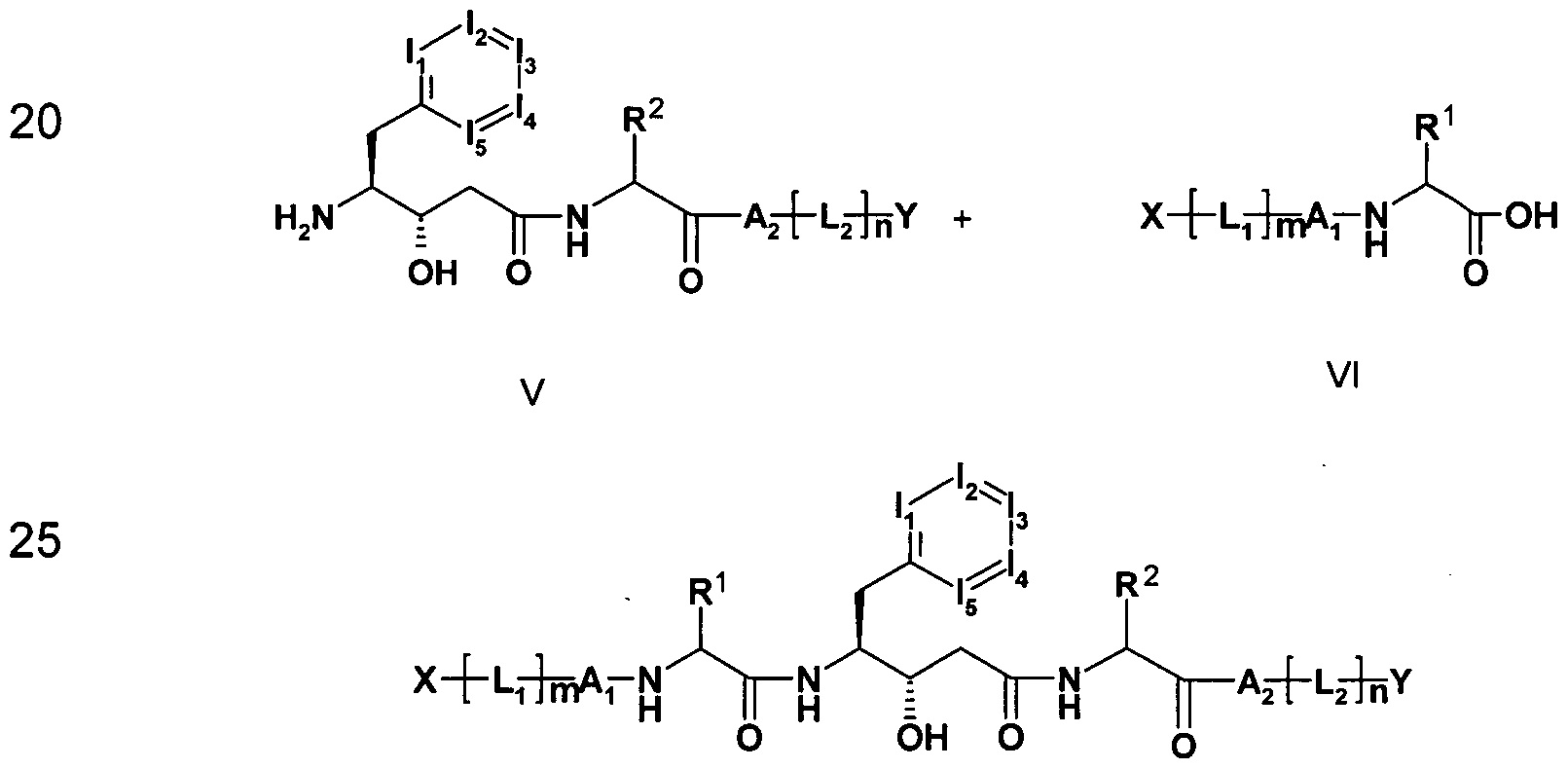
Priority Applications (9)
| Application Number | Priority Date | Filing Date | Title |
|---|---|---|---|
| CA2879754A CA2879754C (en) | 2012-07-24 | 2013-06-26 | Hydroxystatin derivatives for the treatment of arthrosis |
| US14/415,793 US9624264B2 (en) | 2012-07-24 | 2013-06-26 | Hydroxystatin derivatives for the treatment of arthrosis |
| EP13732099.0A EP2877485B1 (en) | 2012-07-24 | 2013-06-26 | Hydroxystatin derivatives for treatment of arthrosis |
| CN201380039155.XA CN104507957B (en) | 2012-07-24 | 2013-06-26 | For treating the hydroxyl statin derivative of arthropathy |
| AU2013295391A AU2013295391B2 (en) | 2012-07-24 | 2013-06-26 | Hydroxystatin derivatives for treatment of arthrosis |
| JP2015523433A JP6430936B2 (en) | 2012-07-24 | 2013-06-26 | Hydroxystatin derivatives for the treatment of arthropathy |
| ES13732099.0T ES2673873T3 (en) | 2012-07-24 | 2013-06-26 | Hydroxystatin derivatives for the treatment of osteoarthritis |
| IL23687015A IL236870B (en) | 2012-07-24 | 2015-01-22 | Hydroxystatin derivatives for the treatment of arthrosis |
| US15/364,598 US10077288B2 (en) | 2012-07-24 | 2016-11-30 | Hydroxystatin derivatives for the treatment of arthrosis |
Applications Claiming Priority (2)
| Application Number | Priority Date | Filing Date | Title |
|---|---|---|---|
| EP12005379.8 | 2012-07-24 | ||
| EP12005379 | 2012-07-24 |
Related Child Applications (2)
| Application Number | Title | Priority Date | Filing Date |
|---|---|---|---|
| US14/415,793 A-371-Of-International US9624264B2 (en) | 2012-07-24 | 2013-06-26 | Hydroxystatin derivatives for the treatment of arthrosis |
| US15/364,598 Division US10077288B2 (en) | 2012-07-24 | 2016-11-30 | Hydroxystatin derivatives for the treatment of arthrosis |
Publications (1)
| Publication Number | Publication Date |
|---|---|
| WO2014015934A1 true WO2014015934A1 (en) | 2014-01-30 |
Family
ID=48700527
Family Applications (1)
| Application Number | Title | Priority Date | Filing Date |
|---|---|---|---|
| PCT/EP2013/001879 Ceased WO2014015934A1 (en) | 2012-07-24 | 2013-06-26 | Hydroxystatin derivatives for treatment of arthrosis |
Country Status (10)
| Country | Link |
|---|---|
| US (2) | US9624264B2 (en) |
| EP (1) | EP2877485B1 (en) |
| JP (1) | JP6430936B2 (en) |
| CN (1) | CN104507957B (en) |
| AR (1) | AR091875A1 (en) |
| AU (1) | AU2013295391B2 (en) |
| CA (1) | CA2879754C (en) |
| ES (1) | ES2673873T3 (en) |
| IL (1) | IL236870B (en) |
| WO (1) | WO2014015934A1 (en) |
Families Citing this family (1)
| Publication number | Priority date | Publication date | Assignee | Title |
|---|---|---|---|---|
| CN112979490B (en) * | 2021-03-03 | 2022-11-25 | 深圳海创生物科技有限公司 | Compound, composition and application thereof in preparation of product with antioxidant or anti-inflammatory effects |
Citations (44)
| Publication number | Priority date | Publication date | Assignee | Title |
|---|---|---|---|---|
| US3971736A (en) | 1975-01-21 | 1976-07-27 | Merck & Co., Inc. | Cathepsin in D inhibitors |
| US4125828A (en) | 1972-08-04 | 1978-11-14 | Med-El Inc. | Method and apparatus for automated classification and analysis of cells |
| US4207554A (en) | 1972-08-04 | 1980-06-10 | Med-El Inc. | Method and apparatus for automated classification and analysis of cells |
| EP0077028A2 (en) | 1981-10-08 | 1983-04-20 | Merck & Co. Inc. | Renin inhibitory peptides |
| EP0161588A2 (en) | 1984-05-18 | 1985-11-21 | MERCK PATENT GmbH | Diamino acid derivatives |
| WO1986004901A1 (en) * | 1985-02-26 | 1986-08-28 | Sanofi | Rennin- and acid proteases-inhibitor peptidic amino alcohol derivatives, preparation process thereof and therapeutical application thereof |
| EP0198271A2 (en) | 1985-04-03 | 1986-10-22 | MERCK PATENT GmbH | Peptides |
| DE3601248A1 (en) * | 1986-01-17 | 1987-07-23 | Hoechst Ag | SUBSTITUTED 4-AMINO-3-HYDROXYBUTTERIC ACID DERIVATIVES, METHOD FOR THE PRODUCTION THEREOF, THESE AGENTS AND THEIR USE |
| US4743585A (en) * | 1986-11-21 | 1988-05-10 | Warner-Lambert Company | Renin inhibitors |
| US4746648A (en) | 1985-02-12 | 1988-05-24 | Institut National de la Recherche Medicale Sanofi | Peptide derivatives which inhibit renin and acid proteases |
| US4818748A (en) * | 1986-03-12 | 1989-04-04 | Bayer Aktiengesellschaft | Renin inhibitors and aminoacid and aminoaldehyde derivatives |
| EP0337334A2 (en) | 1988-04-14 | 1989-10-18 | MERCK PATENT GmbH | Renin-inhibiting amino acid derivatives |
| WO1997022596A1 (en) | 1995-12-18 | 1997-06-26 | Zeneca Limited | Quinazoline derivatives |
| WO1997030072A1 (en) * | 1996-02-20 | 1997-08-21 | The Government Of The United States Of America, Represented By The Secretary, Department Of Health And Human Services | Peptidomimetic inhibitors of cathepsin d and plasmepsins i and ii |
| WO1997030035A1 (en) | 1996-02-13 | 1997-08-21 | Zeneca Limited | Quinazoline derivatives as vegf inhibitors |
| WO1997032856A1 (en) | 1996-03-05 | 1997-09-12 | Zeneca Limited | 4-anilinoquinazoline derivatives |
| WO1998013354A1 (en) | 1996-09-25 | 1998-04-02 | Zeneca Limited | Quinazoline derivatives and pharmaceutical compositions containing them |
| WO1999002153A1 (en) | 1997-07-07 | 1999-01-21 | Pharmacopeia, Inc. | Glycol and hydroxyphosphonate peptidomimetics as inhibitors of aspartyl proteases |
| WO1999002166A1 (en) | 1997-07-08 | 1999-01-21 | Angiogene Pharmaceuticals Ltd. | Use of colchinol derivatives as vascular damaging agents |
| WO1999055687A2 (en) | 1998-04-29 | 1999-11-04 | Pharmacopeia, Inc. | Hydroxypropylamide peptidomimetics as inhibitors of aspartyl proteases |
| WO2000040529A1 (en) | 1999-01-07 | 2000-07-13 | Angiogene Pharmaceuticals Ltd. | Colchinol derivatives as vascular damaging agents |
| WO2000041669A2 (en) | 1999-01-15 | 2000-07-20 | Angiogene Pharmaceuticals Ltd. | Benzimidazole vascular damaging agents |
| US6150416A (en) | 1997-02-04 | 2000-11-21 | The Regents Of The University Of California | Nanomolar, non-peptide inhibitors of cathepsin D |
| US6251928B1 (en) | 1994-03-16 | 2001-06-26 | Eli Lilly And Company | Treatment of alzheimer's disease employing inhibitors of cathepsin D |
| WO2001092224A1 (en) | 2000-05-31 | 2001-12-06 | Astrazeneca Ab | Indole derivatives with vascular damaging activity |
| WO2002004434A1 (en) | 2000-07-07 | 2002-01-17 | Angiogene Pharmaceuticals Limited | Colchinol derivatives as vascular damaging agents |
| WO2002008213A1 (en) | 2000-07-07 | 2002-01-31 | Angiogene Pharmaceuticals Limited | Colchinol derivatives as angiogenesis inhibitors |
| WO2003106405A1 (en) | 2002-06-01 | 2003-12-24 | Sunesis Pharmaceuticals, Inc. | Aspartyl protease inhibitors |
| WO2005016876A2 (en) | 2003-08-08 | 2005-02-24 | Schering Corporation | Cyclic amine bace-1 inhibitors having a benzamide substituent |
| WO2005049585A1 (en) | 2003-11-05 | 2005-06-02 | Novartis Ag | Macrocyclic lactams and pharmaceutical use thereof |
| WO2005087751A2 (en) | 2004-03-09 | 2005-09-22 | Elan Pharmaceuticals, Inc. | Substituted hydroxyethylamine aspartyl protease inhibitors |
| WO2005087215A1 (en) | 2004-03-09 | 2005-09-22 | Elan Pharmaceuticals, Inc. | Substituted urea and carbamate, phenacyl-2-hydroxy-3-diaminoalkane, and benzamide-2-hydroxy-3-diaminoalkane aspartyl-protease inhibitors |
| WO2006050861A2 (en) * | 2004-11-10 | 2006-05-18 | Boehringer Ingelheim International Gmbh | Statine derivatives for the treatment of alzheimer's disease |
| WO2006074950A1 (en) | 2005-01-13 | 2006-07-20 | Novartis Ag | Macrocyclic compounds useful as bace inhibitors |
| US20060281729A1 (en) | 2005-06-14 | 2006-12-14 | Schering Corporation | Macrocyclic heterocyclic aspartyl protease inhibitors |
| EP1745778A2 (en) | 2005-07-20 | 2007-01-24 | Speedel Experimenta AG | Diaminoalcohols as therapeutic compounds |
| EP1745777A1 (en) | 2005-07-20 | 2007-01-24 | Speedel Experimenta AG | Amido-aminoalcohols as therapeutic compounds |
| EP1745776A1 (en) | 2005-07-20 | 2007-01-24 | Speedel Experimenta AG | Aminoalcohols as therapeutic compounds |
| WO2007077004A1 (en) | 2005-12-30 | 2007-07-12 | Novartis Ag | Macrocyclic compounds useful as bace inhibitors |
| EP1867329A2 (en) | 2006-06-14 | 2007-12-19 | Speedel Experimenta AG | 5-Amino-4-hydroxy-2-isopropyl-7-[4-methoxy-3-(3-methoxypropoxy)benzyl]-8-methylnonanamides as therapeutic compounds |
| EP1872780A2 (en) | 2006-06-14 | 2008-01-02 | Speedel Experimenta AG | Omega-Phenyloctanamides as therapeutic compounds |
| WO2008119772A1 (en) | 2007-03-30 | 2008-10-09 | Medivir Ab | Amide derivatives as inhibitors of aspartyl proteases |
| EP1987834A2 (en) | 2007-02-13 | 2008-11-05 | Speedel Experimenta AG | Substituted piperidines as therapeutic compounds |
| WO2009013293A1 (en) | 2007-07-24 | 2009-01-29 | Novartis Ag | Substituted cyclohexanecarboxamides useful as bace inhibitors |
Family Cites Families (1)
| Publication number | Priority date | Publication date | Assignee | Title |
|---|---|---|---|---|
| ZA871747B (en) * | 1986-03-12 | 1987-10-28 | Bayer Ag | Renin inhibitors,their preparation and use,and aminoacid derivatives and aminoaldehyde derivatives |
-
2013
- 2013-06-26 WO PCT/EP2013/001879 patent/WO2014015934A1/en not_active Ceased
- 2013-06-26 CA CA2879754A patent/CA2879754C/en active Active
- 2013-06-26 US US14/415,793 patent/US9624264B2/en not_active Expired - Fee Related
- 2013-06-26 CN CN201380039155.XA patent/CN104507957B/en not_active Expired - Fee Related
- 2013-06-26 ES ES13732099.0T patent/ES2673873T3/en active Active
- 2013-06-26 AU AU2013295391A patent/AU2013295391B2/en not_active Ceased
- 2013-06-26 EP EP13732099.0A patent/EP2877485B1/en active Active
- 2013-06-26 JP JP2015523433A patent/JP6430936B2/en not_active Expired - Fee Related
- 2013-07-24 AR ARP130102620A patent/AR091875A1/en unknown
-
2015
- 2015-01-22 IL IL23687015A patent/IL236870B/en active IP Right Grant
-
2016
- 2016-11-30 US US15/364,598 patent/US10077288B2/en active Active
Patent Citations (45)
| Publication number | Priority date | Publication date | Assignee | Title |
|---|---|---|---|---|
| US4125828A (en) | 1972-08-04 | 1978-11-14 | Med-El Inc. | Method and apparatus for automated classification and analysis of cells |
| US4207554A (en) | 1972-08-04 | 1980-06-10 | Med-El Inc. | Method and apparatus for automated classification and analysis of cells |
| US3971736A (en) | 1975-01-21 | 1976-07-27 | Merck & Co., Inc. | Cathepsin in D inhibitors |
| EP0077028A2 (en) | 1981-10-08 | 1983-04-20 | Merck & Co. Inc. | Renin inhibitory peptides |
| EP0161588A2 (en) | 1984-05-18 | 1985-11-21 | MERCK PATENT GmbH | Diamino acid derivatives |
| US4746648A (en) | 1985-02-12 | 1988-05-24 | Institut National de la Recherche Medicale Sanofi | Peptide derivatives which inhibit renin and acid proteases |
| WO1986004901A1 (en) * | 1985-02-26 | 1986-08-28 | Sanofi | Rennin- and acid proteases-inhibitor peptidic amino alcohol derivatives, preparation process thereof and therapeutical application thereof |
| EP0198271A2 (en) | 1985-04-03 | 1986-10-22 | MERCK PATENT GmbH | Peptides |
| DE3601248A1 (en) * | 1986-01-17 | 1987-07-23 | Hoechst Ag | SUBSTITUTED 4-AMINO-3-HYDROXYBUTTERIC ACID DERIVATIVES, METHOD FOR THE PRODUCTION THEREOF, THESE AGENTS AND THEIR USE |
| US4818748A (en) * | 1986-03-12 | 1989-04-04 | Bayer Aktiengesellschaft | Renin inhibitors and aminoacid and aminoaldehyde derivatives |
| US4743585A (en) * | 1986-11-21 | 1988-05-10 | Warner-Lambert Company | Renin inhibitors |
| EP0337334A2 (en) | 1988-04-14 | 1989-10-18 | MERCK PATENT GmbH | Renin-inhibiting amino acid derivatives |
| US6251928B1 (en) | 1994-03-16 | 2001-06-26 | Eli Lilly And Company | Treatment of alzheimer's disease employing inhibitors of cathepsin D |
| WO1997022596A1 (en) | 1995-12-18 | 1997-06-26 | Zeneca Limited | Quinazoline derivatives |
| WO1997030035A1 (en) | 1996-02-13 | 1997-08-21 | Zeneca Limited | Quinazoline derivatives as vegf inhibitors |
| US5849691A (en) | 1996-02-20 | 1998-12-15 | The United States Of America As Represented By The Department Of Health And Human Services | Peptidomimetic inhibitors of cathepsin D and plasmepsins I and II |
| WO1997030072A1 (en) * | 1996-02-20 | 1997-08-21 | The Government Of The United States Of America, Represented By The Secretary, Department Of Health And Human Services | Peptidomimetic inhibitors of cathepsin d and plasmepsins i and ii |
| WO1997032856A1 (en) | 1996-03-05 | 1997-09-12 | Zeneca Limited | 4-anilinoquinazoline derivatives |
| WO1998013354A1 (en) | 1996-09-25 | 1998-04-02 | Zeneca Limited | Quinazoline derivatives and pharmaceutical compositions containing them |
| US6150416A (en) | 1997-02-04 | 2000-11-21 | The Regents Of The University Of California | Nanomolar, non-peptide inhibitors of cathepsin D |
| WO1999002153A1 (en) | 1997-07-07 | 1999-01-21 | Pharmacopeia, Inc. | Glycol and hydroxyphosphonate peptidomimetics as inhibitors of aspartyl proteases |
| WO1999002166A1 (en) | 1997-07-08 | 1999-01-21 | Angiogene Pharmaceuticals Ltd. | Use of colchinol derivatives as vascular damaging agents |
| WO1999055687A2 (en) | 1998-04-29 | 1999-11-04 | Pharmacopeia, Inc. | Hydroxypropylamide peptidomimetics as inhibitors of aspartyl proteases |
| WO2000040529A1 (en) | 1999-01-07 | 2000-07-13 | Angiogene Pharmaceuticals Ltd. | Colchinol derivatives as vascular damaging agents |
| WO2000041669A2 (en) | 1999-01-15 | 2000-07-20 | Angiogene Pharmaceuticals Ltd. | Benzimidazole vascular damaging agents |
| WO2001092224A1 (en) | 2000-05-31 | 2001-12-06 | Astrazeneca Ab | Indole derivatives with vascular damaging activity |
| WO2002004434A1 (en) | 2000-07-07 | 2002-01-17 | Angiogene Pharmaceuticals Limited | Colchinol derivatives as vascular damaging agents |
| WO2002008213A1 (en) | 2000-07-07 | 2002-01-31 | Angiogene Pharmaceuticals Limited | Colchinol derivatives as angiogenesis inhibitors |
| WO2003106405A1 (en) | 2002-06-01 | 2003-12-24 | Sunesis Pharmaceuticals, Inc. | Aspartyl protease inhibitors |
| WO2005016876A2 (en) | 2003-08-08 | 2005-02-24 | Schering Corporation | Cyclic amine bace-1 inhibitors having a benzamide substituent |
| WO2005049585A1 (en) | 2003-11-05 | 2005-06-02 | Novartis Ag | Macrocyclic lactams and pharmaceutical use thereof |
| WO2005087751A2 (en) | 2004-03-09 | 2005-09-22 | Elan Pharmaceuticals, Inc. | Substituted hydroxyethylamine aspartyl protease inhibitors |
| WO2005087215A1 (en) | 2004-03-09 | 2005-09-22 | Elan Pharmaceuticals, Inc. | Substituted urea and carbamate, phenacyl-2-hydroxy-3-diaminoalkane, and benzamide-2-hydroxy-3-diaminoalkane aspartyl-protease inhibitors |
| WO2006050861A2 (en) * | 2004-11-10 | 2006-05-18 | Boehringer Ingelheim International Gmbh | Statine derivatives for the treatment of alzheimer's disease |
| WO2006074950A1 (en) | 2005-01-13 | 2006-07-20 | Novartis Ag | Macrocyclic compounds useful as bace inhibitors |
| US20060281729A1 (en) | 2005-06-14 | 2006-12-14 | Schering Corporation | Macrocyclic heterocyclic aspartyl protease inhibitors |
| EP1745778A2 (en) | 2005-07-20 | 2007-01-24 | Speedel Experimenta AG | Diaminoalcohols as therapeutic compounds |
| EP1745777A1 (en) | 2005-07-20 | 2007-01-24 | Speedel Experimenta AG | Amido-aminoalcohols as therapeutic compounds |
| EP1745776A1 (en) | 2005-07-20 | 2007-01-24 | Speedel Experimenta AG | Aminoalcohols as therapeutic compounds |
| WO2007077004A1 (en) | 2005-12-30 | 2007-07-12 | Novartis Ag | Macrocyclic compounds useful as bace inhibitors |
| EP1867329A2 (en) | 2006-06-14 | 2007-12-19 | Speedel Experimenta AG | 5-Amino-4-hydroxy-2-isopropyl-7-[4-methoxy-3-(3-methoxypropoxy)benzyl]-8-methylnonanamides as therapeutic compounds |
| EP1872780A2 (en) | 2006-06-14 | 2008-01-02 | Speedel Experimenta AG | Omega-Phenyloctanamides as therapeutic compounds |
| EP1987834A2 (en) | 2007-02-13 | 2008-11-05 | Speedel Experimenta AG | Substituted piperidines as therapeutic compounds |
| WO2008119772A1 (en) | 2007-03-30 | 2008-10-09 | Medivir Ab | Amide derivatives as inhibitors of aspartyl proteases |
| WO2009013293A1 (en) | 2007-07-24 | 2009-01-29 | Novartis Ag | Substituted cyclohexanecarboxamides useful as bace inhibitors |
Non-Patent Citations (72)
| Title |
|---|
| "Greene's Protective Groups in Organic Synthesis", 2007, WILEY-INTERSCIENCE |
| A. CHASLERIE ET AL., THERAPIE, vol. 47, 1992, pages 80 |
| A. J. FARRELL ET AL., ANNALS OF THE RHEUMATIC DISEASES, vol. 51, 1992, pages 1219 - 1222 |
| ADAMS, J. ET AL., ANN. REP. MED. CHEM., vol. 31, 1996, pages 279 - 288 |
| AGARWAL, N S; RICH, D H, J. MED. CHEM., vol. 29, 1986, pages 2519 - 24 |
| ANN. REP. MED. CHEM, vol. 31, 1996, pages 249 - 268 |
| B. FERMOR ET AL., JOURNAL OF ORTHOPAEDIC RESEARCH, vol. 19, 2001, pages 729 - 737 |
| BALDWIN, E T ET AL., PROC. NATL. ACAD. SCI., vol. 90, 1993, pages 6796 - 800 |
| BALDWIN, PROC. NATL. ACAD. SCI., vol. 90, 1993, pages 6796 - 6800 |
| BO G. P. ET AL., CLIN. RHEUMATOL., vol. 28, no. 2, 2009, pages 191 - 9 |
| CATALDO, A. M. ET AL., PROC. NATL. ACAD. SCI., vol. 87, 1990, pages 3861 |
| CLEMENTS D. N. ET AL., ARTHRITIS RES. THER., vol. 8, no. 6, 2006, pages R158 |
| DEVAUCHELLE V. ET AL., GENES IMMUN., vol. 5, no. 8, 2004, pages 597 - 608 |
| DICKINSON A. J., J. UROL., vol. 154, 1995, pages 237 - 241 |
| EDMUNDS J. ET AL., ANN. REP. MED. CHEM., vol. 31, 1996, pages 51 - 60 |
| EVIN G., BIOCHEMISTRY, vol. 34, 1995, pages 14185 - 14192 |
| FOSTER, ADV. DRUG RES., vol. 14, 1985, pages 1 - 40 |
| FRANCIS, S E ET AL., EMBO J, vol. 13, 1994, pages 306 - 17 |
| FRIEDRICK ET AL., EUR. J CANCER, vol. 35, 1999, pages 138 - 144 |
| GEDIKOGLU ET AL., ANN. RHEUM. DIS., vol. 45, no. 4, 1986, pages 289 - 92 |
| GILLETTE ET AL., BIOCHEMISTRY, vol. 33, no. 10, 1994, pages 2927 - 2937 |
| GROVES, P.J. ET AL., ANAL. BIOCHEM., vol. 245, 1997, pages 247 - 248 |
| GUAGLIARDI ET AL., NATURE, vol. 343, 1990, pages 133 - 139 |
| H. CHANG ET AL., SCAND. J. INFECT. DIS., vol. 28, 1996, pages 641 - 643 |
| H. I. ROACH; S. TILLEY: "Bone and Osteoarthritis", vol. 4, 2007, VERLAG SPRINGER |
| HANZLIK ET AL., J. ORG. CHEM., vol. 55, 1990, pages 3992 - 3997 |
| HELSETH ET AL., PROC. NATL. ACAD. SCI. USA, vol. 81, 1984, pages 3302 - 3306 |
| INT. J. PHARM., vol. 115, 1995, pages 61 - 67 |
| ISAHARA, NEUROSCIENCE, vol. 91, 1999, pages 233 - 249 |
| J. SHAFFER ET AL., J. PHARM. SCIENCES, vol. 88, 1999, pages 313 - 318 |
| JARMAN ET AL., CARCINOGENESIS, vol. 16, no. 4, 1993, pages 683 - 688 |
| JONES ET AL., AM. J. PHYSIOL., vol. 275, 1998, pages G723 - 730 |
| JUPP, R A ET AL., BIOCHEM. J., vol. 265, 1990, pages 871 - 8 |
| KAY ET AL.: "Intracellular Protein Catabolism", 1989, pages: 155 - 162 |
| KEYSZER G. M., ARTHRITIS RHEUM., vol. 38, 1995, pages 976 - 984 |
| KEYSZER, ARTHRITIS RHEUM., vol. 38, 1995, pages 976 - 984 |
| KLOMPMAKERS, A.; HENDRIKS, T., ANAL. BIOCHEM., vol. 153, 1986, pages 80 - 84 |
| KOPITZ J., BIOCHEM. J., vol. 295, no. 2, 1993, pages 577 - 580 |
| KOS ET AL., ONCOL. REP., vol. 5, 1998, pages 1349 - 1361 |
| LADROR, U. S. ET AL., J. BIOL. CHEM., vol. 269, 1994, pages 18422 |
| LIAUDET E., CELL GROWTH DIFFER., vol. 6, 1995, pages 1045 - 1052 |
| LIOTTA L. A., SCIENTIFIC AMERICAN, vol. 54, February 1992 (1992-02-01) |
| LIOTTA L. A.; STETLER-STEVENSON W. G., CANCER BIOL., vol. 1, 1990, pages 99 |
| LORENA TABOADA ET AL: "Solid-Phase Synthesis of Novel Trimers Containing a Phenylstatine Core and Analysis by High-Resolution Magic Angle Spinning", JOURNAL OF COMBINATORIAL CHEMISTRY, vol. 9, no. 5, 1 September 2007 (2007-09-01), pages 748 - 755, XP055078197, ISSN: 1520-4766, DOI: 10.1021/cc070001o * |
| LORENZ ET AL., PROTEOMICS, vol. 3, no. 6, 2003, pages 991 - 1002 |
| M. EGERBACHER ET AL., ARCH. TOXICOL., vol. 73, 2000, pages 557 - 563 |
| M. MENSCHIK ET AL., ANTIMICROB. AGENTS CHEMOTHER., vol. 41, 1997, pages 2562 - 2565 |
| MANTLE D., J. NEUROL. SCI., vol. 131, 1995, pages 65 - 70 |
| MIXUOCHI, IMMUNOL. LETT., vol. 43, 1994, pages 189 - 193 |
| MORISHIMA, H. ET AL., J. ANTIBIOT. (TOKYO, vol. 23, 1970, pages 263 - 5 |
| MORT ET AL., INT. J. BIOCHEM. CELL BIOL., vol. 29, 1997, pages 715 - 720 |
| OPARIL, S. ET AL., N. ENGL. J. MED., vol. 291, 1974, pages 381 - 401,446-57 |
| P. DAS ET AL., JOURNAL OF ORTHOPAEDIC RESEARCH, vol. 15, 1997, pages 87 - 93 |
| REIDER ET AL., J. ORG. CHEM., vol. 52, 1987, pages 3326 - 3334 |
| RITCHLIN C. ET AL., SCAND. J. IMMUNNOL., vol. 40, 1994, pages 292 - 298 |
| ROBERTS ET AL., GASTROENTEROLOGY, vol. 113, 1997, pages 1714 - 1726 |
| ROCHEFORT, H., SEMIN. CANCER BIOL., vol. 1, 1990, pages 153 |
| ROSS J. S., AM. J. CLIN. PATHOL., vol. 104, 1995, pages 36 - 41 |
| RUIZ-ROMERO C. ET AL., PROTEOMICS, vol. 5, no. 12, 2005, pages 3048 - 59 |
| SCHWAGER, A. L. ET AL., J. NEUROCHEM, vol. 64, 1995, pages 443 |
| SHIBATA ET AL., BIOCHEM. BIOPHYS. RES. COMMUN., vol. 251, 1998, pages 199 - 20 |
| SYNOVIALGEWEBE; BYLISS; ALI, BIOCHEM. J., vol. 171, no. 1, 1978, pages 149 - 54 |
| TAKAHASHI, T. ET AL.: "Aspartic Proteinases Structure, Function, Biology and Biomedical Implications", 1995, PLENUM PRESS |
| TANDON, A. K. ET AL., N. ENGL. J. MED., vol. 322, 1990, pages 297 |
| TAUBERT H. ET AL., AUTOIMMUNITY, vol. 35, no. 3, 2002, pages 221 - 4 |
| UMEZAWA, H ET AL., J ANTIBIOT (TOKYO, vol. 23, 1970, pages 259 - 62 |
| VAN NOORT ET AL., J. BIOL. CHEM., vol. 264, 1989, pages 14159 - 14164 |
| W. PSCHYREMBEL ET AL.: "Klinisches Wörterbuch mit klinischen Syndromen und einem Anhang Nomina Anatomica", 1977, VERLAG WALTER DE GRUYTER & CO |
| WESTLEY B. R. ET AL., EUR. J. CANCER, vol. 32, 1996, pages 15 - 24 |
| WILLIAMS, H R., J. BIOL. CHEM., vol. 254, 1979, pages 11875 - 83 |
| X. LIU ET AL., BIORHEOLOGY, vol. 43, 2006, pages 183 - 190 |
| YAN ET AL., BIOL. CHEM., vol. 379, 1998, pages 113 - 123 |
Also Published As
| Publication number | Publication date |
|---|---|
| JP2015524417A (en) | 2015-08-24 |
| CA2879754C (en) | 2021-02-16 |
| AU2013295391A1 (en) | 2015-03-05 |
| US10077288B2 (en) | 2018-09-18 |
| AU2013295391B2 (en) | 2018-03-08 |
| EP2877485B1 (en) | 2018-03-14 |
| US20150225451A1 (en) | 2015-08-13 |
| JP6430936B2 (en) | 2018-11-28 |
| EP2877485A1 (en) | 2015-06-03 |
| CN104507957A (en) | 2015-04-08 |
| ES2673873T3 (en) | 2018-06-26 |
| US20170081361A1 (en) | 2017-03-23 |
| IL236870B (en) | 2019-11-28 |
| CA2879754A1 (en) | 2014-01-30 |
| AR091875A1 (en) | 2015-03-04 |
| US9624264B2 (en) | 2017-04-18 |
| IL236870A0 (en) | 2015-03-31 |
| CN104507957B (en) | 2018-12-25 |
Similar Documents
| Publication | Publication Date | Title |
|---|---|---|
| DE102007026341A1 (en) | Benzoxazolonderivate | |
| EP2958901B1 (en) | 2-amino-3,4-dihydro-quinazoline derivatives and their use as cathepsin d inhibitors | |
| EP2313403A2 (en) | Thiazolyl piperdine derivatives | |
| EP1917248B1 (en) | 1-acyldihydropyrazol derivatives | |
| WO2007057093A1 (en) | 3, 6-dihydro-2-oxo-6h-(1,3,4)thiadiazine derivatives | |
| EP3008037B1 (en) | Hydroxy-ethylene derivatives for the treatment of arthrosis | |
| EP2945929A1 (en) | Acylguanidines for treating osteoarthritis | |
| EP2358715B1 (en) | 3-(3-pyrimidin-2-yl-benzyl)-[1,2,4]triazolo[4,3-b]pyrimidine derivatives | |
| EP2877485B1 (en) | Hydroxystatin derivatives for treatment of arthrosis |
Legal Events
| Date | Code | Title | Description |
|---|---|---|---|
| 121 | Ep: the epo has been informed by wipo that ep was designated in this application |
Ref document number: 13732099 Country of ref document: EP Kind code of ref document: A1 |
|
| WWE | Wipo information: entry into national phase |
Ref document number: 2013732099 Country of ref document: EP |
|
| WWE | Wipo information: entry into national phase |
Ref document number: 14415793 Country of ref document: US |
|
| ENP | Entry into the national phase |
Ref document number: 2879754 Country of ref document: CA |
|
| WWE | Wipo information: entry into national phase |
Ref document number: 236870 Country of ref document: IL |
|
| ENP | Entry into the national phase |
Ref document number: 2015523433 Country of ref document: JP Kind code of ref document: A |
|
| NENP | Non-entry into the national phase |
Ref country code: DE |
|
| ENP | Entry into the national phase |
Ref document number: 2013295391 Country of ref document: AU Date of ref document: 20130626 Kind code of ref document: A |